
Allegany-Limestone Central School K-12 Comprehensive Developmental School Counseling and Guidance Plan
|
|
|
- Paul Baker
- 10 years ago
- Views:
Transcription

1 Allegany-Limestone Central K-12 Comprehensive Developmental Counseling and Guidance Plan Jill M. Bogart, High Counselor Christine Conner, Middle Counselor Ted Costa, Elementary Counselor Greta Gregory, Program Development Counselor Rose Stayer-Ruffner, High Counselor March 2015

2 TABLE OF CONTENTS Page Counseling Introduction 2 Vision 2 Mission 2 Components of a Counseling Program 3 Individual Student Planning 3 Responsive Services/Counseling 3 Guidance Activities 4 System Support 4 Leadership, Advocacy and Collaboration 5 Advantages of Comprehensive Counseling Programs 6 ALCS K-12 Counseling Program Activities and Timeline 9 References: NYS Part 100 Regulations 14 ASCA National Standards 15 ASCA Ethical Standards 21 1

3 Allegany-Limestone Counseling Department INTRODUCTION Counseling is a process of helping people by assisting them in making decisions and changing behavior. counselors work with all students, school staff, families and members of the community as an integral part of the education program. counseling programs promote school success through a focus on academic achievement, prevention and intervention activities, advocacy and social/emotional and career development. American Counselor Association The Allegany-Limestone Central counseling plan provides the framework for building a program based on standards developed by the American Counselor Association for academic, personal/social, and career development. The goal of the Allegany-Limestone Counseling Program is to provide for continuous planning that focuses on improving student achievement. OUR VISION The vision of school counseling at Allegany-Limestone Central is that every student will acquire the academic, career and personal/social skills to reach their fullest educational potential and successfully manage their lives as healthy, responsible, competent and productive citizens who respect themselves and the diversity of others. OUR MISSION Our mission as school counselors at Allegany-Limestone Central is to provide a comprehensive, developmentally age-appropriate and sequential school counseling program that is aligned with the American Counselor Association s National Standards for Counseling Programs. A school counseling program focuses on the needs, interests and issues related to the stages of student growth through academic, career and personal/social development. In partnership with students, staff, family, community members and employers, we will prepare students to become effective learners, achieve success in school, live successful and rewarding lives, and develop into contributing members of our global society. 2

4 COMPONENTS OF SCHOOL COUNSELING PROGRAMS The comprehensive ALCS school counseling program integrates academic, career and personal/social development. The components of a comprehensive school counseling program are: individual planning, counseling and responsive services, guidance activities and program support as appropriate per grade level and individual student need. Individual Student Planning As appropriate per grade level, counselors provide the necessary monitoring of individual student s progress towards achieving success in academic, career, and personal/social areas. Individual planning can be monitored through: Case Management: school counselors monitor individual student progress. Individual Appraisal: school counselors use test information and other data to assist students in analyzing and evaluating their interests, skills and abilities. Individual Advisement: school counselors work directly with students on developing an appropriate educational plan. Placement: school counselors assist students in determining the proper educational setting as they meet their academic and career goals. Responsive Services/Counseling counselors coordinate activities to meet the needs of students through: Consultation: school counselors are available to work with parents, teachers, students and other involved parties to develop strategies to assist students. Personal Counseling: provides a student maximum privacy in which to freely explore ideas, feelings, and behaviors. Crisis Counseling: provides intervention and prevention; such counseling is short term in nature addressing a particular student s concern. Referral: counselors refer students and their families to appropriate community agencies when needed. 3

5 Guidance Activities Guidance Activities, as appropriate per grade level, may present structured developmental activities designed to address academic, career development and personal/social needs of students Pre-K through 12. These activities are delivered through: Classroom activities: school counselors present lessons in the classroom setting. Group activities: school counselors may also conduct large group activities to address student s particular needs. Interdisciplinary activities: school counselors may participate in teams to integrate career/college readiness components. System Support System support consists of the management activities essential to the success of the school counseling program. Professional Development: counselors must update knowledge and skills by participating in training, professional meetings and conferences and relevant course work as resources allow. Program Promotion: school counselors may provide orientation and information regarding the program to the greater community through websites, newsletters and presentations. Consultation with Teachers and Staff: counselors work with teachers and other staff members to provide information regarding the needs of students. counselors often participate in district committees and inservice programs. Parent and Community: school counselors provide ongoing support and information to the parents and community regarding student s needs. Research: school counselors utilize research in the development of their programs and participate in research designed to improve their programs. 4

6 Leadership, Advocacy and Collaboration counselors are influential in helping students eventually reach their post-secondary, career, and personal/social goals. In addition to their roles in counseling and coordination, school counselors are leaders, advocates, and collaborators. Leadership: As leaders, they engage in school-wide change to ensure student success. counselors promote academic achievement by developing a comprehensive developmental school counseling program that pays attention to issues of educational equity and access. Advocacy: As advocates, they advocate for all students to achieve at a high level. counselors remove barriers to academic achievement by teaching skills to students, and helping students and parents negotiate the school environment and access support systems. Collaboration: counselors collaborate with teachers, administrators, special educators, staff, students, parents, and community members to impact system-wide changes. Most importantly, school counselors demonstrate that they are willing to share responsibility for student achievement and school improvement. In all of these roles, school counselors use local, regional, and national data to support their programs. 5

7 ADVANTAGES OF A COMPREHENSIVE SCHOOL COUNSELING PROGRAM ALCS counseling programs will strive to positively impact students, parents, teachers, administrators, board of education, other student services personnel, and school counselors. The advantages for each of these groups include the following: Students 1. Prepares students for the challenges of the 21st century by acquiring knowledge and skills in academic, career, and personal/social development. 2. Connects the educational program to future success. 3. Facilitates career exploration and development. 4. Develops decision-making and problem solving skills. 5. Assists in acquiring knowledge of self and others. 6. Enhances personal-social development. 7. Assists in developing effective interpersonal relationship skills. 8. Broadens knowledge of our changing world. 9. Provides school counseling services to every student. 10. Increases the opportunity for counselor-student interaction. 11. Encourages facilitative, cooperative peer interactions. 12. Fosters resiliency factors for students. Parents 1. Prepares their children for the challenges of the 21st century through academic, career, and personal/social development. 2. Provides support for parents in advocating for their child's academic, career, and personal/social development. 3. Develops a systematic approach for their child's long-range planning and learning. 4. Increases opportunities for parent/school interaction. 5. Enables parents to access school and community resources. 6

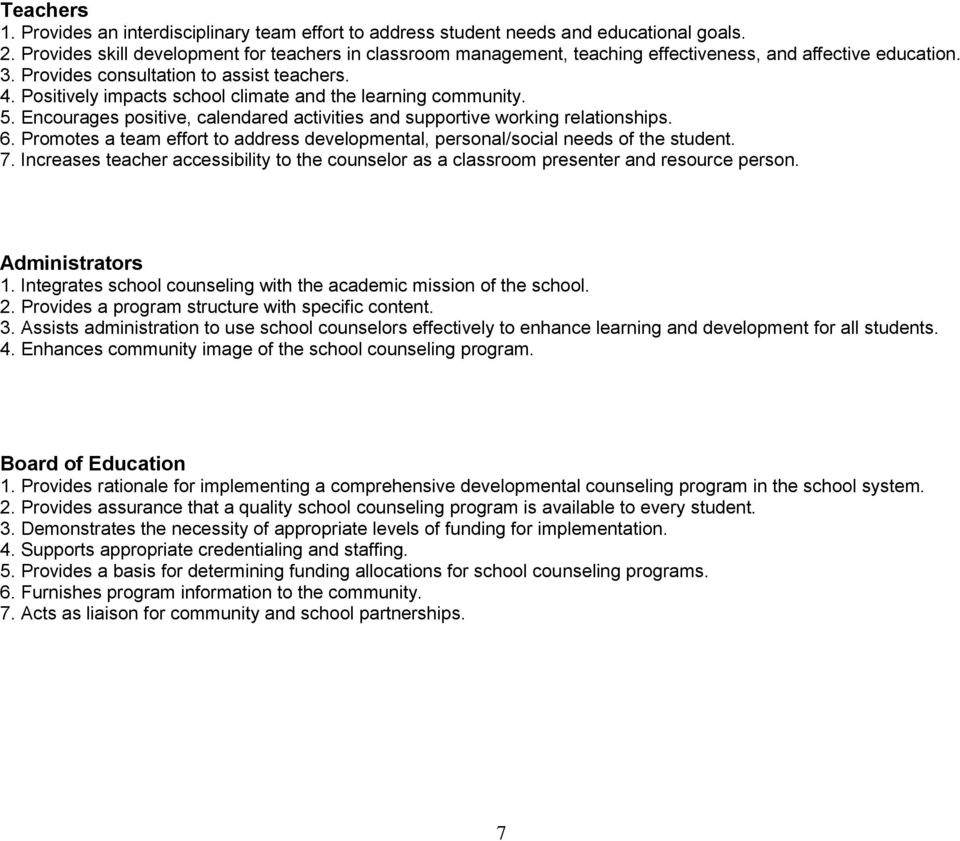
8 Teachers 1. Provides an interdisciplinary team effort to address student needs and educational goals. 2. Provides skill development for teachers in classroom management, teaching effectiveness, and affective education. 3. Provides consultation to assist teachers. 4. Positively impacts school climate and the learning community. 5. Encourages positive, calendared activities and supportive working relationships. 6. Promotes a team effort to address developmental, personal/social needs of the student. 7. Increases teacher accessibility to the counselor as a classroom presenter and resource person. Administrators 1. Integrates school counseling with the academic mission of the school. 2. Provides a program structure with specific content. 3. Assists administration to use school counselors effectively to enhance learning and development for all students. 4. Enhances community image of the school counseling program. Board of Education 1. Provides rationale for implementing a comprehensive developmental counseling program in the school system. 2. Provides assurance that a quality school counseling program is available to every student. 3. Demonstrates the necessity of appropriate levels of funding for implementation. 4. Supports appropriate credentialing and staffing. 5. Provides a basis for determining funding allocations for school counseling programs. 6. Furnishes program information to the community. 7. Acts as liaison for community and school partnerships. 7
9 Counselors 1. Provides a clearly defined role and function in the educational system. 2. Provides direct service to every student. 3. Provides a tool for program management. 4. Enhances the role of the school counselor as a student advocate. 5. Ensures involvement in the academic mission of the school. 6. Places school counselors in a leadership role. Pupil Personnel Services 1. Provides school psychologists, social workers, and other professional student services personnel with a clearly defined role of the school counselor. 2. Clarifies areas of overlapping responsibilities. 3. Fosters a positive team approach, which enhances cooperative working relationships. Community 1. Provides an increased opportunity for collaboration and participation of community members with the school program. 2. Creates community awareness and visibility of the school counseling program. 8

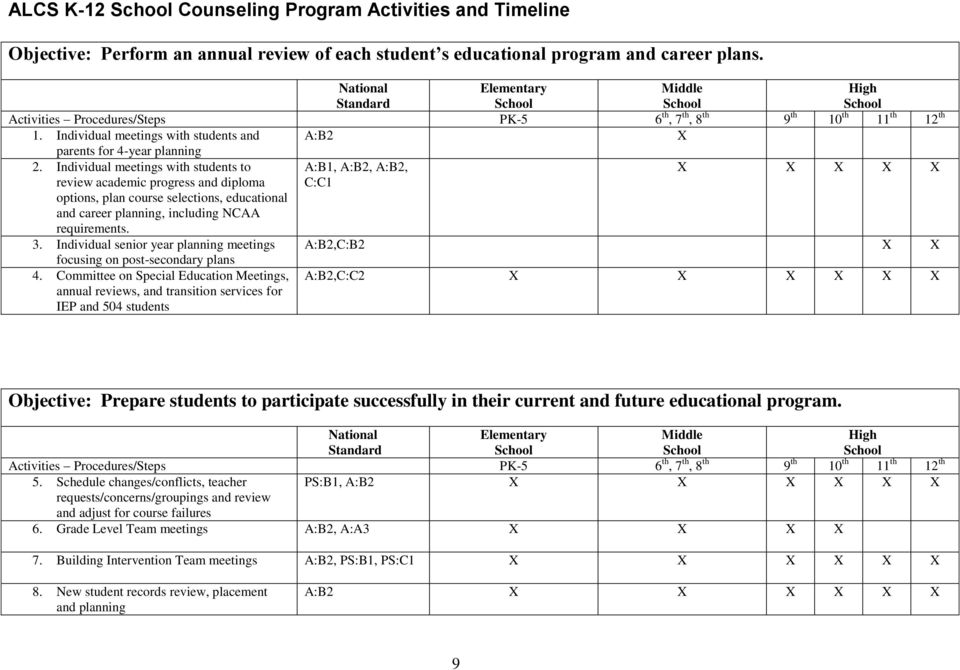
10 ALCS K-12 Counseling Program Activities and Timeline Objective: Perform an annual review of each student s educational program and career plans. National Standard Elementary Middle High Activities Procedures/Steps PK-5 6 th, 7 th, 8 th 9 th 10 th 11 th 12 th 1. Individual meetings with students and A:B2 X parents for 4-year planning 2. Individual meetings with students to A:B1, A:B2, A:B2, X X X X X review academic progress and diploma options, plan course selections, educational and career planning, including NCAA requirements. C:C1 3. Individual senior year planning meetings A:B2,C:B2 X X focusing on post-secondary plans 4. Committee on Special Education Meetings, annual reviews, and transition services for IEP and 504 students A:B2,C:C2 X X X X X X Objective: Prepare students to participate successfully in their current and future educational program. National Standard Elementary Middle High Activities Procedures/Steps PK-5 6 th, 7 th, 8 th 9 th 10 th 11 th 12 th 5. Schedule changes/conflicts, teacher PS:B1, A:B2 X X X X X X requests/concerns/groupings and review and adjust for course failures 6. Grade Level Team meetings A:B2, A:A3 X X X X 7. Building Intervention Team meetings A:B2, PS:B1, PS:C1 X X X X X X 8. New student records review, placement and planning A:B2 X X X X X X 9
11 National Standard Elementary Middle High Activities Procedures/Steps PK-5 6 th, 7 th, 8 th 9 th 10 th 11 th 12 th 9. Conduct guidance classes A:B1,A:B2, A:A1, X C:A2, PS:C1 10. College Admissions Representative X X Classroom presentations 11. Assist in UPK and Kindergarten transitions A:A3 X 12. Meet the Teacher night/open House A:A3 X X X X X X 13. Conduct UPK and Kindergarten screenings A:B2 X th grade to middle school transition A:A2, A:A3, PS:A1, X X PS:A2 15. Transition visits for special needs students A:A2, A:A3, PS:A1, X X moving to middle school PS:A2 16. Guidance Direct career survey C:A1, C:B1,PS:B1 X 17. Career Tours for Interested students X X X X X 18. Career education: utilization of Career X X X X X Zone, Guidance Direct, College Board, etc. 19. Dissemination of scholarship information A:B2 X X 20. PSAT: Information presentations in C:C1, C:C2, A:B2 X English classes 21. Administer PSAT A:B2, C:B2 X 22. Scholarship applications A:B1 X 23. Future Focus BOCES tour for 8 th Graders X 24. Giant Step coordination A:A2, PS:A1, A:B2 X X 25. Dissemination of FAFSA information PS:B1, A:C1 26. Financial Aid night for seniors and parents PS:B1, A:C1 X X 10

12 National Standard Elementary Middle High Activities Procedures/Steps PK-5 6 th, 7 th, 8 th 9 th 10 th 11 th 12 th 27. JCC Career Day X 28. College Field Trips X X X X 29. Career Interview Coordination/Facilitation X 30. Academic Intervention Services/Response A:A1,A:A2, A:A3, X X X X X X to Intervention scheduling A:B1 31. Coordinate ASVAB C:A1, C:C2 X 32. JCC Accuplacer Placement exam A:B2 X X 33. JCC Course Registration X X 34. Local Scholarship Committee meetings X 35. Teacher Resource A:B1 X X X X X X 36. Parent Resource PS:B1, A:A2 X X X X X X 37. Schedule counseling sessions X X X X X X 38. Master Schedule set-up, planning and X X X X X X coordination 39. Award Ceremonies and dinners X X X X X 40. Diploma verifications X X 11

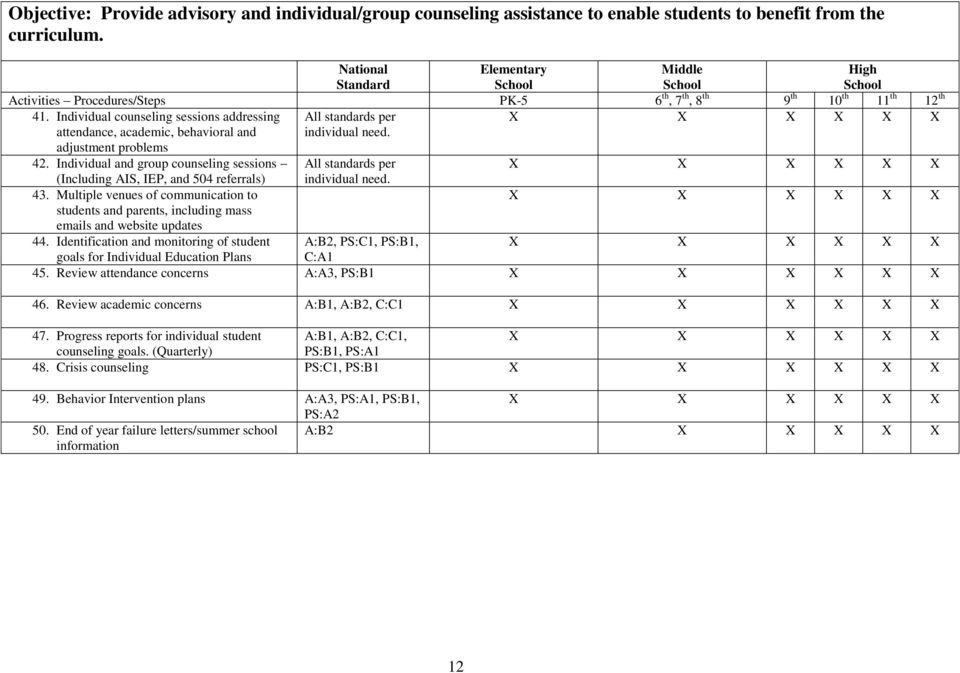
13 Objective: Provide advisory and individual/group counseling assistance to enable students to benefit from the curriculum. National Standard Elementary Middle High Activities Procedures/Steps PK-5 6 th, 7 th, 8 th 9 th 10 th 11 th 12 th 41. Individual counseling sessions addressing attendance, academic, behavioral and adjustment problems All standards per individual need. X X X X X X 42. Individual and group counseling sessions (Including AIS, IEP, and 504 referrals) 43. Multiple venues of communication to students and parents, including mass s and website updates All standards per individual need. X X X X X X X X X X X X 44. Identification and monitoring of student A:B2, PS:C1, PS:B1, X X X X X X goals for Individual Education Plans C:A1 45. Review attendance concerns A:A3, PS:B1 X X X X X X 46. Review academic concerns A:B1, A:B2, C:C1 X X X X X X 47. Progress reports for individual student A:B1, A:B2, C:C1, X X X X X X counseling goals. (Quarterly) PS:B1, PS:A1 48. Crisis counseling PS:C1, PS:B1 X X X X X X 49. Behavior Intervention plans A:A3, PS:A1, PS:B1, X X X X X X PS:A2 50. End of year failure letters/summer school information A:B2 X X X X X 12
14 Objective: To provide a liaison between the school and professional guidance and counseling resources, agencies, and/or organizations to further enhance the District Guidance Program or Plan. National Standard Elementary Middle High Activities Procedures/Steps PK-5 6 th, 7 th, 8 th 9 th 10 th 11 th 12 th 51. Referrals Services, Agencies, Camps C:A2, PS:A1, PS:A2, X X X X X X PS:C1 52. Referrals and Collaboration with Agencies Cross Systems, Probation PINS, CPS, Children s Advocacy Center, Children s Services Initiative, Cornell Cooperative Extension, CAReS, Community Services, Treatment Program transitioning, Youth Bureau, One Stop, Community Action, Subcon, ACCESS-VR, ReHabilitation Center C:A2, PS:A1, PS:A2, PS:C1, X X X X X X 53. Internal Collaboration Administration, Psychologists, Teachers, Nurses, Teacher Aides, AmeriCorp, CSE Chairperson, Transportation Supervisor, Curriculum and Technology Coordinator 54. Representative for Dream It Do It, Community Partnership X X X X X X Objective: Conduct an annual review of the K-12 Guidance Plan and program review consistent with career/educational planning procedures. X X X X National Standard Elementary Middle High Activities Procedures/Steps PK-5 6 th, 7 th, 8 th 9 th 10 th 11 th 12 th 55. Counselor/Administration meetings X X X X X X 56. Collaboration and communication with X X X X X X school counselors: Cattaraugus County Counselor Meetings, Guidance Direct List Serve, NYSED List Serve 57. Year end review of guidance plan X X X X X X 13

15 References: The Allegany-Limestone school counseling program is built on a strong foundation. Based on the district s goals for student achievement, what every student should know and should be able to do, the foundation determines how every student will benefit from the school counseling program. The Allegany-Limestone school counseling program is based on the New York State Part 100 Regulations and the ASCA National Standards. Part 100 and Counseling Programs As per the New York State Education Department, listed in Part 100 of the Commissioner s Regulations, school counseling/guidance programs are defined as follows: (1) Public s: Each school district shall have a guidance program for all students (i) In grades K-6, the program shall be designed in coordination with the teaching staff to prepare students to participate effectively in their current and future educational programs, to help students who exhibit any attendance, academic, behavioral or adjustment problems, to educate students concerning avoidance of child sexual abuse and to encourage parental involvement. (ii) In grades 7-12, the guidance program shall include the following activities and services: a. An annual review of each student s educational progress and career plans, with such reviews to be conducted with each student individually or with small groups by personnel certified or licensed as school counselors; b. Instruction at each grade level to help students learn about various careers and about career planning skills conducted by personnel certified or licensed as school counselors, or by classroom teachers in cooperation with school counselors; c. Other advisory and individual or group counseling assistance to enable students to benefit from the curriculum, to help students develop and implement postsecondary educational and career plans, to help students who exhibit any attendance, academic, behavioral or adjustment problems and to encourage parental involvement, provided that advisory assistance shall be provided by teachers or counselors or by certified teaching assistants under the supervision of counselors or teachers, and that such individual or group counseling shall be provided by certified or licensed school psychologists or certified or licensed school social workers in cooperation with school counselors; and d. The services of personnel certified or licensed as school counselors. (iii) Each school district shall develop a district plan which sets forth the manner in which the district shall comply with the requirements of this subdivision. The City District of the City of New York shall submit a separate plan for each community school district, for the High Division and for the Special Education Division. Such plan shall be filed in the district offices and shall be available for review by any individual. The plan shall present program objectives, which describe expectations of what students will learn from the program; activities to accomplish the objectives; specifications of staff members and other resources assigned to accomplish the objectives; provisions for the annual assessment of program results. The plan shall be reviewed annually by the school districts, and revisions shall be made as necessary. Office of Elementary, Middle, Secondary and Continuing Education/Part 100/100.2a/

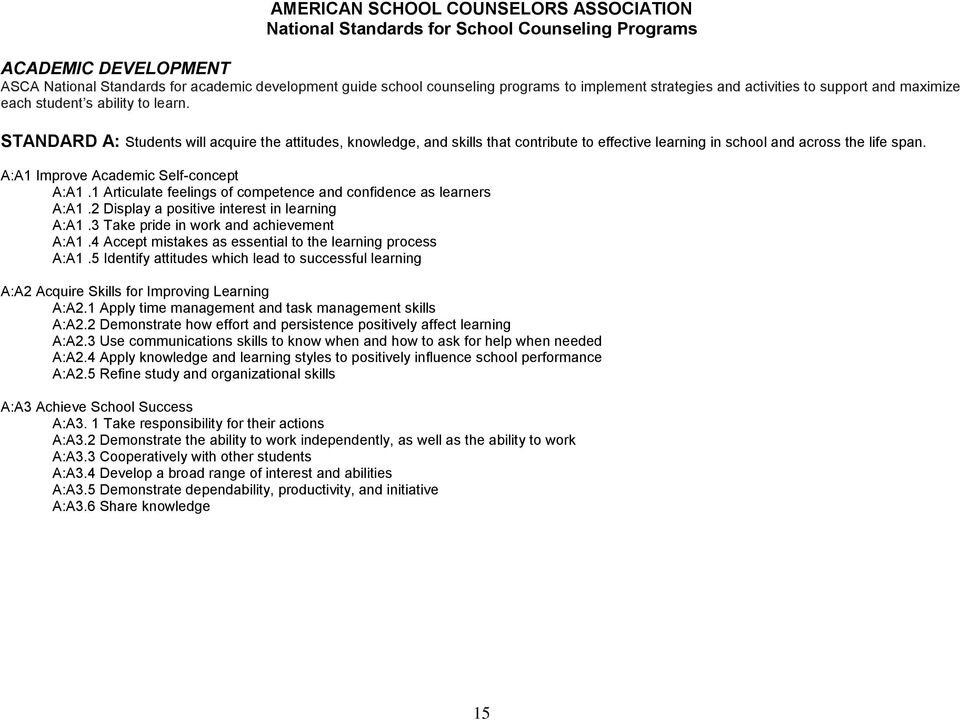
16 AMERICAN SCHOOL COUNSELORS ASSOCIATION National Standards for Counseling Programs ACADEMIC DEVELOPMENT ASCA National Standards for academic development guide school counseling programs to implement strategies and activities to support and maximize each student s ability to learn. STANDARD A: Students will acquire the attitudes, knowledge, and skills that contribute to effective learning in school and across the life span. A:A1 Improve Academic Self-concept A:A1.1 Articulate feelings of competence and confidence as learners A:A1.2 Display a positive interest in learning A:A1.3 Take pride in work and achievement A:A1.4 Accept mistakes as essential to the learning process A:A1.5 Identify attitudes which lead to successful learning A:A2 Acquire Skills for Improving Learning A:A2.1 Apply time management and task management skills A:A2.2 Demonstrate how effort and persistence positively affect learning A:A2.3 Use communications skills to know when and how to ask for help when needed A:A2.4 Apply knowledge and learning styles to positively influence school performance A:A2.5 Refine study and organizational skills A:A3 Achieve Success A:A3. 1 Take responsibility for their actions A:A3.2 Demonstrate the ability to work independently, as well as the ability to work A:A3.3 Cooperatively with other students A:A3.4 Develop a broad range of interest and abilities A:A3.5 Demonstrate dependability, productivity, and initiative A:A3.6 Share knowledge 15
17 STANDARD B: Students will complete school with the academic preparation essential to choose from a wide range of substantial postsecondary options, including college. A:B1 Improve Learning A:BI.1 Demonstrate the motivation to achieve individual potential A:B1.2 Learn and apply critical thinking skills A:B1.3 Apply the study skills necessary for academic success at each level A:B1.4 Seek information and support from faculty, staff, family and peers A:B1.5 Organize and apply academic information from a variety of sources A:B1.6 Use knowledge of learning styles to positively influence school performance A:B1.7 Become a self-directed and independent learner A:B2 Plan to Achieve Goal A:B2.1 Establish challenging academic goals in elementary, middle/junior high. And high school A:B2.2 Develop an initial four-year plan A:B2.3 Update and modify the four-year plan A:B2.4 Use assessment results in educational planning A:B2.5 Develop and implement annual plan of study to maximize academic ability and A;B2.6 Apply knowledge of aptitudes and interests to goal setting A:B2.7 Use problem-solving and decision-making skills to assess progress toward educational goals A:B2.8 Understand the relationship between classroom performance and success in school A:B2.9 Identify post-secondary options consistent with interests, achievement, aptitude, and abilities STANDARD C: Students will understand the relationship of academics to the world of work, and to life at home and in the community. A:C1 Relate to Life Experiences A:C1.1 Demonstrate the ability to balance school, studies, extracurricular activities, leisure time, and family life A:C1.2 Seek co-curricular and community experiences to enhance the school experience A:C1.3 Understand the relationship between learning and work A:C1.4 Demonstrate an understanding of the value of lifelong learning as essential to seeking, obtaining, and maintaining life goals A:C1.5 Understand that school success is the preparation to make the transition from student to community member A:C1.6 Understand how school success and academic achievement enhance future career and vocational opportunities 16

18 CAREER DEVELOPMENT ASCA National Standards for career development guide school counseling programs to provide the foundation for the acquisition of skills, attitudes and knowledge that enable students to make a successful transition from school to the world of work, and from job to job across the life span. STANDARD A: Students will acquire the skills to investigate the world of work in relation to knowledge of self and to make informed career decisions. C:A1 Develop Career Awareness C:A1.1 Develop skills to locate, evaluate, and interpret career information C:A1.2 Learn about the variety of traditional and non-traditional occupations C:A1.3. Develop an awareness of personal abilities, skills, interests, and motivations C:A1.4 Learn how to interact and work cooperatively in teams C:A1.5 Learn to make decisions C:A1.6 Learn how to set goals C:A1.7 Understand the importance of planning C:A1.8 Pursue and develop competency in areas of interest C:A1.9 Develop hobbies and vocational interests C:A1.10 Balance between work and leisure time C:A2 Develop Employment Readiness C:A2.1 Acquire employability skills such as working on a team, problem-solving and organizational skills C:A2.2 Apply job readiness skills to seek employment opportunities C:A2.3 Demonstrate knowledge about the changing workplace C:A2.4 Learn about the rights and responsibilities of employers and employees C:A2.5 Learn to respect individual uniqueness in the workplace C:A2.6 Learn how to write a resume C:A2.7 Develop a positive attitude toward work and learning C:A2.8 Understand the importance of responsibility, dependability, punctuality, integrity, and effort in the workplace C:A2.9 Utilize time and task-management skills STANDARD B: Students will employ strategies to achieve future career goals with success and satisfaction. C:B1 Acquire Career Information C:B1.1 Apply decision making skills to career planning, course selection, and career transition C:B1.2 Identify personal skills, interests, and abilities and relate them to current career choice C:B1.3 Demonstrate knowledge of the career planning process 17

19 C:B1.4 Know the various ways in which occupations can be classified C:B1.5 Use research and information resources to obtain career information C:B1.6 Learn to use the internet to access career planning information C:B2 Identify Career Goals C:B2.1 Demonstrate awareness of the education and training needed to achieve career goals C:B2.2 Assess and modify their educational plan to support career C:B2.3 Select course work that is related to career interests C:B2.4 Maintain a career planning portfolio STANDARD C: Students will understand the relationship between personal qualities, education, training, and the world of work. C:C1. Acquire Knowledge to Achieve Career Goals C:C1.1 Understand the relationship between educational achievement and career success C:C1.2 Explain how work can help to achieve personal success and satisfaction C:C1.3 Identify personal preferences and interests which influence career choice and success C:C1.4 Understand that the changing workplace requires lifelong learning and acquiring new skills C:C1.5 Describe the effect of work on lifestyle C:C1.6 Understand the importance of equity and access in career choice C:C1.7 Understand that work is an important and satisfying means of personal expression C:C2 Apply Skills to Achieve Career Goals C:C2.1 Demonstrate how interests, abilities and achievement relate to achieving personal, social, educational, and career goals C:C2.2 Learn how to use conflict management skills with peers and adults C:C2.3 Learn to work cooperatively with others as a team member C:C2.4 Apply academic and employment readiness skills in work-based learning situations such as internships, shadowing, and/or mentoring experiences 18

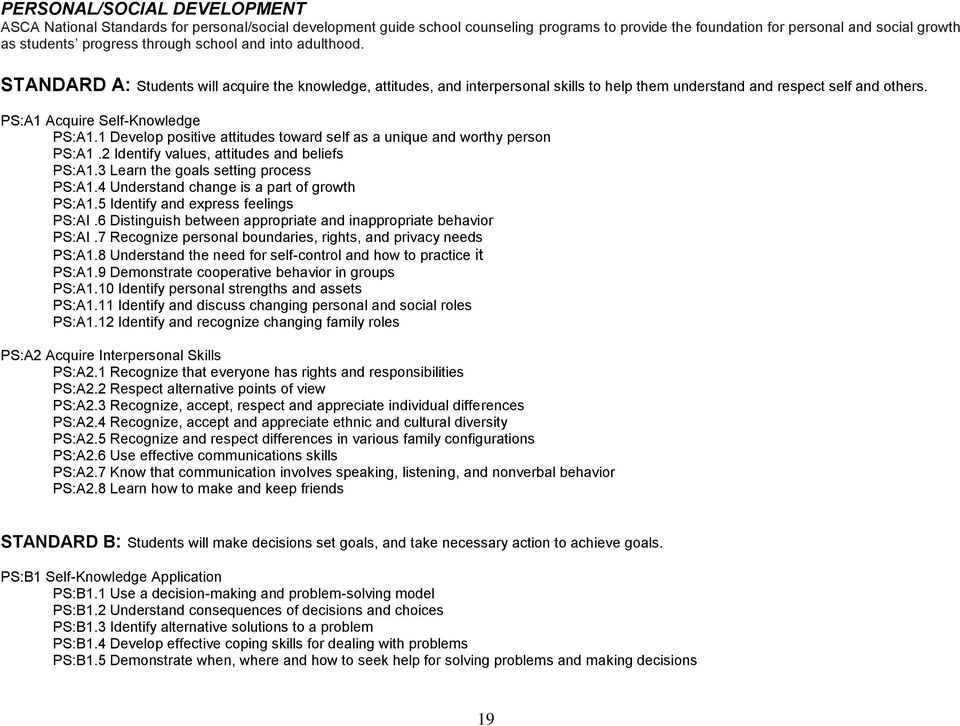
20 PERSONAL/SOCIAL DEVELOPMENT ASCA National Standards for personal/social development guide school counseling programs to provide the foundation for personal and social growth as students progress through school and into adulthood. STANDARD A: Students will acquire the knowledge, attitudes, and interpersonal skills to help them understand and respect self and others. PS:A1 Acquire Self-Knowledge PS:A1.1 Develop positive attitudes toward self as a unique and worthy person PS:A1.2 Identify values, attitudes and beliefs PS:A1.3 Learn the goals setting process PS:A1.4 Understand change is a part of growth PS:A1.5 Identify and express feelings PS:AI.6 Distinguish between appropriate and inappropriate behavior PS:AI.7 Recognize personal boundaries, rights, and privacy needs PS:A1.8 Understand the need for self-control and how to practice it PS:A1.9 Demonstrate cooperative behavior in groups PS:A1.10 Identify personal strengths and assets PS:A1.11 Identify and discuss changing personal and social roles PS:A1.12 Identify and recognize changing family roles PS:A2 Acquire Interpersonal Skills PS:A2.1 Recognize that everyone has rights and responsibilities PS:A2.2 Respect alternative points of view PS:A2.3 Recognize, accept, respect and appreciate individual differences PS:A2.4 Recognize, accept and appreciate ethnic and cultural diversity PS:A2.5 Recognize and respect differences in various family configurations PS:A2.6 Use effective communications skills PS:A2.7 Know that communication involves speaking, listening, and nonverbal behavior PS:A2.8 Learn how to make and keep friends STANDARD B: Students will make decisions set goals, and take necessary action to achieve goals. PS:B1 Self-Knowledge Application PS:B1.1 Use a decision-making and problem-solving model PS:B1.2 Understand consequences of decisions and choices PS:B1.3 Identify alternative solutions to a problem PS:B1.4 Develop effective coping skills for dealing with problems PS:B1.5 Demonstrate when, where and how to seek help for solving problems and making decisions 19
21 PS:B1.6 Know how to apply conflict resolution skills PS:B1.7 Demonstrate a respect and appreciation for individual and cultural differences PS:B1.8 Know when peer pressure is influencing a decision PS:B1.9 Identify long-and short-term goals PS:B1.I0 Identify alternative ways of achieving goals PS:B1.11 Use persistence and perseverance in acquiring knowledge and skills PS:B1.12 Develop an action plan to set and achieve realistic goals STANDARD C: Students will understand safety and survival skills. PS:C1 Acquire Personal Safety Skills PS:C1.1 Demonstrate knowledge of personal information (i.e. telephone number. Home address, emergency contact) PS:C1.2 Learn about the relationship between rules, laws, safety, and the protection of rights of the individual PS:C1.3 Learn about the differences between appropriate and inappropriate physical contact PS:C1.4 Demonstrate the ability to set boundaries, rights and personal privacy PS:C1.5 Differentiate between situations requiring peer support and situations requiring adult professional help PS:C1.6 Identify resource people in the school and community, and know how to seek their help PS:C1.7 Apply effective problem-solving and decision-making skills to make safe and healthy choices PS:C1.8 Learn how to cope with peer pressure PS:C1.9 Learn techniques for managing stress and conflict PS:C1.10 Learn coping skills for managing life events 20
22 AMERICAN SCHOOL COUNSELOR ASSOCIATION ETHICAL STANDARDS Preamble The American Counselor Association (ASCA) is a professional organization whose members are school counselors certified/licensed in school counseling with unique qualifications and skills to address all students academic, personal/social and career development needs. Members are also school counseling program directors/supervisors and counselor educators. These ethical standards are the ethical responsibility of school counselors. counseling program directors/supervisors should know them and provide support for practitioners to uphold them. counselor educators should know them, teach them to their students and provide support for school counseling candidates to uphold them. Professional school counselors are advocates, leaders, collaborators and consultants who create opportunities for equity in access and success in educational opportunities by connecting their programs to the mission of schools and subscribing to the following tenets of professional responsibility: Each person has the right to be respected, be treated with dignity and have access to a comprehensive school counseling program that advocates for and affirms all students from diverse populations including: ethnic/racial identity, age, economic status, abilities/disabilities, language, immigration status, sexual orientation, gender, gender identity/expression, family type, religious/spiritual identity and appearance. Each person has the right to receive the information and support needed to move toward self-direction and self-development and affirmation within one s group identities, with special care being given to students who have historically not received adequate educational services, e.g., students of color, students living at alow socio-economic status, students with disabilities and students from non-dominant language backgrounds. Each person has the right to understand the full magnitude and meaning of his/her educational choices and how those choices will affect future opportunities. Each person has the right to privacy and thereby the right to expect the school-counselor/student relationship to comply with all laws, policies and ethical standards pertaining to confidentiality in the school setting. Each person has the right to feel safe in school environments that school counselors help create, free from abuse, bullying, neglect, harassment or other forms of violence. In this document, ASCA specifies the principles of ethical behavior necessary to maintain the high standards of integrity, leadership and professionalism among its members. The Ethical Standards for Counselors were developed to clarify the nature of ethical responsibilities held in common by school counselors, supervisors/directors of school counseling programs and school counselor educators. The purposes of this document are to: (Adopted 1984; revised 1992, 1998, 2004 and 2010) Serve as a guide for the ethical practices of all professional school counselors, supervisors/directors of school counseling programs and school counselor educators regardless of level, area, population served or membership in this professional association; Provide self-appraisal and peer evaluations regarding school counselors responsibilities to students, parents/guardians, colleagues and professional associates, schools, communities and the counseling profession; and Inform all stakeholders, including students, parents and guardians, teachers, administrators, community members and courts of justice, of best ethical practices, values and expected behaviors of the school counseling professional. A.1. Responsibilities to Students a. Have a primary obligation to the students, who are to be treated with dignity and respect as unique individuals. b. Are concerned with the educational, academic, career, personal and social needs and encourage the maximum development of every student. c. Respect students values, beliefs and cultural background and do not impose the school counselor s personal values on students or their families. d. Are knowledgeable of laws, regulations and policies relating to students and strive to protect and inform students regarding their rights. e. Promote the welfare of individual students and collaborate with them to develop an action plan for success. f. Consider the involvement of support networks valued by the individual students. g. Understand that professional distance with students is appropriate, and any sexual or romantic relationship with students whether illegal in the state of practice is considered a grievous breach of ethics and is prohibited regardless of a student s age. 21
23 h. Consider the potential for harm before entering into a relationship with former students or one of their family members. A.2. Confidentiality a. Inform individual students of the purposes, goals, techniques and rules of procedure under which they may receive counseling. Disclosure includes the limits of confidentiality in a developmentally appropriate manner. Informed consent requires competence on the part of students to understand the limits of confidentiality and therefore, can be difficult to obtain from students of a certain developmental level. Professionals are aware that even though every attempt is made to obtain informed consent it is not always possible and when needed will make counseling decisions on students behalf. b. Explain the limits of confidentiality in appropriate ways such as classroom guidance lessons, the student handbook, school counseling brochures, school Web site, verbal notice or other methods of student, school and community communication in addition to oral notification to individual students. c. Recognize the complicated nature of confidentiality in schools and consider each case in context. Keep information confidential unless legal requirements demand that confidential information be revealed or a breach is required to prevent serious and foreseeable harm to the student. Serious and foreseeable harm is different for each minor in schools and is defined by students developmental and chronological age, the setting, parental rights and the nature of the harm. counselors consult with appropriate professionals when in doubt as to the validity of an exception. d. Recognize their primary obligation for confidentiality is to the students but balance that obligation with an understanding of parents /guardians legal and inherent rights to be the guiding voice in their children s lives, especially in value-laden issues. Understand the need to balance students ethical rights to make choices, their capacity to give consent or assent and parental or familial legal rights and responsibilities to protect these students and make decisions on their behalf. e. Promote the autonomy and independence of students to the extent possible and use the most appropriate and least intrusive method of breach. The developmental age and the circumstances requiring the breach are considered and as appropriate students are engaged in a discussion about the method and timing of the breach. f. In absence of state legislation expressly forbidding disclosure, consider the ethical responsibility to provide information to an identified third party who, by his/her relationship with the student, is at a high risk of contracting a disease that is commonly known to be communicable and fatal. Disclosure requires satisfaction of all of the following conditions: Student identifies partner or the partner is highly identifiable counselor recommends the student notify partner and refrain from further high-risk behavior Student refuses counselor informs the student of the intent to notify the partner counselor seeks legal consultation from the school district s legal representative in writing as to the legalities of informing the partner g. Request of the court that disclosure not be required when the release of confidential information may potentially harm a student or the counseling relationship. h. Protect the confidentiality of students records and release personal data in accordance with prescribed federal and state laws and school policies including the laws within the Family Education Rights and Privacy Act (FERPA). Student information stored and transmitted electronically is treated with the same care as traditional student records. Recognize the vulnerability of confidentiality in electronic communications and only transmit sensitive information electronically in a way that is untraceable to students identity. Critical information such as a student who has a history of suicidal ideation must be conveyed to the receiving school in a personal contact such as a phone call. A.3. Academic, Career/College/Post-Secondary Access and Personal/Social Counseling Plans a. Provide students with a comprehensive school counseling program that parallels the ASCA National Model with emphasis on working jointly with all students to develop personal/social, academic and career goals. b. Ensure equitable academic, career, post-secondary access and personal/social opportunities for all students through the use of data to help close achievement gaps and opportunity gaps. c. Provide and advocate for individual students career awareness, exploration and post-secondary plans supporting the students right to choose from the wide array of options when they leave secondary education. 22
24 A.4. Dual Relationships a. Avoid dual relationships that might impair their objectivity and increase the risk of harm to students (e.g., counseling one s family members or the children of close friends or associates). If a dual relationship is unavoidable, the school counselor is responsible for taking action to eliminate or reduce the potential for harm to the student through use of safeguards, which might include informed consent, consultation, supervision and documentation. b. Maintain appropriate professional distance with students at all times. c. Avoid dual relationships with students through communication mediums such as social networking sites. d. Avoid dual relationships with school personnel that might infringe on the integrity of the school counselor/student relationship. A.5. Appropriate Referrals a. Make referrals when necessary or appropriate to outside resources for student and/or family support. Appropriate referrals may necessitate informing both parents/guardians and students of applicable resources and making proper plans for transitions with minimal interruption of services. Students retain the right to discontinue the counseling relationship at any time. b. Help educate about and prevent personal and social concerns for all students within the school counselor s scope of education and competence and make necessary referrals when the counseling needs are beyond the individual school counselor s education and training. Every attempt is made to find appropriate specialized resources for clinical therapeutic topics that are difficult or inappropriate to address in a school setting such as eating disorders, sexual trauma, chemical dependency and other addictions needing sustained clinical duration or assistance. c. Request a release of information signed by the student and/or parents/guardians when attempting to develop a collaborative relationship with other service providers assigned to the student. d. Develop a reasonable method of termination of counseling when it becomes apparent that counseling assistance is no longer needed or a referral is necessary to better meet the student s needs. A.6. Group Work a. Screen prospective group members and maintain an awareness of participants needs, appropriate fit and personal goals in relation to the group s intention and focus. The school counselor takes reasonable precautions to protect members from physical and psychological harm resulting from interaction within the group. b. Recognize that best practice is to notify the parents/guardians of children participating in small groups. c. Establish clear expectations in the group setting, and clearly state that confidentiality in group counseling cannot be guaranteed. Given the developmental and chronological ages of minors in schools, recognize the tenuous nature of confidentiality for minors renders some topics inappropriate for group work in a school setting. d. Provide necessary follow up with group members, and document proceedings as appropriate. e. Develop professional competencies, and maintain appropriate education, training and supervision in group facilitation and any topics specific to the group. f. Facilitate group work that is brief and solution-focused, working with a variety of academic, career, collegeand personal/social issues. A.7. Danger to Self or Others a. Inform parents/guardians and/or appropriate authorities when a student poses a danger to self or others. This is to be done after careful deliberation and consultation with other counseling professionals. b. Report risk assessments to parents when they underscore the need to act on behalf of a child at risk; never negate a risk of harm as students sometimes deceive in order to avoid further scrutiny and/or parental notification. c. Understand the legal and ethical liability for releasing a student who is in danger to self or others without proper and necessary support for that student. A.8. Student Records a. Maintain and secure records necessary for rendering professional services to the student as required by laws, regulations, institutional procedures and confidentiality guidelines. b. Keep sole-possession records or individual student case notes separate from students educational records in keeping with state laws. 23
25 c. Recognize the limits of sole-possession records and understand these records are a memory aid for the creator and in absence of privileged communication may be subpoenaed and may become educational records when they are shared or are accessible to others in either verbal or written form or when they include information other than professional opinion or personal observations. d. Establish a reasonable timeline for purging sole-possession records or case notes. Suggested guidelines include shredding sole possession records when the student transitions to the next level, transfers to another school or graduates. Apply careful discretion and deliberation before destroying solepossession records that may be needed by a court of law such as notes on child abuse, suicide, sexual harassment or violence. e. Understand and abide by the Family Education Rights and Privacy Act (FERPA, 1974), which safeguards student s records and allows parents to have a voice in what and how information is shared with others regarding their child s educational records. A.9. Evaluation, Assessment and Interpretation a. Adhere to all professional standards regarding selecting, administering and interpreting assessment measures and only utilize assessment measures that are within the scope of practice for school counselors and for which they are trained and competent. b. Consider confidentiality issues when utilizing evaluative or assessment instruments and electronically based programs. c. Consider the developmental age, language skills and level of competence of the student taking the assessments before assessments are given. d. Provide interpretation of the nature, purposes, results and potential impact of assessment/evaluation measures in language the students can understand. e. Monitor the use of assessment results and interpretations, and take reasonable steps to prevent others from misusing the information. f. Use caution when utilizing assessment techniques, making evaluations and interpreting the performance of populations not represented in the norm group on which an instrument is standardized. g. Assess the effectiveness of their program in having an impact on students academic, career and personal/social development through accountability measures especially examining efforts to close achievement, opportunity and attainment gaps. A.10. Technology a. Promote the benefits of and clarify the limitations of various appropriate technological applications. Professional school counselors promote technological applications (1) that are appropriate for students individual needs, (2) that students understand how to use and (3) for which follow-up counseling assistance is provided. b. Advocate for equal access to technology for all students, especially those historically underserved. c. Take appropriate and reasonable measures for maintaining confidentiality of student information and educational records stored or transmitted through the use of computers, facsimile machines, telephones, voic , answering machines and other electronic or computer technology. d. Understand the intent of FERPA and its impact on sharing electronic student records. e. Consider the extent to which cyberbullying is interfering with students educational process and base guidance curriculum and intervention programming for this pervasive and potentially dangerous problem on research-based and best practices. A.11. Student Peer Support Program a. Have unique responsibilities when working with peer-helper or studentassistance programs and safeguard the welfare of students participating in peer-to-peer programs under their direction. b. Are ultimately responsible for appropriate training and supervision for students serving as peer-support individuals in their school counseling programs. B. RESPONSIBILITIES TO PARENTS/GUARDIANS B.1. Parent Rights and Responsibilities a. Respect the rights and responsibilities of parents/guardians for their children and endeavor to establish, as appropriate, a collaborative relationship with parents/guardians to facilitate students maximum development. b. Adhere to laws, local guidelines and ethical standards of practice when assisting parents/guardians experiencing family difficulties interfering with the student s effectiveness and welfare. c. Are sensitive to diversity among families and recognize that all parents/guardians, custodial and noncustodial, are vested with certain rights 24
26 and responsibilities for their children s welfare by virtue of their role and according to law. d. Inform parents of the nature of counseling services provided in the school setting. e. Adhere to the FERPA act regarding disclosure of student information. f. Work to establish, as appropriate, collaborative relationships with parents/guardians to best serve student. B.2. Parents/Guardians and Confidentiality a. Inform parents/guardians of the school counselor s role to include the confidential nature of the counseling relationship between the counselor and student. b. Recognize that working with minors in a school setting requires school counselors to collaborate with students parents/guardians to the extent possible. c. Respect the confidentiality of parents/guardians to the extent that is reasonable to protect the best interest of the student being counseled. d. Provide parents/guardians with accurate, comprehensive and relevant information in an objective and caring manner, as is appropriate and consistent with ethical responsibilities to the student. e. Make reasonable efforts to honor the wishes of parents/guardians concerning information regarding the student unless a court order expressly forbids the involvement of a parent(s). In cases of divorce or separation, school counselors exercise a good-faith effort to keep both parents informed, maintaining focus on the student and avoiding supporting one parent over another in divorce proceedings. C. RESPONSIBILITIES TO COLLEAGUES AND PROFESSIONAL ASSOCIATES C.1. Professional Relationships Professional school counselors, the school counseling program director/site supervisor and the school counselor educator: a. Establish and maintain professional relationships with faculty, staff and administration to facilitate an optimum counseling program. b. Treat colleagues with professional respect, courtesy and fairness. c. Recognize that teachers, staff and administrators who are high functioning in the personal and social development skills can be powerful allies in supporting student success. counselors work to develop relationships with all faculty and staff in order to advantage students. d. Are aware of and utilize related professionals, organizations and other resources to whom the student may be referred. C.2. Sharing Information with Other Professionals a. Promote awareness and adherence to appropriate guidelines regarding confidentiality, the distinction between public and private information and staff consultation. b. Provide professional personnel with accurate, objective, concise and meaningful data necessary to adequately evaluate, counsel and assist the student. c. Secure parental consent and develop clear agreements with other mental health professionals when a student is receiving services from another counselor or other mental health professional in order to avoid confusion and conflict for the student and parents/guardians. d. Understand about the release of information process and parental rights in sharing information and attempt to establish a cooperative and collaborative relationship with other professionals to benefit students. e. Recognize the powerful role of ally that faculty and administration who function high in personal/social development skills can play in supporting students in stress, and carefully filter confidential information to give these allies what they need to know in order to advantage the student. Consultation with other members of the school counseling profession is helpful in determining need-to-know information. The primary focus and obligation is always on the student when it comes to sharing confidential information. f. Keep appropriate records regarding individual students, and develop a plan for transferring those records to another professional school counselor should the need occur. This documentation transfer will protect the confidentiality and benefit the needs of the student for whom the records are written. C.3. Collaborating and Educating Around the Role of the Counselor The school counselor, school counseling program supervisor/director and school counselor educator: a. Share the role of the school counseling program in ensuring data driven academic, career/college and personal/social success competencies for every student, resulting in specific outcomes/indicators with all stakeholders. 25
27 b. Broker services internal and external to the schools to help ensure every student receives the benefits of a school counseling program and specific academic, career/college and personal/social competencies. D. RESPONSIBILITIES TO SCHOOL, COMMUNITIES AND FAMILIES D.1. Responsibilities to the a. Support and protect students best interest against any infringement of their educational program. b. Inform appropriate officials, in accordance with school policy, of conditions that may be potentially disruptive or damaging to the school s mission, personnel and property while honoring the confidentiality between the student and the school counselor. c. Are knowledgeable and supportive of their school s mission, and connect their program to the school s mission. d. Delineate and promote the school counselor s role, and function as a student advocate in meeting the needs of those served. counselors will notify appropriate officials of systemic conditions that may limit or curtail their effectiveness in providing programs and services. e. Accept employment only for positions for which they are qualified by education, training, supervised experience, state and national professional credentials and appropriate professional experience. f. Advocate that administrators hire only qualified, appropriately trained and competent individuals for professional school counseling positions. g. Assist in developing: (1) curricular and environmental conditions appropriate for the school and community; (2) educational procedures and programs to meet students developmental needs; (3) a systematic evaluation process for comprehensive, developmental, standards-based school counseling programs, services and personnel; and (4) a data-driven evaluation process guiding the comprehensive, developmental school counseling program and service delivery. D.2. Responsibility to the Community a. Collaborate with community agencies, organizations and individuals in students best interest and without regard to personal reward or remuneration. b. Extend their influence and opportunity to deliver a comprehensive school counseling program to all students by collaborating with community resources for student success. c. Promote equity for all students through community resources. d. Are careful not to use their professional role as a school counselor to benefit any type of private therapeutic or consultative practice in which they might be involved outside of the school setting. E. RESPONSIBILITIES TO SELF E.1. Professional Competence a. Function within the boundaries of individual professional competence and accept responsibility for the consequences of their actions. b. Monitor emotional and physical health and practice wellness to ensure optimal effectiveness. Seek physical or mental health referrals when needed to ensure competence at all times c. Monitor personal responsibility and recognize the high standard of care a professional in this critical position of trust must maintain on and off the job and are cognizant of and refrain from activity that may lead to inadequate professional services or diminish their effectiveness with school community members Professional and personal growth are ongoing throughout the counselor s career. d. Strive through personal initiative to stay abreast of current research and to maintain professional competence in advocacy, teaming and collaboration, culturally competent counseling and school counseling program coordination, knowledge and use of technology, leadership, and equity assessment using data. e. Ensure a variety of regular opportunities for participating in and facilitating professional development for self and other educators and school counselors through continuing education opportunities annually including: attendance at professional school counseling conferences; reading Professional Counseling journal articles; facilitating workshops for education staff on issues school counselors are uniquely positioned to provide. f. Enhance personal self-awareness, professional effectiveness and ethical practice by regularly attending presentations on ethical decision-making. Effective school counselors will seek supervision when ethical or professional questions arise in their practice. g. Maintain current membership in professional associations to ensure ethical and best practices. 26
28 E.2. Multicultural and Social Justice Advocacy and Leadership a. Monitor and expand personal multicultural and social justice advocacy awareness, knowledge and skills. counselors strive for exemplary cultural competence by ensuring personal beliefs or values are not imposed on students or other stakeholders. b. Develop competencies in how prejudice, power and various forms of oppression, such as ableism, ageism, classism, familyism, genderism, heterosexism, immigrationism, linguicism, racism, religionism and sexism, affect self, students and all stakeholders. c. Acquire educational, consultation and training experiences to improve awareness, knowledge, skills and effectiveness in working with diverse populations: ethnic/racial status, age, economic status, special needs, ESL or ELL, immigration status, sexual orientation, gender, gender identity/expression, family type, religious/spiritual identity and appearance. d. Affirm the multiple cultural and linguistic identities of every student and all stakeholders. Advocate for equitable school and school counseling program policies and practices for every student and all stakeholders including use of translators and bilingual/multilingual school counseling program materials that represent all languages used by families in the school community, and advocate for appropriate accommodations and accessibility for students with disabilities. e. Use inclusive and culturally responsible language in all forms of communication. f. Provide regular workshops and written/digital information to families to increase understanding, collaborative two-way communication and a welcoming school climate between families and the school to promote increased student achievement. g. Work as advocates and leaders in the school to create equity based school counseling programs that help close any achievement, opportunity and attainment gaps that deny all students the chance to pursue their educational goals. F. RESPONSIBILITIES TO THE PROFESSION F.1. Professionalism a. Accept the policies and procedures for handling ethical violations as a result of maintaining membership in the American Counselor Association. b. Conduct themselves in such a manner as to advance individual ethical practice and the profession. c. Conduct appropriate research, and report findings in a manner consistent with acceptable educational and psychological research practices. counselors advocate for the protection of individual students identities when using data for research or program planning. d. Seek institutional and parent/guardian consent before administering any research, and maintain security of research records. e. Adhere to ethical standards of the profession, other official policy statements, such as ASCA s position statements, role statement and the ASCA National Model and relevant statutes established by federal, state and local governments, and when these are in conflict work responsibly for change. f. Clearly distinguish between statements and actions made as a private individual and those made as a representative of the school counseling profession. g. Do not use their professional position to recruit or gain clients, consultees for their private practice or to seek and receive unjustified personal gains, unfair advantage, inappropriate relationships or unearned goods or services. F.2. Contribution to the Profession a. Actively participate in professional associations and share results and best practices in assessing, implementing and annually evaluating the outcomes of data-driven school counseling programs with measurable academic, career/college and personal/social competencies for every student. b. Provide support, consultation and mentoring to novice professionals. c. Have a responsibility to read and abide by the ASCA Ethical Standards and adhere to the applicable laws and regulations. F.3 Supervision of Counselor Candidates Pursuing Practicum and Internship Experiences: a. Provide support for appropriate experiences in academic, career, college access and personal/social counseling for school counseling interns. b. Ensure school counselor candidates have experience in developing, implementing and evaluating a data-driven school counseling program model, such as the ASCA National Model. c. Ensure the school counseling practicum and internship have specific, measurable service delivery, foundation, management, and accountability systems. d. Ensure school counselor candidates maintain appropriate liability insurance for the duration of the school counseling practicum and internship experiences. 27
29 e. Ensure a site visit is completed by a school counselor education faculty member for each practicum or internship student, preferably when both the school counselor trainee and site supervisor are present. F.4 Collaboration and Education about Counselors and Counseling Programs with other Professionals counselors and school counseling program directors/supervisors collaborate with special educators, school nurses, school social workers, school psychologists, college counselors/admissions officers, physical therapists, occupational therapists and speech pathologists to advocate for optimal services for students and all other stakeholders. G. MAINTENANCE OF STANDARDS Professional school counselors are expected to maintain ethical behavior at all times. G.1. When there exists serious doubt as to the ethical behavior of a colleague(s) the following procedure may serve as a guide: 1. The school counselor should consult confidentially with a professional colleague to discuss the nature of a complaint to see if the professional colleague views the situation as an ethical violation. 2. When feasible, the school counselor should directly approach the colleague whose behavior is in question to discuss the complaint and seek resolution. 3. The school counselor should keep documentation of all the steps taken. 4. If resolution is not forthcoming at the personal level, the school counselor shall utilize the channels established within the school, school district, the state school counseling association and ASCA s Ethics Committee. 5. If the matter still remains unresolved, referral for review and appropriate action should be made to the Ethics Committees in the following sequence: State school counselor association American Counselor Association 6. The ASCA Ethics Committee is responsible for: Educating and consulting with the membership regarding ethical standards Periodically reviewing and recommending changes in code Receiving and processing questions to clarify the application of such standards. Questions must be submitted in writing to the ASCA Ethics Committee chair. Handling complaints of alleged violations of the ASCA Ethical Standards for Counselors. At the national level, complaints should be submitted in writing to the ASCA Ethics Committee, c/o the Executive Director, American Counselor Association, 1101 King St., Suite 625, Alexandria, VA G.2. When school counselors are forced to work in situations or abide by policies that do not reflect the ethics of the profession, the school counselor works responsibly through the correct channels to try and remedy the condition. G.3. When faced with any ethical dilemma school counselors, school counseling program directors/supervisors and school counselor educators use an ethical decision-making model such as Solutions to Ethical Problems in s (STEPS) (Stone, 2001): 1. Define the problem emotionally and intellectually 2. Apply the ASCA Ethical Standards and the law 3. Consider the students chronological and developmental levels 4. Consider the setting, parental rights and minors rights 5. Apply the moral principles 6. Determine your potential courses of action and their consequences 7. Evaluate the selected action 8. Consult 9. Implement the course of action 28
Appendix B: Part 100 and School Counseling Programs
 Appendix B: Part 100 and School Counseling Programs As per the New York State Education Department, listed in Part 100 of the Commissioner s Regulations, school counseling/guidance programs are defined
UNATEGO CENTRAL SCHOOL DISTRICT COMPREHENSIVE SCHOOL COUNSELING PROGRAM GRADES K-12
 UNATEGO CENTRAL SCHOOL DISTRICT COMPREHENSIVE SCHOOL COUNSELING PROGRAM GRADES K-12 1 FORWARD This Comprehensive School Counseling Program acts as a manual for counselors, administrators and school board
247 Main Street Newfield, NY 14867. District Comprehensive Counseling & Guidance Program
 247 Main Street Newfield, NY 14867 District Comprehensive Counseling & Guidance Program Dr. Cheryl Thomas, Superintendent Mrs. Vicki Volpicelli, Elementary Principal Mrs. Cathy Griggs, Middle School Principal
ASCA National Standards for Students
 ASCA National Standards for Students ONE VISION ONE VOICE Citation Guide When citing from this publication, use the following reference: American School Counselor Association (2004). ASCA National Standards
ASCA National Standards. Developed by: American School Counselor Association
 ASCA National Standards Developed by: American School Counselor Association Guidance and counseling program content standards and student competencies. 7.1. Academic development. The content standards
ASCA Correlations for Roads to Success Grades 7-8
 ASCA Correlations for Roads to Success Grades 7-8 Roads to Success Curriculum Correlation with ASCA Career Development Standards Discover how the Roads to Success curriculum meets the career development
Reynolds School District K 12 GUIDANCE AND COUNSELING PROGRAM OVERVIEW
 Reynolds School District K 12 GUIDANCE AND COUNSELING PROGRAM OVERVIEW Developed 2006 MISSION STATEMENT The mission of the Reynolds School District School Counseling and Guidance Program is to provide
ROYALTON HARTLAND CENTRAL SCHOOL DISTRICT K 12 COMPREHENSIVE SCHOOL COUNSELING PROGRAM
 ROYALTON HARTLAND CENTRAL SCHOOL DISTRICT K 12 COMPREHENSIVE SCHOOL COUNSELING PROGRAM GUIDANCE PLAN ROYALTON HARTLAND CENTRAL SCHOOL DISTRICT MISSION STATEMENT The Mission of the Royalton Hartland Central
DoDEA Manual 2946.2, January 2006 SCHOOL COUNSELING SERVICES
 SCHOOL COUNSELING SERVICES 1 TABLE OF CONTENTS Page FOREWORD 2 TABLE OF CONTENTS 3 FIGURES 3 CHAPTER 1 OVERVIEW OF COMPETENCY BASED COUNSELING PROGRAM 4 C1.1. INTRODUCTION 4 C1.2. PROGRAM OVERVIEW 5 CHAPTER
Standards for the School Counselor [23.110]
![Standards for the School Counselor [23.110]](/thumbs/25/6617639.jpg "Standards for the School Counselor [23.110]") II. STANDARDS FOR THE SCHOOL SERVICE PERSONNEL CERTIFICATE Standards for the School Counselor [23.110] STANDARD 1 - Academic Development Domain The competent school counselor understands the learning process
II. STANDARDS FOR THE SCHOOL SERVICE PERSONNEL CERTIFICATE Standards for the School Counselor [23.110] STANDARD 1 - Academic Development Domain The competent school counselor understands the learning process
The Arizona Model: A Framework for School Counseling Programs. Handbook
 The Arizona Model: A Framework for School Counseling Programs Handbook State of Arizona Department of Education Office of John Huppenthal Superintendent of Public Instruction Kay Schreiber, State School
Northeast K-12 Comprehensive Guidance and Counseling Program
 Northeast K-12 Comprehensive Guidance and Counseling Program Foundation Philosophy The foundation of the Northeast School counseling program is developmental and preventative in design for all students.
GUIDANCE. Rocky River City School District. Globally Competitive Exceptional Opportunites Caring Environment Successful Students
 GUIDANCE K 12 Rocky River City School District Globally Competitive Exceptional Opportunites Caring Environment Successful Students DISTRICT GUIDANCE PROGRAM PHILOSOPHY Our philosophy is to be pro-active,
The Wisconsin Comprehensive School Counseling Model Student Content Standards. Student Content Standards
 The Wisconsin Comprehensive School Counseling Model Student Content Standards The Wisconsin Comprehensive School Counseling Model builds the content of developmental school counseling programs around nine
Counselor Keys Effectiveness System
 Counselor Keys Effectiveness System Georgia Department of Education & Georgia School Counselors Association REVISED February 2014 Introduction to the Counselor Keys Effectiveness System A comprehensive
WINDHAM SCHOOL DISTRICT COMPREHENSIVE SCHOOL COUNSELING PROGRAM
 WINDHAM SCHOOL DISTRICT COMPREHENSIVE SCHOOL COUNSELING PROGRAM Approved by the Windham School Board on April 1, 2014 Contents What is a School Counseling Program...... 2 Benefits of a School Counseling
Standards for School Counseling
 Standards for School Counseling Page 1 Standards for School Counseling WAC Standards... 1 CACREP Standards... 7 Conceptual Framework Standards... 12 WAC Standards The items below indicate the candidate
SCHOOL COUNSELING CURRICULUM STANDARDS & BENCHMARKS
 SCHOOL COUNSELING CURRICULUM STANDARDS & BENCHMARKS Created February 2009 Introduction Professional school counselors share the proud vision of preparing today s students to becoming tomorrow s adults.
EAST IRONDEQUOIT CSD COMPREHENSIVE SCHOOL COUNSELING PLAN. Eastridge High School Career Fair
 EAST IRONDEQUOIT CSD COMPREHENSIVE SCHOOL COUNSELING PLAN Eastridge High School Career Fair June 20, 2011 MISSION The mission of the East Irondequoit Central School District Comprehensive School Counseling
ACKNOWLEDGEMENTS. Curriculum Department
 ACKNOWLEDGEMENTS This draft has been the merging of several programs and manuals developed over the last 10 years in the Fairbanks North Star Borough School District and draws heavily from the work that
The residency school counselor program does not prepare candidates to design, deliver, and
 STANDARD V: KNOWLEDGE AND SKILLS SCHOOL COUNSELORS -Building on the mission to prepare educators who demonstrate a positive impact on student learning based on the Improvement of Student Achievement act
Tulsa Public Schools District Secondary School Counseling Program
 Tulsa Public Schools District Secondary School Counseling Program Excellence and High Expectations with a Commitment to All Tulsa School Counseling Program A school counseling program is comprehensive
GRESHAM-BARLOW SCHOOL DISTRICT K-12 GUIDANCE AND COUNSELING PROGRAM OVERVIEW
 GRESHAM-BARLOW SCHOOL DISTRICT K-12 GUIDANCE AND COUNSELING PROGRAM OVERVIEW Developed 2005 1 Comprehensive Guidance and Counseling Framework Mission The mission of the Comprehensive Guidance and Counseling
Mandan Public School District
 Mandan Public Schools Mandan Public School District Mandan Public Schools K-12 School Counseling Program 2007 5-21-07 1 Table of Contents Preface. 3 Writing Committee Members 4 Mandan Public Schools Mission
1. PROFESSIONAL SCHOOL COUNSELOR IDENTITY:
 Utah State University Professional School Counselor Education Program Learning Objectives (Adapted from the Standards for Utah School Counselor Education Programs and the Council for Accreditation of Counseling
Rise Indiana School Counselor Rubric
 Rise Indiana School Counselor Rubric 1 Domain 1: Academic Achievement 1.1 The School Counselor Utilizes Data To Monitor Student Achievement And Works Collaboratively With Stakeholders To Enhance Student
School Counseling Programs and Services
 REGULATION Related Entries: IJA Responsible Office: Special Education and Student Services MONTGOMERY COUNTY PUBLIC SCHOOLS IJA-RA School Counseling Programs and Services I. PURPOSE A. To ensure that a
UTAH STATE UNIVERSITY. Professional School Guidance Counselor Education Program Mapping
 UTAH STATE UNIVERSITY Professional School Guidance Counselor Education Program Mapping Course Key: PSY 6130 Evidence-Based Practice: School Intervention PSY 6240 Comprehensive School Counseling Programs
California Career Center Alignment with California and National Standards, Guidelines, and Frameworks
 California Career Center Alignment with California and National Standards, Guidelines, and Frameworks California Career Center is aligned with five California and national organizations standards, guidelines,
EVALUATION RUBRICS FOR COUNSELORS
 EVALUATION RUBRICS FOR COUNSELORS Standards & Elements The evaluation system for school counselors is based on 5 Standards and 13 Elements. These Elements describe important competencies of effective school
Counseling Plan of Services June, 2009
 CRCSD Professional School Counselors Counseling Plan of Services June, 2009 Based on Iowa School Counseling Program Framework and the ASCA National Model 1 2008-2009 Counselor Academy During the 2008-2009
Tulsa Public Schools District School Counseling Program Elementary
 Tulsa Public Schools District School Counseling Program Elementary Revised 2013 Excellence and High Expectations with a Commitment to All Tulsa School Counseling Program A school counseling program is
Hood River County School District K-12 Guidance and Counseling Program Overview
 Hood River County School District K-12 Guidance and Counseling Program Overview Serving the Students of Hood River County 1 June 2015 Comprehensive Guidance and Counseling Framework Mission The Guidance
PRINTED NAME WESTERN ILLINOIS UNIVERSITY - DEPARTMENT OF COUNSELOR EDUCATION - CN 597 INTERNSHIP SCHOOL COUNSELING STUDENTS ONLY TO STUDENTS:
 WESTERN ILLINOIS UNIVERSITY - DEPARTMENT OF COUNSELOR EDUCATION - CN 597 INTERNSHIP SCHOOL COUNSELING STUDENTS ONLY TO STUDENTS: Students are responsible for the completion of all activities on this form.
The Role of the Professional School Counselor
 The Role of the Professional School Counselor The professional school counselor is a certified/licensed educator trained in school counseling with unique qualifications and skills to address all students
ALIGNING DANIELSON FRAMEWORK WITH ASCA s SCHOOL COUNSELOR COMPETENCIES AND ETHICAL STANDARDS
 1a: Demonstrating knowledge of counseling theory and techniques 1b: Demonstrating knowledge of child and adolescent behavior 1c: Establishing goals for the counseling program appropriate to the setting
School Guidance and Counseling Services, Elementary, Middle, and High School
 School Guidance and Counseling Services, Elementary, Middle, and High School This regulation implements School Board Policy 651, School Guidance and Counseling Services, Elementary, Middle, and High School,
COUNSELING COURSE OF STUDY 2012. CHAGRIN FALLS EXEMPTED VILLAGE SCHOOLS 400 East Washington Street Chagrin Falls, OH 44022
 COUNSELING COURSE OF STUDY 2012 CHAGRIN FALLS EEMPTED VILLAGE SCHOOLS 400 East Washington Street Chagrin Falls, OH 44022 THE COUNSELING COURSE OF STUDY has been approved by the Chagrin Falls Board of Education
PLEASANTS COUNTY BOARD OF EDUCATION 1 of 6
 PLEASANTS COUNTY SCHOOLS Comprehensive Developmental Guidance and Counseling Policy 7.2.4 West Virginia Board of Education (hereinafter WVBE) Policy 2315 sets forth the Comprehensive School Counseling
School Counseling Resource Guide
 School Counseling Resource Guide For Parents, Staff, and Students Monica Jones School Counselor Burgin Elementary 1 INDEX Why elementary school counselors?.. 3 Counselors Referrals.... 4 About School Counselors..
Charles A. Szuberla, Jr.
 THE STATE EDUCATION DEPARTMENT / THE UNIVERSITY OF THE STATE OF NEW YORK / ALBANY, NY 12234 TO: FROM: Higher Education Committee P-12 Education Committee John L. D Agati Charles A. Szuberla, Jr. SUBJECT:
The ASCA National Model A National Vision
 A National Vision The ASCA National Model establishes a vision of excellence for comprehensive school counseling that is aligned with high standards and high expectations, focused on success for all students
... and. Uses data to help schools identify needs for prevention and intervention programs.
 Rubric for Evaluating North Carolina s School Psychologists Standard 1: School psychologists demonstrate leadership. School psychologists demonstrate leadership by promoting and enhancing the overall academic
SCHOOL COUNSELING MISSION STATEMENT
 SCHOOL COUNSELING MISSION STATEMENT The mission of the counselors at Dexter High School is to provide high quality, comprehensive school counseling services to all students. Our program, as guided by the
Jefferson Township Public Schools. School Counseling Curriculum. High School Grades 9-12. August 2015
 School Counseling Curriculum High School Grades 9-12 August 2015 Table of Contents Philosophy Statement page 2 Belief Statement page 2 Vision and Mission Statements page 3 Unit 1: Academic Development
Montana School Counseling Program
 Montana School Counseling Program Montana School Counselor Association 2004 www.mtschoolcounselor.org Foreword In June 2001, The Montana Board of Public Education published a revision of the Accreditation
JOB DESCRIPTION PATERSON BOARD OF EDUCATION. CHILD STUDY TEAM/COUNSELOR /MEDICAL PERSONNEL 3205 High School Guidance Counselor Page 1 of 8
 Page 1 of 8 JOB TITLE: HIGH SCHOOL GUIDANCE COUNSELOR REPORTS TO: The Principal and Supervisor of Counseling Services SUPERVISES: Students NATURE AND SCOPE OF JOB: Assumes professional responsibility for
Effective after October 1, 2013
 MICHIGAN TEST FOR TEACHER CERTIFICATION (MTTC) TEST OBJECTIVES Subarea Range of Objectives Approximate Test Weighting I. Student Diversity and Assessment 001 002 29% II. Comprehensive School Counseling
National Standards. Council for Standards in Human Service Education. http://www.cshse.org 2013 (2010, 1980, 2005, 2009)
 Council for Standards in Human Service Education National Standards ASSOCIATE DEGREE IN HUMAN SERVICES http://www.cshse.org 2013 (2010, 1980, 2005, 2009) I. GENERAL PROGRAM CHARACTERISTICS A. Institutional
Charles A. Szuberla, Jr.
 THE STATE EDUCATION DEPARTMENT / THE UNIVERSITY OF THE STATE OF NEW YORK / ALBANY, NY 12234 TO: FROM: Higher Education Committee P-12 Education Committee John L. D Agati Charles A. Szuberla, Jr. SUBJECT:
School Counseling Plan
 Riverhead Central School District School Counseling Plan Grades 7-12 7/1/2015 Table of Contents Guidance Mission Page 2 Introduction Page 2 Commissioner s Regulations Page 2-3 Rationale for School Counseling
Allgood Elementary Guidance and Counseling Services Franchis Cook, School Counselor NCSC, NCC, LPC
 Allgood Elementary Guidance and Counseling Services Franchis Cook, School Counselor NCSC, NCC, LPC Why Elementary School Counselors? Elementary school years set the tone for developing the knowledge, attitudes
JOB DESCRIPTION PATERSON BOARD OF EDUCATION. CHILD STUDY TEAM/COUNSELOR /MEDICAL PERSONNEL 3206 Elementary Guidance Counselor Page 1 of 8
 Page 1 of 8 JOB TITLE: ELEMENTARY GUIDANCE COUNSELOR REPORTS TO: The Principal and Supervisor of Counseling Services SUPERVISES: Students NATURE AND SCOPE OF JOB: Assumes professional responsibility for
Ohio Standards for School Counselors
 Adopted by state board of education of ohio October, Ohio Standards for School Counselors Ohio Standards for School Counselors ii Contents Section I: Overview of the Ohio Standards for School Counselors...
To help improve the educational experience and general wellbeing of those students who are unable to profit from the existing school program.
 LOCATOR: 3.01 TITLE: School Psychologist QUALIFICATIONS: 1. Valid Connecticut certification with endorsement as psychologist. 2. Such alternatives to the above qualifications as the Board may find appropriate
PreK 12 Practicum and Internship. School Counseling. Overview
 PreK 12 Practicum and Internship School Counseling Overview Counseling and Development Program Mission Statement The Counseling and Development program is committed to prepare counselors who promote the
THE ROLE OF THE SCHOOL COUNSELOR
 THE ROLE OF THE SCHOOL COUNSELOR Code No.: PS 201 The Need for School Counseling As students develop from childhood through adolescence, they face unique sets of challenges. Mastery of these academic,
Guidance and Counseling PK 12
 Guidance and Counseling PK 12 Section 18 1 Knowledge of counseling 1. Demonstrate knowledge of major counseling theories. 2. Recognize the relationships of cultural identity, personality, learning, and
Rubric for Evaluating North Carolina s School counselors
 Rubric for Evaluating North Carolina s School counselors Rubric for Evaluating North Carolina s School Counselors Standard 1: school counselors demonstrate leadership, advocacy, and collaboration. Professional
DRAFT For use in 2012-13 validation process only Rubric for Evaluating North Carolina s School counselors
 Rubric for Evaluating North Carolina s School counselors Rubric for Evaluating North Carolina s School Counselors Standard 1: school counselors demonstrate leadership, advocacy, and collaboration. Professional
Counseling Program Mission Statement
 Table of Contents Topic Page Introduction 2 Counseling Program Mission Statement 2 Response to Intervention (RtI) 3 ASCA National Standards for Students 4 Hinsdale School District Policy 5 Student Services
Eugene School District 4J Professional School Counselor Rubric
 Eugene School District 4J Professional School Counselor Rubric Using leadership, collaboration and advocacy, the Professional School Counselor plans, delivers, manages and promotes a comprehensive guidance
Section Five: Instructional Programs 510R SCHOOL COUNSELING (REGULATIONS)
 510R SCHOOL COUNSELING (REGULATIONS) ROLE DESCRIPTION SCHOOL COUNSELOR 1. Major Responsibility: To assist the school with the implementation of counselling services. 2. Reporting Relationship: The counsellor
COMPREHENSIVE GUIDANCE PROGRAM
 COMPREHENSIVE GUIDANCE PROGRAM Nevada R-5 s Comprehensive Guidance Program (CGP) is an integral part of our district s total educational program. It is developmental by design and includes sequential activities
Judson ISD: Guidance and Counseling
 Judson ISD: Guidance and Counseling Annual Report 2013-2014 I am pleased to provide the annual report for 2013-2014. The Judson ISD Comprehensive and Developmental Guidance and Counseling Program is delivered
National Standards. Council for Standards in Human Service Education. http://www.cshse.org 2013 (2010, 1980, 2005, 2009)
 Council for Standards in Human Service Education National Standards BACCALAUREATE DEGREE IN HUMAN SERVICES http://www.cshse.org 2013 (2010, 1980, 2005, 2009) I. GENERAL PROGRAM CHARACTERISTICS A. Institutional
Rumson School District School Counseling Program
 Rumson School District School Counseling Program We inspire all students to believe in their own potential, pursue a passion for inquiry and knowledge, excel at learning, as well as act as responsible
Chariho Regional School District. Comprehensive School Counseling Program Grades K-12. October 27, 2015
 Chariho Regional School District Comprehensive School Counseling Program Grades K-12 October 27, 2015 Chariho Regional School District Comprehensive School Counseling Program Grades K-12 Table of Contents
SCHOOL COUNSELING PRACTICUM HANDBOOK. Department of Educational Psychology Counseling and Student Personnel Psychology
 SCHOOL COUNSELING 2012 2013 PRACTICUM HANDBOOK Department of Educational Psychology Counseling and Student Personnel Psychology PRACTICUM HANDBOOK TABLE OF CONTENTS LETTER FROM THE DIRECTOR OF SCHOOL COUNSELING...
STANDARDS FOR GUIDANCE COUNSELING PROGRAMS
 STANDARDS FOR GUIDANCE COUNSELING PROGRAMS These standards were approved January 2005 by the Kentucky Education Professional Standards Board. The Kentucky Standards for Guidance Counselor Programs are
2015-16 Rubric for Evaluating Colorado s Specialized Service Professionals: School Counselors
 2015-16 Rubric for Evaluating Colorado s Specialized Service Professionals: School Counselors Definition of an Effective School Counselor Effective school counselors are vital members of the education
NORWIN SCHOOL DISTRICT JOB DESCRIPTION. 7-12 Guidance Counselor
 NORWIN SCHOOL DISTRICT JOB DESCRIPTION JOB ANALYSIS Under the supervision of the Building Principal, the s provide a comprehensive counseling program for students in their buildings. They consult with
Standards for the School Social Worker [23.140]
![Standards for the School Social Worker [23.140]](/thumbs/40/21507228.jpg "Standards for the School Social Worker [23.140]") Standards for the School Social Worker [23.140] STANDARD 1 - Content The competent school social worker understands the theories and skills needed to provide individual, group, and family counseling; crisis
Standards for the School Social Worker [23.140] STANDARD 1 - Content The competent school social worker understands the theories and skills needed to provide individual, group, and family counseling; crisis
Responsibilities of school counselors include, but are not limited to:
 1 Guidance/Counseling Services The Governing Board recognizes that a structured, coherent and comprehensive counseling program promotes academic achievement and serves the diverse needs of all district
Glossary for the Arizona Professional School Counselor Evaluation
 Glossary for the Arizona Professional School Counselor Evaluation Accountability: Responsibility for one s actions, particularly for objectives, procedures and results of one s work and program; involves
California Standards for the School Counseling Profession
 California Standards for the School Counseling Profession ORGANIZATION The School Counselor professional Standards are organized into six areas: Engage, Advocate for and Support All Students in Learning;
Best practice guidelines are not ethics, per se, but do recommend practice standards that professional counselors should strive to uphold.
 Ethical and Legal Issues in Counseling Ethical Standards and Laws Each professional counselor has an enormous responsibility to uphold the public trust and must seek high levels of training, education,
ROSSFORD SCHOOLS SCHOOL COUNSELING FRAMEWORK
 ROSSFORD SCHOOLS SCHOOL COUNSELING FRAMEWORK June, 2011 Rossford Schools School Counseling Framework Page 0 of 40 ACKNOWLEDGEMENTS Course of Study Team PATRICIA BINIKER DENISE EMIGH JENNIFER LEWIS DAN
School Counselor (501)
 School Counselor (501) NES, the NES logo, Pearson, the Pearson logo, and National Evaluation Series are trademarks in the U.S. and/or other countries of Pearson Education, Inc. or its affiliate(s). NES
Virginia Professional School Counseling Program. A Publication of the. Carol Kaffenberger, Tammy Davis, Sylinda Gilchrist-Banks, & Tim Grothaus
 Virginia Professional School Counseling Program A Publication of the Carol Kaffenberger, Tammy Davis, Sylinda Gilchrist-Banks, & Tim Grothaus Acknowledgements Virginia Professional School Counseling Program
SCCS Student Support Services & Guidance Plan
 SCCS Student Support Services & Guidance Plan SCCS Student Support Service Staff Mr. Mark Johnson Mrs. Tanya Thompson Mrs. Lindsay Osborne Mrs. Jane Manning Elementary School Counselor Grades k-6 Jr/Sr
How To Help Your School Program Succeed
 Newberg Public Schools K-12 Guidance and Counseling Program Revised 11/30/11 NEWBERG PUBLIC SCHOOLS Comprehensive Guidance and Counseling Framework Comprehensive developmental school guidance and counseling
Safe & Caring Schools Policy Revised 2013
 Safe & Caring Schools Policy Revised 2013 1. Background and Purpose Increased public awareness and concern regarding the societal issues of bullying and violent behaviour among youth prompted the Department
HALEYVILLE ELEMENTARY SCHOOL GUIDANCE PLAN 2014-2015. Introduction
 HALEYVILLE ELEMENTARY SCHOOL GUIDANCE PLAN 2014-2015 Introduction The Guidance Plan at Haleyville Elementary School is based on The Comprehensive Counseling and Guidance State Model for Alabama Public
*Performance Expectations, Elements and Indicators
 C o m m o n C o r e o f L e a d i n g : Connecticut School Leadership Standards *Performance Expectations, Elements and Indicators *For further information, visit: http://www.sde.ct.gov/sde/cwp/view.asp?a=2641&q=333900
CODE OF ETHICS. Approved: June 2, 2014 Effective: December 1, 2014
 CODE OF ETHICS Approved: June 2, 2014 Effective: December 1, 2014 463 St. Anne s Road Winnipeg, MB R2M 3C9 [email protected] T: (204) 663-1212 TF: (1-877-663-1212 F: (204) 663-1207 Introduction: The Code of
CACREP STANDARDS: CLINICAL MENTAL HEALTH COUNSELING Students who are preparing to work as clinical mental health counselors will demonstrate the
 CACREP STANDARDS: CLINICAL MENTAL HEALTH COUNSELING Students who are preparing to work as clinical mental health counselors will demonstrate the professional knowledge, skills, and practices necessary
Model for Comprehensive and Integrated School Psychological Services
 Model for Comprehensive and Integrated School Psychological Services 2010 INTRODUCTION The mission of the National Association of School Psychologists (NASP) is to represent school psychology and support
Professional School Counselor Effectiveness Rubric 2012
 Professional School Counselor Effectiveness Rubric 2012 I. Overview II. Effectiveness Rubric a. Domain 1: Academic Achievement b. Domain 2: Student Assistance Services c. Domain 3: Career Development d.
School Counseling PRACTICUM & INTERNSHIP HANDBOOK
 School Counseling PRACTICUM & INTERNSHIP HANDBOOK Human Development Counseling Program Department of Human & Organizational Development Peabody College at Vanderbilt University Nashville, Tennessee 615
Legal Rights of Pregnant Teens and Legal and Ethical Considerations for the Public School Counselor Tina Hester Jane s Due Process Sara Leon Powell &
 Legal Rights of Pregnant Teens and Legal and Ethical Considerations for the Public School Counselor Tina Hester Jane s Due Process Sara Leon Powell & Leon, LLP School Counselors serve as the gateway for