
Tulsa Public Schools District Secondary School Counseling Program
|
|
|
- Austen Andrews
- 10 years ago
- Views:
Transcription
1 Tulsa Public Schools District Secondary School Counseling Program Excellence and High Expectations with a Commitment to All

2 Tulsa School Counseling Program A school counseling program is comprehensive in scope, preventive in design, and developmental in nature. The Tulsa School Counseling Program reflects a comprehensive approach that begins with a foundation, upon which delivery, management, and accountability systems are integrated. Implementation of comprehensive school counseling programs allow all students to receive program benefits) Comprehensive in Scope A comprehensive school counseling program focuses on what all students, from Pre-K through 12th grade, should know, understand, and be able to do in three domains of student development: academic, career, and personal/social. The emphasis is on academic success for every student, not just those students who are motivated, supported, and ready to learn. The school counseling program helps all students achieve success in school and develop into contributing members of our society. Preventive in Design The purpose of the school counseling program is to impart specific skills and learning opportunities in a proactive, preventive manner, ensuring all students can achieve school success through academic, career, and personal/social development experiences. Prevention education is best accomplished through the implementation of a guidance curriculum in the classroom and through coordination of prevention education programs such as the conflict resolution and anti-violence programs. The management system delineates a recommended use of time for counselors. School counselors can use this guide when planning program services and curriculum including developing a calendar of the year s prevention activities. Developmental in Nature Tulsa s School Counseling Program is designed to meet the needs of students throughout various developmental stages. ASCA Student Competencies (ASCA, 2012) establishes goals and expectations for all students. In addition, it provides a rationale for school counselors, school administrators, faculty, parents or guardians, businesses, and the community to engage in conversations about expectations for students academic success and the role that the counseling program has to enhance student learning. The standards describe what students should know and be able to do as a result of participating in a school counseling program. Student Standards: 1. Establish the school counseling program as an integral component of the academic mission of the school; 2

3 2. Ensure equitable access to school counseling services that are provided by a state-credentialed school counselor; 3. Identify the knowledge and skills all students might acquire as a result of the K-12 school counseling program; and 4. Ensure the school counseling program is comprehensive in design and delivered systematically to all students. Each standard is followed by a list of indicators enumerating desired learning outcomes. Indicators describe the specific knowledge, attitudes, and skills students should obtain or demonstrate as a result of participating in a school counseling program (see appendix). This listing is not meant to be all inclusive, nor is any individual program expected to include all of the indicators in the school counseling program. The indicators offer a foundation for what a standards-based program addresses and delivers. These can be used as a basis to develop measurable indicators of student performance. The standards for academic development guide the school counseling program to implement strategies and activities to support and maximize student learning. Academic development includes acquiring attitudes, knowledge, and skills that contribute to effective learning in school and across the life span, employing strategies to achieve success in school, and understanding the relationship of academics to the world of work, to life at home, and in the community. The standards for career development guide the school counseling program to provide a foundation for the acquisition of skills, attitudes, and knowledge enabling students to make a successful transition from school to the world of work and from job to job across the career life span. Career development includes the employment of strategies to achieve future career success and job satisfaction as well as fostering an understanding of the relationship between personal qualities, education, training, and the world of work. The standards for personal/social development guide the school counseling program to provide a foundation for personal and social growth of students as they progress through school and into adulthood. Personal/social development strongly influences academic and career success. Personal/social development includes the acquisition of skills, attitudes, and knowledge that help students understand and respect self and others, acquire effective interpersonal skills, understand safety and survival skills, and develop into contributing members of our society. Integral Part of the Total Educational Program The Tulsa School Counseling Program supports the school s academic mission by promoting and enhancing the learning process for all students through an integration of academic, career, and personal/social development. It encourages school counselors to become catalysts for educational change and to accept a leadership role in educational reform. As specialists in child and adolescent development, school counselors coordinate the objectives, strategies, and activities of a developmental school 3

4 counseling program. School counselors advocate for students as they address the challenges and demands of the school system and prepare for life after high school. School counselors are specially trained and call attention to situations within the schools that defeat, frustrate, and hinder students academic success. They provide the leadership necessary to assess a school s needs, identify issues or concerns, and collaborate with others to develop solutions. The Tulsa School Counseling Program serves as an organizational tool to identify and prioritize the elements of a quality school counseling program. It describes the program components and serves as a framework for developing and writing a school counseling program. A Delivery System The delivery system describes activities, lessons, and other areas in which counselors work to deliver the program. School counselors use the four components below in the systematic delivery of the program. A curriculum component provides a method by which every student receives school guidance curriculum content in a systematic way. A student planning component provides all students an opportunity to work closely with their parents or guardians to plan, monitor and understand their growth and development and take action on their next steps personally, educationally, and occupationally. A responsive services component responds to the direct, immediate concerns of students and includes, but is not limited to, individual and group counseling, crisis counseling, referrals or consultations with parents or guardians, teachers or other specialists. A system support component enables the school counseling process to be effective through: leadership and advocacy, consultation, collaboration and teaming, program management and professional development. This component also provides appropriate support to other programs in the school. Implemented by a State Credentialed School Counselor School counselors are credentialed by the state, and possess a master s degree. It is important for school counselors to have training in student learning styles, classroom behavior management, curriculum and instruction, student assessment, and student achievement. Conducted in Collaboration Professional school counselors work collaboratively with parents or guardians, community members, and other support services professionals as part of the student support services team. In addition, school resource officers, school nurses, school social workers, and school psychologists are all part of the student support system that pulls together, often in the form of a student assistance team, helping students and their families identify student needs and to refer them to appropriate resources both within and outside of the school. 4

5 Monitors Student Progress Monitoring is the process of reviewing data to determine if a student or group of students is demonstrating the desired results as delineated in the program goals and related student indicators. Counselors consistently monitor academic progress and achievement. They also advocate for educational and career planning and strive to remove barriers to learning. Driven by Data School counseling programs are driven by both process and results data, which provide a means to focus the program s objectives on the school s academic mission. Process data provide evidence of what activities or tasks are undertaken. Results data answer the question so what? Results data provide evidence that a student competency is not just mastered but has affected course-taking patterns, graduation rates, knowledge attainment, attendance, behavior, or academic achievement. In addition, it is important to disaggregate data, which is the process of separating variables such as gender, ethnicity or socio-economic status, to examine equity issues and the needs of various student groups. Seeks Improvement The purpose of evaluation is to improve and enhance program delivery. School counseling programs receive valuable information from measuring results, enabling them to determine what is working and what is not working. School counselors can use this information to evaluate the program and make necessary adjustments in order to improve the program s efficiency and effectiveness. Shares Successes School counselors share their program successes. Informed stakeholders know and promote the value and necessity of school counselors in children s lives. School counselors market and share the results obtained in successful programs with school sites and local, state, and national stakeholders who need this information to advocate for the improvement of school counselor-to-student ratios. Benefits of Tulsa s School Counseling Program Our program provides a system that encourages and promotes academic, career, and personal/social development in preparation for the challenges of the 21st century. All stakeholders share the benefits of this organizational structure. School counseling programs have a positive impact on students, parents or guardians, teachers, administrators, boards of education, school counselors, counselor educators, postsecondary institutions, and the community. Benefits for Students Monitors data to facilitate student improvement Provides strategies for closing the achievement gap Promotes a rigorous academic curriculum for every student Promotes commitment to learning Ensures student access to the school counseling program 5

6 Ensures equitable access to educational opportunities Fosters advocacy for students Promotes peer facilitation skills Supports development of skills to increase student success Benefits for Parents or Guardians Provides support in advocating for their children s academic, career, and personal/social development Supports partnerships in their children s learning and career planning Promotes relationships to ensure post-secondary planning Invites access to school and community resources Provides training and informational workshops Connects to community- and school-based services Provides data for continuous information on student progress Benefits for Teachers Promotes an interdisciplinary team approach to address student needs and educational goals Increases collaboration with school counselors and teachers Fosters consultation Supports development of classroom management skills Provides a system for co-facilitation of classroom guidance lessons Promotes teaming to increase student achievement Analyzes data to improve school climate and student achievement Benefits for Administrators Aligns the school counseling program with the school s academic mission Provides a school counseling program to promote student success Monitors data for school improvement Articulates a process for evaluating a school counseling program Uses data to jointly develop school counseling goals and school counselor responsibilities Provides useful data for grant applications and funding sources Provides a proactive school guidance curriculum addressing the students needs and enhancing school climate Benefits for the Boards and Departments of Education Provides a rationale based on data for implementing a school counseling program Ensures equity and access to school counseling programs for every student Demonstrates the need for appropriate levels of funding Articulates appropriate credentials and staffing ratios Informs the community about school counseling program success Supports standards-based programs Provides data about improved student achievement 6

7 Benefits for School Counselors Defines responsibilities within the context of a school counseling program Eliminates non-school counseling program activities Supports access to every student Provides a tool for program management, implementation, and accountability Recognizes school counselors as leaders, advocates, and change agents Ensures the school counseling program s contribution to the school s mission Benefits to Counselor Educators Builds collaboration between counselor education programs and schools Provides a framework for school counseling programs Provides a model for site based school counseling fieldwork or internships Increases data collection for collaborative research on school counseling programs Establishes a framework for professional development to benefit practicing school counselors Promotes alliances with other educator training programs Benefits for Post-Secondary Education Enhances articulation and transition of students to post-secondary institutions Prepares every student for advanced educational opportunities Motivates every student to seek a wide range of substantial, post-secondary options, including college Encourages and supports rigorous academic preparation Promotes equity and access to post-secondary education for every student Benefits for Student Services Personnel Defines the school counseling program Maximizes collaborative teaming to ensure individual student success Uses school counseling program data to maximize benefit to individual student growth Increases collaboration for utilizing school and community resources Benefits for Community: Business, Labor, and Industry Increases opportunities for business, industry, and labor to actively participate in the school counseling program Builds collaboration, which enhances a student s post-secondary success Connects business, industry, and labor to students and families Provides a workforce with a stronger academic foundation 7

8 Components and Themes Components Foundation The program s foundation serves as the solid ground upon which the rest of the program is built. The foundation includes program goals and a vision statement. In addition, it identifies the domains, standards, and indicators that provide performance indicators for the program. Program Focus: The school counseling program facilitates student development in three broad domains: academic, career, and personal/social to promote and enhance the learning process. Domains are the extension of the mission and focus on the results students will achieve by the time they graduate. Student Competencies: The ASCA Student Standards and Indicators are the foundation for the Tulsa School Counseling Program. Student standards describe the knowledge, attitudes, or skills students should obtain or demonstrate as a result of participating in a school counseling program. They are developed and organized into content areas. School Counselors should consider using areas of CCSS to enhance their program. Professional Competencies: These competencies outline the knowledge, attitudes and skills that ensure school counselors are equipped to meet the rigorous demands of the profession and the needs of prek-12 students. These competencies also serve as a guide for professional development. Ethical Standards for Counselors is included in this foundation. Delivery System Direct Student Services Appraisal Advisement Counseling Crisis response Group Counseling Indirect Student Services Referrals Consultation Collaboration 8

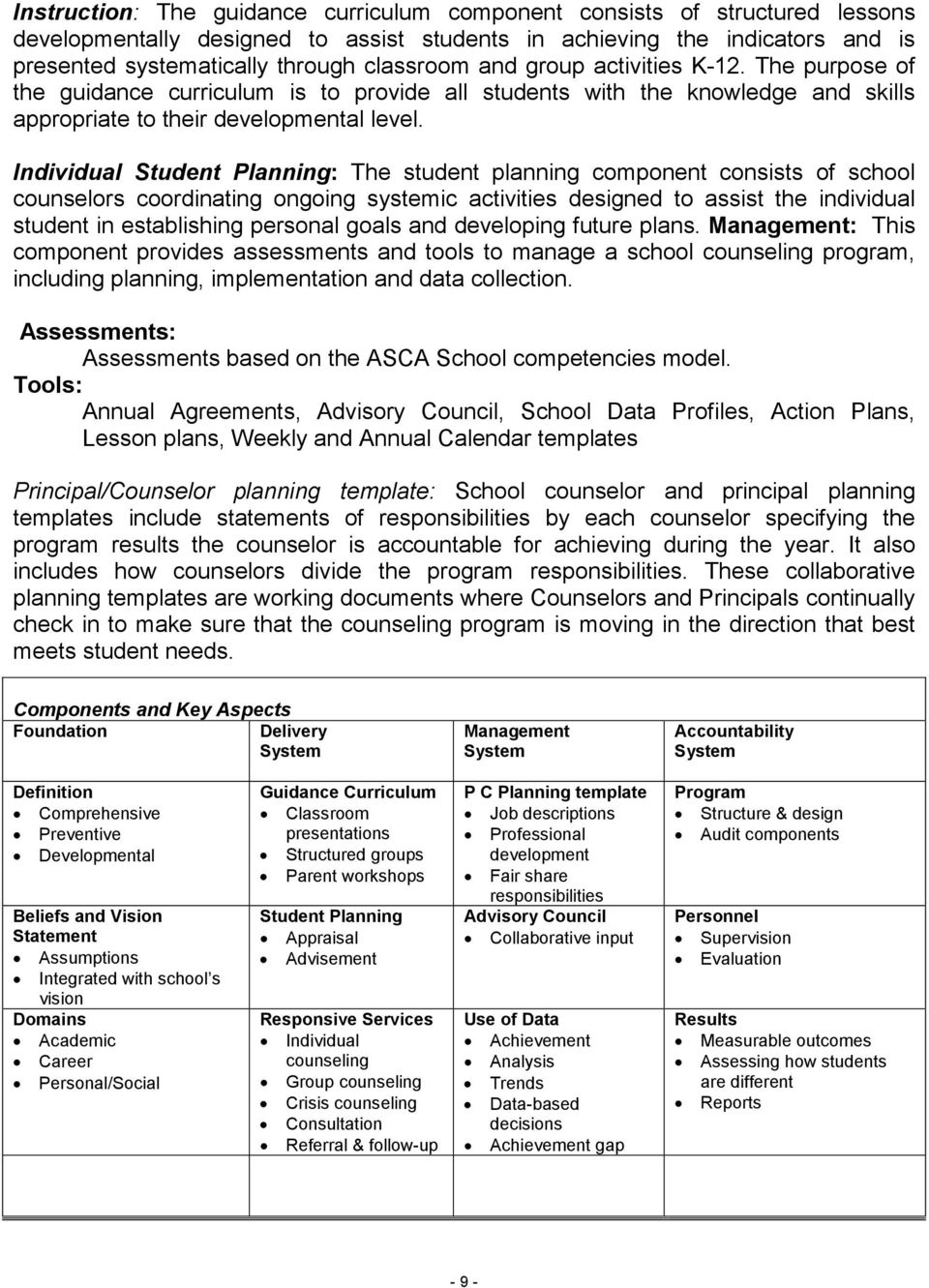
9 Instruction: The guidance curriculum component consists of structured lessons developmentally designed to assist students in achieving the indicators and is presented systematically through classroom and group activities K-12. The purpose of the guidance curriculum is to provide all students with the knowledge and skills appropriate to their developmental level. Individual Student Planning: The student planning component consists of school counselors coordinating ongoing systemic activities designed to assist the individual student in establishing personal goals and developing future plans. Management: This component provides assessments and tools to manage a school counseling program, including planning, implementation and data collection. Assessments: Assessments based on the ASCA School competencies model. Tools: Annual Agreements, Advisory Council, School Data Profiles, Action Plans, Lesson plans, Weekly and Annual Calendar templates Principal/Counselor planning template: School counselor and principal planning templates include statements of responsibilities by each counselor specifying the program results the counselor is accountable for achieving during the year. It also includes how counselors divide the program responsibilities. These collaborative planning templates are working documents where Counselors and Principals continually check in to make sure that the counseling program is moving in the direction that best meets student needs. Components and Key Aspects Foundation Delivery System Management System Accountability System Definition Comprehensive Preventive Developmental Beliefs and Vision Statement Assumptions Integrated with school s vision Domains Academic Career Personal/Social Guidance Curriculum Classroom presentations Structured groups Parent workshops Student Planning Appraisal Advisement Responsive Services Individual counseling Group counseling Crisis counseling Consultation Referral & follow-up P C Planning template Job descriptions Professional development Fair share responsibilities Advisory Council Collaborative input Use of Data Achievement Analysis Trends Data-based decisions Achievement gap Program Structure & design Audit components Personnel Supervision Evaluation Results Measurable outcomes Assessing how students are different Reports - 9 -
10 Standards/Indicators Student competencies Based on student standards Outcome oriented Themes: Collaboration + Leadership + Advocacy + = Systemic Change School Counseling Program Structure Advisory council: An advisory council is a group of people appointed to review counseling program results and to make recommendations. The group representatives may include students, parents or guardians, teachers, counselors, administrators, and community members. School Data Profile: The school data profile informs school counseling goals and may identify a need for systemic change. A school counseling program is data-driven and is focused upon closing the achievement gap between high and low performing students. The use of data to effect change within the school system promotes that all students receive the necessary skills to achieve success. School counselors analyze data regarding student needs, program standards and indicators, student achievement, and related areas to determine program effectiveness. Collection, analysis, and interpretation of student achievement data may be systemic by district or specific to school site, grade, class or individual. Student needs surface when data are disaggregated and analyzed. Data are used to determine where the school counseling program is focused now and where it should be focused in the future. The TLE rubric identifies specific ways in which Counselors can move beyond effective. These include: Action plans: Counselors identify Curriculum action plans, small group action plans, and closing the gap action plans. Lesson plans: Lesson plans that counselors use to implement and design guidance Calendars: Weekly and year-long calendars Accountability School counseling program accountability typically involves evaluation in three areas: Data Analysis Program results Evaluation and improvement Data analysis: Helps school counselors analyze data that inform decisions about the school counseling program. The data analyzed have been collected over time and inform school counselors about student needs and school and community needs

11 Program results: are outlined in reports, which include process, perception, and results data. School counseling programs produce measurable outcomes in student development, specifically academic, career, and personal/social development. Sharing these reports with educators, parents, and the community provides accountability and advocates for the students and the program. Evaluation and improvement- should include a clear counselor job description that outlines objectives and tasks necessary to implement the delivery system of the program. A school counselor evaluation should closely coincide with and be based upon the job description. School counselors should also be able to use self assessment tools. Themes Leadership: School counselors serve as leaders who are engaged in system wide change to ensure student success. They help every student gain access to rigorous academic preparation that will lead to greater opportunity and increased academic achievement. Working as leaders, advocates and collaborators, school counselors promote student success by closing the existing achievement gap whenever found among students of color, poor or underachieving students and their more advantaged peers. Advocacy: As advocates for students, school counselors advocate for students educational needs and work to ensure these needs are addressed at every level of the school experience. School counselors believe, support and promote every student s goal to achieve success in school. School counselors work proactively with students to remove barriers to learning. As educational leaders, school counselors are ideally situated to serve as advocates for every student in meeting high standards. Advocating for the academic success of every student is the key role of school counselors and places them as leaders in promoting school reform. Collaboration and teaming: School counselors create productive working relationships with all stakeholders, both inside and outside the school system, to develop and implement responsive educational programs that support the achievement of the identified goals for every student. School counselors build effective teams by encouraging genuine collaboration among all school staff to work toward the common goals of equity, access and academic success for every student. In addition, school counselors are a vital resource to parents or guardians, educators and the community agencies. Offering parent or guardian education, information and training in the community, school counselors are essential partners who enhance the educational opportunities of students and their families. Systemic change: Change throughout a system occurs when policies and procedures are examined and changed in light of new data. Such change happens with the sustained involvement of all critical players in the school setting, including and often led by school counselors. With a school wide expectation to serve the needs of every student, school counselors are uniquely positioned to assess the school for systemic

12 barriers to academic success. School counselors have access to critical data about student placement, students academic success or failure and student course-taking patterns. Collaborating as leaders within the school, counselors have access to quantitative and qualitative data from the school and relevant community sources. They use these data to advocate for every student, ensuring equity and access to a rigorous curriculum, which maximizes post-secondary options. Foundation Tulsa Public Schools supports Guidance and Counseling through District Policy 2502: Purpose: To provide leadership and advocacy for students in the areas of academics, personal/social skills, and career development. The guidance and counseling program will align with the District mission and the site improvement plan to support the programs, skills, and interventions that remove barriers and lead to academic and personal success. (Issued (as regulation): November 1982 Adopted (as policy): March 2005 The program s foundation provides the definition, assumptions, philosophy, mission, and standards for the design, implementation, and evaluation of the overall program. A well structured foundation is essential to ensuring the school counseling program is an integral part of the total educational program for student success. Definition A School Counseling Program is composed of a wide variety of educational personnel, activities, and services that are offered in kindergarten through senior high school settings in an effort to promote student success. Like other educational programs, school counseling programs contain characteristics such as Professionally trained and credentialed school counselors Student outcomes (based on national standards and indicators) Activities and processes that assist students in achieving these outcomes Materials and resources A team approach is essential to comprehensive school counseling programs. There is an underlying assumption that all school staff must be actively involved in promoting student achievement. Throughout this program description, team refers to teachers, counselors, parents, administrators, psychologists, and other staff. At the core of this team are qualified school counselors who counsel and consult with students and parents and who collaborate with all team members. Beliefs Tulsa Public Schools are guided by the following beliefs and goals: Effective leaders and classroom teachers have a profound impact on children s lives

13 All children can learn and Tulsa Public Schools can close the achievement gap. TPS can be an efficient, effective, performance-based organization. Community collaboration is fundamental to achieving and sustaining excellence. Tulsa Public Schools should provide a safe, healthy learning environment for students and staff. Goals Student Achievement Teacher and Leader Effectiveness Performance-Based Culture Financial Sustainability Safe and Secure Schools The school counseling program is centered on the belief that education provides a set of meaningful experiences that serve to prepare our children and adolescents to thrive and succeed in a changing world. Mission Statement The mission of the Tulsa Public Schools is to provide a quality learning experience for every student, every day, without exception. In order to promote student success, the mission of school counseling programs is to enhance student development in the areas of academic, career, and personal/social development in an effort to improve the educational experience of all students. Domains, Standards, and Indicators The Tulsa School Counseling Program facilitates student development in three domains to promote and enhance the learning process. Standards for each domain provide guidance and direction for developing an effective program. Student indicators describe the specific knowledge, attitudes, and skills students should obtain. Domains are broad developmental areas that include standards and indicators, which promote behaviors that enhance learning for all students. These three domains are interrelated and interact. The three domains of student development are: Academic development Career development Personal/social development Each of these areas of student development encompasses a variety of desired student learning standards, which in turn are composed of indicators of specific knowledge, attitudes, and skills (see appendix). The program reflects a progression of student development throughout the K-12 sequence. School counselors utilize a variety of strategies, activities, delivery methods, and resources to promote student development. Standards and goals are often used synonymously. Standards are those statements providing a description of what students should know and be able to do at the highest level of expectation. Standards specify the level or rate of performance the student will

14 achieve against a particular competency or set of indicators. Tulsa s program utilizes ASCA s Student Standards for School Counseling Programs. Indicators describe the specific knowledge, skills or abilities that individuals demonstrate to meet a specific competency. Delivery System Within the delivery system there are two sections with topics: Direct Student Services and Indirect Services. Direct Student Services include guidance curriculum, individual student planning and responsive services. The curriculum component delivers guidance content to every student in a systematic way. The student planning component provides all students an opportunity to work closely with parents or guardians to systematically plan, monitor, and understand their growth and development and take action on their next steps personally, educationally, and occupationally. The responsive services component responds to the direct, immediate concerns of students and includes, but is not limited to individual and group counseling, crisis counseling, referrals and consultation with parents or guardians, teachers or other professional specialists. The system support component enables the school counseling process to be effective through a variety of school counseling program support activities including staff development, testing, research, data analysis, curriculum development, and support to other programs in the school. Direct Student Services Guidance Curriculum The guidance curriculum component consists of a written instructional program that is comprehensive in scope, preventive and proactive, developmental in design, coordinated and delivered by school counselors and other educators. Guidance curriculum is designed to facilitate the systematic delivery of activities to every student consistent with the school counseling program s statements of philosophy, goals, and student indicators. The guidance curriculum promotes knowledge, attitudes and skills through instruction in three content areas: academic, career, and personal/social development. The counselor s responsibilities include planning, designing, implementing, and evaluating the guidance curriculum. The curriculum includes a clear explanation of the scope and sequence of its units of instruction. The curriculum includes standards for each grade level and the indicators that are identified and used in the assessment of student indicators. Guidance curriculum and the related indicators are documented in writing and are based on an assessment of the student population. The knowledge, skills and attitudes are taught using a variety of activities and materials. Student mastery of these indicators is assessed using pre-post tests. Curriculum planning and implementation include delivery methods and timelines. Delivery is typically provided through classroom instruction; small group discussions; presentations to parents or guardians; assemblies; and collaborative activities with teachers, support personnel, and other qualified educators

15 Classroom instruction: Counselors provide instruction, team teach or assist in teaching the guidance curriculum, learning activities or units in the classrooms, the career center, or other school facilities. Group activities: Counselors conduct planned small groups outside the classroom to respond to identified student needs or interests. Student Planning Student planning consists of school counselors coordinating activities designed to help individual students establish personal goals and develop future plans. School counselors coordinate activities that help all students plan, monitor, and manage their own learning as well as meet indicators in the areas of academic, career, and personal/social development. Within this component, students evaluate their educational, occupational, and personal goals. School counselors help students make the transition from school to school, school to work, and school to higher education or career and technical training. These activities are generally delivered by working with students individually, or in small counseling and advisement groups. Parents or guardians and other school personnel are often included in these activities. Systematic delivery of individual planning for every student includes a variety of strategies aimed to promote student success. Individual or small group appraisal: School counselors work with students analyzing and evaluating students abilities, interests, skills, and achievement. Test information and other data are often used as the basis for helping students develop immediate and long term goals and plans. Individual or small group advisement: School counselors advise students using personal/social, academic, career, and labor market information in planning personal, educational, and occupational goals. The involvement of students, parents or guardians and the school in planning students programs that meet their needs is critical. Examples of topics within include: Test score review, interpretation, and analysis Promotion and retention information Career awareness Exploration of aspirations, hopes, and dreams Financial aid Interest inventories Senior exit interviews and surveys Four-year or six-year plans and yearly course selection Test-taking strategies College selection Job shadowing Senior planning appointments Indirect Student Services Responsive services include activities that meet students immediate needs and concerns. These needs or concerns may require counseling, consultation, referral,

16 information, and specific programs such as peer mediation. Responsive services are available to all students and are often student initiated through self referral. However, teachers, parents or guardians or others may also refer students for assistance. Although school counselors have special training and effective skills to respond to these needs and concerns, the cooperation and support of the entire faculty and staff are necessary for successful implementation. School counselors offer a range of services along the continuum from early intervention to crisis response to meet students needs. School counselors consult with parents or guardians, school personnel and other identified parties when developing plans and strategies for facilitating student development. Specific ongoing responsive services provided by school counselors, such as individual and group counseling, crisis management and suicide prevention, are planned and goal-focused. There are written procedures to be used in crisis situations. Consultation: Counselors consult with parents or guardians, teachers, other educators and professionals from community agencies regarding strategies to help students and families. School counselors advocate for strategies and support mechanisms that are in the best interest of the students. Individual and small group counseling: Counseling is provided in a small group or on an individual basis for students expressing difficulties dealing with relationships, personal concerns, or normal developmental tasks. Individual and small group counseling helps students identify problems, causes, alternative, and possible consequences so they can take appropriate action. Such counseling is normally short term in nature. School counselors do not provide therapy. When necessary, referrals are made to appropriate community resources. Crisis counseling: Crisis counseling provides prevention, intervention, and follow-up. Counseling and support are provided to students and families facing emergency situations. Such counseling is normally short term and temporary in nature. When necessary, referrals are made to appropriate community resources. School counselors provide a leadership role in the district s crisis intervention team process. Referrals: Counselors use referral sources to deal with crises such as suicidal ideation, violence, abuse, depression, and family difficulties. These referral sources may include mental health agencies, employment and training programs, juvenile services, and other social and community services. Peer mediation: Many counselors train students as peer mediators, conflict managers, tutors, and mentors. The techniques of peer mediation and conflict resolution are used to help students learn how to make changes in the way they get along better with others

17 System support: Management activities that establish, maintain, and enhance the total school counseling program. School counselors use their leadership and advocacy skills to promote systemic change by contributing in a variety of areas. Professional development: School counselors regularly update and share their professional knowledge and skills through: In-service training: School counselors attend school in-service training to ensure their skills are updated in areas of counseling techniques, curriculum design, technology, and data analysis. Professional association membership: As the school counseling profession continues to change and evolve, school counselors can maintain and improve their level of competence by attending professional association conferences and meetings. Post-graduate education: As school counselors are completing post-graduate course work, they are encouraged to contribute to the professional literature. Consultation, collaboration and teaming: Through consultation, partnering, collaborating and teaming, school counselors provide important contributions to the school system. Consultation: Counselors must consult with teachers, staff members, and parents or guardians regularly in order to provide information, to support the school community and to receive feed-back on the emerging needs of students. Partnerships with staff, parents or guardians and community relations: This involves orienting staff, parents or guardians, business and industry, civic and social service organizations, and community members in the comprehensive school counseling programs through such means as partnerships, newsletters, local media, and presentations. Community outreach: Activities are designed to help counselors become knowledgeable about community resources, referral agencies, field trip sites, employment opportunities, and local labor market information. This may involve counselors visiting local businesses, industries, and agencies on a regular basis. Advisory councils: School counselors actively serve on school or community committees and advisory councils. By supporting other programs in the school and community, counselors gain support for the school counseling program. District committees: By serving on site and district department, curriculum committees, and advisory boards, school counselors assist in generating school and district support. Program operations: This includes the planning and management tasks needed to support activities conducted in the school counseling program. It also includes responsibilities that need to be fulfilled as a member of the school staff. Operations: These include budget, facilities, policies and procedures, research, and resource development

18 Data Analysis: Counselors analyze student achievement and counseling program related data to evaluate the program, conduct research on activity outcomes, and discover gaps that exist between different groups of students that need to be addressed. Data analysis also aids in the continued development and updating of the school counseling program and resources Goals, objectives, and interventions: Designed depending on the needs of the students, school, or community. Fair share responsibilities: As team members within the educational system, school counselors perform fair share responsibilities that align with and are equal in amount to the fair share responsibilities provided by other educators in the school. Parent workshops and Instruction: Counselors conduct workshops and informational sessions for parents or guardians to address the needs of the school community and to reflect the guidance curriculum. Management System The management system describes the various organizational processes and tools needed to manage a school counseling program. The management system is organized, concrete, clearly delineated, and reflective of the school s needs. In order to systematically deliver the guidance curriculum and address every student s developmental needs, the school counseling program must be effectively and efficiently managed. Clear expectations and purposeful interaction with administrators, teachers, staff, parents, and students promote student growth, systemic change, and a school counseling program that is integrated into the total educational program. The organizational foundation of a school counseling program is built on systems of management agreements, active input of an advisory council, student monitoring, use of time, calendars, and a precise understanding of school counseling program and non school counseling program responsibilities. Management systems include efforts by Principals to support school counselors in delivering the program. Principals work collaboratively with counselors to analyze student data and develop timelines for implementation. Counselors set up calendars to ensure program implementation; careful monitoring of student progress and maximizing time spent executing the school counseling program. Assessments Principal/Counselor planning template: Principal/counselor planning templates within the school counseling program ensure effective implementation of the delivery systems to meet students needs. The entire school counseling staff, including the administrator in charge of school counseling, must make management decisions based on site needs and data analysis. Site principals and administrators must be involved in this important process. When implementing a comprehensive school counseling program, management system decisions and agreements must be made regarding the organization and assignment of counselors. This should be accomplished in

19 consultation with the principal or school counseling administrator prior to the next step in program implementation. Advisory Council: An advisory council is a representative group of persons appointed to both advise and assist the school counseling program within a school district. The advisory council reviews the program goals, indicators and results, and participates in making recommendations to the school counseling department, principal, and superintendent. Ideally, advisory council membership reflects the community s diversity. It includes representative stakeholders of the school counseling program: students, parents or guardians, teachers, counselors, administrators, school board members, business, and community members. The council should meet twice a year at a minimum. Advisory council functions can vary. The area of specialization, number of years an educational program has been in existence, program size, community needs, and other important items all affect the advisory council s functions. School counselors use data to analyze overall program effectiveness and to make decisions regarding changes in program content and delivery. The advisory council members, using their background and expertise, provide support, input, and recommendations for program development and improvement throughout the process. The advisory council, therefore, can be an effective tool to help build an excellent school counseling program. Like any tool, it must be adequately maintained and used properly. Monitoring Student Progress (School Data Profile): By using student and school site data to monitor student progress ensures all students receive what they need to achieve school success. School counselors are proficient in the collection, analysis, and interpretation of student achievement and related data. School counselors monitor student progress through three types of data: student-achievement data, achievementrelated data, and standards-related data. Student achievement data: Student-achievement data measure students academic progress. Student achievement data might include: Standardized test data Grade point averages SAT and ACT scores Graduation rate Passing all classes Promotion and retention rates Completion of specific academic programs (i.e. honors, college prep, etc.) Lexile data Achievement related data: Achievement-related data measure those fields the literature has shown to be correlated to academic achievement. These data fields might include: Course enrollment patterns Discipline referrals

20 Suspension and expulsion rates Alcohol, tobacco and other drug violations Attendance rates Parent or guardian involvement Standards-related data: These data measure student mastery of the competencies delineated in ASCA s National Standards- now called ASCA Student Standards. These data may include: Results from assessments measuring indicators in the academic, career, and personal/social developmental domains Portfolios that chronicle planning for future outcomes in student development: learning, working, and living. Disaggregate data: To ensure every student achieves high academic standards and masters the National Standards CCSS, it is important to not just look at aggregate or global data from the entire student body but to also disaggregate the data. To disaggregate data, school counselors separate data by variables to see if there are any groups of students who may not be doing as well as others. Goals, objectives, and interventions can be designed depending on the needs of the students, school, or community. Although there are many variables by which data may be disaggregated, the common fields include: Gender Ethnicity Socio-economic status (free and reduced lunch) Vocational (vocational program track) Language spoken at home Special education Grade level Teacher(s) Sample School Counseling Program Activities: Individual student academic program planning Interpreting cognitive, aptitude, and achievement tests Counseling students who are tardy, absent, or have disciplinary problems Collaborating with teachers to present guidance curriculum lessons Interpreting student records Collaborating with teachers regarding management of study skills Ensuring that student records are maintained as per state and federal regulations Working with students to provide small- and large-group counseling services Advocating for students at individual education plan meetings, child study teams, and school attendance review boards Disaggregated data analysis Promoting college/career readiness and equitable access initiatives and programs

21 Action plans: Counselor writes action plans that align with the individual school needs. These plans should align with the district and state mission. These plans should be data driven to support student achievement. Lesson plans: Counselors write lesson plans to help in delivering group guidance sessions. These plans should align with district guidelines. Calendars: Calendars may assist with planning and ensuring program participation. The calendar will be aligned with school district calendar. The calendar establishes a site schedule for the school and counseling program activities. As the program grows and multiple activities are developed, a calendar validates the important support the school counselor program provides. Calendars can: Identify grade levels, dates, and activities Be published and distributed to appropriate persons: students, staff, parents or guardians and community Be compared to locally established goals for time spent in the delivery of system components time in direct service to and contact with students. Be utilized to allocate time for data analysis and program evaluation Be used when designing and determining system priorities Be shared with the principal as an indicator of leadership, advocacy and foresight in the school counselor s professional approach Accountability System Accountability and evaluation of the school counseling program are essential. School counselors choose to answer the question, How are students different as a result of the school counseling program? School counselors collect data that demonstrate the link between the school counseling program and student academic success. School counseling program evaluation typically involves three areas of assessment: Data Analysis Program results Evaluation Data Analysis: School counseling programs produce measurable outcomes in student development, specifically academic, career, and personal/social development. While counseling programs collaborate with other school staff to affect school-wide outcomes (i.e., school climate, grades, attendance, tardiness, school violence, graduation rates, college going rates ), programs should be held accountable to the areas for which they are directly involved. ASCA s role statement recommends that school counselors spend 80% of their time providing direct services to students, promoting and enhancing student development. Consequently, accountability must be conducted efficiently and effectively
22 Outcome results should be focused on standards and indicators. The School Counseling Program presents three standards for each developmental domain: academic, career, and personal/social. In addition, it includes indicators to be used as a template. Counselors must assess the indicators for grade appropriateness and edit them by adding or deleting indicators based upon local needs. These indicators should not be seen as one size fits all. Once standards and indicators have been edited and finalized, assessment instruments can be created that provide feedback regarding program effectiveness. Assessments can be administered in a typical pre and post style. Evaluation may compare pre to post, participating to non-participating, and may include responsive observations of staff or students that indicate intended or unintended outcomes related to the program. Creating a results report compiles the data and recommendations for program improvement strategies. Standards and competency related data: These data measure student mastery of the indicators outlined in the School Counseling Program s Standards and Indicators. These data might include: Pre/Post scores on Academic, Career, and Personal/Social assessment instruments Percentage of students who have set and attained academic goals Percentage of students with educational plans on file Writing of Technical reports is another way to move beyond effective: Describe the program, its philosophy, and objectives. Describe the evaluation design and summarize results Conclusions/discussion and recommendations Include any appropriate appendices Reports can be used to conduct staff development, make program decisions, and make administrative decisions. Program results: Program evaluation demonstrates follow-through and professionalism. Program evaluation audits the program s structure and components: Is there a program foundation: definition, philosophy, and standards? Is there a management system: job descriptions, data management? Is there a delivery system with appropriate time distributions (80% direct/indirect/20% administrative/fair share) Guidance Curriculum - a list of standards & indicators with activities? Student Planning - what focus and how is it done? Responsive Services - what are services? Is there an accountability plan: how are students different? An example of an accountability plan is the OSCAR Evaluation: The supervision and evaluation of personnel is an important aspect of accountability. A job description provides means to evaluate school counselors
23 Counselors should be evaluated based upon the details of the TLE Observation and Evaluation Rubric. Are they doing what the program says they should be doing? Performance-based evaluation Formative evaluation: following observations of rating scale how well are they doing JOB DESCRIPTION MIDDLE SCHOOL COUNSELORS 1. Development and management of a comprehensive school counseling program for 6th - 8th grade school age students. 2. Plans and maintains an effective comprehensive school counseling program. A. Delivers the middle school counseling curriculum to all students focusing on Academic, Career, and Personal/Social Domains. 3. Designs, delivers, evaluates and revises a planned sequential developmentally appropriate program in accordance to district counseling standards and indicators. 4. Facilitates the infusion of counseling curriculum activities into classroom curricula to support the developmental needs of middle students. 5. Facilitates instructional process in collaboration with school staff and community resources. A. Coordinates ongoing systematic activities and help individual students. 6. Counsels with middle school students to promote self-awareness, self identify, and positive social and academic skills 7. Systematically develop/deliver/ and evaluate student planning 6 th 8 th grade addressing academic goal setting and transition plans to middle school. 8. Inform students and parents about pertinent test results, academic programming, behavior intervention strategies, and their implications to the overall academic success. A. Respond effectively to immediate students needs and concerns. 9. Provide individual and group counseling to students with identified concerns and needs. 10. Implement a referral process and follow up process to outside counseling agencies and support agencies. 11. Provide information to staff and parents to assist them in crises related issues that may affect the school climate. 12. Consult and coordinate with in district professional and community agencies, such as school psychologist, nurses, administrators, community based counselors, service agencies, and physicians. A. Manage activities that establish, maintain, support, and enhance the total school counseling system. 13. Articulates the role of school counselor to school and community. 14. Advocates for equal access to programs and services for all students. 15. Plans and coordinates programs that are an extension of the counseling program, i.e., Individual Education Plans, Child Study Team, red ribbon week, student of week etc. 16. Engages in professional development
24 17. Coordinates parent programs. 18. Establishes and maintains a monthly/yearly planning calendar. 19. Participates in school decision making. 20. Adheres to laws, policies, procedures, and ethical standards of the school counseling profession. 21. Participate with the administration and faculty as a team member in the implementation of the district testing program. A. Collect and review evaluative data to ensure a successful counseling program which links the school counseling program to student academic progress. 22. Conducts a yearly program audit to review extent of program implementation. 23. Collects and analyzes data to guide program direction and emphasis. 24. Measures results of the school counseling program activities and shares results as appropriate. A. Participate in activities that contribute to the effective operation of the school. 25. Assist to maintain a safe and organized school climate as directed by administration. JOB DESCRIPTION HIGH SCHOOL COUNSELORS: 1. Development and management of a comprehensive school counseling program for high school age students. 2. Plans and maintains an effective comprehensive school counseling program. A. Delivers the high school counseling curriculum to all students focusing on Academic, Career, and Personal/Social Domains. B. Designs, delivers, evaluates and revises a planned sequential developmentally appropriate program in accordance to district counseling standards and indicators. 3. Facilitates the infusion of counseling curriculum activities into classroom curricula to support the developmental needs of high students. 4. Facilitates instructional process in collaboration with school staff and community resources. A. Coordinates ongoing systematic activities and help individual students. 5. Counsels with high school students to promote self-awareness, self identify, and positive social and academic skills 6. Systematically develop/deliver/ and evaluate student planning addressing academic goal setting and transition plans to high school. 7. Inform students and parents about pertinent test results, academic programming, behavior intervention strategies, and their implications to the overall academic success. 8. Respond effectively to immediate students needs and concerns. 9. Provide individual and group counseling to students with identified concerns and needs. 10. Implement a referral process and follow up process to outside counseling agencies and support agencies. 11. Provide information to staff and parents to assist them in crises related issues that may affect the school climate
25 12. Consult and coordinate with in district professional and community agencies, such as school psychologist, nurses, administrators, community based counselors, service agencies, and physicians. A. Manage activities that establish, maintain, support, and enhance the total school counseling system. 13. Articulates the role of school counselor to school and community. 14. Advocates for equal access to programs and services for all students. 15. Plans and coordinates programs that are an extension of the counseling program, i.e., Individual Education Plans, Child Study Team, red ribbon week, student of week etc. 16. Engages in professional development. 17. Coordinates parent programs. 18. Establishes and maintains a monthly/yearly planning calendar. 19. Participates in school decision making. 20. Adheres to laws, policies, procedures, and ethical standards of the school counseling profession. 21. Participate with the administration and faculty as a team member in the implementation of the district testing program. A. Collect and review evaluative data to ensure a successful counseling program which links the school counseling program to student academic progress. 22. Conducts a yearly program audit to review extent of program implementation. 23. Collects and analyzes data to guide program direction and emphasis. 24. Measures results of the school counseling program activities and shares results as appropriate. A. Participate in activities that contribute to the effective operation of the school. 25. Assist to maintain a safe and organized school climate as directed by administration. Counselor s Duties and Functions 1. Counselor Center Management 1.1. The Counselor will optimize the physical learning environment to assure efficacy student learning advantage in alignment with counseling management best practices 1.2. The Counselor plans for delivery of the school s counseling plan relative to short term and long term objectives The school counselor contributes to a positive school climate by taking a proactive role in creating a safe, orderly and positive school environment. 2. School Counselor Effectiveness 2.1. School Counselor monitors student progress to maximize student achievement School Counselor demonstrates accountability The School Counselor creates a professional receiving / open climate so as to insure that Faculty and Staff actively solicit the counselor s special expertise in students emotional, career and academic progress
26 2.4. School Counselor participates in the school-wide assessment program School Counselor exhibits the skills and temperament to manage students crises Exhibits behaviors and efficiencies associated with professionalism. 3. Professional Growth and Continuous Improvement 3.1. Uses professional growth as a continuous improvement strategy Applies newly acquired professional knowledge. 4. Interpersonal Skills 4.1. Effective interactions and communications with stakeholders Counselor participates in Fair Share Duties and Responsibilities as required by Principal. 5. Leadership 5.1. School Counselor leads and participates in school-wide efforts to involve parents School Counselor advocates effectively for equity issues affecting the educational progress of students. SECONDARY SCHOOL GUIDANCE ACTIVITIES Secondary School Counselors Implement the Counseling Program by Providing: Classroom Guidance Academic skills support Organizational, study and test-taking skills Post-secondary planning and application process Career planning Education in understanding self and others Coping strategies Peer relationships and effective social skills Communication, problem-solving, decision-making, conflict resolution and study skills Career awareness and the world of work Substance abuse education Multicultural/diversity awareness Individual Student Planning Goal setting Academic plans Career plans Problem solving Education in understanding of self, including strengths and weaknesses Transition plans Responsive Services Individual and small-group counseling Individual/family/school crisis intervention Peer facilitation
27 Consultation/collaboration Referrals System Support Professional development Consultation, collaboration and teaming Program management and operation These examples are not intended to be all-inclusive Secondary School Counselors Collaborate with: Parents Academic planning/support Post-secondary planning Scholarship/financial search process School-to-parent communications School-to-work transition programs One-on-one parent conferencing Referral process Students Academic support services Program planning Peer education program Peer mediation program Crisis management Transition programs Teachers Portfolio development, providing recommendations and assisting students with the postsecondary application process Classroom guidance lessons on post-secondary planning, study skills, career development, etc. School-to-work transition programs Academic support, learning style assessment and education to help students succeed academically Classroom speakers At-risk student identification and implementation of interventions to enhance success Administrators School climate Academic support interventions Behavioral management plans School-wide needs assessments Data sharing Student assistance team development
28 Community Job shadowing, worked-based learning, part-time jobs, etc. Crisis interventions Referrals Career education Academic Development: Standards and Indicators STANDARDS Students will acquire the attitudes, knowledge, and skills that contribute to effective learning in school and across the lifespan. INDICATORS K-6 A. Take pride in work and in achievement B. Use communication skills to know when and how to ask for help when needed C. Articulate feelings of competence and confidence as a learner D. Accept mistakes as essential to the learning process E. Demonstrate how effort and persistence positively affect learning F. Take responsibility for their actions G. Demonstrate the ability to work independently, as well as the ability to work cooperatively with other students 7-8 A. Display a positive interest in learning B. Apply time management and task management skills C. Develop a broad range of interests and abilities 9-12 A. Identify attitudes and behaviors which lead to successful learning B. Apply knowledge of learning styles to positively influence school performance C. Demonstrate dependability, productivity, and initiative D. Share knowledge Students will complete school with the academic preparation essential to choose from a wide range of substantial postsecondary options, including college. K-6 A. Establish challenging academic goals at each grade level B. Demonstrate the motivation to achieve individual potential C. Become self-directed and independent learners D. Understand the relationship between classroom performance and success in school E. Seek information and support from faculty, staff, family, and peers 7-8 A. Apply the study skills necessary for academic success B. Use assessment results in educational planning C. Apply knowledge of aptitudes and interests to goal setting D. Use knowledge of learning styles to positively influence school performance 9-12 A. Learn and apply critical thinking skills B. Organize and apply academic information from a variety of sources C. Develop and implement an annual plan of study to maximize academic ability and achievement D. Use problem-solving and decision-making skills to assess progress toward educational Students will understand the relationship of academics to the world of work, and to life at home and in the community. K-6 A. Seek co-curricular and community experiences to enhance the school experience B. Understand the relationship between learning and work 7-8 A. Understand how school success and academic achievement enhance future career and avocation opportunities B. Demonstrate the ability to balance school, studies, extracurricular activities, leisure time, and family life 9-12 A. Understand that school success is the preparation to make the transition from student to community member B. Demonstrate an understanding of the value of lifelong learning as essential to seeking, obtaining, and maintaining life goals
29 STANDARDS Students will acquire the attitudes, knowledge, and skills that contribute to effective learning in school and across the lifespan. Students will complete school with the academic preparation essential to choose from a wide range of substantial postsecondary options, including college. goals E. Identify postsecondary options consistent with interests, aptitude, achievement, and abilities Students will understand the relationship of academics to the world of work, and to life at home and in the community. Career Development: Standards and Indicators STANDARDS Students will acquire the skills to investigate the world of work in relation to knowledge of self and to make informed career decisions. INDICATORS K-6 A. Learn how to interact and work cooperative in teams B. Learn about the variety of traditional and nontraditional occupations C. Learn to make decisions D. Learn how to set goals E. Acquire employability skills such as working on a team, problemsolving, and organizational skills 7-8 A. Develop a positive attitude toward work and learning B. Develop skills to locate, evaluate, and interpret career information C. Develop an awareness of personal abilities, skills, interests, and motivations D. Understand the importance of planning E. Develop hobbies and avocational interests F. Utilize time- and taskmanagement skills 9-12 A. Pursue and develop competency in areas of interest B. Balance between work and leisure time C. Apply job readiness skills to seek employment opportunities D. Demonstrate knowledge about the changing workplace E. Learn about the rights and responsibilities of employers and employees F. Learn how to write a resume Students will employ strategies to achieve future career goals with success and satisfaction. K-6 A. Demonstrate knowledge of the career planning process B. Identify personal skills, interests, and abilities and relate them to current career choices 7-8 A. Apply decision-making skills to career planning, course selection, and career transitions B. Describe traditional and nontraditional occupations and how these relate to career choice C. Demonstrate awareness of the education and training needed to achieve career goals D. Learn how to use the Internet to access career planning information 9-12 A. Use employability and job readiness skills in internship, mentoring, shadowing, and/or other world of work experiences B. Select course work that is related to career interests C. Assess and modify their educational plan to support career goals D. Know the various ways which occupations can be classified E. Use research and information Students will understand the relationship between personal qualities, education, training and the world of work. K-6 A. Learn to work cooperatively with others as a team member B. Identify personal preferences and interests which influence career choices and success C. Learn how to use conflict management skills with peers 7-8 A. Demonstrate how interests, abilities, and achievement relate to achieving personal, social, educational, and career goals B. Understand the relationship between educational achievement and career success C. Explain how work can help to achieve personal success and satisfaction D. Understand that work is an important and satisfying means of personal expression 9-12 A. Understand that the changing workplace requires lifelong learning and acquiring new skills B. Describe the effect of work on lifestyle C. Understand the importance of equity and access in career choice D. Apply academic and employment readiness skills in work-based learning situations such as internships, shadowing,
30 STANDARDS Students will acquire the skills to investigate the world of work in relation to knowledge of self and to make informed career decisions. G. Understand the importance of responsibility, dependability, punctuality, integrity, and effort in the workplace H. Learn to respect individual uniqueness in the workplace Students will employ strategies to achieve future career goals with success and satisfaction. resources to obtain career information F. Understand how changing economic and societal needs influence employment trends and future training G. Maintain a career planning portfolio Personal/Social Development: Standards and Indicators STANDARDS Students will acquire the knowledge, attitudes, and interpersonal skills to help them understand and respect self and others. INDICATORS K-6 A. Develop a positive attitude toward self as a unique and worthy person B. Identify and express feelings C. Distinguish between appropriate and inappropriate behaviors D. Learn how to make and keep friends E. Understand the need for selfcontrol and how to practice it F. Learn the goal-setting process G. Recognize personal boundaries, rights, and privacy needs H. Demonstrate cooperative behavior in groups I. Identify personal strengths and assets J. Recognize that everyone has rights and responsibilities K. Recognize, accept, respect, and appreciate individual differences Recognize, accept, and appreciate ethnic and cultural diversity 7-8 A. Identify values, attitudes, and beliefs B. Understand change as a part of growth C. Respect alternative points of view D. Use effective communication skills E. Know that communication involves speaking, listening, and nonverbal behavior Students will make decisions, set goals, and take necessary action to achieve goals. K-6 A. Demonstrate a respect and appreciation for individual and cultural differences B. Understand consequences of decisions and choices C. Demonstrate when, where, and how to seek help for solving problems and making decisions D. Know how to apply conflict resolution skills 7-8 A. Use a decision-making and problem-solving model B. Identify alternative solutions to a problem C. Develop effective coping skills for dealing with problems D. Know when peer pressure is influencing a decision E. Use persistence and perseverance in acquiring knowledge and skills Students will understand the relationship between personal qualities, education, training and the world of work. and/or mentoring experiences Students will understand safety and survival skills. K-6 A. Demonstrate knowledge of personal information (i.e., telephone number, home address, emergency contact) B. Learn the difference between appropriate and inappropriate physical contact C. Demonstrate the ability to assert boundaries, rights, and personal privacy D. Learn techniques for managing stress and conflict E. Learn coping skills for managing life events 7-8 A. Differentiate between situations requiring peer support and situations requiring adult professional help B. Apply effective problem-solving and decision-making skills to make safe and healthy choices C. Learn about the emotional and physical dangers of substance use and abuse D. Learn how to cope with peer pressure
31 STANDARDS 9-12 A. Recognize and respect differences in various family configurations B. Identify and discuss changing personal and social roles C. Identify and recognize changing family roles 9-12 A. Develop an action plan to set and achieve realistic goals B. Identify long-term and short-term goals C. Identify alternative ways of achieving goals 9-12 A. Learn about the relationship between rules, laws, safety, and the protection of an individual s rights B. Identify resource people in the school and community, and know how to seek their help ASCA NATIONAL STANDARDS: DEVELOPMENTAL CROSSWALKING TOOL This form is a tool that can be used to assist you in planning your overall guidance curriculum ACADEMIC DEVELOPMENT DOMAIN K Standard A: Students will acquire the attitudes, knowledge, and skills that contribute to effective learning in school and across the life span. Competency A1 Improve Academic Self-concept A:A1.1 articulate feelings of competence and confidence as learners A:A1.2 display a positive interest in learning A:A1.3 take pride in work and achievement A:A1.4 accept mistakes as essential to the learning process A:A1.5 identify attitudes and behaviors which lead to successful learning Competency A2 Acquire Skills for Improving Learning A:A2.1 apply time management and task management skills A:A2.2 demonstrate how effort and persistence positively affect learning A:A2.3 use communications skills to know when and how to ask for help when needed A:A2.4 apply knowledge and learning styles to positively influence school performance A:A3.1 take responsibility for their actions A:A3.2 demonstrate the ability to work independently, as well as the ability to work cooperatively with other students A:A3.3 develop a broad range of interest and abilities A:A3.4 demonstrate dependability, productivity, and initiative A:A3.5 share knowledge Standard B: Students will complete school with the academic preparation essential to choose from a wide range of substantial postsecondary options, including college. Competency B1 Improve Learning A:B1.1 demonstrate the motivation to achieve individual potential A:B1.2 learn and apply critical thinking skills
32 A:B1.3 apply the study skills necessary for academic success K at each level A:B1.4 seek information and support from faculty, staff, family and peers A:B1.5 organize and apply academic information from a variety of sources A:B1.6 use knowledge of learning styles to positively influence school performance A:B1.7 become a self-directed and independent learner Competency B2 Plan to Achieve Goals A:B2.1 establish challenging academic goals in elementary, middle/junior high, and high school A:B2.2 use assessment results in educational planning A:B2.3 develop and implement an annual plan of study to maximize academic ability and achievement A:B2.4 apply knowledge of aptitudes and interests to goal setting A:B2.5 use problem-solving and decision-making skills to assess progress toward educational goals A:B2.6 understand the relationship between classroom performance and success in school A:B2.7 identify post-secondary options consistent with interests, achievement, aptitude, and abilities STANDARD C: Students will understand the relationship of academics to the world of work, and to life at home and in the community. Competency C1 Relate School to Life Experience A:C1.1 demonstrate the ability to balance school, studies, extracurricular activities, leisure time, and family life A:C1.2 seek co-curricular and community experiences to enhance the school experience A:C1.3 understand the relationship between learning and work A:C1.4 demonstrate an understanding of the value of lifelong learning as essential to seeking, obtaining, and maintaining life goals A:C1.5 understand that school success is the preparation to make the transition from student to community member A:C1.6 understand how school success and academic achievement enhance future career and vocational opportunities CAREER DEVELOPMENT DOMAIN K STANDARD A: Students will acquire the skills to investigate the world of work in relation to knowledge of self and to make informed career decisions. Competency A:1 Develop Career Awareness
33 C:A1.1 develop skills to locate, evaluate, and interpret career K information C:A1.2 learn about the variety of traditional and nontraditional occupations C:A1.3 develop an awareness of personal abilities, skills, interests, and motivations C:A1.4 learn how to interact and work cooperatively in teams C:A1.5 learn to make decisions C:A1.6 learn how to set goals C:A1.7 understand the importance of planning C:A1.8 pursue and develop competency in areas of interest C:A1.9 develop hobbies and vocational interests C:A1.10 balance between work and leisure time CAREER DEVELOPMENT DOMAIN K Competency A:2 Develop Employment Readiness C:A2.1 acquire employability skills such as working on a team, problem-solving and organizational skills C:A2.2 apply job readiness skills to seek employment opportunities C:A2.3 demonstrate knowledge about the changing workplace C:A2.4 learn about the rights and responsibilities of employers and employees C:A2.6 learn how to write a resume C:A2.7 develop a positive attitude toward work and learning C:A2.8 understand the importance of responsibility, dependability, punctuality, integrity, and effort in the workplace C:A2.9 utilize time and task-management skills STANDARD B: Students will employ strategies to achieve future career goals with success and satisfaction. Competency B:1 Acquire Career Information C:B1.1 apply decision making skills to career planning, course selection, and career transition C:B1.2 identify personal skills, interests, and abilities and relate them to current career choice C:B1.3 demonstrate knowledge of the career planning process C:B1.4 know the various ways in which occupations can be classified C:B1.5 use research and information resources to obtain career information C:B1.6 learn to use the internet to access career planning information C:B1.7 describe traditional and non-traditional occupations and how these relate to career choice
34 C:B1.8 understand how changing economic and societal needs influence employment trends and future training. Competency B:2 Identify Career Goals C:B2.1 demonstrate awareness of the education and training needed to achieve career goals C:B2.2 assess and modify their educational plan to support career C:B2.3 use employability and job readiness skills in internship, mentoring, shadowing, and/or other work experience. C:B2.4 select course work that is related to career interests C:B2.5 maintain a career planning portfolio K PERSONAL/SOCIAL DOMAIN K STANDARD A: Students will acquire the knowledge, attitudes, and interpersonal skills to help them understand and respect self and others. Competency A1 Acquire Self-Knowledge PS:A1.1 develop positive attitudes toward self as a unique and worthy person PS:A1.2 identify values, attitudes and beliefs PS:A1.3 learn the goal-setting process PS:A1.4 understand change is a part of growth PS:A1.5 identify and express feelings PS:A1.6 distinguish between appropriate and inappropriate behavior PS:A1.7 recognize personal boundaries, rights, and privacy needs PS:A1.8 understand the need for self-control and how to practice it PS:A1.9 demonstrate cooperative behavior in groups PS:A1.10 identify personal strengths and assets PS:A1.11 identify and discuss changing personal and social roles PS:A1.12 identify and recognize changing family roles STANDARD B: Students will make decisions set goals, and take necessary action to achieve goals. Competency B1 Self-Knowledge Application PS:B1.1 use a decision-making and problem-solving model PS:B1.2 understand consequences of decisions and choices PS:B1.3 identify alternative solutions to a problem PS:B1.4 develop effective coping skills for dealing with problems PS:B1.6 know how to apply conflict resolution skills
35 PS:B1.7 demonstrate a respect and appreciation for individual and cultural differences PS:B1.8 know when peer pressure is influencing a decision PS:B1.9 identify long- and short-term goals PS:B1.10 identify alternative ways of achieving goals PS:B1.11 use persistence and perseverance in acquiring knowledge and skills PS:B1.12 develop an action plan to set and achieve realistic goals STANDARD C: Students will understand safety and survival skills. Competency C1 Acquire Personal Safety Skills PS:C1.1 demonstrate knowledge of personal information (i.e. telephone number, home address, emergency contact) PS:C1.2 learn about the relationship between rules, laws, safety, and the protection of rights of the individual PS:C1.3 learn about the differences between appropriate and inappropriate physical contact PS:C1.4 demonstrate the ability to set boundaries, rights and personal privacy PS:C1.5 differentiate between situations requiring peer support and situations requiring adult professional help PS:C1.6 identify resource people in the school and community, and know how to seek their help PS:C1.7 apply effective problem-solving and decision-making skills to make safe and healthy choices PS:C1.8 learn about the emotional and physical dangers of substance use and abuse PS:C1.9 learn how to cope with peer pressure PS:C1.10 learn techniques for managing stress and conflict PS:C1.11 learn coping skills for managing life events K
36 TLE Observation and Evaluation Rubric Counselors Domain/Relative Weight Dimension Page Counselor Center Management 20% 1. Work Area Environment 2. Management of the Counseling Program 3. Building Climate School Counseling Effectiveness 30% 4. Monitors Student Progress 5. Demonstrates Accountability 6. Consultation and Collaboration 7. Assists with Building-Wide Assessment 8. Demonstrates Skills and Temperament to Handle Crisis Interventions with Students and Families 9. Exhibits Professional Behaviors and Efficiencies Professional Growth & Continuous Improvement 10% 10. Uses Professional Growth as an Improvement Strategy 9 Interpersonal Skills 20% 11. Effective Interactions/ Communications with Stakeholders 12. Participates in Fair Share Duties Leadership 20% 13. Leadership Involvements 14. Advocates for Educational Equity
37 Domain: Counselor Center Management Dimension: Work Area Environment 1 The Counselor will optimize the physical learning environment to assure efficacy / student learning advantage in alignment with counseling management best practices. 1 Ineffective Indicator No. 2 Needs Improvement 3 Effective 4 Highly Effective 5 Superior The counseling center (as set up by the counselor) prohibits learning opportunities, order, cleanliness, safety and ease of traffic flow. Physical resources are not utilized as designed and instructionally intended. The counseling center lacks organization for learning opportunities, order, cleanliness, safety and ease of traffic flow. Physical resources are not optimized for effective utilization. The counseling center is organized for providing learning / counseling opportunities, order, cleanliness, safety and ease of traffic flow. Physical resources are well placed in locations that enhance their functions and do not interfere with other functions. The counseling center is organized for efficacy in learning / counseling opportunities, order, cleanliness, safety and ease of traffic flow. Physical resources that enhance their functions and do not interfere with other functions. Includes the narrative descriptions in performance category 4, plus the counseling center could serve as an exemplary model for replication at district level. Domain: Counselor Center Management Dimension: Comprehensive Counseling Plan 2 The Counselor plans for delivery of the school s counseling plan relative to short term and long term objectives. 1 Ineffective 2 Needs Improvement 3 Effective 4 Highly Effective 5 Superior Has no guidance program to support students academic, career and personal / social development. Has a guidance program that has not been fully developed or implemented. Program resembles random acts of guidance. Delivers districtprovided curriculum (e.g., 2nd step, bully proofing) to all students. Coordinates ongoing systemic activities to help Provides all students with a guidance curriculum that is comprehensive, proactive and developmental. Coordinates ongoing systemic Includes the narrative descriptions in performance category 4, plus uses student data from discipline reports, teacher feedback surveys, administrative
38 students on an individual and small group basis. activities to help students on an individual and small group basis Creates and distributes an event calendar to meet short and long term programmatic school counseling goals. Has developed curriculum to meet students academic, career and personal / social development. feedback data and parent surveys to drive the counseling program. Counselor assesses current comprehensive counseling plan through a formal needs analysis on a yearly basis and constructs a new comprehensive plan for each school year based on the needs analysis. Domain: Counselor Center Management Dimension: 3 Building Climate The school counselor contributes to a positive school climate by taking a proactive role in creating a safe, orderly and positive school environment. 1 Ineffective 2 Needs Improvement 3 Effective 4 Highly Effective 5 Superior The school counselor makes no contribution to the building s climate. The school counselor s contributions to the building climate are haphazard and random. School counselor assesses school s strengths and deficiencies regarding students suspensions, discipline referrals, etc. and designs interventions to address these. School counselor communicates strengths and deficiencies of school climate issues to stakeholders (e.g. faculty/staff, parents, and Includes the narrative descriptions in performance category 3. In addition, collaborates with parents, teachers and staff regarding school s needs. Includes the narrative descriptions in performance category 4. Additionally, as an integral part of a site data team, analyzes building climate data (discipline referrals, attendance of students and staff, suspension data, parent surveys, teacher surveys) and plans interventions to address area of
39 community partners.) School counselor contributes to a healthy school climate by implementing, and assessing evidencebased practices to address school s areas of concerns. need. Plans collaboratively to celebrate building s strengths. 4 1 Ineffective Domain: School Counseling Effectiveness Dimension: Monitors Student Progress School Counselor monitors student progress to maximize student achievement. 2 Needs Improvement 3 Effective 4 Highly Effective 5 Superior Has no system for ensuring that students meet district promotional criteria. Does not inform parents / guardians that a student needs intervention(s) to meet with school success. Does not communicate progress to parents / guardians in a consistent and reliable manner. Utilizes an inconsistent system for ensuring that students meet district promotional criteria. Rarely informs parents / guardians that a student needs intervention(s) to meet with school success. Communicates progress to parents/guardians in an inconsistent and unreliable manner. Has a consistent system for ensuring that students meet district promotional criteria. Informs parents / guardians that a student needs intervention(s) to meet with school success. Communicates progress to parents/guardians in a consistent and reliable manner. Provide students referrals to summer school programs, Includes the narrative descriptions in performance category 3. Additionally, provides student advisement/cst, and short and long term academic planning. Participates in IEPs, CSTs, and 504 plans/ focused on developing an academic plan into the future related to students needs and interests. Establishes Includes the narrative descriptions in performance category 4. Additionally, meets weekly to discuss student progress. Meetings at this level are marked by a highly collaborative process that seeks information/intervention ideas from various sources (may include the therapeutic community, the medical community, parents, etc.)
40 tutoring, mentoring, etc. Informs parents of possible retention. contact with students at risk of failure and collaborates with teachers and parents to address the needs with helping to develop plans of interventions. 5 1 Ineffective Domain: School Counseling Effectiveness Dimension: Accountability Reports School Counselor demonstrates accountability. 2 Needs Improvement 3 Effective 4 Highly Effective 5 Superior The school counselor does not use data to measure program effectiveness. The school counselor uses data in a random, inconsistent manner. School counselor accesses baseline data to show areas of school need in regard to attendance, discipline and achievement. School counselor demonstrates accountability for time spent working with students. School counselor accesses data targeted toward overall school improvement goals to show evidence of program effectiveness and routinely organizes the data to demonstrate the counseling program s impact on student achievement, building climate, student discipline. Reviews interventions in a collaborative way through a databased team. Monitors program interventions in a collaborative, Includes the narrative descriptions in performance category 4. Additionally, shares interventions and results reports throughout the school year with colleagues and publishes cumulative annual result report (OSCAR) Oklahoma School Counseling Accountability Report that is shared with building leadership
41 data-based, systematic manner. Considers school counseling data that affects the achievement gap and plans intentional guidance activities aimed at closing the gap. These interventions might take the form of classroom guidance, small group guidance or individual work with students. Domain: School Counseling Effectiveness Dimension: Consults and Collaborates 6 The School Counselor creates a professional receiving / open climate so as to insure that Faculty and Staff actively solicit the counselor s special expertise in students emotional, career and academic progress. 1 Ineffective 2 Needs Improvement 3 Effective 4 Highly Effective 5 Superior The school counselor typically works in isolation from faculty, refuses to participate in building-level committees. The school counselor participates in some school committees, but does not engage fully in collaborative activities. The school counselor volunteers to participate in school committees, e.g. school improvement teams, school safety teams, professional development teams, to collaborate and consult on Includes the narrative descriptions in performance category 3, plus coordinates a formal advisory team made up of school and community members addressing student personal/social, career college Includes the narrative descriptions in performance category 4. Additionally, shares advisory team input with building leadership to facilitate any needs as determined
42 progress in student personal/social, career college readiness, and academic growth. The school counselor contributes to the achievement of students through consultation as requested with faculty and parents on student personal/social, career college readiness, and academic growth. School counselor establishes contact with outside agencies and school community partners to respond to student crisis. readiness, and academic growth. The school counselor contributes to the achievement of students by proactively consulting and collaborating with faculty, parents and outside agencies to address student social/personal, career college readiness, and academic growth. School counselor seeks to collaborate with outside agencies and school community partners to address student personal/social needs in a proactive manner. The school counselor facilitates training, workshops, or other events to provide learning opportunities in student personal/social, career college readiness, and academic growth. For colleagues, parents, etc. School counselor facilitates the involvement of community partners in the school setting to provide learning opportunities to address student personal/social needs. 7 1 Ineffective Domain: School Counseling Effectiveness Dimension: Student Assessment (test School Counselor participates in the school-wide assessment program. School counselor rarely or never attends mandatory meetings required at the building level related to student 2 Needs Improvement School counselor inconsistently attends mandatory meetings required at the building level related to student 3 Effective School counselor attends all mandatory meetings required at the building level related to student assessment. 4 Highly Effective Includes the narrative descriptions in performance category 3. Additionally, prepares testing 5 Superior Includes the narrative descriptions in performance categories 3 and 4. In addition, as an integral
43 assessment. School counselor rarely or never attends district mandatory meetings required for building level assessments. School counselor shows no evidence of planning and executing an effective building assessment program. assessment. School counselor inconsistently attends district mandatory meetings required for building level assessments. School counselor does not collaborate with other assigned personnel in the planning and execution of the building assessment program. School counselor attends district mandatory meetings required for building level assessments. School counselor, in collaboration with other assigned personnel, plans and executes an effective building assessment program. schedule with intentionality by considering individual student s needs and accommodating these through the schedule. As part of a databased team, reviews student test data to help in the process of planning instruction and interventions. Assists in the organization and delivery of testing results to students, parents, and faculty. collaborator on the school s data team, the school counselor fully understands the requirements of AYP/API and helps lead the school s efforts toward removing student barriers that result in a more equitable education for all student groups and closing the achievement gap. The school counselor participates in data analysis and plans for feedback in a systematic manner to teachers, parents and students. 8 1 Ineffective Domain: School Counseling Effectiveness Dimension: Skills and T School Counselor exhibits the skills and temperament to manage students crises. 2 Needs Improvement 3 Effective 4 Highly Effective 5 Superior The school counselor is unable to respond appropriately in a crisis situation. Does not follow board policy. The counselor does not demonstrate full understanding of crisis situations and doesn t fully follow board policy and procedures. Demonstrates calm and confidence when confronted with student crises (child abuse, student suicide ideation, student trauma, etc.) School counselor Includes the narrative descriptions in performance category 3. Additionally, the counselor creates an open and receiving climate so as to assure Includes the narrative descriptions in performance categories 3 and 4. School counselor s ability to deal with crisis and interventions serves as a model
44 shows understanding, confidentiality and compliance of school board policy when dealing with student crisis. that staff, faculty and building leadership seek the counselor s skill set to provide support in crisis management with students, families, staff and faculty. for other counselors in the district. 9 1 Ineffective Domain: School Counseling Effectiveness Dimension: Behaviors and Efficiencies Exhibits behaviors and efficiencies associated with professionalism. 2 Needs Improvement 3 Effective 4 Highly Effective 5 Superior Exhibits documentable patterns of repeated inconsistent reliability-based behavior patterns as delineated in performance category 3 Effective. Exhibits inconsistent reliability-based behavior patterns as evidenced by flawed punctuality and dependability; not adhering to prescribed arrival and departure times; not following notification and reporting procedures for absences; not complying with reporting timelines and other time sensitive information / compliance requests as delineated in category 3- Effective. Exhibits consistent reliability-based behavior patterns as evidenced by punctuality and dependability; adhering to prescribed arrival and departure times; following notification and reporting procedures for absences; complying with reporting timelines and other time sensitive information / compliance requests. Exhibits highly consistent reliability-based behavior patterns as evidenced by punctuality and dependability; adhering to prescribed arrival and departure times; following notification and reporting procedures for absences; complying with reporting timelines and other time sensitive information / compliance requests, e.g., lesson plans, and accountability results reports. At the direction of administrators, shows a flexibility to accommodate Serves as a model and mentor exhibiting consistent reliability-based behavior patterns as evidenced by punctuality and dependability; adhering to prescribed arrival and departure times; following notification and reporting procedures for absences; complying with reporting timelines and other time sensitive information / compliance requests, e.g., lesson plans, and accountability results reports. Meets all the
45 parents schedules, makes home visits, meets in vertical teams to discuss student needs, and meets the needs of students in crisis. categories delineated in category 4, and in addition shows a high degree of initiative in meeting the needs of parents schedules, making home visits, meeting in vertical teams and meeting the needs of students in crisis. 10 Domain: Professional Growth and Continuous Improvement Dimension: Strategy Uses professional growth as a continuous improvement strategy. 1 Ineffective 2 Needs Improvement 3 Effective 4 Highly Effective 5 Superior Does not participate in professional development that updates their content knowledge and professional practices. Participates in a portion of the required minimum hours of professional development. The professional development does not update their content knowledge and current professional practices. Participates in the required minimum hours of professional development updating their content knowledge and current professional practices. Actively participates in the required hours of professional development and seeks feedback on the need for additional training to update content knowledge and professional practices beyond what is required. In addition to participating in the required hours of professional development and additional training, the counselor makes a substantial contribution to the profession through activities such as, coaching and mentoring new counselors, teachers and other staff, educating building personnel in professional practices, making presentations conducting action
46 research, and/or writing articles for grade level, department level, internal / schoolwide and/or external publication. Writings that could be used as models may include classroom newsletters, parent / community communications, etc Ineffective Domain: Interpersonal Skills Dimension: Interactions and Communications Effective interactions and communications with stakeholders. 2 Needs Improvement 3 Effective 4 Highly Effective 5 Superior Provides minimal or no information to families and makes no attempt to engage them in the educational program. Oral, written and nonverbal communication is unclear (without regard to student misconceptions) and inconsiderate to students, as characterized by insensitivity, demeaning language and Appears to be inconsistent and inaccurate in providing information to families and engaging them in the educational program. Oral, written, and nonverbal communication may not be considerate and usually requires further explanations to avoid confusion. Interacts with families in a timely, consistent, positive and professional manner. Complies with school procedures for communicating with families and makes an effort to engage families in the educational program. Uses effective communication skills with students. Communicates frequently and sensitively with families and engages them in the educational program. Oral, written, and nonverbal communication is clear, considerate, sensitive and positive. Further explanations to avoid confusion are not needed. Includes the narrative descriptions in performance category 4. Communicates consistently and sensitively with families and uses diverse methods to engage them in the educational program and supports their participation Oral, written, and nonverbal communication is
47 condescension Makes decisions based on selfserving interests. Never consults other staff or team members. Makes decisions assuming the result will be positive for everyone. Never checks to see if it is or will be. Demonstrates communication skills (oral, written and nonverbal) that are clear, considerate, positive, and rarely requires further explanations. Collaborates appropriately and makes decisions that reflect genuine professional consideration. Providing parental educational opportunities via multiple venues including, but not limited to newsletters, parent workshops, etc. Maintains an open mind and participates in collaborative decision making respecting and considering the thoughts of all staff: teachers, support staff and administrators. Willingness to share site - designed parental educational opportunities via multiple venues, e.g., newsletters, parent workshops, etc. with the balance of the counseling staff of TPS. clear (with conscientious regard and anticipation of possible student misconceptions), considerate, sensitive and positive. Communication is clearly and respectfully understood by diverse stakeholders. Takes a leadership role in advocating that all collaborative decisions are based on the highest professional standards. Seeks out the expertise and opinion of other professionals and agencies beyond the building level before considering collaborative decisions Ineffective Domain: Interpersonal Skills Counselor participates in Fair Share Duties and Responsibilities. 2 Needs Improvement 3 Effective 4 Highly Effective Dimension: Fair 5 Superior Left blank by design. Left blank by design. School counselor understands the counseling role Left blank by design. Left blank by design
48 and accepts a portion of fair share duties and responsibilities to ensure the smooth functioning of the building Ineffective Leadership Dimension: Involvements School Counselor leads and participates in school-wide efforts to involve parents. 2 Needs Improvement 3 Effective 4 Highly Effective 5 Superior Provides no evidence of leadership as described in performance category 3 Effective. Declines becoming involved in school events. Avoids becoming involved in school and district projects. Makes no effort to share knowledge with others or to assume professional responsibilities. Participates in school events when asked. Participates in school and district projects when asked. Finds ways to contribute to the profession and follows through. Volunteers to participate in school events making a substantial contribution. Volunteers to participate in school and district projects making a substantial contribution. Participates actively in assisting other educators. Includes the narrative descriptions in performance category 4. Volunteers to participate in school events, making a substantial contribution and assumes a leadership role in at least some aspect of school life. Volunteers to participate in school / district projects, making a substantial contribution / leadership role in a major school or district project
49 Leadership Dimension: Advocating Equity 14 School Counselor advocates effectively for equity issues affecting the educational progress of students. 1 Ineffective 2 Needs Improvement 3 Effective 4 Highly Effective 5 Superior Provides no evidence of leadership as described in performance category 3 Effective. Makes no effort to share knowledge with others or to assume professional responsibilities. Rarely contributes to the modification of school practices that would result in students being better served by the school. Finds ways to contribute to the profession and follows through. Assumes a proactive role in addressing student needs by making consistent attempts at removing any and all barriers confronting the life of a child. Works within the context of a particular team or department to ensure that all students receive a fair and equal opportunity to succeed. Assumes a proactive role in successfully removing barriers thereby maximizing student success. Includes the narrative descriptions in performance category 4. Makes a particular effort to challenge negative attitudes and helps ensure that all students are served in an equitable manner, particularly those traditionally underserved
50 SAMPLE: PRINCIPAL/ COUNSELOR PLANNING TEMPLATE I School Year School Date Counselor PROGRAMMATIC DELIVERY The school counselor/counselors will spend approximately the following time in each component area to ensure the delivery of the school counseling program. % of time delivering guidance curriculum % of time with individual student planning % of time with responsive services % of time with system support Lessons will be delivered in the academic, career and personal/social domain. Programs and services presented and available to staff include: Programs and services presented and available to parents include: Programs and services presented and available to the community include: The school counselor will be available to individual students/parents/teachers at the following times: PROFESSIONAL DEVELOPMENT The school counselor/counselors will participate in one or more of the following professional development: Once a month district meetings for counselors Yearly state conference Yearly national conference Classes and/or workshops Other Explain PROFESSIONAL COLLABORATION Once a week meeting with the administration Once a month present something to the faculty Once a month meeting with grade level teams Twice a year meeting with advisory council Other How will this plan be monitored during the school year? Counselor signature & date Principal signature & date
51 TULSA PUBLIC SCHOOL ADMINISTRATION / COUNSELOR MANAGEMENT AGREEMENT FORM II Management agreements within the school counseling program ensure effective implementation of the delivery systems to meet students needs. School Year School Date Counselor Student Access Plan Grade Level Alpha Listing Domain By academy/pathway Other Total Number students in case load: (approximately) Programmatic Delivery % of time delivering guidance curriculum % of time delivering individual student planning % of time responsive services % of time system support School Counselor Availability The school counseling department will be open for students, parents, and teachers to access from a.m. to p.m. Special notations: Lunch Time Plan time Other: Contact person and /or plan when counselor is unavailable The College/Career Center will be open from to or (NA) Programs and Services Available for Staff: examples: departmental liaison, topical information workshops, testing interpretation Available for Parents: examples: counseling department newsletter, parenting classes Available for Community: examples: participation in local committees, provide workshops Lesson Plans / Calendars School Counseling Department will issue the following Annual Master Calendar Due: To: Monthly Master Calendar Due: To:
52 Weekly Calendar Due: To: Lesson Plans Due: To: Materials and Supplies Counseling Department School Based Budget: Professional Development District Level department of counseling professional development Other State level professional development National Conference Administration recommended professional development in the following area (s): Professional Collaboration Periodic meeting with administration: How Often/When: Periodic meeting with staff (teams): Who: How Often / When: Periodic presentation to faculty: How Often / When: Twice a year meeting with Advisory Council Principal requires communication regarding student suicidal ideation incidents Other Office Organization Responsibilities for the support services provided the counseling team will be divided among the support services staff: Clerks/Assistants will Registrar will Volunteers will Others Fair Share Duties/Responsibilities As a team player Counselors may be asked to assist in areas that are considered outside their counseling related duties / roles as required by building administration due to demands within each individual building. Examples might include: test coordinator, child study team coordinator, detention monitor, occasional substitute teaching etc. Consideration for possible assignment to other building personnel when feasible is encouraged to maintain the professional role of the school counselor. Include all special assignments and / or duties not related to a school counselor s role
53 Sample Monthly Calendar Monthly Secondary Counselor Activities Enroll incoming students Facilitate School Orientation for new students Maintain a daily log of activities Enter counselor log entries into student management system Facilitate Student Support Team / Child Study Team meetings and/ or be a part of the planning of meetings Attend District and School PLC and PD Run At Risk Report share with student support team, provide interventions Run scheduling errors report and correct dates as indicated Serve as teacher consultant in areas of academic and behavior modification Assist with Testing Check and Connect with Target Students Conduct individual and group counseling sessions Fair Share Duties as Directed Attend parent conferences requested by teachers and administrators Assist with testing program Submit monthly guidance calendar Arrange tutoring and other remediation services available Run Scholarship Report and contact students Assist and facilitate advisory curriculum and activities AUGUST Meet with Principal to set up goals for guidance program.organize a Guidance Advisory Committee Attend District Back to School Meetings Attend Mandatory Back to School Professional Development Meet with faculty and provide them with a packet of services from the Counseling Office Acquaint faculty with Student Support / Child Study Team process Plan and deliver orientation for new students Send home letter to parents informing them of availability of counseling services and Bully Policy, TIPS) Plan and schedule classroom guidance sessions for the year Develop a tentative calendar of other specific guidance activities for the school year. Review Child Study team folders, 504 folders and IEP folders Identify any student who was referred for testing at the end of the previous school year and follow up. Provide academic plan for homebound students Identify ELL students and meet w/ ELL teacher Identify Gifted Students and meet with GT teacher Review transcripts and grade histories of all students for promotion and graduation requirements, edit enrollment as required Middle School Counselors promote OHLAP enrollment with Free Lunch Applications (hard copies) at pilot schools
54 Provide the coaches of each sport with the most up-to-date information from the three largest athletic conferences National Collegiate Athletic Association (NCAA), National Association of Intercollegiate Athletics (NAIA) and National Junior College Athletic Association (NJCAA). Visit all classrooms and meet students and introduce counseling services. Renew Certificate on TIPS SEPTEMBER Make Master Schedule adjustments and change schedules to level classes Schedule and attend parent conferences Conduct classroom guidance (introduce guidance program and Bullying policy, TIPS, promotion and graduation requirements, OHLAP) Begin ACE Remediation Records Turn in a Comprehensive Guidance plan to your Administrator for state accreditation Pass out Calendar of your activities to teachers, staff, and parents Prepare Student Services Brochure Plan Career/College Fair Finalize PSAT orders Register for SAT ACT Students can access My College QuickStart at Prepare parent conference materials Plan for suicide gate keeper training for students, teachers and parents High School audit of academic plans starting with 12 th grade Register students in OKCIS OCTOBER Explore / Plan Test Visit classrooms before administration to explain the importance of the test Administer the testing SAT ACT Registration Push OHLAP enrollment in 8 th,9 th, and 10 th grades Conduct classroom guidance, Parent Engagement activity around (Drug Awareness month and Bully Prevention Month) Serve as teacher consultant Meet with counseling advisory committee and provide summary to administration Submit monthly guidance calendar Identify and counsel students who had failing grades during first nine weeks. Set up a weekly grade check. Run report on Power School. Identify students with absent/tardy issues. Run report on PowerSchool Review your promotion/retention policy with staff. Hold Career / College Fair Begin planning for lower school visits by collaborating with feeder schools Introduce OKCIS and develop academic planners Collaborate with Tulsa Tech Counselors for enrollment NOVEMBER Schedule and conduct classroom guidance over PLAN and Explore test results Meet w/ your PTA and/or plan a parent night on various topics Coordinate Holiday resources for families in need
55 Review requests for early graduation requests Provide professional development covering depression, anxiety and suicide gate keeper training for students and staff Identify and prepare students interested in applying to Tulsa Technology Identify families in need for holiday support and work with student support team Prepare student application to Tulsa Tech Host a Parent and Student Transition Fair to Middle School or High School Provide training to staff over suicide and bullying awareness and response DECEMBER Conduct classroom guidance college and career sessions or review Plan and Explore test Follow up on tutoring and remediation interventions to monitor effectiveness Coordinate holiday resources for families in need Review second semester enrollment and edit student academic plans and enrollment PSAT/NMSQT test results arrive Review and prepare student assistance plans for students planning to re-enter school after the holidays JANUARY Conduct a Guidance Advisory Committee meeting Invite Tulsa Achieve Speakers Schedule Teen Dating / Positive Relationship trainings for February Mid-term School Counseling Program Audit Notify parents and students of first semester course work credit recovery Individual Counseling with students over grades, pre-enrollment, college plans, etc. Begin rising student campus visits and shadows Hold Parent FAFSA workshop Facilitate Senior FAFSA and college application in computer labs. All students eligible to enroll in TCC and other colleges will apply to a college on line, order a transcript and receive a FAFSA PIN number Invite representatives from Magnet High Schools to visit 8 th grade advisories Schedule Tulsa Chamber Partner s in Education visits in 8 th grade Identify seniors and report names eligible for Tulsa Scholars Finalize pre-enrollment plans FEBRUARY Facilitate Advanced Placement Reviews Teen Anti-Violence Month Facilitate summer school referrals Facilitate student application for TCC Achieves Facilitate college applications transcripts and letters of recommendations Principals notified of finalists in the 2014 National Merit Scholarship Competition Collaborate with middle or high school representatives for orientation and pre-enrollment for upcoming students Submit names for Tulsa Academic Scholars Recognition
56 MARCH Conduct classroom guidance(test taking skills) sessions Assist w/coordinate OCCT or EOI testing materials. Find test monitors. Write draft of OSCAR or SPARC Follow up on Summer School applications Begin ACE notifications and paper work Pre-enrollment of students for next school year Facilitate college applications transcripts and letters of recommendations Visit Advisories to review transcripts and test results APRIL MAY Lead test monitor in-service for Volunteers Plan a session for teachers on administering the OCCT/EOI Complete OSCAR or SPARC Meet with all eighth graders or seniors individually to facilitate exit report Facilitate Scholarship requests Facilitate OHLAP applications Sign Students up for Summer School Facilitate Pre-enrollment requests Make final check for 8 th and 12 th graders in danger of failing Facilitate ACE Remediation Plans and required parental contacts Assist w/ transitioning student folders to high school meet or conference with receiving counselor Prepare and assist with graduation ceremony and other senior activities Plan a Guidance Advisory committee meeting regarding plan and priorities for next year. Conclude Student Support Team / Child Study team for year. Complete preparation of school closing Assist with final pre-enrollment duties Assist with AP Testing Prepare site college financial assistance/award report Determine promotion and graduation recommendations Finish senior exit surveys Determine summer professional development plan
57 Classroom Guidance Lesson Plan Counselor Name Title of Lesson School Date Grade Level Time Required TPS Standard(s) Indicators (ies) Addressed Material/Resources Activity Estimated Time Evaluation: Include process, perception and/or results data. Describe how evaluation is to be conducted
58 Small Group Guidance Plans for small group (appraisal, advisement or responsive services) should meet at least 4 times to be considered as a small group guidance activity. Counselor Name School Purpose of Group How/Why Was the Group Formed? Grade Level Time Required TPS Standard(s): TPS Indicators (ies) Addressed Material / Resources Activity Evaluation: Include process, perception and/or results data how evaluation is to be conducted
59 ADVISORY COUNCIL RECORD Name of School: Date: Chairperson: Member: Member: Member: Member: Member: Member: Member: Member: Title: Title: Title: Title: Title: Title: Title: Title: Title: Minutes: Next Meeting Scheduled: Notes: Attach Agenda and handouts to record sheet and file. A minimum of two meetings required yearly
60 Please call Child Abuse Hotline Use this form only if you feel the child is not in immediate danger and you were unable to make a phone report. Complete with typed text and send this form to [email protected] If printed out and completed by hand, scan and to same address or fax to Reporter Information: Name: Relationship to referral: Phone number: address: Family Information Address (finding address, not PO or RR address): Directions: Phone number: Please provide the following information for all household members: Full Name Gender Birth date Approximate Age Phone number(s) Employer Child Care School Grade
61 Incident Details: Please explain how the child(ren) are abused or neglected: What prompted you to call today? Does the child(ren) have any injuries? If so, please describe. Does the child(ren) need immediate medical attention? Does the person who hurt the child(ren) have access to or contact with the child? When is the last time you saw the child(ren)? Were they in good condition? Are you aware of any safety problems with a social worker going to the home? Are there special circumstances such as cultural or language barriers? Who else knows of this situation? Please provide names and phone numbers. What family connections/supports systems does this family have? Completion of this form does not necessarily constitute a full report of abuse and neglect. We may need to contact you for more information to complete this process. Please provide contact information with the best time of day and phone number to contact. TPS- cc. Student File Student Services
62 Confidential Tulsa Public Schools Suicide Intervention Report When an employee of the district has reason to believe a student/staff member is in danger of harming himself/herself, the employee is to report the situation immediately to the principal or designee. This report is ed after the response and submitted to the Student Services Coordinator (Elementary or Secondary) at ESC. Date: Reporter s Name: School: Position: Phone: Other personnel involved in response: Name of Student/Staff at risk: Last First M.I. Grade: M: F: If this person was in immediate danger to self or others, and/or a weapon is/was Involved contact: 911 or campus police. Called: 911 Police Weapon involved? Yes No If yes describe weapon: Description of consultation/intervention to determine risk of student/staff member: Record of family or other significant contacts: Name: Relationship: Ph: In Person Name: Relationship: Ph: In Person Name: Relationship: Ph: In Person District Policy R: District Personnel are to contact: COPES: ( ) for moderate to severe risk intervention for a phone consultation. Consultant s name: Recommendations: Page 62 of 96
63 Mental Health Referral Information: Families are to be referred to District Mental Health Providers using the District Provider list and referral process. Copies are to be sent to the Special Services Dept. Referral given to: Relationship: Additional comments: Name of Administrator Notified Date Cc: Office of Student Services Page 63 of 96
64 The Child Study team forms are found on SEAS. SAMPLE Comprehensive and Developmental Counseling Program NEEDS ASSESSMENT High School Students Assessment (Grades 6 12) In an effort to improve our Counseling Program, we need your assistance. By completing this assessment, you will help us understand what is important to you. Please read each item below and decide how it relates to your individual needs. If you are an adult completing this assessment, your responses should reflect your perception of students needs. DO NOT make any marks on this document; you will be marking your responses on the scantron provided. You will not be asked to place your name on the answer document, and the first three of 43 responses are only to identify gender, grade level, and others taking the survey. 1 Person completing this form. Male (A) 2 Grade level of student completing this form. 9th (A) Female (B) 10 th (B) 11 th (C) 12 th (D) 3 If not a student, what is your role? Parent (A) Faculty (B) Other (C) I NEED MORE HELP FROM MY COUNSELOR WITH: GREAT NEED (A) AVERAGE NEED (B) LITTLE NEED (C) NO NEED (D) 4 Becoming familiar with counseling services at this school and how to use them 5 Understanding the balance between school, work and play 6 Obtaining information on colleges and technical schools 7 Obtaining information about financial aid 8 Understanding standardized test scores 9 Learning study skills 10 Setting academic goals based on my strengths and weaknesses 11 Improving my academic weaknesses 12 Learning how to manage my time 13 Learning how completing my schoolwork will help me in the future 14 Knowing graduation requirements 15 Tracking my personal progress toward graduation requirements 16 Knowing the requirements for TOPS Page 64 of 96
65 I NEED MORE HELP FROM MY COUNSELOR WITH: GREAT NEED (A) AVERAGE NEED (B) LITTLE NEED (C) NO NEED (D) 17 Tracking my personal progress toward TOPS 18 Improving test-taking skills 19 Having easy access to counselors 20 Identifying my interests and abilities 21 Relating my interests and abilities to my future career 22 Learning how different occupations can affect my future way of life 23 Knowing the education requirements for a particular occupation 24 Dealing with dating and relationships 25 Talking about gender identity / sexual orientation 26 Becoming more responsible and understanding the consequences of my actions 27 Locating information and / or help in dealing with alcohol and drug abuse 28 Dealing with my home / family situations 29 Knowing how to get along better with my friends, family, teachers, and others 30 Understanding how my feelings affect my schoolwork 31 Dealing with pressure from my peers 32 Developing self-confidence / self esteem 33 Exercising self-control and behaving appropriately 34 Understanding and accepting my personal strengths and weaknesses 35 Dealing with death and dying issues 36 Talking about physical and other types of abuse 37 Talking about my problems in a small group 38 Understanding, respecting, and appreciating the differences among others 39 Knowing about community resources and how they can help me 40 Discussing divorce or separation issues 41 Dealing with suicidal issues 42 Learning to deal with anger 43 Develop good decision-making skills Thank you for taking the time to complete this needs assessment Page 65 of 96
66 TULSA PUBLIC SCHOOLS Regulation 3315-R GRADUATION REQUIREMENTS Class of 2014 CLASSIFICATION To be classified as a sophomore, a student must have earned six (6) units. To be classified as a junior, a student must have earned twelve (12) units. To be classified as a senior, a student must have earned eighteen (18) units. GRADUATION REQUIREMENTS - TPS Regulation 3315-R-Updated August 2010 All Tulsa Public School students must meet the District s graduation requirements which may be higher than the state s ACE (College Preparatory/Work-Ready Curriculum) and the state s Core Curriculum graduation plans. TPS requirements have been added to the following plans. Students graduating on the core curriculum plan must have a signed opt-out letter on file at the school. English - 4 units Social Studies - 3 units Science - 3 units Mathematics 3 units earned in High School (If Algebra I is taken in Middle School, the student must take 3 additional math units above Algebra I in High School to meet the 3- unit requirement.) Computer Technology, 2 units OR World Language, 2 units of the same language Fine Arts 2 units Physical Education 1 unit COLLEGE PREPARATORY WORK-READY CURRICULUM English I: Grammar & Comp. English II: World Literature English III: American Literature English IV: British Literature 9 th Grade: U.S. Government ½ unit, Oklahoma History, ½ unit 10 th Grade: World History, 1 unit 11 th Grade: U.S. History, 1 unit *A physical science (such as Physical Science, Chemistry, or Physics) Biology I One additional unit above Biology Algebra I Geometry One additional approved Mathematics unit above Algebra I Two units approved Computer Technology OR Two units of the same World Language Two units of approved Fine Arts Physical Education or Athletics or JROTC or Marching Band or Health CORE CURRICULUM English I: Grammar & Comp. English II: World Literature English III: American Literature English IV: British Literature 9 th Grade: U.S. Government ½ unit, Oklahoma History, ½ unit 10 th Grade: World History, 1 unit 11 th Grade: U.S. History, 1 unit 1 unit Biology Two additional approved Science units Algebra I Geometry One additional approved Mathematics unit above Algebra I No requirement for Computer Technology AND No requirement for World Language Two units of approved Fine Arts Physical Education or Athletics or JROTC or Marching Band or Health Page 66 of 96
67 Electives TOTAL UNITS REQUIRED FOR GRADUATION ADDITIONAL REQUIREMENTS FOR GRADUATION ACE legislation requires one additional unit in one of the following areas: English, Social Studies, Science, Math, Computer Technology, or World Language. This course must be approved to meet college admission requirements. Four elective units. Seven units 23 UNITS 23 UNITS In order to graduate from an Oklahoma high school, all students: must earn 23 units, and demonstrate proficiency on four (4) of the state mandated End of Instruction tests, including English II & Algebra I, required, plus two from the following: English III, US History, Biology I, Geometry, and Algebra II. Some high schools may have additional requirements to graduate. * Physical Science, Physics, Physics Pre AP, Physics B AP, Physics C AP, Chemistry, Chemistry I Pre AP, Chemistry II, Chemistry AP, Environmental Chemistry, Earth Science/Geology, Astronomy, Forensics Specific requirements for special programs: Class of 2014 and 2014 English Social Studies Science Mathematics Computer Technology Tulsa Chamber of Commerce Oklahoma Scholars English I: Grammar and Composition English II: World Literature English III: American Literature English IV: British Literature 3½ units of Social Studies U.S. History, 1 unit U.S. Government, ½ unit Oklahoma History, ½ unit World History, 1 unit Approved Social Studies elective, ½ unit Biology Chemistry Physics Algebra I Geometry Algebra II Not required Oklahoma s Promise (formerly OHLAP) Note: Students must sign up in grades 8, 9, or 10 to qualify. Students should follow the graduation requirements of the College Preparatory Work- Ready Curriculum. Math of Finance will not count as a math credit for OHLAP. World Language Electives 2 units in the same World Language 4½ units Grade Point 2.5 minimum GPA 2.5 GPA in specific classes and overall Page 67 of 96
68 TPS Regulation 3315-R-Updated August 2010 Class of CLASSIFICATION To be classified as a sophomore, a student must have earned six (6) units. To be classified as a junior, a student must have earned twelve (12) units. To be classified as a senior, a student must have earned eighteen (18) units. GRADUATION REQUIREMENTS - TPS Regulation 3315-R-Updated August 2010 All Tulsa Public School students must meet the District s graduation requirements which may be higher than the state s ACE (College Preparatory/Work-Ready Curriculum) and the state s Core Curriculum graduation plans. TPS requirements have been added to the following plans. Students graduating on the core curriculum plan must have a signed opt-out letter on file at the school. English - 4 units Social Studies - 3 units Science - 3 units Mathematics 3 units earned in High School (If Algebra I is taken in Middle School, the student must take 3 additional math units above Algebra I in High School to meet the 3-unit requirement.) Computer Technology, 2 units OR World Language, 2 units of the same language Fine Arts 2 units Physical Education 1 unit Electives COLLEGE PREPARATORY WORK-READY CURRICULUM English I: Grammar & Comp. English II: World Literature English III: American Literature English IV: British Literature 9th Grade: U.S. Government ½ unit, Oklahoma History, ½ unit 10th Grade: World History, 1 unit 11th Grade: U.S. History, 1 unit *A physical science (such as Physical Science, Chemistry, or Physics) Biology I One additional unit above Biology Algebra I Geometry One additional approved Mathematics unit above Algebra I Two units approved Computer Technology OR Two units of the same World Language Two units of approved Fine Arts Physical Education or Athletics or JROTC or Marching Band or Health ACE legislation requires one additional unit in one of the following areas: English, Social Studies, Science, Math, Computer Technology, or World Language. This course must be CORE CURRICULUM English I: Grammar & Comp. English II: World Literature English III: American Literature English IV: British Literature 9th Grade: U.S. Government ½ unit, Oklahoma History, ½ unit 10th Grade: World History, 1 unit 11th Grade: U.S. History, 1 unit 1 unit Biology Two additional approved Science units Algebra I Geometry One additional approved Mathematics unit above Algebra I No requirement for Computer Technology AND No requirement for World Language Two units of approved Fine Arts Physical Education or Athletics or JROTC or Marching Band or Health Seven units Page 68 of 96
69 TOTAL UNITS REQUIRED FOR GRADUATION ADDITIONAL REQUIREMENTS FOR GRADUATION curriculum Some high schools may have additional requirements to graduate. * Physical Science, Physics, Physics Pre AP, Physics B AP, Physics C AP, Chemistry, Chemistry I Pre AP, Chemistry II, Chemistry AP, Environmental Chemistry, Earth Science/Geology, Astronomy, Forensics Specific requirements for special programs: English Social Studies Science Mathematics Computer Technology World Language approved to meet college admission requirements. Four elective units. 23 UNITS 23 UNITS In order to graduate from an Oklahoma high school, all students: must earn 23 units and demonstrate proficiency on four (4) of the state mandated end of instruction tests including English II and Algebra I, required, plus two from the following: English III, U.S. History, Biology I, Geometry, and Algebra II and demonstrate proficiency on all fourteen (14) modules included in the state mandated Personal Financial Literacy Tulsa Chamber of Commerce Oklahoma Scholars English I: Grammar and Composition English II: World Literature English III: American Literature English IV: British Literature 3½units of Social Studies U.S. History, 1 unit U.S. Government, ½ unit Oklahoma History, ½ unit World History, 1 unit Approved Social Studies elective, ½ unit Biology Chemistry Physics Algebra I Geometry Algebra II Not required 2 units in the same World Language Oklahoma s Promise (formerly OHLAP) Note: Students must sign up in grades 8, 9, or 10 to qualify. Students should follow the graduation requirements of the College Preparatory Work-Ready Curriculum. Math of Finance will not count as a math credit for OHLAP. Electives 4½ units Grade Point 2.5 minimum GPA 2.5 GPA in specific classes and overall Page 69 of 96
70 TULSA PUBLIC SCHOOLS Policy 2406 PROMOTION, RETENTION, AND FAILING GRADES PASS/FAILURE PURPOSE: To provide information concerning promotion, retention and failing grades of students and of parents /guardians right of appeals as required by Oklahoma law. Definitions Promote or promotion - As used in this policy means to place a student successfully completing the requirements of a particular grade level into the next higher grade level following the end of the school year and to record on the student s permanent cumulative record that the current grade level has been successfully completed. Retain or retention - As used in this policy, means a decision to decline to advance a student into the next higher grade level following the end of the school year and to indicate on the student s permanent cumulative record that the current grade level has not been successfully completed. High School Promotion/Retention, grades 9 through 12 Grade level designations are determined by the cumulative total of Carnegie Units earned. To be classified as a sophomore, a student must have earned 6 units. To be classified as a junior, a student must have earned 12 units. To be classified as a senior, a student must have earned 18 units. Students may earn 18 units prior to their senior year; their grade classification will remain the same as their cohort class unless an official request for early graduation has been approved per Board policy Students demonstrating competency in a curriculum subject shall receive credit. Credit can also be given for the successful completion of a Carnegie Unit. A Carnegie Unit is defined as a course that meets 40 minutes a day, five days per week for at least 36 weeks, or the equivalent of 120 clock hours within the school year, or equivalent in block scheduling. Credit can also be given for the successful completion of 1/2 half of a Carnegie Unit, or the equivalent of 60 clock hours within a semester. Educational options such as correspondence courses, independent study and certain internet instruction will also be considered appropriate methods for earning credit. Middle School/Jr. High Promotion/Retention, grades 6 through 8 Seven Period Day - Students in grades 6, 7, and 8 receiving instruction based on a seven (7) period school day shall receive full promotion upon earning seven (7) units. Placement - A student shall be placed in the next grade providing the student has earned five (5) units; three (3) of which must be in core academic subjects (language arts, mathematics, social studies, or science). If the student has failed to earn credit in as many as three (3) core academic subjects, the student shall be retained in the same grade or be required to attend summer school before being promoted to the next grade. If the student attends summer school and earns credit in one of the core academic subjects previously failed, the student shall be placed in the next grade level providing a combined total of five (5) units has been earned, three (3) of which must be in the core academic subjects listed above. Eight Period Day - Students in grades 6, 7, and 8 receiving instruction based on an eight (8) period school day shall receive full promotion upon earning eight (8) units. Placement - A student shall be placed in the next grade providing the student has earned six Page 70 of 96
71 (6) units; three (3) of which must be in core academic subjects (language arts, mathematics, social studies, or science). If the student has failed to earn credit in as many as three (3) core academic subjects, the student shall be retained in the same grade or be required to attend summer school before being promoted to the next grade. If the student attends summer school and earns credit in one of the core academic subjects previously failed, the student shall be placed in the next grade level providing a combined total of six (6) units has been earned, three (3) of which must be in the core academic subjects listed above. Middle School/Jr. High Promotion from grade 8 to High School grade 9 Students who have completed each grade level (6th, 7th, and 8th) within a four year span, but do not meet the placement requirements will be age-placed into 9th grade. No credit earned - As used in this policy, means the student is assigned a failing semester grade in a course of study and the failing grade will be recorded on the student s permanent cumulative record. Promotion/Retention and Failing Courses Each school will form a committee to review and make decisions regarding retention and promotion. The committee must be composed of a classroom teacher, a counselor, the principal and additional personnel who may be assigned by the principal or Superintendent, when appropriate. Teachers selected to the committee must be familiar with the student s work in the subject areas of concern. Supportive evidence must be presented to the student and parent/guardian regarding a retention decision. This evidence must be based on: Testing -Actually covers the subject matter presented to the student Assignments -Directly related to the subject matter being taught Consideration will also be given to the student s level of maturity (physical, mental, emotional and social) and to the student s attendance record, although these matters will not bear the same weight as items listed above. The student and the parent/guardian must be made aware of the possibility of the student s impending retention or failing grade in a course. Any student in danger of being retained or failing a course will be notified as soon as it becomes apparent that performance may be insufficient. The student s parents/guardians will be mailed a written notice. If the notification to the parents/guardians is by telephone, written documentation of the conversation should be maintained. The school staff will make every effort to help the student improve academic standing. Promotion will be determined by successfully completed units of instruction to be established by the Board, the Superintendent and the relevant principal. Appeal Process Any parent/guardian may request reconsideration of a retention decision or a decision to not pass a student a student in a course by taking the following steps: First Level of Appeal: (to principal) The parent/guardian may request review of the initial decision by letter to the building principal. If no request is received within five school days of the parent s/guardian s receipt of written notification of the initial decision, the initial decision will be final and nonappealable. Page 71 of 96
72 Second Level of Appeal: (to Superintendent or Designee) The parent/guardian may request review of the principal s decision by letter to the Superintendent or designee. If no request is received within five school days of the parent s/guardian s receipt of principal s written notification of the decision, the principal s decision will be final and nonappealable. Final Level of Appeal: (to Board of Education) The parent/guardian may request review of the Superintendent s decision by letter to the Clerk of the Board. If no request is received within five school days of the parent s/guardian s receipt of the Superintendent s or designee s written notification of the decision, the will be final. The parent/guardian will be notified in writing of the date, time and place of the Board meeting at which the decision will be reviewed. The Board s decision will be final and nonappealable. The parent/guardian may prepare a written statement giving reason(s) for disagreement, if any. The written statement will be placed in and become a part of the student s permanent cumulative record. PROFICIENCY BASED PROMOTION (PBP) Proficiency Based Promotion (PBP) includes grade advancement, course advancement and validation of non-accredited courses (i.e. homeschool or private school). Pursuant to Section 6 of HB 1017, students may progress in their education endeavors by subject, course, and/or grade level based on mastery of the Oklahoma Priority Academic Student Skills (PASS), not upon time spent in classes, completion of assignments or prerequisites. The student who can successfully move ahead under PBP guidelines must be able to demonstrate content knowledge skills and the application of those learned. When enrolling in Tulsa Public Schools, the parent shall meet with school administrators to discuss grade/course placement. When enrolling a student, advanced placement should not be assumed. At that time (within 2 weeks of entry in Tulsa Public Schools) the PBP application should be completed and immediately sent to the District Assessment office. The student should attend the lower grade for a minimum of 10 days prior to assessment. An assessment based on state curriculum to measure the grade level proficiency in math and reading for grades 1-8 will be administered. For high school course credit, each core course or subject for which credit is desired will be administered to the student. For a continually enrolled student to receive course credit or grade advancement, a student must score at least a ninety percent on the state curriculum assessment and may be required to demonstrate proficiency with an additional performance project selected by the school. For a returning student from a non-accredited program to receive course credit or grade advancement, a student must score at least a seventy percent on the state curriculum assessment. Upon successful completion of both the criterion assessment and performance project components (if required), and after appropriate consultation with parents, a student may receive credit for a course. Credit earned will be recorded on the student s transcript as Credit by Exam (CBE) with no grade assigned; PBP earned credit will count toward meeting graduation requirements, but does not factor in the grade point average (GPA) or class rank of the student. PBP assessments will not be administered for a course in which a student received a failing grade or to advance a grade level after having been retained or during a period of suspension. A student must be enrolled and attending for 10 days in a Tulsa Public School before a PBP assessment can be administered. Page 72 of 96
73 PROCESS: 1. Upon parent/student request for grade/course advancement or course validation, a school administrator will assist the parent in completing the PBP application. 2. The form requires that all information be completed and it must be signed by the principal and parent. A TPS student ID number is required. 3. The completed application is submitted to the Office of Assessment. 4. The date and time for the PBP assessment will be scheduled. The school will be sent the letter of admission for the test. Students are present at another TPS location. 5. Most students will be tested with the first month of membership. Course credit/grade advancement for continuously enrolled students will be scheduled at the end or beginning of the school year. 6. After the assessment has been administered and scored, the results will be returned to the sending school. A student may also be asked to complete a performance component. After successful completion of both the school-administered performance assessment and earning the required percentage correct on the PBP assessment the student may receive credit. 7. The school will notify the student regarding the results of the performance component as well as the results of the PBP assessment. Office of Assessment, Revised 1/8/2014 Page 73 of 96
74 TULSA PUBLIC SCHOOLS PROFICIENCY BASED PROMOTION (PBP) ASSESSMENT APPLICATION School Contact: Phone Number: Parent Name: Phone Number: Student Name: I.D. Number: Current School: Current Grade: 1. PBP ASSESSMENTS ARE NOT AVAILABLE FOR STUDENTS WHO HAVE FAILED OR BEEN RETAINED A GRADE LEVEL OR COURSE. 2. A SCORE OF AT LEAST 90% WILL ALLOW COURSE CREDIT OR GRADE LEVEL ADVANCEMENT. 3. A SCORE OF AT LEAST 70% WILL ALLOW VALIDATION OF NON-ACCREDITED COURSEWORK (I.E. HOMESCHOOL OR PRIVATE SCHOOL). Check one of the following reasons for testing: Grade Advancement Validation of Non-accredited coursework/grade Placement Course Credit Grade Course SCORE Raw Percent The school will notify the student and/or parent of the date, time and location for assessment administration and the score(s) received on the assessments(s). The PBP assessment date, time and location may vary, please read the admission letter carefully. Please bring the letter to the test completed with a cell phone number or other parent phone number. Student transportation is the responsibility of the parent and the student should be picked up with- in an hour of the completion of the test. The student may be asked to demonstrate proficiency with an additional performance project selected by the school. Your signature indicates that you have read and accept the guidelines. Signed: Principal Parent Student The school is responsible for sending this application to the Assessment Office. Revised 1/8/2014 Page 74 of 96
75 PBP SUBJECTS AVAILABLE FOR TESTING Grade 1 7: Mathematics and Reading, Grade 8: Pre-Algebra, Reading, Language Arts, Science and US History/Government High School Subjects for Credit: General Math Pre-Algebra Algebra I Algebra II Geometry English I English II English III English IV Spanish I Earth Science Physical Science Chemistry I Biology I Physics Government Oklahoma History U.S. History World Geography World History Academic Scholar Recognition Program Requirements for Recognition as an Oklahoma Academic Scholar The purpose of the Oklahoma Academic Scholar program is to recognize the outstanding academic achievement of graduating seniors in compliance with State law which became effective in Oklahoma Academic Scholars receive a certificate of recognition from the State Board of Education and the local high school, a gold seal affixed to their diploma, and the honor recorded on their official transcript. Graduating seniors who meet all of the requirements listed below shall be recognized by the local school district and the State Board of Education as an Oklahoma Academic Scholar: Accumulate over Grades 9, 10, 11 and the first semester of Grade 12, a minimum grade point average of 3.7 on a 4.0 scale or be in the top 10% of their class. Complete (or will complete) the curricular requirements for a standard diploma. Achieve a 27 composite score on the ACT or 1220 combined reading and mathematics score on the SAT 1. The ACT or SAT 1 must have been taken on a national test date. Submission is due generally March 1 of each school year. You will be notified in advance. Names are submitted by each public and private high school. See your school administrator to determine the process at your site to log into the School District Reporting Site to submit the Page 75 of 96
76 names of qualifying seniors for your high school. (Please note: login and access to the School District Reporting Site is organized within each district.) Oklahoma Academic Scholars Contact Sara Smith, Director of Gifted and Talented Education Oklahoma State Department of Education 2500 North Lincoln Boulevard Oklahoma City, Oklahoma (405) Oklahoma EPAS Scholars Oklahoma EPAS Scholars is a State Regents program aimed at recognizing students for their collegiate preparedness as early as the eighth grade. We encourage you to consider the delivery of these certificates at a special event in your school either by giving them as part of your awards ceremonies this spring or through other special venues. The Oklahoma EPAS Scholars roster includes students who score at or above the College Readiness Benchmark in any subject area on the EXPLORE or PLAN test. These scores indicate whether students, based on their performance on EXPLORE or PLAN are on target to be ready for first-year, college-level work when they graduate from high school. The College Readiness Benchmarks for the subject areas are: Subject Area EXPLORE PLAN English Mathematics Reading Science Page 76 of 96
77 NORTHWEST REGION 1. Northern Oklahoma College, Enid 2. Northwestern Oklahoma State University, Alva 3. Northwestern Oklahoma State University, Enid 4. Northwestern Oklahoma State University, Woodward 5. Oklahoma Panhandle State University, Goodwell NORTHEAST REGION 1. Bacone College, Muskogee 2. Connors State College, Muskogee 3. Connors State College, Warner 4. Langston University, Langston 5. Northeastern Oklahoma A&M College, Miami 6. Northeastern State University, Muskogee 7. Northeastern State University, Tahlequah 8. Northern Oklahoma College, Tonkawa 9. Northern Oklahoma College, Stillwater 10. Oklahoma State University, Stillwater 11. Oklahoma State University Institute of Technology, Okmulgee 12. Oklahoma Wesleyan University, Bartlesville 13. Rogers State University, Bartlesville Page 77 of 96
78 14. Rogers State University, Claremore 15. Rogers State University, Pryor 16. University Center at Ponca City, Ponca City SOUTHWEST REGION 1. Cameron University, Lawton 2. Cameron University, Duncan 3. Southwestern Oklahoma State University, Weatherford 4. Southwestern Oklahoma State University, Sayre 5. University of Science & Arts of Oklahoma, Chickasha 6. Wayland Baptist University (Plainview, Texas), Altus 7. Western Oklahoma State College, Altus SOUTHEAST REGION 1. Carl Albert State College, Poteau 2. Carl Albert State College, Sallisaw 3. East Central University, Ada Page 78 of 96
79 4. Eastern Oklahoma State College, McAlester 5. Eastern Oklahoma State College, Wilburton 6. Murray State College, Tishomingo 7. Oklahoma Baptist University, Shawnee 8. Seminole State College, Seminole 9. Southeastern Oklahoma State University, Durant 10. Southeastern Oklahoma State University, Idabel 11. St. Gregory's University, Shawnee 12. University Center of Southern Oklahoma, Ardmore OKC METRO REGION 1. DeVry University, OKC 2. Langston University, OKC 3. Mid-America Christian University, OKC 4. OKC Downtown College 5. Oklahoma Christian University OKC 6. Oklahoma City Community College, 7. Oklahoma City University, OKC 8. Oklahoma State University - OKC 9. Redlands Community College, El Reno 10. Rose State College, Midwest City 11. Southern Nazarene University, Bethany 12. Southwestern Christian University, Bethany 13. Southwestern College (Wichita, Kan.), Midwest City 14. University of Central Oklahoma, Edmond 15. University of Oklahoma, Norman 16. University of Oklahoma Health Sciences Center, Oklahoma City 17. University of Phoenix, Oklahoma Page 79 of 96
80 TULSA METRO AREA 1. Langston University, Tulsa 2. Northeastern State University, Broken Arrow 3. Oklahoma State University Center for Health Sciences, Tulsa 4. Oklahoma State University-Tulsa 5. Oral Roberts University, Tulsa 6. Phillips Theological Seminary, Tulsa 7. Tulsa Community College, Tulsa 8. University of Oklahoma-Tulsa 9. University of Phoenix, Tulsa 10. The University of Tulsa, Tulsa ALPHABETICAL LISTING OF OKLAHOMA COLLEGES AND UNIVERSITIES Public Colleges and Universities Cameron University, Lawton (SW) Cameron University, Duncan (SW) Carl Albert State College, Poteau (SE) Carl Albert State College, Sallisaw (SE) Connors State College, Warner (NE) Connors State College, Muskogee (NE) East Central University, Ada (SE) Eastern Oklahoma State College, Wilburton (SE) Eastern Oklahoma State College, McAlester (SE) Langston University, Langston (NE) Langston University, Oklahoma City (OKC) Langston University, Tulsa (Tulsa) Murray State College, Tishomingo (SE) Northeastern Oklahoma A&M College, Miami (NE) Northeastern State University, Tahlequah (NE) Northeastern State University, Broken Arrow (Tulsa) Northeastern State University, Muskogee (NE) Northern Oklahoma College, Tonkawa (NE) Northern Oklahoma College, Enid (NW) Northern Oklahoma College, Stillwater (NE) Northwestern Oklahoma State University, Alva (NW) Northwestern Oklahoma State University, Enid (NW) Page 80 of 96
81 Northwestern Oklahoma State University, Woodward (NW) OKC Downtown College, Oklahoma City (OKC) Oklahoma City Community College, Oklahoma City (OKC) Oklahoma Panhandle State University, Goodwell (NW) Oklahoma State University, Stillwater (NE) Oklahoma State University Center for Health Sciences, Tulsa (Tulsa) Oklahoma State University Institute of Technology, Okmulgee (NE) Oklahoma State University-Oklahoma City (OKC) Oklahoma State University-Tulsa (Tulsa) Redlands Community College, El Reno (OKC) Rogers State University, Claremore (NE) Rogers State University, Bartlesville (NE) Rogers State University, Pryor (NE) Rose State College, Midwest City (OKC) Seminole State College, Seminole (SE) Bacone College, Muskogee (NE) Mid-America Christian University, Oklahoma City (OKC) Oklahoma Baptist University, Shawnee (SE) Oklahoma Christian University, Oklahoma City (OKC) Oklahoma City University, Oklahoma City Oklahoma Wesleyan University, Bartlesville (NE) Oral Roberts University, Tulsa (Tulsa) Phillips Theological Seminary, Tulsa (Tulsa) Independent Colleges and Universities Proprietary Institutions DeVry University, Oklahoma City (OKC) University of Phoenix, Oklahoma City (OKC) University of Phoenix, Tulsa (Tulsa) Southeastern Oklahoma State University, Durant (SE) Southeastern Oklahoma State University, Idabel (SE) Southwestern Oklahoma State University, Weatherford (SW) Southwestern Oklahoma State University, Sayre (SW) Tulsa Community College, Tulsa (Tulsa) University Center at Ponca City, Ponca City (NE) University Center of Southern Oklahoma, Ardmore (SE) University of Central Oklahoma, Edmond (OKC) University of Oklahoma, Norman (OKC) University of Oklahoma Health Sciences Center, Oklahoma City (OKC) University of Oklahoma-Tulsa (Tulsa) University of Science & Arts of Oklahoma, Chickasha (SW) Western Oklahoma State College, Altus (SW) Southern Nazarene University, Bethany (OKC) Southwestern Christian University, Bethany (OKC) Southwestern College (Wichita, Kan.), Midwest City (OKC) St. Gregory's University, Shawnee (SE) The University of Tulsa, Tulsa (Tulsa) Wayland Baptist University (Plainview, Texas), Altus (SW) Page 81 of 96
82 ASCA s Ethical Standards for School Counselors (Adopted 1984; revised 1992, 1998, 2004 and 2010) Preamble The American School Counselor Association (ASCA) is a professional organization whose members are school counselors certified/ licensed in school counseling with unique qualifications and skills to address all students academic, personal/social and career development needs. Members are also school counseling program directors/supervisors and counselor educators. These ethical standards are the ethical responsibility of school counselors. School counseling program directors/supervisors should know them and provide support for practitioners to uphold them. School counselor educators should know them, teach them to their students and provide support for school counseling candidates to uphold them. Professional school counselors are advocates, leaders, collaborators and consultants who create opportunities for equity in access and success in educational opportunities by connecting their programs to the mission of schools and subscribing to the following tenets of professional responsibility: Each person has the right to be respected, be treated with dignity and have access to a comprehensive school counseling program that advocates for and affirms all students from diverse populations including: ethnic/racial identity, age, economic status, abilities/ disabilities, language, immigration status, sexual orientation, gender, gender identity/expression, family type, religious/spiritual identity and appearance. Each person has the right to receive the information and support needed to move toward selfdirection and self-development and affirmation within one s group identities, with special care being given to students who have historically not received adequate educational services, e.g., students of color, students living at a low socio-economic status, students with disabilities and students from non-dominant language backgrounds. Each person has the right to understand the full magnitude and meaning of his/her educational choices and how those choices will affect future opportunities. Each person has the right to privacy and thereby the right to expect the schoolcounselor/student relationship to comply with all laws, policies and ethical standards pertaining to confidentiality in the school setting. Each person has the right to feel safe in school environments that school counselors help create, free from abuse, bullying, neglect, harassment or other forms of violence. In this document, ASCA specifies the principles of ethical behavior necessary to maintain the high standards of integrity, leadership and professionalism among its members. The Ethical Standards for School Counselors were developed to clarify the nature of ethical responsibilities held in common by school counselors, supervisors/ directors of school counseling programs and school counselor educators. The purposes of this document are to: Page 82 of 96
83 Serve as a guide for the ethical practices of all professional school counselors, supervisors/directors of school counseling programs and school counselor educators regardless of level, area, population served or membership in this professional association; Provide self-appraisal and peer evaluations regarding school counselors responsibilities to students, parents/guardians, colleagues and professional associates, schools, communities and the counseling profession; and Inform all stakeholders, including students, parents and guardians, teachers, administrators, community members and courts of justice, of best ethical practices, values and expected behaviors of the school counseling professional. A.1. Responsibilities to Students Professional school counselors: a. Have a primary obligation to the students, who are to be treated with dignity and respect as unique individuals. b. Are concerned with the educational, academic, career, personal and social needs and encourage the maximum development of every student. c. Respect students values, beliefs and cultural background and do not impose the school counselor s personal values on students or their families. d. Are knowledgeable of laws, regulations and policies relating to students and strive to protect and inform students regarding their rights. e. Promote the welfare of individual students and collaborate with them to develop an action plan for success. f. Consider the involvement of support networks valued by the individual students. g. Understand that professional distance with students is appropriate, and any sexual or romantic relationship with students whether illegal in the state of practice is considered a grievous breach of ethics and is prohibited regardless of a student s age. h. Consider the potential for harm before entering into a relationship with former students or one of their family members. A.2. Confidentiality Professional school counselors: a. Inform individual students of the purposes, goals, techniques and rules of procedure under which they may receive counseling. Disclosure includes the limits of confidentiality in a developmentally appropriate manner. Informed consent requires competence on the part of students to understand the limits of confidentiality and therefore, can be difficult to obtain from students of a certain developmental Page 83 of 96
84 level. Professionals are aware that even though every attempt is made to obtain informed consent it is not always possible and when needed will make counseling decisions on students behalf. b. Explain the limits of confidentiality in appropriate ways such as classroom guidance lessons, the student handbook, school counseling brochures, school Web site, verbal notice or other methods of student, school and community communication in addition to oral notification to individual students. c. Recognize the complicated nature of confidentiality in schools and consider each case in context. Keep information confidential unless legal requirements demand that confidential information be revealed or a breach is required to prevent serious and foreseeable harm to the student. Serious and foreseeable harm is different for each minor in schools and is defined by students developmental and chronological age, the setting, parental rights and the nature of the harm. School counselors consult with appropriate professionals when in doubt as to the validity of an exception. d. Recognize their primary obligation for confidentiality is to the students but balance that obligation with an understanding of parents / guardians legal and inherent rights to be the guiding voice in their children s lives, especially in value-laden issues. Understand the need to balance students ethical rights to make choices, their capacity to give consent or assent and parental or familial legal rights and responsibilities to protect these students and make decisions on their behalf. e. Promote the autonomy and independence of students to the extent possible and use the most appropriate and least intrusive method of breach. The developmental age and the circumstances requiring the breach are considered and as appropriate students are engaged in a discussion about the method and timing of the breach. f. In absence of state legislation expressly forbidding disclosure, consider the ethical responsibility to provide information to an identified third party who, by his/her relationship with the student, is at a high risk of contracting a disease that is commonly known to be communicable and fatal. Disclosure requires satisfaction of all of the following conditions: Student identifies partner or the partner is highly identifiable School counselor recommends the student notify partner and refrain from further high-risk behavior Student refuses School counselor informs the student of the intent to notify the partner School counselor seeks legal consultation from the school district s legal representative in writing as to the legalities of informing the partner g. Request of the court that disclosure not be required when the release of confidential information may potentially harm a student or the counseling relationship. h. Protect the confidentiality of students records and release personal data in accordance with prescribed federal and state laws and school policies including the laws within the Family Education Rights and Privacy Act (FERPA). Student information stored and transmitted Page 84 of 96
85 electronically is treated with the same care as traditional student records. Recognize the vulnerability of confidentiality in electronic communications and only transmit sensitive information electronically in a way that is untraceable to students identity. Critical information such as a student who has a history of suicidal ideation must be conveyed to the receiving school in a personal contact such as a phone call. A.3. Academic, Career/College/Post-Secondary Access and Personal/Social Counseling Plans Professional school counselors: a. Provide students with a comprehensive school counseling program that parallels the ASCA National Model with emphasis on working jointly with all students to develop personal/social, academic and career goals. b. Ensure equitable academic, career, post-secondary access and personal/social opportunities for all students through the use of data to help close achievement gaps and opportunity gaps. c. Provide and advocate for individual students career awareness, exploration and postsecondary plans supporting the students right to choose from the wide array of options when they leave secondary education. A.4. Dual Relationships Professional school counselors: a. Avoid dual relationships that might impair their objectivity and increase the risk of harm to students (e.g., counseling one s family members or the children of close friends or associates). If a dual relationship is unavoidable, the school counselor is responsible for taking action to eliminate or reduce the potential for harm to the student through use of safeguards, which might include informed consent, consultation, supervision and documentation. b. Maintain appropriate professional distance with students at all times. c. Avoid dual relationships with students through communication mediums such as social networking sites. d. Avoid dual relationships with school personnel that might infringe on the integrity of the school counselor/student relationship. A.5. Appropriate Referrals Professional school counselors: a. Make referrals when necessary or appropriate to outside resources for student and/or family support. Appropriate referrals may necessitate informing both parents/guardians and students of applicable resources and making proper plans for transitions with minimal interruption of services. Students retain the right to discontinue the counseling relationship at any time. b. Help educate about and prevent personal and social concerns for all students within the school counselor s scope of education and competence and make necessary referrals when the Page 85 of 96
86 counseling needs are beyond the individual school counselor s education and training. Every attempt is made to find appropriate specialized resources for clinical therapeutic topics that are difficult or inappropriate to address in a school setting such as eating disorders, sexual trauma, chemical dependency and other addictions needing sustained clinical duration or assistance. c. Request a release of information signed by the student and/or parents/guardians when attempting to develop a collaborative relationship with other service providers assigned to the student. d. Develop a reasonable method of termination of counseling when it becomes apparent that counseling assistance is no longer needed or a referral is necessary to better meet the student s needs. A.6. Group Work Professional school counselors: a. Screen prospective group members and maintain an awareness of participants needs, appropriate fit and personal goals in relation to the group s intention and focus. The school counselor takes reasonable precautions to protect members from physical and psychological harm resulting from interaction within the group. b. Recognize that best practice is to notify the parents/guardians of children participating in small groups. c. Establish clear expectations in the group setting, and clearly state that confidentiality in group counseling cannot be guaranteed. Given the developmental and chronological ages of minors in schools, recognize the tenuous nature of confidentiality for minors renders some topics inappropriate for group work in a school setting. d. Provide necessary follow up with group members, and document proceedings as appropriate. e. Develop professional competencies, and maintain appropriate education, training and supervision in group facilitation and any topics specific to the group. f. Facilitate group work that is brief and solution-focused, working with a variety of academic, career, college and personal/social issues. A.7. Danger to Self or Others Professional school counselors: a. Inform parents/guardians and/or appropriate authorities when a student poses a danger to self or others. This is to be done after careful deliberation and consultation with other counseling professionals. b. Report risk assessments to parents when they underscore the need to act on behalf of a child at risk; never negate a risk of harm as students sometimes deceive in order to avoid further scrutiny and/or parental notification. Page 86 of 96
87 c. Understand the legal and ethical liability for releasing a student who is in danger to self or others without proper and necessary support for that student. A.8. Student Records Professional school counselors: a. Maintain and secure records necessary for rendering professional services to the student as required by laws, regulations, institutional procedures and confidentiality guidelines. b. Keep sole-possession records or individual student case notes separate from students educational records in keeping with state laws. c. Recognize the limits of sole-possession records and understand these records are a memory aid for the creator and in absence of privileged communication may be subpoenaed and may become educational records when they are shared or are accessible to others in either verbal or written form or when they include information other than professional opinion or personal observations. d. Establish a reasonable timeline for purging sole-possession records or case notes. Suggested guidelines include shredding sole possession records when the student transitions to the next level, transfers to another school or graduates. Apply careful discretion and deliberation before destroying sole-possession records that may be needed by a court of law such as notes on child abuse, suicide, sexual harassment or violence. e. Understand and abide by the Family Education Rights and Privacy Act (FERPA, 1974), which safeguards student s records and allows parents to have a voice in what and how information is shared with others regarding their child s educational records. A.9. Evaluation, Assessment and Interpretation Professional school counselors: a. Adhere to all professional standards regarding selecting, administering and interpreting assessment measures and only utilize assessment measures that are within the scope of practice for school counselors and for which they are trained and competent. b. Consider confidentiality issues when utilizing evaluative or assessment instruments and electronically based programs. c. Consider the developmental age, language skills and level of competence of the student taking the assessments before assessments are given. d. Provide interpretation of the nature, purposes, results and potential impact of assessment/evaluation measures in language the students can understand. e. Monitor the use of assessment results and interpretations, and take reasonable steps to prevent others from misusing the information. Page 87 of 96
88 f. Use caution when utilizing assessment techniques, making evaluations and interpreting the performance of populations not represented in the norm group on which an instrument is standardized. g. Assess the effectiveness of their program in having an impact on students academic, career and personal/social development through accountability measures especially examining efforts to close achievement, opportunity and attainment gaps. A.10. Technology Professional school counselors: a. Promote the benefits of and clarify the limitations of various appropriate technological applications. Professional school counselors promote technological applications (1) that are appropriate for students individual needs, (2) that students understand how to use and (3) for which follow-up counseling assistance is provided. b. Advocate for equal access to technology for all students, especially those historically underserved. c. Take appropriate and reasonable measures for maintaining confidentiality of student information and educational records stored or transmitted through the use of computers, facsimile machines, telephones, voic , answering machines and other electronic or computer technology. d. Understand the intent of FERPA and its impact on sharing electronic student records. e. Consider the extent to which cyber bullying is interfering with students educational process and base guidance curriculum and intervention programming for this pervasive and potentially dangerous problem on research-based and best practices. A.11. Student Peer Support Program Professional school counselors: a. Have unique responsibilities when working with peer-helper or student-assistance programs and safeguard the welfare of students participating in peer-to-peer programs under their direction. b. Are ultimately responsible for appropriate training and supervision for students serving as peer-support individuals in their school counseling programs. B. RESPONSIBILITIES TO PARENTS/GUARDIANS B.1. Parent Rights and Responsibilities Professional school counselors: a. Respect the rights and responsibilities of parents/guardians for their children and endeavor to establish, as appropriate, a collaborative relationship with parents/guardians to facilitate students maximum development. Page 88 of 96
89 b. Adhere to laws, local guidelines and ethical standards of practice when assisting parents/guardians experiencing family difficulties interfering with the student s effectiveness and welfare. c. Are sensitive to diversity among families and recognize that all parents/guardians, custodial and noncustodial, are vested with certain rights and responsibilities for their children s welfare by virtue of their role and according to law. d. Inform parents of the nature of counseling services provided in the school setting. e. Adhere to the FERPA act regarding disclosure of student information. f. Work to establish, as appropriate, collaborative relationships with parents/guardians to best serve student. B.2. Parents/Guardians and Confidentiality Professional school counselors: a. Inform parents/guardians of the school counselor s role to include the confidential nature of the counseling relationship between the counselor and student. b. Recognize that working with minors in a school setting requires school counselors to collaborate with students parents/guardians to the extent possible. c. Respect the confidentiality of parents/guardians to the extent that is reasonable to protect the best interest of the student being counseled. d. Provide parents/guardians with accurate, comprehensive and relevant information in an objective and caring manner, as is appropriate and consistent with ethical responsibilities to the student. e. Make reasonable efforts to honor the wishes of parents/guardians concerning information regarding the student unless a court order expressly forbids the involvement of a parent(s). In cases of divorce or separation, school counselors exercise a good-faith effort to keep both parents informed, maintaining focus on the student and avoiding supporting one parent over another in divorce proceedings. C. RESPONSIBILITIES TO COLLEAGUES AND PROFESSIONAL ASSOCIATES C.1. Professional Relationships Professional school counselors, the school counseling program director/site supervisor and the school counselor educator: a. Establish and maintain professional relationships with faculty, staff and administration to facilitate an optimum counseling program. Page 89 of 96
90 b. Treat colleagues with professional respect, courtesy and fairness. c. Recognize that teachers, staff and administrators who are high functioning in the personal and social development skills can be powerful allies in supporting student success. School counselors work to develop relationships with all faculty and staff in order to advantage students. d. Are aware of and utilize related professionals, organizations and other resources to whom the student may be referred. C.2. Sharing Information with Other Professionals Professional school counselors: a. Promote awareness and adherence to appropriate guidelines regarding confidentiality, the distinction between public and private information and staff consultation. b. Provide professional personnel with accurate, objective, concise and meaningful data necessary to adequately evaluate, counsel and assist the student. c. Secure parental consent and develop clear agreements with other mental health professionals when a student is receiving services from another counselor or other mental health professional in order to avoid confusion and conflict for the student and parents/ guardians. d. Understand about the release of information process and parental rights in sharing information and attempt to establish a cooperative and collaborative relationship with other professionals to benefit students. e. Recognize the powerful role of ally that faculty and administration who function high in personal/social development skills can play in supporting students in stress, and carefully filter confidential information to give these allies what they need to know in order to advantage the student. Consultation with other members of the school counseling profession is helpful in determining need-to-know information. The primary focus and obligation is always on the student when it comes to sharing confidential information. f. Keep appropriate records regarding individual students, and develop a plan for transferring those records to another professional school counselor should the need occur. This documentation transfer will protect the confidentiality and benefit the needs of the student for whom the records are written. C.3. Collaborating and Educating Around the Role of the School Counselor The school counselor, school counseling program supervisor/ director and school counselor educator: a. Share the role of the school counseling program in ensuring data driven academic, career/college and personal/social success competencies for every student, resulting in specific outcomes/indicators with all stakeholders. Page 90 of 96
91 b. Broker services internal and external to the schools to help ensure every student receives the benefits of a school counseling program and specific academic, career/college and personal/social competencies. D. RESPONSIBILITIES TO SCHOOL, COMMUNITIES AND FAMILIES D.1. Responsibilities to the School Professional school counselors: a. Support and protect students best interest against any infringement of their educational program. b. Inform appropriate officials, in accordance with school policy, of conditions that may be potentially disruptive or damaging to the school s mission, personnel and property while honoring the confidentiality between the student and the school counselor. c. Are knowledgeable and supportive of their school s mission, and connect their program to the school s mission. d. Delineate and promote the school counselor s role, and function as a student advocate in meeting the needs of those served. School counselors will notify appropriate officials of systemic conditions that may limit or curtail their effectiveness in providing programs and services. e. Accept employment only for positions for which they are qualified by education, training, supervised experience, state and national professional credentials and appropriate professional experience. f. Advocate that administrators hire only qualified, appropriately trained and competent individuals for professional school counseling positions. g. Assist in developing: (1) curricular and environmental conditions appropriate for the school and community; (2) educational procedures and programs to meet students developmental needs; (3) a systematic evaluation process for comprehensive, developmental, standards-based school counseling programs, services and personnel; and (4) a data-driven evaluation process guiding the comprehensive, developmental school counseling program and service delivery. D.2. Responsibility to the Community Professional school counselors: a. Collaborate with community agencies, organizations and individuals in students best interest and without regard to personal reward or remuneration. b. Extend their influence and opportunity to deliver a comprehensive school counseling program to all students by collaborating with community resources for student success. Page 91 of 96
92 c. Promote equity for all students through community resources. d. Are careful not to use their professional role as a school counselor to benefit any type of private therapeutic or consultative practice in which they might be involved outside of the school setting. E. RESPONSIBILITIES TO SELF E.1. Professional Competence Professional school counselors: a. Function within the boundaries of individual professional competence and accept responsibility for the consequences of their actions. b. Monitor emotional and physical health and practice wellness to ensure optimal effectiveness. Seek physical or mental health referrals when needed to ensure competence at all times c. Monitor personal responsibility and recognize the high standard of care a professional in this critical position of trust must maintain on and off the job and are cognizant of and refrain from activity that may lead to inadequate professional services or diminish their effectiveness with school community members Professional and personal growth are ongoing throughout the counselor s career. d. Strive through personal initiative to stay abreast of current research and to maintain professional competence in advocacy, teaming and collaboration, culturally competent counseling and school counseling program coordination, knowledge and use of technology, leadership, and equity assessment using data. e. Ensure a variety of regular opportunities for participating in and facilitating professional development for self and other educators and school counselors through continuing education opportunities annually including: attendance at professional school counseling conferences; reading Professional School Counseling journal articles; facilitating workshops for education staff on issues school counselors are uniquely positioned to provide. f. Enhance personal self-awareness, professional effectiveness and ethical practice by regularly attending presentations on ethical decision- making. Effective school counselors will seek supervision when ethical or professional questions arise in their practice. g. Maintain current membership in professional associations to ensure ethical and best practices. E.2. Multicultural and Social Justice Advocacy and Leadership Professional school counselors: a. Monitor and expand personal multicultural and social justice advocacy awareness, knowledge and skills. School counselors strive for exemplary cultural competence by ensuring personal beliefs or values are not imposed on students or other stakeholders. Page 92 of 96
93 b. Develop competencies in how prejudice, power and various forms of oppression, such as ableism, ageism, classism, familyism, genderism, heterosexism, immigrationism, linguicism, racism, religionism and sexism, affect self, students and all stakeholders. c. Acquire educational, consultation and training experiences to improve awareness, knowledge, skills and effectiveness in working with diverse populations: ethnic/racial status, age, economic status, special needs, ESL or ELL, immigration status, sexual orientation, gender, gender identity/expression, family type, religious/spiritual identity and appearance. d. Affirm the multiple cultural and linguistic identities of every student and all stakeholders. Advocate for equitable school and school counseling program policies and practices for every student and all stakeholders including use of translators and bilingual/ multilingual school counseling program materials that represent all languages used by families in the school community, and advocate for appropriate accommodations and accessibility for students with disabilities. e. Use inclusive and culturally responsible language in all forms of communication. f. Provide regular workshops and written/digital information to families to increase understanding, collaborative two-way communication and a welcoming school climate between families and the school to promote increased student achievement. g. Work as advocates and leaders in the school to create equity based school counseling programs that help close any achievement, opportunity and attainment gaps that deny all students the chance to pursue their educational goals. F. RESPONSIBILITIES TO THE PROFESSION F.1. Professionalism Professional school counselors: a. Accept the policies and procedures for handling ethical violations as a result of maintaining membership in the American School Counselor Association. b. Conduct themselves in such a manner as to advance individual ethical practice and the profession. c. Conduct appropriate research, and report findings in a manner consistent with acceptable educational and psychological research practices. School counselors advocate for the protection of individual students identities when using data for research or program planning. d. Seek institutional and parent/guardian consent before administering any research, and maintain security of research records. e. Adhere to ethical standards of the profession, other official policy statements, such as ASCA s position statements, role statement and the ASCA National Model and relevant statutes Page 93 of 96
94 established by federal, state and local governments, and when these are in conflict work responsibly for change. f. Clearly distinguish between statements and actions made as a private individual and those made as a representative of the school counseling profession. g. Do not use their professional position to recruit or gain clients, consultees for their private practice or to seek and receive unjustified personal gains, unfair advantage, inappropriate relationships or unearned goods or services. F.2. Contribution to the Profession Professional school counselors: a. Actively participate in professional associations and share results and best practices in assessing, implementing and annually evaluating the outcomes of data-driven school counseling programs with measurable academic, career/college and personal/social competencies for every student. b. Provide support, consultation and mentoring to novice professionals. c. Have a responsibility to read and abide by the ASCA Ethical Standards and adhere to the applicable laws and regulations. F.3 Supervision of School Counselor Candidates Pursuing Practicum and Internship Experiences: Professional school counselors: a. Provide support for appropriate experiences in academic, career, college access and personal/social counseling for school counseling interns. b. Ensure school counselor candidates have experience in developing, implementing and evaluating a data-driven school counseling program model, such as the ASCA National Model. c. Ensure the school counseling practicum and internship have specific, measurable service delivery, foundation, management and accountability systems. d. Ensure school counselor candidates maintain appropriate liability insurance for the duration of the school counseling practicum and internship experiences. e. Ensure a site visit is completed by a school counselor education faculty member for each practicum or internship student, preferably when both the school counselor trainee and site supervisor are present. F.4 Collaboration and Education about School Counselors and School Counseling Programs with other Professionals Page 94 of 96
95 School counselors and school counseling program directors/ supervisors collaborate with special educators, school nurses, school social workers, school psychologists, college counselors/ admissions officers, physical therapists, occupational therapists and speech pathologists to advocate for optimal services for students and all other stakeholders. G. MAINTENANCE OF STANDARDS Professional school counselors are expected to maintain ethical behavior at all times. G.1. When there exists serious doubt as to the ethical behavior of a colleague(s) the following procedure may serve as a guide: 1. The school counselor should consult confidentially with a professional colleague to discuss the nature of a complaint to see if the professional colleague views the situation as an ethical violation. 2. When feasible, the school counselor should directly approach the colleague whose behavior is in question to discuss the complaint and seek resolution. 3. The school counselor should keep documentation of all the steps taken. 4. If resolution is not forthcoming at the personal level, the school counselor shall utilize the channels established within the school, school district, the state school counseling association and ASCA s Ethics Committee. 5. If the matter still remains unresolved, referral for review and appropriate action should be made to the Ethics Committees in the following sequence: State school counselor association American School Counselor Association 6. The ASCA Ethics Committee is responsible for: Educating and consulting with the membership regarding ethical standards Periodically reviewing and recommending changes in code Receiving and processing questions to clarify the application of such standards. Questions must be submitted in writing to the ASCA Ethics Committee chair. Handling complaints of alleged violations of the ASCA Ethical Standards for School Counselors. At the national level, complaints should be submitted in writing to the ASCA Ethics Committee, c/o the Executive Director, American School Counselor Association, 1101 King St., Suite 625, Alexandria, VA G.2. When school counselors are forced to work in situations or abide by policies that do not reflect the ethics of the profession, the school counselor works responsibly through the correct channels to try and remedy the condition. Page 95 of 96
96 G.3. When faced with any ethical dilemma school counselors, school counseling program directors/supervisors and school counselor educators use an ethical decision-making model such as Solutions to Ethical Problems in Schools (STEPS) (Stone, 2001): 1. Define the problem emotionally and intellectually 2. Apply the ASCA Ethical Standards and the law 3. Consider the students chronological and developmental levels 4. Consider the setting, parental rights and minors rights 5. Apply the moral principles 6. Determine your potential courses of action and their consequences 7. Evaluate the selected action 8. Consult 9. Implement the course of action Page 96 of 96
Tulsa Public Schools District School Counseling Program Elementary
 Tulsa Public Schools District School Counseling Program Elementary Revised 2013 Excellence and High Expectations with a Commitment to All Tulsa School Counseling Program A school counseling program is
Montana School Counseling Program
 Montana School Counseling Program Montana School Counselor Association 2004 www.mtschoolcounselor.org Foreword In June 2001, The Montana Board of Public Education published a revision of the Accreditation
The Role of the Professional School Counselor
 The Role of the Professional School Counselor The professional school counselor is a certified/licensed educator trained in school counseling with unique qualifications and skills to address all students
The Pros and Cons of School Counseling Compartments
 Louisiana School Counseling Performance Evaluation Rubric The Louisiana School Counseling Performance Evaluation Rubric Guided by the input of practitioners from around the state and the framework provided
LOUISIANA SCHOOL COUNSELING. Performance Evaluation Rubric
 LOUISIANA SCHOOL COUNSELING Performance Evaluation Rubric Reformatted for 2013-2014 The Louisiana School Counseling Performance Evaluation Rubric Guided by the input of practitioners from around the state
1. PROFESSIONAL SCHOOL COUNSELOR IDENTITY:
 Utah State University Professional School Counselor Education Program Learning Objectives (Adapted from the Standards for Utah School Counselor Education Programs and the Council for Accreditation of Counseling
Reynolds School District K 12 GUIDANCE AND COUNSELING PROGRAM OVERVIEW
 Reynolds School District K 12 GUIDANCE AND COUNSELING PROGRAM OVERVIEW Developed 2006 MISSION STATEMENT The mission of the Reynolds School District School Counseling and Guidance Program is to provide
WV School Counseling Program Audit
 The program audit is used to assess the school counseling program in comparison with West Virginia s Model for School Counseling Programs. Audits serve to set the standard for the school counseling program.
Glossary for the Arizona Professional School Counselor Evaluation
 Glossary for the Arizona Professional School Counselor Evaluation Accountability: Responsibility for one s actions, particularly for objectives, procedures and results of one s work and program; involves
SCHOOL COUNSELING MISSION STATEMENT
 SCHOOL COUNSELING MISSION STATEMENT The mission of the counselors at Dexter High School is to provide high quality, comprehensive school counseling services to all students. Our program, as guided by the
WV School Counseling Program Audit
 The program audit is used to assess the school counseling program in comparison with West Virginia s Model for School Counseling Programs. Audits serve to set the standard for the school counseling program.
2015-16 Rubric for Evaluating Colorado s Specialized Service Professionals: School Counselors
 2015-16 Rubric for Evaluating Colorado s Specialized Service Professionals: School Counselors Definition of an Effective School Counselor Effective school counselors are vital members of the education
The ASCA National Model: A Framework for School Counseling Programs. Program Audit
 The ASCA National Model: A Framework for School Counseling Programs Program Audit The program audit is used to assess the school counseling program in comparison with ASCA s National Model for School Counseling
Use of Data MANAGEMENT SYSTEM
 members by letter to serve on the advisory council. Provide a brief explanation in the letter to indicate the amount of time that may be needed and some of the council s purposes. Also give potential members
UTAH STATE UNIVERSITY. Professional School Guidance Counselor Education Program Mapping
 UTAH STATE UNIVERSITY Professional School Guidance Counselor Education Program Mapping Course Key: PSY 6130 Evidence-Based Practice: School Intervention PSY 6240 Comprehensive School Counseling Programs
The ASCA National Model A National Vision
 A National Vision The ASCA National Model establishes a vision of excellence for comprehensive school counseling that is aligned with high standards and high expectations, focused on success for all students
Appraisal: Evaluation instrument containing competencies, indicators, and descriptors.
 Academic Achievement: Attainment of educational goals as determined by data such as standardized achievement test scores, grades on tests, report cards, grade point averages, and state and local assessments
EVALUATION RUBRICS FOR COUNSELORS
 EVALUATION RUBRICS FOR COUNSELORS Standards & Elements The evaluation system for school counselors is based on 5 Standards and 13 Elements. These Elements describe important competencies of effective school
Hood River County School District K-12 Guidance and Counseling Program Overview
 Hood River County School District K-12 Guidance and Counseling Program Overview Serving the Students of Hood River County 1 June 2015 Comprehensive Guidance and Counseling Framework Mission The Guidance
GRESHAM-BARLOW SCHOOL DISTRICT K-12 GUIDANCE AND COUNSELING PROGRAM OVERVIEW
 GRESHAM-BARLOW SCHOOL DISTRICT K-12 GUIDANCE AND COUNSELING PROGRAM OVERVIEW Developed 2005 1 Comprehensive Guidance and Counseling Framework Mission The mission of the Comprehensive Guidance and Counseling
Cobb Keys School Counselor Evaluation System Performance Rubric with Examples of School Counselor Evidence
 Foundation Standard (F): The professional school counselor plans and organizes the foundation of a standards-based, data-driven comprehensive school counseling program that is aligned with the school strategic
The residency school counselor program does not prepare candidates to design, deliver, and
 STANDARD V: KNOWLEDGE AND SKILLS SCHOOL COUNSELORS -Building on the mission to prepare educators who demonstrate a positive impact on student learning based on the Improvement of Student Achievement act
Standards for School Counseling
 Standards for School Counseling Page 1 Standards for School Counseling WAC Standards... 1 CACREP Standards... 7 Conceptual Framework Standards... 12 WAC Standards The items below indicate the candidate
DATA, DATA, DATA Steps and Tools for Planning and Using Your Data
 DATA, DATA, DATA Steps and Tools for Planning and Using Your Data It is no longer enough for Professional School Counselors to answer the question, What do school counselors do? Professional School Counselors
Northeast K-12 Comprehensive Guidance and Counseling Program
 Northeast K-12 Comprehensive Guidance and Counseling Program Foundation Philosophy The foundation of the Northeast School counseling program is developmental and preventative in design for all students.
STANDARDS FOR GUIDANCE COUNSELING PROGRAMS
 STANDARDS FOR GUIDANCE COUNSELING PROGRAMS These standards were approved January 2005 by the Kentucky Education Professional Standards Board. The Kentucky Standards for Guidance Counselor Programs are
Standards for the School Counselor [23.110]
![Standards for the School Counselor [23.110]](/thumbs/25/6617639.jpg "Standards for the School Counselor [23.110]") II. STANDARDS FOR THE SCHOOL SERVICE PERSONNEL CERTIFICATE Standards for the School Counselor [23.110] STANDARD 1 - Academic Development Domain The competent school counselor understands the learning process
II. STANDARDS FOR THE SCHOOL SERVICE PERSONNEL CERTIFICATE Standards for the School Counselor [23.110] STANDARD 1 - Academic Development Domain The competent school counselor understands the learning process
247 Main Street Newfield, NY 14867. District Comprehensive Counseling & Guidance Program
 247 Main Street Newfield, NY 14867 District Comprehensive Counseling & Guidance Program Dr. Cheryl Thomas, Superintendent Mrs. Vicki Volpicelli, Elementary Principal Mrs. Cathy Griggs, Middle School Principal
UNATEGO CENTRAL SCHOOL DISTRICT COMPREHENSIVE SCHOOL COUNSELING PROGRAM GRADES K-12
 UNATEGO CENTRAL SCHOOL DISTRICT COMPREHENSIVE SCHOOL COUNSELING PROGRAM GRADES K-12 1 FORWARD This Comprehensive School Counseling Program acts as a manual for counselors, administrators and school board
Effective after October 1, 2013
 MICHIGAN TEST FOR TEACHER CERTIFICATION (MTTC) TEST OBJECTIVES Subarea Range of Objectives Approximate Test Weighting I. Student Diversity and Assessment 001 002 29% II. Comprehensive School Counseling
Rubric for Evaluating North Carolina s School counselors
 Rubric for Evaluating North Carolina s School counselors Rubric for Evaluating North Carolina s School Counselors Standard 1: school counselors demonstrate leadership, advocacy, and collaboration. Professional
DRAFT For use in 2012-13 validation process only Rubric for Evaluating North Carolina s School counselors
 Rubric for Evaluating North Carolina s School counselors Rubric for Evaluating North Carolina s School Counselors Standard 1: school counselors demonstrate leadership, advocacy, and collaboration. Professional
Appendix B: Part 100 and School Counseling Programs
 Appendix B: Part 100 and School Counseling Programs As per the New York State Education Department, listed in Part 100 of the Commissioner s Regulations, school counseling/guidance programs are defined
COMPREHENSIVE GUIDANCE PROGRAM
 COMPREHENSIVE GUIDANCE PROGRAM Nevada R-5 s Comprehensive Guidance Program (CGP) is an integral part of our district s total educational program. It is developmental by design and includes sequential activities
SECTION II MISSOURI COMPREHENSIVE GUIDANCE AND COUNSELING PROGRAM: AN OVERVIEW
 SECTION II MISSOURI COMPREHENSIVE GUIDANCE AND COUNSELING PROGRAM: AN OVERVIEW The Missouri Comprehensive Guidance and Counseling Program (MCGCP) consists of three major elements: content, an organizational
School Counselor (501)
 School Counselor (501) NES, the NES logo, Pearson, the Pearson logo, and National Evaluation Series are trademarks in the U.S. and/or other countries of Pearson Education, Inc. or its affiliate(s). NES
Allgood Elementary Guidance and Counseling Services Franchis Cook, School Counselor NCSC, NCC, LPC
 Allgood Elementary Guidance and Counseling Services Franchis Cook, School Counselor NCSC, NCC, LPC Why Elementary School Counselors? Elementary school years set the tone for developing the knowledge, attitudes
Ohio Standards for School Counselors
 Adopted by state board of education of ohio October, Ohio Standards for School Counselors Ohio Standards for School Counselors ii Contents Section I: Overview of the Ohio Standards for School Counselors...
Rubric for Evaluating NC s School Counselors +
 + NORTH CAROLINA PROFESSIONAL SCHOOL COUNSELING STANDARDS Every public school student will graduate from high school globally competitive for work and postsecondary education and prepared for life in the
The K 12 School Counseling Program
 The K 12 School Counseling Program 1 Section One The K 12 School Counseling Program The ASCA National Model COPYRIGHTED MATERIAL 2 The School Counselor s Book of Lists Foundation The foundation element
How To Help Your School Program Succeed
 Newberg Public Schools K-12 Guidance and Counseling Program Revised 11/30/11 NEWBERG PUBLIC SCHOOLS Comprehensive Guidance and Counseling Framework Comprehensive developmental school guidance and counseling
Competencies for School Guidance and Counselor, Grades K-12 ADD-ON LICENSURE
 In addition to the Arkansas Teaching Standards, School Counselors in grades K-12 shall demonstrate knowledge and competencies in the following areas: 1. Knowledge CACREP: A1, A2, A3, A4, A5, A6, A7, C1,
School Guidance and Counseling Services, Elementary, Middle, and High School
 School Guidance and Counseling Services, Elementary, Middle, and High School This regulation implements School Board Policy 651, School Guidance and Counseling Services, Elementary, Middle, and High School,
'NCTSC. ~ The Education Trust's. Center for Transforming School Counseling
 ~ The Education Trust's 'NCTSC National Center for Transforming School Counseling Professional Development for School Counselors School counselors and what they do are topics conspicuously missing from
DoDEA Manual 2946.2, January 2006 SCHOOL COUNSELING SERVICES
 SCHOOL COUNSELING SERVICES 1 TABLE OF CONTENTS Page FOREWORD 2 TABLE OF CONTENTS 3 FIGURES 3 CHAPTER 1 OVERVIEW OF COMPETENCY BASED COUNSELING PROGRAM 4 C1.1. INTRODUCTION 4 C1.2. PROGRAM OVERVIEW 5 CHAPTER
Eugene School District 4J Professional School Counselor Rubric
 Eugene School District 4J Professional School Counselor Rubric Using leadership, collaboration and advocacy, the Professional School Counselor plans, delivers, manages and promotes a comprehensive guidance
GUIDANCE. Rocky River City School District. Globally Competitive Exceptional Opportunites Caring Environment Successful Students
 GUIDANCE K 12 Rocky River City School District Globally Competitive Exceptional Opportunites Caring Environment Successful Students DISTRICT GUIDANCE PROGRAM PHILOSOPHY Our philosophy is to be pro-active,
Crosswalk of the New Colorado Principal Standards (proposed by State Council on Educator Effectiveness) with the
 Crosswalk of the New Colorado Principal Standards (proposed by State Council on Educator Effectiveness) with the Equivalent in the Performance Based Principal Licensure Standards (current principal standards)
MIDDLE STATES ASSOCIATION OF COLLEGES AND SCHOOLS COMMISSIONS ON ELEMENTARY AND SECONDARY SCHOOLS AN INTRODUCTION TO THE SCHOOL COUNSELING
 MIDDLE STATES ASSOCIATION OF COLLEGES AND SCHOOLS COMMISSIONS ON ELEMENTARY AND SECONDARY SCHOOLS AN INTRODUCTION TO THE SCHOOL COUNSELING PROGRAM OF DISTINCTION V. 2 3624 Market Street 2 West Philadelphia,
Competencies for School Counselor, Grades K-12 FIRST TIME STANDARD LICENSURE
 In addition to the Arkansas Teaching Standards, School Counselors in grades K-12 shall demonstrate knowledge and competencies in the following areas: 1. Knowledge CACREP: A1, A2, A3, A4, A5, A6, A7, C1,
School Counseling Frameworks
 Career- Postsecondary Personal- Social Academic School Counseling Frameworks New York City Department of Education Office of School & Youth Development (OSYD) The United Federation of Teachers Guidance
2015-16 Rubric for Evaluating Colorado s Specialized Service Professionals: School Psychologists
 2015-16 Rubric for Evaluating Colorado s Specialized Service Professionals: School Psychologists Definition of an Effective School Psychologist Effective school psychologists are vital members of the education
PLEASANTS COUNTY BOARD OF EDUCATION 1 of 6
 PLEASANTS COUNTY SCHOOLS Comprehensive Developmental Guidance and Counseling Policy 7.2.4 West Virginia Board of Education (hereinafter WVBE) Policy 2315 sets forth the Comprehensive School Counseling
School Counseling Programs and Services
 REGULATION Related Entries: IJA Responsible Office: Special Education and Student Services MONTGOMERY COUNTY PUBLIC SCHOOLS IJA-RA School Counseling Programs and Services I. PURPOSE A. To ensure that a
THE MICHIGAN COMPREHENSIVE GUIDANCE AND COUNSELING PROGRAM
 THE MICHIGAN COMPREHENSIVE GUIDANCE AND COUNSELING PROGRAM Comprehensive school guidance and counseling programs are integral to the mission of the school. They are collaborative efforts benefiting students,
Minnesota School Counselor Association. Acknowledgements
 Minnesota School Counselor Association Acknowledgements The Minnesota School Counselor Evaluation Tool was developed on the premise that all school personnel should be evaluated on standards relevant to
NORTH CAROLINA PROFESSIONAL SCHOOL SOCIAL WORK STANDARDS
 NORTH CAROLINA PROFESSIONAL SCHOOL SOCIAL WORK STANDARDS Every public school student will graduate from high school globally competitive for work and postsecondary education and prepared for life in the
Rubric for Evaluating Colorado s Specialized Service Professionals: School Psychologists Definition of an Effective School Psychologist
 Rubric for Evaluating Colorado s Specialized Service Professionals: School Psychologists Definition of an Effective School Psychologist Effective school psychologists are vital members of the education
School Counseling Frameworks
 Postsecondary Career Personal Social Academic School Counseling Frameworks New York City Department of Education Office of School & Youth Development (OSYD) The United Federation of Teachers Guidance Counselor
PORTLAND STATE UNIVERSITY GRADUATE SCHOOL OF EDUCATION Preparing professionals to meet our diverse community s lifelong educational needs
 PORTLAND STATE UNIVERSITY GRADUATE SCHOOL OF EDUCATION Preparing professionals to meet our diverse community s lifelong educational needs Diversity & Inclusiveness to work in diverse settings to promote
CURRICULAR STANDARDS CURRICULAR EXPERIENCES EVALUATION METHODS FOUNDATIONS OF SCHOOL COUNSELING
 STANDARDS FOR SCHOOL COUNSELING PROGRAMS Courses are designated that meet each of the standards. The course objectives found within each of the syllabi indicate standards being met. CURRICULAR STANDARDS
ALIGNING DANIELSON FRAMEWORK WITH ASCA s SCHOOL COUNSELOR COMPETENCIES AND ETHICAL STANDARDS
 1a: Demonstrating knowledge of counseling theory and techniques 1b: Demonstrating knowledge of child and adolescent behavior 1c: Establishing goals for the counseling program appropriate to the setting
THE ROLE OF THE SCHOOL COUNSELOR
 THE ROLE OF THE SCHOOL COUNSELOR Code No.: PS 201 The Need for School Counseling As students develop from childhood through adolescence, they face unique sets of challenges. Mastery of these academic,
PRINTED NAME WESTERN ILLINOIS UNIVERSITY - DEPARTMENT OF COUNSELOR EDUCATION - CN 597 INTERNSHIP SCHOOL COUNSELING STUDENTS ONLY TO STUDENTS:
 WESTERN ILLINOIS UNIVERSITY - DEPARTMENT OF COUNSELOR EDUCATION - CN 597 INTERNSHIP SCHOOL COUNSELING STUDENTS ONLY TO STUDENTS: Students are responsible for the completion of all activities on this form.
... and. Uses data to help schools identify needs for prevention and intervention programs.
 Rubric for Evaluating North Carolina s School Psychologists Standard 1: School psychologists demonstrate leadership. School psychologists demonstrate leadership by promoting and enhancing the overall academic
REILEY ELEMENTARY SCHOOL
 REILEY ELEMENTARY SCHOOL SCHOOL COUNSELING ADVISORY COUNCIL Initial Meeting December 1 st 2014 ROLE OF ADVISORY COUNCIL Introduction of Members Role of Advisory Council ROLE OF ADVISORY COUNCIL The advisory
Rise Indiana School Counselor Rubric
 Rise Indiana School Counselor Rubric 1 Domain 1: Academic Achievement 1.1 The School Counselor Utilizes Data To Monitor Student Achievement And Works Collaboratively With Stakeholders To Enhance Student
Arizona School Counselor Evaluation Rubric
 Arizona School Counselor Evaluation Rubric Major Function: Development and Management of a comprehensive school counseling program based on the ASCA National Model: A Framework for School Counseling Programs
NORTH CAROLINA PROFESSIONAL SCHOOL SOCIAL WORK STANDARDS
 NORTH CAROLINA PROFESSIONAL SCHOOL SOCIAL WORK STANDARDS Every public school student will graduate from high school globally competitive for work and postsecondary education and prepared for life in the
Masters Comprehensive Exam and Rubric (Rev. July 17, 2014)
 1 Educational Leadership & Policy Studies Masters Comprehensive Exam and Rubric (Rev. July 17, 2014) The comprehensive exam is intended as a final assessment of a student s ability to integrate important
ROYALTON HARTLAND CENTRAL SCHOOL DISTRICT K 12 COMPREHENSIVE SCHOOL COUNSELING PROGRAM
 ROYALTON HARTLAND CENTRAL SCHOOL DISTRICT K 12 COMPREHENSIVE SCHOOL COUNSELING PROGRAM GUIDANCE PLAN ROYALTON HARTLAND CENTRAL SCHOOL DISTRICT MISSION STATEMENT The Mission of the Royalton Hartland Central
SCCS Student Support Services & Guidance Plan
 SCCS Student Support Services & Guidance Plan SCCS Student Support Service Staff Mr. Mark Johnson Mrs. Tanya Thompson Mrs. Lindsay Osborne Mrs. Jane Manning Elementary School Counselor Grades k-6 Jr/Sr
051 School Counselor. Effective after October 1, 2013 MI-SG-FLD051-01
 051 School Counselor Effective after October 1, 2013 MI-SG-FLD051-01 TABLE OF CONTENTS PART 1: General Information About the MTTC Program and Test Preparation OVERVIEW OF THE TESTING PROGRAM... 1-1 Contact
Section Three: Ohio Standards for Principals
 Section Three: Ohio Standards for Principals 1 Principals help create a shared vision and clear goals for their schools and ensure continuous progress toward achieving the goals. Principals lead the process
Charles A. Szuberla, Jr.
 THE STATE EDUCATION DEPARTMENT / THE UNIVERSITY OF THE STATE OF NEW YORK / ALBANY, NY 12234 TO: FROM: Higher Education Committee P-12 Education Committee John L. D Agati Charles A. Szuberla, Jr. SUBJECT:
Rubric for Evaluating Colorado s Specialized Service Professionals: School Nurses
 Rubric for Evaluating Colorado s Specialized Service Professionals: School Nurses Definition of an Effective School Nurse Effective school nurses are vital members of the education team. They are properly
CONNECTICUT SEED Student and Educator Support Specialists Guidance Document
 CONNECTICUT SEED Student and Educator Support Specialists Guidance Document 1 This document provides guidance to administrators and Student and Educator Support Specialists (SESS) on the application of
T he ASCA School Counselor Competencies outline the knowledge, abilities,
 ASCA School Counselor Competencies T he ASCA School Counselor Competencies outline the knowledge, abilities, skills and attitudes that ensure school counselors are equipped to meet the rigorous demands
Standard I: School Counselors demonstrate mastery of and expertise in the domain for which they are responsible
 This past year, BVSD Counselors came together and identified effective practices that align with Boulder Valley Educator Effectiveness Standards 1 through 5. The identified connections are not evaluation
PreK 12 Practicum and Internship. School Counseling. Overview
 PreK 12 Practicum and Internship School Counseling Overview Counseling and Development Program Mission Statement The Counseling and Development program is committed to prepare counselors who promote the
Byram Hills School District. School Counseling (Guidance) Plan for Grades K 12. NYS Commissioner s Regulations Part 100.2(j)
 1 Byram Hills School District School Counseling (Guidance) Plan for Grades K 12 NYS Commissioner s Regulations Part 100.2(j) Shared Mission The mission of the Byram Hills K 12 school counseling program
Under the Start Your Search Now box, you may search by author, title and key words.
 VISTAS Online VISTAS Online is an innovative publication produced for the American Counseling Association by Dr. Garry R. Walz and Dr. Jeanne C. Bleuer of Counseling Outfitters, LLC. Its purpose is to
2015-16 Rubric for Evaluating Colorado s Specialized Service Professionals: School Social Workers
 2015-16 Rubric for Evaluating Colorado s Specialized Service Professionals: School Social Workers Definition of an Effective School Social Worker Effective school social workers are vital members of the
SYLLABUS Counseling 749 School Guidance and Counseling Summer 2012
 SYLLABUS Counseling 749 School Guidance and Counseling Summer 2012 Donna A. Henderson A115 Tribble Hall Textbooks: Cobia, D.C., & Henderson, D.A. (2007). Developing an effective and accountable school
How To Teach A High School Course
 SEYMOUR COMMUNITY SCHOOL DISTRICT Comprehensive School Counseling Program Definition The Seymour Community School District s School Counseling Program: Is an integral component of the district s mission.
ILLINOIS STATE BOARD OF EDUCATION. Illinois Content-Area Standards
 ILLINOIS STATE BOARD OF EDUCATION Draft Illinois Content-Area Standards for School Counselor School Nurse School Psychologist School Social Worker Director of Special Education Division of Professional
Using Your School Counselor to Impact Student Achievement. Gail M. Smith and Dr. Julie Hartline Georgia School Counselors Association
 Using Your School Counselor to Impact Student Achievement Gail M. Smith and Dr. Julie Hartline Georgia School Counselors Association Yesterday s Services vs. Today s Program Guidance Counselor Reactive
Competencies. School Counselor
 School Counselor Competencies History and Purpose The American School Counselor Association (ASCA) supports school counselors efforts to help students focus on academic, personal/social and career development
Judson ISD: Guidance and Counseling
 Judson ISD: Guidance and Counseling Annual Report 2013-2014 I am pleased to provide the annual report for 2013-2014. The Judson ISD Comprehensive and Developmental Guidance and Counseling Program is delivered
2015-16 Rubric for Evaluating Colorado s Specialized Service Professionals: School Nurses
 2015-16 Rubric for Evaluating Colorado s Specialized Service Professionals: School Nurses Definition of an Effective School Nurse Effective school nurses are vital members of the education team. They are
St. Charles School District. Counselor Growth Guide and. Evaluation Documents
 St. Charles School District Growth Guide and Evaluation Documents 2014-2015 City of St. Charles School District MISSION The City of St. Charles School District will REACH, TEACH, and EMPOWER all students
Ohio Standards for the School Counseling Profession
 Ohio Standards for the School Counseling Profession School counselor performance standards align with the American School Counseling Association (ASCA) National Model and contain the basic standards of
CALIFORNIA PRELIMINARY ADMINISTRATIVE CREDENTIAL EXAMINATION (CPACE)
 Education Code section 44270.5 allows an examination alternative to the Administrative Services preparation program as long as the examination is aligned with the current Administrative Services Program
Cobb Keys School Counselor Annual Evaluation Instrument Glossary of Terminology
 Cobb Keys School Counselor Annual Evaluation Instrument Glossary of Terminology Accountability System Allows school counselors to measure impact of the school counseling program on students. Achievement
School District of Fall Creek
 School District of Fall Creek By All...For All COMPREHENSIVE SCHOOL COUNSELING PROGRAM v i e w b o o k Based on the Wisconsin Comprehensive School Model & American School Association National Model The
School Counselor Performance Standards
 West Virginia School Counseling Programs Creating Pathways to Student Success West Virginia School Counselor Performance Standards West Virginia School Counseling Programs Creating Pathways to Student
Virginia Professional School Counseling Program. A Publication of the. Carol Kaffenberger, Tammy Davis, Sylinda Gilchrist-Banks, & Tim Grothaus
 Virginia Professional School Counseling Program A Publication of the Carol Kaffenberger, Tammy Davis, Sylinda Gilchrist-Banks, & Tim Grothaus Acknowledgements Virginia Professional School Counseling Program
CACREP STANDARDS: CLINICAL MENTAL HEALTH COUNSELING Students who are preparing to work as clinical mental health counselors will demonstrate the
 CACREP STANDARDS: CLINICAL MENTAL HEALTH COUNSELING Students who are preparing to work as clinical mental health counselors will demonstrate the professional knowledge, skills, and practices necessary