
The Arizona Model: A Framework for School Counseling Programs. Handbook
|
|
|
- Ashley Nelson
- 10 years ago
- Views:
Transcription
1 The Arizona Model: A Framework for School Counseling Programs Handbook State of Arizona Department of Education Office of John Huppenthal Superintendent of Public Instruction Kay Schreiber, State School Counselors Supervisor Career Technical Education: Development & Innovations Group (602) or
2 ASCA Model The Arizona Model: A Foundation for School Counseling is based on the ASCA (American School Counselors Association) national model. It provides a framework for implementation of a comprehensive and accountable school counseling program. Adoption of this model will ensure that Arizona K-12 student needs in academic, career, and personal/social areas are addressed and met. Handbook 2 of 39

3 Index I. Foundation page 4 II. Delivery System page 8 III. Management System page 10 IV. Accountability page 13 V. Appendix page 15 VI. Acknowledgments page 38 Handbook 3 of 39
4 I. Foundation The Foundation section defines a program s mission, goals, and purpose which tie to the school district s mission and school improvement goals. The foundation is based on what all students K-12 should know, understand and be able to do as a result of a successful, effective school counseling program. Beliefs & Benefits Outlining beliefs/benefits will provide a set of guiding principles that guides the development, implementation and evaluation of the school counseling program. Beliefs & Benefits Criteria Indicates an agreed upon belief system about the ability of every student to achieve Identifies who benefits from a comprehensive school counseling program Addresses every student's right to a school counseling program Focus is on primary prevention, intervention, and student developmental needs Identifies who is to be involved in the delivery of program activities Identifies who will plan and who will manage the program Defines how the program will be evaluated and by whom Establishes school counseling program as integral to school's education mission Arizona School Counselors Beliefs The counselors in Arizona believe that: every student has dignity and worth. every student has the right to participate in guidance counseling program. every student regardless of ethnic, cultural, racial, sexual orientation, gender, etc., differences and special needs are considered in the planning and implementation of the program. all students all students K-12 shall have access to a full-time state certified Masters degree level school counselor. and that the Arizona Mode: a Framework for School Counseling: be based on specific goals and developmental student competencies be planned and coordinated with other representatives of the school and community utilize the many combined resources of the community. be evaluated on specific goals and agreed upon student competencies actively involve students and others to monitor student results. and that all Arizona counselors: abide by the professional ethics of guidance and counseling as advocated by the American School Counselor Association. participate in professional development activities essential to maintain a quality guidance program. Handbook 4 of 39
5 Arizona School Counseling Program Benefits Benefits for Students Increases number of students able to participate in the guidance process. Increases opportunities for consistent counseling services throughout the school year. Increases opportunities for counselor-student interaction. Increases classroom performance. Increases knowledge of the changing world. Increases knowledge of self and others. Develops decision-making skills. Promotes knowledge and assistance in career exploration and development. Benefits for Parents/Guardians Increases an awareness of the nature and scope of the guidance and counseling program. Improves communications between home and school. Increases opportunities for collaboration and cooperation between parents and school staff. Increases knowledge of what assistance parents and their children can receive from the counselor and school. Further involves the parents/guardians in their child s educational development and long-range planning. Benefits for Guidance Personnel Clearly defines role and function. Eliminates non-guidance activities. Provides opportunities to reach all children. Creates a tool for program management. Clearly defines responsibilities and activities for specific student competencies and outcomes. Creates public awareness and visibility of guidance program functions. Benefits for Teachers Encourages positive, supportive working-relationships with other teachers and counselors. Provides a team effort to address student needs and core competencies. Increases the likelihood of academic success. Benefits for Administrators Provides program structure with specific content. Provides a means of evaluating the guidance program. Enhances the image of the guidance program in the school and the community. Promotes responsive curriculum. Increases program accountability and student impact. Benefits for Business, Industry and Labor Provides increased opportunities for collaboration among counselors and business, industry and labor communities. Enhances the role of the counselor as a resource person. Increases opportunities for business, industry and labor to participate actively in the total school program. Provides a potential work force with decision-making skills, pre-employment skills and increased worker maturity. Handbook 5 of 39

6 Tools for Beliefs and Benefits 1. Beliefs and benefits statements 2. Comparison chart Arizona School Counseling Philosophy The vision of Arizona Counseling Program is for school counselors to work collaboratively with faculty, parents, business and industry and the community so that every student regardless of individual difference, will acquire the self-knowledge, educational, occupation and career development competencies needed to succeed and contribute to a ever changing society. Mission Statement The mission articulates the intention of the school counseling programs. It represents the immediate and long term desired impact for every student into the future. The mission statement is the avenue to make clear the relationship between the educational system, school improvement and the school counseling program. Mission Statement Criteria A mission statement has been written for the school counseling program Written with the student as the primary client Written for all students Indicates the content to be learned Integral to the vision, goals and mission of the state and local school district Indicates the long term results for all schools Arizona School Counseling Program Mission Statement The mission of the Arizona Model: a Foundation for School Counseling Program is to empower all students to reach their maximum potential in the areas of academic, career and personal/social. Local/State/National Standards Goals are the extension of the mission and standards focus on the results students will achieve by the time each student graduates from the school. The standards are centered around three domains: academic development, career development, and personal/social development. Local/State/National Standards Criteria Standards have been written for the school counseling program Standards reflect national, state, and local criteria Identifies a framework for organization of school counseling program lessons and activities Identifies the developmental structure for K-12 program and what is to be measured Handbook 6 of 39
7 Competencies Competencies are knowledge, attitudes, or skills that are observable and can be transferred from a learning situation to a real life situation and with measurable results. Competencies are directly related to the Standards in the school counseling program. Competencies/Indicators Criteria: Competencies directly relate to the three domains of academic, career, and personal/social development Developmentally appropriate student competencies are specified for each grade level Competency selection is based on data and are measurable or observable Competencies are a direct link in the relationship between the school counseling mission, the school districts educational mission and expected students results Adapted from the ASCA National Model Arizona Counseling Program The Arizona Model is based on nationally recommended student competencies which are knowledge, attitudes or skills the student should master as a result of participating in a school counseling program. The competencies are organized by domains of academic, career and personal/social development. Tools for Standards Arizona Academic Standards ( ASCA National Standards - Student Academic, Career, and Personal/Social Development (See Appendix Section) Handbook 7 of 39
8 II. DELIVERY SYSTEM School Guidance Curriculum Note: Curriculum is the foundation of a comprehensive school counseling program. The delivery of the program revolves around this curriculum. Curriculum has structured developmental lessons designed to assist students in achieving the competencies. Curriculum is presented systematically through K-12 classroom and group activities. Curriculum is provided to all students which is proactive, preventative, and developmental. The curriculum is organized to help students attain, develop, and demonstrate competencies within the 3 domains of academic development, career development, and personal/social development. Curriculum Criteria Written curriculum has been adopted based on data, research, and needs Materials, equipment, and facilities are sufficient to support program delivery All students receive curriculum content, in a systemic way Content is measurable by pre/post tests, product creation, written work or other appropriate methods Effectiveness of curriculum is evaluated annually Curriculum priorities are a result of data driven decisions Tools Student Personalized Learning Planning Individual Student Planning consists of school counselors coordinating on going systemic activities designed to assist the individual student in establishing personal goals, academic planning and/or career planning. Individual Student Planning Criteria There is a system wide approach to helping students and parents make appropriate education and career plans. There is a system wide approach to helping students and parents understand the results of standardized and individual assessments. Each student starting in the middle grades has a long range educational plan/outline in place. Individual Career & Education plan is developed before registering for high school (9th Grade). Individual planning includes: individual appraisal, advisement and appropriate student placement. Accurate, appropriate and effective materials are distributed to support individual planning efforts of students and their parents. A comprehensive career information system is available to students. Handbook 8 of 39

9 Tools for Arizona Personalized Learning Plans 1. AzCIS 2. Personal Learning Plan Brochure Responsive Services Responsive Services in the School Counseling program are activities that meet the immediate needs of students and their families. These services can be initiated through the school counselor, by the student, parent, teacher, or administration. Responsive Services Criteria Every student K-12 receives prevention education to address life choices in academic, career, and personal/social development Students are assisted in solving immediate problems that interfere with academic, career, personal/social development A referral plan and a referral resource is available for persons seeking community agencies for assistance such as mental health, employment, and training programs, juvenile services, education, or social services Individual and small group counseling is available Crisis response plan is in place and used Consultation/collaboration is used There is a plan for interventions when needed Referral Resources & Tools for Responsive Services This section will be developed at a future time System Support System support consists of activities that establish, maintain, and enhance the total school counseling program. System Support Criteria Professional Development School Counseling Program Development School Improvement Involvement Data gathering, documentation, analysis, and action planning Parental Involvement Community Outreach Tools for System Support 1. School Counseling Brochure 2. America's Career Resource Network Ready to Use Parent Presentations (English/Spanish) 3. America's Career Resource Network Ready to Use Parent Brochures (English/Spanish) 4. American School Counselor Association Website 5. Arizona School Counselors Association, Inc. Handbook 9 of 39

10 III. MANAGEMENT SYSTEM Agreements Counselor/Principal Agreement and the appropriate level of the Annual School Plan are two important documentations for outcomes to be attained with students, staff, parents, community, and the counselors own professional development. Each counselor completes the agreement and plan, discusses it with their administrator, and sends a copy to the appropriate district administrator or supervisor. Advisory Council An Advisory Council is a small group of people representative of the population you serve. The purpose of the committee is to help set program goals, provide support, offer advice, review activities and advocate for the school counseling program within the community. The committee provides a two-way system of communication between the school and community which is essential to all educational programs. Advisory Council Criteria Advisory Council is chaired by School Counseling Director or Department Leader The Advisory Council is organized, has scheduled meetings and identifies tasks The council has appropriate representative membership Meet at least 2 times a year to keep current and involved Council reviews school counseling program audit Council reviews program results reports Council makes recommendations based on data Suggested members may include: 1. Administrator 2. School Board Member 3. Teacher 4. Parent 5. Student 6. Business Person 7. Mental Health Counselor 8. Family Services Agency Member 9. Community Leader 10. Community College or University Member Use of Data Effective School Counseling programs are data driven. Data is collected, analyzed and interpreted in order to make program improvements. Use of Data Criteria Student achievement data is collected and disaggregated Student achievement related data is collected and disaggregated Handbook 10 of 39

11 School Counseling program standards/competencies data are collected and disaggregated School Counselors are accountable for monitoring progress of students Students have a way to check on their own progress Establishment of a system of monitoring, gathering, and recording data Several variables of data desegregation are used Data is systemically analyzed to determine current student status School Counseling competency attainment are contrasted with ASCA National Standards and research Identified needs from the data may become priority areas to address closing-the-gap activities and school improvement activities Use of Data and Closing the Gap Identifying the "needs" of the program will be accomplished when the current results are compared with the desired goals of the program. The discrepancies are the gap and will become priorities for the school counseling program. Tools for Use of Data 1. Nations Report Card: 2. State Report Card 3. ACT Data 4. School Data Action Plans Action Plans are agreed upon student results goals for the year. The action plans will address school counseling curriculum and school improvement or closing-the-gap competencies. The action plan will be the year's focus. The action plan addresses the needs of the students discovered by the data collected. Action Plans Criteria Curriculum action plans are determined by the school counseling team during a planning meeting Action plans are aligned with the program's goals and competencies Action plans address all 3 domains: academic, career, and personal/social development Plans include: o domain o standard and competency o description of lesson materials to be used o data/time to be completed o who is responsible for delivery o how it will be evaluated o expected result Action plans are completed in the spring for the next school year Written action plans are on file with director of school counseling program Handbook 11 of 39
12 Tools for Action Plans (see appendix section for forms) 1. School Counseling Program Action Plan Form 2. Action Plan for Closing the Gap/School Improvement Goals Form Use of Time/Calendars School Counselors analyze how time is used within the program. A master calendar of events is developed and published to effectively plan and promote the school counseling program. Use of Time/Calendars Criteria Total time spent in each delivery system component is compared to recommended use of time according to research and ASCA National Model. A time study is conducted and analyzed along with the program results to determine delivery system priorities. A list of appropriate system support activities are assigned while limiting the amount of non-counseling tasks. Master calendar identifies targeted domain goals, grade levels, dates and activities. Master calendar is published and distributed to students, staff, parents, and community. School counselor's weekly/monthly schedule is posted. Tools for Use of Time/Calendar (See Appendix Section) Refer to the ASCA National Model workbook for complete forms list) 1. Delivery System Chart 2. Documenting Use of Time 3. Monthly Calendar 4. Year Planning Calendar 5. Weekly Calendar Handbook 12 of 39

13 IV. ACCOUNTABILITY School Counselor Performance Standards The school counselor's job description and performance evaluation contains basic standards of practice expected of school counselors implementing a comprehensive school counseling program. These performance standards serve as a basis for counselor hiring, evaluation, and as a means for counselor self-evaluation Counselor Performance Evaluation Criteria Evaluation assesses the school counselor's ability to understand and implement the foundation of the comprehensive school counseling program as defined by state and national standards (ASCA) Evaluation assesses the counselors ability to implement each component of the delivery system which includes; curriculum, responsive services, student planning and system support Evaluation assesses counselor's ability to manage the school counseling program Evaluation assesses the counselor's use of professional communication within the school community Evaluation assesses the school counselor's fulfillment of professional growth responsibilities Evaluation assess the school counselor's ability to be a leader, student advocate, and systems change agent. Accountability of School Counseling Programs The Arizona Model for School Counseling Programs is based on the ASCA National Standards that are comprehensive, developmental and accountable. School counselors deliver lessons in the classrooms based on the nine ASCA National Standards. Some administrators and counselors have questioned the need for a comprehensive K-12 developmental program based on student competency attainment. Following are several points to explain what developmental and comprehensive program include. Authors Johnson and Whitfield provide the following response. Question: What is a Comprehensive Competency Based Guidance Program? 1. Programs are comprehensive and developmental. They are developmental when the K-12 guidance activities are conducted on a continuing and planned basis. While immediate and crisis needs of students must be met, a major focus of developmental programs is on systematically providing students with experiences throughout their schooling to help them gain competencies to meet their educational, career and personal/social, needs. School Counseling programs are comprehensive in that a full range of activities and services are provided including assessment, information, counseling, consultation, referrals, placement, follow-up and evaluation. 2. Programs focus on students competencies, not their deficiencies. To some a major focus in guidance is the problems students have and the obstacles they may face. Addressing deficiencies is important, but should not dominate. If it is emphasized in isolation; attention is often focused on what is wrong with students, not what is right. Obviously, problems and obstacles need to be identified and remedied, but they should not overshadow the existing or potential competencies of students. A major emphasis of a school counseling program is to help students develop guidance related competencies by building on the strengths they already have. Handbook 13 of 39
14 3. Programs mandate collaboration. A developmental school counseling program is based on the assumption that counselors, teachers, parents/guardians, administrators, and community agencies are involved in supporting and carrying out the school counseling program. At the same time, it is understood that certified school counselors are central to the planning, implementing and evaluation of the program. They deliver a program to students and work in consultative and collaborative relationships with teachers and other members of the school team and community. 4. Programs mandate articulation. A basic assumption of the comprehensive school counseling program is program continuity i.e. content and programmatic linkages across all grade levels K-12. This means that the school counselors, across all levels, meet on a regular basis to exchange information and to update programs as new programs and student needs are identified. 5. Programs must be evaluated. Comprehensive programs have identifiable and quantifiable structure, process, activities, content, outcomes and resources. Program assessment is ongoing and provides the basis for program improvement. Johnson, S. K. & Whitfield, E.A. (1991) Evaluating Guidance Programs. American College Testing and the National Consortium of State Career Guidance Supervisors. School Counseling Program Audit A program audit is a checklist that will help define the current status of the school-counseling program. It is a good place to begin when program planning. It is essential to audit the program yearly to track progress toward a fully implemented comprehensive school-counseling program. The results of the audit will highlight program strengths and determine program development needs. Program Audit Tools (See Appendix Section) The Counseling Audit Form Arizona K-12 Guidance Counselors Certification Guidelines Handbook 14 of 39
15 Appendix Section The needed forms or information can be found in this section: I. Foundation Comparison of CCBG vs Non-CCBG Programs ASCA National Standards ASCA Ethics for Counselors II. Delivery System Delivery System Chart School Counseling Brochure Personalized Learning Plan Brochure (needs to be designed) III. Management System Tools for Use of Time/Calendar School Counseling Action Plan Documenting Use of Time IV. Accountability Counselor & Principal Agreement Annual School Plan for Elementary, Middle and High School Levels Arizona K-12 School Guidance Certification Guidelines Program Audit Form V. Acknowledgments Handbook 15 of 39
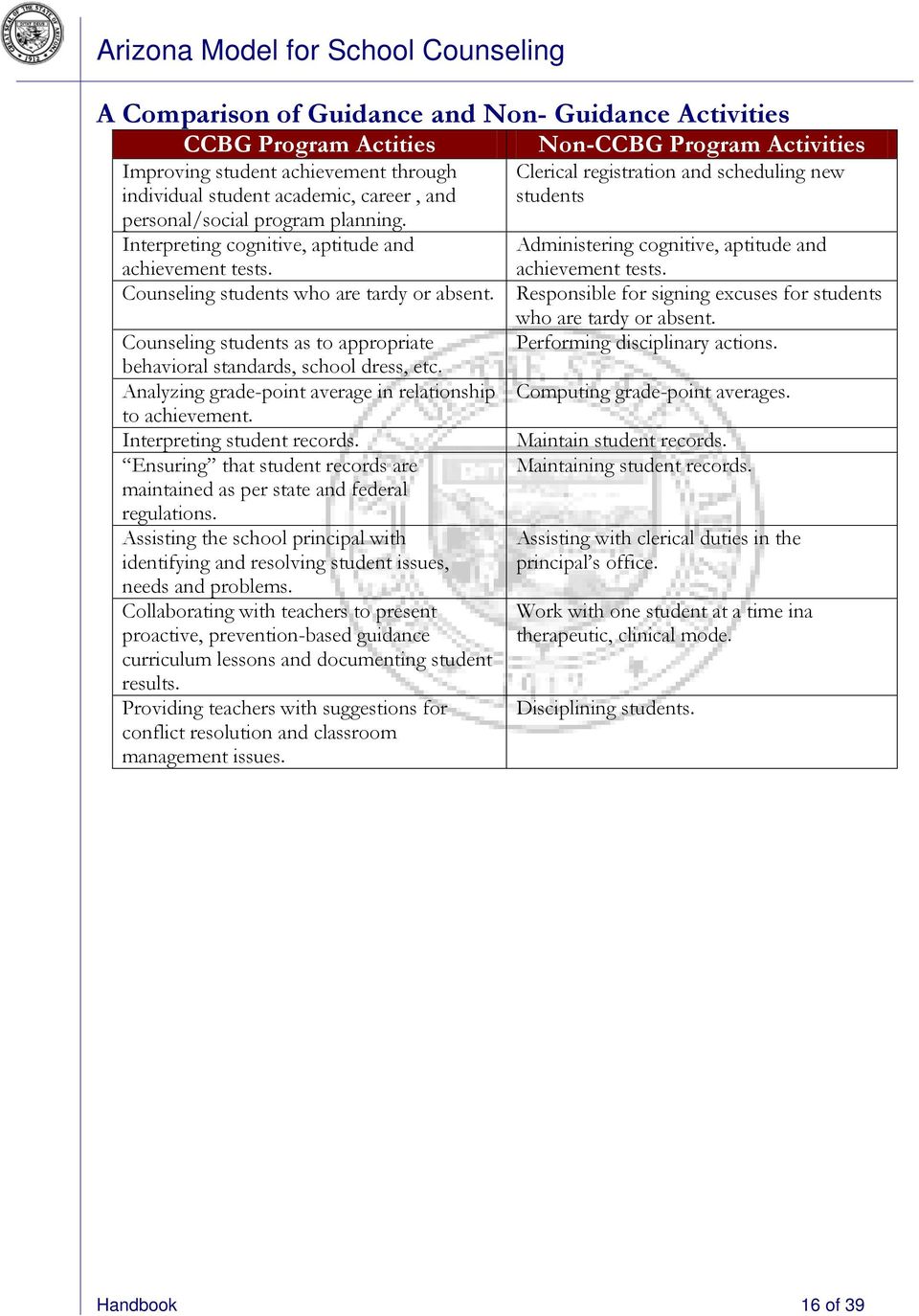
16 A Comparison of Guidance and Non- Guidance Activities CCBG Program Actities Non-CCBG Program Activities Improving student achievement through individual student academic, career, and personal/social program planning. Interpreting cognitive, aptitude and achievement tests. Counseling students who are tardy or absent. Counseling students as to appropriate behavioral standards, school dress, etc. Analyzing grade-point average in relationship to achievement. Interpreting student records. Ensuring that student records are maintained as per state and federal regulations. Assisting the school principal with identifying and resolving student issues, needs and problems. Collaborating with teachers to present proactive, prevention-based guidance curriculum lessons and documenting student results. Providing teachers with suggestions for conflict resolution and classroom management issues. Clerical registration and scheduling new students Administering cognitive, aptitude and achievement tests. Responsible for signing excuses for students who are tardy or absent. Performing disciplinary actions. Computing grade-point averages. Maintain student records. Maintaining student records. Assisting with clerical duties in the principal s office. Work with one student at a time ina therapeutic, clinical mode. Disciplining students. Handbook 16 of 39
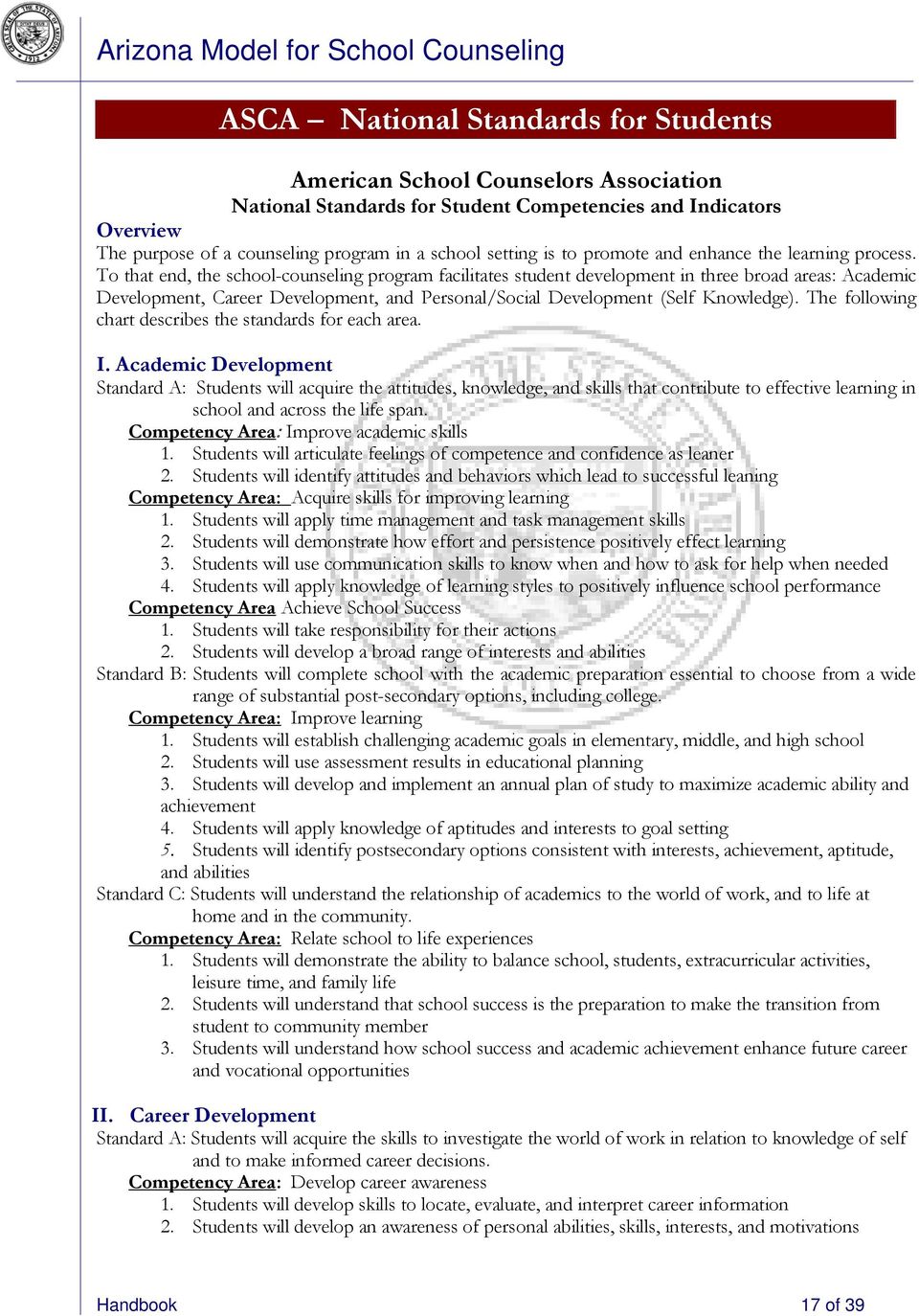
17 ASCA National Standards for Students American School Counselors Association National Standards for Student Competencies and Indicators Overview The purpose of a counseling program in a school setting is to promote and enhance the learning process. To that end, the school-counseling program facilitates student development in three broad areas: Academic Development, Career Development, and Personal/Social Development (Self Knowledge). The following chart describes the standards for each area. I. Academic Development Standard A: Students will acquire the attitudes, knowledge, and skills that contribute to effective learning in school and across the life span. Competency Area: Improve academic skills 1. Students will articulate feelings of competence and confidence as leaner 2. Students will identify attitudes and behaviors which lead to successful leaning Competency Area: Acquire skills for improving learning 1. Students will apply time management and task management skills 2. Students will demonstrate how effort and persistence positively effect learning 3. Students will use communication skills to know when and how to ask for help when needed 4. Students will apply knowledge of learning styles to positively influence school performance Competency Area Achieve School Success 1. Students will take responsibility for their actions 2. Students will develop a broad range of interests and abilities Standard B: Students will complete school with the academic preparation essential to choose from a wide range of substantial post-secondary options, including college. Competency Area: Improve learning 1. Students will establish challenging academic goals in elementary, middle, and high school 2. Students will use assessment results in educational planning 3. Students will develop and implement an annual plan of study to maximize academic ability and achievement 4. Students will apply knowledge of aptitudes and interests to goal setting 5. Students will identify postsecondary options consistent with interests, achievement, aptitude, and abilities Standard C: Students will understand the relationship of academics to the world of work, and to life at home and in the community. Competency Area: Relate school to life experiences 1. Students will demonstrate the ability to balance school, students, extracurricular activities, leisure time, and family life 2. Students will understand that school success is the preparation to make the transition from student to community member 3. Students will understand how school success and academic achievement enhance future career and vocational opportunities II. Career Development Standard A: Students will acquire the skills to investigate the world of work in relation to knowledge of self and to make informed career decisions. Competency Area: Develop career awareness 1. Students will develop skills to locate, evaluate, and interpret career information 2. Students will develop an awareness of personal abilities, skills, interests, and motivations Handbook 17 of 39
18 3. Students will learn how to interact and work cooperatively in teams (MS) 4. Students will learn how to set goals and make decisions Competency Area: Develop employment readiness 1. Students will acquire employability skills such as working on a team, problem-solving, & organizational (MS) 2. Students will apply job readiness skills to seek employment opportunities 3. Students will learn how to write a high school (HS) 4. Students will utilize time- and task- management skills Standard B: Students will employ strategies to achieve future career success and satisfaction. Competency Area: Acquire career information 1. Students will apply decision-making skills to career planning course selection, and career transitions 2. Students will identify personal skills, interests, and abilities and relate them to current career choices 3. Students will use research and information resources to obtain career information 4. Students will learn to use the Internet to access career planning information (HS) Competency Area: Identify career goals 1. Students will demonstrate awareness of the education and training needed to achieve career goals 2. Students will identify, assess, and modify their educational plan to support career goals (HS) 3. Students will select coursework that is related to career interests Standard C: Students will understand the relationship between personal qualities, education and training, and the world of work. Competency Area: Acquire knowledge to achieve career goals 1. Students will understand that the changing workplace requires lifelong leaning and acquiring new skills Competency Area: Apply skills to achievement career goals 1. Students will learn how to use conflict management skills with pees and adults 2. Students will learn to work cooperatively with others as a team member III. Personal/Social Development (Self Knowledge) Standard A: Students will acquire the attitudes, knowledge, and interpersonal skills to help them understand and respect self and others. Competency Area: Acquire self-knowledge 1. Students will identify and express feelings 2. Students will distinguish between appropriate and inappropriate behavior 3. Students will recognize personal boundaries, rights, and privacy needs 4. Students will understand the need for self-control and how to practice it Competency Area: Acquire Interpersonal skills 1. Students will respect alternative points of view 2. Students will recognize, accept, and appreciate ethnic and cultural diversity 3. Students will use effective communication skills 4. Students will know that communication involves speaking, listening, and nonverbal behavior 5. Students will learn how to make and keep friends Standard B: Students will make decisions, set goals, and take necessary action to achieve goals. Competency Area: Self-knowledge applications 1. Students will understand consequences of decisions and choices 2. Students will develop effective coping skills for dealing with problems 3. Students will know how to apply conflict resolution skills 4. Students will know when peer pressure is influencing a decision Handbook 18 of 39

19 Standard C: Students will understand safety and survival skills. Competency Area: Acquire personal safety skills 1. Students will demonstrate knowledge of personal information (e.g. telephone number. Home address, emergency contact) 2. Students will learn about the relationship between rules, laws, safety, and the protection of an individual s rights 3. Students will learn the difference between appropriate and inappropriate physical contact 4. Students will demonstrate the ability to assert boundaries, rights, and personal privacy 5. Students will differentiate between situation requiring peer support and situations requiring adult professional help 6. Students will identify resource people in the school and community, and learn how to seek their help 7. Students will apply effective problem-solving and decision-making skills to make safe and healthy choices 8. Students will learn about the emotional and physical dangers of substance use and abuse 9. Students will learn how to cope with peer pressure 10. Students will learn techniques for managing stress and conflict 11. Students will learn coping skills for managing life events Handbook 19 of 39

20 Ethical Standards for School Counselors Adapted from ASCA's Ethical Standards for School Counselors were adopted by the ASCA Delegate Assembly, March 19,1984, revised March 27, 1992, June 25, 1998 and June 26, Preamble The American School Counselor Association (ASCA) is a professional organization whose members are certified/licensed in school counseling with unique qualifications and skills to address the academic, personal/social and career development needs of all students. Professional school counselors are advocates, leaders, collaborators and consultants who create opportunities for equity in access and success in educational opportunities by connecting their programs to the mission of schools and subscribing to the following tenets of professional responsibility: Each person has the right to be respected, be treated with dignity and have access to a comprehensive school counseling program that advocates for and affirms all students from diverse populations regardless of ethnic/racial status, age, economic status, special needs, English as a second language or other language group, immigration status, sexual orientation, gender, gender identity/expression, family type, religious/spiritual identity and appearance. Each person has the right to receive the information and support needed to move toward self-direction and self-development and affirmation within one s group identities, with special care being given to students who have historically not received adequate educational services: students of color, low socioeconomic students, students with disabilities and students with non-dominant language backgrounds. Each person has the right to understand the full magnitude and meaning of his/her educational choices and how those choices will affect future opportunities. Each person has the right to privacy and thereby the right to expect the counselor-student relationship to comply with all laws, policies and ethical standards pertaining to confidentiality in the school setting. In this document, ASCA specifies the principles of ethical behavior necessary to maintain the high standards of integrity, leadership and professionalism among its members. The Ethical Standards for School Counselors were developed to clarify the nature of ethical responsibilities held in common by school counseling professionals. The purposes of this document are to: Serve as a guide for the ethical practices of all professional school counselors regardless of level, area, population served or membership in this professional association; Provide self-appraisal and peer evaluations regarding counselor responsibilities to students, parents/guardians, colleagues and professional associates, schools, communities and the counseling profession; and Inform those served by the school counselor of acceptable counselor practices and expected professional behavior. A.1. Responsibilities to Students a. Has a primary obligation to the student, who is to be treated with respect as a unique individual. b. Is concerned with the educational, academic, career, personal and social needs and encourages the maximum development of every student. c. Respects the student s values and beliefs and does not impose the counselor s personal values. d. Is knowledgeable of laws, regulations and policies relating to students and strives to protect and inform students regarding their rights. A.2. Confidentiality a. Informs students of the purposes, goals, techniques and rules of procedure under which they may receive counseling at or before the time when the counseling relationship is entered. Disclosure notice includes the limits of confidentiality such as the possible necessity for consulting with other professionals, privileged communication, and legal or authoritative Handbook 20 of 39

21 restraints. The meaning and limits of confidentiality are defined in developmentally appropriate terms to students. b. Keeps information confidential unless disclosure is required to prevent clear and imminent danger to the student or others or when legal requirements demand that confidential information be revealed. Counselors will consult with appropriate professionals when in doubt as to the validity of an exception. c. In absence of state legislation expressly forbidding disclosure, considers the ethical responsibility to provide information to an identified third party who, by his/her relationship with the student, is at a high risk of contracting a disease that is commonly known to be communicable and fatal. Disclosure requires satisfaction of all of the following conditions: Student identifies partner or the partner is highly identifiable Counselor recommends the student notify partner and refrain from further high-risk behavior Student refuses Counselor informs the student of the intent to notify the partner Counselor seeks legal consultation as to the legalities of informing the partner d. Requests of the court that disclosure not be required when the release of confidential information may potentially harm a student or the counseling relationship. e. Protects the confidentiality of students records and releases personal data in accordance with prescribed laws and school policies. Student information stored and transmitted electronically is treated with the same care as traditional student records. f. Protects the confidentiality of information received in the counseling relationship as specified by federal and state laws, written policies and applicable ethical standards. Such information is only to be revealed to others with the informed consent of the student, consistent with the counselor s ethical obligation. g. Recognizes his/her primary obligation for confidentiality is to the student but balances that obligation with an understanding of the legal and inherent rights of parents/guardians to be the guiding voice in their children s lives. A.3. Counseling Plans a. Provides students with a comprehensive school counseling program that includes a strong emphasis on working jointly with all students to develop academic and career goals. b. Advocates for counseling plans supporting students right to choose from the wide array of options when they leave secondary education. Such plans will be regularly reviewed to update students regarding critical information they need to make informed decisions. A.4. Dual Relationships a. Avoids dual relationships that might impair his/her objectivity and increase the risk of harm to the student (e.g., counseling one s family members, close friends or associates). If a dual relationship is unavoidable, the counselor is responsible for taking action to eliminate or reduce the potential for harm. Such safeguards might include informed consent, consultation, supervision and documentation. b. Avoids dual relationships with school personnel that might infringe on the integrity of the counselor/student relationship A.5. Appropriate Referrals a. Makes referrals when necessary or appropriate to outside resources. Appropriate referrals may necessitate informing both parents/guardians and students of applicable resources and making proper plans for transitions with minimal interruption of services. Students retain the right to discontinue the counseling relationship at any time. A.6. Group Work Handbook 21 of 39
22 a. Screens prospective group members and maintains an awareness of participants needs and goals in relation to the goals of the group. The counselor takes reasonable precautions to protect members from physical and psychological harm resulting from interaction within the group. b. Notifies parents/guardians and staff of group participation if the counselor deems it appropriate and if consistent with school board policy or practice. c. Establishes clear expectations in the group setting and clearly states that confidentiality in group counseling cannot be guaranteed. Given the developmental and chronological ages of minors in schools, the counselor recognizes the tenuous nature of confidentiality for minors renders some topics inappropriate for group work in a school setting. d. Follows up with group members and documents proceedings as appropriate. A.7. Danger to Self or Others a. Informs parents/guardians or appropriate authorities when the student s condition indicates a clear and imminent danger to the student or others. This is to be done after careful deliberation and, where possible, after consultation with other counseling professionals. b. Will attempt to minimize threat to a student and may choose to 1) inform the student of actions to be taken, 2) involve the student in a three-way communication with parents/guardians when breaching confidentiality or 3) allow the student to have input as to how and to whom the breach will be made. A.8. Student Records a. Maintains and secures records necessary for rendering professional services to the student as required by laws, regulations, institutional procedures and confidentiality guidelines. b. Keeps sole-possession records separate from students educational records in keeping with state laws. c. Recognizes the limits of sole-possession records and understands these records are a memory aid for the creator and in absence of privilege communication may be subpoenaed and may become educational records when they 1) are shared with others in verbal or written form, 2) include information other than professional opinion or personal observations and/or 3) are made accessible to others. d. Establishes a reasonable timeline for purging sole-possession records or case notes. Suggested guidelines include shredding sole possession records when the student transitions to the next level, transfers to another school or graduates. Careful discretion and deliberation should be applied before destroying sole-possession records that may be needed by a court of law such as notes on child abuse, suicide, sexual harassment or violence. A.9. Evaluation, Assessment and Interpretation a. Adheres to all professional standards regarding selecting, administering and interpreting assessment measures and only utilizes assessment measures that are within the scope of practice for school counselors. b. Seeks specialized training regarding the use of electronically based testing programs in administering, scoring and interpreting that may differ from that required in more traditional assessments. c. Considers confidentiality issues when utilizing evaluative or assessment instruments and electronically based programs. d. Provides interpretation of the nature, purposes, results and potential impact of assessment/evaluation measures in language the student(s) can understand. e. Monitors the use of assessment results and interpretations, and takes reasonable steps to prevent others from misusing the information. f. Uses caution when utilizing assessment techniques, making evaluations and interpreting the performance of populations not represented in the norm group on which an instrument is standardized. g. Assesses the effectiveness of his/her program in having an impact on students academic, career and Handbook 22 of 39
23 personal/social development through accountability measures especially examining efforts to close achievement, opportunity and attainment gaps. A.10. Technology a. Promotes the benefits of and clarifies the limitations of various appropriate technological applications. The counselor promotes technological applications (1) that are appropriate for the student s individual needs, (2) that the student understands how to use and (3) for which follow-up counseling assistance is provided. b. Advocates for equal access to technology for all students, especially those historically underserved. c. Takes appropriate and reasonable measures for maintaining confidentiality of student information and educational records stored or transmitted over electronic media including although not limited to fax, electronic mail and instant messaging. d. While working with students on a computer or similar technology, takes reasonable and appropriate measures to protect students from objectionable and/or harmful online material. e. Who is engaged in the delivery of services involving technologies such as the telephone, videoconferencing and the Internet takes responsible steps to protect students and others from harm. A.11. Student Peer Support Program Has unique responsibilities when working with student-assistance programs. The school counselor is responsible for the welfare of students participating in peer-to-peer programs under his/her direction. B. Responsibilities to Parents/Guardians B.1. Parent Rights and Responsibilities a. Respects the rights and responsibilities of parents/guardians for their children and endeavors to establish, as appropriate, a collaborative relationship with parents/guardians to facilitate the student s maximum development. b. Adheres to laws, local guidelines and ethical standards of practice when assisting parents/guardians experiencing family difficulties that interfere with the student s effectiveness and welfare. c. Respects the confidentiality of parents/guardians. d. Is sensitive to diversity among families and recognizes that all parents/guardians, custodial and noncustodial, are vested with certain rights and responsibilities for the welfare of their children by virtue of their role and according to law. B.2. Parents/Guardians and Confidentiality a. Informs parents/guardians of the counselor s role with emphasis on the confidential nature of the counseling relationship between the counselor and student. b. Recognizes that working with minors in a school setting may require counselors to collaborate with students parents/guardians. c. Provides parents/guardians with accurate, comprehensive and relevant information in an objective and caring manner, as is appropriate and consistent with ethical responsibilities to the student. d. Makes reasonable efforts to honor the wishes of parents/guardians concerning information regarding the student, and in cases of divorce or separation exercises a good-faith effort to keep both parents informed with regard to critical information with the exception of a court order. C. Responsibilities to Colleagues and Professional Associates Handbook 23 of 39
24 C.1. Professional Relationships a. Establishes and maintains professional relationships with faculty, staff and administration to facilitate an optimum counseling program. b. Treats colleagues with professional respect, courtesy and fairness. The qualifications, views and findings of colleagues are represented to accurately reflect the image of competent professionals. c. Is aware of and utilizes related professionals, organizations and other resources to whom the student may be referred. C.2. Sharing Information with Other Professionals a. Promotes awareness and adherence to appropriate guidelines regarding confidentiality, the distinction between public and private information and staff consultation. b. Provides professional personnel with accurate, objective, concise and meaningful data necessary to adequately evaluate, counsel and assist the student. c. If a student is receiving services from another counselor or other mental health professional, the counselor, with student and/or parent/guardian consent, will inform the other professional and develop clear agreements to avoid confusion and conflict for the student. d. Is knowledgeable about release of information and parental rights in sharing information. D. Responsibilities to the School and Community D.1. Responsibilities to the School a. Supports and protects the educational program against any infringement not in students best interest. b. Informs appropriate officials in accordance with school policy of conditions that may be potentially disruptive or damaging to the school s mission, personnel and property while honoring the confidentiality between the student and counselor. c. Is knowledgeable and supportive of the school s mission and connects his/her program to the school s mission. d. Delineates and promotes the counselor s role and function in meeting the needs of those served. Counselors will notify appropriate officials of conditions that may limit or curtail their effectiveness in providing programs and services. e. Accepts employment only for positions for which he/she is qualified by education, training, supervised experience, state and national professional credentials and appropriate professional experience. f. Advocates that administrators hire only qualified and competent individuals for professional counseling positions. g. Assists in developing: (1) curricular and environmental conditions appropriate for the school and community, (2) educational procedures and programs to meet students developmental needs and (3) a systematic evaluation process for comprehensive, developmental, standards-based school counseling programs, services and personnel. The counselor is guided by the findings of the evaluation data in planning programs and services. D.2. Responsibility to the Community a. Collaborates with agencies, organizations and individuals in the community in the best interest of students and without regard to personal reward or remuneration. b. Extends his/her influence and opportunity to deliver a comprehensive school counseling program to all students by collaborating with community resources for student success. E. Responsibilities to Self E.1. Professional Competence Handbook 24 of 39
25 a. Functions within the boundaries of individual professional competence and accepts responsibility for the consequences of his/her actions. b. Monitors personal well-being and effectiveness and does not participate in any activity that may lead to inadequate professional services or harm to a student. c. Strives through personal initiative to maintain professional competence including technological literacy and to keep abreast of professional information. Professional and personal growth are ongoing throughout the counselor s career. E.2. Diversity a. Affirms the diversity of students, staff and families. b. Expands and develops awareness of his/her own attitudes and beliefs affecting cultural values and biases and strives to attain cultural competence. c. Possesses knowledge and understanding about how oppression, racism, discrimination and stereotyping affects her/him personally and professionally. d. Acquires educational, consultation and training experiences to improve awareness, knowledge, skills and effectiveness in working with diverse populations: ethnic/racial status, age, economic status, special needs, ESL or ELL, immigration status, sexual orientation, gender, gender identity/expression, family type, religious/spiritual identity and appearance. F. Responsibilities to the Profession F.1. Professionalism a. Accepts the policies and procedures for handling ethical violations as a result of maintaining membership in the American School Counselor Association. b. Conducts herself/himself in such a manner as to advance individual ethical practice and the profession. c. Conducts appropriate research and report findings in a manner consistent with acceptable educational and psychological research practices. The counselor advocates for the protection of the individual student s identity when using data for research or program planning. d. Adheres to ethical standards of the profession, other official policy statements, such as ASCA s position statements, role statement and the ASCA National Model, and relevant statutes established by federal, state and local governments, and when these are in conflict works responsibly for change. e. Clearly distinguishes between statements and actions made as a private individual and those made as a representative of the school counseling profession. f. Does not use his/her professional position to recruit or gain clients, consultees for his/her private practice or to seek and receive unjustified personal gains, unfair advantage, inappropriate relationships or unearned goods or services.. Contribution to the Profession a. Actively participates in local, state and national associations fostering the development and improvement of school counseling. b. Contributes to the development of the profession through the sharing of skills, ideas and expertise with colleagues. c. Provides support and mentoring to novice professionals. G. Maintenance of Standards Handbook 25 of 39
26 Ethical behavior among professional school counselors, association members and nonmembers, is expected at all times. When there exists serious doubt as to the ethical behavior of colleagues or if counselors are forced to work in situations or abide by policies that do not reflect the standards as outlined in these Ethical Standards for School Counselors, the counselor is obligated to take appropriate action to rectify the condition. The following procedure may serve as a guide: 1. The counselor should consult confidentially with a professional colleague to discuss the nature of a complaint to see if the professional colleague views the situation as an ethical violation. 2. When feasible, the counselor should directly approach the colleague whose behavior is in question to discuss the complaint and seek resolution. 3. If resolution is not forthcoming at the personal level, the counselor shall utilize the channels established within the school, school district, the state school counseling association and ASCA s Ethics Committee. 4. If the matter still remains unresolved, referral for review and appropriate action should be made to the Ethics Committees in the following sequence: - state school counselor association - American School Counselor Association 5. The ASCA Ethics Committee is responsible for: educating and consulting with the membership regarding ethical standards periodically reviewing and recommending changes in code receiving and processing questions to clarify the application of such standards; Questions must be submitted in writing to the ASCA Ethics chair. handling complaints of alleged violations of the ethical standards. At the national level, complaints should be submitted in writing to the ASCA Ethics Committee, c/o the Executive Director, American School Counselor Association, 1101 King St., Suite 625, Alexandria, VA Handbook 26 of 39
27 GUIDANCE CURRICULUM DELIVERY SYSTEM (Adapted from ASCA National Model ) RESPONSIVE SERVICES INDIVIDUAL STUDENT PLANNING SYSTEM SUPPORT Provides developmental comprehensive guidance program content in a systematic way to all students K-12. Purpose Student awareness, skill development and application of skills needed in everyday life. ACADEMIC Effective learning in school & across the life span Academic preparation for postsecondary options Relationship of academics, work, family & community life CAREER Investigate the world of work to make informed decisions Strategies to achieve future career goals Relationship of personal qualities, education, training & work PERSONAL/SOCIAL Interpersonal skills to respect self & others Decision making, setting goals & taking action to achieve goals Understanding everyday safety & survival skills Counselor Role Guidance Curriculum implementation Classroom or structured groups Consultation Time Elementary 35% - 45% Middle/Jr. High 25% - 35% High School 15% - 25% Addresses the immediate concerns of students. Purpose Prevention and intervention. ACADEMIC Any immediate academic concerns. School related concerns including tardiness, absences and truancy, misbehavior, school avoidance, dropout, suspensions, etc. PERSONAL/SOCIAL Physical, sexual or emotional abuse and issues. Crises. Grief, loss, and death Substance abuse. Family issues. Coping with stress. Relationship concerns. Divorce. Legal issues such as probation, arrests or incarceration. Referral plan. Contact and develop relationships with mental health resources in your area. Counselor Role Individual counseling. Small group counseling Referral Consultation Time Elementary 30% - 40% Middle/Jr. High 30% - 40% High School 25% - 35% Assists students and parents in development of academic and career plans. Purpose Individual student academic and occupational planning, decision making, goal setting & preparing for academic transitions. ACADEMIC Facilitation and/or interpretation of criterion and norm referenced tests Academic preparation essential for postsecondary options. Understand academic strengths related to occupations. Appropriate course selection. Develop a K-12 educational plan/portfolio. Develop an educational plan beyond high school including postsecondary selection/financial aid/scholarships. Use of diverse assessment results. CAREER Utilize career information resources in school & community Explore Career Clusters. Interest and skill inventories Occupation searches. Self-knowledge relating to career choices. Appropriate course selection, tech prep, work based learning including job shadowing and internships. Develop a career plan/portfolio. PERSONAL/SOCIAL Skills and competencies related to student and employee success Counselor Role Assessment Planning Placement Consultation Time Elementary 5% - 10% Middle/Jr. High 15% - 25% High School 25% - 35% Includes program, staff and school support activities and services Purpose Program delivery and support. TOTAL PROGRAM School Counselor Professional Development. Advocacy and public relations for Comprehensive School Counseling programs. Advisory committee. Program planning and development. Evaluation and assessment of comprehensive guidance program, personnel and student results. Documentation of how comprehensive guidance programs contribute to student achievement. School improvement plan Integration of guidance essential learnings across the school curriculum. Parent involvement and education. Consultation with staff and administration. Instructing on age appropriate issues with staff and community. Practices based on research. Community outreach and involvement. Data Analysis Counselor Role Develop & manage program Coordination Develop relationships and partnerships Consultation Time Elementary 10% - 15% Middle/Jr. High 10% - 15% High School 15% - 20% Handbook 27 of 39
28 Arizona School Counseling Program Audit FOUNDATION Beliefs & Benefits Criteria Indicates an agreed upon belief system about the ability of every student to achieve Identifies who benefits from a comprehensive school counseling program Addresses every student s right to a school counseling program Program is developmental, focused on prevention and strengths based Identifies who is to be involved in the delivery of program activities Identifies who will plan and manage the program Defines how the program will be evaluated Establishes program as integral to school s educational mission None Plan in Progress Plan Completed Implemented Mission Statement Criteria There is a written mission statement Written for all students Indicates the content to be learned Integral to the vision, goals and mission of the local district and state Indicates the long term results for all students None Plan in Progress Plan Completed Implemented National/Arizona/Local Standards & Competencies Criteria Written K-12 for the entire district Includes 3 domains: academic, career, personal/social development Reflect national, state and local criteria Identifies a framework for organization for counseling program lessons and activities Identifies the developmental structure for K-12 program and what is to be measured None Plan in Progress Plan Completed Implemented National/Arizona/Local Standards & Competencies: Competencies/Indicators Criteria Directly relate to career, academic, personal and social development standards Specified for each grade level and developmentally appropriate Priority selection for the year is based on data and are measurable or observable Direct relationship between the counseling program mission, school s educational mission and expected student results None Plan in Progress Plan Completed Implemented Policy Criteria The school counseling program has been approved by the school district s board of education None Plan in Progress Plan Completed Implemented Handbook 28 of 39
29 Arizona School Counseling Program Audit DELIVERY SYSTEM Curriculum Criteria Has been adopted based on data, research and needs There are sufficient materials, facilities and resources for the delivery system All students receive curriculum in a systemic way Content is measurable by pre-post tests, product creation or other appropriate methods Effectiveness of curriculum is evaluated annually Curriculum priorities are a result of data driven decisions None Plan in Progress Plan Completed Implemented Responsive Services Criteria Every student receives prevention education addressing life choices within the 3 program domains Students are assisted in solving immediate problems interfering within 3 program domains A referral plan and referral resource is available and used Individual and small group is available A crises response plan is in place and used Consultation/Collaboration is used There is a plan for interventions when needed None Plan in Progress Plan Completed Implemented Student Planning Criteria There is a system wide approach to helping student and parents make appropriate education/career plans There is a system wide approach to helping student and parents understand assessment results Each student starting the middle grades has a long range education/career plan Student planning includes: individual appraisal, advisement and appropriate student placement A comprehensive career information system is available to students and parents to help make informed decisions for education/career plans None Plan in Progress Plan Completed Implemented System Support Criteria School Counselor professional development School Counselor program development School Improvement involvement Data gathering, documentation, analysis and action planning Parent Involvement Community Outreach None Plan in Progress Plan Completed Implemented Handbook 29 of 39
30 Arizona School Counseling Program Audit MANAGEMENT SYSTEM Counselor/Administrator Agreement Criteria Organization and delivery of school counseling program is addressed Yearly goals and priorities based on data are agreed upon Define partnership between school counseling program and school improvement goals Professional development and program development plan None Plan in Progress Plan Completed Implemented Advisory Council Criteria Council chaired by School Counselor Director Organized with identified tasks and scheduled meetings Appropriate representative membership Meets at least 2 times a year Council reviews data, audits, results reports, and makes recommendations None Plan in Progress Plan Completed Implemented Use of Data Criteria Student achievement data is collected and disaggregated Student achievement related data is collected and disaggregated School counseling program standards/competencies data are collected and disaggregated School Counselors are accountable for monitoring progress of students Students have a way to check on their own progress Establishment of a system of monitoring, gathering and recording data Several variables of data disaggregation are used Data is systemically analyzed to determine current student status School Counseling competency attainment are contrasted with national standards and research Identified needs from the data may become priority areas to address for closing the gap activities and school improvement activities None Plan in Progress Plan Completed Implemented Action Plans Criteria Curriculum action plans are determined by the school counseling team during a planning meeting Action plans are aligned with the program s goals and competencies Action plans for all 3 domains: academic, career, personal/social development Plans include: Domain, standards and competency, description of lesson materials to be used, date/time to be completed. Who is responsible for delivery, how it will be evaluated. Expected result Plans are shared with Advisory Council and administration Action plans are completed in the spring for the next school year Written action plans are on file with director of school counseling program None Plan in Progress Plan Completed Implemented Use of Time/Calendars Criteria Program use of time follows recommendations according to research and national standards A time study is conducted and analyzed along with program results to determine priorities Counseling tasks vs. assigned non-counseling tasks are addressed with administration Identifies domain goals, grade levels, dates and activities Master calendar is published and distributed to students, staff, parents and community School Counselor weekly/monthly schedule is posted None Plan in Progress Plan Completed Implemented Handbook 30 of 39
31 Arizona School Counseling Program Audit ACCOUNTABILITY Results Report Criteria Established timeline for reporting data on results of the program All students are included in the results data Administration is actively involved in the plan for results reporting Results are reported in all 3 domains: academic, career personal/social development Process data are collected Perception data are collected Results data are collected and disaggregated Immediate, intermediate and over-time data is collected and reviewed Results are reported to counselors, advisory council, administration and all stakeholders Results are analyzed and used to improve the program None Plan in Progress Plan Completed Implemented Counselor Performance Evaluation Criteria Assesses ability to understand comprehensive school counseling program Assesses ability to implement delivery system Assess ability to manage program Assess ability to measure results Assesses professional communication Assesses fulfillment of professional development Membership in professional associations Assesses leadership, student advocacy for systemic change None Plan in Progress Plan Completed Implemented Program Audit Criteria Program is audited yearly Audit addresses entire program Audit results are reported and determine priorities Audit results used in a written long range plan for program improvement None Plan in Progress Plan Completed Implemented Source Adapted From the ASCA National Model School Name: School Year: Form Completed By: Date Completed: Handbook 31 of 39
32 School Counseling Action Plan Handbook 32 of 39
33 ARIZONA MODEL COUNSELOR/PRINCIPAL AGREEMENT School Year School Counselor Name Date Principal Name Counselor signature & date Principal signature & date In order to achieve the results planned, I will spend: % of my time in the classroom % of my time with individual planning % of my time with responsive services % of my time with system support My guidance & counseling plan will include outcomes with the following: Staff: Parents: Community: Continued Professional Development (list specific activities) My guidance & counseling plan will include collaboration with the following: School counseling department team with administration With school staff With advisory council With site-based management committee With subject area departments With instructional council Handbook 33 of 39
34 Arizona Guidance and Counseling Annual School Plan Elementary School Level To: Principal From: Counselor I will make the following contributions to the students, staff and parents of School during the school year. STUDENT RESULTS I will manage the educational, career and personal/social domains as delineated in the guidance/counseling program. Students will acquire and demonstrate the following checked competencies: Check indicates competency selected Personal/Social Development K Knowledge of the importance of self concept. 2. Skills to interact with others. 3. Awareness of the importance of growth and change. Date Plan Date Complete Educational Planning/Occupational Exploration 4. Awareness of the benefits of educational achievements. 5. Awareness of the relationship between work and learning. 6. Skills to understand and use career information. 7. Awareness of the importance of personal responsibility and good work habits. 8. Awareness of how work relates to the needs and functions of society. K Career/Life Planning K Understanding of how to make decisions. 10. Awareness of the interrelationship of life roles. 11. Awareness of different occupations and changing male/female roles. 12. Awareness of the career planning process. Additional Comments: Handbook 34 of 39
35 Arizona Guidance and Counseling Annual School Plan Middle School Level To: Principal From: Counselor I will make the following contributions to the students, staff and parents of during the school year. STUDENT RESULTS I will manage the educational, career and personal/social domains as delineated in the guidance/counseling program. Students will acquire and demonstrate the following checked competencies: Check indicates competency selected Personal/Social Development Knowledge of the influence of a positive self concept. 2. Skills to interact positively with others. 3. Knowledge of the importance of growth and change. Educational/Occupational Exploration Knowledge of the benefits of educational achievement to career opportunities. 5. Understanding the relationship between work and learning. 6. Skills to locate, understand, and use career information. 7. Knowledge of skills necessary to seek and obtain jobs. 8. Understanding how work relates to the needs and functions of the economy and society. Career/Life Planning Skills to make decisions. 10. Knowledge of the interrelationship of life roles. 11. Knowledge of different occupations and changing male/female roles. 12. Understanding the process of career planning. Additional Comments: Handbook 35 of 39
36 Arizona Guidance and Counseling Annual School Plan High School Level To: From: Principal Counselor I will make the following contributions to the students, staff and parents of during the school year. STUDENT RESULTS I will manage the educational, career and personal/social domains as delineated in the guidance/counseling program. Students will acquire and demonstrate the following checked competencies: Check indicates competency selected Personal/Social Development Understanding the influence of a positive self concept. 2. Skills to interact positively with others. 3. Understanding the impact of growth and development. Educational Planning/Occupational Exploration Understanding the relationship between educational achievement and career planning. 5. Understanding the need for positive attitudes toward work and learning. 6. Skills to locate, evaluate, and interpret career information. 7. Skills to prepare to seek, obtain, maintain and change jobs. 8. Understanding how societal needs and functions influence the nature and structure of work. Career/Life Planning Skills to make decisions. 10. Understanding the interrelationship of life roles. 11. Understanding the continuous changes in male/female roles. 12. Skills in career planning. Additional Comments: Handbook 36 of 39
37 Arizona Guidance Counselor Certification K-12 Requirements All requirements for the Guidance Counselor Certificate must be met. The certificate is valid for six years and is renewable. Fees are not refundable. 1. A master s degree or higher from an accredited institution. Official transcript (s) required. 2. Option A or B. A. Completion of a graduate program in guidance and counseling from an accredited institution. B. A valid guidance counselor certificate from another state. 3. A valid Arizona Fingerprint Clearance Card (plastic) issued by the Arizona Department of Public Safety at (602) Option A, B, or C A. Completion of a supervised counseling program practicum in school counseling. Official transcript (s) required. B. Two years of verified full-time experience as a school guidance counselor. (Please submit a letter on official letterhead from District Superintendent or Personnel Director to verify counseling.) C. Three years of verified full-time teaching experience. (Please submit a letter on official letterhead from District Superintendent of Personnel Director to verify teaching experience.) Version Page 1 of 1 Handbook 37 of 39
38 Acknowledgments The first Arizona School Counseling Model was written in 1989 by a committee planning the first Arizona Counselor Academy (ACA) which was held June, This first program book and workbook were called Arizona Competency-Based Guidance (CBG, 1990). Included in the first edition were the delivery system and the time on task model developed by Norman Gysbers, Ph.D., and the results based guidance model developed by Clarence Curly Johnson, Ph.D., and Sharon Johnson, Ph.D. The 1991 edition became Arizona Comprehensive Competency Based Guidance (CCBG, 1991). Later editions revised and updated the information to address the changes in school counseling programs. Included in these later editions were the individual and group processes of Bob Myrick, Ph.D. and the work of many Arizona School Counselors who contributed their school and district work. The twelve elements of a competency-based guidance program model using the C.D. Johnson (1985) in the shape of a wheel was used as the Arizona model from In 1996, a leadership team in the Tucson Unified School District (TUSD) revised the twelve elements into a house model with four levels. These were the foundation, the delivery system, the monitoring system, and the assessment system. This house model or four levels has been used as the Arizona model since then. Arizona School Counselors are now using the diamond model from the ASCA National Model: A Framework for School Counseling Programs (2003). With the Arizona s CCBG house model as a guide, the ASCA Summit committee used the twelve elements of the Johnson & Johnson model, the delivery system and time on task model from Dr. Gysbers, and the group counseling techniques of Dr. Myrick, to develop the model of the American School Counselor Association (ASCA) National Model: A Framework for School Counseling Programs in It was the vision of the State Guidance Coordinator, Tina Ammon, Ed.D. to provide district counselors and guidance personnel with a step-by-step resource guide for designing and implementing a CCBG program for their school that reflected the district mission and philosophy and showed results. In the late 1980 s, Dr. Ammon researched the latest work in the school counseling field, and she and the ACA cadre incorporated the work of Dr. Gysbers and Drs. Johnson and Johnson in Each year since 1990, Arizona counselors have been trained at the annual Arizona Counselors Academy through the support of the Arizona Department of Education, the Arizona School Counselors Association, Inc., The Center for Education Development, Pima County Superintendent of Schools, Northern Arizona University, and the University of Arizona. Future Arizona State Guidance Supervisors and Arizona Department of Education Administrators continued the vision of Dr. Ammon to provide a yearly counselors academy in Arizona including Vic Harrell, Susan Mellagard, Tom Horne, Maxine Daley, Helen Bootsma, and Kay Schreiber. Assistance from many Arizona School Counselors Association, Inc. members serving on the Academy Planning Cadre contributed to outstanding team work through the years. Brian Mathison, Ed.D., AzSCA, Inc. President, and Barbara Zamora, AzSCA, Inc. President, collaborated with the Arizona Department of Education in 2007 to ensure there would continue to be an academy when funding was in question. Handbook 38 of 39
39 Arizona Department of Education/Vocational Technological Division, (1990). Arizona Competency- Based Guidance Program. Phoenix, AZ: Self. Arizona Department of Education/Vocational Technological Division, (1990). Arizona Competency- Based Guidance Workbook. Phoenix, AZ: Self. Arizona Department of Education and Career and Technical Education (2002). Arizona Counselor s Academy Program Handbook: A Guide for K-12 Program Development, Academy Edition. Phoenix, AZ: Self The first Arizona Competency-Based Guidance Program handbook was compiled under a grant from the Arizona Department of Education in It was revised May 1993, May 1994, May 1997, March 2001, May The October, 2007 edition is update to reflect moving from the CCBG model wording to the ASCA National Model wording. We appreciate Donna Vrbka and the Nebraska Department of Education for sharing format and forms with us. Kay Schreiber Department of Education Career & Technical Education: Development & Innovations Group State Career Guidance Counselors Supervisor (602) The Arizona Department of Education of the State of Arizona does not discriminate on the basis of race, religion, color, national origin, sex, disability or age in its programs, activities or in its hiring and employment practices. If you have questions or grievances related to this policy, please contact the Administrative Services DAS at (602) Handbook 39 of 39
Appendix B: Part 100 and School Counseling Programs
 Appendix B: Part 100 and School Counseling Programs As per the New York State Education Department, listed in Part 100 of the Commissioner s Regulations, school counseling/guidance programs are defined
Standards for the School Counselor [23.110]
![Standards for the School Counselor [23.110]](/thumbs/25/6617639.jpg "Standards for the School Counselor [23.110]") II. STANDARDS FOR THE SCHOOL SERVICE PERSONNEL CERTIFICATE Standards for the School Counselor [23.110] STANDARD 1 - Academic Development Domain The competent school counselor understands the learning process
II. STANDARDS FOR THE SCHOOL SERVICE PERSONNEL CERTIFICATE Standards for the School Counselor [23.110] STANDARD 1 - Academic Development Domain The competent school counselor understands the learning process
UNATEGO CENTRAL SCHOOL DISTRICT COMPREHENSIVE SCHOOL COUNSELING PROGRAM GRADES K-12
 UNATEGO CENTRAL SCHOOL DISTRICT COMPREHENSIVE SCHOOL COUNSELING PROGRAM GRADES K-12 1 FORWARD This Comprehensive School Counseling Program acts as a manual for counselors, administrators and school board
247 Main Street Newfield, NY 14867. District Comprehensive Counseling & Guidance Program
 247 Main Street Newfield, NY 14867 District Comprehensive Counseling & Guidance Program Dr. Cheryl Thomas, Superintendent Mrs. Vicki Volpicelli, Elementary Principal Mrs. Cathy Griggs, Middle School Principal
School Counseling PRACTICUM & INTERNSHIP HANDBOOK
 School Counseling PRACTICUM & INTERNSHIP HANDBOOK Human Development Counseling Program Department of Human & Organizational Development Peabody College at Vanderbilt University Nashville, Tennessee 615
Reynolds School District K 12 GUIDANCE AND COUNSELING PROGRAM OVERVIEW
 Reynolds School District K 12 GUIDANCE AND COUNSELING PROGRAM OVERVIEW Developed 2006 MISSION STATEMENT The mission of the Reynolds School District School Counseling and Guidance Program is to provide
The ASCA National Model: A Framework for School Counseling Programs. Program Audit
 The ASCA National Model: A Framework for School Counseling Programs Program Audit The program audit is used to assess the school counseling program in comparison with ASCA s National Model for School Counseling
GUIDANCE. Rocky River City School District. Globally Competitive Exceptional Opportunites Caring Environment Successful Students
 GUIDANCE K 12 Rocky River City School District Globally Competitive Exceptional Opportunites Caring Environment Successful Students DISTRICT GUIDANCE PROGRAM PHILOSOPHY Our philosophy is to be pro-active,
Northeast K-12 Comprehensive Guidance and Counseling Program
 Northeast K-12 Comprehensive Guidance and Counseling Program Foundation Philosophy The foundation of the Northeast School counseling program is developmental and preventative in design for all students.
ASCA National Standards. Developed by: American School Counselor Association
 ASCA National Standards Developed by: American School Counselor Association Guidance and counseling program content standards and student competencies. 7.1. Academic development. The content standards
1. PROFESSIONAL SCHOOL COUNSELOR IDENTITY:
 Utah State University Professional School Counselor Education Program Learning Objectives (Adapted from the Standards for Utah School Counselor Education Programs and the Council for Accreditation of Counseling
UTAH STATE UNIVERSITY. Professional School Guidance Counselor Education Program Mapping
 UTAH STATE UNIVERSITY Professional School Guidance Counselor Education Program Mapping Course Key: PSY 6130 Evidence-Based Practice: School Intervention PSY 6240 Comprehensive School Counseling Programs
Tulsa Public Schools District Secondary School Counseling Program
 Tulsa Public Schools District Secondary School Counseling Program Excellence and High Expectations with a Commitment to All Tulsa School Counseling Program A school counseling program is comprehensive
PRINTED NAME WESTERN ILLINOIS UNIVERSITY - DEPARTMENT OF COUNSELOR EDUCATION - CN 597 INTERNSHIP SCHOOL COUNSELING STUDENTS ONLY TO STUDENTS:
 WESTERN ILLINOIS UNIVERSITY - DEPARTMENT OF COUNSELOR EDUCATION - CN 597 INTERNSHIP SCHOOL COUNSELING STUDENTS ONLY TO STUDENTS: Students are responsible for the completion of all activities on this form.
ASCA National Standards for Students
 ASCA National Standards for Students ONE VISION ONE VOICE Citation Guide When citing from this publication, use the following reference: American School Counselor Association (2004). ASCA National Standards
ASCA Correlations for Roads to Success Grades 7-8
 ASCA Correlations for Roads to Success Grades 7-8 Roads to Success Curriculum Correlation with ASCA Career Development Standards Discover how the Roads to Success curriculum meets the career development
Glossary for the Arizona Professional School Counselor Evaluation
 Glossary for the Arizona Professional School Counselor Evaluation Accountability: Responsibility for one s actions, particularly for objectives, procedures and results of one s work and program; involves
Effective after October 1, 2013
 MICHIGAN TEST FOR TEACHER CERTIFICATION (MTTC) TEST OBJECTIVES Subarea Range of Objectives Approximate Test Weighting I. Student Diversity and Assessment 001 002 29% II. Comprehensive School Counseling
The Role of the Professional School Counselor
 The Role of the Professional School Counselor The professional school counselor is a certified/licensed educator trained in school counseling with unique qualifications and skills to address all students
Tulsa Public Schools District School Counseling Program Elementary
 Tulsa Public Schools District School Counseling Program Elementary Revised 2013 Excellence and High Expectations with a Commitment to All Tulsa School Counseling Program A school counseling program is
The Wisconsin Comprehensive School Counseling Model Student Content Standards. Student Content Standards
 The Wisconsin Comprehensive School Counseling Model Student Content Standards The Wisconsin Comprehensive School Counseling Model builds the content of developmental school counseling programs around nine
Standards for School Counseling
 Standards for School Counseling Page 1 Standards for School Counseling WAC Standards... 1 CACREP Standards... 7 Conceptual Framework Standards... 12 WAC Standards The items below indicate the candidate
EVALUATION RUBRICS FOR COUNSELORS
 EVALUATION RUBRICS FOR COUNSELORS Standards & Elements The evaluation system for school counselors is based on 5 Standards and 13 Elements. These Elements describe important competencies of effective school
DoDEA Manual 2946.2, January 2006 SCHOOL COUNSELING SERVICES
 SCHOOL COUNSELING SERVICES 1 TABLE OF CONTENTS Page FOREWORD 2 TABLE OF CONTENTS 3 FIGURES 3 CHAPTER 1 OVERVIEW OF COMPETENCY BASED COUNSELING PROGRAM 4 C1.1. INTRODUCTION 4 C1.2. PROGRAM OVERVIEW 5 CHAPTER
Montana School Counseling Program
 Montana School Counseling Program Montana School Counselor Association 2004 www.mtschoolcounselor.org Foreword In June 2001, The Montana Board of Public Education published a revision of the Accreditation
ROYALTON HARTLAND CENTRAL SCHOOL DISTRICT K 12 COMPREHENSIVE SCHOOL COUNSELING PROGRAM
 ROYALTON HARTLAND CENTRAL SCHOOL DISTRICT K 12 COMPREHENSIVE SCHOOL COUNSELING PROGRAM GUIDANCE PLAN ROYALTON HARTLAND CENTRAL SCHOOL DISTRICT MISSION STATEMENT The Mission of the Royalton Hartland Central
SCHOOL SOCIAL WORKER EVALUATION SAMPLE EVIDENCES
 As School Social Workers, we often do not fit into typical district forms for employment or evaluation. As a result, teacher evaluation forms are often used to evaluate school social workers. The following
SCHOOL COUNSELING PRACTICUM HANDBOOK. Department of Educational Psychology Counseling and Student Personnel Psychology
 SCHOOL COUNSELING 2012 2013 PRACTICUM HANDBOOK Department of Educational Psychology Counseling and Student Personnel Psychology PRACTICUM HANDBOOK TABLE OF CONTENTS LETTER FROM THE DIRECTOR OF SCHOOL COUNSELING...
The residency school counselor program does not prepare candidates to design, deliver, and
 STANDARD V: KNOWLEDGE AND SKILLS SCHOOL COUNSELORS -Building on the mission to prepare educators who demonstrate a positive impact on student learning based on the Improvement of Student Achievement act
Judson ISD: Guidance and Counseling
 Judson ISD: Guidance and Counseling Annual Report 2013-2014 I am pleased to provide the annual report for 2013-2014. The Judson ISD Comprehensive and Developmental Guidance and Counseling Program is delivered
The ASCA National Model A National Vision
 A National Vision The ASCA National Model establishes a vision of excellence for comprehensive school counseling that is aligned with high standards and high expectations, focused on success for all students
SCHOOL COUNSELING MISSION STATEMENT
 SCHOOL COUNSELING MISSION STATEMENT The mission of the counselors at Dexter High School is to provide high quality, comprehensive school counseling services to all students. Our program, as guided by the
Virginia Professional School Counseling Program. A Publication of the. Carol Kaffenberger, Tammy Davis, Sylinda Gilchrist-Banks, & Tim Grothaus
 Virginia Professional School Counseling Program A Publication of the Carol Kaffenberger, Tammy Davis, Sylinda Gilchrist-Banks, & Tim Grothaus Acknowledgements Virginia Professional School Counseling Program
Crosswalk of the New Colorado Principal Standards (proposed by State Council on Educator Effectiveness) with the
 Crosswalk of the New Colorado Principal Standards (proposed by State Council on Educator Effectiveness) with the Equivalent in the Performance Based Principal Licensure Standards (current principal standards)
NATIONAL BOARD FOR CERTIFIED COUNSELORS (NBCC) CODE OF ETHICS
 PREAMBLE NATIONAL BOARD FOR CERTIFIED COUNSELORS (NBCC) CODE OF ETHICS The National Board for Certified Counselors (NBCC) provides national certifications that recognize individuals who have voluntarily
Rise Indiana School Counselor Rubric
 Rise Indiana School Counselor Rubric 1 Domain 1: Academic Achievement 1.1 The School Counselor Utilizes Data To Monitor Student Achievement And Works Collaboratively With Stakeholders To Enhance Student
STANDARDS FOR GUIDANCE COUNSELING PROGRAMS
 STANDARDS FOR GUIDANCE COUNSELING PROGRAMS These standards were approved January 2005 by the Kentucky Education Professional Standards Board. The Kentucky Standards for Guidance Counselor Programs are
Cobb Keys School Counselor Evaluation System Performance Rubric with Examples of School Counselor Evidence
 Foundation Standard (F): The professional school counselor plans and organizes the foundation of a standards-based, data-driven comprehensive school counseling program that is aligned with the school strategic
Appraisal: Evaluation instrument containing competencies, indicators, and descriptors.
 Academic Achievement: Attainment of educational goals as determined by data such as standardized achievement test scores, grades on tests, report cards, grade point averages, and state and local assessments
Hood River County School District K-12 Guidance and Counseling Program Overview
 Hood River County School District K-12 Guidance and Counseling Program Overview Serving the Students of Hood River County 1 June 2015 Comprehensive Guidance and Counseling Framework Mission The Guidance
WINDHAM SCHOOL DISTRICT COMPREHENSIVE SCHOOL COUNSELING PROGRAM
 WINDHAM SCHOOL DISTRICT COMPREHENSIVE SCHOOL COUNSELING PROGRAM Approved by the Windham School Board on April 1, 2014 Contents What is a School Counseling Program...... 2 Benefits of a School Counseling
School Counselor (501)
 School Counselor (501) NES, the NES logo, Pearson, the Pearson logo, and National Evaluation Series are trademarks in the U.S. and/or other countries of Pearson Education, Inc. or its affiliate(s). NES
... and. Uses data to help schools identify needs for prevention and intervention programs.
 Rubric for Evaluating North Carolina s School Psychologists Standard 1: School psychologists demonstrate leadership. School psychologists demonstrate leadership by promoting and enhancing the overall academic
Preamble. B. Specialists strive to be proficient in brain injury rehabilitation and in the delivery of services.
 CODE OF ETHICS For Certified Brain Injury Specialists and Trainers Adopted by the American Academy for the Certification of Brain Injury Specialists (AACBIS) Board of Governors on 10/26/07 Preamble This
PLEASANTS COUNTY BOARD OF EDUCATION 1 of 6
 PLEASANTS COUNTY SCHOOLS Comprehensive Developmental Guidance and Counseling Policy 7.2.4 West Virginia Board of Education (hereinafter WVBE) Policy 2315 sets forth the Comprehensive School Counseling
Standards for the School Nurse [23.120]
![Standards for the School Nurse [23.120]](/thumbs/25/4559478.jpg "Standards for the School Nurse [23.120]") Standards for the School Nurse [23.120] STANDARD 1 Content Knowledge The certificated school nurse understands and practices within a framework of professional nursing and education to provide a coordinated
Standards for the School Nurse [23.120] STANDARD 1 Content Knowledge The certificated school nurse understands and practices within a framework of professional nursing and education to provide a coordinated
School Guidance and Counseling Services, Elementary, Middle, and High School
 School Guidance and Counseling Services, Elementary, Middle, and High School This regulation implements School Board Policy 651, School Guidance and Counseling Services, Elementary, Middle, and High School,
Section Three: Ohio Standards for Principals
 Section Three: Ohio Standards for Principals 1 Principals help create a shared vision and clear goals for their schools and ensure continuous progress toward achieving the goals. Principals lead the process
School Counseling Resource Guide
 School Counseling Resource Guide For Parents, Staff, and Students Monica Jones School Counselor Burgin Elementary 1 INDEX Why elementary school counselors?.. 3 Counselors Referrals.... 4 About School Counselors..
Allegany-Limestone Central School K-12 Comprehensive Developmental School Counseling and Guidance Plan
 Allegany-Limestone Central K-12 Comprehensive Developmental Counseling and Guidance Plan Jill M. Bogart, High Counselor Christine Conner, Middle Counselor Ted Costa, Elementary Counselor Greta Gregory,
GRESHAM-BARLOW SCHOOL DISTRICT K-12 GUIDANCE AND COUNSELING PROGRAM OVERVIEW
 GRESHAM-BARLOW SCHOOL DISTRICT K-12 GUIDANCE AND COUNSELING PROGRAM OVERVIEW Developed 2005 1 Comprehensive Guidance and Counseling Framework Mission The mission of the Comprehensive Guidance and Counseling
Ohio Standards for School Counselors
 Adopted by state board of education of ohio October, Ohio Standards for School Counselors Ohio Standards for School Counselors ii Contents Section I: Overview of the Ohio Standards for School Counselors...
Standards for the School Social Worker [23.140]
![Standards for the School Social Worker [23.140]](/thumbs/40/21507228.jpg "Standards for the School Social Worker [23.140]") Standards for the School Social Worker [23.140] STANDARD 1 - Content The competent school social worker understands the theories and skills needed to provide individual, group, and family counseling; crisis
Standards for the School Social Worker [23.140] STANDARD 1 - Content The competent school social worker understands the theories and skills needed to provide individual, group, and family counseling; crisis
COMPREHENSIVE GUIDANCE PROGRAM
 COMPREHENSIVE GUIDANCE PROGRAM Nevada R-5 s Comprehensive Guidance Program (CGP) is an integral part of our district s total educational program. It is developmental by design and includes sequential activities
California Standards for the School Counseling Profession
 California Standards for the School Counseling Profession ORGANIZATION The School Counselor professional Standards are organized into six areas: Engage, Advocate for and Support All Students in Learning;
*Performance Expectations, Elements and Indicators
 C o m m o n C o r e o f L e a d i n g : Connecticut School Leadership Standards *Performance Expectations, Elements and Indicators *For further information, visit: http://www.sde.ct.gov/sde/cwp/view.asp?a=2641&q=333900
JOB DESCRIPTION PATERSON BOARD OF EDUCATION. CHILD STUDY TEAM/COUNSELOR /MEDICAL PERSONNEL 3205 High School Guidance Counselor Page 1 of 8
 Page 1 of 8 JOB TITLE: HIGH SCHOOL GUIDANCE COUNSELOR REPORTS TO: The Principal and Supervisor of Counseling Services SUPERVISES: Students NATURE AND SCOPE OF JOB: Assumes professional responsibility for
School Counseling Programs and Services
 REGULATION Related Entries: IJA Responsible Office: Special Education and Student Services MONTGOMERY COUNTY PUBLIC SCHOOLS IJA-RA School Counseling Programs and Services I. PURPOSE A. To ensure that a
SECTION II MISSOURI COMPREHENSIVE GUIDANCE AND COUNSELING PROGRAM: AN OVERVIEW
 SECTION II MISSOURI COMPREHENSIVE GUIDANCE AND COUNSELING PROGRAM: AN OVERVIEW The Missouri Comprehensive Guidance and Counseling Program (MCGCP) consists of three major elements: content, an organizational
CACREP STANDARDS: CLINICAL MENTAL HEALTH COUNSELING Students who are preparing to work as clinical mental health counselors will demonstrate the
 CACREP STANDARDS: CLINICAL MENTAL HEALTH COUNSELING Students who are preparing to work as clinical mental health counselors will demonstrate the professional knowledge, skills, and practices necessary
Section Five: Instructional Programs 510R SCHOOL COUNSELING (REGULATIONS)
 510R SCHOOL COUNSELING (REGULATIONS) ROLE DESCRIPTION SCHOOL COUNSELOR 1. Major Responsibility: To assist the school with the implementation of counselling services. 2. Reporting Relationship: The counsellor
Eugene School District 4J Professional School Counselor Rubric
 Eugene School District 4J Professional School Counselor Rubric Using leadership, collaboration and advocacy, the Professional School Counselor plans, delivers, manages and promotes a comprehensive guidance
Colorado Professional Teaching Standards
 Colorado Professional Teaching Standards Standard I: Teachers demonstrate knowledge of the content they teach a. Teachers provide instruction that is aligned with the Colorado Academic Standards and their
Cliffside Park School District
 Cliffside Park School District ELEMENTARY GUIDANCE PROGRAM GRADES PRE-KINDERGARTEN THROUGH SIX Revised 2012 COMPONENTS OF THE CLIFFSIDE PARK ELEMENTARY GUIDANCE PROGRAM I. Introduction II. Statement of
Masters Comprehensive Exam and Rubric (Rev. July 17, 2014)
 1 Educational Leadership & Policy Studies Masters Comprehensive Exam and Rubric (Rev. July 17, 2014) The comprehensive exam is intended as a final assessment of a student s ability to integrate important
Rubric for Evaluating North Carolina s School counselors
 Rubric for Evaluating North Carolina s School counselors Rubric for Evaluating North Carolina s School Counselors Standard 1: school counselors demonstrate leadership, advocacy, and collaboration. Professional
DRAFT For use in 2012-13 validation process only Rubric for Evaluating North Carolina s School counselors
 Rubric for Evaluating North Carolina s School counselors Rubric for Evaluating North Carolina s School Counselors Standard 1: school counselors demonstrate leadership, advocacy, and collaboration. Professional
Performance Factors and Campuswide Standards Guidelines. With Behavioral Indicators
 Performance Factors and Campuswide Standards Guidelines With Behavioral Indicators Rev. 05/06/2014 Contents PERFORMANCE FACTOR GUIDELINES... 1 Position Expertise... 1 Approach to Work... 2 Quality of Work...
CODE OF ETHICS FOR COGNITIVE REHABILITATION THERAPISTS
 The Society for Cognitive Rehabilitation, Inc. PO BOX 928 St. Augustine, FL 32085 www.societyforcognitiverehab.org CODE OF ETHICS FOR COGNITIVE REHABILITATION THERAPISTS 1. Preamble 2. Definition of Terms
Professional School Counselor Evaluation Criteria with Descriptors
 Professional School Counselor Evaluation Criteria with Descriptors Note: The descriptors provided are simply examples of student and counselor behaviors that may be used to document criteria. The descriptors
CODE OF ETHICS. Approved: June 2, 2014 Effective: December 1, 2014
 CODE OF ETHICS Approved: June 2, 2014 Effective: December 1, 2014 463 St. Anne s Road Winnipeg, MB R2M 3C9 [email protected] T: (204) 663-1212 TF: (1-877-663-1212 F: (204) 663-1207 Introduction: The Code of
SECTION III. The Responsibilities of School Counselors And Other Staff Members
 SECTION III The Responsibilities of School Counselors And Other Staff Members Counselors Orientation Professional school counselors accept the responsibility to help all students through a systematically
Rubric for Evaluating Colorado s Specialized Service Professionals: School Nurses
 Rubric for Evaluating Colorado s Specialized Service Professionals: School Nurses Definition of an Effective School Nurse Effective school nurses are vital members of the education team. They are properly
North Carolina TEACHER. evaluation process. Public Schools of North Carolina State Board of Education Department of Public Instruction
 North Carolina TEACHER evaluation process Public Schools of North Carolina State Board of Education Department of Public Instruction Rubric for Evaluating North Carolina Teachers ( This form should be
Job Description of the School Psychologist Reports To: Supervises: Purpose:
 Reports To: Supervises: Purpose: Job Description of the School Psychologist Superintendent, Level II or Level III School Psychologists, Director, or Associate or Assistant Superintendent May supervise
P. O. Box 1520 Columbia, South Carolina 29202. Effective date of implementation: January 1, 2005. Domestic Violence
 SOUTH CAROLINA DEPARTMENT OF SOCIAL SERVICES P. O. Box 1520 Columbia, South Carolina 29202 STANDARDS OF CARE FOR BATTERERS TREATMENT Effective date of implementation: January 1, 2005 Domestic Violence
WV School Counseling Program Audit
 The program audit is used to assess the school counseling program in comparison with West Virginia s Model for School Counseling Programs. Audits serve to set the standard for the school counseling program.
'NCTSC. ~ The Education Trust's. Center for Transforming School Counseling
 ~ The Education Trust's 'NCTSC National Center for Transforming School Counseling Professional Development for School Counselors School counselors and what they do are topics conspicuously missing from
University of Connecticut Educational Psychology Department. Policy Handbook for Students and Advisors GRADUATE PROGRAM IN COUNSELING
 University of Connecticut Educational Psychology Department Policy Handbook for Students and Advisors GRADUATE PROGRAM IN COUNSELING Revised 2012 MISSION STATEMENT The mission of the University of Connecticut
Professional School Counselor Effectiveness Rubric 2012
 Professional School Counselor Effectiveness Rubric 2012 I. Overview II. Effectiveness Rubric a. Domain 1: Academic Achievement b. Domain 2: Student Assistance Services c. Domain 3: Career Development d.
Illinois Licensure Testing System
 Illinois Licensure Testing System FIELD 182: SCHOOL NURSE February 2004 Subarea Range of Objectives I. Foundations of Knowledge 01 04 II. The Coordinated School Health Program 05 09 III. Professional Roles
JOB DESCRIPTION PATERSON BOARD OF EDUCATION. CHILD STUDY TEAM/COUNSELOR /MEDICAL PERSONNEL 3206 Elementary Guidance Counselor Page 1 of 8
 Page 1 of 8 JOB TITLE: ELEMENTARY GUIDANCE COUNSELOR REPORTS TO: The Principal and Supervisor of Counseling Services SUPERVISES: Students NATURE AND SCOPE OF JOB: Assumes professional responsibility for
Comprehensive School Counseling Program
 Comprehensive School Counseling Program By All For All Abbotsford School District Viewbook Based on the Wisconsin Comprehensive School Counseling Model & the American School Counseling Association National
SCCS Student Support Services & Guidance Plan
 SCCS Student Support Services & Guidance Plan SCCS Student Support Service Staff Mr. Mark Johnson Mrs. Tanya Thompson Mrs. Lindsay Osborne Mrs. Jane Manning Elementary School Counselor Grades k-6 Jr/Sr
How To Be An Alternative School Guidance Counselor
 ALTERNATIVE SCHOOL GUIDANCE COUNSELOR Adopted: 12/07 Revised: 3/09 REPORTS TO: CLASSIFICATION: FLSA STATUS: TERMS OF EMPLOYMENT: EVALUATION: Alternative School Principal Certified Exempt Salary and work
Counselor Education Program Mission and Objectives
 Counselor Education Program Mission and Objectives Our Mission The LSU Counselor Education program prepares students to function as professional counselors in a variety of human service settings such as
To help improve the educational experience and general wellbeing of those students who are unable to profit from the existing school program.
 LOCATOR: 3.01 TITLE: School Psychologist QUALIFICATIONS: 1. Valid Connecticut certification with endorsement as psychologist. 2. Such alternatives to the above qualifications as the Board may find appropriate
Model for Comprehensive and Integrated School Psychological Services
 Model for Comprehensive and Integrated School Psychological Services 2010 INTRODUCTION The mission of the National Association of School Psychologists (NASP) is to represent school psychology and support
TOOL KIT for RESIDENT EDUCATOR and MENT OR MOVES
 Get to Know My RE Observe Collect Evidence Mentor Moments Reflect Review Respond Tailor Support Provide Provide specific feedback specific Feedback What does my RE need? Practice Habits Of Mind Share Data
PORTLAND STATE UNIVERSITY GRADUATE SCHOOL OF EDUCATION Preparing professionals to meet our diverse community s lifelong educational needs
 PORTLAND STATE UNIVERSITY GRADUATE SCHOOL OF EDUCATION Preparing professionals to meet our diverse community s lifelong educational needs Diversity & Inclusiveness to work in diverse settings to promote
Mississippi Counselor Appraisal Rubric M-CAR
 Mississippi Counselor Appraisal Rubric M-CAR 2014-15 Process Manual Last Modified 8/25/14 The Mississippi State Board of Education, the Mississippi Department of Education, the Mississippi School of the
Adapted with permission from the University of Texas at Austin School of Social Work Standards for Social Work Education. Revised 10/12/2013.
 STANDARDS FOR SOCIAL WORK EDUCATION Adapted with permission from the University of Texas at Austin School of Social Work Standards for Social Work Education. Revised 10/12/2013. Criteria for Evaluating