
EAST IRONDEQUOIT CSD COMPREHENSIVE SCHOOL COUNSELING PLAN. Eastridge High School Career Fair
|
|
|
- Phebe Dennis
- 10 years ago
- Views:
Transcription
1 EAST IRONDEQUOIT CSD COMPREHENSIVE SCHOOL COUNSELING PLAN Eastridge High School Career Fair June 20, 2011
2 MISSION The mission of the East Irondequoit Central School District Comprehensive School Counseling Program is to advocate and provide support for maximum student achievement in the areas of academic, career, and personal/social growth. School counselors work with parents, educators, and the community to provide developmentally appropriate and comprehensive services that meet the needs of all students in order for them to become productive members of an everchanging global society. PHILOSOPHY/BELIEF As counselors of the EICSD, we believe... all students are capable of learning, achieving and acquiring knowledge in different ways and at different rates, all students are valued as individuals, all students have a right to, and will benefit from, a comprehensive counseling program that is culturally and developmentally appropriate, students, with their parents and school personnel, are responsible for monitoring their educational progress, assisted by the professional school counselor, and we believe that counselors help students recognize their learning strengths, weaknesses and potential academically, socially, physically, and emotionally, coordinate activities and programs that support the academic mission of the school, and the students academic, career, personal and social development, utilize the strengths of parents and the community and serve as liaisons between parents, the community and the school, serve as leaders in the advocacy of school reform and are key players in school reform, and participate in on-going programs and professional development that enhance their skills and knowledge. EICSD Comprehensive School Counseling Plan, Draft, 06/20/11 Page 1
3 COUNSELOR ROLE As educational leaders, school counselors advocate for students to ensure their social and emotional needs are being met, while achieving high levels of academic success. Among the skills that characterize a school counselor, the following are considered essential: Skill Counseling Description School counselors spend time on individual and group counseling, crisis intervention, prevention and responsive services. Consultation Coordination of Services Leadership School counselors acting as consultants can help parents, teachers, and students work together effectively. They seek solutions to improve the educational/social/emotional experience for all students. School counselors coordinate resources and services for students and families through community outreach. School counselors collaborate with agencies to provide a variety of services and opportunities to students and their families. School counselors seek to make schools a welcoming learning community where all students can achieve academic, career, and personal/social success. Teaming and Collaboration Use of Data Counselors collaborate with all school community members. Counselors collaborate most closely with teachers and administrators to enhance the delivery of the counseling program. In addition, they use professional development opportunities to promote the counseling programs to members of the educational community and develop collaborative projects. Data provides a method to determine the impact of a school counseling program on student success and school climate. Use of Technology School counselors are technologically literate and proficient in using the internet, communicating electronically, and processing data electronically to better assess student progress and program quality. EICSD Comprehensive School Counseling Plan, Draft, 06/20/11 Page 2
4 Benefits of the East Irondequoit CSD Comprehensive School Counseling Program Comprehensive developmental school counseling programs provide a system that encourages and promotes academic, career, and personal/social development in preparation for the challenges of the 21 st century. The East Irondequoit CSD School Counseling Program has a positive impact on students, parents/guardians, teachers, administrators, the Board of Education, school counselors, and the community. Benefits for Students: Prepares students for the challenges of the 21 st century by acquiring knowledge and skills in academic, career, and personal/social development. Connects the education program to future success. Ensures student access to the school counseling program. Promotes a rigorous academic curriculum for every student. Promotes commitment to learning. Supports development of skills to increase student success. Ensures equitable access to educational opportunities. Monitors data to facilitate student improvement. Fosters advocacy for students. Facilitates career exploration and development. Provides for a safe and confidential relationship to develop between the counselor, student, parents/guardians. Connects students and families to outside agencies. Benefits for Parents/Guardians: Prepares their children for the challenges of the 21 st century through academic, career, and personal/social development. Provides support for parents in understanding their child s academic, career, and personal/social development. Provides support for parents in advocating for their child s academic, career, and personal/social development. Develops a systematic approach for their child s long-range planning and learning. Increases opportunities for parent/school interaction. Provides training and informational workshops. Connects students and families to outside agencies. Benefits for Teachers: Promotes an interdisciplinary team approach to address student needs and educational goals. Supports classroom instruction. Provides support for teachers in understanding their students academic, career, and personal/social development and individual needs. EICSD Comprehensive School Counseling Plan, Draft, 06/20/11 Page 3
5 Facilitates communication between teachers, students, parents, administrators, and community providers. Increases teacher accessibility to the counselor as a classroom presenter and resource person. Provides a system for co-facilitation of classroom guidance lessons. Encourages positive, calendared activities and supportive working relationships which positively impact the school climate. Analyzes data to improve school climate and student achievement. Benefits for School Counselors: Provides a clearly defined role and function in the educational system. Provides direct service to every student. Provides a tool for program management and accountability. Recognizes the school counselors as leaders, advocates, and agents of change. Ensures and recognizes the school counseling program s contribution to the school s mission. Benefits for Administrators: Aligns the school counseling program with the school s academic mission. Assists administration to effectively enhance academic, career, and personal/social development for all students. Provides a proactive school counseling curriculum addressing the students needs and enhancing school climate. Analyzes data to jointly develop school counseling goals and school counselor responsibilities. Provides a means of evaluating the effectiveness of the school counseling program. Demonstrates school counseling accountability. Benefits for the Board of Education: Provides rationale for implementing a comprehensive developmental counseling program within the school system. Provides assurance that a quality school counseling program is available to every student. Informs the community about the school counseling program. Provides data about improved student achievement. Demonstrates the necessity of appropriate levels of funding for implementation. Benefits for Student Services Personnel: Provides educational services personnel with a clearly defined role of the school counselor. Fosters a positive team approach, which enhances cooperative working relationships. Maximizes collaborative teaming to ensure individual student success. Uses school counseling program data to maximize benefit to individual student growth. EICSD Comprehensive School Counseling Plan, Draft, 06/20/11 Page 4
6 Benefits for the Community: Provides an increased opportunity for collaboration and participation of community members with the school program. Creates community awareness and visibility of the school counseling program. Connects the community to the needs of the school and the school to the needs of the community. Enhances economic development through quality preparation of students for the world of work. Benefits for Business and Industry: Increases opportunities for business and industry to participate actively in the total school program. Provides increased opportunity for collaboration among counselors, business, and industry. Provides a potential work force with decision-making skills, pre-employment skills, and 21 st century work skills. Adapted from the New York State Counselor Association and the American School Counselor Association frameworks. EICSD Comprehensive School Counseling Plan, Draft, 06/20/11 Page 5

7 21 st CENTURY SKILLS In addition to attaining knowledge and skills related to core content areas of academic study, students need to develop specific skill sets related to the categories listed below in order to meet the demands and challenges of the 21 st century. LEARNING AND INNOVATION SKILLS Creativity and Innovation Critical Thinking and Problem Solving Communication and Collaboration INFORMATION MEDIA AND TECHNOLOGY SKILLS Information Literacy Media Literacy ICT (Information, Communications & Technology) Literacy LIFE AND CAREER SKILLS Flexibility and Adaptability Initiative and Self Direction Social and Cross-Cultural Skills Productivity and accountability Leadership & Responsibility Excerpt from Partnership for 21 st Century Skills Framework Final; Last updated 06/19/07 EICSD Comprehensive School Counseling Plan, Draft, 06/20/11 Page 6
8 New York State Part 100 Regulations School Counseling Program As per the New York State Education Department, listed in Part 100 of the Commissioner s Regulations, school counseling/guidance programs are defined as follows: I. Public Schools: Each school district shall have a guidance program for all students. II. In grades K-6, the program shall be designed in coordination with the teaching staff to prepare students to participate effectively in their current and future educational programs, to help students who exhibit any attendance, academic, behavioral or adjustment problems, to educate students concerning avoidance of child sexual abuse and to encourage parental involvement. III. In grades 7-12, the school counseling program shall include the following activities and services: A. An annual review of each student s educational progress and career plans, with such reviews conducted with each student individually or with small groups by personnel certified or licensed as school counselors. B. Instruction at each grade level to help students learn about various careers and about career planning skills conducted by personnel certified or licensed as school counselors, or by classroom teachers in cooperation with the school counselor. C. Other advisory and individual or group counseling assistance to enable students to benefit from the curriculum, to help students develop and implement postsecondary educational and career plans, to help students who exhibit any attendance, academic, behavioral or adjustment problems and to encourage parental involvement, provided that advisory assistance shall be provided by teachers or counselors or by certified teaching assistants under the supervision of counselors or teachers, and that such individual or group counseling shall be provided by certified or licensed school psychologists or certified or licensed school social workers in cooperation with certified and licensed school counselors. IV. Each school district shall develop a district plan which sets forth the manner in which the district shall comply with the requirements of this subdivision. Such plan should be filed in the district offices and shall be available for review by any individual. The plan shall present program objectives, which describe expectations of what students will learn from the program; activities to accomplish the objectives; specifications of the staff members and other resources assigned to accomplish the objectives; and provisions for the annual assessment of the program results. EICSD Comprehensive School Counseling Plan, Draft, 06/20/11 Page 7

9 PROGRAM STANDARDS The following standards were developed by the American School Counselor Association National Model and are aligned with the New York State Association of School Counselors Standards. They serve as the foundation of the EICSD Comprehensive School Counseling Program. Academic Development: Standard A: Students will acquire the attitudes, knowledge and skills that contribute to effective learning in school and across the lifespan. Standard B: Students will complete school with the academic preparation essential to choose from a wide range of substantial post-secondary options, including college. Standard C: Students will understand the relationship of academics to the world of work and to life at home and in the community. Career Development: Standard A: Students will acquire the skills to investigate the world of work in relation to knowledge of self and to make informed career decisions. Standard B: Students will employ strategies to achieve future career goals with success and satisfaction. Standard C: Students will understand the relationship between personal qualities, education, training, and the world of work. Personal/Social Development: Standard A: Students will acquire the knowledge, attitudes, and interpersonal skills to help them understand and respect self and others. Standard B: Students will make decisions, set goals, and take necessary actions to achieve goals. Standard C: Students will understand safety and survival skills. EICSD Comprehensive School Counseling Plan, Draft, 06/20/11 Page 8

10 Review and Revision of the East Irondequoit CSD Academic Intervention Services Plan The East Irondequoit CSD community is highly dedicated to providing the best level of support and services to its students in meeting the New York State educational requirements. As a testament to this commitment, the district intends to carefully monitor its School Guidance Program Plan to evaluate its responsiveness and effectiveness in meeting the students needs. The district s School Guidance Program Plan will be revised and updated annually to reflect improvements and changes made during the course of each academic year. EICSD Comprehensive School Counseling Plan, Draft, 06/20/11 Page 9
11 ACADEMIC ASCA Standard A: Students will acquire the attitudes, knowledge and skills that contribute to effective learning in school and across the lifespan. Competencies Grade 3 Grade 4 Grade 5 Articulate feeling of competence and confidence as learners. Display a positive interest in learning. Take pride in work and achievement. Accept mistakes as essential to the learning process. Identify attitudes and behaviors leading to successful learning. Apply time management and task management skills. Demonstrate how effort and persistence positively affect learning. Use communication skills to know when and how to ask for help when needed. Refine studying and organizational skills. Take responsibility for their actions. For grades 3-5, school counselors will provide classroom lessons addressing the following, providing individual and small group follow-up as necessary: Emotions and feelings vocabulary. How self-esteem develops and how it affects behavior. Decision-making skills. Understanding body language and how attitudes affect learning behaviors. Goal setting and time management. Being assertive and communication skills. Team building, also included in self-esteem lessons through role playing. Taking responsibility. Additional activities include: Lessons taught by classroom teacher, reinforced by school counselor on corresponding learner profile terms. Individual counseling sessions to address taking responsibility for actions. All students keep journals as part of the Life Skills Program and share with the teachers, counselors, and other students, generally through classroom discussions. Provide for the development, oversight, and review of student 504 Accommodation Plans. EICSD Comprehensive School Counseling Plan, Draft, 06/20/11 Page 10
12 ACADEMIC ASCA Standard A, Cont. Competencies Grade 3 Grade 4 Grade 5 Demonstrate the ability to work independently, as well as the ability to work cooperatively with other students. Share knowledge. Specific lessons on test-taking and study skills Transition classroom presentations teach time management and organizational skills. EICSD Comprehensive School Counseling Plan, Draft, 06/20/11 Page 11

13 ACADEMIC ASCA Standard B: Students will complete school with the academic preparation essential to choose from a wide range of substantial post-secondary options, including college. Competencies Grade 3 Grade 4 Grade 5 Demonstrate the motivation to achieve individual potential. Learn and apply critical thinking skills. Become a self-directed and independent learner. Establish challenging academic goals in elementary, middle/junior high and high school. Use assessment results in educational planning. Develop and implement an annual plan of study to maximize academic ability and achievement. Apply knowledge of aptitudes and interests to goal setting. Use problem-solving and decision-making skills to assess progress toward educational goals. Grades 3-5 lessons to support Competencies: Self-esteem and decision making. IB Learner Profile words with lessons. Peer pressure and anti-bullying unit, teaching students how to seek information from others. Goal setting and study skills. Problem solving. Also individual and group counseling promotes the connection between classroom performance and success. Conflict resolution. Individual counseling to help establish challenging academic goals. Grade 3 Grade 4 Grade 5 Introduce the goalsetting process related to shortand long-term goals and associated timelines. Understand the relationship between classroom performance and success in school. EICSD Comprehensive School Counseling Plan, Draft, 06/20/11 Page 12

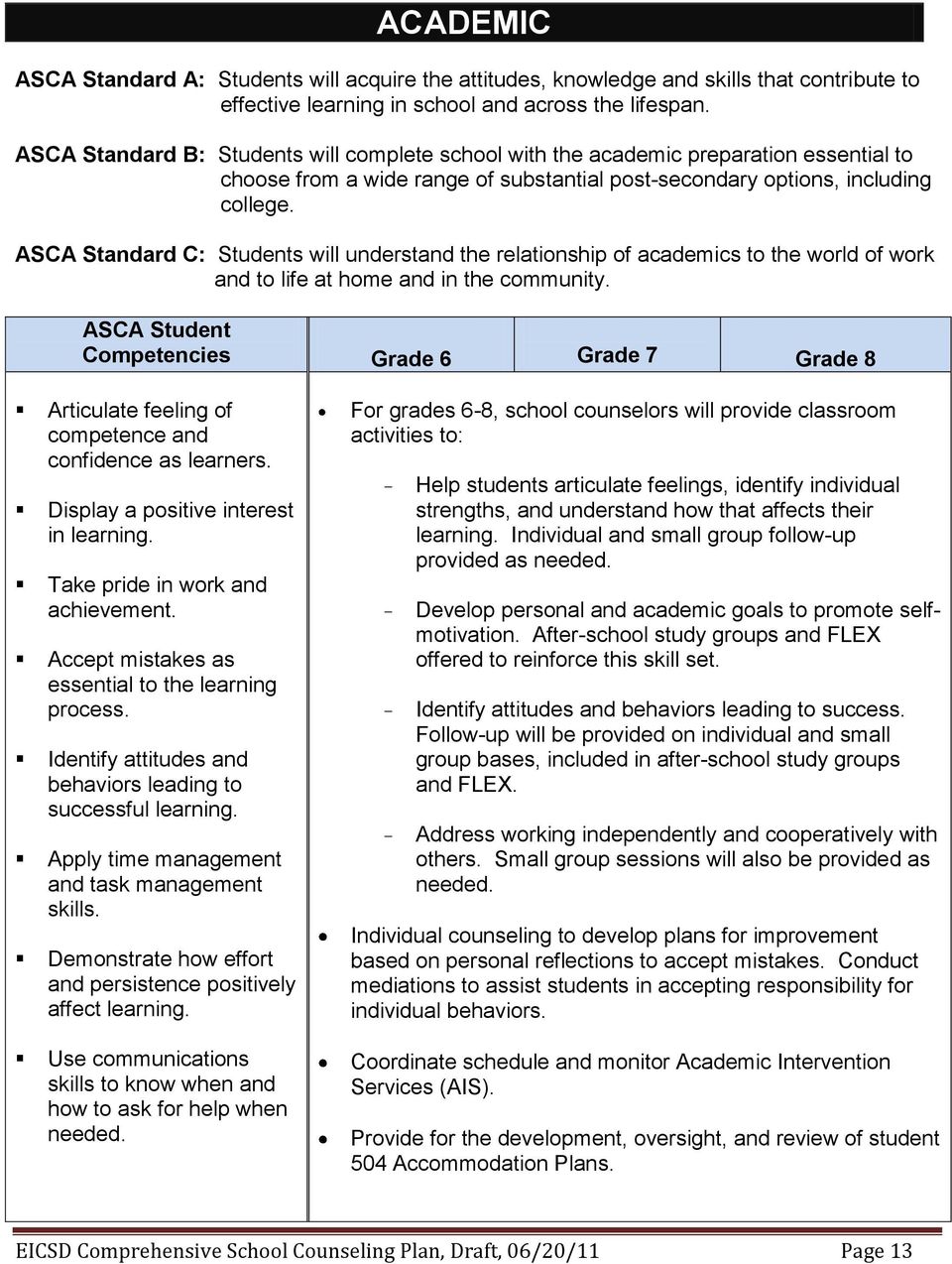
14 ACADEMIC ASCA Standard A: Students will acquire the attitudes, knowledge and skills that contribute to effective learning in school and across the lifespan. ASCA Standard B: Students will complete school with the academic preparation essential to choose from a wide range of substantial post-secondary options, including college. ASCA Standard C: Students will understand the relationship of academics to the world of work and to life at home and in the community. Competencies Grade 6 Grade 7 Grade 8 Articulate feeling of competence and confidence as learners. Display a positive interest in learning. Take pride in work and achievement. Accept mistakes as essential to the learning process. Identify attitudes and behaviors leading to successful learning. Apply time management and task management skills. Demonstrate how effort and persistence positively affect learning. Use communications skills to know when and how to ask for help when needed. For grades 6-8, school counselors will provide classroom activities to: - Help students articulate feelings, identify individual strengths, and understand how that affects their learning. Individual and small group follow-up provided as needed. - Develop personal and academic goals to promote selfmotivation. After-school study groups and FLEX offered to reinforce this skill set. - Identify attitudes and behaviors leading to success. Follow-up will be provided on individual and small group bases, included in after-school study groups and FLEX. - Address working independently and cooperatively with others. Small group sessions will also be provided as needed. Individual counseling to develop plans for improvement based on personal reflections to accept mistakes. Conduct mediations to assist students in accepting responsibility for individual behaviors. Coordinate schedule and monitor Academic Intervention Services (AIS). Provide for the development, oversight, and review of student 504 Accommodation Plans. EICSD Comprehensive School Counseling Plan, Draft, 06/20/11 Page 13
15 ACADEMIC ASCA Standards A, B, C; Cont. Competencies Grade 6 Grade 7 Grade 8 Apply knowledge and learning styles to positively influence school performance. Refine studying and organizational skills. Take responsibility for their actions. Demonstrate the ability to work independently, as well as the ability to work cooperatively with other students. Develop a broad range of interest and abilities. Demonstrate dependability, productivity and initiative. Share knowledge. Demonstrate motivation to achieve individual potential. Learn and apply critical thinking skills. Apply the study skills necessary for academic success at each level. Seek information and support from faculty, staff, family and peers. The school counseling center coordinates and oversees peer tutoring. Student mediations, individual and small group counseling. Promote and provide information regarding the School Activity Fair during lunch and associated activities offered after school. Individual counseling and peer tutoring addressing dependability, productivity, and initiative. Individual and group improvement plans focusing on motivation. Use of Cornell Notes and study skills: classroom, individual, small group and after-school support. Individual and group counseling, teaching how to seek information from others and advocacy skills. New entrant program to assess student needs and introduce supports and resources. Anti-bullying and sexual harassment classroom presentations. Tutoring and study skills to individuals and small groups (organize and apply information). School guidance classroom activity to identify individual student learning styles by administering a survey. Individual student improvement plans to become self-directed learners. Meetings with individual students to determine appropriate plans of action to enroll in accelerated classes or to be discontinued from AIS. EICSD Comprehensive School Counseling Plan, Draft, 06/20/11 Page 14

16 ACADEMIC ASCA Standards A, B, C; Cont. Competencies Grade 6 Grade 7 Grade 8 Organize and apply academic information from a variety of sources. Use knowledge of learning styles to positively influence school performance. Become a self-directed and independent learner. Establish challenging academic goals in elementary, middle/junior high and high school. Use assessment results in educational planning. Develop and implement an annual plan of study to maximize academic ability and achievement. Apply knowledge of aptitude and interests to goal setting. Use problem-solving and decision-making skills to assess progress toward educational goals. School counseling lesson on problem-solving and decisionmaking skills. Follow-up with individuals and small groups. Individual meetings with students to discuss academic eligibility, report cards, referrals affecting success in school. School counseling lesson, University Bingo Interview teachers about their college experiences. Career luncheons, i.e., guest speakers during lunch open to all grades. Individual meetings with students: Review of report cards, five-week reports, eligibility lists. Don t Be a Couch Potato Postings for community opportunities during summer vacation. Community service projects. University Bingo communication and activities regarding post-secondary education. Career Connections Bulletin Board Quarterly focus on career and related community service opportunities. School counseling activity: Using individual learning style to your academic advantage. Individual and small group follow-up supporting the development of time management skills. 7-, 6-, and 5-year plan with all students in the fall. EICSD Comprehensive School Counseling Plan, Draft, 06/20/11 Page 15

17 ACADEMIC ASCA Standards A, B, C; Cont. Competencies Grade 6 Grade 7 Grade 8 Understand the relationship between classroom performance and success in school. Identify post-secondary options consistent with interests, achievement, aptitude, and abilities. Demonstrate the ability to balance school, studies, extracurricular activities, leisure time, and family life. Seek co-curricular and community experiences to enhance the school experience. Understand the relationship between learning and work. Demonstrate an understanding of the value of lifelong learning as essential to seeking, obtaining, and maintaining life goals. Advancement Via Individual Determination (AVID) Program - Classroom activity to promote self-direction. - Costa s Questioning Skills. - Parent Nights. - College visits. - Classroom visits from high school participants. Grade 6 Grade 7 Grade 8 Second Step Curriculum. Counselor/guidance classroom activities on : - time management. - team building and cooperative learning and working skills. - identifying individual student learning styles through administration of a survey. Develop middle high school academic plans. Classroom activities regarding student skills and academic success. Classroom activity regarding How to Study for Mathematics. Introduce SUNY Viewbook that highlights their programs. 8 th to 9 th grade transition classroom and individual student academic planning and course selection for ninth grade. 8 th to 9 th Grade Transition Parent Night. Review and refine academic plan Match students to volunteer opportunities in the community. EICSD Comprehensive School Counseling Plan, Draft, 06/20/11 Page 16

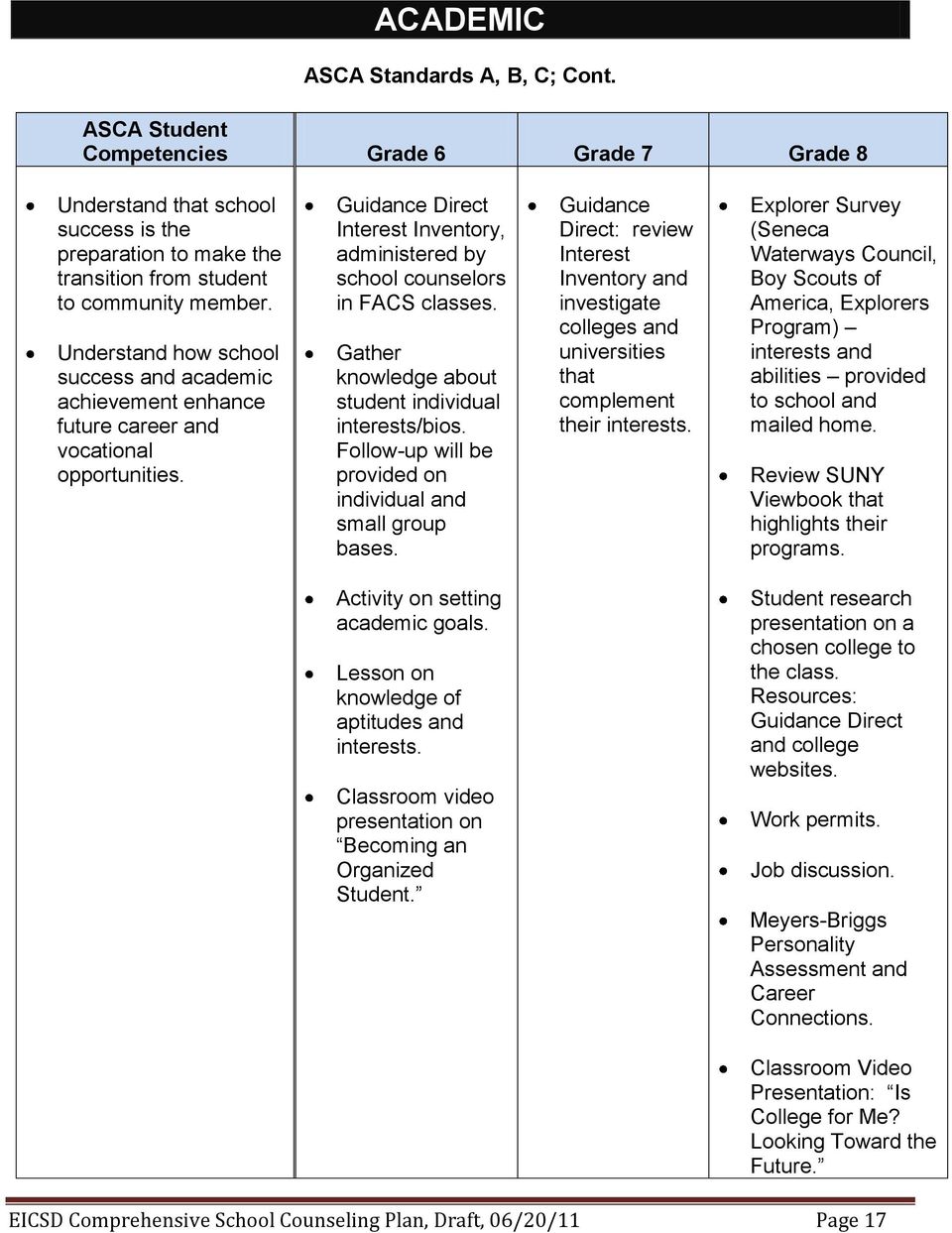
18 ACADEMIC ASCA Standards A, B, C; Cont. Competencies Grade 6 Grade 7 Grade 8 Understand that school success is the preparation to make the transition from student to community member. Understand how school success and academic achievement enhance future career and vocational opportunities. Guidance Direct Interest Inventory, administered by school counselors in FACS classes. Gather knowledge about student individual interests/bios. Follow-up will be provided on individual and small group bases. Guidance Direct: review Interest Inventory and investigate colleges and universities that complement their interests. Explorer Survey (Seneca Waterways Council, Boy Scouts of America, Explorers Program) interests and abilities provided to school and mailed home. Review SUNY Viewbook that highlights their programs. Activity on setting academic goals. Lesson on knowledge of aptitudes and interests. Classroom video presentation on Becoming an Organized Student. Student research presentation on a chosen college to the class. Resources: Guidance Direct and college websites. Work permits. Job discussion. Meyers-Briggs Personality Assessment and Career Connections. Classroom Video Presentation: Is College for Me? Looking Toward the Future. EICSD Comprehensive School Counseling Plan, Draft, 06/20/11 Page 17
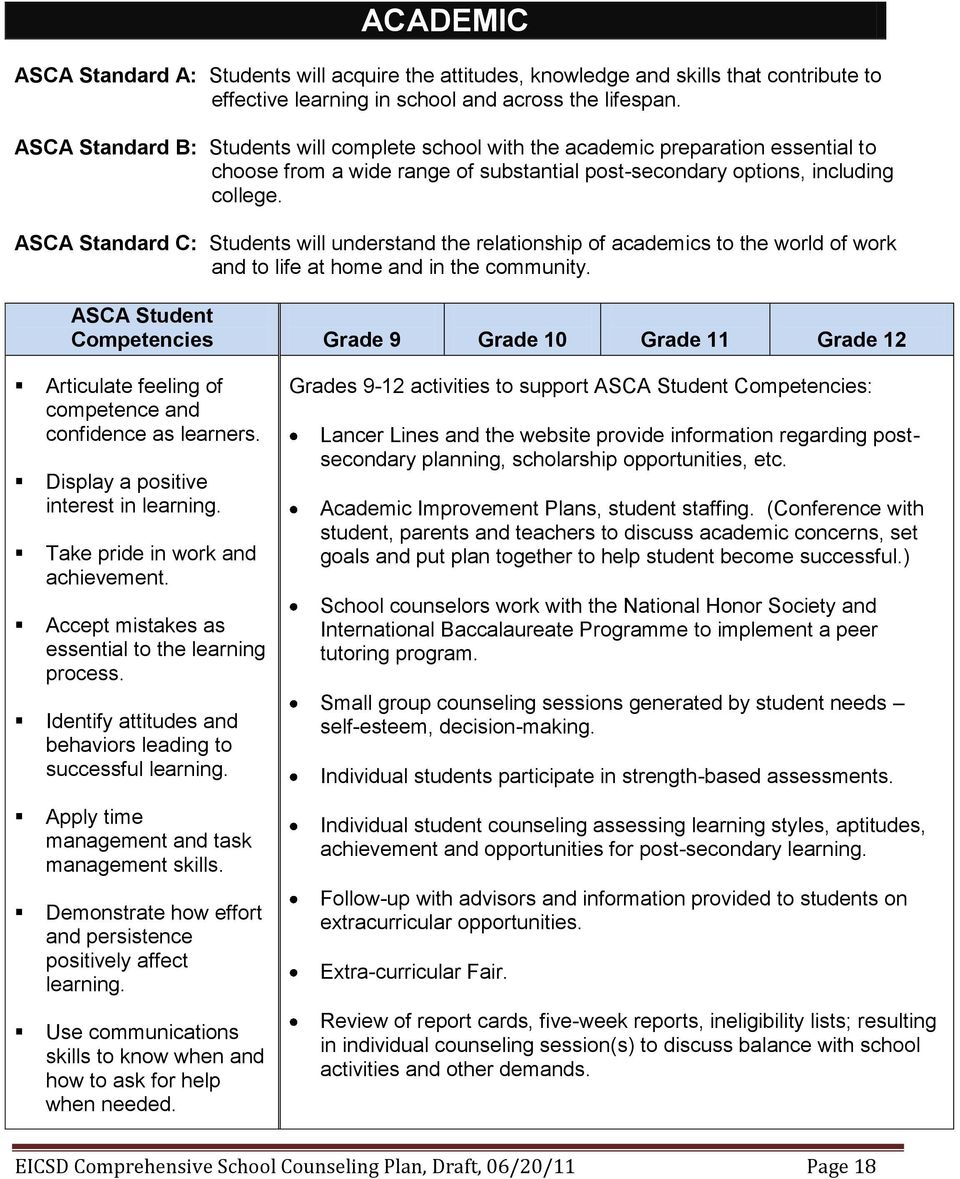
19 ACADEMIC ASCA Standard A: Students will acquire the attitudes, knowledge and skills that contribute to effective learning in school and across the lifespan. ASCA Standard B: Students will complete school with the academic preparation essential to choose from a wide range of substantial post-secondary options, including college. ASCA Standard C: Students will understand the relationship of academics to the world of work and to life at home and in the community. Competencies Grade 9 Grade 10 Grade 11 Grade 12 Articulate feeling of competence and confidence as learners. Display a positive interest in learning. Take pride in work and achievement. Accept mistakes as essential to the learning process. Identify attitudes and behaviors leading to successful learning. Apply time management and task management skills. Demonstrate how effort and persistence positively affect learning. Use communications skills to know when and how to ask for help when needed. Grades 9-12 activities to support Competencies: Lancer Lines and the website provide information regarding postsecondary planning, scholarship opportunities, etc. Academic Improvement Plans, student staffing. (Conference with student, parents and teachers to discuss academic concerns, set goals and put plan together to help student become successful.) School counselors work with the National Honor Society and International Baccalaureate Programme to implement a peer tutoring program. Small group counseling sessions generated by student needs self-esteem, decision-making. Individual students participate in strength-based assessments. Individual student counseling assessing learning styles, aptitudes, achievement and opportunities for post-secondary learning. Follow-up with advisors and information provided to students on extracurricular opportunities. Extra-curricular Fair. Review of report cards, five-week reports, ineligibility lists; resulting in individual counseling session(s) to discuss balance with school activities and other demands. EICSD Comprehensive School Counseling Plan, Draft, 06/20/11 Page 18
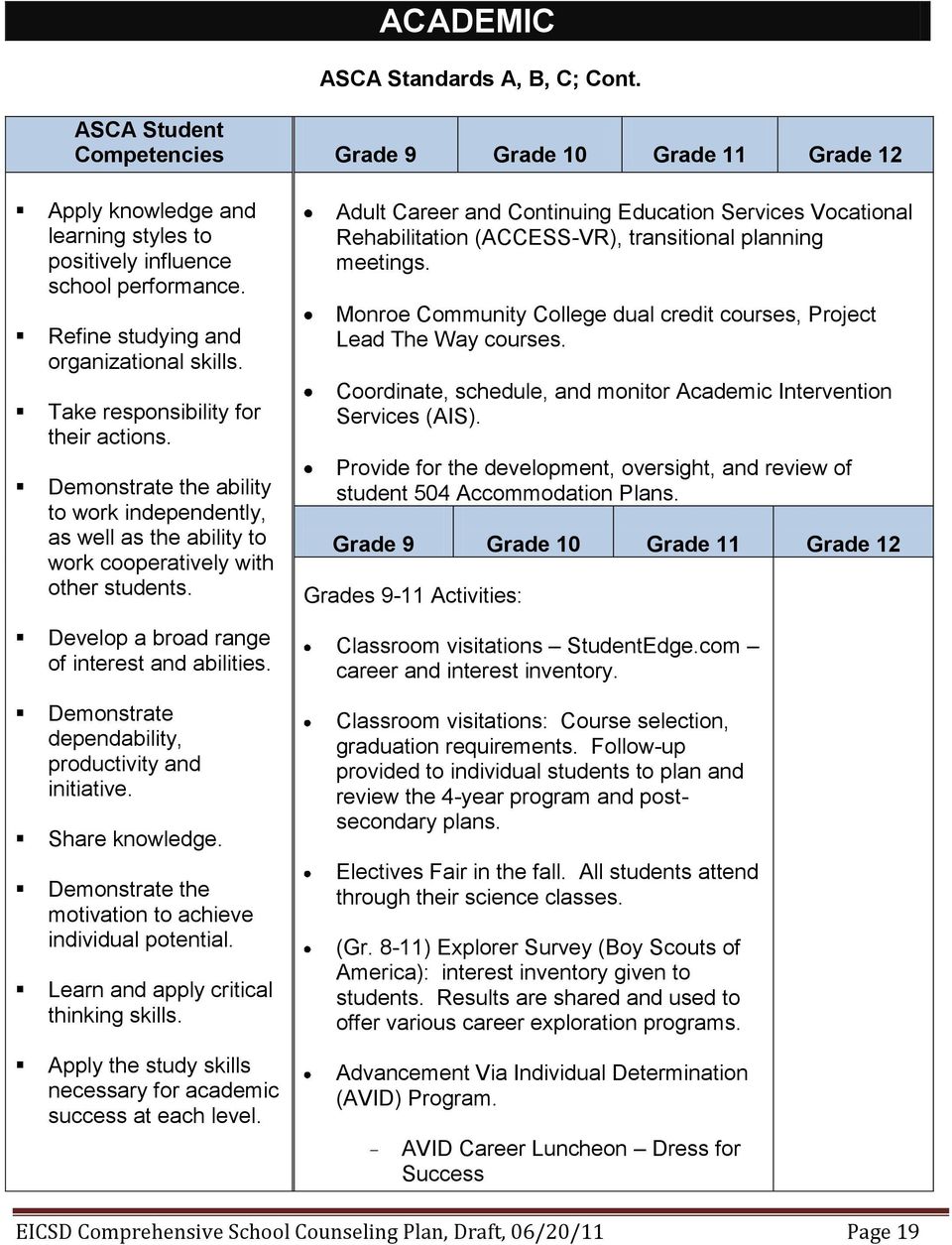
20 ACADEMIC ASCA Standards A, B, C; Cont. Competencies Grade 9 Grade 10 Grade 11 Grade 12 Apply knowledge and learning styles to positively influence school performance. Refine studying and organizational skills. Take responsibility for their actions. Demonstrate the ability to work independently, as well as the ability to work cooperatively with other students. Develop a broad range of interest and abilities. Demonstrate dependability, productivity and initiative. Share knowledge. Demonstrate the motivation to achieve individual potential. Learn and apply critical thinking skills. Apply the study skills necessary for academic success at each level. Adult Career and Continuing Education Services Vocational Rehabilitation (ACCESS-VR), transitional planning meetings. Monroe Community College dual credit courses, Project Lead The Way courses. Coordinate, schedule, and monitor Academic Intervention Services (AIS). Provide for the development, oversight, and review of student 504 Accommodation Plans. Grade 9 Grade 10 Grade 11 Grade 12 Grades 9-11 Activities: Classroom visitations StudentEdge.com career and interest inventory. Classroom visitations: Course selection, graduation requirements. Follow-up provided to individual students to plan and review the 4-year program and postsecondary plans. Electives Fair in the fall. All students attend through their science classes. (Gr. 8-11) Explorer Survey (Boy Scouts of America): interest inventory given to students. Results are shared and used to offer various career exploration programs. Advancement Via Individual Determination (AVID) Program. - AVID Career Luncheon Dress for Success EICSD Comprehensive School Counseling Plan, Draft, 06/20/11 Page 19
21 ACADEMIC ASCA Standards A, B, C; Cont. Competencies Grade 9 Grade 10 Grade 11 Grade 12 Seek information and support from faculty, staff, family and peers. Organize and apply academic information from a variety of sources. Use knowledge of learning styles to positively influence school performance. Become a self-directed and independent learner. Establish challenging academic goals in elementary, middle/junior high and high school. Use assessment results in educational planning. Develop and implement an annual plan of study to maximize academic ability and achievement. Grades Activities: College Night that includes a student alumni and college panel. Financial Aid Night. Grade 9 Grade 10 Grade 11 Grade 12 Grades 9-10 activity to support Competencies: Career Fair Grades activities: Students have the opportunity to meet with college representatives during the school year. College Fairs are offered inhouse and as field trips. Armed Services Vocational Aptitude Battery (ASVAB) test given to students in the Senior Seminar class. IB Programme (Learner Profile). Senior Seminar Course school counselors present frequently. Transitional planning with VESID for Students with Disabilities. EICSD Comprehensive School Counseling Plan, Draft, 06/20/11 Page 20
22 ACADEMIC ASCA Standards A, B, C; Cont. Competencies Grade 9 Grade 10 Grade 11 Grade 12 Apply knowledge of aptitudes and interests to goal setting. Use problemsolving and decision-making skills to assess progress toward educational goals. Demonstrate the ability to balance school, studies, extracurricular activities, leisure time, and family life. Seek co-curricular and community experiences to enhance the school experience. Understand the relationship between learning and work. Demonstrate an understanding of the value of lifelong learning as essential to seeking, obtaining, and maintaining life goals. 8 th to 9 th transition Individual student academic planning. 8 th to 9 th transition 9 th Grade Parent Night. August Freshman Orientation Meet with school counselors, teachers, and administrators and tour building. Study Skills Program through classroom visitation How to Get Good Grades: time management, organizational skills, extracurricular activities/clubs -presented during 9 th grade orientation. PLAN offered to all students: Interest Inventory and Pre-American College Testing (ACT). Eastern Monroe Career Center (EMCC) visit and application process available. Career Fair. Classroom visitations, StudentEdge. com: Career and interest survey. Pre- Scholastic Aptitude Test (PSAT) offered to all students: Follow-up meeting with small groups to guide interpretation of results. College search and application process presented in classrooms, review college manual, scholarship application process. Internship and co-op opportunities. Scholastic Aptitude Test (SAT)/ACT. Individual parent/ senior meetings. Senior jeopardy meeting as needed, starting at the beginning of the school year. Senior newsletter distributed monthly, presented during English class. Individual advisement, college application process. Internship and co-op opportunities. SAT/ACT. EICSD Comprehensive School Counseling Plan, Draft, 06/20/11 Page 21
23 ACADEMIC ASCA Standards A, B, C; Cont. Competencies Grade 9 Grade 10 Grade 11 Grade 12 Understand that school success is the preparation to make the transition from student to community member. Career Fair. Understand how school success and academic achievement enhance future career and vocational opportunities. Understand the relationship between classroom performance and success in school. Identify post-secondary options consistent with interests, achievement, aptitude, and abilities. EICSD Comprehensive School Counseling Plan, Draft, 06/20/11 Page 22
24 CAREER ASCA Standard A: Students will acquire the skills to investigate the world of work in relation to knowledge of self and to make informed career decisions. Competencies Grade 3 Grade 4 Grade 5 Learn about the variety of traditional and nontraditional occupations. Develop an awareness of personal abilities, skills, interests and motivations. Learn how to interact and work cooperatively in teams. Learn to make decisions. Learn how to set goals. Understand the importance of planning. Pursue and develop competency in areas of interest. Learn to create a balance between work and leisure time. Develop hobbies and vocational interests. Grades 3-5 activities to support Competencies: Awareness of personal abilities, skills, interests and motivations is introduced through self-esteem and goalsetting lessons. Conflict management lessons develop an understanding of assertive, aggressive, and avoidance behaviors and the different outcomes of each behavior cycle. Through the use of classroom lessons and small group counseling, students are introduced to communication skills (i.e., listening, understanding body language, etc.), conflict resolution and compromise. A specific classroom decision-making skills lesson will focus on examining options and considering possible outcomes. Specific goal setting lessons help students to begin to understand the past, present, and future and the concept of a goal. Students are taught the difference between shortterm and long-term goals and the importance of setting short-term goals that lead to the achievement of long-term goals. The concept of balance is introduced through students PYP Learner Profile words. Individual/group counseling, as well as classroom lessons are designed to address teamwork, problem-solving and organizational skills. Self-esteem lessons address the importance of respecting differences and understanding that we are all unique. Through individual/small group counseling and self-esteem lessons, students develop an awareness of a connection between their actions and their feelings. EICSD Comprehensive School Counseling Plan, Draft, 06/20/11 Page 23
25 CAREER ASCA Standard A, cont.: Competencies Grade 3 Grade 4 Grade 5 Acquire employability skills such as working on a team, problemsolving and organizational skills. Learn to respect individual uniqueness in the workplace. Develop a positive attitude toward work and learning. Understand the importance of responsibility, dependability, punctuality, integrity and effort in the workplace. Utilize time and task management skills. Develop skills to locate, evaluate, and interpret career information. Students learn that school is their workplace. The skills of responsibility, etc. are reinforced through individual and small group counseling, particularly for students who struggle in these areas. Students learn the difference between a wish and a goal and that achieving goals takes effort and planning. Specific classroom lessons address testtaking and timemanagement skills. During the timeline activity and goal-setting lesson, students are introduced to the concept of future employment interests. Learn about the variety of traditional and nontraditional occupations. EICSD Comprehensive School Counseling Plan, Draft, 06/20/11 Page 24
26 CAREER ASCA Standard B: Students will employ strategies to achieve future career goals with success and satisfaction. Competencies Grade 3 Grade 4 Grade 5 Identify personal skills, interests and abilities, and relate them to current career choice. Know the various ways which occupations can be classified. Demonstrate awareness of the education and training needed to achieve career goals. Awareness of the importance of education to long-term goal setting is introduced through classroom lessons. When students identify employment interests through the goal setting and timeline activity, a classroom discussion ensues on the skills and training needed for particular careers. The PYP Learner Profile word of balance is connected to the discussion. Career clusters information for students is provided during the goal-setting and timeline activity. EICSD Comprehensive School Counseling Plan, Draft, 06/20/11 Page 25
27 CAREER ASCA Standard C: Students will understand the relationship between personal qualities, education, training and the world of work. Competencies Grade 3 Grade 4 Grade 5 Develop understanding about how work can help one achieve personal success and satisfaction. Identify personal preferences and interests which influence career choices and success. Demonstrate how interests, abilities and achievement relate to achieving personal, social, educational, and career goals. Develop conflictmanagement skills with peers and adults. Through classroom lessons and individual and small group counseling, the relationship between accomplishing goals and positive self-esteem is introduced. Self-esteem lessons in the classroom provide opportunities for students to explore self-knowledge. This concept will be introduced through a goal-setting lesson within the classroom. Students develop conflict management skills, which are reinforced in school-wide lessons, as well as in individual and small group counseling. Students learn communication skills and cooperation through school-wide lessons, as well as small group and individual counseling lessons. Discussion occurs during the goal setting lessons regarding the steps and education necessary to achieve career goals and success. Also may be addressed in individual counseling as needed. Learn to work cooperatively with others as a team member. Understand the relationship between educational achievement and career success. EICSD Comprehensive School Counseling Plan, Draft, 06/20/11 Page 26
28 CAREER ASCA Standard A: Students will acquire the skills to investigate the world of work in relation to knowledge of self and to make informed career decisions. ASCA Standard B: Students will employ strategies to achieve future career goals with success and satisfaction. ASCA Standard C: Students will understand the relationship between personal qualities, education, training and the world of work. Competencies Grade 6 Grade 7 Grade 8 Learn about the variety of traditional and nontraditional occupations. Develop an awareness of personal abilities, skills, interests and motivations. Learn how to interact and work cooperatively in teams. Learn how to set goals. Develop hobbies and vocations of interest. Acquire employability skills such as working on a team, problem-solving and organizational skills. Learn to respect individual uniqueness in the workplace. Develop a positive attitude toward work and learning. Grades 6-8 activities to support Competencies: Counselors provide classroom, individual or small group activities to explore traditional and non-traditional occupations available in the workforce, personal interest inventories and career paths, goal setting, and time management. Counselors provide team building exercises during student orientations as well as in classroom activity and small groups. Don t Be a Couch Potato Postings for community opportunities during summer vacation. Career speaker lunches. Community service projects. University Bingo School-wide activity regarding postsecondary education. Career Connections Bulletin Board Quarterly focus on career and related community service opportunities. New student registration meetings to promote extra-curricular activities and opportunities. Job discussions through classroom presentations and activities EICSD Comprehensive School Counseling Plan, Draft, 06/20/11 Page 27
29 CAREER ASCA Standards A, B, C; Cont. Competencies Grade 6 Grade 7 Grade 8 Understand the importance of responsibility, dependability, punctuality, integrity and effort in the workplace. Utilize time and task management skills. Develop skills to locate, evaluate and interpret career information. Develop an awareness of personal abilities, skills, interests and motivation. Understand the importance of planning. Pursue and develop competency in areas of interest. Apply job readiness skills to seek employment opportunities. Apply decision-making skills to career planning, course selection and career transition. Describe traditional and non-traditional career choices and how they relate to career choice. AVID college visits. AVID college tutor talks. Individually match students to volunteer opportunities in the community based on student requests. Counselors use Guidance Direct Interest Inventory survey (on-line) with students to assess possible career and college paths, to assist and direct students to understanding the financial and academic responsibilities of a college education, and to conduct preliminary search for grant/scholarship information. 7-, 6-, 5-Year Plans to promote long-term educational pathways to support academic and career goals. Connect the Dots classroom video presentation on how school skills become work skills. Grade 6 Grade 7 Grade 8 Guidance Direct Interest Inventory and career lessons provided by counselors during FACS classes. Counselors provide classroom and small group activities to promote team building and cooperative learning. Classroom activity to introduce SUNY Viewbook that highlights programs within the SUNY system. Guidance Direct classroom activity: Review Interest Inventory and investigate colleges and universities that complement their interests. Review SUNY Viewbook that highlights programs within the SUNY system. Student research presentations on chosen colleges to the class. Resources: Guidance Direct and college websites. EICSD Comprehensive School Counseling Plan, Draft, 06/20/11 Page 28
30 CAREER ASCA Standards A, B, C; Cont. Competencies Grade 6 Grade 7 Grade 8 Identify personal skills, interest and abilities and relate them to current career choice. Demonstrate knowledge of the career planning process. Know the various ways in which occupations can be classified. Use research and information resources to obtain career information. Learn to search the Internet to access career planning information. Understand how changing economic and societal need influence employment trends and future training. Demonstrate awareness of the education and training needed to achieve career goals. Assess and modify their educational plan to support career. Select course work that is related to career interests. Sixth Grade Orientation presentation to promote extracurricular activities and opportunities. Administer Explorers Survey: Career inventory given to students in class. Results are shared and used to offer various career exploration programs. Assist in completing individual work permits. Administer the revised version of the Meyers- Briggs during classroom presentations. Results are shared individually and within small groups. Students receive results and the high school receives information in the 8-go-9 transition folder. EICSD Comprehensive School Counseling Plan, Draft, 06/20/11 Page 29
31 CAREER ASCA Standards A, B, C; Cont. Competencies Grade 6 Grade 7 Grade 8 Maintain a career planning portfolio Demonstrate how interests, abilities and achievement relate to achieving personal, social, educational, and career goals. Understand the relationship between educational achievement and career success. Explain how work can help to achieve personal success and satisfaction. Identify personal preferences and interests influencing career choice and success. Understand that the changing workplace requires lifelong learning and acquiring new skills. Grade 8-go-9 scheduling meeting to select elective courses and begin the high school 4- year plan process. Counselors work in collaboration with the technology department to offer information about Career Path in the engineering field, with a particular focus on Women in Engineering. Classroom video presentation: Is College for Me? Looking Toward the Future. Describe the effect of work on lifestyle. Understand the importance of equity and access in career choice. Understand that work is an important and satisfying means of personal expression. EICSD Comprehensive School Counseling Plan, Draft, 06/20/11 Page 30
32 CAREER ASCA Standard A: Students will acquire the skills to investigate the world of work in relation to knowledge of self and to make informed career decisions. ASCA Standard B: Students will employ strategies to achieve future career goals with success and satisfaction. ASCA Standard C: Students will understand the relationship between personal qualities, education, training and the world of work. Competencies Grade 9 Grade 10 Grade 11 Grade 12 Develop skills to locate, evaluate and interpret career information. Learn about the variety of traditional and nontraditional occupations. Develop an awareness of personal abilities, skills, interests and motivations. Learn how to set goals. Pursue and develop competency in areas of interest. Develop hobbies and vocational interests. Balance between work and leisure time. Acquire employability skills such as working on a team, problem-solving and organizational skills. Apply job readiness skills to seek employment opportunities. Grades 9-12 activities to support ASCA standards: Staffings as needed. Lancer Lines: Monthly publication developed by counseling center. It includes college visit information, scholarships, and any important upcoming information and/or events. Counseling Center website: Important dates, events listed, along with detailed information regarding programs, college search, etc. College/Financial Aid Night: Presentation regarding the college search and application process. College representatives share programs and college entrance requirements. Student alumni discuss experiences of college. Also financial aid expert discusses the ins and outs of the financial aid process. Individual advisement with students and parents as needed. Open House presentation: PowerPoint presentation shared with parents regarding post-graduate planning. Grade 9 Grade 10 Grade 11 Grade 12 Grades 9-11 activities: Explorers Survey: Career inventory given to students in class. Results are shared and used to offer various career exploration programs. EICSD Comprehensive School Counseling Plan, Draft, 06/20/11 Page 31
33 CAREER ASCA Standards A, B, C; Cont. Competencies Grade 9 Grade 10 Grade 11 Grade 12 Learn to respect individual uniqueness in the workplace. Learn how to write a resume. Understand the importance of responsibility, dependability, punctuality, integrity and effort in the workplace. Apply decision-making skills to career planning, course selection and career transition. Identify personal skills, interests and abilities, and relate them to current career choice. Classroom scheduling: In-class presentation regarding graduation requirements, course offerings and HS program opportunities. Individual meetings for scheduling and four-year planning: Discuss course offerings, student individual post-graduation plans and options, and how to achieve these goals. Electives Fair: Departments showcase course offerings to all students. AVID Meeting with student, parent and administrator for students in jeopardy of failing a class that may preclude graduation. Grade 9 Grade 10 Grade 11 Grade 12 Grades 9-10 activities: Grades activities: Career Day: Community representatives present information to all students. Internships and Co-ops: Interested students are set up with an outside internship placement. For Co-op, students with a job earn credit and additional work-place skills are developed in the classroom. EICSD Comprehensive School Counseling Plan, Draft, 06/20/11 Page 32
34 CAREER ASCA Standards A, B, C; Cont. Competencies Grade 9 Grade 10 Grade 11 Grade 12 Demonstrate knowledge of the career-planning process. Know the various ways in which occupations can be classified. Use research and information resources to obtain career information. Learn to use the Internet to access career planning information. College Fairs: Oncampus and off-site opportunities from Rochester Area Colleges (RAC), National College Convention, Western New York College Fair. Individual students sign up to meet with college representatives at Eastridge SAT/ACT: College entrance test. Grade 9 Grade 10 Grade 11 Grade 12 Describe traditional and non-traditional career choices and how they relate to career choice. Understand how changing economic and societal needs influence employment trends and future training. Demonstrate awareness of the education and training needed to achieve career goals. Introduction to StudentEdge. com: In-class presentation, students take career inventory and research careers based on results. Continued work on StudentEdge. com: Career inventory and research in the classroom. PLAN, Pre- ACT with career research and small group interpretation. Senior Seminar I: Elective course offering assisting students with postgraduation planning. Senior Seminar II: Elective course offering that prepares students for life on a college campus. EICSD Comprehensive School Counseling Plan, Draft, 06/20/11 Page 33
35 CAREER ASCA Standards A, B, C; Cont. Competencies Grade 9 Grade 10 Grade 11 Grade 12 Assess and modify their educational plan to support career. Use employability and job readiness skills in internship, mentoring, shadowing and/or other world of work experiences. Select course work that is related to career interests. Maintain a career portfolio. Understand the relationship between educational achievement and career success. Explain how work can help to achieve personal success and satisfaction. Identify personal preferences and interests influencing career choice and success. Describe the effect of work on lifestyle. Understand that work is an important and satisfying means of personal expression. College Resource manual: Stepby-step guide through the college search and application process. College search and application process in the classroom: College research with students to help them select schools and guide them through the process. Individual senior meetings: Meeting with student and parent to ensure student is on track with postgraduate plans. Meeting with student, parent, and administrator for student in jeopardy of failing a class that may preclude them from graduating. EICSD Comprehensive School Counseling Plan, Draft, 06/20/11 Page 34
36 CAREER ASCA Standards A, B, C; Cont. Competencies Grade 9 Grade 10 Grade 11 Grade 12 Demonstrate how interests, abilities and achievement relate to achieving personal, social, educational, and career goals. Apply academic and employment readiness skills in work-based learning situations such as internships, shadowing and/or mentoring experiences. Classroom presentation, How to Get Good Grades : Inclass presentation regarding time management, organization and strategies for success. Freshman orientation: Counselor presentation to support the transition to the HS. Activities Fair: All students attend to learn about the extracurricular clubs and activities available. PSAT with small group interpretation: Pre-college entrance test to prepare students for test required for college entrance. ASVAB administered during senior seminar along with other interested students: Extensive career aptitude test. Offered through the military with detailed interpretation. EICSD Comprehensive School Counseling Plan, Draft, 06/20/11 Page 35
37 PERSONAL/SOCIAL ASCA Standard A: Students will acquire the knowledge, attitudes, and interpersonal skills to help them understand and respect self and others. Competencies Grade 3 Grade 4 Grade 5 Recognize, accept, and appreciate ethnic and cultural diversity. Develop positive attitudes toward self as a unique and worthy person. Identify values, attitudes and beliefs. Learn the goal setting process. Identify and express feelings. Distinguish between appropriate and inappropriate behaviors. Recognize personal boundaries, rights and privacy needs. Understand the need for self-control and how to practice it. Demonstrate cooperative behavior in groups. Identify personal strengths and assets. Identify and discuss changing personal and social roles. Grades 3-5 activities that support Competencies: During classroom lessons, counselors reinforce the learner profile words of being open minded and caring. Through classroom lessons, as well as individual and small group counseling, counselors help students develop positive self-esteem. Through classroom lessons, conflict resolution introduces the concept of student values as well as acknowledging the attitudes and beliefs of others. Specific goal setting lessons are taught in the classrooms and reinforced in individual and small group counseling sessions. Through classroom instruction, communications skills/assertiveness lessons teach children to recognize their feelings and appropriately express them. Through anti-bullying classroom lessons counselors teach children how their behaviors and their words affect others. Through individual and small group counseling sessions, students are taught boundaries, cause and effect, respecting others and themselves. Through individual and small group counseling, students are taught the importance of self-control. Conflict resolution lessons teach the positive outcomes of using self-control. Small group counseling sessions encourage cooperation and respect for others. Self-esteem lessons and role play teach the importance of being cooperative with one another. Through classroom self-esteem lessons, individual and small group counseling, students are encouraged to identify their personal strengths and assets. EICSD Comprehensive School Counseling Plan, Draft, 06/20/11 Page 36
38 PERSONAL/SOCIAL ASCA Standard A, Cont. Competencies Grade 3 Grade 4 Grade 5 Recognize that everyone has rights and responsibilities. Respect alternative points of view. Recognize, accept, respect and appreciate individual differences. Recognize, accept, and appreciate ethnic and cultural diversity. Recognize and respect differences in various family configurations. Use effective communication skills. Learn how to make and keep friends. Understand change is a part of growth. Recognize personal boundaries, rights and privacy needs. Identify and discuss changing personal and social roles. Recognize, accept, respect and appreciate individual differences. Family change groups are provided for students who are experiencing difficulty coping with changes in their personal lives. Anti-bullying classroom lesson teaches that students have a right to come to school and feel safe. The lesson also recognizes the responsibility of each person to seek help if they are aware that a student is being bullied. Conflict resolution classroom lessons are taught. Small group counseling mediation provides an opportunity for students to learn about different points of view. Conflict resolution classroom lessons recognize different points of view and how to compromise. Accepting and appreciating diversity is addressed as needed through individual and small group counseling/mediation. Individual and small group family change sessions are provided for children experiencing difficulty coping with changes in their personal lives. Classroom communication skills lessons teach acceptable ways to communicate with others. This is also addressed in individual and small group counseling sessions. Small group friendship/social skills sessions are provided to help children make and keep friends. The meanings of Learner Profile words are reinforced in classroom lessons when they apply to specific competencies. Trauma, Illness and Grief (TIG) counseling. Counselors participate in and/or facilitate parent-teacher conferences. EICSD Comprehensive School Counseling Plan, Draft, 06/20/11 Page 37
39 PERSONAL/SOCIAL ASCA Standard A, Cont.: Competencies Grade 3 Grade 4 Grade 5 Know that communication involves speaking, listening and nonverbal behavior. Counselors collaborate with on-site resources, such as school social workers, psychologists and other educational service providers. Counselors collaborate with outside resources including, but not limited to CPS, community medical and mental health providers, community cupboards and other community resources. Grade 3 Grade 4 Grade 5 Classroom communication skills lessons teach how people communicate in many different ways. Students learn about body language, gestures and facial expressions as means of communication. Classroom self-esteem lessons cover what it means to be unique. Differences and similarities are introduced. Classroom communication skills lessons explore all the ways in which people communicate with others and the importance of this in their lives. Transition lesson explores the changes and challenges students face during the transition from intermediate to middle school. The transition to middle school classroom lesson explores changing friendships, responsibilities and interests. EICSD Comprehensive School Counseling Plan, Draft, 06/20/11 Page 38
40 PERSONAL/SOCIAL ASCA Standard B: Students will make decisions, set goals and take necessary action to achieve goals. Competencies Grade 3 Grade 4 Grade 5 Use a decision-making and problem-solving model. Develop effective coping skills for dealing with problems. Demonstrate when, where and how to seek help for solving problems and making decisions. Know how to apply conflict resolution skills. Demonstrate a respect and appreciation for individual and cultural differences. Identify alternative ways of achieving goals. Develop an action plan to set and achieve realistic goals. Know when peer pressure is influencing a decision. The decision-making and problem-solving model is taught to all students. Individual and small group counseling is provided for children who are having difficulty coping socially, emotionally and academically. How and when to seek help is taught through our bullying lessons and peer pressure lessons. Many of our children seek assistance from us to help them deal with family and school issues. Conflict resolution lessons emphasize that using problem-solving and compromise during an argument or disagreement can have the most positive outcome. When students need help demonstrating this respect, counseling and mediation is provided. Through goal setting lessons, students learn to evaluate progress and that the process needs to be restarted if the goal isn t achieved. Students begin to explore realistic goals and understand that a plan must be formulated to achieve them. The connection of Learner Profile words to all lessons helps students understand and respect differences. Grade 3 Grade 4 Grade 5 Grades 4-5 Activities: Classroom discussions about peer pressure, how it happens and how challenging it can be to deal with are indicators of students knowledge. EICSD Comprehensive School Counseling Plan, Draft, 06/20/11 Page 39
41 PERSONAL/SOCIAL ASCA Standard B, Cont. Competencies Grade 3 Grade 4 Grade 5 Understand consequences of decisions and choices. Identify long- and short-term goals. Use persistence and perseverance in acquiring knowledge and skills. Identify alternative solutions to a problem through classroom lessons. Goal setting is connected to the PYP action cycle (choose, act, reflect) to encourage and reinforce persistence for achieving goals. PYP Learner Profile words, such as risk-taker and thinker are connected to these lessons. There is a specific longand short-term goals lesson for fifth grade, which includes goal sheets. EICSD Comprehensive School Counseling Plan, Draft, 06/20/11 Page 40
42 PERSONAL/SOCIAL ASCA Standard C: Students will understand safety and survival skills. Competencies Grade 3 Grade 4 Grade 5 Learn about the relationship between rules, laws, safety and the protection of rights of the individual. Learn the difference between appropriate and inappropriate physical contact. Differentiate between situations requiring peer support and situations requiring adult professional help. Identify resource people in the school and community, and know how to seek help. Apply effective problemsolving and decisionmaking skills to make safe and healthy choices. Learn about the emotional and physical dangers of substance use and abuse. Learn how to cope with peer pressure. Learn techniques for managing stress and conflict. Grades 3-5 activities that support ASCD Competencies: School-wide behavior plans are in effect, with behaviors addressed as needed throughout the school day. Anti-bullying lessons are taught in each classroom. School-wide expectations for physical contact are articulated. Counseling mediation or individual sessions are provided as needed. Problem-solving and anti-bullying lessons provide guidance about when to seek adult help. Anti-bullying lessons as well as peer pressure lessons help children identify the people to whom they could go for help with a problem. Through individual and small group counseling, students are taught decision-making skills and how to make healthy choices. The intermediate schools participate in Red Ribbon Week. At Laurelton Pardee, students participate in an additional lesson about the effects of smoking on the body. Decision-making lessons address positive and negative outcomes. Conflict resolution techniques are taught to help students manage conflict. A stress management lesson is taught. Individual and small group counseling is provided to help students learn to cope with family changes, friendships, loss and grief, moving, etc. Counselors assist in developing behavior plans and work with students individually or in small groups to address specific skills, i.e., personal space, etc. EICSD Comprehensive School Counseling Plan, Draft, 06/20/11 Page 41
43 PERSONAL/SOCIAL ASCA Standard C, Cont. Competencies Grade 3 Grade 4 Grade 5 Learn coping skills for managing life events. Demonstrate knowledge of personal information, (i.e., telephone number, home address, emergency contact). Demonstrate the ability to set boundaries, rights and personal privacy. Learn how to cope with peer pressure. Differentiate between situations requiring peer support and situations requiring adult professional help. When teaching life skills lessons and having students identify sources of support, the importance of knowing personal information is reinforced. Peer pressure lesson teaches students the meaning of peer pressure and to whom they should go for help if they are being pressured to do something that is unsafe or that goes against their personal beliefs. EICSD Comprehensive School Counseling Plan, Draft, 06/20/11 Page 42
44 PERSONAL/SOCIAL ASCA Standard A: Students will acquire the knowledge, attitudes, and interpersonal skills to help them understand and respect self and others. ASCA Standard B: Students will make decisions, set goals and take necessary action to achieve goals. ASCA Standard C: Students will understand safety and survival skills. Competencies Grade 6 Grade 7 Grade 8 Identify personal strengths and assets. Recognize that everyone has rights and responsibilities. Respect alternative points of view. Recognize, accept, respect, and appreciate individual differences. Recognize, accept, and appreciate ethnic and cultural diversity. Recognize and respect differences in various family configurations. Distinguish between appropriate and inappropriate behaviors. Learn the goal setting process. Grades 6-8 activities to support ASCA Competencies: Counselors provide classroom, individual or small group activities regarding - exploring individual rights and responsibilities of students, acceptance of others and the appreciation of diversity, - the presentation of goal setting strategies: long- and short-term, accomplishments, personal and social emotional growth, - the development of student behaviors incorporating the three R s: respect, responsibility and resiliency. - anti-bullying and sexual harassment education and prevention, - personal space, - appropriate displays of affection, - healthy relationships, - self-advocacy, - sexual and physical abuse, - the development of problem-solving skills and seeking help, - appropriate behavior toward peers and adults, - safe and healthy lifestyle choices, - and stress management. The Counseling Center Bulletin Board: Focuses on addressing social, personal and cultural diversity, wellness and service to others. Individual counseling. EICSD Comprehensive School Counseling Plan, Draft, 06/20/11 Page 43
45 PERSONAL/SOCIAL ASCA Standards A, B, C; Cont.: Competencies Grade 6 Grade 7 Grade 8 Understand change as a part of growth. Identify long- and short-term goals. Identify alternative ways of achieving goals. Use persistence and perseverance in acquiring knowledge and skills. Understand consequences of decisions and choices. Identify alternative solutions to a problem. Develop effective coping skills for dealing with problems. Demonstrate a respect and appreciation for individual and cultural differences. Know when peer pressure is influencing a decision. Develop an action plan to set and achieve realistic goals. Use a decision-making and problem-solving model. Learn coping skills for managing life events. Group counseling. Trauma, Illness and Grief (TIG) counseling. Counselors participate in and/or facilitate parent-teacher conferences. Counselors collaborate with on-site resources, such as school social workers, psychologists and other educational service providers. Counselors collaborate with outside resources including, but not limited to Child Protective Services (CPS), Family Access Connection Team (FACT), Persons in Need of Supervision (PINS), community medical and mental health providers, community cupboards and other public resources. Counselors facilitate the New Student Registration and Orientation Program to address rights, responsibilities, social awareness and acceptance, in addition to the school code of conduct guidelines for all students and parents. Where Everyone Belongs (WEB) Program is a transition program designed to help students acclimate to their new school environments through connections with upperclassmen/faculty and team building opportunities. This program focuses on student leadership, skill building, community, citizenship, and academic support. Conflict resolution and crisis intervention that promotes alternative solutions to conflict or problems, coping skills, and respect for others and our school. Counselors work with grade level groups to promote positive interactions and relationships between students. De-escalation strategies with students and staff. Mediation of conflicts: peer-to-peer and student-to-adult. EICSD Comprehensive School Counseling Plan, Draft, 06/20/11 Page 44
46 PERSONAL/SOCIAL ASCA Standard A, B, C; Cont.: Competencies Grade 6 Grade 7 Grade 8 Learn about the relationship between rules, laws, safety and the protection of rights of the individual. Learn about the differences between appropriate and inappropriate physical contact. Demonstrate the ability to set boundaries, rights and personal privacy. Differentiate between situations requiring peer support and situations requiring adult professional help. Identify resource people in the school and community and know how to seek their help. Apply effective problemsolving and decision-making skills to make safe and healthy choices. Learn about the emotional and physical dangers of substance use and abuse. Counseling center website directs students and parents to resources in school and in our community, as well as other topics of interest. Counselors work with the health education teachers to support classroom curriculum through individual and small group work with students. Hope Survey administered in the fall and in the spring. Grade 6 Grade 7 Grade 8 Grade 6 orientation at the middle school as well as fifth grade visits in the spring to acclimate the students to the middle school as well as to the school s mission statement and code of conduct. Second Step Program. WEB mentoring and transition program Classroom video presentations: Bad Friendships More Harm Than Good and Making Good Decisions. Two- day WEB training for orientation leaders (To be implemented summer of 2011). EICSD Comprehensive School Counseling Plan, Draft, 06/20/11 Page 45
47 PERSONAL/SOCIAL ASCA Standard A: Students will acquire the knowledge, attitudes, and interpersonal skills to help them understand and respect self and others. ASCA Standard B: Students will make decisions, set goals and take necessary action to achieve goals. ASCA Standard C: Students will understand safety and survival skills. Competencies Grade 9 Grade 10 Grade 11 Grade 12 Develop positive attitudes toward self as a unique and worthy person. Identify values, attitudes and beliefs. Identify personal strengths and assets. Learn the goal setting process. Understand change as a part of growth. Recognize that everyone has rights and responsibilities. Respect alternative points of view. Recognize, accept, respect and appreciate individual differences. Recognize, accept, respect, and appreciate cultural diversity. Recognize and respect differences in various family configurations. Grades 9-12 activities to support ASCA Standards: Individual counseling. Counseling support groups: Small groups convened based on student concern - grief, self-esteem, behavioral issues, etc. Conflict resolution: Mediation and problem solving between students. Crisis intervention: Work individually and in groups, based on student need. Counseling Center Website: Important information and events posted along with detailed information regarding career and college planning. Lancer Lines: Monthly publication, including important events and information. Explorers Survey and Program: Career survey given to students that is linked to career exploration programs in the community. Community collaboration, (FACT, CPS, Mental health services, etc.): Counselors work closely with outside support agencies. Utilize the principles in the TIG manual to address these situations as they arise. EICSD Comprehensive School Counseling Plan, Draft, 06/20/11 Page 46
48 PERSONAL/SOCIAL ASCA Standard A, B, C; Cont.: Competencies Grade 9 Grade 10 Grade 11 Grade 12 Use effective communication skills. Know that communication involves speaking, listening, and non-verbal behavior. Demonstrate the ability to assess boundaries, rights, and personal privacy. Differentiate between situations requiring peer support and situations requiring adult professional help. Identify resource people in the school and community, and know how to seek their help. Learn how to cope with peer pressure. Learn techniques for managing stress and conflict. Learn coping skills for managing life events. Learn the difference between appropriate and inappropriate physical contact. Understand consequences of decisions and choices. LINK is a transition program designed to help students acclimate to their new school environments through connections with upperclassmen/faculty and team building opportunities. This program focuses on student leadership, skill building, community, citizenship, and academic support. Grade 9 Grade 10 Grade 11 Grade 12 Grades 9-11 activities to support ASCA Standards: Classroom presentation on scheduling: Classroom presentation on graduation requirements, course offerings. Students begin to select courses for the following school year. Individual meetings for scheduling, including 4-year planning. Students meet with counselors to update 4-year plan, choose courses based on future career/college goals. Grade 9 Grade 10 Grade 11 Grade 12 Grades 9-10 activities: Career Day: Career Fair students attend to learn about numerous career opportunities. StudentEdge.com: Inclass presentation introducing students to career and college search process. EICSD Comprehensive School Counseling Plan, Draft, 06/20/11 Page 47
49 PERSONAL/SOCIAL ASCA Standard A, B, C; Cont.: Competencies Grade 9 Grade 10 Grade 11 Grade 12 Identify alternative solutions to problems. Develop effective coping skills for dealing with problems. Demonstrate when, where and how to seek help for problem-solving and decision-making. Identify long- and shortterm goals. Identify alternative ways of achieving goals. Use persistence and perseverance in acquiring knowledge and skills. Develop an action plan to set and achieve realistic goals. Know how to apply conflict resolution skills. Demonstrate a respect and appreciation for individual and cultural differences. Grade 9 classroom presentation, How to Get Good Grades : Inclass presentation to help students become organized, manage their time and be successful in school. Freshman Orientation in August. Hope Survey administered in the fall and in the spring. PLAN: Pre-college entrance test with career inventory. Students take test and are given results back with detailed information on how to utilize results and research careers. ASVAB: Extensive career aptitude test offered through the military with detailed interpretation. PSAT: with small group interpretation. Pre-college entrance test to prepare students for test required for college entrance. SAT/ACT. Individual senior meetings: Meetings with student and parent(s) to ensure student is on track with postgraduate plans. Meeting with student, parent, and administrator for student in jeopardy of failing a course that may preclude them from graduating. SAT/ACT. EICSD Comprehensive School Counseling Plan, Draft, 06/20/11 Page 48
UNATEGO CENTRAL SCHOOL DISTRICT COMPREHENSIVE SCHOOL COUNSELING PROGRAM GRADES K-12
 UNATEGO CENTRAL SCHOOL DISTRICT COMPREHENSIVE SCHOOL COUNSELING PROGRAM GRADES K-12 1 FORWARD This Comprehensive School Counseling Program acts as a manual for counselors, administrators and school board
Appendix B: Part 100 and School Counseling Programs
 Appendix B: Part 100 and School Counseling Programs As per the New York State Education Department, listed in Part 100 of the Commissioner s Regulations, school counseling/guidance programs are defined
ACKNOWLEDGEMENTS. Curriculum Department
 ACKNOWLEDGEMENTS This draft has been the merging of several programs and manuals developed over the last 10 years in the Fairbanks North Star Borough School District and draws heavily from the work that
ASCA Correlations for Roads to Success Grades 7-8
 ASCA Correlations for Roads to Success Grades 7-8 Roads to Success Curriculum Correlation with ASCA Career Development Standards Discover how the Roads to Success curriculum meets the career development
247 Main Street Newfield, NY 14867. District Comprehensive Counseling & Guidance Program
 247 Main Street Newfield, NY 14867 District Comprehensive Counseling & Guidance Program Dr. Cheryl Thomas, Superintendent Mrs. Vicki Volpicelli, Elementary Principal Mrs. Cathy Griggs, Middle School Principal
ASCA National Standards. Developed by: American School Counselor Association
 ASCA National Standards Developed by: American School Counselor Association Guidance and counseling program content standards and student competencies. 7.1. Academic development. The content standards
GRESHAM-BARLOW SCHOOL DISTRICT K-12 GUIDANCE AND COUNSELING PROGRAM OVERVIEW
 GRESHAM-BARLOW SCHOOL DISTRICT K-12 GUIDANCE AND COUNSELING PROGRAM OVERVIEW Developed 2005 1 Comprehensive Guidance and Counseling Framework Mission The mission of the Comprehensive Guidance and Counseling
The Wisconsin Comprehensive School Counseling Model Student Content Standards. Student Content Standards
 The Wisconsin Comprehensive School Counseling Model Student Content Standards The Wisconsin Comprehensive School Counseling Model builds the content of developmental school counseling programs around nine
ASCA National Standards for Students
 ASCA National Standards for Students ONE VISION ONE VOICE Citation Guide When citing from this publication, use the following reference: American School Counselor Association (2004). ASCA National Standards
Hood River County School District K-12 Guidance and Counseling Program Overview
 Hood River County School District K-12 Guidance and Counseling Program Overview Serving the Students of Hood River County 1 June 2015 Comprehensive Guidance and Counseling Framework Mission The Guidance
Reynolds School District K 12 GUIDANCE AND COUNSELING PROGRAM OVERVIEW
 Reynolds School District K 12 GUIDANCE AND COUNSELING PROGRAM OVERVIEW Developed 2006 MISSION STATEMENT The mission of the Reynolds School District School Counseling and Guidance Program is to provide
Tulsa Public Schools District Secondary School Counseling Program
 Tulsa Public Schools District Secondary School Counseling Program Excellence and High Expectations with a Commitment to All Tulsa School Counseling Program A school counseling program is comprehensive
DoDEA Manual 2946.2, January 2006 SCHOOL COUNSELING SERVICES
 SCHOOL COUNSELING SERVICES 1 TABLE OF CONTENTS Page FOREWORD 2 TABLE OF CONTENTS 3 FIGURES 3 CHAPTER 1 OVERVIEW OF COMPETENCY BASED COUNSELING PROGRAM 4 C1.1. INTRODUCTION 4 C1.2. PROGRAM OVERVIEW 5 CHAPTER
ROYALTON HARTLAND CENTRAL SCHOOL DISTRICT K 12 COMPREHENSIVE SCHOOL COUNSELING PROGRAM
 ROYALTON HARTLAND CENTRAL SCHOOL DISTRICT K 12 COMPREHENSIVE SCHOOL COUNSELING PROGRAM GUIDANCE PLAN ROYALTON HARTLAND CENTRAL SCHOOL DISTRICT MISSION STATEMENT The Mission of the Royalton Hartland Central
California Career Center Alignment with California and National Standards, Guidelines, and Frameworks
 California Career Center Alignment with California and National Standards, Guidelines, and Frameworks California Career Center is aligned with five California and national organizations standards, guidelines,
The ASCA National Model A National Vision
 A National Vision The ASCA National Model establishes a vision of excellence for comprehensive school counseling that is aligned with high standards and high expectations, focused on success for all students
Tulsa Public Schools District School Counseling Program Elementary
 Tulsa Public Schools District School Counseling Program Elementary Revised 2013 Excellence and High Expectations with a Commitment to All Tulsa School Counseling Program A school counseling program is
Allgood Elementary Guidance and Counseling Services Franchis Cook, School Counselor NCSC, NCC, LPC
 Allgood Elementary Guidance and Counseling Services Franchis Cook, School Counselor NCSC, NCC, LPC Why Elementary School Counselors? Elementary school years set the tone for developing the knowledge, attitudes
Standards for the School Counselor [23.110]
![Standards for the School Counselor [23.110]](/thumbs/25/6617639.jpg "Standards for the School Counselor [23.110]") II. STANDARDS FOR THE SCHOOL SERVICE PERSONNEL CERTIFICATE Standards for the School Counselor [23.110] STANDARD 1 - Academic Development Domain The competent school counselor understands the learning process
II. STANDARDS FOR THE SCHOOL SERVICE PERSONNEL CERTIFICATE Standards for the School Counselor [23.110] STANDARD 1 - Academic Development Domain The competent school counselor understands the learning process
The Role of the Professional School Counselor
 The Role of the Professional School Counselor The professional school counselor is a certified/licensed educator trained in school counseling with unique qualifications and skills to address all students
STATE STANDARDS FOR SCHOOL COUNSELING PROGRAMS IN VIRGINIA PUBLIC SCHOOLS K 12
 STATE STANDARDS FOR SCHOOL COUNSELING PROGRAMS IN VIRGINIA PUBLIC SCHOOLS K 12 A comprehensive school-counseling program is a shared and collaborative effort with other educators and parents that focuses
Montana School Counseling Program
 Montana School Counseling Program Montana School Counselor Association 2004 www.mtschoolcounselor.org Foreword In June 2001, The Montana Board of Public Education published a revision of the Accreditation
PRINTED NAME WESTERN ILLINOIS UNIVERSITY - DEPARTMENT OF COUNSELOR EDUCATION - CN 597 INTERNSHIP SCHOOL COUNSELING STUDENTS ONLY TO STUDENTS:
 WESTERN ILLINOIS UNIVERSITY - DEPARTMENT OF COUNSELOR EDUCATION - CN 597 INTERNSHIP SCHOOL COUNSELING STUDENTS ONLY TO STUDENTS: Students are responsible for the completion of all activities on this form.
Northeast K-12 Comprehensive Guidance and Counseling Program
 Northeast K-12 Comprehensive Guidance and Counseling Program Foundation Philosophy The foundation of the Northeast School counseling program is developmental and preventative in design for all students.
The residency school counselor program does not prepare candidates to design, deliver, and
 STANDARD V: KNOWLEDGE AND SKILLS SCHOOL COUNSELORS -Building on the mission to prepare educators who demonstrate a positive impact on student learning based on the Improvement of Student Achievement act
Effective after October 1, 2013
 MICHIGAN TEST FOR TEACHER CERTIFICATION (MTTC) TEST OBJECTIVES Subarea Range of Objectives Approximate Test Weighting I. Student Diversity and Assessment 001 002 29% II. Comprehensive School Counseling
COUNSELING COURSE OF STUDY 2012. CHAGRIN FALLS EXEMPTED VILLAGE SCHOOLS 400 East Washington Street Chagrin Falls, OH 44022
 COUNSELING COURSE OF STUDY 2012 CHAGRIN FALLS EEMPTED VILLAGE SCHOOLS 400 East Washington Street Chagrin Falls, OH 44022 THE COUNSELING COURSE OF STUDY has been approved by the Chagrin Falls Board of Education
School Counseling Plan
 Riverhead Central School District School Counseling Plan Grades 7-12 7/1/2015 Table of Contents Guidance Mission Page 2 Introduction Page 2 Commissioner s Regulations Page 2-3 Rationale for School Counseling
Section Five: Instructional Programs 510R SCHOOL COUNSELING (REGULATIONS)
 510R SCHOOL COUNSELING (REGULATIONS) ROLE DESCRIPTION SCHOOL COUNSELOR 1. Major Responsibility: To assist the school with the implementation of counselling services. 2. Reporting Relationship: The counsellor
SCHOOL COUNSELING MISSION STATEMENT
 SCHOOL COUNSELING MISSION STATEMENT The mission of the counselors at Dexter High School is to provide high quality, comprehensive school counseling services to all students. Our program, as guided by the
Grade 6. Student Success Plan. Delivery/Assignments of Staff. Social/ Emotional/ Physical Development. Target Date/Date Completed.
 Grade 6 Social/ Emotional/ Physical Development Examples Delivery/Assignments of Staff Target Date/Date Completed A2.5-6.7 Discuss strategies for meeting the challenges of the middle school environment.
Chariho Regional School District. Comprehensive School Counseling Program Grades K-12. October 27, 2015
 Chariho Regional School District Comprehensive School Counseling Program Grades K-12 October 27, 2015 Chariho Regional School District Comprehensive School Counseling Program Grades K-12 Table of Contents
Kansas Curricular Standards for School Counseling
 Kansas Curricular Standards for School Counseling Approved 4/12/2006 Writing Committee for Counseling Standards Lyndel Adams, Lucas & Luray Attendance Centers, USD 407 Patricia Bondurant, Lawrence, USD
Judson ISD: Guidance and Counseling
 Judson ISD: Guidance and Counseling Annual Report 2013-2014 I am pleased to provide the annual report for 2013-2014. The Judson ISD Comprehensive and Developmental Guidance and Counseling Program is delivered
Ohio Standards for School Counselors
 Adopted by state board of education of ohio October, Ohio Standards for School Counselors Ohio Standards for School Counselors ii Contents Section I: Overview of the Ohio Standards for School Counselors...
How To Teach A High School Course
 SEYMOUR COMMUNITY SCHOOL DISTRICT Comprehensive School Counseling Program Definition The Seymour Community School District s School Counseling Program: Is an integral component of the district s mission.
School Counseling Frameworks
 Career- Postsecondary Personal- Social Academic School Counseling Frameworks New York City Department of Education Office of School & Youth Development (OSYD) The United Federation of Teachers Guidance
GUIDANCE. Rocky River City School District. Globally Competitive Exceptional Opportunites Caring Environment Successful Students
 GUIDANCE K 12 Rocky River City School District Globally Competitive Exceptional Opportunites Caring Environment Successful Students DISTRICT GUIDANCE PROGRAM PHILOSOPHY Our philosophy is to be pro-active,
Mandan Public School District
 Mandan Public Schools Mandan Public School District Mandan Public Schools K-12 School Counseling Program 2007 5-21-07 1 Table of Contents Preface. 3 Writing Committee Members 4 Mandan Public Schools Mission
School Counseling Programs and Services
 REGULATION Related Entries: IJA Responsible Office: Special Education and Student Services MONTGOMERY COUNTY PUBLIC SCHOOLS IJA-RA School Counseling Programs and Services I. PURPOSE A. To ensure that a
School Counseling Resource Guide
 School Counseling Resource Guide For Parents, Staff, and Students Monica Jones School Counselor Burgin Elementary 1 INDEX Why elementary school counselors?.. 3 Counselors Referrals.... 4 About School Counselors..
EVALUATION RUBRICS FOR COUNSELORS
 EVALUATION RUBRICS FOR COUNSELORS Standards & Elements The evaluation system for school counselors is based on 5 Standards and 13 Elements. These Elements describe important competencies of effective school
Rise Indiana School Counselor Rubric
 Rise Indiana School Counselor Rubric 1 Domain 1: Academic Achievement 1.1 The School Counselor Utilizes Data To Monitor Student Achievement And Works Collaboratively With Stakeholders To Enhance Student
SECTION II MISSOURI COMPREHENSIVE GUIDANCE AND COUNSELING PROGRAM: AN OVERVIEW
 SECTION II MISSOURI COMPREHENSIVE GUIDANCE AND COUNSELING PROGRAM: AN OVERVIEW The Missouri Comprehensive Guidance and Counseling Program (MCGCP) consists of three major elements: content, an organizational
Port Jervis City School District. K-12 Comprehensive Guidance Plan
 Port Jervis City School District K-12 Comprehensive Guidance Plan Port Jervis City School District 9 Thompson Street Port Jervis, NY 12771 www.pjschools.org 1 Table of Contents Mission Statement Page 3
Virginia Professional School Counseling Program. A Publication of the. Carol Kaffenberger, Tammy Davis, Sylinda Gilchrist-Banks, & Tim Grothaus
 Virginia Professional School Counseling Program A Publication of the Carol Kaffenberger, Tammy Davis, Sylinda Gilchrist-Banks, & Tim Grothaus Acknowledgements Virginia Professional School Counseling Program
SCHOOL COUNSELING CURRICULUM STANDARDS & BENCHMARKS
 SCHOOL COUNSELING CURRICULUM STANDARDS & BENCHMARKS Created February 2009 Introduction Professional school counselors share the proud vision of preparing today s students to becoming tomorrow s adults.
Counselor Keys Effectiveness System
 Counselor Keys Effectiveness System Georgia Department of Education & Georgia School Counselors Association REVISED February 2014 Introduction to the Counselor Keys Effectiveness System A comprehensive
Sheboygan Falls Comprehensive School Counseling Program. By ALL For ALL
 Sheboygan Falls Comprehensive School Counseling By ALL For ALL Sheboygan Falls School District Viewbook Based on the Wisconsin Comprehensive School Counseling Model & the American School Counseling Association
1. PROFESSIONAL SCHOOL COUNSELOR IDENTITY:
 Utah State University Professional School Counselor Education Program Learning Objectives (Adapted from the Standards for Utah School Counselor Education Programs and the Council for Accreditation of Counseling
Colby School District Manual Viewbook By All.. For All
 Colby School District Manual Viewbook By All.. For All Based on the Wisconsin Comprehensive School Counseling Model & the American School Counseling Association National Model Developed by the Colby School
Jefferson Township Public Schools. School Counseling Curriculum. High School Grades 9-12. August 2015
 School Counseling Curriculum High School Grades 9-12 August 2015 Table of Contents Philosophy Statement page 2 Belief Statement page 2 Vision and Mission Statements page 3 Unit 1: Academic Development
NCNSP Design Principle 1: Ready for College
 College Credit College Ready Skills (High School) Course of Study NCNSP Design Principle 1: Ready for College Students are tracked according to past performance into regular and honors level courses. All
THE MICHIGAN COMPREHENSIVE GUIDANCE AND COUNSELING PROGRAM
 THE MICHIGAN COMPREHENSIVE GUIDANCE AND COUNSELING PROGRAM Comprehensive school guidance and counseling programs are integral to the mission of the school. They are collaborative efforts benefiting students,
Board of Education Approved June 15, 2015 Solvay Union Free School District 103 Third Street Solvay, New York 13209
 Solvay Union Free School District s Comprehensive School Counseling Program WE DEVELOP CONFIDENT, CONTINUAL LEARNERS WHO ARE CARING COMMUNITY MEMBERS Board of Education Approved June 15, 2015 Solvay Union
Standards for School Counseling
 Standards for School Counseling Page 1 Standards for School Counseling WAC Standards... 1 CACREP Standards... 7 Conceptual Framework Standards... 12 WAC Standards The items below indicate the candidate
CONNECTICUT SEED Student and Educator Support Specialists Guidance Document
 CONNECTICUT SEED Student and Educator Support Specialists Guidance Document 1 This document provides guidance to administrators and Student and Educator Support Specialists (SESS) on the application of
UTAH STATE UNIVERSITY. Professional School Guidance Counselor Education Program Mapping
 UTAH STATE UNIVERSITY Professional School Guidance Counselor Education Program Mapping Course Key: PSY 6130 Evidence-Based Practice: School Intervention PSY 6240 Comprehensive School Counseling Programs
School Guidance and Counseling Services, Elementary, Middle, and High School
 School Guidance and Counseling Services, Elementary, Middle, and High School This regulation implements School Board Policy 651, School Guidance and Counseling Services, Elementary, Middle, and High School,
SCCS Student Support Services & Guidance Plan
 SCCS Student Support Services & Guidance Plan SCCS Student Support Service Staff Mr. Mark Johnson Mrs. Tanya Thompson Mrs. Lindsay Osborne Mrs. Jane Manning Elementary School Counselor Grades k-6 Jr/Sr
Morrisville-Eaton Central School District. Pre-K-12 Comprehensive Counseling Plan. Morrisville-Eaton Central Schools.
 Morrisville-Eaton Central School District Pre- Comprehensive Counseling Plan Morrisville-Eaton Central Schools 5061 Fearon Road Morrisville, New York 13408 1 Table of Contents Mission Statement Page 4
STRATEGIES FOR INCREASING NONTRADITIONAL ENROLLMENT
 STRATEGIES FOR INCREASING NONTRADITIONAL ENROLLMENT Recruitment Strategies Issue a personal invitation to a girl to attend a nontraditional class or activity in the class. Let her know you think she has
2015-16 Rubric for Evaluating Colorado s Specialized Service Professionals: School Counselors
 2015-16 Rubric for Evaluating Colorado s Specialized Service Professionals: School Counselors Definition of an Effective School Counselor Effective school counselors are vital members of the education
School Counselor (501)
 School Counselor (501) NES, the NES logo, Pearson, the Pearson logo, and National Evaluation Series are trademarks in the U.S. and/or other countries of Pearson Education, Inc. or its affiliate(s). NES
TOOL KIT for RESIDENT EDUCATOR and MENT OR MOVES
 Get to Know My RE Observe Collect Evidence Mentor Moments Reflect Review Respond Tailor Support Provide Provide specific feedback specific Feedback What does my RE need? Practice Habits Of Mind Share Data
NORWIN SCHOOL DISTRICT JOB DESCRIPTION. 7-12 Guidance Counselor
 NORWIN SCHOOL DISTRICT JOB DESCRIPTION JOB ANALYSIS Under the supervision of the Building Principal, the s provide a comprehensive counseling program for students in their buildings. They consult with
THE ROLE OF THE SCHOOL COUNSELOR
 THE ROLE OF THE SCHOOL COUNSELOR Code No.: PS 201 The Need for School Counseling As students develop from childhood through adolescence, they face unique sets of challenges. Mastery of these academic,
ANNUAL REPORT ON CURRICULUM, INSTRUCTION AND STUDENT ACHIEVEMENT
 The mission of the Greenbush-Middle River School is to provide a quality education which will prepare all students to meet success by developing self-directed thinkers and communicators who are responsible,
051 School Counselor. Effective after October 1, 2013 MI-SG-FLD051-01
 051 School Counselor Effective after October 1, 2013 MI-SG-FLD051-01 TABLE OF CONTENTS PART 1: General Information About the MTTC Program and Test Preparation OVERVIEW OF THE TESTING PROGRAM... 1-1 Contact
Guidance Counselors. Life Preservers in a Sea of Change
 Guidance Counselors Life Preservers in a Sea of Change School counselors work collaboratively with teachers, administrators, students, parents, and the community to provide a comprehensive guidance program
REILEY ELEMENTARY SCHOOL
 REILEY ELEMENTARY SCHOOL SCHOOL COUNSELING ADVISORY COUNCIL Initial Meeting December 1 st 2014 ROLE OF ADVISORY COUNCIL Introduction of Members Role of Advisory Council ROLE OF ADVISORY COUNCIL The advisory
We are looking for bright, creative and energetic leaders to join us as we help shape the future of education in Delaware.
 MOT Charter is a small school on a mission to provide a cutting edge learning experience to motivated learners. Teachers at MOT Charter have a passion for learning and are an integral part of a school
COMPREHENSIVE GUIDANCE PROGRAM
 COMPREHENSIVE GUIDANCE PROGRAM Nevada R-5 s Comprehensive Guidance Program (CGP) is an integral part of our district s total educational program. It is developmental by design and includes sequential activities
SCHOOL COUNSELOR. Position Summary
 SCHOOL COUNSELOR Position Summary Through comprehensive school counseling programs of developmental, preventive, remedial, and responsive services, School Counselors address academic development, career
Appraisal: Evaluation instrument containing competencies, indicators, and descriptors.
 Academic Achievement: Attainment of educational goals as determined by data such as standardized achievement test scores, grades on tests, report cards, grade point averages, and state and local assessments
How To Help Your School Program Succeed
 Newberg Public Schools K-12 Guidance and Counseling Program Revised 11/30/11 NEWBERG PUBLIC SCHOOLS Comprehensive Guidance and Counseling Framework Comprehensive developmental school guidance and counseling
Counseling Plan of Services June, 2009
 CRCSD Professional School Counselors Counseling Plan of Services June, 2009 Based on Iowa School Counseling Program Framework and the ASCA National Model 1 2008-2009 Counselor Academy During the 2008-2009
WINDHAM SCHOOL DISTRICT COMPREHENSIVE SCHOOL COUNSELING PROGRAM
 WINDHAM SCHOOL DISTRICT COMPREHENSIVE SCHOOL COUNSELING PROGRAM Approved by the Windham School Board on April 1, 2014 Contents What is a School Counseling Program...... 2 Benefits of a School Counseling
School Counseling Frameworks
 Postsecondary Career Personal Social Academic School Counseling Frameworks New York City Department of Education Office of School & Youth Development (OSYD) The United Federation of Teachers Guidance Counselor
ILLINOIS STATE BOARD OF EDUCATION. Illinois Content-Area Standards
 ILLINOIS STATE BOARD OF EDUCATION Draft Illinois Content-Area Standards for School Counselor School Nurse School Psychologist School Social Worker Director of Special Education Division of Professional
NORWIN SCHOOL DISTRICT JOB DESCRIPTION. K-6 Guidance Counselor
 NORWIN SCHOOL DISTRICT JOB DESCRIPTION JOB ANALYSIS Under the supervision of the Building Principal, the s provide a comprehensive counseling program for students in their buildings. They consult with
The ASCA National Model: A Framework for School Counseling Programs. Program Audit
 The ASCA National Model: A Framework for School Counseling Programs Program Audit The program audit is used to assess the school counseling program in comparison with ASCA s National Model for School Counseling
Charles A. Szuberla, Jr.
 THE STATE EDUCATION DEPARTMENT / THE UNIVERSITY OF THE STATE OF NEW YORK / ALBANY, NY 12234 TO: FROM: Higher Education Committee P-12 Education Committee John L. D Agati Charles A. Szuberla, Jr. SUBJECT:
Section Three: Ohio Standards for Principals
 Section Three: Ohio Standards for Principals 1 Principals help create a shared vision and clear goals for their schools and ensure continuous progress toward achieving the goals. Principals lead the process
Crosswalk of the New Colorado Principal Standards (proposed by State Council on Educator Effectiveness) with the
 Crosswalk of the New Colorado Principal Standards (proposed by State Council on Educator Effectiveness) with the Equivalent in the Performance Based Principal Licensure Standards (current principal standards)
M.A. in School Counseling / 2015 2016
 M.A. in School Counseling / 2015 2016 Course of Study for the Master of Arts in School Counseling Initial License (Pre K 8 or 5 12) Candidates for the degree of Master of Arts in School Counseling are
Charles A. Szuberla, Jr.
 THE STATE EDUCATION DEPARTMENT / THE UNIVERSITY OF THE STATE OF NEW YORK / ALBANY, NY 12234 TO: FROM: Higher Education Committee P-12 Education Committee John L. D Agati Charles A. Szuberla, Jr. SUBJECT:
Design Specifications. Asset Inventory
 DECEMBER 2015 Pathways System Framework Design Specifications and Asset Inventory FOR PATHWAY SYSTEM PARTNERSHIPS Every Indiana business will find the educated and skilled workforce necessary to compete
BUILDING CURRICULUM ACCOMMODATION PLAN
 BUILDING CURRICULUM ACCOMMODATION PLAN 2014-2015 ERIC STARK, PRINCIPAL KATE PERETZ, ASSISTANT PRINCIPAL Alone we can do so little; together we can do so much. Helen Keller FRANKLIN PUBLIC SCHOOLS VISION
Green Bay Area Public School District:
 Green Bay Area Public School District: Preparing ALL Students to be College, Career and Community Ready in the 21 st Century January 2013 Green Bay Area Public School District: Preparing ALL Students to
Comprehensive School Counselling Programs. Guidelines
 Comprehensive School Counselling Programs Guidelines I. Purpose: Fraser Cascade School District #78: Comprehensive School Counselling Guidelines The purpose of this document is to assist schools in establishing