
James F. Byrnes High School Course Directory Table of Contents
|
|
|
- Frederick Hutchinson
- 10 years ago
- Views:
Transcription
1 James F. Byrnes High School Course Directory Table of Contents Registration Information General Information Registration Dates South Carolina HSAP/Exit Exam Graduation Participation Promotion Policy and Grade Classification South Carolina High School Diploma Requirements South Carolina Uniform Grading Policy Course Levels South Carolina Uniform Grading Scale Withdrawing from a Course Retaking a Course Converting Grades on Transcripts AVENTA South Carolina Virtual School/Spartanburg County Virtual School College Admission Guidelines Student Athletes and NCAA Division I and Division II Eligibility s of Study Course Descriptions English Mathematics Science Social Studies Physical Education JROTC Aerospace Science (Air Force Junior Reserve Officer Training Corps) Modern Languages Career and Technology Education Project Lead the Way: Biomedical Science Business Education Family and Consumer Sciences Technology Education Fine Arts Appreciation Visual Arts Band Chorus Orchestra Theatre Arts/Drama Study Skills RATE (Rebels Achieving Through Effort) Journalism Additional Electives Personal Health and Wellness New Model Me English Speakers of Other Languages (ESOL 1, 2, 3 & 4) Media Center Service Learning Leadership Byrnes Speech and Communications Driver s Education/CPR/First Aid Teacher Cadet Program Dual Enrollment Dual Credit at Spartanburg Community College Dual Credit at University of South Carolina Upstate R.D. Anderson Applied Technology Center Agriculture, Food & Natural Resources Architecture & Construction Arts, A/V Technology & Communication Business, Management & Administration Health Science Hospitality & Tourism Human Services Law, Public Safety, Corrections & Security Manufacturing Transportation, Distribution & Logistics Page i
2 James F. Byrnes High School Course Directory MISSION STATEMENT The mission of James F. Byrnes High School is to provide every student quality educational experiences in a safe, nurturing, and engaging environment, enabling each individual to succeed in life and function as a productive citizen. General Information The administration reserves the right to change any information in this directory if it is deemed in the best interest of the school and our students. Registration Dates: Please refer to the Byrnes web page and school marquee for updates. May 10, last day to change course requests August 1 and August 6, Registration and Schedule Pick-up in Schofield Gymnasium Students, parents, teachers, and guidance counselors work together to make course selections at James F. Byrnes High School. Each student and his/her parent(s) will have an appointment time to meet with a guidance counselor to discuss course selections for the school year. In selecting courses, students should always refer to their Individual Graduation Plan (IGP) which should both challenge and assist students to grow personally and academically. Keep in mind the courses selected will determine how thoroughly prepared students are for entrance into the college or the career of their choice. Choose courses wisely! Students who fail to register during the scheduled registration time will be assigned courses by a guidance counselor. Every attempt will be made to schedule all course requests. Course availability each school year is based on courses requested on student registration cards. For this reason, it is very difficult and often impossible to change a student s schedule after established deadlines. To avoid any problems with schedule changes, we encourage you to discuss course selections with your student in advance. It may not be possible to fulfill certain course requests when there is insufficient enrollment in the course requested. Please select two alternates on your course registration card to be used in the event your first choice courses are unavailable. Students should choose their alternate courses carefully, because they are considered part of the student s final course selection. Courses required for graduation will be given first priority. Students and/or parents will not be allowed to choose teachers, class periods, or semesters. If a student and his/her parent(s) desire a course or course level other than that recommended by the teacher, a course level change form must be completed during a meeting with a guidance counselor. To schedule an appointment with a guidance counselor for a level change, please call (864) Page 1
3 Course Request Changes: Students will receive a form verifying their course requests following the completion of the registration process. These verification forms allow students to review their requests and make appropriate changes. No course request changes will be made after the published deadline (May 10, 2013) except under the following circumstances: A student is scheduled for a class for which prerequisites have not been met. A student is scheduled for a class for which credit has already been granted. A student failed a course under a particular teacher and is scheduled for the same teacher and same course again (if such a change is possible). A student is scheduled in a course that was passed during summer school. The school will make every effort to ensure that students are placed in the correct courses in the event of failure, credit denial, or summer school. It is the student s responsibility to contact his/her guidance counselor to verify that a change has been made. Minimum Course Load: Students are required to take at least eight (8) units of credit each year, with the exception of seniors, who are required to take a minimum of seven (7) units of credit unless participating in early graduation. Seniors who take dual-credit courses will be required to take the class period equivalent of at least seven (7) units unless participating in early graduation. Juniors who take dual-credit courses will be required to take the class period equivalent of eight (8). Fees: Fees for courses must be paid when or before schedules are picked up on August 1 or 6. Failure to pay will result in the student being rescheduled into an alternate course. Driver s Education: Students in Driver s Education MUST present a valid SC driver s permit on the first day of the semester, or they will be rescheduled into an alternate course. Early Completers: Rising seniors who complete all requirements for graduation at the end of first semester are eligible for early graduation. Eligible students must complete all necessary paperwork and register for early graduation on the course card. As an alternative to early graduation, qualified students are encouraged to take dual enrollment courses offered at Byrnes and/or college campus. Please note that classes will not be overloaded first semester so students can graduate early. South Carolina High School Assessment Program/Exit Exam All students must pass both parts of the required South Carolina High School Assessment Program (HSAP) exam prior to receiving a state diploma. Students who do not pass one or more of the subtests in English or Mathematics will be enrolled in remedial instruction for the subtest area(s) which will be retested. Graduation Participation To participate in graduation, students must have earned 24 units, including all courses required for a South Carolina high school diploma, and met standard on both parts of the South Carolina HSAP or fulfilled the requirements of a local, occupational diploma (RATE). Promotion Policy and Grade Classification Students are required to meet the following requirements to be promoted to the next grade level: Grade 10/Sophomore: 5 units including 1 English and 1 math Grade 11/Junior: 11 units including 2 English, 2 math, 1 science, and 1 social studies Grade 12/Senior: 4 th year high school student, 16 units, and enrolled in all courses required to graduate in May Students repeating a grade who fulfill promotion requirements at the end of first semester may be promoted midyear by submitting a written request to their guidance counselor. Page 2
4 South Carolina High School Diploma Requirements Each student must earn a total of 24 prescribed units of credit and pass both the English and Mathematics parts of the HSAP Exit Exam. The current requirements are listed below: Subjects: English/Language Arts Mathematics Science, one of which must be Applied Bio II, Bio I, or Bio I H US History & Constitution Economics US Government Other Social Studies Physical Education 1* or Junior ROTC 1* Computer Science Foreign Language or Career and Technology Education Core Units Electives Total Units HSAP Exit Exam Requirements: 4 units 4 units 3 units 1 unit ½ unit ½ unit 1 unit 1 unit 1 unit 1 unit 17 units 7 units 24 units pass both sections *Only level 1 of Physical Education (PE 1) and level 1 of JROTC meet the SC High School Diploma requirement. S C Uniform Grading Policy and the Uniform Grading Scale Class Rank The uniform grading scale and the system for calculating GPAs and class rank will apply to all courses carrying Carnegie units, including units earned at the middle or junior high school level. The formula listed below will used to calculate each student s GPA, which can then be used to rank students from highest to lowest rank in class. Computations will not be rounded to a higher number. All diploma candidates are included in the ranking. GPA = sum of (quality points X units attempted) sum of units attempted Course Levels Core: These courses are based on SC state standards and are designed to fulfill the requirements to earn a SC high school diploma. Courses in mathematics and science are offered at both the college prep and applied level. These courses are weighted at the college prep level according to the SC Unified Grading Scale for purposes of GPA and class rank. Honors: These courses, which extend and deepen the opportunities provided by courses at the high school level, are designed for students exhibiting superior abilities in the particular content area. The honors curriculum places emphasis on critical and analytical thinking, rational decision making, and inductive and deductive reasoning. Courses within the Honors curriculum are intended to be preparation for AP courses. These courses are weighted at the college prep level according to the SC Unified Grading Scale for purposes of GPA and class rank. Dual Credit: Dual credit courses whether they are taken at the school where the student is enrolled or at a postsecondary institution are courses for which the student has been granted permission by his or her home school to earn both Carnegie units and college credit for particular courses. For example, through formal agreements, students who attend Byrnes High School are able to complete courses for both high school and college credit. Students (1) must meet the admission requirements, and (2) are required to pay all required fees and/or purchase all textbooks and materials to be used in dual credit courses. Advanced Placement (AP): These courses are designed to be academically challenging and are taught on the college level. AP classes follow the curriculum provided by the CollegeBoard. Students enrolled in an AP course are required to take the CollegeBoard exam in May. Page 3

5 South Carolina Uniform Grading Scale* Numerical Average Letter Grade College Prep Honors 100 A A A A A A A A B B B B B B B B C C C C C C C C D D D D D D D F F F F F F F F F FA WF WP Dual Credit / AP * The SC Uniform Grading Policy (UGP) was revised by the South Carolina State Board of Education for implementation in the school year. The UGP determines the grading scale and system for calculating GPA and class rank and applies to all unit awarding courses including units earned at the middle/junior high school level. Page 4
6 Withdrawing from a Course Per SC Uniform Grading Policy, with the first day of enrollment in the course as the baseline, students who withdraw from a course within three days in a 45-day course, five days in a 90-day course, or ten days in a 180-day course will do so without penalty. Students who withdraw from a course after the specified time of three days in a 45-day course, five days in a 90-day course, or ten days in a 180-day course shall be assigned a WF, and the F (as a 61) will be calculated in the student s overall grade point average. Retaking a Course Per SC Uniform Grading Policy, students in grades nine through twelve may retake a course at the same level of difficulty if they have earned a D or an F in that course. Students may retake the same course at the same difficulty level under the following conditions: Only courses in which a grade of a D or F was earned may be retaken. The course in which a grade of a D or F was earned may be retaken only during the current academic year or in the following academic year. The student s record and transcript will reflect ALL courses taken and the grades earned, with the following exception: Students taking a course for a unit prior to their 9th grade year may retake any such course during their 9th grade year. In this case, only the 9th grade retake grade will be used in figuring the student s GPA and only the 9th grade attempt will show on the transcript. This rule will apply whether the grade earned is higher or lower than the pre-ninth grade attempt. Converting Grades on Transcripts Per SC Uniform Grading Policy, when transcripts are received from accredited out-of-state schools (or in state from accredited sources other than the public schools) and numerical averages are provided, those averages must be used in transferring the grades to the student s record. If letter grades with no numerical averages are provided, this conversion will apply: A = 96, B = 88, C = 80, D = 73, F = 61. If the transcript indicates that the student has earned a passing grade in any course in which he or she had a numerical average lower than 70, that average will be converted to a 73 numerical grade on the new scale. AVENTA: Initial Credit and Credit Recovery Program At Byrnes High School, students may take both initial credit and credit recovery courses in the core content areas through AVENTA computer-based instruction. Students may be eligible to enroll in credit recovery courses if they have failed the course with a grade of 61 or higher. Students must also take the SC end-of-course (EOC) exam, if the course requires it. Students will be allowed to take the EOC exam only once, at the end of the regular course duration and not at the end of an extended period granted through the credit recovery option. The student is not required to pass the EOC exam in order to be eligible for credit recovery. Students who repeat the course must be treated as though they are taking the course for the first time, and all requirements will apply. If a student and his/her parent(s) desire information regarding available online initial credit courses through AVENTA, they should meet with a guidance counselor to discuss course selection and fees for tuition and instructional materials. South Carolina Virtual School Program Spartanburg County Virtual School Program At Byrnes High School, students may enroll in virtual courses through the South Carolina Virtual School or Spartanburg County Virtual School. If a student and his/her parent(s) desire information regarding virtual schooling, available online courses, and enrollment procedures, they should meet with a guidance counselor to discuss the application process, course selection and availability, and fees for tuition and instructional materials. Page 5

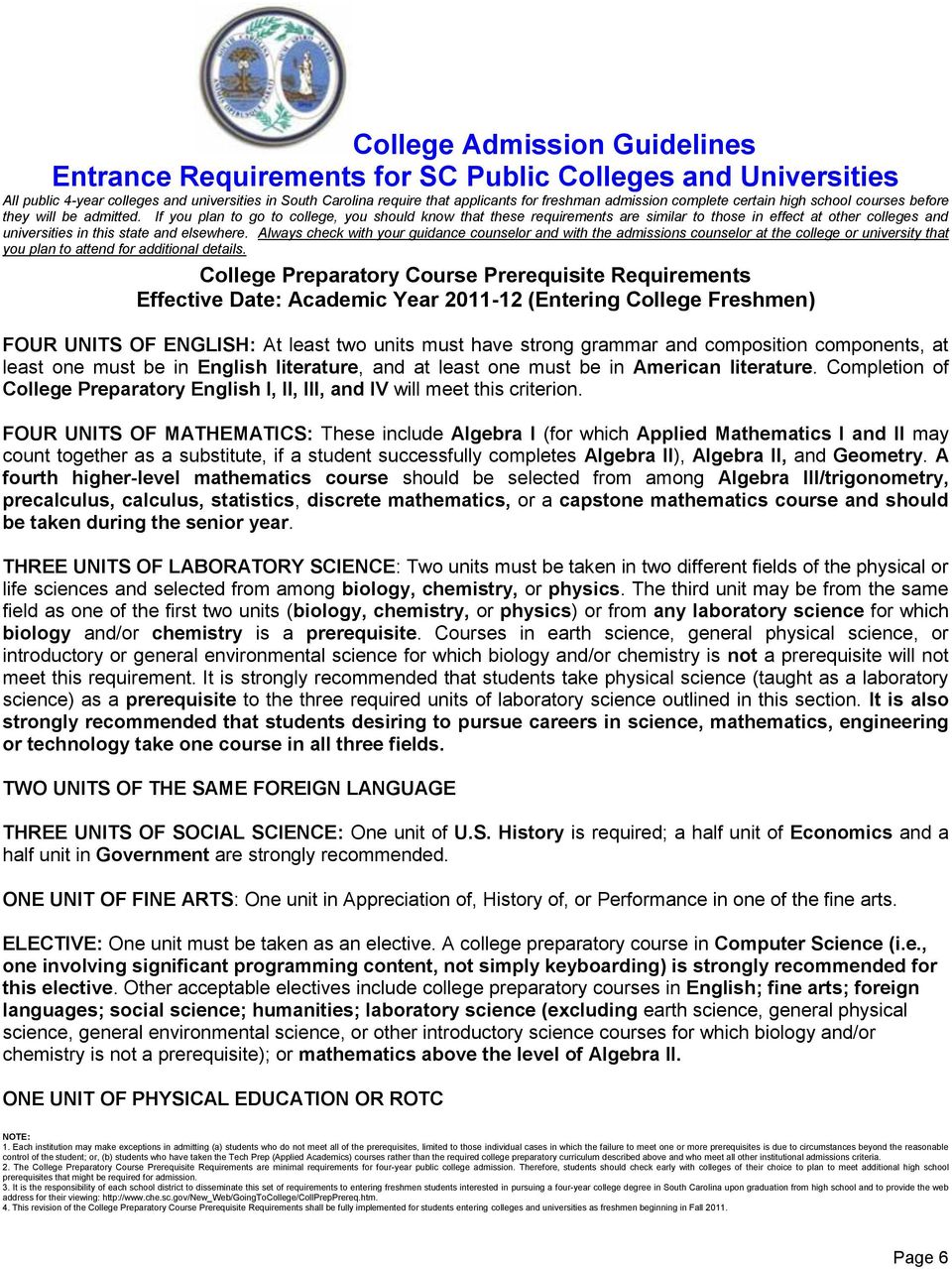
7 College Admission Guidelines Entrance Requirements for SC Public Colleges and Universities All public 4-year colleges and universities in South Carolina require that applicants for freshman admission complete certain high school courses before they will be admitted. If you plan to go to college, you should know that these requirements are similar to those in effect at other colleges and universities in this state and elsewhere. Always check with your guidance counselor and with the admissions counselor at the college or university that you plan to attend for additional details. College Preparatory Course Requirements Effective Date: Academic Year (Entering College Freshmen) FOUR UNITS OF ENGLISH: At least two units must have strong grammar and composition components, at least one must be in English literature, and at least one must be in American literature. Completion of College Preparatory English I, II, III, and IV will meet this criterion. FOUR UNITS OF MATHEMATICS: These include Algebra I (for which Applied Mathematics I and II may count together as a substitute, if a student successfully completes Algebra II), Algebra II, and Geometry. A fourth higher-level mathematics course should be selected from among Algebra III/trigonometry, precalculus, calculus, statistics, discrete mathematics, or a capstone mathematics course and should be taken during the senior year. THREE UNITS OF LABORATORY SCIENCE: Two units must be taken in two different fields of the physical or life sciences and selected from among biology, chemistry, or physics. The third unit may be from the same field as one of the first two units (biology, chemistry, or physics) or from any laboratory science for which biology and/or chemistry is a prerequisite. Courses in earth science, general physical science, or introductory or general environmental science for which biology and/or chemistry is not a prerequisite will not meet this requirement. It is strongly recommended that students take physical science (taught as a laboratory science) as a prerequisite to the three required units of laboratory science outlined in this section. It is also strongly recommended that students desiring to pursue careers in science, mathematics, engineering or technology take one course in all three fields. TWO UNITS OF THE SAME FOREIGN LANGUAGE THREE UNITS OF SOCIAL SCIENCE: One unit of U.S. History is required; a half unit of Economics and a half unit in Government are strongly recommended. ONE UNIT OF FINE ARTS: One unit in Appreciation of, History of, or Performance in one of the fine arts. ELECTIVE: One unit must be taken as an elective. A college preparatory course in Computer Science (i.e., one involving significant programming content, not simply keyboarding) is strongly recommended for this elective. Other acceptable electives include college preparatory courses in English; fine arts; foreign languages; social science; humanities; laboratory science (excluding earth science, general physical science, general environmental science, or other introductory science courses for which biology and/or chemistry is not a prerequisite); or mathematics above the level of Algebra II. ONE UNIT OF PHYSICAL EDUCATION OR ROTC NOTE: 1. Each institution may make exceptions in admitting (a) students who do not meet all of the prerequisites, limited to those individual cases in which the failure to meet one or more prerequisites is due to circumstances beyond the reasonable control of the student; or, (b) students who have taken the Tech Prep (Applied Academics) courses rather than the required college preparatory curriculum described above and who meet all other institutional admissions criteria. 2. The College Preparatory Course Requirements are minimal requirements for four-year public college admission. Therefore, students should check early with colleges of their choice to plan to meet additional high school prerequisites that might be required for admission. 3. It is the responsibility of each school district to disseminate this set of requirements to entering freshmen students interested in pursuing a four-year college degree in South Carolina upon graduation from high school and to provide the web address for their viewing: 4. This revision of the College Preparatory Course Requirements shall be fully implemented for students entering colleges and universities as freshmen beginning in Fall Page 6
8 NCAA: Information for Student-Athletes Any student-athlete who wishes to play sports at the collegiate level must plan his/her coursework carefully to ensure that he/she will meet the National Collegiate Athletic Association (NCAA) high school requirements for eligibility. Remember, meeting NCAA academic qualifications does not guarantee admission to college. Students taking a rigorous college-preparatory curriculum are more likely to be successful. Be sure to select courses that: Meet high school graduation requirements; Adequately prepare for rigorous college-level work; and Meet NCAA initial-eligibility requirements. Core Courses: NCAA Division I requires 16 core courses. NCAA Division II will require 16 core courses for students enrolling on or after August 1, Additionally, NCAA Division I will require 10 core courses to be completed prior to the seventh semester (seven of the 10 must be a combination of English, math or natural or physical science). These 10 courses become "locked in" at the seventh semester and cannot be retaken for grade improvement. Beginning August 1, 2016, it will be possible for a Division I college-bound student-athlete to still receive athletics aid and the ability to practice with the team if he or she fails to meet the 10-course requirement, but would not be able to compete. Test Scores: Division I uses a sliding scale to match test scores and core grade-point averages (GPA). Division II requires a minimum SAT score of 820 or an ACT sum score of 68. The SAT score used for NCAA purposes includes only the critical reading and math sections. The writing section of the SAT is not used. The ACT score used for NCAA purposes is a sum of the following four sections: English, mathematics, reading and science. When you register for the SAT or ACT, use the NCAA Eligibility Center code of 9999 to ensure all SAT and ACT scores are reported directly to the NCAA Eligibility Center from the testing agency. Test scores that appear on transcripts will not be used. Grade-Point Average: Be sure to look at your high school s List of NCAA Courses on the NCAA Eligibility Center's website ( Only courses that appear on your school's List of NCAA Courses will be used in the calculation of the core GPA. Division I students enrolling full time before August 1, 2016, should use Sliding Scale A to determine eligibility to receive athletics aid, practice and competition during the first year. Division I GPA required to receive athletics aid and practice on or after August 1, 2016, is Division I GPA required to be eligible for competition on or after August 1, 2016, is The Division II core GPA requirement is a minimum of Remember, the NCAA GPA is calculated using NCAA core courses only. Not all courses that meet high school graduation requirements count as core courses for NCAA initial-eligibility. Please see your guidance counselor or head coach if you have additional questions about NCAA eligibility or visit s of Study The Education and Economic Development Act (EEDA) is designed to give South Carolina students the educational tools they need to build prosperous, successful futures. EEDA sets up a system to help South Carolina students combine high academic standards with enhanced opportunities to explore career options and build real-life working skills. By requiring all students to declare a career major in one of a number of different clusters of study, essential academic learning with acquisition of job-related skills are connected to form a powerful combination that improves students odds for career success. Starting in the eighth grade, students and their parents or guardians sit down with counselors and create individual graduation plans (IGPs) that lay out their personal education and career strategies. IGPs specify students choices of cluster, major, postsecondary goals, high school course work, out-of-class learning experiences, and more. Students and their parents revisit these choices at least once a year to make adjustments in their plans. Page 7

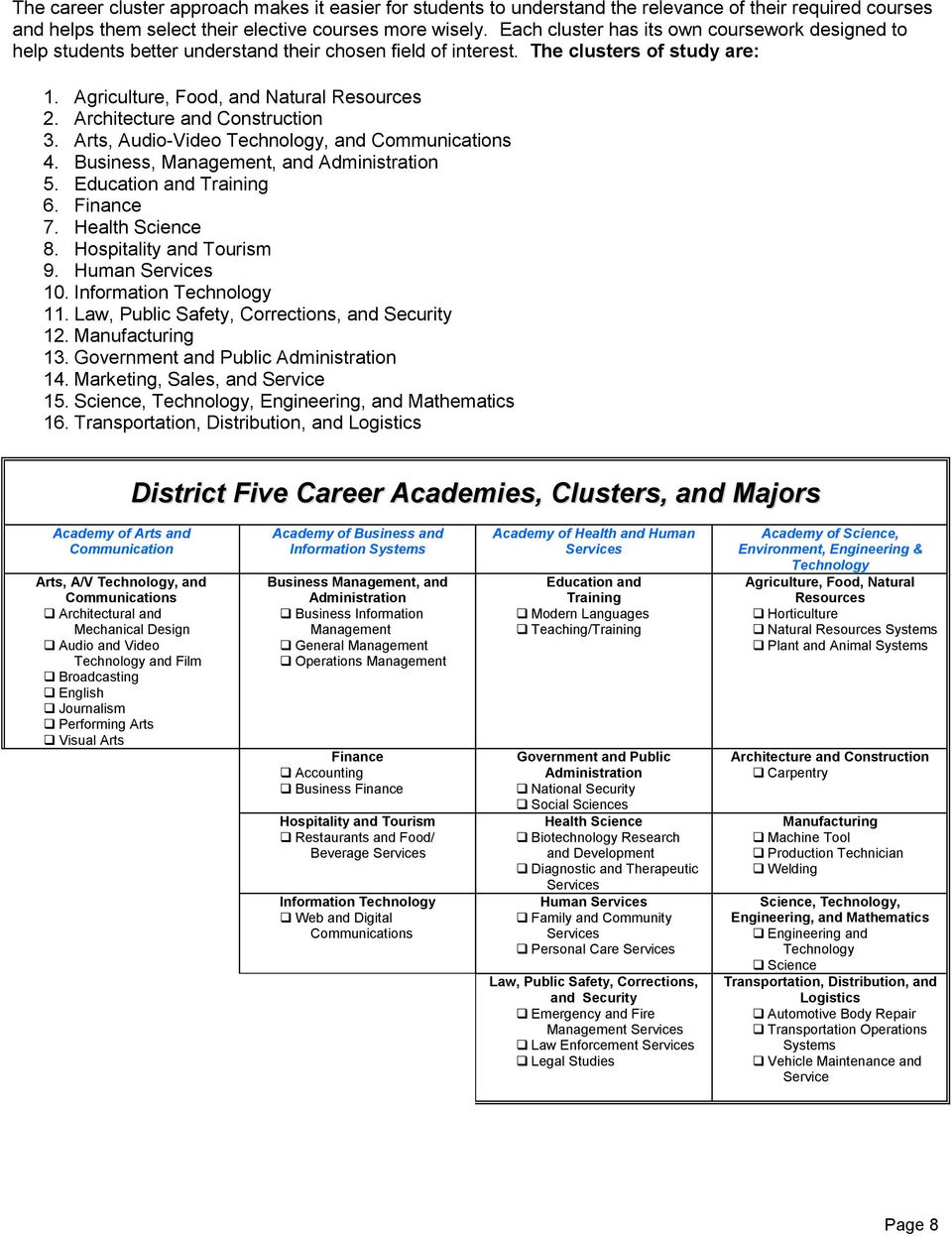
9 The career cluster approach makes it easier for students to understand the relevance of their required courses and helps them select their elective courses more wisely. Each cluster has its own coursework designed to help students better understand their chosen field of interest. The clusters of study are: 1. Agriculture, Food, and Natural Resources 2. Architecture and Construction 3. Arts, Audio-Video Technology, and Communications 4. Business, Management, and Administration 5. Education and Training 6. Finance 7. Health Science 8. Hospitality and Tourism 9. Human Services 10. Information Technology 11. Law, Public Safety, Corrections, and Security 12. Manufacturing 13. Government and Public Administration 14. Marketing, Sales, and Service 15. Science, Technology, Engineering, and Mathematics 16. Transportation, Distribution, and Logistics District Five Career Academies, Clusters, and Majors Academy of Arts and Communication Arts, A/V Technology, and Communications Architectural and Mechanical Design Audio and Video Technology and Film Broadcasting English Journalism Performing Arts Visual Arts Academy of Business and Information Systems Business Management, and Administration Business Information Management General Management Operations Management Finance Accounting Business Finance Hospitality and Tourism Restaurants and Food/ Beverage Services Information Technology Web and Digital Communications Academy of Health and Human Services Education and Training Modern Languages Teaching/Training Government and Public Administration National Security Social Sciences Health Science Biotechnology Research and Development Diagnostic and Therapeutic Services Human Services Family and Community Services Personal Care Services Law, Public Safety, Corrections, and Security Emergency and Fire Management Services Law Enforcement Services Legal Studies Academy of Science, Environment, Engineering & Technology Agriculture, Food, Natural Resources Horticulture Natural Resources Systems Plant and Animal Systems Architecture and Construction Carpentry Manufacturing Machine Tool Production Technician Welding Science, Technology, Engineering, and Mathematics Engineering and Technology Science Transportation, Distribution, and Logistics Automotive Body Repair Transportation Operations Systems Vehicle Maintenance and Service Page 8
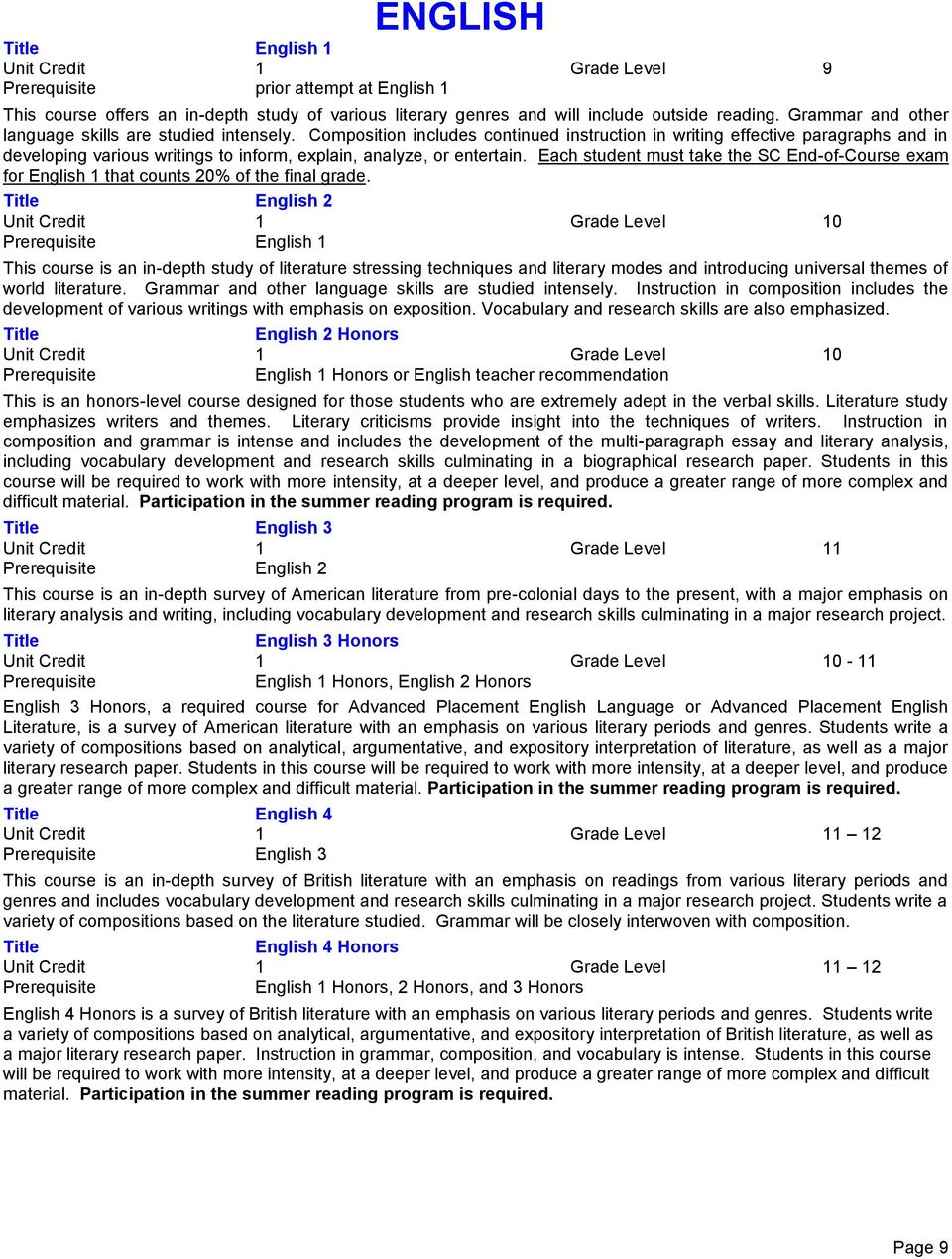
10 ENGLISH English 1 Unit Credit 1 Grade Level 9 prior attempt at English 1 This course offers an in-depth study of various literary genres and will include outside reading. Grammar and other language skills are studied intensely. Composition includes continued instruction in writing effective paragraphs and in developing various writings to inform, explain, analyze, or entertain. Each student must take the SC End-of-Course exam for English 1 that counts 20% of the final grade. English 2 Unit Credit 1 Grade Level 10 English 1 This course is an in-depth study of literature stressing techniques and literary modes and introducing universal themes of world literature. Grammar and other language skills are studied intensely. Instruction in composition includes the development of various writings with emphasis on exposition. Vocabulary and research skills are also emphasized. English 2 Honors Unit Credit 1 Grade Level 10 English 1 Honors or English teacher recommendation This is an honors-level course designed for those students who are extremely adept in the verbal skills. Literature study emphasizes writers and themes. Literary criticisms provide insight into the techniques of writers. Instruction in composition and grammar is intense and includes the development of the multi-paragraph essay and literary analysis, including vocabulary development and research skills culminating in a biographical research paper. Students in this course will be required to work with more intensity, at a deeper level, and produce a greater range of more complex and difficult material. Participation in the summer reading program is required. English 3 Unit Credit 1 Grade Level 11 English 2 This course is an in-depth survey of American literature from pre-colonial days to the present, with a major emphasis on literary analysis and writing, including vocabulary development and research skills culminating in a major research project. English 3 Honors Unit Credit 1 Grade Level English 1 Honors, English 2 Honors English 3 Honors, a required course for Advanced Placement English Language or Advanced Placement English Literature, is a survey of American literature with an emphasis on various literary periods and genres. Students write a variety of compositions based on analytical, argumentative, and expository interpretation of literature, as well as a major literary research paper. Students in this course will be required to work with more intensity, at a deeper level, and produce a greater range of more complex and difficult material. Participation in the summer reading program is required. English 4 Unit Credit 1 Grade Level English 3 This course is an in-depth survey of British literature with an emphasis on readings from various literary periods and genres and includes vocabulary development and research skills culminating in a major research project. Students write a variety of compositions based on the literature studied. Grammar will be closely interwoven with composition. English 4 Honors Unit Credit 1 Grade Level English 1 Honors, 2 Honors, and 3 Honors English 4 Honors is a survey of British literature with an emphasis on various literary periods and genres. Students write a variety of compositions based on analytical, argumentative, and expository interpretation of British literature, as well as a major literary research paper. Instruction in grammar, composition, and vocabulary is intense. Students in this course will be required to work with more intensity, at a deeper level, and produce a greater range of more complex and difficult material. Participation in the summer reading program is required. Page 9
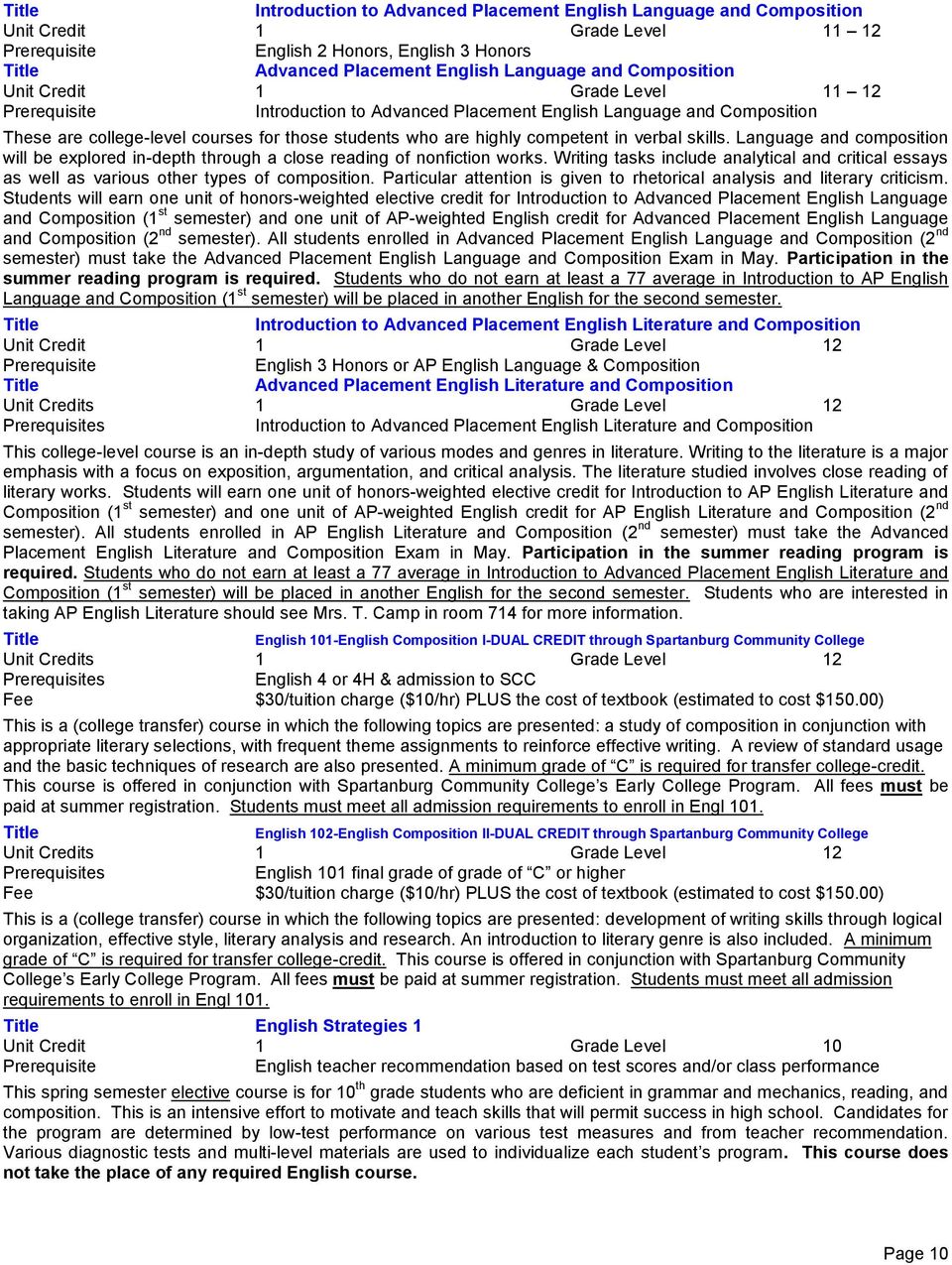
11 Introduction to Advanced Placement English Language and Composition Unit Credit 1 Grade Level English 2 Honors, English 3 Honors Advanced Placement English Language and Composition Unit Credit 1 Grade Level Introduction to Advanced Placement English Language and Composition These are college-level courses for those students who are highly competent in verbal skills. Language and composition will be explored in-depth through a close reading of nonfiction works. Writing tasks include analytical and critical essays as well as various other types of composition. Particular attention is given to rhetorical analysis and literary criticism. Students will earn one unit of honors-weighted elective credit for Introduction to Advanced Placement English Language and Composition (1 st semester) and one unit of AP-weighted English credit for Advanced Placement English Language and Composition (2 nd semester). All students enrolled in Advanced Placement English Language and Composition (2 nd semester) must take the Advanced Placement English Language and Composition Exam in May. Participation in the summer reading program is required. Students who do not earn at least a 77 average in Introduction to AP English Language and Composition (1 st semester) will be placed in another English for the second semester. Introduction to Advanced Placement English Literature and Composition Unit Credit 1 Grade Level 12 English 3 Honors or AP English Language & Composition Advanced Placement English Literature and Composition Unit Credits 1 Grade Level 12 s Introduction to Advanced Placement English Literature and Composition This college-level course is an in-depth study of various modes and genres in literature. Writing to the literature is a major emphasis with a focus on exposition, argumentation, and critical analysis. The literature studied involves close reading of literary works. Students will earn one unit of honors-weighted elective credit for Introduction to AP English Literature and Composition (1 st semester) and one unit of AP-weighted English credit for AP English Literature and Composition (2 nd semester). All students enrolled in AP English Literature and Composition (2 nd semester) must take the Advanced Placement English Literature and Composition Exam in May. Participation in the summer reading program is required. Students who do not earn at least a 77 average in Introduction to Advanced Placement English Literature and Composition (1 st semester) will be placed in another English for the second semester. Students who are interested in taking AP English Literature should see Mrs. T. Camp in room 714 for more information. English 101-English Composition I-DUAL CREDIT through Spartanburg Community College Unit Credits 1 Grade Level 12 s English 4 or 4H & admission to SCC Fee $30/tuition charge ($10/hr) PLUS the cost of textbook (estimated to cost $150.00) This is a (college transfer) course in which the following topics are presented: a study of composition in conjunction with appropriate literary selections, with frequent theme assignments to reinforce effective writing. A review of standard usage and the basic techniques of research are also presented. A minimum grade of C is required for transfer college-credit. This course is offered in conjunction with Spartanburg Community College s Early College Program. All fees must be paid at summer registration. Students must meet all admission requirements to enroll in Engl 101. English 102-English Composition II-DUAL CREDIT through Spartanburg Community College Unit Credits 1 Grade Level 12 s English 101 final grade of grade of C or higher Fee $30/tuition charge ($10/hr) PLUS the cost of textbook (estimated to cost $150.00) This is a (college transfer) course in which the following topics are presented: development of writing skills through logical organization, effective style, literary analysis and research. An introduction to literary genre is also included. A minimum grade of C is required for transfer college-credit. This course is offered in conjunction with Spartanburg Community College s Early College Program. All fees must be paid at summer registration. Students must meet all admission requirements to enroll in Engl 101. English Strategies 1 Unit Credit 1 Grade Level 10 English teacher recommendation based on test scores and/or class performance This spring semester elective course is for 10 th grade students who are deficient in grammar and mechanics, reading, and composition. This is an intensive effort to motivate and teach skills that will permit success in high school. Candidates for the program are determined by low-test performance on various test measures and from teacher recommendation. Various diagnostic tests and multi-level materials are used to individualize each student s program. This course does not take the place of any required English course. Page 10
12 English Strategies 2 Unit Credit 1 Grade Levels English teacher recommendation based on test scores and/or class performance This fall semester elective course is designed for upperclassmen who have not passed the English Language Arts portion of the South Carolina High School Assessment Program (HSAP) Exit Exam or any student needing to improve basic skills for academic success. Students practice test-taking strategies while reviewing basic skills in writing and composition. This course does not take the place of any required English course. Creative Writing Unit Credit 1 Grade Levels None In this elective students will examine the elements and types of composition, and will be encouraged to develop their skills as creative writers. Students will write poetry, essays, short stories, and more. Individual and group exercises will develop and foster good writing habits. Film Studies Unit Credit 1 Grade Levels None This elective course examines film as a literary medium from the early black/white films to the modern epic spectaculars. Students will view films both in and out of class for the purpose of comparison and contrast of film elements (i.e. direction, production, etc.) as well as literary elements (i.e. character, conflict, etc.). SAT/ACT Preparation VERBAL Unit Credit 1/2 Grade Levels successful completion of both Geometry and English 2 This fall semester elective course is designed to help those students who intend to take the SAT and/or the ACT test for the purpose of entering a 4-year college or university directly after high school. The verbal section includes strategies for improving vocabulary, reading comprehension, and sentence completion. Grammar usage strategies needed for the writing test will also be covered. Students must sign up for both sections and upon completion students will receive a ½ unit for SAT/ACT Math and a ½ unit for SAT/ACT Verbal. Page 11

13 MATHEMATICS Math Tech 1: Elementary Algebra Part 1 Unit Credit 1 None This course is the first half of a two-course program. It is a survey course that includes topics covered in the first part of Algebra 1. The content of Algebra 1 encompasses the real number system; operations involving exponents, matrices, and algebraic expressions; relations and functions; writing and solving linear equations; graphs and characteristics of linear equations; and quadratic relationships and functions. Math Tech 2: Elementary Algebra Part 2 Unit Credit 1 Math Tech 1 This course is the second half of a two-course program. It is a survey course that includes topics covered in the second part of Algebra 1. The content of Algebra 1 encompasses the real number system; operations involving exponents, matrices, and algebraic expressions; relations and functions; writing and solving linear equations; graphs and characteristics of linear equations; and quadratic relationships and functions. Each student must take the SC End-of- Course exam for Algebra 1 that counts 20% of the final grade. Math Tech 3: Geometry Unit Credit 1 Math Tech 2 Mathematics for the Technologies 3 encompasses properties of basic geometric figures; properties of triangles; properties of quadrilaterals and other polygons; properties of circles, lines, and special segments intersecting circles; transformations; coordinate geometry; vectors; surface area and volume of three-dimensional objects; and proofs. Math Tech 4: Data Analysis and Probability Unit Credit 1 Math Tech 3 Mathematics for the Technologies 4 encompasses design of a statistical study; collection, organization, display, and interpretation of data; basic statistical methods of analyzing data; and basic concepts of probability Algebra 1: Elementary Algebra Unit Credit 1 teacher recommendation The content of Algebra 1 encompasses the real number system; operations involving exponents, matrices, and algebraic expressions; relations and functions; writing and solving linear equations; graphs and characteristics of linear equations; and quadratic relationships and functions. Each student must take the SC End-of-Course exam for Algebra 1 that counts 20% of the final grade. Algebra 2: Intermediate Algebra Unit Credit 1 Geometry The content of Algebra 2 encompasses functions; systems of equations; systems of linear inequalities; quadratic equations; complex numbers; algebraic expressions; nonlinear relationships including exponential, logarithmic, radical, polynomial, and rational; conic sections; and sequences and series. Algebra 2 Honors: Intermediate Algebra Unit Credit 1 Geometry Honors This is an honors-level course for students who have been highly successful in Algebra 1 or Algebra 1 Honors and who are candidates for AP Calculus. The content of Algebra 2 encompasses functions; systems of equations; systems of linear inequalities; quadratic equations; complex numbers; algebraic expressions; nonlinear relationships including exponential, logarithmic, radical, polynomial, and rational; conic sections; and sequences and series. Students will be required to work with more intensity, at a deeper level, and produce a wider range of more complex and difficult material. Algebra 3 Unit Credit 1 Geometry and Algebra 2 Algebra 3 is a program of mathematical studies focusing on the development of the student s ability to understand and apply the study of functions and advanced mathematics concepts to solve problems. The course will include a study of polynomial, rational, exponential, logarithmic, and trigonometric functions. It is a bridge between Algebra 2 and Precalculus. Page 12

14 Geometry Unit Credit 1 Algebra 1 The content of Geometry encompasses properties of basic geometric figures; properties of triangles; properties of quadrilaterals and other polygons; properties of circles, lines, and special segments intersecting circles; transformations; coordinate geometry; vectors; surface area and volume of three-dimensional objects; and proofs. Geometry Honors Unit Credit 1 Algebra 1 Honors This honors-level course is for motivated mathematics students who are candidates for AP Calculus. The content of Geometry encompasses properties of basic geometric figures; properties of triangles; properties of quadrilaterals and other polygons; properties of circles, lines, and special segments intersecting circles; transformations; coordinate geometry; vectors; surface area and volume of three-dimensional objects; and proofs. Students will be required to work with intensity, at a deep level, and produce a wide range of complex and difficult material. Probability and Statistics: Data Analysis / Probability Unit Credit 1 Geometry and Algebra 2 The content of the data analysis and probability standards encompasses design of a statistical study; collection, organization, display, and interpretation of data; basic statistical methods of analyzing data; and basic concepts of probability. Discrete Mathematics Unit Credit 1 Geometry and Algebra 2 Discrete Mathematics is the study of mathematical systems defined on discrete sets those with a countable number of elements. It involves the study of objects and ideas that can be divided into separate or discontinuous parts. Most of the mathematics in this area have been discovered during the twentieth century. Among possible topics to be studied are decision making, matrix algebra, graph theory, set theory, Boolean algebra, combinatorics, circuits, discrete probability, recursion, modular arithmetic, network models, sequences and series, mathematical induction, vectors, relations, functions, algorithms, logic, and codes. As well as being of mathematical interest, many of these topics play an important role in information technology and computer science. Discrete mathematics is used every day by computer scientists, computer programmers, electrical engineers, computer engineers, and scientists in the physical, natural, and social sciences. Precalculus Unit Credit 1 Geometry and Algebra 2 The content of Precalculus encompasses characteristics and behaviors of functions, operations on functions, behaviors of polynomial functions and rational functions, behaviors of exponential and logarithmic functions, behaviors of trigonometric functions, and behaviors of conic sections. Precalculus Honors Unit Credit 1 Geometry Honors and Algebra 2 Honors This honors-level course is for motivated mathematics students who are candidates for AP Calculus. The content of Precalculus encompasses characteristics and behaviors of functions, operations on functions, behaviors of polynomial functions and rational functions, behaviors of exponential and logarithmic functions, behaviors of trigonometric functions, and behaviors of conic sections. Students will be required to work with intensity, at a deep level, and produce a wide range of complex and difficult material. Calculus Honors Unit Credit 1 Precalculus This Calculus course is for college preparatory students considering majors that will include Calculus. Previous honors level courses are not required. Calculus involves the continued study of functions, rates, and accumulation. Students will study limits, derivatives, integrals, and their applications. Students will be required to work with intensity, at a deep level, and produce a wide range of complex and difficult material. Page 13

15 Introduction to Advanced Placement Calculus AB Unit Credit 1 Precalculus Honors or Calculus Honors and Math teacher recommendation Advanced Placement Calculus AB Unit Credit 1 Introduction to Advanced Placement Calculus AB This is a course for the mathematically gifted student capable of college-level work. The course outline reflects the content currently recommended by the College Entrance Examination Board (CEEB). Students will earn one unit of honorsweighted elective credit for Introduction to Advanced Placement Calculus AB (1 st semester) and one unit of AP-weighted math credit for Advanced Placement Calculus AB (2 nd semester). All students enrolled in AP Calculus AB (2 nd semester) must take the Advanced Placement Calculus AB Exam in May. Students who do not earn at least a 77 average in Introduction to Advanced Placement Calculus AB (1 st semester) will be placed in another math class for the second semester. Students who are interested in taking AP Calculus should see Mrs. A. Mabrey in room 915 for more information. Advanced Placement Calculus BC Unit Credit 1 AP Calculus AB or Math teacher recommendation This is a course for the mathematically gifted student capable of college-level work. The course outline reflects the content currently recommended by the College Entrance Examination Board (CEEB). Students enrolled in the course are required to take the AP Calculus BC Exam in May. Students who are interested in taking AP Calculus should see Mrs. A. Mabrey in rom 915 for more information. Advanced Placement Statistics Unit Credit 1 Geometry, Algebra 2 and Math teacher recommendation This is a one-semester college-level mathematics course for students who have been highly successful in Algebra 2. The purpose is to introduce students to the major concepts and tools of elementary statistics as they collect, analyze, and draw conclusions from data. Students will have extensive opportunities to explore data, plan studies, anticipate patterns, and use statistical inference. Students will earn one unit of AP-weighted math credit for Advanced Placement Statistics. All students enrolled in AP Statistics must take the Advanced Placement Statistics Exam in May. Students who are interested in taking AP Statistics should see Mrs. K. Ordoyne in room 917 for more information. Math Strategies 2 Unit Credit 1 teacher recommendation This spring semester elective course is for 9 th and 10 th grade students who did not meet standard on the 8 th grade PASS test in mathematics and have been recommended by their math teacher. The course content will include computer activities to strengthen basic skills as well as traditional classroom instruction and practice. This course will NOT be considered as a math credit for graduation. Math Strategies 3 Unit Credit 1 teacher recommendation based on test scores and/or class performance This fall semester elective course is for students who have attempted but not yet passed the South Carolina High School Assessment Program (HSAP) Exit Exam in mathematics. The course content will include computer activities to strengthen basic skills as well as traditional classroom instruction and practice. Students will be enrolled in this class after spring HSAP scores come back from the state. This course will NOT be considered as a math credit for graduation. SAT/ACT Preparation MATH Unit Credit 1/2 successful completion of both Geometry and English 2 This fall semester elective course is designed to help those students who intend to take the SAT and/or the ACT test for the purpose of entering a 4-year college or university directly after high school. The math section includes strategies relevant to SAT/ACT math topics. Students must sign up for both sections and upon completion students will receive a ½ unit for SAT/ACT Math and a ½ unit for SAT/ACT Verbal. Page 14

16 SCIENCE Physical Science Unit credit 1 Grade Levels 9-12 Laboratory Science No None Physical Science is designed to serve as a foundation for other high school science courses. It incorporates principles of chemistry and physics by emphasizing inquiry-based learning, process skills, and higher-order thinking skills. Chemistry concepts include composition and classification of matter, atomic structure and periodic table, and chemical bonds and reactions, with some nuclear chemistry. Physics concepts include forces and motion; energy and electricity; and wave characteristics and behavior, including electromagnetic and sound waves. Because experimentation is the reinforcing basis of science, laboratory investigations are an integral part of this course. Investigative, hands-on lab activities that address the high school inquiry standards are an integral part of this course. The course is not accepted as a laboratory science by South Carolina public colleges and universities. Biology 1 Unit credit 1 Grade Levels Laboratory Science Yes Physical Science This laboratory-based course is designed to familiarize the college preparatory student with the major concepts of biological science: the cell; molecular basis of heredity; interdependence of organisms; matter, energy, and organization in living systems; and behavior and regulation. This course provides numerous opportunities for students to develop science process skills, critical thinking, and an appreciation for the nature of science through inquiry-based learning experiences. Investigative, hands-on lab activities that address the high school inquiry standards are an integral part of this course. All students are required to take the SC End of Course Exam which counts 20% of the final grade. This course will fulfill the state s required science unit for graduation. Biology 1 Honors Unit credit 1 Grade Levels Laboratory Science Yes Physical Science H and science teacher recommendation This honors-level course is for motivated students who desire a more in-depth study of the biology curriculum. Extensive laboratory work and problem-solving are essential components. Students will examine the major concepts of biological science: the cell; molecular basis of heredity; interdependence of organisms; matter, energy, and organization in living systems; and behavior and regulation. This course provides numerous opportunities for students to develop science process skills, critical thinking, and an appreciation for the nature of science through inquiry-based learning experiences. Investigative, hands-on lab activities that address the high school inquiry standards are an integral part of this course. A science fair project is required. All students are required to take the SC End of Course Exam which counts 20% of the final grade. This course will fulfill the state s required science unit for graduation. Biology 1 Applied Unit credit 1 Grade Levels 9-12 Laboratory Science Yes None Applied Biology 1 is a laboratory course that emphasizes problem solving, decision making, critical thinking, and applied learning. Students explore the concepts and principles of biology and apply these concepts and principles to issues in the workplace, in society, and in personal experiences. Concepts developed in Applied Biology 1 include the cell; matter, energy, and organization; and the molecular basis of heredity. Investigative, hands-on lab activities that address the high school inquiry standards are an integral part of this course. Applied Biology is designated to be both academically rigorous and realistic for students pursuing technical careers through further education or through practical experience in the workforce after high school. This course, along with successful completion of Applied Biology 2, will fulfill the state s required science unit for graduation. Biology 2 Applied Unit credit 1 Grade Levels Laboratory Science Yes Applied Biology 1 This course is a continuation of Applied Biology 1 and emphasizes problem-solving, decision-making and hands-on learning. Laboratory work is an essential component. Students continue to explore concepts in biology and chemistry and apply them to issues in the workplace, in society, and in personal life experiences. It is designed for those students pursuing technical careers through further education or through experience in the workforce after high school. All students are required to take the SC End of Course Exam which counts 20% of the final grade. This course, along with successful completion of Applied Biology I, will fulfill the Biology required science unit for graduation. Page 15

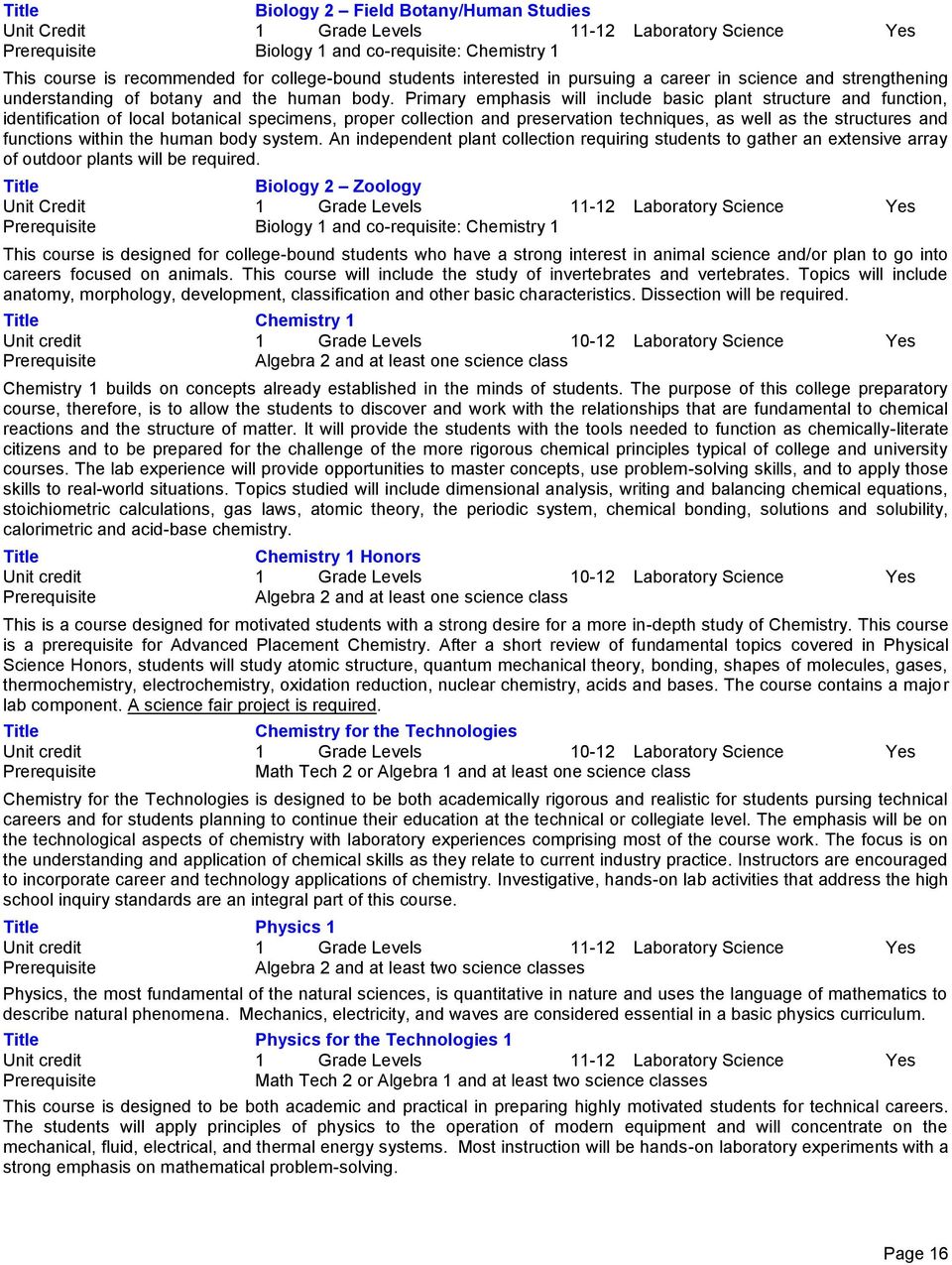
17 Biology 2 Field Botany/Human Studies Unit Credit 1 Grade Levels Laboratory Science Yes Biology 1 and co-requisite: Chemistry 1 This course is recommended for college-bound students interested in pursuing a career in science and strengthening understanding of botany and the human body. Primary emphasis will include basic plant structure and function, identification of local botanical specimens, proper collection and preservation techniques, as well as the structures and functions within the human body system. An independent plant collection requiring students to gather an extensive array of outdoor plants will be required. Biology 2 Zoology Unit Credit 1 Grade Levels Laboratory Science Yes Biology 1 and co-requisite: Chemistry 1 This course is designed for college-bound students who have a strong interest in animal science and/or plan to go into careers focused on animals. This course will include the study of invertebrates and vertebrates. Topics will include anatomy, morphology, development, classification and other basic characteristics. Dissection will be required. Chemistry 1 Unit credit 1 Grade Levels Laboratory Science Yes Algebra 2 and at least one science class Chemistry 1 builds on concepts already established in the minds of students. The purpose of this college preparatory course, therefore, is to allow the students to discover and work with the relationships that are fundamental to chemical reactions and the structure of matter. It will provide the students with the tools needed to function as chemically-literate citizens and to be prepared for the challenge of the more rigorous chemical principles typical of college and university courses. The lab experience will provide opportunities to master concepts, use problem-solving skills, and to apply those skills to real-world situations. Topics studied will include dimensional analysis, writing and balancing chemical equations, stoichiometric calculations, gas laws, atomic theory, the periodic system, chemical bonding, solutions and solubility, calorimetric and acid-base chemistry. Chemistry 1 Honors Unit credit 1 Grade Levels Laboratory Science Yes Algebra 2 and at least one science class This is a course designed for motivated students with a strong desire for a more in-depth study of Chemistry. This course is a prerequisite for Advanced Placement Chemistry. After a short review of fundamental topics covered in Physical Science Honors, students will study atomic structure, quantum mechanical theory, bonding, shapes of molecules, gases, thermochemistry, electrochemistry, oxidation reduction, nuclear chemistry, acids and bases. The course contains a major lab component. A science fair project is required. Chemistry for the Technologies Unit credit 1 Grade Levels Laboratory Science Yes Math Tech 2 or Algebra 1 and at least one science class Chemistry for the Technologies is designed to be both academically rigorous and realistic for students pursing technical careers and for students planning to continue their education at the technical or collegiate level. The emphasis will be on the technological aspects of chemistry with laboratory experiences comprising most of the course work. The focus is on the understanding and application of chemical skills as they relate to current industry practice. Instructors are encouraged to incorporate career and technology applications of chemistry. Investigative, hands-on lab activities that address the high school inquiry standards are an integral part of this course. Physics 1 Unit credit 1 Grade Levels Laboratory Science Yes Algebra 2 and at least two science classes Physics, the most fundamental of the natural sciences, is quantitative in nature and uses the language of mathematics to describe natural phenomena. Mechanics, electricity, and waves are considered essential in a basic physics curriculum. Physics for the Technologies 1 Unit credit 1 Grade Levels Laboratory Science Yes Math Tech 2 or Algebra 1 and at least two science classes This course is designed to be both academic and practical in preparing highly motivated students for technical careers. The students will apply principles of physics to the operation of modern equipment and will concentrate on the mechanical, fluid, electrical, and thermal energy systems. Most instruction will be hands-on laboratory experiments with a strong emphasis on mathematical problem-solving. Page 16
18 Earth Science Unit Credit 1 Grade Levels Laboratory Science No at least two science classes Earth Science consists of selected topics from the fields of geology, oceanography, meteorology, and astronomy. Topics are selected from these areas of study to convey to the student both an appreciation for the basic processes of science and an acquaintance with the current problems and ideas in the earth sciences. By the end of this course, students should gain a better understanding of the planet on which they live. The course is not accepted as a laboratory science by South Carolina public colleges and universities. Forensic Science Unit Credit 1 Grade Levels Laboratory Science No s at least two science classes This elective course incorporates DNA fingerprinting and other techniques involving forensics technology. Activities include analyzing videos, listening to experts in various fields of forensics, researching various fields of forensics as well as case histories, and conducting laboratory tests on numerous types of physical evidence. The course is based in large part on increasing the knowledge-base of Forensic Science as well as collection and preservation of the many types of physical evidence. The course is not accepted as a laboratory science by South Carolina public colleges and universities AND does not count as a science class required for graduation. Introduction to Advanced Placement Biology Unit Credit 1 Grade Levels Laboratory Science No Biology 1, Chemistry 1, science teacher recommendation Advanced Placement Biology Unit Credit 1 Grade Levels Laboratory Science Yes Introduction to Advanced Placement Biology This course is an in-depth study equivalent to college-freshman biology and includes: molecular and cellular biology, genetics, and evolution, organisms, population, and ecology. Twelve advanced labs are required. Students will earn one honors-weighted elective unit of credit for Introduction to AP Biology (1 st semester) and one unit of AP-weighted science credit for AP Biology (2 nd semester). All students enrolled in AP Biology (2 nd semester) must take the Advanced Placement Biology Exam in May. Students who do not earn at least a 77 average in Introduction to AP Biology (1 st semester) will be placed in another academic class for the second semester. Students who are interested in taking AP Biology should see Dr. A. Moraes in room 203 for more information. Introduction to Advanced Placement Chemistry Unit Credit 1 Grade Levels Laboratory Science No Algebra 2 Honors, Chemistry 1 Honors, science teacher recommendation Advanced Placement Chemistry Unit Credit 1 Grade Levels Laboratory Science Yes Introduction to Advanced Placement Chemistry The AP Chemistry course is for students with superior academic ability. The course emphasizes chemical and mathematical relationships. Those who make a satisfactory score will be given college credit at most colleges. Because of the lab time needed, some required work will have to be done after school hours. Self-motivation, dedication, and everyday preparation are a must. Students will earn one honors-weighted elective unit of credit for Introduction to AP Chemistry (1 st semester) and one unit of AP-weighted science credit for AP Chemistry (2 nd semester). All students enrolled in AP Chemistry (2 nd semester) must take the Advanced Placement Chemistry Exam in May. Students who do not earn at least a 77 average in Introduction to AP Chemistry (1 st semester) will be placed in another academic class for the second semester. Students who are interested in taking AP Chemistry should see Dr. L. Collins in room 102 for more information. Introduction to Advanced Placement Physics Unit credit 1 Grade Levels Laboratory Science No Pre-Calculus, at least two science courses, science teacher recommendation Advanced Placement Physics Unit credit 1 Grade Levels Laboratory Science Yes Introduction to Advanced Placement Physics The AP Physics course is a rigorous study of freshman college-level physics. Traditional topics include mechanics, wave theory (optics and sound), thermodynamics, electricity, magnetism and modern physics. Problem solving skills using algebra and trigonometry are emphasized. Application of theory in laboratory is also a major component. Students will earn one unit of honors-weighted elective credit for Introduction to Advanced Placement Physics (1 st semester) and one unit of AP-weighted science credit for AP Physics (2 nd semester). All students enrolled in Advanced Placement Physics (2 nd semester) must take the Advanced Placement Physics Exam in May. Students who do not earn at least a 77 average Page 17

19 in Introduction to Advanced Placement Physics (1 st semester) will be placed in another academic class for the second semester. Students who are interested in taking AP Physics should see Mr. G. Turner in room 210 for more information. Advanced Placement Environmental Science Unit Credit 1 Grade Levels Laboratory Science Yes Biology 1, Chemistry 1, science teacher recommendation The AP Environmental Science one-semester course provides students with the scientific principles, concepts, and methodologies required to understand the relationship of organisms in nature, to analyze environmental problems and to search for a solution for these problems. Students will earn one unit of AP-weighted science credit for Advanced Placement Environmental Science. All students enrolled in Advanced Placement Environmental Science must take the Advanced Placement Environmental Science Exam in May. Students who are interested in taking AP Environmental Science should see Dr. A. Moraes in room 203 for more information. Page 18

20 SOCIAL STUDIES World History from 1300: The Making of the Modern World Unit Credit 1 Grade Levels 10 None This course is designed to assist students in understanding how people and countries of the world have become increasingly interconnected. In the last six hundred years, population growth, demand for resources, curiosity, and technology have converged to draw the distant corners of the world closer together. Critical thinking is focal to this course, which emphasizes why and how people, ideas, and technology have made an impact on diverse groups of people. World History from 1300: The Making of the Modern World Honors Unit Credit 1 Grade Levels 10 Social Studies teacher recommendation Throughout this course, taught at the Honors level, students will demonstrate an understanding of the major factors that facilitated exchanges among groups of people and how exchanges influenced those people over time. Additionally, students will demonstrate an understanding of the causes and consequences of decolonization in the second half of the twentieth century. This course will entail a rigorous program of reading, research and writing. Introduction to Advanced Placement World History Unit Credit 1 Grade Levels 10 Social Studies teacher recommendation Advanced Placement World History Unit Credit 1 Grade Levels 10 Introduction to Advanced Placement World History This course is designed to provide students with an in-depth understanding of the changes in global processes, human societies and their interaction throughout time. It focuses on the nature of changes and their consequences in international frameworks as well as comparisons among major societies. Although focused primarily on the past thousand years of the global experience, the course builds on an understanding of cultural, institutional, and technological precedents that, along with geography, set the human stage prior to 1000 AD. It is strongly recommended that students have Honors or AP English placement. Students will earn one unit of honors-weighted elective credit for Introduction to Advanced Placement World History (1 st semester) and one unit of AP-weighted social studies credit for Advanced Placement World History (2 nd semester). All students enrolled in Advanced Placement World History (2 nd semester) must take the Advanced Placement World History Exam in May. Students who do not earn at least a 77 average in Introduction to Advanced Placement World History (1 st semester) will be placed in another social studies class for the second semester. Students who are interested in taking AP World History should see Mrs. K. Owens in room 703 for more information. United States History Unit Credit 1 Grade Levels 11 None United States History is a survey course tracing the history of our country. Approximately one fourth of the course includes early history through the Civil War, with course emphasis on the years from Reconstruction to the present. Topics studied in depth include western migration and immigration from the end of Reconstruction through the first part of the 20 th century, the Industrial Age and urbanization, America as a world power, progressivism, World War I, the Great Depression and New Deal, World War II, domestic issues and policies from World War II to the present, and international issues, policies, and involvement from the Cold War to the present. Each student must take the SC End-of- Course exam for US History that counts 20% of the final grade. U.S. History is required for graduation. United States History Honors Unit Credit 1 Grade Levels 11 Social Studies teacher recommendation This course is designed to provide an overview of American history beginning with what our nation was like prior to exploration to present day America. Topics include life and thought in colonial America, revolutionary ideology, constitutional development, Jeffersonian and Jacksonian democracy, nineteenth-century reform movements, and Manifest Destiny. Other topics include the Civil War and Reconstruction, immigration, industrialism, Populism, Progressivism, World War I, the Jazz Age, the Great Depression, the New Deal, World War II, the Cold War, the post-cold War era, and the United States at the beginning of the twenty-first century. This course will fulfill the United States history graduation requirement. Each unit will utilize discussions of and writing about related historiography: how interpretations of events have changed over time, how the issues of one time period have had an impact on the experiences and decisions of subsequent generations, and how such reevaluations of the past continue to shape the way historians see the world today. This course will entail a rigorous program of reading, research and writing. It is strongly recommended that Page 19

21 students have Honors English placement. Each student must take the SC End-of-Course exam for US History that counts 20% of the final grade. U.S. History is required for graduation. Introduction to Advanced Placement United States History Unit Credit 1 Grade Levels 11 English 2 and Social Studies teacher recommendation Advanced Placement United States History Unit Credit 1 Grade Levels 11 Introduction to Advanced Placement United States History AP United States History is designed to provide students with analytic skills and factual knowledge necessary to deal critically with the issues and materials in United States History. This course prepares students for intermediate and advanced college courses by making demands upon them equivalent to those made by full year introductory courses. It is a survey course, with extensive chronological coverage of a broad variety of topics in such special fields as economic, cultural, intellectual, and social history, in addition to political, constitutional, and diplomatic history. Students will earn one unit of honors-weighted elective credit for Introduction to Advanced Placement United States History (1 st semester) and one unit of AP-weighted US History for Advanced Placement United States History (2 nd semester). All students enrolled in Advanced Placement United States History (2 nd semester) must take the Advanced Placement US History Exam in May. Students who do not earn at least a 77 average in Introduction to Advanced Placement United States History (1 st semester) will be placed in another US History class for the second semester. Each student must take the SC End-of- Course exam for US History that counts 20% of the final grade for AP US History at the end of the spring semester. Students who are interested in taking AP US History should see Mrs. M. Loudermilk in room 405 for more information. Government and Economics Unit Credit ½ (Government) & ½ (Economics) Grade Level 12 None In United States Government, students examine the operation of major American institutions such as the presidency and the executive branch, the Supreme Court and lower courts, and the United States Congress. Study in the course also focuses on the functions of bureaucracy, the roles of the political parties, the actions of interest and advocacy groups, and the impact of mass media. Students also discuss civil liberties, civil rights, civil responsibilities, and public policies. U.S. Government is required for graduation. The goal of Economics is to increase students financial literacy and to sharpen their critical thinking and analytical skills regarding to the structure of the American economic system. The focus is on economic principles, with an emphasis on the efficient allocation of resources through the market forces of demand and supply. Students examine the principles of economics involving the production, consumption, and distribution of wealth in a market economy that is influenced by governmental policies. With regard to financial literacy, students are also given instruction in banking and financial institutions, credit card and credit management, and stock and bond markets. Economics is required for graduation. Government and Economics Honors Unit Credit ½ (Government) & ½ (Economics) Grade Level 12 Social Studies teacher recommendation United States Government Honors incorporates the structure organization and function of the American political system. Topics studied include: foundations of United States government, the three major branches of government, and the Constitution. Students will study the details of the political system at the national, state, and local levels. Comparisons will be made between American government and other political systems. At the honors level students will read supplementary materials and analyze, synthesize, and evaluate new information as they develop critical thinking skills. It is strongly recommended that students have Honors English placement. U.S. Government is required for graduation. Economics Honors provides a standards-based study of the overall economy including both macroeconomics and microeconomics. Students will focus on topics such as money and banking, competition, supply and demand, factors of production, consumer rights and responsibilities, and personal financial literacy. At the honors level students will read supplementary materials and analyze, synthesize, and evaluate new information as they develop critical thinking skills. It is strongly recommended that students have Honors Math placement. Economics is required for graduation. Economics is required for graduation. Advanced Placement Government and Politics Unit Credit 1 Grade Level 12 Social Studies teacher recommendation This advanced, college-level course covers the following major content areas: constitutional underpinnings of United States government; political beliefs and behaviors; political parties, interest groups and mass media; institutions of national government the Congress, the presidency, the bureaucracy, and the federal courts; public policy; and civil rights and civil liberties. This course also fulfills the graduation requirement for government. All students enrolled must take the Page 20
22 Advanced Placement US Government and Politics Exam in May. Students who are interested in taking AP Gov should see Mrs. C. Buys in room 702 for more information. Advanced Placement Macroeconomics Unit Credit 1 Grade Level 12 Social Studies teacher recommendation This advanced, college-level course covers basic economic concepts, the nature and functions of product markets, factor markets, and efficiency, equity, and the role of government. This course also fulfills the graduation requirement for economics. All students must take the Advanced Placement Macroeconomics Exam in May. Students who are interested in taking AP Econ should see Mrs. P. Dunlap in room 505 for more information. Psychology Unit Credit 1 Grade Levels None Psychology is a social studies course dedicated to the holistic study of behavior. Topics include the biological bases of behavior, the learning process, sensation and perception, motivation and personality, defense mechanisms, testing, human growth and development, abnormal psychology, and leading theorists in the field. Advanced Placement Psychology Unit Credit 1 Grade Levels Social Studies teacher recommendation This an advanced, college-level course that is designed to introduce students to the systematic and scientific study of the behavior and mental processes of humans and animals. Students will learn about why humans think, feel, and behave the way they do. Students are exposed to the psychological facts, principles, and phenomena associated with each of the major subfields within psychology. Some topic examples include personality theory, psychological disturbances, human development, and principals of learning. Students also learn about the ethics and methods psychologists use in their science and practice. The AP curriculum is for the student who desires to experience and be challenged on a collegiate level. Students should have a strong work ethic, a willingness to read text daily, and solid reading comprehension and writing skills. All students enrolled must take the Advanced Placement Psychology Exam in May. Students who are interested in taking AP Psychology should see Mrs. H. Poore in room 701 for more information. Sociology Unit Credit 1 Grade Levels None Sociology is a social studies course that studies the social, political, religious, economic, and educational institutions that affect human relationships. A study of the following will be included: techniques of sociologists, socialization, norms, roles, deviant behavior, groups, social stratification, and social change. Street Law Unit Credit 1 Grade Levels None This course involves a study of different types of laws, their development, and their role in a democratic society. Emphasis will be placed on citizen rights and responsibilities, law enforcement, the judicial system, liberty, and justice. Topics include criminal law, juvenile justice, torts, consumer, family, and housing law, and individual rights and responsibilities. The course focuses on the interpretation of cases and law enforcement procedures. Current Events Unit Credit 1 Grade Levels None This course involves a study of current world, US, and local news events using various forms of media and resources. Students will analyze recent events in an historical context and consider their impact on the world and their lives. Page 21
23 PHYSICAL EDUCATION Physical Education 1/Personal Fitness Unit credit 1 Grade Levels 9-12 None Physical Education 1 provides opportunities for students to become competent and proficient in two movement forms. Students will also participate in a personalized physical fitness program, participate regularly in health-enhancing physical activity beyond the physical education class, and meet the gender and age group health-related physical fitness standards. Physical Education 2 Strength and Fitness Training Unit Credits 1 Grade Levels s PE 1 or ROTC 1 & PE teacher recommendation Health Services Strength and Fitness Training is an elective PE course that focuses on improving body development and sports performance through flexibility, muscular strength, muscular endurance, and cardiovascular fitness. Physical Education 2 Aquatic Sports Unit Credits 1 Grade Levels s PE 1 or ROTC 1 & PE teacher recommendation Fee $60 Health Services Aquatic Sports is an elective PE course that will be held off campus, at the Middle Tyger YMCA swimming pool. Activities include water volleyball, water polo, fun/free swims, cooperative activities, swim lessons, and other modified water sports. Students are expected to swim daily in this course. Physical Education 2 Lifeguard Training Unit Credits 1 Grade Levels s PE 1 or ROTC 1, pass the required swim test, & PE teacher recommendation Fee $205 Health Services Lifeguard training is an elective PE course that is for students who desire to earn lifeguard certification through both the YMCA and the Red Cross. Students are expected to swim daily. All classes will be held at the Middle Tyger YMCA. Physical Education 2 Individual Sports Unit Credits 1 Grade Levels s PE 1 or ROTC 1 & PE teacher recommendation Health Services PE 2 Individual Sports is an elective PE course. A class interest survey is conducted on the first day of class to determine the individual sports and class activities to be studied. Choices will include badminton, tennis, bowling, golf, aerobics, table tennis, disc golf, fitness walking, and other recreational games. Physical Education 2 Team Sports Unit Credits 1 Grade Levels s PE 1 or ROTC 1 & PE teacher recommendation Health Services PE 2 Team Sports is an elective PE course. A class interest survey is conducted on the first day of class to determine the team sports and class activities to be studied. Choices will include volleyball, flag football, softball, soccer, basketball, ultimate frisbee, team handball, and Rebel Ball. Physical Education 3* Unit Credits 1 Grade Levels s Recommendation from Head Coach Fee $60 for PE3 Swim Team Health Services *=All students enrolled in this class must have prior approval from head coach. This recommendation is subject to change. Page 22
24 JROTC AEROSPACE SCIENCE (Air Force Junior Reserve Officer Training Corps) Students enrolled in Air Force Junior Reserve Officer Training Corps (AFJROTC) receive physical education (PE) credit for their first year and elective credit for remaining years. AFJROTC is sponsored by the United States Air Force to foster leadership and citizenship. The wear of the Air Force uniform, the practice of drill and ceremonies, and the study of military customs are intended to promote patriotism, self-discipline, and teamwork. Students desiring entry into the AFJROTC program must be a United States citizen (or seeking US citizenship). They must meet acceptable physical standards (must be capable of taking PE), standards of achievement, and standards of personal conduct and appearance as prescribed by the Air Force. The AFJROTC program is designed to familiarize the student with aerospace subjects such as the fundamentals of flight, and cultural awareness in other countries. Each course also includes lessons on leadership principals, management techniques, communication skills, teamwork, and military customs and courtesies. In addition, the USAF mandates that twenty percent of each course is comprised of a Health and Wellness curriculum which includes exercises such as push-ups, sit-ups, and a one-mile run. Extracurricular activities include field trips, color guard, competition drill team, saber team, aircraft model club, rocketry club, presentation team, and a national honor society. Fees: There is a $50 activity fee for each academic year whether the student takes one or two courses. This activity fee covers miscellaneous program costs such as equipment, field trip expenses, community service activities, and special activities such as a hot air balloon project and Civil Air Patrol flights. Appearance Standards: Cadets must meet the personal appearance standards of the US Air Force when wearing the uniform. The United States Air Force sponsors this program to promote citizenship and leadership in our communities. We visit military installations during the year, and the US Congress mandates that cadets wear the uniform one day per week to get credit for the program. Not wearing the uniform as prescribed will result in a failing grade for the course. At all other times, Byrnes High School dress and appearance standards apply. Male Standards: When in uniform, the cadet s hair must be neat in appearance and conform to the shape of the head, must be tapered in appearance, and must not interfere with the proper wear of the JROTC headgear. The male hair cannot exceed 1 ½ inches in bulk. The hair cannot touch the ears and sideburns cannot extend below the bottom opening of the ear. This does not mean that males have to have high and tight haircuts. Faddish hairstyles such as corn rows, smoke stacks and bowl cuts are not permitted while in uniform. Hair color must be natural for the ethnicity of the cadet involved. Males may have moustaches, but they must be neatly trimmed. Male earrings must be removed when wearing the JROTC uniform. Cadets should not have additional piercing in their ears while in JROTC because spacers and additional earrings are not authorized for wear with the uniform. Female Standards: When in uniform, the female hair cannot exceed three inches in bulk and it cannot extend below the back of the collar of the uniform. The hairstyle must permit proper wear of the JROTC headgear. Even females with waist-length hair find very attractive ways to style and wear their hair on uniform day. Only one pair of earrings may be worn with the uniform. The earrings must be small and spherical stud-type earrings. Cadets should not have additional piercing in their ears while in JROTC because spacers and additional earrings are not authorized for wear with the uniform. Hair color must be natural for the ethnicity of the cadet involved. Nail polish must be either clear or neutral in color, or may be finished in a French manicure style. When in uniform, female cadets must wear hair accessories that match the color of the hair. Note: Cadets may not have visibly pierced body parts (nose, tongue, eyelid, lip, etc) while in uniform. Tattoos must not cover more than 25% of the exposed body, and they must be in good taste, not contain profanity or sexual references, and must meet the standards of the Byrnes High School dress code and appearance guidelines. Curriculum: The Air Force permits each AFJROTC department to tailor its curriculum using the various academic courses provided. The selection of academic material may vary from year-to-year, but it will all have the same academic rigor proscribed by the US Air Force. JROTC Aerospace Science 1 Unit Credit 1 Grade Levels 9 12 None Fee $50 The first level of the AFJROTC instructional program is an introductory course for the entering AFJROTC student. Academic material introduces cadets to the AFJROTC program and focuses on military traditions, citizenship, the U.S. government, wellness, health, fitness, personal accountability, and Phase I Introduction to College and Career Path Development. Citizenship principles are reinforced through community service projects. The concepts of good followership are fostered as a foundation for leadership. A highlight of this curriculum is a hot air balloon project, where cadets design, construct, and launch their own hot air balloons. Students receive a physical education unit upon completion of this course. JROTC Aerospace Science 2 Unit Credit 1 Grade Levels Instructor approval and AS 1 Fee $50 Law, Public Safety, Government, Security, and Military Science The second year of Aerospace Science places further emphasis on the AFJROTC program mission, to develop citizens of character dedicated to serving their nation and community. Academic material covers improving communication, Page 23
25 increased emphasis on leadership, the science of flight, and Phase II of College and Career Path Development. Leadership principles come to life as cadets actively employ basic leadership principles as they serve in lower echelon leadership positions within the Cadet Wing. Many second year cadets become instructors in drill and ceremonies and freshman cadet leadership training. Others may assume staff and leadership positions as required within the cadet organizational structure. Organizational planning, time management, and acceptance of responsibility are stressed as cadets assume increased leadership roles. NOTE: AS2 and AS3 courses will have an area of emphasis determined by the instructors and class rotation. The areas included (but not limited to) are as follows: Cultural Studies, Science of Flight, Space, Survival, Career Development and Military Drill. JROTC Aerospace Science 3 Unit Credit 1 Grade Levels Instructor approval and AS 2 Fee $50 Law, Public Safety, Government, and Security The third level of the AFJROTC program further develops positive citizenship attributes by providing life skills students will need upon graduation. Academic material takes the student through basic life skills ranging from financial management, to exploring career and associated educational opportunities. Cadets will complete Phase III of College and Career Path Development where they explore college campus life, research job application techniques, and explore long-term career selection. An honors course is offered to select cadre leadership cadets, where more intense academic study is combined with extensive management and leadership responsibilities. Third year cadets assume mid-tier management and leadership positions in the cadet corps, and their performance as leaders represents a larger portion of their grade. Students may complete a country research project, and a team management business project as part of their final grade. NOTE: AS2 and AS3 courses will have an area of emphasis determined by the instructors and class rotation. The areas included (but not limited to) are as follows: Cultural Studies, Science of Flight, Space, Survival, Career Development and Military Drill. JROTC Aerospace Science 3 Honors Cadet Corps Management and Leadership Application Unit Credit 1 Grade Levels Instructor approval and completion of AS2 Fee $50 Law, Public Safety, Government, Security, and Military Science The honors course focuses on the development of leadership and management techniques that are consistent with the US Air Force and large businesses. Detailed planning, organization, and goal setting are key elements. Management continuity notebooks are maintained and graded. Academics focus on leadership principles and the role of the US Air Force in an aerospace environment. Honors cadets form the leadership for the entire program. Planning and organizational skills will be examined as well as leadership studies such as time management and effective written and verbal communication. Honors cadets will plan all cadet activities. Students may complete a leadership research project and classroom presentation of research as part of their final grade. JROTC Aerospace Science 4 Unit Credit 1 Grade Levels 12 Instructor approval and AS3 or 3 Honors Fee $50 Law, Public Safety, Government, Security, and Military Science The curriculum surrounds the culture and US interests in selected countries. Senior cadets will prepare detailed presentations on social, political, economic, and military issues. Relationships with the United States will be discussed. Leadership studies will provide a comprehensive look at civilian and military careers with a focus on educational requirements and career opportunities. Leadership studies also include resume preparation, job interview techniques, and financial management. JROTC Aerospace Science 4 Honors Cadet Corps Management and Leadership Application Unit Credit 1 Grade Levels 12 Instructor approval and AS 3 or AS 3 Honors Fee $50 Law, Public Safety, Government, Security, and Military Science The honors course focuses on the development of leadership and management techniques that are consistent with the US Air Force and large businesses. Detailed planning, organization, and goal setting are key elements. Detailed management continuity notebooks are maintained and graded. Academics focus the study of organizations, policy development, corporate-level communications, and the organization of the US government. Career planning is integral to Page 24
26 this course. Honors cadets form the leadership for the entire program. Students may complete a leadership research project and classroom presentation of research as part of their final grade. JROTC Aerospace Science 5 Honors - Aviation Honors Ground School Unit Credit 1 Grade Levels Instructor approval and AS 1 & AS 2 Completion Fee $50 Law, Public Safety, Government, Security, and Military Science This Aviation Honors Ground School Program offers select cadets the opportunity to build on their Science of Flight studies included in the pre-requisite Aerospace Science II course. This course is restricted to juniors and seniors with demonstrated potential and aptitude, who have completed a minimum of 2 years of AFJROTC coursework and maintained a grade of B or better. The curriculum uses off-the-shelf private pilot materials to prepare the student to take and pass the Federal Aviation Administration (FAA) written examination. Students will further their science of flight studies and develop necessary flight skills through practical application using techniques and tools of flight planning, visual and instrument flight methods, and display their abilities using flight simulators. Page 25
27 MODERN LANGUAGES CHINESE Chinese 1 Unit Credit 1 Grade Levels 9-12 None This course will help students develop the skills of understanding, speaking, reading and writing basic Chinese. Students will learn to pronounce and use the basic sound system (pinyin) and learn to recognize basic Chinese characters. Students will master a limited set of structural and lexical objectives to be used in common, daily conversational situations. They will gain a basic knowledge of contemporary Chinese culture as they participate in language activities to develop competence. Level 1 will focus more on speaking & listening to develop basic understanding of the Chinese language and culture. Reading and writing characters will focus on single words, short sentences and brief paragraphs directly related to daily life and the Chinese culture. Chinese 2 Unit Credit 1 Grade Levels Chinese 1 In this course students will continue to expand their knowledge of the language and culture. The development of understanding, speaking, reading, and writing continues to be the major objective of the course. Students will expand their vocabulary as well as use new language structures. FRENCH French 1 Unit Credit 1 Grade Levels 9-12 None This course begins to develop the skills of understanding, speaking, reading, and writing French. Students will learn to pronounce and use the basic sounds and intonation patterns of the language. They will master a limited set of structural and lexical objectives to be used in common daily conversational situations. They will also gain a basic knowledge of contemporary French culture as they participate in language activities to develop competence. Reading will be limited primarily to short passages of materials covered orally and texts on culture or direct reading in French. French 2 Unit Credit 1 Grade Levels French 1 In this course students will continue to expand their knowledge of the language and culture. The development of understanding, speaking, reading, and writing continues to be the major objective of the course. Students will expand their vocabulary as well as use new grammatical structures. French 3 Honors Unit Credit 1 Grade Levels French 2, Foreign Language teacher recommendation In this course students will expand their knowledge of the language and culture to areas of special interest such as music, art, film, and literature. Reading and writing skills are developed through studies of literary selections and student compositions. In this course students will be required to work with more intensity, at a deeper level, and produce a greater range of more complex and difficult material. French 4 Honors Unit Credit 1 Grade Levels French 3 Honors, Foreign Language teacher recommendation This course will provide a program for the development of language skills on an advanced level. Students will expand their knowledge of grammatical structures as well as their ability to communicate within the cultural context. Many of the activities will be based on students special interests with reports on original research and projects through the use of contemporary newspapers, magazines, and other sources. GERMAN German 1 Unit Credit 1 Grade Levels 9-12 None Page 26
28 This course begins to develop the skills of understanding, speaking, reading, and writing German. Students will learn to pronounce and use the basic sounds and intonation patterns of the language. They will master a limited set of structural and lexical objectives to be used in common daily conversational situations. They will also gain a basic knowledge of contemporary German culture as they participate in language activities to develop competence. Reading will be limited primarily to short passages of materials covered orally and texts on culture or direct reading in German. German 2 Unit Credit 1 Grade Levels German 1 In this course students will continue to expand their knowledge of the language and culture. The development of understanding, speaking, reading, and writing continues to be the major objective of the course. Students will expand their vocabulary as well as use new grammatical structures. German 3 Honors Unit Credit 1 Grade Levels German 2, Foreign Language teacher recommendation In this course students will expand their knowledge of the language and culture to areas of special interest such as music, art, film, and literature. Reading and writing skills are developed through studies of literary selections and student compositions. In this course, students will be required to work with more intensity, at a deeper level, and produce a greater range of more complex and difficult material. German 4 Honors Unit Credit 1 Grade Levels German 3 Honors, Foreign Language teacher recommendation This course will provide a program for the development of language skills on an advanced level. Students will expand their knowledge of grammatical structures as well as their ability to communicate within the cultural context. Many of the activities will be based on students special interests with reports on original research and projects through the use of contemporary newspapers, magazines, and other sources. SPANISH Spanish 1 Unit Credit 1 Grade Levels 9-12 None This course begins to develop the skills of understanding, speaking, reading, and writing Spanish. Students will learn to pronounce and use the basic sounds and intonation patterns of the language. They will master a limited set of structural and lexical objectives to be used in common daily conversational situations. They will also gain a basic knowledge of contemporary Spanish culture as they participate in language activities to develop competence. Reading will be limited primarily to short passages of materials covered orally and texts on culture or direct reading in Spanish. Spanish 2 Unit Credit 1 Grade Levels Spanish 1 In this course students will continue to expand their knowledge of the language and culture. The development of understanding, speaking, reading, and writing continues to be the major objective of the course. Students will expand their vocabulary as well as use new grammatical structures. Spanish 3 Unit Credit 1 Grade Levels Spanish 2, Foreign Language teacher recommendation In this course students expand their learning of the language, vocabulary, and culture. They will continue the study of the basic grammatical structures and further development of the four skills. Students continue their study of contemporary Hispanic culture with reference to such topics as the history and art of past civilizations. Spanish 3 Honors Unit Credit 1 Grade Levels Spanish 2, Foreign Language teacher recommendation In this course students will expand their knowledge of the language and culture to areas of special interest such as music, art, film, and literature. Reading and writing skills are developed through studies of literary selections and student compositions. In this course students will be required to work with more intensity, at a deeper level, and produce a greater range of more complex and difficult material. Spanish 4 Honors Page 27
29 Unit Credit 1 Grade Levels Spanish 3 or Spanish 3 Honors, Foreign Language teacher recommendation This course will provide a program for the development of language skills on an advanced level. Students will expand their knowledge of grammatical structures as well as their ability to communicate within the cultural context. Many of the activities will be based on students special interests with reports on original research and projects through the use of contemporary newspapers, magazines, and other sources. Introduction to Advanced Placement Spanish Language Unit Credit 1 Grade Levels Spanish 3 Honors, Foreign Language teacher recommendation Advanced Placement Spanish Language Unit Credit 1 Grade Levels Introduction to Advanced Placement Spanish Language The AP Spanish Language course is an advanced and rigorous study of the Spanish language which provides students a learning equivalent to a college or university course. Instructional materials, activities, assignments, and assessments are appropriate to this level. The class will be conducted almost exclusively in Spanish by the teacher, and students are expected to express themselves in the target language. Students will develop a strong command of the Spanish language with emphasis on the following learning strategies: listening, reading, speaking, and writing as well as culture, which will prepare them for the AP Spanish Language Examination. Students will earn one unit of honors-weighted elective credit for Introduction to Advanced Placement Spanish Language (1 st semester) and one unit of AP-weighted elective credit for Advanced Placement Spanish Language (2 nd semester). All students enrolled in Advanced Placement Spanish Language (2 nd semester) must take the Advanced Placement Spanish Language Exam in May. Students who do not earn at least a 77 average in Introduction to Advanced Placement Spanish Language (1 st semester) will be placed in another academic class for the second semester. Students who are interested in taking AP Spanish should see Mrs. L. Serrano in room 803 for more information. Page 28
30 CAREER AND TECHNOLOGY EDUCATION PROJECT LEAD THE WAY: BIOMEDICAL SCIENCES PROGRAM Principles of Biomedical Sciences (PBS) Unit Credit 1 Grade Levels Geometry or Geometry Honors s Health Science In this course, students investigate various health conditions including heart disease, diabetes, sickle-cell disease, hypercholesterolemia, and infectious diseases. They determine the factors that led to the death of a fictional person, and investigate lifestyle choices and medical treatments that might have prolonged the person s life. The activities and projects introduce students to human physiology, medicine, and research processes. This course provides an overview of all the courses in the Biomedical Sciences program and lay the scientific foundation for subsequent courses. BUSINESS EDUCATION Integrated Business Applications 1 Unit Credit 1 Grade Levels 9 12 Keyboarding s Business, Management, and Administration; Finance; and Information Technology This course of study is designed to teach the student computer concepts as related to processing data into useful information needed in business situations by using database, spreadsheet, word processing, and presentation software. Because the design of this course is to prepare students for Microsoft Office User Specialist (MOS) Certification, the emphasis is on speed, accuracy, and production using proper keyboarding techniques. This course fulfills the computer science requirement for graduation. Digital Input Technologies Unit Credit 1 Grade Levels 9 12 Keyboarding s Business, Management, and Administration; Finance; and Information Technology This course of study is designed to introduce students to new and emerging technologies that are impacting the way we input information into computers and other devices. Students will go through a review of keyboarding skills in preparation for an introduction to using speech recognition software. Personal digital assistants will be introduced as a tool for personal and business applications. Students will also have an opportunity to explore digital imaging and the various methods of input available for inclusion in documents. This course fulfills the computer science requirement for graduation. Digital Desktop Publishing Unit Credit 1 Grade Levels s Keyboarding s Business, Management and Administration; Marketing, Sales, and Service; and Information Technology This course will incorporate the use of Microsoft Publisher, Adobe InDesign CS3, and Adobe Photoshop CS3 to provide the student with a working knowledge of the design process. Documents such as brochures, business cards, flyers, newsletters, and booklets will be created. The student will learn how to digitally edit images and use a digital camera and scanner. This course fulfills the computer science requirement for graduation if keyboarding is exempted through proficiency. Web Page Design and Development Unit Credit 1 Grade Levels s Keyboarding s Business, Management and Administration; Marketing, Sales, and Service; and Information Technology This course is designed to provide the student with the knowledge and skills needed to design Web pages. Students will develop skills in designing, implementing, and maintaining a Web site using authoring tools. This course fulfills the computer science requirement for graduation. Accounting 1 Unit Credit 1 Grade Levels Keyboarding s Business, Marketing, and Administration; Finance; and Marketing, Sales, and Service Page 29
31 This course is designed to help the student develop skills necessary for the highly technical interaction between accounting and business, to develop an understanding of the steps of the accounting cycle as applied to several different kinds of business operations, and to develop an understanding of accounting concepts, principles, and practices. Use of the computer in simulated activities gives the student an opportunity to see the advantages of technology in accounting procedures. Accounting 2 Unit Credit 1 Grade Levels Accounting 1 s Business, Marketing, and Administration; Finance; and Marketing, Sales, and Service This course expands the student s understanding of accounting subsystems and develops an understanding of various methods of internal control procedures. The student develops competence in using subsidiary ledgers, in preparing financial statements, and in performing end-of-period procedures. The student will demonstrate the use of accounting principles through the use of computer software and simulated activities. FAMILY AND CONSUMER SCIENCES Foods and Nutrition 1 Unit Credit 1 Grade Levels None s Hospitality and Tourism; Health Services; & Agriculture, Food, Natural Resources, and Environment Students in Foods and Nutrition 1 will study the principles of nutrition and the relationship of nutrition to individual health, fitness and wellness. Teacher demonstrations and guided laboratory experiences will enable students to gain skills in food safety and sanitation, food storage, use of convenience and pre-packaged foods, healthy menu selection and some preparation. Students will focus on soft skills required for employability. Foods and Nutrition 2 Unit Credit 1 Grade Levels Foods and Nutrition 1 and teacher recommendation s Hospitality and Tourism; Health Services; & Agriculture, Food, Natural Resources, and Environment Foods and Nutrition 2 is for the student who has demonstrated proficiency in each of the Foods 1 components and has a desire to pursue employment training in Culinary Arts. Managing and maximizing the food dollar and responsible consumer behavior; ethnic and multicultural foods; healthy meal planning, selection and preparation; basic preparation techniques; and utensil and equipment use and care will be stressed during guided instruction, independent study and laboratory experiences. Students will focus on soft skills required for employability. TECHNOLOGY EDUCATION Broadcast Communication Technology 1 (A and/or B) Unit Credit 1 Grade Levels teacher recommendation Arts, A/V Technology, and Communication; Science, Technology, Engineering & Mathematics This course will provide the basic foundation for grasping the concepts of technology and applying them to those of effective communication while bridging the printed world with the aspects of video. Students will work with audio and video through hands-on experience producing broadcast programs. Digital cameras, camcorders, and editing equipment will be used. Each student will have the opportunity to participate in various phases of broadcast, from on-camera personality to post-production editing. The class will be responsible for producing a daily news show, sports highlight videos, a live stream of selective home games and events to the World Wide Web, advertisements, public service announcements, interviews, and various other production projects. Students are encouraged to expand and use their knowledge of technology and develop leadership skills through participation in the Technology Student Association. Broadcast Communication Technology 2 (A and/or B) Unit Credit 1 Grade Levels s Broadcast Communication Technology 1 and teacher recommendation Arts, A/V Technology, and Communication; Science, Technology, Engineering & Mathematics This course is a continuation of Broadcast Communication Technology 1. Students will continue to work with audio and video through hands-on experiences in producing broadcasting programs. Students will learn advanced audio and video techniques through hands-on experience in broadcasting programs. Students will create special promotional projects in conjunction with the school, community, and local industries. Students will learn to create and apply animation, graphics, and audio to enhance the impact of their videos. Students will student advanced journalism with an emphasis on individual writing for broadcast. Each student will have the opportunity to participate in various phases of broadcast production from on-camera personality to post-production editing. The class will be responsible for producing a daily news show, sports highlight videos, a live stream of selective home games and events to the World Wide Web, Page 30
32 advertisements, public service announcements, interviews, and various other production projects. Students are encouraged to expand and use their knowledge of technology and develop leadership skills through participation in the Technology Student Association. Broadcast Communication Technology 3 (A and/or B) Unit Credit 1 Grade Levels 12 s Broadcast Communication Technology 2 and teacher recommendation Arts, A/V Technology, and Communication; Science, Technology, Engineering & Mathematics This course is a continuation of Broadcast Communication Technology 2. Students will continue to work with audio and video through hands-on experiences in producing broadcasting programs. Students will learn advanced audio and video techniques through hands-on experience in broadcasting programs. Students will create special promotional projects in conjunction with the school, community, and local industries. Students will learn to create and apply animation, graphics, and audio to enhance the impact of their videos. Students will student advanced journalism with an emphasis on individual writing for broadcast. Each student will have the opportunity to participate in various phases of broadcast production from on-camera personality to post-production editing. The class will be responsible for producing a daily news show, sports highlight videos, a live stream of selective home games and events to the World Wide Web, advertisements, public service announcements, interviews, and various other production projects. Students are encouraged to expand and use their knowledge of technology and develop leadership skills through participation in the Technology Student Association. Production Systems Unit Credit 1 Grade Levels Successful completion of a middle or high school technology education course s Science, Technology, Engineering & Mathematics; Manufacturing; and Architecture and Construction This hands-on course will take in-depth look into manufacturing and construction technologies. Students will study areas such as management, materials processing, computer integrated manufacturing, assembly line processing, research and design, prototyping, product development, marketing strategies, structural engineering, and various phases of residential and commercial construction. Students are able to expand and use their knowledge of technology and develop leadership skills through participation in the Technology Student Association. Pre-Engineering 1 Unit Credit 1 Grade Levels s Successful Completion of Algebra 1 s Architecture and Construction Science, Technology, Engineering & Mathematics In this hands-on course, students will work in teams and as individuals to use technological systems to analyze problems, make presentations concerning possible solutions, create solutions, and evaluate their results. Students are encouraged to use many of the resources that are available to them, including Computer Aided Design. Through the use of multimedia presentations, students will express their ideas to others and generate discussion concerning possible outcomes. Problems will be drawn from many different types of technological systems, including integrated systems, and require the use of math, science, and other academic skills. Students are able to expand and use their knowledge of technology and develop leadership skills through participation in the Technology Student Association. Pre-Engineering 2 Unit Credit 1 Grade Levels Successful completion of Pre-Engineering 1 and Algebra 2 s Architecture and Construction Science, Technology, Engineering & Mathematics This course is a continuation of Pre-Engineering I. Students will continue to work with real world problems. Through a variety of experiences, these students will gain a real world perspective into many of the technologically related problems that plague today s workplace and society. Students will be required to incorporate various types of technologies in their solutions. They will also have the opportunity to participate in engineering and problem solving activities that are available through National Engineering Design Challenge, Junior Engineering Technical Society, and NASA. Students are able to expand and use their knowledge of technology and develop leadership skills through participation in the Technology Student Association. Imaging Technology Unit Credit 1 Grade Levels A middle school or high school technology education course Fee $15 Arts, A/V Technology, and Communication, Science, Technology, Engineering & Mathematics This hands-on course will take an in-depth look into graphic communication technologies. Students will study areas such as Computer Aided Design, computer animation, web page design, screen printing, desktop publishing, photography (black & white, color and digital), digital imaging and editing, and design and layout. Students are able to expand and use their knowledge of technology and develop leadership skills through participation in the Technology Student Association. Page 31
33 Introduction to Architecture and Design Unit Credit 1 Grade Levels Successful completion of Geometry or Math Tech 3 Architecture and Construction Science, Technology, Engineering & Mathematics This hands-on course will introduce students to the careers available in the field of architecture and interior design. Students will study the history of architecture, different styles of architecture as well as utilize software to design structures of their own and build models. Students will also learn the basics of residential construction. Students are able to expand and use their knowledge of technology and develop leadership skills through participation in the Technology Student Association. FINE ARTS APPRECIATION Music Appreciation 1 Unit Credit 1 Grade Levels 9-12 None Arts, A/V Technology, and Communication This course covers the evolution of musical style through major stylistic periods. Through critical response, students will listen to, describe, analyze, and evaluate music and music performances. Additionally, students will examine the effects historical periods and cultures have on music. Students will examine the history of rhythm and pitch notation, the orchestral and keyboard instruments, and the lives of historically significant artists and composers. Listening skills will be emphasized. Areas of study could include: World Music (African and Asian), Jazz, Western Music, 20 th Century and Rock. VISUAL ARTS Art 1 Unit Credit 1 Grade Levels 9-12 None Arts, A/V Technology, and Communication This introductory course provides students with problem-solving experiences in two and three-dimensional media, stressing design elements (line, shape, form, value, color, space, and texture) and design principles (proportion, emphasis, harmony/unity, balance, rhythm/movement, contrast, repetition/ pattern, and variety). Emphasis is on the development of basic skills. Art 2 Unit Credit 1 Grade Levels 9-12 Art 1 and Art teacher recommendation Arts, A/V Technology, and Communication This course provides students with two and three-dimensional design experiences and opportunities to apply these principles in individual artistic expressions. Drawing from observation and developing technical competency are emphasized. Periodic class critiques and the maintenance of a sketchbook and portfolio are required. Topics covered include but are not limited to portraiture, graphics, advertising, and display techniques. Art 3 Unit Credit 1 Grade Levels Art 2 and Art teacher recommendation Arts, A/V Technology, and Communication This is an advanced-level course for in-depth approaches to solving two and three-dimensional design problems. Emphasis is on the individual development of craftsmanship and personal expression. Advanced approaches to drawing are stressed. Other techniques and media explored may include but are not limited to painting, printmaking, design, mixed media, ceramics, and sculpture. Art 3 Honors Unit Credit 1 Grade Levels Art 2 and Art teacher recommendation Arts, A/V Technology, and Communication This is an advanced-level course for in-depth approaches to solving two and three-dimensional design problems. Emphasis is on the individual development of craftsmanship and personal expression. Advanced approaches to drawing are stressed. Other techniques explored may include but are not limited to painting, printmaking, design, mixed media, Page 32
34 ceramics, and sculpture. Students in this course will be required to work with more intensity, at a deeper level, and produce a wider range of more difficult and complex material. Art 4 Honors Unit Credit 1 Grade Levels Art 3 Honors and Art teacher recommendation Arts, A/V Technology, and Communication This is an advanced-level course for the continuation of in-depth approaches to solving two and three-dimensional design problems. Emphasis is on the individual development of skills and personal expression. Advanced approaches to drawing are stressed. Other techniques explored may include but are not limited to painting, printmaking, design, mixed media, ceramics, and sculpture. Students in this course will be required to work with more intensity, at a deeper level, and produce a wider range of more difficult and complex material. Introduction to Advanced Placement Art Studio/Drawing Unit Credit 1 Grade Levels Art 3, Art 3 Honors and Art teacher recommendation Advanced Placement Art Studio/Drawing Unit Credit 1 Grade Levels Introduction to Advanced Placement Art Studio/Drawing Arts, A/V Technology, and Communication This college level studio course in art is for artistically talented and highly motivated students. Students must develop a portfolio of work for submission to the College Board Advanced Placement Program for college credit based on an examination. Prospective students must be able to work independently and spend extensive time working beyond the regular class time. Students must select the drawing portfolio section of the studio program. Students will earn one unit of honors-weighted elective credit for Introduction to Advanced Placement Art Studio/Drawing (1 st semester) and one unit of AP-weighted elective credit for Advanced Placement Art Studio/Drawing (2 nd semester). All students enrolled in Advanced Placement Art Studio/Drawing (2 nd semester) must complete and present the Advanced Placement Art Studio/Drawing portfolio in May. Students who do not earn at least a 77 average in Introduction to Advanced Placement Art Studio/Drawing (1 st semester) will be placed in another class for the second semester. Students who are interested in taking AP Art Drawing should see Mrs. P. Little in room 800 for more information. Introduction to Advanced Placement Art Studio/2-Dimensional Design Unit Credit 1 Grade Levels Application / Portfolio Advanced Placement Art Studio/2-Dimensional Design Unit Credit 1 Grade Levels Introduction to Advanced Placement Art Studio/2-Dimensional Design Arts, A/V Technology, and Communication This college level studio course in art is for artistically talented and highly motivated students. Students must develop a portfolio of work for submission to the College Board Advanced Placement Program for college credit based on an examination. Prospective students must be able to work independently and spend extensive time working beyond the regular class time. Students must select the 2-D design portfolio section of the studio program. Students will earn one unit of honors-weighted elective credit for Introduction to Advanced Placement Art Studio/2-Dimensional Design (1 st semester) and one unit of AP-weighted elective credit for Advanced Placement Art Studio/2-Dimensional Design (2 nd semester). All students enrolled in Advanced Placement Art Studio/2-Dimensional Design (2 nd semester) must complete and present the Advanced Placement Art Studio/2-Dimensional Design portfolio in May. Students who do not earn at least a 77 average in Introduction to Advanced Placement Art Studio/2-Dimensional Design (1 st semester) will be placed in another class for the second semester. Students who are interested in taking AP Art 2-D should see Mrs. P. Little in room 800 for more information. Photography 1 Unit Credit 1 Grade Levels Fee $40 Art 1 and Art teacher recommendation This beginning course in 35 mm photography covers the basic history of photography, terminology, and simple concepts of photographic chemistry. Care and use of materials and equipment are stressed. Black and white darkroom experiences include developing film, contact printing, and printing enlargements, and experimental techniques. Paper arts, collage, mixed media, and three-dimensional design are incorporated. Basic Photoshop techniques are also utilized. Students need to enter with a good understanding of basic art concepts. Students are encouraged, but not required to have a 35 mm camera as well as a digital camera. Photography 2 Page 33
35 Unit Credit 1 Grade Levels 12 Fee $40 Photography 1 and Art teacher recommendation Photography 2 explores intermediate and advanced black and white 35 mm film and darkroom techniques. Students will explore thematic concepts, artist statements, experimental techniques, paper arts, and digital photography on an individual basis. Collage, mixed media, and three-dimensional design are incorporated. Intermediate Photoshop techniques are utilized. Students need to enter with an advanced understanding of basic art concepts. Students are encouraged, but not required to have a 35 mm camera as well as a digital camera. BAND Rebel Regiment Marching Band 1, 2, 3, & 4 Unit Credit 1 Grade Levels 9-12 Band teacher recommendation This course is designed for those students who are interested in being a member of the Rebel Regiment. It is open to all Byrnes students by audition only. Students in the marching band class are required o participate with the Rebel Regiment, which also rehearses and performs after school. Student not enrolled in a spring concert band will be required to audition for membership in the Rebel Regiment. Color Guard 1 & 2 (A and/or B) Unit Credit 1 Grade Levels 9-12 Audition Performing Arts This course is designed for those students who are interested in being a member of the Rebel Regiment Color Guard. It is open to all Byrnes students by try-out only. Students in the color guard class are required to participate with the Rebel Regiment and with one of the Byrnes Winter Guards, both of which rehearse and perform after school: marching band in the fall, winter guard in the spring. Jazz Band Unit Credit 1 Grade Levels 9-12 Band teacher recommendation Performing Arts This course is designed for students who have an interest in modern American and other ethnic Jazz music. It is open to all Byrnes students by audition and recommendation only. Topics of study include improvisation and many forms of modern pop, rock, and jazz music. Concert Band Unit Credit 1 Grade Levels 9-12 Band teacher recommendation Performing Arts This course is designed for students on a more advanced level who are interested in improving their skills on a musical instrument. The students will be performing some of the modern and standard literature for the wind band on the advanced intermediate level. Participation in the Rebel Regiment is strongly encouraged. Symphonic Band Unit Credit 1 Grade Levels 9-12 Band teacher recommendation Performing Arts This course is designed for students on an advanced level who are interested in improving their skills on a musical instrument. The students will be performing some of the modern and standard literature for the wind band on the advanced level. Participation in the Rebel Regiment is strongly encouraged. Symphonic Band Honors Unit Credit 1 Grade Levels Audition Performing Arts This course is designed for those students on an advanced level who are interested in improving their skills on a musical instrument. The students will be performing some of the modern and standard literature for the wind band on the advanced level. This class is selected by audition only. This course is the most rigorous of the concert bands at Byrnes. Students who are selected for this class are required to contract for Honors credit. The requirements for Honors credit include participation in the SCBDA All-State and Solo & Ensemble Festival events as well as a research paper on a topic selected by the instructor. Page 34
36 CHORUS Rebel Singers Unit Credit 1 Grade Levels s successful completion of Academy Chorale, Audition with Choral Director Fee $25 Performing Arts, Communications Rebel Singers is a course for students who wish to explore and expand their vocal and music reading skills. The primary goal for this class is to develop music reading skills to prepare students to learn to sing more advanced music. Students learn to perform music in a variety of styles, cultures, and languages. This class performs in annual winter and spring concerts. Students have the opportunity to audition for SC Honor Choirs sponsored by the SC American Choral Directors Association. The audition process is very simple: Students should sing My Country, Tis Of Thee, Happy Birthday, or Jingle Bells. Please see the Choral Director in room 722 for more information. Byrnes Singers (A & B) Unit Credit 2 (double-blocked class) Grade Levels Audition with Choral Director Fee $45 Performing Arts, Communications Byrnes Singers is a performance-based ensemble for experienced singers that provide students the wonderful opportunity to express their vocal musical talents. Students develop advance vocal technique and music reading skills (music literacy). Singers have the opportunity to perform music in a variety of styles, cultures, and languages. Byrnes Singers requires a high degree of motivation, self-discipline, and commitment. Singers have opportunities to perform individually, in small ensembles, in large groups, and to prepare for college scholarship and admission auditions. Byrnes Singers is the premiere vocal ensemble in the school and performs for school and community events including: Jr. Class Ring Ceremony, Beta Club Induction, National Honor Society Induction, Veterans Day, the Bill Drake Christmas Festival, the Spartanburg All-County Chorus, the District Five Chorus Festival, the Lyman Seniors Club, Awards Program, winter and spring concerts, and dinner theatre, as well as state and regional competitions. In recent years, the Byrnes Singers have set a new standard for musical excellence. Students in this class have been chosen to participate in the SC Men s and Women s Honor Choirs, SC All-State Men s Chorus, SC All-State Women s Chorus, SC All-State Mixed Chorus, university festival choirs, and the SC Governor s School for the Arts and Humanities. Students from this class have continued their music education with scholarships in colleges and universities. The audition process is very simple: Students should sing My Country, Tis Of Thee, Happy Birthday, or Jingle Bells. Please see the Choral Director in room 722 for more information. This class is double blocked for 2 consecutive semesters. Students who have earned three (3) units in Chorus may earn Honors credit by completing additional assignments each 9 weeks. ORCHESTRA Concert Orchestra Unit Credit 1 Grade Levels participation in Orchestra the previous year, Audition with Orchestra Teacher Performing Arts This course is offered for students who are on the intermediate level and are interested in improving their skills on a string instrument. Students will continue to work on the fundamental techniques that are needed in order to play in an Orchestra, such as scales, rhythms, and bow technique. Further information, such as music theory and music history will also be discussed in order to have a complete understanding of a piece. Students are required to attend rehearsals and concerts after school as part of their grade. Byrnes Philharmonic (A & B) Unit Credit 1 Grade Levels Audition with Orchestra Teacher Performing Arts This course is designed for students who are playing at an advanced level. This group will use the playing techniques that they have acquired to play more difficult pieces. Further information, such as music theory and music history will also be discussed in order to have a complete understanding of a piece. Students are required to attend rehearsals and concerts after school as part of their grade. Students are also encouraged to participate in Region and All-State auditions and Solo & Ensemble festival. Byrnes Philharmonic Honors (A & B) Unit Credit 1 Grade Levels 12 Audition with Orchestra Teacher Performing Arts Page 35
37 This course is the most rigorous of the orchestras at Byrnes. Students who are selected for this class are required to participate in Solo & Ensemble and Concert Festival. Students will also have additional assignments including a midterm project and research paper on a topic selected by the instructor. THEATRE ARTS/DRAMA Comedy Unit Credit 1 Grade Levels 9 12 s None Performing Arts No previous experience or talent is required, the student must be willing to perform, have fun, and work with others. This class is for students who like performance, but not memorizing lines or reading plays. Students will learn the basics of comedy and clowning, including: juggling, mime, stage-combat, storytelling, and clown make-up. Students will participate in various performances for children in the community as well as various Byrnes events throughout the year. No afterschool rehearsals are required. Work will be evaluated through participation/performance and objective tests. Video and audio taped evaluations will be utilized. Acting Unit Credit 1 Grade Levels 9 12 s None Performing Arts This course incorporates the principles of both dramatic and comedic theatre. Students will not be required to participate in public performances, but will be expected to participate in classroom demonstrations. In addition to improvisation, juggling, mime, and other components of comedy, students will study dramatic acting and may act in a class play for smaller audiences. No after-school rehearsals are required. Students will study both stage and film acting techniques. Work will be evaluated through participation in projects, discussion and objective tests. Rebel Theatre (A & B) Unit Credit 1 Grade Levels s Teacher recommendation Performing Arts This course is designed for anyone who wants to participate in the school play/musical as an actor, singer, or dancer. No previous experience in required. All levels of experience and talent are encouraged to take this class. The primary emphasis of this course will be on the acting/directing process, however, students will learn some technical theatre, including lighting, set construction, and stage management. Students will also participate in assorted statewide oral interpretation/speech festivals and competitions. After-school rehearsals are required. Please note: A section meets first semester. B section meets second semester. Rebel Theatre Honors (A & B) Unit Credit 1 Grade Levels s Teacher recommendation/audition Performing Arts This course is designed for those students who are in their third year of theatre and are planning to pursue theatre arts after graduation. This course will focus on theatre history, literature, and all aspects of production including acting, directing, and designing. All students must be available for after school rehearsals and participate in the productions. Students will be required to read intensively, complete independent lab hours to meet production requirements, and attend community theatre events. Participation in after-school rehearsals and practices is required. Please note: A section meets first semester. B section meets second semester. Page 36
38 STUDY SKILLS Study Skills 2 (A & B) Unit Credit 1 Grade Levels 9-10 s District and State qualifications This class is designed to give students basic skills enhancement, tutorial assistance in content area classes, preparation for the South Carolina High School Assessment Program (HSAP) Exit Exam, and transitional preparation for a career or post secondary education. Students enrolled must have met certain district and state qualifications. Study Skills 3 (A & B) Unit Credit 1 Grade Levels 9-11 s District and State qualifications This class is designed to give students basic skills enhancement, tutorial assistance in content area classes, preparation for the South Carolina High School Assessment Program (HSAP) Exit Exam, and transitional preparation for a career or post secondary education. Students enrolled must have met certain district and state qualifications. Study Skills 4 (A & B) Unit Credit 1 Grade Levels s District and State qualifications This class is designed to give students tutorial assistance in content areas and transitional preparation for a career or post-secondary education. These students should have fulfilled the graduation requirement of the South Carolina High School Assessment Program (HSAP) Exit Exam. Students enrolled must have met certain district and state qualifications. RATE (Rebels Achieving Through Effort) The following courses are designed for students pursuing a local occupational credential. Employment English 2, 3 These courses are designed for students whose post-graduate goal is employment. Course work will include basic grammar skills, functional reading and writing, and public speaking. Certificate English This course provides students with a hands-on approach to English. This curriculum is centered around basic daily living skills. Focus will be on functional reading and writing. Employment Math 2, 3 These courses are designed for students whose post-graduate goal is employment. The course work emphasizes practical application of math skills to everyday life, finances, and the use of math on the job. Instruction will include basic math skills, use of charts, and other visual aids. Certificate Math This course provides students with a hands on approach to math. This curriculum is centered around basic daily living skills. Focus will be on counting money, balancing a checkbook, cooking and shopping. Life Skills 2, 3, 4 These courses will include: personal health and well-being, first aid, use of health-related community resources, family life education, personal hygiene, social skills, and consumer and environmental science. Problem solving strategies and conflict resolution skills will be explored and applied to simulated situations. Career Preparation 2, 3, 4 Students will gain work experience through school based industry and service learning. Emphasis will be placed on teaching work habits, behaviors, and skills that are transferable to competitive employment situations. Students have the opportunity to solve work-related problems in addition to completing employability training in the areas of locating, obtaining, and maintaining competitive employment. Students will also complete a job employment portfolio. Applied Work Application Juniors will gain work experience through participation in internships off campus, unpaid or paid. Work Internship/Half-Day Work and Full-Day Work Application Seniors will gain work experience through participation in internships off campus, unpaid or paid. Students will be given early release in order to work in competitive employment situations. Page 37
39 JOURNALISM Journalism 1 Unit Credit 1 Grade Levels 9-11 None Arts, A/V Technology, and Communication This is an elective course designed to provide initial exposure to print journalism (newspaper and yearbook) and/or broadcast journalism production skills and to journalistic theory and history. Emphasizing sound journalistic principles, the program focuses on journalistic writing skills and information gathering techniques and introduces students to concepts of design and photojournalism. This course does not take the place of any required English course. Journalism 2 Newspaper (A and/or B) Unit Credit 1 Grade Levels Application, interview, and Journalism teacher recommendation Arts, A/V Technology, and Communication This is an elective course for students who show outstanding skills in writing, design, or photography/video. Students will complete a practicum involving the production of a school newspaper and refine backpack journalistic skills such as staff organization, advertising, business management, interviewing, journalistic writing, editing, page design, photography/video, and the publication process. The course covers evaluating newspaper stories, recognizing story ideas within the school, and assisting in conveying a positive image of the school through media. Assignments may require students to work before or after school. This course does not take the place of any required English course. Interested students must pick-up an application from Ms. V. Feiling. Journalism 3 Newspaper Production (A and/or B) Unit Credit 1 Grade Levels Journalism 2 Newspaper, application, interview, and Journalism teacher recommendation Arts, A/V Technology, and Communication This is an elective course for students who have successfully completed Journalism 2 Newspaper. This course includes refining backpack journalistic skills from Journalism 2 Newspaper as they produce a school newspaper and advance abilities in creating package stories and editing. The course covers evaluating newspaper stories, recognizing story ideas within the school, and assisting in conveying a positive image of the school through media. Assignments may require students to work before or after school. This course does not take the place of any required English course. Interested students must pick-up an application from Ms. V. Feiling. Journalism 4 Newspaper Management (A and/or B) Unit Credit 1 Grade Levels Journalism 3 Newspaper, application, interview, and Journalism teacher recommendation Arts, A/V Technology, and Communication This elective course is for students who have mastered the skills in Newspaper Production. The program includes experiences in scheduling, planning, leadership, creating guidelines, accountability, budgeting, news writing skills, and editing. Students will serve as the editors and be responsible for seeing that the newspaper is published according to established guidelines. The focus of this course is to offer students exposure to the professional media by an advanced analysis of current trends in professional print, advertising, and public relations. The course covers evaluating newspaper stories, recognizing story ideas within the school, and assisting in conveying a positive image of the school through media. Assignments may require students to work before or after school. This course does not take the place of any required English course. Interested students must pick-up an application from Ms. V. Feiling. Journalism 2 Yearbook (A and/or B) Unit Credit 1 Grade Levels Journalism 1 and Instructor approval Arts, A/V Technology, and Communication This is an elective course for students who have completed Journalism 1 and who show outstanding skills in writing, design, or photography. The program includes staff organization, ad sales and business management, feature writing, layout and design, photography, and the publication process. Students will refine skills introduced in Journalism I and will complete a practicum involving the publication of the school yearbook. This course does not take the place of any required English course. Journalism 3 Yearbook Production (A and/or B) Unit Credit 1 Grade Levels Journalism 2 Yearbook and Instructor approval Arts, A/V Technology, and Communication Page 38
40 This is an elective course for students who have completed Journalism 2 Yearbook and who show outstanding skills in writing, design, or photography. The program includes staff organization, ad sales, and business management, feature writing, layout and design, photography, and the publication process. Students will refine skills as they produce a school yearbook. This course does not take the place of any required English course. Journalism 4 Yearbook Management (A and/or B) Unit Credit 1 Grade Levels Yearbook Production and Instructor approval Arts, A/V Technology, and Communication This elective course is for students who have mastered the skills taught in Yearbook Production. The program includes experiences in scheduling, planning, leadership, accountability, budgeting, and creating guidelines, as well as writing and editing. Students involved in Yearbook Management will be responsible for seeing that the yearbook is published according to established rules and guidelines. The focus of the course is to offer students exposure to the professional media by an advanced analysis of current trends in professional print, advertising and public relations. This course does not take the place of any required English course. Page 39
41 ADDITIONAL ELECTIVES Personal Health and Wellness Unit Credit 1 Grade Levels 9-12 None Health Sciences This elective course focuses on teaching students the information and the skills needed to become health literate, maintain and improve personal health, prevent disease, and reduce health-related related risk behaviors as outlines in the SC Health and Safety Curriculum Standards. The course content areas include Personal Health and Wellness, Nutritional Choices, Mental Health, Preventing Injuries, and Family Living. New Model Me Unit Credit 1 Grade Levels 9-12 None Human Services This elective course deals with the causes and consequences (immediate and remote) of human behavior. It helps students to know themselves and others better, to cope with their needs, emotions, and frustrations and to expand their resources, and thus expand their self-identity. It focuses on individual and community problems and promotes the establishment of guidelines and the setting of wise controls for adolescents. English Speakers of Other Languages 1 (ESOL) 1, 2, 3 & 4 (A & B) Unit Credit 1 Grade Levels 9 10 District, State and, Federal ESOL guidelines Education and Training This course is a federally mandated program provided for students who speak a language other than English in the home. It is designed to help non-native English speakers move toward proficiency in the areas of listening, speaking, reading, and writing. Students showing a deficit in one or more of these areas qualify for the ESOL program. Coursework is geared toward individual needs according to standardized ESOL test results. Skills addressed are vocabulary, development, grammar mastery, reading comprehension, and developmental writing. Media Center Service Learning Unit Credit 1 Grade Levels Media Specialist Approval Education and Training Students may obtain service learning credit for working in the media center. Service Learners will become proficient in library procedures, the application of Web 2.0 technologies, and the use of a variety of equipment. Leadership Byrnes (A and/or B) Unit Credit 1 Grade Levels Leadership Byrnes application and teacher recommendation Education and Training This course is designed for students interested in developing leadership skills. The purpose of this course is to teach students skills for effective leadership at Byrnes and in their community. Improving Leadership qualities, community service and school spirit will be the primary goals of the course. Students will work on various school-based service projects organized around improving the school climate for students. Interested students must pick-up an application from Mrs. T. Schiltz in room 212. Speech & Communications 1 Unit Credit 1 Grade Levels 9 12 s None Performing Arts This course is for students interested in learning about television, radio, film, and communications. Activities include: news-casting, mass media, mock trials, reader s theatre, and talk show improvisations. Progress will be measured by participation, projects and objective tests. Video and audio taped evaluations will also be utilized in this course. Speech & Communications 2 Unit Credit 1 Grade Levels s Speech & Communications 1 and teacher recommendation Performing Arts This course is a continuation of the topics studied in Speech & Communications 1 at an advanced level. Activities include: news-casting, mass media, mock trials, reader s theatre, and talk show improvisations. Progress will be measured by participation, projects and objective tests. Video and audio taped evaluations will also be utilized in this course. Page 40
42 Driver s Education CPR/First Aid Unit Credit 1 Grade Levels Valid South Carolina Driver s Permit Fee $30 Health Services This course is designed to give the beginning driver the necessary instruction and training to become a safe driver. It consists of 30 hours of classroom instruction and 6 hours of behind-the-wheel drive time. A student must be 15 years old. The student will be taken out of Driver s Education and put in an alternate class if he/she does not have a permit on the first day of the semester. CPR/choking will be taught during one nine weeks. Completion of this course will earn the student ½ unit of Driver s Education and ½ unit of First Aid. Students who do not pay the fee will be rescheduled for an alternate course. Important: Students 16 and under must submit a certificate of completion for a driver s education course to the SC DMV before getting a conditional license. Teacher Cadet Program Unit Credit 1 Grade Level 12 Cumulative B average, enrolled in college prep curriculum, written essay, in good standing with school discipline and attendance, and 5 teacher recommendations Fee optional Education and Training This course is supervised by the South Carolina Center for Teacher Recruitment (C.E.R.R.A.). This main purpose of the program is to encourage and train students who possess a high level of academic achievement and the personality traits found in good teachers to consider teaching as a career. The degree of the content and expectations within the course are at a college-freshman level. Content focuses on research-based teaching strategies, the psychology behind comprehension, and the creation of effective lessons. Students will observe each of the major grade levels, learn the foundations of teaching, progress to the creation and teaching of lessons and units, and will eventually work with a teacher and his/her class in Spartanburg School District Five for an approximate month-long practicum. Information about teaching-based fellowships, scholarships, grants, and loans will also be shared. Students will be selected for enrollment based upon an application process. The deadline to apply for the Teacher Cadet program is early February so be sure to listen for announcements! Students must agree to share valid Social Security numbers with C.E.R.R.A., if selected for enrollment. Also, in partnership with USC-Upstate, students may obtain dual-credit by paying a greatly reduced tuition fee (typically $200), in order to be eligible to earn college credit for SEDF 210: Foundations of Education. Interested students should see Mrs. R. Dodson in room 205. Page 41
43 Dual Enrollment The purpose of dual enrollment is to allow high school students who have mastered the relevant high school curriculum and who are capable of college-level work that is, by definition, more advanced than the regular high school curriculum, to earn both high school credit toward graduation and academic course credit toward either an associate or baccalaureate degree in an institution of higher education. ABOUT DUAL CREDIT Byrnes High School juniors (grade 11) and seniors (grade 12) that meet college-entrance requirements are strongly encouraged to enroll in dual credit courses offered through Spartanburg Community College (SCC) s Early College or The University of South Carolina Upstate. These courses meet on the college campuses; at SCC Tyger River Campus on Highway 290 or at USC Upstate at 800 University Way in Spartanburg. Students MUST register for one Monday/Wednesday class AND one Tuesday/Thursday class that meet during the same semester and time period (8:00 9:20 or 2:00 3:20). Students must also must pay college tuition and purchase textbooks for each course. Additionally, students who register for these courses must provide their own transportation to campus and must adhere to the school calendar, attendance policy, and all other policies of the college. Students may choose to take dual credit courses in Fall 2013 or Spring 2014 or both semesters. Each course is considered to be a 3-hour college course. Students will receive one unit of high school elective credit (at the dual credit weighted level on the SC Uniform Grading Policy) for each course where a passing grade is earned. Dual credit course grades will be on the student s official high school transcripts and are subject to the SC uniform grading policy. Unless numerical averages are provided by the sending institution, the following conversion system will apply: A=96; B=88; C=80; D=73; F=61. Dual credit course grades are also part of a student s college transcript and are part of the student s college GPA. Eligibility for enrollment is determined by the college; student GPA, scores on the SAT and/or the ACT, scores on the ASSET or COMPASS are all considered. (Note: The ASSET is administered to all Byrnes High School students on the campus of BHS in the fall of their junior year, or earlier if they anticipate enrolling in dual credit courses in the fall term of their junior year. Students may choose to take the COMPASS in the Admissions Office on the SCC central campus or Tyger River Campus during normal operating hours.) In order to receive ANY dual credit for courses taken through SCC or USC Upstate, students MUST have prior approval from their guidance counselor and principal. Students who wish to enroll in dual credit courses during the summer term should see their counselor for course approval. Spartanburg Community College can be found online at Course Descriptions at Spartanburg Community College AHS 102/Medical Terminology This course covers medical terms, including roots, prefixes, and suffixes, with emphasis on spelling, definitions, and pronunciation. AHS 104/Medical Vocabulary/Anatomy This course introduces the fundamental principles of medical terminology and includes a general survey of anatomy and physiology. CPT 101/Introduction to Computers This course covers basic computer history, theory and applications, including word processing, spreadsheets, data bases, and the operating system. ECO 210/Macroeconomics This course includes the study of fundamental principles and policies of a modern economy to include markets and prices, national income accounting, business cycles, employment theory and fiscal policy, banking and monetary controls, and the government s role in economic decisions and growth. ENGL 101/Composition I This is a (college transfer) course in which the following topics are presented: a study of composition in conjunction with appropriate literary selections, with frequent theme assignments to reinforce effective writing. A review of standard usage and the basic techniques of research are also presented. A minimum grade of C is required for credit. Page 42
44 ENGL 102/Composition II This is a (college transfer) course in which the following topics are presented: development of writing skills through logical organization, effective style, literary analysis and research. An introduction to literary genre is also included. HIS 102/Western Civilization Post 1689 This course is a survey of Western Civilization from 1689 to the present, including major political, social, economic, and intellectual factors which shape the modern western world. MAT 110/College Algebra This course includes the following topics: polynomial, rational, logarithmic and exponential functions; inequalities; systems of equations and inequalities; matrices; determinants; and solutions of higher degree polynomials. MAT 120/Probability and Statistics This course includes the following topics: introductory probability and statistics, including organization of data, sample space concepts, random variables, counting problems, binomial and normal distributions, central limit theorem, confidence intervals, and test hypothesis for large and small samples; types I and II errors; linear regression; and correlation. PSC 201/American Government This course is a study of national governmental institutions with emphasis on the Constitution, the functions of the executive, legislative and judicial branches, civil liberties and the role of the electorate. PSY 201/General Psychology This course includes the following topics and concepts in the science of behavior: scientific method, biological basis for behavior, perception, motivation, learning, memory, development, personality, abnormal behavior, therapeutic techniques and social psychology. SOC 101/Introduction to Sociology This course emphasizes the fundamental concepts and principles of sociology, including culture, socialization, interaction, social groups and stratification, effects of population growth and technology in society and social institutions. SPC 205/Public Speaking This course is an introduction to principles of public speaking with application of speaking skills. Schedule of courses offered in FALL 2013 at SCC TRC: TIME/DAY MONDAY/WEDNESDAY TUESDAY/THURSDAY 8:00 9:20 A.M. ENG 101 English Composition I AHS 104 Medical Vocabulary/Anatomy 8:00 9:20 A.M. AHS 102 Medical Terminology ENG 101 English Composition I 8:00 9:20 A.M. MAT 120 Probability & Statistics 8:00 9:20 A.M. PSY 201 General Psychology 2:00 3:20 P.M. CPT 101 Introduction to Computers SOC 101 Introduction to Sociology 2:00 3:20 P.M. HIS 102 Western Civilization Post 1689 SPC 205 Public Speaking 2:00 3:20 P.M. Schedule of courses offered in SPRING 2014 at SCC TRC: TIME/DAY MONDAY/WEDNESDAY TUESDAY/THURSDAY 8:00 9:20 A.M. ENG 101 English Composition I HIS 102 Western Civilization Post :00 9:20 A.M. ECO 210 Macroeconomics MAT 110 College Algebra 8:00 9:20 A.M. ENG 102 English Composition II 2:00 3:20 P.M. SPC 205 Public Speaking AHS 102 Medical Terminology 2:00 3:20 P.M. PSC 201 American Government CPT 101 Introduction to Computers 2:00 3:20 P.M. AHS 104 Medical Vocabulary/Anatomy Page 43
45 Estimated Tuition Costs* for Early College at Spartanburg Community College Total In-County Tuition and fees for 6.0 credit hours, with Lottery Tuition Assistance $360 must have completed a Lottery Tuition Assistance FASFA Waiver Form $60* per credit hour, net Lottery Tuition Assistance, if enrolled in 6.0+ credit hours *Estimated tuition and LTA based on ; is subject to change plus, the cost of all required textbooks Admission Requirements for Early College at Spartanburg Community College SAT: Critical Reading 480 and Math 480 or ACT: English 19 and Math 19 along with successful completion of application for admission and required paperwork Course s ASSET Score COMPASS Score AP Score Accepted AHS 102 ENG 032 RDG 032 Reading 37 Writing 42 Reading 69 AHS 104 ENG 032 RDG 032 Writing 36 Writing 42 Reading 69 CPT 101 ENG 032 RDG 032 MAT 032 Writing 36 Reading 37 Numerical Skills 41 Writing 42 Reading 69 Pre-algebra 44 ECO 210 ENG 032 RDG 032 MAT 032 ENG 101 ENG 100 RDG 100 ENG 102 ENG 101 or AP Score HIS 102 ENG 100 RDG 100 MAT 110/120 ENG 032 RDG 100 MAT 102 PSC 201 ENG 032 RDG 032 PSY 201 ENG 100 RDG 032 MAT 032 SOC 101 ENG 100 RDG 100 SPC 205 ENG 100 RDG 100 Writing 36 Reading 37 Numerical Skills 41 Writing 44 Reading 41 Writing 42 Reading 69 Pre-algebra 44 Writing 78 Reading 81 3 or higher on English Lang. & Comp. or English Lit. & Comp. N/A N/A 3 or higher on English Lang. & Comp. or English Lit. & Comp. Writing 44 Reading 41 Writing 36 Reading 41 Intermediate Algebra 44 Writing 36 Reading 37 Writing 44 Reading 37 Numerical Skills 41 Writing 44 Reading 41 Writing 44 Reading 41 Writing 78 Reading 81 Writing 42 Reading 81 Algebra 66 Writing 42 Reading 69 Writing 78 Reading 69 Pre-algebra 44 Writing 78 Reading 81 Writing 78 Reading 81 Page 44
46 The University of South Carolina Upstate can be found online at Course Descriptions at USC Upstate Choices include but are not limited to SCSC 138/Introduction to Computer Technology Introduction to graphical user interface, word processing, spreadsheet, database, Internet, cross-platform training, computer components and peripherals, input/output concepts, storage concepts, and computer buyer s guide considerations. SEGL 101/Composition I Instruction and practice in academic writing, critical reading and research. Attention is given to planning, drafting, revising, and editing a variety of texts. SEGL 102/Composition II Continued instruction in composition, building on skills introduced in English 101. Attention is given to writing for specific audiences, reading and analyzing challenging texts, and synthesizing academic sources in writing. Pre-requisite: SEGL 101 SHIS 101/Introduction to World History I World history to Using a global approach, emphasis is placed on major political, social, economic, and cultural trends. SHIS 102/Introduction to World History II 1500 to present. Using a global approach, emphasis is placed on major political, social, economic, and cultural trends. SIMS 101/Survey of Information Technology Use of information technology to collect, analyze, and transform data into knowledge using desktop software and commonly available Internet-based resources and the evaluation of information sources for accuracy, suitability, safety, security, societal and ethical issues. SMTH 102/Elementary Statistics The fundamentals of modern statistical methods, descriptive and inferential statistics, probability and sampling; primarily for students in fields other than mathematics who need a working knowledge of statistics. SMTH 120/College Mathematics Linear equations and inequalities, exponential equations, mathematics of finance, fundamental set theory, fundamentals of probability and statistics. SMTH 121/College Algebra Equations and inequalities, graphing, polynomial, rational, exponential, logarithmic, and other functions; matrices and system of equations. SMTH 126/Precalculus I Subsets of the real number line; polynomial, rational, absolute value, exponential and logarithmic relations and functions. SPSY 101/Introduction to Psychology Survey of major topics in psychology (learning, perception, motivation, intelligence, etc.) and an introduction to methods used in psychological investigation. SSOC 101/Introduction to Sociology Introduction to the major theoretical and methodological perspectives used to explain, investigate and analyze social life. Tuition Costs for USC Upstate Total In-County Tuition and fees for 6.0 credit hours $396 $66 per credit hour plus, the cost of all required textbooks Admission Requirements for USC Upstate GPA: ( B average) SAT: Critical Reading + Math = 1000 or ACT: 20 along with successful completion of application for admission and required paperwork including counselor recommendation forms Page 45
47 R.D. ANDERSON APPLIED TECHNOLOGY CENTER P. O. Box 248/1151 Center Pointe Drive Moore, South Carolina or visit our website at Career and technology programs at R.D. Anderson Applied Technology Center are aligned with South Carolina s Career Clusters as defined by the State Department of Education. The career clusters in which R.D. Anderson offers courses are listed below along with the courses taught within each cluster. MISSION STATEMENT The mission of R. D. Anderson Applied Technology Center is to provide a positive, innovative, and challenging applied learning environment in which staff, families, and the community work together so that all students have an opportunity to develop marketable job skills and work ethics necessary to be successful in the ever-changing workplace and/or post-secondary education. Courses at RDA are open to all students enrolled in the 10th, 11th, and 12th grades at Byrnes, Dorman and Woodruff High Schools. Enrollment for each program is limited. Admission priorities will be determined by grade level and prerequisite requirements for each course. Counselors from RDA will be on the BHS campus for course registration February 14, 15, and 16, Enrollment questions will be resolved by considering: career plans for the student; grade level; and student academic, attendance and discipline records. RDA does not deny access to any program; however, a student may not receive his/her first choice due to over enrollment. Second and third choices are usually available. The Director of the Center, with the approval of Superintendents of District 4, 5, and 6, will deal with unique questions involving enrollment. Dual Credit: Dual credit and honors weighting is available for a number of RDA programs through Spartanburg Community College and Greenville Technical College. Students must qualify to receive dual credit. Students should: (1) be considered an 11 th grader/junior, (2) be a citizen of the United States, (3) meet minimum scores on the ASSET or COMPASS placement tests given by SCC and/or GTC, and (4) pay all fees for tuition, estimated to cost $10.00 per credit hour. At the time of publication, dual credit was available in the following courses and programs: Automotive Collision Repair Automotive Technology Carpentry Health Science I Machine Tool Technology Medical Terminology Nursing Assisting Welding Dual credit and honors weighted courses are college-level courses and are taught using the curriculum provided by the college. Be prepared to work hard! Agriculture, Food & Natural Resources Agriculture Science and Technology (5624) 1 Unit Grades 10, 11 : None This course is designed to teach essential concepts and understanding related to plant and animal life including biotechnology, the conservation of natural resources, and the impact of agriculture and natural resource utilization on the environment. Emphasis is placed on the role of agriculture in our society and the importance of agriculture to the welfare of the world. Basic personal and community leadership and safety and agricultural mechanical technology are included as a part of the instructional program. Each student is expected to design and participate in a supervised agricultural experience. Typical learning activities are hands-on learning experiences including: performing basic principles of plant, soil, and animal science; studying and modeling the significance of humankind s interrelationship with soil, water, and air; participating in FFA activities. Page 46
48 Horticulture and Greenhouse Management/Plant Science (5650) 1 Unit Grades 10, 11, 12 : None This course is designed to be an introduction to the Horticulture pathway. This course includes organized subject matter and practical experiences related to the culture of plants used principally for ornamental or aesthetic purposes. Instruction emphasizes knowledge and understanding of the importance of establishing, maintaining, and managing ornamental horticulture enterprises. Typical instructional activities include: hands-on experiences with propagating, growing, establishing, and maintaining nursery plants and greenhouse crops; tissue culture techniques; designing landscapes; preparing designs; sales analysis and management; participating in personal and community leadership development activities; planning and implementing a relevant school-to-work transition experience; and participating in FFA activities. Veterinary Science (5613) 1 Unit Grades 10, 11 : None The science of veterinary medicine will be explored by students in this course. Students will study the role of a veterinarian and veterinary technician in the diagnosis and treatment of animal diseases. Topics to be discussed include: veterinary terminology, anatomy and physiology, pathology, genetics, handling and restraint, and physical examinations, along with common surgical skills. Students will engage in a variety of laboratory activities and will participate in shadowing and/or other school-to-work experiences. Small Animal Care (5612) 1 Unit Grades 10, 11 : None This course is designed to teach technical knowledge and skills for occupations in the pet industry or the companion animal industry. Skills also relate to the veterinarian or the veterinarian technician career field. Typical instructional activities include hands-on experiences with cats, dogs, rabbits, fish, etc.; participating in personal and community leadership development activities; and planning a relevant school-to-work transition experience. Leadership training and opportunities for competition will be provided through the FFA student organization. Farm Animal Production (5647) 1 Unit Grades 11, 12 : None This course is designed to teach technical knowledge and skills for occupations in the pet industry or entry-level positions in an animal production enterprise by developing competencies concerning the selection, breeding, physiology, nutrition, health, housing, feeding, and marketing of farm animals. Typical instructional activities include hands-on experiences with the principles and practices essential in the production and management of farm animals and farm animal products for economic, recreational, and therapeutic uses; participating in personal and community leadership development activities; planning and implementing a relevant schoolto-work transition experience; and participating in FFA activities. Landscape Technology (5670) 1 Unit Grades 11, 12 : None This course is designed to qualify the student completing the course for job entry into landscaping fields or to continue advanced training in post high school education. A combination of subject matter and activities is designed to teach technical knowledge and skills for entry-level positions in selling, selecting, and servicing. Typical instructional activities include hands-on experiences with the planning and selection of materials for the construction of hardscapes, the mechanical practices associated with irrigation and water conservation, erosion control, participating in personal and community leadership development activities, planning and implementing a relevant supervised agricultural experience, and participating in FFA activities. Agriculture Mechanics (5660) 1 Unit Grades 11, 12 : None In this course students will receive hands-on training in the safe operation, maintenance, and repair of equipment used in the horticulture industry. Typical instructional activities include: hands-on experiences with agricultural power units; the planning and selection of materials for the construction of agricultural facilities; the mechanical practices associated with irrigation and water conservation; erosion control and metal fabrication. The greenhouse will be a source of training with emphasis on environment-controlling equipment. Page 47
49 Equipment Operation and Maintenance (5621) 1 Unit Grades 11, 12 : None This course is designed to teach students how to operate and maintain equipment commonly used in the agriculture industry. It includes equipment used in all four of the Agriculture, Food and Natural Resources pathways. Typical activities include hands-on experiences with power units, hand tools, tractors, mowers, production equipment, turf and landscaping equipment (examples: changing mower blades, sharpening mower blades), rebuilding small air-cooled gasoline engines, maintaining diesel engines, working with engine power and efficiency and Power Train Systems. Architecture & Construction Introduction to Carpentry & Green Construction (6001) 1 Unit Grade 10, 11 : None This program is designed to prepare students to perform entry-level building construction/manufacturing tasks under the supervision of a supervisor or an experienced craftsperson. Included in the course of study are instructions related to cabinetmaking, carpentry, masonry, plumbing, basic electricity, welding, and safety practices. This program is designed to give the student an opportunity to explore both the manufacturing and construction courses at RDA in an effort to determine a career path for their future. This course is highly recommended for any 10th grader who wants to take Carpentry I, Welding I, or Machine Tool in the future! Carpentry I (6091) 1 Unit Grades 10, 11, 12 : None This is a one-semester course that prepares the student for an entry-level position in the construction field. This course is centered around safety on the jobsite, basic skills needed in the construction field, and the use of hand and power tools. Students will be introduced to basic framing carpentry and roofing techniques. Carpentry II (6092) 1 Unit Grades 11, 12 : 85 or above in Carpentry I This one-semester course is the second level of the Carpentry program. Students will learn advanced frame carpentry techniques, finish work, door hanging, installation of moldings, concrete forming and finishing, site layout, and concrete reinforcement. They will learn to work with advanced blueprint reading, woodworking, and cabinetmaking. Students in this course may be eligible for cooperative education. Carpentry III (6093) Dual Credit/Honors Weighting through Greenville Technical College 2 Units/1 Semester Grade 12 : 90 or above in Carpentry II This one-semester course is the final level of the Carpentry program. Students will learn advanced cabinetry skills and deal with the business aspects of construction in more detail. Students will also be expected to take a leadership role in the day-to-day activities of the class. This includes estimation of material, pricing of material, and foreman responsibilities within the shop setting. Arts, A/V Technology & Communication Introduction to Graphic Communications and Printing Procedures (6200) 1 Unit Grades 10, 11 This semester course is designed to provide a general overview of graphic arts and design. Students use digital cameras, other photographic equipment, and printing equipment. Students will also use Macintosh computers to design projects for vinyl decals, one-color printing projects, and one-color T-shirts. The Adobe Creative Suite software, including Adobe Illustrator, Photoshop, and InDesign will be used to design projects. Commercial Design (6201) 1 Unit Grades 11, 12 : Grade of 80 or better in Introduction to Graphic Communications This semester course will give students hands-on training using the software programs: Adobe InDesign, Illustrator, and Photoshop. Students will learn to use graphic design and electronic page assembly to produce professional-quality documents such as newsletters, brochures, forms, flyers, business cards, advertisements and letterheads. Students will learn screen printing and will print one of their own personal designs on a T-shirt. Students will also work with vinyl graphics. Students will go through three phases of Design including: thumbnails, rough draft, and final printed piece. Advanced Graphic Arts & Design (6202) Page 48
50 2 Units Grades 11, 12 s: 80 or higher in Introduction to Graphic Communications & Commercial Design After finishing this semester course, students will know how to use the graphics computer software and the offset printing presses to create a variety of diverse media such as brochures, letterheads, newsletters, and booklets. Students will also learn digital imaging and will be informed of the skills and procedures needed to successfully operate and produce industry standard products related to the Commercial Graphics industry. Projects will include: multi-color printing, multicolor shirt printing, advanced digital photography, vinyl graphics, and advanced design. This advanced course will put into practice the creation of personalized projects and give the ability to design, create, and complete printed projects. Students will also develop a portfolio for presentation, along with a personal resume. Architectural Design I (6170) 1 Unit Grades 10, 11, 12 s: None This course covers the skills required to design single family residential structures using modern construction practices. All skills will be taught using a combination of hand sketching, AutoDesk Architecture, and Chief Architect design software. Upon completion of this course students will be able to design floor plans, foundation plans, roof plans, electrical plans, exterior elevations and typical construction details. Students must earn a final semester grade of 85 or above to be eligible to enroll in Architectural Design II. Architectural Design II (6171) 1 Unit Grades 11, 12 s: 85 or higher in Architectural Design I or Engineering Graphics I This course builds on the skills developed in Architectural Design I. Students will experience real project design scenarios and develop team working skills. Projects will be completed using AutoDesk Revit software and simple model building techniques. Upon completion of this course students will be able to design residential/light commercial structures in accordance with applicable building codes, develop presentations and confidently support their design. Students may be eligible to participate in cooperative work experiences or apprenticeships arranged by the instructor and job placement coordinator. Mechanical Design I (6172) 1 Unit Grades 10, 11, 12 s: None This course covers the basic skills required to enter fields of engineering such as Machine Tool Design, Aerospace Engineering, Industrial Engineering, Automotive Engineering, Mechatronics and many more. Students should have an interest in solving problems using design skills, blueprint reading and visualizing mechanical devices. All skills will be taught using a combination of hand sketching and AutoDesk AutoCad software. Upon completion of this course students will be able to develop detailed shop drawings including multi-view projections, section views, auxiliary views and isometric presentations. This course relates to Machine Tool, Welding and Automotive courses offered at RDA. Students must earn a final semester grade of 85 or higher to be eligible to enroll in Mechanical Design II. Mechanical Design II (6173) 1 Unit Grades 11, 12 s: 85 or higher in Mechanical Design I or Engineering Graphics I This course builds on the skills developed in Mechanical Design I. Students will develop team working skills as they coordinate design projects in small groups. Students should have an interest in troubleshooting mechanical devices, designing or inventing new products, and converting concepts into reality. Projects will be completed using SolidWorks design software. Upon completion of this course students will be able to develop detailed working drawings, assembly drawings and various 3D renderings for presentations. Students will design projects that are typical in the study of Machine Tool Design, Automotive Engineering, Mechatronics and Aerospace Engineering. Units covered include shop processes, welding drawings, sheet metal fabrication, geometric dimensioning and tolerancing, product development, and industrial design concepts. Students may be eligible to participate in cooperative work experiences or apprenticeships arranged by the instructor and job placement coordinator. Business, Management & Administration Entrepreneurship (5400) 1 Unit Grades 10, 11, 12 : None Whether you want to start your own business or become an invaluable asset to your employer, this course is for you! Students will gain the skills and knowledge necessary to succeed in our rapidly changing and interconnected business environment. Students will explore all aspects of starting and maintaining a business, including advertising, marketing, human resources, customer service, and finance. Computers and Internet technology will be integrated throughout the Page 49
51 course, enabling students to see how businesses compete in a global economy. Throughout the semester students will put their knowledge into practice through the development of a business plan. Public speaking, writing, and reading skills will also be enhanced. Web Design I (5031) 1 Unit Grades 10, 11, 12 : Keyboarding, IBA, or Computer Applications This information technology course includes a project-based curriculum that teaches the professional web design process using HTML, Dreamweaver, and FireWorks. The design and production projects include: digital photographs, logo design, an electronic portfolio, and basic client websites. Emphasis will be placed on creating exciting and efficient websites that attract the desired audience. Students will learn web design in preparation for higher education or jobs in the Internet Economy. Students should possess strong grammar skills and have the ability to read and follow directions. Web Design II (5033) 1 Unit Grades 11, 12 : Grade of 85 or better in Web Design I This course explores advanced web design, primarily as it relates to a business model. Students will utilize advanced web design techniques and technology including, but not limited to: Adobe Fireworks, Flash, and Dreamweaver. Using these technologies, students will create functional, interactive web pages that use a client-based system for design. Health Science Introduction to Health Science (5554) 1 Unit Grade 10 : None Introduction to Health Science includes an overview of therapeutic, diagnostic, health informatics, support services, and biotechnology research and development pathways in the health science career cluster. The course focuses on health careers exploration, healthcare systems roles, and leadership, employability, and communication skills. Students will develop a concept of health maintenance practices, safety, teamwork, and legal and ethical responsibilities. Subject matter will include career choices and application of health concepts relative to becoming a healthcare professional. Introduction to Emergency Medical Services (5530) 1 Unit Grades 10 : None Fee: $10 for CPR Barrier/Card Introduction to EMS is designed to introduce students to the emergency medical field. Through classroom and laboratory instruction, students will gain knowledge in medical, legal and ethical issues; safety and infection control; personal wellness; disaster preparedness; and hazardous materials recognition and response. Sports Medicine I (5555) 1 Unit Grades 10, 11 : None Fee: $10 for CPR Barrier/Card This course is an introduction for students interested in career opportunities available as athletic trainers, physical therapists and physicians in the sports medicine field. Students study basic anatomy and physiology as it relates to principles of conditioning and the treatment of athletic injuries. Instruction also includes CPR, first aid and taping. Sports Medicine II (5556) *NEW OFFERING 1 Unit Grades 11, 12 : None Fee: 90% or higher in Sports Medicine I Sports Medicine II emphasizes the assessment and rehabilitation of athletic injuries. Subject matter will include discussion of specific conditions and injuries that may be experienced by individuals participating in athletic activities. In addition, the use of appropriate therapeutic modalities and exercise in the care and rehabilitation of injuries will be examined. Advanced concepts related to the administrative aspects of the sports medicine program will also be covered in this course. Health Science I (5550) Dual Credit & Honors Weighting 1 Unit Grade 11 : None Fee: $20 for DUAL/HONORS Page 50
52 Health Science I focuses on therapeutic, diagnostic, health informatics, support services, and biotechnology research and development pathways of a health science career cluster. The course is designed to develop healthcare specific knowledge and skills, both academic and technical, necessary for transition to clinical or work-based experiences in healthcare. The foundational standards incorporate anatomy and physiology, medical terminology, communication, healthcare systems and teams, health science career research, legal and ethical practice, safety, health and wellness. *This course is a prerequisite for Nursing Assisting. Medical Terminology for the Healthcare Professional (5540) Dual Credit & Honors Weighting 1 Unit Grades 11, 12 s: Grade of C or higher on previous course in Biology Fee: $30 for DUAL/HONORS This course is designed to develop in the student a working knowledge of the language of medicine. Students will acquire word-building skills by learning prefixes, suffixes, word-roots, and abbreviations. Utilizing a body systems approach, the student will define, interpret, and pronounce medical terms relating to the structure and function of the human body, pathology, diagnosis, clinical procedures, and interventions. Medical terminology enhances both written and oral communication skills. Knowledge of medical terminology enhances a student s ability to successfully secure employment or pursue advanced education in health science. Health Science II (5551) 1 Unit Grade 11, 12 : Grade of 85 or better in Health Science I This course is designed to provide for the development of multi-occupational healthcare providers. This course introduces a fundamental survey of the human anatomy and physiology. This course will incorporate the study of anatomy, physiology, diseases, diagnostics, therapies, prevention, rehabilitation and interventions. Students will have hands-on experiences that will expand and further their knowledge of the human body and the role of the healthcare provider. This survey of human anatomy provides a valuable foundation and resource to any student planning on entering the healthcare field and/or pursuing advanced education in health science. Nursing Assisting (5560) Dual Credit & Honors Weighting 2 Units Grade Seniors Only s: Successful completion of HSAP; 85% or above in Health Science Fundamentals I; grade of C or above in previous English and Biology courses. Also, must complete 2-step TB test - Results submitted first week of class. Student must possess a discipline record free of assault/battery charges and student cannot have plead guilty to or been found guilty of a felony. Student must present a complete list of immunizations during the first week of class. Student must have a Social Security Card. Fees/Required course costs will include: 1) uniforms, 2) certification exam (est $101), 3) immunizations including the 2-step TB test, 4) transportation to and from Long Term Care Facility, and 5) name badge ($5.00). Fee: $50 for DUAL/HONORS This senior level, honors course provides the opportunity for the healthcare student to obtain the theory and clinical experience necessary to meet the requirements to test for the SC Nurse Aide Competency Evaluation and become a certified nursing assistant. Dual credit for AHS 101 is offered through this curriculum, affording students the opportunity to obtain 2 hours of dual college credit. The student will participate in both classroom instruction and laboratory practice to develop the necessary skills to become a paraprofessional in healthcare and complete a clinical rotation at a local long term care facility, during which time he/she will provide total care for geriatric patients, from assisting with meals to bathing, etc. The student will also identify and complete a volunteer service project within the community and develop a personal portfolio. Students must maintain a clean discipline record while enrolled in the course. Discipline which results in OSS may prevent the student from participation in the clinical component or completion of the class. The student must maintain a 77% or better in the course work in order to participate in the clinical component and qualify to take the certification test. All students are required to take the South Carolina Nurse Aide Competency Evaluation Exam at the completion of the course. Pharmacy Technology (5570) 1 Unit Grade Seniors Only s: Successful completion of HSAP; 90 or above in previous Health Science, Biology II, or Anatomy & Physiology, or Chemistry class Pharmacy Technology is designed to introduce pharmacy practices, drug delivery systems, laws and ethics, prescriptions and drug orders, anatomy and physiology as it relates to drugs, math as it relates to filling prescriptions and explore other occupational roles that prescribe, administer and monitor medications. This course also provides a perspective of historical, regulatory and industrial aspects of pharmacological science. Students will have hands-on experiences that will expand and further their knowledge of medications and the role of the healthcare provider. This survey of the Pharmacy Page 51
53 and related fields provides a valuable foundation and resource to any student planning on entering the healthcare field and/or pursuing advanced education in health science. This course is strongly recommended for students planning a career in Pharmacy, Nursing, Medical Doctor, Respiratory, Radiology, Sports Medicine and other related areas of healthcare. Hospitality & Tourism Culinary Arts I (5720) 2 Units/1 Semester Grades 10, 11 : None Fee: $25 for Culinary Jacket & Hat This semester course will introduce students to a variety of cooking methods. Emphasis will be on customer service strategies, developing strong work ethics, demonstrating skills when using utensils, tools, and equipment, organizing food service operations, preparing nutritious dishes/meals, and exploring employment opportunities. Students will develop skills in knife, tool, and equipment handling. Students will learn to prepare eggs, dairy products, hot and cold sandwiches, various salads, dips, condiments, garnishes, and hors d oeuvres. Students will demonstrate a variety of cooking methods including roasting, baking, broiling, smoking, grilling, sautéing, frying, deep frying, braising, stewing, poaching, steaming, woking, convection, microwaving, and/or other emerging technologies. Culinary Arts II (5721) 2 Units/1 Semester Grades 11, 12 : 85% or higher in Culinary Arts I Fee: $31 for Managerial ServSafe Test This semester course will expand on the techniques and skills mastered in Culinary Arts I. This is an advanced course that prepares the serious culinary student for gainful employment and/or entry into post-secondary education. Students will learn how to perform front of the house duties, demonstrate appropriate worker attitudes and behaviors, explain the specific use of dining utensils, clean and sanitize supplies and equipment, explain food safety procedures. Students will prepare potatoes, legumes and grains, pasta and dumplings, bakery products, yeast breads, quick breads, cookies & cakes, pastries and pies, fruits and vegetables, dessert sauces, creams, fruit desserts and tortes. Students will also prepare poultry, fish & shellfish, meat, stocks, soups and sauces. Students will do this through an exploration of world cuisines. This study will include history and culture, as they pertain to cuisine development. Basic food costing, management, inventory, purchasing, and table service will be emphasized. Students will also take the ServSafe Managers Course and test for certification. Human Services Cosmetology 1A, 1B, 2A, & 2B (6150, 6151, 6152, 6153) 2 Units/Semester/Year Students must be 11th graders to enroll. **This is a two-year program. ***Cosmetology I students must maintain an overall yearly average of 78 in order to enroll in Cosmetology II A/B as seniors. Fee: $320 for Cosmetology kit In accordance with state licensing requirements, the student must provide a copy of their Social Security card to R D Anderson ATC prior to beginning the program. The Cosmetology program is designed to train the student in the selection and use of beauty products and equipment, hygiene and sanitation, ethical and legal requirements, and manipulative skills performed in the beauty salon. Over the two-year period, students will become involved in classroom and practical training, enabling students to take the theory and practical examination by the South Carolina State Board of Cosmetic Art Examiners in the spring of their senior year to become licensed cosmetologists. Not only will students learn to cut and style hair, but they will also learn to perform facials, manicures, special conditioning treatments, permanent waving, chemical relaxing, hair color and bleach, plus other chemistry. Note: Cosmetology I students must pay $320 for cosmetology kit by June 30, 2012 to ensure a slot in class. The Cosmetology program is a full two-year program. Students must attend RDA for 1/2 day all year long as a junior (Cosmetology I) and as a senior (Cosmetology II). Law, Public Safety, Corrections & Security Fire/Emergency Medical Services I (6512) 2 Units/1 Semester Grades 10, 11 s: None This course is designed to teach entry level requirements of firefighting and EMS. This course will cover NFPA (National Fire Protection Association) standards 1152 and 1153, which are requirements to be a firefighter in South Carolina. Students will participate in many hands-on drills using actual firefighting/ems equipment in addition to classroom Page 52
54 instruction. Students will be required to wear personal protective equipment and participate in physically demanding exercises. Fire/Emergency Medical Services II (6513) 2 Units/1 Semester Grades 11, 12 s: 85% or above in Fire/EMS I This course is a continuation of Fire/EMS I. This course will focus on more advanced firefighting and EMS techniques using classroom instruction and hands-on drills.. Students will learn strategic planning methods and operations that are applied in the fire service. Also included in this course will be an opportunity to become a Nationally Certified First Responder. Students who successfully complete the First Responder Certification may have the opportunity to participate in Co-Op experiences. Students will be required to wear personal protective equipment and participate in physically demanding exercises. Law Enforcement Services I (6510) 1 Unit Grades 10, 11 s: None Law Enforcement I is an introductory level course designed to teach entry level requirements of a police officer. Instruction will include classroom lecture/demonstration and hands-on drills. Students will learn the duties and responsibilities of the police, courts, and corrections. Included in this course are the historical development of the system and the study of landmark Supreme Court decisions that impact criminal justice. Students will participate in demonstrations of search and arrest techniques and fingerprinting and gain an understanding of forensic science and how it is used in the field, along with investigative procedures used to solve crimes. Students will be required to wear a uniform and participate in physical exercises. Law Enforcement Services II (6511) 2 Units/1 Semester Grades 11, 12 : 85% or higher in Law Enforcement I Law Enforcement II is a continuation of Law Enforcement I, focusing on more advanced police officer techniques. Instruction will include classroom lecture, demonstration and hands-on drills. Students will learn report writing, felony traffic stops, testifying in court and many more procedures. Students will have the opportunity to become CPR certified in this course. Guest speakers from the law enforcement field will speak to students about their professions. Students will be required to wear a uniform and to participate in physical exercise. Students may have an opportunity to Co-op during this course. Manufacturing Machine Tool Technology I (6230) 1 Unit Grades 10, 11 : None This semester class is designed to introduce students to the high-wage, high-skill field of manufacturing and repairing metal parts. This class lets students investigate and experiment with the fields of metal manufacturing such as racecar fabricating, engine building, and mold and die manufacturing. The students will learn safety skills, measurement units, and math skills used by the machinist. They will also learn layout procedures, blueprint reading, hand-tool skills, and basic operations on drill presses, engine lathes and milling machines. The successful student will be prepared to continue more advanced technical studies in Machine Tool Technology II. Machine Tool Technology IIA, IIB (6231, 6232) Dual Credit/Honors Weighting 2 Units/1 Semester Grades 11, 12 : 85% grade or higher in Machine Tool I Fee: $70 for DUAL/HONORS This year-long Machine Tool II class takes the student more in depth in the operations and set-ups of engine lathes, milling machines, surface grinders, and computerized numeric controlled (CNC) machines. This course offers school-tocareer opportunities, including cooperative education and apprenticeship. A dual credit agreement with Spartanburg Community College allows students to earn high school and college credits at the same time. There is a great demand for entry-level machinists in the Upstate area. Machine Tool Technology III (6233) 2 Units/Semester/Year Grade 12 s: Complete Machine Tool Technology II with 90% or higher and have a company sponsor for 3rd year Machine Tool III is for those students who are successful in completing Machine Tool Technology II. This course can be taken as a semester course (2 units) or as a year-long course (4 units). It is a TAP credit/co-op class. The student will be Page 53
55 on a job training site and/or working on receiving TAP credit through Spartanburg Community College. **School to work training experiences cannot be guaranteed and are influenced by the economy and the availability of such training experiences in the area. Welding I (6340) 2 Units/1 Semester Grades 10, 11 : None Fee: $20 for helmet and $5 for gloves Students must wear leather boots or work-shoes; no tennis shoes. This semester course enables students to develop sufficient skills for entry-level employment in welding. Students receive classroom instruction in blueprint reading, characteristics of various metals, methods of testing welds, and other related instruction needed by welders. In the laboratory, students observe demonstrations and obtain experience in both gas and arc welding through practice exercises. Instruction topics include: Arc welding, Oxyacetylene cutting, Industry GMAW Welding (MIG), GTAW Welding (TIG), Blueprint Reading, Planning and Estimation. Students will also begin learning basic metal fabrication skills. Welding II (6341) Dual Credit/Honors Weighting 2 Units/1 Semester Grades 11, 12 : 85% grade or higher in Welding I Students must wear leather boots or work-shoes; no tennis shoes. Fee: $40 for DUAL/HONORS The second-year welding students enhance their skills in Stick, M.I.G. and T.I.G. welding on various types of steel. Laboratory experiences are provided, which bring the student in contact with the latest developments in welding practices. Students will also enhance metal fabrication skills by learning to perform tasks such as: laying out sheet metal, fabricating mechanical systems, fabricating specialty sheet metal, fabricating architectural/roofing sheet metal, welding sheet metal, installing mechanical systems and installing specialty sheet metal. Metal Fabrication will be included in Welding II. There is a very high demand in our local industries for sheet metal workers. Students in this class will study plans/blueprints and learn to measure, cut, bend, shape and fasten pieces of sheet metal to make a variety of products. Students may be eligible to participate in cooperative work experience or youth apprenticeship, which would combine classroom occupational training with supervised work experience in an actual job setting. Welding III (6342) Dual Credit/Honors Weighting 2 Units/1 Semester Grades 11, 12 : 90% grade or higher in Welding II Fee: $40 for DUAL/HONORS This third level of Welding will focus on T-Joints, V-Groove Plates, Pipefitting and other advanced welding techniques. Qualifying students will receive both high school and college credit for successful completion of the course. Students will continue to build skills in metal fabrication and welding. Students may be eligible to participate in cooperative work experience or youth apprenticeship, which would combine classroom occupational training with supervised work experience in an actual job setting. Transportation, Distribution & Logistics Automotive Collision Repair I (6020) 1 Unit Grade 10, 11 Fee: $20 for respirator This semester course introduces students to the high-skill world of the auto collision repair technician. Students are taught beginning-level paint preparation and refinishing. Paint preparation covers sanding, masking, environmental concerns, shop safety, and priming. Refinishing introduces the student to spray gun adjustment, set-up, paint mixing, and the application of single-stage, base coat, and tri-stage paint systems. Eighty-five percent of instructional time will be spent in the shop, performing hands-on repairs. Successful students will be eligible to continue their study in Automotive Collision Repair II. Automotive Collision Repair IIA, IIB (6021, 6022) Dual Credit/Honors Weighting through Greenville Technical College 2 Units/each semester Grade 11, 12 : 77 or above in Automotive Collision Repair 1 Fee: $20 for respirator and must provide coveralls This two-semester course completes the Auto Collision Repair program at RDA. Students will develop skills in sheet Page 54
56 metal straightening, sheet metal replacement, detailing, and structural measuring. Metal straightening includes repairing small dents with body filler and preparation for primer. Sheet metal replacement is the removal and replacement of hoods, deck lids, doors, and bumpers. Detailing consists of color sanding, buffing, and interior detailing. Students develop structural measuring skills by using the Genesis Electronic Measuring System and the UMS Mechanical Measuring System. Second semester is dedicated to live repairs and the cooperative education program. Students can repair their own vehicles during this time. Successful program completers can continue their education at Greenville Technical College. Second semester students can receive college credit while enrolled through Greenville Technical College. Automotive Collision Repair III (6023) 2 Units/1 Semester Grade 12 : 85 or higher in ACR II This is a semester course for Level 2 completers. This course can be taken as a semester course (2 units) or as a yearlong course (4 units). Students must have finished ACR II. Students will do co-op and/or live repairs. Students must be able to work independently. **School to work training experiences cannot be guaranteed and are influenced by the economy and the availability of such training experiences in the area. Automotive Technology I (6030) Dual Credit/Honors Weighting 2 Units/1 Semester Grade 11 s: Grade of C or higher in Algebra I and must be in the 11th grade to enter Automotive Technology. Fees: $40 for coveralls; $13 for SkillsUSA; $25 for Engine/Electrical Task Manual and $10 for DUAL/HONORS Automotive Technology I is a two-period, first semester course for 11 th graders which covers shop safety, proper tool usage, shop practices, vehicle, system identification, and environmental awareness. In addition, engine fundamentals, diagnosis, repair, and service are covered during the first semester. Automotive Technology II (6031) Dual Credit/Honors Weighting 2 Units/1 Semester Grade 11 s: Grade of 77 or higher in Automotive Technology I Fee: $10 for DUAL/HONORS Automotive Technology II is a two-period, second semester course for 11 th graders which covers electrical/electronic system fundamentals, diagnosis, service and repair. Automotive Technology III (6032) Dual Credit/Honors Weighting 1 Unit per Semester Grade 12 : Grade of 77 or higher in Automotive Technology II Automotive Technology III is a one period (3rd period), two-semester long course. Students enrolled in this course will study: Brakes, Steering and Suspension (Alignments), and Engine Performance/Drivability. The majority of the student s time will consist of practical hands-on application as specified by the SC Department of Career/Technical Education and NATEF (National Automotive Technicians Education Foundation) on live vehicles or trainers. Automotive Technology IV/CO-OP (6033) 1 Unit per Semester Grade 12 Co-requisite: Enrollment in Automotive Technology III Automotive Technology IV is a one period (4 th period), two-semester long course. This course is open to all students enrolled in Auto Technology III. This consists of either co-op at an approved facility or 100% structured lab time. In either case, students work on NATEF prescribed task. Students are required to keep detailed documentation of all performed tasks. Co-op students must meet all R. D. Anderson co-op requirements and follow all policies. Page 55
PHILOSOPHY OF THE MATHEMATICS DEPARTMENT
 PHILOSOPHY OF THE MATHEMATICS DEPARTMENT The Lemont High School Mathematics Department believes that students should develop the following characteristics: Understanding of concepts and procedures Building
MATH. ALGEBRA I HONORS 9 th Grade 12003200 ALGEBRA I HONORS
 * Students who scored a Level 3 or above on the Florida Assessment Test Math Florida Standards (FSA-MAFS) are strongly encouraged to make Advanced Placement and/or dual enrollment courses their first choices
COURSE SELECTION PROCESS
 COURSE SELECTION PROCESS Franklin Central High School Our vision is to have the most sought after graduates by colleges, universities, and the world of work! Diploma Options Class of 2016+ Core 40 Requirements
PCHS ALGEBRA PLACEMENT TEST
 MATHEMATICS Students must pass all math courses with a C or better to advance to the next math level. Only classes passed with a C or better will count towards meeting college entrance requirements. If
How To Learn Math At A Junior High
 MATH DEPARTMENT COURSE DESCRIPTIONS The Mathematics Department provides a challenging curriculum that strives to meet the needs of a diverse student body by: Helping the student realize that the analytical
Course Offering & Description Guide 2015-2016
 Course Offering & Description Guide 2015-2016 1 Course Offering & Description Guide 10100V ENGLISH I... 4 10200V ENGLISH II... 4 10300V ENGLISH III... 4 10340V ENGLISH III HONORS... 4 10400V ENGLISH IV...
MATHEMATICS MATHEMATICS
 MATHEMATICS MATHEMATICS 1 443 This course stresses the development of arithmetic skills and emphasizes concepts as well as computation. Proficiency is developed with each of the fundamental operations.
MATHEMATICS COURSES Grades 8-12 2015-2016
 MATHEMATICS COURSES Grades 8-12 2015-2016 Calculus III H Calculus II H A.P. Calculus BC A.P. Statistics A.P. Calculus AB A.P. Calculus BC Algebra II H* Pre-Calculus H Calculus/Stats H A.P. Calculus AB
Please start the slide show from the beginning to use links. Click here for active links to various courses
 Please start the slide show from the beginning to use links Click here for active links to various courses CLICK ON ANY COURSE BELOW TO SEE DESCRIPTION AND PREREQUISITES To see the course sequence chart
GRADING/ASSESSMENT SYSTEMS
 Policy GRADING/ASSESSMENT SYSTEMS Purpose: To establish a basic structure for assessment of student instruction. Grading system Code IKA Issued 5/11 Student performance should be evaluated based on state
Cabrillo College Catalog 2015-2016
 MATHEMATICS Natural and Applied Sciences Division Wanda Garner, Division Dean Division Office, Room 701 Jennifer Cass, Department Chair, (831) 479-6363 Aptos Counselor: (831) 479-6274 for appointment Watsonville
Pre-Engineering INDIVIDUAL PROGRAM INFORMATION 2014 2015. 866.Macomb1 (866.622.6621) www.macomb.edu
 Pre-Engineering INDIVIDUAL PROGRAM INFORMATION 2014 2015 866.Macomb1 (866.622.6621) www.macomb.edu Pre Engineering PROGRAM OPTIONS CREDENTIAL TITLE CREDIT HOURS REQUIRED NOTES Associate of Science Pre
Texas Private High School Certification. Admission to a Texas Public University Top 10 Percent Scholarship
 Texas Private High School Certification Admission to a Texas Public University Top 10 Percent Scholarship UPDATED 4-2014 - EFFECTIVE FALL 2014 Certification of Course Completion Equivalent BACKGROUND INFORMATION
Coastal Carolina University Catalog 2004/2005 ADMISSIONS
 ADMISSIONS 25 ADMISSION INFORMATION The Office of Admissions is committed to marketing the University and attracting students who seek to attend a comprehensive liberal arts institution. As a team, we
INDIANA S NEW HIGH SCHOOL COURSE AND CREDIT REQUIREMENTS
 Updated 6/15/06 Indiana State Board of Education FREQUENTLY ASKED QUESTIONS REGARDING INDIANA S NEW HIGH SCHOOL COURSE AND CREDIT REQUIREMENTS June 2006 TABLE OF CONTENTS General Information and Brief
House Bill 5 and High School Graduation Requirements
 House Bill 5 and High School Graduation Requirements Foundation High School Program HB 5 gives the SBOE decision-making authority in a number of areas related to the new high school graduation requirements.
KEAN UNIVERSITY Maxine and Jack Lane Center for Academic Success Phone: (908) 737-0340 Website: http://placementtest.kean.edu
 KEAN UNIVERSITY Maxine and Jack Lane Center for Academic Success Phone: (908) 737-0340 Website: http://placementtest.kean.edu Understanding Your Test Results/Course Placements Individualized Initial Course
Stephanie A. Mungle TEACHING PHILOSOPHY STATEMENT
 Stephanie A. Mungle TEACHING PHILOSOPHY STATEMENT I am a self-directed, enthusiastic college mathematics educator with a strong commitment to student learning and excellence in teaching. I bring my passion
Mathematics (MAT) MAT 061 Basic Euclidean Geometry 3 Hours. MAT 051 Pre-Algebra 4 Hours
 MAT 051 Pre-Algebra Mathematics (MAT) MAT 051 is designed as a review of the basic operations of arithmetic and an introduction to algebra. The student must earn a grade of C or in order to enroll in MAT
High School Mathematics Program. High School Math Sequences
 or High School Mathematics Program High School Math Sequences 9 th Grade 10 th Grade 11 th Grade 12 th Grade *Algebra I Pre- Calculus Personal Finance 9 th Grade 10 th Grade 11 th Grade 12 th Grade Calculus
POLICY FOR APPLICANTS FOR UNDERGRADUATE ADMISSION: Degree and Non-Degree 11/16/2015. Policy Statement
 OFFICIAL POLICY 12.1.6 POLICY FOR APPLICANTS FOR UNDERGRADUATE ADMISSION: Degree and Non-Degree 11/16/2015 Policy Statement Undergraduate Admissions Policy Statement: In support of the statement of institutional
LVHS DUAL CREDIT 2015-2016. STUDENT/PARENT INFORMATION November 3, 2014
 LVHS DUAL CREDIT 2015-2016 STUDENT/PARENT INFORMATION November 3, 2014 1 What is Dual Credit? Dual Credit (DC) allows a high school student to earn college credit and high school credit concurrently. Our
QUESTIONS AND ANSWERS MassCore Updated October 16, 2015
 GENERAL QUESTIONS 1. What is? is a recommended, rigorous course of study based on standards in Massachusetts s curriculum frameworks that aligns high school coursework with college and career expectations.
HB5 Foundation High School Programs
 HB5 Foundation High School Programs Foundation High School Program 22 Credits 4 English Credits: English I, II, III, one advanced English course 3 Math Credits: Algebra I, Geometry, one credit in any authorized
Mathematics. Mathematics MATHEMATICS. 298 2015-16 Sacramento City College Catalog. Degree: A.S. Mathematics AS-T Mathematics for Transfer
 MATH Degree: A.S. AS-T for Transfer Division of /Statistics & Engineering Anne E. Licciardi, Dean South Gym 220 916-558-2202 Associate in Science Degree Program Information The mathematics program provides
Review your plan of study each year after adjusting to the current course schedule.
 Develop a Four-Year Plan of Study Your School Counselor will help you plan your four years of high school in such a manner that your course selections will meet graduation requirements and help you in
TENNESSEE STATE BOARD OF EDUCATION
 TENNESSEE STATE BOARD OF EDUCATION HIGH SCHOOL POLICY 2.103 ELEMENTS OF SCHOOL-WIDE REFORM The following policy will be effective beginning with the ninth grade class entering high school during the 2009-2010
Alamance-Burlington School System 2015-2016. High School Course Reference Guide. This document is also available online www.abss.k12.nc.
 Alamance-Burlington School System 2015-2016 High School Course Reference Guide This document is also available online www.abss.k12.nc.us Table of Contents Introduction... 2 Registration Tips and Graduation
Graduation Toolkit. Texas Education Agency. Foundation High School Program. Information for Planning Your High School Years & Beyond
 Texas Education Agency Graduation Toolkit Information for Planning Your High School Years & Beyond including information about the new Foundation High School Program Overview Benefits Choices Checklists
Sequence of Mathematics Courses
 Sequence of ematics Courses Where do I begin? Associates Degree and Non-transferable Courses (For math course below pre-algebra, see the Learning Skills section of the catalog) MATH M09 PRE-ALGEBRA 3 UNITS
Diablo Valley College Catalog 2014-2015
 Mathematics MATH Michael Norris, Interim Dean Math and Computer Science Division Math Building, Room 267 Possible career opportunities Mathematicians work in a variety of fields, among them statistics,
Admission Standards 2011-2012 FIRST-TIME ENTERING STUDENTS
 FIRST-TIME ENTERING STUDENTS Minimum High School Performance Criteria for Admission of First-Time-Entering Students Option 2 Option 3 Option 1 Minimum GPA and Minimum GPA 1 in the Minimum ACT/ SAT Class
MANSFIELD ISD & TARRANT COUNTY COLLEGE (TCC) Dual Credit/Early High School Enrollment
 MANSFIELD ISD & TARRANT COUNTY COLLEGE (TCC) Dual Credit/Early High School Enrollment GENERAL INFORMATION Mansfield Independent School District, in conjunction with the Tarrant County College Southeast
High School Academic Guide. 2015-16 Shelby County Schools. updated 12-16-15
 High School Academic Guide 2015-16 Shelby County Schools updated 12-16-15 FOREWORD This publication is designed as a guide for parents, students, counselors, teachers and administrators to assist in planning
Graduation Toolkit. Graduation Program - Overview. Distinguished Level of Achievement - Benefits. Texas High School Diploma - Steps
 Texas Education Agency Graduation Toolkit Graduation Program - Overview Distinguished Level of Achievement - Benefits Texas High School Diploma - Steps Endorsements - Choices Graduation Program - Checklists
SCHEDULING PRESENTATION
 SCHEDULING PRESENTATION Class of 2017 Credits Earn 1 credit for every semester class you pass. Passing is a D- Should have 20 by end of soph. year to be on track for Core 40 Need to make up credits? Summer
2015-2016 9 th Grade District Course Catalog. Applied Technology Center Northwestern High School Rock Hill High School South Pointe High School
 2015-2016 9 th Grade District Course Catalog Applied Technology Center Northwestern High School Rock Hill High School South Pointe High School District Information District Office 660 North Anderson Road
http://www.vetmed.lsu.edu/admissions/min_prereqs.asp
 Page 1 of 5 Baton Rouge, Louisiana Sunday, April 11, 2010 Search lsu.edu APPLY ONLINE SVM A-Z QUICK LINKS Admissions - Professional DVM Program Search this site Admissions Homepage Online Status Check
MATHEMATICS Graduation Requirement Guidance
 MATHEMATICS Graduation Requirement Guidance Table of Contents Executive Summary 3 Page Section 1: Georgia HS Graduation Requirements 5 Section 2: Mathematics Course Sequence Information 7 Section 3: High
Admission Standards 2015-2016 FIRST-TIME ENTERING STUDENTS
 Oklahoma State University Oklahoma State Regents for Higher Education FIRST-TIME ENTERING STUDENTS Minimum High School Performance Criteria for Admission of First-Time-Entering Students Minimum ACT/ SAT
Texas Private High School Certification. TEXAS Grant Admission to a Texas Public University Top 10 Percent Scholarship
 Texas Private High School Certification TEXAS Grant Admission to a Texas Public University Top 10 Percent Scholarship UPDATED 06/2014 - EFFECTIVE FALL 2013 Certification of Course Completion Equivalent
Perrysburg High School
 Perrysburg High School CCareer Course Selection Guide 2015 2016 Planning for your future.... TABLE OF CONTENTS Four Year Plan... 1 Graduation Requirements... 2 Diploma with Honors Criteria... 3 General
GODLEY HIGH SCHOOL 2015-2016 Dual Credit Parent Night
 GODLEY HIGH SCHOOL 2015-2016 Dual Credit Parent Night May 6, 2015 What is Dual Credit? Dual Credit IS college. Students will be exposed to college-level material and are considered college students Students
How To Get A Grade Of A In High School
 Class Registration 2014 2015 School Year Graduation Requirements Scheduling Information with Sample/Suggested Course Sequencing Course Offerings & Selection Worksheet Course Descriptions Dear TOPS Students
It is not this. What is the assessment?
 What is the assessment? What is the purpose of assessing in English and math? What assessment tool to we use? What placement tests do we offer? Why should we encourage students to prepare before taking
SINCLAIR COMMUNITY COLLEGE SCHOOL AND COMMUNITY PARTNERSHIPS College Credit Plus Course Descriptions 1
 College Credit Plus Course Descriptions 1 ENGLISH & SOCIAL SCIENCES COM-2201: Introduction to Mass Communication An extensive examination of media theory and social effects. Topics covered include history,
Chandler Online Academy Excellence Online
 Page 1 Table of Contents Page 2 Chandler Online Academy Excellence Online Standards of Excellence.2 Course Credits....2 Explanation of s....3 Classes Taken a Second Time.4 Transfer Students..4 Weighted
OFFERINGS GUIDE HIGH SCHOOL COURSE SPOTSYLVANIA COUNTY PUBLIC SCHOOLS CHANCELLOR HIGH 2015-2016 COURTLAND HIGH MASSAPONAX HIGH RIVERBEND HIGH
 SPOTSYLVANIA COUNTY PUBLIC SCHOOLS HIGH SCHOOL COURSE 2015-2016 OFFERINGS GUIDE CHANCELLOR HIGH COURTLAND HIGH MASSAPONAX HIGH RIVERBEND HIGH SPOTSYLVANIA HIGH CAREER & TECH CENTER WWW.SPOTSYLVANIA.K12.VA.US
Gainesville High School Options and Opportunities College Credit Now Dual Enrollment
 Gainesville High School Options and Opportunities College Credit Now Dual Enrollment 2014-2015 College Credit Now Advanced Placement Courses Gainesville High School Dual Academic Course Credit ACCEL University
EDEN PRAIRIE HIGH SCHOOL REGISTRATION GUIDE. 2015-2016 School Year
 EDEN PRAIRIE HIGH SCHOOL REGISTRATION GUIDE 2015-2016 School Year INTRODUCTION This registration packet and the annual Course Offerings Guide have been prepared to assist students with making important
Clover High School Course Catalog 2015-2016
 Clover High School Course Catalog 2015-2016 Clover High School 1625 Highway 55 East Clover, South Carolina 29710 803-810-8200 Principal, Dr. Mark Hopkins Director for Instruction, Mrs. Pam Cato Assistant
WestWood High. R e g i s t r a t i o n G u i d e 2 015-2 016
 WestWood High R e g i s t r a t i o n G u i d e 2 015-2 016 Every effort has been made to ensure the accuracy of the information provided in this guide; however, WHS reserves the right to amend any information
Admissions Standards for the Massachusetts State University System and the University of Massachusetts. Guidance Document. Updated April 2015
 Admissions Standards for the Massachusetts State University System and the University of Massachusetts Guidance Document Updated April 2015 Massachusetts Department of Higher Education One Ashburton Place,
Garrett Academy of Technology 2014-2015. Program of Studies and Course Selection Guide
 Garrett Academy of Technology 2014-2015 Program of Studies and Course Selection Guide Revised December 2013 Disclaimer: This document contains Charleston County School District information current as of
Welcome to the Sioux Falls School District High Schools!
 Welcome to the Sioux Falls School District High Schools! Dear Students, We welcome you and your parents/guardians to the Sioux Falls School District High Schools. We believe that high school can be full
Cluster Templates for Students & Parents
 1 The Career Clusters icons are being used with the permission of the States Career Clusters Initiative, 2007. Updated December 2009 www.careerclusters.org Spartanburg Community College does not discriminate
High School Registration Graduation Requirements
 High School Registration Graduation Requirements Beginning with the class of 2013, students will complete the Future-Ready course of study. These courses are designed so that all students graduate prepared
ROCHESTER INSTITUTE OF TECHNOLOGY COURSE OUTLINE FORM COLLEGE OF SCIENCE. School of Mathematical Sciences
 ! ROCHESTER INSTITUTE OF TECHNOLOGY COURSE OUTLINE FORM COLLEGE OF SCIENCE School of Mathematical Sciences New Revised COURSE: COS-MATH-101 College Algebra 1.0 Course designations and approvals: Required
MATHEMATICAL SCIENCES, BACHELOR OF SCIENCE (B.S.) WITH A CONCENTRATION IN APPLIED MATHEMATICS
 VCU MATHEMATICAL SCIENCES, BACHELOR OF SCIENCE (B.S.) WITH A CONCENTRATION IN APPLIED MATHEMATICS The curriculum in mathematical sciences promotes understanding of the mathematical sciences and their structures,
WELCOME TO WASHINGTON HIGH SCHOOL
 WELCOME TO WASHINGTON HIGH SCHOOL CLASS OF 2019 [email protected] remember to update parent email info 1 Choices Are you ready for all of the choices that you have to make? The things you do in high
Within the context of this policy, the following definitions apply:
 GRADUATION REQUIREMENTS BOARD OF EDUCATION Effective: July 1, 2015 I. Policy Statement The Board of Education is committed to ensuring that each student in the Howard County Public School System (HCPSS)
Alamance-Burlington School System 2013-2014. High School Course Reference Guide. This document is also available online www.abss.k12.nc.
 Alamance-Burlington School System 2013-2014 High School Course Reference Guide This document is also available online www.abss.k12.nc.us Table of Contents Introduction... 2 English... 3 Mathematics...
GettInG Into college
 GettInG Into college What it takes... 7 Choosing the right Courses... 9 transferring... 9 accreditation... 10 international Students... 10 getting into College 2014-15 GETTING INTO COLLEGE What It Takes
MATHEMATICS Department Chair: Michael Cordova - [email protected]
 MATHEMATICS Department Chair: Michael Cordova - [email protected] Course Offerings Grade 9 Algebra I Algebra II/Trig Honors Geometry Honors Geometry Grade 10 Integrated Math II (2014-2015 only) Algebra
High School Curriculum Certification Admission to a Texas Public University OR Top 10 Percent Scholarship OR TEXAS Grant
 High School Curriculum Certification Admission to a Texas Public University OR Top 10 Percent Scholarship OR TEXAS Grant UPDATED 11 26 09 EFFECTIVE FALL 2009 Certification of Course Completion Equivalent
2015-2016 CURRICULUM GUIDE
 2015-2016 CURRICULUM GUIDE 19463 PHERSON PIKE WILLIAMSPORT, OHIO 43164 PHONE# (740) 986-2911 FAX# (740) 986-8897 WEB SITE: HTTP://WWW.WESTFALLSCHOOLS.COM/ ACCREDITED BY N. C. A. TABLE OF CONTENTS DEPARTMENTS...
S.T.E.M. Academy Course Overview - Class of 2019
 Kingsway Regional School District S.T.E.M. Preparatory Academy S.T.E.M. Academy Course Overview - Class of 2019 The STEM Preparatory Academy at Kingsway Regional High School is a rigorous four-year interdisciplinary
COURSE SYLLABUS Pre-Calculus A/B Last Modified: April 2015
 COURSE SYLLABUS Pre-Calculus A/B Last Modified: April 2015 Course Description: In this year-long Pre-Calculus course, students will cover topics over a two semester period (as designated by A and B sections).
Course Selection for 2016-17
 Course Selection for 2016-17 You can access Course Planner through the district website www.slcs.us select South Lyon East High School. The link Career Cruising/Course Planner is under Career Cruising
Undergraduate Admissions Policy
 Undergraduate Admissions Policy STATEMENT OF POLICY: Winston-Salem State University (WSSU) is committed to equality of educational opportunity. Admission to the university is based on merit and there is
South Brunswick High School PATHWAYS TO GRADUATION. Understanding Option II: A Guide for Students and Parents
 South Brunswick High School PATHWAYS TO GRADUATION Understanding Option II: A Guide for Students and Parents Table of Contents Graduation Requirements. Page 2 Options. Page 2 Option II: Course Registration.
Waynesboro High School Program of Studies 2014-2015
 Waynesboro High School Program of Studies 2014-2015 Waynesboro High School 1200 West Main Street Waynesboro, VA 22980 540-946-4616 School Counseling Department 540-946-4620 1 TABLE OF CONTENTS Letter from
Purpose. Joining HEART
 HEART Home Education and Religious Training PO Box 2591, Anderson, SC 29622 Phone: 864-634- 4345 Fax 864-342- 7200 [email protected] www.hearthomeschooling.com Home Education and Religious Training
STUDENT-ATHLETES: ADMISSIONS
 502B:1 STUDENT-ATHLETES: ADMISSIONS The Department of Athletics adheres to the University's admission policy, as defined in the current LSU General Catalog. Entering freshmen and transfer student-athletes
Global Academy Online High School Course Descriptions BUSINESS AND TECHNOLOGY
 BT124 Global Academy Online High School Course Descriptions BUSINESS AND TECHNOLOGY All courses in this department will meet the District requirement for Career and Technical Education (CTE) Credit. 21
High School & College Resources
 High School & College Resources Year-by-Year CHECKLIST! 9 th Grade Talk with your counselor and inform them that you want to attend a 4-yr college or university and that you need to schedule college prep
How To Get To College
 Guidelines for High School Students How To Get To College A Guide to Preparing for the California State University Sponsored by: The California State University and the Boeing Company What Classes Should
URBANA HIGH SCHOOL SUMMER SCHOOL 2015. Urbana School District #116. Summer School Principal Mr. Michael Gourley (217) 384-3505 mgourley@usd116.
 URBANA HIGH SCHOOL SUMMER SCHOOL 2015 Summer School Principal Mr. Michael Gourley (217) 384-3505 [email protected] Urbana School District #116 UHS Summer School 2015 Session 1: June 8 June 25 Session
MSGP Associated Course Codes with Descriptions
 MSGP Course Codes Current Course Codes 2014-15 Course Codes 2015-16 Math 270201 Sixth Grade Mathematics 270201 Sixth Grade Mathematics 270202 Seventh Grade Mathematics 270202 Seventh Grade Mathematics
POLICY 8030 GRADUATION REQUIREMENTS. I. Policy Statement
 GRADUATION REQUIREMENTS BOARD OF EDUCATION Effective: July 1, 2014 I. Policy Statement The Board of Education is committed to ensuring that each student in the Howard County Public School System meets
Engaging Families: Answering K-12 Family Questions About College To Career Readiness
 Engaging Families: Answering K-12 Family Questions About College To Career Readiness AUGUST 12, 2015 1 Key Topic Endorsements/ New Grad Plans/ 2015 Legislative Update Career Exploration Advanced Academics
Graduation Plans Students who entered 9 th grade before the 2014-2015 school year
 Graduation Plans Students who entered 9 th grade before the 2014-2015 school year All students should plan to graduate on the Recommended or Distinguished Achievement Program. Students should take rigorous
ADMISSIONS Mr. Walter Peacock Director of Admissions and Enrollment Management 1413 North Patterson Street
 ADMISSIONS Mr. Walter Peacock Director of Admissions and Enrollment Management 1413 North Patterson Street The admission policy of Valdosta State University is designed to admit those students whose academic
Number of Credits:.5 credit per semester completion with grade of 70 or above
 1 Course Title: English I - Literary Analysis and Composition I PEIMS Course Title/Number: English I/03220100 Prerequisite: Intermediate English A and B, or equivalent Description: This course is offered
MATHEMATICS. Administered by the Department of Mathematical and Computing Sciences within the College of Arts and Sciences. Degree Requirements
 MATHEMATICS Administered by the Department of Mathematical and Computing Sciences within the College of Arts and Sciences. Paul Feit, PhD Dr. Paul Feit is Professor of Mathematics and Coordinator for Mathematics.
Jonathan Alder High School
 Jonathan Alder High School Course Handbook & Class Descriptions 1 GRADUATION REQUIREMENTS FOR JONATHAN ALDER HIGH SCHOOL Students are encouraged to carefully plan a program of studies that will assist
Courses for Grade 11 Students All students are required to select eight (8) courses:
 Courses for Grade 11 Students All students are required to select eight (8) courses: ADVANCED ENGLISH 11 (compulsory or other level) Advanced English 11 is an intensive program of study that offers a challenging
SCIENCE. The Wayzata School District requires students to take 8 credits in science.
 Course offerings are designed to appeal to a wide range of interests and skills. All courses involve laboratory work. Some courses require advanced reading and math skills; these usually have a challenge
TABLE OF CONTENTS DEPARTMENT COURSES:
 TABLE OF CONTENTS Mission Statement of Educational Apostolate 02 Beckman System Exit Standards 03 Semester Hour Credit 04 Graduation Requirements 04 Graduation Ceremony Participation 04 Postsecondary Requirements
Florida s Guide to Public High School Graduation
 Florida s Guide to Public High School Graduation It s a Major Opportunity! For Students Entering Ninth Grade in 2008-2009 Florida Department of Education 2008 1 High School Graduation Programs Overview
TEJEDA MIDDLE SCHOOL 7 TH GRADE COURSE DESCRIPTIONS 2015-2016
 TEJEDA MIDDLE SCHOOL 7 TH GRADE COURSE DESCRIPTIONS 2015-2016 CAREER & TECHNOLOGY 3017 Principles of Information Technology Students develop computer literacy skills to adapt to emerging technologies used
VHS Dual Enrollment Procedures and Guidelines
 VHS Dual Enrollment Procedures and Guidelines Steps you need to take in order to become a dual enrollment student: 1. You need to meet with your counselor to discuss all of the aspects of dual enrollment.
OFFERINGS GUIDE HIGH SCHOOL COURSE SPOTSYLVANIA COUNTY PUBLIC SCHOOLS CHANCELLOR HIGH 2014-2015 COURTLAND HIGH MASSAPONAX HIGH RIVERBEND HIGH
 SPOTSYLVANIA COUNTY PUBLIC SCHOOLS HIGH SCHOOL COURSE 2014-2015 OFFERINGS GUIDE CHANCELLOR HIGH COURTLAND HIGH MASSAPONAX HIGH RIVERBEND HIGH SPOTSYLVANIA HIGH CAREER & TECH CENTER WWW.SPOTSYLVANIA.K12.VA.US
SUMMER CLASSES & CAMPS 2014
 ST. AUGUSTINE HIGH SCHOOL SUMMER CLASSES & CAMPS 2014 3266 Nutmeg Street San Diego CA 92104 (619) 282-2184 www.sahs.org CLASSES HIGH SCHOOL ENRICHMENT & SKILLS DEVELOPMENT // The following courses do not
Requirements for Admission
 Requirements for Admission 25 Requirements for Admission Admissions Office Cope Administration Building 208 Application Filing Deadlines The deadline for Fall Semester applications is July 1. The deadline