
How Lawyers and Law Students Conduct Legal Research
|
|
|
- Dina Cain
- 10 years ago
- Views:
Transcription
1 How Lawyers and Law Students Conduct Legal Research By: Robert Linz University of Colorado Law Library Colorado Association of Law Libraries Boulder, Colorado Andrea L. Hamilton Davis Graham & Stubbs LLP Denver, Colorado Anne Lucke U.S. Courts Library, 10 th Circuit Denver, Colorado Susan Nevelow Mart William A. Wise Law Library University of Colorado Law School Boulder, Colorado Presented at: ACLEA 48 th Annual Meeting July 28-31, 2012 Denver, Colorado

2 Robert Linz University of Colorado Law Library Boulder, CO Robert M. Linz is the Associate Director & Head of Public Services at the University of Colorado School of Law William A. Wise Law Library. In this role, he teaches legal research and provides reference services to library users, among other duties. He has worked in a variety of librarian, technologist, and management roles at academic libraries and the Colorado Supreme Court library since becoming a law librarian in He is the author of Colorado Legal Research published by Carolina Academic Press. He holds an M.L.I.S. from Florida State University and a J.D. from the University of Florida and is a member of the Florida Bar. Andrea L. Hamilton Davis Graham & Stubbs LLP Denver, CO Andrea currently serves as a Research Librarian at the law firm of Davis Graham & Stubbs LLP, prior to which she served in the role of Senior Research Librarian at another large corporate law firm, Faegre & Benson LLP (now Faegre Baker Daniels LLP). She also worked as a Research Analyst at the Library Research Service and as a Circulation Clerk at the Denver Public Library. Andrea received a Master of Library Information Science degree from the University of Denver and an Executive Project Management Certificate from Regis University. She is the lead editor of a quarterly column featured in The Colorado Lawyer called the Legal Research Corner" and is a frequent author and speaker on legal research topics. Andrea is also involve in the Colorado Association of Law Libraries and the Special Libraries Association." Anne Lucke U.S. Courts Library, 10th Circuit Denver, CO Anne serves as an Assistant Librarian for the U.S. Courts Library, 10th Circuit, prior to which she worked at the law firm of Holland & Hart LLP as a Reference Librarian. Before beginning her work in the field of library science, Anne worked in the nonprofit sector, first as a Fellow at El Pomar Foundation and then as a Development Associate at the University of Colorado Foundation. Anne received her Master of Public Policy degree from Rutgers University and her Master of Library Science degree from Indiana University Bloomington. She is involved in the Colorado Association of Law Libraries and the Special Libraries Association.

3 Susan Nevelow Mart William A. Wise Law Library Boulder, CO Susan Nevelow Mart joined the Colorado Law faculty in July 2011 as an associate professor and director of the William A. Wise Law Library. Her scholarly and teaching interests center on legal informatics. She has written and presented nationally and locally on legal information policy, national security and libraries, access to information, computer information retrieval systems, and legal research pedagogy. She teaches Advanced Legal Research and Analysis. Professor Mart has been active in library associations and library education. She is the Vice Chair/Chair Elect of the American Association of Law Libraries Government Relations Committee, and she is active in advocating on information policy issues on behalf of libraries and the public. Professor Mart is a member of the American Association of Law Libraries Task Force on Law Student Research Competencies, and the chair of the Association's Academic Law Libraries Task Force on Identifying Skills & Knowledge for Legal Practice. Before joining Colorado Law, Professor Mart served as the Faculty Services Librarian and adjunct professor of law at the University of California, Hastings College of the Law. Prior to her work at Hastings, Professor Mart practiced law for seventeen years. Her law practice in Northern California Alameda County focused on construction litigation, complex real estate transactions, partnership and corporate dissolution, and fiduciary abuse of elders. She has been a certified specialist in airport construction law; a speaker on risk allocation and contract negotiation in business contracts; a speaker on mechanic's liens and stop notices; and a Continuing Legal Education teacher on patients' rights advocacy. Professor Mart holds an M.L. I.S. from San Jose State University, a J.D. from Berkeley Law School at the University of California at Berkeley, and a B.A. from the University of California at Santa Cruz.

4 Law Student Research Competency Standards Task Force CHARGE: To review the Law Student Research Competency Standards submitted to the Executive Board in April 2010, to recommend whether or not AALL should adopt Law Student Research Competency Standards, and if so, to revise the draft standards and present them to the Board for adoption.the issue of what legal analysis and research skills law graduates should have has been discussed by many groups within the legal community, was the subject of the recent ALI/ABA and Association for Continuing Legal Education Summit, and is a frequent discussion topic in the law library community. A self-formed group of AALL members created a draft of Law Student Information Literacy Standards. The Standards were submitted to the Executive Board for adoption in April There was general agreement among the Board that it would be appropriate for AALL to develop Law Student Research Competency Standards and the President was asked to appoint a Task Force to reach a successful resolution in the development and approval of standards. The Standards might address, among other items, how to analyze a research problem, selection of appropriate resources, research methods, evaluation of the sources and information retrieved, and application of the results to the problem. Law Student Research Competency Standards might be used in law schools curriculum discussions. They may be used in law firms as part of training programs. Research Competency Standards might also be used by bar admission committees to evaluate research skills of applicants and by the ABA to meet the learning outcomes in proposed standard 302. The Task Force is asked to: Review the academic and practice environment that suggests the need for Law Student Research competency Standards Determine if other efforts to create standards are underway Determine how Research Competency Standards might be used by the legal community Review the Law Student Research Competency Standards submitted to the Executive Board Recommend whether or not AALL should proceed to adopt Law Student Research Competency Standards as an AALL policy If the Standards are recommended for adoption as a policy, the Task Force will review and revise the Standards and submit to the Executive Board If the Standards are not recommended for adoption as a policy, the Task Force will provide an explanation of that decision If the Standards are recommended for adoption, the Task Force will recommend a method for periodic review of the standards If the Standards are recommended for adoption, the Task Force will recommend how the Standards might be distributed and publicized to the ABA, AALS, and the wider legal community The Committee shall prepare a report for the Fall 2010 Executive Board meeting. SIZE: The Task Force shall consist of a Chair and five members who will serve until December A staff liaison will be appointed. RELATIONSHIP TO OTHER COMMITTEES/STRUCTURES: The draft Standards were reviewed by a number of SISs. The Task Force may solicit comments from the SISs or other groups as warranted.

5 American Association of Law Libraries Draft February 28, 2011 Law Student Research Competency Principles Introduction The Law Student Research Competency Standards Task Force of the American Association of Law Libraries (hereinafter Task Force) presents this paradigm of general research competency principles to foster the development of different models and eventually best practices.[1] See bottom of document. There is a growing body of literature and a lively discussion among members of the legal academy and the practicing bar about the research competency skills of law school graduates. This dialogue among stakeholders is essential to forge change. In our discussions, we determined that continuing communication and collaboration between law schools, legal employers, and the law school accrediting body is fundamental to any efforts to address and improve the research skills of law students. To this end, law school programs should reflect the realities of the legal field. In particular, an understanding of law firm business models is vital. In today s environment, law firm success hinges on billable time, effective time management, effective communication, effective peer collaboration, and cost recovery. Highly competent research skills, effective problem solving skills, and critical thinking skills are also keys to success in both the law firm practice of today and the future. The Task Force is confident that this paradigm of general research competency principles will engage more stakeholders in the dialogue about the need to establish benchmarks in this area. These standards should include the development of a detailed list of required skills to reflect the needs of the legal employers of the 21 st century. We offer our five Law Student Research Competency Principles for consideration, and for use in the following discussions: law school curriculum development and design; law firm planning, training and articulation of core competencies; bar admission committee evaluation of research skills of applicants; continuing legal education providers; law school accreditation standards.[2] See bottom of document. Principle I: A successful researcher should possess fundamental research skills. Law students should have an understanding of the complexities of the legal system. They should know the processes and the hierarchical relationships between the three branches of government and the legislation, regulations, and case law they yield. They should distinguish between official and unofficial sources of law and should place issues in context. Law students should know how to effectively utilize secondary sources. They should distinguish between primary and secondary sources of law. They should identify and utilize secondary sources for background information, to gain familiarity with terms of art, and to put primary sources in context.
![[1] See bottom of document.](/docs-images/42/2920831/images/page_5.jpg "There is a growing body of literature and a lively discussion among members of the legal academy and the practicing bar about the research competency skills of law school graduates.")
6 Law students should have an awareness of the cost of research.they should understand the costs associated with research utilizing all formats. Further, they should identify where cost and efficiency intersect in the selection of format. Principle II: A successful researcher should implement effective, efficient research strategies. Law students should select appropriate sources for obtaining required information. Based on the authority governing the issue, law students should determine which research tools are best suited to analyze the issue, and then they should validate the completeness and appropriateness of the selected sources. Law students should construct and implement efficient, cost-effective search strategies. They should draft research plans and timelines that include identifying the most cost-efficient sources, appropriately utilizing available resources to perform the research, and using supplemental materials to validate and update results. Law students should confirm and validate research results, incorporating existing work product and expertise. If appropriate and available, law students should confirm the validity of their results by consulting prior work product. They should also when necessary seek out knowledgeable individuals in the local legal research community for guidance, as permissible by ethical obligations. Law students should document research strategies. They should record all pertinent information, such as resources and methods utilized, for future reference. They should produce accurate citations and reference lists using appropriate documentation style. Principle III: A successful researcher should critically evaluate legal and non-legal information and information sources. Law students should critically evaluate the validity and credibility of information sources. They should know the different purposes and the relative strengths and weaknesses of different types and formats of information sources. Law students should critically evaluate retrieved information.they should distinguish between binding and persuasive authority and distinguish otherwise binding authority from the facts at hand. They should recognize and address contrary authority and incorporate factually dissimilar yet legally relevant authority by drawing parallels to the facts at hand. Law students should synthesize the results of their research to construct new concepts applicable to resolving the problem at hand. They should draw analogies between their situation and other areas of the law, when appropriate. Principle IV: A successful researcher should apply information effectively to resolve a specific issue or need. Law students should understand the context for the legal issue under analysis. They should research background or historical information, such as legislative or administrative histories, where that context can inform the analysis. They should apply scholarship from other disciplines, consistent with the use made of nonlegal materials by courts and decision-makers in the past. Law students should modify the initial research strategy as suggested by preliminary results. They should incorporate additional concepts when implicated by preliminary results, and expand or narrow research queries when they retrieve unanticipated results due to the coverage of research tools or the operation of search engines Law students should determine when research has provided sufficient background to explain or support a conclusion. They should ensure that all questions posed are answered. They should identify

7 unresolved issues and incorporate as appropriate analogous background where research did not clearly resolve the issue posed Law students should apply the results of research to a legal analysis that communicates effectively. Law students should apply principles of relevance and priority to the authority cited, taking care to choose a format and style that is appropriate for the audience and that best supports their analysis. They should organize and integrate the results of research into a persuasive document. They should also cite authority consistent with locally accepted rules, ensuring that cited references can be located by the reader. Principle V: A successful researcher should have an understanding of the ethics of information use and be able to distinguish between ethical uses and unethical uses of information. A successful researcher should understand the legal issues that arise from information discovery, use, and application. Law students should have a mastery of information ethics and should be able to articulate the factors that determine whether the information use is ethical. They should understand that the analysis of information ethics includes determining the lawyer s ethical obligations to the court, the bar, and society. They should also understand the organization s (firm, school, court, corporation) rules on access, storage and dissemination of information. Law students should apply laws, rules, and other legal authority that govern a lawyer s use of information in the course of practice. They should understand the principles of intellectual property, copyright, and fair use. They should also use source citations properly, to accurately indicate where the words and ideas of others have been found, and to understand they should understand and comply with license and subscription agreements, among other items. [1] The foundation of the Task Force s principles are the Information Literacy Competency Standards for Higher Education (2000) approved by the Association of College of Research Libraries (ACRL) and endorsed both by the American Association for Higher Education and the Council of Independent Colleges. Information Literacy as defined by ACRL is the set of skills needed to find, retrieve, analyze, and use information. A significant body of literature on information literacy has developed over the years. [2] The Section on Legal Education and Admissions of the American Bar Association administers the law school accreditation process. The Section is discussing student learning outcomes in proposed Standard 302

8 Competencies of Law Librarianship Approved by the Executive Board March 2001, Tab34A Revised by the Executive Board April 2010, Tab 17 The American Association of Law Libraries seeks to define the profession of law librarianship and its value to the legal field, today and in the future, by identifying, verifying, and actively promoting competencies of law librarianship. Competencies are the knowledge, skills, abilities, and personal characteristics that help distinguish superior performance. [1] These competencies may be acquired through higher education such as library and information science graduate programs [2], through continuing education, and through experience. The first section, "Core Competencies", includes those that apply to all law librarians, and will be acquired early in one's career. The subsequent sections are related to specific areas of practice. Some law librarians (for example, solo librarians or librarians in smaller institutions) may have multiple responsibilities and need to be proficient in more than one of the "Specialized Competencies." Other law librarians may specialize in just one area or in a subset of one area. Individual librarians may use the AALL Competencies for coordinating their continuing education as they identify areas for professional growth. Employers may use the Competencies to make hiring, evaluation and promotion decisions, and to make recommendations for professional development. The American Association of Law Libraries uses the Competencies as a framework within which to structure professional development programs. This framework provides guidance to ensure that the programs offered will assist law librarians in attaining and maintaining the skills or knowledge necessary for their current and future work. 1 Core Competencies Core Competencies apply to all law librarians. 1.1 Demonstrates excellent service to users and evidences a strong commitment to continual service improvement by participating in regular training and by collecting, evaluating, and responding to user satisfaction data. 1.2 Recognizes and addresses the diverse nature of the library's users and community. 1.3 Understands, supports, and contributes positively to the evolution of the culture and context of the library and its parent institutions. 1.4 Demonstrates knowledge of the legal system and the legal profession. 1.5 Understands the social, political, economic, and technological context in which the legal system exists. 1.6 Demonstrates knowledge of library and information science theory and the creation, organization, and delivery of information within its technological context. 1.7 Adheres to the Ethical Principles of the American Association of Law Libraries and supports the shared values of librarianship. [3] 1.8 Exhibits leadership skills including critical thinking, risk taking, creativity, negotiation, collaboration, and change management. 1.9 Demonstrates commitment to working with others to achieve common goals Acts within the organization to implement the principles of information management.

9 1.11 Exhibits an understanding of the importance of a multidisciplinary and cross-functional approach to programs and projects within the organization Shares knowledge and expertise with users and colleagues Displays excellent communication skills and is able to promote the library and advocate for its needs Communicates effectively with publishers and other information providers to advance the interests of the library Recognizes the value of professional networking and actively participates in professional associations and online communities Actively pursues personal and professional growth through continuing education. Specialized Competencies Specialized Competencies relate to specific areas of practice. 2 Library Management 2.1 Engages in a continual process of long-range planning. 2.2 Manages all financial resources, including planning and implementing budgets. 2.3 Selects, supervises, and evaluates library personnel, and provides for their training and development. 2.4 Understands the principles of project management and organizes people and resources to accomplish complex tasks. 2.5 Determines and articulates the applicable criteria for delivery of library services, and measures and evaluates the quality of those services. 2.6 Ensures the optimal use of library facilities to accommodate the evolving needs of users and staff. 2.7 Provides leadership, including negotiation and collaboration with relevant members of the organization, to ensure that the library is vital to the parent organization. 2.8 Maintains an understanding of trends, developments, new tools, and emerging technologies in publishing and the information industry. 2.9 Tracks, anticipates, and influences changes in policy and legislation that impact the library and the profession Promotes and markets the library's services and collections in ways consistent with the needs and mission of the organization. 3 Reference, Research, and Client Services 3.1 Provides skilled and customized reference services, including specialized subject services on legal and non-legal topics. 3.2 Evaluates the quality, authenticity, accuracy, and cost of information resources in a variety of formats best suited to the user's needs, and conveys the importance of theseto the user. 3.3 Assists users with legal research using information resources in a variety of formats best suited to the user's needs.

10 3.4 Consistent with applicable codes assists non-lawyers in accessing the law. 3.5 Aggregates content from a variety of sources and synthesizes information to create customized products for users. 3.6 Creates research and bibliographic tools on legal and related topics in a variety of media. 3.7 Monitors trends in specific areas of the law. 3.8 Monitors and participates in trends in library resource sharing. 4 Information Technology 4.1 Understands the practical application of creating, accessing, and managing information including databases, integrated library systems, client-serverapplications,hardware, software, web applications, mobile applications, networks, and electronic information resources. 4.2 Evaluates the need for new and emerging technologies and implements required changes. 4.3 Conducts long-range planning and policy formulation for technology services and training needs. 4.4 Evaluates, purchases, implements, and tests software and hardware necessary for accessing electronic information. 4.5 Assists and educates users and colleagues in the use of the library's information systems, both internal and external. 4.6 Diagnoses and resolves library hardware, software, local area network, website and Internet connectivity problems. 4.7 Develops, creates, and maintains the library's online presence. 4.8 Determines technology training needs of users through observation, discussion, and the use of needs assessment tools, and provides training to meet those needs. 4.9 Understands the importance of information technology standards and prefers standards-compliant information technologies 5 Collection Development 5.1 Creates collection development policies intended to meet the needs of users and to the overall mission of the parent organization. 5.2 Makes selection decisions in consideration of all relevant factors, including the library's collection development policy, differences among formats, costs of purchase, upkeep, licensing, and copyright. 5.3 Evaluates information resources in all formats, integrates them to meet the needs of users, and discards or archives them as appropriate. 5.4 Understands the acquisition and management of a diverse collection of legal and non-legal resources. Understands the principles of copyright, licensing, purchasing, and accounting, and creates procedures respecting these issues consistent with the procedures of the parent organization. 5.5 Applies appropriate preservation practices to the library's collection.

11 6 Cataloging 6.1 Ensures the optimal arrangement of and access to the library's resources to meet the needs of users. 6.2 Improves the power and scope of library services through resource sharing. 6.3 Selects and implements an appropriate level of descriptive cataloging, classification, and subject analysis to meet the needs of the institution and the nature of its legal materials. 6.4 Creates, selects, and manages catalog records according to national standards and accepted practices. 6.5 Selects, implements, and continually improves an integrated library system appropriate to the needs of the institution's users. 7 Teaching 7.1 Determines the educational needs of users through observation, discussion, and needs assessment tools. 7.2 Effectively teaches library users and colleagues with differing needs and technological skill levels. 7.3 Knows and applies the principles of adult learning. 7.4 Designs curricula and teaches to meet the educational needs of users, and evaluates the educational process for effectiveness. 7.5 Educates users in cost-effective and efficient methods of legal research. 7.6 Provides training and guidance on the organization and use of legal resources in various formats. 7.7 Trains users in commercial research databases, coordinating with vendors where appropriate. 7.8 Promotes the effective use of new resources and technologies for the retrieval of information. 7.9 Prepares and packages materials such as bibliographies, pathfinders, training scripts, podcasts, webinars and handouts. [1] Kenneth H. Pritchaerd, CCP. Society for Human Resource Management White Paper, August 1997, reviewed April [2] See " AALL Guidelines for Graduate Programs", November 1988; AALL Professional Development Policy, July 1996 [3] American Association of Law Libraries Ethical Principles, 1999

Guidelines for Professional Library/Information Educational Programs
 Guidelines for Professional Library/Information Educational Programs These guidelines were endorsed by the IFLA Professional Committee at its meeting in August 2012 Executive summary These guidelines replace
u Field Experience Handbook for Supervising Library Media Teacher or Teacher Librarian
 u Field Experience Handbook for Supervising Library Media Teacher or Teacher Librarian Revised 2010 Dear Supervising Teacher Librarian: Thank you for your willingness to have a student perform fieldwork
Bridge the Research and Analysis Gap for Summer Associates and New Lawyers
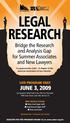 LEGAL RESEARCH Bridge the Research and Analysis Gap for Summer Associates and New Lawyers Co-sponsored by CoALL - A Chapter of the American Association of Law Libraries LIVE PROGRAM ONLY JUNE 3, 2009 Live
Reflections on a Few Common Elements of Effective Law Firm Risk Management
 Reflections on a Few Common Elements of Effective Law Firm Risk Management I. Introduction. by Gilda T. Russell 1 United States law firms employ varied approaches to risk management. In terms of structure,
TEACHER CERTIFICATION STUDY GUIDE THE LIBRARY MEDIA PROGRAM
 Table of Contents pg. SUBAREA I. THE LIBRARY MEDIA PROGRAM COMPETENCY 0001 UNDERSTAND THE ROLE OF THE LIBRARY MEDIA PROGRAM AND ITS RELATIONSHIP TO THE TOTAL SCHOOL PROGRAM...1 Skill 1.1 Skill 1.2 Skill
College of Communication and Information. Library and Information Science
 510 CHILDREN S LITERATURE AND RELATED MATERIALS. (3) A survey of children s literature, traditional and modern. Reading and evaluation of books with multimedia materials with emphasis on the needs and
STANDARDS FOR THE MASTER OF LIBRARY SCIENCE DEGREE/ SCHOOL LIBRARY MEDIA COORDINATOR LICENSE
 STANDARDS FOR THE MASTER OF LIBRARY SCIENCE DEGREE/ SCHOOL LIBRARY MEDIA COORDINATOR LICENSE Note: The master of library science degree is an entry-level requirement for all North Carolina school library
College of Communications and Information Studies
 510 CHILDREN S LITERATURE AND RELATED MATERIALS. (3) A survey of children s literature, traditional and modern. Reading and evaluation of books with multimedia materials with emphasis on the needs and
Competency Statements for Dental Public Health*
 Competency Statements for Dental Public Health* Preamble Competency statements for dental public health, and the performance indicators by which they can be measured, were developed at a workshop in San
LIBRARY AND INFORMATION STUDIES EDUCATION AND HUMAN RESOURCE UTILIZATION A STATEMENT OF POLICY EXECUTIVE SUMMARY
 LIBRARY AND INFORMATION STUDIES EDUCATION AND HUMAN RESOURCE UTILIZATION A STATEMENT OF POLICY EXECUTIVE SUMMARY In 1999 the 1 st Congress on Professional Education created four task forces. Task Force
TERI CANNON Higher Education Consultant 1326 Curtis Street Berkeley, California 94702 Cell: 510-219-1977 [email protected]
 TERI CANNON Higher Education Consultant 1326 Curtis Street Berkeley, California 94702 Cell: 510-219-1977 [email protected] EDUCATION J.D., Loyola Law School, Los Angeles, 1984 Dean's List, all years
Rubric for Evaluating North Carolina s Instructional Technology Facilitators
 Rubric for Evaluating North Carolina s Instructional Technology Facilitators Standard 1: Instructional Technology Facilitators demonstrate leadership. Not Demonstrated Developing Proficient Accomplished
Information and Technology Literacy Framework. PreK-12
 Information and Technology Literacy Framework PreK-12 Approved January 2006 Introduction to the Information and Technology Literacy Framework Background Information In 1998, the State Department of Education
California Lutheran University Information Literacy Curriculum Map Graduate Psychology Department
 California Lutheran University Information Literacy Curriculum Map Graduate Psychology Department Student Learning Outcomes Learning Outcome 1 LO1 literate student determines the nature and extent of the
California Lutheran University Information Literacy Curriculum Map Graduate Psychology Department
 California Lutheran University Information Literacy Curriculum Map Graduate Psychology Department Student Outcomes Outcome 1 LO1 determines the nature and extent of the information needed. Outcome 2 LO2
North Carolina School Nurse Evaluation Process
 North Carolina School Nurse Evaluation Process Users Guide May 2013 Acknowledgements The North Carolina Department of Public Instruction gratefully acknowledges the School Nursing Evaluation Development
Christine Iaconeta, J.D., M.L.I.S. EDUCATION San Jose State University, Fullerton, California University of Maine School of Law, Portland Maine
 Christine Iaconeta, J.D., M.L.I.S. Law Library Director Donald L. Garbrecht Law Library University of Maine School of Law (207)780-4827 [email protected] EDUCATION San Jose State University, Fullerton,
Library Information Specialist [27.450]
![Library Information Specialist [27.450]](/thumbs/39/19558096.jpg "Library Information Specialist [27.450]") Library Information Specialist [27.450] STANDARD 1 Information Access and Delivery The library information specialist provides equitable intellectual and physical access to information and ideas in support
Library Information Specialist [27.450] STANDARD 1 Information Access and Delivery The library information specialist provides equitable intellectual and physical access to information and ideas in support
College of Communication and Information. Library and Information Science
 510 CHILDREN S LITERATURE AND RELATED MATERIALS. (3) A survey of children s literature, traditional and modern. Reading and evaluation of books with multimedia materials with emphasis on the needs and
GUIDELINES FOR PROFESSIONAL LIBRARY/INFORMATION EDUCATIONAL PROGRAMS - 2000
 GUIDELINES FOR PROFESSIONAL LIBRARY/INFORMATION EDUCATIONAL PROGRAMS - 2000 Approved by IFLA's Section on Education and Training Aug. 27, 2000 Prepared by the Working Group on the Revision of the Standards
North Carolina School Library Media Coordinators Standards
 North Carolina School Library Media Coordinators Standards Every public school student will graduate from high school, globally competitive for work and postsecondary education and prepared for life in
PUBLIC ACCOUNTANTS COUNCIL HANDBOOK
 PUBLIC ACCOUNTANTS COUNCIL HANDBOOK Adopted by the Public Accountants Council for the Province of Ontario: April 17, 2006 PART I: PROFESSIONAL COMPETENCY REQUIREMENTS FOR PUBLIC ACCOUNTING PART II: PRACTICAL
Arkansas Teaching Standards
 Arkansas Teaching Standards The Arkansas Department of Education has adopted the 2011 Model Core Teaching Standards developed by Interstate Teacher Assessment and Support Consortium (InTASC) to replace
GAIL E. SILVERSTEIN APPOINTMENTS EDUCATION EMPLOYMENT
 GAIL E. SILVERSTEIN Clinical Professor of Law Civil Justice Clinic, UC Hastings College of the Law 100 McAllister Street, Suite 300 San Francisco, CA 94102 [email protected] APPOINTMENTS Clinical
ROLE DESCRIPTIONS BY COMPETENCY LEVEL
 UNIVERSITY OF NORTH CAROLINA WILMINGTON Business Systems Analyst DESCRIPTION OF WORK: The principle role of the Business Systems Analyst is to plan, design, examine, analyze, develop, implement, administer
School Library Standards. for California Public Schools, Grades Nine through Twelve
 School Library Standards for California Public Schools, Grades Nine through Twelve STANDARD 1 Students Access Information The student will access information by applying knowledge of the organization of
Master of Library and Information Science (MLIS)
 St. Catherine University 1 Master of Library and Information Science (MLIS) Mission The Master of Library and Information Science (MLIS) program at St. Catherine educates students in the principles, practices
Standards for Accreditation of Master's Programs in Library & Information Studies
 Standards for Accreditation of Master's Programs in Library & Information Studies Adopted by the Council of the American Library Association January 15, 2008 Office for Accreditation American Library Association
Target Indicators And Categories. Levels of Proficiency. Category 1 - Student Achievement and Instruction. Basic Proficient Exemplary
 All Exemplary programs will meet or exceed the definitions below for Basic, Proficient, and Exemplary programs. All Exemplary programs will have achieved the requirements set out in state education laws,
How To Become A School Librarian
 Name Date Student ID # Email School Library Graduate Program Plan Degree Status: school, degree, date Certification Status Desired Plan Bachelor s Elementary Master s Degree Master s Secondary Candidate
Guidelines For the Education of Library Technicians
 Guidelines For the Education of Library Technicians March 2011 Revision of the CLA Guidelines for the Education of Library Technicians 1991. Revised by: The Library Technician Program Chairs/Coordinators
TEACHER CERTIFICATION STUDY GUIDE INFORMATION ACCESS AND DELIVERY IN THE LIBRARY MEDIA PROGRAM
 Table of Contents SUBAREA I. COMPETENCY 1.0 INFORMATION ACCESS AND DELIVERY IN THE LIBRARY MEDIA PROGRAM UNDERSTAND THE MISSION OF THE LIBRARY MEDIA PROGRAM AND THE ROLES AND RESPONSIBILITIES OF THE MEDIA
Texas State University University Library Strategic Plan 2012 2017
 Texas State University University Library Strategic Plan 2012 2017 Mission The University Library advances the teaching and research mission of the University and supports students, faculty, and other
Department of Accounting, Finance, & Economics
 Department of Accounting, Finance, & Economics Assessment Report 2010-2011 Mission/Purpose The mission of the Department of Accounting, Finance and Economics is to provide a quality education in accounting,
GUIDELINES FOR ACADEMIC PROGRAM REVIEW For self-studies due to the Office of the Provost on October 1, 2015 GRADUATE PROGRAMS
 GUIDELINES FOR ACADEMIC PROGRAM REVIEW For self-studies due to the Office of the Provost on October 1, 2015 GRADUATE PROGRAMS OVERVIEW OF PROGRAM REVIEW At Illinois State University, primary responsibility
Strategic Plan 2012-2014 2012-2014. San Luis Obispo County Community College District
 Strategic Plan 2012-2014 2012-2014 S Strategic Plan 2012-2014 San Luis Obispo County Community College District San Luis Obispo County Community College District STRATEGIC PLAN 2012-2014 San Luis Obispo
Standards for Accreditation of Master s Programs in Library and Information Studies. Introduction
 Standards for Accreditation of Master s Programs in Library and Information Studies Adopted by approval of the Council of the American Library Association, February 2, 2015 Purpose of Accreditation Introduction
NC TEACHER EVALUATION PROCESS SAMPLE EVIDENCES AND ARTIFACTS
 STANDARD I: ELEMENT A: Teachers demonstrate leadership Teachers lead in their classroom Developing Has assessment data available and refers to it to understand the skills and abilities of students Accesses
NORTH CAROLINA PROFESSIONAL SCHOOL SOCIAL WORK STANDARDS
 NORTH CAROLINA PROFESSIONAL SCHOOL SOCIAL WORK STANDARDS Every public school student will graduate from high school globally competitive for work and postsecondary education and prepared for life in the
RE: Revised Standards for Accreditation of Master s Programs in Library and Information Studies
 EBD #10.9 2013-2014 TO: ALA Executive Board RE: Revised Standards for Accreditation of Master s Programs in Library and Information Studies ACTION REQUESTED/INFORMATION/REPORT: For information purposes.
GEORGIA STANDARDS FOR THE APPROVAL OF PROFESSIONAL EDUCATION UNITS AND EDUCATOR PREPARATION PROGRAMS
 GEORGIA STANDARDS FOR THE APPROVAL OF PROFESSIONAL EDUCATION UNITS AND EDUCATOR PREPARATION PROGRAMS (Effective 9/01/08) Kelly Henson Executive Secretary Table of Contents Standard 1: Candidate Knowledge,
Crosswalk of the New Colorado Principal Standards (proposed by State Council on Educator Effectiveness) with the
 Crosswalk of the New Colorado Principal Standards (proposed by State Council on Educator Effectiveness) with the Equivalent in the Performance Based Principal Licensure Standards (current principal standards)
Pemberton (Instructional Services Coordinator) and Radom (Instructional Services Librarian) University of North Carolina Wilmington [Wilmington, NC]
![Pemberton (Instructional Services Coordinator) and Radom (Instructional Services Librarian) University of North Carolina Wilmington [Wilmington, NC]](/thumbs/37/17727881.jpg "Pemberton (Instructional Services Coordinator) and Radom (Instructional Services Librarian) University of North Carolina Wilmington [Wilmington, NC]") Constructing a Three Credit Hour Information Literacy Course: A Blueprint for Success Anne Pemberton and Rachel Radom Background With 11,911 students, the University of North Carolina Wilmington (UNCW)
Constructing a Three Credit Hour Information Literacy Course: A Blueprint for Success Anne Pemberton and Rachel Radom Background With 11,911 students, the University of North Carolina Wilmington (UNCW)
QUALITY INDICATORS FOR ASSISTIVE TECHNOLOGY SERVICES RESEARCH-BASED REVISIONS, 2004
 QUALITY INDICATORS FOR ASSISTIVE TECHNOLOGY SERVICES RESEARCH-BASED REVISIONS, 2004 The consideration of assistive technology (AT) devices and services is required during the development of every Individualized
The University of Toledo College of Medicine and Life Sciences Faculty Tracks for Academic Rank and Criteria for Promotion
 The University of Toledo College of Medicine and Life Sciences Faculty Tracks for Academic Rank and Criteria for Promotion Faculty Tracks for Academic Rank. There are six tracks for full-time and part-time
AAfPE Core Competencies for Paralegal Programs
 AAfPE Core Competencies for Paralegal Programs CRITICAL THINKING SKILLS 1. Analyze a problem; identify and evaluate alternative solutions; 2. Formulate logical solutions to problems; construct logical
1) Elementary School Teacher Job Description
 1) Elementary School Teacher Job Description An elementary school teacher at APA Reports To: Principal Length of Assignment: 10 months Primary purpose: To create a flexible elementary grade program and
SBBC: JJ-002 FL: 28 THE SCHOOL BOARD OF BROWARD COUNTY, FLORIDA JOB DESCRIPTION. Approved School-based Administrators Salary Schedule
 THE SCHOOL BOARD OF BROWARD COUNTY, FLORIDA JOB DESCRIPTION POSITION TITLE: CONTRACT YEAR: PAY GRADE: School Assistant Principal Eleven Months* Approved School-based Administrators Salary Schedule QUALIFICATIONS:
The Standards of Good Practice for Education Abroad The Forum on Education Abroad May 2007
 The Standards of Good Practice for Education Abroad The Forum on Education Abroad May 2007 DEFINITION OF TERMS Education Abroad Program (or Program) In-classroom and out-of-classroom related activities
COMPETENCIES, COMPETENCY ELEMENTS AND RESOURCES TO MOBILIZE FOR THE DESS, PROFESSIONAL MASTER S, RESEARCH- BASED MASTER S AND DOCTORATE
 Academic and International Affairs Graduate Studies COMPETENCIES, COMPETENCY ELEMENTS AND RESOURCES TO MOBILIZE FOR THE DESS, PROFESSIONAL MASTER S, RESEARCH- BASED MASTER S AND DOCTORATE This list of
ALA s Core Competences of Librarianship
 ALA s Core Competences of Librarianship Final version Approved by the ALA Executive Board, October 25 th 2008 Approved and adopted as policy by the ALA Council, January 27 th 2009 This document defines
ASSESSMENT 5: Masters Degree ECE Summative Assessment Project, Thesis or Paper
 ASSESSMENT 5: Masters Degree ECE Summative Assessment Project, Thesis or Paper This Assignment Addresses These Specific Program Standards Affecting the Development of Both the Early Childhood Teacher Leader
2016 Employment Questionnaire (For 2015 Graduates)
 2016 Employment Questionnaire (For 2015 Graduates) DEFINITIONS & INSTRUCTIONS Copyright 2016 American Bar Association 2016 ABA EMPLOYMENT QUESTIONNAIRE DEFINITIONS AND INSTRUCTIONS Employment information
PRO-NET. A Publication of Building Professional Development Partnerships for Adult Educators Project. April 2001
 Management Competencies and Sample Indicators for the Improvement of Adult Education Programs A Publication of Building Professional Development Partnerships for Adult Educators Project PRO-NET April 2001
Guidelines and Proposal for the Master of Arts (MA) or Master of Science (MS) in Interdisciplinary Studies Degrees
 Guidelines and Proposal for the Master of Arts (MA) or Master of Science (MS) in Interdisciplinary Studies Degrees California State University, Fresno Division of Graduate Studies SECTION I GUIDELINES
North Carolina TEACHER. evaluation process. Public Schools of North Carolina State Board of Education Department of Public Instruction
 North Carolina TEACHER evaluation process Public Schools of North Carolina State Board of Education Department of Public Instruction Rubric for Evaluating North Carolina Teachers ( This form should be
Nomination and Selection of External Consultants for Graduate Program Reviews
 Nomination and Selection of External Consultants for Graduate Program Reviews Graduate Programs External Consultants are required for the review of all new programs (with the exception of new collaborative
NEW YORK STATE TEACHER CERTIFICATION EXAMINATIONS
 NEW YORK STATE TEACHER CERTIFICATION EXAMINATIONS TEST DESIGN AND FRAMEWORK September 2014 Authorized for Distribution by the New York State Education Department This test design and framework document
Emerging Career Trends for Information Professionals: A Snapshot of Job Titles in Summer 2013
 Emerging Career Trends for Information Professionals: A Snapshot of Job Titles in Summer 2013 Introduction This report provides an informal snapshot regarding some of the latest career trends for information
PROPOSAL TO OFFER A NEW ACADEMIC PROGRAM/ MAJOR IN FALL 2004 (LONG FORM)
 PROPOSAL TO OFFER A NEW ACADEMIC PROGRAM/ MAJOR IN FALL 2004 (LONG FORM) Proposed Name of Degree: Options/ Emphases in the Degree: Specialization: Principals Leadership Faculty Proposing New Program: Joan
MA THESIS AND MA CAPSTONE PROJECT GUIDELINES. MA in Corporate Communication. Communication Studies Department
 1 MA THESIS AND MA CAPSTONE PROJECT GUIDELINES MA in Corporate Communication Communication Studies Department Baruch College, The City University of New York 2013-2014 COM 9991 MA THESIS IN CORPORATE COMMUNICATION
Previous Approvals: April 5, 2005; May 6, 2008; November 2, 2010; May 3, 2011, May 3, 2011, May 7, 2013
 RYERSON UNIVERSITY POLICY OF SENATE PERIODIC PROGRAM REVIEW OF GRADUATE AND UNDERGRADUATE PROGRAMS Policy Number 126 Previous Approvals: April 5, 2005; May 6, 2008; November 2, 2010; May 3, 2011, May 3,
Commission on Peer Review and Accreditation
 Commission on Peer Review and Accreditation Network of Schools of Public Policy, Affairs, and Administration ACCREDITATION STANDARDS For Master s degree programs Adopted October 16, 2009 at the NASPAA
Association of College and Research Libraries Psychology Information Literacy Standards
 1 P a g e Introduction The (ACRL) Information Literacy Competency Standards for Higher Education (2000) provides general performance indicators and outcomes to use in undergraduate settings. The following
EDUCATION California State University, Chico: Bachelor of Arts, Political Science, 1977
 MELISSA C. BROWN University of the Pacific McGeorge School of Law 3200 Fifth Avenue SACRAMENTO, CA 94817 (916) 739-7378 EDUCATION California State University, Chico: Bachelor of Arts, Political Science,
ETHICAL CONDUCT AND PROFESSIONAL PRACTICE: PRINCIPLES AND STANDARDS FOR MEMBERS OF THE BRITISH COLUMBIA ASSOCIATION OF SCHOOL PSYCHOLOGISTS
 ETHICAL CONDUCT AND PROFESSIONAL PRACTICE: PRINCIPLES AND STANDARDS FOR MEMBERS OF THE BRITISH COLUMBIA ASSOCIATION OF SCHOOL PSYCHOLOGISTS March 2010 Preamble Ethical Principles define the ethical responsibility
ECU Libraries Joint Strategic Plan 2014-19
 ECU Libraries Joint Strategic Plan 2014-19 Joyner Library mission: Joyner Library is the intellectual heart of East Carolina University. We serve ECU s campus and distance education communities, act as
BOARD AND CEO ROLES DIFFERENT JOBS DIFFERENT TASKS
 BOARD AND CEO ROLES DIFFERENT JOBS DIFFERENT TASKS Introduction Local boards of trustees and chief executive officers play different roles and have different responsibilities in leading their districts.
CORE COMPETENCIES OF NURSE EDUCATORS WITH TASK STATEMENTS. Competency 1 Facilitate Learning
 CORE COMPETENCIES OF NURSE EDUCATORS WITH TASK STATEMENTS Competency 1 Facilitate Learning Nurse educators are responsible for creating an environment in classroom, laboratory, and clinical settings that
... and. Uses data to help schools identify needs for prevention and intervention programs.
 Rubric for Evaluating North Carolina s School Psychologists Standard 1: School psychologists demonstrate leadership. School psychologists demonstrate leadership by promoting and enhancing the overall academic
TABLE OF CONTENTS. Accreditation and Educational Outcomes 1. Curriculum of the Post-Master s DNP Program 1-2. Program of Study 2-3
 DNP 2015 2016 TABLE OF CONTENTS Accreditation and Educational Outcomes 1 Curriculum of the Post-Master s DNP Program 1-2 Program of Study 2-3 Course Descriptions for Core Courses 4-6 The E-Portfolio 6-7
ROBYN L. MEADOWS. Contracts, Secured Transactions, Sales and Leases, Payment Systems, International Sales, Global Issues in Commercial Law, Insurance.
 ROBYN L. MEADOWS TEACHING EXPERIENCE WIDENER UNIVERSITY SCHOOL OF LAW 3800 Vartan Way, P.O. Box 69382 Harrisburg, PA 19106-9382 Interim Dean Harrisburg (January 2014- July 2015) Vice Dean (2009-2014) Professor
CURRICULUM VITAE OF BONNIE BLUME GOLDSAMT THE LAW & MEDIATION OFFICES OF BONNIE BLUME GOLDSAMT, MA, JD, APM
 March 17, 2013 CURRICULUM VITAE OF BONNIE BLUME GOLDSAMT THE LAW & MEDIATION OFFICES OF BONNIE BLUME GOLDSAMT, MA, JD, APM One University Plaza, Suite 14 25 Pompton Avenue, Suite 101 Hackensack, New Jersey
2015-16 Rubric for Evaluating Colorado s Specialized Service Professionals: Occupational Therapists
 2015-16 Rubric for Evaluating Colorado s Specialized Service Professionals: Occupational Therapists Definition of an Effective Occupational Therapist Effective occupational therapists are vital members
Guidelines for Massachusetts Early Educator Preparation Programs Participating in the Early Childhood Educator Scholarships Program.
 Guidelines for Massachusetts Early Educator Preparation Programs Participating in the Early Childhood Educator Scholarships Program Background The Departments of Higher Education and Early Education and
Competency Requirements for Executive Director Candidates
 Competency Requirements for Executive Director Candidates There are nine (9) domains of competency for association executives, based on research conducted by the American Society for Association Executives
PROGRAM PUBLIC INFORMATION
 Department of Civil Engineering & Construction Management College Of Engineering and Computer Science California State University-Northridge Northridge, Ca Construction Management Program PROGRAM PUBLIC
RESTRICTED. Professional Accreditation Handbook For Computer Science Programmes
 Professional Accreditation Handbook For Computer Science Programmes Revised by authority of the Accreditation Committee for Computer Science Programmes as of August 2014 CONTENTS 1. FRAMEWORK FOR ACCREDITATION
UNIVERSITY OF SOUTH CAROLINA SCHOOL OF LAW DEPARTMENT OF CLINICAL LEGAL STUDIES TENURE AND PROMOTION PROCEDURES AND STANDARDS
 UNIVERSITY OF SOUTH CAROLINA SCHOOL OF LAW DEPARTMENT OF CLINICAL LEGAL STUDIES TENURE AND PROMOTION PROCEDURES AND STANDARDS I. PROCEDURES 1. Department of Clinical Legal Studies Tenure Committee. The
Educational Policy and Accreditation Standards
 Educational Policy and Accreditation Standards Copyright 2001, Council on Social Work Education, Inc. All rights reserved. Sections renumbered December 2001, released April 2002, corrected May 2002, July
Novice Experienced Expert a. Understands the importance of ABE, ASE, and ESOL at the personal and program level. X X X
 Complete Draft 1 through 5 Rhode Island Adult Education Practitioner Standards for Instructors 9-12-12 Definitions: Expert Teachers Expert teachers have the capacity to teach from the heart as well as
MILLIKIN TEACHING STANDARDS
 MILLIKIN TEACHING STANDARDS Millikin Teaching Standards are correlated to and modifications of Illinois Professional Teaching Standards. Modifications reflect Millikin s mission and the education unit
BA Psychology (2014 2015)
 BA Psychology (2014 2015) Program Information Point of Contact Marianna Linz ([email protected]) Support for University and College Missions Marshall University is a multi campus public university providing
Performance Factors and Campuswide Standards Guidelines. With Behavioral Indicators
 Performance Factors and Campuswide Standards Guidelines With Behavioral Indicators Rev. 05/06/2014 Contents PERFORMANCE FACTOR GUIDELINES... 1 Position Expertise... 1 Approach to Work... 2 Quality of Work...
DEPARTMENT OF MARKETING COLLEGE OF BUSINESS ADMINSTRATION POLICY ON REAPPOINTMENT, TENURE, AND PROMOTION (RTP)
 Approved by Academic Affairs May 2010 DEPARTMENT OF MARKETING COLLEGE OF BUSINESS ADMINSTRATION POLICY ON REAPPOINTMENT, TENURE, AND PROMOTION (RTP) I. DEPARTMENT OF MARKETING RTP POLICY A. Preamble B.
TEACHING THE LAW AND JUSTICE CURRICULUM. lawandjustice.edc.org
 lawandjustice.edc.org Introduction Welcome to the Law and Justice curriculum! Developed by Education Development Center, Inc. (EDC), with support from The James Irvine Foundation, the Law and Justice curriculum
Joseph P. McMonigle, Partner. Summary of Qualifications
 465 California Street, Fifth Floor San Francisco, CA 94104 Main: (415) 397-2222 Direct: (415) 438-4534 [email protected] Summary of Qualifications Joe McMonigle is honored by membership in the four
ASAE s Job Task Analysis Strategic Level Competencies
 ASAE s Job Task Analysis Strategic Level Competencies During 2013, ASAE funded an extensive, psychometrically valid study to document the competencies essential to the practice of association management