
PUBLIC ACCOUNTANTS COUNCIL HANDBOOK
|
|
|
- Rosalyn Bruce
- 10 years ago
- Views:
Transcription
1 PUBLIC ACCOUNTANTS COUNCIL HANDBOOK Adopted by the Public Accountants Council for the Province of Ontario: April 17, 2006
2

3 PART I: PROFESSIONAL COMPETENCY REQUIREMENTS FOR PUBLIC ACCOUNTING PART II: PRACTICAL EXPERIENCE REQUIREMENTS FOR PRACTISING PUBLIC ACCOUNTING

4

5 PART I: PROFESSIONAL COMPETENCY REQUIREMENTS FOR PUBLIC ACCOUNTING

6

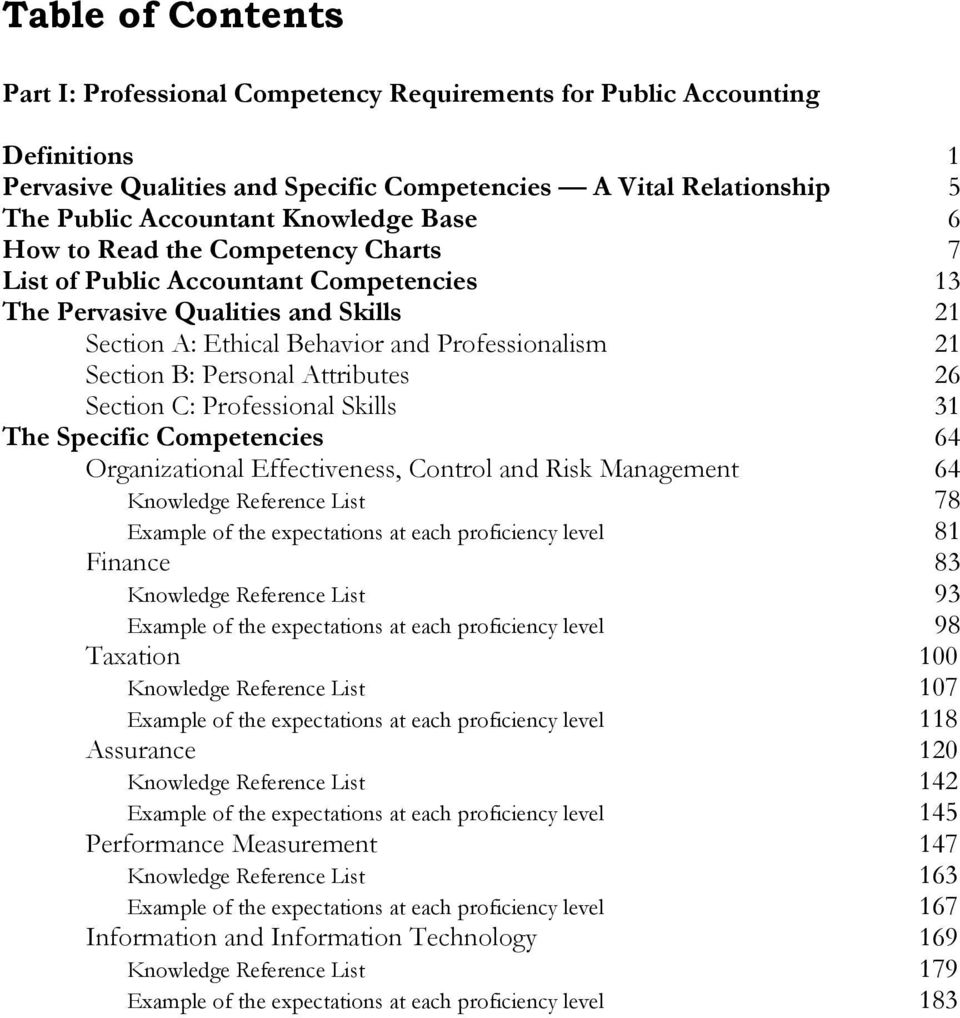
7 Table of Contents Part I: Professional Competency Requirements for Public Accounting Definitions 1 Pervasive Qualities and Specific Competencies A Vital Relationship 5 The Public Accountant Knowledge Base 6 How to Read the Competency Charts 7 List of Public Accountant Competencies 13 The Pervasive Qualities and Skills 21 Section A: Ethical Behavior and Professionalism 21 Section B: Personal Attributes 26 Section C: Professional Skills 31 The Specific Competencies 64 Organizational Effectiveness, Control and Risk Management 64 Knowledge Reference List 78 Example of the expectations at each proficiency level 81 Finance 83 Knowledge Reference List 93 Example of the expectations at each proficiency level 98 Taxation 100 Knowledge Reference List 107 Example of the expectations at each proficiency level 118 Assurance 120 Knowledge Reference List 142 Example of the expectations at each proficiency level 145 Performance Measurement 147 Knowledge Reference List 163 Example of the expectations at each proficiency level 167 Information and Information Technology 169 Knowledge Reference List 179 Example of the expectations at each proficiency level 183
8

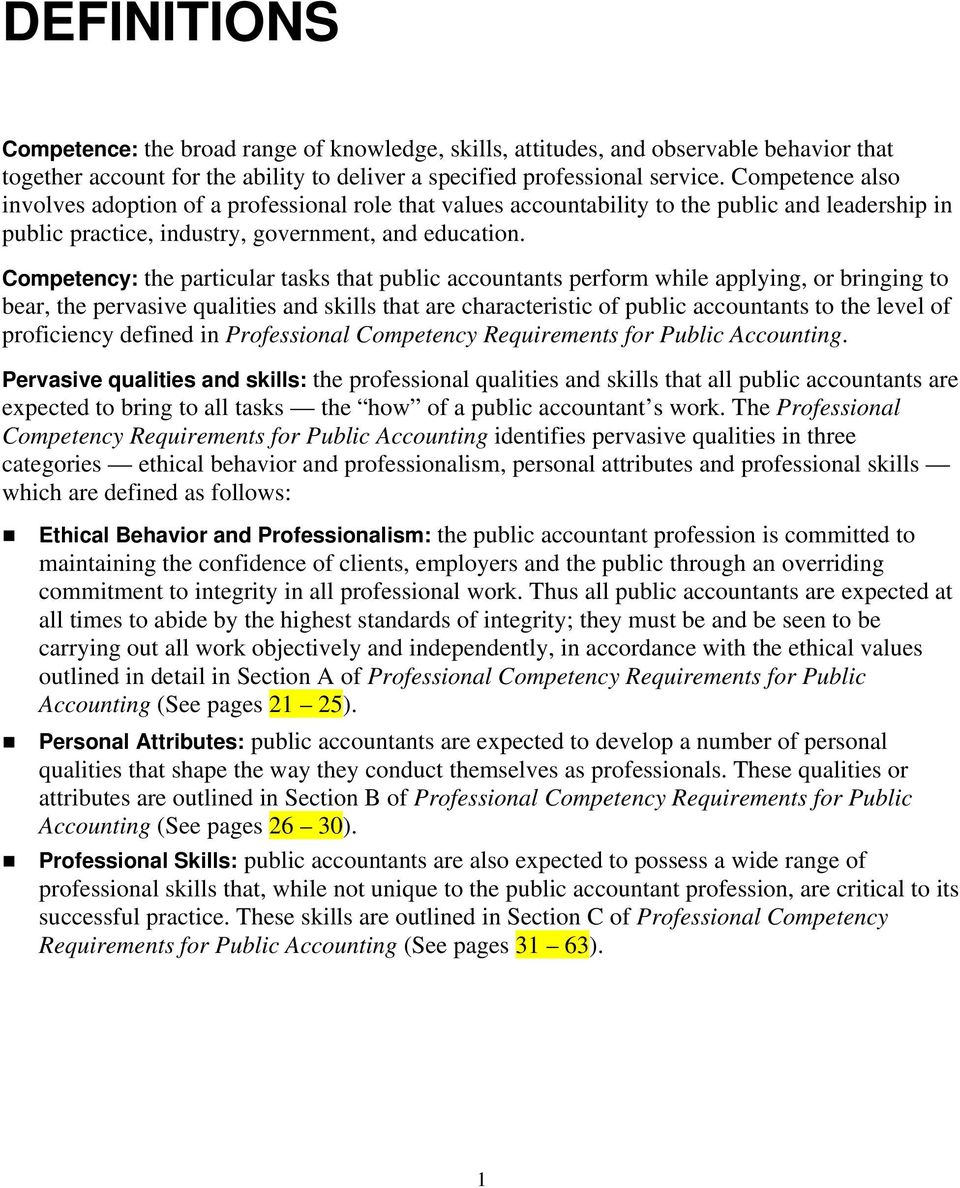
9 DEFINITIONS Competence: the broad range of knowledge, skills, attitudes, and observable behavior that together account for the ability to deliver a specified professional service. Competence also involves adoption of a professional role that values accountability to the public and leadership in public practice, industry, government, and education. Competency: the particular tasks that public accountants perform while applying, or bringing to bear, the pervasive qualities and skills that are characteristic of public accountants to the level of proficiency defined in Professional Competency Requirements for Public Accounting. Pervasive qualities and skills: the professional qualities and skills that all public accountants are expected to bring to all tasks the how of a public accountant s work. The Professional Competency Requirements for Public Accounting identifies pervasive qualities in three categories ethical behavior and professionalism, personal attributes and professional skills which are defined as follows: Ethical Behavior and Professionalism: the public accountant profession is committed to maintaining the confidence of clients, employers and the public through an overriding commitment to integrity in all professional work. Thus all public accountants are expected at all times to abide by the highest standards of integrity; they must be and be seen to be carrying out all work objectively and independently, in accordance with the ethical values outlined in detail in Section A of Professional Competency Requirements for Public Accounting (See pages 21 25). Personal Attributes: public accountants are expected to develop a number of personal qualities that shape the way they conduct themselves as professionals. These qualities or attributes are outlined in Section B of Professional Competency Requirements for Public Accounting (See pages 26 30). Professional Skills: public accountants are also expected to possess a wide range of professional skills that, while not unique to the public accountant profession, are critical to its successful practice. These skills are outlined in Section C of Professional Competency Requirements for Public Accounting (See pages 31 63). 1
10 The Competencies of the Newly Qualified Public Accountant Specific Competencies: the competency areas of the public accountant profession. There are specific competencies grouped into six categories: I-Organizational Effectiveness, Control and Risk Management competencies related to the evaluation and development of an entity s ability to enhance its decision-making and maximize its organizational performance, including its governance, structure, policies, systems and resources; II-Finance competencies related to financial management, financial strategy and financial decision-making; III-Taxation competencies related to taxation planning, compliance and reporting for various entities; IV-Assurance competencies related to statutory and regulatory audit/assurance requirements as well as broader validation and assurance services; V-Performance Measurement competencies related to the evaluation, development and interpretation of an entity s financial and non-financial information that measures and enhances an entity s organizational performance; and VI-Information and Information Technology competencies related to the evaluation of an entity s information needs and the development and use of information technology in achieving its strategic and operational goals and objectives. Although these six areas are presented separately, there is considerable integration among them and with the pervasive qualities and skills. The importance of integration cannot be overstated, and it is usually highlighted through references in the document. For example, in drafting a report on an assurance engagement (competency IV-2.13), the public accountant would likely be demonstrating competence in a number of other areas, including but not limited to the pervasive qualities and skills, e.g. becoming knowledgeable about the client (professional skills C-1.2 and C-8.3), and all, or components of the competencies of developing accounting policies (V-2.1), analyzing the applicability of current developments (V-2.3), and addressing tax-related issues (III-2.2, i.e., tax provision.) Normal circumstances: circumstances where: The entity is a business in the private sector, formed as a proprietorship, as a partnership, as a private corporation, as a small public corporation, or as a division of a large public corporation; or The entity is in the public sector or is a not-for-profit organization or a division of either; or The entity is an individual; and The entity, situation, event or transaction is of a size or degree of complexity likely to be encountered by a public accountant at the point of qualification. 2

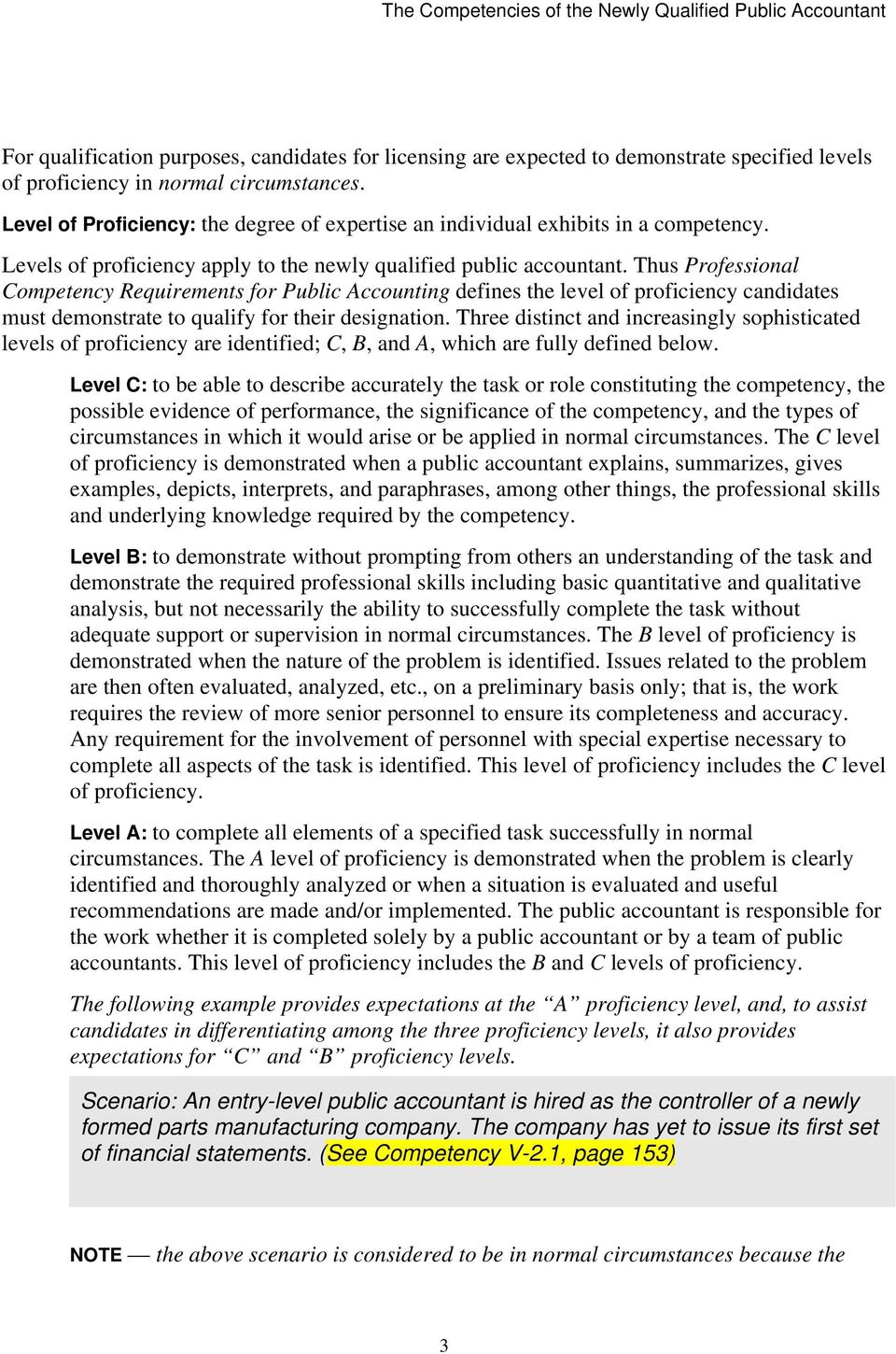
11 The Competencies of the Newly Qualified Public Accountant For qualification purposes, candidates for licensing are expected to demonstrate specified levels of proficiency in normal circumstances. Level of Proficiency: the degree of expertise an individual exhibits in a competency. Levels of proficiency apply to the newly qualified public accountant. Thus Professional Competency Requirements for Public Accounting defines the level of proficiency candidates must demonstrate to qualify for their designation. Three distinct and increasingly sophisticated levels of proficiency are identified; C, B, and A, which are fully defined below. Level C: to be able to describe accurately the task or role constituting the competency, the possible evidence of performance, the significance of the competency, and the types of circumstances in which it would arise or be applied in normal circumstances. The C level of proficiency is demonstrated when a public accountant explains, summarizes, gives examples, depicts, interprets, and paraphrases, among other things, the professional skills and underlying knowledge required by the competency. Level B: to demonstrate without prompting from others an understanding of the task and demonstrate the required professional skills including basic quantitative and qualitative analysis, but not necessarily the ability to successfully complete the task without adequate support or supervision in normal circumstances. The B level of proficiency is demonstrated when the nature of the problem is identified. Issues related to the problem are then often evaluated, analyzed, etc., on a preliminary basis only; that is, the work requires the review of more senior personnel to ensure its completeness and accuracy. Any requirement for the involvement of personnel with special expertise necessary to complete all aspects of the task is identified. This level of proficiency includes the C level of proficiency. Level A: to complete all elements of a specified task successfully in normal circumstances. The A level of proficiency is demonstrated when the problem is clearly identified and thoroughly analyzed or when a situation is evaluated and useful recommendations are made and/or implemented. The public accountant is responsible for the work whether it is completed solely by a public accountant or by a team of public accountants. This level of proficiency includes the B and C levels of proficiency. The following example provides expectations at the A proficiency level, and, to assist candidates in differentiating among the three proficiency levels, it also provides expectations for C and B proficiency levels. Scenario: An entry-level public accountant is hired as the controller of a newly formed parts manufacturing company. The company has yet to issue its first set of financial statements. (See Competency V-2.1, page 153) NOTE the above scenario is considered to be in normal circumstances because the 3
12 The Competencies of the Newly Qualified Public Accountant entity is a manufacturing company in the private sector and is of a size and degree of complexity likely to be encountered by an entry-level public accountant. The newly qualified public accountant is expected to have an A proficiency level for this competency. Level 'C': The entry-level public accountant at the C level explains to senior management the importance of establishing accounting policies and of consistently applying those policies to the company s financial transactions. The public accountant informs management of some of the factors to be taken into account when developing the accounting policies, such as, users specific needs, or industry specific practices. The public accountant explains that often there are alternative accounting treatments and that judgment is required in establishing the policy that best suits the entity. Level 'B': The entry-level public accountant at the B level, in addition to the skills and abilities above, also asks senior management to describe the company s key transaction streams. The public accountant then documents these streams, and based on this information identifies alternative accounting treatments. The public accountant identifies the significant factors that influence the choice of policies, such as, the various financial statement users and their needs. The public accountant presents suggested policies to senior management who will make the decision as to which ones to implement. Level 'A': The entry-level public accountant at the A level, in addition to the skills and abilities outlined in both C and B above, is responsible for developing the company s accounting policies. The public accountant gains an understanding of who the various stakeholders are and of their reporting needs. The public accountant analyzes the information gathered and then chooses the accounting policies that best reflect the results of the entity and provide the most useful information for measuring performance. The public accountant implements the policies and subsequently reports to senior management the steps taken in establishing them. Newly qualified public accountants will invariably be involved in a multitude of professional tasks which will vary considerably among them depending on their particular environment and the nature of their employment. For example, with respect to competency III-1.2, Evaluates and advises management on applicable new tax legislation, (where the proficiency level expected of the newly qualified public accountant is B), those employed in small private or public organizations, or who provide services as small or sole public practitioners, will likely need to function at the A proficiency for this competency. Those newly qualified public accountants employed in large private or public corporations are more likely to have their work on this competency reviewed by a more senior member within the organization prior to its finalization (a B proficiency level). With respect to varying environmental situations, there is no one size fits all. Proficiency levels that are assigned to the competencies in this document set out what should be reasonably expected of the newly qualified public accountant. 4

13 The Competencies of the Newly Qualified Public Accountant Pervasive Qualities and Specific Competencies A Vital Relationship The qualities and skills in Professional Competency Requirements for Public Accounting combine with the specific competencies in a vital relationship that results in the special professional competencies of the public accountant. Together, the pervasive qualities and the specific competencies result in the technical excellence and on the integrity, objectivity, and commitment to public interest for which the public accountant profession is known. All public accountants are expected to perform functions in a manner that reflects ethical behaviour and professionalism, the personal attributes, and the professional skills that are part of the public accountant standard. The diagram below illustrates the components of the competency-based approach. 5

14 The Competencies of the Newly Qualified Public Accountant The Public Accountant Knowledge Base The public accountant qualification s competency-based approach recognizes that knowledge is necessary but not sufficient for performing professional services. For knowledge to become a public accountant competency, it must be applied in a manner that includes the integration of the public accountant pervasive qualities and skills described above. The acquisition of the public accountant knowledge base is, however, critical for success. Public accountants acquire knowledge that encompasses the economic, legal, and business environment in which businesses and other organizations operate, and knowledge such as generally accepted accounting principles and current tax regulation, directly related to one or more competencies. Candidates acquire knowledge throughout the public accountant qualification process, through academic programs and work experience, and from reference materials, teachers and other professionals who may provide information and advice. Understanding the Knowledge Reference Lists To help candidates identify knowledge integral to the competencies they are expected to demonstrate, a Knowledge Reference List is included for each specific competency area. This list outlines the knowledge that underlies each specific competency area. Generally, candidates can use this list as a guide to ensure they have identified the appropriate material underlying the specific competency areas. In generating the knowledge reference lists, information was gathered from various sources: the CICA Handbooks and other CICA publications, The Income Tax Act, and undergraduate textbooks. Candidates are encouraged to access similar sources to further their breadth and depth of knowledge. The Knowledge Reference Lists include individual topics of knowledge under the specific competency area where they are most relevant, or most strongly identified. This does not mean that this knowledge is relevant to only that area. In many instances, knowledge is relevant to two or more areas. So, for example, organizational effectiveness, control and risk management knowledge topics are all listed under the Organizational Effectiveness, Control and Risk Management section; they may, however, also be relevant to Finance or Assurance. 6
15 How to Read the Competency Charts Organization As noted in the previous section, the public accountant competencies are organized into two categories: Pervasive qualities and skills which all public accountants are expected to exhibit at all times; and Specific competencies, in which all public accountants must attain a required level of proficiency to earn their public accountant designation. There are three categories of pervasive qualities and skills, and six categories of specific competencies. Pervasive qualities and skills The charts describing the pervasive qualities and skills have two sections: in the box on the left, a comprehensive description of the public accountant quality, and in the box on the right a description of the kind of evidence that one would expect the public accountant s behaviour to demonstrate. Example A-7 Maintains and enhances the profession s reputation Performs work to a high standard of quality Contributes to the enhancement of the profession* Encourages prospective candidates to join* Promotes the profession in conversation* Participates in some of the profession s activities such as conferences and in the work of governing bodies, such as committees or councils* Possible evidence of behaviour Users of the work confirm its quality Others confirm that the public accountant s behaviour and performance enhance the profession Has a record of contributing to professional activities * Not examinable on the licensing examination 7

16 How to Read the Competency Charts The most important thing to understand about the pervasive qualities and skills is that all public accountants are expected to demonstrate them at all times in the execution of all their professional responsibilities. The pervasive qualities and skills describe how a public accountant works, and are vitally linked to the specific competencies. Together, they combine to produce the technical excellence, integrity, objectivity, and commitment to public interest for which the public accountant profession is known. Performance levels and the Pervasive Qualities and Skills: As noted, Professional Competency Requirements for Public Accounting distinguishes and defines three levels of proficiency that a public accountant may demonstrate for each competency i.e., C, B, and A, with A being the highest proficiency level. For many competencies, the newly qualified public accountant is expected to function only at the C or B level. For most of the pervasive qualities and skills, however, even the newly qualified public accountant is expected to demonstrate the highest level of proficiency. Only in the third part, Section C Professional Skills is it reasonable to expect a lower proficiency level at entry to the profession. In these instances, the box on the left describes the highest proficiency level i.e., the A level and then notes and defines any lower level expectation in brackets. Example C-2.8 Draws conclusions / forms opinions Possible evidence of skill Taking into account the identified purpose, the information gathered and the analysis of that information, forms an opinion on the outcome of an issue or on the impact of the information on a situation; e.g., Based on the projected cash flow, the company will have insufficient cash to finance the expansion. Summarizes a position or argument after reviewing the relevant information (At B, forms preliminary conclusions and opinions) Provides evidence of analyzes (C-2.1), advises (C-3.3), and communicates (C- 4) The conclusions flow logically from the facts and analysis The reasoning is sound Sufficient information is obtained to support all conclusions, or a statement is made that a conclusion cannot be reached Conclusions, including recommendations for follow-up work, are logical, and reflect fairly the evidence and knowledge at hand 8

17 How to Read the Competency Charts The Specific Competencies The section on specific competencies is organized into six categories: Organizational Effectiveness, Control and Risk Management Finance Taxation Assurance Performance Measurement Information and Information Technology Each of these six categories has four elements: A description of the competency; Charts describing the tasks related to each competency at the proficiency level expected of the newly qualified public accountant; A list of the knowledge underlying the competency, referred to as a Knowledge Reference List. This list identifies the knowledge which candidates gain through their undergraduate, graduate and/or professional education and/or through their working experience with recognized training offices. The List is intended to help candidates ensure they understand the knowledge they must acquire to prepare themselves for the challenges of qualification; and Examples of how the listed knowledge underlies the kinds of situations the newly qualified public accountant might expect to encounter, and thus what candidates for licensing may encounter in the licensing examination simulations. The competency charts for the specific competencies are also linked very closely to the Professional Skill charts found in Section C referred to in the last section. Understanding the Specific Competency Charts The competency charts for the specific competencies provide the public accountant candidate with a clear description of the competency at the performance level they are expected to demonstrate, and the actions that are considered by the profession as possible sources of evidence that they have attained that proficiency level. Note that, on the title of each competency, the proficiency level of the newly qualified public accountant is clearly indicated. Candidates are encouraged to refer to the definitions of these proficiency levels on page 3. 9

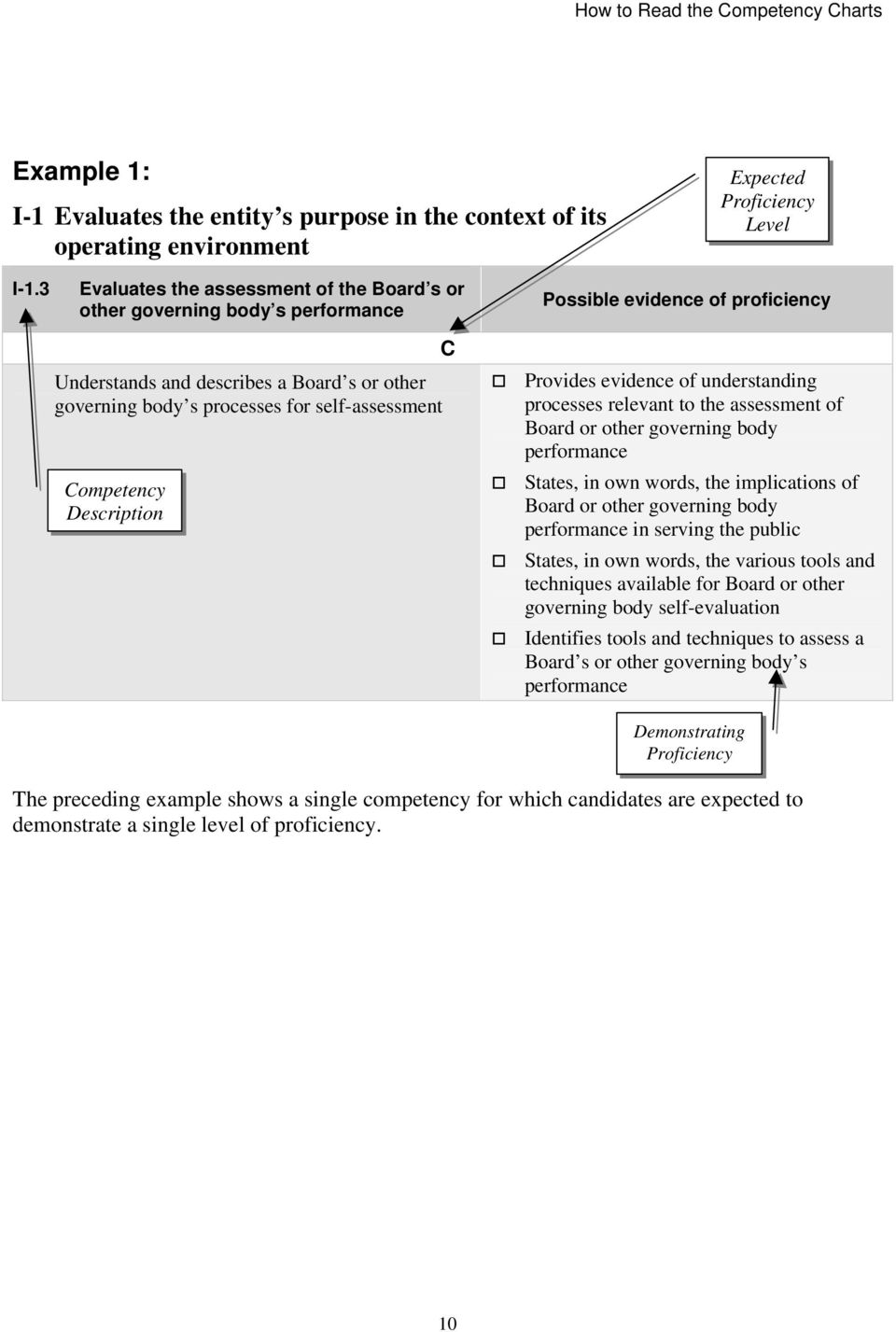
18 How to Read the Competency Charts Example 1: I-1 Evaluates the entity s purpose in the context of its operating environment Expected Proficiency Level I-1.3 Evaluates the assessment of the Board s or other governing body s performance Understands and describes a Board s or other governing body s processes for self-assessment Competency Description C Possible evidence of proficiency Provides evidence of understanding processes relevant to the assessment of Board or other governing body performance States, in own words, the implications of Board or other governing body performance in serving the public States, in own words, the various tools and techniques available for Board or other governing body self-evaluation Identifies tools and techniques to assess a Board s or other governing body s performance Demonstrating Proficiency The preceding example shows a single competency for which candidates are expected to demonstrate a single level of proficiency. 10
19 How to Read the Competency Charts Example 2 II-3.1 Manages budgets, cash flow, working capital, and financial instruments Competency Description Possible evidence of proficiency Analyzes, reports on, and manages short-term cash needs Analyzes long- and medium-term capital and cash needs and develops strategies for obtaining necessary financial resources Prepares appropriate budgets to aid in planning Evaluates actual performance against budget Expected Proficiency Level In collaboration* with others, suggests action to take to improve organizational performance Identifies, on a preliminary basis, suitable financial instruments for managing cash flow Participates in negotiations with brokers and investment advisors to choose appropriate financial instruments A B Provides evidence of analyzes (C-2.1), presents (C-4.3), manages (C-5.1), forecasts (C-2.2) and evaluates (C-2.6) Compares cash flow projections with actual recent cash flows to assess reasonableness Confirms with senior executives that the analysis adds significant value to the management of the cash position There is a basis for proper budgetary control, cash flow management, and use of short-term financial instruments Provides evidence of analyzes (C-2.1), recommends (C-3.3), negotiates (C-5.7) and identifies (C-3.1) at a B level of proficiency Demonstrating Proficiency * Not examinable on the licensing examination 11

20 How to Read the Competency Charts The preceding example demonstrates a competency for which candidates are required to demonstrate different proficiency levels in different competency elements for some elements, they are expected to function at the A level, and for others at the B level. The difference in proficiency level expectation is reflected in two ways: First, the description of the competency element at the B level clearly indicates that the task is executed on a preliminary basis and is normally subject to review by senior staff; Second, the possible evidence of proficiency for the B level on the right-hand side refers the candidate back to the definition of the key Professional Skills for this level of proficiency. There the candidate will find further guidance on proficiency expectations at this level. The candidate should also note instances where there is clarification on the examinable nature of specific competencies. Examples At the end of each of the six Specific Competency sections, examples are provided to help candidates understand the different expectations at each proficiency level. In each of these examples, the particular proficiency level expected of the entry-level candidate is identified (either A, B or C). In addition, in order to assist the candidate in differentiating between the expectations of the three proficiency levels, each of these examples also includes the expectations that would otherwise be expected if the proficiency level were different than the one associated with the particular competency. That is, if the entry-level proficiency for the particular competency in an example is B, the example will also include expectations at the proficiency levels for A and C to assist the candidate in understanding the differences 12

21 How to Read the Competency Charts List of Public Accountant Competencies THE PERVASIVE QUALITIES AND SKILLS Public Accountant Entry-Level Proficiency Details on Page Section A: Ethical Behaviour and Professionalism A 21 A-1 Protects the public interest 22 A-2 Acts competently with honesty and integrity 22 A-3 Carries out work with a desire to exercise due care 23 A-4 Maintains independence where the nature of the work requires it 23 A-4.1 Maintains objectivity and independence 23 A-4.2 Avoids conflict of interest 24 A-5 Protects the confidentiality of information 24 A-6 Practises professional courtesy 24 A-7 Maintains and enhances the profession s reputation 25 A-8 Adheres to the rules of professional conduct 25 Section B: Personal Attributes A 26 B-1 Is self-managing 26 B-2 Demonstrates initiative 27 B-3 Maintains and demonstrates competence and recognizes limits 28 B-4 Strives to add value 28 B-5 Applies strategic thinking 29 B-6 Develops innovative ideas / is creative 29 B-7 Adapts to change 29 B-8 Treats others in a professional manner 30 Section C: Professional Skills 31 C-1 Obtains Information A, B 31 C-1.1 Gathers, creates or develops information and ideas 31 C-1.2 Develops an understanding of the operating environment 32 C-1.3 Identifies the needs of internal and external clients 33 13
22 List of CA Competencies THE PERVASIVE QUALITIES AND SKILLS Public Accountant Entry-Level Proficiency Details on Page C-2 Examines and Interprets Information and Ideas Critically A, B 33 C-2.1 Analyzes information or ideas 33 C-2.2 Performs computations 35 C-2.3 Tests, or validates information 36 C-2.4 Observes and analyzes activities 37 C-2.5 Verifies information 38 C-2.6 Evaluates information and ideas 39 C-2.7 Combines or synthesizes and/or integrates ideas and information from various sources 40 C-2.8 Draws conclusions/forms opinions 40 C-3 Solves Problems and Makes Decisions A, B 41 C-3.1 Identifies and diagnoses problems and/or issues 41 C-3.2 Develops solutions 42 C-3.3 Decides / recommends / provides advice 43 C-4 Communicates Effectively and Efficiently 44 C-4.1 Seeks and shares information, facts and opinions through presentation and discussion A, B 44 C-4.2 Communicates in written and graphic form A 45 C-4.3 Presents information to groups effectively A, B 46 C-4.4 Leads effective meetings A, B 47 C-4.5 Confirms information to prevent misunderstanding A 48 C-5 Manages and Supervises 49 C-5.1 Plans and manages projects A, B 49 C-5.2 Organizes necessary internal and external expertise A, B 50 C-5.3 Recruits and hires professional staff A, B 50 C-5.4 Provides leadership A 51 C-5.5 Supervises and coaches professional staff and evaluates their performance A 51 C-5.6 Facilitates group processes such as planning, problem solving and conflict resolution A, B 52 C-5.7 Negotiates A, B 53 C-5.8 Manages an internal functional area, e.g., treasury, internal audit, legislative audit entity of the federal government or provincial government C 53 C-6 Uses Technology Efficiently and Effectively 55 C-6.1 Uses technology efficiently and effectively A, B 55 14
23 List of CA Competencies THE PERVASIVE QUALITIES AND SKILLS Public Accountant Entry-Level Proficiency Details on Page C-7 Considers Basic Legal Concepts 56 C-7.1 Considers basic legal concepts A, B 56 C-8 Provides Professional Services 56 C-8.1 Creates or contributes to the service area(s) of the particular public accountant practice A 57 C-8.2 Becomes knowledgeable about certain client industries A 57 C-8.3 Becomes knowledgeable about the client A, B 58 C-8.4 Applies knowledge to identify and discuss critical business issues A, B 58 C-8.5 Promotes, designs, and negotiates professional services C 59 C-8.6 Manages a practice area within a professional services C 60 firm C-8.7 Plans to fully meet all client expectations in each assignment A, B 61 C-8.8 Analyzes and advances own professional development and that of engagement team members A 61 C-8.9 Confirms whether client expectations are met A, B 62 C-8.10 Captures, communicates, and implements lessons learned from each engagement A, B 62 C-8.11 Finalizes the engagement A, B 63 THE SPECIFIC COMPETENCIES Public Accountant Entry-Level Proficiency Details on Page Organizational Effectiveness, Control and Risk Management 64 I-1 Evaluates the Entity's Purpose in the Context of its Operating Environment 65 I-1.1 Evaluates the entity s mission, vision and strategic goals B 65 I-1.2 Evaluates the Board s or other governing body s leadership abilities C 66 I-1.3 Evaluates the assessment of the Board s or other governing body s performance C 67 I-1.4 Evaluates uncertainties in the entity s operating environment B 67 I-1.5 Identifies and evaluates opportunities and risks and establishes acceptable risk levels B 68 I-2 Evaluates the Entity s Commitment to Fulfilling its 69 15
24 List of CA Competencies THE SPECIFIC COMPETENCIES Public Accountant Entry-Level Proficiency Details on Page Mission and Vision 69 I-2.2 Evaluates or develops a risk management policy B 69 I-2.3 Conducts ongoing risk level analysis B 70 I-2.4 Develops or advises on stated performance objectives (Referenced) 70 I-2.5 Evaluates or develops processes to transform plans into action B 71 I-2.6 Evaluates the extent of integration within the entity B 71 I-2.7 Evaluates the entity s human resources policies C 72 I-2.8 Evaluates decision-making and accountability processes B 72 I-3 Evaluates the Entity s Ability to Manage Organizational 73 Performance I-3.1 Evaluates application of appropriate expertise B 73 I-3.2 Evaluates access to information and other resources B 73 I-3.3 Evaluates the entity s major processes B 74 I-3.4 Evaluates internal control A, B 75 I-4 Evaluates the Entity s Monitoring and Learning Processes 76 I-4.1 Evaluates the entity s monitoring processes B 76 I-4.2 Evaluates the entity s adaptability to change C 77 I-4.3 Evaluates the capacity to implement change C 77 I-4.4 Evaluates the challenging of assumptions C 77 Finance 83 II-1 Establishes or Evaluates Overall Financial Goals 83 II-1.1 Establishes / evaluates financial objectives B 83 II-1.2 Determines or evaluates the legal form and structure of the entity B 83 II-1.3 Recommends overall financial strategies B, C 84 II-2 Develops Financial Information to Support Financial Decision- 85 Making II-2.1 Prepares and interprets information for financial decisionmaking A, B 85 II-2.2 Identifies and analyzes financial instruments B 86 II-2.3 Develops or critiques business plans and financial A 86 proposals II-2.4 Identifies or advises financially troubled businesses B 87 II-3 Makes Financial Decisions and Executes Transactions 88 II-3.1 Manages budgets, cash flow, working capital, and 16
25 List of CA Competencies THE SPECIFIC COMPETENCIES Public Accountant Entry-Level Proficiency Details on Page financial instruments A, B 88 II-3.2 Raises capital privately or in broader capital markets B 89 II-3.3 Supports the purchase, expansion, or sale of a business B 90 II-4 Manages the Financial Management Function 91 II-4.1 Develops systems to monitor and report performance relative to stated financial goals B, C 91 II-4.2 Develops systems to monitor environmental shifts C 91 II-4.3 Manages investor, creditor, and other stakeholder C 91 relations II-5 Performs Personal Financial Planning 92 II-5.1 Performs personal financial planning A, B 92 Taxation 100 III-1 Analyzes the Entity s Tax Profile and Identifies Overall Tax Issues 100 III-1.1 Seeks to improve the entity s tax profile B 100 III-1.2 Evaluates and advises management on applicable new tax legislation on an ongoing basis B 101 III-1.3 Identifies, analyzes, and advises on compliance and filing requirements A, B 101 III-1.4 Analyzes the range of professional expertise required to advise on potential tax issues A, B 102 III-2 Prepares and Files Necessary Returns in Accordance with Legal Requirements 102 III-2.1 Advises on tax compliance A 102 III-2.2 Meets filing requirements A, B, C 103 III-3 Practices Effective Tax Planning to Maximize After-Tax Returns 104 III-3.1 Identifies, analyzes, and advises on specific tax planning opportunities B 104 III-3.2 Analyzes tax consequences of transactions and business opportunities B 105 III-4 Supports, Defends, and Negotiates Tax Positions 105 III-4.1 Analyzes and responds to assessments B 105 III-4.2 Prepares information to support objections, appeals, and court litigation B 106 III-5 Contributes to Federal and Provincial Tax Policy 106 III-5.1 Contributes to public debate C 106 Assurance 120 IV-1 Evaluates Assurance Needs
26 List of CA Competencies THE SPECIFIC COMPETENCIES Public Accountant Entry-Level Proficiency Details on Page IV-1.1 Analyzes / evaluates and advises on the entity s assurance needs A, B 121 IV-2 Provides Professional Assurance Services 122 IV-2.1 Evaluates and decides whether to accept an engagement A, B 122 IV-2.2 Evaluates and decides on the scope of the engagement A, B 124 IV-2.3 Identifies and evaluates objectives and strategies of the entity and the related business risks and determines the implications for the engagement A, B 125 IV-2.4 Determines criteria for evaluating the subject matter based on the nature of the subject matter A, B 126 IV-2.5 Develops materiality / significance guidelines that will guide the direction and extent of assurance work, based on the scope and expectations of the engagement A, B 127 IV-2.6 Designs appropriate procedures based on the engagement s scope, risk and materiality / significance A, B 128 guidelines IV-2.7 Assigns staff to carry out the engagement A, B 129 IV-2.8 Collaborates with colleagues, the client, and others A, B 130 IV-2.9 Executes the work plan A 132 IV-2.10 Documents the procedures performed A 132 IV-2.11 Modifies the program as necessary A, B 133 IV-2.12 Evaluates the evidence and the results of analysis A, B 134 IV-2.13 Draws conclusions and drafts a report A, B 135 IV-2.14 Prepares for and conducts informative and value-added meetings with stakeholders A 137 IV-2.15 Finalizes the engagement A 138 IV-3 Provides Internal and Comprehensive Auditing 139 IV-3.1 Decides on the internal and comprehensive assurance procedures needed and develops them C 139 IV-3.2 Performs internal assurance procedures A 139 IV-3.3 Presents internal assurance report B 140 IV-4 Contributes to the Development of New Assurance Services 140 IV-4.1 Contributes to the development of new assurance services C 140 IV-5 Contributes to Assurance Standards 140 IV-5.1 Critiques and contributes to emerging standards such as Generally Accepted Auditing Standards (GAAS) C 140 IV-5.2 Critiques and contributes to trends in standard setting C
27 List of CA Competencies THE SPECIFIC COMPETENCIES Public Accountant Entry-Level Proficiency Details on Page Performance Measurement 147 V-1 Analyze Performance Measurement Needs 147 V-1.1 Analyzes performance measurement needs A, B 147 V-1.2 Evaluates the entity s performance measurement strategy A, B 149 V-1.3 Develops or evaluates systems for performance A, C 151 measurement V-1.4 Evaluates the reliability of information or develops reliable information A, B 152 V-2 Conducts External Financial and Non-Financial Reporting 153 V-2.1 Develops / evaluates accounting policies A 153 V-2.2 Develops / evaluates suitable criteria for measuring nonfinancial performance C 153 V-2.3 Analyzes the applicability of current developments B, C 154 V-2.4 Analyzes or evaluates the entity s non-routine B 154 transactions V-2.5 Develops / evaluates / presents actual results A, B 155 V-2.6 Analyzes or evaluates the application of other sources of accounting policies on financial information C 156 V-2.7 Identifies and analyzes reporting obligations A 156 V-3 Conducts Internal Financial and Non-Financial Reporting 157 V-3.1 Develops / evaluates organizational performance measurement strategies B 157 V-3.2 Develops / evaluates suitable criteria for measuring performance for internal reporting A, C 158 V-3.3 Develops / evaluates / presents actual results A, B 159 V-3.4 Provides advice based on information obtained through performance measurement A, B 159 V-3.5 Provides litigation support C 160 V-4 Contributes to the Development of New Techniques 161 V-4.1 Analyzes and critiques emerging forms of performance measurement C 161 V-4.2 Designs, develops, and publicizes new techniques C 161 V-5 Contributes to Performance Measurement Standards 162 V-5.1 Critiques emerging standards C
28 List of CA Competencies THE SPECIFIC COMPETENCIES Public Accountant Entry-Level Proficiency Details on Page V-5.2 Critiques and contributes to trends in standard setting C 162 Information and Information Technology 169 VI-1 Assesses Information Technology Strategy 169 VI-1.1 Identifies the entity s IT needs B 169 VI-1.2 Evaluates the entity s existing IT strategy B 170 VI-2 Evaluates the Impact of Information Technology on the Entity s Organizational Performance 171 VI-2.1 Identifies the role information technology plays in a given control system A 171 VI-2.2 Contributes to the evaluation of IT-related elements of a given control system B 171 VI-2.3 Uses IT to improve an existing control process B 172 VI-2.4 Contributes to the evaluation of the entity s systems development and program change processes B 173 VI-2.5 Investigates the dependence of systems on third parties A 173 VI-2.6 Evaluates the IT internal audit function B 174 VI-3 Improves the Entity s IT Design 174 VI-3.1 Evaluates the business impact of new developments and trends in technology B 174 VI-3.2 Improves the entity s IT design and development B 175 VI-3.3 Develops business case to support IT proposals B 176 VI-3.4 Evaluates and decides on IT acquisition and sourcing C 177 VI-4 Designs and Manages System Installations and Upgrades 177 VI-4.1 Designs and manages or advises on system installations and upgrades B, C 177 VI-4.2 Designs and implements IT accounting systems using commercial accounting software B 178 VI-5 Contributes to Developments in IT 178 VI-5.1 Contributes to public debate C
29 The Pervasive Qualities and Skills Section A Ethical Behaviour and Professionalism Ethical Behaviour and Professionalism is the first of three categories of the Pervasive Qualities and Skills, i.e. those qualities that a public accountant brings to any task. Whether recently qualified or highly experienced, all public accountants are required to abide by ethical values and conduct themselves professionally. Acting with integrity, through adherence to these values, is fundamental to the profession s commitment to excellence and the public interest. Integrity means acting ethically and honestly, carrying out all work in an objective frame of mind and maintaining independence, both in fact and in appearance, when providing independent services. Integrity also means that public accountants raise and address issues regarding stewardship that is, the discharge by management of its stewardship responsibilities to those who have provided resources to an entity. Public accountants have an obligation to assess, through enquiry and/or observation, that management is being accountable in addressing issues of stewardship honestly and to the level of its ability when making decisions or reporting information. The public accountant must also ensure that management s decisions are in the interests of all stakeholders. It is this commitment to integrity in everything that public accountants do that earns them their reputation for trustworthiness, and the confidence of clients, employers and the public at large. As a result, clients and employers seek to involve public accountants in the most significant financial and business issues that they face. 21
30 The Pervasive Qualities Ethical Behaviour and Professionalism A-1 Protects the public interest Possible evidence of behaviour For all services, and in particular those services that provide third party assurance, adheres to all existing standards for such services Understands the profession s standards of competence and integrity, and in particular standards pertaining to services where public accountants provide third party assurance, and how these standards serve the public and protect the public interest Identifies ethical dilemmas in a business or government situation and makes decisions that ensure the public interest is paramount All relevant standards are identified All relevant standards are met In own words, completely and accurately describes standards applicable to services where public accountants provide third party assurance, and explains how these standards serve the public and protect the public interest List of ethical dilemmas is complete Analyses of ethical dilemmas and decisions (courses of action) demonstrate due regard for the protection of the public interest above all but also recognize obligations to stakeholders A-2 Acts competently with honesty and integrity Understands the profession s standards of competence and integrity and, in particular, standards pertaining to services where public accountants provide third party assurance. Understands how such standards serve and protect the public interest Ensures breaches of the entity s code of conduct and unethical behavior are communicated to the appropriate level of government and/or board of directors Makes transparent decisions Recognizes and accepts responsibility for actions and decisions Uses all appropriate internal and / or external resources in resolving ethical dilemmas Acts honestly Follows the law and the spirit of the law Possible evidence of behaviour Interpretations and decisions clearly reflect the information or circumstances and are objective and logical Compliance with applicable laws Understanding of applicable rules and regulations is complete Takes appropriate action when independence is breached Communicates unethical behaviour to appropriate individuals on a timely basis Accesses employer s / professional code of conduct to help resolve ethical dilemmas Takes appropriate action in response to ethical breaches, e.g., declares a conflict, steps down, etc. 22
31 The Pervasive Qualities Ethical Behaviour and Professionalism A-3 Carries out work with a desire to exercise due care Ensures that when carrying out work client / employer / public interests are placed before own self interest Makes decisions which preserve the trust inherent in fiduciary relationships with the client or employer, the profession and the public at large Prepares information in such a way that pertinent facts are fairly presented and interprets information in an objective manner: assembles and considers all pertinent information takes reasonable steps to ensure underlying information is reliable draws conclusions that reflect information fairly Makes appropriate judgments based on an understanding of the level of care expected of professional accountants in various situations Exercises professional skepticism when required Possible evidence of behaviour Adheres to GAAS in the conduct of assurance based services Adheres to the Rules of Professional Conduct A-4 Maintains independence where the nature of the work requires it A-4.1 Maintains objectivity and independence Possible evidence of behaviour Assesses the principles and rules of independence and acts appropriately Identifies the effect of a potential bias on any proposed activity or decision Takes steps to maintain financial, reporting and investigative independence in both fact and appearance Understands the nature of bias and works to be impartial in the assessment of evidence collected in reaching an opinion Understanding of applicable rules is complete Evidence of compliance with rules of independence There is no reason to believe that the public accountant s decision-making or judgment were unduly influenced Takes appropriate action, including resignation from assignment, when independence is breached Has no financial relationship with the client as defined by the Rules of Conduct Reports at a level sufficient to have the information reported acted upon Has sufficient resources and time to carry out the needed work Has access to all evidence needed to reach an appropriate opinion 23
32 The Pervasive Qualities Ethical Behaviour and Professionalism A-4.2 Avoids conflict of interest Possible evidence of behaviour Understands and becomes aware of the existence and consequences of a real, potential or perceived conflict of interest Understands the reasons for avoiding a conflict of interest situation and the guidelines and laws that have been developed to prevent their occurrence Ensures that the interest of one client is not favored over the interest of another client or stakeholder Does not accept bribes, gifts favors or any other special advantages that could give rise to a real or perceived conflict of interest Acts honestly and maintains a duty to client / employer interests Adheres to the employer s / profession s code of conduct Does not provide restricted non-audit services and audit services simultaneously Does not represent more than one client in a transaction A-5 Protects the confidentiality of information* Does not divulge or exploit confidential information Prevents the accidental distribution of confidential information Possible evidence of behaviour Identifies categories of confidential information related to the work Explains completely and accurately what information can be communicated to whom Explains risks of accidental disclosure (Internet, faxes, loss of control over files, being overheard in public places) and describes steps to prevent accidental disclosure No confidential information is inappropriately disclosed The public accountant experiences no personal gain or potential gain arising from access to confidential information A-6 Practises professional courtesy Possible evidence of behaviour Understands and applies the principles of professional courtesy Explains how the principles of professional courtesy protect the public and fellow members Explanation is complete and accurate All principles are applied appropriately 24
33 The Pervasive Qualities Ethical Behaviour and Professionalism A-7 Maintains and enhances the profession s reputation Performs work to a high standard of quality Contributes to the enhancement of the profession* Encourages prospective candidates to join* Promotes the profession in conversation* Participates in some of the profession s activities such as conferences and in the work of governing bodies, such as committees or councils* Possible evidence of behaviour Users of the work confirm its quality Others confirm that the public accountant s behaviour and performance enhance the profession Has a record of contributing to professional activities A-8 Adheres to the rules of professional conduct Abides by the Rules of Professional Conduct for certain types of work such as assurance and insolvency Possible evidence of behaviour Identifies all such rules Identifies the applicability of the rules to the particular situation Compliance with rules of professional conduct * Not examinable on the licensing examination 25
34 The Pervasive Qualities Personal Attributes Section B Personal Attributes Certain personal or individual attributes make up the second of the three categories of Pervasive Qualities and Skills, i.e., those qualities that a public accountant brings to any task. The commitment by the public accountant profession to be leaders in enhancing decision making and improving organizational performance requires public accountants to foster individual characteristics that are vital to fulfilling this commitment. Thus, public accountants take responsibility for maintaining their own professional competence by keeping abreast of new developments and for managing their own careers. They know their own limitations, and use professional judgment in deciding when to involve specialists and other professionals. They exercise initiative without prompting; they strive constantly to add value; they think creatively; they are adaptable. These individual attributes manifest themselves in all the public accountant s professional undertakings and at all stages of his or her career. B-1 Is self-managing Possible evidence of behaviour Understands the mission, and strategic goals of the entity and sets personal goals to respond to its organizational goals Ensures all assigned work is complete; identifies lessons learned and makes suggestions for improving the effectiveness and efficiency of future engagements or assignments; assesses own performance and updates development plan Makes contacts that will enhance the public accountant s contribution to the entity* On a regular basis, analyzes information about the entity s performance that is pertinent to the public accountant s position and responsibility Takes responsibility for own career and professional development* Identifies the potential contribution of assignments to own professional development plan; proposes ways in which assignments might advance professional development* Evidence of analyzes (C-2.1) Explains mission, goals, and strategies of entity accurately in own words Contacts are suited to the entity In assigned work, leaves no loose ends Undertakes career planning When developing career plans, takes into account lessons learned from assignments Seeks appropriate guidance on career direction and development Career plan reflects research into career options and up-to-date learning tools Seeks appropriate guidance on professional development needs Researches and pursues appropriate professional development Displays an accurate understanding of own performance 26
35 The Pervasive Qualities Personal Attributes B-2 Demonstrates initiative Possible evidence of behaviour For each assignment, identifies milestones that measure whether work is being performed on time and within budget Communicates with internal and external clients to assure them that milestones are being met and objectives are being achieved* Identifies opportunities, relevant issues, and possible improvements and makes suggestions or recommendations to the supervisor or internal and external clients as appropriate Seeks assignments that will contribute to his or her professional development* Milestones are appropriate Internal or external clients have confidence that milestones will be met Milestones are met, subject to extenuating circumstances Extenuating circumstances are not factors that a public accountant should reasonably have foreseen or prevented Opportunities, issues, and recommendations identified are timely, complete, and a logical reflection of the facts and circumstances Suggestions for improvement are timely, complete, and logical in the circumstances Others in the entity who could benefit from suggestions for improvement are informed of them Lessons learned from assignments are applied in order to improve performance on future assignments When developing career plans, takes into account lessons learned from assignments Actively seeks assignments that contribute to stated professional development goals Identifies potential contribution of each assignment to professional development * Not examinable on the licensing examination 27
36 The Pervasive Qualities Personal Attributes B-3 Maintains and demonstrates competence and recognizes limits Performs work to a high standard of quality Performs work with diligence and due care Performs work based on the most recent standards using appropriate techniques Relies on the work of others only after establishing a reasonable basis for reliance, such as sufficient evidence of their competence, current knowledge, and due care Only seeks and performs work for which he or she has the necessary competence and, if applicable, is adequately supervised* Claims to have only such variety and depth of expertise as is supported by credentials and professional experience* Recognizes the limits of his or her competence and voluntarily defers to and involves others when more experience or greater expertise is necessary to complete the task successfully* Possible evidence of behaviour There is evidence that the work was carried out properly; there is no evidence that the public accountant lacked the competence to carry out the work There is evidence that the public accountant used, or at least carefully considered the use of, the most recent techniques suited to this type of work The public accountant documented a sound basis for relying on the work of others The work of the public accountant, and of those on whom the public accountant relied, is found to be without material errors or omissions Observers have an accurate understanding of the public accountant s credentials and professional experience; there is no evidence that the public accountant misleads others about his or her depth and variety of expertise Any claims to expertise that the public accountant makes are supported by credentials and a record of professional experience B-4 Strives to add value Possible evidence of behaviour Persistently seeks internal and external information pertaining to the entity, in search of insights and new ideas that could contribute to its success Committed to identifying strategic initiatives Committed to providing advice relevant to the entity s objectives No significant opportunities to add value are overlooked by the public accountant The client or employer or others paying for the public accountant s services perceive that they receive excellent valuefor-money * Not examinable on the licensing examination 28
37 The Pervasive Qualities Personal Attributes B-5 Applies strategic thinking Possible evidence of behaviour Applies knowledge of the entity, its industry / sector, and its operating environment to identify issues that are strategic to the entity Examines issues within the context of the entity s goals and its stakeholders needs Strategic issues raised reflect insightful, timely and logical analysis of business performance information Explanations, comments, and advice reflect knowledge of the entity Explanations and comments contribute to enhanced decision making and/or the improvement of organizational performance B-6 Develops innovative ideas / is creative Possible evidence of behaviour Identifies and explores many innovative alternatives Brainstorms ideas before making decisions or limiting alternatives Considers issues from a variety of perspectives Challenges assumptions Considers unconventional solutions Others confirm that the public accountant displays curiosity about new ideas and different perspectives Seeks and considers views and advice from people with differing points of view Others confirm that the public accountant experiments with different assumptions and with different ways to describe and explore an issue: verbally, visually, through modeling, via role play, etc. B-7 Adapts to change Possible evidence of behaviour For anticipated changes, provides a realistic analysis of adjustments and challenges likely to be encountered and identifies steps to deal with these challenges Provides examples of trends and recognizes how own work is likely to be affected Assesses own professional development needs for adapting to anticipated changes* Undertakes necessary professional development to prepare for anticipated changes* Displays curiosity about trends and changes Displays an understanding of the potential benefits of trends and changes Others confirm the public accountant s flexibility in adapting to new and different ways of working in response to change * Not examinable on the licensing examination 29
38 The Pervasive Qualities Personal Attributes B-8 Treats others in a professional manner* Possible evidence of behaviour Treats others courteously and equitably Speaks of others respectfully Provides constructive comments Listens and carefully considers the views of others Shows empathy by developing and displaying an understanding of why others have a particular perspective on an issue Displays respect for the rights of others Manages conflict and differences of opinion by focusing on issues, not personalities Others perceive that the public accountant treats them courteously Others perceive the public accountant s treatment of them as fair The public accountant summarizes the other person s comments in his or her own words to demonstrate understanding; others believe they have been understood Others believe the public accountant provided them with an opportunity to express their views Deals with conflict directly with the other party rather than commenting on or complaining to others The public accountant does his or her fair share of the work; does not leave unfinished work for others to clean up * Not examinable on the licensing examination 30
39 The Pervasive Qualities Professional Skills Section C Professional Skills Wide-ranging professional skills make up the third of the three categories of Pervasive Qualities and Skills: those qualities that the public accountant brings to any task. These skills are listed and defined below. They encompass the creation, analysis, evaluation, and synthesis of information and ideas; problem-solving, and decision-making skills; communication skills, skills entailed in providing services and in managing and supervising; and proficiency in technology. They are vital to the professional success of public accountants. These professional skills are widely referenced in the specific competency sections (Assurance, Performance Measurement, etc.), because they are critical to the execution of these competencies. Professional judgment is a required element in the development of these professional skills. As public accountants gain experience, their professional skills will grow in breadth and depth. C-1 Obtains Information C-1.1 Gathers, creates or develops information and ideas Possible evidence of skill Identifies the purpose of gathering information or researching an issue, and the nature of the information to be gathered or researched, e.g., to determine the types of bench marking data used by the entity s competitors (At B, confirms the purpose of gathering information or researching the issue and identifies the need for assistance from an expert) 1 Identifies and confirms the appropriate amount of time and resources to invest in obtaining the information (At B, provides a preliminary estimate of time and resources) Identifies the sources of information that a public accountant, in the circumstances, would be expected to consider Gathers, develops or creates the necessary data, facts, opinions, and other relevant material (At B, may be Provides evidence of confirms (C-4.5) and communicates (C-4) The information gathering or issue research indicates that the public accountant: understands the purpose of gathering the info or doing the research invested the appropriate amount of time and resources produced or made use of relevant information of appropriate depth and breadth 1 The main text in the left-hand box describes the skills and attributes expected of a public accountant at the A level of proficiency. In those instances where a newly qualified public accountant is expected to have a lower level of proficiency i.e., the specific competency is at the B or C level the lower proficiency expectation is noted in parentheses, along with a description of the modified expectations. 31
40 The Pervasive Qualities Professional Skills advised as to the type of data to gather or obtain or may be expected to identify relevant and material information from what is provided) Uses appropriate methods for obtaining the information needed, e.g., internal or external electronic resources, document reviews, observation of activities, interviews, etc. C-1.2 Develops an understanding of the operating environment Using information obtained from a variety of sources about the entity s operating environment, develops an understanding of: market forces critical success factors for the industry / sector industry / sector peculiarities and uncertainties industry / sector trends and most important economic indicators environmental shifts that might affect the entity, e.g., emerging trends among the entity s customers and suppliers, rapid changes in technology, legislative and regulatory changes, etc. stakeholders key operational components (At B, develops a preliminary understanding of the operating environment and identifies the more significant elements relating to the matters listed above) Possible evidence of skill Provides evidence of gathers information (C-1.1), combines (C-2.7) and communicates (C-4) Describes, completely and accurately, in own words: market forces critical success factors industry / sector peculiarities and uncertainties industry / sector trends environmental shifts stakeholders key operational components Description reflects thorough synthesis of available information, including Internetderived material Description of implications for the entity is a complete and logical reflection of the factors Supervisor confirms that the list of factors and issues is complete and insightful Client, internal or external, or parties with the same perspective, knowledge, or understanding as the client confirms that the list of factors and issues is complete and insightful 32
41 The Pervasive Qualities Professional Skills C-1.3 Identifies the needs of internal and external clients* Discusses and uses questions to confirm critical success factors and identify issues (At B, identifies critical success factors on a preliminary basis) Probes comments and concerns (Not applicable at B) Analyzes and discusses stated problems and/or concerns that may reveal professional service needs (At B, identifies possible problem areas where professional services may be of assistance) Confirms any service needs revealed during the discussion (Not applicable at B) Proposes to the supervisor or if appropriate to the client possible services that would address those needs Discusses with the client the steps or services that will effectively and efficiently meet agreed-upon needs (At B, develops, on a preliminary basis, the steps or services for discussion with the supervisor) Possible evidence of skill Provides evidence of analyzes (C-2.1), communicates (C-4) and negotiates (C-5.7) The client confirms that the questions asked were pertinent to the identification of their needs Client confirms that service needs truly exist Client considers the proposed steps or services effective, feasible, economical and timely C-2 Examines and Interprets Information and Ideas Critically C-2.1 Analyzes information or ideas Possible evidence of skill Identifies the purpose of the analysis and the information and/ or ideas and material to be considered Breaks down information or ideas in detail, seeking to identify essential elements and hence to uncover new information or gain new insights Identifies the limitations of given information with regard to achieving the identified purpose Distinguishes between fact and opinion Identifies biases and underlying assumptions in the information, and their impact on achieving the identified purpose (At B, makes a preliminary identification of biases, assumptions and impact) (continued) Provides evidence of communicates (C- 4) The purpose is clearly stated Information is relevant and material Risks of bias and error are identified and reliance is appropriately restricted; limitations of the information, possibility of bias, error, etc., are investigated and addressed Comparisons thoroughly challenge the internal consistency of the information No relevant issues are left unaddressed The analysis is systematic and logical, and reflects fairly the information and knowledge at hand 33
42 The Pervasive Qualities Professional Skills C-2.1 Analyzes information or ideas (continued) Possible evidence of skill Determines whether the information is sufficiently reliable, i.e., complete, accurate, and not misleading, by considering: the credibility of its source its integrity, i.e., consistency and lack of contradiction its plausibility its freedom from bias (At B, identifies limitations in the reliability of information provided) Where the main purpose of the analysis is evaluation, also see C-2.5 In cases where the duty of care requires a specific degree of certainty, verifies the information (see C- 2.5) As necessary, tests, or validates a sample of, information (see C-2.3) Compares information as needed to achieve the identified purpose: internal comparisons comparing elements of a body of information for insights and as a check on consistency and reliability external comparisons comparing information to bench-marking data obtained from other relevant, credible sources (At B, identifies relevant and material information from what is provided and does preliminary comparisons as necessary) Makes logical inferences (At B, attempts to make inferences, subject to review by supervisor) Considers implications of uncovered information or insights Investigates unexpected findings if necessary (At B, refers unexpected findings to the supervisor) 34
43 The Pervasive Qualities Professional Skills C-2.2 Performs computations Possible evidence of skill Identifies the purpose of the computation(s) and whether a precise calculation, an estimate, a forecast or a projection is required Identifies the information and degree of expertise required to complete the computation (At B, recognizes that other expertise is required, but not necessarily the degree of that expertise) When the computation requires precision, applies the necessary information and expertise to arrive at an accurate mathematical result When information needed for a precise calculation is unavailable or unnecessary to fulfill the purpose (i.e., measurement uncertainty exists), recognizes that an estimate is appropriate in the circumstances When the computation involves a forecast or projection, identifies the supporting facts, data, and knowledge of trends necessary to achieve the purpose (At B, identifies most, but not all, of the support needed) Performs the computation(s) (At B, develops a preliminary computation(s) for review by the supervisor) In the case of a forecast or projection, states all the assumptions and clearly labels the result as a forecast or projection (At B, states most of the key assumptions and labels the results as a forecast or projection) Evaluates whether computations have met their purpose (Not applicable at B) Provides evidence of communicates (C- 4) The computation was appropriate in the circumstances The computation is based on all applicable facts and knowledge of trends Recalculation, reconciliation, or other means (e.g., detailed review) provides evidence that the mathematical result is correct When appropriate, the computation is clearly labeled as an estimate, forecast or projection The forecast or projection is sufficiently precise to suit the purpose Unless self-evident, the public accountant explains how the computation has fulfilled its purpose 35
44 The Pervasive Qualities Professional Skills C-2.3 Tests, or validates information Possible evidence of skill Formulates a precise statement to prove or disprove, e.g., transactions are properly accounted for, customers are satisfied with this product, etc. (At B, drafts a statement to prove or disprove, for review by the supervisor) Based on the statement and other relevant facts, determines the required degree of precision: 100% verification, or representative sampling within a specified degree of reliability, or non-representative, non-scientific sampling applied using judgment (At B, suggests the degree of precision, for review by supervisor) Defines the conditions and procedures that will prove or disprove the statement (At B, identifies conditions and procedures that are likely to prove or disprove the statement) Ensures the existence of appropriate controls to protect evidence from loss or influence Applies the procedures and gathers the evidence Analyzes the evidence, draws conclusions, and considers implications arising from the test (At B, conducts a preliminary analysis of the evidence and suggests to the supervisor possible implications) Combines the test results with other information to confirm their validity (At B, combines the test results with other information, and suggests to the supervisor a preliminary conclusion as to their validity) Any unexpected results such as inconsistencies or unreliable evidence are analyzed to determine whether the basis and design of the test remains valid i.e., whether more extensive testing is required. (At B, conducts the analysis and suggests to the supervisor whether more extensive testing is required) Decides, based on the results of the work done, whether the statement is proved or disproved (At B, decides, on a preliminary basis, whether the statement is proved or disproved) Identifies any other insights or implications and any further action needed (Not applicable at B) Provides evidence of analyzes (C-2.1), combines (C-2.7), decides (C-3.3), communicates (C-4) and draws conclusions (C-2.8) The party requiring the test confirms that the degree of precision is appropriate to the objective The procedures do not allow contradictory conclusions to be drawn Evidence is protected from loss or influence; evidence is not lost or influenced All unexpected results are investigated further 36
45 The Pervasive Qualities Professional Skills C-2.4 Observes and analyzes activities* Possible evidence of skill Identifies the activities to be observed (At B, identifies, for confirmation by the supervisor, the activities to be observed) Determines the reason for, or objective in, observing the activity (At B, determines, on a preliminary basis, the reasons for, or objective in, observing the activity) Makes records, and analyzes observations Combines observations with information from other sources to develop a broader understanding Draws conclusions and considers implications arising from the observations and their analysis (At B, suggests conclusions to the supervisor) Analyzes any unexpected results such as inconsistencies or unreliable evidence to determine whether the basis of the observation remains valid i.e., whether more extensive work is required (At B, conducts the analysis, and suggests to the supervisor whether more extensive work is required) Decides whether further observation is required (At B, suggests to the supervisor whether further observation is required) Identifies any other insights or implications revealed by the observations and how to capitalize on them (Not applicable at B) Provides evidence of analyzes (C-2.1), combines (C-2.7), decides (C-3.3), communicates (C-4) and draws conclusions (C-2.8) Objective of the observation is clear All aspects of the activity are included in the observation, e.g., all areas of the inventory count All unexpected results are investigated further * Not examinable on the licensing examination 37
46 The Pervasive Qualities Professional Skills C-2.5 Verifies information Determines whether certain information needs to be verified (At B, identifies for the supervisor the potential information that needs to be verified) Examines the information, and its source critically, to establish reliability, accuracy, and/or correctness Identifies and examines corroborating information that will strengthen the ability to draw sound conclusions (At B, identifies and examines, on a preliminary basis, corroborating information that will strengthen the supervisor s ability to draw sound conclusions) Ensures the existence of appropriate controls to protect the information from loss or influence Concludes, based on the work done, whether to accept, reject, or modify the information (At B, suggests, to the supervisor, based on the work done, what conclusions concerning the information may be appropriate) Investigates all unexpected results, such as inconsistencies or unreliable evidence to establish their significance (At B, investigates unexpected results and suggests their significance to the supervisor) Identifies any other insights or implications and any follow-up required (Not applicable at B) Possible evidence of skill Provides evidence of analyzes (C-2.1), draws conclusions (C-2.8) decides (C-3.3) and communicates (C-4) Information is from a reliable source Information is relevant to the objective Information supports a conclusion (and lacks inconsistencies that would undermine a conclusion) Information is protected from loss or influence; evidence is not lost or influenced 38
47 The Pervasive Qualities Professional Skills C-2.6 Evaluates information and ideas Possible evidence of skill Identifies the purpose of the evaluation and what information, and/or ideas or material are to be considered As appropriate, confirms the intended purpose of the information or ideas or material to be evaluated Studies the information or ideas in detail, seeking to arrive at a judgment or conclusion that fulfills the purpose of the evaluation, for example: reviews audit working papers to determine whether the audit is complete and conclusions are supported analyzes the financial statements of a potential investment to determine a fair purchase price for the company compares performance measurement data to determine whether performance is sustainable studies a proposal for improving profitability to determine its probability of success assesses whether a computer system will serve a client s needs (At B, identifies relevant information, ideas or material from what is provided) Forms an opinion or reaches a conclusion that the information does or doesn t fulfill the purpose of the evaluation (At B, forms a preliminary opinion or conclusion on the merits of the information) Considers other merits, implications, or possibilities that the evaluation has revealed Identifies any further information or analysis required to achieve the identified purpose (At B, identifies the need for further information or analysis) Identifies further work or action that is appropriate in response to unexpected findings (At B, identifies the need for further work or action) May perform an evaluation as a third party for the use of others, e.g., review a proposal provided to a client by a vendor or a plan provided to management by staff: confirms the purpose of the evaluation and, as appropriate, the intended purpose of the item to be evaluated Provides evidence of analyzes (C-2.1), combines (C-2.7), draws conclusions (C-2.8), decides (C-3.3) and communicates (C-4) The purpose of the evaluation is clearly stated All unexpected findings such as inconsistencies or unreliable information are investigated to establish their significance Parties with the same perspective, knowledge, or understanding confirm that the judgment or conclusion fulfills the purpose of the evaluation 39
48 The Pervasive Qualities Professional Skills assesses merits and deficiencies advises on possible improvements (At B, identifies for supervisor s review improvements to meet the intended purpose) C-2.7 Combines or synthesizes and/or integrates ideas and information from various sources Possible evidence of skill Considers and combines ideas and information from a variety of sources and personal experience to create a design, formulate a plan, arrive at a solution to problem, obtain a broader understanding of an issue, etc. Two examples, for illustration: considers and combines personal observations, the results of prior years audit work, the current year s reported results, and the quality of a client s responses to enquiry to draw an initial conclusion on the reliability of the financial records considers and combines current sales figures, trends in customers tastes, and competitors expansion plans to forecast next year s sales (At B, considers and combines ideas and information provided, and reaches a broader understanding of some, but not all, of the issues and sources of information, and formulates a preliminary plan and preliminary solution) Provides evidence of communicates (C- 4) The effort reflects: consideration of a variety of types of information and different views and perspectives an understanding of the various types of information and views and their interrelationships facilitation of group dialogue to obtain and compare views and information from people with different perspectives ability to describe own reasoning process and the basis for conclusions a coherent result a fair presentation of the facts C-2.8 Draws conclusions/forms opinions Possible evidence of skill Taking into account the identified purpose, the information gathered and the analysis of that information, forms an opinion on the outcome of an issue or on the impact of the information on a situation, e.g., Based on the projected cash flow, the company will have insufficient cash to finance the expansion. Summarizes a position or argument after reviewing the relevant information (At B, forms preliminary conclusions and opinions) Provides evidence of analyzes (C-2.1), advises (C-3.3) and communicates (C-4) The conclusions flow logically from the facts and analysis The reasoning is sound Sufficient information is obtained to support all conclusions, or a statement is made that a conclusion cannot be reached Conclusions, including recommendations for follow-up work, are logical, and reflect fairly the evidence and knowledge at hand 40
49 The Pervasive Qualities Professional Skills C-3 Solves Problems and Makes Decisions C-3.1 Identifies and diagnoses problems and/or issues Distinguishes between problems that can be solved and insoluble issues that have to be managed (At B, identifies problems that can be solved, and those that require expertise to make the determination) Seeks to understand the root cause of a problem or the nature of an issue before drawing conclusions or considering potential solutions or courses of action Identifies and analyzes the nature and context of a problem or issue through interviews*, group discussion*, written descriptions, work flow diagrams, data analysis, or other means, to understand factors such as: the stakeholders, their interests and perspectives the flow of processes and information between stakeholders environmental pressures such as deadlines and concurrent events impacts on and from other parts of the entity and other entities past experience and previously tried solutions (At B, identifies and analyzes on a preliminary basis through assisting in interviews, group discussion, etc.) Identifies cause-and-effect relationships using appropriate tools and seeks to identify root causes (At B, provides a preliminary identification of the causeand-effect relationships) Compares the results of analysis with the views and reactions of stakeholders to determine the reliability of the diagnosis Possible evidence of skill Provides evidence of communicates (C- 4) and analyzes (C-2.1) Nature of the problem or issue is clear Causes of the problem or issue are clearly identified and confirmed by data The causes of problems or issues identified are confirmed by stakeholders as being reasonable and likely * Not examinable on the licensing examination 41
50 The Pervasive Qualities Professional Skills C-3.2 Develops solutions Possible evidence of skill In collaboration with affected stakeholders (see C-3.1), develops potential solutions to address root causes of problems For each alternative course of action, considers: the likely outcome and ethical implications (see A- 1) of each alternative course of action apparent effectiveness in addressing root causes of problems feasibility stakeholder support for effective implementation (At B, develops preliminary list of considerations) As appropriate seeks acceptable solutions through negotiation (see C-5.7), facilitation (C-5.6), or some other means of conflict resolution Identifies preferred solutions or ranks potential solutions, providing support for the ranking (At B, suggests a ranking, with reasons) Depending on public accountant s role (executive or advisory), decides on or recommends a solution (C-3.3) and may implement or fine-tune the solution If implementing the solution, in collaboration with affected stakeholders: Develops or co-ordinates plans for implementation Establishes procedures to confirm: that the solution is implemented that the implementation solves the problem and achieves the intended results (At B, drafts plans for implementation and procedures for confirmation) Analyzes the results and makes necessary improvements to achieve the intended results (At B, provides a preliminary analysis of the results and suggests necessary improvements) Analyzes and communicates* lessons learned for the benefit of others (At B, provides a preliminary analysis of the lessons learned) For an apparently insoluble problem, identifies an approach to manage it (At B, recognizes the type of expertise required to manage the situation) Provides evidence of analyzes (C-2.1), evaluates (C-2.6) and communicates (C-4) Proposed solutions clearly address the root causes of problems Those affected confirm the reasonableness of the anticipated outcome of each alternative course of action Those affected confirm their support for the selected solution Those affected confirm their confidence that the proposed solution will achieve the intended results The approach to managing issues is considered feasible Those affected confirm their support for the implementation plan Those affected confirm their belief that the implementation plan is feasible Those affected confirm their commitment to carrying out their role in implementation Results are monitored and analyzed The solution is fine-tuned to better achieve the intended results The process is repeated and fine-tuned until the intended results are achieved Lessons learned are documented and communicated to others who could benefit from them Others perceive the lessons learned to be insightful and potentially valuable * Oral component not examinable on the licensing examination 42
51 The Pervasive Qualities Professional Skills C-3.3 Decides / recommends / provides advice Possible evidence of skill Taking into account all the relevant information, including analysis performed, conclusions drawn, and evaluation results available (see C-1 and C-2), decides on a solution, or recommends a course of action, or provides advice that will lead to a solution For each potential decision or recommendation, identifies the resources available for implementation (At B, suggests viable resources available to implement the decision or recommendation) Exercise good judgment by selecting or by recommending a course of action, or by providing advice that: is likely to contribute the most to achieving the stated goals complies with all relevant standards, especially those protecting the public interest gives due recognition to stakeholder interests makes optimal use of available resources (At B, suggests viable courses of action or develops preliminary advice) Prioritizes the decisions based on degree of urgency or some other criterion (At B, suggests their priority) Communicates the decision or recommendation or advice to the appropriate people (At B, develops a draft communication) Provides evidence of communicates (C- 4) and evaluates (C-2.6) The public accountant prevents shortsighted decision-making that could harm the entity s longer term interest All necessary, relevant data, facts and circumstances have been taken into account The decision or recommendation is a logical, full and fair reflection of the relevant data, facts and circumstances, and is feasible Decisions reached or recommendations made are in the public interest and adhere to relevant standards Decisions, recommendations or advice are understood as intended and generate a constructive stakeholder reaction Decisions, recommendations or advice lead to the best possible use of available resources The attention given to a decision reflects its relative importance 43
52 The Pervasive Qualities Professional Skills C-4 Communicates Effectively and Efficiently C-4.1 Seeks and shares information, facts and opinions through presentation and discussion* Possible evidence of skill Exercises this competency in a variety of settings, for example: information-gathering interviews conducted during a professional engagement or when preparing a proposal for professional services business or planning meetings with internal and external parties performance evaluation meetings participation in meetings led by others Identifies or confirms the purpose of the discussion Prepares and distributes handouts and other material as necessary to support the discussion Structures or takes part in the discussion in an organized manner Obtains the views of others in an approachable manner, explores those views through questions and active listening, and confirms understanding by summarizing States own views clearly and concisely Manages conflict and displays of emotion constructively (At B, assists supervisor in managing) Analyzes and synthesizes the comments of all participants to develop a more complete and insightful understanding of the issues at hand Confirms conclusions reached or next steps Provides evidence of analyzes (C-2.1), combines (C-2.7) and confirms (C- 4.5) The purpose of the discussion is clear and is agreed to by all participants The public accountant co-operates with the agreed structure of the meeting The content and timing of any handouts contribute to the discussion, not confusing, overwhelming or distracting The public accountant believes his or her views were fully revealed to and understood by others Others believe their views were fully revealed to and understood by the public accountant The public accountant deals with conflict and emotion, allowing it to be expressed but not to interfere with the constructive pursuit of solutions All persons confirm a common understanding and support of conclusions and next steps All subsequent steps necessary to achieve the objective have been identified * Not examinable on the licensing examination 44
53 The Pervasive Qualities Professional Skills C-4.2 Communicates in written and graphic form Possible evidence of skill Records information and ideas using the appropriate form and medium of written and/or graphic communication Identifies the intended purpose of the document, its intended users, and user needs; the uses to which the document will be put, deadlines, and restrictions on its distribution Given the author s purpose and the user s needs, identifies and develops: the appropriate type of document such as pointform notes, letter, memo, informal or formal report, forensic evidence, brochure, scholarly writing, etc. a logical and appropriate structure for the document the nature and amount of background information needed and the appropriate level of technical language to use the amount of detail required the degree of precision or verification required the appropriate format, i.e., the combination of text in paragraph, sentence, and list form, and graphics in the form of charts, graphs, diagrams, photos, etc. any restrictions on the dissemination of confidential information or the risk of such information being obtained by unauthorized users medium / media of transmission, i.e., paper, or via electronic means language(s) to be used Prepares clear, concise, and precise documentation Delivers the documentation in a timely fashion The intended purpose and uses of the information are clear The audience is clearly defined Technical language is used appropriately (e.g., no undefined terms or distracting jargon) The users confirm that the document is readily intelligible, and that the content is appropriate and meets their needs The confidentiality of information is appropriately protected The medium of transmission used is acceptable The documentation is delivered on time The documentation reflects the facts fairly 45
54 The Pervasive Qualities Professional Skills C-4.3 Presents information to groups effectively* Possible evidence of skill Analyzes the purpose, audience, and context of the presentation Considers whether the audience needs preparatory material in advance Analyzes the extent of audience interaction necessary to achieve the purpose, i.e., entertaining questions from the audience (At B, provides analytical support to the presenter) Decides on the appropriate medium for the presentation, in person, electronic, etc., and media, space etc., to achieve the purpose (At B, participates in the decision) Considers the likely extent of the audience s existing knowledge of the subject and range of knowledge among audience members (At B, assists the presenter in this task) Analyzes the amount of detail required and the necessary extent of precision and/or verification of any information being used (At B, assists the presenter by providing an opinion on these matters) Considers any restrictions on the dissemination of confidential information, and/or the risk of such information being obtained by unauthorized users Prepares appropriate handouts, audio and visual aids, props, etc. Delivers the presentation in a clear, concise, and engaging manner with appropriate audience interaction (At B, assists the presenter) Identifies, confirms and develops the extent and type of follow-up documentation (At B, assists the presenter in this task) Provides evidence of analyzes (C-2.1) and communicates (C-4) Context, audience and purpose are confirmed An appropriate evaluation form is distributed to the audience The design, content and delivery of the presentation are appropriate for the intended audience The audience was fully engaged throughout the presentation The audience believes its questions were appropriately addressed The audience, or a sampling thereof, confirms restrictions on the use of information, i.e., confidentiality The audience found the presentation and handouts useful The audience viewed the presenter as competent and objective * Oral component not examinable on the licensing examination 46
55 The Pervasive Qualities Professional Skills C-4.4 Leads effective meetings* Possible evidence of skill Confirms the purpose of the meeting Confirms the parties to the meeting Confirms that the parties are appropriate to the achievement of the purpose Analyzes the purpose and considers whether a meeting is the best vehicle for achieving the purpose; confirms this with prospective participants, e.g., by avoiding a meeting to disseminate information better distributed by memo or (At B, participates in the analysis of purpose, etc., but does not make the final decision to hold a meeting) Collaborates with participants to develop an agenda that will achieve the purpose within a reasonable period of time Collaborates with participants to provide materials in advance where necessary Leads the discussion in an organized manner (At B, acts as a co-leader in the discussion) Seeks views in an approachable manner and confirms understanding (C-4.5) States own views clearly and concisely Reconciles and/or bridges differences in views to reach agreement where possible (At B, provides support to the process of reconciling and bridging differences) Leads the group to a clear consensus or vote, as appropriate (At B, assists the group leader in this process) Confirms next steps Provides evidence of confirms (C-4.5), analyzes (C-2.1), plans (C-5.1) and communicates (C-4) The purpose of the meeting is clear Participants confirm the relevance of the purpose and the appropriateness of a meeting to achieving it Participants confirm that all relevant parties are involved Participants find the discussion useful, i.e., relevant, value-added, not superfluous or distracting Participants are fully engaged throughout the meeting Participants co-operate with the agreed structure of the meeting The content and timing of any handouts are beneficial to the discussion, not confusing, overwhelming, or distracting Participants believe their views were understood by others As leader of the meeting, the public accountant summarizes participants viewpoints to set the stage for decision making Participants express confidence in the decisions reached Participants confirm a common understanding and support of conclusions and next steps Parties confirm that all subsequent steps necessary to carry out the decisions have been identified and appropriately assigned * Not examinable on the licensing examination * Oral component not examinable on the licensing examination (C-4.5) 47
56 The Pervasive Qualities Professional Skills C-4.5 Confirms information to prevent misunderstanding Confirms views, decisions and/or the facts of a situation Seeks feedback orally* or in writing as evidence of: a mutual understanding of facts, opinions, and conclusions, including next steps a mutual understanding of the relative priority or urgency or seriousness of a situation Possible evidence of skill Provides evidence of communicates (C- 4) 48
57 The Pervasive Qualities Professional Skills C-5 Manages and Supervises C-5.1 Plans and manages projects Possible evidence of skill Confirms* the objectives of the project (At B, provides the project manager with an outline of the objectives, or provides input on proposed stated objectives) Identifies and confirms* stakeholders and/or other affected parties whose perspectives and input are necessary to meet project objectives (At B, identifies for the project manager the stakeholders and/or other affected parties whose perspectives and input should be sought) Identifies, confirms*, and acquires necessary resources, e.g., time, personnel, information, money, etc. (At B, identifies for the project manager the resources that are likely necessary to complete the project) Develops and confirms* a work and communication plan (At B, suggests to the project manager elements of a viable work and communication plan) Fosters* team building and creates synergy (Not applicable at B) Collaborates* with all relevant parties to exchange information, accomplish the work, manage allocated resources, monitor progress, and report on project status (At B, collaborates with all relevant parties to exchange information to accomplish the work) Revises the work and communication plan to reflect unanticipated developments as necessary (At B, suggests to the project manager potential revisions to the work and communication plan) Prepares appropriate documentation and reporting of the project and insights gained (At B, assists the project manager in preparing appropriate documentation) Discusses* and documents lessons learned, i.e., debriefs (At B, documents insights on the project for the benefit of the project manager) Provides evidence of confirms (C-4.5) and communicates (C-4) Stakeholders confirm the objectives of the project Affected parties see evidence of collaboration in the development of the work plan Participants confirm the roles they will play Stakeholders confirm that all interested parties have been identified and appropriate roles defined Stakeholders have confidence that the work and communication plan is feasible and will meet objectives Project is implemented according to the work plan All relevant parties have an up-to-date understanding of one another s progress Project objectives are achieved within the parameters set Results are documented and communicated as necessary to support the objectives Insights gained from the project are communicated for the benefit of others * Oral component not examinable on the licensing examination 49
58 The Pervasive Qualities Professional Skills C-5.2 Organizes necessary internal and external expertise For those areas under the public accountant s supervision: analyzes the expertise and skill sets required to achieve the entity s strategic goals (At B, provides a preliminary analysis of the expertise and required skill sets, for review by supervisor) analyzes the optimal mix of employees and external consultants and contract employees needed to provide that expertise (At B, provides a preliminary analysis of the optimal mix of the expertise, for review by supervisor) analyzes the market for each type of expertise and negotiates* terms of employment and external contracts to provide the entity with excellent value for money (Not applicable at B) Collaborates* with internal and external colleagues to organize the necessary expertise Possible evidence of skill Provides evidence of analyzes (C-2.1) Regularly reviews the mix of internal and external expertise needed in the area for which the public accountant is responsible Except for identifiable exceptional circumstances, the workload for which the public accountant is responsible is completed competently, on time, and within budget Internal and external colleagues have information the public accountant is expected to share Internal and external colleagues believe they have a constructive, productive, and mutually beneficial working relationship with the public accountant C-5.3 Recruits and hires professional staff* Possible evidence of skill Develops or accurately interprets an appropriate job description (At B, accurately interprets the job description) Participates in recruiting and recruitment-oriented promotional activities such as career days and job showcases Reviews résumés and screens candidates for efficient interviewing (At B, reviews résumés and provides screening advice for the benefit of the interviewer) Interviews, compares and ranks candidates appropriately in light of the job description (Not applicable at B) Provides evidence of communicates (C- 4) and presents (C-4.3) New hires meet the criteria of the job description New hires have a complete and accurate understanding of the job and the organization as a whole Both parties agree to an appropriate compensation package New hires are well informed about job requirements and the organization as a whole New hires fit in quickly with colleagues New hires orient themselves and become productive quickly New hires demonstrate the range and depth of skills for which they were hired * Not examinable on the licensing examination 50
59 The Pervasive Qualities Professional Skills C-5.4 Provides leadership* Possible evidence of skill Demonstrates clarity of purpose and adherence to principle in discussions Displays initiative Contributes by action and example Ignites the interest and enthusiasm of others Is seen as purposeful and principled in discussions Shows initiative and commitment to achieving common objectives Contributes to the achievement of consensus and teamwork C-5.5 Supervises and coaches professional staff and evaluates their performance* Possible evidence of skill Assigns work appropriate to the skills and potential of each staff member Confirms each staff member s understanding of assignment requirements Confirms that each staff person has the resources materials, technology, financial resources, and expertise to carry out the work Analyzes and discusses the potential contribution of the assignment to each person s professional development plans Provides orientation, information, training, on-the-job guidance, and other support necessary to enable each staff member to carry out their responsibilities successfully Monitors work at a level appropriate to the task by, e.g., responding to staff members questions as they arise, regularly posing questions to staff members, requiring regular written or oral reports, and inspecting the actual work of staff members periodically or at the end of assignments, etc. Adjusts supervision to the quality and timeliness of staff members work to ensure successful completion of the assignment Provides timely feedback, both reinforcement of good work and advice for improvement, throughout the assignment and in summary form at its completion Provides evidence of confirms (C-4.5), analyzes (C-2.1) and communicates (C-4) There is evidence of mutual understanding between the supervisor and staff person on the scope and the nature of the work The staff person and supervisor agree that the staff person has sufficient time, skill and other resources, as well as access to the supervisor, as is normal for such assignments, to perform the task successfully The staff person describes the experience as motivating The extent of supervision is appropriate as evidenced by errors or problems being detected and addressed on a timely basis There is evidence that supervision contributes to the staff member s professional development The work is completed successfully within budget and on time The staff person displays a realistic understanding of performance strengths and weaknesses, and of practical steps to improve performance in the future * Not examinable on the licensing examination 51
60 The Pervasive Qualities Professional Skills C-5.6 Facilitates group processes such as planning, problem solving and conflict resolution* Identifies and confirms the purpose of the facilitated effort Identifies and confirms the stakeholders and parties whose participation, representation, and/or input is necessary to meet the objective of the facilitated effort Designs a logic path and a sequence of events and activities, including consultation and validation activities, to engage the participants in meeting their objective (At B, assists the facilitator with the design and sequence of events) Provides or arranges for appropriate handouts and/or presentations Leads participants in a manner that engages them in a thorough and constructive exchange of views and the achievement of teamwork and consensus (At B, assists the facilitator) Manages conflict and/or breakdowns in group dynamics as they occur (At B, helps the facilitator manage conflict) Manages conflict and/or displays of emotion constructively (At B, helps the facilitator manage conflict) Reconciles and/or bridges differences in views to reach agreement where possible (At B, participates in the reconciliation and bridging of differences) Uses problem-solving approaches to assist the group in reaching decisions, by consensus, where appropriate (see C-3) (At B, is knowledgeable in problem-solving techniques, and assists the facilitator with process) Confirms conclusions reached and/or next steps agreed to Confirms the nature, extent, and responsibility for communication and documentation necessary to support results Possible evidence of skill Provides evidence of negotiates (C-5.7) and communicates (C-4) The objective and process of the session are clear and understood by all participants Participants confirm that all stakeholders who are relevant to the objective are involved The content and timing of any handouts are appropriate, not confusing, overwhelming, or distracting Participants are fully engaged throughout the session Conflict and/or emotion are addressed by the public accountant in a manner that allows expression without interference with the presentation of views or the cooperative, constructive pursuit of solutions Participants believe their views were fully revealed, by them or by others, and considered As facilitator of the meeting, the public accountant summarizes participants viewpoints to set the stage for decision making Parties confirm that the public accountant s summary is a full and fair reflection of participants views Participants express confidence in the decisions reached Participants confirm a common understanding and support of conclusions and next steps Parties confirm that all subsequent steps necessary to carry out the decisions have been identified and appropriately assigned 52
61 The Pervasive Qualities Professional Skills C-5.7 Negotiates* Possible evidence of skill Identifies and confirms the purpose of the negotiation and the parties involved (At B, identifies the purpose) Develops a process that responds to the purpose (At B, develops a process for review by a supervisor) Determines the interests and positions of each party (At B, contributes an opinion on the interests and positions of each party) Seeks areas of common interest by probing each party s position (Not applicable at B) Summarizes all views in the negotiation in order to assess the prospects for agreement (At B, summarizes all views in the negotiation for assessment by the supervisor) Identifies possible alternative solutions and explores them with the interested parties (See C-3.3) (At B, makes preliminary identification of alternative solutions) Finds acceptable compromises, leading to an agreement among all interested parties (Not applicable at B) Identifies next steps, including all necessary documentation and the assignment of responsibilities (At B, provides a preliminary identification of next steps) Provides evidence of communicates (C- 4) The purpose and process of the negotiation are clear and understood by all participants Participants are fully engaged Summaries of positions reflect fairly participants comments Participants express confidence in the decisions reached Participants confirm a common understanding and support of conclusions and next steps Necessary steps required to carry out the results of the negotiation are identified and assigned appropriately C-5.8 Manages* an internal functional area, e.g., treasury, internal audit, legislative audit entity of the federal government or provincial government (This skill is expected to be demonstrated at a C proficiency level only and therefore requires an understanding of and the ability to describe the fundamental principles and practices of management listed below.) Considers knowledge of the business and collaborates with internal clients to identify the role and mission of the functional area within the entity Possible evidence of skill Provides evidence of confirms (C-4.5), develops (C-3.2) and recruits (C-5.3) Internal clients confirm that the functional strategic plan responds to their needs and to the function s role and mission within the entity All significant job functions are assigned * Not examinable on the licensing examination 53
62 The Pervasive Qualities Professional Skills Develops a strategic plan to fulfill the role and mission Confirms with internal clients that the strategic plan will contribute appropriately to meeting users needs and enhancing organizational performance Identifies job functions within the functional area Distributes and assigns functions appropriately among internal and external / outsourced positions Recruits and develops human resources Manages tasks such as: internal financial management function (such as treasury) internal tax function internal assurance function internal performance management function internal IT function including project management framework for all IT initiatives business planning and capital budgeting accounting for and monitoring resources management of operations and human resources ongoing environmental scanning and identification of changing client needs management of change Organizes interface with the rest of the entity: involved in the entity s strategic planning involved in the entity s policy-making and overall management decision-making Interfaces with other functions Appropriate delegation Sufficient supervision Appropriate guidelines for all major policy areas Adequate reporting and control; no material, recurring surprises Smooth interface with the rest of the entity; no overlap or unaddressed needs Objectives met within the stated goals of effectiveness and efficiency 54
63 The Pervasive Qualities Professional Skills C-6 Uses Technology Efficiently and Effectively C-6.1 Uses technology efficiently and effectively* Possible evidence of skill Weighs risks and merits of available tools and selects the most appropriate for the task Uses computer applications to expedite the completion of tasks: calculating: general applications, e.g., spreadsheets, and specific applications, e.g., tax retrieving information, including audit evidence researching information, e.g., use of the Internet information gathering and reporting, e.g., accounting application software Maximizes the use of technological tools to simplify or improve organization of information: uses electronic filing to organize information and data logically and effectively applies data base management software when it improves the efficiency of managing frequently retrieved information (At B, demonstrates a working knowledge of data base management software) Uses technology to improve communications: exercises judgment in choosing forms of communication best suited to the audience and the circumstances, e.g., face-to-face, telephone, letter, , voic , etc. (See also C-4) uses electronic communication tools proficiently Provides evidence of analyzes (C-2.1), presents (C-4.3), calculates (C-2.2), communicates (C-4) and gathers information (C-1.1) Software aids efficiency and the reader s understanding; no diagrams, charts or graphs, etc., are included merely because it is possible to create them Presents business concepts and ideas clearly, using technology only where doing so enhances the audience s understanding without precluding interaction Does not perform tasks manually when software would do it more effectively and efficiently The electronic documentation is consistent and logically arranged to enhance the reader s ability to understand, locate, and trace information Organizes information logically leaving other users an easily evident retrieval path Stored information is complete Information is accurately labelled Distributes information judiciously, e.g., appropriately copies people on messages, respects people s time and attention by refraining from unnecessary communications Communication is clear, concise and of value to the user Others with the same perspective, level of knowledge, and understanding as the intended user receive the communication and understand it as intended * Not examinable on the licensing examination 55
64 The Pervasive Qualities Professional Skills C-7 Considers Basic Legal Concepts C-7.1 Considers basic legal concepts Possible evidence of skill Seeks familiarity with the legal framework within which the entity operates Assesses the impact of relevant regulations on routine and long-term decisions (At B, assesses the impact of relevant regulations on routine decisions) Obtains and applies a general understanding of basic legal concepts when performing work such as breach of contract in contract law and negligence in tort law Develops or enhances the process for integrating professional legal advice into decision-making on a timely basis (At B, recommends to the supervisor the process for integrating professional legal advice into decision-making) In analyzing a transaction, recognizes or seeks guidance on the applicability of general legal concepts Provides evidence of analyzes (C-2.1) The analysis confirms an understanding of basic legal concepts Lawyers confirm that relevant issues were raised and legal advice warranted C-8 Provides Professional Services This section focuses on public accountants who provide public accounting, consulting, and/or other professional services to external clients or who work in a practice area within a legislative audit entity of the federal government or a provincial government One of the distinguishing features of public accountants is that they carry out at least a portion of their careers in a professional services environment. Some competencies are more relevant to the professional services environment than for example, to a position as a Treasurer or Chief Financial Officer. These include the ability to understand the nature of clients businesses, the ability to sell and negotiate professional services, and the ability to provide value for money to external clients. For clarity and ease, these competencies, which apply to all professional services provided by public accountants, are described in this section. Public accounting differs from other professional services in that the newly qualified public accountant is competent to be licensed in those jurisdictions that have licensure requirements. 56
65 The Pervasive Qualities Professional Skills C-8.1 Creates or contributes to the service area(s) of the particular public accountant practice* Possible evidence of skill Contributes to or adopts the shared mission of the practice, its purpose, niche, uniqueness, including its target clients and its intended contribution to the well-being of the business community Adopts or contributes to the planned achievements, vision and goals of the practice Identifies potential clients and prospects who meet the practice s target profile Provides evidence of communicates (C- 4) Explains practice s mission in own words Personal goals are aligned with the practice s goals Has business contacts that typify the practice s prospective clients C-8.2 Becomes knowledgeable about certain client industries Possible evidence of skill Develops personal knowledge of certain industries / sectors and an understanding of the operating environment and key factors for success, including: critical success factors for the industry / sector industry / sector peculiarities the most significant types of quantitative and qualitative information to track the client s success industry / sector information and appropriate Internet sources industry / sector trends and the most significant economic or other indicators to follow environmental shifts that might affect these entities, e.g., emerging trends among the entities customers, suppliers or financiers, and the potential impact of globalization and rapid changes in technology contacts close to the industry / sector who can help keep the practice up to date Provides evidence of communicates (C- 4) Explains critical success factors, industry / sector peculiarities, etc., in own words * Not examinable on the licensing examination 57
66 The Pervasive Qualities Professional Skills C-8.3 Becomes knowledgeable about the client* Possible evidence of skill Develops procedures to receive and analyze client information, quantitative and qualitative, on a regular basis (monthly, quarterly) (At B, develops a procedure, on a preliminary basis, to receive and analyze client information on a regular basis) Provides evidence of analyzes (C-2.1) and communicates (C-4) Brings issues arising out of analysis to the client s attention on a timely basis Provides logical insights No significant new insights emerge from an annual review of the client s financial information that the public accountant s interim reviews should have revealed C-8.4 Applies knowledge to identify and discuss critical business issues* Possible evidence of skill Develops a process to do the following regularly: develop and discuss questions and issues highly relevant to the client s critical success factors interview client officials to discuss issues and opportunities on the client s mind develop with the client: necessary action plans and service needs practical time lines a monitoring process In cases where it is appropriate, does the same for very promising prospective clients (At B, for a few clients with whom involved, receives client information from the supervisor, analyzes the information on a preliminary basis, and assists in preparing for client discussions) Provides evidence of communicates (C- 4) and analyzes (C-2.1) Brings issues arising out of analysis to the client s attention on a timely basis Provides logical insights No significant new insights emerge from an annual review of the client s financial information that the public accountant s interim reviews should have revealed * Not examinable on the licensing examination 58
67 The Pervasive Qualities Professional Skills C-8.5 Promotes, designs, and negotiates professional services* Possible evidence of skill (At the point of qualification, the public accountant is expected to apply this skill to managing a one-person professional practice or one-person practice area within a larger firm) (This skill is expected to be demonstrated at a C level of proficiency only and therefore requires an understanding of and the ability to describe how to promote, design, and negotiate professional services) Discusses and asks penetrating questions to reveal and confirm client s critical success factors, issues, and service needs Develops, discusses, and confirms with the client a set of services that meet those needs and provide excellent value-for-money Prepares a client-focused, needs-based proposal in written or oral form Negotiates engagement terms mutually beneficial to the client and to the professional practice Contributes to the community by providing volunteer services, thus enhancing the firm s reputation Provides evidence of communicates (C- 4) and confirms (C-4.5) Client confirms that service needs were identified on a timely basis Proposes appropriate services No significant unmet client needs emerge subsequently that the client s discussion with the public accountant should have revealed * Not examinable on the licensing examination 59
68 The Pervasive Qualities Professional Skills C-8.6 Manages a practice area within a professional services firm* (At the point of qualification, the public accountant is expected to apply this skill to managing a one-person professional practice or one-person practice area within a larger firm) (This skill is expected to be demonstrated at a C level of proficiency only and therefore requires an understanding of and the ability to describe the fundamental principles and practices of management listed below) Considers knowledge of the targeted client base and consults with external clients to identify niche and practice mission Develops a strategic plan to fulfill a niche and mission and create competitive advantages Confirms with external clients that the practice s strategic direction addresses their needs Identifies the skills and competencies needed, internally or through affiliations, to carry out the practice s strategic plan Distributes and assigns functions appropriately among internal and external / outsourced positions Recruits and develops human resources Organizes the practice: form of organization and governance terms of engagements billing policies and practices profitability objectives and distribution Organizes managerial control: business planning and capital budgeting accounting for and monitoring resources management of operations and human resources ongoing environmental scanning and identification of changing client needs management of change Organizes interface with the rest of the entity: involvement in the entity s strategic planning involvement in the entity s policy-making and overall management decision-making Interfaces with other functions Possible evidence of skill Provides evidence of confirms (C-4.5), develops (C-3.3) and recruits (C-5.3) The strategic plan is appropriate for the targeted client base The skills and competencies necessary to meet the needs of targeted clients are in place Contracted terms with clients are appropriate There is evidence of a high level of client satisfaction The practice compares favourably to business models considered blue prints for success The firm s executive management is satisfied with the management of the practice area * Not examinable on the licensing examination 60
69 The Pervasive Qualities Professional Skills C-8.7 Plans to fully meet all client expectations in each assignment* Possible evidence of skill Pre-engagement: discusses with the client needs and expectations for the engagement (At B, participates in the discussion) discusses and analyzes the client s perceptions of value-for-money (At B, participates in the discussion and analysis) negotiates a mutually beneficial service plan, fees and payment schedule designed to fully meet client expectations (Not applicable at B) analyzes and designs ways to meet and possibly exceed client expectations and provide excellent value-for-money (At B, identifies possible ways to exceed the client s expectations) Provides evidence of negotiates (C-5.7), analyzes (C-2.1) and communicates (C- 4) The client is aware of any factors that may prevent them from receiving excellent value-for-money Proposes realistic solutions to any emerging value-for-money problems C-8.8 Analyzes and advances own professional development and that of engagement team members* Analyzes and discusses the potential contribution of the assignment to own professional development plan, and plan of each direct report Analyzes, discusses, and confirms the roles and responsibilities of internal and external personnel assigned Analyzes, discusses, and confirms the information needs of personnel to fulfill their role and responsibilities Provides required orientation, information, training, supervision, and other support to enable personnel to carry out their responsibilities successfully Analyzes any new development needs, own or of direct reports, revealed by the assignment Designs revisions to own development plan and discusses, with each direct report any revisions to their plans Possible evidence of skill Provides evidence of analyzes (C-2.1) and communicates (C-4) Performance plans are filed regularly Evaluations confirm that the performance plan is actively pursued * Not examinable on the licensing examination 61
70 The Pervasive Qualities Professional Skills C-8.9 Confirms whether client expectations are met* Post-engagement: discusses the quality and timeliness of service and accomplishments of the engagement (At B, participates in the discussion) confirms that all client expectations have been met; for any shortfalls, negotiates steps that the firm can take to compensate (At B, advises the supervisor of any shortfalls noted from client expectations, and suggests steps that might compensate) confirms any instances where the engagement exceeded client expectations (At B, advises the supervisor of instances where the engagement might have exceeded client expectations) conducts discussions with the client to identify ways that service could have been / could be improved (At B, participates in the discussion) negotiates any additional fees (Not applicable at B) collects all fees (Not applicable at A or B) arranges follow-up meetings to monitor action steps arising from the engagement and the client s changing needs (Not applicable at B) Possible evidence of skill Provides evidence of communicates (C- 4) Has an accurate view of the client s perceptions as to how well expectations are being met Proposes realistic corrective action where appropriate C-8.10 Captures, communicates, and implements lessons learned from each engagement* Possible evidence of skill Analyzes client feedback and insights from the engagement to identify ways to improve the quality, effectiveness, and efficiency of service (At B, analyzes client feedback on sections involved, and identifies possible ways to improve service in those areas) Analyzes implications for the practice s mission, vision, strategic goals, and targets (Not applicable at B) Analyzes the implications for the practice s processes (continuous improvement) (Not applicable at B) Collaborates with colleagues to implement improvements to the practice Provides evidence of analyzes (C-2.1), advises (C-3.3) and communicates (C-4) Has an accurate view of the client s perception of the service Proactively proposes realistic and beneficial means of improving service and the practice * Not examinable on the licensing examination 62
71 The Pervasive Qualities Professional Skills C-8.11 Finalizes the engagement* Analyzes and documents or communicates lessons learned (At B, documents lessons learned from own perspective) Analyzes and discusses own performance and updates career development plan Analyzes, discusses, and negotiates billing adjustments (Not applicable at B) Organizes and leads team de-briefing to identify issues to consider for the following year s engagement (At B, participates in the debriefing) Possible evidence of skill Provides evidence of analyzes (C-2.1) and communicates (C-4) Work is completed without prompting Suggestions for future improvement are practical and helpful Perceives own performance accurately Revisions to own development plan are beneficial and responsive to the public accountant s performance on this assignment Billing analysis contributes to maximum collections, and supporting detail provides evidence that the client received value-formoney 63
72 Organizational Effectiveness, Control and Risk Management The Specific Competencies Organizational Effectiveness, Control and Risk Management Organizational effectiveness ensures an organization can take advantage of opportunities while avoiding undue risks. Organizational control is the general term for the tools and strategies organizations use to ensure the optimal use of all resources to achieve objectives. New strategies and approaches as well as technical innovations in such areas as process redesign, organizational structures, outsourcing, employee empowerment, and electronic enabling have changed how organizations approach and monitor control. Stakeholders whether owners, managers, boards, shareholders, regulators and even the public are demanding faster, more accurate, more relevant information, improved accountability, and stronger corporate governance. Risk Management involves the capacity to identify and exploit opportunities; it also involves the identification and quantification of adverse consequences and the development of strategies to B and minimize the damage such risks can do to organizational goals. The more typical role of the newly qualified public accountant in this competency area is that of one who is engaged as part of a team of external advisors or employed as a member of a management team that provides Audit Committees, Boards or other governing bodies with expertise and advice to help them discharge their governance responsibilities in the areas of Organizational Effectiveness, Control and Risk Management. As part of these teams, public accountants contribute to the enhancement of the entity s performance through their competent understanding of the entity s structure and operating environment, managing the unique challenges, and in defining opportunities the entity can consider in designing and pursuing its business strategy. This section identifies the specific public accountant competencies in the area of Organizational Effectiveness, Control and Risk Management. 64
73 Organizational Effectiveness, Control and Risk Management I-1 Evaluates the Entity s Purpose in the Context of its Operating Environment I-1.1 Evaluates the entity s mission, vision and strategic goals Possible evidence of proficiency Describes and explains the relevance of an entity s mission, vision and strategic goals to the entity s operating environment Identifies information to be considered in evaluating the entity s mission, vision and strategic goals, based on an understanding of the operating environment Evaluates, on a preliminary basis, consistency between the stated mission, vision and strategic goals and the environment in which the entity operates Evaluates, on a preliminary basis, consistency of the mission, vision and strategic goals with the entity s decision-making processes B Provides evidence of evaluates (C-2.6), understands environment (C-1.2) and communicates (C-4) at a B level of proficiency Documents the relevance of the mission and strategic goals with reference to market forces, critical success factors, stakeholders, etc. Documents evidence that people throughout the entity can describe the entity s mission and strategic goals in their own words and relate these to their decision-making Documents evidence of support, throughout the entity, for the mission and strategic goals Confirms with senior personnel that the evaluation increases their understanding of the mission and strategic goals 65
74 Organizational Effectiveness, Control and Risk Management I-1.2 Evaluates the Board s or other governing body s leadership abilities Possible evidence of proficiency Understands and describes processes implemented by the Board or other governing body that contribute to an entity s leadership and those of its committees. These processes include: achieving appropriate breadth and depth among its Board or other governing body and Committee members recruiting, guiding and evaluating an appropriate CEO ongoing succession planning keeping Board or other governing body members fully informed on the changing dynamics of the operating environment and the industry, and developing responsive strategic direction achieving an appropriate constructive relationship between the Board or other governing body and management, including: timely flow of appropriate information to and from the Board or other governing body, and the Board s or other governing body s ethical tone and adherence to codes of conduct and similar standards expected of others in the entity approving and overseeing the application of the vision, mission, strategic goals and ethical values overseeing and assessing senior management evaluating relationships and performance of external advisors, e.g., lawyers, actuaries, auditors monitoring external communications conducting effective discussion, analysis, synthesis and decision-making reviewing the Board s or other governing body s performance, and the nature of the link to action plans to make and monitor improvements C Provides evidence of understanding processes relevant to the leadership abilities of a Board or other governing body 66
75 Organizational Effectiveness, Control and Risk Management I-1.3 Evaluates the assessment of the Board s or other governing body s performance Possible evidence of proficiency Understands and describes a Board s or other governing body s processes for self-assessment C Provides evidence of understanding processes relevant to the assessment of Board or other governing body performance States, in own words, the implications of Board or other governing body performance in serving the public States, in own words, the various tools and techniques available for Board or other governing body self-evaluation Identifies tools and techniques to assess a Board s or other governing body s performance I-1.4 Evaluates uncertainties in the entity s operating environment Possible evidence of proficiency Evaluates, on a preliminary basis, the entity s exposure to uncertainty or evaluates the entity s analysis of its exposure, from the following sources: political, e.g., stability, public policy, etc. macroeconomic, e.g., inflation, employment, etc. ecological, i.e., matters regarding the natural environment regulatory and legal, i.e., compliance with regulations financial, e.g., cost / availability of capital, exchange rates, commodity pricing, etc. strategic, i.e., relevance to mission and strategic goals technological, i.e., changes and trends in technology competitive, i.e.,: product / service relevance, quality and valuefor-money (i.e., price / quality ratio) entity s public image (i.e., reputation, loyalty and goodwill) customer base, e.g., economic dependence on one or a few customers or on the decisions of a few, etc. B Provides evidence of evaluates (C-2.6), understands environment (C-1.2) and communicates (C-4) at a B level of proficiency Documents the entity s exposure to the major types of risks and opportunities Documents the discussion of the preliminary evaluation with senior personnel Documents and discusses with the supervisor preliminary advice on improving the entity s ongoing evaluation of risk and opportunity Confirms with senior personnel that preliminary evaluation adds value to the entity s pursuit of its strategic goals 67
76 Organizational Effectiveness, Control and Risk Management operational, e.g., error, failure, omission, disaster, etc. I-1.5 Identifies and evaluates opportunities and risks and establishes acceptable risk levels Possible evidence of proficiency Identifies and evaluates, on a preliminary basis, significant potential risks (adverse consequences) and opportunities (beneficial consequences) associated with uncertainty Analyzes, on a preliminary basis, the entity s appetite for risk and opportunity as indicated by the mission and strategic goals Gathers information to manage risks For example: information to help identify risks that represent the greatest threat information to help assess whether the entity should break new ground in product development or instead learn from the experience of others in the marketplace information to help assess whether, and to what extent, the entity should seek to reduce risk by spreading the risk of new ventures through alliances or should, instead, seek to proceed alone and to accrue all of the benefit of any business successes information to ascertain how far an entity should go to protect itself against risks that are unlikely to occur B Provides evidence of evaluates (C-2.6), analyzes (C-2.1) and communicates (C-4) at a B level of proficiency Documents a preliminary evaluation of significant potential risks and opportunities associated with uncertainty Documents a preliminary analysis on the appetite for risk and opportunity Confirms with senior personnel that the analysis adds value to entity s management of risk and pursuit of its strategic goals The information gathered on risk level is appropriate in the circumstances 68
77 Organizational Effectiveness, Control and Risk Management I-2 Evaluates the Entity s Commitment to Fulfilling its Mission and Vision I-2.1 Evaluates the entity s value system Possible evidence of proficiency Evaluates, on a preliminary basis, the clarity and the extent of acceptance of the entity s stated ethical values Identifies tools such as a Code of Conduct, training, reinforcement in meetings, symbolism, and reward systems used to communicate, reinforce, and renew the stated values Evaluates, on a preliminary basis, the congruence of the policies and day-to-day operations with stated ethical values Evaluates, on a preliminary basis, the congruence of the mission and strategic goals with stated ethical values Identifies factors that create an atmosphere of trust and allow information to flow without fear of reprisal Evaluates, on a preliminary basis, the implications of these findings with regard to the entity s pursuit of its mission and strategic goals B Provides evidence of evaluates (C-2.6) and communicates (C-4) at a B level of proficiency Documents preliminary observations of day-today operations and consistency with stated ethical values; documents and supports a preliminary conclusion on the extent of congruence Documents, on a preliminary basis, the extent of congruence of the mission and strategic goals with the stated ethical values, and its effects on achieving the entity s mission and strategic goals I-2.2 Evaluates or develops a risk management policy Possible evidence of proficiency Evaluates or develops, on a preliminary basis, policies, procedures, processes, and tactics to manage risk, e.g., balance the avoidance of risk and the seizing of opportunities in accordance with the entity s stated risk level Evaluates or develops, on a preliminary basis, policies, procedures, processes and reporting mechanisms to enable the entity to apply and adhere to stated risk level B Provides evidence of evaluates (C-2.6) and communicates (C-4) at a B level of proficiency Documents preliminary evaluation of the entity s procedures, processes and tactics to manage risk in accordance with the entity s stated risk level Documents preliminary evaluation of the procedures and processes to enable the entity to apply and adhere to stated risk level 69
78 Organizational Effectiveness, Control and Risk Management I-2.3 Conducts ongoing risk level analysis Possible evidence of proficiency On a preliminary basis, identifies significant environmental shifts and assesses their implications for the entity s exposure to risk, its opportunities, and its capacity to fulfill its mission within the boundaries of stated risk level Identifies relevant risk-related information for specific transactions and opportunities and analyzes them, on a preliminary basis, against the entity s stated risk level Identifies and suggests strategies and tactics to manage risks by: Avoiding risk by choosing not to undertake certain types of activities Transferring risk to third parties through insurance, hedging, outsourcing, etc. Mitigating risks through preventive and detective control measures Accepting risks, recognizing that the benefits of doing so outweigh the costs of transfer or mitigation On a preliminary basis, decides and advises on actions that the entity should take to adapt to changes in risks and opportunities Watches for information suggesting that risk level should be reviewed and refers unexpected findings to someone more senior B Provides evidence of analyzes (C-2.1), decides / advises (C-3.3) and communicates (C-4) at a B level of proficiency Documents the preliminary evaluation of significant environmental shifts and the risk implications Documents preliminary advice regarding adjustments that the entity should make to manage changes in risks and opportunities The preliminary analysis and advice adds value to the entity s management of risk and pursuit of its strategic goals I-2.4 Develops or advises on stated performance objectives Possible evidence of proficiency In light of the mission, strategic goals and risk level, develops or advises on specific performance objectives (See II-1.1, III-1.1, IV-1.1, V-1.1, VI-1.1) Assesses, on a preliminary basis, whether performance objectives support the entity s mission and strategic goals See Referenced Sections See the referenced sections 70
79 Organizational Effectiveness, Control and Risk Management I-2.5 Evaluates or develops processes to transform plans into action Possible evidence of proficiency Evaluates, on a preliminary basis, whether action plans are clearly linked to performance objectives Evaluates, on a preliminary basis, the level of understanding and support for performance objectives Evaluates, on a preliminary basis, the implications of reward and compensation systems on the achievement of the entity s performance objectives Evaluates, on a preliminary basis, the adequacy of processes for allocating resources according to the entity s stated priorities Evaluates, on a preliminary basis, the effectiveness of project or action plan progress reporting mechanisms Advises, on a preliminary basis, on improvements to the action plan Assists in advising on the design and implementation or development of the processes needed to produce action plans where necessary B Provides evidence of evaluates (C-2.6), advises (C-3.3) and communicates (C-4) at a B level of proficiency Those affected confirm their understanding and support of the action plan and related objectives Those affected confirm that there is consistency between the actions taken and the objectives set Documents a preliminary evaluation of the relevant processes or, in their absence, documents preliminary advice on the development of such processes I-2.6 Evaluates the extent of integration within the entity Possible evidence of proficiency On a preliminary basis, analyzes, evaluates and, as necessary, aids in advising on processes in place to: integrate functions achieve collaboration and synergy optimize inter-departmental services and the adding of value integrate corporate knowledge throughout the organization and over time, i.e., the knowledge management system B Provides evidence of evaluates (C-2.6), analyzes (C-2.1), advises (C-3.3) and communicates (C-4) at a B level of proficiency Documents a preliminary evaluation of relevant processes or, in the absence of such processes, documents preliminary advice regarding the design and implementation of such processes 71
80 Organizational Effectiveness, Control and Risk Management I-2.7 Evaluates the entity s human resources policies Possible evidence of proficiency Describes or provides examples of how an entity s human resources policies, values and objectives contribute to the vision, mission, and performance objectives Describes how reward and recognition systems should: be consistent with the entity s stated objectives, values, and targets encourage desired risk taking and superior performance foster teamwork and cooperation encourage the retention of employees with key corporate knowledge C Describes various reward and recognition systems Describes general processes that help achieve consistency I-2.8 Evaluates decision-making and accountability processes Possible evidence of proficiency Evaluates, on a preliminary basis, decision-making and accountability processes as practiced in the entity, including whether: there is a clear understanding of roles, performance targets, responsibilities, expectations, and the processes to be followed for decisionmaking and accountability critical decisions are being made by people with the necessary expertise, knowledge and authority Suggests possible improvements to the decisionmaking and accountability processes B Provides evidence of evaluates (C-2.6), advises (C-3.3) and communicates (C-4) at a B level of proficiency Documents a preliminary evaluation of the relevant processes or, in the absence of such processes, documents preliminary advice regarding the design and implementation of such processes 72
81 Organizational Effectiveness, Control and Risk Management I-3 Evaluates the Entity s Ability to Manage Organizational Performance I-3.1 Evaluates application of appropriate expertise Possible evidence of proficiency Evaluates, on a preliminary basis, the adequacy of employees and officers knowledge and skills for purposes of achieving their assigned performance objectives Evaluates, on a preliminary basis, the processes in place to encourage teamwork Evaluates, on a preliminary basis, the adequacy of processes to trigger the appropriate involvement of technical expertise (such as law and insurance) in decision-making Suggests possible improvements to the processes B Provides evidence of evaluates (C-2.6), advises (C-3.3) and communicates (C-4) at a B level of proficiency Documents a preliminary evaluation of the relevant processes or, in the absence of such processes, documents preliminary advice regarding the design and implementation of such processes I-3.2 Evaluates access to information and other resources Possible evidence of proficiency Evaluates, on a preliminary basis, whether personnel have access to the information and other resources necessary to achieve performance objectives and whether access is timely Evaluates, on a preliminary basis, the adequacy of the processes for ensuring that information is used appropriately and that confidentiality is maintained Evaluates, on a preliminary basis, the adequacy of processes for allocating other resources (financial, human, physical) and optimizing their use Suggests possible improvements to the processes B Provides evidence of evaluates (C-2.6), communicates (C-4) and advises (C-3.3) at a B level of proficiency Documents a preliminary evaluation of the relevant processes or, in the absence of such processes, documents preliminary advice regarding the design and implementation of such processes 73
82 Organizational Effectiveness, Control and Risk Management I-3.3 Evaluates the entity s major processes Possible evidence of proficiency Synthesizes information to gain a basic understanding of how the entity s key processes, taken together, support the pursuit of the entity s performance objectives Assesses, on a preliminary basis, the major processes for achieving its performance objectives Identifies, in a given set of circumstances, effective management practices and explains how they enhance organizational performance B Provides evidence of combines (C-2.7), evaluates (C-2.6) and communicates (C-4) at a B level of proficiency Documents key functions and key processes considered Explains interrelationships of the entity s key functions and the entity s capacity to achieve its objectives Stakeholders representing different perspectives, or parties with the same perspective, knowledge, or understanding as the stakeholders, confirm that key functions have been identified Stakeholders, or parties with the same perspective, knowledge, or understanding as the stakeholders, confirm that the synthesis supports and enhances their understanding of the entity 74
83 Organizational Effectiveness, Control and Risk Management I-3.4 Evaluates internal control Possible evidence of proficiency Evaluates factors that are important to overall internal control, including the IT environment Considers factors such as: role played in the control process by the Board or other governing body, Disclosure Committee, Audit Committee, Chief Financial Officer, Chief Executive Officer and Chief Risk Officer adherence to approved procedures timely, complete, and effective recording of transactions and data segregation of duties prevention and detection of errors, fraud and illegal acts security and protection of records, assets, privacy and appropriate use of information, including trade secrets and other confidential or competitive information the existence of an internal audit function and the role played by the Chief Internal Auditor provisions for disaster recovery and business continuity Documents the work: in the case of control weaknesses, the adequacy of compensating controls procedures for reporting compliance with approved internal controls periodic reviews of the effectiveness and efficiency of internal controls Recommends improvements A Provides evidence of evaluates (C-2.6), communicates (C-4) and advises (C- 3.3) Documents an evaluation of the relevant processes or, in the absence of such processes, documents advice regarding the design and implementation of such processes The degree of control is consistent with the entity s risk level, e.g., more extensive internal controls for an entity that is risk averse; less rigid internal controls for an entity that is willing to accept more risk The entity s controls are helping the entity to function effectively, e.g., there is a low risk of material surprises Internal control is considered sound by the appropriate executives and/or authorities 75
84 Organizational Effectiveness, Control and Risk Management I-3.4 Evaluates internal control (continued) Possible evidence of proficiency Identifies and evaluates on a preliminary basis: key procedures for reporting adherence to policy, strategy and the stated code of conduct key control objectives that support the entity s mission, strategic goals and stated risk level disclosure controls B Provides evidence of evaluates (C-2.6) and communicates (C-4) at a B level of proficiency Documents a preliminary evaluation of the relevant processes or, in the absence of such processes, documents preliminary advice regarding the design and implementation of such processes The degree of control is consistent with the entity s risk level, e.g., more extensive internal controls for an entity that is risk averse; less rigid internal controls for an entity that is willing to accept more risk I-4 Evaluates the Entity s Monitoring and Learning Processes I-4.1 Evaluates the entity s monitoring processes Possible evidence of proficiency Evaluates, on a preliminary basis, an entity s ongoing processes to: detect, manage and mitigate each type of risk and adhere to risk level monitor and enhance individual and group performance monitor the achievement of performance objectives identify and analyze factors that contribute to the achievement of intended results monitor the implementation of plans identify learnings, i.e., insights regarding improvements or new ideas, and communicate them throughout the entity reassess the effectiveness of plans and processes periodically evaluate and respond continuously to changes in the organization s exposure to uncertainty perform a risk control self-assessment B Provides evidence of evaluates (C-2.6) and communicates (C-4) at a B level of proficiency Description conveys an understanding of monitoring processes, their essential components and how entities use such processes 76
85 Organizational Effectiveness, Control and Risk Management I-4.2 Evaluates the entity s adaptability to change Possible evidence of proficiency Describes or provides examples of an entity s processes to: scan the external environments in which the entity functions to identify developments and trends collect and consider market information and customer input collect and consider information on shifts in the operating environment and internal processes use the input to drive plans, processes and decision-making and to re-evaluate the entity s purpose, objectives and plans C Provides evidence of understanding processes for assessing their adaptability to change Understands and describes why adaptability is important to an entity s success I-4.3 Evaluates the capacity to implement change Possible evidence of proficiency Describes processes for modifying policies, procedures, and products Describes policies and procedures that are used to ensure an entity encourages new ways of: viewing issues and possibilities identifying faster, cheaper, better ways of getting work done and achieving strategic goals Describes processes for modifying policies and procedures quickly relative to the industry s benchmarks and with an acceptable level of risk of making a wrong or flawed change C Provides evidence of understanding processes for assessing an entity s capacity to implement change I-4.4 Evaluates the challenging of assumptions Possible evidence of proficiency Describes how an entity can monitor the degree to which people in the entity openly discuss, challenge and revisit assumptions that underlie the mission and stated objectives C Provides evidence of understanding processes used for challenging assumptions Provides evidence of understanding why challenging assumptions is important to an entity s success 77
86 Organizational Effectiveness, Control and Risk Management Knowledge Reference List The following subject matter underlies the competencies of Organizational Effectiveness, Control and Risk Management. Candidates for licensing should cover these subjects in their undergraduate or graduate course work, in the professional education programs offered through their provincial institutes / ordre / regions, and through their work experience. Note: This Knowledge Reference List comprises the knowledge most relevant to or most strongly identified with Organizational Effectiveness, Control and Risk Management. This does not mean the knowledge listed is relevant to these competencies exclusively. In many instances, this Knowledge Reference List may, in fact, include subject matter that is also relevant to other competency areas. 1. Risk management concepts Definition of risk Risk context Vision and mission Entity values Stakeholders External environment Internal environment Risk management approach Objective of risk management Values related to risk management Accountability for risk management Authority for risk management Criteria for risk management Principal categories of risk Environmental Strategic Operational Informational Specific types of risk, including: Economic (interest, foreign exchange, market) Credit Political Technological Risk identification tools / methodologies Interviewing Benchmarking Diagnostics 78
87 Organizational Effectiveness, Control and Risk Management Strengths, weaknesses, opportunities and threats (SWOT) analysis Control self-assessment Documentation of risk Analyzing and assessing risks Probability of loss and consequences Strategies for managing risk Avoidance Transference Mitigation Acceptance Implementing and integrating risk management Components of a risk management team Role of management Infrastructure for risk management Objectives of risk management within context of environment Role of Board or other governing body Role of Chief Risk Officer Measuring, monitoring and reporting Performance measure (qualitative and quantitative) Reporting to the Board or other governing body Regulatory reporting Reporting to management 2. Corporate governance Objectives of governance Board or other governing body responsibilities, authority and organizational structure Training and compensation of Directors Functioning of the Board or other governing body and committees Objective and responsibilities of the Audit Committee Criteria for assessing Board or other governing body performance Organizational mission, vision, values and strategy Ethical values Methods of control Role of the Chief Executive Officer Management policies and practices Personnel policies and practices External communications Crisis management Disclosure committee 79
88 Organizational Effectiveness, Control and Risk Management 3. Control concepts Nature of control Participants in control Control framework Criteria of control Disclosure of controls Management internal controls Optimizing the use of resources Preventing and detecting error Preventing and detecting fraud Safeguarding assets Maintaining reliable control systems Role of internal audit 4. Internal control systems Authorization of transactions / activities Segregation of duties Design and use of documentation and records Safeguards over access to and use of assets and records Preventive, detective and corrective strategies 5. Management control processes Planning Nature of planning Strategic Non-Strategic Budgets as planning instruments Project planning Resource allocation Reward and compensation Motivation Goal congruence Monitoring and learning processes 80
89 Organizational Effectiveness, Control and Risk Management Example of the expectations at each proficiency level Scenario: The client / employer is a small, privately held company in the biotechnology industry. Its main product is a new drug that assists in delaying the effects of Alzheimer s Disease. The company sells its products to a small number of pharmacists in the United States. The company is in Canada, and all input costs are in Canadian dollars. Sales are made in US dollars. The public accountant candidate is asked to assess the current risk management policy. The public accountant candidate is being asked to demonstrate competency I-2.2: Evaluates or develops a risk management policy. The newly qualified public accountant is expected to have a B level of proficiency for this competency. This example provides expectations at the B proficiency level, and, to assist candidates in differentiating among the three proficiency levels, it also provides expectations for C and A proficiency levels. Level C In normal circumstances, the entry-level public accountant at a C proficiency level is able to describe or explain: the context, categories and types of risks companies face; the risk management approaches, tools and strategies used to manage risks; and how risk management policies are established, implemented, measured and reported. Refer to the Knowledge Reference List for Organizational Effectiveness, Control and Risk Management (Page 78) for more information. Specific financing strategies, such as sources of financial risk are included in the Knowledge Reference List of the Finance section. A candidate at the C level would not be able to assess the organization s risk management policy. Level B In normal circumstances, the entry-level public accountant at a B level of proficiency would, in addition to the tasks noted above at the C level, be able to assess the risk management policy on a preliminary basis by: identifying the purpose of the evaluation and the types of risks the situation poses to the company (underlying knowledge is the sources of risk, e.g., environmental, strategic, financial, operational); recognizing that financial risk is one of the main risks in this situation, and providing 81
90 Organizational Effectiveness, Control and Risk Management further detail on the types of risks to be mitigated (underlying knowledge is the sources of financial risks, e.g., exchange rates, credit, commodity pricing); identifying some of the procedures that are available to manage risk (underlying knowledge is the tools used to hedge risk, e.g., foreign exchange forwards, counter party evaluations for credit management, insurance programs); understanding the uses of the risk management policy (underlying knowledge is the role of a risk management committee, Chief Risk Officer, and risk management staff); based on the work performed, forming a preliminary conclusion on the current risk management policy and any other merits, implications or possibilities that might be considered; and identifying the need for possible further information or analysis. The public accountant candidate s preliminary evaluation would be subject to review by senior staff with more expertise in the area. He or she would also seek expert advice in the actual development of the policy. Level A In normal circumstances, the entry-level public accountant at an A level of proficiency is, in addition to all the tasks noted in C and B above, also able to: develop risk management procedures; formulate risk management recommendations; and prepare a draft risk management policy for the entity. The public accountant candidate at the A level would require no additional specific knowledge beyond the B level; rather, the depth of his or her understanding of the entity s risks would be greater, generally as the result of having more experience with the subject matter. 82
91 Finance Corporate transactions such as mergers, acquisitions, and divestitures have become commonplace in our global environment. Entities are constantly faced with strategic choices that have financial consequences for them. Public accountants contribute to the improvement of the entity s performance because they are competent at understanding and assessing an entity s financial objectives and developing the information needed to determine whether those objectives are being achieved effectively. This section identifies the specific public accountant competencies in the area of Finance. II-1 Establishes or Evaluates Overall Financial Goals II-1.1 Establishes / evaluates financial objectives Possible evidence of proficiency B In light of the entity s mission, strategic goals, and risk targets (see section I), evaluates or develops, on a preliminary basis, the entity s long- and short-term financial objectives Gathers relevant information and prepares a preliminary analysis of how these financial objectives compare to those of similar entities or entities identified to have similar risk targets Evaluates, on a preliminary basis, the entity s quantitative and qualitative measurement goals for financial objectives Provides evidence of analyzes (C-2.1), evaluates (C-2.6), understands environment (C-1.2) and communicates (C-4) at a B level of proficiency The preliminary analysis or evaluation contributes to the ultimate decision on appropriate financial objectives and measurement goals II-1.2 Determines or evaluates the legal form and structure of the entity Possible evidence of proficiency B In light of the entity s stated long- and short-term financial objectives and quantitative measures, prepares a preliminary analysis of the appropriate forms of organization for fulfilling these objectives Includes consideration of: form of ownership, e.g., public versus private company extent of ownership, e.g., direct investment, versus outsourcing or strategic alliances tax issues (see Section III), trade issues and location of investment or sourcing Evaluates, for review and input by others, the options and the ideal form of organization to fulfill financial objectives Provides evidence of evaluates (C-2.6) and communicates (C-4) at a B level of proficiency Documents key issues in an analysis of the entity s form of organization The preliminary analysis or evaluation contributes to the ultimate recommendation on appropriate form of organization 83
92 Finance Makes preliminary recommendations to the supervisor II-1.3 Recommends overall financial strategies Possible evidence of proficiency Understands the nature of capital markets and how they operate Advises, on a preliminary basis, on the types of information required for financial decision making Collaborates* and advises on the optimal mix of financial vehicles to fulfill financial objectives B Provides evidence of analyzes (C-2.1), decides / advises (C-3.3) and communicates (C-4) Prepares a preliminary analysis of method of financing, and the rationale for the analysis is supported Documents financial vehicles chosen by similar entities and/or by entities with similar risk targets and justifies any major differences in conclusions The preliminary analysis and advice adds value and direction to the entity s choice of financial vehicles Lists general macro-economic factors that impact the strategic goals of an entity, for example: domestic and international capital markets the prospects of different countries or regions for economic growth national debts and balances of payments inflation employment / unemployment and workforce competitiveness political stability free / freer trade Explains, in general terms, the effect of macroeconomic factors on the financial strategies of an organization Explains, in general terms, the effect of industryspecific issues for the financial strategies of an entity: the effect of its competitors business the effect of its suppliers business C Documents macro-economic factors for a financial strategy Describes the difference between macroeconomic and industry-specific factors * Not examinable on the licensing examination 84
93 Finance II-2 Develops Financial Information to Support Financial Decision- Making II-2.1 Prepares and interprets information for financial decision-making Identifies the nature, timing and reliability of information for financial decision-making that is necessary to fulfill the entity s mission and strategic goals Calculates and interprets the results of the following: key financial ratios suitable for the entity / industry cost of capital cash flow discounted cash flow, and difference between the discount rate and capitalization rate distribution of earnings Performs capital budgeting Evaluates capital investments Evaluates the marginal cost implications of going forward with a business decision Compares lease vs. purchase Analyzes, decides and advises on the entity s finance / marketing relationship, e.g., the granting of customer credit Analyzes, for review and input by others, an entity s dividend policy Using different approaches, makes preliminary analyses, calculations, estimations, forecasts and combinations of information in valuing a business for review and input by others: asset-based approaches transaction-based approaches, e.g., discounted cash flow market-based approaches, i.e., price the market will bear for businesses that are highly susceptible to speculative pricing A B Possible evidence of proficiency Provides evidence of computes (C-2.2), analyzes (C-2.1), combines (C-2.7), decides / advises (C-3.3) and evaluates (C-2.6) Calculations are without error Confirms with senior personnel that the analysis, evaluation and advice add considerable value and direction to the entity s decision-making Provides evidence of computes (C-2.2), analyzes (C-2.1), combines (C-2.7), decides / advises (C-3.3) and evaluates (C-2.6) at a B level of proficiency Recognizes the need for the advice of other professionals and experts in a given situation 85
94 Finance Uses management decision models II-2.2 Identifies and analyzes financial instruments Prepares a preliminary analysis of the implications of using various types of financial instruments for the entity s strategic goals, financial objectives, risk targets, and performance objectives: equity and debt instruments including security arrangements, investor / creditor rights, conversion features, etc. warrants options, futures contracts, swaps and other derivatives Suggests, on a preliminary basis, the optimal mix and terms of various types of financial instruments to suit the entity s financial objectives and risk targets B Possible evidence of proficiency Provides evidence of analyzes (C-2.1), recommends / advises (C-3.3) and communicates (C-4) at a B level of proficiency Senior personnel confirm that the preliminary analysis and evaluation add to the ultimate recommendation on financial instruments The suggested optimal mix is reasonable in the circumstances II-2.3 Develops or critiques business plans and financial proposals Clearly defines or confirms the purpose and identifies the intended audience for the plan / proposal and takes them into account when preparing the document Confirms or collaborates* with others to ensure that the plan or proposal contains all necessary information: applies or assesses relevant legal concepts, at a basic level, in the development of the plan (See C-7) determines or evaluates the resources needed to complete the plan calculates or reviews the anticipated costs and recoveries identifies suitable sources of financing, e.g., debt, issuance of shares, additional private investors, etc. Clearly identifies or confirms and communicates all underlying assumptions made in developing the plan / proposal A Possible evidence of proficiency Provides evidence develops solutions (C-3.2), confirms (C-4.5), computes (C-2.2), evaluates (C-2.6) and communicates (C-4) The proposal or business plan has a clear objective The proposal or business plan addresses the objective The intended audience is clearly identified The document addresses the intended audience s needs in appropriate language Users confirm the document meets their needs Users view the document as credible and logical The document uses appropriate charts, graphs, and graphics to support a sound analysis 86
95 Finance II-2.4 Identifies or advises financially troubled businesses Identifies and analyzes, on a preliminary basis, the financially troubled business Prepares a preliminary analysis of: the sources and causes of financial difficulty the potential for the success of various product and service lines the net realizable value of assets on disposition the mix of personnel skills and professional skills, e.g., receiver, trustee, etc., required for recovery Develops or participates in the development of a preliminary business recovery plan, including futureoriented suggestions and direction for the entity s long-term health Applies or assesses relevant legal concepts, at a basic level, in developing the recovery plan (See C-7) Suggests plans for implementing the business recovery plan Suggests revisions to the plan as appropriate in response to unexpected findings Participates in analyzing the recovery to assess success and/or the need for a new strategy Prepares a preliminary analysis of lessons learned and supports senior personnel in communicating it for others benefit B Possible evidence of proficiency Provides evidence of analyzes (C-2.1), identifies (C-3.1), develops solutions (C-3.2) and decides / advises (C-3.3) at a B level of proficiency Recognizes the need for the advice of other professionals and experts in a given situation The preliminary business recovery plan is consistent with plans of similar entities, or inconsistencies can be explained by circumstantial differences Suggested plans for improvements are useful to the supervisor There is evidence of analysis of causes and lessons learned from the financially troubled period and insights into the entity s future strategic planning * Not examinable on the licensing examination 87
96 Finance II-3 Makes Financial Decisions and Executes Transactions II-3.1 Manages budgets, cash flow, working capital, and financial instruments Possible evidence of proficiency Analyzes, reports on, and manages short-term cash needs Analyzes long- and medium-term capital and cash needs and develops strategies for obtaining necessary financial resources Prepares appropriate budgets and forecasts to aid in planning Evaluates actual performance against budget In collaboration* with others, suggests action to take to improve organizational performance Identifies, on a preliminary basis, suitable financial instruments for managing cash flow Participates in negotiations with brokers and investment advisors to choose appropriate financial instruments A B Provides evidence of analyzes (C-2.1), presents (C-4.3), manages (C-5.1), computes (C-2.2) and evaluates (C- 2.6) Compares cash flow projections with actual recent cash flows to assess reasonableness Confirms with senior executives that the analysis adds significant value to the management of the cash position There is a basis for proper budgetary control, cash flow management, and use of short-term financial instruments Provides evidence of analyzes (C-2.1), recommends (C-3.3), negotiates (C- 5.7) and identifies (C-3.1) at a B level of proficiency * Not examinable on the licensing examination 88
97 Finance II-3.2 Raises capital privately or in broader capital markets Analyzes, on a preliminary basis, possible sources of debt and equity capital Evaluates, on a preliminary basis, possible sources of funds through capital markets, private investors, personal contributions, bank financing and/or for consideration as an option government assistance Evaluates, on a preliminary basis, financing options, including: an initial public offering taking a company private asset backed financing a private placement bank loans shareholder contributions Identifies sources of venture capital and capital through other secondary markets Participates in the negotiations B Possible evidence of proficiency Provides evidence of analyzes (C-2.1), negotiates (C-5.7) and evaluates (C-2.6) at a B level of proficiency Demonstrates that the information requirements of key financing regulations have been considered The preliminary analysis and evaluation to complete the financial transaction (e.g., IPO, taking a company private, etc.) reflects a good understanding of capital markets 89
98 Finance II-3.3 Supports the purchase, expansion, or sale of a business Possible evidence of proficiency Analyzes, on a preliminary basis, the market and financial implications of a proposed start-up, expansion, merger, acquisition, strategic alliance or divestiture Analyzes and suggests, on a preliminary basis, the: form of the transaction, e.g., percentage ownership; assets vs. shares, expansion through franchising / alliance / joint venture, etc. financing terms process of the transaction, e.g., auctions, selected parties, etc. information and disclosure requirements stages in the purchase / sale process confidentiality requirements conflict-of-interest issues negotiation and closing communication and publicity risk (see I), financial, tax (see III), performance measurement (see V) and information technology (see VI) implications of a proposed business combination Prepares preliminary analysis and advises on the due diligence (see IV) procedures for a proposed or actual business combination or sale B Provides evidence of analyzes (C-2.1), evaluates (C-2.6) and advises (C-3.3) at a B level of proficiency The preliminary plan provides a reasonable starting point for developing an action plan Confirms with senior personnel that the analysis adds value to the transaction s execution 90
99 Finance II-4 Manages the Financial Management Function II-4.1 Develops systems to monitor and report performance relative to stated financial goals Possible evidence of proficiency Develops a preliminary design for that part of the entity s system designed to: integrate the entity s financial strategies allocate and budget financial resources according to the entity s stated priorities analyze and monitor the achievement of financial and risk management targets address and adhere to all compliance and reporting obligations Explains the types of systems designed to: manage the interface between the finance function and other organizational functions such as strategic planning, production, marketing, and human resources facilitate the development of understanding and support for the allocation of budgeted resources B C Provides evidence of develops solutions (C-3.2) and analyzes (C-2.1) at a B level of proficiency Provides accurate description of the systems at a C level of proficiency II-4.2 Develops systems to monitor environmental shifts Possible evidence of proficiency Provides examples of early warning systems that monitor and report on shifts in the financial marketplace and financial environment C Provides evidence of understanding what early warning systems are and how they impact on an entity s monitoring process II-4.3 Manages investor, creditor, and other stakeholder relations Possible evidence of proficiency Understands the information needs and role of a communication strategy in meeting the requirements of major debt and equity investors, analysts, investment consultants, fund managers, and other stakeholders, as applicable C Provides evidence of knowing the role of communication strategies 91
100 Finance II-5 Performs Personal Financial Planning II-5.1 Performs personal financial planning Possible evidence of proficiency Gathers information for: budgeting credit management Discusses* and identifies the individual s or family s financial goals and priorities Calculates an individual s or family s net worth Evaluates individual s or family s plans, financial priorities, resources, credit rating, and cash flow, taking into account the suitability of available financial products Identifies consistencies and inconsistencies between goals and activities Advises on adjustments to plans, uses of resources, and cash flow in response to stated goals Gathers information for: retirement planning estate planning planning for post-secondary education Applies the basic principles of retirement, estate or post-secondary planning to a given situation Prepares basic calculations to support the advice and recommendations to be provided to an individual or family A B Provides evidence of gathers (C-1.1), evaluates (C-2.6), communicates (C- 4), advises (C-3.3) and computes (C- 2.2) In own words, accurately summarizes the goals and priorities of the individual / family Individual / family confirms that public accountant s: understanding of goals and priorities is complete and accurate understanding of their use of resources, financial plans, credit rating, and cash flow is complete and accurate In own words, individual or family is able to summarize the public accountant s advice, and the benefits and significance of the advice, relative to stated individual or family plans and goals public accountant confirms follow-up steps, including procedures to track the implementation of plans Future meetings are scheduled, as appropriate Provides evidence of gathers (C-1.1), analyzes (C-2.1) and computes (C- 2.2) at a B level of proficiency * Not examinable on the licensing examination 92
101 Knowledge Reference List The following subject matter underlies the competencies of Finance. Candidates for licensing should cover these subjects in their undergraduate or graduate course work, in the professional education programs offered through their provincial institutes / ordre / regions, and through their work experience. Note: This Knowledge Reference List comprises the knowledge most relevant to or most strongly identified with Finance. This does not mean the knowledge is relevant to these competencies exclusively. In many instances, this Knowledge Reference List may, in fact, include subject matter that is also relevant to other competency areas. 1. Ownership Form of ownership, e.g., private vs. public Extent of ownership: Direct Outsourcing Strategic partnerships 2. Capital markets Nature of capital markets Accessibility to markets: Public offerings and underwriters Private placements Secondary markets Macro economic effects on capital markets -e.g., unemployment, inflation, free trade 3. Financial analysis Free cash flow Horizontal and vertical analysis Ratio analysis Income tax considerations Impact of inflation / deflation 4. Determination of the cost of capital Capital components and cost Weighted cost of capital Marginal cost of capital 5. Asset valuation Valuation of bonds Valuation of preferred shares Valuation of common stock 93
102 Finance 6. Cash flow / net income estimation Tax effects Effects of non-cash items Discounting 7. Distribution of earnings Dividend policy Alternatives to cash dividends Stock dividend Stock splits Share repurchase Dividend reinvestment 8. Capital budgeting Role and nature of capital budgeting Discount versus capitalization rate Investment in working capital Tax effects 9. Techniques of analysis Payback Internal rate of return Net present value Modified internal rate of return 10. Decision making under uncertainty Risk-adjusted discount rate Sensitivity analysis 11. Other considerations Capital rationing Abandonment decisions 12. Evaluation Post-audit of capital investments 13. Asset-based financing Lease financing: Forms of leasing Direct lease Sale and leaseback Determination of the relevant cash flows Determination of the discount rate Lease versus purchase analysis 94
103 Finance 14. Business valuation Purpose of valuation Nature of item to be valued Fair market value concept Determination of appropriate discount/capitalization rate Approaches to valuation Asset based: Adjusted book value Liquidation value Replacement cost Transaction based: Capitalization of earnings Capitalization of cash flow Discounted earnings Discounted cash flow Market Based 15. Credit policy decisions Evaluating credit risk Determining collection policy and credit period Use of cash discounts Organizing the credit function 16. Nature and use of financial instruments Debt instruments Equity instruments: Common shares Preferred shares Stock rights Warrants Derivative financial instruments Options (put and call) Futures contracts Forward contracts Swaps Other derivatives Convertible securities 17. Capital structure decisions Optimal capital structure Impact of taxes Impact of risk 95
104 Finance Impact of financing mix on weighted average cost of capital Ownership and control considerations 18. Stock-based compensation Stock options Stock appreciation rights 19. Financial leverage and risk Concept of financial leverage Impact on residual return Impact on risk Interaction with operating leverage Instruments creating financial leverage Debt Leases Preferred shares 20. Budgeting Nature of budgeting process Budgeting considerations Time frame Participative budgeting Responsibility accounting Integration with the accounting system Integrate with management and control system Fixed budgeting systems Flexible budgeting systems Zero-based budgeting Budget to actual analysis Variance analysis Adjustment to plans and budgets 21. Working capital management Nature of working capital Role of liquidity Cash and marketable securities management Receivables and credit management Inventory management Sources of short-term financing Trade credit Factoring Lines of credit 96
105 Finance 22. Medium and long-term financing considerations Risk-return trade-off Capital structure decisions 23. Sources of medium and long-term financing Bank loans Initial Public Offerings Internally generated capital, i.e., personal funds Venture capital Securitization Government assistance 24. Forms of expansion and divestiture Mergers Acquisitions Reverse takeovers Strategic alliances Joint ventures 25. Determination of personal net worth 97
106 Finance Example of the expectations at each proficiency level Scenario: A small public company, Sports Co., has been operating a medium-size retail operation in Vancouver. The company sells an assortment of footwear and clothing for runners. Sports Co. is interested in expanding into the Alberta retail market. It found another company, Training Co, that offers a similar product. Training Co. has retail outlets in Edmonton and Calgary. Training Co. s shareholders were approached, and expressed interest in selling their company to Sports Co. Training Co. has supplied two years worth of financial history, including income statements and balance sheets. Sports Co. regards the proposed purchase as an excellent opportunity to expand. The public accountant candidate is asked to provide advice to Sports Co. on a fair purchase price. The public accountant candidate is being asked to demonstrate competency II-2.1: Prepares and interprets information for financial decision-making. The newly qualified public accountant is expected to have a B proficiency level for this part of the competency This example provides expectations at the B proficiency level, and, to assist candidates in differentiating among the three proficiency levels, it also provides expectations for C and A proficiency levels. Level C In normal circumstances, the entry-level public accountant at a C proficiency level is able to: describe or explain the three different valuation approaches, i.e., asset-based, transactionbased, and market-based; and describe or explain the factors that affect the determination of a purchase price. Refer to the Knowledge Reference List for Finance (Page 93) for more information. A public accountant candidate at the C level would not be able to advise Sport Co. on a fair purchase price. Level B In normal circumstances, the entry-level public accountant at a B level of proficiency is, in addition to the tasks noted above at the C level, able to provide Sport Co. with a fair purchase price on a preliminary basis by: calculating a preliminary purchase price using an appropriate method (underlying knowledge includes the types of approaches and methods for valuation: asset-based, transaction-based, market-based) 98
107 Finance provides a preliminary recommendation on the purchase price supported by the valuation performed given that income statements are provided, preparing a preliminary discounted cash flow or capitalized earnings amount (underlying knowledge includes cash flow analysis or normalized earnings analysis identification of components of cash flow, non-cash items, normal vs. discretionary amounts, discounting.) identifies, on a preliminary basis, the key due diligence considerations required for the valuation (underlying knowledge includes knowing what due diligence is and the significant procedures required.) The public accountant Candidate would understand the need to address the valuation with experts. Candidates for licensing at the B level are expected to use the information available to calculate a preliminary purchase price. Candidates are expected to use an approach appropriate to the circumstances, although a fully detailed analysis and supporting explanation as to the choice of method within that approach is not expected. They are expected to apply the valid valuation approach to the situation and to provide a reasonable calculation to move forward. A candidate using the discounted cash flow method would be expected to make a reasonable attempt at a pro-forma cash flow. A significant amount of detail would not be expected, however. Items to consider when starting with an income statement include adding back noncash items, debt service cash flow, anticipated capital expenditures, and estimated cost reductions due to synergies. Level A In normal circumstances, the entry-level public accountant at an A level of proficiency is, in addition to all the tasks noted in C and B above, able to advise Sports Co. on a fair purchase price by: considering all three valuation approaches and related methods (the underlying knowledge includes approaches to, and methods of valuation); identifying which valuation method would be most appropriate in the circumstances; providing a recommendation on the purchase price, supported by a detailed calculation using the most appropriate approach and method in the circumstances (the underlying knowledge includes the valuation approaches and related methods); and identifying and recommending any due diligence considerations required for the valuation (underlying knowledge includes knowing what due diligence is and its related scope / procedures). An A level of proficiency requires much greater depth of understanding of the methods of valuation and of the variables affecting the calculations. This depth of understanding is generally obtained with experience. 99
108 Taxation Taxation Taxation of an entity continues to be a complex area, requiring creativity to take advantage of available tax planning opportunities. Public accountants improve the performance of the entity because they are competent in identifying the entity s compliance and reporting requirements, and in developing and/or implementing tax-planning strategies that assist the entity in allocating its economic resources to help achieve its strategic goals. This section identifies the specific public accountant competencies in the area of Taxation. III-1 Analyzes the Entity s Tax Profile and Identifies Overall Tax Issues III-1.1 Seeks to improve the entity s tax profile Possible evidence of proficiency B Within the context of stated strategic goals, risk targets and financial objectives (per sections I and II), identifies basic information requirements for the analysis of an entity s tax profile, considering: the form of the entity, i.e., proprietorship, partnership, or corporation taxpayer s residency and liability for tax exposure to various forms of taxation: income, capital, commodity risks the taxpayer may face if changes are made to tax policy need for assistance from other professionals, e.g., international taxation (see III-1.4) Analyzes, on a preliminary basis, the tax profile to meet stated strategic goals, risk targets, and financial objectives Provides evidence of analyzes (C-2.1), understands environment (C-1.2) and communicates (C-4) at a B level of proficiency The items identified and the preliminary analysis reflect an understanding of the nature of the industry and the entity, and of the information being analyzed 100
109 Taxation III-1.2 Evaluates and advises management on applicable new tax legislation on an ongoing basis Possible evidence of proficiency On an ongoing basis, collaborates* with other professionals as necessary (see III-1.4) to identify and analyze, on a preliminary basis, tax and related legislation applicable to the entity and pertinent to its strategic objectives Recognizes that new legislation applies, and informs management of possible implications for the entity Drafts and follows procedures to keep abreast of current tax issues B Provides evidence of analyzes (C-2.1) and communicates (C-4) at a B level of proficiency Recognition that new legislation applies to an entity; explanations of implications to the entity are logical The preliminary analysis reflects an understanding of the nature of the industry and the entity and of the information being analyzed III-1.3 Identifies, analyzes, and advises on compliance and filing requirements Possible evidence of proficiency Analyzes and advises on compliance and filing requirements and deadlines Researches* and collaborates* with others (see III- 1.4) in identifying possible alternative filing positions Identifies possible alternative filing positions worthy of being investigated further by more experienced personnel Identifies other reporting implications such as reporting statistical information to authorities A B Provides evidence of analyzes (C-2.1) and advises (C-3.3) The list of compliance and filing requirements is complete and accurate Provides evidence of gathers / develops (C-1.1) at a B level of proficiency Research is reasonably complete and documented Possible alternative filing positions reflect an understanding of the compliance and filing requirements 101
110 Taxation III-1.4 Analyzes the range of professional expertise required to advise on potential tax issues Possible evidence of proficiency Identifies the need for advice from other professional(s) such as public accountants, lawyers, engineers and scientists in a given situation to assess and monitor all potential tax issues and requirements of the entity Suggests the appropriate type of expertise B Provides evidence of organizes expertise (C-5.2) and recommends (C- 3.3) at a B level of proficiency Recognizes the need for the advice of other professional(s) III-2 Prepares and Files Necessary Returns in Accordance with Legal Requirements III-2.1 Advises on tax compliance Possible evidence of proficiency Identifies, advises on and/or determines the components of net income for tax purposes, taxable income, and taxes payable Discusses* and documents the tax treatment of items such as: inclusion or classification of income from different sources deductibility of certain expenses eligibility for tax credits Takes reasonable steps to ensure filing information is complete and reliable (see A-3) A Provides evidence of advises (C-3.3), computes (C-2.2) and communicates (C-4) The analysis and determination of components of net income for tax purposes, taxable income and taxes payable are accurate, clearly understood and communicated The taxpayer confirms that the various tax treatments were clearly communicated 102
111 Taxation III-2.2 Meets filing requirements Possible evidence of proficiency For basic personal and corporate tax and capital tax federal, and at least one province*: Develops or advises on processes and routines to ensure all deadlines are met, including the timely analysis of assessments and reassessments Calculates and develops information required for returns Prepares* necessary returns using software where applicable Calculates tax liabilities Identifies and advises on payments of taxes Analyzes the reasonableness and accuracy of tax liability calculations based on knowledge of tax and knowledge of the taxpayer Discusses* and documents tax returns with the taxpayer Files* or advises taxpayer to file tax returns and to make necessary payments For corporate reorganizations, trust returns, other income tax returns including deceased taxpayer and part-year resident returns: Develops, on a preliminary basis, processes and routines required to ensure deadlines are met, including the timely analysis of assessments and reassessments Calculates, on a preliminary basis, and develops some of the information required for the returns Prepares* necessary returns using software where applicable for review by senior personnel Calculates, on a preliminary basis, tax liabilities Identifies issues re: payment of taxes Analyzes reasonableness and accuracy of preliminary tax liability calculations based on knowledge of tax and knowledge of the taxpayer A B Provides evidence of develops solutions (C-3.2), advises (C-3.3), computes (C-2.2), identifies (C-3.1), analyzes (C-2.1) and communicates (C-4) Compliance and filing requirements are complete and accurate, and returns are filed within deadlines There is no exposure to interest or penalties Calculations and positions taken with respect to returns are documented Provides evidence of develops (C-3.2), computes (C-2.2), identifies (C-3.1), and analyzes (C-2.1) at a B level Information prepared for compliance and filing requirements is complete and accurate Calculations and positions taken with respect to returns are documented * Not examinable on the licensing examination 103
112 Taxation III-2.2 Meets filing requirements (continued) Possible evidence of proficiency For scientific research and experimental development returns, other income tax returns including information returns, not-for-profit and GST returns: Describes processes and routines required to ensure deadlines are met, including the timely analysis of assessments and reassessments Explains some of the information required for the returns Explains how to prepare necessary returns using software where applicable C Compliance and filing requirements and filing procedures are accurately described III-3 Practices Effective Tax Planning to Maximize After-Tax Returns III-3.1 Identifies, analyzes, and advises on specific tax planning opportunities Possible evidence of proficiency Analyzes the entity s tax profile (see III-1.1) to identify possible tax planning opportunities Identifies areas of ambiguity and the potential risks arising from the application of the law Analyzes, on a preliminary basis, the applicability and effects of tax principles to the entity Implements processes to be kept informed of proposed legislation Analyzes, on a preliminary basis, the implications and opportunities arising from federal budgets and modifications to tax and other legislation Analyzes, on a preliminary basis, the potential for tax relief Identifies alternative courses of action with corresponding opportunities and risks Evaluates, on a preliminary basis, the ideal mix of tax strategies in relation to the entity s stated strategic risk targets, financial objectives and reporting needs B Provides evidence of analyzes (C-2.1), evaluates (C-2.6) and communicates (C-4) at a B level of proficiency Identifies several opportunities for tax relief for a given situation The preliminary analysis and advice reflects an understanding of the nature of the industry, the entity and the information being analyzed 104
113 Taxation III-3.2 Analyzes tax consequences of transactions and business opportunities Possible evidence of proficiency Identifies the need of other professionals involvement in defining the tax implications of transactions and business opportunities as they arise Analyzes, on a preliminary basis, given alternative approaches to structuring the transaction or pursuing the business opportunity and identifies associated tax consequences Evaluates, on a preliminary basis, the effects of the tax consequence of each alternative on the achievement of the entity s stated strategic goals, risk targets and financial objectives with other professionals Suggests, on a preliminary basis, possible courses of action B Provides evidence of analyzes (C-2.1), evaluates (C-2.6), develops solutions (C-3.2), recommends (C-3.3) and communicates (C-4) at a B level of proficiency Identifies the more apparent tax consequences in a given set of circumstances Recognizes the need for the advice of professional(s) in a given situation Suggested courses of action flow logically and reasonably from analyses performed III-4 Supports, Defends, and Negotiates Tax Positions III-4.1 Analyzes and responds to assessments Possible evidence of proficiency Analyzes, on a preliminary basis, assessments and reassessments Drafts responding materials required by regulation, e.g., any required forms and notices indicating the taxpayer s intention to challenge the assessment or reassessment Researches* and calculates information required to respond B Provides evidence of analyzes (C-2.1), gathers / develops (C-1.1), computes (C-2.2) and develops solutions (C-3.2) at a B level of proficiency Draft report clearly summarizes the information relevant to the taxpayer s negotiating position * Not examinable on the licensing examination 105
114 Taxation III-4.2 Prepares information to support objections, appeals, and court litigation Possible evidence of proficiency Analyzes, on a preliminary basis, given information, and extracts what is relevant in supporting a tax objection or position on appeal Assists in developing evidence for tax litigation support (as per V-3.5) Assists in summarizing all views in the negotiation for review by the supervisor B Provides evidence of analyzes (C-2.1), develops solutions (C-3.2) and negotiates (C-5.7) at a B level of proficiency Evidence gathered is relevant and useful to litigation process III-5 Contributes to Federal and Provincial Tax Policy III-5.1 Contributes to public debate* Possible evidence of proficiency Describes and explains emerging or potential reforms and contributes views on public policy implications C Provides description of emerging or potential reforms Provides evidence of knowledge of trends in taxation and the public accountant role in public debate Explanations are logical and constructive * Not examinable on the licensing examination 106
115 Taxation Knowledge Reference List The following subject matter underlies the competencies of Taxation. Candidates for licensing should cover these subjects in their undergraduate or graduate course work, in the professional education programs offered through their authorized designated body, and through their work experience. Note: This Knowledge Reference List comprises the knowledge most relevant to or most strongly identified with Taxation. This does not mean the knowledge is relevant to these competencies exclusively. In many instances, this Knowledge Reference List may, in fact, include subject matter that is also relevant to other competency areas. The Income Tax Act references are provided only as guidance to knowledge requirements. Tax Act Reference1 1. General concepts and principles of taxation Structure of the Income Tax Act in Canada Reference sources Interpretation Bulletins, Information Circulars, Advance Tax Rulings and Case law Liability for tax Section 2 Tax evasion Sections 163, 238, 239 Tax avoidance General anti-avoidance rule Liability of directors Section Books and records Section 230 Concept of residency, deemed resident, part-year resident Exempt entities Subsections 245(1), (2), (3), (4), (5) paragraph 246(1)(a) Subsection 250(1), paragraphs 250(4)(a), (c), Section Paragraphs 149 (1)(c), (d), (e), (f), (j), (k), (l), (o), (o.1), (r), (s), (u), (x); subsection 149 (5) 2. Computation of income Income for taxation year Section 3 Source and timing of income or loss Section 4 General limitation expenses Sections 67, 67.1, 67.2, 67.3, 67.5 Alternative business structures sole proprietorship, corporations, joint ventures and partnerships Types of corporations Canadian Controlled Private Corporation, Public, Subsections 89(1), 125(7), 248(1) 107
116 Taxation Private Taxation year, fiscal period Subsections 249(1), (3), (4), Section Income or loss from an office or employment Basic rules Section 5 Taxable benefits: Paragraph 6(1)(a) Travel, personal or living allowances Subparagraphs 6(1)(b)(i), (v), (vii), (vii.1), (x), (xi) Director s or other fees Paragraph 6(1)(c) Automobile benefits Paragraphs 6(1)(e), (k), (1) subsections 6(1.1), (2) Other taxable benefits Paragraph 6(1)(f); subsections 6(3), (4), (7), (8), (9) subsections 6 (19), (20), (23) Stock option benefits Paragraph 7(1)(a); subsections 7(1.1), (1.3), (1.31), (8) to (16) Deductions allowed and limitations Paragraphs 8(1)(b), (f), (h), (h.1), (i), (j), (1.1), (m); subsections 8(2), (4), (10), (13) Employee or self-employed, personal services business Subsections 125(7), 248(1) Withholding requirements and information returns Paragraphs 153(1)(a), (b), (c), (d), (d.1), (j), (l) 4. Income or loss from a business or property Types of income active business income, property income, capital gain / loss Extended meaning of carrying on business Owner manager tax planning: Incorporation Section 253 Compensation options for owner / manager employment income vs. dividends Shareholder and employee benefits and loans, deemed interest paid Subsections 15(1), (1.3), (2), (2.1), (2.3), (2.4), (2.6), (5), (9); Section 80.5; subsections 80.4(1), (2), (3), (4), (6), (7), (8) Basic rules & principles Sections 9, 11; subsection 12(2) Inclusions Paragraphs 12(1)(a), (b), (c), (d), (e), (f), (g), (i), (r), (t), (v), (x), (y); subsections 12(3), (4), (11) Deductions Limitations Paragraphs 18(1)(a), (b), (e), (f), (h), 108
117 Taxation Limitation on certain interest, property tax and construction costs (j), (l), (n), (p), (q),(r), (t), (u) Paragraphs 18(2)(a), (b), (c), (d), (e); subsections 18(3), (3.1), (3.2), (3.3) Limitation on other items Subsections 18(9), (9.01), (11), (12) Inventory valuation Subsections 10(1), (1.1), (2), (2.1), (3) Amounts to be included dividends Paragraphs 12(1)(j), (k), (l), (m); 82(1)(a), (b) subsections 84(1), (2), (3), (4), (4.1), 84(5), (6), (7), (9); Section 90 Deductions permitted Paragraphs 20(1)(a), (b), (e.1), (e.2), (f), (g), (j), (l), (m), (m.2), (n), (p), (q), (v), (y), (z), (z.1), (aa), (bb), (cc), (dd), (ee), (hh), (hh.1), (ii), (qq), (rr); subsection 20(9); Section 20.01; subparagraphs 20(1)(e)(i), (ii), (iii), (iv), (v) Deductibility of interest expense Subparagraph 20(1)(c)(i); subsection 20(3), subsections 20.1(1), (2), (6); 21(1), (3), Split income Paragraph 20(1)(ww), Section Reserves Subsection 20(6); paragraph 20(8)(b) Convention expenses Subsections 20(10); 67.1(3) Foreign taxes Subsections 20(11), (12) Accrued bond interest Subsection 20(14) Ceasing to carry on business Sections 22, 23, 24, 25 Professional business, work in progress of professionals Section 34, Sections 34.1, 34.2, subsections 10(4), (5) Scientific research and development Section Capital cost allowance General principles and definitions: Subsection 13(21) Recaptured capital cost allowance Subsections 13(1), (2), (3), (11) Terminal loss Subsections 20(16), (16.1), (16.3) Special Rules: Exchanges of property Subsections 13(4), (4.1) Change in use, non-arm s length Passenger vehicle Deemed capital cost inducement Paragraphs 13(7)(a), (b), (c), (d), (e), (f) Paragraphs 13(7)(g), (h) Subsection 13(7.4), paragraph 12(1)(x) 109
118 Taxation Expenses of representation Subsection 13(12) Disposition of a building Subsection 13(21.1) Loss on certain transfers Subsection 13(21.2) Available for use Subsections 13(26), (27), (28) Consideration FMV rules Subsection 13(33) Half-year rule and short taxation year Regulations 1100(2), (3) Capital cost allowances classes Schedules II and III, Class 1, 8, 9, 10, 10.1, 12, 13, 14, 17, 39, Cumulative eligible capital General rules Subsections 14(1), (2), (4), (5), (6), (7), (10) Acquisition non-arm s length Subsection 14(3) Dispositions of eligible capital property subsections Subsections 14 (1.01), (12), (13) 7. Taxable capital gains and allowable capital losses General rules, definitions & computation Sections 38, 54; subsections 39(1), 40(l) Proceeds of disposition allocation Section 68 Inadequate considerations, gifting Subsections 69(1), (4) Election disposition of Canadian Subsections 39(4), (4.1), (5), (6) securities Business investment loss Subsections 39(9), (12); 50(l), (l.1) Limitations, re reserves Subparagraph 40(2)(a)(ii) Principal residence Paragraph 40(2)(b); subsection 40(4); Section 54.1 Listed personal property Section 41 Small business share rollover Subsections 44.1(1), (2), (11), (12) Personal use property Subsections 46(1), (2), (3) Special rules Paragraphs 40(2)(e), (g); subsections 40(3), (3.1), paragraph 44(7)(b), subsections 44(1), (2), (4), (5); Sections 43, 45, 47, 48.1 Dispositions to affiliated persons Subsections 40(3.3), (3.4), (3.5) Options & convertible property Subsections 49(1), (3), (3.1), (3.2), (4); 51(2), (4); 52(3); paragraphs 51(1)(a), (b) Adjusted cost base inclusions Paragraphs 53(l)(a), (b), (f), (f.2), (h), (j), (n), subparagraphs 53(1)(e)(i), (ii), (iv), (vi), (x) 110
119 Taxation Adjusted cost base deductions Subparagraphs 53(2)(c)(i), (ii), (iii), (iv), (v); 53(2)(a)(ii); paragraphs 53(2)(b.2), (d), (k), (l), paragraphs 53(2)(g), (s); subsection 53(2.1), subparagraph 53(2)(a)(v) Corporate dividend transfer of property Section Other sources of income inclusions and deductions Inclusions Subparagraphs 56(1)(a), (i), (ii), (iii), (iv); paragraphs 56(l)(l), (1.1), (b), (c.2), (d), (d.2), (h), (i), (n), (o), (q), (t), (u), (v) Indirect payments Subsections 56(2), (3), (4) Interest-free or low-interest loans Subsections 56(4.1), (4.2) Maintenance Section 56.1 Deductions Paragraphs 60(a), (b), (c.2), (i), (j.1), (j.2), (l), (o), (o.1), (q), (v.1), (w), sections 60.1, 62, 63, Estate planning and introduction to tax planning Death of a taxpayer-basic rules Subsection 69(1.1); subsections 70(2), (3), (3.1), (4), (5), (5.1), (6), (6.2); paragraph 70(1)(a) Reserves for year of death Section 72 Charitable donations Subsections 118.1(1), 118.1(4), 118.1(5) Inter vivos transfers spouse Subsections 73(1), (2), (6) Income splitting Income attribution rules Transfers or loans to a spouse Subsection 74.1(1); Section 74.2; subsection 82(2) Transfers or loans to a minor Subsection 74.1(2) Repayment of existing indebtedness Subsection 74.1(3) Transfers or loans to a trust or corp. Section 74.3; subsections 74.4(1), (2), (3) Spouses living apart Subsections 74.5(3), (4) Exceptions to attribution rules Subsections 74.5(1), (2); paragraph 74.5(12)(a), subsection 74.5(13) Tax on split income (kiddie tax) Arm s length and affiliated persons Subsections 251(1), (2), (3), (4), (6), Section Extended meanings child, parent, spouse, former spouse Section
120 Taxation 10. Financially troubled businesses Unpaid amounts Subsections 78(1), (3), (4), (5) General rules for debt forgiveness Section Business combinations and corporate reorganizations Sale of a business assets or shares Non-arm s length sale of shares deemed dividend Subsection 84.1(1); paragraphs 84.1(2)(a.1)(ii), (b), subsection 84.1(2.2) Transfer of property to corporation Paragraphs 85(1)(a), (b), (c), (c.1), (d), (e), (e.2), (f), (g), (h), paragraphs 85(1)(c.2), (d.1), (e.1), (e.3), (i); subsections 85(1.1), (2), (2.1), 85(5) Mergers, divestitures & acquisitions basic rules and planning opportunities: Share for share exchange Subsections 85.1(1), (2), (2.1) Section 86 reorganization Subsections 86(1), (2), (2.1) Amalgamations Subsections 87(1), (1.4), (2) Winding up a subsidiary Subsections 88(1), (1.1), (1.2) Winding up other companies Paragraphs 88(2)(a), (b); subsection 69(5) Planning opportunities capital gains deduction Subsection 110.6(1) 12. Partnerships and their members Partnerships general rules Paragraphs 96(1)(a), (b), (c), (f); subparagraph 96(1)(g)(i) Limited partnerships at risk rules Subsections 96(2.1), (2.2) Contribution of property Section 97 Terminated partnership Subsections 99(1), (2) Information returns Section Introduction to trusts General definitions and liability Subsections 104(1), (2) Types of trusts testamentary, inter vivos Subsections 108(1), 122, 122(1.1) Income determination for trusts Subsections 104(12), (13.1), (13.2), (14), (18), (19), (21), (21.3), (23) and (24) Paragraphs 104(6)(b) and 104(13)(a) 14. Computation of taxable income deductions Employee stock options Paragraphs 110(1)(d), (d.1), paragraph 110(1)(d.01), subsection 112
121 Taxation Worker s compensation social assistance, etc. 110(2.1) Paragraph 110(1)(f) Home relocation loan Paragraph 110(l)(j); subsection 110(1.4) Lump sum payments Sections 110.2, Charitable gifts Paragraph 110.1(1)(a); subsections 110.1(1.1), (2) Gifts of capital property Subsection 110.1(3) Gifts made by partnership Subsection 110.1(4) Capital gains deduction Subsections 110.6(1), (2), (2.1), (4) Losses deductible Paragraphs 111(1)(a), (b), (c), (d), (e); subsection 111(8); Section Net capital losses Subparagraph 111(1.1)(a)(i); paragraph 111(1.1)(b) Net capital losses in year of death Subsection 111(2) Limitation on deductibility & change in control Subsections 111(3), (4), (5), (5.1), (5.2), (5.3), (5.5); paragraphs 249(4)(a), (b), (d) Taxable dividend received by corporation resident in Canada Paragraph 112(1)(a) 15. Rules applicable to individuals Tax payable under Part I Section 114 and 117 Subsection 115(1) Non-refundable tax credits: Personal, age and pension credits Section 118 Other tax credits Subsections 118.1(1), (2), (3), subsections 118.1(5.1), (5.2), (5.3), (6), (7), (7.1), subsection (1), sections 118.3, 118.4, paragraphs 118.5(1)(a), (b); subsections 118.6(1), (2); sections , , Transfer of unused credits Sections 118.8, , Part year and non-resident Sections , Ordering of credits Section Credits in separate returns Section Income for the year Subsections 120(1), (3), (4) Minimum tax carry-over Section Dividend tax credit Section
122 Taxation Overseas employment tax credit Subsection Refundable tax credits: Goods and services tax credit Section Refundable medical expense supplement Section Child tax benefit Section 122.6, Rules applicable to corporations Basic rate for corporations Section 123 Corporate surtax Section Refundable tax on CCPC s investment Section income Corporate tax reduction Section Federal abatement Subsections 124(1), (4) Small business deduction Subparagraphs 125(1)(a)(i), (iii); paragraphs 125(1)(b), (c); subsections 125(2), (3), (4); paragraph 125(5)(b); subsections 125(5.1), 125(7) Manufacturing and processing profits Subsections 125.1(1), (3) credit Private corporations dividend refund Subsections 129(1), (2) Capital dividend general rules Subsections 83(2), 83(3), (3.1), (4), (5) Refundable dividend tax on hand Paragraphs 129(3)(a), (b), (c) Definitions of Canadian and foreign Subsection 129(4) investment income Investment income from associated Subsection 129(6) corporation deemed to be active business income Associated corporations Section Rules applicable to all taxpayers Foreign tax credit Subsections 126(1), (2), (2.1), (2.3), (6), (7) Political contributions credit Subsection 127(3) Investment tax credit basic rules Subsections 127(5), (9), (10.1), (10.2), 248(19) Refundable investment tax credit Section Minimum tax Sections 127.5, , , , , Changes in residence Subsections 128.1(1) and (4) 114
123 Taxation 18. Deferred Income Plans Definitions Subsections 146(1), 146.1(1), 146.3(1), 147(1), 147.1(1) Registered Retirement Savings Plans Registered Education Savings Plan Subsections 146(2), (4), (5), (5.1), (8), (8.3) Subsections 146.1(5), (6), (7) Registered Retirement Income Funds Subsections 146.3(3), (5), (5.1), (5.4) Transfers between plans Paragraphs 146.3(2)(e),(e.1); subsections 146(16), 146.3(14), 147(19), (20), 147.3(1) Deferred Profit Sharing Plans Subsections 147(5.1), (7), (8), (9), (10) Registered Pension Plans Subsections 147.2(1), (2); paragraph 147.2(4)(a) 19. Administration, returns, assessments, payment and appeals Basic returns Paragraphs 150(1)(a), (d); subsection 150(2) Other returns Paragraphs 150(1)(b), (c); subsections 150(3), (4) Electronic filing of returns Section Payment of tax: Estimate of tax Section 151 Instalments for individuals Subsections 156(1), (3); Section Instalments for corporations Subsections 157(1), (2.1), (4), paragraphs 157(3)(a), (b) Payment of remainder Section 158 Assessment important dates Subsections 152(3.1), (4), (4.2), (5), paragraphs 152(6)(b), (c), (d), (f) Notice of assessment Subsections 152(1), (1.1), (2), (3) Taxpayer s representative Subsections 159(2), (3) Joint liability for tax-split income Subsection 160(1.2) Interest and penalties, failures and omissions Subsections 161(1), (2), (2.2), (4.1), (5),(9), 162(1), (2), Section 163.1, subsections 163(1), (2) Misrepresentation by third party Section Refunds and interest Subsections 164(1), (1.5), (2), (3), (3.2) Objections to assessments and appeal process Subsections 165(1), (2), (3) 115
124 Taxation 20. Other taxes Tax on old age security benefits Subsections 180.2(1), (2) Part I.3 Tax on large corporations Sections 181, 181.1, 181.2, 181.5, 181.6, Tax on certain taxable dividends Subsections 186(1), (2), (4) Non-resident Tax on income from Canada interest, rents or royalties, alimony, dividends Paragraphs 212(1)(a), (b), (d), (h), (j.1), (l), (q); subsections 212(2), (4) 116
125 Taxation Goods and Services Taxation Excise Tax Act Reference 2 Part IX, Division I-VIII 1. General rules Definitions taxable supply, zero-rated Subsection 123(1) supply, exempt supply, person, property, recipient, service, registrant Small suppliers Section 148 Consideration Section 152 Imposition of tax Subsections 165(1), (2); section 166 subsection 167(1) When tax payable Subsection 168(1) Input tax credits Subsections 169(1), 170 (1) (2); paragraph 169(4)(a) Taxable benefits Subsections 173(1), (2) Passenger vehicles Section 201; subsections 235(1), 253(1) Importation of goods and services Sections 212, 213, Collections and remittances Collection of tax Subsections 221(1), 222(1), (2), section 223 Remittance of tax Subsections 225(1), (2),(3), (4) subsections 228(1), (2),(3); subsections 229(1), (2),(3); subsections 231(1),(3); subsections 232(1),(3); subsection 237(1) Meals and entertainment Sections 236(1), (1.1) 3. Returns, administration and reporting requirements Returns Subsection 238(1); subsection 239(1) Registration Subsection 240(1) Fiscal and reporting periods Subsections 243(1), (2); subsection 244(1); paragraphs 245(2)(a), (b), (c); subsection 247(1); subsection 248(1) Administration and enforcement Books and records Subsection 286(1) Assessments Subsection 296(1) Objections and appeals Subsection 301(1.1), section Excise Tax Act as amended to June 30, (2005 licensing examination candidates are responsible for applicable Excise Tax Act legislative changes to April 30, 2005) 117
126 Taxation Example of the expectations at each proficiency level Scenario: The owner-manager of a newly incorporated Canadian-controlled private corporation in the food packaging business currently has active business income of $380,000. The owner s 18-year-old son works 16 hours a week in the business making deliveries with the company van. The owner asks the public accountant candidate for specific tax planning opportunities and advice on alternative remuneration packages for himself and his son. The public accountant candidate is being asked to demonstrate competency III-3.1: Identifies, analyzes and advises on specific tax planning opportunities. The newly qualified public accountant is expected to have a B proficiency level for this competency This example provides expectations at the B proficiency level, and, to assist candidates in differentiating among the three proficiency levels, it also provides expectations for C and A proficiency levels. Level C In normal circumstances, the entry-level public accountant at a C proficiency level is able to describe or explain: applicable personal and corporate income tax legislation, federally, and in Ontario, the principles of integrating personal and corporate income tax, and the benefits of tax planning. Refer to the Knowledge Reference List for Taxation (Page 107) for more information. A public accountant candidate at the C level would be able to identify alternative remuneration strategies but would not be able to provide analysis or advice on the strategies. Level B In normal circumstances, the entry-level public accountant at a B level of proficiency would, in addition to the skills noted above at the C level, be able to conduct quantitative and qualitative analysis and advise on alternate remuneration packages for the owner and his son on a preliminary basis by: explaining or demonstrating through a preliminary analysis of the situation an understanding of the principles of the integration of corporate and personal income taxation (underlying knowledge includes the principle of integration and knowing how the taxation of an individual differs from that of a corporation); calculating and discussing the tax impact of fringe benefits such as a company-provided automobile (underlying knowledge includes knowing what the taxable benefits are and in 118
127 Taxation which situations they apply to individuals and corporations); identifying and analyzing some alternative forms of compensation for the owner manager such as salary or bonuses vs. dividends, (underlying knowledge includes knowing the alternative forms of compensation that can be used in dealing with a small corporation and with individuals); discussing in general terms the income tax implications of dividends, salaries, bonuses, and future stock options as forms of remuneration (underlying knowledge includes knowing the benefits and costs associated with the various forms of compensation); and identifying and discussing income-splitting opportunities (underlying knowledge includes the income-splitting rules and how / when they apply). The public accountant candidate would properly seek approval / review / corroboration of the preliminary advice by senior personnel or a subject matter expert. Level A In normal circumstances, the entry-level public accountant at an A level of proficiency is, in addition to all the tasks noted in C and B above, able to provide alternate remuneration strategies by: preparing a detailed analysis of the alternative forms of compensation (underlying knowledge includes calculating the tax cost of the various forms of compensation to both the corporation and the individual. The candidate may be expected to be aware of more complicated forms of compensation); evaluating which might be the better alternative (no specific additional knowledge is required); and recommending an optimal compensation package to the owner and the son (no specific additional knowledge is required). At both the B and A proficiency levels, in addition to a having a general understanding of owner-manager tax planning principles, the public accountant could obtain specific knowledge or information by accessing the Federal Income Tax Act, Sections 5, 6, 7, 60, 67, 74.1, 82, 83, and
128 Assurance Assurance expertise involves attesting to a wide variety of information or to the compliance of processes with certain standards. The audit is perhaps the best known assurance function of the profession. All entities and the public at large look to the audit of financial statements, statutory or otherwise, to validate the information and to attest to the reliability of the information gathering and reporting processes. The traditional audit of historical financial statements, however, is only one manifestation of assurance expertise. Public accountants enhance an entity s decision-making because they are competent at assessing the entity s assurance needs and in performing those services. This section identifies the specific public accountant competencies in the area of Assurance. 120
129 Assurance IV-1 Evaluates Assurance Needs IV-1.1 Analyzes / evaluates and advises on the entity s assurance needs For the CICA Handbook Assurance engagements, except for those engagements where the criteria must be established as defined within Section 5025 (Standards for Assurance Engagements): Considers the entity s mission, vision, strategic goals and needs of stakeholders per Section I, including regulatory requirements Identifies the nature, scope, and standards applicable to a particular engagement as defined by the CICA Handbook Assurance: audit engagement (including derivative reporting) review engagement (including derivative reporting) compilation engagement specified auditing procedures report on the application of accounting principles Analyzes, evaluates, and advises on the applicability of various traditional and emerging assurance services Advises on the mix of assurance services appropriate to meet the entity s and/or stakeholders needs For those engagements where the criteria must be established as defined within Section 5025 and for non-cica Handbook Assurance engagements: Identifies, on a preliminary basis, an entity s and/or stakeholders needs for a potential assurance engagement requiring criteria to be established as defined within Section 5025 or a non-cica Handbook Assurance engagement Prepares a preliminary analysis and evaluation on the applicability of an assurance engagement requiring criteria to be established as defined within Section 5025 or a non-cica Handbook Assurance engagement to a given situation Suggests to the supervisor an appropriate mix of services for the client A B Possible evidence of proficiency Provides evidence of analyzes (C-2.1), evaluates (C-2.6), communicates (C-4), identifies (C-3.1), decides / advises (C-3.3) and understands environment (C-1.2) The recommended mix of services reflects a reasonable and logical understanding of the nature of the industry and the entity The recommended mix of services responds to stakeholders needs The engagement meets the definition of an assurance engagement or other related services in accordance with the CICA Handbook Assurance or other applicable authority Provides evidence of analyzes (C-2.1), evaluates (C-2.6), and decides / advises (C-3.3) at a B level of proficiency The preliminary identification, analysis and evaluation of the need and applicability of an assurance engagement requiring criteria to be established as defined within Section 5025 or a non- CICA Handbook Assurance engagement reflects a coherent and logical understanding of the nature of the entity and its assurance needs 121
130 Assurance IV-2 Provides Professional Assurance Services IV-2.1 Evaluates and decides whether to accept an engagement A For the CICA Handbook Assurance engagements, except for those engagements where the criteria must be established as defined within Section 5025 (Standards for Assurance Engagements): Analyzes the reputation of the entity and its owners and management Analyzes the nature of the entity's operations to assist in understanding the potential sources of risk associated with the assurance engagement Assesses whether the entity fits the client profile that the practice seeks to attract Examines issues of independence, competence, and objectivity to ensure there are no barriers to accepting the engagement Determines whether the public accountant has the resources to deliver the requisite services and related report within the required time frame Evaluates the overall risk in accepting the engagement Decides whether to accept the engagement, and on what terms Documents the basis for the decision to accept the engagement Confirms an understanding and agreement of the terms of the engagement in writing Corresponds with the predecessor, i.e., predecessor auditor where applicable Possible evidence of proficiency Provides evidence of decides (C-3.3), analyzes (C-2.1), evaluates (C-2.6) and communicates (C-4) Accepted engagements are consistent with the profile of clients the practice seeks to attract There are no barriers to accepting the engagement such as issues of independence and objectivity The practice has sufficient resources to carry out the engagement or supplements its resources with specialists The evaluation of engagement risk is thorough and reasonable, based on suitable criteria, such as purpose of the engagement and users of the reports to be issued The decision to accept the engagement is reasonable, based on suitable criteria, such as purpose of the engagement and users of the reports to be issued The basis for accepting the engagement is appropriately documented All obligations to correspond with the predecessor are fulfilled 122
131 Assurance IV-2.1 Evaluates and decides whether to accept an engagement (continued) B For those engagements where the criteria must be established as defined within Section 5025 and for non-cica Handbook Assurance engagements: On a preliminary basis: assesses whether the engagement can be completed and whether the intended level of assurance concerning the subject matter can be provided analyzes whether suitable criteria exist or can be developed for the engagement assesses whether public accountant has the resources to do the work Identifies issues of independence, competence and objectivity to ensure there are no barriers to accepting the engagement Evaluates, on a preliminary basis, the overall risk in accepting the engagement Makes a preliminary recommendation with supporting analysis whether to accept the engagement Documents the basis for the recommendation to accept the engagement Drafts the terms of the engagement Possible evidence of proficiency Provides evidence of decides (C-3.3), analyzes (C-2.1), evaluates (C-2.6) and communicates (C-4) at a B level of proficiency The proposed engagement is consistent with the profile of clients and engagements that the practice seeks to attract There are no barriers to accepting the engagement such as issues of independence and objectivity The practice has sufficient resources to carry out the engagement Preliminary evaluation of engagement risk is reasonable The preliminary recommendation to accept the engagement is reasonable The basis for recommending the acceptance of the engagement is appropriately documented 123
132 Assurance IV-2.2 Evaluates and decides on the scope of the engagement Possible evidence of proficiency A For the CICA Handbook Assurance engagements, except for those engagements where the criteria must be established as defined within Section 5025 (Standards for Assurance Engagements): Analyzes: the authority for the engagement (statutory authority, if any) relevant standards and practices stakeholders in the engagement, their need for assurance, and their expectations of the engagement the type of report to be produced and its intended uses regulatory requirements Decides on the scope of the engagement Discusses and confirms an understanding and agreement of the scope of the engagement with the client* B For those engagements where the criteria must be established as defined within Section 5025 and for non-cica Handbook Assurance engagements: Identifies and analyzes on a preliminary basis: relevant standards and practices stakeholders in the engagement, their need for assurance, and their expectations of the engagement the type of report to be produced and its intended uses regulatory requirements Determines, on a preliminary basis, the scope of the engagement Discusses or confirms the scope of the engagement with the client* Provides evidence of analyzes (C-2.1), decides (C-3.3), communicates (C-4) and evaluates (C-2.6) The scope of the engagement is in accordance with the CICA Handbook Assurance The engagement plan takes into account both the sources of authority and the client s expectations Provides evidence of analyzes (C-2.1), decides (C-3.3) and confirms (C-4.5) at a B level of proficiency The scope of the engagement is in accordance with Section 5025 of the CICA Handbook Assurance or is a non- CICA Handbook Assurance engagement The preliminary engagement plan takes into account the stakeholders, the relevant standards and practices, and the client s expectations * Oral component not examinable on the licensing examination 124
133 Assurance IV-2.3 Identifies and evaluates objectives and strategies of the entity and the related business risks and determines the implications for the engagement Possible evidence of proficiency A For the CICA Handbook Assurance engagements, except for those engagements where the criteria must be established as defined within Section 5025 (Standards for Assurance Engagements): Assess the risk of material misstatement of the financial statements due to fraud, error or illegal acts considering: the nature of the business its mission, strategic goals, objectives, and business risk its market and competitive environment its regulatory environment its control environment any sources of pressure for particular reported results, e.g., debt covenant tests, announced earnings forecasts, impending sale of the business, going concern problems, risk of fraud, etc. strengths and weaknesses of the entity For audit engagements, assesses the risk in all of these areas as high or low Discusses or confirms risk assessment with clients* Documents the impact of risk on the nature and extent of work Provides evidence of evaluates (C-2.6), analyzes (C-2.1), decides (C-3.3) and communicates (C-4) Decisions regarding the extent and nature of work flow reasonably from the risk assessment and are in accordance with the CICA Handbook Assurance Reviewers confirm that the list of risk factors is complete and reflects the risks facing the entity * Oral component not examinable on the licensing examination 125
134 Assurance IV-2.3 Identifies and evaluates objectives and strategies of the entity and the related business risks and determines the implications for the engagement B For those engagements where the criteria must be established as defined within Section 5025 and for non-cica Handbook Assurance engagements: Identifies, on a preliminary basis, elements contributing to the engagement risk Provides a preliminary evaluation of engagement risk and its impact on the nature and extent of work Documents the impact of the risk on the nature and extent of work Possible evidence of proficiency Provides evidence of evaluates (C-2.6), identifies (C-3.1), decides (C-3.3) and communicates (C-4) at a B level of proficiency Preliminary evaluations regarding the extent and nature of work flow from the preliminary risk assessment and are in accordance, if applicable, with the CICA Handbook Assurance or other standards and practices relevant to such engagements Reviewers confirm that the list of risk factors reflects the risks facing the entity IV-2.4 Determines criteria for evaluating the subject matter based on the nature of the subject matter A For the CICA Handbook Assurance engagements, except for those engagements where the criteria must be established as defined within Section 5025 (Standards for Assurance Engagements): Determines the suitability of existing criteria and whether criteria are generally accepted B For those engagements where the criteria must be established as defined within Section 5025 and for non-cica Handbook Assurance engagements: Assesses, on a preliminary basis, the suitability of existing criteria, and whether criteria are generally accepted When no generally accepted criteria exist, discusses this fact with senior staff and, if applicable, with client and/or intended user Contributes to the assessment of whether specific criteria are suitable for evaluating the subject matter, i.e., relevance, reliability, neutrality, understandability, completeness Documents the work Possible evidence of proficiency Provides evidence of evaluates (C-2.6), decides (C-3.3) and communicates (C-4) Others confirm that the criteria are appropriate Provides evidence of evaluates (C-2.6), decides (C-3.3) and communicates (C-4) at a B level of proficiency Others confirm that the criteria are appropriate 126
135 Assurance IV-2.5 Develops materiality / significance guidelines that will guide the direction and extent of assurance work, based on the scope and expectations of the engagement A For the CICA Handbook Assurance engagements, except for those engagements where the criteria must be established as defined within Section 5025 (Standards for Assurance Engagements): Develops materiality / significance guidelines in accordance with Generally Accepted Auditing Standards (GAAS) and other applicable standards appropriate to the decision-making needs of the users of the information B For those engagements where the criteria must be established as defined within Section 5025 and for non-cica Handbook Assurance engagements: Develops, on a preliminary basis, materiality / significance guidelines suitable to the nature of the engagement and the criteria established Possible evidence of proficiency Provides evidence of develops solutions (C-3.2) Decisions regarding materiality / significance are in accordance with the CICA Handbook Assurance Decisions regarding materiality / significance are reasonable Provides evidence of develops solutions (C-3.2) at a B level of proficiency Preliminary decisions regarding materiality / significance are in accordance with the CICA Handbook Assurance The reviewer confirms that preliminary decisions regarding materiality / significance are suitable 127
136 Assurance IV-2.6 Designs appropriate procedures based on the engagement s scope, risk and materiality / significance guidelines A For the CICA Handbook Assurance engagements, except for those engagements where the criteria must be established as defined within Section 5025 (Standards for Assurance Engagements): Depending on the nature of the engagement (audit, review, or other), decides on and documents: the extent and quality of evidence required to support the report the most efficient mix of substantive and compliance testing procedures to obtain the evidence the extent of enquiry, analytical review, and discussion required to support the report Develops a suitable program B For those engagements where the criteria must be established as defined within Section 5025 and for non-cica Handbook Assurance engagements: Decides on and documents on a preliminary basis: the extent and quality of evidence required to support the conclusions to be expressed in the report the most efficient mix of procedures to obtain the evidence the extent of enquiry, analytical review, and discussion required to support the conclusions to be expressed in the report Drafts the program of suitable procedures Possible evidence of proficiency Provides evidence of decides (C-3.3), tests (C-2.3), communicates (C-4) and develops solutions (C-3.2) The planned program is in accordance with the CICA Handbook Assurance provisions The reviewer confirms the planned program s effectiveness Provides evidence of decides (C-3.3), communicates (C-4) and develops solutions (C-3.2) at a B level of proficiency The draft program of procedures is in accordance with the provisions of the CICA Handbook Assurance, if applicable The reviewer confirms the draft program s effectiveness 128
137 Assurance IV-2.7 Assigns staff to carry out the engagement A For the CICA Handbook Assurance engagements, except for those engagements where the criteria must be established as defined within Section 5025 (Standards for Assurance Engagements): Evaluates: the expertise and skill required to carry out the assurance service competently the possible extent of delegation the extent of supervision and review required continuity of staff and client preferences the workload and availability of staff Identifies and assigns internal and external personnel who suit the needs of the assignment Develops procedures for: establishing a basis for relying on the work of external personnel adequate supervision and review B For those engagements where the criteria must be established as defined within Section 5025 and for non-cica Handbook Assurance engagements: Evaluates on a preliminary basis: the expertise and skill required to competently carry out the assurance service the extent of delegation that is possible the extent of supervision and review required the workload and availability of staff Identifies, on a preliminary basis, types of other professional(s), internal and external, who suit the needs of the assignment Possible evidence of proficiency Provides evidence of evaluates (C-2.6), organizes expertise (C-5.2) and develops solutions (C-3.2) Staffing decisions meet the CICA Handbook Assurance standards for competence and degree of supervision and are communicated Staffing decisions address the need to be effective and efficient Provides evidence of evaluates (C-2.6), identifies (C-3.1) and develops solutions (C-3.2) at a B level of proficiency Staffing decisions meet the CICA Handbook Assurance standards, if applicable, for competence and degree of supervision and are communicated Staffing decisions address the need to be effective and efficient 129
138 Assurance IV-2.8 Collaborates* with colleagues, the client, and others A For the CICA Handbook Assurance engagements, except for those engagements where the criteria must be established as defined within Section 5025 (Standards for Assurance Engagements): Determines the extent of collaboration and/or cooperation necessary to carry out the engagement, e.g., fellow members of the assurance team, external parties contributing to the assurance engagement, client management and staff, external parties of the clients such as owners, customers, suppliers, etc. Discusses the nature of the client, its business, and its current operations with all team members: to bring all relevant perspectives to bear on the planning and execution of the service, and to ensure all team members understand the entity, the engagement, and their role sufficiently to carry out their work Introduces* or arranges introductions of all team members to all parties whose co-operation and/or collaboration is necessary to the successful execution of the engagement Possible evidence of proficiency Provides evidence of communicates (C- 4) and decides (C-3.3) Staff s summary of their understanding confirms they understand the nature of the client, its business and its current operations, and their role Staff know who the appropriate parties are for purposes of making their enquiries and gathering evidence Oral component not examinable on the licensing examination 130
139 Assurance IV-2.8 Collaborates* with colleagues, the client, and others (continued) B For those engagements where the criteria must be established as defined within Section 5025 and for non-cica Handbook Assurance engagements: Collaborates* or co-operates as necessary to carry out the engagement with fellow members of the assurance team, external parties contributing to the assurance engagement, client management and staff, external parties of the clients such as owners, customers, suppliers, etc. Discusses* the nature of the client, its business, and its current operations with all team members: to understand the planning and execution of the service, and to obtain sufficient understanding of the entity, the engagement, and role to carry out work Introduces* members of the team, as appropriate, to parties whose co-operation or collaboration is necessary to carry out the engagement successfully Possible evidence of proficiency Provides evidence of communicates (C- 4) at a B level of proficiency The carrying out of the work reflects appropriate understanding of role and relationship with others Co-operation of appropriate parties while making enquiries and gathering evidence reflects expected level of collaboration and cooperation * Oral component not examinable on the licensing examination 131
140 Assurance IV-2.9 Executes the work plan Performs the procedures specified in the program (see IV-2.6) Develops control over evidence and analysis to ensure that its integrity is maintained Maintains confidentiality of evidence and analysis Carries out the work plan with an appropriate level of professional scepticism A Possible evidence of proficiency Provides evidence of verifies (C-2.5), tests (C-2.3), observes (C-2.4) and analyzes (C-2.1) Client confirms that enquiries and requests of client staff were relevant and reflected an understanding of the business Client confirms that the public accountant treated client and staff constructively and effectively Documentation of work confirming that professional scepticism has been exercised in completing the work IV-2.10 Documents the procedures performed A For each procedure performed, documents the nature of the control, transaction, balance, and/or process: in the case of the effectiveness of a control, determines that the control meets its objective and is adequate to prevent or detect errors in the case of the accuracy of a transaction, balance, or other matter being reported on, determines that the transaction or balance is accounted for fairly and consistently, in accordance with Canadian Generally Accepted Accounting Principles (GAAP) or other applicable standards or criteria in the case of the operation of a process, determines that the process operates in accordance with specified standards Documents supporting evidence Decides and documents a conclusion on whether the assurance procedure meets its objective Possible evidence of proficiency Provides evidence of communicates (C- 4), evaluates (C-2.6), decides (C-3.3) and draws conclusions (C-2.8) Documentation is concise, without contradiction, and clear, i.e., is interpreted in the same manner by reviewers 132
141 Assurance IV-2.11 Modifies the program as necessary A For the CICA Handbook Assurance engagements, except for those engagements where the criteria must be established as defined within Section 5025 (Standards for Assurance Engagements): Evaluates changes in circumstances not considered in the design of the engagement plan and adjusts the program appropriately Assesses the ability to rely on the system of controls and develops alternative procedures where reliance is not possible Analyzes and decides on the impact of necessary adjustments on timing, staffing, and fees Discusses* and confirms / seeks approval for changes to the program in cases where the program, staffing or fees are approved by another member of the team Discusses* changes with appropriate client personnel and confirms in writing any adjustments to the terms of the engagement Discusses* changes with all affected assurance team members B For those engagements where the criteria must be established as defined within Section 5025 and for non-cica Handbook Assurance engagements: Identifies changes in circumstances not considered in the design of the engagement plan and drafts preliminary adjustments to the program Determines, on a preliminary basis, the impact on timing, staffing, and fees Discusses* and confirms / seeks approval of adjustments by a senior member of the team Discusses* changes with all affected assurance team members Discusses* changes with appropriate client personnel, if asked to by supervisor Possible evidence of proficiency Provides evidence of evaluates (C-2.6), analyzes (C-2.1), decides (C-3.3) and communicates (C-4) Changes to the program reflect all appropriate evidence regarding risk Changes to the program are made on a timely basis Changes to the program are effective and efficient Provides evidence of identifies (C-3.1), evaluates (C-2.6), analyzes (C-2.1), decides (C-3.3) and communicates (C-4) at a B level of proficiency Proposed changes to the program reflect all appropriate evidence regarding risk Proposed changes to the program are made on a timely basis Proposed changes to the program are effective, efficient and economical * Oral component not examinable on the licensing examination 133
142 Assurance IV-2.12 Evaluates the evidence and the results of analysis A For the CICA Handbook Assurance engagements, except for those engagements where the criteria must be established as defined within Section 5025 (Standards for Assurance Engagements): Evaluates the sufficiency and significance of the evidence and/or results of analysis Analyzes inconsistencies, unexpected circumstances, unexpected findings, and/or findings that indicate possible fraud, error, or illegal acts Evaluates the impact of findings on the scope of the engagement, the assurance plan, and the report Once findings have been verified and implications analyzed, informs appropriate client personnel Evaluates the adequacy of file documentation to support a report B For those engagements where the criteria must be established, as defined within Section 5025 and for non-cica Handbook Assurance engagements: Evaluates, on a preliminary basis, the sufficiency and significance of the evidence and/or results of analysis Analyzes, on a preliminary basis, inconsistencies, unexpected circumstances, unexpected findings, or findings that indicate possible fraud, error, or illegal acts Makes a preliminary assessment of the impact of the findings on the scope of the engagement, the assurance plan, and the report Prepares adequate documentation of the preliminary evaluation and analysis Possible evidence of proficiency Provides evidence of evaluates (C-2.6), analyzes (C-2.1), combines (C-2.7), draws conclusions (C-2.8) and communicates (C-4) The evaluation reflects an accurate understanding and synthesis of all information obtained during the engagement The nature and extent of evidence is in accordance with the CICA Handbook Assurance Provides evidence of evaluates (C-2.6), analyzes (C-2.1), combines (C-2.7), draws conclusions (C-2.8) and communicates (C-4) at a B level of proficiency The preliminary evaluation reflects a logical understanding, analysis and synthesis of information obtained during the engagement The nature and extent of evidence is in accordance with the CICA Handbook Assurance, if applicable 134
143 Assurance IV-2.13 Draws conclusions and drafts a report A For the CICA Handbook Assurance engagements, except for those engagements where the criteria must be established as defined within Section 5025 (Standards for Assurance Engagements): Analyzes, decides on, and documents the reasonableness (audit procedures) or plausibility (review procedures) of the transactions or balances, based on the understanding of the business and the entity s operations for the period and outcome of audit Analyzes the total of uncorrected errors in the context of the materiality / significance guidelines, and decides on the need to: gather additional evidence extend the scope of assurance work make corrections consider whether misstatements are indicative of fraud, error, or illegal acts and if there is an indication of fraud, error, or illegal acts consider the implications of the misstatement in relation to other aspects of the engagement, particularly the reliability of management representations Considers the impact on the assurance report, e.g., minimum requirements Evaluates the reasonableness (audit) or plausibility (review engagement) of the financial statements as a whole and documents conclusions Compares information included in the annual report to the audited financial statements In the case of other matters being reported on, evaluates appropriateness in accordance with the applicable standards and criteria, and documents conclusions Decides on and develops an appropriate report in accordance with the CICA Handbook Assurance, the terms of the engagement, and applicable statutory requirements Possible evidence of proficiency Provides evidence of analyzes (C-2.1), combines (C-2.7), decides (C-3.3), communicates (C-4) and draws conclusions (C-2.8) The nature and extent of evidence supports the report Report s content is in accordance with the CICA Handbook Assurance 135
144 Assurance IV-2.13 Draws conclusions and drafts a report B For those engagements where the criteria must be established as defined within Section 5025 and for non-cica Handbook Assurance engagements: On a preliminary basis, analyzes, decides on, and documents the reasonableness of the subject matter based on the understanding of the entity s business, the established criteria, the intended level of assurance and the intended users of the report On a preliminary basis, analyzes the findings in the context of the materiality / significance guidelines and established criteria and decides on the need to: gather additional evidence extend the scope of assurance work make corrections (whether significant or not) consider whether misstatements are indicative of fraud, or error, or illegal acts and if there is an indication of fraud, error, or illegal acts consider the implications of the misstatement in relation to other aspects of the engagement, particularly the reliability of management representations Considers the impact on the assurance report, e.g., minimum requirements Draws preliminary conclusions and evaluates their appropriateness in accordance with the applicable standards and criteria, and prepares documentation for review Prepares a draft report in accordance with the CICA Handbook Assurance if appropriate, the terms of the engagement, and applicable statutory requirements Possible evidence of proficiency Provides evidence of analyzes (C-2.1), combines (C-2.7), decides (C-3.3), communicates (C-4) and draws conclusions (C-2.8) at a B level of proficiency The nature and extent of evidence supports the draft report The content of the draft report is appropriate under the circumstances 136
145 Assurance IV-2.14 Prepares for and conducts informative and value-added meetings with stakeholders A Determines the appropriate timing, frequency of, content, and attendees for meetings to fulfill the objectives of the engagement, keep stakeholder(s) informed, and provide excellent value to the entity Prepares information for timely discussion with management, those with oversight responsibility for the financial reporting process and other stakeholders in presentation or report format, on: the results of assurance procedures the effectiveness of financial and other disclosure the effectiveness of the control environment, including significant weaknesses, implications for assurance work, and recommendations for improvement the independence of the assurance team, the co-operation of management, and recommendations, if any, for enhancing a constructive relationship between the assurance team and management misstatements arising from fraud, error, or illegal acts related party transactions accounting policies, including the initial selection of and changes in significant accounting policies, the adoption of new accounting pronouncements, the effect of accounting policies in controversial or emerging areas, or those unique to an industry, and the existence of acceptable alternative policies and methods the effect on the financial statements of significant unusual transactions the issues involved and related judgements made by management in formulating particularly sensitive accounting estimates and disclosures, including the basis for conclusions regarding the reasonableness of the estimates the factors affecting asset and liability carrying values, including the entity s basis for determining useful lives assigned to tangible and intangible assets the timing of transactions that affect Possible evidence of proficiency Provides evidence of leads effective meetings (C-4.4), communicates (C-4) and confirms (C-8.9) The client confirms that the meeting (or meetings) was well organized, the public accountant was well prepared and provided the client with information in a timely fashion The client confirms that the meeting was focused, relevant, and made good use of the client s time The client confirms that the insights and advice added value to the entity s decision-making and decisions Both the public accountant and the client were fully prepared for the audit committee meeting (where applicable) The client is fully aware of all relevant filing requirements The public accountant and client confirm a mutual understanding of next steps The public accountant and client confirm their understanding and support of the process to monitor that next steps are successful 137
146 Assurance recognition of revenues or avoid recognition of expenses IV-2.14 Prepares for and conducts informative and value-added meetings with stakeholders A strategic issues that the stakeholders should consider for the benefit of the entity and to fulfill its role and responsibilities opportunities to improve: business performance and the entity s capacity to fulfill its mission and achieve its strategic goals effectiveness of external reporting and disclosure in meeting the needs of primary stakeholders effectiveness of internal reporting and overall performance measurement effectiveness and efficiency of the control environment, accounting systems, and internal controls the nature, content, and timing of filing requirements for statutory obligations relating to information that is subject to the assurance engagement Conducts meetings with stakeholders to discuss* or confirm: necessary action plans for the entity, plus services the practice is to provide practical time lines a process to monitor actions that take place Possible evidence of proficiency IV-2.15 Finalizes the engagement Possible evidence of proficiency Finalize the assignment by ensuring, for example: documentation is complete financial statements agree with supporting working papers all outstanding matters have been cleared A Provides evidence of communicates (C- 4) and finalizes (C-8.11) Reviewer finds files well documented * Oral component not examinable on the licensing examination 138
147 Assurance representations from management have been obtained in writing staff performance appraisals have been completed IV-3 Provides Internal and Comprehensive Auditing IV-3.1 Decides on the internal and comprehensive assurance procedures needed and develops them C Explains the roles of the internal and comprehensive auditors, including: strategic positioning of internal and comprehensive auditing in relation to the entity s strategy and mission beneficial opportunities for economy, efficiency, and effectiveness in the use and management of the entity s available resources performance of comprehensive risk identification and assessment to determine project priority (See I-1.4) the direction and purpose of a particular audit assignment audit parameters and approach communication strategy quality control considerations design of assignment to achieve both value-added and value for money, i.e., value for the investment of internal and other resources Possible evidence of proficiency Provides an accurate account of the difference between the role of the internal auditor and the external auditor Provides an accurate description of the various objectives and roles of the internal and comprehensive auditor IV-3.2 Performs internal assurance procedures A Performs the procedures specified in the program, such as: documentation of information flow to assess its efficiency review and documentation of control procedures enquiry*, comparison, observation* and discussion* with employees verification of the entity s achievement of stated objectives verification that stated company policies are followed correctly Possible evidence of proficiency Provides evidence of verifies (C-2.5), tests (C-2.3), observes (C-2.4) and communicates (C-4) Employees confirm enquiries were relevant 139
148 Assurance Maintains confidentiality of evidence and analysis until official report is released IV-3.3 Presents internal assurance report B Summarizes findings for the procedures performed and assesses implications on a preliminary basis Suggests improvements Participates in drafting a report and supports the presentation of findings to senior management or the audit committee, in writing or orally* Possible evidence of proficiency Provides evidence of combines (C-2.7), draws conclusions (C-2.8), decides / advises, (C-3.3), communicates (C-4), and presents (C-4.3) at a B level of proficiency Superior confirms that the report or presentation was logical and that the content was useful IV-4 Contributes to the Development of New Assurance Services IV-4.1 Contributes to the development of new assurance services C Describes the benefit of emerging assurance services Possible evidence of proficiency Description reflects an understanding of emerging assurance services IV-5 Contributes to Assurance Standards IV-5.1 Critiques and contributes to emerging standards such as Generally Accepted Auditing Standards (GAAS) C Describes emerging assurance standards, including their potential for contributing to the public interest and to effective decision-making Summarizes recently issued exposure drafts Possible evidence of proficiency Description reflects an understanding of emerging assurance standards, proposed standards and exposure drafts * Oral component not examinable on the licensing examination (IV-3.3) 140
149 Assurance IV-5.2 Critiques and contributes to trends in standard setting C Describes trends in standard setting such as the move toward globalization and harmonization and convergence with international standards Possible evidence of proficiency Provides evidence of knowledge of trends in standard setting 141
150 Assurance Knowledge Reference List The following subject matter underlies the competencies of Assurance. candidates for licensing should cover these subjects in their undergraduate or graduate course work, in the professional education programs offered through their provincial institutes / ordre / regions, and through their work experience. Note: This Knowledge Reference List comprises the knowledge most relevant to or most strongly identified with Assurance. This does not mean the knowledge is relevant to these competencies exclusively. In many instances, this Knowledge Reference List may, in fact, include subject matter that is also relevant to other competency areas. 1. The CICA Handbook Assurance explains the standards that apply to the following types of assurance engagements A. Audit engagements (including derivative reporting): General-purpose financial statements Special-purpose financial statements Financial information other than financial statements Compliance with agreements, statutes and regulations Audit of internal control over financial reporting Control procedures at a service organization Compliance with legislative and related authorities in the public sector Value-for-money auditing in the public sector Auditor involvement with offering documents of public and private entities Auditor association with annual reports, interim reports and other public documents B. Review engagements (including derivative reporting): General-purpose financial statements Special-purpose financial statements Financial information other than financial statements Compliance with agreements and regulations Interim financial statements C. Other engagements: Compilation engagements Compilation of future-oriented financial information Specified auditing procedures Reports on the application of accounting principles 142
151 Assurance 2. Due to the complex nature of certain topics covered by the CICA Handbook Assurance sections, the entry-level public accountant is expected to demonstrate proficiency at the C level in the following areas An audit of internal control over financial reporting performed in conjunction with an audit of financial statements Auditor involvement with offering documents of public and private entities, including current legislative and regulatory requirements and auditor assistance to underwriters and others Examination of a financial forecast or projection included in a prospectus or other offering document The auditor s consent and comfort in connection with securities offering documents Foreign reporting (International accounting standards and International standards on auditing) Audit of financial statements affected by environmental matters Using a legal opinion as audit evidence concerning a transfer of receivables Value-for-money auditing in the public sector Services on matters relating to solvency Audit of employee future benefits defined benefit plans Auditor s Report on Summarized Financial Statement Auditor s Report on Comparative Financial Statements Legislative requirements to report on the consistent application of GAAP 3. In addition, the following topics included in the CICA Handbook Assurance are industry-specific and are therefore not examinable in the licensing examination Auditor s report on pension fund financial statements filed with a regulator Special reports on regulated financial institutions Auditor s report on the financial statements of federally regulated financial institutions Audit of actuarial liabilities of life insurance enterprises Transactions or conditions reportable under the well-being reporting requirement in federal financial institutions legislation 143
152 Assurance 4. Assurance engagements for which criteria must be established, and non-cica Handbook Assurance engagements The CICA Handbook Assurance describes what is meant by an assurance engagement, and in section 5025, Standards for Assurance Engagements, provides general standards for engagements in which the appropriate criteria to evaluate the subject matter must be established by the practitioner. The difficulties relating to assurance engagements for which criteria must be established by the practitioner under section 5025, reside in the determination of the criteria for evaluating the subject matter (e.g., see IV-2.5 at B, and V- 3.2 at C) and the design of the assurance procedures. Since there is no specific body of knowledge for the types of engagements described above, newly qualified public accountants are expected to have a B level of proficiency for most of the related competencies (except for IV-2.9 Executes the work plan, IV-2.10 Documents the procedures performed, IV-2.14 Prepares for and conducts informative and value-added meetings with stakeholders, and IV-2.15 Finalizes the engagement, which are at the A proficiency level for all assurance engagements.) For these types of situations, candidates would draw on their knowledge relating to the planning of an audit or review engagement. Due to the complex nature of certain assurance engagements for which the CICA Handbook does not include specific standards, the newly qualified public accountant is expected to have a C level of proficiency in areas such as the following: Operational audits Continuous auditing Investigative / forensic audits Environmental audits Emerging services 144
153 Assurance Example of the expectations at each proficiency level Scenario: Block Company, a small manufacturer of electrical parts, has been audited by Fuller and Fuller, Public Accountants since its inception many years ago. The audited statements are prepared solely for the bank to support Block s financing. Income from continuing operations is strong relative to the industry average, is expected to have decreased by 10% in the year just ended. Management is disappointed but confident that the situation will improve by the end of this year s first quarter. It is a few weeks after year end; the public accountant is planning the audit and is considering materiality. The public accountant candidate is being asked to demonstrate competency IV-2.5: Develops materiality / significance guidelines that will guide the direction and extent of assurance work, based on the scope and expectations of the engagement. The newly qualified public accountant is expected to have an A proficiency level for this competency. This example provides expectations at the A proficiency level, and, to assist candidates in differentiating among the three proficiency levels, it also provides expectations for C and B proficiency levels. Level C In normal circumstances, the entry-level public accountant at a C proficiency level is able to: explain what materiality is; describe or explain the general factors that are considered in making materiality decisions at the planning stage of the audit; and explain the relationship between audit risk and materiality and their impact on the extent of audit procedures. (Underlying knowledge is an understanding of the concepts of materiality and audit risk.) Level B In normal circumstances, the entry-level public accountant at a B level of proficiency, in addition to the tasks described above at the C level, is able to: identify some of the significant factors involved in planning materiality levels in a given situation, e.g., users of the financial statements, scope of the engagement, professional judgement; provide calculations to help support preliminary materiality decisions, e.g., 5% of income from continuing operations or a percentage of assets (underlying knowledge is an understanding of the quantitative guidelines that exist for determining materiality); 145
154 Assurance propose a preliminary level of materiality taking into account most of the significant qualitative and quantitative factors (underlying knowledge is an understanding of some of the qualitative factors that are considered when determining materiality, particularly users needs; if assets are pledged in support of bank financing, a planned materiality level based on assets may be more appropriate.) Level A In normal circumstances, the entry-level public accountant at an A level of proficiency, in addition to all the tasks noted in C and B above, is able to: identify all the significant factors involved in planning materiality levels in a given circumstance; make all relevant calculations required to make preliminary materiality decisions and compare with materiality decisions of the previous year; and determine materiality taking into account all the relevant qualitative and quantitative factors (the expected decrease in income before taxes suggests the use of a lower materiality level than that used in the previous audit; public accountant will need to pay particular attention to the level of misstatement that may exist in balances representing opening equity). For both B and A, in addition to having a general understanding of the concepts of audit risk and materiality, the public accountant could access the CICA Handbook Assurance, section 5130 and AuG
155 Performance Measurement The advance of the information-based economy is changing how competitive advantage is created and maintained and thus how wealth is created. Consequently, the information needs of decision makers have changed as well: they need information that goes beyond what is provided by traditional financial performance measures. Public accountants enhance the entity s decision-making and performance because they are competent in identifying the full range of an entity s measurement needs and by designing and applying the appropriate measures to gauge the entity s effectiveness and meet its stewardship requirements. This section identifies the specific public accountant competencies in the area of Performance Measurement. V-1 Analyzes Performance Measurement Needs V-1.1 Analyzes performance measurement needs Possible evidence of proficiency For financial performance measurement: Based on the entity s mission, vision and strategic goals (per section I), identifies the entity s financial performance measurement needs: identifies internal and external stakeholders collaborates* and researches* to identify stakeholders information needs identifies and decides or advises on the mix of performance measures (external and internal, quantitative and qualitative) and approaches to meet users needs and to contribute to organizational performance A Evidence of gathers / develops (C-1.1), decides / advises (C-3.3), understands environment (C-1.2) and analyzes (C-2.1) Financial performance measurement needs and recommended measures reflect the entity s mission, vision and strategic goals Senior personnel or stakeholders, or parties with the same perspective, knowledge, or understanding as the stakeholders confirm that the identified financial performance measurement needs are appropriate for the entity and its mission, vision and strategic goals * Not examinable on the licensing examination 147
156 Performance Measurement V-1.1 Analyzes performance measurement needs (continued) Possible evidence of proficiency For non-financial performance measurement: Based on the entity s mission, vision, and strategic goals (per section I), identifies, on a preliminary basis, the entity s non-financial performance measurement needs: identifies internal and external stakeholders collaborates* and researches* to identify stakeholders information needs identifies and suggests a possible mix of nonfinancial performance measures (external and internal, quantitative and qualitative) and approaches to meet users needs and to contribute to organizational performance B Evidence of gathers / develops (C-1.1), decides / advises (C-3.3), understands environment (C-1.2) and analyzes (C-2.1) at a B level of proficiency Recognizes the need for additional advice and expertise in a given situation Non-financial performance measurement needs and recommended measures reflect the entity s mission, vision, and strategic goals Senior personnel or stakeholders, or other parties with the same perspective, knowledge, or understanding as the stakeholders, confirm that the identified performance measurement needs are appropriate for the entity and its mission, vision, and strategic goals 148
157 Performance Measurement V-1.2 Evaluates the entity s performance measurement strategy Possible evidence of proficiency A For a financial performance measurement strategy: Analyzes the nature and timeliness of the entity s distribution and use of information on financial performance Evaluates the entity s approach to monitoring financial performance (external and internal, quantitative and qualitative) Evaluates the strategy s adequacy: in meeting stakeholders needs in taking full advantage of information gained from measuring financial performance in meeting legal, regulatory / professional requirements Evaluates whether the appropriate information is being gathered and measured by existing systems Analyzes the entity s need for security over information Describes and advises on improvements to the entity s measurement and monitoring of financial performance Provides evidence of analyzes (C-2.1), combines (C-2.7), evaluates (C-2.6) and decides / advises (C-3.3) The public accountant s understanding of the entity s performance measurement strategy is complete and accurate Recommended improvements respond to stakeholders performance measurement needs 149
158 Performance Measurement V-1.2 Evaluates the entity s performance measurement strategy (continued) Possible evidence of proficiency For a non-financial performance measurement strategy: Analyzes, on a preliminary basis, the nature and timeliness of the entity s distribution and use of information on the entity s non-financial performance Evaluates, on a preliminary basis, identified approaches to monitoring non-financial performance (external and internal, quantitative and qualitative) Evaluates, on a preliminary basis, the adequacy of the strategy: in meeting stakeholders needs in taking full advantage of the information gained from measuring non-financial performance in meeting legal, regulatory / professional requirements Identifies in a given set of circumstances whether existing systems are gathering and providing the information needed to meet the measurement strategy Analyzes, on a preliminary basis, the entity s need for security over information Suggests possible improvements to the entity s measurement and monitoring of non-financial performance B Provides evidence of analyzes (C-2.1), combines (C-2.7), evaluates (C-2.6) and advises (C-3.3) at a B level of proficiency The public accountant s understanding of the entity s performance measurement strategy takes into account all of the information provided Senior personnel / stakeholders confirm that public accountant s understanding contributes to the entity s performance measurement strategy 150
159 Performance Measurement V-1.3 Develops or evaluates systems for performance measurement Possible evidence of proficiency For financial performance: Designs and develops or evaluates a chart of accounts to suit financial accounting and reporting needs Designs and develops or evaluates journals for routine transactions Designs and develops or evaluates ledgers to accumulate routine balances Designs and develops or evaluates databases for capturing relevant costs, e.g., for special orders, capital projects, etc. Collaborates* with employees, officers and external parties to obtain necessary information for the financial records For non-financial performance: Understands and describes the scope and process involved in identifying users needs in the design and development of the information systems used to capture information relevant to the measurement criteria established, e.g., market share percentage, customer satisfaction level, etc. A C Provides evidence of develops solutions (C-3.2), evaluates (C-2.6) and communicates (C-4) Users of financial data confirm that the journals and ledgers, or equivalent computerized enquiry capabilities meet their decision-making needs Financial data are complete and accurate Reporting requirements and stakeholder needs are satisfied Description / explanation of the scope and process in developing information systems to capture measurement information reflects an understanding of the subject matter and is appropriate in the circumstances 151
160 Performance Measurement V-1.4 Evaluates the reliability of information or develops reliable information Possible evidence of proficiency For financial performance: Prepares / develops or compares transactions from reliable source documents Reconciles or compares balances to external party records, e.g., banks, customers, suppliers, debtors, creditors, competitors, investors, investees, etc. Reviews and analyzes information and investigates possible signs of errors, fraud and illegal acts, e.g., inconsistency in data, lack of completeness, unexpected trends, etc. Takes reasonable steps to ensure underlying information is reliable (see A-3) For non-financial information: Compares information to source documents to confirm, on a preliminary basis, the reliability of the reported information Reviews and analyzes information on a preliminary basis and identifies signs of possible errors, fraud and illegal acts, e.g., inconsistency in data, unexpected trends, etc. Takes reasonable steps to ensure underlying information is reliable (see A-3) A B Provides evidence of develops solutions (C-3.2), evaluates (C-2.6) and analyzes (C-2.1) There are no material, unexplained differences between the records and physical assets, e.g., inventory accounts or the records of other parties, e.g., bank statements, customer records, supplier statements, etc. Conclusions on the reliability of financial information are reasonable based on the analysis Provides evidence of develops solutions (C-3.2), evaluates (C-2.6) and analyzes (C-2.1) at a B level of proficiency Preliminary conclusions on the reliability of accounting information are reasonable based on the analysis * Not examinable on the licensing examination 152
161 Performance Measurement V-2 Conducts External Financial and Non-Financial Reporting V-2.1 Develops / evaluates accounting policies Possible evidence of proficiency Based on the entity s financial reporting needs and on the stakeholders identified: decides on the appropriate basis of accounting develops accounting policies in accordance with the appropriate basis of accounting: for general purpose financial statements, the basis is Canadian Generally Accepted Accounting Principles (GAAP) for special purpose financial reporting, the basis is considered after assessing users needs analyzes and researches alternative accounting treatments A Provides evidence of analyzes (C-2.1), creates / develops (C-1.1) and decides (C-3.3) Analysis is complete public accountant s application of GAAP is in accordance with the CICA Handbook Accounting policies take into account stakeholders reporting needs There is evidence that more than one approach was considered where appropriate V-2.2 Develops / evaluates suitable criteria for measuring non-financial performance Possible evidence of proficiency Describes and gives examples of criteria that might be suitable for evaluating the subject matter, e.g., International Standards Organization (ISO) C Description or explanation of possible criteria reflect an understanding of the subject matter The criteria are applicable to the entity s business 153
162 Performance Measurement V-2.3 Analyzes the applicability of current developments Possible evidence of proficiency For financial information: In a given situation, researches, analyzes and decides on the applicability of: recently issued proposals on standards and principles other current developments, e.g., possible future changes in standards Advises senior personnel on the applicability of current developments For non-financial information: In a given situation, describes and gives examples of the applicability of: recently issued proposals by regulatory agencies other current developments, e.g., industry trends for benchmarking Advises senior personnel on the applicability of current developments B C Provides evidence of analyzes (C-2.1), advices / decides (C-3.3) and gathers / develops (C-1.1) at a B level of proficiency The analysis of the applicability of current developments takes into account all of the information provided Senior personnel / stakeholders confirm that the analysis adds value to financial reporting Descriptions and examples reflect an understanding of the subject matter V-2.4 Analyzes or evaluates the entity s nonroutine transactions Possible evidence of proficiency B Analyzes and calculates or evaluates, on a preliminary basis, the accounting for non-routine transactions, such as: mergers and acquisitions divestitures, discontinued operations, and windups Identifies, on a preliminary basis, the application of GAAP to a non-routine transaction Provides evidence of computes (C-2.2), analyzes (C-2.1) and evaluates (C- 2.6) at a B level of proficiency Calculations are complete and accurate based on the information provided Applies GAAP in accordance with the CICA Handbook The analysis demonstrates an understanding of the complexity of the issues 154
163 Performance Measurement V-2.5 Develops / evaluates / presents actual results Possible evidence of proficiency For financial information: Prepares or evaluates financial statements to achieve fair presentation Analyzes, decides and advises on or evaluates financial statement presentation including note disclosure, that fairly presents the entity s financial performance, appropriate for the nature of the entity and the needs of the users of the financial statements Analyzes, decides and advises on discretionary note disclosure, i.e., supplementary, non-required disclosure that enhances full and fair presentation appropriately Analyzes the financial statements as a whole, and explains results and balances in the context of the entity s operations and activities during the period Evaluates the completeness and accuracy of the management information in the annual report and advises on implications of any inconsistencies Evaluates the consistency between the financial statements and other information in the annual report, and identifies and advises on implications Critiques the annual report s effectiveness in meeting users needs For non-financial information: Develops or evaluates, on a preliminary basis, the management discussion and analysis to achieve fair presentation, e.g.,: risk levels and mitigation non-financial indicators Develops or evaluates, on a preliminary basis, the completeness and accuracy of the management information in the annual report and advises on implications of any inconsistencies Evaluates, on a preliminary basis, the annual report s effectiveness in meeting users needs A B Provides evidence of analyzes (C-2.1), decides / advises (C-3.3) and evaluates (C-2.6) Applies GAAP in accordance with the CICA Handbook to the financial statement presentation The statement presentation, including disclosure, meets users decision-making needs There are no inconsistencies between the information presented by management in the annual report and the information presented in the financial statements Users confirm that information schedules and supplementary note disclosures contribute to their understanding of the information Provides evidence of develops solutions (C-3.2), analyzes (C-2.1), advises (C-3.3), evaluates (C-2.6) and communicates (C-4) at a B level of proficiency Preliminary documentation is reasonable based on the information provided 155
164 Performance Measurement V-2.6 Analyzes or evaluates the application of other sources of accounting policies on financial information Possible evidence of proficiency For US GAAP and International Financial Reporting Standards: describes and explains the need for special presentation of information describes and explains the application to financial statements describes and explains the need for special presentation of information relating to applicable requirements of Canadian, U.S. or other foreign security regulators C Description or explanation of special presentation or application reflects current standards and accepted practices for reporting on such matters in the circumstances V-2.7 Identifies and analyzes reporting obligations Possible evidence of proficiency Analyzes, decides and advises on compliance and reporting obligations relating to financial contracts and transactions, such as: debt covenants, regulatory filings, etc. A Provides evidence of analyzes (C-2.1) and decides / advises (C-3.3) Supports conclusions with reference to each regulatory standard or authority considered Documents the discussion of findings with management List of reporting obligations is complete and reflects fairly applicable regulations, contracts and/or transactions Senior personnel confirm that the analysis adds significant value and direction to the entity s decision-making 156
165 Performance Measurement V-3 Conducts Internal Financial and Non-Financial Reporting V-3.1 Develops / evaluates organizational performance measurement strategies Possible evidence of proficiency For financial reporting: Given the entity s organizational performance measurement needs (see V-1.1), contributes to the development of organizational performance measurement strategies by evaluating, on a preliminary basis, the information needed for decision-making purposes Considers: specific performance measurement processes that support the entity s mission and strategies and are practical and cost effective, e.g., transfer pricing processes to ensure timeliness and reliability of information including continuous or real time information processes that permit quick responses to needs for assistance or information Gathers information to help identify the key measurement information in a functional area For non-financial performance: See V-1.1 In collaboration* with others: analyzes, on a preliminary basis, the entity s nonfinancial performance measurement information develops preliminary strategic insights for the entity s direction and performance suggests to senior personnel potential improvements to the entity s direction and performance B B Provides evidence of evaluates (C-2.6) and develops solutions (C-3.2) at a B level of proficiency Proposed solutions take into account the entity s mission, vision and strategic goals People in the entity confirm the performance-related information is what they need for decision-making purposes Senior personnel / stakeholders confirm that the public accountant s evaluation adds value to the development of the entity s performance measurement strategies Provides evidence of analyzes (C-2.1), develops solutions (C-3.2) and decides / advises (C-3.3) at a B level of proficiency Advice takes into account the entity s mission, vision and strategic goals The public accountant s analysis and insights have the potential to enhance the entity s performance * Not examinable on the licensing examination 157
166 Performance Measurement V-3.2 Develops / evaluates suitable criteria for measuring performance for internal reporting Possible evidence of proficiency For financial performance: Based on management s strategies and reporting needs: decides on the appropriate basis of accounting analyzes and researches alternative internal performance measurement approaches identifies and analyzes the applicability of industry-specific practices For non-financial performance: Describes and gives examples of criteria that might be suitable for evaluating performance based on industry best practices, e.g.,: market share customer satisfaction health and safety A C Provides evidence of analyzes (C-2.1), researches (C-1.1) and decides (C- 3.3) Analysis is complete Accounting practices take into account management s reporting needs There is evidence that more than one approach was considered where appropriate Description or explanation of possible criteria reflect an understanding of the subject matter The criteria are applicable to the entity s business 158
167 Performance Measurement V-3.3 Develops / evaluates / presents actual results Possible evidence of proficiency For financial performance: Prepares or evaluates special reports Develops content to evaluate results against criteria established Analyzes, decides and advises on information schedules to be internally distributed Analyzes reported results and summarizes the main points compared to, or in light of: the information needs of all internal users the entity s budgets and forecasts the entity s mission, strategic goals and long term plans the entity s key performance measures industry / sector benchmarks shifts in the industry / sector environment Presents* a report on financial results and the entity s business performance and prospects For non-financial performance: Develops, evaluates and presents*, on a preliminary basis, information to measure against established criteria, i.e., benchmarks A B Provides evidence of analyzes (C-2.1), presents (C-4.3) and develops solutions (C-3.2) The presentation reflects a coherent and logical understanding of the nature of the industry, the entity, and the information being analyzed Participants confirm that the presentation adds value to their understanding of the results and to their decision-making Provides evidence of develops solutions (C-3.2), evaluates (C-2.6) and presents (C-4.3) at a B level of proficiency Management confirms the information meets the specified need Any calculations are accurate V-3.4 Provides advice based on information obtained through performance measurement Possible evidence of proficiency For financial performance: A Provides evidence of combines (C-2.7), develops solutions (C-3.2), advises * Oral presentation not examinable on the licensing examination 159
168 Performance Measurement Drawing on insights gained from developing or reviewing information, develops or advises on improvements in: effectiveness and quality of accounting records efficiency of accounting systems internal reporting internal control Presents and discusses business issues and confirms next steps by all parties to take action on these issues For non-financial performance: Drawing on insights gained from developing or reviewing information, develops or advises, on a preliminary basis, on improvements in: operations business planning performance Presents and discusses business issues and confirms next steps by all parties to take action on these issues B (C-3.3), presents (C-4.3) and communicates (C-4) Recommended improvements support the entity s mission, vision and strategic goals Recommendations are practical Participants confirm that the advice, discussion, and presentation make a valuable contribution to their decisionmaking Provides evidence of combines (C-2.7), develops solutions (C-3.2), advises (C-3.3), presents (C-4.3) and communicates (C-4) at a B level of proficiency Recommended improvements support the entity s mission, vision and strategic goals Recommendations are practical V-3.5 Provides litigation support Possible evidence of proficiency Describes and explains what is involved in providing litigation support and when to obtain advice on, for example, pertinent requirements of evidence, legislation and legal processes C Description / explanation of what is involved in litigation support reflects an understanding of the subject matter and is appropriate in the circumstances 160
169 Performance Measurement V-4 Contributes to the Development of New Techniques V-4.1 Analyzes and critiques emerging forms of performance measurement Possible evidence of proficiency Describes the benefit of public accountants contributing to emerging forms of performance measurement C Provides evidence of an awareness of emerging forms of performance measurement, and an understanding of the subject matter V-4.2 Designs, develops, and publicizes new techniques Possible evidence of proficiency Explains the significance to the profession of contributing to the development of new performance measures Explains the benefits of ongoing research in performance measurement Describes and explains various ways of contributing to the development of new techniques, including: analyzing existing measures developing suggestions or solutions critiquing ideas, or collaborating* with, or participating on a committee or research team to develop new techniques C The description or explanation of what is involved in designing, developing and publicizing new techniques reflects an understanding of the role public accountants play in this area * Not examinable on the licensing examination 161
170 Performance Measurement V-5 Contributes to Performance Measurement Standards V-5.1 Critiques emerging standards Possible evidence of proficiency Describes the issues related to specific emerging standards of performance measurement regarding, among other things, their potential for contributing to the public interest and to effective decision-making and performance Describes the process used to develop emerging standards C The description or explanation of emerging standards of performance measurement and of the issues related to a specific emerging standard reflects an understanding of the subject matter V-5.2 Critiques and contributes to trends in standard setting Possible evidence of proficiency Describes and explains trends in standard setting C Provides evidence of an awareness of trends in standard setting Explanations and comments are logical 162
171 Performance Measurement Knowledge Reference List The following subject matter underlies the competencies of Performance Measurement. candidates for licensing should cover these subjects in their undergraduate or graduate course work, in the professional education programs offered by their provincial institutes / ordre / regions, and through their work experience. Note: This Knowledge Reference List comprises the knowledge most relevant to or most strongly identified with Performance Measurement. This does not mean the knowledge is relevant to these competencies exclusively. In many instances, this Knowledge Reference List may, in fact, include subject matter that is also relevant to other competency areas. The underlying knowledge associated with competencies in performance measurement can be categorized into three main components: Financial Reporting, Generally Accepted Accounting Principles (GAAP) including Public Sector Accounting Standards, and Managerial accounting concepts and practices. 1. Financial reporting Specific knowledge necessary for the newly qualified public accountant to be at an A level should include the following: Financial statements and their elements Objective of financial statements Benefit versus cost constraint Materiality Attributes of information in financial statements Understandability Relevance Reliability Comparability Recognition criteria and measurement Disclosure In addition, candidates are expected to attain a C level of proficiency in the following areas: Accounting theory Theory of investor decision-making Theory of capital markets Agency theory Positive Accounting Theory (PAT) 163
172 Performance Measurement Directions in accounting research Formulation of accounting standards in Canada Regulatory process in Canada Sources of Canadian GAAP Role of international accounting standards US GAAP and International Accounting and Financial Reporting Standards 2. GAAP CICA Handbook Accounting The CICA Handbook Accounting is the primary source of GAAP for the private sector; newly qualified public accountants should have a sufficient degree of knowledge of the CICA Handbook Accounting to be able to demonstrate competence at an A level for the financial reporting competencies. Certain sections and accounting guidelines of the CICA Handbook Accounting are outside of normal circumstances and as a result the newly qualified public accountant is not responsible for those sections. For example, sections outside normal circumstances are: Pension plans Life insurance enterprises specific items Financial reporting by property and casualty insurance companies Fees and costs associated with lending activities Full cost accounting in the oil and gas industry Actuarial liabilities of life insurance companies disclosure Financial reporting by life insurance enterprises Transfer of receivables Due to the complex nature of certain topics covered by the CICA Handbook Accounting sections, the entry-level public accountant is expected to demonstrate proficiency at the C level in the following areas: Measurement of stock-based compensation Calculation of earnings per share (other than basic earnings per share) Measurement of expense for severance benefits (employee future benefits) Business combinations reciprocal shareholdings Goodwill two-step impairment test Income taxes: compound financial instruments, business combinations Comprehensive revaluation of assets and liabilities Hedging relationships (other than foreign exchange) Consolidation of variable interest entities Comprehensive income 164
173 Performance Measurement Knowledge of Abstracts of the Emerging Issues Committee (EICs) is at the same level as the CICA Handbook Accounting section to which the abstract relates. Public Sector Accounting Standards The CICA Public Sector Accounting Handbook is the primary source of GAAP for federal, provincial, territorial and local governments. However, it requires that certain public sector organizations follow the CICA Handbook Accounting unless otherwise directed to specific accounting standards of the CICA Public Sector Accounting Handbook. The Appendices to the Introduction to Public Sector Accounting Standards describe which standards apply to public sector organizations. Many of the recommendations, concepts and principles are consistent with the CICA Handbook Accounting and are to be demonstrated at an A level of proficiency. The application of the recommendations and the understanding of the concepts and principles that are unique to Public Sector Accounting are required to be demonstrated at a C level. 3. Managerial accounting concepts and practices The following topics should be considered in developing the necessary knowledge base for financial reporting and for non-financial reporting, both external and internal. 1. Internal performance measurement: Nature of performance measurement Concepts of performance management Focus of accountability for performance Definition of controllability Management by Objectives (MBO) Responsibility accounting Responsibility criteria Implications for systems design Implications for reporting 2. Cost concepts: Nature of costs Classification of costs Cost behaviour: Cost-volume-profit analysis Contribution margin analysis: Break-even analysis 3. Relevant information for decision-making: Criteria for relevance Opportunity costs and revenues Sunk costs 165
174 Performance Measurement 4. Costing systems and cost allocation methods: Standard cost systems: Standard cost components Establishing standards Process costing Job costing Just-in-time costing Activity-based costing Activities and activity cost pools Cost drivers and cost objects 5. Performance evaluation: Activity-based management Strategic cost management Target costing Continuous improvement Quality costs Benchmarking Analysis of variance with a standard cost system Decentralized operations Responsibility centres Divisional performance measurement Return on investment Residual income Segment margin analysis Transfer pricing Nature of transfer pricing Methods of transfer pricing International transfer pricing The Balanced Scorecard Relationship to strategy Financial perspective Customer perspective Internal process perspective Learning and growth perspective Balanced Scorecard measures 166
175 Performance Measurement Example of the expectations at each proficiency level Scenario: The ABC Company acquired 51% of XYZ Company for $2 million in cash and future consideration to be based on the earnings of the company in the year of acquisition. The fair market value of the identifiable assets and liabilities of Company XYZ at the date of the purchase was $1.5 million. The average gross profit as a percentage of Company XYZ sales is 60%. The public accountant candidate is asked to account for the transaction. The public accountant candidate is being asked to demonstrate competency V-2.4: Analyzes or evaluates the entity s non-routine transactions. The newly qualified public accountant is expected to have a B proficiency level for this competency. This example provides expectations at the B proficiency level, and, to assist candidates in differentiating among the three proficiency levels, it also provides expectations for C and A proficiency levels. Level C In normal circumstances, the entry-level public accountant at a C proficiency level is able to describe or explain basic concepts such as purchase cost, fair market value, goodwill, and controlling and non-controlling interests. Underlying knowledge includes an understanding of a business combination and consolidated financial statements as described in the CICA Handbook Accounting. A public accountant candidate at the C level would not be able to account for this transaction. Level B In normal circumstances, the entry-level public accountant at a B level of proficiency would, in addition to the tasks noted above at the C level, be able to account for ABC s acquisition of XYZ on a preliminary basis by: recognizing that the cost of the purchase, in the case where the fair market value of the consideration given is not clearly evident, could affect the amount of goodwill; recognizing that the goodwill amount could be different by allocating a contingent consideration purchase price; recognizing that the non-controlling interest could change when there is a change in the parent s equity ownership; recognizing that the non-controlling interest could change when there are preferred shareholders; and 167
176 Performance Measurement providing a preliminary calculation of goodwill or the purchase price in the above circumstances. Level A In normal circumstances, the entry-level public accountant at an A level of proficiency is able to account for this transaction. In addition to all the tasks noted in C and B above, the entrylevel public accountant at an A level would, in the case of a consolidation, for example: calculate (or evaluate the accuracy of) the cost of the purchase in the case where the fair market value of the consideration given is not clearly evident; calculate (or evaluate the accuracy of) goodwill by allocating a purchase price that contains a contingent consideration; calculate (or evaluate the accuracy of) the value of the non-controlling interest when there is a change in the parent s equity ownership; calculate (or evaluate the accuracy of) the value of the non-controlling interest when there are preferred shareholders; and understand, interpret, and use the result of the calculations in making decisions. Public accountant candidates at both the B and A proficiency levels would have an understanding of the reporting needs of the entity and the concepts of combinations and consolidation. In addition, they could access the CICA Handbook Accounting, sections 1000, 1581, 1590, 1600, 3061 and
177 Information and Information Technology Advances in various technologies and business models are changing how information is developed, accessed, distributed, stored and used. Information is easily accessible at any time and in a wide variety of forms. Entities are faced with the challenge of filtering information to determine what is relevant, useful, and accurate. Public accountants make a significant contribution to enhancing an entity s performance by being competent in identifying the entity s information needs, by assessing the impact of information on its corporate strategies, and by helping to develop specific Information and Information Technology (IT) strategies aligned with the entity s goals and objectives. This section identifies the specific public accountant competencies in the area of Information and Information Technology. VI-1 Assesses Information Technology Strategy VI-1.1 Identifies the entity s IT needs Taking into account the entity s strategic goals (per Section I), analyzes, on a preliminary basis: the entity s need for information about its organizational performance (V-1.1) current and emerging forms of IT Identifies some of the entity s more significant IT needs Identifies, on a preliminary basis, the need for specialist or particular IT skills B Possible evidence of proficiency Provides evidence of analyzes (C-2.1) and understands environment (C-1.2) at a B level of proficiency The preliminary analysis reflects a coherent and reasonable understanding of the nature of the industry and the entity The preliminary analysis adds insight to the understanding of the entity s IT needs 169
178 Information and Information Technology VI-1.2 Evaluates the entity s existing IT strategy Possible evidence of proficiency In light of the entity s IT needs (VI-1.1), identifies and gathers information necessary to evaluate the suitability of the entity s IT strategy May include information on: the efficiency and effectiveness of the entity s IT solutions in meeting its IT needs and in helping to solve common business problems, based on the overall strategy of the entity the flow, dissemination and control of decisionmaking information privacy, confidentiality and data security how the entity uses IT to obtain, create, disseminate and apply knowledge that helps achieve the entity s strategic goals how the entity uses the latest technologies to exploit the opportunities they create, e.g., web based marketing opportunities ways to apply IT to create a competitive advantage the entity s processes for monitoring and considering technological advances the development of an appropriate multi disciplinary team to address the entity s IT needs the development of the appropriate policies and procedures to support the IT strategy the existence and adequacy of IT planning processes Suggests possible improvements to the entity s existing IT strategy in light of the strategic goals B Provides evidence of gathers (C-1.1), evaluates (C-2.6) and decides (C-3.3) at a B level of proficiency There is confirmation that the preliminary evaluation adds value to the entity s use of and benefits from IT Supervisor confirms that the preliminary IT proposals contribute to decisionmaking needs and are in line with the entity s financial objectives and risk targets 170
179 Information and Information Technology VI-2 Evaluates the Impact of Information Technology on the Entity s Organizational Performance VI-2.1 Identifies the role information technology plays in a given control system Identifies, through observation* or testing, the specific IT-related control elements in a given control system that provide for: system and environment security system availability and system processing integrity Documents the application of information technology in a given control system A Possible evidence of proficiency Provides evidence of identifies (C-3.1), observes (C-2.4) and communicates (C-4) Personnel within and outside of the entity refer to the documentation to gain an understanding of the control system VI-2.2 Contributes to the evaluation of IT-related elements of a given control system Identifies, on a preliminary basis, methods of evaluating the reliability of specific IT-related control elements for: compliance with policy effectiveness achievement of performance objectives Identifies and evaluates, on a preliminary basis, the feasibility of various approaches to the evaluation of a given control system (e.g., around the computer, through the computer, with the computer) Evaluates, on a preliminary basis, the feasibility of using, the definition and design of computer assisted audit techniques in the evaluation of a given control system Carries out defined testing methods, including the use of appropriate technologies (i.e., systems and application software) Documents the work B Possible evidence of proficiency Provides evidence of identifies (C-3.1), evaluates (C-2.6), decides / advises (C-3.3), communicates (C-4) and uses technology (C-6.1) at a B level of proficiency Supervisor concurs that the methods of testing and approach to evaluation suggested are suitable Supervisor concurs that the preliminary analysis and evaluation of computerassisted audit techniques add to the ultimate decision on their use The tests are performed to the supervisor s satisfaction * Not examinable on the licensing examination 171
180 Information and Information Technology VI-2.3 Uses IT to improve an existing control process Identifies and evaluates, on a preliminary basis, the opportunity to improve an existing control process through the use of IT Includes consideration of: safeguarding of assets physical and logical access security system availability continuity of processing system processing integrity authentication encryption non-repudiation Suggests, on a preliminary basis, methods of strengthening control using technology B Possible evidence of proficiency Provides evidence of identifies ( C-3.1), evaluates (C-2.6) and advises (C-3.3) at a B level of proficiency Senior management or the audit committee agree that the suggested technology will strengthen the control environment 172
181 Information and Information Technology VI-2.4 Contributes to the evaluation of the entity s systems development and program change processes Identifies and evaluates, on a preliminary basis, the risks associated with systems development and maintenance and program change policies and procedures Assesses, on a preliminary basis, the feasibility of various approaches to the evaluation of an entity s systems development and maintenance and program change processes Proposes methods of evaluating the reliability of change and development related controls Carries out defined tests to evaluate the effectiveness of program change and development processes B Possible evidence of proficiency Provides evidence of identifies (C-3.1), evaluates (C-2.6), advises (C-3.3) and communicates (C-4) at a B level of proficiency Provides a preliminary evaluation of significant risks associated with systems development and maintenance and program changes Supervisor concurs that the suggested approach to and methods of evaluation are suitable The tests are performed to the supervisor s satisfaction VI-2.5 Investigates the dependence of systems on third parties Identifies where key business systems rely on third party technologies or processes Assesses the risk of compromise or business interruption upon failure of a third party to fulfill its obligations Consider alternative solutions to meet the business requirements A Possible evidence of proficiency Provides evidence of identifies (C-3.1), develops solutions (C3.2) and evaluates (C-2.6) Personnel within the entity understand the risks associated with using third party technologies Contingency plans exist to replace key third party technologies if required 173
182 Information and Information Technology VI-2.6 Evaluates the IT internal audit function Determines, on a preliminary basis, which attributes of which systems need to be tested Assesses, on a preliminary basis, the effectiveness and reliability of the IT internal audit function Suggests improvements to IT internal audit processes B Possible evidence of proficiency Provides evidence of evaluates (C-2.6) and recommends / advises (C-3.3) at a B level of proficiency Management views the IT internal audit function as being effective and of value VI-3 Improves the Entity s IT Design VI-3.1 Evaluates the business impact of new developments and trends in technology Maintains reasonable awareness of new developments and trends in information technology Identifies, on a preliminary basis, opportunities or potential to use new developments in technology Evaluates, on a preliminary basis, the impact of new technology on the entity s strategic goals Discusses* and advises, on a preliminary basis, on the potential for improvements with the introduction of new technology and appropriate personnel B Possible evidence of proficiency Provides evidence of identifies (C-3.1), evaluates (C-2.6), communicates (C-4) and advises (C-3.3) at a B level of proficiency Discussions with others reveal an obvious awareness of new technologies * Oral discussion not examinable on the licensing examination 174
183 Information and Information Technology VI-3.2 Improves the entity s IT design and development Given recommended improvements to the entity s IT strategy (VI-1.2), considers, on a preliminary basis, design alternatives and their merits and risks relative to: mix and types of hardware system software application software data organization and access methods the entity s information system and control environment system security, disaster and intrusion avoidance and recovery processes, roles and responsibilities process, integration and access, control and flow of information roles and responsibilities of management, users, internal auditors, vendors, external auditors and IT professionals As part of the consideration of design alternatives, collaborates* with users to obtain input regarding existing problems, opportunities for improvement and expected benefits from various IT applications and IT investments Evaluates, on a preliminary basis, the merits and risks of the software and hardware options being considered and proposes a possible system design B Possible evidence of proficiency Provides evidence of analyzes (C-2.1), evaluates (C-2.6) and decides / advises (C-3.3) at a B level of proficiency The advice adds significant value to the entity s processes for IT design and services Personnel within the entity who are affected confirm that the proposed design is feasible Personnel within the entity who are affected confirm the preliminary evaluation of the proposals contribute to decision-making needs and is in line with the entity s financial and risk management targets There is evidence that major factors have been considered and major users identified The preliminary evaluation adds value to the process of hardware and software improvements * Not examinable on the licensing examination 175
184 Information and Information Technology VI-3.3 Develops business case to support IT proposals Assesses and ranks, on a preliminary basis, the installation or upgrade alternatives to support the proposal: Identifies the assessment criteria to be used, e.g., return on investment, increased operating efficiency, alignment with IT strategy and corporate goals, etc. Evaluates and decides on IT acquisition and sourcing Makes suggestions on the appropriate alternative: considers any new risks that the proposed changes may present to the entity, e.g., project risks, technology risks, etc. based on given information, calculates the net benefits, quantitative and qualitative, that will accrue to the entity evaluates and ranks the alternatives and identifies possible courses of action Documents business case and provides support in presentation to senior management B Possible evidence of proficiency Provides evidence of analyzes (C-2.1), computes (C-2.2), evaluates (C-2.6), decides (C-3.3), communicates (C-4) and presents (C-4.3) at a B level of proficiency Personnel within the entity who are affected confirm that the preliminary assessment adds value to the entity s decision-making processes for IT Personnel within the entity who are affected confirm that the preliminary assessment meets decision-making needs and is in line with the entity s financial and risk management levels Personnel within the entity who are affected confirm that the preliminary evaluation of alternatives could contribute to providing the entity with the best possible competitive advantage The preliminary analysis contributes to the entity s ability to achieve its investment objectives 176
185 Information and Information Technology VI-3.4 Evaluates and decides on IT acquisition and sourcing Identifies, on a preliminary basis, alternatives for: service required, e.g., design, develop, implement, etc. source, i.e., internal, external or both combinations Describes or explains the outsourcing and acquisition processes: RFI (request for information) process RFP (request for proposal) process final selection and authorization process Describes or explains normal negotiating terms and conditions Describes general considerations in design, including software, hardware, communication architecture, etc. C Possible evidence of proficiency Provides relevant and material information on the various applicable design, outsourcing and acquisition processes Provides relevant and material information on normal applicable negotiating terms and conditions VI-4 Designs and Manages System Installations and Upgrades VI-4.1 Designs and manages or advises on system installations and upgrades Evaluates and suggests, on a preliminary basis, processes and procedures required to convert business needs into practical IT business solutions including the following: system acquisition, development and alteration decisions (VI-3.2) data conversion, testing, sign off and user training processes processes to protect the integrity and security of the conversion and affected data B Possible evidence of proficiency Provides evidence of evaluates (C-2.6) and decides (C-3.3) at a B level of proficiency Provides useful information on the conversion process, testing and training procedures that would apply to a given situation 177
186 Information and Information Technology Describes or explains the concepts related to the conversion of business needs into practical IT business solutions, including: obtaining senior management and user input and support for change adapting or re-engineering affected business processes managing change at both the business and the IT infrastructure levels designing and managing feedback loops and client (user) satisfaction surveys C Describes the concepts accurately VI-4.2 Designs and implements IT accounting systems using commercial accounting software Possible evidence of proficiency Identifies, on a preliminary basis, system design alternatives and evaluates their merits and risks relative to: the entity s accounting system and related controls processes, roles and responsibilities process, integration and access, control and flow of information Proposes an accounting system design Configures and installs the package* Instructs the users on its proper use VI-5 Contributes to Developments in IT VI-5.1 Contributes to public debate Describes and explains trends in IT and resulting opportunities, risks, ethical issues, and public policy implications Comments on current developments in IT B C Provides evidence of applies technology (C-6.1), identifies (C-3.1), evaluates (C-2.6) and advises (C-3.3) at a B level of proficiency Users understand how to use the system properly Senior personnel confirm that the design alternatives are feasible Possible evidence of proficiency Provides evidence of knowing trends in standard setting Explanations and comments are logical and constructive and add value to public debate or public policy 178
187 Information and Information Technology Knowledge Reference List The following subject matter underlies the competencies of Information and Information Technology. candidates for licensing should cover these subjects in their undergraduate or graduate course work, in the professional education programs offered through their provincial institutes and/or ordre and/or regions, and through their work experience. Note: This Knowledge Reference List comprises the knowledge most relevant to or most strongly identified with Information and Information Technology. This does not mean the knowledge is relevant to these competencies exclusively. In many instances, this Knowledge Reference List may, in fact, include subject matter that is also relevant to other competency areas. 1. General system concepts General business information systems General system architectures Nature, types and uses of information within an entity General IT strategy concepts, including: Strategic considerations in IT development in line with the overall strategy of the entity Understanding of business needs, operational and risk components Return on investment (ROI) and business case development General IT planning concepts, including: Information technology planning and implementation process, short term and long term Budgeting Vendor management Project management Overall system capacity requirements General IT risk considerations, including: System availability Integrity Security Maintainability Legal and regulatory compliance Privacy General IT security and controls including: Audit trails and/or logs System monitoring Incident response Physical control techniques Logical control techniques Backup and disaster recovery techniques and functions Privacy and confidentiality requirements 179
188 Information and Information Technology Change management controls 2. Data integrity, privacy and security principles including Classification of information Privacy requirements Logical and physical data protection Data integrity controls Data recovery 3. General IT policies, including Change management Hardware and software management and support Information classification and ownership Internet and acceptable use 4. Identification of key hardware components in a system or network Components and processing units Server Input and/or output devices Physical storage devices Communication devices (e.g., switch, router, hub, firewall) 5. Networks Types of Networks (local area network, wide area network and wireless network) Internet, intranet, and extranet 6. Data organization and access methods Data structures, data types and database and file organization Access methods and file maintenance Electronic data transfer Database management systems Knowledge management systems 7. Types of software, including Operating systems Communication systems Security Applications software Business applications and office productivity (word processing and/or spreadsheet) Financial accounting applications E-business enabling and internet applications, including EDI web-based solutions Enterprise resource planning (ERP) 8. System security components, including Virus detection and prevention Encryption Authentication techniques Intrusion detection 180
189 Information and Information Technology 9. IT functions, including IT professionals (e.g., Chief Information Officer, Technical Manager, Project Manager, Database Administrator) Application support Network support Communications Database administration Procurement 10. Common outsourced IT functions such as Helpdesk Network monitoring Hardware and/or application hosting 11. System design, acquisition and/or development process methodology Implementation of life cycle phases Return on investment and business case development techniques Investigation and feasibility, e.g., cost, requirement fit, vendor stability, etc. Request For Proposal (RFP) and Request For Information (RFI) processes 12. Sourcing Insource vs. outsource alternatives Service level agreements Contracting practices (e.g., licensing, payment structure) 13. Installations and upgrades Project management principles, including: Integration Scope Timing Cost Quality Human resources Communication Risk management Procurement Implementation phases, including: Scope Design Configure Implement Test Training Deploy Conversion Basic change management principles and techniques Post implementation review and outcome measurement techniques 181
190 Information and Information Technology System testing principles including unit, integration and user acceptance testing Documentation standards 14. IT governance and accountability IT planning, monitoring and continuous improvement practices Development of IT standards of performance Adherence to corporate policies and external regulations (e.g., privacy) Internal audit provisions for the information systems function CEO and CFO certification of systems 182
191 Information and Information Technology Example of the expectations at each proficiency level Scenario: A small public company is looking to upgrade a number of existing business processes by implementing a new computer system. The company currently has a small Information Technology group which assists the company in supporting its current network environment and a couple of smaller customized business applications. The public accountant candidate is asked to assess the company s IT strategy. The public accountant candidate is being asked to demonstrate competency VI-1.2: Evaluates the entity s existing IT strategy. The newly qualified public accountant is expected to have a B proficiency level for this competency. This example provides expectations at the B proficiency level, and, to assist candidates in differentiating among the three proficiency levels, it also provides expectations for C and A proficiency levels. Level C In normal circumstances, the entry-level public accountant at a C proficiency level would be able to describe and explain: general business systems concepts; transaction processing in possible business and accounting applications; strategic considerations in the adoption and implementation of information systems; information systems elements and control techniques; the importance of a company s having an IT strategy; and what the main elements of such a strategy might be. Refer to the Knowledge Reference List for Information and Information Technology (page 179) for more information. A public accountant candidate at the C level would not be able to assess the company s IT strategy. Level B In normal circumstances, the entry-level public accountant at a B level of proficiency would, in addition to the tasks noted above at the C level, be able to assess the company s IT strategy by: identifying, through the public accountant s basic understanding of IT strategy, whether such a strategy is required; 183
192 Information and Information Technology assessing whether an existing strategy appears to be in line with the organization s current strategic objectives and whether it would require the implementation of a new computer system; identifying, through the public accountant s basic understanding of key business processes, e.g., purchases, payables, payments and sales, receivables, receipts and IT architecture (networking, databases), the entity s key system, functional and IT requirements; analyzing given material or ideas on a preliminary basis; based on the work performed, forming a preliminary conclusion on the appropriate IT strategy; identifying other merits, implications or possibilities that a preliminary evaluation has revealed; and identifying the need for any further work or analysis. The public accountant candidate s preliminary evaluation would be subject to review by senior personnel or a subject matter expert. Level A In normal circumstances, the entry-level public accountant at an A level of proficiency is, in addition to all the tasks noted in C and B above, able to assist the entity with its IT strategy by: providing advice on the development of, or required changes to, its information technology strategy to ensure it is in line with the entity s strategic objectives (the underlying knowledge includes knowing what the various strategic approaches currently available are); and advising the entity on which best-practice solutions are in line with the entity s strategic objectives. Candidates at the A level will possess a deeper knowledge of business processes and IT infrastructure than expected of those at the B level. (The underlying knowledge includes knowing what the existing best practices are.) 184
The UFE Candidates Competency Map:
 Prequalification Education The UFE Candidates Competency Map: 2013 Effective for the 2014 UFE Prequalification Education The UFE Candidates Competency Map: 2013 Effective for the 2014 UFE CA Training Offices
Insolvency Practitioners Association of Singapore Limited Code of Professional Conduct and Ethics
 PRELIMINARY DRAFT Insolvency Practitioners Association of Singapore Limited Code of Professional Conduct and Ethics Sections 1 to 6 only T:\Committees\IPAS\Extracts of IPAS Code of Ethics ver 6.draft (clean).doc
Competence Requirements for Audit Professionals
 Education Committee Exposure Draft April 2005 Comments are requested by July 15, 2005 Proposed International Education Standard for Professional Accountants Competence Requirements for Audit Professionals
CA Practical Experience Requirements
 CA Practical Experience Requirements 2010 Mission for the CICA Our mission is to foster public confidence in the CA profession by acting in the public interest and helping our members excel. Vision Statement
Guidance Note: Corporate Governance - Board of Directors. March 2015. Ce document est aussi disponible en français.
 Guidance Note: Corporate Governance - Board of Directors March 2015 Ce document est aussi disponible en français. Applicability The Guidance Note: Corporate Governance - Board of Directors (the Guidance
Professional Development for Engagement Partners Responsible for Audits of Financial Statements (Revised)
 IFAC Board Exposure Draft August 2012 Comments due: December 11, 2012 Proposed International Education Standard (IES) 8 Professional Development for Engagement Partners Responsible for Audits of Financial
NEW ZEALAND INSTITUTE OF CHARTERED ACCOUNTANTS CODE OF ETHICS
 Issued 07/13 NEW ZEALAND INSTITUTE OF CHARTERED ACCOUNTANTS CODE OF ETHICS Notice of Legal Status of the Code of Ethics The Code of Ethics of the New Zealand Institute of Chartered Accountants is made
Accepting personal responsibility for the foreseeable consequences of actions and inaction.
 Code of Ethics Overview The Association of Government Accountants believes that its members first and foremost serve the public interest in accordance with the highest ethical principles. This Code of
STAGE 1 COMPETENCY STANDARD FOR PROFESSIONAL ENGINEER
 STAGE 1 STANDARD FOR PROFESSIONAL ENGINEER ROLE DESCRIPTION - THE MATURE, PROFESSIONAL ENGINEER The following characterises the senior practice role that the mature, Professional Engineer may be expected
Effective from 1 January 2009. Code of Ethics for insolvency practitioners.
 INSOLVENCY PRACTITIONERS (PART D) Effective from 1 January 2009. Code of Ethics for insolvency practitioners. On 1 January 2014 a minor change was made to paragraph 400.3 of the code. The change clarifies
Audit and Risk Committee Charter. Knosys Limited ACN 604 777 862 (Company)
 Audit and Risk Committee Charter Knosys Limited ACN 604 777 862 (Company) Audit and Risk Committee Charter 1. Introduction 1.1 The Audit and Risk Committee is a committee established by the board of directors
INSOLVENCY CODE OF ETHICS
 LIST OF CONTENTS INSOLVENCY CODE OF ETHICS Paragraphs Page No. Definitions 2 PART 1 GENERAL APPLICATION OF THE CODE 1-3 Introduction 3 4 Fundamental Principles 3 5-6 Framework Approach 3 7-16 Identification
Initial Professional Development - Professional Values, Ethics, and Attitudes (Revised)
 IFAC Board Exposure Draft July 2012 Comments due: October 11, 2012 Proposed International Education Standard (IES) 4 Initial Professional Development - Professional Values, Ethics, and Attitudes (Revised)
Life Insurance Council Code of Conduct
 Life Insurance Council Code of Conduct TABLE OF CONTENTS EXECUTIVE SUMMARY... 2 INTERPRETATION... 5 DEFINITIONS... 6 CODE OF CONDUCT PRINCIPLES... 7 1. INTEGRITY AND TRUSTWORTHINESS... 7 2. GOOD FAITH...
How To Be A Successful Businessperson
 FURGISON & CO., CPA, P.C. QUALITY CONTROL DOCUMENT Furgison & Co., CPA, P.C. s quality control policies and procedures for the six elements of quality control are presented below. All employees of the
Practical Experience Requirements
 CPA Practical Experience Requirements Effective September 1, 2015 NATIONAL STANDARDS CPA Alberta CPA provincial/ regional bodies CPA Atlantic Region CPA British Columbia CPA Canada International CPA Manitoba
Corporate Governance Guidelines
 Corporate Governance Guidelines Teachers Federation Health Ltd ABN: 86 097 030 414 Original Endorsed: 25/06/2015 Version: December 2015 1. Corporate Governance Framework 1 2. Board of Directors 2 3. Performance
Mortgage Broker Qualifying Standards (MBQS)
 OBJECTIVES A. Compliance and Consumer Protection A1 Recognize the impact of regulation and legislation on the mortgage industry A1.1 Recognize requirements related to financial reporting and other reporting
Code of Ethics for Pharmacists and Pharmacy Technicians
 Code of Ethics for Pharmacists and Pharmacy Technicians About this document Registration as a pharmacist or pharmacy technician carries obligations as well as privileges. It requires you to: develop and
The CharTered Professional accountant ComPeTenCy map. understanding the competencies a candidate must demonstrate to become a CPa
 The CharTered Professional accountant ComPeTenCy map understanding the competencies a candidate must demonstrate to become a CPa Library and Archives Canada Cataloguing in Publication Cataloguing data
Corporate Governance Statement
 Corporate Governance Statement The Board of Directors of APN Outdoor Group Limited (APO) is responsible for the overall corporate governance of APO, including establishing the corporate governance framework
(Effective for audits of financial statements for periods beginning on or after December 15, 2009) CONTENTS
 INTERNATIONAL STANDARD ON 200 OVERALL OBJECTIVES OF THE INDEPENDENT AUDITOR AND THE CONDUCT OF AN AUDIT IN ACCORDANCE WITH INTERNATIONAL STANDARDS ON (Effective for audits of financial statements for periods
Code of Conduct for Directors Electricity Generating Public Company Limited Group
 Code of Conduct for Directors Electricity Generating Public Company Limited Group CONTENT PAGE NO. 1. MESSAGE FROM THE CHAIRMAN 2 2. GUIDING PRINCIPLES 3 3. DIRECTORS CODE OF CONDUCT 5 4. DIRECTORS COMMITMENT
Board Charter. May 2014
 May 2014 Document History and Version Control Document History Document Title: Board Charter Document Type: Charter Owner: Board [Company Secretary] Description of content: Corporate Governance practices
INTERNATIONAL STANDARDS FOR THE PROFESSIONAL PRACTICE OF INTERNAL AUDITING (STANDARDS)
 INTERNATIONAL STANDARDS FOR THE PROFESSIONAL PRACTICE OF INTERNAL AUDITING (STANDARDS) Introduction to the International Standards Internal auditing is conducted in diverse legal and cultural environments;
Code of Ethics for Professional Accountants
 COE Issued December 2005; revised June 2010 Effective on 30 June 2006 until 31 December 2010 Code of Ethics for Professional Accountants CODE OF ETHICS FOR PROFESSIONAL ACCOUNTANTS CONTENTS Page PREFACE...
APES 320 Quality Control for Firms
 APES 320 Quality Control for Firms APES 320 Quality Control for Firms is based on International Standard on Quality Control (ISQC 1) (as published in the Handbook of International Auditing, Assurance,
Fundamental Principles of Public-Sector Auditing
 ISSAI 100 The International Standards of Supreme Audit Institutions, or ISSAIs, are issued by INTOSAI, the International Organisation of Supreme Audit Institutions. For more information visit www.issai.org
4374 The Mauritius Government Gazette
 4374 The Mauritius Government Gazette General Notice No. 2260 of 2012 THE INSOLVENCY ACT Notice is hereby given that the following Rules governing the performance and conduct of Insolvency Practitioners
Certified Human Resources Professional Competency Framework
 Certified Human Resources Professional Competency Framework Table of Contents About the CHRP 3 Application of the Competency Framework 3 Path to Obtain the CHRP 4 Maintaining the CHRP 4 Overview of the
Governance Guideline SEPTEMBER 2013 BC CREDIT UNIONS. www.fic.gov.bc.ca
 Governance Guideline SEPTEMBER 2013 BC CREDIT UNIONS www.fic.gov.bc.ca INTRODUCTION The Financial Institutions Commission 1 (FICOM) holds the Board of Directors 2 (board) accountable for the stewardship
Utah Educational Leadership Standards, Performance Expectations and Indicators
 Utah Educational Leadership Standards, Performance Expectations and Indicators Standard 1: Visionary Leadership An educational leader promotes the success of every student by facilitating the development,
Practical experience component achieved. Principal. Principal. Principal. Total
 HONG KONG INSTITUTE OF CERTIFIED PUBLIC ACCOUNTANTS ( HKICPA / the Institute ) Prospective Member s Record Practical Experience for Membership Admission Employment Summary Prospective Member Name Prospective
Practical Experience Requirements
 CPA Practical Experience Requirements Effective September 1, 2014 NATIONAL STANDARDS 2014 Chartered Professional Accountants of Canada All rights reserved. This publication is protected by copyright and
INTERNATIONAL EDUCATION STANDARDS FOR PROFESSIONAL ACCOUNTANTS
 INTERNATIONAL EDUCATION STANDARDS FOR PROFESSIONAL ACCOUNTANTS Assist.prof. Aleksandar Kostadinovski Ph.D., Assist.prof. Janka Dimitrova Ph.D., Assist.prof. Vesna Georgieva Svrtinov Ph.D. Faculty of Economics,
Proposed Code of Ethical Principles for Professional Valuers
 INTERNATIONAL VALUATION STANDARDS COUNCIL Second Exposure Draft Proposed Code of Ethical Principles for Professional Valuers Comments to be received by 31 August 2011 Copyright 2011 International Valuation
Standards for the Professional Practice of Internal Auditing
 Standards for the Professional Practice of Internal Auditing THE INSTITUTE OF INTERNAL AUDITORS 247 Maitland Avenue Altamonte Springs, Florida 32701-4201 Copyright c 2001 by The Institute of Internal Auditors,
International Federation of. June 2005. Accountants. Ethics Committee. Code of Ethics for Professional. Accountants
 International Federation of Accountants Ethics Committee June 2005 Code of Ethics for Professional Accountants Mission of the International Federation of Accountants (IFAC) To serve the public interest,
Insurance Adjusters Council Code of Conduct
 Insurance Adjusters Council Code of Conduct TABLE OF CONTENTS INTRODUCTION... 1 EXECUTIVE SUMMARY... 2 INTERPRETATION... 4 CODE OF CONDUCT PRINCIPLES... 6 1. INTEGRITY AND TRUSTWORTHINESS... 6 2. GOOD
Internal Audit Standards
 Internal Audit Standards Department of Public Expenditure & Reform November 2012 Copyright in material supplied by third parties remains with the authors. This includes: - the Definition of Internal Auditing
INTERNATIONAL STANDARDS FOR THE PROFESSIONAL PRACTICE OF INTERNAL AUDITING (STANDARDS)
 INTERNATIONAL STANDARDS FOR THE PROFESSIONAL PRACTICE OF INTERNAL AUDITING (STANDARDS) Revised: October 2012 i Table of contents Attribute Standards... 3 1000 Purpose, Authority, and Responsibility...
Code of Professional Conduct & Ethics Association of Accounting Technicians of Sri Lanka
 Code of Professional Conduct & Ethics Association of Accounting Technicians of Sri Lanka (Incorporated under the Companies Act No: 17 of 1982) Contents 1. Purpose of the Code of Ethics 2. Fundamental Principles
CAFM APPLICATION and CRITERIA. Give yourself a competitive edge
 CAFM APPLICATION and CRITERIA Give yourself a competitive edge The Certified Aboriginal Financial Manager (CAFM) designation is the preferred credential for Aboriginal finance and management positions
HORIZON OIL LIMITED (ABN: 51 009 799 455)
 HORIZON OIL LIMITED (ABN: 51 009 799 455) CORPORATE CODE OF CONDUCT Corporate code of conduct Page 1 of 7 1 Introduction This is the corporate code of conduct ( Code ) for Horizon Oil Limited ( Horizon
Appendix 14 CORPORATE GOVERNANCE CODE AND CORPORATE GOVERNANCE REPORT
 Appendix 14 CORPORATE GOVERNANCE CODE AND CORPORATE GOVERNANCE REPORT The Code This Code sets out the principles of good corporate governance, and two levels of recommendations: code provisions; and recommended
Audit, Risk and Compliance Committee Charter
 1. Background Audit, Risk and Compliance Committee Charter The Audit, Risk and Compliance Committee is a Committee of the Board of Directors ( Board ) of Syrah Resources Limited (ACN 125 242 284) ( Syrah
The IIA Global Internal Audit Competency Framework
 About The IIA Global Internal Audit Competency Framework The IIA Global Internal Audit Competency Framework (the Framework) is a tool that defines the competencies needed to meet the requirements of the
INTERNAL AUDIT MANUAL
 དང ལ ར ས ལ ན ཁག Internal Audit Manual INTERNAL AUDIT MANUAL Royal Government of Bhutan 2014 i i ii ii Internal Audit Manual དང ལ ར ས ལ ན ཁག ROYAL GOVERNMNET OF BHUTAN MINISTRY OF FINANCE TASHICHHO DZONG
Job Description and Person Specification. Post Number: HCI.C24 JE Ref: JE028
 Job Description and Person Specification Job Title: Business Analyst Post Number: HCI.C24 JE Ref: JE028 Grade: PO1 (SCP 35 39) Other payments: Service: Progression: Hours per week: Accountable to: N/A
Code of Ethics December 2013
 Code of Ethics December 2013 Ethical Principles The following ethical principles form the basis of the Audiology Australia Code of Conduct: Respect the rights, needs, well-being and autonomy of people
MISSION VALUES. The guide has been printed by:
 www.cudgc.sk.ca MISSION We instill public confidence in Saskatchewan credit unions by guaranteeing deposits. As the primary prudential and solvency regulator, we promote responsible governance by credit
ASSOCIATION OF ACCOUNTING TECHNICIANS. Code of Ethics
 ASSOCIATION OF ACCOUNTING TECHNICIANS Code of Ethics This Code of Ethics is set by the Board of Directors of the Association of Accounting Technicians (AAT) as the minimum standards of ethical behaviour
QUAๆASSURANCE IN FINANCIAL AUDITING
 Table of contents Subject Page no. A: CHAPTERS Foreword 5 Section 1: Overview of the Handbook 6 Section 2: Quality Control and Quality Assurance 8 2. Quality, quality control and quality assurance 9 2.1
Senior Human Resources Business Partner
 Career Service Authority Senior Human Resources Business Partner Page 1 of 6 GENERAL STATEMENT OF CLASS DUTIES Functions as a strategic human resources consultant, where an agency human resources team
GUIDELINES FOR FORENSIC LABORATORY MANAGEMENT PRACTICES INTRODUCTION
 GUIDELINES FOR FORENSIC LABORATORY MANAGEMENT PRACTICES INTRODUCTION The American Society of Crime Laboratory Directors is a professional organization of managers and supervisors employed in forensic laboratories.
(Effective as of December 15, 2009) CONTENTS
 INTERNATIONAL STANDARD ON QUALITY CONTROL 1 QUALITY CONTROL FOR FIRMS THAT PERFORM AUDITS AND REVIEWS OF FINANCIAL STATEMENTS, AND OTHER ASSURANCE AND RELATED SERVICES ENGAGEMENTS (Effective as of December
JAGUAR MINING INC. CORPORATE GOVERNANCE GUIDELINES
 JAGUAR MINING INC. CORPORATE GOVERNANCE GUIDELINES The Board of Directors (the "Board") of Jaguar Mining Inc. (the "Corporation") places great importance on the maintenance of an accountable and effective
University of Detroit Mercy. Performance Communication System (PCS)
 Supervisor Manual 1/5/11 Supervisor Manual Table of Contents The 3 The PCS Process 5 Preparing for the Discussion Meeting 7 Tips for Good Communication 7 Performance Expectations 8 Behavioral Competencies
CODE OF ETHICS. Approved: June 2, 2014 Effective: December 1, 2014
 CODE OF ETHICS Approved: June 2, 2014 Effective: December 1, 2014 463 St. Anne s Road Winnipeg, MB R2M 3C9 [email protected] T: (204) 663-1212 TF: (1-877-663-1212 F: (204) 663-1207 Introduction: The Code of
KINGDOM OF SAUDI ARABIA. Capital Market Authority CREDIT RATING AGENCIES REGULATIONS
 KINGDOM OF SAUDI ARABIA Capital Market Authority CREDIT RATING AGENCIES REGULATIONS English Translation of the Official Arabic Text Issued by the Board of the Capital Market Authority Pursuant to its Resolution
CHARTERED ACCOUNTANTS and ASSOCIATE CHARTERED ACCOUNTANTS TRAINING LOG
 CHARTERED ACCOUNTANTS and ASSOCIATE CHARTERED ACCOUNTANTS TRAINING LOG 2007 Institute of Chartered Accountants of New Zealand This book is copyright. Apart from any fair dealing for the purposes of private
INTERNATIONAL STANDARD ON AUDITING (UK AND IRELAND) 200
 INTERNATIONAL STANDARD ON AUDITING (UK AND IRELAND) 200 OVERALL OBJECTIVES OF THE INDEPENDENT AUDITOR AND THE CONDUCT OF AN AUDIT IN ACCORDANCE WITH INTERNATIONAL STANDARDS ON AUDITING (UK AND IRELAND)
Performance objectives
 Performance objectives are benchmarks of effective performance that describe the types of work activities students and affiliates will be involved in as trainee accountants. They also outline the values
GLOBAL FINANCIAL PRIVATE CAPITAL, LLC. Job Description. JOB TITLE: Compliance Director
 GLOBAL FINANCIAL PRIVATE CAPITAL, LLC Job Description JOB TITLE: Compliance Director SUMMARY: This position is primarily responsible for serving as the manager and supervisor within the Compliance Department
Therapist Supervisor
 Career Service Authority Therapist Supervisor Page 1 of 6 GENERAL STATEMENT OF CLASS DUTIES Performs supervisory duties over professional mental health therapists engaged in performing a variety of social
BOARD OF DIRECTORS MANDATE
 BOARD OF DIRECTORS MANDATE Board approved: May 7, 2014 This mandate provides the terms of reference for the Boards of Directors (each a Board ) of each of Economical Mutual Insurance Company ( Economical
INTERNATIONAL STANDARD ON AUDITING 200 OBJECTIVE AND GENERAL PRINCIPLES GOVERNING AN AUDIT OF FINANCIAL STATEMENTS CONTENTS
 INTERNATIONAL STANDARD ON AUDITING 200 OBJECTIVE AND GENERAL PRINCIPLES GOVERNING (Effective for audits of financial statements for periods beginning on or after December 15, 2005. The Appendix contains
SOMERSET COUNTY COUNCIL JOB DESCRIPTION. Quality Assurance for children in need of protection and children looked after.
 SOMERSET COUNTY COUNCIL JOB DESCRIPTION Post Number: Service: Job Title: Accountable to: Responsible for: NOM0295 Children and Learning Assistant Director - Quality Assurance Director of Children s Services
Clinical Social Work Team Leader
 Career Service Authority Clinical Social Work Team Leader Page 1 of 6 GENERAL STATEMENT OF CLASS DUTIES Performs supervisory duties over professional social workers engaged in performing a variety of social
The Principles of Professionalism
 1. Professionalism, for the actuarial profession, means: the application of specialist actuarial knowledge and expertise; the demonstration of ethical behaviour, especially in doing actuarial work; and
Professional Ethics in Liquidation and Insolvency
 COE Section 500 Issued February 2012Revised July 2015 Effective on 1 April 2012 Code of Ethics for Professional Accountants Part E Section 500 Professional Ethics in Liquidation and Insolvency SECTION
How To Comply With The Law Of The Firm
 A Firm s System of Quality Control 2523 QC Section 10 A Firm s System of Quality Control (Supersedes SQCS No. 7.) Source: SQCS No. 8. Effective date: Applicable to a CPA firm s system of quality control
PRACTICE ADVISORIES FOR INTERNAL AUDIT
 Société Française de Réalisation, d'etudes et de Conseil Economics and Public Management Department PRACTICE ADVISORIES FOR INTERNAL AUDIT Tehnical Assistance to the Ministry of Finance for Development
Masters Comprehensive Exam and Rubric (Rev. July 17, 2014)
 1 Educational Leadership & Policy Studies Masters Comprehensive Exam and Rubric (Rev. July 17, 2014) The comprehensive exam is intended as a final assessment of a student s ability to integrate important
AUSTRALIAN ENGINEERING COMPETENCY STANDARDS STAGE 2 -
 AUSTRALIAN ENGINEERING COMPETENCY STANDARDS STAGE 2 - THE EXPERIENCED The Stage 2 Competency Standards are the profession's expression of the knowledge and skill base, engineering application abilities,
Award STANDARDS - Nursing and midwifery
 Award STANDARDS - Nursing and midwifery www.qqi.ie July 2014/HS10 QQI Foreword The Qualifications (Education & Training) Act 1999 required the Higher Education and Training Awards Council to determine
THE CIPM ASSOCIATION CODE OF ETHICS AND STANDARDS OF PROFESSIONAL CONDUCT PREAMBLE THE CODE OF ETHICS
 THE CIPM ASSOCIATION CODE OF ETHICS AND STANDARDS OF PROFESSIONAL CONDUCT PREAMBLE The CIPM Association Code of Ethics and Standards of Professional Conduct (Code and Standards) are essential to achieving
CCAD Management Employee Performance Review
 CCAD Management Employee Performance Review Employee Name: Title: Reviewing Manager: Department: Date: KEY RESULTS SECTION Instructions: In the spaces provided, provide pertinent comments concerning each
National Commission for Academic Accreditation & Assessment. Standards for Quality Assurance and Accreditation of Higher Education Institutions
 National Commission for Academic Accreditation & Assessment Standards for Quality Assurance and Accreditation of Higher Education Institutions November 2009 Standards for Institutional Accreditation in
Competency Requirements for Executive Director Candidates
 Competency Requirements for Executive Director Candidates There are nine (9) domains of competency for association executives, based on research conducted by the American Society for Association Executives
HEAD OF SALES AND MARKETING
 HEAD OF SALES AND MARKETING Job details Reference number: GO-HOSM-2013 Job Title: Head of Sales and Marketing Supervisor: Managing Director Location: Kenya Job summary Reporting to the Managing Director,
Final Draft Revised Ethical Standard 2016
 Standard Audit and Assurance April 2016 Final Draft Revised Ethical Standard 2016 The FRC is responsible for promoting high quality corporate governance and reporting to foster investment. We set the UK
LONDON STOCK EXCHANGE HIGH GROWTH SEGMENT RULEBOOK 27 March 2013
 LONDON STOCK EXCHANGE HIGH GROWTH SEGMENT RULEBOOK 27 March 2013 Contents INTRODUCTION... 2 SECTION A ADMISSION... 3 A1: Eligibility for admission... 3 A2: Procedure for admission... 4 SECTION B CONTINUING
INTERNATIONAL FRAMEWORK FOR ASSURANCE ENGAGEMENTS CONTENTS
 INTERNATIONAL FOR ASSURANCE ENGAGEMENTS (Effective for assurance reports issued on or after January 1, 2005) CONTENTS Paragraph Introduction... 1 6 Definition and Objective of an Assurance Engagement...
SMFG Corporate Governance Guideline
 [Translation] SMFG Corporate Governance Guideline Chapter 1 General provisions Article 1 Purpose The purpose of this SMFG Corporate Governance Guideline (this Guideline ) is for Sumitomo Mitsui Financial
Code of Ethics for Professional Accountants
 COE Revised May 2015 July 2015 Effective on 1 January 2011 (including subsequent amendments as indicated) Code of Ethics for Professional Accountants COPYRIGHT Copyright 2015 Hong Kong Institute of Certified
Qualification Outline
 Qualification Outline Certificate IV in Project Management Practice BSB41513 Get it done. Get it done well Web: www.kneedeep.com.au/certification.html Phone: +61 8 7127 4885 Email: [email protected]
Performance Appraisal: Director of Education. Date of Next Review: September 2015 (every 2 years)
 POLICY SECTION: SUB-SECTION: POLICY NAME: POLICY NO: Board of Trustees Director Performance Appraisal: Director of Education H.C.06 Date Approved: September 26, 2013 Date of Next Review: September 2015
STATEMENT OF ETHICAL PRACTICE
 STATEMENT OF ETHICAL PRACTICE Preamble Records and information management (RIM) is the branch of the information professions primarily concerned with the efficient and systematic control of the creation,
National Occupational Standards. Compliance
 National Occupational Standards Compliance NOTES ABOUT NATIONAL OCCUPATIONAL STANDARDS What are National Occupational Standards, and why should you use them? National Occupational Standards (NOS) are statements
AAT(SA) Code of Professional Ethics January 2014
 1 AAT(SA) Code of Professional Ethics Contents Foreword... 4 Introduction... 4 Part A: General application of the Code... 7 Section 100 Introduction and code of fundamental principles... 7 Section 110
Corporate Governance Code for Banks
 Corporate Governance Code for Banks Foreword Further to issuing the Bank Director s Handbook of Corporate Governance in 2004, the Central Bank of Jordan is continuing in its efforts to enhance corporate
The pillars of our profession. code of professional practice july 2013
 The pillars of our profession. code of professional practice july 2013 First Published November 2009. Reprinted September 2010 (incorporating new Charging Model Definitions enforceable (July 2012) under
Procedures for Assessment and Accreditation of Medical Schools by the Australian Medical Council 2011
 Australian Medical Council Limited Procedures for Assessment and Accreditation of Medical Schools by the Australian Medical Council 2011 Medical School Accreditation Committee These procedures were approved
Financial Management Framework >> Overview Diagram
 June 2012 The State of Queensland (Queensland Treasury) June 2012 Except where otherwise noted you are free to copy, communicate and adapt this work, as long as you attribute the authors. This document
Accounting Ethics: The Moral of the Story
 Accounting Ethics: The Moral of the Story Dinah Payne 1 Role of Financial Reporting To provide information that is useful in making business and economic decisions To serve the public interest To communicate
APB ETHICAL STANDARD 5 NON-AUDIT SERVICES PROVIDED TO AUDIT CLIENTS
 APB ETHICAL STANDARD 5 NON-AUDIT SERVICES PROVIDED TO AUDIT CLIENTS (Re-issued December 2004) Contents paragraph Introduction 1-4 General approach to non-audit services 5-38 Identification and assessment
CIMA CODE OF ETHICS. For professional accountants
 CIMA CODE OF ETHICS For professional accountants October 2007 CIMA PREFACE As chartered management accountants, CIMA members (and registered students) throughout the world have a duty to observe the highest