
A methodological approach to land use-based flood damage assessment in urban areas: Prague case study
|
|
|
- Amice Thompson
- 10 years ago
- Views:
Transcription
1 A methodological approach to land use-based flood damage assessment in urban areas: Prague case study Elisabetta Genovese 2006 EUR EN

2

3 A methodological approach to land use-based flood damage assessment in urban areas: Prague case study Elisabetta Genovese 2006 EUR EN
4

5 MISSION OF THE INSTITUTE FOR ENVIRONMENT & SUSTAINABILITY The mission of the Institute for Environment and Sustainability is to provide scientific and technical support to the European Union's policies for protecting the environment and the EU Strategy for Sustainable Development. European Commission Directorate-General Joint Research Centre Institute for Environment and Sustainability, Land Management and Natural Hazard Unit, Floods and other weather driven natural hazards Contact information Address: TP 261, Via E. Fermi 1, I Ispra (VA), Italy Tel.: Fax: LEGAL NOTICE Neither the European Commission nor any person acting on behalf of the Commission is responsible for the use which might be made of this publication. A great deal of additional information on the European Union is available on the Internet. It can be accessed through the Europa server EUR EN ISSN Luxembourg: Office for Official Publications of the European Communities European Communities, 2006 Reproduction is authorised provided the source is acknowledged Printed in Italy
6

7 Table of contents Introduction 1 1. Flood risk prevention, assessment and management Climate change impacts Background to natural hazard Flooding in urban environment Flood risk assessment Prevention of floods Flood hazard management GIS and land use-based assessment in natural hazard management The European strategy on flooding EU policy dealing with floods Regional policy and funds The JRC activities on flooding MOnitoring LANd use/cover Dynamics Flood damage assessment: Prague case study Nature and costs of water-related risks Flood losses Flood impact parameters Economic impact and losses in August 2002 flood Damage assessment in Prague: methodology and results 22

8 Conclusions 33 References 34

9 List of Figures Chapter 1: Figure 1.1: Number of natural catastrophes between 1950 and 2000 and economical losses trend (Munich Re, 2002). 4 Figure 1.2: Climate change: an integrated framework. (Source: 5 Chapter 2: Figure 2.1: An example of the MOLAND GIS database: the corridor Dresden-Prague (in: Barredo et al., 2005). 16 Chapter 3: Figure 3.1: Global costs of extreme weather events: total economic losses and insured losses from 1950 to 2000 (IPCC, 2002). 18 Figure 3.2: Prague 2002: overview of flooded city (ANSA, 2002; in 22 Figure 3.3: Major rivers and cities affected by the August 2002 floods (Risk Management Solution, 2003). 23 Figure 3.4: IRS satellite image of Prague central area (1998, source: MOLAND database); the blue area represent the portion of urban territory flooded in (Source: Prague City Hall). 25 Figure 3.5: MOLAND Land Use (1998) for Prague and flooded area of 2002 (source: Prague City Hall). Red pixels represent continuous and discontinuous urban fabrics; violet pixels are industrial and commercial areas. The box outlines the study area considered for the damage assessment. 26 Figure 3.6: Digital Elevation Model (DEM) and Prague flooded area

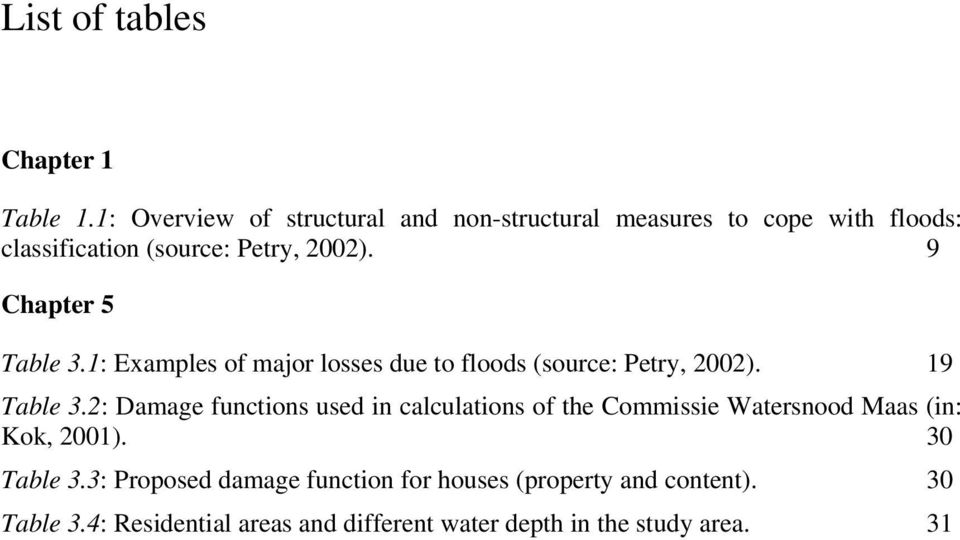
10 List of tables Chapter 1 Table 1.1: Overview of structural and non-structural measures to cope with floods: classification (source: Petry, 2002). 9 Chapter 5 Table 3.1: Examples of major losses due to floods (source: Petry, 2002). 19 Table 3.2: Damage functions used in calculations of the Commissie Watersnood Maas (in: Kok, 2001). 30 Table 3.3: Proposed damage function for houses (property and content). 30 Table 3.4: Residential areas and different water depth in the study area. 31
11 Introduction In recent years, extreme river flooding has occurred in several regions of Europe. This phenomenon, which includes the dramatic flood events in central Europe in summer 2002, is mainly due to an increase in the vulnerability of regions to flooding. As a result, there is currently great public interest in this issue, and it is necessary to intensify research activities in order to understand natural disasters better, and to reinforce risk management. An extreme natural event becomes a disaster when it has a large impact on human settlements and activities. Therefore, the study of floods includes a strong component of both social and natural science (Andjelkovic, UNESCO, 2001), and flood risk management must consider several aspects, such as climatic, social, economic, institutional and technical issues. The reasons for the increased flood hazard are several and correlated. Potential climate changes are expected to cause a rise in the frequency as well as the intensity of rainfall, which may lead to more widespread and severe natural disaster. On the other hand, built-up areas are spreading across Europe and increasing much faster than population. Social changes in Europe are being driven by EU enlargement, demographic processes and globalization. Demographic and socio-economic trends are playing a role in increasing society's exposure to weather- and climate-related damage, through factors such as housing developments in areas vulnerable to flooding and other risks (EEA Signals, 2004). This twofold expansion increases the exposure and vulnerability of urban areas to flooding, and also, as a consequence, the social and economic damage in case of a catastrophic flood event (AquaDeltaForum, 2004). In response to the growing number of natural disasters, the European Commission (EC) and the Member States of the European Union (EU) have recognized the significance of natural hazards regarding protection of the environment and citizens. The flooding throughout central Europe in August 2002 is a dramatic example of the damage caused by unforeseen natural hazards. It is estimated that in Europe around three-quarters of economic losses caused by catastrophic events are weather- or climate-related (EEA Signals, 2004). The Weather Driven Natural Hazards (WDNH) activity, which is taking place at the Institute for Environment and Sustainability of the EC s Joint Research Centre (JRC), and within which this research has been carried out, is implementing this objective by 1

12 developing models and tools, such as the MOLAND (Monitoring Land Use/Cover Dynamics) urban simulation model, the LISFLOOD hydrological model and a European Floods Alert System (EFAS), as well as methods for hazard and risk assessments, for flood mitigation across Europe, and for responding to policies such as the 6th Environment Action Programme and the Thematic Strategies on the Urban Environment and on Soil Protection 1. This paper describes impacts of water-related risks, with the aim to establish an overall cost-estimate of losses. In particular, the work focuses on the economic aspects of flood damages by investigating the value of physical assets affected by the event. A damage assessment is proposed to evaluate the damage costs of direct losses in residential areas; the economic damage is estimated for the study area of Prague, which was subjected to dramatic flooding in August

13 1 Flood risk prevention, assessment and management 1.1 Climate change impacts Climate change is one of the greatest environmental, social and economic threats faced by the planet. Climate change scenarios generally imply an increase in rainfall variability and, on global average, an increase in total precipitation, which could lead to even more frequent and severe natural disaster and floods. Human induced climate change is expected to continue in the coming decades (IPCC, 2001a) with considerable effects on human society and the environment. The magnitude of the impacts strongly depends on the nature and rate of future temperature increase. Consequences of climate change include an increased risk of floods and droughts, losses of biodiversity, threats to human health, and damage to economic sectors such as forestry, agriculture, tourism and the insurance industry (IPCC, 2001b). In Europe losses have increased substantially over the past 20 years to an average of EUR 10 billion in the 1990s. Four of the five years with the largest economic losses have occurred since 1997 (EEA, 2004). A recent study by the European Environmental Agency (EEA, 2004) summarises the current consensus within the European research community. It states that there is growing evidence that changes in frequency and extent of climate extremes are likely to be caused by a shift of the mean climate to more extreme conditions, and more and stronger deviations from this mean. Fighting climate change is a key environmental priority for the European Union. Substantial reductions in emissions of greenhouse gases will be required to ensure that Europe meets its short-term emission targets. Adaptation measures to manage the negative impacts of climate change also need to be put into place. 1.2 Background to natural hazard Natural hazards and disasters are the products of an interaction between numerous aspects, such as climatic, social, economic, institutional and technical, that are differently addressed for rural and urban conditions (Andjelkovic, UNESCO, 2001). 3

14 Figure 1.1: Number of natural catastrophes between 1950 and 2000 and economical losses trend (Munich Re, 2002). An environmental approach to flood hazards is based on the view that both social and physical environments influence the creation of flood hazards and disasters. The environmental approach, proposed from Parker in his book Floods (2000), is focusing primarily upon the social explanation of flood hazards and disasters without denying contributory physical causes. Flood hazards and then risk should be viewed as endemic product of a natural, physical and biological environment usually heavily modified by the social, economic and political environment. The term risk has been defined in several ways in the natural hazard literature. According to the definitions proposed by Kron (2002), three variables determine the risk : hazard, vulnerability and exposure. Hazard: the threatening natural event including its probability/magnitude of occurrence; Exposure: the values/humans that are present at the location involved; Vulnerability: the lack (or loose) of resistance to damaging/destructive forces. 4

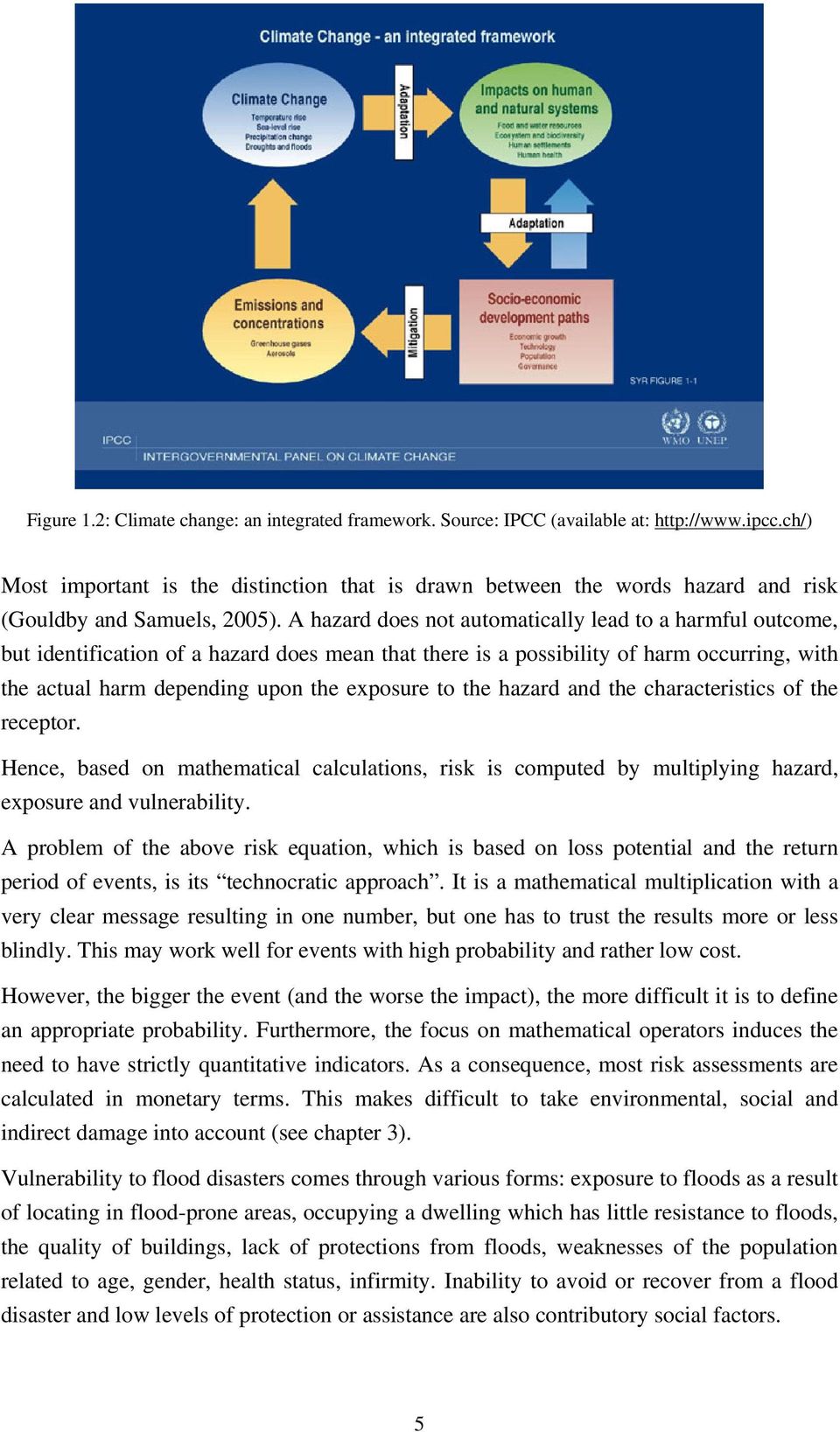
15 Figure 1.2: Climate change: an integrated framework. Source: IPCC (available at: Most important is the distinction that is drawn between the words hazard and risk (Gouldby and Samuels, 2005). A hazard does not automatically lead to a harmful outcome, but identification of a hazard does mean that there is a possibility of harm occurring, with the actual harm depending upon the exposure to the hazard and the characteristics of the receptor. Hence, based on mathematical calculations, risk is computed by multiplying hazard, exposure and vulnerability. A problem of the above risk equation, which is based on loss potential and the return period of events, is its technocratic approach. It is a mathematical multiplication with a very clear message resulting in one number, but one has to trust the results more or less blindly. This may work well for events with high probability and rather low cost. However, the bigger the event (and the worse the impact), the more difficult it is to define an appropriate probability. Furthermore, the focus on mathematical operators induces the need to have strictly quantitative indicators. As a consequence, most risk assessments are calculated in monetary terms. This makes difficult to take environmental, social and indirect damage into account (see chapter 3). Vulnerability to flood disasters comes through various forms: exposure to floods as a result of locating in flood-prone areas, occupying a dwelling which has little resistance to floods, the quality of buildings, lack of protections from floods, weaknesses of the population related to age, gender, health status, infirmity. Inability to avoid or recover from a flood disaster and low levels of protection or assistance are also contributory social factors. 5
16 Both vulnerability and exposure to floods are viewed as key causal factors of risk: the approach involves evaluating the full range of traditional approaches to flood hazard and disasters as well as modern technological ones. This kind of approach involves viewing the problems of flood hazards and disasters and long-term safety survivability within the context of sustainable development. Sustainable communities are those that are able to weigh up these risks and seek to reduce the vulnerability of their people to natural hazards, so they seek to build social and economical resilience to disaster (Parker, 2000). Moreover, central to the concept of hazard is the notion that humans interface with floods: a flood is not hazardous unless humans are somehow affected. Hewitt (1983) takes this further by stating that a hazard refers to the potential for damage that exists only in the presence of a vulnerable human community. Flood exposure is a measure of the human population, land uses and investment located in flood zones and at risk of flooding, and increasing exposure is a prime, contributory cause of flood hazards and disasters. A common method of measuring flood exposure is to count the number of properties of different types that occupy a floodplain or other flood risk area such as coastal flood zone. There is a substantial evidence from different parts of the world that exposure to floods is growing rapidly as human occupation of floodplains and flood-prone coastal zones intensifies Flooding in urban environment Floodplains are flood-prone areas: they have been sought as sites for urban development because of the facilities they offer, including access to a source of water for a variety of uses. Cities have been permanently developing their water-related infrastructure and discharging their urban waters into the nearest water body (Andjelkovic, UNESCO, 2001). The development of urbanization and activities has continued, although this expansion represents a hazard if the vulnerability of those activities exceeds an acceptable level. The possible interaction between human use of the floodplain and the onset of a flood event potentially creates a natural risk. In fact a disaster exists once a flood occurs, depending on the amount of property damage, disruption and loss of lives (Montz, 2000). As urban areas grow, both geographically and demographically, the flood hazard and risk increase in part because there is more exposure, but also because the process of urbanization itself alters local hydrologic characteristics (Montz, 2000). 6
17 In undeveloped areas such as forests and grasslands, rainfall and snowmelt collect and are stored on vegetation, in the soil column, or in surface depressions. When this storage capacity is filled, runoff flows slowly through soil as subsurface flow. In contrast, urban areas, where roads and buildings cover much of the land surface, have less capacity to store rainfall and snowmelt (Konrad, 2003). Construction of roads and buildings often involves removing vegetation, soil, and depressions from the land surface. The permeable soil is replaced by impermeable surfaces such as roads, roofs, parking lots, and sidewalks that store little water, reduce infiltration of water into the ground and accelerate runoff to ditches and streams. Development along stream channels and floodplains can alter the capacity of a channel to convey water and can increase the height of the water surface (Konrad, 2003). Bridges, in particular, reduce the natural carrying capacity of the river and provide barriers upon which debris can accumulate. In addiction, development along the river can intrude on the river and restrict flow as a result. Therefore, once floodplains become urbanized, there follows an almost inevitable demand from the local community for flood protection (Smith, 1996; in Parker, 2000). 1.3 Flood risk assessment The urban sprawl in metropolitan areas along large rivers causes an increasing claim on space that is merely used as floodplain and consequently spread of building activities in places not suitable for building. At the same time potential climate changes are likely to cause an increase in number and intensity of flood events. This mutual expansion increases the vulnerability of urban areas to flooding and therefore the social and economic damage in case of a disastrous flood event. Consequently, the responsible authorities are required to adapt their policies in order to combine flood management measures, spatial development and new strategies on protection standards. In order to evaluate the changes of risk, it is necessary to examine the increasing exposure to floods and the damage potential losses resulting from these floods (AquaDeltaForum, 2004). In most cases the conventional flood management measures do not hold this integral approach. Consequently a future challenge in urban flood management lies in the development of innovative protection measure, in which the growing demands for space, the consequences of potential climate changes and advanced safety standards are entirely integrated (AquaDeltaForum, 2004). 7

18 Besides structural measures aiming at a reduction of the probability of flooding, new approaches need to be developed to mitigate flood impacts. Legislation, land use planning and management, zoning, urban drainage, flood insurance are some examples to modify the vulnerability of the urban environment to flood damage. The adoption of non-structural approaches for urban flood mitigation as structural solutions has proved at best partial solutions. Urban planning guidelines and flood management strategies should, therefore, be part of an integral approach to the problem (AquaDeltaForum, 2004) Prevention of floods Important flood risk prevention strategies to manage with floods are mitigation, adaptation and preparedness. Mitigation, adaptation and preparedness can be summarised under the term prevention (Plate, 2001). This section introduce this basic concepts used in flood planning and managing. Mitigation aims at reducing the flood event itself, through robust and sustainable local solutions and structural measures like reservoirs or dykes, that can cope with the everincreasing urban pressure on flood prone areas and the uncertainties created by climate change. Keeping water out of urban areas in many instances is not the perfect solution; accepting and preparing for some degree on flooding will in many cases be a more sensible solution (AquaDeltaForum, 2004). Adaptation basically means reducing vulnerability through non-structural planning measures like restrictive zoning. At local/urban level adaptation to floods can be addressed by strict measures such as prohibit new development in the floodplain and to proof existing structures, or even to replace the existing development by alternative use of land towards a reduction on floods damage. Preparedness is the preparation of a rapid and adequate response at all times and especially in the run-up to a flood event. It is relevant to prevent these floods, but of course this is not always possible. Whatever is done to prevent floods from happening, and the risks of flooding, there will always be some residual risk. In those cases the level of preparedness can be of key importance. Reducing the adverse effects of a flood can diminish the number of casualties and of course the amounts of losses. Table 1.1 gives an overview over structural and non-structural measures to cope with floods. In the long run, preparedness and non-structural adaptation measures tend to be 8
19 more efficient and sustainable solutions to flood problems, in particular to reduce the vulnerability of human beings and goods exposed to flood risk (Water directors, 2003). Structural: Mitigation Non-structural: Adaptation Extensive Regulation reshaping of land surface zoning protection from erosion coding delay of runoff processes Flood defence increase of infiltration forecasting urban works warning Intensive flood proofing levees, dykes, floodwalls evacuation dams and reservoirs relocation floodways and diversion works Insurance polders and fills governmental drainage works private mixed Table 1.1: Overview of structural and non-structural measures to cope with floods: classification (source: Petry, 2002) The EU Water Framework Directive (WFD) requires integrated management plans for each river basin. One of the objectives of the WFD (article 1e) is to contribute to mitigate the effects of floods. However, flood mitigation is not addressed in deep in the directive. To address the problem of floods at European level the Commission has recently setup a communication on Floods risk management. Flood prevention, protection and mitigation (CEC, 2004). In this communication is proposed that the Member States and the Commission work together to develop and implement a co-ordinated flood prevention, protection and mitigation programme. In this framework, among other measures, flood risk management plans for each river basin should be developed and implemented (Barredo et al., 2004) Flood hazard management Risk management is the systematic approach to minimise disaster impact at all levels and locations in a given society. It is normally based on a comprehensive strategy for increased awareness, assessment, analysis/evaluation, reduction and management measures (Brezger, 2004). In addition, the framework needs to include legal provisions defining the responsibilities for disaster damage and longer-term social impacts including spatial 9
20 planning actions. Integrated risk management stresses the equal implementation of all possible measures and includes risk communication and dialogue as relevant elements of risk management (ARE, 2003). The UNESCO provides a comprehensive set of best practise for non-structural measures in urban flood management (Andjelkovic, 2001), proposing a management planning defining the identification of problems, opportunities and constraints, the setting of goals and objectives (like reducing exposure of people and property to flood hazards, reducing existing level of flood damages, minimising soil erosion and sedimentation problems, protecting environmental quality), the establishment of policies and priorities that govern overall effort, and, finally, the development of criteria and standards for evaluating systems performance under future development scenarios GIS and land use-based assessment in natural hazard management Environmental risk management needs a multi-disciplinary approach, with input and expertise required from many fields. A wide range of simple to complex, spatial and nonspatial, quantitative and qualitative input data sets is used in environmental risk assessment and analysis process. The environmental risk management process involves preparation and use of the processed information derived and presented in various ways, as for instance comparative or relative risk analysis, cost-benefit analysis, scenario analysis, etc. Due the need for using and analysing a huge volume of the spatial as well as non-spatial environmental hazards and exposure data in a fast and reasonably accurate way, Geographical Information Systems (GIS) based software applications using a variety of modeling techniques serve as powerful tools for effective environmental risk assessment and management (Raheja, 2003). Along with these added complications come techniques for managing the information so that it does not overwhelm the planner. Among these are GIS, a systematic means of geographically referencing a number of layers of information to facilitate the overlaying, quantification, and synthesis of data in order to orient decisions. Such applications can be used for a range of environmental risk assessment and analysis purposes. These applications can vary from development of databases systems for simple to complex GIS layers overlays, to complex territorial decision-making systems for study the impact of natural disasters on the natural and artificial environment, including human beings, properties, infrastructure, vegetation and ecology. 10
21 These systems could also be connected with other related systems, providing online and real-time input data feeds or communication systems, to allow continuous monitoring and tracking of environmental risks in an integrated way (Raheja, 2003). The analysis in Chapter 3 demonstrates the effectiveness of GIS and land use-based assessment as a tool for natural hazard management in the context of integrated development planning. 11
22 2 The European strategy on flooding 2.1 EU policy dealing with floods Sustainable water management is a central issue in EU policy. Europe faces the ambitious challenge to assure a high level of quality of life and social well-being for citizens by providing a healthy environment (Brezger, 2004). In the current situation, in which floods are the most significant hazard for population, economy and environment in Central Europe, it is essential to prioritize long-term environmental quality. Flood risk management should incorporate the following elements: prevention, protection, preparedness, emergency response as well as recovery and lessons learned (European Commission, 2004). The 2000 Water Framework Directive 2 is the cornerstone of EU water protection policy. It contributes considerably to European cooperation and integration and requires the member States to reach certain environmental objectives and an overall good status of surface water by 2015 (WWF Italy, 2002). Although the main focus is on water quality and flood protection is not an explicit issue, Article 1e affirms that the WFD contributes to mitigating the effects of floods and droughts. Moreover, it gives an opportunity to reinforce sustainable flood protection. In this context, a strategic best practise document of a Core Group on Flood Protection of European Water Directors (Water Directors, 2003) calls for taking into account the full catchment area when dealing with floods. Furthermore, it opts for a wide definition of the flood hazard area, taking into account very rare events. Other statements support an integration of flood insurance policies in the framework of the WFD implementation within Europe. In response to these flood events of 2002, the Water Directors and the Commission started an action on flood protection which gave rise to a manual of best practice which was agreed in June The Commission adopted in 2004 a Communication 3 entitled Flood risk management, flood prevention, protection and mitigation to improve protection against flooding, in 2 Directive 2000/60/EC (more information at: 3 COM(2004)
23 which the need for Community legislation on flood risk management was identified. The Communication defined the provision of scientific and technical support for hazard, vulnerability and risk assessments as an important element of a coordinated action for flood adaptation. On 18 January 2006, the EC proposed a Directive 4 to help Member States prevent and limit floods, and their damaging effects on human health, the environment, infrastructure and property. The new directive will require Member States to carry out preliminary assessments to identify the river basins and associated coastal areas at risk of flooding. Such zones then will be subject to flood risk maps and flood risk management plans Regional policy and funds The Structural Funds, in particular the European Regional Development Fund 5, and the Cohesion Fund can fund preventive investments including those for flood protection. The European Regional Development Fund can also contribute to financing infrastructure related research and technological development. Financial resources plays a major role in future measures on a successful flood management. EU Structural Fund policy as well as INTERREG Programmes 6 in floodaffected regions alleviate the impact of floods and help to improve flood preparedness. Following the August 2002 floods in Central Europe, the European Commission quickly set up the European Union Solidarity Fund (EUSF), which allows rapid financial assistance in the event of a major disaster and help the affected areas return to living conditions that are as normal as possible. To improve the preparedness of the national civil protection authorities in relation to disasters, the Commission has developed a series of monitoring instruments, which provide for forecasting and monitoring floods at pan-european level. In the case of a possible flood event, the results will be delivered to the competent national authorities and civil protection services, as well as to the Commission s Monitoring and Information Centre. This center coordinates mutual assistance interventions whenever such help is requested. The current 6th Research Framework Programme (FP6) has a considerable budget on flood-related research within the thematic priority Global change and ecosystems Further information at: 6 Further information at: 13
24 As an example, the 10 million integrated research project FLOODsite 8 has been launched and contributes to the improvement of integrated flood risk analysis and management methodologies. Concerning the future, the planning for the 7th Research Framework Programme (FP7, running from ) focuses on reducing natural and man-made environmental hazards and risks. The discussion within the European Commission states that mitigation tools for natural and man-made hazards are still insufficiently developed. New methodologies are needed for risk assessment that address stakeholder requirements: new research is necessary for a better understanding of effective measures for flood prevention and management, e.g. for the implementation of the Water Framework Directive. Furthermore, there is a strong request to develop decision-making support on flooding within the EU. For this reason, several of the following flood research projects are located at the Joint Research Centre (JRC) of the European Commission. 2.2 The JRC s activities on flooding This study was carried out within the Whether Driven Natural Hazard action (Land Management Unit) of the Institute for Environment and Sustainability (IES), being part of JRC. The Weather Driven Natural Hazards (WDNH) 9 action of the IES is carrying out in the field of flood hazard and risk analyses. The work of this action comprises as well adaptation measures and strategies in order to mitigate the effects of climate change in Europe at local and regional level. The activity on flood, prevention and mitigation is based on the hydrological model LISFLOOD of the WDNH action adapted for scenario modelling, flood forecasting and flood plain inundation modelling. The LISFLOOD model is a physically based hydrological rainfall-runoff model that is embedded in a dynamical GIS environment. The JRC is collaborating towards flood by developing tools, models, a European Floods Alert System (EFAS) and hazard and risk assessments for flood mitigation across Europe. 7 Further information at:
25 The Institute for Prospective Technological Studies (IPTS) of the JRC launched the PESETA project, in collaboration with WDNH action, composed of a number of studies on the impacts of climate change in Europe. Impact categories to be included are human health, coastal zones, river floods, agriculture, tourism, and energy demand. The project will try to provide ranges of monetary valuations of the expected impacts of climate change in Europe, given the state-of-the-art of today's methods and knowledge on the physical impacts of climate change. Flood forecasting, flood risk mapping and scenario modelling are important components of the envisaged contribution of the JRC in the field of floods. Future research will be adapted to climate change impact analysis, mitigation and adaptation strategies. ADAM (Adaptation and Mitigation Strategies: supporting European climate policy) is an integrated research project funded by the European Commission and co-ordinated by the Tyndall Centre for Climate Change Research in the UK, running from 2006 to ADAM will lead to a better understanding of the trade-offs and conflicts that exist between adaptation and mitigation policies. ADAM will support EU policy development in the next stage of the development of the Kyoto Protocol and will inform the emergence of new adaptation strategies for Europe. WDNH contributes to ADAM in the quantification of direct and indirect impacts of extreme events MOnitoring LANd use/cover Dynamics (MOLAND) The analyses of the following chapter are supported by the MOLAND project 10 database. The main aim of the MOLAND project is to assess, monitor and model past, present and future urban and regional development from the viewpoint of sustainable development, by setting up land use and transport network databases for various cities and regions in Europe. As part of MOLAND, an urban growth model has been developed, which is used to assess the likely impact of current spatial planning and policies on future land use development. The model for urban and regional growth forecast is a key tool in the integrated framework to evaluate and propose strategies for the sustainable management. It is part of an integrated methodology based on a set of spatial planning tools that can be used for
26 assessing, monitoring and modelling the development of urban and regional environments (Lavalle et al., 2004). The activity on hazards mitigation is based on the merging of the LIFSLOOD model with the MOLAND urban and regional growth model to evaluate spatial planning policies and measure for natural risks reduction (Lavalle et al., 2005). Figure 2.1: An example of the MOLAND GIS database: the Dresden-Prague corridor (in Barredo et al., 2005). 16
27 3 Flood damage assessment: Prague case study 3.1 Nature and costs of water-related risks Damage results from the conflict between nature made flooding and human usage. The type and extent of damage continuously changes with development in society (ICPR, 2002). The flooding throughout Europe in 2002 constituted one of the most severe flood events in at least a century. Total economic losses reached more than EUR 15 billions (Risk Management Solution, 2003). During this event, the Vltava river exceeded the water level of the major 1890 floods in Prague. Floods have the greatest damage potential of all natural disasters worldwide and affect the greatest number of people. On a global basis, there is evidence that the number of people affected and economic damages resulting from flooding are increasing at an alarming rate. Society must move from the current paradigm of post-disaster reactions, so plans and efforts to break the current event-disaster cycle must be necessarily undertaken. Today more than ever, there is the need for decision makers to adopt holistic approaches for flood disaster management (ISDR, 2005) 11. Extreme flooding events are not involving only the least developed Nations, but often affect and devastate the most economically advanced and industrialized Nations such as the European ones. When a flood occurs, it can effectively wipe off decades of investments in infrastructure, seriously hurt economic prosperity and result in several deaths and injured. The responsible authorities are forced to adapt their policies in order to combine flood management measures, spatial development and new strategies on safety standards. In order to evaluate the changes of risk, it is necessary to examine changes of probability of floods and the damage potential losses resulting from these floods. 11 Available at: 17
28 Figure 3.1: Global costs of extreme weather events: total economic losses and insured losses from 1950 to 2000 (IPCC, 2002) Flood losses There are different types of losses involving human and animal life, vegetation and a large variety of economic losses of tangible and intangible nature. Together all losses make up the loss potential or Probable Maximum Loss (PML). Direct costs refer to physical damage to capital assets and inventories, valued at same-standard replacement costs. Direct damages due to loss of means, recovery damage to recourses in possession or rent and recovery damage to production means Indirect costs refer to flow effects such as output losses and expected earnings. Other indirect losses are business interruption, environmental damage, cleaning and evacuation costs. Relief costs refer to the provision of life supporting services (e.g. food aid, health care, safe water and sanitation) to populations whose access to these services has 18
29 been lost as a result of the disaster and assistance to these populations to enable them to resume sustainable livelihoods. A further distinction to be considered is between direct replacement costs (i.e. the costs for restoring assets to the standard that existed before) and reconstruction costs (i.e. the costs for rebuilding to a standard that optimally responds to local conditions). So reconstruction costs refer to costs for rebuilding damaged infrastructure to standards optimally designed to reduce vulnerability and risk of loss through future disaster. Another distinction is between financial losses and indirect economic loss: financial losses affect persons or enterprises, while indirect economic loss affects economy itself. Direct losses Tangible losses Primary: Physical damage to property Secondary: Restoration or rehabilitation cost Intangible losses Primary: Loss of human life Secondary: Illness of flood victims Indirect losses Tangible losses Primary: Disruption of traffic and trade Secondary: Reduced purchase power Intangible losses Primary: Increased hazard vulnerability Secondary: Emigration and loss of confidence Table 3.1: Examples of major losses due to floods (source: Petry, 2002). Indirect flood losses are improbable to be greater than direct losses (Parker, Green, Thompson, 1987). However, in extreme events, indirect losses may exceed direct damage (Green et al., 1994), especially depending on the duration of the flood. In trade and industry in particular, it is liable to exceed direct damage. Indirect economic damage comprises disruption to business and infrastructure, expenditure for temporary arrangements and market losses suffered (ICPR, 2002). Floods damages are also categorized into tangible and intangible ones. Tangible damages are usually taken to be those which can be measured in monetary terms, such as the damage to a factory, although such estimation is hardly precise and relies heavily on damage measurement procedures (Parker, 2000). On the contrary, intangible losses are 19
30 those which either defy monetary measurement and/or those for which monetary estimates are considered to be undesirable or unacceptable (loss of life, physical injury, loss of heritage or archeological site) (Parker, 2000). Since it is difficult to predict what would be the indirect damage compared to the direct one, this study presents an assessment that can be used to calculate direct losses, and not consider indirect losses Flood impact parameters The most important parameters influencing flood impact are: Water depth Duration of flooding Flow velocity Sediment concentration Sediment size Wave or wind action Pollution load of flood water Rate of water rise during flood onset (Van Der Sande, 2001). Damage is usually represented in stage-damage curves, where water depth is the major damage variable. The stage-damage curve determines the probable loss for the given event (ICPR, 2002). Consequently, land use, which represents the number of vulnerable assets present, makes a clear difference in damage. Even if the flood intensity parameters mentioned above include many different flood effects, water depth is the most important and also the easiest to observe and quantify and therefore plays the major role in flood loss estimation. Another very important parameter is the run-up time to the flood event and the time between the first warning and the actual flood. A short run-up time is a key reason why flash floods are a considerable threat to lives and property (Kron, 2003; ICPR, 2002). However, run-up time is not necessarily equal to the warning time for the population, which determines a great share of impact. Public and private risk alertness and social factors play the major role for the warning time. Generally, flood depth and extent are most important for direct losses, duration for indirect losses and warning time for intangible losses (Green et al., 1994). 20
31 3.2 Economic impact and losses in August 2002 flood In Europe, economic losses caused by weather and climate related events have increased during the last 20 years from an annual average of less than USD 5 billion to about USD 11 billion. Four of the five years with the largest economic losses in this period have occurred since A particularly disastrous event was the severe flooding in Central Europe for three weeks during August Austria, the Czech Republic, Germany, Slovakia and Hungary suffered economic losses of about USD 17.3 billion and insured losses of about USD 4.1 billion (EEA, 2004). The Elbe and Moldau (Vltava) river basins are two of the most important geographical features in central and eastern Europe. Both rivers are navigable, therefore they are very important transport routes and main development axes. However, these rivers represent also a threat for floods, affecting settlements located on the flood plain. In August 2002, as a consequence of over a week of continuous heavy rains, a so-called 100-year flood event hit the area. This occurrence affected several regions in Europe, killing dozen of people, dispossessing thousands and causing damages of billions of euros in the Czech Republic, Austria, Germany, Slovakia, Poland, Hungary, Romania and Croatia (Genovese, in Barredo et al., 2005). Heavy rainfall caused by storms that crossed Central Europe during August 2002 generated sequential flood waves along two major river systems. The flood waves moved down the River Danube through Austria and along the Vltava, Labe and Elbe rivers in the Czech Republic and Germany. Exceptional flood heights occurred, with return periods of up to 500 years, and more than 110 people died. Large areas of the cities of Dresden and Prague were under water and numerous historic buildings were seriously damaged (Genovese, in Barredo et al., 2005). These were the most costly floods affecting Europe in years. Germany was hit hardly, with over two-thirds of the flood s whole losses. Most of the loss (over 11 billion Euro) came from the River Elbe catchment. The State of Saxony in particular and its capital Dresden sustained nearly half the total loss. The largest loss after Germany was in the Czech Republic, with over 3 billion Euro in damage, of which over one third was concentrated in Prague. As of December 2002, total economic estimated damage exceeded 15 billion Euro, of which only about 15% were insured. Low penetration of flood insurance means that governments will incur most of the repair costs, with some help from the European Union (EU) and voluntary donations (Risk Management Solution, 2003). A primary driver of the large loss in 2002 was the flood s costly impacts on Dresden and Prague, where flooding affected both residential and commercial properties. Saxony and 21
32 Prague together sustained over 7 billion Euro of damage. Flood defenses along the river systems were temporarily lengthened and reinforced, but water inundated anyway protected areas in different ways. Underground seepage and dike breaches were two main causes of water ingress (Risk Management Solution, 2003). Figure 3.2: Prague 2002: overview of flooded city (ANSA, 2002; in Total damage in Prague is estimated at nearly 1 billion Euro. The districts of Lesser Town (Malá Strana), Old Town, the Jewish Quarter (Josefov), and Karlin suffered particularly heavy losses, where very old and unmapped tunnels aggravated the problem in this historic city. Some Czech residents were evacuated during the flooding. Insured losses in the Czech Republic amounted to 1.2 billions compared with an economic loss of 2.3 billions. 3.3 Damage assessment in Prague: methodology and results The main objective of this analysis is to suggest a methodology for assessing direct flood damage potential using MOLAND land use database combined with flood extent map, hazard map (and connected flood depth) and economic asset data. The study area includes the central part of the city of Prague flooded in
33 Combined with existing information on land use and flood depth, maps of the flooded areas provide information that can be used for flood damage assessment, urban and rural planning and validating flood simulation models (De Roo et al., 1999). The concept of damage function is used when calculating flood damage. In order to assess flood damage correctly, the impact parameters need to be incorporated in a method. However, due to the lack of information and the difficulty in integrating such variables, damage is generally related to only water depth (Van der Sande, 2001). This basic methodology was outlined already in 1945 by White and is referred to as stagedamage curve representing the relation between inundation depth and damage cost for a land use class. In the case of built-up areas, the land use class is either expressed per number of buildings or per unit area. The economic value of the land use class has to be known in order to calculate the damage. This value is based on the principle of replacement value: how much money it would cost to obtain the identical object. The damage function has values included between 0 and 1, with the value 0 if there is no damage and the value 1 if there is maximum damage (Van der Sande, 2001; Kok, 2001). Figure 3.3: Major rivers and cities affected by the August 2002 floods (Risk Management Solution, 2003). 23
34 Stage-damage curves can be developed from actual flood events and then can be used to simulate damage for potential future events, also if this approach should present problems like extrapolation difficulties from place to place due to differences in warning time and in building type and content. White (1964) introduced a new methodology by constructing synthetic stage-damage curves and these are based on hypothetical analysis. The US Federal Insurance Agency (FIA) administered the first main application of standardised stage-damage curves. Residential buildings were divided in insurance classes, each with their own stage damage curve based on dimension, type of building and contents (Van der Sande, 2001). Penning-Rowsell and Fordham (1994) coordinated the Euroflood project that was designed to improve the understanding of causes and impacts to flood hazards in the European Countries. It gives, among other subjects, an overview of flood damage assessment models developed in several countries. In many countries people can insure themselves against flooding and therefore the flood hazard and the potential flood damage is of great interest to insurance companies. However, these companies are really reluctant in publishing data of insurance payments, apparently because it is business information. Therefore insurance companies appeared to be of little help in developing flood damage assessment methods (Van der Sande, 2001). This analysis has the purpose to give an assessment of the damage of urban flood by using the damage functions which are available in the literature. The following sources are used: Kok M. (2001), Damage functions for the Meuse River floodplain, Internal report, JRC (Ispra). Van der Sande C.J., de Jong S.M., de Roo A.P.J. (2003), A segmentation and classification approach of IKONOS-2 imagery for land cover mapping to assist flood risk and flood damage assessment, International Journal of Applied Earth Observation and Geoinformation, pp Van der Sande C. (2001), River flood damage assessment using Ikonos imagery, Natural Hazards Project-Floods, Joint Research Centre of the European Commission, S.P.I , Ispra, August As suggested by Van der Sande (2001, 2003), the assumptions listed below had to be made to do the flood damage assessment: The damage function is a function only of inundation depth, although flood damage is determined by more factors, as explained before. In the literature, there is not much information available with respect to factors other than inundation depth; 24
35 Figure 3.4: IRS satellite image of Prague central area (1998, source: MOLAND database); the blue area represent the portion of urban territory flooded in 2002 (source: Prague City Hall). 25
36 Figure 3.5: MOLAND Land Use (1998) for Prague and flooded area of 2002 (source: Prague City Hall). Red pixels represent continuous and discontinuous urban fabrics; violet pixels are industrial and commercial areas. The box outlines the study area considered for the damage assessment. 26
37 The damage functions must be increasing functions, which means that as the inundation depth grows, also damage rises. During a flood event, some damage can be avoided by appropriate action from the people who live in the floodplain. Examples are the caravans on a camping ground, which can be removed during the winter period, when there is a higher risk of flooding and the cars, because there is enough time to remove them from the area that is going to be flooded. Therefore caravans and cars are not taken into account of the damage assessment. An important question in damage calculation is which assumption has to be made with respect to the behavior of the people. This is caused by the fact that damage is a function of many physical and behavioral factors, like for example the content of the house and the preparation time. Hence, uncertainties in the damage functions are not dealt with in this analysis. The maximum damage values are here only indicative and are based on the average price per m 2 for a house or an apartment. These informations are provided by the European Commission (Directorate General for Regional Policy - DG Regio) and EUROSTAT (NEW CRONOS database) and are collected in the web-databases named Urban Audit, available on-line at The damage function used in this study depends on several components: different land used classes, flood depth factors, economical value per square meter. The study area corresponds to a part of the historical centre of Prague close to the river Vtlava, which was severely flooded on August 2002, and is equal to almost 1000 hectares. The MOLAND Land Use database for the year 1998 (which is the closest available date to 2002, when the flooding occurred) was used. The database is generated at a resolution of 50m pixel-size. The flooded area was individuated and considered according to the map of the flooded area provided by the Prague City Hall. The flood damage depends on the land use type: in urban areas floods produce as a consequence much more damage than floods in a rural area. The land use classes, which are used to calculate the flood damage, correspond to the land use classes of the MOLAND legend, that are the same of CORINE Land Cover European database but with a more detailed level of land use class. Agricultural areas, forest, shrub and grass Following the approach of Kok and Van der Sande, the damage in agricultural and vegetated areas does not depend on the inundation depth. Furthermore, agriculture in flood plains is usually prepared for flooding, and floods occur mainly in the winter. Also flood 27
38 damage costs of green urban areas are usually low, therefore in this analysis only the damage for built-up areas is evaluated. Industrial and commercial areas In the flood of 1993 in Holland (Kok, 2001), it was calculated that 75% of the damage to industry was related to property and 25% was related to productivity loss. There are three different ways to calculate the damage: per firm, per hectare and per employee. In this kind if assessment, the most suitable method is to evaluate flood damage in industrial area. The maximum damage cost of industry has to be assessed per hectare. The following damage function is used by Kok (with linear interpolation between these step values): Inundation depth Damage factor 0 m 0 1 m m m m 1 Infrastructure It s advisable to calculate damage per unit length rather than evaluate it per unit area. By dividing the area by the average width of the roads, the result is the length. In Kok report, there is a damage function for roads and railroads, with 5m as a maximum inundation depth. The maximum damage values vary depending on the type of road. In the floodplain there are 12 hectares of mainly roads and rails. The damage function proposed by Kok is the following: Inundation depth Damage factor 0 m 0 5m 1 Linear interpolation can be used between these points. 28
39 Urban areas Flood damage in urban areas can be calculated per house or per hectare. In this case the database of 50m pixel-size does not allow making a per-house assessment. The applied flood damage function is based on damage data of the Commissie Watersnood Maas provided for assessing damage in the floodplain of the Meuse River (in Kok, 2001). In the above-mentioned study, three types of damage are considered: the house itself, the content of the house and the car. Damage to cars is not taken into account because there is usually enough time to move these cars onto the higher parts of the area. Two different databases are considered to estimate the hazard flood depth: a hazard map where the hazard levels correspond to different water depth; it was obtained using a 1 km grid digital elevation model and the 1 km European flow network developed by the Weather Driven Natural Hazard Action at the JRC (Barredo et al., 2005). It was re-sampled to 50-metres pixel-size in order to make it comparable with the MOLAND Land Use database; a high resolution Digital Elevation Model (DEM), in order to define the depth of the river bed and compare it to the hazard map. Figure 3.6: Digital Elevation Model (DEM) and Prague flooded area
40 The damage factors for each of the different impact categories and different depths are listed below in table 3.2: Depth (metres) Damage houses factor Damage Content factor Table 3.2: Damage functions used in calculations of the Commissie Watersnood Maas (in Kok, 2001). Linear interpolation is used to obtain the complete function of damage factor for the house and its content that is presented in Table 3.3: Depth (metres) Damage factor Table 3.3: Proposed damage function for houses (property and content). The study area includes the following residential MOLAND Land Use classes, which are separated depending on their water level: 30
41 AREA (square meters) Water depth and MOLAND Land Use classes damage factor Residential continuous dense 3 (0,62) Residential continuous dense 2 (0,44) Residential continuous dense 1 (0,08) Residential continuous medium dense 3 (0,62) Residential continuous medium dense 2 (0,44) Residential discontinuous urban fabric 3 (0,62) Residential discontinuous urban fabric 2 (0,44) Residential discontinuous sparse urban fabric 3 (0,62) Residential discontinuous sparse urban fabric 2 (0,44) Table 3.4: Residential areas and different water depth in the study area. According to Urban Audit database, the average price per m 2 for an apartment (2001) is 827,21 and the average price per m 2 for a house (2001) is 1562,5 12. For the purpose of the damage evaluation method herein proposed, these figures should be considered like a reconstruction cost, namely the costs for rebuilding to a standard responding to local conditions. In residential continuous dense, medium dense and residential discontinuous, built-up areas are expected to be formed of buildings with apartments, while in residential discontinuous sparse areas artificially surfaced areas cover between 10% and 50% of the total surface and so they are assumed to be constituted of single houses. Then, all the necessary data are available to propose an assessment for the different urban categories of land use. The generic formula used is: DAMAGE = p * A * H * V Where: p= % of urban fabric covered surface in a X land use A= area (m 2 ) of the X land use H= water depth damage factor V= average price for m 2 for an apartment/a house 12 Data available at the web site (DG REGIO/EUROSTAT). 31
42 Residential continuous dense urban fabric According to the MOLAND definition, in this class residential structures cover more than 80% of the total surface. Therefore the formula to evaluate the damage is: 80% (427500) * * % (260000) * * % (142500) * * Residential continuous medium dense urban fabric Also in this class residential structures cover more than 80% of the total surface. The difference between residential continuous dense and medium dense is that, in the first one, more than 50% of the buildings have three or more stories, while in the second there are less than 50% of buildings having three or more stories; by the way, this difference is not remarkable in this analysis. 80% (150000) * * % (20000) * * Residential discontinuous urban fabric Buildings, roads and other artificially surfaced areas cover between 50% and 80% of the total surface. Therefore an average value of 65% is chosen for the analysis. 65% (77500) * * % (10000) * * Residential discontinuous sparse urban fabric Buildings, roads and other artificially surfaced areas cover between 10% and 50% of the total surface. The vegetated areas are predominant, but the land is not dedicated to forestry or agriculture. The average value of 30% is therefore used for house coverage. 30% (325000) * * % (52500) * *
43 Conclusions The proposed methodology has the aim to offer a new approach to land use-based damage assessment. Combined with existing information on land use and flood depth, maps of the flooded areas provide important information that can be used for flood damage assessment in urban areas. The results provide an average estimate and should not be considered as a detailed cost assessment of the damage, since they are strongly depending on the quality of the damage functions and the availability of detailed datasets. In this case, the evaluation was limited by the economical (market) value per m 2 for houses. This might not necessarily reflect the reconstruction costs. Almost all functions applied in this assessment refer to a base study developed for application in the Netherlands, therefore a further degree of variability in the average damage should be considered. Additionally, for the area under examination, the actual damage might be lower, because the area is prone to flooding and the citizens have adapted to that. More flood damage research needs to be done in flood prone areas and the damage function can be improved by using external data to determine damage, especially to urban and to industrial areas. The quality of the damage assessment also depends on the quality of the classification. The classification offered from the MOLAND database has a high level of detail. However, regarding the water depth flood hazard, the classification can be improved with use of a higher resolution DEM. Moreover, in order to evaluate the changes of risk, it is necessary to examine the damage potential losses resulting from the floods. In most cases the conventional flood management measures do not hold this integral approach. Furthermore, the proposed methodology allows estimating damages also when detailed information are missing, and is therefore applicable to relatively large areas. Disaster loss assessment is a decisive element of disaster management. Included in an integrated modeling system, bases also on hazard forecast, these techniques allow the estimate of losses in support of the risk management process. 33
44 References Andjelkovic I. (2001), International Hydrological Programme, Guidelines on nonstructural measures in urban flood management, IHP-V, Technical Documents in Hydrology, No.50 UNESCO, Paris. ARE, Federal office for spatial development (2003), Natural hazards and the Alpine Convention, Event analysis and recommendations, Berne. Available at: hren_en.pdf). Barredo J.I., Sagris V., Lavalle C., Kasanko M., Brezger A. (2004), Representing urban de-centralisation: Assessment and future scenarios by using dynamic spatial models. In E. Fendel and M. Rumor (Eds.), Proceedings of UDMS 04, 24th Urban Data Management Symposium: Information systems and the delivery of the promised societal benefits, Urban Data Management Society, October 27-29, 2004, Chioggia- Venice, Italy. Barredo J.I., Lavalle C., Sagris V., Kasanko M. (2004), Climate change impacts on floods in Europe. Toward a set of risk indicators for adaptation, DG-JRC, Ispra, EUR EN. Barredo J.I., Petrov L., Sagris V., Lavalle C., Genovese E. (2005), Toward an integrated scenario approach for spatial planning and natural hazard mitigation, European Communities, DG-JRC, Ispra, EUR EN. Barredo J. I., Lavalle C., De Roo A. (2005), European flood risk mapping, EC DG JRC, 2005 S.P.I EN. Brezger A. (2004), Geographisches Institut, Eberhard-Karls-Universität Tübingen, Germany, Diplomarbeit: Land use forecasting and natural hazards: Current and future impacts of flooding in urban areas, Case study: Pordenone province, Friuli-Venezia Giulia (FVG), Italy, Ispra/Tübingen. CEC (2004), Communication from the Commission to the Council, the European Parliament, the European Economic and Social Committee and the Committee of the Regions Flood risk management: Flood prevention, protection and mitigation, Commission of the European Communities, Brussels, COM (2004)472 final, De Roo A. (1999), LISFLOOD: a rainfall-runoff model for large river basins to assess the influence of land use Modelling, Management and Flood Mitigation, Concerted action, European Commission, EUR EN, pp De Roo A., Barredo J., Bodis K., Sagris V., Genovese E. (2005), C. Lavalle, Flood Risk Mapping at European Scale, University of Newcastle upon Tyne meeting on Recent advances in flood risk mapping, British Hydrological Society on Flood Risk Mapping, 9th November
45 EEA (2004), Signals 2004, A European Environment Agency update on selected issues, Office for Official Publications of the European Communities, Luxembourg. EEA (2004), Impacts of Europe's changing climate: an indicator-based assessment, European Environment Agency (EEA), Report 2/2004, Office for Official Publications of the European Communities, Luxembourg. Gouldby B., Samuels P. (2005), Integrated Flood Risk Analysis and Management Methodologies, Floodsite, Language of Risk, Project Definitions, Report: T Green C. et al. (1994), Vulnerability refined: analysing full flood impacts (Chapter 3). In: Penning-Rowsell, E., Fordham, M. (eds.), Floods across Europe (EUROflood): hazard assessment, modelling and management, London, pp Hewitt K. (1983), Interpretations of calamity from the viewpoint of human ecology, Boston, Allen and Unwin. ICPR (2002), International commission for the protection of the Rhine, Non-structural flood plain management: Measures and their effectiveness, Koblenz. Available at: IPCC (2001a), Climate Change 2001: The Scientific Basis, Contribution of Working Group I to the Third Assessment Report of the Intergovernmental Panel on Climate Change, Published for the Intergovernmental Panel on Climate Change, Cambridge University Press, University Press, New York. Available at: IPCC (2001b), Climate Change 2001: Impacts, adaptation and vulnerability, Contribution of Working Group II to the Third Assessment Report of the Intergovernmental Panel on Climate Change (IPCC), Cambridge University Press. IPCC (2002), Climate change and Biodiversity, Intergovernmental Panel on Climate Change, ISBN Kok M. (2001), Damage functions for the Meuse River floodplain, Internal report, JRC (Ispra). Konrad C. P. (2003), Effects of Urban Development on Flood, U.S. Department of the Interior, U.S. Geological Survey, USGS Fact Sheet FS Kron W. (2002), Flood risk = hazard x exposure x vulnerability. In: Wu M. et al., (ed.), Flood Defence, Science Press, New York, Kron W. (2003), High water and floods: resist them or accept them?, Schadenspiegel 2003 (3), pp Also available at: Lavalle C., Barredo J., Demicheli L., Genovese E., McCormick N. (2003), MOLAND-NI: development of a research tool to assist in the assessment of the impact of structural funds programmes in Northern Ireland and Border Counties of Republic of Ireland. Preliminary Territorial Impact Assessment of the North-West Gas Pipeline Project, Technical EUR Reports, Luxembourg, Office for Official Publications of the European Communities, EUR EN (ISBN: X) Lavalle C., Brezger A., Barredo J., Sagris V., Kasanko M., Demicheli L., McCormick N., De Roo A., Thielen J. (2004), Spatial planning for urban flood mitigation. In E. 35
46 Fendel and M. Rumor (Eds.), Proceedings of UDMS 04, 24th Urban Data Management Symposium: Information systems and the delivery of the promised societal benefits. Urban Data Management Society, October 27-29, 2004, Chioggia - Venice, Italy. Lavalle C., Barredo J. I., McCormick N., Engelen G., White R., Uljee I. (2004), The MOLAND model for urban and regional growth forecast: A tool for the definition of sustainable development paths, DG-JRC, Ispra, EUR EN. Lavalle C., De Roo A., Barredo J., Niemeyer S., San-Miguel-Ayanz J., Hiederer R., Genovese E. (2005), Towards an European integrated map of risk from weather driven events: a contribution to the evaluation of territorial cohesion in Europe, Technical EUR Reports, EUR EN. Montz B.E. (2000), The generation of flood hazards and disasters by urban development of floodplains, in Parker D.J., Floods, Volume I, Routledge, London & New York, pp Munich Re (2002), Topics, Annual review: natural catastrophes 2002, Munich Re Group, available at: Parker D.J., Green C.H., Thompson P.M. (1987), Urban flood protection benefits: a project appraisal guide, Red manual, Gower Technical Press, UK. Parker D.J. (2000a), Introduction to floods and flood management. In: Parker, D.J. (ed.): Floods, Volume I, London & New York, pp Parker D.J. (2000), Floods, Volume I, Routledge, London & New York. Parker D.J. (2000), Floods, Volume II, Routledge, London & New York. Penning-Rowsell E., Floyd P., Ramsbottom D., Surendran S. (2005), Estimating injury and loss of life in floods: a Deterministic Framework, Natural Hazards 36: Petrov L., Barredo J. I., Lavalle C., Sagris V., De Roo A., Gierk M., Genovese E. (2005), Adaptation Strategies for Flood Mitigation in the Urban Environment: the case study, Friuli-Venezia Giulia (FVG), Italy, Tromso International Conference: Innovation, advances and implementation of flood forecasting technology, October Petry B. (2002), "Coping with floods: complementarity of structural and non-structural measure. In: Wu B. et al., Flood Defence 2002, ed. Science Press, New York Ltd., ISBN Plate E. (1996), Handhabung des Hochwasserrisikos (Managing flood risk). In: Geowissenschaften, 14 (12), pp Raheja N. (2003), GIS-based software applications for environmental risk management, Map India Conference Available at: Risk Management Solution (2003), Central Europe Flooding, August 2002, Event Report. Available at: Van der Sande C. (2001), River flood damage assessment using Ikonos imagery, Natural Hazards Project-Floods, DG-JRC, S.P.I , Ispra, August
47 Van der Sande C.J., De Jong S.M., De Roo A.P.J. (2003), A segmentation and classification approach of IKONOS-2 imagery for land cover mapping to assist flood risk and flood damage assessment, International Journal of Applied Earth Observation and Geoinformation, pp Water Directors (2003), Core group on flood protection of the water directors (Europe): Best practices on flood prevention, protection and mitigation, European initiative on flood prevention, 25/9/2003. Available at: White G.F. (1945), Human Adjustments to Floods: A Geographical approach to the Flood Problem in the United States, Doctoral Dissertation and Research paper no. 29. Department of Geography, University of Chicago. White, G. F. (1964). Choice of adjustment to floods. University of Chicago, Department of Geography, Research Paper No. 93, University of Chicago Press. WWF (2002), Background briefing paper: Managing floods in Europe: the answers already exist. More intelligent river basin management using wetlands can alleviate future flooding events. Available at: Web sites
48 European Commission EUR EN DG Joint Research Centre, Institute for Environment and Sustainability Title: A methodological approach to land use-based flood damage assessment in urban areas: Prague case study Author: Elisabetta Genovese Luxembourg: Office for Official Publications of the European Communities pp. EUR - Scientific and Technical Research series; ISSN Abstract In recent years, extreme river flooding has occurred in several regions of Europe. This phenomenon, which includes the dramatic flood events in central Europe in summer 2002, is mainly due to an increase in the vulnerability of regions to flooding. An extreme natural event becomes a disaster when it has a large impact on human settlements and activities. Therefore, the study of floods includes a strong component of both social and natural science, and flood risk management must consider several aspects, such as climatic, social, economic, institutional and technical issues. The reasons for the increased flood hazard are several and correlated. Potential climate changes are expected to cause a rise in the frequency as well as the intensity of rainfall, which may lead to more widespread and severe natural disaster. On the other hand, builtup areas are spreading across Europe and increasing much faster than population. Social changes in Europe are being driven by EU enlargement, demographic processes and globalization. Demographic and socio-economic trends are playing a role in increasing society's exposure to weather- and climate-related damage, through factors such as housing developments in areas vulnerable to flooding and other risks. This twofold expansion increases the exposure and vulnerability of urban areas to flooding, and also, as a consequence, the social and economic damage in case of a catastrophic flood event. This publication describes impacts of water-related risks, with the aim to establish an overall cost-estimate of losses. In particular, the work focuses on the economic aspects of flood damages by investigating the value of physical assets affected by the event. A damage assessment is proposed to evaluate the damage costs of direct losses in residential areas; the economic damage is estimated for the study area of Prague, which was subjected to dramatic flooding in August
49 The mission of the JRC is to provide customer-driven scientific and technical support for the conception, development, implementation and monitoring of EU policies. As a service of the European Commission, the JRC functions as a reference centre of science and technology for the Union. Close to the policy-making process, it serves the common interest of the Member States, while being independent of special interests, whether private or national. 39
How To Calculate Flood Damage Potential In European Landscape
 Background/Introduction RISK ANALYSIS MODULE 3, CASE STUDY 2 Flood Damage Potential at European Scale By Dr. Peter Burek There is good reason to be concerned about the growth of flood losses in Europe.
Operational methodology to assess flood damages in Europe
 IIASA-DPRI 2008 Operational methodology to assess flood damages in Europe Contributors: Nicola Lugeri, Carlo Lavalle, Elisabetta Genovese 1 Focus of ADAM work on extremes Types Floods, Heat-wave, Drought
River Flood Damage Assessment using IKONOS images, Segmentation Algorithms & Flood Simulation Models
 River Flood Damage Assessment using IKONOS images, Segmentation Algorithms & Flood Simulation Models Steven M. de Jong & Raymond Sluiter Utrecht University Corné van der Sande Netherlands Earth Observation
FLOOD DAMAGES AND TOOLS FOR THEIR MITIGATION Lenka Camrova, Jirina Jilkova
 FLOOD DAMAGES AND TOOLS FOR THEIR MITIGATION Lenka Camrova, Jirina Jilkova University of Economics, Prague, 2006, pp. 418. ISBN: 80-86684-35-0 English Summary In 1997 and 2002 the Czech Republic was heavily
Flooding Fast Facts. flooding), seismic events (tsunami) or large landslides (sometime also called tsunami).
 Flooding Fast Facts What is a flood? Flooding is the unusual presence of water on land to a depth which affects normal activities. Flooding can arise from: Overflowing rivers (river flooding), Heavy rainfall
Flood Risk Management
 Flood Risk Management Value of Flood Risk Management Every year floods sweep through communities across the United States taking lives, destroying property, shutting down businesses, harming the environment
Flood Risk Management
 Flood Risk Management Value of Flood Risk Management Value to Individuals and Communities Every year floods sweep through communities across the United States taking lives, destroying property, shutting
Guideline for Stress Testing the Climate Resilience of Urban Areas
 Netherlands Ministry of Infrastructure and Environment Delta Programme Urban Development and Reconstruction Guideline for Stress Testing the Climate Resilience of Urban Areas Extended summary Version 1.0
Discussion about the practicability of implementing flood risk. management and urban flood insurance in China. Longhua Gao, Xiaoqing Zhou
 Discussion about the practicability of implementing flood risk management and urban flood insurance in China Longhua Gao, Xiaoqing Zhou Abstract: This paper explains the flood risk management at first,
Objective 4: Enhanced community education, flood awareness and preparedness
 Objective 4: Enhanced community education, flood awareness and preparedness Understanding the extent and full impacts of flooding is essential for planning for potential future pressures on the drainage
Flash Flood Science. Chapter 2. What Is in This Chapter? Flash Flood Processes
 Chapter 2 Flash Flood Science A flash flood is generally defined as a rapid onset flood of short duration with a relatively high peak discharge (World Meteorological Organization). The American Meteorological
FLOOD PROTECTION AND ECOSYSTEM SERVICES IN THE CHEHALIS RIVER BASIN. May 2010. Prepared by. for the. 2010 by Earth Economics
 FLOOD PROTECTION AND ECOSYSTEM SERVICES IN THE CHEHALIS RIVER BASIN May 2010 Prepared by for the Execubve Summary The Chehalis Basin experienced catastrophic flooding in 2007 and 2009. In response, the
A. Flood Management in Nevada
 Nevada Division of Water Planning A. Flood Management in Nevada Introduction Flooding has been a concern for Nevada communities since the first settlers moved to the territory in the mid-1800 s. Fourteen
Climate Change Long Term Trends and their Implications for Emergency Management August 2011
 Climate Change Long Term Trends and their Implications for Emergency Management August 2011 Overview A significant amount of existing research indicates that the world s climate is changing. Emergency
Mortgage lending and flood insurance in Poland
 Mortgage lending and flood insurance in Poland 2011 Agenda 1. General information on mortgage lending in Poland 2. Mortgage lendings and insurance 3. Polish flood exposure 4. Recent Polish major floods
BEST PRACTICE GUIDELINES FOR FLOOD RISK ASSESSMENT IN THE LOWER MEKONG RIVER BASIN
 Paper 3-4-3 BEST PRACTICE GUIDELINES FOR FLOOD RISK ASSESSMENT IN THE LOWER MEKONG RIVER BASIN GERT SLUIMER 1, HENK OGINK 2, FERDINAND DIERMANSE 2, FRANK KEUKELAAR 1, BAS JONKMAN 1, TRAN KIM THANH 3 AND
SECTION 1.0 STATUTORY AUTHORIZATION AND PURPOSE
 A local law for Flood Damage Prevention as authorized by the New York State Constitution, Article IX, Section 2, and Environmental Conservation Law, Article 36 1.1 FINDINGS SECTION 1.0 STATUTORY AUTHORIZATION
Lower Raritan Watershed Management Area Stormwater & Flooding Subcommittee Strategy Worksheet LRSW-S3C1
 Strategy Name: Reduce Existing Potential for Flood Damages LRSW-S3C1. Develop and implement a program to: Minimize flood damages through the use of structural measures. Minimize flood damages through the
sample The IPCC Special Report on Managing the Risks of Extreme Events and Disasters to Advance Climate Change Adaptation
 sample The IPCC Special Report on Managing the Risks of Extreme Events and Disasters to Advance Climate Change Adaptation A changing climate leads to changes in extreme weather and climate events 2 Impacts
Elbe flood in 2002 and 2006 in terms of emergency management
 Elbe flood in 2002 and 2006 in terms of emergency management Ing. Jaroslav Pikal, Regional Authority of the Usti Region 10 Years of Transnational Cooperation in Flood Risk Management at the LABe ELbe Saxon
Flood Risk Management Plans
 Flood Risk Management Plans Main topics of interest and the workshop programme Jos van Alphen 26-01-2010 Content 1. Floods in Europe and related measures 2. The Floods Directive and Flood Risk Management
Probabilistic Risk Assessment Studies in Yemen
 Probabilistic Risk Assessment Studies in Yemen The catastrophic risk analysis quantifies the risks of hazard, exposure, vulnerability, and loss, thus providing the decision maker with the necessary information
CASS COUNTY COMMISSION POLICY MANUAL 38.07 ADOPTED DATE: FEBRUARY 2, 1998 PAGE 1 OF 9
 CASS COUNTY COMMISSION POLICY MANUAL 38.07 SUBJECT: ORDINANCE #1998-2 (FLOOD DAMAGE PREVENTION) ADOPTED DATE: FEBRUARY 2, 1998 PAGE 1 OF 9 NORTH DAKOTA COUNTY OF CASS ORDINANCE #1998-2 Be it ordained and
DISASTERS & EMERGENCIES
 DISASTERS & EMERGENCIES DEFINITIONS Training Package WHO/EHA Panafrican Emergency Training Centre, Addis Ababa Updated March 2002 by EHA 1 WORLDWIDE Number of People Affected by Disasters Million 400 350
The AIR Inland Flood Model for the United States In Spring 2011, heavy rainfall and snowmelt produced massive flooding along the Mississippi River,
 The AIR Inland Flood Model for the United States In Spring 2011, heavy rainfall and snowmelt produced massive flooding along the Mississippi River, inundating huge swaths of land across seven states. As
Flooding Hazards, Prediction & Human Intervention
 Page 1 of 10 EENS 3050 Tulane University Natural Disasters Prof. Stephen A. Nelson Flooding Hazards, Prediction & Human Intervention This page last updated on 19-Oct-2015 Hazards Associated with Flooding
Martine Jak 1 and Matthijs Kok 2
 A DATABASE OF HISTORICAL FLOOD EVENTS IN THE NETHERLANDS Martine Jak 1 and Matthijs Kok 2 1 Department of Transport, Public works and Water Management Road and Hydraulic Engineering Division P.O. Box 5044
PREVENTION. City of Orem FLOOD DAMAGE PREVENTION 10-1-1
 City of Orem FLOOD DAMAGE PREVENTION 10-1-1 CHAPTER 10. Article 10-1. Article 10-2. Article 10-3. Article 10-4. Article 10-5. FLOOD DAMAGE PREVENTION Purposes Definitions General Provisions Administration
Green Infrastructure Case Study Template
 Green Infrastructure Case Study Template The aim of the exercise is to provide information on how the elements of the Green Infrastructure Strategy are implemented at national level and to provide case
London Borough of Waltham Forest LOCAL FLOOD RISK MANAGEMENT STRATEGY. Summary Document
 LOCAL FLOOD RISK MANAGEMENT STRATEGY Summary Document October 2013 Local Flood Risk Management Strategy Summary 1 Introduction 2 Partner responsibilities 3 What do we know about flooding in the borough?
7th Framework Programme Theme 6 Environment (including climate change)
 7th Framework Programme Theme 6 Environment (including climate change) «Environnement» et «Énergie» Programme D. Deybe DG RTD Environment Directorate 1 Cooperation Collaborative Research Ten themes 1.
Graduate School of Disaster Prevention Kangwon National University. http://college.kangwon.ac.kr/prevention/main.jsp
 Graduate School of Disaster Prevention Kangwon National University 1joongang-Ro Samcheok-city, Gangwon-Do, Republic of Korea http://college.kangwon.ac.kr/prevention/main.jsp Outline Natural disasters such
Managing sewer flood risk
 Managing sewer flood risk J. Ryu 1 *, D. Butler 2 1 Environmental and Water Resource Engineering, Department of Civil and Environmental Engineering, Imperial College, London, SW7 2AZ, UK 2 Centre for Water
National Disaster Management Institute
 National Disaster Management Institute CONTENTS one Cause of Urban Flood Disaster two Urban Flood Damage Case three Disaster Prevention Measures for Future Urban Flood four NDMI s Measures & Strategy for
FLOOD CONTROL FOR SPECIFIC TYPES OF FLOODS. A.F. Mandych Department of Physical Geography and Land Use, Institute of Geography, Moscow, Russia
 FLOOD CONTROL FOR SPECIFIC TYPES OF FLOODS A.F. Mandych Department of Physical Geography and Land Use, Institute of Geography, Moscow, Russia Keywords: control, dam, dike (dyke), embankment, flood, flood
TERRITORIAL PLANNING FOR THE MANAGEMENT OF RISK IN EUROPE
 , Territorial págs. Planning 383-388 for the Management of Risk in Europe TERRITORIAL PLANNING FOR THE MANAGEMENT OF RISK IN EUROPE Mark Fleischhauer, Stefan Greiving & Sylvia Wanczura Universität Dortmund
Mapping and Modelling the Impact of Land Use Planning and Management Practices on Urban and Peri-Urban Landscapes in the Greater Dublin Area
 Mapping and Modelling the Impact of Land Use Planning and Management Practices on Urban and Peri-Urban Landscapes in the Greater Dublin Area Dr. Martin Critchley Era-Maptec Ltd 36 Dame Street Dublin 2
Bolton s Flood Risk Management Strategy
 Bolton s Flood Risk Management Strategy www.bolton.gov.uk Public Summary Bolton s Flood Risk Management Strategy Public Summary Introduction Over 5.5 million properties in England and Wales are at risk
Estimating Potential Reduction Flood Benefits of Restored Wetlands
 Estimating Potential Reduction Flood Benefits of Restored Wetlands Kenneth W. Potter University of Wisconsin Introduction Throughout the summer of 1993 a recurring question was the impact of wetland drainage
2013 Flood Recovery Framework
 PFC2013-0646 ATTACHMENT 2013 Flood Recovery Framework calgary.ca contact 3-1-1 Onward/ Calgary: A great place to make a living; a great place to make a life. Contents Context...4 Weather conditions...5
Responding to the Challenges of Water Security: the VIII Phase of the International Hydrological Programme 2014-2021
 3rd UNECWAS Annual Seminar 21st of August, TUT Responding to the Challenges of Water Security: the VIII Phase of the International Hydrological Programme 2014-2021 Blanca Jimenez-Cisneros Director of the
Catchment and Lake Research
 LARS 2007 Catchment and Lake Research Flood Forecasting and Early Warning System (FFEWS) an Alternative Technology for Flood Management System and Damage Reduction in Ethiopia: A Concept Note Semu Ayalew
Origins and causes of river basin sediment degradation and available remediation and mitigation options. Feedback from the Riskbase workshop
 Origins and causes of river basin sediment degradation and available remediation and mitigation options Feedback from the Riskbase workshop Corinne Merly 1, Olivier Cerdan 1, Laurence Gourcy 1 Emmanuelle
Animals in Disasters
 MODULE B UNIT 6 Animals in Disasters Recovering from a Disaster Overview Federal, State, and local governments work together in any major emergency. Emergency assistance funding is based on the concept
The IPCC Special Report on Managing the Risks of Extreme Events and Disasters to Advance Climate Change Adaptation
 The IPCC Special Report on Managing the Risks of Extreme Events and Disasters to Advance Climate Change Adaptation A changing climate leads to changes in extreme weather and climate events 2 How do changes
Disaster Risk Management: prevention and urgent repair procedures for infrastructure and facilities
 Disaster Risk Management: prevention and urgent repair procedures for infrastructure and facilities Jacob Greenstein Ph.D, PE, EGAT/ I&E EGAT workshop-december 2009 1 Natural disasters-new trends Natural
Estimating Flood Impacts: A Status Report
 : A Status Report Mark P. Berkman 1 and Toby Brown 2 1 The Brattle Group, San Francisco, California, United States; [email protected] 2 The Brattle Group, San Francisco, California, United States;
RISK ANALYSIS MODULE 3, READING 2. Flood Vulnerability Analysis By Dr. Heiko Apel
 RISK ANALYSIS MODULE 3, READING 2 Flood Vulnerability Analysis By Dr. Heiko Apel This document is meant to supplement the contents of session 2 Flood Vulnerability Analysis of the Flood Risk Analysis module.
Post-Flood Assessment
 Page 1 of 7 Post-Flood Assessment CHAPTER 4 AGENCY COORDINATION Agency coordination is an essential element for the operation of the flood management systems in the Central Valley. Due to the nature of
Best Practice of Flood Hazard Map in Japan
 Best Practice of Flood Hazard Map in Japan 1. Hazard map in Japan There are about 1,500 municipalities in Japan, which need to prepare flood hazard map. 510 municipalities have already made and disclosed
Resolution XII.13. Wetlands and disaster risk reduction
 12 th Meeting of the Conference of the Parties to the Convention on Wetlands (Ramsar, Iran, 1971) Punta del Este, Uruguay, 1-9 June 2015 Resolution XII.13 Wetlands and disaster risk reduction 1. RECALLING
River restoration and Natural Water Retention Measures. but questions and obstacles remain regarding their implementation
 N 33 ONEMA SEPTEMBER 2015 River restoration and Natural Water Retention Measures A workshop co-organised by Onema and the International Office for Water in Bucharest - Romania - 12 November 2014, and held
Co-creation progress update and an invitation to respond. Overview of ideas from co-creation activities towards a Climate Ready UK...
 Department for Environment, Food and Rural Affairs Climate Ready Co-creation progress update and an invitation to respond July 2012 Contents Overview of ideas from co-creation activities towards a Climate
Global water resources under increasing pressure from rapidly growing demands and climate change, according to new UN World Water Development Report
 WWDR4 Background Information Brief Global water resources under increasing pressure from rapidly growing demands and climate change, according to new UN World Water Development Report As demand for water
Climate Change and Infrastructure Planning Ahead
 Climate Change and Infrastructure Planning Ahead Climate Change and Infrastructure Planning Ahead Infrastructure the physical facilities that support our society, such as buildings, roads, railways, ports
Control filling, grading, dredging, and other development which may increase erosion or flood damage; and
 ARTICLE 16. FLOOD DAMAGE PREVENTION Section 16-1: Findings of Fact The flood hazard areas of the Town of Lillington are subject to periodic inundation which results in loss of life and property, health
Sediment and Dredged Material Management - Relevance and Objectives 18 September 2003
 - Relevance and Objectives 1. Scope of the Dutch German Exchange (DGE) The Netherlands and Germany have large river systems such as Danube, Rhine, Meuse, Elbe, Weser and Ems, which have important hydrological
Natural Disasters & Assessing Hazards and Risk. Natural Hazards and Natural Disasters
 Page 1 of 9 EENS 3050 Tulane University Natural Disasters Prof. Stephen A. Nelson Natural Disasters & Assessing Hazards and Risk This page last updated on 19-Aug-2014 Natural Hazards and Natural Disasters
Appendix A Flood Damages Assessment
 Appendix A Flood Damages Assessment 106 GHD Report for Bundaberg Regional Council - Floodplain Action Plan, 41/26909 10. Flood Damages Assessment Methodology An important part of assessing flooding impact
Emergency Management Service. early warning FLOOD AND FIRE ALERTS. Space
 Emergency Management Service early warning FLOOD AND FIRE ALERTS Space 1 Copernicus at a Glance Copernicus is the European Union s Earth Observation programme: a user-driven space programme under civil
Hydrologic Engineering Techniques for Regional Water Resources Planning
 US Army Corps of Engineers Hydrologic Engineering Center Hydrologic Engineering Techniques for Regional Water Resources Planning October 1969 Approved for Public Release. Distribution Unlimited. TP-17
STAFF REPORT TO COMMITTEE OF THE WHOLE
 STAFF REPORT TO COMMITTEE OF THE WHOLE DATE: November 7 2012 TO: FROM: SUBJECT: ATTACHMENT(S): COMMITTEE OF THE WHOLE GINA LAYTE-LISTON, SUPERVISOR, WASTEWATER Stormwater Management Funding Strategy None
11.4 Voluntary Purchase. 11.5 House Raising and Flood Proofing
 11.4 Voluntary Purchase As mentioned in Section 10 in certain high hazard areas of the floodplain, it may be impractical or uneconomic to mitigate flood hazard to existing properties at risk, or flood
Islamic Republic of Afghanistan, Post Disaster Need Assessment (PDNA) Training Manual
 Islamic Republic of Afghanistan, Ministry of Rural Rehabilitation and Development (MRRD) Ministry of Rural Rehabilitation & Development Post Disaster Need Assessment (PDNA) Training Manual Social Protection
Develop hazard mitigation policies and programs designed to reduce the impact of natural and human-caused hazards on people and property.
 6.0 Mitigation Strategy Introduction A mitigation strategy provides participating counties and municipalities in the H-GAC planning area with the basis for action. Based on the findings of the Risk Assessment
Contents. Specific and total risk. Definition of risk. How to express risk? Multi-hazard Risk Assessment. Risk types
 Contents Multi-hazard Risk Assessment Cees van Westen United Nations University ITC School for Disaster Geo- Information Management International Institute for Geo-Information Science and Earth Observation
Abstract. 1 Introduction
 Assessment of flood risks in polders along the Dutch lakes F. den Heijer* & A.P. de LoofP WL\delft hydraulics ^Ministry of Transport, Public Works and Water Management, Directorate General of Public Works
Flood damage assessment and estimation of flood resilience indexes
 Flood damage assessment and estimation of flood resilience indexes Barcelona case study Marc Velasco CETaqua Workshop CORFU Barcelona Flood resilience in urban areas the CORFU project Cornellà de Llobregat,
Standardized Runoff Index (SRI)
 Standardized Runoff Index (SRI) Adolfo Mérida Abril Javier Gras Treviño Contents 1. About the SRI SRI in the world Methodology 2. Comments made in Athens on SRI factsheet 3. Last modifications of the factsheet
FLOOD RISK RECENT TRENDS AND POLICY RESPONSES
 FLOOD RISK RECENT TRENDS AND POLICY RESPONSES DEVELOPING WESTMINSTER S LOCAL PLAN Booklet No. 2 LDF Consultation - CMP Revision November 2013 INTRODUCTION CLLR ROBERT DAVIS Westminster is at risk of flooding
FOUR RIVERS RESTORATION PROJECT
 MLTM Republic of Korea Making Every Drop Count International Workshop on Integrated Urban Water Management WATER & GREEN GROWTH FOUR RIVERS RESTORATION PROJECT Office of National River Restoration, Korea
Methods for Determination of Safe Yield and Compensation Water from Storage Reservoirs
 US Army Corps of Engineers Hydrologic Engineering Center Methods for Determination of Safe Yield and Compensation Water from Storage Reservoirs October 1966 Approved for Public Release. Distribution Unlimited.
Climate Change Activities in Mauritius
 FROM INTEGRATED CLIMATE STRATEGIES TO CLIMATE FINANCE EFFECTIVENESS: THE ROLE OF MAINSTREAMING AND INSTITUTIONAL STRENGTHENING Climate Change Activities in Mauritius 14 th November 2013 Climate Change
PACIFIC CATASTROPHE RISK ASSESSMENT AND FINANCING INITIATIVE
 PACIFIC CATASTROPHE RISK ASSESSMENT AND FINANCING INITIATIVE NIUE SEPTEMBER 11 COUNTRY RISK PROFILE: NIUE Niue is expected to incur, on average,.9 million USD per year in losses due to earthquakes and
INDONESIA - LAW ON WATER RESOURCES,
 Environment and Development Journal Law LEAD INDONESIA - LAW ON WATER RESOURCES, 2004 VOLUME 2/1 LEAD Journal (Law, Environment and Development Journal) is a peer-reviewed academic publication based in
London Borough of Merton Local Flood Risk Management Strategy
 Local Flood Risk Management Strategy Summary 2014-2020 Introduction In response to the severe flooding across large parts of England and Wales in summer 2007, the Government has recently enacted the Flood
City of London Climate Change Adaptation Strategy Dealing with Extreme Rainfall Events
 City of London Climate Change Adaptation Strategy Dealing with Extreme Rainfall Events May 29, 2014 Presented by: Berta Krichker M.Eng., FEC, P.Eng. Manager of Stormwater Unit Environmental and Engineering
Environment Agency 2014 All rights reserved. This document may be reproduced with prior permission of the Environment Agency.
 Flood and coastal erosion risk management Long-term investment scenarios (LTIS) 2014 We are the Environment Agency. We protect and improve the environment and make it a better place for people and wildlife.
DISASTER MANAGEMENT. Goals To instill an understanding of the disaster management process
 DISASTER MANAGEMENT Goals To instill an understanding of the disaster management process Learning outcomes After completing this session, you will be able to Affirm the usefulness of integrating management
Why should communities invest in resiliency? What are the steps communities can take to become more resilient?
 Community Preparedness for Flood Resiliency Nina Peek, AICP New York Planning Federation Board of Directors Senior Technical Director AKRF, Inc. Focus of Today s Presentation Why should communities invest
New Brunswick s Flood Risk Reduction Strategy. Province of New Brunswick PO 6000, Fredericton NB E3B 5H1. www.gnb.ca
 New Brunswick s Flood Risk Reduction Strategy i New Brunswick s Flood Risk Reduction Strategy Province of New Brunswick PO 6000, Fredericton NB E3B 5H1 2014 www.gnb.ca ISBN 978-1-4605-0533-5 (print edition)
River Flooding and the Grid-to-Grid Hydrological Model
 River Flooding and the Grid-to-Grid Hydrological Model Summary of Impacts Impact Mitigating the annual costs of damage from ordinary river flooding Mitigating the costs of damage from extreme river flooding
How To Understand And Understand The Flood Risk Of Hoang Long River In Phuon Vietnam
 FLOOD HAZARD AND RISK ASSESSMENT OF HOANG LONG RIVER BASIN, VIETNAM VU Thanh Tu 1, Tawatchai TINGSANCHALI 2 1 Water Resources University, Assistant Professor, 175 Tay Son Street, Dong Da District, Hanoi,
Belmont Forum Collaborative Research Action on Mountains as Sentinels of Change
 Belmont Forum Collaborative Research Action on Mountains as Sentinels of Change 1. Background and rationale Mountains exist in many regions of the world and are home to a significant fraction of the world
Using Insurance Catastrophe Models to Investigate the Economics of Climate Change Impacts and Adaptation
 Using Insurance Catastrophe Models to Investigate the Economics of Climate Change Impacts and Adaptation Dr Nicola Patmore Senior Research Analyst Risk Management Solutions (RMS) Bringing Science to the
Section A: Introduction, Definitions and Principles of Infrastructure Resilience
 Section A: Introduction, Definitions and Principles of Infrastructure Resilience A1. This section introduces infrastructure resilience, sets out the background and provides definitions. Introduction Purpose
JOINT MDB CLIMATE FINANCE TRACKING
 JOINT MDB CLIMATE FINANCE TRACKING Jan-Willem van de Ven Senior Carbon Manager Consultation on Development and Climate Change OECD-CPI event, Warsaw, 19 November 2013 European Bank for Reconstruction and
rescue and relief efforts in the aftermath of flooding, (iii) repair of flood damaged public facilities and utilities, and
 1. Purpose (1) It is the purpose of this Ordinance to protect human life, health, and property from flood conditions, to preserve the ability of floodplains to carry and discharge a base flood, and to
Applying MIKE SHE to define the influence of rewetting on floods in Flanders
 Applying MIKE SHE to define the influence of rewetting on floods in Flanders MARK HENRY RUBARENZYA 1, PATRICK WILLEMS 2, JEAN BERLAMONT 3, & JAN FEYEN 4 1,2,3 Hydraulics Laboratory, Department of Civil
INFORMATION BULLETIN BUSINESS FLOOD PLANNING AND MITIGATION GUIDE ACE GLOBAL RISK ENGINEERING. Flood risk assessment. Introduction
 ACE GLOBAL RISK ENGINEERING INFORMATION BULLETIN BUSINESS FLOOD PLANNING AND MITIGATION GUIDE Introduction The most common cause of flooding is due to established water storage areas (natural and man-made)
 Disaster Prevention Measures in Global-Local Context 4 th World Water Forum Dr. Yoshihiko Yamashita CTI Engineering Co., Ltd Association of Japanese Consulting Engineers Outline of Presentation Up-to to-date
New challenges of water resources management: Title the future role of CHy
 New challenges of water resources management: Title the future role of CHy by Bruce Stewart* Karl Hofius in his article in this issue of the Bulletin entitled Evolving role of WMO in hydrology and water
Types of flood risk. What is flash flooding? 3/16/2010. GG22A: GEOSPHERE & HYDROSPHERE Hydrology. Main types of climatically influenced flooding:
 GG22A: GEOSPHERE & HYDROSPHERE Hydrology Types of flood risk Main types of climatically influenced flooding: 1. Flash (rapid-onset) 2. Lowland (slow-rise) 3. Coastal (not covered here) But! Causal factors
DEFINING RISK AND ITS ROLE IN DISASTER MANAGEMENT
 DEFINING RISK AND ITS ROLE IN DISASTER MANAGEMENT Niru Nirupama Associate Professor and Graduate Program Director Disaster & Emergency Management York University Toronto Since 2005 2000-02 Hazard or threat
FLOOD DAMAGE PREVENTION ORDINANCE
 FLOOD DAMAGE PREVENTION ORDINANCE SECTION 1.0 STATUTORY AUTHORIZATION, FINDINGS FO FACT, PURPOSE, AND OBJECTIVES 1.1 STATUTORY AUTHORIZATION The Legislature of the State of Washington has in RCW delegated
Climate resilient infrastructure 2014-2020
 resilient infrastructure 2014-2020 Presented by Claus Kondrup, DG JASPERS Platform Workshop on Adaptation and Risk Management, Brussels, 21-22 October 2014 Territorial climate impacts Geography matters,
ANNEX P HAZARD MITIGATION
 ANNEX P HAZARD MITIGATION CITY OF HOUSTON TABLE OF CONTENTS ANNEX P MITIGATION COVER... i AUTHORITY & IMPLEMENTATION... ii TABLE OF CONTENTS... iii 1. AUTHORITY...1 2 PURPOSE...1 3. EXPLANATION OF TERMS...1