
APPENDIX: FINANCIAL CALCULATIONS
|
|
|
- Shavonne O’Neal’
- 10 years ago
- Views:
Transcription
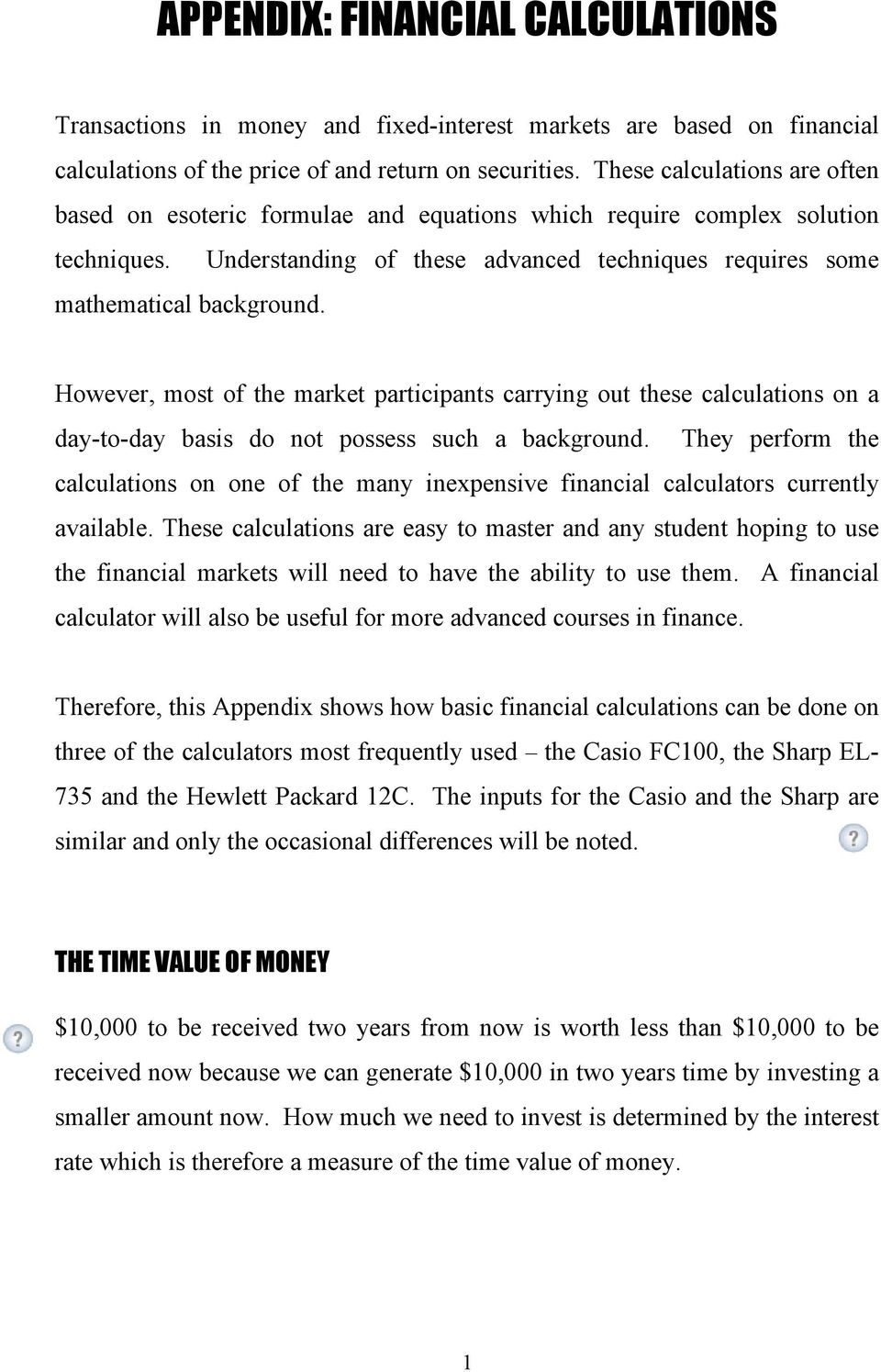
1 APPENDIX: FINANCIAL CALCULATIONS Transactions in money and fixed-interest markets are based on financial calculations of the price of and return on securities. These calculations are often based on esoteric formulae and equations which require complex solution techniques. Understanding of these advanced techniques requires some mathematical background. However, most of the market participants carrying out these calculations on a day-to-day basis do not possess such a background. They perform the calculations on one of the many inexpensive financial calculators currently available. These calculations are easy to master and any student hoping to use the financial markets will need to have the ability to use them. A financial calculator will also be useful for more advanced courses in finance. Therefore, this Appendix shows how basic financial calculations can be done on three of the calculators most frequently used the Casio FC100, the Sharp EL- 735 and the Hewlett Packard 1C. The inputs for the Casio and the Sharp are similar and only the occasional differences will be noted. THE TIME VALUE OF MONEY $10,000 to be received two years from now is worth less than $10,000 to be received now because we can generate $10,000 in two years time by investing a smaller amount now. How much we need to invest is determined by the interest rate which is therefore a measure of the time value of money. 1
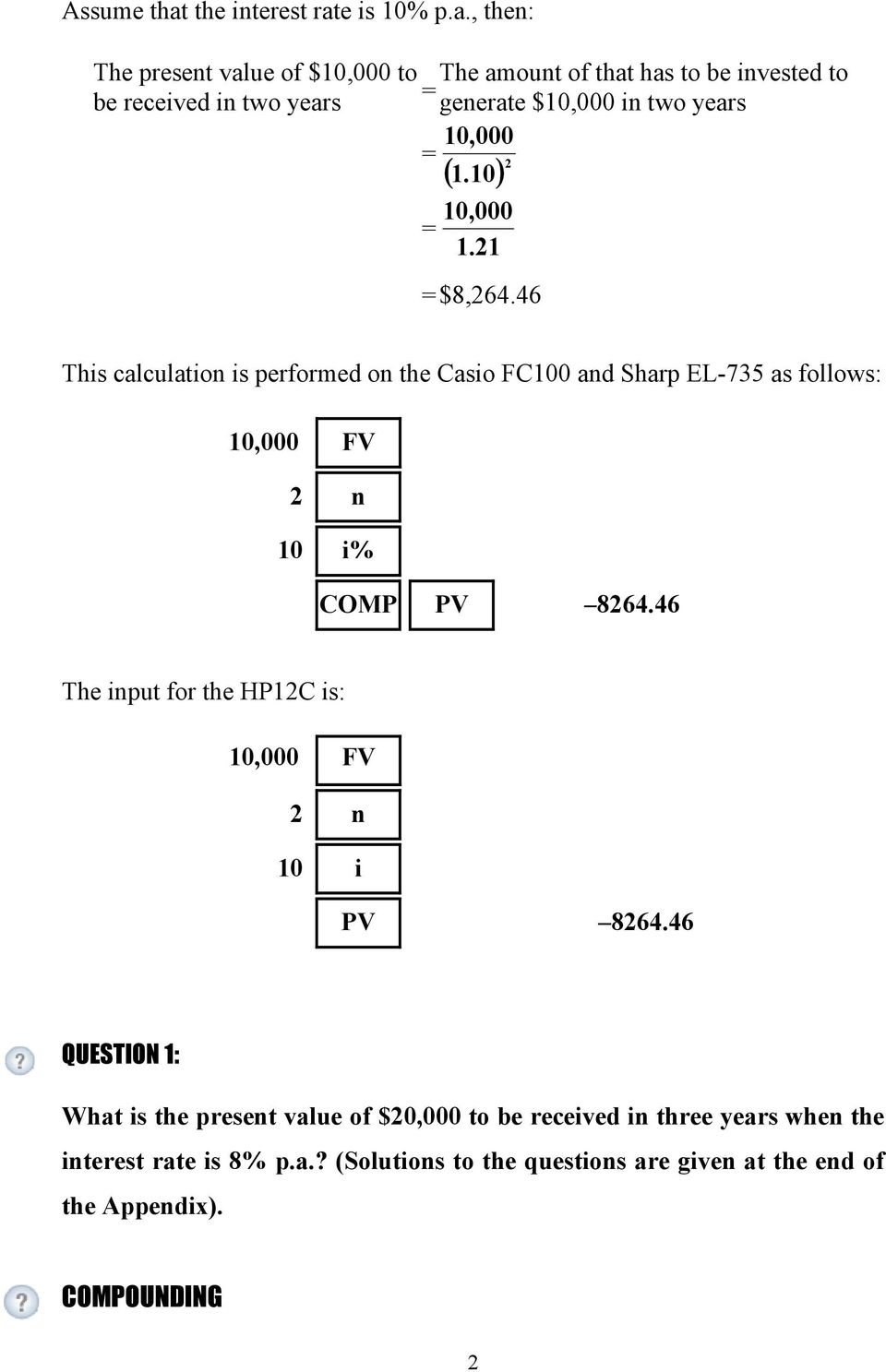
2 Assume that the interest rate is 10% p.a., then: The present value of $10,000 to be received in two years The amount of that has to be invested to = generate $10,000 in two years 10,000 = ( ) 1.10 = 10, =$8,64.46 This calculation is performed on the Casio FC100 and Sharp EL-735 as follows: 10,000 FV n 10 i% COMP PV The input for the HP1C is: 10,000 FV n 10 i PV QUESTION 1: What is the present value of $0,000 to be received in three years when the interest rate is 8% p.a.? (Solutions to the questions are given at the end of the Appendix). COMPOUNDING
3 Compounding means getting interest on interest. Consider an investment which pays 8% p.a. but which compounds semi-annually. Interest rate for half year = 4% Consider a dollar invested for one year. In the second half of the year, we receive interest on $1.04 rather than the dollar initially invested (1.04) = ½ year ½ year The effective interest rate (i.e. the return we actually get) is 8.16% p.a. Assume now that compounding is quarterly. Effective Interest Rate =(1.0) 4 1 = =0.084 or 8.4% p.a. The keystrokes on the Casio and Sharp calculators are: 1 +/ PV i% 4 n COMP FV On the HP1C they are: 1 CHS PV i 4 n FV The +/ and CHS keys change the sign of the preceding number, i.e. the 3

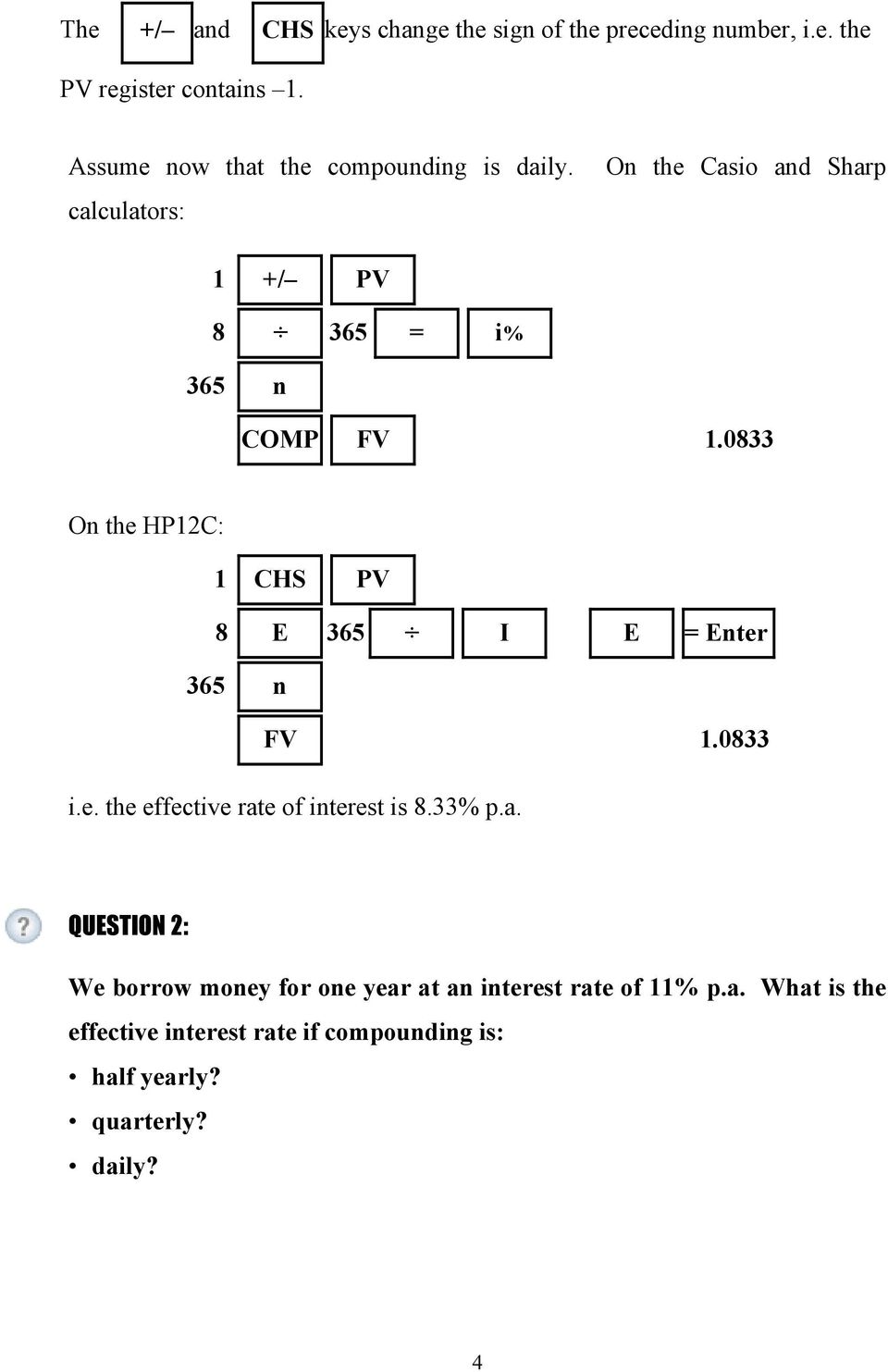
4 The +/ and CHS keys change the sign of the preceding number, i.e. the PV register contains 1. Assume now that the compounding is daily. On the Casio and Sharp calculators: 1 +/ PV = i% 365 n COMP FV On the HP1C: 1 CHS PV 8 E 365 I E = Enter 365 n FV i.e. the effective rate of interest is 8.33% p.a. QUESTION : We borrow money for one year at an interest rate of 11% p.a. What is the effective interest rate if compounding is: half yearly? quarterly? daily? 4
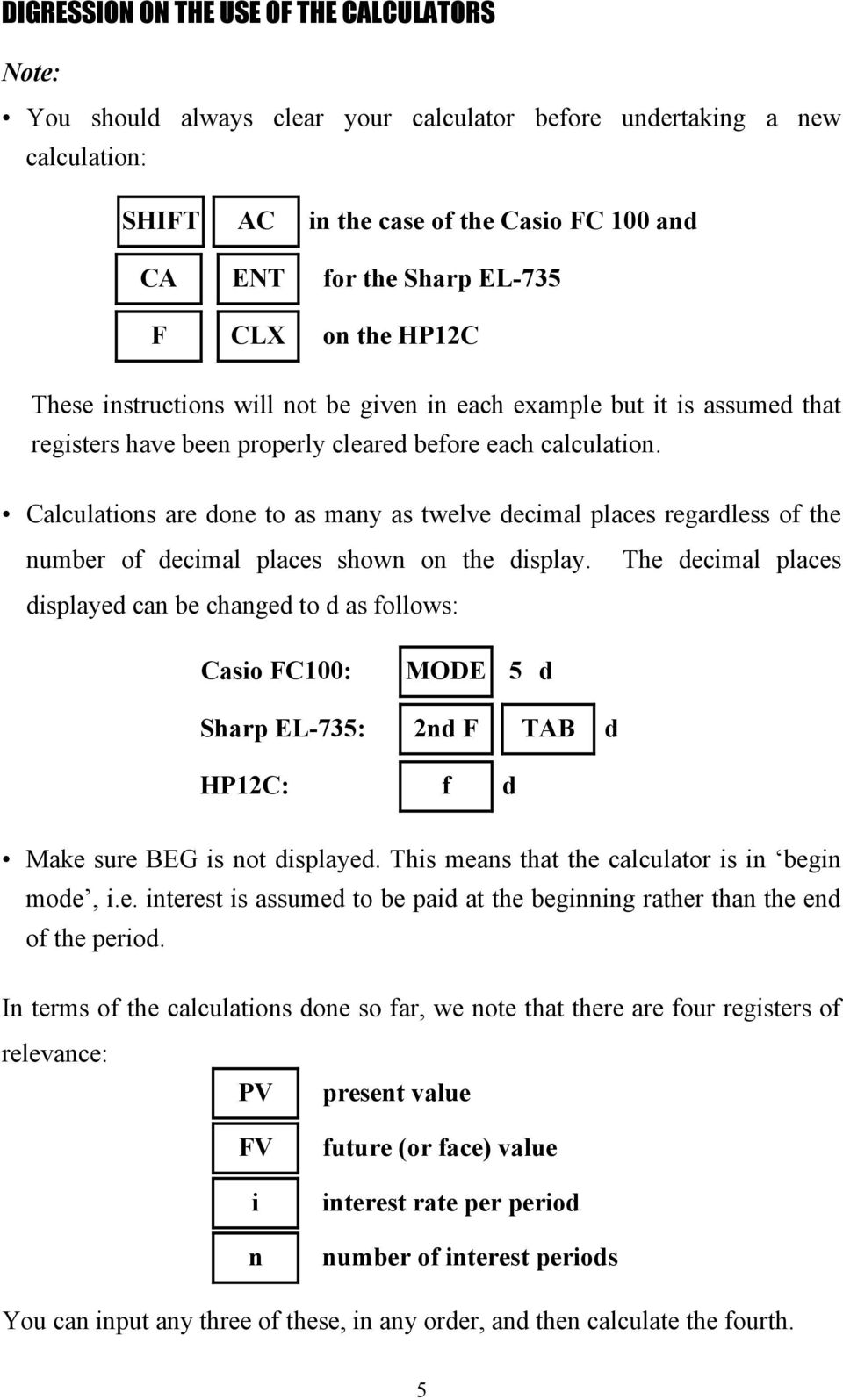
5 DIGRESSION ON THE USE OF THE CALCULATORS Note: You should always clear your calculator before undertaking a new calculation: SHIFT AC in the case of the Casio FC 100 and CA ENT for the Sharp EL-735 F CLX on the HP1C These instructions will not be given in each example but it is assumed that registers have been properly cleared before each calculation. Calculations are done to as many as twelve decimal places regardless of the number of decimal places shown on the display. The decimal places displayed can be changed to d as follows: Casio FC100: MODE 5 d Sharp EL-735: nd F TAB d HP1C: f d Make sure BEG is not displayed. This means that the calculator is in begin mode, i.e. interest is assumed to be paid at the beginning rather than the end of the period. In terms of the calculations done so far, we note that there are four registers of relevance: PV FV i n present value future (or face) value interest rate per period number of interest periods You can input any three of these, in any order, and then calculate the fourth. 5
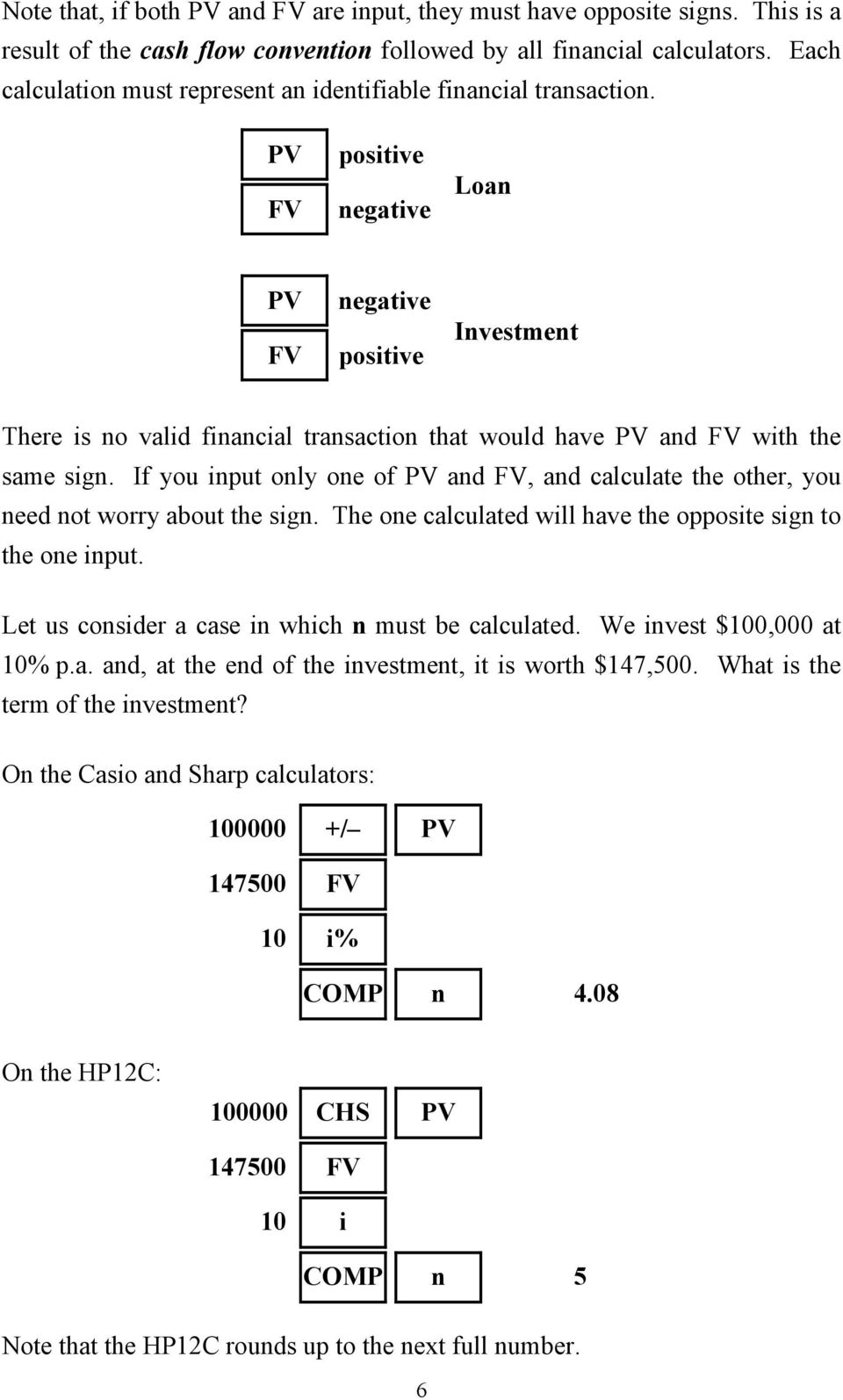
6 Note that, if both PV and FV are input, they must have opposite signs. This is a result of the cash flow convention followed by all financial calculators. Each calculation must represent an identifiable financial transaction. PV FV positive negative Loan PV FV negative positive Investment There is no valid financial transaction that would have PV and FV with the same sign. If you input only one of PV and FV, and calculate the other, you need not worry about the sign. The one calculated will have the opposite sign to the one input. Let us consider a case in which n must be calculated. We invest $100,000 at 10% p.a. and, at the end of the investment, it is worth $147,500. What is the term of the investment? On the Casio and Sharp calculators: / PV FV 10 i% COMP n 4.08 On the HP1C: CHS PV FV 10 i COMP n 5 Note that the HP1C rounds up to the next full number. 6
7 SHORT-TERM SECURITIES Securities with a term of less than one year are called Bills or Notes. The following are examples of such securities: Treasury Notes issued by the RBA at tender for terms of 91 days and 18 days Bank Bills issued by private borrowers but repayment is guaranteed by a bank through a process of endorsement or acceptance credit standing is determined by the guaranteeing bank s credit rating initial terms typically 90 or 180 days slightly higher yield than TNs on occasion very liquid market Certificates of Deposit issued directly by banks equivalent to bank bills, paying the same return Promissory Notes issued by borrowers without a bank guarantee (one name paper) return depends on the credit rating of the borrower illiquid market These securities are sold at a discount. You buy them at a price below the face value and on maturity you receive the face value. GAIN = FACE VALUE PRICE There is no cash flow over the life of the security. Interest rates are stated on a per annum basis and must be adjusted to the term of the security. 7

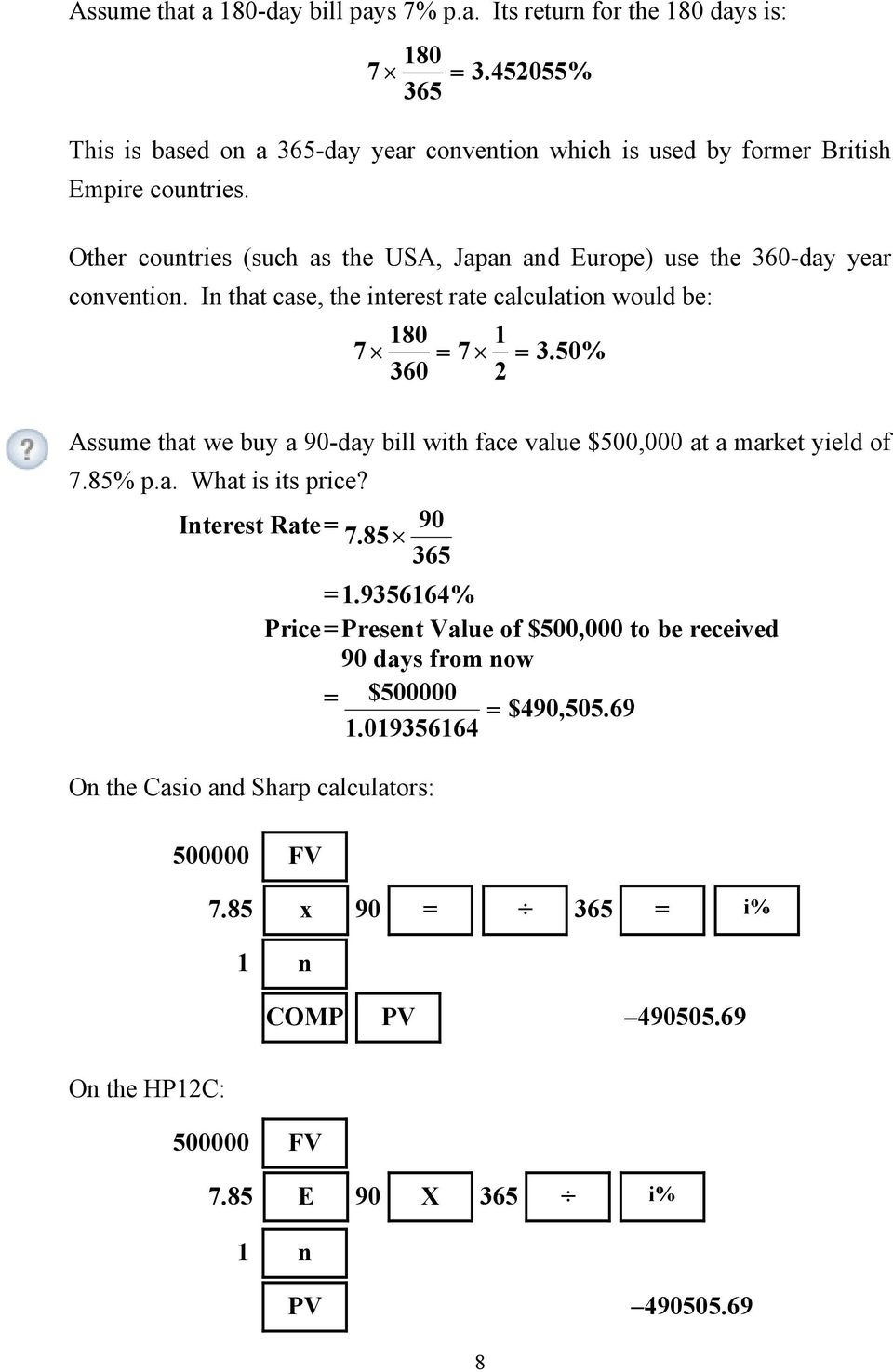
8 Assume that a 180-day bill pays 7% p.a. Its return for the 180 days is: = % This is based on a 365-day year convention which is used by former British Empire countries. Other countries (such as the USA, Japan and Europe) use the 360-day year convention. In that case, the interest rate calculation would be: = 7 = 3.50% 360 Assume that we buy a 90-day bill with face value $500,000 at a market yield of 7.85% p.a. What is its price? Interest Rate= On the Casio and Sharp calculators: FV = % Price= Present Value of $500,000 to be received 90 days from now = $ = $490, x 90 = 365 = i% 1 n COMP PV On the HP1C: FV 7.85 E 90 X 365 i% 1 n PV
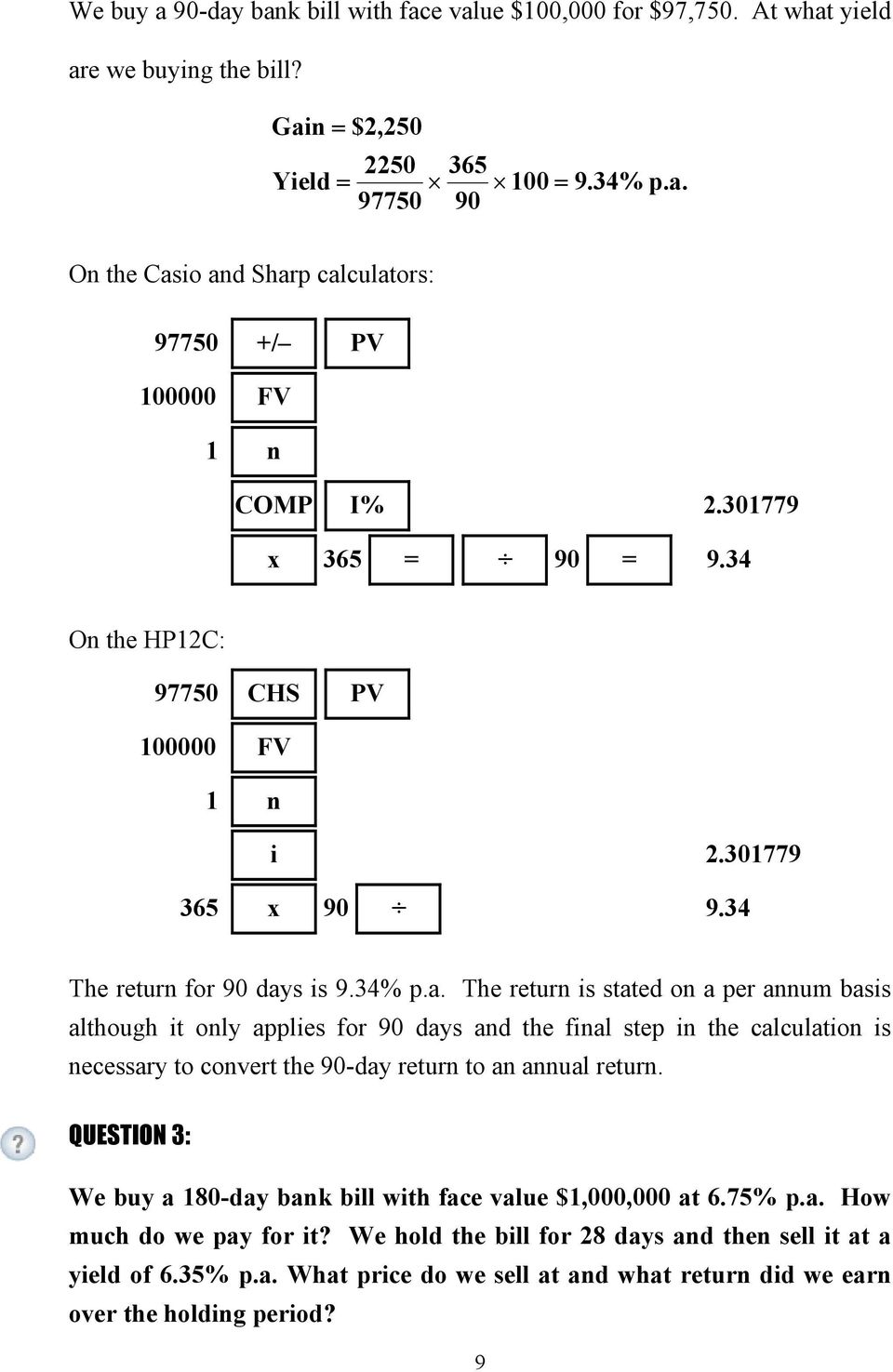
9 We buy a 90-day bank bill with face value $100,000 for $97,750. At what yield are we buying the bill? Gain = $, Yield = 100 = 9.34% p.a On the Casio and Sharp calculators: / PV FV 1 n COMP I% x 365 = 90 = 9.34 On the HP1C: CHS PV FV 1 n i x The return for 90 days is 9.34% p.a. The return is stated on a per annum basis although it only applies for 90 days and the final step in the calculation is necessary to convert the 90-day return to an annual return. QUESTION 3: We buy a 180-day bank bill with face value $1,000,000 at 6.75% p.a. How much do we pay for it? We hold the bill for 8 days and then sell it at a yield of 6.35% p.a. What price do we sell at and what return did we earn over the holding period? 9
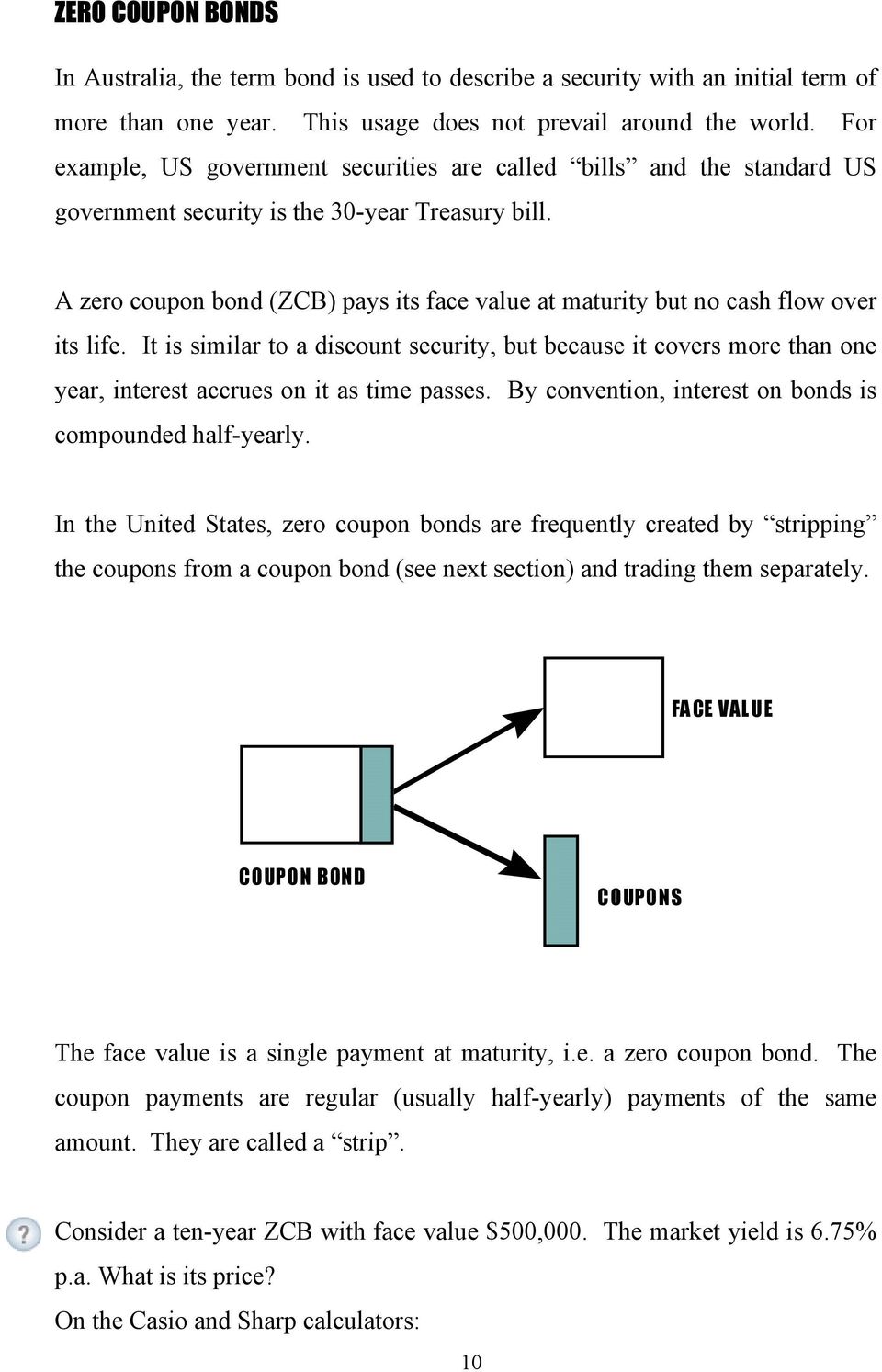
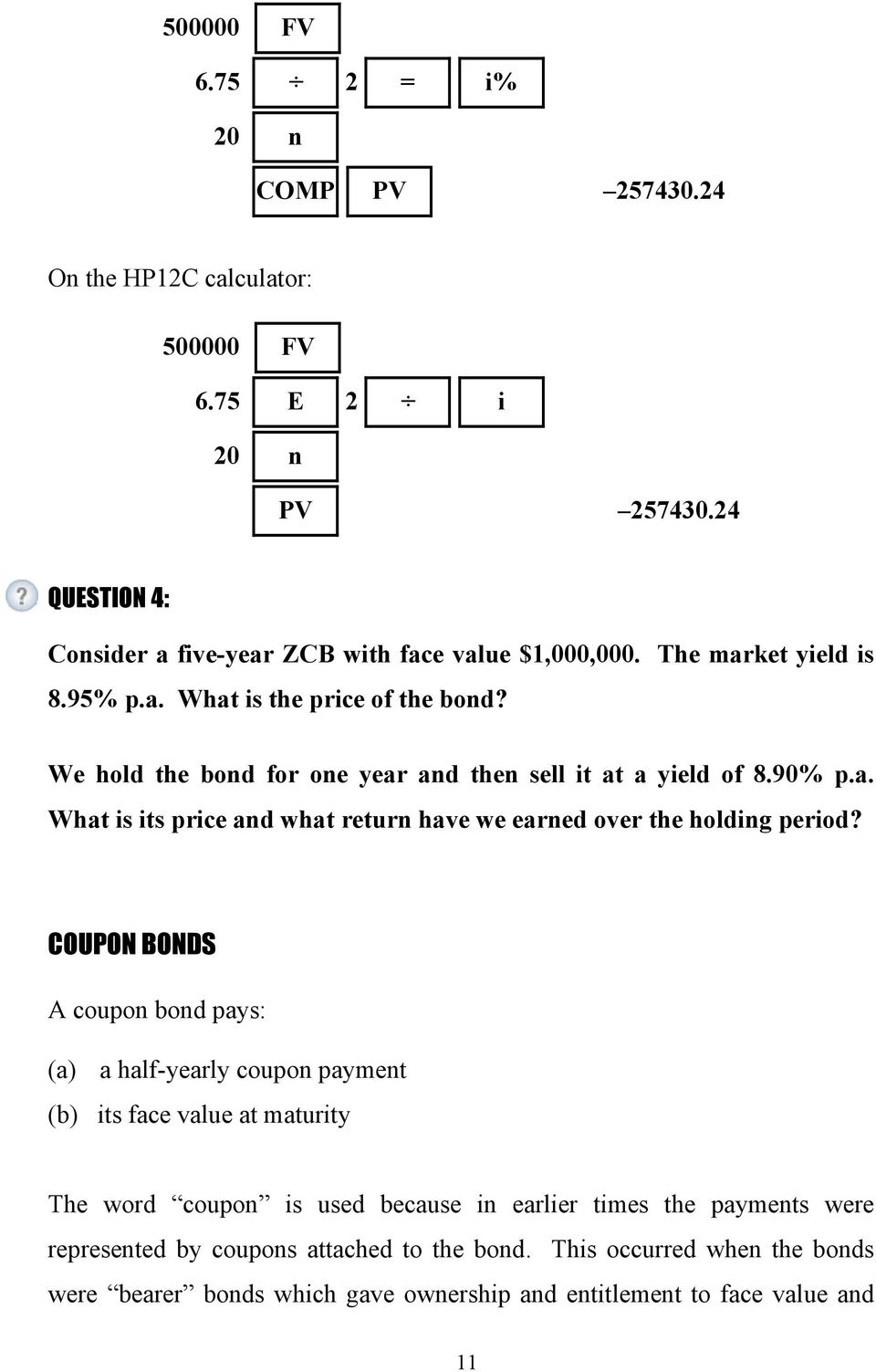
10 ZERO COUPON BONDS In Australia, the term bond is used to describe a security with an initial term of more than one year. This usage does not prevail around the world. For example, US government securities are called bills and the standard US government security is the 30-year Treasury bill. A zero coupon bond (ZCB) pays its face value at maturity but no cash flow over its life. It is similar to a discount security, but because it covers more than one year, interest accrues on it as time passes. By convention, interest on bonds is compounded half-yearly. In the United States, zero coupon bonds are frequently created by stripping the coupons from a coupon bond (see next section) and trading them separately. FA CE VALUE COUPON BOND COUPONS The face value is a single payment at maturity, i.e. a zero coupon bond. The coupon payments are regular (usually half-yearly) payments of the same amount. They are called a strip. Consider a ten-year ZCB with face value $500,000. The market yield is 6.75% p.a. What is its price? On the Casio and Sharp calculators: 10
11 FV 6.75 = i% 0 n COMP PV On the HP1C calculator: FV 6.75 E i 0 n PV QUESTION 4: Consider a five-year ZCB with face value $1,000,000. The market yield is 8.95% p.a. What is the price of the bond? We hold the bond for one year and then sell it at a yield of 8.90% p.a. What is its price and what return have we earned over the holding period? COUPON BONDS A coupon bond pays: (a) a half-yearly coupon payment (b) its face value at maturity The word coupon is used because in earlier times the payments were represented by coupons attached to the bond. This occurred when the bonds were bearer bonds which gave ownership and entitlement to face value and 11
12 coupon payments to whoever held the bond. Most bonds are now inscribed stock. No bond is actually issued but purchasers are recorded on a register as the owners of a certain amount of stock. Commonwealth Government Securities: are also known as Treasury Bonds are sold at tender by the RBA smaller amounts can be purchased over-the-counter at the RBA (yield equal to the average established in the tender) have a liquid market and the RBA will buy small amounts back ($50,000 per day) State Government Bonds: are similar to CGS pay higher returns, depending on the issuing State s credit rating. Consider a ten-year bond with face value of $1,000,000 and paying a semiannual coupon of $35,000. The market yield is 7.8% p.a. What is the price of the bond? The coupon rate is 3.5% per half year or 7% p.a. In this case, we need a new key the payment key: PMT This key will be used to enter the coupon payments. 1
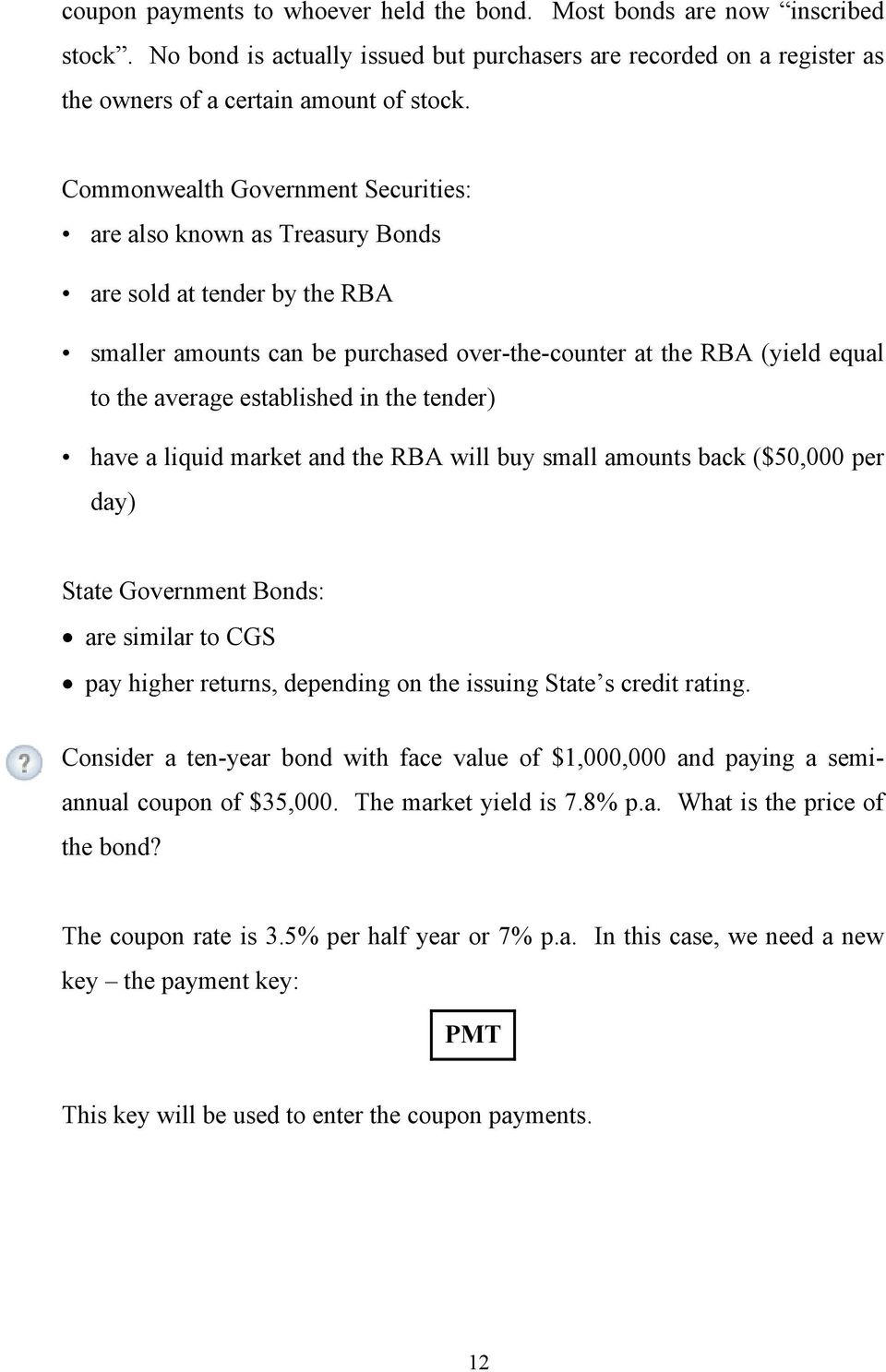
13 On the Casio and Sharp calculators: FV 3.9 i% 0 n PMT COMP PV On the HP1C calculator: FV 3.9 i 0 n PMT PV QUESTION 5: Consider a 5-year bond with face value $100,000 and semi-annual coupon $3,00. The market yield is 6% p.a. What is the price of the bond? We hold the bond for 1½ years and sell it at a yield of 6.6% p.a. What is its price and what have we earned over the holding period? It should be noted that the preceding calculations indicate how to determine the price of a bond at a coupon period. If a bond is sold between coupon dates, the price must take the accrued coupon into account. Techniques for doing this are given in Valentine (1991, pp ). Consider a ten-year bond with face value $1,000,000, semi-annual coupons of $40,000 and selling at a price of $973,300. What is the yield on this security? 13
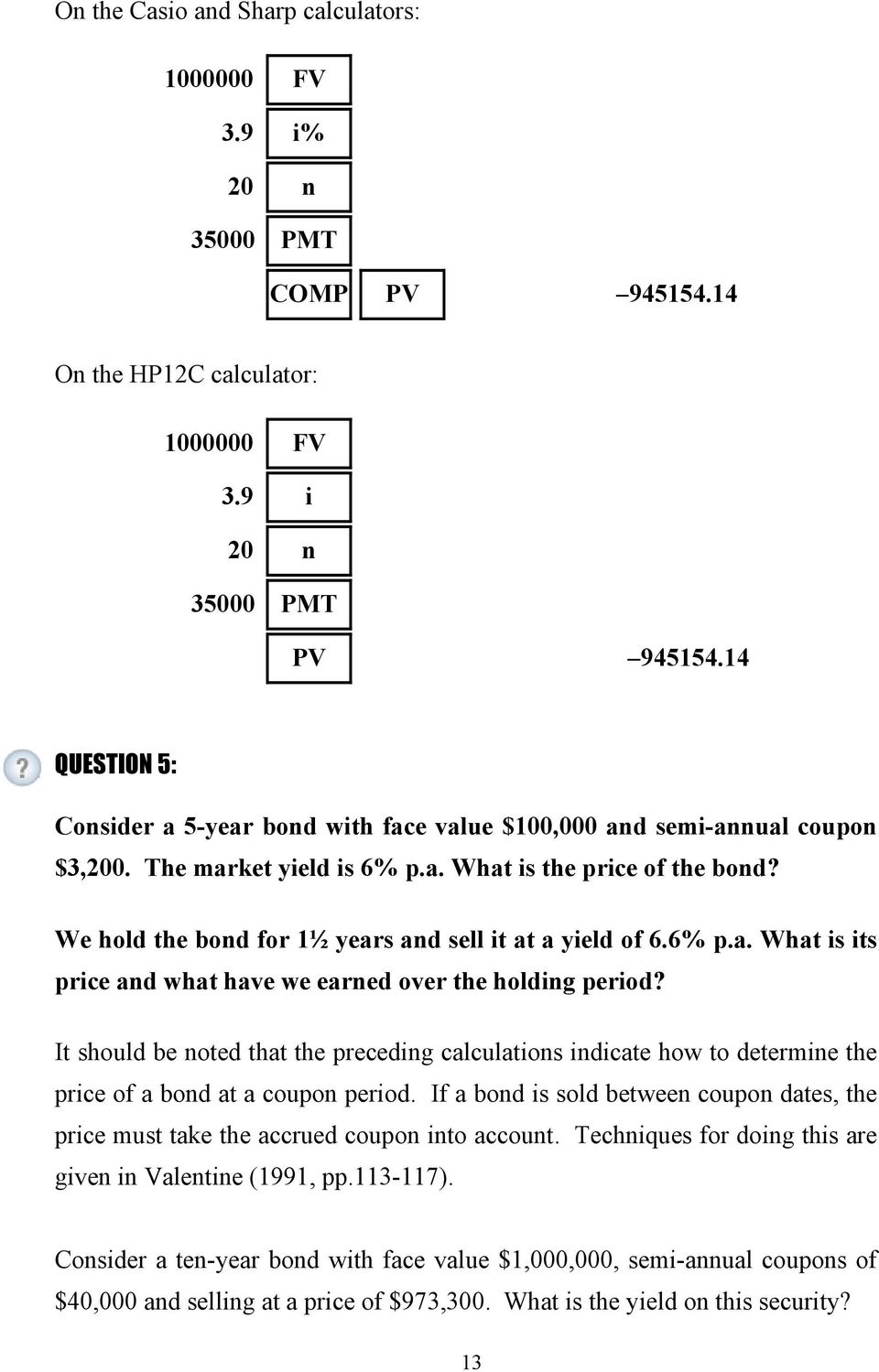
14 On the Casio and Sharp calculators: FV / PV 0 n PMT COMP i% 4.0 i x = 8.40 The yield is 8.40% p.a. This is the yield to maturity. Investors buying the bond at the price given will achieve this return only if: they hold the bond to maturity; and they can reinvest each coupon payment at the same yield The second requirement is unlikely to be satisfied. Thus, the return actually earned is likely to be a little higher or lower than the purchase yield depending on whether the rates at which coupon payments are reinvested is higher or lower than that yield. MORTGAGES Lenders providing the funds for the purchase of property usually secure their loans on the properties themselves. That is, if the borrower defaults, the lender has the right to take over the property and to sell it to recover its funds. The instrument that provides this security is called a mortgage. There are two types of mortgage loan. Interest-only loans require the borrower to make regular interest payments and to repay the principal of the loan at the end of its term. The cash flow pattern of this type of loan is the same as that of a coupon bond and it is most commonly used to finance the purchase of 14

15 investment properties. The second type of mortgage is a credit foncier mortgage under which the loan is repaid in equal regular payments covering both principal and interest. This form of mortgage is standard in the purchase of a home for occupation by the owner. Since this is the most common form, it is the one that will be assumed here. We take a 15-year mortgage for $150,000 at 10.75% p.a. It is to be repaid fortnightly (that is, every two weeks). What is the repayment? In solving this example, we will assume that there are n = 15 x 6 = 390 payments. Actually, there are slightly more than 391 fortnights in 15 years. Also, the following calculation assumes that interest is compounded fortnightly. In practice, lenders compound interest daily, although payments are fortnightly or monthly. On the Casio and Sharp calculators: PV 0 FV 6 x 15 = n = i% COMP PMT On the HP1C calculator: PV 0 FV 6 E 15 x n E 6 i PMT We pay the mortgage for one year. How much do we owe then? We can 15
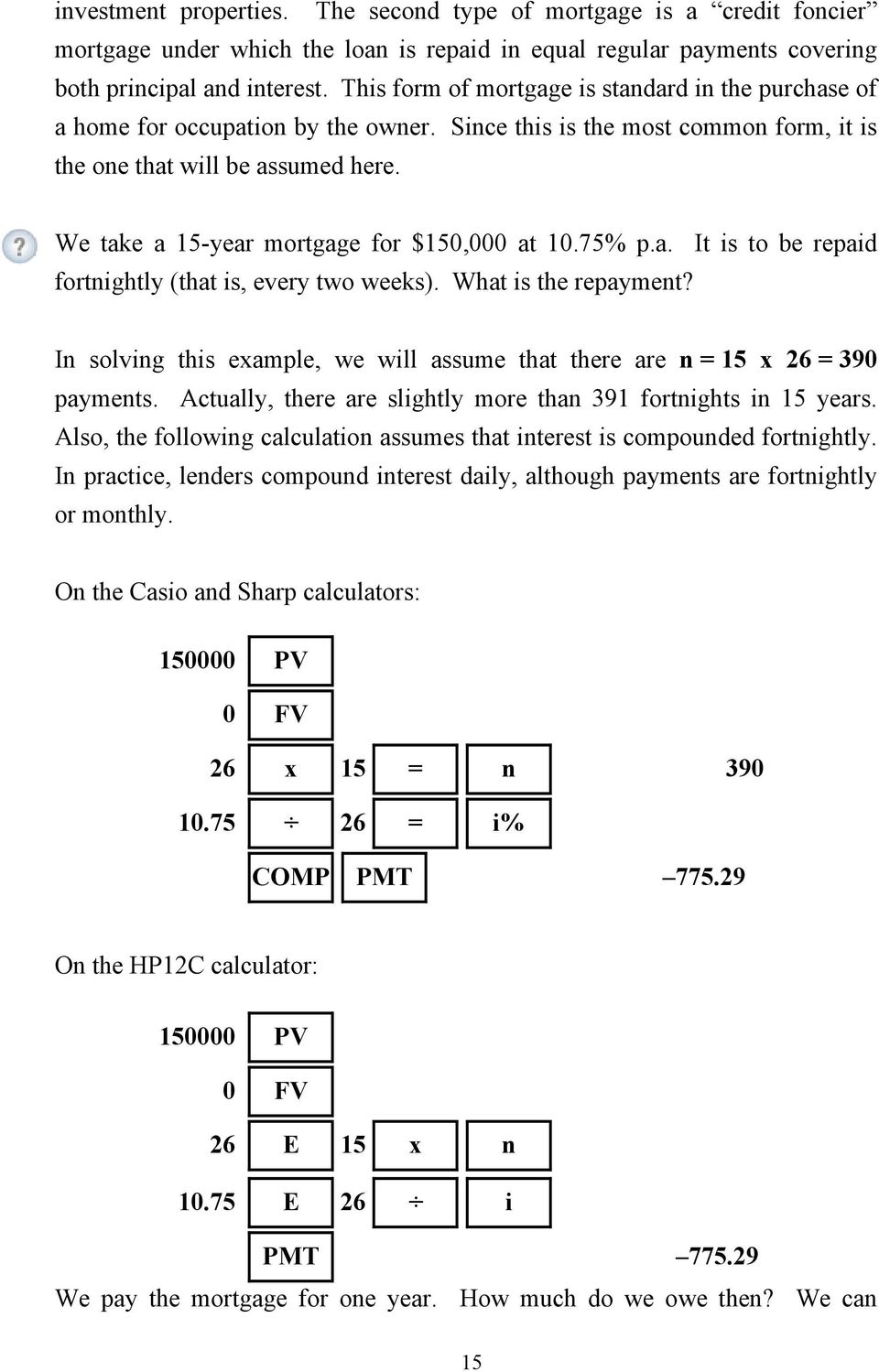
16 continue from the previous calculations. On the Casio and Sharp calculators: 6 x 14 = n 364 COMP PV On the HP1C calculator: 6 E 14 x n PV We have paid off: = 4,48.05 But over that year we paid: 6 x =0, This means that we have paid: (0, ) =15, of interest The early payments include a lot of interest and little principal. The final payments include mainly principal. QUESTION 6 (a): We take a ten-year mortgage for $100,000 at 8.75% p.a. It is to be repaid in monthly repayments. What is the repayment amount? Assume that interest is compounded monthly. After two years, what is the balance outstanding? How much principal and how much interest has been paid? So far, we have assumed that the interest rate on the mortgage is fixed. Money mortgages are actually variable rate so that the lender can change the rate whenever market interest rates change. QUESTION 6 (b): In question 6 (a), assume that it is a variable-rate mortgage and that the 16
17 interest rate increases to 9.50% p.a. after two years. What is the new payment? Many lenders providing fixed-rate mortgages include a penalty for the prepayment of the mortgage. The reason for this penalty is that mortgage holders have an incentive to prepay their loan (and refinance it) when interest rates fall. Lenders will have offset the fixed rate in some way (for example, by funding it from deposits which have a fixed rate for the same period) and, with an interest rate fall, they will have suffered a loss on that hedge. If the mortgage is prepaid, they lose the offsetting gain on their loss. That is, they have a net loss. Prepayment penalties can take two basic forms. First, there can be a fixed dollar amount (sometimes defined as a number of monthly payments). The problem with this approach is that there will be some fall in interest rates that makes it profitable for the borrower to prepay the loan. Secondly, prepayment can be allowed only at the market value of the loan. In this case, the lender cannot lose from the prepayment. The problem with this approach is the difficulty in explaining it to customers, particularly when the new market value exceeds the amount originally borrowed. QUESTION 6 (c): Assume in question 6 (a) that, after two years, the interest rate falls to 8.5% p.a. What prepayment penalty would make it unattractive to prepay the loan? DURATION The earlier sections show that the prices of fixed-interest securities fall as interest rates increase. The reader will not be surprised to be told that the 17
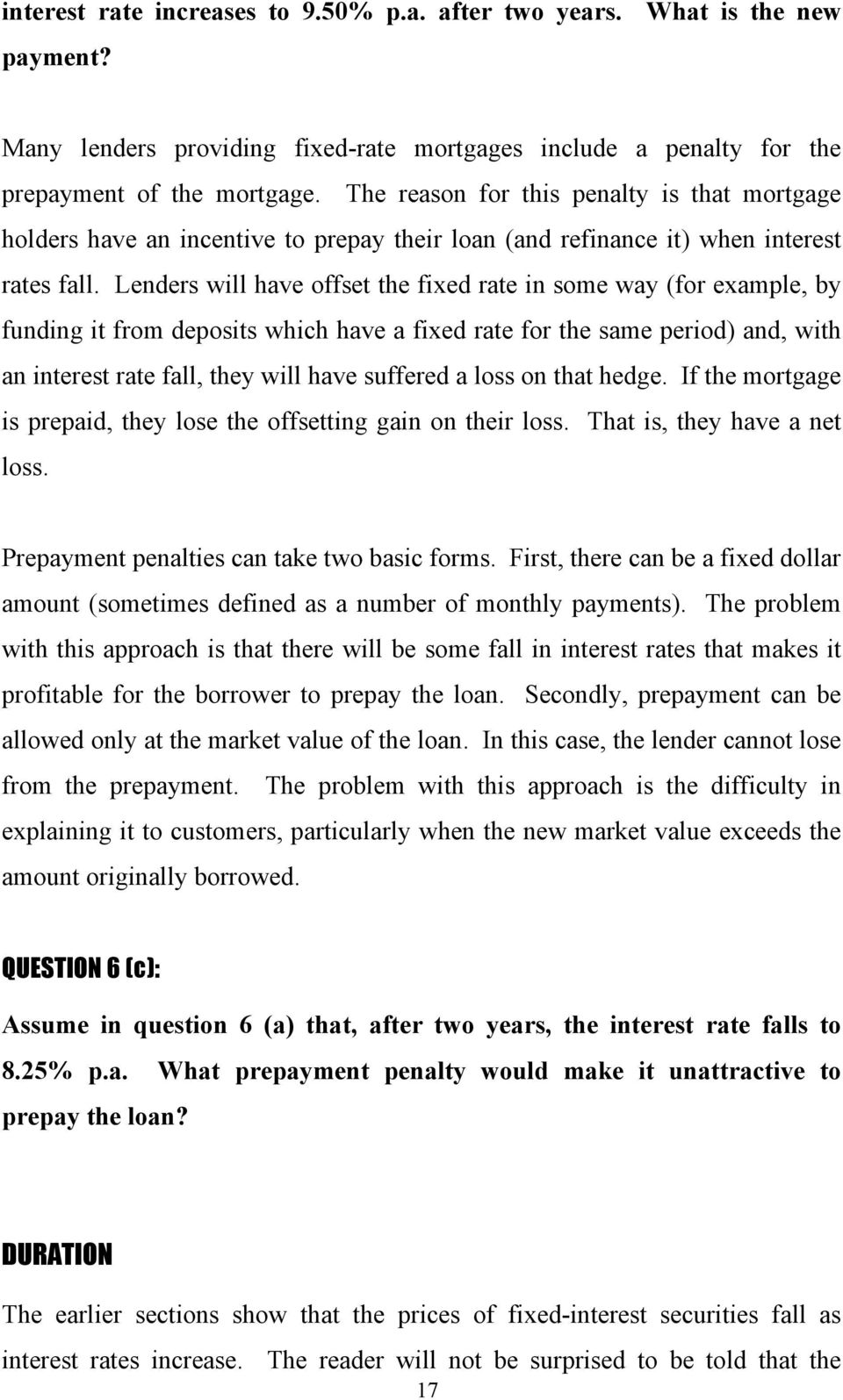
18 sensitivity of a security s price to a change in interest rates appears to increase with the term of the security. In general, longer-term securities have prices that are more sensitive to interest rates than shorter-term securities. Consider a bond with face value $100,000 and semi-annual coupon $5,000. At 10% p.a., it will sell at par, (i.e. at its face value of $100,000), regardless of its term. Assume now that the yield drops to 9% p.a. The following Table indicates what happens to the price of the bond for different terms to maturity. TERM (YEARS) PRICE AT 9% P.A. ($) 101, , , , , It is clear that, as the term of the security increases, the sensitivity of its price to changes in interest rates increases. However, it is also clear that the sensitivity of the security price does not go up in proportion to its term. For example, in the Table, the price of the ten-year bond increases by 6.50%. If the price of the thirty-year bond reacted in a proportional fashion, it would have increased by 19.50%, whereas the actual increase is 10.3%. The reason for this reaction is that the sensitivity of security prices to interest rate changes depends on the patterns of their cash flows as well as their terms. This point can be illustrated by the following three four-year securities. 18
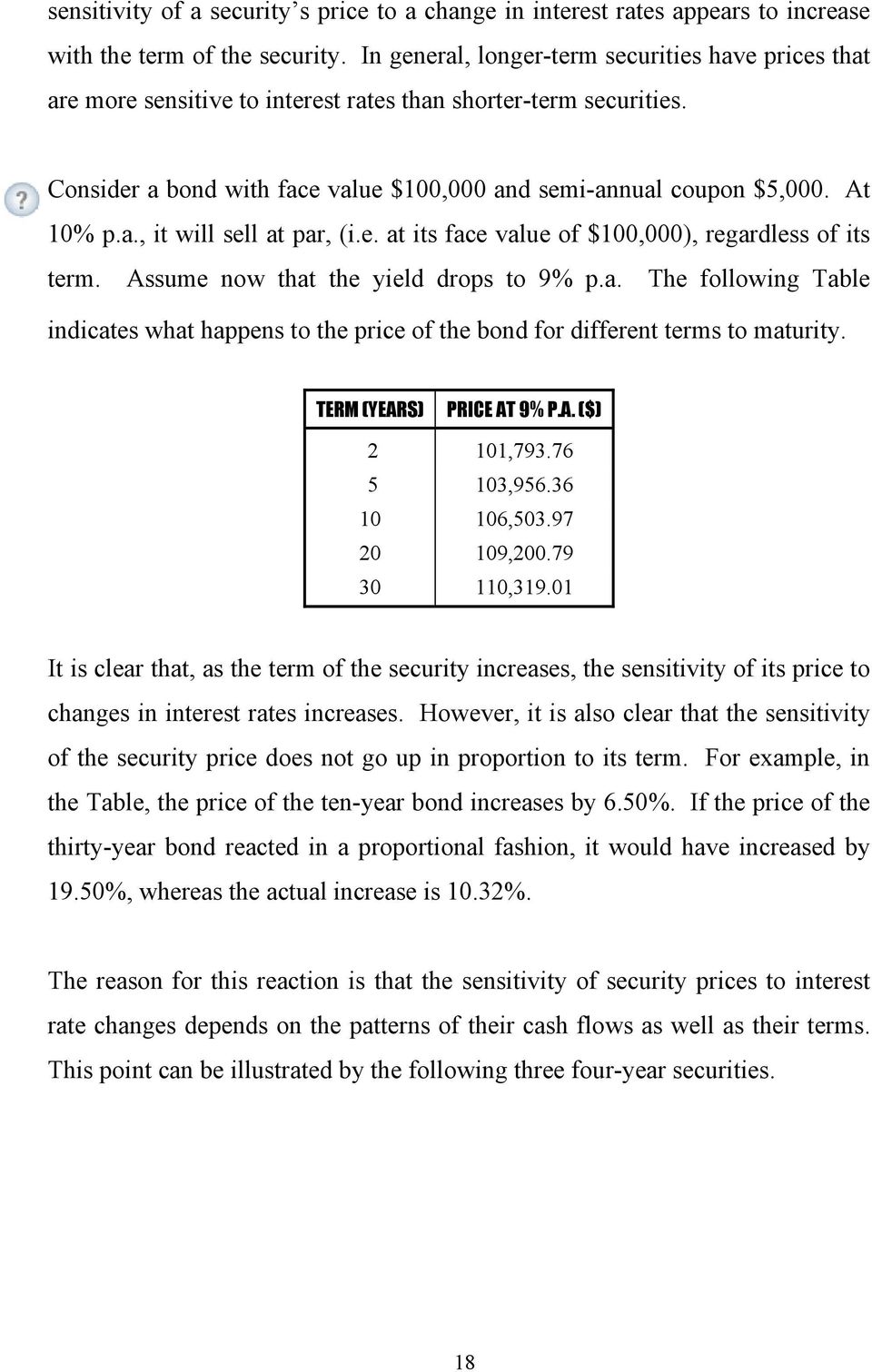
19 (A) CF D Security (A) is a zero-coupon bond in which all the cash flow occurs at maturity. (B) CF 1 CF CF3 CF Security (B) is an annuity which generates equal cash flows in every period. A strip of coupon payments also has cash flows of this form. Also, credit-foncier loans (such as housing loans and personal loans) are repaid in equal payments, including both interest and principal. D (C) CF8 CF 1 CF CF3 CF4 CF5 CF6 CF D 19

20 Security (C) is a coupon bond which has a large payment, consisting of its face value and the final coupon payment at maturity and half-yearly coupon payments. Security (A) is the most sensitive to interest rate changes. If the interest rate increases, a holder would have to wait four years before receiving any cash flow that could be reinvested at the higher rate. Security (B) is least sensitive to interest rates because three-quarters of the cash flow is received before maturity. Security (C) is between (A) and (B) in interest-rate sensitivity. It has some earlier cash flows, but there is a large concentration at the maturity date. Clearly, the price sensitivity of a security depends on its pattern of cash flows. The duration of a security is a measure that takes this pattern into account. The duration of a security is the weighted average of the times to the receipt of various elements of a security s cash flow where the weights are the present values of the cash flows divided by the price of the security (the total of the present values of the cash flows). The duration is a weighted average of times and it is therefore stated in time units. The approximate durations of securities (A), (B) and (C) are shown on the diagrams. In the case of (A), the duration is four because this is the only point in time when a cash flow occurs. (B) has a duration above two but less than.5 (the average of the four values 1,, 3, 4). The cash flows are equal, but the present values of those cash flows (which determine the weights used in the average) decline as the time to their receipt increases. The coupon bond (C) has a duration below its term, but not very far below it. For a bond of this maturity, the weight arising from the large final payment dominates the average. However, as the term increases, this final cash flow is more heavily discounted and becomes increasingly less important. Therefore, the gap between the duration and the term increases as the term of the coupon bond increases. 0

21 The definition given above can be used to calculate the duration of a security. Consider the case of a three-year annuity which pays $100 per year at a market interest rate of 5% p.a. Its duration can be calculated as follows: CASH FLOW TIME TO RECEIPT OF CASH FLOW PRESENT VALUE TIME x PRESENT VALUE PRICE = Duration = = years It is easier to make use of an approximation to the percentage change in price that results from an interest rate change. Consider a security that generates cash flows CF 1, CF,., CF K over K periods. The price of this security (P) is given by: CF1 P = r where r is the yield to maturity. CF CF K K ( 1 + r) ( 1 + r) (*) This equation shows that the relationship between the price of a security and the market yield is a nonlinear one. A relationship of this type is illustrated by the curve in Figure 1. 1
22 FIGURE 1 : THE DURATION APPROXIMATION TO SECURITY PRICE CHANGES PRICE YIELD 0 R* R We can approximate the change in the price of the security around a yield of R* by using the tangent to the curve at R*. Clearly, this approximation becomes less accurate as we move further away from R*. However, in practice, the accuracy of the approximation is good even for changes as large as 100 basis points (one percentage point). A basis point change is a change of one unit in the second decimal place of a market yield. It is the smallest change that can occur in a market yield. The approximating tangent can be represented by the equation: P D Fall in the Interest Rate = (**) P One plus the Interest Rate where D is the duration of the security and P is the change in the price and the interest rate is expressed as a decimal. The change can be converted into a percentage by multiplying both sides of the equation by 100. This equation can be derived by differentiating (*) with respect to r (see Advanced Topics 1 at the end of this appendix). It shows that D changes as the yield changes. Figure 1 shows that, at higher yields, the approximating tangent
23 is flatter, i.e. it has a lower slope. In other words, duration falls as the yield increases. The prices of securities are more interest rate sensitive in low interest rate environments than when interest rates are high. Applying the approximation (**) to the annuity discussed above, we will calculate the change in price that occurs when the market yield increases by 0.01 (one basis point). This value is the price value of a basis point (PVBP). A basis point is the smallest change that can occur in a market interest rate because they are commonly stated to two decimal points. We have chosen this change because (**) applies strictly only for infinitesimally small changes in interest rates and the error involved is smaller the smaller the interest rate change we consider. On the Casio and Sharp calculators: 100 PMT 3 n 5.0 i COMP PV i COMP PV The only difference with the HP1C is that we do not need the COMP key. The PVBP is As a percentage: (.0510) D 0.01 = That is, D = years As a further example, consider a ten-year bond with a face value of $100,000 and a coupon rate of 6% p.a. The market yield is 5.80% p.a. We calculate the 3
24 price at this yield and then at a yield which is one basis point higher (i.e. at 5.81). On the Casio and Sharp calculators: FV 3000 PMT 0 N 5.80 = i% COMP PV = i% COMP PV On the HP1C: FV 3000 PMT 0 N 5.80 E i PV E i PV The PVBP is $ As a percentage: ( 75.75) 100 = % From the equation above, the duration is calculated from: D = 1.09 D = half years or 7.68 years 4
25 Note that, since the half-year is the basic period, interest rates and the basis point change are stated in half-yearly terms. We can also calculate the modified duration (DM) as: In the example: D D M = One plus Interest Rate D M = = From the formula above: Percentage Increase in Price = DM x Change in Interest Rate = 14.9 x = % Therefore, the modified duration of a security represents the percentage change in the price of a security when the interest rate changes by one percent. QUESTION: We take a 15-year mortgage for $00,000 which is to be paid off monthly. The interest rate is 7.75% p.a. What is the duration of this mortgage? SOLUTION: We will calculate the payment on this mortgage and then examine how its price changes when there is a basis point increase in the yield. 5
26 On the Casio and Sharp calculators: PV 15 x 1 = n = i% COMP PMT = i% COMP PV On the HP1C: PV 15 E 1 x n 7.75 E 1 i PMT E 1 i PV The PVBP is $11.65 and the percentage fall in price is %. Therefore, the duration is given by: D = D = months or 6.1 years D = M = 7.97 months or 6.08 years In this case, the duration is well below the term because the payments are evenly spread over the life of the security. Indeed, the duration of this mortgage is less than the duration of the ten-year bond discussed earlier. USING DURATION FOR HEDGING 6
27 Assume that we want to invest in an annuity of the type discussed in the previous subsection. We want to fund this investment by issuing a security that will leave our overall position unaffected by movements in interest rates. Such a security would be a zero coupon bond with term (duration) equal to years, current price equal to $ and, therefore, face value of: FV =$ (1.05) =$ A change in interest rates will affect the value of our asset (the annuity) and our liability (the zero coupon bond) by the same amount, leaving our net position unchanged. This hedging rule can be formalised as follows: Let: D A be the duration of the asset, and D L be the duration of the liability. We define the duration gap (DGAP) of our position as: DGAP = D A D L In the example, DGAP = 0. In such cases, a change in interest rates will have the same dollar value effect on the prices of the asset and liability. It is said that our position is immunised against interest rate movements. If DGAP >0, D A must be above D L. An interest rate increase will lead to a fall in the value of both the asset and the liability but, since it has the higher duration, the price of the asset will fall further. That is, we will lose. Consequently, a fall in the interest rate will increase the net value of our position. If DGAP <0, D A is below D L. An interest rate fall will cause the asset to increase in value by less than the liability. That is, our net position will deteriorate. Conversely, an interest rate increase would lead to a capital gain. However, there are some problems with this hedge. First, we have already indicated that it is only completely accurate for extremely small changes in the 7
28 market yield. The hedge will be very accurate for a basis point change in the interest rate. However, consider the case of a 100 basis point (one percentage point) increase in the interest rate. The price of the annuity goes to $ The price of the zero goes to: leaving a slight error. $ ( 1.06) = $67.94 Secondly, the position is only immunised against uniform shifts in the yield curve; that is, cases where the same change occurs in the yields for all maturities. In the example, we are protected against equal changes in two- and three-year yields. If these yields change by different amounts, the net value of the position will be affected. Thirdly, the hedge is instantaneous. That is, it protects us against uniform changes in yields today, but its accuracy erodes as time passes. Consider the position described above after one year has passed. The duration of the zero coupon bond would now be years. We can recalculate the duration of the annuity (only the Casio calculation is shown): 100 PMT N 5 i COMP PV i COMP PV Therefore, the duration is: ( ) 100 D =
29 D = years The duration gap is now: = 0.51 years and we would lose from an interest rate increase. This hedge needs to be constantly rebalanced as time passes. The reason that this problem arises is that the price-yield curves for the annuity and zero coupon bonds have a different sensitivities to time so that duration changes by different amounts as time passes. Fourthly, in the previous example, we assumed that the interest rate remained constant. As discussed above, duration changes as interest rates change. Moreover, the sensitivity of duration to interest rate changes differs amongst different securities because the curvature of their price-yield curves differ. Therefore, the hedge is strictly appropriate only for small changes in interest rates although, in practice, it is quite accurate for movements of one percentage point (100 basis points). CONVEXITY It can be seen from Figure 1 that the curve that represents the actual price change resulting from a given change in the yield moves further away from the approximating tangent as the size of the yield change increases. The error in the approximation increases as the size of the yield change increases because the price/yield curve is convex. We can improve the accuracy of the approximation by taking account of the curvature of the price/yield curve. This is done by calculating the convexity (CX) of the security. It is: The weighted average of the squares of the times to the receipt of cash flows where the weights are the present values of the corresponding elements of the cash flow 9
30 The weighted average of the squares of the times to the receipt of cash flows where the weights are the present values of the corresponding elements of the cash flow plus the weighted average of the times to receipt of the cash flows. The calculation for the annuity discussed above can be set as follows: CASH FLOW PRESENT VALUE TIME x PRESENT VALUE TIME x PRESENT VALUE PRICE = CX 1 = = years [ ] For a zero coupon bond where the term is stated in years: CX = Term + Term In the case of the zero used to hedge the annuity: CX = ( ) = Since these securities have different convexities, the hedge becomes less accurate the further we move away from the yield at which the durations were calculated. Convexity increases as: the term of the security increases; the market yield falls; and the value of the coupon payments falls. Convexity also has the additive property possessed by duration. 30
31 APPROXIMATING PRICE CHANGES USING CONVEXITY A better approximation to the relative change in the price of the security can be obtained by adding a convexity term to (**). This gives: P D. r = + P 1 + r 1 CX( r) ( 1 + r) (***) Convexity can also be used to construct a more accurate hedge for a security, although the hedge position must then include at least two securities. Consider hedging the annuity discussed above with two zero coupon bonds. Assume that the term (and duration) of the first is X and of the second is Y. Then, the convexity of the first is (X + X) and the convexity of the second is (Y + Y). We can set the average duration and average convexity of these two zero coupon bonds equal to the duration and convexity of the annuity by solving the following two equations: 1 X + 1 X X + Y Y = Y = Solving these equations gives terms of years and years. Since the price of each security is $½( ) = $ , their face values are: FV=$ (1.05) =$ and FV=$ (1.05) =$ Assume now that the interest rate goes to 6% p.a. The new prices are: Price =$ Price =$ (1.06) (1.06) =$ =$ The total value of the zeros is then $ which is the value of the annuity at that yield. 31
32 ANOTHER COMVEXITY APPLICATION: BULLETS AND DUMBBELLS The performance of funds managers is often judged against that of a benchmark portfolio. That benchmark portfolio will have a specific duration and one way for the funds manager to make certain of matching the performance of the benchmark is to hold zero coupon bonds with terms and duration equal to the duration of the benchmark a bullet portfolio. Then, if interest rates change, the gains and losses on the funds manager s portfolio will approximately match those of the benchmark. The discussion of the previous section suggests that an alternative is to adopt a dumbbell portfolio consisting of two zeros with average duration equal to the duration of the benchmark. As an example, assume that the market yield is 10% p.a. and we have $100,000 to invest. The duration of the benchmark portfolio is two years. Bullet Portfolio: Two-Year Zero Price = $100,000 FV = $11,000 Convexity = 6 years Dumbbell Portfolio: One-Year Zero Price = $50,000 FV = $55,000 Convexity = years Three-Year Zero Price = $50,000 FV = $66,550 Convexity = 1 years Average Convexity = 7 years Assume now that the market yield changes by one percentage point. The resulting portfolio values are: 3 MARKET YIELD 9% p.a. 11% p.a. Bullet Portfolio $101,843.8 $98,06.31 Dumbbell Portfolio $101, $98,10.34 In both cases, the dumbbell portfolio gives the better performance, a result that
33 arises from its higher convexity (see (***)). The funds manager is able to bring in a slightly better result by adopting the dumbbell portfolio. DURATION AND SECURITY PRICING WITH UNEQUAL CASH FLOWS Consider a security that pays the following annual cash flows: 1 300, , , , ,000 The interest rate is 8% p.a. What is the price and duration of this security? In order to solve this problem, we need to use the cash flow registers. On the Casio calculator: MODE 4 0 CFj CFj 3 Nj CFj Nj 8 i% COMP NPV i% COMP NPV The price of the security is $1,480,935.6 and the PVBP is $ Therefore, 33
34 the duration is given by: ,480,935.6 = D i.e. D = 3.16 years On the Sharp calculator: 0 CFj 3 nd F Nj CFj nd F Nj CFj 8 i COMP NPV i COMP NPV Note that the number of equal cash flows (Nj) must be entered before the cash flow (i) value. 34
35 On the HP1C: 0 g CFO g CFj 3 g Nj g CFj g Nj 8 i f NPV i f NPV In the case of the Casio and Sharp calculators, the instructions for clearing the cash flow registers are as follows: Casio MODE 4 MODE 6 SHIFT AC Sharp RCL CFj nd F CA ENT For the HP1C, the instruction given earlier will also clear the cash flow registers. QUESTION: Consider a security with the following cash flows: The market yield is 10% p.a. What is its duration? SOLUTION: 35
36 On the Casio FC100: MODE 4 0 CFj 500 +/ CFj 4 Nj 6000 CFj 10 i i% COMP NPV COMP NPV The PVBP is $1.35. Therefore, to calculate the duration: ( 100) 1.35 D = Therefore, D = 6.94 years The basic calculations on the other calculators are: On the Sharp calculator: 0 CFj 4 nd F Nj 500 +/ CFj 6000 CFj 10 i i COMP NPV On the HP1C: COMP NPV
37 0 g CFO 500 CHS 4 g Nj 6000 g CFj 10 i f NPV i f NPV You will note that, in this case, the duration is above the term of the security because of the negative cash flows (outflows). It might seem that this is an unrealistic example, but one security that fits this pattern is an insurance policy. There is a small market in Australia for such policies. You can buy an insurance policy from its original holder and use it as an investment, but this means that you must pay the premia on it to maturity date. REFERENCE Valentine, T.J. (1991), Interest Rates and Money Markets in Australia (Financial Analysis and Training; Sydney) 37
38 ADVANCED TOPIC 1: APPROXIMATION TO THE PRICE OF A SECURITY AND CONVEXITY Taylors Theorem Consider a function of a variable x,y = f(x). We can look at an approximation to this function at a particular value x0, namely: ( ) fx ( ) ( ) ( ) fx dy dx x x d y 0 = + + x x +... dx The differentials are evaluated at x0 and the approximation can be improved by taking additional higher order terms. The relationship of interest to us is the price/yield relationship P = f(r) and we wish to obtain an approximation to it at the current market yield (ro). A first-order approximation to the price/yield relationship is: o o dp P= P + ( r r ) dr where P Po is P, r ro is r and dp dr D.P = 1 + r which is the approximation used in the text. This approximation is clearly a first-order one. A second-order approximation is: o dp P P dr r r o dp 1 = + + dr o ( ) ( r r ) The convexity of the security is: ( + ) CX = 1 r P. dp dr 38
39 Thus, the second-order approximation can be written: Now, ( ) ( ) ( 1+ r) D DP 1 r.p.dr CX.P. Dr 1 = + + dp dr = D 1+ r.p Thus, and dp = dr P P dp.d + + D ( 1+ r) 1 r dr ( 1+ r) CX D D ( 1 r) dp = + + dr.p Consider the duration of a series of cash flows CF 1,...CF M at an interest rate r. D 1 M = P. icfi i = 1 dd dr dp dr. 1 M = P i = 1 icfi M 1 icfi i i = 1 M icfi i = 1 ( 1+ r ) P1 ( + r) ( 1+ r) i D 1 r.p. 1 P.D.P 1 = + P1 = D 1 ( 1+ r) P1 ( + r) ( 1+ r) ( + r) ( 1+ r) M icfi i = 1 M 1 icfi Therefore,CX = D + D D + i P ( 1+ r) i = 1 D 1 M icfi = + i P ( 1+ r) i = 1 which is the computation formula given in the text. i 39
40 SOLUTIONS QUESTION 1: On the Casio FC100 and Sharp EL-735: 0000 FV 3 n 8 i% COMP PV On the HP1C: 0000 FV 3 n 8 i PV The present value is $ QUESTION : On the Casio FC100 and Sharp EL-735: 1 +/ PV 11 = i% n COMP FV = i% 4 n COMP FV = i% 365 n COMP FV
41 On the HP1C: 1 CHS PV 11 E i FV E 4 i 4 n FV E 365 i 365 n FV The effective interest rates are 11.30% p.a. for half-yearly compounding, 11.46% p.a. for quarterly compounding and 11.63% p.a. for daily compounding. QUESTION 3: On the Casio and Sharp calculators: FV 1 n 6.75 x 180 = 365 i% COMP PV x 15 = 365 i% COMP PV When the bill is sold, it is a 15-day bill. The holding period return can be calculated as follows: / PV 41
42 FV 1 n COMP i% x 365 = 8 = 8.69 The return earned over the 8-day holding period is 8.69% p.a. It is higher than the purchase yield because the yield at which the bill was sold was lower than the purchasing yield. On the HP1C: FV 1 n 6.75 E 180 x 365 i PV E 15 x 365 i PV To calculate the holding period yield: CHS PV FV 1 n i x
43 QUESTION 4: On the Casio and Sharp calculators: FV 10 n 8.95 = i% COMP PV n 8.90 = i COMP PV To calculate the holding period return: / PV FV n COMP i% x = 9.15 The holding period yield is 9.15% p.a. On the HP1C: FV 10 n 8.95 E i PV n 8.90 E i PV
44 Calculating the holding period return: CHS PV FV n i x 9.15 QUESTION 5: On the Sharp and Casio calculators: FV 10 n 300 PMT 3 i% COMP PV n 3.3 i% COMP PV To calculate the holding period return: / PV FV 300 PMT 3 n COMP i%.403 x =
45 The holding period return is 4.81% p.a. It is lower than the purchase yield because the yield at sale is higher than it. On the HP1C: FV 10 n 300 PMT 3 i PV n 3.3 i PV To calculate the holding period return: CHS PV FV 300 PMTR 3 n i.403 x
46 QUESTION 6 (a): On the Casio calculator: PV 0 FV 10 n = i% COMP PMT x 1 = n COMP PV The amount of principal paid off is: $100,000 $86,308.0 = $13, The total amount paid is: 4 x $1,53.7 = $30, Therefore, the amount of interest paid is: $16, On the Sharp EL-735, we can take advantage of the x 1 and 1 keys. Thus: PV 0 FV 10 nd F x nd F 1 COMP PMT nd F x 1 COMP PV
47 On the HP1C: PV 0 FV 10 n 8.75 E 1 i PMT E 1 x n PV QUESTION 6 (b): On the Casio calculator: 8 x 1 = n PV = i% COMP PMT The payment increases to $ QUESTION 6 (c): In order to break even, the amount to be refinanced should produce the same payment of $ On the Casio calculator: 8 x 1 = n / PMT = i% COMP PV
48 Since the amount of the loan outstanding is $86,308.0, the penalty needs to be $1, to create a break-even situation. 48
CHAPTER 15: THE TERM STRUCTURE OF INTEREST RATES
 Chapter - The Term Structure of Interest Rates CHAPTER : THE TERM STRUCTURE OF INTEREST RATES PROBLEM SETS.. In general, the forward rate can be viewed as the sum of the market s expectation of the future
CHAPTER 15: THE TERM STRUCTURE OF INTEREST RATES
 CHAPTER : THE TERM STRUCTURE OF INTEREST RATES CHAPTER : THE TERM STRUCTURE OF INTEREST RATES PROBLEM SETS.. In general, the forward rate can be viewed as the sum of the market s expectation of the future
CHAPTER 15: THE TERM STRUCTURE OF INTEREST RATES
 CHAPTER 15: THE TERM STRUCTURE OF INTEREST RATES 1. Expectations hypothesis. The yields on long-term bonds are geometric averages of present and expected future short rates. An upward sloping curve is
I. Readings and Suggested Practice Problems. II. Risks Associated with Default-Free Bonds
 Prof. Alex Shapiro Lecture Notes 13 Bond Portfolio Management I. Readings and Suggested Practice Problems II. Risks Associated with Default-Free Bonds III. Duration: Details and Examples IV. Immunization
The Mathematics of Financial Planning (supplementary lesson notes to accompany FMGT 2820)
 The Mathematics of Financial Planning (supplementary lesson notes to accompany FMGT 2820) Using the Sharp EL-738 Calculator Reference is made to the Appendix Tables A-1 to A-4 in the course textbook Investments:
Fixed Income: Practice Problems with Solutions
 Fixed Income: Practice Problems with Solutions Directions: Unless otherwise stated, assume semi-annual payment on bonds.. A 6.0 percent bond matures in exactly 8 years and has a par value of 000 dollars.
CALCULATOR TUTORIAL. Because most students that use Understanding Healthcare Financial Management will be conducting time
 CALCULATOR TUTORIAL INTRODUCTION Because most students that use Understanding Healthcare Financial Management will be conducting time value analyses on spreadsheets, most of the text discussion focuses
FINANCIAL MATHEMATICS FIXED INCOME
 FINANCIAL MATHEMATICS FIXED INCOME 1. Converting from Money Market Basis to Bond Basis and vice versa 2 2. Calculating the Effective Interest Rate (Non-annual Payments)... 4 3. Conversion of Annual into
SOCIETY OF ACTUARIES FINANCIAL MATHEMATICS. EXAM FM SAMPLE QUESTIONS Interest Theory
 SOCIETY OF ACTUARIES EXAM FM FINANCIAL MATHEMATICS EXAM FM SAMPLE QUESTIONS Interest Theory This page indicates changes made to Study Note FM-09-05. January 14, 2014: Questions and solutions 58 60 were
The Mathematics of Financial Planning (supplementary lesson notes to accompany FMGT 2820)
 The Mathematics of Financial Planning (supplementary lesson notes to accompany FMGT 2820) Using the Sharp EL-733A Calculator Reference is made to the Appendix Tables A-1 to A-4 in the course textbook Investments:
The Time Value of Money
 The following is a review of the Quantitative Methods: Basic Concepts principles designed to address the learning outcome statements set forth by CFA Institute. This topic is also covered in: The Time
Present Value Concepts
 Present Value Concepts Present value concepts are widely used by accountants in the preparation of financial statements. In fact, under International Financial Reporting Standards (IFRS), these concepts
Alliance Consulting BOND YIELDS & DURATION ANALYSIS. Bond Yields & Duration Analysis Page 1
 BOND YIELDS & DURATION ANALYSIS Bond Yields & Duration Analysis Page 1 COMPUTING BOND YIELDS Sources of returns on bond investments The returns from investment in bonds come from the following: 1. Periodic
Fixed Income Portfolio Management. Interest rate sensitivity, duration, and convexity
 Fixed Income ortfolio Management Interest rate sensitivity, duration, and convexity assive bond portfolio management Active bond portfolio management Interest rate swaps 1 Interest rate sensitivity, duration,
REVIEW MATERIALS FOR REAL ESTATE ANALYSIS
 REVIEW MATERIALS FOR REAL ESTATE ANALYSIS 1997, Roy T. Black REAE 5311, Fall 2005 University of Texas at Arlington J. Andrew Hansz, Ph.D., CFA CONTENTS ITEM ANNUAL COMPOUND INTEREST TABLES AT 10% MATERIALS
American Options and Callable Bonds
 American Options and Callable Bonds American Options Valuing an American Call on a Coupon Bond Valuing a Callable Bond Concepts and Buzzwords Interest Rate Sensitivity of a Callable Bond exercise policy
Chapter 6. Learning Objectives Principles Used in This Chapter 1. Annuities 2. Perpetuities 3. Complex Cash Flow Streams
 Chapter 6 Learning Objectives Principles Used in This Chapter 1. Annuities 2. Perpetuities 3. Complex Cash Flow Streams 1. Distinguish between an ordinary annuity and an annuity due, and calculate present
CHAPTER 5. Interest Rates. Chapter Synopsis
 CHAPTER 5 Interest Rates Chapter Synopsis 5.1 Interest Rate Quotes and Adjustments Interest rates can compound more than once per year, such as monthly or semiannually. An annual percentage rate (APR)
Click Here to Buy the Tutorial
 FIN 534 Week 4 Quiz 3 (Str) Click Here to Buy the Tutorial http://www.tutorialoutlet.com/fin-534/fin-534-week-4-quiz-3- str/ For more course tutorials visit www.tutorialoutlet.com Which of the following
Loan types and business terms Business customers
 Loan types and business terms Business customers Applicable as from 7. November 2015 Page 1 of 38 Welcome to Realkredit Danmark We want to provide you with all the information you need to decide on how
Bond Valuation. FINANCE 350 Global Financial Management. Professor Alon Brav Fuqua School of Business Duke University. Bond Valuation: An Overview
 Bond Valuation FINANCE 350 Global Financial Management Professor Alon Brav Fuqua School of Business Duke University 1 Bond Valuation: An Overview Bond Markets What are they? How big? How important? Valuation
Chapter 11. Bond Pricing - 1. Bond Valuation: Part I. Several Assumptions: To simplify the analysis, we make the following assumptions.
 Bond Pricing - 1 Chapter 11 Several Assumptions: To simplify the analysis, we make the following assumptions. 1. The coupon payments are made every six months. 2. The next coupon payment for the bond is
appendix B COMPOUND SUM OF AN ANNUITY OF $1 appendix C PRESENT VALUE OF $1 appendix D PRESENT VALUE OF AN ANNUITY OF $1
 appendices appendix A COMPOUND SUM OF $1 appendix B COMPOUND SUM OF AN ANNUITY OF $1 appendix C PRESENT VALUE OF $1 appendix D PRESENT VALUE OF AN ANNUITY OF $1 appendix E TIME VALUE OF MONEY AND INVESTMENT
1. If you wish to accumulate $140,000 in 13 years, how much must you deposit today in an account that pays an annual interest rate of 14%?
 Chapter 2 - Sample Problems 1. If you wish to accumulate $140,000 in 13 years, how much must you deposit today in an account that pays an annual interest rate of 14%? 2. What will $247,000 grow to be in
Prepared by: Dalia A. Marafi Version 2.0
 Kuwait University College of Business Administration Department of Finance and Financial Institutions Using )Casio FC-200V( for Fundamentals of Financial Management (220) Prepared by: Dalia A. Marafi Version
Mathematics. Rosella Castellano. Rome, University of Tor Vergata
 and Loans Mathematics Rome, University of Tor Vergata and Loans Future Value for Simple Interest Present Value for Simple Interest You deposit E. 1,000, called the principal or present value, into a savings
Discounted Cash Flow Valuation
 Discounted Cash Flow Valuation Chapter 5 Key Concepts and Skills Be able to compute the future value of multiple cash flows Be able to compute the present value of multiple cash flows Be able to compute
CHAPTER 6 ASSET-LIABILITY MANAGEMENT: DETERMINING AND MEASURING INTEREST RATES AND CONTROLLING INTEREST-SENSITIVE AND DURATION GAPS
 CHAPTER 6 ASSET-LIABILITY MANAGEMENT: DETERMINING AND MEASURING INTEREST RATES AND CONTROLLING INTEREST-SENSITIVE AND DURATION GAPS Goals of This Chapter: The purpose of this chapter is to explore the
CHAPTER 7: FIXED-INCOME SECURITIES: PRICING AND TRADING
 CHAPTER 7: FIXED-INCOME SECURITIES: PRICING AND TRADING Topic One: Bond Pricing Principles 1. Present Value. A. The present-value calculation is used to estimate how much an investor should pay for a bond;
Chapter 8. Step 2: Find prices of the bonds today: n i PV FV PMT Result Coupon = 4% 29.5 5? 100 4 84.74 Zero coupon 29.5 5? 100 0 23.
 Chapter 8 Bond Valuation with a Flat Term Structure 1. Suppose you want to know the price of a 10-year 7% coupon Treasury bond that pays interest annually. a. You have been told that the yield to maturity
Chapter 6 Contents. Principles Used in Chapter 6 Principle 1: Money Has a Time Value.
 Chapter 6 The Time Value of Money: Annuities and Other Topics Chapter 6 Contents Learning Objectives 1. Distinguish between an ordinary annuity and an annuity due, and calculate present and future values
Financial-Institutions Management. Solutions 6
 Solutions 6 Chapter 25: Loan Sales 2. A bank has made a three-year $10 million loan that pays annual interest of 8 percent. The principal is due at the end of the third year. a. The bank is willing to
Answers to Review Questions
 Answers to Review Questions 1. The real rate of interest is the rate that creates an equilibrium between the supply of savings and demand for investment funds. The nominal rate of interest is the actual
Time Value of Money. Nature of Interest. appendix. study objectives
 2918T_appC_C01-C20.qxd 8/28/08 9:57 PM Page C-1 appendix C Time Value of Money study objectives After studying this appendix, you should be able to: 1 Distinguish between simple and compound interest.
Understanding duration and convexity of fixed income securities. Vinod Kothari
 Understanding duration and convexity of fixed income securities Vinod Kothari Notation y : yield p: price of the bond T: total maturity of the bond t: any given time during T C t : D m : Cashflow from
3. If an individual investor buys or sells a currently owned stock through a broker, this is a primary market transaction.
 Spring 2012 Finance 3130 Sample Exam 1A Questions for Review 1. The form of organization for a business is an important issue, as this decision has very significant effect on the income and wealth of the
LOS 56.a: Explain steps in the bond valuation process.
 The following is a review of the Analysis of Fixed Income Investments principles designed to address the learning outcome statements set forth by CFA Institute. This topic is also covered in: Introduction
Financial-Institutions Management. Solutions 1. 6. A financial institution has the following market value balance sheet structure:
 FIN 683 Professor Robert Hauswald Financial-Institutions Management Kogod School of Business, AU Solutions 1 Chapter 7: Bank Risks - Interest Rate Risks 6. A financial institution has the following market
CHAPTER 16: MANAGING BOND PORTFOLIOS
 CHAPTER 16: MANAGING BOND PORTFOLIOS PROBLEM SETS 1. While it is true that short-term rates are more volatile than long-term rates, the longer duration of the longer-term bonds makes their prices and their
Bond valuation. Present value of a bond = present value of interest payments + present value of maturity value
 Bond valuation A reading prepared by Pamela Peterson Drake O U T L I N E 1. Valuation of long-term debt securities 2. Issues 3. Summary 1. Valuation of long-term debt securities Debt securities are obligations
Chapter 12 Practice Problems
 Chapter 12 Practice Problems 1. Bankers hold more liquid assets than most business firms. Why? The liabilities of business firms (money owed to others) is very rarely callable (meaning that it is required
Chapter 9 Bonds and Their Valuation ANSWERS TO SELECTED END-OF-CHAPTER QUESTIONS
 Chapter 9 Bonds and Their Valuation ANSWERS TO SELECTED END-OF-CHAPTER QUESTIONS 9-1 a. A bond is a promissory note issued by a business or a governmental unit. Treasury bonds, sometimes referred to as
A) 1.8% B) 1.9% C) 2.0% D) 2.1% E) 2.2%
 1 Exam FM Questions Practice Exam 1 1. Consider the following yield curve: Year Spot Rate 1 5.5% 2 5.0% 3 5.0% 4 4.5% 5 4.0% Find the four year forward rate. A) 1.8% B) 1.9% C) 2.0% D) 2.1% E) 2.2% 2.
International Money and Banking: 12. The Term Structure of Interest Rates
 International Money and Banking: 12. The Term Structure of Interest Rates Karl Whelan School of Economics, UCD Spring 2015 Karl Whelan (UCD) Term Structure of Interest Rates Spring 2015 1 / 35 Beyond Interbank
Bonds and Yield to Maturity
 Bonds and Yield to Maturity Bonds A bond is a debt instrument requiring the issuer to repay to the lender/investor the amount borrowed (par or face value) plus interest over a specified period of time.
FINANCIAL MATHEMATICS MONEY MARKET
 FINANCIAL MATHEMATICS MONEY MARKET 1. Methods of Interest Calculation, Yield Curve and Quotation... 2 1.1 Methods to Calculate Interest... 2 1.2 The Yield Curve... 6 1.3 Interpolation... 8 1.4 Quotation...
CHAPTER 14: BOND PRICES AND YIELDS
 CHAPTER 14: BOND PRICES AND YIELDS PROBLEM SETS 1. The bond callable at 105 should sell at a lower price because the call provision is more valuable to the firm. Therefore, its yield to maturity should
HP 12C Calculations. 2. If you are given the following set of cash flows and discount rates, can you calculate the PV? (pg.
 HP 12C Calculations This handout has examples for calculations on the HP12C: 1. Present Value (PV) 2. Present Value with cash flows and discount rate constant over time 3. Present Value with uneven cash
MULTIPLE CHOICE. Choose the one alternative that best completes the statement or answers the question.
 ECON 4110: Sample Exam Name MULTIPLE CHOICE. Choose the one alternative that best completes the statement or answers the question. 1) Economists define risk as A) the difference between the return on common
Foundation review. Introduction. Learning objectives
 Foundation review: Introduction Foundation review Introduction Throughout FN1, you will be expected to apply techniques and concepts that you learned in prerequisite courses. The purpose of this foundation
Bond Valuation. Capital Budgeting and Corporate Objectives
 Bond Valuation Capital Budgeting and Corporate Objectives Professor Ron Kaniel Simon School of Business University of Rochester 1 Bond Valuation An Overview Introduction to bonds and bond markets» What
You just paid $350,000 for a policy that will pay you and your heirs $12,000 a year forever. What rate of return are you earning on this policy?
 1 You estimate that you will have $24,500 in student loans by the time you graduate. The interest rate is 6.5%. If you want to have this debt paid in full within five years, how much must you pay each
Bond Mutual Funds. a guide to. A bond mutual fund is an investment company. that pools money from shareholders and invests
 a guide to Bond Mutual Funds A bond mutual fund is an investment company that pools money from shareholders and invests primarily in a diversified portfolio of bonds. Table of Contents What Is a Bond?...
Understanding Fixed Income
 Understanding Fixed Income 2014 AMP Capital Investors Limited ABN 59 001 777 591 AFSL 232497 Understanding Fixed Income About fixed income at AMP Capital Our global presence helps us deliver outstanding
Fin 3312 Sample Exam 1 Questions
 Fin 3312 Sample Exam 1 Questions Here are some representative type questions. This review is intended to give you an idea of the types of questions that may appear on the exam, and how the questions might
VALUATION OF DEBT CONTRACTS AND THEIR PRICE VOLATILITY CHARACTERISTICS QUESTIONS See answers below
 VALUATION OF DEBT CONTRACTS AND THEIR PRICE VOLATILITY CHARACTERISTICS QUESTIONS See answers below 1. Determine the value of the following risk-free debt instrument, which promises to make the respective
USING THE SHARP EL 738 FINANCIAL CALCULATOR
 USING THE SHARP EL 738 FINANCIAL CALCULATOR Basic financial examples with financial calculator steps Prepared by Colin C Smith 2010 Some important things to consider 1. These notes cover basic financial
Problem Set: Annuities and Perpetuities (Solutions Below)
 Problem Set: Annuities and Perpetuities (Solutions Below) 1. If you plan to save $300 annually for 10 years and the discount rate is 15%, what is the future value? 2. If you want to buy a boat in 6 years
SOCIETY OF ACTUARIES FINANCIAL MATHEMATICS EXAM FM SAMPLE QUESTIONS
 SOCIETY OF ACTUARIES EXAM FM FINANCIAL MATHEMATICS EXAM FM SAMPLE QUESTIONS This page indicates changes made to Study Note FM-09-05. April 28, 2014: Question and solutions 61 were added. January 14, 2014:
Module 5: Interest concepts of future and present value
 Page 1 of 23 Module 5: Interest concepts of future and present value Overview In this module, you learn about the fundamental concepts of interest and present and future values, as well as ordinary annuities
U.S. Treasury Securities
 U.S. Treasury Securities U.S. Treasury Securities 4.6 Nonmarketable To help finance its operations, the U.S. government from time to time borrows money by selling investors a variety of debt securities
Mortgage loans and mortgage-backed securities
 Mortgage loans and mortgage-backed securities Mortgages A mortgage loan is a loan secured by the collateral of some specific real estate property which obliges the borrower to make a predetermined series
Solutions 2. 1. For the benchmark maturity sectors in the United States Treasury bill markets,
 FIN 472 Professor Robert Hauswald Fixed-Income Securities Kogod School of Business, AU Solutions 2 1. For the benchmark maturity sectors in the United States Treasury bill markets, Bloomberg reported the
Ordinary Annuities Chapter 10
 Ordinary Annuities Chapter 10 Learning Objectives After completing this chapter, you will be able to: > Define and distinguish between ordinary simple annuities and ordinary general annuities. > Calculate
Interest Rate Derivatives
 Interest Rate Derivatives Price and Valuation Guide The pricing conventions used for most ASX 24 interest rate futures products differ from that used in many offshore futures markets. Unlike in Europe
How To Read The Book \"Financial Planning\"
 Time Value of Money Reading 5 IFT Notes for the 2015 Level 1 CFA exam Contents 1. Introduction... 2 2. Interest Rates: Interpretation... 2 3. The Future Value of a Single Cash Flow... 4 4. The Future Value
Accounting Building Business Skills. Interest. Interest. Paul D. Kimmel. Appendix B: Time Value of Money
 Accounting Building Business Skills Paul D. Kimmel Appendix B: Time Value of Money PowerPoint presentation by Kate Wynn-Williams University of Otago, Dunedin 2003 John Wiley & Sons Australia, Ltd 1 Interest
FNCE 301, Financial Management H Guy Williams, 2006
 REVIEW We ve used the DCF method to find present value. We also know shortcut methods to solve these problems such as perpetuity present value = C/r. These tools allow us to value any cash flow including
Finance 350: Problem Set 6 Alternative Solutions
 Finance 350: Problem Set 6 Alternative Solutions Note: Where appropriate, the final answer for each problem is given in bold italics for those not interested in the discussion of the solution. I. Formulas
Introduction to the Hewlett-Packard (HP) 10BII Calculator and Review of Mortgage Finance Calculations
 Introduction to the Hewlett-Packard (HP) 10BII Calculator and Review of Mortgage Finance Calculations Real Estate Division Sauder School of Business University of British Columbia Introduction to the Hewlett-Packard
Interest Rate Futures. Chapter 6
 Interest Rate Futures Chapter 6 1 Day Count Convention The day count convention defines: The period of time to which the interest rate applies. The period of time used to calculate accrued interest (relevant
TVM Applications Chapter
 Chapter 6 Time of Money UPS, Walgreens, Costco, American Air, Dreamworks Intel (note 10 page 28) TVM Applications Accounting issue Chapter Notes receivable (long-term receivables) 7 Long-term assets 10
FI 302, Business Finance Exam 2, Fall 2000 versions 1 & 8 KEYKEYKEYKEYKEYKEYKEYKEYKEYKEYKEYKEYKEY
 FI 302, Business Finance Exam 2, Fall 2000 versions 1 & 8 KEYKEYKEYKEYKEYKEYKEYKEYKEYKEYKEYKEYKEY 1. (3 points) BS16 What is a 401k plan Most U.S. households single largest lifetime source of savings is
Chapter Nine Selected Solutions
 Chapter Nine Selected Solutions 1. What is the difference between book value accounting and market value accounting? How do interest rate changes affect the value of bank assets and liabilities under the
ANSWERS TO STUDY QUESTIONS
 ANSWERS TO STUDY QUESTIONS Chapter 17 17.1. The details are described in section 17.1.1. 17.3. Because of its declining payment pattern, a CAM would be most useful in an economy with persistent deflation
Chapter 6 Interest rates and Bond Valuation. 2012 Pearson Prentice Hall. All rights reserved. 4-1
 Chapter 6 Interest rates and Bond Valuation 2012 Pearson Prentice Hall. All rights reserved. 4-1 Interest Rates and Required Returns: Interest Rate Fundamentals The interest rate is usually applied to
Exam 1 Morning Session
 91. A high yield bond fund states that through active management, the fund s return has outperformed an index of Treasury securities by 4% on average over the past five years. As a performance benchmark
Practice Set #2 and Solutions.
 FIN-672 Securities Analysis & Portfolio Management Professor Michel A. Robe Practice Set #2 and Solutions. What to do with this practice set? To help MBA students prepare for the assignment and the exams,
Analysis of Deterministic Cash Flows and the Term Structure of Interest Rates
 Analysis of Deterministic Cash Flows and the Term Structure of Interest Rates Cash Flow Financial transactions and investment opportunities are described by cash flows they generate. Cash flow: payment
DISCOUNTED CASH FLOW VALUATION and MULTIPLE CASH FLOWS
 Chapter 5 DISCOUNTED CASH FLOW VALUATION and MULTIPLE CASH FLOWS The basic PV and FV techniques can be extended to handle any number of cash flows. PV with multiple cash flows: Suppose you need $500 one
Global Financial Management
 Global Financial Management Bond Valuation Copyright 999 by Alon Brav, Campbell R. Harvey, Stephen Gray and Ernst Maug. All rights reserved. No part of this lecture may be reproduced without the permission
Using Financial And Business Calculators. Daniel J. Borgia
 Using Financial And Business Calculators Daniel J. Borgia August 2000 Table of Contents I. Texas Instruments BA-35 SOLAR II. Texas Instruments BAII PLUS III. Hewlett Packard 12C IV. Hewlett Packard 17BII..
CHAPTER 4 DISCOUNTED CASH FLOW VALUATION
 CHAPTER 4 DISCOUNTED CASH FLOW VALUATION Answers to Concepts Review and Critical Thinking Questions 1. Assuming positive cash flows and interest rates, the future value increases and the present value
Chapter 6. Discounted Cash Flow Valuation. Key Concepts and Skills. Multiple Cash Flows Future Value Example 6.1. Answer 6.1
 Chapter 6 Key Concepts and Skills Be able to compute: the future value of multiple cash flows the present value of multiple cash flows the future and present value of annuities Discounted Cash Flow Valuation
To understand and apply the concept of present value analysis in management decision making within the framework of the regulatory process.
 Present Value Analysis Effective management decision making means making the best possible choices from the available investment alternatives consistent with the amount of funds available for reinvestment.
Statistical Models for Forecasting and Planning
 Part 5 Statistical Models for Forecasting and Planning Chapter 16 Financial Calculations: Interest, Annuities and NPV chapter 16 Financial Calculations: Interest, Annuities and NPV Outcomes Financial information
Time Value of Money. 2014 Level I Quantitative Methods. IFT Notes for the CFA exam
 Time Value of Money 2014 Level I Quantitative Methods IFT Notes for the CFA exam Contents 1. Introduction... 2 2. Interest Rates: Interpretation... 2 3. The Future Value of a Single Cash Flow... 4 4. The
e C P M 1 0 5 : P o r t f o l i o M a n a g e m e n t f o r P r i m a v e r a P 6 W e b A c c e s s
 e C P M 1 5 : P o r t f o l i o M a n a g e m e n t f o r P r i m a v e r a P 6 W e b A c c e s s Capital Budgeting C o l l a b o r a t i v e P r o j e c t M a n a g e m e n t e C P M 1 5 C a p i t a l
CHAPTER 10 BOND PRICES AND YIELDS
 CHAPTER 10 BOND PRICES AND YIELDS 1. a. Catastrophe bond. Typically issued by an insurance company. They are similar to an insurance policy in that the investor receives coupons and par value, but takes
Chapter 5: Valuing Bonds
 FIN 302 Class Notes Chapter 5: Valuing Bonds What is a bond? A long-term debt instrument A contract where a borrower agrees to make interest and principal payments on specific dates Corporate Bond Quotations
Zero-Coupon Bonds (Pure Discount Bonds)
 Zero-Coupon Bonds (Pure Discount Bonds) The price of a zero-coupon bond that pays F dollars in n periods is F/(1 + r) n, where r is the interest rate per period. Can meet future obligations without reinvestment
Solutions to Supplementary Questions for HP Chapter 5 and Sections 1 and 2 of the Supplementary Material. i = 0.75 1 for six months.
 Solutions to Supplementary Questions for HP Chapter 5 and Sections 1 and 2 of the Supplementary Material 1. a) Let P be the recommended retail price of the toy. Then the retailer may purchase the toy at
How To Value A Bond In Excel
 Financial Modeling Templates http://spreadsheetml.com/finance/bondvaluationyieldtomaturity.shtml Copyright (c) 2009-2014, ConnectCode All Rights Reserved. ConnectCode accepts no responsibility for any
Real Estate. Refinancing
 Introduction This Solutions Handbook has been designed to supplement the HP-2C Owner's Handbook by providing a variety of applications in the financial area. Programs and/or step-by-step keystroke procedures
Module 5: Interest concepts of future and present value
 file:///f /Courses/2010-11/CGA/FA2/06course/m05intro.htm Module 5: Interest concepts of future and present value Overview In this module, you learn about the fundamental concepts of interest and present
BUSI 121 Foundations of Real Estate Mathematics
 Real Estate Division BUSI 121 Foundations of Real Estate Mathematics SESSION 2 By Graham McIntosh Sauder School of Business University of British Columbia Outline Introduction Cash Flow Problems Cash Flow
Instructions for Using the Casio FC range of Business/Financial Calculators
 Instructions for Using the Casio FC range of Business/Financial Calculators These instructions are based on the Casio FC-100 Financial Consultant calculator, and may vary slightly with different models.
CHAPTER 5 INTRODUCTION TO VALUATION: THE TIME VALUE OF MONEY
 CHAPTER 5 INTRODUCTION TO VALUATION: THE TIME VALUE OF MONEY Answers to Concepts Review and Critical Thinking Questions 1. The four parts are the present value (PV), the future value (FV), the discount
Trading the Yield Curve. Copyright 1999-2006 Investment Analytics
 Trading the Yield Curve Copyright 1999-2006 Investment Analytics 1 Trading the Yield Curve Repos Riding the Curve Yield Spread Trades Coupon Rolls Yield Curve Steepeners & Flatteners Butterfly Trading
Exercise 1 for Time Value of Money
 Exercise 1 for Time Value of Money MULTIPLE CHOICE 1. Which of the following statements is CORRECT? a. A time line is not meaningful unless all cash flows occur annually. b. Time lines are useful for visualizing