
Secure and Efficient Electricity Supply. During the Transition to Low Carbon Power Systems
|
|
|
- Warren Oliver
- 10 years ago
- Views:
Transcription
1 Secure and Efficient Electricity Supply During the Transition to Low Carbon Power Systems

2 INTERNATIONAL ENERGY AGENCY The International Energy Agency (IEA), an autonomous agency, was established in November Its primary mandate was and is two-fold: to promote energy security amongst its member countries through collective response to physical disruptions in oil supply, and provide authoritative research and analysis on ways to ensure reliable, affordable and clean energy for its 28 member countries and beyond. The IEA carries out a comprehensive programme of energy co-operation among its member countries, each of which is obliged to hold oil stocks equivalent to 90 days of its net imports. The Agency s aims include the following objectives: Secure member countries access to reliable and ample supplies of all forms of energy; in particular, through maintaining effective emergency response capabilities in case of oil supply disruptions. Promote sustainable energy policies that spur economic growth and environmental protection in a global context particularly in terms of reducing greenhouse-gas emissions that contribute to climate change. Improve transparency of international markets through collection and analysis of energy data. Support global collaboration on energy technology to secure future energy supplies and mitigate their environmental impact, including through improved energy efficiency and development and deployment of low-carbon technologies. Find solutions to global energy challenges through engagement and dialogue with non-member countries, industry, international organisations and other stakeholders. IEA member countries: International Energy Agency 9 rue de la Fédération Paris Cedex 15, France Please note that this publication is subject to specific restrictions that limit its use and distribution. The terms and conditions are available online at Australia Austria Belgium Canada Czech Republic Denmark Finland France Germany Greece Hungary Ireland Italy Japan Korea (Republic of) Luxembourg Netherlands New Zealand Norway Poland Portugal Slovak Republic Spain Sweden Switzerland Turkey United Kingdom United States The European Commission also participates in the work of the IEA.

3 FOREWORD FOREWORD Following on IEA member countries call at the 2011 Ministerial meeting for increased focus on electricity security, this publication contributes to the Agency s Electricity Security Action Plan (ESAP) by focusing on a daunting energy challenge faced by many governments today how to balance decarbonisation efforts with liberalised power markets. After a century of technological and management stability, the electricity sector is in the midst of a deep and challenging transformation that could lead to qualitatively new electricity security challenges. The electricity sector is key to tackling climate change. Traditional forms of power generation coal, natural gas and nuclear power bring strong energy security benefits as they are abundant and enable central dispatch. Yet all three currently face significant obstacles, either due to their high-carbon content and lack of progress on carbon capture and storage (CCS) or due to barriers to nuclear development. At the same time, there is impressive technological development and rapid deployment of wind and solar power. The upswing of wind and solar is a welcome trend and an important contribution to energy sustainability; nonetheless, these technologies also create new electricity system operation and security challenges, and have a potential to impact the economics of other parts of the electricity system. With the exception of large offshore wind parks or large-scale solar parks, wind and solar photovoltaic (PV) are individually smaller scale and are connected to lower voltage distribution grids. Both are variable and production is determined by the weather which may or may not correlate with demand. In contrast to thermal power generation for which it is possible to store energy in the form of coal and gas, wind farms and solar PV generate electricity directly. But energy storage in the form of electricity storage is a much more difficult and expensive proposition. Furthermore, when the weather is favourable, they affect market prices with their close to zero production costs. This has a powerful impact on the economics of the other generation capacities in operation. Consequences of variable renewable integration are becoming an increasing challenge for networks as well. We have seen some electricity systems that are able to integrate large volumes of variable renewable energy, such as wind and solar, into a conventional vertically integrated monopoly system. However, it is much more usual for renewable deployment to run parallel to another policy objective establishing and maintaining efficient, competitive power systems which often aim to integrate neighbours into a single market. Some countries in the Asia Pacific region are currently introducing renewables as well as unbundling and competition simultaneously. Unbundling and competition change the investment model and risk profile of electricity, and when combined with the impact that renewables have on electricity markets, they OREWORD 1

4 FOREWORD challenge the financial sustainability of the electricity industry with the current regulatory and market design. The strong growth of renewable energy has been driven primarily by non-market measures. These have had powerful impacts on the functioning of both electricity and carbon markets, with unintended consequences ranging from a low carbon price to an increasingly strained business model for flexible gas plants. The integration of renewables requires a stronger and different electricity network, which in the face of persistent public resistance (NIMBYism) and institutional barriers to network development, put transmission networks at the core of energy policy concerns in many countries. During the last century, interconnectors existed, but played a secondary role in the national or regional system. Long distance energy flows were in the form of oil, gas pipelines and coal trains. More prevalent wind and solar PV led to larger and more volatile power flows, even from the distribution grid. Weather conditions are often uniform over the territory of an individual electricity system, but the integration of a broad geographical area could smooth wind and solar volatility. As a result, the current infrastructure, which is segmented by physical bottlenecks and regulatory barriers, may not be adequate. The world must not wait for major blackouts to wake up to the importance of electricity security. The IEA will continue to work with member and non-member countries to identify the right sets of policies and regulations for the low-carbon transformation, so that we can keep the lights on and the systems affordable at the same time. This publication is produced under my authority as Executive Director of the IEA. Maria van der Hoeven Executive Director International Energy Agency FOREWORD This once-in-a-century transformation, a dual policy push from a fossil-fuel based monopoly to a sustainable market, is the context of the IEA ESAP. Electricity is not simply the largest and most rapidly growing segment of the energy system; it is also the one undergoing the deepest and most radical changes. Electricity is essential for the other segments of energy supply, in fact for the basic functioning of modern society. Although for technical reasons electricity is not a global market like oil, some of the key policy concerns and security challenges are remarkably similar across the globe, creating opportunities for sharing knowledge and best practices. 2

5 E X ECU T I V E S U M M A R Y EXECUTIVE SUMMARY Background Electricity security is vital to well-functioning, modern economies. Digital technologies, communication infrastructures and industrial processes all depend on reliable and efficient electricity systems; however, these systems face a number of challenges, and will continue to, as countries transition to low-carbon electricity. Governments are increasingly concerned about the security of electricity supply. Specifically, they question the ability of existing market design and regulatory frameworks to continue to deliver reliable and efficient electricity supply in a timely manner. The International Energy Agency (IEA) Electricity Security Action Plan (ESAP) was endorsed by ministers from IEA member countries at the 2011 Ministerial. In line with similar challenges in many IEA member countries, this work focuses primarily on electricity security challenges during the critical transition to a low-carbon electricity system. In addition, the ESAP is also relevant to IEA partner countries, many of whom face similar challenges. Key partner countries, including China, have policies to develop and integrate their electricity markets and deploy low-carbon energy sources. Lessons learned from the ESAP can help support the implementation of these policies and institutions, as well as required regulatory frameworks. This document provides a summary of the issues identified in the framework of the ESAP and a basis for future IEA activities related to electricity markets and security. Key findings Electricity markets will have to become more flexible and better integrated across borders in order to achieve secure and low-carbon electricity. In this perspective, governments will have to work together to integrate their regulatory frameworks with regard to security of electricity supply and the deeper integration of electricity markets. This is a necessary condition to execute low-carbon policies at lowest cost. The ESAP is organised into five work streams across the electricity sector and aims to identify the main challenges and share lessons learned from experiences in IEA member countries. 1. Generation operation and investment: examines the current challenges facing electricity generation in the context of decarbonisation. The replacement of ageing conventional generation capacity (over the next 20 years) and integration of increasing shares of variable renewable power sources into electricity markets feature prominently among these. Key conclusions are: X X generation adequacy remains a basic concern for governments; X X uncertainties of low-carbon policies exacerbate the investment challenges faced by wholesale electricity markets; X X implementation of well-designed electricity market rules during tight market conditions is essential to provide the right investment signals during peak demand or hours of low capacity margins; Generation Networks X X if low-carbon policies and market design problems are not properly addressed, capacity mechanisms could be considered to create a safety net for adequate generation capacity; Regional market integration Emergency preparedness Demand response X X co-ordination of generation development with network development is important, as is electricity market design that maintains or enhances the various benefits of liberalisation and market integration. EXECUTIVE SUMMARY 3

6 2. Network operation and investment: explores the operational and investment challenges that affect electricity transmission and distribution networks, and discusses best practices and potential solutions. Key conclusions are: X X the licencing and regulatory framework for network upgrades and network investments needs to be enhanced in most countries; X X given the likely persistent scarcity of networks, existing infrastructure has to be used efficiently relying on location and time-specific market signals as well as a systematic use of modern IT capabilities; X X given increasing volatility from renewables penetration, existing system services products and markets need to be improved and better coordinated with electricity markets; X X distribution networks require a revised operational, regulatory and business paradigm as their role is transformed by the deployment of decentralised generation, electric vehicles and electricity storage; X X market arrangements and advanced technological solutions can substitute for more costly, standard network upgrades. Due to the obstacles to physical network development, such alternatives should be incorporated into a technology-neutral and competitive assessment framework. 3. Demand response: identifies and examines the key issues associated with improving the efficiency of price signals for consumers, and the ability of consumers to respond to changing prices, reflecting its huge potential to improve power-sector flexibility, reliability and cost-effectiveness. Key conclusions are: X X enhanced demand response supports system flexibility and adequacy, facilitating the accommodation of wind and solar photovoltaic (PV), and increased reliability; X X while demand response has experienced considerable progress in recent years, much of its potential remains to be developed; smart meters themselves are insufficient to mobilise demand response in the absence of supporting regulatory and business structures; 4. Market integration: identifies and examines the key factors that affect electricity market integration, including policy/legal, regulatory, system operation/ security, spot/financial market and upstream fuel market dimensions. This work stream draws upon other streams as appropriate, and from regional market development experience among IEA member countries. Key conclusions are: X X most jurisdictions seem to have a preference for generation adequacy in their own territory which creates a legal and institutional limit for market integration; X X market integration over wide geographic areas has the potential to increase the efficiency of system operations by pooling resources, to reduce the need for operating reserves, to reduce variability and uncertainty of electricity demand as well as wind and solar PV generation, and to save investment costs; X X consolidation of system operations is the most efficient pathway, but often encounters political difficulties. In the absence of consolidation, better co-ordination among system operators will be needed; X X network developments and electricity market designs need to be better co-ordinated across the borders of interconnected systems; X X failure to co-ordinate policies and regulations can threaten reliability and will significantly increase the cost of renewables integration. On the other hand, a deeper integration will necessitate the harmonisation of electricity security regulations and procedures. 5. Emergency preparedness: develops a framework for integrating electricity security assessments into the IEA series of peer-reviewed publications, Emergency Response Reviews of IEA Countries and Energy Policies of IEA Countries, to improve knowledge and information sharing on electricity security matters among IEA member countries and IEA partner countries and, more broadly, to help strengthen power system security and emergency preparedness. 4 X X different measures can be taken to overcome barriers to development in demand response, including pricing which reflects real costs, retail market reform and improved automatic loadcontrol equipment. EXECUTIVE SUMMARY

7 Opportunities for policy action Several challenges require urgent attention from governments. Further deployment of wind and solar power into competitive electricity systems requires well-functioning electricity markets that are well co-ordinated across large areas, close to real time, and make the most efficient use of existing network infrastructure. In this perspective, the main recommendations can be briefly summarised as: X X assess and potentially improve the regulatory framework for electricity reliability across multiple jurisdictions; X X facilitate co-operation in network investment needs, generation, demand response and flexibility requirements to facilitate trade and accommodate increasing shares of variable renewables, while recognising the integrated nature of electricity security and electricity markets; X X ensure undistorted price signals especially during tight market conditions and provide appropriate remuneration of flexibility services; X X if generation adequacy is at risk, the option to introduce a capacity mechanism could create a safety net. If such a system is deemed necessary, ensure that the adopted capacity mechanism is adaptable over time and can be removed as energy markets are better designed. Ensure proper integration of capacity markets across jurisdictions; X X better allocate network costs to responsible market participants in a technology-neutral fashion, including renewable generators as they expand their market shares; X X expand market-based mechanisms to network activities, such as new investments and put in place workable solutions to co-ordinate game-changing developments on the distribution grid; X X provide more certainty over low-carbon policies and the targeted deployment of technologies, including renewable and other low-carbon energy sources (e.g. nuclear), to the extent possible, and increase market certainty for conventional generation. This document provides a summary of the issues identified in each work stream developed by the IEA in the framework of the ESAP, paving the way for future IEA activities related to electricity markets and security. EXECUTIVE S U M M A R Y Further reading published in the framework of the Electricity Security Action Plan Baritaud, M. (2012), Securing Power during the Transition: Generation Investment and Operation Issues in Electricity Markets with Low-Carbon Policies, IEA Insights paper, OECD/IEA, Paris. Baritaud, M., and Volk, D. (forthcoming), Seamless Power Markets, IEA Insights paper, OECD/IEA, Paris. Cooke, D. (2011), Empowering Customer Choice on Electricity Markets, IEA Insights paper, OECD/IEA, Paris. Volk, D. (2013) Electricity Networks: Infrastructure and Operations, IEA Insights paper, IEA/OECD, Paris. 5
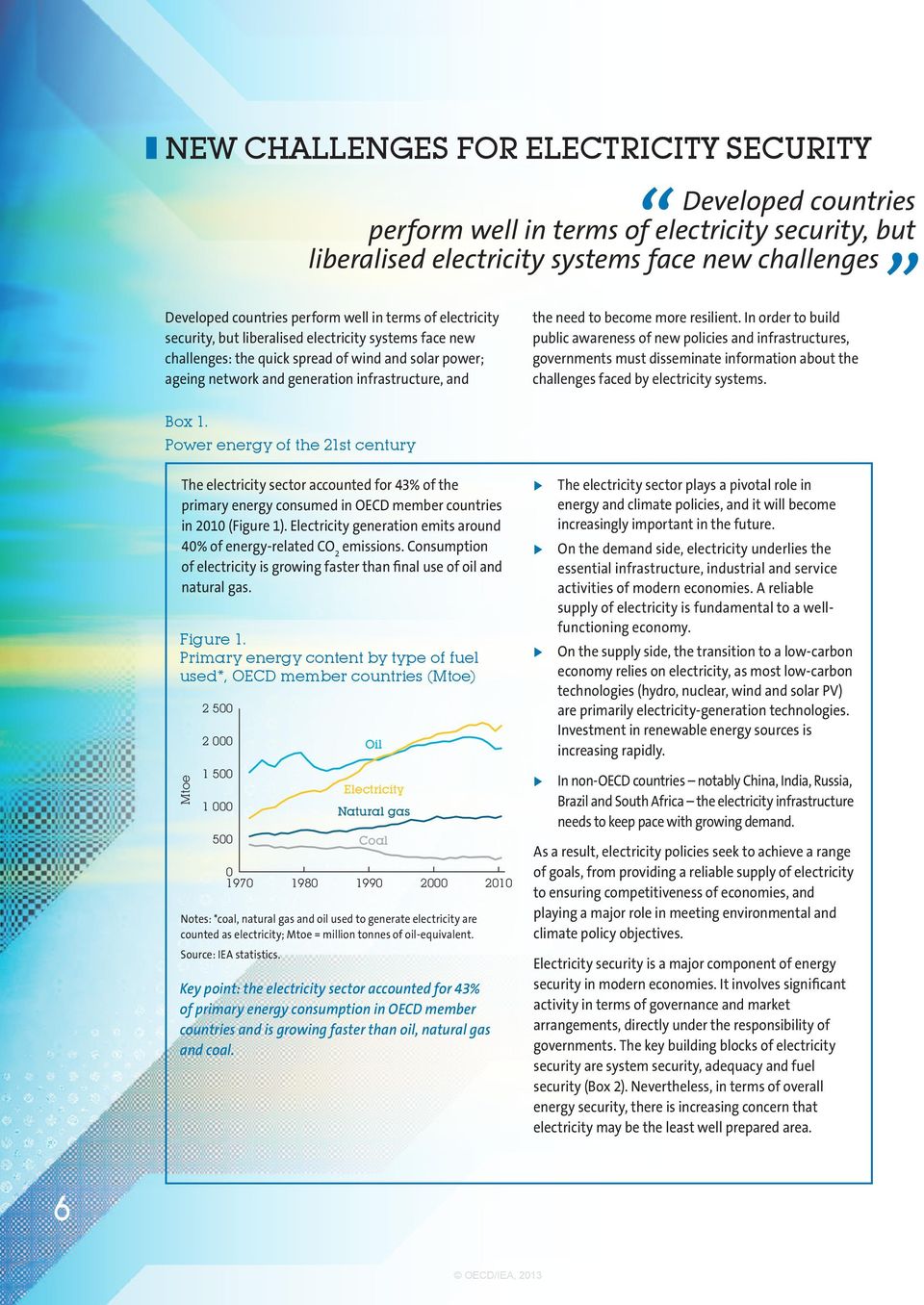
8 NEW CHALLENGES FOR ELECTRICITY SECURITY Developed countries perform well in terms of electricity security, but liberalised electricity systems face new challenges Developed countries perform well in terms of electricity security, but liberalised electricity systems face new challenges: the quick spread of wind and solar power; ageing network and generation infrastructure, and Box 1. Power energy of the 21st century the need to become more resilient. In order to build public awareness of new policies and infrastructures, governments must disseminate information about the challenges faced by electricity systems. The electricity sector accounted for 43% of the primary energy consumed in OECD member countries in 2010 (Figure 1). Electricity generation emits around 40% of energy-related CO 2 emissions. Consumption of electricity is growing faster than final use of oil and natural gas. Figure 1. Primary energy content by type of fuel used*, OECD member countries (Mtoe) Mtoe Oil Electricity Natural gas Coal Notes: *coal, natural gas and oil used to generate electricity are counted as electricity; Mtoe = million tonnes of oil-equivalent. Source: IEA statistics. Key point: the electricity sector accounted for 43% of primary energy consumption in OECD member countries and is growing faster than oil, natural gas and coal. X X The electricity sector plays a pivotal role in energy and climate policies, and it will become increasingly important in the future. X X On the demand side, electricity underlies the essential infrastructure, industrial and service activities of modern economies. A reliable supply of electricity is fundamental to a wellfunctioning economy. X X On the supply side, the transition to a low-carbon economy relies on electricity, as most low-carbon technologies (hydro, nuclear, wind and solar PV) are primarily electricity-generation technologies. Investment in renewable energy sources is increasing rapidly. X X In non-oecd countries notably China, India, Russia, Brazil and South Africa the electricity infrastructure needs to keep pace with growing demand. As a result, electricity policies seek to achieve a range of goals, from providing a reliable supply of electricity to ensuring competitiveness of economies, and playing a major role in meeting environmental and climate policy objectives. Electricity security is a major component of energy security in modern economies. It involves significant activity in terms of governance and market arrangements, directly under the responsibility of governments. The key building blocks of electricity security are system security, adequacy and fuel security (Box 2). Nevertheless, in terms of overall energy security, there is increasing concern that electricity may be the least well prepared area. 6
9 Deployment of renewable energies Renewable power is growing in all IEA member countries. OECD member countries added 102 gigawatts (GW) of wind capacity and 81 GW of solar capacity from , outpacing other sources. Cumulative installed capacity of wind and solar power is expected to reach 488 GW by 2018 and 643 GW by 2025 (IEA, 2013b; IEA, 2013c). Renewable portfolio standards and feed-in tariffs attract investment, but largely ignore locational and operational efficiency. While it is easy to accommodate a small share of variable renewables (e.g. a share of 5%), adding a larger share of variable renewables may bring new challenges for electricity security, including: rising distribution and transmission network congestion; more dynamic flows on networks; voltage stability issues; negative wholesale prices; and declining profitability of existing conventional power plants. Overarching challenges of renewable penetration Operational challenges raised by wind and solar resource variability and uncertainty Wind and solar PV are variable sources of electricity generation (Figure 2); their output shows a varying degree of correlation with electricity demand, both spatially and temporally. Their output cannot be fully predicted. From a system perspective, it is not just the variability and uncertainty of wind and solar PV that are relevant, but the combined effects of load and all generators. At low shares, adding wind and solar PV may reduce the aggregate variability on the system level, in particular if there is a positive correlation with power demand. However, at shares beyond 20% in annual power generation, wind and solar PV generation are likely to lead to more rapid, frequent, pronounced and less predicable swings in net load 1 (IEA, forthcoming). Figure 2. Variation of wind and solar PV power generation, Germany, September 2012 GW /09 11/09 12/09 13/09 14/09 15/09 16/09 Source: unless otherwise stated, all material in figures and tables derives from IEA data and analysis; European Energy Exchange (EEX). Key point: wind and solar power are variable and are increasingly impacting electricity markets. 1. Net load refers to electricity demand minus wind and solar PV generation (and potentially other, inflexible technologies such as cogeneration). 7 NEW CHALLENGES FOR ELECTRICITY SECURITY

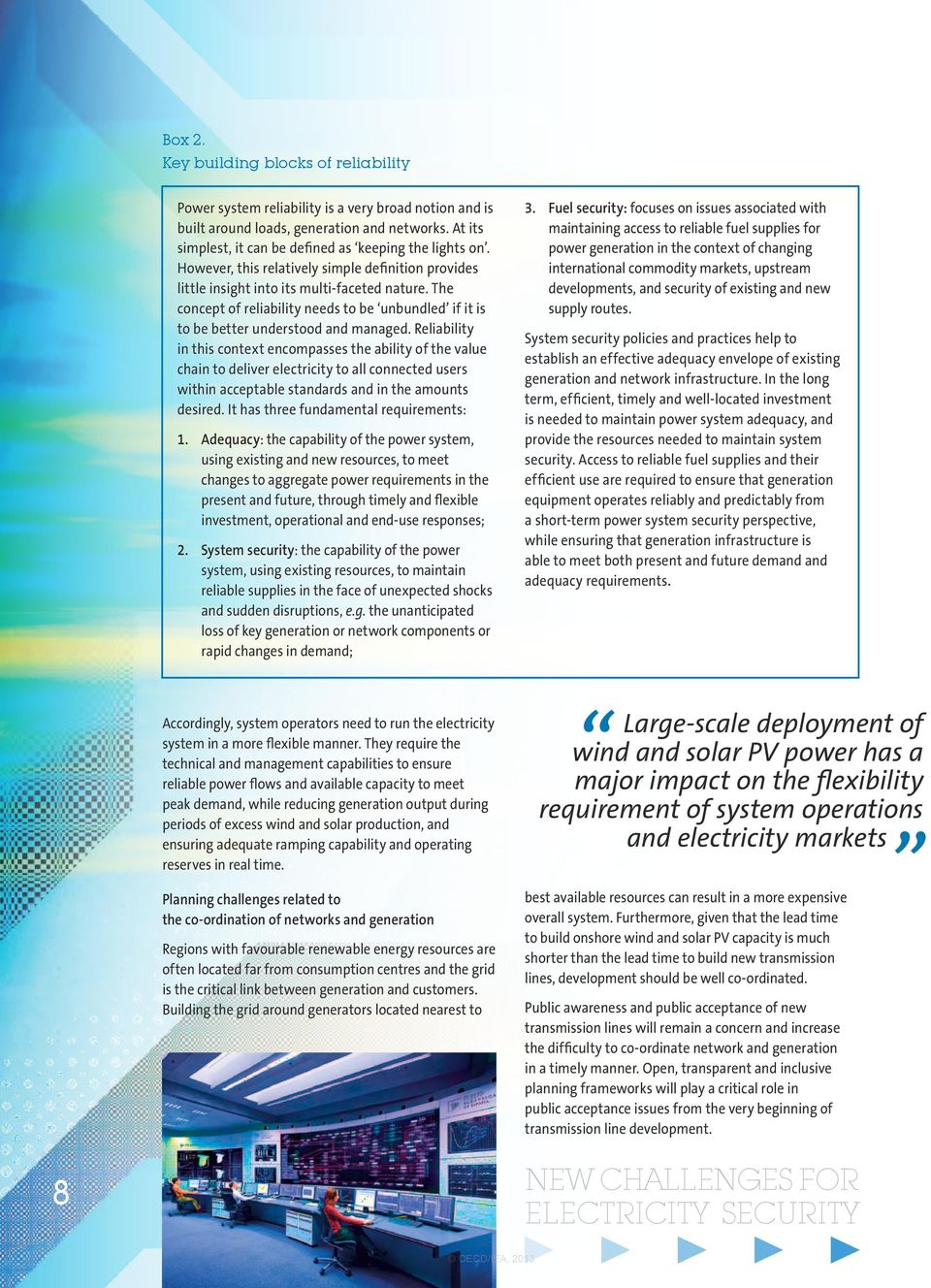
10 Box 2. Key building blocks of reliability Power system reliability is a very broad notion and is built around loads, generation and networks. At its simplest, it can be defined as keeping the lights on. However, this relatively simple definition provides little insight into its multi-faceted nature. The concept of reliability needs to be unbundled if it is to be better understood and managed. Reliability in this context encompasses the ability of the value chain to deliver electricity to all connected users within acceptable standards and in the amounts desired. It has three fundamental requirements: 1. Adequacy: the capability of the power system, using existing and new resources, to meet changes to aggregate power requirements in the present and future, through timely and flexible investment, operational and end-use responses; 2. System security: the capability of the power system, using existing resources, to maintain reliable supplies in the face of unexpected shocks and sudden disruptions, e.g. the unanticipated loss of key generation or network components or rapid changes in demand; 3. Fuel security: focuses on issues associated with maintaining access to reliable fuel supplies for power generation in the context of changing international commodity markets, upstream developments, and security of existing and new supply routes. System security policies and practices help to establish an effective adequacy envelope of existing generation and network infrastructure. In the long term, efficient, timely and well-located investment is needed to maintain power system adequacy, and provide the resources needed to maintain system security. Access to reliable fuel supplies and their efficient use are required to ensure that generation equipment operates reliably and predictably from a short-term power system security perspective, while ensuring that generation infrastructure is able to meet both present and future demand and adequacy requirements. Accordingly, system operators need to run the electricity system in a more flexible manner. They require the technical and management capabilities to ensure reliable power flows and available capacity to meet peak demand, while reducing generation output during periods of excess wind and solar production, and ensuring adequate ramping capability and operating reserves in real time. Planning challenges related to the co-ordination of networks and generation Regions with favourable renewable energy resources are often located far from consumption centres and the grid is the critical link between generation and customers. Building the grid around generators located nearest to Large-scale deployment of wind and solar PV power has a major impact on the flexibility requirement of system operations and electricity markets best available resources can result in a more expensive overall system. Furthermore, given that the lead time to build onshore wind and solar PV capacity is much shorter than the lead time to build new transmission lines, development should be well co-ordinated. Public awareness and public acceptance of new transmission lines will remain a concern and increase the difficulty to co-ordinate network and generation in a timely manner. Open, transparent and inclusive planning frameworks will play a critical role in public acceptance issues from the very beginning of transmission line development. 8 NEW CHALLENGES FOR ELECTRICITY SECURITY
11 Effect of renewables on wholesale electricity price formation and investment incentives In the absence of demand growth, the introduction of large amounts of additional power generation comes at the detriment of incumbents. The shift in the supply/ demand balance due to the introduction of wind and solar PV generation, compounded with sluggish demand in some countries, has led to decreasing the load factor of some installed capacity and lowering wholesale prices. In the long term, it will likely be more difficult to secure financing for certain assets, if these have load factor risks. Aging generation capacity Coal-fired and nuclear power plants are reaching the end of their operating lives, but the timing of their retirement is marred by uncertainty. More than half of all coal-fired and nuclear-operating capacity in OECD Europe is over 30 years old, while 20% is over 40 years old. The long-term projection of the availability of ageing capacity is subject to increasing forecasting uncertainty. Some companies have announced their intention to close a portion of their coal-fired fleet, with no plans to finance their refurbishment. Nuclear power is exposed to the vicissitudes of energy policy and to the uncertainty associated with the lifetime extension of power plants, which is subject to approval by nuclear safety authorities. As a result, regulators are concerned that the closure of power plants may cause electricity reliability problems. Aging networks Network infrastructure in most OECD member countries, including transmission and distribution grids, was constructed over 40 years ago. As low-carbon investments are deployed, networks will become more congested and will require more decentralised generation at the distribution level. With this, networks must keep pace with a changing geographic pattern of renewable generation, which could be located far away from consumption centres (in the case of wind) or close to the point of consumption (distributed solar PV). According to the IEA World Energy Outlook 2013 (IEA, 2013c), the investment needed in global electricity supply infrastructure (generation and networks) will outweigh investments in the global oil industry over the period Resilience of power systems and adaptation to climate change The resilience of power systems has become a more pressing challenge in some countries. Extreme weather events (storms, droughts and heat waves) are more frequent and felt with greater intensity. Resilience implies short-term actions needed to make network infrastructure more resistant to climate shocks, and also the capacity to respond effectively to expedite recovery after an extreme weather event in order to minimise impact in the event of an electricity shortage. NEW CHALLENGES FOR ELECTRICITY SECURITY 9

12 In the longer run, adequacy forecasts of electricity systems must factor in these changes, such as the consequences of rising temperatures on power generation plants and transmission, shortage of water supply for cooling systems and the impact of heat waves on peak demand. Box 3. Power outage impacts oil production in Texas As electricity security has implications for the entire economy, including oil and gas production, and delivery itself, electricity systems will need to become more resilient (Box 3). 1 Recent hurricanes in Texas have affected the state s power production and distribution. Several power outages led to the temporary closure of oil refineries, which had a direct impact on primary energy prices. For example, in September 2007, four refineries, including the Motiva refinery, one of the largest in the country producing barrels per day, had to shut down due to a widespread outage in the Port Arthur electric utility s service area due to Hurricane Humberto. The power distribution infrastructure was damaged as a result of a combination of saturated grounds and strong winds that uprooted many trees and devastated power lines. At least 50 high-voltage transmission poles were blown down or seriously damaged and over customers in different counties lost power. As a consequence of the shutdown of refineries for more than one week, crude oil prices increased by USD 1.70 in 24 hours and by 12% from the previous month. Source: National Hurricane Center, NEW CHALLENGES FOR ELECTRICITY SECURITY 10

13 GENERATION GENERATION Based on consultations with IEA member countries, the principal concern for some governments is the availability of adequate generation capacity to meet demand at all times. This is the case in the United Kingdom, following the retirement of old coal-fired power plants, and in France, due to peak demand driven by electric heating. The Electricity Reliability Council of Texas (ERCOT) has projected shortages of electric generation capacity in the years ahead and is actively improving the electricity market design accordingly (Figure 3). The flexibility of electricity systems is also seen as critical to the integration of wind and solar PV power. Figure 3. Projected load growth, reserve margin target and capacity additions, ERCOT Generation adequacy remains the basic concern for governments ERCOT peak load % planning reserve margin target Peak load forecast Planned units Existing units MW Source: The Brattle Group, Key point: well-functioning markets need to deliver adequate generation capacity to meet peak demand In Europe, the low profitability of gas-fired power plants is a major problem for utility companies. The faster than anticipated deployment of wind and solar power displaces mid-merit conventional power plants and contributes to a fall in CO 2 prices. The poor performance of gas-fired power plants is also a result of cheap coal, excess capacity in some countries and weak electricity demand as a result of the global economic crisis. Policy makers must concentrate on electricity security and reducing CO 2 emissions from power generation, while at the same time preserving and/or developing well-functioning electricity markets. The focus should be on the market segment most exposed to market price risk (the majority of instruments described here are not relevant to electricity systems where investment decisions are regulated, and where the share of each technology is approved or tendered by a central body.) GENER ATION 11

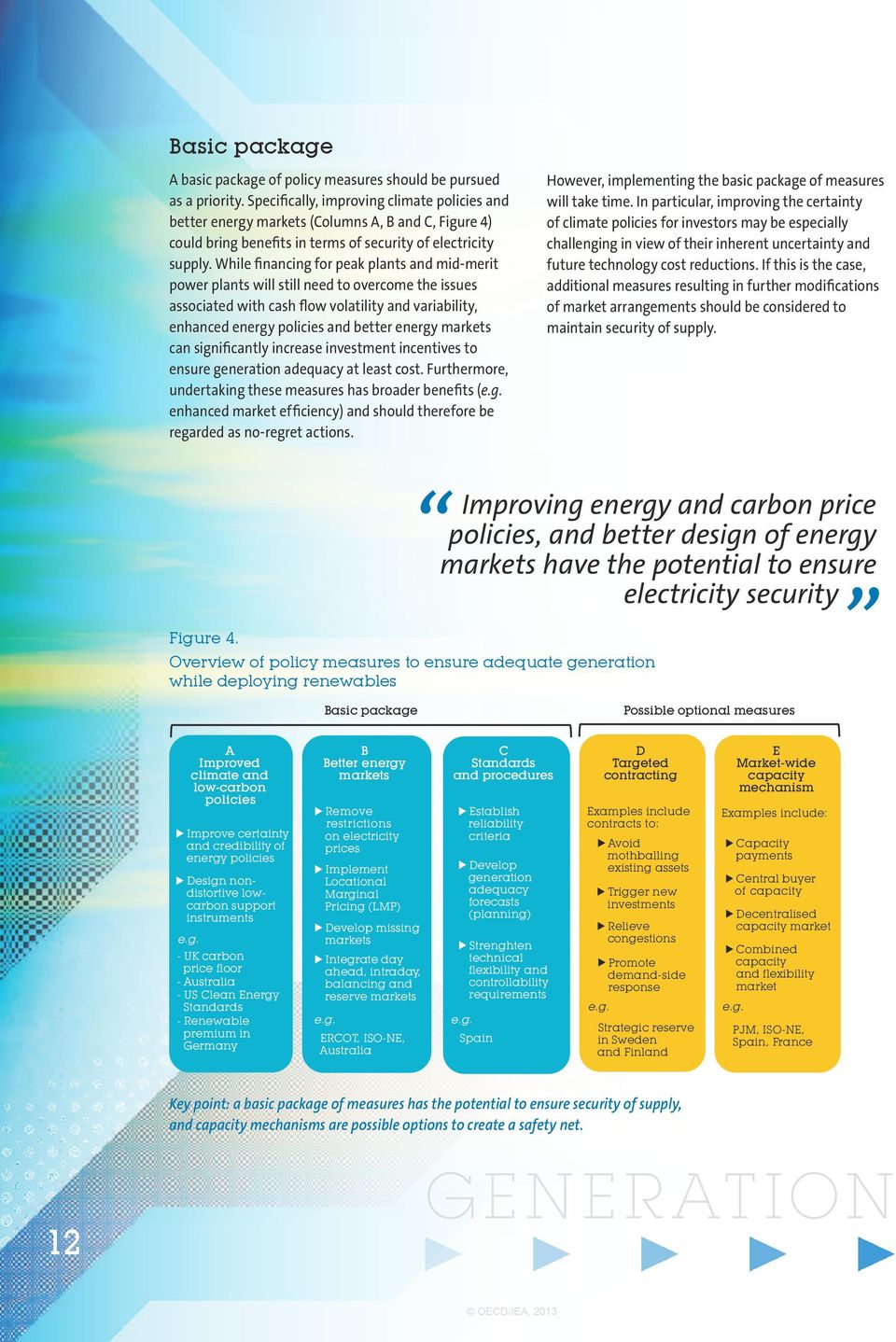
14 Basic package A basic package of policy measures should be pursued as a priority. Specifically, improving climate policies and better energy markets (Columns A, B and C, Figure 4) could bring benefits in terms of security of electricity supply. While financing for peak plants and mid-merit power plants will still need to overcome the issues associated with cash flow volatility and variability, enhanced energy policies and better energy markets can significantly increase investment incentives to ensure generation adequacy at least cost. Furthermore, undertaking these measures has broader benefits (e.g. enhanced market efficiency) and should therefore be regarded as no-regret actions. However, implementing the basic package of measures will take time. In particular, improving the certainty of climate policies for investors may be especially challenging in view of their inherent uncertainty and future technology cost reductions. If this is the case, additional measures resulting in further modifications of market arrangements should be considered to maintain security of supply. Figure 4. Improving Overview of policy measures to ensure adequate generation while deploying renewables energy and carbon price policies, and better design of energy markets have the potential to ensure electricity security Basic package Possible optional measures A Improved climate and low-carbon policies Improve certainty and credibility of energy policies Design nondistortive lowcarbon support instruments e.g. - UK carbon price floor - Australia - US Clean Energy Standards - Renewable premium in Germany B Better energy markets Remove restrictions on electricity prices Implement Locational Marginal Pricing (LMP) Develop missing markets Integrate day ahead, intraday, balancing and reserve markets e.g. ERCOT, ISO-NE, Australia C Standards and procedures Establish reliability criteria Develop generation adequacy forecasts (planning) Strenghten technical flexibility and controllability requirements e.g. Spain D Targeted contracting Examples include contracts to: Avoid mothballing existing assets Trigger new investments Relieve congestions Promote demand-side response e.g. Strategic reserve in Sweden and Finland E Market-wide capacity mechanism Examples include: Capacity payments Central buyer of capacity Decentralised capacity market Combined capacity and flexibility market e.g. PJM, ISO-NE, Spain, France Key point: a basic package of measures has the potential to ensure security of supply, and capacity mechanisms are possible options to create a safety net. 12 GENER ATION
15 Optional measures: capacity mechanisms Experience in IEA member countries shows that the development of electricity markets can result in a greater diversity of market designs. The Netherlands experienced a shortage of reserve margins in and considered the possibility of introducing a capacity mechanism, but the government ultimately made the decision to enhance the existing energy-only market. Meanwhile, Sweden introduced a transitory strategic reserve (meant to be a transitory mechanism) after a significant country-wide electricity shortage in Market-wide capacity markets are being introduced in France and the United Kingdom and are under consideration in other countries. Capacity mechanisms can create an optional safety net Table The capacity mechanisms (Columns D and E, Figure 4) involve a significant departure from the market framework package. These mechanisms are hybrid solutions between energy-only markets and more heavy-handed regulation where governments contract all new generation capacity. Capacity arrangements may be necessary to ensure security of supply throughout the transition period, and to cope with some regulatory and/or market failure from energy policy uncertainty, as well as the difficulty in preventing price restrictions and the lack of revenue certainty for peak plants and mid-merit power plants. Nevertheless, the design of these capacity mechanisms tends to be complex and to evolve over time, leading to a great diversity of design details. It is important that the signals for capacity be adequately linked to energy prices, to ensure that investment delivers both reliable and affordable electricity market outcomes. 1. Summary of market design characteristics Market Canada, Alberta electric System Operator (AESO) Energy market pricing Uniform Capacity mechanism United States, PJM Interconnection Nodal P United States, Electricity Reliability Council of Texas (ERCOT) Wind and solar deployment Nodal + United States, ISO New-England (ISONE) Nodal P United States, Mid West ISO (MISO) Nodal P + Australia, National Electricity market (NEM) Zonal + France Uniform P + Germany Uniform ++ United Kingdom Uniform P + Nordic Countries* (Nordpool) Zonal P + Spain Uniform P ++ Italy Zonal P ++ Netherlands Uniform * Denmark, Finland, Norway and Sweden Key point: the diversity of market designs reflects different approaches towards electricity security. GENER ATION 13

16 Renewables will have to actively participate in the markets At significant penetration levels, generation from variable energy sources will have to contribute to electricity security. Indeed, an increase in variable renewable generation may lead to transmission network congestion and more operational challenges. As the share of wind and solar PV in power generation is envisaged to increase significantly by 2030, so too will variable renewable generation in comparison to demand. It is therefore increasingly important that wind and solar participate in the energy markets by providing an energy bid below which they are no longer willing to generate. Participation of renewables in markets can bring significant benefits, such as avoiding inefficient negative prices, relieving network congestion or responding to locational and time-based signals where they exist, and contributing to the provision of flexibility and other network related services. A market platform for flexible services can be derived from existing balancing and operating reserves markets, and can create a level playing field for all technologies. Defining flexibility products ramping up and down, fast response ramping, minimum load balancing, etc. can reveal a price for each flexibility service. All technologies should be able to participate, including conventional power plants, demand response, storage, and wind and solar plants. In practice, efficient participation of renewables in markets can lead to operating wind and solar plants below their maximum possible output, which depends on wind and sun conditions. Less energy is produced, but this may help to address some of the challenges associated with the variability and uncertainty of wind and solar resource. Proper market integration of wind and solar PV power can smooth ramps, reduce the system cost of forecast errors and suppress inefficient negative prices during high wind and solar hours. Accordingly, efficient market participation of renewables would require adapting renewable support schemes to the market design. Support scheme design should aim to expose wind and solar PV generators to price signals, ideally de-coupling short-term bidding incentives, as well as investment support. 14 GENER ATION

17 2NETWORKS Network service markets are required for reliable and affordable power system decarbonisation Networks will be essential for meeting reliability and decarbonisation goals. Networks are also crucial for trade, competition and maintaining reliable power supplies. Network services typically represent between 25% and 40% of total electricity supply costs to customers in IEA member countries. With continuing decarbonisation, efficient network services have the potential to increase system-wide cost efficiency of renewables deployment and integration, without jeopardising system security. Transmission network infrastructures help tap into remotely located lowcarbon generators, including storages or large-scale renewable generation centres. Distribution networks will integrate a significant proportion of small-scale generators and more active consumers, which change infrastructure requirements. Figure 5. Wind production and curtailment in Texas Wind production and curtailment (GWh) Jan Zonal/nodal curtailment Local curtailment Wind generation Feb Mar Apr May Jun Jul Aug Sep Oct Nov Dec Jan Feb Mar Apr May Existing infrastructures have to be operated with sufficient flexibility in order to manage increasing levels of short-term flow fluctuations and to limit out-ofmarket interventions for maintaining system reliability. Congestion, frequency and voltage deviations are the three main factors which negatively affect system reliability and have to be managed. Some curtailment of renewable energy can be the most economic choice, particularly during periods of oversupply of variable renewable output in certain locations. Some renewable curtailment took place in certain zones of nodes of the Texas network in , due to the lack of transmission capacity (Figure 5). New network development should optimise, but not eliminate, renewable curtailments. To date, system operators have successfully adapted their electricity system to limit curtailments. In the long term, curtailment could increase the cost of decarbonisation. Jun Jul Better co-ordination between network services and the market is essential to arrive at reliable and sustainable electricity systems at least cost Aug Sep Oct Nov Dec Note: GWh = gigawatt hours. Source: Potomac Economics, 2012 Key point: renewables can contribute to system flexibility by taking part in electricity markets. NETWORKS 15

18 New investments into distribution and transmission network infrastructures will also be required. The European Network of Transmission System Operators for Electricity (ENTSO-E), has identified the need to invest around USD 131 billion for the refurbishment or construction of roughly kilometres of extra high-voltage power lines over the next decade (Ten- Year Network Development Plans - TYNDP). Of this total, 80% of investment needs are related to the direct or indirect integration of renewables. Delivering the investment needed requires sound institutions, planning, regulatory and siting frameworks as well as stakeholder integration. As some renewables can be developed rapidly, the development of networks will need to keep pace, despite the uncertainty of some renewable projects. Existing network services can be improved with developments in market liberalisation, increasing decarbonisation and technology innovations. The current design of network services is often inherited from vertically-integrated utility companies, which have been characterised by centralised system operations, few and large generators, large dispatchable generation capacities and inelastic demand. However, these realities have changed. Network services now must support efficient decentralised decisions from a larger number of generators, suppliers and increasingly, from customers. Network services need to adapt to new generation technologies with more dynamic and less predictable generation characteristics, which often tend to favour more remote locations. There is room for the development of market-based mechanisms in order to support more efficient and innovative service delivery. Still, decentralised markets cannot fully replace a central network system operator which will be required to ensure efficient and reliable co-ordination and service provision. Key characteristics of such network service markets include: X X dynamic and accurate price formation to reflect changing supply and demand conditions at each location of the network; X X price exposure and fair cost allocation to individual market participants (instead of central management and cost socialisation); X X forward-looking markets (instead of central assessments); X X data transparency for attracting individual service providers under competition (instead of central decision making and bilateral contracting out of markets). The expected benefits of such service markets will largely come from: X X internalisation of costs by market participants at the origin of system services; X X adequate remuneration of network service providers with the objective to attract new service providers and technologies; X X contributions to a market-based framework towards sufficient system flexibility for the integration of variable renewable technologies. NETWORKS 16

19 Box 4. Three examples of innovative operational network services XX CECRE in Spain CECRE is a global pioneer in the area of high awareness and management capabilities of renewable generators. With CECRE, Spain has become the first country to have a control centre for all their wind farms of over 10 MW. All generators or clusters with a total installed power greater than 1 MW send real-time telemetry of the electricity produced every 12 seconds. This increases integration of renewable energy into the system without jeopardising system reliability. X X Congestion management and network use in Texas In December 2010, ERCOT changed to a highly efficient methodology for network use and congestion management. Key drivers of the move towards nodal pricing were the dissatisfaction with the zonal market approach and the high levels of wind power. When wind output is high, it becomes more important that scarce network resources be allocated efficiently, in order to allow for an optimally priced generation mix within the constraints of the network. XX Balancing services reform in Australia Australia s NEM offers improved balancing services. Where 15 minutes to 1 hour dispatch schedules are generally common, the NEM operator uses a 5 minute electricity market dispatch. This limits the balancing requirements to this time frame and reduces upfront forecast errors. Large parts of the remaining balancing costs are allocated according to the causerpays principle. The operator co-optimises bids and offers from the balancing, while the electricity market maintains equal supply and demand situations to avoid inefficient arbitrage. Comparable to efficient electricity markets, NEM s balancing market uses marginal cost to identify efficient and required balancing supply bids. Parts of the balancing market are updated up to 6 seconds before real-time, which allows for re-scheduling of supply and demand bids. All market participants, including renewable producers, must actively participate in these markets. This can provide a revenue stream for renewable producers and can prevent inefficient outcomes on the electricity market, such as negative prices. It can also incentivise efficient self-management, ensure efficient dispatch and maintain network reliability. Close to real-time operations, local accuracy, efficient price formation and causer-pays rules are essential for such markets to work. In order to develop, implement and establish such market-based network services, policy and regulatory decision makers need to start transforming network services at an early stage in the power sector decarbonisation process. This also requires assessing costs, benefits, risks and related institutional reforms. Infrastructure planning frameworks are at the heart of service provisions, and must be open and transparent. Infrastructure planning provides a system-wide view for identifying electricity system needs that can be met in a competitive and non-discriminatory way by different technology options. Aside from transmission and distribution investments, other solutions are available, such as demand response, storage, distributed generation, generator relocation and temporary congestion. New transmission is not always the most efficient solution; accordingly, design of institutions and regulatory frameworks that support network infrastructure services must be checked and, if necessary, updated. NETWORKS 17

20 Cost allocation of new transmission lines can also bring substantial benefits. While an accurate estimate of benefits might be difficult to achieve in practice, the allocation of costs should be commensurate with benefits. This can be helpful to establish long-term, system-wide, least-cost solutions. Cost-benefit analyses are already used in many countries and can be helpful to allocate costs according to the benefits of market participants. Producers need to be exposed to network costs in a technology-neutral fashion. Exempting generators from network costs, particularly for new lines, can lead to sub-optimal transmission developments with regard to location, timing and utilisation. Inefficient location of renewable generators could engender significant costs. More efficient decision making in network investment could reduce the number of projects put forward for approval, which could also increase acceptance of new transmission infrastructures. More attention will have to be given to the distribution level as most game-changing developments will take place here, including the deployment of demand response, electric vehicles, air conditioning, smallerscale storage and also distributed and renewable generation. Co-ordination of these developments within the distribution grids, but also between distribution and transmission, will be key to maintaining reliable, leastcost and low-carbon power systems. Figure 6. Network service markets and their links to electricity markets Market-based solutions for the provision of network infrastructure services exist Network service markets Infrastructure services Accurate Electricity markets Real-time services Balancing services prices Conventional generators Renewable generators Full Congestion services Voltage services participation Storages Demand Key point: network services provisions are interrelated with electricity markets. 18 NETWORKS

21 3DEMAND DEMAND RESPONSE RESPONSE Considerable Greater power system flexibility will be essential to continue delivering efficient and reliable electricity services, and deploying variable renewable generation to meet decarbonisation goals. Effective deployment of demand response could greatly increase electricity security and market efficiency. Economic: increased flexibility in demand-side responses has the potential to increase efficiency of price formation by creating clearer signals for more efficient investment, operation and end use. This can strengthen incentives to pass through competitive benefits to end-users, stimulate innovation and deliver cost-effective services to customers. Greater demandside flexibility can also substantially moderate the potential for market power abuse and help reduce investment requirements. Security: demand-side participation also has the potential to support more flexible, innovative and efficient delivery of power system security at least cost. Greater demand flexibility may also reduce the volume of operating reserves needed to meet security requirements, which could lower ancillary service costs while improving overall system security. It also has the potential to defer the need for incremental reliabilitybased investment. Sustainability: demand response has the potential to greatly increase the volume of real-time flexible resources to support large-scale integration of variable renewable generation. Over time, improvements in end-use energy efficiency could result in a permanent reduction in demand compared to previous levels in the absence of demand-side flexibility. This may result in a permanent reduction in CO 2 emissions where the power saved would have been produced by fossil fuel generation. progress has been made in recent years to harness demand response. However, most of this potential Considerable progress has been made in recent years to more effectively harness demand response, principally from larger industrial loads in support of more reliable system operations. A recent survey conducted by the United States Federal Energy Regulatory Commission (FERC) notes a near 27% increase in demand response during peak periods from (Figure 7). However, much of the demand response potential has yet to be developed. Recent studies have estimated demand response potential in the European market at 15% and in North America at 20% of peak demand. FERC s survey indicates that around 31% of potential peak demand response is currently released. Figure 7. Potential and actual peak demand response reductions by North American Electric Reliability Corporation (NERC) region in 2012 Peak reduction (MW) Source: FERC, remains to be developed 2012 actual peak reduction 2012 reported potential peak reduction TRE FRCC MRO NPCC RFC SERC SPP WECC Other NERC regions Key point: actual demand response represents only a small fraction of the potential. DEMAND RESPONSE 19
22 Much of this potential is likely to come from larger consumers as well as water hearting and air conditioning systems, with stronger commercial incentives and capability to respond. Priority should be given to developing demand response among these customers, but studies show that smaller-volume consumers could provide a cost-effective and material source of demand flexibility. Enabling technologies such as smart meters and automatic control devices will be required to increase demand response. Widespread deployment of smart meters, combined with more innovative markets and flexibility, can accelerate the development of demand response. Realising this potential is important for the system flexibility needed to accelerate the deployment of variable renewable generation. Policy makers increasingly recognise the importance of demand response and more effort is being directed to its implementation. Experience in IEA member countries points to a range of potential barriers to the efficient and timely deployment of demand response, including those indentified below. Limited dynamic pricing Regulation that stifles dynamic pricing, innovation and customer choices Underdeveloped legal and regulatory frameworks Key barriers to demand response Underdeveloped retail markets, services and products Limited access to accurate and timely information 20 These barriers may result in legal and regulatory uncertainty, limited product innovation and offerings, and higher transaction costs. Together, these barriers weaken the ability of retailers and other intermediaries to encourage demand response solutions, while at the same time weakening the incentives and capacity of customers to implement demand response. An effective approach is needed to address undue barriers and accelerate the efficient and timely development of demand response. Policies need to recognise the interrelated nature of these potential barriers and should provide an integrated framework for addressing barriers in a manner that reflects local electricity markets and systems. Experience suggests that there are several key components required to deliver an effective and integrated approach, including those identified below. High transaction costs Inability to monitor and verify demand response Demand response can result from measures such as pricing which reflects real costs, retail market reform, and improved load control and metering equipment DEMAND RESPONSE
23 Several technical and practical details need to be considered when addressing these issues. Effective implementation strategies must be developed and implemented in consultation with key stakeholders. Experience in IEA member countries suggests that ancillary services procurement can serve as the catalyst needed to establish commercially viable and sustainable markets for demand response. System operators and other entities responsible for maintaining power system security should broaden their use of demand response where feasible and cost-effective to do so. Governments have a key role to play in developing and implementing the legal, regulatory and market frameworks that empower customer choice, and accelerate the development and deployment of costeffective demand response. Effective government leadership would create an environment where the considerable potential of demand response could be realised to help increase power system flexibility and electricity security, and eventually achieve decarbonisation goals at least cost. Introduce dynamic pricing with appropriate protection for vulnerable consumers Introducing enabling technologies that support the development of more innovative products and service that empower customer Implemented legal and regulatory arrangments that clarify roles and responsabilities while removing barriers to participation Key demand response enablers Build competitive, dynamic retail markets to deliver innovative products and services Provide access to detailed, real-time customer information, while addressing privacy and confidentiality issues Ensure seamless market processes that minimize transaction cost Develop an active and well-informed customer base that can effectively exercise choice DEMAND RESPONSE 21
24 4REGIONAL MARKET MARKET INTEGRATION INTEGRATION Governments have long recognised the benefits of integrating electricity markets across adjacent jurisdictions. First, integration increases reliability and security of supply due to a larger and better diversified generation mix. Second, integration enhances the efficiency of power plant dispatch in order to reduce total generation costs. Related to this, market integration also fosters competition between generators located in different areas. The competitiveness benefit is an important driver in jurisdictions that did not split the generation activities of former regulated utilities and where incumbents still have a dominant position. Integration of regional markets is a long-term trend in the electricity industry. This is the case among IEA member countries, and increasingly among other regions. Two good examples are the ASEAN power grid project and the Connecting the Americas initiative. Such integration is essential to bring the electricity sector into the 21 st century. Rapid deployment of variable renewable energy reinforces the case for further interregional market integration. Although some areas have competitive advantages for the deployment of wind or solar power, the lack of a level playing field for their deployment may create inefficiencies. Higher shares of wind and solar power increase the benefits of the real time co-ordination of adjacent electricity markets In the context of increasing shares of wind and solar power, wider balancing areas could bring many benefits: they have the potential to smooth the variability from different wind regimes and could create opportunities to export excess generation (thus reducing renewable curtailment). Aggregation of wind and solar output over wider geographic areas can increase the statistical contribution of wind and solar power to meet peak demand and lower the total cost of conventional power plants needed to complement wind or sun. This has two implications: XX larger geographic markets are considered; X X market integration needs to be more dynamic, while markets need to be closer to real-time to cope with changes and uncertainties in local and regional weather conditions. Interconnectors Significant addition of variable renewables is likely to make major investments into new cross border network capacity unavoidable. Actions are being taken to ease the development of transmission interconnections. This includes the FERC Order 1000 in the United States, which defines rules to identify benefits and allocate transmission costs among stakeholders, with the aim of building stakeholder consensus and the financing of new lines. Inefficiencies can also lie in the use of existing physical interconnectors. For example, the lack of co-ordination between system operators can result in unscheduled power flows, which are a threat to system security; in some cases system operators may restrict flows across borders to prevent the occurrence of an unmanageable security event. Major blackouts in IEA member countries have resulted from a lack of co-ordination among operators (IEA, 2005 Learning from the Blackouts ). Wholesale market integration Broadly speaking, experience from IEA member countries suggests that liberalisation facilitates market integration. In the United States, liberalised electricity markets such as the PJM interconnection, Mid West Independent System Operator (MISO) and ERCOT tend to be larger than markets in regulated states. According to Joskow (2009), the expansion of PJM s footprint has led to more efficient power flows, while inefficiencies are observed at the seams (borders) of Regional Transmission Organisations (RTOs) that have not agreed to consolidate. 22 REGIONAL MARKET INTEGRATION
25 AUS/MWh The model of market integration has important consequences for the efficient accommodation of wind and solar power over wider geographic areas. The consolidation of system operators over wider geographic areas can bring substantial benefits, such as the expansion of system operators footprints (such as PJM) or the centralisation of system operations (Figure 8). Figure 8. Australia, electricty market prices by zone, New South Wales Queensland South Australia Snowy Hydro Victoria Source: based on data from the Australia National Energy Market. Key point: consolidation of system operations over wider geographical areas can ensure better use of existing infrastructure and reduce price differences. Co-ordination of different electricity systems tends to be less effective than consolidation. Harmonising different electricity market designs to improve trade and cross-border market balancing has received a lot of attention. But, limits exist in what can be achieved in terms of harmonisation of market integration close to real time without jeopardising the reliability of the electricity system. Achieving the right balance between consolidation of system operators and co-ordination between these systems (Figure 9) is important for the efficient regional integration of electricity markets. While a system operator on the scale of an entire continent will probably remain out of reach in the foreseeable future, opportunities to consolidate market operations exist. In the absence of mergers and acquisition of system operators, as is the case for the power generation sector, policy design should focus on increased co-ordination of adjacent markets. A well-known corollary of market integration policies is often an increase in electricity prices in low-cost exporting areas. As a result, some governments have retained regulated price mechanisms to protect consumers. France and some Canadian provinces continue to regulate prices. Such measures reduce competition, but are often an observed consequence of market integration. REGIONAL MARKET INTEGRATION Figure 9. Approaches to consolidation and co-ordination towards regional market integration Consolidation Co-ordination Initial situation: fragmented local system operators Integrated operations over wide areas: standard market design RTO s expansion ( e.g. PJM, MISO) Co-ordinated regional markets: optimisation of electricity seams between system operators network codes Key point: while market integration by consolidation of system operations is more efficient, there is still a need to co-ordinate adjacent consolidated markets. 23
26 Integration of capacity markets Some authorities have introduced or are considering different types of capacity mechanisms. There is little harmonisation of design of adjacent capacity markets, which creates new obstacles to reaping the full benefits of regional market integration. Generation adequacy is no longer an exclusively local dimension. There is clear empirical evidence that some zones with excess capacity benefit zones that lack capacity if cross-border trading of capacity is possible. As a result of multiple layers of regulation, electric power systems in IEA member countries still operate under fragmented and often incompatible rules. To be integrated, well functioning electricity markets require a clear regulation of the reliability criteria and protocols, not only in each jurisdiction, but also across markets. This, in turn, raises the question of the right institutional and regulatory setting to ensure electricity security while integrating markets, in terms of reliability organisation and transfer of competencies from the local to the appropriate geographic scope. Taking market integration to the next level requires better co-ordination of regional electricity security policies and regulations REGIONAL MARKET INTEGRATION 24
27 5 EMERGENCY EMERGENCY PREPAREDNESS Maintaining reliable and resilient power systems is an evolving challenge. Policies to improve sector efficiency and to promote decarbonisation through increasing shares of variable renewable generation are creating a more dynamic regional and real-time operating environment, which raises new challenges for maintaining power system security. At the same time, more volatile patterns of usage, combined with policy, regulatory and economic uncertainty, create a more difficult infrastructure investment environment, with implications for maintaining system adequacy into the future. IEA member countries have recognised the need to address these challenges and as part of the ESAP have agreed to examine existing electricity sector emergency preparedness policy, plans and procedures to ensure they are adequate, with regular exercises conducted to test and develop their effectiveness. To support IEA member countries in this endeavour, ESAP directs the IEA Secretariat to build electricity security into comprehensive assessments of member country energy security, in particular, in the context of periodic in-depth country reviews and emergency response reviews. Electricity security is integrated into two peer review programmes: the IEA Emergency Response Reviews and Energy Policies of IEA Countries To meet this requirement, the Secretariat has developed an integrated Electricity Security Assessment Framework in 2013, which is a part of the IEA Emergency Response of IEA Countries, as well as the Agency s indepth country review publications, Energy Policies of IEA Countries and Energy Policies beyond IEA Countries. EMERGENCY PREPAREDNESS Features of the Electricity Security Assessment Framework The assessment framework is built on examining the key building blocks of electricity security. The framework addresses important legal, regulatory, institutional, market, operational, end-use, technological and infrastructure-related factors that influence the fundamental determinants of electricity security, i.e. system security, adequacy and fuel security, and how they interact to affect electricity security outcomes. Elements of the framework are described below. Governance and market arrangements Governance and market arrangements establish incentives for efficient, flexible, timely and innovative responses to maintain power system security and adequacy in the present and over time. Electricity security assessments should consider the extent to which the rules, standards and markets establish effective roles, responsibilities and accountabilities for key parties to individually and collectively deliver electricity security. Key issues that may be considered in this context include the following. Legislation, rules and standards: X X the degree to which they align accountability for power system reliability with functional responsibilities, especially in unbundled power systems; X X the nature and scope of authority they provide for responsible parties to undertake their functions in this context; X X the incentives they create for co-ordinated activities and information exchange to promote power system reliability through the value chain, as well as across power systems that span multiple jurisdictions and control areas; X X the effectiveness of coverage, accountability and enforcement; X X the mechanisms for adapting rules, system-security standards and adequacy standards, to maintain effectiveness as power systems evolve. 25
28 Regulatory and institutional framework: X X the scope and coverage of regulatory functions and powers; X X the ability of regulatory institutions to effectively monitor and enforce the rules, reflecting their resourcing, technical capability, objectivity, and access to timely, accurate and relevant information; X X effective communication and co-ordination among institutions with shared or complementary regulatory responsibilities for power system reliability within a value chain, and across power systems spanning multiple jurisdictions and control areas. Market arrangements: X X the degree to which market-based incentives encourage timely, innovative and effective investment, operational and end-use responses to deliver and maintain power system security and adequacy; X X the degree to which policies and regulations are effectively integrated with market arrangements to help complement and reinforce incentives for timely, efficient and innovative responses to power system security and adequacy. and control technologies, such as control centres, communications systems, real-time emergency information systems, analytical tools and smart grid technologies that support effective real-time power flow management. Situational awareness: X X ability of system operators to monitor, understand and respond to changing power system conditions in real-time, reflecting the availability and coverage of accurate, real-time information on power flows and equipment performance including variable renewable generation during emergencies; X X capability of emergency management systems and other analytical tools used for contingency, operating reserve and ancillary services planning; power system monitoring and control; fault diagnosis; emergency response; and restoration management. Co-ordination: ability of system operators and other responsible parties (e.g. generators, network owners, large loads, regulators, emergency services personnel, etc.) to co-ordinate emergency response and restoration activities within a control area and across power systems spanning multiple control areas. 26 System security Effective real-time management of electricity systems can only be achieved through centralised or centrally co-ordinated system operation that reflects the unique characteristics of electricity and the related natural monopoly characteristics of system operations. As a result, the nature and effectiveness of system operation is generally the main determinant of power system security and should form a central part of the system security assessment. Key dimensions to be considered in this context could include: contingency planning and resourcing, emergency management and restoration. Key capabilities and practices to be considered in this context include the following. Emergency response resources: X X adequacy of emergency resources in terms of their nature, volume and location (including demand response and load shedding protocols), and effectiveness in terms of deployment potential and coverage of credible N-1 contingencies; X X assessments could also consider the nature, coverage and resilience of key system monitoring Communication: the ability of system operators and responsible parties to keep each other informed and to keep other key stakeholders governments, regulators, emergency services, the media, and the public informed about developments, especially during ongoing emergency events and the restoration period following a major outage. Training and capacity building: the nature and scope of training and capacity building activities to support effective emergency preparedness, as well as on processes to test, review and develop emergency preparedness capability. Adequacy Power system adequacy is largely determined by the nature and volume of reserves (including demand response) available to meet dynamic changes in aggregate system demand, production and fuel supply conditions. As a result, resource adequacy, which focuses on the volume of resources and reserves available to address changing power system requirements, will remain a key determinant of power system adequacy. However, the flexibility and EMERGENCY PREPAREDNESS
29 diversity of those resources and reserves is becoming increasingly important, reflecting the impact of more dynamic investments on the operational and end-use environment. Electricity security assessments will also consider the flexibility and diversity of resources and reserves as well as the volume of resources available to support power system adequacy. Adequacy also possesses temporal dimensions. Short-term adequacy is a function of the operational performance of a power system at a given point in time under a range of operational conditions, reflecting the diversity, flexibility and volume of existing resources and the way in which they are deployed in practice. By contrast, longer-term adequacy analysis assesses the way power-system infrastructure and performance develops over time. It captures changes in the diversity, flexibility and volume of available resources and the ways in which resources are deployed to meet changing patterns of use over time. Assessments will consider the key inherent dimensions of power system adequacy in the short-term and over time including the following: X X Resource adequacy: the mix and volume of resources and reserves available to meet dynamic changes in system demand, production and fuel supply conditions, such as generation, networks, demand response, upstream fuel supplies, interregional trade and electricity storage. X X Diversity: the degree of technology, fuel and supply diversification, including demand response, interregional trade, upstream fuel supply and dual-fuel capability. Diversification of network paths and the impact of critical infrastructure bottlenecks on adequacy in practice may also be considered. X X Flexibility: the nature of power system flexibility, such as the availability of fast ramp generation and smart grid technologies, inter-regional trade, demand response and electricity storage, and how flexible resources compare to current and expected changes in system flexibility requirements, in particular, flexibility changes in power systems with large and/or rapidly accelerating shares of variable renewable and distributed generation. The electricity security assessment framework is summarised in the following diagram: Figure 10. Electricity Security Assessment Framework Governance and markets Legislation, rules and standards Regulation and institutional arrangements Markets Adequacy Resource adequacy Diversity Flexibility System security System operating practices Emergency response resources Situational awareness Co-ordination Communication Training and capacity building Key point: the electricity security assessment framework provides a comprehensive guide for peer reviews of emergency preparedness and energy policies that are performed by the IEA. The Electricity Security Assessment Framework has been endorsed by IEA member countries and will help to improve knowledge and information sharing on best practice EMERGENCY PREPAREDNESS 27
30 ROADMAP OF FUTURE IEA ACTIVITIES IN THE FIELD OF ELECTRICITY SECURITY Building on this analysis, the IEA Secretariat will undertake further activities in the field of electricity security, focusing on the most important issues: generation, networks, demand response and regional market integration. The next steps of the IEA programme of work on electricity security are structured in two parallel tracks. Electricity market designs in low-carbon systems Decarbonisation of electricity systems raises similar operating and investment challenges in different IEA member countries. A sustainable electricity market design needs to ensure that low-carbon and fossil fuelfired power plants have viable business models with manageable investment risks. Lessons can be learned from experience in market design in IEA member and partner countries. This work will be based on case studies of market designs and will seek to identify best practices. Furthermore, while the cost of renewables is falling, existing wholesale market design might not be suited to trigger investments in low-carbon generation. It is important to identify innovative market designs that enable the decarbonisation of electricity systems. Institutions and regulatory framework of networks activities Networks have to keep pace with rapidly changing electricity systems. Underinvestment could undermine low-carbon objectives and put electricity reliability at risk. Conversely, overinvestment can engender inefficiencies and cost increases. This work will identify and disseminate best practices from IEA member countries and non-iea countries in terms of network regulation. The objective is to help governments build sound institutional and regulatory frameworks that identify and incentivise required investments into electricity distribution and transmission networks, and to co-ordinate the integration of potentially gamechanging technologies. In addition to these activities on markets and regulation, the IEA Secretariat will continue to implement the ESAP and Electricity Security Assessment Framework, and take part in the peer reviews of IEA member countries to facilitate exchange of best practices. 28
31 REFERENCES Baritaud, M. (2012), Securing Power during the Transition: Generation Investment and Operation Issues in Electricity Markets with Low-Carbon Policies, IEA Insights paper, OECD/IEA, Paris. Baritaud, M., and Volk, D. (forthcoming), Seamless Power Markets, IEA Insights paper, OECD/IEA, Paris. Cooke, D. (2011), Empowering Customer Choice on Electricity Markets, IEA Insights paper, OECD/IEA, Paris. FERC (Federal Energy Regulatory Commission) (2012) Assessment of Demand Response and Advanced Metering, Staff Report, FERC, IEA (International Energy Agency) (forthcoming), Advancing Variable Renewables: Grid Integration and the Economics of Flexible Power System, IEA/OECD, Paris. IEA (2013a), Key World Energy Statistics, OECD/IEA, Paris. IEA (2013b), Medium Term Renewable Market Report, IEA/OECD, Paris. IEA (2013c), World Energy Outlook, IEA/OECD, Paris. Joskow P.L. (2009), Challenges for Creating a Comprehensive National Electricity Policy, EIU working papers RSCAS 2009/01, Florence. Potomac Economics (2012) 2011 State of the Market Report for the ERCOT Wholesale Electricity Markets, Potomac Economics, Fairfax, Virginia,www. potomaceconomics.com/uploads/ercot_ documents/2011_ercot_som_report.pdf. The Brattle Group (2012), ERCOT Investment Incentives and Resource Adequacy, report for ERCOT, Austin, Texas, pdfs/000/004/820/original/ercot_investment_ Incentives_and_Resource_Adequacy_Newell_ Spees_Pfeifenberger_Mudge_ERCOT_June_2_2012. pdf? Volk, D. (2013) Electricity Networks: Infrastructure and Operations, IEA Insights paper, IEA/OECD, Paris. Contacts Manuel Baritaud Laszlo Varro Christelle Verstraeten Dennis Volk 29
32
33 Online bookshop Buy IEA publications online: International Energy Agency 9 rue de la Fédération Paris Cedex 15, France PDF versions available at 20% discount A number of books printed before January 2012 are now available free of charge in pdf format on our website Tel: +33 (0) [email protected]
34 This publication reflects the views of the International Energy Agency (IEA) Secretariat but does not necessarily reflect those of individual IEA member countries. The IEA makes no representation or warranty, express or implied, in respect to the publication s contents (including its completeness or accuracy) and shall not be responsible for any use of, or reliance on, the publication. IEA Publications, 9, rue de la Fédération, Paris cedex 15 Layout and Printed in France by IEA, November 2013 Cover design: IEA. Photo credits: BrandX and NASA Inside photos credits: BrandX, GraphicObsession, Corbis, Photodisc, Red Eléctrica Espana
35
36 Secure and Efficient Electricity Supply During the Transition to Low Carbon Power Systems Electricity shortages can paralyse our modern economies. All governments fear rolling black-outs and their economic consequences, especially in economies increasingly based on digital technologies. Over the last two decades, the development of markets for power has produced cost reduction, technological innovation, increased cross border trade and assured a steady supply of electricity. Now, IEA countries face the challenge of maintaining security of electricity supply during the transition to low-carbon economies. Low-carbon policies are pushing electricity markets into novel territories at a time when most of the generation and network capacity will have to be replaced. Most notably, wind and solar generation, now an integral part of electricity markets, can present new operating and investment challenges for generation, networks and the regional integration of electricity markets. In addition, the resilience of power systems facing more frequent natural disasters is also of increasing concern. IEA ministers mandated the Secretariat to work on the Electricity Security Action Plan (ESAP), expanding to electricity the energy security mission of the IEA. This paper outlines the key conclusions and policy recommendations to keep the lights on while reducing CO 2 emissions and increasing the efficiency.
Concepts and Experiences with Capacity Mechanisms
 Concepts and Experiences with Capacity Mechanisms Manuel Baritaud, International Energy Agency Conference Capacity Mechanisms: Experiences in Various European Countries Bundesministerium fur Wirtschaft
June 2015. Position Paper Contribution to the debate on electricity market design and capacity markets
 June 2015 Position Paper Contribution to the debate on electricity market design and capacity markets Eurogas is the association representing the European gas wholesale, retail and distribution sectors.
Projected Costs of Generating Electricity
 Executive Summary Projected Costs of Generating Electricity 2015 Edition Projected Costs of Generating Electricity 2015 Edition INTERNATIONAL ENERGY AGENCY NUCLEAR ENERGY AGENCY ORGANISATION FOR ECONOMIC
Energy Efficiency Indicators for Public Electricity Production from Fossil Fuels
 international energy agency agence internationale de l energie Energy Efficiency Indicators for Public Electricity Production from Fossil Fuels IEA Information paper In Support of the G8 Plan of Action
Preparatory Paper on Focal Areas to Support a Sustainable Energy System in the Electricity Sector
 Preparatory Paper on Focal Areas to Support a Sustainable Energy System in the Electricity Sector C. Agert, Th. Vogt EWE Research Centre NEXT ENERGY, Oldenburg, Germany corresponding author: [email protected]
1. EXECUTIVE SUMMARY AND KEY RECOMMENDATIONS
 1. EXECUTIVE SUMMARY AND KEY RECOMMENDATIONS EXECUTIVE SUMMARY Energy policy in Greece has the potential to make a significant contribution to the country s economic recovery. Increasing competition and
Summary of the Impact assessment for a 2030 climate and energy policy framework
 Summary of the Impact assessment for a 2030 climate and energy policy framework Contents Overview a. Drivers of electricity prices b. Jobs and growth c. Trade d. Energy dependence A. Impact assessment
Spurring Growth of Renewable Energies in MENA through Private Sector Investment
 MENA-OECD Business Council: Task Force on Energy and Infrastructure WORKING PAPER PRESENTING THE PRIVATE SECTOR S VIEW Spurring Growth of Renewable Energies in MENA through Private Sector Investment Agenda
Energy Climate and Change
 Secure Sustainable Together Climate and Change World Outlook Special Briefing for COP21 INTERNATIONAL ENERGY AGENCY The International Agency (IEA), an autonomous agency, was established in November 1974.
Nuclear power is part of the solution for fighting climate change
 Nuclear power is part of the solution for fighting climate change "Nuclear for Climate" is an initiative undertaken by the members of the French Nuclear Energy Society (SFEN), the American Nuclear Society
Page 1 of 11. F u t u r e M e l b o u r n e C o m m i t t e e Agenda Item 7.1. Notice of Motion: Cr Wood, Renewable Energy Target 9 September 2014
 Page 1 of 11 F u t u r e M e l b o u r n e C o m m i t t e e Agenda Item 7.1 Notice of Motion: Cr Wood, Renewable Energy Target 9 September 2014 Motion 1. That Council resolves that the Chair of the Environment
The UK Electricity Market Reform and the Capacity Market
 The UK Electricity Market Reform and the Capacity Market Neil Bush, Head Energy Economist University Paris-Dauphine Tuesday 16 th April, 2013 Overview 1 Rationale for Electricity Market Reform 2 Why have
RE-POWERING MARKETS Market design and regulation during the transition to low-carbon power systems
 RE-POWERING MARKETS Market design and regulation during the transition to low-carbon power systems EC-IEA Roundtatble on electricity market design and regulation Brussels, 18 February 2016 Power markets
WORLD ENERGY INVESTMENT OUTLOOK 2014 FACTSHEET OVERVIEW
 OVERVIEW More than $1.6 trillion was invested in 2013 in energy supply, a figure that has more than doubled in real terms since 2000, and a further $130 billion to improve energy efficiency. Renewables
GDF SUEZ. Introduction. Jean-François Cirelli
 GDF SUEZ Introduction Jean-François Cirelli Content 1. Focus on gas market dynamics 2. Focus on electricity market dynamics 3. Focus on P&L resilience and sensitivities 4. Focus on synergies and performance
RENEWABLE ENERGY IN AUSTRALIA
 RENEWABLE ENERGY IN AUSTRALIA Increasing electricity generation from renewable energy sources is one of the main strategies to reduce greenhouse emissions from the power sector. Australia has historically
Security of electricity supply
 Security of electricity supply Definitions, roles & responsibilities and experiences within the EU Thomas Barth Chairman of Energy Policy & Generation Committee EURELECTRIC Outline Security of Supply a
TRENDS 2015 IN PHOTOVOLTAIC APPLICATIONS EXECUTIVE SUMMARY
 TRENDS 2015 IN PHOTOVOLTAIC APPLICATIONS EXECUTIVE SUMMARY Report IEA-PVPS T1-27:2015 FOREWORD.... The IEA PVPS Programme is proud to provide you with its 20 th edition of the international survey report
market design policy paper
 market design policy paper 15 September 2014 1 introduction Ensuring economic growth, jobs, secure coverage of basic needs at an affordable and competitive price, and sustainable use of limited resources
SECTION 1. PREAMBLE 3 SECTION 2. EXECUTIVE SUMMARY 4 ABOUT US 6
 CONTENTS SECTION 1. PREAMBLE 3 SECTION 2. EXECUTIVE SUMMARY 4 ABOUT US 6 Disclaimer notice on page 8 applies throughout. Page 2 SECTION 1. PREAMBLE The New Energy Outlook (NEO) is Bloomberg New Energy
Saving energy: bringing down Europe s energy prices
 Saving energy: bringing down Europe s energy prices Saving energy: bringing down Europe s energy prices By: Dr. Edith Molenbroek, Prof. Dr. Kornelis Blok Date: May 2012 Project number: BUINL12344 Ecofys
SCOPING TOWARDS POTENTIAL HARMONISATION OF ELECTRICITY
 SCOPING TOWARDS POTENTIAL HARMONISATION OF ELECTRICITY TRANSMISSION TARIFF STRUCTURES AGENCY FOR COOPERATION OF ENERGY REGULATORS (ACER) JUNE 2015 DRAFT FINAL REPORT Prepared by: Cambridge Economic Policy
INTERNATIONAL STANDARDS TO DEVELOP AND PROMOTE ENERGY EFFICIENCY AND RENEWABLE ENERGY SOURCES
 INTERNATIONAL ENERGY AGENCY AGENCE INTERNATIONALE DE L ENERGIE INTERNATIONAL STANDARDS TO DEVELOP AND PROMOTE ENERGY EFFICIENCY AND RENEWABLE ENERGY SOURCES IEA INFORMATION PAPER In Support of the G8 Plan
VALUING FLEXIBILITY 20 May 2014 Florence Forum Stephen Woodhouse, Director, Pöyry Management Consulting
 VALUING FLEXIBILITY 20 May 2014 Florence Forum Stephen Woodhouse, Director, Pöyry Management Consulting THE NEED FOR FLEXIBILITY IS GROWING With new forms of generation. prices and dispatch patterns will
INTERNATIONAL ENERGY AGENCY. UpcomingIEA Publications
 INTERNATIONAL ENERGY AGENCY UpcomingIEA Publications March 2009 2009 Spring Energy Policies of Luxembourg: 2008 Review Luxembourg has reformed its energy policies since the last IEA in-depth review in
Progress on market reform: EMR, the I-SEM and the TEM
 Progress on market reform: EMR, the I-SEM and the TEM David Newbery Electricity Market Reform Belfast 28 th March 2014 http://www.eprg.group.cam.ac.uk 1 Disclaimer Although I am an independent member of
2. Executive Summary. Emissions Trading Systems in Europe and Elsewhere
 2. Executive Summary With the introduction of CO 2 emission constraints on power generators in the European Union, climate policy is starting to have notable effects on energy markets. This paper sheds
A new electricity market for Northern Ireland and Ireland from 2016 - Integrated Single Electricity Market (I-SEM)
 A new electricity market for Northern Ireland and Ireland from 2016 - Integrated Single Electricity Market (I-SEM) Non-technical summary High level design Draft Decision Paper SEM -14-047 June 2014 1 INTRODUCTION
Norwegian position on the proposed EU framework for climate and energy policies towards 2030
 Norwegian position on the proposed EU framework for climate and energy policies towards 2030 The EU plays an important role as a global leader in climate policy and has a fundamental interest in strengthening
Impacts of large-scale solar and wind power production on the balance of the Swedish power system
 Impacts of large-scale solar and wind power production on the balance of the Swedish power system Joakim Widén 1,*, Magnus Åberg 1, Dag Henning 2 1 Department of Engineering Sciences, Uppsala University,
GB Electricity Market Summary
 GB Electricity Market Summary SECOND QUARTER 2014 APR TO JUN Recorded Levels of UK Generation by Fuel (based upon DECC Energy Trends & FUELHH data): GAS: 10.8GW WIND: 2.6GW AUGUST 2014 COAL: 10.1GW BIOMASS:
Good afternoon, and thanks to the Energy Dialogue for your kind invitation to speak today.
 Good afternoon, and thanks to the Energy Dialogue for your kind invitation to speak today. Europe is at the forefront of a global transition to a cleaner energy economy. At the same time globally energy
Harmonisation of electricity generation transmission tariffs. A EURELECTRIC contribution to ACER s scoping exercise
 Harmonisation of electricity generation transmission tariffs A EURELECTRIC contribution to ACER s scoping exercise December 2015 EURELECTRIC is the voice of the electricity industry in Europe. We speak
Health Care Systems: Efficiency and Policy Settings
 Health Care Systems: Efficiency and Policy Settings Summary in English People in OECD countries are healthier than ever before, as shown by longer life expectancy and lower mortality for diseases such
Executive Summary. The core energy policy is as follows:
 Executive Summary Energy management must become more sustainable and less dependent on increasingly scarce fossil fuels. Energy is a fundamental element of the economy, and the Netherlands must do more
CAPACITY MECHANISMS IN EU POWER MARKETS
 CAPACITY MECHANISMS IN EU POWER MARKETS Can we progress to bilateral energy options? Simon Bradbury Ultimately, European renewable targets mean that prices and dispatch patterns will be dictated by wind
The Global Commission on the Economy and Climate. Major Economies Forum, Paris
 The Global Commission on the Economy and Climate Major Economies Forum, Paris Jeremy Oppenheim, Programme Director 11 th July 2014 Purpose of the Global Commission Reframe the debate about economic growth
Energy Productivity & Pricing
 Energy Productivity & Pricing Markets for energy, renewable energy and carbon Dr Jenny Riesz February 2014 2 Average electricity retail prices Electricity price rises CSIRO Future Grid (2013) Change and
ENERGY MARKET REFORM
 C A S E S T U D Y O F A S U C C E S S F U L A U S T R A L I A N N A T I O N A L E N E R G Y P R O G R A M M E / S T R A T E G Y ENERGY MARKET REFORM 1. The problem or issue addressed: Efficient and effective
World Energy Outlook 2009. Presentation to the Press London, 10 November 2009
 World Energy Outlook 29 Presentation to the Press London, 1 November 29 The context The worst economic slump since the 2 nd World War & signs of recovery but how fast? An oil price collapse & then a rebound
ORGANISATION FOR ECONOMIC CO-OPERATION AND DEVELOPMENT
 2 OECD RECOMMENDATION OF THE COUNCIL ON THE PROTECTION OF CRITICAL INFORMATION INFRASTRUCTURES ORGANISATION FOR ECONOMIC CO-OPERATION AND DEVELOPMENT The OECD is a unique forum where the governments of
WP1 Task 1 The Drivers of Electricity Demand and Supply
 PROJECT NO 518294 SES6 CASES COST ASSESSMENT OF SUSTAINABLE ENERGY SYSTEMS Observatoire Méditerranéen de l Energie WP1 Task 1 The Drivers of Electricity Demand and Supply Version April 2007 1. Drivers
sustainable gains in energy policy. While the report addresses energy policies comprehensively, the following sections highlight these three topics.
 EXECUTIVE SUMMARY 01 A small, somewhat isolated country, Finland takes a balanced view of its energy policy, taking advantage of its situation wherever possible. Where it can leverage its location and
World Energy Outlook 2007: China and India Insights. www.worldenergyoutlook.org International Energy Agency
 World Energy Outlook 27: China and India Insights www.worldenergyoutlook.org International Energy Agency Why Focus on China & India? Increase in World Primary Energy Demand, Imports & Energy-Related CO
Foratom event 29 April 2015
 Foratom event 29 April 2015 New nuclear in the UK and Electricity Market Reform Colin Parker Head of European Liaison - EDF Energy 1 April 2015 EDF Energy plc. All rights reserved. EDF Energy A UK energy
GLOBAL RENEWABLE ENERGY MARKET OUTLOOK 2013
 GLOBAL RENEWABLE ENERGY MARKET OUTLOOK 213 FACT PACK GUY TURNER HEAD OF ECONOMICS AND COMMODITIES APRIL 26, 213 GLOBAL RENEWABLE ENERGY MARKET OUTLOOK, 26 APRIL 213 1 INTRODUCTION This year s Global Renewable
Energy White Paper at a glance
 and Science Energy White Paper at a glance WWW. i Energy White Paper at a glance The Australian Government made an election commitment to deliver an Energy White Paper to give industry and consumers certainty
INVESTING IN A TRANSITIONING SECTOR
 INVESTING IN A TRANSITIONING SECTOR Eurelectric conference Jon Moore, CEO NEW INVESTMENT IN CLEAN ENERGY 24-14 ($BN) 32% 17% $318bn -7% $294bn 16% -9% $31bn.5% $272bn $268bn 17% 46% 36% $175bn $25bn $26bn
Industries Association. ERCOT Successes and Challenges
 Texas Renewable Energy Industries Association ERCOT Successes and Challenges Laura Doll Board Chair Electric Reliability Council of Texas November 7, 2011 ERCOT Overview The ERCOT market covers roughly
Growing the Green Economy
 Growing the Green Economy Labour Green Economy Paper.indd 1 05/02/2016 17:44 Our Plan Establish a green infrastructure fund worth 1bn. We recognise the need to fund immediate action on climate change.
Preparing for Changes in Market Design
 Preparing for Changes in Market Design EMART Conference Didier Lebout, Strategy and Development Director Gazprom Marketing and Trading France Amsterdam, 21 November 2012 In this presentation GM&T Ltd:
LONG-TERM OUTLOOK FOR GAS TO 2 35
 LONG-TERM OUTLOOK FOR GAS TO 2 35 Eurogas is the association representing the European gas wholesale, retail and distribution sectors. Founded in 1990, its members are some 50 companies and associations
Renewable Energy Financing point view
 Renewable Energy Financing point view 16 May 2013 Prepared by: Samar Obaid Partner TAS Presentation Agenda 1. Energy Leaders 2. MENA Cleantech Trends 3. How to Establish an RE Project 4. Investment Risks
European Distribution System Operators for Smart Grids
 European Distribution System Operators for Smart Grids Response to the European Commission s public consultation on a new energy market design October 2015 Executive summary The European Distribution System
IMPACT OF GB S ELECTRICITY MARKET REFORM ON INTERCONNECTIONS, CONSEQUENCES ON NORDIC MARKET Michel Martin, 3 April 2014
 IMPACT OF GB S ELECTRICITY MARKET REFORM ON INTERCONNECTIONS, CONSEQUENCES ON NORDIC MARKET Michel Martin, 3 April 2014 PÖYRY MANAGEMENT CONSULTING ENERGY Pöyry offices (c) grafikdienst.com Pöyry Management
Perspectives on CRMs from an Academic Point of View
 Perspectives on CRMs from an Academic Point of View Prof. Dr. Jan Horst Keppler Professor of economics, Université Paris-Dauphine Scientific Director, Chaire European Electricity Markets (CEEM) Conference
Council of the European Union Brussels, 20 May 2016 (OR. en)
 Council of the European Union Brussels, 20 May 2016 (OR. en) 8673/1/16 REV 1 ER 141 CLIMA 43 NOTE From: To: Subject: General Secretariat of the Council Delegations Political declaration on energy cooperation
Biomass Pellet Prices Drivers and Outlook What is the worst that can happen?
 Biomass Pellet Prices Drivers and Outlook What is the worst that can happen? European Biomass Power Generation 1st October 2012 Cormac O Carroll Director, London Office Pöyry Management Consulting (UK)
Electricity Market Reform: Proposals for Implementation
 EMR Programme Team Department of Energy & Climate Change 4 th Floor Area D 3 Whitehall Place London SW1A 2AW 23 rd December 2013 Dear Sirs, Electricity Market Reform: Proposals for Implementation I am
Energy storage in the UK and Korea: Innovation, Investment and Co-operation Appendix 4.1: Stakeholder interviews from Korea
 Energy storage in the UK and Korea: Innovation, Investment and Co-operation Appendix.1: Stakeholder interviews from Korea Peter Taylor & Lloyd Davies, University of Leeds Appendix.1: Stakeholder interviews
NATURAL GAS DEMAND AND SUPPLY Long Term Outlook to 2030
 1. Background On different occasions, Eurogas is asked to present its views on the future of the European gas industry. The forecasts are mainly needed for conferences and bilateral discussions with European
POWER GENERATION INVESTMENT IN ELECTRICITY MARKETS
 ENERGY MARKET REFORM INTERNATIONAL ENERGY AGENCY POWER GENERATION INVESTMENT IN ELECTRICITY MARKETS ENERGY MARKET REFORM INTERNATIONAL ENERGY AGENCY POWER GENERATION INVESTMENT IN ELECTRICITY MARKETS
Allianz offers customers an increasing number of Green Solutions
 Allianz offers customers an increasing number of Green Solutions page 1/5 Climate change is mainly caused by human-activity induced (anthropogenic) global warming and poses a major challenge to the global
TOWARDS PUBLIC PROCUREMENT KEY PERFORMANCE INDICATORS. Paulo Magina Public Sector Integrity Division
 TOWARDS PUBLIC PROCUREMENT KEY PERFORMANCE INDICATORS Paulo Magina Public Sector Integrity Division 10 th Public Procurement Knowledge Exchange Platform Istanbul, May 2014 The Organization for Economic
Smarter Energy: optimizing and integrating renewable energy resources
 IBM Sales and Distribution Energy & Utilities Thought Leadership White Paper Smarter Energy: optimizing and integrating renewable energy resources Enabling industrial-scale renewable energy generation
Electricity, Gas and Water: The European Market Report 2014
 Brochure More information from http://www.researchandmarkets.com/reports/2876228/ Electricity, Gas and Water: The European Market Report 2014 Description: The combined European annual demand for electricity,
Netherlands National Energy Outlook 2014
 Netherlands National Energy Outlook 2014 Summary Michiel Hekkenberg (ECN) Martijn Verdonk (PBL) (project coordinators) February 2015 ECN-E --15-005 Netherlands National Energy Outlook 2014 Summary 2 The
Global growth rates Macroeconomic indicators CEDIGAZ Reference Scenario
 Medium and Long Term Natural Gas Outlook CEDIGAZ February 215 Global growth rates Macroeconomic indicators CEDIGAZ Reference Scenario 4 3 %/year 199-213 213-235 6 Main consuming markets - %/year (213-235)
European Distribution System Operators for Smart Grids. Flexibility: The role of DSOs in tomorrow s electricity market
 European Distribution System Operators for Smart Grids Flexibility: The role of DSOs in tomorrow s electricity market 1 Executive summary A core element of the transformation of energy systems around Europe
Integrating 300 GW wind power in European power systems: challenges and recommendations. Frans Van Hulle Technical Advisor
 Integrating 300 GW wind power in European power systems: challenges and recommendations Frans Van Hulle Technical Advisor Worldbank, SDN Week, Washington, February 21-22, 2008 Leonard Crettaz What is the
Critical Policy Options to Protect Industry Competitiveness
 Critical Policy Options to Protect Industry Competitiveness Graham Weale Chief Economist, RWE AG IEA Energy Business Council Meeting, Paris 4 th June 2013 RWE Group a leading European energy utility >
PV GRID. Efficient Grid Integration of European PV: Project Results. Jörg Mayer, Managing Director German Solar Industry Association (BSW-Solar)
 PV GRID Efficient Grid Integration of European PV: Project Results Jörg Mayer, Managing Director German Solar Industry Association (BSW-Solar) 16th September 2014 1 PV GRID Key facts An Intelligent Energy
Main variations of business models for Flexible Industrial Demand combined with Variable Renewable Energy
 Innovative Business Models for Market Uptake of Renewable Electricity unlocking the potential for flexibility in the Industrial Electricity Use Main variations of business models for Flexible Industrial
Case 6: Institutional arrangements of a green or fossil energy mix
 POLINARES is a project designed to help identify the main global challenges relating to competition for access to resources, and to propose new approaches to collaborative solutions POLINARES working paper
7 th TYNDP WS. The role of storage in a liberalized market. Georg Dorfleutner RAG Energy Storage GmbH www.rag-energy-storage.
 7 th TYNDP WS The role of storage in a liberalized market Georg Dorfleutner RAG Energy Storage GmbH www.rag-energy-storage.at Unbundled SSO since 1.1.2013 Operating a storage-pool in Austria - CEGH TOV:
Completion of the Internal Energy Market. Transport, Telecommunications and ENERGY Council meeting Brussels, 9 December 2014
 Council of the European Union PRESS EN COUNCIL CONCLUSIONS Brussels, 9 December 2014 Completion of the Internal Energy Market Transport, Telecommunications and ENERGY Council meeting Brussels, 9 December
Ministerial Statement. Beijing, China, 2 Sep 2014. 2014 - APEC Energy Ministerial Meeting. Beijing Declaration
 Ministerial Statement Beijing, China, 2 Sep 2014 2014 - APEC Energy Ministerial Meeting Beijing Declaration Joining Hands Toward Sustainable Energy Development in the Asia-Pacific Region 1. We, the Energy
Levelized Cost and Levelized Avoided Cost of New Generation Resources in the Annual Energy Outlook 2015
 June 2015 Levelized Cost and Levelized Avoided Cost of New Generation Resources in the Annual Energy Outlook 2015 This paper presents average values of levelized costs for generating technologies that
Energy efficiency: an important market that is gaining momentum
 EXECUTIVE SUMMARY Energy efficiency: an important market that is gaining momentum Energy efficiency markets deliver goods and services that reduce the energy required to fuel our economies. The International
Energy savings equate to the entire fuel consumption of the European Union
 EXECUTIVE SUMMARY The Energy Efficiency Market Report 2014 (EEMR 2014) estimates that investment in energy efficiency markets worldwide in 2012 was between USD 310 billion and USD 360 billion. Investment
Electricity market reform: policy overview
 Electricity market reform: policy overview May 2012 Contents Introduction... 3 Electricity Market Reform... 6 The Move to EMR... 21 Costs and Benefits of EMR... 24 EMR in the Devolved Administrations...
How To Mitigate Market Power
 ENERGY ADVISORY COMMITTEE Electricity Market Review: Market Power The Issue To review the range of practices in assessing and mitigating market power in the electricity supply industry, and to consider
ERCOT Analysis of the Impacts of the Clean Power Plan Final Rule Update
 ERCOT Analysis of the Impacts of the Clean Power Plan Final Rule Update ERCOT Public October 16, 2015 ERCOT Analysis of the Impacts of the Clean Power Plan Final Rule Update In August 2015, the U.S. Environmental
EU energy and climate policies beyond 2020
 EU energy and climate policies beyond 2020 Policy recommendations EU s energy and climate change policies are in need of reform. They need to be consistent, simplified and set to drive European competitiveness.
How many students study abroad and where do they go?
 From: Education at a Glance 2012 Highlights Access the complete publication at: http://dx.doi.org/10.1787/eag_highlights-2012-en How many students study abroad and where do they go? Please cite this chapter