
Introduction to Type Theory
|
|
|
- Hortense McKenzie
- 10 years ago
- Views:
Transcription
1 Introduction to Type Theory Herman Geuvers Radboud University Nijmegen, The Netherlands Technical University Eindhoven, The Netherlands 1 Overview These notes comprise the lecture Introduction to Type Theory that I gave at the Alpha Lernet Summer School in Piriapolis, Uruguay in February The lecture was meant as an introduction to typed λ-calculus for PhD. students that have some (but possibly not much) familiarity with logic or functional programming. The lecture consisted of 5 hours of lecturing, using a beamer presentation, the slides of which can be found at my homepage 1. I also handed out exercises, which are now integrated into these lecture notes. In the lecture, I attempted to give an introductory overview of type theory. The problem is: there are so many type systems and so many ways of defining them. Type systems are used in programming (languages) for various purposes: to be able to find simple mistakes (e.g. caused by typing mismatches) at compile time; to generate information about data to be used at runtime,.... But type systems are also used in theorem proving, in studying the the foundations of mathematics, in proof theory and in language theory. In the lecture I have focussed on the use of type theory for compile-time checking of functional programs and on the use of types in proof assistants (theorem provers). The latter combines the use of types in the foundations of mathematics and proof theory. These topics may seem remote, but as a matter of fact they are not, because they join in the central theme of these lectures: Curry-Howard isomorphism of formulas-as-types (and proofs-as-terms ) This isomorphism amounts to two readings of typing judgments M : A M is a term (program, expression) of the data type A M is a proof (derivation) of the formula A The first reading is very much a programmers view and the second a proof theory view. They join in the implementation of proof assistants using type systems, where a term (proof) of a type (formula) is sought for interactively between the user and the system, and where terms (programs) of a type can also be used to define and compute with functions (as algorithms). 1 url:

2 2 For an extensive introduction into the Curry-Howard isomorphism, we refer to [39]. The contents of these notes is as follows. 1. Introduction: what are types and why are they not sets? 2. Simply typed λ-calculus (Simple Type Theory) and the Curry Howard isomorphism 3. Simple Type Theory: Curry type assignment, principle type algorithm and normalization 4. Polymorphic type theory: full polymorphism and ML style polymorphism 5. Dependent type theory: logical framework and type checking algorithm In the course, I have also (briefly) treated higher order logic, the λ-cube, Pure Type Systems and inductive types, but I will not do that here. This is partly because of space restrictions, but mainly because these notes should be of a very introductory nature, so I have chosen to treat lesser things in more detail. 2 Introduction 2.1 Types and sets Types are not sets. Types are a bit like sets, but types give syntactic information, e.g. 3 + (7 8) 5 : nat whereas sets give semantic information, e.g. 3 {n IN x, y, z IN + (x n + y n z n )} Of course, the distinction between syntactical and semantical information can t always be drawn that clearly, but the example should be clear: 3 + (7 8) 5 is of type nat simply because 3, 7 and 8 are natural numbers and and + are operations on natural numbers. On the other hand, 3 {n IN x, y, z IN + (x n +y n z n )}, because there are no positive x, y, z such that x n +y n = z n. This is an instance of Fermat s last Theorem, proved by Wiles. To establish that 3 is an element of that set, we need a proof, we can t just read it off from the components of the statement. To establish that 3 + (7 8) 5 : nat we don t need a proof but a computation: our reading the type of the term is done by a simple computation. One can argue about what can be just read off, and what not; a simple criterion may be whether there is an algorithm that establishes the fact. So then we draw the line between is of type (:) and is an element of ( ) as to whether the relation is decidable or not. A further refinement may be given by arguing that a type checking algorithm should be of low complexity (or compositional or syntax directed). There are very many different type theories and also mathematicians who base their work on set theory use types as a high level ordering mechanism, usually in an informal way. As an example consider the notion of monoid, which is

3 3 defined as a tuple A,, e, where A is a set, a binary operation on A and e an element of A, satisfying the monoidic laws. In set theory, such an ordered pair a, b is typically defined as {{a}, {a, b}}, and with that we can define ordered triples, but one usually doesn t get into those details, as they are irrelevant representation issues: the only thing that is relevant for an ordered pair is that one has pairing and projection operators, to create a pair and to take it apart. This is exactly how an ordered pair would be defined in type theory: if A and B are types, then A B is a type; if a : A and b : B, then a, b : A B; if p : A B, then π 1 p : A, π 2 t : B and moreover π 1 a, b = a and π 2 a, b = b. So mathematicians use a kind of high level typed language, to avoid irrelevant representation issues, even if they may use set theory as their foundation. However, this high level language plays a more important role than just a language, as can be seen from the problems that mathematicians study: whether 2 is an element of the set π is not considered a relevant question. A mathematician would probably not even considered this as a meaningful question, because the types don t match: π isn t a set but a number. (But in set theory, everything is a set.) Whether 2 π depends on the actual representation of the real numbers as sets, which is quite arbitrary, so the question is considered irrelevant. We now list a number of issues and set side by side how set theory and type theory deal with them. Collections Sets are collections of things, where the things themselves are again sets. There are all kinds of ways for putting things together in a set: basically (ignoring some obvious consistency conditions here) one can just put all the elements that satisfy a property together in a set. Types are collections of objects of the same intrinsic nature or the same structure. There are specific ways of forming new types out of existing ones. Existence Set theory talks about what things exist. The infinity axiom states that an infinite set exists and the power set axiom states that the set of subsets of a set exists. This gives set theory a clear foundational aspect, apart from its informal use. It also raises issues whether a choice set exists (as stated by the axiom of choice) and whether inaccessible cardinals exist. (A set X such that for all sets Y with Y < X, 2 Y < X.) Type theory talks about how things can be constructed (syntax, expressions). Type theory defines a formal language. This puts type theory somewhere in between the research fields of software technology and proof theory, but there is more: being a system describing what things can be constructed, type theory also has something to say about the foundations of mathematics, as it also just like set theory describes what exists (can be constructed) and what not. Extensionality versus intensionality Sets are extensional: Two sets are equal if they contain the same elements. For example {n IN x, y, z IN + (x n + y n = z n )} = {0, 1, 2}. So set equality is undecidable. In general it requires a proof to

4 4 establish the equality of two sets. Types are intensional 2. Two types are equal if they have the same representation, something that can be verified by simple syntactic considerations. So, {n x, y, z : nat + (x n + y n z n )} = {n n = 0 n = 1 n = 2} because these two types don t have the same representation. Of course, one may wonder what types these are exactly, or put differently, what an object of such a type is. We ll come to that below. Decidability of :, undecidability of Membership is undecidable in set theory, as it requires a proof to establish a A. Typing (and type checking) is decidable 3. Verifying whether M is of type A requires purely syntactic methods, which can be cast into a typing algorithm. As indicated before, types are about syntax: 3 + (7 8) 5 : nat, because 3, 7, 8 are of type nat and the operations take objects of type nat to nat. Similarly, 1 2 Σ n=02 n : IN is not a typing judgment, because one needs additional information to know that the sum is divisible by 2. The distinction between syntax and semantics is not always as sharp as it seems. The more we know about semantics (a model), the more we can formalize it and turn it into syntax. For example, we can turn {n IN x, y, z IN + (x n + y n = z n )} into a (syntactic) type, with decidable type checking, if we take as its terms pairs n, p : {n : nat x, y, z : nat + (x n + y n = z n )} where p is a proof of x, y, z nat + (x n + y n = z n ). If we have decidable proof checking, then it is decidable whether a given pair n, p is typable with the above type or not. In these notes, we will study the formulas-as-types and proof-as-terms embedding, which gives syntactic representation of proofs that can be type checked to see whether they are correct and what formula (their type) they prove. So with such a representation, proof checking is certainly decidable. We can therefore summarize the difference between set theory and type theory as the difference between proof checking (required to check a typing judgment), which is decidable and proof finding (which is required to check an element-of judgment) which is not decidable. 2.2 A hierarchy of type theories In this paper we describe a numbers of type theories. These could be described in one framework of the λ-cube or Pure Type Systems, but we will not do that here. For the general framework we refer to [5, 4]. This paper should be seen 2 But the first version of Martin-Löf s type theory is extensional and hence has undecidable type checking. This type theory is the basis of the proof assistant Nuprl[10]. 3 But there are type systems with undecidable type checking, for example the Curry variant of system F (see Section 5.2). And there are more exceptions to this rule.

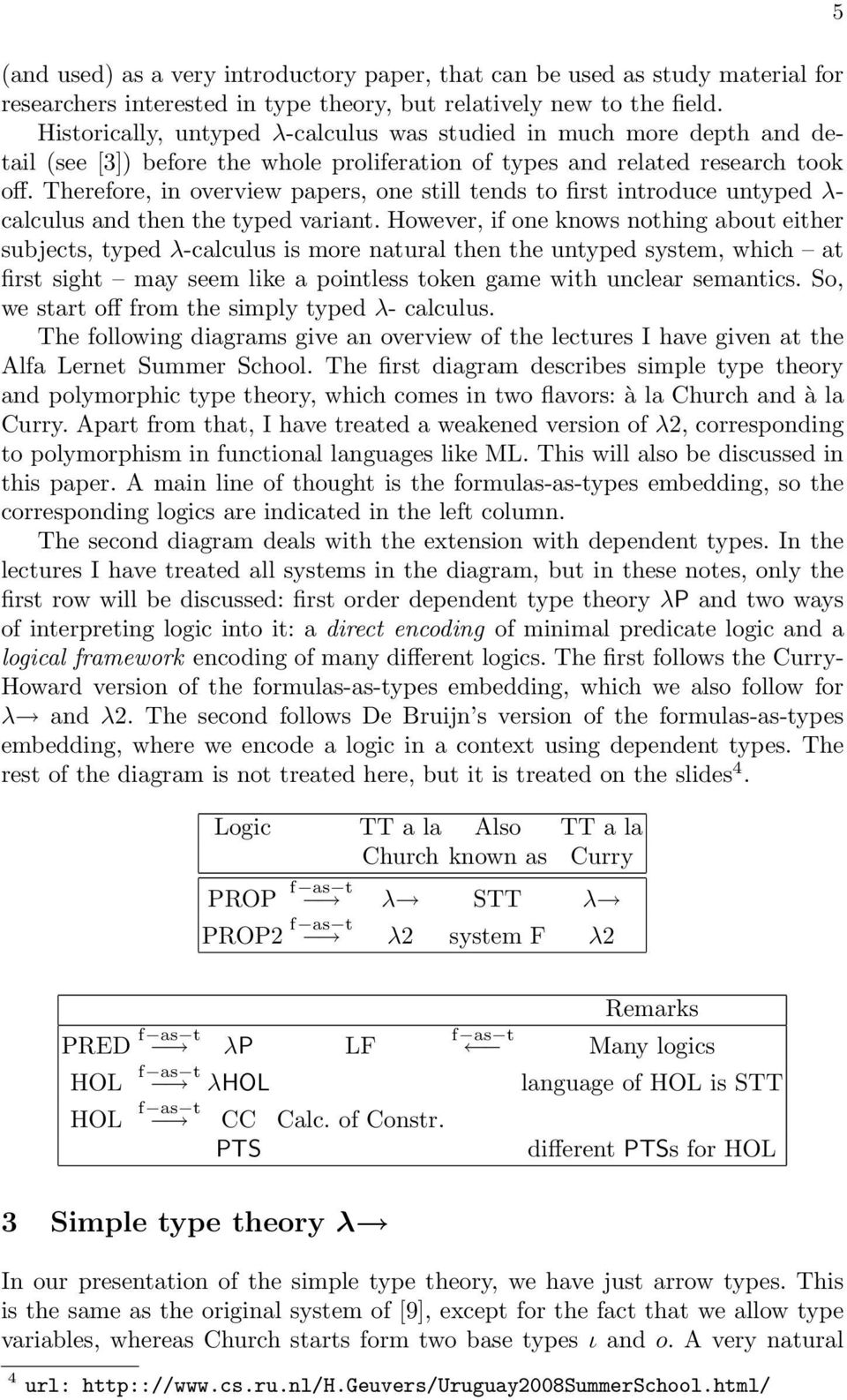
5 5 (and used) as a very introductory paper, that can be used as study material for researchers interested in type theory, but relatively new to the field. Historically, untyped λ-calculus was studied in much more depth and detail (see [3]) before the whole proliferation of types and related research took off. Therefore, in overview papers, one still tends to first introduce untyped λ- calculus and then the typed variant. However, if one knows nothing about either subjects, typed λ-calculus is more natural then the untyped system, which at first sight may seem like a pointless token game with unclear semantics. So, we start off from the simply typed λ- calculus. The following diagrams give an overview of the lectures I have given at the Alfa Lernet Summer School. The first diagram describes simple type theory and polymorphic type theory, which comes in two flavors: à la Church and à la Curry. Apart from that, I have treated a weakened version of λ2, corresponding to polymorphism in functional languages like ML. This will also be discussed in this paper. A main line of thought is the formulas-as-types embedding, so the corresponding logics are indicated in the left column. The second diagram deals with the extension with dependent types. In the lectures I have treated all systems in the diagram, but in these notes, only the first row will be discussed: first order dependent type theory λp and two ways of interpreting logic into it: a direct encoding of minimal predicate logic and a logical framework encoding of many different logics. The first follows the Curry- Howard version of the formulas-as-types embedding, which we also follow for λ and λ2. The second follows De Bruijn s version of the formulas-as-types embedding, where we encode a logic in a context using dependent types. The rest of the diagram is not treated here, but it is treated on the slides 4. Logic TT a la Also TT a la Church known as Curry PROP f as t λ STT λ PROP2 f as t λ2 system F λ2 Remarks PRED f as t λp LF f as t Many logics HOL f as t λhol language of HOL is STT HOL f as t CC Calc. of Constr. PTS different PTSs for HOL 3 Simple type theory λ In our presentation of the simple type theory, we have just arrow types. This is the same as the original system of [9], except for the fact that we allow type variables, whereas Church starts form two base types ι and o. A very natural 4 url:
6 6 extension is the one with product types and possibly other type constructions (like sum types, a unit type,... ). A good reference for the simple type theory extended with product types is [27]. Definition 1. The types of λ are Typ := TVar (Typ Typ) where TVar denotes the countable set of type variables. Convention 2 Type variables will be denoted by α, β, γ,.... Types will be denoted by σ, τ,.... In types we let brackets associate to the right and we omit outside brackets: (α β) (β γ) α γ denotes (α β) ((β γ) (α γ)) Example 1. The following are types: (α β) α, (α β) ((β γ) (α γ)). Note the higher order structure of types: we read (α β) α as the type of functions that take functions from α to β to values of type α. Definition 3. The terms of λ are defined as follows There are countably many typed variables x σ 1, x σ 2,..., for every σ. Application: if M : σ τ and N : σ, then (M N) : τ Abstraction: if P : τ, then (λx σ.p ) : σ τ So the binary application operation is not written. One could write M N, but that is not done in λ-calculus. The λ is meant to bind the variable in the body: in λx σ.m, x σ is bound in M. We come to that later. The idea is that λx σ.m is the function x M that takes an input argument P and produces the output M[x := P ], M with P substituted for x. This will be made precise by the β-reduction rule, which is the computation rule to deal with λ-terms. We come to this in Definition 6. Convention 4 Term variables will be denoted by x, y, z,.... Terms will be denoted by M, N, P,.... Type annotations on variables will only be written at the λ-abstraction: we write λx σ.x instead of λx σ.x σ. In term applications we let brackets associate to the left and we omit outside brackets and brackets around iterations of abstractions: M N P denotes ((M N) P ) and λx α β.λy β γ.λz α.xz(yz) denotes (λx α β.(λy β γ.(λz α.((xz)(yz))))) Examples 2. For every type σ we have the term I σ := λx σ.x which is of type σ σ. This is the identity combinator on σ. For types σ and τ we have the term K στ := λx σ.λy τ.x of type σ τ σ. This term, called the K combinator takes two inputs and returns the first. Here are some more interesting examples of typable terms: λx α β.λy β γ.λz α.y(xz) : (α β) (β γ) α γ, λx α.λy (β α) α.y(λz β.x) : α ((β α) α) α.

7 7 To show that a term is of a certain type, we have to build it up using the inductive definition of terms (Definition 3). For λx α β.λy β γ.λz α.y(xz), we find the type as follows: If x : α β, y : β γ and z : α, then xz : β, so y(xz) : γ, so λz α.y(xz) : α γ, so λy β γ.λz α.y(xz) : (β γ) α γ, so λx α β.λy β γ.λz α.y(xz) : (α β) (β γ) α γ In λ-calculus (and type theory) we often take a number of λ-abstractions together, writing λx σ y τ.x for λx σ.λy τ.x. The conventions about types and applications fit together nicely. If F : σ τ ρ, M : σ and P : τ, then F M : τ ρ and F M P : ρ Given the bracket convention for types, every type of λ can be written as σ 1 σ 2... α with α a type variable. The lack of product types is largely circumvented by dealing with functions of multiple arguments by Currying: We don t have F : σ τ ρ but instead we can use F : σ τ ρ, because the latter F is a function that takes two arguments, of types σ and τ, and produces a term of type ρ. 3.1 Computation, free and bound variables, substitution A λ-term of the form (λx σ.m)p is a β- redex ( reducible expression). A redex can be contracted: (λx σ.m)p β M[x := P ] where M[x := P ] denotes M with P substituted for x. As an example, we have (λx σ.λy τ.x)p β λy τ.p. But what if P = y? then (λx σ.λy τ.x)y β λy τ.y, which is clearly not what we want, because the free y has become bound after reduction. The λ is a binder and we have to make sure that free variables don t get bound by a substitution. The solution is to rename bound variables before substitution. Definition 5. We define the notions of free and bound variables of a term, FV and BV. FV(x) = {x} FV(MN) = FV(M) FV(N) FV(λx σ.m) = FV(M) \ {x} BV(x) = BV(MN) = BV(M) BV(N) BV(λx σ.m) = BV(M) {x} M N or M = α N if M is equal to N modulo renaming of bound variables. A closed term is a term without free variables; closed terms are sometimes also called combinators.

8 8 The renaming of bound variable x is done by taking a fresh variable (i.e. one that does not yet occur in the term, either free or bound), say y and replace all bound occurrences of x by y and λx by λy. Examples 3. λx σ.λy τ.x λx σ.λz τ.x λx σ.λy τ.x λy σ.λx τ.y. This equality can be obtained by first renaming y to z, then x to y and then z to y. NB we also have λx σ.λy τ.y λx σ.λx τ.x. This equality is obtained by renaming the second x to y in the second term. In the last example, we observe that our description of renaming above is slightly too informal. It is not symmetric, as we cannot rename y in the first term to x, and we may at some point not wish to rename with a completely fresh variable, but just with one that is not in scope. We leave it at this and will not give a completely formal definition, as we think that the reader will be capable of performing α-conversion in the proper way. Fully spelled out definitions can be found in [11, 24, 3]. The general idea of (typed) λ-calculus is that we don t distinguish between terms that are α convertible: we consider terms modulo α-equality and we don t distinguish between λx σ.λy τ.x and λx σ.λz τ.x. This implies that all our operations and predicates should be defined on α-equivalence classes, a property that we don t verify for every operation we define, but that we should be aware of. When reasoning about λ-terms we use concrete terms (and not α-equivalence classes). We will avoid terms like λx σ.λx τ.x, because they can be confusing. In examples we always rename bound variables such that no clashes can arise. This is known as the Barendregt convention: when talking about a set of λ-terms, we may always assume that all free variables are different from the bound ones and that all bound variables are distinct. Before reduction or substitution, we rename (if necessary): (λx σ.λy τ.x)y (λx σ.λz τ.x)y β λz τ.y Definition 6. The notions of one-step β-reduction, β, multiple-step β-reduction, β, and β-equality, = β are defined as follows. (λx σ.m)n β M[x := N] M β N M P β N P M β N P M β P N M β N λx σ.m β λx σ.n β is the transitive reflexive closure of β. = β is the transitive reflexive symmetric closure of β. The type (σ σ) σ σ is called the type of numerals over σ, nat σ. The way to encode natural numbers as closed terms of type nat σ is as follows. c n := λf σ σ.λx σ.f n (x)

9 9 where f n (x) denotes f(... f(f } {{ } n times f x)) So c 2 := λf σ σ.λx σ.f(f x). These are also known as the Church numerals. (For readability we don t denote the dependency of c n on the type σ, but leave it implicit.) A Church numeral c n denotes the n-times iteration: it is a higher order function that takes a function f : σ σ and returns the n-times iteration of f. Example 4. We show a computation with the Church numeral c 2 : we apply it to the identity I σ. λz σ.c 2 I σ z λz σ.(λf σ σ.λx σ.f(f x))i σ z β λz σ.(λx σ.i σ (I σ x))z β λz σ.i σ (I σ z) β λz σ.i σ z β λz σ.z I σ In the above example, we see that at a certain point there are several ways to reduce: we can contract the inner or the outer redex with I σ. In this case the result is exactly the same. In general there are many redexes within a term that can be reduced, and they may all yield a different result. Often we want to fix a certain method for reducing terms, or we only want to contract redexes of a certain shape. This can be observed in the following example. Examples 5. Define the S combinator as follows. S := λx σ σ σ.λy σ σ.λz σ.x z(y z) : (σ σ σ) (σ σ) σ σ Then S K σσ I σ : σ σ and S K σσ I σ β (λy σ σ.λz σ.k σσ z(y z))i σ There are several ways of reducing this term further: (λy σ σ.λz σ.k σσ z(y z))i σ K σσ z is a redex is a redex (λy σ σ.λz σ.k σσ z(y z))i σ β λz σ.k σσ z(i σ z) λz σ.(λp σ q σ.p) z(i σ z) β λz σ.(λq σ.z) (I σ z) Call by Value β λz σ.(λq σ.z)z β λz σ.z

10 10 But also (λy σ σ.λz σ.k σσ z(y z))i σ (λy σ σ.λz σ.(λp σ q σ.p) z(y z))i σ Call by Name β λz σ.z β (λy σ σ.λz σ.(λq σ.z)(y z))i σ β λz σ.(λq σ.z) (I σ z) In the previous example we have seen that the term λz σ.(λq σ.z) (I σ z) can be reduced in several ways. Call-by-name is the ordinary β-reduction, where one can contract any β-redex. In call-by-value, one is only allowed to reduce (λx.m)n if N is a value, where a value is an abstraction term or a variable ([34]). So to reduce a term of the form (λx.m)((λy.n)p ) call-by-value, we first have to contract (λy.n)p. Call-by-value restricts the number of redexes that is allowed to be contracted, but it does not prescribe which is the next redex to contract. More restrictive variations of β-reduction are obtained by defining a reduction strategy which is a recipe that describes for every term which redex to contract. Well-known reduction strategies are left-most outermost or rightmost innermost. To understand these notions it should be observed that redexes can be contained in another, e.g. in (λx.m)((λy.n)p ) or in (λx.(λy.n)p )Q, but they can also be disjoint, in which case there s always one to the left of the other. Other reduction strategies select a set of redexes and contract these simultaneously (a notion that should be defined first of course). For example, it is possible to define the simultaneous contraction of all redexes in a term, which is usually called a complete development. We don t go into the theory of reduction strategies or developments here, but refer to the literature [3]. Reduction in simple type theory enjoys some important properties that we list here. We don t give any proofs, as they can be found in the standard literature [5]. Theorem 1. The simple type theory enjoys the following important properties. Subject Reduction If M : σ and M β P, then P : σ. Church-Rosser If M is a well-typed term in λ and M β P and M β N, then there is a (well-typed) term Q such that P β Q and N β Q. Strong Normalization If M is well-typed in λ, then there is no infinite β-reduction path starting from M. Subject reduction states looking at it from a programmers point of view that well-typed programs don t go wrong: evaluating a program M : σ to a value indeed returns a value of type σ. Church-Rosser states that it doesn t make any difference for the final value how we reduce: we always get the same value. Strong Normalization states that no matter how one evaluates, one always obtains a value: there are no infinite computations possible.
![m)n if N is a value, where a value is an abstraction term or a variable ([34]). So to reduce a term of the form (λx.m)((λy.n)p](/docs-images/42/264919/images/page_10.jpg ") call-by-value, we first have to contract (λy.n)p. Call-by-value restricts the number of redexes that is allowed to be contracted, but it does not prescribe which is the next redex to contract.")
11 Simple type theory presented with derivation rules Our definition of λ terms (Definition 3) is given via a standard inductive definition of the terms. This is very close to Church [9] original definition. A different presentation can be given by presenting the inductive definition of the terms in rule form: M : σ τ N : σ P : τ x σ : σ MN : τ λx σ.p : σ τ The advantage is that now we also have a derivation tree, a proof of the fact that the term has that type. We can reason over these derivations. In the above presentations, the set of free variables of a term is a global notion, that can be computed by the function FV. This is sometimes felt as being a bit imprecise and then a presentation is given with contexts to explicitly declare the free variables of a term. x 1 : σ 1, x 2 : σ 2,..., x n : σ n is a context, if all the x i are distinct and the σ i are all λ -types. Contexts are usually denoted by Γ and we write x Γ if x is one of the variables declared in Γ. Definition 7. The derivation rules of λ à la Church are as follows. x:σ Γ Γ x : σ Γ M : σ τ Γ N : σ Γ MN : τ Γ, x:σ P : τ Γ λx:σ.p : σ τ We write Γ λ M : σ if there is a derivation using these rules with conclusion Γ M : σ. So note that apart from the context we now also write the type as a declaration in the λ-abstraction (and not as a superscript): λx : σ.x instead of λx σ.x. This presents us with a slightly different view on the base syntax: we don t see the variables as being typed (x σ ), but we take the view of a countably infinite collection of untyped variables that we assign a type to in the context (the free variables) or in the λ-abstraction (the bound variables). To relate this Definition with the one of 3, we state without proof the following fact, where we ignore the obvious isomorphism that lifts the types in the λ-abstraction to a superscript. Fact 1. If Γ M : σ, then M : σ (Definition 3) and FV(M) Γ. If M : σ (Definition 3), then Γ M : σ, where Γ consists exactly of declarations of all the x FV(M) to their corresponding types. As an example, we give a complete derivation of K στ : σ τ σ. x : σ, y : τ x : σ x : σ λy:τ.x : τ σ λx:σ.λy:τ.x : σ τ σ

12 12 Derivations of typing judgments tend to get quite broad, because we are constructing a derivation tree. Moreover, this tree may contain quite a lot of duplications. So, when we are looking for a term of a certain type, the tree format may not be the most efficient and easy-to-use. We therefore introduce a Fitch style representation of typing derivations, named after the logician Fitch, who has developed a natural deduction system for logic in this format, also called flag deduction style [16]. We don t show that these two derivation styles derive the same set of typable terms, because it should be fairly obvious. (And a precise proof involves quite some additional notions and notation.) Definition 8. The Fitch style presentation of the rules of λ is as follows. 1 x : σ M : τ 5 λx:σ.m : σ τ abs, 1, 4 abs-rule M : σ τ N : σ M N : τ app, 3, 6 app-rule In a Fitch deduction, a hypothesis is introduced by raising a flag, e.g. the x : σ in the left rule. A hypothesis is discharged when we withdraw the flag, which happens at line 5. In a Fitch deduction one usually numbers the lines and refers to them in the motivation of the lines: the abs,1, 4 and the app, 3, 6 at the end of lines 5 and 7. Some remarks apply. It should be understood that one can raise a flag under an already open flag (one can nest flags), but the variable x in the newly raised flag should be fresh: it should not be declared in any of the open flags. In the app-rule, the order of the M and N can of course be different. Also the terms can be in a smaller scope, that is: M : σ may be higher in the deduction under less flags. Basically the M and N should just be in scope, where a flag-ending ends the scope of all terms that are under that flag. We say that a Fitch deduction derives the judgement Γ M : σ if M : σ is on the last line of the deduction the raised flags together form the context Γ. Example 6. We show an example of a derivation of a term of type (α β γ) (α β) α γ

13 13 We show the derivation in two stages, to indicate how one can use the Fitch deduction rules to incrementally construct a term of a given type. 1 x : α β γ 2 y : α β 3 z : α 4?? 5?? 6? : γ 7 λz:α.? : α γ 8 λy:α β.λz:α.? : (α β) α γ 9 λx:α β γ.λy:α β.λz:α.? : (α β γ) (α β) α γ 1 x : α β γ 2 y : α β 3 z : α 4 x z : β γ 5 y z : β 6 x z(y z) : γ 7 λz:α.x z(y z) : α γ 8 λy:α β.λz:α.x z(y z) : (α β) α γ 9 λx:α β γ.λy:α β.λz:α.x z(y z) : (α β γ) (α β) α γ Exercises Construct a term of type (δ δ α) (α β γ) (δ β) δ γ 2. Construct two terms of type (δ δ α) (γ α) (α β) δ γ β 3. Construct a term of type ((α β) α) (α α β) α 4. Construct a term of type ((α β) α) (α α β) β (Hint: use the previous exercise.) 3.3 The Curry-Howard formulas-as-types correspondence Using the presentation of λ with derivation rules, it is easier to make the Curry-Howard formulas-as-types correspondence precise. The idea is that there are two readings of a judgement M : σ: 1. term as algorithm/program, type as specification : M is a function of type σ 2. type as a proposition, term as its proof : M is a proof of the proposition σ More precisely, the Curry-Howard formulas-as-types correspondence states that there is a natural one-to-one correspondence between typable terms in λ

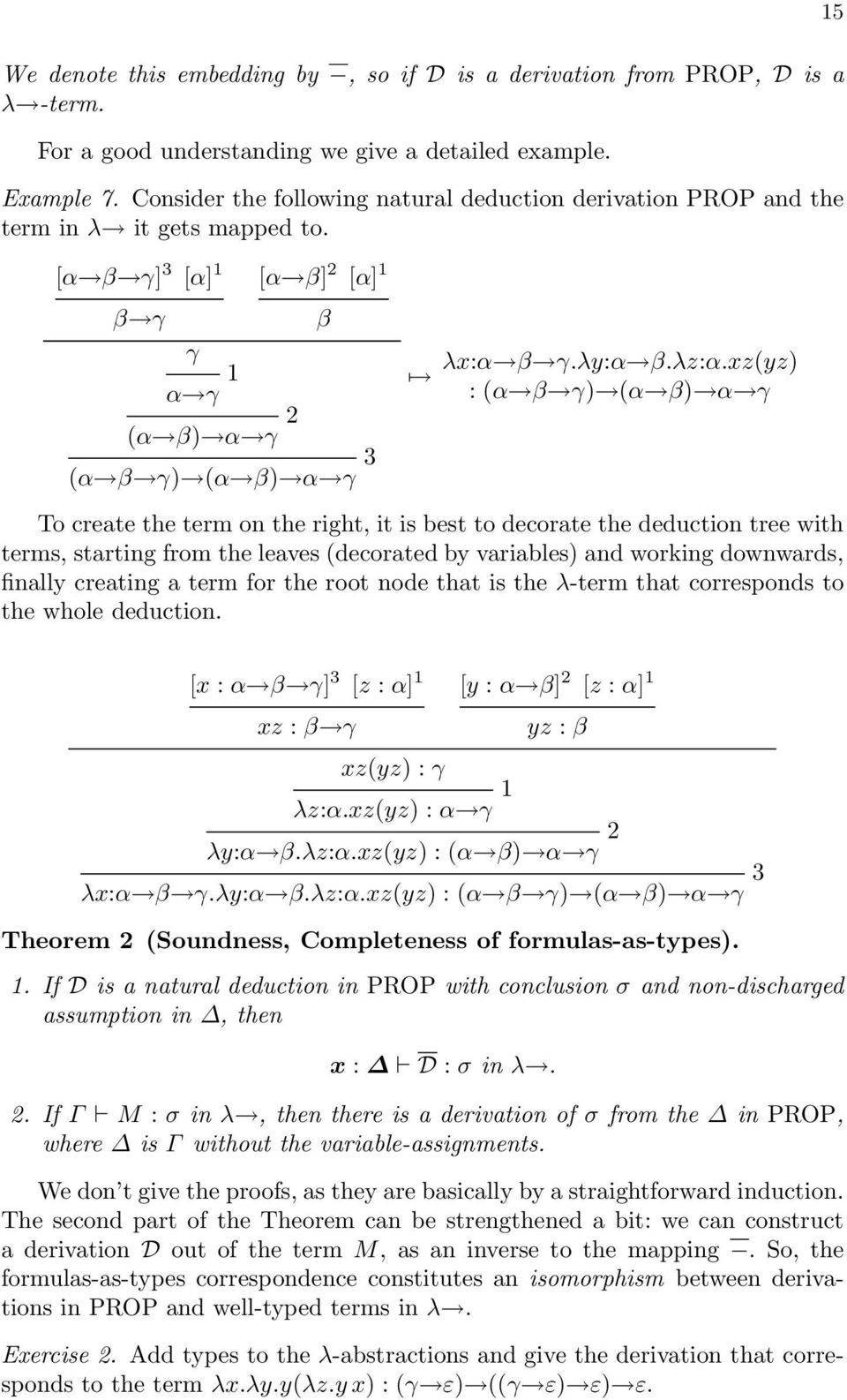
14 14 and derivations in minimal proposition logic. Looking at it from the logical point of view: the judgement x 1 : τ 1, x 2 : τ 2,..., x n : τ n M : σ can be read as M is a proof of σ from the assumptions τ 1, τ 2,..., τ n. Definition 9. The system of minimal proposition logic PROP consists of implicational propositions, generated by the following abstract syntax: prop ::= PropVar (prop prop) derivation rules ( is a set of propositions, σ and τ are propositions) σ τ τ σ -E [σ] j. τ σ τ [j] -I We write PROP σ if there is a derivation using these rules with conclusion σ and non-discharged assumptions in. Note the difference between a context, which is basically a list, and a set of assumptions. Logic (certainly in natural deduction) is usually presented using a set of assumptions, but there is no special reason for not letting the assumptions be a list, or a multi-set. We now give a precise definition of the formulas-as-types correspondence. For this we take the presentation of PROP with lists (so is a list in the following definition). As a matter of fact the formulas-as-types part of the definition is trivial: a proposition in PROP is just a type in λ, but the most interesting part of the correspondence is the proofs-as-terms embedding, maybe best called the deductions-as-term embedding. For PROP, this part is also quite straightforward, but we describe it in detail nevertheless.) Definition 10. The deductions-as-terms embedding from derivation of PROP to term of λ is defined inductively as follows. We associate to a list of propositions a context Γ in the obvious way by replacing σ i in with x i : σ i Γ. On the left we give the inductive clause for the derivation and on the right we describe on top of the line the terms we have (by induction) and below the line the term that the derivation gets mapped to. σ σ σ τ τ σ -E x : σ Γ Γ x : σ Γ 1 M : σ τ Γ 2 N : σ Γ 1 Γ 2 M N : τ [σ] j. τ σ τ [j] -I Γ, x : σ M : τ Γ λx:σ.m : σ τ

15 15 We denote this embedding by, so if D is a derivation from PROP, D is a λ -term. For a good understanding we give a detailed example. Example 7. Consider the following natural deduction derivation PROP and the term in λ it gets mapped to. [α β γ] 3 [α] 1 [α β] 2 [α] 1 β γ β γ 1 α γ 2 (α β) α γ 3 (α β γ) (α β) α γ λx:α β γ.λy:α β.λz:α.xz(yz) : (α β γ) (α β) α γ To create the term on the right, it is best to decorate the deduction tree with terms, starting from the leaves (decorated by variables) and working downwards, finally creating a term for the root node that is the λ-term that corresponds to the whole deduction. [x : α β γ] 3 [z : α] 1 xz : β γ [y : α β] 2 [z : α] 1 yz : β xz(yz) : γ 1 λz:α.xz(yz) : α γ 2 λy:α β.λz:α.xz(yz) : (α β) α γ 3 λx:α β γ.λy:α β.λz:α.xz(yz) : (α β γ) (α β) α γ Theorem 2 (Soundness, Completeness of formulas-as-types). 1. If D is a natural deduction in PROP with conclusion σ and non-discharged assumption in, then x : D : σ in λ. 2. If Γ M : σ in λ, then there is a derivation of σ from the in PROP, where is Γ without the variable-assignments. We don t give the proofs, as they are basically by a straightforward induction. The second part of the Theorem can be strengthened a bit: we can construct a derivation D out of the term M, as an inverse to the mapping. So, the formulas-as-types correspondence constitutes an isomorphism between derivations in PROP and well-typed terms in λ. Exercise 2. Add types to the λ-abstractions and give the derivation that corresponds to the term λx.λy.y(λz.y x) : (γ ε) ((γ ε) ε) ε.
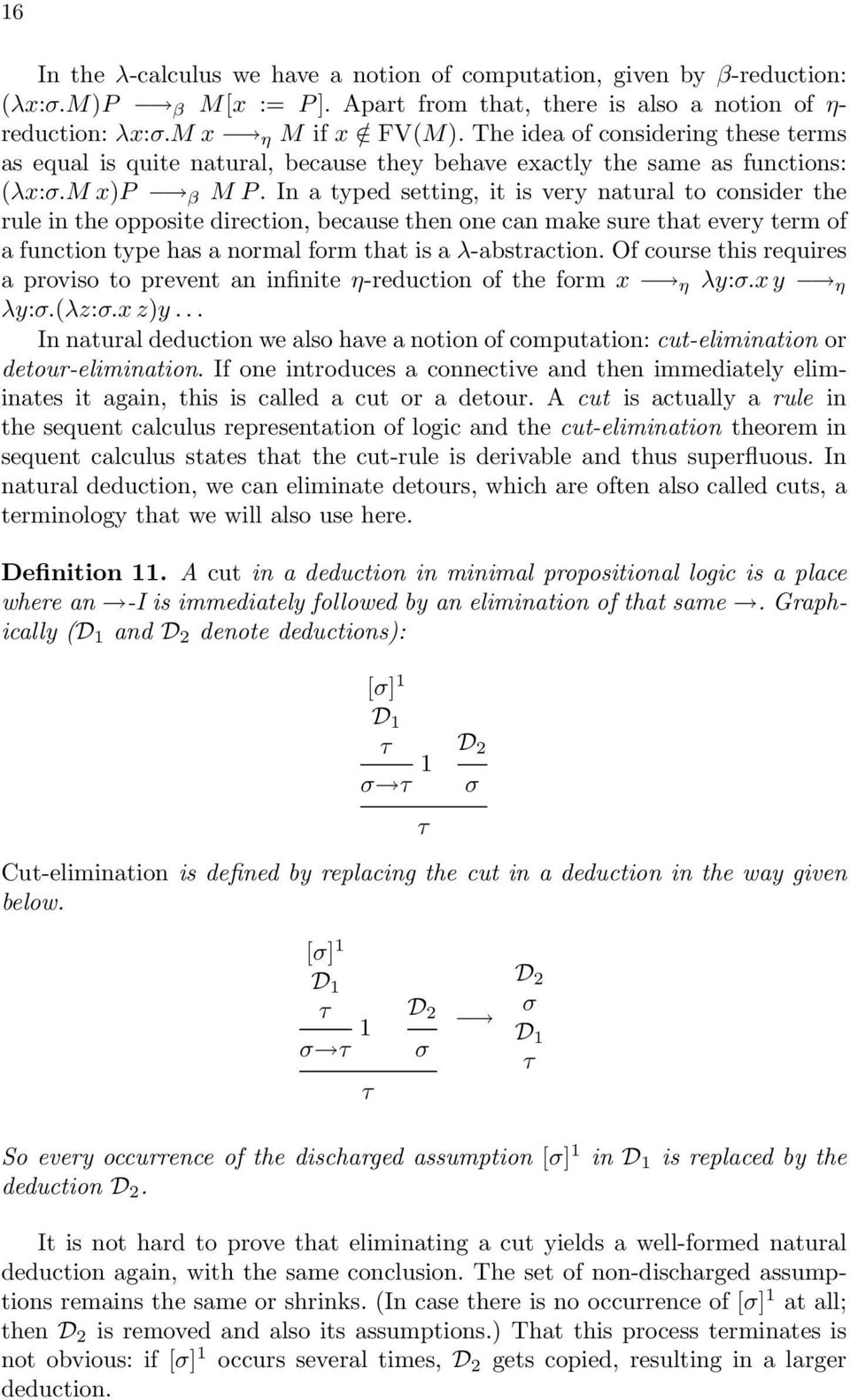
16 16 In the λ-calculus we have a notion of computation, given by β-reduction: (λx:σ.m)p β M[x := P ]. Apart from that, there is also a notion of η- reduction: λx:σ.m x η M if x / FV(M). The idea of considering these terms as equal is quite natural, because they behave exactly the same as functions: (λx:σ.m x)p β M P. In a typed setting, it is very natural to consider the rule in the opposite direction, because then one can make sure that every term of a function type has a normal form that is a λ-abstraction. Of course this requires a proviso to prevent an infinite η-reduction of the form x η λy:σ.x y η λy:σ.(λz:σ.x z)y... In natural deduction we also have a notion of computation: cut-elimination or detour-elimination. If one introduces a connective and then immediately eliminates it again, this is called a cut or a detour. A cut is actually a rule in the sequent calculus representation of logic and the cut-elimination theorem in sequent calculus states that the cut-rule is derivable and thus superfluous. In natural deduction, we can eliminate detours, which are often also called cuts, a terminology that we will also use here. Definition 11. A cut in a deduction in minimal propositional logic is a place where an -I is immediately followed by an elimination of that same. Graphically (D 1 and D 2 denote deductions): [σ] 1 D 1 τ 1 σ τ τ Cut-elimination is defined by replacing the cut in a deduction in the way given below. D 2 σ [σ] 1 D 1 τ σ τ 1 τ D 2 σ D 2 σ D 1 τ So every occurrence of the discharged assumption [σ] 1 in D 1 is replaced by the deduction D 2. It is not hard to prove that eliminating a cut yields a well-formed natural deduction again, with the same conclusion. The set of non-discharged assumptions remains the same or shrinks. (In case there is no occurrence of [σ] 1 at all; then D 2 is removed and also its assumptions.) That this process terminates is not obvious: if [σ] 1 occurs several times, D 2 gets copied, resulting in a larger deduction.
17 17 Lemma 2. Cut-elimination in PROP corresponds to β-reduction in λ : if D 1 cut D 2, then D 1 β D 2 The proof of this Lemma is indicated in the following diagram. [x : σ] 1 D 1 M : τ 1 λx:σ.m : σ τ (λx:σ.m)p : τ D 2 P : σ β D 2 P : σ D 1 M[x := P ] : τ To get a better understanding of the relation between cut-elimination and β-reduction, we now study an example. Example 8. Consider the following proof of A A B, (A B) A B. A A B [A] 1 A B [A] 1 B A B (A B) A B A A B [A] 1 A B [A] 1 B A B A It contains a cut: a -I directly followed by an -E. We now present the same proof after reduction A A B [A] 1 A B [A] 1 A A B [A] 1 B A B [A] 1 (A B) A A B B A A B A (A B) A A B A B A B We now present the same derivations of A A B, (A B) A B, now with term information
![Consider the following proof of A A B, (A B) A B. A A B [A] 1 A B [A] 1 B A B (A B) A B A A B [A] 1 A B [A] 1 B A B A It contains a cut: a -I directly followed by an -E.](/docs-images/42/264919/images/page_17.jpg "We now present the same proof after reduction A A B [A] 1 A B [A] 1 A A B [A] 1 B A B [A] 1 (A B) A A B B A A B A (A B) A A B A B A B We now present the same derivations of A A B, (A B) A B,")
18 18 p : A A B [x : A] 1 p x : A B [x : A] 1 p x x : B λx:a.p x x : A B q : (A B) A (λx:a.p x x)(q(λx:a.p x x)) : B p : A A B [x : A] 1 p x : A B [x : A] 1 p x x : B λx:a.p x x : A B q(λx:a.p x x) : A The term contains a β-redex: (λx:a.p x x) (q(λx:a.p x x)) We now present the reduced proof of A A B, (A B) A B with term info. For reasons of page size we summarize the derivation of q(λx:a.p x x) : A as D. So D q(λx:a.p x x) : A := q : (A B) A p : A A B [x:a] 1 p x : A B [x:a] 1 p x x : B λx:a.p x x : A B q(λx:a.p x x) : A This is the sub-derivation that gets copied under cut-elimination (β-reduction). p : A A B D q(λx:a.p x x) : A p(q(λx:a.p x x)) : A B D q(λx:a.p x x) : A p(q(λx:a.p x x))(q(λx:a.p x x)) : B 4 Type assignment versus typed terms 4.1 Untyped λ-calculus Simple Type Theory is not very expressive: one can only represent a limited number of functions over the nat σ (see the paragraph after Definition 6) data types in λ. We can allow more functions to be definable by relaxing the type constraints. The most flexible system is to have no types at all. Definition 12. The terms of the untyped λ-calculus, Λ, are defined as follows. Λ ::= Var (Λ Λ) (λvar.λ)
![For reasons of page size we summarize the derivation of q(λx:a.p x x) : A as D. So D q(λx:a.p x x) : A := q : (A B) A p : A A B [x:a] 1 p x : A B [x:a] 1 p x x : B λx:a.p x x : A B q(λx:a.](/docs-images/42/264919/images/page_18.jpg "p x x) : A This is the sub-derivation that gets copied under cut-elimination (β-reduction). p : A A B D q(λx:a.p x x) : A p(q(λx:a.p x x)) : A B D q(λx:a.p x x) : A p(q(λx:a.p x x))(q(λx:a.")
19 19 Examples are the well-known combinators that we have already seen in a typed fashion: K := λx y.x, S := λx y z.x z(y z). But we can now do more: here are some well-known untyped λ-terms ω := λx.x x, Ω := ω ω. The notions of β-reduction and β-equality generalize from the simple typed case, so we don t repeat it here. An interesting aspect is that we can now have infinite reductions. (Which is impossible in λ, as that system is Strongly Normalizing.) The simplest infinite reduction is the following loop: Ω β Ω A term that doesn t loop but whose reduction path contains infinitely many different terms is obtained by putting ω 3 := λx.x x x, Ω 3 := ω 3 ω 3. Then: Ω 3 β ω 3 ω 3 ω 3 β ω 3 ω 3 ω 3 ω 3 β... The untyped λ-calculus was defined by Church [9] and proposed as a system to capture the notion of mechanic computation, for which Turing proposed the notion of Turing machine. An important property of the untyped λ-calculus is that it is Turing complete, which was proved by Turing in 1936, see [13]. The power of Λ lies in the fact that you can solve recursive equations. A recursive equation is a question of the following kind: Is there a term M such that Is there a term M such that M x = β x M x? M x = β if (Zero x) then 1 else Mult x (M (Pred x))? So, we have two expressions on either side of the = β sign, both containing an unknown M and we want to know whether a solution for M exists. The answer is: yes, if we can rewrite the equation to one of the form M = β... M... (1) Note that this is possible for the equations written above. For example the first equation is solved by a term M that satisfies M = β λx.x M x. That we can solve equation of the form (1) is because every term in the λ-calculus has a fixed point. Even more: we have a fixed point combinator. Definition 13. The term M is a fixed point of the term P if P M = β M. The term Y is a fixed point combinator if for every term P, Y P is a fixed point of P, that is if P (Y P ) = β Y P. In the λ-calculus we have various fixed point combinators, of which the Y - combinator is the most well-known one: Y := λf.(λx.f(x x))(λx.f(x x)).

20 20 Exercise 3. Verify that the Y as defined above is a fixed point combinator: P (Y P ) = β Y P for every λ-term P. Verify that Θ := (λx y.y(x x y))(λx y.y(x x y)) is also a fixed point combinator that is even reducing: Θ P β P (Θ P ) for every λ-term P. The existence of fixed-points is the key to the power of the λ-calculus. But we also need natural numbers and booleans to be able to write programs. In Section 3 we have already seen the Church numerals: where c n := λf.λx.f n (x) f n (x) denotes f(... f(f } {{ } n times f The successor is easy to define for these numerals: Suc := λn.λf x.f(n f x). Addition can also be defined quite easily, but if we are lazy we can also use the fixed-point combinator. We want to solve x)) Add n m := if(zero n) then m else Add (Pred n) m) where Pred is the predecessor function, Zero is a test for zero and if... then... else is a case distinction on booleans. The booleans can be defined by true := λx y.x false := λx y.y if b then P else Q := b P Q. Exercise Verify that the booleans behave as expected: if true then P else Q = β P and if false then P else Q = β Q. 2. Define a test-for-zero Zero on the Church numerals :Zero c 0 = β true and Zero c n+1 = β false. (Defining the predecessor is remarkably tricky!) Apart from the natural numbers and booleans, it is not difficult to find encodings of other data, like lists and trees. Given the expressive power of the untyped λ-calculus and the limited expressive power of λ, one may wonder why we want types. There are various good reasons for that, most of which apply to the the typed versus untyped programming languages issue in general. Types give a (partial) specification. Types tell the programmer and a person reading the program what a program (λ-term) does, to a certain extent. Types only give a very partial specification, like f : IN IN, but depending on the type system, this information can be enriched, for example: f : Πn : IN. m : IN.m > n, stating that f is a program that takes a number n and returns an m that is larger than n. In the Chapter by Bove and Dybjer, one can find examples of that type and we will also come back to this theme in this Chapter in Section 6.

21 21 Well-typed programs never go wrong (Milner). The Subject Reduction property guarantees that a term of type σ remains to be of type σ under evaluation. So, if M : nat evaluates to a value v, we can be sure that v is a natural number. The type checking algorithm detects (simple) mistakes. Types can be checked at compile time (statically) and this is a simple but very useful method to detect simple mistakes like typos and applying functions to the wrong arguments. Of course, in a more refined type system, type checking can also detect more subtle mistakes. Typed terms always terminate(?) In typed λ-calculi used for representing proofs (following the Curry-Howard isomorphism), the terms are always terminating, and this is seen as an advantage as it helps in proving consistency of logical theories expressed in these calculi. In general, termination very much depends on the typing system. In this paper, all type systems only type terminating (strongly normalizing) λ-terms, which also implies that these systems are not Turing complete. Type systems for programming languages will obviously allow also non-terminating calculations. A simple way to turn λ into a Turing complete language is by adding fixed point combinators (for every type σ) Y σ : (σ σ) σ with the reduction rule Y f f(y f). This is basically the system PCF, first defined and studied by Plotkin [35]. Given that we want types, the situation with a system like λ as presented in Section 3, is still unsatisfactory from a programmers point of view. Why would the programmer have to write all those types? The compiler should compute the type information for us! For M an untyped term, we want the type system to assign a type σ to M (or say that M is not typable). Such a type system is called a type assignment system, or also typing à la Curry (as opposed to the typing à la Church that we have seen up to now). 4.2 Simple type theory à la Church and à la Curry We now set the two systems side-by-side: λ à la Church and à la Curry. Definition 14. In λ à la Curry, the terms are In λ à la Church, the terms are Λ ::= Var (Λ Λ) (λvar.λ) Λ Ch ::= Var (Λ Ch Λ Ch ) (λvar:σ.λ Ch ) where σ ranges over the simple types, as defined in Definition 1. These sets of terms are just the preterms. The typing rules will select the welltyped terms from each of these sets.
22 22 Definition 15. The typing rules of λ à la Church and λ à la Curry are as follows. (The ones for the Church system are the same as the ones in Definition 7.) λ (à la Church): x:σ Γ Γ x : σ λ (à la Curry): Γ M : σ τ Γ N : σ Γ MN : τ Γ, x:σ P : τ Γ λx:σ.p : σ τ x:σ Γ Γ x : σ Γ M : σ τ Γ N : σ Γ MN : τ Γ, x:σ P : τ Γ λx.p : σ τ The rules à la Curry can of course also be given in the Fitch style, which is the style we use when giving derivations of typings. Exercise 5. Give a full derivation of in Curry style λ λx.λy.y(λz.y x) : (γ ε) ((γ ε) ε) ε We can summarize the differences between Typed Terms and Type Assignment as follows: With typed terms (typing à la Church), we have terms with type information in the λ-abstraction: λx:α.x : α α. As a consequence: Terms have unique types, The type is directly computed from the type info in the variables. With type assignment (typing à la Curry), we assign types to untyped λ- terms: λx.x : α α. As a consequence: Terms do not have unique types, A principal type can be computed (using unification). Examples 9. Typed Terms: λx:α.λy:(β α) α.y(λz:β.x) has only the type α ((β α) α) α Type Assignment: λx.λy.y(λz.x) can be assigned the types α ((β α) α) α (α α) ((β α α) γ) γ... with α ((β α) γ) γ being the principal type, a notion to be defined and discussed later. There is an obvious connection between Church and Curry typed λ, given by the erasure map.
23 23 Definition 16. The erasure map from λ à la Church to λ à la Curry is defined by erasing all type information: x := x M N := M N λx : σ.m := λx. M So, e.g. λx:α.λy:(β α) α.y(λz:β.x)) = λx.λy.y(λz.x)). Theorem 3. If M : σ in λ à la Church, then M : σ in λ à la Curry. If P : σ in λ à la Curry, then there is an M such that M P and M : σ in λ à la Church. The proof is by an easy induction on the derivation. 4.3 Principal types We now discuss the notion of a principal type in λ à la Curry. We will describe an algorithm, the principal type algorithm, that, given a closed untyped term M, computes a type σ if M is typable with type σ in λ, and reject if M is not typable. Moreover, the computed type σ is minimal in the sense that all possible types for M are substitution instances of σ. Computing a principal type for M in λ à la Curry proceeds as follows: 1. Assign a type variable to every variable x in M. 2. Assign a type variable to every applicative sub-term of M. 3. Generate a (finite) set of equations E between types that need to hold in order to ensure that M is typable. 4. Compute a minimal substitution S, substituting types for type variables, that makes all equations in E hold. (This is a most general unifier for E.) 5. With S compute the type of M. The algorithm described above can fail only if their is no unifying substitution for E. In that case we return reject and conclude that M is not typable. An applicative sub-term is a term that is not a variable and does not start with a λ. (So it is a sub-term of the form P Q). One could label all sub-terms with a type variable, but that just adds superfluous overhead. We show how the algorithm works by elaborating an example. Example 10. We want to compute the principal type of λx.λy.y(λz.yx). 1. Assign type variables to all term variables: x : α, y : β, z : γ. 2. Assign type variables to all applicative sub-terms: y x : δ, y(λz.y x) : ε. These two steps yield the following situation, where we indicate the types of the variables and applicative sub-terms by super- and subscripts. { }} { λx α.λy β. y β (λz γ. y β x α ) } {{ } ε δ
24 24 3. Generate equations between types, necessary for the term to be typable: E = {β = α δ, β = (γ δ) ε} δ { }} { The equation β = α δ arises from the sub-term y β x α, which is of type δ if β is a function type with domain α and range δ. The equation β = (γ δ) ε δ arises from the sub-term y β (λz γ {}}{. y x ), which is of type ε if β is a function } {{ } ε type with domain γ δ and range ε. 4. Find a most general substitution (a most general unifier) for the type variables that solves the equations: S := {α := γ δ, β := (γ δ) ε, δ := ε} 5. The principal type of λx.λy.y(λz.yx) is now (γ ε) ((γ ε) ε) ε Exercise Compute the principal type for S := λx.λy.λz.x z(y z) 2. Which of the following terms is typable? If it is, determine the principal type; if it isn t, show that the typing algorithm rejects the term. (a) λz x.z(x(λy.y x)) (b) λz x.z(x(λy.y z)) 3. Compute the principal type for M := λx.λy.x(y(λz.x z z))(y(λz.x z z)). We now introduce the notions required for the principal types algorithm. Definition 17. A type substitution (or just substitution) is a map S from type variables to types. As a function, we write it after the type, so σs denotes the result of carrying out substitution S on σ. Most substitutions we encounter are the identity on all but a finite number of type variables, so we often denote a substitution as [α 1 := σ 1,..., α n := σ n ]. We view a type substitution as a function that is carried out in parallel so [α := β β, β := α γ] applied to α β results in (β β) α γ. We can compose substitutions in the obvious way: S; T is obtained by first performing S and then T. A unifier of the types σ and τ is a substitution that makes σ and τ equal, i.e. an S such that σs = τs. A most general unifier (or mgu) of the types σ and τ is the simplest substitution that makes σ and τ equal, i.e. an S such that σs = τs for all substitutions T such that σt = τt there is a substitution R such that T = S; R.
25 25 All these notions generalize to lists instead of pairs σ, τ. We say that S unifies the list of equations σ 1 = τ 1,..., σ n = τ n if σ 1 S = τ 1 S,..., σ n S = τ n S, that is: S makes all equations true. The crucial aspect in the principal type algorithm is the computability of a most general unifier for a set of type equations. The rest of the algorithm should be clear from the example and we don t describe it in detail here. Definition 18. We define the algorithm U that, when given a list of type equations E = σ 1 = τ 1,..., σ n = τ n outputs a substitution S or reject as follows. U looks at the first type equation σ 1 = τ 1 and depending on its form it outputs: U( α = α,..., σ n = τ n ) := U( σ 2 = τ 2,..., σ n = τ n ). U( α = τ 1,..., σ n = τ n ) := reject if α FV(τ 1 ), τ 1 α. U( α = τ 1,..., σ n = τ n ) := [α := V (τ 1 ), U( σ 2 [α := τ 1 ] = τ 2 [α := τ 1 ],..., σ n [α := τ 1 ] = τ n [α := τ 1 ] )], if α / FV(τ 1 ), where V abbreviates U( σ 2 [α := τ 1 ] = τ 2 [α := τ 1 ],..., σ n [α := τ 1 ] = τ n [α := τ 1 ] ). U( σ 1 = α,..., σ n = τ n ) := U( α = σ 1,..., σ n = τ n ) U( µ ν = ρ ξ,..., σ n = τ n ) := U( µ = ρ, ν = ξ,..., σ n = τ n ) Theorem 4. The function U computes the most general unifier of a set of equations E. That is, If U(E) = reject, then there is no substitution S that unifies E. If U(E) = S, then S unifies E and for all substitutions T that unify E, there is a substitution R such that T = S; R (S is most general). Definition 19. The type σ is a principal type for the closed untyped λ-term M if M : σ in λ à la Curry for all types τ, if M : τ, then τ = σs for some substitution S. Theorem 5 (Principal Types). There is an algorithm PT that, when given a closed (untyped) λ-term M, outputs A principal type σ such that M : σ in λ à la Curry. reject if M is not typable in λ à la Curry. The algorithm is the one we have described before. We don t give it in formal detail, nor the proof of its correctness, but refer to [5] and [40]. This algorithm goes back to the type inference algorithm for simply typed lambda calculus of Hindley [23], which was independently developed by Milner [29] and extended to the weakly polymorphic case (see Section 5.1). Damas [12] has proved it correct and therefore this algorithm is often referred to as the Hindley-Milner or Damas-Milner algorithm. If one wants to type an open term M, i.e. one that contains free variables, one is actually looking for what is known as a principal pair, consisting of a context Γ and a type σ such that Γ M : σ and if Γ M : τ, then there
26 26 is a substitution S such that τ = σs and Γ = Γ S. (A substitution extends straightforwardly to contexts.) However, there is a simpler way of attacking this problem: just apply the PT algorithm for closed terms to λx 1... λx n.m where x 1,..., x n is the list of free variables in M. The following describes a list of typical decidability problems one would like to have an algorithm for in a type theory. Definition 20. M : σ? Type Checking Problem TCP M :? Type Synthesis or Type Assginment Problem TSP, TAP? : σ Type Inhabitation Problem TIP Theorem 6. For λ, all problems defined in Definition 20 are decidable, both for the Curry style and for the Church style versions of the system. For Church style, TCP and TSP are trivial, because we can just read off the type from the term that has the variables in the λ-abstractions decorated with types. For Curry style, TSP is solved by the PT algorithm. This also gives a way to solve TCP: to verify if M : σ, we just compute the principal type of M, say τ, and verify if σ is a substitution instance of τ (which is decidable). In general, one may think that TCP is easier than TSP, but they are (usually) equivalent: Suppose we need to solve the TCP M N : σ. The only thing we can do is to solve the TSP N :? and if this gives answer τ, solve the TCP M : τ σ. So we see that these problems are tightly linked. For Curry systems, TCP and TSP soon become undecidable if we go beyond λ. In the next section we will present the polymorphic λ-calculus, whose Curry style variant has an undecidable TCP. TIP is decidable for λ, as it corresponds to provability in PROP, which is known to be decidable. This applies to both the Church and Curry variants, because they have the same inhabited types (as a consequence of Theorem 3). TIP is undecidable for most extensions of λ, because TIP corresponds to provability in some logic and provability gets easily undecidable (e.g. already in very weak systems of predicate logic). As a final remark: if we add a context to the problems in Definition 20, the decidability issues remain the same. For TIP, the problem is totally equivalent since x 1 : σ 1,..., x n : σ n? : σ? : σ 1... σ n σ For the Church system, TSP is also totally equivalent: x 1 : σ 1,..., x n : σ n M :? λx 1 :σ λx n :σ n.m :? and similarly for TCP. For the Curry system, the situation is slightly different, because in the TSP Γ M :? the free variables are forced to be of specific types, which they are not in λx.m :?. Nevertheless, also if we add a context, TSP and TCP remain decidable and the principal type technique that we have described still works.
27 Properties of λ ; Normalization We now list the most important meta-theoretic properties of λ. Theorem 7. For λ à la Church: Uniqueness of types If Γ M : σ and Γ M : τ, then σ = τ. Subject Reduction If Γ M : σ and M β N, then Γ N : σ. Strong Normalization If Γ M : σ, then all β-reductions from M terminate. These are proved using the following more basic properties of λ. Proposition 1. Substitution property If Γ, x : τ, M : σ, Γ P : τ, then Γ, M[x := P ] : σ. Thinning If Γ M : σ and Γ, then M : σ. The proof of these properties proceeds by induction on the typing derivation where we sometimes first have to prove some auxiliary Lemmas that we haven t listed here except for the proof of Strong Normalization, which was first proved by Tait [38]. As Strong Normalization is such an interesting property and it has an interesting proof, we devote the rest of this section to it. We first study the problem of Weak Normalization, stating that every term has (a reduction path to) a normal form. Definition 21. A λ-term M is weakly normalizing or WN if there is a reduction sequence starting from M that terminates. A λ-term M is strongly normalizing or SN if all reduction sequences starting from M terminate. A type system is WN if all well-typed terms are WN, and it is SN if all well-typed terms are SN. What is the problem with normalization? Terms may get larger under reduction (λf.λx.f(fx))p β λx.p (P x), which blows up if P is large. Redexes may get multiplied under reduction. (λf.λx.f(fx))((λy.m)q) β λx.((λy.m)q)(((λy.m)q)x) New redexes may be created under reduction. (λf.λx.f(fx))(λy.n) β λx.(λy.n)((λy.n)x) To prove WN, we would like to have a reduction strategy that does not create new redexes, or that makes the term shorter in every step. However, this idea is too naive and impossible to achieve. We can define a more intricate notion of size of a term and a special reduction strategy that decreases the size of a term at every step, but to do that we have to analyze more carefully what can happen during a reduction. We give the following Lemma about redex creation, the proof of which is just a syntactic case analysis.
28 28 Lemma 3. There are four ways in which new β-redexes can be created in a β-reduction step. Creation (λx.... (x P )...)(λy.q) β... (λy.q)p... Here we really create a new redex, by substituting a λ-abstraction for a variable that is in function position. Multiplication (λx.... x... x...)((λy.q)r) β... (λy.q)r... (λy.q)r... Here we copy (possibly many times) an existing redex, thereby creating new ones. Hidden redex (λx.λy.q)r P β (λy.q[x := R])P Here the redex (λy.q)p was already present in a hidden form, being shaded by the λx; it is revealed by contracting the outer redex. Identity (λx.x)(λy.q)r β (λy.q)r This is a different very special case of a hidden redex : by contracting the identity, the redex (λy.q)r is revealed. We now define an appropriate size and an appropriate reduction strategy that proves weak normalization. The proof is originally due to Turing and was first written up by Gandy [17]. Definition 22. The height (or order) of a type h(σ) is defined by h(α) := 0 h(σ 1... σ n α) := max(h(σ 1 ),..., h(σ n )) + 1. The idea is that the height of a type σ is at least 1 higher than of any of the domains types occurring in σ. In the definition, we use the fact that we can write types in a standard form σ 1... σ n α. But it is equivalent to define h directly by induction over the definition of types, as is stated in the following exercise. Exercise 7. Prove that the definition of h above is equivalent to defining h(α) := 0 h(σ τ) := max(h(σ) + 1, h(τ)). Definition 23. The height of a redex (λx:σ.p )Q is the height of the type of λx:σ.p.
29 29 As an example, we look at the identity redex creation case of lemma 3. Note that the height of the redex in (λx:σ.x)(λy:τ.q)r is h(σ) + 1 and that the height of the redex in its reduct, (λy:τ.q)r, is h(σ). (Note that the type of λy:τ.q) is just σ.) So the created redex has lesser height. This will be the key idea to our reduction strategy: we will select a redex whose reduction only creates redexes of lesser height. Definition 24. We assign a measure m to the terms by defining where m(n) := (h r (N), #N) h r (N) = the maximum height of a redex in N, #N = the number of redexes of maximum height h r (N) in N. The measures of terms are ordered in the obvious lexicographical way: (h 1, x) < l (h 2, y) iff h 1 < h 2 or (h 1 = h 2 and x < y). Theorem 8 (Weak Normalization). If P is a typable term in λ, then there is a terminating reduction starting from P. Proof. Pick a redex of maximum height h r (P ) inside P that does not contain any other redex of height hr(p ). Note that this is always possible: If R 1 and R 2 are redexes, R 1 is contained in R 2 or the other way around. Say we have picked (λx:σ.m)n. Reduce this redex, to obtain M[x := N]. We claim that this does not create a new redex of height h r (P ) ( ). This is the important step and the proof is by analyzing the four possibilities of redex creation as they are given in Lemma 3. We leave this as an exercise. If we write Q for the reduct of P, then, as a consequence of ( ), we find that m(q) < l m(p ). As there are no infinitely decreasing < l sequences, this process must terminate and then we have arrived at a normal form. Exercise 8. Check claim ( ) in the proof of Theorem 8. (Hint: Use Lemma 3.) Strong Normalization for λ is proved by constructing a model of λ. We give the proof for λ à la Curry. The proof is originally due to Tait [38], who proposed the interpretation of the types as given below. Recently, combinatorial proofs have been found, that give a measure to a typed λ-term and then prove that this measure decreases for all reduction steps that are possible. See [26]. Definition 25. The interpretation of λ -types is defined as follows. [α] := SN (the set of strongly normalizing λ-terms). [σ τ ] := {M N [σ ](MN [τ ])}.
30 30 Note that the interpretation of a function type is countable: it is not (isomorphic to) the full function space, but it contains only the functions from [σ ] to [τ ] that can be λ-defined, i.e. are representable by a λ-term. This set is obviously countable. We have the following closure properties for [σ ]. Lemma [σ ] SN 2. xn 1... N k [σ ] for all x, σ and N 1,..., N k SN. 3. If M[x := N]P [σ ], N SN, then (λx.m)np [σ ]. Proof. All three parts are by induction on the structure of σ. The first two are proved simultaneously. (NB. In the case of σ = ρ τ for the proof of (1), we need that [ρ] is non-empty, which is guaranteed by the induction hypothesis for (2).) For (1) also use the fact that, if M N SN, then also M SN. Exercise 9. Do the details of the proof of Lemma 4. Proposition 2. } x 1 :τ 1,..., x n :τ n M : σ N 1 [τ 1 ],..., N n [τ n ] M[x 1 := N 1,..., x n := N n ] [σ ] Proof. By induction on the derivation of Γ M : σ, using (3) of the Lemma 4 Corollary 1 (Strong Normalization for λ ). λ is SN Proof. By taking N i := x i in Proposition 2. (Note that x i [τ i ] by Lemma 4.) Then M [σ ] SN. Exercise 10. Verify the details of the Strong Normalization proof. That is, prove Proposition 2 in detail by checking the inductive cases. In the Strong Normalization proof, we have constructed a model that has the special nature that the interpretation of the function space is countable. If one thinks about semantics in general, one of course can also take the full set-theoretic function space as interpretation of σ τ. We elaborate a little bit on this point, mainly as a reference for a short discussion in the Section on polymorphic λ-calculus. We say that λ has a simple set-theoretic model. Given sets [[α] for type variables α, define [σ τ ] := [τ ] [σ ] ( set theoretic function space [σ ] [τ ]) Now, if any of the base sets [[α] is infinite, then there are higher and higher infinite cardinalities among the [[σ ], because the cardinality of [[σ τ ] is always strictly larger than that of [[σ ]. There are smaller models, e.g. [σ τ ] := {f [σ ] [τ ] f is definable}
31 31 where definability means that it can be constructed in some formal system. This restricts the collection to a countable set. As an example we have seen in the SN proof the following interpretation [σ τ ] := {f [σ ] [τ ] f is λ-definable} The most important thing we want to note for now is that in λ we have a lot of freedom in choosing the interpretation of the -types. In the polymorphic λ-calculus, this is no longer the case. 5 Polymorphic Type Theory Simple type theory λ is not very expressive: we can only define generalized polynomials as functions [37] and we don t have a clear notion of data types. Also, in simple type theory, we cannot reuse a function. For example, λx:α.x : α α and λx:β.x : β β, which is twice the identity in slightly different syntactic form. Of course, in the Curry version we have λx.x : α α and λx.x : β β, but then still we can t have the same term λx.x being of type α α and of type β β at the same time. To see what we mean with that, consider the following term that we can type (λy.y)(λx.x) In the Church version, this would read, e.g. (λy:σ σ.y)(λx:σ.x) which shows that we can type this term with type σ σ. To type the two identities with the same type at the same time, we would want to type the following (of which the term above is a one-step reduct): (λf.f f)(λx.x). But this term is not typable: f should be of type σ σ and of type (σ σ) σ σ at the same time, which we can t achieve in λ. We want to define functions that can treat types polymorphically. We add types of the form α.σ. Examples 11. α.α α If M : α.α α, then M can map any type to itself. α. β.α β α If M : α. β.α β α, then M can take two inputs (of arbitrary types) and return a value of the first input type. There is a weak and a strong version of polymorphism. The first is present in most functional programming languages, therefore also called ML style polymorphism. The second allows more types and is more immediate if one takes a logical view on types. We first treat the weak version.
32 Typed λ-calculus with weakly polymorphic types Definition 26. In weak λ2 (the system with weak polymorphism) we have the following additional types Typ w := α.typ w Typ where Typ is the collection of λ -types as defined in Definition 1. So, the weak polymorphic types are obtained by adding α α n.σ for σ a λ -type. We can formulate polymorphic λ-calculus in Church and in Curry style. As for λ, the two systems are different in the type information that occurs in the terms, but now the difference is larger: in polymorphic λ-calculus we also have abstractions over types. Definition 27. The terms of weak λ2 à la Church are defined by Λ ch 2 ::= Var (Λ ch 2 Λ ch 2 ) (λvar:typ.λ ch 2 ) (λtvar.λ ch 2 ) Λ ch 2 Typ The terms of the Curry version of the calculus are of course just Λ. This means that in the Curry version we will not record the abstractions over type variables. This is made precise in the following rules. Definition 28. The Derivation rules for weak λ2 (ML-style polymorphism) in Church style are as follows x : σ Γ Γ, x : σ M : τ Γ x : σ Γ λx:σ.m : σ τ Γ M : σ τ Γ N : σ if σ, τ Typ Γ M N : τ Γ M : σ α / FV(Γ ) Γ λα.m : α.σ Γ M : α.σ if τ Typ Γ Mτ : σ[α := τ] Definition 29. The derivation rules for weak λ2 (ML-style polymorphism) in Curry style are as follows. x : σ Γ Γ x : σ Γ, x : σ M : τ if σ, τ Typ Γ λx.m : σ τ Γ M : σ τ Γ M N : τ Γ N : σ Γ M : σ α / FV(Γ ) Γ M : α.σ Γ M : α.σ if τ Typ Γ M : σ[α := τ] Examples In λ2 à la Curry: λx.λy.x : α. β.α β α. 2. In λ2 à la Church we have the following, which is the same term as in the previous case, but now with type information added: λα.λβ.λx:α.λy:β.x : α. β.α β α. 3. In λ2 à la Curry: z : α.α α z z : α.α α.
33 33 4. In λ2 à la Church, we can annotate this term with type information to obtain: z : α.α α λα.z (α α) (z α) : α.α α. 5. We do not have λz.z z :... We can make flag deduction rules for this system as follows. 1 x : σ M : τ 5 λx:σ.m : σ τ if σ, τ Typ 1 α M : σ 5 λα.m : α.σ if α fresh M : σ τ N : σ M N : τ M : α.σ M τ : σ[α := τ] The freshness condition in the rule means that α should not occur free above the flag. In terms of contexts, this means precisely that the type variable that we intend to abstract over does not occur in the context Γ. The freshness condition excludes the following wrong flag deduction. WRONG 1 f : α β 2 α 3 x : α 4 f x : β 5 λx.f x : α β 6 λx.f x : α.α β Of course, we should not be able to derive f : α β λx.f x : α.α β Examples 13. Here are the first four examples of 12, now with flag deductions. In the first row we find the derivations in the Church systems, in the second row
34 34 the ones in the Curry system. 1 α 2 β 3 x : α 4 y : β 5 λy:β.x : β α 6 λx:α.λy:β.x : α β α 7 λβ.λx:α.λy:β.x : β.α β α 8 λα.λβ.λx:α.λy:β.x : α. β.α β α 1 z : α.α α 2 α 3 z α : α α 4 z (α α) : (α α) α α 5 z (α α)(z α) : α α 6 λα.z (α α)(z α) : α.α α 1 α 2 β 3 x : α 4 y : β 5 λy.x : β α 6 λx.λy.x : α β α 7 λx.λy.x : β.α β α 8 λx.λy.x : α. β.α β α 1 z : α.α α 2 α 3 z : α α 4 z : (α α) α α 5 z z : α α 6 z z : α.α α In the types, only occurs on the outside. Therefore, in programming languages (that usually follow a Curry style typing discipline) it is usually left out and all type variables are implicitly universally quantified over. This means that one doesn t write the, so the types are restricted to Typ and hence we don t have the last two rules. That any type variable can be instantiated with a type, is then made formal by changing the variable rule into if τ Typ Γ, x: α.σ x : σ[α := τ ] This should be read as that σ doesn t contain any anymore. So we have universal types only in the context (as types of declared variables) and only at this place we can instantiate the α with types, which must be simple types. It can be proven that this system is equivalent to λ2 à la Curry in the following sense. Denote by v the variant of the weak λ2 rules à la Curry where we don t have rules for and the adapted rule for variables just described. Then Γ v M : σ Γ M : σ Γ M : α.σ Γ v M : σ[α := τ ] This is proved by induction on the derivation, using a Substitution Lemma that holds for all type systems that we have seen so far and that we therefore state here in general.
35 35 Lemma 5 (Substitution for types). If Γ M : σ, then Γ [α := τ] M : σ[α := τ], for all systems à la Curry defined so far. For the Church systems we have types in the terms. Then the Substitution Lemma states: If Γ M : σ, then Γ [α := τ] M[α := τ] : σ[α := τ]. For all systems, this Lemma is proved by a straightforward induction over the derivation. With weak polymorphism, type checking is still decidable: the principal types algorithm can be extended to incorporate type schemes: types of the form α.σ. We have observed that weak polymorphism allows terms to have many (polymorphic) types, but we cannot abstract over variables of these types. This is allowed with full polymorphism, also called system F style polymorphism. 5.2 Typed λ-calculus with full polymorphism Definition 30. The types of λ2 with full (system F-style) polymorphism are Typ 2 := TVar (Typ 2 Typ 2 ) α.typ 2 1. The derivation rules for λ2 with full (system F-style) polymorphism in Curry style are as follows. (Note that σ and τ range over Typ 2.) x : σ Γ Γ, x : σ M : τ Γ x : σ Γ λx.m : σ τ Γ M : σ τ Γ M N : τ Γ N : σ Γ M : σ α / FV(Γ ) Γ M : α.σ Γ M : α.σ Γ M : σ[α := τ] 2. The derivation rules for λ2 with full (system F-style) polymorphism in Church style are as follows. (Again, note that σ and τ range over Typ 2.) x : σ Γ Γ, x : σ M : τ Γ x : σ Γ λx:σ.m : σ τ Γ M : σ τ Γ M N : τ Γ N : σ Γ M : σ α / FV(Γ ) Γ λα.m : α.σ Γ M : α.σ Γ Mτ : σ[α := τ] So now, can also occur deeper in a type. We can write flag deduction rules for the full λ2 in the obvious way, for both the Curry and the Church variant of the system. We now give some examples that are only valid with full polymorphism. Examples 14. λ2 à la Curry: λx.λy.x : ( α.α) σ τ. λ2 à la Church: λx:( α.α).λy:σ.xτ : ( α.α) σ τ.
36 36 Here are the flag deductions that prove the two typings in the Examples. 1 x : α.α 2 y : σ 3 x τ : τ 4 λy:σ.x τ : σ τ 5 λx: α.α.λy:σ.x τ : ( α.α) σ τ 1 x : α.α 2 y : σ 3 x : τ 4 λy.x : σ τ 5 λx.λy.x : ( α.α) σ τ In λ2 we use the following abbreviations for types: := α.α, := α.α α. The names are derived from the behavior of the types. From a term of type, we can create a term of any type: λx:.xσ : σ for any type σ. So is in some sense the smallest type. Also, is empty: there is no closed term of type. On the other hand, is the type with one canonical closed element: λα.λx:α.x :. We can now also type a term like λx.x x. Examples 15. In Curry λ2: λx.xx :, λx.xx : In Church λ2: λx:.x( )x :, λx:.x x :. In Church λ2: λx:.λα.x(α α)(xα) :, λx:.λα.x(α α)(xα) :. We show two typings in the previous example by a flag deduction. 1 x : 2 α 3 x : α α 4 x : α 5 x x : α 6 x x : α.α 7 λx:.x x : 1 x : 2 x : 3 x x : 4 λx:.x x : Exercises Verify using a flag deduction that in Church λ2: λx:.λα.x(α α)(xα) :. 2. Verify using a flag deduction that in Curry λ2: λx.xx : 3. Find a type in Curry λ2 for λx.x x x 4. Find a type in Curry λ2 for λx.x x (x x) With full polymorphism, type checking becomes undecidable [41] for the Curry version of the system. For the Church version it is clearly still decidable, as we have all necessary type information in the term. Definition 31. We define the erasure map from λ2 à la Church to λ2 à la Curry as follows. x := x λx:σ.m := λx.m λα.m := M MN := M N Mσ := M
37 37 We have the following proposition about this erasure map, that relates the Curry and Church systems to each other. Proposition 3. If Γ M : σ in λ2 à la Church, then Γ M : σ in λ2 à la Curry. If Γ P : σ in λ2 à la Curry, then there is an M such that M P and Γ M : σ in λ2 à la Church. The proof is by straightforward induction on the derivations. We don t give the details. In the Examples of 12, 14 and 15, we can see the Proposition at work: an erasure of the Church style derivation gives a Curry style derivation. The other way around: any Curry style derivation can be dressed up with type information to obtain a Church style derivation. The undecidability of type checking in λ2 à la Curry can thus be rephrased as: we cannot algorithmically reconstruct the missing type information in an untyped term. In Example 15 we have seen two completely different ways to dress up the term λx.x x to make it typable in λ2-church. This is a general pattern: there are many possible ways to add typing information to an non-typable term to make it typable in λ2-church. We have opposed weak polymorphism to full polymorphism and we referred to the first also as ML-style polymorphism. It is the case that polymorphism in most functional programming languages is weaker than full polymorphism, and if we restrict ourselves to the pure λ-calculus, it is just the weak polymorphic system that we have described. However, to regain some of the full polymorphism, ML has additional constructs, like let polymorphism. Γ M : σ Γ, x : σ N : τ for τ a λ -type, σ a λ2-type Γ let x = M in N : τ We can see a term let x = M in N as a β-redex (λx:σ.n)m. So the let-rule allows the formation of a β-redex (λx:σ.n)m, for σ a polymorphic type, while we cannot form the abstraction term λx:σ.n : σ τ. So it is still impossible to have a universal quantifier deeper inside a type, though we can have a polymorphic term as a subterm of a well-typed term. For the extension of the principal type algorithm to include weak polymorphism with lets we refer to [30]. Exercise Type the term (λf.f f)(λx.x) in (full) λ2-curry. 2. Type the term let f = λx.x in f f in weak λ2-curry with the let-rule as given above. 5.3 Meta-theoretic Properties We now recall the decidability issues of Definition 20 and look into them for λ2. Theorem 9. Decidability properties of the (weak and full) polymorphic λ-calculus TIP is decidable for the weak polymorphic λ-calculus, undecidable for the full polymorphic λ-calculus. TCP and TSP are equivalent.
38 38 TCP à la Church à la Curry ML-style decidable decidable System F-style decidable undecidable With full polymorphism (system F), untyped terms contain too little information to compute the type [41]. TIP is equivalent to provability in logic. For full λ2, this is second order intuitionistic proposition logic (to be discussed in the next Section), which is known to be undecidable. For weak λ2, the logic is just a very weak extension of PROP which is decidable. 5.4 Formulas-as-types for full λ2 There is a formulas-as-types isomorphism between full system-f style λ2 and second order proposition logic, PROP2. Definition 32. Derivation rules of PROP2: τ 1... τ n.. σ α.σ -I, if α / FV(τ 1,..., τ n ) α.σ σ[α := τ] NB This is constructive second order proposition logic: Peirce s law α. β.((α β) α) α is not derivable (so there is no closed term of this type). The logic only has implication and universal quantification, but the other connectives are now definable. Definition 33. Definability of the other intuitionistic connectives. := α.α σ τ := α.(σ τ α) α σ τ := α.(σ α) (τ α) α α.σ := β.( α.σ β) β Proposition 4. All the standard constructive deduction rules (elimination and introduction rules) are derivable using the definitions in 33 Example 16. We show the derivability of the -elimination rule by showing how to derive σ from σ τ: α.(σ τ α) α (σ τ σ) σ σ [σ] 1 τ σ 1 σ τ σ
39 39 There is a formulas-as-types embedding of PROP2 into λ2 that maps deductions to terms. It can be defined inductively, as we have done for PROP and λ in Definition 10. We don t give the definitions, but illustrate it by an example. Example 17. The definable -elimination rule in PROP2 under the deductionsas-terms embedding yields a λ-terms that witnesses the construction of an object of type σ out of an object of type σ τ. M : α.(σ τ α) α Mσ : (σ τ σ) σ [x : σ] 1 λy:τ.x : τ σ 1 λx:σ.λy:τ.x : σ τ σ Mσ(λx:σ.λy:τ.x) : σ So the following term is a witness for the -elimination. λz:σ τ.z σ (λx:σ.λy:τ.x) : (σ τ) σ Exercise 13. Prove the derivability of some of the other logical rules: 1. Define inl : σ σ τ 2. Define pairing :, : σ τ σ τ 3. Given f : σ ρ and g : τ ρ, construct a term case f g : σ τ ρ 5.5 Data types in λ2 In λ we can define a type of natural numbers over a type σ : (σ σ) σ σ. In λ2, we can define this type polymorphically. Nat := α.(α α) α α This type uses the encoding of natural numbers as Church numerals n c n := λf.λx.f(... (fx)) n-times f 0 := λα.λf:α α.λx:α.x S := λn:nat.λα.λf:α α.λx:α.f(n α x f) Proposition 5. Over the type Nat, functions can be defined by iteration: if c : σ and g : σ σ, then there is a function satisfying It c g : Nat σ It c g 0 = c It c g (S x) = g(it c g x) Proof. It c g : Nat σ is defined as λn:nat.n σ g c. It is left as a (quite ease) exercise to see that this satisfies the equations.
40 40 The function It acts as an iterator: it takes a begin value c and a map g and n times iterates g on c, where n is the natural number input. So It c g n = g(... (g c)), with n times g. Examples Addition Plus := λn:nat.λm:nat.it m S n or if we unfold the definition of It: Plus := λn:nat.λm:nat.n Nat S m, which says: iterate the +1 function n times on begin value m. 2. Multiplication Mult := λn:nat.λm:nat.it 0 (λx:nat.plus m x) n The predecessor is notably difficult to define! The easiest way to define it is by first defining primitive recursion on the natural numbers. This means that if we have c : σ and f : Nat σ σ, we want to define a term Rec c f : Nat σ satisfying Rec c f 0 = c Rec c f (S x) = f x (Rec c f x) (Note that if we can define functions by primitive recursion, the predecessor is just P := Rec 0 (λx y : Nat.x).) It is known that primitive recursion can be encoded in terms of iteration, so therefore we can define the predecessor in λ2. However, the complexity (in terms of the number of reduction steps) of this encoding is very bad. As a consequence: in a number of steps of O(n). Pred(n + 1) β n Exercise Complete the details in the proof of Proposition 5 2. Verify in detail that addition and multiplication as defined in Example 18 behave as expected. 3. Define the data type Three := α:.α α α α. (a) Give three different closed inhabitants of the type Three in λ2 à la Church: one, two, three : Three. (b) Define a function Shift : Three Three that does the following Shift one = β two Shift two = β three Shift three = β one Apart from the natural numbers, many other algebraic data types are definable in λ2. Here is the example of lists over a base type A. List A := α.α (A α α) α
41 41 The representation of lists over A as terms of this type uses the following encoding [a 1, a 2,..., a n ] λx.λf.fa 1 (fa 2 (... (fa n x))) n-times f We can now define the constructors Nil (empty list) and Cons (to cons an element to a list) as follows. Nil := λα.λx:α.λf:a α α.x Cons := λa:a.λl:list A.λα.λx:α.λf:A α α.f a(l α x f) Note that the definition of Cons conforms with the representation of lists given above. Proposition 6. Over the type List A we can define functions by iteration: if c : σ and g : A σ σ, then there is a function satisfying It c g : List A σ It c g Nil = c It c g (Cons a l) = g a (It c g l) Proof. It c g : List A σ is defined as λl:list A.l σ c g. This satisfies the equations in the proposition. Basically, we have, for l = [a 1,..., a n ], It c g l = g a 1 (... (g a n c)) (n times g). Example 19. A standard function one wants to define over lists is the map function, which given a function on the carrier type, extends it to a function on the lists over this carrier type. Given f : σ τ, Map f : List σ List τ should apply f to all elements in a list. It is defined by Then Map := λf:σ τ.it Nil(λx:σ.λl:List τ.cons(f x)l). Map f Nil = Nil Map f (Cons a k) = It Nil(λx:σ.λl:List τ.cons(f x)l) (Cons a k) = (λx:σ.λl:list τ.cons(f x)l)a(map f k) = Cons(f a)(map f k) This is exactly the recursion equation for Map that we would expect. Many more data-types can be defined in λ2. The product of two data-types is defined in the same way as the (logical) conjunction: σ τ := α.(σ τ α) α. we have already seen how to define projections and pairing (the -elimination
42 42 and -introduction rules). The disjoint union (or sum) of two data-types is defined in the same way as the logical disjunction: σ+τ := α.(σ α) (τ α) α. We can define inl, inr and case. The type of binary trees with nodes in A and leaves in B can be defined as follows. Tree A,B := α.(b α) (A α α α) α and we define leaf : B Tree A,B by leaf := λb:b.λα.λl:b α.λj:a α α α.l b. Exercises 15. Define a function of type List A Nat that computes the length of a list. Define join : Tree A,B Tree A,B A Tree A,B that takes two trees and a node label and builds a tree. Define a function TreeSum : Tree Nat,Nat Nat that computes the sum of all leaves and nodes in a binary tree. Give the iteration scheme over binary trees and show that it is definable in λ Meta-theory of λ2; Strong Normalization Theorem 10. For λ2 à la Church: Uniqueness of types If Γ M : σ and Γ M : τ, then σ = τ. Subject Reduction If Γ M : σ and M βη N, then Γ N : σ. Strong Normalization If Γ M : σ, then all β-reductions from M terminate. The third property is remarkably complicated and we address it in detail below. The first two are proved by induction on the derivation, using some other meta-theoretic properties, that one also proves by induction over the derivation (the Substitution Property we have already seen for types; this is the same property for terms): Proposition 7. Substitution property If Γ, x : τ, M : σ, Γ P : τ, then Γ, M[x := P ] : σ. Thinning If Γ M : σ and Γ, then M : σ. We now elaborate on the proof of Strong Normalization of β-reduction for λ2. The proof is an extension of the Tait proof of SN for λ, but it needs some crucial extra ingredients that have been developed by Girard [21]. We motivate these additional notions below. In λ2 à la Church there are two kinds of β-reductions: Kind 1, term-applied-to-term: (λx:σ.m)p β M[x := P ] Kind 2, term-applied-to-type: (λα.m)τ β M[α := τ]
43 43 The second kind of reductions does no harm: (i) there are no infinite β- reduction paths with solely reductions of kind 2; (ii) if M β N with a reduction of kind 2, then M N. So, if there is an infinite β-reduction in λ2-church, then there is one in λ2-curry and we are done if we prove SN for λ2 à la Curry. Recall the model construction in the proof for λ : [α] := SN. [σ τ ] := {M N [σ ](MN [τ ])}. So, now the question is: How to define [ α.σ ]? A natural guess would be to define [ α.σ ] := Π X U [σ ] α:=x, where U is some set capturing all possible interpretations of types. This Π-set is a set of functions that take an element X of U (an interpretation of a type) and yield an element of the interpretation of σ where we assign X to α. But now the problem is that Π X U [σ ] α:=x gets too big: if there is any type with more than one element (something we would require for a model), then card(π X U [σ ] α:=x ) > card(u). The cardinality of the interpretation of α.σ would be larger than the set it is a member of and that s impossible. So we cannot interpret the as a Π-set (or a union for the same reason). Girard has given the solution to this problem: [ α.σ ] should be very small: [ α.σ ] := X U [σ ] α:=x This conforms with the idea that α.σ is the type of terms that act parametrically on a type. A lot of literature has been devoted to the nature of polymorphism, for which the terminology parametricity has been introduced, intuitively saying that a function operates on types without looking into them. So a parametric function cannot act differently on Nat and Bool. This implies, e.g. that there is only one parametric function from α to α: the identity. See [1] for more on parametricity. The second important novelty of Girard is the actual definition of U, the collection of all possible interpretations of types. U will be defined as SAT, the collection of saturated sets of (untyped) λ-terms. Definition 34. X Λ is saturated if xp 1... P n X (for all x Var, P 1,..., P n SN) X SN If M[x := N]P X and N SN, then (λx.m)np X. The definition of saturated sets basically arises by taking the closure properties that we proved for the interpretation of λ -types as a definition of the collection of possible interpretation of λ2-types. Definition 35. Let ρ : TVar SAT be a valuation of type variables. Define [σ ] ρ by:
44 44 [α] ρ := ρ(α) [σ τ ] ρ := {M N [σ ] ρ (MN [τ ] ρ )} [ α.σ ] ρ := X SAT [σ ] ρ,α:=x Proposition 8. x 1 : τ 1,..., x n : τ n M : σ M[x 1 := P 1,..., x n : P n ] [σ ] ρ for all valuations ρ and P 1 [τ 1 ] ρ,..., P n [τ n ] ρ The proof is by induction on the derivation of Γ M : σ. Corollary 2. λ2 is SN Proof. Take P 1 to be x 1,..., P n to be x n. Exercise 16. Verify the details of the proof of the Proposition. We end this section with some remarks on semantics. In the section on λ we have seen that the SN proof consists of the construction of a model, where the interpretation of the function type is small (not the full function space). But for λ, there are also models where the function type is the full set-theoretic function space. These are often referred to as set-theoretical models of type theory. Theorem 11 (Reynolds[36]). λ2 does not have a non-trivial set-theoretic model. This is a remarkable theorem, also because there are no requirements for the interpretation of the other constructs, only that the model is sound. The proof proceeds by showing that if [σ τ ] := [τ ] [σ ] (the set theoretic function space), then [σ ] is a singleton set for every σ. We call such a model trivial, as all types are interpreted as the empty set or the singleton set. This is a sound interpretation, corresponding with the interpretation of the formulas of PROP2 in a classical way (suing a truth table semantics). It is also called the proof irrelevance semantics as all proofs of propositions are identified. As said, it is a sound model, but not a very interesting one, certainly from a programmers point of view, because all natural numbers are identified. So we can rephrase Reynolds result as: in an interesting λ2-model, [σ τ ] must be small. 6 Dependent Type Theory In the paper by Bove and Dybjer, we can see Dependent Types at Work and that paper also gives some of the history and intuitions behind it. In this Section I will present the rules. The problem with dependent types is that everything depends on everything, so we can t first define the types and then the terms. We will have two universes : type and kind. Dybjer and Bove used Set for
45 45 what I call type: the universe of types. (We can t have type : type, so to type type we need to have another universe: type : kind.) we define first order dependent type theory, λp. This system is also known as LF (Logical Framework, [22]) The judgements of the system are of the form where Γ M : B Γ is a context M and B are terms taken from the set of pseudo-terms. Definition 36. The set of pseudo-terms is defined by T ::= Var type kind (TT) (λx:t.t) Πx:T.T, Furthermore, there is an auxiliary judgement to denote that Γ is a correct context. Γ Definition 37. The derivation rules of λp are (s ranges over {type, kind}): (base) (ctxt) Γ A : s Γ, x:a if x not in Γ (ax) Γ Γ type : kind Γ (proj) Γ x : A if x:a Γ Γ, x:a B : s Γ A : type (Π) Γ Πx:A.B : s Γ, x:a M : B Γ Πx:A.B : s (λ) (app) Γ M : Πx:A.B Γ N : A Γ λx:a.m : Πx:A.B Γ MN : B[x := N] (conv) Γ M : B Γ A : s A = βη B Γ M : A In this type theory, we have a new phenomenon, which is the Π-type: Πx:A.B(x) the type of functions f such that f a : B(a) for all a:a The Π-type is a generalization of the well-known function type: if x / FV(B), then Πx:A.B is just A B. So, we will use the arrow notation A B as an abbreviation for Πx:A.B in case x / FV(B). The Π rule allows to form two forms of function types in λp Γ A : type Γ, x:a B : s (Π) Γ Πx:A.B : s With s = kind, we can form A A type and A type. With s = type and P : A type, we can form A A and Πx:A.P x P x.
46 Formulas-as-types: minimal predicate logic into λp Following the methods for λ and λ2, we can embed logic into first order dependent type theory following the Curry-Howard formulas-as-types embedding. For λp, we can embed minimal first order predicate logic, the predicate logic with just implication and universal quantification and the intuitionistic rules for these connectives. The idea is to represent both the domains and the formulas of the logic as types. In predicate logic we need to interpret a signature for the logic, that tells us which constants, functions and relations there are (and, in case of many-sortedness, which are the domains). This is not difficult but it involves some overhead when giving a precise formal definition. So, we don t give a completely formal definition but just an example. Example 20. Minimal first order predicate logic over one domain with one constant, one unary function and two unary and one binary relation is embedded into λp by considering the context Γ := A : type, a : A, f : A A, P : A type, Q : A type, R : A A type. Implication is represented as and is represented as Π: x:a.p x Πx:A.P x x:a.r x x P x Πx:A.R x x P x the intro and elim rules are just λ-abstraction and application, both for implication and universal quantification. The terms of type A act as the first order terms of the language: a, f a, f(f a) etc. The formulas are encoded as terms of type type: P a, R a a are the closed atomic formulas and with, Π and variables we build the first order formulas from that. In λp, we can give a precise derivation that the context Γ is correct: Γ. These derivations are quite lengthy, because in a derivation tree the same judgment is derived several times in different branches of the tree. Therefore such derivations are best given in flag style. It should be clear by now how we turn a set of derivations rules into a flag format. We will usually omit derivations of the correctness of a context, but for completeness we here give one example, in flag format. We give a precise derivation of the judgment A : type, P : A type, a : A P a type : kind NB. we use the -formation rule as a degenerate case of the Π-formation rule (if x / FV(B)). Γ A : type Γ B : s -form Γ A B : s
47 47 1 type : kind 2 A : type ctxt-proj, 1 3 A type : kind -form, 2, 1 4 P : A type ctxt-proj, 3 5 a : A ctxt-proj, 2 6 P a : type app, 4, 5 7 P a type : kind -form, 6, 1 Example 21. We illustrate the use of application and abstraction to encode elimination and introduction rules of the logic. take Γ to be the context of Example 20. Γ λz:a.λh:(πx, y:a.r x y).h z z : Πz:A.(Πx, y:a.r x y) R z z This term is a proof of z:a.( x, y:a.r(x, y)) R(z, z). The first λ encodes a -introduction, the second λ an implication-introduction. Example 22. We now show how to construct a term of type (Πx:A.P x Q x) (Πx:A.P x) Πx:A.Q x in the context Γ. We do this by giving a derivation in flag style, where we omit derivations of the well-formedness of types and contexts. We write σ for (Πx:A.P x Q x) (Πx:A.P x) Πx:A.Q x. 1 A : type 2 P : A type 3 Q : A type 4 h : Πx:A.P x Q x 5 g : Πx:A.P x 6 x : A 7 h x : P x Q x app, 4, 6 8 g x : P x app, 5, 6 9 h x(g x) : Q x app, 7, 8 10 λx:a.h x(g x) : Πx:A.Q x λ-rule, 6, 9 11 λg:πx:a.p x.λx:a.h x(g x) : (Πx:A.P x) Πx:A.Q x λ-rule, 5, λh:πx:a.p x Q x.λg:πx:a.p x.λx:a.h x(g x) : σ λ-rule, 4, 11 So: Exercise 17. Γ λh:πx:a.p x Q x.λg:πx:a.p x.λx:a.h x(g x) : σ 1. Find terms of the following types (NB binds strongest) (Πx:A.P x Q x) (Πx:A.P x) Πx:A.Q x
48 48 and (Πx:A.P x Πz.R z z) (Πx:A.P x) Πz:A.R z z). 2. Find a term of the following type and write down the context in which this term is typed. (Πx:A.P x Q) (Πx:A.P x) Q What is special about your context? (It should somehow explicitly state that the type A is not empty.) The representation that we have just described is called the direct encoding of logic in type theory. This is the formulas-as-types embedding originally due to Curry and Howard and described first in formal detail in [25]. Apart from this, there is the LF encoding of logic in type theory. This is the formulas-as-types embedding as it was invented by De Bruijn in his Automath project [31]. We describe it now. 6.2 LF embedding of logic in type theory For λ, λ2 and λp we have seen direct representations of logic in type theory. Characteristics of such an encoding are: Connectives each have a counterpart in the type theory: implication -type universal quantification -type Logical rules have their direct counterpart in type theory: -introduction λ-abstraction - elimination application -introduction λ-abstraction -elimination application the context declares a signature, local variables and assumptions. There is another way of interpreting logic in type theory, due to De Bruijn, which we call the logical framework representation of logic in type theory. The idea is to use type theory as a framework in which various logics can be encoded by choosing an appropriate context. Characteristics of the LF encoding are: Type theory is used as a meta system for encoding ones own logic. The context is used as a signature for the logic: one chooses an appropriate context Γ L in which the logic L (including its proof rules) is declared. The type system is a meta-calculus for dealing with substitution and binding. We can put these two embeddings side by side by looking at the trivial proof of A implies A. proof formula direct embedding λx:a.x A A LF embedding imp intr A A λx:t A.x T (A A)
49 49 For the LF embedding of minimal proposition logic into λp, we need the following context. : prop prop prop T : prop type imp intr : (A, B : prop)(t A T B) T(A B) imp el : (A, B : prop)t(a B) T A T B. The idea is that prop is the type of names of propositions and that T lifts a name ϕ to the type of its proofs T ϕ. The terms imp intr and imp el encode the introduction and elimination for implication. Exercise 18. Verify that imp intr A A λx:t A.x : T (A A) in the context just described. In the following table we summarize the difference between the two encodings Direct embedding LF embedding One type system : One logic One type system : Many logics Logical rules type theoretic rules Logical rules context declarations Apart from this, a direct embedding aims at describing a formulas as-types isomorphism between the logic and the type theory, whereas the LF idea is to provide a system for enabling a formulas as types embedding for many different logics. For λ and λ2 there is indeed a one-one correspondence between deductions in logic and typable terms in the type theory. For the case of λp and minimal predicate logic, this is not so obvious, as we have identified the domains and the formulas completely: they are all of type type. This gives rise to types of the form Πx:A.P x A and allows to form predicates over formulas, like B : (Πx:A.R x x) type, that don t have a correspondence in the logic. It can nevertheless be shown that the direct embedding of PRED into λp is complete, but that requires some effort. See [18] for details. Now, we show some examples of logics in the logical framework LF which is just λp. Then we exhibit the properties of LF that make this work. Minimal propositional logic in λp Fix the signature (context) of minimal propositional logic. As a notation we introduce prop : type imp : prop prop prop A B for imp A B The type prop is the type of names of propositions. A term of type prop can not be inhabited (proved), as it is not a type. We lift a name p : prop to the type of its proofs by introducing the following map: T : prop type.
50 50 The intended meaning of Tp is the type of proofs of p. We interpret p is valid by Tp is inhabited. To derive Tp we also encode the logical derivation rules by adding to the context imp intr : Πp, q : prop.(tp Tq) T(p q), imp el : Πp, q : prop.t(p q) Tp Tq. imp intr takes two (names of) propositions p and q and a term f : T p T q and returns a term of type T(p q) Indeed A A is now valid: imp intra A(λx:T A.x) : T(A A) Exercise 19. Construct a term of type T(A (B A)) in the context with A, B : prop. Definition 38. Define Σ PROP to be the signature for minimal proposition logic, PROP, as just constructed. Now, why would this be a good encoding? Are all derivations represented as terms in λp? And if a type is inhabited, is the associated formula then provable? We have the following desired properties of the encoding. Definition 39. Soundness of the encoding states that PROP A Σ PROP, a 1 :prop,..., a n :prop p : T A for some p. where {a,..., a n } is the set of proposition variables in A. Adequacy (or completeness) states the converse: Σ PROP, a 1 :prop,..., a n :prop p : T A PROP A Proposition 9. The LF encoding of PROP in λp is sound and adequate. The proof of soundness is by induction on the derivation of PROP A. Adequacy also holds, but it is more involved to prove. One needs to define a canonical form of terms of type T A (the so called long βη-normal-form) and show that these are in one-one correspondence with proofs. See [22] for details. Minimal predicate logic over one domain A in λp Signature: prop : type, A : type, T : prop type f : A A, R : A A prop, : prop prop prop, imp intr : Πp, q : prop.(tp Tq) T(p q), imp el : Πp, q : prop.t(p q) Tp Tq.
51 51 Now we encode by observing that takes a P : A prop and returns a proposition, so: : (A prop) prop Universal quantification x:a.(p x) is then translated by (λx:a.(p x)) Definition 40. The signature: Σ PRED is defined by adding to the above the following intro and elim rules for. The proof of : (A prop) prop, intr : ΠP :A prop.(πx:a.t(p x)) T( P ), elim : ΠP :A prop.t( P ) Πx:A.T(P x). is now mirrored by the proof-term z:a( x, y:a.rxy) Rzz intr[ ]( λz:a.imp intr[ ][ ](λh:t( x, y:a.rxy). elim[ ]( elim[ ]hz)z) ) For readability, we have replaced the instantiations of the Π-type by [ ]. This term is of type T( (λz:a.imp( (λx:a.( (λy:a.rxy))))(rzz))) Exercise 20. Construct a proof-term that mirrors the (obvious) proof of x(p x Q x) x.p x x.q x Proposition 10. We have soundness and adequacy for minimal predicate logic: PRED ϕ Σ PRED, x 1 :A,..., x n :A p : Tϕ, for some p, where {x 1,..., x n } is the set of free variables in ϕ. 6.3 Meta-theory of λp Σ PRED, x 1 :A,..., x n :A p : Tϕ PRED ϕ Proposition 11. Uniqueness of types If Γ M : σ and Γ M : τ, then σ= β τ. Subject Reduction If Γ M : σ and M β N, then Γ N : σ. Strong Normalization If Γ M : σ, then all β-reductions from M terminate. The proofs are by induction on the derivation, by first proving auxiliary lemmas like Substitution and Thinning. SN can be proved by defining a reduction preserving map from λp to λ. Then, an infinite reduction path in λp would give rise to an infinite reduction path in λ, so SN for λp follows from SN for λ. See [22] for details. We now come back to the decidability questions of Definition 20.
52 52 Proposition 12. For λp: TIP is undecidable TCP/TSP is decidable The undecidability of TIP follows from the fact that provability in minimal predicate logic is undecidable. A more straightforward proof is given in [7], by interpreting the halting problem for register machines as a typing problem (in a specific context) in λp. We will expand on the decidability of TCP below. It is shown by defining two algorithms simultaneously: one that does type synthesis Γ M :? and one that does context checking: Γ?. This is to mirror the two forms of judgment in λp. Remark 1. One can also introduce a Curry variant of λp. This is done in [2]. A related issue is whether one can type an untyped λ-term in λp. So, given an M, is there a context Γ, a type A and a term P such that Γ P : A and P M. Here, is the erasure map defined by x := x λx:σ.m := λx.m MN := M N The answer to this question is yes, because an untyped term is λp-typable iff it is typable in λ. But there is a little snag: if we fix the context Γ, the problem becomes undecidable, as was shown in [14], where Dowek gives a context Γ and a term M such that P, A(Γ P : A P = M) is equivalent to the Post correspondence problem. 6.4 Type Checking for λp We define algorithms Ok( ) and Type ( ) simultaneously: Ok( ) takes a context and returns accept or reject Type ( ) takes a context and a term and returns a term or reject. Definition 41. The type synthesis algorithm Type ( ) is sound if Type Γ (M) = A Γ M : A (for all Γ and M) The type synthesis algorithm Type ( ) is complete if Γ M : A Type Γ (M) = β A (for all Γ and M) Completeness only makes sense if we have uniqueness of types: only then it makes sense to check if the type that is given to us is convertible to the type computed by Type. In case we don t have uniqueness of types, one would let Type ( ) compute a set of possible types, one for each β-equivalence class.
53 53 Definition 42. Ok(<>) = accept Ok(Γ, x:a) = if Type Γ (A) {type, kind} then Type Γ (A) else reject, Type Γ (x) = if Ok(Γ ) and x:a Γ then A else reject, Type Γ (type) = if Ok(Γ ) then kind else reject, Type Γ (MN) = if Type Γ (M) = C and Type Γ (N) = D then if C β Πx:A.B and A = β D then B[x := N] else reject else reject, Type Γ (λx:a.m) = if Type Γ,x:A (M) = B then else reject, if Type Γ (Πx:A.B) {type, kind} then Πx:A.B else reject Type Γ (Πx:A.B) = if Type Γ (A) = type and Type Γ,x:A (B) = s then s else reject Proposition 13. The type checking algorithm is sound: Type Γ (M) = A Γ M : A Ok(Γ ) = accept Γ The proof is by simultaneous induction on the computation of Type and Ok. For completeness, we need to prove the following simultaneously, which we would prove by induction on the derivation. Γ A : s Type Γ (A) = s Γ M : A Type Γ (M) = β A Γ Ok(Γ ) = accept The first slight strengthening of completeness is not a problem: in case the type of A is type or kind, Type Γ (A) returns exactly type or kind (and not a term = β -equal to it). The problem is the λ-rule, where Type Γ,x:A (M) = C and C = β B and we know that Type Γ (Πx:A.B) = s, but we need to know that Type Γ (Πx:A.C) = s, because that is the side condition in the Type algorithm for the λx:a.m case. The solution is to change the definition of Type a little bit. This is motivated by the following Lemma, which is specific to the type theory λp. Lemma 6. The derivable judgements of λp remain exactly the same if we replace the λ-rule by Γ, x:a M : B Γ A : type (λ ) Γ λx:a.m : Πx:A.B
54 54 The proof is by induction on the derivation. Now we can in the λ-case of the definition of Type replace the side condition by if Type Γ (Πx:A.B) {type, kind} if Type Γ (A) {type} Definition 43. We adapt the definition of Type in Definition 42 by replacing the λ-abstraction case by Type Γ (λx:a.m) = if Type Γ,x:A (M) = B then else reject, if Type Γ (A) = type then Πx:A.B else reject Then soundness still holds and we have the following. Proposition 14. Γ A : s Type Γ (A) = s Γ M : A Type Γ (M) = β A Γ Ok(Γ ) = accept As a consequence of soundness and completeness we find that Type Γ (M) = reject M is not typable in Γ Completeness implies that Type terminates correctly on all well-typed terms. But we want that Type terminates on all pseudo terms: we want to assure that on a non-typable term, Type returns reject, which is not guaranteed by Soundness and Completeness. To prove that Type ( ) terminates on all inputs, we need to make sure that Type Γ (M) and Ok(Γ ) are called on arguments of lesser size. As size we take the sum of the lengths of the context Γ and the term M, and then all cases are decreasing, apart from λ-abstraction and application. In the λ-abstraction case, Type is called on a pseudo-term Πx:A.B that is not necessarily smaller. But our replacement of the side condition in Type for the λ-abstraction case in Definition 43 solves this problem. In the case of application, the function Type is called on smaller inputs, but the algorithms requires β-equality and β-reduction checking: Type Γ (MN) = if Type Γ (M) = C and Type Γ (N) = D then if C β Πx:A.B and A = β D then B[x := N] else reject else reject, So, we need to decide β-reduction and β-equality, which, for pseudo-terms is undecidable. The solution is that Type will only check β-equality (and reduction) for well-typed terms, and we know that λp is SN and CR, so this is decidable.
55 55 Proposition 15. Termination of Type and Ok: For all pseudo-terms M and pseudo-contexts Γ, Type Γ (M) terminates (in either a pseudo-term A or reject ) and Ok(Γ ) terminates (in either accept or reject ). The proof is by induction on the size of the inputs, using the Soundness (Proposition 13) and decidability of β-equality for well-typed terms in the application case. 7 Conclusion and further reading In this paper we have introduced various type theories by focussing on the Curry- Howard formulas-as-types embedding and by highlighting some of the programming aspects related to type theory. As stated in the Introduction, we could have presented the type systems à la Church in a unified framework of the λ-cube or Pure Type Systems, but for expository reasons we have refrained from doing so. In the PTS framework, one can study the systems F ω, a higher order extension of system F, λhol, a type systems for higher order (predicate) logic, and the Calculus of Constructions, a higher order extension of λp. Also one can generalize these systems to the logically inconsistent systems λu and λ where type is itself a type. (These systems are computationally not inconsistent so still interesting to study.) We refer to [4, 5] and the references in those papers for further reading. In another direction, there are various typing constructs that can be added to make the theories more powerful. The most prominent one is the addition of a scheme for inductive types, which also adds an induction and a well-founded recursion principle for every inductive type. Examples are the Calculus of Inductive Constructions (CIC) and Martin-Löf type theory. The latter is introduced in the paper by Bove and Dybjer and a good reference is [32]. CIC is the type theory implemented in the proof assistant Coq and a good reference for both the theory and the tool is [6]. In the direction of programming, there is a world of literature and a good starting point is [33]. We have already mentioned PCF [35], which is the simplest way to turn λ into a Turing complete language. The next thing to add are algebraic data types, which are the programmer s analogue to inductive types. Using these one can define and compute with data types of lists, trees etc. as a primitive in the language (as opposed to coding them in λ2 as we have done in Section 5.5). Other important concepts to add, especially to the type systems à la Curry, are overloading and subtyping. A good reference for further reading is [33]. References 1. E.S. Bainbridge, P.J. Freyd, A. Scedrov, and P.J. Scott, Functorial polymorphism. Theoretical Computer Science 70, 35-64, 1990.
56 56 2. S. van Bakel, L. Liquori, S. Ronchi Della Rocca and P. Urzyczyn, Comparing Cubes of Typed and Type Assignment Systems. Ann. Pure Appl. Logic 86(3): , H. Barendregt, The Lambda Calculus: Its Syntax and Semantics, vol. 103 of Studies in Logic and the Foundations of Mathematics, North Holland, H. Barendregt and H. Geuvers, Proof Assistants using Dependent Type Systems, Chapter 18 of the Handbook of Automated Reasoning (Vol 2), eds. A. Robinson and A. Voronkov, Elsevier, pp , H. Barendregt, Lambda Calculi with Types, Handbook of Logic in Computer Science, Volume 1, Abramsky, Gabbay, Maibaum (Eds.), Clarendon, Y. Bertot and P. Castéran, Interactive Theorem Proving and Program Development: Coq Art : the Calculus of Inductive Constructions, EATCS Series: Texts in Theoretical Computer Science, Springer 2004, 469 pp. 7. M. Bezem and J. Springintveld, A Simple Proof of the Undecidability of Inhabitation in λp. J. Funct. Program. 6(5): , C. Böhm and A. Berarducci, Automatic synthesis of typed λ-programs on term algebras, Theoretical Computer Science 39, pp , A. Church, A formulation of the simple theory of types, Journal of Symbolic Logic 5, pp. 5668, R.L Constable, S.F. Allen, H.M. Bromley, W.R. Cleaveland, J.F. Cremer, R.W. Harper, D.J. Howe, T.B. Knoblock, N.P. Mendler, P. Panangaden, J.T. Sasaki and S.F. Smith, Implementing Mathematics with the Nuprl Development System, Prentice-Hall, NJ, H.B. Curry, R. Feys, and W. Craig, Combinatory Logic, Vol. 1. North Holland, Amsterdam, L. Damas and R. Milner, Principal type-schemes for functional programs, POPL 82: Proceedings of the 9th ACM SIGPLAN-SIGACT symposium on Principles of programming languages, pp , ACM, M. Davis, editor, The Undecidable, Basic Papers on Undecidable Propositions, Unsolvable Problems And Computable Functions, Raven Press, New York, G. Dowek, The Undecidability of Typability in the Lambda-Pi-Calculus Proceedings of the International Conference on Typed Lambda Calculi and Applications, LNCS 664, pp , G. Dowek, Collections, sets and types, Mathematical Structures in Computer Science 9, pp. 1-15, F. Fitch, Symbolic Logic, An Introduction, The Ronald Press Company, R.O. Gandy, An early proof of normalization by A.M. Turing. In J.P. Seldin and J.R. Hindley, editors, to H.B. Curry: Essays on Combinatory Logic, Lambda Calculus and Formalism, pages Academic Press, H. Geuvers and E. Barendsen, Some logical and syntactical observations concerning the first order dependent type system λp, Math. Struc. in Comp. Sci. vol. 9-4, 1999, pp J.-Y. Girard, P. Taylor, and Y. Lafont, Proofs and types. Cambridge tracts in theoretical computer science, no. 7. Cambridge University Press. 20. J.-Y. Girard, The system F of variable types, fifteen years later. Theoretical Computer Science, 45:159192, J.-Y. Girard, Une extension de l interprétation de Gödel à l analyse et son application à l élimination des coupures dans l analyse et la théorie des types, Proceedings of the Second Scandinavian Logic Symposium, pp Studies in Logic and the Foundations of Mathematics, Vol. 63, North-Holland, Amsterdam, 1971.
57 22. R. Harper, F. Honsell and G. Plotkin, A Framework for Defining Logics, Proceedings 2nd Annual IEEE Symp. on Logic in Computer Science, LICS 87, Ithaca, NY, USA, June J.R. Hindley, The principal type-scheme of an object in combinatory logic, Transactions of the American Mathematical Society 146 (1969), J.R. Hindley and J.P. Seldin, Introduction to combinators and lambda-calculus. London Mathematical Society Student Texts. Cambridge University Press, W. Howard, The formulas-as-types notion of construction. In J.P. Seldin and J.R. Hindley, editors, To H.B. Curry: Essays on Combinatory Logic, Lambda-Calculus and Formalism, pages Academic Press, NY, F. Joachimski, R. Matthes, Short proofs of normalization for the simply- typed lambda-calculus, permutative conversions and Gödel s T. Arch. Math. Log. 42(1): 59-87, J. Lambek and P. Scott, Introduction to Higher Order Categorical Logic, Cambridge University Press, P. Martin-Löf, Intuitionistic type theory, Bibliopolis, R. Milner, Robin, A Theory of Type Polymorphism in Programming, JCSS 17: , A. Mycroft, Polymorphic type schemes and recursive definitions, International Symposium on Programming, LNCS 167, pp , Springer R. Nederpelt, H. Geuvers and R. de Vrijer (eds.) Selected Papers on Automath, Studies in Logic, Vol. 133, North-Holland, B. Nordström, K. Petersson and J. Smith, Programming in Martin-Löf s Type Theory, An Introduction, Oxford University Press, Benjamin C. Pierce, Types and Programming Languages, MIT Press, G. Plotkin, Call-by-Name, Call-by-Value and the lambda-calculus. Theor. Comp. Sci. 1(2): , G. Plotkin, LCF considered as a programming language, Theor. Comp. Sci. 5, pp , J.C. Reynolds, Polymorphism is not Set-Theoretic. In G. Kahn, D.B. MacQueen, G. Plotkin (Eds.): Semantics of Data Types, International Symposium, Sophia-Antipolis, France, June 27-29, LNCS 173, Springer 1984, pp H. Schwichtenberg, Definierbare Funktionen im λ-kalkül mit Typen, Archiv für Mathematische Logik und Grundlagenforschung 17, pp , W.W. Tait, Intensional interpretation of functionals of finite type. J. Symbol. Logic, v. 32, n. 2, pages , P. Urzyczyn and M. Sørensen, Lectures on the Curry-Howard Isomorphism, Volume 149 of Studies in Logic and the Foundations of Mathematics, Elsevier, M. Wand, A simple algorithm and proof for type inference,fundamenta Informaticae X, pp , J.B Wells, Typability and type-checking in the second-order λ-calculus are equivalent and undecidable, Proceedings of the 9th Annual Symposium on Logic in Computer Science, Paris, France, IEEE Computer Society Press, pp ,
Summary Last Lecture. Automated Reasoning. Outline of the Lecture. Definition sequent calculus. Theorem (Normalisation and Strong Normalisation)
 Summary Summary Last Lecture sequent calculus Automated Reasoning Georg Moser Institute of Computer Science @ UIBK Winter 013 (Normalisation and Strong Normalisation) let Π be a proof in minimal logic
CHAPTER 7 GENERAL PROOF SYSTEMS
 CHAPTER 7 GENERAL PROOF SYSTEMS 1 Introduction Proof systems are built to prove statements. They can be thought as an inference machine with special statements, called provable statements, or sometimes
CMCS 312: Programming Languages Lecture 3: Lambda Calculus (Syntax, Substitution, Beta Reduction) Acar & Ahmed 17 January 2008
 CMCS 312: Programming Languages Lecture 3: Lambda Calculus (Syntax, Substitution, Beta Reduction) Acar & Ahmed 17 January 2008 Contents 1 Announcements 1 2 Introduction 1 3 Abstract Syntax 1 4 Bound and
Chapter 7: Functional Programming Languages
 Chapter 7: Functional Programming Languages Aarne Ranta Slides for the book Implementing Programming Languages. An Introduction to Compilers and Interpreters, College Publications, 2012. Fun: a language
Parametric Domain-theoretic models of Linear Abadi & Plotkin Logic
 Parametric Domain-theoretic models of Linear Abadi & Plotkin Logic Lars Birkedal Rasmus Ejlers Møgelberg Rasmus Lerchedahl Petersen IT University Technical Report Series TR-00-7 ISSN 600 600 February 00
[Refer Slide Time: 05:10]
![[Refer Slide Time: 05:10]](/thumbs/29/13447118.jpg "[Refer Slide Time: 05:10]") Principles of Programming Languages Prof: S. Arun Kumar Department of Computer Science and Engineering Indian Institute of Technology Delhi Lecture no 7 Lecture Title: Syntactic Classes Welcome to lecture
Principles of Programming Languages Prof: S. Arun Kumar Department of Computer Science and Engineering Indian Institute of Technology Delhi Lecture no 7 Lecture Title: Syntactic Classes Welcome to lecture
WHAT ARE MATHEMATICAL PROOFS AND WHY THEY ARE IMPORTANT?
 WHAT ARE MATHEMATICAL PROOFS AND WHY THEY ARE IMPORTANT? introduction Many students seem to have trouble with the notion of a mathematical proof. People that come to a course like Math 216, who certainly
Types, Polymorphism, and Type Reconstruction
 Types, Polymorphism, and Type Reconstruction Sources This material is based on the following sources: Pierce, B.C., Types and Programming Languages. MIT Press, 2002. Kanellakis, P.C., Mairson, H.G. and
Observational Program Calculi and the Correctness of Translations
 Observational Program Calculi and the Correctness of Translations Manfred Schmidt-Schauss 1, David Sabel 1, Joachim Niehren 2, and Jan Schwinghammer 1 Goethe-University, Frankfurt, Germany 2 INRIA Lille,
3. Mathematical Induction
 3. MATHEMATICAL INDUCTION 83 3. Mathematical Induction 3.1. First Principle of Mathematical Induction. Let P (n) be a predicate with domain of discourse (over) the natural numbers N = {0, 1,,...}. If (1)
Formal Languages and Automata Theory - Regular Expressions and Finite Automata -
 Formal Languages and Automata Theory - Regular Expressions and Finite Automata - Samarjit Chakraborty Computer Engineering and Networks Laboratory Swiss Federal Institute of Technology (ETH) Zürich March
o-minimality and Uniformity in n 1 Graphs
 o-minimality and Uniformity in n 1 Graphs Reid Dale July 10, 2013 Contents 1 Introduction 2 2 Languages and Structures 2 3 Definability and Tame Geometry 4 4 Applications to n 1 Graphs 6 5 Further Directions
OPERATIONAL TYPE THEORY by Adam Petcher Prepared under the direction of Professor Aaron Stump A thesis presented to the School of Engineering of
 WASHINGTON NIVERSITY SCHOOL OF ENGINEERING AND APPLIED SCIENCE DEPARTMENT OF COMPTER SCIENCE AND ENGINEERING DECIDING JOINABILITY MODLO GROND EQATIONS IN OPERATIONAL TYPE THEORY by Adam Petcher Prepared
Revised Version of Chapter 23. We learned long ago how to solve linear congruences. ax c (mod m)
 Chapter 23 Squares Modulo p Revised Version of Chapter 23 We learned long ago how to solve linear congruences ax c (mod m) (see Chapter 8). It s now time to take the plunge and move on to quadratic equations.
CS510 Software Engineering
 CS510 Software Engineering Propositional Logic Asst. Prof. Mathias Payer Department of Computer Science Purdue University TA: Scott A. Carr Slides inspired by Xiangyu Zhang http://nebelwelt.net/teaching/15-cs510-se
An Innocent Investigation
 An Innocent Investigation D. Joyce, Clark University January 2006 The beginning. Have you ever wondered why every number is either even or odd? I don t mean to ask if you ever wondered whether every number
SYNTACTIC THEORY FOR BIGRAPHS
 SYNTACTIC THEORY FOR BIGRAPHS Troels C. Damgaard ([email protected]) Joint work with Lars Birkedal, Arne John Glenstrup, and Robin Milner Bigraphical Programming Languages (BPL) Group IT University of Copenhagen
How To Understand The Theory Of Computer Science
 Theory of Computation Lecture Notes Abhijat Vichare August 2005 Contents 1 Introduction 2 What is Computation? 3 The λ Calculus 3.1 Conversions: 3.2 The calculus in use 3.3 Few Important Theorems 3.4 Worked
COMPUTER SCIENCE TRIPOS
 CST.98.5.1 COMPUTER SCIENCE TRIPOS Part IB Wednesday 3 June 1998 1.30 to 4.30 Paper 5 Answer five questions. No more than two questions from any one section are to be answered. Submit the answers in five
OPRE 6201 : 2. Simplex Method
 OPRE 6201 : 2. Simplex Method 1 The Graphical Method: An Example Consider the following linear program: Max 4x 1 +3x 2 Subject to: 2x 1 +3x 2 6 (1) 3x 1 +2x 2 3 (2) 2x 2 5 (3) 2x 1 +x 2 4 (4) x 1, x 2
A Propositional Dynamic Logic for CCS Programs
 A Propositional Dynamic Logic for CCS Programs Mario R. F. Benevides and L. Menasché Schechter {mario,luis}@cos.ufrj.br Abstract This work presents a Propositional Dynamic Logic in which the programs are
Mathematical Induction
 Mathematical Induction In logic, we often want to prove that every member of an infinite set has some feature. E.g., we would like to show: N 1 : is a number 1 : has the feature Φ ( x)(n 1 x! 1 x) How
Deterministic Discrete Modeling
 Deterministic Discrete Modeling Formal Semantics of Firewalls in Isabelle/HOL Cornelius Diekmann, M.Sc. Dr. Heiko Niedermayer Prof. Dr.-Ing. Georg Carle Lehrstuhl für Netzarchitekturen und Netzdienste
SUBGROUPS OF CYCLIC GROUPS. 1. Introduction In a group G, we denote the (cyclic) group of powers of some g G by
 SUBGROUPS OF CYCLIC GROUPS KEITH CONRAD 1. Introduction In a group G, we denote the (cyclic) group of powers of some g G by g = {g k : k Z}. If G = g, then G itself is cyclic, with g as a generator. Examples
THE SEARCH FOR NATURAL DEFINABILITY IN THE TURING DEGREES
 THE SEARCH FOR NATURAL DEFINABILITY IN THE TURING DEGREES ANDREW E.M. LEWIS 1. Introduction This will be a course on the Turing degrees. We shall assume very little background knowledge: familiarity with
Bindings, mobility of bindings, and the -quantifier
 ICMS, 26 May 2007 1/17 Bindings, mobility of bindings, and the -quantifier Dale Miller, INRIA-Saclay and LIX, École Polytechnique This talk is based on papers with Tiu in LICS2003 & ACM ToCL, and experience
POLYTYPIC PROGRAMMING OR: Programming Language Theory is Helpful
 POLYTYPIC PROGRAMMING OR: Programming Language Theory is Helpful RALF HINZE Institute of Information and Computing Sciences Utrecht University Email: [email protected] Homepage: http://www.cs.uu.nl/~ralf/
Automated Theorem Proving - summary of lecture 1
 Automated Theorem Proving - summary of lecture 1 1 Introduction Automated Theorem Proving (ATP) deals with the development of computer programs that show that some statement is a logical consequence of
MATH10212 Linear Algebra. Systems of Linear Equations. Definition. An n-dimensional vector is a row or a column of n numbers (or letters): a 1.
 MATH10212 Linear Algebra Textbook: D. Poole, Linear Algebra: A Modern Introduction. Thompson, 2006. ISBN 0-534-40596-7. Systems of Linear Equations Definition. An n-dimensional vector is a row or a column
Mathematics for Computer Science/Software Engineering. Notes for the course MSM1F3 Dr. R. A. Wilson
 Mathematics for Computer Science/Software Engineering Notes for the course MSM1F3 Dr. R. A. Wilson October 1996 Chapter 1 Logic Lecture no. 1. We introduce the concept of a proposition, which is a statement
Regular Languages and Finite Automata
 Regular Languages and Finite Automata 1 Introduction Hing Leung Department of Computer Science New Mexico State University Sep 16, 2010 In 1943, McCulloch and Pitts [4] published a pioneering work on a
Rigorous Software Development CSCI-GA 3033-009
 Rigorous Software Development CSCI-GA 3033-009 Instructor: Thomas Wies Spring 2013 Lecture 11 Semantics of Programming Languages Denotational Semantics Meaning of a program is defined as the mathematical
Notes on Factoring. MA 206 Kurt Bryan
 The General Approach Notes on Factoring MA 26 Kurt Bryan Suppose I hand you n, a 2 digit integer and tell you that n is composite, with smallest prime factor around 5 digits. Finding a nontrivial factor
Some Polynomial Theorems. John Kennedy Mathematics Department Santa Monica College 1900 Pico Blvd. Santa Monica, CA 90405 [email protected].
 Some Polynomial Theorems by John Kennedy Mathematics Department Santa Monica College 1900 Pico Blvd. Santa Monica, CA 90405 [email protected] This paper contains a collection of 31 theorems, lemmas,
System Description: Delphin A Functional Programming Language for Deductive Systems
 System Description: Delphin A Functional Programming Language for Deductive Systems Adam Poswolsky 1 and Carsten Schürmann 2 1 Yale University [email protected] 2 IT University of Copenhagen [email protected]
Non-deterministic Semantics and the Undecidability of Boolean BI
 1 Non-deterministic Semantics and the Undecidability of Boolean BI DOMINIQUE LARCHEY-WENDLING, LORIA CNRS, Nancy, France DIDIER GALMICHE, LORIA Université Henri Poincaré, Nancy, France We solve the open
Regular Expressions and Automata using Haskell
 Regular Expressions and Automata using Haskell Simon Thompson Computing Laboratory University of Kent at Canterbury January 2000 Contents 1 Introduction 2 2 Regular Expressions 2 3 Matching regular expressions
Lecture 2: Universality
 CS 710: Complexity Theory 1/21/2010 Lecture 2: Universality Instructor: Dieter van Melkebeek Scribe: Tyson Williams In this lecture, we introduce the notion of a universal machine, develop efficient universal
11 Ideals. 11.1 Revisiting Z
 11 Ideals The presentation here is somewhat different than the text. In particular, the sections do not match up. We have seen issues with the failure of unique factorization already, e.g., Z[ 5] = O Q(
Termination Checking: Comparing Structural Recursion and Sized Types by Examples
 Termination Checking: Comparing Structural Recursion and Sized Types by Examples David Thibodeau Decemer 3, 2011 Abstract Termination is an important property for programs and is necessary for formal proofs
Degrees that are not degrees of categoricity
 Degrees that are not degrees of categoricity Bernard A. Anderson Department of Mathematics and Physical Sciences Gordon State College [email protected] www.gordonstate.edu/faculty/banderson Barbara
Predicate Logic Review
 Predicate Logic Review UC Berkeley, Philosophy 142, Spring 2016 John MacFarlane 1 Grammar A term is an individual constant or a variable. An individual constant is a lowercase letter from the beginning
a 11 x 1 + a 12 x 2 + + a 1n x n = b 1 a 21 x 1 + a 22 x 2 + + a 2n x n = b 2.
 Chapter 1 LINEAR EQUATIONS 1.1 Introduction to linear equations A linear equation in n unknowns x 1, x,, x n is an equation of the form a 1 x 1 + a x + + a n x n = b, where a 1, a,..., a n, b are given
Cartesian Products and Relations
 Cartesian Products and Relations Definition (Cartesian product) If A and B are sets, the Cartesian product of A and B is the set A B = {(a, b) :(a A) and (b B)}. The following points are worth special
ON FUNCTIONAL SYMBOL-FREE LOGIC PROGRAMS
 PROCEEDINGS OF THE YEREVAN STATE UNIVERSITY Physical and Mathematical Sciences 2012 1 p. 43 48 ON FUNCTIONAL SYMBOL-FREE LOGIC PROGRAMS I nf or m at i cs L. A. HAYKAZYAN * Chair of Programming and Information
THE TURING DEGREES AND THEIR LACK OF LINEAR ORDER
 THE TURING DEGREES AND THEIR LACK OF LINEAR ORDER JASPER DEANTONIO Abstract. This paper is a study of the Turing Degrees, which are levels of incomputability naturally arising from sets of natural numbers.
Relations: their uses in programming and computational specifications
 PEPS Relations, 15 December 2008 1/27 Relations: their uses in programming and computational specifications Dale Miller INRIA - Saclay & LIX, Ecole Polytechnique 1. Logic and computation Outline 2. Comparing
On strong fairness in UNITY
 On strong fairness in UNITY H.P.Gumm, D.Zhukov Fachbereich Mathematik und Informatik Philipps Universität Marburg {gumm,shukov}@mathematik.uni-marburg.de Abstract. In [6] Tsay and Bagrodia present a correct
CS 3719 (Theory of Computation and Algorithms) Lecture 4
 CS 3719 (Theory of Computation and Algorithms) Lecture 4 Antonina Kolokolova January 18, 2012 1 Undecidable languages 1.1 Church-Turing thesis Let s recap how it all started. In 1990, Hilbert stated a
Quotient Rings and Field Extensions
 Chapter 5 Quotient Rings and Field Extensions In this chapter we describe a method for producing field extension of a given field. If F is a field, then a field extension is a field K that contains F.
Reading 13 : Finite State Automata and Regular Expressions
 CS/Math 24: Introduction to Discrete Mathematics Fall 25 Reading 3 : Finite State Automata and Regular Expressions Instructors: Beck Hasti, Gautam Prakriya In this reading we study a mathematical model
This asserts two sets are equal iff they have the same elements, that is, a set is determined by its elements.
 3. Axioms of Set theory Before presenting the axioms of set theory, we first make a few basic comments about the relevant first order logic. We will give a somewhat more detailed discussion later, but
Discrete Mathematics and Probability Theory Fall 2009 Satish Rao, David Tse Note 2
 CS 70 Discrete Mathematics and Probability Theory Fall 2009 Satish Rao, David Tse Note 2 Proofs Intuitively, the concept of proof should already be familiar We all like to assert things, and few of us
Dedekind s forgotten axiom and why we should teach it (and why we shouldn t teach mathematical induction in our calculus classes)
 Dedekind s forgotten axiom and why we should teach it (and why we shouldn t teach mathematical induction in our calculus classes) by Jim Propp (UMass Lowell) March 14, 2010 1 / 29 Completeness Three common
The Ideal Class Group
 Chapter 5 The Ideal Class Group We will use Minkowski theory, which belongs to the general area of geometry of numbers, to gain insight into the ideal class group of a number field. We have already mentioned
Mathematical Induction
 Mathematical Induction (Handout March 8, 01) The Principle of Mathematical Induction provides a means to prove infinitely many statements all at once The principle is logical rather than strictly mathematical,
Functional Programming. Functional Programming Languages. Chapter 14. Introduction
 Functional Programming Languages Chapter 14 Introduction Functional programming paradigm History Features and concepts Examples: Lisp ML 1 2 Functional Programming Functional Programming Languages The
Dependent Types at Work
 Dependent Types at Work Ana Bove and Peter Dybjer Chalmers University of Technology, Göteborg, Sweden {bove,peterd}@chalmers.se Abstract. In these lecture notes we give an introduction to functional programming
INCIDENCE-BETWEENNESS GEOMETRY
 INCIDENCE-BETWEENNESS GEOMETRY MATH 410, CSUSM. SPRING 2008. PROFESSOR AITKEN This document covers the geometry that can be developed with just the axioms related to incidence and betweenness. The full
Type Systems. Luca Cardelli. Microsoft Research
 Type Systems Luca Cardelli Microsoft Research 1 Introduction The fundamental purpose of a type system is to prevent the occurrence of execution errors during the running of a program. This informal statement
ML for the Working Programmer
 ML for the Working Programmer 2nd edition Lawrence C. Paulson University of Cambridge CAMBRIDGE UNIVERSITY PRESS CONTENTS Preface to the Second Edition Preface xiii xv 1 Standard ML 1 Functional Programming
Cryptography and Network Security Prof. D. Mukhopadhyay Department of Computer Science and Engineering Indian Institute of Technology, Kharagpur
 Cryptography and Network Security Prof. D. Mukhopadhyay Department of Computer Science and Engineering Indian Institute of Technology, Kharagpur Module No. #01 Lecture No. #10 Symmetric Key Ciphers (Refer
Simulation-Based Security with Inexhaustible Interactive Turing Machines
 Simulation-Based Security with Inexhaustible Interactive Turing Machines Ralf Küsters Institut für Informatik Christian-Albrechts-Universität zu Kiel 24098 Kiel, Germany [email protected]
263-2200 Types and Programming Languages
 263-2200 Types and Programming Languages 1 / 49 Outline Types Evaluation Rules Typing Rules Properties of the Typing Relation The Inversion Lemma Prolog Implementation Reasoning Involving Types Progress
Lecture 3: Finding integer solutions to systems of linear equations
 Lecture 3: Finding integer solutions to systems of linear equations Algorithmic Number Theory (Fall 2014) Rutgers University Swastik Kopparty Scribe: Abhishek Bhrushundi 1 Overview The goal of this lecture
On automating the extraction of programs from termination proofs
 On automating the extraction of programs from termination proofs Fairouz Kamareddine, François Monin Mauricio Ayala-Rincón Abstract We investigate an automated program synthesis system that is based on
How To Solve The Stable Roommates Problem
 THE ROOMMATES PROBLEM DISCUSSED NATHAN SCHULZ Abstract. The stable roommates problem as originally posed by Gale and Shapley [1] in 1962 involves a single set of even cardinality 2n, each member of which
The Banach-Tarski Paradox
 University of Oslo MAT2 Project The Banach-Tarski Paradox Author: Fredrik Meyer Supervisor: Nadia S. Larsen Abstract In its weak form, the Banach-Tarski paradox states that for any ball in R, it is possible
Introduction to computer science
 Introduction to computer science Michael A. Nielsen University of Queensland Goals: 1. Introduce the notion of the computational complexity of a problem, and define the major computational complexity classes.
You know from calculus that functions play a fundamental role in mathematics.
 CHPTER 12 Functions You know from calculus that functions play a fundamental role in mathematics. You likely view a function as a kind of formula that describes a relationship between two (or more) quantities.
Lecture 16 : Relations and Functions DRAFT
 CS/Math 240: Introduction to Discrete Mathematics 3/29/2011 Lecture 16 : Relations and Functions Instructor: Dieter van Melkebeek Scribe: Dalibor Zelený DRAFT In Lecture 3, we described a correspondence
Mathematical Induction. Lecture 10-11
 Mathematical Induction Lecture 10-11 Menu Mathematical Induction Strong Induction Recursive Definitions Structural Induction Climbing an Infinite Ladder Suppose we have an infinite ladder: 1. We can reach
How To Know If A Domain Is Unique In An Octempo (Euclidean) Or Not (Ecl)
 Subsets of Euclidean domains possessing a unique division algorithm Andrew D. Lewis 2009/03/16 Abstract Subsets of a Euclidean domain are characterised with the following objectives: (1) ensuring uniqueness
This chapter is all about cardinality of sets. At first this looks like a
 CHAPTER Cardinality of Sets This chapter is all about cardinality of sets At first this looks like a very simple concept To find the cardinality of a set, just count its elements If A = { a, b, c, d },
The Basics of Graphical Models
 The Basics of Graphical Models David M. Blei Columbia University October 3, 2015 Introduction These notes follow Chapter 2 of An Introduction to Probabilistic Graphical Models by Michael Jordan. Many figures
The Classes P and NP
 The Classes P and NP We now shift gears slightly and restrict our attention to the examination of two families of problems which are very important to computer scientists. These families constitute the
CONTINUED FRACTIONS AND FACTORING. Niels Lauritzen
 CONTINUED FRACTIONS AND FACTORING Niels Lauritzen ii NIELS LAURITZEN DEPARTMENT OF MATHEMATICAL SCIENCES UNIVERSITY OF AARHUS, DENMARK EMAIL: [email protected] URL: http://home.imf.au.dk/niels/ Contents
CHAPTER 3. Methods of Proofs. 1. Logical Arguments and Formal Proofs
 CHAPTER 3 Methods of Proofs 1. Logical Arguments and Formal Proofs 1.1. Basic Terminology. An axiom is a statement that is given to be true. A rule of inference is a logical rule that is used to deduce
x < y iff x < y, or x and y are incomparable and x χ(x,y) < y χ(x,y).
 12. Large cardinals The study, or use, of large cardinals is one of the most active areas of research in set theory currently. There are many provably different kinds of large cardinals whose descriptions
How To Write A Type System
 Type Systems 1 Introduction Luca Cardelli Digital Equipment Corporation Systems Research Center The fundamental purpose of a type system is to prevent the occurrence of execution errors during the running
Diagonalization. Ahto Buldas. Lecture 3 of Complexity Theory October 8, 2009. Slides based on S.Aurora, B.Barak. Complexity Theory: A Modern Approach.
 Diagonalization Slides based on S.Aurora, B.Barak. Complexity Theory: A Modern Approach. Ahto Buldas [email protected] Background One basic goal in complexity theory is to separate interesting complexity
1 Definition of a Turing machine
 Introduction to Algorithms Notes on Turing Machines CS 4820, Spring 2012 April 2-16, 2012 1 Definition of a Turing machine Turing machines are an abstract model of computation. They provide a precise,
RN-Codings: New Insights and Some Applications
 RN-Codings: New Insights and Some Applications Abstract During any composite computation there is a constant need for rounding intermediate results before they can participate in further processing. Recently
Factoring & Primality
 Factoring & Primality Lecturer: Dimitris Papadopoulos In this lecture we will discuss the problem of integer factorization and primality testing, two problems that have been the focus of a great amount
(LMCS, p. 317) V.1. First Order Logic. This is the most powerful, most expressive logic that we will examine.
 (LMCS, p. 317) V.1 First Order Logic This is the most powerful, most expressive logic that we will examine. Our version of first-order logic will use the following symbols: variables connectives (,,,,
Labeling outerplanar graphs with maximum degree three
 Labeling outerplanar graphs with maximum degree three Xiangwen Li 1 and Sanming Zhou 2 1 Department of Mathematics Huazhong Normal University, Wuhan 430079, China 2 Department of Mathematics and Statistics
Foundational Proof Certificates
 An application of proof theory to computer science INRIA-Saclay & LIX, École Polytechnique CUSO Winter School, Proof and Computation 30 January 2013 Can we standardize, communicate, and trust formal proofs?
Offline 1-Minesweeper is NP-complete
 Offline 1-Minesweeper is NP-complete James D. Fix Brandon McPhail May 24 Abstract We use Minesweeper to illustrate NP-completeness proofs, arguments that establish the hardness of solving certain problems.
Linear Types for Continuations
 1/28 Linear Types for Continuations Alex Simpson LFCS, School of Informatics University of Edinburgh, UK Joint work with: Jeff Egger (LFCS, Edinburgh) Rasmus Møgelberg (ITU, Copenhagen) Linear Types for
1 Formulating The Low Degree Testing Problem
 6.895 PCP and Hardness of Approximation MIT, Fall 2010 Lecture 5: Linearity Testing Lecturer: Dana Moshkovitz Scribe: Gregory Minton and Dana Moshkovitz In the last lecture, we proved a weak PCP Theorem,
Mathematics Course 111: Algebra I Part IV: Vector Spaces
 Mathematics Course 111: Algebra I Part IV: Vector Spaces D. R. Wilkins Academic Year 1996-7 9 Vector Spaces A vector space over some field K is an algebraic structure consisting of a set V on which are
Chapter 7: Products and quotients
 Chapter 7: Products and quotients Matthew Macauley Department of Mathematical Sciences Clemson University http://www.math.clemson.edu/~macaule/ Math 42, Spring 24 M. Macauley (Clemson) Chapter 7: Products
Introduction to type systems
 Introduction to type systems p. 1/5 Introductory Course on Logic and Automata Theory Introduction to type systems [email protected] Based on slides by Jeff Foster, UMD Introduction to type systems
Linear Codes. Chapter 3. 3.1 Basics
 Chapter 3 Linear Codes In order to define codes that we can encode and decode efficiently, we add more structure to the codespace. We shall be mainly interested in linear codes. A linear code of length
A first step towards modeling semistructured data in hybrid multimodal logic
 A first step towards modeling semistructured data in hybrid multimodal logic Nicole Bidoit * Serenella Cerrito ** Virginie Thion * * LRI UMR CNRS 8623, Université Paris 11, Centre d Orsay. ** LaMI UMR
Lecture 15 An Arithmetic Circuit Lowerbound and Flows in Graphs
 CSE599s: Extremal Combinatorics November 21, 2011 Lecture 15 An Arithmetic Circuit Lowerbound and Flows in Graphs Lecturer: Anup Rao 1 An Arithmetic Circuit Lower Bound An arithmetic circuit is just like