
Intel Desktop Board D815EEA2/D815EPEA2 Technical Product Specification
|
|
|
- Miranda Gibbs
- 10 years ago
- Views:
Transcription
1 Intel Desktop Board D815EEA2/D815EPEA2 Technical Product Specification May 2001 Order Number A The Intel Desktop Boards D815EEA2 and D815EPEA2 may contain design defects or errors known as errata that may cause the product to deviate from published specifications. Current characterized errata are documented in the Intel Desktop Board D815EEA2/D815EPEA2 Specification Update.
2 Revision History Revision Revision History Date -001 First release of the Intel Desktop Board D815EEA2/D815EPEA2 Technical Product Specification -002 Second release of the Intel Desktop Board D815EEA2/D815EPEA2 Technical Product Specification February 2001 May 2001 This product specification applies to only standard D815EEA2 and D815EPEA2 boards with BIOS identifier EA81520A.86A. Changes to this specification will be published in the Intel Desktop Board D815EEA2/ D815EPEA2 Specification Update before being incorporated into a revision of this document. Information in this document is provided in connection with Intel products. No license, express or implied, by estoppel or otherwise, to any intellectual property rights is granted by this document. Except as provided in Intel s Terms and Conditions of Sale for such products, Intel assumes no liability whatsoever, and Intel disclaims any express or implied warranty, relating to sale and/or use of Intel products including liability or warranties relating to fitness for a particular purpose, merchantability, or infringement of any patent, copyright or other intellectual property right. Intel products are not intended for use in medical, life saving, or life sustaining applications. Intel may make changes to specifications and product descriptions at any time, without notice. The Intel Desktop Board D815EEA2 and the Intel Desktop Board D815EPEA2 may contain design defects or errors known as errata that may cause the product to deviate from published specifications. Current characterized errata are available on request. Contact your local Intel sales office or your distributor to obtain the latest specifications before placing your product order. Copies of documents which have an ordering number and are referenced in this document, or other Intel literature, may be obtained from: Intel Corporation P.O. Box 5937 Denver, CO or call in North America , Europe , France , Germany , other Countries Intel, Pentium, Celeron, and LANDesk are trademarks or registered trademarks of Intel Corporation or its subsidiaries in the United States and other countries. Other names and brands may be claimed as the property of others. Copyright 2001, Intel Corporation. All rights reserved.

3 Preface This Technical Product Specification (TPS) specifies the board layout, components, connectors, power and environmental requirements, and the BIOS for these Intel Desktop Boards: D815EEA2 and D815EPEA2. It describes the standard product and available manufacturing options. Intended Audience The TPS is intended to provide detailed, technical information about the D815EEA2 and D815EPEA2 boards and their components to the vendors, system integrators, and other engineers and technicians who need this level of information. It is specifically not intended for general audiences. What This Document Contains Chapter Description 1 A description of the hardware used on the D815EEA2 and D815EPEA2 boards 2 A map of the resources of the board 3 The features supported by the BIOS Setup program 4 The contents of the BIOS Setup program s menus and submenus 5 A description of the BIOS error messages, beep codes, and POST codes Typographical Conventions This section contains information about the conventions used in this specification. Not all of these symbols and abbreviations appear in all specifications of this type. Notes, Cautions, and Warnings NOTE Notes call attention to important information. CAUTION Cautions are included to help you avoid damaging hardware or losing data. WARNING Warnings indicate conditions, which if not observed, can cause personal injury. iii
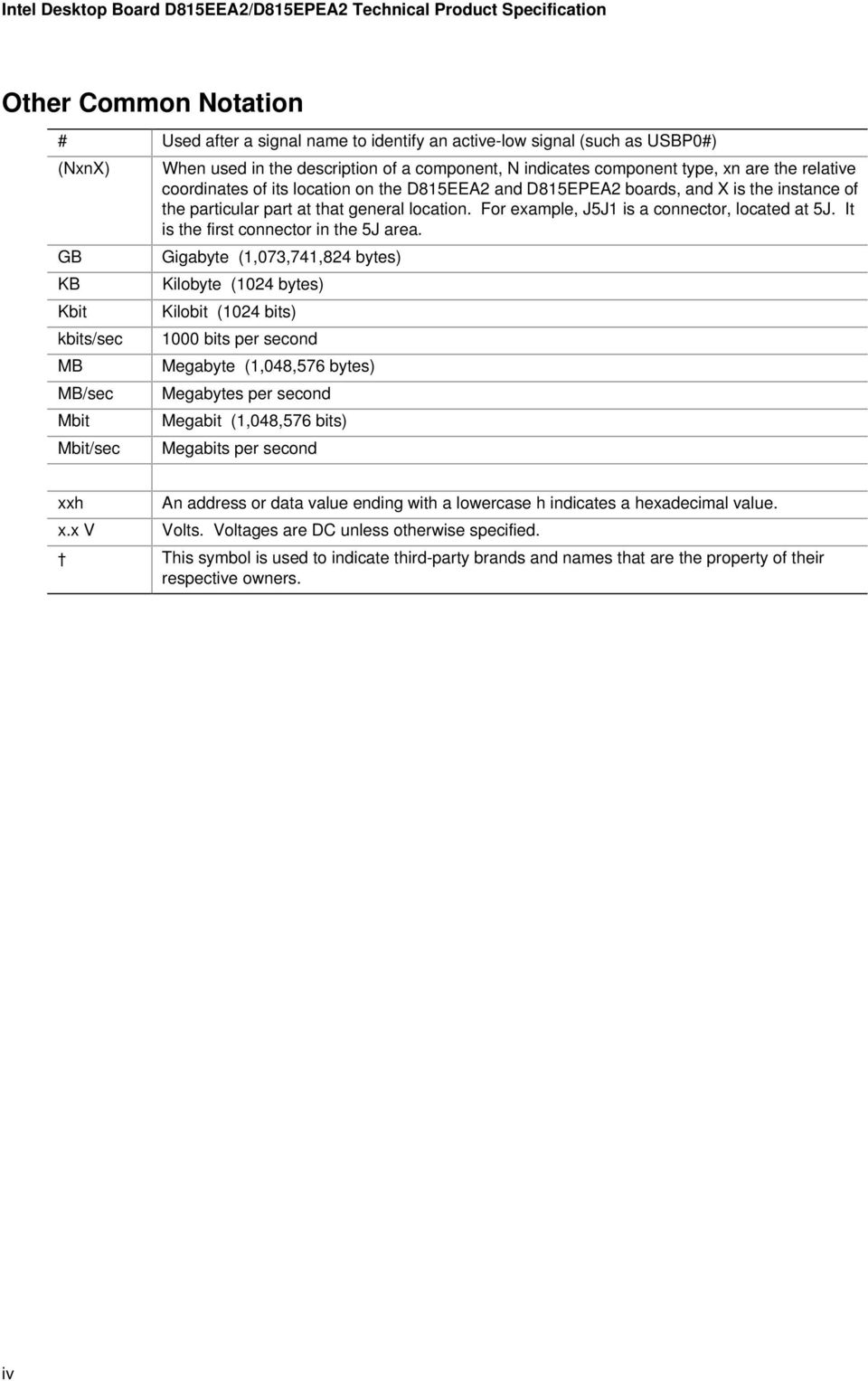
4 Intel Desktop Board D815EEA2/D815EPEA2 Technical Product Specification Other Common Notation # Used after a signal name to identify an active-low signal (such as USBP0#) (NxnX) When used in the description of a component, N indicates component type, xn are the relative coordinates of its location on the D815EEA2 and D815EPEA2 boards, and X is the instance of the particular part at that general location. For example, J5J1 is a connector, located at 5J. It is the first connector in the 5J area. GB Gigabyte (1,073,741,824 bytes) KB Kilobyte (1024 bytes) Kbit Kilobit (1024 bits) kbits/sec 1000 bits per second MB Megabyte (1,048,576 bytes) MB/sec Megabytes per second Mbit Megabit (1,048,576 bits) Mbit/sec Megabits per second xxh x.x V An address or data value ending with a lowercase h indicates a hexadecimal value. Volts. Voltages are DC unless otherwise specified. This symbol is used to indicate third-party brands and names that are the property of their respective owners. iv
5 Contents 1 Product Description 1.1 Board Differences Feature Level Differences Identifying Universal Boards Overview Feature Summary Manufacturing Options Board Layout Block Diagrams Online Support Operating System Support Design Specifications Processor System Memory Chipsets Intel 815E Chipset Intel 815EP Chipset I/O Controller Serial Ports Parallel Port Diskette Drive Controller Keyboard and Mouse Interface Graphics Subsystems Intel 815E Graphics Subsystem Intel 815EP Graphics Subsystem Audio Subsystem AD1885 Audio Codec Audio Connectors LAN Subsystem (Optional) Intel 82562ET Platform LAN Connect Device RJ-45 LAN Connector LEDs Hardware Management Subsystem Hardware Monitor Component Chassis Intrusion Detect Connector (Optional) Fan Control and Monitoring CNR Connector (Optional) Power Management Software Support Hardware Support Technical Reference 2.1 Introduction Memory Map I/O Map

6 Intel Desktop Board D815EEA2/D815EPEA2 Technical Product Specification 2.4 DMA Channels PCI Configuration Space Map Interrupts PCI Interrupt Routing Map Connectors Back Panel Connectors Internal I/O Connectors External I/O Connectors Jumper Blocks Front Panel Audio Connector/Jumper Block BIOS Setup Configuration Jumper Block Mechanical Considerations Form Factor I/O Shields Electrical Considerations Power Consumption Add-in Board Considerations Standby Current Requirements Fan Connector Current Capability Power Supply Considerations Thermal Considerations Reliability Environmental Regulatory Compliance Safety Regulations EMC Regulations Product Certification Markings (Board Level) Overview of BIOS Features 3.1 Introduction BIOS Flash Memory Organization Resource Configuration PCI Autoconfiguration IDE Support System Management BIOS (SMBIOS) Legacy USB Support BIOS Updates Language Support Custom Splash Screen Recovering BIOS Data Boot Options CD-ROM and Network Boot Booting without Attached Devices Fast Booting Systems with Intel Rapid BIOS Boot Peripheral Selection and Configuration Intel Rapid BIOS Boot Operating System Selection BIOS Security Features

7 Contents 4 BIOS Setup Program 4.1 Introduction Maintenance Menu Extended Configuration Submenu Main Menu Advanced Menu PCI Configuration Submenu Boot Configuration Submenu Peripheral Configuration Submenu IDE Configuration Submenu Diskette Configuration Submenu Event Log Configuration Submenu Video Configuration Submenu Security Menu Power Menu APM Submenu ACPI Submenu Boot Menu Boot Device Priority Submenu Hard Disk Drives Submenu Removable Devices Submenu ATAPI CDROM Drives Submenu Exit Menu Error Messages and Beep Codes 5.1 BIOS Error Messages Port 80h POST Codes Bus Initialization Checkpoints Speaker BIOS Beep Codes Diagnostic LEDs (Optional) Figures 1. Location of Universal Board Designator Board Components Block Diagram for the D815EEA2 Board Block Diagram for the D815EPEA2 Board Intel 815E Chipset Block Diagram USB Port Configurations Intel 815EP Chipset Block Diagram USB Port Configurations Block Diagram of Audio Subsystem ICH2 and CNR Signal Interface Using the Wake on LAN Technology Connector Location of Standby Power Indicator LED Back Panel Connectors Audio, Video, Power, and Hardware Control Connectors Add-in Board and Peripheral Interface Connectors External I/O Connectors

8 Intel Desktop Board D815EEA2/D815EPEA2 Technical Product Specification 17. Locations of the Jumper Blocks Board Dimensions I/O Shield Dimensions (for D815EEA2 Universal Boards with Onboard LAN Subsystem) I/O Shield Dimensions (for D815EPEA2 Universal Boards with Onboard LAN Subsystem) I/O Shield Dimensions (for D815EPEA2 Universal Boards without Onboard LAN Subsystem) I/O Shield Dimensions (for D815EEA2 Boards with Onboard LAN Subsystem) I/O Shield Dimensions (for D815EPEA2 Boards with Onboard LAN Subsystem) I/O Shield Dimensions (for D815EPEA2 Boards without Onboard LAN Subsystem) Localized High Temperature Zones Diagnostic LEDs Tables 1. Summary of Board Differences Feature Summary Manufacturing Options Specifications Supported Processors Supported Memory Configurations Supported Graphics Refresh Frequencies LAN Connector LED States Effects of Pressing the Power Switch Power States and Targeted System Power Wake Up Devices and Events Fan Connector Descriptions System Memory Map I/O Map DMA Channels PCI Configuration Space Map Interrupts PCI Interrupt Routing Map Overcurrent Protection for Back Panel Connectors PS/2 Mouse/Keyboard Connectors USB Connectors VGA Port Connector (Present Only on D815EEA2 Boards) Parallel Port Connector Serial Port A Connector LAN Connector (Optional) Mic In Connector Audio Line Out Connector Audio Line In Connector Auxiliary Line In Connector (J6B4) Front Panel Audio Connector (J6B2) (Optional) ATAPI CD-ROM Connector (J6B3) Digital Video Out Connector (J5C1) (Optional; present only on D815EEA2 boards)

9 Contents 33. Processor Fan Connector (J1B1) Power Connector (J4H1) Chassis Fan Connector J4G1 (Optional) System Fan Connector (J9H1) Chassis Intrusion Connector (J9H3) (Optional) Wake on LAN Technology Connector (J9G1) (Optional) CNR Connector (J11B1) (Optional) PCI Bus Connectors (J7B1, J8B2, J9B2, J9B1, and J10B1) AGP Universal Connector (J6C1) Diskette Drive Connector (J6H2) IDE Connectors (J6H1, Primary and J6G2, Secondary) Serial Port B Connector (J8H1) Front Panel USB Connector (J8F1) (Optional) Auxiliary Front Panel Power LED Connector (J9H2) SCSI LED Connector (J8H2) Front Panel Connector (J9H3) States for a Single-Colored Power LED States for a Dual-Colored Power LED Front Panel Audio Connector / Jumper Block (J6B2) BIOS Setup Configuration Jumper Settings (J9G2) Power Usage for a D815EEA2 Board with Onboard LAN Power Usage for a D815EPEA2 Board with Add-in Graphics Card, without Onboard LAN Standby Current Requirements Thermal Considerations for Components D815EEA2 and D815EPEA2 Board Environmental Specifications Safety Regulations EMC Regulations Supervisor and User Password Functions BIOS Setup Program Menu Bar BIOS Setup Program Function Keys Maintenance Menu Extended Configuration Submenu Main Menu Advanced Menu PCI Configuration Submenu Boot Configuration Submenu Peripheral Configuration Submenu IDE Configuration Submenu Primary/Secondary IDE Master/Slave Submenus Diskette Configuration Submenu Event Log Configuration Submenu Video Configuration Submenu Security Menu Power Menu APM Submenu ACPI Submenu Boot Menu Boot Device Priority Submenu

10 Intel Desktop Board D815EEA2/D815EPEA2 Technical Product Specification 81. Hard Disk Drives Submenu Removeable Devices Submenu ATAPI CDROM Drives Submenu Exit Menu BIOS Error Messages Uncompressed INIT Code Checkpoints Boot Block Recovery Code Checkpoints Runtime Code Uncompressed in F000 Shadow RAM Bus Initialization Checkpoints Upper Nibble High Byte Functions Lower Nibble High Byte Functions Beep Codes Diagnostic LED Codes

11 1 Product Description What This Chapter Contains 1.1 Board Differences Overview Online Support Operating System Support Design Specifications Processor System Memory Chipsets I/O Controller Graphics Subsystems Audio Subsystem LAN Subsystem (Optional) Hardware Management Subsystem CNR Connector (Optional) Power Management

12 Intel Desktop Board D815EEA2/D815EPEA2 Technical Product Specification 1.1 Board Differences Feature Level Differences This TPS describes these Intel Desktop boards: D815EEA2 and D815EPEA2. Table 1 summarizes the differences between these boards. Table 1. D815EEA2 D815EPEA2 Summary of Board Differences Includes the Intel 815E Chipset, which includes the Intel Graphics and Memory Controller Hub (GMCH) Provides these video features: AGP universal connector and an optional Digital Video Output (DVO) connector Includes the Intel 815EP Chipset, which includes the Intel 82815EP Memory Controller Hub (MCH) Provides this video feature: AGP universal connector 12

13 Product Description Identifying Universal Boards The Universal versions of the D815EEA2 and D815EPEA2 can be identified by an uppercase U on the silkscreen of the board. Figure 1 shows the location of the Universal board designator. INTEL DESKTOP BOARD D815EEA2 / D815EPEA2 U G BATTERY SIDE UP XBT1061 OM12012 Figure 1. Location of Universal Board Designator NOTE Unless otherwise stated, all information pertaining to standard boards also apply to Universal boards. 13

14 Intel Desktop Board D815EEA2/D815EPEA2 Technical Product Specification 1.2 Overview Feature Summary Table 2 summarizes the D815EEA2 and D815EPEA2 boards major features. Table 2. Form Factor Processor Memory Chipsets I/O Control Video Audio Peripheral Interfaces Expansion Capabilities BIOS Feature Summary ATX (11.55 inches by 8.20 inches) Support for either an Intel Pentium III processor in a Flip Chip Pin Grid Array (FC-PGA) package or an Intel Celeron processor in an FC-PGA package Three 168-pin SDRAM Dual Inline Memory Module (DIMM) sockets Support for up to 512 MB system memory Support for single-sided or double-sided DIMMs The D815EEA2 board includes the Intel 815E Chipset, consisting of: Intel Graphics and Memory Controller Hub (GMCH) Intel 82801BA I/O Controller Hub (ICH2) SST 49LF004A 4 Mbit Firmware Hub (FWH) The D815EPEA2 board includes the Intel 815EP Chipset, consisting of: Intel 82815EP Memory Controller Hub (MCH) Intel 82801BA I/O Controller Hub (ICH2) SST 49LF004A 4 Mbit Firmware Hub (FWH) SMSC LPC47M132 LPC bus I/O controller The D815EEA2 board includes: Intel integrated graphics support AGP universal connector supporting 1x, 2x, and 4x AGP cards or a Graphics Performance Accelerator (GPA) The D815EPEA2 board includes an AGP universal connector supporting 1x, 2x, and 4x AGP cards Intel 82801BA ICH2 digital controller (AC link output) Analog Devices AD1885 Audio Codec Four Universal Serial Bus (USB) ports Two serial ports One parallel port Two IDE interfaces with Ultra DMA, ATA-66/100 support One diskette drive interface PS/2 keyboard and mouse ports Five PCI bus add-in card connectors (SMBus routed to PCI bus connector 2) One AGP universal connector Intel/AMI BIOS (stored in an SST 49LF004A 4 Mbit FWH) Support for Advanced Power Management (APM), Advanced Configuration and Power Interface (ACPI), Plug and Play, and SMBIOS continued 14

15 Product Description Table 2. Instantly Available PC Hardware Monitor Subsystem SCSI LED Connector Feature Summary (continued) Support for PCI Local Bus Specification Revision 2.2 Suspend to RAM support Wake on PS/2 keyboard and USB ports Voltage sense to detect out of range values Two fan sense inputs used to monitor fan activity Allows add-in SCSI host bus adapters to use the same LED as the onboard I/O controller For information about Refer to The board s compliance level with APM, ACPI, Plug and Play, and SMBIOS Table 4, page Manufacturing Options Table 3 describes the D815EEA2 and D815EPEA2 boards manufacturing options. Not every manufacturing option is available in all marketing channels. Please contact your Intel representative to determine which manufacturing options are available to you. Table 3. Chassis fan connector Chassis Intrusion Connector Manufacturing Options Communication and Networking Riser (CNR) Connector Diagnostic LEDs Front Panel Audio Connector Front Panel USB Connector I/O Control LAN Subsystem Video Wake on LAN Technology Connector Connector for an additional chassis fan Detects chassis intrusion One CNR connector (slot shared with PCI bus connector 3) Four dual-color LEDs on the back panel Routes mic in and line out to the front panel Provides access to two additional USB ports, routed through the optional SMSC LPC47M142 I/O controller SMSC LPC47M142 LPC bus I/O controller Intel 82562ET 10/100 Mbit/sec Platform LAN Connect (PLC) device Digital Video Output (DVO) connector Support for system wake up using an add-in network interface card with remote wake up capability 15

16 Intel Desktop Board D815EEA2/D815EPEA2 Technical Product Specification Board Layout Figure 2 shows the location of the major components on the D815EEA2 and D815EPEA2 boards. A B C D E F U G T S R H I J Q P O N M L K Present only on D815EEA2 boards OM11461 A Communication and Networking Riser (CNR) J Primary IDE connector connector (optional) K Speaker B AD1885 audio codec L Power connector C AGP universal connector M Diskette drive connector D Back panel connectors N SMSC LPC47M132 I/O Controller E DVO connector (optional) O Intel 82801BA I/O Controller Hub (ICH2) F Intel Graphics and Memory Controller P Serial port B connector Hub (GMCH) (D815EEA2 boards) Q Front panel connectors Intel 82815EP Memory Controller Hub (MCH) R SST 49LF004A 4 Mbit Firmware Hub (FWH) (D815EPEA2 boards) S Battery G Processor socket T Front panel USB connector (optional) H DIMM sockets U PCI bus add-in card connectors I Secondary IDE connector Figure 2. Board Components 16

17 Product Description Block Diagrams Figure 3 is a block diagram of the major functional areas of the D815EEA2 board. Primary/ Secondary IDE ATA-66/100 USB USB Ports 0 and 1 Processor Socket System Bus USB Ports 2 and 3 815E Chipset DIMM Banks (3) SDRAM Bus Graphics and Memory Controller Hub (GMCH) AHA Bus 82801BA I/O Controller Hub (ICH2) SST 49LF004A Firmware Hub (FWH) DVO Connector (Optional) Digital Video Output Video Bus LPC Bus Diskette Drive Connector AGP Universal Connector PCI Slot 1 PCI Slot 2 AGP Bus PCI Bus Onboard Video LPC I/O Controller Analog Codec Serial Port A Serial Port B Parallel Port PS/2 Mouse PS/2 Keyboard CD-ROM Line In Line Out Mic In Auxiliary Line In Front Panel Audio (optional) PCI Slot 3 Optional PCI Slot 4 PCI Slot 5 AC Link CNR Connector Hardware Monitor SMBus Network Physical Layer Interface LAN Connector indicates connector or socket OM11889 Figure 3. Block Diagram for the D815EEA2 Board 17

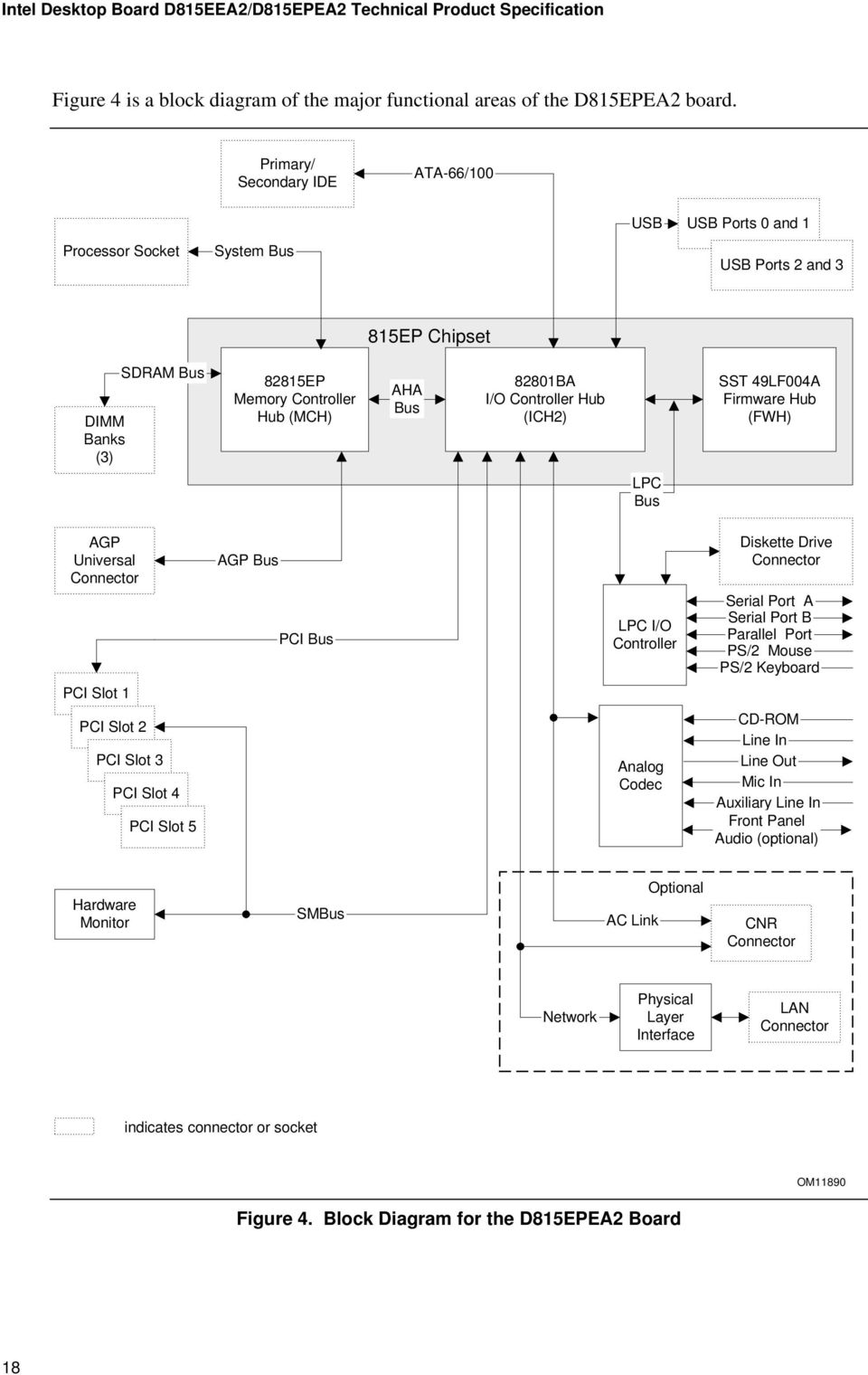
18 Intel Desktop Board D815EEA2/D815EPEA2 Technical Product Specification Figure 4 is a block diagram of the major functional areas of the D815EPEA2 board. Primary/ Secondary IDE ATA-66/100 USB USB Ports 0 and 1 Processor Socket System Bus USB Ports 2 and 3 815EP Chipset DIMM Banks (3) SDRAM Bus 82815EP Memory Controller Hub (MCH) AHA Bus 82801BA I/O Controller Hub (ICH2) SST 49LF004A Firmware Hub (FWH) LPC Bus AGP Universal Connector AGP Bus Diskette Drive Connector PCI Bus LPC I/O Controller Serial Port A Serial Port B Parallel Port PS/2 Mouse PS/2 Keyboard PCI Slot 1 PCI Slot 2 PCI Slot 3 PCI Slot 4 PCI Slot 5 Analog Codec CD-ROM Line In Line Out Mic In Auxiliary Line In Front Panel Audio (optional) Hardware Monitor SMBus AC Link Optional CNR Connector Network Physical Layer Interface LAN Connector indicates connector or socket OM11890 Figure 4. Block Diagram for the D815EPEA2 Board 18
19 Product Description 1.3 Online Support To find information about Intel s D815EEA2 and D815EPEA2 boards under Product Info or Customer Support Processor data sheets ICH2 addressing Custom splash screens Audio software and utilities LAN software and drivers Visit this World Wide Web site: Operating System Support The D815EEA2 and D815EPEA2 boards support drivers for all of the onboard hardware and subsystems under the following operating systems: Windows 98/98SE Windows ME Windows NT 4.0 Windows 2000 For information about Refer to Supported drivers Section 1.3 NOTE Third party vendors may offer other drivers. 19

20 Intel Desktop Board D815EEA2/D815EPEA2 Technical Product Specification 1.5 Design Specifications Table 4 lists the specifications applicable to the D815EEA2 and D815EPEA2 boards, except for the AIMM and GPA entries, which apply only to the D815EEA2 board. Table 4. Reference Name Specifications Specification Title Version, Revision Date, and Ownership AC 97 Audio Codec 97 Revision 2.2, September 2000, Intel Corporation. ACPI AGP AIMM (for Graphics Performance Accelerator cards) AMI BIOS APM ATA/ ATAPI-5 Advanced Configuration and Power Interface Specification Accelerated Graphics Port Interface Specification Version 2.0, July 27, 2000, Compaq Computer Corporation, Intel Corporation, Microsoft Corporation, Phoenix Technologies Limited, and Toshiba Corporation. Revision 2.0, May 4, 1998, Intel Corporation. AGP Inline Memory Module Revision 1.0, April 2000, Intel Corporation. American Megatrends BIOS Specification Advanced Power Management BIOS Interface Specification Information Technology - AT Attachment with Packet Interface - 5 (ATA/ATAPI-5) AMIBIOS 99, 1999, American Megatrends, Inc. Version 1.2, February 1996, Intel Corporation and Microsoft Corporation. Revision 3, February 29, 2000, Contact: T13 Chair, Seagate Technology. ATX ATX Specification Version 2.03, December 1998, Intel Corporation. CNR Communication and Network Riser (CNR) Specification Revision 1.1, October 18, 2000, Intel Corporation. The information is available from ftp://download.intel.com/ial/ scalableplatforms/ac97r22.pdf technology/memory/aimm/ htm bios.platforms.desktop.html hwdev/busbios/amp_12.htm developer/specs/atx/ atxspecs.htm technology/cnr/index.htm continued 20

21 Product Description Table 4. Reference Name DVI Specifications (continued) Specification Title Digital Visual Interface DVI EPP IEEE Std (Enhanced Parallel Port) El Torito GPA (see AIMM) LPC PCI Plug and Play Bootable CD-ROM Format Specification Low Pin Count Interface Specification PCI Local Bus Specification PCI Bus Power Management Interface Specification Plug and Play BIOS Specification Version, Revision Date and Ownership Revision 1.0, April 2, 1999, Intel Corporation, Silicon Image Incorporated, Compaq Computer Corporation, Fujitsu Limited, Hewlett-Packard Company, and NEC Corporation. Version 1.7, 1997, Institute of Electrical and Electronic Engineers. Version 1.0, January 25, 1995, Phoenix Technologies Limited and International Business Machines Corporation. Version 1.0, September 29, 1997, Intel Corporation. Version 2.2, December 18, 1998, PCI Special Interest Group. Version 1.1, December 18, 1998, PCI Special Interest Group. Version 1.0a, May 5, 1994, Compaq Computer Corporation, Phoenix Technologies Limited, and Intel Corporation. The information is available from downloads.html reading/ieee/std_public/ description/busarch/ _desc.html PlatSS/products/specs.html design/chipsets/industry/ lpc.htm hwdev/respec/ pnpspecs.htm continued 21
22 Intel Desktop Board D815EEA2/D815EPEA2 Technical Product Specification Table 4. Reference Name SDRAM SMBIOS UHCI USB WfM Specifications (continued) Specification Title PC SDRAM Unbuffered DIMM Specification Version, Revision Date and Ownership Revision 1.0, February 1998, Intel Corporation. PC SDRAM Specification Revision 1.7, November 1999, Intel Corporation. PC Serial Presence Detect (SPD) Specification System Management BIOS Universal Host Controller Interface Design Guide Universal Serial Bus Specification Wired for Management Baseline Revision 1.2B, November 1999, Intel Corporation. Version 2.3.1, March 16, 1999, American Megatrends Incorporated, Award Software International Incorporated, Compaq Computer Corporation, Dell Computer Corporation, Hewlett-Packard Company, Intel Corporation, International Business Machines Corporation, Phoenix Technologies Limited, and SystemSoft Corporation. Revision 1.1, March 1996, Intel Corporation. Version 1.1, September 23, 1998, Compaq Computer Corporation, Intel Corporation, Microsoft Corporation, and NEC Corporation. Version 2.0, December 18, 1998, Intel Corporation. The information is available from technology/memory technology/memory technology/memory ial/wfm/design/smbios developers developers ial/wfm/wfmspecs.htm 22
23 Product Description 1.6 Processor CAUTION Use only the processors listed below. Use of unsupported processors can damage the board, the processor, and the power supply. See the Intel Desktop D815EEA2/D815EPEA2 Specification Update for the most up-to-date list of supported processors for the D815EEA2 and D815EPEA2 boards. The D815EEA2 and D815EPEA2 boards both support a single Pentium III or Celeron processor. The system bus frequency is automatically selected. The D815EEA2 and D815EPEA2 boards support the processors listed in Table 5. Table 5. Supported Processors Type Designation System Bus Frequency L2 Cache Size Pentium III processor in an FC-PGA package 533EB, 600EB, 667, 733, 800B, 866, and 933 MHz 133 MHz 256 KB Celeron processor in an FC-PGA package 1.0 GHz 500E, 550E, 600E, 650, 700, 750, 800, and 850 MHz 100 MHz 256 KB 800 and 850 MHz 100 MHz 128 KB 533A, 566, 600, 633, 667, 700, 733, and 766 MHz 66 MHz 128 KB All supported onboard memory can be cached, up to the cachability limit of the processor. See the processor s data sheet for cachability limits. For information about Refer to Product information on supported processors Section 1.3, page 19 Processor data sheets Section 1.3, page 19 23
24 Intel Desktop Board D815EEA2/D815EPEA2 Technical Product Specification 1.7 System Memory CAUTION Before installing or removing memory, make sure that AC power is disconnected by unplugging the power cord from the computer. Failure to do so could damage the memory and the board. NOTE Remove the AGP video card before installing or upgrading memory to avoid interference with the memory retention mechanism. NOTE To be fully compliant with all applicable Intel SDRAM memory specifications, the board should be populated with DIMMs that support the Serial Presence Detect (SPD) data structure. This allows the BIOS to read the SPD data and program the chipset to accurately configure memory settings for optimum performance. If non-spd memory is installed, the BIOS will attempt to correctly configure the memory settings, but performance and reliability may be impacted or the DIMMs may not function under the determined frequency. The D815EEA2 and D815EPEA2 boards both have three DIMM sockets and support the following memory features: 3.3 V (only) 168-pin SDRAM DIMMs with gold-plated contacts Unbuffered single-sided or double-sided DIMMs Maximum total system memory: 512 MB; minimum total system memory: 64 MB 133 MHz SDRAM or 100 MHz SDRAM Serial Presence Detect (SPD) and non-spd memory Non-ECC and ECC DIMMs (ECC DIMMs will operate in non-ecc mode only) Suspend to RAM When installing memory, note the following: Non-SPD DIMMs will always revert to a 100 MHz with timing SDRAM bus. Mixing Non-SPD DIMMs with SPD DIMMs will always revert to a 100 MHz with timing SDRAM bus. The BIOS will not initialize installed memory above 512 MB. Mixed memory speed configurations (133 and 100 MHz) will default to 100 MHz. 133 MHz SDRAM operation requires a 133 MHz system bus frequency processor. The board should be populated with no more than four rows of 133 MHz SDRAM (two doublesided or one double-sided plus two single-sided DIMMs). 100 MHz SDRAM may be populated with six rows of SDRAM (three double-sided DIMMs). NOTE At boot, the BIOS displays a message indicating that any installed memory above 512 MB has not been initialized. 24
25 Product Description NOTE If more than four rows of 133 MHz SDRAM are populated, the BIOS will display a message indicating that it will initialize installed memory up to 512 MB at 100 MHz. For information about Refer to Obtaining the PC Serial Presence Detect (SPD) Specification Table 4, page 19 Table 6 lists the supported DIMM configurations. Table 6. DIMM Capacity Supported Memory Configurations Number of Sides SDRAM Density SDRAM Organization Front-side/Back-side Number of SDRAM devices (Note 1) 32 MB DS 16 Mbit 2 M x 8/2 M x MB SS 64 Mbit 4 M x 16/empty 4 48 MB DS 64/16 Mbit 4 M x 16/2 M x MB DS 64 Mbit 4 M x 16/4 M x MB SS 64 Mbit 8 M x 8/empty 8 64 MB SS 128 Mbit 8 M x 16/empty 4 96 MB DS 64 Mbit 8 M x 8/4 M x MB DS 128/64 Mbit 8 M x 16/4 M x MB DS 64 Mbit 8 M x 8/8 M x 8 16 (Note 1) 128 MB DS 128 Mbit 8 M x 16/8 M x MB SS 128 Mbit 16 M x 8/empty MB SS 256 Mbit 16 M x 16/empty MB DS 128 Mbit 16 M x 8/8 M x MB DS 128/64 Mbit 16 M x 8/8 M x MB DS 128 Mbit 16 M x 8/16 M x MB DS 256 Mbit 16 M x 16/16 M x MB SS 256 Mbit 32 M x 8/empty MB DS 256 Mbit 32 M x 8/32 M x 8 16 (Notes 1 and 2) (Notes 1 and 2) (Notes 1 and 2) (Notes 1 and 2) (Notes 1 and 2) (Notes 1 and 2) (Notes 1 and 2) (Notes 1 and 2) (Notes 1 and 2) Notes: 1. If the number of SDRAM devices is greater than nine, the DIMM will be double sided. 2. Front side population/back side population indicated for SDRAM density and SDRAM organization. 3. In the second column, DS refers to double-sided memory modules (containing two rows of SDRAM) and SS refers to single-sided memory modules (containing one row of SDRAM). 25
26 Intel Desktop Board D815EEA2/D815EPEA2 Technical Product Specification 1.8 Chipsets This section describes the chipsets used by the D815EEA2 and D815EPEA2 boards: The D815EEA2 board uses the Intel 815E Chipset, described below. The D815EPEA2 board uses the Intel 815EP Chipset, described in Section 1.8.2, beginning on page Intel 815E Chipset The Intel 815E chipset consists of the following devices: Graphics and Memory Controller Hub (GMCH) with Accelerated Hub Architecture (AHA) bus 82801BA I/O Controller Hub (ICH2) with AHA bus SST 49LF004A Firmware Hub (FWH) The GMCH is a centralized controller for the system bus, the memory bus, the AGP bus, and the AHA bus. The ICH2 is a centralized controller for the board s I/O paths. The FWH provides the nonvolatile storage of the BIOS. The Intel 815E chipset provides the interfaces shown in Figure 5. ATA-66/100 Network System Bus USB SDRAM Bus 815E Chipset Graphics and Memory Controller Hub (GMCH) AHA Bus 82801BA I/O Controller Hub (ICH2) SST 49LF004A Firmware Hub (FWH) Digital Video Output Display Interface AGP Bus SMBus PCI Bus AC Link LPC Bus OM11891 Figure 5. Intel 815E Chipset Block Diagram For information about Refer to The Intel 815E chipset The resources used by the chipset Chapter 2 The chipset s compliance with ACPI, APM, and AC 97 Table 4, page 19 26
27 Product Description Intel Graphics and Memory Controller Hub (GMCH) The GMCH provides the following: An integrated Synchronous DRAM memory controller with autodetection of SDRAM An interface for a single AGP device or a Graphics Performance Accelerator (GPA) card An interface for an optional digital video output (DVO) connector for a flat panel, digital CRT, or TV-out Support for ACPI Rev. 2.0 and APM Rev. 1.2 compliant power management Intel 82801BA I/O Controller Hub (ICH2) The ICH2 provides the following: 33 MHz PCI bus interface Support for up to six PCI master devices Low Pin Count (LPC) interface that supports an LPC-compatible I/O controller Support for two Master/DMA devices Integrated IDE controller that supports Ultra DMA (33 MB/sec) and ATA-66/100 mode (66 MB/sec, 100 MB/sec) Integrated LAN Media Access Controller Universal Serial Bus interface with two USB controllers providing four ports in a UHCI Implementation (additional USB ports provided with the optional SMSC LPC47M142 I/O controller) Power management logic for ACPI Rev. 1.0b compliance System Management Bus (SMBus clock and data lines also routed to PCI bus connector 2) Real-time clock with 256-byte battery-backed CMOS RAM AC 97 digital link for audio codec, including: AC compliance Logic for PCM in, PCM out, and mic input PCI functions for audio Communication and Network Riser (CNR) interface IDE Interfaces The ICH2 s IDE controller has two independent bus-mastering IDE interfaces that can be independently enabled. The IDE interfaces support the following modes: Programmed I/O (PIO): CPU controls data transfer style DMA: DMA offloads the CPU, supporting transfer rates of up to 16 MB/sec. Ultra DMA: DMA protocol on IDE bus supporting host and target throttling and transfer rates of up to 33 MB/sec. ATA-66: DMA protocol on IDE bus supporting host and target throttling and transfer rates of up to 66 MB/sec. ATA-66 protocol is similar to Ultra DMA and is device driver compatible. ATA-100: DMA protocol on IDE bus allows host and target throttling. The ICH2 ATA-100 logic can achieve read transfer rates up to 100 MB/sec and write transfer rates up to 88 MB/sec. NOTE ATA-66 and ATA-100 are faster timings and require a specialized cable to reduce reflections, noise, and inductive coupling. 27
28 Intel Desktop Board D815EEA2/D815EPEA2 Technical Product Specification The IDE interfaces also support ATAPI devices (such as CD-ROM drives) and ATA devices using the transfer modes listed in Table 71 on page 121. The BIOS supports Logical Block Addressing (LBA) and Extended Cylinder Head Sector (ECHS) translation modes. The drive reports the transfer rate and translation mode to the BIOS. The D815EEA2 board supports Laser Servo (LS-120) diskette technology through its IDE interfaces. The LS-120 drive can be configured as a boot device by setting the BIOS Setup program s Boot menu to one of the following: ARMD-FDD (ATAPI removable media device floppy disk drive) ARMD-HDD (ATAPI removable media device hard disk drive) For information about Refer to The location of the IDE connectors Figure 15, page 73 The signal names of the IDE connectors Table 43, page 77 BIOS Setup program s Boot menu Section 4.7, page USB The ICH2 contains two separate USB controllers. The D815EEA2 board has four USB ports; one USB peripheral can be connected to each port. For more than four USB devices, an external hub can be connected to any of the ports. The D815EEA2 board fully supports the Universal Hub Controller Interface (UHCI). In the standard configuration, the D815EEA2 board s four USB ports are implemented with stacked back panel connectors, routed through the ICH2, as shown in Figure 6. With the optional SMSC LPC47M142 I/O controller, the D815EEA2 board supports up to seven USB ports. The SMSC LPC47M142 I/O controller provides four ports: two ports implemented with stacked back panel connectors and two ports routed to the optional front panel USB connector at location J8F1. The ICH2 provides three ports: two ports are implemented with stacked back panel connectors and the other port is accessible through a CNR add-in card, as shown in Figure 6. The D815EEA2 board fully supports the Universal Hub Controller Interface (UHCI). 28
29 Product Description Standard Configuration 82801BA I/O Controller Hub (ICH2) USB USB ports 0 and 1 USB ports 2 and 3 Back panel USB connectors Back panel USB connectors Optional Configuration 82801BA I/O Controller Hub (ICH2) USB USB ports 0 and 2 CNR connector Back panel USB connectors USB port accesible through a USB connector on an optional CNR add-in card USB SMSC LPC47M142 LPC Bus I/O Controller USB USB ports 1 and 3 USB ports 4 and 5 Back panel USB connectors Front panel USB connector OM11892 Figure 6. USB Port Configurations NOTE Computer systems that have an unshielded cable attached to a USB port may not meet FCC Class B requirements, even if no device or a low-speed USB device is attached to the cable. Use shielded cable that meets the requirements for full-speed devices. For information about Refer to The location of the USB connectors on the back panel Figure 13, page 64 The signal names of the back panel USB connectors Table 21, page 65 The location of the optional front panel USB connector Figure 16, page 78 The signal names of the optional front panel USB connector Table 45, page 79 The USB specification and UHCI Table 4, page 20 29
30 Intel Desktop Board D815EEA2/D815EPEA2 Technical Product Specification Real-Time Clock, CMOS SRAM, and Battery The real-time clock provides a time-of-day clock and a multicentury calendar with alarm features. The real-time clock supports 256 bytes of battery-backed CMOS SRAM in two banks that are reserved for BIOS use. A coin-cell battery (CR2032) powers the real-time clock and CMOS memory. When the computer is not plugged into a wall socket, the battery has an estimated life of three years. When the computer is plugged in, the standby current from the power supply extends the life of the battery. The clock is accurate to ± 13 minutes/year at 25 ºC with 3.3 VSB applied. The time, date, and CMOS values can be specified in the BIOS Setup program. The CMOS values can be returned to their defaults by using the BIOS Setup program. NOTE If the battery and AC power fail, custom defaults, if previously saved, will be loaded into CMOS SRAM at power-on SST 49LF004A 4 Mbit Firmware Hub (FWH) The system BIOS is stored in the FWH. 30
31 Product Description Intel 815EP Chipset The Intel 815EP chipset consists of the following devices: 82815EP Memory Controller Hub (MCH) with Accelerated Hub Architecture (AHA) bus 82801BA I/O Controller Hub (ICH2) with AHA bus SST 49LF004A Firmware Hub (FWH) The MCH is a centralized controller for the system bus, the memory bus, the AGP bus, and the AHA bus. The ICH2 is a centralized controller for the board s I/O paths. The FWH provides the nonvolatile storage of the BIOS. The Intel 815EP chipset provides the interfaces shown in Figure 7. ATA-66/100 Network System Bus USB SDRAM Bus 815EP Chipset 82815EP Memory Controller Hub (MCH) AHA Bus 82801BA I/O Controller Hub (ICH2) SST 49LF004A Firmware Hub (FWH) LPC Bus AGP Bus SMBus PCI Bus AC Link OM11318 Figure 7. Intel 815EP Chipset Block Diagram For information about Refer to The Intel 815EP chipset The resources used by the chipset Chapter 2 The chipset s compliance with ACPI, APM, and AC 97 Table 4, page 20 31
32 Intel Desktop Board D815EEA2/D815EPEA2 Technical Product Specification Intel 82815EP Memory Controller Hub (MCH) The MCH provides the following: An integrated Synchronous DRAM memory controller with autodetection of SDRAM An interface for a single AGP device Support for ACPI Rev. 2.0 and APM Rev. 1.2 compliant power management Intel 82801BA I/O Controller Hub (ICH2) The ICH2 provides the following: 33 MHz PCI bus interface Support for up to six PCI master devices Low Pin Count (LPC) interface that supports an LPC-compatible I/O controller Support for two Master/DMA devices Integrated IDE controller that supports Ultra DMA (33 MB/sec) and ATA-66/100 mode (66 MB/sec, 100 MB/sec) Integrated LAN Media Access Controller Universal Serial Bus interface with two USB controllers providing four back panel ports in a UHCI Implementation (additional USB ports provided with the optional SMSC LPC47M142 I/O controller) Power management logic for ACPI Rev. 1.0b compliance System Management Bus (SMBus clock and data lines also routed to PCI bus connector 2) Real-time clock with 256-byte battery-backed CMOS RAM AC 97 digital link for audio codec, including: AC compliance Logic for PCM in, PCM out, and mic input PCI functions for audio Communication and Network Riser (CNR) interface IDE Interfaces The ICH2 s IDE controller has two independent bus-mastering IDE interfaces that can be independently enabled. The IDE interfaces support the following modes: Programmed I/O (PIO): CPU controls data transfer style DMA: DMA offloads the CPU, supporting transfer rates of up to 16 MB/sec. Ultra DMA: DMA protocol on IDE bus supporting host and target throttling and transfer rates of up to 33 MB/sec. ATA-66: DMA protocol on IDE bus supporting host and target throttling and transfer rates of up to 66 MB/sec. ATA-66 protocol is similar to Ultra DMA and is device driver compatible. ATA-100: DMA protocol on IDE bus allows host and target throttling. The ICH2 ATA-100 logic can achieve read transfer rates up to 100 MB/sec and write transfer rates up to 88 MB/sec. NOTE ATA-66 and ATA-100 are faster timings and require a specialized cable to reduce reflections, noise, and inductive coupling. 32
33 Product Description The IDE interfaces also support ATAPI devices (such as CD-ROM drives) and ATA devices using the transfer modes listed in Table 71 on page 121. The BIOS supports Logical Block Addressing (LBA) and Extended Cylinder Head Sector (ECHS) translation modes. The drive reports the transfer rate and translation mode to the BIOS. The D815EEA2 board supports Laser Servo (LS-120) diskette technology through its IDE interfaces. The LS-120 drive can be configured as a boot device by setting the BIOS Setup program s Boot menu to one of the following: ARMD-FDD (ATAPI removable media device floppy disk drive) ARMD-HDD (ATAPI removable media device hard disk drive) For information about Refer to The location of the IDE connectors Figure 15, page 73 The signal names of the IDE connectors Table 43, page 77 BIOS Setup program s Boot menu Section 4.7, page USB The ICH2 contains two separate USB controllers. The D815EPEA2 board has four USB ports; one USB peripheral can be connected to each port. For more than four USB devices, an external hub can be connected to any of the ports. The D815EPEA2 board fully supports the Universal Hub Controller Interface (UHCI). In the standard configuration, the D815EPEA2 board s four USB ports are implemented with stacked back panel connectors, routed through the ICH2, as shown in Figure 8. With the optional SMSC LPC47M142 I/O controller, the D815EPEA2 board supports up to seven USB ports. The SMSC LPC47M142 I/O controller provides four ports: two ports implemented with stacked back panel connectors and two ports routed to the optional front panel USB connector at location J8F1. The ICH2 provides three ports: two ports are implemented with stacked back panel connectors and the other port is accessible through a CNR add-in card, as shown in Figure 8. The D815EPEA2 board fully supports the Universal Hub Controller Interface (UHCI). 33
34 Intel Desktop Board D815EEA2/D815EPEA2 Technical Product Specification Standard Configuration 82801BA I/O Controller Hub (ICH2) USB USB ports 0 and 1 USB ports 2 and 3 Back panel USB connectors Back panel USB connectors Optional Configuration 82801BA I/O Controller Hub (ICH2) USB USB ports 0 and 2 CNR connector Back panel USB connectors USB port accesible through a USB connector on an optional CNR add-in card USB SMSC LPC47M142 LPC Bus I/O Controller USB USB ports 1 and 3 USB ports 4 and 5 Back panel USB connectors Front panel USB connector OM11892 Figure 8. USB Port Configurations NOTE Computer systems that have an unshielded cable attached to a USB port may not meet FCC Class B requirements, even if no device or a low-speed USB device is attached to the cable. Use shielded cable that meets the requirements for full-speed devices. For information about Refer to The location of the USB connectors on the back panel Figure 13, page 64 The signal names of the back panel USB connectors Table 21, page 65 The location of the optional front panel USB connector Figure 16, page 78 The signal names of the optional front panel USB connector Table 45, page 79 The USB specification and UHCI Table 4, page 20 34
35 Product Description Real-Time Clock, CMOS SRAM, and Battery The real-time clock provides a time-of-day clock and a multicentury calendar with alarm features. The real-time clock supports 256 bytes of battery-backed CMOS SRAM in two banks that are reserved for BIOS use. A coin-cell battery (CR2032) powers the real-time clock and CMOS memory. When the computer is not plugged into a wall socket, the battery has an estimated life of three years. When the computer is plugged in, the standby current from the power supply extends the life of the battery. The clock is accurate to ± 13 minutes/year at 25 ºC with 3.3 VSB applied. The time, date, and CMOS values can be specified in the BIOS Setup program. The CMOS values can be returned to their defaults by using the BIOS Setup program. NOTE If the battery and AC power fail, custom defaults, if previously saved, will be loaded into CMOS SRAM at power-on SST 49LF004A 4 Mbit Firmware Hub (FWH) The system BIOS is stored in the FWH. 35
36 Intel Desktop Board D815EEA2/D815EPEA2 Technical Product Specification 1.9 I/O Controller The D815EEA2 and D815EPEA2 boards support either of two I/O controllers: The standard SMSC LPC47M132 I/O controller or The optional SMSC LPC47M142 I/O controller Both I/O controllers provide the following features: Low pin count (LPC) interface 3.3 V operation Two serial ports One parallel port with Extended Capabilities Port (ECP) and Enhanced Parallel Port (EPP) support Serial IRQ interface compatible with serialized IRQ support for PCI systems PS/2-style mouse and keyboard interfaces Interface for one 1.2 MB, 1.44 MB, or 2.88 MB diskette drive Intelligent power management, including a programmable wake up event interface PCI power management support Fan control One fan control output Two fan tachometer inputs The optional SMSC LPC47M142 I/O controller provides an additional USB hub. The BIOS Setup program provides configuration options for the I/O controller. For information about Refer to The USB hubs on the D815EEA2 board Section , page 28 The USB hubs on the D815EPEA2 board Section , page 33 SMSC LPC47M132 and LPC47M142 I/O controllers Serial Ports The D815EEA2 and D815EPEA2 boards each have two serial ports. Serial port A is located on the back panel. Serial port B is accessible using the connector at location J8H1. The serial ports NS16C550-compatible UARTs support data transfers at speeds up to kbits/sec with BIOS support. The serial ports can be assigned as COM1 (3F8h), COM2 (2F8h), COM3 (3E8h), or COM4 (2E8h). For information about Refer to The location of the serial port A connector Figure 13, page 64 The signal names of the serial port A connector Table 24, page 66 The location of the serial port B connector Figure 16, page 78 The signal names of the serial port B connector Table 44, page 79 36
37 Product Description Parallel Port The connector for the parallel port is a 25-pin D-Sub connector located on the back panel. In the BIOS Setup program, the parallel port can be set to the following modes: Output only (PC-AT -compatible mode) Bi-directional (PS/2 compatible) EPP ECP For information about Refer to The location of the parallel port connector Figure 13, page 64 The signal names of the parallel port connector Table 23, page 65 Setting the parallel port s mode Table 69, page Diskette Drive Controller The I/O controller supports one diskette drive that is compatible with the diskette drive controller and supports both PC-AT and PS/2 modes. For information about Refer to The location of the diskette drive connector Figure 15, page 73 The signal names of the diskette drive connector Table 42, page 77 The supported diskette drive capacities and sizes Table 72, page Keyboard and Mouse Interface PS/2 keyboard and mouse connectors are located on the back panel. The +5 V lines to these connectors are protected with a thermistor, which limits the current to a specified amperage. NOTE The keyboard is supported in the bottom PS/2 connector and the mouse is supported in the top PS/2 connector. Power to the computer should be turned off before a keyboard or mouse is connected or disconnected. The keyboard controller contains the AMI keyboard and mouse controller code, provides the keyboard and mouse control functions, and supports password protection for power-on/reset. A power-on/reset password can be specified in the BIOS Setup program. The keyboard controller also supports the hot-key sequence <Ctrl><Alt><Del> for a software reset (operating system dependent). This key sequence resets the computer s software by jumping to the beginning of the BIOS code and running the power-on self-test (POST). For information about Refer to The location of the keyboard and mouse connectors Figure 13, page 64 The signal names of the keyboard and mouse connectors Table 20, page 65 Overcurrent protection for back panel connectors Table 19, page 65 37
38 Intel Desktop Board D815EEA2/D815EPEA2 Technical Product Specification 1.10 Graphics Subsystems This section describes the graphics subsystems used by the D815EEA2 and D815EPEA2 boards: The D815EEA2 board uses the Intel 815E graphics subsystem, described below. The D815EPEA2 board uses the Intel 815EP graphics subsystem, described in Section , beginning on page Intel 815E Graphics Subsystem The 815E chipset, used on the D815EEA2 board, contains two separate, mutually exclusive graphics options. Either the integrated graphics controller (contained within the GMCH) is used, or an add-in AGP adapter can be used. The GMCH includes an integrated display cache SDRAM controller that supports a Graphics Performance Accelerator (GPA) card. The GPA card is a 32-bit 133 MHz 4 MB SDRAM array for enhanced integrated 2D and 3D graphics performance. This interface is multiplexed between the display cache interface and the AGP connector. When an AGP card is installed, the integrated graphics controller is disabled and the display cache interface is not used. For information about Refer to GPA support Section , page Integrated Graphics Controller The GMCH features the following: Integrated graphics controller 3-D Hyperpipelined architecture Full 2-D hardware acceleration Motion video acceleration 3-D graphics visual and texturing enhancement Display Integrated 24-bit 230 MHz RAMDAC Display Data Channel Standard, Version 3.0, Level 2B protocols compliant Video Hardware motion compensation for software MPEG2 decode Software DVD at 30 fps Integrated graphics memory controller 38
39 Product Description Table 7 lists the refresh frequencies supported by the graphics subsystem. Table 7. Resolution 320 x x x x x x x x 480 Supported Graphics Refresh Frequencies Available Refresh Color Palette Frequencies (Hz) Notes 256 colors 70 D 64 K colors 70 D3 16 M colors 70 D 256 colors 70 D 64 K colors 70 D3 16 M colors 70 D 256 colors 70 D 64 K colors 70 D3 16 M colors 70 D 256 colors 70 D 64 K colors 70 D3 16 M colors 70 D 256 colors 70 D 64 K colors 70 D3 16 M colors 70 D 256 colors 70 D 64 K colors 70 D3 16 M colors 70 D 256 colors 70 D 64 K colors 70 D3 16 M colors 70 D 256 colors 60, 70, 72, 75, 85 KDO 64 K colors 60, 75, 85 KD3O 64 K colors 70, 72 KDO 640 x M colors 60, 70, 72, 75, 85 KDO 800 x x colors 60, 70, 72, 75, 85 KDO 64 K colors 60, 70, 72, 75, 85 KD3O 16 M colors 60, 70, 72, 75, 85 KDO 256 colors 60, 70, 75, 85 KDO 64 K colors 60, 70, 75 KD3O 64 K colors 85 KD3 16 M colors 60, 70, 75, 85 KD continued 39
40 Intel Desktop Board D815EEA2/D815EPEA2 Technical Product Specification Table 7. Resolution 1152 x x x 1024 Supported Graphics Refresh Frequencies (continued) Color Palette Available Refresh Frequencies (Hz) Notes 256 colors 60, 70, 72, 75 KDO 256 colors 85 KD 64 K colors 60, 70 KD3O 64 K colors 72, 75, 85 KD3 16 M colors 60 KDO 16 M colors 75, 85 KD 256 colors 60 (reduced blanking) KDOF 64 K colors 60 (reduced blanking) KD3F 16 M colors 60 (reduced blanking) KDF 256 colors 60 KDO 256 colors 70, 72, 75, 85 KD 64 K colors 60, 70, 72, 75, 85 KD3 16 M colors 60, 70, 75, 85 KD 1600 x colors 60, 70, 72, 75 KD Notes: K = Desktop D = DirectDraw 3 = Direct3D and OpenGL O = Overlay F = Digital Display Device only. A mode will be supported on both analog CRTs and digital display devices (KD3O applies to both types of displays), unless indicated otherwise. For information about Refer to Obtaining graphics software and utilities Section 1.3, page Digital Video Output (DVO) Connector (Optional) The D815EEA2 board routes the Intel GMCH DVO port to an optional onboard 40-pin DVO connector. The DVO connector can be cabled to a DVI or TV out card to enable digital displays or TV out functionality. The Digital Visual Interface (DVI) specification provides a high-speed digital connection for visual data types when using the integrated graphics controller. This interface is active only when the integrated graphics controller is enabled. The DVI interface allows interfacing with a discrete Transmission Minimized Differential Signaling (TMDS) transmitter to enable platform support for DVI compliant digital displays or with a discrete TV encoder for TV out functionality. For information about Refer to The location of the DVO connector Figure 14, page 69 The signal names of the DVO connector Table 32, page 71 Obtaining the DVI specification Table 4, page 20 40
41 Product Description AGP Universal Connector NOTE Install memory in the DIMM sockets prior to installing the AGP video card to avoid interference with the memory retention mechanism. The AGP universal connector supports either: Graphics Performance Accelerator (GPA) cards with 133 MHz SDRAM display cache 1x, 2x, or 4x AGP add-in cards with either 3.3 V or 1.5 V I/O For information about Refer to The location of the AGP universal connector Figure 15, page 73 The signal names of the AGP universal connector Table 41, page Graphics Performance Accelerator (GPA) Support The Intel 815E GMCH display cache is a single channel 32-bit wide SDRAM interface. The 4 MB display cache resides on a GPA card that plugs into the AGP connector. The BIOS detects a GPA card if present in the AGP port and initializes it as display cache memory. When a GPA card is initialized, the BIOS allocates 1 MB of system memory to support the internal display device operation Dynamic Video Memory Technology (DVMT) DVMT enables enhanced graphics and memory performance through Direct AGP, and highly efficient memory utilization. DVMT ensures the most efficient use of all available memory for maximum 2D/3D graphic performance. DVMT is implemented on the D815EEA2 board with a GPA (Graphics Performance Accelerator) card installed in the AGP connector. NOTE In earlier documentation, the GPA card was referred to as the AGP Inline Memory Module (AIMM). DVMT uses 1 MB of system physical memory for compatibility with legacy applications. An example of this would be when using VGA graphics under DOS. Once loaded, the operating system and graphics drivers allocate the buffers needed for performing graphics functions. When the 4 MB GPA card is installed, the Z-buffer and GDI data are managed directly from this dedicated graphics memory thereby avoiding operating system memory manager calls and improving performance. At system BIOS POST, the BIOS displays either the amount of physical memory allocated for display cache or the size of the GPA card (4 MB) if installed. Operating systems such as Windows NT 4.0 and Windows 2000 may display the maximum amount of frame buffer memory possible based on the system memory configuration. 41
42 Intel Desktop Board D815EEA2/D815EPEA2 Technical Product Specification NOTE The use of DVMT requires operating system driver support. For information about Refer to Obtaining the DVMT white paper Obtaining the AIMM specification Table 4, page AGP Add-in Card Support AGP is a high-performance interface for graphics-intensive applications, such as 3D applications. While based on the PCI Local Bus Specification, Rev. 2.1, AGP is independent of the PCI bus and is intended for exclusive use with graphical display devices. AGP overcomes certain limitations of the PCI bus related to handling large amounts of graphics data with the following features: Pipelined memory read and write operations that hide memory access latency Demultiplexing of address and data on the bus for nearly 100 percent efficiency For information about Refer to Obtaining the Accelerated Graphics Port Interface Specification Table 4, page Intel 815EP Graphics Subsystem NOTE Install memory in the DIMM sockets prior to installing the AGP video card to avoid interference with the memory retention mechanism. The Intel 815EP chipset, used on the D815EPEA2 board, provides an AGP universal connector which supports a 1x, 2x, or 4x AGP add-in card with either 3.3 V or 1.5 V I/O. AGP is a high-performance interface for graphics-intensive applications, such as 3D applications. While based on the PCI Local Bus Specification, Rev. 2.1, AGP is independent of the PCI bus and is intended for exclusive use with graphical display devices. AGP overcomes certain limitations of the PCI bus related to handling large amounts of graphics data with the following features: Pipelined memory read and write operations that hide memory access latency Demultiplexing of address and data on the bus for nearly 100 percent efficiency For information about Refer to The location of the AGP universal connector Figure 15, page 73 The signal names of the AGP universal connector Table 41, page 76 Obtaining the Accelerated Graphics Port Interface Specification Table 4, page 20 42
43 Product Description 1.11 Audio Subsystem The D815EEA2 and D815EPEA2 boards both include an Audio Codec 97 (AC 97) compatible audio subsystem consisting of these devices: Intel 82801BA I/O Controller Hub (ICH2) Analog Devices AD1885 analog codec AD1885 Audio Codec The AD1885 is a fully AC 97 compliant codec. The codec s features include: > 90 db signal-to-noise ratio sound quality Power management support for APM 1.2 and ACPI 1.0 (driver dependant) Playback sample rates up to 48 khz 16 bit stereo full-duplex codec Software compatible with Windows 98 SE, Windows 2000, Windows NT 4.0, and Windows Millennium (Me) Full-duplex operation at asynchronous hardware record/playback samples rates Frequency response: 20 Hz to 20 khz (± 0.1 db) Figure 9 is a block diagram of the D815EEA2 and D815EPEA2 boards audio subsystem, including the Intel 82801BA ICH2 digital controller, the AD1885 analog codec, and the audio connectors BA I/O Controller Hub (ICH2) AC 97 Link Analog Devices AD1885 Analog Codec CD-ROM Line In Audio In Mic In Front Panel Audio (optional) Line Out OM11888 Figure 9. Block Diagram of Audio Subsystem For information about Refer to Obtaining the AC 97 specification Table 4, page Audio Connectors The audio connectors include the following: Front panel audio (optional): Mic in Line out ATAPI-style connectors: CD-ROM Auxiliary line in 43
44 Intel Desktop Board D815EEA2/D815EPEA2 Technical Product Specification Back panel audio connectors: Line in Line out Mic in For information about Refer to The back panel audio connectors Section 2.8.1, page Front Panel Audio Connector (Optional) A 2 x 5-pin connector for routing mic in and line out to the front panel. For information about Refer to The location of the optional front panel audio connector Figure 14, page 69 The signal names of the optional front panel audio connector Table 30, page 70 NOTE The front panel audio connector is alternately used as a jumper block for routing audio signals. Refer to Section on page 82 for more information ATAPI CD-ROM Connector A 1 x 4-pin ATAPI-style connector connects an internal ATAPI CD-ROM drive to the audio mixer. For information about Refer to The location of the ATAPI CD-ROM connector Figure 14, page 69 The signal names of the ATAPI CD-ROM connector Table 31, page Auxiliary Line In Connector A 1 x 4-pin ATAPI-style connector connects the left and right channel signals of an internal audio device to the audio subsystem. For information about Refer to The location of the auxiliary line in connector Figure 14, page 69 The signal names of the auxiliary line in connector Table 29, page 70 44
45 Product Description 1.12 LAN Subsystem (Optional) The network interface controller subsystem consists of the ICH2, with integrated LAN Media Access Controller (MAC), and a physical layer interface device. Features of the LAN subsystem include: PCI Bus Master Interface CSMA/CD Protocol Engine Serial CSMA/CD unit interface that supports the following physical layer interface devices: 82562ET onboard LAN 82562ET/MT (10/100 Mbit/sec Ethernet) on the optional CNR 82562EH (1 Mbit/sec HomePNA ) on the optional CNR PCI Power Management Supports APM Supports ACPI technology Supports Wake up from suspend state (optional Wake on LAN technology) For information about Refer to Obtaining LAN software and drivers Section 1.3, page Intel 82562ET Platform LAN Connect Device The Intel 82562ET component provides an interface to the back panel RJ-45 connector with integrated LEDs. This physical interface may alternately be provided through the CNR connector. The Intel 82562ET provides the following functions: Basic 10/100 Ethernet LAN Connectivity Supports RJ-45 connector with status indicator LEDs Full driver compatibility Advanced Power Management support Programmable transit threshold Configuration EEPROM that contains the MAC address RJ-45 LAN Connector LEDs Two LEDs are built into the RJ-45 LAN connector. Table 8 describes the LED states when the board is powered up and the LAN subsystem is operating. Table 8. LAN Connector LED States LED Color LED State Condition Green Off 10 Mbit/sec data rate is selected. On 100 Mbit/sec date rate is selected. Yellow Off LAN link is not established. On (steady state) LAN link is established. On (brighter and pulsing) The computer is communicating with another computer on the LAN. 45
46 Intel Desktop Board D815EEA2/D815EPEA2 Technical Product Specification 1.13 Hardware Management Subsystem The hardware management features enable the board to be compatible with the Wired for Management (WfM) specification. The board has several hardware management features, including the following: Hardware monitoring Chassis intrusion detect connector (optional) Fan control and monitoring (implemented on both the SMSC LPC47M132 and optional SMSC LPC47M142 I/O controllers) For information about Refer to The WfM specification Table 4, page 19 Fan control functions of the SMSC LPC47M132 and Section , page 46 optional SMSC LPC47M142 I/O controllers Hardware Monitor Component The hardware monitor component provides low-cost instrumentation capabilities. The features of the component include: Internal ambient temperature sensing Remote thermal diode sensing for direct monitoring of processor temperature (if supported in the processor) Power supply monitoring (+12 V, +5 V, +3.3 V, +2.5 V, 3.3 VSB, and VCCP) to detect levels above or below acceptable values SMBus interface Chassis Intrusion Detect Connector (Optional) The board supports a chassis security feature that detects if the chassis cover is removed. For the chassis intrusion circuit to function, the chassis power supply must be connected to AC power. The security feature uses a mechanical switch on the chassis that attaches to the chassis intrusion detect connector. The mechanical switch is closed for normal computer operation. Chassis intrusion detection can be supported with third party SMBus software. For information about Refer to The location of the optional chassis intrusion detect connector Figure 14, page 69 The signal names of the optional chassis intrusion detect connector Table 37, page 72 46
47 Product Description Fan Control and Monitoring The SMSC LPC47M132 I/O controller and the optional SMSC LPC47M142 I/O controller both provide fan tachometer input for the processor fan (fan 1) and system fan (fan 2) and fan control output for the system fan (fan 2) and the chassis fan (fan 3). Monitoring and control can be implemented using third-party software. For information about Refer to The functions of the fan connectors Section , page 53 The location of the fan connectors Figure 14, page 69 The signal names of the fan connectors Section , page CNR Connector (Optional) The CNR connector supports the audio, modem, USB, and LAN interfaces of the Intel 815E and Intel 815EP chipsets. Figure 10 shows the signal interface between the riser and the ICH2. Intel 82801BA I/O Controller Hub (ICH2) AC 97 Interfaces LAN Interface SMBus USB (Optional) CNR Connector Communication and Networking Riser (Up to two AC 97 codecs and one LAN device) OM11484 Figure 10. ICH2 and CNR Signal Interface NOTE The USB interface from the ICH2 to the CNR is optional on this board. The interfaces supported by the CNR connector include (but are not limited to) the following: AC 97 interface: supports audio and/or modem functions on the CNR board. LAN interface: interface includes an eight-pin interface for use with Platform LAN Connect (PLC) based devices. SMBus interface: provides Plug-and-Play functionality for the CNR board. USB interface (optional): provides a USB interface for the CNR board. To learn more about the CNR, refer to the CNR specification. For information about Refer to Obtaining the CNR specification Table 4, page 20 47
48 Intel Desktop Board D815EEA2/D815EPEA2 Technical Product Specification 1.15 Power Management Power management is implemented at several levels, including: Software support: Advanced Power Management (APM) Advanced Configuration and Power Interface (ACPI) Hardware support: Power connector Fan connectors Wake on LAN technology Instantly Available technology Resume on Ring Wake from USB Wake on Keyboard Wake on PME# Wake on RTC (real-time clock) alarm Software Support The software support for power management includes: APM ACPI If the D815EEA2 or D815EPEA2 board is used with an ACPI-aware operating system, the BIOS can provide ACPI support. Otherwise, it defaults to APM support APM APM makes it possible for the computer to enter an energy-saving standby mode. The standby mode can be initiated in the following ways: Time-out period specified in the BIOS Setup program From the operating system, such as the standby menu item in Windows 98 In standby mode, the D815EEA2 and D815EPEA2 boards can reduce power consumption by spinning down hard drives, and reducing power to, or turning off of, VESA DPMS-compliant monitors. Power management mode can be enabled or disabled in the BIOS Setup program. While in standby mode, the system retains the ability to respond to external interrupts and service requests, such as incoming faxes or network messages. Any keyboard or mouse activity brings the system out of standby mode and immediately restores power to the monitor. 48
49 Product Description The BIOS enables APM by default; but the operating system must support an APM driver for the power management features to work. For example, Windows 98 supports the power management features upon detecting that APM is enabled in the BIOS. For information about Refer to Enabling or disabling power management in the BIOS Setup program Section 4.6, page 127 The D815EEA2 and D815EPEA2 boards compliance level with APM Table 4, page ACPI ACPI gives the operating system direct control over the power management and Plug and Play functions of a computer. The use of ACPI with the D815EEA2 or D815EPEA2 board requires an operating system that provides full ACPI support. ACPI features include: Plug and Play (including bus and device enumeration) and APM support normally contained in the BIOS Power management control of individual devices, add-in boards (some add-in boards may require an ACPI-aware driver), video displays, and hard disk drives Methods for achieving less than 15-watt system operation in the power-on/standby sleeping state A soft-off feature that enables the operating system to power-off the computer Support for multiple wake up events (see Table 11 on page 51) Support for a front panel power and sleep mode switch. Table 9 lists the system states based on how long the power switch is pressed, depending on how ACPI is configured with an ACPI-aware operating system. Table 9. Effects of Pressing the Power Switch If the system is in this state Off (ACPI G2/G5 soft-off) On (ACPI G0 working state) On (ACPI G0 working state) Sleep (ACPI G1 sleeping state) Sleep (ACPI G1 sleeping state) and the power switch is pressed for Less than seven seconds Less than seven seconds More than seven seconds Less than seven seconds More than seven seconds the system enters this state Power-on (ACPI G0 working state) Soft-off/Standby (ACPI G1 sleeping state) Fail safe power-off (ACPI G2/G5 soft-off) Wake up (ACPI G0 working state) Power-off (ACPI G2/G5 soft-off) For information about Refer to The D815EEA2 and D815EPEA2 boards compliance level with ACPI Table 4, page 20 49
50 Intel Desktop Board D815EEA2/D815EPEA2 Technical Product Specification System States and Power States Under ACPI, the operating system directs all system and device power state transitions. The operating system puts devices in and out of low-power states based on user preferences and knowledge of how devices are being used by applications. Devices that are not being used can be turned off. The operating system uses information from applications and user settings to put the system as a whole into a low-power state. Table 10 lists the power states supported by the D815EEA2 and D815EPEA2 boards along with the associated system power targets. See the ACPI specification for a complete description of the various system and power states. Table 10. Power States and Targeted System Power Global States Sleeping States CPU States Device States G0 working state G1 sleeping state G1 sleeping state G2/S5 G3 mechanical off AC power is disconnected from the computer. Targeted System Power (Note 1) S0 working C0 working D0 working state Full power > 30 W S1 CPU stopped C1 stop grant D1, D2, D3 device specification specific. S3 suspend to RAM. Context saved to RAM. S5 soft-off. Context not saved. Cold boot is required. No power to the system. No power No power No power D3 no power except for wake up logic. D3 no power except for wake up logic. D3 no power for wake up logic, except when provided by battery or external source. 5 W < power < 30 W Power < 5 W Power < 5 W (Note 2) (Note 2) No power to the system so that service can be performed. Notes: 1. Total system power is dependent on the system configuration, including add-in boards and peripherals powered by the system chassis power supply. 2. Dependent on the standby power consumption of wake-up devices used in the system. 50
51 Product Description Wake Up Devices and Events Table 11 lists the devices or specific events that can wake the computer from specific states. Table 11. Wake Up Devices and Events These devices/events can wake up the computer Power switch from this state S1, S3, S5 RTC alarm S1, S3, S5 Wake on LAN technology connector (optional) S1, S3, S5 PME# S1, S3, S5 Modem (back panel serial port A) S1, S3 USB PS/2 keyboard S1, S3 S1, S3 (Note 3) (Note 1) (Notes 1 and 2) (Notes 1 and 2) Notes: 1. S5 events are supported only on PCI bus connector For the Wake on LAN technology connector and PME#, S5 is disabled by default in the BIOS Setup program. Setting these options to Power On will enable a wake-up event from LAN in the S5 state. 3. Wake from CNR modem is not supported on the D815EEA2 and D815EPEA2 boards. NOTE The use of these wake up events from an ACPI state requires an operating system that provides full ACPI support. In addition, software, drivers, and peripherals must fully support ACPI wake events. NOTE Wake up from PS/2 mouse is peripheral, operating system, and driver dependent; it is not a boardlevel feature Plug and Play In addition to power management, ACPI provides controls and information so that the operating system can facilitate Plug and Play device enumeration and configuration. ACPI is used only to enumerate and configure D815EEA2 and D815EPEA2 board devices that do not have other hardware standards for enumeration and configuration. PCI devices on the D815EEA2 and D815EPEA2 boards, for example, are not enumerated by ACPI. 51
52 Intel Desktop Board D815EEA2/D815EPEA2 Technical Product Specification Hardware Support CAUTION If the Wake on LAN and Instantly Available technology features are used, ensure that the power supply provides adequate +5 V standby current. Failure to do so can damage the power supply. The total amount of standby current required depends on the wake devices supported and manufacturing options. Refer to Section on page 94 for additional information. The boards provides several hardware features that support power management, including: Power connector Fan connectors Wake on LAN technology connector (optional) Instantly Available technology Resume on Ring Wake from USB Wake from PS/2 keyboard PME# wakeup support Wake on LAN technology and Instantly Available technology require power from the +5 V standby line. The sections discussing these features describe the incremental standby power requirements for each. Resume on Ring enables telephony devices to access the computer when it is in a power-managed state. The method used depends on the type of telephony device (external or internal) and the power management mode being used (APM or ACPI). NOTE The use of Resume on Ring and Wake from USB technologies from an ACPI state requires an operating system that provides full ACPI support Power Connector When used with an ATX-compliant power supply that supports remote power on/off, the D815EEA2 and D815EPEA2 boards can turn off the system power through software control. To enable soft-off control in software, advanced power management must be enabled in the BIOS Setup program and in the operating system. When the system BIOS receives the correct APM command from the operating system, the BIOS turns off power to the computer. With soft-off enabled, if power to the computer is interrupted by a power outage or a disconnected power cord, when power resumes, the computer returns to the power state it was in before power was interrupted (on or off). The computer s response can be set using the After Power Failure feature in the BIOS Setup program s Power menu. For information about Refer to The location of the power connector Figure 14, page 69 The signal names of the power connector Table 34, page 71 The BIOS Setup program s Power menu Section 4.6, page 127 The ATX specification Table 3, page 19 52
53 Product Description Fan Connectors The D815EEA2 and D815EPEA2 boards both have two standard fan connectors and one optional fan connector. The functions of these connectors are described in Table 12. Table 12. Fan Connector Descriptions Connector Silkscreen Label Reference Designator Function Processor fan Fan 1 J1B1 Provides +12 V DC for a processor fan or active fan heatsink. A tachometer feedback connection is also provided. System fan Fan 2 J9H1 Provides +12 V DC for a system or chassis fan. The fan voltage can be switched on or off, depending on the power management state of the computer. A tachometer feedback connection is also provided. Chassis fan (optional) Fan 3 J4G1 Provides +12 V DC for a system or chassis. The fan voltage can be switched on or off, depending on the power management state of the computer. For information about Refer to The location of the fan connectors Figure 14, page 69 The signal names of the fan connectors Section , page Wake on LAN Technology CAUTION For Wake on LAN technology, the +5 V standby line for the power supply must be capable of providing adequate +5 V standby current. Failure to provide adequate standby current when implementing Wake on LAN technology can damage the power supply. Refer to Section on page 94 for additional information. NOTE The optional Wake on LAN technology connector is present only on boards that do not have the Intel 82562ET PLC device, which is part of the optional onboard LAN subsystem. Wake on LAN technology enables remote wakeup of the computer through a network. The LAN subsystem PCI bus network adapter monitors network traffic at the Media Independent Interface. Upon detecting a Magic Packet frame, the LAN subsystem asserts a wakeup signal that powers up the computer. Depending on the LAN implementation, the D815EEA2 and D815EPEA2 boards support Wake on LAN technology in the following ways: Through the optional Wake on LAN technology connector (APM only) Through the PCI bus PME# signal for PCI 2.2 compliant LAN designs (ACPI only) Through the onboard LAN subsystem when enabled in Setup (ACPI only) 53
54 Intel Desktop Board D815EEA2/D815EPEA2 Technical Product Specification The Wake on LAN technology connector can be used with PCI bus network adapters that have a remote wake up connector, as shown in Figure 11. Network adapters that are PCI 2.2 compliant assert the wakeup signal through the PCI bus signal PME# (pin A19 on the PCI bus connectors). Network Interface Card PCI Slot Remote Wake up connector Desktop Board Wake on LAN technology connector OM09129 Figure 11. Using the Wake on LAN Technology Connector For information about Refer to The location of the optional Wake on LAN technology connector Figure 14, page 69 The signal names of the optional Wake on LAN technology connector Table 38, page Instantly Available Technology CAUTION For Instantly Available technology, the 5 V standby line for the power supply must be capable of providing adequate +5 V standby current. Failure to provide adequate standby current when implementing Instantly Available technology can damage the power supply. Refer to Section on page 94 for additional information. Instantly Available technology enables the D815EEA2 and D815EPEA2 boards to enter the ACPI S3 (suspend-to-ram) sleep-state. While in the S3 sleep-state, the computer will appear to be off (the power supply is off, the fans are off, and the front panel LED is amber if dual-color, or off if single-color.) When signaled by a wake-up device or event, the system quickly returns to its last known wake state. The D815EEA2 and D815EPEA2 boards support the PCI Bus Power Management Interface Specification. Add-in boards that also support this specification can participate in power management and can be used to wake the computer. The use of Instantly Available technology requires operating system support and PCI 2.2 compliant add-in cards and drivers. The standby power indicator LED (at location CR6E1) shows that power is still present at the DIMM and PCI bus connectors, even when the computer appears to be off. Figure 12 shows the location of the standby power indicator LED on the D815EEA2 and D815EPEA2 boards. 54
55 Product Description CR6E1 Present only on D815EEA2 boards OM11462 Figure 12. Location of Standby Power Indicator LED For information about Refer to The devices and events that can wake the computer from the S3 state Table 11, page 51 The PCI Bus Power Management Interface Specification Table 4, page 20 55
56 Intel Desktop Board D815EEA2/D815EPEA2 Technical Product Specification Resume on Ring The operation of Resume on Ring can be summarized as follows: Resumes operation from either the APM sleep mode or the ACPI S1 state Requires only one call to access the computer Detects incoming call similarly for external and internal modems Requires modem interrupt be unmasked for correct operation Wake from USB USB bus activity wakes the computer from an ACPI S1 or S3 state. NOTE Wake from USB requires the use of a USB peripheral that supports Wake from USB Wake from PS/2 Keyboard PS/2 keyboard activity wakes the computer from an ACPI S1 or S3 state PME# Wakeup Support When the PME# signal on the PCI bus is asserted, the computer wakes from an ACPI S1, S3, or S5 state Wake from RTC Alarm An RTC alarm wakes the computer from an ACPI S1, S3, or S5 state. 56
57 2 Technical Reference What This Chapter Contains 2.1 Introduction Memory Map I/O Map DMA Channels PCI Configuration Space Map Interrupts PCI Interrupt Routing Map Connectors Jumper Blocks Mechanical Considerations Electrical Considerations Thermal Considerations Reliability Environmental Regulatory Compliance Introduction Sections contain several standalone tables. Table 13 describes the system memory map, Table 14 shows the I/O map, Table 15 lists the DMA channels, Table 16 defines the PCI configuration space map, and Table 17 describes the interrupts. The remaining sections in this chapter are introduced by text found with their respective section headings. 2.2 Memory Map Table 13. System Memory Map Address Range (decimal) Address Range (hex) Size Description 1024 K K FFFFFFF 511 MB Extended memory 960 K K F FFFFF 64 KB Runtime BIOS 896 K K E EFFFF 64 KB Reserved 800 K K C DFFFF 96 KB Available high DOS memory (open to the PCI bus) 640 K K A C7FFF 160 KB Video memory and BIOS 639 K K 9FC00-9FFFF 1 KB Extended BIOS data (movable by memory manager software) 512 K K FBFF 127 KB Extended conventional memory 0 K K FFFF 512 K Conventional memory 57
58 Intel Desktop Board D815EEA2/D815EPEA2 Technical Product Specification 2.3 I/O Map Table 14. I/O Map Address (hex) Size Description F 16 bytes DMA controller bytes Programmable Interrupt Control (PIC) bytes System timer byte Keyboard controller byte reset IRQ byte System speaker byte Keyboard controller, CMD/STAT byte bytes System CMOS/Real Time Clock bytes System CMOS F 16 bytes DMA controller byte Fast A20 and PIC 00A0-00A1 2 bytes PIC 00B2-00B3 2 bytes APM control 00C0-00DF 32 bytes DMA 00F0 1 byte Numeric data processor bytes Secondary IDE channel 01F0-01F7 8 bytes Primary IDE channel One of these ranges: F F One of these ranges: F F Can vary from 1 byte to 8 bytes Audio 16 bytes Audio (Sound Blaster Pro-compatible) F* 8 bytes LPT F* 8 bytes LPT2 02E8-02EF* 8 bytes COM4/video (8514A) 02F8-02FF* 8 bytes COM byte Secondary IDE channel command port 0377, bits 6:0 7 bits Secondary IDE channel status port F 8 bytes LPT1 03B0-03BB 12 bytes Intel GMCH/AGP 03C0-03DF 32 bytes Intel GMCH/AGP 03E8-03EF 8 bytes COM3 03F0-03F5 6 bytes Diskette channel 1 03F6 1 byte Primary IDE channel command port 03F8-03FF 8 bytes COM1 04D0-04D1 2 bytes Edge/level triggered PIC LPTn bytes ECP port, LPTn base address + 400h 0CF8-0CFB** 4 bytes PCI configuration address register 0CF9*** 1 byte Turbo and reset control register 0CFC - 0CFF 4 bytes PCI configuration data register continued 58
59 Technical Reference Table 14. I/O Map (continued) Address (hex) Size Description FFA0 - FFA7 8 bytes Primary bus master IDE registers FFA8 - FFAF 8 bytes Secondary bus master IDE registers 96 contiguous bytes starting on a ICH2 (ACPI + TCO) 128-byte divisible boundary 64 contiguous bytes starting on a D815EEA2/D815EPEA2 board resource 64-byte divisible boundary 64 contiguous bytes starting on a ICH2 LAN controller 64-byte divisible boundary 64 contiguous bytes starting on a ICH2 AC 97 audio master 64-byte divisible boundary 256 contiguous bytes starting on a ICH2 AC 97 audio mixer 256-byte divisible boundary 256 contiguous bytes starting on a ICH2 AC 97 modem mixer 256-byte divisible boundary 32 contiguous bytes starting on a ICH2 USB controller #1 32-byte divisible boundary 32 contiguous bytes starting on a ICH2 USB controller #2 32-byte divisible boundary 16 contiguous bytes starting on a ICH2 (SMBus) 16-byte divisible boundary 4096 contiguous bytes starting on a Intel 82801BA PCI bridge 4096-byte divisible boundary * Default, but can be changed to another address range. ** Dword access only *** Byte access only NOTE Some additional I/O addresses are not available due to ICH2 addresses aliassing. For information about Refer to ICH2 addressing Section 1.3, page 19 59
60 Intel Desktop Board D815EEA2/D815EPEA2 Technical Product Specification 2.4 DMA Channels Table 15. DMA Channels DMA Channel Number Data Width System Resource 0 8 or 16 bits Audio 1 8 or 16 bits Audio/parallel port 2 8 or 16 bits Diskette drive 3 8 or 16 bits Parallel port (for ECP or EPP)/audio 4 8 or 16 bits DMA controller 5 16 bits Open 6 16 bits Open 7 16 bits Open 2.5 PCI Configuration Space Map Table 16. Bus Number (hex) PCI Configuration Space Map Device Number (hex) Function Number (hex) Description Memory controller of Intel component PCI to AGP bridge Intel GMCH (graphics memory controller hub)/ Intel 82815EP MCH (memory controller hub) 00 1E 00 Hub link to PCI bridge 00 1F 00 Intel 82801BA ICH2 PCI to LPC bridge 00 1F 01 IDE controller 00 1F 02 ICH2 USB controller #1 00 1F 03 SMBus controller 00 1F 04 ICH2 USB controller #2 00 1F 05 AC 97 audio controller (optional) 00 1F 06 AC 97 modem controller (optional) LAN controller (optional) PCI bus connector 1 (J7B1) 01 0A 00 PCI bus connector 2 (J8B2) 01 0B 00 PCI bus connector 3 (J9B2) 01 0C 00 PCI bus connector 4 (J9B1) 01 0D 00 PCI bus connector 5 (J10B1) 02 (Note) Add-in AGP card Note: If an add-in AGP card is installed, it occupies PCI Bus
61 Technical Reference 2.6 Interrupts Table 17. Interrupts IRQ System Resource NMI I/O channel check 0 Reserved, interval timer 1 Reserved, keyboard buffer full 2 Reserved, cascade interrupt from slave PIC 3 COM2 (Note) 4 COM1 (Note) 5 LPT2 (Plug and Play option) /Audio/User available 6 Diskette drive 7 LPT1 (Note) 8 Real-time clock 9 Reserved for ICH2 system management bus 10 User available 11 User available 12 Onboard mouse port (if present, else user available) 13 Reserved, math coprocessor 14 Primary IDE (if present, else user available) 15 Secondary IDE (if present, else user available) Note: Default, but can be changed to another IRQ. 2.7 PCI Interrupt Routing Map This section describes interrupt sharing and how the interrupt signals are connected between the PCI bus connectors and onboard PCI devices. The PCI specification specifies how interrupts can be shared between devices attached to the PCI bus. In most cases, the small amount of latency added by interrupt sharing does not affect the operation or throughput of the devices. In some special cases where maximum performance is needed from a device, a PCI device should not share an interrupt with other PCI devices. Use the following information to avoid sharing an interrupt with a PCI add-in card. PCI devices are categorized as follows to specify their interrupt grouping: INTA: By default, all add-in cards that require only one interrupt are in this category. For almost all cards that require more than one interrupt, the first interrupt on the card is also classified as INTA. INTB: Generally, the second interrupt on add-in cards that require two or more interrupts is classified as INTB. (This is not an absolute requirement.) INTC and INTD: Generally, a third interrupt on add-in cards is classified as INTC and a fourth interrupt is classified as INTD. 61
62 Intel Desktop Board D815EEA2/D815EPEA2 Technical Product Specification The ICH2 has eight programmable interrupt request (PIRQ) input signals. All PCI interrupt sources either onboard or from a PCI add-in card connect to one of these PIRQ signals. Some PCI interrupt sources are electrically tied together on the D815EEA2 and D815EPEA2 boards and therefore share the same interrupt. Table 18 shows an example of how the PIRQ signals are routed on the D815EEA2 and D815EPEA2 boards. For example, using Table 18 as a reference, assume that an add-in card using INTA is plugged into PCI bus connector 3. In PCI bus connector 3, INTA is connected to PIRQH, which is already connected to ICH2 USB controller #2. The add-in card in PCI bus connector 3 now shares interrupts with these onboard interrupt sources. Table 18. PCI Interrupt Routing Map ICH PIRQ Signal Name PCI Interrupt Source PIRQF PIRQG PIRQH PIRQB Other GMCH/AGP INTB INTA to PIRQA ICH2 USB controller #1 INTD to PIRQD SMBus controller INTB ICH2 USB controller #2 INTC ICH2 audio/modem INTB ICH2 LAN INTA to PIRQE PCI bus connector 1 (J7B1) INTA INTB INTC INTD PCI bus connector 2 (J8B2) INTD INTA INTB INTC PCI bus connector 3 (J9B2) INTC INTD INTA INTB PCI bus connector 4 (J9B1) INTB INTC INTD INTA PCI bus connector 5 (J10B1) INTA INTB INTC INTD NOTE The ICH2 can connect each PIRQ line internally to one of the IRQ signals (3, 4, 5, 6, 7, 10, 11, 12, 14, and 15). Typically, a device that does not share a PIRQ line will have a unique interrupt. However, in certain interrupt-constrained situations, it is possible for two or more of the PIRQ lines to be connected to the same IRQ signal. 62
63 Technical Reference 2.8 Connectors CAUTION Only the back panel connectors of the D815EEA2 and D815EPEA2 boards have overcurrent protection. The D815EEA2 and D815EPEA2 boards internal connectors are not overcurrent protected and should connect only to devices inside the computer s chassis, such as fans and internal peripherals. Do not use these connectors to power devices external to the computer s chassis. A fault in the load presented by an external device may result in a high output current that could damage the board, the interconnecting cable, and the external device itself. For information about Refer to Overcurrent protection for the board s back panel connectors Table 19, page 65 This section describes the board s connectors. The connectors can be divided into the following groups: Back panel I/O connectors (see page 64) PS/2 keyboard and mouse USB (four) VGA (present only on D815EEA2 boards) Parallel port Serial port A LAN (optional) Audio (line in, line out, and mic in) Internal I/O connectors (see page 68) Audio (auxiliary line input, ATAPI CD-ROM, and optional front panel audio) Digital video output (optional; present only on D815EEA2 boards) Fans Power Chassis intrusion (optional) Wake on LAN technology (optional) Add-in boards (one optional CNR connector, one AGP universal connector, and five PCI bus connectors) IDE (two) Diskette drive External I/O connectors (see page 78) SCSI LED Serial port B Front panel USB (optional) Front panel (power/sleep/message waiting LED, power switch, hard drive activity LED, reset switch, and auxiliary front panel LED) 63
64 Intel Desktop Board D815EEA2/D815EPEA2 Technical Product Specification Back Panel Connectors Figure 13 shows the location of the back panel connectors on the D815EEA2 and D815EPEA2 boards. The back panel connectors are color-coded in compliance with PC 99 recommendations. The figure legend below lists the colors used. A C F H B D E G I J K L M Present only on D815EEA2 boards OM11463 Item Description Color For more information see: A PS/2 mouse port Green Table 20 B PS/2 keyboard port Purple Table 20 C USB port 1 Black Table 21 D USB port 3 Black Table 21 E VGA port Dark blue Table 22 F Parallel port Burgundy Table 23 G Serial port A Teal Table 24 H LAN (optional) Black Table 25 I USB port 2 Black Table 21 J USB port 0 Black Table 21 K Mic in Pink Table 26 L Audio line out Lime green Table 27 M Audio line in Light blue Table 28 Figure 13. Back Panel Connectors 64
65 Technical Reference NOTE The back panel audio line out connector is designed to power headphones or amplified speakers only. Poor audio quality occurs if passive (non-amplified) speakers are connected to this output. Table 19 lists the overcurrent protection for the D815EEA2 and D815EPEA2 boards. Overcurrent protection is provided to the board s back panel connectors through thermistors. Table 19. Connectors Overcurrent Protection for Back Panel Connectors PS/2 keyboard and mouse USB back panel VGA Maximum Current 1.5 A (total for both ports combined) 2.6 A (total for all four ports combined) 1.5 A Table 20. PS/2 Mouse/Keyboard Connectors Pin Signal Name 1 Data 2 Not connected 3 Ground 4 +5 V 5 Clock 6 Not connected Table 21. USB Connectors Pin Signal Name 1 +5 V 2 USB_BP0# [USB_BP1#, USB_BP2#, USB_BP3#] 3 USB_BP0 [USB_BP1, USB_BP2, USB_BP3] 4 Ground Note: Signal names in brackets ([ ]) are for USB ports 1, 2, and 3. Table 22. VGA Port Connector (Present Only on D815EEA2 Boards) Pin Signal Name Pin Signal Name Pin Signal Name 1 Red 6 Ground 11 Not connected 2 Green 7 Ground 12 MONID1 3 Blue 8 Ground 13 HSYNC 4 Not connected 9 +5 V 14 VSYNC 5 Ground 10 Ground 15 MONID2 65
66 Intel Desktop Board D815EEA2/D815EPEA2 Technical Product Specification Table 23. Parallel Port Connector Pin Standard Signal Name ECP Signal Name EPP Signal Name 1 STROBE# STROBE# WRITE# 2 PD0 PD0 PD0 3 PD1 PD1 PD1 4 PD2 PD2 PD2 5 PD3 PD3 PD3 6 PD4 PD4 PD4 7 PD5 PD5 PD5 8 PD6 PD6 PD6 9 PD7 PD7 PD7 10 ACK# ACK# INTR 11 BUSY BUSY#, PERIPHACK WAIT# 12 PERROR PE, ACKREVERSE# PE 13 SELECT SELECT SELECT 14 AUDOFD# AUDOFD#, HOSTACK DATASTB# 15 FAULT# FAULT#, PERIPHREQST# FAULT# 16 INIT# INIT#, REVERSERQST# RESET# 17 SLCTIN# SLCTIN# ADDRSTB# Ground Ground Ground Table 24. Serial Port A Connector Pin Signal Name 1 DCD (Data Carrier Detect) 2 RXD# (Receive Data) 3 TXD# (Transmit Data) 4 DTR (Data Terminal Ready) 5 Ground 6 DSR (Data Set Ready) 7 RTS (Request to Send) 8 CTS (Clear to Send) 9 RI (Ring Indicator) 66
67 Technical Reference Table 25. LAN Connector (Optional) Pin Signal Name 1 TX+ 2 TX- 3 RX+ 4 Ground 5 Ground 6 RX- 7 Ground 8 Ground Table 26. Pin Tip Ring Sleeve Mic In Connector Signal Name Mono in Mic bias voltage Ground Table 27. Pin Tip Ring Sleeve Table 28. Pin Tip Ring Sleeve Audio Line Out Connector Signal Name Audio left out Audio right out Ground Audio Line In Connector Signal Name Audio left in Audio right in Ground 67
68 Intel Desktop Board D815EEA2/D815EPEA2 Technical Product Specification Internal I/O Connectors The internal I/O connectors are divided into the following functional groups: Audio, video, power, and hardware control (see page 69) Front panel audio (optional) ATAPI CD-ROM Auxiliary line in Digital video out (optional; present only on D815EEA2 boards) Fans Power Chassis intrusion (optional) Wake on LAN technology (optional) Add-in boards and peripheral interfaces (see page 73) CNR (communication and networking riser) (optional) PCI bus (five) AGP Universal IDE (two) Diskette drive Expansion Slots The board has the following ATX-compliant expansion slots: One Accelerated Graphics Port (expansion slot 7). Three PCI Local Bus connectors (compliant with PCI Rev. 2.2 specification). The SMBus is routed to PCI bus connector 2 (expansion slot 5). PCI add-in cards with SMBus support can access sensor data and other information residing on the desktop board. One CNR (optional), shared with PCI bus connector 5 (expansion slot 2). NOTE This document refers to back-panel slot numbering with respect to processor location on the board. On the board s silkscreen, PCI slots are labeled as PCI 1, PCI 2, PCI 3, PCI 4, and PCI 5, starting with the slot closest to the processor. The CNR slot shares a PCI slot number. The AGP slot is labeled as AGP and is not numbered. The ATX/microATX specifications identify expansion slot locations with respect to the far edge of a full-sized ATX chassis. The ATX specification and the board s silkscreen are opposite and could cause confusion. The ATX numbering convention is made without respect to slot type (PCI or AGP), but refers to an actual connector location on a chassis. Figure 15 on page 73 illustrates the board s PCI connector numbering. 68
69 Technical Reference Audio, Video, Power, and Hardware Control Connectors Figure 14 shows the location of the audio, video, power, and hardware control connectors on the D815EEA2 and D815EPEA2 boards. A B C D E J I H G F Present only on D815EEA2 boards Item Description Color Reference Designator For more information see: A Auxiliary line in, ATAPI style White J6B4 Table 29 B Front panel audio (optional) White J6B2 Table 30 C ATAPI CD-ROM Black J6B3 Table 31 D Digital video out (optional) N/A J5C1 Table 32 E Processor fan (fan 1) N/A J1B1 Table 33 F Power N/A J4H1 Table 34 G Chassis fan (fan 3) (optional) N/A J4G1 Table 35 H System fan (fan 2) N/A J9H1 Table 36 I Chassis intrusion (optional) N/A J9H3 Table 37 J Wake on LAN technology (optional) N/A J9G1 Table 38 Figure 14. Audio, Video, Power, and Hardware Control Connectors OM
70 Intel Desktop Board D815EEA2/D815EPEA2 Technical Product Specification Table 29. Auxiliary Line In Connector (J6B4) Pin Signal Name 1 Left auxiliary line in 2 Ground 3 Ground 4 Right auxiliary line in Table 30. Front Panel Audio Connector (J6B2) (Optional) Pin Signal Name Pin Signal Name 1 MICIN_FP 2 Ground 3 MIC_BIAS 4 AUD_ANALOG 5 AUD_FPOUT_R 6 AUD_RET_R 7 Reserved 8 (Pin removed) 9 AUD_FPOUT_L 10 AUD_RET_L NOTE The front panel audio connector is alternately used as a jumper block for routing audio signals. Refer to Section on page 82 for more information. Table 31. ATAPI CD-ROM Connector (J6B3) Pin Signal Name 1 Left audio input from CD-ROM 2 CD audio differential ground 3 CD audio differential ground 4 Right audio input from CD-ROM 70
71 Technical Reference Table 32. Digital Video Out Connector (J5C1) (Optional; present only on D815EEA2 boards) Pin Signal Name Pin Signal Name 1 LTVCLKIN 2 +5 V 3 P_RST_SLOTS# 4 LTVCL_3V 5 Ground 6 LTVDA_3V 7 Ground 8 LTVVSYNC 9 Ground 10 LTVHSYNC 11 Ground 12 LTVDAT0 13 Ground 14 LTVDAT1 15 Ground 16 LTVDAT2 17 Ground 18 LTVDAT3 19 Ground 20 LTVDAT4 21 Ground 22 LTVDAT5 23 Ground 24 LTVDAT6 25 Ground 26 LTVDAT7 27 Ground 28 LTVDAT8 29 Ground 30 LTVDAT9 31 Ground 32 LTVDAT10 33 Ground 34 LTVDAT11 35 Ground 36 LTVCLKOUT0 37 Ground 38 LTVCLKOUT1 39 Ground 40 LTVBLNK# Table 33. Processor Fan Connector (J1B1) Pin Signal Name 1 Ground V 3 FAN1_TACH Table 34. Power Connector (J4H1) Pin Signal Name Pin Signal Name V V V V 3 Ground 13 Ground 4 +5 V 14 PS-ON# (power supply remote on/off) 5 Ground 15 Ground 6 +5 V 16 Ground 7 Ground 17 Ground 8 PWRGD 18 Not connected 9 +5 V (standby) V V V 71
72 Intel Desktop Board D815EEA2/D815EPEA2 Technical Product Specification Table 35. Chassis Fan Connector J4G1 (Optional) Pin Signal Name 1 FAN3_PWM V 3 No connect Table 36. System Fan Connector (J9H1) Pin Signal Name 1 FAN2_PWM V 3 FAN2_TACH Table 37. Chassis Intrusion Connector (J9H3) (Optional) Pin Signal Name 1 INTRUDER# 2 Ground Table 38. Wake on LAN Technology Connector (J9G1) (Optional) Pin Signal Name 1 +5 V (standby) 2 Ground 3 WOL For information about Refer to The power connector Section , page 52 The functions of the fan connectors Section , page 53 Wake on LAN technology Section , page 53 72
73 Technical Reference Add-in Board and Peripheral Interface Connectors Figure 15 shows the location of the add-in board connectors and peripheral interface connectors on the D815EEA2 and D815EPEA2 boards. Note the following considerations for the PCI bus connectors: All of the PCI bus connectors are bus master capable. SMBus signals are routed to PCI bus connector 2. This enables PCI bus add-in boards with SMBus support to access sensor data on the board. These SMBus signals are as follows: The SMBus clock line is connected to pin A40 The SMBus data line is connected to pin A41 A B C D E F G Present only on D815EEA2 boards J I H OM11465 Item Description Reference Designator For more information see: A CNR (optional) J11B1 Table 39 B PCI bus connector 5 J10B1 Table 40 C PCI bus connector 4 J9B1 Table 40 D PCI bus connector 3 J9B2 Table 40 E PCI bus connector 2 J8B2 Table 40 F PCI bus connector 1 J7B1 Table 40 G AGP universal connector J6C1 Table 41 H Diskette drive J6H2 Table 42 I Primary IDE J6H1 Table 43 J Secondary IDE J6G2 Table 43 Figure 15. Add-in Board and Peripheral Interface Connectors 73
74 Intel Desktop Board D815EEA2/D815EPEA2 Technical Product Specification Table 39. CNR Connector (J11B1) (Optional) Pin Signal Name Pin Signal Name A1 Reserved B1 Reserved A2 Reserved B2 Reserved A3 Ground B3 Reserved A4 Reserved B4 Ground A5 Reserved B5 Reserved A6 Ground B6 Reserved A7 LAN_TXD2 B7 Ground A8 LAN_TXD0 B8 LAN_TXD1 A9 Ground B9 LAN_RSTSYNC A10 LAN_CLK B10 Ground A11 LAN_RXD1 B11 LAN_RXD2 A12 Reserved B12 LAN_RXD0 A13 USB+ (optional)* B13 Ground A14 Ground B14 Reserved A15 USB- (optional)* B15 +5 V (dual) A V B16 USB_OC (optional)* A17 Ground B17 Ground A V (dual) B18-12 V A19 +5 V B V A20 Ground B20 Ground A21 EEDI B21 EED0 A22 EECS B22 EECK A23 SMB_A1 B23 Ground A24 SMB_A2 B24 SMB_A0 A25 SMB_SDA B25 SMB_SCL A26 AC97_RESET B26 CDC_DWN_ENAB A27 Reserved B27 Ground A28 AC97_SDATA_IN1 B28 AC97_SYNC A29 AC97_SDATA_IN0 B29 AC97_SDATA_OUT A30 Ground B30 AC97_BITCLK * These signals are used only with the optional SMSC LPC47M142 I/O controller. If the SMSC LPC47M132 I/O controller is used, these signals are reserved. For information about Refer to The CNR Section 1.14, page 47 74
75 Technical Reference Table 40. PCI Bus Connectors (J7B1, J8B2, J9B2, J9B1, and J10B1) Pin Signal Name Pin Signal Name Pin Signal Name Pin Signal Name A1 Ground (TRST#)* B1-12 V A32 AD16 B32 AD17 A2 +12 V B2 Ground (TCK)* A V B33 C/BE2# A3 +5 V (TMS)* B3 Ground A34 FRAME# B34 Ground A4 +5 V (TDI)* B4 Not connected (TDO)* A35 Ground B35 IRDY# A5 +5 V B5 +5 V A36 TRDY# B V A6 INTA# B6 +5 V A37 Ground B37 DEVSEL# A7 INTC# B7 INTB# A38 STOP# B38 Ground A8 +5 V B8 INTD# A V B39 LOCK# A9 Reserved B9 Not connected (PRSNT1#)* A40 Reserved ** B40 PERR# A10 +5 V (I/O) B10 Reserved A41 Reserved *** B V A11 Reserved B11 Not connected (PRSNT2#)* A42 Ground B42 SERR# A12 Ground B12 Ground A43 PAR B V A13 Ground B13 Ground A44 AD15 B44 C/BE1# A V (aux) **** B14 Reserved A V B45 AD14 A15 RST# B15 Ground A46 AD13 B46 Ground A16 +5 V (I/O) B16 CLK A47 AD11 B47 AD12 A17 GNT# B17 Ground A48 Ground B48 AD10 A18 Ground B18 REQ# A49 AD09 B49 Ground A19 PME# B19 +5 V (I/O) A50 Key B50 Key A20 AD30 B20 AD31 A51 Key B51 Key A V B21 AD29 A52 C/BE0# B52 AD08 A22 AD28 B22 Ground A V B53 AD07 A23 AD26 B23 AD27 A54 AD06 B V A24 Ground B24 AD25 A55 AD04 B55 AD05 A25 AD24 B V A56 Ground B56 AD03 A26 IDSEL B26 C/BE3# A57 AD02 B57 Ground A V B27 AD23 A58 AD00 B58 AD01 A28 AD22 B28 Ground A59 +5 V (I/O) B59 +5 V (I/O) A29 AD20 B29 AD21 A60 REQ64C# B60 ACK64C# A30 Ground B30 AD19 A61 +5 V B61 +5 V A31 AD18 B V A62 +5 V B62 +5 V * These signals (in parentheses) are optional in the PCI specification and are not currently implemented. ** On PCI bus connector 2 (J8B2), this pin is connected to the SMBus clock line. *** On PCI bus connector 2 (J8B2), this pin is connected to the SMBus data line. **** During S5 state, this pin is active only on PCI bus connector 2 (J8B2). 75
76 Intel Desktop Board D815EEA2/D815EPEA2 Technical Product Specification Table 41. AGP Universal Connector (J6C1) Pin Signal Name Pin Signal Name Pin Signal Name Pin Signal Name A1 +12 V B1 Not connected A34 Vddq B34 Vddq A2 TYPEDET# B2 +5 V A35 AD22 B35 AD21 A3 Reserved B3 +5 V A36 AD20 B36 AD19 A4 Not connected B4 Not connected A37 Ground B37 Ground A5 Ground B5 Ground A38 AD18 B38 AD17 A6 INTA# B6 INTB# A39 AD16 B39 C/BE2# A7 RST# B7 CLK A40 Vddq B40 Vddq A8 GNT1# B8 REQ# A41 FRAME# B41 IRDY# A9 Vcc3.3 B9 Vcc3.3 A42 Reserved B V (aux) A10 ST1 B10 ST0 A43 Ground B43 Ground A11 Reserved B11 ST2 A44 Reserved B44 Reserved A12 PIPE# B12 RBF# A45 Vcc3.3 B45 Vcc3.3 A13 Ground B13 Ground A46 TRDY# B46 DEVSEL# A14 WBF# B14 Not connected A47 STOP# B47 Vddq A15 SBA1 B15 SBA0 A48 PME# B48 PERR# A16 Vcc3.3 B16 Vcc3.3 A49 Ground B49 Ground A17 SBA3 B17 SBA2 A50 PAR B50 SERR# A18 SBSTB# B18 SB_STB A51 AD15 B51 C/BE1# A19 Ground B19 Ground A52 Vddq B52 Vddq A20 SBA5 B20 SBA4 A53 AD13 B53 AD14 A21 SBA7 B21 SBA6 A54 AD11 B54 AD12 A22 Reserved B22 Reserved A55 Ground B55 Ground A23 Ground B23 Ground A56 AD9 B56 AD10 A24 Reserved B V (aux) A57 C/BE0# B57 AD8 A25 Vcc3.3 B25 Vcc3.3 A58 Vddq B58 Vddq A26 AD30 B26 AD31 A59 AD_STB0# B59 AD_STB0 A27 AD28 B27 AD29 A60 AD6 B60 AD7 A28 Vcc3.3 B28 Vcc3.3 A61 Ground B61 Ground A29 AD26 B29 AD27 A62 AD4 B62 AD5 A30 AD24 B30 AD25 A63 AD2 B63 AD3 A31 Ground B31 Ground A64 Vddq B64 Vddq A32 AD_STB1# B32 AD_STB1 A65 AD0 B65 AD1 A33 C/BE3# B33 AD23 A66 VREFG_C B66 VREFC_G 76
77 Technical Reference Table 42. Diskette Drive Connector (J6H2) Pin Signal Name Pin Signal Name 1 Ground 2 DENSEL 3 Ground 4 Reserved 5 Key 6 FDEDIN 7 Ground 8 FDINDX# (Index) 9 Ground 10 FDM00# (Motor Enable A) 11 Ground 12 Not connected 13 Ground 14 FDDS0# (Drive Select A) 15 Ground 16 Not connected 17 Not connected 18 FDDIR# (Stepper Motor Direction) 19 Ground 20 FDSTEP# (Step Pulse) 21 Ground 22 FDWD# (Write Data) 23 Ground 24 FDWE# (Write Enable) 25 Ground 26 FDTRK0# (Track 0) 27 Not connected 28 FDWPD# (Write Protect) 29 Ground 30 FDRDATA# (Read Data) 31 Ground 32 FDHEAD# (Side 1 Select) 33 Ground 34 DSKCHG# (Diskette Change) Table 43. IDE Connectors (J6H1, Primary and J6G2, Secondary) Pin Signal Name Pin Signal Name 1 Reset IDE 2 Ground 3 Data 7 4 Data 8 5 Data 6 6 Data 9 7 Data 5 8 Data 10 9 Data 4 10 Data Data 3 12 Data Data 2 14 Data Data 1 16 Data Data 0 18 Data Ground 20 Key 21 DDRQ0 [DDRQ1] 22 Ground 23 I/O Write# 24 Ground 25 I/O Read# 26 Ground 27 IOCHRDY 28 Ground 29 DDACK0# [DDACK1#] 30 Ground 31 IRQ 14 [IRQ 15] 32 Reserved 33 DAG1 (Address 1) 34 GPIO_DMA66_Detect_Pri (GPIO_DMA66_Detect_Sec) 35 DAG0 (Address 0) 36 DAG2 (Address 2) 37 Chip Select 1P# [Chip Select 1S#] 38 Chip Select 3P# [Chip Select 3S#] 39 Activity# 40 Ground Note: Signal names in brackets ([ ]) are for the secondary IDE connector. 77
78 Intel Desktop Board D815EEA2/D815EPEA2 Technical Product Specification External I/O Connectors Figure 16 shows the locations of the external I/O connectors on the D815EEA2 and D815EPEA2 boards A B C D 2 E Present only on D815EEA2 boards 8 2 OM11466 Item Description Reference Designator For more information see: A Auxiliary front panel power LED J9H2 Table 46 B Front panel J9H3 Table 48 C SCSI LED J8H2 Table 47 D Serial port B J8H1 Table 44 E Front panel USB (optional) J8F1 Table 45 Figure 16. External I/O Connectors 78
79 Technical Reference Table 44. Serial Port B Connector (J8H1) Pin Signal Name Pin Signal Name 1 DCD2# 2 RXD2 (Receive Data) 3 TXD2 (Transmit Data) 4 DTR2# 5 Ground 6 DSR2# 7 RTS2# 8 CTS2# 9 RI2# 10 Key (no pin) Table 45. Front Panel USB Connector (J8F1) (Optional) Pin Signal Name Pin Signal Name 1 VREG_FP_USB_PWR 2 VREG_FP_USB_PWR 3 ICH_FP0# 4 ICH_FP1# 5 ICH_FP0 6 ICH_FP1 7 Ground 8 Ground 9 Key (no pin) 10 ICH_U_OC1_2# NOTE A thermistor provides overcurrent protection for the front panel USB connector. The maximum current through this connector is 1.5 A (total for both ports combined) Auxiliary Front Panel Power LED Connector This connector duplicates the signals on pins 2 and 4 of the front panel connector. Table 46. Auxiliary Front Panel Power LED Connector (J9H2) Pin Signal Name In/Out Description 1 HDR_BLNK_GRN Out Front panel green LED 2 Not connected 3 HDR_BLNK_YEL Out Front panel yellow LED SCSI Hard Drive Activity LED Connector The SCSI hard drive activity LED connector is a 1 x 2-pin connector that allows add-in SCSI host bus adapter to use the same LED as the IDE controller. This connector can be connected to the LED output of the add-in controller card. The LED will indicate when data is being read or written using the add-in controller. Table 47 lists the signal names of the SCSI hard drive activity LED connector. Table 47. SCSI LED Connector (J8H2) Pin Signal Name 1 SCSI activity 2 Not connected 79
80 Intel Desktop Board D815EEA2/D815EPEA2 Technical Product Specification Front Panel Connector This section describes the functions of the front panel connector. Table 48 lists the signal names of the front panel connector. Table 48. Front Panel Connector (J9H3) Pin Signal In/Out Description Pin Signal In/Out Description 1 HD_PWR Out Hard disk LED pullup (330 Ω) to +5 V 3 HDA# Out Hard disk activity LED 2 HDR_BLNK_ GRN 4 HDR_BLNK_ YEL Out Out Front panel green LED Front panel yellow LED 5 GND Ground 6 FPBUT_IN In Power switch 7 FP_RESET# In Reset switch 8 GND Ground 9 +5 V Out Power 10 N/C Not connected 11 N/C Reserved 12 GND Ground 13 GND Ground 14 (pin removed) Not connected 15 N/C Reserved V Out Power Reset Switch Connector Pins 5 and 7 can be connected to a momentary SPST type switch that is normally open. When the switch is closed, the D815EEA2 and D815EPEA2 boards reset and run the POST Hard Drive Activity LED Connector Pins 1 and 3 can be connected to an LED to provide a visual indicator that data is being read from or written to a hard drive. For the LED to function properly, an IDE drive must be connected to the onboard IDE interface. The LED will also show activity for devices connected to the SCSI hard drive activity LED connector. For information about Refer to The SCSI hard drive activity LED connector Section , page 79 80
81 Technical Reference Power/Sleep/Message Waiting LED Connector Pins 2 and 4 can be connected to a single-colored or dual-colored LED. Table 49 shows the possible states for a single-colored LED. Table 50 shows the possible states for a dual-colored LED. Table 49. States for a Single-Colored Power LED LED State Description Off Power off/sleeping Steady Green Running Blinking Green Running/message waiting Table 50. LED State Off Steady Green Blinking Green Steady Yellow Blinking Yellow States for a Dual-Colored Power LED Description Power off Running Running/message waiting Sleeping Sleeping/message waiting NOTE To use the message waiting function, ACPI must be enabled in the operating system and a messagecapturing application must be invoked Power Switch Connector Pins 6 and 8 can be connected to a front panel momentary-contact power switch. The switch must pull the SW_ON# pin to ground for at least 50 ms to signal the power supply to switch on or off. (The time requirement is due to internal debounce circuitry on the D815EEA2 and D815EPEA2 boards.) At least two seconds must pass before the power supply will recognize another on/off signal. 81
82 Intel Desktop Board D815EEA2/D815EPEA2 Technical Product Specification 2.9 Jumper Blocks CAUTION Do not move any jumpers with the power on. Always turn off the power and unplug the power cord from the computer before changing a jumper setting. Otherwise, the board could be damaged. Figure 17 shows the locations of the jumper blocks on the D815EEA2 and D815EPEA2 boards. A J6B2 1 2 B 3 1 J9G2 Present only on D815EEA2 boards OM11781 Item Description Reference Designator A Front panel audio connector / jumper block J6B2 B BIOS Setup configuration jumper block J9G2 Figure 17. Locations of the Jumper Blocks Front Panel Audio Connector/Jumper Block The connector at location J6B2 has two functions: With jumpers installed, the audio line out signals are routed to the back panel audio line out connector. With jumpers removed, the connector provides audio line out and mic in signals for front panel audio connectors. Table 51 describes the two configurations of this connector/jumper block. CAUTION Do not place jumpers on this block in any configuration other than the one described in Table 51. Other jumper configurations are not supported and could damage the board. 82
83 Technical Reference Table 51. Jumper Setting Front Panel Audio Connector / Jumper Block (J6B2) 3 1 Configuration Audio line out signals are routed to the back panel audio line out connector. The back panel audio line out connector is shown in Figure 13 on page and 6, 9 and Audio line out and mic in signals are available for front panel audio connectors. Table 30 on page 70 lists the names of the signals available on this connector when no jumpers are installed No jumpers installed NOTE When the jumpers are removed and this connector is used for front panel audio, the back panel audio line out and Mic in connectors are disabled BIOS Setup Configuration Jumper Block This 3-pin jumper block determines the BIOS Setup program s mode. Table 52 describes the jumper settings for the three modes: normal, configure, and recovery. When the jumper is set to configuration mode and the computer is powered-up, the BIOS compares the CPU version and the microcode version in the BIOS and reports if the two match. Table 52. BIOS Setup Configuration Jumper Settings (J9G2) Function/Mode Jumper Setting Configuration Normal 3 1 The BIOS uses current configuration information and 1-2 passwords for booting. Configure Recovery 2-3 None 3 1 After the POST runs, Setup runs automatically. The maintenance menu is displayed. 3 1 The BIOS attempts to recover the BIOS configuration. A recovery diskette is required. For information about Refer to How to access the BIOS Setup program Section 4.1, page 111 The maintenance menu of the BIOS Setup program Section 4.2, page 112 BIOS recovery Section 3.7, page
84 Intel Desktop Board D815EEA2/D815EPEA2 Technical Product Specification 2.10 Mechanical Considerations Form Factor The D815EEA2 and D815EPEA2 boards are designed to fit into a standard ATX-form-factor chassis. Figure 18 illustrates the mechanical form factor for the D815EEA2 and D815EPEA2 boards. Dimensions are given in inches [millimeters]. The outer dimensions are inches by 8.20 inches [ millimeters by millimeters]. Location of the I/O connectors and mounting holes are in compliance with the ATX specification (see Section 1.4). 6.50[165.10] 6.10[154.94] 0.80[20.32] 5.20[132.08] [43.18] 2.50[63.50] 2.30[58.42] [66.04] 9.05[229.87] 8.80[223.52] Present only on D815EEA2 boards OM11467 Figure 18. Board Dimensions 84
85 Technical Reference I/O Shields The back panel I/O shields for the D815EEA2 and D815EPEA2 boards must meet specific dimension and material requirements. Systems based on this board need the back panel I/O shield to pass emissions (EMI) certification testing. Figure 19, Figure 20, and Figure 21 show the critical dimensions of the chassis-dependent I/O shield for the Universal boards. Figure 22, Figure 23, and Figure 24 show the critical dimensions of the chassis-dependent I/O shield for earlier versions of the boards. Dimensions are given in inches [millimeters], to a tolerance of ± inches [0.508 millimeters]. These figures also indicate the position of each cutout. Additional design considerations for I/O shields relative to chassis requirements are described in the ATX specification. For information about Refer to The ATX specification Table 4, page 19 NOTE An I/O shield compliant with the ATX chassis specification 2.03 is available from Intel. 85
86 Intel Desktop Board D815EEA2/D815EPEA2 Technical Product Specification Ref [ ] 0.063±0.005 [1.600±0.120] 0.787±0.010 TYP [20±0.254] [22.450] [7.012] [11.811] [14.400] Dia. [1.000] 4x Dia [3.180] 3x Dia [8.380] 8X R0.5 MIN [13.190] [0.690] [11.811] [14.400] 1.89 Ref [11.345] [30.360] [45.892] [52.804] [81.768] [ ] [ ] [ ] [15.770] Pictorial View OM11400 Figure 19. I/O Shield Dimensions (for D815EEA2 Universal Boards with Onboard LAN Subsystem) 86
87 Technical Reference Ref [ ] 0.063±0.005 [1.600±0.120] 0.787±0.010 TYP [20±0.254] [22.450] [7.012] [11.811] [14.400] Dia. [1.000] 4x Dia [3.180] 3x Dia [8.380] 8X R0.5 MIN [13.190] [0.690] [11.811] [14.400] 1.89 Ref [11.345] [30.360] [52.804] [81.768] [ ] [ ] [ ] [15.770] Pictorial View OM11400A Figure 20. I/O Shield Dimensions (for D815EPEA2 Universal Boards with Onboard LAN Subsystem) 87
88 Intel Desktop Board D815EEA2/D815EPEA2 Technical Product Specification Ref [ ] 0.063±0.005 [1.600±0.120] 0.787±0.010 TYP [20±0.254] [22.450] [7.012] [11.811] [14.400] Dia. [1.000] 4x Dia [3.180] 3x Dia [8.380] 8X R0.5 MIN [13.190] [0.690] [11.811] [14.400] 1.89 Ref [11.345] [30.360] [52.804] [81.768] [ ] [ ] [ ] [15.770] Pictorial View OM11400B Figure 21. I/O Shield Dimensions (for D815EPEA2 Universal Boards without Onboard LAN Subsystem) 88
89 Technical Reference REF [ ] [ ] TYP [ ] [22.450] [7.012] [0.000] [11.811] [14.400] 3x Dia [1.000] 3x Dia [8.380] A 8X R0.5 MIN [13.190] [0.690] [11.810] [12.000] [0.000] [11.345] [30.360] [45.892] [52.854] [81.768] [ ] [ ] Pictorial View OM11487 Figure 22. I/O Shield Dimensions (for D815EEA2 Boards with Onboard LAN Subsystem) 89
90 Intel Desktop Board D815EEA2/D815EPEA2 Technical Product Specification REF [ ] [ ] TYP [ ] 3x Dia [1.000] 3x Dia [8.380] [22.450] [7.012] [0.000] [11.811] [14.400] [0.000] [11.345] [30.360] [52.854] [81.768] [ ] [ ] A 8X R0.5 MIN [13.190] [0.690] [11.810] [12.000] [14.400] Pictorial View OM11485 Figure 23. I/O Shield Dimensions (for D815EPEA2 Boards with Onboard LAN Subsystem) 90
91 Technical Reference REF [ ] [ ] TYP [ ] 3x Dia [1.000] 3x Dia [8.380] [22.450] [7.012] [0.000] [11.811] [14.400] [0.000] [11.345] [30.360] [52.854] [81.768] [ ] [ ] A 8X R0.5 MIN [13.190] [0.690] [11.810] [12.000] [14.400] Pictorial View OM11486 Figure 24. I/O Shield Dimensions (for D815EPEA2 Boards without Onboard LAN Subsystem) 91
92 Intel Desktop Board D815EEA2/D815EPEA2 Technical Product Specification 2.11 Electrical Considerations Power Consumption Table 53 lists voltage and current measurements for a computer that contains either the D815EEA2 or the D815EPEA2 board and the following: 800 MHz Intel Pentium III processor with a 256 KB cache 128 MB SDRAM 3.5-inch diskette drive 6.4 GB ATA-33 IDE hard disk drive 6x IDE DVD-ROM drive This information is provided only as a guide for calculating approximate power usage with additional resources added. Values for the Windows 98 desktop mode are measured at 640 x 480 x 256 colors and 60 Hz refresh rate. AC watts are measured with the computer is connected to a typical 200 W power supply, at nominal input voltage and frequency, with a true RMS wattmeter at the line input. NOTE Actual system power consumption depends upon system configuration. The power supply should comply with the recommendations found in the ATX Form Factor Specification document (see Table 4 on page 20 for specification information). 92
93 Technical Reference Table 53 lists the power usage for a D815EEA2 board with the configuration listed on the previous page and including the optional onboard LAN subsystem. Table 53. Power Usage for a D815EEA2 Board with Onboard LAN DC Current at: Mode AC Power +3.3 V +5 V +12 V -12 V +5 V (standby) Windows 98 SE APM full on 54 W 2.02 A 3.22 A 0.18 A 0.00 A 0.26 A Windows 98 SE APM standby 29 W 1.58 A 0.50 A 0.18 A 0.00 A 0.04 A Windows 98 SE ACPI S0 33 W 1.68 A 0.26 A 0.18 A 0.00 A 0.26 A Windows 98 SE ACPI S1 28 W 1.58 A 0.48 A 0.18 A 0.00 A 0.18 A Windows 98 SE ACPI S3 1 W 0.00 A 0.00 A 0.00 A 0.00 A 0.22 A Table 54 lists the power usage for a D815EPEA2 board with the configuration listed on the previous page, but without the optional onboard LAN subsystem and with an add-in 2x 4 MB AGP graphics card. Table 54. Power Usage for a D815EPEA2 Board with Add-in Graphics Card, without Onboard LAN DC Current at: Mode AC Power +3.3 V +5 V +12 V -12 V +5 V (standby) Windows 98 SE APM full on 55 W 2.45 A 3.40 A 0.20 A 0.00 A 0.12 A Windows 98 SE APM standby 34 W 2.28 A 0.50 A 0.20 A 0.00 A 0.09 A Windows 98 SE ACPI S0 35 W 2.42 A 0.51 A 0.20 A 0.00 A 0.11 A Windows 98 SE ACPI S1 29 W 2.28 A 0.49 A 0.20 A 0.00 A 0.09 A Windows 98 SE ACPI S3 1 W 0.00 A 0.00 A 0.00 A 0.00 A 0.12 A 93
94 Intel Desktop Board D815EEA2/D815EPEA2 Technical Product Specification Add-in Board Considerations The D815EEA2 and D815EPEA2 boards are designed to provide 2 A (average) of +5 V current for each add-in board. The total +5 V current draw for add-in boards in a fully-loaded D815EEA2 and D815EPEA2 boards (all six expansion slots filled) must not exceed 12 A Standby Current Requirements CAUTION Power supplies used with the board must provide enough standby current to support the Instantly Available (ACPI S3 sleep state) configuration. If the standby current necessary to support multiple wake events from the PCI and/or USB buses exceeds power supply capacity, the board may lose register settings stored in memory and may not awaken properly. To estimate the standby current required for a specific system configuration, the standby current requirements of all installed components must be combined. Refer to Table 55 and follow these steps: 1. List the board s +5 V standby current requirement (810 ma). 2. List the PS/2 ports standby current requirement (see note below). 3. List, from the AGP and PCI 2.2 slots (wake-enabled devices) row, the total number of wakeenabled devices installed and multiply by the standby current requirement. 4. List, from the AGP and PCI 2.2 slots (non-wake-enabled devices) row, the total number of wake-enabled devices installed and multiply by the standby current requirement. 5. List all additional wake-enabled devices and non-wake-enabled devices standby current requirements as applicable. 6. Add all the listed standby current totals from steps 1 through 5 to determine the total estimated standby current power supply requirement. Table 55. Standby Current Requirements Description Standby Current Requirements (ma) Total for the board 810 Onboard LAN (optional) 95 Wake on LAN technology connector (optional) connected to wake-enabled PCI LAN card 525 PS/2 ports (Note 2) 345 AGP and PCI 2.2 slots (wake-enabled devices) (Note 2) 510 AGP and PCI 2.2 slots (non-wake-enabled devices) (Note 2) 155 USB ports (Note 2) CNR (optional) (Note 2) 375 Notes: 1. These values were measured in a power static state. 2. Dependent upon system configuration. See the note on the following page. (Note 1) 94
95 Technical Reference NOTE AGP and PCI requirements are calculated by totaling the following: One wake-enabled 375 ma Three non-wake-enabled 20 ma each PS/2 Ports requirements per the IBM PS/2 Port Specification (Sept 1991): 275 ma (Actual measurements are 220 ma-300 ma, depending on the type of keyboard and the operational state of the keyboard s LEDs.) 70 ma USB requirements are calculated by totaling the following: One wake-enabled 500 ma Three USB non-wake-enabled 2.5 ma each The USB ports are limited to a combined total of 700 ma. CNR requirements are calculated as follows: One wake-enabled 375 ma Non-wake-enabled 20 ma Fan Connector Current Capability The D815EEA2 and D815EPEA2 boards are designed to supply a maximum of 225 ma per fan connector Power Supply Considerations CAUTION The +5 V standby line for the power supply must be capable of providing adequate +5 V standby current. Failure to do so can damage the power supply. The total amount of standby current required depends on the wake devices supported and manufacturing options. Refer to Section on page 94 for additional information. System integrators should refer to the power usage values listed in Section , on page 92 when selecting a power supply for use with either the D815EEA2 or D815EPEA2 board. Measurements account only for current sourced by either the D815EEA2 or D815EPEA2 board while running in idle modes of the started operating systems. Additional power required will depend on configurations chosen by the integrator. The power supply must comply with the following recommendations found in the indicated sections of the ATX form factor specification. The potential relation between 3.3 VDC and +5 VDC power rails (Section 4.2) The current capability of the +5 VSB line (Section ) All timing parameters (Section ) All voltage tolerances (Section 4.2.2) For information about Refer to The ATX form factor specification Table 4, page 20 95
96 Intel Desktop Board D815EEA2/D815EPEA2 Technical Product Specification 2.12 Thermal Considerations CAUTION An ambient temperature that exceeds the board s maximum operating temperature by 10 o C could cause components to exceed their maximum case temperature and malfunction. For information about the maximum operating temperature, see the environmental specifications in Section CAUTION The processor voltage regulator area (item A in Figure 25) can reach a temperature of up to 85 o C in an open chassis. System integrators should ensure that proper airflow is maintained in the voltage regulator circuit. Failure to do so may result in damage to the voltage regulator circuit. Figure 25 shows the locations of the localized high temperature zones for the D815EEA2 and D815EPEA2 boards. A B C D Present only on D815EEA2 boards OM11468 A B C D Processor voltage regulator area Intel Graphics and Memory Controller Hub (GMCH) (D815EEA2 boards) Intel 82815EP Memory Controller Hub (MCH) (D815EPEA2 boards) Processor Intel 82801BA ICH2 Figure 25. Localized High Temperature Zones 96
97 Technical Reference Table 56 provides maximum case temperatures for D815EEA2 and D815EPEA2 board components that are sensitive to thermal changes. Case temperatures could be affected by the operating temperature, current load, or operating frequency. Maximum case temperatures are important when considering proper airflow to cool the D815EEA2 and D815EPEA2 boards. Table 56. Thermal Considerations for Components Component Intel Pentium III processor Intel Celeron processor Intel GMCH/ Intel 82815EP MCH Intel 82801BA ICH2 Maximum Case Temperature For processor case temperature, see processor datasheets and processor specification updates 116 o C (under bias) 109 o C (under bias) For information about Refer to Intel Pentium III processor datasheets and specification updates Section 1.3, page 19 Intel Celeron processor datasheets and specification updates Section 1.3, page Reliability The mean time between failures (MTBF) prediction is calculated using component and subassembly random failure rates. The calculation is based on the Bellcore Reliability Prediction Procedure, TR-NWT , Issue 4, September The MTBF prediction is used to estimate repair rates and spare parts requirements. The Mean Time Between Failures (MTBF) data is calculated from predicted data at 35 ºC. D815EEA2 and D815EPEA2 boards MTBF: 355,748 hours. 97
98 Intel Desktop Board D815EEA2/D815EPEA2 Technical Product Specification 2.14 Environmental Table 57 lists the environmental specifications for the D815EEA2 and D815EPEA2 boards. Table 57. D815EEA2 and D815EPEA2 Board Environmental Specifications Parameter Specification Temperature Non-Operating -40 C to +70 C Operating 0 C to +55 C Shock Unpackaged 30 g trapezoidal waveform Velocity change of 170 inches/second Packaged Half sine 2 millisecond Product Weight (pounds) Free Fall (inches) Velocity Change (inches/sec) < Vibration Unpackaged 5 Hz to 20 Hz : 0.01 g² Hz sloping up to 0.02 g² Hz 20 Hz to 500 Hz: 0.02 g² Hz (flat) Packaged 10 Hz to 40 Hz: g² Hz (flat) 40 Hz to 500 Hz: g² Hz sloping down to g² Hz 98
99 Technical Reference 2.15 Regulatory Compliance This section describes the D815EEA2 and D815EPEA2 boards compliance with U.S. and international safety and electromagnetic compatibility (EMC) regulations Safety Regulations Table 58 lists the safety regulations the D815EEA2 and D815EPEA2 boards comply with when correctly installed in a compatible host system. Table 58. Safety Regulations Regulation UL 1950/CSA C22.2 No. 950, 3 rd edition EN 60950, 2 nd Edition, 1992 (with Amendments 1, 2, 3, and 4) IEC 60950, 2 nd Edition, 1991 (with Amendments 1, 2, 3, and 4) EMKO-TSE (74-SEC) 207/ EMC Regulations Title Bi-National Standard for Safety of Information Technology Equipment including Electrical Business Equipment. (USA and Canada) The Standard for Safety of Information Technology Equipment including Electrical Business Equipment. (European Union) The Standard for Safety of Information Technology Equipment including Electrical Business Equipment. (International) Summary of Nordic deviations to EN (Norway, Sweden, Denmark, and Finland) Table 59 lists the EMC regulations the D815EEA2 and D815EPEA2 boards comply with when correctly installed in a compatible host system. Table 59. EMC Regulations Regulation Title FCC (Class B) Title 47 of the Code of Federal Regulations, Parts 2 and 15, Subpart B, Radiofrequency Devices. (USA) ICES-003 (Class B) Interference-Causing Equipment Standard, Digital Apparatus. (Canada) EN55022: 1994 (Class B) Limits and methods of measurement of Radio Interference Characteristics of Information Technology Equipment. (European Union) EN55024: 1998 Information Technology Equipment Immunity Characteristics Limits and methods of measurement. (European Union) AS/NZS 3548 (Class B) Australian Communications Authority, Standard for Electromagnetic Compatibility. (Australia and New Zealand) CISPR 22, 2 nd Edition (Class B) Limits and methods of measurement of Radio Disturbance Characteristics of Information Technology Equipment. (International) CISPR 24: 1997 Information Technology Equipment Immunity Characteristics Limits and Methods of Measurements. (International) 99
100 Intel Desktop Board D815EEA2/D815EPEA2 Technical Product Specification Product Certification Markings (Board Level) The D815EEA2 and D815EPEA2 desktop boards have the following product certification markings: UL joint US/Canada Recognized Component mark: Consists of lower case c followed by a stylized backward UR and followed by a small US. Includes adjacent UL file number for Intel desktop boards: E (component side). FCC Declaration of Conformity logo mark for Class B equipment; to include Intel name and D815EEA2 and D815EPEA2 model designation (solder side). CE mark: Declaring compliance to European Union (EU) EMC directive (89/336/EEC) and Low Voltage directive (73/23/EEC) (component side). The CE mark should also be on the shipping container. Australian Communications Authority (ACA) C-Tick mark: consists of a stylized C overlaid with a check (tick) mark (component side), followed by Intel supplier code number, N-232. The C-tick mark should also be on the shipping container. Korean EMC certification logo mark: consists of MIC lettering within a stylized elliptical outline. Printed wiring board manufacturer s recognition mark: consists of a unique UL recognized manufacturer s logo, along with a flammability rating (94V-0) (solder side). PB part number: Intel bare circuit board part number (solder side) A Also includes SKU number starting with AA followed by additional alphanumeric characters. Battery + Side Up marking: located on the component side of the board in close proximity to the battery holder. 100
101 3 Overview of BIOS Features What This Chapter Contains 3.1 Introduction BIOS Flash Memory Organization Resource Configuration System Management BIOS (SMBIOS) Legacy USB Support BIOS Updates Recovering BIOS Data Boot Options Fast Booting Systems with Intel Rapid BIOS Boot BIOS Security Features Introduction The D815EEA2 and D815EPEA2 boards use an Intel/AMI BIOS that is stored in the Firmware Hub (FWH) and can be updated using a disk-based program. The FWH contains the BIOS Setup program, POST, APM, the PCI auto-configuration utility, and Plug and Play support. The D815EEA2 and D815EPEA2 boards support system BIOS shadowing, allowing the BIOS to execute from 64-bit onboard write-protected DRAM. The BIOS displays a message during POST identifying the type of BIOS and a revision code. The initial production BIOS is identified as EA81520A.86A. When the D815EEA2 or D815EPEA2 board s jumper is set to configuration mode and the computer is powered-up, the BIOS compares the CPU version and the microcode version in the BIOS and reports if the two match. For information about The D815EEA2 and D815EPEA2 boards compliance level with APM and Plug and Play Refer to Table 4, page
102 Intel Desktop Board D815EEA2/D815EPEA2 Technical Product Specification 3.2 BIOS Flash Memory Organization The FWH (an SST 49LF004A) includes a 4 Mbit (512 KB) symmetrical flash memory device. Internally, the device is grouped into eight 64-KB blocks that are individually erasable, lockable, and unlockable. 3.3 Resource Configuration PCI Autoconfiguration The BIOS can automatically configure PCI devices. PCI devices may be onboard or add-in cards. Autoconfiguration lets a user insert or remove PCI cards without having to configure the system. When a user turns on the system after adding a PCI card, the BIOS automatically configures interrupts, the I/O space, and other system resources. Any interrupts set to Available in Setup are considered to be available for use by the add-in card. PCI interrupts are distributed to available ISA interrupts that have not been assigned to system resources. The assignment of PCI interrupts to ISA IRQs is non-deterministic. PCI devices can share an interrupt, but an ISA device cannot share an interrupt allocated to PCI or to another ISA device. Autoconfiguration information is stored in ESCD format. For information about the versions of PCI and Plug and Play supported by the BIOS, see Section IDE Support If you select Auto in the BIOS Setup program, the BIOS automatically sets up the two IDE connectors with independent I/O channel support. The IDE interface supports hard drives up to ATA-66/100 and recognizes any ATAPI devices, including CD-ROM drives, tape drives, and Ultra DMA drives (see Section 1.4 for the supported version of ATAPI). The BIOS determines the capabilities of each drive and configures them to optimize capacity and performance. To take advantage of the high capacities typically available today, hard drives are automatically configured for Logical Block Addressing (LBA) and to PIO Mode 3 or 4, depending on the capability of the drive. You can override the auto-configuration options by specifying manual configuration in the BIOS Setup program. To use ATA-66/100 features the following items are required: An ATA-66/100 peripheral device An ATA-66/100 compatible cable ATA-66/100 operating system device drivers NOTE ATA-66/100 compatible cables are backward compatible with drives using slower IDE transfer protocols. If an ATA-66/100 disk drive and a disk drive using any other IDE transfer protocol are attached to the same cable, the maximum transfer rate between the drives is reduced to that of the slowest drive. NOTE Do not connect an ATA device as a slave on the same IDE cable as an ATAPI master device. For example, do not connect an ATA hard drive as a slave to an ATAPI CD-ROM drive. 102
103 Overview of BIOS Features 3.4 System Management BIOS (SMBIOS) SMBIOS is a Desktop Management Interface (DMI) compliant method for managing computers in a managed network. The main component of SMBIOS is the management information format (MIF) database, which contains information about the computing system and its components. Using SMBIOS, a system administrator can obtain the system types, capabilities, operational status, and installation dates for system components. The MIF database defines the data and provides the method for accessing this information. The BIOS enables applications such as Intel LANDesk Client Manager to use SMBIOS. The BIOS stores and reports the following SMBIOS information: BIOS data, such as the BIOS revision level Fixed-system data, such as peripherals, serial numbers, and asset tags Resource data, such as memory size, cache size, and processor speed Dynamic data, such as event detection and error logging Non-Plug and Play operating systems, such as Windows NT, require an additional interface for obtaining the SMBIOS information. The BIOS supports an SMBIOS table interface for such operating systems. Using this support, an SMBIOS service-level application running on a non-plug and Play operating system can obtain the SMBIOS information. For information about The D815EEA2 and D815EPEA2 boards compliance level with the SMBIOS specification Refer to Table 4, page
104 Intel Desktop Board D815EEA2/D815EPEA2 Technical Product Specification 3.5 Legacy USB Support Legacy USB support enables USB devices such as keyboards, mice, and hubs to be used even when the operating system s USB drivers are not yet available. Legacy USB support is used to access the BIOS Setup program, and to install an operating system that supports USB. By default, legacy USB support is set to Enabled. Legacy USB support operates as follows: 1. When you apply power to the computer, legacy support is disabled. 2. POST begins. 3. Legacy USB support is enabled by the BIOS allowing you to use a USB keyboard to enter and configure the BIOS Setup program and the maintenance menu. 4. POST completes. 5. The operating system loads. While the operating system is loading, USB keyboards, mice, and hubs are recognized and may be used to configure the operating system. (Keyboards, mice, and hubs are not recognized during this period if legacy USB support was set to Disabled in the BIOS Setup program.) To install an operating system that supports USB, verify that legacy USB support in the BIOS Setup program is set to Enabled and follow the operating system s installation instructions. NOTE Legacy USB support is for keyboards, mice, and hubs only. Other USB devices are not supported in legacy mode. 104
105 Overview of BIOS Features 3.6 BIOS Updates The BIOS can be updated using either of the following utilities, which are available on the Intel World Wide Web site: Intel Express BIOS Update utility, which enables automated updating while in the Windows environment. Using this utility, the BIOS can be updated from a file on a hard disk, a 1.44 MB diskette, or a CD-ROM, or from the file location on the Web. Intel Flash Memory Update Utility, which requires creation of a boot diskette and manual rebooting of the system. Using this utility, the BIOS can be updated from a file on a 1.44 MB diskette (from a legacy diskette drive or an LS-120 diskette drive) or a CD-ROM. Both utilities support the following BIOS maintenance functions: Verifying that the updated BIOS matches the target system to prevent accidentally installing an incompatible BIOS. Updating both the BIOS boot block and the main BIOS. This process is fault tolerant to prevent boot block corruption. Updating the BIOS boot block separately. Changing the language section of the BIOS. Updating replaceable BIOS modules, such as the video BIOS module. Inserting a custom splash screen. NOTE Review the instructions distributed with the upgrade utility before attempting a BIOS update. For information about Refer to The Intel World Wide Web site Section 1.3, page Language Support The BIOS Setup program and help messages are available in five languages: US English, German, Italian, French, and Spanish. The default language is US English, which is present unless another language is selected Custom Splash Screen During POST, an Intel splash screen is displayed by default. This splash screen can be replaced with a custom splash screen. A utility is available from Intel to assist with creating a custom splash screen. The custom splash screen can be programmed into the flash memory using the BIOS upgrade utility. Information about this capability is available on the Intel Support World Wide Web site. For information about Refer to The Intel World Wide Web site Section 1.3, page
106 Intel Desktop Board D815EEA2/D815EPEA2 Technical Product Specification 3.7 Recovering BIOS Data Some types of failure can destroy the BIOS. For example, the data can be lost if a power outage occurs while the BIOS is being updated in flash memory. The BIOS can be recovered from a diskette using the BIOS recovery mode. When recovering the BIOS, be aware of the following: Because of the small amount of code available in the non-erasable boot block area, there is no video support. You can only monitor this procedure by listening to the speaker or looking at the diskette drive LED. The recovery process may take several minutes; larger BIOS flash memory devices require more time. Two beeps and the end of activity in the diskette drive indicate successful BIOS recovery. A series of continuous beeps indicates a failed BIOS recovery. To create a BIOS recovery diskette, a bootable diskette must be created and the BIOS update files copied to it. BIOS upgrades and the Intel Flash Memory Upgrade utility are available from Intel Customer Support through the Intel World Wide Web site. NOTE If the computer is configured to boot from an LS-120 diskette (in the Setup program s Removable Devices submenu), the BIOS recovery diskette must be a standard 1.44 MB diskette not a 120 MB diskette. For information about Refer to The BIOS recovery mode jumper settings Section 2.9.2, page 82 The Boot menu in the BIOS Setup program Section 4.7, page 130 Contacting Intel customer support Section 1.3, page
107 Overview of BIOS Features 3.8 Boot Options In the BIOS Setup program, the user can choose to boot from a diskette drive, hard drives, CD-ROM, or the network. The default setting is for the diskette drive to be the first boot device, the hard drive second, and the ATAPI CD-ROM third. The fourth device is disabled CD-ROM and Network Boot Booting from CD-ROM is supported in compliance to the El Torito bootable CD-ROM format specification. Under the Boot menu in the BIOS Setup program, ATAPI CD-ROM is listed as a boot device. Boot devices are defined in priority order. If the CD-ROM is selected as the boot device, it must be the first device with bootable media. The network can be selected as a boot device. This selection allows booting from a network add-in card with a remote boot ROM installed. For information about Refer to The El Torito specification Table 4, page Booting without Attached Devices For use in embedded applications, the BIOS has been designed so that after passing the POST, the operating system loader is invoked even if the following devices are not present: Video adapter Keyboard Mouse 3.9 Fast Booting Systems with Intel Rapid BIOS Boot There are three factors that affect system boot speed: Selecting and configuring peripherals properly Using an optimized BIOS, such as the Intel Rapid BIOS Selecting a compatible operating system The BIOS is not configured by default to boot at the fastest possible speed. Empirical measurements have shown that some Intel Desktop boards, when optimized as described above, can complete POST (Power-On Self-Test) in six seconds or less and boot to an active Microsoft Windows Me operating system in 21 seconds. 107
108 Intel Desktop Board D815EEA2/D815EPEA2 Technical Product Specification Peripheral Selection and Configuration The following techniques will help speed system boot: Choose a hard drive with parameters such as power-up to data ready less than eight seconds to minimize hard drive startup delays. The Western Digital Caviar AA or BA series are examples of drives that meet this parameter. Select a CD-ROM drive with a fast initialization rate; variations can influence POST times. Eliminate unnecessary features such as video-company-logo displaying, screen repaints, or mode changes. These all add time in the boot process. The Plug and Play communication between the video BIOS and the monitor shows time variances. Try different monitors. Some monitors initialize more quickly, thereby enabling the system to boot more quickly Intel Rapid BIOS Boot There are several BIOS settings that, if adjusted, can reduce the execution time of the POST: Set the hard disk drive as the first boot device. As a result, the POST will not seek a diskette drive (saving about one second from the POST time) or a CD-ROM drive (saving about two seconds). Make sure that Quiet Boot is disabled, to eliminate the logo splash screen. This could save several seconds of painting complex graphic images and changing video modes. Make sure the Intel Rapid BIOS Boot option (in the Boot menu of the BIOS Setup Program) is enabled (this is typically the default setting). This feature bypasses memory count and floppy seek. Disable the LAN feature PXE (Preboot executable Environment) if it will not be used. Doing so can reduce up to four seconds of option ROM boot time. NOTE It is possible to optimize the boot process to the point where the system boots so quickly that the Intel Logo Screen (or a custom logo splash screen) will not be seen. Monitors and hard disk drives with minimum initialization times can also contribute to a boot time that might be so fast that necessary logo screens and POST messages cannot be seen. If this should occur, it is possible to introduce a programmable delay ranging from 3 to 30 seconds using the Hard Disk Pre-Delay feature in the IDE Configuration Submenu of the BIOS Setup Program. For information about Refer to IDE Configuration Submenu in the BIOS Setup Program Table 70, page Operating System Selection The Microsoft Windows Me operating system has built-in capabilities for making PCs boot more quickly. To speed operating system availability at boot time, limit the number of applications that load into the system tray or the task bar. 108
109 Overview of BIOS Features 3.10 BIOS Security Features The BIOS includes security features that restrict access to the BIOS Setup program and who can boot the computer. A supervisor password and a user password can be set for the BIOS Setup program and for booting the computer, with the following restrictions: The supervisor password gives unrestricted access to view and change all the Setup options in the BIOS Setup program. This is the supervisor mode. The user password gives restricted access to view and change Setup options in the BIOS Setup program. This is the user mode. If only the supervisor password is set, pressing the <Enter> key at the password prompt of the BIOS Setup program allows the user restricted access to Setup. If both the supervisor and user passwords are set, users can enter either the supervisor password or the user password to access Setup. Users have access to Setup respective to which password is entered. Setting the user password restricts who can boot the computer. The password prompt will be displayed before the computer is booted. If only the supervisor password is set, the computer boots without asking for a password. If both passwords are set, the user can enter either password to boot the computer. Table 60 shows the effects of setting the supervisor password and user password. This table is for reference only and is not displayed on the screen. Table 60. Supervisor and User Password Functions Password Set Neither Supervisor only Supervisor Mode User Mode Setup Options Can change all options (Note) Can change all options Can change all options (Note) Can change a limited number of options User only N/A Can change all options Supervisor and user set Note: Can change all options Can change a limited number of options Password to Enter Setup None None None Supervisor Password Supervisor None Enter Password Clear User Password Supervisor Password Enter Password If no password is set, any user can change all Setup options. User Supervisor or user Password During Boot User Supervisor or user For information about Refer to Setting user and supervisor passwords Section 4.5, page
110 Intel Desktop Board D815EEA2/D815EPEA2 Technical Product Specification 110
111 4 BIOS Setup Program What This Chapter Contains 4.1 Introduction Maintenance Menu Main Menu Advanced Menu Security Menu Power Menu Boot Menu Exit Menu Introduction The BIOS Setup program can be used to view and change the BIOS settings for the computer. The BIOS Setup program is accessed by pressing the <F2> key after the Power-On Self-Test (POST) memory test begins and before the operating system boot begins. The menu bar is shown below. Maintenance Main Advanced Security Power Boot Exit Table 61 lists the BIOS Setup program menu features. Table 61. BIOS Setup Program Menu Bar Maintenance Main Advanced Security Power Boot Exit Clears passwords and BIS credentials and enables extended configuration mode Allocates resources for hardware components Configures advanced features available through the chipset Sets passwords and security features Configures power management features Selects boot options Saves or discards changes to Setup program options NOTE In this chapter, all examples of the BIOS Setup program menu bar include the maintenance menu; however, the maintenance menu is displayed only when the board is in configuration mode. Section 2.9 on page 82 tells how to put the board in configuration mode. 111
112 Intel Desktop Board D815EEA2/D815EPEA2 Technical Product Specification Table 62 lists the function keys available for menu screens. Table 62. BIOS Setup Program Function Keys BIOS Setup Program Function Key < > or < > < > or < > <Tab> <Enter> <F9> <F10> <Esc> Description Selects a different menu screen (Moves the cursor left or right) Selects an item (Moves the cursor up or down) Selects a field (Not implemented) Executes command or selects the submenu Load the default configuration values for the current menu Save the current values and exits the BIOS Setup program Exits the menu 4.2 Maintenance Menu To access this menu, select Maintenance on the menu bar at the top of the screen. Maintenance Main Advanced Security Power Boot Exit Extended Configuration The menu shown in Table 63 is for clearing Setup passwords and enabling extended configuration mode. Setup only displays this menu in configuration mode. See Section 2.9 on page 82 for configuration mode setting information. Table 63. Maintenance Menu Feature Options Description Clear All Passwords Yes (default) Clears the user and administrative passwords. No Clear BIS Credentials Yes (default) No Extended No options Configuration CPU Microcode Update Revision CPU Stepping Signature No options No options Clears the Wired for Management Boot Integrity Service (BIS) credentials. Invokes the Extended Configuration submenu. Displays CPU s Microcode Update Revision. Displays CPU s Stepping Signature. 112
113 BIOS Setup Program Extended Configuration Submenu To access this submenu, select Maintenance on the menu bar, then Extended Configuration. Maintenance Main Advanced Security Power Boot Exit Extended Configuration The submenu represented by Table 64 is for setting video memory cache mode. This submenu becomes available when User Defined is selected under Extended Configuration. Table 64. Extended Configuration Submenu Feature Options Description Extended Configuration Video Memory Cache Mode SDRAM Auto- Configuration Default (default) User-Defined USWC UC (default) Auto (default) User Defined CAS# Latency 3 2 Auto (default) SDRAM RAS# to CAS# 3 Delay 2 Auto (default) SDRAM RAS# Precharge 3 2 Auto (default) User Defined allows setting memory control and video memory cache mode. If selected here, will also display in the Advanced Menu as: Extended Menu: Used. Selects Uncacheable Speculative Write-Combining (USWC) video memory cache mode. Full 32 byte contents of the Write Combining buffer are written to memory as required. Cache lookups are not performed. Both the video driver and the application must support Write Combining. Selects UnCacheable (UC) video memory cache mode. This setting identifies the video memory range as uncacheable by the processor. Memory writes are performed in program order. Cache lookups are not performed. Well suited for applications not supporting Write Combining. Sets extended memory configuration options to Auto or User Defined. Selects the number of clock cycles required to address a column in memory. Selects the number of clock cycles between addressing a row and addressing a column. Selects the length of time required before accessing a new row. 113
114 Intel Desktop Board D815EEA2/D815EPEA2 Technical Product Specification 4.3 Main Menu To access this menu, select Main on the menu bar at the top of the screen. Maintenance Main Advanced Security Power Boot Exit Table 65 describes the Main Menu. This menu reports processor and memory information and is for configuring the system date and system time. Table 65. Main Menu Feature Options Description BIOS Version No options Displays the version of the BIOS. Processor Type No options Displays processor type. Processor Speed No options Displays processor speed. System Bus Frequency No options Displays the system bus frequency. Cache RAM No options Displays the size of second-level cache. Total Memory No options Displays the total amount of RAM. Memory Bank 0 Memory Bank 1 Memory Bank 2 Language No options English (default) Espanol Processor Serial Number Disabled (default) Enabled System Time Hour, minute, and second System Date Day of week month/day/year Displays the amount and type of RAM in the memory banks. Selects the current default language used by the BIOS. Enables and disables the processor serial number. (Present only when a Pentium III processor is installed) Specifies the current time. Specifies the current date. 114
115 BIOS Setup Program 4.4 Advanced Menu To access this menu, select Advanced on the menu bar at the top of the screen. Maintenance Main Advanced Security Power Boot Exit PCI Configuration Boot Configuration Peripheral Configuration IDE Configuration Diskette Configuration Event Log Configuration Video Configuration Table 66 describes the Advanced Menu. This menu is used for setting advanced features that are available through the chipset. Table 66. Advanced Menu Feature Options Description Extended Configuration No options If Used is displayed, User-Defined has been selected in Extended Configuration under the Maintenance Menu. PCI Configuration No options Configures individual PCI slot s IRQ priority. When selected, displays the PCI Configuration submenu. Boot Configuration No options Configures Plug and Play and the Numlock key, and resets configuration data. When selected, displays the Boot Configuration submenu. Peripheral Configuration No options Configures peripheral ports and devices. When selected, displays the Peripheral Configuration submenu. IDE Configuration No options Specifies type of connected IDE device. Diskette Configuration No options When selected, displays the Diskette Configuration submenu. Event Log Configuration No options Configures Event Logging. When selected, displays the Event Log Configuration submenu. Video Configuration No options Configures video features. When selected, displays the Video Configuration submenu. 115
116 Intel Desktop Board D815EEA2/D815EPEA2 Technical Product Specification PCI Configuration Submenu To access this submenu, select Advanced on the menu bar, then PCI Configuration. Maintenance Main Advanced Security Power Boot Exit PCI Configuration Boot Configuration Peripheral Configuration IDE Configuration Diskette Configuration Event Log Configuration Video Configuration The submenu represented by Table 67 is for configuring the IRQ priority of PCI slots individually. Table 67. PCI Configuration Submenu Feature Options Description PCI Slot 1 IRQ Priority PCI Slot 2 IRQ Priority PCI Slot 3 IRQ Priority PCI Slot 4 IRQ Priority Auto (default) Auto (default) Auto (default) Auto (default) Allows selection of IRQ priority. IRQ Priority selections for PCI slots 1 and 5 are linked. Selections made to PCI Slot 1 IRQ Priority are repeated in PCI Slot 5 IRQ Priority. Allows selection of IRQ priority. Allows selection of IRQ priority. Allows selection of IRQ priority. PCI Slot 5 IRQ Priority No options Always set to Auto. 116
117 BIOS Setup Program Boot Configuration Submenu To access this submenu, select Advanced on the menu bar, then Boot Configuration. Maintenance Main Advanced Security Power Boot Exit PCI Configuration Boot Configuration Peripheral Configuration IDE Configuration Diskette Configuration Event Log Configuration Video Configuration The submenu represented by Table 68 is for setting Plug and Play options, resetting configuration data, and the power-on state of the Numlock key. Table 68. Boot Configuration Submenu Feature Options Description Plug & Play O/S Reset Config Data Numlock No (default) Yes No (default) Yes Off On (default) No lets the BIOS configure all devices. This setting is appropriate when using a Plug and Play operating system. Yes lets the operating system configure Plug and Play devices not required to boot the system. This option is available for use during lab testing. No does not clear the PCI/PnP configuration data stored in flash memory on the next boot. Yes clears the PCI/PnP configuration data stored in flash memory on the next boot. Specifies the power-on state of the Numlock feature on the numeric keypad of the keyboard. 117
118 Intel Desktop Board D815EEA2/D815EPEA2 Technical Product Specification Peripheral Configuration Submenu To access this submenu, select Advanced on the menu bar, then Peripheral Configuration. Maintenance Main Advanced Security Power Boot Exit PCI Configuration Boot Configuration Peripheral Configuration IDE Configuration Diskette Configuration Event Log Configuration Video Configuration The submenu represented in Table 69 is used for configuring computer peripherals. Table 69. Peripheral Configuration Submenu Feature Options Description Serial Port A Base I/O Address (This feature is present only when Serial Port A is set to Enabled) Interrupt (This feature is present only when Serial Port A is set to Enabled) Serial Port B Base I/O Address (This feature is present only when Serial Port B is set to Enabled) Interrupt (This feature is present only when Serial Port B is set to Enabled) Disabled Enabled Auto (default) 3F8 (default) 2F8 3E8 2E8 IRQ 3 IRQ 4 (default) Disabled Enabled Auto (default) 2F8 (default) 3E8 2E8 IRQ 3 (default) IRQ 4 Configures serial port A. Auto assigns the first free COM port, normally COM1, the address 3F8h, and the interrupt IRQ4. An * (asterisk) displayed next to an address indicates a conflict with another device. Specifies the base I/O address for serial port A, if serial port A is Enabled. Specifies the interrupt for serial port A, if serial port A is Enabled. Configures serial port B. Auto assigns the first free COM port, normally COM2, the address 2F8h, and the interrupt IRQ3. An * (asterisk) displayed next to an address indicates a conflict with another device. Specifies the base I/O address for serial port B. Specifies the interrupt for serial port B. continued 118
119 BIOS Setup Program Table 69. Peripheral Configuration Submenu (continued) Feature Options Description Parallel Port Mode Base I/O Address (This feature is present only when Parallel Port is set to Enabled) Interrupt (This feature is present only when Parallel Port is set to Enabled) DMA Channel (This feature is present only when Parallel Port Mode is set to ECP) Audio Device LAN Device (This feature is present only when there is onboard LAN) Legacy USB Support Disabled Enabled Auto (default) Output Only Bi-directional (default) EPP ECP 378 (default) 278 IRQ 5 IRQ 7 (default) 1 3 (default) Disabled Enabled (default) Disabled Enabled (default) Disabled Enabled (default) Configures the parallel port. Auto assigns LPT1 the address 378h and the interrupt IRQ7. An * (asterisk) displayed next to an address indicates a conflict with another device. Selects the mode for the parallel port. Not available if the parallel port is disabled. Output Only operates in AT -compatible mode. Bi-directional operates in PS/2-compatible mode. EPP is Extended Parallel Port mode, a high-speed bi-directional mode. ECP is Enhanced Capabilities Port mode, a high-speed bi-directional mode. Specifies the base I/O address for the parallel port. Specifies the interrupt for the parallel port. Specifies the DMA channel. Enables or disables the onboard audio subsystem. Enables or disables the LAN device. Enables or disables legacy USB support. (See Section 3.5 on page 104 for more information.) 119
120 Intel Desktop Board D815EEA2/D815EPEA2 Technical Product Specification IDE Configuration Submenu To access this submenu, select Advanced on the menu bar, then IDE Configuration. Maintenance Main Advanced Security Power Boot Exit PCI Configuration Boot Configuration Peripheral Configuration IDE Configuration Diskette Configuration Event Log Configuration Video Configuration The menu represented in Table 70 is used to configure IDE device options. Table 70. IDE Configuration Submenu Feature Options Description IDE Controller Hard Disk Pre-Delay Disabled Primary Secondary Both (default) Disabled (default) 3 Seconds 6 Seconds 9 Seconds 12 Seconds 15 Seconds 21 Seconds 30 Seconds Specifies the integrated IDE controller. Primary enables only the primary IDE controller. Secondary enables only the secondary IDE controller. Both enables both IDE controllers. Specifies the hard disk drive pre-delay. Primary IDE Master No options Reports type of connected IDE device. When selected, displays the Primary IDE Master submenu. Primary IDE Slave No options Reports type of connected IDE device. When selected, displays the Primary IDE Slave submenu. Secondary IDE Master No options Reports type of connected IDE device. When selected, displays the Secondary IDE Master submenu. Secondary IDE Slave No options Reports type of connected IDE device. When selected, displays the Secondary IDE Slave submenu. 120
121 BIOS Setup Program Primary/Secondary IDE Master/Slave Submenus To access these submenus, select Advanced on the menu bar, then IDE Configuration, and then the master or slave to be configured. Maintenance Main Advanced Security Power Boot Exit PCI Configuration Boot Configuration Peripheral Configuration IDE Configuration Primary IDE Master Primary IDE Slave Secondary IDE Master Secondary IDE Slave Diskette Configuration Event Log Configuration Video Configuration There are four IDE submenus: primary master, primary slave, secondary master, and secondary slave. Table 71 shows the format of the IDE submenus. For brevity, only one example is shown. Table 71. Primary/Secondary IDE Master/Slave Submenus Feature Options Description Drive Installed None Displays the type of drive installed. Type None User Auto (default) CD-ROM ATAPI Removable Other ATAPI IDE Removable Specifies the IDE configuration mode for IDE devices. User allows capabilities to be changed. Auto fills-in capabilities from ATA/ATAPI device. Maximum Capacity None Displays the capacity of the drive. LBA Mode Control Multi-Sector Transfers Disabled Enabled (default) Disabled 2 Sectors 4 Sectors 8 Sectors 16 Sectors (default) Enables or disables LBA mode control. Specifies number of sectors per block for transfers from the hard disk drive to memory. Check the hard disk drive s specifications for optimum setting. continued 121
122 Intel Desktop Board D815EEA2/D815EPEA2 Technical Product Specification Table 71. Primary/Secondary IDE Master/Slave Submenus (continued) Feature Options Description PIO Mode (Note) Ultra DMA Auto (default) 4 Disabled Mode 0 Mode 1 Mode 2 (default) Mode 3 Mode 4 Specifies the PIO mode. Specifies the Ultra DMA mode for the drive. Cable Detected (Note) None Displays the type of cable connected to the IDE interface: 40-conductor or 80-conductor (for ATA-66/100 devices). Note: These configuration options appear only if an IDE device is installed. 122
123 BIOS Setup Program Diskette Configuration Submenu To access this menu, select Advanced on the menu bar, then Diskette Configuration. Maintenance Main Advanced Security Power Boot Exit PCI Configuration Boot Configuration Peripheral Configuration IDE Configuration Diskette Configuration Event Log Configuration Video Configuration The submenu represented by Table 72 is used for configuring the diskette drive. Table 72. Diskette Configuration Submenu Feature Options Description Diskette Controller Floppy A Diskette Write Protect Disabled Enabled (default) Not Installed 360 KB 5¼" 1.2 MB 5¼" 720 KB 3½" 1.44/1.25 MB 3½" (default) 2.88 MB 3½" Disabled (default) Enabled Disables or enables the integrated diskette controller. Specifies the capacity and physical size of diskette drive A. Disables or enables write-protect for the diskette drive. 123
124 Intel Desktop Board D815EEA2/D815EPEA2 Technical Product Specification Event Log Configuration Submenu To access this menu, select Advanced on the menu bar, then Event Log Configuration. Maintenance Main Advanced Security Power Boot Exit PCI Configuration Boot Configuration Peripheral Configuration IDE Configuration Diskette Configuration Event Log Configuration Video Configuration The submenu represented by Table 73 is used to configure the event logging features. Table 73. Event Log Configuration Submenu Feature Options Description Event log No options Indicates if there is space available in the event log. Event log validity No options Indicates if the contents of the event log are valid. View event log [Enter] Displays the event log. Clear all event logs No (default) Clears the event log after rebooting. Yes Event Logging Disabled Enables logging of events. Enabled (default) Mark events as read Yes (default) No Marks all events as read. 124
125 BIOS Setup Program Video Configuration Submenu To access this menu, select Advanced on the menu bar, then Video Configuration. Maintenance Main Advanced Security Power Boot Exit PCI Configuration Boot Configuration Peripheral Configuration IDE Configuration Diskette Configuration Event Log Configuration Video Configuration The submenu represented in Table 74 is for configuring the video features. Table 74. Video Configuration Submenu Feature Options Description Primary Video Adapter AGP (default) PCI AGP Hardware Detected No options Selects primary video adapter to be used during boot. Integrated indicates that the onboard graphics subsystem is enabled on D815EEA2 boards only. 1x AGP Card, 2x AGP Card, or 4x AGP Card indicates that the BIOS has detected a 1x, 2x, or 4x AGP Card. Installing an add-in AGP card disables the D815EEA2 board s onboard graphics subsystem. 125
126 Intel Desktop Board D815EEA2/D815EPEA2 Technical Product Specification 4.5 Security Menu To access this menu, select Security from the menu bar at the top of the screen. Maintenance Main Advanced Security Power Boot Exit The menu represented by Table 75 is for setting passwords and security features. Table 75. Security Menu If no password entered previously: Feature Options Description Supervisor Password Is No options Reports if there is a supervisor password set. User Password Is No options Reports if there is a user password set. Set Supervisor Password Set User Password Clear User Password (Note 1) User Access Level (Note 2) Unattended Start (Notes 1, 3, and 4) Notes: Password can be up to seven alphanumeric characters. Password can be up to seven alphanumeric characters. Yes (default) No Limited No Access View Only Full (default) Enabled Disabled (default) Specifies the supervisor password. Specifies the user password. Clears the user password. Sets BIOS Setup Utility access rights for user level. Enabled allows system to complete the boot process without a password. The keyboard remains locked until a password is entered. A password is required to boot from a diskette. 1. This feature appears only if a user password has been set. 2. This feature appears only if both a user password and a supervisor password have been set. 3. If both Legacy USB Support (in the Peripheral Configuration submenu) and Unattended Start (in the Security menu) are enabled, USB aware operating systems can unlock a PS/2 style keyboard and mouse without requiring the user to enter a password. 4. When Unattended Start is enabled, a USB aware operating system may override user password protection if used in conjunction with a USB keyboard and mouse without requiring the user to enter a password. 126
127 BIOS Setup Program 4.6 Power Menu To access this menu, select Power from the menu bar at the top of the screen. Maintenance Main Advanced Security Power Boot Exit The menu represented in Table 76 is for setting the power management features. Table 76. Power Menu Feature Options Description APM No options Sets the APM power management options. ACPI No options Sets the ACPI power management options. After Power Failure Wake on LAN (This feature is present only when there is no onboard LAN subsystem.) Wake on PME Wake on Modem Ring Stays Off Last State (default) Power On Stay Off (default) Power-On Stay Off (default) Power-On Stay Off (default) Power-On Specifies the mode of operation if an AC power loss occurs. Stays Off keeps the power off until the power button is pressed. Last State restores the previous power state before power loss occurred. Power On restores power to the computer. In APM soft-off mode only, determines how the system responds to a LAN wake up event. In APM soft-off mode only, determines how the system responds to a PCI-PME wake up event. In APM soft-off mode only, specifies how the computer responds to a Modem Ring wake up event on an installed modem. 127
128 Intel Desktop Board D815EEA2/D815EPEA2 Technical Product Specification APM Submenu To access this menu, select Power on the menu bar, then APM. Maintenance Main Advanced Security Power Boot Exit APM ACPI The submenu represented in Table 77 is for setting APM power options. Table 77. APM Submenu Feature Options Description Power Management Inactivity Timer Hard Drive Disabled Enabled (default) Off 1 Minute 5 Minutes 10 Minutes 20 Minutes (default) 30 Minutes 60 Minutes 120 Minutes Disabled Enabled (default) Enables or disables the APM feature. Specifies the amount of time before the computer enters APM standby mode. Enables power management for hard disks during APM standby mode. 128
129 BIOS Setup Program ACPI Submenu To access this menu, select Power on the menu bar, then ACPI. Maintenance Main Advanced Security Power Boot Exit APM ACPI The submenu represented in Table 78 is for setting ACPI power options. Table 78. ACPI Submenu Feature Options Description ACPI Suspend State Video Repost (This feature is present only when ACPI Suspend State is set to S3) Wake on LAN from S5 S1 State (default) S3 State Disabled (default) Enabled Stay Off (default) Power On Specifies the ACPI sleep state. Allows the video BIOS to be initialized coming out of the S3 state. Some video controllers require this option to be enabled. This feature is present only if the ACPI suspend state is set to S3 state. In ACPI soft-off mode only, determines how the system responds to a LAN wake up event when the system is in the ACPI soft-off mode. 129
130 Intel Desktop Board D815EEA2/D815EPEA2 Technical Product Specification 4.7 Boot Menu To access this menu, select Boot from the menu bar at the top of the screen. Maintenance Main Advanced Security Power Boot Exit The menu represented in Table 79 is used to set the boot features and the boot sequence. Table 79. Boot Menu Feature Options Description Quiet Boot Intel Rapid BIOS Boot Scan User Flash Area Disabled Enabled (default) Disabled Enabled (default) Disabled (default) Enabled Disabled displays normal POST messages. Enabled displays OEM graphic instead of POST messages. Enables the computer to boot without running certain POST tests. Enables the BIOS to scan the flash memory for user binary files that are executed at boot time. Boot Device Priority No options Specifies the boot sequence from the available types of boot devices. Hard Disk Drives No options Specifies the boot sequence from the available hard disk drives. Removeable Devices No options Specifies the boot sequence from the available removable devices. ATAPI CDROM Drives No options Specifies the boot sequence from the available ATAPI CD-ROM drives. 130
131 BIOS Setup Program Boot Device Priority Submenu To access this menu, select Boot on the menu bar, then Boot Devices Priority. Maintenance Main Advanced Security Power Boot Exit Boot Device Priority Hard Disk Drives Removeable Devices ATAPI CDROM Drives The submenu represented in Table 80 is for setting boot devices priority. Table 80. Boot Device Priority Submenu Feature Options Description 1 st Boot Device 2 nd Boot Device 3 rd Boot Device 4 th Boot Device (Note 1) Removable Dev. Hard Drive ATAPI CD-ROM Intel UNDI, PXE Disabled Specifies the boot sequence from the available types of boot devices. To specify boot sequence: 1. Select the boot device with < > or < >. 2. Press <Enter> to set the selection as the intended boot device. The operating system assigns a drive letter to each boot device in the order listed. Changing the order of the devices changes the drive lettering. The default settings for the first through final boot devices are, respectively, listed below. The BIOS supports up to sixteen total boot devices in any combination of the boot device types below, with respect to these maximums per type. Removable Dev. (maximum of four) Hard Drive (maximum of twelve) ATAPI CD-ROM (maximum of four) Intel UNDI, PXE (maximum of five) (Note 2) The boot devices appear in order by type. For example, assume that the default boot order is preserved and that seven boot devices of the following types are installed on the system: two removable devices, two hard drives, two ATAPI CD-ROMs, and an Intel UNDI (Universal Network Device Interface), PXE device. Both removable devices would appear as the first and second boot devices, the two hard drives would appear as the third and fourth, the two ATAPI CD-ROM drives would appear as the fifth and sixth, and the Intel UNDI, PXE device would appear as the seventh boot device. Notes: 1. After the predefined boot device types (removable devices, hard drives, and ATAPI CD-ROM drives), the entries in this list will reflect as many boot entry vector (BEV) boot devices (for example, Intel UNDI, PXE devices) and SCSI CD-ROM drives as are installed, up to the five BEV boot devices supported by the BIOS. 2. While the predefined boot device types are listed individually in submenus by type, the BEV devices and SCSI CD-ROM drives are all listed at this level. 131
132 Intel Desktop Board D815EEA2/D815EPEA2 Technical Product Specification Hard Disk Drives Submenu To access this menu, select Boot on the menu bar, then Hard Disk Drives. Maintenance Main Advanced Security Power Boot Exit Boot Device Priority Hard Disk Drives Removeable Devices ATAPI CDROM Drives The submenu represented in Table 81 is for setting hard disk drive priority. Table 81. Hard Disk Drives Submenu Feature Options Description 1 st Hard Disk Drive (Note) Dependent on installed hard drives Specifies the boot sequence from the available hard disk drives. To specify boot sequence: 1. Select the boot device with < > or < >. 2. Press <Enter> to set the selection as the intended boot device. Note: This boot device submenu appears only if at least one boot device of this type is installed. This list will display up to twelve hard disk drives, the maximum number of hard disk drives supported by the BIOS Removable Devices Submenu To access this menu, select Boot on the menu bar, then Removable Devices. Maintenance Main Advanced Security Power Boot Exit Boot Device Priority Hard Disk Drives The submenu represented in Table 82 is for setting removable device priority. Removeable Devices ATAPI CDROM Drives Table 82. Removeable Devices Submenu Feature Options Description 1 st Removeable Device (Note) Dependent on installed removable devices Specifies the boot sequence from the available removable devices. To specify boot sequence: 1. Select the boot device with < > or < >. 2. Press <Enter> to set the selection as the intended boot device. Note: This boot device submenu appears only if at least one boot device of this type is installed. This list will display up to four removable devices, the maximum number of removable devices supported by the BIOS. 132
133 BIOS Setup Program ATAPI CDROM Drives Submenu To access this menu, select Boot on the menu bar, then ATAPI CDROM Drives. Maintenance Main Advanced Security Power Boot Exit Boot Device Priority Hard Disk Drives Removeable Devices ATAPI CDROM Drives The submenu represented in Table 83 is for setting ATAPI CDROM drive priority. Table 83. ATAPI CDROM Drives Submenu Feature Options Description 1 st ATAPI CDROM Drive (Note) Note: Dependent on installed ATAPI CDROM drives Specifies the boot sequence from the available ATAPI CDROM drives. To specify boot sequence: 1. Select the boot device with < > or < >. 2. Press <Enter> to set the selection as the intended boot device. This boot device submenu appears only if at least one boot device of this type is installed. This list will display up to four ATAPI CDROM drives, the maximum number of ATAPI CDROM drives supported by the BIOS. 4.8 Exit Menu To access this menu, select Exit from the menu bar at the top of the screen. Maintenance Main Advanced Security Power Boot Exit The menu represented in Table 84 is for exiting the BIOS Setup program, saving changes, and loading and saving defaults. Table 84. Exit Menu Feature Description Exit Saving Changes Exits and saves the changes in CMOS SRAM. Exit Discarding Changes Exits without saving any changes made in the BIOS Setup program. Load Setup Defaults Loads the factory default values for all the Setup options. Load Custom Defaults Loads the custom defaults for Setup options. Save Custom Defaults Saves the current values as custom defaults. Normally, the BIOS reads the Setup values from flash memory. If this memory is corrupted, the BIOS reads the custom defaults. If no custom defaults are set, the BIOS reads the factory defaults. Discard Changes Discards changes without exiting Setup. The option values present when the computer was turned on are used. 133
134 Intel Desktop Board D815EEA2/D815EPEA2 Technical Product Specification 134
135 5 Error Messages and Beep Codes What This Chapter Contains 5.1 BIOS Error Messages Port 80h POST Codes Bus Initialization Checkpoints Speaker BIOS Beep Codes BIOS Error Messages Table 85 lists the error messages and provides a brief description of each. Table 85. Error Message GA20 Error Pri Master HDD Error Pri Slave HDD Error Sec Master HDD Error Sec Slave HDD Error BIOS Error Messages Pri Master Drive - ATAPI Incompatible Pri Slave Drive - ATAPI Incompatible Sec Master Drive - ATAPI Incompatible Sec Slave Drive - ATAPI Incompatible Explanation An error occurred with Gate A20 when switching to protected mode during the memory test. Could not read sector from corresponding drive. Corresponding drive in not an ATAPI device. Run Setup to make sure device is selected correctly. A: Drive Error No response from diskette drive. Cache Memory Bad An error occurred when testing L2 cache. Cache memory may be bad. CMOS Battery Low The battery may be losing power. Replace the battery soon. CMOS Display Type Wrong The display type is different than what has been stored in CMOS. Check Setup to make sure type is correct. CMOS Checksum Bad The CMOS checksum is incorrect. CMOS memory may have been corrupted. Run Setup to reset values. CMOS Settings Wrong CMOS values are not the same as the last boot. These values have either been corrupted or the battery has failed. CMOS Date/Time Not Set The time and/or date values stored in CMOS are invalid. Run Setup to set correct values. DMA Error Error during read/write test of DMA controller. FDC Failure Error occurred trying to access diskette drive controller. HDC Failure Error occurred trying to access hard disk controller. continued 135
136 Intel Desktop Board D815EEA2/D815EPEA2 Technical Product Specification Table 85. Error Message Checking NVRAM... Update OK! Updated Failed Keyboard Error KB/Interface Error Memory Size Decreased Memory Size Increased Memory Size Changed BIOS Error Messages (continued) No Boot Device Available Off Board Parity Error On Board Parity Error Parity Error NVRAM/CMOS/PASSWORD cleared by Jumper <CTRL_N> Pressed Explanation NVRAM is being checked to see if it is valid. NVRAM was invalid and has been updated. NVRAM was invalid but was unable to be updated. Error in the keyboard connection. Make sure keyboard is connected properly. Keyboard interface test failed. Memory size has decreased since the last boot. If no memory was removed then memory may be bad. Memory size has increased since the last boot. If no memory was added there may be a problem with the system. Memory size has changed since the last boot. If no memory was added or removed then memory may be bad. System did not find a device to boot. A parity error occurred on an off-board card. This error is followed by an address. A parity error occurred in onboard memory. This error is followed by an address. A parity error occurred in onboard memory at an unknown address. NVRAM, CMOS, and passwords have been cleared. The system should be powered down and the jumper removed. CMOS is ignored and NVRAM is cleared. User must enter Setup. 136
137 Error Messages and Beep Codes 5.2 Port 80h POST Codes During the POST, the BIOS generates diagnostic progress codes (POST-codes) to I/O port 80h. If the POST fails, execution stops and the last POST code generated is left at port 80h. This code is useful for determining the point where an error occurred. Displaying the POST-codes requires an add-in card, often called a POST card (PCI not ISA). The POST card can decode the port and display the contents on a medium such as a seven-segment display. The tables below offer descriptions of the POST codes generated by the BIOS. Table 86 defines the Uncompressed INIT Code Checkpoints, Table 87 describes the Boot Block Recovery Code Checkpoints, and Table 88 lists the Runtime Code Uncompressed in F000 Shadow RAM. Some codes are repeated in the tables because that code applies to more than one operation. Table 86. Uncompressed INIT Code Checkpoints Code Description of POST Operation D0 NMI is Disabled. Onboard KBC, RTC enabled (if present). Init code Checksum verification starting. D1 Keyboard controller BAT test, CPU ID saved, and going to 4 GB flat mode. D3 Do necessary chipset initialization, start memory refresh, and do memory sizing. D4 Verify base memory. D5 Init code to be copied to segment 0 and control to be transferred to segment 0. D6 Control is in segment 0. To check recovery mode and verify main BIOS checksum. If either it is recovery mode or main BIOS checksum is bad, go to check point E0 for recovery else go to check point D7 for giving control to main BIOS. D7 Find Main BIOS module in ROM image. D8 Uncompress the main BIOS module. D9 Copy main BIOS image to F000 shadow RAM and give control to main BIOS in F000 shadow RAM. Table 87. Code E0 E8 E9 EA EB EC EF Boot Block Recovery Code Checkpoints Description of POST Operation Onboard Floppy Controller (if any) is initialized. Compressed recovery code is uncompressed in F000:0000 in Shadow RAM and give control to recovery code in F000 Shadow RAM. Initialize interrupt vector tables, initialize system timer, initialize DMA controller and interrupt controller. Initialize extra (Intel Recovery) Module. Initialize floppy drive. Try to boot from floppy. If reading of boot sector is successful, give control to boot sector code. Booting from floppy failed, look for ATAPI (LS120, Zip) devices. Try to boot from ATAPI. If reading of boot sector is successful, give control to boot sector code. Booting from floppy and ATAPI device failed. Give two beeps. Retry the booting procedure again (go to check point E9). 137
138 Intel Desktop Board D815EEA2/D815EPEA2 Technical Product Specification Table 88. Code Runtime Code Uncompressed in F000 Shadow RAM Description of POST Operation 03 NMI is Disabled. To check soft reset/power-on. 05 BIOS stack set. Going to disable cache if any. 06 POST code to be uncompressed. 07 CPU init and CPU data area init to be done. 08 CMOS checksum calculation to be done next. 0B 0C 0E 0F Any initialization before keyboard BAT to be done next. KB controller I/B free. To issue the BAT command to keyboard controller. Any initialization after KB controller BAT to be done next. Keyboard command byte to be written. 10 Going to issue Pin-23,24 blocking/unblocking command. 11 Going to check pressing of <INS>, <END> key during power-on. 12 To init CMOS if "Init CMOS in every boot" is set or <END> key is pressed. Going to disable DMA and Interrupt controllers. 13 Video display is disabled and port-b is initialized. Chipset init about to begin timer test about to start. 19 About to start memory refresh test. 1A Memory Refresh line is toggling. Going to check 15 µs ON/OFF time. 23 To read 8042 input port and disable Megakey GreenPC feature. Make BIOS code segment writeable. 24 To do any setup before Int vector init. 25 Interrupt vector initialization to begin. To clear password if necessary. 27 Any initialization before setting video mode to be done. 28 Going for monochrome mode and color mode setting. 2A Different buses init (system, static, output devices) to start if present. (See Section 5.3 for details of different buses.) 2B To give control for any setup required before optional video ROM check. 2C To look for optional video ROM and give control. 2D To give control to do any processing after video ROM returns control. 2E If EGA/VGA not found then do display memory R/W test. 2F EGA/VGA not found. Display memory R/W test about to begin. 30 Display memory R/W test passed. About to look for the retrace checking. 31 Display memory R/W test or retrace checking failed. To do alternate Display memory R/W test. 32 Alternate Display memory R/W test passed. To look for the alternate display retrace checking. 34 Video display checking over. Display mode to be set next. 37 Display mode set. Going to display the power-on message. 38 Different buses init (input, IPL, general devices) to start if present. (See Section 5.3 for details of different buses.) 39 Display different buses initialization error messages. (See Section 5.3 for details of different buses.) 3A New cursor position read and saved. To display the Hit <DEL> message. continued 138
139 Error Messages and Beep Codes Table 88. Code Runtime Code Uncompressed in F000 Shadow RAM (continued) Description of POST Operation 40 To prepare the descriptor tables. 42 To enter in virtual mode for memory test. 43 To enable interrupts for diagnostics mode. 44 To initialize data to check memory wrap around at 0:0. 45 Data initialized. Going to check for memory wrap around at 0:0 and finding the total system memory size. 46 Memory wrap around test done. Memory size calculation over. About to go for writing patterns to test memory. 47 Pattern to be tested written in extended memory. Going to write patterns in base 640k memory. 48 Patterns written in base memory. Going to find out amount of memory below 1 MB memory. 49 Amount of memory below 1 MB found and verified. Going to find out amount of memory above 1 MB memory. 4B Amount of memory above 1 MB found and verified. Check for soft reset and going to clear memory below 1 MB for soft reset. (If power on, go to check point # 4Eh.) 4C Memory below 1 MB cleared. (SOFT RESET) Going to clear memory above 1 MB. 4D Memory above 1 MB cleared. (SOFT RESET) Going to save the memory size. (Go to check point # 52h.) 4E Memory test started. (NOT SOFT RESET) About to display the first 64k memory size. 4F Memory size display started. This will be updated during memory test. Going for sequential and random memory test. 50 Memory testing/initialization below 1 MB complete. Going to adjust displayed memory size for relocation/ shadow. 51 Memory size display adjusted due to relocation/ shadow. Memory test above 1 MB to follow. 52 Memory testing/initialization above 1 MB complete. Going to save memory size information. 53 Memory size information is saved. CPU registers are saved. Going to enter in real mode. 54 Shutdown successful, CPU in real mode. Going to disable gate A20 line and disable parity/nmi. 57 A20 address line, parity/nmi disable successful. Going to adjust memory size depending on relocation/shadow. 58 Memory size adjusted for relocation/shadow. Going to clear Hit <DEL> message. 59 Hit <DEL> message cleared. <WAIT...> message displayed. About to start DMA and interrupt controller test. 60 DMA page register test passed. To do DMA#1 base register test. 62 DMA#1 base register test passed. To do DMA#2 base register test. 65 DMA#2 base register test passed. To program DMA unit 1 and DMA unit 1 and 2 programming over. To initialize 8259 interrupt controller. 7F Extended NMI sources enabling is in progress. 80 Keyboard test started. Clearing output buffer, checking for stuck key, to issue keyboard reset command. 81 Keyboard reset error/stuck key found. To issue keyboard controller interface test command. 82 Keyboard controller interface test over. To write command byte and init circular buffer. 83 Command byte written, global data init done. To check for lock-key. continued 139
140 Intel Desktop Board D815EEA2/D815EPEA2 Technical Product Specification Table 88. Code Runtime Code Uncompressed in F000 Shadow RAM (continued) Description of POST Operation 84 Lock-key checking over. To check for memory size mismatch with CMOS. 85 Memory size check done. To display soft error and check for password or bypass setup. 86 Password checked. About to do programming before setup. 87 Programming before setup complete. To uncompress SETUP code and execute CMOS setup. 88 Returned from CMOS setup program and screen is cleared. About to do programming after setup. 89 Programming after setup complete. Going to display power-on screen message. 8B First screen message displayed. <WAIT...> message displayed. PS/2 Mouse check and extended BIOS data area allocation to be done. 8C Setup options programming after CMOS setup about to start. 8D Going for hard disk controller reset. 8F Hard disk controller reset done. Floppy setup to be done next. 91 Floppy setup complete. Hard disk setup to be done next. 95 Init of different buses optional ROMs from C800 to start. (See Section 5.3 for details of different buses.) 96 Going to do any init before C800 optional ROM control. 97 Any init before C800 optional ROM control is over. Optional ROM check and control will be done next. 98 Optional ROM control is done. About to give control to do any required processing after optional ROM returns control and enable external cache. 99 Any initialization required after optional ROM test over. Going to setup timer data area and printer base address. 9A Return after setting timer and printer base address. Going to set the RS-232 base address. 9B Returned after RS-232 base address. Going to do any initialization before Coprocessor test. 9C Required initialization before Coprocessor is over. Going to initialize the Coprocessor next. 9D Coprocessor initialized. Going to do any initialization after Coprocessor test. 9E Initialization after Coprocessor test is complete. Going to check extended keyboard, keyboard ID and num-lock. A2 Going to display any soft errors. A3 Soft error display complete. Going to set keyboard typematic rate. A4 Keyboard typematic rate set. To program memory wait states. A5 Going to enable parity/nmi. A7 NMI and parity enabled. Going to do any initialization required before giving control to optional ROM at E000. A8 Initialization before E000 ROM control over. E000 ROM to get control next. A9 Returned from E000 ROM control. Going to do any initialization required after E000 optional ROM control. AA Initialization after E000 optional ROM control is over. Going to display the system configuration. AB AC AD Put INT13 module runtime image to shadow. Generate MP for multiprocessor support (if present). Put CGA INT10 module (if present) in Shadow. continued 140
141 Error Messages and Beep Codes Table 88. Code Runtime Code Uncompressed in F000 Shadow RAM (continued) Description of POST Operation AE Uncompress SMBIOS module and init SMBIOS code and form the runtime SMBIOS image in shadow. B1 Going to copy any code to specific area. 00 Copying of code to specific area done. Going to give control to INT-19 boot loader. 5.3 Bus Initialization Checkpoints The system BIOS gives control to the different buses at several checkpoints to do various tasks. Table 89 describes the bus initialization checkpoints. Table 89. Checkpoint 2A Bus Initialization Checkpoints Description Different buses init (system, static, and output devices) to start if present. 38 Different buses init (input, IPL, and general devices) to start if present. 39 Display different buses initialization error messages. 95 Init of different buses optional ROMs from C800 to start. While control is inside the different bus routines, additional checkpoints are output to port 80h as WORD to identify the routines under execution. In these WORD checkpoints, the low byte of the checkpoint is the system BIOS checkpoint from which the control is passed to the different bus routines. The high byte of the checkpoint is the indication of which routine is being executed in the different buses. Table 90 describes the upper nibble of the high byte and indicates the function that is being executed. Table 90. Upper Nibble High Byte Functions Value Description 0 func#0, disable all devices on the bus concerned. 1 func#1, static devices init on the bus concerned. 2 func#2, output device init on the bus concerned. 3 func#3, input device init on the bus concerned. 4 func#4, IPL device init on the bus concerned. 5 func#5, general device init on the bus concerned. 6 func#6, error reporting for the bus concerned. 7 func#7, add-on ROM init for all buses. 141
142 Intel Desktop Board D815EEA2/D815EPEA2 Technical Product Specification Table 91 describes the lower nibble of the high byte and indicates the bus on which the routines are being executed. Table 91. Lower Nibble High Byte Functions Value Description 0 Generic DIM (Device Initialization Manager) 1 Onboard system devices 2 ISA devices 3 EISA devices 4 ISA PnP devices 5 PCI devices 5.4 Speaker A 47 Ω inductive speaker is mounted on the D815EEA2 and D815EPEA2 boards. The speaker provides audible error code (beep code) information during POST. For information about Refer to The location of the onboard speaker Figure 2, page
143 Error Messages and Beep Codes 5.5 BIOS Beep Codes Whenever a recoverable error occurs during POST, the BIOS displays an error message describing the problem (see Table 92). The BIOS also issues a beep code (one long tone followed by two short tones) during POST if the video configuration fails (a faulty video card or no card installed) or if an external ROM module does not properly checksum to zero. An external ROM module (for example, a video BIOS) can also issue audible errors, usually consisting of one long tone followed by a series of short tones. For more information on the beep codes issued, check the documentation for that external device. There are several POST routines that issue a POST terminal error and shut down the system if they fail. Before shutting down the system, the terminal-error handler issues a beep code signifying the test point error, writes the error to I/O port 80h, attempts to initialize the video and writes the error in the upper left corner of the screen (using both monochrome and color adapters). If POST completes normally, the BIOS issues one short beep before passing control to the operating system. Table 92. Beep Codes Beep Description 1 Refresh failure 2 Parity cannot be reset 3 First 64 KB memory failure 4 Timer not operational 5 Not used GateA20 cannot be toggled 7 Exception interrupt error 8 Display memory R/W error 9 Not used 10 CMOS Shutdown register test error 11 Invalid BIOS (e.g., POST module not found, etc.) 143
144 Intel Desktop Board D815EEA2/D815EPEA2 Technical Product Specification 5.6 Diagnostic LEDs (Optional) The optional enhanced diagnostics feature consists of a hardware decoder and four LEDs located between the LAN connector and the parallel port connector on the back panel. This feature requires no modifications to the chassis (other than I/O back panel shield) or cabling. Figure 26 shows the location of the diagnostic LEDs. Table 93 lists the diagnostic codes displayed by the LEDs. 1 Present only on D815EEA2 boards 4 OM11462A Figure 26. Diagnostic LEDs 144
145 Error Messages and Beep Codes Table 93. Diagnostic LED Codes Display BIOS Operation Display BIOS Operation Power on, starting BIOS Undefined Amber Amber Amber Amber Amber Amber Amber Green Green Amber Amber Amber Recovery mode Green Amber Amber Green Undefined Amber Green Amber Amber Processor, cache, etc. Amber Green Amber Green Undefined Green Green Amber Amber Memory, auto-size, shadow, etc. Green Green Amber Green Undefined Amber Amber Green Amber PCI bus initialization Amber Amber Green Green Undefined Green Amber Green Amber Video Green Amber Green Green Undefined Amber Green Green Amber IDE bus initialization Amber Green Green Green Undefined Green Green Green Amber USB initialization Green Green Green Green Booting operating system Note: Undefined states are reserved for future use. NOTE After the computer has booted, the diagnostic LEDs remain green during normal operation. 145
146 Intel Desktop Board D815EEA2/D815EPEA2 Technical Product Specification 146
Intel Desktop Board D925XECV2 Specification Update
 Intel Desktop Board D925XECV2 Specification Update Release Date: July 2006 Order Number: C94210-005US The Intel Desktop Board D925XECV2 may contain design defects or errors known as errata, which may cause
Intel Desktop Board DP965LT
 Intel Desktop Board DP965LT Technical Product Specification September 2006 Order Number: D56017-002US The Intel Desktop Board DP965LT may contain design defects or errors known as errata that may cause
Intel Desktop Boards D925XECV2/D925XEBC2 Technical Product Specification
 Intel Desktop Boards D925XECV2/D925XEBC2 Technical Product Specification October 2004 Order Number: C90152-001 The Intel Desktop Boards D925XECV2/D925XEBC2 may contain design defects or errors known as
85MIV2 / 85MIV2-L -- Components Locations
 Chapter Specification 85MIV2 / 85MIV2-L -- Components Locations RJ45 LAN Connector for 85MIV2-L only PS/2 Peripheral Mouse (on top) Power PS/2 K/B(underside) RJ45 (on top) +2V Power USB0 (middle) USB(underside)
Intel Server Board S875WP1-E
 Intel Server Board S875WP1-E Technical Product Specification Intel order number C40538-003 November 2003 Enterprise Platforms and Services Marketing Revision History S875WP1-E TPS Date Revision Number
Intel Desktop Board DG45FC
 Intel Desktop Board DG45FC Specification Update July 2010 Order Number: E46340-007US The Intel Desktop Board DG45FC may contain design defects or errors known as errata, which may cause the product to
Intel Desktop Board DQ45CB
 Intel Desktop Board DQ45CB Specification Update July 2010 Order Number: E53961-007US The Intel Desktop Board DQ45CB may contain design defects or errors known as errata, which may cause the product to
Chapter 5 Cubix XP4 Blade Server
 Chapter 5 Cubix XP4 Blade Server Introduction Cubix designed the XP4 Blade Server to fit inside a BladeStation enclosure. The Blade Server features one or two Intel Pentium 4 Xeon processors, the Intel
Phoenix SecureCore TM Setup Utility
 Phoenix SecureCore TM Setup Utility Important information: We continually strive to bring you the latest and proven features and technologies. As part of our drive to continually improve our products modifications
Mother Board Component
 Mother Board Component Explain Introduction Mother Board Component 1.Clock Generator 2. CPU socket 3. Memory Socket Memory error checking 4. ROM Bios 5. CMOS Ram 6. Battery 7. Chipset 8. Expansion Slot
Intel Desktop Board D865GVHZ
 Intel Desktop Board D865GVHZ Technical Product Specification November 2003 Order Number: C53955-001 The Intel Desktop Board D865GVHZ may contain design defects or errors known as errata that may cause
Intel architecture. Platform Basics. White Paper Todd Langley Systems Engineer/ Architect Intel Corporation. September 2010
 White Paper Todd Langley Systems Engineer/ Architect Intel Corporation Intel architecture Platform Basics September 2010 324377 Executive Summary Creating an Intel architecture design encompasses some
Intel Desktop Board DG43NB
 Intel Desktop Board DG43NB Specification Update August 2010 Order Number: E49122-009US The Intel Desktop Board DG43NB may contain design defects or errors known as errata, which may cause the product to
Executive Series. Intel Desktop Board DB75EN Executive Series MicroATX Form Factor
 Intel Desktop Board DB75EN MicroATX Form Factor product brief Built for Business: Intel Desktop Board DB75EN maximizes employee productivity, PC performance, and data security with Intel Small Business
Computer Setup (F10) Utility Guide Evo Desktop Family Evo Workstation Family
 b Computer Setup (F10) Utility Guide Evo Desktop Family Evo Workstation Family Document Part Number: 215867-004 May 2002 This guide provides instructions on how to use Computer Setup. This tool is used
Intel Desktop Boards D815EEA2, D815EPEA2, D815EFV, and D815EPFV Product Guide
 Intel Desktop Boards D815EEA2, D815EPEA2, D815EFV, and D815EPFV Product Guide Universal Platforms for 370-pin Processors Order Number: A52560-002 Revision History Revision Revision History Date -001 First
Intel Desktop Board D945GCPE
 Intel Desktop Board D945GCPE Technical Product Specification July 2007 Order Number: D98324-001US The Intel Desktop Board D945GCPE may contain design defects or errors known as errata that may cause the
Electronic Emission Notices
 1 Electronic Emission Notices Federal Communications Commission (FCC) Statement This equipment has been tested and found to comply with the limits for a Class B digital device, pursuant to Part 15 of FCC
Chapter 6. Inside the System Unit. What You Will Learn... Computers Are Your Future. What You Will Learn... Describing Hardware Performance
 What You Will Learn... Computers Are Your Future Chapter 6 Understand how computers represent data Understand the measurements used to describe data transfer rates and data storage capacity List the components
Intel 810 and 815 Chipset Family Dynamic Video Memory Technology
 Intel 810 and 815 Chipset Family Dynamic Video Technology Revision 3.0 March 2002 March 2002 1 Information in this document is provided in connection with Intel products. No license, express or implied,
Intel Desktop Board D101GGC Specification Update
 Intel Desktop Board D101GGC Specification Update Release Date: November 2006 Order Number: D38925-003US The Intel Desktop Board D101GGC may contain design defects or errors known as errata, which may cause
A+ Guide to Managing and Maintaining Your PC, 7e. Chapter 1 Introducing Hardware
 A+ Guide to Managing and Maintaining Your PC, 7e Chapter 1 Introducing Hardware Objectives Learn that a computer requires both hardware and software to work Learn about the many different hardware components
BIOS Update Release Notes
 BIOS Update Release Notes PRODUCTS: DH61BE, DH61CR, DH61DL, DH61WW, DH61SA, DH61ZE (Standard BIOS) BIOS Version 0120 - BEH6110H.86A.0120.2013.1112.1412 Date: November 12, 2013 ME Firmware: Ignition SKU
AwardBIOS Setup Utility
 AwardBIOS Setup Utility Modifications to the BIOS Setup settings should be performed by advanced users only. Setting items to incorrect values may cause your system to malfunction. Introducing BIOS Setup...2
Intel Desktop Board DG31PR
 Intel Desktop Board DG31PR Technical Product Specification July 2007 Order Number: E14051-001US The Intel Desktop Board DG31PR may contain design defects or errors known as errata that may cause the product
Intel Desktop Board DG43NB
 Intel Desktop Board DG43NB Technical Product Specification July 2008 Order Number: E41953-001US The Intel Desktop Board DG43NB may contain design defects or errors known as errata that may cause the product
BIOS Update Release Notes
 PRODUCTS: D975XBX (Standard BIOS) BIOS Update Release Notes BIOS Version 1351 August 21, 2006 BX97510J.86A.1351.2006.0821.1744 Fixed issue where operating system CD installation caused blue screen. Resolved
Intel Desktop Board D945GNT
 Intel Desktop Board D945GNT Specification Update Release Date: November 2007 Order Number: D23992-007US The Intel Desktop Board D945GNT may contain design defects or errors known as errata, which may cause
System Installation. 3-1 Socket 370 Celeron/Pentium-III Processor. Installing S370 CPU. Removing CPU. Configuring System Bus
 System Installation This chapter provides you with instructions to set up your system. The additional information is enclosed to help you set up onboard PCI device and handle WDT operation in software
Intel Desktop Board DP55WB
 Intel Desktop Board DP55WB Specification Update July 2010 Order Number: E80453-004US The Intel Desktop Board DP55WB may contain design defects or errors known as errata, which may cause the product to
Intel Desktop Board DG31PR Product Guide. Order Number: D99182-001
 Intel Desktop Board DG31PR Product Guide Order Number: D99182-001 Revision History Revision Revision History Date -001 First release of the Intel Desktop Board DG31PR Product Guide June 2007 If an FCC
Intel Desktop Board DG965RY
 Intel Desktop Board DG965RY Technical Product Specification August 2006 Order Number: D56011-001US The Intel Desktop Board DG965RY may contain design defects or errors known as errata that may cause the
EUCIP IT Administrator - Module 1 PC Hardware Syllabus Version 3.0
 EUCIP IT Administrator - Module 1 PC Hardware Syllabus Version 3.0 Copyright 2011 ECDL Foundation All rights reserved. No part of this publication may be reproduced in any form except as permitted by ECDL
Intel Desktop Board D865GBF/D865GLC Product Guide. Order Number: C24485-002
 Intel Desktop Board D865GBF/D865GLC Product Guide Order Number: C24485-002 Revision History Revision Revision History Date -001 First release of the Intel Desktop Board D865GBF/D865GLC Product Guide. March
Intel N440BX Server System Event Log (SEL) Error Messages
 Intel N440BX Server System Event Log (SEL) Error Messages Revision 1.00 5/11/98 Copyright 1998 Intel Corporation DISCLAIMERS Information in this document is provided in connection with Intel products.
Intel Desktop Board D945GCZ
 Intel Desktop Board D945GCZ Specification Update December 2007 Order Number D23991-007US The Intel Desktop Board D945GCZ may contain design defects or errors known as errata, which may cause the product
BIOS Update Release Notes
 PRODUCTS: D945GCCR (Standard BIOS) BIOS Update Release Notes BIOS Version 0060 August 8, 2008 CR94510J.86A.0060.2008.0807.1918 Fixed issue where new BIOS SETUP settings may contain random data when using
Intel Desktop Board DX79TO
 Intel Desktop Board DX79TO Technical Product Specification November 2013 Order Number: G44010-005 The Intel Desktop Board DX79TO may contain design defects or errors known as errata that may cause the
Intel Compute Stick STK1AW32SC STK1A32SC
 Intel Compute Stick STK1AW32SC STK1A32SC Technical Product Specification February 2016 Order Number: H91231-004 Revision History Revision Revision History Date 001 First release November 2015 002 Changed
Intel RAID Controller Troubleshooting Guide
 Intel RAID Controller Troubleshooting Guide A Guide for Technically Qualified Assemblers of Intel Identified Subassemblies/Products Intel order number C18781-001 September 2, 2002 Revision History Troubleshooting
Intel Desktop Board DP43BF
 Intel Desktop Board DP43BF Specification Update September 2010 Order Number: E92423-004US The Intel Desktop Board DP43BF may contain design defects or errors known as errata, which may cause the product
How To Write An Infelt Server Board S1200Kp (I2) (I3) (Ii2) And I3 (I4) (Io2)
 Intel Server Board S1200KP Technical Product Specification April, 2012 Enterprise Platforms and Services Division Marketing Revision History Error! No text of specified style in document. TPS Revision
Intel Desktop Board DQ965GF
 Intel Desktop Board DQ965GF Technical Product Specification September 2006 Order Number: D56021-001US The Intel Desktop Board DQ965GF may contain design defects or errors known as errata that may cause
H ARDWARE C ONSIDERATIONS
 H ARDWARE C ONSIDERATIONS for Sidewinder 5 firewall software Dell Precision 530 This document provides information on specific system hardware required for running Sidewinder firewall software on a Dell
C440GX+ System Event Log (SEL) Messages
 C440GX+ System Event Log (SEL) Messages Revision 0.40 4/15/99 Revision Information Revision Date Change 0.40 4/15/99 Changed BIOS Events 0C EF E7 20, 0C EF E7 21 to 0C EF E7 40, 0C EF E7 41 Disclaimers
M266A. User Manual. Version 3.0 Published July 2003 Copyright 2003 ASRock INC. All rights reserved.
 M266A User Manual Version 3.0 Published July 2003 Copyright 2003 ASRock INC. All rights reserved. 1 Copyright Notice: No part of this manual may be reproduced, transcribed, transmitted, or translated in
USB 2.0 VGA ADAPTER USER MANUAL
 USB 2.0 VGA ADAPTER USER MANUAL CONTENTS INTRODUCTION... 3 FEATURES... 3 SYSTEM REQUIREMENTS... 3 PACKAGE CONTENTS... 3 SUPPORTED COMMON DISPLAY RESOLUTION... 4 TECHNICAL SPECIFICATIONS... 4 INSTALLATION
BIOS Update Release Notes
 BIOS Update Release Notes PRODUCTS: DH55TC, DH55HC, DH55PJ (Standard BIOS) BIOS Version 0040 - TCIBX10H.86A.0040.2010.1018.1100 October 18, 2010 Integrated Graphics Option ROM Revision on HC/TC: 2017 PC
Intel Desktop Board D410PT
 Intel Desktop Board D410PT Technical Product Specification October 2011 Order Number: E81941-002 The Intel Desktop Board D410PT may contain design defects or errors known as errata that may cause the product
Trademarks. IBM, PC/AT, and PC/XT are trademarks of International Business Machines Corporation.
 The information presented in this publication has been carefully checked for reliability; however, no responsibility is assumed for inaccuracies. Specifications are subject to change without notice. Trademarks
Intel 965 Express Chipset Family Memory Technology and Configuration Guide
 Intel 965 Express Chipset Family Memory Technology and Configuration Guide White Paper - For the Intel 82Q965, 82Q963, 82G965 Graphics and Memory Controller Hub (GMCH) and Intel 82P965 Memory Controller
The Motherboard Chapter #5
 The Motherboard Chapter #5 Amy Hissom Key Terms Advanced Transfer Cache (ATC) A type of L2 cache contained within the Pentium processor housing that is embedded on the same core processor die as the CPU
Intel Desktop Board DP67BA Product Guide. Order Number: G14707-001
 Intel Desktop Board DP67BA Product Guide Order Number: G14707-001 Revision History Revision Revision History Date -001 First release of the Intel Desktop Board DP67BA Product Guide October 2010 Disclaimer
Chapter 1. Getting Started Getting Started
 Getting Started Chapter 1. Getting Started Getting Started Thank you for purchasing the MD-8080 M-ATX mainboard. The MD-8080 is based on Intel 865PE & Intel ICH5 chipsets for optimal system efficiency.
EVGA Z97 Classified Specs and Initial Installation (Part 1)
 User Guide EVGA Z97 Classified Specs and Initial Installation (Part 1) - 1 - Table of Contents Before you Begin 3 Parts Not in the kit.4 Intentions of the kit 4 Motherboard Specifications 5 Unpacking and
LB-IPC. High Performance, Ultra Low Noise Low Power Consumption. Features. Applications
 LB-IPC High Performance, Ultra Low Noise Low Power Consumption Features Support Intel Pentium M and Celeron M 400/533 FSB Processor up to 2.13GHz Intel 915GM / ICH 6M Thermal Control Technology On-board
K7S8XE. User Manual. Version 1.0 Published April 2003 Copyright 2003 ASRock INC. All rights reserved.
 K7S8XE User Manual Version 1.0 Published April 2003 Copyright 2003 ASRock INC. All rights reserved. 1 Copyright Notice: No part of this manual may be reproduced, transcribed, transmitted, or translated
System Configuration and Order-information Guide ECONEL 100 S2. March 2009
 System Configuration and Orderinformation Guide ECONEL 100 S2 March 2009 Front View DVDROM Drive 5 inch Bay Floppy Disk Drive Back View Mouse Keyboard Serial Port Display 10/100/1000BASET Connector Inside
AP480-S Motherboard layout reference Contents
 AP80-S Motherboard layout reference Contents Specifications summary Motherboard layout Rear panel connectors Function selectors Internal connectors JUL 2008 Specifications summary CPU Chipset Front Side
Specifications for the Gateway M1300 Tablet PC
 Specifications for the Gateway M1300 Tablet PC Specifications are subject to change without notice or obligation. Processor and Core Logic Processor options Chipset Processor packaging Level 2 cache Core
Intel Desktop Board D101GGC Technical Product Specification
 Intel Desktop Board D101GGC Technical Product Specification November 2005 Order Number: D36105-002US The Intel Desktop Board D101GGC may contain design defects or errors known as errata that may cause
Products. CM-i586 Highlights. Página Web 1 de 5. file://c:\documents and Settings\Daniel\Os meus documentos\humanoid\material_o...
 Página Web 1 de 5 The Home of the World's Best Computer-On-Module's Products Computer- On-Module's CM-X270 CM-X255 CM-iGLX CM-F82 CM-i686M CM-i686B CM-iVCF CM-i886 CM-i586 PC/104+ & ATX boards SBC-X270
Intel Desktop Board DG965RY
 Intel Desktop Board DG965RY Specification Update May 2008 Order Number D65907-005US The Intel Desktop Board DG965RY contain design defects or errors known as errata, which may cause the product to deviate
Trademarks. IBM, PC/AT, and PC/XT are trademarks of International Business Machines Corporation.
 The information presented in this publication has been carefully checked for reliability; however, no responsibility is assumed for inaccuracies. Specifications are subject to change without notice. Trademarks
Chapter 4 System Unit Components. Discovering Computers 2012. Your Interactive Guide to the Digital World
 Chapter 4 System Unit Components Discovering Computers 2012 Your Interactive Guide to the Digital World Objectives Overview Differentiate among various styles of system units on desktop computers, notebook
Operating Guide EPIA EX-Series Mini-ITX Mainboard
 Operating Guide EPIA EX-Series Mini-ITX Mainboard January 16, 2007 Version 1.01 Table of Contents Table of Contents... i VIA EPIA EX-Series Overview... 1 VIA EPIA EX-Series Layout... 2 VIA EPIA EX-Series
Logical Operations. Control Unit. Contents. Arithmetic Operations. Objectives. The Central Processing Unit: Arithmetic / Logic Unit.
 Objectives The Central Processing Unit: What Goes on Inside the Computer Chapter 4 Identify the components of the central processing unit and how they work together and interact with memory Describe how
Intel Desktop Board DZ77SL-50K
 Intel Desktop Board DZ77SL-50K Technical Product Specification October 2012 Part Number: G58188-002 The Intel Desktop Board DZ77SL-50K may contain design defects or errors known as errata that may cause
BIOS Update Release Notes
 BIOS Update Release Notes PRODUCTS: DG31PR, DG31PRBR (Standard BIOS) BIOS Version 0070 About This Release: February 8, 2010 Integrated Graphics Option ROM Revision: PXE LAN Option ROM Revision: Improved
Intel 810E2 Chipset Platform for Use with Universal Socket 370
 Intel 810E2 Chipset Platform for Use with Universal Socket 370 Design Guide Update April 2002 Notice: The Intel 810E Chipset family may contain design defects or errors known as errata which may cause
Intel Desktop Board D945GNT/D945GTP Product Guide. Order Number: D10471-003
 Intel Desktop Board D945GNT/D945GTP Product Guide Order Number: D10471-003 Revision History Revision Revision History Date -001 First release of the Intel Desktop Board D945GNT/D945GTP Product Guide March
Motherboard Specifications, A8M2N-LA (Naos)
 HP Customer Care > Compaq Presario SR2010NX Desktop PC Motherboard Specifications, A8M2N-LA (Naos) Support details» Motherboard specifications table» Motherboard layout and photos» Clearing the BIOS settings»
Computer Setup (F10) Utility Guide HP Compaq dx2200 Microtower Business PC
 Guide HP Compaq dx2200 Microtower Business PC Document Part Number: 413759-001 January 2006 This guide provides instructions on how to use Computer Setup. This tool is used to reconfigure and modify computer
If any problems occur after making BIOS settings changes (poor performance, intermittent issues, etc.), reset the desktop board to default values:
 Intel Desktop Boards BIOS Settings Dictionary By Menu The BIOS Setup program can be used to view and change the BIOS settings for the computer. The BIOS Setup program is accessed by pressing the key
Intel X58 Express Chipset
 Product Brief Intel X58 Express Chipset Highest performing desktop platform for extreme gamers and demanding enthusiasts Desktop PC platforms based on the Intel X58 Express Chipset and Intel Core i7 processor
Cisco MCS 7825-H3 Unified Communications Manager Appliance
 Cisco MCS 7825-H3 Unified Communications Manager Appliance Cisco Unified Communications is a comprehensive IP communications system of voice, video, data, and mobility products and applications. It enables
H97M-E/CSM. Chipset. Memory. Graphic. Expansion Slots. Storage
 H97M-E/CSM Intel Socket 1150 for the 5 th /New 4 th /4 th Generation Core i7/core i5/core i3/pentium /Celeron Processors Supports Intel 22 nm CPU Supports Intel Turbo Boost Technology 2.0 * The Intel Turbo
Cisco MCS 7816-I3 Unified Communications Manager Appliance
 Cisco MCS 7816-I3 Unified Communications Manager Appliance Cisco Unified Communications is a comprehensive IP communications system of voice, video, data, and mobility products and applications. It enables
Discovering Computers 2011. Living in a Digital World
 Discovering Computers 2011 Living in a Digital World Objectives Overview Differentiate among various styles of system units on desktop computers, notebook computers, and mobile devices Identify chips,
21152 PCI-to-PCI Bridge
 Product Features Brief Datasheet Intel s second-generation 21152 PCI-to-PCI Bridge is fully compliant with PCI Local Bus Specification, Revision 2.1. The 21152 is pin-to-pin compatible with Intel s 21052,
BIOS Update Release Notes
 PRODUCTS: DX58SO (Standard BIOS) BIOS Update Release Notes BIOS Version 3435 February 11, 2009 SOX5810J.86A.3435.2009.0210.2311 Intel(R) RAID for SATA - ICH10: Raid Option ROM 8.7.0.1007 Added nvidia*
Intel Server Board Platform Confidence Test Installation and Operating Instructions
 Intel Server Board Platform Confidence Test Installation and Operating Instructions i Intel Corporation 2002-2009 Information in this document is provided in connection with Intel products. No license,
Technical Information Jumpers, Connectors and Memory JXM7031 (7031-xxx) MicroATX Motherboard Dual Jasper Forest Processors
 Technical Information Jumpers, Connectors and Memory JXM7031 (7031-xxx) MicroATX Motherboard Dual Jasper Forest Processors Dimension Diagram * = Pin 1 = Card Slots are on.800 centers Notes: All dimensions
Intel Desktop Board D865PERL Product Guide. Order Number: C24490-003
 Intel Desktop Board D865PERL Product Guide Order Number: C24490-003 Revision History Revision Revision History Date -001 First release of the Intel Desktop Board D865PERL Product Guide. March 2003-002
P4I45D. User Manual. Published October 2002 Copyright 2002 ASRock INC. All rights reserved.
 P4I45D User Manual Published October 2002 Copyright 2002 ASRock INC. All rights reserved. 1 Copyright Notice: No part of this manual may be reproduced, transcribed, transmitted, or translated in any language,
Hard Drive Installation Options Ontrack Data Recovery Technical Paper.2004
 Hard Drive Installation Options Ontrack Data Recovery Technical Paper.2004 Ontrack Data Recovery and Disk Manager are trademarks or registered trademarks of Kroll Ontrack Inc. in the United States and/or
Getting Started. Chapter 1
 Chapter 1 Getting Started Thank you for choosing the 7728 v2.x Series Micro-ATX mainboard. The 7728 v2.x Series mainboards are based on Intel H61 chipsets for optimal system efficiency. Designed to fit
Fujitsu LifeBook S Series
 Fujitsu LifeBook S Series BIOS Guide LifeBook S Series Model: S7220 Document Date: 07/08/2008 Document Part Number: FPC58-1920-01 FUJITSU COMPUTER SYSTEMS CORPORATION 1 LifeBook S Series BIOS S Series
Genesi Pegasos II Setup
 Freescale Semiconductor Application Note AN2666 Rev. 0, 07/2004 Genesi Pegasos II Setup by Maurie Ommerman CPD Applications Freescale Semiconductor, Inc. Austin, TX This application note is the first in
Product Specifications. Shuttle Barebone D10. Shuttle Mini-PC with 7" Touchscreen. Feature Highlight. www.shuttle.com
 Shuttle Mini-PC with 7" The embedded touchscreen display delivers the simplest operation by giving you the multiple functions beyond your image. In addition, you can spread your work or entertainment over
Configuring Memory on the HP Business Desktop dx5150
 Configuring Memory on the HP Business Desktop dx5150 Abstract... 2 Glossary of Terms... 2 Introduction... 2 Main Memory Configuration... 3 Single-channel vs. Dual-channel... 3 Memory Type and Speed...
Intel Desktop Board DP35DP Product Guide. Order Number: D87462-003
 Intel Desktop Board DP35DP Product Guide Order Number: D87462-003 Revision History Revision Revision History Date -001 First release of the Intel Desktop Board DP35DP Product Guide April 2007-002 Second
BIOS Update Release Notes
 PRODUCTS: DN2820FYKH (Standard BIOS) BIOS Update Release Notes BIOS Version 0037 - FYBYT10H.86A.0037.2014.0710.1336 Date: July 10, 2014 TXE Firmware: 1.0.4.1089 Framework BIOS Reference Code: Based on
EUCIP - IT Administrator. Module 1 - PC Hardware. Version 2.0
 EUCIP - IT Administrator Module 1 - PC Hardware Version 2.0 Module 1 Goals Module 1 The PC Hardware module requires the candidate to know and recognise the basic physical make-up of a personal computer
Computer Setup (F10) Utility Guide Business PCs
 Computer Setup (F10) Utility Guide Business PCs Copyright 2007 Hewlett-Packard Development Company, L.P. The information contained herein is subject to change without notice. Microsoft, Windows, and Windows
Intel Desktop Board D915GEV/D915GUX/ D915GAV/D915GAG Product Guide. Order Number: C64136-002
 Intel Desktop Board D915GEV/D915GUX/ D915GAV/D915GAG Product Guide Order Number: C64136-002 Revision History Revision Revision History Date -001 First release of the Intel Desktop Board D915GEV/D915GUX/
Intel 845G/845GL/845GV Chipset
 Intel 845G/845GL/845GV Chipset Specification Update Intel 82845G/82845GL/82845GV Graphics and Memory Controller Hub (GMCH) October 2003 Notice: The Intel 82845G/82845GL/82845GV GMCH may contain design
Ultra Thin Client TC-401 TC-402. Users s Guide
 Ultra Thin Client TC-401 TC-402 Users s Guide CONTENT 1. OVERVIEW... 3 1.1 HARDWARE SPECIFICATION... 3 1.2 SOFTWARE OVERVIEW... 4 1.3 HARDWARE OVERVIEW...5 1.4 NETWORK CONNECTION... 7 2. INSTALLING THE
K7S8X. User Manual. Version 1.0 Published January 2003 Copyright 2003 ASRock INC. All rights reserved.
 K7S8X User Manual Version 1.0 Published January 2003 Copyright 2003 ASRock INC. All rights reserved. 1 Copyright Notice: No part of this manual may be reproduced, transcribed, transmitted, or translated
How To Configure Your Computer With A Microsoft X86 V3.2 (X86) And X86 (Xo) (Xos) (Powerbook) (For Microsoft) (Microsoft) And Zilog (X
 System Configuration and Order-information Guide RX00 S4 February 008 Front View CD-ROM Drive (Optional) Hard Disk Bay Back View PCI Slot 0/00/000BASE-T connector Serial Port Display Mouse Keyboard Inside