
Education and Examination Regulations Master in Psychology
|
|
|
- Winfred Williamson
- 10 years ago
- Views:
Transcription
1 Education and Examination Regulations Master in Psychology

2 Inhoudsopgave 1. Education and Examination Regulations Master in Psychology Section 1 General Conditions 5 Article 1.1 Scope of the Regulations 5 Article 1.2 Definitions 5 Section 2 Admission 6 Article 2.1 Admission 6 Article 2.2 Admission requirements 6 Article 2.3 Language requirement with non-dutch diplomas 6 Article 2.4 Board of Admission 7 Article 2.5 Times of Review for Admission 7 Section 3 Content and Structure of the Study Programme 7 Article 3.1 Purpose of the Study Programme 7 Article 3.2 Organisation of the Study Programme 8 Article 3.3 Language of Instruction 8 Article 3.4 Communication and Announcement of Decisions 8 Article 3.5 Study Load 8 Article 3.6 Composition of the Curriculum 11 Article 3.7 The Master s Examination 12 Section 4 Education 12 Article 4.1 Courses, composition, actual design 12 Article 4.2 Entrance requirements 12 Article 4.3 Course/Module registration 13 Section 5 Assessment 13 Article 5.1 General 13 Article 5.2 Grades 13 Article 5.3 Periods and Frequency of Exams 13 Article 5.4 Exam Registration and Deregistration 14 Article 5.5 Form of Exams 14 Article 5.6 Written papers and assignments 15 Article 5.7 Internship 15 2

3 Article 5.8 Attendance in Tutorial Group Meetings 15 Article 5.9 Determining and Publishing Results 15 Article 5.10 Exam Review 16 Article 5.11 Proof of Having Passed Courses/Modules 16 Article 5.12 Period of Validity 16 Article 5.13 Retention Period of Exams 16 Article 5.14 Exemptions 16 Article 5.15 Grade Point Average (GPA) 17 Article 5.16 Fraud 17 Article 5.17 Unsuitability (Judicium Abeundi) 17 Section 6 Examination 18 Article 6.1 Examination 18 Article 6.2 Degree 18 Article 6.3 Diploma and statements 18 Article 6.4 Right of appeal 19 Section 7 Study Guidance 19 Article 7.1 Study Progress Administration 19 Article 7.2 Study Guidance 20 Section 8 Transitional and Concluding Conditions 20 Article 8.1 Amendments 20 Article 8.2 Publication 20 Article 8.3 Unforeseen Cases/Hardship Clause 20 Article 8.4 Date of coming into effect Rules and Regulations for the examination of the study programme of the Master in Psychology 21 Article 1 Board of Examiners 21 Article 2 Examiners 21 Article 3 Proof of Having Passed a Course/Module 21 Article 4 Attendance Obligation 22 Article 5 Cum Laude and Summa Cum Laude Pass 23 Article 6 Exemptions 23 Article 7 Reassessments/Resits 24 Article 8 Fraud, including Plagiarism and fabricating and/or falsifying survey or interview answers or research data 24 Article 9 Implementation and Date of Coming into Effect 25 3

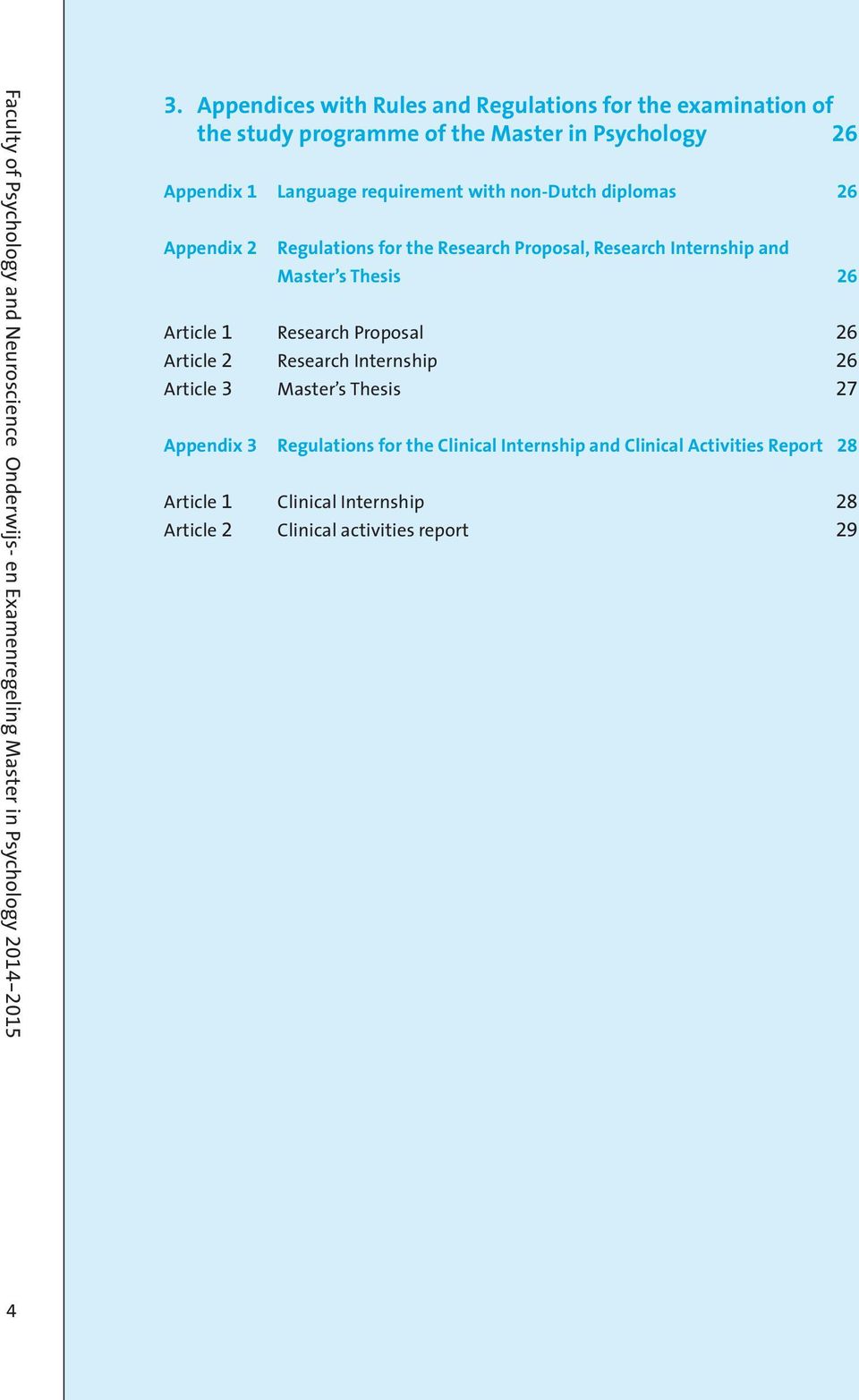
4 3. Appendices with Rules and Regulations for the examination of the study programme of the Master in Psychology 26 Appendix 1 Language requirement with non-dutch diplomas 26 Appendix 2 Regulations for the Research Proposal, Research Internship and Master s Thesis 26 Article 1 Research Proposal 26 Article 2 Research Internship 26 Article 3 Master s Thesis 27 Appendix 3 Regulations for the Clinical Internship and Clinical Activities Report 28 Article 1 Clinical Internship 28 Article 2 Clinical activities report 29 4
5 1. Education and Examination Regulations Master in Psychology Section 1 General Conditions Education and Examination Regulations for the 2014/2015 academic year for the Master s study programme at the Faculty of Psychology and Neuroscience, as meant in article 7.13 of the Act on Higher Education and Scientific Research (WHW). Article 1.1 Scope of the Regulations These regulations apply to the education, exams and examination for the fulltime Master s study programme in Psychology, hereinafter referred to as the study programme and to all students which are enrolled for this programme. The study programme is offered by the Faculty of Psychology and Neuroscience, hereinafter referred to as the Faculty. The regulations have been established by the Faculty Board, following a recommendation from the Study Programme Committee and after consent was obtained from or after consultation with the Faculty Council. These regulations will take effect on 1 September 2014 for the 2014/2015 academic year. Article 1.2 Definitions In these regulations the following is understood to be: a. The Act: the Higher Education and Scientific Research Act (Wet op het Hoger Onderwijs en Wetenschappelijk Onderzoek, WHW); b. Student: he/she who is registered at Maastricht University, for the purpose of attending the courses and/or taking the exams and the examination of the study programme; c. Academic year: the period from 1 September of a calendar year up to and including 31 August of the following calendar year; d. Programme: the master s study programme as meant by article 1.1, consisting of a connected unit of programme components; e. Course/Module: a study unit of the study programme as meant by the Act, including a Practical Training; f. Tutorial Group Meeting: a practical exercise, as meant by article 7.13, paragraph 2, sub d of the Act; g. Practical Training: a module that provides practical exercise, as meant by Article 7.13, paragraph 2, sub d of the Act; h. Exam: the exam as part of the examination as meant by article 7.10 of the Act; 5

6 i. Examination: the final examination for the master s study programme; j. Credit: unit expressed in ECTS credits, with one study credit equalling 28 hours of study; k. Board of Examiners: the board as meant by article 7.12 of the Act; l. Examiner: the person appointed by the Board of Examiners (Article 7.12C of the Act), charged with administering exams and determining the results of such exams; m. Course Coordinator, alternatively Practical Training Coordinator: an examiner who is responsible for the content of a certain course, or alternatively, responsible for the practical training in a certain course; n. Faculty Board: the Executive Board of the Faculty of Psychology and Neuroscience of Maastricht University as meant by article 9.12 of the Act; o. Board of Admission: the board responsible for judging the admissibility of the candidate to the programme; p. UM: Maastricht University. Other notations are to be understood in accordance with the meaning assigned to them by the Act. Section 2 Admission Article 2.1 Admission Persons who meet the requirements referred to in article 2.2 are eligible for admission to the programme. Article 2.2 Admission requirements 1. The following persons are eligible for admission to the Master s programme: a. those who have obtained a bachelor s degree or equivalent in an academic field; b. if applicable, those who have passed an entrance exam in Methods and Statistics. 2. The following persons are eligible for admission to the subsequent Master s programme: those who have obtained the Bachelor of Science in Psychology of Maastricht University (= the preceding Bachelor s Degree). 6 Article 2.3 Language requirement with non-dutch diplomas Persons with a non-dutch diploma may only register: a. if they have met the requirement concerning a sufficient command of English by passing one of the following language proficiency tests before the programme begins:

7 IELTS (International English Language Testing System): minimum score 6.5. TOEFL (Test of English as a foreign Language): minimum score 575 paperbased, 233 computer-based, or 90 internet-based. A Cambridge certificate: CPE (Certificate of Proficiency in English) with grade A, B or C or CAE (Certificate in Advanced English) with grade A, B or C+. Other recognised proof of English proficiency approved by the Board of Admission. b. if they have been exempted from the language proficiency test referred to in appendix 1 in the Rules and Regulations. Article 2.4 Board of Admission 1. Judgement about admissibility and the issuing of the certificate of admission for the study programme is assigned to the Board of Admission of the study programme. This board consists of: A chair, appointed from among the academic personnel; One or two members appointed from among the academic personnel who are in charge of the education in the study programme. 2. One of the members of the Board of Admission will also be a member of the Board of Examiners. 3. The appointment is made by the Dean after consulting with the Study Programme Committee. Article 2.5 Times of Review for Admission 1. The review for admission takes place 3 times a year. 2. A request for admission to a study programme must be submitted to the Board of Admission before: 1 February 2014: Application deadline for non EU-students who intend to apply for a Maastricht University Scholarship; 1 April 2014: Application deadline for non- EU students; 1 June 2014: Application deadline for EU-students and Maastricht University students (including FPN students). 3. The Board of Admission can in special cases deal with a request for admission even if it has been submitted after the closing date mentioned in paragraph The Board of Admission decides on the request within 8 weeks after receipt of the complete application. Please note that the decision on the request of subsequent students (article 2.2 sub 2) will be made within 4 weeks after the graduation date for the bachelor examination has been established (but always before 1 st September). 5. Admission will be granted on condition that the candidate complies with the requirements regarding knowledge, understanding and skills, as stipulated in Article 2.2, and as evidenced by the certificates of the study programme(s) the student has followed, at the latest by the starting date of the relevant study programme. 7

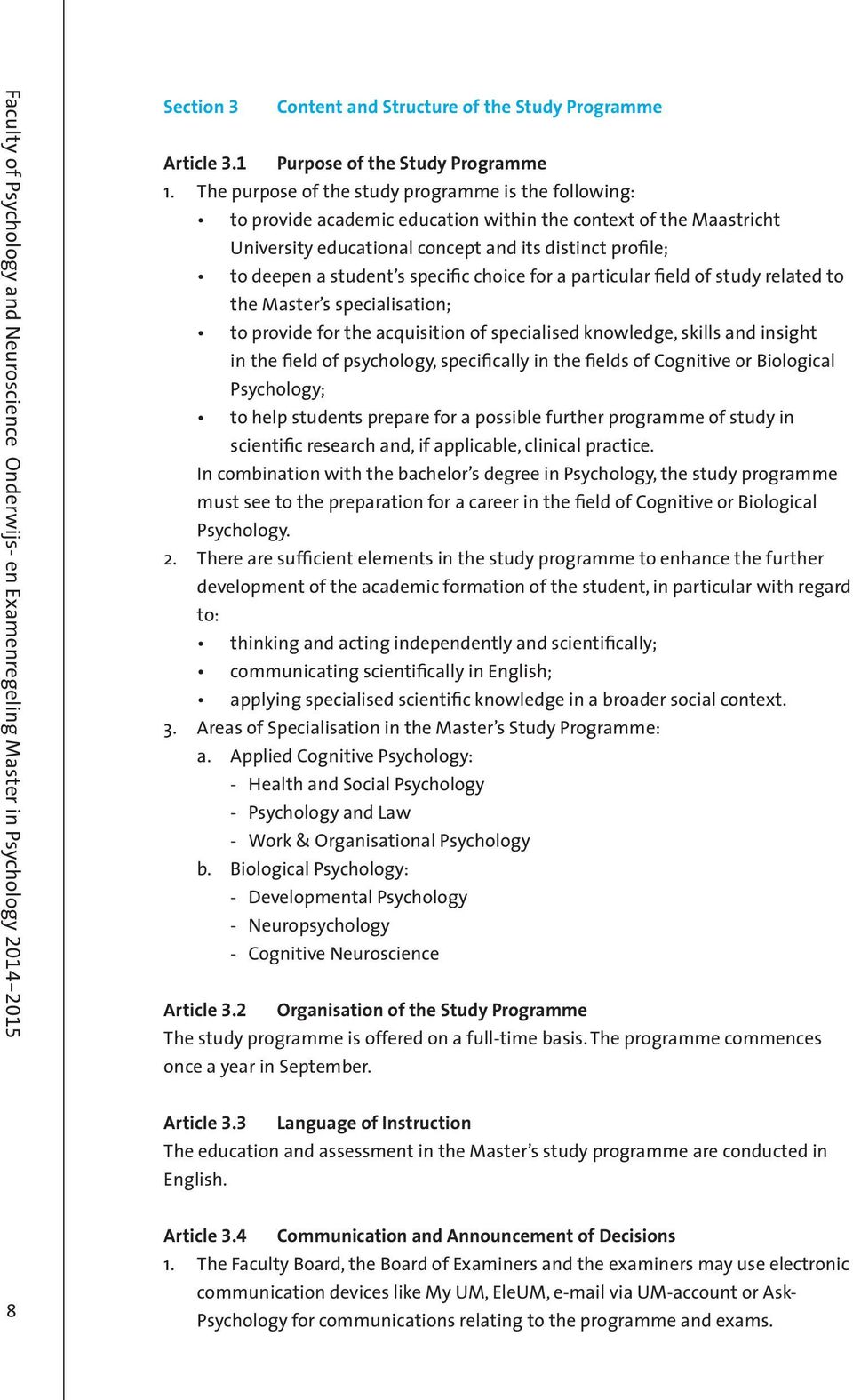
8 Section 3 Content and Structure of the Study Programme Article 3.1 Purpose of the Study Programme 1. The purpose of the study programme is the following: to provide academic education within the context of the Maastricht University educational concept and its distinct profile; to deepen a student s specific choice for a particular field of study related to the Master s specialisation; to provide for the acquisition of specialised knowledge, skills and insight in the field of psychology, specifically in the fields of Cognitive or Biological Psychology; to help students prepare for a possible further programme of study in scientific research and, if applicable, clinical practice. In combination with the bachelor s degree in Psychology, the study programme must see to the preparation for a career in the field of Cognitive or Biological Psychology. 2. There are sufficient elements in the study programme to enhance the further development of the academic formation of the student, in particular with regard to: thinking and acting independently and scientifically; communicating scientifically in English; applying specialised scientific knowledge in a broader social context. 3. Areas of Specialisation in the Master s Study Programme: a. Applied Cognitive Psychology: - Health and Social Psychology - Psychology and Law - Work & Organisational Psychology b. Biological Psychology: - Developmental Psychology - Neuropsychology - Cognitive Neuroscience Article 3.2 Organisation of the Study Programme The study programme is offered on a full-time basis. The programme commences once a year in September. Article 3.3 Language of Instruction The education and assessment in the Master s study programme are conducted in English. 8 Article 3.4 Communication and Announcement of Decisions 1. The Faculty Board, the Board of Examiners and the examiners may use electronic communication devices like My UM, EleUM, via UM-account or Ask- Psychology for communications relating to the programme and exams.
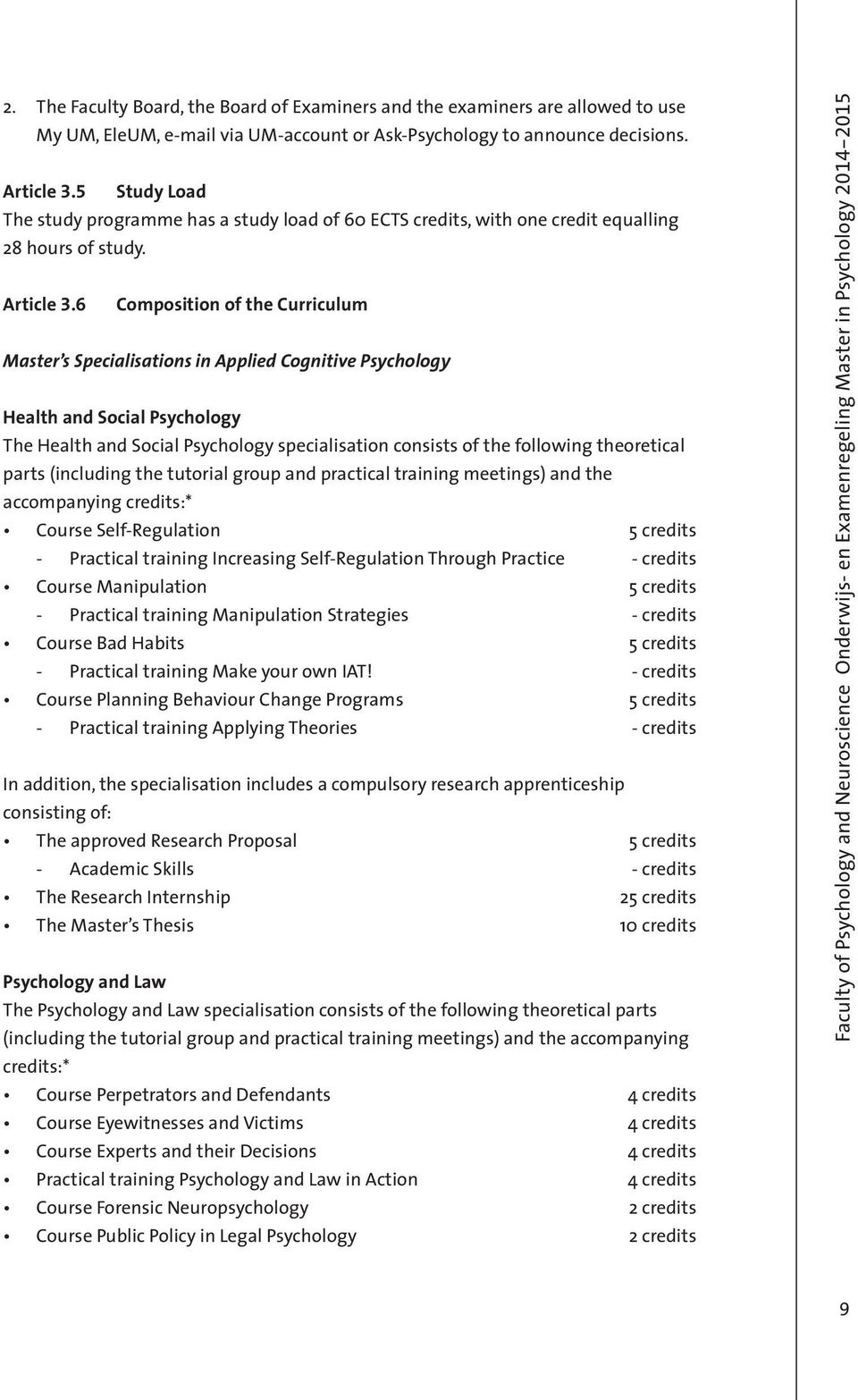
9 2. The Faculty Board, the Board of Examiners and the examiners are allowed to use My UM, EleUM, via UM-account or Ask-Psychology to announce decisions. Article 3.5 Study Load The study programme has a study load of 60 ECTS credits, with one credit equalling 28 hours of study. Article 3.6 Composition of the Curriculum Master s Specialisations in Applied Cognitive Psychology Health and Social Psychology The Health and Social Psychology specialisation consists of the following theoretical parts (including the tutorial group and practical training meetings) and the accompanying credits:* Course Self-Regulation 5 credits - Practical training Increasing Self-Regulation Through Practice - credits Course Manipulation 5 credits - Practical training Manipulation Strategies - credits Course Bad Habits 5 credits - Practical training Make your own IAT! - credits Course Planning Behaviour Change Programs 5 credits - Practical training Applying Theories - credits In addition, the specialisation includes a compulsory research apprenticeship consisting of: The approved Research Proposal 5 credits - Academic Skills - credits The Research Internship 25 credits The Master s Thesis 10 credits Psychology and Law The Psychology and Law specialisation consists of the following theoretical parts (including the tutorial group and practical training meetings) and the accompanying credits:* Course Perpetrators and Defendants 4 credits Course Eyewitnesses and Victims 4 credits Course Experts and their Decisions 4 credits Practical training Psychology and Law in Action 4 credits Course Forensic Neuropsychology 2 credits Course Public Policy in Legal Psychology 2 credits 9
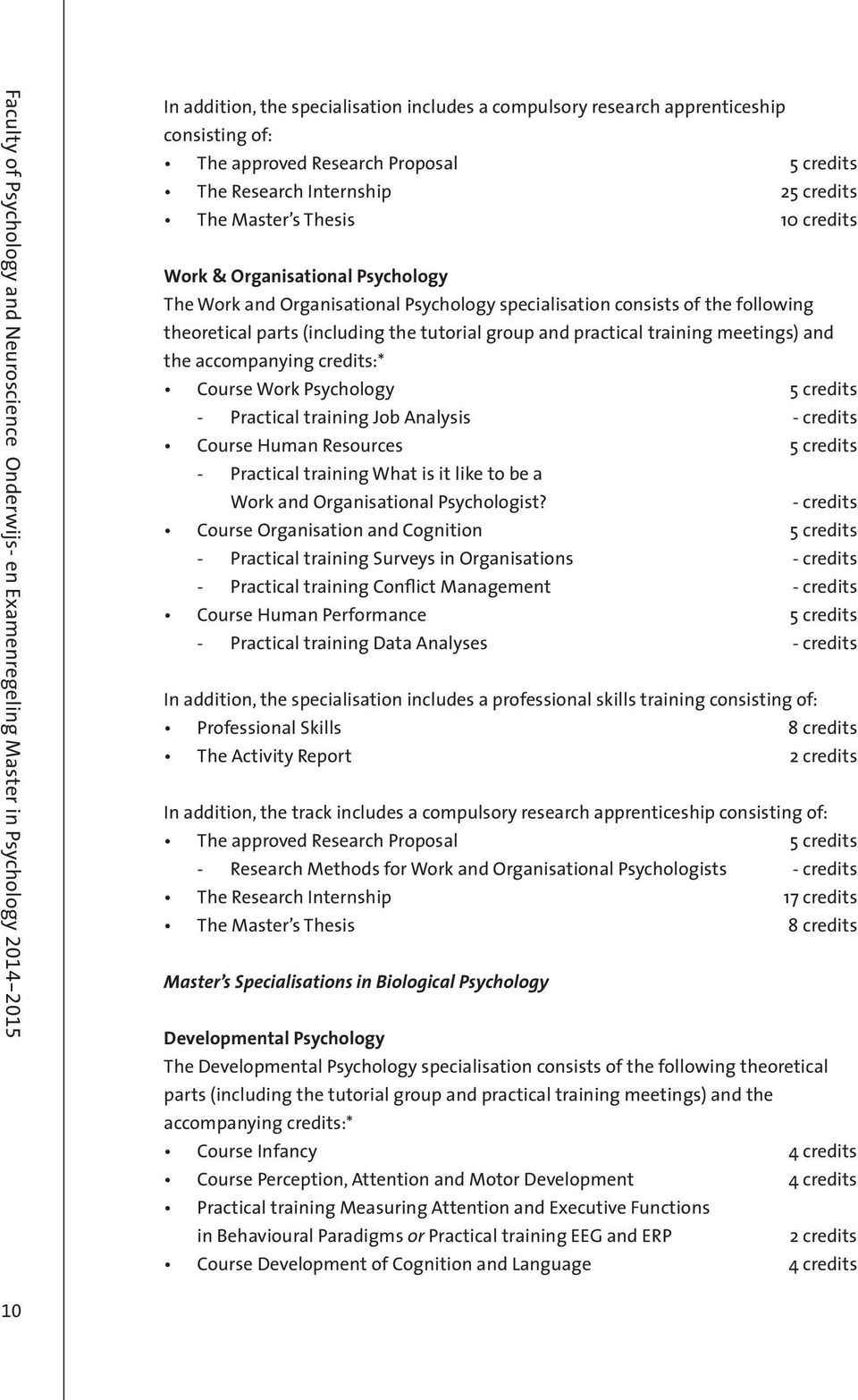
10 In addition, the specialisation includes a compulsory research apprenticeship consisting of: The approved Research Proposal 5 credits The Research Internship 25 credits The Master s Thesis 10 credits Work & Organisational Psychology The Work and Organisational Psychology specialisation consists of the following theoretical parts (including the tutorial group and practical training meetings) and the accompanying credits:* Course Work Psychology 5 credits - Practical training Job Analysis - credits Course Human Resources 5 credits - Practical training What is it like to be a Work and Organisational Psychologist? - credits Course Organisation and Cognition 5 credits - Practical training Surveys in Organisations - credits - Practical training Conflict Management - credits Course Human Performance 5 credits - Practical training Data Analyses - credits In addition, the specialisation includes a professional skills training consisting of: Professional Skills 8 credits The Activity Report 2 credits In addition, the track includes a compulsory research apprenticeship consisting of: The approved Research Proposal 5 credits - Research Methods for Work and Organisational Psychologists - credits The Research Internship 17 credits The Master s Thesis 8 credits Master s Specialisations in Biological Psychology Developmental Psychology The Developmental Psychology specialisation consists of the following theoretical parts (including the tutorial group and practical training meetings) and the accompanying credits:* Course Infancy 4 credits Course Perception, Attention and Motor Development 4 credits Practical training Measuring Attention and Executive Functions in Behavioural Paradigms or Practical training EEG and ERP 2 credits Course Development of Cognition and Language 4 credits 10
11 Course Social Emotional Development 4 credits Practical training Psychological Test 2 credits In addition, the specialisation includes a compulsory research apprenticeship consisting of: The approved Research Proposal 5 credits The Research Internship 25 credits The Master s Thesis 10 credits Cognitive Neuroscience The Cognitive Neuroscience specialisation consists of the following theoretical parts (including the tutorial group and practical training meetings) and the accompanying credits:* Course Auditory and Higher Order Language Processing 4 credits Course Perception and Attention 4 credits Practical training EEG and ERP 2 credits Course Neuroimaging: Functional MRI 4 credits Course The Cognitive Neuroscience of Sensory and Motor Systems 4 credits Practical training fmri 2 credits In addition, the specialisation includes a compulsory research apprenticeship consisting of: The approved Research Proposal 5 credits The Research Internship 25 credits The Master s Thesis 10 credits Neuropsychology The Neuropsychology specialisation consists of the following theoretical parts (including the tutorial group and practical training meetings) and the accompanying credits:* Course Brain Damage 4 credits Course Behavioral Disorders 4 credits Practical training Neuropsychological Assessment 2 credits Course Arousal and Attention 4 credits Course Ageing 4 credits Practical training Basic Cognitive Psychological Skill 2 credits In addition, the specialisation includes two options of compulsory apprenticeships. The student has to choose one of the following 2 options: 1. Research option: The approved Research Proposal 5 credits The Research Internship 25 credits The Master s Thesis 10 credits 11
12 2. Clinical-research option: The approved Research Proposal 2 credits The Research Internship 12 credits The Master s Thesis 7 credits The Clinical Internship 14 credits The Clinical Supervision 2 credits The Clinical Activities Report 3 credits * Students who did not obtain their bachelor diploma at Maastricht University will have to take and pass a PBL training (- credits) before they start the master s programme. A more detailed description of the components of the programmes can be found in the web catalogue on Article 3.7 The Master s Examination The Master s examination consists of the following components: 1. The courses pertaining to the selected Master s specialisation; 2. The practical training with the accompanying tasks, whether or not pertaining to the courses as meant under 1; 3. The tutorial group meetings pertaining to the courses and practical training as meant under 1 and 2; 4. The Research Proposal; 5. The Research Internship; 6. The Master s Thesis; 7. When applicable: the Clinical Internship, the Clinical Activities Report, Clinical Supervision, Academic Skills, Professional Skills and Activity Report. Section 4 Education Article 4.1 Courses, composition, actual design 1. For the programme specialisations, courses/modules are given with the study load stated in article The educational programme includes 42 weeks per year. Article 4.2 Entrance requirements 1. The Research Internship can only be started when at least 2 of the 4 compulsory theoretical courses of the Master s specialisation have been completed. In addition, certain Research Internships may require that practical or skills training(s) have been completed. 12
13 2. Regarding the start of a Clinical Internship, additional requirements can apply to students who did not obtain a Bachelor s degree in Psychology and/or a Bachelor s degree at Maastricht University. 3. If a student deviates from the sequencing as described under paragraph 1 and 2, without permission from the Board of Examiners, the result of the part in question can be declared invalid. Article 4.3 Course/Module registration 1. Students are automatically booked for all courses/modules that are offered to the student for the first time. 2. Information and deadlines regarding registration of courses/modules from a previous year and de-registration of courses/modules can be found on EleUM. 3. If a student registers after the deadline, participation to the course/module cannot be guaranteed, unless there are valid (proven) exceptional personal circumstances. Personal circumstances are limited to: a. Illness of the student; b. Pregnancy/delivery of the student; c. Poignant (proven) personal circumstances of the student. The Board of Examiners can decide in exceptional situations in which applying the rules for timely registration would lead to severe hardship for the student to deviate from the rules in favour of the student. Section 5 Assessment Article 5.1 General 1. During a course, the student will be tested for academic training and the extent to which the student has sufficiently achieved the stated learning objectives. 2. The course manual describes the requirements students have to fulfil to pass the course and the criteria on which the student is assessed. 3. The Rules of Procedure for Exams describe the exam procedure. The rules of Procedures for Exams can be found on EleUM. Article 5.2 Grades 1. Grades are awarded on a scale of 0.0 to 10.0; 2. Grades for course exams and assessments are the scores rounded off to the nearest whole or half number: - Decimals <.25 or > =.75 will be rounded off to the nearest whole number; - Decimals > =.25 but <.75 will be rounded off to the nearest half number. A course exam or assessment is passed when a grade of 6.0 or higher is obtained. Article 5.3 Periods and Frequency of Exams 1. Exams can be taken twice a year, one regular exam and one resit, at times determined by the Board of Examiners: i.e. once during or immediately following 13

14 14 the period in which the relevant course/module was offered (regular exam) and once during the academic year (resit). 2. In special cases, the Board of Examiners can decide that an exam can be taken at a time different to that set in accordance with the previous paragraph. Article 5.4 Exam Registration and Deregistration 1. Students are automatically booked for all exams and resits that are offered to the student for the first time. 2. Further information and deadlines regarding registration of exams and resits from a previous year and de-registration of exams and resits can be found on EleUM. 3. If a student fails to deregister in time for an exam/resit, the registration will be listed as an attempt. 4. If a student registers after the deadline, the student is not allowed to participate in the exam, unless there are valid (proven) exceptional personal circumstances. Personal circumstances are limited to: a. Illness of the student; b. Pregnancy/delivery of the student; c. Poignant (proven) personal circumstances of the student. The Board of Examiners can decide in exceptional situations in which applying the rules for timely registration would lead to severe hardship for the student to deviate from the rules in favour of the student. Article 5.5 Form of Exams 1. As a rule, exams are in written form. This includes exams done on a computer. A written exam can consist of open questions, an individual paper, an essay or a report. Part of an exam can also consist of a presentation. The Board of Examiners can in special circumstances allow another form of exam or weighing, in which case the Board of Examiners will establish the conditions under which this will take place. 2. A requirement for taking exams is compliance with the minimum requirements for participation in the group meetings as laid down in article 3 and 4 of the Rules and Regulations. 3. For written exams, students will not be admitted to an exam after the exam has started. One needs to be on time. During the last 30 minutes of an exam, students cannot leave the exam location until the exam time is officially finished. 4. During exams it is not allowed to keep cellular telephones or electronic devices within reach, even if they are switched off. If the student does not conform to the above, the fraud regulation, as described in the Rules and Regulations, will be applied and the exam will be declared invalid. 5. The Board of Examiners has the authority to permit a different form of exam in special cases. The Board of Examiners shall notify the students about the different form of exam at least four weeks before the date on which the course/ module starts.
15 6. Students with a functional disability may request permission from the Board of Examiners to take the exams in a manner that is, as far as possible, adapted to their individual disability. The Board of Examiners can ask for expert advice before arriving at a decision. Article 5.6 Written papers and assignments The Board of Examiners can draw up guidelines for papers or other forms of assessment. These guidelines will be included in the prospectus or in the manual pertaining to the relevant part. Article 5.7 Internship Article Research Internship 1. The Board of Examiners determines the requirements regarding the nature and content of a Research Internship in the internship regulations. 2. The Research Internship regulations are set out in appendix 2 in the Rules and Regulations. 3. In order to ensure that the Research Internship proceeds smoothly, further guidelines have been drawn up which can be found in the manual on Internships. The manual can be downloaded from EleUM. 4. A student can do a Research Internship only once during his/her programme of study. During the Research Internship the student will be supervised by the Faculty. Article Clinical Internship (where applicable) 1. The Board of Examiners determines the criteria regarding the nature and content of the Clinical Internship in the internship regulations. 2. The Clinical Internship regulations are set out in appendix 3 in the Rules and Regulations. 3. In order to ensure that the internship proceeds smoothly, further guidelines have been drawn up, which can be found in the manual on Clinical Internships. The manual can be downloaded from EleUM. 4. A student can follow a Clinical Internship only once during his/her programme of study. During the Clinical Internship the student will be supervised by the Faculty. Article 5.8 Attendance in Tutorial Group Meetings 1. The Board of Examiners lays down the percentage for compulsory attendance in the tutorial group meetings in the Rules and Regulations, articles 3 and 4, and determines how the actual attendance of each student is registered. 2. If attendance has been met in a given academic year, this will be valid for the remainder of the study, even if the exam is not passed in that year. 15

16 Article 5.9 Determining and Publishing Results 1. The Board of Examiners determines the norms for the exam of each part of the examination. 2. The examiner determines the result of a written exam within 15 working days after the day on which the exam took place, and provides the education office with the information needed for publishing the result to the student. 3. When the result of a written exam is announced, it will be indicated on EleUM how and when the student can review the exam and file an appeal as referred to in article With respect to an exam that has been administered in a different way than in writing, the Board of Examiners determines the way and period in which the result will be announced. Article 5.10 Exam Review 1. Within 10 working days of the date on which the result of a written exam, including a computer-based exam, is announced, students may review their exam. 2. Within the period referred to in paragraph 1, interested students are allowed to review their own exam results and may, upon request, inspect the questions and assignments for a written exam and, if possible, the standards based on which the exam was assessed. Article 5.11 Proof of Having Passed Courses/Modules Once a student has taken part in a sufficient number of tutorial group meetings and has successfully completed the exam and any associated practical training of the part, this will count as proof of having passed the relevant course. The proof will be obtained after an examiner has declared that the requirements for that part of the examination have been complied with. A condition for obtaining proof of having passed a part is that the student has complied with the admission requirements for the relevant part of the examination. The Board of Examiners can revoke the decision of the examiner if the admission requirements have not been complied with. Article 5.12 Period of Validity 1. As a rule, the period of validity of exams is unlimited. However, by way of exception, the Board of Examiners may impose an additional or substitute exam for a part that was passed more than 6 years ago. 2. Sub-exams and assignments that were passed within a course/module which was not passed, can lose their validity after the academic year in which they were passed unless the Board of Examiners states otherwise. 16 Article 5.13 Retention Period of Exams 1. Assignments, results and assessments of written exams will be saved 2 years after the exam results have been determined.
17 2. Theses and the assessment of theses will be saved at least 7 years after the thesis has been assessed. Article 5.14 Exemptions The Board of Examiners can, at the request of a student, grant exemption from taking an exam or other assessment, if the student provides satisfactory written proof that he/she: 1. has already successfully completed a similar part at a university that is equivalent in content and level; 2. possesses sufficient knowledge and skill in relation to the relevant exam by way of work, or professional experience. The following restrictions apply: 1. In the Master s programme, a maximum of 10 credits may be exempted. Only theoretical parts of the programme (see article 3.6) may be exempted. 2. The Board of Examiners will not grant any exemption based on exams passed by a student outside the programme during the period in which the student was barred from taking exams for the programme by the Board of Examiners because of fraud. Article 5.15 Grade Point Average (GPA) 1. A weighted average score (GPA) is calculated for all parts of the exam that are assessed on a ten-point scale, with the exception of the Internship. Scores will be weighted according to the number of course credits (see also article 3.6). 2. On a provisional transcript, the GPA can also include an insufficient grade. 3. On a provisional transcript, an exam that has not been taken will not be included in the GPA. In that case the number of credits obtained will be reported in relation to the number of credits that could have been obtained in the form of a progress rate. Article 5.16 Fraud 1. Fraud, including plagiarism, is understood as a student s act or failure to act that makes it partially or fully impossible to correctly assess his/her knowledge, insight and skills. 2. Plagiarism is understood as the presentation of one s own or other people s ideas or words without adequate reference to the source. 3. If the Board of Examiners establishes that a student has committed fraud in an exam or exam component, it may impose suitable measures. 4. In serious cases of fraud, the Board of Examiners can propose to UM s Executive Board that the student(s) concerned be permanently deregistered from the programme. 5. The Rules and Regulations further detail what is understood as fraud and what measures can be imposed by the Board of Examiners. 17
18 Article 5.17 Unsuitability (Judicium Abeundi) 1. In exceptional circumstances and after carefully weighing the interests at stake, the Board of Examiners may, stating reasons, ask the Dean to request that the Executive Board terminates or denies a student s registration for a programme if, through his/her conduct or statements, the student shows that he/she is unsuitable to practice one or more professions for which the programme he/she is enrolled in, is training him/her for, or is unsuitable for the practical preparation for the profession. 2. If the Dean of the Faculty is asked by the Executive Board for a recommendation on a proposed termination or denial of registration based on the reasons stated in paragraph 1, the Dean will in turn ask for a recommendation from the Board of Examiners. The recommendation to the Dean will be supported by reasons. Section 6 Examination Article 6.1 Examination 1. The Board of Examiners determines the result of the examination and grants the diploma as meant in art. 6.3 as soon as the student has fulfilled all the requirements of the examination programme. 2. Before determining the result of the examination, the Board of Examiners can decide to examine the student s knowledge with respect to one or more parts of the study programme, should the results of the relevant exam give reason for this. 3. To pass the examination, the student must have passed all components as defined in art To pass the examination and receive the certificate, the student must also have been registered for the programme during the period that the exams were taken. 5. A certificate may only be issued after it has been shown that the student has satisfied all the obligations, including paying the tuition fees. 6. The last day of the month in which the student fulfilled all the examination requirements will be considered the examination date (graduation date). 7. Students who have passed the examination and who are entitled to the issuance of a certificate may, stating reasons, ask the Board of Examiners not to do this yet. This request must be submitted at least one month before the final assignment is turned in or the final exam is taken. The board of examiners in any event grants the request in the academic year : - if the student has held/will hold a board position for which a financial support from the Profileringsfonds was/will be granted for at least nine months or a Student Introduction Committee ( INKOM ) board position. 18 Article 6.2 Degree He/she who has passed the examination successfully will be awarded the degree of Master of Science and will receive the diploma belonging to the Master s examination as proof of this.

19 Article 6.3 Diploma and statements 1. As proof that the assessment was successfully completed, the Board of Examiners issues a diploma, after it has been stated by or on behalf of UM s Executive Board that the procedural requirements for receiving the diploma have been met. The diploma is based on the model that UM s Executive Board has adopted. Even though the Master s programme consists of different Master specializations, only one diploma will be issued for the Master s programme. 2. The diploma issued as a result of having passed the examination successfully will contain: a. the name of the institution; b. the name of the study programme; c. the degree awarded; d. the date on which the programme was most recently accredited or was subjected to the new programme test. 3. Students who are entitled to a diploma may, stating reasons, ask the Board of Examiners not to issue this yet. 4. The diploma will be signed by the Chair of the Board of Examiners and the Dean of the Faculty. 5. The diploma is awarded in public, unless the Board of Examiners decides otherwise, in special cases. 6. The certificate includes a list of the examination components; 7. An English diploma supplement will be issued with the diploma as referred to in article 7.11 paragraph 4 of the Act. This diploma supplement is based on the model adopted by UM s Executive Board, and is in compliance with the agreed European standard format. 8. The Board of Examiners can award the diploma with the qualifications of Cum Laude or Summa Cum Laude in accordance with the Rules and Regulations for the Master s Examination. 9. Students who have passed more than one exam and who cannot be issued a certificate will upon request, receive a statement issued by the Board of Examiners, which at least indicates the exams that they passed. Article 6.4 Right of appeal Within 6 weeks after a decision has been announced by an examiner or the Board of Examiners a person concerned can file an appeal against this decision with the Complaint Service Point of the UM. The appeal needs to be signed and dated and needs to bear the name and address of the petitioner, as well as the grounds for appeal and, if possible, a copy of the decision against which the appeal is lodged. Section 7 Study Guidance Article 7.1 Study Progress Administration 1. The Faculty registers the individual study results of the students in such a way that they can be consulted by the students via My UM. 19
20 2. To each student, the Faculty points out at least once a year (preferably in May) to check his/her overview of the study results obtained by him/her. Article 7.2 Study Guidance The Faculty sees to the introduction and study advice and guidance of the students who have been enrolled in the study programme. Section 8 Transitional and Concluding Conditions Article 8.1 Amendments 1. Amendments in these regulations will be determined by special decision of the Faculty Board following a recommendation of the study programme commission and after permission is obtained from or after consultation with the Faculty Council. 2. An amendment in these regulations does not apply to the current academic year, unless the interests of the students are not adversely affected by it. 3. Furthermore, an amendment cannot be to the detriment of students by affecting any other decision that has been taken by the Board of Examiners on the basis of the original regulations. Article 8.2 Publication 1. The Faculty Board sees to the proper publication of this regulation, of the Rules and Regulations that have been determined by the Board of Examiners, and also of any changes in these, by, for example, placing a notice on the Faculty website/ EleUM. 2. Interested persons can obtain a copy of the documents referred to in paragraph 1 from the education office. Article 8.3 Unforeseen Cases/Hardship Clause 1. The Board of Examiners decides in cases which have not been foreseen by these regulations. 2. The Board of Examiners has the right to deviate from these regulations, with the exception of the study advice rules, in individual cases, if a strict adherence will, in its opinion, result in an unfair outcome for the individual, in view of the special circumstances. Article 8.4 Date of coming into effect These regulations will come into force on 1 September 2014 and will be effective for the 2014/2015 academic year. Adopted by the Faculty Board on 13 May

21 2. Rules and Regulations for the examination of the study programme of the Master in Psychology Article 1 Board of Examiners The Board of Examiners sees to the execution of the Regulation for the Master s Examination and its parts, taking into account the Act and the education and examination regulations concerning the organisation and scope of the examinations of the psychology study programme of the Faculty of Psychology and Neuroscience. The Board of Examiners will designate examiners to conduct the interim examinations. In particular cases the Board of Examiners can annul decisions taken by the examiners, when, e.g., a student has not complied with the admission requirements for a part of the examination which he/she has taken. Article 2 Examiners 1. Academic staff who are appointed coordinator of a teaching component/course/ module, also have, as the responsible examiner, final responsibility for the examination of that teaching component /course/module. 2. Academic staff who are teaching in a teaching component/course/module, are authorised to act as executive examiner/assessor, meaning that they can, under the final responsibility of the course coordinator, construct, correct and assess exam questions, correct and assess papers and assignments, and assess presentations. 3. The Board of Examiners can appoint other members of the academic staff and experts from outside the programmes as executive or responsible examiner. 4. Experts from outside the Faculty cannot act as (executive) assessor unless the Board of Examiners has approved a reasoned request by the relevant director of studies. 5. The Board of Examiners can revoke the appointment as examiner if the examiner does not act in accordance with the law and regulations or guidelines of the Board of Examiners, or if the examiner has repeatedly shown a lack of competence in the area of examining (constructing, administering, assessing). 6. At least one of the two examiners of a research internship and master s thesis must have a PhD degree and be a member of the Faculty s academic staff. The thesis coordinator is the person responsible for ensuring these requirements are met. Article 3 Proof of Having Passed a Course/Module 1. Courses A student can have a course registered as having been passed if the following requirements have been met: a. A minimum of 70% attendance at the tutorial group meetings. A student who arrives more than 10 minutes after the official starting time of the meeting shall be considered not to have attended. As regards the admissibility to the course examination, a student must have attended a minimum of 70% of the tutorial 21
22 group meetings in order to be allowed to sit for the course examination. b. A satisfactory assessment and attendance for those practical training sessions which are part of the course (practical training without credits). There is an attendance of 100% of the practical sessions. A student who arrives more than 10 minutes after the official starting time of the meeting shall be considered not to have attended. If a student has not complied with the attendance obligation but has not missed more than one meeting, he/she will be able to apply for a compensatory assignment; c. At least sufficient grades for the final course exam. A course exam is passed when a grade of 6.0 or higher has been obtained. 2. Practical training (with credits) A student can have a practical training (with credits) registered as having been passed if the following requirements have been met: a. Attendance of 100% of the practical sessions. A student who arrives more than 10 minutes after the official starting time of the meeting shall be considered not to have attended. If a student has not complied with the attendance obligation but has not missed more than one meeting, he/she will be able to apply for a compensatory assignment; b. Timely and satisfactory completion of the required assignments. This requires at least sufficient grades for the final assessment. A practical training is passed when a grade of 6.0 or higher has been obtained. Article 4 Attendance Obligation 1. There is a 100 % attendance obligation in the case of the practical training sessions. It may happen that for certain courses no distinction is made between tutorial group meetings and practical training sessions. In this case there will be a minimum of 9 and a maximum of 18 meetings for those courses and there will be an attendance obligation of 70%. 2. There will be an attendance obligation of at least 70% with respect to the tutorial group meetings in each course: on a total of 18 meetings: at least 13 meetings; on a total of 16 or 17 meetings: at least 12 meetings; on a total of 15 meetings: at least 11 meetings; on a total of 13 or 14 meetings: at least 10 meetings; on a total of 12 meetings: at least 9 meetings; on a total of 11 meetings: at least 8 meetings; on a total of 9 or 10 meetings: at least 7 meetings; on a total of 8 meetings: at least 6 meetings; on a total of 6 or 7 meetings: at least 5 meetings; on a total of 5 meetings: at least 4 meetings; in the case of 4 or fewer meetings there is an attendance obligation of 100%. 22
23 3. The attendance in the tutorial group meetings and the practical training sessions will be registered on a form for each tutorial group. 4. If a student has not complied with the attendance obligation, the relevant course will not be registered as having been passed. 5. If attendance has been met in a given academic year, this will be valid for the remainder of the study, even if the exam is not passed in that year. Article 5 Cum Laude and Summa Cum Laude Pass 1. The pass Cum Laude is attached to the Master s examination if each of the following requirements has been met: A weighted grade point average (GPA) of at least 8.00 for all parts of the examination, with the exception of the Internship. Grades will be weighted according to the number of course credits (see also article 3.6.); Furthermore, no part of the examination may have been passed in a resit; Master s Thesis: a grade of at least 8.0; If applicable: Clinical Activities Report of at least 8.0. All courses/modules (except the internship) need to be passed within the academic year the student started the Master s programme. The Board of Examiners can, in exceptional circumstances, deviate from this. Cum Laude will not be awarded if more than 5 credits are exempted. 2. The pass Summa Cum Laude is attached to the master s examination, if each of the following requirements has been met: A weighted grade point average (GPA) of at least 9.00 for all parts of the examination, with the exception of the Internship. Grades will be weighted according to the number of course credits (see also article 3.6.); Furthermore, no part of the examination may have been passed in a resit; Master s Thesis: a grade of at least 9.0; If applicable: Clinical Activities Report of at least 9.0. All courses/modules (except the internship) need to be passed within the academic year the student started the Master s programme. The Board of Examiners can, in exceptional circumstances, deviate from this. Summa Cum Laude will not be awarded if more than 5 credits are exempted. Article 6 Exemptions 1. Request for exemption from taking an exam or undergoing another part of the examination on the strength of what has been determined by the Act will be submitted to the Board of Examiners. Written proof must be submitted to support the request. 2. The Board of Examiners takes a motivated decision within 4 weeks after having received the request. The Board of Examiners is entitled to extend this period of 4 weeks by an additional period of 4 weeks. The student will be informed of its decision in writing. 23
24 Article 7 Reassessments/Resits The following resit/reassessment arrangements apply to students who in the first instance have not passed a course/module of the master s examination. 1. Course exam The student who fails a course exam will get one chance to resit that exam per academic year. If a student passes the initial exam he/she cannot resit the exam. In the case of a resit the highest mark counts. 2. Practical Training If the assessment of a practical consists of a paper, the paper can be rewritten only when it has been turned in before the deadline and a serious attempt has been made, but has failed. 3. Papers There will be one chance per part to redo papers (including the research proposal and master s thesis) per academic year. This will consist of rewriting the relevant paper. A paper can be rewritten only when it has been turned in before the deadline and a serious attempt has been made, but has failed. Article 8 Fraud, including Plagiarism and fabricating and/or falsifying survey or interview answers or research data 1. The Board of Examiners may impose one of the disciplinary measures set down in paragraph 5 of this article if it establishes that a student, in any exam or exam component: a. has had any unauthorised aids, texts or notes at his or her disposal, or has used unauthorised electronic aids and/or communication devices; b. has communicated or tried to communicate with another student, either verbally or through gesture, without permission from an invigilator, examiner, or Board of Examiners member; c. has copied or attempted to copy from another student, or has provided the opportunity to copy; d. has posed as someone else or let someone else pose as him/her; e. has deliberately misled, or at least attempted to mislead or provided the opportunity to mislead an invigilator, an examiner, a corrector or the Board of Examiners with respect to the exam. 2. The Board of Examiners may impose one of the disciplinary measures set down in paragraph 5 of this article if it establishes that a student has committed plagiarism in any exam, part or component, including: a. using or copying his/her personal or other people s texts, data, ideas or thoughts without adequate reference to the source; b. presenting the structure or central body of thought from others without adequate reference to the source and thus passing it off as his/her own; c. not clearly indicating in the text, for example via quotation marks or a certain layout, that verbatim or nearly verbatim quotes have been used; 24
25 d. paraphrasing the content of his/her own or other people s texts without adequate reference to the source; e. copying video, audio or exam material, software and programme codes from others without adequate reference to the source and thus passing them off as his/her own; f. copying work from other students and thus passing it off as his/her own; g. submitting work or assignments acquired from or written by a third party (whether or not for payment) and thus passing them off as his/her own. 3. The Board of Examiners may impose one of the disciplinary measures set down in paragraph 5 of this article if it establishes that a student has fabricated and/or falsified survey or interview answers or research data. 4. If the Board of Examiners establishes that a student has committed fraud in any way in any exam or exam component, it can impose a measure set down in paragraph In the cases referred to in paragraphs 1, 2, 3 and 4, the Board of Examiners can declare the results of the relevant exam or part in question invalid, as well as impose the following disciplinary measures: - a reprimand; - exclusion from participation or further participation in one or more exams in the programme for a period of at most one year. 6. In serious cases of fraud, the Board of Examiners can propose to UM s Executive Board that the student(s) concerned be permanently deregistered from the programme. 7. Before the Board of Examiners imposes an appropriate disciplinary measure, or makes a proposal to the Executive Board, the student in question is given the opportunity to be heard. 8. If fraud is established, this is included in the student s dossier. 9. If, after investigation, it is ultimately determined that the student concerned did not commit fraud, the names will be removed from the correspondence about the alleged fraud and the correspondence will not be included in the student s dossier. 10. The Board of Examiners does not grant exemptions on the grounds of study results obtained elsewhere while the student was excluded from participating in the programme s exams because fraud was committed. Article 9 Implementation and Date of Coming into Effect 1. The Board of Examiners makes decisions in all cases which have not been foreseen by the Rules and Regulations. 2. These Rules and Regulations take effect in the academic year 2014/2015. Thus enacted by the Board of Examiners at its meeting of 24 April
26 3. Appendices with Rules and Regulations for the examination of the study programme of the Master in Psychology Appendix 1 Language requirement with non-dutch diplomas Persons holding one of the following diplomas are exempted from the language proficiency test (English) referred to in article 2.3: a diploma issued in a country in which English is the official language of communication and instruction (Australia, Canada, Ireland, New Zealand, United Kingdom or United States). Appendix 2 Article 1 Regulations for the Research Proposal, Research Internship and Master s Thesis Research Proposal 1. A research proposal is an independently written proposal concerning research which the student intends to perform during his/her research internship. 2. The research proposal consists of the following parts: a brief theoretical background of the research; the question posed by the research; a description of the research plan; a description of the research methods which will be applied; a description of the techniques which will be used for processing and analysing the data; a timetable. 3. The guideline for the length of the research proposal is 1600 to 2800 words. 4. The assessment is done by two examiners. They are: a. two staff members from the Faculty if the research internship is done internally (supervisor from the Faculty and a second assessor), or b. the external supervisor and the supervisor from the Faculty in the case that the apprenticeship is done outside the Faculty. 5. If the research proposal is judged to be unsatisfactory, the regulation about resits/reassessments for papers, article 7, paragraph 3, Rules and Regulations for the master s study programme, applies. 6. For the number of credits of an approved Research Proposal, see article 3.6. Article 2 Research Internship 1. A student has to do a research internship at the conclusion of his/her study programme. 2. The purpose of the internship is an orientation into the research field of psychologists. 3. During the internship, the student conducts a scientific research project. 26
27 4. The student notifies the education office about the Internship at least one month before the start of the internship by means of a research internship notification form. The Board of Examiners checks whether the student has complied with the requirements in article 4.2, paragraph 1 of the examination regulations, i.e. having successfully completed at least 2 of the 4 theoretical courses of the Master s specialisation. In addition, certain internships may require that practical or skills training(s) have been completed. An internship can be started: January 1 st : When 2 courses of the first period have been passed (exam results of 1st period available in November) February 1 st : When 2 courses of the 1 st /2 nd period have been passed (exam results of 2 nd period available in January) March 1 st : When resit of courses of the 1 st period have been passed (exam results of resit 1 st period available in February) April 1 st : When resit of courses of the 2 nd period have been passed (exam results of resit 2 nd period available in March) 5. An internship agreement is drawn up for the internship in which a number of arrangements are set out between the institution where the internship takes place, the supervisor from the Faculty and the student. A copy of this agreement is sent to the education office at least one month before the internship starts. 6. The student will be supervised during the internship by a supervisor from the Faculty and/or a supervisor from the institution where the internship takes place (internship supervisor). The task of the supervisor from the Faculty and/or the internship supervisor consists in advising the student on matters of content with respect to the internship activities and the reporting of these in a master s thesis. In addition the supervisor from the Faculty is the contact person with the Institution where the internship takes place. 7. The internship is registered as having been completed successfully by the internship supervisor or the supervisor from the Faculty on an assessment form, which is sent to the education office. 8. The final grade for the practical part of the research internship needs to be at least 6.0. This grade will not be included in the GPA. 9. For the number of credits of a satisfactory completion of the internship see article 3.6. Article 3 Master s Thesis 1. A Master s thesis is an independently written report on the research that has been conducted during the internship. 2. The Master s thesis is an individually written paper. 27
28 28 3. The Master s thesis is assessed on several criteria. The final grade for the thesis, based on these criteria, needs to be at least The student needs to send the final version of the Master s thesis to an address that is published on EleUM. The student needs to send this final version of the Master s thesis also to the internship supervisor/supervisor from the Faculty and to the supervisor from the Faculty/second assessor. Assessment forms have to be filled in and signed by both supervisors, and have to be send back to the education office within 20 working days. The education office keeps the electronic version of the Master s thesis for filing. 5. If the Master s thesis is awarded insufficient grades, the Regulation for Resits/ Reassessments of Papers, article 7, paragraph 3 of the Rules and Regulations for the Master s study programme apply. 6. The Master s thesis is graded by averaging the scores given by the first and the second assessor. Both grades must be at least 6.0 and the difference between the grades may not be more than 2 grades. 7. For the number of credits of a satisfactory assessment of the Master s thesis see article 3.6. Appendix 3 Regulations for the Clinical Internship and Clinical Activities Report Article 1 Clinical Internship 1. A complete clinical internship consists of 13 weeks or the equivalent of 520 hours (consisting of minimally 200 hours diagnostics as part of the partial fulfilment for the Psychodiagnostics registration) of clinical work (including clinical activities report and clinical supervision). 2. The purpose of the clinical internship is an orientation in the clinical field of neuropsychology. 3. During the internship the student conducts clinical psychological tasks. 4. The student notifies the education office about the internship at least one month before the start of the internship by means of a clinical internship notification form. The Board of Examiners checks whether the student has complied with the requirements in article 4.2, paragraph 1 of the examination regulations, i.e. having successfully completed at least 2 of the 4 theoretical courses of the master s specialisation. An internship can be started: January 1 st : When 2 courses from first period have been passed (exam results of 1 st period available in November) February 1 st : When 2 courses of 1 st /2 nd period have been passed (exam results of 2 nd period available in January) March 1 st : When resit of courses of 1 st period have been passed (exam results of resit 1 st period available in February). April 1 st : When resit of courses of 2 nd period have been passed (exam results of resit 2 nd period available in March)
29 5. An internship agreement is drawn up for the internship in which a number of arrangements are set out between the institution where the internship takes place, the clinical internship coordinator from the Faculty and the student. A copy of this agreement is sent to the education office at least one month before the internship starts. 6. The student will be supervised during the internship by a supervisor from the Faculty and a supervisor from the institution where the internship takes place (internship supervisor). The task of the internship supervisor from the institution is to guide and monitor the student s clinical activities. 7. The internship is registered as having been completed successfully when the clinical internship coordinator has approved the student s clinical activities report (including the 3 case reports), has received a satisfactory assessment of the internship performance from the supervisor at the institution where the internship took place, and has sent the relevant assessment form to the education office. 8. For the number of credits of a satisfactory completion of the internship see article 3.6. Article 2 Clinical activities report 1. A clinical activities report is an independently written report on the clinical work that has been conducted during the internship. 2. The clinical activities report is an individually written paper. 3. The clinical activities report is assessed on the following aspects: Overview Dutch Mental Health Services (incl. internship activities), Regulations of the Dutch health care system (incl. Ethics for psychologists), SWOT analyses, and 3 Case reports. The final grade for the report, based on the abovementioned aspects, needs to be at least The student needs to send the final version of the clinical activities report to an address that is published on EleUM. The student needs to send this final version of the clinical activities report also to the internship supervisor/ supervisor from the Faculty. Assessment forms have to be filled in and signed by the supervisor, and have to be sent back to the education office within 20 working days. The education office keeps the electronic version of the clinical activities report for filing. 5. The clinical activities report is graded by the Faculty supervisor. 6. If the clinical activities report is awarded insufficient grades, the Regulation for Resits/Reassessments of Papers, article 7, paragraph 3 of the Rules and Regulations for the master s study programme apply. 7. For the number of credits assigned to a satisfactory assessment of the clinical activities report, see article
Master programme European Public Affairs (EPA)
 MAASTRICHT UNIVERSITY FACULTY OF ARTS AND SOCIAL SCIENCES Master programme European Public Affairs (EPA) Teaching and Examination Regulations & Rules and regulations Academic year 2013/14 Index Pagenumber
Academic and Examination Regulations (OER) Master s degree programme International Business Law. Academic year 2012-2013
 Academic and Examination Regulations (OER) Master s degree programme Academic year 2012-2013 VU University Amsterdam Faculty of Law Section 1 - General provisions Article 1. Scope of application of these
Teaching and Assessment Regulations Language & Communication Research Master s Programme 2010-2011 Tilburg University
 Language & Communication Research Master s Programme 2010-2011 Tilburg University Section 1. General Provisions Article 1.1 Applicability of the Regulations These regulations apply to the educational programme
Part A: General information for all Master s degree programmes for academic year 2015-2016 Content:
 Faculty of Arts Teaching and Examination Regulations (OER) Part A: General information for all Master s degree programmes for academic year 2015-2016 Content: 1. General provisions 2. Admission 3. Content
Faculty of Arts. 5. Registration for course units and study progress supervision
 Faculty of Arts Teaching and Examination Regulations 2014-2015 Research Master s degree programmes in History (CROHO 60139) and International Relations (CROHO 60820) Specialization Modern History and International
Education and Assessment Regulations Language and Communication Research Master s Programme Tilburg University 2007-2008 1
 Education and Assessment Regulations Tilburg University 2007-2008 1 Section 1 General Provisions Article 1.1 Applicability of the regulations These regulations apply to the educational programme and the
Linguistics: Neurolinguistics and Models of Grammar
 Faculty of Arts Teaching and Examination Regulations 2008-2009 Research Master s degree in Linguistics: Neurolinguistics and Models of Grammar Contents 1. General provisions 2. Structure of the degree
Teaching and Examination Regulations 2015-2016. MASTER's Degree Programmes in Culture, organization and management
 Teaching and Examination Regulations 2015-2016 MASTER's Degree Programmes in Culture, organization and management Disclaimer: This translation is provided for information purposes only. In the event of
Course and Examination Regulations
 Course and Examination Regulations valid from September 1, 2013 Master s Programme International Relations and Diplomacy These course and examination regulations have been drawn up in accordance with Article
Teaching and Examinations Regulations 2015. International Bachelor in History (IB History)
 Teaching and Examinations Regulations 2015 International Bachelor in History (IB History) Erasmus School of History, Culture and Communication Erasmus University Rotterdam Table of Contents Page Section
Faculty of Science Course and Examination Regulations Master s Programmes
 Faculty of Science Course and Examination Regulations Master s Programmes valid from September 01, 2010 These course and examination regulations have been drawn up in accordance with Section 7.13 of the
Teaching and Examination Regulations 2014/2015. for the Master s degree programmes in
 Teaching and Examination Regulations 2014/2015 for the Master s degree programmes in Earth Sciences Environmental Sciences Human Geography and Planning Science and Innovation Development Studies Planning
Research Master Programs. Health Sciences Clinical Research Infection and Immunity Molecular Medicine Neuroscience. Academic year 2013-2014
 Teaching and Examination Regulations Research Master Programs 2013-2014 Research Master Programs Health Sciences Clinical Research Infection and Immunity Molecular Medicine Neuroscience Academic year 2013-2014
Academic and Examination Regulations (OER) Master s degree programme Law and Politics of International Security. Academic year 2012-2013
 Academic and Examination Regulations (OER) Master s degree programme Law and Politics of International Security Academic year 2012-2013 VU University Amsterdam Faculty of Law Section 1 - General provisions
Regulations. PhD programmes in Philosophy. Faculty of Philosophy
 Regulations PhD programmes in Philosophy Faculty of Philosophy Contents 1. General provisions 2. Structure of the PhD programme (training and research) 3. Admission and selection procedure 4. Dispute resolution
TEACHING AND EXAMINATION REGULATIONS PART B: programme specific section MASTER S PROGRAMME IN FORENSIC SCIENCE
 UNIVERSITY OF AMSTERDAM FACULTY OF SCIENCE TEACHING AND EXAMINATION REGULATIONS PART B: programme specific section Academic year 2015 2016 MASTER S PROGRAMME IN FORENSIC SCIENCE Chapter 1 Article 1.1 Article
Introduction OEC 001.09I. Master Education and Examination Regulations 2009-2010 MEPER. Contents
 OEC 001.09I Master Education and Examination Regulations 2009-2010 MEPER Contents Introduction Education Programme and Examination Regulations 2009-2010 Chapter I - General Chapter II - Study Programmes
Faculty of Science Course and Examination Regulations Master s Programmes
 Faculty of Science Course and Examination Regulations Master s Programmes valid from September 01, 2016 These Course and Examination Regulations have been drawn up in accordance with the Higher Education
Course and Examination Regulations
 Course and Examination Regulations valid from 1 September 2014 Research Master s Programme Political Science and Public Administration These course and examination regulations have been drawn up in accordance
Education and Examination Regulations of the Masters
 Education and Examination Regulations of the Masters Programmes Nijmegen School of Management, 2008-2009 Business Administration Public Administration Economics Social and Political Sciences of the Environment
University of Amsterdam Education and Examination Regulations Master s Programme in Communication Science 2014-2015
 Education and Examination Regulations for Master in Communication Science Section A 1 University of Amsterdam Education and Examination Regulations Master s Programme in Communication Science 2014-2015
Bachelor Education and Examination Regulations
 Bachelor Education and Examination Regulations BoE 026.13-14S Academic Year: 2014-2015 School of Business and Economics Bachelor s Programmes 2014 Maastricht University School of Business and Economics
Course and Examination Regulations
 Course and Examination Regulations Valid from 1 September 2015 Executive Master s Programme Cyber Security These course and examination regulations have been drawn up in accordance with Section 7.13 of
Degree Statute Bachelors Course in Automotive Engineering 2014 2015 Academic Year
 Degree Statute Bachelors Course in Automotive Engineering 2014 2015 Academic Year Part 2 Regulations concerning education and examinations Education and Examination Regulations (EER) Table of contents
Regulations for examinations 2013-2014. Master of Public Health/ International Course on Health and Development
 2013-2014 Royal Tropical Institute / Faculty of Earth and Life Sciences Regulations for examinations 2013-2014 Master of Public Health/ International Course on Health and Development A. General provisions
TEACHING AND EXAMINATION REGULATION 2005-2006 MASTER S DEGREE PROGRAMME IN RESEARCH IN SOCIAL AND BEHAVIOURAL SCIENCES
 TEACHING AND EXAMINATION REGULATION 2005-2006 MASTER S DEGREE PROGRAMME IN RESEARCH IN SOCIAL AND BEHAVIOURAL SCIENCES Faculty of Social and Behavioural Sciences University of Tilburg 1 CONTENTS 1. General
Education- and examination regulations Master's programme Artificial Intelligence 2015-2016
 Education- and examination regulations Master's programme Artificial Intelligence 2015-2016 General overview Part 1 Master s degree programmes in general Section 1 General provisions Article 1.1 Applicability
RULES AND GUIDELINES BOARD OF EXAMINERS (under Article 7.12b, section 3 of the Higher Education Act (WHW)) 2014-2015 BACHELOR OF SCIENCE
 RULES AND GUIDELINES BOARD OF EXAMINERS (under Article 7.12b, section 3 of the Higher Education Act (WHW)) 2014-2015 BACHELOR OF SCIENCE CIVIL ENGINEERING AND APPLIED EARTH SCIENCES DELFT UNIVERSITY OF
1. Regulations for Professional Doctorate Qualifications. 1.1.1 These regulations apply to all Professional Doctorate degrees at Unitec.
 PROGRAMME REGULATIONS Professional Doctorate Regulations 1. Regulations for Professional Doctorate Qualifications 1.1 Summary 1.1.1 These regulations apply to all Professional Doctorate degrees at Unitec.
Course and Examination Regulations
 Course and Examination Regulations Valid from 1 September 2013 Master s Programme Education and Child Studies These course and examination regulations have been drawn up in accordance with Section 7.13
Examination Regulations
 Examination Regulations for the Post Graduate Course of Study in International Business Informatics at the Faculty of Economics and Business Administration of the European University Viadrina Frankfurt
Subject Examination and Academic Regulations for the Research on Teaching and Learning Master s Programme at the Technische Universität München
 Page 1 The version is provided merely as a convenience and is not intended to be a legally binding document. Subject Examination and Academic Regulations for the Research on Teaching and Learning Master
TILBURG LAW SCHOOL TEACHING AND EXAMINATION REGULATIONS OF THE ONE- YEAR MASTER S PROGRAMS AT TILBURG LAW SCHOOL
 TILBURG LAW SCHOOL TEACHING AND EXAMINATION REGULATIONS OF THE ONE- YEAR MASTER S PROGRAMS AT TILBURG LAW SCHOOL 2015-2016 ACADEMIC YEAR Teaching and Examination Regulations Master s Programs TLS 2015-2016
International Bachelor in Communication and Media (IBCoM)
 Teaching and Examination Regulations 2013 International Bachelor in Communication and Media (IBCoM) Erasmus School of History, Culture and Communication Erasmus Universiteit Rotterdam 1 TABLE OF CONTENTS
TEACHING AND EXAMINATION REGULATIONS (TER) in accordance with Article 7.13 of the [Dutch] Higher Education and Scientific Research Act [WHW]
![TEACHING AND EXAMINATION REGULATIONS (TER) in accordance with Article 7.13 of the [Dutch] Higher Education and Scientific Research Act [WHW]](/thumbs/40/21856043.jpg "TEACHING AND EXAMINATION REGULATIONS (TER) in accordance with Article 7.13 of the [Dutch] Higher Education and Scientific Research Act [WHW]") TEACHING AND EXAMINATION REGULATIONS (TER) in accordance with Article 7.13 of the [Dutch] Higher Education and Scientific Research Act [WHW] 2015-2016 3 TU MASTER S DEGREE PROGRAMME CONSTRUCTION MANAGEMENT
TEACHING AND EXAMINATION REGULATIONS (TER) in accordance with Article 7.13 of the [Dutch] Higher Education and Scientific Research Act [WHW] 2015-2016 3 TU MASTER S DEGREE PROGRAMME CONSTRUCTION MANAGEMENT
Stenden University of Applied Sciences (Stenden Hogeschool)
 Stenden University of Applied Sciences (Stenden Hogeschool) Teaching and Examination Regulation 2013 2014 Master degree s programme International Service Management Croho nr. 70134 Fulltime Part-time [Advice
Appendix 2: Glossary to Student Charter (Most important terms in alphabetical order) 1
 Appendix 2: Glossary to Student Charter (Most important terms in alphabetical order) 1 The definitions of the terms used in the Student Charter and the appended regulations are given below. A Abridged
REGULATION for MASTER S EDUCATION Approved on 27/05/2013 by Academic Board - Decision 2 (Appendix :1)
 INTERNATIONAL BLACK SEA UNIVERSITY QUALITY MANAGEMENT SYSTEM DOCUMENTS REGULATION for MASTER S EDUCATION Approved on 27/05/2013 by Academic Board - Decision 2 (Appendix :1) Approvals The signatures below
Education and Examination Regulations. Bachelor's Degree Programme in Economics and Business Economics 2013-2014 = N
 Education and Examination Regulations Bachelor's Degree Programme in Economics and Business Economics 2013-2014 N O Contents SECTION 1 GENERAL PROVISIONS... 5 art. 1.1 applicability of the Regulations...
Rules governing masters studies at the Reykjavík University School of Law
 Rules governing masters studies at the Reykjavík University School of Law Article 1 Masters Degree in Law The Reykjavík University School of Law confers the academic title of Master of Legal Studies (
7. Education and Examination Regulations
 Education and Examination Regulations Royal Academy of Art 2015 2016 academic year 7. Education and Examination Regulations This part of the Education and Examination Regulations specifies the rules and
Teaching and Examination Regulations Master in Health Economics, Policy & Law Cohort 2015-2016
 Institute of Health Policy & Management Erasmus University Rotterdam Teaching and Examination Regulations Master in Health Economics, Policy & Law Cohort 2015-2016 1 Index 1 General... 3 2 Admission to
Faculty of Spatial Sciences
 Faculty of Spatial Sciences Teaching and Examination Regulations (OER) Master s degree programme in Regional Studies; Spaces and Places, Analysis and Intervention for the academic year 2015-2016 Contents:
Study Regulations for the Master of Science Programs at MODUL University Vienna
 Study Regulations for the Master of Science Programs at MODUL University Vienna 24 June 2015 Due to the accreditation as a private university (decision of the Austrian Accreditation Council on 12 July
Framework Regulations
 Faculty of Economics, Business Administration and Information Technology This document is a translation only. It is solely for information purposes and has no legal validity. For any case of legal proceedings
PROGRAMME SPECIFIC PART OF THE EDUCATION AND EXAMINATION REGULATIONS FOR THE BACHELOR S DEGREE PROGRAMME IN ELECTRICAL ENGINEERING
 PROGRAMME SPECIFIC PART OF THE EDUCATION AND EXAMINATION REGULATIONS FOR THE BACHELOR S DEGREE PROGRAMME IN ELECTRICAL ENGINEERING June 12, 2014 CONTENTS Chapter A General provisions... 3 Article A1 Applicability...
ATILIM UNIVERSITY GRADUATE SCHOOL OF SOCIAL SCIENCES ACADEMIC REGULATIONS CONCERNING GRADUATE STUDY, EXAMINATIONS, AND ASSESSMENT PART ONE Aim,
 ATILIM UNIVERSITY GRADUATE SCHOOL OF SOCIAL SCIENCES ACADEMIC REGULATIONS CONCERNING GRADUATE STUDY, EXAMINATIONS, AND ASSESSMENT PART ONE Aim, Scope, Basis and Definitions Aim ARTICLE 1- (1) The aim of
Scope of Application. 2 Admission requirements
 Admission regulations for the consecutive Master degree courses (M.Sc.) Engineering Physics, Physics, the English language degree courses Postgraduate Programme Renewable Energy and European Master in
IV. Masters Degree Progress Regulations, Taught and Research (excluding MPhil programmes)
 IV. Masters Degree Progress Regulations, Taught and Research (excluding MPhil programmes) These regulations shall be understood in conjunction with requirements laid down in the General Regulations and
Aarhus Graduate School of Business and Social Sciences
 Aarhus Graduate School of Business and Social Sciences School of Business and Social Sciences, Aarhus University Rules and regulations for the PhD degree programme (April 2014) The following is an English
Rules and Guidelines for the Medical Informatics Examinations Board 1/11
 Rules and Guidelines for the Medical Informatics Examinations Board Bachelor's and Master's programmes in Medical Informatics Adopted on 16 December 2013; Effective from 1 January 2014 Version 1.0 (within
Education and Examination Regulations 2014 2015. Collaborative global MBA
 Education and Examination Regulations 2014 2015 Collaborative global MBA Table of Contents Table of Contents... 1 Chapter 1 General provisions... 2 Introduction... 2 Article 1.1 Applicability of the regulations...
Program Regulations. Faculty of Business, Economics and Informatics. for the Master of Arts (MA) in Business and Economics at the University of Zurich
 Faculty of Business, Economics and Informatics This d ocument is a translation only. It is solely for information purposes and has no legal validity. For any case of legal proceedings the German version
TEACHING AND EXAMINATION REGULATIONS MASTER S DEGREE PROGRAMME AEROSPACE ENGINEERING DELFT UNIVERSITY OF TECHNOLOGY 2014-2015
 TEACHING AND EXAMINATION REGULATIONS MASTER S DEGREE PROGRAMME AEROSPACE ENGINEERING DELFT UNIVERSITY OF TECHNOLOGY 2014-2015 TER MSc 2014-2015 1 Table of Contents Section 1 - General... 3 Article 1 -
EDUCATION AND EXAMINATION REGULATIONS PART B: programme-specific section MASTER S PROGRAMME SYSTEM AND NETWORK ENGINEERING
 UNIVERSITY OF AMSTERDAM FACULTY OF SCIENCE EDUCATION AND EXAMINATION REGULATIONS PART B: programme-specific section Academic year 2014-2015 MASTER S PROGRAMME SYSTEM AND NETWORK ENGINEERING Chapter 1 Article
PhD Degree Programme in Business, Economics and Statistics and Doctoral Degree Programme in Business, Economics and Statistics
 PhD Degree Programme in Business, Economics and Statistics and Doctoral Degree Programme in Business, Economics and Statistics Faculty of Business, Economics and Statistics Brünner Straße 72 A-1210 Vienna
EDUCATION AND EXAMINATION REGULATIONS PART B: programme-specific section MASTER S PROGRAMME IN INFORMATION STUDIES
 UNIVERSITY OF AMSTERDAM FACULTY OF SCIENCE EDUCATION AND EXAMINATION REGULATIONS PART B: programme-specific section Academic year 2014-2015 MASTER S PROGRAMME IN INFORMATION STUDIES Chapter 1 Article 1.1
Master Programme Master of Scientific Illustration
 Education and Examination Regulations (EER) 2015-2016 Master Programme Master of Scientific Illustration Drawn up by the dean of the Faculty of Arts: yes Incorporating advice from the Study Programme Committee:
Regulation on doctoral studies at the Agricultural University of Iceland
 Regulation on doctoral studies at the Agricultural University of Iceland Art. 1. Terms and scope. This Regulation refers to the doctoral studies at the Agricultural University of Iceland which is carried
Masters Intellectual Property Law and Knowledge Management. LLM/MSc
 Masters Intellectual Property Law and Knowledge Management LLM/MSc 2 Masters Intellectual Property Law and Knowledge Management (LLM/MSc) 2008 LLM and MSc in Intellectual Property Law and Knowledge Management
Study Regulations for the Bachelor of Business Administration Program in Tourism and Hospitality Management
 Study Regulations for the Bachelor of Business Administration Program in Tourism and Hospitality Management (06/18/2012) Due to the accreditation as a private university (decision of the Austrian Accreditation
Education and Examination Regulations (EER) 2015-2016
 Education and Examination Regulations (EER) 2015-2016 Master Programme Master of Facility and Real Estate Management Drawn up by the dean of the Faculty of Hotel and Facility Management: yes. Incorporating
Education and Examination Regulations (EER) 2015-2016. Bachelor's programme Hotel Management. Approved by the faculty participation board: yes
 Education and Examination Regulations (EER) 2015-2016 Bachelor's programme Hotel Management Drawn up by the dean of the Faculty of Hotel and Facility Management: yes Incorporating advice from the Study
RULES AND REGULATIONS DEGREE PROGRAM. MASTER OF SCIENCE IN MANAGEMENT (full-time)
 RULES AND REGULATIONS DEGREE PROGRAM MASTER OF SCIENCE IN MANAGEMENT (full-time) Every student is expected to be familiar with the rules and regulations. If a student wishes to be exempted from a particular