
Education and Examination Regulations (EER) Bachelor's programme Hotel Management. Approved by the faculty participation board: yes
|
|
|
- Reginald Boyd
- 9 years ago
- Views:
Transcription
1 Education and Examination Regulations (EER) Bachelor's programme Hotel Management Drawn up by the dean of the Faculty of Hotel and Facility Management: yes Incorporating advice from the Study Programme Committee: yes Approved by the faculty participation board: yes 1/167
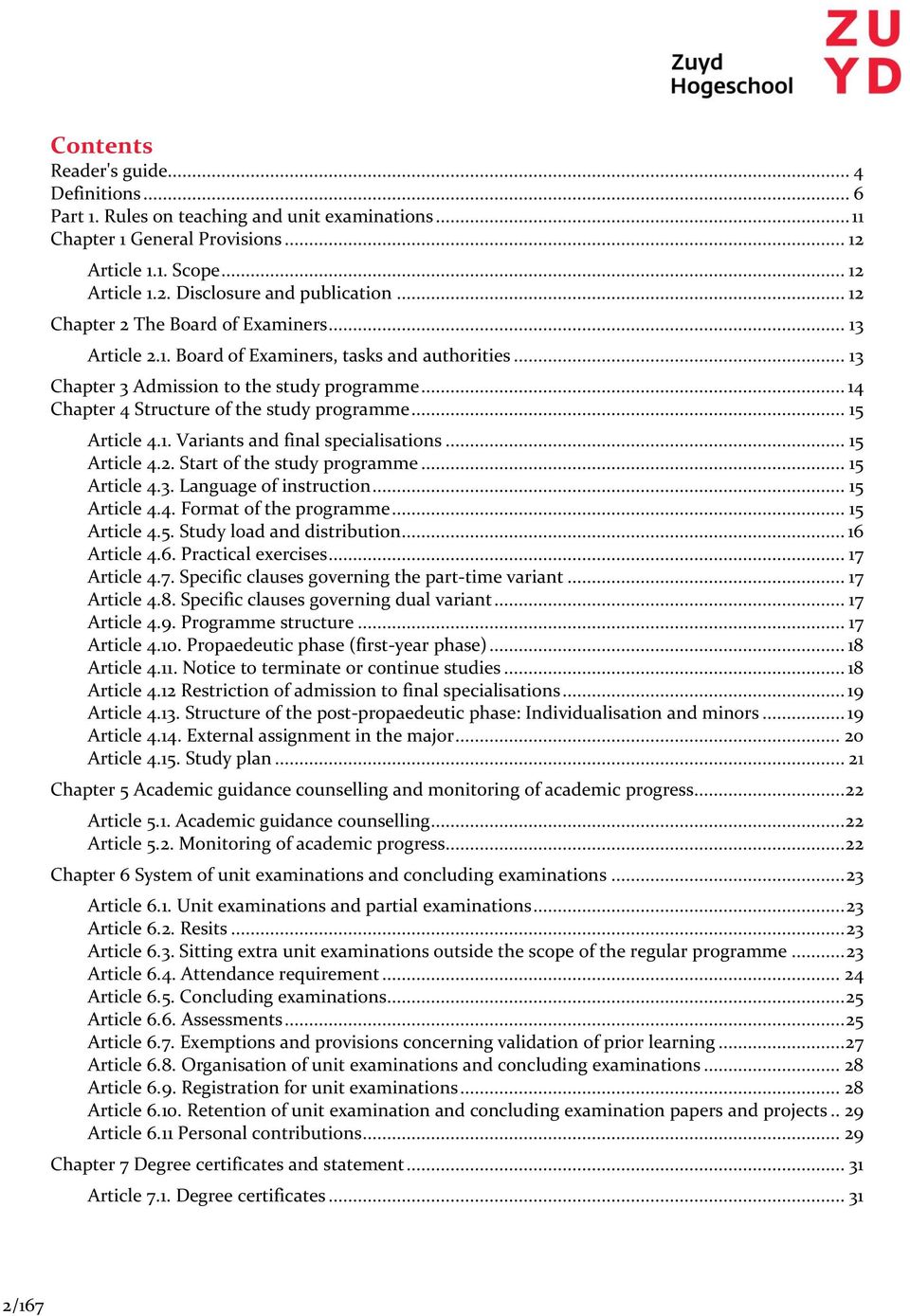
2 Contents Reader's guide... 4 Definitions... 6 Part 1. Rules on teaching and unit examinations Chapter 1 General Provisions Article 1.1. Scope Article 1.2. Disclosure and publication Chapter 2 The Board of Examiners Article 2.1. Board of Examiners, tasks and authorities Chapter 3 Admission to the study programme Chapter 4 Structure of the study programme Article 4.1. Variants and final specialisations Article 4.2. Start of the study programme Article 4.3. Language of instruction Article 4.4. Format of the programme Article 4.5. Study load and distribution Article 4.6. Practical exercises Article 4.7. Specific clauses governing the part-time variant Article 4.8. Specific clauses governing dual variant Article 4.9. Programme structure Article Propaedeutic phase (first-year phase) Article Notice to terminate or continue studies Article 4.12 Restriction of admission to final specialisations Article Structure of the post-propaedeutic phase: Individualisation and minors Article External assignment in the major Article Study plan Chapter 5 Academic guidance counselling and monitoring of academic progress Article 5.1. Academic guidance counselling Article 5.2. Monitoring of academic progress Chapter 6 System of unit examinations and concluding examinations Article 6.1. Unit examinations and partial examinations Article 6.2. Resits Article 6.3. Sitting extra unit examinations outside the scope of the regular programme Article 6.4. Attendance requirement Article 6.5. Concluding examinations Article 6.6. Assessments Article 6.7. Exemptions and provisions concerning validation of prior learning Article 6.8. Organisation of unit examinations and concluding examinations Article 6.9. Registration for unit examinations Article Retention of unit examination and concluding examination papers and projects.. 29 Article 6.11 Personal contributions Chapter 7 Degree certificates and statement Article 7.1. Degree certificates /167
3 Article 7.2. Statement Chapter 8 Improper conduct and fraud Article 8.1. Improper conduct Article 8.2. Fraud Chapter 9 Appeals and right of complaint...34 Article 9.1. Appeals...34 Article 9.2. Right of complaint...34 Chapter 10 Special facilities and circumstances beyond the control of the student with regard to unit examinations Article Special facilities Article Circumstances beyond the student's control and other personal circumstances Chapter 11 Serious nuisance and iudicium abeundi (expulsion order)...38 Article Serious nuisance...38 Article Iudicium abeundi (expulsion order)...38 Chapter 12 Concluding provisions adoption & amendment evaluation Article Hardship clause Article Unforeseen circumstances Article Adoption and amendment Article Transitional measures Article Evaluation Part 2. The programme and the examination process Chapter 1: Content of the programme and the examination process Objective of the study programme Description of the educational and examination programme...43 Chapter 2 Examination regulations, HMSM Chapter 3: Academic guidance counselling ACADEMIC YEAR TIMETABLE FOR /167

4 Reader's guide The EER starts with a list of definitions, defining the most important matters relating to the educational and examination programmes. The rest of the EER comprises two parts: Part 1 comprises rules arising from the Higher Education and Scientific Research Act (WHW), the policy of Zuyd University of Applied Sciences, and the policy of the programme department and the faculty. These are rules relating to how current students should progress through the study programmes and examinations and what they can expect from the institutions in that regard. These rules have been categorised in the following chapters: Chapter 1 General provisions. Describes the programme concerned, to whom the EER applies, when it needs to be published, and who is responsible for this. Chapter 2 The Board of Examiners. Describes the tasks of and authorities held by the Board of Examiners as well as how students can contact the committee and for what reasons. Chapter 3 Admission to the study programme. Indicates which regulations apply to admission and where they can be found. The regulations themselves are not featured here. Chapter 4 Structure of the study programme. Describes the regulations set and decisions made regarding the structure of the study programme. This concerns matters in which the programme department has an obligation towards students and matters in which students have an obligation towards the programme department. No description is included of the details of the study programme. That is included in part 2. Chapter 5 Academic guidance counselling and monitoring of academic progress. Provides the guarantee that a student can access academic guidance counselling (AGC). Details of how this takes place are not given here but in part 2 of the EER. This chapter also describes how often and in what form reports are produced and communicated to the student regarding the academic progress, who has end responsibility for these reports, and how the student can lodge an objection if he/she does not agree with the content of the report. Chapter 6 System of unit examinations and concluding examinations. Describes the regulations set and decisions made regarding unit examinations and concluding examinations within the study programme. This concerns matters in which the programme department has an obligation towards students and matters in which students have an obligation towards the programme department. No description is included of the details of the unit examination programme. That is included in part 2. Chapter 7 Degree certificates and statement. This chapter describes the documentary evidence issued once a student has passed a unit examination or concluding examination, who this is issued by, and who signs it. It also describes the degree title and the criteria subject to which the citation 'cum laude' (distinction) is awarded. Chapter 8 Improper conduct and fraud. This chapter defines improper conduct and fraud, and establishes the procedure applicable in such cases and the consequences. Chapter 9 Appeals and right of complaint. This chapter relates to appeals regarding decisions made by the director/dean or the Board of Examiners on the basis of the EER. It describes the 4/167

5 procedure and sets out with whom an appeal can be lodged. The chapter also describes the kind of complaints that can be submitted, to whom, and where the complaints regulations can be found. The complaints regulations themselves are not featured here. Chapter 10 Special facilities and circumstances beyond the control of the student with regard to unit examinations. This chapter describes the types of cases in which students can make use of special or additional facilities when sitting unit examinations and concluding examinations. It also describes the procedure for how students can sit unit examinations at a later date, having missed them due to specified special circumstances or circumstances beyond their control. Chapter 11 Serious nuisance and iudicium abeundi (expulsion order). This chapter describes the consequences of a student causing serious nuisance and what happens if the behaviour of a student (not the academic performance) demonstrates that he/she is not suited to the profession to which the study programme logically leads. Chapter 12 Concluding provisions adoption & amendment evaluation. This chapter describes circumstances under which actions may deviate from the provisions of the EER, who decides on this, and what should happen in cases not provided for in the EER. It also sets out the procedure according to which the EER has been formulated and how changes to the EER should be dealt with. (The Higher Education and Research Act [WHW] also states that changes are not permitted during the period of validity of the EER.) The transitional measures for students who have fallen behind with their studies during a study programme that is no longer up-to-date (for instance as a result of changes to the curriculum) are also set out here. Lastly, this chapter explains who is responsible for the evaluation and any necessary adjustments. Part 2 sets out the educational and examination programme. Chapter 1 of part 2 provides all information relating to the structure of the teaching and unit examinations, broken down by variant, final specialisation, and block. Part 2 also provides information about the academic year timetable, the block structure, the unit examination regulations, and the academic guidance counselling. 5/167

6 Definitions Definitions applied in these regulations: Final specialisation A course programme decided by the dean consisting of a cohesive package of post-propaedeutic phase study units. The final specialisation is specified on the degree certificate. Assessment A method or set of methods for grading the competences or standardised procedures that enable assessment of competences. Associate Degree programme A programme within a Bachelor's-level programme with a study load of at least 120 ECs, as defined in Article 7.8a, WHW. Bachelor's programme Initial HBO (higher vocational education) study programme [ART. 7.3 and 7.3-a WHW]. A student who has passed the final examination will be awarded a Bachelor s degree. For each study programme, the Board of Governors will add such information to the degree title as it decides. Study block A study block comprises one of the four terms making up an academic year. These blocks have comparable study loads. Before the start of an academic year, the Board of Governors shall decide upon the dates on which each new study block commences. CMR The Central Participation Council [ART WHW] Examinations Appeals Board The Examinations Appeals Board (Appeals Board) [ART WHW]. Board of Governors The Board of Governors [ART WHW] of the Zuyd University of Applied Sciences Foundation with the tasks and authorities as set out in the most recently adopted version of the Zuyd University of Applied Sciences Administrative and Management Regulations. Competence Competence is the capacity to apply and further develop available knowledge, understanding, skills, and attitude in order to adequately perform concrete tasks in professional life. CROHO Central Register of Higher Education Study Programmes containing all study programmes leading to an HBO (higher vocational education) degree certificate with the degree title attached thereto, subject to passing the final examination leading thereto [ART WHW] Faculty participation board The participation board of a faculty [ART WHW]. Partial examination An examination, the grade for which contributes to the grade for the unit examination of which it is a part. The EER will specify the weighting factor of every partial examination. Part-time study programme A study programme designed so that in addition to studying, the student can also carry out other work. This work may qualify for course credits in the form of exemption ECs or, subject to conditions imposed by the Board of Examiners, be treated as study units. Diploma supplement A standardised addition to the degree certificate/diploma containing relevant details of the study programme, based on the model developed by the European Commission, the Council of Europe, and CEPES, the educational arm of UNESCO. Dual study programme Study programme whereby one or more periods of study may be exchanged for periods of work experience related to the programme. Such a study programme will therefore contain study and work 6/167

7 EC elements. The work element is a part of the study programme and can therefore qualify for course credits [ART. 7.7 WHW] European Credit, a unit that represents 28 hours of academic work. The EC is equal to a course credit [ART. 7.4, paragraph 1, WHW]. When a unit examination is taken and passed, the student is awarded the number of ECs corresponding to that study unit as listed in part 2 of this EER. ECTS European Credit Transfer System enables the transfer of students between countries by expressing study load in way that allows comparison (in European Credits). Certificate of Experience The certificate stating the competences the individual has demonstrated as assessed against a specific, nationally-recognised standard, the level of those competences, and how the competences have been demonstrated. Concluding examinations The propaedeutic (first-year phase) or final examinations of a study programme [ART. 7.8 and 7.10 WHW]. Board of Examiners The Board of Examiners is the body responsible for determining in an objective and expert manner whether a student meets the conditions laid down by the education and examination regulations regarding the knowledge, understanding, and skills required for the award of a degree. [ART WHW] Examiner A person designated by the Board of Examiners (and who may or may not be an employee of the university of applied sciences) who administers the unit examinations and documents the results thereof [ART. 7.12c WHW]. External assignment A request from a legal entity other than the Zuyd University of Applied Sciences to one or more study programmes of the institution oriented towards having a student or group of students perform an assignment. The dean has the power to make a binding recommendation for the performance of this assignment, in observance of the authorities of the Board of Examiners. Extra opportunity The opportunity to take an extra unit examination that can be awarded to a student outside the standard scheduled unit examinations/resits. External student Someone registered as an external student at the institution [ART WHW] and as such is only attending for the purposes of sitting examinations [ART WHW]. Dean The head of the faculty as referred to in Article 10.3 b, paragraph 2, WHW. In accordance with Article 23, paragraph 5 of the Executive Regulations, the dean's duties include drafting the teaching programmes and the programme-specific section of the EER. Fraud 'Fraud' means any severe attributable act or failure to act by a student with the object of rendering the examiner partially or fully incapable of giving an accurate assessment of the acquisition of competences by that student or any other student. Dispute Advice Committee The committee that issues advice on payment of tuition fees, enrolments, and termination of enrolments, the award of degrees, etc. [ART A WHW] Degree certificate Documentary evidence issued by the Board of Examiners that the student has passed the propaedeutic examinations or the final examinations of a study programme included in the CROHO [ART WHW]. Institution 7/167
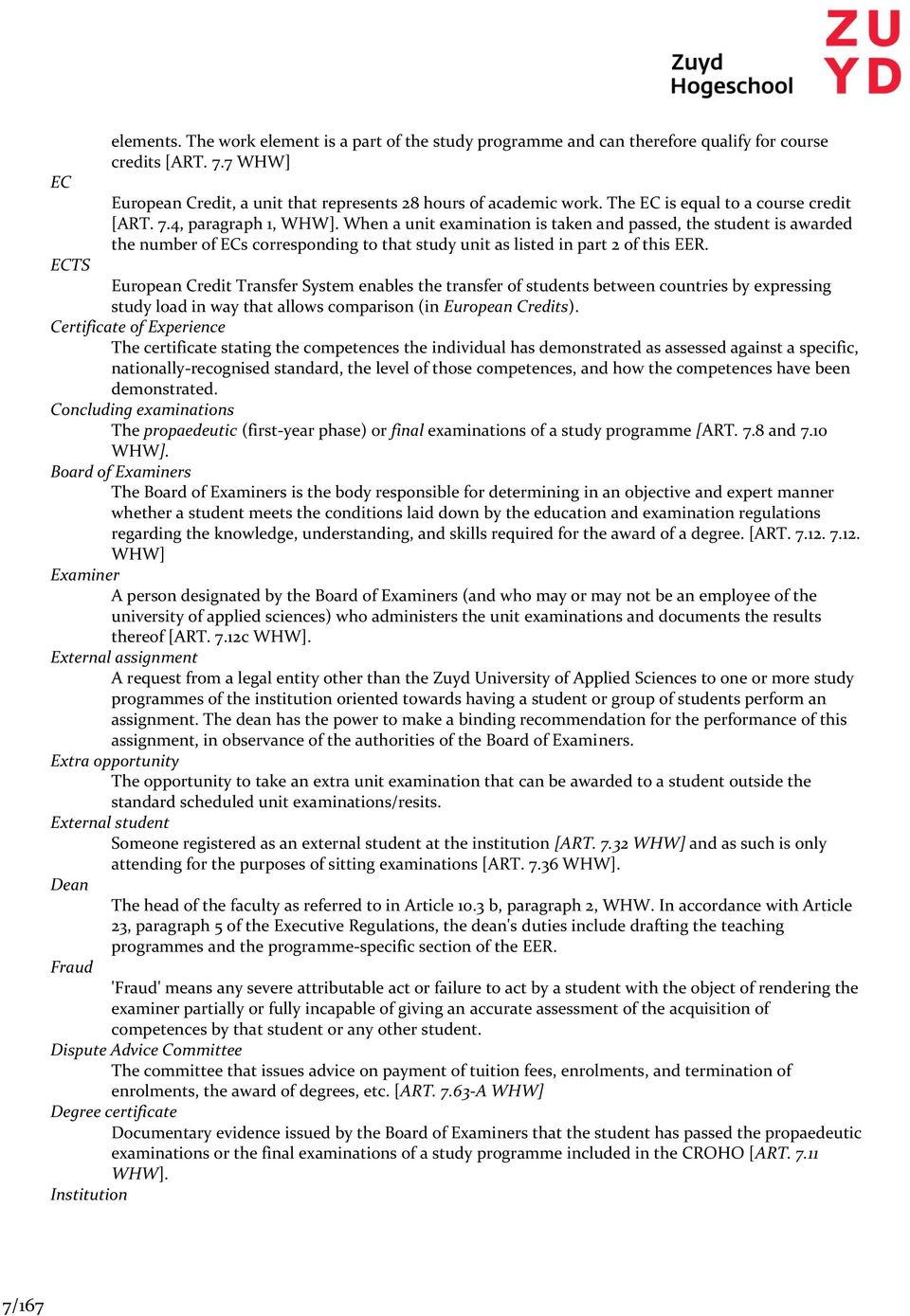
8 8/167 Zuyd University of Applied Sciences as run by the Zuyd University of Applied Sciences Foundation, registered in Heerlen. Enrolment year The period of continuous enrolment of a student commencing on the date of enrolment for a study programme and ending twelve months thereafter. Key project A key project is a study unit evaluated by one or more examiners and on the basis of which the relevant competence acquisition of a programme can be demonstrated. This may be a dissertation (e.g. Bachelor s thesis), internship report, artwork(s), performance, etc. Elective options A group of study units from a study programme, including projects, as chosen by a student to enable him/her to emphasise his/her own competences within his/her study programme. Learning abroad agreement Agreement between the student and the Board of Examiners in which the relevant educational institutions set out the agreements regarding his/her educational experiences abroad, in accordance with the ECTS system. Learning path The study units in which the student wishes to be examined, either at the same time or in sequence, in order to acquire the competences relevant to a study programme. A student wishing to follow a learning path not defined in this EER requires the permission of the Board of Examiners. Work experience agreement Agreement between the student, the dean for the study programme for which he/she is registered, and the organisation where the student undertakes the work experience element of the study programme. The work experience agreement sets out concrete terms regarding external learning activities within the student s learning path for a pre-determined length of time. Major The core study units of a study programme, in which all students must sit unit examinations to acquire the competences necessary to be awarded a degree certificate. Master s study programme Initial HBO (higher vocational education) study programme [ART. 7.3 WHW], upon completion of which the student is awarded a Master s degree. Intermediate Vocational Education programme (MBO) A middle-management training programme, either a specialist study programme or a professional study programme designated by the minister [ART WEB]. Minor Elective component of 15 ECs. See also 'Zuyd minor'. Nominal study load The study load excluding the time involved in resitting unit examinations and the preparation for those examinations. Study unit A cohesive package of competences to be acquired, expressed as whole course credits. Improper conduct Any act or failure to act by a student that disrupts the effective provision of education or that prevents or restricts the ability of the examiner to form an accurate opinion as to the student's acquisition of competences. Study programme A cohesive package of study units aimed at achieving well-defined objectives as to knowledge, understanding, skills, and attitude that the student following such programme must acquire [ART. 7.3 WHW]. Study programmes may be full-time, part-time, or a dual study programme, and taught up to Bachelor's degree level. Study Programme Committee The committee that has the tasks of
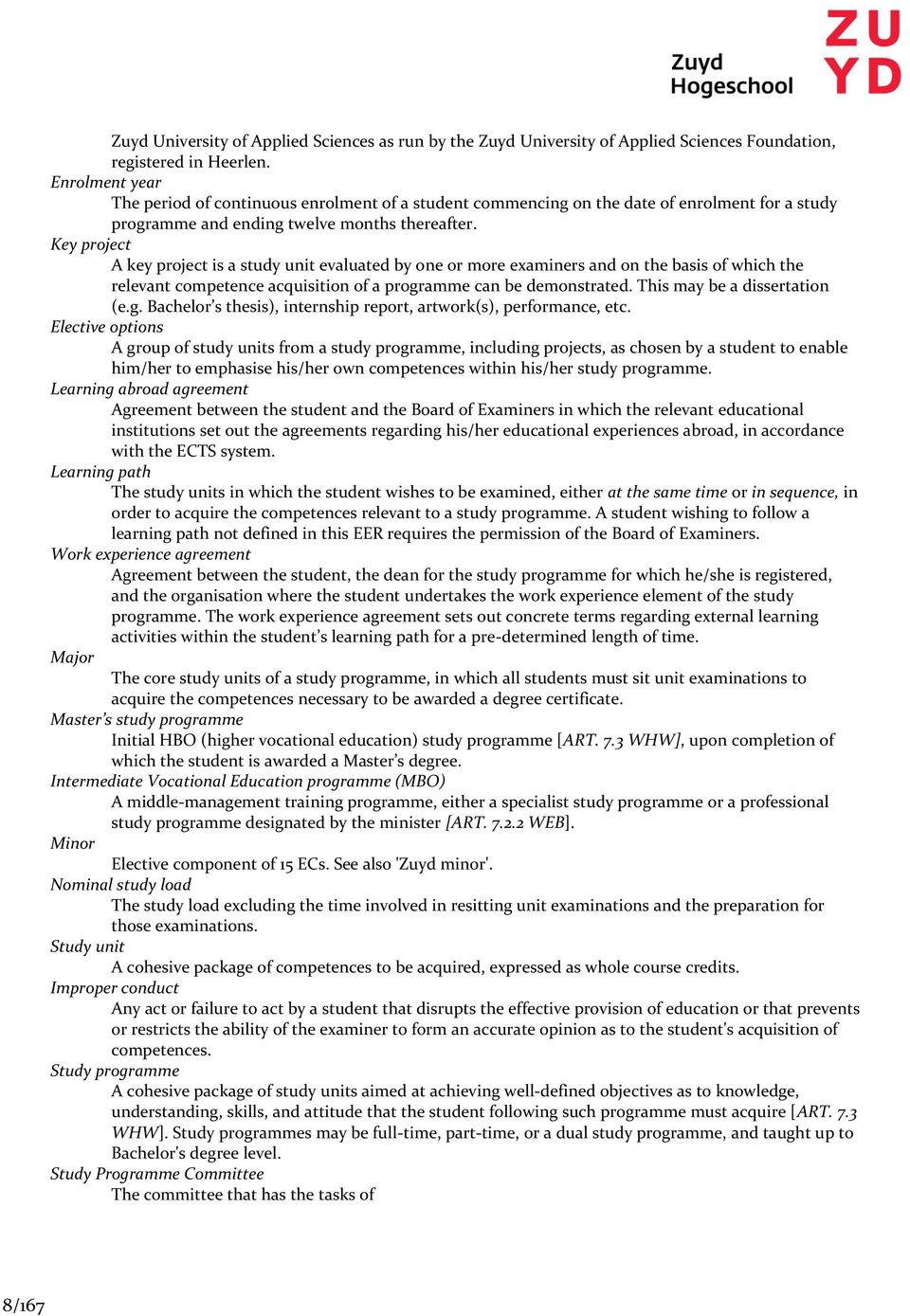
9 advising on the EER annually evaluating the implementation of the EER advising the dean on all matters concerning the teaching in the study programme, either as requested to do so or at its own initiative [ART WHW] Plagiarism Copying the works, thoughts, and reasoning of others and presenting them as one's own work. Post-propaedeutic phase (Post-first-year phase) The phase of the study programme following the propaedeutic (first-year) phase and which is concluded by final examinations. Practical exercises Practical exercises involve one or more cohesive study units whereby the examiner is able to grade the performance of the student through observation. Optional course profile Scope for a student to choose to study a maximum of 120 ECs selected from one or more Zuyd minors, other minors, or elective courses (including projects) from the student's own study programme. A study programme consists of a major plus an optional course profile. Propaedeutic phase (first-year phase) The phase concluded by the propaedeutic (first-year phase) examinations [ART. 7.8 WHW]. Student The person registered as a student at the institution [ART WHW]. Student counsellor A staff member who advises the student on matters involving study and student life. The student counsellor also assists and mediates in personal problems of any kind, material or otherwise. Notice to terminate or continue studies A binding recommendation issued to the student during the propaedeutic phase on whether or not to continue with the study programme. This notice may include a notice to exclude. [see: Notice to terminate or continue studies regulations of Zuyd University of Applied Sciences] Academic year The period commencing on 1 September of any year and ending on 31 August of the following year [ART. 1.1 WHW]. Study load The standardised load in terms of time allocated to each study programme and study unit expressed as whole ECs [ART. 7.4 WHW] and as set out in the EER. Academic guidance counsellor/mentor A staff member who monitors the academic progress of the student and who mentors the student in this regard. Study plan A progression of study units agreed between the student and his/her mentor/academic guidance counsellor in order to be eligible for the final examinations. This progression may differ from the sequence of the standard programme. Unit examination A unit examination must be sat for each study unit which tests the knowledge, understanding, attitude, and skills of the candidate, and that evaluates the results of the examination. Accelerated variant A track of 180 ECs within the Bachelor's-level programme and oriented towards students with a VWO (pre-university) diploma [ART. 7.9a WHW]. Facility Steps taken by an authorised staff member or body within the institution to provide the student with assistance with the aim of supporting and guiding his/her study progress. 9/167

10 10/167 Exemption Full or partial exemption from the requirement to sit a unit examination in order to satisfy the enrolment or admission conditions and/or to obtain course credits in respect of sitting propaedeutic or final examinations. Weekday A day, not being a Saturday or Sunday, or any generally observed holiday or national holiday designated by the government not falling during any free time scheduled by the Board of Governors. WHW The Higher Education and Scientific Research Act [Bulletin of Acts and Decrees 1992 no. 593], plus any subsequent amendments and additions. WSF 2000 The Student Grants Act 2000 [Bulletin of Acts and Decrees 2000 no. 571], plus any subsequent amendments and additions). WBP The Personal Data Protection Act [BULLETIN OF ACTS AND DECREES 2000: 302], plus any subsequent amendments and additions. Zuyd Minor Minor of 15 ECs identified as such and accessible to the students of at least two study programmes.
11 11/167 Part 1. Rules on teaching and unit examinations

12 Chapter 1 General Provisions Article 1.1. Scope Paragraph 1 These Education and Examination Regulations apply to the study programme Hotel Management with CROHO study programme code for full-time education. These regulations apply to all students registered for this study programme and to external students unless indicated to the contrary in the text. Paragraph 2 The student cannot derive any rights from Education and Examination Regulations (EER) that applied in previous academic years, unless these rights form part of a transitional scheme as referred to in Article Article 1.2. Disclosure and publication The dean will arrange for publication of the applicable EER prior to 1 September of the academic year to which the EER pertains, so the student can form a good judgement of the content and structure of the teaching and the examinations. 12/167
13 Chapter 2 The Board of Examiners Article 2.1. Board of Examiners, tasks and authorities Paragraph 1 Every study programme has its own Board of Examiners or shares one with a group of other study programmes within a faculty. Paragraph 2 The Board of Examiners is the body responsible for determining in an objective and expert manner whether a student meets the conditions laid down by the education and examination regulations regarding the knowledge, understanding, and skills required for the award of a degree. Paragraph 3 Students can approach the Board of Examiners for: a) a request for exemption from one or more unit examinations b) a request for exemption from the obligation to participate in practical exercises for the purposes of permission to sit the unit examinations in question, which may or may not involve alternative requirements c) a request for waiver of the entrance requirements for sitting a unit examination d) a request for admission to variants/learning paths subject to the approval of the Board of Examiners e) a request for the extension of the period of validity of a successfully completed unit examination or partial examination f) a request for enrolment in a minor not on the list of minors available to students in the requester's study programme g) a request to sit extra unit examinations h) a request for facilities and modifications due to a disability or chronic condition i) a request for academic facilities in consideration of the requester's practise of competitive sports at an elite level j) a request to depart from the EER if its application would lead to a decidedly unreasonable situation k) an objection against an assessment by an examiner Paragraph 4 The Board of Examiners can be reached via [email protected]. 13/167

14 Chapter 3 Admission to the study programme Students are admitted to the study programme in observance of the provisions of the Regulations on Enrolment and Tuition Fees of Zuyd University of Applied Sciences. These regulations can be read via Zuydnet. 14/167

15 Chapter 4 Structure of the study programme Article 4.1. Variants and final specialisations Paragraph 1 The study programme Hotel Management offers the variant full-time education. Paragraph 2 Within the study programme, there is no associate degree programme. Paragraph 3 The study programme offers the following final specialisation(s): 1. Hotel Management 2. Entrepreneurship 3. Food Service 4. Horizons in Hospitality Paragraph 4 The study programme has no accelerated variant of 180 ECs for pre-university diploma holders, and has a shorter variant. These variants are described in part 2. Article 4.2. Start of the study programme The study programme starts on 1 September Additionally, the study programme also starts on 1 February Article 4.3. Language of instruction Paragraph 1 The language of instruction of the study programme is Dutch. Besides a Dutch-language Bachelor's degree, the programme also offers an English-language Bachelor's degree. From the third academic year onwards, the language of instruction will be predominantly English. Paragraph 2 If a study unit is offered in a language other than the language of instruction specified in paragraph 1, this will be stated in the description of the study unit in question provided in chapter 1 of part 2. Article 4.4. Format of the programme Paragraph 1 The study programme has a propaedeutic phase and a post-propaedeutic phase, each made up of study units. There is a propaedeutic examination for the propaedeutic phase of each study programme, and final examinations at the conclusion of each study programme. Paragraph 2 15/167

16 A study unit is a cohesive body of competences to be acquired. There is a unit examination for each study unit. Paragraph 3 Each study programme comprises a major of at least 120 ECs. The number of ECs of the major is given in chapter 1 of part 2, specified by final specialisation if applicable. Paragraph 4 Every study programme has an optional course profile of at least 15 and at most 120 ECs. The number of ECs of the optional course profile is given in chapter 1 of part 2, specified by final specialisation if applicable. Paragraph 5 The optional course profile is structured to allow the students to pursue minor and elective modules. Article 4.5. Study load and distribution Paragraph 1 The study programme's total study load is 240 ECs in all. Paragraph 2 There is no associate degree programme. Paragraph 3 A student who enrols for a study programme will be offered a nominal study load of at least 60 ECs per academic year. This curriculum is scheduled over a minimum of 40 course weeks. Paragraph 4 Every academic year is divided into four study blocks. These study blocks have comparable study loads. Prior to the start of the academic year, the Board of Governors will decide on and publish the date on which each study block starts. The division of the academic year into blocks and the moment of assessment for each is set out in chapter 3 of part 2. Paragraph 5 No more than five study units and the unit examinations for such units may be offered per study block, including practical exercises. Paragraph 6 The dean is responsible for offering an adequate number of timetabled contact hours in order to achieve a good quality of teaching within the teaching concept and to give the student the opportunity to feel involved with the study programme personally and in terms of his/her studies. Each year the dean, the Study Programme Committee, and the Board of Examiners will evaluate, at a minimum, the number of actual contact hours. Paragraph 7 The propaedeutic phase will have a minimum of 504 contact hours timetabled. 16/167

17 Paragraph 8 Students following a study programme to enter a profession for which statutory requirements have been laid down regarding the acquiring of competences for practising such a profession will be given the opportunity within the study programme to satisfy such requirements. Article 4.6. Practical exercises Paragraph 1 The dean may assign one study unit or a cohesive group of study units the status of practical exercise. All practical exercises will be listed as such in part 2, chapter 1. Paragraph 2 By means of a practical exercise, the examiner shall make an assessment of the student through observation. Paragraph 3 If participation in a practical exercise is conditional on passing a specific unit examination or partial examination with an adequate grade, this will be described in chapter 2. If sitting a unit examination is conditional on the successful completion of a practical exercise, this will be described in chapter 2. Article 4.7. Specific clauses governing the part-time variant The study programme has no part-time variant. Article 4.8. Specific clauses governing dual variant Paragraph 1 Not applicable, as the study programme has no dual variant. Paragraph 2 Not applicable, as the study programme has no dual variant. Paragraph 3 Not applicable, as the study programme has no dual variant. Article 4.9. Programme structure Paragraph 1 The structure of the study programme is set out in part 2, chapter 1. This paragraph lists for all variants, including any accelerated variants of the study programme, the following information for each academic year, by study unit (including practical exercises): 1. name of the study unit 2. the competences acquired through the study unit 3. the period(s) in which the study unit is offered 4. any applicable admission requirements for the study unit 5. the work form(s) in which the study unit is offered 6. the number of ECs that the study unit comprises 17/167

18 7. the number of contact hours timetabled for the study unit 8. the minimum number of contact hours of academic counselling to which each student is entitled 9. attendance requirement, if any, for study units or components of study units 10. the unit examination format; if partial examinations are set, the number, format, and weighting factor of the partial examinations will be stated 11. the week in which the unit examination is offered 12. the opportunities for resitting unit examinations and (insofar as applicable) partial examinations Paragraph 2 Additionally, for practical exercises, chapter 1 of part 2 states: - the method of distributing and allocating places - the type of support - what preparation is expected of the student - the assessment standards to be applied - how and when the assessment is to be made - the opportunity for resitting examinations, and for interrupting or cutting short examinations - whether any costs are payable by the student Paragraph 3 Not applicable. Article Propaedeutic phase (first-year phase) Paragraph 1 The study load of the propaedeutic phase of a study programme is 60 ECs. Paragraph 2 The propaedeutic phase concludes with a propaedeutic examination. Paragraph 3 The propaedeutic phase is part of the major of a study programme. Article Notice to terminate or continue studies Paragraph 1 The propaedeutic phase of the study programme is designed to allow the student to gain insight into the content and goals of the study programme. Paragraph 2 The issue of the notice to terminate or continue studies in the propaedeutic phase is explained in detail in the Notice to terminate or continue studies regulations of Zuyd University of Applied Sciences, which are available on Zuydnet. Paragraph 3 18/167

19 For students who have not yet passed the propaedeutic examination, under the Notice to terminate or continue studies regulations the dean will issue a binding academic recommendation for expulsion if the academic results for the units of the propaedeutic phase are insufficient. Academic results are deemed insufficient if at the end of the first year of enrolment the student has earned fewer than 60 ECs. The recommendation will not be given earlier than the end of the first year of enrolment. Paragraph 4 Without prejudice to paragraph 2, the student must also meet the following requirements: n/a Article 4.12 Restriction of admission to final specialisations Paragraph 1 If a student does not meet the following conditions relating to the unit examination results earned, the dean will determine that the student cannot be admitted to the final specialisation of 1. Hotel Management, 2. Entrepreneurship, 3. Food Service, or 4. Horizons in Hospitality. The admission requirements for the operational internship (academic years 3 and 4 of the postpropaedeutic phase) are also described in chapter 1 of part 2. These admission requirements fall under the responsibility of the Board of Examiners. Paragraph 2 In his/her decision, the dean will take personal and exceptional circumstances into account. The dean shall give the student the opportunity to present his/her case before making a decision. He/she will also request advice from the student counsellor. Article Structure of the post-propaedeutic phase: Individualisation and minors Paragraph 1 The post-propaedeutic phase consists of a major component and an optional course profile. In the optional course profile, students may pursue Zuyd minors, other minors, or elective modules. Paragraph 2 Minors and elective modules comprise a study load of 15 ECs. They are published in the Minor Directory. The Minor Directory can be found at Zuydnet => Studeren => Minoren => Overzicht minoren 19/167
20 Paragraph 3 For each minor and elective module, the Minor Directory sets out: the target group(s) of the minor/elective module the prerequisites the attainment levels the forms of teaching the method of assessment/examination and resitting the number of available spaces the method of selection in the event of over-subscription (selection on the basis of admission requirements, drawing lots, or composition by target groups, with lots drawn per target group) details of evaluation Paragraph 4 Students do not require prior permission to pursue Zuyd minors designated in the Minor Directory as open to them. Paragraph 5 If a student wishes to pursue a minor within or outside the institution that is not specifically designated as open to students in his/her study programme, the student must first request permission from the Board of Examiners to pursue the minor. Paragraph 6 A student registers the choice of minor or elective module in OSIRIS. The student will receive a confirmation of enrolment by . Paragraph 7 In the event that a student cannot be assigned to a particular minor or elective module because the maximum number of places has been exceeded or the minimum number of places has not been achieved, the student will have the opportunity to enrol for another minor or elective module. Article External assignment in the major Paragraph 1 The dean may decide to invite one or more students to carry out an external assignment as an alternative to one or more study units of the major. Paragraph 2 The Board of Examiners of the study programme in which the student is enrolled will make the decision on whether the external assignment can replace one or more programme components. This decision will be made in consideration of, at a minimum, the content, level, scope, and organisation of the external assignment as an adequate replacement for the proposed programme component. 20/167

21 Article Study plan Paragraph 1 In consultation with his/her mentor or academic guidance counsellor, a student can draft a study plan for the optional course profile describing his/her choices for the learning path. Paragraph 2 A student may, with the prior approval of the Board of Examiners, sit one or more unit examinations at another education institution. If a unit examination is sat at an education institution in another country, the relevant education institutions should have signed a learning abroad agreement. 21/167
22 Chapter 5 Academic guidance counselling and monitoring of academic progress Article 5.1. Academic guidance counselling Paragraph 1 A student will be assigned a staff member or team of staff members by the study programme department who will be responsible for the academic guidance counselling or related activities. Paragraph 2 Chapter 3 of part 2 describes the structure of the academic guidance counselling per academic year. Article 5.2. Monitoring of academic progress Paragraph 1 A student is entitled to review documentation of his/her academic progress, including a list of unit examination results, at least twice per year of enrolment, at appropriate intervals throughout the year. The HMSM (Hotel Management School Maastricht) organises the monitoring of the students' progress as follows: - Each student will receive an from the Office of Educational Affairs twice a year, informing the student that their grades have been processed in Osiris and asking that the student check whether the information on Osiris is correct. The student is responsible for checking Osiris himself/herself. - If it becomes clear that the information on Osiris is incorrect, the student must contact the Office of Educational Affairs as soon as possible and in any case within no more than 20 days. - The student's argument will - if necessary - be reviewed by the Office of Educational Affairs in consultation with the Board of Examiners. The student will then receive a response on the basis of this review. Twenty days after the date of the original from the Office of Educational Affairs, the grades as listed on Osiris will be considered as final. Paragraph 2 The academic progress report in the first and second years of enrolment (in accordance with the Notice to terminate or continue studies regulations of Zuyd University of Applied Sciences) is arranged as follows. The student will receive an once every six months relating to his/her academic progress. Paragraph 3 The dean will ensure that the academic progress report correctly reflects the results achieved by the student. Paragraph 4 If the student is of the opinion that the academic progress report is incorrect or incomplete, he/she must register an objection in writing to the Board of Examiners within 20 working days. 22/167
23 Chapter 6 System of unit examinations and concluding examinations Article 6.1. Unit examinations and partial examinations Paragraph 1 Every study unit concludes with a unit examination. Paragraph 2 A unit examination may consist of multiple partial examinations. Chapter 1 of part 2 describes the individual partial examinations in the context of the larger unit examination. This includes, at a minimum, the weighting factor. Paragraph 3 By means of a practical exercise, the examiner shall make an assessment of the student through observation. The structure and organisation of practical exercises and their assessment are the responsibility of the Board of Examiners of a study programme. Paragraph 4 A unit examination including several cohesive partial examinations may be an assessment; the conditions set for assessment and the sitting of such an assessment are set out in part 2, chapter 1. Article 6.2. Resits Paragraph 1 Per year of enrolment, the student may sit at least one resit per unit examination or partial examination. Paragraph 2 The Board of Examiners may make an exception to the rule of paragraph 1 for internship projects and long-term external assignments if it is not possible to redo the internship or assignment in the same year of enrolment. Paragraph 3 Resits will only be offered for unit examinations or partial examinations of a study unit that the student has not passed. Taking a resit for a unit examination or partial examination that a student has passed is only possible if a student is believed to be eligible for the citation 'cum laude' (distinction). In that case, the student should submit a request to the Board of Examiners. Article 6.3. Sitting extra unit examinations outside the scope of the regular programme Paragraph 1 With the permission of the Board of Examiners, a student may sit extra unit examinations outside the scope of his/her study programme of 240 ECs, and have these results noted on his/her academic transcript and the diploma supplement. All unit examinations to be noted must be sat and evaluated before the certificate is issued to the student. 23/167
24 Paragraph 2 To this end, the student should submit a request, stating reasons, to the Board of Examiners of his/her programme department, indicating the content, scope, and timing of the study unit in which he/she wishes to sit the unit examination and the objective he/she wishes to attain by following the extra course(s) and taking the extra unit examination(s). Paragraph 3 The Board of Examiners will review the request against the following criteria: - no unreasonable extra effort will be required of the programme department to meet the student's request - the content of the study unit contributes to enhancing the practice of the student's field - the student can only take unit examinations offered under the responsibility of Zuyd University of Applied Sciences Paragraph 4 The Board of Examiners will make a decision and inform the dean and the student of this decision, providing argumentation, within 10 working days after receipt. Article 6.4. Attendance requirement Paragraph 1 Attendance of the teaching elements is required in the following circumstances: - the examiner can only assess the student by observing his/her procedures and actions - the students' procedures/actions depend on the actual presence of their fellow students The attendance requirements will be stipulated in part 2, chapter 1. Paragraph 2 If the assessment of a practical exercise is based in part on an attendance requirement in the practical exercise, then the attendance requirement will be equivalent to a partial examination. 24/167
25 Article 6.5. Concluding examinations Paragraph 1 The propaedeutic examination is deemed to have been completed when all unit examinations for all study units belonging to the propaedeutic phase have been successfully completed. The Board of Examiners establishes that this is the case, and makes the decision to award the certificate. Paragraph 2 The final examination is deemed to have been completed when all unit examinations for all study units belonging to the study programme have been successfully completed. The Board of Examiners establishes that this is the case, and makes the decision to award the certificate. Paragraph 3 The Board of Examiners may elect to depart from paragraphs 1 and 2 and assess a student's knowledge, understanding, and skills independently prior to determining the result of a concluding examination. Article 6.6. Assessments Paragraph 1 Unit examination grades will only be given by the examiners on the basis of the Dutch ten-point scale or on the basis of the related quality grading scale. The following conversion table is used by the examiners to compare grades: Dutch grade Description/ beschrijving ECTS grade ECTSdefinition U.S.- equiva lent OSIRISgrade 10 (>=9.5) 9 (8.5=<x<9.5) 8 (7.5=<x<8.5) 7 (6.5=<x<7.5) 6 (5.5<x<6.5) 6 (x=5.5) 5 (4.5=<x<5.5) excellent/ uitstekend very good/ zeer goed good/ goed Satisfactory/ ruim voldoende sufficient/ voldoende pass/ voldoende almost sufficient/ bijna voldoende A+ excellent - A+ outstanding performance A with only minor errors A+ B C D E FX very good - above the average standard A but with some errors good - generally sound work with a number of B notable errors satisfactory - fair but with C significant shortcomings sufficient performance meets the minimum criteria D fail - some more work required before credit can F be awarded EX (excellent) ZG (zeer goed) GO (goed) RV (ruim voldoende) VO/VLD (voldoende/ voldaan) OV/NVD (onvoldoende/ niet voldaan) 25/167
26 4 (3.5=<x<4.5) 3 (2.5=<x<3.5) 2 (1.5=<x<2.5) 1 (0.5=<x<1.5) fail/ onvoldoende poor/ zeer onvoldoende very poor/ slecht very poor/ zeer slecht F F F F fail - considerable further work is required F F F F Paragraph 2 A unit examination is passed with a grade of 5.5 or higher; equivalent, in qualitative terms, to at least sufficient/pass or voldoende. The qualitative term voldaan indicates a sufficient result. Paragraph 3 After the sitting of one or more resits for a study unit, the examiner shall register the highest of the results obtained as the result for this study unit. Paragraph 4 The Board of Examiners shall immediately allocate to the student the ECs earned by passing a unit examination or resit following registering of the assessment by the examiner(s). Paragraph 5 All unit examinations for study units must be passed with a satisfactory result. It is not possible to compensate a poor score with a good score at the level of unit examinations; however, a compensation scheme may be applied in the case of partial examinations (see part 2, chapter 2). Paragraph 6 Every student has the right to see the assessment of his/her unit examinations and to have an explanation of the way in which the result was determined. This right to see the assessment expires after 20 working days following the publication of the result earned. Paragraph 7 The validity of unit examination results or of the granting of exemptions is, as a rule, unlimited, provided that the student has been continuously enrolled for the relevant study programme. If the period of validity for one or more unit examinations is limited, this will be stated in chapter 1 of part 2 in reference to the unit examination in question. The period of validity of the unit examination will also be stated there. Paragraph 8 The Board of Examiners may either limit or extend the period of validity of the unit examination results or exemptions. After re-enrolment, the Board of Examiners may require an additional or substitute unit examination. Paragraph 9 Not applicable. 26/167
27 Article 6.7. Exemptions and provisions concerning validation of prior learning Paragraph 1 The Board of Examiners may grant exemptions for sitting one or more unit examinations if the student has already met the requirements of a unit examination or concluding examination. Paragraph 2 Exemption may be granted based on unit or concluding examinations previously passed, or on competences acquired outside higher education. Paragraph 3 The Board of Examiners will exercise restraint in allowing exemptions. It will use the following guidelines: Examiners who are experts in the field must always be included in the decision. The competences acquired are at least equal to the level and the content of the competences of the study unit for which a complete or partial exemption from the unit examination is being considered. The examiners' judgement is based on the existence of valid documents, including the certificate of experience. The validity is to be determined on the basis of the relevance of the content of the experience gained. No exemption can be granted for a final project/final research project. Final projects/final research projects are defined as the management project (module 7) and the management internship (module 8). The Board of Examiners is to draw up a report of the exemptions granted. Paragraph 4 The Board of Examiners shall provide the applicant with a written proof of exemption which shall specify as a minimum the date on which the exemption is granted, the relevant unit examination(s), and the length of validity of the exemption. Paragraph 5 A student wishing to be considered for an exemption from one or more unit examinations must submit a written request, stating reasons, to the Board of Examiners, accompanied by the documentation demonstrating that he/she meets the requirements for the study unit in question. Paragraph 6 Exemptions can be granted on the basis of a certificate of experience if: - the competences acquired as described in the certificate of experience are at least equal in terms of level and content to the competences of the study units being considered for exemption - the certificate of experience gives evidence of the level and content per competence - the certificate of experience was issued by an organisation authorised to evaluate prior competences - the certificate of experience was issued no more than five years ago 27/167
28 Article 6.8. Organisation of unit examinations and concluding examinations Paragraph 1 Examiners and other parties involved in unit examinations shall preserve the absolute confidentiality regarding the content of a written examination until the examination paper is handed out to the students. Paragraph 2 A written unit examination shall be sat under the supervision of at least one examiner or an invigilator appointed to supervise on behalf of the examiner. All other unit examinations shall be sat under the supervision of at least one examiner. Paragraph 3 To sit a unit examination, a student must be able to prove his/her identity by means of one of the following identity documents: a Zuyd student identification card, an original and valid driver's license, an ID card, or a passport. If this is not possible, the student will be immediately excluded from taking the unit examination and the examiner or invigilator must notify the chairperson of the Board of Examiners accordingly. Paragraph 4 A student who sits a unit examination must follow all instructions of the Board of Examiners, the examiner, or other persons designated by the Board of Examiners. Any breach by the student constitutes improper conduct on which grounds he/she can be excluded from further participation in the examination. Paragraph 5 The unit examination regulations applicable within the study programme are set out in part 2 of chapter 2. Any breach by the student constitutes improper conduct on which grounds the student can be excluded from further participation in the examination. Paragraph 6 A student is entitled to prompt notification of the assessments of the unit examinations he/she has taken. 'Prompt' is defined as: no later than fifteen working days following the sitting of the unit examination, unless there are good reasons for extending this period and the student is notified of this delay as soon as possible. Paragraph 7 The period between sitting a unit examination and a resit in the same study unit must be at least five working days. Before the resit, the student must have been offered the opportunity to look at a marked unit examination or resit of a unit examination previously taken. Article 6.9. Registration for unit examinations Paragraph 1 The student must register to sit unit examinations and resits for study units in the major, in accordance with a registration procedure laid down by the Board of Examiners. This procedure is set out in part 2, chapter 2. 28/167
29 Paragraph 2 The student must register to take a resit for a minor and will be invited to do so by the Board of Examiners of the study programme offering the minor. In the event that only a limited number of students can sit a unit examination, the minimum stipulation is that the order of registration dictates who may sit the examination. Paragraph 3 In no eventuality may a fee be charged to students for registration for or participation in unit examinations and resits. Article Retention of unit examination and concluding examination papers and projects Paragraph 1 a. Written unit examination work and/or other documentary evidence shall be retained for a period of at least 60 working days following its assessment by the Board of Examiners. b. The programme department is responsible for retaining the key documents. The method of retention is dependent on the nature of the key document. c. For the purposes of the accreditation process, key documents will be retained for a period of at least seven years. d. At the end of the period of storage, the work will be destroyed or returned to the student on request. Proof that a unit examination has been passed will be kept for ten years. Paragraph 2 Proof of the award of a degree certificate will be kept by the dean for a period of at least 50 years and will specify as a minimum: the personal details of the student the study programme and date on which the propaedeutic examinations were passed the study programme and date on which the final examinations were passed Paragraph 3 The dean will retain documentation for the provision of a statement as referred to in Article 7.2 for a period of at least ten years. This documentation includes: the personal details of the student the study programme and period of enrolment of the student a list of the unit examinations passed Article 6.11 Personal contributions Paragraph 1 Enrolment as a student is not dependent on any other financial contribution apart from the tuition fees. Paragraph 2 The purchase of certain study necessities is considered necessary for the study programme. The costs of these study necessities are estimated at: 29/167
30 Year 1 Approximately This relates to the following course materials and other study aids: -text books: 1, uniform and knife set: Year 2 Approximately This relates to the following course materials and other study aids: -text books: Year 3 Approximately This relates to the following course materials and other study aids: -text books: excursion(s) for minors: Year 4 Approximately This relates to the following course materials and other study aids: -internship contribution: Students in year 4 can find an internship themselves or make use of the list of internships managed by the HMSM. Students wishing to make use of this list will be charged No costs will be charged to students who find their own internship. However, the internship must satisfy the criteria set by the HMSM. -'Funda' (Bachelor's diploma) presentation ceremony: Paragraph 3 Participation in educational activities such as excursions and work visits as part of the study programme may be subject to additional costs. A list of these activities and any associated costs can be found in the above overview. Paragraph 4 Students who cannot or do not wish to pay the costs referred to in paragraph 2 will be offered an equivalent alternative. Paragraph 5 A student unable to bear the costs of study necessities or activities due to demonstrable personal and extraordinary circumstances may submit a request in writing to the dean for financial assistance or exemption from the payment obligation. Paragraph 6 Before making a decision on any request as referred to in paragraph 4, the dean will obtain recommendations from the student counsellor. Paragraph 7 The dean will make a decision on the request within 20 working days, and notify the student thereof in writing. 30/167
31 Chapter 7 Degree certificates and statement Article 7.1. Degree certificates Paragraph 1 As evidence that a unit examination has been passed, the examiner will issue a document stating as such, or the result and corresponding assessment will be entered into OSIRIS. Paragraph 2 As evidence that the student has passed the propaedeutic examination, the Board of Examiners will issue a document listing at least the following details: the name of the study programme (as given in CROHO), the concluding propaedeutic examination components, and the date of the most recent accreditation or new study programme review. This is to be signed by at least the dean and the chair of the Board of Examiners. Paragraph 3 As evidence that the student has passed the final examination, the Board of Examiners issues a degree certificate listing at least the following details: the name of the study programme (as given in CROHO), the concluding examination components and where relevant any statutory authority related thereto, the degree level, and the date of the most recent accreditation or new study programme review. This is to be signed by at least the dean and the chair of the Board of Examiners. Paragraph 4 On behalf of the Board of Governors, the dean shall award the degree of Bachelor to a student who has passed the final examinations of a study programme; information shall be added to the degree award specifying the subject or professional field to which the degree relates. Paragraph 5 The Board of Examiners shall not issue a degree certificate until the dean has confirmed that the certificate may be issued. The degree certificate is to be dated as the date on which the Board of Examiners establishes that the student has passed the final examinations. This date is deemed to be the date of graduation. Paragraph 6 The degree certificate will bear the citation 'cum laude' if a student has an average mark of 8.0 or higher. Paragraph 7 The degree certificate for the study programme is to be issued with a Diploma Supplement, a model text of which is set out below. 31/167
32 Diploma Supplement Zuyd University of Applied Sciences Nieuw Eyckholt DJ Heerlen The Netherlands This Diploma Supplement follows the model developed by the European Commission, the Council of Europe, and UNESCO/CEPES. The purpose of the supplement is to provide sufficient independent data in order to improve international transparency and fair academic and professional recognition of qualifications (diplomas, degrees, certificates etc.) for academic and professional purposes. It is designed to provide a description of the nature, the level, the context, the contents, and the status of the studies that were pursued and successfully completed by the individual named on the original qualification to which this supplement is appended. The supplement does not give any value judgement, statement on equivalence, or suggestions as to recognition. Information is provided on all of the eight sections. Should this not be the case, the reason for not including the sections concerned will be given. 1 Information identifying the holder of the qualification 1.1 Family name (surname): 1.2 Given birth names: 1.3 Date of birth: 1.4 Place of birth: 2 Information identifying the qualification 2.1 Name of qualification and title conferred: 2.2 Main field(s) of study for the qualification: 2.3 Name and status of awarding institution: 2.4 Language(s) of instruction/examination: 3 Information on the level of the qualification 3.1 Level of qualification: 3.2 Official length of programme: 3.3 Access requirement(s): 4 Information on the contents and results gained 4.1 Mode of study: 4.2 Programme requirements: 4.3 Programme details: Subjects in propaedeutic phase (first year) Dutch Credits European Credits Subjects in main phase (second year) Dutch Credits European Credits Subjects in main phase (third year) Dutch Credits European Credits Subjects in main phase (fourth year) Dutch Credits European Credits 4.4 Grading scheme: 4.5 General degree: 4.6 Date of latest accreditation or review: 5 Information on the function of the qualification 5.1 Access to further study: 5.2 Professional status: Article 7.2. Statement A student who has passed more than one unit examination but to whom no degree certificate can be issued will receive, on request, a written statement listing the unit examinations that have been passed and indicating the ECs awarded. 32/167
33 Chapter 8 Improper conduct and fraud Article 8.1. Improper conduct Paragraph 1 Improper conduct is defined as: during the examination, failure to follow the instructions of the Board of Examiners, the examiner, or other persons designated by the Board of Examiners (see Article 6.8, paragraph 4 of this EER). violation of the rules set out in the examination regulations (Article 6.8, paragraph 5 of this EER). Paragraph 2 The Board of Examiners may exclude a student from participation or further participation in a unit examination if the student engages in any improper conduct. Article 8.2. Fraud Paragraph 1 Fraud is defined as: the deliberate acts or failure to act of a student including plagiarism that make it partially or wholly impossible for an accurate assessment to be made of the student s knowledge, understanding, and skills. Paragraph 2 Fraud is also defined as including: serious and attributable acts or failure to act of a student that make it partially or completely impossible to obtain a correct evaluation of the knowledge, understanding, or skills of another student. Paragraph 3 If fraud is proved or suspected, the examiner or the appointed invigilator shall notify the Board of Examiners of this fact in writing, and supply the relevant proof. The Board of Examiners shall give the student the opportunity to present his/her case. Paragraph 4 A first instance of fraud will be punished by the Board of Examiners by declaring the sitting of the unit examination invalid and by giving the student a reprimand, to be recorded in OSIRIS. In the event of any repeat fraud, the student will be excluded from taking any unit examinations for any study programmes at Zuyd University of Applied Sciences for a period of six months and will be given a study recommendation advising withdrawal from the programme. These decisions extend to all Zuyd study programmes. 33/167
34 Chapter 9 Appeals and right of complaint Article 9.1. Appeals Paragraph 1 A student can file an appeal against a decision made by the dean or Board of Examiners under this EER with the Examinations Appeals Board, in accordance with the Examinations Appeals Board Regulations of the Zuyd University of Applied Sciences. These regulations are available on Zuydnet. An appeal must be submitted to the Legal Protection Office (see paragraph 4). Paragraph 2 A student who has submitted an appeal under the Examinations Appeals Board Regulations of the Zuyd University of Applied Sciences retains the right to sit unit examinations on condition that he/she is enrolled for the relevant study programme. Paragraph 3 A student or external student including prospective or former students may as an interested party submit an appeal to the Dispute Advice Committee concerning the payment of tuition fees, enrolment, termination of enrolment, award of degree, etc. An appeal must be submitted to the Legal Protection Office (see paragraph 4). Paragraph 4 A student may submit an objection or appeal via the Legal Protection Office, which can be contacted by at: [email protected]. No objection or appeal will be considered unless it has been submitted through this office. Article 9.2. Right of complaint Paragraph 1 A student either individually or as one of a group may as an interested party submit a complaint to the Ombudsman concerning the conduct of a staff member, a student, or a body of the institution pursuant to the provisions of the Zuyd University of Applied Sciences Ombudsman Assistance Regulations. These regulations are available on Zuydnet. Paragraph 2 A student wishing to invoke and file a complaint under the Complaints against Undesirable Conduct Regulations or the Ombudsman Assistance Regulations must do so through the complaints office: [email protected]. Paragraph 3 A student submitting a complaint or objection pursuant to this article retains the right to sit unit examinations on condition that he/she is enrolled for the relevant study programme. 34/167
35 Chapter 10 Special facilities and circumstances beyond the control of the student with regard to unit examinations Article Special facilities Paragraph 1 Students who face extreme personal or extraordinary circumstances can make use of special or extra facilities for sitting unit examinations or concluding examinations. Paragraph 2 Personal and extraordinary circumstances are defined as: pregnancy or long-term illness physical, sensory, or other functional disorders exceptional family circumstances such as the care for a blood relative or other close family member who is suffering from long-term illness; or the existence of a long-term mental and/or social problem whether or not combined with financial problems within the family as a result thereof membership of the CMR, faculty participation board, student committee, or study programme committee, or other activities as identified by the Board of Governors with which the student is involved within the context of the organisation and management of the institution membership of the board of a foundation aimed at continuing to provide student assistance or such tasks as the Board of Governors shall consider comparable, with the additional requirements that the student has final management responsibility and that the role occupies a significant part of his/her time membership of the board of a student organisation recognised by the Board of Governors or the dean having a direct benefit for the institution and faculties, with the additional requirement of a significant time commitment an insufficiently achievable study programme competitive sports at an elite level by participating in a recognised competitive sport component or a comparable activity at the highest national or international level, as set out in the Zuyd University of Applied Sciences Elite-level Sport scheme other circumstances regarded by the Board of Governors or the dean as exceptional circumstances Paragraph 3 A student wishing to invoke personal and exceptional circumstances must submit a written request to the Board of Examiners. The request must give reasons and be accompanied by as much documentary evidence in support as possible, together with a recommendation from the student counsellor. The Board of Examiners shall make a decision within 15 working days and notify the student of that decision in writing. Paragraph 4 35/167
36 36/167 In the event of personal and extraordinary circumstances of a permanent or chronic nature, the Board of Examiners may allocate the facilities for the entire period of enrolment of the student for the study programme in question.
37 Article Circumstances beyond the student's control and other personal circumstances Paragraph 1 Any student prevented from sitting a unit examination due to circumstances beyond his/her control and/or other personal circumstances, and who still wishes to sit the examination in the current academic year must submit a request to do so to the Board of Examiners as soon as possible, stating the nature of the circumstances of prevention. The Board of Examiners will then make a decision on this request within 15 working days. 37/167
38 Chapter 11 Serious nuisance and iudicium abeundi (expulsion order) Article Serious nuisance Paragraph 1 The enrolment of a student for a study programme will be terminated either temporarily or permanently if the conduct or expressions/language of the student causes a serious nuisance to staff of the institution, students enrolled on a study programme, or persons from outside with a functional relationship with the institution. 'Serious nuisance' includes a threat to the well-being of such persons. Paragraph 2 If a staff member of the institution or the dean of a faculty is of the opinion that a student is responsible for nuisance within the meaning specified in paragraph 1, he/she shall notify the Board of Governors of this belief in writing without delay. Paragraph 3 The Board of Governors will then make a decision on the termination of the enrolment as referred to in paragraph 1 of this article, but before doing so will obtain the recommendations of the dean of the faculty of the study programme for which the student is enrolled. Article Iudicium abeundi (expulsion order) Paragraph 1 The dean will terminate or reject the enrolment of a student in the study programme if the student s behaviour or expressions/language is evidence of his/her unsuitability to practice one or more of the professions for which his/her study programme serves as training, or for the practical training for professional practice. This refers to extreme moral and physical unsuitability for professional practice. [ART WHW] Paragraph 2 Before the dean makes a decision as referred to in paragraph 1, he/she will obtain the recommendations of the Board of Examiners and, if the student is already enrolled, from the student counsellor. Paragraph 3 Prior to a decision, the dean will grant the student or prospective student the opportunity to be heard. Paragraph 4 If a staff member of the institution or an examiner is of the opinion that the student is unsuitable as described in paragraph 1, he/she shall notify the dean of this belief in writing without delay. 38/167
39 Chapter 12 Concluding provisions adoption & amendment evaluation Article Hardship clause In the event that the application of this EER disproportionately harms the interests of an individual student during his/her enrolment, the student may submit a written objection to the Board of Examiners against the regulations being applied to him/her. The Board of Examiners shall reach a decision within fifteen working days in which it will weigh the individual interests of the student against the interests of the programme department, and shall notify the student of its decision in writing. Article Unforeseen circumstances Cases that these regulations do not provide for and which require an immediate decision will be decided on by the body competent to do so. If the competent body is the Board of Examiners, for instance in the case of unit examinations and concluding examinations, this decision may be made by the chairperson. Article Adoption and amendment Paragraph 1 This EER is to be adopted by the dean and requires the consent of the faculty participation board. The dean ratifies the EER. The Study Programme Committee advises on the EER. Paragraph 2 During its period of validity, the EER cannot be amended. Paragraph 3 These education and examination regulations enter into force on 1 September 2015 and may be cited as: EER Hotel Management Article Transitional measures n/a Article Evaluation The dean is responsible for the regular evaluation of the EER and for the purposes of monitoring and, where necessary, adjusting the study load shall take into consideration matters such as the time requirement for the student under the study load. 39/167
40 40/167 Part 2. The programme and the examination process
41 Chapter 1: Content of the programme and the examination process 1.1. Objective of the study programme The final qualifications of the Bachelor's programme are listed in the National Professional and Study Programme Profile (PSPP), Bachelor of Business Administration (BBA), Hotel Management The competences are based on the BBA competences, but are supplemented with the added value components from the hotel management license. The HMSM Bachelor's programme offers the student a programme enabling him or her to qualify as a hotel management professional holding the degree of BBA (Bachelor of Business Administration). Thanks to the combination of a unique hospitality mindset, current hotel management expertise, and professional hospitality skills, the graduate brings added value to the network of stakeholders in and around hotels. This profile establishes the following ten core competences: Competence 1: The creation of value through hospitality in hotels and the hotel function Competence 2: The development of a vision of changes and trends in the external environment and development of relationships, networks, and chains Competence 3: The analysis of policy questions, the translation of these into policy objectives and alternatives, and preparation for decision-making Competence 4: The application of Human Resource Management in light of the strategy of the organisation Competence 5: The set-up, management, and improvement of business or organisational processes Competence 6: The analysis of the financial and legal aspects, internal processes, and the business/organisational environment in order to enhance cohesion and synergy Competence 7: The development, implementation, and evaluation of a change process Competence 8: The initiation and creation of hospitality concepts, products, and services in independent and enterprising ways Competence 9: Social and communicative competence Competence 10: Self-management competence (interpersonal, as a professional) The four elements of the BBA are integrated into the ten core competences of the PSPP (Professional and Study Programme Profile) as standard: 1. Solid theoretical knowledge of the core areas of the profession: Accounting, business law and ethics, economics, finance, management information systems, marketing, organisational behaviour, quantitative techniques, strategic management, and operations management 2. Investigative capacity 3. Professional skill 4. Responsibility in actions More detailed information on the above can be found at: 41/167
42 42/167 Note: All descriptions of the competences corresponding with the study units will refer to the competences above.
43 1.2. Description of the educational and examination programme Bachelor's programme, taught in the Dutch language Year 1, Semester 1, Module 1 - Hotel Operations Teaching Module 1: Hotel Operations Attendance requirement ECs Competences to be acquired Teaching forms and methods Competen- Level Description ces Nonstandard language Contact hours A. Practical teaching Hotel Operations Kitchen/Restaurant Gastronomy Rooms Division Industrial Kitchen The creation of value through hospitality in hotels and the hotel function - The control and improvement of business and organisational processes - Social and communicative competence - Self-management competence (interpersonal, as a professional) - Practical services in Restaurant, Kitchen, Reception, Housekeeping, and Company canteen - Supervisory role in practice (Shift leader) - Role play - Instruction No Yes (Catching up on missed/failed services) 256 B.Theory teaching Hotel Operations Kitchen/Restaurant Gastronomy Rooms Division Man. Food & Beverage Man. Management The set-up, management, and improvement of business or organisational processes - The analysis of the financial aspects, internal processes, and the business/organisational environment in order to enhance cohesion and synergy Lectures Seminars Guest lectures Workshop Consultation hours Presentations Feedback sessions Independent study No Yes /167
44 - Leadership / Pers. Leadership - Accountancy/USALI Communications/Bus. Com. - The initiation and creation of hospitality concepts, products, and services in independent and enterprising ways Case study C. Gastronomic event Concepting Planning Execution The creation of value through hospitality in hotels and the hotel function - The set-up, management, and improvement of business or organisational processes - The analysis of the financial aspects, internal processes, and the organisational environment in order to enhance cohesion and synergy Teamwork Workshop Consultation hours Presentations Feedback sessions Project-based education Work performance No Yes (In the case of absence/ failure; Performance of the entire event again, or substitute assignment) 84 Reporting The initiation and creation of hospitality concepts, products, and services in independent and enterprising ways Evaluation Social and communicative competence Self-management competence (interpersonal, as a professional) 44/167
45 Examinations Partial examinations/unit examinations Weighting factor Resit Examination format Period of validity Examination week Resit week A. Hotel Operations Practical Kitchen/Restaurant Gastronomy Rooms Division Industrial Kitchen N/A Equal, with at least 5.5 per component Perform practical again Assessment per practical component after each practical component by practical supervisor 5 months Dependent on timetable Within 5 months B. Hotel Operations Theory Kitchen/Restaurant Gastronomy Rooms Division Man. Food & Beverage Man. Management - Leadership / Pers. Leadership - Accountancy/USALI Bus. Com./ Communications Gastronomy test unit examinations/ partial examinations unit examinations/ partial examinations Management examination At least 5.5 per component Gastronomy test unit examinations/ partial examinations unit examinations/ partial examinations Management examination Gastronomy test unit examinations/ partial examinations unit examinations/ partial examinations Management examination 5 months Weeks 11 & 20 Dependent on timetable Weeks 11 & 20 Weeks 11 & 20 Dependent on timetable Weeks 11 & 20 45/167
46 C. Gastronomic event Concepting Planning Execution Reporting Evaluation Performance of a project from A to Z Individual assessment. Group end assessment. Both at least 5.5 Performance of a project from A to Z (or a substitute individual assignment) Performance of a project from A to Z 5 months 5 months Within 1 month 46/167
47 Year 1, Semester 1, Languages programme (Note: Five language programmes are described: English, English Plus, German, French, and Spanish. English is compulsory. Students also take two of the other language programmes.) Teaching Module 1: Hotel Operations English ECs Competences to be acquired Teaching forms and methods Admission requirement Competences Level Description Nonstandard language Attendance requirement Contact hours M-HH-ENGELS1.1A 3 9 B2.2 Spoken language skills (presentations, reservations, dealing with complaints, menu explanation) -Seminars -Workshop -Consultation hours -Feedback sessions -Independent study -Gaming English Exit level HAVO (higher general secondary education) No 13 x 1.5 = 20 hours Examinations Partial examinations/unit examinations Weighting factor Resit Examination format Period of validity Examination week Resit week 47/167
48 English module 1 M1 Presentations M1 Role play Menu yes Oral assessment In accordance with EER Weeks 2-4 Weeks 6-8 Menu: weeks Semester 2; week 8 or weeks Teaching Module 1: Hotel Operations English Plus ECs Competences to be acquired Teaching forms and methods Nonstandard language Admission requirement Attendance requirement Contact hours M-HH- ENGLISH1P.1 English Plus programme 3 9 C1/2 Grammar and vocabulary -Seminars -Workshop -Consultation hours -Feedback sessions -Independent study -Gaming English Exit level HAVO (higher general secondary education) No 13 x 1.5 = 20 hours Module 1: Hotel Operations English Plus ECs Level Description Teaching forms and methods Competences Nonstandard language Admission requirement Contact hours Examinations 48/167
49 Partial examinations/unit examinations Weighting factor Resit Examination format Period of validity Examination week Resit week English Plus Yes Oral Assessment (10-15 min.) In accordance with EER Weeks Semester 2; week 8 or weeks /167
50 Teaching Module 1: Hotel Operations German ECs Competences to be acquired Teaching forms and methods Nonstandard language Admission requirement Attendance requirement Contact hours M-HH-Duits 1.2A German module A2 Mainly spoken language skills (greeting guest, telephone conversations), as well as written correspondence (e.g. business letters) -Seminars -Lectures -Workshop -Consultation hours -Feedback sessions -Independent study -Gaming German HAVO (higher general secondary education) No 13 x 1.5 = 20 hours Module 1: Hotel Operations German ECs Level Description Teaching forms and methods Competences Nonstandard language Admission requirement Contact hours Examinations Partial examinations/unit examina- Weighting factor Resit Examination format Period of validity Examination week Resit week 50/167
51 tions German module 1 Yes Written examination, multiple choice In accordance with EER Weeks Semester 2; week 8 or weeks /167
52 Teaching Module 1: Hotel Operations French ECs Competences to be acquired Teaching forms and methods Admission requirement Competences Level Description Nonstandard language Attendance requirement Contact hours M-HH-Frans 1.1 French module A2 Spoken language skills (greeting guest, check in/out, dealing with a reservation, etc.) -Seminars -Workshop -Consultation hours -Feedback sessions -Independent study -Gaming French HAVO (higher general secondary education) No 13 x 1.5 = 20 hours Examinations Partial examinations/unit examinations Weighting factor Resit Examination format Period of validity Examination week Resit week French module 1 n/a Yes Oral assessment: role play, approx. 15 min. In accordance with EER Weeks Semester 2; week 8 or weeks /167
53 Teaching Module 1: Hotel Operations Spanish ECs Competences to be acquired Teaching forms and methods Nonstandard language Admission requirement Attendance requirement Contact hours M-HH-Spaans1.1 Spanish module A1 Spoken language skills -Seminars -Workshop -Consultation hours -Feedback sessions -Independent study -Gaming Spanish None No 13 x 1.5 = 20 hours Module 1: Hotel Operations Spanish ECs Level Description Teaching forms and methods Competences Nonstandard language Admission requirement Contact hours Examinations Partial examinations/unit examinations Weighting factor Resit Examination format Period of validity Examination week Resit week 53/167
54 Spanish module 1 n/a n/a Yes Oral assessment: 5 components In accordance with EER Weeks Semester 2; week 8 or weeks /167
55 Teaching Module 1: Academic guidance counselling ECs Competences to be acquired Teaching forms and methods Non-standard language Admission requirement Attendance requirement * Contact hours Academic guidance counselling M1 1 Competence 9: Social and communicative competence Competence 10: Self-reflection, selfmanagement (Level 1) Group meetings, lectures, discussions with academic guidance counsellor None Partial * 5 Examinations Partial examinations Weighting factor Resit Examination format Period of validity Examination week Resit week AGC module 1: n/a Portfolio Two appointments with academic guidance counsellor Compulsory components: - appointments with academic guidance counsellor n/a Semester 2 Week 8 or weeks (Also resits for compulsory components in these weeks.) 55/167
56 56/167 - group meetings (resit = catch-up assignment)
57 Year 1, Semester 1, transfer module: HOM (Note: Four language programmes are described for this module: English, German, French, and Spanish. English is compulsory. Students also take two of the other three languages.) Teaching Transfer module: HOM ECs Competences to be acquired Teaching forms and methods Non-standard language Admission requirement Attendance requirement Contact hours Business communication 2 9, level 1 seminars feedback sessions including formative assessment independent study n/a MBO 4 (year 4, intermediate vocational education), HOM No 7.5 Dutch 2 9, level 1 seminars, feedback sessions including formative assessment independent study n/a MBO 4 (year 4, intermediate vocational education), HOM No 12 Academic guidance counselling 2 9 and 10, level 1 seminars independent study individual appointments n/a MBO 4 (year 4, intermediate vocational education), HOM No 6 57/167
58 Arithmetic skills 4 6 level 1 seminars independent study feedback sessions, formative assessment n/a MBO 4 (year 4, intermediate vocational education), HOM No 28 Management accounting 2 6 level 1 seminars independent study feedback sessions including formative assessment n/a MBO 4 (year 4, intermediate vocational education), HOM No 14 Knowledge of business processes 3 5 and 6, level 1 lectures independent study action learning n/a MBO 4 (year 4, intermediate vocational education), HOM No 20 Gastronomic event 4 1, 2, 5, 8, 9, 10 level 1 project group - meetings independent study n/a MBO 4 (year 4, intermediate vocational education), HOM No 30 English 4 9, spoken language skills, reading skills, listening skills, grammar work meetings independent study feedback sessions including formative assessment n/a B1+/B2 No 15x2x1 58/167
59 Spanish 4 9, spoken language skills, reading skills, listening skills German 4 9, grammar French 4 9, spoken language skills, reading skills, listening skills, grammar work meetings independent study feedback sessions including formative assessment work meetings independent study feedback sessions including formative assessment work meetings independent study feedback sessions including formative assessment n/a n/a No 15x2x1 n/a A1+ No 15x2x1 n/a A1+ No 15x2x1 Examinations Transfer module HOM Partial examinations Weighting factor Resit Examination format Period of validity Examination week Resit week Business communications n/a n/a Yes Reflection report In accordance with EER Week 14 Semester 2 Dutch n/a n/a Yes Written examination In accordance with EER In accordance with examination Semester 2 59/167
60 schedule Academic guidance counselling n/a n/a Yes Oral assessment In accordance with EER Weeks Semester 2 Arithmetic skills n/a n/a Yes Written examination open questions In accordance with EER In accordance with examination schedule Semester 2 Management accounting n/a n/a Yes Written examination open questions In accordance with EER In accordance with examination schedule Semester 2 Knowledge of business processes n/a n/a Yes Written examination multiple choice and open questions In accordance with EER In accordance with examination schedule Semester 2 Gastronomic event Group assessment Individual assessment Yes Group report Peer ranking Assessment of Execution of Event Reflection report Assessment of participation In accordance with EER Weeks Week 20 Semester 2: Follow event process again Substitute assignment English n/a n/a Yes 3x oral assessment, one average mark In accordance with EER Approx. week 2, approx. weeks 6-7 Semester 2 (week 8 or weeks 18-20) 60/167
61 approx. weeks Spanish n/a n/a Yes Oral assessment In accordance with EER Weeks Semester 2 (week 8 or weeks 18-20) German n/a n/a Yes Written examination, multiple choice In accordance with EER Weeks Semester 2 (week 8 or weeks 18-20) French n/a n/a Yes Oral assessment In accordance with EER Weeks Semester 2 (week 8 or weeks 18-20) Note: After semester 1, year 1, this group of students makes the transition to the standard programme of the Bachelor's study programme. See further: semester 2, year 1 61/167
62 Year 1, Semester 2, Module 2 - Hotel Business Teaching Module 2: Hotel Business ECs Competences to be acquired Teaching forms and methods Admission requirement Competences Level Description Nonstandard language Attendance requirement Contact hours Management accounting 4 1 Core professional field: finance for the purposes of analysing the financial aspects, internal processes, and the business or organisational environment Lecture Seminar PBL No PBL (see below) 15 hours of lectures 18 hours of PBL Descriptive statistics 2 1 Core professional field: quantitative techniques for the benefit of investigative ability Lecture Seminar Independent study No 9 hours of lectures Probability calculation 2 1 Core professional field: quantitative techniques for the benefit of investigative ability Lecture Seminar Independent study No 9 hours of lectures Marketing 2 1 Core professional field: marketing within the framework of competences: - development of a vision of changes and trends in an external environment - analysis of business Lecture PBL project No PBL (see below) 4 hours of lectures 6 hours of PBL 3-hour company visit 62/167
63 environment Research: Culture, Research, Macroeconomics Core professional field: economics - Development of investigative ability - Communicative competence: teamwork Lecture Seminar PBL " " No No PBL (see below) 2-hour lecture on culture 3-hour seminar on culture 3 hours: macroeconomics 12 hours of PBL 2-hour workshop: research 2.5-hour lecture on research Research report Communicative competence: professional written reporting - Development of a vision of changes and trends in an external environment - Development of investigative ability Lectures Seminars Group project " No 8 hours of seminars and lectures 2-hour lecture 2-hour exercise/seminar 63/167
64 Law & Ethics Core professional fields: law and ethics Lectures Group project 5 hours of lectures 4 hours of PBL Speaking in public 1 Social and communicative competence: presentations Seminars Practice sessions 2 hours of seminars 2 hours of lectures Teamwork 1 Social and communicative competence: cooperation (teamwork) Self-management competence: self-reflection PBL meetings See above 64/167
65 Examinations Module 2: Hotel Business Partial examinations/unit examinations Weighting factor Resit Examination format Period of validity Examination week Resit week Man. Accounting, descriptive statistics Yes Case study test In accordance with EER Week 8 Week 18 Probability calculation Yes Written examination: open questions Week 8 Week 18 Marketing Yes Written examination: multiple choice Research Test Yes Multiple choice examination Research report Yes Written examination: open questions Week 17 Week 19 Week 8 Week 18 Week 17 Week 19 Law/Ethics Yes Report Week 14 Week 18 Speaking in public Yes Report Week 17 Week 19 Teamwork Yes Oral assessment Week 17 Week 19 65/167
66 Yes Peer assessment Week 7 or week 15 Week 19 Year 1, Semester 2, Languages programme (Note: Five language programmes are described: English, English Plus, German, French, and Spanish. English is compulsory. Students also take two of the other language programmes.) Teaching Module 2: Hotel Business English ECs Competences to be acquired Teaching forms and methods Nonstandard language Attendance requirement Admission requirement Contact hours M-HH-ENGELS1.1A 3 9 B.2.2 Spoken language skills (ratio analysis and conversation about reader or presentation) -Seminars -Workshop -Consultation hours -Feedback sessions -Independent study -Gaming English No No 13 x 1.5 = 20 hours Module 2: Hotel Business English ECs Level Description Teaching forms and methods Competences Nonstandard language Attendance requirement Contact hours 66/167
67 Examinations Partial examinations/unit examinations Weighting factor Resit Examination format Period of validity Examination week Resit week English module 2 M2 Ratios 1 Yes Oral assessment In accordance with EER Weeks 6-9 Weeks M2 Cultural Awareness 1 Weeks /167
68 Teaching Module 2: Hotel Business English Plus ECs Competences to be acquired Teaching forms and methods Nonstandard language Attendance requirement Admission requirement Contact hours M-HH- ENGELSH1P.1 English Plus programme 3 9 C1/2 Grammar and vocabulary C1/2 Negotiations C1 + spoken language skills -Seminars -Workshop -Consultation hours -Feedback sessions -Independent study -Gaming English No None 13 x 1.5 = 20 hours Module 2: Hotel Business English Plus ECs Level Description Teaching forms and methods Competences Nonstandard language Attendance requirement Contact hours Examinations Partial examinations/unit examinations Weighting factor Resit Examination format Period of validity Examination week Resit week English M2 1 Yes Oral assessment In accordance with Weeks Weeks /167
69 Plus negotiations (role play) EER M2 DC 1 Written assessment (vocabulary and grammar) Weeks /167
70 Teaching Module 2: Hotel Business German ECs Competences to be acquired Teaching forms and methods Nonstandard language Attendance requirement Admission requirement Contact hours M-HH-Duits 1.2A 3 9 B 1.1 Spoken language skills (dialogue/presentation) -Seminars -Lectures -Workshop -Consultation hours -Feedback sessions -Independent study -Gaming German No No 13 x 1.5 = 20 hours Module 2: Hotel Business German ECs Level Description Teaching forms and methods Competences Nonstandard language Attendance requirement Contact hours Examinations Partial examinations/unit examinations Weighting factor Resit Examination format Period of validity Examination week Resit week German module 2 Conversation 1 Yes Dialogue In accordance with EER Weeks 5-6 Weeks /167
71 71/167 Presentation 1 Presentation Weeks 13-16
72 Teaching Module 2: Hotel Business French ECs Competences to be acquired Teaching forms and methods Nonstandard language Attendance requirement Admission requirement Contact hours M-HH-Frans 1.2 French module B 1.1 Spoken language skills (giving an explanation, giving a presentation) -Seminars -Workshop -Consultation hours -Feedback sessions -Independent study -Gaming French No 13 x 1.5 = 20 hours Module 2: Hotel Business French ECs Level Description Teaching forms and methods Competences Nonstandard language Attendance requirement Contact hours Examinations Partial examinations/unit examinations Weighting factor Resit Examination format Period of validity Examination week Resit week French module 2 n/a Yes Oral assessment: - presentation In accordance with EER Weeks Weeks /167
73 73/167 - conversational skills on the basis of photos
74 Teaching Module 2: Hotel Business Spanish ECs Competences to be acquired Teaching forms and methods Nonstandard language Attendance requirement Admission requirement Contact hours M-HH-Spaans 1.2 Spanish module A1 Spoken language skills -Seminars -Workshop -Consultation hours -Feedback sessions -Independent study -Gaming Spanish No None 13 x 1.5 = 20 hours Module 2: Hotel Business Spanish ECs Level Description Teaching forms and methods Competences Nonstandard language Attendance requirement Contact hours Examinations Partial examinations/unit examinations Weighting factor Resit Examination format Period of validity Examination week Resit week 74/167
75 Spanish module 2 n/a n/a Yes Oral assessment: 5 components In accordance with EER Weeks Weeks /167
76 Teaching Module 2: Academic guidance counselling ECs Competences to be acquired Teaching forms and methods Non-standard language Admission requirement Attendance requirement * Contact hours Academic guidance counselling M2 1 Competence 9: Social and communicative competence - Group meetings - Discussions with academic guidance counsellor None Partial * 10 Competence 10: Self-reflection, selfmanagement (Level 1) Examinations Partial examinations Weighting factor Resit Examination format Period of validity Examination week Resit week AGC module 2: n/a -Portfolio -Oral assessment with academic guidance counsellor on the basis of the portfolio In accordance with EER Weeks Weeks (Also resits for compulsory components in these weeks.) 76/167
77 Compulsory components: - appointments with academic guidance counsellor - group meetings (resit = catch-up assignment) Year 2, Semester 1, Module 3 - People & Business in the Hospitality Industry Teaching Study unit ECs Competences to be acquired M3 Knowledge 5 Competence 4: The application of Human Resource 1 and Skills 1: Management in light of the strategy of the organisation (level 2) Competence 5: The set-up, management, and improvement of business or organisational processes (level 2) Competence 6: The analysis of the financial and legal aspects, internal processes, and the business environment in order to enhance cohesion and synergy (level 2) Forms of teaching and learning PBL Lectures Seminars Helpdesk Management accounting HOTS Game Nonstandard language No Admission requirement Attendance Requirement Attendance of PBL meetings is compulsory (No more than two meetings may be missed.) Contact hours Lectures = 8 hours MAC = 21 hours Statistics: 12 hours Examination = 2 x 90 min. To be able to create the professional products: - Writing a business plan - Conducting a simple research project Total: 44 hours Knowledge in the fields of Law, Marketing, and HRM Knowledge/skills in the fields of Management accounting, Financial mathematics, Research skills, and Statistics 77/167
78 M3 Knowledge and skills 2: M3 Knowledge 2 M3 Skills 2 M3 Research assignment 5 Student has knowledge in the areas of Law, HRM, and Ethics Student has knowledge/skills in the fields of Management accounting, Financial mathematics, Research skills, and Statistics PBL Lectures Seminars Helpdesk Management accounting HOTS Game No PBL meetings Lectures = 8 hours PBL = (See under M3 PBL) MAC = 21 hours Statistics = 10 hours Examination = 2 x 90 min. Total: 42 hours 78/167
79 M3 Business plan: M3 Business plan report M3 Communication M3 Peer ranking M3 Defence M3 Refurbishment plan 6 Competence 4: The application of Human Resource Management in light of the strategy of the organisation (level 2) Competence 5: The set-up, management, and improvement of business or organisational processes (level 2) Competence 6: The analysis of the financial and legal aspects, internal processes, and the business environment in order to enhance cohesion and synergy (level 2) Competence 9: Self-reflection and self-management Specific: - Student is capable of writing and explaining a business plan. - Student is capable of designing a promotion plan and an internal communication structure. - Student is capable of designing a refurbishment plan. - Student is capable of evaluating fellow students using a peer ranking form. - Student is capable of defending a business plan. Supervision meetings for business plan (BP) Workshops HOTS days Seminars Business Communic ation Conversation skills training Defence of business plan No Yes 14 hours 8 hours 20 hours 9 hours 4 hours 0.5 hours Total: 55.5 hours M3 PBL 4 For the ability to create the professional product: - Writing a Business Plan No yes During PBL meetings, student is: - capable of applying existing/learned knowledge - capable of making a substantively good contribution - capable of demonstrating a good attitude and effort - capable of assessing and evaluating fellow students PBL meeting Total: 41 hours 79/167
80 Note: Study unit M3 Business plan: M3 Business plan report M3 Communication M3 Peer ranking M3 Defence Attendance rule - Compulsory attendance of HOTS afternoons / supervision sessions for business plan - Compulsory attendance of seminars - Compulsory attendance of 3x Peer ranking sessions - Compulsory attendance of project sessions not met = redo M3 business plan M3 PBL Compulsory attendance of PBL meetings. (No more than two meetings may be missed.) 80/167
81 Examinations Study unit M3 Knowledge and Skills 1: Partial examinations Weighting factor Partial examination resits Examination format Period of validity In accordance with EER Week of partial examinations Examination week Resit week M3 Knowledge 1 M3 Skills M3 Knowledge and skills 2: Multiple choice examination Multiple choice examination " M3 Knowledge 2 M3 Skills 2 M3 Research assignment M3 Business plan: Multiple choice examination Multiple choice examination Research plan " M3 Business plan report M3 Communication M3 Peer ranking M3 Defence M3 Refurbishment plan Report Promotion plan/ IC plan Students peer ranking Oral assessment by coach/lecturer Business Communication Refurbishment plan next semester /167
82 Study unit M3 PBL Partial examinations Attendance requirement Weighting factor Partial examination resits Not met = attend PBL meetings again Examination format Final evaluation based on participation and peer ranking during PBL meetings Week of partial examinations Period of validity Examination week Resit week " Next semester 82/167
83 Year 2, Semester 1, Module 3 - Languages programme Note: Five language programmes are described: English, English Plus, German, French, and Spanish. English is compulsory. Students also take two of the other language programmes. Teaching Module 3: Hotel People and Business English ECs Competences to be acquired Teaching forms and methods Nonstandard language Admission requirement Attendance requirement * Contact hours M-HH-03EN.14 3 Competence 9: Spoken language skills (job interview and training) Level C1 seminars, workshop, consultation hours, feedback sessions, independent study, gaming English No No 13 x 1.5 = 20 hours Examinations Module 3: Hotel People and Business English Partial examinations Weighting factor Resit Examination format Period of validity Examination week Resit week M3 Job Interview M3 Training 1 1 In accordance with Article 6.2 oral In accordance with Article 6.6 Session 4-7 Session Module weeks /167
84 Teaching Module 3: Hotel People and Business English Plus ECs Competences to be acquired Teaching forms and methods Nonstandard language Admission requirement Attendance requirement * contact hours M-HH-03EP.14 3 Competence 9: Writing skills: Grammar and vocabulary Level C1.2 / C1 -Seminars -Workshop -Consultation hours -Feedback sessions -Independent study -Gaming English None No 13 x 1.5 = 20 hours Examinations Module 3: Hotel People and Business English Plus Partial examinations Weighting factor Resit Examination format Period of validity Examination week Resit week 84/167
85 M3 blog M3 DC 1 1 In accordance with Article 6.2 Written Written (vocabulary and grammar) In accordance with Article 6.6 Weeks Weeks Module weeks /167
86 Teaching Module 3: Hotel People and Business German ECs Competences to be acquired Teaching forms and methods Nonstandard language Admission requirement Attendance requirement * Contact hours M-HH-03DU 3 Competence 9: Spoken language skills (dialogue) Level B1.2 -Seminars -Lectures -Workshop -Consultation hours -Feedback sessions -Independent study -Gaming German No No 13 x 1.5 = 20 hours Examinations Module 3: Hotel People and Business German Partial examinations Weighting factor Resit Examination format Period of validity Examination week Resit week n/a n/a In accordance with Article 6.2 Dialogue In accordance with Article 6.6 Weeks Weeks /167
87 Teaching Module 3: Hotel People and Business French ECs Competences to be acquired Teaching forms and methods Nonstandard language Admission requirement Attendance requirement * Contact hours M-HH-03 FR.12 3 Competence 9: Spoken language skills (job interview, company culture differences) Level B1.2 -Seminars -Workshop -Consultation hours -Feedback sessions -Independent study -Gaming French No No 13 x 1.5 = 20 hours Examinations Module 3: Hotel People and Business French Partial examinations Weighting factor Resit Examination format Period of validity Examination week Resit week n/a n/a In accordance with Article 6.2 Oral (job interview) 15 min. In accordance with Article 6.6 Weeks Weeks /167
88 Teaching Module 3: Hotel People and Business Spanish ECs Competences to be acquired Teaching forms and methods Nonstandard language Admission requirement Attendance requirement * Contact hours M-HH-03SP 3 B1.1 Spoken language skills Competence 9: seminars, workshop, consultation hours, feedback sessions, independent study, gaming Spanish None No 13 x 1.5 = 15 hours Examinations Module 3: Hotel People and Business Spanish Partial examinations Weighting factor Resit Examination format Period of validity Examination week Resit week n/a n/a In accordance with Article 6.2 Oral 5 components, duration: 10 minutes In accordance with Article 6.6 Weeks Weeks /167
89 Year 2, Semester 1, Module 3 - Academic guidance counselling programme Teaching Module 3: Academic guidance counselling ECs Competences to be acquired Teaching forms and methods Nonstandard language Admission requirement Attendance requirement * Contact hours Academic guidance counselling M3 1 Competence 9: Social and communicative competence Competence 10: Self-reflection, selfmanagement (Level 2) - Attendance of Career Event - Internship motivation interviews - Workshops - Initial interview with Academic Guidance Counsellor no All components are compulsory 18 Examinations Partial examinations Weighting factor Resit Examination format Period of validity Examination week Resit week AGC module 3: Attendance compulsory for all component s Compulsory components to be caught up on, or catch-up assignment In accordance with EER Catch-up assignments: (Weeks 18-20) Catch-up workshops: 89/167
90 required next semester 90/167
91 Year 2, Semester 2, Module 4 - Operational international internship Teaching Study unit Operational international internship ECs Competences to be acquired Teaching forms and methods 30 Competence 1: The creation of value through hospitality in hotels and the hotel function Competence 2: Development of a vision of changes and trends in an external environment (trendwatching) Competence 5: The set-up, management, and improvement of business or organisational processes Competence 9: Social and communicative competence, specifically intercultural competence and foreign languages, oral and written business communication Competence 10: Self-managing competence Further: Investigative capacity: The student answers an operational question (posed by the company) in a methodologically correct manner. The student works within a practical environment chosen himself/herself. Guidance provided by supervisor in the workplace and by lecturer (remotely) on behalf of the study programme. The student provides periodic reports on his/her findings. Language English or other foreign language (not Dutch) (dependent on the location of the internship) Correspondence and reports: English Admission requireme nt Propaedeutic programme completed Attendance requireme nt Yes (100%) 22 weeks, including holiday If criteria not satisfied: new internship Contact hours 14 hours supervision by lecturer at the HMSM Supervision at the workplace by the company mentor 91/167
92 Examinations Partial examinations Weighting factor Resit Operatio nal internship Examination format Period of validity Examination week Resit week 92/167
93 Written reports: 1 first arrival report 3 periodic reports 6 x Coolhunt 3 x ICARs (Inter Cultural Awareness Report) 1 final report Final evaluation of content of internship on the basis of mid-term evaluation by company and internship supervisor; final evaluation by company; final interview with internship supervisor Interim reports: 20% = 1 first arrival report 3 periodic reports including 3 ICARs Coolhunts: 10% B. Final report: 70% Average of A + B = at least 5.5 C: Content of Management internship: 80% D: Final interview: 20% Average of C + D = at least 5.5 final report unsatisfactory the first time => repeat report (resit) final report unsatisfactory for a second time => substitute assignment in consultation with internship supervisor, internship office, and Board of Examiners internship unsatisfactory => new internship In accordance with EER Submission of periodic reports: First arrival report week 1 First periodic report week 4 Second periodic report week 8 Mid-term evaluation between week 8 and week 12 during the internship visit by the internship supervisor at Zuyd University Third periodic report four weeks after the visit Final evaluation by company for all interns/work placement students: week 22 The ICARs form part of the periodic reports The Coolhunts are uploaded directly onto the special platform by the students and are judged by an independent jury Repeat of final report (resit): week 19/20 of internship period Substitute assignment for final report: in the course of the semester following the internship Repeat internship (resit): in following semester (following consultation with the internship office and the Board of Examiners) Note: During the operational internship, students are not permitted to carry out the COMIN project. 93/167
94 Year 3, Semester 1, Module 5 - Strategic Hotel Management Teaching Module 5: Strategic Hotel Management ECs Competences to be acquired Teaching forms and methods Admission requirement Attendance requirement * Contact hours Phase 1: Organisational and environmental analysis See ** Competence 2: The development of a vision of changes and trends in the external environment and development of relationships, networks, and chains Competence 3: The analysis of policy questions, the translation of these into policy objectives and policy alternatives, and preparation for decision-making Competence 4: The application of Human Resource Management (HRM) in light of the strategy of the organisation Applying the prescribed literature Obtaining information from the Internet Writing an action plan Producing a SWOT analysis of the internal and external environment Applying a confrontation analysis Describing an existing Mission Statement and Vision Statement, and formulating/reformulating them Defining and reporting on strategic issues Lectures Seminars Literature study Consulting sources Group meetings/interacti ve learning sessions Reporting Working in project team Portfolio Company visit Guest lectures Workshops etc. 21 points from module 3 No Varied and individualised. On average 10 hours per week. 94/167
95 Phase 2: Strategy determination and strategy objectives Competences 2, 3, 4 and Competence 5: The set-up, management, and improvement of business and organisational processes " " Formulating the strategic definition Defining the various problems Producing a Balanced Score Card Completing the Business Canvas Model Reporting on the strategic definition and problemframing Phase 3: Depth and change Research Innovation Competences 4, 5 and Competence 6: The analysis of the financial and legal aspects, internal processes, and the business and organisational environment in order to enhance cohesion and synergy Competence 8: The initiation and creation of hospitality concepts, products, and services in independent and enterprising ways " " Assimilating and applying relevant literature Formulating a research question Producing a research design Performing research Reporting on the results of the research Defining an innovation issue Executing an innovation process Reporting on the results of the innovation process Producing a change design with the aid of a selected change model 95/167
96 Phase 4: Integration Competences 3, 4, 5, 6 and Competence 7: The development, implementation, and evaluation of a change process " " Producing a complete strategic advisory report Defining the financial consequences using the USALI model Applying all components of the Canvas model Presenting the results to the client Phase 5: Interpersonal development Competence 9: Social and communicative competence Competence 10: Self-management competence (interpersonal, as individual and as professional) " " Producing an individual portfolio Producing a group portfolio 96/167
97 Examinations Partial examinations Weighting factor Resit Examination format Period of validity Examination week Resit week Phase 1: 1a Knowledge test 1 1b Report Strategic issues At least 4.5, compensation possible with 3a Knowledge test 2. The average of the two tests must be at least 5.5. ** yes multiple choice Weeks 4-5 Weeks 6-7 Phase 2: 2a Report Strategic definition and problem-framing ** *yes Phase 1 must be sufficient to be able to receive evaluation of phase 2 Phase 3: 3a Knowledge test 2 3b Research report 3c Innovation report At least 4.5, compensation possible with 1a Knowledge test 1. The average of the two tests must be at least 5.5. ** ** yes multiple choice Phase 3 can be accessed if phases 1 and 2 have been awarded a pass mark after evaluation Weeks 8-9 Weeks Phase 4: 4a Strategic advisory report ** *yes Phase 4 can be accessed if phases 2 and 3 have been 97/167
98 4b Oral examination ** *yes awarded a pass mark after evaluation 4c Presentation ** *yes The presentation may be held after obtaining the permission of the supervisor Phase 5: Interpersonal development 5a Individual portfolio ** ** *yes *yes Report Report 5b Group portfolio * after an initial assessment, a 'resit' will be offered (an opportunity to improve content) with a second assessment ** Credits Weighting minimum Phase 1: report on Strategic issues Phase 2: report on Strategic definition Phase 3: research report Phase 3: innovation report Phase 4: strategic advisory report Phase 4: oral examination Phase 4: presentation Phase 5: individual portfolio Phase 5: group portfolio TOTAL 17 98/167
99 The 17 credits will not be awarded until all products from the various phases have been evaluated and given a mark of at least 5.5. Knowledge test Knowledge test The two knowledge tests together must produce an average mark of at least 5.5. If a group or individual student has not gained a mark of at least 5.5 for one of the components of phase 4 in the applicable period, the student(s) in question must do the whole module again (excluding knowledge tests). Credits for the individual phases and components are assigned in their entirety at the end of the semester (excluding knowledge tests). The credits earned for the knowledge tests are assigned in the relevant phase upon completion of the requirements. 99/167
100 Year 3, Semester 1, Languages programme (Note: Four language programmes are described for semesters 1, 2, and 3: English, German, French, and Spanish. English is compulsory. Students also take one of the other three languages.) Teaching Module 5: Hotel Strategic and Change Management English ECs Competences to be acquired Teaching forms and methods Nonstandard language Admission requirement Attendance requirement * Contact hours M-HH-05E 4 C1 Writing skills (essay presenting arguments, and usage) Competence 9: -Seminars -Lectures -Workshop -Consultation hours -Feedback sessions -Independent study English Entrance test essay (writing skills) at level B2+ 80% If <80%, retake course. 80% of homework must also be handed in. If <80%, retake course. 13 x 1.5 = 20 hours 100/167
101 Examinations Partial examinations Weighting factor Resit Examination format Period of validity Examination week Resit week M-HH-05E Essay Usage Attendance & homework In accordance with Article 6.2 Written (essay) Written (test) Passed/Not passed (failed) In accordance with Article 6.6 Module weeks Module weeks /167
102 Teaching Module 5: Hotel Strategic and Change Management German ECs Competences to be acquired Teaching forms and methods Nonstandard language Admission requirement Attendance requirement * Contact hours M-HH-05D 4 B2 Spoken language skills (also listening and reading) Competence 9 seminars, lectures, workshop, consultation hours, feedback sessions, independent study German Test German module 3 satisfactory 80% If <80%, retake course. 10 x 1.5 = 15 hours Examinations Partial examinations Weighting factor Resit Examination format Period of validity Examination week Resit week M-HH-05D Portfolio Attendance 1 0 In accordance with Article 6.2 portfolio passed/not passed (failed) In accordance with Article 6.6 Module weeks Module weeks /167
103 Teaching Module 5: Hotel Strategic and Change Management French ECs Competences to be acquired Teaching forms and methods Nonstandard language Admission requirement Attendance requirement * Contact hours M-HH-05F 4 B1.2 Spoken language skills and writing skills (e.g. chairing a meeting, giving a presentation, writing minutes, formulating a questionnaire) Competence 9 -seminars -lectures -workshop -consultation hours -presentations -feedback sessions -independent study French Test French module 3 satisfactory 80% If <80%, retake course. 16 x /167
104 Examinations Partial examinations Weighting factor Resit Examination format Period of validity Examination week Resit week M-HH-05F Portfolio Attendance 1 0 In accordance with Article 6.2 Oral (group presentation) Participation Passed/Not passed (failed) In accordance with Article 6.6 Module weeks Module weeks /167
105 Teaching Module 5: Hotel Strategic and Change Management Spanish A ECs Competences to be acquired Teaching forms and methods Nonstandard language Admission requirement Attendance requirement * Contact hours M-HH-05SA 4 B1.2 Spoken language skills Competence 9 -Seminars -Lectures -Workshop -Consultation hours -Presentations -Feedback sessions -Independent study Spanish Test Spanish module 3 satisfactory 80% If <80%, retake course. 10 x 1.5 = 15 hours Examinations Partial examinations Weighting factor Resit Examination format Period of validity Examination week Resit week Portfolio Attendance 1 0 In accordance with Article 6.2 Oral (5 items, 10 minutes) passed/not passed (failed) In accordance with Article 6.6 Module weeks Module weeks /167
106 Teaching Module 5: Hotel Strategic and Change Management Spanish B ECs Competences to be acquired Teaching forms and methods Nonstandard language Admission requirement Attendance requirement * Contact hours M-HH-05F 4 B2.1 Spoken language skills Competence 9 -Seminars -Lectures -Workshop -Consultation hours -Presentations -Feedback sessions -Independent study Spanish Test Spanish module 3 satisfactory or internship in Spain and approval of lecturer 80% If <80%, retake course. 10 x 2 = 20 hours 106/167
107 Examinations Partial examinations Weighting factor Resit Examination format Period of validity Examination week Resit week Oral 1 In accordance with Article 6.2 Oral (5 items, 10 minutes) In accordance with Article 6.6 Module weeks Module weeks Attendance 0 Passed/Not passed (failed) 107/167
108 Teaching Module 5: COMIN ECs Competences to be acquired Teaching forms and methods Nonstandard language Admission requirement Attendance requirement * Contact hours Project 3 See individual description Project work Dutch or English No participation in module 4 (operational internship) n/a Spend at least 87 hours on project. Contact time with supervisor: as required. Examinations Module 5: COMIN Partial examinations Weighting factor Resit Examination format Period of validity Examination week Resit week n/a n/a If project unsatisfactory, new project Project report n/a n/a n/a 108/167
109 Year 3, block 3 or 4, module 6 - Minors or exchange programme of transfer minor Prior to module 6, the student chooses a profile. The HMSM offers four profiles: - Hotel Management - Entrepreneurship - Food Service - Horizons in Hospitality In module 6, the student can choose from the following options: 1. Taking two minors 2. or an exchange programme 3. or the transfer minor, which is offered by the Faculty of Commercial and Financial Management Sub 1: A student chooses an HMSM minor (15 ECs) that is in keeping with his/her profile. In addition, the student chooses a free minor (15 ECs). This can be another HMSM minor, or a minor from another Zuyd study programme, or a minor offered via Kies op Maat. Sub 2: An exchange programme can be chosen in module 6 (30 ECs) instead of following minors. This programme is followed at one of the HMSM's partner universities. The study programme to be followed must be approved in advance by the Board of Examiners. The choice of subjects must link up with the profile chosen by the student. Sub 3: Admission requirements apply to the transfer minor with regard to the academic progress and results of the student, and his/her level of English. The guidelines are described in a separate document that can be found on Infonet. In addition, the student must sit an entrance examination, which - if necessary - will serve as a selection instrument (requirement of Faculty of Commercial and Financial Management). The transfer minor may also be followed as an extracurricular programme, after module 6 or following completion of the management internship. (Note: From February 2016, it will no longer be possible to follow the transfer minor instead of module 7. Students starting module 7 in September 2015 will still have this option.) Descriptions of the eight minors offered by HMSM. 109/167
110 Minor in Horizons in Hospitality Teaching Study unit ECs Competences Link with PSPP Teaching forms and methods Minor in Horizons in Hospitality 15 The student: -develops a vision of the concept of hospitality -is capable of applying/ investigating hospitality models in various contexts -can advise a client on developing hospitality within the organisation All ten PSPP competences will be incorporated into the material to some extent. - Lectures/guest lectures - Workshops - Group meetings/interactive learning sessions - Meetings with professionals, sometimes on location - Working in a project team - Peer review (with supervisors and other project teams) Language Dutch and/or English Attendance requirement Yes Dependent on the participants Admission Requirement P earned If not passed: extra assignment Contact hours approx. 10 per week Further: Individual supervision by appointment with coach 110/167
111 Examinations Partial examinations (15 ECs awarded once all components have been successfully completed) Weighting factor Resit Examination format Valid until Paper 20% yes Writing paper (assessment of content and writing skills) Examination week week 3 / week 9 Resit week 10 or following period Individual/ team assignment 10% yes Performing a team activity, such as organising a tour, social media, programme etc. Project 40% yes Performance of a project, describing and presenting an advisory project Oral assessment and reflection report/ portfolio 30% yes Drafting a portfolio that presents a picture of the learning process over the course of the minor and assessment based on this portfolio 9 or or following period 9 or or following period week or following period 111/167
112 Miscellaneous Allocation of places Type of support Preparation/attitude required of student and compulsory reading The minor is accessible to Zuyd students via registration in OSIRIS. Min. no. participants: 15 Max. no. participants: 35 HMSM students with the Horizons profile are given precedence in cases of oversubscription. The minor is offered in periods 1 and 3. Paper: individual supervision Project: one supervisor per group Portfolio: individual feedback Team assignment: one supervisor per team Preparation of the content of each session, reading books and article, collecting relevant information for the project, working with others on the organisation of the module. (= assignment: tour, welcoming guest lecturers, social media, etc.) Open-minded, flexible, taking responsibility for the learning process, willing and able to work with others, attending all meetings/sessions, inspiring others, and looking for new horizons. Compulsory reading: John Hokkeling, Laura de la Mar, Moodmaker (2012), published by Boom/Nelissen (book) Further reading: student's own choice 112/167
113 Minor in New Business Teaching Study unit ECs Competences Teaching forms and methods Non-standard language Admission requirement Attendance requirement * Contact hours Minor: New Business (Entrepreneurship versus Intrapreneur ship) 15 Competence 1: The creation of value by means of hospitality - Translating trends and developments into an innovative business concept with the objective of creating value - Experience/Imagineering - The analysis, improvement, and development of products, services, and/or processes, taking the needs and wishes of the guest/client as the starting point. Competence 2: The development of a vision of changes and trends in the external environment, including attention for the development of relationships, networks, and chains - Identifying and making use of opportunities - Competition analysis - Recognising patterns of business models - Applied research A student-oriented approach applies. Students formulate their own objectives and the way in which they wish to achieve these. The coaching is tailored to the needs of the student. Teaching forms and methods - Creativity sessions - Trend tours - Games - PBL (Problem- Based Learning) - Workshops - Lectures - Role plays - Feedback sessions, including feedback from entrepreneurs If international students participate, the minor will be offered in English. Depending on the size of the group, teaching may also be given in Dutch. So far, there has been a mix (both Dutch and Englishlanguage). Students from the Dutch-language track are permitted to write the final reports in Dutch. P earned Yes, students must have attended at least 80% of the meetings/ sessions. Approx. 10 hours per week. 113/167
114 Competence 8: The initiation and creation of hospitality concepts, products, and services in independent and enterprising ways - Finding gaps in the market, including the development of a creative, innovative idea - Translating this idea into a business model - Determining the future strategy (including the corresponding objectives) - Creativity, thinking outside the box Competence 9: Social and communicative competence - Preparing and presenting a sales pitch - Sales - Communication (making use of the possibilities offered by the Internet) Competence 10: Self-management competence (interpersonal, as individual and as a professional entrepreneur/ 114/167
115 intrapreneur) - Identifying own strengths and weaknesses - Formulating learning objectives - Self-reflection with regard to own behaviour and performance - Gaining better insight into the personality style of both yourself and others Examinations Partial examinations Report 1 (business model) Weighting Standard 40% At least 5.5 Resit Yes Examination format Final reports and pitch Valid until Pitches Resit End of programme Week 9 Week 10 Report 2 (selfreflection) 40% At least 5.5 Yes Pitch/defence 20% At least 5.5 Yes Interim assignments (subject to preconditions) Students submit draft reports in advance of the final deadline. They will receive feedback on these draft reports. (For further information, see table 3.) 115/167
116 Miscellaneous Allocation of places Type of support Preparation by student / compulsory reading New Business is accessible for all Zuyd students. In the event of oversubscription, students from the HMSM will be given precedence. The minor is offered in periods 2 and 4. Min. no. students: 15 Max. no. students: 65 Students are given feedback during PBL meetings and in discussions with lecturers/guest lecturers. The student takes the initiative. Required reading: Disciplined Entrepreneurship, Bill Aulet. In addition, students will receive a number of tips from entrepreneurs relating to literature that they consider a 'must' for every entrepreneur. 116/167
117 Minor in Revenue & Real Estate Management in Hospitality Teaching Study unit ECs Competences Link with PSPP Minor: Revenue Management 15 The student: - develops a vision of value creation for all stakeholders of a hotel, primarily for the guest and the owner; - is able to concretise day-today revenue management as a derivative of the long-term policy focused on value creation and profitability; All ten PSPP competences will be part of the material to some degree. Teaching forms and methods - Lectures/guest lectures - Workshops - Group meetings/interactive learning sessions - Meetings with professionals, sometimes on location - Working in a project team - Peer review Language Admission requirement Attendance requirement English P earned Yes, attendance is required at 85% of the meetings If not passed: RETAKE THE MINOR Contact hours approx. 10 per week Further: supervision by lecturer - is able to give shape to value creation by means of the real-estate 117/167
118 policy; - is able to advise clients on this. Examinations Partial examinations Follow DBL classes Architecture/ Design (A/D) classes Weighting factor Resit Examination format Valid until Examination week Resit week 20% yes Participation Week 6 Retake in the following minor period 20% yes Participation and presentation of findings per meeting Project report 20% yes Performance of a project, describing and presenting advice Theory test 40% yes Knowledge test with open questions Week 9 Week 9 Week 8 Week 10 Week 10 or period thereafter Week 10 or period thereafter The 15 credits will be awarded in their entirety once ALL components have been concluded with at least a passing mark. It is therefore not possible to compensate for components for which no passing mark has been achieved! 118/167
119 Miscellaneous Allocation of places Type of support Preparations/attitude required of student Via registration in OSIRIS DBL: tutor A/D: architect Project report: team During minor: Proactive attitude, passion, initiative, professionalism, inspiration, open attitude, inquisitiveness: The student should seek in-depth understanding of marketing, finance, statistics, and A/D (architecture/design) on top of the level of the first two and a half years of the study programme. 119/167
120 Minor: Tourism Footprint Teaching Study unit ECs Competences to be acquired Link with PSPP Teaching forms and methods Nonstandard language Admission requirement Attendance requirement* Contact hours 120/167
121 Minor: Tourism Footprint Subjects 1. Tour operating in practice: international study trip 2. The future of our planet: Living Planet report 3. Future tourist profiles: Tomorrow s tourist up to Current issues: Tourism trends and cool & sustainable developments 5. World heritage: Conserving culture and nature for the future 15 The prospective Hospitality Manager operates in partnership with hospitality entrepreneurs and organisations, in so-called 'nexuses' of networks, for instance relating to: - Booking - Transport - Accommodation; Location & environment - F&B - Nature and public space (organisation of field trip, in cooperation with other students) The student performs a case study relating to world heritage and corresponding developments in tourism Investigative capacity (research report) Student has a Hospitality mindset (Empathy, friendliness, hospitality, leadership, decisiveness, responsibility, innovation, self-management capacity, result-focused.) Comp. 1, 2, 7, 10 - Lectures - Work meetings - Guest lectures - Project - Feedback sessions - Excursions in the field - Study trip English if international students present P earned yes / for lectures, field trip 100 hours/10 weeks Examinations Partial examinations Weighting Standard Examination format Valid until Examination week Resit / week 121/167
122 Case study 20% At least 5.5 open book test Week 2 Yes / 10 Assessment/study 40% At least 5.5 oral assessment/ Yes / 10 trip individual Week 5 Research report 20% At least 5.5 report/indiv. or pairs Weeks 8-9 Yes / 10 Report defence/ presentation 20% At least 5.5 presentation/defence Weeks 8-9 Yes / 10 Miscellaneous Allocation of places Extra details Type of support Preparation by student / compulsory reading Zuyd minor Free registration (OSIRIS); also for other Zuyd students. Min. no. participants: 15 Max. no. participants: 35 In cases of oversubscription, students from the Faculty of Hotel and Facility Management and the HMSM take precedence. The minor comprises a study trip to a destination that can be easily reached with a budget airline. The study trip will involve costs: on average, 200 to 300 per person. Participants taking this minor will organise the trip. If there are sufficient participants, the minor will be offered in periods 2 and 4. Minor: International Relationship Management Coaching and tutoring 1. UNESCO World Heritage/ Sustainable Development, pdfmedia.com/read online 2. UNESCO World Heritage/ Climate Change, PDF file 3. WWF (World Wide Fund for Nature) Living Planet (2014) The natural framework for Strategic Sustainable development 4. Tourism and Biodiversity, PDF file Mapping Tourism s Global Footprint 5. Destination Conservation, PDF file Protecting Nature by Developing Tourism Tomorrow s Tourism, Ian Yeoman (library) 122/167
123 Teaching Study unit ECs Competences to be acquired Link with PSPP Teaching forms and methods Language Admission Requirement Attendance requirement* Minor: International Relationship Management 15 ECs The student is capable of understanding the implications of relationship management for the service profit chain, with particular attention devoted to: - understanding what the service profit chain involves and what the economic consequences are - understanding what the effect of an organisation culture can be on the service profit chain - understanding what the effect of a learning organisation can be on the service profit chain - understanding what the effect of good relationships between managers, employees, and guests can be on the service profit chain - understanding how these relationships are influenced by the quality of the interactions between managers, employees, and guests - gaining insight into the possibilities offered by universal and culturespecific communication strategies for the creation of high-quality interactions - gaining insight into the possibilities offered by digital technologies for the creation of high-quality interactions - being able to design and perform research into the influence of highquality interactions on relationships and the service profit chain - being able to develop a marketing strategy focused on building longterm relationships with employees and guests by means of high-quality interactions Comp. 1, 2, 3, 4, 5, 6, 8, 9, 10 - Lectures - Seminars - Guest lectures - Working on research project English, for the entire minor Formal access to the third year Yes, approval of absence only after agreement of coordinator prior to the meeting 123/167
124 Examinations Partial examinations Weighting Standard Resit Examination format Validity Week of unit examination Week of resit Theory examination 40% At least 5.5 Yes Written examination Two resit opportunities per year. Week 7 Week 10 Only once all four of the partial examinations have been passed with a minimum mark of 5.5 will the 15 credits be awarded. Participation 20% At least 5.5, for all three participation components Yes 1. Attendance and active participation 2. Peer ranking 3. Assignments The resit comprises a substitute assignment relating to the contentrelated component. Week 9 Week 10 If after two opportunities the student's mark is still lower than 5.5, the whole minor should be retaken. 124/167
125 Project report 20% At least 5.5 Yes Report The evaluation will be performed by the research supervisor for the minor. If after two opportunities the student's mark is still lower than 5.5, the whole minor should be retaken. Week 9 Week 10 Individual assessment 20% At least 5.5 Yes Oral defence of report The evaluation will be performed by two lecturers. If after two opportunities the student's mark is still lower than 5.5, the whole minor should be retaken. Week 9 Week 10 Miscellaneous Allocation of places Explanation of working method Supervision Preparation/Required reading 125/167
126 Open registration; minor is open to all Zuyd students. Registration via OSIRIS. Research project: in groups of around three people, students research a situation from practice. Knowledge transfer and coaching Preparation: all Min. no. participants: 15 Required reading: Max. no. participants: 45 Book: In cases of oversubscription, HMSM students with the profile Hotel Management have precedence. - When Digital Becomes Human: The Transformation of Customer Relationships. Paperback 28 April 2015 by Steven Van Belleghem ISBN-13: ISBN-10: Articles: see Blackboard Minor: Essentials in Food Service Teaching Study unit ECs Competences Link with PSPP* Teaching forms and methods Language Admission requirement Attendance requirement* Contact hours Minor: Essentials in Food Service 15 -Strategic vision and planning -Hospitality: knowledge of guests and their need Comp. 2 Comp. 1 and 9 - Guest lectures - Seminars - Excursions in the field Dutch P earned Yes 85% attendance, 100% in cases of guest 420 study load hours divided over ten weeks, with an average of 126/167
127 profiles; being able to continually surprise both internal and external clients -Professional commercial awareness: assessing opportunities, oriented towards maximising both short and long-term wins, and ability to make choices Comp. 5 Comp. 7 - Independent study - Feedback sessions ('cycle of profit') - Working on various project assignments - Presentation of project lectures and excursions. If a student's attendance is inadequate: additional written assignment. 18 contact hours per week - Entrepreneurship: taking the initiative, with a focus on acquiring market share and achieving results Comp. 8 Comp. 9 and 10 - Innovative and creative: developing concepts -Persuasiveness 127/167
128 128/167 -Cooperation
129 Examinations Partial examinations (15 ECs awarded once all components have been completed with an adequate mark) Standard Resit Examination format Valid until Weighting Examination week Resit Participation in group meetings (knowledge circulation) Project report (on product development and the 'route to market') Oral presentation of final report (in Dragon's Den format) 7% See attendance requirement 33% At least % At least 5.5 Yes, additional assignment yes yes Written report, weekly presentations Project assignment, producing reports Presentation for professionals Week 9 of the minor Week 10 Week 8 Week 10 Week 10 Week 10 Inspiration Book/Personal Development Plan 33% At least 5.5 Individual oral assessment 14% At least 5.5 yes Individual portfolio Week 9 Week 10 yes Oral assessment Week 9 Week /167
130 Miscellaneous Allocation of places Supervision Preparation Method of assessment HMSM minor Based on open registration, a maximum of 35 students may participate. Minimum: 15 students. The minor is offered in periods 1 and 3. Striving for a 'learning community': - student-oriented - coaching by lecturers with professional knowledge - learning pathway is a continual assessment (lecturer-independent learning) - learning via e-learning and e-communication - progress of student is digitally monitored The student works on his/her own portfolio (inspiration book) over the course of the minor. This portfolio contains reports, reflection documents, and research results on the knowledge areas presented. Approach: 1. The student studies the literature. 2. The student participates in the meetings. 3. On the basis of the lecture and the groundwork, the group reaches 'shared values'. 4. The student translates steps 1, 2, and 3 into a concise reflection document. In feedback lectures, the students are assessed on whether they are able to apply the acquired knowledge in practice. The student is responsible for the learning process; the lecturer monitors quality and level. The student reports on the learning process in a personal Inspiration Book. 130/167
131 131/167 Required reading: Syllabus Foodservice HHM 2015 Digitaal kennisplatform Foodservice (digital knowledge platform food service) Trendrapport Foodstep 2015 (trend report food step) Essentials in Foodservice 2015 Foodservice monitor FSIN 2015 Trendrapport Horeca en Consument (trend report hotel-restaurant-catering and consumer), Bedrijfschap Horeca en Catering (business group hotel-restaurant-catering and catering) Lecture materials of lecturers / guest lecturers NEVI purchasing syllabus Professional journals: FoodPersonality / Out of Home / Foodmagazine / Catering magazine Lecture materials of lecturers / guest lecturers / on Blackboard
132 Minor in Gastronomy Teaching Study unit Minor: Gastronomy ECs Competences Link with PSPP 15 The student: acquires knowledge in the field of gastronomy, flavour, and tasting, and develops the skills to apply this knowledge in practice, for instance in composing meals and dishes, choosing matching drinks, and taking the guests needs and wishes into account. Comp. 1, 2, 3, 5, 8 Teaching forms and methods -Lectures -Seminars -Guest lectures -Working on projects -Feedback sessions -Excursions in the field Non-standard language English, unless the group is Dutch-speaking Admission requirement P earned Attendance requirement* Yes - At the lectures on Gastronomy and Sustainability, and in practical lessons - In the final project (= real-life event) - active participation Contact hours 10 hours per week 132/167
133 Examinations Partial examinations Weighting Standard Resit Unit examination format Validity Examination week Test 1: Final Test 40% All Yes, only for final test. Tests, open questions Week 8 3 x 0.5 bonus points can be components: In the case of a resit, the (3, 5, 7 for the earned by means of three at least 5.5 bonus points are no longer smaller tests) smaller tests (one per subject) awarded! Test 2: Final project (dinner or lunch for guests, where knowledge is put into practice) 25% At least 5.5 Yes, a substitute assignment will then be formulated. Resit week Week 9 Real-life event Week 10 Week 10 Test 3: 4 practical projects 20% At least 5.5 Yes, substitute assignment Submission of assignment Test 4: active participation (100% attendance) 15% At least 5.5 Yes, substitute assignment Weeks 1-10 Week 10, extra assignment The final score per subject must be at least 5,5. Once all the sub-tests have been passed (with a mark of at least 5.5), the credits will be awarded. If one of the four tests is not passed, the entire minor must be repeated. 133/167
134 Miscellaneous Allocation of places Type of support Preparation by student / compulsory reading Open registration, across Zuyd, via OSIRIS. Min. no. participants: 15 Max. no. participants: 40 In cases of oversubscription, HMSM students with the profile Food Service will be given precedence. Supervision by specialist professionals Klosse, P.R., The Essence of Gastronomy, 2013 McGee, H., On Food and Cooking, 2004 (or the Dutch version from 2013) Baggini, J., The Virtues of the Table, How to Eat and Think, 2014 Brinkman, J., Proeven van succes, 2012, 4th edition, ISBN Information on Blackboard Presentations 134/167
135 Minor in Risk Management in the Hospitality Industry Teaching Study unit Minor: Risk Management in the Hospitality Industry ECs Competences Link with PSPP 15 The student: - develops a vision of the importance of risk management in hospitality organisations - develops a feel for developments in society that could influence the business operations of hospitality organisations and is able to translate these into 'risks and opportunities' - is able to apply Integrated Risk Management and Crisis Management in practice - is able to advise a client with regard to the RM plan within Comp. 2, 3, 4, 5, 6, 7, 9 and 10, with emphasis on 2, 5, and 7 Teaching forms and methods -Lectures -Seminars -Guest lectures -Working on project -Feedback sessions -Excursions in the field etc. Nonstandard language Admission requirement Attendance requirement* Only Dutch P earned Yes, at least 85% attendance required. If this standard is not reached: additional assignment. Contact hours Approx. 10 hours per week In addition, lots of independent study 135/167
136 his/her company/organisation Examinations Partial examinations (15 ECs awarded once all components have been successfully completed) Knowledge/ case test Literature review Assessment based on portfolio Allocation of credits Resit Examination format Standard 3 ECs yes Written examination with open questions At least ECs yes Reporting At least ECs yes Oral/portfolio At least 5.5 Valid until Examination week Resit Week 3 Week 5 Week 7 Week 8 Week 7 Week 8 Project 7 ECs yes Project report At least 5.5 Week 8 Week /167
137 Presentation of project 1 EC yes Presentation At least 5.5 Week 9 Week /167
138 Miscellaneous Allocation of places Type of support Preparation by student / compulsory reading Registration takes place via OSIRIS. The minor is accessible to all Zuyd students. Min. no. participants: 15 Max. no. participants: 35 The minor is offered in periods 2 and 4. In cases of oversubscription: Precedence given to HMSM and FM students Coaching on projects and presentation All info on Blackboard Tailored advice (feedback sessions) Preparation for lectures by studying relevant literature/articles. Examination: information given in lecture plus required reading (see module book) Book: P. Claes, S. Janicijevic, R. Lengkeek; Risicomanagement, Noordhoff Uitgevers (2012) 138/167
139 Year 4, Semester 1, Module 7 - Management projects Teaching Study unit ECs Competences (most important) Link with PSPP Module 7: Management Projects 30 = 3 x The student is capable of the following (and more): - analysing an assignment provided by a client and clarifying the underlying management problem - formulating research questions and choosing and justifying a suitable methodical structure - performing practically-oriented research (under supervision), describing the results, and on that basis formulating recommendations - elaborating a matching implementation plan and/or possibly other relevant professional products) - presenting the results of the research to the client - communicating and advising in a convincing way - working together with others in a group - planning, organising, and working in a systematic and result-focused Competences 1-10 To a greater or lesser extent, dependent on the project. Teaching forms and methods -Working on project -Lectures -Seminars -Guest lectures -Workshops -Consultation hours -Presentations -Feedback sessions -Pitches Nonstandard language Dutch and English If international students are participating, the language of instruction will be English. If it is an international project, all students will provide their reports in English. In consultation with the client, the language of the advisory report/professi onal product can be attuned Admission requirement At least 112 ECTS earned in post-p programme Attendance requirement* Yes Students spend at least eight hours per day on all working days on the projects. Project rooms are available between 8:00 AM and 9:00 PM. Absence is only permitted with the approval of the coordinator for Module 7. Inadequate attendance can lead to a 'fail' mark for participation. Contact hours 65 hours of supervision In addition, contact hours in the supplementary lectures / guest lectures and workshops and through the use of knowledge vouchers. 139/167
140 manner - providing and receiving feedback - reflecting on his/her performance within the group and his/her share in the final product - reflecting on the working method followed (recognising strengths/weaknesses) to the client's wishes (Dutch, English, German, French, Spanish) This can in turn lead to inadequate management input (see assessment) Attendance of all assessment components is required. Examinations Partial examinations * a. Management input (on the basis of four measurement moments) b. Research report and advisory ECs: total of 30/weighting factor 9 ECs Weighting factor: 3 9 ECs Weighting Resit Entirely new project Revision of report, one reassessment Examination format Four peer rankings and assessment by supervisor Written projects Period of validity Examination week Resit week Permanent as long as components b, c, and d have been successfully completed (passed). If a student is required on the basis of his/her results to carry out a new management project, the evaluations/marks given in the first instance will cease to be valid. All components will be assessed from scratch. If the elements a and c are not successfully completed (passed), this mark ceases to be valid. Peer rankings take place in weeks 3, 7, 13, and 20. The first three are formative, and the last is summary. The supervisor can modify the evaluation on the basis of his/her frame of reference. (See also comment under attendance) Weeks Assessment by an independent internal and external evaluator. Following consultation, determine when the student will repeat the assessment. In consultation between assessors and project group 140/167
141 report* factor: 3 opportunity. If report cannot be defended, resit in a subsequent semester or a new project. If report can be defended, resit in current semester. If that is not possible: new project. c. Individual oral defence** d. Delivery of professional products and final presentation for client** 9 ECs Weighting factor: 3 3 ECTS Weighting factor: 1 One resit in current module. If the resit is also not passed, a new project. One resit opportunity Individual oral defence Definitive version of professional products, presentation for client If the elements a and b are not successfully completed (passed), this mark ceases to be valid. This mark ceases to be valid if components a and c have not been passed. Weeks Assessment by an independent internal and external evaluator; supervisor is technical chairperson. Week 20 Assessment of definitive version by internal, independent evaluator. Presentation will be assessed by supervisor and client. depending on the initial quality. In consultation between assessors and student, but as soon as possible after gaining a pass mark for the research report and advisory report. If possible, in the same week. The resit will be held without the client. *protocols are available for lecturers and students for all partial examinations (Blackboard) **see following table: agreements relating to examinations 141/167
142 Miscellaneous Allocation of places The M7 coordinator matches students and projects in consultation with profile coordinators. Supervision Preparation by student Agreements regarding examinations Every project group has a fixed supervisor. In addition, students can 'buy' relevant support with knowledge vouchers. Following on from the two pitches (action plan / research design), the groups can receive feedback from multiple lecturers. With regard to the definitive research design, the supervisor receives advice from the Research Team, at the HMSM. Students must have successfully completed the first three academic years. They must have gained at least 112 of the required 120 ECs (as this is a requirement for progression to year 4). Students must successfully deliver all milestones in the project. They are expected to be working on the projects every working day from at least 9 AM to 5 PM in accordance with the criteria of the ten-step plan for competent completion of studies (Van Kempen & Keizer, 2011). The students are also expected to apply the knowledge that they have gained in the preceding three years. Where necessary, therefore, they will refer back to literature and lecture notes from other modules. For partial examinations b and c: - The research report and advisory report and the corresponding professional products are assessed by an internal and an external evaluator. The supervisor is not the evaluator. His/her role during the individual assessments is that of technical chairperson. He/she can be asked for advice/additional information by the evaluators; - If the two assessors cannot reach a unanimous evaluation, a member of the Research Team and an expert in the field will be called upon for a second evaluation; - NO DEFENCE of a research report and/or advisory report is possible if both the internal and external evaluators assess at least one of the categories in the evaluation protocol as POOR. In that case, no individual assessments take place; - 'Resit' for report for which a defence is not possible: two options (to be determined following consultation between supervisor and evaluators): Resit in following semester or at a later date; to be determined in consultation with coordinator or students. Group is dissolved and students are allocated to new projects. - The evaluation UNSATISFACTORY must be interpreted as: not yet satisfactory. A report is marked as unsatisfactory if at least one of the categories is evaluated as UNSATISFACTORY by both evaluators. An 'resit' for an unsatisfactory report can take place a maximum of once within the current module. For the resit, the components initially deemed not yet satisfactory will be reassessed. The maximum mark that can be gained for those components is SATISFACTORY (pass). For partial examination d: 142/167
143 - Partial examination d can only be concluded if partial examination b has been awarded a satisfactory mark (pass). For partial examination d, the following aspects are considered: The manner in which all feedback is incorporated into the final products The presentation: judgement of the supervisor and the client 143/167
144 Year 4, Semester 2, Module 8 - Management internship Teaching Study unit Module 8: Management internship ECs Competences & link to PSPP Teaching forms and methods 30 ECs PSPP competences: 1, 3, 5 in total Optional: PSPP comp. 2, 4, 6, 7, 8 depending on the nature of the internship PSPP competences 9 and 10, at least: - communication, interaction, conversation, presentation - attitude towards guests and colleagues - problem-solving - cultural awareness - self-reflection, professionalisation Further: Investigative capacity: The student answers a management question (posed by the company) in a methodologically correct manner. If possible, the advice that arises The student works within a practical environment chosen himself/herself. Guidance provided by supervisor in the workplace and by lecturer (remotely) on behalf of the study programme. The student provides periodic reports on his/her findings, receives feedback, carries out an internship assignment, and writes a final report relating to the internship. The lecturer visits the intern at the Language Dutch or English, dependent on the location of the internship. Admission requirement Student is admitted to year 4 (at least 112 ECs gained in postpropaedeutic programme). Attendance requirement Yes (100%) weeks, incl. holiday If criteria not satisfied: new internship. Contact hours 14 hours Supervision by lecturer at the HMSM. Also supervision at the workplace. 144/167
145 Examinations from this will be implemented and evaluated. workplace. Partial examinations (and examination format) Weighting and standard Week of partial examinations Resit Validity Written reports: - 1 first arrival report - 3 periodic reports - 1 final report including individual internship assignment, to be evaluated by Zuyd supervisor Final evaluation of content of internship based on - mid-term evaluation by company and by internship supervisor - final evaluation by company is for advisory purposes - final interview with internship supervisor Internship supervisor determines the final mark. A) Interim reports: weighting 20% 1 first arrival report 3 periodic reports B) 1 final report: weighting 80% Final mark for written report is a weighted average of A + B; for both components, a mark of at least 5.5 is required. C) Content of Management internship: 80% D) Final interview: 20% Final mark for the content of the internship is a weighted average of C + D; Submission of periodic reports: First arrival report week 1 First periodic report week 4 Second periodic report week 8 Mid-term evaluation between week 8 and week 12 during the internship visit by the internship supervisor at Zuyd University Third periodic report four weeks after the visit For students who find their own internship and are not visited: First arrival report week 1 First periodic report week 4 Second periodic report week 8 Final report unsatisfactory the first time => repeat report (resit) Final report unsatisfactory for a second time => substitute assignment in consultation with internship supervisor, internship office, and Board of Examiners Internship unsatisfactory => new internship In accordance with EER 145/167
146 for both components, a mark of at least 5.5 is required. Submission of final report: by the first week of the semester following the internship at the latest. Third periodic report week 12 Fourth periodic report week 16 Final evaluation by company for all interns/work placement students: week /167
147 Examinations Allocation of places Supervision Preparation by student / compulsory reading Costs Submission of portfolio One internship mentor - 1 x general internship orientation Internal process with from company - 1 x personal development plan orientation motivation and PDP; One internship - 1 x regional orientation internal selection supervisor from Zuyd - 1 x internship & career event interview; Student will be visited - submission of Personal Development Plan Following recommendation of the HMSM: selection interview with external partner. on one occasion by Zuyd supervisor. - discussion of Personal Development Plan Literature: the student applies the knowledge gained during the study programme in practice. He/she has access to all study materials from the past 3.5 years and uses these if necessary. See format for content of internship report. 275: placement costs for students making use of the HMSM database. These costs do not apply to students who find their own internship. Costs to be covered by the student: - flight - visa (if required for internship; costs vary) - accommodation (costs vary) - vaccinations - medical statement (costs vary) In addition: student is permitted to look for his/her own internship, which must satisfy a number of clearly described criteria. Note: every student receives an appropriate internship allowance. (The amount is dependent on the minimum wage and/or specific legislation in the country concerned.) 147/167
148 148/167
149 Chapter 2 Examination regulations, HMSM Rules governing proper conduct of tests before, during, and after an examination are set out in the Examination Regulations. Any breach by a student constitutes improper conduct on which grounds the student can be excluded from further participation in the examination. Structure of examinations Per year of enrolment, the student may sit at least one resit per unit examination or partial examination. The Board of Examiners may make an exception to this due to the period within which a study unit and a new test can be offered. In observance of the above, the testing system is structured as follows: In the case of a resit, the student should take the most recently provided teaching materials as the basis. Taking an oral examination or resit via Skype is only possible following permission granted by the Board of Examiners. Only examinations or partial examinations that have not been passed can be resat, unless the board has specified otherwise in the EER. A student who believes that he/she could be eligible for the citation cum laude can submit a request to the Board of Examiners to resit an examination that he/she has passed. The period between sitting a unit examination and a resit for the same study unit must be at least five working days. Before the resit, the student must have been offered the opportunity to look at a marked unit examination or resit of a unit examination previously taken. A student may not take part in resits at the HMSM during the operational internship. A student may take part in resits at the HMSM during the management internship. Exemptions A student who believes that he/she is eligible for an exemption must request this no later than twenty days before the start of the semester or period concerned. Requests that are received later than this will be rejected because of the implications that exemptions have for the organisation of the study programme. Module 1 is an exception to this. It is possible to request exemptions until the end of academic week 2 of module 1. A student submits a request for exemption to the Board of Examiners. The result of the exemption is a 6.0. If the student wants to achieve a higher mark, he/she must take the examination. All practical services in module 1 will be counted as practical exercises. There is a 100% attendance requirement for these practical services. Exemption from these practical services is not possible (except in the case of HOM students for module 1). 149/167
150 Publication of examination schedule The examination schedule is published on Zuydnet no later than two weeks prior to the examination period, and is also sent to the students by . Further explanation and any other additional conditions are found in the module descriptions on Blackboard. Registration for examination/resit In order to participate in an examination, a student must be registered in OSIRIS for participation in the examination. A student is automatically registered for the first examination opportunity by the Office of Educational Affairs (as the student is registered for the course). A student must register for a resit himself/herself via OSIRIS. This applies to all OSIRIS examination codes, i.e. also oral examinations, practicals, portfolio etc. A student may register for his/her resits from 30 days until 4 days before the examination date. This registration period also applies to resits for examinations to be taken from a previous study year. Students who are not registered will not be permitted to take the examination. Please follow this link to view the instruction video for how to register for a resit. ( To register for a resit, students should do the following: Go to OSIRIS student and log in. Click on Register (Inschrijven). Click on Test (Toets). Click on Resits (Herkansingen). Check the box(es) for the Test(s) you intend to resit. Click on Register (Inschrijven). A student checks in his/her academic progress overview whether the registration is visible! The student will also receive immediate confirmation of the registration from OSIRIS after registering. If a student does not receive a confirmation after registering despite the registration taking place within the permitted registration period, he/she should immediately contact the Office of Educational Affairs by . All resits are shown on the examination schedule; a student can also find the times of the resits on this schedule. If a student still has any questions concerning a resit, he/she can send an to the Office of Educational Affairs within the registration period. A student is not required to print out the registration. Proof of registration is only required if for whatever reason no evidence of the registration being processed can be found. Rather than printing out the registration, it may be useful if a student saves a screenshot of the registration in a personal folder. It should be a screenshot of the correct screen. The correct screen shows the overview of the registrations with the message Dit overzicht geldt als bewijs van inschrijving ('This list qualifies as proof of registration'). 150/167
151 The Office of Educational Affairs will inform the students by of the relevant registration periods. The definitive dates, times, and rooms of the examinations/resits will be published in the examination schedule on Zuydnet and announced by once all registrations have been processed. If any problems are encountered during registration, the student must report them to the Office of Educational Affairs before the end of the registration period. Participation in an examination for which a student is not registered will be declared invalid, and the examination result will not be presented for processing. In such cases, the student will be notified by the Office of Educational Affairs. The student may file a request with the Board of Examiners to have the examination declared valid. Such requests must be filed with the Board of Examiners no later than three days after the notice from the Office of Educational Affairs. Withdrawal/cancellation of enrolment examination/resit Students may cancel a registration for an examination/resit by notifying the Office of Educational Affairs within the registration period. Once the registration period has closed, a registration can no longer be withdrawn, not even through the Office of Educational Affairs. Code of conduct during examinations A student must adhere to the rules set out below, to the instructions given on the examination paper, and to all general and specific instructions given by the invigilator. Any breach of these rules and instructions by the student constitutes improper conduct on which grounds the student can be excluded from further participation in the examination. Wearing a watch during examinations is forbidden. The student should be on time for the examination and must wait outside the examination room until he/she is let in. The invigilator will invite the students to enter the examination room. AS FROM THE MOMENT THE STUDENTS ARE INVITED INTO THE ROOM, NO FURTHER TALKING IS ALLOWED. The student will sit at a desk on which an examination paper has been placed. The student will not touch the examination paper until all students are seated and the invigilator indicates that the examination has begun. All bags must be placed under the desk if possible. The student may not leave the examination room until at least 15 MINUTES of the examination have passed; once 15 MINUTES of the examination have passed, no student will be admitted into the examination room. During the final 15 MINUTES of the examination, no student may leave the examination room. A student who does not arrive for an examination on time but who, in consideration of the above, may still be admitted to that examination must complete the examination at the stipulated time. 151/167
152 Prior to leaving the examination room, the student must present identification and sign the attendance list. The student may not cause any disturbance of any kind before, during, or after the examination. The student may NOT temporarily leave the examination room to use the toilet or for any other reason. Go to the toilet before the start of the examination! The attendance list must be signed upon handing in the examination paper. A student who has completed the examination should raise his/her hand to notify the invigilator. The invigilator will check the examination materials for completeness and have the student sign the attendance list. The student is required to present identification in the form of a valid student ID card or other official form of identification. A student who does not have a valid form of identification on hand may only provisionally participate in the examination. He/she should sign the attendance list for provisional participation. The student remains seated in the examination room until the end of the examination and then accompanies the invigilator to the Office of Educational Affairs so that his/her identity can be checked. A student who is not on the attendance list may only provisionally participate in the examination. He/she should sign the attendance list for provisional participation. The Board of Examiners will make a decision on the validity of the student's participation. Participation in an examination requires the student to submit all examination materials. The student is to bring only the examination supplies that he or she is permitted to use. These are: a pen (black)/a pencil/correction fluid/an eraser/a pencil sharpener. No other items are permitted excepting where stated in the examination instructions. Other permitted items are: a bottle of water, a snack such as a bar of chocolate (unopened). If a NON-programmable calculator is permitted, this means that the student may only use the Casio calculator provided by the HMSM. If a programmable calculator is permitted, this will be stated on the front page of the examination paper. If this is the case, the student may use a calculator of his or her choice (but NOT a laptop computer, PDA, mobile phone, etc.). LENDING or BORROWING any supplies or aids during an examination is strictly prohibited. The invigilator cannot provide any supplies either. A student fills in the answer form in accordance with the instructions provided on the front page of the examination paper. Only one answer form will be issued per student; students are advised to first fill in the form using a pencil! 152/167
153 Extra provisions or facilities/extension of examination duration A student wishing to make use of extra provisions or facilities must submit a request to that effect to the student counsellor. The student counsellor will make a recommendation to the Board of Examiners, which will consider the request and notify the student of its decision in writing. Students who possess a statement of a medical diagnosis of dyslexia are entitled to the following facilities when taking written examinations: an extension of the standard examination duration by approx % a large-format examination sheet (A3) a separate examination room Students who are unable to sit examinations according to the usual procedure due to a temporary or permanent physical disability will consult with the Board of Examiners in order to find an appropriate solution. Determination and publication of results The examination results will be determined by the Test Committee (TC) and published in OSIRIS. No rights can be derived from provisional scores/results published for instance on Blackboard. A student is entitled to prompt publication of the assessments of the unit examinations he/she has taken. Prompt here means no later than 15 working days following the sitting of the examination, unless there are good reasons for extending this period. The student is notified of this delay as soon as possible. Review/inspection Every student has the right to see the assessment of his/her unit examinations and to have an explanation of the way in which the result was determined. This right to see the assessment expires after ten working days following the publication of the examination results. After review/inspection, the student's examination work will be retained for a minimum of 60 days by the coordinator or lecturer and/or as long as is necessary for the purposes of appeal periods. During the review/inspection, the student will have the opportunity to go through the examination paper and ascertain the method of assessment. A student will be able to see which components of the examination he or she did well on and less well on. If he/she wishes, a student may make an appointment with the examiner to discuss the evaluation; a so-called INDIVIDUAL REVIEW. If following this meeting a student does not agree with the evaluation, he/she can appeal against the decision of the examiner. This appeal is bound to the term of twenty working days after the review/inspection or meeting with the examiner. During the review/inspection, the student may not make any notes on the examination paper. A student who does not take advantage of the opportunity for review/inspection loses the right to review his or her examination paper excepting where there is a valid reason for missing the opportunity. The student may then make an individual appointment with the examiner. For students on an internship or an exchange programme, the review period is a period of ten working days in the module following the internship or exchange programme. For this review, the student should contact the lecturer in question. 153/167
154 Chapter 3: Academic guidance counselling 3.1 Year 1, Module 1 1. Where is the focus of the academic guidance counselling during module 1? In this first module, the academic guidance counsellor will focus primarily on: Personal attention (value: personal attention) to you as student, your home situation, any extraordinary issues or circumstances; any referrals from the Board of Examiners/student counsellor. Your progress within the programme and with studying; the academic guidance counsellor will talk to you about this, and keep a finger on the pulse with regard to the progress you are making in your studies, if necessary referring you to the course learning to study etc. Talking to you if we hear something, observe something, etc., that needs dealing with (value: individual responsibility ). 2. What is the structure of academic guidance counselling in module 1? The following activities are planned: Introductory lecture on academic guidance counselling ('Boost camp' week) Subject: Introduction to AGC and the difference between secondary school and higher vocational education. MDI profile, Explanation of preparatory acquaintance session/letter. Getting to know the AGC group and the academic guidance counsellor (introduction week) Team building activities with academic guidance counsellor and AGC group Writing a letter of introduction (week 2 or 3 of the module) You will send this letter to your academic guidance counsellor. You will have received the information on this during the AGC lecture in the introduction week. Getting-acquainted interview (week 4/5 of the module) An introductory 'getting-acquainted' interview is conducted with each student. This gettingacquainted interview will be structured around the letter that you sent to your academic guidance counsellor. The getting-acquainted interview will take 15 minutes. If any new matters arise in this interview that were not described in your letter, your academic guidance counsellor will ask you to add more information to your letter. The letter, along with any additions, will be entered in your file in OSIRIS by the academic guidance counsellor. Workshop: academic guidance counsellor module 1 (week 5) Subject: Time management Personal competences Written preparation for reflection interview (part 1): With your personal reflection document in mind (see below), you select a number of competences that will be relevant for your individual learning process. You do this shortly after you have had the lecture on this topic (see point 5). In order to make a well-considered choice, you should go over the MDI profile again and look at the evaluations/feedback you 154/167
155 have received over the past weeks from various sources: practical services, campus team, fellow students in your AGC group. Do not wait too long before noting down these points for development (end of week 7). Lecture 3, AGC, semester 1 (week 10 or slightly later) Subject: Introduction to 'How do I reflect and how do I write a reflection report?' Written preparation for reflection interview (part 2): The reflection report is made up of the following components: Explanation of your choices of competences (why competence X, Y, or Z?). See also 6. Which activities did you undertake as a student to work on your competences? What feedback did you receive (from academic guidance counsellors, fellow students, campus team, and lecturers in your programme)? What results do you see in your development? Send your reports to your academic guidance counsellor about one week before your reflection interview. Reflection interview (week of the module) This is an interview lasting about 15 minutes. Your academic guidance counsellor will conduct this interview on the basis of your reflection report. You should also bring your academic guidance portfolio along to this progress interview. The academic guidance counsellor can then consult this. Award of credit for AGC module 1 The academic guidance counsellor will send you an invitation to both interviews. A student who does not show up for an interview that he/she was invited to attend will receive a second request from the academic guidance counsellor. A student who fails to show up for a second time will receive no credit. For the AGC semester 1, you will receive one credit. You receive this credit if: - you attended the AGC introduction activities - your documents are found in the AGC portfolio (see table of contents) - the requested AGC documents are in OSIRIS - you have had two interviews with your academic guidance counsellor For the AGC module 1, your academic guidance counsellor will not award a mark but will evaluate your work as: Passed/Not passed (failed) Other arrangements The coordinator of the basic programme, Ms M. Windhorst, is in charge of the academic guidance counselling in module /167
156 3.2 Year 1, Module 2 In module 2, the emphasis in the academic guidance counselling (AGC) is placed on the competences self-awareness, reflection, and self-management. We want to stimulate the student's personal development; teach the student to think about himself/herself as an individual and a professional. In addition, the social and communicative competences are addressed in AGC module 2. In concrete terms, this will cover the development of professional communication skills, and influencing and persuading others. Starting point: In module 1, you compiled an AGC portfolio. You also earned academic results/credit in module 1. This portfolio and the results from module 1 form the starting point for AGC in module 2. What form does AGC take in module 2? - Competence: self-awareness, reflection, and self-management. Encouraging your personal growth; learning to think about yourself as an individual and as a professional. 1. Week 1 AGC lecture/agc workshop given by Ms M. Direcks on: Subject: drafting learning objectives and formulating SMART goals. 2. Week 2 The student drafts learning objectives (i.e. thinking about yourself as a person). Based on your portfolio from semester 1 and your academic results from module 1 from OSIRIS, you draft a number of learning objectives (a maximum of three). The learning objectives you draft must meet a number of quality requirements (including, but not limited to, SMART formulations; see point 1). Secondly, you provide a look ahead at the approach to your studies in semester 2 (i.e. thinking about yourself as a professional): What form does the academic programme take? Which components do you expect not to be any trouble? What components will be more difficult? How will you be approaching your programme? How will you be planning your resits from semester 1 (if any)? What will you do to make sure you successfully complete your first year? The length of this document should be around two A4 pages. The student must bring this document to the first group meeting (see 3, below). 3. Week 3 Contact moment 1: group meeting led by academic guidance counsellor. You discuss your learning objectives with the students in your AGC group and the academic guidance counsellor in a group meeting setting (90 minutes). Based on this initial meeting and feedback from your peers/academic guidance counsellor, you will make any appropriate updates/changes. You then add your definitive learning goals to your AGC portfolio. This contact moment (90 minutes) is scheduled with both the students and the academic guidance counsellor. 156/167
157 4. Week 10/11 (after first examination round) Contact moment 2 = individual meeting with academic guidance counsellor The purpose of this meeting is for you to explain your academic progress. How are things going in your studies and how are you progressing in the achievement of your learning goals? How are you functioning in your group work, PBL, etc.? Are there any special points for attention, is there any need for a referral to the student counsellor, etc.? This meeting takes about 15 minutes. Scheduled with both the students and academic guidance counsellor. 5. Week 14 AGC lecture/workshop on the topic: How do I write a reflection document, what criteria does a reflection document need to meet, and how do I prepare for my AGC assessment? 6. Week 16 Written reflection on starting document (see week 2: reflection on academic approach, academic results, and achievement of personal learning goals). Substantiate this reflection with as much feedback as possible from others, i.e. commentary from fellow students in PBL group, commentary from PBL tutor, protocol assessments from language teachers, commentary from group members in country reports. This reflection document should be about two A4 pages long, and should be handed into your academic guidance counsellor. During the assessment (see below), your reflection document will be evaluated against the quality criteria. 7. Week 17/18 Contact moment 3 = assessment AGC module 2 = group meeting of 3-4 students. During the final assessment, the students evaluate each other on the quality and depth of their reflection documents and the degree to which they have achieved their learning objectives. The academic guidance counsellor also evaluates the students on the same criteria. A protocol is developed for this evaluation. This is used to arrive at a final assessment, which must be satisfactory (a pass). You add the protocol together with the final assessment to your portfolio. The assessment takes place in groups of three to four students, with each meeting lasting approximately half an hour. This meeting will be on your schedule. - Competence 9 Social and communicative competence; The development of professional communication, influencing and persuading others, and networking. 8. This competence is developed through the student's participation in one of the Open Days during module 2. On these Open Days, the student will play the role of host, and lead a group of guests on a tour, informing them about our Institute and the Teaching 157/167
158 158/167 Hotel. This is an excellent opportunity to use and develop your social and communicative competences.
159 Content of AGC portfolio at end of year 1: see Blackboard Award of credit for AGC module 2: You receive the credit for this component if you have met the following conditions: - Document learning objectives/look ahead, module 2 (week 2) is completed in accordance with criteria - Written reflection document (week 16/17) is completed in accordance with criteria - Student was present during the three contact moments (see points 3, 4, and 6 above) - Final evaluation by fellow students is at least satisfactory (pass) (assessment week 17) - Final evaluation by academic guidance counsellor is satisfactory (assessment week 17) - Student has participated as a host at an Open Day Note: All of the above criteria must be met by the student. If they are not, the student will not receive the credit, and must take the resit AGC resit - The resit of this component takes place in the resit week for module 2 (week 18/19). The resit consists of a written assignment (PDP and reflection) and an individual oral assessment. - The resits for the Open Day will be held in accordance with a specific resit assignment. If necessary, the student may be required to do the Open Day in a later semester. 159/167
160 3.3 Year 2, Module 3 A. Objectives of AGC module 3: - Promoting/facilitating academic progress in module 3 - Developing competences 9/10 PSPP: specifically: Building and maintaining professional relationships Organisational sensitivity Professional/business communication Intercultural competence Self-reflection Self-management B. Activities in AGC module 3: With the intention of promoting academic progress, but also with the goal of developing selfmanagement: - you, the student, may request a meeting with your academic guidance counsellor at your own initiative to discuss your academic progress. This is your own choice; it can be arranged if you have a personal wish to do so, and is therefore a demand-driven facility. (Consider the core values: personal responsibility => personal attention) With an eye to the development of competences 9 and 10: in module 3, the activities/efforts that you as a student perform to this end are related to the preparations for the internship. These activities are: 1. The student attends the International Career and Event Day and writes a personal report on the event (max. two A4 pages). 2. The student prepares for the choice of internship with desk research (i.e. looking at reports by former interns/work placement students, consulting books/articles, etc.), attending country information sessions, speaking to former interns/work placement students, etc.). The student also prepares by means of critical self-reflection. The year 1 portfolio (MDI profile!) and 360 feedback from third parties will enable the student to draft a personal strength and weakness analysis. Based on these preparations, the student will arrive at a well-reasoned preference for the internship. 3. The student will explain his/her choice during the internship interview. 4. The student takes the Intercultural Awareness workshops and the test (Intercultural Readiness Check) associated with the workshops. The student incorporates the results of this test into his/her Personal Development Plan (see below). 5. The student takes the training course '7 Habits of Highly Effective People' and incorporates the findings from this training into his/her Personal Development Plan PDP (see below). 6. The student takes the workshop 'How do I write a Personal Development Plan / internship plan?' and then drafts the PDP / internship plan that will serve as a guideline for the student's personal development during the internship. 160/167
161 7. The student discusses this plan with the internship supervisor prior to departing for the internship. The internship supervisor must approve this plan. 8. From now on, the internship supervisor is also your academic guidance counsellor. You should therefore give him/her your portfolio. C. Portfolio AGC, module 3: The portfolio from year 1 will have the following documents added to it in module 3: 1. ICE Reflection (see B.1 above) 2. Strengths/weaknesses analysis and internship motivation form 3. Results of Intercultural Readiness Check (see B.4 above) 4. Approved Personal Development Plan When the portfolio is complete and the activities have been participated in, the student receives the AGC credit for module 3. The internship supervisor checks the portfolio. D. Resit arrangements All activities specified under heading B are compulsory. Attendance of the various training sessions and workshops is also required, and will be checked. The portfolio must also be complete. If any of these conditions are not met, then the student will not be awarded the credit for the AGC module 3. The student must then register for a resit for this component. He/she will then be given a substitute assignment that will be assessed orally. 3.4 Year 2, Module 4 (Operational internship) At the end of semester 3, the role of academic guidance counsellor will be taken over by the internship supervisor, who will guide the student in his/her personal development (competences 9 and 10) during the operational internship. 3.5 Years 3 and 4 (Modules 5, 6, 7, and 8) In years 3 and 4, the emphasis shifts from study supervision and guidance to career guidance. At the start of module 5, the team manager of the main degree phase organises a number of information meetings, during which the profile and minor coordinators present their programmes and answer questions. On the basis of this information, the student produces a plan (PDP) for the profile phase. He/she: - chooses a profile and two minors (a profile minor and a free minor) or an exchange programme or the transfer minor (module 6) - indicates a preference for the management project and its content in module 7 (whereby the coordinator of module 7 determines the definitive structure) - chooses a management internship Well before the start of module 6 (dates will be communicated during the information meetings), the student will confirm his/her profile and minor choices via a registration form and registration 161/167
162 in OSIRIS. He/she then submits the PDP to the profile coordinator or to the team manager (if the option of a pre-master's track is chosen). During the main degree phase, the student is free to talk about his/her ambitions with the team leader, the coordinator/profile coordinator, or another lecturer in the main degree phase. In principle, the initiative here lies with the student (personal responsibility personal attention). The lecturer advises and assists the student and helps him/her if necessary with the formulation of his/her ambitions and to find a suitable internship. If desired, a lecturer can also advise on and provide support with finding a suitable job upon the successful completion of the study programme. The student includes in the report on the management internship (at the end of the study programme) an explanation (and a reflection on this) of the track chosen (profile, minors, management project, and management internship) in the main degree phase (in the chapter in which he/she describes his/her personal development). This will be reflected on in the final interview. 162/167
163 EER HMSM PART 2 Chapter 4 Structure of curriculum for Hotel Management School Maastricht 20 weeks 20 weeks 20 weeks 20 weeks Module 1 Module 3 Module 5 Module 7 Year 1 Hotel Operations Year 2 People & Business Year 3 Strategic Hotel Year 4 Management project Management 20 weeks 20 weeks 10 weeks 20 weeks Module 2 Module 4 Minor Module 8 Hotel Business Practical internship 10 weeks Management Minor internship 163/167
164 ACADEMIC YEAR TIMETABLE FOR Key: R = Resit examinations T = Test week W = Work week A = Assessments RA = Resit assessment I = Introduction to Zuyd/Boost Camp L = Teaching week (lessons/lectures) H = Holiday * = Different assessment moments for course Hotel & Business (module 2) Calendar week Study blocks 1 & 2 for the 1 st, 2 nd, 3 rd, and 4 th years Start date Teac hing week Activity 24/ 08 31/ 08 07/ 09 14/ 09 21/ 09 28/ 09 05/ 10 12/ 10 19/ 10 26/ 10 02/ 11 09/ 11 16/ I L L L L L L L T H L L L L L L L H H 23/ 11 30/ 11 07/ 12 14/ 12 21/ 12 28/ 12 04/ 01 11/ 01 18/ 01 T* * R* R* L T 25/ 01 R 01/ 02 W Periods with no teaching: Autumn holidays: Christmas holidays: 26 October to 1 November incl. 21 December to 3 January incl. 164/167
165 Cal. wk Start date Teac hing wk Study blocks 3 & 4 for the 1 st, 2 nd, 3 rd, and 4 th years A B /0 /0 /0 /0 /0 /0 /0 /0 /0 /0 /0 / C 25 / D 02 / E 09 / F 16 / G 23 / H 30 / I 06 / J 13 / K 20 / L 27 / M 04 / Activity I H L L L L L L L T L L H L L L L L T R R W Periods with no teaching: Spring holidays 8 to 14 February incl. King's Day 27 April Good Friday 25 March May holidays 2 to 8 May incl. Easter Monday 28 March Whit Monday 16 May 165/167
166 Cal. wk Start date Teac hing wk Study blocks for minors in 3 rd year / / / / / / / / / / / / / / / / / / / / / / / / Activity I L L L L L L L T H L+ A R / R A L L L L L H H L T L+ A R / R A W Periods with no teaching: Autumn holidays: 26 October to 1 November incl. Christmas holidays: 21 December to 3 January incl. 166/167
167 Study blocks for minors in 3 rd year Cal. wk Start date Teac hing wk 01 / / / / / / / / / / / / / / / / / / / / / / /0 7 Activity I H L L L L L L L T L+ A R / R A H L L L L L T L+ A R / R A W Periods with no teaching: Spring holidays 8 to 14 February incl. King's Day 27 April Good Friday 25 March May holidays 2 to 8 May incl. Easter Monday 28 March Whit Monday 16 May 167/167
Education and Examination Regulations (EER) 2015-2016. Bachelor Programme International Business. Approved by the faculty participation board: yes.
 Education and Examination Regulations (EER) 2015-2016 Bachelor Programme International Business Drawn up by the dean of the Faculty of International Business and Communication: yes. Incorporating advice
Education and Examination Regulations (EER) 2015-2016
 Education and Examination Regulations (EER) 2015-2016 Master Programme Master of Facility and Real Estate Management Drawn up by the dean of the Faculty of Hotel and Facility Management: yes. Incorporating
Master Programme Master of Scientific Illustration
 Education and Examination Regulations (EER) 2015-2016 Master Programme Master of Scientific Illustration Drawn up by the dean of the Faculty of Arts: yes Incorporating advice from the Study Programme Committee:
Teaching and Examinations Regulations 2015. International Bachelor in History (IB History)
 Teaching and Examinations Regulations 2015 International Bachelor in History (IB History) Erasmus School of History, Culture and Communication Erasmus University Rotterdam Table of Contents Page Section
Part A: General information for all Master s degree programmes for academic year 2015-2016 Content:
 Faculty of Arts Teaching and Examination Regulations (OER) Part A: General information for all Master s degree programmes for academic year 2015-2016 Content: 1. General provisions 2. Admission 3. Content
Teaching and Examination Regulations 2015-2016. MASTER's Degree Programmes in Culture, organization and management
 Teaching and Examination Regulations 2015-2016 MASTER's Degree Programmes in Culture, organization and management Disclaimer: This translation is provided for information purposes only. In the event of
Faculty of Arts. 5. Registration for course units and study progress supervision
 Faculty of Arts Teaching and Examination Regulations 2014-2015 Research Master s degree programmes in History (CROHO 60139) and International Relations (CROHO 60820) Specialization Modern History and International
International Business and Management Studies
 Education and Examination Regulations 2015 2016 Avans School of International Studies Formalised on 15 July 2015 page 2 of 88 Contents 1 About the Education and Examination Regulations 5 1.1 Who is this
Faculty of Science Course and Examination Regulations Master s Programmes
 Faculty of Science Course and Examination Regulations Master s Programmes valid from September 01, 2016 These Course and Examination Regulations have been drawn up in accordance with the Higher Education
Faculty of Science Course and Examination Regulations Master s Programmes
 Faculty of Science Course and Examination Regulations Master s Programmes valid from September 01, 2010 These course and examination regulations have been drawn up in accordance with Section 7.13 of the
Education and Examination Regulations of the Masters
 Education and Examination Regulations of the Masters Programmes Nijmegen School of Management, 2008-2009 Business Administration Public Administration Economics Social and Political Sciences of the Environment
Linguistics: Neurolinguistics and Models of Grammar
 Faculty of Arts Teaching and Examination Regulations 2008-2009 Research Master s degree in Linguistics: Neurolinguistics and Models of Grammar Contents 1. General provisions 2. Structure of the degree
7. Education and Examination Regulations
 Education and Examination Regulations Royal Academy of Art 2015 2016 academic year 7. Education and Examination Regulations This part of the Education and Examination Regulations specifies the rules and
Introduction OEC 001.09I. Master Education and Examination Regulations 2009-2010 MEPER. Contents
 OEC 001.09I Master Education and Examination Regulations 2009-2010 MEPER Contents Introduction Education Programme and Examination Regulations 2009-2010 Chapter I - General Chapter II - Study Programmes
RULES AND GUIDELINES BOARD OF EXAMINERS (under Article 7.12b, section 3 of the Higher Education Act (WHW)) 2014-2015 BACHELOR OF SCIENCE
 RULES AND GUIDELINES BOARD OF EXAMINERS (under Article 7.12b, section 3 of the Higher Education Act (WHW)) 2014-2015 BACHELOR OF SCIENCE CIVIL ENGINEERING AND APPLIED EARTH SCIENCES DELFT UNIVERSITY OF
Education- and examination regulations Master's programme Artificial Intelligence 2015-2016
 Education- and examination regulations Master's programme Artificial Intelligence 2015-2016 General overview Part 1 Master s degree programmes in general Section 1 General provisions Article 1.1 Applicability
Appendix 2: Glossary to Student Charter (Most important terms in alphabetical order) 1
 Appendix 2: Glossary to Student Charter (Most important terms in alphabetical order) 1 The definitions of the terms used in the Student Charter and the appended regulations are given below. A Abridged
Academic and Examination Regulations (OER) Master s degree programme International Business Law. Academic year 2012-2013
 Academic and Examination Regulations (OER) Master s degree programme Academic year 2012-2013 VU University Amsterdam Faculty of Law Section 1 - General provisions Article 1. Scope of application of these
PROGRAMME AND EXAMINATION REGULATIONS. Laws. The Hague University of Applied Sciences 2014-2015
 PROGRAMME AND EXAMINATION REGULATIONS Laws The Hague University of Applied Sciences 2014-2015 The Hague University of Applied Sciences Programme and Examination Regulations Laws 2014-2015 1 Programme and
Hotel Management. Teaching and Examination Regulation 2014-2015
 PART 2 Hotel Management Teaching and Examination Regulation 2014-2015 This Study guide is official stipulated by the Executive Board on 8 July 2014. Stenden Hogeschool University of Applied Sciences Rengerslaan
TEACHING AND EXAMINATION REGULATIONS (TER) in accordance with Article 7.13 of the [Dutch] Higher Education and Scientific Research Act [WHW]
![TEACHING AND EXAMINATION REGULATIONS (TER) in accordance with Article 7.13 of the [Dutch] Higher Education and Scientific Research Act [WHW]](/thumbs/40/21856043.jpg "TEACHING AND EXAMINATION REGULATIONS (TER) in accordance with Article 7.13 of the [Dutch] Higher Education and Scientific Research Act [WHW]") TEACHING AND EXAMINATION REGULATIONS (TER) in accordance with Article 7.13 of the [Dutch] Higher Education and Scientific Research Act [WHW] 2015-2016 3 TU MASTER S DEGREE PROGRAMME CONSTRUCTION MANAGEMENT
TEACHING AND EXAMINATION REGULATIONS (TER) in accordance with Article 7.13 of the [Dutch] Higher Education and Scientific Research Act [WHW] 2015-2016 3 TU MASTER S DEGREE PROGRAMME CONSTRUCTION MANAGEMENT
Examination Regulations
 Examination Regulations for the Post Graduate Course of Study in International Business Informatics at the Faculty of Economics and Business Administration of the European University Viadrina Frankfurt
University of Tampere Regulations on Degrees
 1 (11) NB: This is an unofficial translation. In the event of any discrepancies between the Finnish and English versions, the original Finnish version shall prevail. University of Tampere Regulations on
Rules governing masters studies at the Reykjavík University School of Law
 Rules governing masters studies at the Reykjavík University School of Law Article 1 Masters Degree in Law The Reykjavík University School of Law confers the academic title of Master of Legal Studies (
Degree Statute Bachelors Course in Automotive Engineering 2014 2015 Academic Year
 Degree Statute Bachelors Course in Automotive Engineering 2014 2015 Academic Year Part 2 Regulations concerning education and examinations Education and Examination Regulations (EER) Table of contents
PROGRAMME SPECIFIC PART OF THE EDUCATION AND EXAMINATION REGULATIONS FOR THE BACHELOR S DEGREE PROGRAMME IN ELECTRICAL ENGINEERING
 PROGRAMME SPECIFIC PART OF THE EDUCATION AND EXAMINATION REGULATIONS FOR THE BACHELOR S DEGREE PROGRAMME IN ELECTRICAL ENGINEERING June 12, 2014 CONTENTS Chapter A General provisions... 3 Article A1 Applicability...
Faculty of Spatial Sciences
 Faculty of Spatial Sciences Teaching and Examination Regulations (OER) Master s degree programme in Regional Studies; Spaces and Places, Analysis and Intervention for the academic year 2015-2016 Contents:
TEACHING AND EXAMINATION REGULATIONS PART B: programme specific section MASTER S PROGRAMME IN FORENSIC SCIENCE
 UNIVERSITY OF AMSTERDAM FACULTY OF SCIENCE TEACHING AND EXAMINATION REGULATIONS PART B: programme specific section Academic year 2015 2016 MASTER S PROGRAMME IN FORENSIC SCIENCE Chapter 1 Article 1.1 Article
Education and Examination Regulations Master in Psychology 2014-2015
 Education and Examination Regulations Master in Psychology 2014-2015 1 Inhoudsopgave 1. Education and Examination Regulations Master in Psychology 2014-2015 5 Section 1 General Conditions 5 Article 1.1
Regulations. PhD programmes in Philosophy. Faculty of Philosophy
 Regulations PhD programmes in Philosophy Faculty of Philosophy Contents 1. General provisions 2. Structure of the PhD programme (training and research) 3. Admission and selection procedure 4. Dispute resolution
2013-2014 HU EDUCATION AND EXAMINATION REGULATIONS FOR MASTER S DEGREE PROGRAMMES
 HU 2013-2014 Education and Examination Regulations Master s degree programmes Version September 2013 HU University of Applied Science Utrecht Utrecht, 1 September 2013 Reference to the source is obligatory.
EXAMINATION REGULATIONS AT THE NORWEGIAN UNIVERSITY OF SCIENCE AND TECHNOLOGY (NTNU)
 EXAMINATION REGULATIONS AT THE NORWEGIAN UNIVERSITY OF SCIENCE AND TECHNOLOGY (NTNU) Adopted by the Board of NTNU on 7 December 2005 in accordance with the Act of 1 April 2005 relating to Universities
Master programme European Public Affairs (EPA)
 MAASTRICHT UNIVERSITY FACULTY OF ARTS AND SOCIAL SCIENCES Master programme European Public Affairs (EPA) Teaching and Examination Regulations & Rules and regulations Academic year 2013/14 Index Pagenumber
University of Tampere s Regulations on Degrees
 1/14 These Regulations on Degrees enter into force on 1 August 2015. NB: This is an unofficial translation. In the event of any discrepancies between the Finnish and English versions, the original Finnish
Teaching and Examination Regulations 2014/2015. for the Master s degree programmes in
 Teaching and Examination Regulations 2014/2015 for the Master s degree programmes in Earth Sciences Environmental Sciences Human Geography and Planning Science and Innovation Development Studies Planning
TEACHING AND EXAMINATION REGULATIONS MASTER S DEGREE PROGRAMME AEROSPACE ENGINEERING DELFT UNIVERSITY OF TECHNOLOGY 2014-2015
 TEACHING AND EXAMINATION REGULATIONS MASTER S DEGREE PROGRAMME AEROSPACE ENGINEERING DELFT UNIVERSITY OF TECHNOLOGY 2014-2015 TER MSc 2014-2015 1 Table of Contents Section 1 - General... 3 Article 1 -
Regulation on doctoral studies at the Agricultural University of Iceland
 Regulation on doctoral studies at the Agricultural University of Iceland Art. 1. Terms and scope. This Regulation refers to the doctoral studies at the Agricultural University of Iceland which is carried
Course and Examination Regulations
 Course and Examination Regulations valid from September 1, 2013 Master s Programme International Relations and Diplomacy These course and examination regulations have been drawn up in accordance with Article
EDUCATION AND EXAMINATION REGULATIONS PART B: programme-specific section MASTER S PROGRAMME SOFTWARE ENGINEERING
 UNIVERSITY OF AMSTERDAM FACULTY OF SCIENCE EDUCATION AND EXAMINATION REGULATIONS PART B: programme-specific section Academic year 2014-2015 MASTER S PROGRAMME SOFTWARE ENGINEERING Chapter 1 Article 1.1
Master s studies in International Business at RU. Rules and Regulations
 Master s studies in International Business at RU Rules and Regulations Master s studies in International Business at RU Rules and Regulations 1. Master studies in international business. 1.1. The Program.
Aarhus Graduate School of Business and Social Sciences
 Aarhus Graduate School of Business and Social Sciences School of Business and Social Sciences, Aarhus University Rules and regulations for the PhD degree programme (April 2014) The following is an English
Curricula s Common Part for the Faculty of Social Sciences
 Curricula s Common Part for the Faculty of Social Sciences 1 Introduction... 3 2 Duration and ECTS credits... 3 2.1 Requirements for passing... 3 2.2 Study activity requirements... 4 3 Structure of the
Course and Examination Regulations
 Course and Examination Regulations Valid from 1 September 2015 Executive Master s Programme Cyber Security These course and examination regulations have been drawn up in accordance with Section 7.13 of
University of Groningen 2015-2016 Financial Support Regulations for students who incur study delay due to force majeure
 University of Groningen 2015-2016 Financial Support Regulations for students who incur study delay due to force majeure Introduction Article 2a of the Higher Education and Research Act (WHW) (Stb.2010,
International Bachelor in Communication and Media (IBCoM)
 Teaching and Examination Regulations 2013 International Bachelor in Communication and Media (IBCoM) Erasmus School of History, Culture and Communication Erasmus Universiteit Rotterdam 1 TABLE OF CONTENTS
Aarhus Graduate School of Business and Social Sciences
 Aarhus Graduate School of Business and Social Sciences School of Business and Social Sciences, Aarhus University Rules and regulations for the PhD degree programme (December 2012) The following is an English
DEGREE REGULATIONS OF THE UNIVERSITY OF JYVÄSKYLÄ
 NB: This is an unofficial translation. In the event of any discrepancies between the Finnish and English versions, the original Finnish version shall prevail DEGREE REGULATIONS OF THE UNIVERSITY OF JYVÄSKYLÄ
EDUCATION AND EXAMINATION REGULATIONS PART B: programme-specific section MASTER S PROGRAMME IN INFORMATION STUDIES
 UNIVERSITY OF AMSTERDAM FACULTY OF SCIENCE EDUCATION AND EXAMINATION REGULATIONS PART B: programme-specific section Academic year 2014-2015 MASTER S PROGRAMME IN INFORMATION STUDIES Chapter 1 Article 1.1
University of Malta. Finance Office. University Fees Policy Guidelines
 University of Malta Finance Office University Fees Policy Guidelines Approved Financial Management Committee Date of Publication 24 th March 2015 1 1 Scope 1.1. This policy relates to all fees and charges
Research Master Programs. Health Sciences Clinical Research Infection and Immunity Molecular Medicine Neuroscience. Academic year 2013-2014
 Teaching and Examination Regulations Research Master Programs 2013-2014 Research Master Programs Health Sciences Clinical Research Infection and Immunity Molecular Medicine Neuroscience Academic year 2013-2014
Scope of Application. 2 Admission requirements
 Admission regulations for the consecutive Master degree courses (M.Sc.) Engineering Physics, Physics, the English language degree courses Postgraduate Programme Renewable Energy and European Master in
Course and Examination Regulations
 Course and Examination Regulations Valid from 1 September 2013 Master s Programme Education and Child Studies These course and examination regulations have been drawn up in accordance with Section 7.13
Subject Examination and Academic Regulations for the Research on Teaching and Learning Master s Programme at the Technische Universität München
 Page 1 The version is provided merely as a convenience and is not intended to be a legally binding document. Subject Examination and Academic Regulations for the Research on Teaching and Learning Master
European Public Administration (EPA)
 Programme-specific appendix to the Education and Examination Regulations (EER) 2015-2016 for the Bachelor of Science programme European Public Administration (EPA) Education and Examination Regulations,
Course and Examination Regulations
 Course and Examination Regulations valid from 1 September 2014 Research Master s Programme Political Science and Public Administration These course and examination regulations have been drawn up in accordance
THE ACADEMY OF HOTEL MANAGEMENT AND CATERING INDUSTRY IN POZNAŃ RULES AND REGULATIONS OF STUDIES
 THE ACADEMY OF HOTEL MANAGEMENT AND CATERING INDUSTRY IN POZNAŃ RULES AND REGULATIONS OF STUDIES 1. General Regulations 1 1. The present Rules and Regulations apply to all the departments, levels and forms
TEACHING AND EXAMINATION REGULATIONS (TER) (see Article 7.13 of the Higher Education and Research Act) 2015-2016. 3TU MASTER s DEGREE PROGRAMME
 TEACHING AND EXAMINATION REGULATIONS (TER) (see Article 7.13 of the Higher Education and Research Act) 2015-2016 3TU MASTER s DEGREE PROGRAMME SYSTEMS AND CONTROL DELFT UNIVERSITY OF TECHNOLOGY UNIVERSITY
Stenden University of Applied Sciences (Stenden Hogeschool)
 Stenden University of Applied Sciences (Stenden Hogeschool) Teaching and Examination Regulation 2013 2014 Master degree s programme International Service Management Croho nr. 70134 Fulltime Part-time [Advice
Academic regulations for bachelor s degree courses at the UPC
 Academic regulations for bachelor s degree courses at the UPC 2010-2011 academic year Office of the Vice-President for Academic Policy June 2010 This document is a translation of the original Catalan version
GEDIZ UNIVERSITY UNDERGRADUATE EDUCATION AND EXAMINATION REGULATIONS PART ONE
 GEDIZ UNIVERSITY UNDERGRADUATE EDUCATION AND EXAMINATION REGULATIONS PART ONE Aim, Scope, Basis and Definitions Aim ARTICLE 1 (1) The aim of these regulations is to stipulate the procedure and principles
Academic and Examination Regulations (OER) Master s degree programme Law and Politics of International Security. Academic year 2012-2013
 Academic and Examination Regulations (OER) Master s degree programme Law and Politics of International Security Academic year 2012-2013 VU University Amsterdam Faculty of Law Section 1 - General provisions
9.38, under b, and Article 9.18, paragraph 1, under a, of the Higher Education and Scientific
 Education & Examination Regulations Master's Programs IE&IS 2014-2015 EDUCATION AND EXAMINATION REGULATIONS 2014 for the master s programs in Innovation Management, Operations Management & Logistics, Human-Technology
Academic Regulations for the Master s Course in Business Administration at the Lucerne School of Business
 Academic Regulations for the Master s Course in Business Administration at the Lucerne School of Business These Regulations are translated from and hence based on the Studienreglement für die Master- Ausbildung