
Degree Statute Bachelors Course in Automotive Engineering Academic Year
|
|
|
- Rachel Morgan
- 10 years ago
- Views:
Transcription
1 Degree Statute Bachelors Course in Automotive Engineering Academic Year Part 2 Regulations concerning education and examinations Education and Examination Regulations (EER)
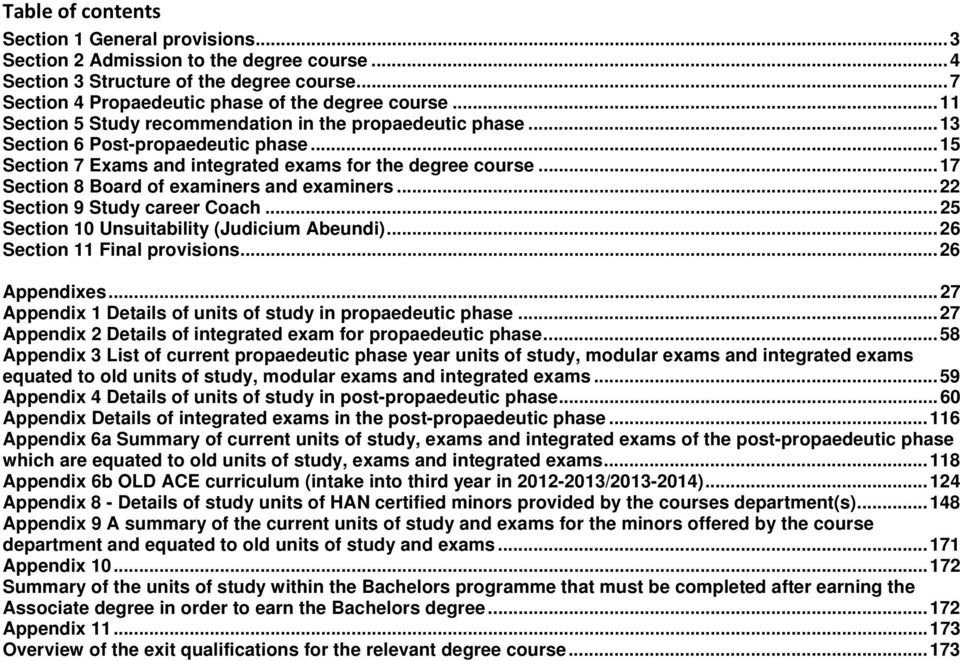
2 Table of contents Section 1 General provisions... 3 Section 2 Admission to the degree course... 4 Section 3 Structure of the degree course... 7 Section 4 Propaedeutic phase of the degree course Section 5 Study recommendation in the propaedeutic phase Section 6 Post-propaedeutic phase Section 7 Exams and integrated exams for the degree course Section 8 Board of examiners and examiners Section 9 Study career Coach Section 10 Unsuitability (Judicium Abeundi) Section 11 Final provisions Appendixes Appendix 1 Details of units of study in propaedeutic phase Appendix 2 Details of integrated exam for propaedeutic phase Appendix 3 List of current propaedeutic phase year units of study, modular exams and integrated exams equated to old units of study, modular exams and integrated exams Appendix 4 Details of units of study in post-propaedeutic phase Appendix Details of integrated exams in the post-propaedeutic phase Appendix 6a Summary of current units of study, exams and integrated exams of the post-propaedeutic phase which are equated to old units of study, exams and integrated exams Appendix 6b OLD ACE curriculum (intake into third year in / ) Appendix 8 - Details of study units of HAN certified minors provided by the courses department(s) Appendix 9 A summary of the current units of study and exams for the minors offered by the course department and equated to old units of study and exams Appendix Summary of the units of study within the Bachelors programme that must be completed after earning the Associate degree in order to earn the Bachelors degree Appendix Overview of the exit qualifications for the relevant degree course
3 Section 1 General provisions Article 1.1 Applicability of the regulations 1. These regulations are the Education and Examination Regulations (EER) as referred to in Article 7.13 of the Higher Education and Research Act (in Dutch: Wet op het Hoger Onderwijs en Wetenschappelijk Onderzoek, WHW), hereafter referred to as the Act. 2. These regulations apply to education and examinations in the academic year of the Bachelors course in Automotive Engineering, hereafter referred to as the degree course. 3. Appendixes 1 up to and including 11 are an unabridged version of these regulations and include the concrete passages from the Degree Statute to which these regulations refer. 4. For successfully completed units and exams from preceding academic years that are no longer included as such in the curriculum as outlined in articles 4.1 and 6.1 and the corresponding appendixes, paragraph 5 of articles 4.1 and 6.1 describes whether and to what extent these are counted as part of the curriculum and degree of these regulations. 5. Paragraph 9 of Article 3.4 describes whether and to what extent successfully completed units and exams for minors offered by the course department in previous academic years and not included as such in the range of minors as detailed in Article 3.4 and the accompanying appendix are included in the programme of the minors currently on offer. Article 1.2 Definitions The definitions that apply to these regulations are those included in Appendix 2 of the Degree Statute for the degree course. Article 1.3 Purpose of the degree courses The student acquires knowledge, understanding and skills at higher professional entry level for the field of Automotive Engineering and Automotive Management. The exit qualifications as defined in the first sentence are included in Appendix 11 of these regulations.

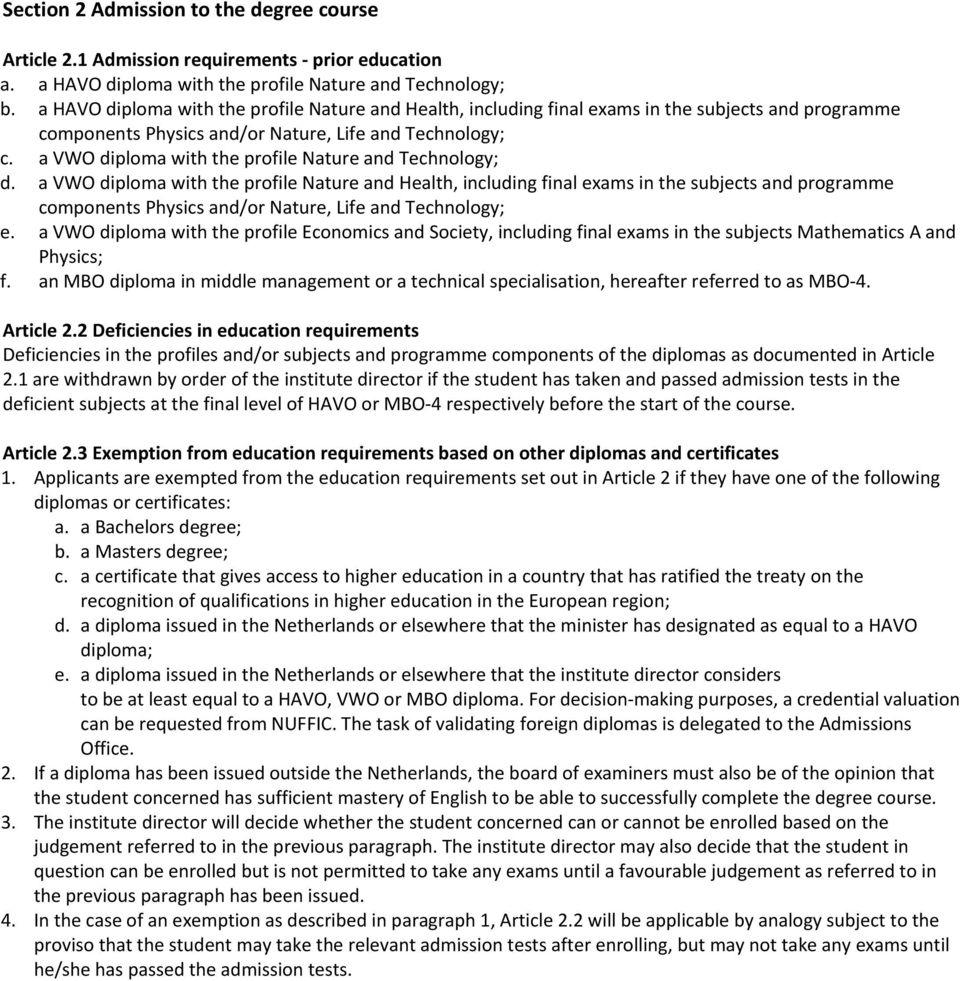
4 Section 2 Admission to the degree course Article 2.1 Admission requirements prior education a. a HAVO diploma with the profile Nature and Technology; b. a HAVO diploma with the profile Nature and Health, including final exams in the subjects and programme components Physics and/or Nature, Life and Technology; c. a VWO diploma with the profile Nature and Technology; d. a VWO diploma with the profile Nature and Health, including final exams in the subjects and programme components Physics and/or Nature, Life and Technology; e. a VWO diploma with the profile Economics and Society, including final exams in the subjects Mathematics A and Physics; f. an MBO diploma in middle management or a technical specialisation, hereafter referred to as MBO 4. Article 2.2 Deficiencies in education requirements Deficiencies in the profiles and/or subjects and programme components of the diplomas as documented in Article 2.1 are withdrawn by order of the institute director if the student has taken and passed admission tests in the deficient subjects at the final level of HAVO or MBO 4 respectively before the start of the course. Article 2.3 Exemption from education requirements based on other diplomas and certificates 1. Applicants are exempted from the education requirements set out in Article 2 if they have one of the following diplomas or certificates: a. a Bachelors degree; b. a Masters degree; c. a certificate that gives access to higher education in a country that has ratified the treaty on the recognition of qualifications in higher education in the European region; d. a diploma issued in the Netherlands or elsewhere that the minister has designated as equal to a HAVO diploma; e. a diploma issued in the Netherlands or elsewhere that the institute director considers to be at least equal to a HAVO, VWO or MBO diploma. For decision making purposes, a credential valuation can be requested from NUFFIC. The task of validating foreign diplomas is delegated to the Admissions Office. 2. If a diploma has been issued outside the Netherlands, the board of examiners must also be of the opinion that the student concerned has sufficient mastery of English to be able to successfully complete the degree course. 3. The institute director will decide whether the student concerned can or cannot be enrolled based on the judgement referred to in the previous paragraph. The institute director may also decide that the student in question can be enrolled but is not permitted to take any exams until a favourable judgement as referred to in the previous paragraph has been issued. 4. In the case of an exemption as described in paragraph 1, Article 2.2 will be applicable by analogy subject to the proviso that the student may take the relevant admission tests after enrolling, but may not take any exams until he/she has passed the admission tests.
5 Article 2.4 Exemption from the education requirement based on an admission test 1. Persons aged 21 and above who, in an admission test and in the judgement of the Admission Tests Committee, have demonstrated they are suited to the degree programme and have sufficient mastery of English to be able to successfully complete the degree programme are exempted from the education requirements referred to in Article 2.1 by decision of the institute director. 2. The admission test consists of tests in the following subjects administered at the level of the final HAVO exam and confers the exemption as referred to in the previous paragraph if the student passes these tests: Mathematics Physics Article 2.5 Sufficient mastery of Dutch 1. N/A Article 2.5b Sufficient mastery of English 1. If the person concerned has a language other than English as his/her first language, the requirement of sufficient mastery of English as referred to in Article 2.3 paragraph 2 and Article 2.4 paragraph 1 is met by: - for students who have been educated outside the Netherlands: successfully completing the IELTS with a minimum score of 6.0 on all parts (Comparable levels are accepted as well); - for HAVO students: minimum of 7.0 for English at HAVO level; - for VWO students: English as a final exam subject. 2. The requirement referred to in the previous paragraph must be met prior to enrolment. Article 2.6 Additional requirements In addition to the education requirements stated in Article 2.1, admission to the degree course is subject to the following requirements: a. participation in the part time degree course is only possible if the student can prove that he/she has at least a HAVO level of Maths and Physics. Article 2.7 Employment requirements for part time degree courses 1. Admission to the part time degree course is subject to the requirement of a work environment in which activities can be carried out as described in the units AU D DT1f and AU D DT3s in appendixes 1 and At the start of and during the degree course, a student must be working in a position and at a company relevant to the degree course. He or she must have either an employment contract, work placement contract or VAR (declaration of independent contractor status) relating to this work. Article 2.8 Numerus clausus (not applicable) Article 2.9 Admission to a fast track programme for students with a VWO diploma (not applicable) Article 2.10 Participation in compulsory course selection check 1. Applicants who apply by 1 May prior to the relevant academic year for one or more Bachelors courses or associate degree courses have a right to participate in a course selection check. 2. The procedure for a course selection check and the contents of a course selection check are included in the degree statute. 3. Participation in the course selection check is voluntary for students who apply by 1 May. 4. All applicants who have participated in the course selection check receive a course selection recommendation. This recommendation has three forms: positive, negative or further action necessary. 5. In the case of a negative course selection recommendation, the applicant as defined in paragraph 1 of this article can enrol if he or she meets the admission requirements as set out in Section 2 of these regulations. 6. Applicants who apply after 1 May prior to the relevant academic year for one or more Bachelors courses or associate degree courses are obliged to participate in the course selection check for the programme they have chosen.

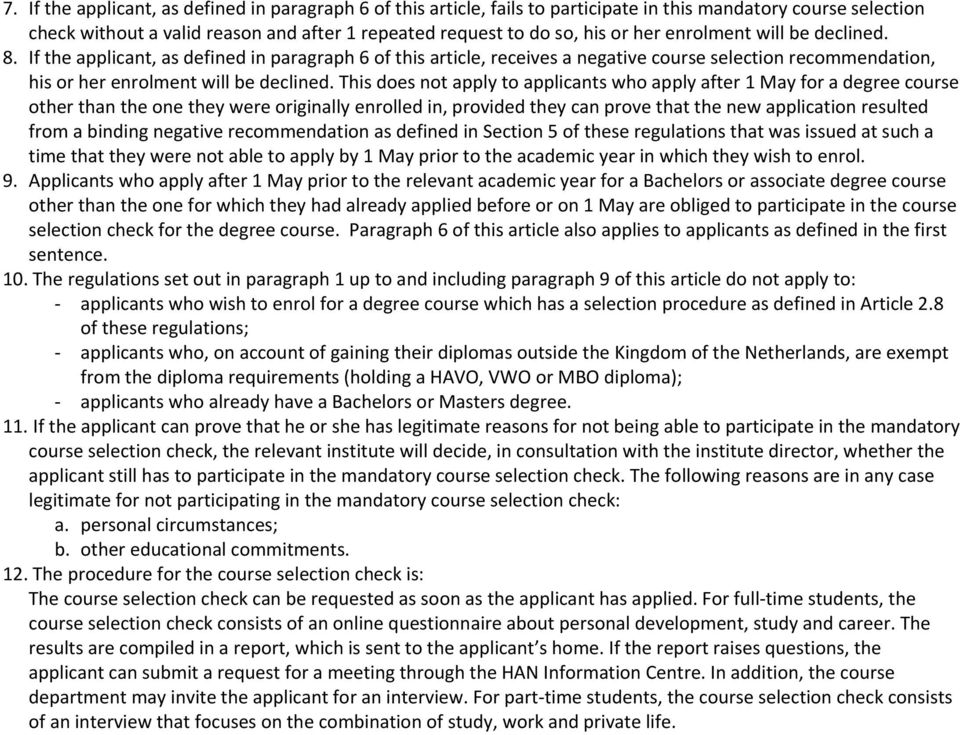
6 7. If the applicant, as defined in paragraph 6 of this article, fails to participate in this mandatory course selection check without a valid reason and after 1 repeated request to do so, his or her enrolment will be declined. 8. If the applicant, as defined in paragraph 6 of this article, receives a negative course selection recommendation, his or her enrolment will be declined. This does not apply to applicants who apply after 1 May for a degree course other than the one they were originally enrolled in, provided they can prove that the new application resulted from a binding negative recommendation as defined in Section 5 of these regulations that was issued at such a time that they were not able to apply by 1 May prior to the academic year in which they wish to enrol. 9. Applicants who apply after 1 May prior to the relevant academic year for a Bachelors or associate degree course other than the one for which they had already applied before or on 1 May are obliged to participate in the course selection check for the degree course. Paragraph 6 of this article also applies to applicants as defined in the first sentence. 10. The regulations set out in paragraph 1 up to and including paragraph 9 of this article do not apply to: applicants who wish to enrol for a degree course which has a selection procedure as defined in Article 2.8 of these regulations; applicants who, on account of gaining their diplomas outside the Kingdom of the Netherlands, are exempt from the diploma requirements (holding a HAVO, VWO or MBO diploma); applicants who already have a Bachelors or Masters degree. 11. If the applicant can prove that he or she has legitimate reasons for not being able to participate in the mandatory course selection check, the relevant institute will decide, in consultation with the institute director, whether the applicant still has to participate in the mandatory course selection check. The following reasons are in any case legitimate for not participating in the mandatory course selection check: a. personal circumstances; b. other educational commitments. 12. The procedure for the course selection check is: The course selection check can be requested as soon as the applicant has applied. For full time students, the course selection check consists of an online questionnaire about personal development, study and career. The results are compiled in a report, which is sent to the applicant s home. If the report raises questions, the applicant can submit a request for a meeting through the HAN Information Centre. In addition, the course department may invite the applicant for an interview. For part time students, the course selection check consists of an interview that focuses on the combination of study, work and private life.
7 Section 3 Structure of the degree course Article 3.1 Degree format 1. The degree course is offered as a full time and part time programme. 2. English is the language of instruction. 3. In appendixes 1 and 4 of these regulations, point 2 (target group) of the further elaboration of the units as referred to in paragraph 2 of articles 4.1 and 6.1 describes which units are offered for each degree course format and if they have any special characteristics. Article 3.2 Structure of the degree course 1. The degree course has a propaedeutic and post propaedeutic phase. 2. The degree course has three increasing levels of qualification: qualified for main phase (level 1), qualified for graduation phase (level 2) and entry level qualification (level 3). 3. The propaedeutic phase is the part of the major that focuses on acquiring an understanding of the content of the course and one s suitability for the degree course and the profession. 4. The post propaedeutic phase is the part of the degree course that follows from the propaedeutic phase. 5. The degree course consists of 4 specialisation areas for graduation: Automotive Development, Automotive Testing, Automotive Services and Automotive Management. 6. The degree course has an honours programme (ACE) for students who meet the selection criteria applicable to this programme as set out in Article 3.7 paragraph 3 of these regulations. The honours programme constitutes an addition to the study load as referred to in Article 3.7 paragraph 1c. 7. In appendixes 1 and 4 of these regulations, point 2 (target group) of the further elaboration of the units, as referred to in paragraph 2 of articles 4.1 and 6.1, describes which units are provided for the purpose of which phase, which level and which specialisation and which units are provided for the purpose of the honours programme. 8. In appendixes 2 and 5 of these regulations, point 2 (target group) of the further elaboration of the integrated exams, as referred to in paragraph 2 of articles 4.1 and 6.1, describes which integrated exams are provided for the purpose of which phase, which level and which graduation specialisation. 9. The degree course consists of a major and a minor. The minor is a part of the post propaedeutic phase. 10. A student s record is reviewed twice during the degree course and the following certificates are issued: a) the propaedeutic certificate; b) the Bachelors certificate. Article 3.3 Major 1. The major is the part of the degree course that focuses on acquiring the required competences for the prescribed professional tasks of the entry level professional with a Bachelors degree. 2. The prescribed professional tasks for the starting professional with a Bachelors degree from a university of applied sciences are described in appendixes 1 and 4 of these regulations under point 3 (professional tasks) of the details for each unit as referred to in paragraph 2 of articles 4.1 and 6.1.
8 Article 3.4 Minor 1. The minor is the part of the post propaedeutic phase of the degree course that focuses on deepening or widening the required competences for the prescribed professional tasks of the entry level professional with a Bachelors degree from a university of applied sciences. 2. The minor is a certified HAN minor or a flexible minor. 3. The student who is about to take a minor must first obtain permission for this from the board of examiners. The personal tutor helps the student with the request for authorisation and, if necessary, advises the board of examiners about the decision. 4. A flexible minor is a minor that a student: a) takes at another educational institution or; b) has composed from parts of minors or other units at different HAN institutes or a different educational institution. 5. Before approving a minor application, the board of examiners considers whether the minor fits within the professional profile of the degree course, does not overlap with the major, is of the right level to deepen or broaden knowledge, has a sufficient quality of examination and assessment according to the standards of the degree course and, in the case of a flexible minor compiled by the student, contains a sufficiently coherent set of units. 6. Authorisation by the board of examiners as defined in paragraphs 3 and 5 of this article also implies that examiners connected to the minor are as such appointed as examiner of the course. 7. Notwithstanding the provisions of the previous paragraphs, the development, provision and quality assurance of the following accredited HAN minors and the associated units including their noted study load fall under the responsibility of the management and board of examiners of the degree courses: a) Minor in Autotronics I. AU M AU Autotronics (30 credits) b) Minor in Propulsion Technology I. AU M AT Propulsion Technology (30 credits) c) Minor in Propulsion Technology Specialisation Combustion Engines I. AU M AT Propulsion Technology Combustion Engines (30 credits) d) Minor in Lightweight Construction I Finite Element Method (7.5 credits) II Lightweight Construction (7.5 credits) III Beam project and Excursions (15 credits) 8. Appendix 8 of these regulations contains the details of the study programme and exams of the minors as referred to in the previous paragraph. Article 6.1, paragraph 2, is applicable by analogy. Article 3.5 Study load, credits and study duration 1. The study load of a degree course and of individual units is expressed in credits. 2. One credit is equal to 28 hours of study load. 3. The course has a study load of 240 credits. 4. The propaedeutic phase of the course, which is concluded at level 1 (qualified for main phase), has a study load of 60 credits. 5. The post propaedeutic phase of the course, comprising levels 2 and 3 (qualified for graduation phase and entry level qualification respectively), has a study load of 180 credits. 6. The first part of the post propaedeutic phase, which is concluded at level 2 (qualified for graduation phase), has a study load of 60 credits excluding the minor that may be completed at this level. 7. The second part of the post propaedeutic phase, which is concluded at level 3 (entry level qualification), has a study load of 90 credits excluding the minor that may be completed at this level. 8. The major has a study load of 210 credits. 9. The minor, which is concluded at level 2 or 3 (qualified for graduation phase or entry level qualification respectively), has a study load of 30 credits. 10. A degree course is set up in such a way that a student is able to gain the number of credits on which the study load is based for an academic year. 11. A specialisation is concluded at level 3 (entry level qualification). A specialisation forms part of the major and has a study load of 90 credits.

9 12. The standard scheduled course duration of the part time course is 4 years. The yearly study load of the parttime course is 60 credits. 13. The actual scheduled course duration of the programmes with the special feature fast track as referred to in Article 3.1, paragraph 3, and of the short courses as referred to in Article 7.9 paragraph 5 is 3.5 years. N/A Article 3.6 Study load of a work study course (not applicable) Article 3.7 Increase of study load 1. Contrary to the provisions of Article 3.5, students also have the option of broadening and/or deepening their knowledge by earning more than 240 credits for their degree course. This can be done by: a. taking one or more extra minors, b. taking one or more extra units and/or c. taking an honours programme. 2. In all above cases students must first request and obtain authorisation from the board of examiners. The board of examiners judges whether the minors and units referred to in paragraphs 1a, 1b or 1c fit within the professional profile of the degree course, do not overlap with the degree course, are of the right level to deepen or broaden knowledge, have sufficient quality of examination and assessment according to the standard of the degree course and, in the case of a flexible minor compiled by the student, contain a sufficiently coherent set of units. 3. Permission for the ACE honours programme as set out in paragraph 1c can only be given if the student meets the following selection criteria: passed the propaedeutic phase, course 5 as good as finished (maximum of 1 fail), no delays for course 6 and motivated to put extra time into studies. The latter is evaluated during an intake. 4. Permission can only be given for an extension as set out in paragraph 1 if the student has no delays in his/her studies and the actual course duration for this student on account of the extension will exceed the standard scheduled course duration by no more than six months.

10 Article 3.8 Professional tasks, units and competences 1. A degree course is a coherent set of units. 2. During the degree course, professional tasks are learned that an entry level professional must be able to carry out. One or more of these professional tasks are related to units. 3. The content of a unit of study, hereafter referred to as unit, focuses on a number of related competences. 4. A unit has a study load of 7.5 credits or a multiple thereof. A unit can have a study load of 2.5 credits or a multiple thereof if this serves the quality of the education.

11 Section 4 Propaedeutic phase of the degree course Article 4.1 Structure of propaedeutic phase 1. For each degree format as referred to in Article 3.1 paragraph 1 and for each programme with a special feature as referred to in Article 3.1 paragraph 3, the propaedeutic phase contains the following units with the stated study load: Overview propaedeutic phase full time Period 1 Period 2 Period 3 Period 4 AU V 1a + AU V 1b This is Automotive Engineering! credits AU V 2a + AU V 2b Sales at full capacity credits AU CB3a + AU CB3b Designing a wheel suspension credits AU CB4a + AU CB4b An optimally built power train credits OR: AU TC3a + AU TC 3b The workplace of tomorrow credits OR: AU TC4a + AU TC 4b AU CB4a + AU CB4b An optimally advised power train credits = these units are also offered in English The English-taught programme only has the CB specialisation.

12 2. For all units as referred to in the previous paragraph, Appendix 1 to these regulations contains an overview of the following information relating to education and examinations: 1. Degree course 2. Target group 3. Professional task(s) 4. Central professional task 5. Professional product(s) 6. Credits/study load 7. Cohesion 8. Entry requirements in relation to examinations 9. General description 10. Competences 11. Assessment criteria 12. Examinations 13. Compulsory literature 14. Recommended literature 15. Software 16. Other material 17. Activities 18. Instructional format 19. Class/contact hours 20. Teaching period 21. Maximum number of participants 3. The propaedeutic phase includes one integrated exam, as defined in Article 7.1 paragraph Appendix 2 of these regulations contains an overview of the following details with regard to the integrated exam of the propaedeutic phase: 1. Degree course 2. Target group 3. Professional tasks 4. (Professional) products 5. Credits and/or coincides with regular exams 6. Cohesion with other exams and integrated exams 7. Entry requirements 8. General description 9. Competences 10. Assessment criteria 11. Integrated exam characteristics and exam formats 12. Compulsory and recommended material 13. Teaching period 5. Units as defined in paragraph 1, their accompanying exams as set out in paragraph 2 and integrated exams as set out in paragraph 4 are equated with units, exams and integrated exams from previous academic years of the degree courses that are included as such in Appendix 3 of these regulations.

13 Section 5 Study recommendation in the propaedeutic phase Article 5.1 Study recommendation in the propaedeutic phase 1. By the end of his/her first year of enrolment in the propaedeutic phase of the degree course, the student will receive a written study recommendation from the institute director on the continuation of his/her studies in the degree course or elsewhere. 2. N/A 3. Notwithstanding the provisions of paragraph 1, the student can be issued a study recommendation for as long as he/she has not yet met the requirements for the propaedeutic certificate. 4. The study recommendation as set out in paragraphs 1 and 3 is positive or negative. Article 5.2 Provisional study recommendation in the first year of enrolment 1. In the first year of enrolment in the propaedeutic phase of the course, if possible prior to the end of the fifth month of enrolment and if necessary following a previously issued study recommendation, each student whose study results at that time are so unsatisfactory that successful completion of the course is improbable will receive a written, provisional negative study recommendation as a warning from the institute director. 2. A provisional negative study recommendation as referred to in paragraph 1 will be issued if the student: a. has not obtained at least 22.5 credits at the end of the second teaching period or b. has not obtained at least 37.5 credits at the end of the first year of enrolment of the total credits to be obtained in accordance with the exam programme following from Article Contrary to paragraph 2, a provisional negative study recommendation as defined in paragraph 1 will be given for the part time degree format if the student has not obtained at least 15 credits at the end of the second teaching period or has not obtained at least 37.5 credits at the end of the first year of enrolment of the total credits to be obtained in accordance with the exam programme following from Article A provisional positive study recommendation will be issued if, at the end of the first year of enrolment in the propaedeutic phase of the course, the student has obtained 37.5 or more credits from the exam programme following from Article 4.1 but has not yet met the requirements for the propaedeutic certificate. Article 5.3 Binding study recommendation in the first year of enrolment 1. A negative study recommendation will be issued at the end of the first year of enrolment in the propaedeutic phase if the student fails to obtain at least 37.5 of the credits according to the examination programme following from Article 4.1. An exception to this rule is if the institute director, under conditions set by the institute director, decides not to issue such a recommendation in view of the student's personal circumstances. 2. A negative study recommendation is a binding, permanent rejection (the binding negative study recommendation) provided a provisional recommendation as referred to in Article 5.2 was actually issued at least 40 working days prior to the issue of the negative study recommendation. The days which have been marked as scheduled Holidays according to the current HAN academic calendar must be taken into account when determining the minimum 40 working days. 3. N/A 4. A negative study recommendation is a binding, permanent rejection for the degree course and any other degree courses with which it has a common propaedeutic programme, provided a provisional recommendation as referred to in Article 5.2 was actually issued at least 40 working days prior to the issue of the negative study recommendation. The days on which no teaching is provided according to the current HAN academic calendar must be taken into account when determining the minimum 40 working days. 5. A positive study recommendation will be issued at the end of the first year of enrolment in the propaedeutic phase if the student has met the requirements for the propaedeutic certificate. Article 5.4 Provisional study recommendation after the first year of enrolment 1. During the second year of enrolment in the propaedeutic phase of the course, any student whose study results are at any moment so unsatisfactory that successful completion of the course is deemed improbable and who has not previously received a provisional negative study recommendation will receive one from the institute director as a written warning. 2. N/A
14 3. A provisional negative study recommendation as defined in paragraph 1 will be issued if the student has not obtained all of the credits remaining at that time according to the exam programme following from Article 4.1 by passing all examinations and integrated exams. 4. N/A Article 5.5 Binding study recommendation after the first year of enrolment 1. A binding negative study recommendation will be issued after the first year of enrolment in the course if, at the end of the second year of enrolment in the propaedeutic phase, the student has not met the requirements for the propaedeutic certificate, unless the institute director, under conditions to be set by that same person, decides to refrain from issuing such a recommendation in view of the student's personal circumstances. 2. A negative study recommendation as defined in paragraph 1 of this Article is a binding, permanent rejection (the binding negative study recommendation) provided a provisional recommendation as referred to in articles 5.2 or 5.4 was actually issued at least 40 working days prior to the issue of the negative study recommendation. The days on which no teaching is provided according to the current HAN academic calendar must be taken into account when determining the minimum 40 working days. 3. N/A 4. N/A 5. Paragraphs 1 to 4 apply by analogy to students who are enrolled for a third year in the propaedeutic phase because they have still not received a binding negative recommendation. 6. A positive study recommendation will be issued after the first year of enrolment in the propaedeutic phase of the course if the student has met the requirements for the propaedeutic certificate. Article 5.6 Personal circumstances 1. Personal circumstances as referred to in paragraph 1 of Articles 5.3 and 5.5 are defined exclusively as: a) illness of the student; b) physical, sensory or other functional disabilities of the student; c) pregnancy of the female student; d) special family circumstances; e) elite sport; f) membership in the participation council, sub council, student committee or degree course committee; g) membership on the board of a student organisation of some size with complete legal capacity, or a comparable organisation of some size that stands for the promotion of general social interests and actively develops activities for this purpose. 2. The student must immediately inform his/her personal tutor as soon as one or more personal circumstances as referred to in the previous paragraph arise. 3. In the case of personal circumstances and contrary to articles 5.3 and 5.5, the institute director can take separate decisions that at least stipulate the period in which the student must meet the set requirements as set out in articles 5.3 and 5.5. Article 5.7 The right to a hearing The student in question will be given the opportunity to attend a hearing prior to the issue of a negative study recommendation to which a binding permanent rejection is attached as referred to in paragraph 2 of articles 5.3 and 5.5.
15 Section 6 Post propaedeutic phase Article 6.1 Structure of the post propaedeutic phase 1. For each course format as referred to in Article 3.1 paragraph 1 and for each course with a special feature as referred to in Article 3.1 paragraph 3, the post propaedeutic phase of the course contains the following units with the stated study load and level: A. Full time a. AU-V-CB5a Virtual prototyping (7.5 credits) b. AU-V-CB5b Designing a vehicle adaptation (7.5 credits) c. AU-V-CB5c Advising on vehicle specifications (7.5 credits) d. AU-V-CB5d Vehicle electronic system (7.5 credits) e. AU-V-CB5c Advising on vehicle configurations (7.5 credits) f. AU-V-CB6b Research for simulations (7.5 credits) g. AU-V-CB6c Maintaining products, services and client contacts (7.5 credits) h. AU-V-CB6d Validating vehicle components or systems (7.5 credits) i. AU-V-AD78a Designing internal combustion engines (7.5 credits) j. AU-V-AD78b Designs car electronics (7.5 credits) k. AU-V-AD78c Engine research (15 credits) l. AU-V-AT78a Control and testing of vehicle system (7.5 credits) m. AU-V-AT78b Automotive testing (7.5 credits) n. AU-V-AT78c Vehicle dynamics and combustion engines, testing and control (15 credits) o. AU-V-ST-2 / AU-V-ST-M1 Specialisation work placement (30 credits) The English taught programme only has the CB specialisation.
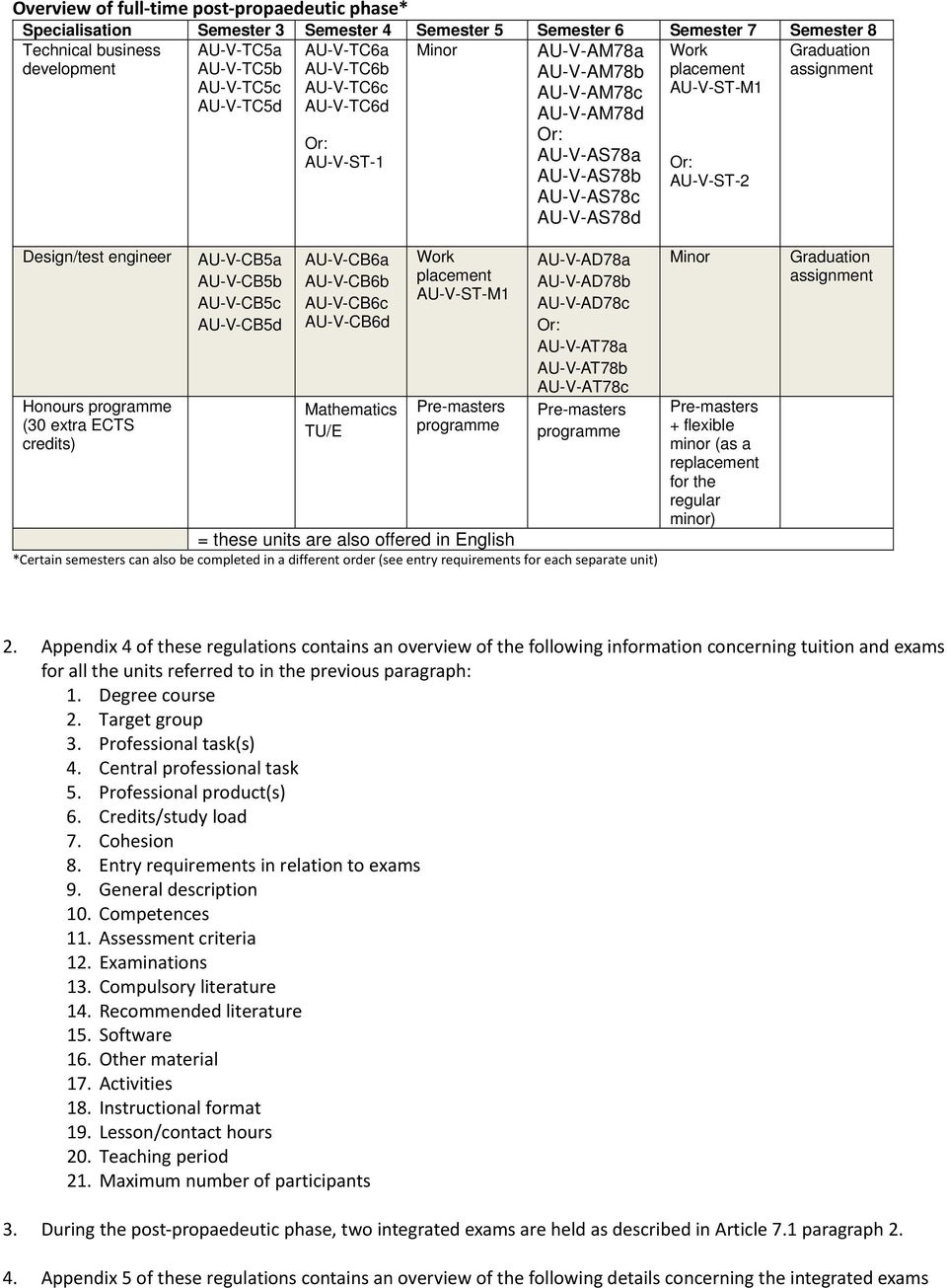
16 Overview of full time post propaedeutic phase* Specialisation Semester 3 Semester 4 Semester 5 Semester 6 Semester 7 Semester 8 Technical business development Minor Graduation assignment AU-V-TC5a AU-V-TC5b AU-V-TC5c AU-V-TC5d AU-V-TC6a AU-V-TC6b AU-V-TC6c AU-V-TC6d Or: AU-V-ST-1 AU-V-AM78a AU-V-AM78b AU-V-AM78c AU-V-AM78d Or: AU-V-AS78a AU-V-AS78b AU-V-AS78c AU-V-AS78d Work placement AU-V-ST-M1 Or: AU-V-ST-2 Design/test engineer Honours programme (30 extra ECTS credits) AU-V-CB5a AU-V-CB5b AU-V-CB5c AU-V-CB5d AU-V-CB6a AU-V-CB6b AU-V-CB6c AU-V-CB6d Mathematics TU/E Work placement AU-V-ST-M1 Pre-masters programme AU-V-AD78a AU-V-AD78b AU-V-AD78c Or: AU-V-AT78a AU-V-AT78b AU-V-AT78c Pre-masters programme = these units are also offered in English *Certain semesters can also be completed in a different order (see entry requirements for each separate unit) Minor Pre-masters + flexible minor (as a replacement for the regular minor) Graduation assignment 2. Appendix 4 of these regulations contains an overview of the following information concerning tuition and exams for all the units referred to in the previous paragraph: 1. Degree course 2. Target group 3. Professional task(s) 4. Central professional task 5. Professional product(s) 6. Credits/study load 7. Cohesion 8. Entry requirements in relation to exams 9. General description 10. Competences 11. Assessment criteria 12. Examinations 13. Compulsory literature 14. Recommended literature 15. Software 16. Other material 17. Activities 18. Instructional format 19. Lesson/contact hours 20. Teaching period 21. Maximum number of participants 3. During the post propaedeutic phase, two integrated exams are held as described in Article 7.1 paragraph Appendix 5 of these regulations contains an overview of the following details concerning the integrated exams
17 in the post propaedeutic phase: 1. Degree course 2. Target group 3. Professional tasks 4. (Professional) products 5. ECTS credits and/or coinciding with regular exams 6. Cohesion with other exams and integrated exams 7. Entry requirements 8. General description 9. Competences 10. Assessment criteria 11. Integrated exam characteristics and exam formats 12. Compulsory and recommended material 13. Teaching period 5. Units as defined in paragraph 1, their accompanying exams as set out in paragraph 2 and integrated exams as set out in paragraph 4 are equated with units, exams and integrated exams from previous academic years of the degree courses that are included as such in appendix 6 of these regulations. 6. The results obtained for the units within the associate degree programme also apply as results in the Bachelors course if these units are part of the curriculum of the Bachelors programme. Appendix 10 of these regulations contains an overview of the units, as set out in paragraph 1 of this article, that still have to be obtained in order to earn the Bachelors degree. Section 7 Exams and integrated exams for the degree course Article 7.1 Exams and integrated exams 1. An exam is an investigation of the student s competences (knowledge, understanding, skills and attitude in conjunction with each other) in relation to a unit. The exam partly contains an assessment of the results of that investigation. 2. An integrated exam is an investigation of the student s competences (knowledge, understanding, skills and attitude in conjunction with each other) in relation to the professional performance of one or more professional tasks. The integrated exam partly contains the assessment of the results of that investigation. 3. Each unit has an exam connected to it, which may consist of various modular exams. The exam has been passed if it has been successfully completed or if all of the related modular exams have been successfully completed. 4. An integrated exam is administered for one or more professional tasks at each level, as referred to in Article 3.2 paragraph An integrated exam is related to one or more units. An integrated exam can consist of a number of modular exams. An integrated exam has been passed if it has been successfully completed or if all the related modular exams have been successfully completed. 6. The content, format and cohesion of the entire exam programme for the degree course, including all exams and integrated exams, are described in appendixes 1, 2, 4 and 5 of these regulations, corresponding to paragraphs 2 and 4 of articles 4.1 and The exam programme referred to in the previous paragraph describes whether and to what extent one or more exams or modular exams as referred to in paragraphs 1 and 3 count as one or more integrated exams or modular integrated exams. 8. The examiner gives the result of an exam or integrated exam as a grade. 9. If an exam or integrated exam consists of various modular exams, the results of those modular exams can be expressed as either a numerical grade or a satisfactory or unsatisfactory qualification. 10. The result of an exam or integrated exam, not including modular exams, is expressed in one of the following numerical grades: 1, 2, 3, 4, 5, 6, 7, 8, 9 or 10. A grade of 6 or higher means the candidate has passed the exam or integrated exam; A grade of 5 or lower means the candidate has failed the exam or integrated exam.
18 11. Grades with 1, 2, 3 or 4 in the first decimal place (i.e. X.1, X.2, X.3, X.4) are rounded down to whole numbers. Grades with 5, 6, 7, 8 or 9 in the first decimal place (i.e. X.5, X.6, X.7, X.8 or X.9) are rounded up to whole numbers. Grades for modular exams are not rounded off to whole numbers, but to numbers with one decimal place (e.g. 7.9, 5.4 or 8.3). Grades with 1, 2, 3 or 4 in the second decimal place (i.e. X.X1, X.X2, X.X3, X.X4) are rounded down to one decimal place. Grades with 5, 6, 7, 8 or 9 in the second decimal place (i.e. X.X5, X.X6, X.X7, X.X8, X.X9) are rounded up to one decimal place. The most recently obtained result for an exam counts as the definite result. 12. If the student has obtained a pass grade for an exam, he/she will not be permitted to retake that exam, regardless of the type of exam. Article 7.2 Order of exams and integrated exams 1. Students who wish to take part in exams and integrated exams in the post propaedeutic phase must have a propaedeutic certificate for the degree course concerned from either HAN or another institution of higher education or be exempted from these exams by the institute director. 2. Contrary to the provisions of the previous paragraph, the board of examiners may at the student's request grant permission for that student to take exams and integrated exams in the post propaedeutic phase before he/she has met the requirements for the propaedeutic certificate. 3. If this is stipulated in the appendixes referred to in paragraph 2 of articles 4.1 and 6.1 under point 8 (entry requirements) for a unit, the criteria for taking part in the exams and/or integrated exams related to that unit will include having passed one or more of the stipulated exams and/or integrated. 4. If this is stipulated in the appendixes referred to in paragraph 4 of articles 4.1 and 6.1 under point 7 (entry requirements) for an integrated exam, the criteria for taking part in that integrated exam will include having passed one or more of the exams and/or integrated exams listed. Article 7.2a Units with an attendance requirement 1. If stipulated in the appendixes as referred to in Article 4.1 paragraph 2 and Article 6.1 paragraph 2 under points 8 (entry requirements), 11 (assessment criteria) and/or 12 (exams) for a unit, students must first have participated in the education (or parts of the education) for that unit before they are allowed to take any exam or integrated exam for that unit. 2. At a student s request, the board of examiners may grant an exemption from the requirement referred to in paragraph 1, and may also decide to attach additional conditions to that exemption. Article 7.3 Frequency of exams and integrated exams 1. The course department gives the student the opportunity to take each exam for a unit at least twice each academic year. 2. The course department gives the student the opportunity to take each integrated exam at least twice each academic year. 3. Contrary to the first and second paragraph and Article 7.1 paragraph 15 the board of examiners may decide in exceptional cases to allow a student an extra opportunity to take an exam or integrated exam. To that purpose, the board of examiners must receive a written and well supported request from the student well in advance. The board of examiners ensures that the examiners and student concerned are informed of its decision in writing and in a timely manner. Article 7.4 Exam format 1. Exams and integrated exams are taken in the formats stipulated in the appendixes of these regulations and as defined in paragraph 2 of articles 4.1 and 6.1, under point 12 (exams) and in paragraph 4 of articles 4.1 and 6.1, under point 11 (characteristics and formats of integrated exam). However, the board of examiners has the authority to decide otherwise in special cases. 2. The course department uses the following formats for exams and integrated exams: a. written (including computer based exam) b. oral (assessment interview, client meeting, presentation) c. practical (report) d. portfolio of professional products (written accounts, reports) Article 7.4a Learning track independent exams
19 1. Students who do not have sufficient evidence, in terms of previously passed exams or acquired certificates in higher education and/or other evidence of acquired competences, to be granted exemptions for exams but who nonetheless possess the required competences for the professional tasks related to one or more units can submit a request to the board of examiners to be considered for learning track independent exams. This also applies to students who do have sufficient evidence but do not wish to take a regular exam. 2. Students can participate in learning track independent exams at the start of or any time during their degree course without having taken the units that correspond to those exams or that teach students about the relationship between the professional tasks involved. 3. Following an evaluation of the request submitted by the student referred to in paragraph 1 and the accompanying documents, the board of examiners will make a reasoned decision. It will communicate this decision to the relevant student and the staff members directly involved in the matter within 20 working days of the request submission. 4. The decision described in the previous paragraph will also include the appointed examiners, the exam formats to be used, and/or whether these learning track independent exams will be taken according to the standard exam programme. Article 7.5 Exams and students with a disability or chronic illness The board of examiners will allow a student with a disability or chronic illness at his/her request to take exams in a manner adapted to their functional restrictions, in accordance with the provisions laid down in the institutionspecific section of the Student Charter. Article 7.6 Public nature of oral exams 1. In principle, oral exams are open to the public. 2. The board of examiners may in special cases limit or bar public access. Article 7.7 Announcement of exam results 1. Results for oral exams will be communicated to the student as soon as possible and no later than the following working day. 2. For other exams, i.e. exams other than oral exams, the examiner determines the results and ensures these are entered into the HAN student information system within 15 working days of the date on which those exams were taken. 3. At the student s request, the examiner will inform him/her of the exam result in writing. Article 7.8 Viewing rights The student has the right to review his/her assessed work, and the questions and assignments for written exams and to find out the standards on which the assessments were based within 20 working days of receiving the result of those exams.

20 Article 7.9 Exam exemptions 1. Students who can demonstrate, based on previously passed exams or acquired certificates in higher education and/or other evidence of acquired competencies, that they possesses the competences for the professional tasks belonging to one or more units may submit a request to the board of examiners to be exempted from taking one or more exam for one or more units in which these competences and professional tasks are taught. 2. Following an evaluation of the request submitted by the student and the accompanying documents, the board of examiners will make a reasoned decision. The board will then inform the student concerned and the staff members directly involved in the decision within 20 working days of the request submission. 3. An exemption can be granted based on previously completed exams or acquired certificates in higher education, official reports with a Recognition of Prior Learning (RPL) and other knowledge and skills obtained in educational and other settings. When assessing requests as referred to in paragraph 1, the board of examiners uses the assessment criteria that follow from and are recorded in appendixes 1 and 4 to these regulations, under points 3 (professional tasks), 4 (central professional task), 5 (professional products), 10 (competences), 11 (assessment criteria) and 12 (examinations) and in appendixes 2 and 5 of these regulations under points 3 (professional tasks), 4 (professional products), 9 (competences), 10 (assessment criteria) and 11 (features and characteristics of integrated exams) of the details of the units referred to in articles 4.1 and 6.1 for exams in the units relevant to the exemption applied for by the student. 4. The board of examiners can decide to grant one or more exemptions based on the following: successfully passed exams or degree certificates from other degree courses, official reports of Recognition of Prior Learning, competence assessments conducted under the board s responsibility, and clearly defined work experience. The second sentence in the previous paragraph also applies here. 5. Exemptions based on decisions as referred to in the previous paragraph lead to abridged programmes for specific groups as described in Appendix Decisions made by the board of examiners as described in paragraph 4 apply for one academic year. These decisions are reviewed each year. 7. An exam for which an exemption has been granted is recorded as an exemption and is not awarded with a grade as described in Article 7.1. Article 7.10 The propaedeutic certificate 1. A student has earned the propaedeutic certificate once the board of examiners judges that he/she has passed all the exams and integrated exams for the units included in the propaedeutic phase as referred to in Article Passing an exam or integrated exam as described in the previous paragraph is understood to mean that the student has received a grade of 6 or higher or has been granted an exemption for that exam or integrated exam. 3. A student will have passed the propaedeutic degree cum laude if he/she obtained a grade of 8 or higher for all exams and integrated exams for the units during the propaedeutic phase as referred to in Article 4.1 and was granted no more than 30 credits worth of exemptions for those exams. The additional exams referred to in Article 3.7 are not taken into consideration when determining the cum laude distinction. Article 7.11 Meeting all requirements for the Bachelors degree 1. A student has met all requirements for the Bachelors degree once the board of examiners judges that he/she has passed all the exams and integrated exams for the units in the post propaedeutic phase as referred to in Article Passing an exam or integrated exam as described in the previous paragraph is understood to mean that the student has received a grade of 6 or higher or has been granted an exemption for that exam or integrated exam. 3. A student will have completed the Bachelors degree with merit if he/she obtained a grade of 7 or higher for all exams and integrated exams during the post propaedeutic phase as referred to in Article 6.1 and was granted no more than 75 credits worth of exemptions for those exams. The additional exams referred to in Article 3.7 are not taken into consideration for the with merit distinction. 4. A student will have passed the Bachelors degree cum laude if he/she obtained a grade of 8 or higher for all exams and integrated exams during the post propaedeutic phase as referred to in Article 6.1 and was granted no more than 75 credits worth of exemptions for those exams. The additional exams referred to in Article 3.7 are not taken into consideration when determining the cum laude distinction. Article 7.11a External supervisor 1. One or more external supervisors is appointed for each degree course or group of degree courses.

21 2. The task of the external supervisor is to form a judgement of or to monitor the quality of the exams. 3. The tasks, competences and position of the external supervisors are detailed in the regulations for external supervisors as drawn up by the faculty director. Article 7.12 Overview of results, supporting documents, certificates and declarations 1. The student will be able to view and print grades list showing the result of an exam or integrated exam through the HAN student information system within 15 working days after the exam. This printout constitutes an official document at HAN. A student may submit a request to an examiner for a signed certificate for passing an exam. 2. The documentary evidence referred to in the previous paragraph includes the grades awarded for the exams and integrated exams, the corresponding units and professional tasks, the corresponding credits in accordance with articles 4.1 and 6.1, and the related appendixes. 3. The board of examiners issues a certificate as evidence that a student has earned his/her degree once the institute director has confirmed that the procedural requirements for issuing a certificate have been met. 4. A student who is entitled to a certificate can request the board of examiners to postpone the issuing of the certificate. 5. A request as referred to in paragraph 4 is only granted if: a) the student has been given permission on the grounds of Article 3.7 to take one or more extra minors and/or units; b) the student submits the request during the academic year in which he/she has met all the requirements for earning the degree. Requests for postponing the issue of the degree certificate until a following academic year will only be granted in the situations referred to under point a. 6. Students who have earned a degree will be awarded an English diploma supplement. 7. Students who have passed more than one exam or integrated exam but who cannot be awarded a certificate as referred to in paragraph 3 may request a certificate from the board of examiners that lists at least the exams and/or integrated exams they have passed, the assessment qualifications for those exams and the number of credits they have earned. If the exams or integrated exams relate to additional education as described in paragraph 1 of Article 3.7, the corresponding units will also be listed. Article 7.13 Degree 1. The board of examiners, which has been mandated for this purpose by the Executive Board, makes the decision to grant the Bachelor of Engineering degree to candidates who successfully complete the Bachelors course as described in paragraph 1 of articles 7.10 and The degree awarded will be stated on the degree certificate.
22 Section 8 Board of examiners and examiners Article 8.1 Board of examiners 1. The faculty board establishes a board of examiners for each degree course or group of courses based on authority delegated by the Executive Board. There is a board of examiners for the Automotive degree courses offered by the Automotive Institute. 2. The examiners and the members of the board of examiners have sufficient expertise and have completed the relevant basic training offered by the HAN Academy or comparable training. 3. The board of examiners uses its expertise to objectively determine whether a student meets the conditions specified in the EER for the knowledge, understanding and skills (i.e. the exit qualifications) needed to obtain a degree. 4. The board of examiners remains fully responsible for any duties and/or powers it mandates to others. 5. The board of examiners ensures that the mandate decisions are recorded in writing and are included in the regulations of the board of examiners. A copy of the document in which the mandate is issued is sent to the faculty controller. Article 8.2 Duties and powers of the board of examiners In addition to the task referred to in Article 8.1 paragraph 3 of these regulations, the board of examiners has the following tasks and authorities: 1. To guarantee the quality of exams and other aspects of the degree and to set further rules on the matter. 2. To lay down guidelines and instructions within the framework of the EER in order to assess and establish the result of exams and other degree components, including the laying down of further rules in that regard. 3. When establishing the guidelines and instructions as set out in paragraph 2, to work with protocols for assessing assignments that meet the national requirements. 4. To appoint examiners to administer exams and integrated exams and to establish the results of those exams. 5. To terminate the appointment of examiners. 6. To determine further rules and regulations regarding possible fraud on the part of students, prospective students or external students, including any measures to be taken. 7. To submit proposals to the Executive Board for termination of a student s enrolment in the event of serious fraud. 8. To advise the Executive Board on the discontinuation of a student s enrolment in a degree course as a consequence of the student s behaviour in relation to future professional practice. 9. To the extent that it is empowered to do so, to decide on objections submitted by students, in accordance with the Student Charter. 10. To make a decision in the event of a suspicion that a student has committed irregularities and, if necessary, to take measures in that regard, in accordance with the regulations of the board of examiners as laid down by the board of examiners. 11. To decide on applications for exemptions from students and groups of students and to set further rules in that regard. 12. To decide on students' applications to complete a flexible minor. 13. To decide on students' applications for an extra opportunity to take an exam or integrated exam. 14. To decide on students' applications to take a learning track independent exam. 15. To decide whether a student can take exams in the post propaedeutic phase before he/she has earned the propaedeutic certificate. 16. To decide whether a student can complete exams and integrated exams in a way that differs from that set out in the appendixes of these regulations, as defined in the second paragraphs of articles 4.1 and 6.1 under point 12 and in the fourth paragraphs of articles 4.1 and 6.1 under point To give students with a physical or sensory disability the opportunity to take exams in adapted formats. 18. To decide on students' requests for an oral exam or an integrated oral exam to be closed to the public. 19. To issue documentation and declarations. 20. To contribute to the formulation of the examination policy for the degree course or group of degree courses. 21. To advise the faculty board and the institute management about the EER. 22. To issue a certificate as proof that all requirements of a degree have been fulfilled after the Executive Board has declared that the procedural requirements for issue have been complied with. These requirements are: a) to be issued with a degree, the student must be enrolled at HAN University of Applied Sciences;
23 b) the tuition fees must have been paid; c) the definite information formally recorded in the HAN student information system must reveal that all exams have been successfully completed. 23. To decide whether or not to grant students requests for postponement of certification. 24. Upon the request of students who have passed more than one exam and to whom a certificate as referred to in Article 7.11 paragraph 2 of the Act cannot be issued, issuing a statement that lists the exams he/she has passed. 25. To issue a competency examination certificate to persons entering the field of teaching from another career background as evidence that they have passed the competency examination. Article 8.3 Composition of board of examiners 1. The board of examiners consists of at least three members, including a chair and a secretary. Of these members: a) at least one is affiliated as a lecturer to the degree course or one of the degree courses belonging to the group of degree courses for which the board of examiners was instituted and; b) at least one is entrusted with applied research at/for the course department or at/for one or more of the course departments which belong to the group of degree courses for which the board of examiners has been set up, OR at least one is competent in relation to applied research relevant for the degree course or for one or more of the degree courses which belong to the group of degree courses for which the board of examiners has been set up; c) at least one is from outside the relevant course department or one of the departments of a group of degree courses. 2. The board of examiners can be supported in its activities by an official secretary. 3. The board of examiners can appoint a managing committee for matters concerning day to day matters. This committee is composed of the chair of the board of examiners and another member and insofar as this function is carried out is supported by the official secretary. The managing committee is authorised to handle current cases on the basis of a general mandate. Should situations arise in which the managing committee cannot reach a decision, the situation is presented to the board of examiners as soon as possible for a decision. Article 8.4 Appointment, suspension, termination and period of office for members of the board of examiners 1. Based on the delegated authority of the Executive Board and on the recommendation of the institute management, the faculty board appoints the members of the board of examiners, including the chair, the secretary, the deputy chair and the deputy secretary. The above is in accordance with Article The faculty board ensures that the board of examiners is composed in such a way that expertise is guaranteed in the following areas: a) relevant legal frameworks (the Act) and other relevant regulations; b) knowledge of the exit level to be reached for the degree course(s) and the path leading to it (curriculum); c) quality assurance and policy with respect to certificates and exams (in view of the board of examiners role in accreditations); d) methodological/technical aspects of exams (such as exam construction, validity, reliability, transparency and efficiency); e) applied research in the relevant degree course(s). 3. A profile is used for the purpose of recommending and appointing members of the board of examiners. This profile formulates requirements/criteria for the required competencies. 4. To promote the independence of the board of examiners, the following people cannot be on the boards of examiners for the degree courses in which they are active: faculty directors, institute directors, education managers, coordinators and lecturers entrusted with the role of curriculum chair or course coordinator or persons who have financial responsibility within the organisation. 5. If it is not possible to appoint enough sufficiently competent members for the board of examiners (due to the size of the degree course or group of degree courses), the faculty board can on request of the institute management allow a lecturer who is curriculum chair or course coordinator to be a member of the board of examiners after all. However, they may not be appointed as chair or deputy chair. The faculty director will explicitly inform the person concerned about the importance of the independence of their role as a member of the board of examiners. 6. The faculty board can add an official secretary and, if necessary, a deputy official secretary, to the board of examiners. 7. Members of the board of examiners are appointed for a period of one year.
24 8. Members can be reappointed. 9. Before appointing or reappointing a member, the faculty board hears from the members of the relevant board of examiners. The expertise requirements/criteria addressed in paragraphs 2 and 3 of this article are explicitly taken into account during this hearing. 10. The faculty board is not authorised to dismiss members of the board of examiners who fail to adequately fulfil their tasks for the board of examiners. The faculty board can intervene in such cases by suspending one or more members of the board of examiners or terminating their appointment as member of the board of examiners. 11. The faculty board will terminate the appointment of members of the board of examiners: a) following expiry of the term of office, unless in the event of reappointment as referred to in paragraph 8; b) on an interim basis on the member's own request, for which a reasonable notice period will be applied in consultation with the faculty board; c) on an interim basis by order of the faculty board. This decision will be announced in writing. The faculty board also indicates the reason for the decision and the date upon which the termination takes effect. Article 8.5 Joint meeting of the faculty board, board of examiners and institute managements 1. The faculty board will have at least two joint meetings per academic year with at least all chairs of the boards of examiners of the relevant faculty and the management of the institutes involved; 2. The agenda of the joint meeting is determined by the faculty board in consultation with the chairs of the board of examiners and the institute management teams. The board of examiners annual report will always be included in the agenda; 3. The faculty board is responsible for ensuring that an adopted report of the joint meeting is sent to the relevant board of examiners and institute management teams for information purposes and is made available to other interested parties. Article 8.6 Annual report of the board of examiners and faculty board 1. Each November, the board of examiners gives the faculty board an annual account of its policy implementation by means of a written report. 2. Based on the statutory tasks of the board of examiners, at least the following topics may be included in the report: a) determining whether students meet the exit level of the degree course (awarding certificates); b) appointment of examiners (establishing and guaranteeing expertise of the examiners); c) guarantee of the quality of exams and certificates (exam policy); d) setting guidelines for determining the result of exams (assessment norm); e) dealing with complaints; f) handling objections (number of decisions on objections); g) pronouncements of the Examination Appeals Board (where they affect the board of examiners); h) exemptions and Recognition of Prior Learning; i) assessment of programmes customised for individual students; j) fraud during exams (number of cases, measures taken); k) involvement in accreditations; l) composition of the board of examiners (new appointments and terminations of membership); m) use of profiles; n) professional development activities undertaken by members; o) recording decisions taken by the board of examiners; p) use of guidelines for boards of examiners. 3. The institute management teams involved receive a copy of the board of examiners report. 4. Each year in December, the faculty board reports in writing to the Executive Board about the board of examiners in accordance with the guidelines for faculty directors regarding annual reports about the board of examiners (Executive Board decision number 2012/303, dated ). This report by the faculty board responds to the points of attention and required improvements contained in the report referred to in paragraph 1, also in relation to the previous annual report. The faculty board also reports on its role in the appointment policy (e.g. guaranteeing expertise, independence and profile), the procedure it used to implement the policy on hiring external experts and its response to the institute director s assessment of how the board of examiners is functioning.
25 5. The institute management ensures that the board of examiners functions effectively and reports on this to the faculty board. The institute management holds the performance interviews with the members of the board of examiners and examiners. Based on the report referred to above under paragraph 1, the faculty board can decide to give the institute management instructions for the performance interviews or to hold the interviews itself. 6. The reports referred to in paragraphs 4 and 5 of this article also comprise part of the management reports and meetings. Article 8.7 Facilities 1. The faculty and institute management make sufficient facilities available to the board of examiners. 2. In concrete terms, these facilities include the following: a) Each year the Executive Board sets a standard for the number of hours available in that academic year for the members of a board of examiners and an official secretary; b) A HAN wide set of guidelines is adopted for financial compensation for external experts appointed as members of the board of examiners or as examiners; c) With due observance of Article 8.1 paragraphs 4 and 5, the board of examiners can, in consultation with the faculty board, hire one or more experts in one or more of the fields specified in Article 8.4 paragraph 2; d) Meeting spaces, facilities for reproducing/distributing meeting documents, and restaurant facilities can be made available to the board of examiners in consultation with the institute management; e) There is a HAN wide range of opportunities for professional development, for example in the form of workshops. The offerings are established annually by the Executive Board (after written advice from the network of HAN boards of examiners); f) There is an annually updated manual for HAN boards of examiners containing relevant information, e.g. formats, standard letters; g) There is an enquiry desk for HAN boards of examiners with a designated address. This enquiry desk ensures that questions submitted by the chair and/or official secretary of a board of examiners are answered in full and by relevant experts as soon as possible; h) There is a HAN wide network of boards of examiners, made up of voluntary chairs and/or official secretaries to the board of examiners. In mutual consultation, the members of this network set out the network's aims, organisation and procedures. At the request of the chair of the network, the relevant faculty directors ensure suitable facilities for the network. Article 8.8 Legal protection The Executive Board, faculty board and institute management ensure that the members of the board of examiners, the members of the managing committee and the official secretary are not disadvantaged in their position at the institution on account of their membership or activities on behalf of the board of examiners. Section 9 Study career Coach Article 9.1 Purpose of the study career coach programme Study career Coach aims to assist students in making good progress in their studies. The main objective is to guide students in developing their ability to self manage and make choices throughout their academic studies and learning process. Learning to take responsibility for their own learning process is an essential learning outcome and principle in this regard. Article 9.2 Structure and organisation of Study career Coach 1. Study career Coach is offered to students both individually and in groups; 2. A group of students as referred to in paragraph 1 is coached by a team of lecturers; 3. Each student is individually coached by one of the lecturers referred to in paragraph 2; 4. The Study career Coach programme has been further detailed on Scholar. Article 9.3 Portfolio 1. The digital portfolio is a storage place for files/documents that show a student s individual development (learning process). The portfolio has the function of a personal learning archive.
26 Section 10 Unsuitability (Judicium Abeundi) Article 10.1 Demonstrated unsuitability 1. The Executive Board may decide in special cases, on advice from the board of examiners and after careful consideration of the relevant interests, to reject a student for an indefinite period and to end or refuse his/her enrolment if that student by his/her behaviour or utterances has shown him/herself unsuitable to work in one or more professions for which he/she is being educated, or to carry out the practical preparation for that profession. 2. If the student referred to in paragraph 1 is enrolled in another degree course that is educating him/her for a specialisation that corresponds with or, in view of the practical preparation for professional practice, is related to the degree course from which he/she has been excluded, the student may also be denied the right to participate in education and take exams in that specialisation or other components of that degree course. Article 10.2 Procedure for rejection and termination of enrolment due to demonstrated unsuitability 1. The Executive Board has the authority to decide upon the refusal or termination of an enrolment as referred to in Article 10.1 paragraph A decision as referred to in Article 10.1 paragraph 1 must be preceded by advice from the board of examiners. 3. This advice can be made on the board of examiners own initiative or following a report from a trainer, lecturer or examiner of seriously objectionable behaviour or statements by a student during his/her enrolment. 4. The advice is recorded in writing and supported by reasons. 5. The Executive Board will not proceed to exclusion as referred to in Article 10.1 paragraph 1 until a plausible case has been made that the student's behaviour and/or statements have demonstrated his/her unsuitability to practise one or more professions for which the degree course is educating or will educate him/her, or to take part in the practical preparation for that professional practice, and until it has carefully weighed all the interests and considered all the circumstances. 6. The student will be given the opportunity to attend a hearing prior to being excluded as described in Article 10.1 paragraph The decision to refuse the student s enrolment will be issued in writing and supported by reasons. 8. The decision will be accompanied by a remedy clause to the effect that an objection against a decision to exclude has been lodged with the Disputes Advisory Committee. 9. Pending the investigation into the possible exclusion of the student and/or pending the objection, the Executive Board may decide, on the advice of the board of examiners or otherwise, to impose temporary disciplinary measures if justified by the circumstances. 10. Following a decision pursuant to Article 10.1 paragraph 1, the relevant student s enrolment will be terminated on the first day of the month following the month in which the decision was made. 11. If a student s enrolment is terminated by virtue of the decision to reject him/her, as referred to in Aarticle 10.1 paragraph 1, that student or former student cannot re enrol for the degree course or a related course as referred to in Article 10.1 paragraph 2 from which he/she has been excluded, unless he/she demonstrates to the satisfaction of the faculty board that he/she is no longer unsuitable. Section 11 Final provisions Article 11.1 Unforeseen circumstances In cases not provided for in these regulations, a decision will be made by the institute director or, if the case is subject to the authority of the board of examiners, by the chair of the board of examiners. The decision will be communicated to all interested parties as soon as possible. Article 11.2 Adoption These regulations were adopted by the faculty director of the Faculty of Engineering on 9 July 2014, after approval from the Engineering Faculty Council on 9 July Article 11.3 Entry into force These regulations will apply from 1 September 2014 up to and including 31 August 2015.
27 Appendixes Appendix 1 Details of units of study in propaedeutic phase Appendix in accordance with article 4.1 paragraph 2 Appendix 1a Details of units of study for full-time propaedeutic phase Title of unit of study AU V 1a This is Automotive Engineering! (part1a) 1. Degree course Automotive Engineering 2. Target group Full time, student level 1 (propaedeutic phase) 3. Professional task(s) Design, research, consultancy, validation, production, maintenance 4. Central professional task Consultancy 5. (Professional) products N/A 6. Credits/study load 7.5 credits = study load of 210 hours 7. Relationship with other units of Is offered together with AU V 1b study 8. Entry requirements Admission requirements for the Bachelor in Automotive Engineering 9. General description This course provides an introduction to automotive engineering. Although it covers all professional tasks, it focuses mainly on design (a central professional task in the CB specialisation) and on consultancy (a central professional task in the TC specialisation). It also focuses extensively on sustainability aspects of energy and power sources. In addition, it addresses electrotechnics and business management/lean (TC specialisation). 10. Competences Design, analysis, consultancy, professionalisation 11. Assessment criteria PR00 P1 IA: Introduction to Automotive Engineering On completion of the Introduction to Automotive Engineering, the student: - Can perform a problem analysis (at system level). o Can discuss the reasons for the necessity of sustainability developments in the automotive industry with regard to PeoplePlanetProsperity aspects. o Can make a comparative assessment of various alternatives for a transportation issue. o Can identify three of the HAN Automotive spearhead areas and relate them to sustainable mobility. - Can collect and analyse data systematically, using resources correctly. o Can perform a correct analysis of a simple Well to Wheel problem using given resources. o Can deduce the required information from a given number of resources for a sustainable or general energy problem and process this in a correct manner. - Is familiar with computational models to assess whether mechanical structures meet the requirements. o Can perform a correct analysis of a simple Well to Wheel problem using given resources. o Is familiar with a lifecycle design method and can explain this in terms of the (product) life phases - Can place a given professional issue in a broad social context and relate that problem issue to ethical aspects. o Can identify and provide supporting argumentation for a number of ethical aspects with regard to biofuels. o Can provide supporting argumentation that sustainable mobility entails more than technical adaptations to drive trains alone. o Can provide supporting argumentation about sustainable mobility entails in terms of PeoplePlanetProsperity. o Can identify the reasons (at least five) for the necessity of sustainability developments within the automotive industry with regard to PeoplePlanetProsperity aspects. o Is familiar with current developments in society with regard to mobility.
28 PR00 P1 Profs Professional skills PR00 P1 PT: Powertrain PR00 P1 PRPT: Powertrain practical AE1 1: Automotive electronics - Can establish relationships between population growth, nutritional issues, energy issues, natural resources, mobility demand, greenhouse gases and climate. Class attendance is mandatory and must meet the attendance criteria. If the student fails to attend more than one class (with a duration of 2x45 minutes), he or she will be required to do a written assignment to demonstrate he/she meets the above criteria. The student can: - Determine and carry out a learning objective and a learning strategy in an independent manner and relate the results to the learning objective. The student: - Is familiar with power supplies and energy storage and their dimensioning in a vehicle. o Can calculate the required power based on vehicle requirements (acceleration, top speed). o Is familiar with five sustainable alternatives for petrol and diesel and with the differences between them, taking emissions and energy content into consideration. o Can identify and provide a short explanation of three generations of biofuels. o Is familiar with the differences between storage in batteries, condensers (supercaps) and flywheels (KERS) o Is familiar with the differences between four different battery technologies in terms of storage (wh/kg, wh/m3), charging/discharging characteristics, latest developments, lifecycle, availability of natural resources. - Is familiar with the behaviour of relevant electrical components o Is familiar with the difference in drive characteristic between EM and VM. o Is familiar with the differences between four different battery technologies in terms of storage (wh/kg, wh/m3), charging/discharging characteristics, temperature sensitivity, memory effect. - Can calculate the (electrical) power consumption of a vehicle. o Can calculate the required power based on vehicle requirements (acceleration, top speed), trip cycle and drive resistances. - Can calculate and optimise the coupling factors in a drive line. o Can offer qualitative advice regarding the choice of three hybrid drive trains for a specific transportation issue. - Can identify the name and function of the technical systems in a vehicle. o Can identify the differences between petrol and diesel engines, and can recognise the name and function of the components in these engines. o Can describe the operation of the fuel supply. o Can identify the differences between various types of hybrid drive trains, recognise the name and function of components in a diagram of a hybrid vehicle. Petrol engines (block and head) practical: The student: - Can assess the operation and function of the cylinder block and cylinder head components of a petrol engine. - Understands the qualitative properties of block and head structure. Practical diesel engines: The student: - Can assess the operation and function of the structure of the cylinder block, the cylinder head and the fuel injection system of a diesel engine. - Understands the qualitative properties of block, head and injection equipment. Practical hybrid / electric motor: The student: - Can assess the structure (hybrid or electric motor), operation and function of the two basic forms in hybrid drives. - Understands the qualitative properties of parallel and serial hybrid. On completion of the classes and the study materials offered, the student: - Can explain why electrotechnics form a substantial part of modern automotive engineering. - Give an overview of a controlled system, including the most important sensors and actuators. - Can apply Ohm's law and calculate the power in simple series/parallel/mixed single source circuits. - Install measuring equipment correctly and argue/demonstrate which measuring method has the smallest measurement error. - Can identify various kinds of energy storage and their properties, and can perform calculations on entities such as energy and energy density, power density and battery characteristics.
29 AEp Intr: Practical automotive electronics AEp Mult Practical automotive electronics AEp Osc Practical automotive electronics AEp Act Practical automotive electronics - Can also simulate the practical assignments in MultiSim. - Can determine and calculate the absolute and relative error respectively. The student can: - Recognise the basic electrical parts in a vehicle and explain their basic operation. - Recognise the basic systems of a vehicle and explain their basic operation. The student can: - Use a diagram to set up an actual measuring arrangement. - Connect measuring equipment correctly to measure voltage and current. - Analyse his or her own measurement results critically, and provide an error calculation. - Determine the preferred measuring method. - Perform calculations using the basic laws of electricity. The student can: - Use a diagram to set up an actual measuring arrangement. - Use an oscilloscope correctly to perform common basic operations. - Perform calculations using the basic laws of electricity. - Read and interpret oscilloscope images correctly. - Display signals in an optimal manner. The student can: - Determine the resistance of components correctly. - Operate the motor management simulation board correctly. - Determine a characteristic for the most important input and output signals. PR00 P1 LEAN The student can: - Explain the underlying principles of the Toyota 'house'. - Explain five basic principles of lean thinking. - Distinguish between customer value and wastage. - Determine customer value in several ways. - Categorise wastage according to the eight subdivisions. - Establish the value flow of a simple process (current and future state). - Indicate the difference between flow and batch and queue. - Explain the ideal of one piece flow. - Determine stroke time and lead time. - Explain the advantages and disadvantages of keeping stocks. - Explain the importance of continuous improvement. - Explain the underlying principle of SMED. 12. Exams a. Each modular exam is conducted twice per course year. b. The final grade for the unit of study is the weighted average of the modular exams for which a grade has been given. Credits are awarded if the following conditions have been met: - All modular exams assessed with a grade of at least 5.5. For this, 55% of the total number of marks must be obtained. - All modular exams assessed with a tick: satisfactory. For this, all criteria must be met. Modular exams Cut off Weight factor Exam type Examiners
30 Name of Exam code: subject/component Introduction to Mandatory The relevant lecturer(s) Automotive Engineering attendance Personal tutoring and Mandatory The relevant lecturer(s) orientation attendance Professional skills P1 ProfS P assignment The relevant lecturer Powertrain P1 PT written The relevant lecturer(s) Powertrain practical P1 PRPT P practical The relevant lecturer(s) Automotive AE1 1/ex written The relevant lecturer(s) electronics Practical automotive P practical The relevant lecturer(s) electronics AEp Intr Practical automotive AEp Mult P practical The relevant lecturer(s) electronics Practical automotive AEp Osc P practical The relevant lecturer(s) electronics Practical automotive AEp Act P practical The relevant lecturer(s) electronics Lean P1 LEAN written The relevant lecturer(s) 13. Compulsory literature See Appendix 1b 14. Recommended literature See Appendix 1b 15. Software Standard software (HAN) + Solid Works 16. Other material 17. Activities Lessons, practicals 18. Instructional format Didactic instructional formats used in this unit of study: lectures, working groups, review tutorial, instruction tutorial, practical. 19. Class/contact hours A = Lectures; B = Tutorials; C = Work placement supervision; D = Personal tutoring; E = Exams; F = Other activities under face to face lecturer guidance; G = Scheduled contact hours (total) J = Independent work; K = Work placement/workplace learning without face to face lecturer guidance; L = Undergraduate thesis/graduation research without face toface lecturer guidance; M = Other activities without face to face lecturer guidance; N = Programmed study time for self study and work placement; Q = Total programmed study time Name of subject/component Exam code: A B C D E F G J K L M N Q Introduction to Automotive Engineering Personal tutoring and orientation Professional skills P1 Profs Powertrain P1 PT Powertrain practical P1 PRPT
31 Automotive electronics AE1 1/ex Automotive electronics AEp Intr practical Automotive electronics AEp Mult practical Automotive electronics AEp Osc practical Automotive electronics AEp Act practical Lean P1 LEAN UNIT OF STUDY CODE NAME OF UNIT OF 194 AU V 1a STUDY This is Automotive Engineering! (part 1a) 20. Teaching period Period Maximum number of participants N/A Title of unit of study AU V 1b This is Automotive Engineering! (part 1b) 1. Degree course Automotive Engineering 2. Target group Full time students, level 1 (propaedeutic phase) 3. Professional task(s) Design, research, consultancy, validation, production, maintenance 4. Central professional task Design, consultancy 5. (Professional) products N/A 6. Credits/study load 7.5 credits = study load of 210 hours 7. Relationship with other units of Is offered together with AU V 1a study 8. Entry requirements Admission requirements for the Bachelor in Automotive Engineering 9. General description This course provides an introduction to Automotive Engineering, as offered by the Bachelors course at HAN Automotive Institute. Although it covers all professional tasks, it focuses mainly on design (a central professional task in the CB specialisation) and on consultancy (a central professional task in the TC specialisation). In addition, it addresses CAD and mechanics (CB specialisation). 10. Competences Design, analysis, management 11. Assessment criteria PR00 P1 CAD CAD PR00 P1 ME The student can: - Measure a physical part using simple hand tools (vernier calipers and ruler). - Produce a manual production drawing of an existing part. - Produce a basic 3D model using a CAD program, in this case SolidWorks. - Set up a 2D production drawing based on the 3D CAD model. The student: - Can work with dimensions.
32 Mechanics PR00 P1 WIS and PR00 P1 PRWIS Mathematics PR00 NED Dutch - Can work with significant digits. - Can draw up a two dimensional force 'collective' and resolve them in two main directions (graphically and computationally). - Can determine equilibrium determination using a free body diagram (FBD) if all forces pass through a single point (2D) and can indicate whether the prevailing forces are tractional or compressive. The student can: - Add / subtract / multiply / divide whole numbers. - Perform calculations with fractions. - Process and remove parentheses. - Place factors outside parentheses. - Perform calculations using powers such as roots. - Work with remarkable products. - Perform calculations with letters and numbers in fractions. - Solve a first and second order equation. - Solve a first order inequality. The practical is carried out using a software package and provides facilities for practising the above. Tests are held weekly. The student can spell correctly and use correct grammar: - Word choice o Uses common words correctly (for example if then, however although, who what where, correct use of prepositions) o Recognise wrongly chosen words. - Spelling of words o Spell common words accurately. o Recognise spelling errors. - Spelling of verbs o Spell verbs accurately. o Recognise errors in the conjugation of verbs. - Sentence structure o Formulate correct sentences (full sentences, word order). o Use conjunctions (e.g. because) and signal words (e.g. first, second). - Lists o Punctuation signs and punctuation (capital letters, full stops, commas). 12. Exams Each modular exam is conducted twice per course year. The final grade for the unit of study is the weighted average of the modular exams for which a grade has been given. Credits are awarded if the following conditions have been met: - All modular exams assessed with a grade of at least 5.5. For this, 55% of the total number of marks must be obtained. - All modular exams assessed with a tick: satisfactory. For this, all criteria must be met. Modular exams Cut off Weight factor Exam type Examiners Name of Exam code: subject/component CAD P1 CAD P practical The relevant lecturer(s) Mechanics P1 ME written The relevant lecturer(s) Mathematics P1 WIS written The relevant lecturer(s)
33 Mathematics practical P1 PRWIS P Assignment The relevant lecturer(s) s English P1 NED Digital The relevant lecturer(s) language test 13. Compulsory literature See Appendix 1b 14. Recommended literature See Appendix 1b 15. Software Standard software (HAN) + Solid Works Maple TI 16. Other material 17. Activities Lessons, practicals 18. Instructional format Didactic instructional formats used in this unit of study: lectures, working groups, review tutorial, instruction tutorial, practical. 19. Class/contact hours A = Lectures; B = Tutorials; C = Work placement supervision; D = Personal tutoring; E = Exams; F = Other activities under face to face lecturer guidance; G = Scheduled contact hours (total) J = Independent work; K = Work placement/workplace learning without face to face lecturer guidance; L = Undergraduate thesis/graduation research without face toface lecturer guidance; M = Other activities without face to face lecturer guidance; N = Programmed study time for self study and work placement; Q = Total programmed study time Name of Exam code: A B C D E F G J K L M N Q subject/component CAD P1 CAD Mechanics P1 ME Mathematics practical P1 PRWIS Mathematics P1 WIS Dutch P1 NED UNIT OF STUDY CODE Name of unit of study 193 AU V 1b This is Automotive Engineering! (part 1b) 20. Teaching period Period Maximum number of participants N/A Title of unit of study AU V 2a Sales at full power (part 2a) 1. Degree course Automotive Engineering 2. Target group Full time students, level 1 (propaedeutic phase) who have done AU V 1a and AU V 1b 3. Professional task(s) Validation, consultancy, design, research 4. Central professional task Consultancy 5. (Professional) products Folder 6. Credits/study load 7.5 credits = study load of 210 hours
34 7. Relationship with other units of study Is offered together with AU V 2b This is the second course of the first year of the Bachelor in Automotive Engineering. This course follows after orientation course 1 and prepares the student for the selection of the third course in the CB or TC specialisation. 8. Entry requirements Course 1 of Automotive Engineering completed. 9. General description This course is still part of the introduction to Automotive Engineering offered as part of the Bachelors course by the HAN Automotive Institute. This course addresses the differences in work activities (professional tasks) between CB and TC in particular. The course starts with a first project that investigates market demand. Next a recommendation is drawn up in which the student indicates which PMC has the best prospect for tuned engines. The student is also required to validate whether the engine meets the requirements. In addition, there is in depth focus on electrical systems, business management and combustion engines. There are also exercises in communication skills. 10. Competences Consultancy 11. Assessment criteria PR00 P2 VM Combustion engines PR00 P2 PRVM Combustion engines practical PR00 P2 NA Physics The student can: - Define the concepts of energy, work, power and efficiency. - Identify the function, principle and operation of the combustion engine. - Analyse and calculate engine systems (combustion, cooling, lubrication, mixture composition, exhaust gases and engine management). - Calculate engine performance. Analyse and calculate piston and crank movement. Lubrication and Cooling practical The student: - Can assess the operation and function of cooling and lubrication systems. - Understands the qualitative properties of the cooling and lubrication assemblies. - Can perform calculations on the cooling and lubrication assemblies Distribution and Intake System practical The student: - Can assess the operation and function of the distribution and intake system. - Understands the qualitative properties of the distribution and intake assemblies. - Can perform calculations on the distribution and intake system. The student: - Has insight into and knowledge of stationary and non stationary flow, dynamic and hydrostatic pressure, mass and volume flow rate, kinematic and dynamic viscosity, laminar and turbulent flow, fundamental hydrodynamic and aerodynamic concepts. - Can perform calculations in various systems of units (SI, cgs) with the following entities: flow rate, pressure, energy, mass and volume flow rate, kinematic and dynamic viscosity, coefficient of resistance. - Can apply the continuity rule and the laws of Bernoulli and Torricelli in hydrodymnamic and aerodynamic situations. - Can explain the operation of the air chokes (venturi tubes), orifice gauges, Pitot tubes, wings (spoiler). - Has insight into and knowledge of, and can perform calculations with, the following entities and concepts: o work o heat energy o internal energy o specific heat o gas constants o isobars o isotherms o adiabatic processes o isentropic processes o isochoric processes
35 AE1 2 Automotive electronics AEp Led Automotive electronics practical AEp Kirc Automotive electronics practical PR00 P2 BK Business management PR00 P2 ONN o polytropic processes o cyclic processes o thermal efficiency o state quantities, cp, cv, k factor o coefficient of thermal conduction o coefficient of heat transfer o transmission coefficient. - Can calculate the thermodynamic cyclic processes of Otto, Diesel and Carnot using the above concepts with the correct formulas and the first law of thermodynamics. On completion of the classes and the study materials offered, the student: - Can perform calculations on capacitance, power and energy of energy carriers. - Perform calculations with multiple batteries, condensors or supercaps in series or parallel, or combined series and parallel. - Perform calculations on networks with multiple resources and resistances by determining the partial current of partial voltage using a previously prescribed method. - The prescribed method in the above point concerns multiple Kirchhoff equations with multiple unknowns, Thevenin's theorem or Superposition The student can: - Define the concepts of: voltage/current, resistance and power. - Use an oscilloscope correctly. - Interpret measurement data correctly and perform calculations on them, and use the results to substantiate conclusions. The student can: - Build simple networks using two resources and multiple resistances. - Distinguish between and apply multiple measuring methods, and substantiate the preferred choice by means of calculations. - Perform calculations using the basic laws of electricity. - Identify and set up a measuring arrangement based on a diagram. - Design a simple measuring arrangement based on a description. The student can explain and apply following business management concepts: - DESTEP (environment analysis) - Market research (market analysis) - 7 s model (internal analysis) - SWOT analysis - Strategy (mission and vision) - Growth strategy according to Ansoff - Marketing objectives - Marketing policy (4Ps) - PMC (product/market combination) - FPA diagram - Positioning radar - Conceptual schedule of requirements The student: - Can distinguish between the various cost categories. - Can analyse differences based on pre calculation and post calculation. - Can perform a simple break even analysis. - Can explain cost price structure. The student:
36 PR00 P2 producten Project, Products Identifies a viable opportunity and transforms it into a product or service, and identifies the created value within and/or outside the automotive work field. Can identify his/her own entrepreneurial skills and areas for development. Is capable of establishing a connection between his/her profession and entrepreneurship. He/she discovers 'the entrepreneur within'. He/she is driven and shows ambition: has a specific goal in mind, can explain how to realise it and can set priorities. Recognises and identifies important entrepreneurial qualities for the automotive work field. Identifies relevant trends within the automotive work field, analyses them and translates them into a market opportunity. He/she is familiar with market needs and expectations. Formulates an opportunity from personal experience and know how, and transforms it into a conceptual idea for a company. Can explain what a BMC business model is. Is familiar with BMC building blocks and their interdependency. Has developed his/her conceptual idea, based on the nine BMC building blocks. Each building block has been briefly explained. Can present his/her BMC in a convincing manner. The student must submit modular assignments, containing the elements below, which must subsequently result in intermediate products and an end product (folder). - Market analysis (Destep analysis, determination of market segment, market trend analysis, competitors, suppliers, market share measurement, buyers, users, purchasing behaviour and target group, consumption intensity and user requirements, prices and distribution). - Product specification (focused on PMC). - Current tuning company set up (current mission and vision, organigram, core competences of employees). - SWOT analysis (strength and weaknesses, opportunities and threats, confrontation matrix). - PMCs (PFA diagram with multiple PMCs, commercial schedule of requirements for chosen PMC). - Marketing plan (marketing objectives, production policy, price policy, location policy, promotion policy). - New organisation (organigram, T / V / B, outsourcing or do it yourself, in house or external personnel). - Folder PROO P2 prof Project: professional behaviour The student must submit modular assignments, containing the elements below, which must subsequently result in intermediate products and an end product (folder). - Schedule of requirements for the engine (engine requirements in relationship to the chosen PMC, clearly formulated (SMART) requirements, clear distinction between wishes and requirements). - A list of 10 possible engine modifications (list to investigate the feasibility of PMC, rough substantiation of modifications). - Selection table (selection table with possible engine modifications, substantiated assessment criteria, substantiated weight factors, substantiation of approved choices, substantiation of rejected choices). - Description of engine operation (Yin Sheng versus Honda). - Test proposal (presence of engine modifications, substantiation of engine modifications, measuring order, description of measurement circumstances, measurement expectations). - Folder The student: - Keeps agreements and appointments. - Shows commitment and contributes a proportional effort to the work. - Shows collective responsibility. - Is receptive to lecturer/project leader guidance. 12. Exams Each modular exam is conducted twice per course year. The final grade for the unit of study is the weighted average of the modular exams for which a grade has been given. Credits are awarded if the following conditions have been met: - All modular exams assessed with a grade of at least 5.5. For this, 55% of the total number of marks must be obtained.
37 - All modular exams assessed with a tick: satisfactory. For this, all criteria must be met. Modular exams Cut off Weight Exam type Examiners Name of Exam code: factor subject/component Combustion engines P2 VM written The relevant lecturer(s) Combustion engines P2 PRVM P practical The relevant lecturer(s) practical Physics P2 NA written The relevant lecturer(s) Automotive written The relevant lecturer(s) electronics AE1 2/ex Automotive P practical The relevant lecturer(s) electronics practical AEp Led Automotive AEp Kirc P practical The relevant lecturer(s) electronics practical Business management P2 BK written The relevant lecturer(s) Entrepreneurship P2 ONN presentation The relevant lecturer(s) Project products P2 producten P project The relevant project lecturer(s) Project: professional P2 prof P project The relevant project lecturer(s) behaviour 13. Compulsory literature See Appendix 1b 14. Recommended literature See Appendix 1b 15. Software Standard software (HAN) + Solid Works Maple TI 16. Other material 17. Activities Lessons, practicals 18. Instructional format Didactic instructional formats used in this unit of study: lectures, working groups, review tutorial, instruction tutorial, practical. 19. Class/contact hours A = Lectures; B = Tutorials; C = Work placement supervision; D = Personal tutoring; E = Exams; F = Other activities under face to face lecturer guidance; G = Scheduled contact hours (total) J = Independent work; K = Work placement/workplace learning without face to face lecturer guidance; L = Undergraduate thesis/graduation research without faceto face lecturer guidance; M = Other activities without face to face lecturer guidance; N = Programmed study time for self study and work placement Name of subject/component Exam code: A B C D E F G J K L M N Q Combustion engines P2 VM Combustion engines practical P2 PRVM Physics P2 NA Automotive electronics AE1 2/ex Automotive electronics practical AEp Led Automotive electronics practical AEp Kirc Business management P2 BK Entrepreneurship P2 ONN
38 Project products P2 producten Project: professional behaviour PROO P2 prof Unit of study code AU V 2a Name of unit of study Sales at full power (part 2a) Teaching period Period Maximum number of N/A participants Title of unit of study AU V 2b Sales at full power (part 2b) 1. Degree course Automotive Engineering 2. Target group Full time students, level 1 (propaedeutic phase) who have done AU V 1a and AU V 1b 3. Professional task(s) Validation, consultancy, design, research 4. Central professional task Validation 5. (Professional) products N/A 6. Credits/study load 7.5 credits = study load of 210 hours 7. Relationship with other units of study Is offered together with AU V 2a This is the second course of the first year of the Bachelor in Automotive Engineering. This course follows after orientation course 1 and prepares the student for the selection of the third course in the CB or TC specialisation. 8. Entry requirements Course 1 of Automotive Engineering completed. 9. General description This course is still part of the introduction to Automotive Engineering offered as part of the Bachelors course by the HAN Automotive Institute. This course addresses the differences in work activities (professional tasks) between CB and TC in particular. In addition, the course addresses the competence development of the professional task of design. It also focuses on both the theoretical basis and the practical component (CAD). The course also involves practice in communication skills and focus on basic subjects (mathematics/mechanics). 10. Competences Analysis, design, realisation 11. Assessment criteria PR00 P2 ME Mechanics The student can: Determine the moment (magnitude and direction) of a force with respect to a point. Determine the moment (magnitude and direction) of two parallel forces of equal magnitude but opposite direction (torque). Perform an equilibrium determination using a free body diagram (FBD) for a 2D situation. Determine the supporting reactions / reactive forces of: o a structure resting on two marks of support (hinged and roller support), in combination with multiple horizontal en vertical forces acting on it, with forces acting angular to the beam and with moments acting on the structure. o a structure clamped at one side, in combination with multiple horizontal and vertical forces acting on it, with forces acting angular to the beam and with moments acting on the structure. Make a cross section at an arbitrary location in a beam (for all above situations) and determine the transverse force, the normal force and the moment prevailing at the cross section, as well as the stresses prevailing there for a given moment of resistance to bending and/or moment of inertia.
39 PR00 P2 CAD CAD PR00 P2 VO Vehicle specific design PR00 P2 WIS and PR00 P2 PRWIS Mathematics Draw up the FBD of a simple structure or structural element (and tools). Calculate the force(s) or moment(s) of a simple structure or structural element to be transferred at the supporting points of the connections to other parts of the structure (and tools). The student can: Compile separate components in the CAD package to form a correct assembly. Set up a 2D production drawing based on the 3D CAD model. Make a 2d composite drawing based on the 3D CAD assembly. Provide relevant surface roughness values in the production drawing. The student: Can distinguish between strength and stress, and draw up a σ ε diagram for various metals. Can use the above distinction to understand the tensile strength test and draw a σ ε diagram of his/her own. Can identify the function, construction, operation and application of slide bearings, slide bearing lubrication, bearing seals, chain and belt transmission. Can set up and perform design calculations based on knowledge of the above structural elements. Can use computational models to assess whether the above mechanical structures meet their requirements. The student can: Solve sets of first order equations (2*2). Solve sets of first order equations (3*3). Give the equation of a line (2D). Determine the point of intersection of 2 lines (2D). Draw a graphical representation of a line based on its equation. Determine which part of the plane is applicable for a given inequality. Determine the distance between two marks. Indicate the radius and centre of a circle. Draw up the equation of a circle. Determine the intersections of a circle with a line or circle. Determine the coordinates of a graph. Recognise the following characteristics of a graph: o Identify the type of function by its form. o Identify the asymptotes. o minimum values, maximum values o points of inflection. - Calculate coordinates based on a function definition. - Calculate the following characteristics of a function: o domain and range o intersections with the coordinate axes o asymptotes. o minimum values, maximum values o points of inflection. Sketch the form of a graph based on a function definition. Perform calculations in degrees and radials. Identify the trigonometric relationships in right angled triangles. Use the sine and cosine rule. Give the values of the trigonometric relationships for 0, 30, 45, 60 and 90 degrees. Read the trigonometric relationships in the unit circle.
40 Read the associated angles for a given trigonometric relationship. Identify the operation of the periodicity based on the unit circle. - Solve trigonometric equations. Exams The practical is carried out using a software package and provides facilities for practising the above. Tests are held weekly. Each modular exam is conducted twice per course year. The final grade for the unit of study is the weighted average of the modular exams for which a grade has been given. Credits are awarded if the following conditions have been met: - All modular exams assessed with a grade of at least 5.5. For this, 55% of the total number of marks must be obtained. - All modular exams assessed with a tick: satisfactory. For this, all criteria must be met. Modular exams Cut off Weight Exam type Examiners Subject name / Exam code: factor component Mechanics P2 ME Written The relevant lecturer(s) CAD P2 CAD P Practical The relevant lecturer(s) Vehicle P2 VO Written The relevant lecturer(s) Development Mathematics P2 PRWIS P Practical The relevant lecturer(s) practical Mathematics P2 WIS Written The relevant lecturer(s) 13. Compulsory literature See Appendix 1b 14. Recommended literature See Appendix 1b 15. Software Standard software (HAN) + Solid Works Maple TI 16. Other material 17. Activities Lessons, practicals 18. Instructional format Didactic instructional formats used in this unit of study: lectures, working groups, review tutorial, instruction tutorial, practical. 19. Class/contact hours A = Lectures; B = Tutorials; C = Work placement supervision; D = Personal tutoring; E = Exams; F = Other activities under face to face lecturer guidance; G = Scheduled contact hours (total) J = Independent work; K = Work placement/workplace learning without face to face lecturer guidance; L = Undergraduate thesis/graduation research without face toface lecturer guidance; M = Other activities without face to face lecturer guidance; N = Programmed study time for self study and work placement; Q = Total programmed study time Name of Exam code: A B C D E F G J K L M N Q subject/component Mechanics P2 ME CAD P2 CAD Vehicle specific design P2 VO
41 Personal tutoring and orientation Dutch P1 NED Mathematics practical P2 PRWIS Mathematics P2 WIS Unit of study code Name of unit of study 202 AU V 2b Sales at full power (part 2b) 20. Teaching period Period Maximum number of participants N/A Title of unit of study AU V CB3a Design of a wheel suspension 1. Degree course Automotive Engineering 2. Target group Full time, students at level 1 who have opted for the Designer Tester (CB) specialisation and have followed AU V 1a, AU V 1b, AU V 2a and AU V 2b. 3. Professional task(s) Design, validation, production, research 4. Central professional Design task 5. (Professional) products Schedule of requirements, competition research, choice matrix, production plan, production and assembly drawings, various calculations and analyses, scale model, test plan, report. 6. Credits/study load 7.5 credits = study load of 210 hours 7. Relationship with other units of study Is offered together with AU V CB3b. This course is the third course of the first year in Automotive Engineering. In the first year, this is the first CB focused course. This course follows after orientation courses 1 and Entry requirements First year courses 1 and 2 completed. 9. General description A well designed product must be capable of being produced; hence knowledge of production techniques is required. Before the product is taken into production, it must be validated to determine whether it meets all requirements. Besides a number of basic subjects, this course teaches automotive engineering in the area of the wheel suspension of a passenger car. The design elaborates on the previous courses. In this course you will draw up methodical designs and a schedule of requirements, apply mechanics to the wheel suspension and relate this to material properties. The wheel suspension is modelled in SolidWorks. You will then transform the SolidWorks model to a scaled real version and investigate whether the wheel suspension meets the requirements (= validation). 10. Competences Analysis, design, realisation, consultancy, research, professionalisation. 11. Assessment criteria PR00 CB3 VT The student: Automotive engineering - Performs a problem analysis and research design, applying correct phasing and quality criteria. - Can calculate the load bearing capacity of a joint in a mechanical structure for the design of a vehicle part. - Is familiar with brakes and brake systems of vehicles and can calculate the brake requirements of vehicles. - Uses computational models to assess whether mechanical structures meet their requirements. Can identify the name and function of the technical systems in a vehicle. PR00 CB3 PRVT Automotive engineering practical The student: - Performs a problem analysis and research design. - Establishes a whole programme of requirements, based on market research, a client interview and regulations. - Can draw up and perform design calculations using knowledge of the statics.
42 PR00 CB3 ME Mechanics PR00 CB3 CAD CAD PR00 CB3 PRO Production PR00 CB3 VO - Uses computational models to assess whether mechanical structures meet their requirements. - Can identify the name and function of the technical systems in a vehicle. The student: - Can draw up the FBD of an arbitrary structure or structural element (and tools). - Can calculate the force(s) or moment(s) of an arbitrary structure or structural element to be transferred at the supporting points of the connections to other parts of the structure (and tools) - Can draw up the FBD of a 3 dimensional structure consisting of bar elements loaded in bar direction only, all passing through one point, and can calculate the forces in these bar elements (and identify whether there is tractional of compressive force). - Can draw up the FBD of a 3 dimensional structure and can calculate the force and moment components at the supporting points and the hinged connections between the structural elements. - Can identify the internal entities N (normal force), V (transverse force), M (bending moment) and T (torque moment) in a free body diagram (FBD). - Can determine the internal entities N, V, M and T in a given section. - Has a qualitative understanding of transverse force, normal force and moment lines. - Can draw up the N, V and M lines of a structure using: o the quick method o the sectional method. The student: - Can design and model wheel suspension using a CAD tool. - Can design and model a part in an existing assembly. - Can provide relevant surface roughness values, geometric tolerances and fits for the production drawing. - Can produce a production drawing based on a chosen or available production process. The student: - Recognises the conflicting aspects of production and design, and the great impact of design on the total product costs. - Understands the great importance of standardisation in this regard. - Is further aware of the fact that there are tolerances in production that depend on the chosen production method. - Is familiar to a global extent with the advantages and disadvantages of the various transformation principles. - Is familiar with the differences between free bending and die bending, and recognises the relationship with the material properties. - Can calculate the rebound and the developed sheet length for a simple application, based on given formulas and material quality. - Is familiar to a global extent with the advantages and disadvantages of the various transformation principles. - Is familiar with the various important concepts for cutting and the impact of the process on the quality of the cutting edge. - Can calculate the punching force for a simple application, based on given formulas and material quality. - Is familiar to a global extent with the advantages and disadvantages of the various transformation principles. - Understands the changes in HAZ (Heat Affected Zone) caused by welding. - Is familiar with the fundamental differences between pressure welding and fusion welding. - Knows to a global extent when to use which welding method, particularly electrical welding, spot welding, MIG/MAG and TIG welding. - Knows which pre and post treatment is generally required. - Knows to a global extent when it is expedient to use bolt connections. - Is familiar to a global extent with the advantages and disadvantages of the various transformation principles. - Knows specifically the differences between turning and milling, and to a global extent which tools and machines are used in this regard. - Knows to a global extent which drilling and reaming techniques are possible, as well as their relationship to the accuracy. - Can calculate the required production time for a simple turning application. - Can draw up a more extensive production plan (with multiple processing lines). The student has good understanding about: - surface roughnesses
43 Vehicle specific design - geometric tolerances - roller bearings - fittings 12. Exams Each modular exam is conducted twice per course year. The final grade for the unit of study is the weighted average of the modular exams for which a grade has been given. Credits are awarded if the following conditions have been met: - All modular exams assessed with a grade of at least 5.5. For this, 55% of the total number of marks must be obtained. - All modular exams assessed with a tick: satisfactory. For this, all criteria must be met. Modular exams CB3a Cutoff Weight Exam type Examiners Name of Exam code: factor subject/component Automotive CB3 VT written The relevant lecturer(s) engineering Automotive CB3 PRVT P practical The relevant lecturer(s) engineering practical Mechanics CB3 ME written The relevant lecturer(s) CAD CB3 CAD P practical The relevant lecturer(s) Production CB3 PRO written The relevant lecturer(s) Vehicle CB3 VO written The relevant lecturer(s) development 13. Compulsory literature See Appendix 1b 14. Recommended See Appendix 1b literature 15. Software Standard software (HAN) + Solid Works Maple TI 16. Other material Construction material 17. Activities Classes, practicals and group projects. 18. Instructional format Didactic instructional formats used in this unit of study: lectures, working groups, review tutorial, instruction tutorial, practical. 19. Class/contact hours A = Lectures; B = Tutorials; C = Placement supervision; D = Personal tutoring; E = Modular exams/exams; F = Other activities under face to face lecturer guidance; G = Scheduled contact hours (total) J = Independent work; K = Work placement/workplace learning without face to face lecturer guidance; L = Undergraduate thesis/graduation research without face to face lecturer guidance; M = Other activities without face to face lecturer guidance; N = Programmed study time for self study and work placement; Q = Total programmed study time Name of subject/component Automotive engineering Automotive engineering practical Exam code: A B C D E F G J K L M N Q CB3 VT CB3 PRVT
44 Unit of study code AU V CB3a 20. Teaching period Period Maximum number of N/A participants Mechanics CB3 ME CAD CB3 CAD Production CB3 PRO Vehicle specific design CB3 VO Name of unit of study Designing a wheel suspension 198 Title of unit of study AU V CB3b Design of a wheel suspension 1. Degree course Automotive Engineering 2. Target group Full time, students at level 1 who have opted for the Designer Tester (CB) specialisation and have followed AU V 1a, AU V 1b, AU V 2a and AU V 2b. 3. Professional task(s) Design, validation, production, research 4. Central professional Design, consultancy task 5. (Professional) products Schedule of requirements, competition research, choice matrix, production plan, production and assembly drawings, various calculations and analyses, scale model, test plan, report. 6. Credits/study load 7.5 credits = study load of 210 hours 7. Relationship with other units of study Is offered together with AU V CB3b. This course is the third course of the first year in Automotive Engineering. In the first year, this is the first CB focused course. This course follows after orientation courses 1 and Entry requirements First year courses 1 and 2 completed. 9. General description In this unit of study, besides following a number of basic subjects, you will put the theory of AU V CB3a into practice by designing a wheel suspension with your project group based on modular assignments. In this way you will discover the choices and difficulties the automotive industry encounters in designing wheel suspension systems. You will also learn the basic principles of research and entrepreneurship. 10. Competences Analysis, design, realisation, consultancy, research, professionalisation 11. Assessment criteria AE1 3C Automotive electronics On completion of the classes and the study materials offered, the student: - Can explain and apply the concepts related to electromagnetic and electrostatic fields. - Calculate the most important entities of coils and condensers based on the parameters provided. - Perform calculations using the formulas provided to determine the current or voltage of switching phenomena in coils and condensers at each required point in time, or to calculate when the required current or voltage is reached. - Can calculate the injection and deactivation delay of an injection circuit. - Determine actuation time of an ignition coil. AEpC Ign Automotive electronics practical The student: - Can apply the relationship between tau time and switching phenomena in an RC network. - Can use an oscilloscope correctly.
45 AEpC Inj Automotive electronics practical PR00 CB3 WIS and PR00 CB3 PRWIS Mathematics - Can graphically depict the contact time of an ignition system. - Understands the concepts of contact time and pre ignition. - Can identify the impact on contact time and pre ignition and describe their mutual relationship. - Can present and interpret a voltage image. The student: - Can use an oscilloscope correctly. - Can present and interpret an injector current image. - Can indicate which factors impact the injection time. - Can determine the actual injection time from an oscilloscope image. The student: - Can solve cyclometric equations. - Can perform calculations using the sine rule. - Can perform calculations using the sine rule. - Can calculate the surface of a triangle. - Can calculate the following characteristics of a trigonometric function: o domain and range o intersections with the coordinate axes o asymptotes. - Draw the function a.sin(bx+c) + d - Draw the function a.cos(bx+c) + d - Draw the function a.tan(bx+c) + d - Can calculate the following aspects of a cyclometric function: o domain and range o intersections with the coordinate axes o asymptotes - Draw the function a.arcsin(bx+c) + d - Draw the function a.arccos(bx+c) + d - Draw the function a.arctan(bx+c) + d - Can calculate the following characteristics of a trigonometric function: o sign change of f' and f'' o minimum values, maximum values o points of inflection. - Can calculate the following aspects of a cyclometric function: o sign change of f' and f'' o minimum values, maximum values o points of inflection - Draw exponential functions - Calculate the following characteristics of an exponential function: o domain and range o intersections with the coordinate axes o asymptotes o sign change of f' (rising/falling depending on radix). - Can use the rules for computation of logarithms. - Can identify the relationship between logarithms and exponents. - Can solve logarithmic equations.
46 - Can draw logarithmic functions. - Can calculate the following characteristics of a logarithmic function: o domain and range o intersections with the coordinate axes o asymptotes o sign change of f' - Can work with double logarithmic paper. - Can work with single logarithmic paper. - Can determine the associated function for a given set of points. - Can identify the relationship between the tangent line to a graph and the derivative. - Can apply the computational rules for differentiation. - Can work with standard derivatives. - Can draw the tangent line to a graph. PR00 CB3 ONZ PR00 CB3 ProfS PR00 CB3 producten Project products PR00 CB3 PROF Professional behaviour The practical is carried out using a software package and provides facilities for practising the above. Tests are held weekly. The student: Is familiar with the cyclic set up of a investigation Is familiar with the main forms of investigation and their application possibilities. Can draw up a consistent investigation plan. The student: Is familiar with the principles of target and target group oriented communication. Is familiar with the principles of goal oriented writing. Is familiar with the principles of target group oriented writing. Is familiar with the basic structure of a report. Is familiar with the principles of target and target group oriented use of language. At level 1, the student has produced: - The overview of competition research. - The program of requirements for wheel location: - Hand drawn sketches clearly showing the operational principles of essential parts. - A selection table satisfying the requirements, including motivated weight factors. - A dimensioned assembly sketch of the chosen wheel suspension and steering system. - A determination of the steering geometry. - A first test plan set up. - A description of possible production methods. - An overview of parts to be made in house and parts to be purchased externally - A comparison of production costs. - A production plan for test model construction. - The production drawings must meet the assessment criteria for project course 3 (see Scholar). The student: Makes specific agreements and honours them. Shows commitment and contributes a proportional effort to the work. Shows collective responsibility. Is receptive to lecturer/project leader guidance.
47 Acts pro actively: shows initiative (offers proposals and suggestions, regarding both procedures and content). Communicates in an understandable and clear manner. Listens actively, showing non verbal signs of listening. 12. Exams Each modular exam is conducted twice per course year. The final grade for the unit of study is the weighted average of the modular exams for which a grade has been given. Credits are awarded if the following conditions have been met: - All modular exams assessed with a grade of at least 5.5. For this, 55% of the total number of marks must be obtained. - All modular exams assessed with a tick: satisfactory. For this, all criteria must be met. Modular exams CB3b Cutoff Weight Exam type Examiners Name of Exam code: factor subject/component Automotive AE1 3/ex Written The relevant lecturer(s) electronics Automotive AEp Ign P Practical The relevant lecturer(s) electronics practical Automotive AEp Inj P Practical The relevant lecturer(s) electronics practical Mathematics CB3 PRWIS P Practical The relevant lecturer(s) practical Mathematics CB3 WIS Written The relevant lecturer(s) Research CB3 ONZ 5.5 Assignment The relevant lecturer(s) Professional Skills PR00 CB3 ProfS P assignments The relevant lecturer(s) Project: PR00 CB3 PROF P project The relevant project lecturer(s) professional behaviour Project products CB3 products P project The relevant project lecturer(s) 13. Compulsory literature See Appendix 1b 14. Recommended See Appendix 1b literature 15. Software Standard software (HAN) + Solid Works Maple TI 16. Other material Construction material 17. Activities Classes, practicals and group projects. 18. Instructional format Didactic instructional formats used in this unit of study: lectures, working groups, review tutorial, instruction tutorial, practical. 19. Class/contact hours A = Lectures; B = Tutorials; C = Work placement supervision; D = Personal tutoring; E = Exams; F = Other activities under face to face lecturer guidance; G = Scheduled contact hours (total) J = Independent work; K = Work placement/workplace learning without face to face lecturer guidance; L = Undergraduate thesis/graduation research without face to face lecturer guidance; M = Other activities without face to face lecturer guidance; N = Programmed study time for self study and work placement; Q = Total programmed study time
48 Name of Exam code: A B C D E F G J K L M N Q subject/component Automotive electronics AE1 1/ex Automotive electronics practical AEpC Ign Automotive electronics AEpC Inj practical Mathematics practical CB3 PRWIS Mathematics CB3 WIS Research CB3 ONZ Personal tutoring and orientation Professional Skills PR00 CB3 ProfS Project: professional CB3 PROF behaviour Project products CB3 products Unit of study code Name of unit of study 199 AU V CB3b Designing a wheel suspension 20. Teaching period Period Maximum number of participants N/A Title of unit of study AU V CB4a Optimal drive line construction 1. Degree course Automotive Engineering 2. Target group Full time, students at level 1 who have opted for the Designer Tester (CB) specialisation and have followed AU V 1a, AU V 1b, AU V 2a, AU V 2b, AU V CB3a and AU V CB3b. 3. Professional task(s) Consultancy, research, design, maintenance 4. Central professional task Consultancy 5. (Professional) products Competition research; providing insight into vehicle characteristics with regard to the drive system; schedule of requirements; drive line configuration tool; configuration tool validation; report 6. Credits/study load 7.5 credits = study load of 210 hours 7. Relationship with other units of study Is offered together with AU V CB4b This course is the fourth course of the first year in Automotive Engineering. In the first year, this is the second CB focused course. This course follows after orientation courses 1 and 2 and course CB3. 8. Entry requirements Courses 1, 2 and 3CB of the first year completed. 9. General description Trucks need to become more cost effective in order to keep business customers in the truck segment satisfied. Together with changing environmental requirements, this requires on going development of automotive components. This course focuses in particular on the design of a drive line component. The component requires redesigning because truck sales have shown that customer requirements were no longer being met. Specific attention must also be paid to maintenance costs. Before starting the design
49 process, we need to focus on design requirements. Ultimately we need to draw up a recommendation specifying which adaptations have to be made to improve the functionality of the structural part. In this unit of study, we discuss drive technology, mechanics, CAD and production. You will bring the theory into practice by working with your project group on modular assignments to redesign the drive line components of a truck. Since the requirements of future customers will be your starting point, you will first need to find out what customers find important. Mechanics and CAD elaborate on the previous courses. In this course, you will be involved in drawing up the D and M lines for difficult load situations using the integration method. You will also learn about the impact of moments of inertia and resistance on stress and deformation. Production aspects will be linked back to the design phase. Of course design must not only take production into account, but the maintenance that is needed later on as well. 10. Competences Analysis, design, realisation, consultancy, research, professionalisation 11. Assessment criteria PR00 CB4 AT Drive technology PR00 CB4 PRAT Drive technology practical PR00 CB4 PRVMB Power test bench practical The student: - Can define the drive line concept, identify individual components, describe their functions and properties and can understand the operation and deployment of individual components. - Can describe, use and interpret the concepts of rolling resistance, gradient resistance, air resistance, acceleration resistance and internal losses (efficiency). - Can identify relationships between and perform calculations on engine and drive power, inward and outward moments and required rotational and linear speeds. - Can link engine characteristics to the required transmission ratios in the drive line and provide supporting argumentation in the form of calculations and drawings. - Can calculate transmission ratios and torque amplification, and can distinguish between prevailing and admissible forces. - Is familiar with tyre and wheel rim designations, the concepts of frictional and adhesive coefficients and the phenomenon of aquaplaning. Uses initial rotation diagrams and provided well founded recommendations using calculations of dimensions, heat absorption, transmission of moments, operating force and surface pressure. Gear boxes practical. The student: - Can assess the construction, operation and function of a gearbox. - Understands and can perform calculations on relationships between torques, power, rotational speed and efficiency. - Can identify and describe the advantages and disadvantages of various structures, gear change movements and principles. Clutch systems practical. The student: - Can assess the construction, operation and function of clutch systems. - Understands the load bearing capacity of various clutch systems and components.. - Can perform calculations on clutch systems with respect to dimensions, heat absorption, transmission moment, operating force and surface pressure. Final drive practical. The student: - Can assess the construction, operation and function of final drive systems. - Understands the operation of differential gear with respect to torque, power, rotational speed and efficiency. - Can perform calculations on the final drive with respect to reduction, efficiency, rotational speed and prevailing and admissible forces. The student: - Can set up a test/experiment/investigation/measurement (detailed further in assignment). - Can identify which parameters have impact on the assignment. - Understands the necessity of being familiar with the test bench before using it for measurements. - Can write reports that include: o graphs o the interpretation of measurement results o information on how signals such as means, filters, calculations, derivatives, etc. were processed o a description of the test bench and/or the vehicle o a description of the sensors that were used and their position o examples of calculations
50 PR00 CB4 ME Mechanics PR00 CB4 CAD CAD PR00 CB4 PRO Production PR00 CB4 Project Project products o the impact of inaccuracies o how the measurement/measurements were carried out (to facilitate reproducibility). - Can divide the work activities among his or her fellow students and can work together with others in a team - Can produce an introduction, objectives and problem description in writing. - Learns to transform a technical issue to a measurement. - Obtains insight into entities such as air pressure, torque, power, speed, delay, resistance, temperature and humidity. - Can make the above concepts more tangible in terms of hearing, sight and touch. - Learns to work with a critical principal. - Respects and honours the agreements he or she makes. - Can apply the theory in practical situations and explain the differences. - Understands the necessity of safety and can act accordingly. - Can explain his or her report and the choices made verbally. - Can develop a test bench and describe the choice and positioning of sensors. - Is aware of factors impacting measurement accuracy. The student: - Can draw up the N, D and M lines of a structure using: o the integration method. - Perform a centre of gravity calculation in a two dimensional plane. - Can calculate a surface moment of inertia using given formulas. - Can determine bending stresses using the bending formula (σ = M/W). - Can determine the polar moment of inertia of circular sections (IP = ½ π R4). - Can calculate the torsion stress of a solid of hollow shaft loaded by torsion moments using the torsion formula (τ = T. ρ / IP). - Can identify how stress is distributed in a section loaded by torsion moment. Can draw the twisting moment line and determine the required moment of resistance to twisting, based on S235 steel. The student: - Can perform a finite element analysis (FEM) of a part. - Can verify the results by manual calculation. - Can make an adaptation to a standard model in 3D and perform an FEM analysis on it. He/she can also output and report on the results. - Can produce a 2D production drawing of the modified design. - Can make a production drawing, using and applying measurement tolerances, surface roughness values and form and position tolerances. The student: - Can draw up an integral plan based on separate production possibilities. - Can analyse and sequence the required manufacturing processes for a product. The student has carried out level 1 modular assignments. This means that the student: - Can define the drive line concept, identify individual components, describe their functions and properties and understand the operation and deployment of individual components. - Can describe, use and interpret the concepts of rolling resistance, gradient resistance, air resistance, acceleration resistance and internal losses (efficiency). - Can identify relationships between and perform calculations on engine and drive power, inward and outward moments and required rotational and linear speeds. - Can link engine characteristics to the required transmission ratios in the drive line and provide supporting argumentation in the form of calculations and drawings. - Can calculate transmission ratios and torque amplification, and can distinguish between prevailing and admissible forces.
51 PR00 CB4 P Project: professional behaviour PR00 CB4 Profs - Is familiar with tyre and wheel rim designations, the concepts of frictional and adhesive coefficients and the phenomenon of aquaplaning. - Can use initial rotation diagrams and provided well founded recommendations using calculations of dimensions, heat absorption, transmission of moments, operating force and surface pressure. - Can design and validate a drive line configuration tool. The foregoing must result in an end product, the assessment criteria for which can be found on Scholar under project course 4 CB. The student: - Makes specific agreements and honours them. - Shows commitment and contributes a proportional effort to the work. - Shows collective responsibility. - Is receptive to lecturer/project leader guidance. - Acts pro actively: shows initiative (offers proposals and suggestions, regarding both procedures and content). - Communicates in an understandable and clear manner. - Listens actively, showing non verbal signs of listening. The student: Is familiar with the principles of target and target group oriented communication. Is familiar with the principles of goal oriented writing and can apply these to various forms of text. Is familiar with the principles of target group oriented writing and can apply these to various forms of text. Is familiar with the basic structure of a report and can use this appropriately. Is familiar with and can apply the principles of target and target group oriented use of language. 12. Exams Each modular exam is conducted twice per course year. The final grade for the unit of study is the weighted average of the modular exams for which a grade has been given. Credits are awarded if the following conditions have been met: - All modular exams assessed with a grade of at least 5.5. For this, 55% of the total number of marks must be obtained. - All modular exams assessed with a tick: satisfactory. For this, all criteria must be met. Modular exams CB4a Cutoff Weight Exam type Examiners Subject name / Exam code: factor component Drive technology CB4 AT written The relevant lecturer(s) Drive technology CB4 PRAT P practical The relevant lecturer(s) practical Chassis Dyno CB4 PRVMB P practical The relevant lecturer(s) practical Mechanics CB4 ME written The relevant lecturer(s) CAD CB4 CAD P practical The relevant lecturer(s) Production CB4 PRO written The relevant lecturer(s) Project: PR00 CB4 P P project The relevant project lecturer(s) professional behaviour Project products CB4 producten P project The relevant project lecturer(s) Professional Skills CB4 Profs P assignments The relevant lecturer
52 13. Compulsory literature See Appendix 1b 14. Recommended literature See Appendix 1b 15. Software Standard software (HAN) + Solid Works Maple TI 16. Other material 17. Activities Classes, practicals and group projects. 18. Instructional format Didactic instructional formats used in this unit of study: lectures, working groups, review tutorial, instruction tutorial, practical. 19. Class/contact hours A = Lectures; B = Tutorials; C = Work placement supervision; D = Personal tutoring; E = Exams; F = Other activities under face to face lecturer guidance; G = Scheduled contact hours (total) J = Independent work; K = Work placement/workplace learning without face to face lecturer guidance; L = Undergraduate thesis/graduation research without face to face lecturer guidance; M = Other activities without face to face lecturer guidance; N = Programmed study time for self study and work placement; Q = Total programmed study time Name of Exam code: A B C D E F G J K L M N Q subject/component Drive technology CB4 AT Drive technology practical CB4 PRAT Power test bench practical CB4 PRVMB Mechanics CB4 ME CAD CB4 CAD Production CB4 PRO Project: professional PR00 CB4 P behaviour Project products CB4 producten Professional skills CB4 ProfS Unit of study code Name of unit of study 204 AU V CB4a Optimal drive line construction 20. Teaching period Period Maximum number of participants N/A Title of unit of study AU V CB4b Drive line configuration 1. Degree course Automotive Engineering 2. Target group Full time, students at level 1 who have opted for the Designer Tester (CB) specialisation and have followed AU V 1a, AU V 1b, AU V 2a, AU V 2b, AU V CB3a and AU V CB3b. 3. Professional task(s) Consultancy, research, design, maintenance 4. Central professional Consultancy task 5. (Professional) products Competition research; providing insight into vehicle characteristics with regard to the drive system; schedule of requirements; drive line configuration tool; configuration tool validation; report
53 6. Credits/study load 7.5 credits = study load of 210 hours 7. Relationship with other units of study Is offered together with AU V CB4a. This course is the fourth course of the first year in Automotive Engineering. In the first year, this is the second CB focused course. This course follows after orientation courses 1 and 2 and course CB3. 8. Entry requirements Courses 1, 2 and 3CB of the first year completed. 9. General description This unit of study covers supporting subjects for the project (AU V CB4a), such as dynamics and electrical systems. It also focuses on mathematics, business management and communication skills (presentation and report writing). This final first year unit of study is completed with a digital portfolio containing evidence that you have acquired all the relevant level 1 competences. 10. Competences Analysis, design, realisation, consultancy, research, professionalisation 11. Assessment criteria PR00 CB4 DYN Dynamics AE1 4C Automotive electronics AEpC Dio Automotive electronics practical AepC Tra Automotive electronics practical PR00 CB4 WIS and PR00 CB4 PRWIS Mathematics The student: - Can determine the relationship between acceleration, speed and distance covered if tangential acceleration is constant, for rectilinear motion. This can be done by calculation or graphical interpretation. - Can determine the relationship between acceleration, speed and distance covered for motion of a parabolic nature (ballistic trajectories; constant vertical acceleration, no horizontal acceleration). - Can determine the normal acceleration for curved motion. If the curvature radius is not known but the equation of the trajectory is, he/she can calculate the curvature radius. - Can determine the relationship of the speeds (acceleration rates) and the relationship of the forces in the various cables of a structure with pulleys and cables. - Can draw up the FBD and KS of a structure or structure element in motion, and then: o determine which forces work on the structure o determine the acceleration, speed and distance covered. On completion of the classes and the study materials offered, the student: - Can identify the application of the most common simple semiconductor components such as diodes, LEDs, transistors, etc. - Can provide appropriate dimensioning for bipolar and unipolar transistor circuits if used as switches. - Can provide appropriate dimensioning for voltage stabilisation circuits that include zenerdiodes. - Can read and use technical data and characteristics of transistors. - Can calculate power dissipation and select components correctly based on dissipation values. The student can: - Draw up a diode and zenerdiode characteristic based on measurements. - Calculate power dissipation in diodes and zenerdiodes in a circuit. - Identify applications of diodes and zenerdiodes in automotive engineering. The student can: - Connect a transistor circuit correctly. - Identify the relationship between base and collector current. - Calculate the dissipation in the transistor. - Identify in which range the transistor is loaded most. - Explain the difference between static and dynamic transistor load. The student can: - Perform repeated differentiation. - Link the sign change of the derivative to increasing and decreasing function patterns. - Use differentiation techniques to calculate extreme values and points of inflection of a graph. - Identify the relationship between the area under a graph and the associated integral. - Use the basic computational rules for integration. - Use primitives of standard functions.
54 PR00 CB4 BK Business management PR00 CB4 PROF - Work with definite and indefinite integrals. - Determine the area of bounded plane regions. - Solve integrals using substitution. - Perform repeated partial differentiation. The practical is carried out using a software package and provides facilities for practising the above. Tests are held weekly. The student can: - Distinguish between various cost price functions and their relationship with standards. - Calculate the integral and variable cost price for simple products. - Explain various methods for establishing the sales price. - Calculate utilisation result, sales results and profit in simple situations. - Calculate the required machine capacity and relate this investment to financial manpower and machine rates. - Analyse cost differences based on pre and post calculation for simple applications. - Draw up the investment requirement for a project. - Explain possible sources of finance. - Analyse and assess balance sheets. - Link investments to balance sheets. - For simple cases: o draw up a balance sheet o draw up an operational budget o draw up a cash forecast based on cash flow. The student demonstrates that he/she satisfies all level 1 competence requirements: Reflects on his/her own development with regard to first year competences. Establishes a relationship with self chosen underlying evidence. Establishes a relationship with the professional field. Establishes learning outcomes for the main phase. 12. Exams Each modular exam is conducted twice per course year. The final grade for the unit of study is the weighted average of the modular exams for which a grade has been given. Credits are awarded if the following conditions have been met: - All modular exams assessed with a grade of at least 5.5. For this, 55% of the total number of marks must be obtained. - All modular exams assessed with a tick: satisfactory. For this, all criteria must be met. Modular exams CB4b Subject name / Exam code: component Automotive electronics Automotive electronics practical Automotive electronics practical Cutoff Weight factor Exam type Examiners AE1 4C/ex written The lecturer(s) AEpC Dio P Practical The relevant lecturer(s) AEpC Tra P Practical The relevant lecturer(s)
55 Dynamics CB4 DYN written The relevant lecturer(s) Mathematics practical CB4 PRWIS P Practical The relevant lecturer(s) Mathematics CB4 WIS written The relevant lecturer(s) Business management CB4 BK written The relevant lecturer(s) Professional skills CB4 PROF P Digital portfolio Various assessors 13. Compulsory literature See Appendix 1b 14. Recommended See Appendix 1b literature 15. Software Standard software (HAN) + Solid Works Maple TI DAF Topec software (available at HAN) 16. Other material 17. Activities Classes, practicals and group projects. 18. Instructional format Didactic instructional formats used in this unit of study: lectures, working groups, review tutorial, instruction tutorial, practical. 19. Class/contact hours A = Lectures; B = Tutorials; C = Work placement supervision; D = Personal tutoring; E = Exams; F = Other activities under face to face lecturer guidance; G = Scheduled contact hours (total) J = Independent work; K = Work placement/workplace learning without face to face lecturer guidance; L = Undergraduate thesis/graduation research without face to face lecturer guidance; M = Other activities without face to face lecturer guidance; N = Programmed study time for self study and work placement; Q = Total programmed study time Name of Exam code: A B C D E F G J K L M N Q subject/component Automotive electronics AE1 4C/ex Automotive electronics AEpC Dio practical Automotive electronics AEpC Tra practical Dynamics CB4 DYN Mathematics practical CB4 PRWIS Mathematics CB4 WIS Business management CB4 BK Personal tutoring and orientation Professionalisation CB4 PROF (see personal tutoring and orientation) Unit of study code AU V CB4b Name of unit of study Optimal drive line construction 175
56 20. Teaching period Period Maximum number of N/A participants
57 Appendix 1b Literature for full-time propaedeutic phase ISBN TITLE AUTHOR(S) EDITION PRICE Semester 1 BAE CB TC Organiseren en Managen, Het 7S Model toegepast Doelen, A X Basisboek Marketing Boekema, J.J X Introduction to Internal Combustion Engines Wallace, Peter G X X Basisboek Bedrijfseconomie P. de Boer X Statica + XTRA toegangscode Hibbeler, R X Mechanics For Engineers Statics Si Edition 13e / Hibbeler, R Mechanics for Engineers Statisti Russell, C X Manufacturing Technology: Manufacturing Processes Rajput, R.K X X Dynamic + extra toegangscode Hibbeler, R X Machine onderdelen: Opgavenboek Wittel, H. et al X Machine onderdelen: Theorieboek Wittel, H. et al X Machine onderdelen: Tabellenboek Wittel, H. et al X The Automotive chassis engineering principles Reimpell, J. et al X X Rapportagetechniek Elling, R X Report writing for readers with little time Elling, R X Basisboek Wiskunde Craats, J.v.d X Creating Lean Dealers David Brunt & John Kiff X Lean Thinking Jim Womack & Dan Jones X X Mechanics for Engineers Dynamics Hibbeler, R X Thermodynamica verbrandingsmotoren Dobbelaar, Th X Basisvaardigheden toegepaste Statistiek Reus, G. / Buuren, van H X CDvia HAN SolidWorks Student Design Kit Cad2m ROM X X calculator (for some exams only the simple, prescribed calculators may be used) TI30 Casio Foundations maths Croft, A X Onderzoek doen! Kwantitatief en kwalitatief onderzoek Fischer, T. and Julsing X X The basics of financial management Boer de, Brouwers, Koetzier X
58 Appendix 2 Details of integrated exam for propaedeutic phase Appendix in accordance with article 4.1 paragraph 4 Integrated exam propaedeutic phase 1. Degree course Automotive Engineering 2. Target group Full time Automotive Engineering students 3. Professional tasks 1. Design 2. Validation 3. Consultancy 4. (Professional) product(s) Portfolio report 5. Credits Integrated exam based on portfolio assessment. The portfolio has the status of a modular exam linked to a unit of study of period 4 (AU V CB4b: PROO PROF; AU V TC4b: PRO PROF; AU D DT1f: PROO PROF) No separate credits are given for the integrated exam. 6. Relationship with other units of N/A study 7. Entry requirements The student has obtained at least 37.5 credits from the propaedeutic phase. 8. General description By passing the integrated exam at the end of the first year, the student demonstrates professional qualification at level 1. The integrated exam is offered within the framework of professionalisation and study skills and is based on the content of the propaedeutic phase. By presenting an approved portfolio, the student demonstrates a sufficiently developed level of competence to continue with the main phase. 9. Competences Analysis, design, realisation, management, management skills, consultancy, research, professional behaviour 10. Assessment criteria See AU V CB4b: PROO PROF; AU V TC4b: PRO PROF; AU D DT1f: PROO PROF 11. Integral exam characteristics Portfolio 12. Compulsory and recommended None material 13. Teaching period Period 4
59 Appendix 3 List of current propaedeutic phase year units of study, modular exams and integrated exams equated to old units of study, modular exams and integrated exams Appendix in accordance with Article 4.1 paragraph 5 N/A
60 Appendix 4 Details of units of study in post propaedeutic phase Appendix in accordance with article 6.1 paragraph 2 Appendix 4a Details of units of study in full-time post-propadeutic phase Title of unit of study AU V CB5a Virtual prototyping 1. Degree course Automotive Engineering 2. Target group Level 2 full time 3. Professional task/ professional tasks The central professional task is design. The professional task of consultancy is important, because you must be able to advise the client on the schedule of requirements, customer requirements and feasibilityrelated issues. The professional task of validation provides evidence that the design meets or can meet the schedule of requirements. The professional task of production links design and the ultimate physical product. After all, the product must be manufacturable and affordable. 4. Central professional task Design 5. (Professional) products In this unit of study, students work on the following professional products: Plan of approach Schedule of requirements Design report, with calculation based substantiation Assembly and production drawings of the design 6. Credits/study load 7.5 credits / 210 SLH 7. Relationship with other Is offered together with AU V CB5b, AU V CB5c and AU V CB5d. units of study Units of study 8. Entry requirements At least 45 credits from the propaedeutic phase must be obtained. 9. General description In this semester, you will play the role of designer at the design department of a company for vehicle modification, working on an assignment in a project oriented team. The project team reports to the head of the department and is responsible for adequate communication with the head of the department. The role of head of the department is played by the tutor. The head of the department acts in the interests of the client. In this case, the client is a company or the course coordinator. The designer is responsible for the part to be designed up to and including the operation at system level, interaction between the various systems being an important item. In the description in HAN SIS, this unit of study appears literally for both design and consultancy. It concerns a single course of which the parts design, validation, production and consultancy cannot be taken separately! This course is based on project based education, so participants do not work individually but as a team. 10. Competences Analysis, design, realisation, consultancy, research, professionalisation 11. Assessment criteria CB5a vblas The student can: - Describe various welding processes and their applications. Welded joints - Read and provide technical notations for welded joints. - Determine suitable positions for a weld. - Perform calculations for a weld bearing a single load. - Identify, explain and calculate alternatives for welded joints such as glueing, soldering and form/non positive joints or connections.
61 DBT5C Digital Control engineering CB5a hyd Hydraulics CB5 ass Assessment interview CB5a ste2 Strength of materials 2 CB5a ATp1.2 ATp1.2 practical Basic hydraulics - Choose a suitable connection technique for connecting technical automotive components in accordance with requirements. The student: - Is familiar with the operation of combinatory circuits and the associated digital components. - Can draw up a Boolean operation table and use it to specify a logic switching formula. - Can use De Morgan's laws to simplify a logic switching formula. - Can using Karnaugh diagrams to simplify a logic switching formula. - Can design a (simple) combinatory circuit. - Can transform a function into a WSS diagram and use it to specify a logic switching formula. The student can: - Draw up a hydraulic diagram of a small hydraulic system. - Model the load process and power source. - Dimension the hydraulic components in a system. - Calculate the energy related efficiency of hydraulic components and systems. - The student demonstrates sufficient knowledge of the professional fields associated with the professional task(s) of the graduation assignment. - The student demonstrates that he or she can apply the theory in a practical assignment at the level of a starting professional. - The student demonstrates that he or she is capable of assessment and reflection, and can make sound choices. - The student demonstrates that he or she can communicate satisfactorily in writing and speech about the professional task / project assignment and that he/she can cooperate satisfactorily with others in the realisation of the project. - The student demonstrates an attitude towards learning, work and professionalism that is appropriate for the level of a starting professional. - The assessment interview takes place after completion of courses 5 and 6. The student: - Can draw up and calculate (by means of integration) relationships between distributed load, transverse force, internal bending moment, angular rotation and displacement. - Determine angular rotation and displacement using the superpositioning principle, forget me nots and "extended displacement" for statically determined structures with one of more fixed points of support. - Ditto for structures with flexible points of support. - Ditto, but can also determine reactive forces and clamped beam moments. - Draw N, D and M lines of the above mentioned loaded structures. The student s goals are: - Attendance at the introduction and realisation of the practical, and during the final discussion of the report. - Preparation of the practical, including the following points: o introduction to the assignment o the design of hydraulic diagrams o input and testing of circuits using Fluid sim. - Ability to explain the operation of, and to operate the experimental set up. - Ability to analysis, validate and process, and report and draw well founded conclusions from measuring data. - Ability to explain the content of the report during the final discussion. - Compilation and delivery of the report within the set deadline, the report satisfying the following assessment criteria: o Ability to design hydraulic circuits o Ability to input designed diagrams in Fluidsim o Hydraulic circuits using components can in practice building o Ability to perform measurements on various hydraulic circuits and components using Fluidsim and a test bench.
62 CB5a ATp2.2 Control engineering CB5a PROJ PROF Project: professional behaviour CB5a ACE ACE workshops The student s goals are: - Attendance at the introduction and realisation of the practical, and during the final discussion of the report. - Preparation of the practical, including the following points: o introduction to the assignment o design of the hydraulic/pneumatic diagram o design of logic switching formulas o input and testing of circuits using Fluid sim. - Ability to explain the operation of, and to operate the experimental set up. - Ability to analysis, validate and process, and report and draw well founded conclusions from measuring data. - Ability to explain the content of the report during the final discussion. - Compilation and delivery of the report within the set deadline, the report satisfying the following assessment criteria: o The student can design automatic sequence controls according to the logic switching formula method (W.S.S. diagram). o The student can use the applicable standards for the design of logic switching formulas o The student can transform the designed logic switching formulas into pneumatic and electrical diagrams. o The student can build and subsequently test the pneumatic and electrical diagrams he or she has drawn on an instruction panel. The student: - Makes specific agreements and honours them. - Shows proactive behaviour and initiative (offers proposals and suggestions, regarding both procedures and content). - Gives adequate feedback to team members and can hold team members to account regarding their contribution to the project. - Contributes a proportional effort to the work. - Shows collective responsibility. - Is receptive to guidance by project leaders, those holding senior positions and/or lecturers. - Is capable of preparing, leading and taking down the minutes of a meeting and formulating action items. - Is capable of presenting a well argued viewpoint, listens actively, allows others to present their case without interrupting and can offer clear explanations with distinctions between main issues and side issues. - Communicates in an understandable, clear and effective manner with others, and checks whether his/her point has been understood. - Shows non verbal signs of listening; summarises correctly and asks questions. - Can deal with changes and risks. The student can perform professional assignments as part of a team. Mandatory attendance 12. Exams The final grade for the unit of study is the weighted average of the modular exams for which a grade has been given. Credits are awarded if the following conditions have been met: - All modular exams assessed with a grade of at least 5.5 For this, 55% of the total number of marks must be obtained. - All modular exams assessed with a tick: satisfactory. For this, all criteria must be met. Exam code: Name of exam Form of exam Weight Cut off Examiners factor CB5a vblas Welded joints Written exam The relevant lecturer(s) DBT5C Digital control Written exam The relevant lecturer(s) engineering CB5a hyd Hydraulics Written exam The relevant lecturer(s)
63 CB56 ass CB5a ste2 CB5a ATp1.2 CB5a ATp2.2 CB5a PROJ PROF Assessment interview Mechanics of Materials 2 Basic hydraulics practical Control engineering practical Project: professional behaviour Oral exam The relevant lecturer(s) Written exam The relevant lecturer(s) Completion form Tick The relevant lecturer(s) Completion form Tick The relevant lecturer(s) Process assessment Tick The relevant lecturer(s) CB5a ACE ACE workshops Assignment Tick The relevant lecturer 13. Compulsory literature See literature list (Appendix 4b) 14. Recommended literature See literature list (Appendix 4b) 15. Software To be specified. 16. Other material To be specified. 17. Activities Activities associated with the instructional formats of point Instructional format Combination of practicals, lectures, projects, assignments and company excursions. 19. Class/contact hours A = Lectures; B = Tutorials; C = Work placement supervision; D = Personal tutoring; E = Exams; F = Other activities under face to face lecturer guidance; G = Scheduled contact hours (total) J = Independent work; K = Work placement/workplace learning without face to face lecturer guidance; L = Undergraduate thesis/graduation research without face to face lecturer guidance; M = Other activities without face to face lecturer guidance; N = Programmed study time for self study and work placement; Q = Total programmed study time Exam code: Name of A B C D E F G J K L M N Q subject/component CB5a vblas Welded joints DBT5C Digital control engineering CB5a hyd Hydraulics CB56 ass Assessment interview CB5a ste2 Strength of materials CB5a ATp1.2 ATp1.2 Basic hydraulics practical CB5a ATp2.2 ATp2.2 Control engineering practical CB5a PROJ PROF Project: professional behaviour CB5a ACE ACE workshop project Unit of study code AU V CB5a Name of unit of study Virtual prototyping 203
64 20. Teaching period Periods 1 and Maximum number of participants N/A Title of unit of study AU V CB5b Design of a vehicle modification 1. Degree course Automotive Engineering 2. Target group Level 2 full time 3. Professional task/ professional tasks The central professional task is design. The professional task of validation provides evidence that the design meets or can meet the schedule of requirements. The professional task of production links design and the ultimate physical product. After all, the product must be manufacturable and affordable. 4. Central professional task Design 5. (Professional) products In this unit of study, students work on the following professional products: Plan of approach Schedule of requirements Design report, with calculation based substantiation Assembly and production drawings of the design 6. Credits/study load 7.5 credits / 210 SLH 7. Relationship with other Is offered together with AU V CB5a, AU V CB5c and AU V CB5d units of study Units of study 8. Entry requirements At least 45 credits from the propaedeutic phase must be obtained. 9. General description In this semester, you will play the role of designer at the design department of a company for vehicle modification, working on an assignment in a project oriented team. The project team reports to the head of the department and is responsible for adequate communication with the head of the department. The role of head of the department is played by the tutor. The head of the department acts in the interests of the client. In this case, the client is a company or the course coordinator. The designer is responsible for the part to be designed up to and including the operation at system level, interaction between the various systems being an important item. In the description in HAN SIS, this unit of study appears literally for both design and consultancy. It concerns a single course of which the parts design, validation, production and consultancy cannot be taken separately! This course is based on project based education, so participants do not work individually but as a team. 10. Competences Analysis, design, realisation, consultancy, research, professionalisation 11. Assessment criteria CB5b sta1 Statics 1 CB5b wis1 Mathematics 1 The student s goals are: - Determination and calculation of members and nodal forces in 2D truss structures using the node method. - Determination of zero force members in 2D truss structures. - As in the first point, but using the sectional method. - Calculation and determination of the connecting forces in load bearing structures using FBDs. - Calculation and determination of a force vector along a line. - The calculation of forces in a 3D force system. - Calculation and determination of a moment of a force around a given axis (3D). The student: - Can perform the following operation with an on vectors: o addition o multiply vectors by a scalar entity
65 CB5b ste1 Strength of materials 1 CB5b vm1 Diesel combustion engines CB5b er Final report o calculation of the dot and cross product o determine the enclosed angle of vectors o determine the magnitude - Can draw up the parameter representation of a line/plane in space (3D). - Can draw up the equation of a plane. - Can transform the equation of a plane into a parameter representation. - Can describe a system using matrix notation. - Can draw up and calculate the determinant. - Can perform simple matrix operations. - Can perform matrix multiplications. - Understands the concept of regular and singular matrices. - Can solve systems of linear equations using: o the substitution method o Gauss elimination (matrix calculation) o the common elimination method. - Can determine the inverse of a matrix. - Can work with the inverse matrix. The student s goals are: - The calculation of a moments of inertia and resistance, the utmost fibre spacing and the stress of a bending loaded beam (symmetrical bending). - Ditto for asymmetric bending. - Determination/calculation of the moments of inertia for a surface with respect to rotated axes. - Determination/calculation of the principal moments of inertia. - Calculation of the critical buckling load/tension for columns. - Ability to draw the N, D and M line of loaded structures. - Analysis of the concepts of energy, work, power and efficiency and part efficiency. - Analysis of the function, principles and the operation of the diesel combustion engine with the injection system. - Analysis of the engine with regard to combustion, cooling, lubrication, mixture composition and engine management function. - Research by performing calculations on engine performance. - Consultancy regarding the impact of modifications to the cyclic processes of the combustion engine by means of calculations. - Analysis of the supercharging process and the consequences of the application of supercharging for the engine. The student: - Draws up a well organised function diagram showing all relevant relationships with the environment - Outlines realistic alternatives that clearly display the functional arrangement of the structure. - Draws up a selection table that allows an objective choice to be made between alternatives, using clearly substantiated weight factors. - Explains and uses the N, D and M lines to provide a clear representation of the load form of the structure as well as insight into the magnitude of the load on various parts. - Makes an assessment based on calculations about the acceptability of prevailing deformation and prevailing stresses. - Substantiates the hydraulic diagrams that were drawn up. - Substantiates the calculation of the power consumption of a hydraulic system. - Substantiates the electrical diagrams that were drawn up. - Substantiates the choice of the power take off (PTO) to be used. - Develops a comprehensive, clear, unequivocal and SMART based schedule of requirements that adequately meets customer requirements.
66 CB5b VMp3.2 Practical VMp3.2 Engine energy flows CB5b VMp4.2 Diesel engine management CB5b ethi Ethics - Can translate technical specifications to the application possibilities of a product. - Can write texts/reports that have a well organised and logical structure. - Uses correct spelling and grammar. - Adapts the form, style and choice of words of a text/report to the target group. - Uses the correct rules in a report with regard to acknowledgement of sources of information and references. The student s goals are: - Attendance at the introduction and realisation of the practical, and during the final discussion of the report. - Preparation of the practical by an introduction to the assignment. - Ability to explain the operation of, and to operate the experimental set up. - Ability to analysis, validate and process, and report and draw well founded conclusions from measuring data. - Ability to explain the content of the report during the final discussion. - Compilation and delivery of the report within the set deadline, the report satisfying the following assessment criteria: Can explain the operation of a diesel engine management system. Can explain the operation of the injection systems treated in the introduction. Can explain the operation of a turbo with variable geometry. Can explain the operation of an EGR system. Can calculate lambda. Can calculate the fill ratio. Can explain the differences in consumption and soot emission for various load situations. Can explain the difference in efficiency between a diesel engine and an Otto engine. The student s goals are: - Attendance at the introduction and realisation of the practical, and during the final discussion of the report. - Preparation of the practical by an introduction to the assignment. - Ability to explain the operation of, and to operate the experimental set up. - Ability to analysis, validate and process, and report and draw well founded conclusions from measuring data. - Ability to explain the content of the report during the final discussion. - Compilation and delivery of the report within the set deadline, the report satisfying the following assessment criteria: Can explain the operation of a diesel engine management system. Can explain the operation of the injection systems treated in the introduction. Can explain the operation of a turbo with variable geometry. Can explain the operation of an EGR system. Can calculate lambda. Can calculate the fill ratio. Can explain the differences in consumption and soot emission for various load situations. Can explain the difference in efficiency between a diesel engine and an Otto engine. The student can identify the ethical aspects in a given professional situation and reflect on them from various viewpoints, a own sense of standards and values, and subsequently demonstrate behaviour in accordance with his/her moral values. 12. Exams The final grade for the unit of study is the weighted average of the modular exams for which a grade has been given. Credits are awarded if the following conditions have been met: - All modular exams assessed with a grade of at least 5.5. For this, 55% of the total number of marks must be obtained. - All modular exams assessed with a tick: satisfactory. For this, all criteria must be met. Exam code: Name of exam Form of exam Weight factor Cut off Examiners
67 CB5b sta1 Statics 1 Written exam The relevant lecturer(s) CB5b wis1 Mathematics 1 Written exam The relevant lecturer(s) CB5b ste1 Mechanics of Materials 1 Written exam The relevant lecturer(s) CB5b vm1 Combustion engines diesel Written exam The relevant lecturer(s) CB5b er Final report Report The relevant lecturer(s) CB5b VMp3.2 Practical Engine energy flows Completion form Tick The relevant lecturer(s) CB5b VMp4.2 Practical Diesel engine management Completion form Tick The relevant lecturer(s) CB5b ethi Ethics Assignment Assignment elaboration Tick The relevant lecturer(s) 13. Compulsory literature See literature list (Appendix 4b) 14. Recommended literature See literature list (Appendix 4b) 15. Software To be specified. 16. Other material To be specified. 17. Activities Activities associated with the instructional formats of point Instructional format Combination of practicals, lectures, projects, assignments and company excursions. 19. Class/contact hours A = Lectures; B = Tutorials; C = Work placement supervision; D = Personal tutoring; E = Exams; F = Other activities under face to face lecturer guidance; G = Scheduled contact hours (total) J = Independent work; K = Work placement/workplace learning without face to face lecturer guidance; L = Undergraduate thesis/graduation research without face toface lecturer guidance; M = Other activities without face to face lecturer guidance; N = Programmed study time for self study and work placement; Q = Total programmed study time Exam code: Name of subject/component A B C D E F G J K L M N Q CB5b sta1 Statics CB5b wis1 Mathematics CB5b ste1 Strength of materials CB5b vm1 Combustion engines diesel CB5b er Final report CB5b VMp3.2 Practical VMp3.2 Engine energy flows CB5b VMp4.2 Practical VMp4.2 Diesel engine management CB5b ethi Assignment: Ethics Unit of study code AU V CB5b 20. Teaching period Periods 1 and Maximum number of N/A participants Name of unit of study Design of a vehicle modification 196 Title of unit of study AU V CB5c Vehicle specification consultancy 1. Degree course Automotive Engineering
68 2. Target group Level 2 full time 3. Professional task/ professional tasks The central professional task of consultancy is important, because you must be able to advise the client on the schedule of requirements, customer requirements and feasibility related issues. In the professional task of design, the schedule of requirements and wishes must be transformed into a design that meets the demands of the principal. The professional task of validation provides evidence that the design meets or can meet the schedule of requirements. The professional task of production links design and the ultimate physical product. After all, the product must be manufacturable and affordable. 4. Central professional task Consultancy 5. (Professional) products In this unit of study, students work on the following professional products: Plan of approach Schedule of requirements Design report, with calculation based substantiation Assembly and production drawings of the design 6. Credits/study load 7.5 credits / 210 SLH 7. Relationship with other Is offered together with AU V CB5a, AU V CB5b and AU V CB5d. units of study Units of study 8. Entry requirements At least 45 credits from the propaedeutic phase must be obtained. 9. General description In this semester, you will play the role of designer at the design department of a company for vehicle modification, working on an assignment in a project oriented team. The project team reports to the head of the department and is responsible for adequate communication with the head of the department. The role of head of the department is played by the tutor. The head of the department acts in the interests of the client. In this case, the client is a company or the course coordinator. The designer is responsible for the part to be designed up to and including the operation at system level, interaction between the various systems being an important item. In the description in HAN SIS, this unit of study appears literally for both design and consultancy. It concerns a single course of which the parts design, validation, production and consultancy cannot be taken separately! This course is based on project based education, so participants do not work individually but as a team. 10. Competences Analysis, design, realisation, consultancy, research, professionalisation 11. Assessment criteria CB5c asspr Assessment presentation The student: - Draws up a well organised function diagram showing all relevant relationships with the environment - Outlines realistic alternatives that clearly display the functional arrangement of the structure. - Draws up a selection table that allows an objective choice to be made between alternatives, using clearly substantiated weight factors. - Explains and uses the N, D and M lines to provide a clear representation of the load form of the structure as well as insight into the magnitude of the load on various parts. - Makes an assessment based on calculations about the acceptability of prevailing deformation and prevailing stresses. - Substantiates the hydraulic diagrams that were drawn up. - Substantiates the calculation of the power consumption of a hydraulic system. - Substantiates the electrical diagrams that were drawn up. - Substantiates the choice of the power take off (PTO) to be used. - Develops a comprehensive, clear, unequivocal and SMART based schedule of requirements that adequately meets customer requirements. - Can translate technical specifications to the application possibilities of a product. - Can advise the customer whether a product satisfies his/her wishes and requirements. - Can present a well argued viewpoint, listen actively, allow others to present their case without interrupting and offer clear explanations with distinctions between main issues and side issues.
69 CB5c bki Business management CB5c ProfS Professional skills CB5c Stat Mathematics statistics - Communicates in an understandable, clear and effective manner with others, and checks whether his/her point has been understood. - Is capable of delivering a clear and interesting presentation, using language and interaction appropriate for the target group. - Answers questions effectively, where necessary at meta level. The student: - Can distribute indirect costs by means of the markup method (single and multiple) and the cost centre method, and can identify the difference with the ABC method. - Can determine manpower and machine rates. - Can determine optimum size of series using Camp's formula. - Can perform post order variance analysis. - Can assess investments in five ways (ROI, GBR, POT, NCW, internal rent.). - Is familiar with advantages and disadvantages of various revenue models within a business model. - Is familiar with the principle of lease and is familiar with the methodology for calculating the lease price of vehicles. The student: - Can describe characteristics, conditions, advantages and disadvantages of working on a project basis. - Can describe the phases of working on a project basis. - Can identify parts of a plan of approach and explain the related functions. - Can identify the characteristics of and conditions for an efficient team. - Can identify the conditions for an efficient meeting. - Can identify and state various team roles or core qualities. - Can identify the tasks, responsibilities and competences of a project member. - Can reflect on his or her own functioning in the project team (to what extent do the team and I perform satisfactorily?) The student can: - Identify the phases of statistical research. - Describe the requirements for random sampling and/or questionnaires. - Identify the various kinds of variables and provide examples. - Compile tables for subsequent research. - Draw up representative diagrams and graphs (boxplots, histograms and pie charts) from tables and/or data. - Apply and interpret measures of central tendency, such as average, standard deviation, variance, mode and median. - Draw up and work out tree diagrams. - Solve a sequence or order problem using: o permutations o variations o combinations. - Perform probability calculus using: o normal distribution o binomial distribution o poisson distributions. - Perform null hypothesis tests using: o chi square distribution o variance test for fractions o T test for paired samples. - Calculate a reliability interval. - Calculate the correlation coefficient using linear regression.
70 CB5c prod Production CB5c bkkg Client interview CB5c offp Quotation presentation CB5c 40 hours 40 hour activity - Calculate the parameters a and b in y = a + bx. The student can: - Calculate cost price using both the single and multiple markup method, indirect costs, simple product. - Identify the impact of the designer on cost price, including in relationship to the size of series. - Calculate manpower and machine rates. - Explain QFD. - Application of value analysis and DFA on simple product. - Consideration of advantages and disadvantages of outsourcing based on a simple case. Preparation (scenario): - The objective of the interview is given. - Goal oriented questions have been prepared (objective and available time). - The approach (structure and points of particular interest) has been determined. Evaluation: - The result of the interview is described (has the objective been reached?). - Factors responsible for having or not quite having reached the target are described. - Conclusions have been drawn (which changes are required next time?) The student: - Draws up a well organised function diagram showing all relevant relationships with the environment - Outlines realistic alternatives that clearly display the functional arrangement of the structure. - Draws up a selection table that allows an objective choice to be made between alternatives, using clearly substantiated weight factors. - Develops a comprehensive, clear, unequivocal and SMART based schedule of requirements that adequately meets customer requirements. - Can translate technical specifications to the application possibilities of a product. - Can advise the customer whether a product satisfies his/her wishes and requirements. - Can present a well argued viewpoint, listen actively, allow others to present their case without interrupting and offer clear explanations with distinctions between main issues and side issues. - Communicates in an understandable, clear and effective manner with others, and checks whether his/her point has been understood. - Is capable of delivering a clear and interesting presentation, using language and interaction appropriate for the target group. - Answers questions effectively, where necessary at meta level. The student has participated in an approved assignment/activity issued by HAN for the HTS A with a duration of about 40 hours. 12. Exams The final grade for the unit of study is the weighted average of the modular exams for which a grade has been given. Credits are awarded if the following conditions have been met: - All modular exams assessed with a grade of at least 5.5. For this, 55% of the total number of marks must be obtained. - All modular exams assessed with a tick: satisfactory. For this, all criteria must be met. Exam code: Name of exam Form of exam Weight factor Cut off Examiners
71 CB5c asspr Assessment Assessment presentation The relevant lecturer(s) presentation CB5c bki Business management Written exam The relevant lecturer(s) CB5c ProfS Professional skills Final assignment The relevant lecturer(s) CB5c Stat Mathematics statistics Written exam The relevant lecturer(s) CB5c prod Production Written exam The relevant lecturer(s) CB5c bkkg Client interview Client interview Tick The relevant lecturer(s) Participation in the preparation, attendance at the client interview and an evaluation of the interview are requirements for obtaining a pass. CB5c offp Quotation presentation Presentation Tick The relevant lecturer(s) Attendance and participation as a group member at the presentation and answering content related questions at level 2. Weighted average of the criteria resulting in a fail or pass grade. CB5c 40 hours 40 hour activity Assignment elaboration Tick The relevant lecturer(s) Approved realisation of an activity for HTS A is a condition for obtaining a pass. 13. Compulsory literature See literature list (Appendix 4b) 14. Recommended literature See literature list (Appendix 4b) 15. Software To be specified. 16. Other material To be specified. 17. Activities Activities associated with the instructional formats of point Instructional format Combination of practicals, lectures, projects, assignments and company excursions. 19. Class/contact hours A = Lectures; B = Tutorials; C = Work placement supervision; D = Personal tutoring; E = Exams; F = Other activities under face to face lecturer guidance; G = Scheduled contact hours (total) J = Independent work; K = Work placement/workplace learning without face to face lecturer guidance; L = Undergraduate thesis/graduation research without face toface lecturer guidance; M = Other activities without face to face lecturer guidance; N = Programmed study time for self study and work placement; Q = Total programmed study time Subject name / Exam code: A B C D E F G J K L M N Q component Assessment CB5c asspr presentation Production CB5c prod Mathematics statistics CB5c Stat Business management CB5c bki Professional skills CB5c ProfS Client interview CB5c bkkg Quotation presentation CB5c offp hour activity CB5c 40 hours project
72 Unit of study code AU V CB5c 20. Teaching period Periods 1 and Maximum number of N/A participants Name of unit of study Vehicle specification consultancy 220 Title of unit of study AU V CB5d Electronic vehicle systems 1. Degree course Automotive Engineering 2. Target group Level 2 full time 3. The central professional task is validation. The validation provides evidence that the product meets the requirements. The professional task of consultancy is important, Professional task/ because you must be able to advise the client on the schedule of requirements, customer requirements and feasibility related issues. professional tasks The professional task of production links design and the ultimate physical product. After all, the product must be manufacturable and affordable. 4. Central professional task Validation 5. (Professional) products In this unit of study, students work on the following professional products: Plan of approach Schedule of requirements Design report, with calculation based substantiation Assembly and production drawings of the design 6. Credits/study load 7.5 credits / 210 SLH 7. Relationship with other Is offered together with AU V CB5a, AU V CB5b and AU V CB5c units of study Units of study 8. Entry requirements At least 45 credits from the propaedeutic phase must be obtained. 9. General description In this semester, you will play the role of designer at the design department of a company for vehicle modification, working on an assignment in a project oriented team. The project team reports to the head of the department and is responsible for adequate communication with the head of the department. The role of head of the department is played by the tutor. The head of the department acts in the interests of the client. In this case, the client is a company or the course coordinator. The designer is responsible for the part to be designed up to and including the operation at system level, interaction between the various systems being an important item. In the description in HAN SIS, this unit of study appears literally for both design and consultancy. It concerns a single course of which the parts design, validation, production and consultancy cannot be taken separately! This course is based on project based education, so participants do not work individually but as a team. 10. Competences Analysis, design, realisation, consultancy, research, professionalisation 11. Assessment criteria AE2 5C1 Automotive electronics strain gauges + amplifiers The student: - Can explain/identify the operational principle of various strain gauges, including the correct direction and location. - Can integrate and perform related calculations on the strain gauges in a self designed circuit or perform related calculations on a given circuit including compensation/calibration. - Can identify, perform calculations, determine output characteristics and hysteresis for all basic OPAMP circuits that have been treated, including, but not limited to amplifiers/inverters/adders/ integrators/ Schmitt triggers/. - Is familiar with and can perform calculations on and design various voltage regulators, and knows the difference between universal and specific automotive implementations.
73 AE2 5C2 Automotive electronics sensors and interface electronics AEpC Str Practical Strain gauges AEpC Sen Practical sensors - Can name various methods for transforming voltages to both higher and lower levels. - Can describe and provide an explanation or advice on the use of analogue/digital ICs and microprocessors/asic and FPGA. - Can draw up Boolean operation tables for logical ports. - Can identify various characteristics and applications of various kinds of RAM/ROM and flash memory. The student must be able to explain, perform calculations on, draw, analyse and prove subject content in the following areas. The student must be able to explain and apply the various concepts. The above applies at the level of the prescribed study materials. The student: - Understands physical entities that play a role within the field of automotive engineering. - Understands measuring principles used within the field of automotive engineering. - Applies the correct criteria for selecting sensors of actuators. - Understands complex sensors/actuators provided with ICs and of ASIC. - Can perform calculations that are important with the field of sensor technology, such as but not limited to: pressure, force, temperature, flow rate etc. and can also determine linear and rotational position, speed and acceleration. - Can perform calculations on auditive and electromagnetic wave phenomena and distil relevant data from these such as distance and speed. - Understands inductive and Capacitative switching phenomena. - Understands the various interference signals according to the ISO 7673 standard, as described on pages 0 to 3. - Understands cause and effect of the various interference signals. - Understands coupling/crosstalk of interference signals as their solution. - Understands complex analysis for circuits with R, C and L components. - Understands reactance, impedance and Gain (also expressed in dbs). - Understands filters (R, C and L) and Bode diagrams. - Understands adaptation options for analogue and digital input signals. The student: - Understands the concepts: material stress, sigma, epsilon and bending moment. - Is familiar with measuring equipment and ability to connect, operate and read out such equipment correctly. - Can draw complicated circuits with one strain gauge, an operational amplifier source and several measuring instruments. - Can interpret measurement data correctly, use them to perform calculations and process them in a report with substantiated conclusions. - Understands the principles of strain gauge measurement. - Can perform calculations on operational amplifier circuits. - Can distinguish between and use various measuring methods, and substantiate the preferred choice by means of calculation. - Understands the concept of calibration and ability to perform a calibration. - Understands external factors influencing strain gauge measuring set ups and ability to compensate them by means of calibration settings and measurement techniques. - Can determine a mechanical materials load in terms of electrical measurement data and calculations. - Can design a measuring arrangement on the basis of a circuit diagram. The student s goals are: - Correct use of equipment. - Ability to obtain correct measurement results. - Ability to determine the characteristics of arbitrary sensors. - Ability to classify sensors according to their operational principle. - Ability to identify the advantages and disadvantages of various sensors.
74 CB5d vm2 Combustion engines 2 CB5d vbschr Bolted joints CB5d mk Materials science CB5d VMp5.2 VMp5.2 practical LPG/CNG/B - Ability to identify the specific characteristics of an inductive and piezo electrical sensor. - Ability to be self critical with regard to the interpretation of measurement data, including: Error analysis Measurement accuracy Choice of sensors. Attendance is mandatory! - Analysis of the origin of harmful exhaust gases - Providing advice on methods to achieve reduced harmful emissions of petrol and diesel engines. - The analysis of filling pressure control systems via waste gates, by passes and VTG (Supercharging 2). - The analysis of the role and possibilities of intercooling (Supercharging 2). - Providing advice on alternative fuels for petrol and diesel (Alternative fuels 1). - Ability to calculate the spring stiffness of a bolt. - Ability to calculate of the spring stiffness of clamped part. - Ability to draw up and explain the stress/strain curve of a pre tensioned force based connection. - Ability to derive and work with the relationship between tightening moment and pre tensioning force. - Ability to calculate relaxation rates in pre tensioned joints. The student: - Is familiar with the basic theoretical concepts of materials science. - Can apply the concepts of materials science with respect to the mechanical properties of materials. - Is familiar with processes to adapt the mechanical properties of materials to specific applications. - Can apply processes to make materials suitable for specific applications. - Can make a substantiated choice for a material based on properties of the material for specific applications. - Substantiated selection of a production technique for a product or structure. - Description or prediction of material properties based on theoretical models of materials. The student s goals are: - Attendance at the introduction and realisation of the practical, and during the final discussion of the report. - Preparation of the practical by an introduction to the assignment. - Ability to explain the operation of, and to operate the experimental set up. - Ability to analysis, validate and process, and report and draw well founded conclusions from measuring data. - Ability to explain the content of the report during the final discussion. - Compilation and delivery of the report within the set deadline, the report satisfying the following assessment criteria: Ability to explain the operation of an LPG system. Ability to explain the operation of a CNG system. Ability to explain the concept of catalyser transformation degree. Ability to explain the differences between LPG systems with liquid and vapour injection. Ability to identify the advantages and disadvantages of various LPG assemblies. Ability to identify the advantages and disadvantages of LPG and CNG. Ability to calculate the absolute emission of harmful exhaust gas components for petrol and LPG. Ability to identify the differences in environmental burden for petrol LPG and CNG. Ability to determine the transition point. 12. Exams The final grade for the unit of study is the weighted average of the modular exams for which a grade has been given. Credits are awarded if the following conditions have been met:
75 - All modular exams assessed with a grade of at least 5.5. For this, 55% of the total number of marks must be obtained. - All modular exams assessed with a tick: satisfactory. For this, all criteria must be met. Exam code: Name of exam Form of exam Weight factor Cut off Examiners AE2 5C1/ex Automotive electronics strain gauges + Written exam The relevant lecturer(s) amplifiers AE2 5C2/ex Automotive electronics sensors and interface electronics Written exam The relevant lecturer(s) AEpC Str Strain gauges practical Practical assignment tick The relevant lecturer(s) AEpC Sen Sensors practical Practical assignment tick The relevant lecturer(s) CB5d vm2 Combustion engines 2 Written exam The relevant lecturer(s) CB5d vbschr Bolted joints Written exam The relevant lecturer(s) CB5d mk Materials science Written exam The relevant lecturer(s) CB5d VMp5.2 practical Practical assignment tick The relevant lecturer(s) LPG/CNG/B 13. Compulsory literature See literature list (Appendix 4b) 14. Recommended literature See literature list (Appendix 4b) 15. Software To be specified. 16. Other material To be specified. 17. Activities Activities associated with the instructional formats of point Instructional format Combination of practicals, lectures, projects, assignments and company excursions. 19. Class/contact hours A = Lectures; B = Tutorials; C = Work placement supervision; D = Personal tutoring; E = Exams; F = Other activities under face to face lecturer guidance; G = Scheduled contact hours (total) J = Independent work; K = Work placement/workplace learning without face to face lecturer guidance; L = Undergraduate thesis/graduation research without face to face lecturer guidance; M = Other activities without face to face lecturer guidance; N = Programmed study time for self study and work placement; Q = Total programmed study time Exam code: Name of subject/component A B C D E F G J K L M N Q AE2 5C1/ex Automotive electronics strain gauges + amplifiers AE2 5C2/ex Automotive electronics sensors and interface electronics AEpC Str Strain gauges practical AEpC Sen Sensors practical CB5d vm2 Combustion engines CB5d vbschr Bolted joints CB5d mk Materials science CB5d VMp5.2 VMp5.2 practical LPG/CNG/B project
76 Unit of study code AU V CB5d 20. Teaching period Periods 1 and Maximum number of N/A participants Name of unit of study Electronic vehicle systems 213 Title of unit of study AU V CB6a Consultancy on vehicle configuration 1. Degree course Automotive Engineering 2. Target group Level 2 full time 3. Professional task(s) Consultancy on vehicle configuration 4. Central professional task Consultancy 5. (Professional) products N/A 6. Credits/study load 7.5 credits / 210 SLH 7. Relationship with other Is offered together with AU V CB6b, AU V CB6c and AU V CB6d. units of study Units of study 8. Entry requirements At least 45 credits from the propaedeutic phase must be obtained. 9. General description Based on a trial or a test, advice is required on possible modifications of the product. This requires a sound knowledge of combustion engines, automotive engineering and electrical systems. For this reason, courses in these professional fields are offered to employees. 10. Competences Analysis, design, realisation, management, professionalisation 11. Assessment criteria CB6a vo The student: - Calculate a spring constant. Vehicle specific design - Understands the concept of eigen frequency. (gearwheels) - Can determine a suitable eigen frequency. - Understands and can explain a graphically represented transfer function. - The structure of various kinds of spring dampening systems. - Ability to determine a suitable damping factor and constant. - Can perform calculations on pneumatic suspension systems. - Can perform calculations on screw and torsion springs. - Can calculate the equivalent spring stiffness. - Is able to calculate braking distance and braking time without travelling resistances. - Ditto, including travelling resistances. - Can calculate the brake force distribution between front and rear axle using dimensionless characteristic numbers. - Has insight into and an understanding of brake force distribution. - Can calculate and use the characteristic numbers for sensitivity, internal transmission ratio and relative sensitivity. - Understand ABS systems, the control cycle, select low, select high. CB6a vm The student s goals are: Combustion engines - Consultancy on using combinations of supercharging systems to improve engine performance. - Analysis of the impact of the throttle position on the size of the compressor.
77 AE2 6C1 Automotive electronics 1 AE2 6C2 Automotive electronics 2 - Analysis of the impact of the geographical altitude on the behaviour of supercharging systems. - Analysis of possibilities of increasing the exhaust gas enthalpy quantity. - Analysis and advice on the possibilities of dual fuel (Alternative fuels 2). - The analysis of the possibilities of CTL and GTL processes for the production of fuels (Alternative fuels 2). - Consultancy on various biofuels (Alternative fuels 2). - Analysis and comparison of various direct injection processes for petrol. - Analysis of the consequences of combustion for various direct injection processes. - Computational research on the chemical conversion and air requirements for various fuels. - Computational research on the combustion value of various fuels. - Calculation based consultancy on the impact of fuel composition and the lambda value on the composition of exhaust gases. - Analysis of the consequences for the engine performance of various advanced valve timing systems. The student must be able to explain, perform calculations on, draw, analyse and prove subject content in the following areas. The student must be able to explain and apply the various concepts. The above applies at the level of the prescribed study materials. The student: - Understands standard structure of universal management systems. - Can distinguish between various management systems according to category and providing sufficient examples and applications of them. - Understands adaptation methods for input and output signals. - Can identify developments in the area of printed circuit board construction and the application of components (VIAs/hybrid printed circuit boards, etc.). - Explain and differentiate between modern software development environments according to their method with respect to AutoSAR/Progtar and Windows CE. - Understands coupling of systems via internal bus systems (SPI/ I2C/ RS232/ USB). - Understands coupling of systems via external bus systems (CAN on both ISO (passenger cars) and J1939 (commercial vehicles). - Can analyse at bit level. - Can identify bit groups (SOF, ACK, etc.). - Can determine, calculate and explain maximum bus length and speed. - Understands terminology of bus systems, including but not limited to: o network structures o switching techniques o transmission lines, characteristic impedance, reflection o failures o error detection in messaging. - Knows the difference (not at bit level) with other bus systems such as MOST, Byteflight, J1850, etc. - Understands the history and development of (E) OBD systems. - Has a thorough command of all modes of a standard EOBD system with respect to content and terminology. - Can design circuits for diagnosing incorrect input and output signals. The students can: - Identify relevant parts of computer architecture and micro controllers. Ability to distinguish between micro controllers and micro processors. - Recognise and select data types. - Recalculate between number systems (decimal, binary and hexadecimal).
78 AEpC Sys Practical control systems AEpC C+ Practical Programming in C CB6a pres Final presentation CB56 ass Assessment interview - Identify and apply relevant elements of the C programming language (variables, operators, statements, functions, macro s, etc.) - Design of a simple, structured C program. - Identify and/or implement program adaptations for improving the readability and/or maintainability. - Implement a simple C program. This concerns a group product consisting of two parts: - Report of the assignment explained in the classes. Each project group is assigned a management category and develops this according to function input and output and communication with other systems. Design of a new system, including functionality, input and output. Which sensors can you share with other systems? Which systems do you want to communicate with? Assessment criteria report: - The level of the language in the report must be acceptable, the report having a structure according to the S&C (level 2) guidelines and having sufficient depth; excessive use of copied materials is not permitted and sources must be properly acknowledged. Presentation The group must give a 20 minute presentation in which the report is presented and questions asked by the class and by the lecturer are answered satisfactorily. The presentation must satisfy the following assessment criteria: see final presentation above. Each student must carry out a number of assignments in the area of programming in C individually. The C source code must be handed in within the set deadline. In addition to the executable code of the program satisfying the assignment, the logical structure of the program must be such that no excessive memory and/or processor capacity is required. The student/the group: - Provides a clear explanation of the results of the project. - goal oriented (target achieved within the available time). - Must deliver the presentation in a clear and well structured way. - Makes effective use of resources. - Must formulate in a clear and interesting way, using appropriate language for the target group. - Must answer questions effectively. - Must deliver the presentation in such a way that the attention of the target group is caught and maintained. The student: - Demonstrates sufficient knowledge of the professional fields associated with the professional task(s) of the graduation assignment. - Demonstrates that he or she can apply the theory in a practical assignment at the level of a starting professional. - Demonstrates that he or she is capable of assessment and reflection, and can make sound choices. - Demonstrates that he or she can communicate satisfactorily in writing and speech about the professional task / project assignment and that he/she can cooperate satisfactorily with others in the realisation of the project. - Demonstrates an attitude towards learning, work and professionalism that is appropriate for the level of a starting professional. The assessment interview takes place after completion of courses 5 and Exams The final grade for the unit of study is the weighted average of the modular exams for which a grade has been given. Credits are awarded if the following conditions have been met: - All modular exams assessed with a grade of at least 5.5. For this, 55% of the total number of marks must be obtained. - All modular exams assessed with a tick: satisfactory. For this, all criteria must be met. Exam code: Name of exam Form of exam Weight Cut off Examiners factor CB6a vo Vehicle development (gearwheels) Written exam The relevant lecturer(s) CB6a vm Combustion engines Written exam The relevant lecturer(s)
79 AE2 6C1/ex Automotive electronics Written exam The relevant lecturer(s) Communication systems AE2 6C2/ex Automotive electronics programming Written exam The relevant lecturer(s) AEpC Sys Report + presentation management Assignment Tick The relevant lecturer(s) systems C programming practical Assignment Tick The relevant lecturer(s) AEpC C+ CB6a pres Final presentation Presentation The relevant lecturer(s) CB56 ass Assessment interview Oral exam The relevant lecturer(s) 13. Compulsory literature Werktuigbouwkundig tekenen voor het HTO van J. Heij Warmteleer voor technici van A.J. M. van Kimmenade See literature list (Appendix 4b) 14. Recommended literature See literature list (Appendix 4b) 15. Software N/A 16. Other material N/A 17. Activities Combination of practicals, lectures, projects, assignments and company excursions. 18. Instructional format Combination of practicals, lectures, projects, assignments and company excursions. 19. Class/contact hours A = Lectures; B = Tutorials; C = Work placement supervision; D = Personal tutoring; E = Exams; F = Other activities under face to face lecturer guidance; G = Scheduled contact hours (total) J = Independent work; K = Work placement/workplace learning without face to face lecturer guidance; L = Undergraduate thesis/graduation research without face to face lecturer guidance; M = Other activities without face to face lecturer guidance; N = Programmed study time for self study and work placement; Q = Total programmed study time Exam code: Name of subject/component A B C D E F G J K L M N Q CB6a vo Vehicle specific design (gearwheels) CB6a vm Combustion engines AE2 6C1/ex Automotive electronics Communication systems AE2 6C2/ex Automotive electronics programming AEpC Sys Report + presentation management systems AEpC C+ C programming practical CB6a pres Final presentation CB56 ass Assessment interview project Unit of study code AU V CB6a 20. Teaching period Periods 3 and Maximum number of N/A participants Name of unit of study Consultancy on vehicle configuration 228
80 Title of unit of study AU V CB6b Field simulation research 1. Degree course Automotive Engineering 2. Target group Level 2 full time 3. Professional task(s) Field simulation research 4. Central professional task Research 5. (Professional) products Plan of approach 6. Credits/study load 7.5 credits /210 SLH 7. Relationship with other Is offered together with AU V CB6b, AU V CB6c and AU V CB6d. units of study Units of study 8. Entry requirements At least 45 credits from the propaedeutic phase must be obtained. 9. General description Within a test programme, it is often necessary to investigate certain load situations that can occur in practice. In order to link practical situations on the one hand and variables during testing on the other, knowledge of mathematics is necessary. Mathematics is also necessary to assess whether similar situations can be treated as identical situations. Since testing is often related to structures that are in motion, dynamics is an important professional field. The same applies for thermodynamics. Training courses within these professional fields are provided by the employer. 10. Competences Analysis, design, realisation, management, professionalisation 11. Assessment criteria CB6b wis1 The student: Mathematic - Can solve first order differential equations by: separation of the variables s 1 checking by substitution. - Can determine specific solutions with given initial values for first order differential equations. - Can solve second order differential equations (homogeneous and inhomogeneous linear) if: for the characteristic equation D>0 for the characteristic equation D=0 for the characteristic equation D<0. - Can determine specific solutions with given initial values for second order differential equations and can determine a solution of the inhomogeneous differential equation by trial and error. CB6b dyn1 The student: Dynamics 1 - Has an understanding of and can perform calculations using the kinematics of a lumped mass. - Has an understanding of and can perform calculations using the kinematics of rectilinear motion. - Has an understanding of and can perform calculations using pulleys. - Has an understanding of and can perform calculations using pulleys. - Has an understanding of and can perform calculations using the pulleys. - Has an understanding of and can perform calculations using relative movement. - Has an understanding of and can perform calculations using work and energy. - Has an understanding of and can perform calculations using impact and impulse. CB6b th Thermodynamics The student: - Has knowledge and understanding of the following entities and concepts, and is able to perform calculations on them: work, entropy, heat energy, internal energy, specific heat, gas constant, isobars, isotherms; adiabaat, isentropic, isochoric, polytropic and cyclic processes; thermal efficiency, state quantities, cp, cv, k factor, reduced heat.
81 CB6b pres Presentation plan of appraoch CB6b wis2 Mathematics 2 CB6b dyn2 Dynamics 2 - Can perform calculations on thermodynamic cyclic processes, using the above concepts with the correct formulas and the first and second main laws of thermodynamics. - Can describe the thermodynamic polytropic partial processes in the cyclic processes of Otto, Diesel and Carnot, Joule, Ericsson, Seiliger and Stirling. - Can sketch polytropes in both a pv diagram and a TS diagram. - Is familiar with the concepts: reversible and non reversible processes, open systems, isentropisch efficiency, technical work and the various measuring techniques used in thermodynamics. The student/the group: - Gives a clear description of the approach to the project (problem, objectives, activities, products, planning). - Is goal oriented (target achieved within the available time). - Must deliver the presentation in a clear and well structured way. - Makes effective use of resources. - Must formulate in a clear and interesting way, using appropriate language for the target group. - Must answer questions effectively. - Must deliver the presentation in such a way that the attention of the target group is caught and maintained. The student: - Can perform the following operation with an on vectors: addition multiply vectors by a scalar entity calculation of the dot and cross product determine the enclosed angle of vectors determine the magnitude - Can draw up the parameter representation of a line/plane in space (3D). - Can draw up the equation of a plane. - Can transform the equation of a plane into a parameter representation. - Can perform calculations using complex numbers: add and subtract multiply, divide and exponentiate solve second order equations where D<0 solve higher order equations using Euler/Moivre. - Can represent complex numbers in the complex plane. - Can convert a + b j to Euler notation. - Can convert Euler notation to the form a + b j. - Can use complex functions. - Can add change signals. The student: - Has an understanding of and can perform calculations using the kinetics of a lumped mass. - Has an understanding of and can perform calculations using work and energy. - Has an understanding of and can perform calculations using impact and impulse. - Has an understanding of and can perform calculations using the kinematics of a rigid body. - Can describe the movement of a rigid body. - Has an understanding of and can perform calculations using rotation around a fixed axis. - Has an understanding of and can perform calculations using the instantaneous centre of rotation. - Has an understanding of and can perform calculations using the mass moment of inertia.
82 CB6b EOBDp EOBD practical The student: - Can provide a problem definition based on careful orientation (client interview / complaints) - Can identify measuring equipment and connect, operate and read out such equipment correctly. - Can recognise measurement signals and measurement values. - Is familiar with the operation and principles of the combustion engine, can identify individual components and is familiar with the operation and characteristics of sensors and actuators. - Can devise and use a simple investigation method (fault tree). - Can identify mutual relationships in the operation of the measurement and control system. - Can provide expert repair services and/or maintenance advice. 12. Exams The final grade for the unit of study is the weighted average of the modular exams for which a grade has been given. Credits are awarded if the following conditions have been met: - All modular exams assessed with a grade of at least 5.5. For this, 55% of the total number of marks must be obtained. - All modular exams assessed with a tick: satisfactory. For this, all criteria must be met. Exam code: Name of exam Form of exam Weight Cut off Examiners factor CB6b wis1 Mathematics 1 Written exam The relevant lecturer(s) CB6b dyn1 Dynamics 1 Written exam The relevant lecturer(s) CB6b th Thermodynamics Written exam The relevant lecturer(s) CB6b pres Presentation plan of appraoch Presentation The relevant lecturer(s) CB6b wis2 Mathematics 2 Written exam The relevant lecturer(s) CB6b dyn2 Dynamics 2 Written exam The relevant lecturer(s) CB6b EOBDp EOBD practical Practical tick The relevant lecturer(s) 13. Compulsory literature See literature list (Appendix 4b) 14. Recommended literature See literature list (Appendix 4b) 15. Software N/A 16. Other material N/A 17. Activities Combination of practicals, lectures, projects, assignments and company excursions. 18. Instructional format Combination of practicals, lectures, projects, assignments and company excursions. 19. Class/contact hours A = Lectures; B = Tutorials; C = Work placement supervision; D = Personal tutoring; E = Exams; F = Other activities under face to face lecturer guidance; G = Scheduled contact hours (total) J = Independent work; K = Work placement/workplace learning without face to face lecturer guidance; L = Undergraduate thesis/graduation research without face to face lecturer guidance; M = Other activities without face to face lecturer guidance; N = Programmed study time for self study and work placement; Q = Total programmed study time Exam code: Name of subject/component A B C D E F G J K L M N Q CB6b wis1 Mathematics CB6b dyn1 Dynamics CB6b th Thermodynamics CB6b pres Presentation plan of appraoch CB6b wis2 Mathematics CB6b dyn2 Dynamics
83 20. Teaching period Periods 3 and Maximum number of N/A participants CB6b EOBDp EOBD practical project Unit of study code AU V CB6b Name of unit of study Field simulation research 205 Title of unit of study AU V CB6c Maintenance of products, services and contacts 1. Degree course Automotive Engineering 2. Target group Level 2 full time 3. Professional task(s) Maintenance of products, services and contacts 4. Central professional task Maintenance 5. (Professional) products Letter of application, progress report 6. Credits/study load 7.5 credits /210 SLH 7. Relationship with other Is offered together with AU V CB6b, AU V CB6c and AU V CB6d. units of study Units of study 8. Entry requirements At least 45 credits from the propaedeutic phase must be obtained. 9. General description A test engineer is able to offer advice on the approach to a technical issue based on his or her findings. He/she is also responsible for liaison with various departments. The test engineer must be capable of transforming a technically complex issue to a generally accessible level. Training is therefore offered in effective communication and systems engineering to help simplify complex systems. 10. Competences Analysis, design, realisation, management, professionalisation 11. Assessment criteria CB6c syst The student: Systems engineering - Understands the difference between steering and controlling. - Can draw up and simplify block diagrams. - Can calculate the transfer function of a block diagram. - Can draw up differential equations. - Can determine the transfer function from differential equations. - Can draw up a mathematical model of a system. - Can calculate step and impulse response by means of Laplace transformation and partial fraction decomposition using a pocket calculator (Ti 89). - Caninterpret Bode diagrams and polar diagrams (Nyquist diagrams). - Can identify the six basic systems of the t domain, s domain and ω domain. - Can calculate the amplification/gain and phase lag of a system by means of complex computation methods in the ω domain. CB6c profs vvprofessional The student is able to report to the target group purposively on the progress of a project. The progress report: skills report writing - Provides a clear picture of the state of project affairs. - Is target oriented (informative, convincing). - geared to the target group (with respect to content and use of language). - Is complete (contains the required report sections).
84 CB6c beoor Assessment interview CB6c soll Job application CB6c func Performance interview CB6c ACE ACE workshops - Has a logical structure. - Written in correct English (grammar, spelling, sentence structure). The student: - Demonstrates appropriate and positive commitment. - Is present at the place and time agreed. - Demonstrates a professional attitude towards supervisors and persons in executive or leading positions. - Develops his or her skills well. - Develops his or her level of knowledge. - Assumes responsibility for acquiring knowledge that is lacking. - Communicates in a timely fashion on the course of a project. - Ensures that the result satisfies expectations. - Adapts to operational circumstances. PLEASE NOTE: In this course, students can opt for a project. This means they will not be able to satisfy all indicators. For the sake of completeness, all indicators have been specified. Fulfilment is project dependent. Letters of application - The letter is tailored to the objective (its content adapted to the purpose). - The letter is target group oriented: content and language/style are adapted to the target group. - The letter of application is written in correct English. - The letter has the correct form and layout. - The letter includes a clear motivation for the project of preference. The student: - Demonstrates appropriate and positive commitment. - Is present at the place and time agreed. - Adapts himself/herself well to the work environment. PLEASE NOTE: In this course, students can opt for a project. This means they will not be able to satisfy all indicators. For the sake of completeness, all indicators have been specified. Fulfilment is project dependent. The student perform operational assignments in a group setting. Mandatory attendance Cb6c ondz The student can: Set up, carry out and process a simple investigation in a team. Draw up a substantiated investigation plan. Calculate and process investigation results in a responsible manner. Write a well structured investigation report. 12. Exams The final grade for the unit of study is the weighted average of the modular exams for which a grade has been given. Credits are awarded if the following conditions have been met: - All modular exams assessed with a grade of at least 5.5. For this, 55% of the total number of marks must be obtained. - All modular exams assessed with a tick: satisfactory. For this, all criteria must be met. Exam code: Name of exam Form of exam Weight factor Cut off Examiners
85 CB6c syst Systems engineering Written exam The relevant lecturer(s) CB6c profs vv Professional skills: written report Progress report The relevant lecturer(s) CB6c beoor Assessment interview Oral exam The relevant lecturer(s) CB6c soll Job application Assignment Tick The relevant lecturer(s) CB6c func Performance interview Oral exam Tick The relevant lecturer(s) Cb6c ACE ACE workshops assignment tick The relevant lecturer(s) Cb6c ondz Research assignment The relevant lecturer 13. Compulsory literature See literature list (Appendix 4b) 14. Recommended literature See literature list (Appendix 4b) 15. Software N/A 16. Other material N/A 17. Activities Combination of practicals, lectures, projects, assignments and company excursions. 18. Instructional format Combination of practicals, lectures, projects, assignments and company excursions. 19. Class/contact hours A = Lectures; B = Tutorials; C = Work placement supervision; D = Personal tutoring; E = Exams; F = Other activities under face to face lecturer guidance; G = Scheduled contact hours (total) J = Independent work; K = Work placement/workplace learning without face to face lecturer guidance; L = Undergraduate thesis/graduation research without face to face lecturer guidance; M = Other activities without face to face lecturer guidance; N = Programmed study time for self study and work placement; Q = Total programmed study time 20. Teaching period Periods 3 and Maximum number of N/A participants Name of Exam code: A B C D E F G J K L M N Q subject/component CB6c syst Systems engineering CB6c beoor Assessment interview CB6c soll Job application CB6c func Performance interview Cb6c ACE ACE workshops Professional skills written CB6c profs vv report Cb6c ondz research project Unit of study code AU V CB6c Name of unit of study Maintenance of products services and contacts 179 Title of unit of study AU V CB6d Validation of vehicle specific system components 1. Degree course Automotive Engineering 2. Target group Level 2 full time
86 3. Professional task(s) Validation of vehicle specific system components 4. Central professional task Validation 5. (Professional) products Final report 6. Credits/study load 7.5 credits / 210 SLH 7. Relationship with other Is offered together with AU V CB6b, AU V CB6c and AU V CB6d. units of study Units of study 8. Entry requirements At least 45 credits from the propaedeutic phase must be obtained. 9. General description To assess whether a product will meet its requirements, it must be subjected to a load that is consistent with situations that will be encountered in practice. In vehiclespecific structures, this often involves alternating loads so called vibration. By means of advanced software, simulations can be carried out without having to conduct tests on a physical product. Knowledge of oscillation theories and Matlab are essential in this respect. This course addresses these aspects. 10. Competences Analysis, design, realisation, management, professionalisation 11. Assessment criteria CB6d at Drive technology CB6d vt Automotive engineering CB6d trl Oscillation theory The student: - Can draw up an initial rotation diagram based on the characteristics of an engine, calculate the amount of energy generated during the initial rotation phase and can dimension a mechanical clutch system on that basis using material specifications. - Can draw up a vehicle characteristic based on a knowledge of vehicle resistances, and can determine the required transmission ratios in the drive line. - Is familiar with the operation of a planetary gear system. - Can apply his or her knowledge of planetary gear systems to produce a graphical analysis of a planetary gearbox. - Can apply his or her knowledge of planetary gear systems to calculate the transmission ratios of an existing planetary gearbox. - Can apply his or her knowledge of planetary gear systems to analyse the operation of a complex drive line. - Can apply his or her knowledge of gear systems to calculate the power flow through a gearbox and differential gear. - Is familiar with various alternatives for differential gears in the drive line. The student: Can calculate a spring constant. - Understands the concept of eigen frequency. - Can determine a suitable eigen frequency. - Understands and can explain a graphically represented transfer function. - Is familiar with the structure of various kinds of spring dampening systems. - Can determine a suitable damping factor and constant. - Can perform calculations on pneumatic suspension systems. - Can perform calculations on screw and torsion springs. - Can calculate the equivalent spring stiffness. - Can calculate braking distance and braking time without travelling resistances. - Ditto, including travelling resistances. - Can calculate the brake force distribution between front and rear axle using dimensionless characteristic numbers. - Has insight into and an understanding of brake force distribution. - Can calculate and use the characteristic numbers for sensitivity, internal transmission ratio and relative sensitivity. - Understands ABS systems, including the control cycle, select low and select high. The student: - Has insight into and can perform calculations on spring mass systems. - Can draw up and perform calculations using the basic formulas u(t), v(t) and a(t) for harmonic vibration. - Can assess, work with and calculate the potential and kinetic energy of a spring mass system.
87 CB6d mat Matlab CB6d er Final report - Can assess, work with and perform calculations on series and/or parallel arrangements of spring mass systems. - Can assess, work with and perform calculations on torsion spring systems and moments of inertia. - Can assess, work with and perform calculations on damped harmonic vibrations. - Has insight into Fourier analyses. - Understands the behaviour of, has insight into and can perform calculation on sound with respect to sound pressure, intensity and loudness level. - Can draw up and perform calculations using the basic sound formulas u(x,t), v(x,t) and a(x,t). - Can assess, work with and perform calculations on the Doppler effect. The student: - Can use Desktop Matlab to create and work with matrices and vectors, expressions and multivariate data, and can create his or her own scripts. - Can plot functions using the Matlab commands for creating plots, using multiple datasets in a plot, specifying line styles and markers, adding labels, legenda, titles, etc. and working with multiple plots in a single figure can apply. - Can draw up a Simulink model in terms of first and second order multiple differential equations, can run the Simulink model and write the results to Workspace. The final report: - Gives a clear and concise description of the activities that were carried out. - Gives a clear and concise description of the results. - Is of a sufficiently high technical level. - Accounts for the amount of time spent on the activities that were carried out. - Is target oriented (with respect to information and accountability). - geared to the target group (with respect to content and use of language). - Is complete (contains the required report sections). - Has a logical structure. - Has a neat layout. - Is in correct English. PLEASE NOTE: In this course, students can opt for a project. This means they will not be able to satisfy all indicators. For the sake of completeness, all indicators have been specified. Fulfilment is project dependent. 12. Exams The final grade for the unit of study is the weighted average of the modular exams for which a grade has been given. Credits are awarded if the following conditions have been met: - All modular exams assessed with a grade of at least 5.5. For this, 55% of the total number of marks must be obtained. - All modular exams assessed with a tick: satisfactory. For this, all criteria must be met. Exam code: Name of exam Form of exam Weight factor Cut off Examiners CB6d at Power trains Written exam The relevant lecturer(s) CB6d vt Automotive Written exam The relevant lecturer(s) engineering CB6d trl Oscillation theory Written exam The relevant lecturer(s) CB6d mat Matlab Written exam The relevant lecturer(s) CB6d er Final report Assignment The relevant lecturer(s) 13. Compulsory literature See literature list (Appendix 4b)
88 14. Recommended literature See literature list (Appendix 4b) 15. Software N/A 16. Other material N/A 17. Activities Combination of practicals, lectures, projects, assignments and company excursions. 18. Instructional format Combination of practicals, lectures, projects, assignments and company excursions. 19. Class/contact hours A = Lectures; B = Tutorials; C = Work placement supervision; D = Personal tutoring; E = Exams; F = Other activities under face to face lecturer guidance; G = Scheduled contact hours (total) J = Independent work; K = Work placement/workplace learning without face to face lecturer guidance; L = Undergraduate thesis/graduation research without face to face lecturer guidance; M = Other activities without face to face lecturer guidance; N = Programmed study time for self study and work placement; Q = Total programmed study time Exam code: Name of subject/component A B C D E F G J K L M N Q CB6d at Drive technology CB6d vt Automotive engineering CB6d trl Oscillation theory CB6d mat Matlab CB6d er Final report project Unit of study code AU V CB6d 20. Teaching period Periods 3 and Maximum number of N/A participants Name of unit of study Validation of vehicle specific system components 193 Title of unit of study AU V AD78a 1. Degree course Automotive Engineering 2. Target group Level 3 full time programme 3. Professional task(s) Design and validation of a combustion engine, design and validation of structures 4. Central professional task Design, Validation 5. (Professional) products 6. Credits/study load 7.5 credits / 210 SLH 7. Relationship with other units of study Units of study 8. Entry requirements Course 5/6 of the corresponding track must be completed. As of 1 January 2015, students are allowed a maximum of three fails (i.e. less than 5.5 for written exams) for the modular exams already offered for the AU V CB5a, AU V CB5b, AU V CB5c, AU V CB5d units of study or the AU V CB6a, AU V CB6b, AU V CB6c and AU V CB6d units of study in order to be admitted to the 78AD course in General description 10. Competences Analysis, design, consultancy, research
89 11. Assessment criteria AD78VO1 Vehicle specific design Exams AD78VM Combustion engines AD78VT Automotive engineering AD78MK Materials science plastics AD78TT1 The student can: - Calculate and draw the shear and moment diagrams of a supporting part of a vehicle. - Determine the lateral forces on the axles of a multi axle vehicle taking an extremely slow sharp corner. - Determine the forces and moments on the supporting part with respect to the above point. - Determination the stiffness in torsion of a part of the supporting section of a vehicle. - Calculate 2D and 3D lattice structures. The student can: - Analyse the structure and operation of an aftertreatment system for diesel exhaust gases and the factors that impact the extent of conversion. - Analyse various methods for combustion process research. - Analyse the results of combustion process research. - Give advice on engine management strategy for achieving optimum engine performance. Analyse factors that are important for determining the heat transfer in flat sheets and pipe structures. The student can: - Illustrate a wheel suspension system such that its operation is clear for the reader of a report. - Determine a roll centre and the identify its advantages and disadvantages. - Link the location of roll centre and track width change to spring compression and understand the consequences thereof. - Analyse whether a wheel suspension will display rollsteer. - Analyse whether the elasto kinematics of a wheel suspension system will result in over or understeering. - Identify the advantages and disadvantages of anti dive and anti squat. - Analyse whether a wheel suspension system has anti dive and/or anti squat. - Identify the impact of roll stiffness of a front or rear wheel suspension system on under and oversteering behaviour. - Identify the weak spots (with respect to strength) of an existing wheel suspension and determine the load at which the wheel suspension will collapse. The student: - Is familiar with the basic theoretical concepts of materials science. - Can apply the concepts of materials science with respect to the mechanical properties of materials. - Is familiar with processes to adapt the mechanical properties of materials to specific applications. - Can apply processes to make materials suitable for specific applications. - Can make a substantiated choice for a material based on properties of the material for specific applications. - Substantiated selection of a production technique for a product or structure. - Description or prediction of material properties based on theoretical models of materials. The student: - Has insight into and is familiar with signal types and descriptions. - Has insight into and is familiar with the average value, effective value and expected value of a signal. - Has insight into and is familiar with the auto and cross correlation functions, coefficients and spectra. - Has insight into and is familiar with the Fourier transformation of a signal, and in particular with the limitations of FFT. The final grade for the unit of study is the weighted average of the modular exams for which a grade has been given. Credits are awarded if the following conditions have been met: - All modular exams assessed with a grade of at least 5.5. For this, 55% of the total number of marks must be obtained. - All modular exams assessed with a tick: satisfactory. For this, all criteria must be met. Exam code: Name of exam Form of exam Weight factor Cut off Examiners
90 AD78VO1 Vehicle development 1 Written exam The relevant lecturer(s) AD78VM Combustion engines Written exam The relevant lecturer(s) AD78VT Automotive engineering Assignment The relevant lecturer(s) AD78MK Materials science Written exam The relevant lecturer(s) plastics AD78TT1 Testing 1 Written exam The relevant lecturer(s) 13. Compulsory literature Internal combustion Engine handbook, Van Basshuysen/Schäfer, SAE R 345, 2004, ISBN Recommended literature See literature list (Appendix 4b) 15. Software Solid Works; Matrix Frame; PC Frame 16. Other material 17. Activities Combination of practicals, lectures, projects, assignments and company excursions. 18. Instructional format Combination of practicals, lectures, projects, assignments and company excursions. 19. Class/contact hours A = Lectures; B = Tutorials; C = Work placement supervision; D = Personal tutoring; E = Exams; F = Other activities under face to face lecturer guidance; G = Scheduled contact hours (total) J = Independent work; K = Work placement/workplace learning without face to face lecturer guidance; L = Undergraduate thesis/graduation research without face to face lecturer guidance; M = Other activities without face to face lecturer guidance; N = Programmed study time for self study and work placement; Q = Total programmed study time Unit of study code AU V AD78a 20. Teaching period Periods 3 and Maximum number of N/A participants Exam code: Name of subject/component A B C D E F G J K L M N Q AD78VO1 Vehicle specific design AD78VM Combustion engines AD78VT Automotive engineering AD78MK Materials science plastics AD78TT1 Testing Name of unit of study 20 0 Title of unit of study AU V AD78b 1. Degree course Automotive Engineering 2. Target group Level 3 full time programme 3. Professional task(s) Design and validation of structures, knowledge of electro technical systems in automotive vehicles, knowledge of measuring techniques. 4. Central professional task Design 5. (Professional) products Project dependent, operational fuel economic vehicle 6. Credits/study load 7.5 credits /210 SLH 7. Relationship with other units of study
91 Units of study 8. Entry requirements Course 5/6 of the corresponding track must be completed. As of 1 January 2015, students are allowed a maximum of three fails (i.e. less than 5.5 for written exams) for the modular exams already offered for the AU V CB5a, AU V CB5b, AU V CB5c, AU V CB5d units of study or the AU V CB6a, AU V CB6b, AU V CB6c and AU V CB6d units of study in order to be admitted to the 78AD course in General description 10. Competences Analysis, design, realisation, management, consultancy management, research, professionalisation 11. Assessment criteria AD78VO2 The student can: - Calculate shear forces as a result of transverse forces (or vice versa) and apply this to determine the number of spot Vehicle specific design 2 welds, rivets or bolts. - Calculate of the shear centre for profiles. - Calculate forces in connection means, for example bolt or rivet patterns, welded and glued joints. - Determine connecting forces (shear forces) in co supporting and self supporting structures. The student: - Can identify a number of control strategies for actuators, including examples. AE3 78D - Is familiar with the operational principles of automotive actuators, including examples. Automotive electronics - Can link various kinds of power and energy requirements (e.g. mechanical/electrical). - Can make a critical analysis of the technical data of electrically powered vehicles and derive the energy, energy density and range of action from such data. - Is familiar with the tasks of a battery management system. - Is familiar with various kinds of charging characteristics for batteries. - Can read DC alternator characteristics and determine the required field currents. - Can identify three methods for controlling the torque and rotational speed of DC motors and draw the most important characteristics. - Is familiar with the difference between synchronous and asynchronous rotary field motors and can explain the factors on which torque depends. - Is familiar with data acquisition and the operation of analogue to digital and digital to analogue converters. - Is familiar with the relationship between sample frequency and aliasing. - Is familiar with how voltage in an electrical vehicle can be transformed up or down using transformers or choppers. - Can explain the function of a frequency controller in an electrical vehicle. AEpD Mot Practical DC motor. (still under development) AD78VL Fatigue and life cycle AD78VOp1 Practical VOp1 Vehicle specific design The student can: - Identify circumstances that lead to a shorter life cycle of a structure (qualitatively). - Identify processes that lead to a shorter life cycle of a structure (qualitatively). - Identify how circumstances and/or processes lead to a shorter life cycle of a structure (qualitatively and quantitatively). - Identify measures to counteract circumstances and processes that lead to a shorter life cycle of structures (qualitatively and quantitatively). - Identify measures that can be taken to lengthen the life cycle of a structure (qualitatively and quantitatively). The student can: - Calculate normal and lines of transverse forces and moment lines, both manually and by means of computer programs. - Perform calculations using finite element method based software (FEM) and can validate these calculations. - Calculate the stiffness in torsion of frames, both manually by means of FEM.
92 - Determine the admissible load on a structure through FEM based calculations of strength and stability. - Calculate 2D and 3D lattice structures, both manually and by means of software programs. - Calculate a structure by means of mixed meshes using FEM. - Calculate a structure by means of mixed meshes using FEM. Establish the sensitivity of the input parameters in such calculations. - Calculate the eigen frequencies of a structure. - Work with advanced FEM functions such as contact and connectors. - Detect stress singularities. - Calculate a stress concentration factor in a sheet with a hole. 12. Exams The final grade for the unit of study is the weighted average of the modular exams for which a grade has been given. Credits are awarded if the following conditions have been met: - All modular exams assessed with a grade of at least 5.5. For this, 55% of the total number of marks must be obtained. - All modular exams assessed with a tick: satisfactory. For this, all criteria must be met. Exam code: Name of exam Form of exam Weight factor Cut off Examiners AD78VO2 Vehicle development 2 Written exam The relevant lecturer(s) AE3 78D/ex Automotive electronics Written exam The relevant lecturer(s) AEpD Mot DC motors Practical P The relevant lecturer(s) AD78VL Fatigue and lifecycle Written exam The relevant lecturer(s) AD78VOp1 VOp1 Vehicle specific design practical Assignments tick The relevant lecturer(s) 13. Compulsory literature See literature list (Appendix 4b) 14. Recommended literature See literature list (Appendix 4b) 15. Software Solid Works Simulation, PC Frame & Matrix Frame 16. Other material 17. Activities Combination of practicals, lectures, projects, assignments and company excursions. 18. Instructional format Combination of practicals, lectures, projects, assignments and company excursions. 19. Class/contact hours A = Lectures; B = Tutorials; C = Work placement supervision; D = Personal tutoring; E = Exams; F = Other activities under face to face lecturer guidance; G = Scheduled contact hours (total) J = Independent work; K = Work placement/workplace learning without face to face lecturer guidance; L = Undergraduate thesis/graduation research without face to face lecturer guidance; M = Other activities without face to face lecturer guidance; N = Programmed study time for self study and work placement; Q = Total programmed study time Exam code: Name of subject/component A B C D E F G J K L M N Q AD78VO2 Vehicle specific design AE3 78D/ex Automotive electronics AEpD Mot DC motors AD78VL Fatigue and lifecycle AD78VOp1 VOp1 Vehicle specific design practical Unit of study code Name of unit of study 235 AU V AD78b 20. Teaching period Periods 3 and 4.
93 21. Maximum number of participants N/A Title of unit of study AU V AD78c Vehicle specific investigation 1. Degree course Automotive Engineering 2. Target group Level 3 full time programme 3. Professional task(s) Design, construction, validation and accountability for a vehicle. 4. Central professional task Design 5. (Professional) products Project dependent; operationally economical vehicle. 6. Credits/study load 15 credits /420 SLH 7. Relationship with other units of study Units of study 8. Entry requirements Course 5/6 of the corresponding track must be completed. As of 1 January 2015, students are allowed a maximum of three fails (i.e. less than 5.5 for written exams) for the modular exams already offered for the AU V CB5a, AU V CB5b, AU V CB5c, AU V CB5d units of study or the AU V CB6a, AU V CB6b, AU V CB6c and AU V CB6d units of study in order to be admitted to the 78AD course in General description Research: The ideal eco vehicle of the future that is at the centre of these projects. In this section, the feasibility of the chosen concept is assessed in intermediate reports, presentations and the HAN Eco Marathon. The subject Collaboration and Communication includes report writing. 10. Competences Realisation, management, professionalisation 11. Assessment criteria AD78PRO PROD - A plan of approach that is realistic, implementable, concise, unequivocal and complete. - A presentation of the concept. The assessment criteria are: Project: products Goal oriented (target achieved within the available time). Target group oriented (content tailored to target group) Clear and logical structure Effective use of resources. Clear and appealing phrasing using language appropriate for the target group Effective answering of questions. Presentation technique that captures the attention of the audience. - Written reports Report 1: Energy flows and vehicle layout. Content related criteria: o Realistic values for rolling resistance, air resistance, frontal surface, weight, specific fuel consumption, drive line efficiency etc., substantiated, for example, by computation, values taken from literature, websites, etc. o A Sankey diagram for the whole vehicle (that is, which part of the 100% chemical energy input is used for air resistance, rolling resistance, engine heat etc.) o A conclusion based on the above points indicating how to make a vehicle as economical as possible o An overview of possible vehicle layouts. o An overview of steering systems. o An overview of possibilities for the supporting parts ( chassis, wheel suspensions). o A student determined schedule of requirements..
94 AD78PRO PROF Project: professional behaviour AD78 ProfS sv Professional skills Summary AD78 ProfS refl Professional skills Reflection o The options chosen for vehicle layout, steering system and supporting part, including reasons and/or calculations substantiating choices made (with respect to the schedule of requirements). o Drawings of the vehicle layout, showing location of block, sitting position of the driver, wheels positions and the location of the drive line, including the main dimensions. Report 2: Elaboration of the concept Content related criteria: o Dimensions, wheel dimensions, engine block, expected performance (including fuel consumption). o Quality of the calculations and of the explanation of the calculations. o Feasibility of the design. o Completeness of the production drawings. For these reports, the following applies: Logical structure. Geared to the target. Geared to the target group (with respect to content and use of language). Correct language (grammar and spelling). Correct acknowledgement of sources of information. Accountability and substantiation. The student: - Makes specific agreements and honours them. - Shows proactive behaviour and initiative. - Gives adequate feedback to team members and can hold team members to account regarding their contribution. - Can negotiate well (demonstrates sensitivity for the interests of others, without unduly compromising his or her own interests). - Contributes a proportional effort to the work. - Invests in work relationships with colleagues from various backgrounds. - Shows collective responsibility. - Is receptive to project leader guidance. - Can deal adequately with conflicts and account for his or her approach to the conflict. - Works systematically. - Respects the plan of approach, keeps a close watch on progress and adapts if necessary. - Establishes in consultation with others procedures for activities and work methods. - Is capable of preparing, leading and taking down the minutes of a meeting and formulating action items. - Can deal with changes and risks. - Can put the project assignment in a social context and relate it to possible ethical aspects. - Shows a professional attitude to work (is flexible, shows perseverance, initiative, is result oriented). - Can deal with problems in a creative and problem oriented way where standard procedures are not available. The student can: - Write in a target and target group oriented way, with respect to both content and language and phrasing. - Account for work methods and choices made and provide supporting argumentation. - Implement a logical structure in a text and clarify that structure for the reader. - Write a concise and effective summary that can be read independently. - Formulate correct written conclusions. The student can: - Reflect on the progress of the project. - Reflect on his or her own functioning in the project team. - Familiarise himself or herself quickly with knowledge required to carry out the project assignment.
95 - Identify learning points/areas of improvement for his or her own functioning and the functioning of the team. - Identify his or her own learning points for conflict management and negotiating. AD78PRO PROD - A plan of approach that is realistic, implementable, concise, unequivocal and complete. - A presentation of the concept. The assessment criteria are: Project: products Goal oriented (target achieved within the available time). Target group oriented (content tailored to target group) Clear and logical structure Effective use of resources. Clear and appealing phrasing using language appropriate for the target group Effective answering of questions. Presentation technique that captures the attention of the audience. - Written reports Report 1: Energy flows and vehicle layout. Content related criteria: Realistic values for rolling resistance, air resistance, frontal surface, weight, specific fuel consumption, drive line efficiency etc., substantiated, for example, by computation, values taken from literature, websites, etc. A Sankey diagram for the whole vehicle (that is, which part of the 100% chemical energy input is used for air resistance, rolling resistance, engine heat etc.) A conclusion based on the above points indicating how to make a vehicle as economical as possible An overview of possible vehicle layouts. An overview of steering systems. An overview of possibilities for the supporting parts ( chassis, wheel suspensions). A student determined schedule of requirements.. The options chosen for vehicle layout, steering system and supporting part, including reasons and/or calculations substantiating choices made (with respect to the schedule of requirements). Drawings of the vehicle layout, showing location of block, sitting position of the driver, wheels positions and the location of the drive line, including the main dimensions. Report 2: Elaboration of the concept Content related criteria: Dimensions, wheel dimensions, engine block, expected performance (including fuel consumption). Quality of the calculations and of the explanation of the calculations. Feasibility of the design. Completeness of the production drawings. For these reports, the following applies: Logical structure. Geared to the target. Geared to the target group (with respect to content and use of language). Correct language (grammar and spelling). Correct acknowledgement of sources of information. Accountability and substantiation. 12. Exams The final grade for the unit of study is the weighted average of the modular exams for which a grade has been given. Credits are awarded if the following conditions have been met: - All modular exams assessed with a grade of at least 5.5. For this, 55% of the total number of marks must be obtained. - All modular exams assessed with a tick: satisfactory. For this, all criteria must be met.
96 Exam code: Name of exam Form of exam Weight Cut off Examiners factor AD78PRO PVA Plan of approach P The relevant lecturer(s) AD78PRO PRES Presentation of final concept Presentation P The relevant lecturer(s) AD78PRO RAP Partial reports Partial reports The relevant lecturer(s) AD78PRO PROF Professional behaviour Process assessment Tick The relevant lecturer(s) AD78 ProfS sv Professional skills summary Assignment Tick The relevant lecturer(s) AD78 ProfS refl Professional skills reflection Assignment Tick The relevant lecturer(s) 13. Compulsory literature See literature list (Appendix 4b) 14. Recommended literature See literature list (Appendix 4b) 15. Software Solis Works, simulation, Flowworks, Matrixframe etc. 16. Other material 17. Activities Combination of practicals, lectures, projects, assignments and company excursions. 18. Instructional format Combination of practicals, lectures, projects, assignments and company excursions. 19. Class/contact hours A = Lectures; B = Tutorials; C = Work placement supervision; D = Personal tutoring; E = Exams; F = Other activities under face to face lecturer guidance; G = Scheduled contact hours (total) J = Independent work; K = Work placement/workplace learning without face to face lecturer guidance; L = Undergraduate thesis/graduation research without face to face lecturer guidance; M = Other activities without face to face lecturer guidance; N = Programmed study time for self study and work placement; Q = Total programmed study time 20. Teaching period Periods 3 and Maximum number of N/A participants Subject name / Exam code: A B C D E F G J K L M N Q component AD78 Project AD78 PRO PROD AD78 PRO PROD AD78 Professional skills AD78ProfS sv AD78Profs refl UNIT OF STUDY CODE Name of unit of study 420 Title of unit of study AU V AT78a 1. Degree course Automotive Engineering 2. Target group Level 3 full time programme 3. Professional task(s) Design and validation of a combustion engine, design and validation of structures 4. Central professional task Design, Validation 5. (Professional) products 6. Credits/study load 7.5 credits /210 SLH
97 7. Relationship with other units of study Units of study 8. Entry requirements Course 5/6 of the corresponding track must be completed. As of 1 January 2015, students are allowed a maximum of three fails (i.e. less than 5.5 for written tests) for the modular exams already offered for the AU V CB5a, AU V CB5b, AU V CB5c, AU V CB5d units of study or the AU V CB6a, AU V CB6b, AU V CB6c and AU V CB6d units of study in order to be admitted to the 78AD course in General description 10. Competences Analysis, design, consultancy, research 11. Assessment criteria AT78VD1 Vehicle dynamics 1 AT78ML Matlab AT78MR Measuring and control systems AT78MRp1 Practical 1 Measuring and control systems AT78VM The student: Has insight into driving behaviour and is familiar with assessment criteria. - Is familiar with and can perform calculations on the following concepts and/or subjects: open loop/closed loop, objective/subjective tyre/road contact, tyre characteristics, tyre models, load Fz, tread stiffness, forces, equations of motion, state variables, driving behaviour variables, characteristic values, under and oversteering, roll steer, toe in effects and wheel camber. - Is familiar with the equipment for measuring vehicle dynamic entities in a vehicle. - Is familiar with model formation, such as: single and double track vehicle models, tyre models, models for stationary corner behaviour. - Can handle and perform calculations on the above concepts and models using practical examples and software simulation. The student can: - Use Matlab/Simulink systems (discussed in conjunction with the theory of AT78VD1 Vehicle dynamics driving behaviour), create models and perform simulations, perform analyses based on them and predict behaviour. - Apply knowledge of dynamic behaviour at system level in the required context. Examples of systems: tyre models, single track vehicle model in stationary corner behaviour and dynamic behaviour, motorcycle. The student can: - Calculate transmission functions of feedback systems - Determine and calculate the stability of a system from the s plane and the ω domain. - Draw and calculate pole curve. - Design from the s domain and calculate amplification/gain according to the design criteria: overshoot, settling time, damping. - Design from the s domain and calculate amplification/gain according to the design criteria: amplification margin and phase margin. - Set and perform calculations on P, PD, PI and PID controllers from the s and ω domains. The student can: - Set the P and PD controllers for a system that is different for each student by way of a PG number. Determine the K value, overshoot and static error using Sisotool or MATLAB or by manual calculation. - Set D action by means of zero and pole placement (tame D action). - Set the PI controller for the same system as in the first point. - Determine the K value, overshoot and static error by both MATLAB sisotool and manual calculation. - Set I action by means of pole and zero placement. - Determine for a given system (using the same system for each student) the K value for given overshoot and where the system becomes unstable for which oscillation angle frequency from the s domain. - Set the P, PD, PI and PID from both the s domain and the frequency domain. The student can:
98 Combustion engines - Analyse the structure and operation of an aftertreatment system for diesel exhaust gases and the factors that impact the extent of conversion. - Analyse various methods for combustion process research. - Analyse the results of combustion process research. - Advise on engine management strategy for achieving optimum engine performance. - Analyse factors that are important for determining the heat transfer in flat sheets and pipe structures. AT78VT The student can: - Illustrate a wheel suspension system such that its operation is clear for the reader of a report. Automotive engineering - Determine a roll centre and the identify its advantages and disadvantages. - Link the location of roll centre and track width change to spring compression and understand the consequences thereof. - Analyse whether a wheel suspension will display rollsteer. - Analyse whether the elasto kinematics of a wheel suspension system will result in over or understeering. - Identify the advantages and disadvantages of anti dive and anti squat. - Analyse whether a wheel suspension system has anti dive and/or anti squat. - Identify the impact of roll stiffness of a front or rear wheel suspension system on under and oversteering behaviour. - Identify the weak spots (with respect to strength) of an existing wheel suspension and determine the load at which the wheel suspension will collapse. AT78MK The student: - Is familiar with the basic theoretical concepts of materials science. Materials science plastics - Can apply the concepts of materials science with respect to the mechanical properties of materials. - Is familiar with processes to adapt the mechanical properties of materials to specific applications. - Can apply processes to make materials suitable for specific applications. - Can make a substantiated choice for a material based on properties of the material for specific applications. - Substantiated selection of a production technique for a product or structure. - Description or prediction of material properties based on theoretical models of materials. AT78TT1 The student: - Has insight into and is familiar with signal types and descriptions. Testing - Has insight into and is familiar with the average value, effective value and expected value of a signal. - Has insight into and is familiar with the auto and cross correlation functions, coefficients and spectra. - Has insight into and is familiar with the Fourier transformation of a signal, and in particular with the limitations of FFT. 12. Exams The final grade for the unit of study is the weighted average of the modular exams for which a grade has been given. Credits are awarded if the following conditions have been met: - All modular exams assessed with a grade of at least 5.5. For this, 55% of the total number of marks must be obtained. - All modular exams assessed with a tick: satisfactory. For this, all criteria must be met. Exam code: Name of exam Form of exam Weight factor Cut off Examiners AT78VD1 Vehicle dynamics Written exam The relevant lecturer(s) AT78ML Matlab Assignments (report) The relevant lecturer(s) AT78MR Measuring and control Written exam The relevant lecturer(s) systems AT78MRp1 Measuring and control systems practical Report P The relevant lecturer(s)
99 AT78VM Combustion engines Written exam The relevant lecturer(s) AT78VT Automotive engineering Assignment The relevant lecturer(s) AT78MK Materials science plastics Written exam The relevant lecturer(s) AT78TT1 Testing 1 Written exam The relevant lecturer(s) 13. Compulsory literature See literature list (Appendix 4b) 14. Recommended literature See literature list (Appendix 4b) 15. Software Matlab 16. Other material 17. Activities Combination of practicals, lectures, projects, assignments and company excursions. 18. Instructional format Combination of practicals, lectures, projects, assignments and company excursions. 19. Class/contact hours A = Lectures; B = Tutorials; C = Work placement supervision; D = Personal tutoring; E = Exams; F = Other activities under face to face lecturer guidance; G = Scheduled contact hours (total) J = Independent work; K = Work placement/workplace learning without face to face lecturer guidance; L = Undergraduate thesis/graduation research without face to face lecturer guidance; M = Other activities without face to face lecturer guidance; N = Programmed study time for self study and work placement; Q = Total programmed study time Exam code: Name of A B C D E F G J K L M N Q subject/component AT78VD1 Vehicle dynamics AT78ML Matlab AT78MR Measuring and control systems AT78MRp1 Measuring and control systems practical AT78VM Combustion engines AT78VT Automotive engineering AT78MK Materials science plastics AT78TT1 Testing Unit of study code AU V AT78a Name of unit of study Teaching period Periods 3 and Maximum number of N/A participants Title of unit of study AU V AT78b 1. Degree course Automotive Engineering 2. Target group Level 3 full time programme 3. Professional task(s) Design and validation of structures, knowledge of electro technical systems in automotive vehicles, knowledge of measuring techniques. 4. Central professional task Design 5. (Professional) products Project dependent, operational fuel economic vehicle
100 6. Credits/study load 7.5 credits / 210 SLH 7. Relationship with other units of study Units of study 8. Entry requirements Course 5/6 of the corresponding track must be completed. As of 1 January 2015, students are allowed a maximum of three fails (i.e. less than 5.5 for written tests) for the modular exams already offered for the AU V CB5a, AU V CB5b, AU V CB5c, AU V CB5d units of study or the AU V CB6a, AU V CB6b, AU V CB6c and AU V CB6d units of study in order to be admitted to the 78AD course in General description 10. Competences Analysis, design, realisation, management, consultancy management, research, professionalisation 11. Assessment criteria AT78VD2 The student: - Has insight and knowledge of dynamic comfort, vehicle motion, mathematical and physical models and the system Vehicle dynamics 2 character of a vehicle. - Can perform calculations on the entities of frequency, time of oscillation, eigen frequency, periodicity, damping constant, damping factor, phase angle and phase shift. - Is familiar with the equipment that can be used to measure these entities in a vehicle. - Is familiar with and can perform calculations on the following concepts and/or subjects: quarter car model, coupling mass, gyroradius, mass moments of inertia, percussion point, damping constant, damping factor, critical, subcritical and supercritical damping, and sprung and unsprung mass. - Illustrate the above concepts with practical examples and using software simulation (Matlab). - Is familiar with the concepts of: road angular frequency, road surface flatness, power spectral density (PSD), road stability, tyre forces, wheel impact factor, KZ values, Fourier series, Fourier transformation, autocorrelation, FFT analysis. AT78TVDC The student can: - Use Matlab/Simulink/Simmechanics and PreScan systems (discussed in conjunction with the theory of AT78TVDC) to Applied vehicle dynamics create models and perform simulation, and perform analyses based on them to predict behaviour. - Apply knowledge of dynamic behaviour at system level in the required context. This concerns the following systems: wheel suspension (Simmechanics), driver model (Matlab/Simulink) and interaction between vehicle model and the environment (PreScan) AT78VD2p The student can: - Process and interpret the results of the road surface simulator and perform analyses with regard to comfort and road Practical Vehicle dynamics 2 stability. AT78MRp2 The student can: - Identify a system as model, analyse this model and design and implement a suitable controller under laboratory Practical 2 Measuring and control systems circumstances. AE3 78T The student: - Can identify a number of control strategies for actuators, including examples. Automotive electronics - Is familiar with the operational principles of automotive actuators, including examples. - Can link various kinds of power and energy requirements (e.g. mechanical/electrical). - Can make a critical analysis of the technical data of electrically powered vehicles and derive the energy, energy density and range of action from such data. - Is familiar with the tasks of a battery management system. - Is familiar with various kinds of charging characteristics for batteries. - Can read DC generator characteristics and determine the required field currents. - Can identify three methods for controlling the torque and rotational speed of DC motors and draw the most important characteristics.
101 AEpT Mot AT78VL Fatigue and life cycle - Is familiar with the difference between synchronous and asynchronous rotary field motors and can explain the factors on which torque depends. - Is familiar with data acquisition and the operation of analogue to digital and digital to analogue converters. - Is familiar with the relationship between sample frequency and aliasing. - Is familiar with how voltage in an electrical vehicle can be transformed up or down using transformers or choppers. - Can explain the function of a frequency controller in an electrical vehicle. Practical DC motor. (still under development) The student can: - Identify circumstances that lead to a shorter life cycle of a structure (qualitatively). - Identify processes that lead to a shorter life cycle of a structure (qualitatively). - Identify how circumstances and/or processes lead to a shorter life cycle of a structure (qualitatively and quantitatively). - Identify measures to counteract circumstances and processes that lead to a shorter life cycle of structures (qualitatively and quantitatively). - Identify measures that can be taken to lengthen the life cycle of a structure (qualitatively and quantitatively). 12. Exams The final grade for the unit of study is the weighted average of the modular exams for which a grade has been given. Credits are awarded if the following conditions have been met: - All modular exams assessed with a grade of at least 5.5. For this, 55% of the total number of marks must be obtained. - All modular exams assessed with a tick: satisfactory. For this, all criteria must be met. Exam code: Name of exam Form of exam Weight Cut off Examiners factor AT78VD2 Vehicle dynamics 2 Written exam The relevant lecturer(s) AT78TVDC Applied vehicle dynamics Assignments The relevant lecturer(s) AT78VD2p Practical Vehicle dynamics 2 Assignments The relevant lecturer(s) AT78MRp2 Practical Measuring and control Report P The relevant lecturer(s) technology 2 AE3 78T/ex Automotive electronics Written exam The relevant lecturer(s) AEpT Mot DC motors Practical P The relevant lecturer(s) AT78VL Fatigue and lifecycle Written exam The relevant lecturer(s) 13. Compulsory literature See literature list (Appendix 4b) 14. Recommended literature See literature list (Appendix 4b) 15. Software Matlab. 16. Other material 17. Activities Combination of practicals, lectures, projects, assignments and company excursions. 18. Instructional format Combination of practicals, lectures, projects, assignments and company excursions. 19. Class/contact hours A = Lectures; B = Tutorials; C = Work placement supervision; D = Personal tutoring; E = Exams; F = Other activities under face to face lecturer guidance; G = Scheduled contact hours (total) J = Independent work; K = Work placement/workplace learning without face to face lecturer guidance; L = Undergraduate thesis/graduation research without face to face lecturer guidance; M = Other activities without face to face lecturer guidance; N = Programmed study time for self study and work placement; Q = Total programmed study time
102 Exam code: Name of subject/component A B C D E F G J K L M N Q AT78VD2 Vehicle dynamics AT78TVDC Applied vehicle dynamics AT78VD2p Practical Vehicle dynamics AT78MRp2 Practical Measuring and control technology 2 AE3 78T/ex Automotive electronics AEpT Mot DC motors AT78VL Fatigue and lifecycle Unit of study Name of unit of study 158 code AU V AT78b 20. Teaching period Periods 3 and Maximum number of participants N/A Title of unit of study AU V AT78c Vehicle specific investigation 1. Degree course Automotive Engineering 2. Target group Level 3 full time programme 3. Professional task(s) Design, construction, validation and accountability for a vehicle. 4. Central professional task Design 5. (Professional) products Project dependent; operationally economical vehicle. 6. Credits/study load 15 credits /420 SLH 7. Relationship with other units of study Units of study 8. Entry requirements Course 5/6 of the corresponding track must be completed. As of 1 January 2015, students are allowed a maximum of three fails (i.e. less than 5.5 for written tests) for the modular exams already offered for the AU V CB5a, AU V CB5b, AU V CB5c, AU V CB5d units of study or the AU V CB6a, AU V CB6b, AU V CB6c and AU V CB6d units of study in order to be admitted to the 78AD course in General description Research: Depending on the chosen project, either the conditions for AD78C or specific project conditions associated with AT78c apply. The subject Collaboration and Communication includes report writing. 10. Competences Realisation, management, professionalisation 11. Assessment criteria AT78PRO PROD - A plan of approach that is realistic, implementable, concise, unequivocal and complete. - A presentation of the concept. The assessment criteria are: Project: products Goal oriented (target achieved within the available time). Target group oriented (content tailored to target group) Clear and logical structure Effective use of resources. Clear and appealing phrasing using language appropriate for the target group
103 Effective answering of questions. Presentation technique that captures the attention of the audience. - Various partial products with the content related assessment criteria according to the course manual The following applies, for these partial products: Logical structure. Geared to the target. Geared to the target group (with respect to content and use of language). Correct language (grammar and spelling). Accountability and substantiation of work method and choices. AT78PRO PROF The student: - Makes specific agreements and honours them. Project: professional - Shows proactive behaviour and initiative. behaviour - Gives adequate feedback to team members and can hold team members to account regarding their contribution. - Can negotiate well (demonstrates sensitivity for the interests of others, without unduly compromising his or her own interests). - Contributes a proportional effort to the work. - Invests in work relationships with colleagues from various backgrounds. - Shows collective responsibility. - Is receptive to project leader guidance. - Can deal adequately with conflicts and account for his or her approach to the conflict. - Works systematically. - Respects the plan of approach, keeps a close watch on progress and adapts if necessary. - Establishes in consultation with others procedures for activities and work methods. - Is capable of preparing, leading and taking down the minutes of a meeting and formulating action items. - Can deal with changes and risks. - Can put the project assignment in a social context and relate it to possible ethical aspects. - Can familiarise himself or herself quickly with knowledge required to carry out the project assignment. - Shows a professional attitude to work (is flexible, shows perseverance, initiative, is result oriented). - Can deal with problems in a creative and problem oriented way where standard procedures are not available. AT78ProfS sv The student can: - Write in a target and target group oriented way, with respect to both content and language and phrasing. Professional skills - Account for work methods and choices made and provide supporting argumentation. The student can - Implement a logical structure in a text and clarify that structure for the reader. - Write a concise and effective summary that can be read independently. - Formulate correct written conclusions. AT78ProfS refl The student can: - Reflect on the progress of the project. Professional skills - Reflect on his or her own functioning in the project team. Reflection - Identify learning points/areas of improvement for his or her own functioning and the functioning of the team. - Identify his or her own learning points for conflict management and negotiating. 12. Exams The final grade for the unit of study is the weighted average of the modular exams for which a grade has been given. Credits are awarded if the following conditions have been met: - All modular exams assessed with a grade of at least 5.5. For this, 55% of the total number of marks must be obtained. - All modular exams assessed with a tick: satisfactory. For this, all criteria must be met.
104 Exam code: Name of exam Form of exam Weight Cut off Examiners factor AT78PRO PVA Plan of approach P The relevant lecturer(s) AT78PRO PRES Presentation of final Presentation P The relevant lecturer(s) concept AT78PRO RAP Final reports Final reports The relevant lecturer(s) AT78PRO PROF Professional behaviour Process assessment Tick The relevant lecturer(s) AT78ProfS sv Professional skills Assignment Tick Summary The relevant lecturer(s) AT78Profs refl Professional skills Assignment Tick reflection The relevant lecturer(s) 13. Compulsory literature See literature list (Appendix 4b) 14. Recommended literature See literature list (Appendix 4b) 15. Software 16. Other material 17. Activities Combination of practicals, lectures, projects, assignments and company excursions. 18. Instructional format Combination of practicals, lectures, projects, assignments and company excursions. 19. Class/contact hours See under 78AD 20. Teaching period Periods 3 and Maximum number of participants N/A Title of unit of study AU V ST M1 Specialisation work placement 1. Degree course Automotive Engineering 2. Level 2; A student from the TC track who has been exempted from the first work placement (AU-V-ST-1- Introduction to work placement) or a Target group student from the CB track who started the degree course in 2009 or later. 3. Professional task(s) All professional tasks 4. Central professional task N/A 5. (Professional) products Reports 6. Credits/study load 30 credits / 840 SLH 7. Relationship with other units of study 8. Entry requirements Completion of first year, completion of course 56; Preparation for work placement passed on 1 December (or 1 June); (if applicable). Demonstrable sufficient command of English or German (depending on country / company). You must choose a company from the course department s database of companies for your work placement. These are companies the department has a record of good experience with, in terms of work activities and assignments as well as coaching/supervision. 9. General description Acquaintance with the field in which the student will later work as a future professional, and with the various aspects of a company s and/or institution s functioning. Work placement combines working and learning in practice. Competences are developed by carrying out professional tasks. 10. Competences Realisation, management, professionalisation
105 11. Assessment criteria AT78PRO PROD Project: products AT78PRO PROF Project: professional behaviour AT78ProfS sv Professional skills The student can AT78ProfS refl Professional skills Reflection - A plan of approach that is realistic, implementable, concise, unequivocal and complete. - A presentation of the concept. The assessment criteria are: Goal oriented (target achieved within the available time). Target group oriented (content tailored to target group) Clear and logical structure Effective use of resources. Clear and appealing phrasing using language appropriate for the target group Effective answering of questions. Presentation technique that captures the attention of the audience. - Various partial products with the content related assessment criteria according to the course manual The following applies, for these partial products: Logical structure. Geared to the target. Geared to the target group (with respect to content and use of language). Correct language (grammar and spelling). Accountability and substantiation of work method and choices. - Makes specific agreements and honours them. - Shows proactive behaviour and initiative. - Gives adequate feedback to team members and can hold team members to account regarding their contribution. - Can negotiate well (demonstrates sensitivity for the interests of others, without unduly compromising his or her own interests). - Contributes a proportional effort to the work. - Invests in work relationships with colleagues from various backgrounds. - Shows collective responsibility. - Is receptive to project leader guidance. - Can deal adequately with conflicts and account for his or her approach to the conflict. - Works systematically. - Respects the plan of approach, keeps a close watch on progress and adapts if necessary. - Establishes in consultation with others procedures for activities and work methods. - Is capable of preparing, leading and taking down the minutes of a meeting and formulating action items. - Can deal with changes and risks. - Can put the project assignment in a social context and relate it to possible ethical aspects. - Can familiarise himself or herself quickly with knowledge required to carry out the project assignment. - Shows a professional attitude to work (is flexible, shows perseverance, initiative, is result oriented). - Can deal with problems in a creative and problem oriented way where standard procedures are not available. - Write in a target and target group oriented way, with respect to both content and language and phrasing. - Account for work methods and choices made and provide supporting argumentation. - Implement a logical structure in a text and clarify that structure for the reader. - Write a concise and effective summary that can be read independently. - Formulate correct written conclusions. - The student can: Reflect on the progress of the project. - Reflect on his or her own functioning in the project team. - Identify learning points/areas of improvement for his or her own functioning and the functioning of the team. - Identify his or her own learning points for conflict management and negotiating.
106 12. Exams The final grade for the unit of study is the weighted average of the modular exams for which a grade has been given. Credits are awarded if the following conditions have been met: - All modular exams assessed with a grade of at least 5.5. For this, 55% of the total number of marks must be obtained. - All modular exams assessed with a tick: satisfactory. For this, all criteria must be met. Exam code: Name of exam Form of exam Weight Cut off Examiners factor AT78PRO PVA Plan of approach P The relevant lecturer(s) AT78PRO PRES Presentation of final Presentation P The relevant lecturer(s) concept AT78PRO RAP Final reports Final reports The relevant lecturer(s) AT78PRO PROF Professional behaviour Process assessment Tick The relevant lecturer(s) AT78ProfS sv Professional skills Assignment Tick Summary The relevant lecturer(s) AT78Profs refl Professional skills Assignment Tick reflection The relevant lecturer(s) 13. Compulsory literature See literature list (Appendix 4b) 14. Recommended literature See literature list (Appendix 4b) 15. Software 16. Other material 17. Activities Combination of practicals, lectures, projects, assignments and company excursions. 18. Instructional format Combination of practicals, lectures, projects, assignments and company excursions. 19. Class/contact hours See under 78AD 20. Teaching period Periods 3 and Maximum number of participants N/A Title of unit of study AU V ST M1 Specialisation work placement 1. Degree course Automotive Engineering 2. Level 2; A student from the TC track who has been exempted from the first work placement (AU V ST 1 Introduction to work placement) or a student from the CB track who Target group started the degree course in 2009 or later. 3. Professional task(s) All professional tasks 4. Central professional task N/A 5. (Professional) products Reports 6. Credits/study load 30 credits / 840 SLH 7. Relationship with other units of study
107 8. Entry requirements Completion of first year, completion of course 56; Preparation for work placement passed on 1 December (or 1 June); (if applicable). Demonstrable sufficient command of English or German (depending on country / company). You must choose a company from the course department s database of companies for your work placement. These are companies the department has a record of good experience with, in terms of work activities and assignments as well as coaching/supervision. 9. General description Acquaintance with the field in which the student will later work as a future professional, and with the various aspects of a company s and/or institution s functioning. Work placement combines working and learning in practice. Competences are developed by carrying out professional tasks. This work placement is a specialisation work placement, which means higher requirements apply for the work the student performs. 10. Competences All competences 11. Assessment criteria STM1 pres Presentation STM1 lit report Literature report STM1 final report Final report STM1 dpf Progress & implementation The student: Demonstrates he/she has an opinion Gives an introduction that meets the requirements Creates a good structure and distributes his/her time effectively Gives a good summary Makes good use of visual tools Answers the questions adequately Submits a good speaking schedule The student: Submits the report on time Can collect and analyse data systematically Gives an introduction, summary and a conclusion that meet the requirements Uses proper source referencing (in the text and reference list) Uses correct structure (table of contents, clear titles) Demonstrates he/she has an opinion The student: Demonstrates he/she has an opinion Submits the report on time Demonstrates that he/she has mastered the intended competences and skills (at level 2) (depending on assignment(s), the field in which the student worked, the student s track and specialisation and the company where the student worked) Gives an introduction, summary and a conclusion that meet the requirements Uses proper source referencing (in the text and reference list) Uses correct structure (table of contents, clear titles) Demonstrates that he/she has mastered the intended competences and skills (at level 2) (depending on assignment(s), the field in which the student worked, the student s track and specialisation and the company where the student worked) Places the assignment in a broad social context Points out any ethical aspects that play a role in the assignment and acts accordingly. Clearly reflects on his/her work Shows a critical view of his/her own performance Gives a clear description of the organisation of the company The student: Has submitted the products on time and in line with the required format Has clearly described the steps still required for him or her to master the intended competence(s) at level 2 by the end of the work placement. Has completed the following assignments: start message / stop message, evaluation and survey Reflects on his/her own behaviour and performance Communicates clearly and answers questions effectively.
108 12. Exams STM1 ass Assessment The student: Demonstrates he/she has an opinion Answers the questions adequately Demonstrates that he/she has mastered the intended competences and skills (at level 2) (depending on assignment(s), the field in which the student worked, the student s track and specialisation and the company where the student worked) Demonstrates that he/she has mastered the intended competences and skills (at level 2) (depending on assignment(s), the field in which the student worked, the student s track and specialisation and the company where the student worked) Places the assignment in a broad social context Points out any ethical aspects that play a role in the assignment and acts accordingly. Clearly reflects on his/her work Exam code: Name of exam Form of exam Weight Cut off Examiner(s) AU V M1 factor STM1 pres Presentation Report The relevant lecturer STM1 lit report Literature report Presentation The relevant placement lecturer STM1 final report Final report Report The relevant placement lecturer STM1 dpf Progress & implementation Report + DPF The relevant placement lecturer STM1 ass Assessment Interview The relevant placement lecturer 13. Compulsory literature N/A 14. Recommended literature 15. Software 16. Other material See Scholar 17. Activities 18. Instructional formats Report, Presentation, Final Report, Interview 19. Class/contact hours 12 hours of lecturer supervision 20. Teaching period Semester 1 or Maximum number of participants Title of unit of study AU V AFS 1. Degree course Automotive Engineering 2. Target group Students doing the main phase of the full time Automotive Engineering course 3. Professional task(s) All professional tasks 4. Central professional task N/A 5. (Professional) products Plan of approach for graduation report Graduation report 6. Credits/study load 30 credits / 840 SLH
109 7. Relationship with other units of study The student s professional products and oral assessment demonstrate that he or she is able to use the required competences at the level of a starting professional to perform a professional task. 8. Entry requirements The student must have completed all courses. Must have obtained all credits for the CB5, CB6 and TC56 courses. A student may start the graduation phase if they still have only one course to complete. 9. General description The graduation assignment is a demonstration of your competences. A student (sometimes in a pair with another student) chooses professional tasks and a company where he or she plans to perform the assignment and prepares a project proposal. Carries out the assignment after receiving approval. The course department has a list of preferred companies where you can carry out your graduation assignment. These are companies from the truck, trailer, special vehicle, passenger vehicle, bus or motorbike sectors of the industry. that have a high level of knowledge and innovative strength have at least 10 employees of which at least two have a degree from a university of applied sciences that the course department has had good experiences with in terms of work placement and graduation assignments that are prepared to supervise students doing their work placements and graduation assignments that are prepared to collaborate with and invest in ACE (a union of three universities of applied sciences). This involves a contribution in kind and a contribution of 1000 to ACE for each graduation assignment and student. If the company assesses the graduation assignment as unsatisfactory, the 1000 obligation is refunded. The variety of options and assignments at these companies is generally broad enough to support the entire competence development. Only when the placement companies in this list do not offer enough placements can students go to other companies. And they may only do so if the course department deems these companies to be suitable. If the company has an insufficient level of knowledge, it must be prepared to invest in purchasing the supervision. 10. Competences All competences 11. Assessment criteria G P F N/A 1 Contents 1.1 Quality of the analysis 1.2 Application of knowledge 1.3 Use of recent sources 1.4 Substantiation of choices 1.5 Own opinion of the function of the project in the context of business and society 1.6 Systems thinking and abstraction 1.7 In accordance with the plan of approach 1.8 Functionality and applicability of the Result 2 Reporting methods 2.1 Clear for the target group 2.2 Readability and clarity 2.3 Complete and clear structure 2.4 Language, style and spelling 3 Process 3.1 Using a systematic approach 3.2 Adequate progress and quality control 3.3 Solutions in cases when the project scope has been exceeded
110 3.4 Delivery of partial products 4 Professionalism 4.1 Reaching consensus in the organisation 4.2 Cooperation with stakeholders 4.3 Division of tasks in the team 4.4 Keeping to agreements 4.5 Input 4.6 Independence and initiative 4.7 Learning attitude 5 Justification 5.1 Logical story for the target group 5.2 Clear structure 5.3 Within the time given 5.4 Good phrasing 5.5 Effective answers to questions 5.6 Reflection on the project 12 Exams Inter subjective assessment by the course assessors and the company supervisor/client. Official report Main items Grade 1 contents 2 method of reporting 3 process 4 professionalism 5 accountability Final grade (one decimal place). Final grade (completed). The assessment per student: Prior to meeting with the student to explain the assessment of his/her graduation assignment, the three assessors each give a separate assessment of the applicable main items 1, 2, 3 and 4 Prior to meeting with the student to explain the assessment of his/her graduation assignment, the three assessors, led by the 1st assessor, determine the student s grade for the main items 1, 2, 3 and 4. As part of this, the graduation lecturer completes an assessment form". After the presentation, the student receives questions. After this graduation presentation, the 1st assessor discusses with the other two assessors how to grade main item 5. This grade is then recorded on the final assessment form. Again, this discussion is led by the graduation lecturer. The graduation lecturer fills in category 5 on the final justification form for assessment". Next, the 1st assessor completes the official report.
111 The official report will be signed by all three assessors. 13. Compulsory literature N/A 14. Recommended literature 15. Software N/A 16. Other material See Scholar; graduation project manual 17. Activities N/A 18. Instructional formats N/A 19. Class/contact hours 24 hours of lecturer supervision 20. Teaching period Semester 1 or Maximum number of participants N/A
112 Appendix 4b Literature for regular, full-time post-propadeutic phase ISBN Title Author Edition Price CB5 CB6 TC5 TC6**** Basisboek Bedrijfseconomie Boer, P X X Basisvaardigheden toegepaste Statistiek Reus, GJ., Buuren, van X X H Dynamica + extra toegangscode Hibbeler, Rc X Grondbeginselen en componenten van de Inholland X hybr. vloeistoftechniek dl Internal Combustion Engine Handbook *) Stark, Peter B X X Rapportagetechniek Elling, R X X Regeltechniek voor het HBO Schrage, J. et al X Machineonderdelen Deel theorieboek Wittel, et al X Machineonderdelen Deel Tabellenboek Wittel, et al X Statica + XTRA toegangscode Hibbeler, Rc X Sterkteleer Hibbeler, Rc X Verantwoord ondernemen Royakkers, e.a X X Vervolgboek wiskunde Craats, J X Projectmanagement Grit, R X X Set Projectmanagement + Samenvatting Studieboekencentrale X X Warmteleer voor technici Kimmenaede X Werktuigbouwkundig tekenen Heij, J. et al X Lean Thinking: banish waste and create Womack, JP., Jones, D.T X wealth in your corporation **) Lean Thinking: elimineer verspillingen en Womack, JP., Jones, D.T X creeer waarde in uw organisatie **) Voertuigtechniek Remmen ***) Wilde X Onderzoek doen! Kwantitatief en kwalitatief onderzoek Fischer, T. and Julsing X X Lean thinking; student may choose to use either the English or Dutch book *) Already purchased in year 1. **) Please note: English edition is recommended. Dutch version is allowed. ***) Choose from: book or package deal (book + summary) ****) TC6 still under development; book list will follow later
113 Annex 4e ACE honours programme All students follow the regular Bachelors programme. Excellent students will also be offered the opportunity to do a pre masters programme (also called the honours programme), in addition to their regular programme. In the final part of their studies, excellent students also have the opportunity to gain experience writing a 'scientific paper as is common practice in the academic educational environment. This ACE pre masters track has a 'surplus' of: - 30 ECTS credits for the pre masters programme (10 ECTS credits for semesters 5, 6 and 7) - 6 ECTS credits for the paper (if the excellent student opts for this) HAN Automotive ACE learning track HAN Programme ACE pre masters Semester 5 30 ECTS credits (work placement) 10 ECTS credits (2 subjects TU/e) Semester 6 30 ECTS credits (AD/AT track) 10 ECTS credits (2 subjects TU/e) Semester 7 20 ECTS credits (flexible minor*) + final bridging project TU/e 10 ECTS credits (2 subjects TU/e) Semester 8 30 ECTS credits (graduation 6 ECTS credits (paper, optional) project) *Pre masters students are required to serve in semester 7 20 EC of the TU/e path to combine with 20 EC of the semester 7 trajectory for the regular automotive Bachelors students of Fontys: Specification of the TU/e pre masters programme for the ACE intake Semester Subject code Subject ECTS credits 5.1 2WBB0 Calculus DA00 Dynamics LAB0 Introduction to modelling: dynamic 5 systems 6.2 4AUB0 Powertrains & vehicle mechanics EB00 Thermodynamics DB00 Dynamics and control of mechanics 5 4H000 Final bridging project Prior Knowledge: Basic maths 2DL00 (evenings) or possible 2DL03 (daytime), preferably passed before start of programme. Basic maths is a prerequisite for completing the pre masters. Specification of the flexible minor in the Fontys programme Semester Subjects 7 Project management 4 Introduction 2 choices from 8 - Smart mobilty - Future powertrain - Automotive manufacturing Specialisation choice from: 8
114 - Smart mobility subject 1/2 - Future powertrain ½ - Automotive manufacturing Please note: the introductory subject for the chosen specialisation does not apply - The ACE is responsible for the general documentation on the on top of programme. - Every ACE student at HAN is offered the possibility of combining the pre masters programme in semester 7 with the Fontys programme. The ACE student can then choose to live in Eindhoven temporarily in semester 7. - The ACE ensures all students are well informed. ACE organises an information session each year at every university of applied sciences location about the ACE pre masters programme. - Every ACE student at HAN who chooses to combine the pre masters programme in semester 7 with the Fontys programme receives detailed information from Fontys about the lecture programme in semester
115
116 Appendix Details of integrated exams in the post propaedeutic phase Appendix in accordance with article 6.1 paragraph 4 Integrated exam main phase Title Integrated exam, main phase 1. Degree course Automotive Engineering 2. Target group Main phase students Automotive Engineering 3. Professional tasks 1. Design 2. Validation 3. Production 4. Consultancy 5. Maintenance 6. Research 4. Professional product(s) The professional products relating to course 5/6 5. Exams: Credits, study load Review of student s record 6. Relationship with other units of study An individual oral assessment on the project assignment(s) in relation to the theory. The assessment has the status of modular exam linked to the following units of study: AU V CB5a; AU V Cb6a, AU V TC56c During the oral assessment the student shows that he/she understands the relation between the professional tasks and competences of the course(s) in theory and practice (for the CB specialisation it is an assessment of the following units of study: AU V CB5a, AU V CB5b, AU V CB5c, AU V CB5d, AU V CB6a, AU V CB6b, AU V CB6c, AU V CB66; for the TC specialisation it is an assessment of the following units of study: AU V TC56a, AU V TC56b, AU V TC56c, AU V TC56d) 7. Entry requirements The student must have participated in the written exams, the practicals and the project assignment. De project assignment must be completed. Exceptions are possible after approval from the board of examiners. 8. General description During an oral assessment of at least 15 minutes, the student demonstrates to two assessors that he/she can apply in the project assignment(s). 9. Competences All competences 10. Assessment criteria The student demonstrates: - Sufficient knowledge of the subject areas related to the units of study - That they can apply the theory in a practical assignment (professional task) - That they are capable of forming a judgement and reflecting and can make sound choices. - That they can communicate satisfactorily in writing and speech about the professional task / project assignment. - An attitude towards learning, work and professionalism that is appropriate for the level of the degree course. For further details, see appendix 4b: assessment criteria CB56 ass/ TC56c ass 11. Integrated exam: Weight See appendix 4a: CB5c asspr / TC56c (Weight factor 1 / Cut off 5.5) factor 12. Literature / See study guide Additional information 13. Teaching period twice a year (first chance and resit) 116
117 117
118 Appendix 6a Summary of current units of study, exams and integrated exams of the post propaedeutic phase which are equated to old units of study, exams and integrated exams Appendix in accordance with Article 6.1 paragraph 5 The first column contains the code for the old unit of study; second column contains the description; third column contains the code for the new unit of study (conversion) AU V CB Automotive Engineering full time Design engineer Major 20 hour activity 20 hour activity CB5c 40 uur CB6 Business management CB6 Business management CB5d bki CB6 Combustion engines CB6 Combustion engines CB5dVM1 CB6 Automotive engineering CB6 Automotive engineering CB6d vt Final presentation Final presentation CB5c asspr Final report Final report CB5b er Group evaluation Group evaluation CB5a samen Individual learning report Individual learning report CB5a samen Portfolio Portfolio Practical S&C Practical S&C CB5c MCp Practical VT1 Oscillation table Practical VT1 Oscillation table CB6d TRp Practical VT2 Strut Practical VT2 Strut Practical VT3 MATLAB Practical VT3 MATLAB Personal tutoring sessions and assignments Personal tutoring sessions and assignments VMp3.2 Practical Engine energy flows CB5c VMp3.2 VMp4.2 Practical VM diesel motor management CB5b VMp4.2 CB5 Assessment interview CB5 Assessment interview CB5a ass CB5 Mechanics CB5 Mechanics (CB5b ste1+cb5d ste2)/2 CB5 Methodical design CB5 Methodical design (drawing) CB5 Design report CB5 Design report CB5b er CB5 Combustion engines CB5 Combustion engines CB5d VM2 CB5 Vehicle specific design CB5 Vehicle specific design CB5d vb2 Final report Final report CB5b er
119 Group evaluation Group evaluation CB5a samen Individual learning report Individual learning report CB5a samen Assignment: Ethics Assignment: Ethics CB5b ethi Practical S&C Practical S&C CB5c MCp VO Practical VO Practical Presentation Presentation CB5c offp Personal tutoring sessions and assignments Personal tutoring sessions and assignments VMp5.2 Practical VM LPG/CMG/B CB5b VMp5.2 CB5 Assessment interview CB5 Assessment interview CB5a ass CB5 Control engineering CB5 Control engineering CB5a bt CB5 Electronic systems CB5 Electronic systems CB5a es1 CB5 Hydraulics CB5 Hydraulics CB5a hyd CB5 Design report CB5 Design report CB5a er Practical AT2 Basic hydraulics Practical AT1 Basic hydraulics CB5a ATp1.2 Practical AT2 Control engineering Practical AT2 Control engineering CB5a ATp2.2 ES Practical ES Practical CB5a Esp1.2 CB6 Electronic systems CB6 Electronic systems CB6a es1 CB6 Mechanics CB6 Mechanics CB5b sta1 CB6 Mathematics CB6 Mathematics CB5b wis1 Final presentation Final presentation CB5b asspr Final report Final report CB5b er Proposal for lecturer Proposal for lecturer CB5c offp Proposal for company Proposal for company CB5c bkkg ES1 Practical ES1 Practical CB5d AEp3.2 ES2 Practical ES2 Practical CB5d Esp3.2 AU V CB Automotive Engineering full time Design engineer Major CB56 20 hour activity CB56 20 hour activity CB5c 40 uur CB56 bk CB56 Business management CB5d bki CB56 matlab CB56 Practical MATLAB CB56 sam CB56 Collaborating CB5a samen 119
120 CB56 vd rapp CB56 Validation report CB5b er CB56 vd CB56 Combustion engines Otto CB5b er CB56 VMp5.2 VMp5.2 Practical VMp5.2 LPG/CNG/B CBd VMp5.2 CB56 vt CB56 Automotive engineering CB6d vt CB56 VTp3.2 CB56 Practical VTp3.2 Suspension and shock absorbers CB6a VTp CB56 VTp5.2 CB56 Practical VTp5.2 Oscillation table CB6d TRp CB56 er CB56 Final report CB5b er CB56 Ethics CB56 Ethics assignment CB5b ethi CB56 klntgsp CB56 Client interview proposal CB5c bkkg CB56 me CB56 Mechanics (CB5b ste1+cb5d ste2)/2 CB56 Proposal CB56 Client interview proposal CB5c offp CB56 prs&c CB56 Practical S&C CB5d MCp CB56 vm CB56 Combustion diesel engines CB5b VM1 CB56 VMp3.2 CB56 Practical VMp3.2 Engine energy flows CB5b VMp3.2 CB56 VMp4.2 CB56 Practical VMp4.2 Diesel engine management CB5b VMp4.2 CB56 vo CB56 Vehicle specific design CB5a VB1 CB56 VTp6.2 CB56 Practical VTp6.2 Strain gauges CB5b VTp6.2 CB56 ass CB56 Assessment interview CB5a ass CB56 ATp1.2 CB56 Practical ATp1.2 Basic hydraulics CB5a ATp1.2 CB56 ATp2.2 CB56 Practical AT2 Control engineering CB5a ATp2.2 CB56 bt Practical CB56 Control engineering CB5a bt CB56 es1 CB56 Electrical strain gauge amplifier CB5a es1 CB56 ESp1.2 CB56 Practical ESp1.2 Strain gauges CB5a Esp1.2 CB56 hyd CB56 Hydraulics CB5a hyd CB56 AEp3.2 CB56 Practical AEp3.2 Direct current engines CB5d AEp3.2 CB56 dyn CB56 Dynamics CB6b dyn1 CB56 es2 CB56 Electrical systems EOBD, CAN, power electronics CB6a es1 CB56 ESp3.2 CB56 Practical ESp3.2 EOBD measurement CB5d Esp3.2 CB56 prst CB56 Project assessment presentation CB5c Asspr AU V CB Automotive Engineering full time Design/test engineer Major CB56 20 hour CB56 20 hour activity CB5c 40 uur 120
121 CB56 bk CB56 Business management CB5c bki CB56 matlab CB56 Practical MATLAB CB56 pm CB56 Project management CB5c bki CB56 prcomm ES2 Communication practical CB5c MCp CB56 sam CB56 Collaborating CB5a samen CB56 vd rapp CB56 Validation report CB5b er CB56 vm CB56 Combustion engines Otto CB5d vm2 CB56 VMp5.2 VMp5.2 Practical VMp5.2 LPG/CNG/B CBd VMp5.2 CB56 vt CB56 Automotive engineering CB6d vt CB56 VTp3.2 CB56 Practical VTp3.2 Suspension and shock absorbers CB56 VTp5.2 CB56 Practical VTp5.2 Oscillation table CB56 VMp3.2 CB56 Practical VMp3.2 Engine energy flows CB5b VMp3.2 CB56 er CB56 Final report CB5b er CB56 Ethics CB56 Ethics assignment CB5b ethi CB56 klntgsp CB56 Client interview proposal CB5c bkkg CB56 me CB56 Mechanics (CB5b ste1+cb5d ste2)/2 CB56 Proposal CB56 Client interview proposal CB5c offp CB56 prpm CB56 Project management practical CB56 vm CB56 Combustion diesel engines CB5b VM1 CB56 VMp4.2 CB56 Practical VMp4.2 Diesel engine management CB5b VMp4.2 CB56 vo CB56 Vehicle specific design CB5a VB1 CB56 VTp6.2 CB56 Practical VTp6.2 Strain gauges CB5d VTp6.2 CB56 ass CB56 Assessment interview CB5a ass CB56 ATp1.2 CB56 Practical ATp1.2 Basic hydraulics CB5a ATp1.2 CB56 ATp2.2 CB56 Practical AT2 Control engineering CB5a ATp2.2 CB56 bt Practical CB56 Control engineering CB5a bt CB56 es1 CB56 Electrical strain gauge amplifier CB5d es1 CB56 ESp1.2 CB56 Practical ESp1.2 Strain gauges CB5d Esp1.2 CB56 hyd CB56 Hydraulics CB5a hyd CB56 AEp3.2 CB56 Practical AEp3.2 Direct current engines CB56 dyn CB56 Dynamics CB6b dyn1 CB56 es2 CB56 Electrical systems EOBD, CAN, power electronics CB5d es2 CB56 ESp3.2 CB56 Practical ESp3.2 EOBD measurement CB6b 121
122 CB56 prst CB56 Project assessment presentation CB5c Asspr AU V CB Automotive Engineering full time Design/test engineer Major 20 hour activity 20 hour activity CB5c 40 uur CB6 Business management CB6 Business management CB5d bki CB6 Combustion engines CB6 Combustion engines CB5d VM1 CB6 Automotive engineering CB6 Automotive engineering CB6d VT Final presentation Final presentation CB5c asspr Final report Final report CB5b er Group evaluation Group evaluation CB5a samen Individual learning report Individual learning report CB5a samen Practical S&C Practical S&C CB5c MCp VM diesel management practical VM diesel management practical CB5b VMp4.2 VM emission practical VM emission practical CB5b VMp5,2 Practical VT1 Oscillation table Practical VT1 Oscillation table CB6d TRp Practical VT2 Strut Practical VT2 Strut Practical VT3 MATLAB Practical VT3 MATLAB Personal tutoring sessions and assignments Personal tutoring sessions and assignments CB5 Assessment interview CB5 Assessment interview CB5a ass CB5 Mechanics CB5 Mechanics (CB5b ste1+cb5d ste2)/2 CB5 Methodical design CB5 Methodical design (drawing) CB5 Design report CB5 Design report CB5b er CB5 Combustion engines CB5 Combustion engines CB5d VM2 CB5 Vehicle specific design CB5 Vehicle specific design CB5d vb2 Final report Final report CB5b er Group evaluation Group evaluation CB5a samen Individual learning report Individual learning report CB5a samen Practical S&C Practical S&C CB5c MCp VM energy flows practical VM energy flows practical CB5c VMp3.2 VO Practical VO Practical Presentation Presentation CB5c offp 122
123 Personal tutoring sessions and assignments Personal tutoring sessions and assignments CB5 Assessment interview CB5 Assessment interview CB5a ass CB5 Control engineering CB5 Control engineering CB5a bt CB5 Electronic systems CB5 Electronic systems CB5a es1 CB5 Hydraulics CB5 Hydraulics CB5a hyd CB5 Design report CB5 Design report CB5b er Practical AT1 Basic hydraulics Practical AT1 Basic hydraulics CB5a ATp1.2 Practical AT2 Control engineering Practical AT2 Control engineering CB5a ATp2.2 ES Practical ES Practical CB5a Esp1,2 CB6 Electronic systems CB6 Electronic systems CB6a es1 CB6 Mechanics CB6 Mechanics CB5b sta1 CB6 Mathematics CB6 Mathematics CB5b wis1 Final presentation Final presentation CB5c asspr Final report Final report CB5b er Proposal for lecturer Proposal for lecturer CB5c offp Proposal for company Proposal for company CB5c bkkg ES1 Practical ES1 Practical CB5d AEp3.2 ES2 Practical ES2 Practical CB5d Esp
124 Appendix 6b OLD ACE curriculum (intake into third year in / ) Appendix 4c Details of units of study for the post-propaedeutic phase of the full-time ACE specialisation including the Honours programme Please note that as a result of changes in the TU/e curriculum, some parts may be presented in a different order. The unit of study structure will be changed in accordance with this. Title of unit of study Semester 5 AU ACE1pm Electric Vehicle Connected Car 1. Degree course Automotive Engineering, full time 2. Target group Full time level 2 (main phase) 3. Professional task(s) Research 4. Central professional task Research 5. (Professional) products 6. Credits/study load credits = a study load of hours 7. Relationship with other units of study 8. Entry requirements Courses 5 CB and 6CB completed, Mathematics attended, job application and intake interview admissions committee 9. General description ACE semester 5 is a joint Automotive programme by HAN University of Applied Sciences, Fontys University of Applied Sciences and Rotterdam University of Applied Sciences for the TOP students In semester 5, the student will become acquainted with the main points of Automotive NL. In addition to the university of applied sciences curriculum, the student will follow courses at the TU/e in order to qualify for the Masters programme of the TU/e. The programme entails spending two days a week on business projects as well as attending lectures. 10. Competences 11. Assessment criteria ACE1 DT The student: Drive train Is acquainted with hybrid and electric vehicles. and Knows which components are used to build a hybrid and electric vehicle. transmissions Knows which developments take place on (H) EV (Hybrid and Is up to date with the latest trends in the area of hybrid drives electric Can draw up a system description of an EV drivelines) Can determine the technical specifications of an EV based on the profile of a customer or application Can carry out basic calculations so as to determine the specifications of the subsystems Can configure subsystems in the entire vehicle Knows the types of planetary systems and can identify them by gear box Can calculate speeds, forces and powers Can calculate input power from output power, specifically for the Prius and the Ampera Can draw up a system description of an HEV (PHEV and E REV) Can determine the technical specifications based on the profile of a customer or application 124
125 ACE 1 R&I Research and Innovation AC1 O&I Can carry out basic calculations so as to determine the specifications of the subsystems Can configure subsystems in the entire vehicle Can carry out efficiency calculations within the system Knows the main battery properties of the most commonly used batteries (lead acid, NiMH and Lithium ion). Can calculate the energy content and maximum power of a battery package. Can compose a battery package on the basis of specifications Can determine the battery power and efficiency at a given load. Can calculate the energy content and maximum power of a supercap package. Can name the differences and similarities between supercaps and batteries Knows how fuel cells work and what subsystems they are made up of Knows how a flywheel is constructed and can calculate its energy content Knows how a DC machine works Can determine the relationships between power, voltage, coupling and rotational speed in order to determine the efficiency Knows how to operate an H bridge in order to work a DC machine in each of the four squares Knows when to use a supercap package or a battery package Knows how a brushless DC motor, switched reluctance motor, synchronous and asynchronous machine work and how they are operated. Can use a simulation tool (Simulink) to determine the power flow in a powertrain. Can determine the power flow in a hybrid or electrical vehicle, using measurements Can compare measuring and simulation results and explain any differences Understands the power that auxiliary equipment (especially heating/aircon) uses compared to the total energy consumption in (H)EV Is familiar with the raw materials in EVs Understands the energy chains in production Understands the methods of recycling The student: Can define and explain the interaction between New Product Development & New Business Development processes. Can investigate, analyse and record the Internal & External position of an organisation and link it to the search for innovation. Can define and explain the interaction between New Product Development & New Business Development processes. Can investigate, analyse and record the Internal & External position of an organisation and link it to the search for innovation. The student s goals are to: Possess theoretical knowledge of the basic principles of sensors; what do they physically measure and how. Most sensors receive waves and vibrations and convert them into information. For instance, radars, lidars and cameras. 125
126 Observation and Information ACE 1 S&C Steering and Control Understand the physical behaviour of waves and a number of aspects such as bending, the Doppler effect and glare. Basisc understanding of ommon sound waves and electromagnetic waves, as well as some automotive sensors and their functions and limitations know how sensors can recognize objects based on the relative position, with radar and lidar, with the aid a supplied software. Experience how the required filtering for determining the most relevant object works. After required filtering, the output of the lidar will be reviewed in Matlab Simulink Gain knowledge of the concept GNSS, a collective name for various satellite systems for satellite tracking based on time measurement. In order to translate this time measurement into a geographical position, the relevant coordinate system will also be explained. Finally, the various satellite systems will be looked into and the applications enabled by modern navigation systems will be discussed. Obtain knowledge of networks used in vehicles. In contrast to most other networks, Flexray is a protocol that guarantees to send messages within a certain time. This makes it very suitable for safety critical applications such as those within the current and future chassis management. Obtain knowledge of the basic principles of communication technology. In addition, the effects of several vehicles and possible communication strategies are dealt with. On the basis of a number of practical examples and the challenge of developing a useful vehicle application, the issues of the use of wireless data communication in vehicle applications will be dealt with. Furthermore, a recent application developed by TNO, using vehicle to x communication, will be demonstrated. Obtain knowledge of controllers. The features of the Combox and Controlbox (PC104) will be discussed, as well as their mutual communication. Parts of the Simulink model that runs on the Controlbox so as to enable platooning will be zoomed in on. If possible, measurements of this model will be carried out in the Smart. Understand how to get a PC104 system up and running. For instance, making the system bootable, reading sensors, operating actuators, putting measuring data in a CAN message and sending it through a CAN bus, reading a CAN bus and logging measuring data. Some basic knowledge of Simulink (and Matlab) is required. Obtain theoretical knowledge of the basic principles of the microprocessor architecture, programming language C and the basic principles of software engineering. Obtain skills in programming: The practical part entails programming in programming language C for an Arduino (so as to learn the language). The practical assignments will be carried out in pairs. The student s goals are to: Accumulate knowledge and skills in the fields of: The development of a system model (state flow and dynamic) The use of tools for model forming and simulation (matlab/simulink) Assessment of the feasibility of the available methods and tools Refresh basic knowledge of control engineering Obtain knowledge of low level control systems: o Controllers 126
127 ACE 1 CVS Complete Vehicle System Simulation & testing ACE DYN (TU code 4DA00) Dynamics TU/e ACECALC (TU code 2WBB0) Calculus TU/e o Sensors o Actuators Be able to set up a basic design of a low level control system Be able to determine stable system behaviour Obtain practical experience with a power assisted control system Obtain knowledge of State Space representation: Mathematical model of a physical system describing the relationship between input, output and state variables through first order equations. Obtain knowledge of how to use State space models in controllers. Practise setting up State Space models and controllers, performing calculations. The student s goals are to: Obtain knowledge and experience in the digital simulation of a dynamic system. The focus is on learning to work with Matlab and Simulink Obtain knowledge and experience in the digital simulation of a powertrain. The focus is on learning to work with Amesim. The student can build and simulate a traffic situation by implementing basic vehicle dynamics and controlling strategies with respect to the mutual connectivity between vehicles. Understand the basics of the use of QSS Toolbox, to be able to start modelling using QSS Toolbox Topic: energy consumption of vehicles. Obtain knowledge in the field of the FOT: This module will first explain why it is hard to do research, discuss the advantages and disadvantages of the FOT and consider a current FOT in Europe by the name of EuroFOT The student is given the opportunity to learn: To think in terms of models describing the dynamic behaviour of mechanic systems in the plane. How to use mathematics in dynamics, for instance when drawing up and analysing linear, ordinary second order differential equations that describe the free vibration behaviour and the relationship between excitation and response signals of a dynamic mechanic system. Learning outcomes for students: Calculation skills and functions (C1) Have secondary school knowledge at the ready with a focus on algebraic skills (e.g., solving inequalities), Cartesian coordinates and functions. Especially be able to calculate with goniometric, exponential and logarithmic functions. Limits (C2) Understand the formal definition of a limit, be able to calculate various limits; be able to determine whether a function is continuous or whether it can be made continuous. Differentiate I (C3a) Understand whether functions can be differentiated, interpret derivatives in terms of tangents, take derivatives from a function using the product rule, quotient rule, chain rule. Able to apply implicit differentiation. 127
128 ACE project Differentiation II (C3b) Can determine the linear approach and the Taylor polynoms of a function, can possibly use l Hôpital or Taylor polynoms in calculating a limit. Transcendent functions (C4) Can determine the inverse function of an injective function, especially know all important properties of the natural logarithm (as an inverse of the exponential function) and the inverse goniometric functions. Integration C5 Can calculate proper and improper integrals with various techniques such as substitution, partial integration and partial fractions. Understand sum notation and the Riemann sum. Differential equations (first order) (C6a) Can solve the differential equations of the first order that can be tackled by separating variables, variation of a constant or integrating factor. Spatial vector calculation and in the plane (L1a) Can draw up equations and vector representations of lines and planes in the plane and spatially. Can interpret and calculate dot products and cross products. Can determine vector lengths and distances and angles between vectors. The student: Can perform a problem analysis (at system level) Can produce a research design with the correct phasing and quality criteria. Can draw up and carry out a research plan selecting the correct method and instruments (such as a literature study, market research, failure research, test research, mathematical modelling) Can collect and analyse data systematically Can use resources correctly Can apply a quantitative and/or qualitative research method Can process data statistically Can apply a data processing method Can draw up a clear research report with substantiated conclusions Shows a critical attitude towards research data and results Can establish a whole programme of requirements, based on market research, a client interview and regulations. Can visualize a commercial product using the appropriate techniques for the product Can establish a whole programme of requirements, numbered, prioritized and acknowledging sources, using the appropriate technical jargon Can generate ideas that are clearly mutually different and that contain solutions for various partial problems Can determine conceptual and technical requirements for a commercial product and substantiate these conceptual decisions on the basis of a programme of requirements Can draw up a selection table for a complete programme of requirements that weighs the requirements by qualitative and/or quantitative analysis Can draw up a selection table for a programme of requirements in relation to a product market combination Can act as an intermediary between the design department and the external sales department, using a clear translation for the target group. 128
129 Can establish a whole programme of requirements, based on market research, operational data and regulations. Can visualize a process using the appropriate techniques for the product, such as a flow chart Can establish a whole programme of requirements, numbered, prioritized and acknowledging sources, using the appropriate technical jargon Can generate ideas that are clearly mutually different and that contain solutions for various partial problems Can determine conceptual and technical requirements for a process and substantiate these conceptual decisions on the basis of a programme of requirements Can design and analyse a subsystem of a vehicle in view of the application s functionality 12. Exams Each modular exam is conducted twice per course year. Credits are awarded if the following conditions have been met: - All modular exams assessed with a grade of at least 5.5. For this, 55% of the total number of marks must be obtained. - All modular exams assessed with a tick: satisfactory. For this, all criteria must be met. Modular exams Min. grade Weight factor Exam type Examiners Name of Name of exam Cut off subject/compon ent ACE1 DT ACE1 DT written The lecturer(s) ACE1 R&I ACE1 R&I written The lecturer(s) AC1 O&I AC1 O&I P practical The lecturer(s) ACE1 S&C ACE1 S&C written The lecturer(s) ACE1 CVS ACE1 CVS P practical The lecturer(s) ACE DYN ACE DYN written The lecturer(s) ACECALC ACECALC written The lecturer(s) ACEProject ACE Project Assessment Assessors 13. Compulsory literature See Appendix 4d 14. Recommended literature See Appendix 4d 15. Software Standard software 16. Other material 17. Activities Lessons, practicals, business projects 18. Instructional format Didactic instructional formats used in this unit of study: lectures, working groups, review tutorial, instruction tutorial, practical. 19. Class/contact hours 20. Education period Semester Maximum number of participants N/A 129
130 Title of unit of study AU ACE1gb Green Belt semester 5: Electric Vehicle Connected Car 1. Degree course Automotive Engineering, full time 2. Target group Full time level 2 (main phase) 3. Professional task(s) Research 4. Central professional task Research 5. (Professional) products 6. Credits/study load credits = a study load of hours 7. Relationship with other units of study 8. Entry requirements Courses 5 CB and 6CB completed, job application and intake interview admissions committee 9. General description ACE Greenbelt semester 5 is a joint Automotive programme by HAN University of Applied Sciences, Fontys University of Applied Sciences and Rotterdam University of Applied Sciences for the TOP students In semester 5, the student will become acquainted with the main points of Automotive NL. In addition to the Higher Vocational Education curriculum, the student will attend the course 6sigma to the Green Belt level. This course continues in ACE semester 6, Green Belt. The programme entails spending two days a week on business projects as well as attending lectures. 10. Competences 11. Assessment criteria ACE1 DT The student: Drive train Is acquainted with hybrid and electric vehicles. and Knows which components are used to build a hybrid and electric vehicle. transmissions Knows which developments take place on (H) EV (Hybrid and Is up to date with the latest trends in the area of hybrid drives electric Can draw up a system description of an EV drivelines) Can determine the technical specifications of an EV based on the profile of a customer or application Can carry out basic calculations so as to determine the specifications of the subsystems Can configure subsystems in the entire vehicle Knows the types of planetary systems and can identify them by gear box Can calculate speeds, forces and powers Can calculate input power from output power, specifically for the Prius and the Ampera Can draw up a system description of an HEV (PHEV and E REV) Can determine the technical specifications based on the profile of a customer or application Can carry out basic calculations so as to determine the specifications of the subsystems Can configure subsystems in the entire vehicle Can carry out efficiency calculations within the system Knows the main battery properties of the most commonly used batteries (lead acid, NiMH and Lithium ion). 130
131 ACE 1 R&I Research and Innovation AC1 O&I Observation and Information Can calculate the energy content and maximum power of a battery package. Can compose a battery package on the basis of specifications Can determine the battery power and efficiency at a given load. Can calculate the energy content and maximum power of a supercap package. Can name the differences and similarities between supercaps and batteries Knows how fuel cells work and what subsystems they are made up of Knows how a flywheel is constructed and can calculate its energy content Knows how a DC machine works Can determine the relationships between power, voltage, coupling and rotational speed in order to determine the efficiency Knows how to operate an H bridge in order to work a DC machine in each of the four squares Knows when to use a supercap package or a battery package Knows how a brushless DC motor, switched reluctance motor, synchronous and asynchronous machine work and how they are operated. Can use a simulation tool (Simulink) to determine the power flow in a powertrain. Can determine the power flow in a hybrid or electrical vehicle, using measurements Can compare measuring and simulation results and explain any differences Understands the power that auxiliary equipment (especially heating/aircon) uses compared to the total energy consumption in (H)EV Is familiar with the raw materials in EVs Understands the energy chains in production Understands the methods of recycling The student: Can define and explain the interaction between New Product Development & New Business Development processes. Can investigate, analyse and record the Internal & External position of an organisation and link it to the search for innovation. Can define and explain the interaction between New Product Development & New Business Development processes. Can investigate, analyse and record the Internal & External position of an organisation and link it to the search for innovation. The student s goals are to: Possess theoretical knowledge of the basic principles of sensors; what do they physically measure and how. Most sensors receive waves and vibrations and convert them into information. For instance, radars, lidars and cameras. Understand the physical behaviour of waves and a number of aspects such as bending, the Doppler effect and glare. The more common sound waves and electromagnetic waves will be discussed. Finally, some automotive sensors and their functions and limitations are discussed. 131
132 ACE 1 S&C Steering and Control The practical part is limited to two automotive sensors; the lidar and the radar. The output of both sensors is assessed using the software supplied. Discover how these sensors can recognize objects on the basis of a relative position. Experience how the required filtering for determining the most relevant object works. After required filtering, the output of the lidar will be reviewed in Matlab Simulink Gain knowledge of the concept GNSS, a collective name for various satellite systems for satellite tracking based on time measurement. In order to translate this time measurement into a geographical position, the relevant coordinate system will also be explained. Finally, the various satellite systems will be looked into and the applications enabled by modern navigation systems will be discussed. Obtain knowledge of networks used in vehicles. In contrast to most other networks, Flexray is a protocol that guarantees to send messages within a certain time. This makes it very suitable for safety critical applications such as those within the current and future chassis management. Obtain knowledge of the basic principles of communication technology. In addition, the effects of several vehicles and possible communication strategies are dealt with. On the basis of a number of practical examples and the challenge of developing a useful vehicle application, the issues of the use of wireless data communication in vehicle applications will be dealt with. Furthermore, a recent application developed by TNO, using vehicle to x communication, will be demonstrated. Obtain knowledge of controllers. The features of the Combox and Controlbox (PC104) will be discussed, as well as their mutual communication. Parts of the Simulink model that runs on the Controlbox so as to enable platooning will be zoomed in on. If possible, measurements of this model will be carried out in the Smart. PC104 is a commonly used standard for embedded control applications. During a practical sessions we will look into what it takes to get a PC104 system up and running. For instance, making the system bootable, reading sensors, operating actuators, putting measuring data in a CAN message and sending it through a CAN bus, reading a CAN bus and logging measuring data. Some basic knowledge of Simulink (and Matlab) is required. Obtain theoretical knowledge of the basic principles of the microprocessor architecture, programming language C and the basic principles of software engineering. Obtain skills in programming: The practical part entails programming in programming language C for an Arduino (so as to learn the language). The practical assignments will be carried out in pairs. The student s goals are to: Accumulate knowledge and skills in the fields of: The development of a system model (state flow and dynamic) The use of tools for model forming and simulation (matlab/simulink) Assessment of the feasibility of the available methods and tools Refresh basic knowledge of control engineering Obtain knowledge of low level control systems: o Controllers o Sensors 132
133 ACE 1 CVS Complete Vehicle System Simulation & testing Six Sigma Green Belt ACE Project o Actuators Be able to set up a basic design of a low level control system Be able to determine stable system behaviour Obtain practical experience with a power assisted control system Obtain knowledge of State Space representation: Mathematical model of a physical system describing the relationship between input, output and state variables through first order equations. Obtain knowledge of how to use State space models in controllers. Practise setting up State Space models and controllers, performing calculations. The student s goals are to: Obtain knowledge and experience in the digital simulation of a dynamic system. The focus is on learning to work with Matlab and Simulink Obtain knowledge and experience in the digital simulation of a powertrain. The focus is on learning to work with Amesim. The student can build and simulate a traffic situation by implementing basic vehicle dynamics and controlling strategies with respect to the mutual connectivity between vehicles. Understand the basics of the use of QSS Toolbox, to be able to start modelling using QSS Toolbox Topic: energy consumption of vehicles. Obtain knowledge in the field of the FOT: This module will first explain why it is hard to do research, discuss the advantages and disadvantages of the FOT and consider a current FOT in Europe by the name of EuroFOT The student will learn: Project based improvement according to the Lean DMAIC concept and to use the Six Sigma principles and tools* To analyse problems qualitatively and quantitatively To initiate improvements and to actually implement these To warrant results within the organisation To think in processes effectively, in a customer driven way & outside in To recognize wastage and causes for variation To use the statistical analyses within Minitab To compose and lead project teams To facilitate workshops To use change management skills The student: Can perform a problem analysis (at system level) Can produce a research design with the correct phasing and quality criteria. Can draw up and carry out a research plan selecting the correct method and instruments (such as a literature study, market research, failure research, test research, mathematical modelling) Can collect and analyse data systematically Can use resources correctly Can apply a quantitative and/or qualitative research method 133
134 Can process data statistically Can apply a data processing method Can draw up a clear research report with substantiated conclusions Shows a critical attitude towards research data and results Can establish a whole programme of requirements, based on market research, a client interview and regulations. Can visualize a commercial product using the appropriate techniques for the product Can establish a whole programme of requirements, numbered, prioritized and acknowledging sources, using the appropriate technical jargon Can generate ideas that are clearly mutually different and that contain solutions for various partial problems Can determine conceptual and technical requirements for a commercial product and substantiate these conceptual decisions on the basis of a programme of requirements Can draw up a selection table for a complete programme of requirements that weighs the requirements by qualitative and/or quantitative analysis Can draw up a selection table for a programme of requirements in relation to a product market combination Can act as an intermediary between the design department and the external sales department, using a clear translation for the target group. Can establish a whole programme of requirements, based on market research, operational data and regulations. Can visualize a process using the appropriate techniques for the product, such as a flow chart Can establish a whole programme of requirements, numbered, prioritized and acknowledging sources, using the appropriate technical jargon Can generate ideas that are clearly mutually different and that contain solutions for various partial problems Can determine conceptual and technical requirements for a process and substantiate these conceptual decisions on the basis of a programme of requirements Can design and analyse a subsystem of a vehicle in view of the application s functionality 12. Exams Each modular exam is conducted twice per course year. Credits are awarded if the following conditions have been met: - All modular exams assessed with a grade of at least 5.5. For this, 55% of the total number of marks must be obtained. - All modular exams assessed with a tick: satisfactory. For this, all criteria must be met. Modular exams Min. grade Weight factor Exam type Examiners Name of Name of exam Cut off subject/compon ent ACE1 DT ACE1 DT written The lecturer(s) ACE1 R&I ACE1 R&I written The lecturer(s) AC1 O&I AC1 O&I P practical The lecturer(s) ACE1 S&C ACE1 S&C written The lecturer(s) 134
135 ACE1 CVS ACE1 CVS P practical The lecturer(s) Six Sigma Certificate ACE Project ACE Project Assessment Assessors 13. Compulsory literature See Appendix 4d 14. Recommended literature See Appendix 4d 15. Software Standard software 16. Other material 17. Activities Lessons, practicals, business projects 18. Instructional format Didactic instructional formats used in this unit of study: lectures, tutorials, review tutorial, instruction tutorial, practical. 19. Class/contact hours 20. Education period Semester Maximum number of participants N/A Title of unit of study AU ACE2pm semester 6: Completion of Major 1. Degree course Automotive Engineering, full time 2. Target group Full time level 3 (main phase) 3. Professional task(s) Research 4. Central professional task Research 5. (Professional) products 6. Credits/study load credits = a study load of hours 7. Relationship with other units of study 8. Entry requirements Completing ACE semester 5 9. General description ACE semester 6 is a joint Automotive programme by HAN University of Applied Sciences, Fontys University of Applied Sciences and Rotterdam University of Applied Sciences for the TOP students In semester 6 the university of applied sciences competences are completed. In addition to the university of applied sciences curriculum, the student will follow courses at the TU/e in order to qualify for the Masters programme of the TU/e. The programme entails spending two days a week on business projects as well as attending lectures. The subject Vehicle specific Design encompasses such topics as the general approach to designing and testing vehicles and vehicle systems and the designer/tester attitude. The designer/tester needs a general understanding of the structure of a design: tensions and distortions. In order to determine these tensions and distortions, advanced calculation techniques are increasingly used. Moreover, the designer/tester must be able to test a design. Determining the collapse criteria and the life cycle of a design is also important. The subject Fatigue and life cycle deals with this topic. 10. Competences 135
136 11. Assessment criteria ACEMOT06 The student s goals are to: Obtain knowledge and experience of OBD and OBM Obtain knowledge of engine controls Obtain knowledge of engine controls: Engine start o Petrol: start enrichment o Diesel injection Obtain knowledge of engine controls: warm up o Lambda control o Acceleration enrichment Obtain knowledge of engine controls: Idling o Electronic throttle o Ignition and injection timing o PID control Obtain knowledge of engine controls: Acceleration Obtain knowledge of engine controls: Full load ACEVTE06 Vehiclespecific design ACE VTT06 Vehiclespecific design ACEPV006 Practical Vehiclespecific design ACEF&L06 The student will obtain knowledge and understanding when designing the following: Tow hook bars Torsion load Camber and camber prevention of closed profiles Cross bars Trailer supports The student will obtain knowledge and understanding when designing the following: Light trailers Trusses Camber and camber prevention of closed profiles Various other vehicle specific topics The student will obtain knowledge of and insight in designing with the following tools: PC Frame, D and M lines Cosmos, Finite Element Analysis o Meshes o Shell elements o Torsion Cosmosworks o Connectors o Static Analysis o Frequency Analysis o Thermal Analysis o Fatigue The student will obtain knowledge and understanding of 136
137 Fatigue and life cycle ACEMAT06 Materials science ACETHERMO (TU code 4B440) Thermodyna mics TU/e ACESYS (TU code 4DB00) Control systems TU/E ACE Project The fatiguing process Tension and stretching during varying operation loads Fatigue properties when there is a notch effect Fissure propagation and fracture planes Impact of operation loads in case of fatigue Fatigue of bolted joints and welded joints The student will obtain knowledge of: The student will learn: The Thermodynamics course is aimed at taking the knowledge gathered during the university of applied sciences curriculum to a higher level of abstraction. Students without any prior knowledge of thermodynamics can also follow the course, as it continues on from elementary physics concepts dealt with during prior education. Learning outcomes for students: Gather knowledge of the traditional control theory for linear systems with one input and one output. Gain insight in the opportunities and limitations of the concepts provided in relation to the dynamic behaviour of the system to be controlled and the intended control objectives, while at the same time taking into account the relevant failure limiter. Use the above to design a control, especially for use in mechanical systems. Applying the techniques and the practical implementation of controllers using software (Matlab/Simulink). The student: Can perform a problem analysis (at system level) Can produce a research design with the correct phasing and quality criteria. Can draw up and carry out a research plan selecting the correct method and instruments (such as a literature study, market research, failure research, test research, mathematical modelling) Can collect and analyse data systematically Can use resources correctly Can apply a quantitative and/or qualitative research method Can process data statistically Can apply a data processing method Can draw up a clear research report with substantiated conclusions Shows a critical attitude towards research data and results Can establish a whole programme of requirements, based on market research, a client interview and regulations. Can visualize a commercial product using the appropriate techniques for the product Can establish a whole programme of requirements, numbered, prioritized and acknowledging sources, using the appropriate technical jargon 137
138 Can generate ideas that are clearly mutually different and that contain solutions for various partial problems Can determine conceptual and technical requirements for a commercial product and substantiate these conceptual decisions on the basis of a programme of requirements Can draw up a selection table for a complete programme of requirements that weighs the requirements by qualitative and/or quantitative analysis Can draw up a selection table for a programme of requirements in relation to a product market combination Can act as an intermediary between the design department and the external sales department, using a clear translation for the target group. Can establish a whole programme of requirements, based on market research, operational data and regulations. Can visualize a process using the appropriate techniques for the product, such as a flow chart Can establish a whole programme of requirements, numbered, prioritized and acknowledging sources, using the appropriate technical jargon Can generate ideas that are clearly mutually different and that contain solutions for various partial problems Can determine conceptual and technical requirements for a process and substantiate these conceptual decisions on the basis of a programme of requirements Can design and analyse a subsystem of a vehicle in view of the application s functionality 12. Exams Each modular exam is conducted twice per course year. Credits are awarded if the following conditions have been met: - All modular exams assessed with a grade of at least 5.5. For this, 55% of the total number of marks must be obtained. - All modular exams assessed with a tick: satisfactory. For this, all criteria must be met. Modular exams Min. grade Weight factor Exam type Examiners Name of Name of exam Cut off subject/compon ent ACE MAT06 ACE MAT written The lecturer(s) ACE MOT06 ACE MOT written The lecturer(s) ACE VTE06 ACE VTE written The lecturer(s) ACEF&L06 ACEF&L Written The lecturer(s) ACE VTT06 ACE VTT Written The lecturer(s) ACEPVO06 ACEPVO assignments The lecturer(s) ACETHERMO ACETHERMO written The lecturer(s) ACESYS ACESYS written The lecturer(s) ACEBPR06t ACEBPR assessment Assessors 13. Compulsory literature See Appendix 4d 14. Recommended literature See Appendix 4d 15. Software Standard software COSMOS, COSMOSWORKS, PCFRAME 138
139 16. Other material 17. Activities Lessons, practicals, business projects 18. Instructional format Didactic instructional formats used in this unit of study: lectures, tutorials, review tutorial, instruction tutorial, practical. 19. Class/contact hours 20. Teaching period Semester Maximum number of participants N/A Title of unit of study AU ACE2gb Green Belt semester 6: Completion of Major 1. Degree course Automotive Engineering, full time 2. Target group Full time level 3 (main phase) 3. Professional task(s) Research 4. Central professional task Research 5. (Professional) products 6. Credits/study load credits = a study load of hours 7. Relationship with other units of study 8. Entry requirements Completing ACE semester 5 9. General description ACE semester 6 is a joint Automotive programme by HAN University of Applied Sciences, Fontys University of Applied Sciences and Rotterdam University of Applied Sciences for the TOP students In semester 6 the Higher Vocational Education competences will be completede and the student will attend the course 6sigma to the Green Belt level. This course continues in ACE semester 5, Green Belt. The programme entails spending two days a week on business projects as well as attending lectures. The subject Vehicle specific Design encompasses such topics as the general approach to designing and testing vehicles and vehicle systems and the designer/tester attitude. The designer/tester needs a general understanding of the structure of a design: tensions and distortions. In order to determine these tensions and distortions, advanced calculation techniques are increasingly used. Moreover, the designer/tester must be able to test a design. Determining the collapse criteria and the life cycle of a design is also important. The subject Fatigue and life cycle deals with this topic. 10. Competences 11. Assessment criteria ACEMOT06 The student s goals are to: Obtain knowledge and experience of OBD and OBM Obtain knowledge of engine controls: Obtain knowledge of engine controls: Engine start o Petrol: start enrichment o Diesel injection Obtain knowledge of engine controls: warm up o Lambda control 139
140 ACEVTE06 Vehiclespecific design ACE VTT06 Vehiclespecific design ACEPV006 Practical Vehiclespecific design ACEF&L06 Fatigue and life cycle ACEMAT06 o Acceleration enrichment Obtain knowledge of engine controls: Idling o Electronic throttle o Ignition and injection timing o PID control Obtain knowledge of engine controls: Acceleration Obtain knowledge of engine controls: Full load The student will obtain knowledge and understanding when designing the following: Tow hook bars Torsion load Camber and camber prevention of closed profiles Cross bars Trailer supports The student will obtain knowledge and understanding when designing the following: Light trailers Trusses Camber and camber prevention of closed profiles Various other vehicle specific topics The student will obtain knowledge of and insight in designing with the following tools: PC Frame, D and M lines Cosmos, Finite Element Analysis o Meshes o Shell elements o Torsion Cosmosworks o Connectors o Static Analysis o Frequency Analysis o Thermal Analysis o Fatigue The student will obtain knowledge and understanding of The fatiguing process Tension and stretching during varying operation loads Fatigue properties when there is a notch effect Fissure propagation and fracture planes Impact of operation loads in case of fatigue Fatigue of bolted joints and welded joints The student will obtain knowledge of: 140
141 Materials science Six Sigma Green Belt ACE Project The student will learn: Project based improvement according to the Lean DMAIC concept and to use the Six Sigma principles and tools* To analyse problems qualitatively and quantitatively To initiate improvements and to actually implement these To warrant results within the organisation To think in processes effectively, in a customer driven way & outside in To recognize wastage and causes for variation To use the statistical analyses within Minitab To compose and lead project teams To facilitate workshops To use change management skills The student: Can perform a problem analysis (at system level) Can produce a research design with the correct phasing and quality criteria. Can draw up and carry out a research plan selecting the correct method and instruments (such as a literature study, market research, failure research, test research, mathematical modelling) Can collect and analyse data systematically Can use resources correctly Can apply a quantitative and/or qualitative research method Can process data statistically Can apply a data processing method Can draw up a clear research report with substantiated conclusions Shows a critical attitude towards research data and results Can establish a whole programme of requirements, based on market research, a client interview and regulations. Can visualize a commercial product using the appropriate techniques for the product Can establish a whole programme of requirements, numbered, prioritized and acknowledging sources, using the appropriate technical jargon Can generate ideas that are clearly mutually different and that contain solutions for various partial problems Can determine conceptual and technical requirements for a commercial product and substantiate these conceptual decisions on the basis of a programme of requirements Can draw up a selection table for a complete programme of requirements that weighs the requirements by qualitative and/or quantitative analysis Can draw up a selection table for a programme of requirements in relation to a product market combination Can act as an intermediary between the design department and the external sales department, using a clear translation for the target group. Can establish a whole programme of requirements, based on market research, operational data and regulations. Can visualize a process using the appropriate techniques for the product, such as a flow chart 141
142 Can establish a whole programme of requirements, numbered, prioritized and acknowledging sources, using the appropriate technical jargon Can generate ideas that are clearly mutually different and that contain solutions for various partial problems Can determine conceptual and technical requirements for a process and substantiate these conceptual decisions on the basis of a programme of requirements Can design and analyse a subsystem of a vehicle in view of the application s functionality 12. Exams Each modular exam is conducted twice per course year. Credits are awarded if the following conditions have been met: - All modular exams assessed with a grade of at least 5.5. For this, 55% of the total number of marks must be obtained. - All modular exams assessed with a tick: satisfactory. For this, all criteria must be met. Modular exams Min. grade Weight factor Exam type Examiners Name of Name of exam Cut off subject/compon ent ACE MAT06 ACE MAT written The lecturer(s) ACE MOT06 ACE MOT written The lecturer(s) ACE VTE06 ACE VTE written The lecturer(s) ACEF&L06 ACEF&L Written The lecturer(s) ACE VTT06 ACE VTT Written The lecturer(s) ACEPVO06 ACEPVO assignments The lecturer(s) Six Sigma Certificate ACEBPR06t ACEBPR Assessment Assessors 13. Compulsory literature See Appendix 4d 14. Recommended literature See Appendix 4d 15. Software Standard software COSMOS, COSMOSWORKS, PCFRAME 16. Other material 17. Activities Lessons, practicals, business projects 18. Instructional format Didactic instructional formats used in this unit of study: lectures, tutorials, review tutorial, instruction tutorial, practical. 19. Class/contact hours 20. Teaching period Semester Maximum number of participants N/A Title of unit of study AU ACE3pm semester 3 Specialisation 142
143 1. Degree course Automotive Engineering, full time 2. Target group Full time, level 3/4 (main phase) 3. Professional task(s) Research 4. Central professional task Research 5. (Professional) products 6. Credits/study load credits = a study load of hours 7. Relationship with other units of study 8. Entry requirements ACE semester 6 9. General description ACE semester 7 is a joint Automotive programme by HAN University of Applied Sciences, Fontys University of Applied Sciences and Rotterdam University of Applied Sciences for the TOP students In semester 7, the student does a minor selected by ACE, the first semester of the Master of Automotive Systems, or the pre master programme at the TU/e. The programme entails spending two days a week on business projects as well as attending lectures. 10. Competences 11. Assessment criteria Intelligent Vehicles Minor Minor Lightweight Minor Powertrain Minor Future Automotive Technology Master of Automotive Systems Pre master programme at the TU/E 12. Exams See the individual Minors 13. Compulsory literature See the individual Minors See Intelligent Vehicles Minor The business projects are organized via ACE and are worth 6 additional credits See the Minor in Lightweight Construction The business projects are organized via ACE and are worth 6 additional credits See the Powertrain Minor The business projects are organized via ACE and are worth 6 additional credits Hosted by the Rotterdam University of Applied Sciences, as a flexible minor The business projects are organized via ACE Hosted by the HAN Master Programmes, as a flexible minor Hosted by the TU/E: includes an automotive research project thermodynamics calculus control engineering SLC/SLB : graduation preparation 143
144 14. Recommended literature See the individual Minors 15. Software See the individual Minors 16. Other material 17. Activities Lessons, practicals, business projects 18. Instructional format Didactic instructional formats used in this unit of study: lectures, tutorials, review tutorial, instruction tutorial, practical. 19. Class/contact hours 20. Teaching period Semester Maximum number of participants N/A Title of unit of study AU ACE3gb Green Belt semester 3 Specialisation 1. Degree course Automotive Engineering, full time 2. Target group Full time, level 3/4 (main phase) 3. Professional task(s) Research 4. Central professional task Research 5. (Professional) products 6. Credits/study load credits = a study load of hours 7. Relationship with other units of study 8. Entry requirements ACE semester 6 9. General description ACE semester 7 is a joint Automotive programme by HAN University of Applied Sciences, Fontys University of Applied Sciences and Rotterdam University of Applied Sciences for the TOP students In semester 7, the student does a minor selected by ACE, taking the first semester of the Master of Automotive Systems The programme entails spending two days a week on business projects as well as attending lectures. 10. Competences 11. Assessment criteria Intelligent See Intelligent Vehicles Minor Vehicles The business projects are organized via ACE and are worth 6 additional credits Minor Minor Lightweight See the Minor in Lightweight Construction The business projects are organized via ACE and are worth 6 additional credits Minor Powertrain See the Powertrain Minor The business projects are organized via ACE and are worth 6 additional credits Minor Hosted by Rotterdam University of Applied Sciences, as a flexible minor The business projects are organized via ACE 144
145 Future Automotive Technology Master of Automotive Hosted by the HAN Master Programmes as a flexible minor Systems 12. Exams See the individual Minors 13. Compulsory literature See the individual Minors 14. Recommended literature See the individual Minors 15. Software See the individual Minors 16. Other material 17. Activities Lessons, practicals, business projects 18. Instructional format Instructional formats used in this unit of study: lectures, tutorials, review tutorial, instruction tutorial, practical. 19. Class/contact hours 20. Teaching period Semester Maximum number of participants N/A 145
146 ACE literature ISBN TITLE AUTHOR(S) EDITION PRICE PUBLISHER Electric Vehicle Technology Explained J. Larminie et al Reader Nieuwe generatie aandrijvingen Hogt HRO Organisatie en Management Dynamics, SI J.L. Meriam and L.G. Kraige 6 John Wiley Linear Algebra and Its Applications D.C. Lay 4 int Addison Wesley Project management R. Grit 3 Wolters Noordhof Een onderzoek rapporteren H. Oost en J. dejong 1 HB uitgevers Calculus, A Complete Course, Robert A. Adams 7 Addison Wesley Dictaat rekenvaardigheden Faculteit Wiskunde en Informatica TU/e ISBN TITLE AUTHOR(S) EDITION PRICE PUBLISHER Dictaten voertuigtechnisch ontwerpen 5117, HAN Automotive HAN Dictaat Cosmosworks Designer 5118 HAN Automotive HAN Organisatie en Management Project management R. Grit 3 Wolters Noordhof Een onderzoek rapporteren H. Oost en J. dejong 1 HB uitgevers Thermodynamica voor de HBO minor TU/e Thermodynamics: Concepts and Applications S.R. Turns
147 Appendix 7b VWO track N/A
148 Appendix 8 Details of study units of HAN certified minors provided by the courses department(s) Appendix in accordance with article 3.4 paragraph 8 Title of unit of study 1. Degree course AU M AU Autotronics (30 credits) Automotive Engineering 2. Target group Level 3 (3rd year) student from Automotive Engineering, Electrical Engineering, Mechanical Engineering, Embedded Systems Engineering, or Technical ICT. Offered for full time study. 3. Professional task(s) Research, design, realisation, validation, consultancy. The aim is to design, realise and validate an automotive electronic system (hardware and software) based on research and advise clients about potential solutions. 4. Central professional task Design 5. (Professional) Products Program of demands Plan of approach Project/product presentations Project report/product documentation Assignment report including an automotive embedded system and technical design. 6. Credits Study load 30 ECTS 840 SLH 7. Relationship with other Close cooperation, sometimes combined with Minor in Autotronics (concerning the modules MINIV MSI, MINIV SCE and partly MINIV IVE) units of study 8. Entry requirements You study Electrical and Electronic Engineering, Automotive Engineering, Mechanical Engineering, Computer Science or Embedded Systems Engineering. You have successfully completed the competence of Analysing/Developing a programme of requirements at level 2. You have successfully completed the competence of Designing at level General description The number one area of research and development for vehicle manufacturers, motor management, chassis management, safety and comfort systems. Modern vehicles contain many systems that help optimise the environmental impact, driver comfort and vehicle safety. To develop these systems it is essential to have an understanding of vehicle electronics, system hardware and software, system integration and control. 10. Competences 1. Development of a programme of demands 2. Design of a mechatronic system with respect to modelling and control 3. Validation of a product, service or process 4. To conduct a research programme 5. To cooperate effectively in a multidisciplinary team
149 11. Assessment criteria MINAU IOi1 - Ability to identify relevant parts of computer architecture and micro controllers. Ability to recognise and select data types. - Ability to recalculate number systems (decimal, binary and hexadecimal). - Ability to identify and apply relevant elements of the C programming language (variables, operators, statements, functions, macros, etc.), including embedded related aspects, such as bit manipulations, casting, interrupts, data consistency, ASCII. - Ability to design and/or implement a simple, structured, embedded C programme. Including readability and/or maintainability. MINAU IOi2 Ability to identify and apply advanced elements of the C programming language (arrays, structures, strings, pointers, cyclical buffers), including embedded related aspects, such as bit manipulations, casting, interrupts, data consistency, ASCII. Ability to implement embedded C program components using microcontroller hardware such as free running counter, output compare, analogue digital converter, pulse width modulation, watchdog timer, input capture, CAN. Ability to describe or apply knowledge in the field of software architecture in relation to hardware abstraction / operating system / application. MINAU IOp1 Ability to design and/or implement simple, structured, embedded C programs. Focus is on: data types, casting, digital inputs/outputs and real time interrupt. Programs work correctly, are structured and readable. MINAU IOp2 a. Ability to design and implement structured, embedded C programs. Focus is on: software architecture, number conversions in C, multitasking operating system, analogue digital converter, PWM frequency control, CAN. Programs work correctly, are structured and readable. MINAU MATLAB The objective of this course is to familiarise the student with the basics of Matlab and Simulink. Matlab environment Working with matrices Built in Matlab functions Plotting M files Imulink environment Modelling systems Modelling controllers Simulink toolboxes MINAU PROJ Assessment method: Approval of the exercise results Students are able to effectively work together in international, multidisciplinary teams, and are able to put the learned content for the other modules into practice in a practical, real life project. Students are able to: Define a program of demands up to a level that results in mutual understanding of the task/problem with a client. 149
150 Define a realistic plan of approach for the project work, break the work down into tasks and use adequate planning, including milestones and deliverables. Present their progress and end results in an understandable way, show adequate technical knowledge of the subject and understanding of the project content. Write a final report including possible product project work and its deliverables. MINAU PVE Design an analogue and digital input circuit using MultiSIM Simulate an analogue and digital input circuit using MultiSIM Realise an analogue and digital input circuit using UltiBoard MINAU SCE MINAU VE1 The objective of this course is to familiarise students with the design of control systems, from modelling through simulation and design of a feedback controller. The student will understand how to convert existing physical processes into dynamic models, suitable for simulation and controller design. Next the student will be able to simulate and analyse processes in the widely used Matlab/Simulink environment. Based on specifications such as stability, settling time, overshoot, robustness, gain margin and phase margin, techniques will be discussed to create a controller meeting these specifications. Single input single output (SISO) controllers are discussed, including PID controllers. Both the time and frequency domain (s or jω domain) are discussed. A laboratory with SISO processes supports the theory. The student must be able to name, explain, classify, analyse and select the following subject areas. The above should be performed at the level of the prescribed study materials. - Status and trend of vehicle electronics (especially up to date knowledge) - ADAS systems (system design, I/O, jargon) - Reliability engineering (standards/norms, processes) - Sensors (behaviour, types, magnitude, requirements, data sheet interpretation) - Surround sensing (radar, lidar, ultrasonic, vision) - Radar signal processing (especially the main points of software functions) - Communication (CAN, LIN, Flexray: properties, selection criteria) - Design analogue and digital circuits, using Multisim - Measurement and diagnostics (measurement systems, types of measuring inputs, OBD) 12. Exams The final grade for the unit of study is the weighted average of the modular exams for which a grade has been given. ECTS credits are awarded if the following conditions have been met: - All modular exams assessed with a grade of at least 5.5. For this, 55% of the total number of credits must be obtained. - All modular exams assessed with a tick: satisfactory. To be assessed as satisfactory, all criteria must be met. Exam code Name of exam Exam format Weight factor Cut off Cut off 150
151 13. Compulsory literature - Matlab 7 Getting Started Guide - Simulink 7 Getting Started Guide - Multisim guide Provided readers / data sheets Provided PowerPoint presentations 14. Recommended literature 15. Software Office software, MATLAB/Simulink, C++ MINAU IOi1 I/O programming part 1 Written exam Weighted averages of the written exam and the exercises (scale 1 10) MINAU IOi2 I/O programming part 2 Written exam Weighted averages of the written exam and the exercises (scale 1 10) MINAU IOp1 I/O programming lab Exercises Tick exercises part 1 MINAU IOp2 I/O programming lab Exercises Tick exercises part 2 MINAU MATLAB MATLAB / Simulink Exercises Tick Introduction MINAU PROJ minor project Final report Presentations Peer reviews % end report (team grade, scale 1 10) 25% presentations (individual grade, scale 1 10) 25% peer reviews result (scale 1 10) MINAU PVE Vehicle Electronics Exercises Tick practical MINAU SCE Control Systems Engineering Written exam Weighted averages of the written exam and the exercises (scale 1 10) MINAU VE1 Vehicle Electronics 1 Written exam Weighted averages of the written exam and the exercises (scale 1 10) 16. Other material PowerPoint slides, articles, European studies, technical articles and papers, etc. A laptop is preferred 17. Activities In the first period, the emphasis is on gaining knowledge and competences through classes and (lab) exercises. In the second period this knowledge is put into practice by executing the project work. 18. Instructional formats Instruction lectures, exercises, laboratory experiments, written assignments in pairs, presentations, project work in larger teams. 151
152 19. Class/contact hours SP = Number of ECTS credits A = Lectures; B = Tutorials; C = Work placement supervision; D = Personal tutoring; E = Exams; F = Other activities under face to face lecturer guidance; G = Scheduled contact hours (total) J = Independent work; K = Work placement/workplace learning without face to face lecturer guidance; L = Undergraduate thesis/graduation research without face to face lecturer guidance; M = Other activities without face to face lecturer guidance; N = Programmed study time for self study and work placement; Q = Total programmed study time Exam code Name of subject/component SP A B C D E F G J K L M N Q MINAU IOi1 I/O programming part MINAU IOi2 I/O programming part MINAU IOp1 I/O programming lab exercises part 1 MINAU IOp2 I/O programming lab exercises part 2 MINAU MATLAB MATLAB / Simulink Introduction MINAU PROJ minor project MINAU PVE Vehicle Electronics practical MINAU SCE Control Systems Engineering MINAU VE1 Vehicle Electronics General UNIT OF STUDY CODE AU M AU 20. Education period Periods 1 and 2. Name of MINOR Autotronics Maximum number of participants 32 Title of unit of study 1. Degree course AU M AT Drive technology Automotive Engineering 2. Target group Au AD Au AT 3. Professional task(s) Design 152
153 4. Central professional task Design of a vehicle powertrain 5. (Professional) products Case tests Performance assessment Project report Project for remaining sub products, e.g. CAD models, test reports, completed constructions Assessment of the project contribution Classes for students. 6. Credits study load 30 ECTS credits 840 SLH 7. Relationship with other N/A units of study 8. Entry requirements Relevant parts in the major of motor vehicle technology or general mechanical engineering have been completed at level 2. Basic knowledge of: Mechanics (statistics/dynamics/theory of strength of materials) Drive technology (mechanical/electrical/hydraulic) System learning/control Systems Engineering Machine parts You must be able to apply this knowledge so that you can design a simple propulsion, for example for a bicycle. 9. General description The central professional task is to design a mobile powertrain. In small groups, students carry out projects from industry. As a means of support, subjects and lab work are covered in the areas of design, data dynamics and powertrain. The drive technology minor is completed with a performance assessment which the student demonstrates that he or she is able to design a powertrain. 10. Competences Analysis, design, professionalisation 153
154 11. Assessment criteria MINAT CAS1 Ability to model the data load process. Ability to analyse the power flows. Ability to design a powertrain based on hydraulic and mechanical components. Ability to dimension the relevant hydraulic and mechanical parts. Ability to calculate the drive line returns. MINAT CAS2 Ability to model the data load process. Ability to analyse the power flows. Ability to design a powertrain based on an electrical component and an internal combustion engine. Ability to dimension the relevant electrical components, and to specify the internal combustion engine. Ability to calculate the drive line returns. MINAT STRENGTH OF Ability to analyse and calculate strength based technical issues. MATERIALS MINAT DYNAMICA Ability to analyse and calculate dynamics issues. MINAT LES Ability to transfer specific knowledge to other students. MINAT PA INDIVIDUAL ASSIGNMENT Ability to analyse a customer s question. Ability to draft a package of requirements. Ability to model the data load process. Ability to analyse the power flows. Ability to design a drive line, distinguishing between major and minor issues. Ability to dimension the mechanical parts. Ability to calculate the drive line returns. Ability to concisely report on the design. Ability to defend the design in conversations with fellow engineers. Ability to contribute to the thinking process with those fellow engineers. MINAT PRO GROUP ASSIGNMENT Ability to analyse a customer s question. Ability to draft a package of requirements. Ability to model the data load process. Ability to analyse the power flows. Ability to design a drive line, distinguishing between major and minor issues. Ability to dimension the mechanical parts. Ability to calculate the drive line returns. Ability to concisely report on the design. Ability to present and defend the design during design reviews MINAT PROB Ability to deliver a relevant contribution in the project team both in terms of commitment and result. 154
155 12. Exams The final grade for the unit of study is the weighted average of the modular exams for which a grade has been given. ECTS credits are awarded if the following conditions have been met: - All modular exams assessed with a grade of at least 5.5. For this, 55% of the total number of credits must be obtained. - All modular exams assessed with a tick: satisfactory. To be assessed as satisfactory, all criteria must be met. 13. Compulsory literature Exam code Name of exam Exam format Weight factor Cut off Cut off MINAT CAS1 MINAT Case study exam1 Written exam % Pass on the assessment criteria MINAT CAS2 MINAT Case study exam2 Written exam % Pass on the assessment criteria MINAT STRENGTH OF MATERIALS MINAT STRENGTH OF MATERIALS Written exam % Pass on the assessment criteria MINAT DYNAMICA MINAT DYNAMICA Written exam % Pass on the assessment criteria MINAT LES Classes by students Written exam % Pass on the assessment criteria MINAT PA Performance assessment Written exam % Pass on the assessment criteria MINAT PRO Project Written exam % Pass on the assessment criteria MINAT PROB Project contribution Written exam % Pass on the assessment criteria Title Author ISBN Constructieprincipes Koster M.P Grondbeginselen en componenten van hydraulische vloeistoftechniek Kempf Mechanica voor technici, Sterkteleer Hibbeler, Russel C Mechanica voor technici, Dynamica Hibbeler, Russel C Regeltechniek voor het HTO Schrage, J. e.a Roloff Matek Machine onderdelen, formuleboek Matek, W. e.a Roloff Matek Machine onderdelen, opgavenboek Matek, W. e.a Roloff Matek Machine onderdelen, tabellenboek Matek, W. e.a Roloff Matek Machine onderdelen, theorieboek Matek, W. e.a Recommended literature N/A 155
156 15. Software Solidworks incl. simulation and motion Matlab Simulink AMEsim 16. Other material Handouts 17. Activities Guest lectures, student lectures, excursions 18. Instructional formats Lectures, practicals and project work 19. Class/contact hours SP = Number of ECTS credits A = Lectures; B = Tutorials; C = Work placement supervision; D = Personal tutoring; E = Exams; F = Other activities under face to face lecturer guidance; G = Scheduled contact hours (total) J = Independent work; K = Work placement/workplace learning without face to face lecturer guidance; L = Undergraduate thesis/graduation research without face to face lecturer guidance; M = Other activities without face to face lecturer guidance; N = Programmed study time for self study and work placement; Q = Total programmed study time 20. Education period Semester 1 Exam code Name of subject/component SP A B C D E F G J K L M N Q MINAT CAS1 MINAT Case study exam MINAT CAS2 MINAT Case study exam MINAT DYNAMICA MINAT Dynamica MINAT STRENGTH OF MATERIALS MINAT STRENGTH OF MATERIALS MINAT LES Classes by students MINAT PA Performance assessment MINAT PRO Project MINAT PROB Project contribution practicals guest lectures / excursions UNIT OF STUDY CODE AU M AA Name of MINOR Powertrain
157 21. Maximum number of participants 35 Title of unit of study 1. Degree course AU M AT Drive technology for combustion engines Automotive Engineering 2. Target group Au AD Au AT 3. Professional task(s) Designing/Validating/Advising 4. Central professional task Design/research/analyse an internal combustion engine 5. (Professional) products Tests Project report with presentation Sub products of subject assignment Assessment of the project contribution 6. Credits 30 ECTS credits/ 840 SLH Study load 7. Relationship with other N/A units of study 8. Entry requirements Relevant parts in the major of automotive engineering. Basic knowledge of: Combustion Engines Thermodynamics and fluid mechanics System learning/control Systems Engineering Electrical systems You should be able to apply this knowledge so that you are able to answer simple questions related to of internal combustion engines. 9. General description The central professional task is to design/validate an adjustment to an internal combustion engine. In small groups, students carry out projects from industry. As a means of support, subjects and lab work are covered in the areas of engine performance, calibration, combustion and testing. 10. Competences Analysis, design, consultancy, research, professionalisation 11. Assessment criteria MINAT IC1 Ability to investigate and analyse factors influencing engine performance. Ability to advise on the use of key figures in the investigation of changes to engine performance. Ability to advise on the conditions in the investigation of engine performance. Ability to investigate and analyse the change in yields of other engine performances. MINAT IC2 Ability to analyse changes in engine settings on the performances. 157
158 Ability to analyse the cohesion of settings in the engine control. Ability to advise on possible modifications to the engine management. Ability to design models for use in an engine management. MINAT IC3 Ability to analyse the influence of changes in the settings to the engine exhaust emissions. Ability to advise on engine modifications to improve exhaust emissions. Ability to investigate changes in exhaust emissions by a changed engine setting or construction. MINAT IC4 Ability to analyse the influence of changes in the combustion process in the engine performance. Ability to advise on modifications to the injection/mixture and combustion making process to improve engine performance. Ability to investigate changes in the combustion process. MINAT IC5 Ability to advise on setting up engine research/testing. Ability to analyse energy and power flows in a powertrain. Ability to advise on the use of an internal combustion engine for investigating a model. Ability to design a (partial) model for use in the engine test. Ability to advise on the use of measurement instruments in engine testing. Ability to analyse the measurement results with the use of methods from the statistics. Ability to analyse the requirements of the V cycle. MINAT IC6 Individual assignment / GROUP ASSIGNMENT practical Ability to analyse an engine technical problem and can advise on a solution with Matlab Simulink. Ability to design and validate a model for the control of an engine. MINAT IC7 Individual assignment / GROUP ASSIGNMENT practical Ability to analyse an engine technical problem and advise on a control engineering solution. Ability to design and validate a model for the control of an engine. MINAT IC8 Ability to count forces and moments arising from the use of the crank connecting rod mechanism, the number of cylinders and the position of the cylinders. Ability to advise on measures to reduce the imbalance in engines. Ability to analyse the effects of certain engine constructions with regard to vibration and noise. MINAT PROIC GROUP ASSIGNMENT Ability to analyse the assignment by translating into research questions and programme of requirements. Ability to creatively advise fellow engineers on the implementation of a company assignment. Ability to investigate the sub problems arising from the drafting of questions after a company assignment. Ability to design a model of a process. Ability to analyse results of the investigation. Ability to provide advice in a concise report and presentation based on research the student has conducted. Ability to validate the solution. MINAT PROICB Ability to deliver a relevant contribution in the project team both in terms of commitment and result. 158
159 12. Exams The final grade for the unit of study is the weighted average of the modular exams for which a grade has been given. Credits are awarded if the following conditions have been met: - All modular exams assessed with a grade of at least 5.5. For this, 55% of the total number of credits must be obtained. - All modular exams assessed with a tick: satisfactory. To be assessed as satisfactory, all criteria must be met. 13. Compulsory literature Exam code Name of exam Exam format Weight factor Cut off Cut off MINAT IC1 MINAT Exam1 Written exam % Pass on the assessment criteria MINAT IC2 MINAT Exam2 Written exam % Pass on the assessment criteria MINAT IC3 MINAT Exam3 Written exam % Pass on the assessment criteria MINAT IC4 MINAT Exam4 Written exam % Pass on the assessment criteria MINAT IC5 MINAT Exam5 Written exam % Pass on the assessment criteria MINAT IC6 MINAT Assignments % Pass on the assessment criteria AssignmentIC6 MINAT IC7 MINAT Assignments % Pass on the assessment criteria AssignmentIC7 MINAT IC8 MINAT Exam8 Written exam % Pass on the assessment criteria MINAT PROIC Project Report 5 (3/2) 5 55% Pass on the assessment criteria Presentation MINAT PROICB Project contribution % Pass on the assessment criteria MINAT REIS Study trip Title Author ISBN Introduction to Internal Combustion Engines Stone, R Internal Combustion Engine Handbook Van Basshuysen/Schäfer Studiehandleiding Minor Aandrijftechniek Verbrandingsmotoren Mesman Regeltechniek voor het HTO Schrage, J. e.a Recommended literature 15. Software Solidworks incl. simulation and motion Matlab Simulink 16. Other material Handouts 17. Activities Guest lectures, student lectures, excursions, study trip 18. Instructional formats Tutorials, practicals and project work 159
160 19. Class/contact hours A = Lectures; B = Tutorials; C = Work placement supervision; D = Personal tutoring; E = Exams; F = Other activities under face to face lecturer guidance; G = Scheduled contact hours (total) J = Independent work; K = Work placement/workplace learning without face to face lecturer guidance; L = Undergraduate thesis/graduation research without face to face lecturer guidance; M = Other activities without face to face lecturer guidance; N = Programmed study time for self study and work placement; Q = Total programmed study time 20. Education period Semester Maximum number of 35 participants Exam code Name of A B C D E F G J K L M N Q subject/component MINAT IC1 MINAT Exam MINAT IC2 MINAT Exam MINAT IC3 MINAT Exam MINAT IC4 MINAT Exam MINAT IC5 MINAT Exam MINAT IC6 MINAT AssignmentIC MINAT IC7 MINAT AssignmentIC MINAT IC7 MINAT Exam MINAT PROIC Project MINAT Project contribution PROICB MINAT REIS Lectures / Company visit MINAT BD Company Study Day UNIT OF STUDY CODE AU M AT Name of MINOR Drive technology Combustion engines
161 Title unit of study Finite Elements Analysis (MIN LW) 1. Degree course HAN Automotive Engineering 2. Target group Students taking the Automotive Engineering course or other students who have an extensive knowledge of construction and testing. 3. Professional task(s) Design 4. Central professional task Design 5. (Professional) products 6. Credits/study load 7.5 credits /210 SLH 7. Relationship with other Offered together with 30184, units of study 8. Entry requirements Automotive Engineering students must have completed the Automotive Development specialisation, including 3D CAD Solidworks and the mid end FEM Simulation. Other students must have a comparable competence level in the area of 3D CAD programs with a mid end FEM package. 9. General description Lightweight constructions are characterised by function integration and are often also statically undetermined. As well as strength and stiffness, stability is usually a criterion. Students also deal with constructions from anisotropic materials such as composite laminates. This requires finite element analyses with high end software. Students will get practice using Abaqus. To effectively use this package, students will be taught the required theoretical background knowledge of the finite elements method including the necessary knowledge of linear algebra. 10. Competences Design 11. Assessment criteria MINLWWABp The student: Can successfully complete the given practice exercises during the practical. MINLWWiLA The student: Can work with vectors and vector operations. Can work with vector representations of lines and planes, can determine intersections and intersection lines and can deal with dependence and independence. Can carry out matrix calculations. Can solve systems of linear equations with Gauss and substitution, Gauss Jordan, Cramer, the inverse, and LU decomposition. Can work with simple linear transformations, can describe these in matrix form and can carry out basic transformations. Can determine eigenvalues and eigenvectors (also known as characteristic vectors). When working with linear transformations, can determine a base of eigenvectors and determine the transformation matrix based on this. MINLWWi5EM The student: (20%) Can determine displacements of the ends of a simple beam or frame using classical strength of materials. (20%) Can do the same in PC frame 161
162 (60%) Can create an element model from the construction, set up the stiffness matrix with accompanying equation, reorganise, solve and determine the unknown displacements and nodal forces. Attendance and active participation in the workshops, which cover numerical accuracy, spatial constructions, virtual work and displacement fields, plate elements and spatial elements, aspects from analyses in practice and dynamic analyses. 12. Exams The final grade for the unit of study is the weighted average of the modular exams for which a grade has been given. Credits are awarded if the following conditions have been met: - All modular exams assessed with a grade of at least 5.5. For this, 55% of the total number of credits must be obtained. - All modular exams assessed with a tick: satisfactory. To be assessed as satisfactory, all criteria must be met. 13. Compulsory literature MINLWWABp Abaqus Practical Exam code Name of exam Exam format Weight factor Cut off Cut off MINLWWABp Abaqus Practical Assignment Tick 100% attendance MINLWWiLA Linear algebra Written exam % MINLWWi5EM Finite elements Written exam % Finite Elements analysis Final grade MINLWWiLA Lineaire Algebra MINLWWi5EM Finite elements Introduction to Abaqus. 3DS Simulia Reader nr Analysis of composite materials with Abaqus. 3DS Simulia Reader nr Cfd wth Abaqus sds Simulia Reader nr.xxxxxxxx Linear algebra and its Applications, Fourth Edition, David C. Lay, Pearson ISBN Eindige elementen Methode, Deel 1, G.E. Hofman, HB uitgevers Baarn ISBN Eindige elementen Methode, Deel 2, G.E. Hofman, Nijgh & Van Ditmar Educatief ISBN Recommended literature N/A 15. Software PC Frame Student version can be ordered at Abaqus Other material Nvt 17. Activities 18. Instructional formats Instruction classes/tutorials/practical 19. Class/contact hours A = Lectures; B = Tutorials; C = Work placement supervision; D = Personal tutoring; E = Exams; F = Other activities under face to face lecturer guidance; G = Scheduled contact hours (total) 162
163 J = Independent work; K = Work placement/workplace learning without face to face lecturer guidance; L = Undergraduate thesis/graduation research without face to face lecturer guidance; M = Other activities without face to face lecturer guidance; N = Programmed study time for self study and work placement; Q = Total programmed study time Exam code Name of A B C D E F G J K L M N Q subject/component MINLWWABp Abaqus Practical MINLWWiLA Lineaire Algebra MINLWWi5EM Finite elements UNIT OF STUDY CODE Name of unit of study Finite Elements analysis 20. Education period Periods 1 and Maximum number of participants 30 Title of unit of study Lightweight construction (MIN LW) 1. Degree course HAN Automotive Engineering 2. Target group Students taking the Automotive Engineering course or other students who have an extensive knowledge of construction and testing. 3. Professional task(s) Design 4. Central professional task Design 5. (Professional) products 6. Credits/study load 7.5 credits /210 SLH 7. Relationship with other Offered together with 30183, units of study 8. Entry requirements Students must have completed the Automotive Development specialisation. Other students must have a comparable competence level in the area of construction and strength of materials. 9. General description The Lightweight Structural Vehicle Design minor is all about lightweight constructions. These must be designed in such a way that they meet the set requirements in terms of strength, stiffness and stability. For this reason, composites that are anisotropic are used extensively. - A repetition and elaboration of strength of materials. - Modern composite materials and the required knowledge to use them in designs. - Constructing and calculating sandwiches - Stability of beam and plate constructions - Joints in lightweight constructions 163
164 10. Competences Design, analysis, professional development 11. Assessment criteria MINLW Light The student: constructions Can determine limit load of constructions for the purpose of stability: bend, buckle and fold Can calculate joints in lightweight constructions MINLWlb comp 33% Basic knowledge composites: function matrix fibres, consequence fibre orientations, mechanical properties, can use the CUR laminate to design and calculate composite constructions, has knowledge of production methods and applications. 33% analysing and calculating sandwiches. 33% analysis of flexural stiffened plate fields, can determine assisting plate width and the inertia and resistance moment. Vehicle Aerodynamics Vehicle aerodynamics in the historical perspective, potential flow and boundary layer theory, aerodynamic forces, the effects of vehicle fuel consumption, methods for reducing the drag of vehicles, driving properties, regarding aerodynamics, wind tunnels and CFD backgrounds. MINLW me Displays that he/she understands the subjects from Hibbeler s strength of materials by solving problems. During the minor, subjects from Hibbeler will be addressed that were not (or were only superficially) covered in the major. H1. Stress. First, the concept of tension is repeated. We study some important basic principles of statics and will see how these are used to determine internally resulting loads in a body. Then we introduce the principles of normal stress and shear stress and study specific applications of the analysis and design of components that experience load in the axial direction or direct shear. H2. Distortion Next we look at distortion. In strength calculations, the distortion of a body is specified as strain and shear. We see the definition of these variables and we will see how they can be determined for different types of problems. H.3 Mechanical properties of materials. Once we master the basics of stress and distortion we will study how they are related. We do this by using experimental methods to determine the stress strain curve for a given material. Using the behaviour described by diagram, we see many applied materials. In addition, we look at the mechanical properties of materials and other important checks for the strength of materials. H.4 Axial load. We develop a method to find the tension in parts subjected to the axial load. We will study how the distortion of components is determined. We will study how the support reactions are found. H.5 Torsional Load. Shear in the longitudinal and transverse direction. 164
165 You have already covered the effects of torsional load on long straight parts. Now, we will expand this knowledge to the shafts or structural parts with a non circular cross section, and thin walled tubes with a closed cross section. H.6 Bending. Deflection of beams and shafts has been extensively discussed in the courses. Now we will consider the bending of parts that are produced from composite materials. We will also look at reinforced concrete beams, curved parts and stress concentrations. H.7 Shear in the longitudinal and transverse direction. We will study how the shear stress is found in a beam with prismatic cross section, made of homogeneous material that behaves in a linear elastic manner. Although the considered method is only applicable to crosssectional areas with a simple geometric form, there are multiple application possibilities in the design and analysis of structures. We will look at the concepts of shear stress and shear flow during the beams and thinwalled sections. H.8 Composite loads. Here we look back on the stress analysis which we followed regarding axial load, torsion, bending and shear. We study situations in which several of these loads are simultaneously exerted on the cross section of a part. As an introduction, we will analyse the tension that is generated by internal pressure vessels. H.9 Stress transformation. We will examine how the stress components given in relation to a particular coordinate system are transformed into a different coordinate system. After preparing the transformation equations, we can obtain the maximum normal and shear stress components in a point and find the position of an element on which it works. We will study the transformation of a plane stress state. We will study a method to find the absolute maximum shear stress in a point for both surface stress and spatial stress state. H.10 Distortion transformation. The transformation of strain at a point is similar to the transformation of stress. We will therefore use the previously developed methods. We will also look at how to measure the strain with strain gauge rosettes. Next we will look at the important relationships between material properties, such as a general form of Hooke's law. We will also examine some theories used to predict material collapse. H.11 Dimensioning of beams and shafts. In connection with the Beam project, the dimensioning of beams and shafts with strength (allowable stress) is addressed as a criterion. H.12 Deflection of beams and shafts. Much attention has been given to this topic in the major of automotive engineering. We will therefore not go over it again. You are assumed to be familiar with these subjects, which means they are part of the exam material. H.13 Buckling of columns. We will study the stability behaviour of columns under pressure load. In addition to the general discussion of Euler buckling, we will then look at the Euler buckling of ideal columns. Finally, the more realistic bending of columns in the case of eccentric load and non elastic bend will be viewed. 165
166 H.14 Energy Methods. We will study how to solve problems of distortion by applying energy methods. For parts that experience an impact load, we will make use of the principle of conserving energy. However, we will not study the concept of virtual work and Castigliano's theorem until we get to the subject of finite elements. 12. Exams The final grade for the unit of study is the weighted average of the modular exams for which a grade has been given. Credits are awarded if the following conditions have been met: - All modular exams assessed with a grade of at least 5.5. For this, 50% of the total number of credits must be obtained. - All modular exams assessed with a tick: satisfactory. To be assessed as satisfactory, all criteria must be met. 13. Compulsory literature MINLW me Advanced strength of materials Exam code Name of exam Exam format Weight Cutoff Cut off factor MINLW comp Lightweight constructions 2 Written exam % MINLWlb comp Lightweight constructions / Written exam % composite 1 Minlw Veh Aero Vehicle Aerodynamics Written exam % MINLW me Advanced strength of materials Written exam % Lightweight construction Lechtbau Sterkteleer voor Technici, Russel C. Hibbeler, University of Louisiana, Academic Service First edition ISBN Or second edition ISBN Please note: this is a standard book used at universities of applied sciences. Composietmaterialen, Basiskennis vezelversterkte kunststoffen voor het hbo Versie: conceptversie 1, Datum: 11 februari 2013, Redactie: Hogeschool Inholland, R. Nijssen Leichtbau Konstruktion, 6 of 7 Auflage, Bernd Klein, Universität Kassel, Vieweg ISBN The Handbook of Sandwich Construction, D. Zenkert, North European Engineering and Science Conference Series, EMAS Publishing ISBN Sandwich Panels in vehicle Construction, DOW, Henkel, Pecolite, Sika, sv Corporate Media GmbH, Munich Can only be ordered in bulk through the lecturer. Structural bonding in Automobile Manufacturing., DOW automotive, sv Corporate Media GmbH, Munich ISBN Can only be ordered in bulk through the lecturer. Lightness, The inevitable renaissance of minimum energy structures, Adriaan Beukers en Ed van Hinte, TU Delft, 010 Publishers Rotterdam 2005 ISBN CUR aanbeveling 96, Vezelversterkte kunststoffen in civiele draagconstructies, September
167 Stichting CUR Kolibri User Guide, Centre of Lightweight Structures TUD TNO Boek Vehicle Aerodynamics Road Vehicle Aerodynamic Design, Third edition, R.H. Barnard, MechAero Publishing ISBN Recommended literature Vezelversterkte kunststoffen, Mechanica en Ontwerp (klassieke laminaten theorie), A.H.J. Nijhof, VSSD ISBN Composite Materials, Design and applications, Daniel Gay and Suong Hoa, CRC Press ISBN ASM Handbook, Volume 21 Composites, ASM International, ISBN Achtergrondrapport voor CUR aanbeveling GVK, September Software Kolibri 16. Other material 17. Activities 18. Instructional formats Instruction classes/tutorials 19. Class/contact hours A = Lectures; B = Tutorials; C = Work placement supervision; D = Personal tutoring; E = Exams; F = Other activities under face to face lecturer guidance; G = Scheduled contact hours (total) J = Independent work; K = Work placement/workplace learning without face to face lecturer guidance; L = Undergraduate thesis/graduation research without face to face lecturer guidance; M = Other activities without face to face lecturer guidance; N = Programmed study time for self study and work placement; Q = Total programmed study time Exam code MINLW comp MINLWlb comp Name of subject/component Lightweight constructions 2 Lightweight constructions / composite 1 A B C D E F G J K L M N Q MINLW me UNIT OF STUDY CODE Education period Periods 1 and Maximum number of 32 participants Vehicle Aero Advanced strength of materials Name of unit of study 256 Lightweight construction 167
168 Title of unit of study Project Beam design, guest lectures and excursions (MIN LW) 1. Degree course HAN Automotive Engineering 2. Target group Students taking the Automotive Engineering course or other students who have an extensive knowledge of construction and testing. 3. Professional task(s) Design 4. Central professional task Design 5. (Professional) products 6. Credits/study load 15 credits /420 SLH 7. Relationship with other Offered together with 30183, units of study 8. Entry requirements Students must have finished the first period of the Minor in Lightweight construction. They must also take the Minor subjects for period General description - Design and construct a lightweight beam from composite material. The beam must meet the prescribed bending stiffness in combination with a minimum strength. The student must prove beforehand that the design meets these requirements by means of calculations by hand and using FEM analyses. - This must be submitted in the form of a design report. - Afterwards a 3 point bend test will be performed for validation. - A critical evaluation report must then be made. - Before this, students learn about the required production properties in composite material during a practical. - The maximum group size is four. - This unit also includes excursions and guest lectures on the following themes: Frame construction, sandwich construction of fire engines, lightweight mobile cranes, sandwich panels, thermoplastics, composite constructions in aircraft engineering, lightweight steel body construction, lightweight composite panels with high bending stiffness, lean production of lightweight buses, flexible bonding of load bearing frame in aluminium, lightweight hybrid trailer connections and sandwich composite, landing gear in composite, lightweight hybrid sports car frame, cost structure in transportation 10. Competences Analysing, designing, realising, researching 11. Assessment criteria MINLWbalk The student must have been an active group participant and must have done the following: analysed the assignment set up a programme of requirements made concept designs and analysed and valued these manually completed the design calculations using CUR completed the design calculations using Kolibri and Simulation completed the design calculations with Abaqus made a well founded design choice made a production plan 168
169 simulated the injection using RTM Worx produced the beam including test pieces tested samples for verification of mechanical properties simulated the 3 point bend test in Abaqus submitted their report and presented it directly before the test performed the 3 point bend test for validation submitted a critical evaluation report, including explanation of deviation between expected result and test result MINLWbalkp The student must have participated in the practical and have: successfully built up and injected a plate modelled and analysed the injection process using RTM Worx analysed the plate using Kolibri and Simulation produced and tested samples, determined tensile strength and E modulus determined fibre volume ratio by burning down validated their calculations MINLWi2EXC Active participation in excursions and workshops is required. One activity may be missed. If more activities are missed, the student must do a replacement assignment. 12. Exams The final grade for the unit of study is the weighted average of the modular exams for which a grade has been given. Credits are awarded if the following conditions have been met: - All modular exams assessed with a grade of at least 5.5. For this, 55% of the total number of credits must be obtained. - All modular exams assessed with a tick: satisfactory. To be assessed as satisfactory, all criteria must be met. Exam code Name of exam Exam format Weight Cut off Cut off factor MINLWbalk Beam project Design report + evaluation report Well substantiated report and evaluation report MINLWbalkp Composites practical Assignment Tick Actively participated in all activities MINLWi2EXC Guest lectures and excursions Assignment Tick Participation in all assignments except for one. 13. Compulsory literature 14. Recommended literature 15. Software RTM Worx, Kolibri, Simulation, Abaqus 16. Other material 17. Activities 18. Instructional formats Practical, project 169
170 19. Class/contact hours A = Lectures; B = Tutorials; C = Work placement supervision; D = Personal tutoring; E = Exams; F = Other activities under face to face lecturer guidance; G = Scheduled contact hours (total) J = Independent work; K = Work placement/workplace learning without face to face lecturer guidance; L = Undergraduate thesis/graduation research without face to face lecturer guidance; M = Other activities without face to face lecturer guidance; N = Programmed study time for self study and work placement; Q = Total programmed study time Exam code Name of subject/component A B C D E F G J K L M N Q MINLWbalk Beam project MINLWbalkp Composites practical MINLWi2EXC Guest lectures and excursions UNIT OF STUDY CODE Education period Periods 1 and Maximum number of 30 participants Name of unit of study Beam design project, guest lectures and excursions
171 Appendix 9 A summary of the current units of study and exams for the minors offered by the course department and equated to old units of study and exams Appendix in accordance with Article 3.4 paragraph 9 N/A
172 Appendix 10 Summary of the units of study within the Bachelors programme that must be completed after earning the Associate degree in order to earn the Bachelors degree Appendix in accordance with Article 3.2 paragraph 6 N/A 172
173 Appendix 11 Overview of the exit qualifications for the relevant degree course Appendix in accordance with Article 1.3 Professional tasks A unit of study is based on a professional task. We define professional tasks as subject specific clusters of tasks that graduates of the degree course perform. In this way the entire curriculum is related to professional tasks. The six professional tasks are defined as: Consultancy Design Validation Production Maintenance Research Competences In order to carry out the professional tasks, you need knowledge, skills and the right attitude. This combination of knowledge, skills and attitude are called a competence. A set of competences has been defined for the course that are based on the professional field and requirements for an automotive engineer. The professional competences for the Automotive Engineering course are: Analysis Design Implementation Maintenance Management Consultancy Research Professionalisation Dublin descriptors Dublin descriptors are used to assess whether you have mastered the competences. The descriptors are as follows: Knowledge and understanding Applying knowledge and understanding Forming a judgement Communication Lifelong learning skills You have demonstrated knowledge and understanding in a field of study that builds upon your general secondary education, and is typically at a level that, whilst supported by advanced textbooks, includes some aspects that will be informed by knowledge of the forefront of your field of study. You can apply your knowledge and understanding in a manner that indicates a professional approach to your work or vocation, and have competences typically demonstrated through devising and sustaining arguments and solving problems within your field of study. You have the ability to gather and interpret relevant data (usually within your field of study) to inform judgements that include reflection on relevant social, scientific or ethical issues. You can communicate information, ideas, problems and solutions to both specialist and non specialist audiences. You have developed those learning skills necessary for you to continue to undertake further study with a high degree of autonomy. 173
Appendix 2: Glossary to Student Charter (Most important terms in alphabetical order) 1
 Appendix 2: Glossary to Student Charter (Most important terms in alphabetical order) 1 The definitions of the terms used in the Student Charter and the appended regulations are given below. A Abridged
Faculty of Science Course and Examination Regulations Master s Programmes
 Faculty of Science Course and Examination Regulations Master s Programmes valid from September 01, 2010 These course and examination regulations have been drawn up in accordance with Section 7.13 of the
Faculty of Arts. 5. Registration for course units and study progress supervision
 Faculty of Arts Teaching and Examination Regulations 2014-2015 Research Master s degree programmes in History (CROHO 60139) and International Relations (CROHO 60820) Specialization Modern History and International
Faculty of Science Course and Examination Regulations Master s Programmes
 Faculty of Science Course and Examination Regulations Master s Programmes valid from September 01, 2016 These Course and Examination Regulations have been drawn up in accordance with the Higher Education
Teaching and Examinations Regulations 2015. International Bachelor in History (IB History)
 Teaching and Examinations Regulations 2015 International Bachelor in History (IB History) Erasmus School of History, Culture and Communication Erasmus University Rotterdam Table of Contents Page Section
Regulations. PhD programmes in Philosophy. Faculty of Philosophy
 Regulations PhD programmes in Philosophy Faculty of Philosophy Contents 1. General provisions 2. Structure of the PhD programme (training and research) 3. Admission and selection procedure 4. Dispute resolution
Part A: General information for all Master s degree programmes for academic year 2015-2016 Content:
 Faculty of Arts Teaching and Examination Regulations (OER) Part A: General information for all Master s degree programmes for academic year 2015-2016 Content: 1. General provisions 2. Admission 3. Content
Linguistics: Neurolinguistics and Models of Grammar
 Faculty of Arts Teaching and Examination Regulations 2008-2009 Research Master s degree in Linguistics: Neurolinguistics and Models of Grammar Contents 1. General provisions 2. Structure of the degree
Hotel Management. Teaching and Examination Regulation 2014-2015
 PART 2 Hotel Management Teaching and Examination Regulation 2014-2015 This Study guide is official stipulated by the Executive Board on 8 July 2014. Stenden Hogeschool University of Applied Sciences Rengerslaan
Course and Examination Regulations
 Course and Examination Regulations valid from September 1, 2013 Master s Programme International Relations and Diplomacy These course and examination regulations have been drawn up in accordance with Article
Academic and Examination Regulations (OER) Master s degree programme International Business Law. Academic year 2012-2013
 Academic and Examination Regulations (OER) Master s degree programme Academic year 2012-2013 VU University Amsterdam Faculty of Law Section 1 - General provisions Article 1. Scope of application of these
Research Master Programs. Health Sciences Clinical Research Infection and Immunity Molecular Medicine Neuroscience. Academic year 2013-2014
 Teaching and Examination Regulations Research Master Programs 2013-2014 Research Master Programs Health Sciences Clinical Research Infection and Immunity Molecular Medicine Neuroscience Academic year 2013-2014
Education and Examination Regulations of the Masters
 Education and Examination Regulations of the Masters Programmes Nijmegen School of Management, 2008-2009 Business Administration Public Administration Economics Social and Political Sciences of the Environment
Course and Examination Regulations
 Course and Examination Regulations Valid from 1 September 2015 Executive Master s Programme Cyber Security These course and examination regulations have been drawn up in accordance with Section 7.13 of
7. Education and Examination Regulations
 Education and Examination Regulations Royal Academy of Art 2015 2016 academic year 7. Education and Examination Regulations This part of the Education and Examination Regulations specifies the rules and
Teaching and Examination Regulations 2015-2016. MASTER's Degree Programmes in Culture, organization and management
 Teaching and Examination Regulations 2015-2016 MASTER's Degree Programmes in Culture, organization and management Disclaimer: This translation is provided for information purposes only. In the event of
PROGRAMME AND EXAMINATION REGULATIONS. Laws. The Hague University of Applied Sciences 2014-2015
 PROGRAMME AND EXAMINATION REGULATIONS Laws The Hague University of Applied Sciences 2014-2015 The Hague University of Applied Sciences Programme and Examination Regulations Laws 2014-2015 1 Programme and
Course and Examination Regulations
 Course and Examination Regulations valid from 1 September 2014 Research Master s Programme Political Science and Public Administration These course and examination regulations have been drawn up in accordance
Course and Examination Regulations
 Course and Examination Regulations Valid from 1 September 2013 Master s Programme Education and Child Studies These course and examination regulations have been drawn up in accordance with Section 7.13
Framework for initial accreditation of new Associate degree programmes
 Framework for initial accreditation of new Associate degree programmes 9 September 2013 Contents Initial accreditation of new Associate degree programmes 4 2 The assessment 15 3 Assessment scales for the
Teaching and Assessment Regulations Language & Communication Research Master s Programme 2010-2011 Tilburg University
 Language & Communication Research Master s Programme 2010-2011 Tilburg University Section 1. General Provisions Article 1.1 Applicability of the Regulations These regulations apply to the educational programme
International Business and Management Studies
 Education and Examination Regulations 2015 2016 Avans School of International Studies Formalised on 15 July 2015 page 2 of 88 Contents 1 About the Education and Examination Regulations 5 1.1 Who is this
Education and Assessment Regulations Language and Communication Research Master s Programme Tilburg University 2007-2008 1
 Education and Assessment Regulations Tilburg University 2007-2008 1 Section 1 General Provisions Article 1.1 Applicability of the regulations These regulations apply to the educational programme and the
Degree Charter Life Sciences Academic year 2015 2016. 1a Education at the HAN University of Applied Sciences
 Degree Charter Life Sciences Academic year 2015 2016 Part 1 Study Guide 1a Contents Contents Introduction... 3 Study periods and holidays, academic calendar 2015 2016... 5 Educational principles of the
RULES AND GUIDELINES BOARD OF EXAMINERS (under Article 7.12b, section 3 of the Higher Education Act (WHW)) 2014-2015 BACHELOR OF SCIENCE
 RULES AND GUIDELINES BOARD OF EXAMINERS (under Article 7.12b, section 3 of the Higher Education Act (WHW)) 2014-2015 BACHELOR OF SCIENCE CIVIL ENGINEERING AND APPLIED EARTH SCIENCES DELFT UNIVERSITY OF
Teaching and Examination Regulations 2014/2015. for the Master s degree programmes in
 Teaching and Examination Regulations 2014/2015 for the Master s degree programmes in Earth Sciences Environmental Sciences Human Geography and Planning Science and Innovation Development Studies Planning
Degree Charter Life Sciences Bachelor Degree Programme Academic year 2014 2015. Education at the HAN University of Applied Sciences
 Degree Charter Life Sciences Bachelor Degree Programme Academic year 2014 2015 Part 1 Education at the HAN University of Applied Sciences 1 Contents Contents Introduction... 3 General Guidelines... 3 Study
TEACHING AND EXAMINATION REGULATIONS (TER) (see Article 7.13 of the Higher Education and Research Act) 2015-2016. 3TU MASTER s DEGREE PROGRAMME
 TEACHING AND EXAMINATION REGULATIONS (TER) (see Article 7.13 of the Higher Education and Research Act) 2015-2016 3TU MASTER s DEGREE PROGRAMME SYSTEMS AND CONTROL DELFT UNIVERSITY OF TECHNOLOGY UNIVERSITY
Education and Examination Regulations Master in Psychology 2014-2015
 Education and Examination Regulations Master in Psychology 2014-2015 1 Inhoudsopgave 1. Education and Examination Regulations Master in Psychology 2014-2015 5 Section 1 General Conditions 5 Article 1.1
TEACHING AND EXAMINATION REGULATIONS PART B: programme specific section MASTER S PROGRAMME IN FORENSIC SCIENCE
 UNIVERSITY OF AMSTERDAM FACULTY OF SCIENCE TEACHING AND EXAMINATION REGULATIONS PART B: programme specific section Academic year 2015 2016 MASTER S PROGRAMME IN FORENSIC SCIENCE Chapter 1 Article 1.1 Article
PROGRAMME SPECIFIC PART OF THE EDUCATION AND EXAMINATION REGULATIONS FOR THE BACHELOR S DEGREE PROGRAMME IN ELECTRICAL ENGINEERING
 PROGRAMME SPECIFIC PART OF THE EDUCATION AND EXAMINATION REGULATIONS FOR THE BACHELOR S DEGREE PROGRAMME IN ELECTRICAL ENGINEERING June 12, 2014 CONTENTS Chapter A General provisions... 3 Article A1 Applicability...
University of Amsterdam Education and Examination Regulations Master s Programme in Communication Science 2014-2015
 Education and Examination Regulations for Master in Communication Science Section A 1 University of Amsterdam Education and Examination Regulations Master s Programme in Communication Science 2014-2015
UCL IOE Doctor in Educational Psychology (DEdPsy) Regulations 2015-16 (New Students)
 UCL Academic Manual 2015-16 Chapter 8: Derogations and Variations UCL Institute of Education UCL IOE Doctor in Educational Psychology (DEdPsy) Regulations 2015-16 (New Students) Contact: Lizzie Vinton,
EXAMINATION REGULATIONS AT THE NORWEGIAN UNIVERSITY OF SCIENCE AND TECHNOLOGY (NTNU)
 EXAMINATION REGULATIONS AT THE NORWEGIAN UNIVERSITY OF SCIENCE AND TECHNOLOGY (NTNU) Adopted by the Board of NTNU on 7 December 2005 in accordance with the Act of 1 April 2005 relating to Universities
TEACHING AND EXAMINATION REGULATIONS MASTER S DEGREE PROGRAMME AEROSPACE ENGINEERING DELFT UNIVERSITY OF TECHNOLOGY 2014-2015
 TEACHING AND EXAMINATION REGULATIONS MASTER S DEGREE PROGRAMME AEROSPACE ENGINEERING DELFT UNIVERSITY OF TECHNOLOGY 2014-2015 TER MSc 2014-2015 1 Table of Contents Section 1 - General... 3 Article 1 -
Bachelor Education and Examination Regulations
 Bachelor Education and Examination Regulations BoE 026.13-14S Academic Year: 2014-2015 School of Business and Economics Bachelor s Programmes 2014 Maastricht University School of Business and Economics
Education- and examination regulations Master's programme Artificial Intelligence 2015-2016
 Education- and examination regulations Master's programme Artificial Intelligence 2015-2016 General overview Part 1 Master s degree programmes in general Section 1 General provisions Article 1.1 Applicability
Regulations for examinations 2013-2014. Master of Public Health/ International Course on Health and Development
 2013-2014 Royal Tropical Institute / Faculty of Earth and Life Sciences Regulations for examinations 2013-2014 Master of Public Health/ International Course on Health and Development A. General provisions
TEACHING AND EXAMINATION REGULATION 2005-2006 MASTER S DEGREE PROGRAMME IN RESEARCH IN SOCIAL AND BEHAVIOURAL SCIENCES
 TEACHING AND EXAMINATION REGULATION 2005-2006 MASTER S DEGREE PROGRAMME IN RESEARCH IN SOCIAL AND BEHAVIOURAL SCIENCES Faculty of Social and Behavioural Sciences University of Tilburg 1 CONTENTS 1. General
Examination Regulations of the University of Freiburg for the Master of Arts (M.A.) Degree Program
 Dated September 16 th 2002 (Official Bulletins Volume 33, No. 39, pp. 153-169) in the version of October 18 th 2013 (Official Bulletins Volume 44, No. 88, pp. 842-869) Examination Regulations of the University
2013-2014 HU EDUCATION AND EXAMINATION REGULATIONS FOR MASTER S DEGREE PROGRAMMES
 HU 2013-2014 Education and Examination Regulations Master s degree programmes Version September 2013 HU University of Applied Science Utrecht Utrecht, 1 September 2013 Reference to the source is obligatory.
Teaching and Examination Regulations Master in Health Economics, Policy & Law Cohort 2015-2016
 Institute of Health Policy & Management Erasmus University Rotterdam Teaching and Examination Regulations Master in Health Economics, Policy & Law Cohort 2015-2016 1 Index 1 General... 3 2 Admission to
REGULATION 22: DEGREE OF MASTER OF ARTS IN SOCIAL WORK AND ITS ASSOCIATED AWARDS
 126 REGULATION 22: DEGREE OF MASTER OF ARTS IN SOCIAL WORK AND ITS ASSOCIATED AWARDS General 1. This Regulation applies to the Master of Arts in Social Work (MA),, Postgraduate Diploma in Social Workand
UNIVERSITY OF TRIESTE UNIVERSITY OF UDINE ACADEMIC REGULATIONS MASTER DEGREE PROGRAMMEME IN PHYSICS. Master Degree Programme Section LM-17
 UNIVERSITY OF TRIESTE UNIVERSITY OF UDINE ACADEMIC REGULATIONS MASTER DEGREE PROGRAMMEME IN PHYSICS Master Degree Programme Section LM-17 DM 270/2004, art.12 R.D.A. art. 5 1 Art. 1 General rules and objectives
9.38, under b, and Article 9.18, paragraph 1, under a, of the Higher Education and Scientific
 Education & Examination Regulations Master's Programs IE&IS 2014-2015 EDUCATION AND EXAMINATION REGULATIONS 2014 for the master s programs in Innovation Management, Operations Management & Logistics, Human-Technology
THE ACADEMY OF HOTEL MANAGEMENT AND CATERING INDUSTRY IN POZNAŃ RULES AND REGULATIONS OF STUDIES
 THE ACADEMY OF HOTEL MANAGEMENT AND CATERING INDUSTRY IN POZNAŃ RULES AND REGULATIONS OF STUDIES 1. General Regulations 1 1. The present Rules and Regulations apply to all the departments, levels and forms
Joint Doctoral Degree
 Joint Doctoral Degree Co-operation Agreement Joint Doctorate The following parties [for each partner]: The University , represented by and University , represented by ,
ll. Undergraduate Progress Regulations
 ll. Undergraduate Progress Regulations These regulations apply to all undergraduate students registered in academic year 2015/16 (or in the case of C. General Entrance Requirements, are applying during
Academic and Examination Regulations (OER) Master s degree programme Law and Politics of International Security. Academic year 2012-2013
 Academic and Examination Regulations (OER) Master s degree programme Law and Politics of International Security Academic year 2012-2013 VU University Amsterdam Faculty of Law Section 1 - General provisions
Education and Examination Regulations (EER) 2015-2016. Bachelor Programme International Business. Approved by the faculty participation board: yes.
 Education and Examination Regulations (EER) 2015-2016 Bachelor Programme International Business Drawn up by the dean of the Faculty of International Business and Communication: yes. Incorporating advice
RULES ON DOCTORAL STUDIES AT THE REYKJAVÍK UNIVERSITY SCHOOL OF LAW. Article 1 Doctoral studies (Ph.D.)
 RULES ON DOCTORAL STUDIES AT THE REYKJAVÍK UNIVERSITY SCHOOL OF LAW Article 1 Doctoral studies (Ph.D.) The Reykjavik University School of Law offers doctoral studies in law. The name of the degree is Ph.D.
1. REGULATIONS GUIDING THE OPERATIONS OF KARELIA UNIVERSITY OF APPLIED SCIENCES... 1
 DEGREE REGULATIONS Approved by the Board of Karelia University of Applied Sciences on 11 June 2014. These degree regulations take effect on 1 August 2014 and nullify all former degree regulations. 1. REGULATIONS
Access: Bachelor of Science (Honours) in Information Technology
 Access: Bachelor of Science (Honours) in Information Technology Access Criteria Learners submitting a direct entry application to the proposed programme should provide supporting documentation for application
EuroCollege Hogeschool
 Bijlage 4.3 Onderwijs- en examenregeling International Hotel & Hospitality Management EuroCollege Hogeschool Teaching and Examination regulations (Art. 7.13. WHW [Higher Education and Academic Research
Regulations for the award of Taught Master s Degrees, Postgraduate Diplomas and Postgraduate Certificates
 Regulations for the award of Taught Master s Degrees, Postgraduate Diplomas and Postgraduate Certificates 1 General Regulations 1.1 Definition 1.1.1 The Master s degree is intended for award on the satisfactory
Calendar 2014-15 DEGREES AWARDED IN CONJUNCTION WITH EDINBURGH THEOLOGICAL SEMINARY
 Calendar 2014-15 DEGREES AWARDED IN CONJUNCTION WITH EDINBURGH THEOLOGICAL SEMINARY CONTENTS LIST Page Appeals... 4 Introduction... 4 Undergraduate Degree of Bachelor of Theology... 4 Postgraduate Degree
Calendar 2011-12 DEGREES AWARDED IN CONJUNCTION WITH THE FREE CHURCH OF SCOTLAND COLLEGE
 Calendar 2011-12 DEGREES AWARDED IN CONJUNCTION WITH THE FREE CHURCH OF SCOTLAND COLLEGE CONTENTS LIST Page Appeals... 4 Introduction... 4 Undergraduate Degree of Bachelor of Theology... 4 Postgraduate
IV. Masters Degree Progress Regulations, Taught and Research (excluding MPhil programmes)
 IV. Masters Degree Progress Regulations, Taught and Research (excluding MPhil programmes) These regulations shall be understood in conjunction with requirements laid down in the General Regulations and
Stenden University of Applied Sciences (Stenden Hogeschool)
 Stenden University of Applied Sciences (Stenden Hogeschool) Teaching and Examination Regulation 2013 2014 Master degree s programme International Service Management Croho nr. 70134 Fulltime Part-time [Advice
REGULATION for MASTER S EDUCATION Approved on 27/05/2013 by Academic Board - Decision 2 (Appendix :1)
 INTERNATIONAL BLACK SEA UNIVERSITY QUALITY MANAGEMENT SYSTEM DOCUMENTS REGULATION for MASTER S EDUCATION Approved on 27/05/2013 by Academic Board - Decision 2 (Appendix :1) Approvals The signatures below
Introduction OEC 001.09I. Master Education and Examination Regulations 2009-2010 MEPER. Contents
 OEC 001.09I Master Education and Examination Regulations 2009-2010 MEPER Contents Introduction Education Programme and Examination Regulations 2009-2010 Chapter I - General Chapter II - Study Programmes
GENERAL REGULATIONS AND RULES
 GENERAL REGULATIONS AND RULES ISBN 978-1-77592-088-5 General regulations 2015 SECTION A GENERAL REGULATIONS This section contains the General Regulations (G Regulations) that apply to all faculties of
Academic Regulations for the Master s Course in Business Administration at the Lucerne School of Business
 Academic Regulations for the Master s Course in Business Administration at the Lucerne School of Business These Regulations are translated from and hence based on the Studienreglement für die Master- Ausbildung
TEACHING AND EXAMINATION REGULATIONS (TER) in accordance with Article 7.13 of the [Dutch] Higher Education and Scientific Research Act [WHW]
![TEACHING AND EXAMINATION REGULATIONS (TER) in accordance with Article 7.13 of the [Dutch] Higher Education and Scientific Research Act [WHW]](/thumbs/40/21856043.jpg "TEACHING AND EXAMINATION REGULATIONS (TER) in accordance with Article 7.13 of the [Dutch] Higher Education and Scientific Research Act [WHW]") TEACHING AND EXAMINATION REGULATIONS (TER) in accordance with Article 7.13 of the [Dutch] Higher Education and Scientific Research Act [WHW] 2015-2016 3 TU MASTER S DEGREE PROGRAMME CONSTRUCTION MANAGEMENT
TEACHING AND EXAMINATION REGULATIONS (TER) in accordance with Article 7.13 of the [Dutch] Higher Education and Scientific Research Act [WHW] 2015-2016 3 TU MASTER S DEGREE PROGRAMME CONSTRUCTION MANAGEMENT
Calendar 2015-16 DEGREES AWARDED IN CONJUNCTION WITH EDINBURGH THEOLOGICAL SEMINARY
 Calendar 2015-16 DEGREES AWARDED IN CONJUNCTION WITH EDINBURGH THEOLOGICAL SEMINARY CONTENTS LIST Page Appeals... 4 Introduction... 4 Undergraduate Degree of Bachelor of Theology... 4 Postgraduate Degree