
Airport surface traffic planning optimization: a case study of Amsterdam Airport Schiphol
|
|
|
- Adrian Cannon
- 9 years ago
- Views:
Transcription
1 9th AIAA Aviation Technology, Integration, and Operations Conference (ATIO) <br>and<br>air September 2009, Hilton Head, South Carolina AIAA Airport surface traffic planning optimization: a case study of Amsterdam Airport Schiphol Paul C. Roling 1 Delft University of Technology, Delft, Netherlands Adding runways and taxiways is a way of solving capacity problems at major airport. As this also increases the intensity of airport ground operations, safety and efficiency might be compromised which is why significant amounts of research has been done in this field, such as research with respect to Advanced Surface Movement Guidance and Control Systems. A taxi planning model developed at the TU Delft uses MILP techniques, combined with pre and processing to allow simulation and optimization of the routing of aircraft on taxiways for major airports, such as Amsterdam Airport Schiphol. Introduction As most major airports are operating close to their maximum capacity and are already one of the main causes of delay in the air transport system, the capacity of airport infrastructure is one of the most constraining elements for growth of the system. One of the solutions to deal with these delays is increasing the capacity of airports, which entails enlarging terminals and adding runways and thus also taxiways. As this also increases the intensity and complexity of airport ground operations, concerns can be raised both with respect to safety and efficiency, especially under low visibility conditions. A significant amount of research has been conducted to enhance airport ground movement efficiency under all weather conditions, partially with respect to Advanced Surface Movement Guidance and Control Systems (A-SMGCS 1 ). The taxi planning model presented in this paper, based on earlier work, uses Mixed Integer Linear programming (MILP) through a commercial package called CPLEX 4. Whilst it has previously been shown to work for smaller hypothetical airport models, larger models pertaining to actual airports had not yet been implemented. Airport Model generator Operational plan MILP model builder MILP solution Output converter Airport Model Flight Schedule Route generator MILP problem Optimizer Flight Schedule generator Operational plan Traffic Simulator Operational plan Figure 1: Software components 1 Researcher, Faculty of Aerospace Engineering, [email protected], AIAA Member. 1 Copyright 2009 by P.C.Roling. Published by the, Inc., with permission.
2 Software design Figure 1 illustrates the main components of the taxi planning software, which are: Airport model generator Flight schedule generator Route generator MILP model builder Optimizer Output convertor Traffic simulator A. Airport Model Generator The airport model generator allows the user to create an airport model, as shown in Figure 2, by adding nodes and changing the properties of these nodes. These properties are location (x,y), connected nodes and distance to these nodes and whether these nodes are hold, start or end points for flights as part of a runway or apron. The location of a node is related to a user defined reference point of the airport model, possibly the first node that is entered. The distance to the other nodes is set by default by the relative position between to nodes, but can also be set manually to a different value. By setting a connection to another node this allows aircraft to travel from this node to the other node, simulating a taxiway. Travel in the opposite direction is enabled by setting the current node as a connection in the destination node, which should naturally only be done if travel is allowed in both directions on the same taxiway. Too many two way taxiways should be avoided, as it creates too many possible, but not substantially different, alternative routes. When a node is defined as a hold node this allows aircraft to stand still and wait on this node, which effectively splits the route an aircraft can take into segments. Whilst adding hold nodes allows more options, it also increases the complexity of the Figure 2: Example airport model problem and the number of decision variables, thus assigning hold nodes should be done with care. The best nodes to set as hold nodes are usually nodes just before a crossing or runway. When an aircraft has been defined as part of an apron or a runway it can also be defined as a start or an end point and routes are thus also calculated by the route generator to or from that node. These nodes can the also be selected in the flight schedule. When an aircraft comes from or enters a runway, all of the nodes belonging to this runway are blocked for 30 seconds. B. Flight Schedule Generator The flight schedule generator allows the user to define a schedule with respect to the arrival and departure times of aircraft. To do this, the user needs to add a flight, select a start node and an end node. A start node can belong to a runway, which defines it as an arriving flight, or belong to an apron, which defines it as a departing flight. A start time and an end time also have to be set. For an arriving flight the start time is the time that the arriving aircraft leaves the runway and the end time is then the latest time the aircraft should be at the apron. For a departing flight the end time is the scheduled take-off time at the runway and the start time is the earliest time the aircraft can depart the apron. Each flight can also be given a reduced maximum speed. For larger and more realistic scenarios, which use actual schedule data as a source, a flight schedule can be generated by the airside capacity and delay model of the Airport Business Suite 5 (ABS). The ABS assigns aircraft to the different runways at realistic time intervals, as it is fairly important that aircraft are not scheduled to land or 2
3 take off at the same time as this causes unnecessary conflicts. This then represents a start time for an arriving aircraft and an end time for a departing aircraft. A realistic taxi time buffer for the respective runway or apron distance needs to be applied to create a respective end or start time. Currently the schedule created by the ABS contains a departure and/or arrival runway instead of a node number, which needs to be changed manually. Also the apron nodes have to be set by the user. C. Route generator The route generator searches for all possible routes the aircraft can take in the airport model, as shown in Figure 3, and applies these routes to the flights in the flight schedule. All routes are found by using a brute force algorithm which starts searching at a start node and branches for each possible connecting node and does this until there aren't any connections from the current node, the current node is already part of the branch or the current node is the end node, which makes it a valid route to use from that start node to that end node. The process is also stopped when enough routes are found, a number or iterations has taken place after finding the first route or no more nodes can be added to the branch. The user has to select a maximum number of routes available between each flight and thus between each pair of nodes. When all routes have been found a selection must be made of the routes that are used. The first route is always the one with the shortest distance. To avoid getting only very similar routes in more expansive airport models, the next routes are selected on the product of their length with a factor which represents the difference with the previous routes. This factor is calculated by taking the number nodes that are different Figure 3: Possible route between each two routes divided by the total number of nodes of both routes. This factor, which always has a value between zero and one, is multiplied for every previously selected route. The total process of finding all routes for a model can take a number of minutes. A longer route would normally mean that an aircraft which departs a runway or gate at a certain time would arrive at the gate or runway later. As the departure and arrival times at the runway are fixed a longer route for departing aircraft is compensated by letting a departing aircraft depart from the gate earlier. When all routes are calculates and applied to flights, the time at which the flight is on a each node and link is calculated using the speed of that flight. When a hold-node is encountered, an extra segment is added for the remained of the route. The routes that are generated per flight can then either be sent to the MILP model builder for optimization, or be sent straight to the traffic simulator to show the unconstrained output, with conflicts. D. MILP Model builder The MILP model converts the routes per flight, as generated by the route generator, to the MILP input file problem for CPLEX. As further explained in Ref. 2 and 3, the MILP model consists of an objective function and a number of constraints. The objective function is currently based on the total taxi time for each aircraft, including delay and rerouting. The constraints include node and link occupancy constraints, a route and delay constraint and a waiting time constraint. The node and link occupancy constraints, which are set per node/link and time interval, block a node or link during the time a flight is using it to prevent other flights from using that node or link at the same period of time. Both nodes and links must be constrained as constraining only nodes would allow opposing aircraft to cross each other and constraining only links would allow aircraft to cross each other on crossings. The route and delay and the waiting time constraints fix of the route and delay selection. The route and delay constraint, which is set per flight and segment, forces the optimizer to allocate exactly one route and a specific amount of delay per segment of each flight, whilst the waiting time constraint forces each segment to be part of the same route and the delay of a next segment to be equal or higher than the delay of the segment before it, as delay can only increase, not decrease. To block a node whilst an aircraft is holding on that node, which amounts to incurring delay, an extra waiting variable is introduced. 3
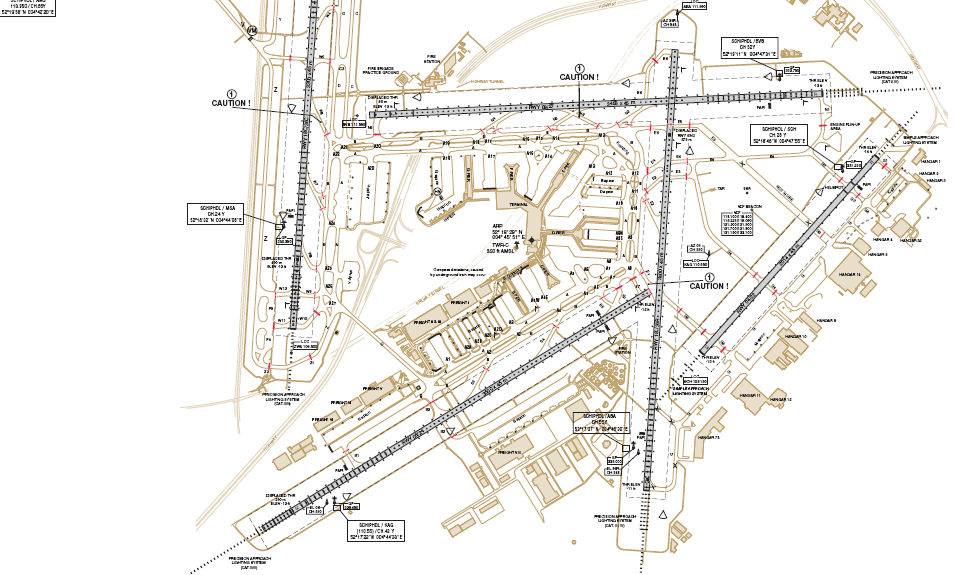
4 E. Optimizer The optimizer is responsible for automatically running CPLEX with the correct parameters, including the input file and a time limit on the duration of the optimization. After CPLEX is started, it checks if the optimization is completed by regularly checking for the existence of the output file. When the output file is detected, the output converter is started. F. Output convertor The output convertor reads the output file with the problem solution, which formulates which route and delay per segment is chosen for each flight, and translates this back to the route, in node at links at a certain time for each flight. This is also saved to a database and can be sent to the traffic simulator to show and record an animation of the results. G. Traffic simulator The traffic simulator is able to present the routes per flight in time by drawing all aircraft present at their coordinates at every time interval onto a drawing of the airport model. If a conflict is present it will light up the conflicting aircraft. Study of Amsterdam Airport Schiphol A detailed model for Amsterdam Airport Schiphol (AMS) was created using the aerodrome chart 6, as show in Figure 4, and consists of a total of 136 nodes with 269 possible connections between them. Of the nodes 39 belong to a runway and two of these belong to two runways as they are the crossings of runway 18L/36R with runway 09/27 and runway 18L/36R with runway 06/24. In total there are 21 start nodes and 18 end nodes, of which 11 nodes are entrances to aprons. 18R 36L 18C 18L Terminal 22 36C Figure 4: Aerodrome chart 6 (left) and taxi planning model (right) of Amsterdam Airport Schiphol 06 36R 4
5 Aircraft operations AC/hr :00 6:00 12:00 18:00 0:00 time Figure 6: Flights over the day The flight schedule that was used was created by the ABS by extracting the busiest day of the year from official airline guide (OAG) data for This so called peak day flight schedule consists of a total of 1113 flights, which are assumed to all travel at an average speed of 12 meters per second, or about 23 knots. The runways are assigned to the flights by the ABS airside capacity and delay model on the basis of a runway configuration in which runways 18R and 18C are used simultaneously for arrivals and runways 18L and 24 are both used for departures. This configuration, which is one that has only been used as a trial, is used to enable a high runway capacity as not cause high amounts of delay and thus a reduction in the number of scheduled operations. The resulting number of flights throughout the day is shown in Figure 6. As there was no apron allocation available, the nodes belonging to the aprons are assumed to be allocated in alternating fashion, partially to reduce the number of possible unnecessary conflicts which would be caused by aircraft trying to use the same apron/node at the same time. Conflicts 250 Conflicts/Aircraft per hour Conflicts Aircraft 0 6:00 7:00 8:00 9:00 10:00 11:00 12:00 Time Figure 5: Number of conflicts during the investigated time interval 5
6 Due to long times needed to clear memory fragmentation and optimization times, the schedule has been reduced to all the flights between 6:00 and 12:00, the busiest time of the day, which reduces the flight schedule to 403 flights and acceptable preprocessing an optimization times. According to the route generator the average unconstrained travel time is seconds, if each aircraft uses the shortest route. As this is unconstrained, application The route generator also detects 320 intervals in which a conflict takes place. Figure 5, which shows the number of flights and the number of conflicts per 15 minute block, shows a slight relation between the number of flights and the number of conflicts. When the plan is optimized, which takes approximately 15 minutes, no conflicts are present and the average travel time per aircraft goes up to seconds, Of the 14.5 second average increase 13.4 seconds is delay. The remaining 1.1 seconds increase in average travel time per aircraft is caused by a total of 65 rerouted aircraft, which is more than 16% of the total of 403. Figure 7 shows a comparison of the unconstrained and the optimized situation at the same point in time (8:38:00) to illustrate the changes that are made during the planning. Flight 146 and 166 are only visible on the optimized are slightly delayed, and thus still on the airfield at that time in the optimized case and flights 164 and 170, which are having conflict with respectively flights 168 and 160 in the unconstrained case, are at completely different location due to rerouting to solve these conflicts. Figure 7: Unconstrained (left) and optimized (right) situation Concluding remarks The taxi planning system does seem to be able to handle more realistic and larger scale simulation. Whilst the calculation pre-processing times do prevent a whole day from being run at one time, a non-stop run of a few hours is possible, which makes an evaluation of changes to the taxiway system possible, even without using the re-planning option. A way of reducing the pre-processing time, which is mostly caused by memory fragmentation during the creation of node and link constraints from the routes, is still being looked at. It should be noted that building models requires special attention, especially with respect to the direction of the taxiways (links) and the availability of holding nodes, where aircraft can stand still as to many to few routes and hold nodes will lead to insolvable conflicts and too many can increase computation time. As shown in Figure 8 more taxi planning models of airports, such as Atlanta and London Heathrow, are being built and will be ready for analyses in the future. A first come first serve algorithm was hoped to be ready to demonstrate, but unfortunately the solutions generated by this algorithm still seem to have a few conflicts in them. The exact cause of these conflicts has not yet been found at time of this writing. 6
7 Figure 8: Models of London Heathrow (left) and Atlanta (right) References 1 International Civil Aviation Organization, Advanced Surface Movement Guidance and Control Systems (A-SMGCS) Manual, First Edition 2004, Doc 9830 AN/452 2 Visser, H. G. and Roling, P. C., Optimal Airport Surface Traffic Planning Using Mixed Integer Linear Programming, AIAA Aviation Technology, Integration and Operations (ATIO) Conference, P. C. Roling and H. G. Visser, Optimal Airport Surface Traffic Planning Using Mixed-Integer Linear Programming, International Journal of Aerospace Engineering, Volume 2008 (2008), Article ID ILOG, CPLEX release 9.1, P.C.Roling, Evaluation of Anchorage International Airport Using the Airport Business Suite, 26 th International Congress of the aeronautical sciences, 2008, AIAA Air Traffic Control the Netherlands, AIP Integrated package, [4 February 2009] 7
The Mayor of London s Submission:
 Inner Thames Estuary Feasibility Study Response to Airports Commission Call for Evidence The Mayor of London s Submission: Supporting technical documents 23 May 2014 Title: Runway utilisation Author: Atkins
Cumulative Diagrams: An Example
 Cumulative Diagrams: An Example Consider Figure 1 in which the functions (t) and (t) denote, respectively, the demand rate and the service rate (or capacity ) over time at the runway system of an airport
Departures to the south from Runways 16L and 16R.
 Mode 5 Method of operation Departures to the south from Runways 16L and 16R. Arrivals from the east on Runway 25. Arrivals from the north for those aircraft requiring to use the long runway. This runway
AN AIRCRAFT TAXI SIMULATION MODEL FOR THE UNITED PARCEL SERVICE LOUISVILLE AIR PARK. W. Swain Ottman Angela C. Ford Gregory R.
 Proceedings of the 1999 Winter Simulation Conference P. A. Farrington, H. B. Nembhard, D. T. Sturrock, and G. W. Evans, eds. AN AIRCRAFT TAXI SIMULATION MODEL FOR THE UNITED PARCEL SERVICE LOUISVILLE AIR
Airport Modelling: Capacity Analysis of Schiphol Airport in 2015
 Airport Modelling: Capacity Analysis of Schiphol Airport in 2015 by ir. F.R. Polak National Aerospace Laboratory NLR Amsterdam, The Netherlands Abstract The NLR has recently conducted a study into the
RUNWAY CAPACITY PLANNING SUPPORTED BY DYNAMIC PROGRAMMING
 24th INTERNATIONAL CONGRESS OF THE AERONAUTICAL SCIENCES RUNWAY CAPACITY PLANNING SUPPORTED BY DYNAMIC PROGRAMMING R.A.A. Wijnen Faculty of Aerospace Engineering Delft University of Technology Keywords:
WHICH AIR TRAFFIC CONTROLLER TO CONTACT
 WHICH AIR TRAFFIC CONTROLLER TO CONTACT 1. Introduction This article is written in order to explain to all beginners in the IVAO network the basics for any pilot to contact the correct air traffic controller.
Airport logistics - A case study of the turnaround
 Airport logistics - A case study of the turnaround process Anna Norin, Tobias Andersson Granberg, Di Yuan and Peter Värbrand Linköping University Post Print N.B.: When citing this work, cite the original
A new dimension in infotainment
 Cabin & IFE Inventions 3-D moving map system niceview A new dimension in infotainment Fly where you want to fly, see what you want to see Do you like to know where you are going and how you got there?
Los Angeles International Airport North Airfield Assessment
 Appendix H-3 LAX SPECIFIC PLAN AMENDMENT STUDY REPORT Los Angeles International Airport North Airfield Assessment May 2007 Prepared for: Los Angeles World Airports One World Way Los Angeles, California
FLIGHT PATH TO GROWTH THE CASE FOR INCREASING LONDON S AIR CAPACITY
 FLIGHT PATH TO GROWTH THE CASE FOR INCREASING LONDON S AIR CAPACITY THE PROBLEM WHY DO WE NEED TO FLY? The UK is the world s second-largest exporter of services and the sixth-largest exporter of goods.
LECTURE - 3 RESOURCE AND WORKFORCE SCHEDULING IN SERVICES
 LECTURE - 3 RESOURCE AND WORKFORCE SCHEDULING IN SERVICES Learning objective To explain various work shift scheduling methods for service sector. 8.9 Workforce Management Workforce management deals in
The Effects of Start Prices on the Performance of the Certainty Equivalent Pricing Policy
 BMI Paper The Effects of Start Prices on the Performance of the Certainty Equivalent Pricing Policy Faculty of Sciences VU University Amsterdam De Boelelaan 1081 1081 HV Amsterdam Netherlands Author: R.D.R.
Integrated surface management Herve Drevillon (DSNA) Airport safety support tools for pilots, vehicle drivers and controllers Nicolas Leon (DSNA)
 Integrated surface management Herve Drevillon (DSNA) Airport safety support tools for pilots, vehicle drivers and controllers Nicolas Leon (DSNA) Integrated surface management Herve Drevillon (DSNA) Operational
MEI Structured Mathematics. Practice Comprehension Task - 2. Do trains run late?
 MEI Structured Mathematics Practice Comprehension Task - 2 Do trains run late? There is a popular myth that trains always run late. Actually this is far from the case. All train companies want their trains
ATM Network Performance Evaluation And Optimization Using Complex Network Theory
 ATM Network Performance Evaluation And Optimization Using Complex Network Theory Yalin LI 1, Bruno F. Santos 2 and Richard Curran 3 Air Transport and Operations Faculty of Aerospace Engineering The Technical
Group D: FAA Landing Slots. Elaine Ou Jeff Shneidman Allan Sumiyama
 Group D: FAA Landing Slots Elaine Ou Jeff Shneidman Allan Sumiyama Airplane World Different (easier?) than FCC: Transparency. Every 10 th ticket known. Costs known. Load factors known. Different (harder?)
EdExcel Decision Mathematics 1
 EdExcel Decision Mathematics 1 Notes and Examples Critical Path Analysis Section 1: Activity networks These notes contain subsections on Drawing an activity network Using dummy activities Analysing the
OPERATING MINIMA FOR AEROPLANES AND HELICOPTER OPERATIONS PURPOSE REFERENCE 4.0 DEFINITION
 ORDER TCAA-O-OPS034A March 2013 OPERATING MINIMA FOR AEROPLANES AND HELICOPTER OPERATIONS PURPOSE 1. This Order gives guidance to the Authority s Operations Inspector on the procedures for approval of
Amsterdam Schiphol. Real Flight Event 21 st of May 2016. Introduction. This document is provided by IVAO-NL Flight Operations Department.
 Amsterdam Schiphol Real Flight Event 21 st of May 2016 This document is provided by IVAO-NL Flight Operations Department. Introduction This document will brief the pilots flying the Schiphol Amsterdam
CDM@CDG 2010. User Forum EUROCONTROL s Brussels HQ. 18 January 2011 CDM@CDG
 2010 CDM@CDG User Forum EUROCONTROL s Brussels HQ 18 January 2011 CDG AIRPORT OVERVIEW Surface area :3200 ha 4 RWYs : East / West 80 km Taxiways 8 ILS CAT 3 Statistic 2009 Airport trafic: 525 000 ops (ARR/DEP)
Airline Schedule Development
 Airline Schedule Development 16.75J/1.234J Airline Management Dr. Peter Belobaba February 22, 2006 Airline Schedule Development 1. Schedule Development Process Airline supply terminology Sequential approach
CHAPTER 7. AIRSPACE 7.1 AFFECTED ENVIRONMENT
 CHAPTER 7. AIRSPACE 7.1 AFFECTED ENVIRONMENT 7.1.1 Definition of Resource Airspace management is defined as directing, controlling, and handling flight operations in the volume of air that overlies the
[EN 026] Developing key performance indicators for airports
![[EN 026] Developing key performance indicators for airports](/thumbs/39/19853092.jpg "[EN 026] Developing key performance indicators for airports") [EN 026] Developing key performance indicators for airports + T. Andersson Granberg, A. Oquillas Munoz *Div. Communication and Transport Systems Linkoping University, ITN SE-60174 Norrkoping, Sweden [tobias.andersson]@liu.se
[EN 026] Developing key performance indicators for airports + T. Andersson Granberg, A. Oquillas Munoz *Div. Communication and Transport Systems Linkoping University, ITN SE-60174 Norrkoping, Sweden [tobias.andersson]@liu.se
years in the community
 Montréal-Trudeau, from the 70 past to the future years in the community The airport s beginnings Montréal Pierre Elliott Trudeau International Airport is 70 years old! It was on September 1, 1941, that
Interactive Dynamic Modeling for the Passenger Flow Bottleneck and Security Checkpoint Management at an Airport
 Interactive Dynamic Modeling for the Passenger Flow Bottleneck and Security Checkpoint Management at an Airport Yaman BARLAS M. Serdar ÇAKACIASLAN Tolga SAĞLIK Pınar SEKE Mustafa UĞUR Boğaziçi University
BEFORE YOU GET STARTED
 is a small highly professional flight training organisation operating from the at Albion Park just 15 mins South of Wollongong City. is the Premier Flight Training Organisation on the NSW South Coast.
Aircraft Noise Control at London Luton Airport. August 2015
 Aircraft Noise Control at London Luton Airport August 2015 Aircraft Noise Control at London Luton Airport Foreword London Luton Airport (LLA) continues to place aircraft noise high on its agenda. We recognise
Advantages and Disadvantages of One Way Streets October 30, 2007
 Advantages and Disadvantages of One Way Streets October 30, 2007 0 P age Background As the revitalization of the Central Waterfront area moves forward, one issue that might need closer analysis is the
Linear Programming for Optimization. Mark A. Schulze, Ph.D. Perceptive Scientific Instruments, Inc.
 1. Introduction Linear Programming for Optimization Mark A. Schulze, Ph.D. Perceptive Scientific Instruments, Inc. 1.1 Definition Linear programming is the name of a branch of applied mathematics that
Discussion Paper 01: Aviation Demand Forecasting
 Airports Commission Discussion Paper 01: Aviation Demand Forecasting Response from Kent County Council and Medway Council Q1: To what extent do you consider that the DfT forecasts support or challenge
AIRCRAFT NOISE ABATEMENT OPERATING PROCEDURES AND RESTRICTIONS
 AIRCRAFT NOISE ABATEMENT OPERATING PROCEDURES AND RESTRICTIONS This section sets forth the Los Angeles World Airports (LAWA s) informal noise abatement traffic; flight and runway use procedures and includes
Analytics That Allow You To See Beyond The Cloud. By Alex Huang, Ph.D., Head of Aviation Analytics Services, The Weather Company, an IBM Business
 Analytics That Allow You To See Beyond The Cloud By Alex Huang, Ph.D., Head of Aviation Analytics Services, The Weather Company, an IBM Business Table of Contents 3 Ways Predictive Airport Analytics Could
Aerodrome Advisory Circular
 Aerodrome Advisory Circular AC(AD) NO-13 Integration of International Aviation Security (AVSEC) Measures into Designs and Constructions of New Facilities and alterations to Existing Facilities. CIVIL AVIATION
Analysis of Micromouse Maze Solving Algorithms
 1 Analysis of Micromouse Maze Solving Algorithms David M. Willardson ECE 557: Learning from Data, Spring 2001 Abstract This project involves a simulation of a mouse that is to find its way through a maze.
A-CDM from an airport perspective Oslo Airport
 A-CDM from an airport perspective Oslo Airport Gro Jære Content Facts about Oslo Airport (OSL) A-CDM at OSL Implementation Experiences Future plans Q&A Summary of air traffic 2014 Oslo Airport 24,3 million
Description of Airport Charges. Swedavia AB 2015. Appendix 3 to Conditions of Services, Swedavia AB
 Description of Airport Charges Swedavia AB 2015 Appendix 3 to Conditions of Services, Swedavia AB Contents 1 Swedavias Charges... 3 2 Aircraft Related Charges... 4 2.1 Take-Off Charge... 4 2.2 Emission
ATFM STATUS REPORT: SOUTH AFRICA
 Central Airspace Management Unit ATFM STATUS REPORT: SOUTH AFRICA Presented by: Sandile L Maphanga Manager: Central Airspace management Unit SCOPE Company Profile Area of Responsibility South African Airspace
A MODEL TO SOLVE EN ROUTE AIR TRAFFIC FLOW MANAGEMENT PROBLEM:
 A MODEL TO SOLVE EN ROUTE AIR TRAFFIC FLOW MANAGEMENT PROBLEM: A TEMPORAL AND SPATIAL CASE V. Tosic, O. Babic, M. Cangalovic and Dj. Hohlacov Faculty of Transport and Traffic Engineering, University of
Passenger Terminal Amsterdam
 Fact sheet large cruise ships to Passenger Terminal Amsterdam Port of Amsterdam Amsterdam-IJmond Pilot Organization 2009 Version: November 6 th 2009 This fact sheet provides information on the passage
International Civil Aviation Organization WORLDWIDE AIR TRANSPORT CONFERENCE (ATCONF) SIXTH MEETING. Montréal, 18 to 22 March 2013
 International Civil Aviation Organization WORKING PAPER ATConf/6-WP/88 4/3/13 English only WORLDWIDE AIR TRANSPORT CONFERENCE (ATCONF) SIXTH MEETING Montréal, 18 to 22 March 2013 Agenda Item 2: Examination
AIRFIELD DRIVING TEST
 AIRFIELD DRIVING TEST NAME: COMPANY: DATE: SCORE: 1. Runway incursions are primarily caused by the following errors, except a. Pilot/ground vehicle/controller communication errors b. Lack of airport familiarity
LONDON SOUTHEND AIRPORT CLASS D CONTROLLED AIRSPACE GUIDE
 CLASS D CONTROLLED AIRSPACE GUIDE Introduction From the 2 nd of April 2015 London Southend Airport (LSA) will be implementing Class D (CAS). This airspace is made up of a Control Zone (CTR) and Control
Air Support services are centred on four core practice areas, as indicated below and briefly described later on.
 Mission Statement Air Support is an aviation engineering and consulting company operating in the Italian, European, Africa end South America markets. Air Support is specialized in providing key aviation
You ll soon be arriving in Paris, thank you for choosing our airport for your arrival. This briefing was made to make your arrival as flawless and
 You ll soon be arriving in Paris, thank you for choosing our airport for your arrival. This briefing was made to make your arrival as flawless and fun as possible. We hope you will enjoy flying with us.
OCCUPATIONAL AND ENVIRONMENTAL MEDICINE WING
 OCCUPATIONAL AND ENVIRONMENTAL MEDICINE WING NOISE AND VIBRATION DIVISION Report: OEM/04/14 Dated January 2014 A REPORT ON AN ENVIRONMENTAL NOISE SURVEY OF AIRCRAFT ACTIVITY AT RAF BRIZE NORTON Approved
The business of Gatwick Airport Limited
 APPENDIX C The business of Gatwick Airport Limited C1 This appendix provides an overview of the current ownership and history of Gatwick and the business of Gatwick Airport Limited (GAL). In particular,
INITIAL TEST RESULTS OF PATHPROX A RUNWAY INCURSION ALERTING SYSTEM
 INITIAL TEST RESULTS OF PATHPROX A RUNWAY INCURSION ALERTING SYSTEM Rick Cassell, Carl Evers, Ben Sleep and Jeff Esche Rannoch Corporation, 1800 Diagonal Rd. Suite 430, Alexandria, VA 22314 Abstract This
Dynamic Vehicle Routing in MATSim
 Poznan University of Technology Department of Motor Vehicles and Road Transport ZPSiTD Dynamic Vehicle Routing in MATSim Simulation and Optimization Michal Maciejewski [email protected]
LLamasoft K2 Enterprise 8.1 System Requirements
 Overview... 3 RAM... 3 Cores and CPU Speed... 3 Local System for Operating Supply Chain Guru... 4 Applying Supply Chain Guru Hardware in K2 Enterprise... 5 Example... 6 Determining the Correct Number of
LOCAL OPERATING PROCEDURES (LOP) LANDVETTER TWR (ESGG)
 2011 LOCAL OPERATING PROCEDURES (LOP) LANDVETTER TWR (ESGG) Göteborg/Landvetter ESGG ESGG_TWR 118.600 / ESGG_GND 121.900 / ESGG_DEL 121.675 (VATSIM 121.670) Landvetter Tower / Landvetter Ground / Clearance
Pilot Briefing for Helsinki-Vantaa Real Flight Event
 Pilot Briefing for Helsinki-Vantaa Real Flight Event INTRODUCTION It is finally time for the Helsinki Real Flight Event. This event will simulate the real operations and flights that go on every day at
Blending petroleum products at NZ Refining Company
 Blending petroleum products at NZ Refining Company Geoffrey B. W. Gill Commercial Department NZ Refining Company New Zealand [email protected] Abstract There are many petroleum products which New Zealand
PF3 ATC at its best Version History
 The latest version of this document and the PF3 User Guide can always be found in the...\pf3\help folder after any update. 30 th May 2016 Version 3.1.18 FIXED a problem that could occur if an emergency
CRITICAL PATH ANALYSIS AND GANTT CHARTS
 CRITICAL PATH ANALYSIS AND GANTT CHARTS 1. An engineering project is modelled by the activity network shown in the figure above. The activities are represented by the arcs. The number in brackets on each
Optimisation and Prioritisation of Flows of Air Traffic through an ATM Network
 Optimisation and Prioritisation of Flows of Air Traffic through an ATM Network Hugo de Jonge and Ron Seljée ATM department (ATAP) National Aerospace Laboratory, the Netherlands (NLR) Amsterdam, the Netherlands
WP2.2.2 Benefit Assessment
 WP2.2.2 Benefit Assessment Lorenzo Castelli, Paola Pellegrini, Andrea Ranieri University of Trieste 2nd CATS Worksop - 26 Jan 10 Page: 1 CATS Benefit assessment The general objective of WP 2.2.2 is to
Training program for S2 (TWR) rating
 Training program for S2 (TWR) rating Introduction This is the official Vatsim Scandinavia training program for students training for the TWR (S2) Rating. Each mentor is expected to take his student through
UK AIRSPACE Introduction
 UK AIRSPACE Introduction The UK has now adopted the ICAO system for naming of airspace types from A to G. However in the UK there is at present no Class C airspace. Classes A to E are called Controlled
1.2 Some of the figures included in this publication may be provisional only and may be revised in later issues.
 FOREWORD 1 CONTENT 1.1 UK Airports (Including Channel Islands and Isle of Man) - Monthly Statements of Movements, Passengers and Cargo is prepared by the Civil Aviation Authority with the co-operation
Night time restrictions at Amsterdam-Schiphol
 March 2004 03.171.05 Night time restrictions at Amsterdam-Schiphol An international comparison Night time restrictions at Amsterdam-Schiphol An international comparison Under contract of Ministry of Transport,
12.0 SAFETY AND SECURITY
 12.0 SAFETY AND SECURITY 12.0 SAFETY AND SECURITY Key points The development plan within this Master Plan: Will improve airfield safety by reducing the towed aircraft runway crossings and other airfield
SYSTEM GLOBAL NAVIGATION SATELLITE SYSTEM LANDING TECHNOLOGY/PRODUCT DEVELOPMENT
 GLOBAL NAVIGATION SATELLITE SYSTEM LANDING SYSTEM The aviation industry is developing a new positioning and landing system based on the Global Navigation Satellite System (GNSS). The GNSS landing system
CAAP 89W-1(0) Guidelines on provision of obstacle information for take-off flight planning purposes
 Civil Aviation Advisory Publication This publication is only advisory. It gives the preferred method for complying with the Civil Aviation Regulations (CAR 1988). It is not the only method, but experience
Aviation Demand Forecasting
 Airports Commission Discussion Paper 01 Aviation Demand Forecasting The Mayor of London s response March 2013 1. Purpose of paper 1.1. In February 2013, the Airports Commission issued a Discussion Paper
Takeoff Tools TM Crosswind Calculator Instructions Copyright 2005 by Eric C. King. All rights reserved. Rev. 11Sep05. How to Use
 Takeoff Tools TM Crosswind Calculator Instructions Copyright 2005 by Eric C. King. All rights reserved. Rev. 11Sep05 Takeoff Tools TM Suppose you re arriving at, or about to depart from, an airport. You
MASTER PLAN PREPARATION
 Located in the East Valley of the Phoenix Metropolitan Area, Phoenix-Mesa Gateway Airport is a former military airfield that has successfully made the transition to a full service commercial passenger
CIVIL AVIATION REQUIREMENTS SECTION 4 AERODROMES & AIR TRAFFIC SERVICES SERIES X PART IV 17 th OCTOBER 2007 EFFECTIVE : FORTHWITH
 GOVERNMENT OF INDIA OFFICE OF THE DIRECTOR GENERAL OF CIVIL AVIATION TECHNICAL CENTRE, OPP. SAFDARJUNG AIRPORT, NEW DELHI 110 003 CIVIL AVIATION REQUIREMENTS SECTION 4 AERODROMES & AIR TRAFFIC SERVICES
AVIATION TRAINING ACADEMY
 ATNS ATA Private Bag X 1 Bonaero Park South Africa 1622 Tel nr: +27(11) 961-0100; Fax nr: +27(11) 392-3868; Website: www.atns.co.za. AVIATION TRAINING ACADEMY AERODROME FLIGHT INFORMATION SERVICE COURSE
Malmi - Helsinki City International Airport. Malmi operators development plan 21.11.2015
 Malmi - Helsinki City International Airport Malmi operators development plan 21.11.2015 Malmi Airport Background Helsinki-Malmi Airport is located 10km from the center of Helsinki and is the only freeschedule
15m Pave Width: New Runway for Braunschweig-Wolfsburg Airport, Germany
 VÖGELE SUPER 3000-2 rehabilitates runway in Braunschweig-Wolfsburg. 15m Pave Width: New Runway for Braunschweig-Wolfsburg Airport, Germany VÖGELE SUPER 3000-2 rehabilitates runway in Braunschweig-Wolfsburg.
Departure Efficiency Benefits of Terminal RNAV Operations at Dallas-Fort Worth International Airport
 Efficiency Benefits of Terminal RNAV Operations at Dallas-Fort Worth International Airport Dr. Ralf H. Mayer * Center for Advanced Aviation System Development, The MITRE Corporation, McLean, Virginia 2212
1.231J/16.781J/ESD.224J Airport Systems Fall 2007. Demand Management. Amedeo R. Odoni. Massachusetts Institute of Technology.
 1.231J/16.781J/ESD.224J Airport Systems Fall 2007 Demand Management Amedeo R. Odoni Massachusetts Institute of Technology Page 1 Demand Management Objective Review the characteristics, advantages and disadvantages
Communication, Navigation, Surveillance (CNS) engineers and executives of Airports Authority of India
 Communication, Navigation, Surveillance (CNS) engineers and executives of Airports Authority of India CNS Officers Guild 1 Airports Authority of India (AAI) is entrusted with responsibility of providing
Simulating Traffic for Incident Management and ITS Investment Decisions
 1998 TRANSPORTATION CONFERENCE PROCEEDINGS 7 Simulating Traffic for Incident Management and ITS Investment Decisions MICHAEL D. ANDERSON AND REGINALD R. SOULEYRETTE UTPS-type models were designed to adequately
Batch Production Scheduling in the Process Industries. By Prashanthi Ravi
 Batch Production Scheduling in the Process Industries By Prashanthi Ravi INTRODUCTION Batch production - where a batch means a task together with the quantity produced. The processing of a batch is called
S a f e G u i d a n c e. Single Lamp Control and Monitoring
 Single Lamp Control and Monitoring S a f e G u i d a n c e Separation brings Benefits Traditionally designed power supplies for airfield lighting systems require separate series circuits when switching.
The Development of Practical Asset Management System for an Urban Expressway Network
 The Development of Practical Asset Management System for an Urban Expressway Network Motohiko Nishibayashi, Hanshin Expressway Company Limited 1. Introduction Hanshin Expressway is an urban expressway
Tours Reporting System (Divisional) English version
 Tours Reporting System (Divisional) English version MODA Manuals Author: Sepehr Ebadi Borna Version 1.5 (26-June-2015) Table of Contents Chapter 1 Reporting System...2-3 Chapter 2 View Tour s details...
London Luton Airport Document PPO5 Procedures for Requesting Prior Permission to Operate Version 1.4 - issued 25 th February 2009
 London Luton Airport Document PPO5 Procedures for Requesting Prior Permission to Operate Version 1.4 - issued 25 th February 2009 1. Introduction 1.1. All fixed wing aircraft flights at London Luton Airport
Data Review and Analysis Program (DRAP) Flight Data Visualization Program for Enhancement of FOQA
 86 Data Review and Analysis Program (DRAP) Flight Data Visualization Program for Enhancement of FOQA Koji MURAOKA and Noriaki OKADA, Flight Systems Research Center, E-mail: [email protected] Keywords:
NOTICE TO AERODROME CERTIFICATE HOLDERS (NOTAC) No. 02/2013
 NOTICE TO AERODROME CERTIFICATE HOLDERS (NOTAC) No. 02/2013 Effective Date: 14 July 2013 ANA Department Telephone: +971 0 2 4054507 General Civil Aviation Authority Telefax: +971 0 2 4054406 P.O. Box 6558
ICAO Safety Management Systems (SMS) Course Handout N 5 Cuzco International Airport operation
 ICAO Safety Management Systems (SMS) Course Handout N 5 Cuzco International Airport operation International Civil Aviation Organization Page left blank intentionally ICAO Safety management systems (SMS)
Evaluation of traffic control policy in disaster case. by using traffic simulation model
 19th ITS World Congress, Vienna, Austria, 22/26 October 2012 AP-00345 Evaluation of traffic control policy in disaster case by using traffic simulation model DAISUKE OSHIMA 1*, SHINJI TANAKA 2, TAKASHI
ILS Replacement. ACI World Safety Seminar. 18 19 November 2008 Kempinski Hotel Beijing Lufthansa Centre
 ILS Replacement Xiaosong Xiao, PhD Tetra Tech, Inc. Orlando, USA Contents: Ground-Based Navigation ILS Approach GNSS/SBAS Approach Comparisons between ILS and GNSS Example: Cost Analysis Between LAAS and
DISCRETE EVENT SIMULATION IN THE DESIGN, LAYOUT AND SCHEDULING OF PIPELESS BATCH PLANTS
 DISCRETE EVENT SIMULATION IN THE DESIGN, LAYOUT AND SCHEDULING OF PIPELESS BATCH PLANTS F. Mushtaq and P.W.H. Chung Department of Chemical Engineering, Loughborough University, Loughborough, Leicestershire,
PUBLISHING AND NOTAM GUIDELINES FOR AERODROME OPERATORS
 Aeronautical Information Management Documentation PUBLISHING AND NOTAM GUIDELINES FOR AERODROME OPERATORS Airways New Zealand Publishing and NOTAM Guidelines for Aerodrome Operators Aeronautical Information
Airport Charges and Handling Fees. AIRPORT DEBRECEN Kft.
 Airport Charges and Handling Fees AIRPORT DEBRECEN Kft. Valid between 01 MAY, 2014 and 30 SEPTEMBER, 2014 Approved by Mr Tamás Sápi, Managing Director OLDAL: 1 / 22 LIST OF MODIFICATIONS Line number of
Press release from Siemens, Barco, Inform, ATRiCS, DLR and Stuttgart Airport
 Press release Stuttgart/Germany, May 22, 2012 Press release from Siemens, Barco, Inform, ATRiCS, DLR and Stuttgart Airport Total Airport Management Suite software platform optimizes airport processes The
The Trip Scheduling Problem
 The Trip Scheduling Problem Claudia Archetti Department of Quantitative Methods, University of Brescia Contrada Santa Chiara 50, 25122 Brescia, Italy Martin Savelsbergh School of Industrial and Systems
or, put slightly differently, the profit maximizing condition is for marginal revenue to equal marginal cost:
 Chapter 9 Lecture Notes 1 Economics 35: Intermediate Microeconomics Notes and Sample Questions Chapter 9: Profit Maximization Profit Maximization The basic assumption here is that firms are profit maximizing.
A Second Runway for Gatwick Initial response to the Airports Commission s recommendation report
 A Second Runway for Gatwick Initial response to the Airports Commission s recommendation report 14 July 2015 Airports Commission: London Gatwick 235 Table of Contents Gatwick s initial response to the
Why build the Silvertown Tunnel?
 Why build the Silvertown Tunnel? Over the last 30 years east London has changed with the redevelopment of former industrial areas into major commercial and residential districts. The development of Canary
Predicting Flight Delays
 Predicting Flight Delays Dieterich Lawson [email protected] William Castillo [email protected] Introduction Every year approximately 20% of airline flights are delayed or cancelled, costing