
Pulleys: Groovy Wheels
|
|
|
- Poppy Daniels
- 9 years ago
- Views:
Transcription
1 activity Pulleys: Groovy Wheels BROWARD COUNTY ELEMENTARY SCIENCE BENCHMARK PLAN Grade Quarter Activity SC.C... The student understands that the motion of an object can be described and measured. SC.H... The student knows that it is important to keep accurate records and descriptions to provide information and clues on causes of discrepancies in repeated experiments. SC.H... The student knows that a successful method to explore the natural world is to observe and record, and then analyze and communicate the results. SC.H... The student knows that to work collaboratively, all team members should be free to reach, explain, and justify their own individual conclusions. SC.H... The student knows that to compare and contrast observations and results is an essential skill in science. SC.H... The student knows that a model of something is different from the real thing but can be used to learn something about the real thing. SC.H... The student knows that data are collected and interpreted in order to explain an event or concept. ACTIVITY ASSESSMENT OPPORTUNITIES The following suggestions are intended to help identify major concepts covered in the activity that may need extra reinforcement. The goal is to provide opportunities to assess student progress without creating the need for a separate, formal assessment session (or activity) for each of the 0 hands-on activities at this grade level.. Tell students that both pulleys and gears are wheels. Ask, How are pulleys and gears similar, and how are they different? (Pulleys have grooves, and gears have teeth. Both are circles that rotate around a center point, but pulleys have a fixed axle and gears move around on an axle. Both can be used to change the direction of an applied force.) broward county hands-on science Quarter 9

2 . Use the Activity Sheet(s) to assess student understanding of the major concepts in the activity. In addition to the above assessment suggestions, the questions in bold and tasks that students perform throughout the activity provide opportunities to identify areas that may require additional review before proceeding further with the activity. 90 activity Pulleys: Groovy Wheels

3 activity Pulleys: Groovy Wheels OBJECTIVES Students are introduced to a third type of simple machine: the pulley. The students make a single, fixed pulley and use it to lift a load observe that a fixed pulley reverses the direction of applied force make a single, movable pulley and use it to lift a load observe that a movable pulley reduces the amount of force required to lift a load SCHEDULE About hour VOCABULARY groove pulley MATERIALS For each student Activity Sheet, Parts A and B pr safety goggles* For each team of four book, heavy* dowel, wooden plastic rings pulley push-pull meter rulers, dual-scale* pair scissors* set washers, stacked and taped (from Activity ) For the class roll masking tape ruler, dual-scale* pair scissors* roll string Delta Science Reader Force and Motion *provided by the teacher PREPARATION Make a copy of Activity Sheet, Parts A and B, for each student. For each team of four, cut a length of string. m (about 0 in.) long. Each team will need two plastic rings, a length of string, a dowel, a heavy book, a pulley, a push-pull meter, two rulers, a pair of blunt-tip scissors, a stack of washers (taped together), and several pieces of masking tape. If you left the lengths of string tied to the washer stacks after Activity, keep that setup. (Replace any push-pull meter rubber bands that have become stretched.) BACKGROUND INFORMATION A pulley is another type of simple machine (see Figure -). A pulley consists of a grooved wheel that spins around a stationary axle. A rope (or chain) rests in the groove of the wheel. Pulling on one end of the rope causes it to move over the wheel. The wheel turns easily as the rope rides in the groove. Pulleys are used to help us move objects more safely and easily. Some pulleys work by changing the direction of applied force. broward county hands-on science Quarter 9

4 Others work by reducing the amount of force it takes to move a heavy object. Activity Sheet, Part A Pulleys: Groovy Wheels grooved wheel rope or chain Figure -. The three parts of a pulley. stationary axle. How is a pulley like a wheel and axle? They both have a wheel with an axle through the center of it.. How is a pulley different from a wheel and axle? Wheels and axles are attached and they turn together. A pulley wheel spins around its axle.. Look at the picture. Draw an arrow to show which direction you pull on the string. Then draw an arrow to show which direction the load moves when the string is pulled. Others work by reducing the amount of force it takes to move a heavy object. There are two types of pulleys: fixed and movable. A fixed pulley is one that does not move. This type of pulley makes it easier to lift an object by allowing you to pull down in order to raise a load. It is easier to pull down than to push up because your own weight and gravity help you (but it does not change the amount of force needed).. How much force does it take to lift the washers by hand? about units. How much force does it take to lift the washers with a single, fixed pulley? about / units. How does a single, fixed pulley make it easier to lift a load? It reverses the direction of the force. It is easier to pull down on something than it is to lift or pull it up. A movable pulley is one that moves along the rope as the rope is pulled. In this system, one end of the rope is firmly attached to a stationary object, and the pulley is attached directly to the load. A movable pulley reduces the amount of force you need to lift the load by half. That is because half of the weight of the load is supported by the stationary object (in this activity, a desk) and half is supported by you. The tradeoff is that the rope must be pulled twice as far in order to get the load to move half as much. Using more than one pulley called a block and tackle can also reduce the amount of force it takes to lift a load. The more pulleys added to the system, the less force it takes to lift the load, but the farther the rope must be pulled. In this activity, students build a single, fixed pulley and a single, movable pulley and observe how each type of pulley helps make work a little easier. 9 activity Pulleys: Groovy Wheels Activity Sheet, Part B Pulleys: Groovy Wheels. Look at the picture. Draw an arrow to show which direction you pull on the string. Then draw an arrow to show which direction the load moves when the string is pulled.. How much force does it take to lift the washers with a single, movable pulley? about / to / units 9. When you pulled the string inches, how far did the load move? about inches 0. How does a single, movable pulley make it easier to lift a load? by reducing the amount of force needed to lift the load. What is the tradeoff when using a single, movable pulley? The force must be applied over twice the distance. The string must be lifted twice as far as the load is lifted.

5 Guiding the Activity Distribute a copy of Activity Sheet, Parts A and B, to each student. Divide the class into teams of four, and distribute a pulley to each team. Give students time to examine the pulley. Ask students if they know what the object is. Write the word pulley on the board. Tell students that this device is a pulley. Ask students to compare the pulley to a wheel and axle. Tell them to write their responses to questions and on the activity sheet. Then review their answers as a class. Bring students attention to the groove around the rim of the pulley wheel. Write the word groove on the board and ask, What do you think this groove is for? Ask, Where have you seen pulleys used? Tell students that in this activity, they are going to learn how pulleys can help them do work. Distribute a push-pull meter, a plastic ring, a dowel, a length of string, a stack of washers (taped together), two rulers, a heavy book, and several pieces of masking tape to each team. Tell teams that they are going to use these objects to build a pulley system. Additional Information Like a wheel and axle machine, a pulley contains a wheel with an axle through the middle of it. Unlike a wheel and axle machine, in which the wheel and axle move as a single unit, a pulley wheel rotates freely around its fixed axle. Some students may know that a rope, chain, or line of some sort sits or slides in the groove. Students may have seen pulleys used on flagpoles, clotheslines, and adjustable ladders, in automobile repair shops, on elevators, and on cranes. Point out that Activity Sheet, Parts A and B, show the setups for two pulley systems. First they will build the single, fixed pulley system shown on Part A. To begin, tell students to insert the dowel into the loop at the top of the pulley wheel. (It should fit snugly and slide in about an inch; circulate and provide help as needed.) Then have students tape the other end of the dowel to a desktop. Two 0-cm (- or -in.) pieces of tape will be sufficient. The pulley should hang over the edge of the desktop. Have students place the book on top of the dowel for added security. Note: To assure a secure fit of the pulley on the dowel, wrap the end of the dowel with a layer of masking tape. broward county hands-on science Quarter 9

6 Guiding the Activity Next, have students tie one end of the string around the stack of washers. (Thread the string through the middle of the washers, then tie it.) With the washers resting on the floor, have them thread the other end of the string through the pulley wheel so that it rests in the groove. Additional Information The washers may already be tied, following Activity. Finally, tell students to tie the free end of the string to the plastic ring. The completed pulley system should look like the one in Figure -. Ask students, How can you use this pulley system to raise the load of washers? Tell students to pull on the ring at the end of the string and observe what happens. Ask, What happens to the wheel inside the pulley when you pull on the string? Ask, What happens to the washers when you pull down on the string? Ask, When you raised the washers, did the pulley move or stay in the same place? Figure -. A single, fixed pulley system. Students should suggest pulling down on the free end of the string. The wheel turns as the string moves over it. Students should observe that pulling down on the ring end of the string causes the stack of washers to be lifted off the floor. It stayed in the same place. Tell students that this type of pulley system is called a single, fixed pulley system. It s called single because there is only one pulley. It s called fixed because it does not move while it is being used. Now ask, In what direction did you pull the string? Ask, In what direction did the washers move? Ask, What does a single, fixed pulley do to the direction of the force you apply to the string? Tell students to complete question on the activity sheet. 9 activity Pulleys: Groovy Wheels down up Guide students to understand that a single, fixed pulley changes (reverses) the direction of applied force.

7 Guiding the Activity Ask students to pull down on the string again, this time noting the distance that the free end of the string and the load of washers each move. To verify their observations, have students measure the distance each end moves, using two rulers. Tell students to pull down on the string inches and measure the distance that the washers are lifted. Then ask, Does one end of the string move farther than the other in a single, fixed pulley system? Now ask students, Does using a single, fixed pulley decrease the amount of force you need to lift the washers? Have students remove the washers and string from the pulley system. Tell them to hook the plastic ring to the push-pull meter and use the meter to measure the amount of force it takes to lift a load of washers straight off the ground. Tell them to record the amount in question of the activity sheet. Additional Information They seem to move the same distance. Students should observe that the washers moved inches as well. No. Guide students to understand that pulling down on the string causes the load to rise the same distance. Accept all reasonable answers. It should take about to units of force. Ask, Do you think it will take more force, less force, or the same amount of force to lift the washers using a single, fixed pulley? Students may predict that it will take less force. Accept all answers. Tell students to untie or unloop the string from the plastic ring and thread the string back through the pulley wheel as before. Have students reattach the string to the ring on the push-pull meter. Tell students to pull down on the push-pull meter to raise the load of washers. Tell them to note the amount of force it takes to lift the washers using the pulley (see Figure -). Have them record the amount in question of their activity sheets. O O Figure -. Measuring the amount of force it takes to lift a load with a single, fixed pulley. broward county hands-on science Quarter 9

8 Guiding the Activity When students have finished, ask, Did it take more force, less force, or the same amount of force to lift the washers with the pulley system? Additional Information Students should have discovered that it took about the same amount of force to lift the washers with the single, fixed pulley as it did to pick them up directly, without the pulley. Note: It may take slightly more force due to friction. If this occurs, discuss with students the presence of friction in the pulley system. Ask, If it takes about the same amount of force to lift a load with or without the pulley, what do you think is the advantage of using a single, fixed pulley system? Tell students to answer question on the activity sheet. Ask, How can we use a pulley to reduce the amount of force it takes to lift a load? Tell students that the next type of pulley system will show them how. Tell students to refer to Activity Sheet, Part B. Question includes the setup for the second pulley system. Students should remove the pulley from the end of the dowel and remove the washers and string from the pulley system. Distribute a pair of blunt-tip scissors and another plastic ring to each team, and tell students to cut the string that is tied around the stack of washers just above the knot. (This will leave a loop of string still tied around washers.) Have them hook the second plastic ring to the string that remains tied around the washers. Have them attach the ring to the loop on the pulley wheel. Next, tell students to tape one end of the long piece of string to their desks and place a book on it for security. Finally, they should thread the other end of the string through the pulley wheel. The completed setup should look like that in Figure -. 9 activity Pulleys: Groovy Wheels The advantage is that it seems easier to pull down on something than to pull up on it or carry it to a height. This is due not only to how our bodies are built, but to the force of gravity working in our favor. Review the concept of gravity with students, if necessary. The fixed pulley also reverses the direction of the force. Accept all reasonable answers. Figure -. A single, movable pulley system

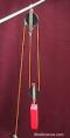
9 9 Guiding the Activity Ask students, How is this pulley system similar to the single, fixed pulley you just built? Ask, How is this pulley system different from the other one? Ask students, How can you use this pulley system to raise the load of washers? Have students pick up the free end of the string, pull it straight up, and observe what happens to the washers. Ask, When you raised the washers, did the pulley move or stay in the same place? Tell students that this type of pulley system is called a single, movable pulley system. Like the other pulley system, it contains a single pulley wheel. It s called movable because the pulley wheel moves along with the load. Now ask, In what direction did you pull the string? Ask, In what direction did the washers move? Ask, How is this different from the fixed pulley? Tell students to complete question on the activity sheet. Ask students to recall how much force it took to lift the washers with a push-pull meter. (See the answer to question on the activity sheet.) Now ask students, Do you think it takes more force, less force, or the same amount of force to lift the washers using a single, movable pulley? Tell students to hook the plastic ring at the end of the string to their push-pull meter and pull up on the meter to raise the washers. Tell them to note the amount of force it takes to lift the washers using the pulley (see Figure -). Have them record the amount in question of the activity sheet. Additional Information Both types of pulley systems use just one pulley wheel. In this system, the load is attached directly to the pulley. Students should suggest pulling up on the free end of the string. The washers are lifted off the floor. It moved; it was lifted with the load. up up In a fixed pulley system, the force changes direction. In a movable system, the direction of force stays the same. The load moves in the same direction as the applied force. It took between and units of force. Accept all answers. O O Figure -. Measuring the amount of force it takes to lift a load with a single, movable pulley. broward county hands-on science Quarter 9

10 0 Guiding the Activity When students have finished, ask, Did it take more force, less force, or the same amount of force to lift the washers with this pulley system? Ask, Why do you think it took less force? Remind students that with every decrease in force, there is a price to pay in distance. Tell students to unhook the plastic ring from the push-pull meter. Have them use the ring to pull up on the string again, this time noting the distance that the free end of the string and the load of washers each moves. To verify their observations, have students measure the distance each end moves, using two rulers. Tell students to pull up on the string inches and measure the distance that the washers are lifted. Tell them to write their answers on question 9 of the activity sheet. Then ask, Does the free end of the string move farther than the load in a single, movable pulley system? Tell students to complete their activity sheets. Then review their answers as a class. Ask, How does using a single, movable pulley help you lift a load? Additional Information Students should have discovered that it took less force (about half as much) to lift the washers with the single, movable pulley as it did to pick them up directly, without the pulley. because half of the weight of the washers is supported by the string hanging from the desk The ring end of the string seems to move about twice as far as the washers do. Students should observe that pulling up on the string a distance of inches causes the washers to rise only about inches. Yes. The string must be pulled twice as far in order to get the load of washers to move half as far. Using a single, movable pulley to move a load reduces the amount of force needed by half. Ask, What is the tradeoff when using a single, movable pulley? As appropriate, read or review pages and of the Delta Science Reader Force and Motion. 9 activity Pulleys: Groovy Wheels The force must be applied over twice the distance.

11 R EINFORCEMENT Challenge students to build fixed and movable pulley systems without using the metal pulley wheels. To build a fixed pulley system, simply have students toss the string over the dowel that is taped to the edge of their desk. When they pull down on the free end of the string, the load at the other end will rise. To build a movable pulley, have students replace the pulley with a plastic ring. When the free end of the string is pulled up, the ring and the load of washers to which it is attached will rise also. SCIENCE JOURNALS Have students place their completed activity sheets in their science journals. C LEANUP Return the push-pull meters, stacks of washers, dowels, pulleys, plastic rings, and rolls of string and tape to the kit. Discard the lengths of string, but leave the loop of string tied around the washer sets. Ask students, What is the danger in using a pulley system without a pulley wheel? (Answer: Friction over time can cause the string to break. The wheel inside a pulley wheel assembly reduces friction by turning as the string moves over it.) Assessment Opportunity This Reinforcement also may be used as an ongoing assessment of students understanding of science concepts and skills. broward county hands-on science Quarter 99

12 Connections Science Challenge Introduce the concept that several pulleys can be used together in a single system. Have students work in small groups to experiment with arrangements of two, three, or more pulleys to lift a load. What effect does increasing the number of pulleys have on the amount of force required? (The more pulleys there are, the less force is required.) What is the tradeoff in using more pulleys? (The force must be applied over a greater distance.) Invite students to speculate about what eventually happens to the rope of a pulley system and why. (The rope becomes worn and would break if not replaced because of friction between the rope and the pulley.) Science Extension If your school has a flag on an outside flagpole that is raised and lowered at the beginning and end of the school day, try to arrange a time when your class can be outside to observe this event. Direct students attention to the pulley that enables the flag to be raised and lowered easily. Have students look for examples of pulleys being used in daily life. Among others, they may note the use of pulleys on clotheslines and cranes. Science and the Arts Students should now add examples of pulleys to their ongoing bulletin board display of simple machines. You may wish to provide actual pulleys, which are available in hardware and building supply stores and hardware departments of other stores. 00 activity Pulleys: Groovy Wheels Science, Technology, and Society The block and tackle is a system of pulleys that is compact and yet able to raise substantial loads. It is commonly used at the end of a crane s boom to increase the force of the crane s motor in lifting a load. A block and tackle system consists of one rope wound around two separate sets of pulleys. The pulleys in each set are free to rotate independently on the same axle. The upper set is attached to a support. The lower set is attached to the load. Pulling the rope raises the lower set of pulleys. The magnification of the force that the block and tackle produces is equal to the number of pulley wheels it contains. Encourage students to research and report on this use of the pulley. Some students may also enjoy finding out how pulleys are used in combination with a motor and a counterweight to operate an elevator. Students can experience the effect of a simple block and tackle by carrying out the following activity in groups of three. Each group will need brooms (or anything with a long pole) and a strong rope or clothesline at least 9 ft ( m) long. As two students hold the poles about ft (0 cm) apart, the third tries to pull them together. The student will not be able to succeed. Next, have the third student tie one end of the rope securely around one of the poles and wind the other end several times around the other pole. The student, pulling on the free end of the rope, should be able to draw the poles together. Point out that winding the rope increases the force of the pull in fact, every turn of the rope approximately doubles the pulling power. Guide students to recognize the tradeoff every time the force is increased, so is the distance required to pull the free end of the rope.

Levers for Lifting BROWARD COUNTY ELEMENTARY SCIENCE BENCHMARK PLAN ACTIVITY ASSESSMENT OPPORTUNITIES. Grade 3 Quarter 3 Activity 23
 activity Levers for Lifting BROWARD COUNTY ELEMENTARY SCIENCE BENCHMARK PLAN Grade Quarter Activity SC.C... The student understands that the motion of an object can be described and measured. SC.H... The
Simple Machines. What are simple machines?
 Definitions to know: Simple Machines Work done when an applied force causes an object to move in the direction of the force Energy ability to cause change; can change the speed, direction, shape, or temperature
Simple machines provide a mechanical advantage that makes our work faster and easier, and they are all around us every day.
 LEARNING MODULE: SIMPLE MACHINES Pre-Visit Activities We suggest that you use these pre-visit classroom acitivites to prepare your students for a rewarding Museum visit. Before your visit, introduce your
Partnerships Implementing Engineering Education Worcester Polytechnic Institute Worcester Public Schools
 Partnerships Implementing Engineering Education Worcester Polytechnic Institute Worcester Public Schools Supported by: National Science Foundation Simple Machines: 4.G.2 _ Inclined Planes and Pulleys Grade
Levers and Pulleys. 5 th Grade Science Investigation. Unit
 Levers and Pulleys 5 th Grade Science Investigation Unit What Do We Already Know? A lever and pulley are mechanical advantages=makes work easier, and helps lift things you couldn t t normally lift Combined
Rubber Band Race Car
 Rubber Band Race Car Physical Science Unit Using LEGO Mindstorms NXT Copyright 2009 by Technically Learning 1 of 17 Overview: Through a series of hands-on activities, students will design a rubber band
Compound Machine: Two or more simple machines working together to make work easier. Examples: Wheelbarrow, Can Opener, Bicycle
 Name SOL 4.2 Simple and Compound Machines NOTE - Simple machines are NOT included in the 5 th REVISED Science Standards Simple Machine: A machine with few or no moving parts. Simple machines make work
Playful machines A Facilitator s Guide to Simple Machines in the Playground
 inspiring discovery Playful machines A Facilitator s Guide to Simple Machines in the Playground Our Vision Canadians recognize that Science 1 is intrinsic to their lives and acknowledge the fundamental
Engineer III Simple Machines
 Harford District 2014 Cub Scout Day Camp June 23-78 Knights of the Roundtable Engineer III Simple Machines Station Volunteer s Guide Thank you for being a station volunteer! The stations are the heart
Simple Machines. Preparation. Objectives. Standards. Grade Level: 3-5 Group Size: 25-30 Time: 60 Minutes Presenters: 3-4
 Simple Machines Preparation Grade Level: 3-5 Group Size: 25-30 Time: 60 Minutes Presenters: 3-4 Objectives This lesson will enable students to: Describe and define simple machines. Identify simple machines
Inclined Plane: Distance vs. Force
 1a Inclined Plane: Distance vs. Force Look at the inclined plane model you built for Card 2. It s a ramp, so it s easy to slide or roll things up and down it. As you noticed, it is a little more difficult
What is Energy? 1 45 minutes Energy and You: Energy Picnic Science, Physical Education Engage
 Unit Grades K-3 Awareness Teacher Overview What is energy? Energy makes change; it does things for us. It moves cars along the road and boats over the water. It bakes a cake in the oven and keeps ice frozen
Overall Indicator: The student: recognizes the effects of forces acting on structures and mechanisms
 Grade 5 Performance Task: Disaster Recovery Content Connections Assessment Criterion Understanding of basic concepts Overall Indicator: The student: recognizes the effects of forces acting on structures
Interaction at a Distance
 Interaction at a Distance Lesson Overview: Students come in contact with and use magnets every day. They often don t consider that there are different types of magnets and that they are made for different
Quick and Easy Simple Machine Experiments to Share with Your Kids
 Quick and Easy Simple Machine Experiments to Share with Your Kids By Aurora Lipper Pulleys and levers are simple machines, and they make our lives easier. They make it easier to lift, move and build things.
Hand Held Centripetal Force Kit
 Hand Held Centripetal Force Kit PH110152 Experiment Guide Hand Held Centripetal Force Kit INTRODUCTION: This elegantly simple kit provides the necessary tools to discover properties of rotational dynamics.
Pulleys. Experiment 1 The Lone Pulley
 Pulleys Well, I hope you used the lever lesson to get some leverage on this work, energy and simple machines concept. This lesson we re going to pulley ourselves up by our bootstraps and play with these
Mechanical Reasoning Review
 Mechanical Reasoning Review Work can be made easier or faster through practical applications of simple and/or compound machines. This is called mechanical advantage - in other words, using the principal
April Cousins Jessica Denson TEDU 414 Unit Plan Unit Plan: Simple Machines 3 rd Grade Unit Introduction: This unit focuses on use and functions of
 April Cousins Jessica Denson TEDU 414 Unit Plan Unit Plan: Simple Machines 3 rd Grade Unit Introduction: This unit focuses on use and functions of simple machines and their importance in our everyday lives.
Partnerships Implementing Engineering Education Worcester Polytechnic Institute Worcester Public Schools
 Partnerships Implementing Engineering Education Worcester Polytechnic Institute Worcester Public Schools Supported by: National Science Foundation Simple Machines: 4.G.1 Introduction to Simple Machines
Build Your Own Solar Car Teach build learn renewable Energy! Page 1 of 1
 Solar Car Teach build learn renewable Energy! Page 1 of 1 Background Not only is the sun a source of heat and light, it s a source of electricity too! Solar cells, also called photovoltaic cells, are used
You ll have leverage as you guide
 Teacher s Guide Simple Machines Dear Educator, You ll have leverage as you guide students in the exploration of simple machines. In KIDS DISCOVER Simple Machines, your young scientists will learn about
Workshop Stand, Pulleys, Bolts, Pulley String, Pinch Markers, 500g Hooked Mass, 500g Spring Scale, 250g Spring Scale, Meterstick.
 Pulleys: Work and Energy Main Topic Subtopic Learning Level Technology Level Activity Type Forces Simple Machines Middle Low Student Teacher s Notes Description: Investigate a complex block-and-tackle
ANSWER KEY. Work and Machines
 Chapter Project Worksheet 1 1. inclined plane, wedge, screw, lever, wheel and axle, pulley 2. pulley 3. lever 4. inclined plane 5. Answers will vary: top, side, or bottom 6. Answers will vary; only one
When you have completed this lesson you will be able to: identify some common simple machines explain how simple machines make work easier
 Simple machines OBJECTIVES When you have completed this lesson you will be able to: identify some common simple machines explain how simple machines make work easier A machine is an invention that makes
Fulcrum Effort or Applied Force. Fulcrum Load or Resistance. Effort or Applied Force. Load or Resistance. Other First Class Lever Examples.
 First Class Lever Second Class Lever Load or Resistance Fulcrum Effort or Applied Force Fulcrum Load or Resistance Effort or Applied Force Other First Class Lever Examples Action Spring Force Load Applied
Transferring Solar Energy
 activity 14 Transferring Solar Energy BROWARD COUNTY ELEMENTARY SCIENCE BENCHMARK PLAN Grade 4 Quarter 2 Activity 14 SC.B.1.2.2 The student recognizes various forms of energy (e.g., heat, light, and electricity).
HOW TO BUILD A LOU-VEE-AIRCAR
 HOW TO BUILD A LOU-VEE-AIRCAR MATERIALS (PER CAR) 1. One sheet of legal-sized paper 2. Three standard paper clips 3. One butterfly paper clip 4. One plastic soda straw 5. Two large index cards 6. Narrow
Getting to Know Newton
 Introduction Overview This first program introduces students to the idea of motion, and the forces that start the movement of an object. Students are introduced to Isaac Newton who is best known for the
Simple Machines. Figure 2: Basic design for a mousetrap vehicle
 Mousetrap Vehicles Figure 1: This sample mousetrap-powered vehicle has a large drive wheel and a small axle. The vehicle will move slowly and travel a long distance for each turn of the wheel. 1 People
WindWise Education. 2 nd. T ransforming the Energy of Wind into Powerful Minds. editi. A Curriculum for Grades 6 12
 WindWise Education T ransforming the Energy of Wind into Powerful Minds A Curriculum for Grades 6 12 Notice Except for educational use by an individual teacher in a classroom setting this work may not
18974 (736) Singer No. 20-2. SINGER No. 20-2 ELECTRIC SEWING MACHINE INSTRUCTION MANUAL
 SINGER No. 20-2 ELECTRIC SEWING MACHINE INSTRUCTION MANUAL Next Page Main Parts Accessories To start the Motor To Stop the Motor To Change the Speed Needles and Thread Relative Sizes of Needle and Thread
Technology Exploration-I
 Technology Exploration-I PREPARED BY Academic Services August 2011 Applied Technology High Schools, 2011 Module Objectives After the completion of this module, the student should be able to: Identify pulleys.
What are simple machines? primary
 What are simple machines? primary Here you will discover all sorts of interesting things about simple machines and how they work. There are some great diagrams as well! A machine is something that makes
Rockets: Taking Off! Racing Balloon
 Rockets: Taking Off! For every action there is an equal and opposite reaction. Rockets and Balloons What happens when you blow up a balloon then let it go? Does the balloon move through the air? Did you
Accelerometers: Theory and Operation
 12-3776C Accelerometers: Theory and Operation The Vertical Accelerometer Accelerometers measure accelerations by measuring forces. The vertical accelerometer in this kit consists of a lead sinker hung
Quest for Speed. Discover Engineering. Youth Handouts
 Discover Engineering Youth Handouts Activity 1: Spooling Around Name: Date: Materials List Wooden spool Nail Flat washer Rubber bands Craft stick Nut Tape measure Calculator Masking tape Procedure 1. To
PuLLeys. SaraH TieCK. Simple Machines
 PuLLeys i p e m h e SaraH TieCK s m l a c i n s Simple Machines s i m p e m l a c h i n e s PuLLeyS A Buddy Book by SaraH TieCK VISIT US AT www.abdopublishing.com Published by ABDO Publishing Company,
UNIT 7 Crane safety. Engineering CASE STUDY. Cambridge English for. Professional English. Part 1. Part 2
 Professional English Cambridge English for Engineering CASE STUDY Part 1 Read the extract from a handbook about crane safety. Then discuss the questions about the underlined keywords with a partner. When
Student Exploration: Pulleys
 Name: Date: Student Exploration: Pulleys Vocabulary: effort, load, mechanical advantage, pulley, pulley system Prior Knowledge Questions (Do these BEFORE using the Gizmo.) 1. Suppose you had to haul a
Name Class Date. Pulley. Wedge
 CHAPTER 13 2 Simple Machines SECTION Work and Energy KEY IDEAS As you read this section, keep these questions in mind: What are simple machines? What simple machines are in the lever family? What simple
PUTTING THE SIMPLE IN SIMPLE MACHINES
 CORE KNOWLEDGE NATIONAL CONFERENCE ORLANDO, FLORIDA APRIL 29 - MAY 1, 1999 PUTTING THE SIMPLE IN SIMPLE MACHINES Grade Level: Presented by: Length of Unit: Second Lou Tucker, Donna Cueto, Ridge View Elementary,
Scientific Experiments Using the Inquiry Activity Pendulums
 Scientific Experiments Using the Inquiry Activity Pendulums Prep Time: 30 minutes Class Time: 1 class period Word Wall Words: experiment, independent variable, controlled variable, dependent variables,
Conservation of Energy Physics Lab VI
 Conservation of Energy Physics Lab VI Objective This lab experiment explores the principle of energy conservation. You will analyze the final speed of an air track glider pulled along an air track by a
Balanced and Unbalanced Forces
 Balanced and Unbalanced Forces Developed by: Ahmad Aena Deepa Doshi Nancy Han Dwithiya Krishnan Directed by: Nellie Tsipoura GRADE LEVEL: 8 th TIME REQUIRED: 45 MINS KEY TERMS: force, balanced force, unbalanced
Suggested Activities Processes that Shape the Earth: Earth s Structure and Plate Tectonics
 Suggested Activities Processes that Shape the Earth: Earth s Structure and Plate Tectonics From Harcourt Science Teacher Ed. Source (Grade Level) Title Pages Concept Harcourt Science (4) The Layers of
Bottle Rockets. Vanderbilt Student Volunteers for Science. Fall 2008
 Bottle Rockets Vanderbilt Student Volunteers for Science Fall 2008 I. Introduction: History of Rockets Explain to the students that rockets are more than two thousand years old. Give the students a BRIEF
INCLINED PLANE LEVER SCREW WHEEL & AXLE WEDGE PULLEY
 HANDBOOK Machines are tools that help people do work more easily. In physics, you do work anytime you use force to move an object. Skateboards, cars, bikes, shovels, boats, doors, light switches, and stairs
Atomic Structure OBJECTIVES SCHEDULE PREPARATION VOCABULARY MATERIALS. For each team of four. The students. For the class.
 activity 4 Atomic Structure OBJECTIVES Students are introduced to the structure of the atom and the nature of subatomic particles. The students are introduced to the properties of protons, neutrons, and
5.1 The First Law: The Law of Inertia
 The First Law: The Law of Inertia Investigation 5.1 5.1 The First Law: The Law of Inertia How does changing an object s inertia affect its motion? Newton s first law states that objects tend to keep doing
Name Date Class. As you read about the properties of air, fill in the detail boxes that explain the main idea in the graphic organizer below.
 Name Date Class The Atmosphere Guided Reading and Study Air Pressure This section describes several properties of air, including density and air pressure. The section also explains how air pressure is
Chapter 2. Making Shapes
 Chapter 2. Making Shapes Let's play turtle! You can use your Pencil Turtle, you can use yourself, or you can use some of your friends. In fact, why not try all three? Rabbit Trail 4. Body Geometry Can
FREEBIRD THE ORIGINAL D.I.Y. ORNITHOPTER! Tools and Glue. Required Materials
 Do not try to make your ornithopter using "household materials". If you want it to fly, you have to build it right. FREEBIRD THE ORIGINAL D.I.Y. ORNITHOPTER! Wingspan: 16 inches Weight: 1/4 ounce The Ornithopter
Human Bones BROWARD COUNTY ELEMENTARY SCIENCE BENCHMARK PLAN ACTIVITY ASSESSMENT OPPORTUNITIES. Grade 4 Quarter 3 Activity 21
 activity 21 Human Bones BROWARD COUNTY ELEMENTARY SCIENCE BENCHMARK PLAN Grade 4 Quarter 3 Activity 21 SC.F.1.2.1 The student knows that the human body is made of systems with structures and functions
EVALUAT ING ACADEMIC READINESS FOR APPRENTICESHIP TRAINING Revised for ACCESS TO APPRENTICESHIP
 EVALUAT ING ACADEMIC READINESS FOR APPRENTICESHIP TRAINING for ACCESS TO APPRENTICESHIP SCIENCE SKILLS SIMPLE MACHINES & MECHANICAL ADVANTAGE AN ACADEMIC SKILLS MANUAL for The Construction Trades: Mechanical
Title ID Number Sequence and Duration Age Level Essential Question Learning Objectives. Lead In
 Title ID Number Sequence and Duration Age Level Essential Question Learning Objectives Lesson Activity Barbie Bungee (75-80 minutes) MS-M-A1 Lead In (15-20 minutes) Activity (45-50 minutes) Closure (10
Lift the Load! Make a lever. Measure the amount of force needed to lift up a book when applying a force at different positions on the lever.
 Lift the Load! Computer 28 The Greek philosopher Archimedes said, "Give me a lever long enough, and a place to stand and I can move the world." What did he mean by this? In this activity, you will get
Build a Junior Solar Sprint Model Car Kit Materials: 1 PITSCO Ray Catcher Sprint Kit or Solar Made Junior Solar Sprint Kit 1 White Sheet of Plastic
 Build a Junior Solar Sprint Model Car Kit Materials: 1 PITSCO Ray Catcher Sprint Kit or Solar Made Junior Solar Sprint Kit 1 White Sheet of Plastic Coated Paper 2 Balsa Sheets (10-1/2 x4 x3/16 ) 2 Alligator
Gear PEPSI CAN STOVE INSTRUCTIONS
 Gear PEPSI CAN STOVE INSTRUCTIONS [NOTE: Updated Instructions are now available. The new stove is less likely to develop flame leaks and the fuel/air mixture is improved. Instructions for a simmer ring
Directed Reading A. Section: Types of Machines LEVERS
 Skills Worksheet Directed Reading A Section: Types of Machines 1. A knife is actually a very sharp. 2. What are the six simple machines that all other machines are made from? LEVERS 3. A simple machine
Christa s Lost Lessons Simple Machines
 Christa s Lost Lessons Simple Machines Introduction: Among the six lost lessons, the simple machines demonstration was most rudimentary. Perhaps, it is because most earth-based simple machines are crafted
Students will investigate the characteristics of electromagnetism and then use what they learn to plan and conduct an experiment on electromagnets.
 Electromagnetic Power! Lesson Overview Students will investigate the characteristics of electromagnetism and then use what they learn to plan and conduct an experiment on electromagnets. Suggested Grade
2.) In general, what do most simple machines do? Simple machines make work easier by reducing the force needed.
 Name: Simple Machines Study Guide Force and Work- 1.) To be considered work, you have to have a force and a distance through which the force acts. 2.) What is the formula for work? work = force x distance_
SCIENCE STD. V (2015) More About Force Energy and Simple Machines. Name Roll No. Date Std. V
 SCIENCE STD. V (2015) More About Force Energy and Simple Machines Name Roll No. Date Std. V Q1.What is Force? Force is a push or a pull that makes the things move. Q2.What effect does Force has on our
Acceleration of Gravity Lab Basic Version
 Acceleration of Gravity Lab Basic Version In this lab you will explore the motion of falling objects. As an object begins to fall, it moves faster and faster (its velocity increases) due to the acceleration
Property of the Salvadori Center ~ not for reproduction
 Outline Salvadori After-School: Skyscrapers In this 12-week module, students identify the characteristics that make skyscrapers unique. They learn how columns and beams work together to support tall structures;
Lesson 3 - Understanding Energy (with a Pendulum)
 Lesson 3 - Understanding Energy (with a Pendulum) Introduction This lesson is meant to introduce energy and conservation of energy and is a continuation of the fundamentals of roller coaster engineering.
Roanoke Pinball Museum Key Concepts
 Roanoke Pinball Museum Key Concepts What are Pinball Machines Made of? SOL 3.3 Many different materials are used to make a pinball machine: 1. Steel: The pinball is made of steel, so it has a lot of mass.
If you put the same book on a tilted surface the normal force will be less. The magnitude of the normal force will equal: N = W cos θ
 Experiment 4 ormal and Frictional Forces Preparation Prepare for this week's quiz by reviewing last week's experiment Read this week's experiment and the section in your textbook dealing with normal forces
Pushes and Pulls. TCAPS Created June 2010 by J. McCain
 Pushes and Pulls K i n d e r g a r t e n S c i e n c e TCAPS Created June 2010 by J. McCain Table of Contents Science GLCEs incorporated in this Unit............... 2-3 Materials List.......................................
A Determination of g, the Acceleration Due to Gravity, from Newton's Laws of Motion
 A Determination of g, the Acceleration Due to Gravity, from Newton's Laws of Motion Objective In the experiment you will determine the cart acceleration, a, and the friction force, f, experimentally for
FTC 2015-2016 DIY Mountain Build Guide
 FTC 2015-2016 DIY Mountain Build Guide Assembly Instructions Check out the DIY2015-2016 Prints and BoM for individual part details. Release 1.0 9/10/15 Page 1 This guide and Bill of Materials are for constructing
Force, Work and Energy
 Force, Work and Energy Reference Guide Equipment Setup Ropes and Pulleys.................................................................. 1 Investigation Guides A-1 Ropes and Pulleys................................................................
INSTRUCTION MANUAL AND PARTS LIST MODEL 14-10
 VERTICAL BAND SAWS INSTRUCTION MANUAL AND PARTS LIST MODEL 1-10 DAKE/PARMA WHEN ORDERING PARTS GIVE COMPLETE SERIAL NUMBER OF MACHINE GIVE PART NUMBER AND NAME GIVE AMOUNT REQUIRED Unless the above data
Name: Partners: Period: Coaster Option: 1. In the space below, make a sketch of your roller coaster.
 1. In the space below, make a sketch of your roller coaster. 2. On your sketch, label different areas of acceleration. Put a next to an area of negative acceleration, a + next to an area of positive acceleration,
Lesson 2 - Force, Friction
 Lesson 2 - Force, Friction Background Students learn about two types of friction static and kinetic and the equation that governs them. They also measure the coefficient of static friction and the coefficient
MD5-26 Stacking Blocks Pages 115 116
 MD5-26 Stacking Blocks Pages 115 116 STANDARDS 5.MD.C.4 Goals Students will find the number of cubes in a rectangular stack and develop the formula length width height for the number of cubes in a stack.
Electric Motor. Your Activity Build a simple electric motor. Material. Create. Science Topics. What s going on? 2 Jumbo Safety Pins (or Paper Clips)
 Electric Motor Your Activity Build a simple electric motor Material D-Cell Battery Coil made out of magnet wire 2 Jumbo Safety Pins (or Paper Clips) Scissors (or sand paper) 1 Rubber Band Ceramic Magnet
Georgia Performance Standards Framework for Physical Science 8 th GRADE. Unit: Fast and Furious Forces General Task Life is Easy with Simple Machines
 Subject Area: Physical Science Grade: 8 Unit: Fast and Furious Forces General Task Life is Easy with Simple Machines S8P3. Students will investigate relationship between force, mass, and the motion of
Date R. Mirshahi. Forces are all around us. Without forces, nothing can move and no work can be done.
 Name Date R. Mirshahi Forces and Movement: Balanced and Unbalanced Forces Forces are all around us. Without forces, nothing can move and no work can be done. There are different types of forces. Some forces
Range Road RR Series Semi-Automatic Firewood Processor. Crated Unit Assembly Manual
 Range Road RR Series Semi-Automatic Firewood Processor Crated Unit Assembly Manual 1 1) Undo 8-18mm x 19mm Nuts and bolts, 2 on each leg of top frame 2) Lift top of Metal crate off and move out of work
6. Block and Tackle* Block and tackle
 6. Block and Tackle* A block and tackle is a combination of pulleys and ropes often used for lifting. Pulleys grouped together in a single frame make up what is called a pulley block. The tackle refers
PUSH AND PULL: SIMPLE MACHINES AT WORK
 PUSH AND PULL: SIMPLE MACHINES AT WORK 1 videocassette... 23 minutes Copyright MCMXC Rainbow Educational Media 4540 Preslyn Drive Raleigh, NC 27616-3177 Distributed by: United Learning 1560 Sherman Ave.,
What is a Mouse-Trap
 What is a Mouse-Trap Car and How does it Work? A mouse-trap car is a vehicle that is powered by the energy that can be stored in a wound up mouse-trap spring. The most basic design is as follows: a string
How to re-string & re-cable the Genesis Compound bow. Step by step, picture by picture Right hand models ONLY
 How to re-string & re-cable the Genesis Compound bow. Step by step, picture by picture Right hand models ONLY Introduction and Terminology Inspect all bows prior to use. Once a string or cable has become
3rd/4th Grade Science Unit: Forces and Motion. Melissa Gucker TE 804 Spring 2007
 3rd/4th Grade Science Unit: Forces and Motion Melissa Gucker TE 804 Spring 2007 Part I: Learning Goals Documentation Unit Title: Forces and Motion Grade Level: 3 rd Designer: Melissa Gucker The Main Idea(s)/Importance
BROWARD COUNTY ELEMENTARY SCIENCE BENCHMARK PLAN
 activity 10 Plant and Animal Cells BROWARD COUNTY ELEMENTARY SCIENCE BENCHMARK PLAN Grade 5 Quarter 1 Activity 10 SC.A.2.2.1 The student knows that materials may be made of parts too small to be seen without
Left to His Own Devices
 Left to His Own Devices Student A TASK ONE Sit with two other "A" students. What are the names of all the different items? Together with your group, write the words of these things. What are all of these
Pre and Post-Visit Activities
 Pre and Post-Visit Activities Simple Machines Table of Contents: Important Information: 2 Vocabulary: 3 Pre-Visit Activities: 4 Post-Visit Activities: 5 Vocabulary Word Search: 6 2 Important Information
RETURN TO THE MOON. Lesson Plan
 RETURN TO THE MOON Lesson Plan INSTRUCTIONS FOR TEACHERS Grade Level: 9-12 Curriculum Links: Earth and Space (SNC 1D: D2.1, D2.2, D2.3, D2.4) Group Size: Groups of 2-4 students Preparation time: 1 hour
BUILD A TABLETOP LOOM
 BUILD A TABLETOP LOOM From 1" x 2" stock (actual 3/4" x 1"1/2) cut: 4 pieces 15" long 4 pieces 5"1/2 long Use the above to make 2 frames for the front and back of the loom. From 1" x 4" stock (actual 3/4"
F output. F input. F = Force in Newtons ( N ) d output. d = distance ( m )
 Mechanical Advantage, Speed Ratio, Work and Efficiency Machines Make Work Easier Machines help people do things that they normally couldn t do on their own. Mechanical Advantage A machine makes work easier
PART2Machines. Measuring Work on a Cart on an. Inclined Plane 102. Inclined Plane 104. Inquiry 12.1 Using Pulleys To Do Work 112
 TERRY G. MCCREA/SMITHSONIAN INSTITUTION PART2Machines LESSON 11 The Inclined Plane 100 Inquiry 11.1 Inquiry 11.2 Measuring Forces on a Cart on an Inclined Plane 102 Measuring Work on a Cart on an Inclined
Kinetic and Potential Energy
 Kinetic and Potential Energy Vocabulary: kinetic energy energy of movement potential energy stored energy potential chemical energy stored energy released by chemical changes Comprehension Questions 1.
Layout of Hanging Light Strings for Morningside Gym
 Layout of Hanging Light Strings for Morningside Gym Loops on beams 1:00 2:00 3:00 Loop on window crank 4:00 5:00 Light String Labels STAGE 12:00 Junction Board (suspended) 6:00 11:00 7:00 10:00 9:00 8:00
Second Grade, Levers and Pulleys and Gears, Oh My! 2005 Colorado Unit Writing Project 1
 Levers and Pulleys and Gears, Oh My! Grade Level or Special Area: 2 nd Grade, Science Written by: Amy Hoen, Academy Elementary School, Westminster, CO Length of Unit: Six lessons (approximately six days;
Looking for Lincoln Throughout His Life
 GRADE LEVEL: 1-3 Looking for Lincoln Throughout His Life TIME ALLOTMENT: Two 45-minute class periods OVERVIEW: In this interdisciplinary lesson, students will gather different facts about Lincoln through
Making an Electromagnet Grade 4
 TEACHING LEARNING COLLABORATIVE (TLC) PHYSICAL SCIENCE Making an Electromagnet Grade 4 Created by: Maria Schetter (Terrace Heights Elementary School), Stella Winckler (Lucerne Elementary School), Karen
BOBBIN WINDER - TYPES & FUNCTION
 BOBBIN WINDER - TYPES & FUNCTION 13.1.006 The bobbin winder is a separate unit screwed on to the machine, adjacent to the balance wheel. Its function is to wind a reserve of cotton evenly onto an empty