
Understanding the ICD-10-CM Neoplasm Coding Guidelines
|
|
|
- Della Summers
- 9 years ago
- Views:
Transcription

1 Understanding the ICD-10-CM Neoplasm Coding Guidelines Sarah A. Serling, CCS, CPC, CCS-P, CPC-H, CEMC, CPC-I, Approved ICD-10-CM/PCS Trainer October 14, 2015

2 Objectives In this session we will: Examine the classification of neoplastic disease in ICD-10-CM Chapter 2: Neoplasms (C00-D49) Identify the documentation needed to properly code a neoplasm Review how to locate codes for neoplasms using the Neoplasm Table Study the general and chapterspecific guidelines, coding conventions, and sequencing rules for assigning ICD-10-CM neoplasm codes

3 3 Introduction Cancer is the second most common cause of death in the United States, according to the Centers for Disease Control and Prevention (CDC). The most common cancers include lung cancer, breast cancer, and colorectal cancer. Accurate coding of neoplastic disease requires a solid understanding of the ICD-10-CM coding guidelines. This one-hour session will review the guidelines, conventions and sequencing instructions for coding neoplasms in ICD-10-CM.

4 4 Understanding ICD-10-CM Neoplasm Coding Guidelines ICD-10-CM Coding Guidelines

5 5 What are the ICD-10-CM Guidelines? The ICD-10-CM Official Guidelines for Coding and Reporting are rules that supplement the conventions and instructions within the ICD-10-CM classification. Adherence to these guidelines is required under the Health Insurance Portability and Accountability Act (HIPAA). Source:


6 6 Where can I find the ICD-10-CM Guidelines? The CDC s National Center for Health Statistics (NCHS) and the Centers for Medicare and Medicaid Services (CMS) provide the guidelines for coding with ICD-10-CM.


7 7 Where can I find the ICD-10-CM Guidelines? Here is the Centers for Medicare and Medicaid Services (CMS) webpage with the ICD-10-CM coding guidelines:

8 8 Understanding ICD-10-CM Neoplasm Coding Guidelines What is Neoplastic Disease?

9 9 What is Neoplastic Disease? Cancer describes diseases with abnormal cellular growth (neoplasia) that often invades surrounding tissues or spreads to other sites. Neoplasm: new growth" (Neo = new) + (Plasm = growth, formation) Coding and Documentation Note: Cancer and malignant neoplasm are often used interchangeably but Neoplasm is not synonymous with cancer. Neoplasms can be either cancerous or noncancerous.

10 10 What are Neoplasms? Neoplasms are abnormal tissue growths resulting from rapid division of cells. Also called tumors or masses, neoplasms can be either solid or fluid-filled and may be benign or malignant. Benign neoplasms (not cancerous): - May grow larger - Do not invade surrounding tissue or spread - Treated with surgical removal Malignant neoplasms (cancerous): - Formed from abnormal cells that divide without control - Often invades nearby tissues and spreads to other parts of the body.

11 11 What are Benign Neoplasms? A benign neoplasm is a non-malignant (non-cancerous) tumor. Examples of commonly documented benign neoplasms include: Adenoma Epithelial tissue tumor in a gland or organ Example: colon polyp Fibroma Connective tissue tumor Example: uterine fibroid Nevi Growths on the skin Example: mole Lipoma Tumor made of fat cells Example: adenolipoma of the skin

12 12 What are Malignant Neoplasms? A malignant neoplasm or tumor: Can invade nearby tissues or spread to other parts of the body (called metastasis) May be treated using surgery, and adjunct treatments (e.g., chemotherapy, immunotherapy, and radiation therapy) Neoplasm Documentation: MALIGNANT Adenocarcinoma Liposarcoma Osteosarcoma Malignant vs. Benign Neoplasms BENIGN Adenoma Lipoma Osteoma


13 13 How are Malignant Neoplasms Described? Malignant neoplasms are also described as primary or secondary: Primary Original site or point of origin Secondary Site or sites where malignancy has spread (metastases) Caution! Do not confuse the term secondary referring to a metastasis, with a secondary or additional, diagnosis. The term primary or secondary malignant neoplasm does not indicate the sequencing order for code assignment.

14 14 Understanding ICD-10-CM Neoplasm Coding Guidelines Neoplasm Classification

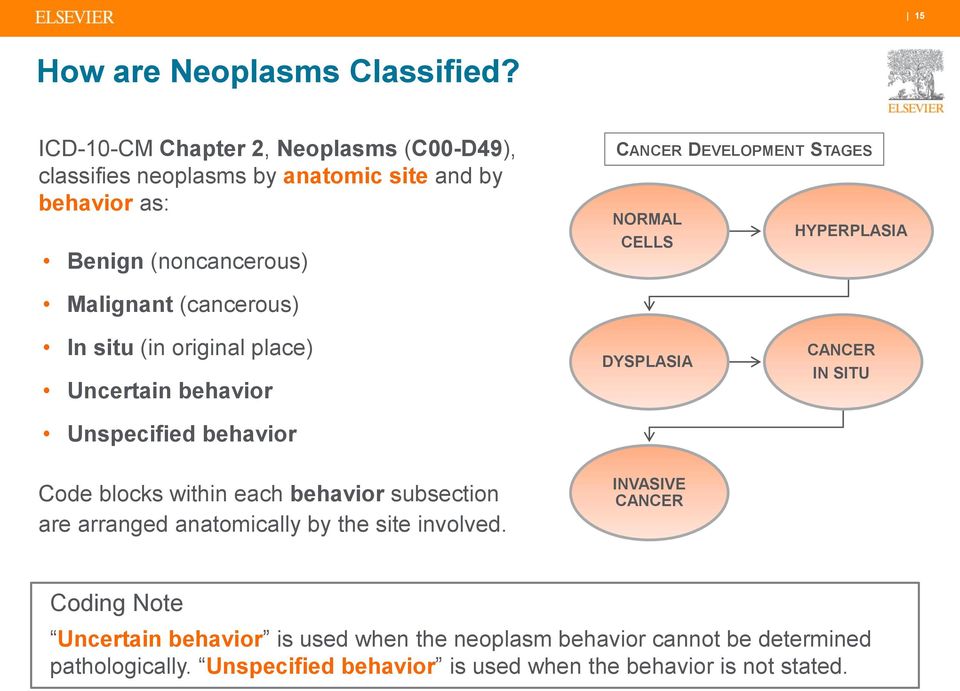
15 15 How are Neoplasms Classified? ICD-10-CM Chapter 2, Neoplasms (C00-D49), classifies neoplasms by anatomic site and by behavior as: Benign (noncancerous) CANCER DEVELOPMENT STAGES NORMAL CELLS HYPERPLASIA Malignant (cancerous) In situ (in original place) Uncertain behavior Unspecified behavior Code blocks within each behavior subsection are arranged anatomically by the site involved. DYSPLASIA INVASIVE CANCER CANCER IN SITU Coding Note Uncertain behavior is used when the neoplasm behavior cannot be determined pathologically. Unspecified behavior is used when the behavior is not stated.
16 16 Neoplasm Classification Neoplasms are classified on the basis of the following characteristics: Histologic Behavior Site (anatomical location, topography) Cell type (morphology, histology, cytology) Acuity Primary malignancy Secondary malignancy (metastases) Benign In-situ Uncertain Unspecified Specific body site or part Tissue type: - Connective - Skin - Neuroendocrine - Lymphatic - Hematopoietic Carcinoma Lymphoma Melanoma Mesothelioma Mast cell Leukemia Osteosarcoma Acute or chronic Not achieved remission In remission In relapse Recurrent History of


17 17 Neoplasm Classification: Staging and Grading Clinically, the stage and grade of a tumor are directly linked to prognosis. Stage Severity based on the size and how far it has spread Grade Based on cell abnormality (differentiation) Done upon diagnosis for treatment planning Higher-grade indicates worse prognosis Coding Note: It is appropriate to use the completed cancer staging form for coding purposes when it is authenticated by the attending physician. Source: American Hospital Association: Coding Clinic for ICD-10-CM: Documentation Issues from Coding Clinic. First Quarter 2014, Chicago, The Association.

18 18 Understanding ICD-10-CM Neoplasm Coding Guidelines Neoplasm Documentation

19 19 How are Neoplasms Documented? Detailed provider documentation of neoplastic disease is required for complete, accurate neoplasm reporting, including: Anatomical location Behavior or cell type Metastatic sites Related conditions Treatment Complications For malignant neoplasms, identify the primary site and any secondary (metastatic) sites. Look for documentation of the spread "from" the primary "to" the secondary site.


20 20 Neoplasm Documentation The term "mass" is not a neoplastic growth. Do not code "mass" or lump" from the Neoplasm Table. The ICD-10-CM Index, under the main term "lump, directs the coder to see Mass. If there is no index entry for the specific site under "mass" the Alphabetic Index directs the coder to see Disease by site. Coding Note: Diagnoses documented as growth, new growth, neoplasm, or tumor without further specification, are coded to D49.-. Category D49 classifies neoplasms of unspecified morphology and behavior by site.

21 21 Neoplasm Documentation: Related Conditions Conditions related to neoplasms must be documented by the provider and linked to the neoplasm. Look for terms such as "due to," "secondary to," "caused by," or "resulting from" that connect the neoplasm with associated conditions or complications. For example: Anemia due to adenocarcinoma of the colon Diabetes mellitus secondary to pancreatic carcinoma Pathological fracture resulting from metastatic stage 4 ovarian carcinoma Coding Note: Code assignment is based on the provider s documentation of the relationship between a condition and the underlying neoplastic disease.
22 22 Neoplasm Documentation: Treatment Look for documentation of chemotherapy, radiation, or immunotherapy, and conditions caused by treatments which may require evaluation, monitoring, treatment, or hospitalization. For example: Immunotherapy for cancer of the prostate Anemia as an adverse effect of radiation therapy Intravenous rehydration for dehydration due to malignancy Coding Note: When coding surgical removal of a neoplasm followed by adjunct chemotherapy or radiation treatment during the same episode of care, the code for the neoplasm should be assigned as principal or first-listed diagnosis.
23 23 Neoplasm Documentation: Complications of Care Complications can result from neoplastic disease or from its treatment. Code assignment is based on the provider s documentation of the relationship between the condition and the underlying neoplastic treatment (such as side effects caused by or resulting from therapy). Coding Note: Provider documentation of a cause-and-effect relationship between the care provided and the condition, and documentation indicating it is a complication, is required for code assignment. Query the provider if the complication is not clearly documented.
24 24 Understanding ICD-10-CM Neoplasm Coding Guidelines Neoplasm Coding in ICD-10-CM
25 25 Neoplasm Coding in ICD-10-CM ICD-10-CM Chapter 2 contains codes for most benign and all malignant neoplasms. Certain benign neoplasms are located in the specific body system chapters (for example prostatic adenomas). In order to code neoplasm in ICD-10-CM: 1. Determine the location of the neoplasm on the body 2. Determine whether the neoplasm is: Benign In-situ Malignant, or Of uncertain histologic behavior 3. If malignant, determine if there are any secondary (metastatic) sites. Coding Note: When the histological term or a descriptor such as malignant, benign, in situ, is not documented, consult the Index under Neoplasm, then by site.
26 26 ICD-10-CM Neoplasm Coding: Step 1 First, reference the histological term in the Alphabetic Index to determine the appropriate column in the Neoplasm Table (i.e., benign, malignant, in situ, or uncertain behavior). If the histology is not documented, consult the index for instructional notes following the main term, such as: see Neoplasm, malignant, by site or see also Neoplasm, uncertain behavior, by site Let s look at an example
27 27 ICD-10-CM Neoplasm Coding - Example If adenoma is documented in the medical record, the instructional note in the Index directs the coder to see also Neoplasm, by site, benign. Coding Note: The index guidance is overridden when a descriptor is documented. For example, malignant adenoma of colon is coded to C18.9 rather than D12.6 because the adjective "malignant" overrules the Index direction to see benign neoplasm. Source: ICD-10-CM Index 2016
28 28 ICD-10-CM Table of Neoplasms The Table of Neoplasms, in the Alphabetic Index, lists the codes for neoplasms by anatomical site. For each site, there are six columns of codes identifying whether the neoplasm is malignant, benign, in situ, uncertain or unspecified behavior. Documentation often indicates which column is appropriate, for example: Malignant melanoma of skin Benign fibroadenoma of breast Carcinoma in situ of cervix uteri Coding Note: In the neoplasm table, a dash at the end of a code indicates an additional character is needed (e.g., laterality). The tabular list must be reviewed for the complete code.
29 29 Neoplasm Coding: ICD-10-CM Neoplasm Table Certain neoplasms (such as malignant melanoma) cannot be assigned from the Neoplasm Table. The morphological term must be indexed to find the appropriate code. For example: Merkel cell tumor see Carcinoma, Merkel cell Carcinoma, merkel cell C4A.9 Coding Note: For connective tissue neoplasms (such as blood vessel, fascia, tendon, ligament, muscle, nerves and ganglia, synovia), refer to the index main term Connective tissue, then by site. Morphological types that indicate connective tissue appear in the alphabetic index with the instruction "see Neoplasm, connective tissue.
30 30 Understanding ICD-10-CM Neoplasm Coding Guidelines Neoplasm Coding Guidelines
31 31 Neoplasm Coding Guidelines The ICD-10-CM Official Guidelines for Coding and Reporting for Chapter 2 contain many guidelines for coding and sequencing of neoplasms Source: ICD-10-CM Official Guidelines for Coding and Reporting 2016

32 32 Neoplasm Coding Guidelines: Principal Diagnosis When coding neoplasms, both the general coding guidelines and the chapter specific guidelines must be applied. Code the condition for which the encounter or service is being performed as the first-listed or principal diagnosis. Guideline When a patient with a primary neoplasm with metastasis is admitted, and treatment is directed toward the secondary site only, the secondary neoplasm is designated as the principal diagnosis even though the primary malignancy is still present. Coding Note: Additional diagnoses are reported for any other conditions that coexist at the time of admission or develop subsequently, or which impact the patient s care. Source: ICD-10-CM Official Guidelines for Coding and Reporting 2016; Section I.C.2 a. and b.
33 33 Neoplasm Coding Guidelines: Examples Patient admitted with breast cancer with metastasis to the bones. A mastectomy is performed and the secondary sites are evaluated. Patient admitted with cancer of the trachea with metastasis to the cervical lymph nodes. The primary site of the trachea is monitored and the affected lymph nodes are resected. The primary malignancy of the breast will be the principal diagnosis. The secondary site of the bone is coded as an additional diagnosis. The secondary metastatic site (cervical lymph nodes) is the principal diagnosis. The primary site (trachea) is coded as an additional diagnosis. Source: ICD-10-CM Official Guidelines for Coding and Reporting 2016; Section I.C.2 a. and b. and Section I.C.2.l. 1 and 2.
34 34 Neoplasm Coding Guidelines: Current or Personal History? Assign the code for the primary malignancy until treatment is completed. This applies even when the primary malignancy has been excised but further treatment (e.g., radiation therapy, chemotherapy, or additional surgery) is directed to that site. Guideline When a primary malignancy has been excised or eradicated and there is no further treatment of the malignancy to that site, and no evidence of any existing primary malignancy, a code from category Z85, Personal history of malignant neoplasm, is used to indicate the former site of the malignancy. Coding Note: Don t confuse personal history with in remission. Codes for leukemia, multiple myeloma, and malignant plasma cell neoplasms indicate whether the condition has achieved remission. Source: ICD-10-CM Official Guidelines for Coding and Reporting 2016; Section I.C.2.m and n
35 35 Neoplasm Coding Guidelines: Examples Patient admitted to rule out metastatic bone cancer originating from the breast. The breast cancer was treated with mastectomy and adjunct chemotherapy 3 years ago. Patient with leukemia documented as "in remission" is admitted for autologous bone marrow transplantation. Report the code for Personal history of malignant neoplasm of breast (Z85.3) Use the appropriate code to designate the type of leukemia and in remission. Coding Note: Assign a code for personal history of leukemia when the physician documents that the leukemia no longer exists. The codes for personal history and in remission are only assigned when the documented by the provider. Source: ICD-10-CM Official Guidelines for Coding and Reporting 2016; Section I.C.2 a. and b. and Section I.C.2.
36 36 Neoplasm Coding Guidelines: Reason for Care To code neoplasms, the reason for the medical care must be correctly identified. For example, was the encounter or admission for:? Therapy (chemotherapy, immunotherapy, radiation therapy)? Pain control/management? Treatment of a complication resulting from surgery or care? Aftercare following surgery for neoplasm? Follow-up care for completed treatment of a malignancy? Prophylactic organ removal for prevention of malignancy
37 37 Neoplasm Coding Guidelines: Therapy When the patient is admitted solely for the administration of chemotherapy, immunotherapy, or radiation therapy, the therapy is listed as the principal diagnosis, with an additional code for the neoplasm. For example: Z51.0 Encounter for antineoplastic radiation therapy Z51.11 Encounter for antineoplastic chemotherapy Z51.12 Encounter for antineoplastic immunotherapy
38 38 Coding Guideline: Neoplasm Related Pain Neoplasm related pain may occur as a result of cancer surgery or chemotherapy and radiation therapy, or because of the neoplastic disease itself. When pain is documented as being related to, associated with, or due to cancer, code G89.3, Neoplasm-related pain (acute) (chronic), is assigned. Coding Note: The inclusion terms under code G89.3 list cancer-associated pain, pain due to malignancy (primary) (secondary), and tumor-associated pain. Source: ICD-10-CM Official Guidelines for Coding and Reporting 2016; Section I.C.6.b.5
39 39 Neoplasm-Related Pain Coding Guidelines Reason for care documented as: Pain due to malignancy, cancer associated pain, tumor associated pain Coding guideline: Code G89.3 is assigned to pain documented as being related, associated or due to cancer, primary or secondary malignancy, or tumor Acute neoplasm-related pain Chronic neoplasm-related pain Code G89.3 is assigned regardless of whether the pain is acute or chronic. Neoplasm-related pain control or management Management of the neoplasm and neoplasm-related pain Code G89.3 is assigned as the principal or firstlisted code and the underlying neoplasm is reported as an additional diagnosis. Code the neoplasm as the principal or first-listed diagnosis and code G89.3 as an additional diagnosis. An additional code for the site of the pain is not necessary. Source: ICD-10-CM Official Guidelines for Coding and Reporting 2016; Section I.C.2 h. and Section I.C..6.b.5
40 40 Applying the Neoplasm Coding Guidelines How should this admission be coded? A patient with metastatic bone cancer originating from breast cancer that was eradicated 3 years ago, is admitted for pain management.
41 41 Applying the Neoplasm Coding Guidelines A patient with metastatic bone cancer originating from breast cancer that was eradicated 3 years ago, is admitted for pain management. G89.3 Neoplasm-related pain (acute) (chronic) C79.51 Secondary malignant neoplasm of bone Z85.3 Personal history of malignant neoplasm of breast Coding Note: When the reason for the admission/encounter is management of the neoplasm and the pain associated with the neoplasm, code G89.3 is assigned as an additional diagnosis. Source: ICD-10-CM Official Guidelines for Coding and Reporting 2016; Section I.C.2 h. and Section I.C..6.b.
42 42 Applying the Neoplasm Coding Guidelines How should this admission be coded? A patient with metastatic bone cancer originating from breast cancer that was eradicated 3 years ago, is admitted for external beam of radiation to the affected bone and implantation of a spinal cord neurostimulator for control of chronic neoplasm-related pain.
43 43 Applying the Neoplasm Coding Guidelines A patient with metastatic bone cancer originating from breast cancer that was eradicated 3 years ago, is admitted for external beam of radiation to the affected bone and implantation of a spinal cord neurostimulator for control of chronic neoplasm-related pain. C79.51 Secondary malignant neoplasm of bone G89.3 Neoplasm-related pain (acute) (chronic) Z85.3 Personal history of malignant neoplasm of breast Coding Note: When a procedure to treat the underlying condition and a neuro-stimulator is inserted for pain control during the same admission, a code for the underlying condition should be assigned as the principal diagnosis and the appropriate pain code should be assigned as a secondary diagnosis. Source: ICD-10-CM Official Guidelines for Coding and Reporting 2016; Section I.C.2 h. and Section I.C..6.b.
44 44 Understanding ICD-10-CM Neoplasm Coding Guidelines Coding Complications
45 45 Neoplasm Coding Guidelines: Complications For complications associated with a malignancy or with the therapy for a malignancy, provider documentation of the treatment and a link to the condition is needed for code assignment. If a patient admitted for radiation therapy, chemotherapy, or immunotherapy develops a complication, the code for the therapy (Z51.0, Z51.11, or Z51.12) is listed as the principal diagnosis, and code(s) for the complications are reported as additional codes, along with the code for the neoplasm. ICD-10-CM Official Guidelines for Coding and Reporting 2016; Section I.C.2.e.3
46 46 Applying the Neoplasm Coding Guidelines How should this admission be coded? A patient with diffuse large B-cell lymphoma throughout the lymph nodes is admitted for chemotherapy and develops uncontrolled nausea and vomiting.
47 47 Applying Neoplasm Coding Guidelines A patient with diffuse large B-cell lymphoma throughout the lymph nodes is admitted is admitted for chemotherapy and develops uncontrolled nausea and vomiting. Z51.11 Encounter for antineoplastic chemotherapy C83.38 Diffuse large B-cell lymphoma, lymph nodes of multiple sites R11.2 Nausea with vomiting, unspecified Coding Note: When a patient is admitted for radiotherapy, immunotherapy or chemotherapy and develops complications such as uncontrolled nausea and vomiting, the Z51.- code is the principal or first-listed followed by codes for the complication(s) and the neoplasm. Source: ICD-10-CM Official Guidelines for Coding and Reporting 2016; Section I.C.2 l.4
48 48 Neoplasm Coding Guidelines: Complications When treatment is only for management of a complication associated with a neoplasm, the complication is coded first, followed by the appropriate code(s) for the neoplasm. For example: Admission is for the management of dehydration due to malignancy, the dehydration is listed as the principal diagnosis, with the malignancy coded as an additional diagnosis. Source: ICD-10-CM Official Guidelines for Coding and Reporting 2016; Section I.C.2.c.3
49 49 Applying the Neoplasm Coding Guidelines How should this admission be coded? A patient with acute lymphoblastic leukemia and symptoms of dehydration is admitted for rehydration via intravenous fluids.
50 50 Applying Neoplasm Coding Guidelines A patient with acute lymphoblastic leukemia and symptoms of dehydration, is admitted for rehydration via intravenous fluids. E86.0 Dehydration C91.00 Acute lymphoblastic leukemia, not having achieved remission Coding Note: Dehydration (E86.0) is sequenced first followed by a code for the leukemia. Reference the main index term Leukemia, subterm acute lymphoblastic (C91.0-). The 0 is added to indicate remission was not achieved. Source: ICD-10-CM Official Guidelines for Coding and Reporting 2016; Section I.C.2 a. and b. and Section I.C.2.
51 51 Neoplasm Coding Guidelines: Complications GUIDELINE: EXCEPTION: When treatment is for management of a complication associated with a neoplasm (e.g., dehydration) only, code the complication first, followed by the code(s) for the neoplasm. Anemia When the treatment is only for management of anemia associated with the malignancy, the appropriate code for the malignancy is sequenced as the principal or first-listed diagnosis followed by code D63.0, Anemia in neoplastic disease. Source: ICD-10-CM Official Guidelines for Coding and Reporting 2016; Section I.C.2.c.2
52 52 Neoplasm Coding Guidelines: Anemia Treatment of anemia associated with the malignancy: Treatment of anemia that is an adverse effect of chemotherapy or immunotherapy: The malignancy code is sequenced as the principal or first-listed diagnosis followed by the appropriate code for the anemia. The anemia code is sequenced first followed by the codes for the neoplasm and adverse effect of antineoplastic and immunosuppressive drugs. Coding Note: The code for the adverse effect of antineoplastic and immunosuppressive drugs requires a 7th character to indicate the encounter: A for initial encounter, D for subsequent encounter, or S for sequela. Source: ICD-10-CM Official Guidelines for Coding and Reporting 2016; Section I.C.2.c
53 53 Applying the Neoplasm Coding Guidelines How should this admission be coded? A patient with aplastic anemia due to chemotherapy treatments for ovarian cancer, is admitted for transfusions of packed cells for the anemia.
54 54 Applying the Neoplasm Coding Guidelines A patient with aplastic anemia that is due to chemotherapy treatments for ovarian cancer is admitted for transfusions of packed cells for the anemia. D61.1 Drug-induced aplastic anemia C56.9 Malignant neoplasm of unspecified ovary T45.1X5A Adverse effect of antineoplastic and immunosuppressive drugs, initial encounter Coding Note: The adverse effect code is located by referencing the Table of Drugs and Chemicals under the substance main term Antineoplastic NEC under the column for adverse effects. The A is added to indicate an initial encounter. Source: ICD-10-CM Official Guidelines for Coding and Reporting 2016; Section I.C.2 c.
55 55 Neoplasm Coding Guidelines: Surgical Complications Many patients with malignant neoplasms undergo surgical procedures to treat the malignancy. Complications of these procedures may result. If the patient is admitted for management and treatment directed at resolving a complication that resulted from a surgical procedure: The complication is designated as the principal diagnosis. The malignant neoplasm is listed as an additional code. Source: ICD-10-CM Official Guidelines for Coding and Reporting 2016; Section I.C.2.c.4
56 56 Applying the Neoplasm Coding Guidelines How should this admission be coded? A patient treated with surgery and radiation therapy for carcinoma of the body of the stomach is readmitted for drainage of a hematoma of the skin at the surgical site.
57 57 Applying the Neoplasm Coding Guidelines A patient treated with surgery and radiation therapy for carcinoma of the body of the stomach is readmitted for drainage of a hematoma of the skin at the surgical site. L76.22 Postprocedural hemorrhage and hematoma of skin and subcutaneous tissue following other procedure C16.2 Malignant neoplasm of the body of stomach Coding Note: When the admission/encounter is for treatment of a complication resulting from a surgical procedure, sequence the complication as the principal or first-listed diagnosis if treatment is directed at resolving the complication. Source: ICD-10-CM Official Guidelines for Coding and Reporting 2016; Section I.C.2 a. and b. and Section I.C.2.
58 58 Wrap Up Thank you for attending our webinar! In this webinar we: Examined the classification of neoplastic disease in ICD-10-CM Chapter 2: Neoplasms (C00-D49) and how to locate codes for neoplasms using the Index and the Neoplasm Table. Identified the terminology used in the medical record to describe neoplastic disease and the documentation needed to properly code neoplasms Practiced applying the chapter-specific guidelines, coding conventions, and sequencing rules while assigning ICD-10-CM neoplasm codes. Elsevier Revenue Cycle elearning
59 59 References National Center for Health Statistics, Centers for Disease Control and Prevention: ICD-10-CM Guidelines for Coding and Reporting, Accessed September 29, 2015: National Center for Health Statistics, Centers for Disease Control and Prevention: ICD-10-CM Tabular List of Diseases and Injuries, Accessed September 29, 2015: Centers for Medicare and Medicaid Services: 2016 ICD-10-CM and GEMs. Accessed September 29, 2015: GEMs.html
CHAPTER 2. Neoplasms (C00-D49) March 2014. 2014 MVP Health Care, Inc.
 Neoplasms (C00-D49) March 2014 2014 MVP Health Care, Inc. CHAPTER SPECIFIC CATEGORY CODE BLOCKS C00-C14 Malignant neoplasms of lip, oral cavity and pharynx C15-C26 Malignant neoplasms of digestive organs
NEOPLASMS C00 D49. Presented by Jan Halloran CCS
 NEOPLASMS C00 D49 Presented by Jan Halloran CCS 1 INTRODUCTION A neoplasm is a new or abnormal growth. In the ICD-10-CM classification system, neoplastic disease is classified in categories C00 through
Introduction: Tumor Swelling / new growth / mass. Two types of growth disorders: Non-Neoplastic. Secondary / adaptation due to other cause.
 Disorders of Growth Introduction: Tumor Swelling / new growth / mass Two types of growth disorders: Non-Neoplastic Secondary / adaptation due to other cause. Neoplastic. Primary growth abnormality. Non-Neoplastic
Guidelines Most Significantly Affected Under ICD-10-CM. May 29, 2013
 Guidelines Most Significantly Affected Under ICD-10-CM May 29, 2013 Guidelines Most Significantly Affected Under ICD-10-CM A look at the new system and how it compares to ICD-9-CM Presented by Therese
Oncology. Objectives. Cancer Nomenclature. Cancer is a disease of the cell Cancer develops when certain cells begin to grow out of control
 Oncology Objectives Describe the etiology and pathophysiological mechanisms of cancer Discuss medical and family history findings relevant to cancer Identify general signs and symptoms associated with
ICD-10-CM Official Guidelines for Coding and Reporting
 2013 Narrative changes appear in bold text Items underlined have been moved within the guidelines since the 2012 version Italics are used to indicate revisions to heading changes The Centers for Medicare
Cancer is the leading cause of death for Canadians aged 35 to 64 and is also the leading cause of critical illness claims in Canada.
 Underwriting cancer In this issue of the Decision, we provide an overview of Canadian cancer statistics and the information we use to make an underwriting decision. The next few issues will deal with specific
ICD-9 Basics Study Guide
 Board of Medical Specialty Coding ICD-9 Basics Study Guide for the Home Health ICD-9 Basic Competencies Examination Two Washingtonian Center 9737 Washingtonian Blvd., Ste. 100 Gaithersburg, MD 20878-7364
Pain Quick Reference for ICD 10 CM
 Pain Quick Reference for ICD 10 CM Coding of acute or chronic pain in ICD 10 CM are located under category G89, Pain, not elsewhere classified. The subcategories are broken down by type, temporal parameter,
Report series: General cancer information
 Fighting cancer with information Report series: General cancer information Eastern Cancer Registration and Information Centre ECRIC report series: General cancer information Cancer is a general term for
ICD-9-CM Official Guidelines for Coding and Reporting
 Narrative changes appear in bold text Items underlined have been moved within the guidelines since April 2005 The guidelines include the updated V Code Table The Centers for Medicare and Medicaid Services
Using the ICD-10-CM. The Alphabetic Index helps you determine which section to refer to in the Tabular List. It does not always provide the full code.
 Using the ICD-10-CM Selecting the Correct Code To determine the correct International Classification of Diseases, 10 Edition, Clinical Modification (ICD-10-CM) code, follow these two steps: Step 1: Look
General Rules SEER Summary Stage 2000. Objectives. What is Staging? 5/8/2014
 General Rules SEER Summary Stage 2000 Linda Mulvihill Public Health Advisor NCRA Annual Meeting May 2014 National Center for Chronic Disease Prevention and Health Promotion Division of Cancer Prevention
Highlights of the Revised Official ICD-9-CM Guidelines for Coding and Reporting Effective October 1, 2008
 Highlights of the Revised Official ICD-9-CM Guidelines for Coding and Reporting Effective October 1, 2008 Please refer to the complete ICD-9-CM Official Guidelines for Coding and Reporting posted on this
This module consists of four units which will provide the user a basic knowledge of cancer as a disease.
 Module 5: What is Cancer? This module consists of four units which will provide the user a basic knowledge of cancer as a disease. After completing this module, cancer abstractors will be able to: Define
Frequently Asked Questions About Ovarian Cancer
 Media Contact: Gerri Gomez Howard Cell: 303-748-3933 [email protected] Frequently Asked Questions About Ovarian Cancer What is ovarian cancer? Ovarian cancer is a cancer that forms in tissues
The ICD-9-CM uses an indented format for ease in reference I10 I10 I10 I10. All information subject to change. 2013 1
 Section I. Conventions, general coding guidelines and chapter specific guidelines The conventions, general guidelines and chapter-specific guidelines are applicable to all health care settings unless otherwise
Official ICD-9-CM Guidelines for Coding and Reporting
 Official ICD-9-CM Guidelines for Coding and Reporting Effective October 1, 2009 Narrative changes appear in bold text. Items underlined have been moved within the guidelines since October 1, 2008. The
2011 Radiology Diagnosis Coding Update Questions and Answers
 2011 Radiology Diagnosis Coding Update Questions and Answers How can we subscribe to the Coding Clinic for ICD-9 guidelines and updates? The American Hospital Association publishes this quarterly newsletter.
Guidelines for using V-CODES (Status Codes)
 1 Disclaimer This presentation is intended only for use by Tulane University faculty, staff, and students. No copy or use of this presentation should occur without the permission of Tulane University.
Pathology ICD-10-CM Coding Tip Sheet Overview of Key Chapter Updates for Pathology and Top 25 codes
 Pathology ICD-10-CM Coding Tip Sheet Overview of Key Chapter Updates for Pathology and Top 25 codes Chapter 2 Neoplasms (C00-D49) Classification improvements Code expansions Significant expansions or revisions
ICD-9 Coding for Beginners MARCH 2006 EDITION
 A CMS Contracted Intermediary & Carrier MARCH 2006 EDITION First Coast Service Options Disclaimer All the codes, indices, and other materials in this Medicare Participant Manual were compiled utilizing
Understanding Metastatic Disease
 Supported by an unrestricted educational grant from Pfizer Understanding Metastatic Disease Metastatic disease or metastases are phrases that mean the same as Secondary cancer. This means that the cancer
Phone: 1-877-336-3736 Fax: 1-877-556-3737 M F 8:00 am 9:00 pm ET
 QUICK REFERENCE CODING & BILLING GUIDE PHYSICIAN OFFICE CMS National Coverage Determination and Q-Code for PROVENGE Simplifies patient coverage criteria Clarifies coding requirements Expedites electronic
OBJECTIVES By the end of this segment, the community participant will be able to:
 Cancer 101: Cancer Diagnosis and Staging Linda U. Krebs, RN, PhD, AOCN, FAAN OCEAN Native Navigators and the Cancer Continuum (NNACC) (NCMHD R24MD002811) Cancer 101: Diagnosis & Staging (Watanabe-Galloway
ICD-9-CM Official Guidelines For Coding and Reporting Effective October 1, 2002 Narrative changes appear in bold text
 ICD-9-CM Official Guidelines For Coding and Reporting Effective October 1, 2002 Narrative changes appear in bold text The Centers for Medicare and Medicaid Services (CMS) formerly the Health Care Financing
New strategies in anticancer therapy
 癌 症 診 療 指 引 簡 介 及 臨 床 應 用 New strategies in anticancer therapy 中 山 醫 學 大 學 附 設 醫 院 腫 瘤 內 科 蔡 明 宏 醫 師 2014/3/29 Anti-Cancer Therapy Surgical Treatment Radiotherapy Chemotherapy Target Therapy Supportive
Brain Cancer. This reference summary will help you understand how brain tumors are diagnosed and what options are available to treat them.
 Brain Cancer Introduction Brain tumors are not rare. Thousands of people are diagnosed every year with tumors of the brain and the rest of the nervous system. The diagnosis and treatment of brain tumors
Policy Wording. Together, all the way.
 Cancer cover Policy Wording Together, all the way. Cancer Cover Insurance Policy Wording 1. Introducing your Policy 2. What is Cancer Cover Insurance? 3. About your Policy 4. Some terms defined 5. What
Multiple Myeloma. This reference summary will help you understand multiple myeloma and its treatment options.
 Multiple Myeloma Introduction Multiple myeloma is a type of cancer that affects white blood cells. Each year, thousands of people find out that they have multiple myeloma. This reference summary will help
ICD-9-CM Official Guidelines for Coding and Reporting Effective October 1, 2011 Page 2 of 107
 Narrative changes appear in bold text Items underlined have been moved within the guidelines since October 1, 2010 The Centers for Medicare and Medicaid Services (CMS) and the National Center for Health
Smoking and misuse of certain pain medicines can affect the risk of developing renal cell cancer.
 Renal cell cancer Renal cell cancer is a disease in which malignant (cancer) cells form in tubules of the kidney. Renal cell cancer (also called kidney cancer or renal adenocarcinoma) is a disease in which
The Ontario Cancer Registry moves to the 21 st Century
 The Ontario Cancer Registry moves to the 21 st Century Rebuilding the OCR Public Health Ontario Grand Rounds Oct. 14, 2014 Diane Nishri, MSc Mary Jane King, MPH, CTR Outline 1. What is the Ontario Cancer
How CanCer becomes critical in the claims
 How CanCer becomes critical in the claims arena Cancer is a disease in which cells in your body grow in an uncontrolled way and form a lump called a tumour. In a healthy individual cells grow and reproduce
Disease/Illness GUIDE TO ASBESTOS LUNG CANCER. What Is Asbestos Lung Cancer? www.simpsonmillar.co.uk Telephone 0844 858 3200
 GUIDE TO ASBESTOS LUNG CANCER What Is Asbestos Lung Cancer? Like tobacco smoking, exposure to asbestos can result in the development of lung cancer. Similarly, the risk of developing asbestos induced lung
Oncology Best Practice Documentation
 Oncology Best Practice Documentation Click on the desired Diagnoses link or press Enter to view all information. Diagnoses: Solid Tumors Lymphomas Leukemias Myelodysplastic Syndrome Pathology Findings
ICD-10 CM/PCS Tip Sheets. Oncology
 ICD-10 CM/PCS Tip Sheets Oncology About This Guide This collection of tip sheets has been developed by Cape Fear Valley Health to promote greater specificity of the coded data for a given condition, disease,
The Diagnosis of Cancer in the Pathology Laboratory
 The Diagnosis of Cancer in the Pathology Laboratory Dr Edward Sheffield Christmas Select 74 Meeting, Queen s Hotel Cheltenham, 3 rd December 2014 Agenda Overview of the pathology of cancer How specimens
ACUTE MYELOID LEUKEMIA (AML),
 1 ACUTE MYELOID LEUKEMIA (AML), ALSO KNOWN AS ACUTE MYELOGENOUS LEUKEMIA WHAT IS CANCER? The body is made up of hundreds of millions of living cells. Normal body cells grow, divide, and die in an orderly
Lesions, and Masses,
 Lesions, and Masses, and dtumors Oh My!! Presented by: Betty Johnson, CPC, CPC-I, CCS-P, PCS, CPC-H, RMC, CCP, CIC, CPCD and Susan Ward, CPC, CPC-H, CPC-I, CPCD, CEMC, CPRC 1 1 CPT GUIDELINES Agenda CPT
Cancer: DNA Synthesis, Mitosis, and Meiosis
 Chapter 5 Cancer: DNA Synthesis, Mitosis, and Meiosis Copyright 2007 Pearson Copyright Prentice Hall, 2007 Inc. Pearson Prentice Hall, Inc. 1 What Is Cancer? Benign tumors do not invade surrounding tissue
Disclaimer CODING 101 BOOT CAMP CODING SEMINAR FOR NEW PHYSICIANS
 CODING 101 BOOT CAMP CODING SEMINAR FOR NEW PHYSICIANS AND STAFF Chicago Dermatological Society January 26, 2013 Presented by Joy Newby, LPN, CPC, PCS Newby Consulting, Inc. 5725 Park Plaza Court Indianapolis,
METROPOLITAN LIFE INSURANCE COMPANY 200 PARK AVENUE, NEW YORK, NEW YORK 10166-0188
 METROPOLITAN LIFE INSURANCE COMPANY 200 PARK AVENUE, NEW YORK, NEW YORK 10166-0188 POLICYHOLDER: NORFOLK PUBLIC SCHOOLS Group Policy Form No: GPNP04-CI (Referred to herein as the Group Policy ) Certificate
In the second of a quarterly series of articles available to ACDIS members,
 Coding Clinic update Conditions documented at the time of discharge, diabetes opportunities highlight important updates for CDI specialists W h i t e p a p e r Editor s note: The following article is provided
Avastin: Glossary of key terms
 Avastin: Glossary of key terms Adenocarcinoma Adenoma Adjuvant therapy Angiogenesis Anti-angiogenics Antibody Antigen Avastin (bevacizumab) Benign A form of carcinoma that originates in glandular tissue.
CANCER EXPLAINED. Union for International Cancer Control Union Internationale Contre le Cancer
 MEDIA FACTSHEET CANCER EXPLAINED What is cancer? Cancer is a disease which occurs when changes in a group of normal cells within the body lead to uncontrolled growth causing a lump called a tumour; this
4/15/2013. bi/o carcin/ chem/o immun/o onc/o radi/o sarc/o. anabrachydysectoendoneo- -ectomy -genesis -oma -plasia -sarcoma
 Chapter Sixteen Oncology bi/o carcin/ chem/o immun/o onc/o radi/o sarc/o Combining Forms Prefixes and Suffixes Carcinogenesis anabrachydysectoendoneo- -ectomy -genesis -oma -plasia -sarcoma Causes of cancer
Coding. Future of Hospice. and the. An educational resource presented by
 An educational resource presented by Coding and the Future of Hospice You know incorrect coding hurts your reimbursement. Did you know it also shapes CMS rules? Prepared by In this white paper, we will:
CMS Limitations Guide Mammograms and Bone Density Radiology Services
 CMS Limitations Guide Mammograms and Bone Density Radiology Services Starting July 1, 2008, CMS has placed numerous medical necessity limits on tests and procedures. This reference guide provides you with
Gallbladder Diseases and Problems
 Gallbladder Diseases and Problems Introduction Your gallbladder is a pear-shaped organ under your liver. It stores bile, a fluid made by your liver to digest fat. There are many diseases and problems that
1400 Telegraph Bloomfield Hills, MI 48302 248-334-6877-Phone number/248-334-6877-fax Number CANCER TREATMENT
 1400 Telegraph Bloomfield Hills, MI 48302 248-334-6877-Phone number/248-334-6877-fax Number CANCER TREATMENT Learning that your pet has a diagnosis of cancer can be overwhelming. We realize that your pet
Home Health Care ICD-10-CM Coding Tip Sheet Overview of Key Chapter Updates for Home Health Care and Top 20 codes
 Home Health Care ICD-10-CM Coding Tip Sheet Overview of Key Chapter Updates for Home Health Care and Top 20 codes Chapter 4: Endocrine, Nutritional and Metabolic Diseases (E00-E99) ICD-10-CM diabetes mellitus
ICD-10-CM Official Guidelines for Coding and Reporting 2013 Page 2 of 113
 Narrative changes appear in bold text Items underlined have been moved within the guidelines since the 2012 version Italics are used to indicate revisions to heading changes The Centers for Medicare and
Breast Cancer. Sometimes cells keep dividing and growing without normal controls, causing an abnormal growth called a tumor.
 Breast Cancer Introduction Cancer of the breast is the most common form of cancer that affects women but is no longer the leading cause of cancer deaths. About 1 out of 8 women are diagnosed with breast
Objectives. Mylene T. Truong, MD. Malignant Pleural Mesothelioma Background
 Imaging of Pleural Tumors Mylene T. Truong, MD Imaging of Pleural Tumours Mylene T. Truong, M. D. University of Texas M.D. Anderson Cancer Center, Houston, TX Objectives To review tumors involving the
MOH Policy for dispensing NEOPLASTIC DISEASES DRUGS
 MOH Policy for dispensing NEOPLASTIC DISEASES DRUGS All prescriptions for antineoplastic drugs must be accompanied by the MOH special form. All the attachments mentioned on this form shall be submitted
National Coverage Determination (NCD) for Tumor Antigen by Immunoassay - CA 125 (190.28)
 National Coverage Determination (NCD) for Tumor Antigen by Immunoassay - CA 125 (190.28) Tracking Information Publication Number Manual Section Number 100-3 190.28 Manual Section Title Tumor Antigen by
Mesothelioma. 1995-2013, The Patient Education Institute, Inc. www.x-plain.com ocft0101 Last reviewed: 03/21/2013 1
 Mesothelioma Introduction Mesothelioma is a type of cancer. It starts in the tissue that lines your lungs, stomach, heart, and other organs. This tissue is called mesothelium. Most people who get this
Leukemias and Lymphomas: A primer
 Leukemias and Lymphomas: A primer Normal blood contains circulating white blood cells, red blood cells and platelets 700 red cells (oxygen) 1 white cell Neutrophils (60%) bacterial infection Lymphocytes
The Official Guidelines for coding and reporting using ICD-9-CM
 Reporting Accurate Codes In the Era of Recovery Audit Contractor Reviews Sue Roehl, RHIT, CCS The Official Guidelines for coding and reporting using ICD-9-CM A set of rules that have been developed to
Small cell lung cancer
 Small cell lung cancer Small cell lung cancer is a disease in which malignant (cancer) cells form in the tissues of the lung. The lungs are a pair of cone-shaped breathing organs that are found within
Benign (beh-nine): Not cancerous. Benign tumors may grow larger but do not spread to other parts of the body.
 Cancer Glossary Source: National Cancer Institute: What You Need to Know About Cancer Adenoma (ad-in-oh-ma): A noncancerous tumor. Adjuvant therapy (AD-joo-vant): Treatment given after the primary treatment
LifeProtect. Cancer Cover. For Intermediary Use Only
 LifeProtect Cancer Cover For Intermediary Use Only There are few families in Ireland that have been unaffected by cancer. In fact, 1 in 3 men and 1 in 4 women in Ireland* will suffer from cancer at some
Acute Myeloid Leukemia
 Acute Myeloid Leukemia Introduction Leukemia is cancer of the white blood cells. The increased number of these cells leads to overcrowding of healthy blood cells. As a result, the healthy cells are not
The effect of the introduction of ICD-10 on cancer mortality trends in England and Wales
 The effect of the introduction of ICD-10 on cancer mortality trends in Anita Brock, Clare Griffiths and Cleo Rooney, Offi ce for INTRODUCTION From January 2001 deaths in have been coded to the Tenth Revision
Acute myeloid leukemia (AML)
 Acute myeloid leukemia (AML) Adult acute myeloid leukemia (AML) is a type of cancer in which the bone marrow makes abnormal myeloblasts (a type of white blood cell), red blood cells, or platelets. Adult
Metastasis. Brookdale Hospital, Brooklyn, New York 11212, USA; 2 Cambridge, MA 02138, USA [email protected]
 Metastasis Ma Hongbao 1, Margaret Ma 2, Yang Yan 1 1 Brookdale Hospital, Brooklyn, New York 11212, USA; 2 Cambridge, MA 02138, USA [email protected] Abstract: Cancer begins when cells in a part of the body
Ovarian Cancer. in Georgia, 1999-2003. Georgia Department of Human Resources Division of Public Health
 Ovarian Cancer in Georgia, 1999-23 Georgia Department of Human Resources Division of Public Health Acknowledgments Georgia Department of Human Resources......B. J. Walker, Commissioner Division of Public
Metastatic Cervical Cancer s/p Radiation Therapy, Radical Hysterectomy and Attempted Modified Internal Hemipelvectomy
 Metastatic Cervical Cancer s/p Radiation Therapy, Radical Hysterectomy and Attempted Modified Internal Hemipelvectomy Sarah Hutto,, MSIV Marc Underhill, M.D. January 27, 2009 Past History 45 yo female
Breaking the Code: ICD-9-CM Coding in Details
 Breaking the Code: ICD-9-CM Coding in Details ICD-9-CM diagnosis codes are 3- to 5-digit codes used to describe the clinical reason for a patient s treatment. They do not describe the service performed,
General Information About Non-Small Cell Lung Cancer
 General Information About Non-Small Cell Lung Cancer Non-small cell lung cancer is a disease in which malignant (cancer) cells form in the tissues of the lung. The lungs are a pair of cone-shaped breathing
Early Prostate Cancer: Questions and Answers. Key Points
 CANCER FACTS N a t i o n a l C a n c e r I n s t i t u t e N a t i o n a l I n s t i t u t e s o f H e a l t h D e p a r t m e n t o f H e a l t h a n d H u m a n S e r v i c e s Early Prostate Cancer:
Kidney Cancer OVERVIEW
 Kidney Cancer OVERVIEW Kidney cancer is the third most common genitourinary cancer in adults. There are approximately 54,000 new cancer cases each year in the United States, and the incidence of kidney
Tumour Markers. What are Tumour Markers? How Are Tumour Markers Used?
 Dr. Anthony C.H. YING What are? Tumour markers are substances that can be found in the body when cancer is present. They are usually found in the blood or urine. They can be products of cancer cells or
Biochemistry of Cancer Cell
 Biochemistry of Cancer Cell Prof. Taha Kumosani Prof. Taha Kumosani http://biochemistry4all.com/taha/5.htm Cancer: an Overview Paleopathologists Dinosaur bones Egyptians Papyrus Autopsis Hippocrates Carcinoma
How To Treat A Uterine Sarcoma
 EVERYONE S GUIDE FOR CANCER THERAPY Malin Dollinger, MD, Ernest H. Rosenbaum, MD, Margaret Tempero, MD, and Sean Mulvihill, MD 4 th Edition 2001 Uterus: Uterine Sarcomas Jeffrey L. Stern, MD Uterine sarcomas
2FORMATS AND CONVENTIONS
 2FORMATS AND CONVENTIONS OF DIAGNOSIS CODING SYSTEMS Learning Outcomes After completing this chapter, students should be able to 2.1 Explain the layout of the ICD-9-CM and ICD-10-CM manuals. 2.2 Differentiate
ICD-10 Specified or Unspecified?
 206-478-8227 www.healthdataconsulting.com [email protected] ICD-10 Specified or Unspecified? Joseph C Nichols MD Principal The information provided in this whitepaper is the exclusive
Stem Cell Transplantation
 Harmony Behavioral Health, Inc. Harmony Behavioral Health of Florida, Inc. Harmony Health Plan of Illinois, Inc. HealthEase of Florida, Inc. Ohana Health Plan, a plan offered by WellCare Health Insurance
AFTER DIAGNOSIS: PROSTATE CANCER Understanding Your Treatment Options
 AFTER DIAGNOSIS: PROSTATE CANCER Understanding Your Treatment Options INTRODUCTION This booklet describes how prostate cancer develops, how it affects the body and the current treatment methods. Although
How To Treat Lung Cancer At Cleveland Clinic
 Treatment Guide Lung Cancer Management The Chest Cancer Center at Cleveland Clinic, which includes specialists from the Respiratory Institute, Taussig Cancer Institute and Miller Family Heart & Vascular
COLONIAL LIFE & ACCIDENT INSURANCE COMPANY P.O. Box 1365, Columbia, South Carolina 29202 1-800-325-4368
 COLONIAL LIFE & ACCIDENT INSURANCE COMPANY P.O. Box 1365, Columbia, South Carolina 29202 1-800-325-4368 SPECIFIED DISEASE COVERAGE OUTLINE OF COVERAGE (Applicable to Policy Form C1000-CA) 'THIS POLICY
Primary -Benign - Malignant Secondary
 TUMOURS OF THE LUNG Primary -Benign - Malignant Secondary The incidence of lung cancer has been increasing almost logarithmically and is now reaching epidemic levels. The overall cure rate is very low
Breast Cancer. Presentation by Dr Mafunga
 Breast Cancer Presentation by Dr Mafunga Breast cancer in the UK Breast cancer is the second most common cancer in women. Around 1 in 9 women will develop breast cancer It most commonly affects women over
Coding with. Snayhil Rana
 Coding with ICD-9-CM CM Snayhil Rana ICD-9-CM CM Index Pre-Test Introduction to ICD-9-CM Coding The Three Volumes of the ICD-9-CM ICD-9-CM Coding Conventions Other ICD-9-CM Sections ICD-9-CM for Claim
Cancer of the Cervix
 Cancer of the Cervix WOMENCARE A Healthy Woman is a Powerful Woman (407) 898-1500 A woman's cervix (the opening of the uterus) is lined with cells. Cancer of the cervix occurs when those cells change,
Blood & Marrow Transplant Glossary. Pediatric Blood and Marrow Transplant Program Patient Guide
 Blood & Marrow Transplant Glossary Pediatric Blood and Marrow Transplant Program Patient Guide Glossary Absolute Neutrophil Count (ANC) -- Also called "absolute granulocyte count" amount of white blood
THYROID CANCER. I. Introduction
 THYROID CANCER I. Introduction There are over 11,000 new cases of thyroid cancer each year in the US. Females are more likely to have thyroid cancer than men by a ratio of 3:1, and it is more common in
Lesions, and Masses, and Tumors Oh My!!
 Lesions, and Masses, and Tumors Oh My!! Presented by: Susan Ward, CPC, CPC-H, CPC-I, CPCD, CEMC, CPRC 1 1 CPT GUIDELINES Agenda CPT DEFINITIONS OP REPORT CASES 2 Definitions Cyst - a closed sac having
SUBJECT: MANAGEMENT OF BREAST EFFECTIVE DATE: 12/16/99 IMPLANTS REVISED DATE:
 MEDICAL POLICY SUBJECT: MANAGEMENT OF BREAST PAGE: 1 OF: 5 If the member's subscriber contract excludes coverage for a specific service it is not covered under that contract. In such cases, medical policy
Thymus Cancer. This reference summary will help you better understand what thymus cancer is and what treatment options are available.
 Thymus Cancer Introduction Thymus cancer is a rare cancer. It starts in the small organ that lies in the upper chest under the breastbone. The thymus makes white blood cells that protect the body against
Total Cost of Cancer Care by Site of Service: Physician Office vs Outpatient Hospital
 Total Cost of Cancer Care by Site of Service: Physician Office vs Outpatient Hospital Prepared by Avalere Health, LLC Page 2 Executive Summary Avalere Health analyzed three years of commercial health plan
COLONIAL LIFE & ACCIDENT INSURANCE COMPANY 1200 Colonial Life Boulevard, P. O. Box 1365 Columbia, South Carolina 29202 (800) 325-4368
 COLONIAL LIFE & ACCIDENT INSURANCE COMPANY 1200 Colonial Life Boulevard, P. O. Box 1365 Columbia, South Carolina 29202 (800) 325-4368 GROUP SPECIFIED DISEASE INSURANCE Outline of Coverage (Applicable to
ICD-10 CD-10 AND ONCOLOGY: WHAT YOU NEED TO DO NOW AND IN THE NEAR FUTURE
 ICD-10 CD-10 AND ONCOLOGY: WHAT YOU NEED TO DO NOW AND IN THE NEAR FUTURE ION Community Counts Practice Effectiveness Web Series April 10, 2014 Risë Marie Cleland, Oplinc Inc. www.oplinc.com Important
LYMPHOMA IN DOGS. Diagnosis/Initial evaluation. Treatment and Prognosis
 LYMPHOMA IN DOGS Lymphoma is a relatively common cancer in dogs. It is a cancer of lymphocytes (a type of white blood cell) and lymphoid tissues. Lymphoid tissue is normally present in many places in the
Introduction Breast cancer is cancer that starts in the cells of the breast. Breast cancer happens mainly in women. But men can get it too.
 Male Breast Cancer Introduction Breast cancer is cancer that starts in the cells of the breast. Breast cancer happens mainly in women. But men can get it too. Many people do not know that men can get breast