
Bankia, S.A. Financial statements for the year ended 31 December 2012
|
|
|
- Clement Everett Haynes
- 10 years ago
- Views:
Transcription
1 Bankia, S.A. Financial statements for the year ended 31 December 2012 Translation of a report originally issued in Spanish based on our work performed in accordance with the audit regulations in force in Spain and of financial statements originally issued in Spanish and prepared in accordance with the regulatory financial reporting framework applicable to the Company (see Notes 1-3 and 45). In the event of a discrepancy, the Spanish-language version prevails.

2 Contents Page Bankia, S.A. Balance sheet at 31 December 2012 and Bankia, S.A. Income statement for the years ended 31 December 2012 and Bankia, S.A. Statement of recognised income and expense for the years ended 31 December 2012 and Bankia, S.A. Statement of changes in total equity for the years ended 31 December 2012 and Bankia, S.A. Statement of cash flows for the years ended 31 December 2012 and Bankia, S.A. Notes to the financial statements for the year ended 31 December to 192

3 Translation of financial statements originally issued in Spanish and prepared in accordance with the regulatory financial reporting framework applicable to the Company (see Notes 1-3 and 45). In the event of a discrepancy, the Spanish-language version prevails. Bankia, S.A. Balance sheet at 31 December 2012 and 2011 ASSETS 31/12/12 31/12/11 (*) LIABILITIES AND EQUITY 31/12/12 31/12/11 (*) LIABILITIES 1. Cash and balances with central banks (Note 7) 4,563,082 6,117, Financial liabilities held for trading (Note 8) 33,610,393 26,815, Deposits from central banks Financial assets held for trading (Note 8) 35,733,950 29,061, Deposits from credit institutions Loans and advances to credit institutions Customer deposits Loans and advances to customers 28,573 16, Marketable debt securities Debt securities 314,632 1,320, Trading derivatives 33,610,393 26,303, Equity instruments 4,420 19, Short positions - 511, Trading derivatives 35,386,325 27,706, Other financial liabilities - - Memorandum item: loaned or advanced as collateral 282,966 1,320, Other financial liabilities at fair value through profit or loss Deposits from central banks Other financial assets at fair value through profit or loss (Note 9) 16,486 76, Deposits from credit institutions Loans and advances to credit institutions Customer deposits Loans and advances to customers Marketable debt securities Debt securities - 62, Subordinated liabilities Equity instruments 16,486 13, Other financial liabilities - - Memorandum item: loaned or advanced as collateral Financial liabilities at amortised cost (Note 19) 245,230, ,247, Deposits from central banks 51,954,778 22,431, Available-for-sale financial assets (Note 10) 39,997,793 24,649, Deposits from credit institutions 26,114,761 22,434, Debt securities 39,997,793 23,621, Customer deposits 117,916, ,384, Equity instruments - 1,028, Marketable debt securities 31,152,398 47,607,382 Memorandum item: loaned or advanced as collateral 8,963,941 16,474, Subordinated liabilities 15,641, , Other financial liabilities 2,449,935 1,071, Loans and receivables (Note 11) 146,602, ,238, Changes in the fair value of hedged items in portfolio hedges of interest rate risk Loans and advances to credit institutions 9,024,397 19,628, Hedging derivatives (Note 13) 2,726,923 1,961, Loans and advances to customers 135,358, ,609, Liabilities associated with non-current assets held for sale Debt securities 2,219,355 6,000, Provisions 2,434,089 1,283,242 Memorandum item: loaned or advanced as collateral 109,407,069 90,276, Provisions for pensions and similar obligations (Note 20) 486, , Provisions for taxes and other legal contingencies (Note 20) 36,721 51, Held-to-maturity investments (Note 12) 29,006,962 10,250, Provisions for contingent liabilities and commitments (Note 20) 603, ,763 Memorandum item: loaned or advanced as collateral 4,456,923 10,019, Other provisions (Note 20) 1,307, , Tax liabilities 876, , Changes in the fair value of hedged items in portfolio hedges of interest rate risk Current 8,319 41, Deferred (Note 25) 868, , Hedging derivatives (Note 13) 6,174,395 5,266, Welfare Fund Other liabilities (Note 21) 551, , Non-current assets held for sale (Note 14) 2,925,162 2,063, Capital having the nature of a financial liability - - TOTAL LIABILITIES 285,430, ,870, Investments (Note 15) 2,446,442 4,167, Associates - 692,509 EQUITY Jointly-controlled entities 54,740 84, Own funds (Note 23) (5,408,822) 12,078, Group entities 2,391,702 3,390, Capital 3,987,927 3,465, Issued 3,987,927 3,465, Insurance contracts linked to pensions (Note 36) 397, , Less: Uncalled capital Share premium 11,986,494 11,643, Tangible assets (Note 16) 1,688,299 2,064, Reserves (3,075,618) 28, Property, plant and equipment 1,574,179 1,758, Other equity instruments For own use 1,574,081 1,758, Equity component of compound financial instruments Leased out under an operating lease Non-voting equity units and associated funds Assigned to welfare projects Other equity instruments Investment property 114, , Less: treasury shares (1,182) (27,649) Memorandum item: acquired under a finance lease Profit/(loss) for the year (18,306,443) (3,030,551) 1.7. Less: dividends and remuneration Intangible assets (Note 17) 59, , Valuation adjustments (778,996) (581,440) Goodwill Available-for-sale financial assets (Note 22) (792,359) (548,145) Other intangible assets 59, , Cash flow hedges (Note 22) 4,926 (33,387) 2.3. Hedges of net investments in foreign operations Tax assets 8,655,370 5,652, Exchange differences (70) Current 34,246 84, Non-current assets held for sale 8, Deferred (Note 25) 8,621,124 5,568, Other valuation adjustments - - TOTAL EQUITY (6,187,818) 11,496, Other assets (Note 18) 975, ,896 TOTAL ASSETS 279,243, ,366,696 TOTAL LIABILITIES AND EQUITY 279,243, ,366,696 MEMORANDUM ITEM 31,533,760 43,888, Contingent exposures (Note 26.2) 10,313,773 11,871, Contingent commitments (Note 26.3) 21,219,987 32,016,264 (*) Presented solely and exclusively for comparison purposes. The accompanying Notes 1 to 45 and Appendices I to VII are an integral part of the balance sheet at 31 December

4 Translation of financial statements originally issued in Spanish and prepared in accordance with the regulatory financial reporting framework applicable to the Company (see Notes 1-3 and 45). In the event of a discrepancy, the Spanish-language version prevails. Bankia, S.A. Income statement for the years ended 31 December 2012 and (*) 1. Interest and similar income (Note 27) 7,260,244 7,680, Interest expense and similar charges (Note 28) (4,510,056) (5,199,347) 3. Remuneration of capital having the nature of a financial liability - - A. NET INTEREST INCOME 2,750,188 2,481, Return on equity instruments (Note 29) 77, , Fees and commission income (Note 30) 1,065,180 1,143, Fees and commission expenses (Note 31) (130,351) (145,920) 8. Gains and losses on financial assets and liabilities (net) (Note 32) 386, , Held for trading (39,142) 157, Other financial instruments at fair value through profit or loss 2,910 (18,149) 8.3. Financial instruments not measured at fair value through profit or loss 384, , Other 38,578 12, Exchange differences (net) (Note 33) 39,211 22, Other operating income (Note 34) 43,809 65, Other operating expenses (Note 35) (530,480) (250,028) B. GROSS INCOME 3,702,093 3,786, Administrative expenses (1,821,196) (1,920,296) Staff costs (Note 36) (1,240,318) (1,289,827) Other general administrative expenses (Note 37) (580,878) (630,469) 13. Depreciation and amortisation charge (Note 38) (227,992) (246,250) 14. Provisions (net) (Note 39) (1,424,123) (156,722) 15. Impairment losses on financial assets (net) (18,116,330) (3,953,707) Loans and receivables (Note 40) (17,476,901) (3,865,313) Other financial instruments not measured at fair value through profit or loss (Note 40) (639,429) (88,394) C. NET OPERATING INCOME/(EXPENSE) (17,887,548) (2,490,509) 16. Impairment losses on other assets (net) (2,953,645) (304,276) Goodwill and other intangible assets (5,434) Other assets (Note 41) (2,948,211) (304,276) 17. Gains/(losses) on disposal of assets not classified as non-current assets held for sale (Note 42) 492 (4,186) 18. Negative goodwill on business combinations Gains/(losses) on non-current assets held for sale not classified as discontinued operations (Note 43) (704,487) (1,570,888) D. PROFIT/(LOSS) BEFORE TAX (21,545,188) (4,369,859) 20. Income tax 3,238,745 1,339, Mandatory transfer to welfare funds - - E. PROFIT/(LOSS) FOR THE YEAR FROM CONTINUING OPERATIONS (18,306,443) (3,030,551) 22. Profit/(loss) from discontinued operations (net) - - F. PROFIT/(LOSS) FOR THE YEAR (18,306,443) (3,030,551) (*) Presented solely and exclusively for comparison purposes. The accompanying Notes 1 to 45 and Appendices I to VII are an integral part of the income statement for the year ended 31 December

5 Translation of financial statements originally issued in Spanish and prepared in accordance with the regulatory financial reporting framework applicable to the Company (see Notes 1-3 and 45). In the event of a discrepancy, the Spanish-language version prevails. BANKIA, S.A. Statement of recognised income and expense for the years ended 31 December 2012 and /12/12 31/12/11 (*) A) PROFIT/(LOSS) FOR THE YEAR (18,306,443) (3,030,551) B) OTHER RECOGNISED INCOME AND EXPENSE (197,556) (579,798) 1. Available-for-sale financial assets (348,878) (780,719) 1.1. Revaluation gains/(losses) (158,963) (697,422) 1.2. Amounts transferred to income statement (177,762) (83,297) 1.3. Other reclassifications (12,153) - 2. Cash flow hedges 54,733 (47,697) 2.1. Revaluation gains/(losses) 25,730 (49,680) 2.2. Amounts transferred to income statement 29,003 1, Amounts transferred to initial carrying amount of hedged items Other reclassifications Hedges of net investments in foreign operations Revaluation gains/(losses) Amounts transferred to income statement Other reclassifications Exchange differences (231) Revaluation gains/(losses) (231) Amounts transferred to income statement Other reclassifications Non-current assets held for sale 12, Revaluation gains/(losses) Amounts transferred to income statement Other reclassifications 12, Actuarial gains/(losses) on pension plans Other recognised income and expense Income tax 84, ,486 C) TOTAL RECOGNISED INCOME AND EXPENSE (A+B) (18,503,999) (3,610,349) (*) Presented solely and exclusively for comparison purposes. The accompanying Notes 1 to 45 and Appendices I to VII are an integral part of the statement of recognised income and expense for the year ended 31 December

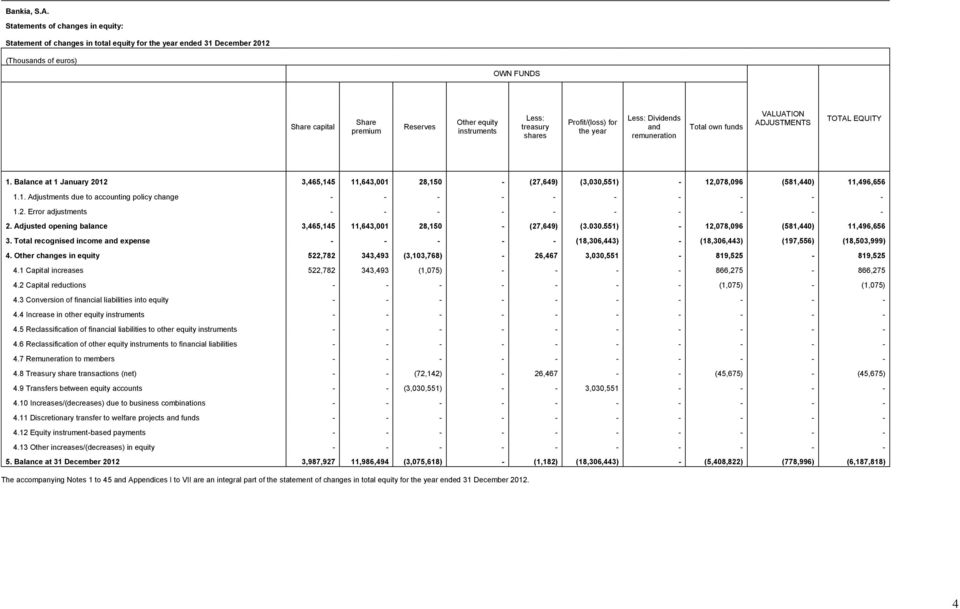
6 Bankia, S.A. Statements of changes in equity: Statement of changes in total equity for the year ended 31 December 2012 OWN FUNDS Share capital Share premium Reserves Other equity instruments Less: treasury shares Profit/(loss) for the year Less: Dividends and remuneration Total own funds VALUATION ADJUSTMENTS TOTAL EQUITY 1. Balance at 1 January ,465,145 11,643,001 28,150 - (27,649) (3,030,551) - 12,078,096 (581,440) 11,496, Adjustments due to accounting policy change Error adjustments Adjusted opening balance 3,465,145 11,643,001 28,150 - (27,649) ( ) - 12,078,096 (581,440) 11,496, Total recognised income and expense (18,306,443) - (18,306,443) (197,556) (18,503,999) 4. Other changes in equity 522, ,493 (3,103,768) - 26,467 3,030, , , Capital increases 522, ,493 (1,075) , , Capital reductions (1,075) - (1,075) 4.3 Conversion of financial liabilities into equity Increase in other equity instruments Reclassification of financial liabilities to other equity instruments Reclassification of other equity instruments to financial liabilities Remuneration to members Treasury share transactions (net) - - (72,142) - 26, (45,675) - (45,675) 4.9 Transfers between equity accounts - - (3,030,551) - - 3,030, Increases/(decreases) due to business combinations Discretionary transfer to welfare projects and funds Equity instrument-based payments Other increases/(decreases) in equity Balance at 31 December ,987,927 11,986,494 (3,075,618) - (1,182) (18,306,443) - (5,408,822) (778,996) (6,187,818) The accompanying Notes 1 to 45 and Appendices I to VII are an integral part of the statement of changes in total equity for the year ended 31 December
7 Bankia, S.A. Statements of changes in equity: Statement of changes in total equity for the year ended 31 December 2011 (*) OWN FUNDS Share capital Share premium Reserves Other equity instruments Less: treasury shares Profit/(loss) for the year Less: Dividends and remuneration Total own funds VALUATION ADJUSTMENTS TOTAL EQUITY 1. Balance at 1 January ,040-11, (419) 29,927 (1,642) 28, Adjustments due to accounting policy change Error adjustments Adjusted opening balance 18,040-11, (419) 29,927 (1,642) 28, Total recognised income and expense (3,030,551) - (3,030,551) (579,798) (3,610,349) 4. Other changes in equity 3,447,105 11,643,001 16,778 - (27,649) (934) ,078,720-15,078, Capital increases 3,449,145 11,643,001 (23,400) ,068,746-15,068, Capital reductions (2,040) - 2, Conversion of financial liabilities into equity Increase in other equity instruments Reclassification of financial liabilities to other equity instruments Reclassification of other equity instruments to financial liabilities Remuneration to members Treasury share transactions (net) - - 1,507 - (27,649) - - (26,142) - (26,142) 4.9 Transfers between equity accounts (934) Increases/(decreases) due to business combinations Discretionary transfer to welfare projects and funds Equity instrument-based payments Other increases/(decreases) in equity , (141) 36,116-36, Balance at 31 December ,465,145 11,643,001 28,150 - (27,649) (3,030,551) - 12,078,096 (581,440) 11,496,656 (*) Presented solely and exclusively for comparison purposes. 5

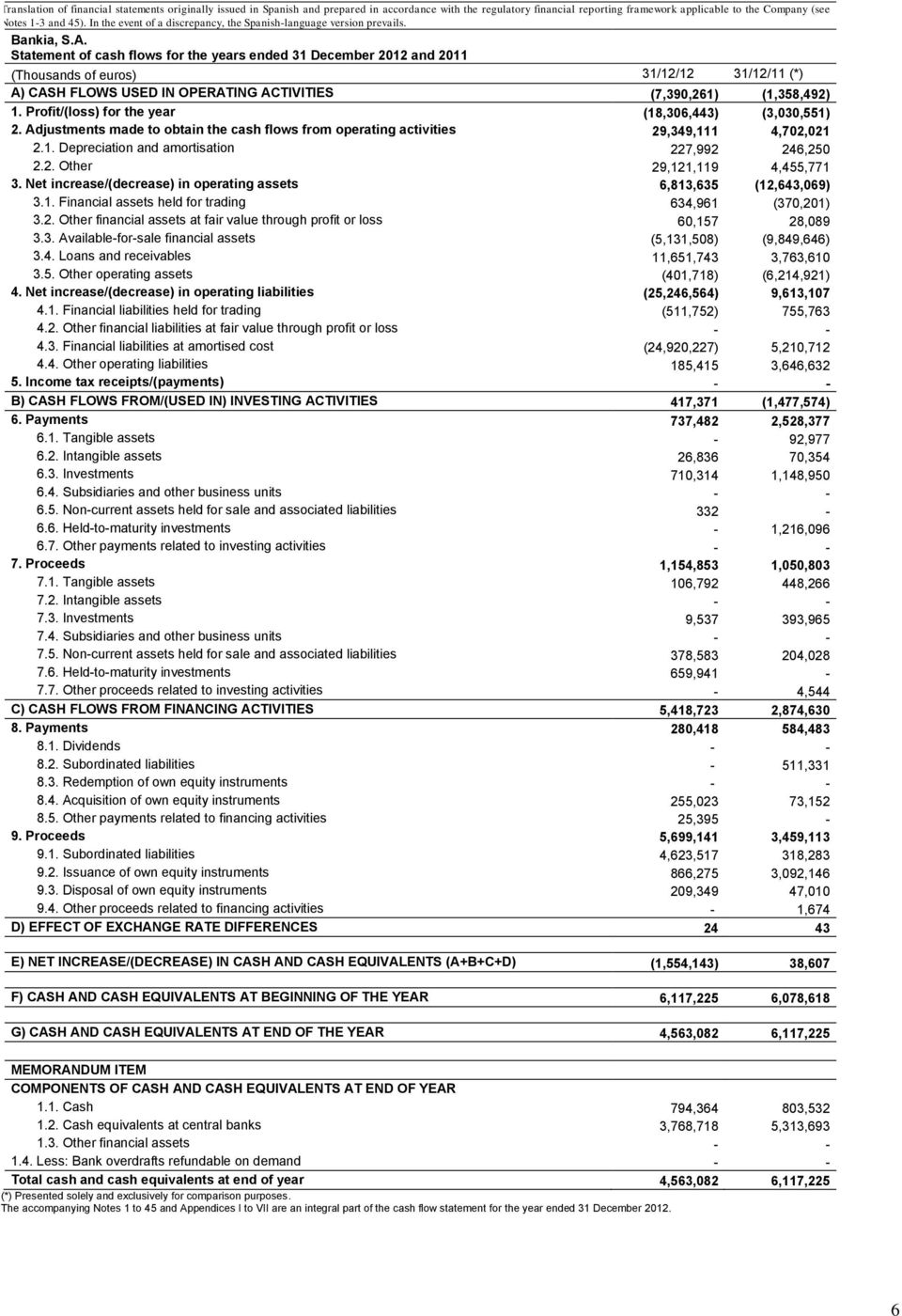
8 Translation of financial statements originally issued in Spanish and prepared in accordance with the regulatory financial reporting framework applicable to the Company (see Notes 1-3 and 45). In the event of a discrepancy, the Spanish-language version prevails. Bankia, S.A. Statement of cash flows for the years ended 31 December 2012 and /12/12 31/12/11 (*) A) CASH FLOWS USED IN OPERATING ACTIVITIES (7,390,261) (1,358,492) 1. Profit/(loss) for the year (18,306,443) (3,030,551) 2. Adjustments made to obtain the cash flows from operating activities 29,349,111 4,702, Depreciation and amortisation 227, , Other 29,121,119 4,455, Net increase/(decrease) in operating assets 6,813,635 (12,643,069) 3.1. Financial assets held for trading 634,961 (370,201) 3.2. Other financial assets at fair value through profit or loss 60,157 28, Available-for-sale financial assets (5,131,508) (9,849,646) 3.4. Loans and receivables 11,651,743 3,763, Other operating assets (401,718) (6,214,921) 4. Net increase/(decrease) in operating liabilities (25,246,564) 9,613, Financial liabilities held for trading (511,752) 755, Other financial liabilities at fair value through profit or loss Financial liabilities at amortised cost (24,920,227) 5,210, Other operating liabilities 185,415 3,646, Income tax receipts/(payments) - - B) CASH FLOWS FROM/(USED IN) INVESTING ACTIVITIES 417,371 (1,477,574) 6. Payments 737,482 2,528, Tangible assets - 92, Intangible assets 26,836 70, Investments 710,314 1,148, Subsidiaries and other business units Non-current assets held for sale and associated liabilities Held-to-maturity investments - 1,216, Other payments related to investing activities Proceeds 1,154,853 1,050, Tangible assets 106, , Intangible assets Investments 9, , Subsidiaries and other business units Non-current assets held for sale and associated liabilities 378, , Held-to-maturity investments 659, Other proceeds related to investing activities - 4,544 C) CASH FLOWS FROM FINANCING ACTIVITIES 5,418,723 2,874, Payments 280, , Dividends Subordinated liabilities - 511, Redemption of own equity instruments Acquisition of own equity instruments 255,023 73, Other payments related to financing activities 25, Proceeds 5,699,141 3,459, Subordinated liabilities 4,623, , Issuance of own equity instruments 866,275 3,092, Disposal of own equity instruments 209,349 47, Other proceeds related to financing activities - 1,674 D) EFFECT OF EXCHANGE RATE DIFFERENCES E) NET INCREASE/(DECREASE) IN CASH AND CASH EQUIVALENTS (A+B+C+D) (1,554,143) 38,607 F) CASH AND CASH EQUIVALENTS AT BEGINNING OF THE YEAR 6,117,225 6,078,618 G) CASH AND CASH EQUIVALENTS AT END OF THE YEAR 4,563,082 6,117,225 MEMORANDUM ITEM COMPONENTS OF CASH AND CASH EQUIVALENTS AT END OF YEAR 1.1. Cash 794, , Cash equivalents at central banks 3,768,718 5,313, Other financial assets Less: Bank overdrafts refundable on demand - - Total cash and cash equivalents at end of year 4,563,082 6,117,225 (*) Presented solely and exclusively for comparison purposes. The accompanying Notes 1 to 45 and Appendices I to VII are an integral part of the cash flow statement for the year ended 31 December
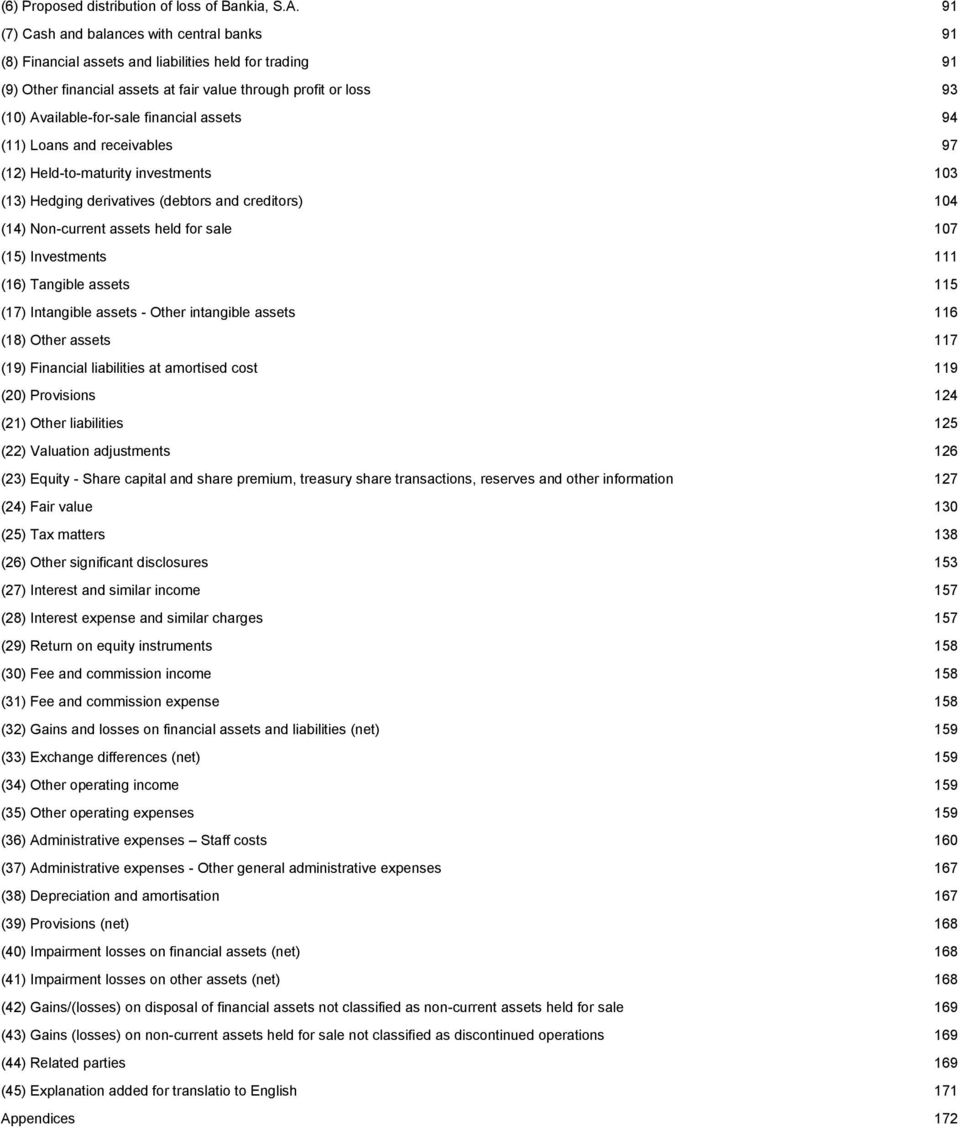
9 NOTES TO THE FINANCIAL STATEMENTS FOR THE YEAR ENDED 31 DECEMBER 2012 Page (1) Description of Bankia, beginnings of the incorporation of Bankia, reporting framework applied to draw up the financial statements and other information 7 (1.1) Description of Bankia 7 (1.2) Beginnings of the incorporation of Bankia 7 (1.3) Reporting framework applied to draw up the financial statements 11 (1.4) Responsibility for the information and estimates made 13 (1.5) Comparative information 14 (1.6) Agency agreements 14 (1.7) Investments in the capital of credit institutions 14 (1.8) Environmental impact 14 (1.9) Minimum reserve ratio 14 (1.10) Deposit Guarantee Fund 14 (1.11) Events after the reporting period 15 (1.12) Customer care service 16 (1.13) Information on deferred payments to suppliers. Third additional provision. Disclosure requirement" set out in Law 15/2010 of 5 July 17 (1.14) Information on the mortgage market 18 (1.15) Segment reporting and distribution of revenue from ordinary Bank activities, by categories of activities and geographic markets 24 (1.16) Society of Asset Management from the Banking Restructuring (SAREB) 26 (2) Accounting policies and measurement bases 28 (2.1) BFA-Bankia Group Restructuring Plan 28 (2.2) Subsidiaries 28 (2.3) Joint ventures 29 (2.4) Associates 29 (2.5) Financial instruments: initial recognition, derecognition of financial instruments, fair value and amortised cost of financial instruments, classification and measurement and reclassification among categories 30 (2.6) Hedge accounting and mitigation of risk 35 (2.7) Foreign currency transactions 37 (2.8) Recognition of income and expenses 38 (2.9) Offsetting 39 (2.10) Transfers of financial assets 39 (2.11) Exchanges of assets 40 (2.12) Impairment of financial assets 40 (2.13) Financial guarantees and provisions for financial guarantees 42 (2.14) Accounting for leases 43 (2.15) Staff costs 44 (2.16) Income tax 50 (2.17) Tangible assets 51 (2.18) Intangible assets 53 (2.19) Inventories 54 (2.20) Non-financial guarantees provided 55 (2.21) Provisions and contingent liabilities 55 (2.22) Non-current assets held for sale 56 (2.23) Statement of cash flows 57 (2.24) Share-based payment transactions 58 (2.25) Transactions with treasury shares 59 (2.26) Statement of recognised income and expense and statement of total changes in equity 59 (3) Risk management 61 (3.1) Exposure to credit risk and risk concentration 61 (3.2) Liquidity risk of financial instruments 73 (3.3) Exposure to interest rate risk 76 (3.4) Exposure to other market risks 77 (3.5) Exposure to property and construction risk (transactions in Spain) 78 (4) Capital management 82 (4.1) Capital requirements established by Bank of Spain Circular 3/ (4.2) Principal capital requirements 83 (5) Remuneration of Board members and senior executives 84 (5.1) Remuneration of Board members 84 (5.2) Remuneration of the Bank's senior executives (Management Committee) 89 (5.3) Disclosures on Bank directors holdings and business activities 90

10 (6) Proposed distribution of loss of Bankia, S.A. 91 (7) Cash and balances with central banks 91 (8) Financial assets and liabilities held for trading 91 (9) Other financial assets at fair value through profit or loss 93 (10) Available-for-sale financial assets 94 (11) Loans and receivables 97 (12) Held-to-maturity investments 103 (13) Hedging derivatives (debtors and creditors) 104 (14) Non-current assets held for sale 107 (15) Investments 111 (16) Tangible assets 115 (17) Intangible assets - Other intangible assets 116 (18) Other assets 117 (19) Financial liabilities at amortised cost 119 (20) Provisions 124 (21) Other liabilities 125 (22) Valuation adjustments 126 (23) Equity - Share capital and share premium, treasury share transactions, reserves and other information 127 (24) Fair value 130 (25) Tax matters 138 (26) Other significant disclosures 153 (27) Interest and similar income 157 (28) Interest expense and similar charges 157 (29) Return on equity instruments 158 (30) Fee and commission income 158 (31) Fee and commission expense 158 (32) Gains and losses on financial assets and liabilities (net) 159 (33) Exchange differences (net) 159 (34) Other operating income 159 (35) Other operating expenses 159 (36) Administrative expenses Staff costs 160 (37) Administrative expenses - Other general administrative expenses 167 (38) Depreciation and amortisation 167 (39) Provisions (net) 168 (40) Impairment losses on financial assets (net) 168 (41) Impairment losses on other assets (net) 168 (42) Gains/(losses) on disposal of financial assets not classified as non-current assets held for sale 169 (43) Gains (losses) on non-current assets held for sale not classified as discontinued operations 169 (44) Related parties 169 (45) Explanation added for translatio to English 171 Appendices 172
11 Translation of financial statements originally issued in Spanish and prepared in accordance with the regulatory financial reporting framework applicable to the Company (see Notes 1-3 and 45). In the event of a discrepancy, the Spanish-language version prevails. BANKIA, S.A. NOTES TO THE FINANCIAL STATEMENTS FOR THE YEAR ENDED 31 DECEMBER 2012 (1) Description of Bankia, beginnings of the incorporation of Bankia, reporting framework applied to draw up the financial statements and other information (1.1) Description of Bankia Bankia, S.A. ("the Bank" or Bankia ) is a financial institution incorporated under the name Altae Banco, S.A. (initially under code 0099 in the Bank of Spain's financial institution register) and on record with the companies register (Registro Mercantil). In the first half of 2011, the Bank was assigned code 2038 in the Bank of Spain's financial institutions register. As a credit institution, the Bank is subject to the supervisory authority of the Bank of Spain. On 16 June 2011, Bankia's registered office was transferred to calle Pintor Sorolla, 8, Valencia. The company bylaws may be consulted, together with other relevant legal information, at Bankia's registered office and on its website ( Bankia s bylaws stipulate the activities it may engage in, which are those commonly carried on by credit institutions and, in particular, satisfy the requirements of Law 26/1988, of 29 July, on the Discipline and Intervention in Credit Institutions. (1.2) Beginnings of the incorporation of Bankia On 30 July 2010, Caja de Ahorros y Monte de Piedad de Madrid (until that date, the majority shareholder of Altae Banco, S.A.), Caja de Ahorros de Valencia, Castellón y Alicante (Bancaja), Caja Insular de Ahorros de Canarias, Caja de Ahorros y Monte de Piedad de Ávila, Caixa d Estalvis Laietana, Caja de Ahorros y Monte de Piedad de Segovia and Caja de Ahorros de La Rioja (referred to collectively as the Cajas ) signed an integration agreement (the Integration Agreement ) calling for the incorporation of a contractually-based consolidable group of credit institutions. The Integration Agreement made provision for the creation of a group comprising the Cajas and implemented as an Institutional Protection Scheme ( IPS ) in accordance with the requirements and conditions set out in Directive 2006/48/EC (implemented in Spanish law under Article 26.7 of Royal Decree 216/2008 and rule 15 of Bank of Spain Circular 3/2008 to Credit Institutions on the calculation and control of minimum capital requirements) and in Law 13/1985 of 25 May on the investment ratios, capital and reporting requirements of financial intermediaries). The Integration Agreement originally sought to arrange the Group arising from the Integration Agreement as an integrated organisation that qualifies as a consolidable group for accounting and regulatory purposes and as a concentration vehicle for the purposes of competition law. The Agreement set out integrated management and ownership within the confines of law and without prejudice to the rights of the owners of non-controlling interests of the Group s business investments (barring certain exceptions established in the Agreement itself) and therefore centralises the decision-making process in respect of existing and future portfolio investments and divestments. On 3 December 2010, the Central Body of the IPS was incorporated under the name Banco Financiero y de Ahorros, S.A. ( BFA ). The entity was entered in the Valencia Companies Register on 7 December 2010 and placed on the Bank of Spain Savings Banks Register on 13 December Also on 13 December 2010, the Board of Directors of BFA ratified its adhesion to the Integration Agreement as the parent of the group arising from the Integration Agreement. On the same date, the Cajas contributed to BFA the right to receive 100% of the results of all their businesses, carried out in all regions as from 1 January 2011 (the Mutuality Right ), subject to a statement from the Bank of Spain indicating that no objections are made to the arrangement. At the Annual General Meeting held on 3 December 2010, the shareholders of BFA approved the issue of convertible preference shares amounting to EUR 4,465 million, which were subscribed and paid exclusively by the Fund for Orderly Bank Restructuring (FROB). On 30 December 2010, the Cajas and BFA signed an addendum to the Integration Agreement whereby the Cajas undertook to assign the voting rights in their subsidiaries, so that the policies through which BFA will exercise control over the entities, as established in the Integration Agreement, could be designed and implemented. For accounting purposes, the Integration Agreement sets up BFA as the parent of the Banco Financiero y de Ahorros Group, whereas the Cajas and their subsidiaries are 7

12 Group subsidiaries, insofar as BFA had the power to oversee the financial and operational policies of the other Group entities. On 28 January 2011, the Cajas and BFA signed a second addendum to the Integration Agreement, whereby the Cajas assigned all the assets and liabilities of their retail banking businesses to BFA. The Cajas will continue to manage the retail banking businesses in their native territory, to the extent of the powers delegated to them by BFA. Subsequently, between 14 February 2011 and 17 February 2011, the boards of directors of the Cajas and of BFA approved the projects to de-merge the banking and banking-related assets and liabilities of the Cajas for integration in BFA (the "De-Merger Projects" or the "First De-Merger Project"). These projects were duly filed in the corresponding Companies Registers. Under the De-Merger Projects, the contribution of the Cajas de-merged assets and liabilities to BFA would be compensated through the aforementioned Mutuality Right. Accordingly, the Cajas will not receive any compensation for the contribution other than the obligations set out under the Mutuality Right. The balance sheets of the Cajas at 31 December 2010 were deemed to be the de-merger balance sheets, with the exceptions set out in the De-Merger Projects of assets and liabilities other than those stipulated above which were not de-merged. The de-merger is effective for accounting purposes as of 1 January On 17 February 2011, the Cajas and BFA signed a third addendum to the Integration Agreement in order to allow BFA to adopt the most appropriate structure for its flotation. On 18 February 2011, the Spanish Cabinet approved Royal Decree-Law 2/2011 of 18 February 2011 to strengthen the financial system ( RDL 2/2011 ). This decree-law introduced and defined a new solvency requirement to be met by the institutions ("principal capital") and, among other provisions, established that: (i) credit institutions must have a principal core capital ratio of at least 8% of their total risk-weighted exposures, calculated in accordance with Law 13/1985 of 25 May, on the investment ratios, capital and reporting requirements of financial intermediaries and the related implementing regulations; and (ii) those credit institutions that have secured over 20% of funding from the wholesale market and that have placed less than 20% of capital or voting rights with third parties must have a principal core capital ratio of 10%. On 5 April 2011, the board of directors and the shareholders of BFA, in their general meeting, approved a second de-merger project for the contribution by BFA to its subsidiary Bankia of a significant portion of BFA s banking and financial businesses received from the Cajas in the course of the de-mergers carried out previously (the "Second De-Merger Project"). This Second De-Merger Project was likewise approved on 6 April 2011 by the Board of Directors and the shareholders of Bankia, a BFA Group company, at the general meeting (attended by all shareholders). On 29 April 2011, the Cajas and BFA signed a novation to the Integration Agreement to adapt it to Royal Decree-Law 2/2011 of 18 February, to strengthen the financial system, approving, with effect from 1 January 2011, the mutual support system and the mutual profit-sharing system set out under the Integration Agreement. In connection with the flotation, on 16 June 2011, BFA agreed to apply for admission to trading on the Madrid, Barcelona, Bilbao and Valencia Stock Exchanges and inclusion on the Stock Exchange Interconnection System (Continuous Market) of all outstanding shares representing the share capital of Bankia. On 28 June 2011, the General Meeting of Shareholders and Board of Directors of BFA and, subsequently, the General Meeting of Shareholders and Board of Directors of Bankia, adopted the necessary agreements to implement Bankia's market listing by means of a public share offering and admission to trading (IPO). The related prospectus was registered with the Spanish Securities Market Commission ("CNMV") on 29 June Among the agreements implemented, Banco Financiero y de Ahorros, S.A. resolved to increase Bankia's share capital by EUR 1,649,144,506 through the issue of 824,572,253 new shares, and to authorise the Board of Directors, in the event of an incomplete subscription, to declare share capital increased by the amount of the subscriptions actually made during the public share offering. BFA waived its preferential subscription rights with regard to the shares associated with the capital increase. Following approval of Bankia's market listing prospectus, on 20 July 2011, the Bank completed the IPO and the new shares were officially admitted for trading. The initial share price was EUR Pursuant to the IPO, the Bank issued 824,572,253 new shares at a par value of EUR 2 each, with an issue premium per share of EUR 1.75, producing a total share capital increase of EUR 1,649,145 thousand, and an issue premium of EUR 1,443,001 thousand. On 10 February 2012, the Bank's Board of Directors decided to carry out a monetary capital increase excluding preferential subscription rights, through the issue and circulation of a maximum of four hundred and fifty-four million ordinary Bankia, S.A. shares (454,000,000). The capital increase forms part of the 8
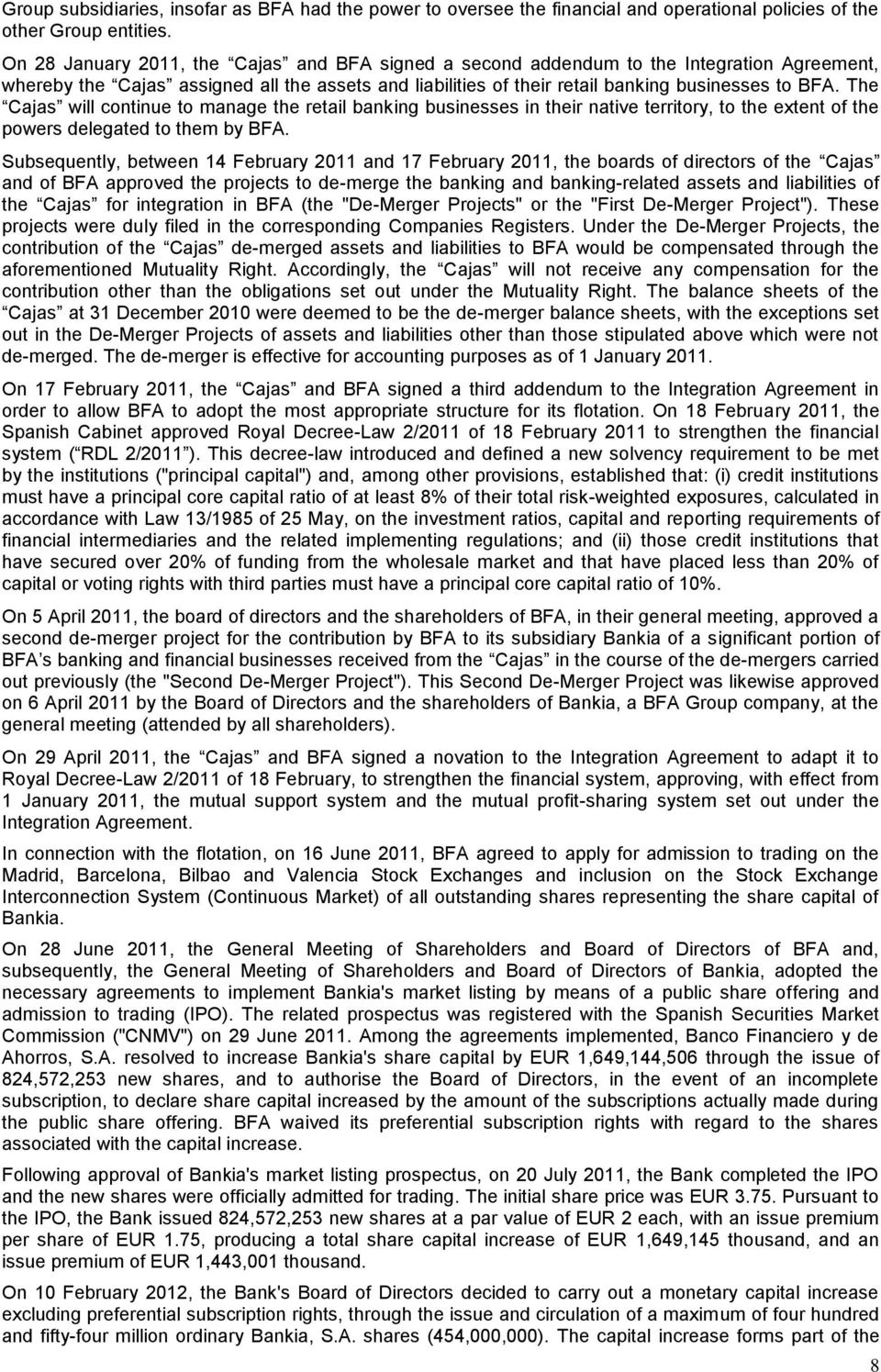
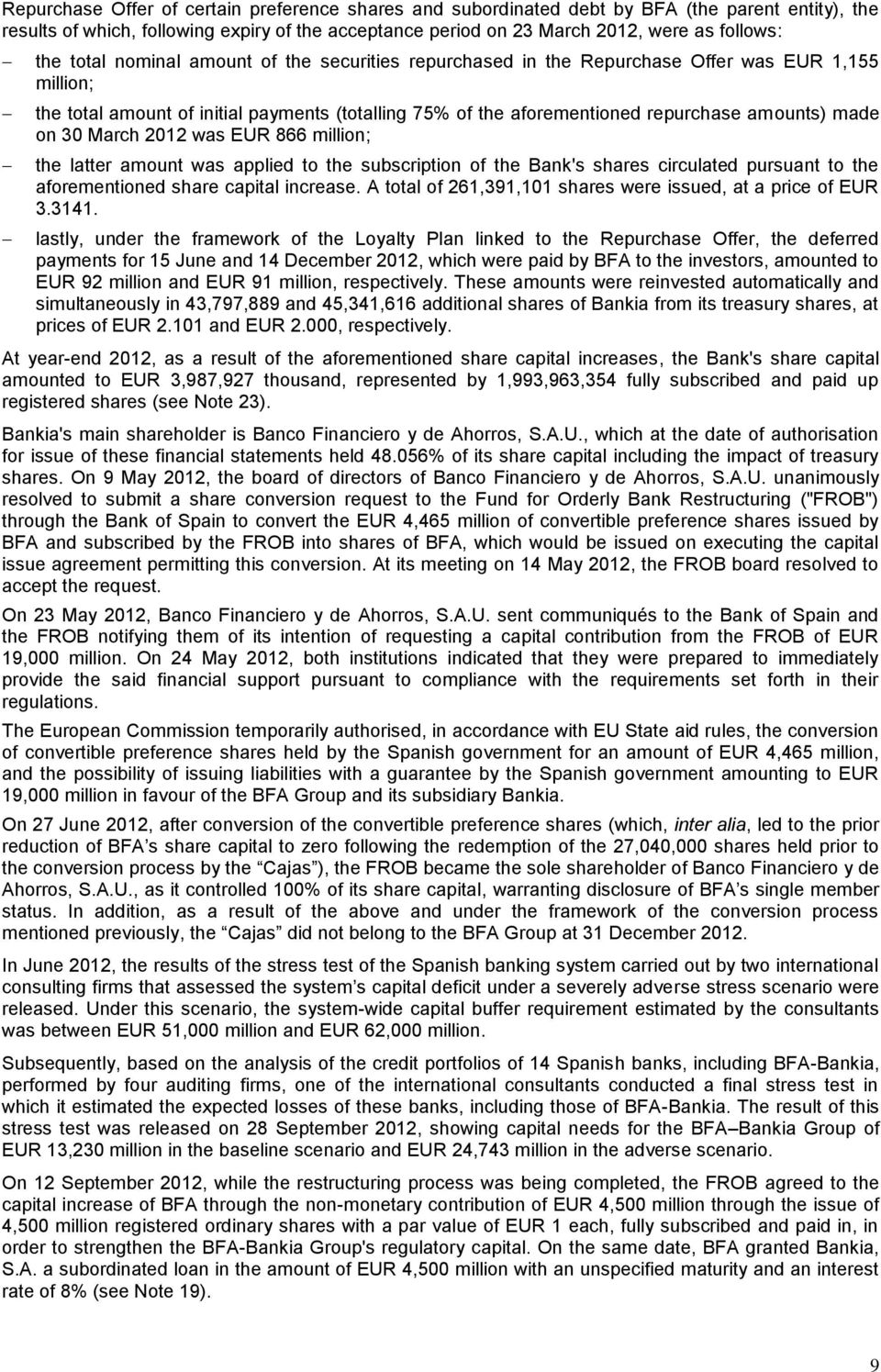
13 Repurchase Offer of certain preference shares and subordinated debt by BFA (the parent entity), the results of which, following expiry of the acceptance period on 23 March 2012, were as follows: the total nominal amount of the securities repurchased in the Repurchase Offer was EUR 1,155 million; the total amount of initial payments (totalling 75% of the aforementioned repurchase amounts) made on 30 March 2012 was EUR 866 million; the latter amount was applied to the subscription of the Bank's shares circulated pursuant to the aforementioned share capital increase. A total of 261,391,101 shares were issued, at a price of EUR lastly, under the framework of the Loyalty Plan linked to the Repurchase Offer, the deferred payments for 15 June and 14 December 2012, which were paid by BFA to the investors, amounted to EUR 92 million and EUR 91 million, respectively. These amounts were reinvested automatically and simultaneously in 43,797,889 and 45,341,616 additional shares of Bankia from its treasury shares, at prices of EUR and EUR 2.000, respectively. At year-end 2012, as a result of the aforementioned share capital increases, the Bank's share capital amounted to EUR 3,987,927 thousand, represented by 1,993,963,354 fully subscribed and paid up registered shares (see Note 23). Bankia's main shareholder is Banco Financiero y de Ahorros, S.A.U., which at the date of authorisation for issue of these financial statements held % of its share capital including the impact of treasury shares. On 9 May 2012, the board of directors of Banco Financiero y de Ahorros, S.A.U. unanimously resolved to submit a share conversion request to the Fund for Orderly Bank Restructuring ("FROB") through the Bank of Spain to convert the EUR 4,465 million of convertible preference shares issued by BFA and subscribed by the FROB into shares of BFA, which would be issued on executing the capital issue agreement permitting this conversion. At its meeting on 14 May 2012, the FROB board resolved to accept the request. On 23 May 2012, Banco Financiero y de Ahorros, S.A.U. sent communiqués to the Bank of Spain and the FROB notifying them of its intention of requesting a capital contribution from the FROB of EUR 19,000 million. On 24 May 2012, both institutions indicated that they were prepared to immediately provide the said financial support pursuant to compliance with the requirements set forth in their regulations. The European Commission temporarily authorised, in accordance with EU State aid rules, the conversion of convertible preference shares held by the Spanish government for an amount of EUR 4,465 million, and the possibility of issuing liabilities with a guarantee by the Spanish government amounting to EUR 19,000 million in favour of the BFA Group and its subsidiary Bankia. On 27 June 2012, after conversion of the convertible preference shares (which, inter alia, led to the prior reduction of BFA s share capital to zero following the redemption of the 27,040,000 shares held prior to the conversion process by the Cajas ), the FROB became the sole shareholder of Banco Financiero y de Ahorros, S.A.U., as it controlled 100% of its share capital, warranting disclosure of BFA s single member status. In addition, as a result of the above and under the framework of the conversion process mentioned previously, the Cajas did not belong to the BFA Group at 31 December In June 2012, the results of the stress test of the Spanish banking system carried out by two international consulting firms that assessed the system s capital deficit under a severely adverse stress scenario were released. Under this scenario, the system-wide capital buffer requirement estimated by the consultants was between EUR 51,000 million and EUR 62,000 million. Subsequently, based on the analysis of the credit portfolios of 14 Spanish banks, including BFA-Bankia, performed by four auditing firms, one of the international consultants conducted a final stress test in which it estimated the expected losses of these banks, including those of BFA-Bankia. The result of this stress test was released on 28 September 2012, showing capital needs for the BFA Bankia Group of EUR 13,230 million in the baseline scenario and EUR 24,743 million in the adverse scenario. On 12 September 2012, while the restructuring process was being completed, the FROB agreed to the capital increase of BFA through the non-monetary contribution of EUR 4,500 million through the issue of 4,500 million registered ordinary shares with a par value of EUR 1 each, fully subscribed and paid in, in order to strengthen the BFA-Bankia Group's regulatory capital. On the same date, BFA granted Bankia, S.A. a subordinated loan in the amount of EUR 4,500 million with an unspecified maturity and an interest rate of 8% (see Note 19). 9
14 Lastly, on 28 November 2012, the BFA Bankia Group received approval by the European Commission, the Bank of Spain and the FROB for the Bank's Restructuring Plan (the Restructuring Plan ). This final approval marked the completion of the joint analysis and work by the entities, the European Commission, the FROB and the Bank of Spain begun last July and concluded when the results of the stress test were released on 28 September The capital requirements identified in the stress tests were reduced by EUR 24,552 million due to the impact of the transfer of real estate assets to the asset management company created for the bank restructuring (SAREB) (see Note 1.16). The estimates of public assistance required by the BFA Group set out in the Restructuring Plan to comply with regulatory capital and cash adequacy requirements in applicable regulations include approximately EUR 6,500 million related to the positive impact estimated for certain management actions with the BFA Group's hybrid instruments (preference shares and subordinated debt) to be carried out within the scope of the principles and targets regarding the burden-sharing of bank restructuring costs set out in Law 9/2012, of 14 November, on the restructuring and resolution of credit institutions ( Law 9/2012 ). As of the date of authorisation for issue of these financial statements for 2012, management actions entailing the conversion of hybrid instruments to capital provided for in the Restructuring Plan had yet to begin. As a result, the amount of public assistance required by the BFA Group in the Restructuring Plan was finally estimated at EUR 17,959 million. The Bankia Group's capital requirements, which should be considered as part of the BFA Group's requirements indicated above, were estimated at EUR 15,500 million. Of this amount, approximately EUR 4,800 million is expected to be covered through the conversion of hybrid instruments mentioned above and EUR 10,700 million through contributions by the Bank's shareholders, with Bankia's capital increase fully guaranteed by BFA. In this respect, on 26 December 2012, as part of the aforementioned Restructuring Plan, the FROB adopted the following agreements: The capital increase at Banco Financiero y de Ahorros, S.A.U. amounting to EUR 13,459 million, subscribed by the FROB and paid by that entity through the non-monetary contribution of securities of the European Stability Mechanism (EMS). The increase comes in addition to that of EUR 4,500 million carried out on 12 September 2012 through the non-monetary payment of treasury bills. These bills were also swapped for securities of the ESM. As indicated previously, the issue by Bankia of convertible contingent bonds (CoCos) without preferential subscription rights in an amount of EUR 10,700 million subscribed in full by BFA through the contribution of fixed-income securities issued by the ESM. The BFA Group's Restructuring Plan defines the framework that will allow the BFA Bankia Group to implement a Strategic Plan for the period. This plan establishes the measures that will be adopted during the period within the framework of the limitations imposed and commitments assumed by the BFA Group with EU and Spanish authorities in the Restructuring Plan that will enable the BFA Group to meet all the commitments assumed with them by As a result, from the end of the Strategic Plan until 2017, additional measures to those considered initially for the period will likely be adopted with the overriding goal of strengthening the Bank's competitive position, rebalancing its balance sheet, improving efficiency and reducing the risk premium. The main measures included in the Strategic Plan are as follows: The disposal of non-earning assets and non-strategic equity investments. Between the transfer of assets to the SAREB, the sale of investees and other portfolios and the disposal of loan portfolios, Bankia expects to shed EUR 50,000 million (down from EUR 90,000 million to EUR 40,000 million). A change in the composition of the loan portfolio, resulting in a greater proportion of lending to businesses and practically zero exposure to the real estate business. Reduction in the Bank's capacity, both in terms of its branch network and in terms of its workforce, to ensure its future viability. The number of branches will be reduced by approximately 39%, from 3,117 to around 1,900-2,000. The workforce will be cut by 28%, from 20,589 to around 14,500 employees. This retrenchment will guarantee the Bank's viability and the preservation of 72% of existing jobs. In this respect, on 8 February 2013 a labour agreement was entered into with the majority of the Bank's union representatives (see Note 1.11). Efficiency will also be improved by streamlining the intermediate structures of the branch network and optimising central services. Elsewhere, the commitments agreed with the authorities in the framework of the Restructuring Plan include the adoption, by BFA, of the following measures by 31 December 2013: 10

15 its merger, into a single entity, with Bankia, S.A., or its transformation into a holding company without a banking license At the date of authorisation for issue of these financial statements, the directors had yet to take a decision in this respect. Nevertheless, the potential impact of any decision would not be material for the Bankia Group's equity and, in any case, neutral for the BFA Group. As a result, Bankia is a subsidiary of the Banco Financiero y de Ahorros Group and, in turn, the parent of a business group (the "Group" or Bankia Group ). At 31 December 2012, the scope of consolidation of the Bankia Group encompassed 330 companies, including subsidiaries, associates and jointly-controlled entities. These companies engage in a range of activities, including among others insurance, asset management, financing, services, and property development and management. Appendices I and II list the entities that form part of the scope of consolidation of the Bankia Group at 31 December 2012 (subsidiaries controlled by the Bank and jointly-controlled entities). Appendix III list the entities that form part of the scope of consolidation of the Bankia Group at 31 December 2012 that were reclassified to "Non-current assets held for sale" (subsidiaries controlled by the Bank, jointly-controlled entities and associates over which Bankia directly or indirectly exercises significant influence, see Note 2.1), and specifying the percentage of voting rights controlled by Bankia in each company. Bankia s 2012 financial statements were authorised for issue by Bankia's Board of Directors at the meeting held on 20 March In addition to these separate financial statements, Bankia's Board of Directors authorised for issue the Bankia Group's consolidated financial statements for the year ended 31 December 2012, prepared in accordance with the International Financial Reporting Standards as adopted by the European Union. (1.3) Reporting framework applied to draw up the financial statements In accordance with Regulation (EC) No. 1606/2002 of the European Parliament and of the Council of 19 July 2002, all companies governed by the laws of a member state of the European Union and whose securities are traded on a regulated market in any European Union country must file consolidated financial statements for periods beginning on or after 1 January 2005 in accordance with the International Financial Reporting Standards as adopted by the European Union ( IFRS-EU ). Bankia's financial statements for the year ended 31 December 2012 are presented in accordance with the provisions of Bank of Spain Circular 4/2004 of 22 December on public and confidential financial reporting rules and formats for credit institutions ("Circular 4/2004") and subsequent amendments thereto, which implements and adapts the International Financial Reporting Standards endorsed by the European Union to Spanish credit institutions. The other general Spanish business and accounting standards and other applicable Bank of Spain Circulars and standards were used in the preparation of these financial statements, including, where appropriate, the disclosures required by these standards in these notes to the financial statements. Bankia's financial statements for the year ended 31 December 2012 were prepared taking into account all accounting principles and standards and mandatory measurement criteria applicable in order to give a true and fair view, in all material respects, of the equity and financial position of Bankia, S.A. at 31 December 2012 and of the results of its operations and cash flows during the year then ended, pursuant to the aforementioned applicable financial information reporting framework, and in particular to the accounting principles and criteria therein. The principal accounting policies and measurement bases applied in preparing the Bank s financial statements for the year ended 31 December 2012 are summarised in Note 2. Main regulatory changes during the period from 1 January to 31 December 2012 The main changes arising in 2012 in the laws and regulations applicable to Bankia, which were applied in the preparation of these financial statements, are as follows: Bank of Spain Circular 2/2012 of 29 February amending Circular 4/2004 of 22 December on public and confidential financial reporting rules and formats for credit institutions. Bank of Spain Circular 2/2012 of 29 February was published on 6 March The primary objective of this Circular is to adapt Circular 4/2004 to Royal Decree-Law 2/2012, of 3 February, on the reorganisation of the financial sector. The main modifications to this Circular are: - It adapts loan loss reserve (provisions) requirements for financing and assets foreclosed or assets received as payment of debts in connection with land for development and with property construction or development for credit institutions in Spain existing at 31 December 2011 and 11
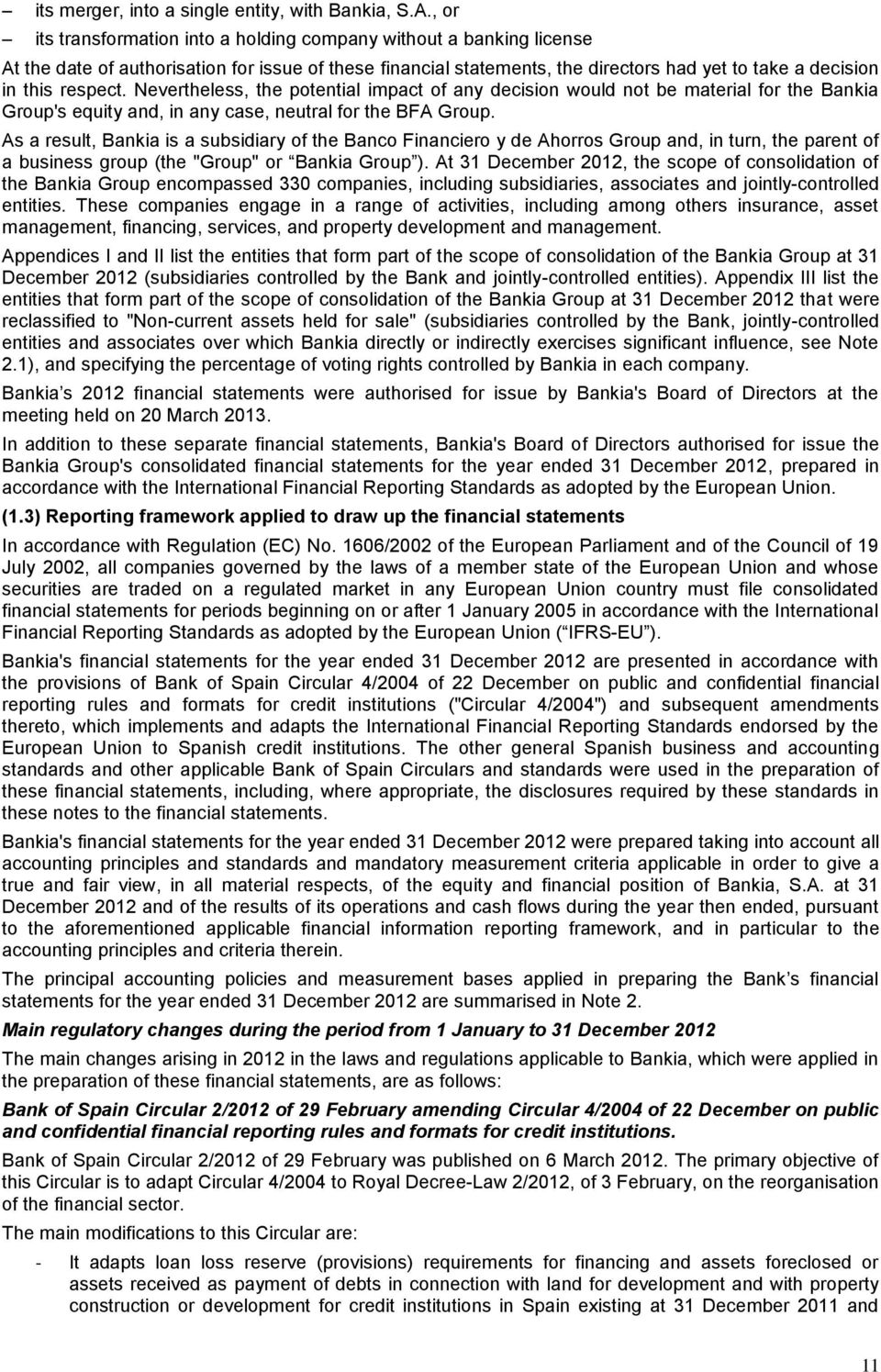
16 those arising from refinancing subsequent to that date, as set out in the aforementioned Royal Decree-Law. - It amends the general rules regarding the accounting of foreclosed assets or assets received as payment of debts, determining the value at which these real estate assets should be initially recognised and subsequently measured. In terms of subsequent measurement, the percentage cover increases to 20%, 30% and 40% in accordance with the date of inclusion of the assets in the balance sheet (over 1, 2 and 3 years, respectively). The measures established in Royal Decree-Law 2/2012 of 3 February on the reorganisation of the financial sector and those included in this Circular were met prior to 31 December Bank of Spain Circular 6/2012, of 28 September, for credit institutions amending Circular 4/2004 of 22 December, on public and confidential financial reporting rules and formats. On 2 October, Bank of Spain Circular 6/2012, of 28 September, on credit institutions was published in the Spanish National Gazette (Boletín Oficial del Estado). The main purpose is to adapt Circular 4/2004 to Royal Decree-Law 18/2012, of 11 May, on the reorganisation and sale of real estate assets in the financial sector with respect to additional provisioning requirements for assets related to the real estate activity. The main modifications to this Circular are: - It establishes, in the same vein as Royal Decree-Law 2/2012, additional provisioning requirements for the impairment of loans to the real estate sector classified as "Non-troubled". As with the previous regulations, these new requirements are stipulated separately for one time only, depending on the different classes of finance. - It introduces new disclosure requirements for credit institutions in their separate and consolidated annual financial statements regarding refinancing and restructuring operations, and industry and geographic risk concentration. - It adds transparency requirements regarding exposures to real estate construction and development, with disclosure of assets foreclosed or received in payment of debts transferred to companies for management of these assets. The impacts of these two regulations (Circulars 2/2012 and 6/2012) were recognised fully in 2012, both with respect to assets remaining on the Bank's balance sheet at 31 December 2012 and those transferred to the SAREB (see Note 1.16) which, prior to their transfer, were measured, through the additional charges required, at the transfer price. Royal Decree-Law 24/2012 of 31 August on the restructuring and resolution of credit institutions On 31 August 2012, the Spanish cabinet approved a Royal Decree-Law on the restructuring and resolution of credit institutions, designed to safeguard the stability of the financial system as a whole. It includes six types of measures: - An enhanced framework for the management of crisis situations at banks. - New regulation of the FROB which defines its powers and significantly enhances the tools for intervention. - Stronger protection for retail investors, introducing restrictions on the sale of investment products. - A legal framework for the creation of an Asset Management Company (AMC), that can take the status of a public limited company (sociedad anónima) or a trust fund, pursuant to the pending implementing regulations. - A burden-sharing system for restructuring costs between the public and private sector, whereby holders of hybrid capital instruments, preference shares and subordinated debt may be obliged to bear part of the losses of a bank in a crisis situation. - Other aspects, such as: exemption from the grounds for mandatory winding-up set out in Section 363, 1. e) of the Spanish Corporate Enterprises Act (Ley de Sociedades de Capital) for credit institutions in which the FROB holds a controlling interest or those whose governing body is controlled by the FROB. Likewise, the aforementioned institutions and directors thereof are exempt from the system provided for in Section 2 of Title X of the Spanish Corporate Enterprises Act. 12

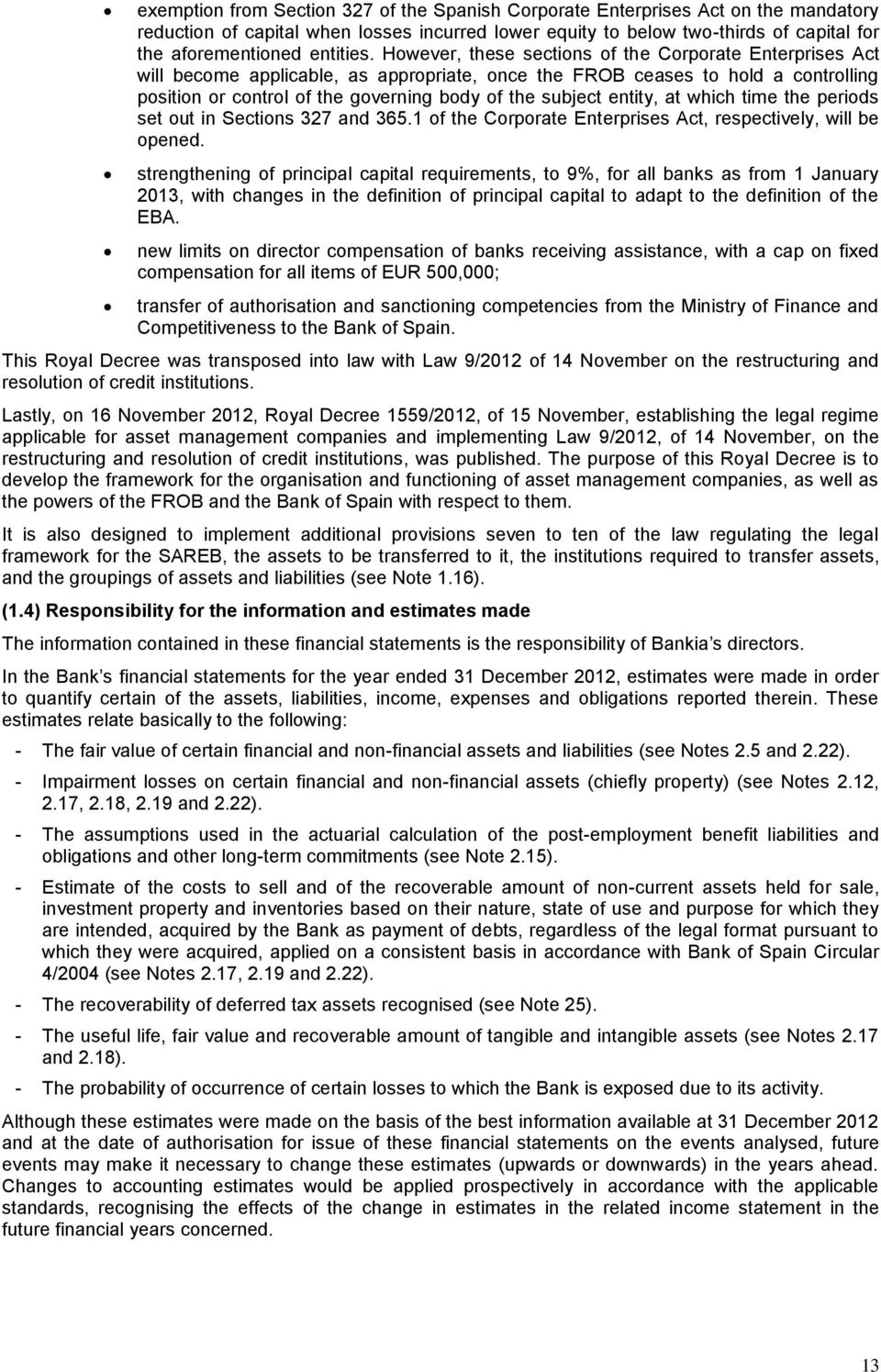
17 exemption from Section 327 of the Spanish Corporate Enterprises Act on the mandatory reduction of capital when losses incurred lower equity to below two-thirds of capital for the aforementioned entities. However, these sections of the Corporate Enterprises Act will become applicable, as appropriate, once the FROB ceases to hold a controlling position or control of the governing body of the subject entity, at which time the periods set out in Sections 327 and of the Corporate Enterprises Act, respectively, will be opened. strengthening of principal capital requirements, to 9%, for all banks as from 1 January 2013, with changes in the definition of principal capital to adapt to the definition of the EBA. new limits on director compensation of banks receiving assistance, with a cap on fixed compensation for all items of EUR 500,000; transfer of authorisation and sanctioning competencies from the Ministry of Finance and Competitiveness to the Bank of Spain. This Royal Decree was transposed into law with Law 9/2012 of 14 November on the restructuring and resolution of credit institutions. Lastly, on 16 November 2012, Royal Decree 1559/2012, of 15 November, establishing the legal regime applicable for asset management companies and implementing Law 9/2012, of 14 November, on the restructuring and resolution of credit institutions, was published. The purpose of this Royal Decree is to develop the framework for the organisation and functioning of asset management companies, as well as the powers of the FROB and the Bank of Spain with respect to them. It is also designed to implement additional provisions seven to ten of the law regulating the legal framework for the SAREB, the assets to be transferred to it, the institutions required to transfer assets, and the groupings of assets and liabilities (see Note 1.16). (1.4) Responsibility for the information and estimates made The information contained in these financial statements is the responsibility of Bankia s directors. In the Bank s financial statements for the year ended 31 December 2012, estimates were made in order to quantify certain of the assets, liabilities, income, expenses and obligations reported therein. These estimates relate basically to the following: - The fair value of certain financial and non-financial assets and liabilities (see Notes 2.5 and 2.22). - Impairment losses on certain financial and non-financial assets (chiefly property) (see Notes 2.12, 2.17, 2.18, 2.19 and 2.22). - The assumptions used in the actuarial calculation of the post-employment benefit liabilities and obligations and other long-term commitments (see Note 2.15). - Estimate of the costs to sell and of the recoverable amount of non-current assets held for sale, investment property and inventories based on their nature, state of use and purpose for which they are intended, acquired by the Bank as payment of debts, regardless of the legal format pursuant to which they were acquired, applied on a consistent basis in accordance with Bank of Spain Circular 4/2004 (see Notes 2.17, 2.19 and 2.22). - The recoverability of deferred tax assets recognised (see Note 25). - The useful life, fair value and recoverable amount of tangible and intangible assets (see Notes 2.17 and 2.18). - The probability of occurrence of certain losses to which the Bank is exposed due to its activity. Although these estimates were made on the basis of the best information available at 31 December 2012 and at the date of authorisation for issue of these financial statements on the events analysed, future events may make it necessary to change these estimates (upwards or downwards) in the years ahead. Changes to accounting estimates would be applied prospectively in accordance with the applicable standards, recognising the effects of the change in estimates in the related income statement in the future financial years concerned. 13
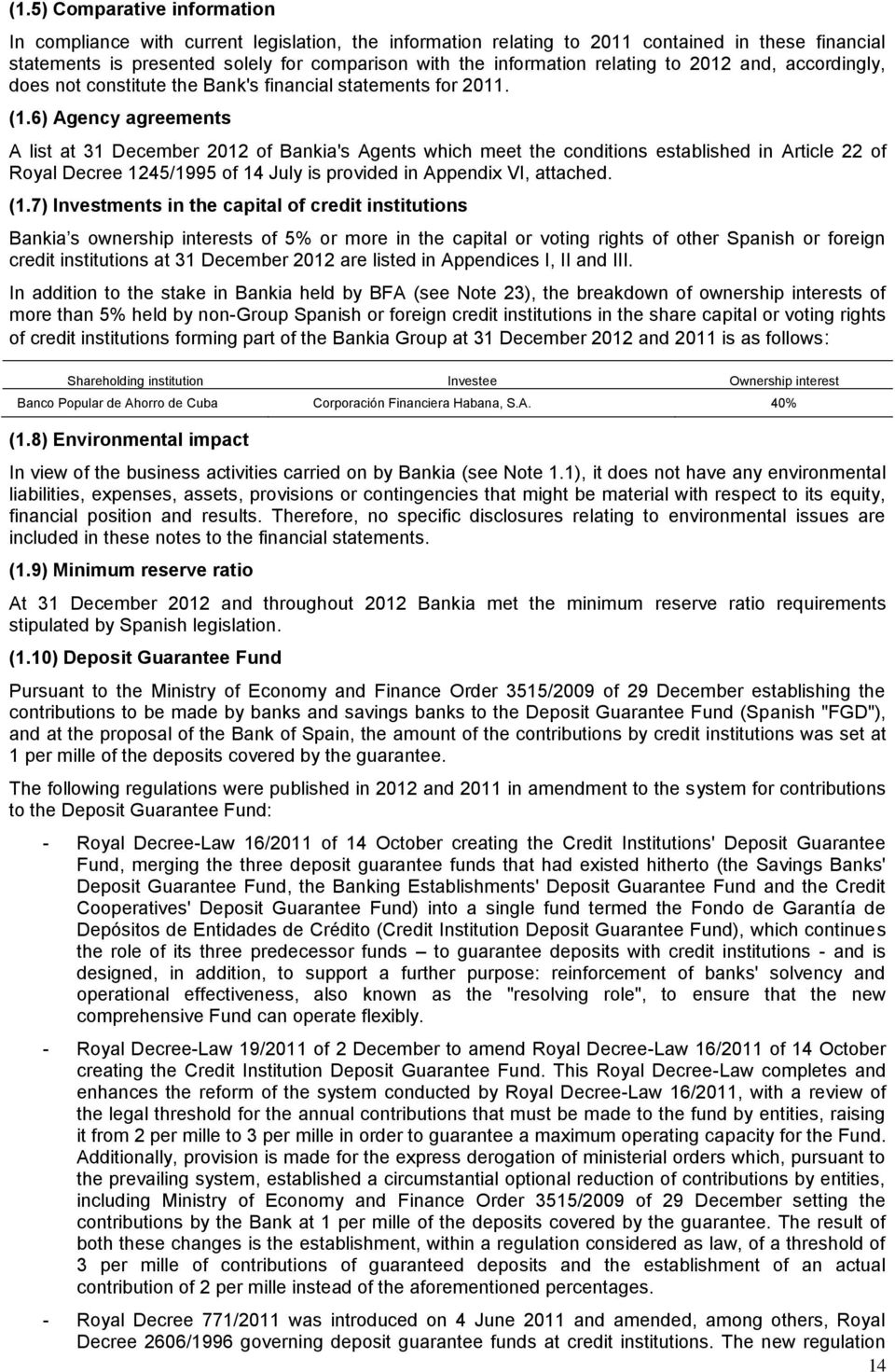
18 (1.5) Comparative information In compliance with current legislation, the information relating to 2011 contained in these financial statements is presented solely for comparison with the information relating to 2012 and, accordingly, does not constitute the Bank's financial statements for (1.6) Agency agreements A list at 31 December 2012 of Bankia's Agents which meet the conditions established in Article 22 of Royal Decree 1245/1995 of 14 July is provided in Appendix VI, attached. (1.7) Investments in the capital of credit institutions Bankia s ownership interests of 5% or more in the capital or voting rights of other Spanish or foreign credit institutions at 31 December 2012 are listed in Appendices I, II and III. In addition to the stake in Bankia held by BFA (see Note 23), the breakdown of ownership interests of more than 5% held by non-group Spanish or foreign credit institutions in the share capital or voting rights of credit institutions forming part of the Bankia Group at 31 December 2012 and 2011 is as follows: Shareholding institution Investee Ownership interest Banco Popular de Ahorro de Cuba Corporación Financiera Habana, S.A. 40% (1.8) Environmental impact In view of the business activities carried on by Bankia (see Note 1.1), it does not have any environmental liabilities, expenses, assets, provisions or contingencies that might be material with respect to its equity, financial position and results. Therefore, no specific disclosures relating to environmental issues are included in these notes to the financial statements. (1.9) Minimum reserve ratio At 31 December 2012 and throughout 2012 Bankia met the minimum reserve ratio requirements stipulated by Spanish legislation. (1.10) Deposit Guarantee Fund Pursuant to the Ministry of Economy and Finance Order 3515/2009 of 29 December establishing the contributions to be made by banks and savings banks to the Deposit Guarantee Fund (Spanish "FGD"), and at the proposal of the Bank of Spain, the amount of the contributions by credit institutions was set at 1 per mille of the deposits covered by the guarantee. The following regulations were published in 2012 and 2011 in amendment to the system for contributions to the Deposit Guarantee Fund: - Royal Decree-Law 16/2011 of 14 October creating the Credit Institutions' Deposit Guarantee Fund, merging the three deposit guarantee funds that had existed hitherto (the Savings Banks' Deposit Guarantee Fund, the Banking Establishments' Deposit Guarantee Fund and the Credit Cooperatives' Deposit Guarantee Fund) into a single fund termed the Fondo de Garantía de Depósitos de Entidades de Crédito (Credit Institution Deposit Guarantee Fund), which continues the role of its three predecessor funds to guarantee deposits with credit institutions - and is designed, in addition, to support a further purpose: reinforcement of banks' solvency and operational effectiveness, also known as the "resolving role", to ensure that the new comprehensive Fund can operate flexibly. - Royal Decree-Law 19/2011 of 2 December to amend Royal Decree-Law 16/2011 of 14 October creating the Credit Institution Deposit Guarantee Fund. This Royal Decree-Law completes and enhances the reform of the system conducted by Royal Decree-Law 16/2011, with a review of the legal threshold for the annual contributions that must be made to the fund by entities, raising it from 2 per mille to 3 per mille in order to guarantee a maximum operating capacity for the Fund. Additionally, provision is made for the express derogation of ministerial orders which, pursuant to the prevailing system, established a circumstantial optional reduction of contributions by entities, including Ministry of Economy and Finance Order 3515/2009 of 29 December setting the contributions by the Bank at 1 per mille of the deposits covered by the guarantee. The result of both these changes is the establishment, within a regulation considered as law, of a threshold of 3 per mille of contributions of guaranteed deposits and the establishment of an actual contribution of 2 per mille instead of the aforementioned percentages. - Royal Decree 771/2011 was introduced on 4 June 2011 and amended, among others, Royal Decree 2606/1996 governing deposit guarantee funds at credit institutions. The new regulation 14
19 created a new system of additional contributions to the funds based on remuneration from the deposits themselves. Meanwhile, Bank of Spain Circular 3/2011 of 30 June was published and entered into force on 4 July It implemented the new system of contributions to deposit guarantee funds, requiring additional contributions (payable quarterly) from entities which arrange term deposits or settle demand accounts with remuneration that exceeds certain interest rates published by the Bank of Spain, depending on term or demand status. - On 31 August 2012, Royal Decree-Law 24/2012, of 31 August, on the restructuring and resolution of credit institutions took effect, repealing Sections 2 bis and 2 ter of Article 3 of Royal Decree 2606/1996, of 20 December, on the credit institution deposit guarantee fund, governing additional quarterly contributions by the banks involved that had taken deposits or settled current accounts at rates above the official benchmark rates published by the Bank of Spain (see previous paragraph). - Lastly, on 30 July 2012, the governing body of the deposit guarantee fund (FGDEC for its initials in Spanish) agreed to an extraordinary contribution by member entities payable by each in ten equal annual instalments on the same day that the entities must make their ordinary annual contributions, over the next ten years. The contribution to be deposited by each member may be deducted from the annual contribution which, as appropriate, is paid by the entity on the same date, and up to the amount of the ordinary contribution. The Bank's contributions to the Deposit Guarantee Fund amounted to EUR 420,067 thousand in 2012 (EUR 124,648 thousand in 2011) and were recognised under "Other operating expenses" in the accompanying income statement (see Note 35). (1.11) Events after the reporting period On 8 February 2013, an agreement was signed with the majority of the Bank's union representatives (CCOO, UGT, ACCAM, SATE and CSICA, which combined represent 97.86% of represented employees) regarding a series of measures on redundancies, changes to working conditions, and functional and geographic mobility, which are intended to help ensure the future viability of the Bank while complying with the requirements of the Strategic Plan and the Recapitalisation Plan approved by the European Commission on 28 November This agreement includes the following measures that will remain in place until 31 December 2015: Redundancies for a maximum of 4,500 employees, with redundancy packages depending on the age of those affected. Changes to the working conditions of employees that continue to work at the Bank, through measures to eliminate or reduce fixed remuneration conditions, variable remuneration conditions, pension plan contributions, entitlements for risk and promotion measures. The agreement encourages voluntary redundancies and employability with the creation of an employment pool for those affected, while also enabling the Bank to move towards an efficiency ratio below 50%. The commitments derived from these agreements are adequately covered with provisions recognised for this purpose at 31 December 2012 (see Note 20). On 1 March 2013, within the framework of the active management of its debt issues, Bankia, S.A. announced a tender offer to all holders of certain mortgage-covered bonds (cédulas hipotecarias) under the following terms: The tender offer securities were purchased pursuant to an unmodified Dutch auction procedure. The purchase price paid by the Bank to holders of the tender offer securities whose offers were accepted was equal to the price specified by the holders in their tender instructions. Holders of tender offer securities whose tenders were accepted received, together with the purchase price described above, an amount equal to the accrued unpaid interest on the tender offer securities from the last interest payment date (inclusive) until the date of settlement of the offer (exclusive). The deadline for submitted tender instructions was 12 March 2013, with acceptances to purchase securities for a nominal amount of EUR 1,217,650,000. The objective of the tender offer was to optimise the Bank's funding structure in the wholesale market, as well as the duration and cost of future debt, and to strengthen its balance sheet, all this in a context of prudent liquidity management. 15

20 No other significant events took places between 31 December 2012 and the date of authorisation for issue of these financial statements other than those mentioned above in these financial statements. (1.12) Customer care service At its meeting on 16 June 2011, the Bank's Board of Directors approved the "Customer Protection Regulations of Bankia, S.A. and its Group", which was subsequently updated at its meeting of 25 July Among other aspects, the Regulations stipulate that the Bankia, S.A. Customer Care Service must handle and resolve any complaints or claims submitted by those in receipt of financial services from all BFA Group finance companies one of which is the Bank covered by the scope of the service (Bankia, S.A. and Group entities subject to Order ECO/734/2004 of 11 March governing Customer Care Departments and Services and Customer Ombudsmen of Financial Institutions). Pursuant to Order ECO/734/2004 of 11 March governing Customer Care Departments and Services and Customer Ombudsmen of Financial Institutions, the following BFA Group entities are subject to the obligations and duties required by the Order in this connection, with claim procedures and solutions centralised through the Bankia, S.A. Customer Care Service: Company Bankia, S.A. Banco Financiero y de Ahorros, S.A.U. Bankia Fondos, S.G.I.I.C., S.A. Bankia Banca Privada, S.A. Bancofar, S.A. Bankia Bolsa, S.V., S.A. Caja de Madrid de Pensiones, S.A. E.G.F.P. Finanmadrid, S.A.U., E.F.C. Madrid Leasing Corporación, S.A.U., E.F.C. Bankia Banca Privada Gestión S.G.I.I.C., S.A. Laietana Generales, Compañía de Seguros de la Caja de Ahorros Laietana, S.A.U. Laietana Vida, Compañía de Seguros de la Caja de Ahorros Laietana, S.A.U. Segurcaja, S.A., Correduría de Seguros The Bank fulfils these obligations and duties in accordance with Law 44/2002, of 22 November, on Financial System Reform Measures, and with Ministry of Economy Order ECO/734/2004, of 11 March, on Customer Care Departments and Services and Customer Ombudsmen of Financial Institutions. The main data concerning Bank customer claims in 2012 and 2011 are as follows: Company No. of claims received No. of claims admitted for processing No. of claims dismissed No. of claims resolved against the customer No. of claims resolved in favour of the customer Bankia, S.A. 28,226 27, ,153 5, December 2011 Company No. of claims received No. of claims admitted for processing No. of claims dismissed No. of claims resolved against the customer No. of claims resolved in favour of the customer Bankia, S.A. 18,061 16,154 1,907 7,663 6,878 16

21 The breakdown by type of all claims resolved and dismissed in 2012 and 2011 is as follows: Number of claims Type of claim 31/12/12 31/12/11 Mortgage loans and credits 1,510 1,823 Other loans and credits Other lending transactions Current accounts 1,166 1,828 Other deposit transactions 7,726 2,883 Cards, ATMs and POS terminals 1,760 2,644 Other banking products Direct debits Transfers Bills and cheques Other collection and payment services Relations with collective investment institutions Other investment services Life insurance Damage insurance Pension funds Other insurance Miscellaneous 1,857 2,673 Total 16,600 16,448 Claims pending resolution by Bankia at 31 December 2012 and 2011 are as follows: Number of claims pending resolution Company 31/12/12 31/12/11 Bankia, S.A. 13,564 1,938 (1.13) Information on deferred payments to suppliers. Third additional provision. Disclosure requirement" set out in Law 15/2010 of 5 July In compliance with the provisions of Law 15/2010, of 5 July, amending Law 3/2004, of 29 December, establishing measures to combat late payment on commercial transactions, implemented by Spanish Accounting and Audit Institute (Spanish ICAC ) Resolution of 29 December 2010, on the information to be included in the notes to financial statements with regard to deferred payments to suppliers in commercial transactions, it is disclosed that: - Due to the nature of Bankia's core business (finance), the information in this Note concerning deferred payments exclusively concerns payments to suppliers for the provision of miscellaneous services and utilities other than payments to depositors and holders of securities issued by the Bank, which have in all cases been made in strict compliance with the contractual and statutory time limits prescribed for each, whether payable on demand or after a given period. Nor is any information provided concerning payments to suppliers excluded from the scope of this mandatory disclosure pursuant to the provisions of the aforementioned ICAC Resolution, such as suppliers of fixed assets that are not considered to be trade creditors. - In connection with the information required by Law 15/2010 of 5 July in relation to Bankia's commercial and service providers, and in due consideration of the third additional provision of the ICAC Resolution of 29 December 2010, there follows the information required by this regulation, to the scope defined in the preceding paragraph: 17
22 Payments made in 2012 and outstanding at 31 December 2012 Payments made in 2011 and outstanding at 31 December 2011 Amount %(1) Amount %(1) Within the statutory period (2) 673, % 720, % Other Total payments in the year 673, % 720, % Weighted average late payment days Deferrals beyond the statutory period at 31 December (1) Percentage of total (2) The statutory payment period is, in each case, that corresponding to the nature of the goods or services received by Bankia in accordance with the provisions of Law 3/2004, of 29 December, establishing measures to combat late payment in commercial transactions. (1.14) Information on the mortgage market Mortgage-backed securities, marketable and non-marketable, issued by Bankia and outstanding at 31 December 2012 are recognised under "Financial liabilities at amortised cost" on the accompanying balance sheet (Note 19). It has no mortgage-backed debentures in issue. These mortgage securities are governed chiefly by Mortgage Market Law 2/1981, of 25 March, as amended by Law 41/2007, of 7 December, and by Royal Decree 716/2009, of 24 April, implementing certain provisions of the aforementioned Law. Declarations by the Board of Directors of Bankia, S.A. concerning the existence of policies and procedures required by applicable regulations In compliance with the requirements of applicable regulations, Bankia's Board of Directors declares that this entity has express policies and procedures in relation to its mortgage market business, and that the Board of Directors is responsible for compliance with mortgage market regulations applicable to this business. These policies and procedures include, inter alia, (i) the criteria applied concerning the relationship that must exist between the amount of the loan and the appraisal value of the mortgaged property, and the influence of the existence of other additional collateral and the criteria applied in the selection of the appraisers; (ii) the relationship between the debt and the income of the borrower and the existence of procedures aimed at assuring the information supplied by the borrower and the borrower's solvency; (iii) the prevention of imbalances between flows from the hedging portfolio and those arising from making the payments owed on the securities. Regarding mortgage market laws and regulations, Bankia has in place suitable mortgage risk policies and procedures in the two major areas assets and liabilities to monitor and quantify the mortgage portfolio and the related borrowing limits. In terms of assets, mortgage risk exposure policy takes the form of multilevel decision-making in the Bank by means of a system of authorities and delegated powers. Credit risk policies were approved by Bankia's Board of Directors on 24 March 2011 to stabilise the general approval criteria, including specific criteria by segments, such as portfolios associated with the mortgage market. General approval criteria include those associated with borrower risk, mainly the ability of the borrower to repay, with no reliance on guarantors or assets delivered as collateral, which are considered as alternative methods of collection. Consideration is also given to criteria associated with the transaction, mainly the suitability of financing in accordance with the customer's risk profile and adaptation of the product to the intended purpose. Specific policies for the mortgage portfolio establish considerations concerning the appraisal value associated with the loan as a cut-off point for the approval proposal. Risk management of this portfolio is based on a mandatory scoring methodology approved by the Supervisor, with specific monitoring of the cut-off points associated with the decision-making structure. Other basic criteria are the maximum timelines of the transactions and the type of products sold by the Bank. 18
23 The guidelines laid out in the credit risk policies acknowledge property-based collateral subject to certain requirements, such as a first-charge requirement, and compliance with measurement criteria in accordance with the stipulations of prevailing regulations. Any imbalance between mortgage portfolio flows and issued securities is managed by a regular review of key portfolio parameters followed by a report to credit rating agencies for the purpose of monitoring issued securities. IT systems are in place to record, monitor and quantify these elements and to assess the degree of compliance with mortgage market requirements for the purposes of portfolio eligibility for covering the Bank's related borrowings. In terms of liabilities, in line with its financing strategy in place at each given time in the light of the outstanding mortgage portfolio, the Bank makes mortgage-backed security issuance decisions on the basis of records that enable it to keep its issued securities within the bounds of eligibility for covering borrowings in compliance with mortgage market laws and regulations. Disclosures on the security and privileges enjoyed by holders of mortgage-backed instruments issued by Bankia Pursuant to current legislation, the principal and interest of the mortgage-backed bonds issued by Bankia are specially secured (entry in the Property Register is not required) by mortgages on all the mortgagebacked bonds that are registered in Bankia's name at any time, without prejudice to its unlimited liability. The mortgage-backed bonds entitle the holders not only to the aforementioned guaranteed financial claim but also to claim payment from the issuer after maturity, and confer on the holders the status of special preferential creditors vis-à-vis all other creditors in relation to all the mortgage loans and credits registered in the issuer s name. In the event of insolvency, the holders of these bonds will enjoy the special privilege established in Article 90(1)(1) of Insolvency Law 22/2003 of 9 July. Without prejudice to the foregoing, in accordance with Article 84(2)(7) of Insolvency Law 22/2003, during the solvency proceedings the payments relating to the repayment of the principal and interest of the mortgage-backed securities issued and outstanding at the date of the insolvency filing will be settled, as preferred claims, up to the amount of the income received by the insolvent party from the mortgage loans and credits and, where appropriate, from the replacement assets backing the securities and from the cash flows generated by the financial instruments associated with the issues. If, due to a timing mismatch, the income received by the insolvent party is insufficient to meet the payments described in the preceding paragraph, the administrative receivers must settle them by realising the replacement assets, if any, identified to cover the issue and, if this is not sufficient, they must obtain financing to meet the mandated payments to the holders of the mortgage-backed securities, and the finance provider must be subrogated to the position of the security-holders. In the event that the measure indicated in Article 155(3) of Insolvency Law 22/2003 is required, the payments to all holders of the mortgage-backed bonds issued would be made on a pro rata basis, irrespective of the issue dates of the bonds. Disclosures on mortgage market security issues Note 19 discloses the outstanding balances of non-marketable (one-off) mortgage-backed securities issued by Bankia. In addition, Appendix IV individually itemises the outstanding balances of marketable mortgage-backed securities issued by Bankia, with their maturities, currencies and reference rates. The following table itemises the aggregate nominal value of marketable and non-marketable mortgagebacked securities outstanding at 31 December 2012 and 2011 issued by Bankia, regardless of whether or not they are recognised as liabilities of the Bank (in the latter case, due to the fact that they were not placed with third parties or because they were repurchased by Bankia), based on their residual maturity period, with a distinction made, in the case of those recognised by Bankia as debt securities, between those issued through a public offering and with no public offering, along with the aggregate nominal values of mortgage participation certificates and mortgage transfer certificates issued by Bankia and outstanding at 31 December 2012 and 2011, with their average residual maturity period. 19
24 NOMINAL VALUE OF MORTGAGE-BACKED SECURITIES 31/12/12 31/12/11 Nominal value Average residual maturity period (months) Nominal value Average residual maturity period (months) 1. Mortgage-backed securities issued 48,453, ,169, Of which: not recognised on the liability side of the balance sheet 16,253, ,378, Debt securities. Issued through a public offering (1) 23,010, ,285, Residual maturity up to one year 2,600, ,455,000 2 Residual maturity over one year but not more than two years 3,850, ,524, Residual maturity over two years but not more than three years 2,250, ,850, Residual maturity over three years but not more than five years 5,250, ,500, Residual maturity over five years but not more than ten years 5,060, ,560, Residual maturity over ten years 4,000, ,396, Debt securities. Other issues (1) 14,789, ,799, Residual maturity up to one year 285, ,131,000 2 Residual maturity over one year but not more than two years 650, ,861, Residual maturity over two years but not more than three years - - 3,150, Residual maturity over three years but not more than five years 8,644, ,144, Residual maturity over five years but not more than ten years 5,100, ,300, Residual maturity over ten years 110, , Deposits (2) 10,654, ,084, Residual maturity up to one year 1,266, ,229,222 9 Residual maturity over one year but not more than two years 1,455, ,416, Residual maturity over two years but not more than three years 1,276, ,605, Residual maturity over three years but not more than five years 2,092, ,453, Residual maturity over five years but not more than ten years 1,996, ,655, Residual maturity over ten years 2,567, ,722, Mortgage participation certificates issued 10, , Mortgage transfer certificates issued 18,840, ,248,746 - (1) These securities are recognised under "Financial liabilities at amortised cost - Marketable debt securities" in the accompanying balance sheet at 31 December 2012 and 2011 (see Note 19). (2) These securities are recognised under "Financial liabilities at amortised cost - Deposits from credit institutions" and "Financial liabilities at amortised cost - Customer deposits" in the accompanying balance sheet at 31 December 2012 and
25 The nominal value at 31 December 2012 and 2011 of the amounts available (committed amounts not drawn down) of all mortgage loans and credits, with a distinction made between those potentially eligible and those that are not eligible, is shown in the table below: Undrawn balances (nominal value) (2) 31/12/12 31/12/11 Mortgage loans that back the issuance of mortgage-backed securities (1) 878,962 4,365,549 Of which: Potentially eligible (3) 681,443 2,828,478 Not eligible 197,519 1,537,071 (1) At 31 December 2012, Bankia had not issued any mortgage bonds. (2) Committed amounts (limit) less amounts drawn down on all loans with mortgage collateral, irrespective of the percentage of total risk on the amount of the last appraisal (Loan to Value), not transferred to third parties or relating to financing received. Also includes balances that are only delivered to developers when the dwellings are sold. (3) Loans potentially eligible for issuance of mortgage-backed securities under Article 3 of Royal Decree 716/2009. With regard to lending operations, the table below shows the breakdown at 31 December 2012 and 2011 of the nominal value of mortgage loans and credits that secure the issue of mortgage-backed securities issued by Bankia (as already mentioned, as at the reporting date Bankia had no mortgage bonds in issue), indicating the total eligible loans and credits, without regard to the limits under Article 12 of Royal Decree 716/2009 of 24 April, and those that are eligible which, pursuant to the criteria of the aforementioned Article 12 of Royal Decree 716/2009, are eligible for issuance of mortgage securities. This amount is presented, as required by applicable regulations, as the difference between the nominal value of the entire portfolio of loans and credits guaranteed by mortgages registered in favour of Bankia and pending collection (including, where applicable, those acquired through mortgage participation certificates and mortgage transfer certificates), even if they have been derecognised from the balance sheet, irrespective of the proportion of the risk of the loan to the last available appraisal for purposes of the mortgage market, less the mortgage loans and credits transferred through mortgage participation certificates or mortgage transfer certificates, regardless of whether or not they have been derecognised from the balance sheet, and those designated as security for financing received (for the mortgage loans and credits transferred, the amount recognised as assets on the balance sheet is also stated): Nominal value 31/12/12 31/12/11 1. Total loans 104,336, ,281, Mortgage participation certificates issued 690,246 1,184,683 Of which: loans maintained on the balance sheet 10,254 11, Mortgage transfer certificates issued 19,256,962 21,351,830 Of which: loans maintained on the balance sheet 18,840,508 21,248, Mortgage loans pledged as security for financing received Loans that back the issue of mortgage-backed securities ( ) 84,389, ,745, Loans not eligible 21,162,196 36,509, Loans that meet the requirements to be eligible except for the limit established in Article 5.1 of RD 716/ ,476,620 15,593, Other 10,685,576 20,915, Eligible loans 63,227,246 77,236, Ineligible amounts (1) 239,589 1,670, Eligible amounts (loans eligible to cover mortgage-backed security issues) 62,987,657 75,565,689 (1) Amount of the eligible loans which, pursuant to the criteria laid down in Article 12 of Royal Decree 716/2009, are not eligible to cover issuance of mortgage bonds and mortgage-backed securities. 21
26 The reconciliation of eligible loans to mortgage-backed securities issued, along with issuance capacity and percentage of overcollateralization, is as follows: Nominal value 31/12/12 31/12/11 Mortgage loans and credits which, pursuant to the criteria laid down in Article 12 of RD 716/2009, are eligible to cover issuance of mortgage-backed securities. 62,987,657 75,565,689 Issue limit = 80% of eligible mortgage loans and credits 50,390,126 60,452,551 Mortgage-backed securities issued 48,453,828 54,169,050 Mortgage-backed securities issuance capacity (1) 1,936,298 6,283,501 Memorandum item: Percentage of overcollateralization of the portfolio 174% 210% Percentage of overcollateralization of the eligible portfolio 130% 139% (1) At 31 December 2012, EUR 16,253,800 thousand of mortgage-backed securities remained on the balance sheet. Therefore, the issuance capacity would be EUR 18,190,098 thousand. The table below shows the detail at 31 December 2012 and 2011 of the nominal value of the loans and credits that back mortgage-backed securities issued by Bankia and of those loans and credits that are eligible, without taking into consideration the restrictions on their eligibility established in Article 12 of Royal Decree 716/2009, based on (i) whether they arose from Bankia or from creditor subrogations and other cases; (ii) if they are denominated in euros or in other currencies; (iii) if they have a normal payment situation and other cases; (iv) their average residual maturity; (v) if the interest rate is fixed, floating or mixed; (vi) if the transactions are aimed at legal entities or individuals that are to use the loan proceeds for the purpose of their business activity (with a disclosure of the portion related to property development) and transactions aimed at households; (vii) if the guarantee consists of assets/completed buildings (with a distinction made between those used for residential, commercial and other purposes), assets/buildings under construction (with a disclosure similar to that of the finished buildings) or land (with a distinction made between developed land and other land), indicating the transactions that are secured by government-subsidised housing, even that under development: 22
27 Loans that back mortgage-backed securities Of which: eligible loans Total 31/12/12 31/12/11 31/12/12 31/12/11 1. Origin of operations 84,389, ,745,209 63,227,246 77,236, Originated by Bankia 78,845, ,446,728 58,087,661 70,056, Subrogated to other entities 1,145,534 1,274,640 1,104,563 1,234, Other 4,398,822 8,023,841 4,035,022 5,944, Currency 84,389, ,745,209 63,227,246 77,236, Euro 83,690, ,261,100 63,227,246 77,236, Other currencies 699, , Payment situation 84,389, ,745,209 63,227,246 77,236, Normal payment situation 73,277,691 98,871,101 59,897,475 73,339, Other situations 11,111,751 14,874,108 3,329,771 3,897, Average residual maturity 84,389, ,745,209 63,227,246 77,236, Up to ten years 12,515,225 27,237,052 6,653,905 11,352, More than ten years and up to 20 years 23,599,166 27,826,454 19,344,522 22,206, More than 20 years and up to 30 years 29,818,777 38,331,355 24,679,782 29,981, More than 30 years 18,456,274 20,350,348 12,549,037 13,695, Interest rates 84,389, ,745,209 63,227,246 77,236, Fixed 2,004,067 3,143,476 1,195, , Floating 73,849, ,630,232 55,376,208 70,689, Mixed 8,535,973 6,971,501 6,655,696 5,583, Owners 84,389, ,745,209 63,227,246 77,236, Legal entities and natural person entrepreneurs 29,649,745 56,692,178 17,189,042 29,248,814 Of which: property developments 4,463,106 19,901,593 2,213,774 9,493, Other individuals and non-profit institutions serving households (NPISH) 54,739,697 57,053,031 46,038,204 47,987, Type of collateral 84,389, ,745,209 63,227,246 77,236, Assets/completed buildings 82,789,860 92,389,853 62,740,288 67,889, Residential 66,406,464 74,039,769 56,379,583 61,137,730 Of which: government-subsidised housing 2,392,562 3,774,211 1,365,051 2,479, Commercial 413,308 5,241, ,787 2,706, Other 15,970,088 13,108,328 6,113,918 4,044, Assets/buildings under construction 548,225 12,993, ,349 8,343, Residential 459,292 12,282, ,733 7,934,346 Of which: government-subsidised housing 24,588 1,233 24,133 1, Commercial 20, ,823 13,364 96, Other 68, ,578 14, , Land 1,051,357 8,362,067 80,609 1,003, Developed 109,653 5,156,927 46, , Other 941,704 3,205,140 33, ,181 23
28 The nominal value of eligible mortgage loans and credits at 31 December 2012 and 2011, broken down by the ratios of the amount of the transactions to the last available appraisal of the mortgaged assets (Loan to Value), is shown in the table below: 31 December 2012 Risk in relation to the last available appraisal for the mortgage market (Loan to Value) Less than or equal to 40% More than 40% and less than 60% More than 60% More than 60% and less than or equal to 80% More than 80% Total Loans eligible for issuance of mortgagebacked securities and mortgage bonds 14,490,881 21,423,112 79,304 27,157,258 76,691 63,227,246 Housing 11,350,885 18,173,482-27,157,258 76,691 56,758,316 Other assets 3,139,996 3,249,630 79, ,468, December 2011 Risk in relation to the last available appraisal for the mortgage market (Loan to Value) Less than or equal to 40% More than 40% and less than 60% More than 60% More than 60% and less than or equal to 80% More than 80% Total Loans eligible for issuance of mortgagebacked securities and mortgage bonds 17,595,455 25,151, ,522 33,373, ,904 77,236,105 Housing 14,250,761 21,104,308-33,373, ,904 69,072,075 Other assets 3,344,694 4,046, , ,164,030 Finally, at 31 December 2012 and 2011 there were no replacement assets backing the Bank's mortgaged-backed issues. (1.15) Segment reporting and distribution of revenue from ordinary Bank activities, by categories of activities and geographic markets The itemised segments on which the information in these financial statements is presented at 31 December 2012 and 2011 refer to the following business areas: - Personal Banking - Business Banking - Corporate Centre Personal Banking includes retail banking with legal and natural persons (with annual income of less than EUR 6 million), distributed through a large multi-channel network in Spain and operating a customercentric business model. Business Banking targets legal entities with annual income in excess of EUR 6 million. Other customers, legal entities or self-employed professionals with income below this figure fall into the Personal Banking category. Finally, the Corporate Centre deals with any areas other than those already mentioned, including the Capital Markets, Private Banking, Asset Management and Bancassurance, and Investees areas. 24
29 Geographical segment reporting regarding interest and similar income for the years ended 31 December 2012 and 2011 is as follows: Distribution of interest and similar income by geographic areas MARKET Domestic market 7,181,554 7,583,937 Export: 78,690 96,637 European Union 43,331 49,862 Other OECD countries 35,359 46,775 Other countries - - Total 7,260,244 7,680,574 The table below shows the Bank's ordinary income by business segments for the years ended 31 December 2012 and 2011: Total ordinary income (1) SEGMENT (2) Personal Banking 4,514,554 4,923,002 Business Banking 1,579,999 1,718,535 Corporate Centre 2,739,216 2,717,433 Total 8,833,769 9,358,970 (1) In the table above, "Ordinary income" is understood as the balances under "Interest and similar income", "Return on equity instruments", "Fee and commission income", "Gains or losses on financial assets and liabilities (net)" and "Other operating income" in the accompanying income statement for the years ended 31 December 2012 and 2011, which can be regarded as comparable to the Bank's revenue from ordinary business. (2) Minor inter-segment adjustments were made to the 2011 figures to make them consistent with the criteria applied in The table below shows information by segment in relation to "Profit before tax" in the income statement for the years ended 31 December 2012 and 2011: PROFIT BY SEGMENT (2) Personal Banking 1,585,060 1,222,457 Business Banking 749, ,395 Corporate Centre (682,128) (321,932) Adjustments and eliminations between segments - - Adjusted net operating income (1) 1,652,905 1,619,920 (+/-) Impairment losses and provisions (22,494,098) (4,414,705) (+/-) Other income (loss) (703,995) (1,575,074) PROFIT/(LOSS) BEFORE TAX (21,545,188) (4,369,859) (1) Earnings from operating activity for the years ended 31 December 2012 and 2011, excluding impairment losses and provisions on the income statement. (2) Minor inter-segment adjustments were made to the 2011 figures to make them consistent with the criteria applied in
30 (1.16) Society of Asset Management from the Banking Restructuring (SAREB) As indicated in Note 1.2, on 28 November 2012 the BFA Bankia Group received approval by the European Commission, the Bank of Spain and the FROB for the Bank's Restructuring Plan. Additional provision nine of Law 9/2012, of 14 November, on the restructuring and resolution of credit institutions, which transposes into law Royal Decree-Law 24/2012, of 31 August, on the restructuring and resolution of credit institutions, requires credit institutions that at the date of entry into force of said Royal Decree-Law are majority owned by the FROB, which is the case of the BFA Bankia Group (see Note 1) to transfer certain assets to the Society of Asset Management from the Banking Restructuring (SAREB). The third section of Chapter IV of Royal Decree 1559/2012, of 15 November, establishes the set of assets to be transferred to the SAREB, which can be summarised as follows: a) Real estate assets appearing in the separate or consolidated balance sheet at 30 June 2012 foreclosed or acquired as payment of debts with a net carrying amount (after application of the coverage required in prevailing legislation) that exceeds EUR 100,000. b) Credit rights held on the balance sheet at 30 June 2012 or arising from refinancing at a subsequent date with a net carrying amount (after application of the coverage required in prevailing legislation) that exceeds EUR 250, Loans or credits granted to finance the acquisition of land for real estate development or to finance the construction and development of real estate properties in Spain in progress or finished, regardless of their age on the balance sheet and their accounting classification, except for suspended assets recovered. 2. Participating loans granted to real estate or related companies regardless of their age on the balance sheet and accounting classification. 3. Other loans and credits granted to the holders in section 1 above when the FROB considers they should be transferred to the SAREB. c) Properties and credit rights meeting the requirements above from real estate or related companies in which the entity exercises control. d) Equity instruments of real estate or related companies which, directly or indirectly, grant the entity or any group entity joint control or significant influence when the FROB considers they should be transferred because (i) the company or companies hold a large volume of assets described in a); or (ii) they represent the vehicle through which the entity carries out its construction/property development activity in Spain. e) Lastly, the FROB may impose mandatory transfer of other loans or assets not included above that are particularly impaired or where their continued recognition on the balance sheet would be detrimental to the viability of the entity. Therefore, excluded from the scope of transfer, in general, are assets of amounts below the aforementioned thresholds, those for which full provision is made at the date of transfer and businesses with an underlying activity located abroad. The assets indicated in d) above will be analysed and, as appropriate, transferred to the SAREB in the first half of The transfer price of these assets, to be determined by the Bank of Spain, was based on the real economic value of the assets calculated using conventional valuation techniques with any additional haircuts or valuation adjustments required of the credit institution for each asset class, and in no case less than the required coverage as provided for in Bank of Spain circulars on accounting of credit institutions (although it may be greater) or the amount that could be applicable in accordance with Royal Decree-Law 2/2012, of 3 February, on the reorganisation of the financial sector, Royal Decree-Law 18/2012, of 11 May, on the reorganisation and sale of real estate assets in the financial sector and Law 8/2012, of 30 October, on the write-down and sale of real estate assets in the financial sector. The consideration received for the assets transferred consisted of debt securities issued by the SAREB and backed by the Spanish State, considered low-risk, highly liquid assets for the purposes of Law 2/1981 (the Mortgage Market Law). In November and December 2012, under Bank of Spain and FROB supervision, the scope of assets eligible for transfer to the SAREB was determined. On 21 December 2012, the transfer by the BFA Group to the SAREB of a first set of assets related to categories a), b) and c) indicated above was executed in a 26
31 notarial instrument. The asset transfer agreement was entered into between the SAREB, BFA and Bankia with effect from 31 December The asset transfer price for the BFA Group was set at EUR 22,317 million, calculated applying the aforementioned criteria to the estimated carrying amount of the assets at 31 December 2012 (the date of transfer) based on the information provided by the entities. The price was paid through the delivery of debt securities issued by the SAREB and guaranteed by the Spanish State in amounts of: EUR 2,850 million to Banco Financiero y de Ahorros, S.A.U. in proportion to the assets owned by BFA and its subsidiaries, and EUR 19,467 million to Bankia in proportion to the assets owned by Bankia and its subsidiaries. The securities received by Bankia and recognised under "Held-to-maturity investments" in the accompanying balance sheet at 31 December 2012 (see Note 12) were as follows: (Thousands of euros and %) Amount Maturity Interest rate 5,840,100 31/12/ % 8,760,300 31/12/ % 4,866,800 31/12/ % The securities grant an annual rollover option to the issuer, although the estimated value of the option does not result in any material differences between the fair value of the securities and their nominal amount. The amount received for assets transferred by Bankia s subsidiaries, EUR 1,580,430 thousand at 31 December 2012 (see Note 19), was recognised under "Financial liabilities at amortised cost - Other financial liabilities". The table below provides a breakdown of Bank's assets transferred, distinguishing between the gross amount and the discount applied, by nature of the transferred assets: ITEM Gross amount Discount Transfer price Financing transactions 29,664,844 (13,361,262) 16,303,582 Real estate assets 2,749,897 (1,166,513) 1,583,384 Adjustments may be made to the transfer price, as derived from the demarcation of the scope of assets and price setting, although the directors estimate that any such adjustments would not imply a material change. The Bank, BFA and the SAREB have signed an asset management and administration agreement under which Bankia and BFA will oversee the administration and management of the transferred assets. 27
32 (2) Accounting policies and measurement bases A summary of the main accounting policies and measurement bases applied to prepare Bankia's financial statements for the year ended 31 December 2012 is as follows: (2.1) BFA-Bankia Group Restructuring Plan As indicated in Note 1.2, on 28 November 2012 the BFA Bankia Group received approval by the European Commission, the Bank of Spain and the FROB for the Bank's Restructuring Plan. The Restructuring Plan includes, inter alia, the start-up of a disposal plan for non-strategic holdings. Following the roll-out of the disposal plan and in accordance with applicable regulations (see Note 2.22), the Bank reclassified certain equity investments to "Non-current assets held for sale". The classification, recognition and measurement criteria applied by the Bank in these separate financial statements based on the type of investments put up for sale were as follows: - Investments in group companies, jointly-controlled entities and associates: pursuant to prevailing legislation, investments in group, jointly-controlled entities and associates that meet the criteria for classification under "Non-current assets held for sale" are presented and measured as "Non-current assets held for sale", that is, at the lower of fair value less costs to sell and carrying amount at the classification date in accordance with applicable standards (see Note 2.22). The gains and losses arising on their disposal, and impairment losses and recovery, where appropriate, are recognised under "Gains/(losses) on non-current assets held for sale not classified as discontinued operations". The remaining income and expenses are classified under the related income statement items according to their nature. Note 14 details the amounts at which the investments are recognised and the related impairment. Appendix III contains significant information on these entities. - Available-for-sale financial assets: as indicated in Note 2.22, as these are financial assets, they are not measured using the general criteria for non-current assets held for sale, but rather the measurement criteria for financial assets (see Note 2.5). Previously recognises losses in "Equity - Valuation adjustments" are considered realised and recognised in the income statement at the date of classification. Remaining valuation adjustments recognised in equity are classified, as appropriate, under "Valuation adjustments - Non-current assets held for sale. As a result of the Restructuring Plan described previously, all the investments recognised under "Available-for-sale financial assets - Equity instruments" were reclassified to Non-current assets held for sale" on the accompanying balance sheet at 31 December Note 14 to the financial statements details the amounts at which the investments are recognised and the related impairment. (2.2) Subsidiaries Subsidiaries are defined as entities over which the Bank has the capacity to exercise control; control is, in general but not exclusively, presumed to exist when the parent owns directly or indirectly half or more of the voting rights of the investee or, even if this percentage is lower or zero, when, for example, there are other circumstances or agreements that give the Bank control. In accordance with the provisions of Bank of Spain Circular 4/2004, control is the power to govern the financial and operating policies of an entity so as to obtain benefits from its operations. Appendices I and III contain significant information on Bankia's subsidiaries. 28
33 The following table provides a breakdown of investees in which Bankia holds a direct or indirect stake and which, despite ownership of more than half their capital or voting rights, are not under its control since joint management agreements exist and thus have not been considered as subsidiaries for the purposes of these financial statements: Company Ownership interest (direct + indirect) Ged See Opportunity I, S.A % Montis Locare, S.L % Investments in Group entities are shown in these financial statements under the balance sheet caption "Investments - Group entities", and are measured at cost less any impairment losses (see Note 15), except for those classified as "Non-current assets held for sale", which are recognised and measured as explained in Note 2.1. Dividends accrued in the year on these investments are recognised under Return on equity instruments in the income statement. At 31 December 2012, there were no major restrictions on the transfer of funds from subsidiaries to the parent, either as dividends or repayment of loans or advances. (2.3) Joint ventures A joint venture is a contractual arrangement whereby two or more entities, called venturers, undertake a economic activity which is subject to joint control, i.e. the contractually agreed sharing of the power to govern the financial and operating policies of an entity, or other economic activity, so as to benefit from its operations, the strategic financial and operating decisions requiring the unanimous consent of all the venturers. The assets and liabilities assigned to jointly-controlled operations and the assets controlled jointly with other venturers are recognised in the balance sheet, classified according to their specific nature. Investments in entities that are not subsidiaries but which are jointly controlled by two or more unrelated companies, of which the Group is one ( jointly-controlled entities ), are also considered joint ventures. Investments in jointly-controlled entities are shown in these financial statements under the balance sheet caption "Investments - Jointly-controlled entities" and are measured at cost less any impairment losses (see Note 15), except for those classified as "Non-current assets held for sale", which are recognised and measured as explained in Note 2.1. Dividends accrued in the year on these investments are recognised under Return on equity instruments in the income statement. Appendices II and III contain significant information on these companies. (2.4) Associates Associates are entities over which the Bank has significant influence, but not control or joint control. This influence is usually evidenced by a direct or indirect holding of 20% or more of the investee s voting rights. Investments in associates are shown under "Investments - Associates" on the balance sheet, and are measured at cost less any impairment losses (see Note 15), except for those classified as "Non-current assets held for sale", which are recognised and measured as explained in Note 2.1. Dividends accrued in the year on these investments are recognised under Return on equity instruments in the income statement. At 31 December 2012, all associates were classified under "Non-current assets held for sale". Appendix III provides relevant information on these companies. The Appendix also lists entities considered associates in which Bankia holds less than 20% of share capital, as it considers that it has significant influence over their financial and operating policies. The table below shows details of these entities considered to be associates by Bankia, even though it does not have a direct or indirect holding of 20% of their capital or voting rights: 29
34 Investee Ownership interest Concesiones Aereoportuarias S.A % Deoleo, S.A % Grupo Inmobiliario Ferrocarril, S.A % Haciendas Marqués de la Concordia, S.A % International Consolidated Airlines Group, S.A. (IAG) 12.09% Inversiones Ahorro 2000, S.A % NH Hoteles, S.A % Numzaan, S.L % Promociones Parcela H1 Dominicana, S.L % Sacyr Vallehermoso, S.A. 1.92% The following is a list of companies in which Bankia holds a direct or indirect interest exceeding 20% of capital but that are not treated as associates by Bankia at 31 December 2012, since it is considered that the Bank does not exercise significant influence over them, given the specific features of the investments: either Bankia has no significant representation on those companies governing bodies, or has no effective ability to influence their strategic and operating policies: Investee Ownership interest Promociones y Gestiones Patrimoniales 1997, S.L % Desafío de Inversiones, SICAV, S.A % Naviera Koala, A.I.E % Desarrollo y Tecnología del Automóvil, S.A. (in liquidation) 33.41% Vinos Y Bodegas de Pardilla, S.L % Compania de Terminal Multimodal, S.L % Aviones Carraixet Crj-200 II, A.I.E % Aviones Turia Crj-200 I, A.I.E % Aviones Portacoli Crj-200 III, A.I.E % The aggregate of investments in such companies was not a significant item in Bankia's financial statements for the year ended 31 December (2.5) Financial instruments: initial recognition, derecognition of financial instruments, fair value and amortised cost of financial instruments, classification and measurement and reclassification among categories (2.5.1) Initial recognition of financial instruments Financial instruments are initially recognised on the balance sheet when Bankia becomes a party to the contract in accordance with the provisions thereof. Specifically, debt instruments, such as loans and cash deposits, are recognised from the date on which the legal right to receive or the legal obligation to pay cash arises. Derivative financial instruments are generally recognised from the trade date. A regular way purchase or sale of financial assets, defined as one in which the parties' reciprocal obligations must be discharged within a time frame established by regulation or convention in the marketplace and that may not be settled net, such as stock market and forward currency purchase and sale contracts, is recognised on the date from which the rewards, risks, rights and duties attaching to all owners are for the purchaser, which, depending on the type of financial asset purchased or sold, may be the trade date or the settlement or delivery date. In particular, transactions performed in the spot currency market are recognised on the settlement date; equity instruments traded in Spanish secondary securities markets are recognised on the trade date, and debt instruments traded in these markets are recognised on the settlement date. (2.5.2) Derecognition of financial instruments A financial asset is derecognised when: The contractual rights to the cash flows from the financial asset expire; or 30
35 The financial asset is transferred and substantially all its risks and rewards or, although these are not substantially transferred or retained, it transfers control over the financial asset (see Note 2.10). Financial liabilities are derecognised from the balance sheet when the obligations are extinguished or when they are repurchased by Bankia with the intention either to resell them or to cancel them. (2.5.3) Fair value and amortised cost of financial instruments The fair value of a financial instrument on a specific date is the amount at which it could be delivered or settled on that date between knowledgeable, willing parties in an arm s length transaction. The most objective and common reference for the fair value of a financial instrument is the price that would be paid for it on an organised, transparent and deep market ( quoted price or market price ). Bankia measures daily all the positions that must be recognised at fair value based either on available market prices for the same instrument, or on valuation techniques supported by observable market inputs or, if appropriate, on the best available information. Note 24 provides information on the fair value of Bankia's main assets and liabilities at 31 December 2012 and Amortised cost is understood to be the acquisition cost of a financial asset or liability plus or minus, as appropriate, the principal repayments and interest payments and the cumulative amortisation (as reflected in the income statement using the effective interest method) of any difference between the initial cost and the maturity amount of the financial instruments. In the case of financial assets, amortised cost furthermore includes any reductions for impairment or uncollectibility. The effective interest rate is the discount rate that exactly matches the carrying amount of a financial instrument to the present value of all its estimated cash flows of all kinds over its remaining life, but disregarding future credit losses. For fixed rate financial instruments, the effective interest rate coincides with the contractual interest rate established on the acquisition date adjusted, where applicable, for the fees and transaction costs that, pursuant to Bank of Spain Circular 4/2004, must be included in the calculation of the effective interest rate. In the case of floating rate financial instruments, the effective interest rate is determined in a similar fashion to fixed rate transactions and is recalculated on the date of every revision of the contractual interest rate of the transaction, taking into account any changes in the future cash flows. (2.5.4) Classification and measurement of financial assets and liabilities Financial instruments are classified on the balance sheet as follows: - Financial assets and liabilities at fair value through profit or loss: this category includes financial instruments classified as held for trading and other financial assets and liabilities classified as at fair value through profit or loss: Financial assets held for trading include those acquired with the intention of selling them in the near term or which are part of a portfolio of identified financial instruments that are managed together and for which there is evidence of a recent pattern of shortterm profit taking, and derivatives not designated as hedging instruments, including those separated from hybrid financial instruments pursuant to Bank of Spain Circular 4/2004. Financial liabilities held for trading include those that have been issued with an intention to repurchase them in the near term or that form part of a portfolio of identified financial instruments that are managed together and for which there is evidence of a recent pattern of short-term profit taking; short positions arising from financial asset sales under non-optional repurchase agreements or borrowed securities, and derivatives other than hedging instruments, including those separated from hybrid financial instruments pursuant to Bank of Spain Circular 4/2004. Other financial assets at fair value through profit or loss are considered as financial assets designated as such from initial recognition, the fair value of which may be determined reliably, which meet one of the following conditions: In the case of hybrid financial instruments in which the embedded derivative(s) must be accounted for separately from the host contract, the fair value of the embedded derivative(s) cannot be estimated reliably. 31
36 In the case of hybrid financial instruments for which it is compulsory to separate the embedded derivative(s), the Group has elected to classify the entire hybrid financial instrument in this category from initial recognition, since the requirements established by current regulations are met in the sense that the embedded derivative(s) significantly modify/modifies the cash flows that the host contract would have had if it had been considered separately from the embedded derivative(s) and that there is an obligation to separate the embedded derivative(s) from the host contract for accounting purposes. When the classification of a financial asset in this category results in more relevant information, because it eliminates or significantly reduces a measurement or recognition inconsistency (also referred to as an accounting mismatch ) that would otherwise arise from measuring assets or liabilities or recognising the gains or losses on them on different bases. When the classification of a financial asset in this category results in more relevant information, because a group of financial assets, liabilities or both is managed and its performance is evaluated on a fair value basis, in accordance with a documented risk management or investment strategy, and information about the group is provided on that basis to the Bank s key management personnel. Other financial liabilities at fair value through profit or loss are considered as financial liabilities designated as such from initial recognition, the fair value of which may be determined reliably, which meet one of the following conditions: In the case of hybrid financial instruments in which the embedded derivative(s) must be accounted for separately from the host contract, the fair value of the embedded derivative(s) cannot be estimated reliably. In the case of hybrid financial instruments for which it is compulsory to separate the embedded derivative(s), the Group has elected to classify the entire hybrid financial instrument in this category from initial recognition, since the requirements established by current regulations are met in the sense that the embedded derivative(s) significantly modify/modifies the cash flows that the host contract would have had if it had been considered separately from the embedded derivative(s) and that, pursuant to prevailing regulations, there is an obligation to separate the embedded derivative(s) from the host contract for accounting purposes. When the classification of a financial liability in this category results in more relevant information, because it eliminates or significantly reduces a measurement or recognition inconsistency (also referred to as an accounting mismatch ) that would otherwise arise from measuring assets or liabilities or recognising the gains or losses on them on different bases. When the classification of a financial liability in this category results in more relevant information, because a group of financial liabilities, assets or both is managed and its performance is evaluated on a fair value basis, in accordance with a documented risk management or investment strategy and information about the group is provided on that basis to the Bank s key management personnel. Financial instruments at fair value through profit or loss are initially recognised at their fair value. They are subsequently measured at their fair value at each reporting date, with any changes recognised in the income statement under Gains or losses on financial assets and liabilities (net)", except for changes in the fair value attributable to income accrued on the financial instrument other than trading derivatives, which is recognised in the income statement under either Interest and similar income, Interest expense and similar charges, or Return on equity instruments, depending on their nature. The accrued returns on debt instruments included in this category are calculated using the effective interest method. 32
37 Notwithstanding the above, financial derivatives whose underlying assets are equity instruments whose fair value cannot be measured reliably and which are settled by delivery of the underlying are measured in these financial statements at cost. - Held-to-maturity investments: this category includes debt securities traded on active markets with fixed maturities and fixed or determinable cash flows for which the Bank has, from inception and any subsequent date, both the positive intention and the demonstrated financial ability to hold to maturity. Debt securities included in this category are initially measured at fair value adjusted by the amount of the transaction costs that are directly attributable to the acquisition of the financial asset, which are recognised in the income statement using the effective interest method as defined in Bank of Spain Circular 4/2004. Subsequent to acquisition, debt securities included in this category are measured at amortised cost calculated using the effective interest method. The interest accrued on these securities, calculated using the effective interest method, is recognised under Interest and similar income in the income statement. Exchange differences on securities included in this portfolio denominated in currencies other than the euro are recognised as explained in Note 2.7. Any impairment losses on these securities are recognised as set forth in Note Loans and receivables: this category includes unquoted debt securities, financing granted to third parties in connection with ordinary lending activities carried out by Bankia and receivables from purchasers of its goods and the users of its services. This category also includes finance lease transactions in which Bankia acts as the lessor. The financial assets included in this category are initially measured at fair value adjusted by the amount of the fees and transaction costs that are directly attributable to the acquisition of the financial asset and which, in accordance with the provisions of the regulations applicable, must be allocated to the income statement by the effective interest method through maturity. Subsequent to acquisition, assets included in this category are measured at amortised cost. Assets acquired at a discount are measured at the cash amount paid and the difference between their repayment value and the amount paid is recognised as finance income using the effective interest method during the remaining term to maturity. The Bank generally intends to hold the loans and credits granted by it until their final maturity and, therefore, they are presented in the balance sheet, subsequent to initial recognition, at their amortised cost. The interest accrued on these assets from their initial recognition, calculated using the effective interest method, is recognised under Interest and similar income in the income statement. Exchange differences on securities included in this portfolio denominated in currencies other than the euro are recorded as set forth in Note 2.7. Any impairment losses on these assets are recognised as described in Note Debt securities included in fair value hedges are recognised as explained in Note Available-for-sale financial assets: This category includes debt securities not classified as heldto-maturity investments, as loans and receivables or as financial assets at fair value through profit or loss owned by Bankia and equity instruments owned by Bankia relating to entities other than subsidiaries, joint ventures or associates that are not classified as at fair value through profit or loss. The instruments included in this category are initially measured at fair value adjusted by the transaction costs that are directly attributable to the acquisition of the financial asset, which are recognised, through maturity, in the income statement by the effective interest method (as defined in the current regulations), except for those of financial assets with no fixed maturity, which are recognised in the income statement when these assets become impaired or are derecognised. Subsequent to acquisition, financial assets included in this category are measured at fair value. However, equity instruments whose fair value cannot be determined in a sufficiently objective manner are measured in these financial statements at cost less any impairment losses calculated as detailed in Note
38 Changes in the fair value of available-for-sale financial assets relating to accrued interest or dividends since their initial recognition are recognised in Interest and similar income" (calculated using the effective interest method) and Return on equity instruments in the income statement, respectively. Any impairment losses on these instruments are recognised as described in Note Exchange differences on financial assets denominated in currencies other than the euro are recognised as explained in Note 2.7. Changes in the fair value of financial assets hedged in fair value hedges are recognised as explained in Note 2.6. Other changes in the fair value of available-for-sale financial assets from the acquisition date are recognised in Bankia's equity under Valuation adjustments - Available-for-sale financial assets until the financial asset is derecognised, at which time the balance recorded under this item is recognised under Gains or losses on financial assets and liabilities (net) in the income statement or, in the case of equity instruments considered to be strategic investments for Bankia, under Gains/(losses) on non-current assets held for sale not classified as discontinued operations. - Financial liabilities at amortised cost: this category includes financial liabilities not included in any of the preceding categories. Financial liabilities included in this category are initially measured at fair value adjusted by the amount of the transaction costs that are directly attributable to the issuance or trading of the financial liability, which are recognised in the income statement by the effective interest method defined in Bank of Spain Circular 4/2004 until maturity. Subsequently, these financial liabilities are measured at amortised cost calculated using the effective interest method defined in Bank of Spain Circular 4/2004. The interest accrued on these liabilities since their initial recognition, calculated using the effective interest method, is recognised under Interest expenses and similar charges in the income statement. Exchange differences on liabilities included in this portfolio denominated in currencies other than the euro are recognised as explained in Note 2.7. Financial liabilities included in fair value hedges are recognised as explained in Note 2.6. Nevertheless, financial instruments that should be considered as non-current assets held for sale in accordance with Bank of Spain Circular 4/2004 are recognised in the financial statements as explained in Note (2.5.5) Reclassification of financial instruments between portfolios Reclassifications between financial instrument portfolios can only be made, where appropriate, as follows: a) Except in rare circumstances, set out in d) below, financial instruments classified as at fair value through profit or loss cannot be reclassified into or out of this financial instrument category once purchased, issued or assumed. b) If, as a result of a change in intention or financial ability, it is no longer appropriate to classify a financial asset as held to maturity, it is reclassified into the available-for-sale financial assets category. In this case, the same treatment shall be applied to all the financial instruments classified as held-to-maturity investments, unless the reclassification is made in any of the circumstances permitted under the applicable regulations (sales very close to maturity, substantially all of the financial asset's original principal has been collected, etc.). In 2012 and 2011, Bankia did not make any significant sale or reclassification of financial assets classified as held-to-maturity investments. c) If there is a change in the Bank's intention or financial ability, or if the two-year tainting period established by the regulations applicable to the sale of financial assets classified in the held-tomaturity investment category has elapsed, the financial assets (debt instruments) included in the available-for-sale financial assets category can be reclassified into the held-to-maturity investments category. In this case, the fair value of these financial instruments on the date of reclassification becomes their new amortised cost and the difference between this amount and the redemption value is allocated to the income statement over the remaining life of the instrument using the effective interest method. 34
39 No reclassifications of the type described in the preceding paragraph were made by Bankia in 2012 or d) A non-derivative financial asset may be reclassified out of the held-for-trading category if it is no longer held for the purpose of selling or repurchasing it in the near term, provided that one of the following circumstances occurs: a. In rare and exceptional circumstances, unless the assets could have been included in the loans and receivables category. For these purposes, rare and exceptional circumstances are those arising from a particular event, which is unusual and highly unlikely to recur in the foreseeable future. b. When the entity has the intention and financial ability to hold the financial asset for the foreseeable future or until maturity, provided that the asset had met the definition of loans and receivables at initial recognition. In these circumstances, the financial asset is reclassified at its fair value on the day of reclassification, any gain or loss already recognised in profit or loss is not reversed, and this fair value becomes its amortised cost. Financial assets thus reclassified cannot under any circumstances be reclassified again into the held-for-trading category. No financial assets included in the held-for-trading category were reclassified in 2012 or (2.6) Hedge accounting and mitigation of risk The Bank uses financial derivatives as part of its strategy to reduce its exposure to interest rate, credit, foreign exchange risk and other risks. When these transactions meet certain requirements stipulated in Bank of Spain Circular 4/2004, they qualify for hedge accounting. When the Bank designates a transaction as a hedge, it does so from the initial date of the transactions or instruments included in the hedge, and the hedging transaction is documented appropriately. The hedge accounting documentation includes identification of the hedged item(s) and the hedging instrument(s), the nature of the risk to be hedged and the criteria or methods used by the Bank to assess the effectiveness of the hedge over its entire life, taking into account the risk to be hedged. The Bank only applies hedge accounting for hedges that are considered highly effective over their entire lives. A hedge is considered to be highly effective if, during its expected life, the changes in fair value or cash flows of the hedged item that are attributable to the risk hedged in the hedging of the financial instrument(s) are almost completely offset by changes in the fair value or cash flows, as appropriate, of the hedging instrument(s). To measure the effectiveness of hedges designated as such, the Bank analyses whether, from the beginning to the end of the term defined for the hedge, it can expect, prospectively, that the changes in the fair value or cash flows of the hedged item that are attributable to the hedged risk will be almost fully offset by changes in the fair value or cash flows, as appropriate, of the hedging instrument and, retrospectively, that the actual results of the hedge will have been within a range of 80% to 125% of the results of the hedged item. Hedging transactions performed by the Bank are classified as follows: - Fair value hedges: hedge of the exposure to changes in fair value of financial assets or liabilities or unrecognised firm commitments, or of an identified portion of such assets, liabilities or firm commitments, that is attributable to a particular risk, provided that it affects the income statement. - Cash flow hedges: hedge of the exposure to variability in cash flows that is attributable to a particular risk associated with a financial asset or liability or a highly probable forecast transaction, provided that it could affect the income statement. - Hedge of a net investment in foreign operations: hedge of the currency risk on investments in subsidiaries, associates, joint ventures and branches of the Bank whose activities are based or conducted in another country or in a functional currency than the euro. In the specific case of financial instruments designated as hedged items or qualifying for hedge accounting, gains and losses are recognised as follows: - In fair value hedges, the gains or losses arising on both the hedging instruments and the hedged items (associated with the hedged risk) are recognised directly in the income statement. 35
40 - In cash flow hedges, the gains or losses attributable to the portion of the hedging instruments that qualifies as an effective hedge are recognised temporarily in equity under "Valuation adjustments - Cash flow hedges". Financial instruments hedged in this type of hedging transaction are recognised as explained in Note 2.5, with no change made to the recognition criteria due to their consideration as hedged items. - In hedges of net investments in foreign operations, the gains or losses attributable to the portion of the hedging instruments qualifying as an effective hedge are recognised temporarily in equity under "Valuation adjustments - Hedges of net investments in foreign operations". Financial instruments hedged in this type of hedging transaction are recognised as explained in Note 2.5, with no change made to the recognition criteria due to their consideration as hedged items. As a general rule, in cash flow hedges, the gains or losses attributable to the effective portion of the hedging instruments are not recognised in the income statement until the gains or losses on the hedged item are recognised in the income statement or, if the hedge relates to a highly probable forecast transaction that will lead to the recognition of a non-financial asset or liability, they will be recognised as part of the acquisition or issue cost when the asset is acquired or the liability is assumed. In the case of hedges of net investments in foreign operations, the amounts recognised as valuation adjustments in equity in accordance with the aforementioned criteria are recognised in the income statement when they are disposed of or derecognised. In cash flow hedges and hedges of net investments in foreign operations, the gains or losses on the ineffective portion of the hedging instruments are recognised directly under Gains or losses on financial assets and liabilities (net) in the income statement. The Bank discontinues hedge accounting when the hedging instrument expires or is sold, when the hedge no longer meets the requirements for hedge accounting or it revokes the designation as a hedge. When, as explained in the preceding paragraph, hedge accounting is discontinued for a fair value hedge, in the case of hedged items carried at amortised cost, the value adjustments made as a result of the hedge accounting described above are recognised in the income statement through maturity of the hedged items, using the effective interest rate recalculated as at the date of discontinuation of hedge accounting. If hedge accounting is discontinued for a cash flow hedge or a hedge of a net investment in a foreign operation, the cumulative gain or loss on the hedging instrument recognised in equity under Valuation adjustments in the balance sheet will continue to be recognised under that heading until the forecast hedged transaction occurs, when it will be reclassified into the income statement or it will correct the acquisition cost of the asset or liability to be recorded, if the hedged item is a forecast transaction that results in the recognition of a non-financial asset or liability. The Bank enters into hedges on a transaction-by-transaction basis pursuant to the aforementioned criteria by assessing the hedging instrument and the hedged item on an individual basis and continually monitoring the effectiveness of each hedge, to ensure that changes in the value of the hedging instrument and the hedged item offset each other. The Bank's main hedged positions and the financial hedging instruments used are as follows: Fair value hedges Available-for-sale financial assets: o o Fixed-rate debt securities, whose risk is hedged with interest rate derivatives (basically swaps). The Bank also hedges certain positions against credit risk with credit derivatives (basically credit default swaps). Equity instruments, whose market risk is hedged with equity swaps and futures arranged in active markets. Loans and receivables: o Fixed-rate loans, whose risk is hedged with interest rate derivatives (basically swaps). The Bank also hedges certain positions against credit risk with credit derivatives (basically credit default swaps). Financial liabilities at amortised cost: o Long-term fixed-rate deposits and marketable debt securities issued by the Bank, whose risk is hedged with interest rate derivatives (basically swaps). 36
41 Cash flow hedges Available-for-sale financial assets: o Floating-rate debt securities, whose risk is hedged with interest rate derivatives (basically swaps). Loans and receivables: o Floating-rate loans, whose risk is hedged with interest rate derivatives (basically swaps). Financial liabilities at amortised cost: o Marketable debt securities issued by the Bank, whose risk is hedged with interest rate derivatives (basically swaps). (2.7) Foreign currency transactions (2.7.1) Functional currency The Bank s functional currency is the euro. Consequently, all balances and transactions denominated in currencies other than the euro are considered to be denominated in foreign currency. The detail, by currency and item, of the equivalent euro value of the main asset and liability balances in the balance sheet at 31 December 2012 and 2011 denominated in foreign currency is as follows: 31/12/12 31/12/11 ITEM Assets Liabilities Assets Liabilities Balances in US dollars Cash and balances with central banks 103,234-43,747 - Financial assets and liabilities held for trading 976,368 1,043,272 1,055,015 1,111,350 Loans and receivables 2,827,772-3,718,438 - Investments 2,593-13,663 - Financial liabilities at amortised cost - 697, ,418 Available-for-sale financial assets ,091 - Held-to-maturity investments 3,857-3,163 - Other 28,264 32,280 38,425 38,195 Subtotal 3,942,088 1,773,227 4,896,542 2,087,963 Balances in pounds sterling Cash and balances with central banks 1,043-4,322 - Financial assets and liabilities held for trading 202, , , ,176 Loans and receivables 92, ,678 - Financial liabilities at amortised cost - 48,348-92,801 Available-for-sale financial assets 2,047-3,427 - Other Subtotal 299, , , ,215 Balances in other currencies Cash and balances with central banks ,447 - Financial assets and liabilities held for trading 49,056 48,796 45,818 42,227 Loans and receivables 425, ,037 2 Financial liabilities at amortised cost - 133, ,273 Available-for-sale financial assets - - 2,083 - Other 29,971 33,544 21,478 18,865 Subtotal 505, , , ,367 Total foreign currency balances 4,746,547 2,240,846 6,307,881 2,665,545 37
42 (2.7.2) Translation of foreign currency balances Balances in foreign currencies are translated to euros as follows, depending on type of asset: - Non-monetary items measured at historical cost are translated to the functional currency at the exchange rate at the date of acquisition. - Non-monetary items measured at fair value are translated to the functional currency at the exchange rate at the date when the fair value was determined. - Monetary items denominated in a foreign currency are translated to euros applying the spot rate at the reporting date. (2.7.3) Exchange rates applied The exchange rates used by the Bank in translating the foreign currency balances to euros for the purpose of preparing the financial statements, taking into account the methods mentioned above, were the official rates published by the European Central Bank. (2.7.4) Recognition of exchange differences Exchange differences arising on translating foreign currency balances into euros are generally recognised at their net value in the income statement under "Exchange differences (net)". As an exception to this rule, exchange differences affecting the value of financial instruments measured at fair value through profit or loss are recognised in the income statement together with all other changes that may affect the fair value of the instrument, under "Gains or losses on financial assets and liabilities (net)". However, exchange differences arising on non-monetary items measured at fair value through equity are recognised in equity under Valuation adjustments Exchange differences on the balance sheet until they are realised. (2.7.5) Entities and branches located in hyperinflationary economies None of the functional currencies of Bankia's branches located abroad relate to hyperinflationary economies as defined by Bank of Spain Circular 4/2004. Accordingly, at the 2012 year-end it was not necessary to adjust the financial statements to correct for the effect of inflation. (2.8) Recognition of income and expenses The most significant accounting criteria used by the Bank to recognise its income and expenses are summarised as follows: (2.8.1) Interest income, interest expense, dividends and similar items As a general rule, interest income, interest expenses and similar items are recognised on the basis of their period of accrual using the effective interest method defined in Bank of Spain Circular 4/2004. Dividends received from other companies are recognised as income on the date when Bankia's right to receive payment is declared. (2.8.2) Commissions, fees and similar items Fee and commission income and expenses that are not to be included in the calculation of the effective interest rate of transactions and/or are not included in the cost of financial assets or liabilities other than those classified as at fair value through profit or loss are recognised in the income statement using criteria that vary according to their nature. The most significant fee and commission items are as follows: - Fees and commissions linked to the acquisition of financial assets and liabilities carried at fair value through profit or loss, which are recognised in the income statement at the settlement date. - Those arising from transactions or services that are performed over a period of time, which are recognised in the income statement over the life of these transactions or services. - Those relating to services provided in a single act, which are recognised in the income statement when the single act is carried out. 38
43 (2.8.3) Non-financial income and expenses Non-financial income and expenses are recognised on an accrual basis. (2.8.4) Deferred income and accrued expenses These are recognised for accounting purposes at the present value of the estimated cash flows discounted at market rates. (2.9) Offsetting Asset and liability balances are offset; i.e. reported in the balance sheet at their net amount, only if the Bank has a contractual or legally enforceable right to set off the recognised amounts and it intends to settle them on a net basis, or to realise the asset and settle the liability simultaneously. In this regard, presentation in these financial statements in accordance with Bank of Spain Circular 4/2004 of financial assets subject to valuation adjustments for decline in value or impairment, net of these adjustments, is not considered as "offsetting". (2.10) Transfers of financial assets The accounting treatment of transfers of financial assets depends on the extent to which the risks and rewards associated with the transferred assets are transferred to third parties: - If substantially all the risks and rewards of the assets transferred are transferred to third parties unconditional sale of financial assets, sale of financial assets under an agreement to repurchase them at their fair value at the date of repurchase, sale of financial assets with a purchased call option or written put option that is deeply out of the money, securitisation of assets in which the transferor does not retain a subordinated debt or grant any credit enhancement to the new holders, and other similar cases the transferred financial asset is derecognised and any rights or obligations retained or created in the transfer are recognised simultaneously. - If substantially all the risks and rewards associated with the financial asset transferred are retained - sale of financial assets under an agreement to repurchase them at a fixed price or at the sale price plus interest, a securities lending agreement in which the borrower undertakes to return the same or similar assets, securitisation of financial assets in which a subordinated debt or another type of credit enhancement is retained that absorbs substantially all the expected credit losses on the securitised assets, and other similar cases the transferred financial asset is not derecognised and continues to be measured by the same criteria as those used prior to the transfer. However, the following items are recognised with no offsetting: An associated financial liability, for an amount equal to the consideration received; this liability is subsequently measured at amortised cost, or, if the aforementioned requirements for classification as other financial liabilities at fair value through profit or loss are met, at fair value, in accordance with the aforementioned criteria for this type of financial liability. The income from the financial asset transferred but not derecognised and any expense incurred on the new financial liability. - If the Group neither transfers nor retains substantially all the risks and rewards associated with the financial asset transferred sale of financial assets with a purchased call option or written put option that is not deeply in or out of the money, securitisation of financial assets in which the transferor retains a subordinated debt or other type of credit enhancement for a portion of the transferred asset, and other similar cases the following distinction is made: If Bankia does not retain control of the transferred financial asset, the transferred financial asset is derecognised and any right or obligation retained or created as a result of the transfer is recognised. If Bankia retains control of the transferred financial asset, it continues to recognise it in the balance sheet for an amount equal to its exposure to changes in value and recognises a financial liability associated with the transferred financial asset. The net amount of the asset transferred and the associated liability is the amortised cost of the rights and obligations retained, if the asset transferred is measured at amortised cost, or 39
44 the fair value of the rights and obligations retained, if the asset transferred is measured at fair value. Accordingly, financial assets are only derecognised when the cash flows they generate have been extinguished or when substantially all the inherent risks and rewards have been transferred to third parties. Note 26 contains a summary of the main circumstances of the principal transfers of assets outstanding at 31 December 2012 and 2011 which did not lead to the derecognition of the related assets. (2.11) Exchanges of assets Exchanges of assets entail the acquisition of tangible or intangible assets in exchange for other nonmonetary assets or a combination of monetary and non-monetary assets. For the purposes of these financial statements, the foreclosure of assets to recover amounts owed to Bankia by third parties is not considered an exchange of assets. The assets received in an exchange of assets are recognised at fair value, provided that the transaction can be deemed to have commercial substance, as defined in Bank of Spain Circular 4/2004, and that the fair value of the asset received or, failing this, of the asset given up, can be estimated reliably. The fair value of the instrument received is determined as the fair value of the asset given up plus, where applicable, the fair value of any monetary consideration given up in exchange, unless there is clearer evidence of the fair value of the asset received. If the exchanges of assets do not meet the above requirements, the asset received is recognised at the carrying amount of the asset given up plus the monetary consideration given up or assumed in the acquisition. (2.12) Impairment of financial assets A financial asset is considered to be impaired and therefore its carrying amount is adjusted to reflect the effect of impairment when there is objective evidence that events have occurred which: - In the case of debt instruments (loans and debt securities), give rise to an adverse impact on the future cash flows that were estimated at the transaction date. - In the case of equity instruments, mean that their carrying amount may not be fully recovered. As a general rule, the carrying amount of impaired financial instruments is adjusted with a charge to the income statement for the period in which the impairment becomes evident, and the reversal, if any, of previously recognised impairment losses is recognised in the income statement for the period in which the impairment is reversed or reduced. When the recovery of any recognised amount is considered unlikely, the amount is written off, without prejudice to any actions that the Bank may initiate to seek collection until its contractual rights are extinguished due to expiry of the statute-of-limitations period, forgiveness or any other cause. The criteria applied by the Bank to determine possible impairment losses in each of the various financial instrument categories and the method used to calculate and recognise such impairment losses are as follows: Debt instruments carried at amortised cost The amount of an impairment loss incurred on a debt instrument carried at amortised cost is equal to the negative difference between its carrying amount and the present value of its estimated future cash flows. In estimating the future cash flows of debt instruments the following factors are taken into account: - All the amounts that are expected to be obtained over the remaining life of the instrument; including, where appropriate, those which may result from the collateral provided for the instrument (less the costs for obtaining and subsequently selling the collateral). The impairment loss takes into account the likelihood of collecting accrued past-due interest receivable. - The different types of risk to which each instrument is exposed. - The circumstances in which collections will foreseeably be made. These cash flows are subsequently discounted using the instrument's effective interest rate (if its contractual rate is fixed) or the effective contractual rate at the discount date (if it is floating). 40
45 Specifically as regards impairment losses resulting from materialisation of the insolvency risk of the obligors (credit risk), a debt instrument is impaired due to insolvency: - When there is evidence of a deterioration of the obligor s ability to pay, either because it is in arrears or for other reasons, and/or - When country risk materialises; country risk is defined as the risk that is associated with debtors resident in a given country due to circumstances other than normal commercial risk. Impairment losses on these assets are assessed as follows: - Individually, for all significant debt instruments and for instruments which, although not significant, cannot be included in any group of assets with similar risk characteristics: instrument type, debtor's industry and geographical location, type of guarantee or collateral, age of past-due amounts etc. - Collectively: the Bank classifies transactions on the basis of the nature of the obligors, the conditions of the countries in which they reside, transaction status, type of guarantee or collateral, age of past-due amounts, etc. For each risk group it establishes the impairment losses that must be recognised in the financial statements. Additionally, the Bank recognises a loss for inherent impairments not specifically identified. This impairment is the loss inherent to any portfolio of assets incurred at the date of the financial statements and is quantified by application of the parameters established by the Bank of Spain based on experience and on the information available to it concerning the Spanish banking sector. Debt instruments classified as available for sale The amount of the impairment losses on debt securities included in the available-for-sale financial asset portfolio is the full or partial negative difference, if any, between their fair value and their acquisition cost (net of any principal repayment or amortisation), less any impairment loss previously recognised in the income statement. In the case of impairment losses arising due to the insolvency of the issuer of the debt instruments classified as available for sale, the procedure followed by the Bank for calculating such losses is the same as the method used for debt instruments carried at amortised cost explained in the preceding section. When there is objective evidence that the losses arising on measurement of these assets are due to impairment, they are removed from the equity item Valuation adjustments Available-for-sale financial assets on the Bank's balance sheet and are recognised, for their cumulative amount, in the income statement. If all or part of the impairment losses are subsequently recovered, the amount is recognised in the income statement for the period in which the recovery occurs. In particular, the main events that might indicate evidence of impairment include the following: - The issuer has been declared or will probably be declared bankrupt or in significant financial difficulty. - A breach of the contract governing the instruments, such as default on principal or interest, occurs. - The issuer is granted financing or arranges debt restructuring because it is in financial difficulty, unless there is reasonable certainty that the customer will be able to settle its debt in the envisaged period or new effective collateral is provided. Similarly, any impairment losses arising on measurement of debt instruments classified as Non-Current assets held for sale which are recorded in the Bank's equity are considered to be realised and are therefore recognised in the income statement when the assets are classified as Non-current assets held for sale. Equity instruments classified as available for sale The criteria for recognising impairment losses on equity instruments classified as available for sale are similar to those for debt instruments explained in the preceding section, with the exception that any recovery of these losses is recognised in equity under Valuation adjustments Available-for-sale financial assets in the balance sheet. The main events that might constitute evidence of impairment of equity instruments include the following: - The issuer has been declared or will probably be declared bankrupt or in significant financial difficulty. - Significant changes in the technological, market, economic or legal environment in which the issuer operates may have adverse effects on the recovery of the investment. 41
46 - A significant or prolonged decline in the fair value of an equity instrument below its carrying amount. In this regard, the objective evidence of the impairment of instruments quoted in active markets is more pronounced in the event of a 40% fall in its market price over a period of one-and-a-half years. Equity instruments measured at cost The amount of the impairment losses on equity instruments carried at cost is the difference between their carrying amount and the present value of the expected future cash flows discounted at the market rate of return for similar securities. Impairment losses are recognised in the income statement for the period in which they arise as a direct reduction to the cost of the instrument. These losses can only be reversed subsequently if the related assets are sold. Investments in subsidiaries, associates and jointly-controlled entities Impairment losses on investments in subsidiaries, associates and jointly-controlled entities which, for the purpose of the preparation of these financial statements, are not deemed to be financial instruments, are estimated and recorded by the Bank as follows: pursuant to the provisions of Circular 4/2004, when there is evidence of impairment of these investments, the amount of the impairment is estimated as the negative difference between the recoverable amount (calculated as the higher of fair value of the investment less costs to sell and value in use; value in use is defined as the present value of the cash flows expected to be received on the investment in the form of dividends and those from its sale or other disposal) and the carrying amount. Impairment losses on these investments and reversals thereof are debited or credited, respectively, to Impairment losses on other assets (net) Other assets in the income statement. (2.13) Financial guarantees and provisions for financial guarantees Financial guarantees are defined as contracts whereby an entity undertakes to make specific payments on behalf of a third party if the latter fails to do so, irrespective of the various legal forms they may take: deposits, financial guarantees, irrevocable documentary credits issued or confirmed by the entity, etc. Pursuant to the provisions of Bank of Spain Circular 4/2004, the Bank generally treats financial guarantees provided to third parties as financial instruments. To determine whether a derivative sold is recognised as a financial guarantee or a trading derivative, a financial instrument is considered a derivative financial instrument when it meets the following conditions: - Its value changes in response to the changes in an observable market variable, sometimes called the "underlying", such as an interest rate, financial instrument and commodity price, foreign exchange rate, a credit rating or credit index, where this involves non-financial variables that are not specific to one of the parties to the contract. - It requires no initial investment or one that is much smaller than would be required for other financial instruments that would be expected to have a similar response to changes in market factors. - It is settled at a future date, except where it relates to a regular way purchase or sale of financial assets in conventional agreements, defined as one in which the parties' reciprocal obligations must be discharged within a time frame established by regulation or convention in the market place and that may not be settled net. Financial guarantees are considered contracts that require or may require Bankia to make specific payments to reimburse the creditor for the loss incurred when a specific debtor fails to meet its payment obligations under the original or amended terms of a debt instrument, regardless of its legal form, which may be, inter alia, a deposit, financial guarantee, insurance contract or credit derivative. Specifically, guarantee contracts related to credit risk where execution of the guarantee does not require, as a necessary condition for payment, that the creditor is exposed to and has incurred a loss due to a debtor's failure to pay as required under the terms of the financial asset guaranteed, as well as in contracts where execution of the guarantee depends on changes in a specific credit rating or credit index, are considered derivative financial instruments. The Bank initially recognises the financial guarantees provided on the liability side of the balance sheet at fair value, plus the directly attributable transaction costs, which is generally the amount of the premium received plus, where applicable, the present value of the fees, commissions and interest receivable from these contracts over the term thereof, and it simultaneously recognises, on the asset side of the balance 42
47 sheet, the amount of the fees, commissions and similar amounts received at the start of the transactions and the amounts receivable at the present value of the fees, commissions and interest receivable. Subsequently, these contracts are recognised on the liability side of the balance sheet at the higher of the following two amounts: - The amount determined pursuant to the provisions of Annex IX to Bank of Spain Circular 4/2004. In this regard, financial guarantees, regardless of the guarantor, instrumentation or other circumstances, are reviewed periodically so as to determine the credit risk to which they are exposed and, if appropriate, to consider whether a provision is required. The credit risk is determined by application of criteria similar to those established for quantifying impairment losses on debt instruments carried at amortised cost, which are described in Note 2.12 above. - The amount initially recognised for these instruments, less the related amortisation which, in accordance with Bank of Spain Circular 4/2004, is charged to the income statement on a straight-line basis over the contract term. The provisions made, if applicable, for these instruments are recognised under Provisions - Provisions for contingent liabilities and commitments on the liability side of the balance sheet. These provisions are recognised and reversed with a charge or credit, respectively, to Provisions (net) in the income statement. If, in accordance with the foregoing, a provision is required for these financial guarantees, the unearned commissions on these transactions, which are recognised under Financial liabilities at amortised cost Other financial liabilities on the liability side of the balance sheet, are reclassified to the appropriate provision. (2.14) Accounting for leases (2.14.1) Finance leases Finance leases are leases that transfer substantially all the risks and rewards incidental to ownership of the leased asset to the lessee. The factors considered by the Bank to determine whether a lease agreement is a finance lease include, inter alia, the following: - Whether the lease agreement covers the major part of the useful life of the asset. - Whether the exercise price of the purchase option is lower than the fair value of the residual value of the asset at the end of the lease term. - Whether the present value of minimum lease payments at the inception of the lease is equal to substantially all the fair value of the leased asset, - Whether use of the asset is restricted to the lessee. When the Bank acts as the lessor of an asset in a finance lease transaction, the sum of the present values of the lease payments receivable from the lessee plus the guaranteed residual value (which is generally the exercise price of the lessee's purchase option at the end of the lease term) is recognised as lending to third parties and is therefore included under Loans and receivables in the balance sheet based on the type of lessee. When the Bank acts as the lessee in a finance lease transaction, it presents the cost of the leased assets in the balance sheet, based on the nature of the leased asset, and, simultaneously, recognises a liability for the same amount (which is the lower of the fair value of the leased asset and the sum of the present values of the lease payments payable to the lessor plus, if appropriate, the exercise price of the purchase option). The depreciation policy for these assets is consistent with that for the Bank s property, plant and equipment for own use (see Note 2.17). In both cases, the finance income and finance charges arising under finance lease agreements are credited and debited, respectively, to Interest and similar income and Interest expense and similar charges, respectively, in the income statement, and the accrued interest is estimated using the effective interest method as defined in Bank of Spain Circular 4/2004. (2.14.2) Operating leases In operating leases, the ownership of the leased asset and substantially all the risks and rewards relating to the leased asset remain with the lessor. 43
48 When the Bank acts as lessor in operating leases, it recognises the acquisition cost of the leased assets under Tangible assets as Investment property or as Property, plant and equipment leased out under an operating lease, depending on the type of assets leased. The depreciation policy for these assets is consistent with that for similar items of property, plant and equipment for own use, and income from operating leases is recognised on a straight-line basis under Other operating income in the income statement. When the Bank acts as the lessee in operating leases, lease expenses, including any incentives granted by the lessor, are charged to Administrative expenses - Other general administrative expenses in the income statement on a straight-line basis (or using another method, if applicable). (2.14.3) Asset sale and leaseback transactions Where transactions involve the sale to a third party of an asset owned by the Bank that is subsequently leased back by the Bank selling the asset, the terms and conditions of the lease agreement are analysed by the Bank to determine whether it should be considered a finance lease or an operating lease, in accordance with the criteria stipulated in Notes and above. In this regard, if a sale and leaseback transaction by the Bank results in a finance lease, any possible excess of sales proceeds over the carrying amount of the asset sold will not be immediately recognised as income by the Bank. The excess, if any, is deferred by the Bank and apportioned over the term of the lease. However, if a sale and leaseback transaction by the Bank results in an operating lease, and the transaction was established at fair value, any profit or loss from the sale will be recognised immediately in the income statement. If the sale price is below fair value of the asset sold by the Bank, any profit or loss will be recognised immediately in the income statement, except if the loss is offset by future lease payments at below market price, whereupon it will be deferred and recognised in proportion to the lease payments over the period for which the asset is expected to be used. If the sale price of the asset sold is above fair value, the excess over fair value will be deferred and recognised over the period for which the asset is expected to be used by the Bank. (2.15) Staff costs (2.15.1) Post-employment benefits ( ) Types of commitments Post-employment benefits are forms of compensation payable after completion of employment. The Bank has undertaken to pay post-employment benefits to certain employees and to their beneficiary right holders. Under current law, post-employment obligations are classified as defined-contribution or defined-benefit obligations, depending on the terms of the commitments assumed in each specific case. The Bank s post-employment obligations to its employees are deemed to be defined-contribution plan obligations wherever the Bank makes predetermined contributions and will have no legal or effective obligation to make further contributions if the employee benefits relating to the service rendered in the current and prior periods cannot be paid. Post-employment obligations that do not meet the aforementioned conditions are considered as defined-benefit obligations. All pension obligations to current and former employees of the Bank are funded by pension plans, insurance policies and the internal fund. All pension obligations to current and former employees of the Bank are covered by pension plans in Spain, with residual commitments of similar characteristics in other countries (USA, Portugal and Austria), all defined-contribution obligations. ( ) Description of the post-employment obligations undertaken by the Bank The nature of the obligations assumed by the Bank with its employees described below were set out in the agreement to harmonise working terms and conditions signed on 26 November 2012, which differ depending on the Caja from which they arise. 44
49 Obligations undertaken with Bankia employees who did not come from the Cajas or Group companies with pension commitments Non-accrued pensions: A system is in place whereby Bankia makes an annual and individual contribution equivalent to 3% of fixed compensation plus 2% of variable compensation earned, respecting the minimums stipulated in the collective wage agreement. Accrued pensions: There are no accrued pension commitments for these employees. Obligations undertaken with employees of Caja de Ahorros y Monte de Piedad de Madrid Non-accrued pensions: Since 1999, contributions have been made to an external pension fund ("Plan de Pensiones de empleados del Grupo Caja Madrid"), run by Caja de Madrid de Pensiones, S.A. E.G.F.P., to cover commitments arising from the defined-contribution system applicable, consisting of a contribution of 10% of fixed remuneration and 4% of variable remuneration earned. In relation to defined-benefit obligations with current non-participating employees (3 employees), policies have been taken out with Mapfre Caja Madrid Vida, S.A. to cover all actuarial liabilities accrued at 31 December Accrued pensions: In 2000, accrued pension commitments to retired employees were outsourced on a policy with Caja Madrid Vida, S.A. de Seguros y Reaseguros (now Mapfre Caja Madrid Vida, S.A.). Obligations undertaken with employees from Caja de Ahorros de Valencia, Castellón y Alicante, Bancaja Non-accrued pensions: Since 1998, contributions have been made to an external employee pensions plan for staff at Caja de Ahorros de Valencia, Castellón y Alicante Bancaja. This plan is integrated in Futurcaval, Fondo de Pensiones and managed by Aseguradora Valenciana, S.A. de Seguros y Reaseguros, and entails a contribution of 8.75% of employees pensionable salary. In relation to defined-benefit obligations with current employees (2 employees), policies have been taken out with Aseguradora Valenciana S.A. de Seguros y Reaseguros to cover all actuarial liabilities accrued at 31 December Accrued pensions: Obligations with retired employees are covered through the external pensions plan and insurance policies. Obligations undertaken with employees from Caja Insular de Ahorros de Canarias Non-accrued pensions: Since 2002, contributions have been made to an external employment pensions plan (Plan de Pensiones de Empleados de la Caja Insular de Canarias), managed by Caser Pensiones, EGFP, S.A., and entailing a contribution of 5% of employees pensionable salary. As a result of the corporate agreement signed on 15 November 2002 and subsequent agreements in 2003 and 2007, the amounts recognised as entitlements through past services not covered by internal funds generated a deficit contributed annually to the pensions plan over a period of 15 years, with decreasing payments at 2% and an interest rate of 4%. At 31 December 2012, Bankia had EUR 9,132 thousand outstanding on the plan, which expires in A provision is recognised for this commitment on the accompanying balance sheet. Accrued pensions: The only defined-benefit commitments are with retired employees. These obligations are covered through the external pensions plan and insurance policies. 45
50 Obligations undertaken with employees of Caja de Ahorros y Monte de Piedad de Ávila Non-accrued pensions: Since 2002, contributions have been made to an external employment pensions plan (Plan de Pensiones Avilacaja ), managed by Caser Pensiones EGFP, S.A., and entailing a contribution of 5% of employees pensionable salary. At 31 December 2012, there were seven employees with defined-benefit commitments who had not subscribed to the agreement and who are covered by the pensions plan. Accrued pensions: Obligations with retired employees are covered through the external pensions plan and insurance policies. Obligations undertaken with employees of Caixa d Estalvis Laietana Non-accrued pensions: Since 2001, contributions have been made to an external employment pensions plan (Plan de Empleo Laietana), managed by Caja de Madrid and Pensiones, S.A. E.G.F.P. The plan entails a contribution that is the greater of 3.25% of an employee s real salary or 10% of the difference between the real salary and the Social Security contribution. At 31 December, there were 23 employees with defined-benefit commitments (of which 19 have early retirement status) not covered by the scheme and partially covered by an internal fund. Accrued pensions: Obligations with retired employees are covered through the external pension plan and insurance policies, and partially covered by an internal fund. Obligations undertaken with employees of Caja de Ahorros y Monte de Piedad de Segovia Non-accrued pensions: Since 2000, contributions have been made to an external employment pensions plan (Plan de Pensiones de Empleados de la Caja Segovia), managed by Caser Pensiones EGFP, S.A. and entailing a contribution of 5% of the pensionable salary. Accrued pensions: Obligations with retired employees, those taking early retirement and beneficiaries at that date are covered by an insurance policy. Obligations undertaken with employees of Caja de Ahorros de la Rioja Non-accrued pensions: Since 2005, contributions have been made to an external employment pensions plan (Plan de Pensiones de Empleados de la Caja de Ahorro de Rioja "PERIOJA"), managed by Caser Pensiones EGFP, S.A. and entailing a contribution of 4.5% of the pensionable salary. At 31 December, there were 82 employees with defined-benefit commitments (of which 36 have early retirement status and eight are partially retired) who had not subscribed to the pension scheme called "FERIOJA II, Fondo de Pensiones". Accrued pensions: Some of the beneficiaries of defined-benefit schemes are covered by the pension plan and the remainder by an internal fund. In addition to these commitments, Note 6 describes the obligations with members of the Board of Directors and senior executives of Bankia, S.A. 46
51 The percentage distribution of employees at 31 December 2012 by the groups described above is as follows: GROUP % Staff 31/12/12 Employees from Caja Madrid 59.7% Employees from Bancaja 24.4% Employees from Caja Canarias 4.4% Employees from Caja de Avila 2.6% Employees from Caixa Laietana 4.2% Employees from Caja Segovia 2.3% Employees from Caja Rioja 2.1% Hired by Bankia 0.3% TOTAL 100.0% ( ) Actuarial assumptions applied in calculation of post-employment benefits As a rule, the Bank measures its obligations and commitments and cover and determines coverage evenly based on: the projected credit unit method (which treats each year of service as giving rise to an additional unit of benefit entitlement); actuarial assumptions based on GRMF95 mortality tables, discount rates of between 4% and 4.32%, salary growth rates of 3% and inflation of 2%. Irrespective of these assumptions, the Bank performed a sensitivity analysis to estimate the impact of a change in the discount rate used on the actuarial calculations of the defined-benefit commitments. The following assumptions were used for the sensitivity analysis: average duration of the group in question of around 12.5 years discount rate of 3.5% Provisions recognised by the Bank for defined-benefit commitments at 31 December 2012 cover the estimated impact based on the aforementioned assumptions in the scope of the sensitivity analysis (see Note 36.3). For early-retirement and other long-term commitments, the sensitivity analysis does not have a significant impact as the assumption regarding the discount rate used in calculating the commitments is lower and, therefore, admits a lower range of variation. ( ) Accounting criteria for post-employment commitments The Bank classifies post-employment obligations for accounting purposes as follows: Defined-contribution plans. The Bank's contributions to defined-contribution plans are recognised under Administrative expenses Staff costs in the income statement. If at year-end there are any outstanding contributions to be made to the external plan funding the post-employment benefit obligations, the related amount is recognised at its present value under Provisions - Provisions for pensions and similar obligations". At 31 December 2012 and 2011, there were no outstanding contributions to be made to external defined-contribution plans. Defined-benefit plans. Under the heading Provisions Provisions for pensions and similar obligations on the liability side of the balance sheet, the Bank recognises the present value of obligations assumed net of the fair value of assets qualifying as plan assets (or under Other assets Other on the asset side of the balance sheet, depending on whether the resulting difference is positive or negative and on whether or not the conditions for recognition are satisfied). Plan assets are defined as those that are related to certain defined benefit obligations, that will be used directly to settle such obligations, and that meet the following conditions: they are not owned by the Bank, but by a legally separate third party that is not a related party 47
52 they are only available to pay or fund post-employment benefits for employees they cannot be returned to the Bank unless the assets remaining in the plan are sufficient to meet all the benefit obligations of the plan or of the Bank to current and former employees, or they are returned to reimburse employee benefits already paid by the Bank they may not be non-transferable financial instruments issued by the Bank if held by a longterm post-employment benefits fund or entity. If the Bank has recourse to an insurer to pay part or all of the expenditure required to settle a definedbenefit obligation, and it is practically certain that the insurer will reimburse some or all of the expenditure required to settle that obligation, but the insurance policy does not qualify as a plan asset, the Bank recognises its right to reimbursement, which in all other respects is treated as a plan asset, under Insurance contracts linked to pensions on the asset side of the balance sheet. Pursuant to applicable regulations, the Bank recognised in its financial statements the liabilities (or, as the case may be, and/or the assets) related to post-employment benefit obligations of the Cajas and the other entities acquired at the present value of the obligations, less the fair value of any plan assets. Post-employment benefits are recognised in the income statement as follows: Current service cost, i.e., the increase in the present value of the obligations resulting from employee service in the current period, under Administrative expenses Staff costs. Interest cost, i.e., the increase during the year in the present value of the obligations as a result of the passage of time, under Interest expense and similar charges. Where obligations are presented on the liability side net of plan assets, the cost of liabilities taken to the income statement relates exclusively to obligations recognised in liabilities. The expected return on any plan asset recognised as an asset is taken to Interest and similar income in the income statement. Actuarial gains and losses (defined as gains and losses arising from differences between prior actuarial assumptions and the actual gains and losses and from changes in the actuarial assumptions used) are amortised under Provisions (net) in the income statement. (2.15.2) Other long-term employee benefits Other long-term employee benefits mainly comprises the early-retirement commitments assumed by the Bank to employees who no longer render services but, not being retirees for legal purposes, continue to hold economic rights against their employers until they become legal retirees. It also comprises any other long-term or similar commitments to employees. These long-term commitments are recognised under the same caption as defined-benefit postemployment plans, with the special features disclosed below for each specific case. ( ) Pre-retirements and partial retirements Certain employees have been offered the possibility of taking pre-retirement in several years. These commitments are summarised below for the Cajas concerned: Caja de Ahorros y Monte de Piedad de Madrid In 1999, the Caja offered certain employees the possibility of taking pre-retirement. To this end, it took out an insurance policy with Caja Madrid Vida, S.A. de Seguros y Reaseguros (now Mapfre Caja Madrid Vida, S.A.) to cover all the economic commitments undertaken vis-à-vis these employees from pre-retirement to retirement age, since retirement obligations for the group are covered by the schemes described above. In 2000, the Caja also decided to take out insurance on all its remaining pre-retirement commitments on a policy with Caja Madrid Vida, S.A. de Seguros y Reaseguros (now Mapfre Caja Madrid Vida, S.A.). By virtue of a new trade union agreement, in 2008 the Caja carried out a Generation Handover Plan to enable certain employees to take up pre-retirement or partial retirement. These commitments are covered by insurance policies for those opting for the plan. Caja de Ahorros de Valencia, Castellón y Alicante, Bancaja Pre- and early-retirement plans were carried out in 1998, 2000 and 2004 pursuant to agreements reached with trade unions. 48
53 The total cost of commitments to the pre-retirements described in the preceding paragraph is covered by a specific fund recognised under "Provisions - Provisions for pensions and similar obligations". Caja Insular de Ahorros de Canarias The obligations with partially-retired employees are covered by internal funds. Caja de Ahorros y Monte de Piedad de Ávila The obligations with pre-retired and partially-retired employees are covered by internal funds. Caixa d Estalvis Laietana The obligations with partially-retired employees are covered by internal funds. Caja de Ahorros y Monte de Piedad de Segovia In 2000, 2002, 2005, 2006, 2007 and 2008, the Caja offered some employees the possibility of retirement before reaching the age stipulated in the collective wage agreement. Accordingly, in these years internal funds were set up to cover commitments to pre-retirees - in terms of both salaries and other employee welfare costs - from the time of pre-retirement to the date of effective retirement. In addition, the obligations with partially-retired employees are covered by internal funds. Caja de Ahorros de la Rioja Pursuant to Law 40/2007 of 4 December concerning social security measures, the Caja has accepted requests by some of its employees to comply with the mandatory conditions established for partial retirement with replacement contracts, before reaching the age stipulated in the collective wage agreement. There are also a number of employees who are entitled to take early retirement on the strength of an agreement by the Board of Directors. Thus, funds exist for both these groups to cover the obligations with the employees, entailing voluntary pension enhancements from the time of partial retirement and early retirement until the effective date of their retirement. In addition, at that date the Bank had covered those liabilities by arranging insurance policies and recognising provisions on the balance sheet, in accordance with current laws and regulations. Commitments assumed by the Cajas under the Labour Agreement adopted as a result of creation of the Banco Financiero y de Ahorros Group (see Note 1.2) On 14 December 2010, the Cajas and a majority of labour union representatives at the Cajas entered into an agreement titled "Labour Agreement in the Framework of the Process of Integration under an IPS entered into by Caja Madrid, Bancaja, Caja Insular de Canarias, Caja Ávila, Caixa Laietana, Caja Segovia and Caja Rioja" (the "Labour Agreement") and as a result of the integration of the Cajas and the creation of Banco Financiero y de Ahorros, S.A. (the central body of the ISP) set out in the Integration Agreement approved by the Boards of Directors and ratified by the General Meetings of the Cajas. The Labour Agreement set forth an array of measures offered to the Cajas employees on an elective basis until 31 December 2012 so that the necessary staff restructuring could be carried out, with staff reduced by approximately 4,594 employees. The array of measures included pre-retirements, relocation, indemnified redundancies, contract suspension and shorter working time. At 31 December 2012, the Bank had covered its liabilities under the aforementioned Labour Agreement in terms of outstanding settlements to employees already on the scheme with insurance policies and provisions under Provisions Provisions for pensions and similar obligations (to cover pre-retirement commitments) and Provisions Other provisions (for the remaining commitments) on the balance sheet (see Note 20). Notwithstanding the information in the preceding paragraphs, pre-retirement obligations up to the effective age of retirement are accounted for in all areas applicable, following the same criteria as explained for the Bank's defined-benefit post-employment compensation. ( ) Death and disability Commitments to cover the death or disability of current employees, covered by insurance policies and an external fund, are recognised in the income statement for the amount of the insurance policy premiums accrued in each year and the contributions made to the fund. The amount accruing on insurance premiums and external funds, paid out in 2012 to cover these commitments, totalled EUR 15,070 thousand (EUR 25,719 thousand at 31 December 2011), recognised under "Administrative expenses - Staff costs" in the 2012 income statement. 49
54 (2.15.3) Financial aid for employees The financial aid for employees is stipulated in the Savings Banks' collective wage agreement. The various internal agreements are maintained under the same conditions as at the original Cajas, for those transactions outstanding at 31 December The general breakdown of the scheme is as follows: a) Advance payments This type of assistance is available to full-time employees who have undergone a trial period of employment. The maximum sum offered is six months' gross salary with no interest accruing. b) Welfare loan for miscellaneous purposes This type of assistance is available to full-time employees. The maximum sum varies between EUR 18,000 and EUR 36,000. It may be requested for any purpose, and the interest rate applicable is Euribor to the legal interest threshold. c) Main home loan This type of assistance is available to full-time employees. The maximum sum offered depends on annual gross fixed remuneration and appraisal/purchase value. It may be requested for purchasing, building, extending or refurbishing the employee's normal and permanent residence, and the maximum repayment period is years, up to the age of 70. The interest rate applicable varies between 70% and 55% of Euribor, with a ceiling of 5.25% and a floor of 1.50%. The difference between arm s length terms and the interest rates applied for each type of loan mentioned above is recognised as an increase in staff costs with a balancing entry under "Interest and similar income" in the income statement. On 26 November 2012, a labour agreement was reached to unify, among other labour-related issues, the terms and conditions of financing provided to employees applicable to transactions requested by Bankia employees from 1 January (2.15.4) Termination benefits Under current legislation, the Bank is required to pay termination benefits to employees made redundant without just cause. Termination benefits must be recognised when the Bank is committed to terminate the employment contracts of its employees and has a detailed formal termination plan. In addition to the commitments described in Note and as explained in Note 1.2., the Bank signed a labour agreement whose related commitments are adequately covered with provisions recognised at 31 December 2012 (see Note 20). (2.15.5) Long-service bonuses Pursuant to the Labour Agreement of 26 November 2012 unifying the labour conditions at Bankia, longservice bonuses no longer existed at 31 December 2012, having been replaced by the Career Development and Promotion System. (2.16) Income tax Income tax expense is recognised in the income statement, except when it results from a transaction recognised directly in equity, in which case the income tax is also recognised in the Bank's equity. Income tax expense is calculated as the tax payable on taxable profit for the year, after adjusting for variations in assets and liabilities due to temporary differences, tax credits for tax deductions and benefits, and tax losses (see Note 25). The Bank considers that a temporary difference exists when there is a difference between the carrying amount of an asset or liability and its tax base. The tax base of an asset or liability is the amount attributed to that asset or liability for tax purposes. A taxable temporary difference is one that will generate a future obligation for the Bank to make a payment to the relevant tax authorities. A deductible temporary difference is one that will generate a right for the Bank to a rebate or a reduction in the amount payable to the related tax authorities in the future. Tax credit and tax loss carryforwards are amounts that, after performance of the activity or obtainment of the profit or loss giving entitlement to them, are not used for tax purposes in the related tax return until the conditions for doing so established in the tax regulations are met and the Bank considers it probable that they will be used in future periods. Current tax assets and liabilities are the taxes that are expected to be recoverable from or payable to, 50
55 respectively, the related tax authorities within 12 months of the reporting date. Deferred tax assets and liabilities are the taxes that are expected to be recoverable from or payable to the related tax authorities more than 12 months from the reporting date. Deferred tax liabilities are recognised for all taxable temporary differences. In this connection, a deferred tax liability is recognised for taxable temporary differences arising from investments in subsidiaries and associates and from interests in joint ventures, except when the Bank is in a position to control the reversal of the temporary differences and it is probable that they will not reverse in the foreseeable future. Nor is there any recognition of deferred tax liabilities arising from accounting for goodwill. The Bank only recognises deferred tax assets arising from deductible temporary differences and from tax credit and tax loss carryforwards when the following conditions are met: - Deferred tax assets are only recognised when it is considered likely that the consolidated entities will have sufficient future taxable profit to make these effective; and, in the case of deferred tax assets arising from tax loss carryforwards, when the carryforwards have arisen for identified reasons that are unlikely to be repeated. - No deferred tax assets or liabilities are recognised if they arise from the initial recognition of an asset or liability (except in the case of a business combination) that at the time of recognition affects neither accounting profit nor taxable profit. Deferred tax assets and liabilities are reviewed at the end of each reporting period to ascertain that they remain in force, and the appropriate adjustments are made on the basis of the results of the review. Departure of Bankia, S.A. and its subsidiaries from the Banco Financiero y de Ahorros tax group and incorporation of the Bankia tax group As a result of the share capital increase carried out as part of the aforementioned IPO and the addition of new shareholders of Bankia, pursuant to prevailing regulations, Bankia and its subsidiaries no longer form part of the tax consolidation group headed by Banco Financiero y de Ahorros, S.A.U., with tax effect as of 1 January Note 25 provides information on the various adjustments made as a result, affecting the tax assets and liabilities recognised by the Bank and the tax effects arising from the incorporation of a new tax group headed by Bankia, S.A. as of 1 January 2011 under "Loans and advances to credit institutions", thus not affecting either the equity or results of Bankia shown in these financial statements. As a result of the above, in 2011 the Bankia Group opted to pay taxes under the special tax consolidation scheme regulated by Chapter VIII, Title VII of the Revised Text of the Corporate Income Tax Law approved by Royal Decree-Law 4/2004 of 5 March, from the tax period commencing on 1 January 2011, and informed the tax authorities of this decision. Note 25 also provides a breakdown of the companies making up the tax consolidation group headed by Bankia, S.A. (2.17) Tangible assets (2.17.1) Property, plant and equipment for own use Property, plant and equipment for own use include assets, owned by the Bank or held under a finance lease, for present or future administrative use or for the production or supply of goods and services that are expected to be used for more than one economic period. This category includes, inter alia, tangible assets received by the Bank in full or partial satisfaction of financial assets representing receivables from third parties which are intended to be held for continuing own use. Property, plant and equipment for own use are presented in the balance sheet at acquisition cost, which is the fair value of any consideration given for the asset plus any monetary amounts paid or committed, less: - the corresponding accumulated depreciation; and - any estimated impairment losses (carrying amount higher than recoverable amount). Depreciation is calculated using the straight-line method on the basis of the acquisition cost of the assets less their residual value. The land on which the buildings and other structures stand has an indefinite life and, therefore, is not depreciated. 51
56 The tangible asset depreciation charge for the period is recognised under Depreciation and amortisation charge in the income statement and is calculated basically using the following depreciation rates (based on the average years of estimated useful life of the various assets): Annual rate Buildings for own use 2% Furniture and fixtures 10% to 25% Computer hardware 25% The Bank assesses at the reporting date whether there is any internal or external indication that an asset may be impaired (i.e. that its carrying amount may exceed its recoverable amount). If this is the case, the carrying amount of the asset is reduced to its recoverable amount and future depreciation charges are adjusted in proportion to the revised carrying amount and to the new remaining useful life (if the useful life has to be re-estimated). When necessary, the carrying amount of property, plant and equipment for own use is reduced with a charge to "Impairment losses on other assets (net) - Other assets" in the income statement. Similarly, if there is an indication of a recovery in the value of an impaired tangible asset, the Bank recognises the reversal of the impairment loss recognised in prior periods with the related credit to "Impairment losses on other assets (net) - Other assets" in the income statement and adjusts the future depreciation charges accordingly. Under no circumstances may the reversal of an impairment loss on an asset raise its carrying amount above that which it would have if no impairment losses had been recognised in prior years. The estimated useful lives of property, plant and equipment for own use are reviewed at least once a year with a view to detecting significant changes therein. If changes are detected, the useful lives of the assets are adjusted by correcting the depreciation charge to be recognised in the income statement in future years on the basis of the new useful lives. Upkeep and maintenance expenses relating to property, plant and equipment for own use are recognised as an expense in the period in which they are incurred. Financial assets that require more than twelve months to be readied for use include as part of their acquisition or production cost the borrowing costs which have been incurred before the assets are ready for use and which have been charged by the supplier or relate to loans or other types of borrowings directly attributable to their acquisition, production or construction. Capitalisation of borrowing costs is suspended, if appropriate, during periods in which the development of the assets is interrupted, and ceases when substantially all the activities necessary to prepare the asset for its intended use have been completed. Foreclosed assets as payment of debts which, based on their nature and intended purpose, are classified as property, plant and equipment for own use, are recognised in accordance with the criteria indicated below in Note for assets of this type. (2.17.2) Investment property "Investment property" on the balance sheet reflects the net values of the land, buildings and other structures held either to earn rentals or for potential capital appreciation in the event of sale through potential increases in their market value. The criteria used to recognise the acquisition cost of investment property, to calculate its depreciation and its estimated useful life and to recognise any impairment losses thereon are consistent with those described in relation to property, plant and equipment for own use (Note ). Assets foreclosed by the Bank, understood as assets which the Bank receives from borrowers or other debtors as total or partial payment of financial assets representing collection rights against those which, regardless of the way in which the properties are acquired and, in accordance with their nature and the use to which they are put, are classified as investment properties, are initially recognised at their estimated cost as the lower of the carrying amount of the financial assets applied, i.e. their amortised cost, net of any impairment losses recognised and, in any case, a minimum of 10%, and the appraised fair value of the asset received in its current condition less the estimated costs to sell, which under no circumstances are estimated at less than 10% of the appraisal value in its current condition. All court costs are recognised immediately in the income statement for the period of foreclosure. Registry costs and taxes paid may be added to the value initially recognised provided that, as a result, this does not exceed the appraisal value less the estimated costs to sell mentioned in the preceding paragraph. 52
57 All costs incurred between the date of foreclosure and the date of sale as a result of maintaining and protecting the asset, such as insurance, security services, etc., are recognised in the income statement for the period in which they are incurred. The age of the assets received in payment of debt on the balance sheet is considered by the Bank as an unequivocal indication of impairment. Unless the offers received indicate a greater amount, the impairment recognised on these assets is not less than the result of raising the percentage from the aforementioned 10% to 20% if the period for acquiring the asset exceeds 12 months, to 30% if this acquisition period exceeds 24 months and to 40% if it exceeds 36 months. Note provides further information concerning foreclosed property assets and assets received by the Bank in settlement of debts and classified under this balance sheet heading on the basis of ultimate purpose, as referred to above. (2.17.3) Property, plant and equipment leased out under an operating lease "Property, plant and equipment - Leased out under an operating lease" reflects the net values of the tangible assets, other than land and buildings, leased out by the Bank under an operating lease. The criteria used to recognise the acquisition cost of assets leased out under operating leases, to calculate their depreciation and their respective estimated useful lives and to recognise any impairment losses thereon are consistent with those described in relation to property, plant and equipment for own use (see Note ). Foreclosed assets which, based on their nature and intended purpose, are classified as property, plant and equipment leased out under an operating lease, are generally recognised in accordance with the criteria indicated for assets of this type in Note above, taking into account for impairment purposes the effect arising from the rent expected to be received from their lease. (2.18) Intangible assets Intangible assets are identifiable, non-monetary assets with no physical substance, arising as a result of a legal transaction or which have been developed internally by the Bank. Only intangible assets whose cost can be estimated reasonably objectively and from which the Bank considers it probable that future economic benefits will be generated are recognised. Intangible assets are recognised initially at acquisition or production cost and are subsequently measured at cost less any accumulated amortisation and any accumulated impairment losses. (2.18.1) Goodwill Any differences between the cost of investments in business units acquired by the Bank, other than combinations carried out with no transfer of consideration and acquisition of holdings in other entities, carried out with respect to the net fair values of the assets and liabilities acquired, adjusted by the acquired percentage holding of the net assets and liabilities in the event of purchase of business units, at the date of their acquisition, are recognised as follows: - If the acquisition price exceeds the aforementioned fair value, as goodwill under "Intangible assets - Goodwill" on the asset side of the balance sheet. In the case of acquisition of holdings in subsidiaries, associates or jointly-controlled entities or other holdings, any goodwill that may arise from the acquisition is recognised as forming part of the value of the investment and not as an individual item under "Intangible assets - Goodwill". - Any negative differences between the cost of acquisition less the aforementioned fair value are recognised, once the valuation process has been completed, as income on the income statement. Positive goodwill (excess between the acquisition price of a business and the net fair value of the assets, liabilities and contingent liabilities acquired from the business) - which is only recognised on the balance sheet when acquired for consideration - thus represents advance payments made by the Bank for future economic benefits arising from the business acquired that are not individually and separately identifiable and recognisable. Positive goodwill acquired by the Bank is measured at acquisition cost. Goodwill is tested for impairment at the end of each reporting period to assess whether the recoverable amount has fallen below the carrying amount and, if this is the case, it is written down accordingly with a charge to the income statement. Impairment losses on goodwill recognised under "Intangible assets - Goodwill" pursuant to the preceding paragraph are not reversed subsequently. 53
58 In general, the Bank uses methods based on the following assumptions to estimate the recoverable amounts for subsequent comparison with the carrying amounts of these assets: - The recoverable amount is the value in use of the investment or business assessed, obtained from the present value of the cash flows that are expected to be obtained from the cash-generating unit, from its ordinary activities (adjusted for extraordinary items) or from the possible disposal thereof. - Estimated cash flow projections usually have a maximum time horizon of five years and include cyclical growth rates based on various factors such as the economic situation at the time the assessment is performed, growth in the industry, historical rates etc. At 31 December 2012, no estimates had been made with cash flows for longer periods. - The cash flows are discounted using specific discount rates for each asset, on the basis of a risk-free interest rate which is increased by a risk premium for each investment based on various capitalweighting factors (ratings, internal scorings, etc.). (2.18.2) Other intangible assets Intangible assets other than goodwill are recognised on the balance sheet at cost of acquisition or production, net of accumulated amortisation and any impairment losses. Intangible assets may have an indefinite useful life - when, based on an analysis of all the relevant factors, it is concluded that there is no foreseeable limit to the period over which the asset is expected to generate net cash inflows for the Bank - or a finite useful life, in all other cases. Intangible assets with an indefinite useful life are not amortised. At the end of each reporting period, the Bank reviews the remaining useful life of each asset to confirm that it is still indefinite and, if this is not the case, appropriate action is taken. Intangible assets with finite useful lives are amortised over the useful lives using methods similar to those used to depreciate tangible assets. The annual amortisation of intangible assets with a finite useful life is recognised under "Depreciation and amortisation charge" in the income statement. None of the Bank s significant intangible assets have an indefinite useful life. These intangible assets, which were not developed by the Bank, have an average useful life of three years. The Bank recognises any impairment loss on the carrying amount of these assets with a charge to "Impairment losses on other assets (net) Goodwill and Other intangible assets" in the income statement. Criteria for recognising impairment losses on these assets and any recovery of impairment losses recognised in past years are similar to those used for property, plant and equipment for own use (Note ). (2.19) Inventories "Other assets" in the accompanying balance sheet includes, inter alia, non-financial assets: - Held for sale in the ordinary course of business, - In the process of production, construction or development for such sale, or - To be consumed in the production process or in the rendering of services. Consequently, inventories include land and other property (other than investment properties) held for sale or for inclusion in a property development. Inventories are measured at the lower of cost (which comprises all costs of purchase, costs of conversion and direct and indirect costs incurred in bringing the inventories to their present location and condition, as well as the directly attributable borrowing costs, provided that the inventories require more than one year to be sold, taking into account the criteria set forth above for the capitalisation of borrowing costs relating to property, plant and equipment for own use) and net realisable value. Net realisable value is the estimated selling price of inventories in the ordinary course of business less the estimated costs of completion and the estimated costs necessary to make the sale. The cost of inventory items that are not normally exchangeable and the cost of goods and services produced and reserved for specific projects are determined individually for each case. Any write-downs of inventories to net realisable value and any subsequent reversals of write-downs to below their carrying amount are recognised under "Impairment losses on other assets (net) - Other assets" in the income statement. The carrying amount of inventories sold is derecognised and recognised as an expense under "Other operating expenses - Change in inventories" in the income statement. For this purpose, the acquisition cost of foreclosed inventories or inventories otherwise acquired in payment of debts is estimated as the lower of: 54
59 Gross debt, less any associated provision, with a minimum of 10%. Appraisal value decreased by 10%. Note provides further information concerning foreclosed property assets and assets received by the Bank in settlement of debts and classified under this heading of the accompanying balance sheet on the basis of ultimate purpose, as referred to above. The above percentages are increased to 20% as from 12 months after initial recognition, 30% after 24 months and 40% after 36 months. Net realisable value is the estimated selling price of inventories in the ordinary course of business less the estimated costs of completion and the estimated costs necessary to make the sale. (2.20) Non-financial guarantees provided The guarantees or guarantee agreements in which the Bank undertakes to compensate an obligee in the event of non-compliance with a specific obligation other than a payment obligation by a particular debtor of the obligee, such as deposits given to ensure participation in auctions or tender processes, surety bonds, irrevocable promises to provide surety and guarantee letters which are claimable by law, are considered, for the purposes of accounting in these financial statements, as insurance contracts. When the Bank provides the guarantees or sureties indicated in the preceding paragraph, it recognises them under "Other liabilities" in the balance sheet at fair value plus the related transaction costs, which, unless there is evidence to the contrary, is the same as the value of the premiums received plus, if applicable, the present value of cash flows to be received for the guarantee or surety provided, and an asset is recognised simultaneously for the present value of the cash flows to be received. Subsequently, the present value of the fees or premiums to be received is discounted, and the differences are recognised under "Interest and similar income" in the income statement; and the value of the amounts initially recognised in liabilities is allocated on a straight-line basis to the income statement. In the event that, in accordance with Bank of Spain Circular 4/2004, a provision is required for the surety which exceeds the liability recognised, the provision is recognised using criteria similar to those described for the recognition of impairment of financial assets and the amount recorded is reclassified as an integral part of this provision. (2.21) Provisions and contingent liabilities When preparing the financial statements, the Bank s directors made a distinction between: - Provisions: credit balances covering present obligations at the reporting date arising from past events which could give rise to a loss for the Bank, which is considered to be likely to occur and certain as to its nature, but uncertain as to its amount and/or timing, and - Contingent liabilities: possible obligations arising from past events, whose existence will be confirmed by the occurrence or non-occurrence of one or more future events not wholly within the control of the Bank. The Bank's financial statements include all significant provisions with respect to which is considered that it is more likely than not that the obligation will have to be settled. Contingent liabilities other than those initially recognised in the Second De-Merger described in Note 1.2 above are not recognised in the financial statements, but rather are disclosed in accordance with the requirements of Bank of Spain Circular 4/2004. Provisions are measured based on the best information available on the consequences of the events giving rise to them and remeasured at the end of each reporting period. They are used to meet the specific obligations for which they were originally recognised. They may be wholly or partly reversed if these obligations cease to exist or diminish. The recognition and reversal of provisions considered necessary pursuant to the foregoing criteria are recognised with a charge or credit, respectively, to Provisions (net) in the income statement. Litigation and/or claims in process At the end of 2012, certain litigation and claims were in process against the Bank arising from the ordinary course of its operations. The Bank's legal advisers and its directors consider that, in view of the provisions made by the Bank in this connection, the outcome of litigation and claims will not have a material effect on the financial statements for the years in which they are settled. The main claims against the Bank, along with their current status and possible outcomes considered by the directors, are as follows: 55
60 Aviva. Bancaja and Aviva drew up a bancassurance agreement in a number of contracts signed in May 2000 for the creation, marketing and distribution through the banking sector of personal insurance policies and pension plans on the Bancaja system, instrumented through the purchase by Aviva of 50% of the share capital of Aseval. On 15 December 2011, Aviva submitted a request for arbitration against Bankia and Bancaja, claiming that the de-merging of Bancaja's banking and banking-related businesses in favour of Banco Financiero y de Ahorros, S.A.U. constitutes a breach of the contracts, pursuant to which Bancaja is obliged to purchase Aviva's stake in Aseval, and requesting a total amount for all items ranging between EUR 818,000 thousand and EUR 1,129,000 thousand (plus interest in both cases). On 18 December 2012, the Bank reached an agreement with Aviva Europe S.E. regarding the arbitration proceedings which they submitted to the Arbitration Court of Madrid's Official Chamber of Commerce and Industry, whereby both parties, jointly with Caja de Ahorros de Valencia, Castellón y Alicante (Bancaja), requested a decision on the terms agreed by the parties. The agreement consists of the sale to Bankia, S.A. by Aviva Europe SE of all the shares held by Aviva Europe SE in Aseguradora Valenciana, S.A. de Seguros y Reaseguros (Aseval) representing 50% of its share capital, for a total price of EUR 608,172 thousand. The shares will be transferred once authorisation is obtained by the regulators and anti-trust authorities. Gescartera. On 13 October 2009, Spain's Supreme Court ruled partially in favour of the appeal for cassation filed by Bankia Bolsa (formerly Caja Madrid Bolsa), limiting its joint civil liability exclusively to the unlawful appropriation by responsible parties at Gescartera of (i) the funds managed by Caja Madrid Bolsa and (ii) subject to the temporal scope of the term of validity of the subcustody contract drawn up with Gescartera, and not to the full amount of the investments not recovered by Gescartera's clientele. On 9 January 2012, the Audiencia Nacional (National Court) issued a judgment that adopted the view advanced in the expert report filed on the motion of Bankia Bolsa (a Group subsidiary) to the effect that the liability of that company arising from the proceedings surrounding the Gescartera matter is EUR 12.2 million, plus interest at the legal rate, i.e., EUR 18.8 million. This amount was fully covered by existing provisions at Group level at 31 December 2011, and therefore does not imply any loss with respect to the amounts recognised at 31 December 2011 in the financial statements. It was paid into the National Court on 19 January Ribertierra, S.L. This company filed proceedings against Caja Madrid and Altae Banco S.A. in a claim for EUR 25.2 million for deficient advice in relation to bank finance with a Landsbanki bond guarantee. The outcome of the proceedings was a favourable ruling in the first instance rejecting the claim, and the plaintiff appealed against the ruling. Rounding-off clause. On 10 October 2002, the Madrid Provincial Court ruled full confirmation of the sentence handed down by Court No. 50. Caja Madrid submitted an appeal for cassation against this ruling, and the Supreme Court agreed to submit a pre-judicial issue to the Court of Justice of the European Communities (Luxemburg) in relation to the transposition of the consumer directive 93/13/EEC into Spanish law. At this stage of the proceedings, a decision was handed down on 3 June 2010 recognizing the ability of national law to extend its control of abusive practices to essential elements of a contract. Following this ruling, on 23 June 2010 Caja Madrid thus declared a waiver on the appeal for cassation, and this was favourably received by the Court, which declared the termination of proceedings. On 15 May 2007, the Barcelona No. 36 Court of First Instance ruled the upward rounding-off clause used by Caixa d Estalvis Laietana null and void, with return of funds; on 22 September 2008, Section No. 15 of the Barcelona Provincial Court issued a ruling with partial acceptance of the appeal for cassation submitted by the entity, conforming the previous two rulings. The appeal for cassation submitted by Caixa Laietana was not accepted due to matters of form, and thus the ruling by the Provincial Court stands. Individual claims by customers are being processed, in due consideration of the fact that the upward rounding-off agreement was eliminated in 2002 in respect of future operations. The hearing has been scheduled for 4 March (2.22) Non-current assets held for sale "Non-current assets held for sale" includes the carrying amount of individual items, disposal groups or items forming part of a business unit earmarked for sale ("discontinued operations"), whose sale in their present condition is highly likely to be completed within a year from the reporting date. Investments in subsidiaries, associates or joint ventures meeting the conditions set forth in the foregoing paragraph are also considered non-current assets held for sale. Therefore, the carrying amount of these items, which can be of a financial nature or otherwise, will foreseeably be recovered from sale rather than continuing use. 56
61 Specifically, property or other non-current assets received by the Bank as total or partial settlement of its debtors' payment obligations to it are deemed to be non-current assets held for sale, unless the Bank has decided to make continuing use of these assets or to hold them to earn rentals or for future capital appreciation. Non-current assets held for sale arising from foreclosure or otherwise acquired in settlement of debts are initially recognised as the lower of: Gross debt, less any associated provision, with a minimum of 10%. Appraisal value decreased by 10%. Note provides further information concerning foreclosed property assets and assets received by the Bank in settlement of debts and classified under this balance sheet heading on the basis of ultimate purpose, as referred to above. The above percentages are increased to 20% as from 12 months after initial recognition, 30% after 24 months and 40% after 36 months. In general, non-current assets classified as held for sale are measured at the lower of their carrying amount calculated as at the classification date and their fair value less estimated costs to sell. Tangible and intangible assets which by their nature would otherwise be depreciable and amortisable are not depreciated or amortised as long as they are classified as held for sale. If the carrying amount of the assets exceeds their fair value less costs to sell, the Bank adjusts the carrying amount of the assets by the amount of the excess with a charge to "Gains (losses) on noncurrent assets held for sale not classified as discontinued operations" in the income statement. If the fair value of such assets subsequently increases, the Bank reverses the losses previously recognised and increases the carrying amount of the assets without exceeding the carrying amount prior to the impairment, with a credit to "Gains (losses) on non-current assets held for sale not classified as discontinued operations" in the income statement. Similarly, "Liabilities associated with non-current assets held for sale" includes the balances payable associated with disposal groups or with the Bank's discontinued operations. All court costs associated with the claims and foreclosure of these assets are recognised immediately in the income statement covering the foreclosure period. Registry costs and taxes paid may be added to the value initially recognised provided that, as a result, such value does not exceed the appraisal value less the estimated costs to sell mentioned in the preceding paragraphs. The gains or losses arising on the sale of non-current assets held for sale are presented under Gains/(losses) on non-current assets held for sale not classified as discontinued operations in the income statement. However, financial assets, assets arising from employee remuneration, deferred tax assets and assets under insurance contracts that are part of a disposal group or of a discontinued operation are not measured as described in the preceding paragraphs, but rather in accordance with the accounting policies and rules applicable to these items, which were explained in previous sections of Note 2. (2.23) Statement of cash flows The following terms are used in the statement of cash flows with the meanings specified: - Cash flows: inflows and outflows of cash and cash equivalents. Cash equivalents are short-term, highly liquid investments that are subject to an insignificant risk of changes in value (where applicable: and, exclusively, since they form part of cash management, bank overdrafts repayable on demand, which reduce the amount of cash and cash equivalents). - Operating activities: the principal revenue-producing activities of credit institutions and other activities that are not investing or financing activities. Operating activities also include interest paid on any financing received, even if this financing is considered to be a financing activity. Activities performed with the various financial instrument categories stipulated in Note 2.5 above are classified, for the purpose of this statement, as operating activities, except for held-to-maturity investments, subordinated financial liabilities and investments in equity instruments classified as available for sale which are strategic investments. For these purposes, a strategic investment is that made with the intention of establishing or maintaining a long-term operating relationship with the investee, since, inter alia, one of the circumstances that could determine the existence of significant influence prevails, even though this influence does not actually exist. 57
62 - Investing activities: the acquisition and disposal of long-term assets and other investments not included in cash and cash equivalents, such as tangible assets, intangible assets, investments, noncurrent assets held for sale and associated liabilities, equity instruments classified as available for sale which are strategic investments and debt instruments included in held-to-maturity investments. - Financing activities: activities that result in changes in the size and composition of equity and liabilities that are not operating activities, such as subordinated liabilities. In preparing the statement of cash flows, "Cash and cash equivalents" were considered to be the shortterm, highly liquid investments that are subject to a low risk of changes in value. Thus, for the purposes of drawing up the subject statement, the balance of "Cash and balances with central banks" on the asset side of the balance sheet was considered as cash and cash equivalents. (2.24) Share-based payment transactions Share-based remuneration of senior executives and Board members When the Bank immediately delivers shares to eligible employees with no requirement of a certain period of time before the employee becomes the unconditional owner of the shares, the total services received are expensed under "Staff costs" in the income statement, with a balancing entry of the corresponding increase in equity. When the shares are delivered to employees after a certain period of service, the expense is recognised under "Staff costs" in the income statement, along with the corresponding increase in the equity of the company making the payment. At the grant date on which the employee is entitled to receive share-based payments (the grant date is understood as the date on which employees and the Bank agree to the share remuneration format, its periods and conditions), the amount of the remuneration to be paid, i.e. the amount of the increase in the equity of the company making the payment, is measured at the fair value of the shares committed. If fair value cannot be reliably estimated, the shares are measured at their intrinsic value. Changes in the fair value of shares between the grant date and the date on which they are delivered are not recognised. If the shares are measured at their intrinsic value, the variation in this value between the grant date and the date on which they are delivered is recognised with a balancing entry in the income statement. On 27 July 2011, the Bank's Board of Directors approved the director remuneration policy in accordance with the best corporate governance practices and pursuant to European regulations concerning remuneration policies at credit institutions and also to the provisions of Royal Decree 771/2011 of 3 June, making particular reference to variable remuneration. The new system establishes a specific format for payment of variable remuneration for directors carrying out control functions or whose activity significantly affects the Bank's risk profile: At least 50% of variable remuneration must be paid in Bankia shares. At least 40% of variable remuneration, in either shares or cash, must be deferred over a period of three years. Thus, 50% of annual variable remuneration will be paid in shares (30% of the total will be paid following assessment of the year's objectives, and the remaining 20% deferred in portions of one-third, over a period of three years). The share price will be the average quoted price over the three months prior to the accrual date. All shares delivered to directors on the aforementioned scheme as part of their annual variable remuneration will be unavailable during the year immediately following the date on which they are delivered. In any case, no shares were delivered in 2012 as no amounts of variable compensation were paid. 58
63 (2.25) Transactions with treasury shares (2.25.1) Authorisation for purchase of treasury shares In June 2011 (prior to the entity's market listing mentioned in Note 1.2 above, and thus before Bankia lost single-member company status) the Sole Shareholder of Bankia, S.A. resolved to authorise Bankia's Board of Directors to carry out derivative acquisition of treasury shares under the following terms: - This acquisition could take place as an outright purchase, swap or transfer on payment, on one or several occasions, provided the shares acquired, added to those already owned by Bankia, do not exceed 10% of the share capital. - The price or equivalent will fluctuate between a minimum, equal to the nominal value, and a maximum, equal to the closing price of Bankia's shares on the Continuous Market at the time of acquisition. - This authorisation is valid for five years. The shares acquired pursuant to this authorisation may be sold or redeemed and used in share option schemes such as those indicated in the third paragraph of Section a) of the Corporate Enterprises Act. (2.25.2) Accounting policies applied Business transactions conducted with treasury shares are recognised directly against equity, as are any expenses and possible income that may arise from such transactions. "Equity - Less: treasury shares", in equity, shows the value of Bankia, S.A. treasury shares acquired by the Bank as at 31 December 2012 and Note 23.2 sets out the information required by the regulations applicable to transactions with treasury shares. (2.26) Statement of recognised income and expense and statement of total changes in equity The statement of changes in equity presented in these financial statements shows all changes in equity during the year. This information is in turn presented in two separate statements: the statement of recognised income and expense and the statement of total changes in equity. The main features of the information presented on both parts of the statement are set out below: Statement of recognised income and expense This statement presents the income and expenses generated by the Bank as a result of its business activity in the year, distinguishing between the income and expenses recognised in the income statement and other income and expenses recognised, in accordance with current regulations, directly in equity. Accordingly, this statement presents: a) The profit or loss of the related years. b) The revenue or expenses temporarily recognised in equity as valuation adjustments. c) The revenue or expenses definitively recognised in equity. d) Income tax accrued on the items indicated in b) and c) above. e) The total consolidated recognised income and expense, calculated as the sum of the above. The changes in income and expenses recognised in equity as valuation adjustments, subject to the constraints set out above, are as follows: - Revaluation gains/(losses): includes the amount of the income, net of the expenses incurred in the year, recognised directly in equity. The amounts recognised in the year for this item are maintained in this heading, but in the same year are transferred to the income statement, where they are added to the initial value of other assets and liabilities or are reclassified to another item. - Amounts transferred to the income statement: includes valuation gains and losses previously recognised in equity, even in the same year, which are taken to the income statement. - Amount transferred to the initial carrying amount of hedged items: comprises the valuation gains and losses previously recognised in equity, even in the same year, which are recognised at the initial carrying amount of the assets and liabilities as a result of cash flow hedges. 59
64 - Other reclassifications: includes the amount of the transfers made in the year between valuation adjustment items in accordance with current regulations. The amounts of these items are presented gross, with the related tax effect recognised in this statement under Income tax. Statement of changes in total equity This statement includes all the changes in equity, including the effects of any changes in accounting policies and corrections of errors. This statement accordingly presents a reconciliation between the carrying amount of each component of equity at the beginning and end of the period, separately disclosing each change in the following headings: - "Adjustments due to accounting policy change" and "Error adjustments": includes changes in equity as a result of the retrospective restatement of financial statement balances on account of changes in accounting policies or for correction of errors, if any. - Income and expense recognised in the year: represents the aggregate of all items of recognised income and expense, as outlined above. - Other changes in equity: includes the remaining items recognised in equity such as capital increases or decreases, distribution of results, treasury share transactions, equity-based payments, transfers between equity items, and any other increase or decrease in equity. 60
65 (3) Risk management Risk management is a strategic pillar in Bankia. The primary objective of risk management is to safeguard the financial stability and asset base of the Bank, maximising the risk-return ratio in accordance with the risk tolerance levels set by the governing bodies while providing tools for controlling and monitoring the authorised levels of risk. Risk management is guided by the principles of independence, commitment of senior management, a global vision of risk management, early management of doubtful receivables, thorough analysis, delegation of powers, monitoring and control of positions, and standardised and coherent methodology and measurement practices. Bankia continually improves the body of parameters and tools associated with each type of risk. This provides a key support for the teams entrusted with decision-making, both in the risk areas and in the rest of the organisational structure, and with the ongoing control and monitoring of the different risks assumed. These functions are undertaken by the Office of Chairman. In view of the activity carried on by the Bank, the main risks to which it is exposed are as follows: - Credit risk (including concentration risk), arising primarily from the business activity performed by the Individual, Business, Corporate Finance, and Treasury and Capital Markets business areas, as well as from certain investments held by the Bank. - Financial instrument liquidity risk, which relates to the possibility that the funds needed to settle the Bank's commitments in a timely manner and to allow its lending activity to grow will not be available at reasonable prices. - Structural balance sheet interest rate risk, which relates to potential losses in the event of adverse trends in market interest rates. - Market risk and foreign currency risk, which relate to potential losses due to adverse changes in the market prices of financial instruments with which the Bank operates, primarily through the Treasury and Capital Markets area. - Operational risk, which relates to possible losses arising from failures or shortcomings in processes, personnel or internal systems, or from external events. The Board of Directors is the highest governing body entrusted with determining and approving general internal control strategies and procedures, as well as the policies for assuming, managing, controlling and reducing the risks to which the Bank is exposed. In addition, as per the authorisations delegated by the Board of Directors, the Management Committee, the Finance Committee and the Assets and Liabilities Committee (ALCO) also perform risk management duties. The Internal Audit Unit, supervised by the Audit and Compliance Committee, is responsible for overseeing the efficiency of operating processes and internal control systems and for verifying compliance with all applicable regulations. (3.1) Exposure to credit risk and risk concentration (3.1.1) Credit risk management objectives, policies and processes Credit risk, understood as the risk that the Bank will assume losses in the regular course of its banking business if its customers or counterparties fail to comply with their contractual payment obligations, is overseen by the Risk Management Department (under the Office of Chairman), in accordance with the policies, methods and procedures approved by the Bank's Board of Directors. In that regard, specific credit risk management policies have been established for the different client segments, based on the following: stable general criteria for approving and monitoring transactions segment-specific criteria and risk concentration thresholds appropriate risk/price matching powers delegated without relevant changes solid policies for hedging impairment due to credit risk In addition, the Bank has defined procedures for identifying, analysing and admitting, measuring, valuing, monitoring and recovering specific risks. These procedures, which cover the entire life span of risks (from initial grant to extinction), are independently overseen by the Risk Management Department. The risk concentration policies set out both individual and sector-based limits. Individual limits are fixed at up to 25% of eligible equity and take into account an internally-assigned rating, the size and financial 61
66 structure of the company, and the incorporation of the limit in the overall threshold for the "Large risks" group. Sector-based limits are established in accordance with the size of the sector and mitigate the cyclical effects in certain sectors. (3.1.2) Exposure to credit risk by segment and activity The maximum credit risk exposure for financial assets recognised in the accompanying balance sheet is their carrying amount. The maximum credit risk exposure for financial guarantees extended by the Bank is the maximum amount the Bank would have to pay if the guarantee were executed. At 31 December 2012 and 2011, the original credit risk exposure, without deducting collateral or any other credit enhancements received, as defined in Bank of Spain Circular 3/2008, and grouped according to the main segments and activities determined by the Bank, is as follows: 31 December /12/12 SEGMENT AND ACTIVITY Financial assets held for trading and financial assets at fair value through profit or loss Trading derivatives Availablefor-sale financial assets Loans and receivables Held-tomaturity investments Hedging derivatives Off-balance sheet items and others Institutions: Government agencies 275,848-18,130,364 8,631,248 7,170, ,319 Institutions: Credit institutions and others 21,057 20,779,511 18,712,516 9,024,400 20,429,246 5,937,357 4,096,791 Companies 46, ,095 3,154,913 40,970,414 1,407, ,630 19,210,518 Retail customers - 12,676,635-87,976, ,525,817 Consumer ,154, ,223 Mortgage - SMEs Mortgage - Other ,172, ,992 Retail - SMEs - 19,392-7,599, ,161,097 Cards ,050, ,633,505 Derivatives - 12,656, Equity 20, Other - 1,471, ,408 2 Total 364,111 35,386,325 39,997, ,602,130 29,006,962 6,174,395 28,474,447 Memorandum item: Breakdown by country of the public agency Spanish government agencies 275,848-17,992,514 8,579,535 5,066, ,319 Greek government agencies Italian government agencies , Portuguese government agencies Other government agencies ,850 51,713 1,122, TOTAL 275,848-18,130,364 8,631,248 7,170, ,319 62
67 No impairment losses were recognised on investments in sovereign risk at 31 December 2012 and December /12/11 SEGMENT AND ACTIVITY Financial assets held for trading and financial assets at fair value through profit or loss Trading derivatives Available-forsale financial assets Loans and receivables Held-tomaturity investments Hedging derivatives Off-balance sheet items and others Institutions: Government agencies 1,184,529-13,740,420 6,282,278 7,491,503-1,184,273 Institutions: Credit institutions and others 96,192 16,269,499 5,918,534 19,629,749 1,096,404 5,064,298 3,665,630 Companies 118, ,453 3,962,096 61,045,101 1,663, ,040 26,809,935 Retail customers - 9,925, ,769, ,171,391 Consumer ,459, ,601,6 Mortgage - SMEs ,523, ,334,7 Mortgage - Other ,276, ,341,3 Retail - SMEs - 15,183-15,324, ,861,1 Cards ,185, ,887,252 Derivatives - 9,909, Equity 32,961-1,028, Other - 1,151,799-1,512,556-13, ,068 Total 1,432,377 27,706,033 24,649, ,238,766 10,250,976 5,266,481 37,273,297 Memorandum item: Breakdown by country of the public agency Spanish government agencies 1,184,529-13,601,434 6,172,978 5,077,303-1,159,273 Greek government agencies , Italian government agencies , Portuguese government agencies Other government agencies ,986 78,222 1,441,268-25,,000 TOTAL 1,184,529-13,740,420 6,282,278 7,491,503-1,184,273 (3.1.3) Breakdown of original exposure by product Original credit risk exposure at 31 December 2012 and 2011, by product (excluding equity products), is shown in the table below. Loans and credits reflect the highest customer demand, accounting for 54% at 31 December 2012 (66% at 31 December 2011). Fixed income products represent the second-highest customer demand, accounting for 25% at 31 December 2012 (13% at 31 December 2011). 63
68 The breakdown at 31 December 2012 is as follows: 31/12/12 Financial assets held for trading and PRODUCT financial assets at fair value through profit or loss Trading derivatives Availablefor-sale financial assets Loans and receivables Held-tomaturity investments Hedging derivative s Off-balance sheet items and others Loans and credits 28, ,358, ,160,674 Fixed income 314,632-39,997,793 2,219,355 29,006, Interbank deposits ,024, Guarantees and documentary credits ,313,773 Derivatives - 35,386, ,174,395 - Total 343,205 35,386,325 39,997, ,602,130 29,006,962 6,174,395 28,474,447 The breakdown at 31 December 2011 is as follows: 31/12/11 Financial assets held for trading and PRODUCT financial assets at fair value through profit or loss Trading derivatives Availablefor-sale financial assets Loans and receivables Held-tomaturity investments Hedging derivative s Off-balance sheet items and others Loans and credits 16, ,609, ,401,312 Fixed income 1,383,168-23,621,050 6,000,648 10,250, Interbank deposits ,628, Guarantees and documentary - credits ,871,986 Derivatives - 27,706, ,266,481 - Total 1,399,416 27,706,033 23,621, ,238,766 10,250,976 5,266,481 37,273,298 (3.1.4) Credit quality The Bank uses advanced systems to measure the credit risk inherent in certain credit portfolios. As a result of the Integration Agreement entered into by the Cajas, as referred to in Note 1.2, which creates a consolidable group, the Bank measures its credit risk exposure at 31 December 2012 both by the standard approach and by the internal ratings-based (IRB) approach. Thus, at 31 December 2012, the internal ratings-based approached is used to assess approximately 53.2% of the Bank's portfolio. This segment comprises both part of the corporate client portfolio (measured using internal rating systems), and part of the retail portfolio (individual customers, microcompanies, i.e., companies with revenue under EUR 1 million per year, and self-employed professionals: measured using points-based or scorings). The Bank's remaining portfolio (approximately 46.8% of the original exposure) is assessed by the standard approach. A roll-out plan is in place to extend advanced IRB models. All ratings appearing in this section reflect the definitions given by the Standard & Poor s scale. The rating system designed by the Bank primarily covers two dimensions: Risk of default by the borrower: reflected in the probability of default (PD) by the borrower or rating. Specific factors in transactions: reflected in loss given default (LGD), such as guarantees or interests in various tranches of leveraged financing. The term also constitutes a major factor The rating system used makes a distinction between the following: Exposure to risk with companies, governments, institutions and banks: each exposure vis-à-vis the same borrower is given the same credit quality grading (known as borrower grade), regardless of the nature of the exposures. This is known as the borrower rating. Retail exposures: the systems focus both on borrower risk and the characteristics of the transactions. This is known as scoring. 64
69 The rating system has grading models for banks, large companies, companies, public institutions and special financing. There are three different types of rating: External rating: this refers to the ratings issued by external rating agencies (S&P s, Moody s and Fitch). Automatic rating: these ratings are obtained through internal models, depending on the segment to which the customer belongs. Internal rating: these are the final ratings assigned to customers when all the available information has been examined. The internal rating may be the external rating, the automatic rating or the rating determined by the Rating Committee from all the information analysed. Customers of the entities that now make up Bankia now form part of the new rating system, i.e. when financial information has been added to the NOS corporate system the rating is automatically produced by the appropriate model. Credit quality. Original exposure and average rating/scoring, by segment The breakdown by segment of the Bank's credit risk exposure at 31 December 2012 and 2011, excluding trading derivatives, with the average ratings per segment (excluding default), is as follows: Breakdown at 31 December 2012 IRB Standard SEGMENT Amount Average rating Amount Average rating Institutions 26,062,112 BB 70,164,074 BBB- Companies 31,081,864 B+ 8,504,768 B Retail customers 57,001,416 B+ 28,659,934 B+ Consumer 1,240,866 B 869,188 B Mortgage - Other 49,691,670 BB- 22,814,631 BB- Retail - SMEs 3,283,542 B 4,157,853 B Cards 2,785,338 BB- 818,262 B+ Total 114,145,392 BB- 107,328,776 BB Breakdown at 31 December 2011 IRB Standard SEGMENT Amount Average rating Amount Average rating Institutions 31,057,972 BB+ 34,801,147 BBB Companies 51,356,566 B+ 35,051,119 B- Retail customers 60,505,980 B+ 40,963,849 B+ Consumer 3,069,655 B 1,456,410 B- Mortgage - Other 52,093,820 BB- 31,974,708 BB- Retail - SMEs 2,494,671 B 6,436,654 B- Cards 2,847,834 BB- 1,096,077 B+ Total 142,920,518 B+ 110,816,115 B+ 65
70 Credit quality. Rating distribution for exposures The distribution of the original exposure by credit ratings, differentiating between rating-based exposures whose capital requirements are determined using the internal ratings method (excluding special financing) and exposures using the standard method, is shown in the table below: 31/12/12 31/12/11 RATING IRB Standard IRB Standard AAA to A- 7,455,664 12,936,668 18,495,615 29,851,239 BBB+ to BB- 39,924,047 60,157,018 44,835,147 17,091,240 B+ to B- 8,836,997 4,925,402 15,154,782 17,349,896 CCC+ to C 927, ,754 3,928,994 5,559,891 Default 5,768,732 5,314,772 6,388,580 8,642,713 Total 62,912,708 83,983,614 88,803,118 78,494,979 Credit quality. Rating distribution for exposures for the corporate portfolio The distribution of the original exposure by credit ratings at 31 December 2012 and 2011, differentiating between rating-based exposures whose capital requirements are determined using the internal ratings method (excluding special financing) and exposures under the standard method, is shown in the table below: 31/12/12 31/12/11 RATING IRB Standard IRB Standard AAA to A- 1,688,207 10,302 7,140, ,891 BBB+ to BB- 22,478,838 4,365,303 25,283,746 11,951,685 B+ to B- 6,014,528 3,480,125 15,021,306 17,296,998 CCC+ to C 900, ,038 3,911,449 5,556,544 Default 5,622,858 5,248,775 6,344,244 8,568,808 Total 36,704,722 13,753,543 57,700,810 43,619,926 Credit quality. Distribution of retail exposures The distribution of the original exposure by credit ratings at 31 December 2012 and 2011 for scoringbased exposures whose capital requirements are determined using the internal ratings method and exposures under the standard method, is shown in the table below: 31/12/12 31/12/11 RATING IRB Standard IRB Standard AAA to A- 6,419, ,882 7,002, ,908 BBB+ to BB- 33,904,503 18,309,855 35,920,924 22,709,713 B+ to B- 15,546,627 9,947,889 17,098,360 17,860,191 CCC+ to C 1,131,017 35, , Default 3,172,839 3,750,472 2,404,010 2,371,766 Total 60,174,255 32,410,406 62,909,990 43,335,615 Credit quality. Historical default rates The Bank's default rate, understood as the ratio between default risks at any given time and total Bank credit risks, was 12.50% at 31 December 2012 (7.46% at 31 December 2011). 66
71 (3.1.5) Concentration of risks The table below shows information concerning the sector and geographic concentration risk, by autonomous community, at 31 December /12/12 SECTOR TOTAL (*) Spain Rest of the EU America ROW Credit institutions 55,178,533 27,503,984 24,164,928 3,297, ,576 Government agencies 33,847,078 31,553,457 2,237,367 49,695 6,559 Central administration 27,390,454 25,097,493 2,237,367 49,695 5,899 Other 6,456,624 6,455, Other financial institutions 23,209,736 10,253,942 12,795, ,077 12,500 Non-financial institutions and sole proprietors 74,231,779 68,000,909 3,912,027 1,886, ,962 Construction and real estate development 6,999,784 6,798,142 44, ,981 22,427 Civil engineering construction 4,072,295 3,564, ,256 25,915 - Other 63,159,700 57,638,643 3,385,537 1,725, ,535 Large enterprises 31,919,055 27,149,319 2,954,408 1,428, ,902 SMEs and sole proprietors 31,240,645 30,489, , ,559 22,633 Other households and NPISH 84,278,061 82,756,791 1,102,565 89, ,948 Housing 77,202,322 75,730,610 1,065,447 85, ,582 Consumer 3,117,719 3,102,538 6,752 4,074 4,355 Other 3,958,020 3,923,643 30,366-4,011 Subtotal 270,745, ,069,083 44,212,104 5,471, ,545 Less: Valuation adjustments due to impairment of assets not attributable to specific transactions (453,256) TOTAL 270,291,931 (*) The definition of risk includes the following items of the public balance sheet: "Loans and advances to credit institutions", "Loans and advances to customers", "Debt securities", "Equity instruments", "Trading derivatives", "Hedging derivatives", "Investments" and "Contingent exposures". The amounts included in the table are net of impairment losses. Item Total (*) Andalusia Canary Islands Autonomous communities Castilla y León Catalonia Madrid Valencia La Rioja Other Credit institutions 27,503, ,352 3, ,071, , ,571 Government agencies 31,553, ,290 86,395 71, ,200 4,676, ,996 33, ,030 Central administration 25,097, Other 6,455, ,290 86,395 71, ,200 4,676, ,996 33, ,030 Other financial institutions 10,253,942 2, ,599, , ,751 Non-financial institutions and sole proprietors 68,000,909 1,715, ,351 1,148, ,725 55,094,016 5,144,579 64,681 3,495,508 Construction and real estate development 6,798, ,748 38, , ,583 3,672,903 1,787,109 2, ,466 Civil engineering construction 3,564,124 79,408 3,798 19,847 94,198 3,077,168 47, ,239 Other 57,638,643 1,357, , , ,944 48,343,945 3,309,949 60,739 2,790,803 Large enterprises 27,149, , , , ,846 22,888,034 2,172,606 4, ,087 SMEs and sole proprietors 30,489, , , , ,098 25,455,911 1,137,343 56,147 1,890,716 Other households and NPISH 82,756,791 6,325,975 1,486,835 2,316,935 2,846,284 47,454,726 11,723, ,838 10,406,884 Housing 75,730,610 6,037,511 1,406,071 2,170,931 2,651,390 43,263,745 10,152, ,639 9,860,145 Consumer 3,102, ,293 35,386 68, ,143 1,860, ,394 3, ,747 Other 3,923, ,171 45,378 77,469 59,751 2,330, ,742 3, ,992 SUBTOTAL 220,069,083 8,606,772 1,959,518 3,537,229 3,966, ,895,597 18,585, ,599 15,126,744 Less: valuation adjustments due to impairment of assets not attributable to specific transactions (**) (453,256) TOTAL 219,615,827 (*) The definition of risk includes the following items of the public balance sheet: "Loans and advances to credit institutions", "Loans and advances to customers", "Debt securities", "Equity instruments", "Trading derivatives", "Hedging derivatives", "Investments" and "Contingent exposures". The amounts included in the table are net of impairment losses. (**) Includes the total amount of valuation adjustments for impairment of assets not attributable to specific transactions 67
72 The table below shows information concerning the diversification of risks by business sectors, measured as credit risk, excluding equity income and trading derivatives, in accordance with the borrower's CNAE activity code and regardless of the purpose of the financing at 31 December 2012 and 2011: SECTOR 31/12/12 31/12/11 Foodstuffs 1,324,708 1,607,962 Associations 583,800 3,188,044 Automotive and auto services 1,234,281 2,426,882 Wholesale 4,628,316 4,968,162 Retail 3,191,669 3,711,293 Construction and development (*) 22,047,266 61,149,588 Machinery and equipment manufacturing 3,141,830 4,188,110 Manufacturing of intermediate products 3,745,433 4,896,872 Finance 35,846,500 49,667,792 Catering and tour operators 4,363,008 5,062,981 Food, beverages and tobacco industry 1,926,609 2,252,942 Basic manufacturing, textiles, furniture 881,461 1,107,583 Mining, energy and infrastructures 6,948,103 6,479,160 Public sector 40,963,516 26,249,214 Company services 26,805,601 9,313,876 Leisure, culture, health and education 6,667,447 6,753,498 Supplies: electricity, gas, steam, water 7,820,375 9,255,941 Telecommunications 1,416,743 2,210,787 Transport 2,451,752 2,781,543 Other sectors 72,725,940 84,724,041 TOTAL 248,714, ,996,271 (*) Included financing not related to real estate development The Bank regularly monitors major customer risk, and these are periodically reported to the Bank of Spain. (3.1.6) Netting agreements and collateral agreements At 31 December 2012, there were 267 netting agreements and 167 collateral agreements (168 and 169, respectively, at 31 December 2011). The effect of these agreements at 31 December 2012 was a 92.04% reduction in the credit risk of derivative transactions (91.12% at 31 December 2011). The effect of netting agreements and collateral agreements on the credit risk of derivative transactions at 31 December 2012 was as follows: (Millions of euros) Credit risk exposure (utilisation of lines) Exposure (utilisation of lines) with netting agreements Exposure (utilisation of lines) with netting agreements and collateral agreements 47,406 11,523 3, % 24.3% 8.0% 68
73 The effect of netting agreements and collateral agreements on the credit risk of derivative transactions at 31 December 2011 was as follows: (Millions of euros) Credit risk exposure (utilisation of lines) Exposure (utilisation of lines) with netting agreements Exposure (utilisation of lines) with netting agreements and collateral agreements 40,928 11,145 3, % 27.2% 8.9% (3.1.7) Collateral received and other credit enhancements At 31 December 2012, the distribution by segments of original exposure, excluding equities and trading derivatives, with collateral and other credit enhancements was as follows: SEGMENT Mortgage collateral Other collateral Unsecured guarantees Other guarantees TOTAL Standard Approach 37,100, ,715 78,158, , ,403,108 IRB Approach 58,373,524 10,195,611 63,379, , ,311,250 Institutions 576,380 97,362 25,531,738 2,506 26,207,986 Companies 4,289,797 9,907,777 31,573, ,545 45,929,009 Retail customers 53,507, ,472 6,273, ,043 60,174,255 Consumer 54,621 57,917 1,240, ,352,927 Mortgage - Other 51,535, ,342-52,238,812 Retail - SMEs 1,917, ,555 1,490, ,803 3,742,965 Cards - - 2,839,551-2,839,551 TOTAL 95,474,001 11,162, ,537, , ,714,358 At 31 December 2011, the distribution by segments of exposure, excluding equities and trading derivatives, with collateral and other credit enhancements, was as follows: SEGMENT Mortgage collateral Other collateral Unsecured guarantees Other guarantees TOTAL Standard Approach 67,716,918 2,036,611 59,712,970 1,361, ,827,797 IRB Approach 69,868,495 13,411,247 77,276, , ,168,474 Institutions 646, ,808 30,314,557 15,212 31,102,307 Companies 13,802,497 12,990,136 40,000, ,572 67,156,177 Retail customers 55,419, ,303 6,960, ,628 62,909,990 Consumer - 209,999 2,873, ,659 3,184,165 Mortgage - Other 54,195, ,196,028 Retail - SMEs 1,223,330 85,304 1,202, ,969 2,645,444 Cards - - 2,884,353-2,884,353 TOTAL 137,585,413 15,447, ,989,290 1,973, ,996,271 69
74 For the purposes envisaged in the tables above, the following are explained: - Transactions with mortgage collateral: property mortgage, concession mortgage, chattel mortgage, shipping mortgage and aircraft mortgage. - Other collateral: equity securities, fixed-income securities and other types of securities, government securities, term deposits and other account deposits, goods and receipts, investment funds, bills of exchange, deposit certificates, mortgage-backed securities, etc. - Personal guarantees: with or without guarantor, joint guarantee and insurance policy. - Other guarantees: endorsement by a reciprocal guarantee association, CESCE credit insurance policy, bank guarantee and comfort letter. From the legal viewpoint, a guarantee is a contract which provides greater security towards compliance with an obligation or payment of a debt in such a way that, in the event of default by the borrower, the guarantee reduces the losses arising from the transaction. Pursuant to Circular 3/2008, guarantees will enjoy legal certainty so that all contracts contain the conditions legally stipulated to make them fully valid, and so they are fully documented in such a way as to establish a clear effective procedure to enable the guarantee to be executed rapidly. These are the principles inspiring the functional definition of the Corporate Guarantee System currently deployed, the Corporate Transactions Module of which is now operational. Guidelines have been drawn up and approved with detailed procedures for the treatment of certain guarantees such as mortgage collateral or securities pledges. The Credit Policy Manual also has a specific chapter relating to the valuation of real estate assets and foreclosed assets. This sets out the conditions that must be met by a property to serve as collateral, and regulates admissible appraisals and their review frequency. Finally, it establishes the conditions for measurement of property assets foreclosed or received in payment of debts. The table below shows financing granted to customers, broken down by type of counterparty. The amounts shown are the carrying amounts of the transactions; i.e. after deducting valuation adjustments attributable to specific transactions. The valuation adjustments for impairment of a set of assets not attributable to specific transactions are shown under Valuation adjustments for impairment of assets not attributable to specific transactions. 70
75 Also included is the total amount of secured financing based on the percentages of the carrying amount of the financing over the latest available appraisal or valuation of the guarantee (loan to value). ITEM TOTAL Of which: Mortgage loans Of which: Other secured loans Less than or equal to 40% Secured loans. Loan to value More than 60% and less than or equal to 80% More than 40% and less than or equal to 60% More than 80% and less than or equal to 100% More than 100% Government agencies 8,595, ,721 1,359 19,232 21,696 63, ,768 Other financial institutions 5,399,357 32,420 1,608 15,089 11,625 4, ,093 Non-financial institutions and sole proprietors 38,099,624 13,680,316 3,743,174 5,717,490 4,333,522 2,464, ,650 4,288,317 Construction and real estate development 4,944,113 3,136,025 53,789 1,305, , , , ,522 Civil engineering construction 4,072,295 3,461,914 86,154 1,562,527 1,312, ,932 35, ,319 Other 29,083,216 7,082,377 3,603,231 2,848,997 2,309,090 1,378, ,826 3,755,476 Large enterprises 14,088, ,808 3,049, , , , ,640 2,631,722 SMEs and sole proprietors 14,994,883 6,416, ,451 2,559,510 2,033,633 1,021, ,186 1,123,754 Other households and NPISH 83,739,611 79,810, ,718 13,181,144 23,286,602 31,284,778 9,767,822 2,506,936 Housing 77,202,322 76,578,830-12,359,035 22,173,840 30,435,117 9,537,407 2,073,431 Consumer 3,117, , ,967 28,538 14,217 20,301 86, ,364 Other 3,419,570 3,122,449 26, ,571 1,098, , , ,141 Subtotal 135,834,349 93,634,021 3,962,859 18,932,955 27,653,445 33,817,704 10,388,662 6,804,114 Less: Valuation adjustments due to impairment of assets not attributable to specific transactions (447,398) TOTAL 135,386,951 MEMORANDUM ITEM Refinancing, refinanced and restructured operations 15,115,514 11,909,975 1,122,160 1,920,935 3,411,844 3,400,108 2,305,542 1,993,706 (3.1.8) Renegotiated financial assets In 2012, the Bank carried out renegotiations of assets, modifying the conditions originally agreed with borrowers in terms of repayment deadlines, interest rates, collateral given, etc. The purpose of asset renegotiation is to give the borrower financial stability so as to ensure continuity of its business, adapting operations to its repayment capacity revealed, in the case of legal entities, in business plans approved by experts, and in the case of individuals by the existence of a proven ability to pay and/or compliance with its payment obligations during previous periods. The debt restructuring and refinancing policy distinguishes between legal and natural persons. The criteria for legal persons have certain common features, the most important of which are: Existence of standstill agreements, under which the debts are not enforced and maturities are not extended, to guarantee funding of companies' working capital so they can continue to operate as usual. Submission of business plans verified by independent experts and showing repayment capacity. Potential existence of disposal plans for non-earning assets to repay debt. Inclusion of new guarantees or modification of existing guarantees. For natural persons the policy is limited to a single restructuring and whether there is a proven willingness to pay. Approval criteria vary between mortgage and consumer loan renegotiations. Criteria applied to mortgage renegotiations include: Extension of maturities and amendment to repayment system to adapt to customers' payment capacity. Update of appraisals, under current regulations, where collateral is received as cover. 71
76 For transactions with personal guarantees, negotiations in general seek an overall solution, consolidating the customers' debts with the Bank and extending the maturity as far as possible for the product at all times. The following tables show the gross amounts of refinancing operations according to their classification as transactions that call for special monitoring, substandard or doubtful risks, along with the respective credit risk cover: Normal (1) Full mortgage guarantee Other collateral (2) Without collateral No. of transactions Gross amount No. of transactions Gross amount No. of transactions Gross amount Government agencies 77 13, ,710 Other legal persons and sole proprietors 1, , ,046 1, ,741 Of which: Financing for construction and property development , , ,958 Other natural persons 38,865 5,484,119 3, ,679 5,031 36,212 Total 40,591 6,101,898 3, ,725 6, ,663 Substandard Full mortgage guarantee Other collateral (2) Without collateral Specific No. of transactions Gross amount No. of transactions Gross amount No. of transactions Gross amount allowanc e Government agencies ,000 (1,200) Other legal persons and sole proprietors 3,404 1,102, ,048 5, ,422 (660,346) Of which: Financing for construction and property development , , ,788 (232,214) Other natural persons 2, , ,294 24, ,683 (54,455) Total 6,384 1,606,047 1,330 1,047,342 29, ,105 (716,001) Doubtful Full mortgage guarantee Other collateral (2) Without collateral No. of transactions Gross amount No. of transactions Gross amount No. of transactions Gross amount Specific allowance Government agencies ,498 (5,368) Other legal persons and sole proprietors 3,995 2,175,073 1,361 1,522,760 6,487 1,996,991 (2,938,110) Of which: Financing for construction and property development 1, , ,750 2, ,287 (681,177) Other natural persons 15,860 2,609,094 3, ,266 6,199 65,101 (1,248,676) Total 19,855 4,784,167 4,737 2,032,026 12,696 2,073,590 (4,192,154) (Tho Government agencies 77 13, ,208 (6,568) ,360 (6,568) usa Other natural persons 57,705 8,597,063 7,554 1,109,239 35, ,996 (1,303,131) 100,971 9,987,298 (1,303,131) nds effectiveness of the measures adopted. Renegotiated operations that were not classified as doubtful at Total Full mortgage guarantee Other collateral (2) Without collateral No. of transactions Gross amount No. of transactions Gross amount No. of transactions Gross amount Specific allowance No. of transactions Gross amount Specific allowance Other legal persons and sole proprietors 9,048 3,881,897 2,435 2,870,854 13,559 3,232,154 (3,598,456) 25,042 9,984,905 (3,598,456) Of which: Financing for construction and property development 3,056 1,156, ,380 3, ,033 (913,391) 7,010 2,384,280 (913,391) Total 66,830 12,492,112 9,989 3,980,093 49,317 3,595,358 (4,908,155) 126,136 20,067,563 (4,908,155) (1) Normal risks classified as transactions that call for special monitoring as per section 7 of Appendix IX of Circular 4/2004 (2) Includes transactions with partial mortgage collateral; i.e. with an LTV of over 1, and other transactions with collateral other than a mortgage, regardless of the LTV. For refinanced transactions, the Group maintains all doubtful renegotiated mortgage and consumer loans classified in this category until there is a period of continued payments of the instalments that ensures the the time of the refinancing are classified as substandard, recognising a minimum provision of 10%. The of provision for insolvency maintained or increased on these operations offsets any potential loss arising from the difference between the carrying amount of the financial assets before and after the 72
77 renegotiation. The Group does not generally offer relief from or lower interest rates in renegotiating this type of asset. The potential reversal of impairment losses recognised on refinanced operations is made, as appropriate, after a prudential period of time between the time of refinancing and when the new conditions of the refinancing provide evidence of the effectiveness of the measures adopted by the Group, and providing the borrower meets its obligations. (3.1.9) Assets impaired and derecognised The table below shows the changes in 2012 and 2011 in the Bank s impaired financial assets that were not recognised on the face of the balance sheet because their recovery was considered unlikely, although the Bank had not discontinued actions to recover the amounts owed ( written-off assets ). Assets impaired and derecognised ITEM 31/12/12 31/12/11 Balance at 1 January 936,737 - Additions from: Assets unlikely to be recovered (*) 14,956,043 1,580,891 Uncollected past-due amounts 128, ,755 Subtotal 15,084,899 1,689,646 Derecognition through: Cash collection 182,706 70,499 Foreclosure of assets and other causes(*) 14,550, ,781 Subtotal 14,732, ,280 Net change due to exchange differences (867) 4,371 Balance at 31 December 1,287, ,737 (*) The balance of these items for 2012 includes EUR 13,361,513 thousand related to losses incurred in the transfer of loans to the SAREB (see Note 1.16). (3.2) Liquidity risk of financial instruments The Assets and Liabilities Committee (ALCO) is the body responsible for monitoring and managing liquidity risk in accordance with the decisions and criteria approved by the Board of Directors. The Committee approves procedures for action to be taken to secure financing through instruments and maturities with a view to guaranteeing at all times the availability of funds at reasonable prices, to enable the Bank to meet the obligations undertaken and finance the growth of investment business. 73
78 The Bank's liquidity gap is shown below, classifying capital outstanding on financial assets and liabilities by due dates, using the reference of the periods to run between the date referred to and their contractual due dates. The liquidity gap at 31 December 2012 was as follows: ITEM On demand Up to 1 month 1 to 3 months Assets 3 months to 1 year 1 to 5 years More than 5 years Total Cash and balances with central banks Loans and advances to credit institutions 4,563, ,563,082-7,369, , , ,366 3,025 9,024,397 Loans and advances to customers - 3,801,423 3,675,929 10,176,366 30,512,560 87,220, ,386,951 Financial assets held for trading and financial assets at fair value through profit or loss - 24, ,404 5,085 10,800 74, ,632 Other portfolios - Debt securities Subtotal Liabilities - 133, ,576 8,566,887 48,190,938 14,115,994 71,224,110 4,563,082 11,329,603 5,045,901 19,217,807 78,942, ,414, ,513,172 Deposits from central banks and credit institutions 5,115,243 40,201,260 1,141, ,118 29,913,599 1,119,916 78,069,539 Customer deposits 38,392,741 13,585,378 6,626,813 29,020,615 18,676,898 11,614, ,916,947 Marketable debt securities - 264,756 2,400,655 3,364,713 14,709,254 10,413,020 31,152,398 Subordinated liabilities ,641,800 15,641,800 Subtotal TOTAL GAP 43,507,984 54,051,394 10,168,871 32,963,446 63,299,751 38,789, ,780,684 (38,944,902) (42,721,791) (5,122,970) (13,745,639) 15,642,913 62,624,877 (22,267,512) The liquidity gap at 31 December 2011 was as follows: ITEM On demand Up to 1 month 1 to 3 months Assets 3 months to 1 year 1 to 5 years More than 5 years Total Cash and balances with central banks Loans and advances to credit institutions 6,117, ,117,225-11,924,921 2,885, , ,763 3,479,784 19,628,806 Loans and advances to customers - 7,664,164 5,955,347 17,272,028 40,946, ,787, ,625,560 Financial assets held for trading and financial assets at fair value through profit or loss - 1,018, , ,550 1,383,168 Other portfolios - Debt securities Subtotal Liabilities - 18,177, ,321 1,560,609 11,085,755 8,865,340 39,872,674 6,117,225 38,784,802 9,024,415 19,664,228 52,708, ,328, ,627,433 Deposits from central banks and credit institutions 1,510,706 16,516,268 3,081,923 1,108,565 20,264,715 2,383,292 44,865,469 Customer deposits 44,976,321 34,435,315 8,321,449 27,272,823 31,273,712 15,104, ,384,387 Marketable debt securities - 2,439,175 7,479,036 9,150,331 17,877,200 10,661,640 47,607,382 Subordinated liabilities , ,283 Subtotal TOTAL GAP 46,487,027 53,390,758 18,882,408 37,531,719 69,415,627 28,467, ,175,521 (40,369,802) (14,605,956) (9,857,993) (17,867,491) (16,707,580) 94,860,734 (4,548,088) Pursuant to applicable regulations, Liabilities at amortised cost Other financial liabilities is a residual item which, in general, includes temporary items or those with no contractual maturity. Therefore, it is not included in the preceding table, because it is not possible to reliably attribute the amounts recognised therein by maturity. In addition, regarding derivatives entered into by the Bank, as fair value is estimated and as the operations have regular maturity schedules in many cases, it is not possible to reliably attribute the amount to specific maturities. As a result, the derivative financial instruments used by the Bank, both trading or hedging, are not material and in no case essential for understanding its exposure to liquidity risk. Valuation adjustments and accrued interest are included. This gap is the result of grouping financial assets and liabilities together by contractual maturity dates at 31 December 2012 and 2011, disregarding possible renewals. It is, therefore, an extremely prudent analysis of liquidity risk, given the historical performance of the Bank s financial liabilities, especially customer deposits (retail liabilities). Therefore, in terms of liquidity risk, the balances of customer demand deposits have historically remained stable over time, although legally they are payable on demand. It 74
79 must also be remembered that most of the assets in the securities portfolio are eligible for use as collateral for short-term financing operations in the market and for financing with the European Central Bank (ECB) with strong possibilities of being rolled over. Maturities of issues The following table provides information on the term to maturities of the Bank's issues at 31 December 2012 and 2011, by type of financial instrument, including promissory notes and issues placed via the network. 31 December 2012 Thousands of euros ITEM > 2015 Mortgage-backed bonds and securities 3,294,819 5,796,163 2,874,289 18,302,262 Territorial bonds - 1,442, Senior debt 1,710, , ,604 1,724,916 State-guaranteed issues 300, Subordinate, preference and convertible securities (*) ,498,427 Other medium-term and long-term financial instruments Securitisations sold to third parties ,236,381 Commercial paper 1,636, Total maturities of issues (**) 6,941,543 8,003,663 3,333,893 41,761,986 (*) Includes the EUR 4,500,000 thousand subordinated loan granted by Banco Financiero y de Ahorros, S.A.U. in September 2012 and the EUR 10,700,000 thousand of convertible bonds subscribed by Banco Financiero de Ahorros under Bankia's Recapitalisation Plan. The remaining EUR 298,427 thousand are subject to execution of the burden-sharing exercise among the commitments of the Recapitalisation Plan. (**) Figures shown in nominal amounts less treasury shares and issues withheld. In the first four months of 2012, the Bank covered maturities through a reduction in the commercial gap and participation in the ECB's long-term auction. In May, borrowing from the ECB increased due to the escalation of the sovereign crisis in EU peripheral countries, rating actions on sovereign debt and Spanish financial institutions, and the restructuring of the Spanish banking sector, which virtually closed off long-term wholesale markets for Spain's credit institutions and made it more difficult to raise shortterm finance on the market through reverse repos. 31 December 2011 Thousands of euros ITEM > 2014 Mortgage-backed bonds and securities 3,000,722 3,082,142 5,433,563 21,776,635 Territorial bonds 20,000-1,489,550 - Senior debt 5,135,772 1,595, ,100 2,236,285 State-guaranteed issues 9,046, , Subordinate, preference and convertible securities ,736 Other medium-term and long-term financial instruments Securitisations sold to third parties ,204,314 Commercial paper 2,459,987 2, Total maturities of issues (*) 19,662,631 4,979,780 7,695,213 32,521,956 (*) Figures shown in nominal amounts less treasury shares and issues withheld. Liquid assets In managing its liquidity gap, and in order to cater for future funding maturities, the Bank has certain liquid assets available to guarantee the commitments acquired in its lending activities. Thousands of euros 31/12/12 31/12/11 Liquid assets (nominal value) 24,453,710 19,083,570 Liquid assets (market value and ECB haircut) 24,111,696 13,354,373 of which: Central government debt 4,675,605 1,333,293 75
80 The Bank has EUR 24,112 million of effective liquid assets, all eligible for ECB financing operations. Of these, EUR 3,922,229 thousand were undrawn at 31 December 2012 (EUR 10,231,897 at 31 December 2011). In December 2012, due to the Bank's capitalisation and the transfer of assets to the SAREB, assets were received that are eligible for ECB financing, leading to an increase in the level of liquid assets from the year before. In addition, the balance of the Eurosystem deposit facility at 31 December 2012 amounted to EUR 2,800 million (EUR 4,100 million at 31 December 2011). Issuance capacity 31/12/12 31/12/11 Mortgage-backed securities issuance capacity 1,936,298 6,283,501 Territorial bond issuance capacity 503, ,788 (3.3) Exposure to interest rate risk Responsibility for monitoring and managing the Bank's global balance sheet interest rate risk is formally allocated to the Assets and Liabilities Committee (ALCO), the Institution's most senior executive body, which operates in accordance with the determinations and criteria approved by the Board of Directors. In light of current circumstances and market forecasts for interest rates, the ALCO should act in line with the Bank's risk strategy and profile. Interest rate risk is managed with a view to achieving a stable net interest margin and preserving the Bank's economic value. To achieve this, it arranges additional hedges to natural hedges for its assets and liabilities. The ALCO uses measurements of sensitivities of interest rates and equity to movements in interest rates and different sensitivity scenarios based on implied market rates, comparing non-parallel shifts in yield curves that alter the trend slope of different balance sheet aggregates. The interest rate gap shows the maturity distribution or asset repricing, whichever is closer in time. The sensitivity of items with no fixed maturity, such as transactional demand deposits from customers, to movements in interest rates is assessed with respect to their historical stability in different market interest rate scenarios. Balance-sheet items not sensitive to interest rates, mainly valuation adjustments, provisions and doubtful assets, are included in the period for over five years. The interest rate gap at 31 December 2012 is as follows: ITEM Assets Up to 1 month 1 to 3 months 3 months to 1 year 1 to 2 years 2 to 3 years 3 to 4 years 4 to 5 years More than 5 years Total Cash and balances with central banks 2,920, ,642,257 4,563,082 Loans and advances to credit institutions 6,995,412 1,110, , , ,083 9,024,397 Loans and advances to customers 25,963,552 35,972,225 59,722,547 2,000, , , ,026 10,920, ,386,951 Financial assets held for trading and financial assets at fair value through profit or loss 12, ,004 5,110 2,000 5, ,400 86, ,632 Other portfolios - Debt securities 6,603,283 25,686,366 18,354,150 2,019,798 4,480,420 8,033,599 2,577,041 3,469,453 71,224,110 Subtotal Liabilities 42,495,539 62,969,275 78,536,533 4,022,100 4,933,257 8,177,370 2,803,806 16,575, ,513,172 Deposits from central banks and credit institutions 75,504,213 1,964, ,252 3, ,525 78,069,539 Customer deposits, marketable debt securities and subordinated liabilities 33,599,140 31,184,120 39,415,382 10,703, , ,225 59,934 48,362, ,711,145 Subtotal TOTAL GAP CUMULATIVE GAP % of balance sheet total 109,103,353 33,148,251 39,890,634 10,706, , ,263 59,971 48,485, ,780,684 (66,607,814) 29,821,024 38,645,899 (6,684,386) 3,966,862 7,757,107 2,743,835 (31,910,039) (22,267,512) (66,607,814) (36,786,790) 1,859,109 (4,825,277) (858,415) 6,898,692 9,642,527 (22,267,512) (23.85%) (13.17%) 0.67% (1.73%) (0.31%) 2.47% 3.45% (7.97%) 76
81 The sensitivity gap analysis at 31 December 2011 is as follows: ITEM Assets Up to 1 month 1 to 3 months 3 months to 1 year 1 to 2 years 2 to 3 years 3 to 4 years 4 to 5 years More than 5 years Total Cash and balances with central banks 4,058, ,058,870 6,117,225 Loans and advances to credit institutions 12,637,463 3,004, ,725 6, ,152,030 19,628,806 Loans and advances to customers 39,547,992 48,237,833 76,891,572 2,756,318 1,360, , ,738 13,036, ,625,560 Financial assets held for trading and financial assets at fair value through profit or loss 215,696 58, , ,992 43, ,300 48, ,381 1,383,168 Other portfolios - Debt securities 6,970,578 6,594,664 8,557,757 2,736,273 2,101,374 2,943,252 5,234,779 4,733,997 39,872,674 Subtotal Liabilities 63,430,084 57,895,677 86,754,576 5,605,923 3,505,682 3,606,149 5,516,217 23,313, ,627,433 Deposits from central banks and credit institutions 37,067,021 4,139,571 1,938, , , ,596 49, ,098 44,865,469 Customer deposits, marketable debt securities and subordinated liabilities 63,248,325 45,787,842 38,863,752 12,175,169 10,375,861 1,279, ,105 36,968, ,310,052 Subtotal TOTAL GAP CUMULATIVE GAP % of balance sheet total 100,315,346 49,927,413 40,801,756 12,758,797 10,588,825 1,415, ,692 37,707, ,175,521 (36,885,262) 7,968,264 45,952,820 (7,152,874) (7,083,143) 2,190,740 4,855,525 (14,394,158) (4,548,088) (36,885,262) (28,916,998) 17,035,822 9,882,948 2,799,805 4,990,545 9,846,070 (4,548,088) (12.36%) (9.69%) 5.71% 3.31% 0.94% 1.67% 3.30% (1.52%) In keeping with Bank of Spain regulations, the structural interest rate risk was analysed using two complementary approaches: o o Simulations of the performance of net interest income. At 31 December 2012, the sensitivity of the net interest margin, excluding the trading portfolio and financial activity not denominated in euros, to a parallel increase of 200 b.p. in the yield curve, with a time horizon of one year and a scenario of a stable balance sheet, was %. Exposure of equity, defined as the net present value of expected future cash flows from the various balance sheet aggregates. At 31 December 2012, the sensitivity of equity, excluding the trading portfolio and financial activity not denominated in euros, to a parallel increase of 200 b.p. in the yield curve, with a time horizon of one year and a scenario of a stable balance sheet, was -1.32% of the Bank's economic value. The sensitivity analysis was carried out assuming that the subordinated loans granted by BFA to Bankia would be repaid and the contingent convertible bonds would be converted into Bankia shares in (3.4) Exposure to other market risks The effect on the income statement and equity of reasonable future changes in the various market risk factors at 31 December 2012 and 2011 is as follows: Sensitivity analysis at 31 December 2012 Interest rate Equity instruments Exchange rate Credit spreads (1,746) 160 (483) 7,743 Sensitivity analysis at 31 December 2011 Interest rate Equity instruments Exchange rate Credit spreads (63,558) 12,363 (27) (34) 77
82 The assumptions used in the calculation of sensitivity were as follows: Interest rates: 100 bp increase Equities: 20% fall Exchange rates: 10% fluctuation Credit spreads: increase consistent with credit rating, as follows: AAA AA A BBB <BBB 5 bp 10 bp 20 bp 50 bp 150 bp In addition, at 31 December 2012 there was a long-term portfolio of debt instruments including held-tomaturity investments with a nominal amount of EUR 75,732,174 thousand and an overall sensitivity of EUR 1,751,841 thousand. (3.5) Exposure to property and construction risk (transactions in Spain) The disclosures of information in compliance with the Bank of Spain's requirements with regard to the Bank's exposure on transactions in the Spanish property and construction industries at 31 December 2012 are as follows: (3.5.1) Disclosures on exposure to property development and construction The table below shows cumulative figures on the financing granted by the Bank at 31 December 2012 and 2011 for the purposes of construction and property development and the respective credit risk coverage in place at that date (1): 31 December 2012 Total, gross Excess over value of collateral (2) Impairment losses. Specific coverage 1. Construction and property financing (transactions in Spain) (3) 3,836,873 1,193,759 1,611, Of which: Doubtful 1,179, , , Of which: Substandard 1,532, , ,013 Memorandum item: Assets written off (4) 441,637 Memorandum item: Item Carrying amount 1. Total loans and advances to customers, excluding the public sector (transactions in Spain) (5) 124,991, Total assets (all transactions) 279,243, Valuation adjustments and provisions for credit risk. Total general coverage (all transactions) 152,518 (1) For the purposes of this table, credits are classified by purpose rather than the borrower's CNAE code. If the borrower is a property company but uses the financing received for a purpose other than construction or property development, the transaction is excluded from this table. Conversely, if the borrower is a company whose core business is not construction or property-related but uses the financing received for property development purposes, the transaction is included in this table. (2) The excess of the gross amount of the financing over the value of any property rights received as collateral, calculated pursuant to Annex IX of Circular 4/2004. Thus the value of such property rights is the lower of the cost of the asset and its appraised value in its present condition, weighted by a percentage ranging from 70% to 50%, in accordance with the nature of the mortgaged asset. (3) Includes all financing as loans and credits, with or without mortgage collateral and debt instruments, for the Spanish construction and property industries (transactions in Spain). (4) Gross amount of financing for the purpose of construction and property development granted by the Bank (transactions in Spain) and assets written off. (5) The carrying amount is the value at which the assets are recognised on the balance sheet after deduction of any amount allocated to cover such assets. 78
83 31 December 2011 Total, gross Excess over value of collateral (2) Impairment losses. Specific coverage 1. Construction and property financing (transactions in Spain) (3) 33,817,106 8,628,554 4,707, Of which: Doubtful 7,743,510 2,397,356 2,396, Of which: Substandard 15,354,309 4,189,394 2,310,863 Memorandum item: Assets written off (4) 342,167 Memorandum item: Item Carrying amount 1. Total loans and advances to customers, excluding the public sector (transactions in Spain) (5) 170,636, Total assets (all transactions) 298,366, Valuation adjustments and provisions for credit risk. Total general coverage (all transactions) 1,174,700 (1) For the purposes of this table, credits are classified by purpose rather than the borrower's CNAE code. If the borrower is a property company but uses the financing received for a purpose other than construction or property development, the transaction is excluded from this table. Conversely, if the borrower is a company whose core business is not construction or property-related but uses the financing received for property development purposes, the transaction is included in this table. (2) The excess of the gross amount of the financing over the value of any property rights received as collateral, calculated pursuant to Annex IX of Circular 4/2004. Thus the value of such property rights is the lower of the cost of the asset and its appraised value in its present condition, weighted by a percentage ranging from 70% to 50%, in accordance with the nature of the mortgaged asset. (3) Includes all financing as loans and credits, with or without mortgage collateral and debt instruments, for the Spanish construction and property industries (transactions in Spain). (4) Gross amount of financing for the purpose of construction and property development granted by the Bank (transactions in Spain) and assets written off. (5) The carrying amount is the value at which the assets are recognised on the balance sheet after deduction of any amount allocated to cover such assets. The table below breaks down construction and property development financing granted by the Bank at 31 December 2012 and 2011: Finance intended for construction and property development: Total, gross 31/12/12 31/12/11 1. Not mortgage-secured 300,510 7,561, Mortgage-secured (1) 3,536,363 26,507, Finished buildings (2) 2,302,463 15,162, Housing 1,218,693 11,138, Other 1,083,770 4,024, Buildings under construction (2) 334,528 4,775, Housing 184,789 4,025, Other 149, , Land 899,372 6,569, Urban land 663,372 5,472, Other land 236,000 1,096,819 Total 3,836,873 34,069,164 (1) Includes all mortgage-secured transactions regardless of ratio of outstanding amount to the latest appraised value. (2) If a building is used for both residential (housing) and commercial (offices and/or premises) purposes, the related financing is classified under the category of the predominant purpose. 79
84 (3.5.2) Loans to households for home purchases (transactions in Spain) The table below presents the detail at 31 December 2012 and 2011 of financing granted by the Bank for the purpose of home purchases (transactions in Spain): Total, gross Of which: Doubtful Total, gross Of which: Doubtful 31/12/12 31/12/11 Loans for home purchases 83,246,463 6,612,829 83,958,913 3,449,696 Non-mortgage-secured 879,627 4, ,713 1,302 Mortgage-secured 82,366,836 6,608,156 83,058,200 3,448,394 The table below presents the detail of mortgage-secured loans to households for home purchases at 31 December 2012 and 2011, classified by the ratio of the outstanding amount to the latest available appraised value (LTV) in respect of transactions recognised by the Bank (transactions in Spain): 31 December 2012 LTV ranges Less than or equal to 40% More than 40% and less than or equal to 60% More than 60% and less than or equal to 80% More than 80% and less than or equal to 100% More than 100% Total Total gross 14,865,410 21,579,378 32,698,042 11,764,232 1,459,774 82,366,836 Of which: doubtful 567, ,968 2,479,343 2,034, ,165 6,608,156 (1) LTV (loan-to-value) is the ratio of the amount outstanding at the reporting date to the latest available appraised value. 31 December 2011 LTV ranges Less than or equal to 40% More than 40% and less than or equal to 60% More than 60% and less than or equal to 80% More than 80% and less than or equal to 100% More than 100% Total Total gross 12,730,725 20,231,970 35,059,288 13,485,101 1,551,187 83,058,271 Of which: doubtful 151, ,093 1,115,450 1,344, ,772 3,448,394 (1) LTV (loan-to-value) is the ratio of the amount outstanding at the reporting date to the latest available appraised value. (3.5.3) Information concerning property assets foreclosed or received in payment of debts (transactions in Spain) In order to dispose of its foreclosed assets with the smallest possible impact on the income statement, Bankia has Property Asset Management Areas to manage, administer and sell the Group's foreclosed assets. In order to maintain assets in the best possible conditions for sale and ensure efficient control of the expenditure incurred in the process, technical maintenance procedures are deployed along with control and management of turnover arising from the assets remaining on the portfolio. Consideration is also given to maintaining lease contracts on assets in the portfolio and management of occupancy situations concerning the assets. For construction in progress, each specific project is assessed in order to determine its technical and commercial feasibility, making investment necessary to provide liquidity to the project. Attention is also paid to activities arising from the marketing process: customer care, review of the assets published and management of offers through various sales channels: branch network, brokers, web, events and trade fairs, etc. There is a specific financing product for the purchase of property assets (housing and commercial premises). Specific property assets (land, ongoing development, finished projects, etc.) placed on the Bank's balance sheet are given priority for disposal, and may be managed through direct sales to a development company, sales to cooperatives and community associations through structured demand or contributions and exchanges which enable them to be removed from the Bank's balance 80
85 sheet in the medium term, and a low-liquidity product (land) may be exchanged for another with higher liquidity (housing). The Group's general policies for managing its foreclosed assets are summarised as follows: The volume of foreclosed assets, irrespective of how they are managed (on the balance sheets of entities, in companies created for this purpose, in vehicles etc.) makes it necessary at the outset to address the necessary measures for management purposes with the single aim of disposal of assets at the least possible detriment to the income statement. Disposal mechanisms focus on sale and also rentals with or without a purchase option. In the case of unique assets (specific buildings, offices, commercial premises, industrial buildings and land), the general policy adopted is to sell these assets. Policy of transparency in all transactions to guarantee public offering of the asset. Policies to set prices for assets and delegated powers. Sales in accordance with an authorisation system valid at all times for Bankia and BFA. General policy of non-exclusivity in mediation on sales of assets. Assessment of asset sale offers in any situation. The marketing process will be carried out through all the channels established: network branches, web, auctions through Reser, Subastas y Servicios Inmobiliarios, S.A., property sales desks at certain branches, brokers with or without keys, trade fairs and events, etc. The pricing policies and principles for the property portfolio may be summarised as follows: Transparency: all assets available for sale are published exclusively on the Real Estate Portal with their retail prices. References to set prices: the price references will be those of comparable assets, the appraisal value of each asset, reports by mediators and ordinary costs (taxes and community expenses) up to the estimated time of sale. Unique assets: the primary reference of unique assets will be the latest appraisal value, although the complex nature of sales of these assets will require individual negotiations, using the same references as cited above. Adaptation to changes in the housing market: dynamic adaptation and review of prices in accordance with changes on the property market. Prices will be reviewed regularly, with updates of appraisals and observance of regulations and consideration of changes to the official housing market indexes. Special events: at trade fairs, real estate fairs or other temporary events, more attractive prices may be published for that period only. Auctions by the specialist auctioneer RESER. Leases: property assets will be leased with a rent approved by the appropriate committee, which will at all times contemplate a minimum return in accordance with the value of the asset to be leased. Lessor purchase options may also be considered for the asset leased. Employees of the Bank: employees will have the benefits agreed on each occasion. 81
86 The table below presents the detail of assets acquired by the Bank through foreclosure (transactions in Spain) at 31 December 2012 and 2011, classified by type (1): Carrying amount Of which: impairment allowances Carrying amount Of which: impairment allowances 31/12/12 31/12/11 1. Property assets from financing intended for construction and property development 388,343 83, , , Finished buildings 360,081 59, , , Housing 305,244 47, , , Other 54,837 12, ,579 32, Buildings under construction 12,994 9, ,689 37, Housing 9,362 8, ,769 36, Other 3,632 1,531 6,920 1, Land 15,268 13, ,606 47, Urban land 5,361 7,406 42,723 3, Other land 9,907 6,156 77,883 44, Property assets from mortgage-secured financing granted to households for home purchases 1,263, ,771 1,188,166 1,244, Other property assets received in settlement of debt (2) 156,762 57,970 54, , Equity instruments, investments and financing to companies holding such assets (3). 1,225,562 3,790,558 1,676,021 1,450,983 (1) Includes foreclosed assets and assets acquired, purchased or exchanged for debt in connection with financing granted by the Bank (transactions in Spain), as well as investments in and financing to entities holding these assets. (2) Includes property assets not arising in connection with loans to construction and property development companies, regardless of the economic sector to which the company or entrepreneur belongs, or to households for home purchases. (3) Includes all assets of this type, such as equity instruments, investments in and financing to entities holding the property assets referred to in lines 1 to 3 of this table and equity instruments of and investments in construction or property companies accepted in settlement of debts. The above tables include property assets acquired through foreclosure or in settlement of debts, other than the exception referred to in point (1), and classified by the Bank on the basis of ultimate purpose, mainly under Non-current assets held for sale and Property, plant and equipment Investment property and, to a lesser extent, under Other assets in the balance sheet for those dates. (4) Capital management (4.1) Capital requirements established by Bank of Spain Circular 3/2008 Bank of Spain Circular 3/2008 on the calculation and control of minimum capital requirements ("Circular 3/2008"), contained in Law 36/2007, of 16 November, in turn amending Law 13/1985, of 25 May, on the investment ratios, capital and reporting requirements of financial intermediaries, was approved and came into force in Bank of Spain Circular 3/2008 adapts Spanish legislation on capital requirements to the Community Directives, which stem, in turn, from the Basel Capital Accord (Basel II), and is structured around three core pillars: minimum capital requirements (Pillar I), the internal capital adequacy assessment process (Pillar II) and market disclosures (Pillar III). Since it came into force, Circular 3/2008 has undergone a number of amendments adapting it to changes in capital adequacy made in European regulation. The most recent amendment reflects the changes introduced by Bank of Spain Circular 4/2011 which transposes into Spanish law Directive 2010/76/EU as regards capital requirements for instruments held for trading and for re-securitisations, as well as the supervisory review of remuneration policies, for the purposes of further adaptation to Basel III. In this respect, at its 12 September 2010 meeting, the Group of Governors and Heads of Supervision, the oversight body of the Basel Committee on Banking Supervision, announced a substantial strengthening of existing capital requirements and fully endorsed its resolutions of 26 July 2010 (Basel III). The Basel III accord will take effect from 1 January 2014 and will be phased-in gradually, with full implementation slated for 1 January
87 With respect to minimum capital requirements (Pillar I), after obtaining explicit authorisation from the Bank of Spain, the Group applied advanced IRB approaches to assess its credit risk for certain risk exposures institutional, corporate and retail (including micro companies, mortgages, cards and other retail transactions) in the Caja Madrid portfolio, as well as for new investments, and the standardised approach for such exposures at the remaining Group entities. The Group uses the standardised approach to measure other exposures in order to calculate the capital requirements for credit risk. The minimum capital requirements for risks related to instruments held for trading (currency risk and market risk) and consumer leading for credit risk exposures of equity securities are calculated by applying internal models. Additionally, as regards the calculation of capital requirements for operational risk, the Group uses the basic indicator approach. Following is a detail, classified into Tier 1 and Tier 2 capital, of the Bankia Group's capital at 31 December 2012 and 2011, and of the capital requirements for each type of risk, calculated as required by Bank of Spain Circular 3/2008: 31/12/12 31/12/11 ITEM Amount % Amount % Tier 1 capital (1) 5,215, % 12,557, % Of which: Core capital 5,382, % 12,936, % Tier 2 capital (2) 5,017, % 679, % Total Group eligible capital 10,232, % 13,237, % Total minimum capital requirements 8,345, % 12,442, % (1) Tier 1 includes share capital, reserves, contingent convertible bonds subscribed by BRA, net profit/(loss) for the year to be appropriated to reserves and non-controlling interests, net, among other items, of treasury shares, the Group's other intangible assets, unrealised net losses on capital instruments, 50% of the total deduction arising from the expected loss on the equity portfolio, investments of more than 10% in financial institutions and of more than 20% in insurance companies and the firstloss tranches of securitisations. (2) Tier 2 capital mainly includes subordinated debt, any excess of provisions relating to exposures calculated using the IRB approach with respect to the expected losses, the balance of the general coverage associated with portfolios subject to the standardised approach, less 50% of the total deduction arising from the expected loss on the equity portfolio, investments of more than 10% in financial institutions and of more than 20% in insurance companies and the first-loss tranches of securitisations. At 31 December 2012, the Bankia Group showed a capital cushion of EUR 1,887 million above the minimum regulatory BIS II requirement of 8%. (4.2) Principal capital requirements RD 2/2011, of 18 February, for the reinforcement of the financial system, introduces the concept of principal capital as a new regulatory capital adequacy requirement. With this RDL, subsequently amended by RDL 24/2012 of 31 August and implemented and repealed by Law 9/2012, the definition of principal capital includes, inter alia, the following items of equity: share capital of public limited companies, paid-in share premium, disclosed and undisclosed reserves, retained profit, holdings representing non-controlling interests that correspond to ordinary shares of consolidable group companies, eligible instruments subscribed by the FROB and instruments that are convertible into ordinary shares classified by the Bank of Spain as eligible for calculating principal capital. Deducted from this amount are prior year losses, current year losses including loss attributable to non-controlling interests, debt balances in equity accounts, intangible assets including goodwill arising from business combinations, consolidation or application of the equity method and 50% of the sum of the following assets: investments in financial institutions that are consolidable for their activity but not included in the consolidable group where the investment exceeds 10% of the investee's capital, investments in insurance companies that exceed 20%, subordinated finance or other securities eligible for calculation as own equity issued by these companies, investments of 10% or greater in the capital of entities that are consolidable for their activity but not included in the consolidated group, and subordinate financing or other eligible secures such as equity issued by such entities, investees or otherwise and acquired by the entity or group that holds the investment in proportion to the excess of 10% of certain equity items, the amount of exposures to securitisations that receive a risk weighting of 1.250%, except where the amount has been included in the calculation of risk-weighted assets for the purpose of calculating the capital requirements for securitised assets, whether or not they are included in the held-for-trading portfolio, in entities using IRB model of calculating the provision shortfall for expected losses; and the amounts of 83
88 expected losses on equities where exposure is calculated based on probability of default and loss given default (PD/LGD method) or the simple method for available-for-sale financial assets. RD 2/2011 established a minimum principal capital requirement, which for the Bankia Group is 8% of its risk-weighted assets. Subsequently, the Bank of Spain issued Circular 7/2012 of 30 November on minimum principal capital requirements, including a new definition based on the amendments introduced by RDL 24/2012 to equate it to Core Tier I as defined by the European Banking Authority (EBA), setting a new minimum requirement of 9% as from 1 January The Circular also establishes that banks electing the alternative provided for in Bank of Spain Circular 3/2008 of not including capital gains and losses on available-for-sale fixedincome securities, could continue to do so. The Bankia Group's principal capital at 31 December 2012 amounted to EUR 4,590,455 thousand, with a ratio of 4.4%, below the minimum 8% required at that date. The Group has adopted measures to comply with all capital requirements, through the Recapitalisation Plan approved by the European Commission in November Among the main measures, at the end of 2012 the BFA Group had already received public assistance in the form of an additional capital injection and then subscribed to Bankia's issue of contingent convertible bonds in an amount of EUR 10,700 million. In addition, a large portion of real estate assets have already been transferred to the SAREB. At the 2012 year end, the conversion of the hybrid instruments (preference shares and subordinated debt) had yet to be carried out, which will generate up to EUR 4,800 million of additional capital for the Bankia Group. Once the conversion is carried out, the Group expects to amply surpass the minimum 9% capital ratio required as from 1 January Objectives, policies and procedures in respect of capital are determined at consolidated level for the BFA Group and for the Bankia Group. (5) Remuneration of Board members and senior executives (5.1) Remuneration of Board members a) Remuneration accrued at the Bank Regarding remuneration of directors for the performance of their duties as members of the Board of Directors, the Bank applies the provisions of Royal Decree-Law 2/2012 of 3 February, on the reorganisation of the financial sector and Order ECC/1762/2012, of 3 August. In this respect, remuneration at Bankia, S.A. for all items of members of the various boards of directors other than executive chairmen, CEOs and executives of the companies is capped at EUR 100,000 per year. The limit for executive directors is EUR 500,000. i) Gross remuneration in cash (in thousands of euros) Name Salaries Attendance fees Short-term variable remuneration Long-term variable remuneration Remuneration for membership on Board committees Termination benefits José Ignacio Goirigolzarri Tellaeche José Sevilla Álvarez Joaquín Ayuso García (1) Francisco Javier Campo García Eva Castillo Sanz (1) Jorge Cosmen Menéndez-Castañedo José Luis Feito Higueruela (1) Fernando Fernández Méndez de Andés (1) Alfredo Lafita Pardo Álvaro Rengifo Abbad (1) (1) The 2012 remuneration of these directors was adjusted in February 2013 in accordance with the degree of attendance to board meetings in As a result, remuneration in 2012 paid to Ms. Castillo and Mr. Feito amounted to EUR 55 thousand, to Mr. Ayuso and Mr. Fernández to EUR 57 thousand and to Mr. Rengifo to EUR 54 thousand. Other items 2012 Total 84
89 Members that left the Board between January and July 2012 Name Salaries Attendance fees (A) Short-term variable remuneration Long-term variable remuneration Remuneration for membership on Board committees Termination benefits Rodrigo de Rato Figaredo Francisco Pons Alcoy Francisco Verdú Pons José Manuel Fernández Norniella Claudio Aguirre Pemán Carmen Cavero Mestre Arturo Fernandez Álvarez Alberto Ibáñez González Josep Ibern Gallart (B) Javier López Madrid Juan Llopart Pérez Juan Martín Queralt Araceli Mora Enguídanos José Antonio Moral Santín Francisco Juan Ros García José Manuel Serra Peris Atilano Soto Rábanos Antonio Tirado Jiménez Álvaro de Ulloa Suelves Virgilio Zapatero Gómez José Wahnón Levy (A) "Attendance fees" includes directors' fees for attending Board meetings and fixed remuneration for Board membership. (B) Fixed remuneration and attendance fees accruing to Mr. Ibern were deposited at Caixa Laietana. Other items 2012 Total Remuneration for membership on the Board of Directors of Bankia, S.A. is incompatible with remuneration for membership on the Board of Banco Financiero y de Ahorros, S.A.U. ii) Golden parachute clauses in senior executive contracts Pursuant to additional provision seven of Law 3/2012, Bankia may not pay "compensation for termination of contract" for employment contracts of directors of Bankia in excess of the lower of the following amounts: EUR 1,000,000 or Two years of the fixed compensation stipulated. "Compensation for termination of contract" includes any amount of a compensatory nature that the director may receive as a consequence of termination of contract, whatever the reason, origin or purpose, so that the sum of all the amounts that may be received may not exceed the established limits. The contracts of two executive directors contain a termination benefit of one year of fixed remuneration if the Company decides to terminate their employment unilaterally or in the event of a change of control of the Company. The contracts also contain a post-contractual non-compete clause for one year of fixed remuneration. Pursuant to prevailing legislation, Bankia has amended these contracts, establishing that any compensation and/or amounts received by these executive directors must comply with Royal Decree-Law 2/2012 and Law 3/2012. iii) Share-based payment schemes No shares were delivered as no amounts of variable compensation were paid in
90 iv) Long-term saving schemes (thousands of euros) Name/period José Ignacio Goirigolzarri Tellaeche José Sevilla Álvarez Joaquín Ayuso García Francisco Javier Campo García Eva Castillo Sanz Jorge Cosmen Menéndez-Castañedo José Luis Feito Higueruela Fernando Fernández Méndez de Andés Alfredo Lafita Pardo Álvaro Rengifo Abbad Contribution in the year by the entity (thousands of euros) Members that left the Board between January and July 2012 Name/period Contribution in the year by the entity (thousands of euros) Rodrigo de Rato Figaredo 12 Francisco Pons Alcoy 38 Francisco Verdú Pons 12 José Manuel Fernández Norniella 33 Claudio Aguirre Pemán 12 Carmen Cavero Mestre 12 Arturo Fernandez Álvarez 12 Alberto Ibáñez González 12 Josep Ibern Gallart 6 Javier López Madrid 12 Juan Llopart Pérez 12 Juan Martín Queralt 12 Araceli Mora Enguídanos 12 José Antonio Moral Santín 12 Francisco Juan Ros García 12 José Manuel Serra Peris 12 Atilano Soto Rábanos 6 Antonio Tirado Jiménez 12 Álvaro de Ulloa Suelves 12 Virgilio Zapatero Gómez 12 José Wahnón Levy - 86
91 b) Remuneration accrued for membership on the Boards of other Group companies or investees On 7 June 2012, the Company reported, in a material disclosure to the National Securities Market Commission, a review of its policy for remunerating directors in Group companies and investees. In this filing, it stated that the Bank's Board of Directors had decided that directors representing it in investees would receive no remuneration and that the per diems to which they are entitled would be paid by the Group. i) Gross remuneration in cash (thousands of euros) Name Salaries Attendance fees (1) Short-term variable remuneration Long-term variable remuneration Remuneration for membership on Board committees Termination benefits José Ignacio Goirigolzarri Tellaeche José Sevilla Álvarez Joaquín Ayuso García Francisco Javier Campo García Eva Castillo Sanz Jorge Cosmen Menéndez-Castañedo José Luis Feito Higueruela Fernando Fernández Méndez de Andés (A) Other items Alfredo Lafita Pardo Álvaro Rengifo Abbad (1) Mapfre, S.A. paid José Ignacio Goirigolzarri Tellaeche EUR 20 thousand for his service on the Board of Directors. This amount was deducted from the remuneration paid to this director by Bankia, so that his total fixed remuneration complies with the limit stipulated in RDL 2/2012. Members that left the Board between January and July 2012 Name Salaries Attendance fees Short-term variable remuneration Long-term variable remuneration Remuneration for membership on Board committees Termination benefits Other items (A) Rodrigo de Rato Figaredo Francisco Pons Alcoy Francisco Verdú Pons José Manuel Fernández Norniella Claudio Aguirre Pemán Carmen Cavero Mestre Arturo Fernandez Álvarez Alberto Ibáñez González Josep Ibern Gallart Javier López Madrid Juan Llopart Pérez Juan Martín Queralt Araceli Mora Enguídanos José Antonio Moral Santín Francisco Juan Ros García José Manuel Serra Peris Atilano Soto Rábanos Antonio Tirado Jiménez Álvaro de Ulloa Suelves Virgilio Zapatero Gómez José Wahnón Levy Remuneration received as natural person representative of a legal entity on the Board Total 2012 Total This table includes remuneration accrued by directors for membership on the boards in other Group companies, as well as those of investees not forming part of the Group. ii) Share-based payment schemes None. iii) Long-term saving systems None. 87
92 iv) Other benefits (thousands of euros) None. c) Remuneration summary: Name Total remuneration in the entity Total remuneration in the Group (1) 2012 Total José Ignacio Goirigolzarri Tellaeche José Sevilla Álvarez Joaquín Ayuso García (2) Francisco Javier Campo García Eva Castillo Sanz (2) Jorge Cosmen Menéndez-Castañedo José Luis Feito Higueruela (2) Fernando Fernández Méndez de Andés (2) Alfredo Lafita Pardo Álvaro Rengifo Abbad (2) (1) Mapfre, S.A. paid José Ignacio Goirigolzarri Tellaeche EUR 20 thousand for his service on the Board of Directors. This amount was deducted from the remuneration paid to this director by Bankia, so that his total fixed remuneration complies with the limit stipulated in RDL 2/2012. (2) The 2012 remuneration of these directors was adjusted in February 2013 in accordance with the degree of attendance to board meetings in As a result, remuneration in 2012 paid to Ms. Castillo and Mr. Feito amounted to EUR 55 thousand, to Mr. Ayuso and Mr. Fernández to EUR 57 thousand and to Mr. Rengifo to EUR 54 thousand. Members that left the Board between January and July 2012 Name Total remuneration in the entity Total remuneration in the Group (1) 2012 Total Rodrigo de Rato Figaredo Francisco Pons Alcoy Francisco Verdú Pons José Manuel Fernández Norniella Claudio Aguirre Pemán Carmen Cavero Mestre Arturo Fernandez Álvarez Alberto Ibáñez González Josep Ibern Gallart (2) Javier López Madrid Juan Llopart Pérez Juan Martín Queralt Araceli Mora Enguídanos José Antonio Moral Santín Francisco Juan Ros García José Manuel Serra Peris Atilano Soto Rábanos Antonio Tirado Jiménez Álvaro de Ulloa Suelves Virgilio Zapatero Gómez José Wahnón Levy 5-5 (1) Also includes remuneration earned at investees that do not form part of the Group. (2) Of the total remuneration in the entity, EUR 47 thousand was deposited in favour of Caixa Laietana 88
93 (5.2) Remuneration of the Bank's senior executives (Management Committee) a) Remuneration accrued at the Bank i) Gross remuneration in cash (thousands of euros) For the purposes of these financial statements, the members of the Management Committee, without taking into consideration the executive directors, were considered as senior executives. A total of five people were classified for these purposes as key personnel for the Bank up until 16 May 2012 and three people thereafter. The following table shows the remuneration received by the senior executives, as defined above: Short-term remuneration Post-employment benefits Termination benefits Total Senior executives (01/01/12 to 16/05/12) ,483 2,495 Senior executives (17/5/12 to 31/12/12) Total 1, ,483 3,240 ii) Golden parachute clauses in senior executive contracts Pursuant to additional provision seven of Law 3/2012, Bankia may not pay "compensation for termination of contract" for employment contracts of senior executives of Bankia in excess of the lower of the following amounts: EUR 1,000,000 or Two years of the fixed compensation stipulated. "Compensation for termination of contract" includes any amount of a compensatory nature that the director may receive as a consequence of termination of contract, whatever the reason, origin or purpose, so that the sum of all the amounts that may be received may not exceed the established limits. As of 31 December 2012, the contracts of three senior executives included clauses that set compensation for all items if they are dismissed for legal reasons, except for disciplinary reasons considered legally valid, equivalent to two years' fixed compensation. Pursuant to prevailing legislation, Bankia has amended these contracts, establishing that any compensation and/or amounts received by senior executives must comply with Royal Decree-Law 2/2012 and Law 3/2012. iii) Share-based payment schemes No shares were delivered as no amounts of variable compensation were paid in
94 (5.3) Disclosures on Bank directors holdings and business activities In accordance with the disclosure requirements under Section 229 of Royal Legislative Decree 1/2010, of 2 July, enacting the Consolidated Text of the Spanish Enterprises Act, the following table presents the positions and duties performed by Bank directors at 31 December 2012 on account of others in companies with the same, analogous or similar corporate purpose as that of the Bank, and the direct or indirect stakes they have in these entities. Name or corporate name of director Company Position, duty or involvement Natural person representative Banco Financiero y de Ahorros, S.A.U. Chairman José Ignacio Goirigolzarri Tellaeche FROB José Sevilla Álvarez Ceca Cecabank Banco Financiero y de Ahorros, S.A.U. Banco Santander BBVA Banco Popular Vice Chairman Vice Chairman Director 1 share 163 shares 1,100 shares Jorge Cosmen Menéndez-Castañedo BBVA 640 shares José Luis Feito Higueruela Fernando Fernández Mendes de Andes Alfredo Lafita Pardo BBVA Banco Santander Bankinter, S.A. Banco Santander, S.A. Banco Financiero y de Ahorros, S.A.U. Banco Finantia, S.A. (Portugal) BBVA Banco Santander Banco Sabadell Corporación Financiera Alba, S.A. COMMERZBANK AG AGEAS Mercapital Spanish Buy -Out Fund III Deya Capital II, SCR de Régimen Común, S.A. Citibank Torrenova de Inversiones SICAV ERST BANK ING GROUP N.V. TURKIYE VAKIFLAR BANKASI 28,000 shares 30,000 shares 780 shares 1,227 shares Director Indirect shareholding, together with other related parties of the director of 3.68%. Indirect shareholding, together with other related parties of the director of 29,702 shares Indirect shareholding, together with other related parties of the director of 30,406 shares Indirect shareholding, together with other related parties of the director of 250,000 shares Indirect shareholding, together with other related parties of the director of 53,028 shares Indirect shareholding, together with other related parties of the director of 15,500 shares Indirect shareholding, together with other related parties of the director of 2,229 shares Indirect shareholding, together with other related parties of the director of 0.06%. Indirect shareholding, together with other related parties of the director of 10.87%. Activity of a relative Insignificant stake held by relatives Insignificant stake held by relatives Insignificant stake held by relatives Insignificant stake held by relatives 90
95 (6) Proposed distribution of loss of Bankia, S.A. The allocation of the individual loss of Bankia, S.A. for the financial year ended 31 December 2012 proposed by the Board of Directors of Bankia, S.A., to be submitted for approval at the General Meeting of Shareholders (with data for 2011 presented for purposes of comparison), is as follows: To accumulated reserves (losses) (18,306,443) (3,030,551) Net loss for the year (18,306,443) (3,030,551) (7) Cash and balances with central banks The detail of "Cash and balances with central banks" in the accompanying balance sheet is as follows: ITEM 31/12/12 31/12/11 Cash 794, ,532 Balances with the Bank of Spain 3,658,586 5,224,275 Balances with other central banks 109,816 88,829 Valuation adjustments Total 4,563,082 6,117,225 (8) Financial assets and liabilities held for trading Breakdown The detail, by counterparty and type of instrument, of these items in the accompanying balance sheet at 31 December 2012 and 2011, showing the carrying amounts at those dates, is as follows: ITEM By counterparty Asset positions 31/12/12 31/12/11 Liability Asset positions positions Liability positions Credit institutions 31,868,547 32,571,581 24,627,267 25,963,325 Resident public sector 442,081 1,153 1,299,818 2,190 Non-resident public sector Other resident sectors 2,453, ,692 2,276, ,828 Other non-resident sectors 969,827 95, , ,658 Total 35,733,950 33,610,393 29,061,767 26,815,001 By type of instrument Loans and advances to customers 28,573-16,248 - Debt securities 314,632-1,320,295 - Other equity instruments 4,420-19,191 - Trading derivatives 35,386,325 33,610,393 27,706,033 26,303,249 Short positions ,752 Total 35,733,950 33,610,393 29,061,767 26,815,001 Note 3 contains information on the credit risk assumed by the Bank in relation to these financial assets. Notes 3.2 and 3.3 contain, respectively, information relating to the liquidity risk and interest rate risk assumed by the Bank in relation to the financial assets included in this category. 91
96 Note 24 contains certain information on the fair value of these financial assets, while Note discloses certain information on the risk concentration of, inter alia, certain assets included in this category of financial instruments. Financial assets held for trading. Debt securities The breakdown of the balances under this heading in the accompanying balance sheet is as follows: ITEM 31/12/12 31/12/11 Debt securities Spanish government debt securities 275,848 1,184,529 Issued by financial institutions 21,057 96,192 Other foreign fixed-income securities 15,450 5,226 Other Spanish fixed-income securities 2,277 34,348 Total 314,632 1,320,295 Financial assets held for trading. Equity instruments The breakdown of this item in the accompanying balance sheet is as follows: ITEM 31/12/12 31/12/11 Equity instruments Shares of resident companies 3,635 8,116 Shares of non-resident foreign companies ,075 Total 4,420 19,191 Financial assets held for trading. Trading derivatives The breakdown, by type of derivative, of the fair value of the Bank's trading derivatives at 31 December 2012 and 2011 is as follows: 31/12/12 31/12/11 Debit balances Credit balances Debit balances Credit balances ITEM Fair value Fair value Fair value Fair value Unmatured foreign currency purchases and sales 183,720 95, , ,605 Securities derivatives 59,589 49,335 87,793 55,473 Interest rate derivatives 35,082,456 33,405,482 27,369,291 25,649,234 Credit derivatives 38,358 33,184 41,735 45,658 Other 22,202 27,167 45,828 50,279 Total 35,386,325 33,610,393 27,706,033 26,303,249 92
97 The detail, by maturity, of the notional amount of the trading derivatives at 31 December 2012 is as follows: ITEM 0 to 3 years 3 to 10 years More than 10 years Unmatured foreign currency purchases and sales 12,983, ,265-13,599,945 Securities derivatives 6,241,261 1,888,545-8,129,806 Interest rate derivatives 294,558, ,092, ,419, ,070,778 Credit derivatives 50, , ,872 Other 462, ,384 Total 314,296, ,453, ,419, ,169,785 Total The detail, by maturity, of the notional amount of the trading derivatives at 31 December 2011 was as follows: ITEM 0 to 3 years 3 to 10 years More than 10 years Unmatured foreign currency purchases and sales 20,954, , ,927 21,574,134 Securities derivatives 3,846,724 4,588,805-8,435,529 Interest rate derivatives 406,365, ,724, ,976, ,066,607 Credit derivatives 74, , ,558 Other 951,335-1, ,586 Total 432,191, ,145, ,135, ,472,414 Total The notional amount of derivatives is the amount that is used as a basis for estimating the results associated therewith, although, bearing in mind that a highly significant portion of these positions offset each other, thus hedging the risks assumed, the notional amount cannot be understood to represent a reasonable measure of the Bank s exposure to the risks associated with these products. (9) Other financial assets at fair value through profit or loss The detail, by type, of the financial assets included in this category at 31 December 2012 and 2011, is as follows: ITEM 31/12/12 31/12/11 By type Debt securities - 62,873 Equity instruments 16,486 13,770 Total 16,486 76,643 Note 3 contains information on the credit risk assumed by the Bank in relation to these financial assets. Notes 3.2 and 3.3 contain, respectively, information relating to the liquidity risk and interest rate risk assumed by the Bank in relation to the financial assets included in this category. Note 24 contains certain information on the fair value of these financial assets, while Note discloses certain information on the risk concentration of, inter alia, certain assets included in this category of financial instruments. 93
98 (10) Available-for-sale financial assets Breakdown The detail of this item, by type of counterparty and type of financial instrument in the accompanying balance sheet, is as follows: ITEM 31/12/12 31/12/11 By counterparty Credit institutions 8,002,567 5,927,032 Resident public sector 17,992,514 13,601,434 Non-resident public sector 137, ,986 Other resident sectors 1,504,042 2,630,671 Other non-resident sectors (*) 12,405,674 2,380,870 Doubtful assets 54,376 54,282 Impairment losses and fair value adjustments due to credit risk (99,230) (51,424) Other valuation adjustments (micro-hedges) - (32,665) Total 39,997,793 24,649,186 By type of instrument Debt securities 39,997,793 23,621,050 Spanish government debt securities 17,992,514 13,601,434 Treasury bills 81, ,582 Government bonds 16,939,243 11,534,796 Regional administrations 971,458 1,679,056 Foreign government debt securities 137, ,986 Issued by financial institutions 8,012,516 5,918,534 Other fixed-income securities (*) 13,954,143 4,013,520 Impairment losses and fair value adjustments due to credit risk (99,230) (51,424) Equity instruments - 1,028,136 Shares of listed companies - 390,477 Shares of unlisted companies - 670,324 Valuation adjustments (micro-hedges) - (32,665) Total 39,997,793 24,649,186 (*) Includes, inter alia, securities issued by the ESM (see Note 1.2). Note 3 contains information on the credit risk assumed by the Bank in relation to these financial assets. Notes 3.2 and 3.3 contain, respectively, information relating to the liquidity risk and interest rate risk assumed by the Bank in relation to the financial assets included in this category. Note 22 provides details of the gains and losses on these financial instruments recognised under Valuation adjustments Available-for-sale financial assets in the accompanying balance sheet. Note 24 contains certain information on the fair value of these financial assets, while Note discloses certain information on the risk concentration of, inter alia, certain assets included in this category of financial instruments. Past-due and impaired assets At 31 December 2012 and 2011, no asset recognised under "Available-for-sale financial assets" was past-due but not impaired. The detail of those assets recognised under "Available-for-sale financial assets" considered to be impaired at 31 December 2012 and 2011 is as follows: 94
99 Impaired assets at 31 December 2012 and 2011 ITEM 31/12/12 31/12/11 By counterparty Credit institutions 9,949 4,082 Public sector - - Other resident sectors Other non-resident sectors 44,227 50,000 Total 54,376 54,282 Changes for the year in impairment losses recognised and fair value adjustments due to credit risk A summary of the changes in relation to impairment losses and fair value adjustments due to credit risk of debt securities included in this portfolio for the year ended 31 December 2012 and 2011 are as follows: ITEM Individually assessed Collectively assessed Balances at 31 December ,000 26,424 51,424 Impairment losses for the year charged to income 7,050 53,978 61,028 Available credit loss allowance (2,887) (10,190) (13,077) Net provision/(release) charged/(credited) to income statement 4,163 43,788 47,951 Amounts used for depreciated assets and other net movements - (155) (155) Other changes Exchange differences Balances at 31 December ,163 70,067 99,230 Of which: Type of counterparty: 29,163 70,067 99,230 Entities resident in Spain 7,050 36,700 43,750 Entities resident abroad 22,113 33,367 55,480 Total 95
100 31 December 2011 ITEM Individually assessed Collectively assessed Balances at 1 January ,141 2,141 Effect of the Second De-Merger 25,000 46,151 71,151 Impairment losses for the year charged to income - 41,875 41,875 Available credit loss allowance - (46,044) (46,044) Net provision/(release) charged/(credited) to income statement - (4,169) (4,169) Amounts used for depreciated assets and other net movements Other changes - (17,723) (17,723) Exchange differences Balances at 31 December ,000 26,424 51,424 Of which: Type of counterparty: 25,000 26,424 51,424 Entities resident in Spain Entities resident abroad 25,000 25,886 50,886 In 2012, the Bank recognised EUR 538,448 thousand (EUR 89,439 thousandat 31 December 2011) in the income statement for impairment losses on equity instruments recognised directly under Availablefor-sale financial assets in the accompanying balance sheet. In 2012, these primarily related to instruments that were reclassified to "Non-current assets held for sale" in the accompanying balance sheet (see Notes 2.1 and 14). Following is a detail of impairment losses on equity instruments classified as available-for-sale financial assets by the type of instrument impaired: Impairment Nature of impaired assets 31/12/12 31/12/11 Equity interests in real estate companies and a real estate investment trust (REIT) - 86,001 Other securities - 3,438 Total - 89,439 Total 96
101 (11) Loans and receivables Breakdown The detail, by type of financial instrument, of "Loans and receivables" on the asset side of the balance sheet is as follows: ITEM 31/12/12 31/12/11 Loans and receivables Loans and advances to credit institutions 9,143,344 19,596,885 Loans and advances to customers 147,774, ,055,486 Debt securities 2,252,394 6,032,255 Subtotal 159,169, ,684,626 Impairment losses and fair value adjustments due to credit risk (12,694,424) (9,889,089) Other valuation adjustments 126, ,229 Total 146,602, ,238,766 Note 3 contains information on the credit risk assumed by the Bank in relation to these financial assets. Notes 3.2 and 3.3 contain, respectively, information relating to the liquidity risk and interest rate risk assumed by the Bank in relation to the financial assets included in this category. Note 24 contains certain information on the fair value of these financial assets, while Note discloses certain information on the risk concentration of, inter alia, certain assets included in this category of financial instruments. Loans and receivables. Loans and advances to credit institutions The detail, by transaction counterparty type, of this caption on the accompanying balance sheet is as follows: ITEM 31/12/12 31/12/11 By counterparty Reciprocal accounts 448,539 84,599 Time deposits 3,595,005 5,497,868 Hybrid financial assets 42,009 42,819 Repurchase agreements 825,785 9,786,356 Other financial assets 4,204,528 4,174,998 Doubtful assets 27,478 10,245 Subtotal 9,143,344 19,596,885 Impairment losses and fair value adjustments due to credit risk (126,458) (5,239) Other valuation adjustments 7,511 37,160 Total 9,024,397 19,628,806 97
102 Loans and receivables - Loans and advances to customers The detail, by loan type, credit status and counterparty, of this caption on the accompanying balance sheet is as follows: ITEM 31/12/12 31/12/11 By loan type and status Commercial credit 1,832,833 3,055,596 Secured loans 88,369, ,053,137 Reverse repurchase agreements 9, ,681 Other term loans 34,968,276 46,505,567 Receivable on demand and other 2,670,232 3,858,921 Other financial assets 1,331,669 2,134,317 Doubtful assets 18,591,448 14,657,267 Subtotal 147,774, ,055,486 Impairment losses and fair value adjustments due to credit risk (12,534,927) (9,852,243) Other valuation adjustments 119, ,069 Total 135,358, ,609,312 By counterparty Resident public sector 8,579,535 6,172,978 Non-resident public sector 51, ,300 Other resident sectors 131,112, ,462,650 Other non-resident sectors 6,698,871 8,176,241 Other financial assets 1,331,669 2,134,317 Impairment losses and fair value adjustments due to credit risk (12,534,927) (9,852,243) Other valuation adjustments 119, ,069 Total 135,358, ,609,312 The carrying amount recorded in the foregoing table, disregarding the portion relating to Other valuation adjustments, represents the Bank's maximum level of credit risk exposure in relation to the financial instruments included therein. As indicated in Note 1.16, assets classified under this item in the balance sheet were transferred to the SAREB in 2012 for a gross amount of EUR 29,664,844 thousand. Other securitised loans were derecognised from the accompanying balance sheet as the Bank did not retain substantially either the risks or rewards, as follows: Securitised loans 31/12/12 31/12/11 Securitised mortgage-backed assets 1,096,267 1,275,484 Other securitised assets Total securitised assets 1,096,359 1,276,012 98
103 Loans and receivables - Loans and advances to customers in the accompanying balance sheet includes certain loans with mortgage collateral which, as indicated in Note 1.14 and under the Mortgage Market Law are considered eligible to guarantee the issue of long-term mortgage-backed securities. This item also includes certain securitised loans that have not been derecognised from the balance sheet (see Note 2.5.2). The amounts shown in the accompanying balance sheet related to securitised loans are: Securitised loans 31/12/12 31/12/11 Securitised mortgage-backed assets 18,850,762 21,260,479 Of which: Receivable on demand and other 7,383 11,664 Doubtful assets 1,753, ,620 Other securitised assets 4,278,319 6,393,036 Total securitised assets 23,129,081 27,653,515 Of which: Liabilities associated with assets kept on the balance sheet (*) 6,236,381 8,204,314 (*) Recognised under "Financial liabilities at amortised cost - Customer deposits" in the accompanying balance sheet Loans and receivables. Loans and advances to credit institutions and loans and advances to customers. Past-due and impaired assets (doubtful) Following is a detail of assets classified as "Loans and receivables - Loans and advances to credit institutions" and "Loans and receivables - Loans and advances to customers" that were considered to be impaired at 31 December 2012 and 2011, and of the assets which, although not considered to be impaired, include any past-due amounts as at those dates, by counterparty: Impaired assets at 31 December 2012 and 2011 ITEM 31/12/12 31/12/11 By counterparty Credit institutions 27,415 10,218 Public sector 21, Other resident sectors 17,403,400 14,347,880 Other non-resident sectors 1,109, ,463 Total 18,561,811 14,618,140 Assets including past-due amounts not considered to be impaired at 31 December 2012 and 2011 ITEM 31/12/12 31/12/11 By counterparty Credit institutions Public sector 188,602 45,123 Other resident sectors 303,396 1,315,842 Other non-resident sectors 51,918 32,005 Total 544,096 1,393,426 Virtually all of the assets are less than three months past due. Therefore, at that date no impairment losses had been estimated. 99
104 Movements in the year ended 31 December 2012 in the balance of impairment losses and valuation adjustments for credit risk is as follows: ITEM General allowance Country risk allowance Specific allowance Balances at 31 December ,173,246 25,745 8,658,491 9,857,482 Individually assessed 33,809-2,316,805 2,350,614 Collectively assessed 1,139,437 25,745 6,341,686 7,506,868 Impairment losses for the year charged to income - 14,129 24,754,281 24,768,410 Available credit loss allowance (1,036,104) (19,242) (6,063,378) (7,118,724) Net provision/(release) charged/(credited) to income statement (1,036,104) (5,113) 18,690,904 17,649,687 Amounts used for depreciated assets and other net movements - - (1,734,498) (1,734,498) Other changes (1) (26) - (12,520,930) (12,520,956) Exchange differences - (357) (589,973) (590,330) Balances at 31 December ,116 20,275 12,503,994 12,661,385 Individually assessed - - 7,672,900 7,672,900 Collectively assessed 137,116 20,275 4,831,094 4,988,485 Of which: Type of counterparty: 137,116 20,275 12,503,994 12,661,385 Entities resident in Spain 128,053-11,676,080 11,804,133 Entities resident abroad 9,063 20, , ,252 (1) Mainly assets transferred to the SAREB Movements in the year ended 31 December 2011 in the balance of impairment losses and valuation adjustments for credit risk were as follows: Total ITEM General allowance Country risk allowance Specific allowance Balances at 1 January Individually assessed Collectively assessed Effect of the Second De-Merger 1,439,159 31,485 5,988,339 7,458,983 Impairment losses for the year charged to income 183, ,514,235 7,697,910 Available credit loss allowance (1,290,656) (7,971) (2,497,481) (3,796,108) Net provision/(release) charged/(credited) to income statement (1,107,304) (7,648) 5,016,754 3,901,802 Amounts used for depreciated assets and other net movements - - (1,382,193) (1,382,193) Other changes 840,696 - (963,504) (122,808) Exchange differences - 1,908 (909) 999 Balances at 31 December ,173,246 25,745 8,658,491 9,857,482 Individually assessed 33,809-2,316,805 2,350,614 Collectively assessed 1,139,437 25,745 6,341,686 7,506,868 Of which: Type of counterparty: 1,173,246 25,745 8,658,491 9,857,482 Entities resident in Spain 1,170,091-8,541,853 9,711,944 Entities resident abroad 3,155 25, , ,538 Total 100
105 The various items recognised in 2012 and 2011 under Impairment losses on financial assets (net) - Loans and receivables on the income statement for those years are summarised below: ITEM 31/12/12 31/12/11 Net charge for the year 17,659,473 3,930,732 Written-off assets recovered (182,572) (65,419) Balance at 31 December 17,476,901 3,865,313 Loans and receivables. Debt securities The detail, by counterparty, of this balance sheet heading at 31 December 2012 and 2011 is as follows: ITEM 31/12/12 31/12/11 By counterparty Credit institutions Other resident sectors 1,928,471 5,409,116 Other non-resident sectors 254, ,464 Doubtful assets 7,687 2,700 Impairment losses and fair value adjustments due to credit risk (33,039) (31,607) Other valuation adjustments 61,422 42,032 Total 2,219,355 6,000,648 Loans and receivables. Debt securities. Past-due and impaired assets (doubtful) The detail of assets recognised under "Loans and receivables - Debt securities" considered impaired at 31 December 2012 and 2011 is shown below. At 31 December 2012 and 2011, no assets recognised under "Loans and receivables Debt securities" were past-due. Impaired assets at 31 December 2012 and 2011 ITEM 31/12/12 31/12/11 By counterparty Credit institutions 2,700 2,700 Public sector - - Other resident sectors 4,987 - Other non-resident sectors - - Total 7,687 2,
106 A summary of the changes in impairment losses due to credit risk on debt securities recognised under "Loans and receivables" for the years ended 31 December 2012 and 2011 are as follows: ITEM Individually assessed Collectively assessed Balances at 31 December ,607 Impairment losses for the year charged to income 2,700 16,600 Available credit loss allowance - (9,514) Net provision/(release) charged/(credited) to income statement 2,700 7,086 Amounts used for depreciated assets and other net movements - (8,353) Other changes - - Exchange differences - (1) Balances at 31 December ,700 30,339 Of which: Type of counterparty: 2,700 30,339 Entities resident in Spain - 17,502 Entities resident abroad 2,700 12, December 2011 ITEM Individually assessed Collectively assessed Balances at 31 December Effect of the Second De-Merger - 3,842 Impairment losses for the year charged to income - 32,971 Available credit loss allowance - (4,041) Net provision/(release) charged/(credited) to income statement - 28,930 Amounts used for depreciated assets and other net movements - (10) Other changes - (1,157) Exchange differences - 2 Balances at 31 December ,607 Of which: Type of counterparty: - 31,607 Entities resident in Spain - 11,266 Entities resident abroad - 20,
107 (12) Held-to-maturity investments Breakdown The breakdown of this heading of this item in the accompanying balance sheet by type of counterparty and financial instrument is as follows: ITEM 31/12/12 31/12/11 By counterparty Credit institutions 962,046 1,096,404 Resident public sector 5,066,663 5,077,303 Non-resident public sector 2,103,378 2,414,200 Other resident sectors (*) 20,188, ,918 Other non-resident sectors 775, ,117 Doubtful assets Impairment losses and fair value adjustments due to credit risk (89,996) (36,966) Total 29,006,962 10,250,976 By type of instrument Spanish government debt securities 5,066,663 5,077,303 Foreign government debt securities 2,103,378 2,414,200 Bonds (*) 21,926,917 2,796,439 Impairment losses and fair value adjustments due to credit risk (89,996) (36,966) Total 29,006,962 10,250,976 (*) The balance at 31 December 2012 includes debt securities received as consideration for assets transferred to the SAREB, recognised at nominal value (see Note 1.16). Note 3 contains information on the credit risk assumed by the Bank in relation to these financial assets. Notes 3.2 and 3.3 contain, respectively, information relating to the liquidity risk and interest rate risk assumed by the Bank in relation to the financial assets included in this category. Note 24 contains certain information on the fair value of these financial assets, while Note discloses certain information on the risk concentration of, inter alia, certain assets included in this category of financial instruments. A summary of the changes in relation to impairment losses and fair value adjustments due to credit risk in this portfolio for the years ended 31 December 2012 and 2011 is as follows: ITEM Individually assessed Collectively assessed Balances at 31 December ,966 Impairment losses for the year charged to income - 53,941 Available credit loss allowance - (911) Net provision/(release) charged/(credited) to income statement - 53,030 Amounts used for depreciated assets and other net movements - - Other changes Exchange differences Balances at 31 December ,996 Of which: Type of counterparty: - 89,996 Entities resident in Spain - 3,395 Entities resident abroad - 86,
108 31 December 2011 ITEM Individually assessed Collectively assessed Balances at 1 January Effect of the Second De-Merger - 38,017 Impairment losses for the year charged to income - 3,444 Available credit loss allowance - (320) Net provision/(release) charged/(credited) to income statement - 3,124 Amounts used for depreciated assets and other net movements - - Other changes Exchange differences - (4,159) - (16) Balances at 31 December ,966 Of which: Type of counterparty: 36,966 Entities resident in Spain - 93 Entities resident abroad Held-to-maturity investments. Past-due and impaired assets - 36,873 A breakdown of assets recognised under "Held-to-maturity investments" that were considered to be impaired at 31 December 2012 and 2011 are as shown below. The Bank did not have any assets classified as held to maturity at 31 December 2012 and 2011 with any past-due amount. Impaired assets at 31 December 2012 and 2011 ITEM 31/12/12 31/12/11 By counterparty Other resident sectors Total (13) Hedging derivatives (debtors and creditors) At 31 December 2012 and 2011, Bankia had entered into financial derivative hedging arrangements with counterparties of recognised creditworthiness as the basis of an improved management of the risks inherent to its business (see Note 3). The Bank enters into hedges on a transaction-by-transaction basis by assessing the hedging instrument and the hedged item on an individual basis and continually monitoring the effectiveness of each hedge, to ensure that changes in the value of the hedging instrument and the hedged item offset each other. The Bank's main hedged positions and the financial hedging instruments used are as follows: Fair value hedges Available-for-sale financial assets: o o Fixed-rate debt securities, whose risk is hedged with interest rate derivatives (basically swaps). The Bank also hedges certain positions against credit risk with credit derivatives (basically credit default swaps). Equity instruments, whose market risk is hedged with equity swaps and futures arranged in active markets. Loans and receivables: o Fixed-rate loans, whose risk is hedged with interest rate derivatives (basically swaps). The Bank also hedges certain positions against credit risk with credit derivatives (basically credit default swaps). 104
109 Financial liabilities at amortised cost: o Long-term fixed-rate deposits and marketable debt securities issued by the Bank, whose risk is hedged with interest rate derivatives (basically swaps). Cash flow hedges Available-for-sale financial assets: o Floating-rate debt securities, whose risk is hedged with interest rate derivatives (basically swaps). Loans and receivables: o Floating-rate loans, whose risk is hedged with interest rate derivatives (basically swaps). Financial liabilities at amortised cost: o Marketable debt securities issued by the Bank, whose risk is hedged with interest rate derivatives (basically swaps). Hedges of net investments in foreign operations Investments and branches: o Forward currency (USD) transactions to hedge future exchange rate fluctuations. The following table provides a breakdown, by type of derivative and for each type of hedge, of the fair value of derivatives designated as hedging instruments at 31 December 2012 and 2011: 31/12/12 31/12/11 ITEM Debit balances Credit balances Debit balances Credit balances Fair value hedges 6,159,488 2,697,786 5,162,627 1,825,671 Cash flow hedges 14,907 29, , ,493 Total 6,174,395 2,726,923 5,266,481 1,961,164 Fair value hedges: 31/12/12 31/12/11 ITEM Debit balances Credit balances Debit balances Credit balances Securities derivatives 7,264-12,524 3,967 Interest rate derivatives 6,144,081 2,696,968 5,135,184 1,821,583 Loans and receivables ,193 1,504 40,629 Available-for-sale financial assets 19,786 2,119,327 62,178 1,343,451 Financial liabilities at amortised cost 6,123, ,448 5,071, ,503 Other 8, , Total 6,159,488 2,697,786 5,162,627 1,825,
110 Cash flow hedges: 31/12/12 31/12/11 ITEM Debit balances Credit balances Debit balances Credit balances Interest rate derivatives 14,907 28, , ,493 Loans and receivables 9,282 11,467 16,811 19,322 Available-for-sale financial assets 5, , ,368 Financial liabilities at amortised cost ,370 33,837 7,803 Other Total 14,907 29, , ,493 The detail of the periods after 31 December 2012 and 2011 at which it is estimated that the amounts recognised in equity under "Valuation adjustments - Cash flow hedges" at that date will be recognised in future income statements is as follows: Remaining term to maturity as of 31 December 2012 Less than 1 year 1 to 3 years 3 to 5 years More than 5 years TOTAL Losses (*) (4,629) (400) - (8,231) (13,260) Gains (*) ,894 18,186 Total (4,629) (144) 36 9,663 4,926 (*) Taking into consideration the related tax effect Remaining term to maturity as of 31 December 2011 Less than 1 year 1 to 3 years 3 to 5 years More than 5 years TOTAL Losses (*) (1,306) (690) (190) (108,260) (110,446) Gains (*) ,066 77,059 Total (976) (194) (23) (32,194) (33,387) (*) Taking into consideration the related tax effect The table below presents an estimate at 31 December 2012 and 2011 of future receipts and payments hedged with cash flow hedges, classified by the time as from that date that the hedges are expected to take effect in the form of receipt or payment: Remaining term to maturity as of 31 December 2012 Less than 1 year 1 to 3 years 3 to 5 years More than 5 years Receipts 341,092 87,561 37, ,679 Payments (355,603) (88,879) (49,883) (664,559) Total (14,511) (1,318) (12,425) (11,880) Remaining term to maturity as of 31 December 2011 Less than 1 year 1 to 3 years 3 to 5 years More than 5 years Receipts 278,679 69,022 78, ,491 Payments (283,615) (81,272) (88,012) (512,910) Total (4,936) (12,250) (9,961) 18,
111 The detail, by maturity, of the notional amount of the derivatives classified as hedging derivatives at 31 December 2012 is as follows: ITEM 0 to 3 years 3 to 10 years More than 10 years Total Securities derivatives 15, ,196 Interest rate derivatives 4,526,194 45,840,832 16,415,260 66,782,286 Other - 242,000 7, ,000 Total 4,541,390 46,082,832 16,422,260 67,046,482 The detail, by maturity, of the notional amount of the derivatives classified as hedging derivatives at 31 December 2011 is as follows: ITEM 0 to 3 years 3 to 10 years More than 10 years Total Securities derivatives 329,174 76, ,203 Interest rate derivatives 6,266,871 42,944,991 33,188,562 82,400,424 Other - 144,920 29, ,420 Total 6,596,045 43,165,940 33,218,062 82,980,047 (14) Non-current assets held for sale Breakdown The detail of Non-current assets held for sale on the accompanying balance sheet at 31 December 2012 and 2011 is as follows: ITEM Cost Impairment losses Carrying amount Property, plant and equipment for own use 306,468 (76,127) 230,341 Investment property 4,647-4,647 Other equity instruments 405, ,042 Investments 1,377,098 (869,957) 507,141 Foreclosed tangible assets 2,533,479 (755,488) 1,777,991 Total 4,626,734 (1,701,572) 2,925, December 2011 ITEM Cost Impairment losses (1) Carrying amount Property, plant and equipment for own use 192,502 (7,916) 184,586 Investment property 7,206-7,206 Foreclosed tangible assets 3,800,980 (1,929,747) 1,871,233 Total 4,000,688 (1,937,663) 2,063,025 (1) Net impairment losses on foreclosed tangible assets include additional charges on foreclosed tangible assets held by the Bank through subsidiaries. Non-current assets held for sale. Property, plant and equipment for own use At 31 December 2012, this item basically comprises certain buildings for the Bank's own use which have ceased to form part of its branch network and which, pursuant to current regulations, satisfy the 107
112 requirements for recognition as non-current assets held for sale given the existence of a detailed plan for their immediate sale. As described in Note 2.22, the Bank recognises these assets at the lower of their carrying amount and fair value less cost to sell. As a result of the sale of buildings by the Bank in previous periods, at 31 December 2012 it was a party to operating lease contracts with the purchasers of the buildings (investors). These contracts have mandatory durations of 25 to 30 years, extendable for additional periods of 5 to 10 years. The present value of the minimum future payments to be made by the Bank throughout the mandatory duration is EUR 26,097 thousand within one year, EUR 102,954 thousand within two to five years, and EUR 197,534 thousand after five years. Other significant features common to all the operating leases referred to above include the following: Rent was agreed on an arm's-length basis (similar to comparable transactions). For the purposes of analysing the accounting treatment of these transactions, it was at no point assumed that the transfer of ownership of the properties to the Bank was reasonably assured. Each lease carries an option whereby the Bank may, on expiry of each lease, purchase the property at fair value as determined by independent appraisers at that expiry date. The Bank has given no undertaking to assure or redress the purchasers for any gain or loss arising from fluctuations in the residual fair value of the properties. Non-current assets held for sale. Foreclosed tangible assets. Breakdown The breakdown of assets foreclosed in settlement of debts recognised on the balance sheet at 31 December 2012 and 2011 is as follows: ITEM 31/12/12 (1) 31/12/11 (1) Property assets Finished dwellings - borrower's primary residence 1,581,223 1,308,008 Managed rural property and offices, commercial and industrial premises 84,398 33,077 Building plots, plots and other property assets 110, ,263 Other 1, ,885 Total 1,777,991 1,871,233 (1) Net of impairment losses Significant changes The changes recognised in foreclosed assets in the years ended 31 December 2012 and 2011 are as follows: ITEM 31/12/12 31/12/11 Accounting balance at beginning of year 1,871,233 - Effect of the Second De-Merger - 1,648,083 Additions during the year 1,734,889 1,869,086 Disposals during the year (518,444) (261,842) Net impairment losses (see Note 43) (275,886) (1,588,825) Other changes (1) (1,033,800) 204,731 Accounting balance at 31 December 1,777,991 1,871,233 (1) Due mainly to the transfer of assets to the SAREB. Sales of foreclosed assets are made on an arm's length basis. Financing was granted for an amount of approximately EUR 223,209 thousand in On average, 85.59% of the sales amount was financed. 108
113 Proceeds on disposals of this type of asset, by type, in the years ended 31 December 2012 and 2011 were as follows: 31/12/12 31/12/11 ITEM Asset disposals Gain/(loss) recognised on disposal (*) Asset disposals Gain/(loss) recognised on disposal (*) Property assets Finished dwellings - borrower's primary residence 389,747 (5,218) 170, Managed rural property and offices, commercial and industrial premises 1,922 1,451 3,445 1,079 Building plots, plots and other property assets 126,775 (6,596) 84,644 (459) Other - - 3, Total 518,444 (10,363) 261, (*) Excludes fees paid to intermediaries. Note 3.5 provides further details on Bankia's property assets at 31 December 2012, including the foreclosed assets referred to in the preceding paragraph. The table below shows the net value of the foreclosed assets at 31 December 2012 and 2011, by their estimated ages as of the date of acquisition: Age of foreclosed assets 31/12/12 31/12/11 Less than 12 months 925, , months to 24 months 391, ,963 More than 24 months 460, ,768 TOTAL 1,777,991 1,871,233 Non-current assets held for sale. Other equity instruments and investments This includes balances related to investments in group entities, jointly-controlled entities and associates, and other investments initially recognised under "Available-for-sale financial assets" that the Bank reclassified, pursuant to prevailing legislation, to "Non-current assets held for sale" (see Note 2.1). The following table shows a breakdown of the balance by item under which the investment was recognised before its classification under "Non-current assets held for sale": ITEM Cost Impairment losses Carrying amount Other equity instruments 405, ,042 Investments - Group entities 464,111 (464,111) - Investments - Jointly-controlled entities 100,476 (89,568) 10,908 Investments - Associates 812,511 (316,278) 496,233 TOTAL 1,782,140 (869,957) 912,183 Impairment losses on investments in group entities, jointly-controlled entities and associates amounting to EUR 356,376 thousand were recognised under "Gains/(losses) on non-current assets held for sale not classified as discontinued operations" following the reclassification of these assets to "Non-current assets held for sale". Changes in the impairment of these investments were as follows: 109
114 ITEM Group entities Jointlycontrolled entities Associates TOTAL Balances at 1 January Provision charged to income 114,106 9, , ,376 Net provision (Note 43) 114,106 9, , ,376 Amounts used due to losses on sales - - (12) (12) Valuation adjustments from investees (Note 15) 350,005 80,201 83, ,593 Total 464,111 89, , ,957 Impairment losses on other equity instruments following their reclassification to "Non-current assets held for sale" amounted to EUR 471,352 thousand, recognised under "Impairment losses on financial assets (net) Other financial instruments not measured at fair value through profit or loss" in the accompanying income statement. Non-current assets held for sale. Other assets In addition to the foreclosed tangible assets and property, plant and equipment for own use referred to in the foregoing sections, in accordance with current regulations the Bank has classified as non-current assets held for sale a number of other assets which it also plans to sell or dispose of immediately. 110
115 (15) Investments (15.1) Investments - Group entities The detail of the main investments under "Investments - Group entities" in the accompanying balance sheet at 31 December 2012 and 2011 is as follows: COMPANY 31/12/12 31/12/11 Accionariado y Gestión, S.L. 5,004 5,004 Aliancia Inversiones en Inmuebles Dos, S.L. 11,369 11,369 Aliancia Zero S.L. 25,255 25,255 Arrendadora Aeronáutica, A.I.E. 62,057 62,538 Arrendadora de Equipamientos Ferroviarios, S.A. 10,812 10,812 Bancaja Gestion de Activos S.L. 45,106 45,106 Bankia Habitat, S.L. 2,579, ,376 Bancaja Participaciones, S.L. 129, ,974 Bancofar, S.A. (1) - 114,106 Caja Madrid Cibeles S.A. 2,235,732 2,235,732 Corporación Empresarial Caja Rioja, S.A.U. 20,031 20,031 Corporación Financiera Caja de Madrid, S.A. 652, ,143 Desarrollos Urbanísticos de Segovia S.A. (2) - 17,550 Edificios Singulares de Canarias, S.A.U. (2) - 36,424 Finanmadrid Entidad de Financiación, S.A.U. 28,275 28,275 Inversión en alquiler de Viviendas S.L. 11,819 11,819 Inversiones y Desarrollos 2069 Madrid, S.L. 8,067 8,067 Inversiones y Desarrollos 2069 Valladolid, S.L. (2) - 10,206 Inversora Burriac, S.L.U. (2) - 88,000 Laietana Vida, Cia. Seguros de la Caja de Ahorros Laietana, S.A.U. 27,000 13,020 Madrid Leasing Corporación, S.A.U., E.F.C. 150, ,000 Mediación y Diagnósticos, S.A. 20,344 20,344 Pagumar, A.I.E. 57,894 57,894 Promociones El Pedrazo, S.A.U. - 20,348 Promociones Llanos de Maspalomas, S.A.U. - 14,919 Renlovi, S.L. 6,052 6,052 Torre Caja Madrid, S.A. (1) - 350,005 Urbapinar S.L. 83,466 83,466 Valenciana de Inversiones Mobiliarias, S.L. 6,214 6,214 Vallenava Inversiones S.L. (2) - 34,403 Vehículo de Tenencia y Gestión nº 4, S.L (2) - 7,019 Others 50,455 53,154 Subtotal 6,226,673 4,743,625 Valuation adjustments impairment losses (3,834,971) (1,353,442) Total 2,391,702 3,390,183 (1) Transfers of non-current assets held for sale to investments (2) Companies merged into Bankia Habitat, S.L. 111
116 Changes in this balance sheet heading in 2012 and 2011 were as follows: ITEM 31/12/12 31/12/11 Balances at 1 January 3,390,183 1 Effect of the Second De-Merger - 2,960,748 Acquisitions 1,984, ,967 Disposals (37,191) (1,123) Transfers to non-current assets held for sale (464,111) - Net change in impairment losses (2,481,529) (130,410) Total 2,391,702 3,390,183 In addition to the information disclosed in other notes herein, the only relevant transaction involving investments in subsidiaries carried out by the Bank in the year ended 31 December 2012 took place in October with the reorganisation of the Group's real estate activity. This reorganisation entailed the merger by absorption into Bankia Habitat, S.L. (a subsidiary of the Group and direct investee of the Bank) of another 23 companies in which it held 100% stakes. (15.2) Investments - Jointly-controlled entities The detail of the main investments included under "Investments - Jointly-controlled entities" in the accompanying balance sheet at 31 December 2012 and 2011 were as follows: COMPANY 31/12/12 31/12/11 Anira Inversiones, S.L. - 8,300 Aseguradora Valenciana, S.A. de Seguros y Reaseguros 54,740 45,988 Asentis Promoción S.A. - 5,125 Asociación Técnica de Cajas de Ahorro, A.I.E. - 2,631 Desarrollos Inmobiliarios Campotejar S.L - 1,840 Desarrollos Inmobiliarios los Castaños S.L. - 6,500 Europea de Desarrollos Urbanos, S.A. - 12,000 Inversiones Ahorro 2000, S.A. - 4,027 Leaderman Investment Group S.L. - 7,252 Madrid Deporte Audiovisual, S.A. - 17,100 Mego Inversiones S.L. - 2,400 NH Segovia S.L. - 2,075 Oncisa, Iniciativas de Desarrollo S.L. - 9,500 Participaciones Agrupadas, S.R.L. - 21,750 Pinargés, S.L. - 2,504 Other - 1,173 Subtotal 54, ,165 Valuation adjustments impairment losses - (65,303) Total 54,740 84,
117 Changes in this balance sheet heading in 2012 and 2011 were as follows: ITEM 31/12/12 31/12/11 Balances at 1 January 84,862 - Effect of the Second De-Merger - 130,758 Acquisitions 9,078 8,150 Disposals - (6,454) Transfers (4,027) - Net change in impairment losses (14,898) (47,592) Transfers of non-current assets held for sale to investments (see Note 14) (20,275) - Total 54,740 84,862 (15.3) Investments - Associates The detail of the main investments included under "Investments - Associates" in the accompanying balance sheet at 31 December 2012 and 2011 is as follows: COMPANY 31/12/12 31/12/11 Alter Inmuebles S.L. - 8,171 Avalmadrid, S.G.R. - 29,577 Concessia, Cartera y Gestión de Infraestructuras, S.A. - 6,785 Corporación Interamericana para el Financiamiento de Infraestructura, S.A. - 11,070 Desarrollos Inmobiliarios Salamanca S.L. - 3,725 Entradas See Tickets, S.A. - 3,233 Ferromóvil 3000, S.L. - 9,542 Ferromóvil 9000, S.L. - 6,235 Grupo Inmobiliario Ferrocarril, S.A. - 24,694 International Consolidated Airlines Group, S.A ,194 Julián Martín, S.A. - 4,910 Numzaan, SL. - 7,066 Plan Azul 07, S.L. - 8,393 Promociones Parcelas H1 Dominicana, S.L. - 3,850 Segóbrida del Eresma S.A. - 3,750 Soto Once S.L. - 3,363 Vehículo de Tenencia y Gestión nº 9, S.L - 5,916 Others - 9,902 Subtotal - 751,376 Valuation adjustments impairment losses - (58,867) Total - 692,
118 Changes in this balance sheet heading in 2012 and 2011 were as follows: ITEM 31/12/12 31/12/11 Balances at 1 January 692,509 - Effect of the Second De-Merger - 670,421 Acquisitions 55, ,925 Disposals (12) (540,799) Transfers 6,104 - Net change in impairment losses (24,508) (17,038) Transfers of non-current assets held for sale to investments (see Note 14) (729,136) - Total - 692,509 (15.4) Investments - Impairment losses A summary of the changes in impairment losses and other fair value adjustments of these items in the years ended 31 December 2012 and 2011 is as follows: ITEM Group entities Jointly-controlled entities Associates TOTAL Balances at 1 January 1,353,442 65,303 58,867 1,477,612 Provision charged to income 2,854,234 26,845 11,136 2,892,215 Recovery of provisions with a credit to income (3,193) - (300) (3,493) Net provision (Note 41) 2,851,041 26,845 10,836 2,888,722 Amounts used due to losses on sales (25,728) - - (25,728) Transfers to non-current assets held for sale (Note 14) (350,005) (80,201) (83,387) (513,593) Other changes 6,221 (11,947) 13,684 7,958 Total 3,834, ,834,971 31/12/2011 ITEM Group entities Jointly-controlled entities Associates TOTAL Balances at 1 January Effect of the Second De-Merger 1,223,032 17,711 41,829 1,282,572 Provision charged to income 123,105 43,970 25, ,019 Recovery of provisions with a credit to income - - (200) (200) Net provision (Note 41) 123,105 43,970 25, ,819 Amounts used due to losses on sales - 3,622 (8,875) (5,253) Transfers between provision accounts 7, ,045 Other changes Total 1,353,442 65,303 58,867 1,477,612 In order to ascertain whether there are impairment losses on ownership interests, the Bank compares their carrying amount with their recoverable amount, which is deemed to be the higher of its market price and the present value of the future cash flows expected to be generated from continuing to hold the investment (dividends, profit/loss from ordinary activities excluding extraordinary items, gains/losses on disposal of assets etc.). 114
119 At 31 December 2011, the fair value of the Bank's investments in listed associates - based on prices quoted on active markets on that date - amounted to EUR 389,381 thousand. The Bank issued the mandatory notifications required by current regulations for each purchase. (16) Tangible assets The detail of this caption in the accompanying balance sheet and changes in 2012 and 2011 are as follows: ITEM Cost For own use Other assets leased out under an operating lease Investment property Balance at 1 January ,573-1,567 11,140 Effect of the Second De-Merger (1) 4,745, ,028 5,548,286 Additions/disposals (net) (201,081) (45) 41,710 (159,416) Transfers to non-current assets held for sale and other changes (218,159) - (445,976) (664,135) Balance at 31 December ,335, ,329 4,735,875 Additions/disposals (net) (79,501) (220) (116,805) (196,526) Transfers to non-current assets held for sale and other changes (2) (149,976) (63) (126,109) (276,148) Balance at 31 December ,106, ,415 4,263,201 Accumulated depreciation Balance at 1 January 2011 (6,233) - (253) (6,486) Effect of the Second De-Merger (1) (2,666,656) (456) (33,693) (2,700,805) Additions/disposals (net) 122, ,961 Depreciation during the year (168,682) (31) (10,931) (179,644) Transfers to non-current assets held for sale and other changes 142,177-14, ,947 Balance at 31 December 2011 (2,576,866) (487) (29,674) (2,607,027) Additions/disposals (net) 105, ,615 Depreciation during the year (147,691) (24) (6,750) (154,465) Transfers to non-current assets held for sale and other changes (2) 86, , ,897 Balance at 31 December 2012 (2,532,368) (239) (21,373) (2,553,980) Impairment losses Balance at 1 January Effect of the Second De-Merger (1) (22,315) - (145,166) (167,481) Net provision/(release) charged/(credited) to income statement (839) - (99,724) (100,563) Transfers to non-current assets held for sale and other changes 22, , ,785 Balance at 31 December 2011 (986) - (63,273) (64,259) Net provision/(release) charged/(credited) to income statement (47,918) (46,925) Transfers to non-current assets held for sale and other changes (2) (7) - 90,269 90,262 Balance at 31 December (20,922) (20,922) Total at 31 December ,758, ,382 2,064,589 Total at 31 December ,574, ,120 1,688,299 (1) Amounts broken down exclusively for information purposes, as acquired during the Second De-Merger (see Note 1). (2) Assets for own use relate mainly to the transfer of properties and fixtures eligible for disposal to "Non-current assets held for sale". Investment properties relate mainly to asset transfers to the SAREB. The depreciation charge for tangible assets in the year ended 31 December 2012 amounted to EUR 154,465 thousand (EUR 179,644 thousand at 31 December 2011), which was recognised under "Depreciation and amortisation charge" on the accompanying income statement for the year (see Note 38). Impairment losses on property, plant and equipment for own use and investment property in the year ended 31 December 2012 amounted to a release of EUR 993 thousand and a charge of EUR 47,918 thousand, respectively (EUR 839 thousand and EUR 99,724 thousand, respectively, at 31 December 2011) recognised under "Impairment losses on other assets (net) - Other assets" in the accompanying income statement for the year (see Note 41). Total 115
120 (16.1) Property, plant and equipment for own use The detail, by type of asset, of the balance of "Property, plant and equipment for own use" in the accompanying balance sheet is as follows: At 31 December 2012 ITEM Cost Accumulated depreciation Impairment losses Net balance Buildings and other structures 1,648,685 (365,735) - 1,282,950 Furniture and vehicles 219,370 (186,561) - 32,809 Fixtures 1,258,997 (1,032,862) - 226,135 Office and IT equipment 978,307 (946,331) - 31,976 Investment property under construction Balances at 31 December ,105,570 (2,531,489) - 1,574,081 At 31 December 2011: ITEM Cost Accumulated depreciation Impairment losses Net balance Buildings and other structures 1,726,211 (384,043) (5) 1,342,163 Furniture and vehicles 228,753 (187,626) - 41,127 Fixtures 1,286,135 (1,010,999) - 275,136 Office and IT equipment 1,065,164 (994,198) (981) 69,985 Investment property under construction 29, ,663 Balances at 31 December ,335,926 (2,576,866) (986) 1,758,074 At 31 December 2012 and 2011, there were no items of property, plant and equipment for own use of significant amounts which were: - Temporarily idle; - Fully depreciated but still in use; or - Retired from active use but not classified as non-current assets held for sale (16.2) Investment property "Investment property" includes land, buildings and other structures, held either to earn rentals or for capital appreciation. At 31 December 2012 and 2011, the Bank did not have any significant contractual obligations in connection with the future operation of the investment property included in the balance sheet, and there were no relevant restrictions thereon, other than those inherent to the current conditions of the property market. Net income from the Bank's investment property in the year ended 31 December 2012 totalled EUR 12,769 thousand (EUR 14,876 thousand for the year ended 31 December 2011) (see Note 34). (17) Intangible assets - Other intangible assets The breakdown of assets under this heading in the accompanying balance sheet is as follows: ITEM 31/12/12 31/12/11 Cost Computer software 654, ,404 Other 13,071 6,237 Balances at the end of the year 667, ,641 Accumulated amortisation (602,839) (569,708) Impairment losses (5,434) - Total 59, ,
121 Net changes in this item on the accompanying balance sheet during the years ended 31 December 2012 and 201 were as follows: ITEM 31/12/12 31/12/11 Balance at 1 January 111,933 1,925 Effect of the Second De-Merger - 107,026 Other additions 78,551 70,354 Impairment losses charged to income (78,961) (66,606) Other changes (52,057) (766) Balance at 31 December 59, ,933 Amortization of intangible assets with a finite useful life: The charge for amortisation of intangible assets for the years ended 31 December 2012 and 2011 was EUR 78,961 thousand and EUR 66,606 thousand respectively, recognised under "Depreciation and amortisation charge" in the accompanying income statement for those years. (18) Other assets The detail of the most significant items under this heading in the accompanying balance sheet at 31 December 2012 and 2011 is as follows: ITEM 31/12/12 31/12/11 Inventories ,226 Other items (1) 975, ,670 Total 975, ,896 (1) Includes, inter alia, transactions in transit, accruals associated with operating income, and unaccrued prepayments. 117
122 Inventories The Bank's most significant inventories at 31 December 2012 and 2011 were classified as follows: ITEM 31/12/12 31/12/11 Raw materials and goods held for conversion (land) - 66,275 Of which: acquired in payment of debt - 23,051 Other - 43,224 Work in progress (property developments under construction) - 108,455 Of which: acquired in payment of debt - 107,730 Other Finished products (completed property developments) ,902 Of which: acquired in payment of debt - 20,667 Other 351 2,235 Total, gross (1) ,632 Less: impairment losses: - (47,406) Raw materials and goods held for conversion (land) - (5,713) Of which: acquired in payment of debt - (2,267) Other - (3,446) Work in progress (property developments under construction) - (38,562) Of which: acquired in payment of debt - (38,562) Other - - Finished products (completed property developments) - (3,131) Of which: acquired in payment of debt - (2,832) Other - (299) Total, net (1) ,226 (1) The change in balances between 2012 and 2011 is due primarily to the transfer of assets to the SAREB. The changes affecting the impairment losses of these items, which include the adjustments necessary to reduce their cost to net realisable value, in the years ended 31 December 2012 and 2011 are as follows: ITEM 31/12/12 31/12/11 Balance at 1 January 47,406 - Effect of the Second De-Merger - 8,484 Impairment losses charged to income 13,055 10,728 Recovery of provisions with a credit to income (491) - Net provisions charged against/(credited to) profit for the year (Note 41) 12,564 10,728 Transfers from/to non-current assets held for sale and other changes (59,970) 28,194 Balance at 31 December - 47,406 Note 3 contains information concerning foreclosed assets or assets acquired in settlement of debts classified as inventories, as required by applicable regulations. In 2012, there were no significant sales of assets classified under this heading on the accompanying balance sheet. 118
123 (19) Financial liabilities at amortised cost Financial liabilities at amortised cost - Deposits from central banks The detail of this heading in the balance sheet at 31 December 2012 and 2011 is as follows: ITEM 31/12/12 31/12/11 Bank of Spain 51,710,663 22,410,204 Other central banks - - Subtotal 51,710,663 22,410,204 Valuation adjustments 244,115 20,987 Total 51,954,778 22,431,191 Financial liabilities at amortised cost Deposits from credit institutions The detail, by type of transaction, of "Deposits from credit institutions" in the accompanying balance sheet at 31 December 2012 and 2011 is as follows: ITEM 31/12/12 31/12/11 Reciprocal accounts 88, ,939 Time deposits 7,491,903 8,771,655 Repos 6,854,397 5,772,235 Other accounts 11,566,652 7,510,715 Subtotal 26,001,805 22,331,544 Valuation adjustments 112, ,734 Total 26,114,761 22,434,278 This balance sheet item includes one-off non-marketable mortgage-backed securities issued by the Bank amounting to EUR 97,000 thousand at 31 December 2012 (EUR 447,000 thousand at 31 December 2011) (see Note 1.14). Financial liabilities at amortised cost - Customer deposits The detail, by type of transaction, of "Customer deposits" in the accompanying balance sheet at 31 December 2012 and 2011 is as follows: ITEM 31/12/12 31/12/11 Public sector 6,763,124 4,828,409 Other resident sectors 105,635, ,100,500 Current accounts 11,875,228 14,610,072 Savings accounts 23,687,483 27,905,324 Fixed-term deposits 62,539,151 74,672,377 Repos and other accounts 7,533,410 10,912,727 Non-residents 3,431,483 26,624,047 Repos and counterparties 2,087,107 25,019,090 Other accounts 1,344,376 1,604,957 Subtotal 115,829, ,552,956 Valuation adjustments 2,087,068 1,831,431 Total 117,916, ,384,
124 This balance sheet item also includes one-off non-marketable mortgage-backed securities issued by the Bank amounting to EUR 10,557,778 thousand at 31 December 2012 (EUR 14,637,000 thousand at 31 December 2011) (see Note 1.14). Liabilities at amortised cost - Marketable debt securities The detail of issues recognised under "Marketable debt securities" in the balance sheet at 31 December 2012 and 2011 is set out in Appendix IV. Subordinated liabilities The detail of issues recognised under "Subordinated liabilities" in the balance sheet at 31 December 2012 and 2011 is provided in Appendix V. The detail, by type of transaction, of "Subordinated liabilities" in the accompanying balance sheet at 31 December 2012 and 2011 is as follows: ITEM 31/12/12 31/12/11 Subordinated loans (1) 4,500,000 - Subordinated issues (see Appendix V) (2) 10,997, ,736 Subtotal 15,497, ,736 Valuation adjustments 144,064 20,547 Total 15,641, ,283 (1) Amount corresponding to the loan granted by BFA in the framework of the restructuring process (see Note 1.2). (2) The balance at 31 December 2012 includes EUR 10,700 million related to the contingent convertible bonds fully subscribed by BFA in the framework of the BFA-Bankia Group's restructuring (see Note 1.2). These are subordinated issues and, in terms of payment priority, they rank junior to all general creditors of the Bank. Interest accrued on subordinated liabilities amounted to EUR 123,323 thousand in the year ended 31 December 2012 (EUR 14,094 thousand at 31 December 2011), recognised under "Interest expense and similar charges" in the income statement for the year. Issues, repurchases and repayments of debt securities and subordinated liabilities The table below shows information on the total issues, repurchases and repayments of debt securities and subordinated liabilities between 31 December 2011 and 31 December 2012: TYPE OF ISSUE 31/12/11 Issues Repurchases or repayments Valuation, treasury shares and other adjustments (*) 31/12/12 Debt securities issued in an EU Member State requiring a prospectus to be registered 47,925,665 33,209,377 (39,881,090) 931,098 42,185,050 Debt securities issued in an EU Member State not requiring a prospectus to be registered Other debt securities issued outside the EU Total 47,925,665 33,2209,377 (39,881,090) 931,098 42,185,
125 The table below shows information on the total issuances, repurchases and repayments of debt securities and subordinated liabilities between 1 January and 31 December 2011: TYPE OF ISSUE 1/1/11 Effect of the Second De- Merger Issues Repurchases or repayments Exchange rate and other adjustments 31/12/11 Debt securities issued in an EU Member State requiring a prospectus to be registered - 53,197,428 16,807,500 (21,684,224) (395,039) 47,925,665 Debt securities issued in an EU Member State not requiring a prospectus to be registered Other debt securities issued outside the EU Total - 53,197,428 16,807,500 (21,684,224) (395,039) 47,925,665 Appendices IV and V show details of the balances under "Marketable debt securities" and "Subordinated liabilities". Individual details of issues, repurchases and repayments of debt securities in 2012 and 2011 by the Bank are shown below. 121
126 (Millions of euros) Issuer information Data concerning issuances, repurchases or repayments in 2012 Country of residence Transaction Credit rating issuer/issue (1) ISIN code Type of security Transaction date Maturity date Market where listed Issue currency Amount of issue / repurchase or repayment Balance outstanding Coupon Type of guarantee issued Spain Repayment BBB ES BN CM 30/3/ /03/10 30/03/12 AIAF Euro 20-3M Euribor+1.75% Bankia Personal Guarantee Spain Repayment BBB ES BN RIOJA 22/02/12 22/02/07 22/02/12 AIAF Euro 200-3M Euribor+0.20% Bankia Personal Guarantee Spain Repayment A- ES BN AVILA GGB 30/4/ /04/09 30/04/12 AIAF Euro 150-3M Euribor+1% (1) Spanish Treasury Guarantee Spain Repayment A- ES BN CM GGB 25/1/ /04/09 25/01/12 AIAF Euro % (1) Spanish Treasury Guarantee Spain Repayment BBB ES BN CM 09/2/ /06/06 09/02/12 AIAF Euro 826-3M Euribor+0.125% Bankia Personal Guarantee Spain Repayment A- ES BN CM GGB 20/2/ /02/09 20/02/12 AIAF Euro 2, % (1) Spanish Treasury Guarantee Spain Repayment A- ES BN CM GGB 16/4/ /04/09 16/04/12 AIAF Euro 2, % (1) Spanish Treasury Guarantee Spain Repayment BBB ES BN BANCAJA 21/3/ /03/07 21/03/12 AIAF Euro 300-3M Euribor+0.15% Bankia Personal Guarantee Spain Repayment A- ES BN BANCAJA GGB 18/3/ /03/09 16/03/12 AIAF Euro 100-3M Euribor+1% (1) Spanish Treasury Guarantee Spain Repayment BBB ES BN BANCAJA 24/1/ /01/07 24/01/12 AIAF Euro 1,500-3M Euribor+0.15% Bankia Personal Guarantee Spain Repayment A- ES BN BANCAJA GGB 12/3/ /03/09 12/03/12 AIAF Euro 1,500-3% (1) Spanish Treasury Guarantee Spain Repayment A- ES BN BANCAJA GGB 11/5/ /05/09 11/05/12 AIAF Euro 1,500-3% (1) Spanish Treasury Guarantee Spain Repayment A- ES BN BANCAJA GGB 27/04/12 27/04/09 27/04/12 AIAF Euro % (1) Spanish Treasury Guarantee Spain Repayment BBB+ ES CH CM 10/1/ /09/08 10/01/12 AIAF Euro % Mortgage Portfolio - Mortgage Law Spain Repayment BBB+ ES CH CM 17/2/ /02/09 17/02/12 AIAF Euro % Mortgage Portfolio - Mortgage Law Spain Repayment BBB+ ES CH CM 01/3/ /03/02 01/03/12 AIAF Euro 1, % Mortgage Portfolio - Mortgage Law Spain Repayment BBB+ ES CH BANCAJA 17/2/ /02/09 17/02/12 AIAF Euro % Mortgage Portfolio - Mortgage Law Spain Repayment BBB+ ES CH BANCAJA 23/2/ /02/09 23/02/12 AIAF Euro % Mortgage Portfolio - Mortgage Law Spain Repayment BBB+ ES CH CM 01/2/ /02/10 09/05/12 AIAF Euro 200-3M Euribor+0.70% Mortgage Portfolio - Mortgage Law Spain Repayment BBB ES V HIBRIDOS C GARANTIZADO CM 30/4/ /08/10 30/04/12 AIAF Euro % Bankia Personal Guarantee Spain Repayment BBB ES BN CM 01/6/ /06/05 01/06/12 AIAF Euro 1,307-3M Euribor+0.125% Bankia Personal Guarantee Spain Repayment BBB ES BN BANCAJA 06/6/ /06/05 06/06/12 AIAF Euro 1,200-3M Euribor+0.15% Bankia Personal Guarantee Spain Repayment A- ES BN INSULAR GGB 19/06/12 22/06/09 19/06/12 AIAF Euro % (1) Spanish Treasury Guarantee Spain Repayment A- ES BN LAIETANA GGB 05/6/ /06/09 05/06/12 AIAF Euro % (1) Spanish Treasury Guarantee Spain Repayment A- ES BN LAIETANA GGB 19/06/12 23/06/09 19/06/12 AIAF Euro % (1) Spanish Treasury Guarantee Spain Repayment A- ES BN AVILA GGB 19/06/12 19/06/09 19/06/12 AIAF Euro % (1) Spanish Treasury Guarantee Spain Repayment A- ES BN SEGOVIA GGB 19/6/ /06/09 19/06/12 AIAF Euro % (1) Spanish Treasury Guarantee Spain Repayment BBB+ ES CH INSULAR 12/06/12 12/06/09 12/06/12 AIAF Euro % Mortgage Portfolio - Mortgage Law Spain Repayment BBB+ ES CH. BANCAJA 26/06/13 04/06/10 26/06/13 AIAF Euro % Mortgage Portfolio - Mortgage Law Spain Repayment BBB+ ES Mortgage-backed securities 17/02/11 17/02/14 AIAF Euro 2,000-1M Euribor+2.50% Mortgage Portfolio - Mortgage Law Spain Repayment BBB+ ES CH BANCAJA 31/03/11 31/03/14 AIAF Euro 1, % Mortgage Portfolio - Mortgage Law Spain Repayment BBB+ ES BN SEGOVIA GGB 26/10/12 26/10/09 26/10/12 AIAF Euro % (1) Spanish Treasury Guarantee Spain Repayment BBB+ ES CH BANCAJA 18 EM 21/02/11 21/02/13 AIAF Euro 1, % Mortgage Portfolio - Mortgage Law Spain Repayment A- ES BN BANCAJA GGB 18/9/ /09/09 18/09/12 AIAF Euro % (1) Spanish Treasury Guarantee Spain Issue - ESCOCOS CONVERTIBLE BONDS 27/12/2012 Perpetual Physical securities Euro 10,700 10,700 Zero coupon Bankia Personal Guarantee Spain Issue BBB+ ES CH BANKIA /06/12 15/06/18 AIAF Euro 2,000 2,000 1M EUR +3.50% Mortgage Portfolio - Mortgage Law Spain Issue BBB+ ES CH BANKIA /02/12 28/02/14 AIAF Euro % Mortgage Portfolio - Mortgage Law Spain Issue BBB+ ES CH BANKIA /03/ /03/2015 AIAF Euro 3,000-1M Euribor+3% Mortgage Portfolio - Mortgage Law Spain Issue BBB+ ES CH BANKIA /01/ /01/2017 AIAF Euro 2,000-1M Euribor+2.85% Mortgage Portfolio - Mortgage Law Spain Repayment BBB+ ES CH BANKIA /03/ /03/2015 AIAF Euro 3,000-1M Euribor+3% Mortgage Portfolio - Mortgage Law Spain Repayment BBB+ ES CH BANKIA /01/ /01/2017 AIAF Euro 2,000-1M Euribor+2.85% Mortgage Portfolio - Mortgage Law Spain Issue BBB+ ES CH BANKIA /05/12 31/05/17 AIAF Euro 3,500 3,500 1M Euribor+3.50% Mortgage Portfolio - Mortgage Law Spain Issue F2 Miscellaneous Promissory notes and ECPs Miscellaneous Miscellaneous Miscellaneous Miscellaneous 11,509 1,637 Miscellaneous Bankia Personal Guarantee Spain Repayment F2 Miscellaneous Promissory notes and ECPs Miscellaneous Miscellaneous Miscellaneous Miscellaneous 12,333 - Miscellaneous Bankia Personal Guarantee (1) All GGB issues are backed by the Spanish government. The latest rating assigned by DBRS was 8 August (2) Ratings of mortgage-backed securities by S&P on 18 October 2012 Ratings of other issues by Fitch Ratings on 12 June
127 (Millions of euros) Issuer information Data concerning issuances, repurchases or repayments in 2011 Country of residence Transaction Credit rating issuer/issue (1) ISIN code Type of security Transaction date Maturity date Market where listed Issue currency Amount of issue / repurchase or Balance outstanding Coupon Type of guarantee issued repayment Spain Issue AAA ES Mortgage-backed security 31/03/ /03/2014 AIAF Euros % Mortgage Portfolio - Mortgage Law Spain Issue AAA ES Mortgage-backed security 17/02/ /02/2014 AIAF Euros 2,000 2,000 1M Euribor+2.50% Mortgage Portfolio - Mortgage Law Spain Repayment A- ES Bond 11/04/ /04/2011 AIAF Euros % Bankia Personal Guarantee Spain Repayment A- ES Bond 07/04/ /03/2011 AIAF Euros % Bankia Personal Guarantee Spain Repayment A- ES Bond 02/03/ /03/2011 AIAF Euros % Bankia Personal Guarantee Spain Repayment A- ES Bond 14/04/ /04/2011 AIAF Euros % Bankia Personal Guarantee Spain Repayment A- ES Bond 29/06/ /06/2011 AIAF Euros 1, % Bankia Personal Guarantee Spain Repayment A- ES Bond 11/04/ /04/2011 AIAF Euros 1, % Bankia Personal Guarantee Spain Repayment A- ES Bond 16/03/ /09/20111 AIAF Euros 1, % Bankia Personal Guarantee Spain Repayment A- ES Bond 30/03/ /03/2012 AIAF Euros M Euribor+0.35% Bankia Personal Guarantee Spain Repayment A- ES Bond 29/10/ /104/2013 AIAF Euros 100-3M Euribor+0.20% Bankia Personal Guarantee Spain Repayment AAA ES Mortgage-backed security 08/08/ /05/2011 AIAF Euros 200-3M Euribor+0.40% Mortgage Portfolio - Mortgage Law Spain Repayment AAA ES Mortgage-backed security 25/03/ /03/2011 AIAF Euros 2, % Mortgage Portfolio - Mortgage Law Spain Repayment AAA ES Mortgage-backed security 29/12/ /12/2011 AIAF Euros % Mortgage Portfolio - Mortgage Law Spain Issue AAA ES Mortgage-backed security 13/05/ /03/2013 AIAF Euros 75 1,325 1M Euribor Mortgage Portfolio - Mortgage Law Spain Issue AAA ES Mortgage-backed security 10/05/ /05/2017 AIAF Euros 1,000 1,000 1M EUR % Mortgage Portfolio - Mortgage Law Spain Issue AAA ES Mortgage-backed security 10/05/ /11/2017 AIAF Euros 1,000 1,000 1M EUR % Mortgage Portfolio - Mortgage Law Spain Issue AAA ES Mortgage-backed security 24/11/ /11/2016 AIAF Euros 3,000 3,000 1M EUR % Mortgage Portfolio - Mortgage Law Spain Repayment B XS Subordinated debt 16/11/ /11/2014 AIAF Euros % fixed annual Bankia Personal Guarantee Spain Repayment A- XS Senior debt 02/02/ /02/2011 London SE GBP Libor 3M Bankia Personal Guarantee Spain Repayment A- ES Non-convertible bonds 18/03/ /03/2011 AIAF Euros % fixed annual Bankia Personal Guarantee Spain Repayment A- ES Non-convertible bonds 25/03/ /03/2011 AIAF Euros 75-3M EUR Bankia Personal Guarantee Spain Repayment A- ES Non-convertible bonds 01/03/ /04/2011 AIAF Euros 120-3M EUR Bankia Personal Guarantee Spain Repayment A- ES Non-convertible bonds 01/05/ /06/2011 AIAF Euros Bankia Personal Guarantee Spain Issue A- ES Non-convertible bonds Various 06/06/2012 AIAF Euros 3 1,175 3M EUR Bankia Personal Guarantee Spain Repayment A- ES Non-convertible bonds 10/05/ /05/2011 AIAF Euros Bankia Personal Guarantee Spain Issue A- ES Non-convertible bonds Various 23/09/2013 AIAF Euros M EUR Bankia Personal Guarantee Spain Issue A- ES Non-convertible bonds Miscellaneous 23/04/2014 AIAF Euros M EUR Bankia Personal Guarantee Spain Issue A- ES Mortgage-backed security Miscellaneous 15/04/2013 AIAF Euros % Bankia Personal Guarantee Spain Repayment AAA ES Mortgage-backed security 29/12/ /12/2011 AIAF Euros % Mortgage Portfolio - Mortgage Law Spain Repayment AAA ES Mortgage-backed security 05/11/ /11/2011 AIAF Euros % Mortgage Portfolio - Mortgage Law Spain Repayment AAA ES Mortgage-backed securities 28/04/ /04/2011 AIAF Euros 25-6M EUR Mortgage Portfolio - Mortgage Law Spain Repayment A- ES Non-convertible bonds 18/05/ /05/2011 AIAF Euros 150-3M EUR Spanish Treasury Guarantee Spain Repayment A- ES Bond 05/10/ /10/2011 AIAF Euros % Bankia Personal Guarantee Spain Repayment A- ES Bond 09/06/ /12/2011 AIAF Euros 50-6M EUR Bankia Personal Guarantee Spain Repayment A- ES Bond 09/10/ /10/2011 AIAF Euros 20-3M EUR Bankia Personal Guarantee Spain Repayment A- ES Bond 04/05/ /11/2011 AIAF Euros % Bankia Personal Guarantee Spain Repayment AA ES nd issue of N/C secured bonds 18/05/ /05/2011 AIAF Euros % Spanish Treasury Guarantee Spain Repayment AA ES rd issue of N/C secured bonds 18/05/ /05/2011 AIAF Euros 30-3M EUR Spanish Treasury Guarantee Issue A-2 Miscellaneous Promissory notes and ECPs Miscellaneous Miscellaneous Miscellaneous Miscellaneous 8,833 - Miscellaneous Bankia Personal Guarantee Spain Spain Repayment A-2 Miscellaneous Promissory notes and ECPs Miscellaneous Miscellaneous Miscellaneous Miscellaneous 7,545 - Miscellaneous Bankia Personal Guarantee (1) Bankia ratings assigned by Fitch after 14 July Ratings for backed securities assigned by S&P, on 3 June. 123
128 Other information Mortgage-backed securities were issued in accordance with Mortgage Market Law 2/1981, of 25 March and the related implementing provisions. The Bank has various registration documents on record in the Official Registers of the Spanish Securities Market Commission (CNMV) for non-participating securities, to be instrumented in mortgagebacked securities, territorial bonds, non-convertible bonds and debentures, subordinated bonds and debentures, and special perpetual subordinated debentures. Similarly, the Bank has registration documents on record in the Official Registers of the CNMV for the issuance of promissory notes. A detail, by maturity, of the balances of the Bank's main balance sheet headings is provided in Note 3.2, "Liquidity risk of financial instruments". Financial liabilities at amortised cost - Other financial liabilities The detail, by type of transaction, of "Other financial liabilities" in the accompanying balance sheet at 31 December 2012 and 2011 is as follows: ITEM 31/12/12 31/12/11 Obligations payable 20,173 86,919 Collateral received 1,582 6,613 Tax collection accounts 158, ,616 Special accounts and other items (*) 2,228, ,782 Financial guarantees 41,002 63,847 Total 2,449,935 1,071,777 (*) The balance at 31 December 2012 includes EUR 1,580,430 thousand related to the amount received from the SAREB for the asset transferred by the Bank's subsidiaries. (20) Provisions The detail of this heading in the accompanying balance sheet at 31 December 2012 and 2011 is as follows: ITEM 31/12/12 31/12/11 Provisions for pensions and similar obligations 486, ,860 Provisions for taxes and other legal contingencies 36,721 51,766 Provisions for contingent liabilities and commitments 603, ,763 Other provisions 1,307, ,853 Total 2,434,089 1,283,
129 The changes in the provisions recognised in the balance sheet in 2012 and 2011 and the purposes thereof are as follows: ITEM Provisions for pensions and similar obligations Provisions for taxes and other legal contingencies Provisions for contingent liabilities and commitments Other provisions Total Balances at 1 January Effect of the Second De-Merger 1,636,220 78, , ,969 2,504,585 Provision charged to the income statement 21,922 7, , , ,803 Reversals debited to the income statement (172,813) (1,027) (132,728) (34,513) (341,081) Net provisions/(reversals) charged against/(credited to) profit recognised for the year (Note 39) (150,891) 5, ,446 72, ,722 Amounts used (945,469) (33,150) (58,423) (341,308) (1,378,350) Balances at 31 December ,860 51, , ,853 1,283,242 Provisions charged to the income statement 42, ,971 1,185,353 2,008,965 Reversals debited to the income statement (33,366) - (346,445) (205,031) (584,842) Net provisions/(reversals) charged against/(credited to) profit recognised for the year (Note 39) 9, , ,322 1,424,123 Amounts used (103,729) (1,795) - (142,876) (248,400) Other changes 40,970 (13,250) (305,217) 252,621 (24,876) Balances at 31 December ,376 36, ,072 1,307,920 2,434,089 The detail of items of "Provisions - Other provisions" in the accompanying balance sheet at 31 December 2012 and 2011 is as follows: ITEM 31/12/12 31/12/11 Provision for restructuring costs (*) 709,600 62,712 Unrecognised gains on intra-group transactions 62,256 71,910 Other (**) 536,064 83,231 Total 1,307, ,853 (*) Includes provisions estimated to implement the measures included in the Restructuring Plan described in Note 1.2, including headcount reduction, branch closures, contract cancellation, litigation and penalties. (**) Figures at 31 December 2012 include, inter alia, the estimated coverage required for the definitive resolution of the agreement entered into with Aviva Europe SE ending the arbitration procedure described in Note 2.21, an estimate of the Bank's present obligations related to real estate assets whose timing at the date of authorisation for issue of these financial statements is uncertain, and coverage of other potential contingencies. (21) Other liabilities The detail of this heading in the accompanying balance sheet at 31 December 2012 and 2011 is as follows: ITEM 31/12/12 31/12/11 Transactions in transit 88, ,870 Other items (1) 463, ,879 Total 551, ,749 (1) Includes, inter alia, accruals associated with operating expenses. 125
130 (22) Valuation adjustments Available-for-sale financial assets This item in the accompanying balance sheet includes the net amount of the changes in fair value of available-for-sale financial assets which must be recognised in the Bank's equity. These changes are recognised in the income statement when the assets which gave rise to them are sold or become impaired. The following table provides details of the gains and losses by type of financial instrument at 31 December 2012 and 2011: 31 December 2012 TOTAL, GROSS AMOUNT AMOUNTS NET OF TAX EFFECT AMOUNT (Thousands of euros) Gains Losses Gains Losses Quoted debt securities 246,556 (1,388,442) Quoted debt securities 172,589 (971,909) Unquoted debt securities 15,479 (5,534) Unquoted debt securities 10,835 (3,874) Quoted equity instruments Unquoted equity instruments Quoted equity instruments Unquoted equity instruments TOTAL 262,035 (1,393,976) TOTAL 183,424 (975,783) TOTAL LOSSES (GROSS) (1,131,941) TOTAL LOSSES (NET) (792,359) 31 December 2011 TOTAL, GROSS AMOUNT AMOUNTS NET OF TAX EFFECT AMOUNT (Thousands of euros) Gains Losses Gains Losses Quoted debt securities 215,642 (1,061,501) Quoted debt securities 150,949 (743,051) Unquoted debt securities 76,794 - Unquoted debt securities 53,756 - Quoted equity instruments 275 (8,389) Quoted equity instruments 192 (5,872) Unquoted equity instruments 8,987 (14,871) Unquoted equity instruments 6,291 (10,410) TOTAL 301,698 (1,084,761) TOTAL 211,188 (759,333) TOTAL LOSSES (GROSS) (783,063) TOTAL LOSSES (NET) - (548,145) Cash flow hedges This item in the accompanying balance sheet includes the effective portion of the net gain or loss on financial derivatives designated as hedging instruments in cash flow hedges. Hedges of net investments in foreign operations This item in the accompanying balance sheet includes the effective portion of the net gain or loss on hedging instruments in hedges of net investments in foreign operations (see Note 2.6). Exchange differences This item in the accompanying balance sheet shows the amount of the exchange differences arising from monetary items whose fair value is adjusted against equity. Other valuation adjustments This item on the balance sheet shows the cumulative amount of valuation adjustments recognised in equity. The statement of recognised income and expense for 2012 and 2011 shows the changes in this item in the accompanying balance sheet for those years. 126
131 (23) Equity - Share capital and share premium, treasury share transactions, reserves and other information (23.1) Capital and share premium At 31 December 2010, prior to the de-merger processes described in Note 1.2, the Bank's share capital stood at EUR 18,040 thousand. By virtue of the resolutions taken by the Bank's Board of Directors and the shareholders at their general meeting of 6 April 2011, and in accordance with the BFA banking and financial services de-merger deed for the purposes of integration with Bankia, the following events took place simultaneously: i. share capital was reduced by EUR 2,040 thousand, with a credit to reserves, by decreasing the par value of each share from EUR 4.51 to EUR 4. ii. the number of outstanding shares was doubled by splitting each share having a par value of EUR 4 into two shares, each having a par value of EUR 2, with no change to the Bank's total share capital. iii. the Bank's share capital was increased to reflect the non-pecuniary transfers represented by the de-merged business assets valued at EUR 12,000,000 thousand, corresponding to a par value of EUR 1,800,000 thousand plus a share premium of EUR 10,200,000 thousand. The par value of the shares issued (900,000,000 shares) and the related share premium were fully paid in as a result of the en bloc transfer of BFA's business assets to Bankia (Second De-Merger). The effective date for accounting purposes as from which the transactions relating to de-merged corporate assets were treated as having been completed by the Bank is 1 January As a result of the de-mergers, the Bank's share capital stood at EUR 1,816,000 thousand, composed of 908,000,000 fully subscribed and paid up shares with a par value of EUR 2 each. Following the de-mergers described above, in July 2011 the Bankia IPO was carried through whereby, as explained in Note 1.2, a deed was drawn up to increase share capital and remove the Bank's status as a single-member company on 19 July During the IPO, carried out through a public share offering, 824,572,253 shares were issued with a par value of EUR 2 each, and a share premium of EUR 1.75 per share, all of the same class and characteristics as those already in circulation, fully subscribed and paid up. On 10 February 2012, the Bank's Board of Directors decided to carry out a monetary capital increase excluding preferential subscription rights, through the issue and circulation of up to four hundred and fiftyfour million (454,000,000) ordinary Bankia, S.A. shares. The capital increase forms part of BFA s Repurchase Offer for certain preference shares and subordinated debt (see Note 1.2). Following expiry of the acceptance period on 23 March 2012, a total of 261,391,101 shares of EUR 2 par value each, with a share premium of EUR per share, were put into circulation to make the initial payment of the repurchase. As a result of the foregoing transactions, at 31 December 2012 the Bank's share capital amounted to EUR 3,987,927 thousand, represented by 1,993,963,354 fully subscribed and paid up registered shares (EUR 3,465,145 thousand and 1,732,572,253 shares at 31 December 2011). Bankia, S.A.'s main individual shareholders at 31 December 2012 were as follows: Shareholder Number of shares Ownership interest Banco Financiero y de Ahorros, S.A.U. 958,000, % As explained in Note 1.2, on 27 June 2012, the FROB became the sole shareholder of BFA (the parent company of the Banco Financiero y de Ahorros Group, of which Bankia forms part). 127
132 (23.2) Transactions with treasury shares In the years ended 31 December 2012 and 2011, changes to "Equity - Less: Treasury shares" on the balance sheet, showing the amount of Bankia's equity instruments held by the Bank, were as follows: ITEM No. shares 31/12/12 31/12/11 Amount Amount (thousands (thousands of of euros) No. shares euros) Balances at 1 January 8,048,703 27, Purchases during the year 96,483, ,023 20,881,340 73,152 - Sales and other changes (104,082,700) (281,490) (12,832,637) (45,503) Balance at 31 December 450,000 1,182 8,048,703 27,649 Net gain/(loss) on transactions with treasury shares (reserves) - (72,142) - 1,507 In accordance with prevailing regulations, treasury share transactions are recognised directly in equity; no gain or loss may be recognised in respect of such transactions in the consolidated income statement. In 2012, none of the Bankia Group entities carried out any transactions involving the purchase or sale or any other type of transactions with Banco Financiero y de Ahorros, S.A.U. shares, nor were any transactions carried out with shares of Bankia, S.A. or Banco Financiero y de Ahorros, S.A.U. through third parties acting on behalf of the Group. Certain disclosures required by the applicable regulations in connection with transactions involving treasury shares of Bankia, S.A. by the Group in 2012 follow: Acquisitions of treasury shares: - Number of treasury shares acquired in 2012: 96,483,997 (20,881,340 shares at 31 December 2011). - Par value of treasury shares acquired in 2012: EUR 192,968 thousand (EUR 41,763 thousand at 31 December 2011). - Average price of treasury shares acquired in 2012: EUR (EUR at 31 December 2011). - Total amount charged to equity in 2012: EUR 255,023 thousand (EUR 73,152 thousand at 31 December 2011). Disposals of treasury shares: - Number of treasury shares sold in 2012: 104,082,700 (12,832,637 shares at 31 December 2011). - Par value of treasury shares sold in 2012: EUR 208,165 thousand (EUR 25,665 thousand at 31 December 2011). - Average selling price of treasury shares sold in 2012: EUR (EUR at 31 December 2011). - Amount charged to equity for sales in 2012: EUR 281,490 thousand (EUR 45,503 thousand at 31 December 2011). - Gain/(loss) recognised with a (debit)/credit to reserves for sales in 2012: EUR (72,142) thousand (EUR 1,507 thousand at 31 December 2011). 128
133 Treasury shares held at 31 December 2012 and 2011: - Number of treasury shares held: 450,000 (8,048,703 shares at 31 December 2011). - Par value of treasury shares held: EUR 900 thousand (EUR 16,097 thousand at 31 December 2011). - Average acquisition price of treasury shares held: EUR (EUR at 31 December 2011). - Amount charged to equity for acquisition of treasury shares: EUR 1,182 thousand (EUR 27,649 thousand at 31 December 2011). (23.3) Reserves The Bank's statement of total changes in equity for the years ended 31 December 2012 and 2011 shows the changes to equity for this item during those years. (23.3.1) Restricted reserves The information on the Bank s restricted reserves is disclosed below: Legal reserve Pursuant to the Consolidated Text of the Spanish Corporate Enterprises Act, companies must earmark an amount at least 10% of profit for the legal reserve until such reserve represents 20% of the capital. The legal reserve may be used to increase capital to the extent that it exceeds 10% of the increased capital figure. Other than for this purpose, the legal reserve may be used to set off losses if no other sufficient reserves are available for such purpose. The amount of this reserve recognised under "Equity - Reserves" on the balance sheet at 31 December 2012 was EUR 3,608 thousand (EUR 3,608 thousand at 31 December 2011), less than the 20% mentioned in the preceding paragraph. (23.4) Other disclosures Pursuant to Royal Legislative-Decree 1/2010, of 2 July, approving the Consolidated Text of the Spanish Enterprises Act, public limited companies are required to reduce capital when their losses lower their equity to under two-thirds of their capital and no recovery in equity is forthcoming for one full financial year. In addition, public limited companies shall be wound up due to losses that reduce equity to an amount lower than one half of the capital. At 31 December 2011, Bankia, S.A.'s equity was less than half its capital due to cumulative losses at that time. In accordance with Royal Decree-Law 24/2012, the causes for obligatory winding-up or reducing capital due to losses, set out in the Corporate Enterprises Act, are not applicable to credit institutions in which the FROB has control or where it controls their governing bodies (see Note 1.3). The BFA Group's capital requirement contained in the Recapitalisation Plan was finally estimated at EUR 24,552 million, of which approximately EUR 15,500 million corresponds to the estimated requirement of the Bankia Group. Following approval of the Recapitalisation Plan and prior to 31 December 2012, Bankia held a EUR 10,700 million issue of contingent convertible bonds, fully subscribed by Banco Financiero y de Ahorros, S.A.U., the main shareholder of Bankia. Pursuant to applicable regulations, these were included in the calculation of the Bankia Group's capital adequacy at 31 December 2012, enabling it to comply with the minimum capital requirement of Bank of Spain Circular 3/2008 (see Notes 1 and 4). Nevertheless, in accordance with additional provision eleven of Royal Decree-Law 24/2012, of 31 August, on the restructuring and resolution of credit institutions ( RDL 24/2012 ), the Bank's equity at 31 December 2012 leaves the Bankia Group's principle capital ratio at 4.4%, below the legal minimum capital requirement. The Bank's directors estimate that the capital shortfall will be covered, as envisaged in the Recapitalisation Plan, with the capital increase to be carried out by the Bank and entailing the conversion of hybrid instruments issued by the BFA Group in an amount of approximately EUR 4,800 million will be carried out in accordance with the principles and objectives of the burden-sharing of the bank restructuring costs provided for in Law 9/2012, of 14 November, on the reorganisation and resolution of credit institutions ( Law 9/2012 ) and RDL 24/2012, whereby the holders of hybrid instruments or subordinated debt will absorb losses after their conversion to capital. In addition, as per RDL 24/2012 and the Recapitalisation Plan, the FROB has announced that the par value of Bankia's shares existing at 31 December 2012 will have to be reduced significantly (although it does not know by exactly how much yet) in order to carry out the planned capital increases, implying the assumption of losses for the potential dilution of existing shares at 31 December As of the date of authorisation for 129
134 issue of these financial statements, the conversion of hybrid instruments and the reduction in the par value of Bankia's shares had yet to take place. Accordingly, it is impossible to know the exact impact on the breakdown of the Bank's equity between the various items at 31 December (24) Fair value (24.1) Fair value of financial instruments The fair value of a financial asset or liability on a specific date is the amount at which it could be delivered or settled, respectively, on that date between knowledgeable, willing parties acting freely and prudently in an arm s length transaction. The Bank generally uses the following methods to estimate the fair value of financial instruments: - When the market publishes closing prices, these prices are used to determine the fair value. - When the market publishes both bid and asking prices for the same instrument, the market price for a purchased asset or a liability to be issued is the bid price and that for an asset to be purchased or an issued liability is the asking price. If there is significant market-making activity or it can be demonstrated that the positions can be closed settled or hedged at the average price, the average price is used. - If there is no market price for a given financial instrument or for scantly active markets, its fair value is estimated on the basis of the price established in recent transactions involving similar instruments and, in the absence thereof, of valuation techniques sufficiently used by the international financial community, taking into account the specific features of the instrument to be measured and, particularly, the various types of risk associated with the instrument. - The valuation techniques used to estimate the fair value of a financial instrument meet the following requirements: The techniques used are based on the most consistent and appropriate economic and financial methods, which have been demonstrated to provide the most realistic estimate of the financial instrument's price. They are those which are customarily used by market participants to measure this type of financial instrument, such as discounting of cash flows, condition-based or non-arbitrage option pricing models, etc. They maximise the use of available information, in relation to both observable data and recent transactions of similar characteristics, and limit the use of non-observable data and estimates as far as possible. They are sufficiently and amply documented, including the reasons why they were chosen in preference to other possible alternatives. They are applied consistently over time so long as the reasons for choosing them do not change. The validity of the models is examined periodically using recent transactions and current market data. They take into account the following factors: the time value of money, credit risk, exchange rates, commodity prices, equity prices, volatility, liquidity, prepayment risk and servicing costs. - For financial instruments with no market or with a scantly active market, on initial recognition, the fair value is obtained either on the basis of the most recent transaction price, unless another value can be demonstrated through comparison with other recent market transactions in the same instrument, or by using a valuation technique in which all the variables are taken solely from observable market data. - The fair value of derivatives is determined as follows: 130
135 Financial derivatives included in the held-for-trading portfolios which are traded in organised, transparent and deep markets: the fair value is deemed to be their daily quoted price and if, for exceptional reasons, the quoted price at a given date cannot be determined, these financial derivatives are measured using methods similar to those used to measure OTC derivatives. OTC derivatives or derivatives traded in scantly deep or transparent organised markets: the fair value is taken to be the sum of the future cash flows arising from the instrument, discounted to present value at the date of measurement ( present value or theoretical close ) using valuation techniques accepted by the financial markets: net present value (NPV), option pricing models, etc. Determination of fair value of financial instruments The following table compares the amounts at which the Bank's financial assets and financial liabilities are recognised in the accompanying balance sheet and their related fair value: 31/12/12 31/12/11 ITEM BALANCE SHEET TOTAL FAIR VALUE BALANCE SHEET TOTAL FAIR VALUE ASSETS Cash and balances with central banks 4,563,082 4,563,082 6,117,225 6,117,225 Financial assets held for trading 35,733,950 35,733,950 29,061,767 29,061,767 Available-for-sale financial assets 39,997,793 39,997,793 24,649,186 24,649,186 Loans and receivables 146,602, ,602, ,238, ,238,766 Held-to-maturity investments 29,006,962 29,261,375 10,250,976 10,308,107 Hedging derivatives 6,174,395 6,174,395 5,266,481 5,266,481 LIABILITIES Financial liabilities held for trading 33,610,393 33,610,393 26,815,001 26,815,001 Financial liabilities at amortised cost 245,230, ,230, ,247, ,247,298 Hedging derivatives 2,726,923 2,726,923 1,961,164 1,961,164 For financial instruments whose carrying amount differs from their theoretical fair value, this latter value was calculated as follows: - The fair value of Cash and balances with central banks is measured at carrying amount, as the balances are short term. - The fair value of Held-to-maturity investments" is considered to be the quoted value of the investments in active markets. - The best estimate of the fair value of Loans and receivables and Financial liabilities at amortised cost is the carrying amount, given the maturity and interest-rate structure of these types of financial instruments. Financial instruments whose carrying amount coincides with their fair value, were measured as follows: Level 1: Financial instruments whose fair value was determined by reference to their quoted price in active markets, without making any change to these prices. Level 2: Financial instruments whose fair value was estimated by reference to quoted prices on organised markets for similar instruments or using other valuation techniques in which all the significant inputs are based on directly or indirectly observable market data. Level 3: Instruments whose fair value was estimated by using valuation techniques in which one or another significant input is not based on observable market data. An input is deemed to be significant when it is important for determining the fair value as a whole. The following table presents the main financial instruments measured at fair value in the accompanying balance sheet by measurement method used to estimate fair value: 131
136 ITEM Level 1 Level 2 Level 3 Level 1 Level 2 Level 3 ASSETS Financial assets held for trading 325,476 35,408, ,352,359 27,702,498 6,910 Loans and advances to customers - 28, ,248 - Debt securities 314, ,318,591-1,704 Equity instruments 4, , Trading derivatives 6,424 35,379, ,577 27,686,250 5,206 Other financial assets at fair value through profit or loss 16, , Debt securities , Equity instruments 16, , Available-for-sale financial assets 39,647, ,914 23,908,495 15, ,713 Debt securities 39,647, ,914 23,066,705 2, ,915 Equity instruments ,790 13, ,798 Hedging derivatives - 6,174, ,262,483 3,998 LIABILITIES Financial liabilities held for trading 2,272 33,607, ,271 26,276,730 - Trading derivatives 2,272 33,607, ,519 26,276,730 - Short positions , Hedging derivatives - 2,726, ,961,164 - Available-for-sale financial assets" in the accompanying balance sheet at 31 December 2011 also included EUR 69,101 thousand, respectively, measured at cost, as indicated in Note Below are the amounts recognised in the income statement for 2012 and 2011 due to changes in the fair value of the Bank's financial instruments. The changes relate to unrealised gains and losses, with a distinction made between financial instruments whose fair value is determined by reference to published price quotations in an active market (Level 1) or using a measurement technique with inputs based on observable market data (Level 2) and all other financial instruments (Level 3), together with the unrealised cumulative changes in value at 31 December 2012 and
137 UNREALISED GAINS AND LOSSES RECOGNISED IN THE 2012 INCOME STATEMENT CUMULATIVE CHANGES IN FAIR VALUE RECOGNISED IN THE BALANCE SHEET AT 31 DECEMBER 2012 ASSETS Level 2 Level 3 Total Level 2 Level 3 Total Cash and balances with central banks Financial assets held for trading 11,836, ,836,122 31,391, ,392,068 Loans and advances to customers Debt securities Equity instruments Trading derivatives 11,835, ,835,778 31,391, ,391,724 Other financial assets at fair value through profit or loss Available-for-sale financial assets (31,358) (31,358) Debt securities (31,358) (31,358) Equity instruments at fair value Equity instruments carried at cost Loans and receivables Loans and advances to credit institutions Loans and advances to customers Debt securities Held-to-maturity investments Hedging derivatives 1,101,981-1,101,981 5,644,295-5,644,295 TOTAL ASSETS 12,938, ,938,103 37,036,254 (31,249) 37,005,005 UNREALISED GAINS AND LOSSES RECOGNISED IN THE 2012 INCOME STATEMENT CUMULATIVE CHANGES IN FAIR VALUE RECOGNISED IN THE BALANCE SHEET AT 31 DECEMBER 2012 LIABILITIES Level 2 Level 3 Total Level 2 Level 3 Total Financial liabilities held for trading (11,819,765) 88 (11,819,677) 29,979,882 (3) 29,979,879 Trading derivatives (11,819,765) 88 (11,819,677) 29,979,882 (3) 29,979,879 Short positions Other financial liabilities at fair value through profit or loss Financial liabilities at amortised cost Deposits from central banks Deposits from credit institutions Customer deposits Marketable debt securities Subordinated liabilities Other financial liabilities Hedging derivatives (841,665) - (841,665) 2,389,750-2,389,750 TOTAL LIABILITIES (12,661,430) 88 (12,661,342) 32,369,632 (3) 32,369,
138 UNREALISED GAINS AND LOSSES RECOGNISED IN THE 2011 INCOME STATEMENT CUMULATIVE CHANGES IN FAIR VALUE RECOGNISED IN THE BALANCE SHEET AT 31 DECEMBER 2011 ASSETS Level 2 Level 3 Total Level 2 Level 3 Total Cash and balances with central banks Financial assets held for trading 12,296,560 (162) 12,296,398 23,371,752 3,533 23,375,285 Loans and advances to customers (2,764) - (2,764) Debt securities - (252) (252) - (252) (252) Equity instruments Trading derivatives 12,299, ,299,414 23,371,356 3,785 23,375,141 Other financial assets at fair value through profit or loss Available-for-sale financial assets ,934 33,232 43,166 Debt securities (2) 34,228 34,226 Equity instruments at fair value ,936 (996) 8,940 Equity instruments carried at cost Loans and receivables Loans and advances to credit institutions Loans and advances to customers Debt securities Held-to-maturity investments Hedging derivatives 1,125,092-1,125,092 4,608,463 3,999 4,612,462 TOTAL ASSETS 13,421,652 (162) 13,421,490 27,990,149 40,764 28,030,913 UNREALISED GAINS AND LOSSES RECOGNISED IN THE 2011 INCOME STATEMENT CUMULATIVE CHANGES IN FAIR VALUE RECOGNISED IN THE BALANCE SHEET AT 31 DECEMBER 2011 LIABILITIES Level 2 Level 3 Total Level 2 Level 3 Total Financial liabilities held for trading (11,646,723) 102 (11,646,621) 22,024,596 3,036 22,027,632 Trading derivatives (11,646,723) 102 (11,646,621) 22,024,596 3,036 22,027,632 Short positions (11,646,723) 102 (11,646,621) 22,024,596 3,036 22,027,632 Other financial liabilities at fair value through profit or loss Financial liabilities at amortised cost Deposits from central banks Deposits from credit institutions Customer deposits Marketable debt securities Subordinated liabilities Other financial liabilities Hedging derivatives (942,106) - (942,106) 1,725,860 3,505 1,729,365 TOTAL LIABILITIES (12,588,829) 102 (12,588,727) 23,750,456 6,541 23,756,
139 The following table presents the main methods, assumptions and inputs used to measure the fair value of Level 2 and 3 financial instruments and the related balances at 31 December 2012: Level 2 financial instruments: Valuation techniques Main assumptions Inputs Debt securities Calculation of the present value of future cash flows. Considering: Equity instruments Present value method (discounted cash flows or DCF) Issuer credit spreads Prepayment rates Yield curves Risk neutrality, non-arbitrage Yield curves Credit spreads Interest rate derivatives: Black 76 For measurement of widely traded instruments, e.g. caps, floors, European swaptions, etc. This model is widely used in the marketplace. For equity, inflation, currency or commodity derivatives: For equity, currency or commodity derivatives: Black Scholes. For measurement of widely traded instruments, e.g. call, put, straddle, etc. Forward structure of the underlying Option volatility Observable correlations among underlyings Derivatives For inflation derivatives: analytical formula Absence of correlation between interest rates and inflation Risk neutrality, absence of arbitrage opportunities For interest rate derivatives: Term structure of interest rates Volatility of the underlying For credit derivatives: Quoted Credit Default Swaps (CDS) prices Historical CDS volatility For credit derivatives: analytical formula Calculation of probability of default (PD) levels to ensure compliance with the risk neutrality and non-arbitrage assumptions 135
140 Level 3 financial instruments: Valuation techniques Main assumptions Non-observable inputs Debt securities Present value method Copula Gaussiana model Calculation of the present value of financial instruments as the present value of the future cash flows (discounted at market interest rates), bearing in mind: Estimation of prepayment rates, issuer credit risk and current market interest rates. To measure asset backed securities (ABS), future prepayments are calculated based on conditional prepayment rates provided by the issuers. The "time-to-default" model is used to measure probability of default. One of the main variables used is the correlation between default extrapolated to several index tranches (ITRAXX and CDX) and the portfolio of underlyings of our CDOs. Prepayment rates Correlation of default Credit spread Equity instruments Present value method Net asset value (NAV) for unquoted securities Credit spread NAV provided by the issuer of the securities and/or internal estimates Both model the future performance of short-term interest rates, enabling a replication of the yield curve and volatility surface. For interest rate options: Libor Market, Hull-White models The HW model will be used provided the volatility smile does not affect the value of the derivative. The inclusion of stochastic volatilities in the LMM allows for modelling the entire volatility surface, making it the most widely using model for measuring exotic derivatives. Correlation Volatility structure based on the underlying Trading derivatives For equity and currency options: Dupire, Heston, solved through numerical methods Options are measured using generally accepted measurement models, which include observed implied volatility Correlation Volatility structure Dividends Inflation options Approach proposed by Jarrow and Yildirim for modelling inflation and nominal interest rates. This approach is based on the inflation and foreign currency analogy. Inflation curve and nominal interest rate correlation Credit baskets: Copula Gaussiana The Copula Gaussiana measurement approach, which is widely accept in financial markets for its ease of use. Default correlation Historical CDS volatility Any reasonably possible changes in one or more variable or other assumptions would not result in a significant change in the fair value of Level 3 financial instruments relative to the total portfolio of financial instruments. 136
141 The table below shows, for measurements of the fair value of Level 3 instruments in the fair value hierarchy, recognised on the balance sheet, a reconciliation of balances recognised at 31 December 2012 and 2011: Available-for-sale financial assets ASSETS 31/12/12 31/12/11 Opening balance 551,915 - Effect of the Second De-Merger - 5,674,561 Gains or losses (17,645) 207,964 To profit and loss 50, ,277 To equity valuation adjustments (68,320) 32,687 Purchases 29, ,483 Settlements (214,161) (2,841,534) Transfers - (2,665,559) Closing balance 349, ,915 Total gain or loss in the year on instruments held at the end of the year (2,348) 120,144 There were no significant transfers between Levels 1 and 2 in the fair value hierarchy in 2012 and (24.2) Fair value of tangible assets Following is a detail, by category, of the fair value of certain of the Bank s tangible assets at 31 December 2012 and 2011, together with their related carrying amounts at that date: 31/12/12 31/12/11 ITEM Carrying amount Fair value Carrying amount Fair value Tangible assets 1,688,299 1,920,670 2,064,589 2,965,872 Property, plant and equipment for own use 1,574,179 1,774,473 1,758,207 2,556,341 Investment property 114, , , ,531 Inventories , ,675 For tangible assets classified under "Non-current assets held for sale", mostly arising from foreclosures, the differences between fair value and carrying amount are not significant. The carrying amounts are adjusted for the recognition of impairment losses in accordance with how long they have remained on the balance sheet, adjusting the appraisal and asset values as required by Bank of Spain Circular 4/2004 and taking into account the current situation of the real estate market. 137
142 (25) Tax matters (25.1) Consolidated tax group The Company is the parent of Tax Consolidation Group number 559/11 created on 1 January 2012, comprising the following Group subsidiaries: ABITARIA CONSULTORIA Y GESTION, S.A. AVANZA INVERSIONES EMPRESARIALES, SGECR, S.A. CAJA MADRID CIBELES, S.A. CORPORACIÓN FINANCIERA CAJA DE MADRID, S.A. ESTRATEGIA INVERSIONES EMPRESARIALES, SCR, S.A. INMOGESTION Y PATRIMONIOS, S.A. INTERMEDIACIÓN Y PATRIMONIOS, S.L. MEDIACIÓN Y DIAGNOSTICOS, S.A. PARTICIPACIONES Y CARTERA DE INVERSIÓN, S.L. (PACIN) PLURIMED, S.A. SOCIEDAD DE PROMOCIÓN Y PARTICIPACIÓN EMPRESARIAL CAJA MADRID, S.A. (S.P.P.E.) VALORACION Y CONTROL, S.L. ACCIONARIADO Y GESTION, S.L. GARANAIR, S.L. NAVIERA CATA,S.A. SECTOR DE PARTICIPACIONES INTEGRALES, S.L. TORRE CAJA MADRID, S.A. ARRENDADORA DE EQUIPAMIENTOS FERROVIARIOS, S.A. SALA RETIRO, S.A. BANKIA BOLSA SOCIEDAD DE VALORES, S.A. ADAMAR SECTORS, S.L. ADQUIRENT IMMOBLES, S.L. ANÁLISIS Y VERIFICACIÓN, CONTROL TÉCNICO DE EDIFICACIÓN, S.L. BANCAJA HABITAT S.L BENIDORM COMPLEJO VIDA & GOLF UNIPERSONAL S.L.UNIPERSONAL CIVITAS INMUEBLES, S.L. COMPLEJO CAPRI GAVA MAR, S.A. COSTA EBORIS S.L DICUMAR BALEAR, S.L. ENCINA LOS MONTEROS S.L HABITAT RESORTS S.L UNIPERSONAL HABITAT VIDA & RESORTS S.L. UNIPERSONAL HOTEL ALAMEDA VALENCIA, S.L ICONO MEDITERRANEO S.L UNIPERSONAL INVERSORA BURRIAC, S.L.U. MAS DE PEIRON, S.L UNIPERSONAL MOVIOLA ASOCIADOS 21, S.L. OCIO LOS MONTEROS S.L. UNIPERSONAL SANTA POLA LIFE RESORTS, S.L.UNIPERSONAL TREBOL HABITAT SLU URBILAND INVERSORA, S.L. XADAY PROYECTOS Y APLICACIONES, S.L. ACTIVOS 26001, S.L.U. 138
143 ALQUILER PARA JOVENES VIVIENDAS COLMENAR VIEJO S.L. ARRENDAMIENTOS 26001, S.L.U. COBIMANSA PROMOCIONES INMOBILIARIAS, S.L. COLMENAR DESARROLLOS RESIDENCIALES, S.L. DESARROLLOS URBANISTICOS DE SEGOVIA S.A. EDIFICIOS SINGULARES DE CANARIAS, S.A.U. FINCAS Y GESTIÓN INMOBILIARIA 26001, S.L.U. GESTORA CASTELLANA DEL SUELO S.A. INMOVEMU, S.L. INVERÁVILA, S.A. INVERSIÓN EN ALQUILER VIVIENDAS S.L. INVERSIONES Y DESARROLLOS 2069 MADRID, S.L. INVERSIONES Y DESARROLLOS 2069 VALLADOLID, S.L. PROMOCIONES DE OBRAS 26001, S.L.U. SEGOVIANA DE GESTION 2007 S.A. SUELOS 26001, S.L.U. SUELOS 26002, S.L.U. URBAPINAR S.L. VALLENAVA INVERSIONES S.L. VEHÍCULO DE TENENCIA Y GESTIÓN Nº 4, S.L VIVIENDAS ALQUILER MOSTOLES S.L. CAMÍ LA MAR DE SAGUNTO, S.L. GES LAYETANA DE PENSIONES S.A., ENTIDAD GESTORA DE FONDOS DE PENSIONES LAIETANA GENERALES, CÍA. SEGUROS DE LA CAJA DE AHORROS LAIETANA, S.A.U. LAIETANA MEDIACIÓN OPERADOR DE BANCA-SEGUROS VINCULADO, S.A.U. LAIETANA VIDA, CIA. SEGUROS DE LA CAJA DE AHORROS LAIETANA, S.A.U. EDICTA SERVICIOS S.A. CAJA SEGOVIA OPERADOR DE BANCA SEGUROS, S.A. BANKIA BANCA PRIVADA GESTION SGIIC SA (formerly ARCALIA INVERSIONES SGIIC, S.A) ARCALIA SERVICIOS, S.A BANKIA BANCA PRIVADA CAJA DE MADRID PENSIONES, S.A. E.G.F.P. BANKIA FONDOS S.G.I.I.C., S.A. LA CAJA DE CANARIAS MEDIACIÓN OPERADOR DE BANCA-SEGUROS VINCULADO, S.A.U. MONDRASOL 1, S.L. MONDRASOL 10, S.L. MONDRASOL 11, S.L. MONDRASOL 12, S.L. MONDRASOL 13, S.L. MONDRASOL 14, S.L. MONDRASOL 15, S.L. MONDRASOL 2, S.L. MONDRASOL 3, S.L. MONDRASOL 4, S.L. MONDRASOL 5, S.L. MONDRASOL 6, S.L. MONDRASOL 7, S.L. 139
144 MONDRASOL 8, S.L. MONDRASOL 9, S.L. PARKIA CANARIAS, S.L. VOLTPRO I, S.L. VOLTPRO II, S.L. VOLTPRO III, S.L. VOLTPRO IV, S.L. VOLTPRO IX, S.L. VOLTPRO V, S.L. VOLTPRO VI, S.L. VOLTPRO VII, S.L. VOLTPRO VIII, S.L. VOLTPRO X, S.L. VOLTPRO XI, S.L. VOLTPRO XII, S.L. VOLTPRO XIII, S.L. VOLTPRO XIV, S.L. VOLTPRO XIX, S.L. VOLTPRO XV, S.L. VOLTPRO XVI, S.L. VOLTPRO XVII, S.L. VOLTPRO XVIII, S.L. VOLTPRO XX, S.L. INVERSIONES TURÍSTICAS DE ÁVILA, S.A. BANCAJA CONSULTORA DE RIESGOS, S.L. BANCAJA EMISIONES, S.A UNIPERSONAL BANCAJA GESTION ACTIVOS, S.L BANCAJA PARTICIPACIONES S.L BANCAJA US DEBT GRUPO BANCAJA CENTRO DE ESTUDIOS, S.A. INVERCALIA GESTIÓN PRIVADA S.A OPERADOR DE BANCA SEGUROS VINCULADO A GRUPO BANCAJA, S.A VALENCIANA DE INVERSIONES MOBILIARIAS, S.L SEGURÁVILA, OPERADOR DE BANCA-SEGUROS VINCULADO DE CAJA DE AHORROS DE ÁVILA, S.L. PARQUE BIOLÓGICO DE MADRID, S.A. FINANMADRID ENTIDAD DE FINANCIACIÓN, S.A. MADRID LEASING CORPORACIÓN, S.A., E.F.C. AUTO RENTING RIOJA, S.A.U. CAJARIOJA MEDIACIÓN DE SEGUROS O.B.S., S.A.U. CORPORACIÓN EMPRESARIAL CAJARIOJA, S.A.U. GESTIÓN DE INICIATIVAS RIOJANAS, S.A.U. SEGURCAJA, S.A., CORREDURÍA DE SEGUROS VINCULADA AL GRUPO CAJA MADRID ARCALIA PATRIMONIOS, SOCIEDAD DE VALORES S.A PLURITEL COMUNICACIONES, S.A. 140
145 (25.2) Years open for review by the tax authorities and provisions recognised At 31 December 2012, the Bank had the last four years open for review by the tax inspection authorities for all taxes applicable to it. In 2009, the tax authorities performed an inspection of the main sections of the tax return by Altae Banco, S.A. (the entity which changed its corporate name in 2011 to Bankia, S.A. and carried out the private banking business demerged in July 2011 in favour of Banco de Servicios Financieros Caja Madrid Mapfre, S.A.) for the years 2005 and 2006 (with the exception of corporate income tax, in respect of which an inspection was carried out for the years 2004 to 2006). Following the inspection, the authorities raised a tax assessment for a total amount of EUR 307 thousand, which was signed in agreement. An amount of EUR 42 thousand was paid in 2011 on assessments signed in acceptance. Pursuant to the demerger of the private banking business by Bankia, S.A. in favour of Banco de Servicios Financieros Caja Madrid Mapfre, S.A. (now Bankia Banca Privada, S.A.) and the acquisition by this Bank by succession of the rights and obligations relating thereto, as stipulated in the regulations applicable, the effect on expenditure in 2011 and the provision recorded was recognised in the accounts of Bankia Banca Privada, S.A. In relation to the Cajas which transferred their financial business on 16 May 2011 in the terms set out in Note 1.1 to these financial statements, firstly to Banco Financiero y de Ahorros, S.A.U. and subsequently to the Bank, the information is as follows: On 24 July 2009, inspections were performed at Caja de Ahorros y Monte de Piedad de Madrid in order to ascertain compliance with tax obligations and duties in respect of the following items and periods: ITEM PERIOD Income tax 2004 to 2006 Value added tax 07/2005 to 2006 Withholdings / Payments on account of earned income 07/2005 to 2006 Withholdings / Payments on account for investment income 07/2005 to 2006 Withholdings / Payments on account for leases 07/2005 to 2006 Withholdings on account on non-resident income 07/2005 to 2006 Annual statement of operations 2005 and 2006 Summarised statement - intracommunity provision and acquisition of goods 2005 and 2006 On 19 October 2012, an assessment for withholdings/prepayment on investment income of EUR 370 thousand was signed in disagreement and appealed before the Central Economic Administrative Court. On 31 October 2012, a provisional penalty was received totalling EUR 175 thousand against withholding/prepayment on investment income, which has not yet been paid. Verification and inspection activities are still ongoing to date with respect to income tax for the period from 2004 to 2006, and no noteworthy aspects have been singled out. On 7 June 2011, inspections were performed at Caja de Ahorros y Monte de Piedad de Segovia in order to ascertain compliance with tax obligations and duties in respect of the following items and periods: ITEM PERIOD Income tax 2007 to 2009 Value added tax 2008 to 2010 Withholdings/prepayments on investment income 2008 to 2010 Verification and inspection activities are still ongoing to date, and no noteworthy aspects have been singled out. On 8 July 2010, inspections were performed at Caja Insular de Ahorros de Canarias in order to ascertain compliance with tax obligations and duties in respect of the following items and periods: 141
146 ITEM PERIOD Income tax 2005 to 2008 Value added tax 06/2006 to 2009 Withholdings / Payments on account of earned income 06/2006 to 2009 Withholdings / Payments on account for leases 06/2006 to 2009 Withholdings on account on non-resident income 06/2006 to 2009 Withholdings / Payments on account for investment income 06/2006 to 2009 On 12 December 2012, tax assessments were signed in disagreement for the following: ITEM Thousands of euros Income tax 848 Value added tax 891 Withholdings / Payments on account of earned income 55 Withholdings on account on non-resident income 55 Withholdings / Payments on account for investment income 482 These amounts, for a combined total of EUR 2,331 thousand, will be paid in February 2013, within the voluntary payment period. On 15 February 2012, inspections began at Bancaja in order to ascertain compliance with tax obligations and duties in respect of the following items and periods: ITEM PERIOD Income tax 2008 to 2010 Value added tax 2008 to 2010 Withholdings / Payments on account of earned income 2008 to 2010 Withholdings / Payments on account for leases 2008 to 2010 Withholdings on account on non-resident income 2008 to 2010 Withholdings / Payments on account for investment income 2008 to 2010 On 12 June 2012, inspections were performed at Caja de Ahorros y Monte de Piedad de Avila in order to ascertain compliance with tax obligations and duties in respect of the following items and periods: ITEM PERIOD Income tax 2008 to 2010 Value added tax 05/2008 to 12/2010 Withholdings / Payments on account for leases 05/2008 to 12/2010 Withholdings on account on non-resident income 05/2008 to 12/2010 Withholdings / Payments on account for investment income 05/2008 to 12/2010 Verification and inspection activities are still ongoing to date, and no noteworthy aspects have been singled out. 142
147 On 20 June 2012, inspections were performed at Caja Insular de Ahorros de Rioja in order to ascertain compliance with tax obligations and duties in respect of the following items and periods: ITEM PERIOD Income tax 2008 to 2010 Value added tax 05/2008 to 12/2010 Withholdings / Payments on account for leases 05/2008 to 12/2010 Withholdings on account on non-resident income 05/2008 to 12/2010 Withholdings / Payments on account for investment income 05/2008 to 12/2010 Verification and inspection activities are still ongoing to date, and no noteworthy aspects have been singled out. Meanwhile, on 18 December 2012, inspections began at Caixa D'Estalvis Laietana in order to ascertain compliance with tax obligations and duties in respect of the following items and periods: ITEM PERIOD Income tax 2008 to 2010 Value added tax 11/2008 to 12/2010 Withholdings / Payments on account for leases 11/2008 to 12/2010 Withholdings on account on non-resident income 11/2008 to 12/2010 Withholdings / Payments on account for investment income 11/2008 to 12/2010 Verification and inspection activities are still ongoing to date, and no noteworthy aspects have been singled out. As the result of tax assessments appealed by these Cajas in previous years, and due to the various interpretations that may arise from fiscal regulations, the outcome of inspections by the authorities may give rise to tax liabilities that cannot be objectively quantified at the present time. However, it is estimated that if any contingent liabilities were to arise that were not reasonably covered (see Note 20), this would not significantly affect the true and fair view of the Bank's financial position and results. (25.3) Detail of income tax expense The table below shows a breakdown of income tax expense recognised in the accompanying income statement for 2012 and 2011: ITEM Income tax expense for the year (Note 25.4) (3,247,307) (1,339,771) Adjustments for prior years Other (tax expenses from foreign branches) 8, TOTAL (3,238,745) (1,339,308) 143
148 (25.4) Reconciliation of accounting profit/(loss) to taxable profit (tax loss) The following table shows a reconciliation of the income tax figure in 2012 and 2011 recognised in the corresponding income statement to profit/(loss) before tax for those years multiplied by the tax rate applicable in Spain: ITEM 31/12/12 31/12/11 Accounting profit/(loss) before tax (21,545,188) (4,369,859) Applicable tax rate 30% 30% Income tax at 30% (6,463,556) (1,310,957) Impact of permanent differences 862,965 (8,334) Tax credits and tax relief (18,297) (20,017) Income tax not recognised in the income statement 2,380,147 - Current income tax expense recognised in the income statement 3,238,745 1,339,308 (25.5) Tax recognised directly in equity In addition to the income tax recognised in the consolidated income statement for 2012 and 2011, the Bank recognises in equity the taxes relating basically to Valuation Adjustments" (which includes available-for-sale financial assets, cash flow hedges, hedges of net investments in foreign operations, and exchange differences) and to "Equity Reserves" on the accompanying balance sheet, amounting to EUR 84,667 thousand and EUR 248,486 thousand, respectively. (25.6) Deferred tax assets and liabilities Pursuant to the tax legislation in force, certain temporary differences arose that must be taken into account when quantifying the related income tax expense. The deferred taxes recognised in the balance sheet at 31 December 2012 and 2011 were as follows: DEFERRED TAX ASSETS ARISING FROM: 31/12/12 31/12/11 Pre-paid taxes arising from temporary differences in the recognition of accounting and taxable income and expense: 3,450,053 3,704,579 Investments in subsidiaries, branches, associates and joint ventures. 513, ,252 Credit losses 1,985,535 1,716,857 Impairment losses recognised on financial assets 307, ,034 Impairment losses on tangible and intangible assets 405, ,956 Other impairment losses 45,107 82,361 Loan origination fees 13,028 14,964 Accelerated depreciation and amortisation 11,263 5,149 Additions to provisions for pensions 79, ,778 Recognised provisions 89, ,228 Tax assets relating to unused tax credits and tax relief 294, ,911 Losses on available-for-sale financial assets 427, ,049 Recognised unused tax losses 4,428,462 1,236,698 Other items 20,937 4,832 Total 8,621,124 5,568,
149 DEFERRED TAX LIABILITIES ARISING FROM: 31/12/12 31/12/11 Unrealised gains on available-for-sale financial assets 567, ,993 Unrealised gains on cash flow hedges 11,067 12,553 Unrealised gains on properties 190, ,989 Other items 99,789 93,654 Total 868, ,189 The detail of recognised tax loss carryforwards of the Bank at 31 December 2012, including their year of origin and expiry date in accordance with applicable tax legislation, is as follows: ITEM Year giving rise to the tax loss Years remaining at 31 December 2012 until their use Amount of the tax loss available for offset Amount of the deferred tax asset recognised (tax credit) Recognised amounts ,076 2, , , ,314, , ,824,355 3,247,307 TOTAL 14,761,540 4,428,462 To date, EUR 10,824,355 thousand of tax losses related to 2012 have been capitalised on the balance sheet. This amount may differ from the tax loss subsequently accredited in the 2012 income statement, although this would not have any impact on the Bank's results or equity. The detail at 31 December 2012 of both unused deductions and deductions available for offset by the Bank, recognised and unrecognised, including their year of origin and expiry date in accordance with applicable tax legislation, is as follows: ITEM 31/12/12 Year giving rise to the tax credits Years remaining at 31 December 2012 until their use Amount of the tax credits or tax relief available for offset Amount of the deferred tax asset recognised Deduction for international double taxation Other deductions Deduction for reinvestment 6 65,890 65, Deduction for R&D Deduction for reinvestment 7 67,402 67, Deduction for internal double taxation 4 1,430 1, Deduction for R&D 12 2,319 2, Other deductions 7 2,813 2, Deduction for reinvestment 8 35,433 35, Deduction for internal double taxation 5 41,711 41, Deduction for international double taxation 8 3,034 3, Deduction for R&D 13 1,872 1, Other deductions 8 2,022 2, Deduction for internal double taxation 6 65,982 65, Deduction for international double taxation 9 1,748 1, Deduction for R&D 14 1,202 1, Other deductions TOTAL 294, ,351 To assess the recoverability of net tax assets recognised by the Bank, the directors have analysed, based on the nature of the tax assets, the estimated ability to generate sufficient taxable profit against which these can be utilised according to the terms, conditions and estimates contained in the Restructuring Plan approved by the authorities (see Note 1.2). 145
150 (25.7) Transactions carried out in 2012 and previous years pursuant to Chapter VIII Title VII of the Revised Corporate Income Tax Law approved by Royal Legislative Decree 4/2004 of 5 March (TRLIS). In 2012, the Bank was not involved in any corporate restructuring transaction subject to the special tax neutrality regime regulated in Chapter VIII Title VII of the Revised Corporate Income Tax Law (TRLIS) approved by Royal Legislative Decree 4/2004 of 5 March. In previous years, the Bank was involved in corporate restructuring transactions subject the special tax neutrality regime regulated in Chapter VIII Title VII of the Revised Corporate Income Tax Law approved by Royal Legislative Decree 4/2004 of 5 March. The disclosure requirements provided for in this legislation are explained in the notes to the financial statements for the years in which they took place. Tax credit for impairment of equity investments in subsidiaries, jointly-controlled entities and associates For the purposes of the provisions of the last paragraph of Article 12.3 of the TRLIS, the Bank states that application of this regulation with respect to the tax year 2012 will be disclosed in the 2013 financial statements when the tax return for 2012 has been filed. However, it further states that the sum of EUR 2,888,722 thousand was recognised at 31 December 2012 as an accounting impairment loss on equity investments in Group entities, jointly-controlled entities and associates. Deduction for reinvestment of extraordinary gains At the 2012 reporting date, the directors estimate that there is no material taxable income that is eligible to claim deductions in this respect by the Bank. Nor were reinvestments in 2012 considered to meet the requirements in relation to deductions for reinvestment. In any case, both the deduction for reinvestment of extraordinary gains posted in taxable income for 2012 and the materialisation of reinvestment actually carried out in 2012 will be determined in 2013 in the official tax return in respect of corporate income tax for Caja de Ahorros y Monte de Piedad de Madrid opted for the deduction for reinvestment of extraordinary gains regulated by Article 42 of the TRLIS, obtained in the transfer for consideration of intangible assets, tangible assets and equity securities representing interests of at least 5% in share capital. Acquisitions of intangible assets, tangible assets and securities representing at least 5% of share capital in each of the years by Caja de Ahorros y Monte de Piedad de Madrid and by the entities comprising the tax consolidation group No. 38/90 headed by Caja de Ahorros y Monte de Piedad de Madrid (until 2010) were made in compliance with the reinvestment commitments for this deduction. The table below shows the taxable income eligible for this deduction in the tax year 2004 and following years: Caja de Ahorros y Monte de Piedad de Madrid Tax group No. 38/90 YEAR Income eligible Income accredited Deduction Income eligible Income accredited Deduction ,451 15,451 3,090 15,607 15,607 3, ,891 7,891 1,578 21,180 21,180 4, ,124 1, ,030 48,030 9, ,474,114 2,370, ,931 2,527,300 2,423, , , , , , , , , ,
151 In 2007, the taxable income obtained by Caja de Ahorros y Monte de Piedad de Madrid eligible for deductions for reinvestment amounted to EUR 2,474,114 thousand. Specifically, taxable income arising from the sale of the % stake in Endesa amounted to EUR 2,277,353 thousand. Of this amount, EUR 847,797 thousand, EUR 745,081 thousand, EUR 534,218 thousand and EUR 243,014 thousand were effectively materialised in the years 2007, 2008, 2009 and 2010, respectively, for this deduction, through acquisitions of stakes representing at least 5% of the share capital of companies and acquisitions of intangible assets and tangible assets by tax group No. 38/90 of which Caja de Ahorros y Monte de Piedad de Madrid was the parent. With respect to 2008, the consolidated tax payable presented in the corporate income tax statement filed by tax group No. 38/90, of which Caja de Ahorros y Monte de Piedad de Madrid was the parent, did not permit the application of deduction for accredited reinvestment of the sum of EUR 142,748 thousand. This sum was partially applied in the consolidated tax statement for the tax year 2009 (EUR 66,463 thousand), and it was not possible to apply the remainder in tax years 2009 and With respect to 2009 and 2010, the consolidated tax payable presented in the corporate income tax statement filed by tax group No. 38/90, of which Caja de Ahorros y Monte de Piedad de Madrid was the parent, did not permit the application of deduction for accredited reinvestment of the sums of EUR 77,462 thousand and EUR 35,237 thousand, respectively. In accordance with Article 93 of the TRLIS and the criteria of the Tax Authorities, the Bank may avail itself of the amounts corresponding to deductions for accredited reinvestment between 2008 and 2010, as may the companies forming part of tax group No. 38/90 in proportion to their contributions in 2011 and subsequent years, as permitted by the Bank's full tax expense over the period stipulated in Article 44.1 of the TRLIS. Specifically, the Bank may avail itself of deductions for accredited reinvestment in 2008, 2009 and 2010 totalling EUR 41,632 thousand, EUR 65,818 thousand and EUR 34,527 thousand respectively. For tax year 2004, Bancaja included, as part of its taxable income, income eligible for the 20% deduction for reinvestment of extraordinary profit as regulated in Article 42 of the TRLIS amounting to EUR 10,863 thousand, producing a tax asset of EUR 2,173 thousand. The required reinvestment, which amounted to EUR 51,425 thousand, was partially carried out in 2003 between 26 July and 31 December, accounting for EUR 42,257 thousand. The remainder was realised in 2004, amounting to EUR 10,092 thousand. This generated entitlement to deduction of the aforementioned tax asset. This information was stated in greater detail by the taxpayer as a margin note on the tax return, also quantifying reinvestment actually materialised in 2004 as EUR 89,381 thousand, generating a reinvestment surplus of EUR 79,289 thousand, which could be accredited as compliance with the reinvestment requirement for transfers made within one year of each investment. In 2005, taxable income included income eligible for the 20% deduction for reinvestment of extraordinary profit as regulated in Article 42 of the TRLIS amounting to EUR 7,291 thousand, producing a tax asset of EUR 1,458 thousand. The deduction was applied to the full tax liability for fiscal year 2005, since the amount of the required reinvestment, which totalled EUR 13,993 thousand, was carried out entirely in 2004, within the period of one year prior to the date of each transfer. All the reinvestment actually carried out in 2005 represented a reinvestment surplus, which could be accredited as compliance with the reinvestment requirement for transfers made in 2006 within one year of each investment. The reinvestment surplus finally amounted to EUR 81,821 thousand, broken down into 251 purchases of tangible and intangible assets for a total amount of EUR 44,297 thousand, and 20 purchases of financial investment, each representing equity interests of more than 5%, for a total amount of EUR 37,524 thousand. In 2006, taxable income included income eligible for the 20% deduction for reinvestment of extraordinary profit as regulated in Article 42 of the TRLIS amounting to EUR 775 thousand, producing a tax asset of EUR 155 thousand. The deduction was applied to the full tax liability for fiscal year 2006, since the amount of the required reinvestment, which totalled EUR 2,074 thousand, was carried out entirely in 2005, within the period of one year prior to the date of each transfer. In the calculation of accreditation of the reinvestment surplus and the same period of the year prior to the transfer, a reinvestment also carried out in 2005 was taken into account in compliance with the reinvestment requirement of a transfer of financial assets, for an amount of EUR 162 thousand. This led to a failure to comply with the holding period for the investment. 147
152 In that year, the following were included in respect to transfers of financial assets: A transfer with income of EUR 82 thousand, producing a tax asset of EUR 16 thousand. This deduction was applied to the full tax liability for fiscal year 2006, since the amount of the required reinvestment, of EUR 544 thousand, was materialised completely in 2005, within the period of the year prior to the date of each transfer. In 2006, income of EUR 28,098 thousand was recognised, consisting of the receipt of part of the contingent price on the transfer of a holding in the tax group in 2000, which was determined in March 2006 since it could not be determined at the time of the transfer. This amount was also reinvested in full with the 2005 reinvestment surplus, within the period of the year prior to the date of determination of the contingent price, pursuant to the Tax Authorities' binding ruling V of 10 October 2006, giving rise to a credit of EUR 5,620 thousand. Finally, the remaining transfers of financial investments, the income from which formed the basis of this credit, entailed a shareholding transferred for EUR 702,274 thousand, generating income of EUR 495,070 thousand (this was accredited through the 2006 corporate income tax declaration mechanism), total reinvestments for that year of EUR 224,466 thousand of proceeds from the shareholding transferred, generating a credit of EUR 31,648 thousand, with an unused credit of EUR 67,366 thousand, depending on the reinvestment. This unused tax credit could be applied to the 2007, 2008 and 2009 tax statements, depending on the reinvestments carried out during those years, pursuant to the system stipulated in the aforementioned Article 42 or, according to its provisions at 31 December 2006, in any period in which the credit is taken. The aforementioned reinvestments, which were materialised in 2006, amounted to EUR 224,466 thousand. They were accredited in full as complying with the reinvestment requirements of transfer to an investee for a total of EUR 702,274 thousand. Therefore, in that year there were no reinvestment surpluses that could be accredited as complying with the reinvestment requirements of transfer to an investee for transfers carried out in subsequent years. The detailed list of the 2006 investments contained 2,682 purchases of intangible and tangible assets, for a total of EUR 148,977 thousand, and 21 purchases of equity investments, all representing stakes of more than 5%, for a total of EUR 75,489 thousand. In 2007, taxable income included income eligible for the 14.5% deduction for reinvestment of extraordinary profit as regulated in Article 42 of the TRLIS, for transfers of tangible assets amounting to EUR 393 thousand, producing a potential tax asset of EUR 57 thousand. This asset was not generated since the amount of the reinvestment required for this deduction, of EUR 1,490 thousand, was not reinvested in Future accreditation of this credit was carried over for subsequent years, depending on compliance with the reinvestment within the deadline. Of the total amounts reinvested in 2007 in tangible, intangible and financial assets of EUR 271,245 thousand, the following were applied: A portion to meet the requirement of reinvestment of a transfer of financial assets totalling EUR 1,251 thousand, arising for failure to comply with the investment holding period. Also, investments in tangible, intangible and financial assets actually made in 2007 to comply with the reinvestment requirement in the 2006 transfer of an investee for EUR 702,274 thousand, generating income of EUR 495,070 thousand, accredited through the 2007 corporate income tax declaration mechanism, total reinvestments for that year of EUR 268,351 thousand for the shareholding transferred, generating a credit of EUR 37,835 thousand, with an unused credit of EUR 29,532 thousand, depending on the reinvestment. This unused tax credit could be applied to the 2008 and 2009 tax statements, depending on the reinvestments carried out during those years, pursuant to the system stipulated in the aforementioned Article 42, although, according to its provisions at 31 December 2006, in any period in which the deduction is made. Finally, a number of reinvestments made in 2007 amounting to a total of EUR 1,643 thousand were not considered as reinvestment since they consisted of properties under construction not delivered by the contractor at the end of that fiscal year. Therefore, they will be accredited for compliance with the reinvestment requirement in subsequent years depending on when the reinvested item is available. The total details of this investments in 2007 contains 3,424 purchases of intangible and tangible assets, for a total of EUR 47,840 thousand, and 45 acquisitions of financial assets, all representing stakes of more than 5%, for a total of EUR 223,405 thousand. In 2008, taxable income included earnings eligible for the 12% deduction for reinvestment of extraordinary profit as regulated in Article 42 of the TRLIS, transfers of tangible assets amounting to EUR 148
153 366 thousand, and financial assets, all representing stakes of more than 5%, for EUR 16,479 thousand, producing a potential tax asset of EUR 2,021 thousand. This asset was finally not generated since the amount of the reinvestment required for this credit, of EUR 18,670 thousand, was not reinvested in 2008, and future accreditation was carried over for subsequent years, depending on compliance with the reinvestment within the stipulated timeline. Of the total amounts reinvested in 2008 in tangible, intangible and financial assets, amounting to EUR 254,793 thousand, the following were applied: A portion to meet the requirement of reinvestment of three transfers of financial assets for EUR 15,402 thousand, arising for failure to comply with the investment holding period. Certain investments in financial shareholdings actually materialised in 2008, for EUR 40,423 thousand, to comply with the reinvestment requirements for the transfer that year of financial assets representing stakes of more than 5%. In addition, investments in tangible, intangible assets and financial assets actually carried out in 2008 to comply with the reinvestment requirements in the 2006 transfer of an investee for EUR 702,274 thousand, generating income of EUR 495,070 thousand, were accredited through the 2008 corporate income tax declaration mechanism, a reinvestment total for that year of EUR 198,968 thousand for the investee transferred, generating a credit of EUR 28,053 thousand, with an unused credit of EUR 1,479 thousand, depending on the reinvestment. This outstanding tax credit could be applied to the 2009 tax statement, depending on the reinvestments carried out in that year or, pursuant to the system stipulated in the aforementioned Article 42, although, according to its provisions at 31 December 2006, to in any period in which the deduction is made. Of the investments in tangible assets, amounting to EUR 3,278 thousand, 27.42% related to investments made in 2007 and 2008 on the refurbishment of the Bancaja building at calle Pintor Sorolla no. 8 in Valencia, amounting to EUR 1,643 thousand and EUR 10,313 thousand, respectively. This percentage relates to the surface area of the second, third and fourth floors relative to the total surface area of the building, which had already become available in 2008, according to calculations and certificates by the architects involved in the project, on 30 December Finally, a number of reinvestments carried out in 2007 and 2008, totalling EUR 1,193 thousand and EUR 7,485 thousand, respectively, were not considered reinvestment since they consisted of construction in progress not delivered by the contractor at the end of the fiscal year and, therefore, to be accredited in compliance with the reinvestment requirement in subsequent years, depending on when the reinvested item is available. The detailed list of these investments in 2008 includes 2,730 acquisitions of intangible and tangible assets, for a total of EUR 17,281 thousand, and 36 acquisitions of financial assets, all representing stakes of more than 5%, for a total of EUR 237,512 thousand. In 2009, taxable income included income eligible for the 12% credit for reinvestment of extraordinary profit as regulated in Article 42 of the TRLIS, for transfers of financial assets representing stakes of more than 5%, for a total of EUR 39,100 thousand, producing a tax asset of EUR 4,692 thousand. The amount of the deduction generated by the tax group was EUR 8,270 thousand. 149
154 The table below shows capital gains by the Entity and by the other entities within the tax group eligible for deductions for reinvestment of extraordinary profit in 2009 (in thousands of euros): Entity obtaining extraordinary profit Assets transferred Year Reinvestment requirement Deductible income Deduction accredited Deduction applied Deduction pending Bancaja Financial ,490 12,325 1,479-1,479 Bancaja Tangible , Bancaja Tangible Bancaja Tangible , Bancaja Financial Other group entities Tangible Other group entities Financial ,024 16,476 1,977 1,977 - Other group entities Financial ,871 39,100 4,692 4,692 - Total 86,521 68,826 8,270 6,685 1,584 Reinvestment by the tax group in 2009 was as follows: 2009 Tangible assets 48,167 Financial assets 308,062 Total 356,229 Of the total amounts reinvested in 2009 among tangible, intangible and financial assets, of EUR 356,229 thousand, the following were applied: A portion to comply with the reinvestment requirement pending for transfers of tangible assets in 2007, totalling EUR 1,490 thousand, the deduction of which was pending accreditation, depending on compliance with the reinvestment, within the stipulated timeline. With this reinvestment, a deduction was accredited as a result of the 2007 transfers, amounting to EUR 57 thousand. Another portion to comply with the reinvestment requirement pending for transfers of tangible assets in 2008, totalling EUR 1,525 thousand, the deduction of which was pending accreditation, depending on compliance with the reinvestment within the stipulated timeline. With this reinvestment, a deduction was accredited as a result of the 2008 transfers, amounting to EUR 44 thousand. In addition, an amount of EUR 122 thousand to comply with the reinvestment requirement pending for transfers of financial assets in 2008, the deduction of which was pending accreditation, depending on compliance with the reinvestment within the stipulated timeline. With this reinvestment, a deduction was accredited as a result of the 2008 transfers of financial assets, amounting to EUR 1 thousand. Similarly, an amount of EUR 17,024 thousand to comply with the reinvestment requirement pending for transfers of financial assets in 2008, the deduction of which was pending accreditation, depending on compliance with the reinvestment within the stipulated timeline. With this reinvestment, a deduction was accredited as a result of the 2008 transfers of financial assets, amounting to EUR 1,977 thousand. Finally, investments in financial assets actually materialised in 2009 were made to comply with the reinvestment requirements in the 2006 transfer of an investee for EUR 702,274 thousand, generating income of EUR 495,070 thousand, accredited through the 2009 corporate income tax declaration mechanism, a reinvestment total for that year of EUR 10,490 thousand for the shareholding transferred, generating a deduction of EUR 1,479 thousand, pursuant to the system stipulated in the aforementioned Article 42, although, according to its provisions at 31 December 2006, in any period in which the deduction is made. The remaining investments in intangible, tangible and financial assets in 2009, applied to the rest of the companies in the tax group for accreditation of the reinvestment deduction, show an investment surplus 150
155 of EUR 253,510 thousand, which could be accredited as compliance with the reinvestment requisite for transfers made in 2010 within one year of each investment, and also as reinvestment during the period on income obtained in the transfer for consideration of securities in 2008 to another company in the tax group, whereupon this income was eliminated from the group's taxable income. Therefore, this deduction for reinvestment may be accredited on the addition of the taxable income eliminated in this year, since the reinvestment was carried out during the period established by regulations based on the date of transfer, irrespective of the period of time elapsing up to the year in which this elimination is added to the tax group's taxable income. The detailed list of these investments in 2009 includes 3,166 acquisitions of intangible and tangible for a total of EUR 48,167 thousand, and 41 acquisitions of financial assets, all representing stakes of more than 5%, for a total of EUR 308,062 thousand. In 2010, Bancaja took a credit for reinvestment of extraordinary profit in relation to the capital gains during the period and also during previous periods, since the reinvestment requirements stipulated in regulations at both individual and consolidated level had been met, as the tax consolidation system allows reinvestment to be carried out by the company that obtained the extraordinary profit or by any other company within the tax group. The amount of the deduction generated by the tax group was EUR 754 thousand. The table below shows capital gains by Bancaja and the rest of the entities within the tax group eligible to apply deductions for reinvestment of extraordinary profit in 2010 (in thousands of euros): Entity obtaining extraordinary profit Assets transferred Year Reinvestment requirement Deductible income Deduction accredited Deduction applied Deduction pending Bancaja Finance ,637 6, Bancaja Tangible Other group entities Tangible Total 6,637 6, Reinvestment by the tax group in 2010 was as follows: 2010 Tangible assets 70,041 Financial assets 6,558 Total 76,599 The 2010 corporate income tax statement was filed in 2011, and taxable income included income eligible for the 12% credit for reinvestment of extraordinary profit as regulated in Article 42 of the TRLIS, for transfer of financial assets representing stakes of more than 5%, amounting to EUR 6,204 thousand, producing a tax asset of EUR 744 thousand. Of the total amounts reinvested in 2010 in tangible, intangible and financial assets, totalling EUR 76,599 thousand, the following were applied: A portion to meet the reinvestment requirement of a transfer of financial assets totalling EUR 6,637 thousand, generating an entitlement to accredit a deduction of EUR 744 thousand. Another portion to meet the requirement of reinvestment of a transfer of financial assets totalling EUR 2,000 thousand, arising for failure to comply with the investment holding period. The remaining investments in intangible, tangible and financial assets in 2010 show an investment surplus of EUR 67,962 thousand, which could be accredited as compliance with the reinvestment requirement for transfers made in 2011 within one year of each investment, and also as reinvestment during the period on income obtained in the transfer for consideration of securities in 2010 to another company in the tax group, whereupon this income was eliminated from the group's taxable income. Therefore, this deduction for reinvestment may be accredited on the addition of the taxable income eliminated in this year, since the reinvestment was carried out during the period established by regulations depending on the date of transfer, irrespective of the period of time elapsing up to the year in which this elimination is added to the tax group's taxable income. 151
156 The detailed list of these investments in 2010 includes 2,865 acquisitions of intangible and tangible assets for a total of EUR 70,041 thousand, and six acquisitions of financial assets, all representing stakes of more than 5%, for a total of EUR 6,558 thousand. Canary Island investment reserve As provided for in Law 19/1994, Caja Insular de Ahorros de Canarias was entitled to reduce its taxable income by the amounts which, in relation to its permanent facilities in the Canary Islands, it allocated from its profits to this investment reserve. The assets in which the reserve invests must remain operational with the entity for the shorter of least five years or their useful life. The investments by Caja Insular de Ahorros de Canarias in the Canary Island investment reserve, by year, are as follows: Investments made Reserves Investment pending ,322 79, ,203 42, ,990 42, ,560 4, ,280 5, ,079 11, ,000 3,994 13, , ,108 1, , ,000 3, , ,830 2,072 12, , , , , , ,000 Total 289, ,456 13,649 5,465 33,670 5,072 12, ,000 Since the investments made were transferred to Bankia, S.A. with the non-monetary contribution by Caja Insular de Ahorros de Canarias to Banco Financiero y de Ahorros, S.A.U. and, subsequently, by this entity to the Bank, it is the Bank that must meet the aforementioned holding period requirement, and the obligation to materialise the investments assumed in previous years by Caja Insular de Ahorros de Canarias. Caja Insular de Ahorros de Canarias may not avail itself of the Canary Island Reserve in a manner other than that stipulated in the Royal Decree-Law. In this regard, readers should consult the notes to the 2012 individual financial statements of Caja Insular de Ahorros de Canarias. The Bank has planned sufficient investment to materialise the committed amounts outstanding within the stipulated timelines. 152
157 (26) Other significant disclosures (26.1) Asset transfers (26.1.1) Securitisation The Bank performed various securitisation transactions whereby it transferred loans and credits from its portfolio to several securitisation special-purpose vehicles. When substantially all the associated risks and rewards were transferred, the assets are no longer recognised on the balance sheet. The securitised assets are recognised in the balance sheet when all the associated risks were not substantially transferred. "Loans and advances to customers" includes, inter alia, loans transferred to third parties through securitisation for which risk is retained, if only partially, which in accordance with applicable accounting standards cannot be derecognised from the balance sheet. The detail of securitised loans by nature of the underlying financial instrument and the securitised loans that meet the requirements for derecognition from the balance sheet (see Note 2.5.2) are shown in the table below. 31/12/12 31/12/11 Derecognised 1,096,359 1,276,012 Of which mortgage assets securitised through: 1,096,267 1,275,484 Mortgage participations 679,992 1,172,950 Mortgage transfer certificates 416, ,534 Other securitised assets On balance sheet 23,362,263 27,826,567 Of which mortgage assets securitised through: 18,850,762 21,260,479 Mortgage participations 10,254 11,733 Mortgage transfer certificates 18,840,508 21,248,746 Other securitised assets 4,278,319 6,393,036 Foreclosed assets from securitised mortgage assets 233, ,052 The detail of securitisation transactions at 31 December 2012 and 2011 is as follows: ITEM 31/12/12 31/12/11 CIBELES III 41,127 57,821 AyT 2 loan securitisation 6,783 9,429 BANCAJA 3 loan securitisation 154, ,443 BANCAJA 4 loan securitisation 175, ,948 BANCAJA 5 loan securitisation 202, ,970 FTPYME BANCAJA 2 loan securitisation 34,085 44,666 BANCAJA 6 loan securitisation 459, ,453 AyT HIPOTECARIO IV loan securitisation 20,346 24,273 AYT 1 TIT FONDO TIT HIPOTECARIA mortgage securitisation SPV 1,449 2,009 Total derecognised 1,096,359 1,276,012 AyT VPO II loan securitisation 46,106 50,659 AyT COLATERALES GLOBAL loan securitisations 93, ,841 AyT FTPYME II loan securitisation 38,879 46,576 FTPYME II loan securitisation 657, ,416 FTPYME I loan securitisation 629, ,423 RMBS I loan securitisation 1,041,414 1,141,226 RMBS II loan securitisation 925,726 1,015,639 RMBS III loan securitisation 1,743,554 1,889,260 RMBS IV loan securitisation 1,373,321 1,515,549 ICO-FTVPO I loan securitisation 190, ,431 MADRID CONSUMO I loan securitisation 185, ,931 MADRID CONSUMO II loan securitisation - 385,183 MADRID RESIDENCIAL I loan securitisation 590, ,420 MADRID RESIDENCIAL II loan securitisation 525, ,
158 ITEM 31/12/12 31/12/11 CORPORATIVOS I loan securitisation - 608,986 CORPORATIVOS III loan securitisation 621, ,419 CORPORATIVOS IV loan securitisation 631, ,773 CORPORATIVOS II loan securitisation 1,077,481 1,256,936 MBS BANCAJA 1 loan securitisation 110, ,848 BANCAJA 7 loan securitisation 565, ,545 FTPYME BANCAJA 3 loan securitisation 62,111 78,787 BANCAJA 8 loan securitisation 616, ,088 MBS BANCAJA 2 loan securitisation 248, ,711 CM BANCAJA 1 mortgage loan securitisation 72,615 90,669 BANCAJA 9 loan securitisation 920,130 1,006,422 MBS BANCAJA 3 loan securitisation 340, ,066 CONSUMO BANCAJA 1 loan securitisation 63, ,008 PYME BANCAJA 5 loan securitisation 135, ,535 BANCAJA 10 loan securitisation 1,588,264 1,719,480 MBS BANCAJA 4 loan securitisation 966,817 1,070,612 BANCAJA 11 loan securitisation 1,333,287 1,440,341 FTPYME BANCAJA 6 loan securitisation 202, ,423 PYME BANCAJA 7 loan securitisation 380, ,207 BANCAJA 13 loan securitisation 2,363,009 2,475,887 MBS BANCAJA 6 loan securitisation 750, ,232 BANCAJA-BVA VPO 1 loan securitisation 255, ,501 FTGENVAL BANCAJA 1 loan securitisation 251, ,359 BANCAJA LEASING 1 loan securitisation 476, ,228 MBS BANCAJA 7 loan securitisation 778, ,242 MBS BANCAJA 8 loan securitisation 409, ,256 FINANCIACIÓN BANCAJA 1 loan securitisation - 129,201 FTPYME BANCAJA 8 loan securitisation - 278,476 AYT HIPOTECARIO MIXTO II 14,640 16,628 AYT ICO-TFVVPO III FTA 83,752 91,198 Total on balance sheet 23,362,263 27,826,567 Total 24,458,622 29,102,
159 Repurchase and resale agreements At 31 December 2012 and 2011, the Bank had sold financial assets under outstanding repurchase agreements amounting to EUR 13,432,390 thousand (EUR 35,537,295 thousand at 31 December), and had purchased financial assets under outstanding resale agreements amounting to EUR 835,484 thousand (EUR 10,577,037 thousand at 31 December 2011), as follows: ITEM Repurchase agreement Resale agreement Repurchase agreement Resale agreement Spanish government debt securities 9,050,927 9,700 23,625,892 9,840,089 Other debt securities 4,381, ,784 11,911, ,948 Total 13,432, ,484 35,537,295 10,577,037 (26.2) Guarantees provided Financial guarantees are amounts the Bank will be obliged to pay on account of third parties if the original debtors were to default on payments pursuant to commitments assumed in the course of its ordinary business activities. The detail of these financial and non-financial guarantees provided at 31 December 2012 and 2011 is as follows: ITEM 31/12/12 31/12/11 Financial guarantees 1,764,978 1,685,542 Other guarantees and indemnities and other contingent liabilities 8,380,920 9,865,712 Credit derivatives sold 25,602 42,851 Irrevocable documentary credits issued 136, ,868 Irrevocable documentary credits confirmed 5,327 8,013 Total 10,313,773 11,871,986 Note shows the maximum credit risk assumed by the Bank in relation to these instruments at 31 December 2012 and 2011, and contains other information relating to the credit risk assumed by the Bank in this connection. A significant portion of these guarantees will expire without any payment obligation materialising for the Bank. Therefore, the aggregate balance of these commitments cannot be considered as an actual future need for financing or liquidity to be provided by the Bank to third parties. The income generated on guarantee instruments is recognised in the income statement under "Fee and commission income" and "Interest and similar income" (in amounts corresponding to the present value of the fees), calculated by applying the interest rate on the underlying contract to the face value of the guarantee. The provisions established to cover these guarantees, which are calculated by applying similar criteria to those used to calculate the impairment of financial assets at amortised cost, are recognised in the accompanying balance sheet under "Provisions - Provisions for contingent liabilities and commitments" (see Note 20). 155
160 (26.3) Drawable by third parties At 31 December 2012 and 2011, the limits of the financing contracts granted and the amounts drawn down thereon in relation to which the Bank had assumed a credit commitment which was higher than the amount recognised on the asset side of the balance sheet at that date were as follows: ITEM 31/12/12 31/12/11 Drawable by third parties 18,160,675 25,401,312 Immediately drawable 14,603,662 18,067,458 Conditionally drawable 3,557,013 7,333,854 Other commitments 3,059,312 6,614,952 Total 21,219,987 32,016,264 (26.4) Third party funds managed and marketed by the Bank The breakdown of off-balance sheet funds marketed by the Bank at 31 December 2012 and 2011 is as follows: ITEM 31/12/12 31/12/11 Investment companies and funds 4,652,231 5,275,529 Pension funds 4,144,038 5,394,715 Savings insurance 4,345,854 6,841,532 Discretionally managed customer portfolio - 661,941 Total 13,142,123 18,173,717 (26.5) Leases (26.5.1) Finance leases In the normal course of its business, the Bank acts as lessor in transactions which, pursuant to the provisions of the regulations applicable, are classified as finance leases. Arrangements drawn up in this regard are performed in accordance with general market practices for such transactions. Finance leases granted by the Bank amounted to EUR 1,150,982 thousand at 31 December 2012 (EUR 1,230,922 thousand at 31 December 2011), recognised under "Loans and receivables - Loans and advances to customers" in the balance sheet at that date. Impairment losses recognised on these transactions amounted to EUR 109,827 thousand at 31 December 2012 (EUR 37,982 thousand at 31 December 2011). The table below shows certain information concerning finance leases at 31 December 2012 and 2011 in which the Bank acted as lessor, pursuant to the regulations applicable: ITEM 31/12/12 31/12/11 Present value of the outstanding finance lease payments (in which the Bank acts as the lessor) (1) 1,011,537 1,096,233 Undiscounted value of the outstanding receivables from the Bank's finance leases (in which it acts as the lessor) (2) 915,477 1,222,985 Unearned finance income from the Bank's finance leases 75,218 2,419 Residual values (purchase options at the end of finance lease agreements), collection of which is not guaranteed for the Bank 105, ,316 (1) Includes the value of purchase options whose collection is guaranteed for the Bank. (2) Includes the value of purchase options at the end of the agreements, regardless of whether or not collection is guaranteed for the Bank. The Bank does not act as lessee in finance lease transactions. 156
161 (26.5.2) Operating leases In relation to lease transactions which, pursuant to the provisions of prevailing regulations, must be considered as operating leases, in which the Bank acts as lessee, the amounts of the leases and subleases recognised as expenses in the income statement for the years ended 31 December 2012 and 2011 were EUR 111,640 thousand and EUR 124,425 thousand, respectively. (26.6) Exchanges of assets In the years ended 31 December 2012 and 2011, the Bank did not carry out any significant exchanges of assets. In this regard, the acquisition by any means of tangible assets in payment of debts arising with Bank debtors is not considered an exchange of assets. Information concerning this type of transaction is shown in Note 2.11 above. (27) Interest and similar income The breakdown of this item in the accompanying income statement for the years ended 31 December 2012 and 2011 is as follows: (Expenses) / Income ITEM 31/12/12 31/12/11 Loans and advances to central banks 12,477 30,445 Loans and advances to credit institutions 113, ,397 Loans and advances to customers 5,229,592 5,747,298 Public sector 282, ,013 Resident sector 4,741,629 5,330,845 Non-resident sector 205, ,440 Debt securities 1,906,609 1,569,851 Doubtful assets 226, ,850 Rectification of income as a result of hedging transactions (330,203) (170,129) Other interest 101,611 68,862 Total 7,260,244 7,680,574 (28) Interest expense and similar charges The breakdown of this item in the accompanying income statement for the years ended 31 December 2012 and 2011 is as follows: (Expenses) / Income ITEM 31/12/12 31/12/11 Deposits from central banks (377,320) (180,355) Deposits from credit institutions (384,450) (542,049) Customer deposits (3,118,572) (3,373,197) Public sector (80,201) (99,708) Resident sector (3,001,962) (3,226,619) Non-resident sector (36,409) (46,870) Marketable debt securities (1,393,877) (1,879,272) Subordinated liabilities (123,323) (14,094) Rectification of expenses as a result of hedging transactions 967,360 1,005,091 Other interest (79,874) (215,471) Total (4,510,056) (5,199,347) 157
162 (29) Return on equity instruments The breakdown of this item in the accompanying income statement for the years ended 31 December 2012 and 2011 is as follows: Revenue ITEM 31/12/12 31/12/11 Investments in Group entities 32,379 79,202 Investments in jointly-controlled companies 8,825 28,682 Investments in associates Other equity income 36,014 21,170 Total 77, ,514 (30) Fee and commission income The breakdown of this item in the accompanying income statement for the years ended 31 December 2012 and 2011 is as follows: Revenue ITEM 31/12/12 31/12/11 Contingent liabilities 90, ,795 Contingent commitments 52,275 50,553 Collection and payment services 466, ,434 Securities services 45,643 65,711 Non-banking financial product sales 132, ,430 Other fees and commissions 277, ,024 Total 1,065,180 1,143,947 (31) Fee and commission expense The breakdown of this item in the accompanying income statement for the years ended 31 December 2012 and 2011 is as follows: (Expenses) ITEM 31/12/12 31/12/11 Fees and commissions assigned to other entities and correspondents (70,077) (91,314) Fee and commission expenses on securities transactions (8,165) (13,285) Other fees and commissions (52,109) (41,321) Total (130,351) (145,920) 158
163 (32) Gains and losses on financial assets and liabilities (net) The breakdown of this item in the accompanying income statement for the years ended 31 December 2012 and 2011, by financial instrument portfolio, is as follows: (Expenses) / Income ITEM 31/12/12 31/12/11 Held for trading (39,142) 157,598 Other financial instruments designated at fair value through profit or loss 2,910 (18,149) Available-for-sale financial assets 177, ,022 Loans and receivables (20,896) (1,293) Held-to-maturity investments 4,286 3,013 Financial liabilities at amortised cost 223,280 85,575 Results of hedging instruments 298, ,485 Results of hedged items (260,082) (357,990) Other 238 1,458 Total 386, ,719 (33) Exchange differences (net) The breakdown of this item in the accompanying income statement for the years ended 31 December 2012 and 2011 is as follows: (Expenses) / Income ITEM 31/12/12 31/12/11 Note purchases/sales 2,400 2,403 Commercial transactions 12,055 11,181 Other 24,756 9,207 Total 39,211 22,791 (34) Other operating income The breakdown of this item in the accompanying income statement for the years ended 31 December 2012 and 2011 is as follows: Revenue ITEM 31/12/12 31/12/11 Income from investment property (Note 16.2) 12,769 14,876 Sales and income from the rendering of non-financial services Financial fees and commissions offsetting direct costs 12,192 16,550 Income on insurance contracts Other items 18,805 33,586 Total 43,809 65,216 (35) Other operating expenses The breakdown of this item in the accompanying income statement for the years ended 31 December 2012 and 2011 is as follows: (Expenses) ITEM 31/12/12 31/12/11 Expenses from investment property (1,039) (1,124) Contribution to deposit guarantee fund (Note 1.10) (420,067) (124,648) Other operating expenses (109,374) (124,256) Total (530,480) (250,028) 159
164 (36) Administrative expenses Staff costs The detail of this item in the accompanying income statement for the years ended 31 December 2012 and 2011, by type of cost, is as follows: (Expenses) / Income ITEM 31/12/12 31/12/11 Wages and salaries (949,956) (931,848) Social security costs (210,991) (231,108) Contributions to defined benefit pension plans (906) (5,007) Contributions to defined contribution pension plans (39,461) (87,151) Termination benefits (4,764) (4,672) Training costs (11,466) (12,910) Other staff costs (22,774) (17,131) Total (1,240,318) (1,289,827) (36.1) Composition and distribution by gender of employees The number of Bank employees, by gender and professional category (including executive directors and senior executives at the Bank) at 31 December 2012 and 2011, and the average headcount for the years ended 31 December 2012 and 2011, are as follows: Headcount at 31 December 2012 Men Women Year-end headcount Average headcount for 2012 Directors Senior executives Other employees by remuneration level 9,115 9,434 18,549 18,774 Level I Level II Level III 1, ,457 1,488 Level IV 1, ,089 2,123 Level V 1,158 1,025 2,183 2,197 Level VI 1,459 1,843 3,302 3,353 Level VII ,176 1,180 Level VIII ,234 1,238 Level IX Level X Level XI 1,291 2,499 3,790 3,810 Level XII Level XIII Group 2 and others Total Bankia, S.A. 9,119 9,435 18,554 18,
165 31 December 2011 Headcount at 31 December 2011 Men Women Year-end headcount Average headcount for 2011 Directors Senior executives Other employees by remuneration level 9,500 9,685 19,185 20,707 Level I Level II ,069 Level III 1, ,418 1,599 Level IV 1, ,005 2,187 Level V 1,265 1,090 2,355 2,464 Level VI 1,524 1,850 3,374 3,909 Level VII ,053 1,101 Level VIII ,184 1,237 Level IX ,014 1,040 Level X ,075 1,091 Level XI 1,068 2,095 3,163 3,193 Level XII ,388 1,442 Level XIII Group 2 and others Total Bankia, S.A. 9,507 9,686 19,193 20,712 (36.2) Provisions for pensions and similar obligations (obligations to employees) and insurance contracts linked to pensions As described in Note 2.15, the Bank has defined-benefit post-employment obligations with certain employees. Following is a detail of these pension obligations and long-term commitments, which are recognised in the accompanying balance sheet: ITEM 31/12/12 31/12/11 Post-employment benefits 610, ,009 Other long-term employee benefits 266, ,441 Obligations assumed from the labour agreement entered into as a result of incorporation of the Banco Financiero y de Ahorros Group (see Note 2.15) 164, ,604 Other long-term benefits 101, ,837 (Less) Plan assets (406,995) (505,579) Total obligations net of associated assets 469, ,871 Other obligations - 14,989 Total obligations for pension funds and similar obligations (1) 469, ,860 Insurance contracts linked to pensions (defined-benefit) 265, ,912 Insurance contracts linked to other long-term obligations 132, ,143 Total insurance contracts (2) 397, ,055 (1) Recognised under "Provisions Provisions for pensions and similar obligations" in the accompanying balance sheet. (2) The Bank has taken out a range of insurance policies covering the portion of the liabilities shown in the table that do not satisfy the conditions for classification as plan assets, irrespective of the provisions included in the balance sheet in accordance with current legislation, which were recognised under "Insurance contracts linked to pensions" on the asset side of the balance sheet. 161
166 (36.3) Post-employment benefits Details of the various post-employment benefit obligations, under both the defined-benefit and definedcontribution plans, assumed by the Bank are as follows: Defined-contribution plans As indicated in Note 2.15 above, the Bank has an obligation to its employees to pay certain contributions into external pension schemes that qualify as "defined-contribution" plans under applicable law. The Bank made contributions to external pension funds in the amount of EUR 37,871 thousand in 2012 (EUR 87,114 thousand at 31 December 2011), recognised under "Administrative expenses Staff costs" in the income statement for that year. As a result of the labour agreement reached on 18 July 2012, the contributions to pension plans were suspended in the second half of Defined-benefit plans The table below shows the reconciliation between the present value of defined-benefit pension obligations assumed by the Bank with its employees at 31 December 2012 and 2011, the fair value of plan assets and the fair value of reimbursement rights that do not qualify as plan assets, in all cases within Spain, along with the amounts recognised on the balance sheet at those dates: ITEM 31/12/12 31/12/11 Present value of obligations 610, ,009 Obligations covered by plan assets 344, ,097 Obligations covered by non-qualifying assets 265, ,912 Less - Fair value of plan assets (318,285) (498,224) Recognised under "Provisions Provisions for pensions and similar obligations" in the balance sheet 291, ,785 Fair value of non-qualifying assets 265, ,912 "Fair value of non-qualifying assets" in the above table includes the fair value of insurance arranged with AVIVA (EUR 105,001 thousand) and MAPFRE (EUR 160,632 thousand) to cover employee obligations arising originally at Caja de Ahorros de Valencia, Castellón y Alicante, Bancaja and Caja de Ahorros y Monte de Piedad de Madrid (see Note 2.15). Pursuant to rule 35, paragraph 13 of Bank of Spain Circulars 4/2004 and 6/2008, the fair value of the insurance was taken to be the present value of the insured pensions. Pursuant to rule 35, indent 10 c) of Bank of Spain Circular 4/2004, the expected return on the insurance was calculated as 4.32%. The fair value of plan assets stated in the above table is presented on the balance sheet as a reduction of the present value of the Bank's obligations. The present value of the obligations was determined by qualified actuaries using the following techniques: Valuation method: projected unit credit method, which sees each period of service as giving rise to an additional unit of benefit entitlement and measures each unit separately. Actuarial assumptions used: The estimated retirement age of each employee is the earliest at which the employee is entitled to retire. 162
167 Actuarial assumptions 2012 Technical interest rate 4% / 4.32% (1) (4) Mortality tables GRMF95 Estimated return on reimbursement rights recognised as assets 4.32% (4) Expected return on plan assets 4% / 4.32% (2) (4) Annual pension increase 2% Cumulative inflation 2% Annual salary increases 3% or 2% (3) Healthcare cost increase N/A (1) A rate of 4% will be applied to uninsured pension plan obligations, 4.32% to obligations insured by matched policies. (2) A rate of 4% for pension obligations. A rate of 4.32% for commitments in the form of matched insurance policies. (3) 2% for early retirees not entitled to length of service bonuses. (4) Irrespective of these assumptions, the Bank performed a sensitivity analysis to estimate the impact of a change in the discount rate used on the actuarial calculations of the defined-benefit commitments. The following assumptions were used for the sensitivity analysis: average duration of the group in question of around 12.5 years; discount rate of 3.5%. At 31 December 2012, in the scope of the sensitivity analysis carried out, the Bank recognised an additional provision, under Provisions Provisions for pensions and similar obligations for EUR 13,250 thousand for defined-benefit commitments to cover the estimated impact based on aforementioned assumptions. Reconciliation of the balances recognised at 31 December 2012 and 31 December 2011 for the present value of the Bank's defined-benefit obligations is as follows: ITEM 31/12/12 31/12/11 Balance at 1 January 646,009 - Effect of the Second De-Merger - 646,304 Current service cost 2,230 2,824 Interest cost 26,678 26,685 Actuarial gains and losses (17,654) 7,986 Benefits paid (38,032) (37,788) Risk premium (3) - Plan settlements (8,993) (2) Balance at 31 December 610, ,009 The reconciliation of the fair value at 31 December 2012 and 2011 of plan assets in defined-benefit obligations is as follows: ITEM 31/12/12 31/12/11 Fair value at 1 January 498,224 - Effect of the Second De-Merger - 490,637 Expected return on plan assets 13,930 20,449 Actuarial gains and losses (12,551) (2,736) Contributions by entity 9,571 18,010 Benefits paid (20,701) (28,134) Other changes (1) (161,195) - Plan settlements (8,993) (2) Fair value at 31 December 318, ,224 (1) The amount for 2012 relates to the transfer of the fair value of plan assets of policies taken out with Mapfre for defined-benefit commitments assumed with Caja Madrid employees at 31 December 2011 that were recognised at the end of 2012 at the fair value of the assets recognised as Insurance contracts linked to pensions. 163
168 The reconciliation of the fair value at 1 January and 31 December 2012 of reimbursement rights recognised on the balance sheet at 31 December 2012 as assets under "Insurance contracts linked to pensions" is as follows: ITEM 31/12/12 31/12/11 Fair value at 1 January 109,912 - Effect of the Second De-Merger - 101,132 Expected return on plan assets 11,360 16,016 Actuarial gains and losses (3,760) - Contributions by entity 2, Benefits paid (15,753) (8,079) Other changes (1) 161,195 - Risk premium (3) - Fair value at 31 December 265, ,912 (1) The amount for 2012 relates to the transfer of the fair value of plan assets of policies taken out with Mapfre for defined-benefit commitments assumed with Caja Madrid employees at 31 December 2011 that were recognised at the end of 2012 at the fair value of the assets recognised as Insurance contracts linked to pensions. The detail of the fair values of the main plan assets at 31 December 2012 and 2011 is as follows: ITEM 31/12/12 31/12/11 Insurance policies 42, ,375 Other assets 276, ,847 The expected rate of total return on assets, including the effect of the main types of plan assets, is determined on the following basis: The expected rate of total return on assets forming part of commitments in the form of matched insurance policies (4.32%) was calculated on the basis of the assumptions specified in applicable Spanish legislation, as required by Bank of Spain Circular 4/2004, rule 35, indent 10 c). Surveys dated 31 December 2012 considered a rate of 4.32% (the ceiling established by Royal Legislated Decree 1/2002, enacting the Pensions Act, is 5.62%). The same rate of 4.32% was applied for the purposes of surveys at 31 December The expected rate of total return of assets forming part of commitments in the form of pension plans (4%) was determined pursuant to Ministry of Economy and Finance Order EHA/407/2008, as follows: (A) is the weighted average real return of the pension plan over the three years prior to the measurement date. The return in the year of measurement is weighted at 50%, the previous year is weighted at 30%, and the year previous to that is weighted at 20%. (A) is compared to the rate applicable to the pension plan, set out in the Technical Terms (4%). The interest rate applicable to the valuation will be 4%, justified as follows: (A) < pension plan rate (4%) Since the pension plan rate (4%) is less than the regulatory maximum rate (5.62%) The total expected rate of return for any reimbursements recognised as assets (4.32%) was determined following the criteria of rule 35, 14) of Bank of Spain Circular 4/2004, mandating the use of actuarial assumptions contained in applicable Spanish legislation. Surveys dated 31 December 2012 considered a rate of 4.32%, since the commitments are in the form of matched insurance policies (the ceiling established by Royal Legislated Decree 1/2002, enacting the Pensions Act, is 5.62%). The rate of 4.32% was applied for the purposes of the surveys at 31 December
169 (36.4) Pre-retirement commitments and other long-term commitments The table below shows the reconciliation between the present value of pre-retirement commitments and other long-term obligations assumed by the Bank with its employees at 31 December 2012 and 2011, the fair value of plan assets and the fair value of reimbursement rights that do not qualify as plan assets, in all cases within Spain, along with the amounts recognised on the accompanying balance sheet at those dates: ITEM 31/12/12 31/12/11 Present value of obligations 266, ,441 Less - Fair value of plan assets (88,710) (7,355) Recognised under "Provisions Provisions for pensions and similar obligations" in the balance sheet 177, ,086 Fair value of assets covering pre-retirement and other long-term obligations 132, ,143 The present value of the obligations was determined by qualified actuaries using the following techniques: Valuation method: projected unit credit method, which sees each period of service as giving rise to an additional unit of benefit entitlement and measures each unit separately. The estimated retirement age of each employee is the earliest at which the employee is entitled to retire. Actuarial assumptions used: Actuarial assumptions 2012 Technical interest rate 1.4% Mortality tables GRMF95 Estimated return on reimbursement rights recognised as assets 1.4% Expected return on plan assets 1.4% Annual pension increase 2% Cumulative inflation 2% Annual salary increases 2% Healthcare cost increase 2% Reconciliation of the balances recognised at 31 December 2012 and 2011 for the present value of obligations relating to pre-retirements and other long-term obligations assumed by the Bank is as follows: ITEM 31/12/12 31/12/11 Balance at 1 January 384,441 - Effect of the Second De-Merger - 1,499,699 Interest cost 5,613 8,952 Actuarial gains and losses 2,322 (191,955) Benefits paid (129,878) (932,679) New obligations 11, Plan settlements (7,869) - Balance at 31 December 266, ,
170 Reconciliation of the fair values at 1 January and 31 December 2012 for plan assets of defined-benefit obligations (all for Spanish entities) is as follows: Plan assets ITEM 31/12/12 31/12/11 Fair value at 1 January 7,355 - Effect of the Second De-Merger - 7,401 Expected return on plan assets Actuarial gains and losses 7, Contributions by entity 80, Benefits paid - (776) Plan settlements (7,355) - Fair value at 31 December 88,710 7,355 The table below shows the reconciliation between 1 January and 31 December 2012 of the fair value of reimbursement rights recognised as assets under "Insurance contracts linked to pensions" in the corresponding balance sheet for early-retirement and other long-term obligations (all corresponding to the Bank's Spanish entities): Insurance contracts ITEM 31/12/12 31/12/11 Fair value at 1 January 116,143 - Effect of the Second De-Merger - 129,293 Expected return on plan assets 2,363 2,296 Actuarial gains and losses 4,294 - Contributions by entity 63,437 37,553 Benefits paid (54,184) (52,999) Fair value at 31 December 132, ,143 The table below shows the fair values of the main plan assets at 31 December 2012 and 2011 for earlyretirement and similar obligations: ITEM 31/12/12 31/12/11 Insurance policies 88,710 7,355 (36.5) Remuneration in kind The Bank's remuneration policy includes certain remuneration in kind, mainly financial assistance and life and health insurance policies, taxed, as appropriate, in accordance with prevailing regulations. 166
171 (37) Administrative expenses - Other general administrative expenses The detail, by item, of this item in the accompanying income statement for the financial years ended 31 December 2012 and 2011 is as follows: (Expenses) ITEM 31/12/12 31/12/11 From property, fixtures and supplies (190,971) (211,043) IT and communications (157,199) (170,384) Advertising and publicity (52,863) (83,725) Technical reports (39,385) (44,935) Surveillance and security courier services (22,974) (25,537) Insurance and self-insurance premiums (3,398) (4,285) Levies and taxes (59,025) (28,830) Other expenses (55,063) (61,730) Total (580,878) (630,469) The detail of the fees paid by Bankia, S.A. to firms belonging to the worldwide organisation of Deloitte (the Bank's auditors) in 2012 is as follows: -For the audit of the annual financial statements of Bankia, S.A. and of the consolidated interim and annual financial statements of the Bankia Group for 2012: EUR 1,973 thousand. -For the audit and review of the financial statements of foreign subsidiaries of Bankia, all for 2012: EUR 135 thousand. -For other assurance and services similar to auditing required by regulations or supervisory authorities: EUR 400 thousand. -For other professional services rendered: EUR 1,396 thousand, of which EUR 104 thousand related to tax advice. The services engaged by Bankia, S.A. meet the requirements of independence stipulated in Royal Legislative Decree 1/2011 of 1 July approving the Consolidated Tax of the Audit Law and do not include any work that is incompatible with the auditing function. (38) Depreciation and amortisation The detail of this item in the accompanying income statement for the years ended 31 December 2012 and 2011 is as follows: (Expenses) ITEM 31/12/12 31/12/11 Depreciation of tangible assets (Note 16) (154,465) (179,644) Amortisation of intangible assets (Note 17) (73,527) (66,606) Total (227,992) (246,250) 167
172 (39) Provisions (net) The detail of this item in the accompanying income statement for the years ended 31 December 2012 and 2011, by type, is as follows: (Expenses) / Income ITEM 31/12/12 31/12/11 Provision for contingent liabilities (Note 20) (434,526) (229,446) Provision for pension commitments and similar obligations (Note 20) (9,275) 150,891 Provision for tax contingencies and other legal contingencies (Note 20) - (5,975) Other provisions (see Note 20) (980,322) (72,192) Total (1,424,123) (156,722) (40) Impairment losses on financial assets (net) The net provision recognised for this item of the income statement for the years ended 31 December 2012 and 2011 relates to the following financial instruments, by category: (Expenses) / Income ITEM 31/12/12 31/12/11 Loans and receivables (Note 11) (17,476,901) (3,865,313) Held-to-maturity investments (Note 12) (53,030) (3,124) Available-for-sale financial assets (Note 10) (586,399) (85,270) Total (18,116,330) (3,953,707) (41) Impairment losses on other assets (net) The detail of this item in the accompanying income statement for the years ended 31 December 2012 and 2011 is as follows: (Expenses) / Income ITEM 31/12/12 31/12/11 Impairment losses on investment property (net) (Note 16) (47,918) (99,724) Impairment (net) on property, plant and equipment for own use (Note 16) 993 (839) Impairment losses (net) on investments (Note 15) (2,888,722) (192,819) Other (12,564) (10,894) Total (2,948,211) (304,276) 168
173 (42) Gains/(losses) on disposal of financial assets not classified as non-current assets held for sale The detail of this item in the accompanying income statement for the years ended 31 December 2012 and 2011 is as follows: (Expenses) / Income (Expenses) / Income ITEM 31/12/12 31/12/11 Gain/(loss) on disposal of tangible assets 441 (3,913) Gain/(loss) on disposal of investments 51 (516) Other items Total 492 (4,186) (43) Gains (losses) on non-current assets held for sale not classified as discontinued operations The detail of this item in the accompanying income statement for the years ended 31 December 2012 and 2011 is as follows: (Expenses) / Income (Expenses) / Income ITEM 31/12/12 31/12/11 Impairment losses (695,158) (1,588,825) Of which: Foreclosed tangible assets (Note 14) (275,886) (1,588,825) Investments (Note 14) (356,376) - Other gains (losses) (9,329) 17,937 Total (704,487) (1,570,888) (44) Related parties In addition to the disclosures made in Note 5 regarding the remuneration earned by members of the Board of Directors and senior executives of the Bank, following is a detail of the balances recognised in the balance sheet at 31 December 2012 and the gains and losses recognised in the income statement for the year ended 31 December 2012 arising from transactions with related parties: ITEM Subsidiaries Associates ASSETS Jointly-controlled entities Significant shareholders Board of Directors and senior executives Other related parties Credit institutions 3,076,150 3, ,392, Loans and advances to customers 3,227, , , ,794 Other assets ,949, Total 6,304, , ,784 3,341, ,794 LIABILITIES Credit institutions 492,353 41,039-5,681, Customer deposits 1,782, , , ,835 Debt securities 77,352-12, ,098 Subordinated liabilities ,309, Other liabilities 1,580, , Total 3,933, , ,084 21,585, ,933 OTHER Contingent liabilities 1,146, ,765 31, Commitments 1,053,303 43,616 6, Total 2,200, ,381 38, PROFIT OR LOSS - Finance income (*) 112,930 55,989 28,537 67, (Finance expense) (*) (59,413) (5,120) (19,007) (222,783) (4) (1,817) Return on equity securities 32, , Net fee and commission income 77,519 4,896 24,321 65,848 2 (49) (*) Finance income and expenses shown at their gross amounts. 169
174 In addition to the disclosures made in Note 5 regarding the remuneration of members of the Board of Directors and senior executives of the Bank, details of the balances recognised in the balance sheet at 31 December 2011 and in the income statement for the year ended 31 December 2011 arising from transactions with related parties as defined in applicable legislation are as follows: ITEM Subsidiaries Associates ASSETS Jointlycontrolled entities Significant shareholders Board of Directors and Senior Executives Other related parties Credit institutions 3,854,065 4, ,127,563-11,218 Loans and advances to customers 6,327,257 2,049,756 1,192, ,497 Other assets 343,626 14,680 31,534 1,254,455-5,713 Total 10,524,948 2,068,472 1,225,109 11,382, ,428 LIABILITIES Credit institutions 305,900 43,173-2,157, ,373 Customer deposits 1,812, , ,405-6, ,633 Debt securities 183,417 27, ,980 22,213 Subordinated liabilities Other liabilities 1,797 1, Total 2,303, , ,095 2,157,266 8, ,895 OTHER Contingent liabilities 678, ,259 29, ,650 Commitments 708, , , ,929 Total 1,386, , , ,579 PROFIT OR LOSS Finance income (*) 171,383 71,134 32, , ,610 (Finance expense) (*) (47,024) (2,698) (39,085) (155,454) (270) (2,076) Return on equity securities 79, , Net fee and commission income 78,800 3,918 27,849 96,852 2,935 1,974 (*) Finance income and expenses shown at their gross amounts. Appendices I, II and III to these financial statements show the details of subsidiaries, associates and jointly-controlled entities, respectively. Other related parties includes balances held by close family relations of Bank directors (inter alia, directors' spouses and their own and their spouses' ancestors, descendants and siblings) and by entities which the Bank is aware are related to such persons. All transactions between the Bank and its related parties were performed on an arm's-length basis. Transactions carried out, balances held and contracts entered into with Banco Financiero y de Ahorros, S.A.U. The main balances held by the Bank with BFA (significant shareholder) at 31 December 2012 include: "Credit institutions" on the asset side of the balance sheet mainly includes the amount corresponding to reverse repurchase agreements with BFA (see Note 11); the balance arising from guarantees provided as collateral under the master agreement entered into with the main shareholder to cover operations involving derivatives and fixed-income repo agreements, all at arm's length prices, for EUR 20 million; the balance payable on the mutual account held with BFA of EUR 427 million; and the balance payable to BFA as a result of the adjustments made following the Bank's departure from the tax consolidation group headed by BFA; "Credit institutions" on the liability side of the balance sheet includes the amount arising from the guarantees received from BFA as collateral in connection with the transactions mentioned in the preceding paragraph, totalling EUR 565 million. This item also includes a demand deposit (interestbearing) made by BFA for EUR 5,155 million; Other assets includes mainly debt securities issued by BFA and subscribed by the Bank for EUR 596 million and receivables related to transactions with derivatives entered into by it, as well as the balance related to the accrual of fees and commissions explained below; 170
175 Subordinated liabilities comprises securities issued by the Bank under the Recapitalisation Plan and subscribed by BFA (see Note 19), as well as the interest accrued thereon; Other liabilities includes mainly payables related to transactions with derivatives entered into by BFA; "Net fee and commission income" in the income statement includes income from services rendered by the Bank to recover BFA assets written off, calculated in accordance with the total amount recovered; The table above showing related party figures at 31 December 2011 includes finance costs and income, respectively, in connection with the loan and deposit transactions mentioned under the above headings. Bankia and BFA have also entered into the following contracts and agreements: - A framework agreement governing relations between the two institutions. - A Service Level Agreement that enables BFA to correctly perform its activity by using Bankia's human and material resources, while avoiding redundancies. - A CMOF (Contrato Marco de Operaciones Financieras) Master Agreement on derivatives trading between the two institutions. - A Global Master Repurchase Agreement (GMRA) and a Collateral Assignment Agreement linked to fixed-income asset sale and repurchase transactions. (45) Explanation added for translation to English These financial statements are presented on the basis of the regulatory financial reporting framework applicable to the Company (see Note 1-3). Certain accounting practices applied by the Company that conform with that regulatory framework may not conform with other generally accepted accounting principles and rules. 171
176 Appendix I The key details on subsidiaries at 31 December 2012 are as follows: Company Business activity Location Ownership interest owned by the Group (%) Current interest (%) Total ownership Direct Indirect interest 890 HARBOR DRIVE, LLC Real estate leases Florida UNITED STATES ABITARIA CONSULTORIA Y GESTION, S.A. Technical building inspection Madrid - SPAIN ACCIONARIADO Y GESTION, S.L. Other independent services Madrid - SPAIN ADAMAR SECTORS, S.L. Real estate development Mataró (Barcelona) - SPAIN ALIANCIA INVERSION EN INMUEBLES DOS, S.L. Real estate Las Rozas (Madrid) - SPAIN ALIANCIA ZERO, S.L. Real estate Las Rozas (Madrid) - SPAIN ALQUILER PARA JOVENES VIVIENDAS EN COLMENAR VIEJO, S.L. Real estate development Madrid - SPAIN ARCALIA SERVICIOS, S.A. Investment fund management and other Madrid - SPAIN ARRENDADORA AERONÁUTICA, A.I.E. Purchase and lease of aircraft Madrid - SPAIN ARRENDADORA DE EQUIPAMIENTOS FERROVIARIOS, S.A. Purchase and lease of trains Barcelona - SPAIN AUTO RENTING RIOJA, S.A.U. Vehicle leases Logroño (La Rioja) - SPAIN AVANZA INVERSIONES EMPRESARIALES, SGECR, S.A. Venture capital fund management Madrid - SPAIN BANCAJA CONSULTORA DE RIESGOS, S.L. Brokerage / insurance Valencia - SPAIN BANCAJA EMISIONES, S.A.U. Special purpose vehicle Castellón - SPAIN BANCAJA GESTION ACTIVOS, S.L. Investment fund management and other Valencia - SPAIN BANCAJA PARTICIPACIONES, S.L. Corporate management Castellón - SPAIN BANCAJA US DEBT Special purpose vehicle Castellón - SPAIN BANKIA BANCA PRIVADA, S.A. Bank Madrid - SPAIN BANKIA BOLSA, S.V., S.A. Securities company Madrid - SPAIN BANKIA FONDOS, S.G.I.I.C., S.A. Manager of collective investment undertakings Madrid - SPAIN BANKIA HABITAT, S.L. Real estate Valencia - SPAIN BEIMAD INVESTMENT SERVICES CO., LTD. Business management advisory services Beijing - CHINA BANKIA BANCA PRIVADA GESTIÓN, SGIIC, S.A. Manager of collective investment undertakings Madrid - SPAIN CAJA DE MADRID PENSIONES, S.A.U., E.G.F.P. Pension fund management Madrid - SPAIN CAJA MADRID CIBELES, S.A. Corporate management Madrid - SPAIN CAJA MADRID, S.D. FINANCE BV Special purpose vehicle Amsterdam - NETHERLANDS
177 Ownership interest owned by the Group (%) Current interest (%) Total ownership Company Business activity Location Direct Indirect interest CAJA RIOJA, MEDIACIÓN DE SEGUROS, OPERADOR DE BANCA- SEGUROS, S.A.U. Brokerage / insurance Logroño (La Rioja) - SPAIN CAJA SEGOVIA OPERADOR DE BANCA SEGUROS VINCULADO, S.A. Brokerage / insurance Segovia - SPAIN BENIDORM COMPLEJO VIDA & GOLF U. S.L.U. Real estate Valencia - SPAIN CAVALTOUR, AGENCIA DE VIAJES, S.A. Travel agent Valencia - SPAIN CAYMADRID INTERNACIONAL, LTD. Special purpose vehicle Grand Cayman CAYMAN ISLANDS CAMI LA MAR DE SAGUNTO, S.L. Real estate Valencia - SPAIN COLMENAR DESARROLLOS RESIDENCIALES, S.L. Real estate development Madrid - SPAIN CORPORACIÓN EMPRESARIAL CAJA RIOJA, S.A.U. Financial services Logroño (La Rioja) - SPAIN CORPORACIÓN FINANCIERA CAJA DE MADRID, S.A. Corporate management Madrid - SPAIN CORPORACIÓN FINANCIERA HABANA, S.A. Industry, commerce and services financing Havana - REPUBLIC OF CUBA CIVITAS INMUEBLES S.L. Real estate Valencia - SPAIN COBIMANSA PROMOCIONES INMOBILIARIAS, S.L. Real estate development Madrid - SPAIN COMPLEJO CAPRI GAVA MAR, S.A. Hotel operations Barcelona - SPAIN COSTA EBORIS, S.L.U. Real estate Valencia - SPAIN ESTRATEGIA INVERSIONES EMPRESARIALES, SCR, S.A. Venture capital Madrid - SPAIN FINANMADRID ENTIDAD DE FINANCIACIÓN, S.A.U. Financing firm Madrid - SPAIN FINCAS Y GESTIÓN INMOBILIARIA 26001, S.L.U. Real estate Logroño (La Rioja) - SPAIN GARANAIR, S.L. Other independent services Madrid - SPAIN EDICTA SERVICIOS, S.A. Real estate appraisals, services and brokerage Segovia - SPAIN GESTIÓN DE INICIATIVAS RIOJANAS, S.A.U. Services Logroño (La Rioja) - SPAIN EE SPAIN LIMITED Real estate London - UNITED KINGDOM GESTORA DE SUELO DE LEVANTE, S.L. Real estate Madrid - SPAIN GRUPO BANCAJA CENTRO DE ESTUDIOS, S.A. Corporate management Valencia - SPAIN EMERALD PLACE LLC Real estate Florida UNITED STATES ENCINA LOS MONTEROS, S.L.U. Real estate Valencia - SPAIN GEOPORTUGAL - IMOBILIARIA, LDA. Real estate development Povoa du Varzim - PORTUGAL GESTORA DE DESARROLLOS Y ARRENDAMIENTOS, S.L. Real estate Alicante-Spain HABITAT RESORTS, S.L.U. Real estate Valencia - SPAIN INMOGESTIÓN Y PATRIMONIOS, S.A. Corporate management Madrid - SPAIN HABITAT USA CORPORATION Real estate Florida UNITED STATES HOTEL ALAMEDA VALENCIA, S.L.U. Real estate Valencia - SPAIN
178 Company Business activity Location Ownership interest owned by the Group (%) Current interest (%) Total ownership Direct Indirect interest INVERÁVILA, S.A. Real estate Ávila - SPAIN IB INVESTMENTS GMBH Real estate development Berlin - GERMANY INVERSIÓN EN ALQUILER VIVIENDAS, S.L. Corporate management Segovia - SPAIN INVERSIONES TURÍSTICAS DE ÁVILA, S.A. Real estate Ávila - SPAIN INVERSIONES Y DESARROLLOS 2069 MADRID, S.L. Real estate Madrid - SPAIN INICIATIVAS GESTIOMAT, S.L. Real estate development Mataró (Barcelona) - SPAIN LA CAJA DE CANARIAS MEDIACIÓN OPERADOR DE BANCA- SEGUROS VINCULADO, S.A.U. Brokerage / insurance Las Palmas de Gran Canaria - SPAIN LA CAJA TOURS, S.A. Travel agent Las Palmas de Gran Canaria - SPAIN LAIETANA GENERALES, CÍA. SEGUROS DE LA CAJA DE AHORROS LAIETANA, S.A.U. Life assurance and ancillary activities Mataró (Barcelona) - SPAIN LAIETANA MEDIACIÓN OPERADOR DE BANCA-SEGUROS VINCULADO, S.A.U. Brokerage / insurance Mataró (Barcelona) - SPAIN LAIETANA VIDA, CIA. SEGUROS DE LA CAJA DE AHORROS LAIETANA, S.A.U. Life assurance and ancillary activities Mataró (Barcelona) - SPAIN INMOVEMU, S.L. Real estate development Avila-SPAIN MADRID LEASING CORPORACIÓN, S.A.U., E.F.C. Finance leases Madrid - SPAIN INTERMEDIACIÓN Y PATRIMONIOS, S.L. Real estate development Madrid - SPAIN MEDIACIÓN Y DIAGNOSTICOS, S.A. Corporate management Madrid - SPAIN MONDRASOL 1, S.L.U. Photovoltaic energy Las Palmas de Gran Canaria - SPAIN MONDRASOL 10, S.L.U. Photovoltaic energy Las Palmas de Gran Canaria - SPAIN MONDRASOL 11, S.L.U. Photovoltaic energy Las Palmas de Gran Canaria - SPAIN MONDRASOL 12, S.L.U. Photovoltaic energy Las Palmas de Gran Canaria - SPAIN MONDRASOL 13, S.L.U. Photovoltaic energy Las Palmas de Gran Canaria - SPAIN MONDRASOL 14, S.L.U. Photovoltaic energy Las Palmas de Gran Canaria - SPAIN MONDRASOL 15, S.L.U. Photovoltaic energy Las Palmas de Gran Canaria - SPAIN MONDRASOL 2, S.L.U. Photovoltaic energy Las Palmas de Gran Canaria - SPAIN MONDRASOL 3, S.L.U. Photovoltaic energy Las Palmas de Gran Canaria - SPAIN
179 Ownership interest owned by the Group (%) Current interest (%) Total ownership Company Business activity Location Direct Indirect interest Las Palmas de Gran Canaria - MONDRASOL 4, S.L.U. Photovoltaic energy SPAIN MONDRASOL 5, S.L.U. Photovoltaic energy Las Palmas de Gran Canaria - SPAIN MONDRASOL 6, S.L.U. Photovoltaic energy Las Palmas de Gran Canaria - SPAIN MONDRASOL 7, S.L.U. Photovoltaic energy Las Palmas de Gran Canaria - SPAIN MONDRASOL 8, S.L.U. Photovoltaic energy Las Palmas de Gran Canaria - SPAIN MONDRASOL 9, S.L.U. Photovoltaic energy Las Palmas de Gran Canaria - SPAIN NAVIERA CATA, S.A. Acquisition, leases and operation of ships Las Palmas de Gran Canaria - SPAIN INVERCALIA GESTIÓN PRIVADA, S.A. Business management consulting Valencia - SPAIN OPERADOR DE BANCA SEGUROS VINCULADO A GRUPO BANCAJA, S.A. Brokerage / insurance Valencia - SPAIN PAGUMAR, AIE Acquisition, leases and operation of ships Las Palmas de Gran Canaria - SPAIN PARKIA CANARIAS, S.L. Car park management Las Palmas de Gran Canaria - SPAIN PARQUE BIOLÓGICO DE MADRID, S.A. Biological park operation, concession, management and use Madrid - SPAIN PARTICIPACIONES Y CARTERA DE INVERSIÓN, S.L. Corporate management Madrid - SPAIN PLURIMED, S.A. Healthcare centre management Madrid - SPAIN JARDI RESIDENCIAL LA GARRIGA, S.L. Real estate development Mataró (Barcelona) - SPAIN MACLA 2005, S.L. Real estate development Mataró (Barcelona) - SPAIN RENLOVI, S.L. Real estate development Mataró (Barcelona) - SPAIN RESER, SUBASTAS Y SERVICIOS INMOBILIARIOS, S.A. Real estate auctions Madrid - SPAIN MARATON GARDENS SP. ZO.O Real estate development Warsaw - POLAND SALA RETIRO, S.A. Moveable goods brokerage Madrid - SPAIN OCIO LOS MONTEROS, S.L.U. Real estate Valencia - SPAIN SECTOR DE PARTICIPACIONES INTEGRALES, S.L. Corporate management Madrid - SPAIN SEGURÁVILA, OPERADOR DE BANCA-SEGUROS VINCULADO DE CAJA DE AHORROS DE ÁVILA, S.L. Brokerage / insurance Ávila - SPAIN SEGURCAJA, S.A., CORREDURÍA DE SEGUROS VINCULADA AL GRUPO CAJA MADRID Brokerage / insurance Madrid - SPAIN SOCIEDAD DE PROMOCIÓN Y PARTICIPACIÓN EMPRESARIAL CAJA Corporate management Madrid - SPAIN
180 MADRID, S.A. Company Business activity Location Ownership interest owned by the Group (%) Current interest (%) Total ownership Direct Indirect interest URBAPINAR, S.L. Real estate Madrid - SPAIN VALENCIANA DE INVERSIONES MOBILIARIAS, S.L. Corporate management Valencia - SPAIN VALORACION Y CONTROL, S.L. Corporate management Madrid - SPAIN VIAJES CAJA DE ÁVILA, S.A. Travel agent and tour operator Ávila - SPAIN VIAJES HIDALGO, S.A. Travel agent and tour operator Ávila - SPAIN VIVIENDAS EN ALQUILER DE MOSTOLES S.L. Real estate development Madrid - SPAIN VOLTPRO I, S.L.U. Photovoltaic energy Las Palmas de Gran Canaria - SPAIN VOLTPRO II, S.L.U. Photovoltaic energy Las Palmas de Gran Canaria - SPAIN VOLTPRO III, S.L.U. Photovoltaic energy Las Palmas de Gran Canaria - SPAIN VOLTPRO IV, S.L.U. Photovoltaic energy Las Palmas de Gran Canaria - SPAIN VOLTPRO IX, S.L.U. Photovoltaic energy Las Palmas de Gran Canaria - SPAIN VOLTPRO V, S.L.U. Photovoltaic energy Las Palmas de Gran Canaria - SPAIN VOLTPRO VI, S.L.U. Photovoltaic energy Las Palmas de Gran Canaria - SPAIN VOLTPRO VII, S.L.U. Photovoltaic energy Las Palmas de Gran Canaria - SPAIN VOLTPRO VIII, S.L.U. Photovoltaic energy Las Palmas de Gran Canaria - SPAIN VOLTPRO X, S.L.U. Photovoltaic energy Las Palmas de Gran Canaria - SPAIN VOLTPRO XI, S.L.U. Photovoltaic energy Las Palmas de Gran Canaria - SPAIN VOLTPRO XII, S.L.U. Photovoltaic energy Las Palmas de Gran Canaria - SPAIN VOLTPRO XIII, S.L.U. Photovoltaic energy Las Palmas de Gran Canaria - SPAIN VOLTPRO XIV, S.L.U. Photovoltaic energy Las Palmas de Gran Canaria - SPAIN VOLTPRO XIX, S.L.U. Photovoltaic energy Las Palmas de Gran Canaria - SPAIN VOLTPRO XV, S.L.U. Photovoltaic energy Las Palmas de Gran Canaria - SPAIN
181 Ownership interest owned by the Group (%) Current interest (%) Total ownership Company Business activity Location Direct Indirect interest Las Palmas de Gran Canaria - VOLTPRO XVI, S.L.U. Photovoltaic energy SPAIN VOLTPRO XVII, S.L.U. Photovoltaic energy Las Palmas de Gran Canaria - SPAIN VOLTPRO XVIII, S.L.U. Photovoltaic energy Las Palmas de Gran Canaria - SPAIN VOLTPRO XX, S.L.U. Photovoltaic energy Las Palmas de Gran Canaria - SPAIN PROYECTO INMOBILIARIO VALIANT, S.L. Real estate development Mataró (Barcelona) - SPAIN REALES ATARAZANAS, S.L. Real estate Valencia - SPAIN RESTAURA NOWOGROZKA, SP. ZO.O Real estate development Warsaw - POLAND SANTA POLA LIFE RESORTS, S.L.U. Real estate Valencia - SPAIN XADAY PROYECTOS Y APLICACIONES, S.L. Real estate Mataró (Barcelona) - SPAIN
182 Appendix II The key details on jointly-controlled entities at 31 December 2012 are as follows: Company Business activity Location Ownership interest owned by the Group (%) Current interest (%) Total ownership interest ASEGURADORA VALENCIA, S.A. DE SEGUROS Y REASEGUROS Brokerage / insurance Valencia - SPAIN MAPFRE CAJA MADRID VIDA, S.A., DE SEGUROS Y REASEGUROS Life insurance Madrid - SPAIN Direct Indirect 178
183 Appendix III The key details on subsidiaries, jointly-controlled entities and associates classified under "Non-current assets held for sale" at 31 December 2012 are as follows: Subsidiaries Company Business activity Location Ownership interest owned by the Group (%) Current interest (%) Total ownership Direct Indirect interest BANCOFAR, S.A. Bank Madrid - SPAIN CITY NATIONAL BANK OF FLORIDA Bank Florida UNITED STATES CITY NATIONAL TITLE INSURANCE AGENCY INC. Other independent services Florida UNITED STATES CM FLORIDA HOLDINGS, INC. Corporate management Florida UNITED STATES TORRE CAJA MADRID, S.A. Real estate Madrid - SPAIN Jointly-controlled entity ANIRA INVERSIONES, S.L. Holding company activities Madrid - SPAIN ASENTIS PROMOCIÓN, S.A. Real estate Leganés (Madrid) - SPAIN ASOCIACIÓN TÉCNICA DE CAJAS DE AHORROS, A.I.E. IT services Zaragoza - SPAIN CARTERA DE PARTICIPACIONES EMPRESARIALES DE LA COMUNIDAD VALENCIANA, S.L. Holding company Valencia - SPAIN COSTA VERDE HABITAT, S.L. Real estate development Valencia - SPAIN CSJ DESARROLLOS RESIDENCIALES, S.L. Real estate Madrid - SPAIN DESARROLLOS INMOBILIARIOS CAMPOTEJAR, S.L. Real estate Madrid - SPAIN DESARROLLOS INMOBILIARIOS LOS CASTAÑOS, S.L. Real estate Madrid - SPAIN DESARROLLOS URBANISTICOS VALDEAVERUELO, S.L. Real estate Madrid - SPAIN EUROPEA DE DESARROLLOS URBANOS, S.A. Real estate development Madrid - SPAIN FONDO C.P.E CAPITAL CV, F.C.R. Holding company Madrid - SPAIN GED OPORTUNITY, S.A. Investment management Madrid - SPAIN GED SEE OPORTUNITY I, S.A. Investment property Madrid - SPAIN Comprehensive building management GESNOVA GESTIÓN INMOBILIARIA INTEGRAL, S.L. services Madrid - SPAIN
184 Ownership interest owned by the Group (%) Current interest (%) Total ownership Company Business activity Location Direct Indirect interest Development and operation of public GLOBAL VIA INFRAESTRUCTURAS, S.A. infrastructure Madrid - SPAIN GRUPO LAR DESARROLLOS URBANÍSTICOS, S.L. Real estate development Madrid - SPAIN IB OPCO HOLDING, S.L. Other independent services Madrid - SPAIN LARCAVILLA PROMOCIONES, S.L. Real estate development Madrid - SPAIN LEADERMAN INVESTMENT GROUP, S.L. Real estate Madrid - SPAIN MADRID DEPORTE AUDIOVISUAL, S.A. Other independent services Madrid - SPAIN MEGO INVERSIONES, S.L. Real estate Plasencia (Cáceres) - SPAIN MONTIS LOCARE, S.L. Residential leasing Zaragoza - SPAIN NAVICOAS ASTURIAS, S.L. Real estate Madrid - SPAIN NH SEGOVIA, S.L. Hotel and catering Segovia - SPAIN ONCISA INICIATIVAS DE DESARROLLO, S.L. Real estate Madrid - SPAIN PARTICIPACIONES AGRUPADAS, S.R.L. Holding company activities Madrid - SPAIN PINARGES, S.L. Real estate Madrid - SPAIN PROMOTORA DE VIVIENDAS LAMIRA, S.L. Real estate development Madrid - SPAIN REALIA BUSINESS, S.A. Real estate Madrid - SPAIN VALDECARRIZO, S.L. Real estate Majadahonda (Madrid) - SPAIN Associates ACINELAV INVERSIONES 2006, S.L. Real estate Valencia - SPAIN ALAZOR INVERSIONES, S.A. Other activities related to road transport Villaviciosa de Odon (Madrid)- SPAIN ALIANZA LOGISTICA MAFORT-HABITAT S.L. Real estate Valencia - SPAIN ALTAFULLA LIFE RESORTS, S.L. Real estate Torredembarra (Tarragona) - SPAIN ALTER INMUEBLES, S.L. Real estate Madrid - SPAIN APARCAMIENTOS ESPOLÓN, S.A. Car park operation Logroño (La Rioja) - SPAIN ARRENDADORA FERROVIARIA, S.A. Purchase and lease of trains Barcelona - SPAIN ASESOR INFORMACIÓN Y COBRO, S.A. Other activities Las Palmas de Gran Canaria - SPAIN ASSETS FOUND, S.L. Real estate Valencia - SPAIN AUDET PROMOCIONS, S.A. Real estate development Cabrera de Mar (Barcelona) - SPAIN AUSECO, S.A. Other activities Madrid - SPAIN AUXILIAR DE COBROS E INFORMACIÓN, S.A. Other activities Valencia - SPAIN
185 Company Business activity Location Ownership interest owned by the Group (%) Current interest (%) Total ownership Direct Indirect interest AVALMADRID, S.G.R. SME financing Madrid - SPAIN AVANZA MADRID VIVIENDA JOVEN, S.L. Real estate Madrid - SPAIN B2B SALUD, S.L. Healthcare Avd. Maisonnave 19, 5º D Alicante (Alicante) BAJA CALIFORNIA INVESTMENTS, B.V. Real estate NETHERLANDS BANCO INVERSIS NET, S.A. Bank Madrid - SPAIN BENETESA, S.A. Hotel property holdings Barcelona - SPAIN CAPITAL RIESGO DE LA COMUNIDAD DE MADRID, S.A., S.C.R. Venture capital Madrid - SPAIN CENTRO SOCIO SANITARIO DE LOGROÑO, S.L. Social care services Logroño (La Rioja) - SPAIN CISTERCAM ALQUILERES PROTEGIDOS, S.L. Real estate Valladolid - SPAIN COMTAL ESTRUC, S.L. Real estate dealing on its own behalf Madrid - SPAIN CONCESIONES AEREOPORTUARIAS S.A. Other activities related with air transport Castellón - SPAIN CONCESSIA, CARTERA Y GESTIÓN DE INFRAESTRUCTURAS, S.A. Holding company Madrid - SPAIN CORPORACIÓN INTERAMERICANA PARA EL FINANCIAMIENTO DE Infrastructure finance in Latin America INFRAESTRUCTURA, S.A. and the Caribbean San Jose - COSTA RICA COSTA BELLVER, S.A. Real estate Castellón - SPAIN CREACION SUELO E INFRAESTRUCTURAS, S.L. Real estate Madrid - SPAIN D.U. MIRAPLANA, S.L. Real estate Borriol (Castellón) - SPAIN Construction and operation of healthcare DEDIR CLÍNICA, S.L. centres Palma de Mallorca - SPAIN DEOLEO, S.A. Foodstuffs Madrid - SPAIN DESARROLLOS INMOBILIARIOS SALAMANCA, S.L. Real estate Alcalá de Henares (Madrid) - SPAIN EBROSA PARTICIPACIONES, S.L. Real estate Zaragoza - SPAIN EGICAM PLAN JOVEN, S.L. Real estate Madrid - SPAIN ENSATEC, S.L. Engineering Navarrete (La Rioja) - SPAIN Online ticket sales for cinema and ENTRADAS SEE TICKETS, S.A. entertainment Madrid - SPAIN ESPACIO JOVEN HOGARES, S.L. Real estate Madrid - SPAIN EUROBITS TECHNOLOGIES, S.L. Business process computerisation and outsourcing Madrid - SPAIN EUROFORUM TORREALTA, S.A. Acquisition and holding of urban and rustic land Madrid - SPAIN FERROCARRIL INTERMEDIACIÓN Y PATRIMONIOS, S.L. Real estate Madrid - SPAIN FERROMOVIL 3000, S.L. Purchase and lease of railway stock Madrid - SPAIN
186 Company Business activity Location Ownership interest owned by the Group (%) Current interest (%) Total ownership Direct Indirect interest FERROMOVIL 9000, S.L. Purchase and lease of railway stock Madrid - SPAIN FERULEN, S.L. Real estate Alzira (Valencia) - SPAIN FIBEL 2005, S.L. Real estate La Vall Dúixo (Castellón) - SPAIN FIRSA II, INVERSIONES RIOJANAS, S.A. Holding company Logroño (La Rioja) - SPAIN FISSER INVERSIONES 2007, S.L. Holding company Palma de Mallorca - SPAIN FOMENTO DE INVERSIONES RIOJANAS, S.A. Holding company Logroño (La Rioja) - SPAIN FROZEN ASSETS, S.L. Other professional, scientific activities Madrid - SPAIN GEBER URBANA S.L. Real estate Valencia - SPAIN Power generation, transmission and GENERA ENERGÍAS NATURALES, S.L. distribution Ávila - SPAIN GEOINVERS, S.A. Real estate development Barcelona - SPAIN GESTECAM VIVIENDA JOVEN, S.L. Real estate Madrid - SPAIN GRUPO INMOBILIARIO FERROCARRIL, S.A. Real estate development Rivas Vaciamadrid (Madrid) - SPAIN GRUPO VALENCIANO DE ALQUILER PROTEGIDO, S.L. Real estate Valencia - SPAIN HABITAT SON VALENTI, S.L. Real estate Valencia - SPAIN HACIENDAS MARQUÉS DE LA CONCORDIA, S.A. Winemaking Alfaro (La Rioja) - SPAIN HERCECAM VIVIENDA JOVEN, S.L. Real estate Guadalajara - SPAIN HERCECAM VIVIENDA TORREJÓN, S.L. Real estate Guadalajara - SPAIN HERCESA INTERMEDIACIÓN Y PATRIMONIOS, S.L. Real estate Guadalajara - SPAIN HOGAR Y PATRIMONIO VIVIENDA JOVEN, S.L. Real estate Castellón - SPAIN HOSPIMAR 2000, S.L. Healthcare Madrid - SPAIN IAF CHEQUIA S.R.O. Real estate Prague CZECH REPUBLIC IMASINTER VIVIENDA JOVEN, S.L. Real estate Madrid - SPAIN INDUSTRIA MANUFACTURERA ABULENSE, S.L. Manufacturing industries Ávila - SPAIN INFOSERVICIOS, S.A. IT services Madrid - SPAIN INFRAESTRUCTURAS Y SERVICIOS ALZIRA, S.A. Other activities Alzira (Valencia) - SPAIN INMO-CAM VIVIENDA JOVEN, S.L. Real estate Alicante - SPAIN INPAFER VIVIENDA JOVEN, S.L. Real estate Madrid - SPAIN INTERISOLUX ALCORCON VIVIENDA JOVEN, S.L. Real estate Madrid - SPAIN INTERNATIONAL CONSOLIDATED AIRLINES GROUP, S.A. (IAG) Air transport Madrid - SPAIN INTERNOVA VIVIENDA JOVEN, S.L. Real estate Madrid - SPAIN
187 Company Business activity Location Ownership interest owned by the Group (%) Current interest (%) Total ownership Direct Indirect interest INURBE IBERICA, S.A. DE C.V. Real estate Coahuila de Zaragoza - MEXICO INVERSIONES AHORRO 2000, S.A. Holding company activities Vigo (Pontevedra) - SPAIN INVERSIONES VALIX - 6 SICAV S.A. Mutual fund manager Madrid - SPAIN INVERSORA DE HOTELES VACACIONALES, S.A. Tourism-related property development and construction Palma de Mallorca - SPAIN JULIÁN MARTÍN, S.A. Meat processing and storage, meat product manufacturing Guijuelo (Salamanca) - SPAIN JUVIGOLF S.A. Real estate Valencia - SPAIN L'AGORA UNIVERSITARIA, S.L. Other activities Castellón - SPAIN LAVARALDA, S.L. Real estate Madrid - SPAIN LOGIS URBA, S.L. Real estate Valencia - SPAIN LOIDA INVERSIONES SICAV, S.A. Mutual fund manager Madrid - SPAIN MAQUAVIT INMUEBLES, S.L. Property holdings Madrid - SPAIN MATARÓ LLAR, S.L. Real estate development Mataró (Barcelona) - SPAIN MECALUX, S.A. Metal structure manufacturing Barcelona - SPAIN MERCAVALOR, SOCIEDAD DE VALORES Y BOLSA S.A. Other activities Madrid - SPAIN MULTIPARK MADRID, S.A. Telecommunications Madrid - SPAIN NESCAM 2006, S.L. Real estate Madrid - SPAIN NEWCOVAL, S.L. Real estate Valencia - SPAIN NH HOTELES, S.A. Hotels Madrid - SPAIN NORDIC RESIDENTIAL, S.L. Real estate Valencia - SPAIN NORDIC SOL COMERCIAL, S.L. Real estate Valencia - SPAIN NOVA PANORÁMICA, S.L. Real estate Valencia - SPAIN NUEVAS ACTIVIDADES URBANAS, S.L. Real estate Valencia - SPAIN NUMZAAN, S.L. Real estate Zaragoza - SPAIN OLESA BLAVA, S.L. Real estate Barcelona - SPAIN ORCHID COSTA PRIVATE, LTD Real estate Singapore - SINGAPORE ORCHID INVESTMENT B.V. Real estate Amsterdam - NETHERLANDS PINAR HABITAT, S.L. Real estate Madrid - SPAIN PINARCAM VIVIENDA JOVEN, S.L. Real estate Madrid - SPAIN PLAN AZUL 07, S.L. Purchase and lease of railway stock Madrid - SPAIN
188 Company Business activity Location Ownership interest owned by the Group (%) Current interest (%) Total ownership Direct Indirect interest PLAYA CARACOL, S.L. Real estate Llucmajor (Palma de Mallorca) - SPAIN POLSAR CORPORATION, S.L. Real estate development Cabrera de Mar (Barcelona) - SPAIN PORTUNA INVESTMENT, B.V. Real estate NETHERLANDS PRISOLES MEDITERRANEO, S.A. Real estate development Barcelona - SPAIN PROMOCIONES AL DESARROLLO BUMARI, S.L. Real estate Casa del Cordon (Burgos) - SPAIN PROMOCIONES GUADÁVILA, S.L. Real estate development Madrid - SPAIN PROMOCIONES PARCELA H1 DOMINICANA, S.L. Real estate development Pontevedra - SPAIN PROMOCIONES Y PROPIEDADES ESPACIO-HABITAT S.L. Real estate Valencia - SPAIN PROMOPUERTO 2006, S.L. Real estate development El Puerto de Santa María (Cádiz) - SPAIN PROMO-SERVEIS DAMSEL, S.L. Real estate development Lloret de Mar (Girona) - SPAIN PRYGECAM ARROYOMOLINOS VIVIENDA JOVEN, S.L. Real estate Madrid - SPAIN PRYGECAM MOSTOLES VIVIENDA JOVEN, S.L. Real estate Madrid - SPAIN RADION IBERKAT, S.L. Real estate development Barcelona - SPAIN RENOVABLES SAMCA, S.A. Power production Badajoz - SPAIN RESIDENCIA FONTSANA, S.L. Property - nursing homes Mataró (Barcelona) - SPAIN RESIDENCIAL CAN MARTORELL, S.L. Real estate development Barcelona - SPAIN RESIDENCIAL PARC CAN RATÉS, S.L. Real estate development Madrid - SPAIN RESIDENCIAL NAQUERA GOLF, S.A. Real estate Valencia - SPAIN RESTAURA WISLANA, SP Z.O.O. Real estate development Warsaw - POLAND RESTAURA INVERSIONES, S.L. Real estate Madrid - SPAIN Avd Cortes Valencianes 58, Ed Sorolla Center - RIBERA SALUD, S.A. Healthcare Valencia (Valencia) RICARI, DESARROLLO DE INVERSIONES RIOJANAS, S.A. Private equity company Logroño (La Rioja) - SPAIN RIOJA ARAGÓN DESARROLLOS URBANÍSTICOS, S.A. Real estate La Muela (Zaragoza) - SPAIN RIVIERA MAYA INVESTMENT, B.V. Real estate NETHERLANDS ROYACTURA, S.L. Real estate Las Rozas de Madrid (Madrid) - SPAIN SACYR VALLEHERMOSO, S.A. Real estate development Madrid - SPAIN SAN MIGUEL URBANIZADORA, S.L. Real estate Valencia - SPAIN SEGOBRIDA DEL ERESMA, S.A. Real estate Burgos - Spain SERALICAN, S.L. Foodstuffs Ingenio (Las Palmas de Gran Canarias) - SPAIN SHARE CAPITAL, S.L. Real estate Paterna (Valencia) - SPAIN
189 Company Business activity Location Ownership interest owned by the Group (%) Current interest (%) Total ownership Direct Indirect interest SISTEMAS ENERGETICOS DE LEVANTE, S.A. Other activities Valencia - SPAIN SOCIEDAD DE INVERSIONES Y PARTICIPACIONES COMSA EMTE, S.L. Equity investments Barcelona - SPAIN SOCIETE CASA MADRID DEVELOPMENT Equity investments Casablanca - MOROCCO SOTO ONCE, S.L. Real estate Majadahonda (Madrid) - SPAIN SUELÁBULA, S.A. Real estate development Madrid - SPAIN TEPEYAC ASESORES, S.A. DE CAPITAL VARIABLE EN LIQUIDACIÓN Administration and marketing services Mexico City - MEXICO TERRENYS BEGUDA ALTA, S.L. Real estate Sant Esteve Sesrovires (Barcelona) - SPAIN TEULAVER, S.L. Real estate development Mataró (Barcelona) - SPAIN TORRE LUGANO, S.L. Real estate Alcobendas (Madrid) - Spain TORRENTO CAN GELAT, S.A. Real estate development Barcelona - SPAIN UNCRO, S.L. Services Madrid - SPAIN URABITAT RESIDENCIAL, S.L. Real estate Valencia - SPAIN URBANIKA, PROYECTOS URBANOS, S.L. Real estate Alicante - SPAIN URBANISMO NUEVO SIGLO, S.L. Real estate Valencia - SPAIN URBANIZADORA LA VIÑA DEL MAR, S.L. Real estate Valencia - SPAIN URBANIZADORA MARINA COPE, S.L. Real estate Madrid - SPAIN VALDEMONTE PROYECTOS, S.L. Residential leasing Logroño (La Rioja) - SPAIN VALDEMONTE RENTAS, S.L. Residential leasing Logroño (La Rioja) - SPAIN VALLE Y PAISAJE, S.L. Real estate Valencia - SPAIN VALLEMAR RESIDENCIAL, S.L. Real estate development Mataró (Barcelona) - SPAIN VARAMITRA REAL ESTATES, B.V. Real estate NETHERLANDS VECTRINSA GESTIÓN, S.L. Real estate dealing on its own behalf Madrid - SPAIN VEHÍCULO DE TENENCIA Y GESTION Nº 9, S.L. Real estate development Madrid - SPAIN VILADECAVALLS PARK, CENTRO INDUSTRIAL, LOGÍSITICO Y COMERCIAL, S.A. Real estate development Barcelona - SPAIN VISSUM CORPORACIÓN, S.L. Healthcare Alicante - SPAIN VIVIENDA JOVEN INTERBIGECO II, S.L. Real estate Madrid - SPAIN VIVIENDA JOVEN INTERBIGECO, S.L. Real estate Madrid - SPAIN
190 APPENDIX IV MARKETABLE DEBT SECURITIES The detail of this heading in the accompanying balance sheet at 31 December 2012 and 2011 is as follows: TYPE OF DEBT SECURITY Currency Latest maturity Nominal amount Annual nominal interest rate Nominal amount Marketable debt securities BN CM 30/3/2012 Euro M Euribor+1.75% 20,000 BN CM GGB 25/1/2012 Euro % (1) 358,100 BN CM 09/2/2012 Euro M Euribor+0.125% 825,600 BN CM 01/6/2012 Euro M Euribor+0.125% 1,306,600 BN CM GGB 20/2/2012 Euro % (1) 2,000,000 BN CM GGB 16/4/2012 Euro % (1) 2,500,000 BN RIOJA 22/02/12 Euro M Euribor+0.20% 200,000 BN INSULAR GGB 19/06/12 Euro % (1) 150,000 BN SEGOVIA GGB 19/6/2012 Euro % (1) 100,000 BN SEGOVIA GGB 26/10/12 Euro % (1) 61,000 BN LAIETANA GGB 05/6/2012 Euro % (1) 100,000 BN LAIETANA GGB 19/06/12 Euro % (1) 230,000 BN AVILA GGB 30/4/2012 Euro M Euribor+1% (1) 150,000 BN AVILA GGB 19/06/12 Euro % (1) 110,000 BN BANCAJA 21/3/2012 Euro M Euribor+0.15% 300,000 BN BANCAJA GGB 18/3/2012 Euro M Euribor+1% (1) 100,000 BN BANCAJA GGB 11/5/2012 Euro % (1) 1,500,000 BN BANCAJA GGB 18/9/2012 Euro % (1) 796,000 BN BANCAJA 24/1/2012 Euro M Euribor+0.15% 1,500,000 BN BANCAJA GGB 12/3/2012 Euro % (1) 1,500,000 BN BANCAJA GGB 27/04/12 Euro % (1) 250,000 BN BANCAJA 06/6/2012 Euro M Euribor+0.15% 1,200,000 BN CM GGB 30/12/13 Euro ,000 3M Euribor+0.60% (1) 300,000 BN CM 25/6/2013 Euro ,000 CMS10Y (min 5.63% and max 8%) 20,000 BN CM 18/2/2013 Euro ,000 MIN(CMS5Y %) ; % 200,000 BN CM 30/11/2013 Euro ,000 3M Euribor+2.75% 300,000 BN CM 26/7/2013 Euro ,000 1M Euribor+0.125% 300,000 BN BANCAJA 23/9/2013 Euro ,000 3M Euribor+0.20% 650,000 BN BANCAJA 26/5/2013 Euro , % 500,000 BN BANCAJA 23/4/2014 Euro ,000 3M Euribor+0.175% 850,
191 TYPE OF DEBT SECURITY Currency Latest maturity Nominal amount Annual nominal interest rate Nominal amount BN BANCAJA 18/9/2015 Euro , % 210,000 BN CM 27/7/2016 Euro ,000 3M Euribor+0.20% 32,000 BN BANCAJA 25/1/2016 Euro ,000 3M Euribor+0.20% 500,000 BN BANCAJA 14/2/2017 Euro , % 500,000 BN CM 14/5/2018 Euro ,000 3M Euribor+0.98% 25,000 BN BANCAJA 22/05/18 Euro , % 50,000 BN CM 16/6/2023 Euro , % 172,000 BN CM 29/12/28 Euro , % 65,000 Mortgage-backed securities 37,799,050 39,085,050 CH CM 10/1/2012 Euro % 25,000 CH CM 17/2/2012 Euro % 532,900 CH CM 01/3/2012 Euro % 1,445,000 CH BANCAJA 17/2/2012 Euro % 463,100 CH BANCAJA 23/2/2012 Euro % 100,000 CH INSULAR 12/06/12 Euro % 20,000 CH CM 14/3/2013 Euro ,325, % 1,325,000 CH BANCAJA 21/2/2013 Euro % 1,000,000 CH BANCAJA 11/4/2013 Euro , % 210,000 CH BANCAJA 15/4/2013 Euro ,350, % 1,350,000 CH BANCAJA 26/6/2013 Euro % 500,000 CH CM 13/11/2014 Euro , % 150,000 CH CM 13/11/2014 Euro , % 600,000 CH CM 13/11/2014 Euro ,000, % 1,000,000 CH CM 30/10/2014 Euro ,500, % 1,500,000 CH CM 31/3/2014 Euro , % 750,000 CH CM 17/2/2014 Euro M Euribor+2.50% 2,000,000 CH BANCAJA 31/3/2014 Euro % 1,000,000 CH BANKIA Euro , % - CH CM 14/12/2015 Euro ,000, % 2,000,000 CH BANCAJA 28/1/2015 Euro , % 250,000 CH CM 05/7/2016 Euro , % 124,050 CH CM 29/6/2016 Euro ,000, % 1,000,000 CH CM 05/10/2016 Euro ,750, % 1,750,000 CH BANKIA 24/11/16 Euro ,000,000 1M Euribor+2.85% 3,000,000 CH CM 05/7/2016 Euro ,520, % 2,520,000 CH CM 10/5/2017 Euro ,000,000 1M Euribor+2.50% 1,000,
192 TYPE OF DEBT SECURITY Currency Latest maturity Nominal amount Annual nominal interest rate Nominal amount CH CM 10/11/2017 Euro ,000,000 1M Euribor+2.50% 1,000,000 CH BANKIA Euro ,500,000 1M Euribor+3.50% - CH CM 01/2/2018 Euro M Euribor+0.70% 200,000 CH CM 25/5/2018 Euro ,060, % 2,060,000 CH BANKIA Euro ,000,000 1M Euribor+3.50% - CH CM 28/6/2019 Euro ,600, % 1,600,000 CH BANCAJA 10/01/19 Euro ,000,000 1M Euribor+2.50% 3,000,000 CH CM 26/4/2022 Euro ,500, % 1,500,000 CH CM 03/2/2025 Euro ,000, % 2,000,000 CH CM 24/3/1936 Euro ,000, % 2,000,000 CH CM 26/2/1938 Euro , % 50,000 CH CM 21/07/38 Euro , % 60,000 C TERRITORIALES CM 21/02/14 Euro ,250, % 1,250,000 C TERRITORIALES CM 21/02/14 Euro , % 275,000 Corporate promissory notes Euro (2) 1,214,295 Corporate promissory notes Euro (3) 328,000 Corporate promissory notes Euro ,309 (4) 891,734 Corporate promissory notes Euro ,633,265 (5) 25,958 Corporate promissory notes-rioja Euro % 1,000 Corporate promissory notes-rioja Euro % 1,000 V HIBRIDOS C GARANTIZADO CM 30/4/2012 Euro % 5,000 V HIBRIDOS C GARANTIZADO CM 02/6/2015 Euro ,000 Zero coupon 20,000 V HIBRIDOS C GARANTIZADO CM 02/6/2015 Euro ,000 Zero coupon 20,000 V HIBRIDOS C GARANTIZADO CM 17/3/2014 Euro ,000 Zero coupon 52,000 V HIBRIDOS C GARANTIZADO CM 17/3/2014 Euro ,000 Zero coupon 50,000 V HIBRIDOS C GARANTIZADO CM 30/04/15 Euro ,000 Zero coupon 70,000 V HIBRIDOS C GARANTIZADO CM 30/04/15 Euro ,000 Zero coupon 70,000 Subtotal 45,916,624 63,290,337 Own shares (17,198,336) (17,614,838) Valuation adjustments and other 2,434,110 1,931,883 Balances at the end of the year (amortised cost) 31,152,398 47,607,382 (1) Issue backed by the Spanish government. (2) Commercial paper issued with an IRR of between 0% and 1%. (3) Commercial paper issued with an IRR of between 1% and 2%. (4) Commercial paper issued with an IRR of between 3% and 4%. (5) Commercial paper issued with an IRR of between 4% and 5%. (6) The total nominal value relating to mortgaged-backed securities classified as held for trading and listed in Appendix IV amounted to EUR 37,799 million at 31 December 2012 (EUR 39,085 million at 31 December 2011). At 31 December 2012, the Bank also held one-off non-marketable, mortgage-backed securities amounting to EUR 10,558 million (EUR 14,637 million at 31 December 2011) under Financial liabilities at amortised cost - Customer deposits and one-off non-marketable, mortgage-backed securities amounting to EUR 97 million (EUR 447 million at 31 December 2011) recognised under Financial liabilities at amortised cost - Deposits from credit institutions on the balance sheet (see Note 19). Therefore, the total nominal value of mortgage-backed securities issued by the Bank was EUR 48,454 million at 31 December 2012 (EUR 54,169 million at 31 December 2011) (see Note 1.14). 188
193 APPENDIX V SUBORDINATED LIABILITIES ISSUED The detail of this heading in the accompanying balance sheet at 31 December 2012 and 2011 is as follows: TYPE OF DEBT SECURITY Currency Latest maturity Nominal amount Annual nominal interest rate Nominal amount -Bancaja issues Euros (a) 297, ,736 CONVERTIBLE BONDS Euros Perpetual 10,700,000 Zero coupon - Subtotal 10,997, ,736 Valuation adjustments and other 34,916 20,547 Balances at the end of the year (amortised cost) 11,032, ,283 (a) Perpetual, but callable on 17/11/2014 (Bancaja Emisiones). 189
194 APPENDIX VI Detail of the Bank's agents and disclosures required by Article 22 of Royal Decree 1245/1995, of 14 July. Information at 31 December Name or corporate name of Location Bankia, S.A. agents authorised to enter into and/or negotiate transactions on behalf of the entity (under Bank of Spain Circular 4/2010, rule 1, section 1) Mecanización y Gestión, S.L. C/ Méndez Núñez, Daimiel Seguros Ramos Reinaldo, S.L. C/ Generalísimo, Recas (Toledo) Mapfre Familiar, Compañía de Seguros y Reaseguros S.A. Ctra. Pozuelo a Majadahonda, Majadahonda (Madrid) Bankia, S.A. agents authorised only to market products and services; not authorised to enter into and/or negotiate transactions on behalf of the entity (under Bank of Spain Circular 4/2010, rule 1, section 2) David Martín Matesanz C/ Gloria Fuertes, (Azuqueca de Henares - Guadalajara) Ramón Mayordomo Rebollo C/ Velázquez, (León) Miguel Illueca Ribes C/ Maestro Aguilar, (Valencia) Laura Fabra Verge Av. Nostra Senyora L Assumpci, (Deltebre Tarragona) Raquel Sempere Pau Plaza del Carbón, (Alzira Valencia) Cristina Bonilla Arjona C/ Doctor Fleming, 15 C (Cáceres) Estela Rivas Leal C/ Caballero de los Espejos, (Alcázar de San Juan Ciudad Real) Víctor Javier Escors Medina C/ Divina Pastora, (Dos Hermanas Seville) Fernando Linares Toribio C/ Grazia Deleda, (Perales del Río Madrid) Begoña Barbero Valverde C/ Maestranza, (Málaga) Juan Carlos Castro Balsera C/ Berenguer de Marquina, (Alicante) Juan Pedro Leon Mateos C/ Sant Felip Neri, (Sant Andreu de la Barca Barcelona) Enrique Gorin Martínez C/ Santiago Rusinol, (Espluges de Llobregat Barcelona) Sergio Muñoz Gimenez C/ Dalies, (Premiá de Dalt Barcelona) María Andrés Villas C/ Gonzalo de Berceo, (Dos Hermanas Seville) Reyes Saiz Burgaleta Prl Virgen del Puerto, (Santoña Cantabria) Emilio García Riesco C/ Tolosa Latour, (Cádiz) Miguel Ruiz Castillo C/ Burgos, (Mollet Barcelona) Moises Espi Belda C/ Parque de la Cruz, (Agullent Valencia) Maria del Carmen Manzana Mondragón Av. País Valencia, (Eslida Castellón) Maria José Carne Sales C/ Godofredo Buenos Aires, (Castellón) Elena Montes Descalzo C/ Pilar, (Altura Castellón) Sergio Vicente Copete Raga C/ Naturalista Arévalo Bava, (Valencia) Magalie Ortiz Recio Pº Marítimo, (Platja de Haro Girona) Antonio Flores Benitez C/ Marcel Menéndez y Pelayo, (Cornellá Barcelona) Soraya Caballero Lerones C/ Jardines, (Palencia) 190
195 Name or corporate name of Location Mari Trini García Esteve C/ Guillermo Roch, (Pobla de Valbona Valencia) Maria Josefa de la Cruz Rodriguez C/ Publio Galerio, (Bailén Jaén) Santiago García Pérez C/ Rua do Vilar, (Palmeira A Coruña) José María Colas Matero C/ Al Este del Edén, Moises Sánchez Expósito Av. Pais Valencia, (Vinarós Castellón) Juan José Gonzaga Hernández Av. Orihuela, (Alicante) Jorge Iglesias Pastor C/ Industria, (Torrelló Barcelona) Lidia Alonso Menica C/ Maspe, (Urreta Vizcaya) Carles Xavier Planas Pons C/ Gloria, (Inca Balearic Islands) Manuel Antonio Gaspar Baute Av. de las Palmeras, (San Cristobal de la Laguna Tenerife) Jesús Ricardo Serrano Tasende C/ Carballo Calero, (Carballo A Coruña) Francisco de Borja Rodriguez Martin C/ Francisco Díaz Cardona, (Motril Granada) Antonio Aguilar Rincón C/ Reina Fabiola, (Zaragoza) José Antonio Dianez García C/ Pstg. Serra D Ancosa, (Vilafranca del Penedés Barcelona) Fidela Palomares Fernández Av. del Arte, (Albacete) Juan José Martínez Romero C/ Acera del Darro, (Granada) Mónica Garrido Perez C/ Mallorca, (Vicar Almería) María Dolores Valverde Leon C/ Maestro Barbieri, (Aguadulce Almería) Alejandro López Leon C/ Rueda Dona Elvira, (Fuengirola Málaga) Angel Rodriguez Rodriguez C/ San Francisco, (Lucena Córdoba) Francisco Gambero Bernal C/ Loma de los Riscos, (Málaga) José María Simon Pizarra C/ Vivaldi, (Alhaurin de la Torre Málaga) Guillermo Alonso Puig C/ Mariano Benlliure, (Paterna Valencia) Ramón Martínez Rus C/ Felipe Oya Rodríguez, (Jaén) Diego Perea Atienza C/ Botica, (Villamartín Cádiz) Alberto Monton Pérez C/ La Solana, (Ateca Zaragoza) Pablo Blat Cuesta C/ Fuerteventura, (Valencia) Miguel Ángel Cespon Fandiño Plaza Curro Enrique, (Pontevedra) Vicente Rios Ripolles C/ María Teresa de Calcuta, (Burriana Castellón) Jorge Jaime Gonzalez Díaz - Malaguilla C/ Palos, (Huelva) Desire Vera Hernández Urb. Anaza Cien Viviendas, (Santa Cruz de Tenerife) Eva Mora Aguilera Av. San Francisco Javier, (Seville) Lucas Jhon Mayo C/ Málaga, (Mojacar Almería) 191
196 Appendix VII The detail of the number and par values of, and payments yet to be made on, shares issued by Group entities and held by the Bank at 31 December 2012, by share class (where applicable) is as follows: COMPANY Number of shares held by Bankia, S.A. Par value of each share (EUR) Capital payments payable LAIETANA GENERALES COMPAÑIA DE SEGUROS DE LA CAJA DE AHORROS LAIETANA, S.A. 1,000 9, , LAIETANA VIDA COMPANIA DE SEGUROS DE LA CAJA DE AHORROS LAIETANA, S.A. 1,000 27, ,
197 BANKIA, S.A. DIRECTORS REPORT DECEMBER 2012
198 Translation of a report originally issued in Spanish. In the event of a discrepancy, the Spanish-language version prevails. DIRECTORS' REPORT FOR CHANGES IN GROUP ACTIVITY AND FINANCIAL POSITION (i) Acquisition of interest in BFA by the FROB and request for public aid On 23 May 2012, Banco Financiero y de Ahorros ( BFA ), the parent of Bankia, sent communiqués to the Bank of Spain and the Ministry of Economy and Competitiveness notifying them of its intention to request a capital contribution from the Fund for Orderly Bank Restructuring ("FROB") of EUR 19,000 million, in order to clean up its asset portfolio and comply with the new capital and provisioning requirements arising from Royal Decree- Laws 2/2012 and 18/2012. On 24 May 2012, the Group received replies from the Bank of Spain and the FROB expressing their willingness to provide the financial support pursuant to compliance with the requirements set forth in their regulations, which, inter alia, included presentation of a Restructuring and Recapitalisation Plan to the Bank of Spain for its approval. This plan was submitted in June 2012 and approved by the Bank of Spain and the European Commission on 27 and 28 November 2012, respectively. BFA indicated that once the funds from the FROB were received, it would carry out a capital increase at Bankia, which it would subscribe in full. Before carrying out the recapitalisation, on 9 May 2012 BFA submitted a request to the FROB to convert the EUR 4,465 million of convertible preference shares (CPS) issued by BFA and subscribed by the FROB into BFA shares. After receiving authorisation by the European Commission on 27 June 2012, the conversion was completed, making the FROB the sole shareholder of BFA. It currently controls, through BFA, an indirect stake of 48.05% in Bankia's share capital. (ii) BFA capital increase and subordinated loan to Bankia On 31 August 2012, BFA and Bankia presented their separate and consolidated financial statements for the first half of 2012, showing an attributable loss due to the write-downs made in line with the BFA-Bankia Group's Restructuring and Reorganisation Plan. In addition, in September 2012, the results of the bottom-up stress test carried out by Oliver Wyman to estimate the expected losses on the loan portfolios of 14 Spanish banks, including BFA-Bankia, and to evaluate their capital requirements, were released. The stress test indicated capital needs for the BFA-Bankia Group of EUR 13,230 million in the baseline scenario and EUR 24,743 million in the adverse scenario. The latter amount was reduced to EUR 24,552 million after including the impact of the transfer of real estate assets to the SAREB, as explained below. 1
199 On 3 September 2012, the FROB decided to inject capital of EUR 4,500 million into the BFA-Bankia Group in order to restore its regulatory capital levels. This capital injection was made on 12 September 2012 through subscription by the FROB to a capital increase of EUR 4,500 million carried out by BFA. As consideration for the contribution, BFA issued 4,500,000,000 new registered ordinary shares with a par value of EUR 1 each, of the same class and series as the shares currently outstanding. That same day, in order to continue the process of reinforcing regulatory capital in Bankia, BFA and Bankia signed a subordinated loan agreement in the amount of EUR 4,500 million, thereby executing the capital contribution from BFA to Bankia indicated above. (iii) Restructuring Plan Within the scope of BFA-Bankia's recapitalisation and restructuring, the Bank of Spain and the European Commission approved the Group's Restructuring Plan on 27 and 28 November 2012, respectively. This approval marked the completion of the joint analysis and work by the two entities, the European Commission, the FROB and the Bank of Spain, begun in July and concluded with the results of the stress test released in September. The plan provided for an injection of EUR 15,500 million in public funds in the Bankia Group, of which approximately EUR 4,800 million would come from the conversion of hybrid instruments and EUR 10,700 million would be contributed by BFA. Subsequently, on 26 December 2012 the FROB adopted a series of agreements under the framework of the Restructuring Plan, including the grant of EUR 13,459 million of public aid to the BFA Group. This aid was authorised based on the commitments assumed in the Group's Restructuring Plan, the priority objective of which is to make the institution more solvent, profitable and efficient. These commitments were basically the following: Reduction of the balance sheet and reduction of real estate risk through the transfer of certain assets to the SAREB Reduction of capacity (branches and human resources), so that by 2015 the number of branches would be around 1,950 and the workforce close to 14,500 employees Focus on the retail banking business, implying the sale or liquidation of certain subsidiaries and investees not considered strategic for the Group's business Measures relating to the conversion and management of hybrid capital instruments (preference shares, perpetual subordinated debt and dated subordinated debt) Restrictions on the payment of dividends by the BFA-Bankia Group until 31 December 2014 and, in the interim period until then, compliance with certain economic and financial covenants regarding asset volume, RWAs, lending, branch offices and employees. Moreover, the commitments agreed with the authorities within the framework of the Restructuring Plan included the merger between BFA and Bankia, S.A. into a single entity or 2
200 the transformation of BFA into a holding company without a banking license. At the date of authorisation for issue of these financial statements, the directors had yet to take a decision in this respect. Nevertheless, the potential impact of any decision would not be material for the Bankia Group's equity and, in any case, would be neutral for the BFA Group. (iv) Transfer of assets to the SAREB Pursuant to the provisions of the Restructuring Plan and the legal duty to transfer assets as established in additional provisions eight and nine of Law 9/2012, Royal Decree 1559/2012 and the resolution of the FROB dated 14 December 2012 determining the classes of assets to be transferred to the SAREB by the BFA-Bankia Groups and the terms and conditions thereof, on 31 December 2012 the BFA Group transferred assets with a net value of EUR 22,317.7 million to the SAREB, broken down as follows: Loans and credits to companies, mainly for construction and property development: EUR 18,267.3 million Other real estate assets, mainly foreclosed properties: EUR 4,050.4 million The price was calculated by applying the criteria and percentages set by the Bank of Spain, as provided for in Law 9/2012 and Royal Decree 1559/2012, to the estimated carrying amounts of the assets at 31 December The breakdown is as follows: EUR 2,850.3 million related to assets owned by BFA and its subsidiaries excluding the Bankia subgroup EUR 19,467.4 million related to assets owned by Bankia and its subsidiaries As consideration for these assets, BFA and Bankia have received fixed-income securities issued by the SAREB with an irrevocable guarantee of the Spanish State. The transfer of these real estate assets to the SAREB had a positive impact for the Group in three specific respects: Composition of the loan portfolio, reducing distressed assets and decreasing, to minimum levels, exposure to the real estate sector, thereby helping to lower the cost of capital Liquidity, as the estimated cash flows derived from maturities and disposals of the subject assets are replaced with instruments eligible for discount or included in the ECB facility Profitability, with a better outlook for the Group's earnings and ability to organically generate capital for shareholders 3
201 (v) Increase in BFA and Bankia capital As indicated previously, in May 2012 BFA requested public assistance in the amount of EUR 19,000 million. In September 2012, it received an advance of EUR 4,500 million via subscription by the FROB to a capital increase. In addition, in November 2012, the Bank of Spain and European Commission approved the Restructuring Plan, which called for an additional capital injection in BFA of EUR 13,459 million. This capital injection was carried out on 27 December 2012 through the EUR 13,459 million subscription by the FROB to a capital increase in BFA, paid through the non-monetary contribution of European Stability Mechanism (ESM) securities. This increase comes in addition to the EUR 4,500 million increase carried out in September. Combined, these operations strengthened the BFA-Bankia Group's capital by EUR 17,959 million. After the Group s recapitalisation, on the same date (27 December 2012), BFA subscribed to an issue of contingent convertible bonds issued by Bankia and amounting to EUR 10,700 million, through the non-monetary contribution of ESM securities for the same amount. The issue will be converted into capital in the early months of With these transactions and once the measures regarding the hybrid capital instruments set out in the Restructuring Plan have been executed, both the BFA Group s and Bankia's capital ratios will be above the minimum requirement, making BFA-Bankia one of the most solvent banks in Spain. 4
202 2.- ECONOMIC BACKDROP World economic growth in 2012 was disappointing. The worsening of the sovereign crisis in the euro area and fiscal uncertainty in the US, prolonged by the presidential elections in November, had a negative impact on economic activity. The world economy grew only modestly (an estimated 2.4%), less than in 2011 (3.1%), and with very uneven performance among different regions. Austerity measures, the tightening of credit conditions and structural weaknesses had a depressive effect on the peripheral eurozone economies, weakening the region as a whole, so that it failed to grow in 2012 (-0.6% in the quarter, the worst since the first half of 2009). Tensions in Spanish and Italian debt markets became more acute in the spring and reached a new critical point in July, necessitating a more effective response to the crisis. The most decisive factor was the about-turn in ECB strategy. The ECB president's declaration in July that the bank would do whatever it takes to preserve the euro" and the announcement in September of an unlimited bond-buying programme reduced the likelihood of the most adverse scenarios. The approval of the new European rescue mechanism and, in the last few weeks of 2012, the agreements to unblock aid to Greece (reducing the risk of a Greek exit from the euro) and to create a common banking supervisor further contributed to an improvement in markets. In that regard, Spain's 10-year risk premium fell by 2.45pp from its peak in July to 3.95pp at the end of the year, while the one-year Euribor rate dropped 1.4pp to 0.54%, assisted by the 25bp cut in the ECB rate in July. In 2012, the Spanish economy continued along the recessionary path to which it had returned in the second half of the previous year. Although forecasts pointed to a gradual improvement in activity, the scenario deteriorated further from spring onwards, due to the increase in credit strains, private sector deleveraging and fiscal consolidation, which curbed domestic demand. In fact, the last quarter was the worst since mid-2009, with negative GDP growth of 0.7% per quarter, so that over the year as a whole GDP contracted by 1.4%, following the slight expansion seen in 2011 (+0.4%) was a key year in the restructuring of the Spanish banking industry, with major write-downs in balance sheets and the recapitalisation of virtually the entire sector. These efforts helped answer questions regarding transparency and the valuation of bank assets and, by extension, the banks' solvency. To enhance the credibility of the banking system, the government enacted Royal Decree- Law (RDL) 2/2012 and Royal Decree-Law 18/2012, which called for greater provisioning for real estate risk, and requested financial assistance for the sector recapitalisation from the Eurogroup. This assistance came in the form of a credit facility of up to EUR 100,000 million contingent on compliance with certain conditions by 30 June These conditions required, inter alia, that banks with capital shortfalls transfer distressed assets to an asset management company (SAREB), that holders of hybrid instruments and subordinated debt assume losses, and that entities significantly reduce their capacity. The final amount of public aid was less than EUR 40,000 million, far below the EUR 100,000 million requested. By the 5
203 end of 2012, around 90% of the capital needs had been covered and the assets of nationalised banks had been transferred to the SAREB. 3.- BUSINESS PERFORMANCE IN Comparative information The following must be taken into account to understand Bankia's earnings performance in 2012: 1. Under the commitments assumed in the BFA-Bankia Group's Restructuring Plan, the institution will sell or liquidate certain subsidiaries and investees not considered strategic for the Group's business. Following implementation of the plan, in December 2012, Bankia reclassified certain equity investments to "Non-current assets held for sale". Specifically, among investments in Group entities, it reclassified the holdings in Bancofar, S.A. and Torre Caja Madrid, S.A. It also reclassified all the investments in associates and jointly-controlled entities except for Aseguradora Valenciana, S.A. de Seguros y Reaseguros to "Non-current assets held for sale", as well as all the equity interests included under "Available-for-sale financial assets". 2. On 31 December 2012, assets of Bankia, S.A. and its subsidiaries with a net carrying amount of EUR 19,467 million were transferred to the SAREB. Of this amount, EUR 17,887 million related to assets owned by Bankia, S.A. and EUR 1,580 million to assets owned by subsidiaries. The transfer resulted in a decrease of EUR 16,304 million in Bankia, S.A.'s net loans and advances and of EUR 1,583 million in real estate assets, mostly of which are included under "Non-current assets held for sale". The transfer price of the assets was paid through the delivery of debt securities for the same amount, issued by the SAREB and backed by the Spanish State. These securities were recognised under "Held-to-maturity investments". The amount received for assets transferred by its subsidiaries, EUR 1,580 million, was recognised under "Financial liabilities at amortised cost". 6
204 3.2.- Highlights of the balance sheet BANKIA, S.A. BALANCE SHEET Change on Dec Dec-12 (Millions of euros) Dec-11 Amount % Cash and balances with central banks (1.554) (25,4%) Financial assets held for trading ,0% Of which: Loans and advances to customers ,9% Available-for-sale financial assets ,3% Debt securities ,3% Equity instruments (1.028) - Loans and receivables (61.637) (29,6%) Loans and advances to credit institutions (10.604) (54,0%) Loans and advances to customers (47.251) (25,9%) Other (3.781) (63,0%) Held-to-maturity investments ,0% Hedging derivatives ,2% Non-current assets held for sale ,8% Investments (1.721) (41,3%) Tangible and intangible assets (429) (19,7%) Other assets, prepayments and accrued income, and tax assets ,6% TOTAL ASSETS (19.124) (6,4%) Financial liabilities held for trading ,3% Financial liabilities at amortised cost (10.017) (3,9%) Deposits from central banks ,6% Deposits from credit institutions ,4% Customer deposits (43.467) (26,9%) Marketable debt securities (16.455) (34,6%) Subordinated liabilities Other financial liabilities ,6% Hedging derivatives ,0% Provisions ,7% Other liabilities, accrued expenses and deferred income, and tax liabilities (135) (8,6%) TOTAL LIABILITIES (1.439) (0,5%) Valuation adjustments (779) (581) (198) 34,0% Own funds (5.409) (17.487) (144,8%) TOTAL EQUITY (6.188) (17.684) (153,8%) TOTAL LIABILITIES AND EQUITY (19.124) (6,4%) 7
205 Bankia's activity in 2012 took place in a challenging environment for banks, with the weakness of the Spanish economy and the restructuring and recapitalisation of the banking sector gearing management s efforts toward improving the quality of assets and reinforcing the Bank's capital. Against this backdrop, Bankia ended 2012 with total assets of around EUR 279,243 million, down 6.4% on the previous year. This reduction reflects mainly the decrease in loans and receivables during the year as a result of the reduced demand for credit and the provisions and write-downs of assets called for in the BFA-Bankia Group's Recapitalisation Plan. The held-for-trading portfolio, composed mainly of trading derivatives, included EUR 35,734 million of assets held for trading and EUR 33,610 million of liabilities held for trading, with similar increases in the two compared to 2011 (up EUR 6,672 million and EUR 6,795 million, respectively). This growth was the result of the mark-to-market of trading derivatives for interest-rate sensitivity, as yield curves had sustained sharp decreases in all maturities since the beginning of the year. The balance of available-for-sale financial assets increased by EUR 15,349 million to EUR 39,998 million as a result of the acquisition of public debt in the first half of the year and the inclusion of EUR 10,700 million of ESM securities received by BFA as payment for subscription to the issue of contingent convertible bonds by Bankia in December. By type of instrument, debt securities increased by EUR 16,377 million and, at 31 December 2012, comprised the entire portfolio, as the capital instruments included under "Available-for-sale financial assets" were reclassified to "Non-current assets held for sale". Under "Loans and receivables", "Loans and advances to customers", the main component of assets, amounted to EUR 135,358 million net (EUR 147,893 million gross; i.e. before impairment losses and including valuation adjustments) compared to EUR 182,609 million at 31 December 2011, a decrease of EUR 47,251 million or 25.9%. This reduction was the result of the sector-wide drop in credit volumes and Bankia's strategy to clean up its asset portfolios, improve the composition of its risk and balance loans with customer deposits in an environment of increased risk and a liquidity crunch in the markets, all of which affected the trend in this balance sheet item in Particularly important was the transfer to the SAREB of loans with a total net carrying amount of EUR 16,304 million (EUR 29,665 million gross), mainly for construction and real estate development. By sector, the sharpest decrease (-25.3% to EUR 131,112 million) was in loans and advances to the private resident sector in Spain, which account for virtually all of the assets transferred to the SAREB. The decrease primarily related to secured loan transactions. Loans and advances to non-residents ended 2012 at EUR 6,699 million, down EUR 1,477 million or 18% from the year earlier. Lastly, loans and advances to the Spanish public sector increased by EUR 2,407 million to EUR 8,580 million, reflecting the drawdown of the syndicated facility arranged in May with the Fund for Financing Payments to Suppliers ( Fondo para la 8
206 Financiación de Pago a Proveedores ) created by the Spanish government and backed by the Spanish Treasury. In a scenario of continued financial imbalances for households and businesses, the balance of doubtful assets in customer loans and advances rose by 26.8% to EUR 18,591 million in 2012, EUR 3,934 million more than at 31 December Bankia, S.A.'s non-performing loan ratio at year-end 2012, including loans and advances to customers and contingent liabilities, was 12.5% (12.99% for the Group), with NPL coverage at 67.04% at 31 December. "Held-to-maturity investments" totalled EUR 29,007 million, an increase of EUR 18,756 million from the year before, due to the inclusion of the fixed-income securities issued by the SAREB and received by Bankia as consideration for the real estate loans and assets transferred at the end of the year. Meanwhile, "Non-current assets held for sale" stood at EUR 2,925 million at 31 December 2012, compared to EUR 2,063 million at the end of The increase reflects the inclusion under this heading of the equity investments in Group companies, jointly-controlled entities and associations, and other investments originally accounted for under "Availablefor-sale financial assets" that were reclassified to "Non-current assets held for sale" within the framework of the commitments assumed in the BFA-Bankia Group's Restructuring Plan. In terms of liabilities, on-balance-sheet managed customer funds (comprising customer deposits, marketable debt securities and subordinated liabilities) totalled EUR 164,711 million, 21.3% less than the figure at 31 December This performance was due primarily to the redemption and maturity of several wholesale issues, the buy-back of securitisation bonds issued and lower customer deposits. The decline in deposits was due to a number of reasons, including the reduction in financing through counterparties and the fall in retail customer deposits in the second half of the year. Resident private sector deposits fell by EUR 22,465 million to EUR 105,635 million. This performance was due to the redemption of EUR 4,079 million of singular bonds, the decrease of EUR 3,379 million in repurchase agreements, the fall of EUR 6,953 million in demand deposits (current and savings accounts) and a decline of EUR 8,054 million in other retail term deposits, of which EUR 1,968 million related to a decline in securitisation issued mostly due to the buy-back of securitisation bonds by the Bank in March for a nominal amount of EUR 1,373 million. Non-resident deposits totalled EUR 3,431 million at 31 December 2012, down EUR 23,193 million from the year before, due to reduced lending through European trading 9
207 platforms and central counterparties (CCPs). Spanish public sector deposits increased by EUR 1,935 million to EUR 6,763 million at the end of Including the retail tranche of promissory notes issued by Bankia (EUR 1,569 million in 2012 and EUR 1,947 million 2011) and excluding singular bonds and private resident and non-resident sector repurchase agreements, strict customer deposits after valuation adjustments amounted to EUR 99,307 million at 31 December 2012, compared to EUR 112,763 million at 31 December At 31 December 2012, debt and other marketable securities totalled EUR 31,152 million, EUR 16,455 million less than at 31 December This trend reflects the maturity of several wholesale issues last year in an extremely difficult scenario for the Bank and financial markets in general which restricted Bankia's access to wholesale funding markets. Subordinated liabilities increased by EUR 15,324 million after recognition of the EUR 4,500 million subordinated loan extended by BFA in September and the issue of convertible contingent bonds by Bankia in December 2012 for EUR 10,700 million, which was fully subscribed by BFA. Lastly, "Own funds" and "Total equity" were negative in the amounts of EUR 5,409 million and EUR 6,188 million, respectively, at 31 December 2012 as a result of cumulative losses in 2011 and the loss reported by Bankia in 2012 after the strong provisioning efforts made in both years. 10
208 3.3.- Highlights of the income statement Bankia's activity in 2012 was carried out in an adverse economic environment, with strong pressures in markets and economic downturn in Spain, coupled with the strong provisioning effort made by the Bank to strengthen its balance sheet and comply with the commitments in the BFA-Bankia Group's Recapitalisation Plan. The most important items on Bankia's income statement are discussed below. BANKIA, S.A. INCOME STATEMENT Change on Dec (Millions of euros) Dec-12 Dec-11 Amount % Net interest income ,8% Dividends (52) (40,0%) Total net fees and commissions (63) (6,3%) Gains or losses on financial assets and liabilities (net) ,9% Exchange differences ,0% Other operating income and expenses (487) (185) (302) 163,3% Gross income (84) (2,2%) Operating expenses (2.049) (2.167) 117 (5,4%) Administrative expenses (1.821) (1.920) 99 (5,2%) Staff costs (1.240) (1.290) 50 (3,8%) Other general administrative expenses (581) (630) 50 (7,9%) Depreciation and amortisation charge (228) (246) 18 (7,4%) Provisions (net) (1.424) (157) (1.267) - Impairment losses on financial assets (net) (18.116) (3.954) (14.163) - Net operating loss (17.888) (2.491) (15.397) - Impairment losses on non-financial assets (net) (2.954) (304) (2.649) - Other gains and losses (704) (1.575) Loss before tax (21.545) (4.370) (17.175) - Income tax Loss for the year from continuing operations (18.306) (3.031) (15.276) - Profit or loss from discontinued operations (net) Loss after tax (18.306) (3.031) (15.276) - 11
209 Net interest income totalled EUR 2,750 million in 2012, drawing primarily from loans to the resident private sector. This marked an increase of EUR 269 million from net interest income in 2011, reflecting the rising spreads on new loans and deposits since the second half of 2011, the larger contribution of interest from the fixed-income portfolio and the reduction in finance costs resulting from the large volume of wholesale maturities and lower deposit costs. All these factors offset the negative impact on mortgages of the fall in interest rates and lower lending volumes in 2012 compared to the year before. Despite the prevailing economic situation and the drop in business volumes, total net fees and commissions performed well during the year, adding EUR 935 million to the income statement, slightly below the EUR 998 million in 2011 (-6.3%). As for the recurring banking business, banking fees on collection/payment services, fees from contingent liabilities and contingent commitments and from the sale of non-banking financial products, mainly pension funds, all performed well in 2012 compared to the year before despite the reduced volume of business in the markets. Gains/(losses) on financial assets and liabilities amounted to EUR 387 million in 2012, down slightly from EUR 340 million in This item was affected by the complex situation of financial markets, marked by the escalation of the debt crisis, the fall in asset values and the decline in customer activity in these products, leading to lower income from trading on behalf of customers and from portfolio management in the second half of the year. However, the year-end total of this item at 31 December 2012 was EUR 47 million higher than in 2011 due to the repurchase of own securitisation bonds (approximately EUR 229 million) and the sale of available-for-sale financial assets, mainly fixed-income securities, in the first half of the year. The balance of other operating income and expenses in 2012 was less than figure for 2011, as it included most of the cost of the contributions to the Deposit Guarantee Fund pursuant to the new regulations introduced by RDL 19/2011 and RD 771/2011, which called for a higher weighting on deposits and, as a result, a higher cost for the purposes of the Deposit Guarantee Fund. Nevertheless, as the changes brought about by RD 771/2011 were subsequently repealed by RDL 24/2012, the cost of the contribution to the Deposit Guarantee Fund will decrease in future periods. The above, coupled with dividends from investees, left Bankia with gross income of EUR 3,702 million in 2012, a decrease of EUR 84 million from Administrative expenses, including staff costs and general administrative expenses, amounted to EUR 1,821 million in 2012, EUR 99 million less than The Integration Plan for the banks comprising Bankia progressed in a highly satisfactory manner this year. Hence, savings in staff costs and other synergies arising from the process of group restructuring had a significant effect on the income statement. That said, the impact should be even greater in 2013 once the Group's efficiency policies are fully implemented. 12
210 To further strengthen its balance sheet and comply with the commitments of the BFA- Bankia Group's Recapitalisation Plan, the Bank continued to make large provisions and writedowns in Total provisions, including provisions for the impairment of financial assets, non-financial assets, non-current assets held for sale (included in "Other gains and losses") and other net charges, were slightly over EUR 23,100 million. "Impairment losses on financial assets (net)" amounted to EUR 18,116 million and reflected extraordinary write-downs on real estate assets, including those transferred to the SAREB, and other loans and advances to customers and businesses in order to raise coverage levels in these portfolios. The strong provisioning effort led Bankia to report a pre-tax loss for 2012 of EUR 21,545 million. After deduction of income tax, the loss for the year of Bankia, S.A. amounted to EUR 18,306 million. 4. SOLVENCY AND CAPITAL As indicated previously, a series of measures were adopted in 2012 aimed at recapitalising, restructuring and reinforcing the Spanish banking system in order to shore up confidence in the system and enable it to fulfil its mission of channelling credit to the real economy. These measures had a considerable impact on the Bankia Group's capital adequacy in During the year, the Spanish government enacted Royal Decree-Laws 2/2012 (amended by Laws 8/2012 and 9/2012) and 18/2012 (substituted and completed by Law 8/2012). These regulations, coupled with mandatory write-downs of assets prior to transfer to the SAREB (Law 8/2012 and RD 1559/2012), required considerable effort by the Bankia Group in terms of provisions for impairment of real estate and related assets. Additionally, Law 9/2012 and Bank of Spain Circular 7/2012 changed both the definition and requirements of "Principal Capital" introduced in 2011 by Royal Decree-Law 2/2011 to make it equivalent to Core Tier I according to the European Banking Authority (EBA). As a result, from 1 January 2013, the Bankia Group's principal capital must amount to at least 9% of its risk-weighted exposures, compared to the previous 8% level required since the Bank's listing on the stock exchange. On top of these regulatory developments, the Basel Committee on Banking Supervision, in light of the conclusions drawn from the ongoing financial crisis, developed a set of reforms known as BIS III designed to make the banking industry more resilient. These rules, which are stricter than BIS II in terms of capital adequacy and liquidity, are expected to be adopted gradually between the date they become effective, on 1 January 2014, until they are fully embraced by 1 January The EBA expects that BIS III will help the financial sector meet the new capital, liquidity and leverage requirements while achieving reasonable levels of profits and capital. 13
211 The measures adopted by the Bankia Group to meet the capital adequacy requirements fall under the Recapitalisation Plan approved by the European Commission in November Targets of this plan include a considerable reduction in the size of the balance sheet over the coming years and an efficiency plan to boost earnings, as well as the following: Reinforcement of capital, through a capital injection by the FROB of EUR 13,459 million, in addition to the advance of EUR 4,500 million injected by the FROB in September, and the issue of EUR 10,700 million of instruments convertible into capital of Bankia underwritten by BFA. Transfer to SAREB of a large part of the assets related to its real estate activity. Conversion of hybrid instruments as per the terms set out in the Memorandum of Understanding on Financial-Sector Policy and Law 9/2012, which could generate around EUR 4,800 million of capital for the Bankia Group. The first two measures were already adopted by the end of The conversion of the hybrid instruments into newly issued Bankia shares is expected to take place sometime in the early months of Nevertheless, the final amount of the capital increase will depend on the outcome of the arbitration proceedings, currently awaiting a ruling. The Bankia Group's BIS II ratio at 31 December 2012 was 9.8%, with a capital cushion of EUR 1,887 million above the minimum regulatory requirement of 8%. 5.- KEY RISK FACTORS FACING THE BUSINESS Information concerning Bankia's risk factors is provided in Note 3 to the accompanying consolidated financial statements. 6.- TREASURY SHARES At year-end 2012, the Bank held slightly over EUR 1 million in treasury shares. 7.- EVENTS AFTER THE REPORTING PERIOD 1. On 8 February 2013, Bankia signed an agreement with the majority of its union representatives (CCOO, UGT, ACCAM, SATE and CSICA, which combined represent 97.86% of represented employees) regarding a series of measures on redundancies, changes to working conditions, and functional and geographic mobility, which are intended to help ensure the future viability of the Bank while complying with the requirements of the Strategic Plan and the Recapitalisation Plan approved by the European Commission on 28 November
212 Under this agreement, the following measures will remain in place until 31 December 2015: (i) (ii) Redundancies for a maximum of 4,500 employees, with redundancy packages depending on the age of those affected. Changes to the working conditions of employees that continue to work at the Bank, through measures to eliminate or reduce fixed remuneration conditions, variable remuneration conditions, pension plan contributions, entitlements for risk and promotion measures The agreement encourages voluntary redundancies and employability with the creation of an employment pool for those affected, while also enabling Bankia to move towards an efficiency ratio below 50%. The commitments derived from these agreements are adequately covered with provisions recognised for this purpose at 31 December On 1 March 2013, within the framework of the active management of its debt issues, Bankia, S.A. announced a tender offer to all holders of certain mortgaged covered bonds under the following terms: (i) (ii) (iii) The tender offer securities were purchased pursuant to an unmodified Dutch auction procedure. The purchase price paid by Bankia to holders of the tender offer securities whose offers were accepted was equal to the price specified by the holders in their tender instructions. Holders of tender offer securities whose tenders were accepted received, together with the purchase price described above, an amount equal to the accrued unpaid interest on the tender offer securities from the last interest payment date (inclusive) until the date of settlement of the offer (exclusive). The deadline for submitting tender instructions was 12 March 2013, with acceptances to purchase securities for a nominal amount of EUR 1,217,650,000. The objective of the tender offer was to optimise the Bank's funding structure in the wholesale market, as well as the duration and cost of future debt, and strengthen its balance sheet, all in a context of prudent liquidity management. No other significant events took places between 31 December 2012 and the date of authorisation for issue of these financial statements other than those mentioned above. 15
213 8.- RESEARCH, DEVELOPMENT AND TECHNOLOGY Bankia continued to carry out a number of R&D projects and developed systems to enhance its commercial, business and risk management activities in The main projects and activities were as follows: External valuation model: research applied to valuation models (price and risk) of exotic products (which have no analytical solution) through calculation of the yield curve. The model is able to value products such as fixed-income securities, equities or hybrid instruments. This project was designed to generate new models enabling Bankia to measure prices and risks in the financial environment. The cost of this project in 2012 was EUR 395 thousand, representing 9% of the total estimated cost of the project. Digital signature system: product designed to enhance the efficiency of the branch network by substituting manual signatures on paper forms with digitiser tablets for all customer transactions with the Bank. The branches that incorporate the digital signature system stand to achieve substantial cost savings with this project. In 2012, the Bank acquired 3,000 digital tablets at a cost of EUR 506 thousand, representing approximately 8% of the total project cost. Contactless card: a project to include contactless payment in bank cards in addition to traditional payment (Europay, MasterCard, VISA or EMV), allowing for fast, easy and secure purchases. In 2012, work was carried out on developing a potential pilot with the Madrid Regional Transport Consortium (Consorcio de Transportes de Madrid) for recharging transportation passes using contactless cards at automatic machines and ATMs. The cost of the pilot programme was EUR 700 thousand, representing 72% of the total project cost. Signage model: a project consisting of installing larger lighting devices outside the branch offices using low-consumption LED technology and, inside, a series of dynamic devices based on LCD monitors and projection allowing for centralised distribution of marketing content. EUR 432 thousand was invested in this project in 2012, representing 14% of the total estimated cost. The Bank is also carrying out the following technological innovation projects: New commercial model: a process engineering project designed to transform the traditional financial terminal into a single branch office desk standardising all office processes (e.g. commercial, operations, and internal management) and integrating all commercial tools available. This model promotes the feedback of data to the Marketing department and the structuring of a comprehensive commercial process, providing customer loyalty or product penetration scorecards and facilitating commercial activity to customers. In 2012, the Bank embarked on the "Commercial Model Evolution" project, incurring a cost of EUR 420 thousand, representing approximately 7% of the total project cost. 16
214 Management of foreclosed assets: this consists of the development of a system for managing, administering, marketing and selling the assets foreclosed by Bankia through judicial proceedings in execution of unpaid debts or assets received in payment of debts. This management system includes features such as integration with accounting tools, automation of purchase-sale proposals to committees and electronic signature and digitalisation of files. In addition, a management information system and an internet portal were developed whereby users can consult and contract properties for rent or sale. The cost of this project in 2012 was EUR 606 thousand, representing approximately 24% of the total estimated cost of the project. Corporate guarantee systems (CGS): allows for comprehensive control of guarantees provided by customers, providing more accurate calculation of the risk of each lending transaction and, accordingly, mitigation and savings in the use of regulatory capital in the related transactions. This system marks a considerable technological advance relative to previously existing systems, which did not entail any unified or automated applications to manage the full life cycle of guarantees provided by customers to the Bank. The cost of this project in 2012 was EUR 819 thousand, representing approximately 33% of the total estimated cost of the project. Re-engineering of Bankia's operational platform: development of a new operational platform for Bankia. This project affects all the Bank's operations and processes, linking them to current functionalities without losing any data on the various entities comprising the Group. Once fully developed, this system will enable Bankia to operate in the same way with all customers, increasing existing technological infrastructures only slightly, enhancing the efficiency of the systems and creating new, faster and more efficient processes. Work carried out included technological infrastructure work, alignment of systems, product certification and adaptations. The cost of this project in 2012 was EUR 6,062 thousand, representing approximately 35% of the total estimated cost of the project. 9.- HUMAN RESOURCES Information concerning the Bankia Group's personnel is provided in Notes 2.15 and 36 to the accompanying financial statements ENVIRONMENTAL IMPACT In view of the business activities carried on by Bankia, it does not have any environmental responsibilities, expenses, assets, provisions or contingencies that might be material with respect to its equity, financial position or results. 17
215 11.- BUSINESS OUTLOOK The economic and financial scenario for 2013 will again be particularly complex. Global economic growth looks set to remain modest, in line with 2012, and below the long-run average for the second year in a row. Differences between developed and emerging economies should persist, with Europe lagging among the developed economies. The year should see China, along with the main emerging economies, achieve a soft landing, the EMU and Japan emerge from recession (more gradual in the case of the EMU) and the US economy weaken due to fiscal consolidation. Tension in the debt markets of peripheral euro area countries has eased, but there is a threat that it could flare up again after spring if growth disappoints, deficit targets are missed widely or political and social instability escalates. In any case, the start-up of the ECB bondbuying programme should help normalise markets. Regardless of how the sovereign crisis unfolds, the ECB's key intervention rate will probably be held steady in 2013, unless expectations of recovery for the area are not met. The Spanish economy is likely to remain weak in 2013, at least in the early part of the year. On top of the worse outlook for activity in Europe, internally Spain is faced with a struggling labour market, tax hikes and the need for further fiscal adjustment and the correction of imbalances. These factors will delay the emergence from the crisis and the return to growth. Accordingly, analysts forecast a slightly larger contraction in GDP (-1.5%) than in The Spanish economy should start to recover slightly in 2013, driven by exports in line with the improvement in external demand and gains in competitiveness, while domestic demand should bottom out. Meanwhile, as the European debt crisis is resolved and financial stress eases, the uncertainty that has kept agents from adopting spending decisions will be removed. In the foregoing economic and financial scenario, Bankia will face another complicated year in 2013, which will be marked by continued weakness of activity in markets, strict regulatory requirements and a highly competitive environment. Nevertheless, the changes adopted within the framework of the Group's Restructuring Plan will leave the Bank in a strong starting position for It has significantly shored up the risk profile of the balance sheet by reducing exposure to the real estate risk to virtually negligible levels and through the provisioning efforts and write-downs, and strengthened the main liquidity and solvency metrics considerably after implementing all the measures set out in the Recapitalisation Plan. In this setting, Bankia has laid the groundwork to becoming a solvent, profitable and efficient Bank. To achieve this, the top priority is to boost profitability based on the commitments assumed in the Restructuring Plan, focusing efforts on the following: Disposal of non-strategic assets to focus on the retail banking business with a greater weight of business lending, resulting in the sale or liquidation of certain subsidiaries and investees not considered strategic for the Bank's business. 18
216 Improved competitive position with a view to raising its market shares, growing the customer base and customer loyalty, and increasing the volume of the products marketed. Greater efficiency in both the short and medium terms. This goal is reflected in the agreement signed on 8 February 2013 with the majority of the Bank's union representatives, which will reduce capacity in terms of branches and human resources. Reduction of the risk premium by applying best risk management practices, which includes action in all stages: authorisation of transactions, monitoring and alerts to detect future defaults and curtail non-performing loans, and the recovery activity CORPORATE GOVERNANCE REPORT Attached hereto as an appendix. 19
217 Bankia, S.A. Financial Statements and Directors Report for the year ended 31 December 2012, together with Auditors Report Translation of a report originally issued in Spanish based on our work performed in accordance with the audit regulations in force in Spain and of financial statements originally issued in Spanish and prepared in accordance with the regulatory financial reporting framework applicable to the Company (see Notes 1 and 45). In the event of a discrepancy, the Spanish-language version prevails.
218 Translation of a report originally issued in Spanish based on our work performed in accordance with the audit regulations in force in Spain and of financial statements originally issued in Spanish and prepared in accordance with the regulatory financial reporting framework applicable to the Company (see Notes 1 and 45). In the event of a discrepancy, the Spanishlanguage version prevails. Auditors report on financial statements To the Shareholders of Bankia, S.A.: 1. We have audited the financial statements of Bankia, S.A. ( Bankia or the Bank ), which comprise the balance sheet at 31 December 2012 and the related income statement, statement of recognised income and expense, statement of changes in total equity, statement of cash flows and notes to the financial statements for the year then ended. The directors are responsible for the preparation of Bankia s financial statements in accordance with the regulatory financial reporting framework applicable to the Bank (identified in Note 1 to the accompanying financial statements) and, in particular, with the accounting principles and rules contained therein. Our responsibility is to express an opinion on the financial statements taken as a whole based on our audit work performed in accordance with the audit regulations in force in Spain, which require examination, by means of selective tests, of the evidence supporting the financial statements and evaluation of whether their presentation, the accounting principles and policies applied and the estimates made comply with the applicable regulatory financial reporting framework. 2. In our opinion, the accompanying financial statements for 2012 present fairly, in all material respects, the equity and financial position of Bankia at 31 December 2012, and the results of its operations and its cash flows for the year then ended, in conformity with the regulatory financial reporting framework applicable to the Bank and, in particular, with the accounting principles and rules contained therein. 3. Without qualifying our audit opinion, we draw attention to the disclosures made in Note 1 to the accompanying financial statements in relation to the approval on 28 November 2012 by the European Commission, the Bank of Spain and the Fund for Orderly Bank Restructuring ( FROB ) of the Recapitalisation Plan of the Banco Financiero y de Ahorros Group ( the BFA Group ), of which the Bank is a subsidiary, for the period ( the Recapitalisation Plan ). This Plan, prepared within the framework of the content of the Memorandum of Understanding ( MoU ) signed in July 2012 by the Spanish authorities and the euro zone countries, defines the fundamental guidelines for the recapitalisation and restructuring of the BFA Group in the light of the results of the stress tests conducted in The BFA Group s capital requirement contained in the Recapitalisation Plan was finally estimated at EUR 24,552 million, of which approximately EUR 15,500 million relate to the estimated requirement of the Bankia Group. Following the approval of the Recapitalisation Plan, prior to 2012 year-end, Bankia launched an issue of contingent convertible bonds for an amount of EUR 10,700 million, which were subscribed in full by Banco Financiero y de Ahorros, S.A.U., Bankia s main shareholder, and which have already been included, pursuant to the applicable legislation, for the purposes of calculating the Bankia Group s capital adequacy at 31 December 2012, thus enabling the Group to achieve the minimum ratio required by Bank of Spain Circular 3/2008 (see Notes 1, 4 and 23 to the accompanying financial statements). Without prejudice to the above and to the stipulations of Additional Provision Eleven of Royal Decree-Law 24/2012, of 31 August, on restructuring and resolution of credit institutions ( RD-Law 24/2012 ), it must be stated that as a result of the Bank s equity position at 31 December 2012 the Bankia Group s principal capital ratio stood at 4.4%, which is below the minimum required by the legislation regulating this capital requirement. The Bank s directors consider that this capital shortfall will be covered, as stipulated in the Recapitalisation Plan, once the capital increase to be performed by the Bank has taken place, in which hybrid financial instruments issued by the BFA Group amounting to approximately EUR 4,800 million will be exchanged. These exchanges will be made within the framework of the principles and objectives relating to the distribution of the restructuring costs of financial institutions established in Law 9/2012, of 14 November, on restructuring and resolution of credit institutions ( Law 9/2012 ) and in RD-Law 24/2012, whereby the holders of hybrids or subordinated debt, following the conversion thereof into capital, will absorb losses. Also, it must be stated that, in compliance with Royal Decree-Law 24/2012 and the Recapitalisation Plan, the FROB has publicly announced that, although it has not yet specified the exact amount by which the par value of the Bankia shares existing at 31 December 2012 will have to be reduced, it expects that this amount will have to be significant
219 in order to enable the projected capital increases to be performed with the consequent assumption of losses due to the possible dilution of the shares existing at 31 December 2012 (see Note 23 to the accompanying financial statements). At the date of issue of our report, the exchange of the hybrid financial instruments and the reduction of the par value of the Bankia shares had not yet taken place and, accordingly, it was not possible to ascertain the precise impact that these processes will have on the distribution of the equity of the Bank among the various items forming it at 31 December Furthermore, in relation to the commitments assumed by the BFA Group in the Recapitalisation Plan and pursuant to Additional Provision Nine of Law 9/2012, which obliges credit institutions meeting certain conditions to transfer the assets included in Additional Provision Eight of Law 9/2012 to the Bank Restructuring Asset Management Company ( SAREB ), in December 2012 the transfer from Bankia to the SAREB of certain property assets and real estate industry financing transactions with a total gross value of EUR 32,415 million, for a total transfer price of EUR 17,887 million, was executed in a public deed. The price of these transferred assets was paid to the Bank through the delivery of debt instruments issued by the SAREB and guaranteed by the Spanish state, which are classified under Held-to-Maturity Investments in the accompanying balance sheet at 31 December 2012 (see Note 1 to the accompanying financial statements). 4. The accompanying directors report for 2012 contains the explanations which the directors consider appropriate about Bankia s situation, the evolution of its business and other matters, but is not an integral part of the financial statements. We have checked that the accounting information in the directors report is consistent with that contained in the financial statements for Our work as auditors was confined to checking the directors report with the aforementioned scope, and did not include a review of any information other than that drawn from Bankia s accounting records. Deloitte, S.L. Registered in ROAC under no. S0692 Francisco Celma 20 March
220 Bankia, S.A. and subsidiaries forming the Bankia Group Consolidated financial statements for the year ended 31 December 2012 Translation of a report originally issued in Spanish based on our work performed in accordance with the audit regulations in force in Spain and of consolidated financial statements originally issued in Spanish and prepared in accordance with the regulatory financial reporting framework applicable to the Group (see Notes 1-3 and 50). In the event of a discrepancy, the Spanish-language version prevails.
221 Contents Page Bankia Group Consolidated balance sheet at 31 December 2012 and Bankia Group Consolidated income statement for the years ended 31 December 2012 and Bankia Group Consolidated statement of recognised income and expense for the years ended 31 December 2012 and Bankia Group Statement of changes in total equity for the years ended 31 December 2012 and Bankia Group Consolidated statement of cash flows for the years ended 31 December 2012 and Bankia Group Notes to the consolidated financial statements for the year ended 31 December to 223
222 Translation of consolidated financial statements originally issued in Spanish and prepared in accordance with the regulatory financial reporting framework applicable to the Group (see Notes 1-3 and 50). In the event of a discrepancy, the Spanish-language version prevails. BANKIA, S.A. AND SUBSIDIARIES FORMING THE BANKIA GROUP Consolidated balance sheet at 31 December 2012 and 2011 ASSETS 31/12/12 31/12/11 (*) LIABILITIES AND EQUITY 31/12/12 31/12/11 (*) 1. Cash and balances with central banks (Note 8) 4,569,525 6,279,840 LIABILITIES 1. Financial liabilities held for trading (Note 9) 33,655,117 26,878, Financial assets held for trading (Note 9) 35,772,072 29,082, Deposits from central banks Loans and advances to credit institutions Deposits from credit institutions Loans and advances to customers 39,874 16, Customer deposits Debt securities 323,863 1,329, Marketable debt securities Equity instruments 22,951 38, Trading derivatives 33,655,117 26,366, Trading derivatives 35,385,384 27,698, Short positions - 512,141 Memorandum item: loaned or advanced as collateral 282,966 1,320, Other financial liabilities Other financial liabilities at fair value through profit or loss Other financial assets at fair value through profit or loss (Note 10) 16,486 76, Deposits from central banks Loans and advances to credit institutions Deposits from credit institutions Loans and advances to customers Customer deposits Debt securities - 62, Marketable debt securities Equity instruments 16,486 13, Subordinated liabilities - - Memorandum item: loaned or advanced as collateral Other financial liabilities Financial liabilities at amortised cost (Note 20) 243,722, ,951, Available-for-sale financial assets (Note 11) 39,686,164 25,269, Deposits from central banks 51,954,777 22,431, Debt securities 39,686,164 23,922, Deposits from credit institutions 26,080,618 22,522, Equity instruments - 1,347, Customer deposits 110,904, ,337,878 Memorandum item: loaned or advanced as collateral 8,963,941 16,474, Marketable debt securities 37,334,769 55,714, Subordinated liabilities 15,640, , Loans and receivables (Note 12) 144,340, ,790, Other financial liabilities 1,807,594 1,619, Loans and advances to credit institutions 7,988,290 18,189, Changes in the fair value of hedged items in portfolio hedges of interest rate risk Loans and advances to customers 134,137, ,093, Hedging derivatives (Note 14) 2,790,218 2,025, Debt securities 2,215,349 5,506, Liabilities associated with non-current assets held for sale (Note 15) 3,401,085 2,627 Memorandum item: loaned or advanced as collateral 109,345,404 90,275, Liabilities under insurance contracts 262, , Provisions (Note 22) 2,869,192 1,284, Held-to-maturity investments (Note 13) 29,159,493 10,893, Provisions for pensions and similar obligations 494, ,902 Memorandum item: loaned or advanced as collateral 4,456,923 10,019, Provisions for taxes and legal contingencies 78,314 85, Provisions for contingent liabilities and commitments 635, , Changes in the fair value of hedged items in portfolio hedges of interest rate risk Other provisions 1,660, , Tax liabilities 1,059,423 1,170, Hedging derivatives (Note 14) 6,174,397 5,266, Current 42, , Deferred (Note 28) 1,016,544 1,064, Non-current assets held for sale (Note 15) 9,506,341 3,898, Other liabilities (Note 23) 606, , Investments (Note 16) 300,007 2,349,406 TOTAL LIABILITIES 288,366, ,353, Associates - 1,397,327 EQUITY Jointly-controlled entities 300, , Own funds (Note 26) (5,204,345) 13,068, Capital 3,987,927 3,465, Insurance contracts linked to pensions 405, , Issued 3,987,927 3,465, Less: Uncalled capital Reinsurance assets 1,325 1, Share premium 11,986,494 11,643, Reserves (2,121,180) 966, Tangible assets (Note 17) 1,850,402 3,349, Accumulated reserves (losses) (2,070,087) 990, Property, plant and equipment 1,637,987 2,735, Reserves (losses) of entities accounted for using the equity method (51,093) (23,821) For own use 1,634,183 2,722, Other equity instruments Leased out under an operating lease 3,804 13, Less: treasury shares (1,182) (27,649) Investment property 212, , Profit/(loss) for the year attributable to the parent (19,056,404) (2,978,673) Memorandum item: acquired under a finance lease Less: dividends and remuneration Valuation adjustments (Note 25) (803,688) (703,459) 14. Intangible assets (Note 18) 69, , Available-for-sale financial assets (785,510) (527,814) 14.1 Goodwill - 40, Cash flow hedges (26,755) (71,221) 14.2 Other intangible assets 69, , Hedges of net investments in foreign operations 13,686 13, Exchange differences 3,919 13, Tax assets 9,018,452 6,380, Non-current assets held for sale 8, Current 109, , Entities accounted for using the equity method (17,819) (131,190) 15.2 Deferred (Note 28) 8,909,224 6,249, Other valuation adjustments Non-controlling interests (Note 24) (47,958) 128, Other assets (Note 19) 1,439,711 1,759, Valuation adjustments (301) (95) 16.1 Inventories 262,261 1,345, Other (47,657) 128, Other 1,177, ,325 TOTAL EQUITY (6,055,991) 12,493,076 TOTAL ASSETS 282,310, ,846,159 TOTAL LIABILITIES AND EQUITY 282,310, ,846,159 MEMORANDUM ITEM 29,632,049 42,153, Contingent exposures (Note 29) 8,458,946 10,373, Contingent commitments (Note 29) 21,173,103 31,779,847 The accompanying Notes 1 to 50 and Appendices I to VII are an integral part of the consolidated balance sheet at 31 December (*) Presented solely and exclusively for comparison purposes. Unaudited. 1
223 Translation of consolidated financial statements originally issued in Spanish and prepared in accordance with the regulatory financial reporting framework applicable to the Group (see Notes 1-3 and 50). In the event of a discrepancy, the Spanish-language version prevails. BANKIA, S.A. AND SUBSIDIARIES FORMING THE BANKIA GROUP Consolidated income statement for the years ended 31 December 2012 and (*) 1. Interest and similar income (Note 31) 7,500,815 7,601, Interest expense and similar charges (Note 32) (4,411,752) (4,965,188) 3. Remuneration of capital having the nature of a financial liability - - A. NET INTEREST INCOME 3,089,063 2,636, Return on equity instruments (Note 33) 38,384 31, Share of profit/(loss) of companies accounted for using the equity method (Note 34) (32,404) 85, Fees and commission income (Note 35) 1,155,121 1,226, Fees and commission expenses (Note 36) (163,088) (165,674) 8. Gains and losses on financial assets and liabilities (net) (Note 37) 347, , Held for trading (93,841) 64, Other financial instruments at fair value through profit or loss 2,824 (18,004) 8.3. Financial instruments not measured at fair value through profit or loss 399, , Other 39,040 33, Exchange differences (net) (Note 38) 39,066 23, Other operating income (Note 39) 376, , Income from insurance and reinsurance contracts issued 30,741 70, Sales and income from the rendering of non-financial services 258, , Other operating income 86, , Other operating expenses (Note 40) (840,446) (461,710) Expenses of insurance and reinsurance contracts (37,964) (78,120) Change in inventories (212,068) (108,450) Other operating expenses (590,414) (275,140) B. GROSS INCOME 4,009,799 4,098, Administrative expenses (2,017,276) (2,141,922) Staff costs (Note 41) (1,353,452) (1,416,351) Other general administrative expenses (Note 42) (663,824) (725,571) 13. Depreciation and amortisation charge (Note 43) (275,608) (297,948) 14. Provisions (net) (Note 44) (1,831,704) (152,937) 15. Impairment losses on financial assets (net) (Note 45) (18,931,886) (3,373,369) Loans and receivables (18,181,736) (3,114,049) Other financial instruments not measured at fair value through profit or loss (750,150) (259,320) C. NET OPERATING INCOME/(EXPENSE) (19,046,675) (1,867,481) 16. Impairment losses on other assets (net) (Note 46) (781,968) (865,102) Goodwill and other intangible assets (57,324) (2,553) Other assets (724,644) (862,549) 17. Gains/(losses) on disposal of assets not classified as non-current assets held for sale (Note 47) 18,489 (2,350) 18. Negative goodwill on business combinations Gains/(losses) on non-current assets held for sale not classified as discontinued operations (Note 48) (2,379,071) (1,571,885) D. PROFIT/(LOSS) BEFORE TAX (22,189,225) (4,306,818) 20. Income tax 2,996,614 1,330, Mandatory transfer to welfare funds - - E. PROFIT/(LOSS) FOR THE YEAR FROM CONTINUING OPERATIONS (19,192,611) (2,976,721) 22. Profit/(loss) from discontinued operations (net) (5) (86) F. CONSOLIDATED PROFIT/(LOSS) FOR THE YEAR (19,192,616) (2,976,807) F.1) Attributable to the parent (19,056,404) (2,978,673) F.2) Attributable to non-controlling interests (136,212) 1,866 Earnings per share (Note 5) For continuing and discontinued operations Basic earnings/(loss) per share (euros) (10.14) (2.34) Diluted earnings/(loss) per share (euros) (**) (2.34) For continuing operations Basic earnings/(loss) per share (euros) (10.14) (2.34) Diluted earnings/(loss) per share (euros) (2.34) (*) Presented solely and exclusively for comparison purposes. (**) Note 5 to the accompanying consolidated financial statements includes the figure for diluted loss per share based on the potential fluctuation range for the conversion of the Bank's convertible bonds. The accompanying Notes 1 to 50 and Appendices I to VII are an integral part of the consolidated income statement for the year ended 31 December
224 Translation of consolidated financial statements originally issued in Spanish and prepared in accordance with the regulatory financial reporting framework applicable to the Group (see Notes 1-3 and 50). In the event of a discrepancy, the Spanish-language version prevails. BANKIA, S.A. AND SUBSIDIARIES FORMING THE BANKIA GROUP Consolidated statement of recognised income and expense for the years ended 31 December 2012 and (*) A) CONSOLIDATED PROFIT/(LOSS) FOR THE YEAR B) OTHER RECOGNISED INCOME AND EXPENSE 1. Available-for-sale financial assets 1.1. Revaluation gains/(losses) 1.2. Amounts transferred to income statement 1.3. Other reclassifications 2. Cash flow hedges 2.1. Revaluation gains/(losses) 2.2. Amounts transferred to income statement 2.3. Amounts transferred to initial carrying amount of hedged items 2.4. Other reclassifications 3. Hedges of net investments in foreign operations 3.1. Revaluation gains/(losses) 3.2. Amounts transferred to income statement 3.3. Other reclassifications 4. Exchange differences 4.1. Revaluation gains/(losses) 4.2. Amounts transferred to income statement 4.3. Other reclassifications 5. Non-current assets held for sale 5.1. Revaluation gains/(losses) 5.2. Amounts transferred to income statement 5.3. Other reclassifications 6. Actuarial gains/(losses) on pension plans 7. Entities accounted for using the equity method 7.1. Revaluation gains/(losses) 7.2. Amounts transferred to income statement 7.3. Other reclassifications 8. Other recognised income and expense 9. Income tax C) TOTAL RECOGNISED INCOME AND EXPENSE (A+B) C 1) Attributable to the parent (19,192,616) (2,976,807) (100,435) (703,554) (368,137) (744,431) (172,131) (791,430) (183,447) 46,999 (12,559) - 63,523 (111,223) 15,046 (113,206) 48,477 1, ,551-19, (9,367) 12,908 (9,367) 12, , , ,371 (131,190) 113,371 (131,190) , ,831 (19,293,051) (3,680,361) (19,156,633) (3,682,132) C 2) Attributable to non-controlling interests (136,418) 1,771 (*) Presented solely and exclusively for comparison purposes. The accompanying Notes 1 to 50 and Appendices I to VII are an integral part of the consolidated statement of recognised income and expense for the year ended 31 December
225 Translation of consolidated financial statements originally issued in Spanish and prepared in accordance with the regulatory financial reporting framework applicable to the Group (see Notes 1-3 and 50). In the event of a discrepancy, the Spanish-language version prevails. BANKIA, S.A. AND SUBSIDIARIES FORMING THE BANKIA GROUP Consolidated statement of changes in total equity for the year ended 31 December 2012 EQUITY ATTRIBUTABLE TO THE PARENT OWN FUNDS RESERVES Share capital Share premium Accumulated reserves (losses) Reserves (losses) of entities accounted for using the equity method Other equity instruments Less: treasury shares Profit/(loss) for the year attributable to the parent Less: Dividends and remuneration Total own funds VALUATION ADJUSTMENTS TOTAL NON- CONTROLLING INTERESTS TOTAL EQUITY 1. Balance at 31 December ,465,145 11,643, ,325 (23,821) - 27,649 (2,978,673) - 13,068,328 (703,459) 12,364, ,207 12,493, Adjustments due to accounting policy change Error adjustments Adjusted opening balance 3. Total recognised income and expense 4. Other changes in equity 3,465,145 11,643, ,325 (23,821) - 27,649 (2,978,673) - 13,068,328 (703,459) 12,364, ,207 12,493, (19,056,404) - (19,056,404) (100,229) (19,156,633) (136,418) (19,293,051) 522, ,493 (3,060,412) (27,272) - (26,467) 2,978, , ,731 (39,747) 743, Capital increases 522, ,493 (1,075) , , , Capital reductions Conversion of financial liabilities into equity Increase in other equity instruments Reclassification of financial liabilities to other equity instruments 4.6 Reclassification of other equity instruments to financial liabilities Remuneration to members Treasury share transactions (net) - - (72,142) - - (26,467) - - (45,675) - (45,675) - (45,675) 4.9 Transfers between equity accounts - - (2,978,673) ,978, Increases/(decreases) due to business combinations 4.11 Discretionary transfer to welfare projects and funds Equity instrument-based payments Other increases/(decreases) in equity - - (8,522) (27,272) (35,794) - (35,794) (39,747) (75,541) 5. Balance at 31 December ,987,927 11,986,494 (2,070,087) (51,093) - 1,182 (19,056,404) - (5,204,345) (803,688) (6,008,033) (47,958) (6,055,991) The accompanying Notes 1 to 50 and Appendices I to VII are an integral part of the consolidated statement of changes in total equity for the year ended 31 December
226 Translation of consolidated financial statements originally issued in Spanish and prepared in accordance with the regulatory financial reporting framework applicable to the Group (see Notes 1-3 and 50). In the event of a discrepancy, the Spanish-language version prevails. BANKIA, S.A. AND SUBSIDIARIES FORMING THE BANKIA GROUP Consolidated statement of changes in total equity for the year ended 31 December 2011 (*) EQUITY ATTRIBUTABLE TO THE PARENT OWN FUNDS RESERVES Share capital Share premium Accumulated reserves (losses) Reserves (losses) of entities accounted for using the equity method Other equity instruments Less: treasury shares Profit/(loss) for the year attributable to the parent Less: Dividends and remuneration Total own funds VALUATION ADJUSTMENTS TOTAL NON- CONTROLLING INTERESTS TOTAL EQUITY 1. Balance at 1 January ,818,040 10,200, , (34,054) ,976,205-12,976, ,116 13,704, Adjustments due to accounting policy change Error adjustments Adjusted opening balance 3. Total recognised income and expense 4. Other changes in equity 1,818,040 10,200, , (34,054) ,976,205-12,976, ,116 13,704, (2,978,673) - (2,978,673) (703,459) (3,682,132) 1,771 (3,680,361) 1,647,105 1,443,001 (1,894) (23,821) - 6, ,070,796-3,070,796 (601,680) 2,469, Capital increases 1,649,145 1,443,001 (23,400) ,068,746-3,068,746-3,068, Capital reductions (2,040) - 2, Conversion of financial liabilities into equity Increase in other equity instruments Reclassification of financial liabilities to other equity instruments Reclassification of other equity instruments to financial liabilities Remuneration to members Treasury share transactions (net) - - 1, , ,912-7,912-7, Transfers between equity accounts Increases/(decreases) due to business combinations Discretionary transfer to welfare projects and funds Equity instrument-based payments Other increases/(decreases) in equity ,959 (23,821) (5,862) - (5,862) (601,680) (607,542) 5. Balance at 31 December ,465,145 11,643, ,325 (23,821) - (27,649) (2,978,673) - 13,068,328 (703,459) 12,364, ,207 12,493,076 (*) Presented solely and exclusively for comparison purposes. 5
227 Translation of consolidated financial statements originally issued in Spanish and prepared in accordance with the regulatory financial reporting framework applicable to the Group (see Notes 1-3 and 50). In the event of a discrepancy, the Spanish-language version prevails. BANKIA, S.A. AND SUBSIDIARIES FORMING THE BANKIA GROUP Consolidated statement of cash flows for the years ended 31 December 2012 and (*) A) CASH FLOWS USED IN OPERATING ACTIVITIES (8,294,103) (2,968,305) 1. Consolidated profit/(loss) for the year (19,192,616) (2,976,807) 2. Adjustments made to obtain the cash flows from operating activities 31,944,563 4,553, Depreciation and amortisation 275, , Other 31,668,955 4,255, Net increase/(decrease) in operating assets 5,168,605 (13,340,572) 3.1. Financial assets held for trading 598,997 (575,374) 3.2. Other financial assets at fair value through profit or loss 60,157 7, Available-for-sale financial assets (5,664,503) (12,081,635) 3.4. Loans and receivables 13,909,433 4,427, Other operating assets (3,735,479) (5,118,590) 4. Net increase/(decrease) in operating liabilities (26,214,655) 8,795, Financial liabilities held for trading (512,141) 968, Other financial liabilities at fair value through profit or loss Financial liabilities at amortised cost (25,920,405) 7,696, Other operating liabilities 217, , Income tax receipts/(payments) - B) CASH FLOWS FROM INVESTING ACTIVITIES 1,297,044 18, Payments 43,114 2,421, Tangible assets - 92, Intangible assets 42,959 75, Investments , Subsidiaries and other business units - 428, Non-current assets held for sale and associated liabilities Held-to-maturity investments - 1,808, Other payments related to investing activities Proceeds 1,340,158 2,439, Tangible assets 148, , Intangible assets Investments 100 1,630, Subsidiaries and other business units Non-current assets held for sale and associated liabilities 351, , Held-to-maturity investments 812, Other proceeds related to investing activities 26,467 - C) CASH FLOWS FROM FINANCING ACTIVITIES 5,286,744 2,724, Payments 403, , Dividends Subordinated liabilities Redemption of own equity instruments Acquisition of own equity instruments 255,026 73, Other payments related to financing activities 148, , Proceeds 5,690,734 3,203, Subordinated liabilities 4,615,110 24, Issuance of own equity instruments 866,275 3,092, Disposal of own equity instruments 209,349 81, Other proceeds related to financing activities - 5,872 D) EFFECT OF EXCHANGE RATE DIFFERENCES - - E) NET INCREASE/(DECREASE) IN CASH AND CASH EQUIVALENTS (A+B+C+D) (1,710,315) (225,402) F) CASH AND CASH EQUIVALENTS AT BEGINNING OF THE YEAR 6,279,840 6,505,242 G) CASH AND CASH EQUIVALENTS AT END OF THE YEAR 4,569,525 6,279,840 MEMORANDUM ITEM COMPONENTS OF CASH AND CASH EQUIVALENTS AT END OF YEAR 1.1. Cash 794, , Cash equivalents at central banks 3,774,733 5,442, Other financial assets Less: Bank overdrafts refundable on demand - - Total cash and cash equivalents at end of year 4,569,525 6,279,840 of which: held by consolidated entities but not drawable by the Group - - (*) Presented solely and exclusively for comparison purposes. The accompanying Notes 1 to 50 and Appendices I to VII are an integral part of the consolidated statement of cash flows for the year ended 31 December
228 NOTES TO THE CONSOLIDATED FINANCIAL STATEMENTS FOR THE YEAR ENDED 31 DECEMBER 2012 Page (1) Description of the Group, beginnings of the incorporation of Bankia, reporting framework applied to draw up the consolidated financial statements and other information 9 (1.1) Group description 9 (1.2) Beginnings of the incorporation of Bankia 9 (1.3) Reporting framework applied to draw up the consolidated financial statements 21 (1.4) Responsibility for the information and estimates made 26 (1.5) Comparative information 27 (1.6) Agency agreements 27 (1.7) Investments in the capital of credit institutions 27 (1.8) Environmental impact 27 (1.9) Minimum reserve ratio 27 (1.10) Deposit Guarantee Fund 27 (1.11) Events after the reporting period 28 (1.12) Customer care service 29 (1.13) Information on deferred payments to suppliers. Third additional provision. Disclosure requirement" in Law 15/2010 of 5 July - 32 (1.14) Information on the mortgage market 33 (1.15) Segment reporting and distribution of revenue from ordinary Group activities, by categories of activities and geographic markets 38 (1.16) Society of Asset Management from the Banking Restructuring (SAREB) 40 (2) Accounting policies and measurement bases 42 (2.1) Business combinations and consolidation 42 (2.2) Financial instruments: initial recognition, derecognition of financial instruments, fair value and amortised cost of financial instruments, classification and measurement and reclassification among categories 46 (2.3) Hedge accounting and mitigation of risk 51 (2.4) Foreign currency transactions 53 (2.5) Recognition of income and expenses 55 (2.6) Offsetting 56 (2.7) Transfers of financial assets 56 (2.8) Exchanges of assets 57 (2.9) Impairment of financial assets 57 (2.10) Financial guarantees and provisions for financial guarantees 59 (2.11) Accounting for leases 60 (2.12) Investment funds, pension funds, assets under management and savings insurance policies marketed and/or managed by the Group 61 (2.13) Staff costs 61 (2.14) Income tax 67 (2.15) Tangible assets 68 (2.16) Intangible assets 70 (2.17) Inventories 71 (2.18) Insurance transactions 72 (2.19) Provisions and contingent liabilities 73 (2.20) Non-current assets held for sale 74 (2.21) Consolidated statement of cash flows 75 (2.22) Share-based payment transactions 76 (2.23) Transactions with treasury shares 76 (2.24) Consolidated statement of recognised income and expense 77 (2.25) Statement of changes in equity 78 (3) Risk management 79 (3.1) Exposure to credit risk and risk concentration 79 (3.2) Liquidity risk of financial instruments 92 (3.3) Exposure to interest rate risk 94 (3.4) Exposure to other market risks 96 (3.5) Exposure to property and construction risk (transactions in Spain) 96 (4) Capital management 101 (4.1) Capital requirements established by Bank of Spain Circular 3/ (4.2) Principal capital requirements 102 (4.3) Capital management objectives, policies and processes 102 (5) Earnings per share 103 (6) Remuneration of Board members and senior executives 105 (6.1) Remuneration of Board members 105 7
229 (6.2) Remuneration of the Bank's senior executives (Management Committee) 109 (6.3) Disclosures on Bank directors holdings and business activities 110 (7) Proposed distribution of loss of Bankia, S.A. 111 (8) Cash and balances with central banks 111 (9) Financial assets and liabilities held for trading 111 (10) Other financial assets at fair value through profit or loss 113 (11) Available-for-sale financial assets 114 (12) Loans and receivables 116 (13) Held-to-maturity investments 122 (14) Hedging derivatives (debtors and creditors) 124 (15) Non-current assets held for sale and Liabilities associated with non-current assets held for sale 127 (16) Investments 131 (17) Tangible assets 135 (18) Intangible assets 137 (19) Other assets 138 (20) Financial liabilities at amortised cost 140 (21) Liabilities under insurance contracts 145 (22) Provisions 145 (23) Other liabilities 147 (24) Non-controlling interests 147 (25) Valuation adjustments 151 (26) Equity - Share capital and share premium, treasury share transactions, reserves and other information 153 (27) Fair value 157 (28) Tax matters 167 (29) Other significant disclosures 176 (30) Contribution to consolidated profit or loss by company 181 (31) Interest and similar income 181 (32) Interest expense and similar charges 182 (33) Return on equity instruments 182 (34) Share of profit/loss of entities accounted for using the equity method 182 (35) Fee and commission income 183 (36) Fee and commission expense 183 (37) Gains and losses on financial assets and liabilities (net) 183 (38) Exchange differences (net) 184 (39) Other operating income 184 (40) Other operating expenses - Other operating expenses 184 (41) Administrative expenses Staff costs 185 (42) Administrative expenses - Other general administrative expenses 192 (43) Depreciation and amortisation 193 (44) Provisions (net) 193 (45) Impairment losses on financial assets (net) 193 (46) Impairment losses on other assets (net) 194 (47) Gains/(losses) on disposal of financial assets not classified as non-current assets held for sale 194 (48) Gains (losses) on non-current assets held for sale not classified as discontinued operations 194 (49) Related parties 195 (50) Explanation added for translation to English 197 Appendix I 198 Appendix II 205 Appendix III 206 Appendix IV 215 Appendix V 219 Appendix VI 220 Appendix VII 223 8
230 Translation of consolidated financial statements originally issued in Spanish and prepared in accordance with the regulatory financial reporting framework applicable to the Group (see Notes 1-3 and 50). In the event of a discrepancy, the Spanish-language version prevails. BANKIA, S.A. AND SUBSIDIARIES FORMING THE BANKIA GROUP NOTES TO THE CONSOLIDATED FINANCIAL STATEMENTS FOR THE YEAR ENDED 31 DECEMBER 2012 (1) Description of the Group, beginnings of the incorporation of Bankia, reporting framework applied to draw up the consolidated financial statements and other information (1.1) Group description Bankia, S.A. (the Bank or Bankia ) is a financial institution incorporated under the name Altae Banco, S.A. (initially under code 0099 in the Bank of Spain's financial institutions register). In 2011, it changed its corporate name to the current name of Bankia, S.A. and was assigned code 2038 in the Bank of Spain s financial institutions register. As a credit institution, the Bank is subject to the supervisory authority of the Bank of Spain. On 16 June 2011, Bankia's registered office was transferred to calle Pintor Sorolla, 8, Valencia. The company bylaws may be consulted, together with other relevant legal information, at Bankia's registered office and on its website ( Bankia s bylaws stipulate the activities it may engage in, which are those commonly carried on by credit institutions and, in particular, satisfy the requirements of Law 26/1988, of 29 July, on the Discipline and Intervention in Credit Institutions. (1.2) Beginnings of the incorporation of Bankia On 30 July 2010, Caja de Ahorros y Monte de Piedad de Madrid (until that date, the majority shareholder of Altae Banco, S.A.), Caja de Ahorros de Valencia, Castellón y Alicante (Bancaja), Caja Insular de Ahorros de Canarias, Caja de Ahorros y Monte de Piedad de Ávila, Caixa d Estalvis Laietana, Caja de Ahorros y Monte de Piedad de Segovia and Caja de Ahorros de La Rioja (referred to collectively as the Cajas ) signed an integration agreement (the Integration Agreement ) calling for the incorporation of a contractually-based consolidable group of credit institutions. The Integration Agreement made provision for the creation of a group comprising the Cajas and implemented as an Institutional Protection Scheme ( IPS ) in accordance with the requirements and conditions set out in Directive 2006/48/EC (implemented in Spanish law under Article 26.7 of Royal Decree 216/2008 and rule 15 of Bank of Spain Circular 3/2008 to Credit Institutions on the calculation and control of minimum capital requirements) and in Law 13/1985 of 25 May on the investment ratios, capital and reporting requirements of financial intermediaries). The Integration Agreement originally sought to arrange the Group arising from the Integration Agreement as an integrated organisation that qualifies as a consolidable group for accounting and regulatory purposes and as a concentration vehicle for the purposes of competition law. The Agreement set out integrated management and ownership within the confines of law and without prejudice to the rights of the owners of non-controlling interests of the Group s business investments (barring certain exceptions established in the Agreement itself) and therefore centralises the decisionmaking process in respect of existing and future portfolio investments and divestments. On 3 December 2010, the Central Body of the IPS was incorporated under the name Banco Financiero y de Ahorros, S.A. ( BFA ). The entity was entered in the Valencia Companies Register on 7 December 2010 and placed on the Bank of Spain Savings Banks Register on 13 December Also on 13 December 2010, the Board of Directors of BFA ratified its adhesion to the Integration Agreement as the parent of the group arising from the Integration Agreement. On the same date, the Cajas contributed to BFA the right to receive 100% of the results of all their businesses, carried out in all regions as from 1 January 2011 (the Mutuality Right ), subject to a statement from the Bank of Spain indicating that no objections are made to the arrangement. 9
231 At the Annual General Meeting held on 3 December 2010, the shareholders of BFA approved the issue of convertible preference shares amounting to EUR 4,465 million, which were subscribed and paid exclusively by the Fund for Orderly Bank Restructuring (FROB). On 30 December 2010, the Cajas and BFA signed an addendum to the Integration Agreement whereby the Cajas undertook to assign the voting rights in their subsidiaries, so that the policies through which BFA will exercise control over the entities, as established in the Integration Agreement, could be designed and implemented. For accounting purposes, the Integration Agreement sets up BFA as the parent of the Banco Financiero y de Ahorros Group, whereas the Cajas and their subsidiaries are Group subsidiaries, insofar as BFA had the power to oversee the financial and operational policies of the other Group entities. On 28 January 2011, the Cajas and BFA signed a second addendum to the Integration Agreement, whereby the Cajas assigned all the assets and liabilities of their retail banking businesses to BFA. The Cajas will continue to manage the retail banking businesses in their native territory, to the extent of the powers delegated to them by BFA. Subsequently, between 14 February 2011 and 17 February 2011, the boards of directors of the Cajas and of BFA approved the projects to de-merge the banking and banking-related assets and liabilities of the Cajas for integration in BFA (the "De-Merger Projects" or the "First De-Merger Project"). These projects were duly filed in the corresponding Companies Registers. Under the De- Merger Projects, the contribution of the Cajas de-merged assets and liabilities to BFA would be compensated through the aforementioned Mutuality Right. Accordingly, the Cajas will not receive any compensation for the contribution other than the obligations set out under the Mutuality Right. The balance sheets of the Cajas at 31 December 2010 were deemed to be the de-merger balance sheets, with the exceptions set out in the De-Merger Projects of assets and liabilities other than those stipulated above which were not de-merged. The de-merger is effective for accounting purposes as of 1 January On 17 February 2011, the Cajas and BFA signed a third addendum to the Integration Agreement in order to allow BFA to adopt the most appropriate structure for its flotation. On 18 February 2011, the Spanish Cabinet approved Royal Decree-Law 2/2011 of 18 February 2011 to strengthen the financial system ( RDL 2/2011 ). This decree-law introduced and defined a new solvency requirement to be met by the institutions ("principal capital") and, among other provisions, established that: (i) credit institutions must have a principal core capital ratio of at least 8% of their total risk-weighted exposures, calculated in accordance with Law 13/1985 of 25 May, on the investment ratios, capital and reporting requirements of financial intermediaries and the related implementing regulations; and (ii) those credit institutions that have secured over 20% of funding from the wholesale market and that have placed less than 20% of capital or voting rights with third parties must have a principal core capital ratio of 10%. On 5 April 2011, the board of directors and the shareholders of BFA, in their general meeting, approved a second de-merger project for the contribution by BFA to its subsidiary Bankia of a significant portion of BFA s banking and financial businesses received from the Cajas in the course of the aforementioned de-mergers (the "Second De-Merger Project"). This Second De-Merger Project was likewise approved on 6 April 2011 by the Board of Directors and the shareholders of Bankia, a BFA Group company, at the general meeting (attended by all shareholders). On 29 April 2011, the Cajas and BFA signed a novation to the Integration Agreement to adapt it to Royal Decree-Law 2/2011 of 18 February, to strengthen the financial system, approving, with effect from 1 January 2011, the mutual support system and the mutual profit-sharing system set out under the Integration Agreement. In connection with the flotation, on 16 June 2011, BFA agreed to apply for admission to trading on the Madrid, Barcelona, Bilbao and Valencia Stock Exchanges and inclusion on the Stock Exchange Interconnection System (Continuous Market) of all outstanding shares representing the share capital of Bankia. 10
232 On 28 June 2011, the General Meeting of Shareholders and Board of Directors of BFA and, subsequently, the General Meeting of Shareholders and Board of Directors of Bankia, adopted the necessary agreements to implement Bankia's market listing by means of a public share offering and admission to trading (IPO). The related prospectus was registered with the Spanish Securities Market Commission ("CNMV") on 29 June Among the agreements implemented, Banco Financiero y de Ahorros, S.A. resolved to increase Bankia's share capital by EUR 1,649,144,506 through the issue of 824,572,253 new shares, and to authorise the Board of Directors, in the event of an incomplete subscription, to declare share capital increased by the amount of the subscriptions actually made during the public share offering. BFA waived its preferential subscription rights with regard to the shares associated with the capital increase. Following approval of Bankia's market listing prospectus, on 20 July 2011, the Bank completed the IPO and the new shares were officially admitted for trading. The initial share price was EUR Pursuant to the IPO, the Bank issued 824,572,253 new shares at a par value of EUR 2 each, with an issue premium per share of EUR 1.75, producing a total share capital increase of EUR 1,649,145 thousand, and an issue premium of EUR 1,443,001 thousand. On 10 February 2012, the Bank's Board of Directors decided to carry out a monetary capital increase excluding preferential subscription rights, through the issue and circulation of a maximum of four hundred and fifty-four million ordinary Bankia, S.A. shares (454,000,000). The capital increase forms part of the Repurchase Offer for certain preference shares and subordinated debt by BFA (the parent entity), the results of which, following expiry of the acceptance period on 23 March 2012, were as follows: the total nominal amount of the securities repurchased in the Repurchase Offer was EUR 1,155 million; the total amount of initial payments (totalling 75% of the aforementioned repurchase amounts) made on 30 March 2012 was EUR 866 million; the latter amount was applied to the subscription of the Bank s shares circulated pursuant to the aforementioned share capital increase. A total of 261,391,101 shares were issued, at a price of EUR lastly, under the framework of the Loyalty Plan linked to the Repurchase Offer, the deferred payments for 15 June and 14 December 2012, which were paid by BFA to the investors, amounted to EUR 92 million and EUR 91 million, respectively. These amounts were reinvested automatically and simultaneously in 43,797,889 and 45,341,616 additional shares of Bankia from its treasury shares, at prices of EUR and EUR 2.000, respectively. Following these increases, the Bank's share capital stood at EUR 3,987,927 thousand, represented by 1,993,963,354 fully subscribed and paid up registered shares. Bankia's main shareholder is Banco Financiero y de Ahorros, S.A.U., which at the date of authorisation for issue of the consolidated financial statements held % of its share capital including the impact of treasury shares. On 9 May 2012, the board of directors of Banco Financiero y de Ahorros, S.A.U. unanimously resolved to submit a share conversion request to the Fund for Orderly Bank Restructuring ("FROB") through the Bank of Spain to convert the EUR 4,465 million of convertible preference shares issued by BFA and subscribed by the FROB into shares of BFA, which would be issued on executing the capital issue agreement permitting this conversion. At its meeting on 14 May 2012, the FROB board resolved to accept the request. On 23 May 2012, BFA sent communiqués to the Bank of Spain and the FROB notifying them of its intention of requesting a capital contribution from the FROB of EUR 19,000 million. On 24 May 2012, both institutions indicated that they were prepared to immediately provide the said financial support pursuant to compliance with the requirements set forth in their regulations. The European Commission temporarily authorised, in accordance with EU State aid rules, the conversion of convertible preference shares held by the Spanish government for an amount of EUR 4,465 million, and the possibility of issuing liabilities with a guarantee by the Spanish government amounting to EUR 19,000 million in favour of the BFA Group and its subsidiary Bankia. On 27 June 2012, after conversion of the convertible preference shares (which, inter alia, led to the prior reduction of BFA s share capital to zero following the redemption of the 27,040,000 shares held prior to the conversion process by the Cajas), the FROB became the sole shareholder of Banco 11
233 Financiero y de Ahorros, S.A.U., as it controlled 100% of its share capital, warranting disclosure of its single member status. In addition, as a result of the above and under the framework of the conversion process mentioned previously, the Cajas did not belong to the BFA Group at 31 December In June 2012, the results of the stress test of the Spanish banking system carried out by two international consulting firms that assessed the system s capital deficit under a severely adverse stress scenario were released. Under this scenario, the system-wide capital buffer requirement estimated by the consultants was between EUR 51,000 million and EUR 62,000 million. Subsequently, based on the analysis of the credit portfolios of 14 Spanish banks, including BFA- Bankia, performed by four auditing firms, one of the international consultants conducted a final stress test in which it estimated the expected losses of these banks, including those of BFA-Bankia. The result of this stress test was released on 28 September 2012, showing capital needs for the BFA Bankia Group of EUR 13,230 million in the baseline scenario and EUR 24,743 million in the adverse scenario. On 12 September 2012, while the restructuring process was being completed, the FROB agreed to the capital increase of BFA through the non-monetary contribution of EUR 4,500 million through the issue of 4,500 million registered ordinary shares with a par value of EUR 1 each, fully subscribed and paid in, in order to strengthen the BFA-Bankia Group's regulatory capital. On the same date, BFA granted Bankia, S.A. a subordinated loan in the amount of EUR 4,500 million with an unspecified maturity and an interest rate of 8% (see Note 20). Lastly, on 28 November 2012, the BFA Bankia Group received approval by the European Commission, the Bank of Spain and the FROB for the Bank's Restructuring Plan (the Restructuring Plan ). This final approval marked the completion of the joint analysis and work by the entities, the European Commission, the FROB and the Bank of Spain begun last July and concluded when the results of the stress test were released on 28 September The capital requirements identified in the stress tests were reduced by EUR 24,552 million due to the impact of the transfer of real estate assets to the asset management company created for the bank restructuring (SAREB) (see Note 1.16). The estimates of public assistance required by the BFA Group set out in the Restructuring Plan to comply with regulatory capital and cash adequacy requirements in applicable regulations (see Note 4) include approximately EUR 6,500 million related to the positive impact estimated for certain management actions with the BFA Group's hybrid instruments (preference shares and subordinated debt) to be carried out within the scope of the principles and targets regarding the burden-sharing of bank restructuring costs set out in Law 9/2012, of 14 November, on the restructuring and resolution of credit institutions ( Law 9/2012 ). As of the date of authorisation for issue of these financial statements for 2012, management actions entailing the conversion of hybrid instruments to capital provided for in the Restructuring Plan had yet to begin. As a result, the amount of public assistance required by the BFA Group in the Restructuring Plan was finally estimated at EUR 17,959 million. The Bankia Group's capital requirements, which should be considered as part of the BFA Group's requirements indicated above, were estimated at EUR 15,500 million. Of this amount, approximately EUR 4,800 million is expected to be covered through the conversion of hybrid instruments mentioned above and EUR 10,700 million through contributions by the Bank's shareholders, with Bankia's capital increase fully guaranteed by BFA. In this respect, on 26 December 2012, as part of the aforementioned Restructuring Plan, the FROB adopted the following agreements: The capital increase at Banco Financiero y de Ahorros, S.A.U. amounting to EUR 13,459 million, subscribed by the FROB and paid through the non-monetary contribution of securities of the European Stability Mechanism (EMS). The increase comes in addition to that of EUR 4,500 million carried out on 12 September 2012 through the non-monetary payment of treasury bills. These bills were also swapped for securities of the ESM. The issue by Bankia of convertible contingent bonds without preferential subscription rights in an amount of EUR 10,700 million subscribed in full by BFA through the contribution of fixed-income securities issued by the ESM. The BFA Group's Restructuring Plan defines the framework that will allow the BFA Bankia Group to implement a Strategic Plan for the period. This plan establishes the measures that will be adopted during the period within the framework of the limitations imposed and commitments assumed 12
234 by the BFA Group with EU and Spanish authorities in the Restructuring Plan that will enable the BFA Group to meet all the commitments assumed with them by As a result, from the end of the Strategic Plan until 2017, additional measures to those considered initially for the period will likely be adopted with the overriding goal of strengthening the Bank's competitive position, rebalancing its balance sheet, improving efficiency and reducing the risk premium. The main measures included in the Strategic Plan are as follows: The disposal of non-earning assets and non-strategic equity investments. Between the transfer of assets to the SAREB, the sale of investees and other portfolios and the disposal of loan portfolios, Bankia expects to shed EUR 50,000 million (down from EUR 90,000 million to EUR 40,000 million). A change in the composition of the loan portfolio, resulting in a greater proportion of lending to businesses and practically zero exposure to the real estate business. Reduction in the Bank's capacity, both in terms of its branch network and in terms of its workforce, to ensure its future viability. The number of branches will be reduced by approximately 39%, from 3,117 to around 1,900-2,000. The workforce will be cut by 28%, from 20,589 to around 14,500 employees. This retrenchment will guarantee the Bank's viability and the preservation of 72% of existing jobs. In this respect, on 8 February 2013 a labour agreement was entered into with the majority of the Bank's union representatives (see Note 1.11). Efficiency will also be improved by streamlining the intermediate structures of the branch network and optimising central services. Elsewhere, the commitments agreed with the authorities in the framework of the Restructuring Plan include the adoption, by BFA, of the following measures by 31 December 2013: its merger, into a single entity, with Bankia, S.A., or its transformation into a holding company without a banking license At the date of authorisation for issue of these financial statements, the directors had yet to take a decision in this respect. Nevertheless, the potential impact of any decision would not be material for the Bankia Group's equity and, in any case, neutral for the BFA Group. As a result, Bankia is a subsidiary of the Banco Financiero y de Ahorros Group and, in turn, the parent of a business group (the "Group" or Bankia Group ). At 31 December 2012, the scope of consolidation of the Bankia Group encompassed 330 companies, including subsidiaries, associates and jointly-controlled entities. These companies engage in a range of activities, including among others insurance, asset management, financing, services, and property development and management. Appendices I, II and III list the entities that form part of the scope of consolidation of the Bankia Group at 31 December 2012 (subsidiaries controlled by the Bank, jointly-controlled entities and associates over which Bankia, directly or indirectly, exercises significant influence, distinguishing those classified under "Non-current assets held for sale", see Note 2.1), and specifying the percentage of voting rights controlled by Bankia in each company. The Bankia Group's consolidated financial statements for 2012 were authorised for issue by Bankia's directors at the Board meeting held on 20 March The Bankia Group's consolidated financial statements for 2011 were approved by the shareholders at the general meeting held on 29 June The tables below show the Bank s balance sheet at 31 December 2012, the income statement, the statement of recognised income and expense, the statement of total changes in equity and the statement of cash flows for the year then ended (separate financial statements of Bankia, S.A.), together with the Bank's separate financial statements for 2011 for purposes of comparison: 13
235 Bankia, S.A. Balance sheet at 31 December 2012 and 2011 ASSETS 31/12/12 31/12/11 LIABILITIES AND EQUITY 31/12/12 31/12/11 1. Cash and balances with central banks 4,563,082 6,117,225 LIABILITIES 1. Financial liabilities held for trading 33,610,393 26,815, Financial assets held for trading 35,733,950 29,061, Deposits from central banks Loans and advances to credit institutions Deposits from credit institutions Loans and advances to customers 28,573 16, Customer deposits Debt securities 314,632 1,320, Marketable debt securities Equity instruments 4,420 19, Trading derivatives 33,610,393 26,303, Trading derivatives 35,386,325 27,706, Short positions - 511,752 Memorandum item: loaned or advanced as collateral 282,966 1,320, Other financial liabilities Other financial liabilities at fair value through profit or loss Other financial assets at fair value through profit or loss 16,486 76, Deposits from central banks Loans and advances to credit institutions Deposits from credit institutions Loans and advances to customers Customer deposits Debt securities - 62, Marketable debt securities Equity instruments 16,486 13, Subordinated liabilities - - Memorandum item: loaned or advanced as collateral Other financial liabilities Financial liabilities at amortised cost 245,230, ,247, Available-for-sale financial assets 39,997,793 24,649, Deposits from central banks 51,954,778 22,431, Debt securities 39,997,793 23,621, Deposits from credit institutions 26,114,761 22,434, Equity instruments - 1,028, Customer deposits 117,916, ,384,387 Memorandum item: loaned or advanced as collateral 8,963,941 16,474, Marketable debt securities 31,152,398 47,607, Subordinated liabilities 15,641, , Loans and receivables 146,602, ,238, Other financial liabilities 2,449,935 1,071, Loans and advances to credit institutions 9,024,397 19,628, Changes in the fair value of hedged items in portfolio hedges of interest rate risk Loans and advances to customers 135,358, ,609, Hedging derivatives 2,726,923 1,961, Debt securities 2,219,355 6,000, Liabilities associated with non-current assets held for sale - - Memorandum item: loaned or advanced as collateral 109,407,069 90,276, Provisions 2,434,089 1,283, Provisions for pensions and similar obligations 486, , Held-to-maturity investments 29,006,962 10,250, Provisions for taxes and legal contingencies 36,721 51,766 Memorandum item: loaned or advanced as collateral 4,456,923 10,019, Provisions for contingent liabilities and commitments 603, , Other provisions 1,307, , Changes in the fair value of hedged items in portfolio hedges of interest rate risk Tax liabilities 876, , Current 8,319 41, Hedging derivatives 6,174,395 5,266, Deferred 868, , Welfare Fund Non-current assets held for sale 2,925,162 2,063, Other liabilities 551, , Capital having the nature of a financial liability Investments 2,446,442 4,167,554 TOTAL LIABILITIES 285,430, ,870, Associates - 692,509 EQUITY Jointly-controlled entities 54,740 84, Equity (5,408,822) 12,078, Group entities 2,391,702 3,390, Capital 3,987,927 3,465, Issued 3,987,927 3,465, Insurance contracts linked to pensions 397, , Less: Uncalled capital Share premium 11,986,494 11,643, Tangible assets 1,688,299 2,064, Reserves (3,075,618) 28, Property, plant and equipment 1,574,179 1,758, Other equity instruments For own use 1,574,081 1,758, Equity component of compound financial instruments Leased out under an operating lease Non-voting equity units and associated funds Assigned to welfare projects Other equity instruments Investment property 114, , Less: treasury shares (1,182) (27,649) Memorandum item: acquired under a finance lease Profit for the year (18,306,443) (3,030,551) 1.7. Less: dividends and remuneration Intangible assets 59, , Valuation adjustments (778,996) (581,440) Goodwill Available-for-sale financial assets (792,359) (548,145) Other intangible assets 59, , Cash flow hedges 4,926 (33,387) 2.3. Hedges of net investments in foreign operations Tax assets 8,655,370 5,652, Exchange differences (70) Current 34,246 84, Non-current assets held for sale 8, Deferred 8,621,124 5,568, Other valuation adjustments Other assets 975, ,896 TOTAL EQUITY (6,187,818) 11,496,656 TOTAL ASSETS 279,243, ,366,696 TOTAL LIABILITIES AND EQUITY 279,243, ,366,696 MEMORANDUM ITEM 31,533,760 43,888, Contingent exposures 10,313,773 11,871, Contingent commitments 21,219,987 32,016,264 15
236 Bankia, S.A. Income statements for the years ended 31 December 2012 and /12/12 31/12/11 1. Interest and similar income 7,260,244 7,680, Interest expense and similar charges (4,510,056) (5,199,347) 3. Remuneration of capital having the nature of a financial liability - - A. NET INTEREST INCOME 2,750,188 2,481, Income from equity instruments 77, , Fee and commission income 1,065,180 1,143, Fee and commission expense (130,351) (145,920) 8. Gains and losses on financial assets and liabilities (net) 386, , Held for trading (39,142) 157, Other financial instruments at fair value through profit or loss 2,910 (18,149) 8.3. Financial instruments not measured at fair value through profit or loss 384, , Other 38,578 12, Exchange differences (net) 39,211 22, Other operating income 43,809 65, Other operating expenses (530,480) (250,028) B. GROSS INCOME 3,702,093 3,786, Administrative expenses (1,821,196) (1,920,296) Staff costs (1,240,318) (1,289,827) Other general administrative expenses (580,878) (630,469) 13. Depreciation and amortisation charge (227,992) (246,250) 14. Provisions (net) (1,424,123) (156,722) 15. Impairment losses on financial assets (net) (18,116,330) (3,953,707) Loans and receivables (17,476,901) (3,865,313) Other financial instruments not measured at fair value through profit or loss (639,429) (88,394) C. NET OPERATING INCOME/(EXPENSE) (17,887,548) (2,490,509) 16. Impairment losses on other assets (net) (2,953,645) (304,276) Goodwill and other intangible assets (5,434) Other assets (2,948,211) (304,276) 17. Gains/(losses) on disposal of assets not classified as non-current assets held for sale 492 (4,186) 18. Negative goodwill on business combinations Gains (losses) on non-current assets held for sale not classified as discontinued operations (704,487) (1,570,888) D. PROFIT/(LOSS) BEFORE TAX (21,545,188) (4,369,859) 20. Income tax 3,238,745 (1,339,308) 21. Mandatory transfer to welfare funds - - E. PROFIT/(LOSS) FOR THE YEAR FROM CONTINUING OPERATIONS (18,306,443) (3,030,551) 22. Profit/(loss) from discontinued operations (net) - - F. PROFIT/(LOSS) FOR THE YEAR (18,306,443) (3,030,551) 16
237 BANKIA, S.A. Statement of recognised income and expense for the years ended 31 December 2012 and /12/12 31/12/11 A) PROFIT/(LOSS) FOR THE YEAR (18,306,443) (3,030,551) B) OTHER RECOGNISED INCOME AND EXPENSE (197,556) (579,798) 1. Available-for-sale financial assets (348,878) (780,719) 1.1. Revaluation gains/(losses) (158,963) (697,442) 1.2. Amounts transferred to income statement (177,762) (83,297) 1.3. Other reclassifications (12,153) - 2. Cash flow hedges 54,733 (47,697) 2.1. Revaluation gains/(losses) 25,730 (49,680) 2.2. Amounts transferred to income statement 29,003 1, Amounts transferred to initial carrying amount of hedged items Other reclassifications Hedges of net investments in foreign operations Revaluation gains/(losses) Amounts transferred to income statement Other reclassifications Exchange differences (231) Revaluation gains/(losses) (231) Amounts transferred to income statement Other reclassifications Non-current assets held for sale 12, Revaluation gains/(losses) Amounts transferred to income statement Other reclassifications 12, Actuarial gains/(losses) on pension plans Other recognised income and expense Income tax 84, ,486 C) TOTAL RECOGNISED INCOME AND EXPENSE (A+B) (18,503,999) (3,610,349) 17
238 Bankia, S.A. Statements of changes in equity: Statement of changes in total equity for the year ended 31 December 2012 OWN FUNDS Share capital Share premium Reserves Other equity instruments Less: treasury shares Profit/(loss) for the year Less: Dividends and remuneration Total own funds VALUATION ADJUSTMENTS TOTAL EQUITY 1. Balance at 31 December ,465,145 11,643,001 28,150 - (27,649) (3,030,551) - 12,078,096 (581,440) 11,496, Adjustments due to accounting policy change Error adjustments Adjusted opening balance 3,465,145 11,643,001 28,150 - (27,649) (3,030,551) - 12,078,096 (581,440) 11,496, Total recognised income and expense (18,306,443) - (18,306,443) (197,556) (18,503,999) 4. Other changes in equity 522, ,493 (3,103,768) - 26,467 3,030, , , Capital increases 522, , , , Capital reductions - - (1,075) (1,075) - (1,075) 4.3 Conversion of financial liabilities into equity Increase in other equity instruments Reclassification of financial liabilities to other equity instruments Reclassification of other equity instruments to financial liabilities Remuneration to members Treasury share transactions (net) - - (72,142) - 26, (45,675) - (45,675) 4.9 Transfers between equity accounts - - (3,030,551) - - 3,030, Increases/(decreases) due to business combinations Discretionary transfer to welfare projects and funds Equity instrument-based payments Other increases/(decreases) in equity Balance at 31 December ,987,927 11,986,494 (3,075,618) - (1,182) (18,306,443) - (5,408,822) (778,996) (6,187,818) 18
239 Bankia, S.A. Statements of changes in equity: Statement of changes in total equity for the year ended 31 December 2011 OWN FUNDS Share capital Share premium Reserves Other equity instruments Less: treasury shares Profit/(loss) for the year Less: Dividends and remuneration Total own funds VALUATION ADJUSTMENTS TOTAL EQUITY 1. Balance at 1 January ,040-11, (419) 29,927 (1,642) 28, Adjustments due to accounting policy change Error adjustments Adjusted opening balance 18,040-11, (419) 29,927 (1,642) 28, Total recognised income and expense (3,030,551) - (3,030,551) (579,798) (3,610,349) 4. Other changes in equity 3,447,105 11,643,001 16,778 - (27,649) (934) ,078,720-15,078, Capital increases 3,449,145 11,643,001 (23,400) ,068,746-15,068, Capital reductions (2,040) - 2, Conversion of financial liabilities into equity Increase in other equity instruments Reclassification of financial liabilities to other equity instruments Reclassification of other equity instruments to financial liabilities Remuneration to members Treasury share transactions (net) - - 1,507 - (27,649) - - (26,142) - (26,142) 4.9 Transfers between equity accounts (934) Increases/(decreases) due to business combinations Discretionary transfer to welfare projects and funds Equity instrument-based payments Other increases/(decreases) in equity , (141) 36,116-36, Balance at 31 December ,465,145 11,643,001 28,150 - (27,649) (3,030,551) - 12,078,096 (581,440) 11,496,656 19
240 Bankia, S.A. Statement of cash flows for the years ended 31 December 2012 and /12/12 31/12/11 A) CASH FLOWS USED IN OPERATING ACTIVITIES (7,390,261) (1,358,492) 1. Consolidated profit/(loss) for the year (18,306,443) (3,030,551) 2. Adjustments made to obtain the cash flows from operating activities 29,349,111 4,702, Depreciation and amortisation 227, , Other 29,121,119 4,455, Net increase/(decrease) in operating assets 6,813,635 (12,643,069) 3.1. Financial assets held for trading 634,961 (370,201) 3.2. Other financial assets at fair value through profit or loss 60,157 28, Available-for-sale financial assets (5,131,508) (9,849,646) 3.4. Loans and receivables 11,651,743 3,763, Other operating assets (401,718) (6,214,921) 4. Net increase/(decrease) in operating liabilities (25,246,564) 9,613, Financial liabilities held for trading (511,752) 755, Other financial liabilities at fair value through profit or loss Financial liabilities at amortised cost (24,920,227) 5,210, Other operating liabilities 185,415 3,646, Income tax receipts (payments) - - B) CASH FLOWS FROM/(USED IN) INVESTING ACTIVITIES 417,371 (1,477,574) 6. Payments 737,482 2,528, Tangible assets - 92, Intangible assets 26,836 70, Investments 710,314 1,148, Subsidiaries and other business units Non-current assets held for sale and associated liabilities Held-to-maturity investments - 1,216, Other payments related to investing activities Proceeds 1,154,853 1,050, Tangible assets 106, , Intangible assets Investments 9, , Subsidiaries and other business units Non-current assets held for sale and associated liabilities 378, , Held-to-maturity investments 659, Other proceeds related to investing activities - 4,544 C) CASH FLOWS FROM FINANCING ACTIVITIES 5,418,723 2,874, Payments 280, , Dividends Subordinated liabilities - 511, Redemption of own equity instruments Acquisition of own equity instruments 255,023 73, Other payments related to financing activities 25, Proceeds 5,699,141 3,459, Subordinated liabilities 4,623, , Issuance of own equity instruments 866,275 3,092, Disposal of own equity instruments 209,349 47, Other proceeds related to financing activities - 1,674 D) EFFECT OF EXCHANGE RATE DIFFERENCES E) NET INCREASE/(DECREASE) IN CASH AND CASH EQUIVALENTS (A+B+C+D) (1,554,143) 38,607 F) CASH AND CASH EQUIVALENTS AT BEGINNING OF THE YEAR 6,117,225 6,078,618 G) CASH AND CASH EQUIVALENTS AT END OF THE YEAR 4,563,082 6,117,225 MEMORANDUM ITEM COMPONENTS OF CASH AND CASH EQUIVALENTS AT END OF YEAR 1.1. Cash 794, , Cash equivalents at central banks 3,768,718 5,313, Other financial assets Less: Bank overdrafts refundable on demand - - Total cash and cash equivalents at end of year 4,563,082 6,117,225 20
241 (1.3) Reporting framework applied to draw up the consolidated financial statements The Bankia Group's consolidated financial statements for 2012 were authorised for issue by Bankia's directors at the Board meeting held on 21 March In accordance with Regulation (EC) No. 1606/2002 of the European Parliament and of the Council of 19 July 2002, all companies governed by the laws of a member state of the European Union and whose securities are traded on a regulated market in any European Union country must file consolidated financial statements for periods beginning on or after 1 January 2005 in accordance with the International Financial Reporting Standards as adopted by the European Union ( IFRS-EU ). The Bankia Group s consolidated financial statements for 2012 are presented in accordance with IFRS- EU, taking into account Bank of Spain Circular 4/2004, of 22 December, on public and confidential financial reporting rules and formats for credit institutions ( Circular 4/2004 ), and subsequent amendments thereto, which implements and adapts IFRS-EU for Spanish credit institutions. The Group's consolidated financial statements for the year ended 31 December 2012 were prepared taking into account all accounting principles and standards and mandatory measurement criteria applicable in order to give a true and fair view, in all material respects, of the consolidated equity and consolidated financial position of Bankia, S.A. and subsidiaries forming the Bankia Group at 31 December 2012 and of the consolidated results of its operations and consolidated cash flows during the financial year then ended, pursuant to the aforementioned applicable financial information reporting framework, and in particular to the accounting principles and criteria therein. The consolidated financial statements of the Bankia Group were prepared from the accounting records of Bankia and of the other Group entities. However, since the accounting policies and measurement bases used in preparing these consolidated financial statements may differ from those used by certain Group entities, the required adjustments and reclassifications were made on consolidation to unify such policies and criteria and to make them compliant with the IFRS-EU used by the Bank. The principal accounting policies and measurement bases applied in preparing the Group's consolidated financial statements for 2012 are summarised in Note 2. (1.3.1) Main regulatory changes during the period from 1 January to 31 December 2012 The main changes arising in 2012 in the laws and regulations applicable to the Bankia Group, which were applied in the preparation of these consolidated financial statements, are as follows: ( ) New Circulars issued by the Bank of Spain Bank of Spain Circular 2/2012 of 29 February amending Circular 4/2004 of 22 December on public and confidential financial reporting rules and formats for credit institutions. Bank of Spain Circular 2/2012 of 29 February amending Circular 4/2004 of 22 December on public and confidential financial reporting rules and formats for credit institutions was published on 6 March 2012, entering into force the day after its publication. The primary objective of this Circular is to adapt Circular 4/2004 to Royal Decree-Law 2/2012, of 3 February, on the reorganisation of the financial sector. The main modifications to this Circular are: - It adapts loan loss reserve (provisions) requirements for financing and assets foreclosed or assets received as payment of debts in connection with land for development and with property construction or development for credit institutions in Spain existing at 31 December 2011 and those arising from refinancing subsequent to that date, as set out in the aforementioned Royal Decree-Law. - It amends the general rules regarding the accounting of foreclosed assets or assets received as payment of debts, determining the value at which these real estate assets should be initially recognised and subsequently measured. In terms of subsequent measurement, the percentage cover increases to 20%, 30% and 40% in accordance with the date of inclusion of the assets in the balance sheet (over 1, 2 and 3 years, respectively). The measures established in Royal Decree-Law 2/2012 of 3 February on the reorganisation of the financial sector and those included in this Circular were met prior to 31 December
242 Bank of Spain Circular 6/2012, of 28 September, for credit institutions amending Circular 4/2004 of 22 December, on public and confidential financial reporting rules and formats. On 2 October, Bank of Spain Circular 6/2012, of 28 September, on credit institutions, amending Circular 4/2004, of 22 December on public and confidential financial reporting rules and formats, was published in the Spanish National Gazette (Boletín Oficial del Estado). The main purpose is to adapt Circular 4/2004 to Royal Decree-Law 18/2012, of 11 May, on the reorganisation and sale of real estate assets in the financial sector with respect to additional provisioning requirements for assets related to the real estate activity. The main modifications to this Circular are: - It establishes, in the same vein as Royal Decree-Law 2/2012, additional provisioning requirements for the impairment of loans to the real estate sector classified as "Non-troubled". As with the previous regulations, these new requirements are stipulated separately for one time only, depending on the different classes of finance. - It introduces new disclosure requirements for credit institutions in their separate and consolidated annual financial statements regarding refinancing and restructuring operations, and industry and geographic risk concentration. - It adds transparency requirements regarding exposures to real estate construction and development, with disclosure of assets foreclosed or received in payment of debts transferred to companies for management of these assets. The impacts of these two regulations (Circulars 2/2012 and 6/2012) were recognised fully in 2012, both with respect to assets remaining on the Group's consolidated balance sheet at 31 December 2012 and those transferred to the SAREB (see Note 1.16) which, prior to their transfer, were measured, through the additional charges required, at the transfer price. Royal Decree-Law 24/2012 of 31 August on the restructuring and resolution of credit institutions On 31 August 2012, the Spanish cabinet approved a Royal Decree-Law on the restructuring and resolution of credit institutions, designed to safeguard the stability of the financial system as a whole. It includes six types of measures: - An enhanced framework for the management of crisis situations at banks. - New regulation of the FROB which defines its powers and significantly enhances the tools for intervention. - Stronger protection for retail investors, introducing restrictions on the sale of investment products. - A legal framework for the creation of an Asset Management Company (AMC), that can take the status of a public limited company (sociedad anónima) or a trust fund, pursuant to the pending implementing regulations. - A burden-sharing system for restructuring costs between the public and private sector, whereby holders of hybrid capital instruments, preference shares and subordinated debt may be obliged to bear part of the losses of a bank in a crisis situation. - Other aspects, such as: exemption from the grounds for mandatory winding-up set out in Section 363, 1. e) of the Spanish Corporate Enterprises Act (Ley de Sociedades de Capital) for credit institutions in which the FROB holds a controlling interest or those whose governing body is controlled by the FROB. Likewise, the aforementioned institutions and directors thereof are exempt from the system provided for in Section 2 of Title X of the Spanish Corporate Enterprises Act. exemption from Section 327 of the Spanish Corporate Enterprises Act on the mandatory reduction of capital when losses incurred lower equity to below two-thirds of capital for the aforementioned entities. However, these sections of the Corporate Enterprises Act will become applicable, as appropriate, once the FROB ceases to hold a controlling position or control of the governing body of the subject entity, at which time the periods set out in Sections 327 and of the Corporate Enterprises Act, respectively, will be opened. 22
243 strengthening of principal capital requirements, to 9%, for all banks as from 1 January 2013, with changes in the definition of principal capital to adapt to the definition of the EBA; new limits on director compensation of banks receiving assistance, with a cap on fixed compensation for all items of EUR 500,000; transfer of authorisation and sanctioning competencies from the Ministry of Finance and Competitiveness to the Bank of Spain. This Royal Decree was transposed into law with Law 9/2012 of 14 November on the restructuring and resolution of credit institutions. Lastly, on 16 November 2012, Royal Decree 1559/2012, of 15 November, establishing the legal regime applicable for asset management companies and implementing Law 9/2012, of 14 November, on the restructuring and resolution of credit institutions, was published in the Official Gazette. The purpose of this Royal Decree is to develop the framework for the organisation and functioning of asset management companies, as well as the powers of the FROB and the Bank of Spain with respect to them. It is also designed to implement additional provisions seven to ten of the law regulating the legal framework for the SAREB, the assets to be transferred to it, the institutions required to transfer assets, and the groupings of assets and liabilities (see Note 1.16). ( ) Modifications to International Financial Reporting Standards The main standards or amendments to IFRSs adopted by the EU that came into force and became mandatory in the year beginning 1 January 2012, the effects of which, if any, were included in these consolidated financial statements, were as follows: A) New mandatory standards, amendments and interpretations applicable in the calendar year beginning 1 January 2012 The adoption of the following standards has had no material impact on either the presentation and disclosure of the consolidated financial statements or the figures reported therein: - Amendment to IFRS 7: Transfers of Financial Assets: Disclosures Improves the disclosure requirements to enables users to evaluate the risk exposures relating to the transfer of financial assets and the effect of such risks on the entity s financial position and promotes transparency in the reporting of transfer transactions of financial assets, especially securitisations. This amendment is applicable to financial periods beginning on or after 1 July 2011, with early adoption permitted. The Group applies this amendment as from 2012, in accordance with Regulation (EU) 1205/2011, adopting the amendment. B) New mandatory standards, amendments and interpretations applicable in the years subsequent to the calendar year beginning 1 January 2012 (applicable as of 2013 or thereafter) approved by the European Union Following is a list of standards, amendments and interpretations issued by the International Accounting Standard Board ( IASB ) and adopted by the European Union: - Amendment to IAS 19 Employee Benefits [Applicable to financial periods beginning on or after 1 July 2013, with early adoption permitted] This amendment removes the option of deferring recognition of actuarial gains and losses, known as the 'corridor method'. It also establishes that remeasurement impacts on defined-benefit plans be recognised in "Other comprehensive income" ("OCI"), but maintains the current accounting recognition of interest income or expense and service costs in the income statement. The disclosure requirements are also enhanced for these types of plans. The Group will apply this amendment as of 2013, pursuant to Regulation (EU) 475/2012 adopting this amendment. - Amendment to IAS 1 (Presentation of Financial Statements): Presentation of Items of Other Comprehensive Income [Applicable to financial periods beginning on or after 1 July 2012, with early adoption permitted] 23
244 The objective of the amendments to IAS 1 is to clarify the presentation of the increasing number of items of other comprehensive income and help users of financial statements to distinguish between items that could be reclassified to profit or loss at a future point and items that will never be reclassified. The Group will apply this amendment as of 2013, pursuant to Regulation (EU) 475/2012 adopting this amendment. - IFRS 13: Fair Value Measurement [Applicable to financial periods beginning on or after 1 January 2013, with early adoption permitted] IFRS 13, issued by the IASB in May 2011, establishes a single source of guidance for all fair value measurements under IFRS. The new standard will accordingly provide guidance on how to measure fair value of financial as well as non-financial assets and liabilities. IFRS 13 also introduces consistent requirements for itemised disclosure of all these elements measured at fair value. The Group will apply IFRS 13 from 2013, pursuant to Regulation (EU) 1255/2012 adopting this standard. IFRS 10: Consolidated Financial Statements [Applicable to financial periods beginning on or after 1 January 2014, with early adoption permitted] IFRS, which replaces SIC 12 Consolidation - Special Purpose Entities and certain sections of IAS 27 Consolidated and Separate Financial Statements, establishes the concept of control for the purposes of assessing whether an entity ought to be included in the consolidated financial statements of the parent, and also issues guidelines to be used in certain cases where measurement proves difficult. The Group will apply this standard from 2014 at the latest, pursuant to Regulation (EU) 1254/2012 adopting this standard. - IFRS 11: Joint Arrangements [Applicable to financial periods beginning on or after 1 January 2014, with early adoption permitted] This standard, which replaces IAS 31 Interests in Joint Ventures and SIC 13 Jointly-Controlled Entities - Non-Monetary Contributions by Venturers, analyses the inconsistencies of reporting in relation to joint ventures, and establishes a single method to account for investments or interests in jointly-controlled entities. The Group will apply this standard from 2014 at the latest, pursuant to Regulation (EU) 1254/2012 adopting this standard. - IFRS 12: Disclosure of Interests in Other Entities [Applicable to financial periods beginning on or after 1 January 2014, with early adoption permitted] The standard determines the disclosure requirements for all forms of investment in other entities, including joint arrangements, associates, SPEs (Special-Purpose Entities) or SPVs, or other offbalance sheet vehicles. The Group will apply this standard from 2014 at the latest, pursuant to Regulation (EU) 1254/2012 adopting this standard. - Amendment to IAS 27: Consolidated and Separate Financial Statements [Applicable to financial periods beginning on or after 1 January 2014, with early adoption permitted] This amends the previous IAS 27 (Consolidated and Separate Financial Statements). IFRS 10 (Consolidated Financial Statements), the origin of this amendment, referred to above, becomes applicable to consolidated financial statements, and the current guidelines of IAS 27 to separate financial statements. 24
245 The Group will apply this standard from 2014 at the latest, pursuant to Regulation (EU) 1254/2012 adopting this standard. - Amendment to IAS 28: Investments in Associates and Joint Ventures [Applicable to financial periods beginning on or after 1 January 2014, with early adoption permitted] This amends the previous IAS 28 (Accounting for Investments in Associates), pursuant to the changes made through issuance of IFRS 10 and IFRS 11 mentioned above. The standard set outs, subject to certain requirements, application of the equity method when accounting for investments in associates and joint ventures. The Group will apply this standard from 2014 at the latest, pursuant to Regulation (EU) 1254/2012 adopting this standard. - Amendment to IAS 32: Offsetting Financial Assets and Liabilities and amendment of IFRS 7: Disclosures Offsetting Financial Assets and Financial Liabilities [Applicable to financial periods beginning on or after 1 January 2014 and 1 January 2013, respectively, with early adoption permitted] The changes further clarify the requirements under the standard for offsetting financial assets and financial liabilities for the purpose of presentation on the balance sheet. In addition, the amendment introduces new disclosure requirements for financial assets and liabilities presented net on the balance sheet, or those subject to a legally enforceable right to offset or similar, whether or not they are presented net. The Group will apply the amendment to IFRS 7 from 2013 and the amendment to IAS 32 from 2014 at the latest in accordance to Regulation (EU) 1256/2012 adopting this standard. - Amendment to IFRS 12: Income Tax - Deferred Tax: Recovery of Underlying Assets [Applicable to financial periods beginning on or after 1 January 2012, with early adoption permitted] The amendment introduces an exception to the general principles set out in IAS 12. This exception affects deferred taxes in connection with investment properties valued using the fair value model set out in IAS 40 Investment Property. In these cases, the amendment introduces a presumption that recovery of the carrying amount will normally be through sale. The Group will apply the amendment to IAS 12 from 2013 in accordance to Regulation (EU) 1255/2012 adopting this amendment. C) New mandatory standards, amendments and interpretations applicable in the years subsequent to the calendar year beginning 1 January 2012 (applicable as of 2013) pending adoption by the European Union Following is a list of the main standards, amendments and interpretations issued by the International Accounting Standards Board ("IASB") that have yet to be adopted by the European Union and therefore not applied in the preparation of these consolidated financial statements: - IFRS 9: Financial Instruments [Applicable to years beginning on or after 1 January 2015, after the application date deferral proposed by the IASB, with early adoption permitted] This is the first of three standards that are to replace the current IAS 39. The first new standard amends the criteria for classifying and measuring financial instruments. At the date of writing, this amendment had yet to be definitively adopted. - Fourth annual IFRS improvements project ( cycle) [Applicable to financial periods beginning on or after 1 January 2013, with early adoption permitted] This document is a collection of changes to IFRS, in response to six issues considered during the cycle. The IASB uses the annual improvements process to make necessary, but nonurgent, amendments to IFRSs that will not be included as part of any other project. The most significant amendments affect IAS 1, IAS 16, IAS 32 and IAS
246 - Amendments to IFRS 10, IFRS 11 and IFRS 12: Consolidated Financial Statements, Joint Arrangements and Disclosure of Interests in Other Entities: Transition guidance [Applicable to financial periods beginning on or after 1 January 2013, with early adoption permitted] The amendments clarify the transition guidance for IFRS 10 Consolidated Financial Statements. In addition, they provide transition relief for IFRS 10, IFRS 11 (Joint Arrangements) and IFRS 12 (Disclosure of Interests in Other Entities), limiting the requirements to provide adjusted comparative information to the immediately preceding period only. The effective date of the amendments is for annual periods beginning on or after 1 January 2013, which is aligned with the effective date for IFRS 10, 11 and Amendments to IFRS 10, IFRS 12 and IAS 27: Investment Entities [Applicable to financial periods beginning on or after 1 January 2014, with early adoption permitted] The amendments apply to a particular class of business that qualify as investment entities. The IASB uses the term 'investment entity' to refer to an entity whose business purpose is to invest funds solely for returns from capital appreciation, investment income or both. Such entities could include private equity organisations, venture capital organisations, pension funds, sovereign wealth funds and other investment funds. These amendments provide an exception to the consolidation requirements in IFRS 10 and require investment entities to measure particular subsidiaries at fair value through profit or loss, rather than consolidate them. The amendments also set out disclosure requirements for investment entities. Early adoption of the accounting standards described in letters B and C, already endorsed by the European Union, is permitted. However, the Group has elected not to adopt for these consolidated financial statements. Adoption of some of these standards is not expected to have any material impact for the Group. However, their potential impact is being considered by Group management. A reliable estimate of their potential impact is not possible yet; this will depend on the content of the text finally adopted by the European Union and on the composition of the Group and its assets at the time of application. (1.4) Responsibility for the information and estimates made The information in these consolidated financial statements is the responsibility of Bankia's directors. In the Group's consolidated financial statements for the year ended 31 December 2012, estimates were made in order to quantify certain of the assets, liabilities, income, expenses and obligations reported therein. These estimates relate basically to the following: The fair value of certain financial and non-financial assets and liabilities (see Notes 2.2 and 2.20). Impairment losses on certain financial and non-financial assets (chiefly property) (see Notes 2.9, 2.15, 2.16, 2.17 and 2.20). The assumptions used in the actuarial calculation of the post-employment benefit liabilities and obligations and other long-term commitments (see Note 2.13). Estimate of the costs to sell and of the recoverable amount of non-current assets held for sale, investment property and inventories based on their nature, state of use and purpose for which they are intended, acquired by the Group as payment of debts, regardless of the legal format pursuant to which they were acquired, applied on a consistent basis in accordance with Bank of Spain Circular 4/2004 (see Notes 2.15, 2.17 and 2.20). The recoverability of deferred tax assets recognised (see Note 28). The useful life and fair value of tangible and intangible assets. The probability of occurrence of certain losses to which the Group is exposed due to its activity. Although these estimates were made on the basis of the best information available at 31 December 2012 and at the date of authorisation for issue of these consolidated financial statements on the events analysed, future events may make it necessary to change these estimates (upwards or downwards) in the years ahead. Changes to accounting estimates would be applied prospectively in accordance with the applicable standards, recognising the effects of the change in estimates in the related consolidated income statement in the future financial years concerned. 26
247 (1.5) Comparative information In compliance with current legislation, the information relating to 2011 contained in these consolidated financial statements is presented solely for comparison with the information relating to 2012 and, accordingly, does not constitute the Group's consolidated financial statements for (1.6) Agency agreements A list at 31 December 2012 of the Group s agents which meet the conditions established in Article 22 of Royal Decree 1245/1995, of 14 July, is provided in Appendix VI, attached. (1.7) Investments in the capital of credit institutions The Group s ownership interests of 5% or more in the capital or voting rights of other Spanish or foreign credit institutions at 31 December 2012 are listed in Appendices I, II and III. In addition to the stake in Bankia held by BFA (see Note 26), the breakdown of ownership interests of more than 5% held by non-group Spanish or foreign credit institutions in the share capital or voting rights of credit institutions forming part of the Bankia Group at 31 December 2012 and 2011 is as follows: Shareholding institution Investee Ownership interest Banco Popular de Ahorro de Cuba Corporación Financiera Habana, S.A. 40% (1.8) Environmental impact In view of the business activities carried on by the Group (see Note 1.2), it does not have any environmental liability, expenses, assets, provisions or contingencies that might be material with respect to the Group s consolidated equity, financial position and results. Therefore, no specific disclosures relating to environmental issues are included in these notes to the financial statements. (1.9) Minimum reserve ratio At 31 December 2012, and throughout 2012, Bankia itself and the credit institutions included in the Group to which the ratio is applicable met the minimum reserve ratio required by applicable Spanish legislation. (1.10) Deposit Guarantee Fund Pursuant to the Ministry of Economy and Finance Order 3515/2009 of 29 December, establishing the contributions to be made by savings banks to the Deposit Guarantee Fund (Spanish FGD ), and at the proposal of the Bank of Spain, the amount of the contributions by the Cajas was set at 1 per mille of the deposits covered by the guarantee. The following regulations were published in 2011 and 2012 in amendment to the system for contributions to the Deposit Guarantee Fund: - Royal Decree-Law 16/2011 of 14 October creating the Credit Institutions' Deposit Guarantee Fund, merging the three deposit guarantee funds that had existed hitherto (the Savings Banks' Deposit Guarantee Fund, the Banking Establishments' Deposit Guarantee Fund and the Credit Cooperatives' Deposit Guarantee Fund) into a single fund termed the Fondo de Garantía de Depósitos de Entidades de Crédito (Credit Institution Deposit Guarantee Fund), which continues the role of its three predecessor funds to guarantee deposits with credit institutions - and is designed, in addition, to support a further purpose: reinforcement of banks' solvency and operational effectiveness, also known as the "resolving role", to ensure that the new comprehensive Fund can operate flexibly. - Royal Decree-Law 19/2011 of 2 December to amend Royal Decree-Law 16/2011 of 14 October creating the Credit Institution Deposit Guarantee Fund. This Royal Decree-Law completes and enhances the reform of the system conducted by Royal Decree-Law 16/2011, with a review of the legal threshold for the annual contributions that must be made to the fund by entities, raising it from 2 per mille to 3 per mille in order to guarantee a maximum operating capacity for the Fund. Additionally, provision is made for the express derogation of ministerial orders which, pursuant to the prevailing system, established a circumstantial optional reduction of contributions by entities, 27
248 including Ministry of Economy and Finance Order 3515/2009 of 29 December setting the contributions by the Bank at 1 per mille of the deposits covered by the guarantee. The result of both these changes is the establishment, within a regulation considered as law, of a threshold of 3 per mille of contributions of guaranteed deposits and the establishment of an actual contribution of 2 per mille instead of the aforementioned percentages. - Royal Decree 771/2011 was introduced on 4 June 2011 and amended, among others, Royal Decree 2606/1996 governing deposit guarantee funds at credit institutions. The new regulation created a new system of additional contributions to the funds based on remuneration from the deposits themselves. Meanwhile, Bank of Spain Circular 3/2011 of 30 June was published and entered into force on 4 July It implemented the new system of contributions to deposit guarantee funds, requiring additional contributions (payable quarterly) from entities which arrange term deposits or settle demand accounts with remuneration that exceeds certain interest rates published by the Bank of Spain, depending on term or demand status. - On 31 August 2012, Royal Decree-Law 24/2012, of 31 August, on the restructuring and resolution of credit institutions took effect, repealing Sections 2 bis and 2 ter of Article 3 of Royal Decree 2606/1996, of 20 December, on the credit institution deposit guarantee fund, governing additional quarterly contributions by the banks involved that had taken deposits or settled current accounts at rates above the official benchmark rates published by the Bank of Spain (see previous paragraph). - Lastly, on 30 July 2012, the governing body of the deposit guarantee fund (FGDEC for its initials in Spanish) agreed to an extraordinary contribution by member entities payable by each in ten equal annual instalments on the same day that the entities must make their ordinary annual contributions, over the next ten years. The contribution to be deposited by each member may be deducted from the annual contribution which, as appropriate, is paid by the entity on the same date, and up to the amount of the ordinary contribution. The contributions to the Deposit Guarantee Fund made by the Bank and Group entities under an obligation to do so amounted to EUR 426,189 thousand in 2012 (EUR 125,652 thousand in 2011) and were recognised under "Other operating expenses Other operating expenses" in the accompanying consolidated income statement (see Note 40). (1.11) Events after the reporting period On 8 February 2013, an agreement was signed with the majority of the Bank's union representatives (CCOO, UGT, ACCAM, SATE and CSICA, which combined represent 97.86% of represented employees) regarding a series of measures on redundancies, changes to working conditions, and functional and geographic mobility, which are intended to help ensure the future viability of the Bank while complying with the requirements of the Strategic Plan and the Recapitalisation Plan approved by the European Commission on 28 November This agreement includes the following measures that will remain in place until 31 December 2015: Redundancies for a maximum of 4,500 employees, with redundancy packages depending on the age of those affected. Changes to the working conditions of employees that continue to work at the Bank, through measures to eliminate or reduce fixed remuneration conditions, variable remuneration conditions, pension plan contributions, entitlements for risk and promotion measures. The agreement encourages voluntary redundancies and employability with the creation of an employment pool for those affected, while also enabling the Bank to move towards an efficiency ratio below 50%. The commitments derived from these agreements are adequately covered with provisions recognised for this purpose at 31 December 2012 (see Note 22). On 1 March 2013, within the framework of the active management of its debt issues, Bankia, S.A. announced a tender offer to all holders of certain mortgage-covered bonds (cédulas hipotecarias) under the following terms: The tender offer securities were purchased pursuant to an unmodified Dutch auction procedure. The purchase price paid by the Bank to holders of the tender offer securities whose offers were accepted was equal to the price specified by the holders in their tender instructions. 28
249 Holders of tender offer securities whose tenders were accepted received, together with the purchase price described above, an amount equal to the accrued unpaid interest on the tender offer securities from the last interest payment date (inclusive) until the date of settlement of the offer (exclusive). The deadline for submitted tender instructions was 12 March 2013, with acceptances to purchase securities for a nominal amount of EUR 1,217,650,000. The objective of the tender offer was to optimise the Bank's funding structure in the wholesale market, as well as the duration and cost of future debt, and to strengthen its balance sheet, all this in a context of prudent liquidity management. No other significant events took places between 31 December 2012 and the date of authorisation for issue of these financial statements other than those mentioned above in these financial statements. (1.12) Customer care service At its meeting on 16 June 2011, the Board of Directors of Bankia, S.A. approved the "Customer Protection Regulations of Bankia, S.A. and its Group", which was subsequently updated at its meeting of 25 July Among other aspects, the Regulations stipulate that the Bankia, S.A. Customer Care Service must handle and resolve any complaints or claims submitted by those in receipt of financial services from all BFA Group finance companies one of which is the Bank covered by the scope of the service (Bankia, S.A. and Group entities subject to Order ECO/734/2004 of 11 March governing Customer Care Departments and Services and Customer Ombudsmen of Financial Institutions). Pursuant to Order ECO/734/2004 of 11 March governing Customer Care Departments and Services and Customer Ombudsmen of Financial Institutions, the following BFA Group entities are subject to the obligations and duties required by the Order in this connection, with claim procedures and solutions centralised through the Bankia, S.A. Customer Care Service: Company Bankia, S.A. Banco Financiero y de Ahorros, S.A.U. Bankia Fondos, S.G.I.I.C., S.A. Bankia Banca Privada, S.A. Bancofar, S.A. Bankia Bolsa, S.V., S.A. Caja de Madrid de Pensiones, S.A., E.G.F.P. Finanmadrid, S.A.U., E.F.C. Madrid Leasing Corporación, S.A.U., E.F.C. Bankia Banca Privada Gestión S.G.I.I.C., S.A. Laietana Generales, Compañía de Seguros de la Caja de Ahorros Laietana, S.A.U. Laietana Vida, Compañía de Seguros de la Caja de Ahorros Laietana, S.A.U. Segurcaja, S.A., Correduría de Seguros The Bankia Group fulfils these obligations and duties in accordance with Law 44/2002, of 22 November, on Financial System Reform Measures, and with Ministry of Economy Order ECO/734/2004, of 11 March, on Customer Care Departments and Services and Customer Ombudsmen of Financial Institutions. 29
250 The main data on customer claims in 2012 for Group entities subject to these duties and obligations are as follows: Company No. of claims received No. of claims admitted for processing No. of claims dismissed No. of claims resolved against the customer No. of claims resolved in favour of the customer Bankia, S.A. 28,226 27, ,153 5,760 Banco Financiero y de Ahorros, S.A.U Bankia Banca Privada, S.A Bankia Bolsa, S.V., S.A Bankia Fondos, S.G.I.I.C., S.A Bancofar, S.A Caja de Madrid de Pensiones, E.G.F.P., S.A Finanmadrid, S.A.U., E.F.C Madrid Leasing Corporación, S.A.U., E.F.C Laietana Vida, Cía. de Seguros de la C. de A. Laietana, S.A.U Tasaciones Madrid, S.A. (1) (1) Sold in 2012 The breakdown by type of all claims resolved and dismissed in 2012 is as follows: Type of claim Number of claims Mortgage loans and credits 1,517 Other loans and credits 288 Other lending transactions 88 Current accounts 1,169 Other deposit transactions 7,743 Cards, ATMs and POS terminals 1,760 Other banking products 203 Direct debits 374 Transfers 341 Bills and cheques 174 Other collection and payment services 378 Relations with collective investment institutions 109 Other investment services 404 Life insurance 78 Damage insurance 163 Pension funds 248 Other insurance 143 Miscellaneous 1,870 Total 17,050 30
251 Claims pending resolution by Group entities subject to these obligations at 31 December 2012 are as follows: Company Number of claims pending resolution Bankia, S.A. 13,564 Bankia Banca Privada, S.A. 16 Bankia Fondos, S.G.I.I.C., S.A. 9 Bancofar, S.A. 1 Caja de Madrid de Pensiones, E.G.F.P., S.A. 4 Finanmadrid, S.A.U., E.F.C. 15 Madrid Leasing Corporación, S.A.U., E.F.C. 7 Laietana Vida, Cía. de Seguros de la C. de A. Laietana, S.A.U. 1 The main data on customer claims in 2011 for Group entities subject to these duties and obligations was as follows: Company No. of claims received No. of claims admitted for processing No. of claims dismissed No. of claims resolved against the customer No. of claims resolved in favour of the customer Compensatio n paid (amounts in euros) Bankia, S.A. 18,061 16,154 1,907 7,663 6, ,016 Bankia Banca Privada, S.A Bankia Bolsa, S.V., S.A Bankia Fondos, S.G.I.I.C., S.A ,621 Bancofar, S.A ,056 Caja de Madrid de Pensiones, E.G.F.P., S.A ,035 Finanmadrid, S.A.U., E.F.C Madrid Leasing Corporación, S.A.U., E.F.C ,074 Tasaciones Madrid, S.A ,730 The breakdown by type of all claims resolved and dismissed in 2011 was as follows: Type of claim Number of claims Amount (in euros) Mortgage loans and credits 1,856 76,469 Other loans and credits ,539 Other lending transactions 398 5,523 Current accounts 1,830 54,027 Other deposit transactions 2, ,445 Cards, ATMs and POS terminals 2, ,191 Other banking products ,963 Direct debits 572 7,649 Transfers ,515 Bills and cheques ,936 Other collection and payment services ,658 Relations with collective investment institutions ,373 Other investment services ,661 Life insurance 96 1,236 Damage insurance 277 5,079 Pension funds ,672 Other insurance 285 6,327 Miscellaneous 2,687 28,768 Total 16, ,031 31
252 Claims pending resolution by Group entities subject to these obligations at 31 December 2011: Company Number of claims pending resolution Amount claimed (in euros) Bankia, S.A. 1, ,831 Bankia Banca Privada, S.A. 4 Bankia Fondos, S.G.I.I.C., S.A Caja de Madrid de Pensiones, S.A., E.G.F.P. 9 - Finanmadrid, S.A.U., E.F.C. 7 - Madrid Leasing Corporación, S.A.U., E.F.C. 1 - Tasaciones Madrid, S.A. 1 - (1.13) Information on deferred payments to suppliers. Third additional provision. Disclosure requirement" in Law 15/2010 of 5 July - In compliance with the provisions of Law 15/2010, of 5 July, amending Law 3/2004, of 29 December, establishing measures to combat late payment on commercial transactions, implemented by Spanish Accounting and Audit Institute (ICAC) Resolution of 29 December 2010, on the information to be included in the notes to financial statements with regard to deferred payments to suppliers in commercial transactions, it is disclosed that: - Due to the nature the business activities in which the Group mainly engages (financial activities), the information provided in this Note concerning deferred payments exclusively concerns payments to suppliers for the provision of various services and supplies to the Group s entities resident in Spain and to payments to suppliers made by Spanish Group entities that carry out non-financial activities, other than payments to depositors and holding companies of securities issued by Group entities, which were made, in all cases, in strict compliance with the contractual and legal periods established in each case, irrespective of whether or not they were payable in cash or by instalment. Nor is any information provided concerning payments to suppliers excluded from the scope of this mandatory disclosure pursuant to the provisions of the aforementioned ICAC Resolution, such as suppliers of fixed assets that are not considered to be trade creditors. - In connection with the information required by Law 15/2010 of 5 July in relation to Group's commercial and service providers, and in due consideration of the third additional provision of the ICAC Resolution of 29 December, 2010, there follows the information required by this regulation, to the scope defined in the preceding paragraph: Payments made in 2012 and outstanding at 31 December 2012 Payments made in 2011 and outstanding at 31 December 2011 Amount % (1) Amount % (1) Within the statutory period (2) 1,056, % 827, % Other Total payments in the year 1,056, % 827, % Weighted average late payment days Deferrals beyond the statutory period at 31 December (1) Percentage of total (2) The statutory payment period is, in each case, that corresponding to the nature of the goods or services received by Bankia in accordance with the provisions of Law 3/2004, of 29 December, establishing measures to combat late payment in commercial transactions. Payments for payables and receivables among Spanish entities of the Bankia Group have been excluded from the above data. 32
253 (1.14) Information on the mortgage market Mortgage-backed securities bonds, marketable and non-marketable, issued by the Group and outstanding at 31 December 2012 and 2011 are recognised in the consolidated balance sheet under "Financial liabilities at amortised cost" (Note 20). The Group has no mortgage-backed debentures in issue. These mortgage securities are governed chiefly by Mortgage Market Law 2/1981, of 25 March, as amended by Law 41/2007, of 7 December, and by Royal Decree 716/2009, of 24 April, implementing certain provisions of the aforementioned Law. Declarations by the Board of Directors of Bankia, S.A. concerning the existence of policies and procedures required by applicable regulations In compliance with the requirements of applicable regulations, Bankia's Board of Directors declares that the Group has express policies and procedures in relation to its mortgage market business, and that the Board of Directors is responsible for compliance with mortgage market regulations applicable to this business. These policies and procedures include, inter alia, (i) the criteria applied concerning the relationship that must exist between the amount of the loan and the appraisal value of the mortgaged property, and the influence of the existence of other additional collateral and the criteria applied in the selection of the appraisers; (ii) the relationship between the debt and the income of the borrower and the existence of procedures aimed at assuring the information supplied by the borrower and the borrower's solvency; (iii) the prevention of imbalances between flows from the hedging portfolio and those arising from making the payments owed on the securities. Regarding mortgage market laws and regulations, Bankia has in place suitable mortgage risk policies and procedures in the two major areas assets and liabilities to monitor and quantify the mortgage portfolio and the related borrowing limits. In terms of assets, mortgage risk exposure policy takes the form of multilevel decision-making in the Bank by means of a system of authorities and delegated powers. Credit risk policies were approved by the entity's Board of Directors on 24 March 2011 to stabilise the general approval criteria, including specific criteria by segments, such as portfolios associated with the mortgage market. General approval criteria include those associated with borrower risk, mainly the ability of the borrower to repay, with no reliance on guarantors or assets delivered as collateral, which are considered as alternative methods of collection. Consideration is also given to criteria associated with the transaction, mainly the suitability of financing in accordance with the customer's risk profile and adaptation of the product to the intended purpose. Specific policies for the mortgage portfolio establish considerations concerning the appraisal value associated with the loan as a cut-off point for the approval proposal. Risk management of this portfolio is based on a mandatory scoring methodology approved by the Supervisor, with specific monitoring of the cut-off points associated with the decision-making structure. Other basic criteria are the maximum timelines of the transactions and the type of products sold by the Group. The guidelines laid out in the credit risk policies acknowledge property-based collateral subject to certain requirements, such as a first-charge requirement, and compliance with measurement criteria in accordance with the stipulations of prevailing regulations. Any imbalance between mortgage portfolio flows and issued securities is managed by a regular review of key portfolio parameters followed by a report to credit rating agencies for the purpose of monitoring issued securities. IT systems are in place to record, monitor and quantify these elements and to assess the degree of compliance with mortgage market requirements for the purposes of portfolio eligibility for covering the Bank's related borrowings. In terms of liabilities, in line with its financing strategy in place at each given time in the light of the outstanding mortgage portfolio, the Bank makes mortgage-backed security issuance decisions on the 33
254 basis of records that enable it to keep its issued securities within the bounds of eligibility for covering borrowings in compliance with mortgage market laws and regulations. Disclosures on the security and privileges enjoyed by holders of mortgage-backed instruments issued by the Group Pursuant to current legislation, the principal and interest of the mortgage-backed bonds issued by the Group are specially secured (entry in the Property Register is not required) by mortgages on all the mortgage-backed bonds that are registered in the Group's name at any time, without prejudice to its unlimited liability. The mortgage-backed bonds entitle the holders not only to the aforementioned guaranteed financial claim but also to claim payment from the issuer after maturity, and confer on the holders the status of special preferential creditors vis-à-vis all other creditors in relation to all the mortgage loans and credits registered in the issuer s name. In the event of insolvency, the holders of these bonds will enjoy the special privilege established in Article 90(1)(1) of Insolvency Law 22/2003 of 9 July. Without prejudice to the foregoing, in accordance with Article 84(2)(7) of Insolvency Law 22/2003, during the solvency proceedings the payments relating to the repayment of the principal and interest of the mortgage-backed securities issued and outstanding at the date of the insolvency filing will be settled, as preferred claims, up to the amount of the income received by the insolvent party from the mortgage loans and credits and, where appropriate, from the replacement assets backing the securities and from the cash flows generated by the financial instruments associated with the issues. If, due to a timing mismatch, the income received by the insolvent party is insufficient to meet the payments described in the preceding paragraph, the administrative receivers must settle them by realising the replacement assets, if any, identified to cover the issue and, if this is not sufficient, they must obtain financing to meet the mandated payments to the holders of the mortgage-backed securities, and the finance provider must be subrogated to the position of the security-holders. In the event that the measure indicated in Article 155(3) of Insolvency Law 22/2003, of 9 July, is required, the payments to all holders of the mortgage-backed bonds issued would be made on a pro rata basis, irrespective of the issue dates of the bonds. Disclosures on mortgage market security issues Note 20 discloses the outstanding balances of non-marketable (one-off) mortgage-backed securities issued by the Group. In addition, Appendix IV individually itemises the outstanding balances of marketable mortgage-backed securities issued by the Group, with their maturities, currencies and reference rates. The following table itemises the aggregate nominal value of marketable and non-marketable mortgagebacked securities outstanding at 31 December 2012 and 2011 issued by the Group, regardless of whether or not they are recognised as consolidated liabilities of the Group (in the latter case, due to the fact that they were not placed with third parties or because they were repurchased by the Group), based on their residual maturity period, with a distinction made, in the case of those recognised by the Group as debt securities, between those issued through a public offering and with no public offering, along with the aggregate nominal values of mortgage participation certificates and mortgage transfer certificates issued by the Group and outstanding at 31 December 2012 and 2011, with their average residual maturity period: 34
255 NOMINAL VALUE OF MORTGAGE-BACKED SECURITIES 31/12/12 31/12/11 Average Average residual residual Nominal value Nominal value maturity period maturity period (months) (months) 1. Mortgage-backed securities issued 48,453, ,169, Of which: not recognised on the liability side of the balance sheet 16,253, ,378, Debt securities. Issued through a public offering (1) 23,010, ,285, Residual maturity up to one year 2,600, ,455,000 2 Residual maturity over one year but not more than two years 3,850, ,524, Residual maturity over two years but not more than three years 2,250, ,850, Residual maturity over three years but not more than five years 5,250, ,500, Residual maturity over five years but not more than ten years 5,060, ,560, Residual maturity over ten years 4,000, ,396, Debt securities. Other issues (1) 14,789, ,799, Residual maturity up to one year 285, ,131,000 2 Residual maturity over one year but not more than two years 650, ,861, Residual maturity over two years but not more than three years - - 3,150, Residual maturity over three years but not more than five years 8,644, ,144, Residual maturity over five years but not more than ten years 5,100, ,300, Residual maturity over ten years 110, , Deposits (2) 10,654, ,084, Residual maturity up to one year 1,266, ,229,222 9 Residual maturity over one year but not more than two years 1,455, ,416, Residual maturity over two years but not more than three years 1,276, ,605, Residual maturity over three years but not more than five years 2,092, ,453, Residual maturity over five years but not more than ten years 1,996, ,655, Residual maturity over ten years 2,567, ,722, Mortgage participation certificates issued 10, , Mortgage transfer certificates issued 18,840, ,248,746 - (1) These securities are recognised under "Financial liabilities at amortised cost - Marketable debt securities" in the accompanying consolidated balance sheet at 31 December 2012 and 2011 (see Note 20 and Appendix IV). (2) These securities are recognised under "Financial liabilities at amortised cost - Deposits from credit institutions" and "Financial liabilities at amortised cost - Customer deposits" in the accompanying consolidated balance sheet at 31 December 2012 and 2011 (see Note 20). The nominal value at 31 December 2012 and 2011 of the amounts available (committed amounts not drawn down) of all mortgage loans and credits, with a distinction made between those potentially eligible and those that are not eligible, is shown in the table below: Undrawn balances (nominal value) (2) 31/12/12 31/12/11 Mortgage loans that back the issuance of mortgage-backed securities (1) 878,962 4,365,549 Of which: Potentially eligible (3) 681,443 2,828,478 Not eligible 197,519 1,537,071 (1) At 31 December 2012 and 2011, the Group had no mortgage bonds in issue. (2) Committed amounts (limit) less amounts drawn down on all loans with mortgage collateral, irrespective of the percentage of total risk on the amount of the last appraisal (Loan to Value), not transferred to third parties or relating to financing received. Also includes balances that are only delivered to developers when the dwellings are sold. (3) Loans potentially eligible for issuance of mortgage-backed securities under Article 3 of Royal Decree 716/2009. With regard to lending operations, the table below shows the breakdown at 31 December 2012 and 2011 of the nominal value of mortgage loans and credit facilities that back the issue of mortgage-backed securities issued by the Group (as already mentioned, as at the reporting date the Group had no mortgage bonds in issue), indicating the total eligible loans and credit facilities, without regard to the limits under Article 12 of Royal Decree 716/2009 of 24 April, and those that are eligible which, pursuant to the criteria of the aforementioned Article 12 of Royal Decree 716/2009, are eligible for issuance of mortgage securities. 35
256 This amount is presented, as required by applicable legislation, as the difference between the nominal value of the entire portfolio of loans and credits secured through mortgages registered in favour of the Group and pending collection (including, where applicable, those acquired through mortgage participation certificates and mortgage transfer certificates), even if they have been derecognised, irrespective of the proportion of the risk of the loan to the last available appraisal for purposes of the mortgage market, less the mortgage loans and credits transferred through mortgage participation certificates and mortgage transfer certificates, regardless of whether or not they were derecognised from the balance sheet, and those designated as security for financing received (the amount recognised on the asset side of the consolidated balance sheet is also indicated for mortgage loans and credits transferred): Nominal value 31/12/12 31/12/11 1. Total loans 104,336, ,281, Mortgage participation certificates issued 690,246 1,184,683 Of which: loans maintained on the balance sheet 10,254 11, Mortgage transfer certificates issued 19,256,962 21,351,830 Of which: loans maintained on the balance sheet 18,840,508 21,248, Mortgage loans pledged as security for financing received Loans that back the issue of mortgage-backed securities ( ) 84,389, ,745, Loans not eligible 21,162,196 36,509, Loans that meet the requirements to be eligible except for the limit established in Article 5.1 of Royal Decree 716/ ,476,620 15,593, Other 10,685,576 20,915, Eligible loans 63,227,246 77,236, Ineligible amounts (1) 239,589 1,670, Eligible amounts (loans eligible to cover mortgage-backed security issues) 62,987,657 75,565,689 (1) Amount of the eligible loans which, pursuant to the criteria laid down in Article 12 of Royal Decree 716/2009, are not eligible to cover issuance of mortgage bonds and mortgage-backed securities. The reconciliation of eligible loans to mortgage-backed securities issued, along with issuance capacity and percentage of overcollateralization, is as follows: Nominal value 31/12/12 31/12/11 Mortgage loans and credits which, pursuant to the criteria laid down in Article 12 of RD 716/2009, are eligible to cover issuance of mortgage-backed securities. 62,987,657 75,565,689 Issue limit = 80% of eligible mortgage loans and credits 50,390,126 60,452,551 Mortgage-backed securities issued 48,453,828 54,169,050 Mortgage-backed securities issuance capacity (1) (Note 3.2) 1,936,298 6,283,501 Memorandum item: Percentage of overcollateralization of the portfolio 174% 210% Percentage of overcollateralization of the eligible portfolio 130% 139% (1) At 31 December 2012, EUR 16,253,800 thousand of mortgage-backed securities remained on the balance sheet. Therefore, the issuance capacity would be EUR 18,190,098 thousand. 36
257 The table below shows the detail at 31 December 2012 and 2011 of the nominal value of the loans and credits that back mortgage-backed securities issued by the Group and of those loans and credits that are eligible, without taking into consideration the restrictions on their eligibility established in Article 12 of Royal Decree 716/2009, based on (i) if they arose from the Group or from creditor subrogations and other cases; (ii) if they are denominated in euros or in other currencies; (iii) if they have a normal payment situation and other cases; (iv) their average residual maturity; (v) if the interest rate is fixed, floating or mixed; (vi) if the transactions are aimed at legal entities or individuals that are to use the loan proceeds for the purpose of their business activity (with a disclosure of the portion related to property development) and transactions aimed at households; (vii) if the guarantee consists of assets/completed buildings (with a distinction made between those used for residential, commercial and other purposes), assets/buildings under construction (with a disclosure similar to that of the finished buildings) or land (with a distinction made between developed land and other land), indicating the transactions that are secured by government-subsidised housing, even that under development: Loans that back mortgage-backed securities Of which: eligible loans 31/12/12 31/12/11 31/12/12 31/12/11 1. Origin of operations 84,389, ,745,209 63,227,246 77,236, Originated by Bankia 78,845, ,446,728 58,087,661 70,056, Subrogated to other entities 1,145,534 1,274,640 1,104,563 1,234, Other 4,398,822 8,023,841 4,035,022 5,944, Currency 84,389, ,745,209 63,227,246 77,236, Euro 83,690, ,261,100 63,227,246 77,236, Other currencies 699, , Payment situation 84,389, ,745,209 63,227,246 77,236, Normal payment situation 73,277,691 98,871,101 59,897,475 73,339, Other situations 11,111,751 14,874,108 3,329,771 3,897, Average residual maturity 84,389, ,745,209 63,227,246 77,236, Up to ten years 12,515,225 27,237,052 6,653,905 11,352, More than ten years and up to 20 years 23,599,166 27,826,454 19,344,522 22,206, More than 20 years and up to 30 years 29,818,777 38,331,355 24,679,782 29,981, More than 30 years 18,456,274 20,350,348 12,549,037 13,695, Interest rates 84,389, ,745,209 63,227,246 77,236, Fixed 2,004,067 3,143,476 1,195, , Floating 73,849, ,630,232 55,376,208 70,689, Mixed 8,535,973 6,971,501 6,655,696 5,583, Owners 84,389, ,745,209 63,227,246 77,236, Legal entities and natural person entrepreneurs 29,649,745 56,692,178 17,189,042 29,248,814 Of which: property developments 4,463,106 19,901,593 2,213,774 9,493, Other individuals and non-profit institutions serving households (NPISH) 54,739,697 57,053,031 46,038,204 47,987, Type of collateral 84,389, ,745,209 63,227,246 77,236, Assets/completed buildings 82,789,860 92,389,853 62,740,288 67,889, Residential 66,406,464 74,039,769 56,379,583 61,137,730 Of which: government-subsidised housing 2,392,562 3,774,211 1,365,051 2,479, Commercial 413,308 5,241, ,787 2,706, Other 15,970,088 13,108,328 6,113,918 4,044, Assets/buildings under construction 548,225 12,993, ,349 8,343, Residential 459,292 12,282, ,733 7,934,346 Of which: government-subsidised housing 24,588 1,233 24,133 1, Commercial 20, ,823 13,364 96, Other 68, ,578 14, , Land 1,051,357 8,362,067 80,609 1,003, Developed 109,653 5,156,927 46, , Other 941,704 3,205,140 33, ,181 37
258 The nominal value of eligible mortgage loans and credits at 31 December 2012 and 2011, broken down by the ratios of the amount of the transactions to the last available appraisal of the mortgaged assets (Loan to Value), is shown in the table below: 31 December 2012 Risk in relation to the last available appraisal for the mortgage market (Loan to Value) Less than or equal to 40% More than 40% and less than 60% Over 60% More than 60% and less than or equal to 80% More than 80% Total Loans eligible for issuance of mortgage-backed securities and mortgage bonds 14,490,881 21,423,112 79,304 27,157,258 76,691 63,227,246 Housing 11,350,885 18,173,482-27,157,258 76,691 56,758,316 Other assets 3,139,996 3,249,630 79, ,468, December 2011 Risk in relation to the last available appraisal for the mortgage market (Loan to Value) Less than or equal to 40% More than 40% and less than 60% More than 60% More than 60% and less than or equal to 80% More than 80% Total Loans eligible for issuance of mortgage-backed securities and mortgage bonds 17,595,455 25,151, ,522 33,373, ,904 77,236,105 Housing 14,250,761 21,104,308-33,373, ,904 69,072,075 Other assets 3,344,694 4,046, ,522-8,164,030 Finally, at 31 December 2012 and 2011 there were no replacement assets backing the Bank's mortgaged-backed issues. (1.15) Segment reporting and distribution of revenue from ordinary Group activities, by categories of activities and geographic markets The itemised segments on which the information in these consolidated financial statements is presented at 31 December 2012 and 2011 refer to the following business areas: - Personal Banking - Business Banking - Corporate Centre Personal Banking includes retail banking with legal and natural persons (with annual income of less than EUR 6 million), distributed through a large multi-channel network in Spain and operating a customercentric business model. Business Banking targets legal entities with annual income in excess of EUR 6 million. Other customers, legal entities or self-employed professionals with income below this figure fall into the Personal Banking category. Finally, the Corporate Centre deals with any areas other than those already mentioned, including the Capital Markets, Private Banking, Asset Management and Bancassurance, and Investees areas. Geographical segment reporting regarding interest and similar income for the years ended 31 December 2012 and 2011 is as follows: 38
259 Distribution of interest and similar income by geographic areas MARKET Bank Group Bank Group Domestic market 7,181,554 7,313,202 7,583,937 7,407,816 Export: 78, ,613 96, ,177 European Union 43,331 44,254 49,862 49,862 Other OECD countries 35, ,350 46, ,198 Other countries - 9,009-9,117 Total 7,260,244 7,500,815 7,680,574 7,601,993 The table below shows the Group's ordinary income by business segments for the years ended 31 December 2012 and 2011: Total ordinary income (1) SEGMENT (2) Personal Banking 4,514,554 4,923,002 Business Banking 1,579,999 1,718,535 Corporate Centre 3,323,870 2,940,377 Adjustments and eliminations between segments - - Total 9,418,423 9,581,914 (1) In the table above, "Ordinary income" is understood as the balances under "Interest and similar income", "Return on equity instruments", "Fee and commission income", "Gains and losses on financial transactions (net)" and "Other operating income" in the accompanying consolidated income statement for the years ended 31 December 2012 and 2011, which can be regarded as comparable to the Group's revenue from ordinary business. (2) Minor inter-segment adjustments were made to the 2011 figures to make them consistent with the criteria applied in The table below shows information by segment in relation to "Profit before tax" in the consolidated income statements for the financial years ended 31 December 2012 and 2011: INCOME BY SEGMENT (2) Personal Banking 1,585,060 1,222,457 Business Banking 749, ,395 Corporate Centre and other adjustments (618,118) (283,027) Adjusted net operating income (1) 1,716,915 1,658,825 (+/-) Impairment losses and provisions (21,545,558) (4,391,408) (+/-) Other income (loss) (2,360,582) (1,574,235) PROFIT/(LOSS) BEFORE TAX (22,189,225) (4,306,818) (1) Earnings from operating activity for the years ended 31 December 2012 and 2011, excluding impairment losses and provisions on the consolidated income statement. (2) Minor inter-segment adjustments were made to the 2011 figures to make them consistent with the criteria applied in
260 (1.16) Society of Asset Management from the Banking Restructuring (SAREB) As indicated in Note 1.2, on 28 November 2012 the BFA Bankia Group received approval by the European Commission, the Bank of Spain and the FROB for the Bank's Restructuring Plan. Additional provision nine of Law 9/2012, of 14 November, on the restructuring and resolution of credit institutions, which transposes into law Royal Decree-Law 24/2012, of 31 August, on the restructuring and resolution of credit institutions, requires credit institutions that at the date of entry into force of said Royal Decree-Law are majority owned by the FROB, which is the case of the BFA Bankia Group (see Note 1) to transfer certain assets to the Society of Asset Management from the Banking Restructuring (SAREB). The third section of Chapter IV of Royal Decree 1559/2012, of 15 November, establishes the set of assets to be transferred to the SAREB, which can be summarised as follows: a) Real estate assets appearing in the separate or consolidated balance sheet at 30 June 2012 foreclosed or acquired as payment of debts with a net carrying amount (after application of the coverage required in prevailing legislation) that exceeds EUR 100,000 b) Credit rights held on the balance sheet at 30 June 2012 or arising from refinancing at a subsequent date with a net carrying amount (after application of the coverage required in prevailing legislation) that exceeds EUR 250, Loans or credits granted to finance the acquisition of land for real estate development or to finance the construction and development of real estate properties in Spain in progress or finished, regardless of their age on the balance sheet and their accounting classification, except for suspended assets recovered. 2. Participating loans granted to real estate or related companies regardless of their age on the balance sheet and accounting classification. 3. Other loans and credits granted to the holders in section 1 above when the FROB considers they should be transferred to the SAREB. c) Properties and credit rights meeting the requirements above from real estate or related companies in which the entity exercises control d) Equity instruments of real estate or related companies which, directly or indirectly, grant the entity or any group entity joint control or significant influence when the FROB considers they should be transferred because (i) the company or companies hold a large volume of assets described in a); or (ii) they represent the vehicle through which the entity carries out its construction/property development activity in Spain e) Lastly, the FROB may impose mandatory transfer of other loans or assets not included above that are particularly impaired or where their continued recognition on the balance sheet would be detrimental to the viability of the entity. Therefore, excluded from the scope of transfer, in general, are assets of amounts below the aforementioned thresholds, those for which full provision is made at the date of transfer and businesses with an underlying activity located abroad. The assets indicated in d) above will be analysed and, as appropriate, transferred to the SAREB in the first half of The transfer price of these assets, to be determined by the Bank of Spain, was based on the real economic value of the assets calculated using conventional valuation techniques with any additional haircuts or valuation adjustments required of the credit institution for each asset class, and in no case less than the required coverage as provided for in Bank of Spain circulars on accounting of credit institutions (although it may be greater) or the amount that could be applicable in accordance with Royal Decree-Law 2/2012, of 3 February, on the reorganisation of the financial sector, Royal Decree-Law 18/2012, of 11 May, on the reorganisation and sale of real estate assets in the financial sector and Law 8/2012, of 30 October, on the write-down and sale of real estate assets in the financial sector. The consideration received for the assets transferred consisted of debt securities issued by the SAREB and backed by the Spanish State, considered low-risk, highly liquid assets for the purposes of Law 2/1981 (the Mortgage Market Law). In November and December 2012, under Bank of Spain and FROB supervision, the scope of assets eligible for transfer to the SAREB was determined. On 21 December 2012, the transfer by the BFA Group to the SAREB of a first set of assets related to categories a), b) and c) indicated above was executed in a 40
261 notarial instrument. The asset transfer agreement was entered into between the SAREB, BFA and Bankia with effect from 31 December The asset transfer price for the BFA Group was set at EUR 22,317 million, calculated applying the aforementioned criteria to the estimated carrying amount of the assets at 31 December 2012 (the date of transfer) based on the information provided by the entities. The price was paid through the delivery of debt securities issued by the SAREB and guaranteed by the Spanish State in amounts of: EUR 2,850 million to Banco Financiero y de Ahorros in proportion to the assets owned by BFA and its subsidiaries, and EUR 19,467 million to Bankia in proportion to the assets owned by Bankia and its subsidiaries. The securities received by the Group and recognised under "Held-to-maturity investments" in the consolidated balance sheet at 31 December 2012 were as follows: (Thousands of euros and %) Amount Maturity Interest rate 5,840,100 31/12/ % 8,760,300 31/12/ % 4,866,800 31/12/ % The securities grant an annual rollover option to the issuer, although the estimated value of the option does not result in any material differences between the fair value of the securities and their nominal amount. The table below provides a breakdown of the Bankia Group assets transferred, distinguishing between the gross amount and the discount applied, by nature of the transferred assets: ITEM Gross amount Discount Transfer price Financing transactions 29,915,467 (13,510,188) 16,405,279 Real estate assets 6,729,303 (3,667,185) 3,062,118 Adjustments may be made to the transfer price, as derived from the demarcation of the scope of assets and price setting, although the directors estimate that any such adjustments would not imply a material change. Bankia, BFA and the SAREB have signed an asset management and administration agreement under which Bankia and BFA will oversee the administration and management of the transferred assets. 41
262 (2) Accounting policies and measurement bases A summary of the main accounting policies and measurement bases applied to prepare the Bankia Group's consolidated financial statements for the year ended 31 December 2012 is as follows: (2.1) Business combinations and consolidation (2.1.1) BFA-Bankia Group Restructuring Plan As indicated in Note 1.2, on 28 November 2012 the BFA Bankia Group received approval by the European Commission, the Bank of Spain and the FROB for the Bank's Restructuring Plan. The Restructuring Plan includes, inter alia, the start-up of a disposal plan for non-strategic holdings. Following the roll-out of the disposal plan and in accordance with applicable regulations (see Note 2.20), the Group reclassified certain equity investments to "Non-current assets held for sale". The classification, recognition and measurement criteria applied based on the type of investments put up for sale were as follows: - Investments in Group companies: subsidiaries that based on the foregoing criteria meet the requirement for recognition as "Non-current assets held for sale" were fully consolidated, and all their assets and liabilities were presented and measured in accordance with the criteria established for Disposal groups. Assets and liabilities of disposal groups are measured following the criteria established for non-current assets held for sale (Note 2.20). The assets are presented separately on the balance sheet under "Non-current assets held for sale" and the liabilities under "Liabilities associated with non-current assets held for sale". Valuation adjustments to equity related to these items were classified, where appropriate, under "Valuation adjustments - Non-current assets held for sale". Gains and losses on these assets and liabilities, and impairment losses and recovery, where applicable, were recognised under "Gains/(losses) on noncurrent assets held for sale not classified as discontinued operations", except in the case of financial assets, assets arising from employee remuneration, deferred tax assets and assets under insurance contracts, which are measured in accordance with the general measurement criteria for this type of asset. The table below provides a detail of the subsidiaries meeting the criteria for recognition as disposal groups and whose assets and liabilities are therefore presented under "Non-current assets held for sale" and "Liabilities associated with non-current assets held for sale", respectively. Note 15 provides details of the amounts of these assets and liabilities. Company BANCOFAR, S.A CITY NATIONAL BANK OF FLORIDA CITY NATIONAL TITLE INSURANCE AGENCY INC CM FLORIDA HOLDINGS, INC TORRE CAJA MADRID, S.A Appendix I contains significant information on these entities. % shareholding - Investments in jointly-controlled entities and associates: pursuant to prevailing legislation, the equity method of accounting is no longer applied to investments in jointly-controlled entities and associates classified under "Non-current assets held for sale"; instead, the investments are presented and measured as "Non-current assets held for sale", that is, at the lower of fair value less costs to sell and carrying amount at the classification date in accordance with applicable standards (see Note 2.20). The gains and losses arising on their disposal, and impairment losses and recovery, where appropriate, are recognised under "Gains/(losses) on non-current assets held for sale not classified as discontinued operations". The remaining income and expenses are classified under the related income statement items according to their nature. 42
263 All investments in jointly-controlled entities and associates at 31 December 2012 were reclassified to "Non-current assets held for sale" except the following: Company % shareholding ASEGURADORA VALENCIA, S.A. DE SEGUROS Y REASEGUROS MAPFRE CAJA MADRID VIDA, S.A., DE SEGUROS Y REASEGUROS Note 15 details the amount of investments in jointly-controlled entities and associates that were reclassified to "Non-current assets held for sale" and the related impairment. Relevant information on these companies is provided in Appendix III. - Available-for-sale financial assets: as indicated in Note 2.20, as these are financial assets, they are not measured using the general criteria for non-current assets held for sale, but rather applying the measurement criteria for financial assets (see Note 2.2). Previously recognises losses in "Equity - Valuation adjustments" are considered realised and recognised in the income statement at the date of classification. Remaining valuation adjustments recognised in equity are classified, as appropriate, under "Valuation adjustments - Non-current assets held for sale. As a result of the Restructuring Plan described previously, all the investments recognised under "Available-for-sale financial assets - Equity instruments" were reclassified to Non-current assets held for sale" on the accompanying consolidated balance sheet at 31 December Note 15 to the consolidated financial statements details the amounts at which the investments are recognised and the related impairment. (2.1.2) Business combinations A business combination is a transaction or another event in which the acquirer obtains control over one or more businesses. For these purposes, an entity controls another entity when it has the power to govern its financial and operating policies, as stipulated by law, the bylaws or agreement, so as to obtain economic benefits from its activities. Accordingly, a business is defined as an integrated set of activities and assets which can be controlled and managed for the purpose of providing a return in the form of dividends, less costs and other economic benefits, directly to the investors or other owners, members or venturers. In particular, the acquisition of control over an entity is considered a business combination. The business combinations through which the Group acquired control of an entity or economic unit are recognised for accounting purposes using the acquisition method, the main phases of which are summarised as follows: - Identify the acquirer; - Determine the acquisition date; - Recognise and measure the identifiable acquired assets, the liabilities assumed and any noncontrolling interest in the acquiree. Other than the exceptions mentioned in IFRS 3, in general the identified assets, liabilities and contingent liabilities of the entity of business acquired are measured at fair value when control is acquired. - Recognise and measure goodwill or the gain from a bargain purchase in the consolidated income statement comparing the price paid in the business combination and the initial value of the identified assets, liabilities and contingent liabilities of the acquired business. In situations in which the Group obtained control of an acquiree, in which it holds equity interest immediately prior to the acquisition date (a business combination achieved in stages), its equity interests in the acquiree previously held at fair value at the acquisition date are remeasured and the resulting gains or losses, if any, are recognised in the consolidated income statement. In the case of business combinations carried out without transferring consideration, such as business combinations achieved by contract alone, the Group recognises, where applicable, the amount of the net assets and liabilities of the acquiree applying the policies and bases contained in IFRS 3 (in general and with the exceptions established in IFRS 3 at fair value) in the Group s equity, such that any goodwill or gains arising from the purchase are not recognised in business combinations of this type. There were no transactions or other events resulting in significant business combinations in
264 (2.1.3) Subsidiaries Subsidiaries are defined as entities over which the Bank has the capacity to exercise control; control is, in general but not exclusively, presumed to exist when the parent owns directly or indirectly half or more of the voting rights of the investee or, even if this percentage is lower or zero, when, for example, there are other circumstances or agreements that give the Bank control. In accordance with IAS 27, control is the power to govern the financial and operating policies of an entity so as to obtain benefits from its activities. The following tables provides a breakdown of investees in which the Group holds a direct or indirect stake and which, despite ownership of more than half their capital or voting rights, are not under its control, and they have not been considered as subsidiaries for the purposes of these consolidated financial statements: Company Ownership interest (direct + indirect) Ged See Opportunity I, S.A % Montis Locare, S.L % The financial statements of the subsidiaries are fully consolidated with those of the Bank using the method defined in IAS 27, except those classified under "Non-current assets held for sale", which are recognised and measured as explained in Note Accordingly, all material balances of the transactions between fully consolidated entities are eliminated on consolidation. Also, the share of third parties of: - The Group s equity is presented under Equity - Non-controlling interests in the consolidated balance sheet (see Note 24); - Consolidated profit/(loss) for the year: is recognised under Profit/(loss) attributable to noncontrolling interests in the consolidated income statement. The results of subsidiaries acquired during the period are included in the consolidated income statement from the date of acquisition to period end. Similarly, the results of subsidiaries disposed of during the year are included in the consolidated income statement from the beginning of the year to the date of disposal. Appendix I contains significant information on these entities. (2.1.4) Joint ventures A joint venture is a contractual arrangement whereby two or more entities, called venturers, undertake a economic activity which is subject to joint control, i.e. the contractually agreed sharing of the power to govern the financial and operating policies of an entity, or other economic activity, so as to benefit from its operations, the strategic financial and operating decisions requiring the unanimous consent of all the venturers. The assets and liabilities assigned to jointly-controlled operations and the assets controlled jointly with other venturers are recognised in the consolidated balance sheet, classified according to their specific nature. Similarly, the Group's share of the income and expenses of joint ventures is recognised in the consolidated income statement on the basis of the nature of the related items. Investments in entities that are not subsidiaries but which are jointly controlled by two or more unrelated companies, of which the Group is one ( jointly-controlled entities ), are also considered joint ventures. Pursuant to current regulations, the Bank opted to measure its interests in jointly-controlled entities using the "equity method" since it considered that this method presents faithfully the economic substance and reality of the jointly-controlled entities relations in the framework of the contractual arrangements in force with the other venturers (see Note 16), except those classified under "Non-current assets held for sale", which are recognised and measured as explained in Note If investments in jointly-controlled entities had been consolidated proportionately, it is estimated that the following consolidated balance sheet figures at 31 December 2012 and 2011 would have differed as follows: 44
265 ITEM 31/12/12 31/12/11 Consolidated balance sheet Assets 3,198,407 5,254,485 Available-for-sale financial assets 3,165,687 3,696,682 Loans and receivables 13,326 35,572 Tangible assets ,643 Other assets 18, ,588 Liabilities 3,198,407 5,254,485 Financial liabilities at amortised cost (312,649) 828,419 Liabilities under insurance contracts 3,467,145 3,686,929 Other liabilities 43, ,137 Moreover, if interests in jointly-controlled entities had been consolidated proportionately, it is estimated that the following figures on the consolidated income statement for the years ended 31 December 2012 and 2011 would have differed as follows: ITEM 31/12/12 31/12/11 Consolidated income statement: Net interest income 53,211 37,872 Gross income 33, ,912 Net operating income 17,287 67,356 Appendix II contains significant information on these entities. (2.1.5) Associates Associates are entities over which the Bank has significant influence, but not control or joint control. The influence is usually evidenced by a direct or indirect holding of 20% or more of the investee's voting rights. In the consolidated financial statements, investments in associates are accounted for using the equity method, as defined by IAS 28. However, as indicated in Note , all the associates were reclassified to "Non-current assets held for sale" in 2012, and presented and measured from then as explained in that Note. Relevant information on associates is provided in Appendix III. The Appendix lists entities in which the Group holds less than 20% of share capital as it considers that it has significant influence over their financial and operating policies. The table below shows a breakdown of these entities which, despite not holding 20% of their capital or voting rights and despite their classification under "Non-current assets held for sale", the Group considered to be associates as it exercises significant influence (due to significant representation on the companies' governing bodies, or the effective ability to influence their strategic and operating policies): 45
266 Investee Ownership interest Concesiones Aereoportuarias S.A % Deoleo, S.A % Grupo Inmobiliario Ferrocarril, S.A % Haciendas Marqués de la Concordia, S.A % International Consolidated Airlines Group, S.A. (IAG) 12.09% Inversiones Ahorro 2000, S.A % NH Hoteles, S.A % Numzaan, S.L % Promociones Parcela H1 Dominicana, S.L % Sacyr Vallehermoso, S.A. 1.92% The following is a list of companies in which the Group holds an interest exceeding 20% of capital but not treated as associates in the Group's consolidated balance sheet at 31 December 2012, since it is considered that the Group does not exercise significant influence over them, given the specific features of those investments: either the Group has no significant representation on those companies governing bodies, or it has no effective ability to influence their strategic and operating policies: Investee Ownership interest Promociones y Gestiones Patrimoniales 1997, S.L % Desafío de Inversiones, SICAV, S.A % Naviera Koala, A.I.E % Desarrollo y Tecnología del Automóvil, S.A. (in liquidation) 33.41% Vinos Y Bodegas de Pardilla, S.L % Compania de Terminal Multimodal, S.L % Aviones Carraixet Crj-200 II, A.I.E % Aviones Turia Crj-200 I, A.I.E % Aviones Portacoli Crj-200 III, A.I.E % The aggregate of investments in such companies was not a significant item in the Group's consolidated financial statements for the year ended 31 December (2.2) Financial instruments: initial recognition, derecognition of financial instruments, fair value and amortised cost of financial instruments, classification and measurement and reclassification among categories (2.2.1) Initial recognition of financial instruments Financial instruments are initially recognised on the consolidated balance sheet when the Group becomes a party to the contract in accordance with the provisions thereof. Specifically, debt instruments, such as loans and cash deposits, are recognised from the date on which the legal right to receive or the legal obligation to pay cash arises. Derivative financial instruments are generally recognised from the trade date. A regular way purchase or sale of financial assets, defined as one in which the parties' reciprocal obligations must be discharged within a time frame established by regulation or convention in the marketplace and that may not be settled net, such as stock market and forward currency purchase and sale contracts, is recognised on the date from which the rewards, risks, rights and duties attaching to all owners are for the purchaser, which, depending on the type of financial asset purchased or sold, may be the trade date or the settlement or delivery date. In particular, transactions performed in the spot currency market are recognised on the settlement date; equity instruments traded in Spanish secondary securities markets are recognised on the trade date, and debt instruments traded in these markets are recognised on the settlement date. 46
267 (2.2.2) Derecognition of financial instruments A financial asset is derecognised when: The contractual rights to the cash flows from the financial asset expire; or The financial asset is transferred and substantially all its risks and rewards or, although these are not substantially transferred or retained, it transfers control over the financial asset (see Note 2.7). Financial liabilities are derecognised from the consolidated balance sheet when the obligations are extinguished or when they are repurchased by the Group with the intention either to resell them or to cancel them. (2.2.3) Fair value and amortised cost of financial instruments The fair value of a financial instrument on a specific date is the amount at which it could be delivered or settled on that date between knowledgeable, willing parties in an arm s length transaction. The most objective and common reference for the fair value of a financial instrument is the price that would be paid for it on an organised, transparent and deep market ( quoted price or market price ). The Group measures daily all the positions that must be recognised at fair value based either on available market prices for the same instrument, or on valuation techniques supported by observable market inputs or, if appropriate, on the best available information. Note 27 provides information on the fair value of the Group's main assets and liabilities at 31 December 2012 and Amortised cost is understood to be the acquisition cost of a financial asset or liability plus or minus, as appropriate, the principal repayments and interest payments and the cumulative amortisation (as reflected in the consolidated income statement) using the effective interest method) of any difference between the initial cost and the maturity amount of the financial instruments. In the case of financial assets, amortised cost furthermore includes any reductions for impairment or uncollectibility. The effective interest rate is the discount rate that exactly matches the carrying amount of a financial instrument to the present value of all its estimated cash flows of all kinds over its remaining life, but disregarding future credit losses. For fixed rate financial instruments, the effective interest rate coincides with the contractual interest rate established on the acquisition date adjusted, where applicable, for the fees and transaction costs that, pursuant to IAS 39, must be included in the calculation of the effective interest rate. In the case of floating rate financial instruments, the effective interest rate is determined in a similar fashion to fixed rate transactions and is recalculated on the date of every revision of the contractual interest rate of the transaction, taking into account any changes in the future cash flows. (2.2.4) Classification and measurement of financial assets and liabilities Financial instruments are classified in the Group s consolidated balance sheet as follows: - Financial assets and liabilities at fair value through profit or loss: this category includes financial instruments classified as held for trading and other financial assets and liabilities classified as at fair value through profit or loss: Financial assets held for trading include those acquired with the intention of selling them in the near term or which are part of a portfolio of identified financial instruments that are managed together and for which there is evidence of a recent pattern of shortterm profit taking, and derivatives not designated as hedging instruments, including those separated from hybrid financial instruments pursuant to IAS 39. Financial liabilities held for trading include those that have been issued with an intention to repurchase them in the near term or that form part of a portfolio of identified financial instruments that are managed together and for which there is evidence of a recent pattern of short-term profit taking; short positions arising from financial asset sales under non-optional repurchase agreements or borrowed securities, and derivatives other than as hedging instruments, including those separated from hybrid financial instruments pursuant to IAS
268 Other financial assets at fair value through profit or loss are considered as financial assets designated as such from initial recognition, the fair value of which may be determined reliably, which meet one of the following conditions: In the case of hybrid financial instruments in which the embedded derivative(s) must be accounted for separately from the host contract, the fair value of the embedded derivative(s) cannot be estimated reliably. In the case of hybrid financial instruments for which it is compulsory to separate the embedded derivative(s), the Group has elected to classify the entire hybrid financial instrument in this category from initial recognition, since the requirements established by current regulations are met in the sense that the embedded derivative(s) significantly modify/modifies the cash flows that the host contract would have had if it had been considered separately from the embedded derivative(s) and that there is an obligation to separate the embedded derivative(s) from the host contract for accounting purposes. When the classification of a financial asset in this category results in more relevant information, because it eliminates or significantly reduces a measurement or recognition inconsistency (also referred to as an accounting mismatch ) that would otherwise arise from measuring assets or liabilities or recognising the gains or losses on them on different bases. When the classification of a financial asset in this category results in more relevant information, because a group of financial assets, liabilities or both, is managed and its performance is evaluated on a fair value basis, in accordance with a documented risk management or investment strategy, and information about the group is provided on that basis to the Group s key management personnel. Other financial liabilities at fair value through profit or loss are considered as financial liabilities designated as such from initial recognition, the fair value of which may be determined reliably, which meet one of the following conditions: In the case of hybrid financial instruments in which the embedded derivative(s) must be accounted for separately from the host contract, the fair value of the embedded derivative(s) cannot be estimated reliably. In the case of hybrid financial instruments for which it is compulsory to separate the embedded derivative(s), the Group has elected to classify the entire hybrid financial instrument in this category from initial recognition, since the requirements established by current regulations are met in the sense that the embedded derivative(s) significantly modify/modifies the cash flows that the host contract would have had if it had been considered separately from the embedded derivative(s) and that, pursuant to prevailing regulations, there is an obligation to separate the embedded derivative(s) from the host contract for accounting purposes. When the classification of a financial liability in this category results in more relevant information, because it eliminates or significantly reduces a measurement or recognition inconsistency (also referred to as an accounting mismatch ) that would otherwise arise from measuring assets or liabilities or recognising the gains or losses on them on different bases. When the classification of a financial liability in this category results in more relevant information, because a group of financial liabilities, assets or both is managed and its performance is evaluated on a fair value basis, in accordance with a documented risk management or investment strategy and information about the group is provided on that basis to the Group s key management personnel. 48
269 Financial instruments at fair value through profit or loss are initially measured at their fair value. Later changes to the fair value are recognised in the consolidated income statement under Gains or losses on financial assets and liabilities (net)", except for changes in the fair value attributable to income accrued on the financial instrument other than trading derivatives, which is recognised in the consolidated income statement under either Interest and similar income, Interest expense and similar charges, or Return on equity instruments, depending on their nature. The accrued returns on debt instruments included in this category are calculated using the effective interest method. Notwithstanding the above, financial derivatives whose underlying assets are equity instruments whose fair value cannot be measured reliably and which are settled by delivery of the underlying, are measured in these consolidated financial statements at cost. - Held-to-maturity investments: this category includes debt securities traded on active markets with fixed maturities and fixed or determinable cash flows for which the Group has, from inception and any subsequent date, both the positive intention and demonstrated financial ability to hold to maturity. Debt securities included in this category are initially measured at fair value adjusted by the amount of the transaction costs that are directly attributable to the acquisition of the financial asset, which are recognised in the consolidated income statement by the effective interest method as defined in IAS 39. Subsequent to acquisition, debt securities included in this category are measured at amortised cost calculated using the effective interest method. The interest accrued on these securities, calculated using the effective interest method, is recognised under Interest and similar income in the consolidated income statement. Exchange differences on securities included in this portfolio denominated in currencies other than the euro are recognised as explained in Note 2.4. Any impairment losses on these securities are recognised as set forth in Note Loans and receivables: this category includes unquoted debt securities, financing granted to third parties in connection with ordinary lending activities carried out by the consolidated entities and receivables from purchasers of their goods and the users of their services. This category also includes finance lease transactions in which the consolidated entities act as the lessor. The financial assets included in this category are initially measured at fair value adjusted by the amount of the fees and transaction costs that are directly attributable to the acquisition of the financial asset and which, in accordance with the provisions of the regulations applicable, must be allocated to the consolidated income statement by the effective interest method through maturity. Subsequent to acquisition, assets included in this category are measured at amortised cost. Assets acquired at a discount are measured at the cash amount paid and the difference between their repayment value and the amount paid is recognised as finance income using the effective interest method during the remaining term to maturity. The consolidated entities generally intend to hold the loans and credits granted by them until their final maturity and, therefore, they are presented in the consolidated balance sheet, subsequent to initial recognition, at their amortised cost. The interest accrued on these assets from their initial recognition, calculated using the effective interest method, is recognised under Interest and similar income in the consolidated income statement. Exchange differences on securities included in this portfolio denominated in currencies other than the euro are recorded as set forth in Note 2.4. Any impairment losses on these assets are recognised as described in Note 2.9. Debt securities included in fair value hedges are recognised as explained in Note Available-for-sale financial assets: This category includes debt securities not classified as heldto-maturity investments, as loans and receivables or as financial assets at fair value through profit or loss owned by the Group and equity instruments owned by the Group relating to entities other than subsidiaries, joint ventures or associates that are not classified as at fair value through profit or loss. 49
270 The instruments included in this category are initially measured at fair value adjusted by the transaction costs that are directly attributable to the acquisition of the financial asset, which are recognised, through maturity, in the consolidated income statement by the effective interest method (as defined in the current regulations), except for those of financial assets with no fixed maturity, which are recognised in the income statement when these assets become impaired or are derecognised. Subsequent to acquisition, financial assets included in this category are measured at fair value. However, equity instruments whose fair value cannot be determined in a sufficiently objective manner are measured in these consolidated financial statements at cost less any impairment losses calculated as detailed in Note 2.9. Changes in the fair value of available-for-sale financial assets relating to accrued interest or dividends since their initial recognition are recognised in Interest and similar income" (calculated using the effective interest method) and Return on equity instruments in the consolidated income statement, respectively. Any impairment losses on these instruments are recognised as described in Note 2.9. Exchange differences on financial assets denominated in currencies other than the euro are recognised as explained in Note 2.4. Changes in the fair value of financial assets hedged in fair value hedges are recognised as explained in Note 2.3. Other changes in the fair value of available-for-sale financial assets from the acquisition date are recognised in Group's equity under Valuation adjustments - Available-for-sale financial assets until the financial asset is derecognised, at which time the balance recorded under this item is recognised under Gains or losses on financial assets and liabilities (net) in the consolidated income statement or, in the case of equity instruments considered to be strategic investments for Group, under Gains/(losses) on non-current assets held for sale not classified as discontinued operations. - Financial liabilities at amortised cost: this category includes financial liabilities not included in any of the preceding categories. The liabilities issued by the consolidated entities which, although capital for legal purposes, do not meet the requirements for classification as equity in accordance with IAS 32, basically the shares issued by the consolidated entities that do not carry any voting rights but entitle their holders to receive dividends if certain conditions are met, are classified as financial liabilities at amortised cost, unless the Group has designated them as financial liabilities at fair value through profit or loss, if they qualify as such. The financial liabilities included in this category are initially measured at fair value adjusted by the amount of the transaction costs that are directly attributable to the issuance or trading of the financial liability, which are recognised in the consolidated income statement by the effective interest method defined in IAS 39 until maturity. Subsequently, these financial liabilities are measured at amortised cost calculated using the effective interest method defined in IAS 39. The interest accrued on these liabilities since their initial recognition, calculated using the effective interest method, is recognised under Interest expense and similar charges in the consolidated income statement. Exchange differences on liabilities included in this portfolio denominated in currencies other than the euro are recognised as explained in Note 2.4. Financial liabilities included in fair value hedges are recognised as explained in Note 2.3. Nevertheless, financial instruments that should be considered as non-current assets held for sale in accordance with IFRS 5 are recognised in the consolidated financial statements as explained in Note (2.2.5) Reclassification of financial instruments between portfolios Reclassifications between financial instrument portfolios can only be made, where appropriate, as follows: a) Except in rare circumstances, set out in d) below, financial instruments classified as at fair value through profit or loss cannot be reclassified into or out of this financial instrument category once purchased, issued or assumed. 50
271 b) If, as a result of a change in intention or financial ability, it is no longer appropriate to classify a financial asset as held to maturity, it is reclassified into the available-for-sale financial assets category. In this case, the same treatment shall be applied to all the financial instruments classified as held-to-maturity investments, unless the reclassification is made in any of the circumstances permitted under the applicable regulations (sales very close to maturity, substantially all of the financial asset's original principal has been collected, etc.). In 2012, the Group did not make any sale or reclassification of financial assets classified as heldto-maturity investments. c) If there is a change in the Group's intention or financial ability, or if the two-year tainting period established by the regulations applicable to the sale of financial assets classified in the held-tomaturity investment category has elapsed, the financial assets (debt instruments) included in the available-for-sale financial assets category can be reclassified into the held-to-maturity investments category. In this case, the fair value of these financial instruments on the date of reclassification becomes their new amortised cost and the difference between this amount and the redemption value is allocated to the consolidated income statement over the remaining life of the instrument using the effective interest method. No significant reclassifications of the type described in the preceding paragraph were made by the Group in d) A non-derivative financial asset may be reclassified out of the held-for-trading category if it is no longer held for the purpose of selling or repurchasing it in the near term, provided that one of the following circumstances occurs: a. In rare and exceptional circumstances, unless the assets could have been included in the loans and receivables category. For these purposes, rare and exceptional circumstances are those arising from a particular event, which is unusual and highly unlikely to recur in the foreseeable future. b. When the entity has the intention and financial ability to hold the financial asset for the foreseeable future or until maturity, provided that the asset had met the definition of loans and receivables at initial recognition. In these circumstances, the financial asset is reclassified at its fair value on the day of reclassification, any gain or loss already recognised in profit or loss is not reversed, and this fair value becomes its amortised cost. Financial assets thus reclassified cannot under any circumstances be reclassified again into the held-for-trading category. No financial assets included in the held-for-trading category were reclassified in (2.3) Hedge accounting and mitigation of risk The Group uses financial derivatives as part of its strategy to reduce its exposure to interest rate, credit, foreign exchange risk and other risks. When these transactions meet certain requirements stipulated in IAS 39, they qualify for hedge accounting. When the Group designates a transaction as a hedge, it does so from the initial date of the transactions or instruments included in the hedge, and the hedging transaction is documented appropriately. The hedge accounting documentation includes identification of the hedged item(s) and the hedging instrument(s), the nature of the risk to be hedged and the criteria or methods used by the Group to assess the effectiveness of the hedge over its entire life, taking into account the risk to be hedged. The Group only applies hedge accounting for hedges that are considered highly effective over their entire lives. A hedge is considered to be highly effective if, during its expected life, the changes in fair value or cash flows of the hedged item that are attributable to the risk hedged in the hedging of the financial instrument(s) are almost completely offset by changes in the fair value or cash flows, as appropriate, of the hedging instrument(s). To measure the effectiveness of hedges designated as such, the Group analyses whether, from the beginning to the end of the term defined for the hedge, it can expect, prospectively, that the changes in the fair value or cash flows of the hedged item that are attributable to the hedged risk will be almost fully 51
272 offset by changes in the fair value or cash flows, as appropriate, of the hedging instrument and, retrospectively, that the actual results of the hedge will have been within a range of 80% to 125% of the results of the hedged item. Hedging transactions performed by the Group are classified as follows: - Fair value hedges: hedge of the exposure to changes in fair value of financial assets or liabilities or unrecognised firm commitments, or of an identified portion of such assets, liabilities or firm commitments, that is attributable to a particular risk, provided that it affects the consolidated income statement. - Cash flow hedges: hedge of the exposure to variability in cash flows that is attributable to a particular risk associated with a financial asset or liability or a highly probable forecast transaction, provided that it could affect the consolidated income statement. - Hedge of a net investment in foreign operations: hedge of the currency risk on investments in subsidiaries, associates, joint ventures and branches of the Group whose activities are based on or conducted in another country or in a functional currency than the euro. In the specific case of financial instruments designated as hedged items or qualifying for hedge accounting, gains and losses are recognised as follows: - In fair value hedges, the gains or losses arising on both the hedging instruments and the hedged items are recognised directly in the consolidated income statement. - In cash flow hedges, the gains or losses attributable to the portion of the hedging instruments that qualifies as an effective hedge are recognised temporarily in consolidated equity under "Valuation adjustments - Cash flow hedges". Financial instruments hedged in this type of hedging transaction are recognised as explained in Note 2.2, with no change made to the recognition criteria due to their consideration as hedged items. - In hedges of net investments in foreign operations, the gains or losses attributable to the portion of the hedging instruments qualifying as an effective hedge are recognised temporarily in consolidated equity under "Valuation adjustments - Hedges of net investments in foreign operations". Financial instruments hedged in this type of hedging transaction are recognised as explained in Note 2.2, with no change made to the recognition criteria due to their consideration as hedged items. As a general rule, in cash flow hedges, the gains or losses attributable to the effective portion of the hedging instruments are not recognised in the consolidated income statement until the gains or losses on the hedged item are recognised in the consolidated income statement or, if the hedge relates to a highly probable forecast transaction that will lead to the recognition of a non-financial asset or liability, they will be recognised as part of the acquisition or issue cost when the asset is acquired or the liability is assumed. In the case of hedges of net investments in foreign operations, the amounts recognised as valuation adjustments in equity in accordance with the aforementioned criteria are recognised in the consolidated income statement when they are disposed of or derecognised. In cash flow hedges and hedges of net investments in foreign operations, the gains or losses on the ineffective portion of the hedging instruments are recognised directly under Gains or losses on financial assets and liabilities (net) in the consolidated income statement. The Group discontinues hedge accounting when the hedging instrument expires or is sold, when the hedge no longer meets the requirements for hedge accounting or it revokes the designation as a hedge. When, as explained in the preceding paragraph, hedge accounting is discontinued for a fair value hedge, in the case of hedged items carried at amortised cost, the value adjustments made as a result of the hedge accounting described above are recognised in the consolidated income statement through maturity of the hedged items, using the effective interest rate recalculated as at the date of discontinuation of hedge accounting. 52
273 If hedge accounting is discontinued for a cash flow hedge or a hedge of a net investment in a foreign operation, the cumulative gain or loss on the hedging instrument recognised in equity under Valuation adjustments in the consolidated balance sheet will continue to be recognised under that heading until the forecast hedged transaction occurs, when it will be reclassified into the income statement or it will correct the acquisition cost of the asset or liability to be recorded, if the hedged item is a forecast transaction that results in the recognition of a non-financial asset or liability. The Group enters into hedges on a transaction-by-transaction basis pursuant to the aforementioned criteria by assessing the hedging instrument and the hedged item on an individual basis and continually monitoring the effectiveness of each hedge, to ensure that changes in the value of the hedging instrument and the hedged item offset each other. The Group's main hedged positions and the financial hedging instruments used are as follows: Fair value hedges Available-for-sale financial assets: o o Fixed-rate debt securities, whose risk is hedged with interest rate derivatives (basically swaps). The Group also hedges certain positions against credit risk with credit derivatives (basically credit default swaps. Equity instruments, whose market risk is hedged with equity swaps and futures arranged in active markets. Loans and receivables: o Fixed-rate loans, whose risk is hedged with interest rate derivatives (basically swaps). The Group also hedges certain positions against credit risk with credit derivatives (basically credit default swaps). Financial liabilities at amortised cost: o Cash flow hedges Long-term fixed-rate deposits and marketable debt securities issued by the Group, whose risk is hedged with interest rate derivatives (basically swaps). Available-for-sale financial assets: o Floating-rate debt securities, whose risk is hedged with interest rate derivatives (basically swaps). Loans and receivables: o Floating-rate loans, whose risk is hedged with interest rate derivatives (basically swaps). Financial liabilities at amortised cost: o Marketable debt securities issued by the Group, whose risk is hedged with interest rate derivatives (basically swaps). Hedges of net investments in foreign operations Investments and branches: o Forward currency (USD) transactions to hedge future exchange rate fluctuations. (2.4) Foreign currency transactions (2.4.1) Functional currency The Group s functional currency is the euro. Consequently, all balances and transactions denominated in currencies other than the euro are considered to be denominated in foreign currency. The detail, by currency and item, of the equivalent euro value of the main asset and liability balances in the consolidated balance sheet at 31 December 2012 and 2011 denominated in foreign currency is as follows: 53
274 31/12/12 31/12/11 ITEM Assets Liabilities Assets Liabilities Balances in US dollars Cash and balances with central banks 103, ,273 - Financial assets and liabilities held for trading 976,368 1,043,272 1,055,015 1,111,350 Loans and receivables 2,858,673-5,266,635 - Investments Financial liabilities at amortised cost - 709,247-3,381,096 Available-for-sale financial assets ,219 - Held-to-maturity investments 11, ,113 - Other 3,475,875 2,907, ,554 57,574 Total 7,425,171 4,659,533 7,929,809 4,550,020 Balances in pounds sterling Cash and balances with central banks 942-4,322 - Financial assets and liabilities held for trading 202, , , ,176 Loans and receivables 92, ,679 - Financial liabilities at amortised cost - 48,359-92,801 Available-for-sale financial assets 2,047-3,427 - Other Total 299, , , ,215 Balances in other currencies Cash and balances with central banks ,446 - Financial assets and liabilities held for trading 49,056 48,796 45,818 42,227 Loans and receivables 425, ,913 - Investments ,313 - Financial liabilities at amortised cost - 289, ,046 Available-for-sale financial assets - - 2,083 - Held-to-maturity investments Other 72,853 33,634 54,170 32,156 Total 548, ,942 1,091, ,429 Total foreign currency balances 8,272,816 5,283,670 9,635,035 5,201,664 (2.4.2) Translation of foreign currency balances Balances in foreign currencies are translated to euros in two consecutive phases: - Translation of foreign currency to the functional currency of the Group entities, joint ventures and entities accounted for using the equity method; and - Translation to euros of the balances of consolidated companies or companies accounted for using the equity method whose reporting currency is not the euro. The functional currencies of all the Group entities or entities accounted for using the equity method in the consolidated financial statements are the same as their respective reporting currencies. Translation of foreign currency to the functional currency: Foreign currency transactions performed by consolidated entities or entities accounted for using the equity method are initially recognised in their respective financial statements at the equivalent value in their functional currencies, translated using the exchange rates prevailing at the transaction date. Subsequently, the consolidated entities translate the foreign currency monetary items to their functional currencies using the exchange rates at year end. Furthermore: - Non-monetary items measured at historical cost are translated to the functional currency at the exchange rate at the date of acquisition. 54
275 - on-monetary items measured at fair value are translated to the functional currency at the exchange rate at the date when the fair value was determined. Entities whose functional currency is not the euro: The balances in the financial statements of the consolidated entities and entities accounted for using the equity method whose functional currency is not the euro are translated to euros as follows: - Assets and liabilities, at the closing rates. - Income and expenses and cash flows, at the average exchange rates for the year. - Equity items, at the historical exchange rates. (2.4.3) Exchange rates applied The exchange rates used by the Group in translating the foreign currency balances to euros for the purpose of preparing the consolidated financial statements, taking into account the methods mentioned above, were the official rates published by the European Central Bank. (2.4.4) Recognition of exchange differences Exchange differences arising on translating foreign currency balances into the functional currency of consolidated entities and their branch offices are generally recognised at their net value in the consolidated income statement under "Exchange differences (net)". As an exception to this rule, exchange differences affecting the value of financial instruments measured at fair value through profit or loss are recognised in the consolidated income statement together with all other changes that may affect the fair value of the instrument, under "Gains or losses on financial assets and liabilities (net)". However, exchange differences arising on non-monetary items measured at fair value through equity are recognised in consolidated equity under Valuation adjustments Exchange differences in the consolidated balance sheet until they are realised. The exchange differences arising on the translation to euros of the financial statements in the functional currencies of the consolidated entities, whose functional currency is not the euro, are recognised in consolidated equity under Valuation adjustments Exchange differences in the consolidated balance sheet, whereas those translated to euros of the financial statements of entities accounted for using the equity method are recognised under Valuation adjustments Entities accounted for using the equity method. (2.4.5) Entities and branches located in hyperinflationary economies None of the functional currencies of the consolidated subsidiaries and associates and of their branches located abroad relate to hyperinflationary economies as defined by IFRS-EU. Accordingly, at the 2012 year-end it was not necessary to adjust the financial statements of any consolidated entity or associate to correct for the effect of inflation. (2.5) Recognition of income and expenses The most significant accounting criteria used by the Group to recognise its income and expenses are summarised as follows: (2.5.1) Interest income, interest expense, dividends and similar items As a general rule, interest income, interest expenses and similar items are recognised on the basis of their period of accrual using the effective interest method defined in IAS 39. Dividends received from companies other than those within the scope of consolidation of the Group are recognised as income when the consolidated entities' right to receive them arises. (2.5.2) Commissions, fees and similar items Fee and commission income and expenses that are not to be included in the calculation of the effective interest rate of transactions and/or are not included in the cost of financial assets or liabilities other than those classified as at fair value through profit or loss are recognised in the consolidated income statement using criteria that vary according to their nature. The most significant fee and commission items are as follows: 55
276 - Fees and commissions linked to the acquisition of financial assets and liabilities carried at fair value through profit or loss, which are recognised in the income statement at the settlement date. - Those arising from transactions or services that are performed over a period of time, which are recognised in the consolidated income statement over the life of these transactions or services. - Those relating to services provided in a single act, which are recognised in the income statement when the single act is carried out. (2.5.3) Non-finance income and expenses Non-financial income and expenses are recognised on an accrual basis. (2.5.4) Deferred income and accrued expenses These are recognised for accounting purposes at the present value of the estimated cash flows discounted at market rates. (2.6) Offsetting Asset and liability balances are offset, i.e. reported in the consolidated balance sheet at their net amount, when, and only when, they arise from transactions in which a contractual or legal right of set-off exists and the Group intends to settle them on a net basis, or to realise the asset and settle the liability simultaneously. In this regard, offsetting" is not considered when presenting the financial assets subject to valuation adjustments for decline in value or impairment, i.e. net of these adjustments, in the consolidated financial statements under IFRS-EU. (2.7) Transfers of financial assets The accounting treatment of transfers of financial assets depends on the extent to which the risks and rewards associated with the transferred assets are transferred to third parties: - If substantially all the risks and rewards of the assets transferred are transferred to third parties unconditional sale of financial assets, sale of financial assets under an agreement to repurchase them at their fair value at the date of repurchase, sale of financial assets with a purchased call option or written put option that is deeply out of the money, securitisation of assets in which the transferor does not retain a subordinated debt or grant any credit enhancement to the new holders, and other similar cases the transferred financial asset is derecognised and any rights or obligations retained or created in the transfer are recognised simultaneously. - If substantially all the risks and rewards associated with the financial asset transferred are retained - sale of financial assets under an agreement to repurchase them at a fixed price or at the sale price plus interest, a securities lending agreement in which the borrower undertakes to return the same or similar assets, securitisation of financial assets in which a subordinated debt or another type of credit enhancement is retained that absorbs substantially all the expected credit losses on the securitised assets, and other similar cases the transferred financial asset is not derecognised and continues to be measured by the same criteria as those used prior to the transfer. However, the following items are recognised with no offsetting: An associated financial liability, for an amount equal to the consideration received; this liability is subsequently measured at amortised cost, or, if the aforementioned requirements for classification as other financial liabilities at fair value through profit or loss are met, at fair value, in accordance with the aforementioned criteria for this type of financial liability. The income from the financial asset transferred but not derecognised and any expense incurred on the new financial liability. - If the Group neither transfers nor retains substantially all the risks and rewards associated with the financial asset transferred sale of financial assets with a purchased call option or written put option that is not deeply in or out of the money, securitisation of financial assets in which the transferor retains a subordinated debt or other type of credit enhancement for a portion of the transferred asset, and other similar cases the following distinction is made: 56
277 If the seller does not retain control of the transferred financial asset, the transferred financial assets is derecognised and any right or obligation retained or created as a result of the transfer is recognised. If the seller retains control of the transferred financial asset, it continues to recognise it in the consolidated balance sheet for an amount equal to its exposure to changes in value and recognises a financial liability associated with the transferred financial asset. The net amount of the transferred asset and associated liability is the amortised cost of the rights and obligations retained, if the transferred asset is measured at amortised cost, or the fair value of the rights and obligations retained, if the transferred asset is measured at fair value. Accordingly, financial assets are only derecognised when the cash flows they generate have been extinguished or when substantially all the inherent risks and rewards have been transferred to third parties. Note 29.1 contains a summary of the main circumstances of the principal transfers of assets outstanding at 2012 year end which did not lead to the derecognition of the related assets. (2.8) Exchanges of assets Exchanges of assets entail the acquisition of tangible or intangible assets in exchange for other nonmonetary assets or a combination of monetary and non-monetary assets. For the purposes of these consolidated financial statements, the foreclosure of assets to recover amounts owed to consolidated entities by third parties is not considered an exchange of assets. The assets received in an exchange of assets are recognised at fair value, provided that the transaction can be deemed to have commercial substance, as defined in IAS 16 and IAS 38, and that the fair value of the asset received or, failing this, of the asset given up, can be estimated reliably. The fair value of the instrument received is determined as the fair value of the asset given up plus, where applicable, the fair value of any monetary consideration given up in exchange, unless there is clearer evidence of the fair value of the asset received. If the exchanges of assets do not meet the above requirements, the asset received is recognised at the carrying amount of the asset given up plus the monetary consideration given up or assumed in the acquisition. (2.9) Impairment of financial assets A financial asset is considered to be impaired and therefore its carrying amount is adjusted to reflect the effect of impairment when there is objective evidence that events have occurred which: - In the case of debt instruments (loans and debt securities), give rise to an adverse impact on the future cash flows that were estimated at the transaction date. - In the case of equity instruments, mean that their carrying amount may not be fully recovered. As a general rule, the carrying amount of impaired financial instruments is adjusted with a charge to the consolidated income statement for the period in which the impairment becomes evident, and the reversal, if any, of previously recognised impairment losses is recognised in the consolidated income statement for the period in which the impairment is reversed or reduced. When the recovery of any recognised amount is considered unlikely, the amount is written off, without prejudice to any actions that the consolidated entities may initiate to seek collection until their contractual rights are extinguished due to expiry of the statute-of-limitations period, forgiveness or any other cause. The criteria applied by the Group to determine possible impairment losses in each of the various financial instrument categories and the method used to calculate and recognise such impairment losses are as follows: Debt instruments carried at amortised cost The amount of an impairment loss incurred on a debt instrument carried at amortised cost is equal to the negative difference between its carrying amount and the present value of its estimated future cash flows. In estimating the future cash flows of debt instruments the following factors are taken into account: 57
278 - All the amounts that are expected to be obtained over the remaining life of the instrument; including, where appropriate, those which may result from the collateral provided for the instrument (less the costs for obtaining and subsequently selling the collateral). The impairment loss takes into account the likelihood of collecting accrued past-due interest receivable. - The different types of risk to which each instrument is exposed. - The circumstances in which collections will foreseeably be made. These cash flows are subsequently discounted using the instrument's effective interest rate (if its contractual rate is fixed) or the effective contractual rate at the discount date (if it is floating). Specifically as regards impairment losses resulting from materialisation of the insolvency risk of the obligors (credit risk), a debt instrument is impaired due to insolvency: - When there is evidence of a deterioration of the obligor s ability to pay, either because it is in arrears or for other reasons, and/or - When country risk materialises; country risk is defined as the risk that is associated with debtors resident in a given country due to circumstances other than normal commercial risk. Impairment losses on these assets are assessed as follows: - Individually, for all significant debt instruments and for instruments which, although not significant, cannot be included in any group of assets with similar risk characteristics: instrument type, debtor's industry and geographical location, type of guarantee or collateral, age of past-due amounts etc. - Collectively, the Group classifies transactions on the basis of the nature of the obligors, the conditions of the countries in which they reside, transaction status, type of guarantee or collateral, age of past-due amounts, etc. For each risk group it establishes the impairment losses that must be recognised in the consolidated financial statements. Additionally, the Group recognises a loss for inherent impairments not specifically identified. This impairment is the loss inherent to any portfolio of assets incurred at the date of the financial statements and is quantified by application of the parameters established by the Bank of Spain based on experience and on the information available to it concerning the Spanish banking sector. Debt instruments classified as available for sale The amount of the impairment losses on debt securities included in the available-for-sale financial asset portfolio is the full or partial negative difference, if any, between their fair value and their acquisition cost (net of any principal repayment or amortisation), less any impairment loss previously recognised in the consolidated income statement. In the case of impairment losses arising due to the insolvency of the issuer of the debt instruments classified as available for sale, the procedure followed by the Group for calculating such losses is the same as the method used for debt instruments carried at amortised cost explained in the preceding section. When there is objective evidence that the losses arising on measurement of these assets are due to impairment, they are removed from the equity item Valuation adjustments Available-for-sale financial assets on the Group s consolidated balance sheet and are recognised, for their cumulative amount, in the consolidated income statement. If all or part of the impairment losses are subsequently recovered, the amount is recognised in the consolidated income statement for the period in which the recovery occurs. In particular, the main events that might indicate evidence of impairment include the following: - The issuer has been declared or will probably be declared bankrupt or in significant financial difficulty. - A breach of the contract governing the instruments, such as default on principal or interest, occurs. - The issuer is granted financing or arranges debt restructuring because it is in financial difficulty, unless there is reasonable certainty that the customer will be able to settle its debt in the envisaged period or new effective collateral is provided. Similarly, any impairment losses arising on measurement of debt instruments classified as Non-current assets held for sale which are recorded in the Group s consolidated equity are considered to be realised and are therefore recognised in the consolidated income statement when the assets are classified as Non-current assets held for sale. 58
279 Equity instruments classified as available for sale The criteria for recognising impairment losses on equity instruments classified as available for sale are similar to those for debt instruments explained in the preceding section, with the exception that any recovery of these losses is recognised in equity under Valuation adjustments Available-for-sale financial assets in the consolidated balance sheet. The main events that might constitute evidence of impairment of equity instruments include the following: - The issuer has been declared or will probably be declared bankrupt or in significant financial difficulty. - Significant changes in the technological, market, economic or legal environment in which the issuer operates may have adverse effects on the recovery of the investment. - A significant or prolonged decline in the fair value of an equity instrument below its carrying amount. In this regard, the objective evidence of the impairment of instruments quoted in active markets is more pronounced in the event of a 40% fall in its market price over a period of one-and-a-half years. Equity instruments measured at cost The amount of the impairment losses on equity instruments carried at cost is the difference between their carrying amount and the present value of the expected future cash flows discounted at the market rate of return for similar securities. Impairment losses are recognised in the consolidated income statement for the period in which they arise as a direct reduction of the cost of the instrument. These losses can only be reversed subsequently if the related assets are sold. (2.10) Financial guarantees and provisions for financial guarantees Financial guarantees are defined as contracts whereby an entity undertakes to make specific payments on behalf of a third party if the latter fails to do so, irrespective of the various legal forms they may take: deposits, financial guarantees, irrevocable documentary credits issued or confirmed by the entity, etc. In accordance with IFRS-EU, the Group generally treats financial guarantees provided to third parties as financial instruments within the scope of IAS 39. To determine whether a derivative sold is recognised as a financial guarantee or a trading derivative, a financial instrument is considered a derivative financial instrument when it meets the following conditions: - Its value changes in response to the changes in an observable market variable, sometimes called the "underlying", such as an interest rate, financial instrument and commodity price, foreign exchange rate, a credit rating or credit index, where this involves non-financial variables that are not specific to one of the parties to the contract. - It requires no initial investment or one that is much smaller than would be required for other financial instruments that would be expected to have a similar response to changes in market factors. - It is settled at a future date, except where it relates to a regular way purchase or sale of financial assets in conventional agreements, defined as one in which the parties' reciprocal obligations must be discharged within a time frame established by regulation or convention in the market place and that may not be settled net. Financial guarantees are considered contracts that require or may require Bankia to make specific payments to reimburse the creditor for the loss incurred when a specific debtor fails to meet its payment obligations under the original or amended terms of a debt instrument, regardless of its legal form, which may be, inter alia, a deposit, financial guarantee, insurance contract or credit derivative. Specifically, guarantee contracts related to credit risk where execution of the guarantee does not require, as a necessary condition for payment, that the creditor is exposed to and has incurred a loss due to a debtor's failure to pay as required under the terms of the financial asset guaranteed, as well as in contracts where execution of the guarantee depends on changes in a specific credit rating or credit index, are considered derivative financial instruments. The Group initially recognises the financial guarantees provided on the liabilities side of the consolidated balance sheet at fair value, plus the directly attributable transaction costs, which is generally the amount of the premium received plus, where applicable, the present value of the fees, commissions and interest receivable from these contracts over the term thereof, and it simultaneously recognises, on the asset side of the consolidated balance sheet, the amount of the fees, commissions and similar amounts received at 59
280 the start of the transactions and the amounts receivable at the present value of the fees, commissions and interest receivable. Subsequently, these contracts are recognised on the liabilities side of the consolidated balance sheet at the higher of the following two amounts: - The amount determined in accordance with IAS 37, taking into account that set forth in Annex IX of Bank of Spain Circular 4/2004 in this estimate. In this regard, financial guarantees, regardless of the guarantor, instrumentation or other circumstances, are reviewed periodically so as to determine the credit risk to which they are exposed and, if appropriate, to consider whether a provision is required. The credit risk is determined by application of criteria similar to those established for quantifying impairment losses on debt instruments carried at amortised cost, which are described in Note 2.9 above. - The amount initially recognised for these instruments, less the related amortisation which, in accordance with IAS 18, is charged to the consolidated income statement on a straight-line basis over the contract term. The provisions made, if applicable, for these instruments are recognised under Provisions - Provisions for contingent liabilities and commitments on the liability side of the consolidated balance sheet. These provisions are recognised and reversed with a charge or credit, respectively, to Provisions (net) in the consolidated income statement. If, in accordance with the foregoing, a provision is required for these financial guarantees, the unearned commissions on these transactions, which are recognised under Financial liabilities at amortised cost Other financial liabilities on the liabilities side of the consolidated balance sheet, are reclassified to the appropriate provision. (2.11) Accounting for leases (2.11.1) Finance leases Finance leases are leases that transfer substantially all the risks and rewards incidental to ownership of the leased asset to the lessee. The factors considered by the Group to determine whether a lease agreement is a finance lease include, inter alia, the following: - Whether the lease agreement covers the major part of the useful life of the asset. - Whether the exercise price of the purchase option is lower than the fair value of the residual value of the asset at the end of the lease term. - Whether the present value of minimum lease payments at the inception of the lease is equal to substantially all the fair value of the leased asset; - Whether use of the asset is restricted to the lessee. When the consolidated entities act as lessors of an asset in a finance lease transaction, the sum of the present values of the lease payments receivable from the lessee plus the guaranteed residual value (which is generally the exercise price of the lessee's purchase option at the end of the lease term) is recognised as lending to third parties and is therefore included under Loans and receivables in the consolidated balance sheet based on the type of lessee. When the consolidated entities act as the lessees in a finance lease transaction, they present the cost of the leased assets in the consolidated balance sheet, based on the nature of the leased asset, and, simultaneously, recognise a liability for the same amount (which is the lower of the fair value of the leased asset and the sum of the present values of the lease payments payable to the lessor plus, if appropriate, the exercise price of the purchase option). The depreciation policy for these assets is consistent with that for the Group s property, plant and equipment for own use (see Note 2.15). In both cases, the finance income and finance charges arising under finance lease agreements are credited and debited, respectively, to Interest and similar income and Interest expense and similar charges, respectively, in the consolidated income statement and the accrued interest is estimated using the effective interest method as defined in IAS 39. (2.11.2). Operating leases In operating leases, the ownership of the leased asset and substantially all the risks and rewards relating to the leased asset remain with the lessor. 60
281 When the consolidated entities act as lessors in operating leases, they present the acquisition cost of the leased assets under Tangible assets as Investment property or as Property, plant and equipment leased out under an operating lease, depending on the type of assets leased. The depreciation policy for these assets is consistent with that for similar items of property, plant and equipment for own use, and income from operating leases is recognised on a straight-line basis under Other operating income - Sales and income from the provision of non-financial services in the consolidated income statement. When the consolidated entities act as the lessees in operating leases, lease expenses, including any incentives granted by the lessor, are charged to Administrative expenses - Other general administrative expenses in the consolidated income statement on a straight-line basis (or using another method, if applicable). (2.11.3) Asset sale and leaseback transactions Where transactions involve the sale to a third party of an asset owned by the Group that is subsequently leased back by the Group selling the asset, the terms and conditions of the lease agreement are analysed by the Group to determine whether it should be considered a finance lease or an operating lease, in accordance with the criteria stipulated in Notes and above. In this regard, if a sale and leaseback transaction results in a finance lease, any possible excess of sales proceeds over the carrying amount of the sold asset shall not be immediately recognised as income by the Group. The excess, if any, is deferred by the Group and apportioned over the lease term. However, if a sale and leaseback transaction by the Group results in an operating lease, and the transaction was established at fair value, any profit or loss from the sale will be recognised immediately in the consolidated income statement. If the sale price is below fair value of the asset sold by the Group, any profit or loss shall be recognised immediately in the consolidated income statement, except that, if the loss is offset by future lease payments at below market price, it shall be deferred and recognised in proportion to the lease payments over the period for which the asset is expected to be used. If the sale price of the asset sold is above fair value, the excess over fair value will be deferred and recognised over the period for which the asset is expected to be used by the Group. (2.12) Investment funds, pension funds, assets under management and savings insurance policies marketed and/or managed by the Group Assets owned by third parties and managed by the consolidated entities are not presented on the face of the consolidated balance sheet. Management fees are included in Fee and commission income in the consolidated income statement. Details of third-party assets managed by the Group at 31 December 2012 and 2011 are disclosed in Note 29. The investment funds and pension funds managed and savings insurance policies marketed and managed by the Group are not recognised on the Group's consolidated balance sheet since the related assets are owned by third parties (see Note 29.4). The fees and commissions earned in the year for the services rendered by the Group entities to these funds (asset management and custody services, etc.) are recognised under Fee and commission income in the consolidated income statement. (2.13) Staff costs (2.13.1) Post-employment benefits ( ) Types of commitments Post-employment benefits are forms of compensation payable after completion of employment. The Group has undertaken to pay post-employment benefits to certain employees and to their beneficiary right holders. Under current law, post-employment obligations are classified as defined-contribution or defined-benefit obligations, depending on the terms of the commitments assumed in each specific case. The Group s post-employment obligations to its employees are deemed to be defined contribution plan obligations wherever the Group makes predetermined contributions to a separate entity and will have no legal or effective obligation to pay further contributions if the separate entity cannot pay the employee benefits relating to the service rendered in the current and prior periods. Post-employment obligations that do not meet the aforementioned conditions are considered as defined-benefit obligations. All pension obligations to current and former employees of the Group are funded by pension plans, insurance policies and the internal fund. 61
282 All pension obligations to current and former employees of the Group are covered by pension plans in Spain, with residual commitments of similar characteristics in other countries (USA, Portugal and Austria), all defined-contribution obligations. ( ) Description of the post-employment obligations undertaken by the Group There are differences among the characteristics and obligations undertaken by the Group vis-à-vis its employees, described below, depending on the Cajas that were their original employers: Obligations undertaken with Bankia employees who did not come from the Cajas or Group companies with pension commitments Non-accrued pensions: A system is in place whereby Bankia makes an annual and individual contribution equivalent to 3% of fixed compensation plus 2% of variable compensation earned, respecting the minimums stipulated in the Cajas collective wage agreement. Accrued pensions: There are no accrued pension commitments for these employees. Obligations undertaken with employees of Caja de Ahorros y Monte de Piedad de Madrid Non-accrued pensions: Since 1999, contributions have been made to a pension fund external to the employment system run by Caja de Madrid de Pensiones, S.A. E.G.F.P., to cover commitments arising from the defined-contribution system applicable, consisting of a contribution of 10% of fixed remuneration and 4% of variable remuneration earned. In relation to defined-benefit obligations with current non-participating employees (3 employees), policies have been taken out with Mapfre Caja Madrid Vida, S.A. to cover all actuarial liabilities accrued at 31 December Accrued pensions: In 2000, accrued pension commitments to retired employees were outsourced on a policy with Caja Madrid Vida, S.A. de Seguros y Reaseguros (now Mapfre Caja Madrid Vida, S.A.). Obligations undertaken with employees from Caja de Ahorros de Valencia, Castellón y Alicante, Bancaja Non-accrued pensions: Since 1998, contributions have been made to an external employee pensions plan for staff at Caja de Ahorros de Valencia, Castellón y Alicante Bancaja. This plan is integrated in Futurcaval, Fondo de Pensiones and managed by Aseguradora Valenciana, S.A. de Seguros y Reaseguros, and entails a contribution of 8.75% of employees pensionable salary. In relation to defined-benefit obligations with current employees (2 employees), policies have been taken out with Aseguradora Valenciana S.A. de Seguros y Reaseguros to cover all actuarial liabilities accrued at 31 December Accrued pensions: Obligations with retired employees are covered through the external pensions plan and insurance policies. Obligations undertaken with employees from Caja Insular de Ahorros de Canarias Non-accrued pensions: Since 2002, contributions have been made to an external employment pensions plan (Plan de Pensiones de Empleados de la Caja Insular de Canarias), managed by Caser Pensiones EGFP, S.A. and entailing a contribution of 5% of employees pensionable salary. As a result of the corporate agreement signed on 15 November 2002 and subsequent agreements in 2003 and 2007, the amounts recognised as entitlements through past services not covered by internal funds generated a deficit contributed annually to the pensions plan over a period of 15 years, with decreasing payments at 2% and an interest rate of 4%. At 31 December 2012, the Group had EUR 9,132 thousand outstanding on the plan, which expires in A provision is recognised for this commitment on the accompanying consolidated balance sheet. 62
283 Accrued pensions: The only defined-benefit commitments are with retired employees. These obligations are covered through the external pensions plan and insurance policies. Obligations undertaken with employees of Caja de Ahorros y Monte de Piedad de Ávila Non-accrued pensions: Since 2002, contributions have been made to an external employment pensions plan (Plan de Pensiones Avilacaja ), managed by Caser Pensiones EGFP, S.A. and entailing a contribution of 5% of employees pensionable salary. At 31 December 2012, there were seven employees with defined-benefit commitments who had not subscribed to the agreement and who are covered by the pensions plan. Accrued pensions: Obligations with retired employees are covered through the external pensions plan and insurance policies. Obligations undertaken with employees of Caixa d Estalvis Laietana Non-accrued pensions: Since 2001, contributions have been made to an external employment pensions plan (Plan de Empleo Layetana), managed by Caja de Madrid and Pensiones, S.A. E.G.F.P. The plan entails a contribution that is the greater of 3.25% of an employee s real salary or 10% of the difference between the real salary and the Social Security contribution. At 31 December, there were 23 employees with defined-benefit commitments (of which 19 have early retirement status) not covered by the scheme and partially covered by an internal fund. Accrued pensions: Obligations with retired employees are covered through the external pension plan and insurance policies, and partially covered by an internal fund. Obligations undertaken with employees of Caja de Ahorros y Monte de Piedad de Segovia Non-accrued pensions: Since 2000, contributions have been made to an external employment pensions plan (Plan de Pensiones de Empleados de la Caja Segovia), managed by Caser Pensiones EGFP, S.A. and entailing a contribution of 5% of the pensionable salary. Accrued pensions: Obligations with retired employees, those taking early retirement and beneficiaries at that date are covered by an insurance policy. Obligations undertaken with employees of Caja de Ahorros de la Rioja Non-accrued pensions: Since 2005, contributions have been made to an external employment pensions plan (Plan de Pensiones de Empleados de la Caja de Ahorro de Rioja "PERIOJA"), managed by Caser Pensiones EGFP, S.A. and entailing a contribution of 4.5% of the pensionable salary. At 31 December, there were 82 employees with defined-benefit commitments (of which 36 have early retirement status and eight are partially retired) who had not subscribed to the pension scheme called "FERIOJA II, Fondo de Pensiones". Accrued pensions: Some of the beneficiaries of defined-benefit schemes are covered by the pension plan and the remainder by an internal fund. In addition to these commitments, Note 6 describes the obligations with members of the Board of Directors and senior executives of Bankia, S.A. 63
284 The percentage distribution of Bank employees at 31 December 2012 by the groups described above is as follows: GROUP % Staff 31/12/12 Employees from Caja Madrid 59.7% Employees from Bancaja 24.4% Employees from Caja Canarias 4.4% Employees from Caja de Avila 2.6% Employees from Caixa Laietana 4.2% Employees from Caja Segovia 2.3% Employees from Caja Rioja 2.1% Hired by Bankia 0.3% TOTAL 100.0% ( ) Actuarial assumptions applied in calculation of post-employment benefits As a rule, the Group measures its obligations and commitments and cover and determines coverage evenly based on: the projected credit unit method (which treats each year of service as giving rise to an additional unit of benefit entitlement); actuarial assumptions based on GRMF95 mortality tables, discount rates of between 4% and 4.32%, salary growth rates of 3% and inflation of 2%. Irrespective of these assumptions, the Bank performed a sensitivity analysis to estimate the impact of a change in the discount rate used on the actuarial calculations of the defined-benefit commitments. The following assumptions were used for the sensitivity analysis: average duration of the group in question of around 12.5 years discount rate of 3.5% Provisions recognised by the Bank for defined-benefit commitments at 31 December 2012 cover the estimated impact based on the aforementioned assumptions in the scope of the sensitivity analysis (see Note 41.3). For early-retirement and other long-term commitments, the sensitivity analysis does not have a significant impact as the assumption regarding the discount rate used in calculating the commitments is lower and, therefore, admits a lower range of variation. ( ) Accounting criteria for post-employment commitments The Group classifies post-employment obligations for accounting purposes as follows: Defined-contribution plans. Group contributions to defined contribution plans are recognised under Administrative expenses Staff costs in the consolidated income statement. If at year-end there are any outstanding contributions to be made to the external plan funding the post-employment benefit obligations, the related amount is recognised at its present value under Provisions - Provisions for pensions and similar obligations". At 31 December 2012, there were no outstanding contributions to be made to external defined-contribution plans. Defined-benefit plans. Under the caption Provisions Provisions for pensions and similar obligations on the liability side of the consolidated balance sheet, the Group recognises the present value of obligations assumed net of the fair value of assets qualifying as plan assets (or under Other assets Other on the asset side of the consolidated balance sheet, depending on whether the resulting difference is positive or negative and on whether or not the conditions for recognition are satisfied). Plan assets are defined as those that are related to certain defined benefit obligations, that will be used directly to settle such obligations, and that meet the following conditions: they are not owned by the Group, but by a legally separate third party that is not a related party 64
285 they are only available to pay or fund post-employment benefits for employees they cannot be returned to the Group unless the assets remaining in the plan are sufficient to meet all the benefit obligations of the plan or of the Group to current and former employees, or they are returned to reimburse employee benefits already paid by the Group they may not be non-transferable financial instruments issued by the Group if held by a longterm post-employment benefits fund or entity. If the Group has recourse to an insurer to pay part or all of the expenditure required to settle a defined benefit obligation, and it is practically certain that the insurer will reimburse some or all of the expenditure required to settle that obligation, but the insurance policy does not qualify as a plan asset, the Group recognises its right to reimbursement, which in all other respects is treated as a plan asset, under Insurance contracts linked to pensions on the asset side of the balance sheet. Pursuant to the provisions of IAS 19, the Bankia Group recognised in its consolidated financial statements the liabilities (or, as the case may be, and/or the assets) related to post-employment benefit obligations at the present value of the obligations, less the fair value of any plan assets. Post-employment benefits are recognised in the consolidated income statement as follows: Current service cost, i.e., the increase in the present value of the obligations resulting from employee service in the current period, under Administrative expenses Staff costs. Interest cost, i.e., the increase during the year in the present value of the obligations as a result of the passage of time, under Interest expense and similar charges. Where obligations are presented on the liability side net of plan assets, the cost of liabilities taken to the income statement relates exclusively to obligations recognised in liabilities. The expected return on any plan asset recognised as an asset is taken to Interest and similar income in the consolidated income statement. Actuarial gains and losses (defined as gains and losses arising from differences between prior actuarial assumptions and the actual gains and losses and from changes in the actuarial assumptions used) are amortised under Provisions (net) in the consolidated income statement. (2.13.2) Other long-term employee benefits Other long-term employee benefits mainly comprises the early-retirement commitments to employees who no longer render services but, not being retirees for legal purposes, continue to hold economic rights against their employers until they become legal retirees. It also comprises any other long-term or similar commitments to employees. These long-term commitments are recognised under the same caption as defined-benefit postemployment plans, with the special features disclosed below for each specific case. ( ) Pre-retirements and partial retirements Certain employees have been offered the possibility of taking pre-retirement in several years. These commitments are set out below for the Cajas concerned: Caja de Ahorros y Monte de Piedad de Madrid In 1999, the Caja offered certain employees the possibility of taking pre-retirement. To this end, it took out an insurance policy with Caja Madrid Vida, S.A. de Seguros y Reaseguros (now Mapfre Caja Madrid Vida, S.A.) to cover all the economic commitments undertaken vis-à-vis these employees from pre-retirement to retirement age, since retirement obligations for the group are covered by the schemes described above. In 2000, the Caja also decided to take out insurance on all its remaining pre-retirement commitments on a policy with Caja Madrid Vida, S.A. de Seguros y Reaseguros (now Mapfre Caja Madrid Vida, S.A.). By virtue of a new trade union agreement, in 2008 the Caja carried out a Generation Handover Plan to enable certain employees to take up pre-retirement or partial retirement. These commitments are covered by insurance policies for those opting for the plan. Caja de Ahorros de Valencia, Castellón y Alicante, Bancaja Pre- and early-retirement plans were carried out in 1998, 2000 and 2004 pursuant to agreements reached with trade unions. 65
286 The total cost of commitments to the pre-retirements described in the preceding paragraph is covered by a specific fund recognised under "Provisions - Provisions for pensions and similar obligations". Caja Insular de Ahorros de Canarias The obligations with partially-retired employees are covered by internal funds. Caja de Ahorros y Monte de Piedad de Ávila The obligations with pre-retired and partially-retired employees are covered by internal funds. Caixa d Estalvis Laietana The obligations with partially-retired employees are covered by internal funds. Caja de Ahorros y Monte de Piedad de Segovia In 2000, 2002, 2005, 2006, 2007 and 2008, the Caja offered some employees the possibility of retirement before reaching the age stipulated in the collective wage agreement. Accordingly, in these years internal funds were set up to cover commitments to pre-retirees - in terms of both salaries and other employee welfare costs - from the time of pre-retirement to the date of effective retirement. In addition, the obligations with partially-retired employees are covered by internal funds. Caja de Ahorros de la Rioja Pursuant to Law 40/2007 of 4 December concerning social security measures, the Caja has accepted requests by some of its employees to comply with the mandatory conditions established for partial retirement with replacement contracts, before reaching the age stipulated in the collective wage agreement. There are also a number of employees who are entitled to take early retirement on the strength of an agreement by the Board of Directors. Thus, funds exist for both these groups to cover the obligations with the employees, entailing voluntary pension enhancements from the time of partial retirement and early retirement until the effective date of their retirement. Pre-retirement plans were agreed in certain Group companies in Insurance policies were arranged to cover the related commitments. At the date of incorporation the Group had covered those liabilities by arranging insurance policies and making provisions on the consolidated balance sheet, in accordance with current laws and regulations. Commitments assumed by the Cajas under the Labour Agreement adopted as a result of creation of the Banco Financiero y de Ahorros Group (see Note 1.2) On 14 December 2010, the Cajas and a majority of labour union representatives at the Cajas entered into an agreement titled "Labour Agreement in the Framework of the Process of Integration under an IPS entered into by Caja Madrid, Bancaja, Caja Insular de Canarias, Caja Ávila, Caixa Laietana, Caja Segovia and Caja Rioja" (the "Labour Agreement") and as a result of the integration of the Cajas and the creation of Banco Financiero y de Ahorros, S.A. (the central body of the ISP) set out in the Integration Agreement approved by the Boards of Directors and ratified by the General Meetings of the Cajas. The Labour Agreement set forth an array of measures offered to the Cajas employees on an elective basis until 31 December 2012 so that the necessary staff restructuring could be carried out, with staff reduced by approximately 4,594 employees. The array of measures included pre-retirements, relocation, indemnified redundancies, contract suspension and shorter working time. At 31 December 2012, the Group had covered its liabilities under the aforementioned Labour Agreement in terms of outstanding settlements to employees already on the scheme with insurance policies and provisions under Provisions Provisions for pensions and similar obligations (to cover pre-retirement commitments) and Provisions Other provisions (for the remaining commitments) on the balance sheet (see Note 22). Notwithstanding the information in the preceding paragraphs, pre-retirement obligations up to the effective age of retirement are accounted for in all areas applicable, following the same criteria as explained for the Group's defined-benefit post-employment compensation. 66
287 ( ) Death and disability Commitments to cover the death or disability of current employees, covered by insurance policies and an external fund, are recognised in the income statement for the amount of the insurance policy premiums accrued in each year and the contributions made to the fund. The amount accruing on insurance premiums and external funds, paid out in 2012 to cover these commitments, totalled EUR 15,120 thousand (EUR 25,719 thousand at 31 December 2011), recognised under "Administrative expenses - Staff costs" in the 2012 consolidated income statement. (2.13.3) Financial aid for employees The financial aid for employees is stipulated in the Savings Banks' collective wage agreement. The various internal agreements are maintained under the same conditions as at the original Cajas, for those transactions outstanding at 31 December The general breakdown of the scheme is as follows: a) Advance payments This type of assistance is available to full-time employees who have undergone a trial period of employment. The maximum sum offered is six months' gross salary with no interest accruing b) Welfare loan for miscellaneous purposes This type of assistance is available to full-time employees. The maximum sum varies between EUR 18,000 and EUR 36,000. It may be requested for any purpose, and the interest rate applicable is Euribor to the legal interest threshold c) Main home loan This type of assistance is available to full-time employees. The maximum sum offered depends on annual gross fixed remuneration and appraisal/purchase value. It may be requested for purchasing, building, extending or refurbishing the employee's normal and permanent residence, and the maximum repayment period is years, up to the age of 70. The interest rate applicable varies between 70% and 55% of Euribor, with a ceiling of 5.25% and a floor of 1.50%. The difference between arm s length terms and the interest rates applied for each type of loan mentioned above is recognised as an increase in staff costs with a balancing entry under "Interest and similar income" in the income statement. On 26 November 2012, a labour agreement was reached to unify, among other labour-related issues, the terms and conditions of financing provided to employees applicable to transactions requested by Bankia employees from 1 January (2.13.4) Termination benefits Under current legislation, Spanish consolidated companies and certain foreign companies are required to pay termination benefits to employees made redundant without just cause. Termination benefits must be recognised when the Group is committed to terminate the employment contracts of its employees and has a detailed formal termination plan. In addition to the commitments described in Note and as explained in Note 1.2., the Bank signed a labour agreement whose related commitments are adequately covered with provisions recognised at 31 December 2012 (see Note 22). (2.13.5) Long-service bonuses Pursuant to the Labour Agreement of 26 November 2012 unifying the labour conditions at Bankia, longservice bonuses no longer existed at 31 December 2012, having been replaced and compensated for by the Career Development and Promotion System. (2.14) Income tax Expenses for Spanish corporate income tax and similar taxes levied on foreign consolidated subsidiaries are recognised in the consolidated income statement, except when it results from a transaction recognised directly in equity. In this case, the income tax is also recognised in the Group's equity. Income tax expense is calculated as the tax payable on taxable profit for the year, after adjusting for variations in assets and liabilities due to temporary differences, tax credits for tax deductions and benefits, and tax losses (see Note 28). The Group considers that a temporary difference exists when there is a difference between the carrying amount of an asset or liability and its tax base. The tax base of an asset or liability is the amount attributed to that asset or liability for tax purposes. A taxable temporary difference is one that will 67
288 generate a future obligation for the Group to make a payment to the relevant tax authorities. A deductible temporary difference is one that will generate a right for the Group to a rebate or a reduction in the amount payable to the related tax authorities in the future. Tax credit and tax loss carryforwards are amounts that, after performance of the activity or obtainment of the profit or loss giving entitlement to them, are not used for tax purposes in the related tax return until the conditions for doing so established in the tax regulations are met and the Group considers it probable that they will be used in future periods. Current tax assets and liabilities are the taxes that are expected to be recoverable from or payable to, respectively, the related tax authorities within 12 months of the reporting date. Deferred tax assets and liabilities are the taxes that are expected to be recoverable from or payable to the related tax authorities more than 12 months from the reporting date. Deferred tax liabilities are recognised for all taxable temporary differences. In this connection, a deferred tax liability is recognised for taxable temporary differences arising from investments in subsidiaries and associates and from interests in joint ventures, except when the Group is in a position to control the reversal of the temporary differences and it is probable that they will not reverse in the foreseeable future. Nor is there any recognition of deferred tax liabilities arising from accounting for goodwill. The Group only recognises deferred tax assets arising from deductible temporary differences and from tax credit and tax loss carryforwards when the following conditions are met: Deferred tax assets are only recognised when it is considered likely that the consolidated entities will have sufficient future taxable profit to make these effective; and, in the case of deferred tax assets arising from tax loss carryforwards, when the carryforwards have arisen for identified reasons that are unlikely to be repeated. No deferred tax assets or liabilities are recognised if they arise from the initial recognition of an asset or liability (except in the case of a business combination) that at the time of recognition affects neither accounting profit nor taxable profit. Deferred tax assets and liabilities are reviewed at the end of each reporting period to ascertain that they remain in force, and the appropriate adjustments are made on the basis of the results of the review. Departure of Bankia, S.A. and its subsidiaries from the Banco Financiero y de Ahorros tax group and incorporation of the Bankia tax group As a result of the share capital increase carried out as part of the aforementioned IPO and the addition of new shareholders of Bankia, pursuant to prevailing regulations, Bankia and its subsidiaries no longer form part of the tax consolidation group headed by Banco Financiero y de Ahorros, S.A., with tax effect as of 1 January Note 28 provides information on the various adjustments made as a result, affecting the tax assets and liabilities recognised by the Bankia Group and the tax effects arising from the incorporation of a new tax group headed by Bankia, S.A. as of 1 January 2011 under "Loans and advances to credit institutions", thus not affecting either the consolidated equity or results shown in these consolidated financial statements. As a result of the above, in 2011 the Bankia Group opted to pay taxes under the special tax consolidation scheme regulated by Chapter VIII, Title VII of the Revised Text of the Corporate Income Tax Law approved by Royal Decree-Law 4/2004 of 5 March, from the tax period commencing on 1 January 2011, and informed the tax authorities of this decision. Note 28 also provides a breakdown of the companies making up the new tax consolidation group headed by Bankia, S.A. (2.15) Tangible assets (2.15.1) Property, plant and equipment for own use Property, plant and equipment for own use include assets, owned by the Group or held under a finance lease, for present or future administrative use or for the production or supply of goods and services that are expected to be used for more than one economic period. This category includes, inter alia, tangible assets received by the consolidated entities in full or partial satisfaction of financial assets representing receivables from third parties which are intended to be held for continuing use. Property, plant and equipment for own use are presented in the consolidated balance sheet at acquisition cost, which is the fair value of any consideration given for the asset plus any monetary amounts paid or committed, less: 68
289 - the corresponding accumulated depreciation; and - any estimated impairment losses (carrying amount higher than recoverable amount). Depreciation is calculated using the straight-line method on the basis of the acquisition cost of the assets less their residual value. The land on which the buildings and other structures stand has an indefinite life and, therefore, is not depreciated. The tangible asset depreciation charge for the period is recognised under Depreciation and amortisation charge in the consolidated income statement and is calculated basically using the following depreciation rates (based on the average years of estimated useful life of the various assets): Annual rate Buildings for own use 2% Furniture and fixtures 10% to 25% Computer hardware 25% The consolidated entities assess at the reporting date whether there is any internal or external indication that an asset may be impaired (i.e. that its carrying amount may exceed its recoverable amount). If this is the case, the carrying amount of the asset is reduced to its recoverable amount and future depreciation charges are adjusted in proportion to the revised carrying amount and to the new remaining useful life (if the useful life has to be re-estimated). When necessary, the carrying amount of tangible assets for own use is reduced with a charge to "Impairment losses on other assets (net) - Other assets" in the consolidated income statement. Similarly, if there is an indication of a recovery in the value of an impaired tangible asset, the consolidated entities recognise the reversal of the impairment loss recognised in prior periods with the related credit to Impairment losses on other assets (net) - Other assets in the consolidated income statement, and adjust the future depreciation charges accordingly. Under no circumstances may the reversal of an impairment loss on an asset raise its carrying amount above that which it would have if no impairment losses had been recognised in prior years. The estimated useful lives of property, plant and equipment for own use are reviewed at least once a year with a view to detecting significant changes therein. If changes are detected, the useful lives of the assets are adjusted by correcting the depreciation charge to be recognised in the consolidated income statement in future years on the basis of the new useful lives. Upkeep and maintenance expenses on property, plant and equipment for own use are recognised as an expense in the consolidated income statement in the period in which they are incurred. Financial assets that require more than twelve months to be readied for use include as part of their acquisition or production cost the borrowing costs which have been incurred before the assets are ready for use and which have been charged by the supplier or relate to loans or other types of borrowings directly attributable to their acquisition, production or construction. Capitalisation of borrowing costs is suspended, if appropriate, during periods in which the development of the assets is interrupted, and ceases when substantially all the activities necessary to prepare the asset for its intended use have been completed. Foreclosed assets as payment of debts which, based on their nature and intended purpose, are classified as property, plant and equipment for own use, are recognised in accordance with the criteria indicated below in Note for assets of this type. (2.15.2) Investment property "Investment property" on the consolidated balance sheet reflects the net values of the land, buildings and other structures held to earn rentals or for potential capital appreciation the event of sale, through potential increases in their market value. The criteria used to recognise the acquisition cost of investment property, to calculate its depreciation and its respective estimated useful life and to recognise the possible impairment losses thereon are consistent with those described in relation to property, plant and equipment for own use (Note ). Assets foreclosed by the Group, understood as assets which the Group receives from borrowers or other debtors as total or partial payment of financial assets representing collection rights against those which, regardless of the way in which the properties are acquired and, in accordance with their nature and the use to which they are put, are classified as investment properties, are initially recognised at their estimated cost as the lower of the carrying amount of the financial assets applied, i.e. their amortised cost, net of any impairment losses recognised and, in any case, a minimum of 10%, and the appraised 69
290 fair value of the asset received in its current condition less the estimated costs to sell, which under no circumstances are estimated as less than 10% of the appraisal value in its current condition. The age of the assets received in payment of debt on the balance sheet is considered by the Group as an unequivocal indication of impairment. Unless the offers received indicate a greater amount, the impairment recognised on these assets is not less than the result of raising the percentage from the aforementioned 10% to 20% if the period for acquiring the asset exceeds 12 months, to 30% if this acquisition period exceeds 24 months and to 40% if it exceeds 36 months. All court costs are recognised immediately in the consolidated income statement for the period of foreclosure. Registry costs and taxes paid may be added to the value initially recognised provided that, as a result, this does not exceed the appraisal value less the estimated costs to sell mentioned in the preceding paragraph. All costs incurred between the date of foreclosure and the date of sale as a result of maintaining and protecting the asset, such as insurance, security services, etc., are recognised in the income statement for the period in which they are incurred. Note provides further information about foreclosed property assets and assets received by the Group in settlement of debts and classified under this consolidated balance sheet heading on the basis of ultimate purpose, as referred to above. (2.15.3) Property, plant and equipment leased out under an operating lease "Property, plant and equipment - Leased out under an operating lease" on the consolidated balance sheet reflects the net values of the tangible assets, other than land and buildings, leased out by the Group under an operating lease. The criteria used to recognise the acquisition cost of assets leased out under operating leases, to calculate their depreciation and their respective estimated useful lives and to recognise any impairment losses thereon are consistent with those described in relation to property, plant and equipment for own use (see Note ). Foreclosed assets which, based on their nature and intended purpose, are classified as property, plant and equipment leased out under an operating lease, are generally recognised in accordance with the criteria indicated for assets of this type in Note above, taking into account for impairment purposes the effect arising from the rent expected to be received from their lease. (2.16) Intangible assets Intangible assets are identifiable non-monetary assets without physical substance which arise as a result of a legal transaction or which are developed internally by the consolidated entities. Only intangible assets whose cost can be estimated reasonably objectively and from which the consolidated entities consider it probable that future economic benefits will be generated are recognised. Intangible assets are recognised initially at acquisition or production cost and are subsequently measured at cost less any accumulated amortisation and any accumulated impairment losses. (2.16.1) Goodwill Any differences between the cost of investments in consolidated entities accounted for by the equity method and other forms of business combinations other than those carried out with no transfer of consideration, carried out with respect to the net fair values of the assets and liabilities acquired, adjusted by the acquired percentage holding of the net assets and liabilities in the event of purchase of shareholdings, at the date of acquisition, are recognised as follows: - If the acquisition price exceeds the aforementioned fair value, as goodwill under "Intangible assets - Goodwill" on the asset side of the consolidated balance sheet. In the case of acquisition of holdings in associates or jointly-controlled entities accounted for using the equity method, any goodwill that may arise from the acquisition is recognised as forming part of the value of the investment and not as an individual item under "Intangible assets - Goodwill". - Any negative differences between the cost of acquisition less the aforementioned fair value are recognised, once the valuation process has been completed, as income in the consolidated income statement under "Negative goodwill on business combinations". Positive goodwill (excess between the acquisition price of an investee or business and the net fair value of the assets, liabilities and contingent liabilities acquired from this entity or business) - which is only recognised on the consolidated balance sheet when acquired for consideration - thus represents advance payments made by the acquiring entity for future economic benefits arising from the assets of the entity or business acquired that are not individually and separately identifiable and recognisable. 70
291 Positive goodwill acquired by the Group is measured at acquisition cost. An impairment test is carried out at end of each reporting period to assess whether goodwill has suffered any impairment loss that would reduce its recoverable amount to below its recognised net cost. If so, the appropriate deduction is made with a balancing entry under Impairment losses on other assets (net) - Goodwill and other intangible assets in the consolidated income statement. Impairment losses on goodwill recognised under "Intangible assets - Goodwill" pursuant to the preceding paragraph are not reversed subsequently. In general, the Group uses methods based on the following assumptions to estimate the recoverable amounts for subsequent comparison with the carrying amounts of the aforementioned assets: - The recoverable value is the value in use of the investment, obtained from the present value of the cash flows that are expected to be obtained from the cash-generating unit, from its ordinary activities (adjusted for extraordinary items) or from the possible disposal thereof. - Estimated cash flow projections usually have a maximum time horizon of five years and include cyclical growth rates based on various factors such as the economic situation at the time the assessment is performed, growth in the industry, historical rates etc. At 31 December 2012, no estimates had been made with cash flows for longer periods. - The cash flows are discounted using specific discount rates for each asset, on the basis of a risk-free interest rate which is increased by a risk premium for each investment based on various capitalweighting factors (ratings, internal scorings, etc.). (2.16.2) Other intangible assets Intangible assets other than goodwill are recorded on the consolidated balance sheet at cost of acquisition or production, net of accumulated amortisation and any impairment losses. Intangible assets can have an indefinite useful life when, based on an analysis of all the relevant factors, it is concluded that there is no foreseeable limit to the period over which the asset is expected to generate net cash inflows for the consolidated entities or a finite useful life, in all other cases. Intangible assets with an indefinite useful life are not amortised. At the end of each reporting period, however, consolidated entities review the remaining useful life of each asset to confirm that it is still indefinite and, if this is not the case, appropriate action is taken. Intangible assets with finite useful lives are amortised over the useful lives using methods similar to those used to depreciate tangible assets. The annual amortisation of intangible assets with a finite useful life is recognised under "Depreciation and amortisation" in the consolidated income statement. None of the Group s significant intangible assets have an indefinite useful life. These intangible assets, which were developed by non-group companies, have an average useful life of three years. Consolidated entities recognise any impairment loss on the carrying amount of these assets with a charge to "Impairment losses on other assets (net) Goodwill and other intangible assets" in the consolidated income statement. Criteria for recognising impairment losses on these assets and any recovery of impairment losses recognised in past years are similar to those used for property, plant and equipment for own use (Note ). (2.17) Inventories Inventories in the consolidated balance sheet includes non-financial assets: - Held for sale in the ordinary course of business, - In the process of production, construction or development for such sale, or - To be consumed in the production process or in the rendering of services. Consequently, inventories include land and other property (other than investment properties) held for sale or for inclusion in a property development. Inventories are measured at the lower of cost (which comprises all costs of purchase, costs of conversion and direct and indirect costs incurred in bringing the inventories to their present location and condition, as well as the directly attributable borrowing costs, provided that the inventories require more than one year to be sold, taking into account the criteria set forth above for the capitalisation of borrowing costs relating to property, plant and equipment for own use) and net realisable value. Net realisable value is the estimated selling price of inventories in the ordinary course of business less the estimated costs of completion and the estimated costs necessary to make the sale. 71
292 The cost of inventory items that are not normally exchangeable and the cost of goods and services produced and reserved for specific projects are determined individually for each case. Any write-downs of inventories to net realisable value and any subsequent reversals of write-downs to below their carrying amount are recognised under "Impairment losses on other assets (net) - Other assets" in the consolidated income statement. The carrying amount of inventories sold is derecognised and recognised as an expense under Other operating expenses - Changes in inventories in the consolidated income statement. For this purpose, the acquisition cost of foreclosed inventories or inventories otherwise acquired in payment of debts is estimated as the lower of: Gross debt, less any associated provision, with a minimum of 10%. Appraisal value decreased by 10%. The above percentages are increased to 20% as from 12 months after initial recognition, 30% after 24 months and 40% after 36 months. Note provides further information about foreclosed property assets and assets received by the Group in settlement of debts and classified under this consolidated balance sheet heading on the basis of ultimate purpose, as referred to above. (2.18) Insurance transactions In accordance with standard accounting practice in the insurance industry, the consolidated insurance entities credit the amounts of premiums to income when the related insurance policy is issued and charge the cost of the claims incurred upon settlement thereof to the consolidated income statement. Insurance entities are therefore required to accrue at period end the unearned revenues credited to their income statements and the accrued costs not charged to the aforementioned consolidated income statement. The most significant accruals recorded by the consolidated entities in relation to direct insurance contracts arranged by them are included in the following technical provisions: - Provision for unearned premiums, which reflects the gross premium written in a year allocable to future years, less the loading for contingencies. - Unexpired risks, which supplement the provision for unearned premiums by the amount by which that provision is not sufficient to reflect the assessed risks and expenses to be covered in the coverage period not elapsed at the reporting date. - Provision for claims outstanding, which reflects the estimated obligations outstanding arising from claims incurred prior to the reporting date both unsettled or unpaid claims and claims not yet reported less payments made on account, taking into consideration the internal and external claim settlement expenses and, where appropriate, any additional provisions required for variances in assessments of claims involving long handling periods. - Life insurance: in life insurance where the period of coverage is a year or less, the unearned premium provision reflects premiums issued in the year attributable to future years. If this provision is insufficient, a supplemental provision is calculated for unexpired risks which covers the assessed risks and expenses expected to arise in the policy period not elapsed at the reporting date. - In life insurance policies whose coverage period is more than one year, the mathematical provision is calculated as the difference between the present actuarial value of the future obligations of the consolidated entities operating in this line of insurance and those of the policyholder or the insured, taking as a basis for calculation the "inventory" premium accrued during the year (i.e., pure premium plus a loading for administrative expenses per the technical bases). - Provision for life insurance policies where the investment risk is borne by the policyholders: this provision is determined on the basis of the assets specifically assigned to determine the value of the rights. - Share in profits and return premiums: this provision includes the amount of the bonuses accruing to policyholders, insured parties or beneficiaries and the premiums to be returned to policyholders or insured parties, based on the behaviour of the risk insured, to the extent that such amounts have not been assigned. The individually applicable technical provisions for inward reinsurance are determined using criteria similar to those applied for direct insurance and are generally calculated on the basis of the information provided by the cedants. 72
293 The technical provisions for direct insurance and inward reinsurance are presented in the consolidated balance sheet under Liabilities under insurance contracts (see Note 21). The technical provisions for reinsurance ceded - which are calculated on the basis of the reinsurance contracts entered into and by applying the same criteria as those used for direct insurance - are presented in the consolidated balance sheet under Reinsurance assets. The deposit component of the life insurance policies linked to investment funds is included under Other financial liabilities at fair value through profit or loss Other financial liabilities when the financial assets to which they are linked are also measured at fair value through profit and loss. The guarantees or guarantee agreements in which the Group undertakes to compensate an obligee in the event of non-compliance with a specific obligation other than a payment obligation by a particular debtor of the obligee, such as deposits given to ensure participation in auctions or tender processes, surety bonds, irrevocable promises to provide surety and guarantee letters which are claimable by law, are considered, for the purpose of preparing these consolidated financial statements, to be insurance contracts. When the Group provides the guarantees or sureties indicated in the preceding paragraph, it recognises them under Liabilities under insurance contracts in the consolidated balance sheet at fair value plus the related transaction costs, which, unless there is evidence to the contrary, is the same as the value of the premiums received plus, if applicable, the present value of cash flows to be received for the guarantee or surety provided, and an asset is recognised simultaneously for the present value of the cash flows to be received. Subsequently, the present value of the fees or premiums to be received is discounted, and the differences are recognised under Interest and similar income in the consolidated income statement; and the value of the amounts initially recognised in liabilities is allocated on a straight-line basis to the consolidated income statement (or, if applicable, using another method which must be indicated). In the event that, in accordance with IAS 37, a provision is required for the surety which exceeds the liability recognised, the provision is recognised using criteria similar to those described for the recognition of impairment of financial assets and the amount recorded is reclassified as an integral part of the aforementioned provision. (2.19) Provisions and contingent liabilities When preparing the consolidated financial statements, the Group's directors made a distinction between: - Provisions: credit balances covering present obligations at the reporting date arising from past events which could give rise to a loss for the Group, which is considered to be likely to occur and certain as to its nature, but uncertain as to its amount and/or timing, and - Contingent liabilities: possible obligations arising from past events, whose existence will be confirmed by the occurrence or non-occurrence of one or more future events not wholly within the control of the consolidated entities. The Group's consolidated financial statements include all significant provisions with respect to which it is considered more likely than not that the obligation will have to be settled. Contingent liabilities, other than those initially recognised as a result of the transaction giving rise to the Bankia Group, referred to in Note 1.2 above, are not recognised in the consolidated financial statements, but rather are disclosed in accordance with the requirements of IAS 37. Provisions are measured based on the best information available on the consequences of the events giving rise to them and remeasured at the end of each reporting period. They are used to meet the specific obligations for which they were originally recognised. They may be wholly or partly reversed if these obligations cease to exist or diminish. The recognition and reversal of provisions considered necessary pursuant to the foregoing criteria are recognised with a charge or credit, respectively, to Provisions (net) in the consolidated income statement. (2.19.1) Litigation and/or claims in process At the end of 2012, certain litigation and claims were in process against the Group arising from the ordinary course of its operations. The Group's legal advisers and its directors consider that, in view of the provisions made by the Group in this connection, the outcome of litigation and claims will not have a material effect on the financial statements for the years in which they are settled. The main claims against the Bank, along with their current status and possible outcomes considered by the directors, are as follows: 73
294 Aviva. Bancaja and Aviva drew up a bancassurance agreement in a number of contracts signed in May 2000 for the creation, marketing and distribution through the banking sector of personal insurance policies and pension plans on the Bancaja system, instrumented through the purchase by Aviva of 50% of the share capital of Aseval. On 15 December 2011, Aviva submitted a request for arbitration against Bankia and Bancaja, claiming that the de-merging of Bancaja's banking and banking-related businesses in favour of Banco Financiero y de Ahorros constitutes a breach of the contracts, pursuant to which Bancaja is obliged to purchase Aviva's stake in Aseval, and requesting a total amount for all items ranging between EUR 818,000 thousand and EUR 1,129,000 thousand (plus interest in both cases). On 18 December 2012, the Bank reached an agreement with Aviva Europe S.E. regarding the arbitration proceedings which they submitted to the Arbitration Court of Madrid's Official Chamber of Commerce and Industry, whereby both parties, jointly with Caja de Ahorros de Valencia, Castellón y Alicante (Bancaja), requested a decision on the terms agreed by the parties. The agreement consists of the sale to Bankia, S.A. by Aviva Europe SE of all the shares held by Aviva Europe SE in Aseguradora Valenciana, S.A. de Seguros y Reaseguros (Aseval) representing 50% of its share capital, for a total price of EUR 608,172 thousand. The shares will be transferred once authorisation is obtained by the regulators and anti-trust authorities. Gescartera. On 13 October 2009, Spain's Supreme Court ruled partially in favour of the appeal for cassation filed by Bankia Bolsa (formerly Caja Madrid Bolsa), limiting its joint civil liability exclusively to the unlawful appropriation by responsible parties at Gescartera of (i) the funds managed by Caja Madrid Bolsa and (ii) subject to the temporal scope of the term of validity of the subcustody contract drawn up with Gescartera, and not to the full amount of the investments not recovered by Gescartera's clientele. On 9 January 2012, the Audiencia Nacional (National Court) issued a judgment that adopted the view advanced in the expert report filed on the motion of Bankia Bolsa (a Group subsidiary) to the effect that the liability of that company arising from the proceedings surrounding the Gescartera matter is EUR 12.2 million, plus interest at the legal rate, i.e., EUR 18.8 million. This amount was fully covered by existing provisions at Group level at 31 December 2011, and therefore does not imply any loss with respect to the amounts recognised at 31 December 2011 in the financial statements. It was paid into the National Court on 19 January Ribertierra, S.L. This company filed proceedings against Caja Madrid and Altae Banco S.A. in a claim for EUR 25.2 million for deficient advice in relation to bank finance with a Landsbanki bond guarantee. The outcome of the proceedings was a favourable ruling in the first instance rejecting the claim, and the plaintiff appealed against the ruling. Rounding-off clause. On 10 October 2002, the Madrid Provincial Court ruled full confirmation of the sentence handed down by Court No. 50. Caja Madrid submitted an appeal for cassation against this ruling, and the Supreme Court agreed to submit a pre-judicial issue to the Court of Justice of the European Communities (Luxemburg) in relation to the transposition of the consumer directive 93/13/EEC into Spanish law. At this stage of the proceedings, a decision was handed down on 3 June 2010 recognizing the ability of national law to extend its control of abusive practices to essential elements of a contract. Following this ruling, on 23 June 2010 Caja Madrid thus declared a waiver on the appeal for cassation, and this was favourably received by the Court, which declared the termination of proceedings. On 15 May 2007, the Barcelona No. 36 Court of First Instance ruled the upward rounding-off clause used by Caixa d Estalvis Laietana null and void, with return of funds; on 22 September 2008, Section No. 15 of the Barcelona Provincial Court issued a ruling with partial acceptance of the appeal for cassation submitted by the entity, conforming the previous two rulings. The appeal for cassation submitted by Caixa Laietana was not accepted due to matters of form, and thus the ruling by the Provincial Court stands. Individual claims by customers are being processed, in due consideration of the fact that the upward rounding-off agreement was eliminated in 2002 in respect of future operations. The hearing has been scheduled for 4 March (2.20) Non-current assets held for sale "Non-current assets held for sale" includes the carrying amount of individual items, disposal groups or items forming part of a business unit earmarked for sale ("discontinued operations"), whose sale in their present condition is highly likely to be completed within a year from the reporting date. Investments in associates and joint ventures meeting the conditions set forth in the foregoing paragraph also qualify as non-current assets held for sale. Therefore, the carrying amount of these items, which can be of a financial nature or otherwise, will foreseeably be recovered from sale rather than continuing use. 74
295 Specifically, property or other non-current assets received by the Group as total or partial settlement of its debtors' payment obligations to it are deemed to be non-current assets held for sale, unless the Group has decided to make continuing use of these assets or to hold them to earn rentals or for future capital appreciation. Non-current assets held for sale arising from foreclosure or otherwise acquired in settlement of debts are initially recognised as the lower of: Gross debt, less any associated provision, with a minimum of 10%. Appraisal value decreased by 10%. The above percentages are increased to 20% as from 12 months after initial recognition, 30% after 24 months and 40% after 36 months, All court costs associated with the claiming and foreclosure of these assets are recognised immediately in the consolidated income statement for the foreclosure period. Registry costs and taxes paid may be added to the value initially recognised provided that, as a result, such value does not exceed the appraisal value less the estimated costs to sell mentioned in the paragraph above. Note provides further information about foreclosed property assets and assets received by the Group in settlement of debts and classified under this consolidated balance sheet heading on the basis of ultimate purpose, as referred to above. In general, non-current assets classified as held for sale are measured at the lower of their carrying amount calculated as at the classification date and their fair value less estimated costs to sell. Tangible and intangible assets which by their nature would otherwise be depreciable and amortisable are not depreciated or amortised as long as they are classified as held for sale. Similarly, Liabilities associated with non-current assets held for sale includes the balances payable associated with disposal groups and the Group's discontinued operations. If the carrying amount of the assets exceeds their fair value less costs to sell, the Group adjusts the carrying amount of the assets by the amount of the excess with a charge to Gains/(losses) on noncurrent assets held for sale not classified as discontinued operations in the consolidated income statement. If the fair value of such assets subsequently increases, the Group reverses the losses previously recognised and increases the carrying amount of the assets without exceeding the carrying amount prior to the impairment, with a credit to Gains/(losses) on non-current assets held for sale not classified as discontinued operations in the consolidated income statement. The gains or losses arising on the sale of non-current assets held for sale are presented under Gains/(losses) on non-current assets held for sale not classified as discontinued operations in the consolidated income statement. However, financial assets, assets arising from employee remuneration, deferred tax assets and assets under insurance contracts that are part of a disposal group or of a discontinued operation are not measured as described in the preceding paragraphs, but rather in accordance with the accounting policies and rules applicable to these items, which were explained in previous sections of Note 2. (2.21) Consolidated statement of cash flows The following terms are used in the consolidated cash flow statement with the meanings specified: - Cash flows: inflows and outflows of cash and cash equivalents. Cash equivalents are short-term, highly liquid investments that are subject to an insignificant risk of changes in value (where applicable: and, exclusively, since they form part of cash management, bank overdrafts repayable on demand, which reduce the amount of cash and cash equivalents). - Operating activities: the principal revenue-producing activities of credit institutions and other activities that are not investing or financing activities. Operating activities also include interest paid on any financing received, even if this financing is considered to be a financing activity. Activities performed with the various financial instrument categories stipulated in Note 2.2 above are classified, for the purpose of this statement, as operating activities, except for held-to-maturity investments, subordinated financial liabilities and investments in equity instruments classified as available for sale which are strategic investments. For these purposes, a strategic investment is that made with the intention of establishing or maintaining a long-term operating relationship with the investee, since, inter alia, one of the circumstances that could determine the existence of significant influence prevails, even though this influence does not actually exist. - Investing activities: the acquisition and disposal of long-term assets and other investments not included in cash and cash equivalents, such as tangible assets, intangible assets, investments, non- 75
296 current assets held for sale and associated liabilities, equity instruments classified as available for sale which are strategic investments and debt instruments included in held-to-maturity investments. - Financing activities: activities that result in changes in the size and composition of equity and liabilities that are not operating activities, such as subordinated liabilities. As a result of the de-merger process undertaken in 2011 and effective for accounting purposes as from 1 January (Note 1.2), cash flows shown in the statement in connection with the Group's operating, investing and financing activities were determined on the basis of assets and liabilities on its balance sheet as at 1 January 2011, after the de-merger process was completed. In preparing the consolidated cash flow statement, "Cash and cash equivalents" were considered to be short-term, highly liquid investments that are subject to a low risk of changes in value. Thus, for the purposes of drawing up the cash flow statement, the balance of "Cash and balances with central banks" on the asset side of the consolidated balance sheet was considered as cash and cash equivalents. (2.22) Share-based payment transactions Share-based remuneration of senior executives and Board members When the entity immediately delivers shares to eligible employees with no requirement of a certain period of time before the employee becomes the unconditional owner of the shares, the total services received are expensed under "Staff costs" in the consolidated income statement, with a balancing entry of corresponding increase in consolidated equity. When the shares are delivered to employees after a certain period of service, the expense is recognised under "Staff costs" in the consolidated income statement, along with the corresponding increase in the equity of the company making the payment. At the grant date on which the employee is entitled to receive share-based payments (the grant date is understood as the date on which employees and the entity agree to the share remuneration format, its periods and conditions), the amount of the remuneration to be paid, i.e. the amount of the increase in the equity of the company making the payment, is measured at the fair value of the shares committed. If fair value cannot be reliably estimated, the shares are measured at their intrinsic value. Changes in the fair value of shares between the grant date and the date on which they are delivered are not recognised. If the shares are measured at their intrinsic value, the variation in this value between the grant date and the date on which they are delivered is recognised with a balancing entry in the consolidated income statement. On 27 July 2011, the Bank's Board of Directors approved the director remuneration policy in accordance with the best corporate governance practices and pursuant to European regulations concerning remuneration policies at credit institutions and also to the provisions of Royal Decree 771/2011 of 3 June, making particular reference to variable remuneration. The new system establishes a specific format for payment of variable remuneration for directors carrying out control functions or whose activity significantly affects the Bank's risk profile: At least 50% of variable remuneration must be paid in Bankia shares. At least 40% of variable remuneration, in either shares or cash, must be deferred over a period of three years. Thus, 50% of annual variable remuneration will be paid in shares (30% of the total will be paid following assessment of the year's objectives, and the remaining 20% deferred in portions of one-third, over a period of three years). The share price will be the average quoted price over the three months prior to the accrual date. All shares delivered to directors on the aforementioned scheme as part of their annual variable remuneration will be unavailable during the year immediately following the date on which they are delivered. In any case, no shares were delivered in 2012 as no amounts of variable compensation were paid. (2.23) Transactions with treasury shares (2.23.1) Authorisation for purchase of treasury shares In June 2011 (prior to the entity's market listing mentioned in Note 1.2 above, and thus before Bankia lost single-member company status) the Sole Shareholder of Bankia, S.A. resolved to authorise Bankia's Board of Directors to carry out derivative acquisition of treasury shares under the following terms: 76
297 - This acquisition could take place as an outright purchase, swap or transfer on payment, on one or several occasions, provided the shares acquired, added to those already owned by Bankia, do not exceed 10% of the share capital. - The price or equivalent will fluctuate between a minimum, equal to the nominal value, and a maximum, equal to the closing price of Bankia's shares on the Continuous Market at the time of acquisition. - This authorisation is valid for five years. The shares acquired pursuant to this authorisation may be sold or redeemed and used in share option schemes such as those indicated in the third paragraph of Section a) of the Corporate Enterprises Act. (2.23.2) Accounting policies applied Business transactions conducted with treasury shares are recognised directly against equity, as are any expenses and possible income that may arise from such transactions. "Equity - Less: treasury shares", in consolidated equity, shows the value of Bankia, S.A. treasury shares held by the Group as at 31 December 2012 and Note 26.2 sets out the information required by the regulations applicable to transactions with treasury shares. (2.24) Consolidated statement of recognised income and expense As indicated above, according to the options available under IAS 1, the Group has elected to present separately, first, a statement displaying the components of consolidated profit or loss ("Consolidated income statement") and, secondly, a statement that begins with profit or loss for the year and displays the components of other comprehensive income for the year, which in these consolidated financial statements, in accordance with the terminology of Bank of Spain Circular 4/2004, is termed the "Consolidated statement of recognised income and expense". The consolidated statement of recognised income and expense presents the income and expenses generated by the Group as a result of its business activity in the year. A distinction is made between income and expenses recognised in the consolidated income statement, on one hand, and, on the other, income and expenses recognised directly in consolidated equity pursuant to prevailing laws and regulations. Accordingly, this statement presents: - Consolidated profit or loss for the years ended 31 December 2012 and The revenue or expenses temporarily recognised in consolidated equity as valuation adjustments. - The revenue or expenses definitively recognised in consolidated equity. - The tax accrued on the items referred to in the preceding two subparagraphs, except in relation to impairment losses on investments in entities consolidated using the equity method, which are presented on a net basis. - Total recognised consolidated income and expense for the year (calculated as the sum of four previous amounts, showing separately the total amounts attributable to equity holders of the parent and to non-controlling interests. - The amount of the income and expenses relating to entities accounted for using the equity method recognised directly in equity is presented in this statement, irrespective of the nature of the related items, under Entities accounted for using the equity method. The changes in consolidated income and expenses recognised in consolidated equity under Valuation adjustments are broken down subject to the constraints set out above as follows: - Revaluation gains/(losses): includes the amount of the income, net of the expenses incurred in the year, recognised directly in consolidated equity. The amounts recognised in the year under this item are maintained in this line, but in the same year are transferred to the consolidated income statement, where they are added to the initial value of other assets and liabilities or are reclassified to another item. - Amounts transferred to the income statement: includes valuation gains and losses previously recognised in consolidated equity, even in the same year, which are taken to the consolidated income statement. 77
298 - Amount transferred to the initial carrying amount of hedged items: comprises the valuation gains and losses previously recognised in consolidated equity, even in the same year, which are recognised at the initial carrying amount of the assets and liabilities as a result of cash flow hedges. - Other reclassifications: includes the amount of the transfers made in the year between valuation adjustment items in accordance with current regulations. The amounts of these items are presented gross and, except as indicated above for the items relating to valuation adjustments of entities accounted for using the equity method, the related tax effect is recognised in this statement under Income tax. (2.25) Statement of changes in equity The statement of changes in equity (which appears in these consolidated financial statements as "Statement of changes in total equity" in accordance with the terminology used by Bank of Spain Circular 4/2004) reflects all the changes in consolidated equity, including those due to accounting policy changes and error corrections. This statement accordingly presents a reconciliation between the carrying amount of each component of consolidated equity at the beginning and the end of the period, separately disclosing each change into the following headings: - "Adjustments due to accounting policy change" and "Error adjustments": includes changes in Group equity as a result of the retrospective restatement of financial statement balances on account of changes in accounting policies or for correction of errors, if any. - Income and expense recognised in the year: represents the aggregate of all items of recognised income and expense, as outlined above. - Other changes in equity: includes the remaining items recognised in equity such as capital increases or decreases, distribution of results, treasury share transactions, equity-based payments, transfers between equity items, and any other increase or decrease in consolidated equity. 78
299 (3) Risk management Risk management is a strategic pillar in the Bankia Group. The primary objective of risk management is to safeguard the financial stability and asset base of the Entity, maximising the risk-return ratio in accordance with the risk tolerance levels set by the governing bodies while providing tools for controlling and monitoring the authorised levels of risk. Risk management is guided by the principles of independence, commitment of senior management, a global vision of risk management, early management of doubtful receivables, thorough analysis, delegation of powers, monitoring and control of positions, and standardised and coherent methodology and measurement practices. The Bankia Group continually improves the body of parameters and tools associated with each type of risk. This provides a key support for the teams entrusted with decisionmaking, both in the risk areas and in the rest of the organisational structure, and with the ongoing control and monitoring of the different risks assumed. These functions are undertaken by the Office of Chairman. In view of the activity carried on by the Group, the main risks to which it is exposed are as follows: - Credit risk (including concentration risk), arising primarily from the business activity performed by the Individual, Business, Corporate Finance, and Treasury and Capital Markets business areas, as well as from certain investments held by the Group. - Financial instrument liquidity risk, which relates to the possibility that the funds needed to settle the Group's commitments in a timely manner and to allow its lending activity to grow will not be available at reasonable prices. - Structural balance sheet interest rate risk, which relates to potential losses in the event of adverse trends in market interest rates. - Market risk and foreign currency risk, which relates to the potential losses due to adverse changes in the market prices of financial instruments with which the Group operates, primarily through the Treasury and Capital Markets area. - Operational risk, which relates to possible losses arising from failures or shortcomings in processes, personnel or internal systems, or from external events. The Board of Directors is the highest governing body entrusted with determining and approving general internal control strategies and procedures, as well as the policies for assuming, managing, controlling and reducing the risks to which the entity is exposed. In addition, as per the authorisations delegated by the Board of Directors, the Management Committee, the Finance Committee and the Assets and Liabilities Committee (ALCO) also perform risk management duties. The Internal Audit Unit, supervised by the Audit and Compliance Committee, is responsible for overseeing the efficiency of operating processes and internal control systems and for verifying compliance with all applicable regulations. (3.1) Exposure to credit risk and risk concentration (3.1.1) Credit risk management objectives, policies and processes Credit risk, understood as the risk that the Group will assume losses in the regular course of its banking business if its customers or counterparties fail to comply with their contractual payment obligations, is overseen by the Risk Management Department (under the Office of Chairman), in accordance with the policies, methods and procedures approved by the Bank's Board of Directors. In that regard, specific credit risk management policies have been established for the different client segments, based on the following: Stable general criteria for approving and monitoring transactions Segment-specific criteria and risk concentration thresholds Appropriate risk/price matching Powers delegated without relevant changes Solid policies for hedging impairment due to credit risk In addition, the Group has defined procedures for identifying, analysing and admitting, measuring, valuing, monitoring and recovering specific risks. These procedures, which cover the entire life span of risks (from initial grant to extinction), are independently overseen by the Risk Management Department. 79
300 The risk concentration policies set out both individual and sector-based limits. Individual limits are fixed at up to 25% of eligible equity and take into account an internally-assigned rating, the size and financial structure of the company, and the incorporation of the limit in the overall threshold for the "Large risks" group. Sector-based limits are established in accordance with the size of the sector and mitigate the cyclical effects in certain sectors. (3.1.2) Exposure to credit risk by segment and activity The maximum credit risk exposure for financial assets recognised in the accompanying consolidated balance sheet is their carrying amount. The maximum credit risk exposure for financial guarantees extended by the Group is the maximum amount the Group would have to pay if the guarantee were executed. At 31 December 2012 and 2011, the original credit risk exposure, without deducting collateral or any other credit enhancements received, as defined in Bank of Spain Circular 3/2008, and grouped according to the main segments and activities determined by the Group, is as follows: 31 December /12/12 Financial assets held for trading and financial SEGMENT AND ACTIVITY assets at fair value through profit or loss Trading derivatives Available-forsale financial assets Loans and receivables Held-tomaturity investments Hedging derivatives Off-balance sheet items and others Institutions: Government agencies 275,848-18,155,001 9,078,746 7,234, ,319 Institutions: Credit institutions and others 21,057 20,779,511 18,721,522 7,988,838 20,434,809 5,937, ,833 Companies 66, ,095 2,809,641 39,297,119 1,500, ,630 20,647,117 Retail customers - 12,676,635-87,976, ,525,817 Consumer ,154, ,223 Mortgage - SMEs Mortgage - Other ,172, ,992 Retail - SMEs - 19,392-7,599, ,161,097 Cards ,050, ,633,505 Derivatives - 12,656, Equity 39, Other - 1,470, ,410 2 Total 403,174 35,385,384 39,686, ,340,771 29,159,493 6,174,397 26, 480,088 Memorandum item: Breakdown by country of the public agency Spanish government agencies 275,848 18,017,151 9,027,033 5,131, ,319 Greek government agencies Italian government agencies , Portuguese government agencies Other government agencies ,850 51,713 1,122, TOTAL 275,848-18,155,001 9,078,746 7,234, ,319 80
301 31 December /12/11 SEGMENT AND ACTIVITY Financial assets held for trading and financial assets at fair value through profit or loss Trading derivatives Available-for-sale financial assets Loans and receivables Held-to-maturity investments Hedging derivatives Off-balance sheet items and others Institutions: Government agencies 1,184,529-13,767,040 6,710,609 7,599,114-1,184,273 Institutions: Credit institutions and others 96,192 16,265,282 5,936,396 18,214,651 1,107,039 5,082,075 1,048,523 Companies 127, ,360 4,218,772 61,359,246 2,187, ,422 26,730,848 Retail customers - 9,922, ,695, ,032,895 Consumer ,459, ,899 Mortgage - SMEs ,494, ,996 Mortgage - Other ,276, ,039,413 Retail - SMEs - 15,179-15,279, ,121,068 Cards ,185, ,156,519 Derivatives 9,907, Equity 52,636-1,347, Other - 1,150,763-1,810,869-11, ,069 Total 1,461,199 27,698,114 25,269, ,790,562 10,893,609 5,266,487 35,438,608 Memorandum item: Breakdown by country of the public agency Spanish government agencies Greek government agencies Italian government agencies 1,184,529-13,609,342 6,601,309 5,122,761-1,159, , , Portuguese government agencies Other government agencies ,698 78,222 1,503,421-25,000 TOTAL 1,184,529-13,767,040 6,710,609 7,599,114-1,184,273 No impairment losses were recognised on investments in sovereign risk at 31 December 2012 and
302 (3.1.3) Breakdown of original exposure by product Original credit risk exposure at 31 December 2012 and 2011, by product (excluding equity products), is shown in the table below. Loans and credits reflect the highest customer demand, accounting for 54% at 31 December 2012 (67% at 31 December 2011). Fixed income products represent the second-highest customer demand, accounting for 25% at 31 December 2012 (13% at 31 December 2011). The breakdown at 31 December 2012 is as follows: 31/12/12 PRODUCT Financial assets held for trading and financial assets at fair value through profit or loss Trading derivatives Available-forsale financial assets Loans and receivables Held-tomaturity investments Hedging derivatives Off-balance sheet items and others Loans and credits 39, ,137, ,021,142 Fixed income 323,863-39,686,164 2,215,349 29,159, Interbank deposits ,988, Guarantees and documentary credits ,458,946 Derivatives - 35,385, ,174,397 - Total 363,737 35,385,384 39,686, ,340,771 29,159,493 6,174,397 26,480,088 The breakdown at 31 December 2011 is as follows: PRODUCT Financial assets held for trading and financial assets at fair value through profit or loss Trading derivatives Available-forsale financial assets 31/12/11 Loans and receivables Held-tomaturity investments Hedging derivatives Off-balance sheet items and others Loans and credits 16, ,093, ,065,232 Fixed income 1,392,315-23,922,208 5,506,754 10,893, Interbank deposits ,189, Guarantees and documentary credits ,373,376 Derivatives - 27,698, ,266,487 - Total 1,408,563 27,698,114 23,922, ,790,562 10,893,609 5,266,487 35,438,608 (3.1.4) Credit quality The Group uses advanced systems to measure the credit risk inherent in certain credit portfolios. As a result of the Integration Agreement entered into by the Cajas, as referred to in Note 1.2, which creates a consolidable group, the Group measures its credit risk exposure at 31 December 2012 both by the standard approach and by the internal ratings-based (IRB) approach. Thus, at 31 December 2012, the internal ratings-based approached is used to assess approximately 51.4% of the Group's portfolio. This segment comprises both part of the corporate client portfolio (measured using internal rating systems), and part of the retail portfolio (individual customers, microcompanies, i.e., companies with revenue under EUR 1 million per year, and self-employed professionals: measured using points-based or scorings). The Group's remaining portfolio (approximately 48.6% of the original exposure) is assessed by the standard approach. A roll-out plan is in place to extend advanced IRB models. All ratings appearing in this section reflect the definitions given by the Standard & Poor s scale. The rating system designed by the Group primarily covers two dimensions: Risk of default by the borrower: reflected in the probability of default (PD) by the borrower or rating. Specific factors in transactions: reflected in loss given default (LGD), such as guarantees or interests in various tranches of leveraged financing. The term also constitutes a major factor. 82
303 The rating system used makes a distinction between the following: Exposure to risk with companies, governments, institutions and banks: each exposure vis-à-vis the same borrower is given the same credit quality grading (known as borrower grade), regardless of the nature of the exposures. This is known as the borrower rating. Retail exposures: the systems focus both on borrower risk and the characteristics of the transactions. This is known as scoring. The rating system has grading models for banks, large companies, companies, public institutions and special financing. There are three different types of rating: External rating: this refers to the ratings issued by external rating agencies (S&P's, Moody s and Fitch). Automatic rating: these ratings are obtained through internal models, depending on the segment to which the customer belongs. Internal rating: these are the final ratings assigned to customers when all the available information has been examined. The internal rating may be the external rating, the automatic rating or the rating determined by the Rating Committee from all the information analysed. Customers of the entities that now make up the Group now form part of the new rating system, i.e. when financial information has been added to the NOS corporate system the rating is automatically produced by the appropriate model. Credit quality. Original exposure and average rating/scoring, by segment The breakdown by segment of the Group's credit risk exposure at 31 December 2012 and 2011, excluding trading derivatives, with the average ratings per segment (excluding default), is as follows: Breakdown at 31 December 2012 IRB Standard SEGMENT Amount Average rating Amount Average rating Institutions 16,721,302 BBB- 69,563,733 BBB- Companies 28,874,507 B+ 7,161,237 B Retail customers 57,001,417 B+ 28,659,934 B+ Consumer 1,240,867 B 869,188 B Mortgage - Other 49,691,670 BB- 22,814,631 BB- Retail - SMEs 3,283,542 B 4,157,853 B Cards 2,785,338 BB- 818,262 B+ Total 102,597,226 BB- 105,384,904 BB 83
304 Breakdown at 31 December 2011 IRB Standard SEGMENT Amount Average rating Amount Average rating Institutions 26,566,109 BB+ 34,269,316 BBB Companies 51,292,226 B+ 30,637,274 B- Retail customers 60,505,977 B+ 40,963,814 B+ Consumer 3,069,655 B 1,456,410 B- Mortgage - Other 52,093,820 BB- 31,974,709 BB- Retail - SMEs 2,494,668 B 6,436,618 B- Cards 2,847,834 BB- 1,096,077 B+ Total 138,364,312 B+ 105,870,404 B+ Credit quality. Rating distribution for exposures The distribution of the original exposure by credit ratings, differentiating between rating-based exposures whose capital requirements are determined using the internal ratings method (excluding special financing) and exposures using the standard method, is shown in the table below: 31/12/12 31/12/11 RATING IRB Standard IRB Standard AAA to A- 7,455,664 12,936,668 18,495,615 29,853,687 BBB+ to BB- 30,693,673 58,831,629 40,284,747 12,150,445 B+ to B- 6,519,203 4,306,920 15,148,978 17,342,568 CCC+ to C 927, ,754 3,928,994 5,559,891 Default 5,768,732 5,311,537 6,388,580 8,642,717 Total 51,364,540 82,036,508 84,246,914 73,549,308 Credit quality. Rating distribution for exposures for the corporate portfolio The distribution of the original exposure by credit ratings at 31 December 2012 and 2011, differentiating between rating-based exposures whose capital requirements are determined using the internal ratings method (excluding special financing) and exposures under the standard method, is shown in the table below: 31/12/12 31/12/11 RATING IRB Standard IRB Standard AAA to A- 1,688,207 10,302 7,140, ,081 BBB+ to BB- 20,273,267 3,039,917 25,225,209 7,542,722 B+ to B- 6,012,742 3,461,980 15,015,503 17,290,928 CCC+ to C 900, ,038 3,911,449 5,556,544 Default 5,622,858 5,245,540 6,344,244 8,568,807 Total 34,497,366 12,406,777 57,636,470 39,206,082 84
305 Credit quality. Distribution of retail exposures The distribution of the original exposure by credit ratings at 31 December 2012 and 2011 for scoringbased exposures whose capital requirements are determined using the internal ratings method and exposures under the standard method, is shown in the table below: 31/12/12 31/12/11 RATING IRB Standard IRB Standard AAA to A- 6,419, ,882 7,002, ,908 BBB+ to BB- 33,904,503 18,309,855 35,920,921 22,709,713 B+ to B- 15,546,627 9,947,889 17,098,360 17,860,155 CCC+ to C 1,131,017 35, , Default 3,172,839 3,750,472 2,404,010 2,371,766 Total 60,174,254 32,410,406 62,909,987 43,335,579 Credit quality. Historical default rates The Group's default rate, understood as the ratio between default risks at any given time and total Group credit risks, was 12.99% at 31 December 2012 (7.63% at 31 December 2011). (3.1.5) Concentration of risks The table below shows information concerning the sector and geographic concentration risk at 31 December 2012: 31/12/12 SECTOR TOTAL (*) Spain Rest of the EU America ROW Credit institutions 56,237,855 28,563,306 24,164,928 3,297, ,576 Government agencies 34,235,772 31,942,151 2,237,367 49,695 6,559 Central administration 27,418,625 25,125,664 2,237,367 49,695 5,899 Other 6,817,147 6,816, Other financial institutions 24,573,342 11,649,865 12,795, ,760 12,500 Non-financial institutions and sole proprietors 64,388,824 58,167,434 3,901,348 1,888, ,962 Construction and real estate development (b) 4,831,437 4,639,275 33, ,180 22,427 Civil engineering construction 4,072,295 3,564, ,256 25,915 - Other 55,485,092 49,964,035 3,385,537 1,725, ,535 Large enterprises 33,118,446 28,348,710 2,954,408 1,428, ,902 SMEs and sole proprietors 22,366,646 21,615, , ,559 22,633 Other households and NPISH 84,952,508 83,431,214 1,102,581 89, ,956 Housing 77,210,995 75,739,283 1,065,447 85, ,582 Consumer 3,484,412 3,469,231 6,752 4,074 4,355 Other 4,257,101 4,222,700 30,382-4,019 Subtotal 264,388, ,753,970 44,201,441 5,440, ,553 Less: Valuation adjustments due to impairment of assets not attributable to specific transactions (479,965) TOTAL 263,908,336 (*) The definition of risk includes the following items of the public balance sheet: Loans and advances to credit institutions", "Loans and advances to customers", "Debt securities", "Equity instruments", "Trading derivatives", "Hedging derivatives", "Investments" and "Contingent exposures". The amounts included in the table are net of impairment losses. 85
306 Item Total (*) Andalusia Canary Islands Castilla y León Autonomous communities Catalonia Madrid Valencia La Rioja Other Credit institutions 28,563, ,352 3, ,235,866 1,173, ,571 Government agencies 31,942, ,493 86,444 75, ,109 4,982, ,790 33, ,058 Central administration 25,125, Other 6,816, ,493 86,444 75, ,109 4,982, ,790 33, ,058 Other financial institutions 11,649,865 2, ,721,165 1,915, ,703 Non-financial institutions and sole proprietors Construction and real estate development ,767 1,841, ,550 1,036, ,356 44,851,187 5,452,649 46,382 3,720,045 4,639, ,748 16, ,273-1,786,889 1,968, ,530 Civil engineering construction 3,564,124 79,408 3,798 19,847 94,198 3,077,168 47, ,239 Other 49,964,035 1,483, , , ,158 39,968,797 3,436,207 45,437 3,058,276 Large enterprises 28,348, , , , ,090 23,460,933 2,286,082 6,643 1,131,119 SMEs and sole proprietors 21,615, , , , ,068 16,507,864 1,150,125 38,794 1,925,157 Other households and NPISH 83,431,214 6,495,695 1,524,203 2,345,655 2,935,947 47,614,898 11,772, ,152 10,544,570 Housing 75,739,283 6,039,540 1,406,071 2,171,257 2,651,892 43,267,808 10,153, ,639 9,860,651 Consumer 3,469, ,960 60,481 80, ,746 1,910, ,840 5, ,300 Other 4,222, ,195 57,651 93,826 97,309 2,436, ,829 3, ,619 SUBTOTAL 213,753,970 8,905,698 1,999,134 3,458,301 3,956, ,387,747 21,153, ,614 15,489,247 Less: valuation adjustments due to impairment of assets not attributable to specific transactions (**) (479,965) TOTAL 213,274,005 (*) The definition of risk includes the following items of the public balance sheet: Loans and advances to credit institutions", "Loans and advances to customers", "Debt securities", "Equity instruments", "Trading derivatives", "Hedging derivatives", "Investments" and "Contingent exposures". The amounts included in the table are net of impairment losses. (**) Includes the total amount of valuation adjustments for impairment of assets not attributable to specific transactions The table below shows information concerning the diversification of risks by business sectors, measured as credit risk, excluding equity income and trading derivatives, in accordance with the borrower's CNAE activity code and regardless of the purpose of the financing at 31 December 2012 and 2011: SECTOR 31/12/12 31/12/11 Foodstuffs 1,324,708 1,607,962 Associations 583,800 3,188,044 Automotive and auto services 1,234,281 2,426,882 Wholesale 4,628,316 4,968,162 Retail 3,191,669 3,711,293 Construction and development (*) 18,919,791 56,588,318 Machinery and equipment manufacturing 3,029,361 4,179,143 Manufacturing of intermediate products 3,745,433 4,896,872 Finance 25,499,842 43,989,434 Catering and tour operators 4,363,008 5,062,981 Food, beverages and tobacco industry 1,926,609 2,252,942 Basic manufacturing, textiles, furniture 881,461 1,107,584 Mining, energy and infrastructures 6,948,102 6,479,160 Public sector 40,963,516 26,249,214 Company services 26,805,601 9,245,601 Leisure, culture, health and education 6,652,442 6,753,495 Supplies: electricity, gas, steam, water 7,820,375 9,255,941 Telecommunications 1,416,742 2,210,787 Transport 2,451,752 2,781,543 Other sectors 72,725,941 84,708,756 TOTAL 235,112, ,664,114 (*) Included financing not related to real estate development 86
307 The Group regularly monitors major customer risk, and these are periodically reported to the Bank of Spain. (3.1.6) Netting agreements and collateral agreements At 31 December 2012, there were 267 netting agreements and 167 collateral agreements (168 and 169, respectively, at 31 December 2011). The effect of these agreements at 31 December 2012 was a 92.04% reduction in the credit risk of derivative transactions (91.12% at 31 December 2011). The effect of netting agreements and collateral agreements on the credit risk of derivative transactions at 31 December 2012 and 2011 was as follows: 31 December 2012 (Millions of euros) Credit risk exposure (utilisation of lines) Exposure (utilisation of lines) with netting agreements Exposure (utilisation of lines) with netting agreements and collateral agreements 47,406 11,523 3, % 24.3% 8.0% 31 December 2011 (Millions of euros) Credit risk exposure (utilisation of lines) Exposure (utilisation of lines) with netting agreements Exposure (utilisation of lines) with netting agreements and collateral agreements 40,928 11,145 3, % 27.2% 8.9% (3.1.7) Collateral received and other credit enhancements At 31 December 2012, the distribution by segments of original exposure, excluding equities and trading derivatives, with collateral and other credit enhancements was as follows: SEGMENT Mortgage collateral Other collateral Unsecured guarantees Other guarantees TOTAL Standard Approach 35,782, ,715 77,528, , ,456,002 IRB Approach 57,926,988 10,073,746 52,293, , ,656,748 Institutions 576,380 27,708 16,260,812 2,276 16,867,176 Companies 3,843,261 9,855,566 29,758, ,544 43,615,317 Retail customers 53,507, ,472 6,273, ,043 60,174,255 Consumer 54,621 57,917 1,240, ,352,926 Mortgage - Other 51,535, ,342-52,238,812 Retail - SMEs 1,917, ,555 1,490, ,804 3,742,966 Cards - - 2,839,551-2,839,551 TOTAL 93,709,487 11,040, ,822, , ,112,750 87
308 At 31 December 2011, the distribution by segments of exposure, excluding equities and trading derivatives, with collateral and other credit enhancements, was as follows: SEGMENT Mortgage collateral Other collateral Unsecured guarantees Other guarantees TOTAL Standard Approach 65,550,269 1,923,508 56,321,532 1,256, ,051,846 IRB Approach 69,868,495 13,333,006 72,798, , ,612,268 Institutions 646,730 47,567 25,900,934 15,213 26,610,444 Companies 13,802,497 12,990,136 39,936, ,572 67,091,837 Retail customers 55,419, ,303 6,960, ,628 62,909,987 Consumer - 209,999 2,873, ,660 3,184,166 Mortgage - Other 54,195, ,196,028 Retail - SMEs 1,223,330 85,304 1,202, ,968 2,645,440 Cards - - 2,884,353-2,884,353 TOTAL 135,418,764 15,256, ,119,886 1,868, ,664,114 For the purposes envisaged in the tables above, the following are explained: - Transactions with mortgage collateral: property mortgage, concession mortgage, chattel mortgage, shipping mortgage and aircraft mortgage. - Other collateral: equity securities, fixed-income securities and other types of securities, government securities, term deposits and other account deposits, goods and receipts, investment funds, bills of exchange, deposit certificates, mortgage-backed securities, etc. - Personal guarantees: with or without guarantor, joint guarantee and insurance policy. - Other guarantees: endorsement by a reciprocal guarantee association, CESCE credit insurance policy, bank guarantee and comfort letter. From the legal viewpoint, a guarantee is a contract which provides greater security towards compliance with an obligation or payment of a debt in such a way that, in the event of default by the borrower, the guarantee reduces the losses arising from the transaction. Pursuant to Circular 3/2008, guarantees will enjoy legal certainty so that all contracts contain the conditions legally stipulated to make them fully valid, and so they are fully documented in such a way as to establish a clear effective procedure to enable the guarantee to be executed rapidly. These are the principles inspiring the functional definition of the Corporate Guarantee System currently deployed, the Corporate Transactions Module of which is now operational. Guidelines have been drawn up and approved with detailed procedures for the treatment of certain guarantees such as mortgage collateral or securities pledges. The Bank also has a Credit Policy Manual with, inter alia, a specific chapter concerning the measurement of property assets and foreclosed assets. This sets out the conditions that must be met by a property to serve as collateral, and regulates admissible appraisals and their review frequency. Finally, it establishes the conditions for measurement of property assets foreclosed or received in payment of debts. The table below shows financing granted to customers, broken down by type of counterparty. The amounts shown are the carrying amounts of the transactions; i.e. after deducting valuation adjustments attributable to specific transactions. The valuation adjustments for impairment of a set of assets not attributable to specific transactions are shown under Valuation adjustments for impairment of assets not attributable to specific transactions. Also included is the total amount of secured financing based on the percentages of the carrying amount of the financing over the latest available appraisal or valuation of the guarantee (loan to value). 88
309 Secured loans. Loan to value ITEM TOTAL Of which: Mortgage loans Of which: Other secured loans Less than or equal to 40% More than 40% and less than or equal to 60% More than 60% and less than or equal to 80% More than 80% and less than or equal to 100% More than 100% Government agencies 8,964, ,721 1,359 19,232 21,696 63, ,768 Other financial institutions 6,700,837 28,048 1,608 15,089 8,762 3, ,093 Non-financial institutions and sole proprietors 34,578,269 12,440,698 3,788,959 5,253,418 4,176,426 2,037, ,102 4,281,079 Construction and real estate development 2,636,759 1,891,071 53, , , ,998 47, ,331 Civil engineering construction 4,072,295 3,461,914 86,154 1,562,527 1,312, ,932 35, ,319 Other 27,869,215 7,087,713 3,649,016 2,855,711 2,325,617 1,380, ,270 3,776,429 Large enterprises 15,274, ,144 3,095, , , , ,084 2,652,675 SMEs and sole proprietors 12,594,357 6,416, ,451 2,559,510 2,033,633 1,021, ,186 1,123,754 Other households and NPISH 84,407,177 79,812, ,350 13,195,457 23,287,315 31,285,846 9,767,907 2,549,780 Housing 77,210,259 76,581,221 5,345 12,364,654 22,173,840 30,435,243 9,537,448 2,075,381 Consumer 3,484, , ,042 28,613 14,217 20,301 86, ,364 Other 3,712,506 3,122,449 77, ,190 1,099, , , ,035 Subtotal 134,651,095 92,392,422 4,065,276 18,483,196 27,494,199 33,390,384 10,250,199 6,839,720 Less: Valuation adjustments due to impairment of assets not attributable to specific transactions (474,089) TOTAL 134,177,006 MEMORANDUM ITEM Refinancing, refinanced and restructured operations 14,476,128 11,403,347 1,122,160 1,875,427 3,271,975 3,152,707 2,256,201 1,969,197 (3.1.8) Renegotiated financial assets In 2012, the Group carried out renegotiations of assets, modifying the conditions originally agreed with borrowers in terms of repayment deadlines, interest rates, collateral given, etc. The purpose of asset renegotiation is to give the borrower financial stability so as to ensure continuity of its business, adapting operations to its repayment capacity revealed, in the case of legal entities, in business plans approved by experts, and in the case of individuals by the existence of a proven ability to pay and/or compliance with its payment obligations during previous periods. The debt restructuring and refinancing policy distinguishes between legal and natural persons. The criteria for legal persons have certain common features, the most important of which are: Existence of standstill agreements, under which the debts are not enforced and maturities are not extended, to guarantee funding of companies' working capital so they can continue to operate as usual. Submission of business plans verified by independent experts and showing repayment capacity. Potential existence of disposal plans for non-earning assets to repay debt. Inclusion of new guarantees or modification of existing guarantees. For natural persons the policy is limited to a single restructuring and whether there is a proven willingness to pay. Approval criteria vary between mortgage and consumer loan renegotiations. Criteria applied to mortgage renegotiations include: 89
310 Extension of maturities and amendment to repayment system to adapt to customers' payment capacity. Update of appraisals, under current regulations, where collateral is received as cover. For transactions with personal guarantees, negotiations in general seek an overall solution, consolidating the customers' debts with the Bank and extending the maturity as far as possible for the product at all times. The following tables show the gross amounts of refinancing operations according to their classification as transactions that call for special monitoring, substandard or doubtful risks, along with the respective credit risk cover: Normal (1) Full mortgage guarantee Other collateral (2) Without collateral No. of transactions Gross amount No. of transactions Gross amount No. of transactions Gross amount Government agencies 77 13, ,710 Other legal persons and sole proprietors 1, , ,949 1, ,105 Of which: Financing for construction and property development , , ,721 Other natural persons 39,030 5,499,759 3, ,679 6,512 48,456 Total 40,498 5,832,566 3, ,628 8, ,271 Substandard Full mortgage guarantee Other collateral (2) Without collateral No. of transactions Gross amount No. of transactions Gross amount No. of transactions Gross amount Specific allowance Government agencies ,000 (1,200) Other legal persons and sole proprietors 3, , ,181 5, ,025 (562,017) Of which: Financing for construction and property development , , ,005 (133,476) Other natural persons 2, , ,294 24, ,751 (54,764) Total 6,292 1,398,373 1,328 1,029,475 30, ,776 (617,981) Doubtful Full mortgage guarantee Other collateral (2) Without collateral No. of transactions Gross amount No. of transactions Gross amount No. of transactions Gross amount Specific allowance Government agencies ,498 (5,368) Other legal persons and sole proprietors 4,012 2,142,434 1,361 1,522,760 7,242 2,003,813 (2,931,371) Of which: Financing for construction and property development 1, , ,750 2, ,786 (657,289) Other natural persons 15,863 2,609,536 3, ,266 10, ,125 (1,268,745) Total 19,875 4,751,970 4,737 2,032,026 17,309 2,116,436 (4,205,484) Total Full mortgage guarantee Other collateral (2) Without collateral No. of transactions Gross amount No. of transactions Gross amount No. of transactions Gross amount Specific allowance No. of transactions Gross amount Specific allowance Government agencies 77 13, ,208 (6,568) ,360 (6,568) Other legal persons and sole proprietors 8,715 3,356,612 2,396 2,834,890 14,323 3,044,943 (3,493,388) 25,434 9,236,445 (3,493,388) Of which: Financing for construction and property development 2, , ,216 3, ,512 (790,765) 6,497 1,573,067 (790,765) Other natural persons 57,873 8,613,145 7,554 1,109,239 41, ,332 (1,323,509) 106,842 10,054,716 (1,323,509) Total 66,665 11,982,909 9,950 3,944,129 55,785 3,459,483 (4,823,465) 132,400 19,386,521 (4,823,465) (1) Normal risks classified as transactions that call for special monitoring as per Section 7 of Appendix IX of Circular 4/2004 (2) Includes transactions with partial mortgage collateral; i.e. with an LTV of over 1, and other transactions with collateral other than a mortgage, regardless of the LTV. 90
311 For refinanced transactions, the Group maintains all doubtful renegotiated mortgage and consumer loans classified in this category until there is a period of continued payments of the instalments that ensures the effectiveness of the measures adopted. Renegotiated operations that were not classified as doubtful at the time of the refinancing are classified as substandard, recognising a minimum provision of 10%. The provision for insolvency maintained or increased on these operations offsets any potential loss arising from the difference between the carrying amount of the financial assets before and after the renegotiation. The Group does not generally offer relief from or lower interest rates in renegotiating this type of asset. The potential reversal of impairment losses recognised on refinanced operations is made, as appropriate, after a prudential period of time between the time of refinancing and when the new conditions of the refinancing provide evidence of the effectiveness of the measures adopted by the Group, and providing the borrower meets its obligations. (3.1.9) Assets impaired and derecognised Following are the changes in 2012 and 2011 in the Group s impaired financial assets that were not recognised on the face of the consolidated balance sheet because their recovery was considered unlikely, although the Group had not discontinued actions to recover the amounts owed ( written-off assets ). ITEM Balance at 1 January 1,384,610 - Additions from: Assets unlikely to be recovered 15,047,757 1,991,185 Uncollected past-due amounts 132, ,415 Other causes 6,596 55,719 Total 16,571,364 2,168,319 Derecognition through: Cash collection (239,645) (86,051) Foreclosure of assets and other causes (*) (14,757,335) (702,029) Total (14,996,980) (788,080) Net change due to exchange differences (868) 4,371 Balances at 31 December 1,573,516 1,384,610 (*) The balance of these items for 2012 includes EUR 13,510,188 thousand related to losses incurred in the transfer of loans to the SAREB (see Note 1.16). 91
312 (3.2) Liquidity risk of financial instruments The Assets and Liabilities Committee (ALCO) is the body responsible for monitoring and managing liquidity risk in accordance with the decisions and criteria approved by the Board of Directors. The Committee approves procedures for action to be taken to secure financing through instruments and maturities with a view to guaranteeing at all times the availability of funds at reasonable prices, to enable the Bank to meet the obligations undertaken and finance the growth of investment business. The Group's liquidity gap is shown below, classifying capital outstanding on financial assets and liabilities by due dates, using the reference of the periods to run between the date referred to and their contractual due dates. The liquidity gap at 31 December 2012 is as follows: ITEM On demand Up to 1 month 1 to 3 months 3 months to 1 year 1 to 5 years More than 5 years Total Assets Cash and balances with central banks 4,569, ,569,525 Loans and advances to credit institutions 2,112,750 5,060, , , , ,683 7,988,290 Loans and advances to customers - 4,103,243 4,107,660 10,267,871 31,157,707 84,540, ,177,006 Financial assets held for trading and financial assets at fair value through profit or loss - 24, ,404 5,085 10,800 83, ,863 Other portfolios - Debt securities - 133, ,576 8,561,687 48,010,938 14,138,090 71,061,006 Total 6,682,275 9,322,523 4,777,632 19,054,497 79,407,811 98,874, ,119,690 Liabilities Deposits from central banks and credit institutions 5,115,243 40,214,658 1,088, ,283 29,991,436 1,129,632 78,035,395 Customer deposits 38,392,741 13,118,676 6,557,261 28,824,441 16,924,433 7,086, ,904,200 Marketable debt securities - 263,779 2,480,759 3,663,080 16,429,505 14,497,646 37,334,769 Subordinated liabilities ,640,909 15,640,909 Total 43,507,984 53,597,113 10,126,163 32,983,804 63,345,374 38,354, ,915,273 TOTAL GAP (36,825,709) (44,274,590) (5,348,531) (13,929,307) 16,062,437 60,520,117 (23,795,583) The liquidity gap at 31 December 2011 was as follows: ITEM On demand Up to 1 month 1 to 3 months 3 months to 1 year 1 to 5 years More than 5 years Total Assets Cash and balances with central banks 6,279, ,279,840 Loans and advances to credit institutions 2,672,723 9,515,097 1,537, , ,763 3,479,784 18,189,989 Loans and advances to customers - 7,332,572 6,023,725 17,420,507 41,632, ,700, ,110,067 Financial assets held for trading and financial assets at fair value through profit or loss - 138,653 56, , , ,697 1,392,315 Other portfolios - Debt securities - 473, ,872 2,159,277 20,184,708 17,215,825 40,322,571 Total 8,952,563 17,460,211 7,906,021 20,534,755 62,625, ,816, ,294,782 Liabilities Deposits from central banks and credit institutions 1,510,706 16,604,278 3,081,923 1,108,565 20,264,715 2,383,892 44,954,079 Customer deposits 45,817,899 35,799,349 8,129,597 26,852,456 28,867,071 9,871, ,337,878 Marketable debt securities - 2,439,175 7,670,888 9,689,922 20,339,766 15,574,396 55,714,147 Subordinated liabilities , ,799 Total 47,328,605 54,842,802 18,882,408 37,650,943 69,471,552 28,155, ,331,903 TOTAL GAP (38,376,042) (37,382,591) (10,976,387) (17,116,188) (6,846,348) 104,660,435 (6,037,121) 92
313 Pursuant to applicable regulations, Liabilities at amortised cost Other financial liabilities is a residual item which, in general, includes temporary items or those with no contractual maturity. Therefore, it is not included in the preceding table, because it is not possible to reliably attribute the amounts recognised therein by maturity. In addition, regarding derivatives entered into by the Bank, as fair value is estimated and as the operations have regular maturity schedules in many cases, it is not possible to reliably attribute the amount to specific maturities. As a result, the derivative financial instruments used by the Bank, both trading or hedging, are not material and in no case essential for understanding its exposure to liquidity risk. Valuation adjustments and accrued interest are included. The gap does not include transactions of investees City National Bank of Florida and Bancofar at 31 December 2012 as these were reclassified to "Non-current assets held for sale" and "Liabilities associated with non-current assets held for sale". This gap is the result of grouping financial assets and liabilities together by contractual maturity dates at 31 December 2012 and 2011, disregarding possible renewals. It is, therefore, an extremely prudent analysis of liquidity risk, given the historical performance of the Group s financial liabilities, especially customer deposits (retail liabilities). Therefore, in terms of liquidity risk, the balances of customer demand deposits have historically remained stable over time, although legally they are payable on demand. It must also be remembered that most of the assets in the securities portfolio are eligible for use as collateral for short-term financing operations in the market and for financing with the European Central Bank (ECB) with strong possibilities of being rolled over. Maturities of issues The following table provides information on the term to maturities of the Group's issues at 31 December 2012 and 2011, by type of financial instrument, including promissory notes and issues placed via the network. 31 December 2012 Thousands of euros ITEM > 2015 Mortgage-backed bonds and securities 3,294,819 5,773,913 2,849,489 18,281,612 Territorial bonds - 1,442, Senior debt 1,687, , ,604 1,684,216 State-guaranteed issues 300, Subordinate, preference and convertible securities (*) ,498,427 Other medium-term and long-term financial instruments Securitisations sold to third parties ,016,475 Commercial paper Total maturities of issues (**) 1,519, ,801,626 7,967,063 3,309,093 41,284,040 (*) Includes the EUR 4,500,000 thousand subordinated loan granted by Banco Financiero y de Ahorros in September 2012 and the EUR 10,700,000 thousand of convertible bonds subscribed by Banco Financiero de Ahorros under Bankia's Recapitalisation Plan. The remaining EUR 298,427 thousand are subject to the execution of the burden-sharing exercise among the commitments of the Recapitalisation Plan. (**) Figures shown in nominal amounts less treasury shares and issues withheld. In the first four months of 2012, the Group covered maturities through a reduction in the commercial gap and participation in the ECB's long-term auction. In May, borrowing from the ECB increased due to the escalation of the sovereign crisis in EU peripheral countries, rating actions on sovereign debt and Spanish financial institutions, and the restructuring of the Spanish banking sector, which virtually closed off long-term wholesale markets for Spain's credit institutions and made it more difficult to raise shortterm finance on the market through reverse repos. 93
314 31 December 2011 ITEM > 2014 Mortgage-backed bonds and securities 3,000,722 3,082,142 5,433,563 21,776,635 Territorial bonds 20,000-1,489,550 - Senior debt 5,135,772 1,595, ,100 2,236,285 State-guaranteed issues 9,046, , Subordinate, preference and convertible securities ,427 Other medium-term and long-term financial instruments Securitisations sold to third parties ,067,976 Commercial paper 2,459,987 2, Total maturities of issues 19,662,631 4,979,780 7,695,213 32,379,323 Liquid assets In managing its liquidity gap, and in order to cater for future funding maturities, the Group has certain liquid assets available to guarantee the commitments acquired in its lending activities. 31/12/12 31/12/11 Liquid assets (nominal value) 24,453,710 19,083,570 Liquid assets (market value and ECB haircut) 24,111,696 13,354,372 of which: Central government debt 4,675,605 1,333,293 The Group has EUR 24,112 million of effective liquid assets, all eligible for ECB financing operations. Of these, EUR 3,922,229 thousand were undrawn at 31 December 2012 (EUR 10,231,897 at 31 December 2011). In December 2012, due to the Bank's capitalisation and the transfer of assets to the SAREB, assets were received that are eligible for ECB financing, leading to an increase in the level of liquid assets from the year before. In addition, the balance of the Eurosystem deposit facility at 31 December 2012 amounted to EUR 2,800 million (EUR 4,100 million at 31 December 2011). Issuance capacity 31/12/12 31/12/11 Mortgage-backed securities issuance capacity (Note 1.14) 1,936,298 6,283,501 Territorial bond issuance capacity 503, ,789 (3.3) Exposure to interest rate risk Responsibility for monitoring and managing the Group's global balance sheet interest rate risk is formally allocated to the Assets and Liabilities Committee (ALCO), the Institution's most senior executive body, which operates in accordance with the determinations and criteria approved by the Board of Directors. In light of current circumstances and market forecasts for interest rates, the ALCO should act in line with the Bank's risk strategy and profile. Interest rate risk is managed with a view to achieving a stable net interest margin and preserving the Bank's economic value. To achieve this, it arranges additional hedges to natural hedges for its assets and liabilities. The ALCO uses measurements of sensitivities of interest rates and equity to movements in interest rates and different sensitivity scenarios based on implied market rates, comparing non-parallel shifts in yield curves that alter the trend slope of different balance sheet aggregates. The interest rate gap shows the maturity distribution or asset repricing, whichever is closer in time. The sensitivity of items with no fixed maturity, such as transactional demand deposits from customers, to movements in interest rates is assessed with respect to their historical stability in different market interest rate scenarios. Balance-sheet items not sensitive to interest rates, mainly valuation adjustments, provisions and doubtful assets, are included in the period for over five years. 94
315 The interest rate gap at 31 December 2012 is as follows: ITEM Up to 1 month 1 to 3 months 3 months to 1 year 1 to 2 years 2 to 3 years 3 to 4 years 4 to 5 years More than 5 years Total Assets Cash and balances with central banks 2,892, ,676,946 4,569,525 Loans and advances to credit institutions 6,773, , , , ,711 7,988,290 Loans and advances to customers 25,127,739 34,945,750 60,304,013 2,280, , , ,026 10,345, ,177,006 Financial assets held for trading and financial assets at fair value through profit or loss 21, ,004 5,110 2,000 5, ,400 86, ,863 Other portfolios - Debt securities 6,603,283 25,506,366 18,348,950 2,019,798 4,480,420 8,033,599 2,577,041 3,491,549 71,061,006 Total 41,418,591 61,062,800 78,863,184 4,302,163 5,107,501 8,368,795 2,803,806 16,192, ,119,690 Liabilities Deposits from central banks and credit institutions 75,302,844 1,910, ,417 43,170 22,862 15, ,008 78,035,395 Customer deposits, marketable debt securities and subordinated liabilities 33,131,461 30,992,671 39,539,574 10,685, , ,425 59,934 48,098, ,879,878 Total 108,434,305 32,903,542 39,932,991 10,728, , ,611 59,971 48,445, ,915,273 TOTAL GAP (67,015,714) 28,159,258 38,930,193 (6,426,655) 4,126,163 7,940,184 2,743,835 (32,252,847) (23,795,583) CUMULATIVE GAP (67,015,714) (38,856,456) 73,737 (6,352,918) (2,226,755) 5,713,429 8,457,264 (23,795,583) % of balance sheet total (23.74%) (13.76%) 0.03% (2.25%) (0.79%) 2.02% 3.00% (8.43%) The gap does not include transactions of investees City National Bank of Florida and Bancofar at 31 December 2012 as these were reclassified to "Non-current assets held for sale" and "Liabilities associated with non-current assets held for sale". The sensitivity gap analysis at 31 December 2011 was as follows: ITEM Up to 1 month 1 to 3 months 3 months to 1 year 1 to 2 years 2 to 3 years 3 to 4 years 4 to 5 years More than 5 years Total Assets Cash and balances with central banks Loans and advances to credit institutions Loans and advances to customers Financial assets held for trading and financial assets at fair value through profit or loss 4,058, ,221,485 6,279,840 15,573,085 1,655, ,608 6, ,307 18,189,989 38,816,400 48,306,211 77,610,887 2,837,027 1,441, , ,447 14,142, ,110, ,696 58, , ,992 43, ,300 48, ,528 1,392,315 Other portfolios - Debt securities 6,970,578 6,594,664 8,557,757 2,736,273 2,101,374 2,943,252 5,234,779 5,183,894 40,322,571 Total 65,634,114 56,615,456 87,120,774 5,686,632 3,586,392 3,686,859 5,596,926 22,367, ,294,782 Liabilities Deposits from central banks and credit institutions 37,155,631 4,139,571 1,938, , , ,596 49, ,098 44,954,079 Customer deposits, marketable debt securities and subordinated liabilities 64,612,359 45,787,842 38,982,976 12,231,094 10,375,861 1,279, ,105 37,496, ,377,824 Total 101,767,990 49,927,413 40,920,980 12,814,722 10,588,825 1,415, ,692 38,235, ,331,903 TOTAL GAP (36,133,876) 6,688,043 46,199,794 (7,128,090) (7,002,433) 2,271,450 4,936,234 (15,868,243) (6,037,121) CUMULATIVE GAP (36,133,876) (29,445,833) 16,753,961 9,625,871 2,623,438 4,894,888 9,831,122 (6,037,121) % of balance sheet total (11.93%) (9.72%) 5.53% 3.18% 0.87% 1.62% 3.25% (1.99%) 95
316 (3.4) Exposure to other market risks The effect on the accompanying consolidated income statement of reasonable future changes in the various market risk factors at 31 December 2012 and 2011, determined on the basis of the Group's portfolio, is as follows: Sensitivity analysis at 31 December 2012 Interest rate Equity instruments Exchange rate Credit spreads (1,746) 160 (483) 7,743 Sensitivity analysis at 31 December 2011 Interest rate Equity instruments Exchange rate Credit spreads (63,558) 12,363 (27) (34) The assumptions used in the calculation of sensitivity were as follows: Interest rates: 100 bp increase Equities: 20% fall Exchange rates: 10% fluctuation Credit spreads: increase consistent with credit rating, as follows: AAA AA A BBB <BBB 5 bp 10 bp 20 bp 50 bp 150 bp In addition, at 31 December 2012 there was a long-term portfolio of debt instruments including held-tomaturity investments with a nominal amount of EUR 75,732,174 thousand and an overall sensitivity of EUR 1,751,841 thousand. (3.5) Exposure to property and construction risk (transactions in Spain) (3.5.1) Disclosures on exposure to property development and construction The table below shows cumulative figures on the financing granted by the Group's credit institutions at 31 December 2012 and 2011 for the purposes of construction and property development and the respective credit risk coverage in place at that date (1): 31 December 2012 Total, gross Excess over value of collateral (2) Specific coverage 1. Loans recognised by credit institutions comprising the Group (transactions in Spain) 3,052, ,112 1,298, Of which: Doubtful 1,369, , , Of which: Substandard 757, , ,926 Memorandum item: Assets written off (4) 441,637 Memorandum item (Consolidated Group figures): Item Carrying amount 1. Total loans and advances to customers, excluding the public sector (transactions in Spain) (5) 123,256, Total consolidated assets (all transactions) 282,310, Total general coverage (all transactions) (3) 187,577 96
317 (1) For the purposes of this table, credits are classified by purpose rather than the borrower's CNAE code. If the borrower is a property company but uses the financing received for a purpose other than construction or property development, the transaction is excluded from this table. Conversely, if the borrower is a company whose core business is not construction or property development-related but uses the financing received for property development purposes, the transaction is included in this table. (2) The excess of the gross amount of the financing over the value of any property rights received as collateral, calculated pursuant to Annex IX of Circular 4/2004. Thus the value of such property rights is the lower of the cost of the asset and its appraised value in its present condition, weighted by a percentage ranging from 70% to 50%, in accordance with the nature of the mortgaged asset. (3) The total amount of collective coverage put in place in any form whatsoever, by the consolidated Group (all transactions). (4) Gross amount of financial for the purpose of construction and property development granted by Group credit institutions (transactions in Spain) and assets written off. (5) The carrying amount is the value at which the assets are recognised on the balance sheet after deduction of any amount allocated to cover such assets. 31 December 2011 Total, gross Excess over value of collateral (2) Specific coverage 1. Loans recognised by credit institutions comprising the Group (transactions in Spain) 32,489,562 10,424,910 4,535, Of which: Doubtful 7,877,563 3,340,384 2,429, Of which: Substandard 14,382,442 4,633,555 2,106,556 Memorandum item: Assets written off (4) 342,167 Memorandum item (Consolidated Group figures): Item Carrying amount 1. Total loans and advances to customers, excluding the public sector (transactions in Spain) (5) 177,134, Total consolidated assets (all transactions) 302,846, Total general coverage (all transactions) (3) 1,273,641 (1) For the purposes of this table, credits are classified by purpose rather than the borrower's CNAE code. If the borrower is a property company but uses the financing received for a purpose other than construction or property development, the transaction is excluded from this table. Conversely, if the borrower is a company whose core business is not construction or property development-related but uses the financing received for property development purposes, the transaction is included in this table. (2) The excess of the gross amount of the financing over the value of any property rights received as collateral, calculated pursuant to Annex IX of Circular 4/2004. Thus the value of such property rights is the lower of the cost of the asset and its appraised value in its present condition, weighted by a percentage ranging from 70% to 50%, in accordance with the nature of the mortgaged asset. (3) The total amount of collective coverage put in place in any form whatsoever, by the consolidated Group (all transactions). (4) Gross amount of financial for the purpose of construction and property development granted by Group credit institutions (transactions in Spain) and assets written off. (5) The carrying amount is the value at which the assets are recognised on the balance sheet after deduction of any amount allocated to cover such assets. 97
318 The table below breaks down construction and property development financing granted by Group credit entities at 31 December 2012 and 2011: Finance intended for construction and property development (gross): 31/12/12 31/12/11 1. Not mortgage-secured 205,232 6,659, Mortgage-secured (1) 2,847,610 26,082, Finished buildings (2) 1,652,948 15,102, Housing 691,526 10,846, Other 961,422 4,255, Buildings under construction (2) 295,568 4,659, Housing 152,811 3,908, Other 142, , Land 899,094 6,320, Urban land 692,387 5,268, Other land 206,707 1,052,075 Total 3,052,842 32,741,620 (1) Includes all mortgage-secured transactions regardless of ratio of outstanding amount to the latest appraised value. (2) If a building is used for both residential (housing) and commercial (offices and/or premises) purposes, the related financing is classified under the category of the predominant purpose. (3.5.2) Loans to households for home purchases. Transactions recognised by credit institutions (transactions in Spain) The table below presents the detail at 31 December 2012 and 2011 of financing granted by the credit institutions comprising the Group for the purpose of home purchases: Total, gross Of which: Doubtful Total, gross 31/12/12 31/12/11 Of which: Doubtful Loans for home purchases 82,980,960 6,212,023 85,111,141 3,509,781 Non-mortgage-secured 879,627 4, ,713 1,302 Mortgage-secured 82,101,333 6,207,350 84,210,428 3,508,479 The table below presents the detail of mortgage-secured loans to households for home purchases at 31 December 2012 and 2011, classified by the ratio of the outstanding amount to the latest available appraised value (LTV) in respect of transactions recognised by Group credit institutions (transactions in Spain): 31 December 2012 LTV ranges (1) Less than or equal to 40% More than 40% and less than or equal to 60% More than 60% and less than or equal to 80% More than 80% and less than or equal to 100% More than 100% Total Total, gross 14,853,602 21,529,022 32,605,521 11,670,342 1,442,846 82,101,333 Of which: doubtful 533, ,788 2,322,832 1,928, ,237 6,207,350 (1) LTV (loan-to-value) is the ratio of the amount outstanding at the reporting date to the latest available appraised value. 98
319 31 December 2011 LTV ranges (1) Less than or equal to 40% More than 40% and less than or equal to 60% More than 60% and less than or equal to 80% More than 80% and less than or equal to 100% More than 100% Total Total, gross 12,859,147 20,699,239 35,601,230 13,499,177 1,551,635 84,210,428 Of which: doubtful 153, ,725 1,155,777 1,348, ,868 3,508,479 (2) LTV (loan-to-value) is the ratio of the amount outstanding at the reporting date to the latest available appraised value. (3.5.3) Information concerning property assets foreclosed or received in payment of debts (transactions in Spain) In order to dispose of its foreclosed assets with the smallest possible impact on the income statement, the Group has Property Asset Management Areas to manage, administer and sell the Group's foreclosed assets. In order to maintain assets in the best possible conditions for sale and ensure efficient control of the expenditure incurred in the process, technical maintenance procedures are deployed along with control and management of turnover arising from the assets remaining on the portfolio. Consideration is also given to maintaining lease contracts on assets in the portfolio and management of occupancy situations concerning the assets. For construction in progress, each specific project is assessed in order to determine its technical and commercial feasibility, making investment necessary to provide liquidity to the project. Attention is also paid to activities arising from the marketing process: customer care, review of the assets published and management of offers through various sales channels: branch network, brokers, web, events and trade fairs, etc. There is a specific financing product for the purchase of property assets (housing and commercial premises). Specific property assets (land, ongoing development, finished projects etc.) placed on the Group's balance sheet are given priority for disposal, and may be managed through direct sales to a development company, sales to cooperatives and community associations through structured demand or contributions and exchanges which enable them to be removed from the Group's balance sheet in the medium term, and a low-liquidity product (land) may be exchanged for another with higher liquidity (housing). The Group's general policies for managing its foreclosed assets are summarised as follows: The volume of foreclosed assets, irrespective of how they are managed (on the balance sheets of entities, in companies created for this purpose, in vehicles etc.) makes it necessary at the outset to address the necessary measures for management purposes with the single aim of disposal of assets at the least possible detriment to the income statement. Disposal mechanisms focus on sale and also rentals with or without a purchase option. In the case of unique assets (specific buildings, offices, commercial premises, industrial buildings and land), the general policy adopted is to sell these assets. Policy of transparency in all transactions to guarantee public offering of the asset. Policies to set prices for assets and delegated powers. Sales in accordance with an authorisation system valid at all times for Bankia and BFA. General policy of non-exclusivity in mediation on sales of assets. Assessment of asset sale offers in any situation. The marketing process will be carried out through all the channels established: network branches, web, auctions through Reser, Subastas y Servicios Inmobiliarios, S.A., property sales desks at certain branches, brokers with or without keys, trade fairs and events, etc. The pricing policies and principles for the property portfolio may be summarised as follows: Transparency: all assets available for sale are published exclusively on the Real Estate Portal with their retail prices. 99
320 References to set prices: the price references will be those of comparable assets, the appraisal value of each asset, reports by mediators and ordinary costs (taxes and community expenses) up to the estimated time of sale. Unique assets: the primary reference of unique assets will be the latest appraisal value, although the complex nature of sales of these assets will require individual negotiations, using the same references as cited above. Adaptation to changes in the housing market: dynamic adaptation and review of prices in accordance with changes on the property market. Prices will be reviewed regularly, with updates of appraisals and observance of regulations and consideration of changes to the official housing market indexes. Special events: at trade fairs, real estate fairs or other temporary events, more attractive prices may be published for that period only. Auctions by the specialist auctioneer RESER. Leases: property assets will be leased with a rent approved by the appropriate committee, which will at all times contemplate a minimum return in accordance with the value of the asset to be leased. Lessor purchase options may also be considered for the asset leased. Employees of the Bank: employees will have the benefits agreed on each occasion. The table below presents the detail of assets acquired by the Group through foreclosure (transactions in Spain) at 31 December 2012 and 2011, classified by type (1): 1. Property assets from financing intended for construction and property development Carrying amount Of which: impairment allowance Carrying amount 31/12/12 31/12/11 Of which: impairment allowances 522, ,434 2,690,649 1,039, Finished buildings 423,524 88,731 1,490, , Housing 348,220 64,049 1,117, , Other 75,304 24, , , Buildings under construction 44,710 54, ,131 90, Housing 40,673 52, ,936 84, Other 4,037 1,936 18,195 5, Land 54, , , , Urban land 26,604 75, ,008 63, Other land 27,958 69, ,674 82, Property assets from mortgage-secured financing granted to households for home purchases 1,624, ,873 1,855,743 1,636, Other property assets received in settlement of debt (2) 175,600 72, , , Equity instruments, investments and financing to companies holding such assets (3). 103, , , ,469 (1) Includes foreclosed assets and assets acquired, purchased or exchanged for debt in connection with financing granted by Group entities (transactions in Spain), as well as investments in and financing to non-consolidated entities holding these assets. (2) Includes property assets not arising in connection with loans to construction and property development companies, regardless of the economic sector to which the company or entrepreneur belongs, or to households for home purchases. (3) Includes all assets of this type, such as equity instruments, investments in and financing to entities holding the property assets referred to in lines 1 to 3 of this table and equity instruments of and investments in construction or property companies accepted in settlement of debts. The above tables set out property assets acquired through foreclosure or in settlement of debts, other than the exception referred to in the foregoing sub-paragraph, and classified by the Group on the basis of ultimate purpose, mainly under Non-current assets held for sale and Property, plant and equipment Investment property and, to a lesser extent, under Other assets - Inventories in the accompanying consolidated balance sheet for those dates. 100
321 (4) Capital management (4.1) Capital requirements established by Bank of Spain Circular 3/2008 Bank of Spain Circular 3/2008 on the calculation and control of minimum capital requirements ("Circular 3/2008"), contained in Law 36/2007, of 16 November, in turn amending Law 13/1985, of 25 May, on the investment ratios, capital and reporting requirements of financial intermediaries, was approved and came into force in Bank of Spain Circular 3/2008 adapts Spanish legislation on capital requirements to the Community Directives, which stem, in turn, from the Basel Capital Accord (Basel II), and is structured around three core pillars: minimum capital requirements (Pillar I), the internal capital adequacy assessment process (Pillar II) and market disclosures (Pillar III). Since it came into force, Circular 3/2008 has undergone a number of amendments adapting it to changes in capital adequacy made in European regulation. The most recent amendment reflects the changes introduced by Bank of Spain Circular 4/2011 which transposes into Spanish law Directive 2010/76/EU as regards capital requirements for instruments held for trading and for re-securitisations, as well as the supervisory review of remuneration policies, for the purposes of further adaptation to Basel III. In this respect, at its 12 September 2010 meeting, the Group of Governors and Heads of Supervision, the oversight body of the Basel Committee on Banking Supervision, announced a substantial strengthening of existing capital requirements and fully endorsed its resolutions of 26 July 2010 (Basel III). The Basel III accord will take effect from 1 January 2014 and will be phased-in gradually, with full implementation slated for 1 January With respect to minimum capital requirements (Pillar I), after obtaining explicit authorisation from the Bank of Spain, the Group applied advanced IRB approaches to assess its credit risk for certain risk exposures institutional, corporate and retail (including micro companies, mortgages, cards and other retail transactions) in the Caja Madrid portfolio, as well as for new investments, and the standardised approach for such exposures at the remaining Group entities. The Group uses the standardised approach to measure other exposures in order to calculate the capital requirements for credit risk. The minimum capital requirements for risks related to instruments held for trading (currency risk and market risk) and consumer leading for credit risk exposures of equity securities are calculated by applying internal models. Additionally, as regards the calculation of capital requirements for operational risk, the Group uses the basic indicator approach. Following is a detail, classified into Tier 1 and Tier 2 capital, of the Bankia Group's capital at 31 December 2012 and 2011, and of the capital requirements for each type of risk, calculated as required by Bank of Spain Circular 3/2008: 31/12/12 31/12/11 ITEM Amount % Amount % Tier 1 capital (1) 5,215, % 12,557, % Of which: Core capital 5,382, % 12,936, % Tier 2 capital (2) 5,017, % 679, % Total Group eligible capital 10,232, % 13,237, % Total minimum capital requirements 8,345, % 12,442, % (1) Tier 1 includes share capital, reserves, contingent convertible bonds subscribed by BRA, net profit/(loss) for the year to be appropriated to reserves and non-controlling interests, net, among other items, of treasury shares, the Group's other intangible assets, unrealised net losses on capital instruments, 50% of the total deduction arising from the expected loss on the equity portfolio, investments of more than 10% in financial institutions and of more than 20% in insurance companies and the first-loss tranches of securitisations. (2) Tier 2 capital mainly includes subordinated debt, any excess of provisions relating to exposures calculated using the IRB approach with respect to the expected losses, the balance of the general coverage associated with portfolios subject to the standardised approach, less 50% of the total deduction arising from the expected loss on the equity portfolio, investments of more than 10% in financial institutions and of more than 20% in insurance companies and the first-loss tranches of securitisations. At 31 December 2012, the Bankia Group showed a capital cushion of EUR 1,887 million above the minimum regulatory BIS II requirement of 8%. 101
322 (4.2) Principal capital requirements RD 2/2011, of 18 February, for the reinforcement of the financial system, introduces the concept of principal capital as a new regulatory capital adequacy requirement. With this RDL, subsequently amended by RDL 24/2012 of 31 August and implemented and repealed by Law 9/2012, the definition of principal capital includes, inter alia, the following items of equity: share capital of public limited companies, paid-in share premium, disclosed and undisclosed reserves, retained profit, holdings representing non-controlling interests that correspond to ordinary shares of consolidable group companies, eligible instruments subscribed by the FROB and instruments that are convertible into ordinary shares classified by the Bank of Spain as eligible for calculating principal capital. Deducted from this amount are prior year losses, current year losses including loss attributable to non-controlling interests, debt balances in equity accounts, intangible assets including goodwill arising from business combinations, consolidation or application of the equity method and 50% of the sum of the following assets: investments in financial institutions that are consolidable for their activity but not included in the consolidable group where the investment exceeds 10% of the investee's capital, investments in insurance companies that exceed 20%, subordinated finance or other securities eligible for calculation as own equity issued by these companies, investments of 10% or greater in the capital of entities that are consolidable for their activity but not included in the consolidated group, and subordinate financing or other eligible secures such as equity issued by such entities, investees or otherwise and acquired by the entity or group that holds the investment in proportion to the excess of 10% of certain equity items, the amount of exposures to securitisations that receive a risk weighting of 1.250%, except where the amount has been included in the calculation of risk-weighted assets for the purpose of calculating the capital requirements for securitised assets, whether or not they are included in the held-for-trading portfolio, in entities using IRB model of calculating the provision shortfall for expected losses; and the amounts of expected losses on equities where exposure is calculated based on probability of default and loss given default (PD/LGD method) or the simple method for available-for-sale financial assets. RD 2/2011 established a minimum principal capital requirement, which for the Bankia Group is 8% of its risk-weighted assets. Subsequently, the Bank of Spain issued Circular 7/2012 of 30 November on minimum principal capital requirements, including a new definition based on the amendments introduced by RDL 24/2012 to equate it to Core Tier I as defined by the European Banking Authority (EBA), setting a new minimum requirement of 9% as from 1 January The Circular also establishes that banks electing the alternative provided for in Bank of Spain Circular 3/2008 of not including capital gains and losses on available-for-sale fixedincome securities, could continue to do so. The Bankia Group's principal capital at 31 December 2012 amounted to EUR 4,590,455 thousand, with a ratio of 4.4%, below the minimum 8% required at that date. The Group has adopted measures to comply with all capital requirements, through the Recapitalisation Plan approved by the European Commission in November Among the main measures, at the end of 2012 the BFA Group had already received public assistance in the form of an additional capital injection and then subscribed to Bankia's issue of contingent convertible bonds in an amount of EUR 10,700 million. In addition, a large portion of real estate assets have already been transferred to the SAREB. At the 2012 year end, the conversion of the hybrid instruments (preference shares and subordinated debt) had yet to be carried out, which will generate approximately EUR 4,800 million of additional capital for the Bankia Group. Once the conversion is carried out, the Group expects to surpass the minimum 9% capital ratio required as from 1 January (4.3) Capital management objectives, policies and processes The capital target is established at the BFA Group level. The aim is to maintain levels of capital that amply satisfy minimum regulatory requirements and that enable the Group to preserve its financial robustness and solvency, optimising the risk/return ratio and complying with the risk tolerance levels defined by its governing bodies. In pursuance of new capital requirement guidelines, the Group attaches greater significance to the achievement of the core capital target since it considers it to be of strategic importance in guaranteeing solvency and protecting against the assumed risks inherent in financial activities, given its permanent nature, availability and capacity to absorb losses. 102
323 The total capital adequacy objective was established in line with the analysis and evaluation of the different risks incurred by the Group, i.e. from a credit, market, interest rate, liquidity and operational risk perspective. To achieve these objectives, the Group applies a series of capital management policies and processes, the main cornerstones of which are as follows: Planning its future capital requirements on the basis of the risk assumed at short term (six-month to one-year time horizon) and at medium term (time horizon of one to three years). During the financial planning process, the ordinary generation of capital is assessed through the projection of profit attributable to reserves. The capital planning process begins with financial planning, and the outlook for eligible capital and capital requirements resulting from business development are estimated on the basis of projected organic growth of exposure at default (EAD), taking into account any variations in the risk profile that might arise from changes in the business conducted and from changes in the economic cycle. In addition to ordinary capital generation, the Group systematically considers a range of alternative means of capital generation to raise its capital adequacy. Periodically management will monitor the achievement of the capital targets set and analyse any variances in order to determine if their causes relate to one-off events or if they are structural in nature. In the latter case, management will review and adopt the measures required to adjust the level of capital to the targets set, and assess the need to resort to potential alternative sources of capital, evaluating in each case how best to cover the existing requirements. (5) Earnings per share Basic and diluted earnings per share are calculated in accordance with the criteria stipulated in IAS 33: - Basic earnings per share are calculated by dividing profit for the year attributable to equity holders of the parent by the weighted average number of shares outstanding during the period, excluding the average number of treasury shares held in the period. - Diluted earnings per share are determined using a method similar to that used to calculate basic earnings per share, by adjusting the weighted average number of shares in circulation and, where applicable, the profit for the year attributable to equity holders of the parent, in order to take into account the potential dilutive effect of certain financial instruments that could generate the issue of new Bank shares (share option commitments with employees, warrants on parent company shares, convertible debt instruments) or for discontinued operations. The table below shows loss per share for the years ended 31 December 2012 and 2011: ITEM 31/12/12 31/12/11 Net loss attributed to the Group (thousands of euros) (19,056,404) (2,978,673) Of which: Loss for the year from discontinued operations (net) (thousands of euros) (5) (86) Loss from ordinary business (thousands of euros) (19,056,399) (2,978,587) Weighted average number of shares outstanding 1,879,242,894 1,272,054,477 Basic earnings/(loss) per share (in euros) (10.14) (2.34) Basic earnings/(loss) per share for discontinued operations (in euros) - - Basic earnings/(loss) per share for continuing operations (in euros) (10.14) (2.34) Dilutive effect Entitlement to receive shares - Adjusted average number of shares for the calculation - Diluted earnings/(loss) per share (in euros) (2.34) Diluted earnings/(loss) per share for discontinued operations (in euros) - Diluted earnings/(loss) per share for continuing operations (in euros) (2.34) 103
324 As explained in Note 1, on 26 December 2012, the FROB agreed to the issue by the Bank of contingent convertible bonds without preferential subscription rights in an amount of EUR 10,700 million subscribed in fully by BFA. A total of 107,000 bonds were issued, represented by collective certificates with a nominal value of EUR 100,000 each. The conversion rate of the bonds into ordinary Bankia shares will be the result of dividing the nominal unit value of the bonds at each time and the value attributed to ordinary Bank shares for the purposes of the conversion, equivalent to their nominal amount at the conversion date, by the Bank's economic value. As a result and bearing in mind the uncertainties regarding the value attributed to the Bank's shares, as of the date of authorisation for issue of these consolidated financial statements, the directors have decided to disclose diluted loss per share as required in prevailing legislation based on the potential fluctuation range for the value attributed to Bankia shares as stipulated in the conversion bases and types in the issue agreement approved by the FROB: 31/12/12 Diluted loss per share (in euros) Attributed value of EUR 2 (par value of the Bank's shares at 31 December 2012) Attributed value of EUR 0.39 (quoted value of the Bank's share price at 31 December 2012) Attributed value of EUR 0.01 Entitlement to receive shares (through conversion) 5,350,000,000 27,365,728,900 1,070,000,000,000 Adjusted average number of shares for the calculation 1,899,899,265 1,984,902,079 6,010,517,025 Diluted earnings/(loss) per share (in euros) (10.03) (9.60) (3.17) Diluted earnings/(loss) per share for discontinued operations (in euros) Diluted earnings/(loss) per share for continuing operations (in euros) (10.03) (9.60) (3.17) At 31 December 2011, the Group had no issues outstanding that were convertible into Bankia shares or that carried any privilege or right amounting to convertibility into shares, such that there was no potential dilutive effect. 104
325 (6) Remuneration of Board members and senior executives (6.1) Remuneration of Board members a) Remuneration accrued at the Bank Regarding remuneration of directors for the performance of their duties as members of the Board of Directors, the Bank applies the provisions of Royal Decree-Law 2/2012 of 3 February, on the reorganisation of the financial sector and Order ECC/1762/2012, of 3 August. In this respect, remuneration at Bankia, S.A. for all items of members of the various boards of directors other than executive chairmen, CEOs and executives of the companies is capped at EUR 100,000 per year. The limit for executive directors is EUR 500,000. i) Gross remuneration in cash (in thousands of euros) Name Salaries Attenda nce fees Short-term variable remuneration Long-term variable remuneration Remuneration for membership on Board committees Termination benefits José Ignacio Goirigolzarri Tellaeche José Sevilla Álvarez Joaquín Ayuso García (1) Francisco Javier Campo García Eva Castillo Sanz (1) Jorge Cosmen Menéndez-Castañedo José Luis Feito Higueruela (1) Fernando Fernández Méndez de Andés (1) Other items - - Alfredo Lafita Pardo Álvaro Rengifo Abbad (1) Total (1) The 2012 remuneration of these directors was adjusted in February 2013 in accordance with the degree of attendance to board meetings in As a result, remuneration in 2012 paid to Ms. Castillo and Mr. Feito amounted to EUR 55 thousand, to Mr. Ayuso and Mr. Fernández to EUR 57 thousand and to Mr. Rengifo to EUR 54 thousand. Members that left the Board between January and July 2012 Name Salaries Attendance fees (A) Short-term variable remuneration Long-term variable remuneration Remuneration for membership on Board committees Termination benefits Rodrigo de Rato Figaredo Francisco Pons Alcoy Francisco Verdú Pons José Manuel Fernández Norniella Claudio Aguirre Pemán Carmen Cavero Mestre Arturo Fernandez Álvarez Alberto Ibáñez González Josep Ibern Gallart (B) Javier López Madrid Juan Llopart Pérez Juan Martín Queralt Araceli Mora Enguídanos José Antonio Moral Santín Francisco Juan Ros García José Manuel Serra Peris Atilano Soto Rábanos Antonio Tirado Jiménez Álvaro de Ulloa Suelves Virgilio Zapatero Gómez José Wahnón Levy (A) "Attendance fees" includes directors' fees for attending Board meetings and fixed remuneration for Board membership. (B) Fixed remuneration and attendance fees accruing to Mr. Ibern were deposited at Caixa Laietana. Other items Total 105
326 Remuneration for membership on the Board of Directors of Bankia, S.A. is incompatible with remuneration for membership on the Board of Banco Financiero y de Ahorros, S.A.U. ii) Golden parachute clauses in senior executive contracts Pursuant to additional provision seven of Law 3/2012, Bankia may not pay "compensation for termination of contract" for employment contracts of directors of Bankia in excess of the lower of the following amounts: EUR 1,000,000 or Two years of the fixed compensation stipulated. "Compensation for termination of contract" includes any amount of a compensatory nature that the director may receive as a consequence of termination of contract, whatever the reason, origin or purpose, so that the sum of all the amounts that may be received may not exceed the established limits. The contracts of two executive directors contain a termination benefit of one year of fixed remuneration if the Company decides to terminate their employment unilaterally or in the event of a change of control of the Company. The contracts also contain a post-contractual non-compete clause for the one year of fixed remuneration. Pursuant to prevailing legislation, Bankia has amended these contracts, establishing that any compensation and/or amounts received by these executive directors must comply with Royal Decree-Law 2/2012 and Law 3/2012. iii) Share-based payment schemes No shares were delivered as no amounts of variable compensation were paid in iv) Long-term saving schemes (thousands of euros) Name/period Contribution in the year by the entity (thousands of euros) José Ignacio Goirigolzarri Tellaeche - José Sevilla Álvarez - Joaquín Ayuso García - Francisco Javier Campo García - Eva Castillo Sanz - Jorge Cosmen Menéndez-Castañedo - José Luis Feito Higueruela - Fernando Fernández Méndez de Andés - Alfredo Lafita Pardo - Álvaro Rengifo Abbad - Members that left the Board between January and July 2012 Name/period Contribution in the year by the entity (thousands of euros) Rodrigo de Rato Figaredo 12 Francisco Pons Alcoy 38 Francisco Verdú Pons 12 José Manuel Fernández Norniella 33 Claudio Aguirre Pemán 12 Carmen Cavero Mestre 12 Arturo Fernandez Álvarez 12 Alberto Ibáñez González 12 Josep Ibern Gallart 6 Javier López Madrid 12 Juan Llopart Pérez 12 Juan Martín Queralt 12 Araceli Mora Enguídanos 12 José Antonio Moral Santín 12 Francisco Juan Ros García 12 José Manuel Serra Peris 12 Atilano Soto Rábanos 6 Antonio Tirado Jiménez 12 Álvaro de Ulloa Suelves 12 Virgilio Zapatero Gómez 12 José Wahnón Levy - 106
327 b) Remuneration accrued for membership on the Boards of other Group companies or investees On 7 June 2012, the Company reported, in a material disclosure to the National Securities Market Commission, a review of its policy for remunerating directors in Group companies and investees. In this filing, it stated that the Bank's Board of Directors had decided that directors representing it in investees would receive no remuneration and that the per diems to which they are entitled would be paid by the Group. i) Gross remuneration in cash (thousands of euros) Name Salaries Attendance fees (1) Short-term variable remuneration Long-term variable remuneration Remuneration for membership on Board committees Termination benefits José Ignacio Goirigolzarri Tellaeche José Sevilla Álvarez Joaquín Ayuso García Francisco Javier Campo García Eva Castillo Sanz Jorge Cosmen Menéndez-Castañedo José Luis Feito Higueruela Fernando Fernández Méndez de Andés Other items Alfredo Lafita Pardo Álvaro Rengifo Abbad (1) Mapfre, S.A. paid José Ignacio Goirigolzarri Tellaeche EUR 20 thousand for his service on the Board of Directors. This amount was deducted from the remuneration paid to this director by Bankia, so that his total fixed remuneration complies with the limit stipulated in RDL 2/ Total Members that left the Board between January and July 2012 Name Salaries Attendance fees Short-term variable remuneration Long-term variable remuneration Remuneration for membership on Board committees Termination benefits Other items (A) Rodrigo de Rato Figaredo Francisco Pons Alcoy Francisco Verdú Pons José Manuel Fernández Norniella Claudio Aguirre Pemán Carmen Cavero Mestre Arturo Fernandez Álvarez Alberto Ibáñez González Josep Ibern Gallart Javier López Madrid Juan Llopart Pérez Juan Martín Queralt Araceli Mora Enguídanos José Antonio Moral Santín Francisco Juan Ros García José Manuel Serra Peris Atilano Soto Rábanos Antonio Tirado Jiménez Álvaro de Ulloa Suelves Virgilio Zapatero Gómez José Wahnón Levy Total (A) Remuneration received as natural person representative of a legal entity on the Board. This table includes remuneration accrued by directors for membership on the boards in other Group companies, as well as those of investees not forming part of the Group. 107
328 ii) Share-based payment schemes None. iii) Long-term saving systems None. iv) Other benefits (thousands of euros) None. c) Remuneration summary: Name Total remuneration in the entity Total remuneration in the Group (1) 2012 Total José Ignacio Goirigolzarri Tellaeche José Sevilla Álvarez Joaquín Ayuso García (2) Francisco Javier Campo García Eva Castillo Sanz (2) Jorge Cosmen Menéndez-Castañedo José Luis Feito Higueruela (2) Fernando Fernández Méndez de Andés (2) Alfredo Lafita Pardo Álvaro Rengifo Abbad (2) (1) Mapfre, S.A. paid José Ignacio Goirigolzarri Tellaeche EUR 20 thousand for his service on the Board of Directors. This amount was deducted from the remuneration paid to this director by Bankia, so that his total fixed remuneration complies with the limit stipulated in RDL 2/2012. (2) The 2012 remuneration of these directors was adjusted in February 2013 in accordance with the degree of attendance to board meetings in As a result, remuneration in 2012 paid to Ms. Castillo and Mr. Feito amounted to EUR 55 thousand, to Mr. Ayuso and Mr. Fernández to EUR 57 thousand and to Mr. Rengifo to EUR 54 thousand. Members that left the Board between January and July 2012 Name Total remuneration in the entity Total remuneration in the Group (1) 2012 Total Rodrigo de Rato Figaredo Francisco Pons Alcoy Francisco Verdú Pons José Manuel Fernández Norniella Claudio Aguirre Pemán Carmen Cavero Mestre Arturo Fernandez Álvarez Alberto Ibáñez González Josep Ibern Gallart (2) Javier López Madrid Juan Llopart Pérez Juan Martín Queralt Araceli Mora Enguídanos José Antonio Moral Santín Francisco Juan Ros García José Manuel Serra Peris Atilano Soto Rábanos Antonio Tirado Jiménez Álvaro de Ulloa Suelves Virgilio Zapatero Gómez José Wahnón Levy 5-5 (1) Also includes remuneration earned at investees that do not form part of the Group. (2) Of the total remuneration in the entity, EUR 47 thousand was deposited in favour of Caixa Laietana 108
329 (6.2) Remuneration of the Bank's senior executives (Management Committee) a) Remuneration accrued at the Bank i) Gross remuneration in cash (thousands of euros) For the purposes of these financial statements, the members of the Management Committee, without taking into consideration the executive directors, were considered as senior executives. A total of five people were classified for these purposes as key personnel for the Bank up until 16 May 2012, and three people thereafter. The following table shows the remuneration received by the senior executives, as defined above: Short-term remuneration Post-employment benefits Termination benefits Senior executives (01/01/12 to 16/05/12) ,483 2,495 Senior executives (17/05/12 to 31/12/12) Total 1, ,483 3,240 Total ii) Golden parachute clauses in senior executive contracts Pursuant to additional provision seven of Law 3/2012, Bankia may not pay "compensation for termination of contract" for employment contracts of senior executives of Bankia in excess of the lower of the following amounts: EUR 1,000,000 or Two years of the fixed compensation stipulated. "Compensation for termination of contract" includes any amount of a compensatory nature that the director may receive as a consequence of termination of contract, whatever the reason, origin or purpose, so that the sum of all the amounts that may be received may not exceed the established limits. As of 31 December 2012, the contracts of three senior executives included clauses that set compensation for all items if they are dismissed for legal reasons, except for disciplinary reasons considered legally valid, equivalent to two years' fixed compensation. Pursuant to prevailing legislation, Bankia has amended these contracts, establishing that any compensation and/or amounts received by senior executives must comply with Royal Decree-Law 2/2012 and Law 3/2012. iii) Share-based payment schemes No shares were delivered as no amounts of variable compensation were paid in
330 (6.3) Disclosures on Bank directors holdings and business activities In accordance with the disclosure requirements under Section 229 of Royal Legislative Decree 1/2010, of 2 July, enacting the Consolidated Text of the Spanish Enterprises Act, the following table presents the positions and duties performed by Bank directors at 31 December 2012 on account of others in companies with the same, analogous or similar corporate purpose as that of the Bank, and the direct or indirect stakes they have in these entities: Name or corporate name of director Company Position, duty or involvement Natural person representative José Ignacio Goirigolzarri Tellaeche José Sevilla Álvarez Jorge Cosmen Menéndez-Castañedo José Luis Feito Higueruela Fernando Fernández Mendes de Andes Alfredo Lafita Pardo Banco Financiero y de Ahorros, S.A.U. Ceca Cecabank Banco Financiero y de Ahorros, S.A.U. Banco Santander BBVA Banco Popular BBVA BBVA Banco Santander Bankinter, S.A. Banco Santander, S.A. Banco Financiero y de Ahorros, S.A.U. Banco Finantia, S.A. (Portugal) BBVA Banco Santander Banco Sabadell Corporación Financiera Alba, S.A. COMMERZBANK AG AGEAS Mercapital Spanish Buy -Out Fund III Deya Capital II, SCR de Régimen Común, S.A. Citibank Torrenova de Inversiones SICAV ERST BANK ING GROUP N.V. TURKIYE VAKIFLAR BANKASI Chairman FROB Vice Chairman Vice Chairman Director 1 share 163 shares 1,100 shares 640 shares 28,000 shares 30,000 shares 780 shares 1,227 shares Director Indirect shareholding, together with other related parties of the director of 3.68%. Indirect shareholding, together with other related parties of the director of 29,702 shares Indirect shareholding, together with other related parties of the director of 30,406 shares Indirect shareholding, together with other related parties of the director of 250,000 shares Indirect shareholding, together with other related parties of the director of 53,028 shares Indirect shareholding, together with other related parties of the director of 15,500 shares Indirect shareholding, together with other related parties of the director of 2,229 shares Indirect shareholding, together with other related parties of the director of 0.06%. Indirect shareholding, together with other related parties of the director of %. Activity of a relative Insignificant stake held by relatives Insignificant stake held by relatives Insignificant stake held by relatives Insignificant stake held by relatives 110
331 (7) Proposed distribution of loss of Bankia, S.A. The allocation of the individual loss of Bankia, S.A. for the financial year ended 31 December 2012 proposed by the Board of Directors of Bankia, S.A., to be submitted for approval at the General Meeting of Shareholders (with data for 2011 presented for purposes of comparison), is as follows: To accumulated reserves (losses) (18,306,443) (3,030,551) Net loss for the year (18,306,443) (3,030,551) (8) Cash and balances with central banks The detail of Cash and balances with central banks in the accompanying consolidated balance sheet is as follows: ITEM 31/12/12 31/12/11 Cash 794, ,712 Balances with the Bank of Spain 3,664,601 5,246,944 Balances with other central banks 109, ,572 Valuation adjustments Total 4,569,525 6,279,840 (9) Financial assets and liabilities held for trading Breakdown The detail, by counterparty and type of instrument, of these items in the consolidated balance sheet at 31 December 2012 and 2011, showing the carrying amounts at that date, is as follows: 31/12/12 31/12/11 COMPANY Asset positions Liability positions Asset positions Liability positions By counterparty Credit institutions Resident public sector Non-resident public sector Other resident sectors Other non-resident sectors Total By type of instrument Loans and advances to customers Debt securities Other equity instruments Trading derivatives Short positions Total 31,867,590 32,616,306 24,626,630 25,962, ,081 1,153 1,299,818 2, ,492, ,691 2,298, , ,080 95, , ,658 35,772,072 33,655,117 29,082,670 26,878,859 39,874-16, ,863-1,329,442-22,951-38,866-35,385,384 33,655,117 27,698,114 26,366, ,141 35,772,072 33,655,117 29,082,670 26,878,
332 Note 3.1 contains information on the credit risk assumed by the Group in relation to these financial assets. Notes 3.2 and 3.3 contain, respectively, information relating to the liquidity risk and interest rate risk assumed by the Group in relation to the financial assets included in this category. Note 27 contains certain information on the fair value of these financial assets, while Note discloses certain information on the risk concentration of, inter alia, certain assets included in this category of financial instruments. Financial assets held for trading. Debt securities The breakdown of the balances under this heading in the accompanying consolidated balance sheet is as follows: ITEM 31/12/12 31/12/11 Spanish government debt securities 275,848 1,184,529 Foreign government debt securities - - Issued by financial institutions 21,057 96,192 Other foreign fixed-income securities 15,450 5,226 Other Spanish fixed-income securities 11,508 43,495 Total 323,863 1,329,442 Financial assets held for trading. Equity instruments The breakdown of the balances under this heading in the accompanying consolidated balance sheet is as follows: ITEM 31/12/12 31/12/11 Shares of resident companies 21,929 27,054 Shares of non-resident foreign companies 1,022 11,812 Total 22,951 38,866 Financial assets held for trading. Trading derivatives The breakdown, by type of derivative, of the fair value of the Group's trading derivatives at 31 December 2012 and 2011 is as follows: 31/12/12 31/12/11 ITEM Debit balances Credit balances Debit balances Credit balances Unmatured foreign currency purchases and sales 183,720 95, , ,604 Securities derivatives 59,589 49,335 87,793 55,473 Interest rate derivatives 35,081,499 33,450,206 27,382,705 25,712,745 Credit derivatives 38,358 33,184 41,735 45,658 Other 22,218 27,167 24,495 50,238 Total 35,385,384 33,655,117 27,698,114 26,366,
333 The detail, by maturity, of the notional amount of the trading derivatives at 31 December 2012 is as follows: ITEM 0 to 3 years 3 to 10 years More than 10 years Total Unmatured foreign currency purchases and sales 12,983, ,265-13,599,945 Securities derivatives 6,241,261 1,888,545-8,129,806 Interest rate derivatives 294,558, ,092, ,257, ,908,783 Credit derivatives 50, , ,872 Other 463,838 (1,451) - 462,387 Total 314,298, ,451, ,257, ,007,793 The detail, by maturity, of the notional amount of the trading derivatives at 31 December 2011 is as follows: ITEM 0 to 3 years 3 to 10 years More than 10 years Unmatured foreign currency purchases and sales 20,954, , ,927 21,574,134 Securities derivatives 3,827,366 4,573,484-8,400,850 Interest rate derivatives 405,960, ,694, ,584, ,239,238 Credit derivatives 74, , ,558 Other 949,001-1, ,252 Total 431,764, ,099, ,743, ,608,032 Total The notional amount of derivatives is the amount that is used as a basis for estimating the results associated therewith, although, bearing in mind that a highly significant portion of these positions offset each other, thus hedging the risks assumed, the notional amount cannot be understood to represent a reasonable measure of the Group s exposure to the risks associated with these products. (10) Other financial assets at fair value through profit or loss The detail, by type, of the financial assets included in this category at 31 December 2012 and 2011 is as follows: ITEM 31/12/12 31/12/11 By type Loans and advances to credit institutions - - Loans and advances to customers - - Debt securities - 62,873 Equity instruments 16,486 13,770 Valuation adjustments - - Total 16,486 76,643 Note 3.1 contains information on the credit risk assumed by the Group in relation to these financial assets. Notes 3.2 and 3.3 contain, respectively, information relating to the liquidity risk and interest rate risk assumed by the Group in relation to the financial assets included in this category. 113
334 Note 27 contains certain information on the fair value of these financial assets, while Note discloses certain information on the risk concentration of, inter alia, certain assets included in this category of financial instruments. (11) Available-for-sale financial assets Breakdown The detail of this item, by type of counterparty and type of financial instrument in the accompanying consolidated balance sheet, is as follows: ITEM 31/12/12 31/12/11 By counterparty Credit institutions 8,021,522 5,960,445 Resident public sector 18,017,151 13,609,342 Non-resident public sector 137, ,698 Other resident sectors 1,148,925 2,762,886 Other non-resident sectors (*) 12,405,650 2,808,877 Doubtful assets 57,656 54,282 Impairment losses and fair value adjustments due to credit risk (102,590) (51,639) Other valuation adjustments (micro-hedges) - (32,665) Total 39,686,164 25,269,226 By type of instrument Debt securities 39,686,164 23,922,208 Spanish government debt securities 18,017,151 13,609,342 Treasury bills 86,811 1,081,189 Government bonds 16,958,884 10,904,342 Regional administrations 971,456 1,623,811 Foreign government debt securities 137, ,698 Issued by financial institutions 8,021,522 5,936,396 Other fixed-income securities (*) 13,612,231 4,270,411 Impairment losses and fair value adjustments due to credit risk (102,590) (51,639) Other valuation adjustments (micro-hedges) - - Equity instruments - 1,347,018 Shares of listed companies - 382,635 Shares of unlisted companies - 997,048 Valuation adjustments (micro-hedges) - (32,665) Total 39,686,164 25,269,226 (*) Includes, inter alia, securities issued by the ESM (see Note 1.2). Note 3.1 contains information on the credit risk assumed by the Group in relation to these financial assets. Notes 3.2 and 3.3 contain, respectively, information relating to the liquidity risk and interest rate risk assumed by the Group in relation to the financial assets included in this category. Note 25 provides details of the gains and losses on these financial instruments recognised under Valuation adjustments Available-for-sale financial assets in the accompanying consolidated balance sheet. 114
335 Note 27 contains certain information on the fair value of these financial assets, while Note discloses certain information on the risk concentration of, inter alia, certain assets included in this category of financial instruments. Past-due and/or impaired assets At 31 December 2012 and 2011, no asset recognised under "Available-for-sale financial assets" was past-due but not impaired. The detail of those assets recognised under "Available-for-sale financial assets Debt securities", that were considered to be impaired at 31 December 2012 and 2011, is as follows: Impaired assets ITEM 31/12/12 31/12/11 By counterparty Credit institutions 9,949 4,082 Public sector - - Other resident sectors Other non-resident sectors 47,507 50,000 Total 57,656 54,282 Changes for the year in impairment losses and fair value adjustments due to credit risk A summary of the changes in relation to impairment losses and fair value adjustments due to credit risk of debt securities included in this portfolio for the year ended 31 December 2012 and 2011 are as follows: 31 December 2012 ITEM Individually assessed Collectively assessed Balances at 31 December ,189 26,450 51,639 Impairment losses for the year charged to income 9,747 53,978 63,725 Available credit loss allowance (2,887) (10,190) (13,077) Net provision/(release) charged/(credited) to income statement 6,860 43,788 50,648 Other changes 448 (145) 303 Balances at 31 December ,497 70, ,590 Of which: Type of counterparty: 32,497 70, ,590 Entities resident in Spain 7,153 36,700 43,853 Entities resident abroad 25,344 33,393 58,737 Total 115
336 31 December 2011 ITEM Individually assessed Collectively assessed Balances at 1 January ,000 46,171 71,171 Impairment losses for the year charged to income ,993 41,137 Available credit loss allowance 45 (45,235) (45,190) Net provision/(release) charged/(credited) to income statement 189 (4,242) (4,053) Other changes - (15,479) (15,479) Balances at 31 December ,189 26,450 51,639 Of which: Type of counterparty: 25,189 26,450 51,639 Entities resident in Spain 25,000 25,909 50,909 Entities resident abroad Total At 31 December 2012, the Group recognised EUR 646,475 thousand (EUR 258,216 thousand at 31 December 2011) in the consolidated income statement for impairment losses on equity instruments recognised directly under Available-for-sale financial assets in the accompanying consolidated balance sheet. In 2012, these related entirely to instruments that were reclassified to "Non-current assets held for sale" in the accompanying balance sheet (see Note 15). Following is a detail of impairment losses on equity instruments classified as available-for-sale financial assets by the type of instrument impaired: Impairment Nature of impaired asset 31/12/12 31/12/11 Equity interests in real estate companies and a real estate investment trust (REIT) - 240,693 Other securities - 17,523 Total - 258,216 (12) Loans and receivables Breakdown The detail, by type of financial instrument, of Loans and receivables on the asset side of the consolidated balance sheet is as follows: ITEM 31/12/12 31/12/11 Loans and receivables Loans and advances to credit institutions 8,002,105 18,165,732 Loans and advances to customers 145,697, ,507,377 Debt securities 2,190,318 5,496,329 Total 155,889, ,169,438 Impairment losses and fair value adjustments due to credit risk (11,659,706) (8,781,788) Other valuation adjustments 110, ,912 Total 144,340, ,790,562 Note 3.1 contains information on the credit risk assumed by the Group in relation to these financial assets. Notes 3.2 and 3.3 contain, respectively, information relating to the liquidity risk and interest rate risk assumed by the Group in relation to the financial assets included in this category. Note 27 contains certain information on the fair value of these financial assets, while Note discloses certain information on the risk concentration of, inter alia, certain assets included in this category of financial instruments. 116
337 Loans and receivables. Loans and advances to credit institutions The detail, by transaction counterparty type, of this caption on the consolidated balance sheet is as follows: ITEM 31/12/12 31/12/11 By counterparty Reciprocal accounts 442,821 65,880 Time deposits 381,506 1,615,790 Hybrid financial assets 42,009 42,819 Reverse repurchase agreements 860,684 9,794,519 Other financial assets 6,247,607 6,636,479 Doubtful assets 27,478 10,245 Total 8,002,105 18,165,732 Impairment losses and fair value adjustments due to credit risk (16,800) (5,239) Other valuation adjustments 2,985 29,496 Total 7,988,290 18,189,989 Loans and receivables. Loans and advances to customers The detail, by loan type, status and counterparty, of this caption on the accompanying consolidated balance sheet is as follows: ITEM 31/12/12 31/12/11 By loan type and status Commercial credit 2,761,774 3,957,521 Secured loans 86,401, ,111,233 Reverse repurchase agreements 9, ,015 Other term loans 33,239,992 44,392,353 Receivable on demand and other 2,826,679 4,035,669 Other financial assets 1,654,378 2,298,669 Doubtful assets 18,803,463 14,920,917 Subtotal 145,697, ,507,377 Impairment losses and fair value adjustments due to credit risk (11,606,515) (8,744,942) Other valuation adjustments 46, ,384 Total 134,137, ,093,819 By counterparty Resident public sector 9,027,033 6,601,309 Non-resident public sector 51, ,300 Other resident sectors 128,255, ,683,638 Other non-resident sectors 6,708,502 9,814,461 Other financial assets 1,654,378 2,298,669 Impairment losses and fair value adjustments due to credit risk (11,606,515) (8,744,942) Other valuation adjustments 46, ,384 Total 134,137, ,093,
338 The carrying amount recorded in the foregoing table, disregarding the portion relating to Other valuation adjustments, represents the Group's maximum level of credit risk exposure in relation to the financial instruments included therein. Loans and receivables - Loans and advances to customers in the accompanying consolidated balance sheet includes certain loans with mortgage collateral which, as indicated in Note 1.14 and under the Mortgage Market Law are considered eligible to guarantee the issue of long-term mortgage-backed securities. This item also includes certain securitised loans that have not been derecognised from the consolidated balance sheet (see Note 2.2.2). The amounts shown in the accompanying consolidated balance sheet related to securitised loans are: Securitised loans 31/12/12 31/12/11 Securitised mortgage-backed assets 18,850,762 21,260,479 Of which: Receivable on demand and other 7,383 11,664 Doubtful assets 1,753, ,620 Other securitised assets 4,278,319 6,393,036 Total securitised assets 23,129,081 27,653,515 Of which: Liabilities associated with assets kept on the balance sheet (*) 6,016,475 8,067,976 (*) Recognised under "Financial liabilities at amortised cost - Marketable debt securities" in the accompanying consolidated balance sheet As indicated in Note 1.16, in 2012 assets classified under this consolidated balance sheet heading were transferred to the SAREB for a gross amount of EUR 29,915,467 thousand. Other securitised loans were derecognised from the accompanying consolidated balance sheet as the Group did not retain substantially either the risks or rewards, as follows: Securitised loans 31/12/12 31/12/11 Securitised mortgage-backed assets 1,096,267 1,275,484 Other securitised assets Total securitised assets 1,096,359 1,276,012 Loans and receivables. Loans and advances to credit institutions and loans and advances to customers. Past-due and impaired assets (doubtful) Following is a detail of assets classified as "Loans and receivables - Loans and advances to credit institutions" and "Loans and receivables - Loans and advances to customers", considered to be impaired at 31 December 2012 and 2011, and of the assets which, although not considered to be impaired, include any past-due amounts as at those dates, by counterparty. Impaired assets at 31 December 2012 and 2011 ITEM 31/12/12 31/12/11 By counterparty Credit institutions 27,478 10,245 Public sector 49,039 6,453 Other resident sectors 17,644,071 14,625,963 Other non-resident sectors 1,110, ,501 Total 18,830,941 14,931,
339 Assets including past-due amounts not considered to be impaired at 31 December 2012 and 2011 ITEM 31/12/12 31/12/11 By counterparty Credit institutions Public sector 188,602 32,264 Other resident sectors 324, ,599 Other non-resident sectors 51,918 29,447 Total 564, ,310 The table below shows the changes for the years ended 31 December 2012 and 2011 in provisions for impairment losses and fair value adjustments due to credit risk in relation to assets in "Loans and advances to credit institutions" and "Loans and advances to customers" under "Loans and receivables" on the accompanying consolidated balance sheet: 31 December 2012 ITEM General allowance Country risk allowance Specific allowance Total Balances at 31 December ,273,641 23,901 7,452,639 8,750,181 Individually assessed - - 2,439,110 2,439,110 Collectively assessed 1,273,641 23,901 5,013,529 6,311,071 Impairment losses for the year charged to income 2,641 14,129 25,521,740 25,538,510 Available credit loss allowance (738,226) (19,241) (6,403,084) (7,160,551) Net provision/(release) charged/(credited) to income statement (735,585) (5,112) 19,118,657 18,377,960 Amounts used for depreciated assets - - (1,830,774) (1,830,774) Other changes (1) (63,949) 1,843 (13,600,170) (13,662,276) Exchange differences - (357) (11,419) (11,776) Balances at 31 December ,107 20,275 11,128,933 11,623,315 Individually assessed - - 6,297,839 6,297,839 Collectively assessed 474,107 20,275 4,831,094 5,325,476 Of which: Type of counterparty: 474,107 20,275 11,128,933 11,623,315 Entities resident in Spain 464,970-10,270,354 10,735,324 Entities resident abroad 9,137 20, , ,991 (1) Mainly assets transferred to the SAREB 119
340 31 December 2011 ITEM General allowance Country risk allowance Specific allowance Total Balances at 1 January ,310,316 31,495 5,967,314 7,309,125 Individually assessed - - 2,539,969 2,539,969 Collectively assessed 1,310,316 31,495 3,427,345 4,769,156 Impairment losses for the year charged to income 182, ,890,454 7,073,642 Available credit loss allowance (1,283,354) (7,917) (2,617,555) (3,908,826) Net provision/(release) charged/(credited) to income statement (1,100,489) (7,594) 4,272,899 3,164,816 Amounts used for depreciated assets 3,653 - (1,500,914) (1,497,261) Other changes 1,060,161 - (1,286,660) (226,499) Balances at 31 December ,273,641 23,901 7,452,639 8,750,181 Individually assessed - - 2,439,110 2,439,110 Collectively assessed 1,273,641 23,901 5,013,529 6,311,071 Of which: Type of counterparty: 1,273,641 23,901 7,452,639 8,750,181 Entities resident in Spain 1,270,695-7,260,166 8,530,861 Entities resident abroad 2,946 23, , ,320 The various items recognised in 2012 and 2011 under Impairment losses on financial assets (net) - Loans and receivables on the income statements for those years are summarised below: ITEM 31/12/12 31/12/11 Net charge for the year 18,387,746 3,193,746 Written-off assets recovered (206,010) (79,697) Impairment losses on financial assets (net) - Loans and receivables (Note 45) 18,181,736 3,114,049 Loans and receivables. Debt securities The detail, by counterparty, of this consolidated balance sheet heading at 31 December 2012 and 2011 is as follows: ITEM 31/12/12 31/12/11 By counterparty Credit institutions ,662 Other resident sectors 1,927,267 5,163,066 Other non-resident sectors 254, ,901 Doubtful assets 7,687 2,700 Total 2,190,318 5,496,329 Impairment losses and fair value adjustments due to credit risk (36,391) (31,607) Other valuation adjustments 61,422 42,032 Total 2,215,349 5,506,
341 Loans and receivables. Debt securities. Past-due and impaired assets (doubtful) The detail of assets recognised under "Loans and receivables - Debt securities" considered impaired at 31 December 2012 and 2011 is as shown below. At 31 December 2012 and 2011, no assets recognised under "Loans and receivables Debt securities" were past-due. Impaired assets at 31 December 2012 and 2011 ITEM 31/12/12 31/12/11 By counterparty Credit institutions 2,700 2,700 Public sector - - Other resident sectors 4,987 - Other non-resident sectors - - Total 7,687 2,700 A summary of the changes in impairment losses, due to credit risk, on debt securities recognised under "Loans and receivables" for the years ended 31 December 2012 and 2011 are as follows: 31 December 2012 ITEM Individually assessed Collectively assessed Balances at 31 December ,607 Impairment losses for the year charged to income 2,700 16,600 Available credit loss allowance - (9,514) Net provision/(release) charged/(credited) to income statement 2,700 7,086 Amounts used for depreciated assets and other net movements - (8,353) Other changes - 3,351 Balances at 31 December ,700 33,691 Of which: Type of counterparty: 2,700 33,691 Entities resident in Spain - 20,854 Entities resident abroad 2,700 12,
342 31 December 2011 COMPANY Individually assessed Collectively assessed Balances at 1 January ,842 Impairment losses for the year charged to income - 32,971 Available credit loss allowance - (4,041) Net provision/(release) charged/(credited) to income statement - 28,930 Amounts used for depreciated assets and other net movements - (10) Other changes - (1,155) Balances at 31 December ,607 Of which: Type of counterparty: - 31,607 Entities resident in Spain - 11,266 Entities resident abroad - 20,341 (13) Held-to-maturity investments Breakdown The breakdown of this heading in the accompanying consolidated balance sheet is as follows: ITEM 31/12/12 31/12/11 By counterparty Credit institutions 957,609 1,107,039 Resident public sector 5,131,265 5,122,761 Non-resident public sector 2,103,378 2,476,353 Other resident sectors (*) 20,262, ,777 Other non-resident sectors 793,800 1,243,645 Doubtful assets Impairment losses and fair value adjustments due to credit risk (89,996) (36,966) Total 29,159,493 10,893,609 By type of instrument Spanish government debt securities 5,131,265 5,122,761 Foreign government debt securities 2,102,793 2,476,353 Other fixed-income securities 88,514 90,177 Bonds (*) 21,926,917 3,241,284 Impairment losses and fair value adjustments due to credit risk (89,996) (36,966) Total 29,159,493 10,893,609 (*) The balance at 31 December 2012 includes debt securities received as consideration for assets transferred to the SAREB, recognised at nominal value (see Note 1.16). Note 3.1 contains information on the credit risk assumed by the Group in relation to these financial assets. Note 27 contains certain information on the fair value of these financial assets, while Note discloses certain information on the risk concentration of, inter alia, certain assets included in this category of financial instruments. 122
343 A summary of the changes in relation to impairment losses and fair value adjustments due to credit risk in this portfolio for the years ended 31 December 2012 and 2011 is as follows: 31 December 2012 ITEM Individually assessed Collectively assessed Balances at 31 December ,966 Impairment losses for the year charged to income - 53,941 Available credit loss allowance - (911) Net provision/(release) charged/(credited) to income statement (Note 45) - 53,030 Amounts used for depreciated assets and other net movements - - Other changes Exchange differences Balances at 31 December ,996 Of which: Type of counterparty: - 89,996 Entities resident in Spain - 3,395 Entities resident abroad - 86, December 2011 ITEM Individually assessed Collectively assessed Balances at 1 January ,205 38,152 Impairment losses for the year charged to income - 3,443 Available credit loss allowance - 1,714 Net provision/(release) charged/(credited) to income statement (Note 45) - 5,157 Amounts used for depreciated assets and other net movements (5,205) - Other changes Exchange differences - (6,327) - (16) Balances at 31 December ,966 Of which: Type of counterparty: - 36,966 Entities resident in Spain - 93 Entities resident abroad - 36,873 Held-to-maturity investments. Past-due and impaired assets A breakdown of assets recognised under "Held-to-maturity investments" that were considered to be impaired at 31 December 2012 and 2011 are as shown below. The Bank did not have any assets classified as held to maturity at 31 December 2012 and 2011 with any past-due amount. 123
344 Impaired assets at 31 December 2012 and 2011 ITEM 31/12/12 31/12/11 By counterparty Other resident sectors Total (14) Hedging derivatives (debtors and creditors) At 31 December 2012, the Group had entered into financial derivative hedging arrangements with counterparties of recognised creditworthiness as the basis of an improved management of the risks inherent to its business (see Note 3). The Group enters into hedges on a transaction-by-transaction basis by assessing the hedging instrument and the hedged item on an individual basis and continually monitoring the effectiveness of each hedge, to ensure that changes in the value of the hedging instrument and the hedged item offset each other. The Group's main hedged positions and the financial hedging instruments used are as follows: Fair value hedges Available-for-sale financial assets: o o Fixed-rate debt securities, whose risk is hedged with interest rate derivatives (basically swaps). The Group also hedges certain positions against credit risk with credit derivatives (basically credit default swaps ). Equity instruments, whose market risk is hedged with equity swaps and futures arranged in active markets. Loans and receivables: o Fixed-rate loans, whose risk is hedged with interest rate derivatives (basically swaps). The Group also hedges certain positions against credit risk with credit derivatives (basically credit default swaps). Financial liabilities at amortised cost: o Long-term fixed-rate deposits and marketable debt securities issued by the Group, whose risk is hedged with interest rate derivatives (basically swaps). Cash flow hedges Available-for-sale financial assets: o Floating-rate debt securities, whose risk is hedged with interest rate derivatives (basically swaps). Loans and receivables: o Floating-rate loans, whose risk is hedged with interest rate derivatives (basically swaps). Financial liabilities at amortised cost: o Marketable debt securities issued by the Group, whose risk is hedged with interest rate derivatives (basically swaps). 124
345 Hedges of net investments in foreign operations Investments and branches: o Forward currency (USD) transactions to hedge future exchange rate fluctuations. Following is a breakdown, by type of derivative and for each type of hedge, of the fair value of derivatives designated as hedging instruments at 31 December 2012 and 2011: 31/12/12 31/12/11 ITEM Debit balances Credit balances Debit balances Credit balances Fair value hedges 6,159,488 2,697,951 5,162,627 1,825,838 Cash flow hedges 14,909 92, , ,318 Total 6,174,397 2,790,218 5,266,487 2,025,156 Fair value hedges: 31/12/12 31/12/11 ITEM Debit balances Credit balances Debit balances Credit balances Securities derivatives 7,264-12,524 4,245 Interest rate derivatives 6,144,081 2,697,133 5,135,184 1,821,472 Loans and receivables ,193 1,504 40,629 Available-for-sale financial assets 19,786 2,119,327 62,178 1,343,451 Financial liabilities at amortised cost 6,123, ,613 5,071, ,392 Other 8, , Total 6,159,488 2,697,951 5,162,627 1,825,838 Cash flow hedges: 31/12/12 31/12/11 ITEM Debit balances Credit balances Debit balances Credit balances Interest rate derivatives 14,909 91, , ,318 Loans and receivables 9,284 11,467 16,812 19,322 Available-for-sale financial assets 5, , ,140 Financial liabilities at amortised cost ,500 33,837 7,856 Other Total 14,909 92, , ,
346 The detail of the periods after 31 December 2012 at which it is estimated that the amounts recognised in consolidated equity under "Valuation adjustments Cash flow hedges" at that date will be recognised in future consolidated income statements is as follows (figures for 31 December 2011 are presented for comparison purposes): Remaining term to maturity as of 31 December 2012 Less than 1 year 1 to 3 years 3 to 5 years More than 5 years TOTAL Losses (*) (5,779) (30,607) - (8,555) (44,941) Gains (*) ,894 18,186 Total (5,779) (30,351) 36 9,339 (26,755) (*) Taking into consideration the related tax effect Remaining term to maturity as of 31 December 2011 Less than 1 year 1 to 3 years 3 to 5 years More than 5 years TOTAL Losses (*) (4,387) (3,013) (29,948) (110,932) (148,280) Gains (*) ,066 77,059 Total (4,057) (2,517) (29,781) (34,866) (71,221) (*) Taking into consideration the related tax effect The table below presents an estimate at 31 December 2012 of future receipts and payments hedged with cash flow hedges, classified by the time as from that date that the hedges are expected to take effect in the form of receipt or payment (figures at 31 December 2011 presented for comparison purposes): Remaining term to maturity as of 31 December 2012 Less than 1 year 1 to 3 years 3 to 5 years More than 5 years Receipts 341,642 88,659 37, ,682 Payments (376,735) (131,115) (50,089) (664,658) Total (35,093) (42,456) (12,624) (11,976) Remaining term to maturity as of 31 December 2011 Less than 1 year 1 to 3 years 3 to 5 years More than 5 years Receipts 278,679 69,022 78, ,491 Payments (283,615) (81,272) (88,012) (512,910) Total (4,936) (12,250) (9,961) 18,581 The detail, by maturity, of the notional amount of the derivatives classified as hedging derivatives at 31 December 2012 is as follows: ITEM 0 to 3 years 3 to 10 years More than 10 years Total Securities derivatives 15, ,196 Interest rate derivatives 5,696,724 45,848,238 16,415,257 67,960,219 Other - 242,000 7, ,000 Total 5,711,920 46,090,238 16,422,257 68,224,
347 The detail, by maturity, of the notional amount of the derivatives classified as hedging derivatives at 31 December 2011 is as follows: ITEM 0 to 3 years 3 to 10 years More than 10 years Total Securities derivatives 311,201 60, ,909 Interest rate derivatives 6,378,613 43,348,466 33,188,561 82,915,640 Other (2,334) 144,920 29, ,086 Total 6,687,480 43,554,094 33,218,061 83,459,635 (15) Non-current assets held for sale and Liabilities associated with non-current assets held for sale Breakdown The detail of Non-current assets held for sale on the accompanying consolidated balance sheet at 31 December 2012 and 2011 is as follows: 31 December 2012 ITEM Cost Impairment losses Carrying Amount Property, plant and equipment for own use 1,115,020 (526,127) 588,893 Investment property 17,105-17,105 Foreclosed tangible assets 3,274,740 (1,046,827) 2,227,913 Investments 2,102,227 (1,038,758) 1,063,469 Other equity instruments 524, ,880 Assets included in disposal groups 5,163,666 (79,585) 5,084,081 Total assets at 31 December ,197,638 (2,691,297) 9,506,341 Liabilities included in disposal groups 3,401,085-3,401,085 Other liabilities Total liabilities at 31 December ,401,085-3,401, December 2011 ITEM Cost Impairment losses Carrying Amount Property, plant and equipment for own use 196,357 (10,585) 185,772 Investment property 21,091-21,091 Foreclosed tangible assets 6,403,382 (2,759,639) 3,643,743 Investments 39,976-39,976 Other assets 7,554-7,554 Total assets at 31 December ,668,360 (2,770,224) 3,898,136 Discontinued operations Other liabilities 2,627-2,627 Total liabilities at 31 December ,627-2,
348 Non-current assets held for sale. Property, plant and equipment for own use At 31 December 2012, this item basically comprises certain buildings for the Group's own use which have ceased to form part of its branch network and which, pursuant to current regulations, satisfy the requirements for recognition as non-current assets held for sale given the existence of a detailed plan for their immediate sale. As described in Note 2.20, the Group recognises these assets at the lower of their carrying amount and fair value less cost to sell. As a result of the sale of buildings by the Bank in previous periods, at 31 December 2012 it was a party to operating lease contracts with the purchasers of the buildings (investors). These contracts have mandatory durations of 25 to 30 years, extendable for additional periods of 5 to 10 years. The present value of the minimum future payments to be made by the Bank throughout the mandatory duration is EUR 26,097 thousand within one year, EUR 102,954 thousand within two to five years, and EUR 197,534 thousand after five years. Other significant features common to all the operating leases referred to above include the following: Rent was agreed on an arm's-length basis (similar to comparable transactions). For the purposes of analysing the accounting treatment of these transactions, it was at no point assumed that the transfer of ownership of the properties to the Bank was reasonably assured. Each lease carries an option whereby the Bank may, on expiry of each lease, purchase the property at fair value as determined by independent appraisers at that expiry date. The Group has given no undertaking to assure or redress the purchasers for any gain or loss arising from fluctuations in the residual fair value of the properties. Non-current assets held for sale. Foreclosed tangible assets. Breakdown The breakdown of assets foreclosed in settlement of debts recognised on the Group s accompanying consolidated balance sheet is as follows: ITEM 31/12/12 31/12/11 Property assets Finished dwellings - borrower's primary residence 1,988,750 2,471,769 Managed rural property and offices, commercial and industrial premises 104, ,217 Building plots, plots and other property assets 133, ,779 Other 1, ,978 Total 2,227,913 3,643,743 Significant changes The changes recognised in foreclosed assets in the years ended 31 December 2012 and 2011 are as follows: ITEM 31/12/12 31/12/11 Accounting balance at 31/12/11 3,643,743 1,665,824 Additions during the year 2,060,605 3,611,595 Disposals during the year (783,685) (387,078) Net impairment losses (see Note 48) (613,870) (1,642,735) Other changes (*) (2,078,880) 396,137 Accounting balance at 31/12/12 2,227,913 3,643,743 (*) Due mainly to the transfer of assets to the SAREB. 128
349 On 8 June 2011, the notarial instrument was registered for the full spin-off of CISA, Cartera de Inmuebles, S.L. ( CISA ), whereby CISA's economic activity comprising the management of certain assets (primarily foreclosed land) was contributed to a newly-created company wholly owned by BFA (parent of the Bank), while CISA's economic activity comprising the management of certain assets (primarily constructed land) was contributed to Bancaja Habitat, S.L., a wholly-owned subsidiary of Bankia. As a result, Bancaja Hábitat, S.L.U., a subsidiary of the Bankia Group, received a portion of the spun-off company s assets and liabilities through the transfer of certain assets and liabilities associated with the management of completed properties, properties under construction and administrative concessions. The amount spun off to Bancaja Hábitat totalled around EUR 2,000 million, consisting mainly of tangible assets, inventories and investments in companies. Sales of foreclosed assets are made on an arm's length basis. Financing was granted for an amount of approximately EUR 670 million (EUR 329 million in 2011). On average, 85% of the sales amount was financed (85% in 2011). Proceeds on disposals of foreclosed assets, by type, in the years ended 31 December 2012 and 2011 were as follows: 31 December 2012 ITEM Property assets Disposal of assets at carrying amount Gain/(loss) recognised on disposal (*) Finished dwellings - borrower's primary residence 584,460 (51,824) Managed rural property and offices, commercial and industrial premises 50,494 (18,414) Building plots, plots and other property assets 131,124 (8,252) Other 17,607 (11,690) Total 783,685 (90,180) (*) The breakdown of the loss on the disposal of these assets is offset, almost entirely, with (the use of) provisions recognised for the asset prior to their disposal and excludes fees paid to intermediaries. 31 December 2011 ITEM Property assets Disposal of assets at carrying amount Gain/(loss) recognised on disposal (*) Finished dwellings - borrower's primary residence 294,974 (39,838) Managed rural property and offices, commercial and industrial premises 1, Building plots, plots and other property assets 87,019 (1,098) Other 3, Total 387,078 (40,079) (*) The breakdown of the loss on the disposal of these assets is offset, almost entirely, with (the use of) provisions recognised for the asset prior to their disposal and excludes fees paid to intermediaries. Note 3.5 provides further details on the Group's property assets at 31 December 2011, including the foreclosed assets referred to in the preceding paragraph. 129
350 The table below shows the net value of the foreclosed assets at 31 December 2012 and 2011, by their estimated ages as of the date of acquisition: Age of foreclosed assets 31/12/12 31/12/11 Less than 12 months 913,000 1,387, months to 24 months 538,997 1,152,605 More than 24 months 775,916 1,103,993 TOTAL 2,227,913 3,643,743 Non-current assets held for sale. Investments and other equity instruments This includes balances related to investments in jointly-controlled entities and associates, and other investments initially recognised under "Available-for-sale financial assets" that the Group reclassified, pursuant to prevailing legislation, to "Non-current assets held for sale" (see Note 2.1). The following table shows a breakdown of the balance by item under which the investment was recognised before its classification under "Non-current assets held for sale": ITEM 31/12/12 31/12/11 Other equity instruments 524,880 - Investments - Jointly-controlled entities 243,025 - Investments - associates 820,444 - TOTAL 1,588,349 - Impairment losses on investments in jointly-controlled entities and associates amounting to EUR 1,008,860 thousand were recognised in 2012 under "Gains/(losses) on non-current assets held for sale not classified as discontinued operations" in the consolidated income statement (see Note 48). In 2011, an unconditional sale (not subject to any condition precedent and/or subsequent) was transacted at a price of EUR 231 million to EDP Renewables Europe, S.L. of the Group's 20% shareholding in Generaciones Especiales I, S.L., which was recognised within this Group balance sheet caption at 1 January 2011, with the resulting gain being taken to the consolidated income statement under "Gains (losses) on non-current assets held for sale not classified as discontinued operations (see Note 48). Changes in the impairment of investments in group companies, jointly-controlled entities and associates were as follows: ITEM Jointly-controlled entities Associates TOTAL Balances at 1 January Provision charged to income (375,289) (663,469) (1,038,758) Recovery of provisions with a credit to income - 29,898 29,898 Net provision (Note 48) (375,289) (633,571) (1,008,860) Amounts used due to losses on sales - 18,912 18,912 Valuation adjustments from investees - (48,810) (48,810) Total (375,289) (663,469) (1,038,758) 130
351 Disposal groups Disposal groups primarily comprises the amount of financial assets and financial liabilities of certain subsidiaries that following approval of the Group's Restructuring Plan met the requirements for classification as "Non-current assets held for sale" and, therefore, were fully consolidated, and all their assets and liabilities presented and measured in accordance with the criteria established for disposal groups (see Note 2.1). The following table shows a breakdown of the assets and liabilities corresponding to disposal groups by item under which they were recognised before their classification under "Non-current assets held for sale": 31/12/12 31/12/12 Cash and balances with central banks 357,791 Financial liabilities at amortised cost 3,389,820 Available-for-sale financial assets 545,951 Provisions 1,073 Loans and receivables 3,565,946 Tax liabilities 1,508 Held-to-maturity investments 339,596 Other liabilities 8,684 Non-current assets held for sale 8,441 Investments 2 Tangible assets 62,551 Intangible assets 46,021 Tax assets 156,547 Other assets 1,235 TOTAL ASSETS 5,084,081 TOTAL LIABILITIES 3,401,085 Non-current assets held for sale. Other assets In addition to the foreclosed tangible assets and property, plant and equipment for own use referred to in the foregoing sections, in accordance with current regulations the Group has classified as non-current assets held for sale a number of other assets which it also plans to sell or dispose of immediately. (16) Investments (16.1) Changes in Group composition The most significant acquisitions, increases and decreases in investments in subsidiaries, joint ventures or associates by the Group in the year ended 31 December 2012 are detailed below. The main transaction involving investments in subsidiaries carried out by the Group in the year ended 31 December 2012 took place in October with the reorganisation of the Group's real estate activity. This reorganisation entailed the merger by absorption into Bankia Habitat, S.L. (a subsidiary of the Group and direct investee of the Bank) of another 23 companies in which it held 100% stakes. The main data on reductions of investments in subsidiaries, jointly-controlled entities and/or investments in associates are as follows: Company name Category Effective transaction date % of rights sold or derecognised Gain/(loss) generated (thousands of euros) Gecesa, Gestión de Centros Culturales, S.A. Subsidiary 26/06/ (288) Pluritel Comunicaciones, S.A. Subsidiary 07/03/ Tasaciones Madrid, S.A. Subsidiary 24/01/ ,083 Finanmadrid Mexico, S.A. de C.V. Subsidiary 05/10/ ,462 Promociones El Pedrazo, S.A.U. Subsidiary 18/12/ ,516 Promociones Llanos Maspalomas, S.A.U. Subsidiary 18/12/ ,574 Vistabella Habitat, S.L. Associate 23/11/ ,
352 (16.2) Investments - Jointly-controlled entities (joint ventures) The breakdown of "Investments - Jointly-controlled entities" on the accompanying consolidated balance sheet is as follows: COMPANY 31/12/12 31/12/11 Anira Inversiones, S.L. - 7,249 Aseguradora Valenciana, S.A. de Seguros y Reaseguros 169, ,222 Asentis Promoción S.A. - 4,100 Asociación Técnica de Cajas de Ahorros, A.I.E. - 2,631 Cartera de Participaciones Empresariales de la Comunidad Valenciana, S.L. - 11,939 Fondo C.P.E Capital CV, F.C.R. - 3,598 Ged Real Estate Eastern Investments, S.A. - 12,743 Global Vía Infraestructuras, S.A ,140 Inversiones Ahorro 2000, S.A. - 4,431 Madrid Deporte Audiovisual, S.A. - 4,564 Mapfre Caja Madrid Vida, S.A., de Seguros y Reaseguros 130, ,812 Navicoas Asturias, S.L. - - NH Segovia, S.L. - 2,074 Participaciones Agrupadas, S.R.L. - 66,572 Realia Business, S.A ,989 Other companies - 1,985 Total 300, ,049 Goodwill - 37,030 Total 300, ,079 The breakdown by company of the goodwill included under Investments - Jointly-controlled entities in the accompanying consolidated balance sheet relating to jointly-controlled entities is as follows: COMPANY 31/12/12 31/12/11 Mapfre Caja Madrid Vida, S.A., de Seguros y Reaseguros - 13,052 Realia Business, S.A. - 23,978 Total - 37,
353 (16.3) Investments - Associates The detail of the main investments included under "Investments - Associates" in the accompanying consolidated balance sheet is as follows: COMPANY 31/12/12 31/12/11 Avalmadrid, S.G.R. - 16,241 Banco Inversis Net, S.A. - 54,176 Concesiones Aereoportuarias S.A. - 4,700 Corporación Interamericana para el Financiamiento de Infraestructura, S.A. - 12,414 Costa Bellver, S.A. - 22,788 Dedir Clínica, S.L. - 5,930 Deoleo, S.A ,599 Deproinmed, S.L. - 40,631 Ferromóvil 3000, S.L. - 8,784 Ferromóvil 9000, S.L. - 6,487 Firsa II, de Inversiones Riojanas, S.A. - 6,869 Fisser Inversiones 2007, S.L. - 9,027 Fomento de Inversiones Riojanas, S.A. - 7,361 Grupo Inmobiliario Ferrocarril, S.A. - 9,147 Hercecam Vivienda Torrejon, S.L. - 4,744 Hill Properties Pte LTD - 4,298 Hospimar 2000, S.L - 11,145 International Consolidated Airlines Group, S.A. (*) - 572,881 Inversora de Hoteles Vacacionales, S.A. - 14,078 Julián Martín, S.A. - 6,131 Maquavit Inmuebles, S.L. - 19,761 Mecalux, S.A. - 62,594 NH Hoteles, S.A ,646 Nuevas Actividades Urbanas, S.L. - 38,505 Orchid Investment BV - 3,277 Plan Azul 07, S.L. - 4,607 Playa Paraiso Maya S.A. de C.V. - 38,183 Promociones Parcela H1 Dominicana, S.L. - 3,283 Portuna Investment, B.V. - 21,675 Renovables Samca, S.A. - 75,404 Sociedad de Inversiones y Participaciones Comsa Emte, S.L. - 46,112 Torre Lugano, S.L - 3,655 Urbanizadora Marina Cope, S.L. - 12,795 Valdemonte Rentas, S.L. - 4,690 Other companies - 2,677 Total - 1,424,295 Goodwill - 21,842 Other valuation adjustments - (48,810) Total - 1,397,327 (*) As a result of the 2011 merger between British Airways Plc and Iberia Líneas Aéreas de España, S.A. to form International Consolidated Airlines Group, S.A., the amount of goodwill and the value of the shareholding originally associated with this investment have changed. 133
354 As part of the transactions carried out in connection with the IPO, on 1 June 2011 a Bankia Group company, Caja Madrid Cibeles, S.A., sold to BFA a 14.96% holding in Mapfre, S.A. and a 10.36% holding in Mapfre América, S.A., for a total price of EUR 1,378 million. The sales were recognised at their carrying amounts since they were transactions between companies within the same Group (BFA), and thus no gains or losses were recognised on the accompanying consolidated income statement. In addition, within the same context and on the same date Bankia sold a 19.99% interest in Indra Sistemas, S.A. to BFA for EUR 394 million. This transaction was also carried out and recognised at the carrying amount of the holding, and thus no gain or loss was recognised in the accompanying consolidated income statement. The breakdown by company of goodwill under Investments - Associates in the accompanying consolidated balance sheet is as follows: COMPANY 31/12/12 31/12/11 Centro Socio Sanitario Logroño, S.L Dedir Clínica, S.L. - 1,544 Espacio Joven Hogares, S.L Hospimar 2000, S.L. - 13,094 Inmo-Cam Vivienda Joven, S.L Inversora de Hoteles Vacacionales, S.A Renovables Samca, S.A. - 5,947 Total - 21,842 The Group issued the mandatory notifications required by current regulations for each purchase. (16.4) Investments - Other valuation adjustments A summary of the changes in relation to "Other valuation adjustments" in 2012 and 2011 is as follows: 31 December 2012 COMPANY Associates TOTAL Balances at 1 January 48,810 48,810 Transfers to non-current assets held for sale (Note 15) (48,810) (48,810) Total December 2011 COMPANY Associates TOTAL Balances at 1 January 333, ,766 Net provision/(release) charged/(credited) to the consolidated income statement (Note 46) Application of the fund to the value of the investment with no impact on the consolidated income statement (59,399) (59,399) (277,159) (277,159) Impact of changes in the scope of consolidation, contributions of companies in the year and other movements with no impact on the consolidated income statement. 51,602 51,602 Total 48,810 48,
355 In order to ascertain whether there are impairment losses on ownership interests in associates, the Group compares their carrying amount with their recoverable amount, which is deemed to be the higher of its market price and the present value of the future cash flows expected to be generated from continuing to hold the investment (dividends, profit/loss from ordinary activities excluding extraordinary items, gains/losses on disposal of assets, etc.). At 31 December 2011, the value of the Group's investments in listed associates, which is calculated based on prices quoted on active markets on that date, amounted to EUR 607,482 thousand. (17) Tangible assets The detail of this item in the accompanying consolidated balance sheet is as follows: ITEM For own use Leased out under an operating lease Investment property Total Cost Balance at 1 January ,905, ,607 1,410,828 7,609,643 Additions/disposals (net) (212,778) (6,389) 81,177 (137,990) Transfers to non-current assets held for sale and other changes (282,238) - (720,391) (1,002,629) Balance at 31 December ,410, , ,614 6,469,024 Additions/disposals (net) (70,273) (219) (229,159) (299,651) Transfers to non-current assets held for sale and other changes (*) (1,053,522) 6,178 (261,302) (1308,646) Balance at 31 December ,286, , ,153 4,860,727 Accumulated depreciation Balance at 1 January 2011 (2,751,730) (212,489) (48,477) (3,012,696) Additions/disposals (net) 114,517 - (1,232) 113,285 Depreciation for the year (Note 43) (193,494) (2,150) (13,961) (209,605) Transfers to non-current assets held for sale and other changes 147,118 (58,929) 12, ,905 Balance at 31 December 2011 (2,683,589) (273,568) (50,954) (3,008,111) Additions/disposals (net) 90, ,453 97,837 Depreciation for the year (Note 43) (170,226) (1,015) (12,634) (183,875) Transfers to non-current assets held for sale and other changes 131,678 (14,373) 19, ,826 Balances at 31 December 2012 (2,631,962) (288,747) (36,614) (2,957,323) Impairment losses Balance at 1 January 2011 (22,315) (1,361) (239,215) (262,891) Net provision/(release) charged/(credited) to income statement (Note 46) (2,676) - (40,650) (43,326) Transfers to non-current assets held for sale and other changes 20, , ,858 Balance at 31 December 2011 (4,137) (630) (106,592) (111,359) Net provision/(release) charged/(credited) to income statement (Note 46) (13,622) - (113,351) (126,973) Transfers to non-current assets held for sale and other changes (2,493) 4 187, ,330 Balances at 31 December 2012 (20,252) (626) (32,124) (53,002) Total at 31 December ,722,466 13, ,068 3,349,554 Total at 31 December ,634,183 3, ,415 1,850,402 (*) Assets for own use relate mainly to the transfer of properties and fixtures eligible for disposal to "Non-current assets held for sale". Investment properties relate mainly to asset transfers to the SAREB. 135
356 The depreciation charge for tangible assets in the year ended 31 December 2012 amounted to EUR 183,975 thousand (EUR 209,605 thousand at 31 December 2011), which was recognised under "Depreciation and amortisation charge" on the accompanying consolidated income statement for the year (see Note 43). Impairment losses in the year ended 31 December 2012 stood at EUR 126,973 thousand (EUR 43,326 thousand at 31 December 2011), recognised under "Impairment losses on other assets (net) - Other assets" on the accompanying consolidated income statement for that period (see Note 46). (17.1) Property, plant and equipment for own use The detail, by type of asset, of the balance of Property, plant and equipment for own use in the accompanying consolidated balance sheet is as follows: 31 December 2012 ITEM Cost Accumulated depreciation Impairment losses Net balance Buildings and other structures 1,697,104 (375,593) (20,252) 1,301,259 Furniture and vehicles 279,833 (232,559) - 47,274 Fixtures 1,285,656 (1,056,265) - 229,391 Office and IT equipment 1,013,434 (967,545) - 45,889 Investment property under construction 10, ,370 Balances at 31 December ,286,397 (2,631,962) (20,252) 1,634, December 2011 ITEM Cost Accumulated depreciation Impairment losses Net balance Buildings and other structures 2,752,960 (476,896) (3,155) 2,272,909 Furniture and vehicles 236,793 (191,165) - 45,628 Fixtures 1,319,871 (1,018,139) - 301,732 Office and IT equipment 1,070,528 (997,389) (982) 72,157 Investment property under construction 30, ,040 Balances at 31 December ,410,192 (2,683,589) (4,137) 2,722,466 At 31 December 2012 and 2011, there were no items of property, plant and equipment for own use of significant amounts which were: - Temporarily idle; - Fully depreciated but still in use; or - Retired from active use but not classified as non-current assets held for sale (17.2) Investment property "Investment property" includes land, buildings and other structures held either to earn rentals or for capital appreciation. At 31 December 2012, the Group did not have any significant contractual obligations in connection with the future operation of the investment properties included in the balance sheet, and there were no relevant restrictions thereon, other than those inherent to the current conditions of the property market. Net income from the Group's investment property in the year ended 31 December 2012 totalled EUR 10,040 thousand (EUR 13,189 thousand for the year ended 31 December 2011) (see Note 39). 136
357 (18) Intangible assets (18.1) Goodwill The breakdown by company of goodwill in the accompanying consolidated balance sheet is as follows: COMPANY 31/12/12 31/12/11 Alquiler para Jóvenes de Viviendas en Colmenar Viejo S.L. - 1 Arcalia Patrimonios, Sociedad de Valores, S.A. - 38,642 Bancofar, S.A. - 2,135 Masias de Bétera - 26 Total - 40,804 In addition to the goodwill items shown in the above table, the consolidated balance sheet includes goodwill as part of "Investments Associates" and "Investments Jointly-controlled entities" at 31 December 2012 and 2011 (see Note 16). The changes (gross amounts) in the goodwill recognised under this caption of the consolidated balance sheet during the years ended 31 December 2012 and 2011 were as follows: 31/12/12 31/12/11 Balance at 1 January 40,804 42,346 Additions from business combinations made in the year - - Other additions - 1 Net exchange gains (losses) - - Transfers to non-current assets held for sale (2,135) - Disposals - - Impairment losses for the year (Note 46) (38,669) (2,048) Other remeasurements of goodwill recognised originally - - Other transfers and other changes Balance at 31 December - 40,804 (18.2) Other intangible assets The breakdown of assets under this heading in the accompanying consolidated balance sheet is as follows: ITEM 31/12/12 31/12/11 With indefinite useful life Other assets With a finite useful life 75, ,221 Computer software 712, ,272 Other 16,420 13,686 (Accumulated amortisation) (652,993) (665,737) Total assets less accumulated amortisation 75, ,289 Impairment losses (6,344) - Total 69, ,
358 The changes in this item on the consolidated balance sheet during the financial years ended 31 December 2012 and 2011 were as follows: ITEM With indefinite useful life Balance at 1 January Additions - - Other changes - - Closing balance With finite useful life- Balance at 1 January 181, ,915 Additions 82,437 75,749 Amortisation recognised in income (Note 43) (91,733) (88,343) Derecognition for disposal or other (44,591) - Other changes (57,995) (1,100) Closing balance 69, ,221 Total 69, ,289 Amortisation of finite-life intangible assets The amortisation charge for intangible assets in the year ended 31 December 2012 amounted to EUR 91,733 thousand (EUR 88,343 thousand at 31 December 2011), recognised under "Depreciation and amortisation charge" on the accompanying consolidated income statement for the year. (19) Other assets The detail of Other assets in the consolidated balance sheet at 31 December 2012 and 2011 is as follows: ITEM 31/12/12 31/12/11 Inventories 262,261 1,345,339 Other items (1) 1,177, ,325 Total 1,439,711 1,759,664 (1) Includes, inter alia, transactions in transit, accruals associated with operating income, and unaccrued prepayments. 138
359 Inventories The Group's most significant inventories at 31 December 2012 and 2011 were classified as follows: ITEM 31/12/12 31/12/11 Raw materials and goods held for conversion (land) 182,794 1,515,961 Of which: acquired in payment of debt 143,003 1,402,645 Other 39, ,316 Work in progress (property developments under construction) 195, ,984 Of which: acquired in payment of debt 88, ,145 Other 107,667 59,839 Finished products (completed property developments) 124, ,438 Of which: acquired in payment of debt 13, ,906 Other 111, ,532 Total, gross(1) 503,389 2,264,383 Less: impairment losses: (241,128) (919,044) Raw materials and assets acquired for conversion (land) (147,352) (678,290) Work in progress (property developments under construction) (76,270) (112,982) Finished products (completed property developments) (17,506) (127,772) Total, net (1) 262,261 1,345,339 (1) The change in balances between 2012 and 2011 is due primarily to the transfer of assets to the SAREB The changes affecting the impairment losses of these items, which include the adjustments necessary to reduce their cost to net realisable value, in the years ended 31 December 2012 and 2011 are as follows: ITEM 31/12/12 31/12/11 Balance at 31 December , ,923 Net provisions charged against/(credited to) profit for the year (Note 46) 585, ,540 Disposals during the year (47,165) 523 Transfers to/from non-current assets held for sale (54,008) 86,329 Other changes (*) (1,161,843) 58,729 Balance at 31 December , ,044 (*) Includes mainly assets transferred to the SAREB Note 3.5 contains information concerning foreclosed assets or assets acquired in settlement of debts classified as inventories, as required by applicable regulations. In 2012, there were no significant sales of assets classified under this heading on the accompanying consolidated balance sheet. 139
360 (20) Financial liabilities at amortised cost Financial liabilities at amortised cost - Deposits from central banks The detail of "Deposits from central banks" in the accompanying consolidated balance sheet is as follows: ITEM 31/12/12 31/12/11 Bank of Spain 51,710,663 22,410,204 Other central banks Total 51,710,663 22,410,629 Valuation adjustments 244,114 20,987 Total 51,954,777 22,431,616 Financial liabilities at amortised cost Deposits from credit institutions The detail, by type of transaction, of Deposits from credit institutions in the accompanying consolidated balance sheet is as follows: ITEM 31/12/12 31/12/11 Reciprocal accounts 76, ,556 Time deposits 7,092,089 8,737,192 Repos 6,852,248 5,702,539 Other accounts 11,949,803 7,614,293 Total 25,970,409 22,415,580 Valuation adjustments 110, ,883 Total 26,080,618 22,522,463 This balance sheet item includes one-off non-marketable mortgage-backed securities issued by the Group amounting to EUR 97,000 thousand at 31 December 2012 (EUR 447,000 thousand at 31 December 2011) (see Note 1.14). 140
361 Financial liabilities at amortised cost - Customer deposits The detail, by type of transaction, of Customer deposits in the accompanying consolidated balance sheet is as follows: ITEM 31/12/12 31/12/11 Public sector 6,804,107 4,871,822 Other resident sectors 99,622, ,127,984 Current accounts 12,040,246 15,453,683 Savings accounts 23,687,483 27,907,415 Fixed-term deposits 62,357,890 74,687,614 Repos and other accounts 1,537,299 4,079,272 Non-residents 2,381,887 26,494,525 Repos 1,042,464 22,449,096 Other accounts 1,339,423 4,045,429 Total 108,808, ,494,331 Valuation adjustments 2,095,288 1,843,547 Total 110,904, ,337,878 This items includes one-off non-marketable mortgage-backed securities issued by the Group to the sum of EUR 10,557,778 thousand at 31 December 2012 (EUR 14,637,000 thousand at 31 December 2011) (see Note 1.14). Liabilities at amortised cost - Marketable debt securities The detail of issues recognised under "Marketable debt securities" in the consolidated balance sheet at 31 December 2012 and 2011 is set out in Appendix IV. Subordinated liabilities The detail of issues recognised under "Subordinated liabilities" in the consolidated balance sheet at 31 December 2012 and 2011 is set out in Appendix V. The detail, by type of transaction, of "Subordinated liabilities" in the accompanying balance sheet at 31 December 2012 and 2011 is as follows: ITEM 31/12/12 31/12/11 Subordinated loans (1) 4,500,000 - Subordinated issues (see Appendix V) (2) 10,997, ,736 Total 15,497, ,736 Valuation adjustments 143,173 28,063 Total 15,640, ,799 (1) Amount corresponding to the loan granted by BFA in the framework of the restructuring process (see Note 1.2). (2) The balance at 31 December 2012 includes EUR 10,700 million related to the contingent convertible bonds fully subscribed by BFA in the framework of the BFA-Bankia Group's restructuring (see Note 1.2). These are subordinated issues and, in terms of payment priority, they rank junior to all general creditors of the Group's issuers. Interest accrued on subordinated liabilities in the year ended 31 December 2012 amounted to EUR 136,100 thousand (EUR 22,629 thousand at 31 December 2011), recognised under "Interest expense and similar charges" in the consolidated income statement for the year (Note 32). 141
362 Issuances, repurchases and repayments of debt securities and subordinated liabilities The table below shows information on the total issuances, repurchases and repayments of debt securities and subordinated liabilities in the years ended 31 December 2012 and 2011: 31 December 2012 TYPE OF ISSUE 31/12/11 Issues Repurchases or repayments Exchange rate adjustments and others 31/12/12 Debt securities issued in an EU Member State requiring a prospectus to be registered 55,968,976 33,209,377 (41,861,621) 1,049,798 48,366,530 Debt securities issued in an EU Member State not requiring a prospectus to be registered Other debt securities issued outside the EU 70,970 - (70,970) Total 56,039,946 33,209,377 (41,932,591) 1,049,798 48,366, December 2011 TYPE OF ISSUE 1/1/11 Issues Repurchases or repayments Exchange rate adjustments and others 31/12/11 Debt securities issued in an EU Member State requiring a prospectus to be registered 62,373,221 16,846,164 (22,671,647) (578,762) 55,968,976 Debt securities issued in an EU Member State not requiring a prospectus to be registered Other debt securities issued outside the EU 31,600 71,500 (31,600) (530) 70, Total 62,404,821 16,917,664 (22,703,247) (579,292) 56,039,946 Appendices IV and V show details of "Marketable debt securities" and "Subordinated liabilities" in the consolidated balance sheet. Individual details of issues, repurchases and repayments of debt securities in 2012 and 2011 by the Bank or other companies in its consolidated Group are shown below. 142
363 31 December 2012 (Millions of euros) Issuer information Data concerning issuances, repurchases or repayments in 2012 Country of residence Transaction Credit rating ISIN code Type of security Transaction date Maturity date Market where Issue currency Amount of issue Balance Coupon Type of guarantee issued Spain Repayment issuer/issue (1) BBB ES BN CM /03/10 30/03/12 listed AIAF Euro / repurchase or repayment 20 outstanding - 3M Euribor+1.75% Bankia Personal Guarantee Spain Repayment BBB ES BN RIOJA 22/02/12 22/02/07 22/02/12 AIAF Euro 200-3M Euribor+0.20% Bankia Personal Guarantee Spain Repayment A- ES BN AVILA GGB /04/09 30/04/12 AIAF Euro 150-3M Euribor+1% (1) Spanish Treasury Guarantee Spain Repayment A- ES BN CM GGB /04/09 25/01/12 AIAF Euro % (1) Spanish Treasury Guarantee Spain Repayment BBB ES BN CM /06/06 09/02/12 AIAF Euro 826-3M Euribor+0.125% Bankia Personal Guarantee Spain Repayment A- ES BN CM GGB /02/09 20/02/12 AIAF Euro 2, % (1) Spanish Treasury Guarantee Spain Repayment A- ES BN CM GGB /04/09 16/04/12 AIAF Euro 2, % (1) Spanish Treasury Guarantee Spain Repayment BBB ES BN BANCAJA /03/07 21/03/12 AIAF Euro 300-3M Euribor+0.15% Bankia Personal Guarantee Spain Repayment A- ES BN BANCAJA GGB /03/09 16/03/12 AIAF Euro 100-3M Euribor+1% (1) Spanish Treasury Guarantee Spain Repayment BBB ES BN BANCAJA /01/07 24/01/12 AIAF Euro 1,500-3M Euribor+0.15% Bankia Personal Guarantee Spain Repayment A- ES BN BANCAJA GGB /03/09 12/03/12 AIAF Euro 1,500-3% (1) Spanish Treasury Guarantee Spain Repayment A- ES BN BANCAJA GGB /05/09 11/05/12 AIAF Euro 1,500-3% (1) Spanish Treasury Guarantee Spain Repayment A- ES BN BANCAJA GGB 27/04/12 27/04/09 27/04/12 AIAF Euro % (1) Spanish Treasury Guarantee Spain Repayment BBB+ ES CH CM /09/08 10/01/12 AIAF Euro % Mortgage Portfolio - Mortgage Law Spain Repayment BBB+ ES CH CM /02/09 17/02/12 AIAF Euro % Mortgage Portfolio - Mortgage Law Spain Repayment BBB+ ES CH CM /03/02 01/03/12 AIAF Euro 1, % Mortgage Portfolio - Mortgage Law Spain Repayment BBB+ ES CH BANCAJA /02/09 17/02/12 AIAF Euro % Mortgage Portfolio - Mortgage Law Spain Repayment BBB+ ES CH BANCAJA /02/09 23/02/12 AIAF Euro % Mortgage Portfolio - Mortgage Law Spain Repayment BBB+ ES CH CM /02/10 09/05/12 AIAF Euro 200-3M Euribor+0.70% Mortgage Portfolio - Mortgage Law Spain Repayment BBB ES V HIBRIDOS C GARANTIZADO CM /08/10 30/04/12 AIAF Euro % Bankia Personal Guarantee Spain Repayment BBB ES BN CM /06/05 01/06/12 AIAF Euro 1,307-3M Euribor+0.125% Bankia Personal Guarantee Spain Repayment BBB ES BN BANCAJA /06/05 06/06/12 AIAF Euro 1,200-3M Euribor+0.15% Bankia Personal Guarantee Spain Repayment A- ES BN INSULAR GGB 19/06/12 22/06/09 19/06/12 AIAF Euro % (1) Spanish Treasury Guarantee Spain Repayment A- ES BN LAIETANA GGB /06/09 05/06/12 AIAF Euro % (1) Spanish Treasury Guarantee Spain Repayment A- ES BN LAIETANA GGB 19/06/12 23/06/09 19/06/12 AIAF Euro % (1) Spanish Treasury Guarantee Spain Repayment A- ES BN AVILA GGB 19/06/12 19/06/09 19/06/12 AIAF Euro % (1) Spanish Treasury Guarantee Spain Repayment A- ES BN SEGOVIA GGB /06/09 19/06/12 AIAF Euro % (1) Spanish Treasury Guarantee Spain Repayment BBB+ ES CH INSULAR 12/06/12 12/06/09 12/06/12 AIAF Euro % Mortgage Portfolio - Mortgage Law Spain Repayment BBB+ ES CH. BANCAJA 26/06/13 04/06/10 26/06/13 AIAF Euro % Mortgage Portfolio - Mortgage Law Spain Repayment BBB+ ES Mortgage-backed securities 17/02/11 17/02/14 AIAF Euro 2,000-1M Euribor+2.50% Mortgage Portfolio - Mortgage Law Spain Repayment BBB+ ES CH BANCAJA 31/03/11 31/03/14 AIAF Euro 1, % Mortgage Portfolio - Mortgage Law Spain Repayment BBB+ ES BN SEGOVIA GGB 26/10/12 26/10/09 26/10/12 AIAF Euro % (1) Spanish Treasury Guarantee Spain Repayment BBB+ ES CH BANCAJA 18 EM 21/02/11 21/02/13 AIAF Euro 1, % Mortgage Portfolio - Mortgage Law Spain Repayment A- ES BN BANCAJA GGB /09/09 18/09/12 AIAF Euro % (1) Spanish Treasury Guarantee Spain Issue ESCOCOS CONVERTIBLE BONDS 27/12/12 Perpetual Physical securities Euro 10,700 10,700 Zero coupon Bankia Personal Guarantee Spain Issue BBB+ ES CH BANKIA /06/12 15/06/18 AIAF Euro 2,000 2,000 1M EUR +3.50% Mortgage Portfolio - Mortgage Law Spain Issue BBB+ ES CH BANKIA /02/12 28/02/14 AIAF Euro % Mortgage Portfolio - Mortgage Law Spain Issue BBB+ ES CH BANKIA /03/12 16/03/15 AIAF Euro 3,000-1M Euribor+3% Mortgage Portfolio - Mortgage Law Spain Issue BBB+ ES CH BANKIA /01/12 13/01/17 AIAF Euro 2,000-1M Euribor+2.85% Mortgage Portfolio - Mortgage Law Spain Repayment BBB+ ES CH BANKIA /03/12 16/03/15 AIAF Euro 3,000-1M Euribor+3% Mortgage Portfolio - Mortgage Law Spain Repayment BBB+ ES CH BANKIA /01/12 13/01/17 AIAF Euro 2,000-1M Euribor+2.85% Mortgage Portfolio - Mortgage Law Spain Issue BBB+ ES CH BANKIA /05/12 31/05/17 AIAF Euro 3,500 3,500 1M Euribor+3.50% Mortgage Portfolio - Mortgage Law Spain Issue F2 Miscellaneous Promissory notes and ECPs Miscellaneous Miscellaneous Miscellaneous Miscellaneous 11,509 1,637 Miscellaneous Bankia Personal Guarantee Spain Repayment F2 Miscellaneous Promissory notes and ECPs Miscellaneous Miscellaneous Miscellaneous Miscellaneous 12,333 - Miscellaneous Bankia Personal Guarantee Spain Repayment - Miscellaneous Securitisation bonds Miscellaneous Miscellaneous Miscellaneous Miscellaneous 2,052 6, (1) All GGB issues backed by the Spanish government. The latest rating assigned by DBRS was 8 August (2) Ratings of mortgage-backed securities by S&P on 18 October 2012 Ratings of other issues by Fitch Ratings on 12 June
364 31 December 2011 (Millions of euros) Issuer information Data concerning issuances, repurchases or repayments in 2011 Entity Relationship with the Institution Country of residence Transaction Credit rating issuer/issue (1) ISIN code Type of security Transaction date Maturity date Market where listed Issue currency Amount of issue / repurchase or repayment Balance outstanding Coupon Type of guarantee issued Caja Madrid BFA shareholder Spain Issue AAA ES Mortgage-backed security 31/03/11 31/03/14 AIAF Euros % Mortgage Portfolio - Mortgage Law Caja Madrid BFA shareholder Spain Issue AAA ES Mortgage-backed security 17/02/11 17/02/14 AIAF Euros 2,000 2,000 1M Euribor+2.50% Mortgage Portfolio - Mortgage Law Caja Madrid BFA shareholder Spain Repayment A- ES Bond 11/04/08 11/04/11 AIAF Euros % Bankia Personal Guarantee Caja Madrid BFA shareholder Spain Repayment A- ES Bond 07/04/04 31/03/11 AIAF Euros % Bankia Personal Guarantee Caja Madrid BFA shareholder Spain Repayment A- ES Bond 02/03/04 02/03/11 AIAF Euros % Bankia Personal Guarantee Caja Madrid BFA shareholder Spain Repayment A- ES Bond 14/04/09 14/04/11 AIAF Euros % Bankia Personal Guarantee Caja Madrid BFA shareholder Spain Repayment A- ES Bond 29/06/09 29/06/11 AIAF Euros 1, % Bankia Personal Guarantee Caja Madrid BFA shareholder Spain Repayment A- ES Bond 11/04/08 11/04/11 AIAF Euros 1, % Bankia Personal Guarantee Caja Madrid BFA shareholder Spain Repayment A- ES Bond 16/03/10 16/09/11 AIAF Euros 1, % Bankia Personal Guarantee Caja Madrid BFA shareholder Spain Repayment A- ES Bond 30/03/10 30/03/12 AIAF Euros M Euribor+0.35% Bankia Personal Guarantee Caja Madrid BFA shareholder Spain Repayment A- ES Bond 29/10/10 29/10/13 AIAF Euros 100-3M Euribor+0.20% Bankia Personal Guarantee Caja Madrid BFA shareholder Spain Repayment AAA ES Mortgage-backed security 08/08/08 08/05/11 AIAF Euros 200-3M Euribor+0.40% Mortgage Portfolio - Mortgage Law Caja Madrid BFA shareholder Spain Repayment AAA ES Mortgage-backed security 25/03/04 25/03/11 AIAF Euros 2, % Mortgage Portfolio - Mortgage Law Caja Madrid BFA shareholder Spain Repayment AAA ES Mortgage-backed security 29/12/08 29/12/11 AIAF Euros % Mortgage Portfolio - Mortgage Law Caja Madrid BFA shareholder Spain Issue AAA ES Mortgage-backed security 13/05/11 14/03/13 AIAF Euros 75 1,325 1M Euribor Mortgage Portfolio - Mortgage Law Caja Madrid BFA shareholder Spain Issue AAA ES Mortgage-backed security 10/05/11 10/05/17 AIAF Euros 1,000 1,000 1M Euribor+2.50% Mortgage Portfolio - Mortgage Law Caja Madrid BFA shareholder Spain Issue AAA ES Mortgage-backed security 10/05/11 10/11/17 AIAF Euros 1,000 1,000 1M Euribor+2.50% Mortgage Portfolio - Mortgage Law Caja Madrid BFA shareholder Spain Issue AAA ES Mortgage-backed security 24/11/11 24/11/16 AIAF Euros 3,000 3,000 1M Euribor+2.85% Mortgage Portfolio - Mortgage Law Bancaja Emisiones BFA shareholder Spain Repayment B XS Subordinated debt 16/11/04 17/11/14 AIAF Euros % fixed annual Bankia Personal Guarantee Bancaja Emisiones BFA shareholder Spain Repayment A- XS Senior debt 02/02/07 02/02/11 London SE GBP month Libor Bankia Personal Guarantee Bancaja BFA shareholder Spain Repayment A- ES Non-convertible bonds 18/03/09 18/03/11 AIAF Euros % fixed annual Bankia Personal Guarantee Bancaja BFA shareholder Spain Repayment A- ES Non-convertible bonds 25/03/09 25/03/11 AIAF Euros 75-3-month Euribor Bankia Personal Guarantee Bancaja BFA shareholder Spain Repayment A- ES Non-convertible bonds 01/03/99 30/04/11 AIAF Euros month Euribor Bankia Personal Guarantee Bancaja BFA shareholder Spain Repayment A- ES Non-convertible bonds 01/05/99 01/06/11 AIAF Euros Bankia Personal Guarantee Bancaja BFA shareholder Spain Issue A- ES Non-convertible bonds Various 06/06/12 AIAF Euros 3 1,175 3M Euribor Bankia Personal Guarantee Bancaja BFA shareholder Spain Repayment A- ES Non-convertible bonds 10/05/06 10/05/11 AIAF Euros Bankia Personal Guarantee Bancaja BFA shareholder Spain Issue A- ES Non-convertible bonds Miscellaneous 23/09/13 AIAF Euros M Euribor Bankia Personal Guarantee Bancaja BFA shareholder Spain Issue A- ES Non-convertible bonds Miscellaneous 23/04/14 AIAF Euros M Euribor Bankia Personal Guarantee Bancaja BFA shareholder Spain Issue A- ES Mortgage-backed security Miscellaneous 15/04/13 AIAF Euros % Bankia Personal Guarantee Bancaja BFA shareholder Spain Repayment AAA ES Mortgage-backed security 29/12/08 29/12/11 AIAF Euros % Mortgage Portfolio - Mortgage Law Bancaja BFA shareholder Spain Repayment AAA ES Mortgage-backed security 05/11/08 05/11/11 AIAF Euros % Mortgage Portfolio - Mortgage Law Caja Insular de Ahorros BFA shareholder Spain Repayment AAA ES Mortgage-backed securities 28/04/08 21/04/11 AIAF Euros 25-6M Euribor Mortgage Portfolio - Mortgage Law Caja Insular de Ahorros BFA shareholder Spain Repayment A- ES Non-convertible bonds 18/05/09 18/05/11 AIAF Euros 150-3M Euribor Spanish Treasury Guarantee Caja Insular de Ahorros BFA shareholder Spain Repayment A- ES Bond 05/10/05 05/10/11 AIAF Euros % Bankia Personal Guarantee Caja Insular de Ahorros BFA shareholder Spain Repayment A- ES Bond 09/06/09 09/12/11 AIAF Euros 50-6M Euribor Bankia Personal Guarantee Caja Ávila BFA shareholder Spain Repayment A- ES Bond 09/10/09 09/10/11 AIAF Euros 20-3M Euribor Bankia Personal Guarantee C.LAIETANA BFA shareholder Spain Repayment A- ES Bond 04/05/09 04/11/11 AIAF Euros % Bankia Personal Guarantee Caja Segovia BFA shareholder Spain Repayment AA ES nd issue of N/C secured bonds 18/05/09 18/05/11 AIAF Euros % Spanish Treasury Guarantee Caja Segovia BFA shareholder Spain Repayment AA ES rd issue of N/C secured bonds 18/05/09 18/05/11 AIAF Euros 30-3M Euribor Spanish Treasury Guarantee Caja Madrid BFA shareholder Spain Issue A-2 Miscellaneous Promissory notes and ECPs Miscellaneous Miscellaneous Miscellaneous Miscellaneous 8,833 - Miscellaneous Bankia Personal Guarantee Caja Madrid BFA shareholder Spain Repayment A-2 Miscellaneous Promissory notes and ECPs Miscellaneous Miscellaneous Miscellaneous Miscellaneous 7,545 - Miscellaneous Bankia Personal Guarantee (1) Bankia ratings assigned by Fitch after 14 July Ratings for backed securities assigned by S&P, on 3 June. 144
365 Other information For credit seniority purposes, subordinated debt issues rank junior to the claims of all the general creditors of the issuers. Issues of medium term notes are guaranteed by the issuing Group entities or are secured by restricted deposits set up at the Cajas. Mortgage-backed securities were issued in accordance with Mortgage Market Law 2/1981, of 25 March, and the related implementing provisions. The Group has various registration documents on record in the Official Registers of the Spanish Securities Market Commission (CNMV) for non-participating securities, to be instrumented in mortgagebacked bonds, territorial bonds, non-convertible bonds and debentures, subordinated bonds and debentures, and special perpetual subordinated debentures. Similarly, the Group has registration documents on record in the Official Registers of the CNMV for the issuance of promissory notes. A detail, by maturity, of the balances of the Group's main consolidated balance sheet headings is provided in Note 3.2, Liquidity risk of financial instruments. Financial liabilities at amortised cost - Other financial liabilities The detail, by type of transaction, of Other financial liabilities in the accompanying consolidated balance sheet is as follows: ITEM 31/12/12 31/12/11 Obligations payable 915, ,642 Collateral received (59,219) 8,229 Tax collection accounts 174, ,940 Special accounts and other items 735, ,138 Financial guarantees 41,629 76,157 Total 1,807,594 1,619,106 (21) Liabilities under insurance contracts The breakdown of "Liabilities under insurance contracts" in the consolidated balance sheet at 31 December 2012 and 2011 is as follows: ITEM 31/12/12 31/12/11 Direct Accepted Total Direct Accepted Total insurance reinsurance insurance reinsurance Financial liabilities under 257, , , ,258 life-savings insurance Guarantee contracts Other provisions allocated to 4,512-4,512 4,670-4,670 insurance contracts Total 262, , , ,
366 (22) Provisions The detail of this heading in the accompanying consolidated balance sheet is as follows: ITEM 31/12/12 31/12/11 Provisions for pensions and similar obligations 494, ,902 Provisions for taxes and other legal contingencies 78,314 85,260 Provisions for contingent liabilities and commitments 635, ,805 Other provisions 1,660, ,529 Total 2,869,192 1,284,496 The changes in the provisions recognised in the consolidated balance sheet in the years ended 31 December 2012 and 2011 and the purposes thereof are as follows: ITEM Provisions for pensions and similar obligations Provisions for taxes and other legal contingencies Provisions for contingent liabilities and commitments Other provisions Total Balances at 1 January ,636, , , ,818 2,307,364 Net provisions/(reversals) charged against/(credited to) profit recognised for the year (Note 44) (150,891) 5, ,437 68, ,937 Amounts used (*) (944,788) (33,398) (55,887) (141,732) (1,175,805) Balances at 31 December ,902 85, , ,529 1,284,496 Net provisions/(reversals) charged against/(credited to) profit recognised for the year (Note 44) 9,275 31, ,798 1,323,904 1,831,704 Amounts used (55,674) (38,673) (299,704) 147,043 (247,008) Balances at 31 December ,503 78, ,899 1,660,476 2,869,192 (*) This section mainly includes the effect of settlements by the Bank on a number of employees pursuant to the Labour Agreement adopted as a result of incorporation of the Group of which the Bank is the parent, which entailed reduction of the workforce by approximately 3,800 employees (see Note 2.13). The detail of items of "Provisions - Other provisions" in the accompanying balance sheet at 31 December 2012 and 2011 is as follows: ITEM 31/12/12 31/12/11 Provision for restructuring costs (*) 736,100 62,712 Unrecognised gains on intra-group transactions 3,193 3,780 Other (**) 921, ,037 Total 1,660, ,529 (*) Includes provisions estimated to implement the measures included in the Restructuring Plan described in Note 1.2, including headcount reduction, branch closures, contract cancellation, litigation and penalties. (**) Figures at 31 December 2012 include, inter alia, the estimated coverage required for the definitive resolution of the agreement entered into with Aviva Europe SE ending the arbitration procedure described in Note 2.21, an estimate of the Bank's present obligations related to real estate assets whose timing at the date of authorisation for issue of these financial statements is uncertain, and coverage of other potential contingencies. 146
367 (23) Other liabilities The detail of this heading in the consolidated balance sheet at 31 December 2012 and 2011 is as follows: ITEM 31/12/12 31/12/11 Other accrued fees, commissions and expenses 418, ,043 Transactions in transit 88, ,205 Other items 99,197 87,231 Total 606, ,290 (24) Non-controlling interests The detail, by consolidated company, of Non-controlling interests in the accompanying consolidated balance sheet is as follows: COMPANY 31/12/12 31/12/11 Baja California Investments, B.V Bancofar, S.A. 33,771 34,454 Portuna Investment, B.V - 3,695 Proyectos y Desarrollos Hispanomexicanos, S.A., de C.V. - (1,603) Inmobiliaria. Piedras Bolas, S.A. de C.V. - (7,501) Arcalia Patrimonios, Sociedad de Valores, S.A. - - Varamitra Real Estates B.V. - (15) Playa Paraiso Maya S.A., C.V Riviera Maya Investment, B.V. - (8) Pagumar A.I.E. 8,563 8,564 Corporación Financiera Habana, S.A. 9,470 9,156 Restaura Nowogrozka, Sp. Z.O.O. 1,726 3,163 Other companies (101,488) 77,112 Balances at the end of the year (47,958) 128,
368 The detail, by company, of "Profit/(loss) attributable to non-controlling interests" in the accompanying consolidated income statement of the Group for 2012 and 2011 is as follows: COMPANY 31/12/12 31/12/11 Adamar Sectors, S.L. (1,206) (103) Aliancia Zero, S.L. (73,769) (21,732) Alianza Inversiones en Inmuebles Dos, S.L. (19,349) (2,807) Alquiler Jovenes Viviendas Colmenar Viejo, S.L. - 5 Arrendadora Aeronautica A.I.E. 211 (265) Arrendadora Equipamientos Ferroviarios, S.A Baja California Investments B.V Bancaja-BVA VPO 1 FTA (89) 40 Bancofar, S.A ,909 Cami La Mar de Sagunto, S.L. (378) (41) Cavaltour, Agencias de Viajes, S.A. (62) 52 Centro Médico Maestranza, S.A. (14) 19 Civitas Inmuebles, S.L. (911) (30) Cobimansa Promociones Inmobiliarias, S.L. (2,294) (96) Corporación Financiera Caja Madrid, S.A. - 38,379 Corporación Financiera Habana, S.A. 1,611 1,506 Costa Verde Habitat, S.L. - (1,188) Emeral Place (186) - Geoportugal - Imobiliaria, LDA. (3,266) (2,392) Gestora de suelo de Levante, S.L. (1,203) (13) Grand Coral Property & Facility Management, S.A. de C.V. - (81) IB Investments GmbH (2) 14 Iniciativas Gestiomat, S.L. (5,363) (190) Inmacor Desarrollo, S.A. de C.V Inmobiliaria Piedras Bolas, S.A. de C.V. - (7,501) Inmovemu, S.L. (3,064) (235) Jardi Residencial La Garriga, S.L. (4,334) (201) Macla 2005, S.L. (1,434) (64) Maraton Gardens, Sp. Z.O.O. (80) - Pagumar, A.I.E. (1) (65) Parque Biológico de Madrid, S.A. (260) (220) Playa Paraiso Maya, S.A. de C.V Plurimed, S.A. (186) 48 Portuna Investment B.V. - 3,695 Proyectos y Desarrollos Hispanomexicanos, S.A. de C.V. - (1,603) Proyecto Inmobiliario Valiant, S.L. (4,810) - Reales Atarazanas, S.L. (742) (369) Renlovi, S.L. (4,028) (4,281) Reser, Subastas y Servicios Inmobiliarios, S.A. 96 (6) Restaura Nowogrozka, Sp. Z.O.O. (1,004) (2,049) 148
369 COMPANY 31/12/12 31/12/11 Riviera Maya Investment, B.V. - (8) Urbapinar, S.L. (10,687) - Varamitra Real Estates, B.V. - (14) Viajes Caja Ávila, S.A. (136) (7) Viajes Hidalgo, S.A. (82) (6) La Viajes La Caja Tour, S.A. (19) (92) Xaday Proyectos y Aplicaciones, S.L. (153) (28) Balances at the end of the year (136,212) 1,866 The detail, by company, of the changes in the balance of "Non-controlling interests" in the consolidated balance sheet for the years ended 31 December 2012 and 2011 is as follows: 31 December 2012 COMPANY 31/12/11 Dividends paid to noncontrolling shareholders Capital increase and other 31/12/12 Adamar Sectors, S.L (1,312) (1,151) Alquiler para Jóvenes Viviendas Colmenar Viejo, S.L. 1,159 - (7) 1,152 Arrendadora Equipamientos Ferroviarios, S.A. 1, ,527 Baja California Investments, B.V (499) - Bancofar, S.A. 34,454 - (682) 33,772 Cavaltour, Agencia de Viajes, S.A. 1,146 - (57) 1,089 Cobimansa Promociones Inmobiliarias, S.L (2,295) (1,634) Corporación Financiera Caja Madrid, S.A. 38,379 - (38,379) - Corporación Financiera Habana, S.A. 9, ,470 Iniciativas Gestiomat, S.L. 1,997 - (5,425) (3,428) Inmacor Desarrollo S.A. de C.V (689) - La Caja Tours, S.A Pagumar, A.I.E. 8,564 - (1) 8,563 Parque Biológico de Madrid, S.A (504) 356 Playa Paraiso Maya S.A. de C.V (691) - Plurimed, S.A. 2,008 - (201) 1,807 Portuna Investment, B.V. 3,695 - (3,695) - Proyectos y Desarrollos Hispanomexicanos S.A. de C.V. (1,603) - 1,603 - Reales Atarazanas, S.L (743) (723) Reser, Subastas y Servicios Inmobiliarios, S.A Restaura Maraton Gardens Sp.Z.O.O. 3,163 - (1,436) 1,727 Varamitra Real Estates, B.V. (15) Viajes Caja Ávila, S.A (136) (41) Xaday Proyectos y Aplicaciones, S.L (129) (9) Other companies 20,711 - (121,336) (100,625) Balances at the end of the year 128,207 - (176,165) (47,958) 149
370 31 December 2011 COMPANY 1/1/11 Dividends paid to noncontrolling shareholders Capital increase and other 31/12/11 Adamar Sectors, S.L (82) 161 Alquiler para Jóvenes Viviendas Colmenar Viejo, S.L. 1, ,159 Arrendadora Equipamientos Ferroviarios, S.A. 1, ,501 Baja California Investments, B.V. 34,425 - (33,926) 499 Bancofar, S.A. - 34,454 34,454 Cavaltour, Agencia de Viajes, S.A. 1, ,146 Cobimansa Promociones Inmobiliarias, S.L (222) 661 Corporación Financiera Caja Madrid, S.A. 600,652 - (562,273) 38,379 Corporación Financiera Habana, S.A. 7, ,156 Iniciativas Gestiomat, S.L. 2,170 - (173) 1,997 Inmacor Desarrollo S.A. de C.V. (12,537) - 13, La Caja Tours, S.A (92) 19 Pagumar, A.I.E. 8,629 - (65) 8,564 Parque Biológico de Madrid, S.A. 1,262 - (402) 860 Playa Paraiso Maya S.A. de C.V. 2,031 - (1,340) 691 Plurimed, S.A. 1, ,008 Portuna Investment, B.V. 17,204 - (13,509) 3,695 Proyectos y Desarrollos Hispanomexicanos S.A. de C.V. 21,318 - (22,921) (1,603) Reales Atarazanas, S.L (369) 20 Reser, Subastas y Servicios Inmobiliarios, S.A (5) 77 Restaura Maraton Gardens Sp.Z.O.O. 5,214 - (2,051) 3,163 Varamitra Real Estates, B.V. 13,233 - (13,248) (15) Viajes Caja Ávila, S.A Xaday Proyectos y Aplicaciones, S.L (28) 120 Other companies 19,062-1,649 20,711 Balances at the end of the year 728, (600,568) 128,
371 Following is a detail of the non-group or related companies with ownership interests of 10% or more in Group companies at 31 December 2012 and 2011: Ownership interest Group company Investment holder 31/12/12 31/12/11 Aliancia Inversión en Inmuebles Dos, S.L. Viviendas Caja Círculo, S.A.U Aliancia Zero, S.L. Banco CAM, S.A.U Alquiler para Jóvenes de Viviendas en Colmenar Viejo, S.L. Bruesa Construcciones, S.A Arrendadora Aeronáutica, A.I.E. Instituto de Crédito Oficial (Official Credit Institute) Arrendadora de Equipamientos Ferroviarios, S.A. Inversiones en Concesiones Ferroviarias, S,A Cavaltour, Agencia de Viajes, S.A. Viajes Iberia, S.A Cívitas Inmuebles, S.L. Jocasepama, S.L Cobimansa Promociones Inmobiliarias, S.L. Grupo AA 1885, S.L Corporación Financiera Habana, S.A. Banco Popular de Ahorro de Cuba, S.A Garanair, S.L. El Corte Inglés, S.A Geoportugal - Imobiliaria, LDA. Geoinvers, S.A Gestora de Suelo de Levante, S.L. Gestión y Transformación del Suelo, S.L Iniciativas Gestiomat, S.L. Fornas Ibiza, S.L Jardi Residencial La Garriga, S.L. Nyesa Servicios Generales,S.L La Caja Tours, S.A. Iniciativas Turísticas de Cajas de Ahorros, S.A Pagumar, AIE Caja España de Inversiones, Salamanca y Soria, CAMP Reales Atarazanas, S.L. Torrescámara y Cía de Obras S.A Renlovi, S.L. Restaura, S.L Reser, Subastas y Servicios Inmobiliarios, S.A. Roan Asesoramiento Inmobiliario, S.A Restaura Maraton Gardens Sp. Z.O.O. Inverporfolio Internacional, S.A Viajes Caja de Ávila, S.A. Iniciativas Turísticas de Cajas, S.A Viajes Hidalgo, S.A. Iniciativas Turísticas de Cajas, S.A (25) Valuation adjustments Available-for-sale financial assets This item in the accompanying consolidated balance sheet includes the net amount of the changes in fair value of available-for-sale financial assets which must be recognised in the Group's equity. These changes are recognised in the consolidated income statement when the assets which gave rise to them are sold or become impaired. The following table provides details of the gains and losses by financial instrument at 31 December 2012 and 2011: 31 December 2012 TOTAL, GROSS Gains Losses AMOUNTS NET OF TAX EFFECT Gains Losses Quoted debt securities 246,556 (1,388,441) Quoted debt securities 172,589 (971,909) Unquoted debt securities 44,104 (24,376) Unquoted debt securities 30,873 (17,063) Quoted equity instruments - - Quoted equity instruments - - Unquoted equity instruments - - Unquoted equity instruments - - TOTAL 290,660 (1,412,817) TOTAL 203,462 (988,972) TOTAL LOSSES (GROSS) - (1,122,157) TOTAL LOSSES (NET) - (785,510) 151
372 31 December 2011 TOTAL, GROSS Gains Losses AMOUNTS NET OF TAX EFFECT Gains Losses Quoted debt securities 219,851 1,060,117 Quoted debt securities 153, ,083 Unquoted debt securities 76,771 - Unquoted debt securities 53,740 - Quoted equity instruments 32,725 10,560 Quoted equity instruments 22,908 7,393 Unquoted equity instruments 11,248 22,670 Unquoted equity instruments 7,874 16,779 TOTAL 340,595 1,093,347 TOTAL 238, ,255 TOTAL LOSSES (GROSS) - 752,752 TOTAL LOSSES (NET) - 527,814 Cash flow hedges This item in the accompanying consolidated balance sheet includes the effective portion of the net gain or loss on financial derivatives designated as hedging instruments in cash flow hedges. Hedges of net investments in foreign operations This item in the accompanying consolidated balance sheet includes the effective portion of the net gain or loss on hedging instruments in hedges of net investments in foreign operations (see Note 2.3). Exchange differences This item in the accompanying consolidated balance sheet includes the amount of the exchange differences arising on monetary items whose fair value is adjusted against equity and of the differences arising on the translation to euros of the balances in the functional currencies of the consolidated entities accounted for using the equity method whose functional currency is not the euro. The detail of this heading in the consolidated balance sheet at 31 December 2012 and 2011 is as follows: ITEM 31/12/12 31/12/11 Exchange differences arising as a result of the consolidation process CM Florida Holdings, Inc / City National Banchares INC 4,639 14,589 Caja Madrid Cibeles, S.A Corporación Financiera Habana, S.A Beimad Investment Services Co., Ltd. (6) (6) Caymadrid Internacional, Ltd. 2 4 Finanmadrid México, S.A. de C.V. - (650) Harbor Drive LLC (18) (3) Habitat USA Corporación (1,506) - Emeral Place (260) - Restaura Maraton Gardens Sp.Z.O.O. 122 (2,033) Restaura Wislana, Sp.Z.O.O. (20) (15) Other exchange differences (70) (122) Total 3,919 13,
373 Entities accounted for using the equity method This caption in the accompanying consolidated balance sheet includes the carrying amount of valuation adjustments, of any type, recognised under equity in the consolidated financial statements of associates and jointly-controlled entities accounted for using the equity method. The detail of this heading in the consolidated balance sheet at 31 December 2012 and 2011 is as follows: COMPANY 31/12/12 31/12/11 Aseguradora Valenciana, S.A. de Seguros y Reaseguros (15,041) (37,144) Global Vía Infraestructuras, S.A. - (25,176) Realia Business, S.A. - (16,683) Mapfre Caja Madrid Vida, S.A., de Seguros y Reaseguros (2,791) (12,798) NH Hoteles - (8,107) Inmobiliaria Piedras Bolas, S.A. de C.V. - (6,717) Playa Paraiso Maya S.A. de C.V. - (6,038) International Consolidated Airlines Group, S.A. (Iag) - (5,282) Deoleo, S.A. - (3,966) Banco Inversis Net, S.A. - (3,381) Sociedad de Inversiones y Participaciones Comsa Emte, S.L. - (3,318) Mecalux, S.A. - (2,542) Other companies 13 (38) Total (17,819) (131,190) Other valuation adjustments This item on the consolidated balance sheet shows the cumulative amount of valuation adjustments recognised in equity. The consolidated statement of recognised income and expense for 2012 show the changes in this heading in the consolidated balance sheet for this year. (26) Equity - Share capital and share premium, treasury share transactions, reserves and other information (26.1) Capital and share premium At 31 December 2010, prior to the de-merger processes described in Note 1.2, the Bank's share capital stood at EUR 18,040 thousand. By virtue of the resolutions taken by the Bank's Board of Directors and the shareholders at their general meeting of 6 April 2011, and in accordance with the BFA banking and financial services de-merger deed for the purposes of integration with Bankia, the following events took place simultaneously: i. share capital was reduced by EUR 2,040 thousand, with a credit to reserves, by decreasing the par value of each share from EUR 4.51 to EUR 4. ii. the number of outstanding shares was doubled by splitting each share having a par value of EUR 4 into two shares, each having a par value of EUR 2, with no change to the Bank's total share capital. iii. the Bank's share capital was increased to reflect the non-pecuniary transfers represented by the de-merged business assets valued at EUR 12,000,000 thousand, corresponding to a par value of EUR 1,800,000 thousand plus a share premium of EUR 10,200,000 thousand. The par value of the shares issued (900,000,000 shares) and the related share premium were fully paid in as a result of the en bloc transfer of BFA's business assets to Bankia (Second De-Merger). The effective date for accounting purposes as from which the transactions relating to de-merged corporate assets were treated as having been completed by the Bank is 1 January As a result of the de-mergers, the Bank's share capital stood at EUR 1,816,000 thousand, composed of 908,000,000 fully subscribed and paid up shares with a par value of EUR 2 each. 153
374 Following the de-mergers described above, in July 2011 the Bankia IPO was carried through successfully whereby, as explained in Note 1.2, a deed was drawn up to increase share capital and remove the Bank's status as a single-member company on 19 July During the IPO, carried out through a public share offering, 824,572,253 shares were issued with a par value of EUR 2 each, and a share premium of EUR 1.75 per share, all of the same class and characteristics as those already in circulation, fully subscribed and paid up. On 10 February 2012, the Bank's Board of Directors decided to carry out a monetary capital increase excluding preferential subscription rights, through the issue and circulation of up to four hundred and fiftyfour million (454,000,000) ordinary Bankia, S.A. shares. The capital increase forms part of the BFA s Repurchase Offer for certain preference shares and subordinated debt (see Note 1.2). Following expiry of the acceptance period on 23 March 2012, a total of 261,391,101 shares of EUR 2 par value each, with a share premium of EUR per share, were put into circulation to make the initial payment of the repurchase. As a result of the foregoing transactions, at 31 December 2012 the Bank's share capital amounted to EUR 3,987,927 thousand, represented by 1,993,963,354 fully subscribed and paid up registered shares (EUR 3,465,145 thousand and 1,732,572,253 shares at 31 December 2011). Bankia, S.A.'s main shareholders at 31 December 2012 were as follows: Shareholder Number of shares Ownership interest Banco Financiero y de Ahorros, S.A. 958,000, % As explained in Note 1.2, on 27 June 2012, the FROB became the sole shareholder of BFA (the parent company of the Banco Financiero y de Ahorros Group, of which Bankia forms part). Other information Pursuant to Royal Legislative-Decree 1/2010, of 2 July, approving the Consolidated Text of the Spanish Corporate Enterprises Act, public limited companies are required to reduce capital when their losses lower their equity to under two-thirds of their capital and no recovery in equity is forthcoming for one full financial year. In addition, public limited companies shall be wound up due to losses that reduce equity to an amount lower than one half of capital. At 31 December 2011, Bankia, S.A.'s equity was less than half its capital due to cumulative losses at that time. In accordance with Royal Decree-Law 24/2012, the causes for obligatory winding-up or capital reductions due to losses, as set out in the Corporate Enterprises Act, are not applicable to credit institutions in which the FROB has control or where it controls their governing bodies (see Note 1.3). The BFA Group's capital requirement contained in the Recapitalisation Plan was finally estimated at EUR 24,552 million, of which approximately EUR 15,500 million corresponds the estimated requirement of the Bankia Group. Following approval of the Recapitalisation Plan and prior to 31 December 2012, Bankia held a EUR 10,700 million issue of contingent convertible bonds, fully subscribed by Banco Financiero y de Ahorros, S.A.U., the main shareholder of Bankia. Pursuant to applicable regulations, these were included in the calculation of the Bankia Group's capital adequacy at 31 December 2012, enabling it to comply with the minimum capital requirement set out in Bank of Spain Circular 3/2008 (see Notes 1 and 4). Nevertheless, in accordance with additional provision eleven of Royal Decree-Law 24/2012, of 31 August, on the restructuring and resolution of credit institutions ( RDL 24/2012 ), the Bank's equity at 31 December 2012 leaves the Bankia Group's principal capital ratio at 4.4%, below the legal minimum capital requirement. The Bank's directors estimate that the capital shortfall will be covered, as envisaged in the Recapitalisation Plan, with the capital increase to be carried out by the Bank and entailing the conversion of hybrid instruments issued by the BFA Group in an amount of approximately EUR 4,800 million, in accordance with the principles and objectives of the burden-sharing of the bank restructuring costs provided for in Law 9/2012, of 14 November, on the reorganisation and resolution of credit institutions ( Law 9/2012 ) and RDL 24/2012, whereby the holders of hybrid instruments or subordinated debt will absorb losses after their conversion to capital. In addition, as per RDL 24/2012 and the Recapitalisation Plan, the FROB has announced that the par value of Bankia's shares existing at 31 December 2012 will have to be reduced significantly (although it does not know by exactly how much yet) in order to carry out the planned capital increases, implying the assumption of losses for the potential dilution of existing shares at 31 December As of the date of authorisation for issue of these financial statements, the conversion of hybrid instruments and the reduction in the par value of Bankia's shares had yet to take place. Accordingly, it is impossible to know the exact impact on the breakdown of the Bank's equity between the various items at 31 December
375 (26.2) Transactions with treasury shares In the years ended 31 December 2012 and 2011, changes to "Equity - Less: Treasury shares" on the balance sheet, showing the amount of Bankia's equity instruments held by the Bank, were as follows: ITEM No. shares 31/12/12 31/12/11 Amount Amount (thousands (thousands of of euros) No. shares euros) Balances at 1 January 8,048,703 27, Purchases during the year 96,483, ,023 20,881,340 73,152 - Sales and other changes (104,082,700) (281,490) (12,832,637) (45,503) Balance at 31 December 450,000 1,182 8,048,703 27,649 Net gain/(loss) on transactions with treasury shares (reserves) - (72,142) - 1,507 In accordance with prevailing regulations, treasury share transactions are recognised directly in equity; no gain or loss may be recognised in respect of such transactions in the consolidated income statement. In 2011, none of the Bankia Group entities carried out any transactions involving the purchase or sale or any other type of transactions with Banco Financiero y de Ahorros, S.A. shares, nor were any transactions carried out with shares of Bankia, S.A. or Banco Financiero y de Ahorros, S.A. through third parties acting on behalf of the Group. Certain disclosures required by the applicable regulations in connection with transactions involving treasury shares of Bankia, S.A. by the Group in 2012 follow: Acquisitions of treasury shares: - Number of treasury shares acquired in 2012: 96,483,997 (20,881,340 shares at 31 December 2011). - Par value of treasury shares acquired in 2012: EUR 192,968 thousand (EUR 41,763 thousand at 31 December 2011). - Average price of treasury shares acquired in 2012: EUR (EUR at 31 December 2011). - Total amount charged to equity in 2012: EUR 255,023 thousand (EUR 73,152 thousand at 31 December 2011). Disposals of treasury shares: - Number of treasury shares sold in 2012: 104,082,700 (12,832,637 shares at 31 December 2011). - Par value of treasury shares sold in 2012: EUR 208,165 thousand (EUR 25,665 thousand at 31 December 2011). - Average selling price of treasury shares sold in 2012: EUR (EUR at 31 December 2011). - Amount charged to equity for sales in 2012: EUR 281,490 thousand (EUR 45,503 thousand at 31 December 2011). - Gain/(loss) recognised with a (debit)/credit to reserves for sales in 2012: EUR (72,142) thousand (EUR 1,507 thousand at 31 December 2011). Treasury shares held at 31 December 2012 and 2011: - Number of treasury shares held: 450,000 (8,048,703 shares at 31 December 2011). - Par value of treasury shares held: EUR 900 thousand (EUR 16,097 thousand at 31 December 2011). - Average acquisition price of treasury shares held: EUR (EUR at 31 December 2011). - Amount charged to equity for acquisition of treasury shares: EUR 1,182 thousand (EUR 27,649 thousand at 31 December 2011). 155
376 (26.3) Reserves The Group s consolidated statement of changes in total equity for the year ended 31 December 2012 includes shows the changes to consolidated equity for this item in the year. (26.3.1) Restricted reserves The information on the Group s restricted reserves is disclosed below: Legal reserve Pursuant to the Consolidated Text of the Spanish Corporate Enterprises Act, companies must earmark an amount at least 10% of profit for the legal reserve until such reserve represents 20% of the capital. The legal reserve may be used to increase capital to the extent that it exceeds 10% of the increased capital figure. Other than for this purpose, the legal reserve may be used to set off losses if no other sufficient reserves are available for such purpose. The amount of this reserve recognised under "Equity - Reserves" on the consolidated balance sheet at 31 December 2012 was EUR 3,608 thousand (EUR 3,608 thousand at 31 December 2011), less than the 20% mentioned in the preceding paragraph. 156
377 (26.3.2) Breakdown of reserves by entity The detail, by fully or proportionately consolidated entities and those accounted for using the equity method, of Reserves in the consolidated balance sheet at 31 December 2012 and 2011 is as follows: COMPANY 31/12/11 31/12/11 Acinelav Inversiones 2006, S.L. (16,272) (14,379) Arcalia Patrimonios, Sociedad de Valores S.A. - 16,340 Aseguradora Valenciana, S.A. de Seguros y Reaseguros 95,628 90,508 Bancaja Gestion Activos, S.L. 15,443 15,647 Bankia Banca Privada, S.A. 188, ,411 Bankia Habitat, S.L. (28,813) (69,069) Bancaja Participaciones S.A. 24,230 23,867 Caja Madrid Cibeles, S.A. 88,138 (9,904) Cartera de Participaciones Empresariales de la Comunidad Valenciana, S.L. 37,056 37,053 CM Florida Holdings, Inc / City National Banchares INC (40,929) (42,999) Corporación Financiera Caja de Madrid, S.A. 89, ,454 Deoleo, S.A. (7,209) (9,899) Deproinmed, S.L. 11,769 24,671 Finanmadrid, S.A., E.F.C. (179,249) (163,356) Global Vía Infraestructuras, S.A. (39,266) (19,630) International Consolidated Airlines Group, S.A. 198,445 10,520 Inmovemu, S.L. (18,562) (13,873) Madrid Leasing Corporación, S.A., E.F.C. (51,179) (45,863) Mapfre Caja Madrid Vida, S.A., de Seguros y Reaseguros 21,398 17,315 Pinar Habitat S.L. (27,596) (13,622) Promociones y Propiedades Espacio-Habitat, S.L. (46,723) (19,709) Proyectos y Desarrollos Hispanoamericanos, S.A. de C.V. 10,939 12,102 Realia Business, S.A. (13,101) (12,756) Torre Caja Madrid, S.A. (23,563) (13,664) (26.4) Other disclosures Other than Bankia, S.A., no other Group subsidiary was listed on an active market at 31 December Appendix VII discloses the number and par values of, and outstanding payments on, shares issued by Group entities and held by the Bank at 31 December 2012, by share class (where applicable). (27) Fair value (27.1) Fair value of financial instruments The fair value of a financial asset or liability on a specific date is the amount at which it could be delivered or settled, respectively, on that date between knowledgeable, willing parties acting freely and prudently in an arm s length transaction. The Bank generally uses the following methods to estimate the fair value of financial instruments: - When the market publishes closing prices, these prices are used to determine the fair value. - When the market publishes both bid and asking prices for the same instrument, the market price for a purchased asset or a liability to be issued is the bid price and that for an asset to be purchased or an issued liability is the asking price. If there is significant market-making activity or it can be 157
378 demonstrated that the positions can be closed settled or hedged at the average price, the average price is used. - If there is no market price for a given financial instrument or for scantly active markets, its fair value is estimated on the basis of the price established in recent transactions involving similar instruments and, in the absence thereof, of valuation techniques sufficiently used by the international financial community, taking into account the specific features of the instrument to be measured and, particularly, the various types of risk associated with the instrument. - The valuation techniques used to estimate the fair value of a financial instrument meet the following requirements: The techniques used are based on the most consistent and appropriate economic and financial methods, which have been demonstrated to provide the most realistic estimate of the financial instrument's price. They are those which are customarily used by market participants to measure this type of financial instrument, such as discounting of cash flows, condition-based or non-arbitrage option pricing models, etc. They maximise the use of available information, in relation to both observable data and recent transactions of similar characteristics, and limit the use of non-observable data and estimates as far as possible. They are sufficiently and amply documented, including the reasons why they were chosen in preference to other possible alternatives. They are applied consistently over time so long as the reasons for choosing them do not change. The validity of the models is examined periodically using recent transactions and current market data. They take into account the following factors: the time value of money, credit risk, exchange rates, commodity prices, equity prices, volatility, liquidity, prepayment risk and servicing costs. - For financial instruments with no market or with a scantly active market, on initial recognition, the fair value is obtained either on the basis of the most recent transaction price, unless another value can be demonstrated through comparison with other recent market transactions in the same instrument, or by using a valuation technique in which all the variables are taken solely from observable market data. - The fair value of derivatives is determined as follows: Financial derivatives included in the held-for-trading portfolios which are traded in organised, transparent and deep markets: the fair value is deemed to be their daily quoted price and if, for exceptional reasons, the quoted price at a given date cannot be determined, these financial derivatives are measured using methods similar to those used to measure OTC derivatives. OTC derivatives or derivatives traded in scantly deep or transparent organised markets: the fair value is taken to be the sum of the future cash flows arising from the instrument, discounted to present value at the date of measurement ( present value or theoretical close ) using valuation techniques accepted by the financial markets: net present value (NPV), option pricing models, etc. 158
379 Determination of fair value of financial instruments The following table compares the amounts at which the Group's financial assets and financial liabilities are recognised in the accompanying consolidated balance sheet and their related fair value: ITEM BALANCE SHEET TOTAL FAIR VALUE BALANCE SHEET TOTAL FAIR VALUE ASSETS Cash and balances with central banks Financial assets held for trading Other financial assets at fair value through profit or loss Available-for-sale financial assets Loans and receivables Held-to-maturity investments Hedging derivatives LIABILITIES Financial liabilities held for trading Financial liabilities at amortised cost Hedging derivatives 4,569,525 4,569,525 6,279,840 6,279,840 35,772,072 35,772,072 29,082,670 29,082,670 16,486 16,486 76,643 76,643 39,686,164 39,686,164 25,269,226 25,269, ,340, ,340, ,790, ,790,562 29,159,493 29,413,906 10,893,609 10,977,356 6,174,397 6,174,397 5,266,487 5,266,487 33,655,117 33,655,117 26,878,859 26,878, ,722, ,722, ,951, ,951,009 2,790,218 2,790,218 2,025,156 2,025,156 For financial instruments whose carrying amount differs from their theoretical fair value, this latter value was calculated as follows: - The fair value of Cash and balances with central banks is measured at carrying amount, as the balances are short term. - The fair value of Held-to-maturity investments" is considered to be the quoted value of the investments in active markets. - The best estimate of the fair value of Loans and receivables and Financial liabilities at amortised cost is the carrying amount, given the maturity and interest-rate structure of these types of financial instruments. Financial instruments whose carrying amount coincides with their fair value were measured as follows: Level 1: Financial instruments whose fair value was determined by reference to their quoted price in active markets, without making any change to these prices. Level 2: Financial instruments whose fair value was estimated by reference to quoted prices on organised markets for similar instruments or using other valuation techniques in which all the significant inputs are based on directly or indirectly observable market data. Level 3: Instruments whose fair value was estimated by using valuation techniques in which one or another significant input is not based on observable market data. An input is deemed to be significant when it is important for determining the fair value as a whole. 159
380 The following table presents the main financial instruments measured at fair value in the accompanying consolidated balance sheet, by measurement method used to estimate fair value: ITEM Level 1 Level 2 Level 3 Level 1 Level 2 Level 3 ASSETS Financial assets held for trading Loans and advances to customers Debt securities Equity instruments Trading derivatives 353,238 35,418, ,381,181 27,694,579 6,910-39, , , ,327,738-1,704 22, , ,424 35,378, ,577 27,678,331 5,206 Other financial assets at fair value through profit or loss 16, , Debt securities Equity instruments Available-for-sale financial assets Debt securities Equity instruments Hedging derivatives LIABILITIES , , , ,336, ,914 24,729,331 13, ,266 39,336, ,914 23,509, , ,219,360 13,446 38,152-6,174, ,262,487 4,000 Financial liabilities held for trading Trading derivatives Short positions 2,272 33,651, ,660 26,340,199-2,272 33,651, ,519 26,340, , Other financial liabilities at fair value through profit or loss Hedging derivatives - 2,790, ,025,156 - Available-for-sale financial assets" in the accompanying balance sheet at 31 December 2011 also included EUR 76,060 thousand, respectively, measured at cost, as indicated in Note 2.9. Below are the amounts recognised in the consolidated income statement for 2012 and 2011 due to changes in the fair value of the Group's financial instruments. The changes relate to unrealised gains and losses, with a distinction made between financial instruments whose fair value is determined by reference to published price quotations in an active market (Level 1) or using valuation techniques the variables of which are obtained from observable market data (Level 2) and all other financial instruments (Level 3), together with the unrealised cumulative changes in value at 31 December 2012 and
381 At 31 December 2012 UNREALISED GAINS AND LOSSES RECOGNISED IN THE CONSOLIDATED INCOME STATEMENT CUMULATIVE CHANGES IN FAIR VALUE RECOGNISED IN THE CONSOLIDATED BALANCE SHEET ASSETS Level 2 Level 3 Total Level 2 Level 3 Total Cash and balances with central banks Financial assets held for trading 11,782, ,782,917 31,338, ,338,863 Loans and advances to customers Debt securities Equity instruments Trading derivatives 11,782, ,782,573 31,338, ,338,519 Other financial assets at fair value through profit or loss Debt securities (31,358) (31,358) Available-for-sale financial assets (31,358) (31,358) Debt securities Equity instruments at fair value Equity instruments carried at cost Loans and receivables Loans and advances to credit institutions Loans and advances to customers Debt securities Held-to-maturity investments Hendging derivates 1,101,981-1,101,981 5,644,242-5,644,242 TOTAL ASSETS 12,884, ,884,898 36,982,996 (31,249) 36,951,747 At 31 December 2012 LIABILITIES Financial liabilities held for trading Trading derivatives Short positions UNREALISED GAINS AND LOSSES RECOGNISED IN THE CONSOLIDATED INCOME STATEMENT Level 2 Level 3 Total CUMULATIVE CHANGES IN FAIR VALUE RECOGNISED IN THE CONSOLIDATED BALANCE SHEET Level 2 Level 3 Total (11,819,765) 88 (11,819,677) 29,979,882 (3) (11,819,765) 88 (11,819,677) 29,979,882 (3) 29,979,879 29,979, Other financial liabilities at fair value through profit or loss Financial liabilities at amortised cost Deposits from central banks Deposits from credit institutions Customer deposits Marketable debt securities Subordinated liabilities Other financial liabilities Hedging derivatives (841,665) - (841,665) 2,389,750-2,389,750 TOTAL LIABILITIES (12,661,430) 88 (12,661,342) 32,369,632 (3) 32,369,
382 At 31 December 2011 UNREALISED GAINS AND LOSSES RECOGNISED IN THE CONSOLIDATED INCOME STATEMENT CUMULATIVE CHANGES IN FAIR VALUE RECOGNISED IN THE CONSOLIDATED BALANCE SHEET ASSETS Level 2 Level 3 Total Level 2 Level 3 Total Cash and balances with central banks Financial assets held for trading 12,180,422 (72) 12,180,350 23,665,619 7,318 23,672,937 Loans and advances to customers (2,764) - (2,764) Debt securities - (252) (252) - (252) (252) Equity instruments Trading derivatives 12,183, ,183,366 23,665,223 7,570 23,672,793 Other financial assets at fair value through profit or loss Debt securities Available-for-sale financial assets ,868 32,236 52,104 Debt securities (4) 34,228 34,224 Equity instruments at fair value ,872 (1,992) 17,880 Equity instruments carried at cost Loans and receivables Loans and advances to credit institutions Loans and advances to customers Debt securities Held-to-maturity investments Hedging derivatives (*) 666, ,911 4,608,819 7,998 4,616,817 TOTAL ASSETS 12,847,333 (72) 12,847,261 28,294,306 47,552 28,341,858 At 31 December 2011 UNREALISED GAINS AND LOSSES RECOGNISED IN THE CONSOLIDATED INCOME STATEMENT CUMULATIVE CHANGES IN FAIR VALUE RECOGNISED IN THE CONSOLIDATED BALANCE SHEET LIABILITIES Level 2 Level 3 Total Level 2 Level 3 Total Financial liabilities held for trading (11,104,019) 204 (11,103,815) 22,082,861 6,072 22,088,933 Trading derivatives (11,104,019) 204 (11,103,815) 22,082,861 6,072 22,088,933 Short positions Other financial liabilities at fair value through profit or loss Financial liabilities at amortised cost 48,174-48, Deposits from central banks Deposits from credit institutions Customer deposits 42,034-42, Marketable debt securities 6,140-6, Subordinated liabilities Other financial liabilities Hedging derivatives (*) (658,191) - (658,191) 1,731,208 7,010 1,738,218 TOTAL LIABILITIES (11,714,036) 204 (11,713,832) 23,814,069 13,082 23,827,
383 The following table presents the main methods, assumptions and inputs used to measure the fair value of Level 2 and 3 financial instruments and the related balances at 31 December 2012: Level 2 financial instruments: Valuation techniques Main assumptions Inputs Debt securities / Loans and advances to customers Calculation of the present value of future cash flows. Considering: Equity instruments Present value method (discounted cash flows or DCF) Issuer credit spreads Prepayment rates Yield curves Risk neutrality, nonarbitrage Yield curves Credit spreads Interest rate derivatives: Black 76 For measurement of widely traded instruments, e.g. caps, floors, European swaptions, etc. This model is widely used in the marketplace. For equity, inflation, currency or commodity derivatives: For equity, currency or commodity derivatives: Black Scholes. For measurement of widely traded instruments, e.g. call, put, straddle, etc. Forward structure of the underlying Option volatility Observable correlations among underlyings Derivatives For inflation derivatives: analytical formula Absence of correlation between interest rates and inflation Risk neutrality, absence of arbitrage opportunities For interest rate derivatives: Term structure of interest rates Volatility of the underlying For credit derivatives: Quoted Credit Default Swaps (CDS) prices Historical CDS volatility For credit derivatives: analytical formula Calculation of probability of default (PD) levels to ensure compliance with the risk neutrality and nonarbitrage assumptions 163
384 Level 3 financial instruments: Valuation techniques Main assumptions Non-observable inputs Debt securities Present value method Copula Gaussiana model Calculation of the present value of financial instruments as the present value of the future cash flows (discounted at market interest rates), bearing in mind: Estimation of prepayment rates, issuer credit risk and current market interest rates. To measure asset backed securities (ABS), future prepayments are calculated based on conditional prepayment rates provided by the issuers. The "timeto-default" model is used to measure probability of default. One of the main variables used is the correlation between default extrapolated to several index tranches (ITRAXX and CDX) and the portfolio of underlyings of our CDOs. Prepayment rates Correlation of default Credit spread Equity instruments Present value method Net asset value (NAV) for unquoted securities Credit spread NAV provided by the issuer of the securities and/or internal estimates 164
385 Level 3 financial instruments: Valuation techniques Main assumptions Non-observable inputs For interest rate options: Libor Market, Hull-White models Both model the future performance of short-term interest rates, enabling a replication of the yield curve and volatility surface. The HW model will be used provided the volatility smile does not affect the value of the derivative. The inclusion of stochastic volatilities in the LMM allows for modelling the entire volatility surface, making it the most widely using model for measuring exotic derivatives. Correlation Volatility structure based on the underlying Trading derivatives For equity and currency options: Dupire, Heston, solved through numerical methods Options are measured using generally accepted measurement models, which include observed implied volatility Correlation Volatility structure Dividends Inflation options Approach proposed by Jarrow and Yildirim for modelling inflation and nominal interest rates. This approach is based on the inflation and foreign currency analogy. Inflation curve and nominal interest rate correlation Credit baskets: Copula Gaussiana The Copula Gaussiana measurement approach, which is widely accept in financial markets for its ease of use. Default correlation Historical CDS volatility Any reasonably possible changes in one or more variable or other assumptions would not result in a significant change in the fair value of Level 3 financial instruments relative to the total portfolio of financial instruments. 165
386 The table below shows, for measurements of the fair value of Level 3 instruments in the fair value hierarchy, recognised on the balance sheet, a reconciliation of balances recognised at 31 December 2012 and 2011: Available-for-sale financial assets ASSETS 31/12/12 31/12/11 Opening balance 551,915 1,897,222 Gains or losses (17,645) 209,197 To profit and loss 50, ,510 To equity valuation adjustments (68,320) 32,687 Purchases 29,805 1,126,803 Settlements (214,161) (2,821,108) Closing balance 349, ,915 Total gain or loss in the year on instruments held at the end of the year (2,348) 121,377 There were no significant transfers between Levels 1 and 2 in the fair value hierarchy in 2012 and (27.2) Fair value of tangible assets Following is a detail, by category, of the fair value of certain of the Group s tangible assets at 31 December 2012 and 2011, together with their related carrying amounts at that date: ITEM 31/12/12 31/12/11 Carrying amount Fair value Carrying amount Fair value Tangible assets 1,846,598 2,070,857 3,336,534 4,103,325 Property, plant and equipment for own use 1,634,183 1,831,806 2,722,466 3,446,886 Investment property 212, , , ,439 Inventories 262, ,261 1,345,339 1,476,911 For tangible assets classified under "Non-current assets held for sale", mostly arising from foreclosures, the differences between fair value and carrying amount are not significant. The carrying amounts are adjusted for the recognition of impairment losses in accordance with how long they have remained on the balance sheet, adjusting the appraisal and asset values as required by Bank of Spain Circular 4/2004 and taking into account the current situation of the real estate market. 166
387 (28) Tax matters (28.1) Consolidated tax group The entities within the tax consolidation group headed by Bankia, S.A. are, in addition to the parent itself: Company ABITARIA CONSULTORIA Y GESTION, S.A. AVANZA INVERSIONES EMPRESARIALES, SGECR, S.A. CAJA MADRID CIBELES, S.A. CORPORACIÓN FINANCIERA CAJA DE MADRID, S.A. ESTRATEGIA INVERSIONES EMPRESARIALES, SCR, S.A. INMOGESTION Y PATRIMONIOS, S.A. INTERMEDIACIÓN Y PATRIMONIOS, S.L. MEDIACIÓN Y DIAGNOSTICOS, S.A. PARTICIPACIONES Y CARTERA DE INVERSIÓN, S.L. (PACIN) PLURIMED, S.A. SOCIEDAD DE PROMOCIÓN Y PARTICIPACIÓN EMPRESARIAL CAJA MADRID, S.A. (S.P.P.E.) VALORACION Y CONTROL, S.L. ACCIONARIADO Y GESTION, S.L. GARANAIR, S.L. NAVIERA CATA,S.A. SECTOR DE PARTICIPACIONES INTEGRALES, S.L. TORRE CAJA MADRID, S.A. ARRENDADORA DE EQUIPAMIENTOS FERROVIARIOS, S.A. SALA RETIRO, S.A. BANKIA BOLSA SOCIEDAD DE VALORES, S.A. ADAMAR SECTORS, S.L. ADQUIRENT IMMOBLES, S.L. ANÁLISIS Y VERIFICACIÓN, CONTROL TÉCNICO DE EDIFICACIÓN, S.L. BANCAJA HABITAT S.L BENIDORM COMPLEJO VIDA & GOLF UNIPERSONAL S.L.UNIPERSONAL CIVITAS INMUEBLES, S.L. COMPLEJO CAPRI GAVA MAR, S.A. COSTA EBORIS S.L DICUMAR BALEAR, S.L. ENCINA LOS MONTEROS S.L HABITAT RESORTS S.L UNIPERSONAL HABITAT VIDA & RESORTS S.L. UNIPERSONAL HOTEL ALAMEDA VALENCIA, S.L ICONO MEDITERRANEO S.L UNIPERSONAL INVERSORA BURRIAC, S.L.U. MAS DE PEIRON, S.L UNIPERSONAL MOVIOLA ASOCIADOS 21, S.L. OCIO LOS MONTEROS S.L. UNIPERSONAL SANTA POLA LIFE RESORTS, S.L.UNIPERSONAL TREBOL HABITAT SLU URBILAND INVERSORA, S.L. XADAY PROYECTOS Y APLICACIONES, S.L. ACTIVOS 26001, S.L.U. ALQUILER PARA JOVENES VIVIENDAS COLMENAR VIEJO S.L. ARRENDAMIENTOS 26001, S.L.U. COBIMANSA PROMOCIONES INMOBILIARIAS, S.L. 167
388 Company COLMENAR DESARROLLOS RESIDENCIALES, S.L. DESARROLLOS URBANISTICOS DE SEGOVIA S.A. EDIFICIOS SINGULARES DE CANARIAS, S.A.U. FINCAS Y GESTIÓN INMOBILIARIA 26001, S.L.U. GESTORA CASTELLANA DEL SUELO S.A. INMOVEMU, S.L. INVERÁVILA, S.A. INVERSIÓN EN ALQUILER VIVIENDAS S.L. INVERSIONES Y DESARROLLOS 2069 MADRID, S.L. INVERSIONES Y DESARROLLOS 2069 VALLADOLID, S.L. PROMOCIONES DE OBRAS 26001, S.L.U. SEGOVIANA DE GESTION 2007 S.A. SUELOS 26001, S.L.U. SUELOS 26002, S.L.U. URBAPINAR S.L. VALLENAVA INVERSIONES S.L. VEHÍCULO DE TENENCIA Y GESTIÓN Nº 4, S.L VIVIENDAS ALQUILER MOSTOLES S.L. CAMÍ LA MAR DE SAGUNTO, S.L. GES LAYETANA DE PENSIONES S.A., ENTIDAD GESTORA DE FONDOS DE PENSIONES LAIETANA GENERALES, CÍA. SEGUROS DE LA CAJA DE AHORROS LAIETANA, S.A.U. LAIETANA MEDIACIÓN OPERADOR DE BANCA-SEGUROS VINCULADO, S.A.U. LAIETANA VIDA, CIA. SEGUROS DE LA CAJA DE AHORROS LAIETANA, S.A.U. EDICTA SERVICIOS S.A. CAJA SEGOVIA OPERADOR DE BANCA SEGUROS, S.A. BANKIA BANCA PRIVADA GESTION SGIIC SA (formerly ARCALIA INVERSIONES SGIIC, S.A) ARCALIA SERVICIOS, S.A BANKIA BANCA PRIVADA CAJA DE MADRID PENSIONES, S.A. E.G.F.P. BANKIA FONDOS S.G.I.I.C., S.A. LA CAJA DE CANARIAS MEDIACIÓN OPERADOR DE BANCA-SEGUROS VINCULADO, S.A.U. MONDRASOL 1, S.L. MONDRASOL 10, S.L. MONDRASOL 11, S.L. MONDRASOL 12, S.L. MONDRASOL 13, S.L. MONDRASOL 14, S.L. MONDRASOL 15, S.L. MONDRASOL 2, S.L. MONDRASOL 3, S.L. MONDRASOL 4, S.L. MONDRASOL 5, S.L. MONDRASOL 6, S.L. MONDRASOL 7, S.L. MONDRASOL 8, S.L. MONDRASOL 9, S.L. PARKIA CANARIAS, S.L. VOLTPRO I, S.L. VOLTPRO II, S.L. VOLTPRO III, S.L. 168
389 Company VOLTPRO IV, S.L. VOLTPRO IX, S.L. VOLTPRO V, S.L. VOLTPRO VI, S.L. VOLTPRO VII, S.L. VOLTPRO VIII, S.L. VOLTPRO X, S.L. VOLTPRO XI, S.L. VOLTPRO XII, S.L. VOLTPRO XIII, S.L. VOLTPRO XIV, S.L. VOLTPRO XIX, S.L. VOLTPRO XV, S.L. VOLTPRO XVI, S.L. VOLTPRO XVII, S.L. VOLTPRO XVIII, S.L. VOLTPRO XX, S.L. INVERSIONES TURÍSTICAS DE ÁVILA, S.A. BANCAJA CONSULTORA DE RIESGOS, S.L. BANCAJA EMISIONES, S.A UNIPERSONAL BANCAJA GESTION ACTIVOS, S.L BANCAJA PARTICIPACIONES S.L BANCAJA US DEBT GRUPO BANCAJA CENTRO DE ESTUDIOS, S.A. INVERCALIA GESTIÓN PRIVADA S.A OPERADOR DE BANCA SEGUROS VINCULADO A GRUPO BANCAJA, S.A VALENCIANA DE INVERSIONES MOBILIARIAS, S.L SEGURÁVILA, OPERADOR DE BANCA-SEGUROS VINCULADO DE CAJA DE AHORROS DE ÁVILA, S.L. PARQUE BIOLÓGICO DE MADRID, S.A. FINANMADRID ENTIDAD DE FINANCIACIÓN, S.A. MADRID LEASING CORPORACIÓN, S.A., E.F.C. AUTO RENTING RIOJA, S.A.U. CAJARIOJA MEDIACIÓN DE SEGUROS O.B.S., S.A.U. CORPORACIÓN EMPRESARIAL CAJARIOJA, S.A.U. GESTIÓN DE INICIATIVAS RIOJANAS, S.A.U. SEGURCAJA, S.A., CORREDURÍA DE SEGUROS VINCULADA AL GRUPO CAJA MADRID ARCALIA PATRIMONIOS, SOCIEDAD DE VALORES S.A PLURITEL COMUNICACIONES, S.A. All other subsidiaries and other entities included in the scope of consolidation of the Bankia Group at 31 December 2012 file individual income tax returns. 169
390 (28.2) Years open for review by the tax authorities and provisions recognised At 31 December 2012, the Bank had the last four years open for review by the tax inspection authorities for all taxes applicable to it. Furthermore, as a general rule, the main tax returns filed by Group entities over the past four years remain open to inspection by the tax authorities. In 2009, the tax authorities performed an inspection of the main sections of the tax return by Altae Banco, S.A. (the entity which changed its corporate name in 2011 to Bankia, S.A. and carried out the private banking business demerger in July 2011 in favour of Banco de Servicios Financieros Caja Madrid Mapfre, S.A.) for the years 2005 and 2006 (with the exception of corporate income tax, in respect of which an inspection was carried out for the years 2004 to 2006). Following the inspection, the authorities raised a tax assessment for a total amount of EUR 307 thousand, which was signed in agreement. An amount of EUR 42 thousand was paid in 2011 on assessments signed in acceptance. Pursuant to the demerger of the private banking business by Bankia, S.A. in favour of Banco de Servicios Financieros Caja Madrid Mapfre, S.A. (now Bankia Banca Privada, S.A.) and the acquisition by this Bank by succession of the rights and obligations relating thereto, as stipulated in the regulations applicable, the effect on expenditure in 2011 and the provision recorded was recognised in the accounts of Bankia Banca Privada, S.A. Inspections performed at the Cajas In relation to the Cajas which transferred their financial business on 16 May 2011 in the terms set out in Note 1 to these consolidated financial statements, firstly to Banco Financiero y de Ahorros and subsequently to the Bank, the information is as follows: - On 24 July 2009, inspections were performed at Caja de Ahorros y Monte de Piedad de Madrid in order to ascertain compliance with tax obligations and duties in respect of the following items and periods: ITEM PERIOD Income tax 2004 to 2006 Value added tax 07/2005 to 2006 Withholdings / Payments on account of earned income 07/2005 to 2006 Withholdings / Payments on account for investment income 07/2005 to 2006 Withholdings / Payments on account for leases 07/2005 to 2006 Withholdings on account on non-resident income 07/2005 to 2006 Annual statement of operations 2005 and 2006 Summarised statement - intracommunity provision and acquisition of goods 2005 and 2006 On 19 October 2012, an assessment for withholdings/prepayment on investment income of EUR 370 thousand was signed in disagreement and appealed before the Central Economic Administrative Court. On 31 October 2012, a provisional penalty was received totalling EUR 175 thousand against withholding/prepayment on investment income, which has not yet been paid. Verification and inspection activities are still ongoing to date with respect to income tax for the period from 2004 to 2006, and no noteworthy aspects have been singled out. 170
391 - On 7 June 2011, inspections were performed at Caja de Ahorros y Monte de Piedad de Segovia in order to ascertain compliance with tax obligations and duties in respect of the following items and periods: ITEM PERIOD Income tax 2007 to 2009 Value added tax 2008 to 2010 Withholdings/prepayments on investment income 2008 to 2010 Verification and inspection activities are still ongoing to date, and no noteworthy aspects have been singled out. - On 8 July 2010, inspections were performed at Caja Insular de Ahorros de Canarias in order to ascertain compliance with tax obligations and duties in respect of the following items and periods: ITEM PERIOD Income tax 2005 to 2008 Value added tax 06/2006 to 2009 Withholdings / Payments on account of earned income 06/2006 to 2009 Withholdings / Payments on account for leases 06/2006 to 2009 Withholdings on account on non-resident income 06/2006 to 2009 Withholdings / Payments on account for investment income 06/2006 to 2009 On 12 December 2012, tax assessments were signed in disagreement for the following: ITEM Thousands of euros Income tax 848 Value added tax 891 Withholdings / Payments on account of earned income 55 Withholdings on account on non-resident income 55 Withholdings / Payments on account for investment income 482 These amounts, for a combined total of EUR 2,331 thousand, will be paid in February 2013, within the voluntary payment period. - On 15 February 2012, inspections began at Bancaja in order to ascertain compliance with tax obligations and duties in respect of the following items and periods: ITEM PERIOD Income tax 2008 to 2010 Value added tax 2008 to 2010 Withholdings / Payments on account of earned income 2008 to 2010 Withholdings / Payments on account for leases 2008 to 2010 Withholdings on account on non-resident income 2008 to 2010 Withholdings / Payments on account for investment income 2008 to
392 - On 12 June 2012, inspections were performed at Caja de Ahorros y Monte de Piedad de Avila in order to ascertain compliance with tax obligations and duties in respect of the following items and periods: ITEM PERIOD Income tax 2008 to 2010 Value added tax 05/2008 to 12/2010 Withholdings / Payments on account for leases 05/2008 to 12/2010 Withholdings on account on non-resident income 05/2008 to 12/2010 Withholdings / Payments on account for investment income 05/2008 to 12/2010 Verification and inspection activities are still ongoing to date, and no noteworthy aspects have been singled out. - On 20 June 2012, inspections were performed at Caja Insular de Ahorros de Rioja in order to ascertain compliance with tax obligations and duties in respect of the following items and periods: ITEM PERIOD Income tax 2008 to 2010 Value added tax 05/2008 to 12/2010 Withholdings / Payments on account for leases 05/2008 to 12/2010 Withholdings on account on non-resident income 05/2008 to 12/2010 Withholdings / Payments on account for investment income 05/2008 to 12/2010 Verification and inspection activities are still ongoing to date, and no noteworthy aspects have been singled out. - Meanwhile, on 18 December 2012, inspections began at Caixa D'Estalvis Laietana in order to ascertain compliance with tax obligations and duties in respect of the following items and periods: ITEM PERIOD Income tax 2008 to 2010 Value added tax 11/2008 to 12/2010 Withholdings / Payments on account for leases 11/2008 to 12/2010 Withholdings on account on non-resident income 11/2008 to 12/2010 Withholdings / Payments on account for investment income 11/2008 to 12/2010 Verification and inspection activities are still ongoing to date, and no noteworthy aspects have been singled out. As the result of tax assessments appealed by these Cajas in previous years, and due to the various interpretations that may arise from fiscal regulations, the outcome of inspections by the authorities may give rise to tax liabilities that cannot be objectively quantified at the present time. However, it is estimated that if any contingent liabilities were to arise that were not reasonably covered (see Note 22), this would not significantly affect the true and fair view of the Bank's financial position and results. 172
393 (28.3) Reconciliation of accounting profit/(loss) to taxable profit (tax loss) The following table shows a reconciliation of the income tax figure recognised in the consolidated income statement for 2012 and 2011 to the consolidated profit/(loss) before tax for the years multiplied by the tax rate applicable in Spain: ITEM 31/12/12 31/12/11 Accounting profit/(loss) before tax (22,189,225) (4,306,818) Applicable tax rate 30% 30% Income tax at 30% (6,656,767) (1,292,045) Impact of permanent differences (*) 14,221 (18,035) Tax credits and tax relief for the Bank (30,016) (20,017) Income tax not recognised in the income statement 3,675,948 - Current income tax expense recognised in the income statement (2,996,614) (1,130,097) (*) Includes, among others, the effect of "Share of profit/loss of entities accounted for using the equity method" in the accompanying consolidated income statement. (28.4) Tax recognised directly in consolidated equity In addition to the income tax recognised in the consolidated income statement for 2012, the Group recognises in consolidated equity the taxes relating basically to Valuation Adjustments" (which includes available-for-sale financial assets, cash flow hedges, hedges of net investments in foreign operations, and exchange differences) and to "Equity Reserves" on the accompanying consolidated balance sheet, amounting to EUR 87,650 thousand and EUR 250,831 thousand, respectively. 173
394 (28.5) Deferred tax assets and liabilities Pursuant to the tax legislation in force in the countries in which the consolidated companies are located, certain temporary differences arose that must be taken into account when quantifying the related income tax expense. The deferred taxes recognised in the consolidated balance sheet at 31 December 2012 and 2011 were as follows: ITEM 31/12/12 31/12/11 Deferred tax assets (prepayments) arising at the Bank 8,621,624 5,568,070 Pre-paid taxes arising from temporary differences in the recognition of accounting and taxable income and expense: 3,450,053 3,635,155 Investments in subsidiaries, branches, associates and joint ventures 513, ,614 Credit losses 1,985,535 1,471,588 Impairment losses recognised on financial assets 307, ,017 Impairment losses on tangible and intangible assets 405, ,456 Other impairment losses 45,107 82,361 Loan origination fees 13,028 14,964 Accelerated depreciation and amortisation 11,263 5,149 Additions to provisions for pensions 79, ,778 Recognised provisions 89, ,228 Tax assets relating to unused tax credits and tax relief 294, ,911 Losses on available-for-sale financial assets 427, ,474 Recognised unused tax losses 4,428,462 1,236,698 Other items 20,937 4,832 Deferred tax assets (prepayments) arising at Group entities 288, ,807 Total 8,909,224 6,249,877 ITEM 31/12/12 31/12/11 Deferred tax liabilities arising at the Bank: 868, ,189 Unrealised gains on available-for-sale financial assets 567, ,993 Unrealised gains on cash flow hedges 11,067 12,553 Unrealised gains on properties 190, ,989 Other items 99,789 93,654 Deferred tax liabilities arising at other Group entities 147, ,109 Total 1,016,544 1,064,
395 The detail of both recognised tax loss carryforwards of the Bank at 31 December 2012, including their year of origin and expiry date in accordance with applicable tax legislation, is as follows: ITEM 31/12/12 Year giving rise to the tax loss Years remaining at 31 December 2012 until their use Amount of the tax loss available for offset Amount of the deferred tax asset recognised (tax credit) Recognised amounts ,076 2, , , ,314, , ,824,355 3,247,307 TOTAL 14,761,540 4,428,462 To date, EUR 10,824,355 thousand of tax losses related to 2012 have been capitalised on the balance sheet. This amount may differ from the tax loss subsequently accredited in the 2012 income statement, although this would not have any impact on the Group's results or equity. The detail of recognised unused deductions and deductions available for offset by the Bank at 31 December 2012, including their year of origin and expiry date in accordance with applicable tax legislation, is as follows: ITEM 31/12/2012 Year giving rise to the tax credits Years remaining at 31 December 2012 until their use Amount of the tax credits or tax relief available for offset Amount of the deferred tax asset recognised Deduction for international double taxation Other deductions Deduction for reinvestment 6 65,890 65, Deduction for R&D Deduction for reinvestment 7 67,402 67, Deduction for internal double taxation 4 1,430 1, Deduction for R&D 12 2,319 2, Other deductions 7 2,813 2, Deduction for reinvestment 8 35,433 35, Deduction for internal double taxation 5 41,711 41, Deduction for international double taxation 8 3,034 3, Deduction for R&D 13 1,872 1, Other deductions 8 2,022 2, Deduction for internal double taxation 6 65,982 65, Deduction for international double taxation 9 1,748 1, Deduction for R&D 14 1,202 1, Other deductions TOTAL 294, ,
396 To assess the recoverability of net tax assets recognised by the Group, the directors have analysed, based on the nature of the tax assets, the estimated ability to generate sufficient taxable profit against which these can be utilised according to the terms, conditions and estimates contained in the Restructuring Plan approved by the authorities (see Note 1.2). (28.6) Other tax information In accordance with prevailing law, Bankia's individual financial statements for 2012 and prior years provide the following additional tax information: Transactions carried out in 2012 and previous years pursuant to Chapter VIII Title VII of the Revised Corporate Income Tax Law approved by Royal Legislative Decree 4/2004 of 5 March; The tax credit for the reinvestment of extraordinary income and the Canary Island investment reserve; The provisions of Article 12.3, final section, of the Revised Corporate Income Tax Law approved by Royal Legislative Decree 4/2004 of 5 March. (29) Other significant disclosures (29.1) Asset transfers (29.1.1) Securitisation Group entities performed various securitisation transactions whereby they transferred loans and credits in their portfolio to several securitisation special-purpose vehicles. These assets were derecognised when substantially all the associated risks and rewards were transferred. The securitised assets are recognised in the consolidated balance sheet when all the associated risks were not substantially transferred. The consolidation of special-purpose vehicles entails the elimination of the related transactions between Group entities, including most notably: loans to special-purpose vehicles, liabilities associated with assets not derecognised, credit enhancements granted to special-purpose vehicles and bonds acquired by Group entities. "Loans and advances to customers" includes, inter alia, loans transferred to third parties through securitisation for which risk is retained, if only partially, which in accordance with applicable accounting standards cannot be derecognised from the balance sheet. The detail of securitised loans by nature of the underlying financial instrument and the securitised loans that meet the requirements for derecognition from the balance sheet (see Note 2.2.2) are shown in the table below. 31/12/12 31/12/11 Derecognised 1,096,359 1,276,012 Of which mortgage assets securitised through: 1,096,267 1,275,484 Mortgage participations 679,992 1,172,950 Mortgage transfer certificates 416, ,534 Other securitised assets On balance sheet 23,362,263 27,826,567 Of which mortgage assets securitised through: 18,850,762 21,260,479 Mortgage participations 10,254 11,733 Mortgage transfer certificates 18,840,508 21,248,746 Other securitised assets 4,278,319 6,393,036 Foreclosed assets from securitised mortgage assets 233, ,
397 The detail of securitisation transactions at 31 December 2012 and 2011 is as follows: ITEM 31/12/12 31/12/11 CIBELES III 41,127 57,821 AyT 2 loan securitisation 6,783 9,429 BANCAJA 3 loan securitisation 154, ,443 BANCAJA 4 loan securitisation 175, ,948 BANCAJA 5 loan securitisation 202, ,970 FTPYME BANCAJA 2 loan securitisation 34,085 44,666 BANCAJA 6 loan securitisation 459, ,453 AyT HIPOTECARIO IV loan securitisation 20,346 24,273 AYT 1 TIT FONDO TIT HIPOTECARIA mortgage securitisation SPV 1,449 2,009 Total derecognised 1,096,359 1,276,012 AyT VPO II loan securitisation 46,106 50,659 AyT COLATERALES GLOBAL loan securitisations 93, ,841 AyT FTPYME II loan securitisation 38,879 46,576 FTPYME II loan securitisation 657, ,416 FTPYME I loan securitisation 629, ,423 RMBS I loan securitisation 1,041,414 1,141,226 RMBS II loan securitisation 925,726 1,015,639 RMBS III loan securitisation 1,743,554 1,889,260 RMBS IV loan securitisation 1,373,321 1,515,549 ICO-FTVPO I loan securitisation 190, ,431 MADRID CONSUMO I loan securitisation 185, ,931 MADRID CONSUMO II loan securitisation - 385,183 MADRID RESIDENCIAL I loan securitisation 590, ,420 MADRID RESIDENCIAL II loan securitisation 525, ,949 CORPORATIVOS I loan securitisation - 608,986 CORPORATIVOS III loan securitisation 621, ,419 CORPORATIVOS IV loan securitisation 631, ,773 CORPORATIVOS II loan securitisation 1,077,481 1,256,936 MBS BANCAJA 1 loan securitisation 110, ,848 BANCAJA 7 loan securitisation 565, ,545 FTPYME BANCAJA 3 loan securitisation 62,111 78,787 BANCAJA 8 loan securitisation 616, ,088 MBS BANCAJA 2 loan securitisation 248, ,711 CM BANCAJA 1 mortgage loan securitisation 72,615 90,669 BANCAJA 9 loan securitisation 920,130 1,006,422 MBS BANCAJA 3 loan securitisation 340, ,066 CONSUMO BANCAJA 1 loan securitisation 63, ,008 PYME BANCAJA 5 loan securitisation 135, ,535 BANCAJA 10 loan securitisation 1,588,264 1,719,480 MBS BANCAJA 4 loan securitisation 966,817 1,070,612 BANCAJA 11 loan securitisation 1,333,287 1,440,341 FTPYME BANCAJA 6 loan securitisation 202, ,423 PYME BANCAJA 7 loan securitisation 380, ,207 BANCAJA 13 loan securitisation 2,363,009 2,475,
398 ITEM 31/12/12 31/12/11 MBS BANCAJA 6 loan securitisation 750, ,232 BANCAJA-BVA VPO 1 loan securitisation 255, ,501 FTGENVAL BANCAJA 1 loan securitisation 251, ,359 BANCAJA LEASING 1 loan securitisation 476, ,228 MBS BANCAJA 7 loan securitisation 778, ,242 MBS BANCAJA 8 loan securitisation 409, ,256 FINANCIACIÓN BANCAJA 1 loan securitisation - 129,201 FTPYME BANCAJA 8 loan securitisation - 278,476 AYT HIPOTECARIO MIXTO II 14,640 16,628 AYT ICO-TFVVPO III FTA 83,752 91,198 Total on balance sheet 23,362,263 27,826,567 Total 24,458,622 29,102,579 (29.1.2) Repurchase and resale agreements At 31 December 2012, the Group had sold financial assets under outstanding repurchase agreements amounting to EUR 13,445,590 thousand (EUR 35,692,224 thousand at 31 December 2011), and had purchased financial assets under outstanding resale agreements amounting to EUR 870,383 thousand (EUR 10,566,214 thousand at 31 December 2011), as follows: 31/12/ /12/2011 ITEM Repurchase agreement Resale agreement Repurchase agreement Resale agreement Government debt securities 9,066,276 44,599 23,603,068 9,840,475 Other debt securities 4,379, ,784 12,089, ,739 Total 13,445, ,383 35,692,224 10,566,214 (29.2) Guarantees provided Financial guarantees are amounts the consolidated entities would be obliged pay on account of third parties if the original debtors were to default on payments pursuant to commitments assumed by those entities in the course of their ordinary business activities. The detail of these financial and non-financial guarantees provided at 31 December 2012 and 2011 is as follows: ITEM 31/12/12 31/12/11 Financial guarantees 875, ,655 Other guarantees and indemnities and other contingent liabilities 7,405,774 9,224,321 Credit derivatives sold 25,602 42,851 Irrevocable documentary credits issued 134, ,889 Irrevocable documentary credits confirmed 5,327 8,013 Other contingent liabilities 11,382 3,647 Total 8,458,946 10,373,376 Note 3.1 shows the maximum credit risk assumed by the Group in relation to these instruments at 31 December 2012 and 2011, and contains other information relating to the credit risk assumed by the Group in this connection. 178
399 A significant portion of these guarantees will expire without any payment obligation materialising for the consolidated entities. Therefore, the aggregate balance of these commitments cannot be considered as an actual future need for financing or liquidity to be provided by the Group to third parties. The income generated on guarantee instruments is recognised in the consolidated income statement under Fee and commission income and "Interest and similar income" (in amounts corresponding to the present value of the fees), calculated by applying the interest rate on the underlying contract to the face value of the guarantee. The provisions established to cover these guarantees, which are calculated by applying similar criteria to those used to calculate the impairment of financial assets at amortised cost, are recognised in the consolidated balance sheet as Provisions - Provisions for contingent liabilities and commitments (see Note 22). (29.3) Drawable by third parties At 31 December 2012 and 2011, the limits of the financing contracts granted and the amounts drawn down thereon in relation to which the Group had assumed a credit commitment which was higher than the amount recognised on the asset side of the consolidated balance sheet at that date were as follows: ITEM 31/12/11 31/12/11 Drawable by third parties 14,196,376 20,548,601 Immediately drawable 10,747,200 14,161,686 Conditionally drawable 3,449,176 6,386,915 Other commitments 6,976,727 11,231,246 Total 21,173,103 31,779,847 (29.4) Third party funds managed and marketed by the Group The breakdown of off-balance sheet funds managed by the Group at 31 December 2012 and 2011 is as follows: ITEM 31/12/12 31/12/11 Investment companies and funds 6,460,294 7,740,099 Pension funds 3,785,364 5,430,227 Savings insurance 4,345,854 6,841,532 Discretionally managed customer portfolios 213,580 1,052,613 Total 14,805,092 21,064,471 The detail of off-balance-sheet customer funds marketed by the Group in the years ended 31 December 2012 and 2011 is as follows: Marketed ITEM 31/12/12 31/12/11 Investment companies and funds 6,112,474 6,763,160 Pension funds 5,472,279 6,800,796 Savings insurance 6,346,182 9,112,676 Discretionally managed customer portfolios - 661,941 Total 17,930,935 23,338,
400 (29.5) Leases (29.5.1) Finance leases In the normal course of its business the Group acts as lessor in transactions which, pursuant to the provisions of the regulations applicable, are classified as finance leases. Arrangements drawn up in this regard are performed in accordance with general market practices for such transactions. Finance leases granted by the Group amounted to EUR 1,878,682 thousand at 31 December 2012 (EUR 2,545,687 thousand at 31 December 2011), recognised under "Loans and receivables - Loans and advances to customers" in the consolidated balance sheet at that date. Impairment losses recognised on these transactions amounted to EUR 213,807 thousand at 31 December 2012 (EUR 110,191 thousand at 31 December 2011). The table below shows certain information concerning finance leases at 31 December 2012 and 2011 in which the Bank acted as lessor, pursuant to the regulations applicable: ITEM 31/12/12 31/12/11 Present value of the finance lease payments (in which the Group acts as the lessor) (1) 1,795,866 2,081,361 Undiscounted value of the outstanding receivables from the Group's finance leases (in which it acts as the lessor) (2) 1,567,506 2,230,551 Unearned finance income from the Group's finance leases 162, ,375 Residual values (purchase options at the end of the finance lease agreements), the collection of which is not guaranteed for the Group 186, ,680 (1) Includes the value of the purchase options whose collection is guaranteed for the Group. (2) Includes the value of the purchase options at the end of the agreements, regardless of whether or not their collection is guaranteed for the Group. The Group does not act as the lessee in finance lease transactions. (29.5.2) Operating leases In relation to lease transactions which, pursuant to the provisions of prevailing regulations, must be considered as operating leases and in which the Group acts as the lessee, the amount of leases and subleases recognised as an expense in the consolidated income statement amounted to EUR 100,807 thousand for the year ended 31 December 2012 (EUR 113,244 thousand at 31 December 2011). (29.6) Exchanges of assets In the year ended 31 December 2012, the Group did not carry out any significant exchanges of assets. In this regard, the acquisition by any means of tangible assets in payment of debts arising with the Group's debtors is not considered an exchange of assets. Information concerning this type of transaction is shown in Note 2.8 above. 180
401 (30) Contribution to consolidated profit or loss by company The contribution by entity within the scope of consolidation of the Bankia Group to consolidated profit/(loss) for the years ended 31 December 2012 and 2011 is as follows: 31/12/12 31/12/11 COMPANY Fully consolidated entities of the Group Share of profit/(loss) of entities accounted for using the equity method Fully consolidated entities of the Group Share of profit/(loss) of entities accounted for using the equity method Bankia, S.A. (18,306,443) - (3,030,551) - Mapfre, S.A ,640 International Consolidated Airlines Group, S.A. - 40,775-40,422 Aseguradora Valenciana, S.A. de Seguros y Reaseguros - 33,803-24,748 Mapfre Caja Madrid Vida, S.A., Sdad. de Seguros y Reaseguros - 18,401-19,214 Indra Sistemas, S.A ,610 Urbanismo Nuevo Siglo, S.L (11,196) Global Vía Infraestructuras, S.A. - (13,722) - (11,565) Pinar Habitat S.L (13,966) Participaciones Agrupadas, S.R.L. - (16,342) - (14,380) Share Capital, S.L (21,880) Promociones y Propiedades Espacio-Habitat, S.L (24,746) Aliancia Zero, S.L. (183,212) - (53,965) - Alianza Inversiones en Inmuebles Dos, S.L. (75,129) - (10,897) - Urbapinar, S.L. (107,624) - (5) - Other companies (487,804) (95,319) 32,870 10,840 Total (19,160,212) (32,404) (3,062,548) 85,741 (31) Interest and similar income The breakdown of this item in the accompanying consolidated income statement for the years ended 31 December 2012 and 2011 is as follows: (Expenses) / Income ITEM 31/12/12 31/12/11 Loans and advances to central banks 13,090 31,305 Loans and advances to credit institutions 70, ,648 Loans and advances to customers 5,470,598 5,848,969 Public sector 290, ,210 Resident sector 4,897,542 5,357,724 Non-resident sector 282, ,035 Debt securities 1,929,836 1,543,439 Doubtful assets 246, ,542 Rectification of income as a result of hedging transactions (362,171) (214,580) Finance income from non-financial activities 9,037 6,377 Other interest 123,059 55,293 Total 7,500,815 7,601,
402 (32) Interest expense and similar charges The breakdown of this item in the accompanying consolidated income statement for the years ended 31 December 2012 and 2011 is as follows: (Expenses) / Income ITEM 31/12/12 31/12/11 Deposits from central banks (377,320) (180,355) Deposits from credit institutions (366,187) (484,187) Customer deposits (2,691,758) (2,990,957) Public sector (80,648) (100,181) Resident sector (2,567,996) (2,852,828) Non-resident sector (43,114) (37,948) Marketable debt securities (1,710,823) (2,085,321) Subordinated liabilities (136,100) (22,629) Rectification of expenses as a result of hedging transactions 967,629 1,030,256 Finance expenses of non-financial activities (16,484) (13,930) Other interest (80,709) (218,065) Total (4,411,752) (4,965,188) (33) Return on equity instruments The breakdown of this item in the accompanying consolidated income statement for the years ended 31 December 2012 and 2011 is as follows: Revenue ITEM 31/12/12 31/12/11 Financial assets held for trading 30,042 3,029 Available-for-sale financial assets 8,341 28,611 Other 1 - Total 38,384 31,640 (34) Share of profit/loss of entities accounted for using the equity method The breakdown of this item in the accompanying consolidated income statement for the years ended 31 December 2012 and 2011 is as follows: (Expenses) / Income ITEM 31/12/12 31/12/11 Associates (21,266) 106,959 Joint ventures (11,138) (21,218) Total (32,404) 85,741 This caption includes the share of attributable profit after tax of each associate and jointly-controlled entity of the Bankia Group (see Appendices II and IIl). Thus, the Group's income tax expense shown in the consolidated income statement does not reflect any tax effect in respect of profits or losses from entities accounted for using the equity method. The detail of the contribution to profit or loss of entities accounted for using the equity method for the main companies is disclosed in Note 30 above. 182
403 (35) Fee and commission income The breakdown of this item in the accompanying consolidated income statement for the years ended 31 December 2012 and 2011 is as follows: Income ITEM 31/12/12 31/12/11 Contingent liabilities 89, ,786 Contingent commitments 52,370 50,578 Collection and payment services 483, ,481 Securities services 60,763 80,605 Non-banking financial product sales 183, ,494 Other fees and commissions 285, ,996 Total 1,155,121 1,226,940 (36) Fee and commission expense The breakdown of this item in the accompanying consolidated income statement for the years ended 31 December 2012 and 2011 is as follows: (Expenses) ITEM 31/12/12 31/12/11 Brokerage fees on asset and liability transactions (318) (492) Fees and commissions assigned to other entities and correspondents (90,878) (101,831) Fee and commission expenses on securities transactions (8,165) (13,280) Other fees and commissions (63,727) (50,071) Total (163,088) (165,674) (37) Gains and losses on financial assets and liabilities (net) The breakdown of this item in the accompanying income statement for the years ended 31 December 2012 and 2011, by financial instrument portfolio, is as follows: (Expenses) / Income ITEM 31/12/12 31/12/11 Financial assets and liabilities held for trading (93,841) 64,132 Other financial instruments designated at fair value through profit or loss 2,824 (18,004) Available-for-sale financial assets 183, ,693 Loans and receivables (20,896) (1,249) Held-to-maturity investments 4,137 3,013 Financial liabilities at amortised cost 233,028 85,575 Results of hedging instruments 298, ,407 Results of hedged items (260,082) (357,990) Other 624 2,155 Total 347, ,
404 (38) Exchange differences (net) The breakdown of this item in the accompanying consolidated income statement for the year ended 31 December 2011 is as follows: (Expenses) / Income ITEM 31/12/12 31/12/11 Note purchases/sales Commercial transactions 39,042 23,258 Total 39,066 23,612 (39) Other operating income The breakdown of this item in the accompanying consolidated income statement for the years ended 31 December 2012 and 2011 is as follows: Revenue ITEM 31/12/12 31/12/11 Income from investment property (Note 17.2) 10,040 13,189 Income from operating leases 2,396 2,435 Sales and income from the rendering of non-financial services 258, ,933 Financial fees and commissions offsetting direct costs 12,858 17,050 Income on insurance contracts 30,741 70,588 Other items 61,551 95,414 Total 376, ,609 (40) Other operating expenses - Other operating expenses The breakdown of this item in the accompanying consolidated income statement for the years ended 31 December 2012 and 2011 is as follows: (Expenses) ITEM 31/12/12 31/12/11 Insurance business (37,963) (78,120) Contribution to deposit guarantee fund (Note 1.10) (426,189) (125,652) Expenses from investment property (1,529) (1,195) Change in inventories (212,068) (108,450) Other operating expenses (162,697) (148,293) Total (840,446) (461,710) 184
405 (41) Administrative expenses Staff costs The detail of this item in the accompanying consolidated income statement for the years ended 31 December 2012 and 2011, by type of cost, is as follows: (Expenses) / Income ITEM 31/12/12 31/12/11 Wages and salaries (1,024,967) (1,027,768) Social security costs (226,953) (246,576) Contributions to defined contribution pension plans (40,608) (89,287) Contributions to defined benefit pension plans (1,566) (5,895) Termination benefits (12,213) (6,687) Training costs (11,484) (13,033) Other staff costs (35,661) (27,105) Total (1,353,452) (1,416,351) (41.1) Composition and distribution by gender of employees The numbers of Group employees, by gender and professional category (including executive directors and senior executives at the Bank), at 31 December 2012 and 2011, and the average headcount for the years ended 31 December 2012 and 2011 are as follows: REMUNERATION LEVELS Headcount at 31 December 2012 Average headcount for 2012 Men Women Year-end headcount Directors Senior executives Other employees by 9,115 9,434 18,549 remuneration level 18,774 Level I Level II Level III 1, ,457 1,488 Level IV 1, ,089 2,123 Level V 1,158 1,025 2,183 2,197 Level VI 1,459 1,843 3,302 3,353 Level VII ,176 1,180 Level VIII ,234 1,238 Level IX Level X Level XI 1,291 2,499 3,790 3,810 Level XII Level XIII Group 2 and others Total Bankia, S.A. 9,119 9,435 18,554 18,780 Other Group companies 794 1,010 1,804 1,963 Total 9,913 10,445 20,358 20,
406 REMUNERATION LEVELS Headcount at 31 December 2011 Average headcount for 2011 Men Women Year-end headcount Directors Senior executives Other employees by remuneration level 9,500 9,685 19,185 20,707 Level I Level II ,069 Level III 1, ,418 1,599 Level IV 1, ,005 2,187 Level V 1,265 1,090 2,355 2,464 Level VI 1,524 1,850 3,374 3,909 Level VII ,053 1,101 Level VIII ,184 1,237 Level IX ,014 1,040 Level X ,075 1,091 Level XI 1,068 2,095 3,163 3,193 Level XII ,388 1,442 Level XIII Group 2 and others Total Bankia, S.A. 9,507 9,686 19,193 20,712 Other Group companies 992 1,197 2,189 1,982 Total 10,499 10,883 21,382 22,694 The foregoing information does not include partially-retired employees (441 employees at 31 December 2012 and 670 at 31 December 2011). (41.2) Provisions for pensions and similar obligations (obligations to employees) and insurance contracts linked to pensions As described in Note 2.13, the Group has defined post-employment benefit obligations with certain employees. Following is a detail of these pension obligations and long-term commitments, which are recognised in the Group s consolidated balance sheet: ITEM 31/12/12 31/12/11 Post-employment benefits 612, ,345 Other long-term employee benefits 274, ,329 Obligations assumed from the labour agreement entered into as a result of the incorporation of the Banco Financiero y de Ahorros Group 164, ,604 Other long-term benefits 110, ,725 (Less) Plan assets (409,339) (507,915) Total obligations net of associated assets 478, ,759 Other obligations - 15,143 Total obligations for pensions funds and similar obligations 478, ,902 of which: Debit balances - Assets (1) - - Credit balances - Liabilities (2) 478, ,902 Insurance contracts linked to pensions (defined-benefit) 265, ,912 Insurance contracts linked to other long-term obligations 140, ,035 Total insurance contracts (3) 405, ,947 (1) Included in "Other assets" in the accompanying consolidated balance sheet. (2) Recognised under Provisions - Provisions for pensions and similar obligations in the accompanying consolidated balance sheet. (3) The Group has a range of insurance policies covering the portion of the aforementioned obligations that do not satisfy the conditions for classification as plan assets, irrespective of the provisions included in the consolidated balance sheet in accordance with current legislation, which were recognised under "Insurance contracts linked to pensions" on the asset side of the balance sheet. 186
407 (41.3) Post-employment benefits Details of the various post-employment benefit obligations, under both defined benefit and defined contribution plans, assumed by the Group are as follows: Defined-contribution plans As indicated in Note 2.13 above, the consolidated entities have assumed the obligation of making certain contributions to their employees' external pension schemes that qualify as "defined-contribution" plans under applicable law. The Group made contributions to external pension funds in the amount of EUR 38,676 thousand in 2012 (EUR 89,287 thousand in 2011), recognised under "Administrative expenses Staff costs" in the consolidated income statement for that year. As a result of the labour agreement reached on 18 July 2012, the contributions to pension plans were suspended in the second half of Defined-benefit plans The table below shows the reconciliation between the present value of defined-benefit pension obligations assumed by the Group with its employees at 31 December 2012 and 2011, the fair value of plan assets and the fair value of reimbursement rights that do not qualify as plan assets, in all cases within Spain, along with the amounts recognised on the consolidated balance sheet at those dates: ITEM 31/12/12 31/12/11 Present value of the obligations 612, ,345 Obligations covered by plan assets 347, ,433 Obligations covered by non-qualifying assets 265, ,912 Other commitments - - Less - Fair value of plan assets 320, ,560 Recognised under "Provisions Provisions for pensions and similar obligations" on the consolidated balance sheet. 291, ,785 Fair value of non-qualifying assets 265, ,912 "Fair value of non-qualifying assets" in the above table includes the fair value of insurance arranged with AVIVA (EUR 105,001 thousand) and MAPFRE (EUR 160,632 thousand) to cover employee obligations arising originally at Caja de Ahorros de Valencia, Castellón y Alicante, Bancaja and Caja de Ahorros y Monte de Piedad de Madrid (see Note 2.15). Pursuant to rule 35, paragraph 13 of Bank of Spain Circulars 4/2004 and 6/2008, the fair value of the insurance was taken to be the present value of the insured pensions. Pursuant to rule 35, indent 10 c) of Bank of Spain Circular 4/2004, the expected return on the insurance was calculated as 4.32%. The fair value of plan assets stated in the above table is presented on the consolidated balance sheet as a reduction of the present value of the Group's obligations. The present value of the obligations was determined by qualified actuaries using the following techniques: Valuation method: projected unit credit method, which sees each period of service as giving rise to an additional unit of benefit entitlement and measures each unit separately. The estimated retirement age of each employee is the earliest at which the employee is entitled to retire. Actuarial assumptions used: unbiased and mutually compatible. Specifically, the most significant actuarial assumptions used in the calculations were as follows: 187
408 Actuarial assumptions 2012 Technical interest rate 4% / 4.32% (1) (4) Mortality tables GRMF95 Estimated return on reimbursement rights recognised as assets 4.32% (4) Expected return on plan assets 4% / 4.32% (2) (4) Annual pension increase 2% Cumulative inflation 2% Annual salary increases 3% or 2% (3) Healthcare cost increase (1) A rate of 4% will be applied to uninsured pension plan obligations, 4.32% to obligations insured by matched policies. (2) A rate of 4% for pension obligations. A rate of 4.32% for commitments in the form of matched insurance policies. (3) 2% for early retirees not entitled to length of service bonuses. (4) Irrespective of these assumptions, the Bank performed a sensitivity analysis to estimate the impact of a change in the discount rate used on the actuarial calculations of the defined-benefit commitments. The following assumptions were used for the sensitivity analysis: average duration of the group in question of around 12.5 years; discount rate of 3.5%. At 31 December 2012, in the scope of the sensitivity analysis carried out, the Bank recognised an additional provision, under Provisions Provisions for pensions and similar obligations for EUR 13,250 thousand for defined-benefit commitments to cover the estimated impact based on aforementioned assumptions. N/A The reconciliation of the balances recognised at 31 December 2012 and 2011 for the present value of the Group's defined-benefit obligations is as follows: ITEM 31/12/12 31/12/11 Balance at 1 January 648, ,118 Current service cost 2,230 2,824 Interest cost 26,777 26,803 Actuarial gains and losses (17,629) 7,511 Benefits paid (38,149) (37,909) Risk premium (3) - Plan settlements (8,992) (1) Balance at 31 December 612, ,346 The reconciliation of the fair value at 31 December 2012 and 2011 of plan assets in defined-benefit obligations is as follows: ITEM 31/12/12 31/12/11 Fair value at 1 January 500, ,454 Expected return on plan assets 14,029 20,567 Actuarial gains and losses (12,541) (3,242) Contributions by entity 9,588 18,040 Benefits paid (20,820) (28,257) Other changes (1) (161,195) - Plan settlements (8,993) (1) Fair value at 31 December 320, ,561 (1) The amount for 2012 relates to the transfer of the fair value of plan assets of policies taken out with Mapfre for defined-benefit commitments assumed with Caja Madrid employees at 31 December 2011 that were recognised at the end of 2012 at the fair value of the assets recognised as Insurance contracts linked to pensions. 188
409 The reconciliation of the fair value at 31 December 2012 and 2011 of reimbursement rights recognised on the consolidated balance sheet as assets under "Insurance contracts linked to pensions" is as follows: ITEM 31/12/12 31/12/11 Fair value at 1 January 109, ,132 Expected return on plan assets 11,360 16,016 Actuarial gains and losses (3,760) - Contributions by entity 2, Benefits paid (15,753) (8,079) Other changes (1) 161,195 - Risk premium (3) - Fair value at 31 December 265, ,912 (1) The amount for 2012 relates to the transfer of the fair value of plan assets of policies taken out with Mapfre for defined-benefit commitments assumed with Caja Madrid employees at 31 December /2011 that were recognised at the end of 2012 at the fair value of the assets recognised as Insurance contracts linked to pensions. The detail of the fair values of the main plan assets at 31 December 2012 and 2011 is as follows: ITEM 31/12/12 31/12/11 Insurance policies 44, ,713 Other assets 276, ,847 The expected rate of total return on assets, including the effect of the main types of plan assets, is determined on the following basis: The expected rate of total return on assets forming part of commitments in the form of matched insurance policies (4.32%) was calculated on the basis of the assumptions specified in applicable Spanish legislation, as required by Bank of Spain Circular 4/2004, rule 35, indent 10 c). Surveys dated 31 December 2012 considered a rate of 4.32% (the ceiling established by Royal Legislated Decree 1/2002, enacting the Pensions Act, is 5.62%). The same rate of 4.32% was applied for the purposes of surveys at 31 December The expected rate of total return of assets forming part of commitments in the form of pension plans (4%) was determined pursuant to Ministry of Economy and Finance Order EHA/407/2008, as follows: (A) is the weighted average real return of the pension plan over the three years prior to the measurement date. The return in the year of measurement is weighted at 50%, the previous year is weighted at 30%, and the year previous to that is weighted at 20%. (A) is compared to the rate applicable to the pension plan, set out in the Technical Terms (4%). The interest rate applicable to the valuation will be 4%, justified as follows: (A) < pension plan rate (4%) Since the pension plan rate (4%) is less than the regulatory maximum rate (4.82%) The total expected rate of return for any reimbursements recognised as assets (4.32%) was determined following the criteria of rule 35, 14) of Bank of Spain Circular 4/2004, mandating the use of actuarial assumptions contained in applicable Spanish legislation. Surveys dated 31 December 2012 considered a rate of 4.32%, since the commitments are in the form of matched insurance policies (the ceiling established by Royal Legislated Decree 1/2002, enacting the Pensions Act, is 5.62%). The rate of 4.32% was applied for the purposes of the surveys at 31 December
410 (41.4) Pre-retirement commitments and other long-term commitments The table below shows the reconciliation between the present value of pre-retirement commitments and other long-term obligations assumed by the Group with its employees at 31 December 2012 and 2011, the fair value of plan assets and the fair value of reimbursement rights that do not qualify as plan assets, in all cases within Spain, along with the amounts recognised on the consolidated balance sheet at those dates: 31/12/12 31/12/11 ITEM Present value of the obligations- 274, ,329 Obligations covered by plan assets - 88, ,604 Obligations covered by non-qualifying assets 186, ,725 Less - Fair value of plan assets 88,711 7,355 Recognised under "Provisions Provisions for pensions and similar obligations" on the consolidated balance sheet. 186, ,974 Fair value of non-qualifying assets 140, ,035 The present value of the obligations was determined by qualified actuaries using the following techniques: Valuation method: projected unit credit method, which sees each period of service as giving rise to an additional unit of benefit entitlement and measures each unit separately. The estimated retirement age of each employee is the earliest at which the employee is entitled to retire. Actuarial assumptions used: unbiased and mutually compatible. Specifically, the most significant actuarial assumptions used in the calculations were as follows: Actuarial assumptions 2012 Technical interest rate 1.4% Mortality tables GRMF95 Estimated return on reimbursement rights recognised as assets 1.4% Expected return on plan assets 1.4% Annual pension increase 2% Cumulative inflation 2% Annual salary increases 2% Healthcare cost increase 2% 190
411 Reconciliation of the balances recognised at 31 December 2012 and 2011 for the present value of obligations relating to pre-retirements and other long-term obligations assumed by the Group is as follows: ITEM 31/12/12 31/12/11 Balance at 1 January 385,331 1,484,491 Interest cost 5,627 8,974 Actuarial gains and losses 2,842 (175,100) Benefits paid (130,722) (933,034) New obligations 19,741 - Plan settlements (7,869) - Balance at 31 December 274, ,331 Reconciliation of the fair values at 31 December 2012 and 2011 for plan assets of defined-benefit obligations (all for Spanish entities) is as follows: Plan assets ITEM 31/12/12 31/12/11 Fair value at 1 January 7,355 7,401 Expected return on plan assets Actuarial gains and losses 7, Contributions by entity 80, Benefits paid - (776) Plan settlements (7,355) - Fair value at 31 December 88,710 7,355 The table below shows the reconciliation between 31 December 2012 and 2011 of the fair value of reimbursement rights recognised as assets under "Insurance contracts linked to pensions" on the consolidated balance sheet for pre-retirement and other long-term obligations (all corresponding to the Group's Spanish entities): Insurance contracts linked to pensions ITEM 31/12/12 31/12/11 Fair value at 1 January 117, ,643 Expected return on plan assets 2,377 2,327 Actuarial gains and losses 4,647 - Contributions by entity 71,131 38,141 Benefits paid (55,020) (53,076) Fair value at 31 December 140, ,
412 The table below shows the fair values of the main plan assets at 31 December 2012 and 2011 for earlyretirement and similar obligations: ITEM 31/12/12 31/12/11 Insurance policies 88,710 7,355 Other assets - - (41.5) Remuneration in kind The Group's remuneration policy includes certain remuneration in kind, mainly financial assistance and life and health insurance policies, taxed, as appropriate, in accordance with prevailing regulations. (41.6) Share-based payment schemes On 27 July 2011, the Group's Board of Directors approved the direct remuneration policy in accordance with the best corporate governance practices and pursuant to European regulations concerning remuneration policies at credit institutions and also to the provisions of Royal Decree 771/2011 of 3 June, making particular reference to variable remuneration. The new system establishes a specific format for payment of variable remuneration for directors carrying out control functions or whose activity significantly affects the risk profile: At least 50% of variable remuneration must be paid in Bankia shares. At least 40% of variable remuneration, in either shares or cash, must be deferred over a period of three years. Thus, 30% of annual variable remuneration will be paid in shares following assessment of the year's objectives. In addition, 20% of annual variable remuneration will be deferred in portions of one third over a period of three years. The share price will be the average quoted price over the three months prior to the accrual date. All shares delivered to directors as part of their annual variable remuneration will be unavailable during the year immediately following the date on which they are delivered. (42) Administrative expenses - Other general administrative expenses The detail, by nature, of this item in the accompanying consolidated income statement for the financial years ended 31 December 2012 and 2011 is as follows: (Expenses) ITEM 31/12/12 31/12/11 From property, fixtures and supplies (192,899) (212,595) IT and communications (172,750) (183,707) Advertising and publicity (58,187) (93,079) Technical reports (49,060) (60,685) Surveillance and security courier services (23,593) (25,931) Insurance and self-insurance premiums (69,774) (7,580) Levies and taxes (5,953) (40,803) Other expenses (91,608) (101,191) Total (663,824) (725,571) 192
413 The detail of the fees paid by the various Bankia Group companies to firms belonging to the worldwide organisation of Deloitte (the auditor of Bankia, S.A. and the Bankia Group) in 2012 is as follows: - For the audit of the annual financial statements of Bankia, S.A. and of the consolidated interim and annual financial statements of the Bankia Group for 2012: EUR 1,973 thousand. - For the audit and review of the financial statements of foreign subsidiaries and companies comprising the Bankia Group, all for 2012: EUR 1,102 thousand. - For other assurance and services similar to auditing required by regulations or supervisory authorities: EUR 559 thousand. - For other professional services rendered: EUR 1,423 thousand, of which EUR 104 thousand related to tax advice. Fees paid in 2012 by the various Bankia Group entities to audit firms other than the parent's auditor came to EUR 62 thousand, chiefly for auditing and review services. The services engaged by the Bankia Group meet the requirements of independence stipulated in Royal Legislative-Decree 1/2011 of 1 July approving the Consolidated Tax of the Accounting Law and do not include any work that is incompatible with the auditing function. (43) Depreciation and amortisation The detail of this item in the accompanying consolidated income statement for the years ended 31 December 2012 and 2011 is as follows: (Expenses) ITEM 31/12/12 31/12/11 Depreciation of tangible assets (Note 17) (183,875) (209,605) Amortisation of intangible assets (Note 18.2) (91,733) (88,343) Total (275,608) (297,948) (44) Provisions (net) The detail of this item in the accompanying consolidated income statement for the years ended 31 December 2012 and 2011 is as follows: (Expenses) / Income ITEM 31/12/12 31/12/11 Provision for contingent liabilities (Note 22) (466,798) (229,437) Provision for pension commitments and similar obligations (Note 22) (9,275) 150,891 Provision for tax contingencies and other legal contingencies (Note 22) (31,727) (5,948) Other provisions (Note 22) (1,323,904) (68,443) Total (1,831,704) (152,937) (45) Impairment losses on financial assets (net) The net provision recognised for this item of the consolidated income statement for the years ended 31 December 2012 and 2011 relates to the following financial instruments, by category: (Expenses) / Income ITEM 31/12/12 31/12/11 Loans and receivables (18,181,736) (3,114,049) Held-to-maturity investments (Note 13) (53,027) (5,157) Available-for-sale financial assets (Note 11) (697,123) (254,163) Total (18,931,886) (3,373,369) 193
414 (46) Impairment losses on other assets (net) The detail of this item in the accompanying consolidated income statement for the years ended 31 December 2012 and 2011 is as follows: (Expenses) / Income ITEM 31/12/12 31/12/11 Impairment losses (net) on goodwill (Notes 18.1 and 16.2) (51,721) (2,048) Impairment losses on investment property (net) (Note 17) (113,351) (40,650) Impairment (net) on property, plant and equipment for own use (Note 17) (13,622) (2,676) Impairment losses (net) on investments - (278,353) Of which: write-down of value of the investment - (337,752) Of which: recognised in "Other valuation adjustments" (Note 16.4) - 59,399 Impairment losses (net) on inventories (585,100) (541,375) Of which: write-down of value of the asset - (129,835) Of which: recognised in "Provisions for impairment losses" (Note 19) (585,100) (411,540) Other assets (18,174) - Total (781,968) (865,102) (47) Gains/(losses) on disposal of financial assets not classified as non-current assets held for sale The detail of this item in the accompanying consolidated income statement for the years ended 31 December 2012 and 2011 is as follows: (Expenses) / Income ITEM 31/12/12 31/12/11 Gain/(loss) on disposal of tangible assets (1,279) (1,260) Gain/(loss) on disposal of investment properties (4,159) (1,681) Gain/(loss) on disposal of investments 17,475 (747) Other items 6,452 1,338 Total 18,489 (2,350) (48) Gains (losses) on non-current assets held for sale not classified as discontinued operations The detail of this item in the accompanying consolidated income statement for the years ended 31 December 2012 and 2011 is as follows: (Expenses) / Income ITEM 31/12/12 31/12/11 Impairment losses (2,243,725) (1,642,735) Of which: Foreclosed tangible assets (Note 15) (613,870) (1,642,735) Non-current assets - Property, plant and equipment for own use (512,896) Investments (Note 15) (1,008,860) - Other impairments (108,099) - Other gains (losses) (135,346) 70,850 Total (2,379,071) (1,571,885) 194
415 (49) Related parties In addition to the disclosures made in Note 6 regarding the remuneration earned by members of the Board of Directors and senior executives of the Group, following is a detail of the balances recognised in the consolidated balance sheet at 31 December 2012 and the gains and losses recognised in the consolidated income statement for the year ended 31 December 2012 arising from transactions with related parties: ITEM Associates Jointly-controlled entities Significant shareholders Board of Directors and senior executives Other related parties ASSETS Credit institutions 3, ,392, Loans and advances to customers 947, , ,794 Other assets - - 1,949, Total 951, ,599 3,341, ,794 LIABILITIES Credit institutions 41,039-5,681, Customer deposits 224, , ,837 Debt securities - 12, ,098 Subordinated liabilities ,309, Other liabilities , Total 265, ,084 21,585, ,935 OTHER Contingent liabilities 144,765 31, Commitments 48,807 6, Total 193,572 38, PROFIT OR LOSS Finance income (*) 61,960 28,537 67, (Finance expense) (*) (5,120) (19,007) (222,783) (4) (999) Share of profit (loss) of equity-accounted entities (21,266) (11,138) Net fee and commission income 4,896 23,223 60,974 2 (48) (*) Finance income and expenses shown at their gross amounts. 195
416 The detail of balances recognised in the Group s consolidated balance sheet at 31 December 2011 and the gains and losses recognised in the consolidated income statement for the year ended 31 December 2011 arising from transactions with related parties is as follows: ITEM Associates Jointlycontrolled entities Significant shareholders Board of Directors and senior executives Other related parties ASSETS Credit institutions 4, ,127,395-2,684 Loans and advances to customers 2,524,128 1,054,240-1, ,371 Other assets (4,511) (25,458) 1,159, Total 2,523,653 1,029,667 11,286,654 1, ,055 LIABILITIES Credit institutions 43,173-2,156, ,266 Customer deposits 238, ,769-5, ,283 Debt securities 27,456 2,348-1,980 23,391 Subordinated liabilities Other liabilities 3, Total 311, ,662 2,156,879 7, ,940 OTHER Contingent liabilities 182,232 25, ,414 Commitments 227, , ,494 Total 409, , ,908 PROFIT OR LOSS Finance income (*) 82,965 31, , ,604 (Finance expense) (*) (3,044) (39,074) (155,447) (263) (3,368) Share of profit (loss) of equity-accounted entities 106,959 (21,218) Net fee and commission income 3,899 28,039 96, ,974 (*) Finance income and expenses shown at their gross amounts. Appendices II and III to these financial statements show the details of associates and jointly-controlled entities. Other related parties includes balances held by close family relations of Bank directors (inter alia, directors' spouses and their own and their spouses' ancestors, descendants and siblings) and by entities which the Bank is aware are related to such persons. All the transactions between the Group and its related parties were performed on an arm's-length basis. Transactions carried out, balances held and contracts entered into with Banco Financiero y de Ahorros The main balances held by the Bank with BFA (significant shareholder) at 31 December 2012 include: "Credit institutions" on the asset side of the balance sheet mainly includes the amount corresponding to reverse repurchase agreements with BFA (see Note 12); the balance arising from guarantees provided as collateral under the master agreement entered into with the main shareholder to cover operations involving derivatives and fixed-income repo agreements, all at arm's length prices, for EUR 20 million; the balance payable on the mutual account held with BFA of EUR 427 million; and the balance payable to BFA as a result of the adjustments made following the Bank's departure from the tax consolidation group headed by BFA; "Credit institutions" on the liability side of the balance sheet includes the amount arising from the guarantees received from BFA as collateral in connection with the transactions mentioned in the 196
417 preceding paragraph, totalling EUR 565 million. This item also includes a demand deposit (interestbearing) made by BFA for EUR 5,155 million; Other assets includes mainly debt securities issued by BFA and subscribed by the Bank for EUR 596 million and receivables related to transactions with derivatives entered into by it, as well as the balance related to the accrual of fees and commissions explained below; Subordinated liabilities comprises securities issued by the Bank under the Recapitalisation Plan and subscribed by BFA (see Note 19), as well as the interest accrued thereon; Other liabilities includes mainly payables related to transactions with derivatives entered into by BFA; "Net fee and commission income" in the income statement includes income from services rendered by the Bank to recover BFA assets written off, calculated in accordance with the total amount recovered; The table above showing related-party figures at 31 December 2011 includes finance costs and income, respectively, in connection with the loan and deposit transactions mentioned under the above headings. Bankia and BFA have also entered into the following contracts and agreements: - A framework agreement governing relations between the two institutions. - A Service Level Agreement that enables BFA to correctly perform its activity by using Bankia's human and material resources, while avoiding redundancies. - A CMOF (Contrato Marco de Operaciones Financieras) Master Agreement on derivatives trading between the two institutions. - A Global Master Repurchase Agreement (GMRA) and a Collateral Assignment Agreement linked to fixed-income asset sale and repurchase transactions. (50) Explanation added for translation to English These financial statements are presented on the basis of the regulatory financial reporting framework applicable to the Group (see Note 1-3). Certain accounting practices applied by the Group that conform with that regulatory framework may not conform with other generally accepted accounting principles and rules. 197
418 Appendix I The key details on subsidiaries, including those classified under "Non-current assets held for sale" at 31 December 2012 are as follows: Company Business activity Location Ownership interest owned by the Group Current interest (%) Direct Indirect Total ownership interest (%) 890 HARBOR DRIVE, LLC Real estate leases Florida UNITED STATES ABITARIA CONSULTORIA Y GESTION, S.A. Technical building inspection Madrid - SPAIN ACCIONARIADO Y GESTION, S.L. Other independent services Madrid - SPAIN ADAMAR SECTORS, S.L. Real estate development Mataró (Barcelona) - SPAIN ALIANCIA INVERSION EN INMUEBLES DOS, S.L. Real estate Las Rozas (Madrid) - SPAIN ALIANCIA ZERO, S.L. Real estate Las Rozas (Madrid) - SPAIN ALQUILER PARA JOVENES VIVIENDAS EN COLMENAR VIEJO, S.L. Real estate development Madrid - SPAIN ARCALIA SERVICIOS, S.A. Investment fund management and other Madrid - SPAIN ARRENDADORA AERONÁUTICA, A.I.E. Purchase and lease of aircraft Madrid - SPAIN ARRENDADORA DE EQUIPAMIENTOS FERROVIARIOS, S.A. Purchase and lease of trains Barcelona - SPAIN AUTO RENTING RIOJA, S.A.U. Vehicle leases Logroño (La Rioja) - SPAIN AVANZA INVERSIONES EMPRESARIALES, SGECR, S.A. Venture capital fund management Madrid - SPAIN BANCAJA CONSULTORA DE RIESGOS, S.L. Brokerage / insurance Valencia - SPAIN BANCAJA EMISIONES, S.A.U. Special purpose vehicle Castellón - SPAIN BANCAJA GESTION ACTIVOS, S.L. Investment fund management and other Valencia - SPAIN BANCAJA PARTICIPACIONES, S.L. Corporate management Castellón - SPAIN BANCAJA US DEBT Special purpose vehicle Castellón - SPAIN BANCOFAR, S.A. (*) Banking Madrid - SPAIN BANKIA BANCA PRIVADA GESTIÓN, SGIIC, S.A. Manager of collective investment undertakings Madrid - SPAIN BANKIA BANCA PRIVADA, S.A. Banking Madrid - SPAIN BANKIA BOLSA, S.V., S.A. Securities company Madrid - SPAIN
419 Company Business activity Location Ownership interest owned by the Group Current interest (%) Direct Indirect Total ownership interest (%) BANKIA FONDOS, S.G.I.I.C., S.A. Manager of collective investment undertakings Madrid - SPAIN BANKIA HABITAT, S.L. Real estate Valencia - SPAIN BEIMAD INVESTMENT SERVICES CO., LTD. Business management advisory services Beijing - CHINA BENIDORM COMPLEJO VIDA & GOLF U. S.L.U. Real estate Valencia - SPAIN CAJA DE MADRID PENSIONES, S.A.U., E.G.F.P. Pension fund management Madrid - SPAIN CAJA MADRID CIBELES, S.A. Corporate management Madrid - SPAIN CAJA MADRID, S.D. FINANCE BV Special purpose vehicle Amsterdam - NETHERLANDS CAJA RIOJA, MEDIACIÓN DE SEGUROS, OPERADOR DE BANCA-SEGUROS, S.A.U. Brokerage / insurance Logroño (La Rioja) - SPAIN CAJA SEGOVIA OPERADOR DE BANCA SEGUROS VINCULADO, S.A. Brokerage / insurance Segovia - SPAIN CAMI LA MAR DE SAGUNTO, S.L. Real estate Valencia - SPAIN CAVALTOUR, AGENCIA DE VIAJES, S.A. Travel agent Valencia - SPAIN CAYMADRID INTERNACIONAL, LTD. Special purpose vehicle Grand Cayman CAYMAN ISLANDS CITY NATIONAL BANK OF FLORIDA (*) Banking Florida UNITED STATES CITY NATIONAL TITLE INSURANCE AGENCY INC. (*) Other independent services Florida UNITED STATES CIVITAS INMUEBLES S.L. Real estate Valencia - SPAIN CM FLORIDA HOLDINGS, INC. (*) Corporate management Florida UNITED STATES COBIMANSA PROMOCIONES INMOBILIARIAS, S.L. Real estate development Madrid - SPAIN COLMENAR DESARROLLOS RESIDENCIALES, S.L. Real estate development Madrid - SPAIN COMPLEJO CAPRI GAVA MAR, S.A. Hotel operations Barcelona - SPAIN CORPORACIÓN EMPRESARIAL CAJA RIOJA, S.A.U. Financial services Logroño (La Rioja) - SPAIN CORPORACIÓN FINANCIERA CAJA DE MADRID, S.A. Corporate management Madrid - SPAIN CORPORACIÓN FINANCIERA HABANA, S.A. Industry, commerce and services financing Havana - REPUBLIC OF CUBA COSTA EBORIS, S.L.U. Real estate Valencia - SPAIN EDICTA SERVICIOS, S.A. Real estate appraisals, services and brokerage Segovia - SPAIN
420 Company Business activity Location Ownership interest owned by the Group Current interest (%) Direct Indirect Total ownership interest (%) EE SPAIN LIMITED Real estate London - UNITED KINGDOM EMERALD PLACE LLC Real estate Florida UNITED STATES ENCINA LOS MONTEROS, S.L.U. Real estate Valencia - SPAIN ESTRATEGIA INVERSIONES EMPRESARIALES, SCR, S.A. Venture capital Madrid - SPAIN FINANMADRID ENTIDAD DE FINANCIACIÓN, S.A.U. Financing firm Madrid - SPAIN FINCAS Y GESTIÓN INMOBILIARIA 26001, S.L.U. Real estate Logroño (La Rioja) - SPAIN GARANAIR, S.L. Other independent services Madrid - SPAIN GEOPORTUGAL - IMOBILIARIA, LDA. Real estate development Povoa du Varzim - PORTUGAL GESTIÓN DE INICIATIVAS RIOJANAS, S.A.U. Services Logroño (La Rioja) - SPAIN GESTORA DE DESARROLLOS Y ARRENDAMIENTOS, S.L. Real estate Alicante-Spain GESTORA DE SUELO DE LEVANTE, S.L. Real estate Madrid - SPAIN GRUPO BANCAJA CENTRO DE ESTUDIOS, S.A. Corporate management Valencia - SPAIN HABITAT RESORTS, S.L.U. Real estate Valencia - SPAIN HABITAT USA CORPORATION Real estate Florida UNITED STATES HOTEL ALAMEDA VALENCIA, S.L.U. Real estate Valencia - SPAIN IB INVESTMENTS GMBH Real estate development Berlin - GERMANY INICIATIVAS GESTIOMAT, S.L. Real estate development Mataró (Barcelona) - SPAIN INMOGESTIÓN Y PATRIMONIOS, S.A. Corporate management Madrid - SPAIN INMOVEMU, S.L. Real estate development Avila-SPAIN INTERMEDIACIÓN Y PATRIMONIOS, S.L. Real estate development Madrid - SPAIN INVERÁVILA, S.A. Real estate Ávila - SPAIN INVERCALIA GESTIÓN PRIVADA, S.A. Business management consulting Valencia - SPAIN INVERSIÓN EN ALQUILER VIVIENDAS, S.L. Corporate management Segovia - SPAIN INVERSIONES TURÍSTICAS DE ÁVILA, S.A. Real estate Ávila - SPAIN INVERSIONES Y DESARROLLOS 2069 MADRID, S.L. Real estate Madrid - SPAIN JARDI RESIDENCIAL LA GARRIGA, S.L. Real estate development Mataró (Barcelona) - SPAIN
421 Company Business activity Location Ownership interest owned by the Group Current interest (%) Direct Indirect Total ownership interest (%) LA CAJA DE CANARIAS MEDIACIÓN OPERADOR DE BANCA-SEGUROS VINCULADO, S.A.U. Brokerage / insurance Las Palmas de Gran Canaria - SPAIN LA CAJA TOURS, S.A. Travel agent Las Palmas de Gran Canaria - SPAIN LAIETANA GENERALES, CÍA. SEGUROS DE LA CAJA DE AHORROS LAIETANA, S.A.U. Life assurance and ancillary activities Mataró (Barcelona) - SPAIN LAIETANA MEDIACIÓN OPERADOR DE BANCA-SEGUROS VINCULADO, S.A.U. Brokerage / insurance Mataró (Barcelona) - SPAIN LAIETANA VIDA, CIA. SEGUROS DE LA CAJA DE AHORROS LAIETANA, S.A.U. Life assurance and ancillary activities Mataró (Barcelona) - SPAIN MACLA 2005, S.L. Real estate development Mataró (Barcelona) - SPAIN MADRID LEASING CORPORACIÓN, S.A.U., E.F.C. Finance leases Madrid - SPAIN MARATON GARDENS SP. ZO.O Real estate development Warsaw - POLAND MEDIACIÓN Y DIAGNOSTICOS, S.A. Corporate management Madrid - SPAIN MONDRASOL 1, S.L.U. Photovoltaic energy Las Palmas de Gran Canaria - SPAIN MONDRASOL 10, S.L.U. Photovoltaic energy Las Palmas de Gran Canaria - SPAIN MONDRASOL 11, S.L.U. Photovoltaic energy Las Palmas de Gran Canaria - SPAIN MONDRASOL 12, S.L.U. Photovoltaic energy Las Palmas de Gran Canaria - SPAIN MONDRASOL 13, S.L.U. Photovoltaic energy Las Palmas de Gran Canaria - SPAIN MONDRASOL 14, S.L.U. Photovoltaic energy Las Palmas de Gran Canaria - SPAIN MONDRASOL 15, S.L.U. Photovoltaic energy Las Palmas de Gran Canaria - SPAIN MONDRASOL 2, S.L.U. Photovoltaic energy Las Palmas de Gran Canaria - SPAIN MONDRASOL 3, S.L.U. Photovoltaic energy Las Palmas de Gran Canaria - SPAIN MONDRASOL 4, S.L.U. Photovoltaic energy Las Palmas de Gran Canaria - SPAIN
422 Company Business activity Location Ownership interest owned by the Group Current interest (%) Direct Indirect Total ownership interest (%) MONDRASOL 5, S.L.U. Photovoltaic energy Las Palmas de Gran Canaria - SPAIN MONDRASOL 6, S.L.U. Photovoltaic energy Las Palmas de Gran Canaria - SPAIN MONDRASOL 7, S.L.U. Photovoltaic energy Las Palmas de Gran Canaria - SPAIN MONDRASOL 8, S.L.U. Photovoltaic energy Las Palmas de Gran Canaria - SPAIN MONDRASOL 9, S.L.U. Photovoltaic energy Las Palmas de Gran Canaria - SPAIN NAVIERA CATA, S.A. Acquisition, leases and operation of ships Las Palmas de Gran Canaria - SPAIN OCIO LOS MONTEROS, S.L.U. Real estate Valencia - SPAIN OPERADOR DE BANCA SEGUROS VINCULADO A GRUPO BANCAJA, S.A. Brokerage / insurance Valencia - SPAIN PAGUMAR, AIE PARKIA CANARIAS, S.L. PARQUE BIOLÓGICO DE MADRID, S.A. Acquisition, leases and operation of ships Car park management Biological park operation, concession, management and use Las Palmas de Gran Canaria - SPAIN Las Palmas de Gran Canaria - SPAIN Madrid - SPAIN PARTICIPACIONES Y CARTERA DE INVERSIÓN, S.L. Corporate management Madrid - SPAIN PLURIMED, S.A. Healthcare centre management Madrid - SPAIN PROYECTO INMOBILIARIO VALIANT, S.L. Real estate development Mataró (Barcelona) - SPAIN REALES ATARAZANAS, S.L. Real estate Valencia - SPAIN RENLOVI, S.L. Real estate development Mataró (Barcelona) - SPAIN RESER, SUBASTAS Y SERVICIOS INMOBILIARIOS, S.A. Real estate auctions Madrid - SPAIN RESTAURA NOWOGROZKA, SP. ZO.O Real estate development Warsaw - POLAND SALA RETIRO, S.A. Moveable goods brokerage Madrid - SPAIN SANTA POLA LIFE RESORTS, S.L.U. Real estate Valencia - SPAIN
423 Company Business activity Location Ownership interest owned by the Group Current interest (%) Direct Indirect Total ownership interest (%) SECTOR DE PARTICIPACIONES INTEGRALES, S.L. Corporate management Madrid - SPAIN SEGURÁVILA, OPERADOR DE BANCA-SEGUROS VINCULADO DE CAJA DE AHORROS DE ÁVILA, S.L. Brokerage / insurance Ávila - SPAIN SEGURCAJA, S.A., CORREDURÍA DE SEGUROS VINCULADA AL GRUPO CAJA MADRID Brokerage / insurance Madrid - SPAIN SOCIEDAD DE PROMOCIÓN Y PARTICIPACIÓN EMPRESARIAL CAJA MADRID, S.A. Corporate management Madrid - SPAIN TORRE CAJA MADRID, S.A. (*) Real estate Madrid - SPAIN URBAPINAR, S.L. Real estate Madrid - SPAIN VALENCIANA DE INVERSIONES MOBILIARIAS, S.L. Corporate management Valencia - SPAIN VALORACION Y CONTROL, S.L. Corporate management Madrid - SPAIN VIAJES CAJA DE ÁVILA, S.A. Travel agent and tour operator Ávila - SPAIN VIAJES HIDALGO, S.A. Travel agent and tour operator Ávila - SPAIN VIVIENDAS EN ALQUILER DE MOSTOLES S.L. Real estate development Madrid - SPAIN VOLTPRO I, S.L.U. Photovoltaic energy Las Palmas de Gran Canaria - SPAIN VOLTPRO II, S.L.U. Photovoltaic energy Las Palmas de Gran Canaria - SPAIN VOLTPRO III, S.L.U. Photovoltaic energy Las Palmas de Gran Canaria - SPAIN VOLTPRO IV, S.L.U. Photovoltaic energy Las Palmas de Gran Canaria - SPAIN VOLTPRO IX, S.L.U. Photovoltaic energy Las Palmas de Gran Canaria - SPAIN VOLTPRO V, S.L.U. Photovoltaic energy Las Palmas de Gran Canaria - SPAIN VOLTPRO VI, S.L.U. Photovoltaic energy Las Palmas de Gran Canaria - SPAIN VOLTPRO VII, S.L.U. Photovoltaic energy Las Palmas de Gran Canaria - SPAIN
424 Company Business activity Location Ownership interest owned by the Group Current interest (%) Direct Indirect Total ownership interest (%) VOLTPRO VIII, S.L.U. Photovoltaic energy Las Palmas de Gran Canaria - SPAIN VOLTPRO X, S.L.U. Photovoltaic energy Las Palmas de Gran Canaria - SPAIN VOLTPRO XI, S.L.U. Photovoltaic energy Las Palmas de Gran Canaria - SPAIN VOLTPRO XII, S.L.U. Photovoltaic energy Las Palmas de Gran Canaria - SPAIN VOLTPRO XIII, S.L.U. Photovoltaic energy Las Palmas de Gran Canaria - SPAIN VOLTPRO XIV, S.L.U. Photovoltaic energy Las Palmas de Gran Canaria - SPAIN VOLTPRO XIX, S.L.U. Photovoltaic energy Las Palmas de Gran Canaria - SPAIN VOLTPRO XV, S.L.U. Photovoltaic energy Las Palmas de Gran Canaria - SPAIN VOLTPRO XVI, S.L.U. Photovoltaic energy Las Palmas de Gran Canaria - SPAIN VOLTPRO XVII, S.L.U. Photovoltaic energy Las Palmas de Gran Canaria - SPAIN VOLTPRO XVIII, S.L.U. Photovoltaic energy Las Palmas de Gran Canaria - SPAIN VOLTPRO XX, S.L.U. Photovoltaic energy Las Palmas de Gran Canaria - SPAIN XADAY PROYECTOS Y APLICACIONES, S.L. Real estate Mataró (Barcelona) - SPAIN (*) Classified under "Non-current assets held for sale" 204
425 Appendix II The key details on jointly-controlled entities at 31 December 2012 are as follows: Ownership interest owned by the Group Thousands of euros Company Business activity Location Current interest (%) Total 2012 ownership Direct Indirect interest (%) Assets (**) Liabilities (**) Profit/(loss) ASEGURADORA VALENCIA, S.A. DE SEGUROS Y REASEGUROS Brokerage / insurance Valencia - SPAIN ,797,257 2,518,509 33,803 MAPFRE CAJA MADRID VIDA, S.A., DE SEGUROS Y REASEGUROS Life insurance Madrid - SPAIN ,173,632 4,897,904 18,401 (**) Latest available data, unaudited 205
426 Appendix III The key details on jointly-controlled entities and associates classified under "Non-current assets held for sale" at 31 December 2012 are as follows: Ownership interest owned by the Group Thousands of euros Company Business activity Location Current interest (%) Total Direct Indirect ownership interest (%) Assets (*) 2012 Liabilities (*) Profit/(loss ) Jointly-controlled entity ANIRA INVERSIONES, S.L. Holding company activities Madrid - SPAIN ,173 44, ASENTIS PROMOCIÓN, S.A. Real estate Leganés (Madrid) - SPAIN ,063 32,049 (763) ASOCIACIÓN TÉCNICA DE CAJAS DE AHORROS, A.I.E. IT services Zaragoza - SPAIN CARTERA DE PARTICIPACIONES EMPRESARIALES DE LA COMUNIDAD VALENCIANA, S.L. Holding company Valencia - SPAIN , , COSTA VERDE HABITAT, S.L. Real estate development Valencia - SPAIN , (1,593) CSJ DESARROLLOS RESIDENCIALES, S.L. Real estate Madrid - SPAIN ,560 7,486 (13) DESARROLLOS INMOBILIARIOS CAMPOTEJAR, S.L. Real estate Madrid - SPAIN ,030 33,520 (399) DESARROLLOS INMOBILIARIOS LOS CASTAÑOS, S.L. Real estate Madrid - SPAIN ,562 64,761 (4) DESARROLLOS URBANISTICOS VALDEAVERUELO, S.L. Real estate Madrid - SPAIN ,954 43,708 (108) EUROPEA DE DESARROLLOS URBANOS, S.A. Real estate development Madrid - SPAIN , ,649 (1,548) FONDO C.P.E CAPITAL CV, F.C.R. Holding company Madrid - SPAIN ,725 7 (192) GED OPORTUNITY, S.A. Investment management Madrid - SPAIN (353) GED SEE OPORTUNITY I, S.A Investment property Madrid - SPAIN , GESNOVA GESTIÓN INMOBILIARIA INTEGRAL, S.L. Comprehensive building management services Madrid - SPAIN , GLOBAL VIA INFRAESTRUCTURAS, S.A. Development and operation of public infrastructure Madrid - SPAIN ,345,637 2,468,871 (68,079) GRUPO LAR DESARROLLOS URBANÍSTICOS, S.L. Real estate development Madrid - SPAIN ,423 6,490 (251) IB OPCO HOLDING, S.L. Other independent services Madrid - SPAIN LARCAVILLA PROMOCIONES, S.L. Real estate development Madrid - SPAIN ,894 24,150 (193) 206
427 Ownership interest owned by the Group Thousands of euros Company Business activity Location Current interest (%) Total Direct Indirect ownership interest (%) Assets (*) 2012 Liabilities (*) Profit/(loss ) LEADERMAN INVESTMENT GROUP, S.L. Real estate Madrid - SPAIN ,926 79,001 (4,953) MADRID DEPORTE AUDIOVISUAL, S.A. Other independent services Madrid - SPAIN , ,313 (1,113) MEGO INVERSIONES, S.L. Real estate Plasencia (Cáceres) - SPAIN ,674 29,585 (372) MONTIS LOCARE, S.L. Residential leasing Zaragoza - SPAIN ,207 7,171 (146) NAVICOAS ASTURIAS, S.L. Real estate Madrid - SPAIN , ,150 (1,262) NH SEGOVIA, S.L. Hotel and catering Segovia - SPAIN ,195 4,461 - ONCISA INICIATIVAS DE DESARROLLO, S.L. Real estate Madrid - SPAIN ,298 6,304 (734) PARTICIPACIONES AGRUPADAS, S.R.L. Holding company activities Madrid - SPAIN (11,732) PINARGES, S.L. Real estate Madrid - SPAIN ,819 11,386 (154) PROMOTORA DE VIVIENDAS LAMIRA, S.L. Real estate development Madrid - SPAIN ,792 30,268 (464) REALIA BUSINESS, S.A. Real estate Madrid - SPAIN ,371,168 2,704,192 (88,271) VALDECARRIZO, S.L. Real estate Majadahonda (Madrid) - SPAIN , Associates ACINELAV INVERSIONES 2006, S.L. Real estate Valencia - SPAIN , ,920 (38,171) ALAZOR INVERSIONES, S.A. Other activities related to road transport Villaviciosa de Odon (Madrid)- SPAIN ,169,025 1,288,469 (9,417) ALIANZA LOGISTICA MAFORT-HABITAT S.L. Real estate Valencia - SPAIN ,992 23,205 (707) ALTAFULLA LIFE RESORTS, S.L. Real estate Torredembarra (Tarragona) - SPAIN , ALTER INMUEBLES, S.L. Real estate Madrid - SPAIN ,663 30,962 (342) APARCAMIENTOS ESPOLÓN, S.A. Car park operation Logroño (La Rioja) - SPAIN , ARRENDADORA FERROVIARIA, S.A. Purchase and lease of trains Barcelona - SPAIN , ,448 (179) ASESOR INFORMACIÓN Y COBRO, S.A. Other activities Las Palmas de Gran Canaria - SPAIN ASSETS FOUND, S.L. Real estate Valencia - SPAIN ,719 15,973 (5,217) AUDET PROMOCIONS, S.A. Real estate development Cabrera de Mar (Barcelona) - SPAIN ,387 25,210 (6,760) 207
428 Ownership interest owned by the Group Thousands of euros Company Business activity Location Current interest (%) Total Direct Indirect ownership interest (%) Assets (*) 2012 Liabilities (*) Profit/(loss ) AUSECO, S.A. Other activities Madrid - SPAIN ,517 1, AUXILIAR DE COBROS E INFORMACIÓN, S.A. Other activities Valencia - SPAIN ,641 1, AVALMADRID, S.G.R. SME financing Madrid - SPAIN ,740 71,926 - AVANZA MADRID VIVIENDA JOVEN, S.L. Real estate Madrid - SPAIN ,984 - (6) B2B SALUD, S.L. Healthcare Avd. Maisonnave 19, 5º D Alicante (Alicante) BAJA CALIFORNIA INVESTMENTS, B.V. Real estate NETHERLANDS ,867 2,296 (1,902) BANCO INVERSIS NET, S.A. Banking Madrid - SPAIN ,195,477 1,098,270 1,932 BENETESA, S.A. Hotel property holdings Barcelona - SPAIN ,033 7,890 (51) CAPITAL RIESGO DE LA COMUNIDAD DE MADRID, S.A., S.C.R. Venture capital Madrid - SPAIN , (1,318) CENTRO SOCIO SANITARIO DE LOGROÑO, S.L. Social care services Logroño (La Rioja) - SPAIN ,861 7,097 - CISTERCAM ALQUILERES PROTEGIDOS, S.L. Real estate Valladolid - SPAIN ,368 8, COMTAL ESTRUC, S.L. Real estate dealing on its own behalf Madrid - SPAIN ,870 24,408 (1,900) CONCESIONES AEREOPORTUARIAS S.A. Other activities related with air transport Castellón - SPAIN ,336 97,405 (211) CONCESSIA, CARTERA Y GESTIÓN DE INFRAESTRUCTURAS, S.A. Holding company Madrid - SPAIN ,910 22, CORPORACIÓN INTERAMERICANA PARA EL FINANCIAMIENTO DE INFRAESTRUCTURA, S.A. Infrastructure finance in Latin America and the Caribbean San Jose - COSTA RICA , ,570 1,562 COSTA BELLVER, S.A. Real estate Castellón - SPAIN ,532 8, CREACION SUELO E INFRAESTRUCTURAS, S.L. Real estate Madrid - SPAIN ,740 12,158 (609) D.U. MIRAPLANA, S.L. Real estate Borriol (Castellón) - SPAIN , (15) DEDIR CLÍNICA, S.L. Construction and operation of healthcare centres Palma de Mallorca - SPAIN ,175 21,414 (257) DEOLEO, S.A. Foodstuffs Madrid - SPAIN ,666,852 1,106,202 (45,114) DESARROLLOS INMOBILIARIOS SALAMANCA, S.L. Real estate Alcalá de Henares (Madrid) - SPAIN ,562 64,761 (2) 208
429 Ownership interest owned by the Group Thousands of euros Company Business activity Location Current interest (%) Total Direct Indirect ownership interest (%) Assets (*) 2012 Liabilities (*) Profit/(loss ) EBROSA PARTICIPACIONES, S.L. Real estate Zaragoza - SPAIN ,161 27,165 (545) EGICAM PLAN JOVEN, S.L. Real estate Madrid - SPAIN ,846 42,480 (0) ENSATEC, S.L. Engineering Navarrete (La Rioja) - SPAIN ,958 2,194 (8) ENTRADAS SEE TICKETS, S.A. Online ticket sales for cinema and entertainment Madrid - SPAIN ,780 5, ESPACIO JOVEN HOGARES, S.L. Real estate Madrid - SPAIN ,352 23,988 (111) EUROBITS TECHNOLOGIES, S.L. EUROFORUM TORREALTA, S.A. Business process computerisation and outsourcing Acquisition and holding of urban and rustic land Madrid - SPAIN , (26) Madrid - SPAIN ,569 8,503 5,361 FERROCARRIL INTERMEDIACIÓN Y PATRIMONIOS, S.L. Real estate Madrid - SPAIN ,499 53, FERROMOVIL 3000, S.L. Purchase and lease of railway stock Madrid - SPAIN , ,480 (13) FERROMOVIL 9000, S.L. Purchase and lease of railway stock Madrid - SPAIN , , FERULEN, S.L. Real estate Alzira (Valencia) - SPAIN ,899 12, FIBEL 2005, S.L. Real estate La Vall Dúixo (Castellón) - SPAIN , FIRSA II, INVERSIONES RIOJANAS, S.A. Holding company Logroño (La Rioja) - SPAIN , FISSER INVERSIONES 2007, S.L. Holding company Palma de Mallorca - SPAIN , FOMENTO DE INVERSIONES RIOJANAS, S.A. Holding company Logroño (La Rioja) - SPAIN , ,166 FROZEN ASSETS, S.L. Other professional, scientific activities Madrid - SPAIN ,639 1,174 (1) GEBER URBANA S.L. Real estate Valencia - SPAIN ,456 28,239 (3,480) GENERA ENERGÍAS NATURALES, S.L. Power generation, transmission and distribution Ávila - SPAIN (0) GEOINVERS, S.A. Real estate development Barcelona - SPAIN ,877 15,596 (430) GESTECAM VIVIENDA JOVEN, S.L. Real estate Madrid - SPAIN ,942 15,577 (372) 209
430 Ownership interest owned by the Group Thousands of euros Company Business activity Location Current interest (%) Total Direct Indirect ownership interest (%) Assets (*) 2012 Liabilities (*) Profit/(loss ) GRUPO INMOBILIARIO FERROCARRIL, S.A. Real estate development Rivas Vaciamadrid (Madrid) - SPAIN , , GRUPO VALENCIANO DE ALQUILER PROTEGIDO, S.L. Real estate Valencia - SPAIN ,659 23,988 (5) HABITAT SON VALENTI, S.L. Real estate Valencia - SPAIN ,839 23,507 (505) HACIENDAS MARQUÉS DE LA CONCORDIA, S.A. Winemaking Alfaro (La Rioja) - SPAIN , HERCECAM VIVIENDA JOVEN, S.L. Real estate Guadalajara - SPAIN ,519 58,899 (134) HERCECAM VIVIENDA TORREJÓN, S.L. Real estate Guadalajara - SPAIN ,386 74, HERCESA INTERMEDIACIÓN Y PATRIMONIOS, S.L. Real estate Guadalajara - SPAIN ,193 6, HOGAR Y PATRIMONIO VIVIENDA JOVEN, S.L. Real estate Castellón - SPAIN ,165 10,856 (40) HOSPIMAR 2000, S.L. Healthcare Madrid - SPAIN ,638 16,649 1,286 IAF CHEQUIA S.R.O. Real estate Prague CZECH REPUBLIC ,975 - (256) IMASINTER VIVIENDA JOVEN, S.L. Real estate Madrid - SPAIN ,981 23, INDUSTRIA MANUFACTURERA ABULENSE, S.L. Manufacturing industries Ávila - SPAIN ,118 (38) INFOSERVICIOS, S.A. IT services Madrid - SPAIN ,000 2,524 (2) INFRAESTRUCTURAS Y SERVICIOS ALZIRA, S.A. Other activities Alzira (Valencia) - SPAIN , INMO-CAM VIVIENDA JOVEN, S.L. Real estate Alicante - SPAIN ,136 19,429 (102) INPAFER VIVIENDA JOVEN, S.L. Real estate Madrid - SPAIN ,983 12, INTERISOLUX ALCORCON VIVIENDA JOVEN, S.L. Real estate Madrid - SPAIN ,326 14,186 (22) INTERNATIONAL CONSOLIDATED AIRLINES GROUP, S.A. (IAG) Air transport Madrid - SPAIN ,838,476 14,782,752 (114,051) INTERNOVA VIVIENDA JOVEN, S.L. Real estate Madrid - SPAIN ,250 9,556 (42) INURBE IBERICA, S.A. DE C.V. Real estate Coahuila de Zaragoza - MEXICO , (3) INVERSIONES AHORRO 2000, S.A. Holding company activities Vigo (Pontevedra) - SPAIN , INVERSIONES VALIX - 6 SICAV S.A. Mutual fund manager Madrid - SPAIN , INVERSORA DE HOTELES VACACIONALES, S.A. Tourism-related property development Palma de Mallorca - SPAIN , ,
431 Ownership interest owned by the Group Thousands of euros Company Business activity Location Current interest (%) Total Direct Indirect ownership interest (%) Assets (*) 2012 Liabilities (*) Profit/(loss ) and construction JULIÁN MARTÍN, S.A. Meat processing and storage, meat product manufacturing Guijuelo (Salamanca) - SPAIN ,403 75,811 (990) JUVIGOLF S.A. Real estate Valencia - SPAIN ,282 13,257 (417) L'AGORA UNIVERSITARIA, S.L. Other activities Castellón - SPAIN ,478 1, LAVARALDA, S.L. Real estate Madrid - SPAIN ,964 29,805 (1,531) LOGIS URBA, S.L. Real estate Valencia - SPAIN (103) LOIDA INVERSIONES SICAV, S.A. Mutual fund manager Madrid - SPAIN , MAQUAVIT INMUEBLES, S.L. Property holdings Madrid - SPAIN ,069 20, MATARÓ LLAR, S.L. Real estate development Mataró (Barcelona) - SPAIN ,948 5,733 (111) MECALUX, S.A. Metal structure manufacturing Barcelona - SPAIN , ,857 (2,980) MERCAVALOR, SOCIEDAD DE VALORES Y BOLSA S.A. Other activities Madrid - SPAIN ,643 2,374 (42) MULTIPARK MADRID, S.A. Telecommunications Madrid - SPAIN ,610 1, NESCAM 2006, S.L. Real estate Madrid - SPAIN ,137 9,163 (29) NEWCOVAL, S.L. Real estate Valencia - SPAIN ,287 (584) NH HOTELES, S.A. Hotels Madrid - SPAIN ,825,335 1,825,502 (29,335) NORDIC RESIDENTIAL, S.L. Real estate Valencia - SPAIN ,690 1,810 (826) NORDIC SOL COMERCIAL, S.L. Real estate Valencia - SPAIN ,896 3,825 (851) NOVA PANORÁMICA, S.L. Real estate Valencia - SPAIN ,956 23,706 (3,614) NUEVAS ACTIVIDADES URBANAS, S.L. Real estate Valencia - SPAIN , ,364 (411) NUMZAAN, S.L. Real estate Zaragoza - SPAIN ,887 (23,652) - OLESA BLAVA, S.L. Real estate Barcelona - SPAIN ,174 10,396 (26) ORCHID COSTA PRIVATE, LTD Real estate Singapore - SINGAPORE (2) ORCHID INVESTMENT B.V. Real estate Amsterdam - NETHERLANDS (26) PINAR HABITAT, S.L. Real estate Madrid - SPAIN ,288 56,745 (799) 211
432 Ownership interest owned by the Group Thousands of euros Company Business activity Location Current interest (%) Total Direct Indirect ownership interest (%) Assets (*) 2012 Liabilities (*) Profit/(loss ) PINARCAM VIVIENDA JOVEN, S.L. Real estate Madrid - SPAIN ,467 5,281 (6) PLAN AZUL 07, S.L. Purchase and lease of railway stock Madrid - SPAIN , ,125 (545) PLAYA CARACOL, S.L. POLSAR CORPORATION, S.L. Real estate Real estate development Llucmajor (Palma de Mallorca) - SPAIN Cabrera de Mar (Barcelona) - SPAIN ,048 3,456 (17) ,827 4,702 (63) PORTUNA INVESTMENT, B.V. Real estate NETHERLANDS ,674 4 (4) PRISOLES MEDITERRANEO, S.A. Real estate development Barcelona - SPAIN ,671 65,604 (477) PROMOCIONES AL DESARROLLO BUMARI, S.L. Real estate Casa del Cordon (Burgos) - SPAIN ,323 4 (11) PROMOCIONES GUADÁVILA, S.L. Real estate development Madrid - SPAIN ,245 16,144 (2,772) PROMOCIONES PARCELA H1 DOMINICANA, S.L. Real estate development Pontevedra - SPAIN , (0) PROMOCIONES Y PROPIEDADES ESPACIO- HABITAT S.L. Real estate Valencia - SPAIN , ,988 (6,483) PROMOPUERTO 2006, S.L. Real estate development El Puerto de Santa María (Cádiz) - SPAIN ,879 27,297 (187) PROMO-SERVEIS DAMSEL, S.L. Real estate development Lloret de Mar (Girona) - SPAIN ,313 41,380 (13,005) PRYGECAM ARROYOMOLINOS VIVIENDA JOVEN, S.L. Real estate Madrid - SPAIN ,190 3,974 (33) PRYGECAM MOSTOLES VIVIENDA JOVEN, S.L. Real estate Madrid - SPAIN ,810 9,153 (11) RADION IBERKAT, S.L. Real estate development Barcelona - SPAIN ,589 8,071 (1,473) RENOVABLES SAMCA, S.A. Power production Badajoz - SPAIN , ,003 4,399 RESIDENCIA FONTSANA, S.L. Property - nursing homes Mataró (Barcelona) - SPAIN ,047 23,875 (5,870) RESIDENCIAL CAN MARTORELL, S.L. Real estate development Barcelona - SPAIN ,498 7,943 (4) RESIDENCIAL PARC CAN RATÉS, S.L. Real estate development Madrid - SPAIN ,198 27,172 (5,073) RESIDENCIAL NAQUERA GOLF, S.A. Real estate Valencia - SPAIN ,083 8,679 (149) RESTAURA WISLANA, SP Z.O.O. Real estate development Warsaw - POLAND , RESTAURA INVERSIONES, S.L. Real estate Madrid - SPAIN ,608 8,343 (99) 212
433 Ownership interest owned by the Group Thousands of euros Company Business activity Location Current interest (%) Total Direct Indirect ownership interest (%) Assets (*) 2012 Liabilities (*) Profit/(loss ) RIBERA SALUD, S.A. Healthcare Avd Cortes Valencianes 58, Ed Sorolla Center Valencia (Valencia) RICARI, DESARROLLO DE INVERSIONES RIOJANAS, S.A. Private equity company Logroño (La Rioja) - SPAIN , (13) RIOJA ARAGÓN DESARROLLOS URBANÍSTICOS, S.A. Real estate La Muela (Zaragoza) - SPAIN ,625 7,446 (189) RIVIERA MAYA INVESTMENT, B.V. Real estate NETHERLANDS ,232 4 (4) ROYACTURA, S.L. Real estate Las Rozas de Madrid (Madrid) - SPAIN ,661 52,791 (0) SACYR VALLEHERMOSO, S.A. Real estate development Madrid - SPAIN ,961,249 13,485,093 (18,810) SAN MIGUEL URBANIZADORA, S.L. Real estate Valencia - SPAIN ,615 3,205 (30) SEGOBRIDA DEL ERESMA, S.A. Real estate Burgos - Spain ,177 32,542 (861) SERALICAN, S.L. Foodstuffs Ingenio (Las Palmas de Gran Canarias) - SPAIN ,972 5,884 (244) SHARE CAPITAL, S.L. Real estate Paterna (Valencia) - SPAIN ,616 68,981 (1,619) SISTEMAS ENERGETICOS DE LEVANTE, S.A. Other activities Valencia - SPAIN (37) SOCIEDAD DE INVERSIONES Y PARTICIPACIONES COMSA EMTE, S.L. Equity investments Barcelona - SPAIN ,200 14,280 (785) SOCIETE CASA MADRID DEVELOPMENT Equity investments Casablanca - MOROCCO SOTO ONCE, S.L. Real estate Majadahonda (Madrid) - SPAIN ,424 19,682 3 SUELÁBULA, S.A. Real estate development Madrid - SPAIN ,168 28,859 (507) TEPEYAC ASESORES, S.A. DE CAPITAL VARIABLE EN LIQUIDACIÓN Administration and marketing services Mexico City - MEXICO TERRENYS BEGUDA ALTA, S.L. Real estate Sant Esteve Sesrovires (Barcelona) - SPAIN ,432 37,047 (354) TEULAVER, S.L. Real estate development Mataró (Barcelona) - SPAIN ,055 29,002 (451) TORRE LUGANO, S.L. Real estate Alcobendas (Madrid) - Spain ,887 5,300 (1,559) TORRENTO CAN GELAT, S.A. Real estate development Barcelona - SPAIN ,525 37,318 (765) 213
434 Ownership interest owned by the Group Thousands of euros Company Business activity Location Current interest (%) Total Direct Indirect ownership interest (%) Assets (*) 2012 Liabilities (*) Profit/(loss ) UNCRO, S.L. Services Madrid - SPAIN ,666 9,865 (382) URABITAT RESIDENCIAL, S.L. Real estate Valencia - SPAIN ,536 23,998 (358) URBANIKA, PROYECTOS URBANOS, S.L. Real estate Alicante - SPAIN ,109, ,802 (9,992) URBANISMO NUEVO SIGLO, S.L. Real estate Valencia - SPAIN ,428 64,950 (545) URBANIZADORA LA VIÑA DEL MAR, S.L. Real estate Valencia - SPAIN ,190 (4,582) URBANIZADORA MARINA COPE, S.L. Real estate Madrid - SPAIN ,194 2,742 (22) VALDEMONTE PROYECTOS, S.L. Residential leasing Logroño (La Rioja) - SPAIN ,145 15,603 (79) VALDEMONTE RENTAS, S.L. Residential leasing Logroño (La Rioja) - SPAIN , VALLE Y PAISAJE, S.L. Real estate Valencia - SPAIN ,167 5,481 (14) VALLEMAR RESIDENCIAL, S.L. Real estate development Mataró (Barcelona) - SPAIN VARAMITRA REAL ESTATES, B.V. Real estate NETHERLANDS , (9) VECTRINSA GESTIÓN, S.L. Real estate dealing on its own behalf Madrid - SPAIN ,263 1,507 4 VEHÍCULO DE TENENCIA Y GESTION Nº 9, S.L. Real estate development Madrid - SPAIN , ,378 (3,494) VILADECAVALLS PARK, CENTRO INDUSTRIAL, LOGÍSITICO Y COMERCIAL, S.A. Real estate development Barcelona - SPAIN ,014 36,527 (14,778) VISSUM CORPORACIÓN, S.L. Healthcare Alicante - SPAIN ,689 35,775 (703) VIVIENDA JOVEN INTERBIGECO II, S.L. Real estate Madrid - SPAIN ,066 17,665 (39) VIVIENDA JOVEN INTERBIGECO, S.L. Real estate Madrid - SPAIN ,600 40, (*) Latest available data, unaudited 214
435 Appendix IV MARKETABLE DEBT SECURITIES The breakdown of this item on the accompanying consolidated balance sheet is as follows: TYPE OF DEBT SECURITY Currency Latest maturity Nominal amount Annual nominal interest rate Nominal amount Marketable debt securities BN CM 30/03/12 Euro M Euribor+1.75% 20,000 BN CM GGB 25/01/12 Euro % (1) 358,100 BN CM 09/02/12 Euro M Euribor+0.125% 825,600 BN CM 01/06/12 Euro M Euribor+0.125% 1,306,600 BN CM GGB 20/02/12 Euro % (1) 2,000,000 BN CM GGB 16/04/12 Euro % (1) 2,500,000 BN RIOJA 22/02/12 Euro M Euribor+0.20% 200,000 BN INSULAR GGB 19/06/12 Euro % (1) 150,000 BN SEGOVIA GGB 19/06/12 Euro % (1) 100,000 BN SEGOVIA GGB 26/10/12 Euro % (1) 61,000 BN LAIETANA GGB 05/06/12 Euro % (1) 100,000 BN LAIETANA GGB 19/06/12 Euro % (1) 230,000 BN AVILA GGB 30/04/12 Euro M Euribor+1% (1) 150,000 BN AVILA GGB 19/06/12 Euro % (1) 110,000 BN BANCAJA 21/03/12 Euro M Euribor+0.15% 300,000 BN BANCAJA GGB 18/03/12 Euro M Euribor+1% (1) 100,000 BN BANCAJA GGB 11/05/12 Euro % (1) 1,500,000 BN BANCAJA GGB 18/09/12 Euro % (1) 796,000 BN BANCAJA 24/01/12 Euro M Euribor+0.15% 1,500,000 BN BANCAJA GGB 12/03/12 Euro % (1) 1,500,000 BN BANCAJA GGB 27/04/12 Euro % (1) 250,000 BN BANCAJA 06/06/12 Euro M Euribor+0.15% 1,200,000 BN CM GGB 30/12/13 Euro ,000 3M Euribor+0.60% (1) 300,000 BN CM 25/06/13 Euro ,000 CMS10Y (min 5.63% and max 8%) 20,000 BN CM 18/02/13 Euro ,000 MIN(CMS5Y %) ; % 200,000 BN CM 30/11/13 Euro ,000 3M Euribor+2.75% 300,000 BN CM 26/07/13 Euro ,000 1M Euribor+0.125% 300,000 BN BANCAJA 23/09/13 Euro ,000 3M Euribor+0.20% 650,
436 TYPE OF DEBT SECURITY Currency Latest maturity Nominal amount Annual nominal interest rate Nominal amount BN BANCAJA 26/05/13 Euro , % 500,000 BN BANCAJA 23/04/14 Euro ,000 3M Euribor+0.175% 850,000 BN BANCAJA 18/09/15 Euro , % 210,000 BN CM 27/07/16 Euro ,000 3M Euribor+0.20% 32,000 BN BANCAJA 25/01/16 Euro ,000 3M Euribor+0.20% 500,000 BN BANCAJA 14/02/17 Euro , % 500,000 BN CM 14/05/18 Euro ,000 3M Euribor+0.98% 25,000 BN BANCAJA 22/05/18 Euro , % 50,000 BN CM 16/06/23 Euro , % 172,000 BN CM 29/12/28 Euro , % 65,000 Securitisation bonds Euro - 6,016,475 8,067,976 Mortgage-backed securities 37,799,050 39,085,050 CH CM 10/01/12 Euro % 25,000 CH CM 17/02/12 Euro % 532,900 CH CM 01/03/12 Euro % 1,445,000 CH BANCAJA 17/02/12 Euro % 463,100 CH BANCAJA 23/02/12 Euro % 100,000 CH INSULAR 12/06/12 Euro % 20,000 CH CM 14/03/13 Euro ,325, % 1,325,000 CH BANCAJA 21/02/13 Euro % 1,000,000 CH BANCAJA 11/04/13 Euro , % 210,000 CH BANCAJA 15/04/13 Euro ,350, % 1,350,000 CH BANCAJA 26/06/13 Euro % 500,000 CH CM 13/11/14 Euro , % 150,000 CH CM 13/11/14 Euro , % 600,000 CH CM 13/11/14 Euro ,000, % 1,000,000 CH CM 30/10/14 Euro ,500, % 1,500,000 CH CM 31/03/14 Euro , % 750,000 CH CM 17/02/14 Euro M Euribor+2.50% 2,000,000 CH BANCAJA 31/03/14 Euro % 1,000,000 CH BANKIA Euro , % - CH CM 14/12/15 Euro ,000, % 2,000,000 CH BANCAJA 28/01/15 Euro , % 250,000 CH CM 05/07/16 Euro , % 124,
437 TYPE OF DEBT SECURITY Currency Latest maturity Nominal amount Annual nominal interest rate Nominal amount CH CM 29/06/16 Euro ,000, % 1,000,000 CH CM 05/10/16 Euro ,750, % 1,750,000 CH BANKIA 24/11/16 Euro ,000,000 1M Euribor+2.85% 3,000,000 CH CM 05/07/16 Euro ,520, % 2,520,000 CH CM 10/05/17 Euro ,000,000 1M Euribor+2.50% 1,000,000 CH CM 10/11/17 Euro ,000,000 1M Euribor+2.50% 1,000,000 CH BANKIA Euro ,500,000 1M Euribor+3.50% - CH CM 01/02/18 Euro M Euribor+0.70% 200,000 CH CM 25/05/18 Euro ,060, % 2,060,000 CH BANKIA Euro ,000,000 1M Euribor+3.50% - CH CM 28/06/19 Euro ,600, % 1,600,000 CH BANCAJA 10/01/19 Euro ,000,000 1M Euribor+2.50% 3,000,000 CH CM 26/04/22 Euro ,500, % 1,500,000 CH CM 03/02/25 Euro ,000, % 2,000,000 CH CM 24/03/36 Euro ,000, % 2,000,000 CH CM 26/02/38 Euro , % 50,000 CH CM 21/07/38 Euro , % 60,000 C TERRITORIALES CM 21/02/14 Euro ,250, % 1,250,000 C TERRITORIALES CM 21/02/14 Euro , % 275,000 Corporate promissory notes Euro (2) 1,214,295 Corporate promissory notes Euro (3) 328,000 Corporate promissory notes Euro ,309 (4) 891,734 Corporate promissory notes Euro ,633,265 (5) 25,958 Corporate promissory notes-rioja Euro % 1,000 Corporate promissory notes-rioja Euro % 1,000 V HIBRIDOS C GARANTIZADO CM 30/04/12 Euro % 5,000 V HIBRIDOS C GARANTIZADO CM 02/06/15 Euro ,000 Zero coupon 20,000 V HIBRIDOS C GARANTIZADO CM 02/06/15 Euro ,000 Zero coupon 20,000 V HIBRIDOS C GARANTIZADO CM 17/03/14 Euro ,000 Zero coupon 52,000 V HIBRIDOS C GARANTIZADO CM 17/03/14 Euro ,000 Zero coupon 50,000 V HIBRIDOS C GARANTIZADO CM 30/04/15 Euro ,000 Zero coupon 70,000 V HIBRIDOS C GARANTIZADO CM 30/04/15 Euro ,000 Zero coupon 70,000 Total 51,933,099 71,358,313 Own shares (17,464,123) (17,361,610) 217
438 TYPE OF DEBT SECURITY Currency Latest maturity Nominal amount Annual nominal interest rate Nominal amount Valuation adjustments and other 2,865,793 1,717,444 Balances at the end of the year (amortised cost) 37,334,769 55,714,147 (1) Issue backed by the Spanish government. (2) Commercial paper issued with an IRR of between 0% and 1%. (3) Commercial paper issued with an IRR of between 1% and 2%. (4) Commercial paper issued with an IRR of between 3% and 4%. (5) Commercial paper issued with an IRR of between 4% and 5%. (6) The total nominal value relating to mortgaged-backed securities classified as held for trading and listed in Appendix IV amounted to EUR 37,799 million at 31 December 2012 (EUR 39,085 million at 31 December 2011). At 31 December 2012, the Group also held one-off non-marketable, mortgage-backed securities amounting to EUR 10,558 million (EUR 14,637 million at 31 December 2011) under Financial liabilities at amortised cost - Customer deposits and one-off non-marketable, mortgage-backed securities amounting to EUR 97 million (EUR 447 million at 31 December 2011) recognised under Financial liabilities at amortised cost - Deposits from credit institutions on the consolidated balance sheet (see Note 20). Therefore, the total nominal value of mortgage-backed securities issued by the Group was EUR 48,454 million at 31 December 2012 (EUR 54,169 million at 31 December 2011) (see Note 1.14). 218
439 Appendix V SUBORDINATED LIABILITIES ISSUED The breakdown of this item on the accompanying consolidated balance sheet is as follows: TYPE OF DEBT SECURITY Currency Latest maturity Nominal amount Annual nominal interest rate Nominal amount -Bancaja issues Euros (a) 297, ,736 CONVERTIBLE BONDS Euros Perpetual 10,700,000 Zero coupon - Total 10,997, ,736 Valuation adjustments and other 34,025 28,063 Balances at the end of the year (amortised cost) 11,031, ,799 (a) Perpetual, but callable on 17/11/2014 (Bancaja Issues). 219
440 Appendix VI Detail of agents and disclosures required by Article 22 of Royal Decree 1245/1995 of 14 July (information at 31 December 2012) Name or corporate name of Registered address Bankia, S.A. agents authorised to enter into and/or negotiate transactions on behalf of the entity (under Bank of Spain Circular 4/2010, rule 1, section 1) Mecanización y Gestión, S.L. Seguros Ramos Reinaldo, S.L. Mapfre Familiar, Compañía de Seguros y Reaseguros S.A. C/ Méndez Núñez, Daimiel C/ Generalísimo, Recas (Toledo) Ctra. Pozuelo a Majadahonda, Majadahonda (Madrid) Bankia, S.A. agents authorised only to market products and services; not authorised to enter into and/or negotiate transactions on behalf of the entity (under Bank of Spain Circular 4/2010, rule 1, section 2) David Martín Matesanz Ramón Mayordomo Rebollo Miguel Illueca Ribes Laura Fabra Verge Raquel Sempere Pau Cristina Bonilla Arjona Estela Rivas Leal Víctor Javier Escors Medina Fernando Linares Toribio Begoña Barbero Valverde Juan Carlos Castro Balsera Juan Pedro Leon Mateos Enrique Gorin Martínez C/ Gloria Fuertes, (Azuqueca de Henares - Guadalajara) C/ Velázquez, (León) C/ Maestro Aguilar, (Valencia) Av. Nostra Senyora L Assumpci, (Deltebre Tarragona) Plaza del Carbón, (Alzira Valencia) C/ Doctor Fleming, 15 C (Cáceres) C/ Caballero de los Espejos, (Alcázar de San Juan Ciudad Real) C/ Divina Pastora, (Dos Hermanas Seville) C/ Grazia Deleda, (Perales del Río Madrid) C/ Maestranza, (Málaga) C/ Berenguer de Marquina, (Alicante) C/ Sant Felip Neri, (Sant Andreu de la Barca Barcelona) C/ Santiago Rusinol, (Espluges de Llobregat Barcelona) 220
441 Name or corporate name of Registered address Sergio Muñoz Gimenez C/ Dalies, (Premiá de Dalt Barcelona) María Andrés Villas C/ Gonzalo de Berceo, (Dos Hermanas Seville) Reyes Saiz Burgaleta Prl Virgen del Puerto, (Santoña Cantabria) Emilio García Riesco C/ Tolosa Latour, (Cádiz) Miguel Ruiz Castillo C/ Burgos, (Mollet Barcelona) Moises Espi Belda C/ Parque de la Cruz, (Agullent Valencia) Maria del Carmen Manzana Mondragón Av. País Valencia, (Eslida Castellón) Maria José Carne Sales C/ Godofredo Buenos Aires, (Castellón) Elena Montes Descalzo C/ Pilar, (Altura Castellón) Sergio Vicente Copete Raga C/ Naturalista Arévalo Bava, (Valencia) Magalie Ortiz Recio Pº Marítimo, (Platja de Haro Girona) Antonio Flores Benitez C/ Marcel Menéndez y Pelayo, (Cornellá Barcelona) Soraya Caballero Lerones C/ Jardines, (Palencia) Mari Trini García Esteve C/ Guillermo Roch, (Pobla de Valbona Valencia) Maria Josefa de la Cruz Rodriguez C/ Publio Galerio, (Bailén Jaén) Santiago García Pérez C/ Rua do Vilar, (Palmeira A Coruña) José María Colas Matero C/ Al Este del Edén, Moises Sánchez Expósito Av. Pais Valencia, (Vinarós Castellón) Juan José Gonzaga Hernández Av. Orihuela, (Alicante) Jorge Iglesias Pastor C/ Industria, (Torrelló Barcelona) Lidia Alonso Menica C/ Maspe, (Urreta Vizcaya) Carles Xavier Planas Pons C/ Gloria, (Inca Balearic Islands) Manuel Antonio Gaspar Baute Av. de las Palmeras, (San Cristobal de la Laguna Tenerife) Jesús Ricardo Serrano Tasende C/ Carballo Calero, (Carballo A Coruña) Francisco de Borja Rodriguez Martin C/ Francisco Díaz Cardona, (Motril Granada) Antonio Aguilar Rincón C/ Reina Fabiola, (Zaragoza) 221
442 Name or corporate name of José Antonio Dianez García Fidela Palomares Fernández Juan José Martínez Romero Mónica Garrido Perez María Dolores Valverde Leon Alejandro López Leon Angel Rodriguez Rodriguez Francisco Gambero Bernal José María Simon Pizarra Guillermo Alonso Puig Ramón Martínez Rus Diego Perea Atienza Alberto Monton Pérez Pablo Blat Cuesta Miguel Ángel Cespon Fandiño Vicente Rios Ripolles Jorge Jaime Gonzalez Díaz - Malaguilla Desire Vera Hernández Eva Mora Aguilera Lucas Jhon Mayo Registered address C/ Pstg. Serra D Ancosa, (Vilafranca del Penedés Barcelona) Av. del Arte, (Albacete) C/ Acera del Darro, (Granada) C/ Mallorca, (Vicar Almería) C/ Maestro Barbieri, (Aguadulce Almería) C/ Rueda Dona Elvira, (Fuengirola Málaga) C/ San Francisco, (Lucena Córdoba) C/ Loma de los Riscos, (Málaga) C/ Vivaldi, (Alhaurin de la Torre Málaga) C/ Mariano Benlliure, (Paterna Valencia) C/ Felipe Oya Rodríguez, (Jaén) C/ Botica, (Villamartín Cádiz) C/ La Solana, (Ateca Zaragoza) C/ Fuerteventura, (Valencia) Plaza Curro Enrique, (Pontevedra) C/ María Teresa de Calcuta, (Burriana Castellón) C/ Palos, (Huelva) Urb. Anaza Cien Viviendas, (Santa Cruz de Tenerife) Av. San Francisco Javier, (Seville) C/ Málaga, (Mojacar Almería) 222
443 Appendix VII The detail of the number and par values of, and payments yet to be made on, shares issued by Group entities and held by the Bank at 31 December 2012, by share class (where applicable) is as follows: COMPANY LAIETANA GENERALES COMPAÑIA DE SEGUROS DE LA CAJA DE AHORROS LAIETANA, S.A. Number of shares held by Bankia, S.A. Par value of each share (EUR) Capital payments payable 1,000 9, , LAIETANA VIDA COMPANIA DE SEGUROS DE LA CAJA DE AHORROS LAIETANA, S.A. 1,000 27, ,
444 BANKIA, S.A. AND SUBSIDIARIES FORMING THE BANKIA GROUP DIRECTORS REPORT DECEMBER 2012
445 Translation of a report originally issued in Spanish. In the event of a discrepancy, the Spanish-language version prevails. DIRECTORS' REPORT FOR CHANGES IN GROUP ACTIVITY AND FINANCIAL POSITION (i) Acquisition of interest in BFA by the FROB and request for public aid On 23 May 2012, Banco Financiero y de Ahorros ( BFA ), the parent of Bankia, sent communiqués to the Bank of Spain and the Ministry of Economy and Competitiveness notifying them of its intention to request a capital contribution from the Fund for Orderly Bank Restructuring ("FROB") of EUR 19,000 million, in order to clean up its asset portfolio and comply with the new capital and provisioning requirements arising from Royal Decree- Laws 2/2012 and 18/2012. On 24 May 2012, the Group received replies from the Bank of Spain and the FROB expressing their willingness to provide the financial support pursuant to compliance with the requirements set forth in their regulations, which, inter alia, included presentation of a Restructuring and Recapitalisation Plan to the Bank of Spain for its approval. This plan was submitted in June 2012 and approved by the Bank of Spain and the European Commission on 27 and 28 November 2012, respectively. BFA indicated that once the funds from the FROB were received, it would carry out a capital increase at Bankia, which it would subscribe in full. Before carrying out the recapitalisation, on 9 May 2012 BFA submitted a request to the FROB to convert the EUR 4,465 million of convertible preference shares (CPS) issued by BFA and subscribed by the FROB into BFA shares. After receiving authorisation by the European Commission on 27 June 2012, the conversion was completed, making the FROB the sole shareholder of BFA. It currently controls, through BFA, an indirect stake of 48.05% in Bankia's share capital. (ii) BFA capital increase and subordinated loan to Bankia On 31 August 2012, BFA and Bankia presented their separate and consolidated financial statements for the first half of 2012, showing an attributable loss due to the write-downs made in line with the BFA-Bankia Group s Restructuring and Reorganisation Plan. In addition, in September 2012, the results of the bottom-up stress test carried out by Oliver Wyman to estimate the expected losses on the loan portfolios of 14 Spanish banks, including BFA-Bankia, and to evaluate their capital requirements, were released. The stress test indicated capital needs for the BFA-Bankia Group of EUR 13,230 million in the baseline scenario and EUR 24,743 million in the adverse scenario. The latter amount was reduced to EUR 24,552 million after including the impact of the transfer of real estate assets to the SAREB, as explained below. 1
446 On 3 September 2012, the FROB decided to inject capital of EUR 4,500 million into the BFA-Bankia Group in order to restore its regulatory capital levels. This capital injection was made on 12 September 2012 through subscription by the FROB to a capital increase of EUR 4,500 million carried out by BFA. As consideration for the contribution, BFA issued 4,500,000,000 new registered ordinary shares with a par value of EUR 1 each, of the same class and series as the shares currently outstanding. That same day, in order to continue the process of reinforcing regulatory capital in Bankia, BFA and Bankia signed a subordinated loan agreement in the amount of EUR 4,500 million, thereby executing the capital contribution from BFA to Bankia indicated above. (iii) Restructuring Plan Within the scope of BFA-Bankia's recapitalisation and restructuring, the Bank of Spain and the European Commission approved the Group's Restructuring Plan on 27 and 28 November 2012, respectively. This approval marked the completion of the joint analysis and work by the two entities, the European Commission, the FROB and the Bank of Spain, begun in July and concluded with the results of the stress test released in September. The plan provided for an injection of EUR 15,500 million in public funds in the Bankia Group, of which approximately EUR 4,800 million would come from the conversion of hybrid instruments and EUR 10,700 million would be contributed by BFA. Subsequently, on 26 December 2012 the FROB adopted a series of agreements under the framework of the Restructuring Plan, including the grant of EUR 13,459 million of public aid to the BFA Group. This aid was authorised based on the commitments assumed in the Group's Restructuring Plan, the priority objective of which is to make the institution more solvent, profitable and efficient. These commitments were basically the following: Reduction of the balance sheet and reduction of real estate risk through the transfer of certain assets to the SAREB Reduction of capacity (branches and human resources), so that by 2015 the number of branches would be around 1,950 and the workforce close to 14,500 employees Focus on the retail banking business, implying the sale or liquidation of certain subsidiaries and investees not considered strategic for the Group's business Measures relating to the conversion and management of hybrid capital instruments (preference shares, perpetual subordinated debt and dated subordinated debt) Restrictions on the payment of dividends by the BFA-Bankia Group until 31 December 2014 and, in the interim period until then, compliance with certain economic and financial covenants regarding asset volume, RWAs, lending, branch offices and employees. 2
447 Moreover, the commitments agreed with the authorities within the framework of the Restructuring Plan included the merger between BFA and Bankia, S.A. into a single entity or the transformation of BFA into a holding company without a banking license. At the date of authorisation for issue of these financial statements, the directors had yet to take a decision in this respect. Nevertheless, the potential impact of any decision would not be material for the Bankia Group's equity and, in any case, would be neutral for the BFA Group. (iv) Transfer of assets to the SAREB Pursuant to the provisions of the Restructuring Plan and the legal duty to transfer assets as established in additional provisions eight and nine of Law 9/2012, Royal Decree 1559/2012 and the resolution of the FROB dated 14 December 2012 determining the classes of assets to be transferred to the SAREB by the BFA-Bankia Groups and the terms and conditions thereof, on 31 December 2012 the BFA Group transferred assets with a net value of EUR 22,317.7 million to the SAREB, broken down as follows: Loans and credits to companies, mainly for construction and property development: EUR 18,267.3 million Other real estate assets, mainly foreclosed properties: EUR 4,050.4 million The price was calculated by applying the criteria and percentages set by the Bank of Spain, as provided for in Law 9/2012 and Royal Decree 1559/2012, to the estimated carrying amounts of the assets at 31 December The breakdown is as follows: EUR 2,850.3 million related to assets owned by BFA and its subsidiaries excluding the Bankia subgroup EUR 19,467.4 million related to assets owned by Bankia and its subsidiaries As consideration for these assets, BFA and Bankia have received fixed-income securities issued by the SAREB with an irrevocable guarantee of the Spanish State. The transfer of these real estate assets to the SAREB had a positive impact for the Group in three specific respects: Composition of the loan portfolio, reducing distressed assets and decreasing, to minimum levels, exposure to the real estate sector, thereby helping to lower the cost of capital Liquidity, as the estimated cash flows derived from maturities and disposals of the subject assets are replaced with instruments eligible for discount or included in the ECB facility Profitability, with a better outlook for the Group's earnings and ability to organically generate capital for shareholders 3
448 (v) Increase in BFA and Bankia capital As indicated previously, in May 2012 BFA requested public assistance in the amount of EUR 19,000 million. In September 2012, it received an advance of EUR 4,500 million via subscription by the FROB to a capital increase. In addition, in November 2012, the Bank of Spain and European Commission approved the Restructuring Plan, which called for an additional capital injection in BFA of EUR 13,459 million. This capital injection was carried out on 27 December 2012 through the EUR 13,459 million subscription by the FROB to a capital increase in BFA, paid through the non-monetary contribution of European Stability Mechanism (ESM) securities. This increase comes in addition to the EUR 4,500 million increase carried out in September. Combined, these operations strengthened the BFA-Bankia Group's capital by EUR 17,959 million. After the Group s recapitalisation, on the same date (27 December 2012), BFA subscribed to an issue of contingent convertible bonds issued by Bankia and amounting to EUR 10,700 million, through the non-monetary contribution of ESM securities for the same amount. The issue will be converted into capital in the early months of With these transactions and once the measures regarding the hybrid capital instruments set out in the Restructuring Plan have been executed, both the BFA Group s and Bankia's capital ratios will be above the minimum requirement, making BFA-Bankia one of the most solvent banks in Spain. 4
449 2.- ECONOMIC BACKDROP World economic growth in 2012 was disappointing. The worsening of the sovereign crisis in the euro area and fiscal uncertainty in the US, prolonged by the presidential elections in November, had a negative impact on economic activity. The world economy grew only modestly (an estimated 2.4%), less than in 2011 (3.2%), and with very uneven performance among different regions. Austerity measures, the tightening of credit conditions and structural weaknesses had a depressive effect on the peripheral eurozone economies, weakening the region as a whole, so that it failed to grow in 2012 (-0.6% in the quarter, the worst since the first half of 2009). Tensions in Spanish and Italian debt markets became more acute in the spring and reached a new critical point in July, necessitating a more effective response to the crisis. The most decisive factor was the about-turn in ECB strategy. The ECB president's declaration in July that the bank would do whatever it takes to preserve the euro" and the announcement in September of an unlimited bond-buying programme reduced the likelihood of the most adverse scenarios. The approval of the new European rescue mechanism and, in the last few weeks of 2012, the agreements to unblock aid to Greece (reducing the risk of a Greek exit from the euro) and to create a common banking supervisor further contributed to an improvement in markets. In that regard, Spain's 10-year risk premium fell by 2.45pp from its peak in July to 3.95pp at the end of the year, while the one-year Euribor rate dropped 1.4pp to 0.54%, assisted by the 25bp cut in the ECB rate in July. In 2012, the Spanish economy continued along the recessionary path to which it had returned in the second half of the previous year. Although forecasts pointed to a gradual improvement in activity, the scenario deteriorated further from spring onwards, due to the increase in credit strains, private sector deleveraging and fiscal consolidation, which curbed domestic demand. In fact, the last quarter was the worst since mid-2009, with negative GDP growth of 0.7% per quarter, so that over the year as a whole GDP contracted by 1.4%, following the slight expansion seen in 2011 (+0.4%) was a key year in the restructuring of the Spanish banking industry, with major write-downs in balance sheets and the recapitalisation of virtually the entire sector. These efforts helped answer questions regarding transparency and the valuation of bank assets and, by extension, the banks' solvency. To enhance the credibility of the banking system, the government enacted Royal Decree- Law (RDL) 2/2012 and Royal Decree-Law 18/2012, which called for greater provisioning for real estate risk, and requested financial assistance for the sector recapitalisation from the Eurogroup. This assistance came in the form of a credit facility of up to EUR 100,000 million contingent on compliance with certain conditions by 30 June These conditions required, inter alia, that banks with capital shortfalls transfer distressed assets to an asset management company (SAREB), that holders of hybrid instruments and subordinated debt assume losses, and that entities significantly reduce their capacity. The final amount of public aid was less than EUR 40,000 million, far below the EUR 100,000 million requested. By the 5
450 end of 2012, around 90% of the capital needs had been covered and the assets of nationalised banks had been transferred to the SAREB. 3.- BUSINESS PERFORMANCE IN Comparative information The following must be taken into account to understand the Bankia Group's earnings performance in 2012: 1. Under the commitments assumed in the BFA-Bankia Group's Restructuring Plan, the institution will sell or liquidate certain subsidiaries and investees not considered strategic for the Group's business. Once the Plan took effect, in December 2012 the subsidiaries City National Bank of Florida, Bancofar S.A., Caja Madrid Florida Holdings Inc., City National Title Insurance Agency Inc. and Torre Caja Madrid, S.A. were classified as Disposal groups and fully consolidated, with all their assets and liabilities presented under Non-current assets held for sale and Liabilities associated with non-current assets held for sale, respectively. Also in connection with the planned disposals, the Bank reclassified all the equity interests previously included under "Available-for-sale financial assets", as well as its investments in associates and jointly-controlled entities, except for Aseguradora Valenciana S.A. de Seguros y Reaseguros y Mapfre Caja Madrid Vida, S.A., to "Noncurrent assets held for sale". 2. On 31 December 2012, the Group transferred to the SAREB assets with a net carrying amount of EUR 19,467 million, resulting in a decrease of EUR 16,405 million in net loans and advances and of EUR 3,062 million in real estate assets, mostly of which are included under "Non-current assets held for sale". The transfer price was paid through the delivery of fixed-income securities for the same amount, issued by the SAREB and backed by the Spanish State, which the Group recognised under "Held-to-maturity investments". 3. Bankia was created as an economic group with effect from 1 January Accordingly, the group in its current form is the result of various corporate and financial transactions carried out during Some of these transactions were effective for accounting purposes from 1 January 2011, while the rest were completed during the first half of the year, mainly in May and June. For comparison purposes, these transactions are included in the consolidated balance sheet at 31 December 2012 and However, with respect to the income statement, the gains and losses arising from these transactions are recognised in full at 31 December 2012, whereas at 31 December 2011 only the results at the time the corporate and 6
451 financial transactions were carried out were included. As a result, the income statements between the two periods are not fully comparable. For a straight comparison of Bankia's earnings performance in 2012, the directors have prepared a pro-forma consolidated income statement for the Group for the year ended 31 December 2011, drawn up as if the corporate and financial transactions that led to the Bankia Group's final scope of consolidation had taken place completely with effect from 1 January These developments include the following: Adaption of BFA and Bankia's internal operations to the new structure of financing conditions The sale to BFA of certain indirect equity holdings, specifically in Mapfre, S.A., Mapfre América, Indra Sistemas and CM Invest 1702 Corporación Internacional E.T.V.E., S.L., which were derecognised from Bankia's consolidated balance sheet at 30 June 2012, and the purchase from BFA of certain equity holdings, including its 48.64% stake in Corporación Financiera Caja Madrid, S.A., raising Bankia s stake in this company to 100% The acquisition by Bankia of 48.97% of Banco de Servicios Financieros Caja Madrid- Mapfre, S.A. (BSF), which gave it 100% ownership. As a result, the BSF Group was fully consolidated. The de-merger of CISA, Cartera de Inmuebles, S.L. Unipersonal, whereby Bancaja Hábitat, S.L. Unipersonal, a subsidiary of the Bankia Group, received a portion of its assets and liabilities - specifically, certain assets and liabilities associated with finished buildings, structures under construction and administrative concessions. The following is the pro-forma income statement for 2011: 7
452 BANKIA GROUP PRO-FORMA INCOME STATEMENT (Millions of euros) Dec-11 Pro-forma adjustments Dec. '11 pro forma Net interest income Dividends Share of profit/(loss) of companies accounted for using the equity method 86 (88) (2) Total net fees and commissions Gains on losses on financial assets and liabilities (net) Exchange differences Other operating income and expenses (101) 0 (101) Gross income Operating expenses (2.440) (15) (2.455) Administrative expenses (2.142) (14) (2.156) Depreciation and amortisation charge (298) (1) (299) Provisions (net) (153) 0 (153) Impairment losses on financial assets (net) (3.373) 3 (3.370) Net operating income (1.867) 10 (1.857) Impairment losses on other assets (net) (865) 0 (865) Other gains and losses (1.574) (17) (1.591) Loss before tax (4.307) (7) (4.314) Income tax (26) Loss for the year from continuing operations (2.977) (33) (3.010) Loss from discontinued operations (net) (0) 0 (0) Loss after tax (2.977) (33) (3.010) Loss attributable to non-controlling interests 2 (37) (35) Loss attributable to the Group (2.979) 4 (2.975) 8
453 3.2.- Highlights of the Group's balance sheet CONSOLIDATED BALANCE SHEET - BANKIA GROUP Change on Dec Dec-12 (Millions of euros) Dec-11 Amount % Cash and balances with central banks (1.710) (27,2%) Financial assets held for trading ,0% Of which: loans and advances to customers ,4% Available-for-sale financial assets ,1% Debt securities ,9% Equity instruments (1.347) - Loans and receivables (63.450) (30,5%) Loans and advances to credit institutions (10.202) (56,1%) Loans and advances to customers (49.957) (27,1%) Other (3.291) (59,8%) Held-to-maturity investments ,7% Hedging derivatives ,2% Non-current assets held for sale ,9% Investments (2.049) (87,2%) Tangible and intangible assets (1.652) (46,2%) Other assets, prepayments and accrued income, and tax assets ,9% TOTAL ASSETS (20.536) (6,8%) Financial liabilities held for trading ,2% Financial liabilities at amortised cost (14.228) (5,5%) Deposits from central banks ,6% Deposits from credit institutions ,8% Financing with clearing houses and customer deposits (44.434) (28,6%) Marketable debt securities (18.379) (33,0%) Subordinated liabilities Other financial liabilities ,6% Hedging derivatives ,8% Liabilities under insurance contracts (94) (26,3%) Provisions ,4% Other liabilities, accrued expenses and deferred income, and tax liabilities ,7% TOTAL LIABILITIES (1.987) (0,7%) Non-controlling interests (48) 128 (176) (137,4%) Valuation adjustments (804) (703) (100) (14,2%) Own funds (5.204) (18.273) (139,8%) TOTAL EQUITY (6.056) (18.549) (148,5%) TOTAL LIABILITIES AND EQUITY (20.536) (6,8%) 9
454 The Group's activity in 2012 took place in a challenging environment for banks, with the weakness of the Spanish economy and the restructuring and recapitalisation of the banking sector gearing management s efforts toward improving the quality of assets and reinforcing the Group's capital. Against this backdrop, the Bankia Group ended 2012 with total assets of around EUR 282,310 million, down 6.8% on the previous year. This reduction reflects mainly the decrease in loans and receivables during the year as a result of the reduced demand for credit and the provisions and write-downs of assets called for in the Group's Recapitalisation Plan. The total banking business volume (comprising net customer lending, managed customer funds and off-balance sheet managed funds; i.e. mutual funds, pension funds and insurance) stood at EUR 312,648 million at year-end The held-for-trading portfolio, composed mainly of trading derivatives, included EUR 35,772 million of assets held for trading and EUR 33,655 million of liabilities held for trading, with similar increases in the two compared to 2011 (up EUR 6,689 million and EUR 6,776 million, respectively). This growth was the result of the mark-to-market of trading derivatives for interest-rate sensitivity, as yield curves had sustained sharp decreases in all maturities since the beginning of the year. The balance of available-for-sale financial assets increased by EUR 14,417 million to EUR 39,686 million as a result of the acquisition of public debt in the first half of the year and the inclusion of EUR 10,700 million of ESM securities received by BFA as payment for subscription to the issue of CoCos by Bankia in December. By type of instrument, debt securities increased by EUR 15,764 million and, at 31 December 2012, comprised the entire portfolio, as the capital instruments included under Available-for-sale financial assets were reclassified to Non-current assets held for sale. Under "Loans and receivables", "Loans and advances to customers", the main component of assets, amounted to EUR 134,137 million net (EUR 145,744 million gross; i.e. before impairment losses and including valuation adjustments) compared to EUR 184,094 million at 31 December 2011, a decrease of EUR 49,957 million or 27.1%. This reduction was the result of the sector-wide drop in credit volumes and the Group's strategy to clean up its asset portfolios, improve the composition of its risk and balance loans with customer deposits in an environment of increased risk and a liquidity crunch in the markets, all of which affected the trend in this balance sheet item in Particularly important was the transfer to the SAREB of loans with a total net carrying amount of EUR 16,405 million (EUR 29,915 million gross), mainly for construction and real estate development. Meanwhile, the reclassification of the assets of City National Bank of Florida y Bancofar S.A. to "Non-current assets held for sale" led to a reduction in the Group s net loans and advances to customers of approximately EUR 3,500 million. Excluding the impact of this 10
455 reclassification, net loans and advances to customers would have fallen by around EUR 46,400 million (-25.2%) compared to By sector, the sharpest decrease (-26.2% to EUR 128,256 million) was in loans and advances to the private resident sector in Spain, which account for virtually all of the assets transferred to the SAREB. The decrease primarily related to secured loan transactions. Loans and advances to non-residents ended 2012 at EUR 6,709 million, down EUR 3,106 million or 31.7% from the year earlier. Lastly, loans and advances to the Spanish public sector increased by EUR 2,426 million to EUR 9,027 million, reflecting the drawdown of the syndicated facility arranged in May with the Fund for Financing Payments to Suppliers (Fondo para la Financiación de Pago a Proveedores) created by the Spanish government and backed by the Spanish Treasury. In a scenario of continued financial imbalances for households and businesses, the balance of doubtful assets in customer loans and advances rose by 26% to EUR 18,803 million in 2012, EUR 3,883 million more than at 31 December The Bankia Group's non-performing loan ratio at year-end 2012, including loans and advances to customers and contingent liabilities, was 12.99%, with NPL coverage at 61.77% at 31 December. Held-to-maturity investments totalled EUR 29,159 million, an increase of EUR 18,266 million from the year before, due to the inclusion of the fixed-income securities issued by the SAREB and received by Bankia as consideration for the real estate loans and assets transferred at the end of the year. Meanwhile, Non-current assets held for sale stood at EUR 9,506 million at 31 December 2012, compared to EUR 3,898 million at the end of The increase reflects the reclassification to this heading of the equity investments and assets of subsidiaries considered non-strategic by the institution, within the framework of the commitments assumed in the BFA-Bankia Group's Restructuring Plan. In terms of liabilities, on-balance-sheet managed customer funds (comprising customer deposits, marketable debt securities and subordinated liabilities) totalled EUR 163,880 million, 22.5% less than the figure at 31 December This performance was due primarily to the redemption and maturity of several wholesale issues, the buy-back of securitisation bonds issued by Group vehicles and lower customer deposits. The decline in deposits was due to a number of reasons, including the reduction in financing through counterparties and the fall in retail customer deposits in the second half of the year. 11
456 Resident private sector deposits fell by EUR 22,505 million to EUR 99,623 million. This performance was due to the redemption of EUR 4,079 million of one-off mortgage-backed securities, the decrease of EUR 2,542 million in repurchase agreements, the fall of EUR 7,633 million in demand deposits (current and savings accounts) and a decline of EUR 8,251 million in other retail term deposits. Non-resident deposits totalled EUR 2,382 million at 31 December 2012, down EUR 24,113 million from the year before, due mainly to reduced lending through European trading platforms and central counterparties (CCPs). Spanish public sector deposits increased by EUR 1,931 million to EUR 6,804 million at the end of Including the retail tranche of promissory notes issued by Bankia (EUR 1,569 million in 2012 and EUR 1,947 million 2011) and excluding singular bonds and private resident and non-resident sector repurchase agreements, retail customer deposits in the strict sense of the term and after valuation adjustments amounted to EUR 99,335 million at 31 December 2012, compared to EUR 116,120 million at 31 December However, it must be noted that part of the reduction in strict deposits (approximately EUR 3,200 million) was due to the reclassification of the liabilities of City National Bank of Florida and Bancofar S.A. to "Liabilities associated with non-current assets held for sale". At 31 December 2012, debt and other marketable securities totalled EUR 37,335 million, EUR 18,379 million less than at 31 December This trend reflects the maturity of several wholesale issues last year in an extremely difficult scenario for the Bank and financial markets in general, which restricted Bankia's access to wholesale funding markets. Subordinated liabilities increased by EUR 15,315 million after recognition of the EUR 4,500 million subordinated loan extended by BFA in September and the issue of contingent convertible bonds by Bankia in December 2012 for EUR 10,700 million, which was fully subscribed by BFA. Lastly, "Own funds" and "Total equity" were negative in the amounts of EUR 5,204 million and EUR 6,056 million, respectively, at 31 December 2012 as a result of cumulative losses in 2011 and the loss reported by the Bankia Group in 2012 after the strong provisioning efforts made in both years. 12
457 3.3.- Highlights of the income statement The Bankia Group's activity in 2012 was carried out in an adverse economic environment, with strong pressures in markets and economic downturn in Spain, coupled with the strong provisioning effort made by the Bank to strengthen its balance sheet and comply with the commitments in the Group's Recapitalisation Plan. The most important items on the Bankia Group's income statement are discussed below. BANKIA GROUP CONSOLIDATED INCOME STATEMENT Change on Dec (Millions of euros) Dec-12 Dec. '11 pro forma Amount % Net interest income ,7% Dividends ,3% Share of profit/(loss) of companies accounted for using the equity method (32) (2) (30) - Total net fees and commissions (69) (6,5%) Gains or losses on financial assets and liabilities (net) (18) (4,9%) Exchange differences ,4% Other operating income and expenses (464) (101) (363) 359,0% Gross income (111) (2,7%) Operating expenses (2.293) (2.455) 162 (6,6%) Administrative expenses (2.017) (2.156) 139 (6,4%) Staff costs (1.353) (1.423) 70 (4,9%) Other general administrative expenses (664) (733) 69 (9,4%) Depreciation and amortisation charge (276) (299) 23 (7,8%) Pre-impairment income ,1% Provisions (net) (1.832) (153) (1.679) - Impairment losses on financial assets (net) (18.932) (3.370) (15.562) - Net operating income/(expense) (19.047) (1.857) (17.189) - Impairment losses on other assets (net) (782) (865) 83 - Other gains and losses (2.361) (1.591) (769) - Loss before tax (22.189) (4.314) (17.875) - Income tax Loss for the year from continuing operations (19.193) (3.010) (16.183) - Loss from discontinued operations (net) (0) (0) 0 - Loss after tax (19.193) (3.010) (16.183) - Loss attributable to non-controlling interests (136) (35) (101) - Loss attributable to the Group (19.056) (2.975) (16.082) - 13
458 Net interest income totalled EUR 3,089 million in 2012, drawing primarily from loans to the resident private sector. This marked an increase of EUR 347 million from pro-forma net interest income in 2011, reflecting the rising spreads on new loans and deposits since the second half of 2011, the larger contribution of interest from the fixed-income portfolio and the reduction in finance costs resulting from the large volume of wholesale maturities and lower deposit costs. All these factors offset the negative impact on mortgages of the fall in interest rates and lower lending volumes in 2012 compared to the year before. Despite the prevailing economic situation and the drop in business volumes, total net fees and commissions performed well during the year, adding EUR 992 million to the consolidated income statement, slightly below the EUR 1,061 million in 2011 in pro-forma terms (-6.5%). As for the recurring banking business, banking fees on collection/payment services performed well in The balance, together with fees from contingent liabilities and contingent commitments and the sale of non-banking financial products, mainly pension funds, was broadly unchanged from 2011 pro-forma figures despite the reduced volume of business in the markets. Gains/(losses) on financial assets and liabilities amounted to EUR 348 million in 2012, down slightly from EUR 366 million in 2011 in pro-forma terms. This item was affected by the complex situation of financial markets, marked by the escalation of the debt crisis, the fall in asset values and the decline in customer activity in these products, leading to lower income from trading on behalf of customers and from portfolio management in the second half of the year. This heading total was EUR 18 million lower than the pro-forma 2011 figure. A large part of the gains and losses on financial transactions in 2012 were generated on the repurchase of the Group's securitisation bonds (approximately EUR 229 million). The balance of other operating income and expenses in 2012 was less than the proforma figure for 2011, as it included most of the cost of the contributions to the Deposit Guarantee Fund pursuant to the new regulations introduced by RDL 19/2011 and RD 771/2011, which called for a higher weighting on deposits and, as a result, a higher cost for the purposes of the Deposit Guarantee Fund. Nevertheless, as the changes brought about by RD 771/2011 were subsequently repealed by RDL 24/2012, the cost of the contribution to the Deposit Guarantee Fund will decrease in future periods. 14
459 The above, coupled with the share of profit (loss) of investees, left the Bankia Group with gross income of EUR 4,010 million in 2012, a decrease of EUR 111 million from the pro-forma 2011 level. Administrative expenses, including staff costs and general administrative expenses, amounted to EUR 2,017 million in 2012, EUR 139 million less than 2011 in pro-forma terms. Administrative expenses in 2011 included the release of a provision of EUR 153 million for extraordinary staff costs in connection with a multi-year incentive that was not achieved, and non-recurring integration costs in relation to the Group's IPO and the incorporation of the new group. Excluding these non-recurring income and expense items, administrative expenses would have decreased by EUR 223 million compared to the pro-forma figure for The Integration Plan for the banks comprising Bankia progressed in a highly satisfactory manner this year. Hence, savings in staff costs and other synergies arising from the Group restructuring process had a significant effect on the income statement. That said, the impact should be even greater in 2013 once the Group's efficiency policies are fully implemented. To further strengthen its balance sheet and comply with the commitments of the BFA- Bankia Group's Recapitalisation Plan, the Bank continued to make large provisions and writedowns in Total provisions, including provisions for the impairment of financial assets, non-financial assets, non-current assets held for sale (included in "Other gains and losses") and other net charges, were slightly over EUR 23,700 million. "Impairment losses on financial assets (net)" amounted to EUR 18,932 million and reflected extraordinary write-downs on real estate assets, including those transferred to the SAREB, and on other loans and advances to customers and businesses in order to raise coverage levels in these portfolios. The strong provisioning effort led the Group to report a pre-tax loss for 2012 of EUR 22,189 million. After recognising income tax and loss attributable to non-controlling interests, loss attributable to the Bankia Group at 31 December 2012 amounted to EUR 19,056 million. 15
460 4. GROUP SOLVENCY AND CAPITAL As indicated previously, a series of measures were adopted in 2012 aimed at recapitalising, restructuring and reinforcing the Spanish banking system in order to shore up confidence in the system and enable it to fulfil its mission of channelling credit to the real economy. These measures had a considerable impact on the Bankia Group's capital adequacy in During the year, the Spanish government enacted Royal Decree-Laws 2/2012 (amended by Laws 8/2012 and 9/2012) and 18/2012 (substituted and completed by Law 8/2012). These regulations, coupled with mandatory write-downs of assets prior to transfer to the SAREB (Law 8/2012 and RD 1559/2012), required considerable effort by the Bankia Group in terms of provisions for impairment of real estate and related assets. Additionally, Law 9/2012 and Bank of Spain Circular 7/2012 changed both the definition and requirements of "Principal Capital" introduced in 2011 by Royal Decree-Law 2/2011 to make it equivalent to Core Tier I according to the European Banking Authority (EBA). As a result, from 1 January 2013, the Bankia Group's principal capital must amount to at least 9% of its risk-weighted exposures, compared to the previous 8% level required since the Bank's listing on the stock exchange. On top of these regulatory developments, the Basel Committee on Banking Supervision, in light of the conclusions drawn from the ongoing financial crisis, developed a set of reforms known as BIS III designed to make the banking industry more resilient. These rules, which are stricter than BIS II in terms of capital adequacy and liquidity, are expected to be adopted gradually between the date they become effective, on 1 January 2014, until they are fully embraced by 1 January The EBA expects that BIS III will help the financial sector meet the new capital, liquidity and leverage requirements while achieving reasonable levels of profits and capital. The measures adopted by the Bankia Group to meet the capital adequacy requirements fall under the Recapitalisation Plan approved by the European Commission in November Targets of this plan include a considerable reduction in the size of the balance sheet over the coming years and an efficiency plan to boost earnings, as well as the following: Reinforcement of capital, through a capital injection by the FROB of EUR 13,459 million, in addition to the advance of EUR 4,500 million injected by the FROB in September, and the issue of EUR 10,700 million of instruments convertible into capital of Bankia underwritten by BFA. Transfer to SAREB of a large part of the assets related to its real estate activity. Conversion of hybrid instruments as per the terms set out in the Memorandum of Understanding on Financial-Sector Policy and Law 9/2012, which could generate around EUR 4,800 million of capital for the Bankia Group. 16
461 The first two measures were already adopted by the end of The conversion of the hybrid instruments into newly issued Bankia shares is expected to take place sometime in the early months of Nevertheless, the final amount of the capital increase will depend on the outcome of the arbitration proceedings, currently awaiting a ruling. The Bankia Group's BIS II ratio at 31 December 2012 was 9.8%, with a capital cushion of EUR 1,887 million above the minimum regulatory requirement of 8%. 5.- KEY RISK FACTORS FACING THE BUSINESS Information concerning the Bankia Group's risk factors is provided in Note 3 to the accompanying consolidated financial statements. 6.- TREASURY SHARES At year-end 2012, the Group held slightly over EUR 1 million in treasury shares. 7.- EVENTS AFTER THE REPORTING PERIOD 1. On 8 February 2013, Bankia signed an agreement with the majority of its union representatives (CCOO, UGT, ACCAM, SATE and CSICA, which combined represent 97.86% of represented employees) regarding a series of measures on redundancies, changes to working conditions, and functional and geographic mobility, which are intended to help ensure the future viability of the Bank while complying with the requirements of the Strategic Plan and the Recapitalisation Plan approved by the European Commission on 28 November Under this agreement, the following measures will remain in place until 31 December 2015: (i) (ii) Redundancies for a maximum of 4,500 employees, with redundancy packages depending on the age of those affected. Changes to the working conditions of employees that continue to work at the Bank, through measures to eliminate or reduce fixed remuneration conditions, variable remuneration conditions, pension plan contributions, entitlements for risk and promotion measures. 17
462 The agreement encourages voluntary redundancies and employability with the creation of an employment pool for those affected, while also enabling Bankia to move towards an efficiency ratio below 50%. The commitments derived from these agreements are adequately covered with provisions recognised for this purpose at 31 December On 1 March 2013, within the framework of the active management of its debt issues, Bankia, S.A. announced a tender offer to all holders of certain mortgaged covered bonds under the following terms: (i) (ii) (iii) The tender offer securities were purchased pursuant to an unmodified Dutch auction procedure. The purchase price paid by Bankia to holders of the tender offer securities whose offers were accepted was equal to the price specified by the holders in their tender instructions. Holders of tender offer securities whose tenders were accepted received, together with the purchase price described above, an amount equal to the accrued unpaid interest on the tender offer securities from the last interest payment date (inclusive) until the date of settlement of the offer (exclusive). The deadline for submitting tender instructions was 12 March 2013, with acceptances to purchase securities for a nominal amount of EUR 1,217,650,000. The objective of the tender offer was to optimise the Bank's funding structure in the wholesale market, as well as the duration and cost of future debt, and strengthen its balance sheet, all in a context of prudent liquidity management. No other significant events took places between 31 December 2012 and the date of authorisation for issue of these financial statements other than those mentioned above. 18
463 8.- RESEARCH, DEVELOPMENT AND TECHNOLOGY Bankia continued to carry out a number of R&D projects and developed systems to enhance its commercial, business and risk management activities in The main projects and activities were as follows: External valuation model: research applied to valuation models (price and risk) of exotic products (which have no analytical solution) through calculation of the yield curve. The model is able to value products such as fixed-income securities, equities or hybrid instruments. This project was designed to generate new models enabling Bankia to measure prices and risks in the financial environment. The cost of this project in 2012 was EUR 395 thousand, representing 9% of the total estimated cost of the project. Digital signature system: product designed to enhance the efficiency of the branch network by substituting manual signatures on paper forms with digitiser tablets for all customer transactions with the Bank. The branches that incorporate the digital signature system stand to achieve substantial cost savings with this project. In 2012, the Bank acquired 3,000 digital tablets at a cost of EUR 506 thousand, representing approximately 8% of the total project cost. Contactless card: a project to include contactless payment in bank cards in addition to traditional payment (Europay, MasterCard, VISA or EMV), allowing for fast, easy and secure purchases. In 2012, work was carried out on developing a potential pilot with the Madrid Regional Transport Consortium (Consorcio de Transportes de Madrid) for recharging transportation passes using contactless cards at automatic machines and ATMs. The cost of the pilot programme was EUR 700 thousand, representing 72% of the total project cost. Signage model: a project consisting of installing larger lighting devices outside the branch offices using low-consumption LED technology and, inside, a series of dynamic devices based on LCD monitors and projection allowing for centralised distribution of marketing content. EUR 432 thousand was invested in this project in 2012, representing 14% of the total estimated cost. The Bank is also carrying out the following technological innovation projects: New commercial model: a process engineering project designed to transform the traditional financial terminal into a single branch office desk standardising all office processes (e.g. commercial, operations, and internal management) and integrating all commercial tools available. This model promotes the feedback of data to the Marketing department and the structuring of a comprehensive commercial process, providing customer loyalty and product penetration scorecards and facilitating commercial activity to customers. In 2012, the Bank embarked on the "Commercial Model Evolution" project, incurring a cost of EUR 420 thousand, representing approximately 7% of the total project cost. 19
464 Management of foreclosed assets: this consists of the development of a system for managing, administering, marketing and selling the assets foreclosed by the Group through judicial proceedings in execution of unpaid debts or assets received in payment of debts. This management system includes features such as integration with accounting tools, automation of purchase-sale proposals to committees and electronic signature and digitalisation of files. In addition, a management information system and an internet portal were developed whereby users can consult and contract properties for rent or sale. The cost of this project in 2012 was EUR 606 thousand, representing approximately 24% of the total estimated cost of the project. Corporate guarantee systems (CGS): allows for comprehensive control of guarantees provided by customers, providing more accurate calculation of the risk of each lending transaction and, accordingly, mitigation and savings in the use of regulatory capital in the related transactions. This system marks a considerable technological advance relative to previously existing systems, which did not entail any unified or automated applications to manage the full life cycle of guarantees provided by customers to the Bank. The cost of this project in 2012 was EUR 819 thousand, representing approximately 33% of the total estimated cost of the project. Re-engineering of Bankia's operational platform: development of a new operational platform for Bankia. This project affects all the Bank's operations and processes, linking them to current functionalities without losing any data on the various entities comprising the Group. Once fully developed, this system will enable Bankia to operate in the same way with all customers, increasing existing technological infrastructures only slightly, enhancing the efficiency of the systems and creating new, faster and more efficient processes. Work carried out included technological infrastructure work, alignment of systems, product certification and adaptations. The cost of this project in 2012 was EUR 6,062 thousand, representing approximately 35% of the total estimated cost of the project. 20
465 9.- HUMAN RESOURCES Information concerning the Bankia Group's personnel is provided in Notes 2.13 and 41 to the accompanying consolidated financial statements ENVIRONMENTAL IMPACT In view of the business activities carried on by Bankia, the Group does not have any environmental responsibilities, expenses, assets, provisions or contingencies that might be material with respect to its equity, financial position and results BUSINESS OUTLOOK The economic and financial scenario for 2013 will again be particularly complex. Global economic growth looks set to remain modest, in line with 2012, and below the long-run average for the second year in a row. Differences between developed and emerging economies should persist, with Europe lagging among the developed economies. The year should see China, along with the main emerging economies, achieve a soft landing, the EMU and Japan emerge from recession (more gradual in the case of the EMU) and the US economy weaken due to fiscal consolidation. Tension in the debt markets of peripheral euro area countries has eased, but there is a threat that it could flare up again after spring if growth disappoints, deficit targets are missed widely or political and social instability escalates. In any case, the start-up of the ECB bondbuying programme should help normalise markets. Regardless of how the sovereign crisis unfolds, the ECB's key intervention rate will probably be held steady in 2013, unless expectations of recovery for the area are not met. The Spanish economy is likely to remain weak in 2013, at least in the early part of the year. On top of the worse outlook for activity in Europe, internally Spain is faced with a struggling labour market, tax hikes and the need for further fiscal adjustment and the correction of imbalances. These factors will delay the emergence from the crisis and the return to growth. Accordingly, analysts forecast a slightly larger contraction in GDP (-1.5%) than in The Spanish economy should start to recover slightly in 2013, driven by exports in line with the improvement in external demand and gains in competitiveness, while domestic demand should bottom out. Meanwhile, as the European debt crisis is resolved and financial stress eases, the uncertainty that has kept agents from adopting spending decisions will be removed. In the foregoing economic and financial scenario, Bankia will face another complicated year in 2013, which will be marked by continued weakness of activity in markets, strict 21
466 regulatory requirements and a highly competitive environment. Nevertheless, the changes adopted within the framework of the Group's Restructuring Plan will leave the Bank in a strong starting position for It has significantly shored up the risk profile of the balance sheet by reducing exposure to the real estate risk to virtually negligible levels and through the provisioning efforts and write-downs, and strengthened the main liquidity and solvency metrics considerably after implementing all the measures set out in the Recapitalisation Plan. In this setting, Bankia has laid the groundwork to becoming a solvent, profitable and efficient Bank. To achieve this, the top priority is to boost profitability based on the commitments assumed in the Restructuring Plan, focusing efforts on the following: Disposal of non-strategic assets to focus on the retail banking business with a greater weight of business lending, resulting in the sale or liquidation of certain subsidiaries and investees not considered strategic for the Bank's business. Improved competitive position of the Group with a view to raising its market shares, growing the customer base and customer loyalty, and increasing the volume of the products marketed. Greater efficiency in both the short and medium terms. This goal is reflected in the agreement signed on 8 February 2013 with the majority of the Bank's union representatives, which will reduce capacity in terms of branches and human resources. Reduction of the risk premium by applying best risk management practices, which includes action in all stages: authorisation of transactions, monitoring and alerts to detect future defaults and curtail non-performing loans, and the recovery activity CORPORATE GOVERNANCE REPORT Attached hereto as an appendix. 22
467 Bankia, S.A. and Subsidiaries composing the Bankia Group Consolidated Financial Statements and Directors Report for the year ended 31 December 2012, together with Auditors Report Translation of a report originally issued in Spanish based on our work performed in accordance with the audit regulations in force in Spain and of consolidated financial statements originally issued in Spanish and prepared in accordance with the regulatory financial reporting framework applicable to the Group (see Notes 1 and 50). In the event of a discrepancy, the Spanish-language version prevails.
468 Translation of a report originally issued in Spanish based on our work performed in accordance with the audit regulations in force in Spain and of consolidated financial statements originally issued in Spanish and prepared in accordance with the regulatory financial reporting framework applicable to the Group (see Notes 1 and 50). In the event of a discrepancy, the Spanish-language version prevails. Auditors report on consolidated financial statements To the Shareholders of Bankia, S.A.: 1. We have audited the consolidated financial statements of Bankia, S.A. ( Bankia or the Bank ) and Subsidiaries composing the Bankia Group ( the Group or the Bankia Group ), which comprise the consolidated balance sheet at 31 December 2012 and the related consolidated income statement, consolidated statement of recognised income and expense, consolidated statement of changes in total equity, consolidated statement of cash flows and notes to the consolidated financial statements for the year then ended. The directors are responsible for the preparation of the Bankia Group s consolidated financial statements in accordance with the regulatory financial reporting framework applicable to the Group (identified in Note 1 to the accompanying consolidated financial statements) and, in particular, with the accounting principles and rules contained therein. Our responsibility is to express an opinion on the consolidated financial statements taken as a whole based on our audit work performed in accordance with the audit regulations in force in Spain, which require examination, by means of selective tests, of the evidence supporting the consolidated financial statements and evaluation of whether their presentation, the accounting principles and policies applied and the estimates made comply with the applicable regulatory financial reporting framework. 2. In our opinion, the accompanying consolidated financial statements for 2012 present fairly, in all material respects, the consolidated equity and consolidated financial position of the Bankia Group at 31 December 2012, and the consolidated results of its operations and its consolidated cash flows for the year then ended, in conformity with the regulatory financial reporting framework applicable to the Group and, in particular, with the accounting principles and rules contained therein. 3. Without qualifying our audit opinion, we draw attention to the disclosures made in Note 1 to the accompanying consolidated financial statements in relation to the approval on 28 November 2012 by the European Commission, the Bank of Spain and the Fund for Orderly Bank Restructuring ( FROB ) of the Recapitalisation Plan of the Banco Financiero y de Ahorros Group ( the BFA Group ), of which the Bank is a subsidiary, for the period ( the Recapitalisation Plan ). This Plan, prepared within the framework of the content of the Memorandum of Understanding ( MoU ) signed in July 2012 by the Spanish authorities and the euro zone countries, defines the fundamental guidelines for the recapitalisation and restructuring of the BFA Group in the light of the results of the stress tests conducted in The BFA Group s capital requirement contained in the Recapitalisation Plan was finally estimated at EUR 24,552 million, of which approximately EUR 15,500 million relate to the estimated requirement of the Bankia Group. Following the approval of the Recapitalisation Plan, prior to 2012 year-end, Bankia launched an issue of contingent convertible bonds for an amount of EUR 10,700 million, which were subscribed in full by Banco Financiero y de Ahorros, S.A.U., Bankia s main shareholder, and which have already been included, pursuant to the applicable legislation, for the purposes of calculating the Bankia Group s capital adequacy at 31 December 2012, thus enabling the Group to achieve the minimum ratio required by Bank of Spain Circular 3/2008 (see Notes 1, 4 and 26 to the accompanying consolidated financial statements). Without prejudice to the above and to the stipulations of Additional Provision Eleven of Royal Decree-Law 24/2012, of 31 August, on restructuring and resolution of credit institutions ( RD-Law 24/2012 ), it must be stated that as a result of the Bankia Group s equity position at 31 December 2012 its principal capital ratio stood at 4.4%, which is below the minimum required by the legislation regulating this capital requirement. The Bank s directors consider that this capital shortfall will be covered, as stipulated in the Recapitalisation Plan, once the capital increase to be performed by the Bank has taken place, in which hybrid financial instruments issued by the BFA Group amounting to approximately EUR 4,800 million will be exchanged. These exchanges will be made within the framework of the principles and objectives relating to the distribution of the restructuring costs of financial institutions established in Law 9/2012, of 14 November, on restructuring and resolution of credit institutions ( Law 9/2012 ) and in RD-Law 24/2012, whereby the holders of hybrids or subordinated debt, following the conversion thereof into capital, will absorb losses. Also, it must be stated that, in compliance with Royal Decree-Law 24/2012 and the Recapitalisation
469 Plan, the FROB has publicly announced that, although it has not yet specified the exact amount by which the par value of the Bankia shares existing at 31 December 2012 will have to be reduced, it expects that this amount will have to be significant in order to enable the projected capital increases to be performed with the consequent assumption of losses due to the possible dilution of the shares existing at 31 December 2012 (see Note 26 to the accompanying consolidated financial statements). At the date of issue of our report, the exchange of the hybrid financial instruments and the reduction of the par value of the Bankia shares had not yet taken place and, accordingly, it was not possible to ascertain the precise impact that these processes will have on the distribution of the consolidated equity of the Bankia Group among the various items forming it at 31 December Furthermore, in relation to the commitments assumed by the BFA Group in the Recapitalisation Plan and pursuant to Additional Provision Nine of Law 9/2012, which obliges credit institutions meeting certain conditions to transfer the assets included in Additional Provision Eight of Law 9/2012 to the Bank Restructuring Asset Management Company ( SAREB ), in December 2012 the transfer from the Bankia Group to the SAREB of certain property assets and real estate industry financing transactions with a total gross value of EUR 36,645 million, for a total transfer price of EUR 19,467 million, was executed in a public deed. The price of these transferred assets was paid to the Bankia Group through the delivery of debt instruments issued by the SAREB and guaranteed by the Spanish state, which are classified under Held-to-Maturity Investments in the accompanying consolidated balance sheet at 31 December 2012 (see Note 1 to the accompanying consolidated financial statements). 4. The accompanying consolidated directors report for 2012 contains the explanations which the directors consider appropriate about the Bankia Group s situation, the evolution of its business and other matters, but is not an integral part of the consolidated financial statements. We have checked that the accounting information in the consolidated directors report is consistent with that contained in the consolidated financial statements for Our work as auditors was confined to checking the directors report with the aforementioned scope, and did not include a review of any information other than that drawn from the Bankia Group s accounting records. Deloitte, S.L. Registered in ROAC under no. S0692 Francisco Celma 20 March
BANCO COOPERATIVO ESPAÑOL, S.A. AND SUBSIDIARIES. Consolidated Annual Accounts and Directors Report. 31 December 2010. (With Auditors Report Thereon)
 BANCO COOPERATIVO ESPAÑOL, S.A. AND SUBSIDIARIES Consolidated Annual Accounts and Directors Report 31 December 2010 (With Auditors Report Thereon) (Free translation from the original in Spanish. In the
BANCO COOPERATIVO ESPAÑOL AND SUBSIDIARIES
 BANCO COOPERATIVO ESPAÑOL AND SUBSIDIARIES Notes to the consolidated annual accounts prepared in accordance with the Spanish Companies Act and Spanish Code of Commerce Consolidated annual accounts authorised
Halloween Costume Ideas for the Wii Game
 Translation for information purposes of an original document in Catalan - 1 - STATUTORY DOCUMENTATION corresponding to the financial year 2008 Financial statements, Directors' Report and proposed distribution
ANNEX I INDIVIDUAL PUBLIC FINANCIAL STATEMENTS OF CREDIT INSTITUTIONS
 ANNEX I INDIVIDUAL PUBLIC FINANCIAL STATEMENTS OF CREDIT INSTITUTIONS ANNEX I.1 PUBLIC BALANCE SHEET ASSETS 1. Cash and balances with central banks 2. Financial assets held for trading 2.1. Loans and advances
The la Caixa Group: Statutory Documentation for 2007
 The la Caixa Group: Statutory Documentation for 2007 2007 The la Caixa Group: Statutory Documentation for 2007 CAJA DE AHORROS Y PENSIONES DE BARCELONA - LA CAIXA Avenida Diagonal, 621-629. 08028 Barcelona,
BME Clearing, S.A. Sociedad Unipersonal (previously MEFF Sociedad Rectora de Productos Derivados, S.A. Sociedad Unipersonal)
 BME Clearing, S.A. Sociedad Unipersonal (previously MEFF Sociedad Rectora de Productos Derivados, S.A. Sociedad Unipersonal) Annual Accounts and Directors Report for the year ended 31 December 2013, and
CaixaBank, SA. and companies composing the CaixaBank Group
 CaixaBank, SA and companies composing the CaixaBank Group Condensed interim consolidated financial statements and management report for the six months ended June 30, 2014. Translation of financial statements
Acerinox, S.A. and Subsidiaries. Consolidated Annual Accounts 31 December 2014. Consolidated Directors' Report 2014. (With Auditors Report Thereon)
 Acerinox, S.A. and Subsidiaries Consolidated Annual Accounts 31 December 2014 Consolidated Directors' Report 2014 (With Auditors Report Thereon) (Free translation from the original in Spanish. In the event
12.31.2014 CONSOLIDATED FINANCIAL STATEMENTS. (Unaudited figures)
 12.31.2014 CONSOLIDATED FINANCIAL STATEMENTS (Unaudited figures) CONTENTS Consolidated financial statements Consolidated balance sheet 1 Consolidated income statement 3 Statement of net income and unrealised
OBRASCÓN HUARTE LAIN, S.A. AND SUBSIDIARIES. Consolidated financial statements and directors report for the year ended 31 December 2013
 OBRASCÓN HUARTE LAIN, S.A. AND SUBSIDIARIES Consolidated financial statements and directors report for the year ended 31 December 2013 CONTENT CONSOLIDATED FINANCIAL STATEMENTS Consolidated balance sheets
Consolidated financial statements
 Summary of significant accounting policies Basis of preparation DSM s consolidated financial statements have been prepared in accordance with International Financial Reporting Standards (IFRS) as adopted
2 This Standard shall be applied by all entities that are investors with joint control of, or significant influence over, an investee.
 International Accounting Standard 28 Investments in Associates and Joint Ventures Objective 1 The objective of this Standard is to prescribe the accounting for investments in associates and to set out
C O N T E N T S. Balances Sheets at 31 December 2008 and 2007 2. Income Statements for the years ended 31 December 2008 and 2007 4
 C O N T E N T S Page Balances Sheets at 31 December 2008 and 2007 2 Income Statements for the years ended 31 December 2008 and 2007 4 Statements of Changes in Equity for the years ended 31 December 2008
ACCIONA, S.A. AND. SUBSIDIARIES (Consolidated Group)
 ACCIONA, S.A. AND SUBSIDIARIES (Consolidated Group) CONSOLIDATED FINANCIAL STATEMENTS AND DIRECTORS' REPORT 2011 - Page 1 - CONTENTS CONSOLIDATED BALANCE SHEETS FOR 2011 AND 2010 CONSOLIDATED INCOME STATEMENTS
FLUIDRA, S.A. AND SUBSIDIARIES. Consolidated Annual Accounts and Consolidated Directors Report
 FLUIDRA, S.A. AND SUBSIDIARIES Consolidated Annual Accounts and Consolidated Directors Report (Prepared in accordance with International Financial Reporting Standards as adopted by the European Union)
Acerinox, S.A. and Subsidiaries. Consolidated Annual Accounts 31 December 2013. Consolidated Directors' Report 2013. (With Auditors Report Thereon)
 Acerinox, S.A. and Subsidiaries Consolidated Annual Accounts 31 December 2013 Consolidated Directors' Report 2013 (With Auditors Report Thereon) (Free translation from the original in Spanish. In the event
Investments in Associates
 Indian Accounting Standard (Ind AS) 28 Investments in Associates Investments in Associates Contents Paragraphs SCOPE 1 DEFINITIONS 2-12 Significant Influence 6-10 Equity Method 11-12 APPLICATION OF THE
33 BUSINESS ACCOUNTING STANDARD FINANCIAL STATEMENTS OF FINANCIAL BROKERAGE FIRMS AND MANAGEMENT COMPANIES I. GENERAL PROVISIONS
 APPROVED by Order No. VAS-6 of 12 May 2006 of the Director of the Public Establishment the Institute of Accounting of the Republic of Lithuania 33 BUSINESS ACCOUNTING STANDARD FINANCIAL STATEMENTS OF FINANCIAL
Investments in Associates and Joint Ventures
 STATUTORY BOARD FINANCIAL REPORTING STANDARD SB-FRS 28 Investments in Associates and Joint Ventures This standard applies for annual periods beginning on or after 1 January 2013. Earlier application is
Investments in Associates and Joint Ventures
 International Accounting Standard 28 Investments in Associates and Joint Ventures In April 2001 the International Accounting Standards Board (IASB) adopted IAS 28 Accounting for Investments in Associates,
ILLUSTRATIVE FINANCIAL STATEMENTS YEAR ENDED 31 DECEMBER 2013 International Financial Reporting Standards
 ILLUSTRATIVE FINANCIAL STATEMENTS YEAR ENDED 31 DECEMBER 2013 International Financial Reporting Standards 2 A Layout (International) Group Ltd Annual report and financial statements For the year ended
International Accounting Standard 28 Investments in Associates
 International Accounting Standard 28 Investments in Associates Scope 1 This Standard shall be applied in accounting for investments in associates. However, it does not apply to investments in associates
Note 2 SIGNIFICANT ACCOUNTING
 Note 2 SIGNIFICANT ACCOUNTING POLICIES BASIS FOR THE PREPARATION OF THE FINANCIAL STATEMENTS The consolidated financial statements have been prepared in accordance with International Financial Reporting
Sri Lanka Accounting Standard LKAS 28. Investments in Associates
 Sri Lanka Accounting Standard LKAS 28 Investments in Associates CONTENTS SRI LANKA ACCOUNTING STANDARD LKAS 28 INVESTMENTS IN ASSOCIATES paragraphs SCOPE 1 DEFINITIONS 2 12 Significant influence 6 10 Equity
Significant Accounting Policies
 Apart from the accounting policies presented within the corresponding notes to the financial statements, other significant accounting policies are set out below. These policies have been consistently applied
Transition to International Financial Reporting Standards
 Transition to International Financial Reporting Standards Topps Tiles Plc In accordance with IFRS 1, First-time adoption of International Financial Reporting Standards ( IFRS ), Topps Tiles Plc, ( Topps
International Accounting Standard 27 Consolidated and Separate Financial Statements
 International Accounting Standard 27 Consolidated and Separate Financial Statements Scope 1 This Standard shall be applied in the preparation and presentation of consolidated financial statements for a
ANNUAL REPORT 2012 1. LICO GROUP (CONSOLIDATED) 2. LICO CORPORACIÓN S.A. 3. LICO LEASING E.F.C., S.A.U.
 ANNUAL REPORT 2012 ANNUAL REPORT 2012 1. LICO GROUP (CONSOLIDATED) 2. LICO CORPORACIÓN S.A. 3. LICO LEASING E.F.C., S.A.U. LICO GROUP (CONSOLIDATED) AUDITORS REPORT... 5 CONSOLIDATED BALANCE SHEETS AT
PRELIMINARY ANNOUNCEMENT OF GENERAL AND VOLUNTARY TAKEOVER OFFER OVER SHARES REPRESENTING THE SHARE CAPITAL OF BANCO BPI, S.A.
 CaixaBank, S.A. Registered Office: Avenida Diagonal, 621 Barcelona Share capital: 5,714,955,900.00 Registered with the Commercial Registry of Barcelona with C.I.F A-08663619 (Offeror) PRELIMINARY ANNOUNCEMENT
16 BUSINESS ACCOUNTING STANDARD CONSOLIDATED FINANCIAL STATEMENTS AND INVESTMENTS IN SUBSIDIARIES I. GENERAL PROVISIONS
 APPROVED by Resolution No. 10 of 10 December 2003 of the Standards Board of the Public Establishment the Institute of Accounting of the Republic of Lithuania 16 BUSINESS ACCOUNTING STANDARD CONSOLIDATED
BBVA Senior Finance, S.A. Unipersonal
 BBVA Senior Finance, S.A. Unipersonal Half year financial report to 30th June 2014 DISCLAIMER: The English version is a translation of the original in Spanish for information purposes only. In case of
Fiat Group Consolidated Financial Statements
 Fiat Group 120 Income Statement 121 Statement of Comprehensive Income 122 Statement of Position 124 Statement of Cash Flows 125 Statement of Changes in Equity 126 Income Statement pursuant to Consob Resolution
Consolidated Balance Sheets March 31, 2001 and 2000
 Financial Statements SEIKAGAKU CORPORATION AND CONSOLIDATED SUBSIDIARIES Consolidated Balance Sheets March 31, 2001 and 2000 Assets Current assets: Cash and cash equivalents... Short-term investments (Note
Consolidated financial statements 2014. Zurich Insurance Group Annual Report 2014
 Consolidated financial statements 2014 Annual Report 2014 2 Annual results 2014 Consolidated financial statements Contents Consolidated income statements 3 Consolidated statements of comprehensive income
NEPAL ACCOUNTING STANDARDS ON INVESTMENT IN ASSOCIATES
 NAS 25 NEPAL ACCOUNTING STANDARDS ON INVESTMENT IN ASSOCIATES CONTENTS Paragraphs SCOPE 1-2 DEFINITIONS 3-13 Significant influence 7-11 Equity method 12-13 APPLICATION OF THE EQUITY METHOD 14-33 Impairment
CONSOLIDATED RESULTS AS AT 30 JUNE 2012
 CONSOLIDATED RESULTS AS AT 30 JUNE 2012 THE IMPLEMENTATION OF THE PROJECT TO SIMPLIFY THE GROUP CORPORATE STRUCTURE CONTINUES, WITH POSITIVE EFFECTS ON CAPITAL AND SYNERGIES FURTHER IMPROVEMENT IN THE
Indian Accounting Standard (Ind AS) 32 Financial Instruments: Presentation
 Indian Accounting Standard (Ind AS) 32 Financial Instruments: Presentation Contents Paragraphs Objective 2 3 Scope 4 10 Definitions 11 14 Presentation 15 50 Liabilities and equity 15 27 Puttable instruments
EKO FAKTORİNG A.Ş. FINANCIAL STATEMENTS AT 31 DECEMBER 2013 TOGETHER WITH INDEPENDENT AUDITOR S REPORT
 FINANCIAL STATEMENTS TOGETHER WITH INDEPENDENT AUDITOR S REPORT FINANCIAL STATEMENTS CONTENTS PAGES BALANCE SHEET (STATEMENT OF FINANCIAL POSITION)... 1 STATEMENT OF COMPREHENSIVE INCOME... 2 STATEMENT
18 BUSINESS ACCOUNTING STANDARD FINANCIAL ASSETS AND FINANCIAL LIABILITIES I. GENERAL PROVISIONS
 APPROVED by Resolution No. 11 of 27 October 2004 of the Standards Board of the Public Establishment the Institute of Accounting of the Republic of Lithuania 18 BUSINESS ACCOUNTING STANDARD FINANCIAL ASSETS
Consolidated balance sheet
 83 Consolidated balance sheet December 31 Non-current assets Goodwill 14 675.1 978.4 Other intangible assets 14 317.4 303.8 Property, plant, and equipment 15 530.7 492.0 Investment in associates 16 2.5
WAM ACQUISITION, S.A.
 CONSOLIDATED STATEMENT OF FINANCIAL POSITION FOR THE YEARS ENDED ASSETS 31/12/2009 31/12/2008 31/12/2007 Tangible assets (note 7) Land and buildings 87,200 87,870 90,327 Data processing hardware and software
The Kansai Electric Power Company, Incorporated and Subsidiaries
 The Kansai Electric Power Company, Incorporated and Subsidiaries Consolidated Financial Statements for the Years Ended March 31, 2003 and 2002 and for the Six Months Ended September 30, 2003 and 2002 The
Sri Lanka Accounting Standard-LKAS 27. Consolidated and Separate Financial Statements
 Sri Lanka Accounting Standard-LKAS 27 Consolidated and Separate Financial Statements -675- Sri Lanka Accounting Standard-LKAS 27 Consolidated and Separate Financial Statements Sri Lanka Accounting Standard
Consolidated financial statements
 Rexam Annual Report 83 Consolidated financial statements Consolidated financial statements: Independent auditors report to the members of Rexam PLC 84 Consolidated income statement 87 Consolidated statement
International Accounting Standard 32 Financial Instruments: Presentation
 EC staff consolidated version as of 21 June 2012, EN EU IAS 32 FOR INFORMATION PURPOSES ONLY International Accounting Standard 32 Financial Instruments: Presentation Objective 1 [Deleted] 2 The objective
G8 Education Limited ABN: 95 123 828 553. Accounting Policies
 G8 Education Limited ABN: 95 123 828 553 Accounting Policies Table of Contents Note 1: Summary of significant accounting policies... 3 (a) Basis of preparation... 3 (b) Principles of consolidation... 3
EBRO FOODS, S.A. (formerly Ebro Puleva, S.A.)
 EBRO FOODS, S.A. (formerly Ebro Puleva, S.A.) CONSOLIDATED FINANCIAL STATEMENTS AND DIRECTORS' REPORT for the year ended 31 December 2010 prepared in accordance with International Financial Reporting Standards
Fomento de Construcciones y Contratas, S.A.
 Fomento de Construcciones y Contratas, S.A. Financial Statements for the year ended 31 December 2014 and Directors' Report, together with Independent Auditor's Report Translation of a report originally
(Amounts in millions of Canadian dollars except for per share amounts and where otherwise stated. All amounts stated in US dollars are in millions.
 Notes to the Consolidated Financial Statements (Amounts in millions of Canadian dollars except for per share amounts and where otherwise stated. All amounts stated in US dollars are in millions.) 1. Significant
IFrS. Disclosure checklist. July 2011. kpmg.com/ifrs
 IFrS Disclosure checklist July 2011 kpmg.com/ifrs Contents What s new? 1 1. General presentation 2 1.1 Presentation of financial statements 2 1.2 Changes in equity 12 1.3 Statement of cash flows 13 1.4
HARMONIC DRIVE SYSTEMS INC. AND CONSOLIDATED SUBSIDIARIES CONSOLIDATED FINANCIAL STATEMENTS MARCH 31, 2013
 HARMONIC DRIVE SYSTEMS INC. AND CONSOLIDATED SUBSIDIARIES CONSOLIDATED FINANCIAL STATEMENTS MARCH 31, 2013 HARMONIC DRIVE SYSTEMS INC. AND CONSOLIDATED SUBSIDIARIES CONSOLIDATED BALANCE SHEETS ASSETS
Consolidated Financial Statements 2014. Rabobank Group
 Consolidated Financial Statements 2014 Rabobank Group Contents General information 3 Consolidated statement of financial position 4 Consolidated statement of income 6 Consolidated statement of comprehensive
Notes to the Consolidated Financial Statements for the 92nd Fiscal Term. Notes to the Non-Consolidated Financial Statements for the 92nd Fiscal Term
 To Those Shareholders with Voting Rights Notes to the Consolidated Financial Statements for the 92nd Fiscal Term Notes to the Non-Consolidated Financial Statements for the 92nd Fiscal Term The above documents
Summary of Significant Accounting Policies FOR THE FINANCIAL YEAR ENDED 31 MARCH 2014
 46 Unless otherwise stated, the following accounting policies have been applied consistently in dealing with items which are considered material in relation to the financial statements. The Company and
Data Compilation Financial Data
 Data Compilation Financial Data CONTENTS 1. Transition of Significant Management Indicators, etc. Japan Post Group (Consolidated) 122 Japan Post Holdings Co., Ltd. (Non-consolidated) 122 Japan Post Co.,
Adviser alert Example Consolidated Financial Statements 2012
 Adviser alert Example Consolidated Financial Statements 2012 October 2012 Overview The Grant Thornton International IFRS team has published the 2012 version of the Reporting under IFRS: Example Consolidated
SINOCHEM HONG KONG (GROUP) COMPANY LIMITED. Report of the Directors and Audited Consolidated Financial Statements.
 Report of the Directors and Audited Consolidated Financial Statements CONTENTS Pages REPORT OF THE DIRECTORS 1-2 INDEPENDENT AUDITORS REPORT 3 AUDITED FINANCIAL STATEMENTS Consolidated statement of comprehensive
TCS Financial Solutions Australia (Holdings) Pty Limited. ABN 61 003 653 549 Financial Statements for the year ended 31 March 2015
 TCS Financial Solutions Australia (Holdings) Pty Limited ABN 61 003 653 549 Financial Statements for the year ended 31 March 2015 Contents Page Directors' report 3 Statement of profit or loss and other
Samsung Life Insurance Co., Ltd. Separate Financial Statements March 31, 2013 and 2012
 Separate Financial Statements Index Page(s) Report of Independent Auditors 1-2 Separate Financial Statements Statements of Financial Position 3 Statements of Comprehensive Income 4 5 Statements of Changes
Fiat S.p.A. Board of Directors Meeting: 2013 Financial Statements and Calling of the Annual General Meeting
 Fiat S.p.A. Board of Directors Meeting: 2013 Financial Statements and Calling of the Annual General Meeting The Board of Directors of Fiat S.p.A. met today in Turin to: approve the 2013 consolidated financial
CONSOLIDATED FINANCIAL STATEMENTS
 Consolidated financial statements CONSOLIDATED FINANCIAL STATEMENTS Consolidated balance sheet ASSETS IFRS (In millions of euros) December 31, 2009 December 31, 2008 Cash, due from central banks Note 5
136 ST ENGINEERING / ABOVE & BEYOND
 136 ST ENGINEERING / ABOVE & BEYOND Independent auditors report Members of the Company Singapore Technologies Engineering Ltd Report on the financial STATEMENTS We have audited the accompanying financial
Principal Accounting Policies
 1. Basis of Preparation The accounts have been prepared in accordance with Hong Kong Financial Reporting Standards ( HKFRS ). The accounts have been prepared under the historical cost convention as modified
Sri Lanka Accounting Standard-LKAS 7. Statement of Cash Flows
 Sri Lanka Accounting Standard-LKAS 7 Statement of Cash Flows CONTENTS SRI LANKA ACCOUNTING STANDARD-LKAS 7 STATEMENT OF CASH FLOWS paragraphs OBJECTIVE SCOPE 1 3 BENEFITS OF CASH FLOW INFORMATION 4 5 DEFINITIONS
International Financial Reporting Standard 7. Financial Instruments: Disclosures
 International Financial Reporting Standard 7 Financial Instruments: Disclosures INTERNATIONAL FINANCIAL REPORTING STANDARD AUGUST 2005 International Financial Reporting Standard 7 Financial Instruments:
SUMITOMO DENSETSU CO., LTD. AND SUBSIDIARIES. Consolidated Financial Statements
 SUMITOMO DENSETSU CO., LTD. AND SUBSIDIARIES Consolidated Financial Statements Report of Independent Public Accountants To the Board of Directors of Sumitomo Densetsu Co., Ltd. : We have audited the consolidated
CONSOLIDATED INCOME STATEMENT FOR THE FINANCIAL YEAR ENDED 25 DECEMBER 2015
 56 Neptune Orient Lines Limited (incorporated in Singapore) and its Subsidiaries Annual Report CONSOLIDATED INCOME STATEMENT FOR THE FINANCIAL YEAR ENDED 25 DECEMBER Continuing operations Revenue 4 5,382,596
Suruhanjaya Syarikat Malaysia Taxonomy Tagging List Templates ssmt_20131231
 Suruhanjaya Syarikat Malaysia Taxonomy Tagging List Templates ssmt_20131231 A view of financial and non financial elements as may be presented in set of financial statements. Content Page [010000] Filing
ECB-PUBLIC. OPINION OF THE EUROPEAN CENTRAL BANK of 14 December 2012 on asset management companies (CON/2012/108)
 EN ECB-PUBLIC OPINION OF THE EUROPEAN CENTRAL BANK of 14 December 2012 on asset management companies (CON/2012/108) Introduction and legal basis On 14 November 2012, the European Central Bank (ECB) received
MATRIX IT LTD. AND ITS SUBSIDIARIES CONSOLIDATED FINANCIAL STATEMENTS
 CONSOLIDATED FINANCIAL STATEMENTS AS OF DECEMBER 31, 2013 CONSOLIDATED FINANCIAL STATEMENTS AS OF DECEMBER 31, 2013 NIS IN THOUSANDS INDEX Page Auditors' Reports 2-4 Consolidated Statements of Financial
Statement of Financial Accounting Standards No. 7. Consolidated Financial Statements
 Statement of Financial Accounting Standards No. 7 Statement of Financial Accounting Standards No. 7 Consolidated Financial Statements 30 November 2004 Translated by Wei-heng Lin, Associate Professor (Chung
ANNUAL FINANCIAL RESULTS
 ANNUAL FINANCIAL RESULTS For the year ended 31 July 2013 ANNUAL FINANCIAL RESULTS 2013 FONTERRA CO-OPERATIVE GROUP LIMITED Contents: DIRECTORS STATEMENT... 1 INCOME STATEMENT... 2 STATEMENT OF COMPREHENSIVE
CONSOLIDATED FINANCIAL STATEMENTS. 31 December 2014
 31 December 2014 TABLE OF CONTENTS CONSOLIDATED FINANCIAL STATEMENTS CONSOLIDATED INCOME STATEMENT 3 CONSOLIDATED COMPREHENSIVE INCOME STATEMENT 4 CONSOLIDATED BALANCE SHEET 5 CHANGES IN CONSOLIDATED EQUITY
NEPAL ACCOUNTING STANDARDS ON CASH FLOW STATEMENTS
 NAS 03 NEPAL ACCOUNTING STANDARDS ON CASH FLOW STATEMENTS CONTENTS Paragraphs OBJECTIVE SCOPE 1-3 BENEFITS OF CASH FLOWS INFORMATION 4-5 DEFINITIONS 6-9 Cash and cash equivalents 7-9 PRESENTATION OF A
Indian Accounting Standard (Ind AS) 7 Statement of Cash Flows
 Contents Indian Accounting Standard (Ind AS) 7 Statement of Cash Flows Paragraphs OBJECTIVE SCOPE 1 3 BENEFITS OF CASH FLOW INFORMATION 4 5 DEFINITIONS 6 9 Cash and cash equivalents 7 9 PRESENTATION OF
CONSOLIDATED PROFIT AND LOSS ACCOUNT For the six months ended June 30, 2002
 CONSOLIDATED PROFIT AND LOSS ACCOUNT For the six months ended June 30, 2002 Unaudited Unaudited Note Turnover 2 5,576 5,803 Other net losses (1) (39) 5,575 5,764 Direct costs and operating expenses (1,910)
$ 2,035,512 98,790 6,974,247 2,304,324 848,884 173,207 321,487 239,138 (117,125) 658,103
 FINANCIAL SECTION CONSOLIDATED BALANCE SHEETS Aioi Insurance Company, Limited (Formerly The Dai-Tokyo Fire and Marine Insurance Company, Limited) and March 31, and ASSETS Cash and cash equivalents... Money
Türkiye İş Bankası A.Ş. Separate Financial Statements As at and for the Year Ended 31 December 2015
 Türkiye İş Bankası A.Ş. Separate Financial Statements As at and for the Year Ended 2015 29 April 2016 This report includes 93 pages of separate financial statements together with their explanatory notes.
KOREAN AIR LINES CO., LTD. AND SUBSIDIARIES. Consolidated Financial Statements
 Consolidated Financial Statements December 31, 2015 (With Independent Auditors Report Thereon) Contents Page Independent Auditors Report 1 Consolidated Statements of Financial Position 3 Consolidated Statements
3. CONSOLIDATED QUARTERLY FINANCIAL STATEMENTS
 3. CONSOLIDATED QUARTERLY FINANCIAL STATEMENTS (1) Consolidated Quarterly Balance Sheets September 30, 2014 and March 31, 2014 Supplementary Information 2Q FY March 2015 March 31, 2014 September 30, 2014
Consolidated Statement of Profit or Loss (in million Euro)
 Consolidated Statement of Profit or Loss (in million Euro) Q2 2012 Q2 2013 % H1 2012 H1 2013 % Restated * change Restated * change Revenue 779 732-6.0% 1,513 1,437-5.0% Cost of sales (553) (521) -5.8%
International Financial Reporting Standard 3 Business Combinations
 International Financial Reporting Standard 3 Business Combinations Objective 1 The objective of this IFRS is to improve the relevance, reliability and comparability of the information that a reporting
ASPE AT A GLANCE Section 3856 Financial Instruments
 ASPE AT A GLANCE Section 3856 Financial Instruments December 2014 Section 3856 Financial Instruments Effective Date Fiscal years beginning on or after January 1, 2011 1 SCOPE Applies to all financial instruments
ARM Holdings plc Consolidated balance sheet - IFRS
 ARM Holdings plc Consolidated balance sheet - IFRS 30 June 31 December 2010 2009 Unaudited Audited 000 000 Assets Current assets: Financial assets: Cash and cash equivalents 53,746 34,489 Short-term investments