
Halloween Costume Ideas for the Wii Game
|
|
|
- Adelia Parks
- 5 years ago
- Views:
Transcription
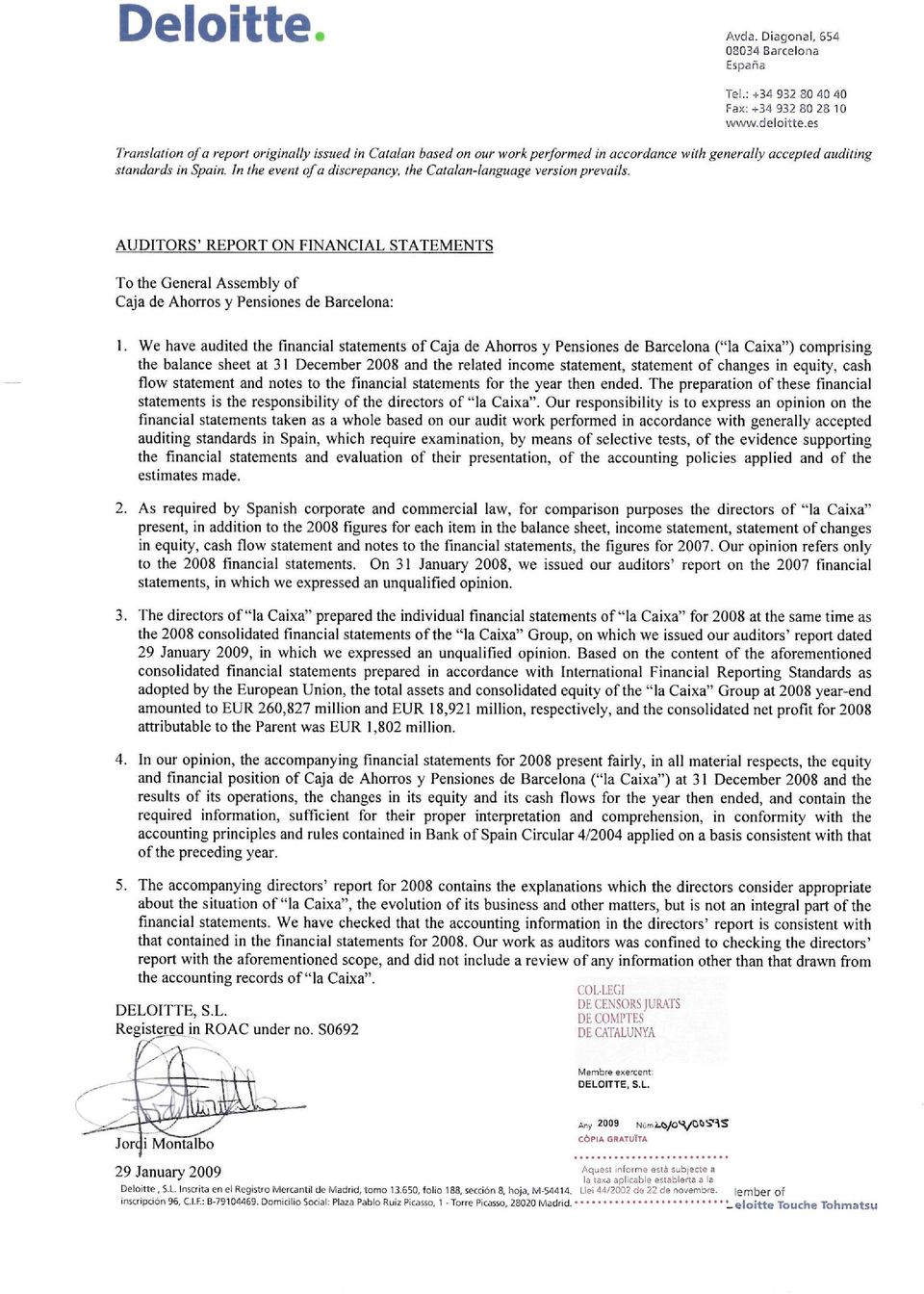
1 Translation for information purposes of an original document in Catalan STATUTORY DOCUMENTATION corresponding to the financial year 2008 Financial statements, Directors' Report and proposed distribution of profit of la Caixa that the Board of Directors, at a meeting held on 29 January 2009, resolved to submit to the General Assembly.

2 INDEX Auditors Report Financial statements of la Caixa for the financial year 2008 Directors' Report of la Caixa for the financial year 2008 Proposed distribution of profit of la Caixa for the financial year 2008

3
4 2008 FINANCIAL STATEMENTS OF la Caixa Balance sheets at 31 December 2008 and 2007, before allocation of profit Income statements for the financial years ended 31 December 2008 and 2007 Statements of changes in equity for the financial years ended 31 December 2008 and 2007 A) Statements of recognised income and expense B) Statement of total changes in equity Cash flow statements for the financial years ended 31 December 2008 and 2007 Notes to the financial statements for the financial year ended 31 December 2008

5 - 1 - BALANCE SHEETS at 31 December 2008 and 2007, before allocation of profit (Notes 1 to 40), in thousands of euros CAJA DE AHORROS Y PENSIONES DE BARCELONA "la Caixa" Assets (*) Cash and balances with central banks (Note 8) Financial assets held for trading (Note 9) Debt instruments Other equity instruments Trading derivatives Memorandum item: Loaned or advanced as collateral Other financial assets at fair value through profit or loss 0 0 Available-for-sale financial assets (Note 10) Debt instruments Other equity instruments Memorandum item: Loaned or advanced as collateral Loans and receivables (Note 11) Loans and advances to credit institutions Loans and advances to customers Debt instruments Memorandum item: Loaned or advanced as collateral Held-to-maturity investments 0 0 Adjustments to financial derivatives - macro-hedging Hedging derivatives (Note 12) Non-current assets held for sale (Note 13) Investments (Note 14) Associates Subsidiaries Insurance contracts linked to pensions (Note 19) Tangible assets (Note 15) Property, plant and equipment For own use Assigned to welfare projects (Note 21) Investment in property Intangible assets (Note 16) Goodwill Other intangible assets Tax assets Current Deferred (Note 20) Other assets (Note 17) Total Assets Memorandum items Contingent liabilities (Note 24) Contingent commitments (Note 24) (*) Presented for comparison purposes only

6 - 2 - BALANCE SHEETS at 31 December 2008 and 2007, before allocation of profit (Notes 1 to 40), in thousands of euros CAJA DE AHORROS Y PENSIONES DE BARCELONA "la Caixa" Liabilities and Equity (*) Liabilities Financial liabilities held for trading (Note 9) Trading derivatives Short positions Other financial liabilities at fair value through profit or loss 0 0 Financial liabilities at amortised cost (Note 18) Deposits from central banks Deposits from credit institutions Customer deposits Marketable debt securities Subordinated liabilities Other financial liabilities Adjustments to financial liabilities - macro-hedging ( ) Hedging derivatives (Note 12) Liabilities associated with non-current assets held for sale 0 0 Provisions (Note 19) Provisions for pensions and similar obligations Provisions for taxes Provisions for contingent liabilities and commitments Other provisions Tax liabilities Current Deferred (Note 20) Welfare fund (Note 21) Other liabilities (Note 17) Total Liabilities Equity Own funds Capital or endowment fund (Note 22) Issued Reserves (Note 22) Profit for the year Valuation adjustments (Note 23) (2.208) (5.396) Available-for-sale financial assets (7.639) (188) Cash flow hedges (5.072) Exchange differences 852 (136) Total Equity Total Liabilities and Equity (*) Presented for comparison purposes only

7 - 3 - INCOME STATEMENTS for the years ended 31 December 2008 and 2007 (Notes 1 to 40), in thousands of euros CAJA DE AHORROS Y PENSIONES DE BARCELONA "la Caixa" (*) Interest and similar income (N ote 2 6) Interest expense and similar charges (Note 27) ( ) ( ) INTEREST MARGIN Return on capital (Note 28) Fee and commission income (Note 29) Fee and commission expense (Note 29) ( ) ( ) Gains/losses on financial assets and liabilities (net) (Note 30) (41.706) Held for trading (76.425) Financial assets not assessed at fair value with profit/loss changes Other Exchange differences (net) Other operating income (Note 31) Other operating expenses (Note 32) (91.010) (84.615) GROSS MARGIN Administrative expenses ( ) ( ) Personnel expenses (Note 33) ( ) ( ) Other general administrative expenses (Note 34) ( ) ( ) Depreciation and amortisation ( ) ( ) Provisions (net) (Note 19) ( ) ( ) Impairment losses (net) (Note 35) ( ) ( ) Loans and receivables ( ) ( ) Other financial assets not assessed at fair value with profit/loss changes (215) (1.134) OPERATING INCOME Other impairment losses (net) (Note 36) (28.404) (19.293) Other assets (28.404) (19.293) Gains/losses on disposal of items not classified as non-current assets for sale (Note 37) Loss on business combinations 0 0 Gains/losses on disposal of non-current assets for sale not classified as discontinued operations (Note 38) (3.734) PROFIT BEFORE TAX Income tax (Note 20) (72.475) ( ) Compulsory assignation to social activities 0 0 PROFIT FROM ORDINARY ACTIVITIES Profit from discontinued operations (net) 0 0 PROFIT FOR THE YEAR (*) Presented for comparison purposes only

8 - 4 - STATEMENTS OF CHANGES IN EQUITY A) STATEMENTS OF RECOGNISED INCOME AND EXPENSES (*) for the years ended 31 December 2008 and 2007 (Notes 1 to 40), in thousands of euros CAJA DE AHORROS Y PENSIONES DE BARCELONA "la Caixa" (**) A. PROFIT FOR THE YEAR B. NET INCOME RECOGNISED DIRECTLY IN EQUITY (48.074) Available-for-sale financial assets (7.867) (27.618) Revaluation gains/losses (1.384) Amounts transferred to income statement (6.483) (68.421) Cash flow hedges (6.649) Revaluation gains/losses (4.005) Amounts transferred to income statement (2.644) Net investment hedges in foreign operations 0 0 Exchange differences (194) Revaluation gains/losses (194) Non-current assets held for sale 0 0 Actuarial gains/losses on pension plans 0 0 Other net income recognisd in equity 0 0 Income tax (3.247) (13.613) C. TOTAL NET INCOME RECOGNISED IN EQUITY (A+B) (*) See Note (**) Presented for comparison purposes only

9 - 5 - STATEMENTS OF CHANGES IN EQUITY B) SUMMARY OF TOTAL CHANGES IN EQUITY (*) for the years ended 31 December 2008 and 2007 (Notes 1 to 40), in thousands of euros CAJA DE AHORROS Y PENSIONES DE BARCELONA "la Caixa" Equity Own funds 2008 Provision Accumulated reserves (losses) Income for the year Total own funds Valuation adjustments Total equity Initial balance at (5.396) Adjustments following changes to accounting policies Error adjustments Adjusted initial balance (5.396) Total recognised net income Other variations in equity ( ) ( ) 0 ( ) Increases in provision Transfers between equity items ( ) Optional provision for welfare projects 0 0 ( ) ( ) 0 ( ) Other increases or reductions in equity Final balance at (2.208) (*) See Note Equity Own funds 2007 Provision Accumulated reserves (losses) Income for the year Total own funds Valuation adjustments Total equity Initial balance at Adjustments following changes to accounting policies Error adjustments Adjusted initial balance Total recognised net income (48.074) Other variations in equity ( ) ( ) 0 ( ) Increases in provision Transfers between equity items ( ) Optional provision for welfare projects 0 0 ( ) ( ) 0 ( ) Other increases or reductions in equity Final balance at (5.396) (*) See Note

10 - 6 - CASH FLOW STATEMENTS (*) for the years ended 31 December 2008 and 2007 (Notes 1 to 40), in thousands of euros CAJA DE AHORROS Y PENSIONES DE BARCELONA "la Caixa" (**) A. CASH FLOWS FROM OPERATING ACTIVITIES ( ) Profit for the year Adjustments to obtain cash flows from operating activities Amortisation/depreciation Other adjustments Net increase/decrease in operating assets Financial assets held for trading Other financial assets at fair value through profit or loss 0 0 Available-for-sale financial assets ( ) Loans and receivables ( ) Other equity instruments ( ) Net increase/decrease in operating liabilities Financial assets held for trading ( ) Other financial liabilities at fair value through profit or loss 0 0 Financial liabilities at amortised cost Other operating liabilities Receivables and payables - income tax B. CASH FLOWS FROM INVESTMENT ACTIVITIES ( ) ( ) Payables Tangible assets Intangible assets Shareholdings Other business units 0 0 Associated liabilities and non-current assets for sale Held-to-maturity investments 0 0 Other investment payables 0 0 Receivables Tangible assets Intangible assets 0 0 Shareholdings Other business units 0 0 Associated liabilities and non-current assets for sale Held-to-maturity investments 0 0 Other investment receivables 0 0 C. CASH FLOWS FROM FINANCING ACTIVITIES Payables Subordinated liabilities 0 0 Other financing payables Receivables Subordinated liabilities 0 0 Other financing receivables D. EFFECT OF EXCHANGE RATE VARIATIONS (2.313) (1.608) E. NET INCREASE/DECREASE IN CASH AND CASH EQUIVALENTS (A+B+C+D) (11.763) F. CASH AND CASH EQUIVALENTS AT BEGINNING OF YEAR G. CASH AND CASH EQUIVALENTS AT END OF YEAR Memorandum items COMPONENTS OF CASH AND CASH EQUIVALENTS AT END OF YEAR Cash Cash equivalent balances at central banks Other financial assets 0 0 Less: Overdrafts payable on demand 0 0 TOTAL CASH AND CASH EQUIVALENTS AT END OF YEAR (*) See Note 2.19 (**) Presented for comparison purposes only

11 - 7 - Notes to the financial statements of la Caixa for the financial year 2008 INDEX TO THE NOTES PAGE 1. Description of the Institution and other information Description of the Institution...10 Basis of presentation...10 Responsibility for the information and for the estimates made...11 Comparative information...12 Stakeholdings in credit entities...17 Minimum reserve ratio...17 Deposit Guarantee Fund...17 Events subsequent to closure Accounting principles and evaluation criteria used Financial instruments Derivatives and hedges Foreign currency transactions Recognition of income and expenses Transfers of financial assets Impairment of financial assets Offsetting Financial guarantees Leases Investment funds, pension funds and other assets under management Personnel expenses and post-employment benefit obligations Income tax Stakeholdings in subsidiary, jointly controlled and associated entities Tangible assets Intangible assets Non-current assets held for sale Provisions and contingent liabilities Statements of changes in equity Cash flow statements Welfare Projects Risk management Credit risk exposure Market risk exposure Liquidity risk exposure Operational risk Capital Management Distribution of profit Sale and purchase of capital stakeholdings in subsidiary, jointly controlled and associated entities Remuneration of key directors and executives... 71

12 Cash and balances with central banks Trading portfolios (assets and liabilities) Other equity instruments Available-for-sale financial assets Loans and receivables Loans and advances to credit entities Loans and advances to customers Debt instruments Impairment allowances Hedging derivatives (assets and liabilities) Non-current assets held for sale Stakeholdings Stakeholdings in associates Stakeholdings in jointly controlled entities Tangible assets Intangible assets Other assets and liabilities Financial liabilities at amortised cost Deposits from credit institutions Customer deposits Marketable debt securities Subordinated liabilities Other financial liabilities Provisions Tax situation Welfare Projects Endowment fund and reserves Valuation adjustments Contingent liabilities and commitments Other relevant information Third-party funds managed by the Group Asset securitisation Security deposits and investment services Financial assets derecognised due to impairment Geographical distribution of turnover Interest and similar income Interest expense and similar charges Income from equity instruments...137

13 Fees and Commissions Financial transaction results Other operating income Other operating expenses Personnel expenses Other general administrative expenses Impairment losses, financial assets (net) Impairment losses, other assets (net) Gains (losses) in the derecognition of assets not classified as non-current held for sale Gains (losses) on non-current assets held for sale not classified as discontinued transactions Transactions with related parties Other information requirements Customer ombudsman and customer care service Environmental information

14 Notes to the financial statements for the financial year ended 31 December 2008 CAJA DE AHORROS Y PENSIONES DE BARCELONA As required by current legislation governing the content of annual financial statements, these notes complete, extend and discuss the balance sheet, income statement, statement of changes in equity and cash flow statement, and with them form one single unit, in order to provide a fair and accurate reflection of the equity and financial position of la Caixa as at 31 December 2008, as well as the results of its operations, and the changes in equity and cash flows for said year-end. 1. Description of the Institution and other information Description of the Institution As a savings bank and in accordance with its By-Laws, Caja de Ahorros y Pensiones de Barcelona ( la Caixa ) is a private-law, non-profit financial institution providing beneficent welfare services, and is separate from any other company or entity. Its corporate object is to encourage all authorised forms of savings, to carry out social welfare projects and to invest the related funds in safe and profitable assets of general interest. As a credit entity, subject to the rules and regulations issued by the Spanish and European Union economic and monetary authorities, la Caixa conducts universal banking activities, providing substantial retail banking services. La Caixa is the parent of a group of subsidiaries that offer other products and services and with which it forms one single decision-making unit. Therefore, la Caixa is obliged to prepare, in addition to its own individual financial statements, a set of consolidated financial statements of the Caja de Ahorros y Pensiones de Barcelona Group ( the Group ) which also includes interests in joint ventures and investments in associates. Criteria CaixaCorp, SA is the subsidiary which manages and controls almost the entire equity securities portfolio of the la Caixa Group (see section on Investee portfolio Criteria CaixaCorp, SA, in these Notes). Basis of presentation These financial statements are hereby presented pursuant to the accounting standards and criteria and evaluation policies established in Bank of Spain Circular 4/2004 ( the Circular ). The Circular constitutes the adaptation of the International Financial Reporting Standards adopted by the European Union, in accordance with Regulation nº. 1606/2002 of the European Parliament and of the Council, of 19 July 2002, on the application of international accounting standards, to the Spanish credit entity sector. Circular 4/2004 was amended by Bank of Spain Circular 6/2008, of 26 November. The accounting criteria defined by Circular 4/2004 are detailed in Note 2. No criteria have been applied which might imply any difference in respect of the former or have a material impact. The financial statements were prepared on the basis of the accounting records kept by la Caixa.

15 These accompanying financial statements do not reflect any variations in equity which might result from applying global or proportional consolidation criteria or through the equity method, according to the stakeholdings in the capital of subsidiaries, jointly controlled entities and associates, pursuant to prevailing regulations governing the consolidating of credit entities. In addition, the financial statements of the la Caixa Group containing said variations, in accordance with the International Financial Reporting Standards (IFRSs) adopted by the European Union as at 31 December The table below shows the consolidated equity, the Group portion and the total of consolidated assets corresponding to the financial years 2008 and (Thousands of Euros) Equity Own funds Valuation adjustments Minority interests Group portion Total Assets The EUR 2,032 million drop in consolidated equity is basically due to two reasons: the first, an increase due to the distribution of profit for the financial year 2007 apportioned to the Group, after having contributed EUR 500 million to the la Caixa Welfare Projects, and, the second, a reduction due to changes in the fair value of financial assets classified under the available for sale asset portfolio. In addition, the reduction in the income of la Caixa between 2008 and 2007 of EUR 2,211 million, as well as the difference between the income of la Caixa and the consolidated income for the financial year 2007 was strongly influenced by the dividends distributed by Criteria CaixaCorp, SA in the financial year 2007 for the amount of EUR 2,544 million (see Note 28), eliminated from the consolidation procedure. Responsibility for the information and for the estimates made The financial statements of la Caixa for the financial year 2008 were prepared by the Board of Directors at a meeting held on 29 January These financial statements are pending approval by the company's General Assembly. Nevertheless, the la Caixa Board of Directors expects them to be approved with no amendments. The financial statements for the financial year 2007 were approved at the General Assembly held on 24 April 2008, and are presented solely for comparison purposes with the figures for The financial statements were prepared on the basis of judgements and estimates made by the senior executives of la Caixa, which relate, inter alia, to the fair value of certain assets and liabilities, impairment losses, the measurement of goodwill and intangible assets, actuarial assumptions for the measurement of post-employment benefit obligations and pre-retirement scheme liabilities. These estimates relate to both the amounts recognised in the balance sheet and in the income statement for Although these estimates were made on the basis of the most accurate information available, future events might make it necessary to change these estimates in coming years. Changes in accounting estimates would be applied prospectively, recognising the effects of the change in estimates in the balance sheet and income statement, in accordance with Regulation Nineteen of Circular 4/2004.

16 Comparative information Bank of Spain Circular 6/2008, of 26 November, amended Bank of Spain Circular 4/2004, of 22 November, and introduced significant changes into the structure of the balance sheet, income statement and cash flow statement, and divided the statement of changes in equity into two. The presentation of certain entries and margins is different to that presented in the financial statements of la Caixa for the financial year 2007, which were prepared in accordance with the criteria established by Circular 4/2004, prevailing at that time. These changes have no effect on the equity or on attributable profit, but in accordance with Regulation 6 de la Bank of Spain Circular 4/2004, of 22 November, the financial statements for the financial year 2007 have been amended, exclusively for comparison purposes with those for the financial year There follows the reconciliation between the balance sheet as at 31 December 2007, presented by la Caixa in its financial statements for that financial year, and the balance sheet presented in these financial statements prepared in accordance with the standards required by Bank of Spain Circular 6/2008, of 26 November.

17 Balance sheet at 31 December 2007 (Thousands of Euros) Balances Balances acc. Cir. 4/2004 Reclassifications acc. Cir. 6/2008 Assets Cash and deposits with central banks Financial assets held for trading Other financial assets at fair value through profit or loss 0 Available-for-sale financial assets Loans and receivables Adjustments to financial assets by macro-hedging Hedging derivatives (c) Non-current assets held for sale Ownership interests Associates Subsidiaries Insurance contracts linked to pensions Tangible assets Property, plant and equipment (*) (a) Property investment For own use ( ) (a) 0 Other leased assets 0 Assigned to welfare projects ( ) (a) 0 Intangible assets Goodwill 0 Other intangibles Tax assets Other assets (*) (b) Prepayments ( ) (b) 0 Other asssets ( ) (b) 0 Total Assets Liabilities and Equity Liabilities Financial liabilities held for trading Other financial liabilities at fair value through profit or loss 0 Financial liabilities at amortised cost (74.872) (c) Adjustments to financial liabilities by macro-hedging ( ) ( ) Hedging derivatives (c) Liabilities associated with non-current assets held for sale 0 0 Provisions Tax liabilities Welfare fund (*) (d) Other liabilities (*) (d) Accruals ( ) (d) 0 Other liabilities ( ) (d) 0 Capital with the nature of financial liabilities 0 Total Liabilities Equity Own funds Capital or endowment fund Reserves Profit for the year Valuation adjustments (5.396) (5.396) Available-for-sale financial assets (188) (188) Cash flow hedges (5.072) (5.072) Exchange differences (136) (136) Total Equity Total Liabilities and Equity Memorandum item Contingent liabilities Contingent commitments (*) Headings exclusive to Circular 6/2008 Explanatory notes concerning the "Reclassifications" column For each item on the balance sheet, this column shows the reclassifications implemented between the Bank of Spain's Circular 4/2004 used to draw up the "la Caixa" individual annual accounts for 2007 and the Circular 6/2008 model used for the 2008 annual accounts. The main differences between the standard balance sheet of Bank of Spain Circular 6/2008, of 26 November, and that contained in the financial statements of la Caixa for the financial year 2007, prepared in accordance with Bank of Spain Circular 4/2004, are the following:

18 The item Tangible assets Fixed assets groups together the items Tangible assets Own use, Tangible assets Assets leased out under an operating lease and Tangible assets assigned to Welfare Projects, which in the balance sheet presented in the financial statements for the financial year 2007 appeared separately. The item Remaining assets groups together the items Accruals and Other assets, which were presented separately in the financial statements for the financial year In the new standard presentation model, trading and hedging derivatives classified under the items Trading portfolio and Hedging derivatives, respectively, both for the assets and liabilities of the balance sheet, include embedded derivatives which have been segregated from the host contract. The item Welfare Project Fund appears, which in the financial statements for the financial year 2007 formed part of the balance of the item Other assets. The current item Other liabilities groups together the items Accruals and Other liabilities of the financial statements presented in the financial year There follows the reconciliation between the income statement for the financial year 2007, presented by la Caixa in its financial statements for such period, and the income statement presented in these financial statements prepared in accordance with the standards required by Bank of Spain Circular 6/2008, of 26 November.

19 Income statement at 31 December 2007 (Thousands of Euros) Balances Balances acc. Cir. 4/2004 Reclassifications acc. Cir. 6/2008 Interest and similar income Interest expense and similar charges ( ) ( ) Return on capital (**) ( ) (a) 0 INTERMEDIATE MARGIN / INTEREST MARGIN (*) ( ) (1) Return on capital (**) (a) Fee and commission income Fee and commission expense ( ) ( ) Gains/losses on financial assets and liabilities (net) (41.706) 0 (41.706) Held for trading (76.425) (76.425) Available-for-sale financial assets 311 (311) (b) 0 Other financial assets at fair value with profit/loss changes (*) 0 Financial assets not assessed at fair value with profit/loss changes (*) 311 (b) 311 Other Exchange differences (net) Other operating income (**) (c) Other operating expenses (**) (84.615) (c) (84.615) ORDINARY MARGIN / GROSS MARGIN (*) (2) Other operating income (**) (96.461) (c) 0 Administrative expenses ( ) (20.575) ( ) Personnel expenses ( ) (20.575) (c) ( ) Other general administrative expenses ( ) ( ) Depreciation and amortisation ( ) ( ) Other operating expenses (**) (56.702) (c) 0 Provisions (net) (**) ( ) (d) ( ) Impairment losses (net) (*) ( ) (e) ( ) OPERATING MARGIN / OPERATING INCOME (*) ( ) (3) Other impairment losses (net) (*) (19.293) (f) (19.293) Impairment losses (net) ( ) Available-for-sale financial assets (**) (1.134) (e) 0 Loans and receivables (**) ( ) (e) 0 Non-current assets held for sale 77 (77) (g) 0 Ownership interests (12.153) (f) 0 Tangible assets (7.140) (f) 0 Goodwill 0 Other assets 0 Provisions (net) (**) ( ) (d) 0 Other gains (67.823) 0 Gains on sales of tangibles (***) (7.576) (h) 0 Gains on sales of holdings (39.342) (h) 0 Other items (**) (20.905) (c) 0 Other losses (35.823) Losses on sales of tangibles (112) 112 (h) 0 Losses on sales of holdings 0 Other items (**) (35.711) (c) 0 Gains/losses on disposal of assets not classifid as non-current assets held for sale (*) (h) Negative difference on business combinations (*) 0 Gains/losses on non-current assets held for sale not classified as discontinued operations (*) (g)+(h) PROFIT BEFORE TAX Profit tax ( ) 0 ( ) Compulsory allocation to welfare fund PROFIT FOR THE YEAR FROM ONGOING OPERATIONS Income from discontinued operations (net) 0 PROFIT FOR THE YEAR (*) Headings exclusive to Circular 6/2008. (**) Headings presented on Circular 6/2008 in a different margin to Circular 4/2004. (***) Here the sum of EUR 4,602 thousand corresponds to gains on the sale of assets from foreclosures, and is transferred to "Gains/losses on non-current assets held for sale not classified as discontinued Explanatory notes concerning the "Reclassifications" column For each item on the income statement, this column shows the reclassifications implemented between the Bank of Spain's Circular 4/2004 used to draw up the "la Caixa" individual annual accounts for 2007 and the Circular 6/2008 model used for the 2008 annual accounts. Since this is merely a change to presentation format, income for the year has not changed, although changes have been made to a considerable number of items on the income statement and to the breakdown and nomenclature of the various margins. Changes to each item on the income statement are indicated by a letter, showing offsetting on the statement. Reconciliation of margin variations in accordance with the Ref Amount Item (1) ( ) Variation between Intermediate Margin (Circular 4/2004) and Interest Margin (Circular 6/2008) Dividends on Circular 6/2008 are shown in the Gross Margin (2) Variation between Ordinary Margin (Circular 4/2004) and Gross Margin (Circular 6/2008) Other operating income and other operating expenses (Circular 4/2004, in the Operating Margin) Other gains / Other losses (other items) does not include expenses reclassified by nature (Circular 4/2204, not included in Operating Margin) (3) ( ) Variation between Operating Margin (Circular 4/2004) and Operating Income (Circular 6/2008) (14.806) Other gains / Other losses (other items) (Circular 4/2004, not included in Operating Margin) ( ) Provisions (Circular 4/2004, not included in Operating Margin) ( ) Impairment losses (Circular 4/2004, not included in Operating Margin) The main differences between the standard income statement model of Bank of Spain Circular 6/2008, of 26 November, and that included in the financial statements of la Caixa for the financial year 2007, prepared in accordance with Bank of Spain Circular 4/2004, are the following: It does not include the net interest income which appeared in the financial statements for the financial year 2007, replacing this with Interest Margin. This margin arises from the difference

20 between the item Interest and similar income and the item Interest expense and similar charges and therefore does not include the item Income from equity instruments. The item Ordinary Margin disappears, to be replaced by Gross Margin. The new margin incorporates the items Other operating income and Other operating expenses which were not previously included in the Ordinary Margin. In addition, the results generated by the sale of strategic stakeholdings classified as available-for-sale financial assets have been reclassified into the item Gains/(losses) of non-current assets held for sale not classified as discontinued transactions. The item Impairment of assets (net) is divided into two: Impairment of financial assets (net), including the impairment of loans and discounts and available for sale assets, and Impairment of remaining assets (net), including the impairment of stakeholdings and remaining non-financial assets. The Operating Margin is eliminated, to make way for Operating activity result. The basic difference is that the new margin includes the impairment of financial assets, provision allowances and other gains and losses, which are classified according to their nature. This margin does not include other gains and losses obtained from the sale of stakeholdings or tangible assets. The item Provisions, which did not form part of the Operating Margin, now appears as Operating activity result. The item Gains/(losses) in the derecognition of assets not classified as non-current assets held for sale is added, containing the income obtained from the sale of stakeholdings and tangible assets. The item Gains/(losses) of non-current assets held for sale not classified as discontinued transactions is added, basically containing the income obtained from the sale of strategic stakeholdings classified as available-for-sale financial assets. It also contains any profit through sales and impairment of foreclosed assets.

21 Investee portfolio On 7 June 2007, the General Ordinary Meeting of la Caixa approved the general design for the flotation of the subsidiary Criteria CaixaCorp, which manages and controls the investee portfolio of the la Caixa Group. In order to outline the scope of the Criteria CaixaCorp, SA companies to carry out the business strategy described in the preceding paragraph, the la Caixa Group reorganised its investee portfolio prior to the submission of the Initial Public Offering of Shares in Criteria CaixaCorp, SA ( the offering or the IPO ). In addition, also prior to the submission of the offer, Criteria CaixaCorp, SA distributed extraordinary dividends to la Caixa, which was its sole shareholder (see Notes 6 and 28). The shares of Criteria CaixaCorp, SA finally became listed on the Spanish stock exchange on 10 October The la Caixa Group s equity rose by EUR 3,848 million as a result of the IPO. This stake was 78.03% as at 31 December As at 31 December 2008, the stake of la Caixa in the capital of Criteria CaixaCorp, SA was 79.45% (see Note 6). In order to enhance the transparency of the relationship between Criteria CaixaCorp, SA and its main shareholder, la Caixa, on 19 September 2007 both entities signed an Internal Relationship Protocol which is available on the websites of Criteria CaixaCorp, SA ( and the CNMV ( The aforementioned Protocol follows the recommendations of the Unified Code on Good Governance, of 22 May 2006, and its purpose is to regulate the relationship between la Caixa, Criteria CaixaCorp, SA and all the other la Caixa Group subsidiaries. Stakeholdings in credit entities In accordance with the provisions of Royal Decree 1245/1995, on the publicising of stakeholdings, la Caixa holds no direct stake equal to or greater than 5% of the capital or voting rights of any credit entities other than the stakeholdings in subsidiaries set forth in Annex 1. As at 31 December 2008 and 2007, there was no Spanish or foreign credit entity, or group comprising a credit entity, holding a stake equal to or greater than 5% of the capital or voting rights in any of the credit entities which are subsidiaries of the la Caixa Group. Minimum reserve ratio As at 31 December 2008 and 2007, as well as throughout the financial years 2008 and 2007, la Caixa complied with the minimum ratios required by applicable Spanish regulations. Deposit Guarantee Fund La Caixa makes annual contributions to the Savings Banks Deposit Guarantee Fund, the institution responsible for guaranteeing the deposits in cash and securities placed with savings banks. In 2008 and 2007, the contributions were 0.4 per thousand of the calculation basis, which consisted of the guaranteed deposits plus 5% of the market value of the guaranteed security deposits. The amounts accrued are included under Other operating expenses in the income statement (see Note 32). Events subsequent to closure Between 31 December 2008 and the date on which these financial statements were prepared, no event took place which might affect them significantly.
22 Accounting principles and evaluation criteria used The following accounting principles and evaluation criteria were used for preparing financial statements for the financial year 2008: 2.1. Financial instruments Initial recognition Financial instruments are initially recognised in the balance sheet when the Institution becomes a party to the contract giving rise to them, under the terms and conditions thereof. Loans and deposits, i.e. the most common financial assets and liabilities, are recognised on the date from which the legal right to receive or the legal obligation to pay cash, respectively, arises. Financial derivatives are generally recognised on the trade date. The sale and purchase of financial assets arranged through conventional contracts which may not be settled net are recognised from the date on which the risks and rewards, rights and duties inherent in ownership are attributable to the purchaser. Based on the type of financial asset purchased or sold, that date may be the trade date or the settlement or delivery date. In particular, transactions performed in the spot currency market and transactions performed on equity instruments traded on Spanish secondary securities markets are recognised on the settlement date, and transactions performed using financial instruments traded on Spanish secondary securities markets are recognised on the trade date. Derecognition of financial instruments A financial asset is fully or partially derecognised when the contractual rights to the cash flows from the financial asset expire or when the financial asset is transferred. The transfer of the asset must result in a transfer of substantially all of the risks and rewards of the asset or a transfer of control thereof, if such risks and rewards have been retained (see Note 2.5). A financial liability is fully or partially derecognised when the related obligations are extinguished or when it is acquired by the Institution. Fair value and amortised cost Upon initial recognition, all financial instruments are recognised at fair value which, unless there is evidence to the contrary, is the transaction price. Thereafter, at a specified date, the fair value of a financial instrument is the amount for which it could be delivered, if an asset, or settled, if a liability, in a transaction carried out between interested, informed parties on an arm s-length basis. Specifically, financial instruments are classified into one of the following categories depending on the method used for obtaining the fair value: Level 1: from prices quoted on securities markets. Level 2: through valuation techniques in which the hypotheses taken into account correspond to directly or indirectly observable market information or prices listed on securities markets for similar instruments. Level 3: through valuation techniques in which any of the main hypotheses are not supported by information directly observable on the market.
23 The objective benchmark for most financial instruments for determining their fair value are securities market listings (Level 1), and therefore, in order to determine their fair value, they use the price that would be paid for them on an organised, transparent and deep market ( quoted price or market price ). For those instruments classified under Level 2 for which no market price exists, the recent transaction price of similar instruments is used to calculate their fair value or, should none exist, valuation standards which have been sufficiently verified by the international finance community, while taking into account the specifics of the instrument to be valued and, in particular, the various types of risks associated with the instrument. In this way, the fair value of OTC derivatives and financial instruments traded on organised markets lacking depth or transparency is determined using methods recognised by the financial markets, namely net present value (NPV) or option pricing models based on parameters which are observable on the market. So as to obtain the fair value of a limited number of instruments, classified under Level 3, for which no directly observable information on the market exists for their valuation, alternative techniques are used, including the requesting of a price from the marketing entity or the use of market parameter with a risk profile which can easily be related to the instrument object of valuation. Nevertheless, certain financial assets and liabilities are recognised at amortised cost. This method is used for financial assets included under Loans and receivables and Held-to-maturity investments and for financial liabilities classified under Financial liabilities at amortised cost. Amortised cost is understood to be the acquisition cost of a financial asset or liability plus or minus, as appropriate, the principal repayments and the portion systematically recognised in the income statement, using the effective interest method, of the difference between the initial cost and the maturity value of such financial instruments. In the case of financial assets, amortised cost furthermore includes any reductions due to impairment. The effective interest rate is the discount rate that exactly matches the initial value of a financial instrument to all its estimated cash flows of all kinds through its remaining life. For fixed rate financial instruments, the effective interest rate coincides with the contractual interest rate established on the acquisition date, adjusted, where applicable, for the premiums and initial discounts and the fees that, because of their nature, can be equated with a rate of interest, and transaction costs. In the case of floating rate financial instruments, the effective interest rate coincides with the rate of return prevailing for all items up to the first review of the interest reference rate. As indicated above, certain assets and liabilities in the balance sheet are recognised at fair value, such as those included in the trading or available for sale portfolios. Other assets and liabilities, such as those included under Loans and receivables or Financial liabilities at amortised cost, are recognised at amortised cost as defined in this Note. Most of the remaining assets and some liabilities are floating rate instruments subject to the applicable annual interest rate review; therefore, the fair value of these assets resulting solely from fluctuations in market interest rates will not differ significantly from the value recognised in the balance sheet. All other assets and liabilities are fixed rate instruments; a substantial proportion of these have a term to maturity of less than one year and, therefore, as in the preceding case, the fair value of these assets and liabilities resulting solely from market interest rate fluctuations does not differ significantly from the value recognised in the balance sheet. The amounts of assets and liabilities that are not included in one of the preceding paragraphs, i.e. unhedged fixed rate instruments with a term to maturity at over one year, are barely relevant in relation
24 to the total balance of each heading and, therefore, the Institution considers that a change in their fair value, resulting solely from market interest rate fluctuations, will not have a significant effect on its equity position. Notwithstanding the foregoing, part of those assets and liabilities are included in some of the macro- or fair value micro-hedges managed by la Caixa and, therefore, appear on the balance sheet at their fair value corresponding to the risk covered. The fair value and the fair value valuation method used for the assets classified under Tangible assets are described in Note 15. Classification and valuation of financial assets and liabilities The financial instruments are classified into one of the following categories: Trading portfolio, Other financial assets and liabilities at fair value through profit and loss, Loans and receivables, Held-to-maturity investments, Available-for-sale financial assets and Financial liabilities at amortised cost. Any other assets and liabilities not entering the foregoing categories are recorded under one of the following balance sheet headings: Cash and balances with central banks, Hedging derivatives and Stakeholdings. The financial instruments appear in the balance sheet in accordance with the following categories: Trading portfolio: This heading mainly comprises those financial assets or liabilities acquired/issued for the purpose of realising them in the short term or those which are part of a portfolio of jointlymanaged identified financial instruments, for which there is evidence of a recent actual pattern of shortterm profit-making. The trading portfolio also covers short positions arising from sales of assets purchased temporarily under agreements of non-optional reverse repurchase or of borrowed securities. Lastly, these headings also include asset and liability derivatives not complying with the definition of a financial guarantee contract and not designated as hedging instruments. The financial instruments classified under trading portfolio are initially valued at their fair value and any subsequent variations to this which might take place are recorded with a balancing entry under the item Gains/losses on financial assets and liabilities (net) trading portfolio in the income statement, except for the changes in the fair value due to accrued returns on financial instruments other than trading derivatives, which are recognised under Interest and similar income, Interest expense and similar charges or Income from equity instruments, depending on their nature. Other financial assets and liabilities at fair value through profit or loss: this category includes financial instruments designated by the Institution in its initial recognition, such as hybrid financial assets or liabilities which must be valued entirely at fair value, as well as financial assets managed jointly with "Insurance contract liabilities valued at fair value, or with financial derivatives whose purpose is to mitigate the exposure to variations in fair value, or managed jointly with financial liabilities and derivatives whose purpose is to mitigate the overall exposure to interest rate risk and, in general, all financial instruments which, falling under this category, are eliminated or have any incoherencies in their recognition or valuation significantly reduced (accounting asymmetry). The financial instruments under this category must be subject at all times to an integrated and consistent system for the measurement, management and control of risks and returns permitting verification that risk has effectively been mitigated. Financial liabilities at fair value through profit or loss include life insurance policies linked to investment funds when the related financial assets are also valued at fair value through profit or loss.
25 These financial assets and liabilities at fair value through profit or loss are valued initially and subsequently using the same criteria as for the trading portfolio. Held-to-maturity investments: this category includes debt instruments traded on an active market with fixed maturity and with fixed or determinable cash flows that the Institution has the intention of holding, and ability to hold, to maturity. These instruments are initially valued at fair value adjusted by the transaction costs directly attributable to the acquisition of the financial asset, which are recognised in the income statement by the effective interest method. They are subsequently measured at amortised cost, calculated using the method described above in this Note. The income generated by these securities is recognised under Interest and similar income in the income statement and calculated using the effective interest method. Exchange differences on securities denominated in currencies other than the euro are recognised as described in Note 2.3. Any impairment losses on these securities are recognised as indicated in Note 2.6. At the close of the financial year, no instrument was classified under held-to-maturity investments. Loans and receivables: this heading includes financing granted to third parties through ordinary credit and lending activities carried out by the Institution, and receivables from purchasers of goods and users of its services and for debt instruments not quoted or quoted on markets that are not sufficiently active. These assets are initially valued at fair value adjusted by the amount of the fees and commissions and transaction costs directly attributable to the acquisition of the financial asset, which are recognised in the income statement by the effective interest method until maturity. They are subsequently measured at amortised cost, calculated using the method described above in this note. Assets acquired at a discount are measured at the cash amount paid. The difference between their repayment value and the cash amount paid is recognised as finance income in the income statement during the remaining term to maturity. The income earned on these transactions is recognised under Interest and similar income in the income statement and calculated using the effective interest method. Exchange differences on securities denominated in currencies other than the euro are recognised as described in Note 2.3. Any impairment losses on these securities are recognised as indicated in Note 2.6. Lastly, changes in the fair value of the financial assets hedged in fair value hedges are measured as described in Note 2.2. Available-for-sale financial assets: this balance sheet heading includes debt instruments and financial instruments not included under the other categories. Debt instruments are always measured at fair value adjusted by the transaction costs directly attributable to the acquisition of the financial asset, which are recognised in the income statement by the effective interest method until maturity. Equity instruments whose fair value cannot be determined in a sufficiently objective manner are measured at cost, net of any impairment loss. Changes in the fair value of financial assets from the time of acquisition are recognised, net of the tax effect, with a balancing entry under Valuation adjustments Available-for-sale financial assets until the financial asset is derecognised. The balance recognised in equity is then taken to Gains/Losses on financial assets and liabilities (net) in the income statement, except in the case of equity instruments deemed to be strategic investments, which are taken to Gains/(losses) of non-current assets held for sale not classified as discontinued transactions. Interest or dividend income on securities is recognised under Interest and similar income (calculated using the effective interest method) and Income from equity instruments in the income statement, respectively. Any impairment losses on these securities are recognised as indicated in Note 2.6. Lastly,
26 changes in the fair value of the financial assets hedged in fair value hedges are measured as described in Note 2.2. Financial liabilities at amortised cost: this heading includes financial liabilities not classified under the trading portfolio or as other financial liabilities at fair value through profit or loss. The balances recognised in this item, irrespective of their instrumentation or maturity, arise from the ordinary deposit-taking activities of credit entities. These liabilities are initially valued at fair value adjusted by the amount of the transaction costs directly attributable to the issue of the financial liability, which are recognised in the income statement by the effective interest method until maturity. They are subsequently measured at amortised cost, calculated using the method described above in this Note. Income arising from financial liabilities at amortised cost is recognised under Interest expense and similar charges in the income statement. Exchange differences on liabilities denominated in currencies other than the euro are recognised as described in Note 2.3. Changes in the fair value of the financial liabilities hedged in fair value hedges are measured as described in Note 2.2. Reclassification among portfolios Except for any exceptional circumstances, financial assets and liabilities may not be reclassified within or outside the category of fair value through profit and loss. Thus, non-derivative financial assets may only be reclassified outside the trading portfolio if, apart from the purpose for which they were acquired having changed, unusual and exceptional circumstances have occurred requiring this or, in the case of assets complying with the definition of loans and discounts, there exists the intention and financial capacity to maintain them for the foreseeable future or until maturity. Such reclassification will be made at the fair value as on the day of reclassification without reverting results and considering such value as the cost or amortised cost Derivatives and hedges La Caixa uses financial derivatives as a tool for the management of financial risks (see Note 3). When these transactions comply with certain requirements, they are deemed to be hedges. When the Institution designates a transaction as a hedge, it does so from inception of the transaction or of the instrument included in the hedge, and the transaction is documented as appropriate in accordance with current legislation. The hedge accounting documentation duly identifies the hedged instrument or instruments and the hedging instrument or instruments, the nature of the risk to be hedged, and the criteria or methods used by the Institution to assess the effectiveness of the hedge over its entire life, taking into account the risk sought to be hedged. La Caixa considers highly effective coverage transactions to be hedges. A hedge is considered to be highly effective if, during its expected life, the changes in fair value or in the cash flows that are attributed to the hedged risk are almost entirely offset by changes in the fair value or in the cash flows, as appropriate, of the hedging instrument or instruments.to measure the effectiveness of hedges, the Institution analyses whether, from the beginning to the end of the term defined for the hedge, it may prospectively be expected that the changes in fair value or in the cash flows of the hedged item that are attributable to the hedged risk will be almost entirely offset by changes in the fair value or in the cash flows, as appropriate, of the hedging instrument or instruments and, retrospectively, that the results of the hedge will be within a range of 80% to 125% of the results of the hedged item.
27 Hedging transactions performed by la Caixa are classified into two categories: Fair value hedges, which hedge the exposure to changes in the fair value of financial assets and liabilities or of unrecognised firm commitments, or of an identified portion of such assets, liabilities or firm commitments attributable to a particular risk, provided that they affect the income statement. Cash flow hedges, which hedge the changes in the cash flows that are attributed to a particular risk associated with a financial asset or liability or with a highly probable forecast transaction, provided that it may affect the income statement. In the specific case of financial instruments designated as hedged items or qualifying for hedge accounting, valuation differences are recorded using the following criteria: In fair value hedges, the gains or losses arising from both the hedging instruments and the hedged items attributable to the type of risk being hedged are recognised directly in the income statement. In cash flow hedges, the differences in valuation arising from the part of the hedging instruments qualifying as an effective hedge are recognised temporarily under the equity item Valuation adjustments - Cash flow hedges and they are not recorded as income until the gains or losses on the hedged item are recorded in the income statement or until the date of maturity of the hedged item, or in certain situations in which hedge accounting is discontinued. The result of the derivative is recorded under the same item of the income statement as that of the gains or losses on the hedged item. The financial instruments hedged in this type of hedging transaction are recorded using the methods described in Note 2.1, without any changes due to the fact that they are considered to be hedged instruments. The differences in valuation of the hedging instrument corresponding to the ineffective hedge are recorded directly under the heading Gains/losses on financial assets and liabilities (net) in the income statement. The Institution discontinues hedge accounting when the hedging instrument expires or is sold, when the hedge no longer meets the requirements for hedge accounting or, lastly, when the transaction is no longer deemed to be a hedge. In addition la Caixa hedges against the interest rate risk of a certain amount of interest rate-sensitive financial assets or liabilities which are part of the overall portfolio of instruments but are not identified as specific instruments. These hedges, which are known as macro-hedges, can be fair value hedges or cash flow hedges (see Note 3.2.2). In fair value macro-hedges, the differences in valuation arising from the hedged items, attributable to interest rate risk, are recognised directly in the income statement with a balancing entry under Adjustments in financial assets through macro-hedges or Adjustments in financial liabilities through macro-hedges depending on the nature of the item hedged. In cash flow macro-hedges, the hedged items are recognised using the methods described in Note 2.1, without any changes due to the fact that they are considered to be hedged instruments. Derivatives embedded in other financial instruments or in other contracts are recorded separately as derivatives when their risks and characteristics are not closely related to those of the instrument or host contract, providing a reliable fair value can be conferred on the embedded derivative considered separately.
28 The recognition of profit from the distribution of derivative products sold to customers is not carried out upon inception but rather is accrued on a straight-line base through the maturity of the transaction Foreign currency transactions As at 31 December 2008 and 2007, the functional and presentation currency of la Caixa was the euro. Consequently, all balances and transactions denominated in currencies other than the euro are deemed to be denominated in foreign currency. Functional currency is taken to be the currency of the main economic environment in which the Institution operates. The functional currency may be different from the euro depending on the country in which the branches are based. The presentation currency is the currency used by the Institution to prepare its financial statements. Foreign currency assets and liabilities, including foreign currency purchase and sale contracts outstanding considered to be hedges, are converted into euros using the average exchange rates on the spot currency market prevailing at the closures of the financial years 2008 and 2007, except for nonmonetary items measured at historical cost, which are converted into euros at the exchange rate in force as at the date of acquisition, or non-monetary items measured at fair value, which are converted into euros at the exchange rate in force on the date when the fair value was determined. Forward foreign currency purchase and sale contracts outstanding not considered to be hedges are valued at the year-end exchange rates on the forward currency market. The exchange rates used by the Institution in converting the foreign currency balances to euros were those published by the European Central Bank as at 31 December 2008 and The exchange differences arising from the conversion of foreign currency balances to the functional currency of the consolidated entities are generally recognised under Exchange differences (net) in the income statement. However, exchange differences arising from changes in the value of non-monetary items are recognised in equity under Valuation adjustments exchange differences in the balance sheet until they are realised, whereas exchange differences arising from financial instruments at fair value through profit or loss are recognised in the income statement without a distinction being made between these and other variations in fair value. In order to integrate the individual financial statements of the foreign branches whose currency is other than the euro into the Institution s financial statements, the following criteria are applied: conversion of the financial statements of the foreign branches into the Institution s presentation currency; such conversion being made at the exchange rates used by the Institution in converting foreign currency balances, except for income and expenses, which are converted at the end-of-month exchange rates, and recognition of the resulting exchange difference under the equity item Valuation adjustments - exchange differences in the balance sheet, until the related item is derecognised, this being recorded in the income statement Recognition of income and expenses The most significant criteria used by la Caixa to recognise its income and expenses are summarised as follows:
29 Interest income, interest expenses, dividends and similar items Interest income, interest expenses and similar items are generally recognised on an accrual basis using the effective interest method, regardless of the resulting monetary or financial flow. Interest accrued on doubtful loans, including loans exposed to country risk, is credited to income upon collection, which is an exception to the general rule. Dividends received from other companies are recognised as income when the Institution becomes entitled to receive them, which is when the dividend is officially declared by the company's relevant body. Fees and commissions Fee and commission income and expenses are recognised in the income statement using criteria that vary according to their nature. Financial fees and commissions, which include loan and credit origination fees, are part of the effective income or cost of a financial transaction and are recognised under the same heading as finance income or costs, namely Interest and similar income and Interest expense and similar charges. These fees and commission are collected in advance and recognised in the income statement over the life of the transaction, except when they offset direct costs related thereto. Fees and commissions offsetting related direct costs, which are taken to be those which would not have arisen if the transaction had not been arranged, are recognised under Other operating income as the asset transaction takes place. These fees and commissions do not individually exceed 0.4% of the principal of the financial instrument, subject to a maximum limit of EUR 400; any excess, where applicable, is recognised in the income statement over the lifespan of the transaction. If they do not exceed EUR 90, they are recognised immediately in the income statement. In any event, related direct costs that are individually identified can be recognised directly in the income statement upon inception of the transaction, provided that they do not exceed the fee collected (see Notes 29 and 31). Non-financial fees and commissions arising from the provision of services are recognised under Fee and commission income and Fee and commission expense over the lifespan of the service, except for those relating to services provided in one single act, which are accrued when the single act is carried out. Non-finance income and expenses These are recognised for accounting purposes on an accrual basis. Deferred collections and payments These are recognised for accounting purposes at the amount resulting from discounting the expected cash flows to net present value at market rates Transfers of financial assets In accordance with the Circular, no loans and credits portfolio assigned without substantially all risks and rewards associated with the assigned financial assets being assigned may be derecognised in the balance sheet, but rather implies the recognising of a financial liability associated with the financial asset assigned. This is the case of the loans and receivables securitised by la Caixa, under the terms of the assignment agreements. However, in accordance with the Transitional Provision of the Circular, the above accounting treatment is only applicable to transactions carried out on or after 1 January 2004, but not to those taking place prior to that date. Accordingly, as at 31 December 2008 and 2007, the financial statements did not include in the balance sheet the assets derecognised pursuant to the repealed accounting
30 legislation, which assets, pursuant to the criteria of the new Circular, should have been kept on the balance sheet. The financial instruments related to the financing of the securitisation funds constituted subsequent to 1 January 2004, such as, for example, the securitisation bonds acquired by the Institution or loans granted, are recorded under balance sheet liabilities, offsetting the item Financial liabilities at amortised cost Customer deposits. Note 25.2 includes the most significant details of the securitisations of assets performed up to the closure of the financial year 2008 irrespective of whether or not they led to the derecognition of assets from the balance sheet Impairment of financial assets A financial asset is considered to be impaired when there is objective evidence of an adverse effect on the future cash flows that were estimated at the transaction date, or when its book value may not be fully recovered. The reduction of the fair value to below acquisition cost does not in itself constitute evidence of impairment. As a general rule, the book value of impaired financial instruments is adjusted with a charge to the income statement for the period in which the impairment becomes evident, and the reversal, if any, of previously recognised impairment losses is recognised in the income statement for the period in which the impairment is reversed or reduced. When the recovery of any recognised amount is considered unlikely, the amount is written off, without prejudice to any actions that the Institution may initiate to seek collection until its rights are exhausted due to expiry of the statute-of-limitations period, waiver or any other cause. Debt instruments carried at amortised cost In general, the amount of an impairment loss incurred on a debt instrument carried at amortised cost is equal to the positive difference between its book value and the present value of its projected future cash flows. Specifically as regards impairment losses resulting from the materialisation of the insolvency risk of the obligors (credit risk), a debt instrument is impaired due to insolvency when there is evidence of a deterioration of the obligor s ability to pay, which becomes evident either because it is in arrears or for other reasons, or upon materialisation of country-risk, which is considered to be that risk which, due to circumstances other than normal commercial risk, is associated with debtors resident in a given country. Impairment losses on these assets are assessed as follows: Individually: for all significant debt instruments and for instruments which, although not material, are not susceptible to being classified in homogeneous groups of instruments with similar risk characteristics: instrument type, debtor s industry and geographical location, type of guarantee, and seniority of amounts due, inter alia. Collectively: the Institution classifies transactions on the basis of the nature of the obligors, the conditions of the countries in which they reside, transaction status, type of guarantee and seniority of amounts due, and for each risk group it establishes the impairment losses ( identified losses ) that it recognises in the financial statements.
31 In addition to the recognition of identified losses, the Institution recognises an overall impairment loss on risks classified as standard and, therefore, not specifically identified. This loss is the inherent loss incurred at the date of preparation of the financial statements, and it is quantified by application of the statistical parameters established by the Bank of Spain based on experience and on the information available to it on the Spanish banking system, which is amended when necessary. The calculation method for the overall impairment loss consists basically of the sum of the product of the various risks classified as standard by the statistical parameters established by the Bank of Spain minus the amount of specifically identified losses (specific provisions). When the latter are greater, the regulation allows the corresponding use within certain limits of the provision constituted for inherent losses (general insolvency fund). Debt instruments classified as available for sale The amount of the impairment losses on debt instruments included in the available-for-sale financial asset portfolio is the positive difference between their acquisition cost (net of any principal amortisation) and their fair value less any impairment loss previously recognised in the income statement. The market value of quoted debt instruments is deemed to be a reliable estimate of the present value of their future cash flows. When there is objective evidence that the positive differences arising from the measurement of these assets are due to impairment, they are removed from the equity item Valuation adjustments available-for-sale financial assets and are recognised, for the cumulative impairment considered until then, in the income statement. If all or part of the impairment losses are subsequently reversed, the reversed amount is recognised in the income statement for the period in which the reversal occurs. Equity instruments classified as available for sale Any impairment loss on equity instruments included under the available-for-sale financial asset portfolio is the positive difference between their acquisition cost and their fair value, less any impairment loss previously recognised in the income statement. The criteria for recognising impairment losses on these instruments are the same as those used for debt instruments classified as available for sale, with the exception that any reversal of these losses is recognised under the equity item Valuation adjustments - available-for-sale financial assets. Equity instruments valued at acquisition cost The amount of the impairment losses on equity instruments carried at acquisition cost is the positive difference between their book value and the present value of the expected future cash flows discounted at the market rate of return for similar securities. The estimate of the impairment losses on this type of asset is determined taking into account the equity of the investee, excluding the valuation adjustments due to cash flow hedges, per the last approved balance sheet, adjusted for the unrealised gains at the valuation date. Impairment losses are recognised in the income statement for the period in which they arise as a direct reduction of the cost of the instrument. These losses can only be reversed subsequently if the related assets are sold Offsetting Financial asset and liability balances are offset, and thus reported in the balance sheet at their net amount, only when the Institution has a legally enforceable right to offset the amounts of such instruments and intends either to settle on a net basis, or to realise the asset and settle the liability simultaneously.
32 Financial guarantees Financial guarantees are defined as contracts whereby the issuer is required to make specific payments to reimburse the creditor for the loss it has incurred when a debtor fails to fulfil its payment obligation in accordance with certain contractual conditions, regardless of the form the obligation takes, whether a bond, financial guarantee, insurance policy or credit derivative. Financial guarantees include all types of surety directly or indirectly guaranteeing debt instruments (such as loans, credits, financial lease agreements or the payment deferral of any type of debt). Bonds or guarantee contracts are insurance policies where la Caixa undertakes to compensate a beneficiary in the event of non-compliance with a specific obligation other than the payment obligation on the part of the specific debtor, such as, for example, bonds for ensuring participation in auctions and tenders, formalised irrevocable guarantee undertakings or any technical guarantee. All these transactions are recorded in the balance sheet memorandum accounts under Contingent liabilities. On formalising any financial guarantees or guarantee contracts, they are recorded at their fair value plus any transaction costs, taken to be the premium received plus the present value of the future cash flows, under the asset item Loans and receivables Debt instruments, with a balancing entry under Financial liabilities at amortised cost - Other financial liabilities under the heading Remaining liabilities, respectively. The changes in value of the contracts are recognised as finance income under Interest and similar income in the income statement. Financial guarantees and guarantee contracts portfolios, regardless of the guarantor, instrumentation or other circumstances, are reviewed periodically so as to determine the credit risk to which they are exposed and, if appropriate, to consider whether a provision is required. Similar criteria are used in this process to those established for quantifying impairment losses on debt instruments valued at amortised cost, as explained in Note 2.6 above. The classification of a contract as doubtful will imply its reclassification under the item Provisions - Provisions for contingent liabilities and commitments on the liability side of the balance sheet. The provisions and recoveries of provisions are recognised with a balancing entry under Provisions (net) in the income statement. Note 24 sets forth the composition of the risk borne in these transactions in accordance with their legal form Leases Finance leases Finance leases are leases that transfer substantially all the risks and rewards incidental to ownership of the leased asset to the lessee. When la Caixa acts as lessor of an asset, the sum of the present value of the lease payments receivable from the lessee plus the guaranteed residual value (which is generally the exercise price of the lessee s purchase option at the end of the lease term) is recognised as third-party lending and is therefore included under Loans and receivables in the balance sheet, based on the nature of the lessee.
33 When la Caixa acts as lessee, it presents the cost of the leased assets in the balance sheet, based on the nature of the leased asset and, simultaneously, recognises a liability for the same amount (which is the lower of the fair value of the leased asset and the sum of the present value of the lease payments payable to the lessor plus, if appropriate, the exercise price of the purchase option). These assets will be amortised pursuant to criteria similar to those applied to the material assets for own use of the Institution. In both cases, the finance income and finance charges arising from finance lease agreements are paid and charged to Interest and similar income and Interest expense and similar charges, respectively, in the income statement. Operating leases In operating leases, ownership of the leased asset and substantially all the risks and rewards incidental thereto remain with the lessor. When la Caixa acts as lessor, it presents the acquisition cost of the leased assets under Tangible assets, either as Property investment or as Other assets leased out under an operating lease. These assets are amortised pursuant to policies used for similar fixed assets for own use (see Note 2.14), and income from operating leases is recognised under Other operating income in the income statement on a straight-line basis. When la Caixa acts as lessee, lease expenses, including any incentives granted by the lessor, are charged to Other general administrative expenses in the income statement on a straight-line basis Investment funds, pension funds and other assets under management The investment funds and pension funds managed are not presented on the balance sheet because the related assets are owned by third parties. The fees and commissions earned in the financial year for the various services provided by la Caixa, namely depositary and asset management fees, are included in Fee and commission income in the income statement. The balance sheet does not include other managed assets which are owned by third parties for the management of which a fee is received. Information on third-party assets managed by la Caixa and its Group as at 31 December 2008 and 2007 are provided in Notes 25.1 and Personnel expenses and post-employment benefit obligations Post-employment benefit obligations Post-employment benefit obligations are all those assumed by the Institution with its employees to be paid upon termination of their employment with the Institution. On 31 July 2000, la Caixa signed an agreement with current employees to contribute all the benefit obligations accrued on past services to a pension plan. The retirement benefit obligations are covered by a defined contribution pension plan, since la Caixa is required to contribute certain amounts established under the terms of the agreement, and has no other future obligation. In addition, cover for the risk of death of spouse, disability, death of parents and life insurance was also taken out with VidaCaixa, SA de Seguros y Reaseguros for the pension plan to pay the established benefits.
34 The contributions to the pension plan due each year and the premiums for the risk policy cover are recognised under Other general administrative expenses Personnel expenses in the accompanying income statement. In addition, in compliance with other terms of the same agreement, supplementary guarantee policies were taken out with VidaCaixa, SA de Seguros y Reaseguros. These policy premiums are recognised under Other general administrative expenses Personnel expenses in the accompanying income statement. The present value of these undertakings is recognised under Provisions - provisions for pensions and similar obligations on the liability side of the balance sheet. In 2002, in compliance with the labour agreement executed on 29 July 2002, the then present value of the defined benefit obligations relating to the employees who had retired prior to the externalisation of the benefit obligations, which was signed on 31 July 2000, was contributed to a pension plan. To cover this pension plan, a policy was taken out with VidaCaixa, SA de Seguros y Reaseguros which includes a profit-sharing clause to the benefit of the promoter. It is considered that no significant additional contributions will need to be made to the aforementioned policy in the future. The present value of these benefit obligations is included under Provisions - provisions for pensions and similar obligations on the liability side of the balance sheet. The surrender value of the policies taken out with VidaCaixa, SA de Seguros y Reaseguros is recognised in la Caixa under Insurance contracts linked to pensions on the asset side of the accompanying balance sheet, since this company is considered to be a related party. As a result of the above-mentioned labour agreements, the insurance policy premiums, which had been paid in prior years, and the capitalisation of such premiums, until they are surrendered and simultaneously contributed to the pension fund, became a deductible expense. In accordance with Private Insurance Law 30/1995, of 8 November, the aforementioned deductible expense is recognised in income in tenths for the purpose of calculating Corporation Tax from such years onwards. The amounts pending tax deduction appear as prepaid tax in respect of the premiums contributed and as tax credits in respect of their capitalisation under Tax assets - deferred in the accompanying balance sheet (see Note 20). Since 2000, in the case of the agreement executed with current employees, and since 2002, in the case of former employees, pursuant to the coverage schedule laid down by the Bank of Spain, one tenth of the amounts by which the sums contributed and paid exceed the funds previously recorded has been recognised as an expense each year. Under transitional provision one of Bank of Spain Circular 4/2004, the actuarial gains and losses pending recognition as at 1 January 2004 can be charged, net of the related tax effect, to First-time application reserves, an option that was taken by la Caixa. The amounts pending tax deduction appear as prepaid tax under Tax assets - deferred in the accompanying balance sheets (see Note 20). Pre-retirement schemes In 2003 two pre-retirement schemes were launched in compliance with the labour agreement executed on 23 December The first, a partial retirement scheme, for employees over 60, and the second, an early pre-retirement scheme, for employees aged between 57 and 62 who are between two and four years away from their agreed retirement age. Employees qualify for these two schemes only if they have a minimum length of service at la Caixa and have made a minimum amount of social security contributions. This agreement has an initial term of five years and is renewable by mutual consent of the parties. The employees who joined the partial retirement scheme hold a part-time employment contract with la Caixa involving a working day equal to 15% of that of a full-time contract. Concurrently, la Caixa entered into relief contracts with new employees, for an indefinite term as long as the Labour Agreement of 14 November 1997 remains in force. Employees taking partial
35 retirement are entitled to 15% of their salary, the social security pension and an additional supplementary benefit, which was insured through a policy taken out with VidaCaixa, SA de Seguros y Reaseguros. This policy is recognised for accounting purposes using the same method as that described for the policies covering the post-employment benefit obligations. Employees taking the early pre-retirement scheme or the partial retirement scheme retain, for all purposes, their status as participants of the Pension Plan for la Caixa employees. On 23 October 2008, a new labour agreement was signed extending the early pre-retirement and partial retirement schemes of 23 December 2003 for one year, which ended on 31 December This extension did not provide access to the pre-retirement scheme to any new employee collective but rather provided employees born before 1 January 1953, i.e. those who were at least 56 years old in 2008, with the option of joining the schemes and pre-retiring in the financial years 2009 or 2010, based on the conditions prevailing in the 23 December 2003 agreement and any subsequent amendments agreed by the Monitoring Committee. The remaining conditions, such as access to the partial retirement scheme, remained unaltered. The entire cost of the obligations for wages, salaries, social security contributions, defined contributions to the pension plan, and other obligations until the retirement age agreed with the workers is covered by a specific provision which is included under Provisions - provisions for pensions and similar obligations in the balance sheet. The aforementioned provision covers the entire cost of those employees who took pre-retirement until 31 December 2008 and of any employees who at the same date had expressed their willingness to take pre-retirement in 2009, and the accrued portion of the estimate made by the Institution of the employees who will join the pre-retirement schemes in Since the inception of the pre-retirement schemes in 2003 up to 31 December 2008, 2,022 employees have taken pre-retirement and another 511 have expressed their willingness to do so in Other schemes La Caixa executed with certain employees an agreement, called Special paid leave, based on Article 45.1.a) of the Workers Statute, whereby employment contracts may be temporarily suspended by mutual consent of the parties, during which time the employee retains their status as employee. While in this situation, the employee receives a percentage of salary, bonuses and any other applicable benefits based on the employee s professional category, as well as any bonuses for length of service or under the terms of successive collective labour agreements. The employee remains registered for social security purposes and the relevant contributions and withholdings are made. The retirement age was agreed with each employee which usually is earlier than the age of 65. In the year in which approval for this situation is granted, the Institution recognises a provision that is included under Provisions - provisions for pensions and similar obligations in the balance sheet for the total net present value of the payments to be made in connection with wages, salaries, social security contributions and defined contributions to the pension plan until the planned retirement age. In 2007 and 2008, no employees joined this scheme under the labour agreement executed on 23 December 2003, while five employees remained registered at 31 December 2008.
36 Other long-term benefits In accordance with Bank of Spain Circular 4/2004, la Caixa recognises a provision for length-ofservice bonuses which consists of the portion accrued to its current employees and to employees on mandatory leave of absence. la Caixa assumed with its employees the obligation to pay a bonus to employees upon reaching 25 or 35 years of service at the Institution. The amounts recognised in this connection are included under Provisions - provisions for pensions and similar obligations in the balance sheet, with a charge to the item Other general administrative expenses - Personnel expenses in the income statement. Termination benefits Under Bank of Spain Circular 4/2004, a provision for termination benefits planned in the future may only be recognised when the Institution is demonstrably committed to terminating the employment of its employees before the normal retirement date, or pay termination benefits as a result of an offer made to encourage voluntary redundancy. Since there is no such commitment, there are no provisions in this connection in the balance sheet. Credit facilities to employees Under Bank of Spain Circular 4/2004, credit facilities made available to employees at rates below market rates are considered to be non-monetary benefits and are calculated as the difference between market rates and the agreed rates. These items are recorded under the item Other general administrative expenses - Personnel expenses, with a balancing entry to Interest and similar income in the income statement Income tax The expense for Spanish Income Tax is considered an expense for the financial year and is recognised in the income statement, except when it results from a transaction, in which case any income and the Income Tax are recorded directly in equity. The expense for Spanish Income Tax contains the part relating to current tax and the part corresponding to deferred tax. Current tax is the amount paid by the Institution as a result of tax settlements. Any deductions and other tax breaks in the tax rate, as well as tax losses to be offset from previous financial years, where applicable, will reduce the amount. The expense for income tax for the financial year is calculated as the tax due in respect of taxable profit for the financial year, adjusted for the changes arising during the year in the recorded assets and liabilities arising from temporary differences, tax credits and allowances and tax losses. The Institution considers a temporary difference to exist when there is a difference between the book value of an asset, liability or certain instruments and its tax base. The tax base of these items is taken to be the amount attributed to that asset or liability for tax purposes. A taxable temporary difference is one that will generate a future obligation for the Institution to make a payment to the relevant taxation authorities. A deductible temporary difference is one that will generate a future right to a refund or to make lower payment to the relevant taxation authorities. Tax credits and allowances are amounts that, after performance of the activity or obtaining of the profit or loss giving entitlement to them, are not used for tax purposes in the related tax return until the conditions for doing so established in the tax regulations are met, provided that the Institution
37 considers it probable that they will be used in future periods. All deferred tax assets identified as temporary differences are only recognised whenever it is considered probable that the Institution will obtain sufficient future taxable profit to be able to offset them. As regards reinvestment, in general the Institution recognises deductions relating to investment in qualifying assets made up to the closure of each financial year but not utilised earlier. Future investment which is part of a known expenditure programme or which is recurring in nature and very likely to be materialised (see Note 20) may also be recognised. All these temporary differences are only recognised in the balance sheet as deferred tax assets or liabilities, separately from current tax assets or liabilities, basically through income tax payments on account and VAT receivable. The deferred tax assets and liabilities recognised are reassessed at each balance sheet date in order to ascertain whether they still exist, and the appropriate adjustments are made on the basis of the findings of the analyses performed. In 2006, pursuant to final provision two of Law 35/2006, of 28 November, amending the redrafted text of the Spanish Corporation Tax Law, the standard tax rate was set at 32.5% for the tax period commencing on 1 January 2007, and 30% for tax periods commencing on 1 January Accordingly, taking into account the year in which the related reversal will foreseeably take place, in 2007 Tax assets - deferred and Tax liabilities - deferred were re-estimated with a balancing entry under Income tax in the income statement (see Note 20) Stakeholdings in subsidiary, jointly controlled and associated entities. According to the Bank of Spain Circular, one entity is understood as controlling another when it has the power to regulate the financial policy and activity so as to obtain profits. Subsidiaries are defined as entities with which la Caixa makes up a decision-making unit because it directly or indirectly owns 50% or more of the voting rights or, if it owns a lower percentage, it has agreements with other shareholders of these companies granting it a majority of the voting rights. Special purpose entities are also considered as subsidiaries. The Institution defines jointly controlled entities as entities which are not subsidiaries and which it controls jointly with other shareholders under a contractual agreement. Associates are entities over which la Caixa directly or indirectly exercises significant influence but are not subsidiaries or jointly controlled entities. Significant influence is in most cases presumed to exist when the Institution owns 20% or more of the voting power of the investee. Annex 1 provides relevant information on all these entities Tangible assets Tangible assets include the amounts for buildings, land, furniture, vehicles, computer hardware and other facilities owned by the Institution or acquired under finance leases. The balance sheet heading Tangible assets is divided into two items: Fixed assets and Property investments. The former contains tangible assets for own use, assets leased out under an operating lease and tangible assets assigned to Welfare Projects. Any tangible assets awarded in legal proceedings in satisfaction of loans are classified as non-current assets held for sale. Property, plant and equipment for own use includes assets held by the Group for present or future use for administrative purposes other than those of welfare projects, or for the production or supply of
38 goods, that are expected to be used for more than one period. Property investment reflects the net value of the land, buildings and other structures held either for leasing out or for capital appreciation. Tangible assets are generally presented at acquisition cost less the related accumulated depreciation and any value adjustment resulting from comparing the net value of each item with its corresponding recoverable amount. In property foreclosings or acquisitions related to la Caixa loans carried out by the Institution itself, or through any special purpose vehicle, no provisions constituted for loan debts will be released. Under no circumstances will the property foreclosed or acquired be capitalised for an amount greater than 90% of the estimated value. The implementing of Bank of Spain Circular 4/2004 provided the option of recording the fair value of unrestricted tangible assets as at 1 January 2004 as their cost, excluding those assigned to Welfare Projects. La Caixa restated the acquisition value of property for own use on the basis of appraisals performed by appraisers approved by the Bank of Spain, pursuant to Ministerial Order nº. 805 of The revaluation was recognised under reserves and is being reclassified as other reserves derecognised due to depreciation, impairment or disposal, at the proportion relating to the revaluation. Depreciation is calculated, using the straight-line method, on the basis of the acquisition cost of the assets less their residual value. As an exception, land is not depreciated since it is considered to have an indefinite lifespan. Annual tangible asset depreciation provisions are recognised in a balancing entry under Depreciation in the income statement, and are basically calculated using the depreciation rates set out below, which are based on the years of estimated useful life of the various assets. In the case of tangible assets assigned to Welfare Projects, the charge is recognised with a balancing entry under Welfare Projects Fund in the balance sheet (see Note 21). Depreciation/amortisation of tangible assets Years of estimated useful life B uildings S tructures Fixtures 8-25 Furn iture an d fixtures 4-50 Electronic equipment 4-8 Other 7-14 The Institution assesses at the reporting date whether there is any indication that the net value of its tangible assets may exceed their recoverable amount. If this is the case, the book value of the asset is reduced to its recoverable amount and future depreciation charges are adjusted in proportion to the revised book value and to the new remaining useful life, if the useful life has to be re-estimated. Any reduction in the book value of tangible assets is recognised with a charge to Other impairment (net) Other assets in the income statement, except for tangible assets assigned to Welfare Projects, the value adjustment of which is recognised with a balancing entry under Welfare Projects Fund in the balance sheet. Similarly, if there is an indication of a recovery in the value of a tangible asset, the Institution recognises the reversal of the impairment loss recognised in prior periods in the above-mentioned income statement heading, and adjusts the future depreciation charges accordingly. Under no circumstances may the reversal of an impairment loss on an asset raise its book value above the amount at which it would have been stated if no impairment losses had been recognised in previous financial years.
39 The estimated useful lives of fixed assets are reviewed each year or as any indications are noted which make it advisable to do so and, where appropriate, the depreciation provisions are adjusted in the income statements of future years. Upkeep and maintenance expenses are charged to Other general administrative expenses in the income statement Intangible assets Intangible assets are identifiable non-monetary assets without physical substance which arise as a result of an acquisition from third parties or which are developed internally. However, only intangible assets whose cost can be estimated objectively and from which it is considered probable that future economic benefits may be generated are recognised. Intangible assets are recognised initially at acquisition or production cost and are subsequently measured at cost less any accumulated amortisation and any accumulated impairment losses. This item includes deferred charges related to the development of electronic banking and information systems. These assets have a finite useful life and are amortised over a maximum of five years. The annual amortisation charge is recognised under Depreciation in the income statement and impairment losses and reversals of impairment losses are recognised under Impairment of remaining assets (net) Goodwill and other intangible assets. Also included under this heading are intangible assets acquired in takeovers and goodwill arising from merger procedures. Pursuant to prevailing regulations, the identifiable intangibles assets of acquired entities were recognised separately, valued at their fair value and subject to depreciation depending on their useful life and the goodwill representing pre-payment of future financial profits arising from the assets acquired which are not individually and separately identifiable and recognisable. The existence of internal or external signs of impairment will be analysed periodically Non-current assets held for sale In the case of la Caixa the only tangible assets classified as Non-current assets held for sale are those arising from loan satisfaction which are not assigned for own use or are classified as property investment since they are held to earn rentals. These assets are measured at the lower of their amortised cost less the impairment losses recognised on the financial assets released, and their fair value less necessary sales costs. The impairment losses arising after capitalisation of these assets are recognised under Gains/(losses) of non-current assets held for sale not classified as discontinued transactions in the income statement. If their value is subsequently recovered, the amount may be recognised under the same item in the income statement to the extent of the impairment losses previously recognised. The assets classified under this item are not depreciated. In property foreclosings or acquisitions related to la Caixa loans carried out by the Institution itself, or through any special purpose vehicle, no provisions constituted for loan debts will be released. Under no circumstances will the property foreclosed or acquired be capitalised for an amount greater than 90% of the estimated value.
40 Provisions and contingent liabilities Provisions cover present obligations at the date of preparation of the financial statements arising from past events which could give rise to a loss for the entities, which is considered to be likely to occur and certain as to its nature but uncertain as to its amount and/or timing. Contingent liabilities are possible obligations that arise from past events and whose existence is conditioned by the occurrence or non-occurrence of one or more future events beyond the control of the entities. The Institution s financial statements include all the material provisions with respect to which it is considered that it is more likely than not that the obligation will have to be settled. Provisions are recognised on the liability side of the balance sheet on the basis of the obligations covered, namely the provisions for pensions and similar obligations, the provisions for taxes and the provisions for contingent liabilities and commitments. Contingent liabilities are recognised under memorandum items in the balance sheet (see Note 24). Provisions are recognised in the income statement under Provisions (net) (see Note 19). At the closure of the financial year 2008, certain lawsuits and claims were in process against the Institution arising from the ordinary course of their operations. La Caixa s legal advisors and directors consider that the outcome of such lawsuits and claims will not have a material effect on the equity of the financial years in which they are settled Statements of changes in equity The statements of changes in equity contain all movements for the period affecting the equity of the Institution and comprise: Recognised income and expense statement This Statement shows the income and expenses for the period distinguishing between the results recognised in the income statement and those recognised directly as equity. Any variations in recognised income and expenses in equity are broken down into income through valuation, amounts transferred to the income statement, amounts transferred to the initial value of hedged items and other reclassifications. The profit of la Caixa for the financial year 2008, amounting to EUR 1,171 million, should be increased by EUR 3 million, due to the variation in Valuation adjustments of Equity, between the financial years 2008 and 2007, corresponding to the following items: Of the EUR 8 million from the reduction in available-for-sale financial assets, EUR 6 million corresponds to the transfer of capital gains to the income statement and the rest corresponds to losses through asset valuation in the financial year Of the EUR 13 million increase for cash flow hedges, EUR 11 million corresponds to the income generated from the valuation of the derivatives assigned as hedging instruments and the rest corresponds to amounts transferred to the income statement. The gain from the conversion into euros of the functional currency of la Caixa branches abroad of EUR one million.
41 The expense of EUR 3 million for Income Tax, recorded directly as a valuation adjustment as a result as the recognition of profits and losses through valuation in Equity. As a result, the total income and expenditure for the financial year 2008 was EUR 1,174 million Total statement of changes in equity This Statement shows the reconciliation between the book value at the start and end of the financial year of all equity entries, grouping movements together according to their nature into the category of adjustments through changes in accounting criteria and error correction, income and expenses recognised during the financial year and other variations in equity. During the financial year 2008, the Equity of la Caixa increased by EUR 675 million. Equity grew by EUR 1,175 million as a result of the profit for the financial year 2008, which came to EUR 1,172 million, and through the EUR 3 million increase in other recognised income and expenses, recorded under the heading Valuation adjustments of Equity. In addition, there was a EUR 500 million reduction in the provision made to the Welfare Project Fund through the distribution of profit for the financial year Cash flow statements The following terms are used in the cash flow statements: Cash flows: inflows and outflows of cash and cash equivalents, which are short-term, highly liquid investments that are subject to an insignificant risk of changes in value. Operating activities: the principal revenue-producing activities of credit institutions and other activities that are not classified as investing or financing activities. Investing activities: the acquisition and disposal through other means of long-term assets and other investments not included in cash and cash equivalents. Financing activities: activities that result in changes in the composition of equity and in liabilities that are not operating activities, such as subordinated debt activities. The issues launched by the la Caixa and placed on the institutional market are classified as financing activities, whereas the issues placed on the retail market among our customers are classified as operating activities. In 2008 la Caixa financed its activity with an increase in cash flows of EUR 17,864 million, which it obtained through three different financing sources: an increase in operating liabilities, the institutional market and the profit for the year. The largest source of cash flows was the EUR 14,206 million increase in operating liabilities, with an increase in customer funds amounting to EUR 12,635 million, basically relating to the various types of deposits. On the institutional market la Caixa obtained EUR 5,336 million in financing, by placing various issues of mortgage bonds and covered bonds and the issue of exchangeable bonds of Criteria CaixaCorp, SA, and met maturities for the amount of EUR 4,326 million, jointly implying net financing of EUR 1,010 million. Finally, the cash flow generated by the profit for the financial year was EUR 2,648 million and EUR 4,551 million in the financial years 2008 and 2007, respectively. The cash flow consists of the profit for the financial year adjusted by expenditure/income not representing any cash flow movement. These adjustments basically correspond to depreciation, provisions of an ordinary and extraordinary nature, write-downs and the results of entities integrated through the net equity method
42 of the dividends collected. Total adjustments were significantly higher in the financial year 2008 than in The generating of these cash flows enabled the financing of an increase in operating assets, which came to EUR 8,124 million. Of note were loans granted to customers, increasing by EUR 21,259 million. Nevertheless, interbank market tension resulted in a reduction in loans and advances to credit entities which was basally offset by the increase in funds for sovereign debts, state-guaranteed credit entity debt and European Central Bank deposits. Investing activity in tangible assets and stakeholdings implied a cash flow reduction of EUR 1,857 million. Among the main investments were the acquisition of the Morgan Stanley Spain businesses, the purchase of 1.42% of Criteria CaixaCorp, SA, the capital increase in Servihabitat XXI, SA and the net investment made in tangible assets of EUR 518 million. Finally, the movements in cash flows described above led to an increase in cash or equivalents of EUR 7,881 million, taking into account negative exchange rate variations of EUR 2 million. This increase took place around the change in the management of liquidity by enlarging the deposit at the European Central Bank by EUR 7,878 million. The final balance of cash and cash equivalents as at 31 December 2008 was EUR 11,792 million which is included in full under Cash and balances with central banks in the accompanying balance sheets Welfare Projects The Welfare Project Fund is recognised under Welfare Projects Fund in the balance sheet. Provisions to this fund are accounted for as allocations of profit by la Caixa (see Note 5). The expenses arising from welfare projects are presented in the balance sheet as a reduction of the Welfare Projects Fund, but are not recognised in the income statement in any event. The tangible assets, financing investments and the liabilities assigned to welfare projects are presented under separate items in the balance sheet, classified by type (see Note 21).
43 Risk management Global risk management is crucial to the business of any credit institution. At la Caixa, global risk management is aimed at optimising the return/risk ratio, by identifying, measuring and assessing risks and ensuring that they are always taken into account in the business decision-making process, without losing sight of enhancing the quality of customer service. Likewise, the intention is to protect the health of the risk and preserve solvency and guarantee mechanisms so as to consolidate la Caixa as one of the most solid entities on the Spanish market. The main risks undertaken as a result of the Institution s own activities are classified as follows: credit risk, arising from both commercial and investment banking activities, and risk associated with the investee portfolio; market risk, which includes structural balance sheet interest rate risk, the price or rate risk associated with treasury positions and currency risk, and liquidity risk and operational risk. Management, monitoring and control tasks relating to the risks of la Caixa are performed autonomously from an independent perspective in respect of risk acceptance. The management of the risk is aimed at the configuring of a risk profile in accordance with the strategic objectives of the Institution leading towards a delegation model, the basic tools of which are all the basic risk variables and amounts, enabling the quantifying of risks through capital consumption scenarios. As established in the 2004 Basel New Capital Accord (Basel II) Directives 2006/48 and 49/EC, of 14 June, Law 13/1985, of 25 May, and the Bank de Spain Circular 3/2008, of 22 May, the Board of Directors of la Caixa is the highest body to determine the risk policy of the Group. Senior management acts within the framework of the duties assigned by the Board of Directors, setting up the following risk management committees: Global Risk Committee. Globally manages risks relating to credit, the market, operations, concentration, interest rates, liquidity and reputation, and the most relevant specific industrial stakeholdings, as well as the implications of all the foregoing on the management of solvency and capital. It analyses risk positioning and establishes policies for optimising the management of risks within the framework of the strategic challenges of the Institution. Approval Policy Committee. Proposes the faculties and prices of active transactions, measures the efficiency and simplification of processes, the risk level assumed by acceptance diagnostics and risk profiles accepted in commercial campaigns. Lending Committees. Analyses and, where appropriate, approves the transactions that fall within the scope of its authority and refers any transactions that exceed its level of authority to the Board of Directors. Asset-Liability Committee (ALCO). Responsible for analysing liquidity risk, interest rate risk and currency risk within the scope of structural risks and proposes the performing of hedges and issues to manage these. In addition, Criteria Caixacorp, SA manages and controls almost the entire stakeholding portfolio of the Group. A new Assistant Senior Executive Risk Department was set up in 2007 to deal with risk across the whole Group and in 2008 a Global Risk Management Senior Executive Committee was set up, depending directly on the former. This Senior Executive Committee is the global risk control unit performing the duties of independence required by Basel II, with responsibility for safeguarding the quality of the assets and solvency and guarantee mechanisms. Its main objectives are to identify,
44 evaluate and integrate the various risk exposures as well as the risk-adjusted returns in each line of business, from an overall standpoint in line with its management strategy. One of its most important tasks, in collaboration with other areas of la Caixa, is to lead the implementing within the entire Territorial Network of the instruments enabling integrated risk management, under the guidelines of Basel II, so as to ensure a balance between the risks assumed and return expected. It should finally be noted that, complementing the monitoring performed, the Audit Division of la Caixa carries out continuous checks on the adequacy of the internal control systems and the suitability of the risk measurement and control methods employed by the various divisions involved in risk monitoring. For years la Caixa has been using a set of tools and techniques in accordance with the specific needs of each risk. These include the use of calculations of the probability of non-compliance through rating and scoring mechanisms, calculations of the loss given default and expected loss of the various portfolios and tools relating to the return adjusted to the risk, both on a customer and branch level. Value at Risk (VaR) calculations are also performed for the various portfolios, as an element for monitoring and establishing market risk limits, as is the qualitative identification of the various operational risks of each of the activities. The New Banking Business Management Model has been implemented throughout the organisation up to branch level. This model enables the monitoring of the return obtained in accordance with the credit risk assumed and, as a result, of the capital assigned. Branches have innovative tools to assist with the management global of all business they generate. All the steps carried out in the area of risk measurement, monitoring and management are performed in accordance with the recommendation of the Basel Committee on Banking Supervision: International Convergence of Capital Measurement and Capital Standards: A Revised Framework, commonly known as Basel II, and the subsequent transposition by the corresponding European directives and prevailing Spanish legislation. La Caixa agrees with the need for and suitability behind this new agreement, which intends to foster improvements in the management and evaluating of risks and ensures own fund requirements are sensitive to the risks actually run. Culminating the effort made since 1999 to meet the requirements of the new regulation on capital, in line with Bank of Spain recommendations, the Board of Directors of la Caixa approved a Master Plan for Adaptation to Basel II in July Approval was formally requested at that time from the Bank of Spain to use internal credit risk models. The Bank of Spain validated these models during the financial year 2007, as a prior step towards authorisation since la Caixa uses advanced models for calculating its minimum capital with which to face credit risks. This authorisation took place on 25 June 2008: see Note 4 Capital management ). In July 2006 la Caixa requested approval from the Bank of Spain to use the internal model for measuring the market risk associated with the trading portfolio, currency and gold risk and commodity price risk for the calculation of the use of regulatory capital. In 2007, following the validation process, the Bank of Spain authorised the use of the aforementioned internal model for the purposes of calculating regulatory capital at 31 December 2007 (see Note 4 Capital management ). Beyond fulfilling the regulatory capital requirements proposed by Basel II, in response to formulations aimed at guaranteeing solvency with confidence levels of 99.9%, la Caixa applied more demanding levels, heading towards the management of risks in accordance with Economic Capital with the objective of at least ensuring its current rating levels.
45 Credit risk exposure Credit risk, which is inherent to the business of credit institutions, is the most significant risk on the la Caixa balance sheet. Set out below is an analysis of the management of such risk, broken down into risk associated with the lending activity, which is basically generated by the branch network, counterparty risk, which is generated by treasury operations and basically undertaken with banking counterparties, and risk arising from the investee portfolio Customer credit risk Overview The "la Caixa" Group s lending activity is basically geared towards meeting the financing needs of households and businesses. In this sense, despite the collapse of the property sector, lending for housing stands out, with mortgage guarantee loans comprising 65% of all loans. At an initial stage, some of these loans are to property developers for financing development projects. Once finished and sold, these are generally subrogated in favour of individual customers. The new strategy of la Caixa, aimed at a greater presence in the business sector, resulted in an increase in the percentage of personal lending compared to As regards the coverage of mortgage loans, their estimated value is twice the amount pending maturity in the mortgage portfolio. The lending portfolio is highly diversified and fragmented, and credit risk is therefore reduced. In terms of geographical distribution, la Caixa s lending activity is basically concentrated in Spain. Loans and discounts, predominated by individuals and first homebuyer lending, is structured with a relatively low risk level. Doubtful debtors were at EUR 4,462 million as at 31 December 2008 and EUR 912 million as at 31 December 2007, implying a sharp increase resulting from the general worsening of the economy and from the application of cautious classification criteria resulting in a non-performing loan rate (doubtful credits in respect of total risk) of 2.34% (0.50% as at 31 December 2007). Despite the increase in this rate, it continues to be lower than the Spanish finance system as a whole. Constituted provisions for insolvencies came to EUR 2,919 million, 364 more than in 2007, representing a coverage rate of doubtful assets del 65%, or 130% taking into account coverage arising from mortgage guarantees. In the financial year 2008 la Caixa used general funds for the coverage of insolvencies for EUR 368 million. Coverage of the general fund was at 98% of the weighted risks, far above the established minimum of 10%. The general insolvency fund as at 31 December 2008 was EUR 1,880 million. The credit risk level of la Caixa thus remain amongst the lowest of the Spanish finance sector thanks to diversification, the value of guarantees and a cautious risk coverage policy. Credit risk management was characterised by a cautious approval policy and a high degree of anticipation so as to achieve one of the most solid asset positions on the Spanish finance market. Organisation and processes During 2008, specific cycles were established for approval by sectors, differentiating between retail, property development and business banking. From among these cycles, as mentioned in the previous financial year, a new system of faculties has arisen based on expected losses, and not on the nominal amount of the request. Initially applied to part of the business banking network, the new system will be consolidated in 2009, both for business banking as well as the risk requested by smaller companies from the retail sector. This advance will enable greater risk control in the acceptance process and will improve efficiency.
46 The Electronic File, as an application management process, was consolidated during 2008, by becoming available to all networks and sectors, but especially to business banking saw the important introduction in the individuals sector of the implementing of price control systems adjusted to risk in mortgage requests, through the application of differentiated faculty levels. This system has been operational throughout the network since the final quarter of the year and, within the actual financial year, will be complemented by other similar systems applicable to risk transactions. The economic cycle currently prevailing and, in particular, regarding the property sector, have made the use of risk measurements tools in the acceptance or refusal process of transactions even more appropriate. Restrictive policies have been applied to mortgage transactions above 80% of the collateral value. Companies in general, especially the small- and medium-sized, continue to comprise a strategic sector the activity of la Caixa, despite the current economic downturn. This is shown by the business opportunities for penetration achieved in this sector in Ratings are a crucial element in the analysis of company applications. In 2008 controls were established for ensuring the use of this measurement tool in the risk analysis of each approval, and if the rating is not updated the system prevents the operation. Within this continuous improvement process, greater requirements were established for justifying the qualitative variables in the ratings of small- and medium-sized enterprises, with the aim of optimising their capacity for prediction. The use of risk measurement in the acceptance process was consolidated in 2008, by the implementing of the risk-adjusted price system in business banking network applications. This is a complement to the calculating of return adjusted to the customer's risk level, which is determined monthly under the title of reference margin (risk cost) versus risk margin (customer-level margin). In 2009 the use of pricing in applications will be extended to other products and retail banking. New policies were put into place for the approval of reduced amounts to borrowers with high exposure, requiring a lower level of faculties to make the processes more efficient. As regards recoveries, and in view of the increasing NPL ratio across the whole financial system, la Caixa made a significant effort to outsource loan repayment claims as far as possible, both at the first stages of default and when the claims are brought to court. The structures have therefore been reinforced to optimise management of the legal complaints and shorten the claim processing periods. Concurrently, the new cycles put in place made it possible to eliminate redundant tasks at the branch network and free up resources to increase the time spent on business dealings with customers. In any event, the loan recovery process continues to seek the best possible balance between our responsibility to recover non-performing loans efficiently and provide the right care to customers who may be having trouble meeting their obligations. Risk monitoring and control The Risk Monitoring and Control Analysis Department at la Caixa, depends on the Global Risk Management Senior Committee but is independent from the Senior Risk Committee. Its duties are twofold: to prepare follow-up reports on borrowers or groups of companies with higher amounts of risk and to monitor risk holders whose creditworthiness shows signs of deteriorating, using a rating system based on risk alerts on each borrower. The risk alert system and the borrower rating system based on the borrower s profile play a key role in assisting both the approval system, as mentioned previously, and the monitoring process. Thus, borrowers who are more likely to default in the short term are analysed more thoroughly and frequently.
47 One further characteristic of the alert system is its total integration into the customer information system, since the alerts are assigned to each borrower and a ranking established each month. Furthermore, the customer alert information is integrated into the rest of the information relating to them, and in each asset transaction application information is provided on these alerts and their ratings. The outcome of the monitoring process is the establishment of an Action Plan for each of the borrowers analysed. This Action Plan aims to supplement the expert, alert-based rating system, while acting as a guide for the lending policy for future transactions. The current property market situation has led to the establishing of a specific review plan of the most significant exposures of the development sector, basically those corresponding to the financing of land and developments with low sales levels. This plan has meant the creation of specific teams for the management of property risks in each one of the areas of the territorial network and a higher degree of specialisation in the management of approvals and modifications of such transaction. Limits to serious risks In addition to compliance with regulations of limits to serious risks, the maximum risk limit with large companies (covering loan and shareholder risk) is assigned individually in accordance with the internal rating and the maximum loss achievable with each of the borrowers (including both expected and unexpected loss) in accordance with the general policy of the la Caixa Group of not taking on disproportionate risks, both in respect of the weight of the same in relation to the size of the borrower company measured by its own funds, and in respect of the stake of the la Caixa Group in the total of the credit facilities granted by the former to the banking sector as a whole. Measurement and evaluation of credit risk The mission of the Credit Risk Management and Methodology Division, which depends on the Global Risk Management Senior Committee, is to build, maintain and monitor the credit risk measurement systems. It is also responsible for guaranteeing and advising on the use of these systems, while seeking to ensure that the decisions taken on the basis of these measurements take into account their quality. As established by best practices, this function is independent of the business areas so as to guarantee that valuation criteria do not suffer from any interference arising from commercial considerations. On 25 June 2008, the Bank of Spain authorised la Caixa to use internal rating-based methods for calculating minimum capital requirements for credit risk. In this way la Caixa forms part of the leading group of entities which have passed the supervisory validation process (see Note 4). To attain these objectives, periodical reviews are performed of all the models, in order to detect any possible deterioration of the quality of the measurements, and of the estimates made, in order to include any fluctuations in the economic cycle. Practically the entire retail banking and small- and medium-sized enterprise customer portfolios are assessed on a monthly basis, enabling the information on these customers and their portfolios to be updated almost continually. This continual risk assessment provides information on the distribution of the risk exposure in the various portfolios with respect to creditworthiness, expressed as a probability of default. The measuring of risk is expressed around two basic concepts: expected and unexpected loss. The concept of expected loss is a basic pillar of the new focus of banking regulations at both a domestic and international level. Basel II provides for the need for entities to cover the expected loss amount through provisions. In this area, the la Caixa Group applies the rules contained in Annex IX of Bank of Spain Circular 4/2004. Therefore, the Group recognises the specific, general and country risk provisions required under the Circular to cover expected loss.
48 Expected loss Expected loss is the result of multiplying three factors: probability of default, exposure and loss given default. These three risk factors provide an estimate of the expected loss through credit risk from each transaction, customer or portfolio. Exposure Exposure at Default (EAD) provides an estimate of the debt outstanding in the event of default by the customer. This measurement is particularly significant for financial instruments with a repayment structure that varies according to customer drawdowns (credit accounts, credit cards and any revolving credit product, in general). The obtaining of this estimate is based on the observation of the internal experience of the Institution s default, relating drawdown levels at the moment of default to drawdown levels in the 12 previous months. The relationships observed in terms of product type, term to maturity and customer characteristics are modelled for each transaction in order to provide the aforementioned estimate. Probability of default La Caixa has management tools in place to assist with predicting the probability of default (PD) associated with each borrower, covering virtually all of its lending portfolio. These tools are both product- and customer-oriented. Product-oriented tools take into account the debtor s specific characteristics related to the product concerned and are used basically in connection with the approval of new retail banking transactions. On the other hand, customer-oriented tools assess the debtor s probability of default on a general basis; although the results for individuals may differ according to the product. Customer-oriented tools include behavioural scoring models for individuals and ratings for companies, and are implemented throughout the branch network as part of the ordinary credit approval tools. These credit risk evaluation tools were developed on the basis of the Institution s past delinquency experience and include the measurements needed to fine-tune the results to the business cycle and the projections of the cycle itself. All the rating tools for companies are customer-oriented and vary considerably according to the customer sector. The rating process for micro-enterprises and small- and medium-sized enterprises is very similar to that for individuals. For those instances, a modular algorithm was developed, which rates three different sets of data: the financial statements, the information drawn from the customer s dealings with la Caixa and certain qualitative factors. The results of this rating are also adjusted to the business cycle using the same structure as for individuals. La Caixa has a Corporate Rating function, which depends on the Risk Monitoring and Control Analysis Department, which provides specialised rating services for the large companies sector and developed internal rating models. These are expert models which give greater weight to the analysts qualitative judgments. In view of the lack of internal delinquency experience in this segment, these models were built in line with Standard & Poor s methodology and, as a result, the global default rates published by this rating agency could be used, which made the methodology more reliable. These models have been developed based on data with a fairly relevant historic background, therefore reasonably containing the effect of the cycle and guaranteeing the stability of the measures obtained. The results of all of the tools are linked to a risk master scale which provides a standard classification for loans and receivables, namely it allows risk to be grouped according to a common expected NPL
49 ratio. Details of the exposure according to the estimated probability of default by the various customer sectors, based on the latest parallel calculation results of the capital adequacy statements filed with the Bank of Spain (containing data at 30 June 2008), are provided below: Exposure by probability of default (on-balance sheet and off-balance sheet balances) Segment S&P equivalent rating Companies SMEs Retail mortgage Other retail Total AAA / AA 0,5% 0,0% 0,3% 3,4% 0,6% A 10,1% 0,0% 38,1% 12,0% 24,5% BBB 22,3% 9,2% 26,6% 30,2% 23,6% BB 31,0% 45,8% 25,4% 42,1% 31,4% B 30,0% 36,2% 5,9% 9,6% 15,1% CCC 6,1% 8,8% 3,7% 2,7% 4,8% Total 100,0% 100,0% 100,0% 100,0% 100,0% The bank segment has been removed with respect to the previous year - this is now calculated using the standard method. The foregoing table shows the recommendations suggested in the supervisory validation process. The table below shows the breakdown of the small- and medium-sized enterprise, retail mortgage and other retail banking sectors of the percentage of borrowers who go into a situation of delinquency in each of the years analysed and who constitute the probability of default observed in each period: Trend in the frequency of non-payment (*) SMEs 1,32% 1,83% 1,87% 1,87% 3,05% Retail mortgage 0,27% 0,22% 0,23% 0,30% 1,07% Other retail 0,90% 0,88% 0,91% 0,89% 1,26% (*) The 2008 figures refer to September. The frequency of non-payment in the retail sector was reckoned using contracts, not persons, as the universal calculation basis. Loss given default Loss given default (LGD) is the percentage of debt that may not be recovered in the event of customer default. The Institution reviews the default recovery and default remedial procedures on an ongoing basis to minimise the impact of a potential default. Historical loss given defaults are calculated using the internal information of la Caixa and all cash flows associated with the contracts are taken into consideration from the moment of default up to the remedying of the situation, or until they are declared in default. Within this calculation consideration is also given to approximate indirect expenses (branch staff, infrastructure, etc.) associated with the process. In addition, work is being carried out on modelling loss given default in order to provide correct initial estimates, based on the collateral, the loan-to-value ratio, the type of product, the borrower s creditworthiness and the recessionary phases of the economic cycle. As a result of the composition of the portfolio, which is the consequence of the credit approval policies, of the collateral provided and of the related loan-to-value ratio, and of active management of the default remedial procedures, the loss given default rates of the la Caixa Group s exposures at default are very low, with an average of 12.4% for exposures in mortgage loans to individuals, which represent 66% of the total internal ratings-based exposures, and 38.7% for exposures in loans to smalland medium-sized enterprises, which in turn represent 18% of the total. These data were prepared in accordance with the internal models approved by the Bank of Spain for use in calculating minimum capital requirements for credit risk.
50 Risk-adjusted return La Caixa has tools enabling the evaluating of the return expected from a customer/contract based on the coverage of expected losses and an adequate return on the capital at risk in order to be able to assume any unexpected losses which might result form the risks assumed. Companies Reference Margin relates to the cost of the risk assumed in credit transactions in place with each customer during the last year-on-year period. This cost can be compared to the Risk Margin, which relates to the global return of the customer once all financing and operating costs have been covered, finally determining the Customer Added Value. During 2008 this tool was adapted to capital consumption based on internal models and the scope of application was broadened so as to provide coverage to Corporate customers. At present tools are being developed to improve access to information for monitoring the risk/return ratio by network managers, enabling individualised monitoring on a transaction level which would allow future projections to be made for these indices. These tools and methodologies are complemented by suitable communication tasks, on-site courses, supporting documentation, virtual training workshops, etc., in order to achieve a risk management culture for all levels of the Institution, where the return on capital constitutes a basic pillar. Internal validation Along the lines established in the Basel New Capital Accord, the Institution must define certain approval and usage procedures for risk measurement models, including internal validation. The Bank of Spain establishes internal validation as an essential prerequisite prior to supervisory validation, and requires this to be carried out by an independent specialised department within the Institution itself. In this sense, in 2005 internal validation for credit risk models started being defined. In 2006 the Internal Validation Unit was created, with the objective of validating the correct functioning of risk measurement models in the broadest sense. This function is entrusted to the Validation Unit, which falls under the General Sub-Directorate on Technical and Validation Matters, which in turn depends directly on the Assistant Senior Executive Risk Department. The main objectives of the Internal Validation Unit are: Issuing an opinion on the appropriateness of internal models to be used for management and regulatory purposes, identifying all relevant uses. Evaluating whether management and risk-control procedures are in line with the entity s risk profile and strategy. Providing support to Senior Management, in particular to the Global Risk Management Committee, regarding its usage authorisation responsibilities (management and regulatory) of the models and their periodical review. Co-ordinating the supervisory validation process with the Bank of Spain, as well as drawing up the Monitoring Dossier, the document required by regulations for each internal model. The Internal Validation Unit issues an opinion on all relevant aspects of credit risk management. To do this, a critical examination must be performed of all available information, and specific tests carried out
51 with the objective of complementing and questioning the existing information, all in respect of the following areas: Methodology and documentation: Studying of models (types of model, methodology, explanatory variables, building validation, change identification), analysis of the relevant definitions used (default, loss, segmentation) and the appropriateness of existing documentation. Data: Verification must be made of the integrity and consistency of data bases for current exposure and gauging, both regarding their design and building as well as their development in time. Quantitative procedures: Guaranteeing the strength of models through replica procedures (defaults, segmentation, output of models), periodical monitoring tests (discriminating capacity, backtesting and stress-testing), analysis of the parameter and benchmarking sensitivity of internal models. Qualitative procedures: Verification must be made of the Institution using the models and its outputs in the risk management procedures (usage test), and an evaluation will be made of senior management s awareness of and trust in the models and their uses (reporting and approval cycle of models and organisational structure). Review of technological situation: It is necessary to evaluate the degree of integration of the models into the systems of the Institution, as well as their multi-purpose nature (verifying they satisfy actual information needs). To do this, a validation was defined containing the tasks to be carried out by the unit, guaranteeing the review of all the aspects mentioned and the validity of the opinions issued, which during 2008 was applied to all portfolios presented for approval through advanced models: Validation cycles, comprising a set of periodical (annual) reviews, which guarantee the appropriateness of the models and their uses. Specific tests consisting of an exhaustive review of the building process of the models and calculating of parameter. In addition, replica procedures will be performed and the suitability of documentation verified. The annual Internal Validation Report is the document summarising the work performed by the Internal Validation Unit, detailing the conclusions obtained in the validation cycles and specific tests performed Counterparty risk generated by treasury transactions The quantification and management of the credit risk arising from treasury transactions presents certain peculiarities, basically as a result of the type of financial instruments used and the speed and flexibility required for treasury transactions, which are further discussed below. As regards authorisation procedures, the maximum authorised exposure to credit risk with a counterparty for credit approval purposes is determined on the basis of a complex calculation, approved by management, which is based primarily on ratings for the entities and on the analysis of their financial statements. Hence, within the framework of treasury operations, the approved risk lines are established for operations with each of the financial market counterparties, and the use of these lines is defined by the calculated exposure to counterparty risk. The risks of each counterparty are
52 controlled at all times to ensure that they remain within the established limits. Position traders have real-time access to this information, which they systematically consult before carrying out new transactions. This minimises the risk of overstepping the limits. In a loan transaction or an acquisition of an obligation on the portfolio, for the purposes of calculating exposure, the amount owed is identified with the amount delivered. However, the counterparty risk relating to derivatives transactions is quantitatively associated with the related market risk, since the amount owed by the counterparty has to be calculated by reference to the market value of the contracts plus the related potential value (possible changes in their future value under extreme market price conditions, based on the known historical pattern of market rates and prices). The exposure of la Caixa vis-à-vis credit entities amounted to EUR 15,563 million as at 31 December 2008 (excluding the balance at the Bank of Spain). Nearly all the exposures within the scope of treasury transactions are undertaken with counterparties based primarily in European countries and the United States. The distribution by rating of la Caixa counterparties reflects the importance of ratings higher than AA and the confinement of operations to counterparties designated as investment grade, i.e. those which the international credit rating agencies have considered to be safe due to their high payment capacity. The Global Risk Management Senior Committee is responsible for integrating those risks within the overall exposure management framework, although the specific responsibility for managing and monitoring the exposure to the counterparty risk arising from the treasury activity lies with the Senior Executive Risk Analysis and Acceptance Department, which prepares the proposals for approval of risk lines and monitors the risks taken. In addition, the Senior Executive Risk Analysis and Acceptance Department together with the Senior Executive Legal Advice Department, as part of the monitoring of the credit risks assumed by market transactions, actively manage and carry out the monitoring of the adequacy of the supporting contractual documentation. Hence, virtually all the risks undertaken in connection with derivative instruments are covered by the execution of ISDA and/or CMOF standardised contracts, which provide for the possibility of offsetting the flows of outstanding collections and payments between the parties for all transactions covered by these contracts. Likewise, it should also be noted that by the end of 2008, 49 collateral agreements had been closed with the counterparties most actively engaged in derivative trading. A collateral is an agreement whereby two parties undertake to deliver an asset to each other as security for the net credit risk position arising from the derivatives traded between the parties, on the basis of a prior close-out netting agreement included in the clauses of the ISDA or CMOF contracts. The risk is often quantified, usually weekly, by the market price revaluation of all outstanding transactions, which results in a change in the deposit to be placed by the debtor. These netting agreements as at 31 December 2008 are estimated to involve savings in exposure to counterparty risk associated with OTC derivatives transactions of EUR 6,406 million, and 98% of the long-term risks associated with derivatives transactions are collateralised Risks associated with the investee portfolio The risk relating to the la Caixa Group s investee portfolio is the risk associated with the possibility of incurring losses as a result of fluctuations in market prices and/or default on the positions making up the equity portfolio within a mid- to long-term time horizon.
53 The Global Risk Management Senior Committee, with the support of Criteria Caixacorp, SA, measures the risk of these positions, both from the standpoint of the underlying risk in terms of market price volatility, using VaR models (a statistical estimate of the maximum potential losses by reference to historical data on changes in prices), of the return spread in relation to risk-free interest rates as indicated in Basel II, and of the uncertainty of default, using models based on the PD/LGD approach, also following the guidelines contained in Basel II. These indicators are monitored on an ongoing basis to ensure that the most appropriate decisions are always adopted on the basis of the past and projected performance of the markets and of the la Caixa Group s strategy. These measures and their implementation are necessary to monitor management of the investee portfolio and enable strategic decisions to be made on the composition of the portfolio by senior executives of the la Caixa Group. The Global Risk Management Department contains an Investee Risk Control section intended to optimise the risk-return ratio of this portfolio, as well as monitor and control, from an advanced perspective, the risk of active positions la Caixa holds in companies in which it has stakes. The spirit prevailing in this unit s work is that of applying a holistic approach to risk, so that la Caixa equity investments are considered within a broader framework of risk evaluation with the sole aim of achieving balanced results, maintaining the objective solvency of the Group at the desired levels, established taking into account the Basel Pillar 2 guidelines and the Capital Self-Assessment Report presented to the Bank of Spain. As at 31 December 2008 the listed investee portfolio of the la Caixa Group had a market value of EUR 14,691 million with pre-tax unrealised gains of EUR 1,026 million Market risk exposure The financial activity of credit institutions involves undertaking market risk, which includes exposures from various sources: balance-sheet risk arising from interest- and exchange-rate fluctuations, the risk caused by taking treasury positions, and the risk associated with equity investments which are part of the la Caixa Group s diversification business. In all instances, risk refers to the potential loss of returns or portfolio value as a result of adverse fluctuations in market rates or prices. Subject to the methodological specifications and the additional comments made below to provide a specific description of the various exposure groups, there are two types of measures which constitute a common denominator and market standard for the measurement of market risk: sensitivity and value at risk (VaR). Sensitivity calculates risk as the impact on the value of positions of a minor change in the risk factors, as follows: For inflation and interest rate risks, a calculation is performed of the change in the present value of each of the future flows (actual or forecast) in the event of a variation of one basis point (0.01%) at all stages of the curve. For currency risk, a calculation is performed of the change in the counter value of each of the foreign currency flows in the event of a one percent (1%) change in the exchange rate. For share risk or the risk of other floating rate instruments, as well as commodity price risk, a calculation is performed of the change in the present value of the position or portfolio in the event of a one per cent (1%) change in the price of its components.
54 For the volatility risk (interest rate or price fluctuations) associated with options transactions (interest rate caps and floors and currency or equity options), a calculation is performed of the change in the present value of each of the future flows in the event of volatility changes in quoted exchange rates and/or asset prices at all stages of the curve. These sensitivity analyses provide information on the impact on the economic value of positions of a rise in interest rates, exchange rates, prices or volatility, but do not provide any assumptions regarding the likelihood of the aforementioned changes. In order to standardise risk measurement across the entire portfolio, and to provide certain assumptions regarding the extent of changes in the market risk factors, the VaR methodology is employed using a one-day time horizon and a statistical confidence level of 99%. In other words, 99 times out of 100 the actual losses sustained will be less than the losses estimated under the VaR method Fair value micro-hedges In fair value micro-hedges, the hedged item fully offsets the hedging instrument, whether it is an asset or a liability transaction. Transaction to transaction hedges are entered into, offsetting all the market risk factors of the item to be hedged. For this reason, they are called symmetrical or back-to-back hedges and the necessary monitoring of their effectiveness focuses on ensuring such symmetry: the value of the hedged item must change to the same extent as, but also offset, the value of the hedging instrument. Based on the risks assumed for the identified items to be hedged, the la Caixa enters into fair value micro-hedges. In micro-hedges, hedging derivatives are used to offset the exposure to changes in the fair value of the hedged items that are attributable to one or several market risk factors (interest rates, equity prices and/or the related price/rate volatility). Without going into the details of each microhedge, a brief description can be provided of the nature of the risks hedged and of the instruments used by classifying them according to the related management objective: Micro-hedges of structured customer deposits: The aim of these micro-hedges is to stabilise the fluctuations in the value of the embedded derivative in hybrid financial instruments, which may be caused by shifting expectations of the equity or interest rate markets. The embedded derivative associated with each financial transaction included in this portfolio will be hedged against market risk with an offsetting transaction for the same value. Micro-hedges of interbank deposits: The purpose of these micro-hedges is to hedge against the fluctuations caused by market interest rate changes in the value of the deposits used to manage liquidity in the balance sheet; these deposits are usually fixed-interest deposits maturing in less than one year. The hedging instruments generally used are interest rate swaps (IRSs) and call money swaps. Micro-hedges of institutional loans: The purpose of these micro-hedges is to hedge against the fluctuations caused by market interest rate changes in the value of certain institutional loans bearing fixed interest, whose risk it has been decided to manage. The hedging instruments generally used are futures and IRSs.
55 Exposure to structural balance sheet interest rate risk Balance sheet interest rate risk is inherent to any banking activity. The balance sheet comprises assets and liabilities with varying maturity dates and interest rates. Interest rate risk arises when changes in the structure of the market rate curve affect these assets and liabilities and cause them to be renewed at rates other than those set previously, thereby affecting their economic value and net interest income. As mentioned earlier in this note, this risk is managed and controlled directly by la Caixa management, which carries out the role of an ALCO in this area. La Caixa manages this risk with a two-fold objective: to reduce the sensitivity of net interest income to interest rate fluctuations and preserve the economic value of the balance sheet. To attain these two objectives, la Caixa actively manages this risk by arranging additional hedging transactions on financial markets to supplement the natural hedges generated in its own balance sheet as a result of the complementary nature of the sensitivity to interest rate fluctuations of the deposits and lending transactions arranged with customers. The General Market Sub-Division is responsible for analysing this risk and proposing hedging transactions aligned with these objectives to the ALCO. To attain this two-fold objective, as at 31 December 2008, the la Caixa held, for accounting and management purposes, two clear-cut macro-hedges against interest rate risk on financial instrument portfolios: Macrocoverage against cash flow interest rate risk The management objective underlying this accounting hedge is to reduce the volatility of net interest income in the event of interest rate fluctuations within a two-year time horizon. Therefore, this macro-hedge covers future cash flows on the basis of the net exposure of a portfolio comprising a group of highly probable assets and liabilities with exposures similar to interest rate risk exposure. The hedging instruments currently used for this purpose are IRSs. Macrocoverage against fair value interest rate risk.. The management objective underlying this accounting hedge is to preserve the economic value of the hedged items, which comprise fixed interest rate assets and liabilities with original maturities of over two years, embedded options or options linked to balance sheet products (caps and floors) and derivatives sold to customers through treasury transactions. The hedge instruments used for this purpose are IRSs, interest rate options (caps and floors) and any other financial instrument that may help mitigate interest rate risk. The table provided below shows, through a static gap, the breakdown of maturities and interest rate revisions of sensitive items in the balance sheet of la Caixa as at 31 December The sensitivity to interest rates and the expected term to maturity have been analysed for items without a contractual maturity date. The customer s ability to repay or terminate a product early was taken into account in order to bring the contractual terms of the transactions into line with reality. Internal models are used for the early repayment or termination assumptions which are based on past experience and include behavioural variables of customers, products, seasonality and macroeconomic variables.
56 Matrix of maturities and revaluations on the sensitive balance sheet (Thousands of Euros) 1 year 2 years 3 years 4 years 5 years > 5 years ASSETS Mortgage collateral Other guarantees Money market Total assets LIABILITIES Customer funds Issues Total liabilities Assets less liabilities ( ) ( ) ( ) ( ) Hedges ( ) Total difference ( ) ( ) ( ) ( ) Dynamic gap analysis, based on the aforementioned assumptions, and also taking into consideration the transactions charted in the budget, is aimed at making future projections of the forthcoming renewals and maturities of on-balance-sheet transactions. This analysis predicts the mismatches that will occur between assets and liabilities, thereby making it possible to anticipate possible future pressures. The sensitivity of net interest income shows the impact upon the review of on-balance-sheet transactions caused by changes in the interest rate curve. This sensitivity is determined by comparing a net interest income simulation, at one or two years, on the basis of various interest rate scenarios. The most likely scenario, which is arrived at using the imputed market rates, is compared against other scenarios of rising or falling interest rates that take into account changes in the slope of the curve. The one-year sensitivity of net interest income to on-balance-sheet sensitive assets and liabilities, taking into consideration scenarios of rising and falling interest rates of 100 basis points each and distributing the rate fluctuation on a quarterly basis over the year, is approximately 2%. The sensitivity of asset/liability values to interest rates measures the potential effect on balance sheet present value in the event of interest rate fluctuations. The sensitivity of net interest income and asset/liability values are measures that complement each other and provide an overview of structural risk which is more focused on the short and medium term in the case of net interest income and on the medium and long term, in the case of asset/liability values. Lastly, as a supplement for the above sensitivity measures, VaR and stress-testing measures are applied following the treasury-specific methodology, which will be described below. Although the balance sheet interest rate risk assumed by la Caixa is substantially below levels considered significant (outliers), in keeping with the proposals of Basel II, a series of steps continue to be taken at la Caixa towards more intense monitoring and management of balance sheet interest rate risk Market risk of treasury positions The Market Risk Control Division is responsible for monitoring these risks, as well as the aforementioned counterparty risk and operational risk associated with the activity in the financial markets. To fulfil its duties, on a daily basis, this division monitors the contracts traded, calculates how changes in the market will affect the positions held (daily marking-to-market results), quantifies the market risk taken, monitors compliance with the limits and analyses the ratio of actual return to risk taken.
57 As a result of its treasury activities in financial markets, the la Caixa Group is exposed to market risk due to adverse changes in the following risk factors: interest rates, exchange rates, share prices, commodity prices, inflation, volatility of these factors and changes in the credit spreads in private fixedincome positions. The detail of the average and maximum VaRs in 2008 is as follows: Monthly VaR (Thousands of Euros) Average VaR Maximum VaR January February March April May June July August September October November December Average and maximum VaR for In 2008 the average VaR in treasury trading business was EUR 3.4 million. The highest levels of risk taken, up to a maximum of EUR 4.76 million, were assumed from March to October, as a result of the deterioration and high volatility of credit market prices and risk premiums. Two methods are used to obtain this measurement: the parametric VaR and the historical VaR techniques. a) The parametric VaR technique is based on the statistical treatment of parameters such as volatility and matching fluctuations in the prices and interest and exchange rates of the assets composing the portfolio, and is applied, according to the recommendations of the Basel Committee on Banking Supervision, using two time horizons: 75 days, giving more weight to recent observations, and 250 days, giving equal weight to all observations. b) Historical VaR is based on calculating the impact on the value of the current portfolio of historical changes in risk factors. The changes over the last 250 days are taken into account and, with a confidence level of 99%, VaR is taken to be the third worst impact on the value of the portfolio. Historical VaR is a very appropriate system for completing the estimates obtained by using the parametric VaR technique, since the latter does not provide any assumptions regarding the statistical behaviour of the risk factors. The parametric technique assumes fluctuations that can be modelled through normal statistical distribution. In addition, historical VaR is also an especially suitable technique as it includes non-linear relationships between the risk factors, which are particularly necessary for options transactions, even though it should be noted that the risk associated with options has been a minor risk in the treasury positions of la Caixa. A drop in the credit rating of asset issuers can also give rise to adverse changes in quoted market prices. Accordingly, the Market Risk Control Division completes the quantification of market risk with an estimate of the losses arising from changes in the volatility of the credit spread on private fixed-income positions (Spread VaR), which constitutes an estimate of the specific risk attributable to securities issuers. This calculation is made taking into account the potentially lower liquidity of these assets and a confidence level of 99%. As at 31 December 2008, the exposure of la Caixa to structured credit was residual and its valuation was recorded at market price.
58 The Market VaR (arising from fluctuations in interest rates, exchange rates and the volatility of both) and the Spread VaR are aggregated on a conservative basis, assuming zero correlation between the two groups of risk factors. An estimate of the average VaR amounts attributable to the various risk factors is as follows: VaR by risk factor (Thousands of Euros) Interest rate Exchange rate Share price Inflation Commodity price Interest rate volatility Exchange rate volatility Credit spread volatility Share price vola tility Av VaR As may be noted, consumption levels are of moderate significance and are basically concentrated on the assumption of interest rate curve and credit spread risk. The amounts assumed of currency and volatility risk and risk from inflation and commodity prices are of very marginal significance. To confirm the suitability of the risk estimates, daily results are compared against the losses estimated under the VaR technique (back testing). As required by banking regulators, two validations are made of the risk estimate model: a) Net back testing, which relates the portion of the daily marking-to-market of open positions at the close of the previous session to the estimated VaR for a time horizon of one day, calculated on the basis of the open positions at the close of the previous session. This back testing is the most appropriate means of performing a self-assessment of the methodology used to quantify risk. b) In addition, a valuation is also performed of the total result obtained in the day (therefore including any intraday transactions) by comparing this result against the VaR for a time horizon of one day calculated on the basis of the open positions at the close of the previous session (gross back testing). This provides an assessment of the importance of intraday transactions in generating profit and calculating the total risk of the portfolio. Lastly, two stress testing techniques are used on the value of the treasury positions to calculate the possible losses on the portfolio in situations of extreme crisis: 1. Systematic stress testing analysis: this technique calculates the change in value of the portfolio in the event of a specific series of extreme changes in the main risk factors. Following the recommendations of the Basel Committee on Banking Supervision and best banking practices, the following risk factors are basically considered: parallel interest rate shifts (rising and falling), changes at various points of the slope of the interest rate curve (steepening and flattening), increased and decreased spread between the instruments subject to credit risk and government debt securities (bond-swap spread), parallel shifts in the US dollar interest rate curve (rising and falling), higher and lower volatility of interest rates, the appreciation and depreciation of the euro in relation to the dollar, the yen and sterling, and higher and lower volatility of exchange rates. 2. Historical scenario analysis: this analysis addresses the potential impact of actual past situations on the value of the positions held, such as the collapse of the Nikkei in 1990, the US debt crisis and the 1994 Mexican peso crisis, the 1997 Asian crisis, the 1998 Russian debt crisis, the growth of the technology bubble in 1999 and its collapse in 2000, the terrorist attacks that have caused the most severe effects on the financial markets over recent years, the credit crunch during the summer of 2007 or the crisis in liquidity and confidence caused by the collapse of Lehman Brothers in September To complete these analyses of risk under extreme situations, the worst-case scenario is determined, which is the state of the risk factors in the last year that would cause the heaviest losses in the current portfolio. This is followed by an analysis of the distribution tail, i.e. the size of the losses that would
59 arise if the market factor movement causing the losses was calculated on the basis of a 99.9% confidence level. As part of the required follow-up and control of the market risks taken, management approves a structure of overall VaR and sensitivity limits for treasury activity. The risk factors are managed by the General Market Sub-Division on the basis of the risk/return ratio determined by market conditions and expectations. The Market Risk Control Division is in charge of verifying compliance with these limits and the risks assumed, and provides a daily report on position, risk quantification and the utilisation of risk limits which is distributed to management, treasury heads and the internal audit division Currency risk The equivalent value in euros of the foreign currency assets and liabilities held by la Caixa as at 31 December 2008 and 2007 was as follows: (Thousands of Euros) Total foreign currency assets Financial assets held for trading Loans and receivables Loans and advances to credit institutions Loans and advances to customers Other Other assets Total foreign currency liabilities Financial liabilities at amortised cost Deposits from credit institutions Customer deposits Marketable debt securities Other Other liabilities The General Market Sub-Division is responsible for managing the currency risk arising from the balance sheet positions denominated in foreign currency, a task performed through the market risk hedging activity undertaken by treasury. This risk is managed under the premise of minimising the currency risks taken, which explains why the exposure of la Caixa to this market risk is low or virtually nil. Also as a result of the active management of currency risk by treasury, the remaining minor foreign currency positions are primarily held with credit institutions in major currencies (e.g. US dollar, pound sterling or Swiss franc), quantified by employing common methodologies used in conjunction with the risk measures implemented for the treasury activities taken as a whole. The percentage breakdown, by currency, of loans and receivables and financial liabilities at amortised cost is as follows:
60 (Percentage) Loans and receivables US dollar Pound sterling Swiss franc 9 3 Japanese yen 5 5 Canadian dollar 0 3 Other 12 7 Financial liabilities at amortised cost US dollar Pound sterling Swiss franc 1 2 Japanese yen 4 2 Other 2 3 In addition, as at 31 December, Criteria Caixacorp, SA had an exposure amounting to EUR 248 million in Hong Kong dollars as a result of its stake in The Bank of East Asia, Ltd and EUR 1,121 million in Mexican pesos as a result of its stake in GF Inbursa Liquidity risk exposure La Caixa manages liquidity so as to ensure that it is always able to meet its obligations on a timely basis and never see its investing activities suffer from a lack of lendable funds. This objective is achieved by actively managing liquid assets, through ongoing monitoring of the balance sheet structure, on the basis of due dates, and early detection of potentially undesirable structures of short and medium-term liquid assets, while adopting a strategy that stabilises financing sources. La Caixa has been characterised in the past, and will continue to be in the future, by balanced deposit growth through on-balance-sheet products, which are the liquidity drivers, and off-balance-sheet products, which afford adequate, sustainable financing for the lending business without a need for intensive financing from the wholesale markets. The Balance-Sheet Risk Analysis Department, which reports to the General Market Sub-Division, is in charge of the analysis of liquidity risk. This analysis is performed under both ordinary market conditions and stress situations, in which various scenarios are considered, featuring specific and systemic crises entailing various loss given default assumptions in terms of reduced liquidity. Four categories of crisis scenario are analysed: three systemic crisis scenarios (macroeconomic crises, upsets in the capital markets and alterations in payment systems) and a specific crisis scenario considered as a worst-case scenario. These scenarios address various time horizons and loss given default levels based on the nature of the crisis analysed. Survival periods are calculated for each of these crisis scenarios (this taken as being the capacity to continue meeting all undertakings acquired), with sufficient liquidity levels to deal successfully with any critical situations arising. On the basis of these analyses, an action plan, approved by the Board of Directors, is defined for each of the crisis scenarios (systemic and specific) considered in the Contingency Plan. The Plan describes measures on a commercial, institutional and communications level for facing these types of situations, and the possibility is envisaged of using a series of reserve funds or extraordinary financing sources. The ALCO monitors medium-term liquid assets on a monthly basis by reference to forecast time lags in the balance sheet structure and verifies compliance with the limits and operating lines of action approved by the Board of Directors. The Committee makes proposals to the Board of Directors on the optimum issues or financing or investment programmes to suit market conditions and the instruments and terms needed to support the growth of the business. The ALCO carries out periodical monitoring
61 of a series of indicators and alerts, with the objective of detecting signs of liquidity tension on the markets and adopting the corrective measures envisaged in the Contingency Plan. In addition, a quarterly analysis is performed of how liquidity levels would end up for each one of the hypothetical crisis scenarios established. Short-term liquid assets are managed by the General Market Sub-Division, which is concerned with ensuring that liquid assets are permanently available on the balance sheet, i.e. minimising the structural liquidity risk inherent in the banking business. To assist with this management process, a daily breakdown of liquid assets by due dates is made available by preparing projections of future flows, which provides information on the time structure of liquid assets at all times. This daily monitoring is performed based on the contractual term to maturity of transactions. The breakdown by contractual term to maturity of the balances of certain headings under ordinary market conditions in the balance sheet of la Caixa as at 31 December 2008 and 2007, disregarding the valuation adjustments, is as follows: (Millions of Euros) 2008 Demand <1 month 1-3 months 3-12 months 1-5 years > 5 years Total Assets Cash and balances, central banks Debt instruments-financial assets held for trading Trading derivatives Available-for-sale debt instruments Loans and receivables: Loans to credit institutions Loans to customers Debt instruments Hedging derivatives Total assets Liabilities Trading derivatives Financial liabilities, amortised cost Deposits from central banks Deposits, credit institutions Customer deposits Marketable debt securities Subordinated liabilities Other financial liabilities Hedging derivatives Total liabilities Assets less liabilities (16.698) (44.958) (5.746) (18.279)
62 (Millions of Euros) 2007 Demand <1 month 1-3 months 3-12 months 1-5 years > 5 years Total Assets Cash and balances, central banks Debt instruments-financial assets held for trading Trading derivatives Available-for-sale debt instruments Loans and receivables: Loans to credit institutions Loans to customers Debt instruments Hedging derivatives Total assets Liabilities Trading derivatives Financial liabilities, amortised cost Deposits from central banks Deposits, credit institutions Customer deposits Marketable debt securities Subordinated liabilities Other financial liabilities Hedging derivatives Total liabilities Assets less liabilities (22.868) (36.057) (1.265) (9.307) The liquidity of la Caixa, which is materialised in the net balance of interbank deposits and other monetary assets and liabilities, and increased by the balance that can be drawn on the credit facility with the European Central Bank, amounted to EUR 22,262 and 25,146 million as at 31 December 2008 and 2007, respectively. The Strategic Plan approved by the Board of Directors provides that a level of liquidity must be maintained which exceeds 5% of the Institution s assets. This threshold was comfortably met throughout the financial year, reaching 9% at 2008 year-end. These liquidity levels provide adequate funding for growth and future investments. As part of this approach to managing liquidity risk, so that it can anticipate potential needs for lendable funds, la Caixa has a variety of ordinary financing programmes that cover the various maturity periods to ensure that it has adequate liquidity levels at all times. The Promissory Note Programme, with a face value of EUR 12,000 million, provides access to shortterm funds. In addition, the securities note for the basic prospectus for non-equity securities (formerly the Fixed- Income Securities Programme), which ensures the availability of long-term funds, was renewed and extended. The aforementioned securities note amounts to EUR 25,000 million, of which EUR 24,012 million remained available as at 31 December As a cautionary measure to prepare for potential stress on liquid assets or market crises, i.e. to deal with the contingent liquidity risk, the la Caixa Group holds a series of guarantee deposits with the European Central Bank through which great liquidity can be made available at short notice. The amount of said policy as at 31 December 2008 was EUR 7,194 million. This credit facility was not used by la Caixa during the last financial year.
63 The Institution financing policies take into account a balanced distribution of issue maturities, avoiding any concentrations by seeking diversification in financing instruments. Dependence on wholesale markets is limited and institutional debt maturities envisaged for the coming financial years 2009 and 2010 are for EUR 3,170 and 2,800 million, respectively. All this shows la Caixa is in a very comfortable state of liquidity, enabling it to adequately finance growth and future investment. In view of the exceptional circumstances on the finance markets, especially in the second half of 2008, the governments of Europe adopted an undertaking to take appropriate measures in order to try to resolve bank financing problems and their effects on the real economy, and thus preserve the balance of international finance system. The basic objectives of these measures were to ensure liquidity conditions suitable for the functioning of financial institutions, providing access to financing, to establish mechanisms providing where necessary additional capital resources ensuring the functioning of the economy, to ensure accounting regulations were sufficiently flexible so as to take into consideration the exceptional circumstances affecting the markets, and to strengthen and improve coordination mechanisms between European countries. Within this general framework, during the final quarter of 2008 in Spain the following measures were approved: Royal Decree-Law 6/2008, of 10 October, creating the fund for the acquisition of financial assets ( FAAF ), and Order EHA/3118/2008, of 31 October developing such Royal Decree. The FAAF falls under the Ministry of Finance and has an initial contribution of EUR 30,000 million, extendible to EUR 50,000 million. Its purpose is to acquire with market criteria, through auction procedures and the subsequent attributing to the Treasury, financial instruments issued by Spanish credit entities and asset securitisation funds, supported by loans to individuals, and non-financial entities. Royal Decree-Law 7/2008, of 13 October, on Urgent Measures in Economic Matters in relation to the Joint Action Plan Eurozone Countries and Order EHA/3364/2008, of 21 November, developing article 1 of such Royal Decree, which includes the following measures: - On the one part, the granting of State guarantees for issues made subsequent to 14 October 2008 by credit entities resident in Spain of promissory notes, bonds and debentures meeting certain requisites: individual or issue programme transactions; without subordinated debt nor secured by other types of guarantees; admitted to trading on official Spanish secondary markets; maturity period of 3 months to 3 years, although such period could be extended to 5 years subject to a Bank of Spain report; fixed or variable interest rates, with special requisites for issues made at variable rates; amortisation to be made in one single payment and issues not to contain options or other financial instruments and to have a nominal value of no less than EUR 10 million. The period for granting guarantees will end on 31 December 2009 and the total maximum amount of guarantees to be granted in 2008 will be EUR 100,000 million. - In addition, authorisation, exceptionally and until 31 December 2009, for the Ministry of Finance to acquire titles issued by credit entities resident in Spain needing to reinforce their own capital and requesting this measure, including preferential and participation stakes. The Institution Directors, among their risk management policies, have the possibility of using said measures. During the financial year 2008, la Caixa only carried out an issue of mortgage bonds for the amount of EUR 785 million which was acquired by the Fund for the acquisition of financial assets.
64 Operational risk. Operational risk includes all the events that could give rise to a loss caused by shortcomings in internal processes, human error, malfunctioning of information systems or external events. Operational risk is inherent to all business activities and, although it can never be wholly eliminated, it can be managed, mitigated and, in some cases, insured. Management of operational risk has become particularly important as a result of the increased dependence of the banking business on such factors as the intensive use of information technology, outsourcing and complex financial instruments. It is carried out at the highest level, it being management and the Global Risk Committee that define the strategic lines of actions and perform the monitoring of the operational risk profile, the main loss events and the actions to be carried out to mitigate them. Two main lines of action stand out: employee training, so that they might have the necessary qualifications and information needed to perform their duties, and the systematic recurring review of business and operating processes incorporating better and new types of control. Furthermore, when necessary, la Caixa transfers risks to third parties by taking out insurance policies. The la Caixa Group is developing a strategic project, promoted by management and in keeping with the Bank of Spain recommendations and regulations, for the implementation of a single comprehensive model for operational risk measurement and control in all the areas of business and at all the financial subsidiaries of the la Caixa Group. To such end, since 2002 the Group has had an Operational Risk Management Framework for which the Institution s senior executives approved a second version in September The Operational Risk Management Framework defines the objectives, policies and management model, the assessment methodologies of the operational risk in the la Caixa Group, and establishes the progressive development of the standard measurement model for operational risk up to the adopting of advanced approaches - AMA -. The prior senior executive approval requisite of the Management Framework having been met, at a meeting held on 18 September 2008 the Board of Directors agreed to adopt the Standardised Approach for the management of operational risk. The global objective of la Caixa is to improve business management quality using information from operational risks, assist with decision-taking to ensure the long-term continuity of the organisation, an improvement in procedures and customer service quality, thus complying with the regulation framework established and optimising capital consumption. The management operational risk model and policies establish a continual process based on: Identification and detection of all operational risks (both current and potential), based on qualitative techniques opinions from risk process and indicator experts - and procedures for the management of the same, in order to define the operational risk profile of la Caixa. Evaluation of the operational risk with the integration of qualitative techniques (self-appraisal by experts in loss impact processes should the operational risks identified be materialised) and quantitative techniques (actual loss data recorded in the operational events database) so as to evaluate potential risk scenarios and impact, actions for mitigation and the calculation of capital consumption. Active management of the Institution s risk profile, implying the establishing of a reporting model on all levels of the organisation to assist with decision-taking regarding their mitigation (establishing new forms of control, development of business continuity plans, process reengineering, insuring of possible contingencies and others).
65 During 2008, the updating procedure of the operational risk profile continued by identifying criteria for optimising the risk Self-Assessment Procedure by experts in processes. These criteria started being applied to pilot business areas, and during 2009 these will extend to the other areas and financial subsidiaries. Moreover, in 2008 methodology was developed for identifying key risk indicators (KRIs) complementing the qualitative operational risk information and helping determine the operational risk profile of la Caixa. Progress also continued to be made in building the operational event database and recognising and monitoring operational losses, especially those classified as relevant (operational events with the most significant economic impact), to be used, together with the qualitative information, for proactive operational risk management which anticipates the possible causes of risk and reduces its financial impact with the resulting adjustment of capital requirements. In addition, following the publication of the new Bank of Spain Circular on Capital Adequacy (see Note 4), the la Caixa Group will use the standard method to calculate the regulatory capital for operational risk, in order to progress towards the advanced model to be used once the data available on operational losses covers a minimum period of five years and the Bank of Spain authorises the use of such data.
66 Capital Management On 22 May 2008 Bank of Spain Circular 3/2008 came into force, on the determining and control of minimum capital requirements for credit entities, constituting the final development within the scope of credit entities of legislation on capital requirements and consolidated supervision of financial entities. This regulation framework is formed by Law 13/1985, of 25 May, on investment ratios, capital requirements and disclosure obligations of financial intermediaries, and Royal Decree 216/2008, of 15 February, on the capital requirements of financial entities, representing implementation in Spanish law of Directive 2006/48/EC of the European Parliament and of the Council (pursuit of business of credit institutions) and 2006/49/EC (on the capital adequacy of investment firms and credit institutions). Both Directives incorporate into European Union law the Basel New Capital Accord of 2004, internationally known as Basel II, laying the foundations for determining the capital adequacy of credit institutions on the basis of three pillars: Pillar 1: Minimum capital requirements Pillar 2: Supervisory review Pillar 3: Market discipline Circular 3/2008 is also the implementing instrument, for credit institutions, of the legislation on supervision of financial conglomerates contained in Law 5/2005, of 22 April, and in Royal Decree 1332/2005, of 11 November. In this regard, the Bank of Spain reported that the la Caixa Group is considered as a financial conglomerate on the grounds that it meets the conditions stipulated in Articles 2 and 3 of the aforesaid Law 5/2005, of 22 April. The formal requirements for financial conglomerates to report their activities to the supervisory body vary in terms of degree of detail according to the relative importance of the insurance business in relation to the conglomerate s total business. In this respect, the Bank of Spain determined that the la Caixa financial conglomerate must be subject to the basic formal reporting requirements. The objective of this legal framework established to measure and control capital adequacy is the convergence between capital requirements and the risks effectively assumed by the institutions (risk profile). The headings of Circular 3/2008 relating to Pillar 1 establish the regulations for determining the minimum volume of equity to be held by groups of credit institutions subject to consolidation, and define the entries of the balance sheet comprising the eligible capital. The latter are divided into two groups: - Basic equity capital, including capital endowment funds in the case of savings banks -, cash reserves, the results for the current financial year devoted to increases in reserves, minority interests and preferential stakeholdings. Deductions from basic equity capital include, inter alia, goodwill and the remaining intangible assets (see Note 18), and the financing granted to customers for the acquisition of securities that may be entered by the financing institution as capital (see section Investee portfolio Criteria CaixaCorp, SA of Note 1). On an international level, this set of capital items is referred to as Tier 1. Within Tier 1, the group formed by capital and reserves, net of goodwill and the remaining intangible assets, is known internationally as core capital, which is a key measure of an entity s capital adequacy. The regulation establishes that core capital must represent at least 50% of basic equity capital. - Second-level capital, which includes most notably asset revaluation reserves, subordinated debt and excesses in insolvency provisions above the expected loss. Should they so wish, entities may include
67 here 45% of the gross amounts of gains on equity instruments accounted for as available-for-sale financial assets. In addition, any excesses in qualified interests in non-financial entities or insurance companies represent a capital deduction of this type. On an international level, this second-level capital is known as Tier II. Tier II capital may not exceed 100% of Tier I capital. In addition, the accounting of minority interests, preferential stakeholdings, subordinated debt and excesses in insolvency provisions above the expected loss are subject to certain quantitative and qualitative requirements. It should also be noted that significant interests in non-consolidated financial entities and insurance companies are reduced from eligible capital, being distributed equally between Tier 1 and Tier 2. Regulations enable the determining of the deduction associated with the holding of significant interests in insurance companies based on the minimum capital adequacy margin required from these entities. The minimum capital requirements and eligible capital must be determined by reference to the confidential financial statements of groups of credit institutions subject to consolidation, in which the full consolidation method is used solely for financial institutions that may be consolidated on the basis of their activity. Circular 3/2008, still within the scope of Pillar 1, sets forth the procedures to calculate the regulatory capital requirements in order to cover the following risks, inherent in banking activities: Credit risk associated with on-balance-sheet assets, contingent obligations and liabilities and financial derivative transactions Risk associated with industrial stakeholding portfolio Market risk. This includes the price risk of commodities and the trading portfolio, as well as currency risk Operational risk Specifically, entities evaluate the scale of weighted risk assets. The minimum amount of eligible capital credit entities are obliged to maintain is set at 8% of the weighted risk assets. In parallel, solvency ratios are defined as the quotient between eligible capital and weighted risk assets, so that credit entities must always possess a solvency ratio greater than 8%. In accordance with the guidelines of Pillar 1 of Basel II, Circular 3/2008 establishes two procedures for evaluating weighted risk assets. On the one hand, there is a standard method, general applicable to all credit entities, based on the use of a fixed grid of weighting ratios. On the other, it also establishes the possibility of entities, when carrying out such evaluation, using an internal ratings-based approach (IRB), providing they have passed the validation procedure carried out by the Bank of Spain and the latter grants its authorisation. In complying with this regulation, the la Caixa Group formally requested from the Supervisor authorisation for using internal models in the evaluating of credit risk related to the following types of exposure: - Mortgage loans granted to individuals - Personal loans granted to individuals - Cards issued to individuals - Loans and credits granted to small- and medium-sized enterprises (SMEs) - Loans and credits granted to large companies (corporations) - Industrial stakeholding portfolio
68 As regards other exposure, the la Caixa Group carries out evaluations of capital requirements for credit risk coverage through the application of standard methodology. In this sense, the Executive Committee of the Bank of Spain, in its meeting on 25 June 2008, handed down a favourable decision in respect of the application from the la Caixa Group. Thus, within Pillar 1, the type of risk to which la Caixa Group can apply its own evaluation methods was broadened, and now also covers credit risk. Since 13 December 2007, the Group has been measuring the price risk of the trading portfolio and exchange rate risk (market risk) through the application of an internally prepared model. In relation to the calculating of capital requirements related to operational risk, the la Caixa Group applies the standard method, having informed the Bank of Spain in accordance with the procedure established under Circular 3/2008. Credit and shareholder stakeholding risks are the main sources of potential losses, representing over 92% of the total capital requirements of the Group. For its part, market risks represent lower regulatory consumption as a reflection of the scant exposure of the Group to this risk and its active management through the use of internal methods validated and authorised by the Supervisor. As mentioned previously, the la Caixa Group currently establishes the capital necessary to cover operational risks through the standard procedure established in Circular 3/2008, consisting of the application of a fixed grid of weighting to the income obtained through the various business lines. Notwithstanding this, the Group is developing a management framework which, once it has an inventory of loss events with a sufficiently in-depth background history, will enable the internal estimating of the risk parameters necessary for using an advanced method in operational risk measurement. Pursuant to the coming into force of Circular 3/2008, the la Caixa Group has significantly improved its solvency ratio, bearing in mind the new regulation reflects its low risk profile much more accurately than the previous one. In this sense, it has been calculated that the use of the procedures established by the new regulatory framework would have shown on 31 December 2007 a 20% reduction in weighted risk assets in relation to those the Group declared on such date, basically as a result of the variations in capital requirements indicated hereunder: - Credit risk: 28% reduction - Shareholder stakeholdings, measured through homogeneity: 70% increase - Incorporating of capital requirements through operational risk
69 The following table shows the breakdown of the estimate of the capital adequacy situation of the Group as at 31 December 2008 and 2007, referring exclusively to Pillar 1, drawn up in accordance with the criteria established in Circular 3/2008. (Thousands of Euros) 2008 (*) 2007 (**) Amount in % Amount in % + Capital, Reserves and Minority Interests Consolidated Group Income Goodwill, intangibles and others ( ) ( ) Core Capital ,8% ,1% + Preferential holdings Deduction for investment in financial institutions, insurance and others ( ) ( ) Basic Equity (Tier 1) ,1% ,8% + Subordinated finance Revaluation reserves General accountancy provision and others Deduction for investment in financial institutions, insurance and others ( ) ( ) Tier 2 Equity ,8% ,9% Total Equity (Total Tier) ,0% ,7% Minimum Equity Requirements (Pillar 1) ,0% ,0% Credit Risk Industrial Shareholding Risk Market Risk Operational Risk Equity Surplus ,0% ,7% Memorandum item: Risk-w eighted Assets (*) Estimated figures. (**) Shown solely and exclusively for the purposes of comparison. Apart from the determining of minimum capital requirements, the Basel New Capital Accord, in Pillar II, incorporates a Supervisor review framework. Circular 3/2008 specifies this framework through the establishing of a Capital Self-Assessment Procedure (CSP) to be followed by all credit entities and Spanish credit entities groups subject to consolidation. The purpose of the CSP is to improve the internal management of by such entities, in order to guarantee the effective correlation between their capital levels and risk profiles. Each year Spanish entities are obliged to present the Bank of Spain with a Capital Self-Assessment Report (CSR) containing all relevant qualitative and quantitative aspects of the CSP. At the end of October 2008, the Spanish entities presented an initial version of the CSR, with data referring to 30 June of the same year, within the framework of the general test established by the Bank of Spain. In addition, the Board of Directors of la Caixa must state, at the appropriate time, their agreement with the content of the CSR referring to 31 December The la Caixa Group designed its Capital Self-Assessment Procedure in accordance with the guidelines contained in the Bank of Spain Guide. In this sense, the CSP carried out by the Group took the following form: Systematic review of the organisation of the risk and procedure function and risk management methods. In-depth quantitative analysis of each risk considered under Pillar 1, as well as of any other risks inherent in banking activity for which, for various reasons, Pillar 1 fails to establish any measurement method. This is the case, for example, of balance sheet structural risk or liquidity risk. Preparation of stress scenarios in order to evaluate the Group s capital sufficiency in extreme situations.
70 Design of contingency plans for stress situations. In particular, available sources of additional capital are reviewed. Finally, actions for improvement are proposed in respect of risk management procedures and the organisation of the risk function. The la Caixa Group has reached the final stages of the development of an economic capital model, the purpose of which is improving risk management and solvency methods. In the current stage, the quantitative analysis of capital requirements for credit risk presents, in relation to the methods established in Pillar 1, differentiating features, including the following: - Elimination of regulation restrictions from the minimum values of the risk parameters. - Incorporation of the concentration of risk factors. - Incorporation of capital gains within the global framework of industrial portfolio treatment. - Increase of up to 99.97% of the confidence interval taken into account in the formulae established in Pillar 1 for coherently calculating the necessary capital with the Group s declared intention of disposing of a sufficient capital volume for maintaining the external credit rating levels reached by the la Caixa Group. Market discipline constitutes the third pillar of the solvency management and control framework of credit entities. Circular 3/2008 embodies this third pillar by requiring entities to have a formal policy for disclosure to the market of relevant data regarding their risk profile and capital adequacy situation. The Board of Directors of la Caixa, at its meeting on 18 December 2008, formally approved the information disclosure policy regarding the solvency of the Group, the main lines of which are the following: - The la Caixa Group, through the 'Cautious Relevance Report (CRR)', will provide the information necessary for the market to be able to evaluate its own funds, its exposures, risk management processes and, in general, capital sufficiency. - The Control Committee will verify the content of the CRR subject to approval by the Board of Directors. This will be published shortly on the webpage of la Caixa (
71 Distribution of profit As regards profit distribution for the financial year, la Caixa is to apply at least 50% to Reserves and the remaining amount to the Welfare Project Fund. The proposed application of profit of la Caixa for the financial year 2008, which the Board of Directors will propose to the General Assembly for its approval, is shown below, together with that of the financial year. (Thousands of Euros) Allocation to welfare fund (Note 21) Allocation to reserves (Note 22) Allocation to unavailable reserves - fiscal amortisation of goodwill Canary Islands investment reserves (Notes 20 and 22) Profit for the year The provision for unavailable reserves corresponds to the tax depreciation made during the financial year 2008 in respect of the goodwill generated in the acquisition of Morgan Stanley Wealth Management, SV, SAU, in accordance with the provisions of article 11.4 of Royal Legislative Decree 4/2004, of 5 March, approving the Redrafted Text of the Corporate Tax Law (see Note 6). The proposed contribution to the Welfare Projects represents approximately 25% of the recurring profit of the la Caixa Group. The recurring profit of the Group in the financial year 2008 came to EUR 2,052 million. The total profit attributed to the Group of EUR 1,802 million includes an extraordinary net provision of EUR 250 million for future business risks.
72 Sale and purchase of capital stakeholdings in subsidiary, jointly controlled and associated entities The main movements of the stakeholdings in subsidiary, jointly controlled and associated entities in the financial years 2008 and 2007 were the following: On 19 May 2008, la Caixa increased its stake in the share capital of Criteria CaixaCorp, SA by 1.42%, with an investment of EUR 231 million. Subsequently, on 19 June 2008, la Caixa placed on the institutional market an exchangeable bond issue of EUR 148 million for shares in Criteria CaixaCorp, SA, equivalent to 4.4% of the share capital of such company, maturing on 19 June 2011 (see Note 18). The purchase carries out ensures that in the event the bond holders should exercise their conversion right, the requests could be met while maintaining the stake of la Caixa at more than 75% (see Notes 1 and 14). The total stake of la Caixa as at 31 December 2008 was 79.45%. In the financial year 2007, and as a prior step to the Public Offering of Shares (See Note 1), the group of the la Caixa Group investees was reorganised with the objective of Criteria CaixaCorp, SA being able to carry out the management strategy it had defined. The transactions between the two companies, and some of their subsidiaries, were carried out with the objective of gathering together within the grouping of Criteria CaixaCorp, SA the entirety of the stakeholdings held by la Caixa which were in line with the strategy of Criteria CaixaCorp, SA. In addition, la Caixa received through transfers the stakeholdings held by Criteria CaixaCorp, SA with no new activity, la Caixa companies devoted to multichannel management, instrumental companies and capital risk companies in their initial stage which had an institutional element of supporting innovation. Within the framework of the reorganisation of the investee portfolio, in March 2007, Caixa de Barcelona Seguros de Vida, SA de Seguros y Reaseguros sold to la Caixa the entirety of its stakeholdings in the companies Abertis Infraestructuras, SA (11.66%), Inversiones Autopistas, SL (50.1%), Gas Natural, SA (0.2%), GestiCaixa, SGFT, SA (6%) and Telefónica, SA (0.39%), the latter being classified as available for sale. In the month of June 2007, having defined the definitive grouping of Criteria CaixaCorp, SA, la Caixa sold it the entirety of these stakeholdings and others forming part of its portfolio. All the transactions were carried out at market value, and for the profit recorded in the income statement a blocking fund was created, since la Caixa held the risks and rewards inherent in the ownership of these assets and also continued to be involved in their management through Criteria CaixaCorp, SA (see Notes 1, 10, 14 and 19). On 28 January 2008, la Caixa reached an agreement with Morgan Stanley for the acquisition of the private banking business the financial group held in Spain, as well as its Spanish subsidiaries devoted to investment and pension fund management. After obtaining the necessary authorisations by the competent bodies and regulators, the acquisition was arranged on 31 March 2008, for the amount of EUR 582 million. On such date, la Caixa acquired the group of companies formed by Morgan Stanley Wealth Management, SV, SAU (parent company) and its subsidiaries Morgan Stanley Gestión, SGIIC, SAU, Morgan Stanley Gestión Pensiones, EGFP, SAU and Morgan Stanley Consulting Agencia de Seguros Exclusiva, SA. Subsequently, on 8 April 2008, the corporate name of all these companies was changed, to la Caixa Gestión de Patrimonios, SV, SA, la Caixa Gestión de Activos, SGIIC, SA, la Caixa Gestión de Pensiones, EGFP, SA and la Caixa Patrimonios Consulting Agencia de Seguros Exclusiva, SA, respectively.
73 As a result of the acquisition, an initial integration difference was determined for all the Morgan Stanley companies which was recorded transitionally as goodwill. The performing of the purchase price allocation enabled the assigning of the initial integration difference to identifiable intangible assets, contributed by la Caixa Gestión de Patrimonios, SV, SA and its subsidiaries in proportion to their fair values and the part not assignable to identifiable assets and liabilities was recorded as a definitive goodwill. On 9 June 2008, the Ministry of Finance authorised the winding-up with global assignment of assets and liabilities of la Caixa Gestión de Patrimonios, SV, SA to la Caixa, which was formalised on 23 June 2008 and recorded on the same day in the Mercantile Registry of Barcelona (see Annex 4). In addition, on 25 June 2008, the Criteria CaixaCorp Group, dependent on the la Caixa Group, acquired from la Caixa the entirety of its stake in la Caixa Gestión de Activos, SGIIC, SA through its subsidiary InverCaixa Gestión, SGIIC, SA for the amount of EUR 90 million as well as its stake in la Caixa Gestión de Pensiones, EGFP, SA through its subsidiary VidaCaixa, SA de Seguros y Reaseguros for the amount of EUR 22 million. Below is the definitive assignment of the price paid and the assignment to the cash-generating units of the initial integration difference in accordance with the purchase price allocation made. (Millions of Euros) Cash generation units Personal banking Private banking Morgan Stanley Wealth Management, SV, SAU Purchase price 582 Selling price of subsidiaries (112) Final price paid over 470 Costs associated with purchase 3 Total purchase price 473 Company net book value at Variation on first integration (Note 16) Allocation to intangibles Goodwill Useful life of intangibles (years) 10,75 The intangible assets correspond to the valuation of the contractual relationships with customers contributed by the company. They have been valued following the income approach, specifically the multiperiod excess earnings method, and their useful life is based on the analysis of the average permanence of customers. Goodwill contains the financial gains originating from cost synergies, mainly relating to personnel, income synergies arising from the cross-selling of financial products and services and the growth in the customer base and, finally, tax synergies. Income and profit generated in the event the transaction took place prior to 1 January 2008 instead of 31 March 2008 would in any event be material for the Institution. The proportional part corresponding to the depreciation of intangible assets was recorded under the heading Depreciation in the income statement for the financial year In view of the envisaged increase in transactions related to the foreclosing and acquisition of assets related to lending to property developers and individuals, la Caixa decided to centralise the management, administration and ownership of these assets in its special purpose vehicle
74 Servihabitat XXI, SA, with the objective of optimising its management. To such end, in the financial year 2008 the share capital of the company was increased by the amount of EUR 535 million. At the Extraordinary General Assembly of la Caixa on 19 October 2006, the creation was announced of a bank for granting microloans as part of a set of initiatives in collaboration with the Welfare Projects of la Caixa, aimed at fighting poverty and social and financial exclusion. In order to develop this new activity, in the financial year 2007, la Caixa acquired from Criteria CaixaCorp, SA 100% of its stake in the company Banco de Europa, SA. Previously, Banco de Europa, SA had sold the entirety of its subsidiaries and associates to la Caixa at market value. Subsequently, in the reorganisation process of the investee portfolio of the la Caixa Group prior to the floatation of Criteria CaixaCorp, SA, la Caixa sold to Criteria CaixaCorp, SA its stakeholdings in Finconsum, EFC, SA and CaixaRenting SA without generating any revenue in the income statement. Banco de Europa, SA changed its name to MicroBank de la Caixa, SA, and has focused its activities on the granting of financing, through microloans to individuals at risk of social and financial exclusion and to other collectives with the basic objective of encouraging production activity, personal development and job creation. In the financial year 2007, with the objective of unifying the provision of computer services of the la Caixa Group, the re-structuring took place of the e-la Caixa Group. la Caixa acquired the company e-la Caixa, SA from Criteria CaixaCorp, SA and the company C3 Caixa Center, SA from e-la Caixa, SA. In this reorganisation process, e-la Caixa, SA and its subsidiary ECT MultiCaixa merged, thus creating the company Serveis Informàtics la Caixa, SA, leading the group responsible for technological architecture and infrastructure. In the same reorganisation process, C3 Caixa Center, SA changed its corporate name to e-la Caixa 1, SA and is the company leading the group responsible for computer business support applications.
75 Remuneration of key directors and executives Under the provisions of Bank of Spain Circular 4/2004, the key directors and executives of la Caixa, considered to be the persons who have the authority and responsibility for planning, managing and controlling the Institution s activities, either directly or indirectly, comprise the members of the Board of Directors, the Control Committee and senior management. By virtue of their positions, this group of persons is considered to be a related party and, as such, subject to the disclosure requirements described in this Note. In addition, persons who have certain kinship or personal relationships with key directors and executives are also considered to be related parties, together with companies in which control, significant influence or major voting power is exercised by key employees or any of the aforementioned persons in their family environment. The transactions carried out by la Caixa with the abovementioned parties and other related parties are disclosed in Note 39. Remuneration of directors and Control Committee Under Article 27 of the la Caixa By-Laws, except for the position of Chairman, the position of member of the Board of Directors or the Control Committee is an honorary, unpaid position which cannot confer entitlement to payments other than the attendance fees and travel allowances established by the General Assembly. The remuneration earned in this connection by the persons in the aforementioned managing and control bodies in 2008 are detailed below by person and governing body. The remuneration of the Board of Directors includes the attendance fees paid to the persons who are members of any of the delegate committees of the Board of Directors, i.e. the Executive Committee and the Welfare Projects Committee, and also those earned by them as members of the Remuneration Committee or the Investment Committee.
76 (Thousands of Euros) Board of Directors Attendance and travel Insurance premiums (*) Attendance and travel Insurance premiu ms (*) Fainé Casas, Isidre (a) Fornesa Ribó, Ricard (b) Gabarró Serra, Salvador Mercader Miró, Jordi Raventós Negra, Manuel Balagueró Gañet, Ramon Camarasa Carrasco,María Amparo Domènech Sardà, Marta García Biel, Manuel Godó Muntañola, Javier Juan Franch, Immaculada López Burniol, Juan José López Ferreres, Montserrat Noguer Planas, Miquel Novella Martínez, Justo Bienvenido Oller Compañ, Vicenç Pallarès Morgades, Magí Rodés Castañé, Leopoldo Tomás Munar, Lluc (c) Tutzó Bennasar, Francesc Villalba Fernández, Nuria Esther Zaragozà Alba, Josep Francesc Total (a) Appointed by the Ordinary General Assembly on 7 June 2007, following the resignation of Ricard Fornesa. (b) Resigned from the Board of Directors on 7 June (c)themeetingoftheboardofdirectorson18decemberappointedjosepsalalealinreplacementoflluctomásmunar,whodepartedtheboardof Directors on 26 November (*) The insurance policies taken out cover death, accidents and health contingencies. (Thousands of Euros) Control Committee 2008 Attendance and travel Insu rance premiums (*) 2007 Attendance and travel Insurance premiums (*) Corominas Vila, Enric Pàmies Solà, Martí Castellví Piulachs, Josefina Colom Rosich, Elvira Guàrdia Canela, Josep-Delfí Pallàs Guasch, Santiago Ros Domingo, Ángel Santana Fuster, Carlos Sierra Fatjó, Joan Total (*) The insurance policies taken out cover death, accidents and health contingencies. Pursuant to Catalonia Autonomous Regional Government Law 14/2006, of 27 July, which reformed the Catalan Savings Banks Law, a General Extraordinary Meeting of la Caixa amended its By-Laws on 19 October 2006 to establish that the position of Chairman will be remunerated and that if the Chairman discharges his duties solely at la Caixa, his remuneration will amount to over 50% but not more than 100% of the remuneration earned by the General Manager. At the Board of Directors meeting held on 16 November de 2006 it was agreed that the Chairman should discharges his duties solely at la Caixa. In the financial year 2008, the total remuneration earned by the Chairman came to EUR 2,640 thousand. On 7 June 2007, Mr Ricard Fornesa Ribó stood down from the post of Chairman to be replaced by Mr Isidre Fainé Casas, the former General Manager. The total remuneration earned by Ricard Fornesa Ribó for the period of 2007 in which he held his post amounted to EUR 865 thousand and the remuneration earned by Isidre Fainé Casas for
77 the rest of the year amounted to EUR 1,360 thousand. The above remuneration includes, where appropriate, any sums they may have received from the subsidiaries or entities in which they represent la Caixa or to which they have been appointed at the proposal of la Caixa or in representation of its interests, without any amount having been received for subsistence allowances. In addition, la Caixa took out a group liability insurance policy covering the members of the Board of Directors and the Control Committee, and also the members of senior management of la Caixa. The premiums paid in this connection amounted to EUR 198 thousand in 2008 and EUR 183 thousand in La Caixa has not acquired any pension benefit obligations to current or former members of the Board of Directors and the Control Committee arising from their status as directors. Short-term remuneration and post-employment benefits to the members of the Board of Directors and the Control Committee who are employees of la Caixa which arise from their employment with the Institution are recognised as a personnel expense for the period in which they rendered their services. In 2008 and 2007 this group was made up of four persons and their aggregate remuneration totalled EUR 306 thousand and EUR 286 thousand, respectively. The remuneration received in 2008 and 2007 by the directors of la Caixa in connection with their duties as representatives of the Institution at the Boards of Directors of listed companies and other companies in which the Institution has a significant presence or representation amount to EUR 4,087 thousand and EUR 3,807 thousand, respectively, and it is recognised in the income statements of those companies. The aforementioned remuneration does not include the Chairmen s remuneration since it is disclosed in the relevant section of this note. Pursuant to CNMV Circular 2/2005, on the annual corporate governance reports of savings banks, la Caixa is considered to have a significant presence or representation in all the Group subsidiaries and in all other companies in which it holds an ownership interest of 20% or more. Remuneration of senior executives As at 31 December 2008, the Group s senior management was made up of 24 persons holding the following positions at the Institution: General Management (1), Senior Executive Vice-Chairpersons (4) and Executive Vice-Chairpersons (16). At 31 December 2006, the Group s senior management was made up of 21 persons. The total remuneration earned by all those who were members of the senior management of la Caixa for the period in which they had such status, and the benefits payable for termination of their senior management employment contracts in 2008 and 2007, are detailed in the table that follows. Remuneration is basically recognised under Personnel Expenses in the income statement of la Caixa. (Thousands of Euros) Short-term employee benefits Post-employment benefits Other long-term benefits Termination benefits Total The remuneration received in 2008 and 2007 by the senior management of la Caixa in connection with their activities as representatives of the Parent company to the Boards of Directors of listed companies and other companies in which the Parent has a significant presence or representation
78 amounts to EUR 1,419 and 1,152 thousand and was recognised in the income statements of those companies. Pursuant to CNMV Circular 2/2005, on the annual corporate governance reports of savings banks, la Caixa is considered to have a significant presence or representation in all the Group subsidiaries and in all other companies in which it holds an ownership interest of 20% or more
79 Cash and balances with central banks The breakdown of the balance of this item in the accompanying balance sheets is as follows: (Thousands of Euros) Cash Balances with Bank of Spain Total In 2008, the effective average interest rate of Bank of Spain deposits was 3.91%. In 2007 this was 5.10%.
80 Trading portfolios (assets and liabilities) The financial instruments classified under this portfolio are initially valued at their fair value and subsequently any variations taking place in the fair value are recognised with a balancing entry in the income statement (see Note 2.1). The breakdown of the balance of this item in the accompanying balance sheets is as follows: (Thousands of Euros) Assets Liabilities Assets Liabilities Debt instruments Other equity instruments Trading derivatives Short positions Total The quoted price has been used as fair value for those financial assets and liabilities listed on active markets (level 1). The fair values of derivatives and other products not traded on organised markets were calculated on the basis of methods recognised by the financial markets. In order to calculate the fair value of these assets and liabilities use has basically been made of observable market information (level 2), as well as information not directly or indirectly observable on the market (level 3). Note 2.1 describes the criteria and valuation techniques used to determine the fair value. The breakdown of the financial assets and liabilities in accordance with the calculation method of the fair value is as follows: (Thousands of Euros) Assets Liabilities Assets Liab ilities Level Level Level Total Debt instruments The breakdown, by counterparty, of the balance of this item is as follows: (Thousands of Euros) Spanish government debt securities Treasury bills Government bonds Other Foreign government debt securities Issued by credit institutions Other Spanish issuers Other foreign issuers Total
81 Other equity instruments The breakdown of the balances of this item is as follows: (Thousands of Euros) Shares of Spanish companies Shares of foreign companies Total Trading derivatives The breakdown, by type of product, of the notional amounts of the trading derivatives outstanding at la Caixa as at 31 December 2008 and 2007 is as follows: Notional amount by product (Thousands of Euros) Unmatured foreign currency purchases and sales Purchases of foreign currencies against euros Purchases of foreign currencies against foreign currencies Sales of foreign currencies against euros Financial asset purchases and sales Purchases Sales Financial futures on shares, interest rates and currencies Bought Sold Share options Bought Written Interest rate options Bought Written Foreign currency options Bought Written Other share and interest rate transactions Share swaps Future rate agreements (FRAs) Interest rate swaps Other interest rate transactions Credit derivatives Bought Sold Commodity derivatives and other risks Financial swaps Bought Sold Total The notional and/or contract amounts of the contracts arranged do not reflect the actual risk taken by the Institution, since the net positions taken in these financial instruments are the result of offsetting and/or combining them. The breakdown, by counterparty, of the notional amounts of the trading derivatives is as follows:
82 Notional amount by counterparty (Thousands of Euros) Organised markets Unorganised markets Credit institutions Other financial institutions 0 0 Other sectors Total The breakdown, by type of product, of the fair values of the trading derivatives arranged by the Institution as at 31 December 2008 and 2007 is as follows: Fair value by product (Thousands of Euros) Assets Liabilities Assets Liabilities Unmatured foreign currency purchases and sales Purchases of foreign currencies against euros Purchases of foreign currencies against foreign currencies Sales of foreign currencies against euros Financial asset purchases and sales Purchases Sales Financial futures on shares, interest rates and currencies Bought Sold Share options Bought Written Interest rate options Bought Written Foreign currency options Bought Written Other share and interest rate transactions Share swaps Future rate agreements (FRAs) Interest rate swaps Other interest rate transactions Credit derivatives Bought Sold Commodity derivatives and other risks Financial swaps Bought Sold Total
83 The breakdown, by counterparty, of the fair values of the trading derivatives is as follows: Fair value by counterparty (Thousands of Euros) Assets Liabilities Assets Liabilities Organised markets Unorganised markets Credit institutions Other financial institutions Other sectors Total Short positions The breakdown, by type of product, of the short positions is as follows: (Thousands of Euros) On loaned securities Equity instruments On overdrafts on repurchase agreements Debt instruments Total The short position on loaned equity instruments relates to the sale of shares of Banco de Santander, which were received on loan from that bank, in order to hedge the risks taken in the liquidity contract associated with the Necessarily Convertible Debentures issued by Santander Emissora 150, SAU. The overdrafts on transfers relate to reverse repurchase agreements.
84 Available-for-sale financial assets These assets are always measured at fair value and any changes in fair value, less the related tax effect, are recognised with a balancing entry under Equity. Valuation adjustments Available-for-sale financial assets and Equity. Valuation adjustments - Exchange differences on the balance sheets. Unquoted equity instruments are recognised at acquisition cost less any impairment loss incurred, if fair value could not be determined objectively. The returns accrued thereon as interest or dividends are recognised under Interest and similar income and Income from equity instruments in the accompanying income statement, respectively. The breakdown, by type of transaction, of the balance of this item in the accompanying balance sheets is as follows: (Thousands of Euros) Debt instruments Spanish government debt securities Treasury bills Government bonds Other Foreign government debt securities Issued by credit institutions Other fixed-income securities Spanish issuers Foreign issuers Other equity instruments Shares of listed companies Shares of unlisted companies Shares in the net assets of investment funds and others Subtotal Less impairment allowance: Debt instruments (Note 35) (266) (445) Total In 2008, the average effective interest rate for debt instruments available for sale portfolio was 3.83%. In 2007 it was 3.37%. The quoted price has been used as fair value for those financial assets and liabilities listed on active markets (level 1). The fair values of derivatives and other products not traded on organised markets were calculated on the basis of methods recognised by the financial markets. In order to calculate the fair value of these assets and liabilities use has basically been made of observable market information (level 2), as well as information not directly or indirectly observable on the market (level 3). Note 2.1 describes the criteria and valuation techniques used to determine the fair value. The breakdown of available-for-sale financial assets in accordance with the calculation method of the fair value is as follows:
85 (Thousands of Euros) Level Level Level Total Below are the main movements under the item Equity instruments of the accompanying balance sheets: Main changes (Thousands of Euros) Purchases Capital increases Sales Amounts transferred to income statement (a) Mark to market (1) Other Total Total balance at Shares of listed companies Balance at Inmobiliaria Colonial, SA (2) (16.109) Changes in (16.109) Impairment losses (*) (74.448) Balance at (*) See "Inmobiliaria Colonial, SA" in this Note. Shares of unlisted companies Balance at Various companies (1.387) (9.369) Changes in (1.387) (9.369) Impairment losses (Note 35) (3) Balance at Shares in the net assets of investment funds and other Balance at Shares in "la Caixa Group investment funds (15.885) 88 (21.033) (18.711) Other companies (313) (324) (492) Changes in (16.198) 88 (21.357) (10.895) Balance at Total changes in (17.585) (9.281) (28.073) Impairment losses (74.451) Total balance at (a) This item does not include impairment losses. (1) Includes market value adjustments by listing or exchange rate. (2) "Other" show s the cost of the shares made over as payment for cancellation of the fina nce contracts for Grup Portival, SL.
86 Main changes (Thousands of Euros) Purchases Capital increases Sales Amounts transferred to income statement Mark to market Other Total Total balance at Shares of listed companies Balance at Telefónica, SA ( ) (10.913) ( ) Bolsas y Mercados Españoles SHMSF, SA (32.420) (90.141) (92.526) Changes in ( ) ( ) ( ) Balance at Shares of unlisted companies Balance at Central de Serveis Ciències, SL (1) Various companies (15) (52) Changes in (15) (52) Impairment losses (Note 35) (1.306) Balance at Shares in the net assets of investment funds and other Balance at Shares in "la Caixa Group investment funds (8.225) (460) (1.011) Other companies 907 (8.617) 51 (35) (7.694) Changes in (16.842) (460) (960) (35) Balance at Total changes in ( ) ( ) ( ) Impairment losses (Note 35) (1.306) Total balance at (1) "la Caixa" has a 9.06% holding in Caprabo, SA through this company. The most significant changes in 2007 and 2006 in available-for-sale equity instruments were as follows: Inmobiliaria Colonial, SA. On 25 April 2008, la Caixa granted with companies controlled by Mr Luís Portillo Muñoz a datio in solutionem agreement in payment of the cancellation of the loan agreements guaranteed with Inmobiliaria Colonial, SA shares with voting rights. As a result of said agreement, la Caixa has come to hold a stake of 5.43% in the share capital of Inmobiliaria Colonial, SA. In accordance with article 82 of Law 24/1998, of 28 July, on the Securities Market, on the same day 25 April, la Caixa communicated this to the market through the publication of a relevant event to the National Securities Market Commission ( CNMV ). As at 31 December 2008, the stake was recorded in the balance sheet at its quoted price, 0.16 euros/share. From its acquisition cost up to the calculating of the net asset value (NAV) a write-down took place for the amount of EUR 74 million attributable to the ordinary business risk fund constituted in the financial year 2007 (see Note 19). The difference up to market value is recorded with a balancing entry under the item Equity Valuation adjustments Available-for-sale financial assets.
87 Telefónica, SA. In 2004 la Caixa purchased an interest in the share capital of Telefónica, SA which enabled the la Caixa Group to exceed the 5% interest threshold and thereby optimise the net financial return on the investment. To avoid this increase adding to the exposure to the concentration and market risks associated with Telefónica, SA, the Institution used derivatives to protect the market value of the new interest, while retaining all of the associated voting rights, and assigned the dividend rights in exchange for a return equal to a market interest rate. The variation in the value of the stake in Telefónica, SA was offset by that of hedging derivatives. In the financial year 2007 la Caixa increased this investment by EUR 165 million but, within the framework of inter-company transactions prior to the flotation of Criteria CaixaCorp, SA (see Note 6), it disposed of the entire ownership interest and cancelled the hedging arrangements. In the same reorganisation process of said portfolio, la Caixa purchased from Caixa Barcelona Seguros de Vida, SA de Seguros y Reaseguros 0.39% of its stake in Telefónica, SA, which it sold subsequently a Criteria CaixaCorp, SA; both transactions were performed at market price. The profit obtained, of EUR 11 million, was blocked in a fund (see Note 19). As at 31 December 2007 the stake of the la Caixa Group, through Criteria CaixaCorp, SA, in the share capital of Telefónica was 5.48%, 0.94% of which had no market risk as it was newly hedged with derivatives arranged through Criteria CaixaCorp, SA. As at 31 December 2008 the stake of la Caixa Group, through Criteria CaixaCorp, SA, in the share capital of Telefónica was 5.01% with no prevailing hedging instrument. Bolsas y Mercados Españoles Sociedad Holding de Mercados y Sistemas Financieros, SA. In the financial year 2007 la Caixa the entirety of its stake in the share capital of Bolsas y Mercados Españoles Sociedad de Mercados y Sistemas Financieros, SA, to Criteria CaixCorp, SA, in the reorganisation process of the investee portfolio prior to the listing of the company. For the EUR 90 million profit obtained, a blocking fund was constituted (see Notes 6 and 19). Caprabo, SA. On 13 September 2007, Caixa Capital Desarrollo SCR de Régimen Simplificado, SA, a company fully held by Criteria CaixaCorp, SA, sold its 20% interest in the share capital of Caprabo, SA to the Eroski, S.Coop. Group. As part of this transaction, la Caixa acquired a 9.06% stake in Caprabo, SA, through Central de Serveis Ciències, SL, in which la Caixa acquired an 11.48% interest with an investment of EUR 111 million. In addition, the Institution also executed hedging transactions to ensure recovery of its investment.
88 Loans and receivables The breakdown of the balance of this item in the accompanying balance sheets, based on the nature of the related financial instrument, is as follows: (Thousands of Euros) Loans and advances to credit institutions Loans and advances to customers Debt instruments Total The details of the main valuation adjustments included in each of the asset categories classified under Loans and receivables is as follows: 2008 (Thousands of Euros) Gross balance Valuation adjustments Impairment losses Accrued interest Commissions Other Carrying amount Loans to credit institutions (4.892) (56) Loans to customers ( ) ( ) Debt instruments (29.305) Total ( ) ( ) (Thousands of Euros) Gross balance Valuation adjustments Impairment losses Accrued interest Commissions Other Carrying amount Loans to credit institutions (136) Loans to customers ( ) ( ) Debt instruments (457) Total ( ) ( ) Loans and advances to credit entities The breakdown, by loan type and status, of the balance of this item, disregarding the valuation adjustments, is as follows: (Thousands of Euros) Demand Correspondent accounts Other accounts Term Term deposits Reverse repurchase agreements Doubtful assets Total In 2008, the average effective interest rate on financial assets under Loans and advances to credit entities was 4.40%. In 2007 it was 4.19%. These rates result from interest accrued in the year and do not include adjustments to income arising from accounting hedges.
89 Loans and advances to customers The breakdown of the balance of this item by loan type and status, counterparty, borrower sector and interest rate formula, disregarding the valuation adjustments, is as follows: By loan type and status (Thousands of Euros) Public sector Commercial credit Secured loans Reverse repurchase agreements Other term loans Finance leases Receivable on demand and other (*) Doubtful assets Total (*) Includes EUR 318,322 thousand and EUR 59,349 thousand in past-due amounts at 31 December 2008 and 2007 respectively, of which 66,446 and 5,866 respectively have a mortgage guarantee. By counterparty (Thousands of Euros) Public sector Spanish public sector Other countries Private sector Resident Non-resident Total By borrower's business activity (Thousands of Euros) Public sector Agriculture and fishing Industry Property activities and construction Trade and financial Individuals Other Total By interest rate type (Thousands of Euros) Fixed rate Floating rate Total In 2008, the average effective interest rate on financial assets under the item Loans and advances to customers was 5.72%. In 2007 it was 5.14%. These rates result from interest accrued in the year and do not include adjustments to income arising from accounting hedges.
90 The item Loans and Advances to Customers includes EUR 6,354,176 and 5,088,953 thousand as at 31 December 2008 and 2007, respectively, relating to the unamortised amounts of loans securitised on or after 1 January 2004, which were not derecognised since substantially all the risks and rewards inherent in these assets were retained. Conversely, the securitisations performed prior to 1 January 2004, involving unamortised amounts of EUR 2,295,547 and EUR 2,683,434 thousand as at 31 December 2008 and 2007 respectively, were derecognised pursuant to the first transitional provision of Circular 4/2004 (see Note 25.2). As at 31 December 2008 and 2007, the gross balance of loans and advances to customers, having deducted debit balances of a financial nature in favour of the Institution and assets under reverse repurchase agreements, came to EUR 181,025 million and EUR 162,648 million, respectively. The absolute variation in the financial years 2008 and 2007 was EUR 18,377 and EUR 24,218 million, with increase rates of 11.3% and 17.5%, respectively. In all types of finance leases marketed by la Caixa, whether property or equipment leases, the risks and rewards are transferred to the lessee, and the lease contract always includes a purchase option for a value below the fair market value of the asset. If the purchase option is similar to fair value, the supplier adds a repurchase clause. Assets leased out under finance leases are recognised at the present value of the lease payments to be made by the lessee, plus the guaranteed and unguaranteed residual value, excluding interest expenses and value added tax. The breakdown is as follows: Finance leases (Thousands of Euros) Lease payments receivable Third-party guarantees Unguaranteed residual values Total The changes in the balance of Doubtful assets in 2008 and 2007 were as follows: Doubtful assets (Thousands of Euros) Balance at beginning of year Add: New asset additions Less: Assets restored to a former and better condition ( ) ( ) Foreclosed assets and other assets ( ) (15.757) Derecognised items (Note 25.4) ( ) ( ) Balance at end of year The amount of finance income for doubtful assets accumulated as at 31 December 2008 and 2007, came to EUR 154,188 thousand and EUR 29,992 thousand, respectively, and were recorded under Other off-balance-sheet items complementary to those appearing in the accompanying balance sheet.
91 Below is the breakdown of doubtful assets, by nature and counterparty: Doubtful assets. By nature and counterparty (Thousands of Euros) Public sector Private sector Mortgage loans Other loans Credit accounts Factoring Commercial credit Other loans Total The breakdown, by guarantee provided for the asset, of the seniority of the balances of doubtful assets at 31 December 2008 and 2007 is as follows: 2008 Terms by guarantee (Thousands of Euros) < 3 years 3-4 years 4-5 years 5-6 years >6 years Total Collateral on completed homes (Thousands of Euros) <6 months 6-12 months months months >24 months Total Other collateralised transactions Other guarantees Negligible-risk transactions Rest of guarantees Total Terms by guarantee (Thousands of Euros) < 3 years 3-4 years 4-5 years 5-6 years >6 years Total Collateral on completed homes (Thousands of Euros) <6 months 6-12 months months months >24 months Total Other collateralised transactions Other guarantees Negligible-risk transactions Rest of guarantees Total The breakdown of impaired assets determined individually, classified by guarantees, for the financial years 2008 and 2007 is as follows:
92 Impaired assets determined on an individual basis (Thousands of Euros) Guarantee Substandard Base Allocation Doub tful Base Allocation Personal Mortgage Other Total Impaired assets determined on an individual basis (Thousands of Euros) Guarantee Substandard Base Allocation Doubtful Base Allocation Personal Mortgage Other Total The value of guarantees in impaired assets with mortgage loans determined individually was EUR 1,763,348 thousand and EUR 679,562 thousand in 2008 and 2007 respectively Debt instruments The breakdown of the balance of this item in the accompanying balance sheets, disregarding the valuation adjustments, is as follows: (Thousands of Euros) Own securitisation bonds (Note 25.2) Other unquoted debt instruments Total The foregoing own securitisation bonds reflect the acquisition by la Caixa of the bonds issued by the securitisation funds relating to the loans transferred prior to 1 January These bonds are recognised at amortised cost since their market is not sufficiently active, despite the fact that they are quoted. The securitisation bonds acquired by la Caixa and corresponding securitisations made subsequently to 1 January 2004, are recorded under liabilities compensating the item Financial liabilities at amortised cost Customer deposits. In the financial year 2008, the section Other debt instruments included EUR million corresponding to the issue of debentures convertible into shares of Inmobiliaria Colonial, SA acquired in satisfaction of the debt through loans granted to the company through two credit policies. The CNMV approved the issue for the amount of EUR 1,429 million on 4 December The issue forms an essential part of the restructuring agreement of the company s financial debt subscribed last September with the co-ordinating banks of the loan syndicate (Goldman Sachs, Eurohypo, Calyon and Royal Bank of Scotland), Banco Popular and la Caixa. The debentures will be convertible into shares of Inmobiliaria Colonial, SA at a fixed rate of 0.25 euros per share. The debentures were recorded at debt value plus interest accrued up to acquisition date, net of any provisions constituted previously for the debt.
93 In 2008, the average effective interest rate on financial assets under the item Debt instruments was 5.08%. In 2007 it was 4.34%. These rates result from interest accrued in the year and do not include adjustments to income arising from hedges
94 Impairment allowances The changes in the balance of the provisions for impairment losses on the assets making up the balance of Loans and receivables for the financial years 2008 and 2007 were as follows: 2008 (Thousands of Euros) Balance at Allowances Amounts reversed Amounts used Transfers and other Balance at Specific provision (*) (73.016) ( ) (2.980) Loans to credit institutions Loans to customers (72.942) ( ) (2.980) Public sector Other sectors (72.942) ( ) (2.980) Debt instruments (74) General provision ( ) (3) 0 (86) Loans to customers ( ) 0 0 (86) Debt instruments 3 0 (3) Country risk allowance (57) Total (73.076) ( ) (3.057) (Notes 25.4 and 35) (*) Includes EUR 551,000 for provision for "Other financial assets" (Thousands of Euros) Balance at Allowances Amounts reversed Amounts used Transfers and other Balance at Specific provision (29.171) ( ) (1.843) Loans to credit institutions Loans to customers (28.756) ( ) (2.648) Public sector Other sectors (28.756) ( ) (2.648) Debt instruments 0 64 (415) General provision (39.362) Loans to customers (39.247) Debt instruments (115) Country risk allowance (3) 0 (1) Total (68.536) ( ) (1.843) (Notes 25.4 and 35) The breakdown, by nature and counterparty, of the specific provisions was as follows: Specific provision for loans and advances to customers. By nature and counterparty (Thousands of Euros) Public sector Private sector Mortgage loans Other loans Credit accounts Factoring Commercial credit Other loans Total
95 Hedging derivatives (assets and liabilities) The breakdown, by type of product, of the notional amounts of the derivatives designated as hedging derivatives as at 31 December 2008 and 2007 is as follows: Notional amounts by product (Thousands of Euros) Financial asset purchases and sales 0 0 Purchases 0 0 Sales 0 0 Financial futures on shares, interest rates and currencies Bought Sold Share options Bought Written Interest rate options Bought Written Currency options Bought Written Other share and interest rate transactions Share swaps Future rate agreements (FRAs) Interest rate swaps Other interest rate transactions 0 0 Commodity derivatives and other risks Financial swaps Bought 0 0 Sold 0 0 TOTAL The notional and/or contract amounts of the contracts arranged does not reflect the actual risk taken by the Group, since the net positions taken in these financial instruments are the result of offsetting and/or combining them. The breakdown, by counterparty, of the notional amounts of the derivatives designated as hedging derivatives is as follows: Notional amounts by counterparty (Thousands of Euros) Organised markets Unorganised markets Credit institutions Other financial institutions Other sectors TOTAL
96 The breakdown, by type of hedge, of the notional amounts of the derivatives designated as hedging derivatives is as follows: Notional amounts by type of hedge (Thousands of Euros) Fair value hedges Micro-hedges Macro-hedges Cash flow hedges Micro-hedges Macro-hedges TOTAL The breakdown, by type of product, of the fair value of the derivatives designated as hedging derivatives as at 31 December 2008 and 2007 is as follows: Fair values by product (Thousands of Euros) Assets Liabilities Assets Liabilities Financial asset purchases and sales Purchases Sales Financial futures on shares, interest rates, currencies Bought Sold Share options Bought (1.060) Written Interest rate options Bought Written Currency options Bought (67) Written Other share and interest rate transactions Share swaps (1.199) Future rate agreements (FRAs) Interest rate swaps Other interest rate transactions Commodity derivatives and other risks Financial swaps Bought Sold Total The breakdown, by counterparty, of the fair values of the derivatives designated as hedging derivatives is as follows: Fair values by counterparty (Thousands of Euros) Assets Liabilities Assets Liabilities Organised markets Unorganised markets Credit institutions Other financial institutions Other sectors Total
97 The breakdown, by hedge type, of the fair values of the derivatives designated as hedging derivatives is as follows: Fair values by type of hedge (Thousands of Euros) Assets Liabilities Assets Liabilities Fair value hedges Micro-hedges Macro-hedges Cash flow hedges Micro-hedges Macro-hedges Total The quoted price has been used as fair value for those financial assets and liabilities listed on active markets (level 1). The fair values of derivatives and other products not traded on organised markets were calculated on the basis of methods recognised by the financial markets. In order to calculate the fair value of these assets and liabilities use has basically been made of observable market information (level 2), as well as information not directly or indirectly observable on the market (level 3). Note 2.1 describes the criteria and valuation techniques used to determine the fair value. The breakdown of the financial assets and liabilities in accordance with the calculation method of the fair value is as follows: (Thousands of Euros) Assets Liabilities Assets Liab ilities Level Level Level Total
98 Non-current assets held for sale At la Caixa this balance sheet heading only contains the assets foreclosed in satisfaction of nonperforming loans which are not included in assets for own use or as investment property. The movement during the financial years 2008 and 2007 of the foreclosed assets were as follows: (Thousands of Euros) Balance at beginning of year Add: Period additions Less: Reductions due to sale (5.971) (7.041) Balance at end of year Less: Impairment allowance (6.739) (969) N et balance at end of year The changes in the impairment allowance in 2008 and 2007 were as follows: Impairment allowance (Thousands of Euros) Balance at beginning of year Add: Allowances Less: Reversals (517) (468) Balance at end of year The net proceeds from sales of non-current assets held for sale, in the financial years 2008 and 2007, were EUR 2,036 thousand and EUR 4,602 thousand, respectively. There were no individual transactions generating significant proceeds (see Note 38). The breakdown by seniority of the foreclosed assets as at 31 December 2008 and 2007, is as follows: Age of foreclosed assets Nº of assets Value Nº of assets Value Up to 1 year to 5 years Over 5 years TOTAL The breakdown by sector of the foreclosed assets as at 31 December 2008 and 2007, is as follows: Type of sector (Thousands of Euros) Residential housing 78,7% 79,2% Industrial 18,8% 18,4% Farming 2,5% 2,4% TOTAL 100% 100%
99 Stakeholdings Stakeholdings in associates As at 31 December 2008 and 2007, the breakdown of the item Stakeholdings - Associates was as follows: (Thousands of Euros) Listed Unlisted Subtotal Less: Impairment allowance (Note 36) 0 (1.346) Total Below is a breakdown of the movements under this item without taking into account impairment allowances in the financial year 2007: 2007 Main changes (Thousands of Euros) Capital Purchases increases Sales Other Total Balance at end of Abertis Infraestructuras, SA (1) ( ) ( ) Gas Natural SDG, SA (2) (30.402) 1 Edicions 62, SA (3) Telefónica Factoring, EFC, SA (4) Telefónica Factoring do Brasil, LTDA (4) Inforsistem, SA (5) Other companies 0 Total changes during the year ( ) 0 ( ) Balance at end of (1) 11.66% purchased from Caixa de Barcelona Seguros de Vida, SA de Seguros y Reaseguros, and 12.79% sold to Criteria CaixaCorp, SA. (2) 0.20% purchased from Caixa de Barcelona Seguros de Vida, SA de Seguros y Reaseguros, and sold to Criteria CaixaCorp, SA. (3) 30% purchased from Criteria CaixaCorp, SA. (4) 20% purchased from MicroBank, SA. (5) 28.42% purchased from Criteria CaixaCorp, SA.
100 All the movements for the financial year 2007 arise from the reorganisation process prior to the floating of Criteria CaixaCorp, SA. A blocking fund was constituted for the revenue generated at la Caixa from the sale of these stakeholdings, which in any event was not significant (see Notes 1, 6 and 37). Below are the movements in the impairment allowances of the item Stakeholdings - Associates during the financial years 2008 and 2007: (Thousands of Euros) Balance at beginning of year Add: Allowances posted to income Less: Allowances available from previous years (1.346) 0 Balance at end of year (Note 36) Annex 1 hereof contains the most relevant data, stake percentage, share capital, reserves, results and cost of the stake (net) for the stakeholdings in associates Stakeholdings in jointly controlled entities As at 31 December 2008 and 2007, the breakdown of the item Stakeholdings jointly controlled entities was as follows: (Thousands of Euros) Listed Criteria CaixaCorp, SA Others Unlisted Others Subtotal Less: Impairment allowance (Note 36) (49.523) (11.241) Total The market value of the stakeholdings of Criteria CaixaCorp, SA as at 31 December 2008 and 2007 was EUR 7,427,325 thousand (2.78 euros/share), and EUR 13,566,595 thousand (5.17 euros/share), respectively.
101 Below are the movements under this item without taking into account impairment allowances in the financial year 2008 and 2007: Main changes Thousands of Euros Capital Purchases increases Sales Others Total Balance at beginning of Servihabitat XXI, SAU Criteria Caixa Corp, SAU (Notes 1 i 6) Foment Inmobiliari Assequible, SAU (1) Arrendament Immobiliari Assequible II, SLU (1) (48.760) (48.760) EuroCaixa 1, SICAV, SA (2) (4.455) (4.455) Caixa Capital Pyme Innovación, SCR de Régimen Simplificado, SA Caixa Inversiones 1, SICAV, SA (2) (3.025) (3.025) "la Caixa" Gestión de Patrimonios, SV, SA ( ) 0 "la Caixa" Gestión de Activos, SGIIC, SA (89.586) "la Caixa" Gestión de Pensiones, EGFP, SAU (21.517) Other companies 3 (3) (1.568) (1.568) Total changes during the year ( ) ( ) Balance at end of (1) Foment Immobiliari Assequible, SAU carried out two share capital increases; the second was subscribed by "la Caixa" using its full shareholding in Arrendament Immobiliari Assequible II, SLU (see Note 21). (2) Absorbed by the FonCaixa 52 Gestió Borsa Euro investment fund. The main movements of Stakeholdings in jointly controlled entities are set forth in Note 6 hereto.
102 Main changes (Thousands of Euros) Capital Purchases increases Sales Others Total Balance at beginning of Criteria CaixaCorp, SA (1) (15.006) ( ) ( ) Caixa Barcelona Seguros de Vida, SA de Seguros y Reaseguros (2) Serveis Informàtics la Caixa, SA (2)(3) MicroBank, SA (2) RentCaixa, SA de Seguros y Reaseguros (2) Eu rocaixa, SICAV, SA (42.239) (42.239) Servihabitat XXI, SAU (2) Arrendament Immobiliari Assequible II, SLU (Nota 21) Foment Immobiliari Assequible, SAU (Nota 21) e-la Caixa 1, SA (4) Inversiones Inmobiliarias Oasis Resort, SL (5) Inversiones Inmobiliarias Teguise Resort, SL (5) Caixa Capital Semilla, SCR de Régimen Simplificado, SA (6) Caixa Capital Pyme Innovación, SCR de Régimen Simplificado, SA (7) Iniciativa Emprendedor XXI, SA (2) TradeCaixa I, SA (2) Caixa Capital Risc, SGECR, SA (2) Corporación Hipotecaria M utual, SA (2) PromoCaixa, SA (2) GDS-Cusa, SA (8) Caixa Preference, SAU (2) Suministros Urbanos y Mantenimientos, SA (9) Financiacaixa 2, EFC, SA (10) Valoraciones y Tasaciones Hipotecarias, SA (11) Inversiones Autopistas, SA (12) ( ) (6) 0 CaixaRenting, SA (13) (51.480) 0 Finconsum, EFC, SA (14) (46.750) 0 GestiCaixa, SGFT, SA (15) (1.200) 0 Other companies Total changes during the year ( ) ( ) ( ) Balance at end of (1) "Others" refers to distribution of a share premium recognised at lesser portfolio cost (see Note 27), while "Sales" refers to the free issue of 200 shares to all "la Caixa" Group employees (see Notes 1, 33 and 37). (2) Purchase of a 100% holding from Criteria CaixaCorp, SA. (3) Serveis Informàtics la Caixa (Silk), SA is the result of a merger between e-la Caixa, SA and its subsidiary ECT-MultiCaixa, SA. (4) Purchase of a 100% holding from e-la Caixa, SA. (5) Purchase of a 60% holding from Criteria CaixaCorp, SA. (6) Purchase of a 100% holding from Caixa Capital Desarrollo, SCR de Régimen Simplificado, SA. (7) Purchase of an 80.64% holding from Caixa Capital Desarrollo, SCR de Régimen Simplificado, SA. (8) Purchase of a 100% holding from MicroBank, SA. (9) Purchase of a 51% holding from Criteria CaixaCorp, SA. (10) Purchase of a 99.67% holding from MicroBank, SA. (11) Purchase of a 100% holding from Holret, SAU. (12) Purchase of a 50.1% holding from Caixa de Barcelona Seguros de Vida, SA de Seguros y Reaseguros and sale to Criteria CaixaCorp, SA. (13) Purchase of a 99% holding from MicroBank, SA and sale to Criteria CaixaCorp, SA. (14) Purchase of a 55% holding from MicroBank, SA and sale to Criteria CaixaCorp, SA. (15) Purchase of a 6% holding from Caixa de Barcelona Seguros de Vida, SA de Seguros y Reaseguros and sale to Criteria CaixaCorp, SA. Most of the movements for the financial year 2007 arise from the reorganisation process prior to the floating of Criteria CaixaCorp, SA. A blocking fund was constituted for the revenue generated at la Caixa from the sale of these stakeholdings, which in any event was not significant (see Notes 1, 6 and 37).
103 Below are the movements for the impairment allowances under the item Stakeholdings - jointly controlled entities during the financial years 2008 and 2007: (Thousands of Euros) Balance at beginning of year Add: Allowances posted to income Allowances posted to welfare fund budget (1) Less: Funds available from previous years (1) (5.960) (137) Utilisation of funds (28) Balance at end of year (Note 36) (1) I nvestment for welfare fund. The fund was prov isioned by "la Caixa" to Dec ember EUR 5,487 thousand - and t he welfare fund took up the required allocations (see Note 21). Annex 1 hereto contains the most relevant data, stake percentage, share capital, reserves, results and cost of the stake (net) for the stakeholdings in the most significant subsidiaries.
104 Tangible assets The breakdown of the balance of Tangible Assets and of the related accumulated depreciation and changes in 2008 and 2007 is as follows: 2008 (Thousands of Euros) Balance Balance 31/12/2007 Additions * Disposals Transfers 31/12/2008 Land and buildings (905) (14.509) Cost (912) (17.884) Accumulated depreciation ( ) (22.806) ( ) Furniture, fixtures and other (6.451) (2.352) Cost ( ) (5.732) Accumulated depreciation ( ) ( ) ( ) For own use (7.356) (16.861) Land and buildings (3.923) (2.289) Cost (5.507) (2.436) Accumulated depreciation (62.575) (9.254) (70.098) Furniture, fixtures and other (531) Cost Accumulated depreciation (51.624) (3.187) (54.271) Assigned to welfare projects (Note 21) (2.878) (131) Subtotal Tangible assets (10.234) (16.992) Land and buildings (4.206) Cost (4.874) Accumulated depreciation (2.818) (109) 668 (3.666) (5.925) Furniture, fixtures and other (257) (238) Cost (1.184) Accumulated depreciation (3.574) (257) 946 (3.330) (6.215) Property investment (4.444) Total (14.678) (*) In additions corresponding to property, plant and equipment for own use, EUR 12,127 thousand correspond to the depreciation fund for assets from integration of "la Caixa" Gestión de Patrimonios S.V.,SA.(see Note 6).
105 (Thousands of Euros) Balance Balance 31/12/2006 Additions Disposals Transfers 31/12/2007 Land and buildings Cost Accumulated depreciation ( ) (26.987) 0 (1.008) ( ) Furniture, fixtures and other (8.088) (4.536) Cost (48.678) (4.551) Accumulated depreciation ( ) ( ) ( ) For own use (8.088) (1.314) Land and buildings (788) (7.131) Cost (825) (8.784) Accumulated depreciation (55.693) (8.572) (62.575) Furniture, fixtures and other (13) Cost (34) Accumulated depreciation (49.505) (3.159) (51.624) Assigned to welfare projects (Note 21) (801) (3.173) Subtotal Tangible assets (8.889) (4.487) Land and buildings (129) (1.524) Cost (2.055) Accumulated depreciation (2.526) (177) 531 (646) (2.818) Furniture, fixtures and other (297) (175) Cost (888) Accumulated depreciation (2.619) (313) 713 (1.355) (3.574) Property investment (426) (1.699) Total (10.588) The Disposals column includes EUR 6,304 thousand and EUR 7,140 thousand in impairment losses on assets in 2008 and 2007, respectively (see Note 36). In the first half of 2008 la Caixa acquired from Inmobiliaria Colonial, SA the building located at Calle Serrano, 68 in Madrid, and the part belonging to this company of the building located at Paseo de la Castellana, 51 also in Madrid. In the financial year 2007 the purchase took place from Inmobiliaria Colonial, SA of Torre II of the head office of la Caixa, located at Avinguda Diagonal, 621 in Barcelona. The net proceeds on sales of tangible assets amounted to EUR 2,957 thousand and EUR 2,862 thousand as at 31 December 2008 and 2007 respectively. There were no transactions generating significant profit on an individual level (see Note 37). The book value is equal to the acquisition cost, which was restated on 1 January 2004 with respect to properties for own use on the basis of appraisals performed in accordance with transitional provision one of Bank of Spain Circular 4/2004 (see Note 2.14). The fair value of the properties held by la Caixa for own use is determined on the basis of the index issued by the Spanish National Statistics Institute (INE) for the increase in prices of unsubsidised housing, weighted by a correction coefficient to bring it into line with the characteristics of the properties of la Caixa, which basically consist of business premises, and with actual conditions observed in prior periods on the basis of previous appraisals. The resulting coefficient represents approximately 40% of the reference rate, i.e. a revaluation of 2% for 2007 and of 0% for 2008, which is applied at 31 December of the preceding year solely to the value of the land, since this is the basic component of the changes in prices of business premises.
106 As a result of this calculation, the estimated gain as at 31 December 2008 and 2007 was EUR 190 million and EUR 190 million respectively, which la Caixa considers to be an appropriate and prudent fair value estimate.
107 Intangible assets Below is a breakdown of the intangible assets existing at year-end in the financial years 2008 and 2007: Detail of the breakdown of intangibles (Thousands of Euros) Goodwill "la Caixa" Gestión de Patrimonios, SV, SA (Note 6) Other intangibles Purchase of "la Caixa" Gestión de Patrimonios, SV, SA (Note 6) Addition of "la Caixa" Gestión de Patrimonios, SV, SA (Note 6) Software programmes and systems Total intangible assets The movements taking place under this heading of the balance sheet in the years 2008 and 2007 were as follows: (Thousands of Euros) Balance at beginning of year Add: Purchase of "la Caixa" Gestión de Patrimonios, SV,SA (*) (Note 6) Other intangibles - addition of "la Caixa" Gestión de Patrimonios, SV,SA (Note 6) Other intangibles - software programmes and systems Goodwill following addition of "la Caixa" Gestión de Patrimonios, SV,SA (Note 6) Less: Amortisations posted to income (54.587) (46.112) Balance at end of year (*) The useful life of intangibles produced by purchase and addition of "la Caixa" Gestión de Patrimonios, SV,SA is years. As regards the acquisition of the business in Spain of Morgan Stanley, Note 6 contains the assigning of goodwill recorded under various Cash-Generating Units (CGU). The corresponding impairment tests were performed based on the evaluation of expected cash flows for each of the CGUs considered. As a result of the analyses made, it was observed that the use value of each of the CGUs was significantly greater than the book value of the assets assigned. The intangible assets corresponding to the acquisition of la Caixa Gestión de Patrimonios S.V.,SA, correspond to the valuation of the contractual relationships with customers contributed by the company, and the depreciation period is based on the average length of permanence of the customers (see Note 6). As at 31 December 2008 an analysis had been performed as to the possible loss in value of the intangible assets, without any signs of impairment having been detected. The intangible assets have not type of restriction as to their ownership.
108 Other assets and liabilities The breakdown of the balance of this heading in the balance sheets is as follows: (Thousands of Euros) Other assets Prepayments Transactions in transit Other Other liabilities Accruals Transactions in transit Other All amounts correspond to the normal operations of la Caixa with financial markets and their customers.
109 Financial liabilities at amortised cost The breakdown of the balance of this item in the accompanying balance sheets, by nature of the financial instruments giving rise to the liability, is as follows: (Thousands of Euros) Deposits from central banks Deposits from credit institutions Customer deposits Marketable debt securities Subordinated liabilities Other financial liabilities Total The detail of the main valuation adjustments included in each of the liability categories classified under Financial liabilities at amortised cost is as follows: 2008 (Thousands of Euros) Valuation adjustments Accrued Transaction Premiums/ Carrying Gross balance interest Micro-hedges costs discounts amount Deposits from central banks Deposits from credit institutions Customer deposits Marketable debt securities (26.962) ( ) Subordinated liabilities Other financial liabilities Total (26.962) ( ) (Thousands of Euros) Valuation adjustments Accrued Transaction Premiums/ Carrying Gross balance interest Micro-hedges costs discounts amount Deposits from central banks Deposits from credit institutions Customer deposits (3.007) Marketable debt securities (22.338) ( ) Subordinated liabilities Other financial liabilities Total (3.007) (22.338) ( )
110 Deposits from credit institutions The breakdown, by type of deposit, of the balances of this item in the balance sheets, disregarding the valuation adjustments, is as follows: (Thousands of Euros) Demand Other accounts Term or with notice Term deposits Hybrid financial liabilities Repurchase agreements Total In the financial year 2008 the heading Time deposits included several registered mortgage bond issues totalling EUR 670 million and USD 178 million. In the financial year 2007 these issues came to EUR 1,000 million and USD 178 million (see Note 18.3). In 2008 the average effective interest rate of the liabilities comprising the item Deposits from credit institutions was 3.99%. In 2007 this was 4.24%. These rates result from interest accrued in the year and do not include cost adjustments arising from accounting hedges Customer deposits The breakdown, by sector and type of deposit, of the balance of this item in the accompanying balance sheets, disregarding the valuation adjustments, is as follows: By sectors (Thousands of Euros) Public sector Other resident sectors Non-resident Total The balance under Non-resident includes deposits made by Caixa Finance, BV (the Netherlands), as balancing entries for practically the entire outstanding amount of the debenture issues made by said company which as at 31 December 2008 and 2007 came to EUR 480 million and EUR 1,230 million, respectively. From the issues made by Caixa Finance, BV (the Netherlands) as at 31 December 2008, EUR 450 million remained outstanding corresponding to medium- and long-term debentures placed on the institutional market and EUR 30 million to bond issues subscribed by Caixa de Barcelona Seguros de Vida, SA de Seguros y Reaseguros, a subsidiary of the la Caixa Group. The medium- and long-term debenture issues have the joint and several and irrevocable guarantee of la Caixa, as indicated in the corresponding issue information prospectuses.
111 By nature (Thousands of Euros) Current accounts and other demand deposits Savings accounts Fixed-term deposits Hybrid financial liabilities Repurchase agreements Total As at 31 December 2008 and 2007, the section Term deposits included EUR 6,354,176 thousand and EUR 5,088,953 thousand, respectively, corresponding basically to the balancing entry of securitised customer loans subsequent to 1 January 2004, not transferring significant risk and which, therefore, have not been derecognised from the assets on the balance sheet. This amount is shown net of the bonds issued by the securitisation fund and acquired by la Caixa, which came to EUR 5,288,391 thousand and EUR 4,644,540 thousand, respectively (see Note 25.2). In 2008, the average effective interest rate on financial liabilities under the item Customer deposits was 3.38%. In 2007 it was 2.70%. These rates result from interest accrued in the year and do not include cost adjustments arising from accounting hedges.
112 Marketable debt securities The breakdown, by issue, of the balance of this item in the accompanying balance sheets, disregarding the valuation adjustments, is as follows: Thousands of Euros Face value Nominal interest Redemption Unredeemed amount Date in currency rate date ,250 % ,500 % ,500 % ,250 % ,250 % ,750 % ,250 % ,750 % ,875 % Lib 1A+0,020 % ,250 % E3M+0,075 % ,375 % ,625 % (*) E3M+0,100 % E3M+0,060 % E3M % ,250 % ,500 % E3M+0,005 % $ Lib 3M-0,013 % (*) E3M+0,100 % E3M+0,020 % $ Lib. 3M % E3M+0,060 % (*) E3M % E3M+0,050 % E3M+0,045 % E3M+0,010 % (*) E3M+0,100 % ,625 % E3M+0,045 % (*) E3M+0,100 % E3M+0,100 % ,432 % (**) ,000 % Mortgage bonds ,750 % E6M+0,135 % Territorial bonds Subtotal (*) Issues placed on the retail market. The remaining issues were placed on the institutional market. (**) Issue acquired by the Financial Assets Purchase Fund (see Note 3).
113 Thousands of Euros Face value Nominal interest Redemption Unredeemed amount Date in currency rate date E3M+0,030 % E3M+0,020 % E3M+0,025 % E3M+0,030 % E3M+0,030 % E3M+0,010 % E3M % E1A+0,015 % $ Lib 3M % + 0,010 % Simple bonds $ Lib 3M % Extendible bonds ,500 % Exchangeable bonds Subtotal Own shares purchased ( ) (34.777) Total On 19 June 2008, la Caixa placed on the international institutional market an issue of bonds exchangeable for 148 million shares of Criteria CaixaCorp, SA, equivalent to 4.4% of the capital of such company, maturing on 19 June The exchange rate was established at euros per share, and therefore the issue value was EUR million. The bonds have a coupon of 3.50% per annum. The issue contains an early cancellation option by the issuer from the second year onwards, providing the share listing is above 30% of the exchange rate for 20 days within a period of 30 consecutive stock exchange trading days. Prior to the issue of the exchangeable bonds, la Caixa acquired 47,600,000 shares in Criteria CaixaCorp, SA, for the amount of EUR 230,860 thousand, and increased its stake in the latter up to 79.45% (see Notes 6 and 14). In this way, la Caixa holds the necessary shares to meet all possible conversion requests without reducing its stake in Criteria CaixaCorp, SA below 75%. In addition, as at 31 December 2008, the Institution had outstanding registered mortgage bonds totalling EUR 670 million and USD 178 million, which are classified as term deposits with credit institutions. As at 31 December 2007, the amount outstanding was EUR 1,000 million and USD 178 million (see Note 18.1). In accordance with current legislation, the Institution expressly assigns the mortgages registered in its name as collateral for principal and interest on mortgage bond issues. The covered bonds are issued using as collateral the portfolio of loans and credits granted to the State, Autonomous Regions, local bodies and autonomous organisations and dependent public business entities, as well as to other institutions of this type in the European Economic Area.
114 The breakdown, by term to maturity, of the outstanding amount of promissory notes issued by la Caixa as at 31 December 2008 and 2007 is as follows: Promissory notes (Thousands of Euros) Up to 3 months to 6 months months to 1 year to 2 years Subtotal Own notes purchased (69.462) 0 Total The breakdown, by term to maturity, of the marketable debt securities is as follows: Term to maturity (Thousands of Euros) Unredeemed amount Up to 1 year to 2 years to 5 years to 10 years Over 10 years Total In 2008, the average effective interest rate on financial liabilities under the item Marketable debt securities was 4.44%. In 2007 it was 4.18%. These rates result from interest accrued in the year and do not include cost adjustments arising from accounting hedges. The interest accrued and the issue expenses for the total of the marketable debt securities appear under the heading Interest expense and similar charges in the accompanying income statement (see Note 27).
115 Subordinated liabilities The breakdown, by issue, of the balance of this item in the accompanying balance sheets, disregarding the valuation adjustments, is as follows: (Thousands of Euros) Nominal Current nominal Unredeemed amount Issue date Maturity amount interest rate October 1985 (*) ,95% November 1985 (*) ,95% March 1988 (*) ,00% May-June 1988 (*) ,68% February 1991 (*) ,37% October ,84% October ,94% April ,93% July ,94% Subtotal Other subordinated liabilities Total (*) Perpetual securities, i.e. with no specific maturity. As at 31 December 2008 and 2007, no pledged title existed. None of the companies comprising the la Caixa Group holds negotiable subordinated securities issued by the Group. The interest accrued and the issue expenses for the total of subordinated liabilities appear under the heading Interest expense and similar charges in the accompanying income statement (see Note 27). The item Other subordinated liabilities corresponds to the subordinated deposits of la Caixa in Caixa Preference SAU, as a balancing item for the various issues made by said company. In accordance with Law 19/2003 of 4 July, permitting the issue of preferential stakeholdings from Spain, in the financial year 2004, the corporate address of Caixa Preference, Ltd, formerly domiciled in the Cayman Islands, was transferred to Spain, although its corporate name was changed to Caixa Preference, SAU. In June 1999, Caixa Preference SAU issued EUR 1,000 million in preferential stakeholdings Series A, with no voting rights but with a variable quarterly dividend equal to Euribor at 3 months plus 0.06% per annum, with a guaranteed minimum of 3.94% per annum (4% TAE) during the first three years of the issue. In May 2000, Caixa Preference, SAU issued EUR 2,000 million in preferential stakeholdings Series B, with no voting rights but with a variable quarterly dividend equal to Euribor at 3 months plus 0.06% per annum, with a guaranteed minimum of 4.43% per annum (4.5% TAE) and with a maximum of 6.83% per annum (7% TAE) during the first 10 years of the issue. Caixa Preference, SAU is a fully-owned subsidiary of la Caixa and said issues have the joint and several and irrevocable guarantee of la Caixa, as indicated in the corresponding issue information prospectuses. In addition, these issues have received the necessary rating from the Bank of Spain as they can be fully recorded under the basic equity capital of the Group. These perpetual issues were acquired in full by unrelated third parties and are totally or partially amortizable, at the decision of the company after the Bank of Spain thus authorises once five years have elapsed from their disbursement. In 2008, the average effective interest rate on financial liabilities under the item Subordinated liabilities was 4.96%. In 2007 it was 4.35%. These rates result from interest accrued in the year and do not include cost adjustments arising from accounting hedges.
116 Other financial liabilities The breakdown of the balance of this item in the accompanying balance sheets is as follows: (Thousands of Euros) Payment obligations Clearing houses Tax collection accounts Special accounts Other Total
117 Provisions The changes in 2008 and 2007 and the nature of the provisions recognised under this item in the accompanying balance sheets were as follows: 2008 Thousands of Euros Balance at Provisions net Other Amounts Transfers and Balance at of reversals provisions (*) used others Pensions and similar (1) ( ) Provision for tax and other legal contingencies (14.021) Taxes (Note 20) (12.567) Other legal contingencies (1.454) Cont. liabilities and commitments (14.420) 0 0 (53) Country risk allowance Specific allowance Contingent liabilities Contingent commitments (3.102) General allowance (15.172) 0 0 (53) Other provisions ( ) General risks ( ) Provision for assets acquired Benefit blockage fund Rest of other provisions (15.578) (34.248) Total provisions ( ) (*) Interest cost (Note 27) Personnel expenditure ( Note 33) Total other provisions (1) "Transfers and others" for Pensions and similar mainly includes capitalisation of the provisions recorded Thousands of Euros Balance at Provisions net Other Amounts Transfers and Balance at of reversals provisions (*) used others Pensions and similar (1) ( ) Provision for tax and other legal contingencies (74.490) Taxes (Note 20) (73.918) Other legal contingencies (528) 0 (572) Cont. liabilities and commitments (7) Country risk allowance Specific allowance (7) Contingent liabilities (7) Contingent commitments General allowance (13.173) Other provisions (20.071) General risks Benefit blockage fund Rest of other provisions (1.429) 0 (20.071) (14.934) Total provisions ( ) (*) Interest cost (Note 27) Personnel expenditure ( Note 33) Total other provisions (1) "Transfers and others" for Pensions and similar mainly includes capitalisation of the provisions recorded and the risk policy for serving personnel. The item Provisions Provisions for pensions and similar obligations in the accompanying balance sheets shows the present value of post-employment benefit obligations which are considered definedbenefit plans, together with long-term employment benefits and the obligations undertaken under the various pre-retirement schemes in force at la Caixa, which are described in greater detail in Note The labour agreement executed on 31 July 2000 with current employees converted the internal pension fund into an external defined-contribution pension plan for the retirement benefit obligations. Also, in compliance with the same agreement, supplemental guarantee policies were taken out with VidaCaixa,
118 SA de Seguros y Reaseguros. The expense recognised in connection with these policies amounted to EUR 20,963 thousand in 2008 and EUR 20,575 thousand in The expense relating to the obligations with current employees in connection with cover for the risk of disability, death of parent and death of spouse, recognised under Personnel Expenses in the accompanying income statement, amounted to EUR 2,096 thousand in 2008 and EUR 1,496 thousand in 2007 (see Note 33). The present value of the supplemental guarantee obligations amounted to EUR 570,980 thousand and EUR 537,473 thousand as at 31 December 2008 and 2007, respectively. The surrender value of the policies appear under the heading Insurance contracts linked to pensions in the accompanying balance sheets. In 2002, in compliance with the labour agreement executed on 29 July 2002, the then present value of the defined benefit obligations relating to the employees who had become former employees prior to the externalisation of the benefit obligations, which was signed on 31 July 2000, was contributed to a pension plan. To fund this pension plan, a policy was taken out with VidaCaixa, SA de Seguros y Reaseguros, which includes a profit-sharing clause for the benefit of the promoter, involving an expenditure of EUR 12,777 thousand in It is considered that no significant additional contributions will need to be made to the aforementioned policy in the future. The present value of benefit obligations with former employees amounted to EUR 1,219,871 thousand and EUR 1,240,513 thousand as at 31 December 2008 and 2007, respectively, calculated on the basis of the following actuarial assumptions considered: PERM/F-2000P mortality tables, actual assumed interest rate of 2.08% and CPI-linked pension increases. The surrender value of the policies appear under the heading Insurance contracts linked to pensions in the accompanying balance sheets. The present value of the obligations undertaken under the various pre-retirement schemes amounted to EUR 426,961 thousand and EUR 503,820 thousand as at 31 December 2008 and 2007, respectively. In the financial year 2008 a provision amounting to EUR 43,000 thousand (EUR 30,100 thousand net of tax) was recognised with a charge to Provisions (net) in the income statement to cover the new obligations acquired, and in 2007 the provision with a charge to the same item amounted to EUR 71,173 thousand (EUR 49,821 thousand net of tax). The changes in the provision recognised, in addition to the net amounts transferred in the year to cover the new obligations, relate primarily to the payments made to employees under the schemes, to the interest accrued to the provision and to the payment of the premium on the policy with VidaCaixa, SA de Seguros i Reaseguros amounting to EUR 25,460 thousand and EUR 14,453 thousand in the financial years 2008 and 2007, respectively, in relation to the supplemental guarantee provided under the partial retirement scheme. The present value of the benefit obligations insured through this policy amounted to EUR 42,291 thousand and EUR 33,035 thousand as at 31 December 2008 and 2007, respectively. The surrender value of the policies appear under the heading Insurance contracts linked to pensions in the accompanying balance sheets. In addition, to meet the obligations under the agreement called Special paid leave, a provision was recognised amounting to EUR 4,340 thousand and EUR 3,840 thousand as at 31 December 2008 and 2007, respectively. The provisions recognised for the financial years 2008 and 2007 with a charge to Provisions (net) in the accompanying income statement amounted to EUR 1,318 thousand and EUR 198 thousand, respectively. Payments made to employees with a charge to existing provisions amounted to EUR 813 thousand and EUR 1,339 thousand for the financial years 2008 and 2007, respectively. Lastly, a long-term employment benefit provision was recognised for length-of-service bonuses amounting to EUR 35,989 thousand and EUR 32,859 thousand as at 31 December 2008 and 2007, respectively. The net provisions recorded in 2008 and 2007 with a charge to Personnel expenses in the accompanying income statement amounted to EUR 3,811 thousand and EUR 4,018 thousand, respectively. Payments made with a charge to the existing provision amounted to EUR 681 thousand and EUR 1,203 thousand for the financial years 2008 and 2007, respectively. In addition, la Caixa has an estimated maximum risk coverage fund arising from the judgment handed down in the Gesportfolio case.
119 The item Other provisions in the accompanying balance sheets contain funds to face the risk contingencies from the Institution s ordinary business. In this sense, and with a highly cautious criterion, in the financial year 2008, an extraordinary provision was made of EUR 357 million (EUR 250 million after tax) for the coverage of future business risks. In the financial year 2007, an extraordinary provision was made of EUR 143 million (EUR 100 million after tax) which was applied to the coverage of latent risks in 2007 which became evident during the financial year 2008, including the write-down of Inmobiliaria Colonial, SA (see Note 10). Under the heading Transfers and others for the financial year 2007, there appears an entry of EUR 1,487 million for the provision of a profit blocking fund for the transactions between la Caixa and the subsidiary Criteria CaixaCorp, SA prior to it being floated. The provisions to these funds were recorded under the same items in the accompanying income statement in which the corresponding profit was recognised. Criteria CaixaCorp, SA distributed dividends on account for the financial year 2007 to la Caixa for the amount of EUR 1,860 million, prior to it being floated. From this amount, EUR 1,350 million corresponded to the interim dividend for the financial year 2007 distributed by Caixa de Barcelona Seguros de Vida, SA de Seguros y Reaseguros to Criteria CaixaCorp, SA, arising from the profit obtained through the sale of its portfolio of stakeholdings to la Caixa, performed at market price, caused by the company reorganisation to configure the grouping of stakeholdings of Criteria CaixaCorp, SA (see Notes 6 and 28). The rest of the blocked amount corresponded to the profit generated for la Caixa by the sale of stakeholdings and equity instruments available for sale to Criteria CaixaCorp, SA, performed at market price, also arising from the reorganisation process of the investee portfolio. The fund constituted will be released when the third-party assets mature and the risks and rewards inherent in owning them are transferred (see Notes 6, 36 and 37).
120 Tax situation Tax consolidation The Caja de Ahorros y Pensiones de Barcelona has been under the tax system consolidated in the Corporation Tax since the financial year Since the financial year 2008, pursuant to the amendment of Law 37/1992, of 28 December, on Value Added Tax (VAT), introduced by Law 36/2006, of 29 November, on measures for the prevention of tax fraud, la Caixa has also entered under the special system of groups of companies, enabling the consolidated filing of Value Added Tax jointly with jointly controlled entities which have also adopted this special system. The composition of the consolidated Group for Corporation Tax and Value Added Tax purposes, for the financial year 2008, is shown in Annex 3 to these notes. Financial years subject to tax inspections As at 31 December 2008, the tax authorities were reviewing the financial years 2004, 2005 and 2006, in relation to the main taxes applicable to the consolidated tax group. In 1996 the tax authorities began an inspection of the tax group from 1991 to 1993 for the main applicable taxes. This inspection ended in 1997 with assessments being issued relating mainly to temporary differences arising from differences between accounting and tax regulations. Although these tax assessments were signed under protest, la Caixa recorded provisions to cover the maximum contingencies that could arise from these assessments. In 2001 the Central Economic-Administrative Tribunal cancelled the assessments received in three rulings after partially upholding the allegations filed. As a result, the provisions relating to the amounts upheld by the Central Economic- Administrative Tribunal were reversed, and currently they total EUR 7,932 thousand. An appeal for judicial review was lodged in relation to the other items for which a decision is yet to be handed down by the Supreme Court. In 1999 the tax authorities began an inspection of the tax group from 1994 to 1997 for the main applicable taxes. This inspection ended in 2001 with assessments being issued relating mainly to temporary differences arising from differences between accounting and tax regulations. Although a portion of these tax assessments were signed under protest, the Institution recorded provisions totalling EUR 37,972 thousand to cover the maximum contingencies that could arise from these assessments. During the financial year 2005 the Central Economic-Administrative Tribunal cancelled the assessments received through three decisions relating to the financial years 1994, 1995 and 1996, after partially upholding the allegations filed. In addition, in 2007, the Central Economic-Administrative Tribunal handed down a decision relating to 1997, cancelling the assessment received, after partially upholding the allegations filed. A contentious-administrative appeal was filed in relation to the other items on which a decision is yet to be handed down by the National Appellate Court. In 2005 the tax authorities began an inspection of the tax group from 2000 to 2003 for the main applicable taxes. The inspection relating to 2000 and 2001 ended in 2006 and the inspection relating to 2002 and 2003 ended in Assessments were issued relating mainly to temporary differences arising from differences between accounting and tax regulations. Although a portion of these tax assessments were signed under protest, the Institution recorded provisions totalling EUR 17,983 thousand to cover the maximum contingencies that could arise from these assessments. The varying interpretations which can be made of the tax regulations applicable to transactions carried out by financial institutions may give rise to certain contingent tax liabilities which cannot be objectively quantified. The Institution s management and legal advisors consider that the provisions included in the
121 accompanying balance sheets under Provisions for taxes and other legal contingencies are sufficient to cover these contingent liabilities. Transactions submitted to special tax system Transactions for the financial year Winding-up without liquidation and global assignment of assets of La Caixa Gestión de Patrimonios, SV, SA to la Caixa. Annex 4 shows the necessary information pursuant to the provisions of article 93 of Royal Legislative Decree 4/2004, of 5 March, approving the redrafted text of the Corporation Tax Law. Transactions for the financial years 2007 and In these financial years no transactions were performed pursuant to the special system established in chapter VIII of title VII of Royal Legislative Decree 4/2004, of 5 March, approving the redrafted text of the Corporation Tax Law. Transactions for the financial years 1996 to Winding-up without liquidation and global assignment of assets del Banco Granada Jerez, SA and CaixaBank, SA a la Caixa. Note 30 to the financial statements for the financial year 1996 shows the necessary information pursuant to the provisions of article 107 of Law 43/1995 on Corporation Tax. -Winding-up without liquidation and global assignment of assets of Caixaleasing i Factoring, EFC, SA to la Caixa. Annex 4 of the financial statements for the financial year 2003 shows the necessary information pursuant to the provisions of article 107 of Law 43/1995 on Corporation Tax. - Winding-up without liquidation and global assignment of assets of HipoteCaixa, EFC, SA to la Caixa. Annex 4 of the financial statements for the financial year 2005 shows the necessary information pursuant to the provisions of article 93 of Royal Legislative Decree 4/2004, of 5 March, approving the redrafted text of the Corporation Tax Law. - Winding-up without liquidation and global assignment of assets of InverCaixa Holding, SA to la Caixa. Annexes 5 and 7 of the financial statements for the financial year 2005 show the necessary information pursuant to the provisions of article 93 of Royal Legislative Decree 4/2004, of 5 March, approving the redrafted text of the Corporation Tax Law. - Winding-up without liquidation and global assignment of assets of InverCaixa Valors, SV, SA to la Caixa. Annexes 6 and 7 of the financial statements for the financial year 2005 show the necessary information pursuant to the provisions of article 93 of Royal Legislative Decree 4/2004, of 5 March, approving the redrafted text of the Corporation Tax Law. - The remaining transactions performed in these years are set forth in Note 26 to the financial statements for the financial years 1996 and 1997, Note 25 for the financial year 1998, Note 24 for the financial years 1999 to 2004 and Note 23 for the financial year Tax credit for reinvestment of extraordinary profits Income in the financial year 2007 qualifying for this tax credit, pursuant to Article 42 of Legislative Royal Decree 4/2004, of 5 March, approving the Corporation Tax Law, obtained from the transfer of assets for valuable consideration amounted to EUR 412 thousand. As at 31 December 2007, the reinvestments made by the companies included in the consolidated tax group of the la Caixa Group enabled EUR 16 thousand to be taken in tax credits in the financial year La Caixa, in its
122 consolidated Corporation Tax return for the financial year 2007, took a tax credit for the reinvestment of extraordinary profits amounting to EUR 3 thousand. The tax credit for reinvestment of the extraordinary profits obtained in the financial year 2008 will be disclosed in the notes to the 2009 financial statements, after filing the 2008 corporation tax return. As at the closure of the financial year 2008 a tax credit of EUR 367 thousand was calculated corresponding relating to income qualifying in the financial years 2006 and 2007 and to the estimate of income qualifying in the financial year Annex 2 shows the main aggregates, in accordance with article 42 of Royal Legislative Decree 4/2004, of 5 March, approving the redrafted text of the Corporation Tax Law (system applicable from 1 January 2002 onwards). Change to the income tax rate The final provision two of Law 35/2006, of 28 November, amended the redrafted text of the Law on Corporation Tax. Among other measures, it amended the general rate to 32.5% for the tax period commencing 1 January 2007, and to 30%, for tax periods commencing as of 1 January Due to this change to the tax rate, in the financial year 2006 the assets and liabilities included under Tax assets - deferred and Tax liabilities - deferred in the balance sheet were re-estimated with a balancing entry charged to the item Income tax of the income statement. The deviations from this estimate and the impact of the tax rate change on the deferred tax assets and liabilities generated in the financial year 2007 were recognised with a charge to the item Income tax in the income statement for the financial year 2007 for the amount of EUR 11,965 thousand. Accounting revaluations Note 2.12 of the 2005 financial statements of la Caixa states that, in accordance with transitional provision one of Bank of Spain Circular 4/2004, whereby the cost of unrestricted tangible assets may be their fair value at 1 January 2004, la Caixa took this option and restated the value of its properties for own use on the basis of the appraisals performed by appraisers approved by the Bank of Spain. The gross restated amount was EUR 768,788 thousand and the 2004 depreciation expense amounted to EUR 8,743 thousand. Therefore, their net restated value at 1 January 2005 was EUR 760,045 thousand. Provision for investments in the Canary Islands In accordance with the amendment of article 27 of Law 19/1994, of 6 July, introduced by Royal Legislative Decree 12/2006, of 29 December, in the closure of the financial year 2008, taking the option of the early investment model, the Institution intends to make a provision, charged to the results for the financial year 2008, for investments in the Canary Islands, for the amount of EUR 2,600 thousand. This amount corresponds to new investments in fixed assets made in the branches opened in the Canary Islands the financial years 2007 and 2008, entered into the accounts up to 31 December 2008, having deducted the amount considered in the provision for investment in the Canary Islands charged to the results of the financial year 2007 for the amount of EUR 1,300 thousand. The financial year 2007, using the option of the said early investment model, set a provision, charged to the results for the financial year 2007, for investments in the Canary Islands for the amount of EUR 1,300 thousand. This amount corresponded to the investments made in the financial year 2007 in fixed assets made in the branches opened in the Canary Islands in the financial year 2007.
123 Reconciliation of accounting profit to taxable profit The reconciliation of the corporation tax expense recognised in the income statements for the financial years 2008 and 2007 to the pre-tax profit for the same years: (Thousands of Euros) Profit before tax (1) Increases - permanent differences Reductions - permanent differences ( ) ( ) Provision for welfare fund ( ) ( ) Amortisation of goodwill from Morgan Stanley purchase (9.189) 0 Other reductions (21.881) (3.857) Taxable profit Tax charge (2008 rate * 30%, and 2007 rate * 32.5%) ( ) ( ) Deductions and credits: Intercompany dividends Tax credits for reinvestment Ot her Income tax for the year (65.991) ( ) Tax adjustments (1.776) (8.415) Write-down of tax assets and liabilities following tax rate variations (1.124) (11.965) Ot her (652) Other taxes (4.708) (4.221) TAX ON PROFITS (2) (72.475) ( ) Profit after tax (1) + (2) In the financial year 2007, the section Increases through permanent differences included EUR 1,350 million corresponding to the blocking of part of the interim dividend for the financial year 2007 received by Criteria CaixaCorp, SA, arising from the dividend paid by Caixa de Barcelona Seguros de Vida, SA de Seguros i Reaseguros to Criteria CaixaCorp, SA as interim dividend for the financial year 2007 on the revenue generated by the sale of stakeholdings of Caixa de Barcelona Seguros de Vida, SA de Seguros i Reaseguros to la Caixa (see Notes 6, 19 and 28). The average income tax rate, calculated as the result of dividing the income tax expense by the pre-tax profit, was 5.8% in the financial year 2008 and 4.6% in the financial year In addition, the section Intercompany dividend deduction, in the financial year 2007, incorporated the deduction of extraordinary dividends received from Criteria CaixaCorp, SA for the amount of EUR 3,894 million (see Note 28). Tax recognised in equity In addition to the income tax recognised in the income statement, in the financial year 2008 and 2007 la Caixa recognised in equity certain valuation adjustments net of the related tax effect, while this effect is recognised as a deferred tax asset or liability (see Note 23).
124 Deferred tax assets/liabilities Pursuant to current tax legislation, in the financial years 2008 and 2007, there were certain temporary differences which must be taken into account when quantifying the related income tax expense. The deferred tax assets/liabilities recognised in the balance sheets as at 31 December 2008 and 2007 arose from the following items: Deferred tax assets (Thousands of Euros) Pension plan contributions (Note 2.11) General loan-loss reserve Funds for pre-retirement obligations (Note 19) Origination fees for loans and receivables Unused tax credits Other Total Deferred tax liabilities (Thousands of Euros) Revaluation of properties upon first-time application of IFRS Other Total Provisions for taxes The breakdown of the item Provisions Provisions for taxes and other legal contingencies for the balance sheet as at 31 December 2008 and 2007 is as follows: (Thousands of Euros) Income tax assessment 1991 to Tax credits for reinvestment of properties from loan recoveries Other Total The changes in 2008 and 2007 in the balance of this item can be seen in Note 19.
125 Welfare Projects Through the welfare activities of its Welfare Projects, la Caixa ploughs a significant portion of its profits back into society and fulfils its foundational purpose. La Caixa Welfare Projects carry out programmes and promote initiatives which aim to respond to society s greatest needs, either directly or in close conjunction with public authorities and community entities. These activities are guided by two principles: the principle of anticipation, which involves responding to problems in society not covered by other institutions, and the principle of flexibility, which involves tailoring programmes to the latest needs of a changing society undergoing constant transformation. As part of the Strategic Plan, la Caixa Welfare Projects have launched a wide variety of welfare activities with the common aim of improving people s welfare and quality of life. To implement these activities, la Caixa has made a commitment to invest EUR 2,000 million in this four-year period. In the financial year 2008 the budget for la Caixa welfare projects totalled EUR 500 million which were used to further community and welfare initiatives, without detriment to cultural and scientific programmes, which were also reinforced. Along these same lines, the proposed 2009 budget for la Caixa Welfare Projects totals EUR 500 million. These projects are carried out through the la Caixa Foundation, the vehicle which handles and manages the welfare project budget. Its highest governing body is the Board of Trustees, which has the duties and powers conferred by the Foundation s By-Laws, in addition to all the other duties and powers it is not prohibited from exercising by law. In the performance of its duties, the Foundation is subject to the guidelines, supervision and control of the Board of Directors or the Welfare Projects Committee of the Caja de Ahorros y Pensiones de Barcelona. Pursuant to its By-Laws, the Foundation s Board of Trustees is made up of the Chairman, the Deputy Chairmen and members of the Board of Directors of la Caixa, the General Manager of la Caixa and the Executive Director in charge of Welfare Projects. The Board of Trustees may make up its number of members, up to a maximum of 40 trustees, with people qualified in any of the areas inherent to the Foundation s purpose. The Board of Trustees currently has 28 members, 21 of whom are members of the Board of Directors of la Caixa ; plus the General Manager of la Caixa and the Executive Director in charge of Welfare Projects, and the remaining five are other trustees appointed by the Board of Trustees itself. A breakdown of the contribution made by la Caixa to the Welfare Projects and of the welfare projects budgets for 2009, 2008 and 2007 is as follows: (Thousands of Euros) Budget 2009/2008 change Amount in % Contribution by "la Caixa" to welfare fund (Note 5) % Welfare project budget % Welfare activities % Science and environment (1.433) -2% Culture and humanities (59) 0% Education and research (1.653) -5% The proposed allocation for the year represents 25% of the la Caixa Group s consolidated recurring profit for each financial year.
126 In accordance with the applicable balance sheet presentation standards, the assets and liabilities assigned to the la Caixa Welfare Projects are classified under the following items: Description Balance sheet item - Assets assigned to welfare projects - Tangible assets - Other financial investments - Stakeholdings - jointly controlled entities - Other assets - Other assets - Total own funds of Welfare Projects and other - Welfare Projects Fund liabilities Assets (Thousands of Euros) Accumulated Accumulated Cost depreciation Carr. amount Cost depreciation Carr. amount Non-current welfare assets (Note 15) ( ) ( ) Property (land and buildings) (70.098) (62.575) Furniture and fixtures (54.271) (51.624) Other financial assets (15.042) Current assets with "la Caixa" Other assets Total assets In 2007 la Caixa Welfare Projects bought the la Caixa Foundation s contemporary art collection for EUR 65,230 thousand and the la Caixa Heritage and Coin and Stamp collections for EUR 2,962 thousand and EUR 491 thousand, respectively. The foregoing Other financial investments are equity interests in the la Caixa Group subsidiary Foment Immobiliari Assequible, SAU (EUR 100,000 thousand), whose objective is to develop affordable rented housing for groups who have difficulty accessing the housing market. This company has two subsidiaries, Arrendament Immobiliari Assequible, SLU and Arrendament Immobiliari Assequible II, SLU. Other assets relates to various receivables assigned to Welfare Projects, and Current assets with la Caixa is eliminated in the process of balance sheet integration.
127 Annual depreciation charges on non-current assets assigned to welfare projects are determined on the basis of the same methods as those indicated for other non-current assets of la Caixa (see Note 2.14). Liabilities (Thousands of Euros) Transfer to welfare fund Used for tangible assets Used for other financial assets Uncommitted amount (before allocation of period maintenance expenses) (31.156) Expenses committed during the year Maintenance expenses ( ) ( ) Annual budget settlement ( ) ( ) Welfare activities ( ) ( ) Science and environment (64.057) (60.734) Culture and humanities (70.930) (58.706) Education and research (32.608) (23.429) Depreciation and amortisation (Note 15) (12.441) (11.731) Impairment allowance for investments (15.042) 0 Expenditure on tangible assets (Note 15) Expenditure on other financial assets (Note 14) Other 0 (38) Total welfare project own funds Other liabilities Total liabilities Of the transfer to the welfare fund used for tangible assets, the portion financing properties assigned to Welfare Projects is part of the own funds of la Caixa. Bank of Spain Circular 3/2008 introduced a timetable reduction of 5 years for recognition, thus only subjecting multipurpose tangible assets to recognition. Other liabilities relate to outstanding welfare project payment obligations. The changes in the item Transfer to welfare fund, before settlement of the maintenance expenses for 2008 and 2007, were as follows: Changes in "Transfer to Welfare Fund" (Thousands of Euros) Balance at beginning of year Add: Annual contribution to welfare fund Remainder from profits on sale of assets Less: Previous year's maintenance expenses ( ) ( ) Balance at end of year
128 The changes in the item Uncommitted amount, before and after allocation of the maintenance expenses for 2008 and 2007, were as follows: Uncommitted amount (Thousands of Euros) Balance at beginning of year Uncommitted budget (*) (1) Net change in tangible assets and financial assets (90.853) Tangible investment (4.016) Financial investment Profits from sale of assets Difference between contribution and budget for the year 0 (24.000) Uncommitted amount (before allocation of maintenance expenses) (31.156) Expenses committed during the year (2) Period maintenance expenses ( ) ( ) Uncommitted amount (after allocation of maintenance expenses) (*) This relates to the portion of the budget assigned to investment, and therefore not to maintenance expenses. (1) + (2) Budget for the year. Although the tangible asset depreciation charges do not result in any cash outflow, they are classified as period maintenance expenses and decrease the value of assigned tangible assets. Therefore, to ensure a proper interpretation of the changes in the expenses committed in the financial year, which are those foreseen in the Welfare Projects budget, and in the period maintenance expenses, which are the expenses actually incurred, the tangible asset depreciation charge must not be considered a period maintenance expense. In addition, in order to determine the uncommitted amount of the budget actually used, the tangible asset depreciation charge must not be considered a net change in tangible assets and financial assets.
129 Endowment fund and reserves As required by the provisions of Decree 1838/1975, of 3 July, la Caixa was incorporated with an endowment fund of EUR 3,006 thousand. Below is the breakdown of reserve movements in the financial year 2008 and 2007: (Thousands of Euros) Balance at beginning of year Application of profit from previous year (Note 5) Other changes (net) Balance at end of year As at 31 December 2008, the reserves of la Caixa included EUR 59,654 thousand relating to reserves for investments in the Canary Islands Autonomous Region (see Note 5), amount which as at 31 December 2007 was EUR 58,354 thousand. The section Other movements (net) corresponds basically to the recovery of amounts previously charged against reserves.
130 Valuation adjustments Available-for-sale financial assets This item in the accompanying balance sheets includes the amount, net of the tax effect, of the differences between the market value and cost (net gains/losses) of the assets classified as available-forsale which, as indicated in Note 2.1, must be classified as an integral part of the equity of la Caixa. These differences are recognised in the income statement when the assets which gave rise to them are sold. The changes in the financial years 2008 and 2007 in the balance of this item were as follows: 2008 (Thousands of Euros) Amounts transferred to the income statement Valuation gains and Deferred tax (after tax ) losses (before tax) liabilities/assets Fixed-income (375) (8.003) Equity 187 (6.483) (28.060) (25.937) Total (188) (6.483) (1.384) 416 (7.639) 2007 (Thousands of Euros) Amounts transferred to the income statement Valuation gains and Deferred tax (after tax ) losses (before tax) liabilities/assets Fixed-income (1.050) (224) (375) Equity (68.557) (14.551) 187 Total (68.421) (14.775) (188) "Deferred tax liabilities/assets" for this year includes the effect of changes to the company tax rate (see Notes 2.12 and 20). Cash flow hedges This item in the accompanying balance sheets includes the amount, net of the tax effect, of the changes in value of financial derivatives designated as hedging instruments in cash flow hedges, in respect of the portion of these changes considered to be effective hedges (see Note 2.2). The changes in the balance of this item in the financial years 2008 and 2007 were as follows: 2008 (Thousands of Euros) Amounts transferred to the income statement Valuation gains and losses Deferred tax (after tax) (*) (before tax) liabilities/assets (5.072) (3.240) (Thousands of Euros) Amounts transferred to the income statement Valuation gains and losses Deferred tax (after tax) (*) (before tax) liabilities/assets (2.644) (4.005) (5.072) "Deferred tax liabilities/assets" for this year includes the effect of changes to the company tax rate (see Notes 2.12 and 20). (*) All taxes transferred to the income statement were fully posted to the financial margin.
131 Exchange differences This item in the balance sheets includes the net amount of the tax effect arising from the differences occurring in the integration into the financial statements of the Institution of the financial statements of the individual branches abroad whose functional currency is not the euro. The changes in the balance of this item in the financial years 2008 and 2007 were as follows: 2008 (Thousands of Euros) Amounts transferred to the income statement (after tax) Valuation gains and losses (before tax) Deferred tax liabilities/assets (136) (423) (Thousands of Euros) Amounts transferred to the income statement (after tax) Valuation gains and losses (before tax) Deferred tax liabilities/assets (194) 58 (136)
132 Contingent liabilities and commitments The breakdown of the balance of Contingent Liabilities, included in memorandum items in the accompanying balance sheets as at 31 December 2008 and 2007, is as follows: Contingent liabilities (Thousands of Euros) Financial guarantees Assets assigned to third-party obligations Documentary credits Other guarantees provided Other contingent liabilities Total The breakdown of the balance of Contingent commitments, included in memorandum items in the accompanying balance sheets at 31 December 2008 and 2007, is as follows: Contingent commitments (Thousands of Euros) Drawable Limits Drawable Limits Drawable by third parties Credit institutions Public sector Other sectors Of which: conditionally drawable Other contingent commitments Total In 2008 the doubtful balances of the contingent liabilities and commitments amounted to EUR 97,023 thousand and EUR 6,385 thousand, respectively. In the financial year 2007 they amounted to EUR 107,402 thousand and EUR 8,262 thousand, respectively. The specific and general provisions relating to contingent liabilities and commitments are recognised under Provisions in the accompanying balance sheets (see Note 19). The average effective interest rate of items drawable by third parties was 5.44%. In 2007 it was 5.33%.
133 Other relevant information Third-party funds managed by the Group The breakdown of off-balance-sheet funds managed by the la Caixa Group is as follows: (Thousands of Euros) Investment funds Pension funds Insurance policies Other adjusted funds (*) Total (*) Includes, among others, securities managed for customers across the branch network and managed customer portfolios Asset securitisation La Caixa converted a portion of its homogenous loan and credit portfolios into debt securities by transferring the assets to various securitisation funds set up for this purpose, whose participants assume the risks inherent to the securitised assets. In accordance with current legislation as set forth in Bank of Spain Circular 4/2004, securitised assets for which substantially all the associated risks are retained may not be derecognised. However, in accordance with transitional provision one of the aforementioned circular, it is not necessary to modify the recognition of securitised assets derecognised prior to 1 January 2004 under the provisions of the previous legislation. In the case of assets securitised after 1 January 2004 for which significant risks are retained and which therefore have not been derecognised, the Bank of Spain Circular 4/2004 indicates a liability must be recognised for the same amount, appearing under Financial liabilities at amortised cost Customer deposits in the accompanying balance sheets. The securitisation bonds of these issues which were acquired by la Caixa are recognised under this same item of the balance sheet liabilities lowering the balances arising from the mobilising of loans (see Notes 11.3 and 18.2). The breakdown, by type, of securitised assets outstanding at 31 December 2008 and 2007 respectively is as follows: (Thousands of Euros) Mortgage loans Other loans (*) Total (*) Mainly relates to loans to SMEs.
134 A breakdown of the securitised assets with the initial amounts of each and the amounts outstanding as at 31 December 2008 and 2007 is provided below. Securitisation of loans and advances to customers (Thousands of Euros) Unredeemed Unredeemed Initial amount amount Issue date Acquired by: amount at at July 1999 FonCaixa Hipotecario 1 - FTH February 2001 FonCaixa Hipotecario 2 - FTH July 2001 FonCaixa Hipotecario 3 - FTH December 2001 FonCaixa Hipotecario 4 - FTH October 2002 FonCaixa Hipotecario 5 - FTH December 2002 FonCaixa Hipotecario 6 - FTH December 2002 A y T FTGENCAT I, FTA March 2003 GC FTGENCAT II, FTA September 2003 FonCaixa Hipotecario 7 - FTH November 2003 FonCaixa FTPYME 1, FTA Transactions derecognised (Note 11.2) March 2005 FonCaixa Hipotecario 8 - FTH November 2005 FonCaixa FTGENCAT 3, FTA March 2006 FonCaixa Hipotecario 9 - FTH July 2006 FonCaixa FTGENCAT 4, FTA May 2007 FonCaixa Hipotecario 10 - FTH November 2007 FonCaixa FTGENCAT 5, FTA July 2008 FonCaixa FTGENCAT 6, FTA November 2008 FonCaixa FTPYME 2, FTA Transactions retained on the balance sheet (Notes 11.2 and 18.2)) Total As at 31 December 2008 and 2007, the credit enhancements provided by la Caixa for each of the securitised assets were as follows: Credit enhancements for securitisation funds (Thousands of Euros) Balance at Balance at Issue date Holder Loans Credits (*) Loans Credits (*) July 1999 FonCaixa Hipotecario 1 - FTH February 2001 FonCaixa Hipotecario 2 - FTH July 2001 FonCaixa Hipotecario 3 - FTH December 2001 FonCaixa Hipotecario 4 - FTH October 2002 FonCaixa Hipotecario 5 - FTH December 2002 FonCaixa Hipotecario 6 - FTH December 2002 A y T FTGENCAT I, FTA March 2003 GC FTGENCAT II, FTA September 2003 FonCaixa Hipotecario 7 - FTH November 2003 FonCaixa FTPYME 1, FTA March 2005 FonCaixa Hipotecario 8 - FTH November 2005 FonCaixa FTGENCAT 3, FTA March 2006 FonCaixa Hipotecario 9 - FTH July 2006 FonCaixa FTGENCAT 4, FTA May 2007 FonCaixa Hipotecario 10 - FTH November 2007 FonCaixa FTGENCAT 5, FTA July 2008 FonCaixa FTGENCAT 6, FTA November 2008 FonCaixa FTPYME 2, FTA Total All loans and credits are subordinated. (*) The amounts of credits show the maximum available limit. Most bonds issued by the securitisation funds as balancing entries for the loans and receivables transferred were acquired by la Caixa and therefore those relating to assets securitised prior to 1
135 January 2004 are recognised under Loans and receivables debt instruments in the accompanying balance sheets and those relating to securitisations subsequent to that date were recorded under the item Financial liabilities at amortised cost - Customer deposits lowering the balances of the liabilities arising from the mobilising of loans. A breakdown of the amounts of the securitisation bonds initially acquired by la Caixa and of the balances outstanding as at 31 December 2008 and 2007 is as follows: (1/2) (Thousands of Euros) Initial Unredeemed Unredeemed amount amount amount Date Issue bonds acquired at at July 1999 FonCaixa Hipotecario 1 - FTH Preferred bonds - Aaa Subordinated bonds - A February 2001 FonCaixa Hipotecario 2 - FTH Preferred bonds - Aaa Subordinated bonds - A July 2001 FonCaixa Hipotecario 3 - FTH Preferred bonds - Aaa Subordinated bonds - A December 2001 FonCaixa Hipotecario 4 - FTH Preferred bonds - Aaa Subordinated bonds - A October 2002 FonCaixa Hipotecario 5 - FTH Preferred bonds - Aaa Subordinated bonds - A December 2002 FonCaixa Hipotecario 6 - FTH Preferred bonds - AAA (*) Subordinated bonds - A (*) December 2002 A y T FTGENCAT I, FTA Preferred bonds - Aa Subordinated bonds - Aa Subordinated bonds - A Subordinated bonds - Ba March 2003 GC FTGENCAT II, FTA Preferred bonds - Aa Subordinated bonds - Aa Subordinated bonds - A Subordinated bonds - Baa September 2003 FonCaixa Hipotecario 7 - FTH Preferred bonds - Aaa Subordinated bonds - A November 2003 FonCaixa FTPYME 1 - FTA Preferred bonds - Aaa Subordinated bonds - A Subordinated bonds - Baa Issued prior to 1/1/2004 (Note 11.3)
136 (Thousands of Euros) Initial Unredeemed Unredeemed amount amount amount Date Issue bonds acquired at at March 2005 FonCaixa Hipotecario 8 - FTH Preferred bonds - Aaa Subordinated bonds - A Subordinated bonds - Baa November 2005 FonCaixa FTGENCAT 3, FTA Preferred bonds - Aaa Subordinated bonds - A Subordinated bonds - Baa Subordinated bonds - Ba Subordinated bonds - C March 2006 FonCaixa Hipotecario 9 - FTH Preferred bonds - Aaa Subordinated bonds - A Subordinated bonds - Baa July 2006 FonCaixa FTGENCAT 4, FTA Preferred bonds - Aaa Subordinated bonds - A Subordinated bonds - Baa Subordinated bonds - Ba Subordinated bonds - C May 2007 FonCaixa Hipotecario 10 - FTH Preferred bonds - Aaa Subordinated bonds - Aa Subordinated bonds - Baa Subordinated bonds - C November 2007 FonCaixa FTGENCAT 5, FTA Preferred bonds - Aaa Subordinated bonds - Aa Subordinated bonds - Baa Subordinated bonds - C July 2008 FonCaixa FTGENCAT 6, FTA Preferred bonds - AAA (*) Subordinated bonds - A(*) Subordinated bonds - BBB(*) Subordinated bonds - CCC- (*) November 2008 FonCaixa FTPYME 2, FTA Preferred bonds - Aaa Subordinated bonds - A Subordinated bonds - Baa Subordinated bonds - C Issued after 1/1/2004 (Note 18.2) TOTAL Note: The bonds' credit risk ratings were issued by Moody's. (*) C redit risk rating by Standard&Poor s. As at 31 December 2008, the securitisation bonds pledged with the Bank of Spain amounted to EUR 5,677 million. As at 31 December 2007 it was EUR 5,606 million. (2/2)
137 Security deposits and investment services A breakdown, by type, of securities deposited by customers with la Caixa is as follows: (Thousands of Euros) Book-entries Securities recorded in the market's book-entry trading central office Equity instruments. Quoted Equity instruments. Unquoted Debt instruments. Quoted Securities recorded at the Institution Debt instruments. Quoted Securities entrusted to other depositaries Equity instruments. Quoted Equity instruments. Unquoted Debt instruments. Quoted Debt instruments. Unquoted Physical securities Held by the Institution Equity instruments Debt instruments Entrusted to other entities Equity instruments Other financial instruments Total Quoted securities are recognised at market value at each year-end, and unquoted securities are recognised at face value Financial assets derecognised due to impairment The changes in the financial years 2008 and 2007 in the items derecognised because their recovery was deemed to be remote are summarised below. These financial assets are recognised under Written-off assets in the off-balance-sheet accounts supplementing the accompanying balance sheets. (Thousands of Euros) Balance at beginning of year Additions: Charged to impairment allowances (Notes 11.2, 11.4 and 35) Charged directly to the income statement (Notes 11.2 and 35) Other Reductions: Cash recovery of the principal (Note 35) Cash recovery of past-due income not collected Forgiveness or expiry Other 0 0 Balance at end of year
138 Geographical distribution of turnover Since all la Caixa branches offer their customers the whole range of products and services, the turnover by geographical area is broken down below into the following classification of branches by Spanish Autonomous Region, and operating branches and representative offices abroad as at 31 December 2008 and 2007: Autonomous community Nº of branches % Nº of branches % Andalusia , ,26 Aragon 95 1, ,70 Asturias 83 1, ,50 Balearic Islands 250 4, ,51 Canary Islands 162 2, ,86 Cantabria 50 0, ,86 Castile - la Mancha 129 2, ,34 Castile - Leon 295 5, ,24 Catalonia , ,99 Valencian Community 503 9, ,07 Extremadura 86 1, ,53 Galicia 203 3, ,58 La Rioja 30 0, ,51 Madrid , ,03 Murcia 141 2, ,57 Navarre 56 1, ,99 Basque Country 187 3, ,22 Total branches in Spain , ,76 Branches abroad Poland (Warsaw) 1 0,02 1 0,02 Romania (Bucharest) 1 0,02 1 0,02 Total branches abroad 2 0,04 2 0,04 Representative offices Germany (Stuttgart) 1 0,02 1 0,02 Germany (Frankfurt) (*) 1 0,02 1 0,02 Belgium (Brussels) 1 0,02 1 0,02 France (Paris) 1 0,02 1 0,02 Italy (Milan) 1 0,02 1 0,02 Morocco (Casablanca) 1 0,02 1 0,02 Portugal (Porto) 1 0,02 1 0,02 Portugal (Lisbon) (**) 1 0,02 1 0,02 United Kingdom (London) 1 0,02 1 0,02 China (Peking) 1 0,02 1 0,02 Total representative offices 10,00 0, ,20 Total branches , ,00 (*) Location reporting to the Stuttgart representative office. (**) Location reporting to the Porto representative office.
139 Interest and similar income This item in the accompanying income statements includes the interest earned in the year on financial assets with implicit or explicit returns obtained by applying the effective interest method, together with the adjustments to income arising from hedging transactions. The breakdown of the balance of this item in the accompanying income statements in the financial years 2008 and 2007, by type of the related financial transaction, is as follows: (Thousands of Euros) Bank of Spain Other central banks Credit institutions Loans and advances to customers and other financial income Debt instruments Adjustment to income due to hedging transactions (11.288) (14.787) Total The return earned on debt securities, according to the portfolio in which they are recognised in the accompanying balance sheets, basically relates to the trading portfolio, available-for-sale financial assets and loans and receivables.
140 Interest expense and similar charges This item in the accompanying income statements includes the interest borne in the year on financial liabilities with implicit or explicit returns, including the interest arising from payments in kind, obtained by applying the effective interest method, together with the cost adjustments arising from hedging transactions and the cost due to interest attributable to existing pension funds. The breakdown of the balance of this item in the accompanying income statements in the financial years 2008 and 2007, by type of the related financial transaction, is as follows: (Thousands of Euros) Bank of Spain (15.722) (171) Credit institutions ( ) ( ) Deposits from customers and other financial charges ( ) ( ) Marketable debt securities (Note 18.3) ( ) ( ) Subordinated liabilities (Note 18. 4) ( ) ( ) Adjustment to expenses due to hedging transactions ( ) (88.234) Cost assignable to pension funds (Note 19) (19.860) (20.786) Total ( ) ( )
141 Income from equity instruments The breakdown of the balance of this item in the accompanying income statements in the financial years 2008 and 2007, in accordance with the portfolio in which the equity instruments are recognised, is as follows: (Thousands of Euros) Financial assets held for trading Available-for-sale financial assets Ownership interests Criteria CaixaCorp, S.A Other interests Total In the financial year 2008, Criteria CaixaCorp, SA distributed 0.02 euros per share as supplementary dividends for the financial year 2007, and 0.15 euros per share as an interim dividend on the results for the financial year In the financial year 2007, Criteria CaixaCorp, SA distributed a total of EUR 3,894 million in dividends to la Caixa. Within the framework of the financial restructuring of Criteria CaixaCorp, SA, prior to the submission of the Public Offering of Shares, the company distributed EUR 2,025 million, of which 165 were supplementary dividends for the results of the financial year 2006, and 1,860 interim dividends for the results of the financial year From the interim dividends for the financial year 2007, EUR 1,350 million arose from the dividend distributed by Caixa de Barcelona Seguros de Vida, SA de Seguros y Reaseguros as interim dividends in respect of the results of the financial year 2007 generated by the sale at market price of its portfolio of stakeholdings to la Caixa. La Caixa constituted a blocking fund for this amount, charging this to Income from equity instruments, as it holds the risks and rewards inherent in the ownership of the assets transferred and continues to be involved in their management through Criteria CaixaCorp, SA. The sales transaction fell within the company reorganisation procedure so as to configure the group of stakeholdings of Criteria CaixaCorp, SA (see Notes 5 and 19). In addition, Criteria CaixaCorp, SA distributed to la Caixa EUR 1,790 million charged to freely disposable reserves, and EUR 1,403 million charged to issue premium. The former was recognised under Income from equity instruments in the accompanying income statement, and the latter as lower stake portfolio cost under the item Stakeholdings jointly controlled entities in the accompanying balance sheets (see Note 14.2). Subsequent to the Public Offering of Shares, Criteria CaixaCorp, SA agreed the distribution of an interim dividend of 0.03 euros per share charged to net recurring profit generated from floatation up to 30 November de For this item, la Caixa recorded EUR 79 million under the heading Income from equity instruments in the accompanying income statement.
142 Fees and Commissions The most relevant income and expenses recorded as fees and commissions in the accompanying income statement for the financial years 2008 and 2007 are shown in the table below, pursuant to the nature of the non-financial service giving rise to the same: Fee and commission income (Thousands of Euros) Contingent liabilities Credit facility drawdowns Exchange of foreign currencies and banknotes Collection and payment services of which, credit and debit cards Securities service Marketing and sale of non-banking financial products Other fees and commissions Total Fee and commission expense (Thousands of Euros) Assigned to other entities and correspondents ( ) ( ) of which, card and self-service terminals ( ) ( ) Securities transactions (12.301) (6.151) Other fees and commissions (48.489) (45.147) Total ( ) ( )
143 Financial transaction results The breakdown of the balance under this heading in the accompanying income statement, in accordance with the origin of each item, is as follows: (Thousands of Euros) Held for trading (76.425) Debt instruments (54.287) (72.221) Equity instruments (14.735) Financial derivatives Available-for-sale financial assets Debt instruments (19) (201) Equity instruments Loans and receivables 0 2 Debt instruments 0 2 Hedging derivatives Micro-hedges (10.778) Hedged items Hedging derivatives (28.623) ( ) Macro-hedges Hedged items ( ) Hedging derivatives ( ) Total (41.706) In the financial year 2007 in the reorganisation process of the investee portfolio prior to the floatation of Criteria CaixaCorp, SA, la Caixa sold to Criteria CaixaCorp, SA a 0.39% stake in the share capital of Telefónica, SA, a stake which it had acquired in the same year, 2007, from Caixa de Barcelona Seguros de Vida, SA de Seguros y Reaseguros, and a 3.53% stake in the company Bolsas y Mercados Españoles Sociedad Holding de Mercados y Sistemas Financieros, SA. The profit arising from the sale of these stakeholdings came to EUR 101 million and was recorded under Available-for-sale financial assets Equity instruments in this item of the accompanying income statement. A blocking fund was constituted for the same amount, charged to this section of the accompanying income statement, since la Caixa maintains the risks and rewards inherent in the ownership of the assets transferred and continues to be involved in their management through Criteria CaixaCorp, SA (see Notes 6,10 and 19).
144 Other operating income The breakdown of the balance of this item for the financial years 2008 and 2007 in the accompanying income statements is as follows: (Thousands of Euros) Financial fees and commissions offsetting direct costs (Note 2.4) Compensation Income from property investment Other income Total The section Compensation includes EUR 45 million corresponding to the indemnity received through the termination of the policy with the insurance company Genworth, in payment for mortgage loans granted for an amount of between 80% and 97% of the value of the guarantee.
145 Other operating expenses The breakdown of the balance of this item in the accompanying income statements for the financial years 2008 and 2007 is as follows: (Thousands of Euros) Contribution to Deposit Guarantee Fund (Note 1) (56.407) (40.220) Property investment operating expenditure 0 (4.629) Other (34.603) (39.766) Total (91.010) (84.615)
146 Personnel expenses The breakdown of this item in the accompanying income statements for the financial years 2008 and 2007 is as follows: Detail by type of remuneration (Thousands of Euros) Wages and salaries ( ) ( ) Social security costs ( ) ( ) Transfers to defined benefit plans ( ) ( ) Transfers to defined contribution plans (Note 19) (23.059) (22.071) Other personnel expenses ( ) ( ) Total ( ) ( ) The item Other Personnel Expenses includes the non-monetary remuneration paid to la Caixa employees through credit facilities made available to them, which are calculated as the difference between market rates and the rates agreed with employees. The market interest rate, both for mortgage loans and personal loans, is set each year on 1 January at the 1-year Euribor prevailing in the previous October (in 2008 and 2007 it was Euribor +0.5 points for mortgage loans and Euribor +1.0 points for personal loans). The interest rate agreed with employees under the labour legislation for mortgage loans is Euribor -2.5 points, subject to a clause stipulating a minimum rate of 0.10%, whereas the interest rate agreed for personal loans is equal to Euribor. The amounts recognised in this connection in the financial years 2008 and 2007 came to EUR 49,237 thousand in 2008 and EUR 44,878 thousand in This item also includes training expenses, grants for studies and transfers to the provision for length-of-service bonuses (see Note 19). In addition, in the financial year 2007, in the course of the flotation of Criteria CaixaCorp, SA (see Note 1), the Board of Directors of la Caixa resolved, as part of the Group s remuneration policy, to grant 200 free shares in Criteria CaixaCorp, SA to each employee in the Group. The cost of these shares was valued at the market price per share (EUR 5.25) at a total cost of EUR 25,843 thousand recognised under Personnel Expenses Other Personnel Expenses (see Note 36). In the financial years 2008 and 2007, the average number of employees at the Group entities, by professional category, was as follows: Average headcount (Number of employees) Male Female Male Female Executives Managers Clerical staff Support staff Temporary employees Total
147 Other general administrative expenses The breakdown of the balance of this item in the accompanying income statements is as follows: (Thousands of Euros) Property and fixtures ( ) ( ) Technology and systems ( ) ( ) Advertising ( ) ( ) Communications (60.334) (62.635) Outsourced clerical services (44.715) (31.806) Taxes other than income tax (29.958) (31.253) Safe custody and transportation of cash (26.755) (25.201) Entertainment and travel expenses (27.086) (24.132) Forms and stationery (22.021) (22.178) Technical reports (13.638) (12.206) Other expenses (75.782) (75.950) Total ( ) ( ) The section Technical reports includes for the financial year 2008 EUR 671 thousand corresponding to the fees and expenses of Deloitte, SL for auditing, and EUR 946 thousand for other services related to the audit, including expenses related to other regulation requirements. This also includes EUR 274 thousand relating to consulting services provided by the service lines of Deloitte, SL and related companies as at 31 December None of these amounts include the corresponding VAT. The amount corresponding to the fees of Deloitte, SL for auditing include the fees corresponding to the restricted review of the summarised consolidated financial statements as at 30 June The section Technical reports includes for the financial year 2007 EUR 514 thousand corresponding to the fees and expenses of Deloitte, SL, for auditing, and EUR 1,329 thousand for other services related to the audit, including expenses related to other regulation requirements. This also includes EUR 760 thousand relating to consulting services provided by the service lines of Deloitte, SL and related companies as at 31 December None of these amounts include the corresponding VAT.
148 Impairment losses, financial assets (net) The breakdown of the balance of this item in the accompanying income statements for 2008 and 2007 is as follows: Impairment losses (net) (Thousands of Euros) Write-downs of available-for-sale equity instruments (Note 10) (3) (1.306) Loans and receivables repaid with no allocations (Note 25.4) (8.938) (3.945) Net losses ( ) ( ) Available-for-sale financial assets (212) 172 Loans and receivables ( ) ( ) Recovery of assets (Note 25. 4) Total ( ) ( ) The provisions which, as at 31 December 2008 and 2007, covered impairment losses are detailed below. These balances and the changes recognised in the financial years 2008 and 2007 are first classified by type of asset, and then, by portfolio, the value of which is adjusted in the balance sheets Impairment losses by type of asset (Thousands of Euros) Balance Net Transfers and Balance losses (1) Amounts used others Debt instruments Specific provision General provision 448 (182) Loans and advances to credit institutions Customer loans ( ) (3.448) Country risk allowance Specific provision ( ) (3.371) General provision ( ) (*) 0 (86) Total ( ) (3.448) (1) Positive amounts are expenses, and negative amounts are income. (*) Utilisation of the general fund in accordance with the criteria of Appendix IX of Circular 4/2004 without reaching the threshold permitted by the Bank of Spain's recommendations. The column Net provisions under loans and advances to customers cautiously includes a provision for the amount of EUR 163 million (114 after tax) basically for the coverage of risks classified as impaired. Changes by portfolio regarding impairment losses in the financial year 2008 were as follows: Impairment losses by portfolio (Thousands of Euros) Balance Net Transfers and Balance losses (1) Amounts used others Available-for-sale financial assets (Note 10) (391) 266 Loans and receivables (*) (Note 11.4) ( ) (3.057) Total ( ) (3.448) (*) Includes impairment losses on debt instruments at amortised cost. (1) Positive amounts are expenses, and negative amounts are income.
149 Impairment losses by nature of assets (Thousands of Euros) Balance Net Transfers and Balance losses (1) Amounts used others Debt instruments 734 (637) Specific provision 0 (351) General provision 734 (286) Loans and advances to credit institutions Customer loans ( ) (2.648) Country risk allowance (1) Specific provision ( ) (2.648) General provision Total ( ) (1.843) (1) Positive amounts are expenses, and negative amounts are income. Changes by portfolio regarding impairment losses in the financial year 2007 were as follows: Impairment losses by portfolio (Thousands of Euros) Balance Net Transfers and Balance losses (1) Amounts used others Available-for-sale financial assets (Note 10) 617 (172) Loans and receivables (*) (Note 11.4) ( ) (1.843) Total ( ) (1.843) (*) Includes general impairment losses on debt instruments at amortised cost. (1) Positive amounts are expenses, and negative amounts are income.
150 Impairment losses, other assets (net) The breakdown for this heading of the accompanying income statement, corresponding to the financial years 2008 and 2007, is shown below: Impairment losses, other assets (net) (Thousands of Euros) Holdings (Note 14) (21.922) (12.153) Write-down of tangibles (Note 15) (6.304) (7.140) Other assets (178) 0 Total (28.404) (19.293) The following show the provisions which, as at 31 December 2008 and 2007, covered the impairment losses of stakeholdings. These balances and the movements recorded in the financial years 2008 and 2007 appear according to the nature of the asset Ownership interests (Thousands of Euros) Balance Net Transfers and Balance losses (1) Amounts used other Group subsidiaries (Note 14.2) (28) Group associates (Note 14. 1) (1.346) Total (28) (1) Positive amounts are expenses, and negative amounts are income Ownership interests (Thousands of Euros) Balance Net Transfers and Balance losses (1) Amounts used other Group subsidiaries (Note 14.2) Group associates (Note 14. 1) Total
151 Gains (losses) in the derecognition of assets not classified as non-current held for sale. The breakdown of the balances under these headings of the accompanying income statement is as follows: (Thousands of Euros) Gains on sales of tangible assets Gains on sales of holdings Losses on sales of tangible assets (637) (787) Total In the financial year 2008, the item Gains (losses) in the derecognition of assets not classified as noncurrent held for sale Gains through sales of stakeholdings includes EUR 22,500 thousand as further gains obtained from the sale of CaixaBank Andorra to Credit Andorrà, carried out in the financial year The sale and purchaser agreement established a sale price complement based on the subsequent valuation of the property belonging to CaixaBank Andorra. In the financial year 2007, within the floatation procedure of Criteria CaixaCorp, SA, the Board of Directors of la Caixa decided to grant 200 free shares in Criteria CaixaCorp, SA to each employee in the la Caixa Group. The cost of these shares was valued at the market price per share (EUR 5.25) (see Note 33), which meant that under the item Gains (losses) in the derecognition of assets not classified as non-current held for sale Gains through sales of stakeholdings a profit of EUR 15,292 thousand was recorded, reflecting the difference between the value of the shares delivered to employees at market value and the cost at which la Caixa had the delivered shares recorded. In addition, in the financial year 2007, in the reorganisation process of the investee portfolio prior to the floatation of Criteria CaixaCorp, SA, la Caixa sold to Criteria CaixaCorp, SA the stake in the companies Abertis Infraestructuras, SA (11.66%), Inversiones Autopistas, SL (50.1%), Gas Natural, SA (0.2%) and GestiCaixa, SGFT, SA (6%), stakeholdings which it had acquired in the same year, 2007, from Caixa de Barcelona Seguros de Vida, SA de Seguros y Reaseguros. The profit generated by the sale of these stakeholdings came to EUR 36 million and was recorded under the item Gains (losses) in the derecognition of assets not classified as non-current held for sale Gains through sales of stakeholdings of the accompanying income statement. A blocking fund was constituted for the same amount, charged to this section of the accompanying income statement (see Notes 6, 14 and 19). Gains on the sale of tangible assets corresponded basically to the sales of property investments, the amount of which in any event was not significant on an individual level.
152 Gains (losses) on non-current assets held for sale not classified as discontinued transactions. The breakdown of the balance of these headings of the accompanying income statements for the financial years 2008 and 2007 is as follows: (Thousands of Euros) Gains on sales of non-current assets available for sale Losses on sales of non-current assets available for sale (906) (570) Net write-downs on non-current assets available for sale (5.770) 77 Total (3.734) The total amount of gains and losses on non-current assets held for sale corresponds to immovables arising from the satisfying of loans, the amount of which in any event was not significant on an individual level.
153 Transactions with related parties Under Article 15 of the By-Laws of la Caixa, loans, guarantees and sureties provided to members of the Board of Directors or the Control Committee, the General Manager, or their spouses, forbearers, descendants and collateral relatives down to the second degree, and to companies in which these persons hold an ownership interest that, either separately or in the aggregate, is a majority interest, on in which they hold the position of chairman, director, manager, general manager or similar positions, must be approved by the Board of Directors, or by the Executive Committee at the request of the Board of Directors. The Executive Committee must report thereon to the Board of Directors, which must notify the Department of Economy and Finance of the Catalonia Autonomous Regional Government and obtain its express approval. The approval policy for loans to members of the Board of Directors or the Control Committee who are employees of la Caixa or senior executives is governed by the provisions of the collective bargaining agreement for the savings banks industry and the internal implementing labour legislation (see Notes 2.11 and 33). All other loan and deposit transactions and financial services arranged by la Caixa with key directors and executives (Board of Directors, Control Committee and senior executives), which are not subject to labour regulations, were approved under normal market conditions. None of these transactions involve any material amounts affecting a proper interpretation of the financial statements. Below is a breakdown of all material inter-company (subsidiary/jointly controlled/associate) balances held at the closure of the financial years 2008 and 2007, as well as those held with directors, senior executives and other related parties (relatives and companies related to members of the Board of Directors, the Control Committee and senior executives, to the best of the Institution s knowledge), and those held with other related parties such as the employee pension scheme, etc. and the effect of inter-company transactions during the years were eliminated on consolidation. Details are also provided of the amounts recorded in the income statement as a result of the transactions performed (Thousands of Euros) Group subsidiaries Associates, jointlycontrolled entities Directors and senior executives Other related parties (1) ASSETS Loans and advances to credit institutions Loans and advances to customers Reverse repurchase agreements Mortgage loans Other loans and credits Total LIABILITIES Deposits from credit institutions Customer deposits (2) Off-balance-sheet liabilities (3) Total INCOME STATEMENT Interest expense and similar charges (4) ( ) (46.016) (1.626) (6.944) Interest and similar income Total (82.112) (24.762) (1.268) (5.461) OTHER Contingent liabilities - Financial guarantees Contingent commitments - Drawable by third parties (5) Accrued defined benefit post-employment obligations Total (1) Family members and entities related to members of the Board of Directors, the Control Committee and senior executives, and other related parties such as the employee pension plan etc. (2) Includes Deposits, Marketable debt securities and Subordinated debt. (3) Includes Investment funds, Insurance contracts, Pension funds and Post-employment obligations contributed. (4) Does not include the financial cost relating to Off-balance-sheet liabilities. (5) Includes drawable commercial risk lines and reverse factoring transactions.
154 (Thousands of Euros) Group subsidiaries Associates, jointlycontrolled entities Directors and senior executives Other related parties (1) ASSETS Loans and advances to credit institutions Loans and advances to customers Reverse repurchase agreements Mortgage loans Other loans and credits Total LIABILITIES Deposits from credit institutions Customer deposits (2) Off-balance-sheet liabilities (3) Total INCOME STATEMENT Interest expense and similar charges (4) ( ) (9.986) (824) (456) Interest and similar income Total ( ) (438) 705 OTHER Contingent liabilities - Financial guarantees Contingent commitments - Drawable by third parties (5) Accrued defined benefit post-employment obligations Total (1) Family members and entities related to members of the Board of Directors, the Control Committee and senior executives, and other related parties such as the employee pension plan etc. (2) Includes Deposits, Marketable debt securities and Subordinated debt. (3) Includes Investment funds, Insurance contracts, Pension funds and Post-employment obligations contributed. (4) Does not include the financial cost relating to Off-balance-sheet liabilities. (5) Includes drawable commercial risk lines and reverse factoring transactions. As at 31 December 2008 and 2007, there was no evidence of impairment in the value of the financial assets or the sureties or contingent commitments held with key directors and executives. The balances of lending transactions at 31 December 2008 and 2007 arranged with directors and senior executives still holding these posts as at 31 December 2008 and 2007 had an average maturity of 17.8 and 18.0 years and earned interest at an average rate of 4.92% and 4.65%, respectively. Financing during the financial year 2008 and 2007 to directors and senior executives still holding these posts as at 31 December 2008 and 2007 amounted to EUR 8,003 and EUR 4,390 thousand, with an average maturity period of 10.4 and 8.2 years, earning interest at an average rate of 4.76% and 5.15%, respectively.
155 Other information requirements Customer ombudsman and customer care service The report on the customer care service corresponding to the financial year 2008 to be submitted for approval by the Board of Directors by 31 March 2008 is summarised below. This report describes the outcome of the claims and complaints (hereinafter complaints ) handled by the Customer Care Service of la Caixa in the financial year The information relating to 2007 is shown for comparison purposes. Pursuant to the customer ombudsmen regulations of la Caixa which were drawn up in compliance with Order ECO/734/2004, of 11 March, on customer care departments and services and customer ombudsmen at financial institutions, the customer ombudsman of Catalan Savings Banks has jurisdiction over complaints involving sums of up to and including EUR 120,000. The Customer Care Service is responsible for the resolution of complaints involving sums in excess of EUR 120,000, and the co-ordination of the ancillary customer services voluntarily set up by la Caixa to provide customers with the channels required for faster and more expedient resolution of their complaints and to handle matters which, owing to their form, addressee, content or circumstances, do not constitute complaints but merely suggestions, requests or other communications. Complaints received by the Customer Care Service (amounts exceeding EUR 120,000) The details of the complaints received by the Customer Care Service in the financial years 2008 and 2007 are as follows: Complaints in 2008 Resolved in the customer's favour Admitted for consideration Dismissed by customer Resolved in favour of "la Caixa" Not admitted for consideration Referred to the customer ombudsman Total Complaints in 2007 Resolved in the customer's favour Admitted for consideration Dismissed by customer Resolved in favour of "la Caixa" Not admitted for consideration Referred to the customer ombudsman Total Payments amounting to EUR 9 thousand were made in relation to complaints in 2007 and no payments were made in Of the la Caixa jointly controlled entities that adhere to the Customer Care Service Regulations, no complaints were submitted in 2008 and only VidaCaixa, SA, de Seguros y Reaseguros was presented with a complaint in 2007.
156 Summary of complaints submitted to the customer ombudsman (amounts up to and including EUR 120,000) By complainee Number of complaints Member entities "la Caixa" Caixa de Barcelona Seguros de Vida, SA de Seguros y Reaseguros 3 0 CaixaRenting, SA 1 1 Finconsum, EFC, SA InverCaixa Gestión, SGIIC, SA 4 4 MicroBank de la Caixa, SA 1 0 SegurCaixa, SA de Seguros y Reaseguros VidaCaixa, SA de Seguros y Reaseguros Total By type of resolution Number of complaints Type of resolution Upheld (totally or partially) Dismissed Irrelevant Waived by customer Pending resolution Referred to Customer Care Service 1 2 Total Other internal channels for submitting complaints In addition to the Customer Care and Customer Ombudsman Service, la Caixa provides customers and users with the following internal channels for handling their complaints: Free Customer Care telephone service (complaints resolved: 8,086 in 2008 and 6,101 in 2007). Letters to the General Manager (complaints resolved: 4,143 in 2008 and 2,985 in 2007). The internet portal (complaints resolved: 7,133 in 2008 and 9,339 in 2007). A total of 19,362 complaints were resolved in 2008 and 18,425 in Environmental information In view of the business activities carried on by la Caixa, its environmental liability, expenses, assets, provisions or contingencies are not material with respect to its equity, financial position or results. In relation to the ruling issued by the Spanish Accounting and Audit Institute on 25 March 2002, on standards for the recognition, measurement and disclosure of environmental issues, it should be noted that la Caixa, aware of the need to promote initiatives and projects for the conservation of the environment and, in particular, the environment in which it operates, decided to establish an Environmental Management system and keep it up to date, and to set up a multidisciplinary Management Committee to promote and follow up all the activities considered necessary to ensure respect for the environment at the Institution. With the creation of this Environment Committee, la
157 Caixa assumed its obligation to respect the natural environment, as it is convinced of the importance of the Institution s conduct in achieving progress towards sustainable development. The commitment of la Caixa to the environment is a growing concern, and it accepts the challenge of making continuous improvements in all areas connected with environmental practices. This concern was publicly stated when the Institution issued its environmental policy, the main points of which included guaranteeing compliance with environmental laws and regulations in its activities, training employees and raising their awareness of environmental principles and best practices, setting up an environmental management system, preventing polluting activities and extending the environmental policy to include the suppliers of goods and services. In order to make this policy more effective, an environmental commitment clause is added to supply agreements, thus ensuring suppliers adhere to the values of la Caixa. In addition, in 2003 an environmental management system certified in accordance with the UNE EN ISO Standard was implemented, and the Institution joined the United Nations Environment Programme s Finance Initiative (UNEP-FI). The European Eco-Management and Audit Scheme (EMAS) and the Sustainability Excellence Club were joined in In 2005 la Caixa developed the green purchasing guide, which affects companies which participate in public auction purchasing processes, and joined the United Nations Global Compact. In 2006 the Department for Housing and the Environment of the Catalonia Autonomous Regional Government gave the environmental seal of quality to the network of branches that serve the public. In 2007 la Caixa adopted the Equator Principles; ten principles applied to project finance transactions to ensure that financed investments totalling or exceeding USD 10 million respect the environment and comply with all the social and labour requirements. One of the aspects given most importance is employee training and awareness-raising. In 2008, 1,973 employees attended the environmental management system course. Although due to the nature of its activities la Caixa does not render any significant impact, those which are most relevant are the consumption of paper and electricity. In 2008 efforts have been concentrated in this sense, reviewing the branch lighting policy, carrying out paper-saving campaigns and promoting recycling to the utmost.
158 APPENDIX 1 "la Caixa" Group Subsidiaries (1 / 2) (Thousands of Euros) Company name and line of business Location Share direct ownership % ownership int. capital Reserves Profit/Loss interest Aris Rosen, SAU Av. Diagonal, , Services Barcelona Caixa Capital Pyme Innovación, SCR de Régimen Simplificado, SA Av. Diagonal, 613 3er A 80, (1.293) (1.867) Venture capital management company Barcelona Caixa Capital Risc, SGECR, SA Av. Diagonal, 613 3er A 99, Venture capital management company Barcelona Caixa Capital Semilla, SCR de Régimen Simplificado, SA Av. Diagonal, 613 3er A 100, (649) (298) Venture capital management company Barcelona Caixa Corp, SA Av. Diagonal, , Holding of shares Barcelona Caixa de Barcelona Seguros de Vida, SA de Seguros y Reaseguros Torres Cerdà. General Almirante, , Insurance agency Barcelona Caixa Finance, BV Prins Bernhardplein , Finance 1097 J Amsterdam Caixa Preference, SAU Av. Diagonal , Finance Barcelona Corporación Hipotecaria Mutual, EFC, SA Av. Diagonal, 611 2º A 100, (144) Mortgage loans Barcelona Criteria CaixaCorp, SA (C) Av. Diagonal, , Share holding company. Consultancy and management services Barcelona e-la Caixa 1, SA Gran Via de les Corts Catalanes, , Call Center and customer advisory services (Internet) Barcelona FinanciaCaixa 2, EFC, SA Av. Diagonal, , Finance Barcelona Foment Immobiliari Assequible, SAU (*) Gran Via de les Corts Catalanes, , (4.727) (1.503) Development of state-sponsored housing Barcelona GDS-CUSA, SA Gran Via de les Corts Catalanes, , Services Barcelona Iniciativa Emprendedor XXI, SA Av. Diagonal, 613 3er B 100, (561) (255) Support for projects relating to entrepreneurship and innovation Barcelona Inversiones Inmobiliarias Oasis Resort, SL Av. Del Mar, s/n (Urbanización Costa Teguise) 60, Services Teguise-Lanzarote Inversiones Inmobiliarias Teguise Resort, SL Av. Del Jablillo, 1 (Hotel Teguise Playa) (Urbanización Costa Teguise) 60, Services Teguise-Lanzarote 'la Caixa'' Patrimonios Consulting Agencia de Seguros Exclusiva, SA Av. Castellana , (6) 220 Insurance brokerage Madrid MediCaixa, SA Av. Diagonal, , Financial services Barcelona MicroBank de la Caixa, SA Gran Via de les Corts Catalanes, , Financing of micro-loans Barcelona PromoCaixa, SA Av. Carles III 105 1ª pl. 99, Product marketing Barcelona RentCaixa, SA de Seguros y Reaseguros Torres Cerdà. General Almirante, , Insurance agency Barcelona
159 "la Caixa" Group Subsidiaries (2 / 2) (Thousands of Euros) Company name and line of busines Location Share % ownership int capital Reserves Profit/Loss Cost of direct ownership interest (net) Serveis Informàtics la Caixa, SA Gran Via de les Corts Catalanes, , Provision of IT services Barcelona Servihabitat XXI, SAU Travesera de Gràcia, ª Atic 100, (34.633) Property services Barcelona Suministros Urbanos y Mantenimientos, SA Gran Via Carles III, 85 bis 51, Construction project management and maintenance Barcelona Trade Caixa I, SA Av. Diagonal, 611 2º B 100, Purchase, holding and sale of marketable securities Barcelona Valoraciones y Tasaciones Hipotecarias, SA Av. Diagonal, 427 bis 429 1ª planta 100, (429) 549 Finance Barcelona (C) Listed companies. Public data on capital and reserves at ; profit/loss at (*) Ownership interests assigned to welfare projects. Note: Information on unlisted companies reflects the latest available figures, actual or estimated, at the time these notes to the consolidated financial statements were drawn up. The figures for paid-in capital, reserves and profit/loss have been unified for the purposes of consolidation into the "la Caixa" Group in accordance with IFRS.
160 Associates of the "la Caixa" Group (Thousands of Euros) Company name and line of business Location Share % ownership int capital Reserves Profit/Loss Cost of direct ownership interest (net) Abertis Infraestructuras, SA (C) Avda. del Parc Logístic, , Management of transport and communications infrastructure Barcelona Boursorama, SA (C) 18, Quai du Point du Jour 0, Banking Boulogne-Billancourt France Edicions 62, SA Peu de la Creu, 4 30, (587) Book publishing Barcelona Gas Natural, SDG, SA (C) Plaça del Gas, 1 0, Gas distribution Barcelona Inforsistem, SA Primer de Maig, , Digital printing and imaging services L'Hospitalet de Llobregat Barcelona Telefónica Factoring do Brasil, LTDA Av. Paulista, º andar 20, Factoring CEP Bela Vista - Sao Paulo SP Brazil Telefónica Factoring EFC, SA Zurbano, 76 pl. 8 20, Factoring Madrid (C) Listed companies. Public data on capital and reserves at ; profit/loss at Note: Information on unlisted companies reflects the latest available figures, actual or estimated, at the time these notes to the consolidated financial statements were drawn up. The figures for paid-in capital, reserves and profit/loss have been unified for the purposes of consolidation into the "la Caixa" Group in accordance with IFRS.
161 APPENDIX 2 Corporation Tax deductions through profit reinvestment Income qualifying for the deduction established in article 42 of Royal Legislative Decree 4/2004, of 5 March, approving the redrafted text of the Law on Corporation Tax: Thousands of Euros "la Caixa" "Tax Group" Year Qualifying income Amount used Tax credit Qualifying income Amount used Tax credit 2001 and prior years The total amount obtained from transfers of capital items taking place prior to 31 December 2005 and from transfers performed in the financial year 2006 enabling the application of EUR 167,268 thousand and EUR 177,697 thousand in deductions through extraordinary profit reinvestment in la Caixa and in the companies belonging to the tax consolidation group of the la Caixa Group, respectively, was reinvested in the period running from the year prior to the transfer date and the end of the actual financial year of the transfer. In the financial year 2006, the companies belonging to the tax consolidation group of the la Caixa Group made transfers giving rise to qualifying revenue of EUR 2,538,347 thousand, of which EUR 1,649,862 thousand was pending application as at 31 December In consequence, these companies still had to record a tax deposit as extraordinary profit reinvestment for the amount of EUR 329,972 thousand. At the closure of the financial year 2007, in accordance with the reinvestment made in the financial year the companies belonging to the tax consolidation group tax of the Group, tax income as extraordinary profit reinvestment was recorded for the amount of EUR 206,132 thousand. The consolidated returns for the financial year 2007 having been filed, it became clear that the reinvestment effectively made in the financial year by the tax consolidation companies of the Group enabled the crediting of EUR 1,107,307 thousand of qualifying income to the deduction through extraordinary profit reinvestment corresponding to the financial year 2006 and the crediting of a deduction of EUR 221,461 thousand. From this amount, the consolidated tax filed in the Corporation Tax returns for the financial year 2007 enabled the application thereto of EUR 146,308 thousand. In addition, the reinvestment made in the financial year 2007 by the tax consolidation companies of the Group enabled the application of EUR 18,272 thousand, of the EUR 22,401 thousand of qualifying income generated by asset transfers in 2007, in the Corporation Tax returns for said financial year. The deduction applied in the returns was EUR 3,654 thousand. In the financial year 2008 the tax consolidation companies of the Group made reinvestment pending the entirety of the qualifying income generated from the asset transfers of previous financial years. Reinvestment is made in variable income securities granting a stake greater than 5%, and in tangible and intangible assets.
162 APPENDIX 3 Companies filing joint tax returns The composition of the "la Caixa" consolidated Group for 2008 income tax purposes is as follows: AgenCaixa, SA Aris Rosen, SAU CaiFor, SA Caixa Barcelona Seguros Vida, SA de Seguros y Reaseguros Caixa Capital Desarrollo, SCR de Régimen Simplificado, SA Caixa Capital Pyme Innovación, SCR de Régimen Simplificado, SA Caixa Capital Risc, SGECR, SA Caixa Capital Semilla, SCR de Régimen Simplificado, SA Caixa d'estalvis i Pensions de Barcelona (parent) Caixa Preference, SAU CaixaCorp, SA CaixaRenting, SA Corporación Hipotecaria Mutual, EFC, SA Crisegen Inversiones, SL Criteria CaixaCorp, SA Duguesal, SL e-la Caixa 1, SA FinanciaCaixa 2, EFC, SA Finconsum EFC, SA GDS - Cusa, SA GestiCaixa, SGFT, SA Grand Península Desarrollos Urbanísticos Tarraconenses, SL Holret, SAU Iniciativa Emprendedor XXI, SA InverCaixa Gestión, SGIIC, SA Invervida Consulting, SL MicroBank de la Caixa, SA Negocio de Finanzas e Inversiones I, SL Port Aventura, SA PromoCaixa, SA SegurCaixa, SA de Seguros y Reaseguros Segurvida Consulting, SA Serveis Informàtics la Caixa, SA Servihabitat XXI, SAU Serviticket, SA Suministros Urbanos y Mantenimientos, SA Trade Caixa I, SA Valoraciones y Tasaciones Hipotecarias, SA VidaCaixa, SA de Seguros y Reaseguros Note: The group of companies filing joint tax returns also includes 69 companies that are currently dormant.
163 The composition of the "la Caixa" consolidated Group for 2008 VAT purposes is as follows: Arrendament Immobiliari Assequible, SL Caixa d'estalvis i Pensions de Barcelona (parent) e-la Caixa 1, SA Foment Immobiliari Assequible, SA Serveis Informàtics la Caixa, SA Suministros Urbanos y Mantenimientos, SA
164 APPENDIX 4 The following consists of the balance sheet and income statement for the integration of "Gestión de Patrimonios S.V., S.A.U." with "la Caixa" Balance sheet "la Caixa" Gestión de Patrimonios S.V.,S.A. Assets Thousands of Euros 23/06/2008 Loans and receivables Loans and advances to credit institutions Loans and advances to customers Debt instruments 0 Ownership interests Subsidiaries Tangible assets Property, plant and equipment For own use Intangible assets 0 Goodwill 0 Tax assets Current 6 Deferred Other assets 945 Total Assets Liabilities and Equity Thousands of Euros 23/06/2008 Liabilities Financial liabilities held for trading 286 Trading derivatives 286 Financial liabilities at amortised cost Customer deposits Other liabilities Total Liabilities Equity Own funds Capital or endowment fund Issued 0 Issue premium Reserves Accumulated reserves (losses) 0 Other equity instruments 0 Profit for the year (1.921) Less: dividends and remuneration 0 Total Equity Total Liabilities and Equity Memorandum items Contingent liabilities
165 "la Caixa" Gestión de Patrimonios S.V.,S.A. INCOME STATEMENT Thousands of Euros 23/06/2008 Interest and similar income 829 INTEREST MARGIN 829 Fee and commission income Fee and commission expense (2.998) Gains/losses on financial assets and liabilities (net) (13) Financial assets not assessed at fair value with profit/loss changes (13) Exchange differences (net) 21 Other operating income 96 Other operating expenses (175) GROSS MARGIN Administrative expenses (12.458) Personnel expenses (7.124) Other general administrative expenses (5.334) Depreciation and amortisation (344) Impairment losses (net) 34 Loans and receivables 34 OPERATING INCOME (1.921) Other impairment losses 0 PROFIT BEFORE TAX (1.921) PROFIT FROM ORDINARY ACTIVITIES (1.921) Profit from discontinued operations (net) 0 PROFIT FOR THE YEAR (1.921) Depreciating assets included on the "la Caixa" balance sheet following the integration of "la Caixa" Gestión de Patrimonios, SV, SA (Thousands of Euros) Year acquired Gross amount Depreciation fund Net amount (75) (780) (2.012) (1.773) (2.637) (774) (1.002) (2.248) (616) (210) 731 Total tangible assets (12.127) 2.802
166 Directors' Report of la Caixa for the financial year 2008 This report contains the most relevant facts and information for the financial year 2008, to show the financial position of the Caja de Ahorros y Pensiones de Barcelona, ( la Caixa or the Entity ), and the progress of its business, as well as any foreseeable future prospects and risks. The financial statements of la Caixa for the financial year 2008, complemented by this Directors' Report, have been prepared in accordance with the criteria established in the Bank of Spain Circular 4/2004. La Caixa is the leading savings bank in Europe, and the third largest Spanish credit entity. Its banking business model is aimed at capturing savings and providing company and family loans, an activity which has turned it into a benchmark for the Spanish retail market saw the continuance of the implementing of the Strategic Plan, the objective of which is the development of a triple bottom line of the economic, the social and the sustainable. The economic bottom line is based on the strengthening of efficient, profitable and solvent growth, with retail banking as the supporting pillar, while incorporating the reinforcing of the personal banking, private banking and business banking sectors. In addition, the internationalisation process of the la Caixa Group banking activities started. The social bottom line, through la Caixa Welfare Projects, strengthen the institution's social commitment, through greater investment and the implementing of new programmes in response to urgent social needs. The sustainable bottom line emphasises socially responsible actions as a source of corporate trust and repute. Economic landscape In 2008, the economic landscape within which la Caixa performed its business was the harshest in years, due to the extreme worsening of the macroeconomic situation and the most severe financial crisis for many decades. International As regards the macroeconomic situation, 2008 was presided by the onset of recession in the largest industrial economies, accompanied by a significant drop in growth rates in emerging countries. Specifically, by the end of 2008, the United States, Japan, the United Kingdom, and the eurozone were in a position of recession after a relentless worsening of the overall situation throughout the year. While annual growth rates are not blatantly poor, they conceal the fact that as they year went by, business activity fell away more sharply. Thus, for example, average annual growth of around 1.4% in the United States and 1% in the eurozone could not prevent falls in gross domestic products from being recorded in the latter part of the year. In parallel, in the second half of 2008, emerging economies underwent a clear slowdown. China, the leading emerging economy, recorded an increase in GDP slightly above 9.5%, a figure which is nonetheless two percentage points below 2007 growth. The world economy overall managed to grow by just under 4%, an acceptable figure despite this marking a clear downturn when compared to the dynamic activity of previous years. This progress has implied less demand for raw materials and, as a result, less pressure on prices. After several months of sustained increases, the drop was especially sharp in the case of oil, which fell from around 150 dollars per barrel in the summer to nearly 40 dollars at the end of Raw materials in the metals and agriculture sectors also suffered severe falls. The lower cost of raw materials was the main factor which helped to redress the inflationary tension recorded in the first half of As with growth, average annual inflation figures are relatively high
167 (around 4% in the United Stated; slightly above 3% in the eurozone), but a deceleration in consumer price indexes (CPIs) enabled both America and Europe to have rates of around 2% by the end of the financial year. Spain Macroeconomics in Spain progressed along similar lines to its international partners'. The year started with a growth rate of 2.6% year-on-year to end up by closing 2008 with negative figures. As a whole, it was estimated that the economy grew by 1.2%, far from the 3.7% recorded in The main cause of the reduction in business activity was the downturn in the property sector, precipitated by a global financial crisis which gave rise to great incertitude and mistrust among economic agents. Family spending and business investment also suffered a sever drop in dynamic activity. The cause and effect of this situation was the rapid worsening of the employment market. In 2008, employment fell by almost half a percentage point, compared to a 3% increase in 2007, with the unemployment rate growing to over 13%, resulting in one million more people out of work. Prices fared better, and after going through the 5% barrier in June and July, they fell to 1.4% by December. In order to stimulate the economy, the Government announced a series of measures including tax reductions, subsidies, loan guarantees aimed at families and businesses and an increase in public investment. The amount of aid came to approximately 2% of the GDP regarding the actions for encouraging family and company expenditure, and an additional 3.8% in respect of overall guarantees devoted to reopening credit channels. In short, the year ended with negative growth forecasts for Financial markets As regards the second of the significant fronts, the financial crisis, the leading roles were played by American financial entities, from international investment banking to the great mortgage institutions and other players within the system, such as the insurance companies or credit rating agencies. The crisis within a limited sector of the housing purchase financing market revealed an institutional framework combining a distorted incentive system, surprisingly lax regulations, negligent risk management on the part of the institutions themselves and controversial actions by the credit rating agencies. The fact that the defective products were spread around the world, and the difficulty in evaluating even the scope of the downturn, caused a significant crisis in confidence which ended up affecting the normal interbank liquidity provision and seriously jeopardised the solvency of certain entities. Doubts as to the true situation of the finance system caused spectacular stock market losses, a strain on interbank rate differentials and an increase in financial volatility and the cost of coverage to face hypothetical insolvencies. Naturally, incertitude as to the impact these financial difficulties will have on the granting of loans and the effects on actual activity real provided an even gloomier economic outlook for 2009 and beyond, leading to further falls in stock exchange indexes. However, from September onwards the panorama became even more bleak, and the general solvency of the American banking system was questioned, as were those of certain European countries. Events took place such as the extraordinary interventions of the United States Treasury and the Federal Reserve in the mortgage finance companies Fannie Mae and Freddie Mac, the nationalisation of the insurance company American International Group, the Lehman Brothers insolvency and the reconversion of investment banks into commercial banks. Other countries, such as the United Kingdom, Germany, Belgium and the Netherlands, nationalised some of their leading credit entities. Despite these measures, market tension continued to be extremely high, giving rise to the need for more ambitious actions and a co-ordinated international response together with national rescue plans for the respective banking systems. In most cases, a combination was chosen of funds for capitalising banks, guarantees for securing their issues and an increase in securities over customer deposits. Likewise, there was a series of co-ordinated interest-rate cutting by national central banks, starting with
168 a mass concerted intervention on 8 October, with a cut of 50 basic points in the United States, the United Kingdom and the eurozone, together with other national central banks. Between said date of 8 October and the year-end, the Federal Reserve lowered its interest rates from 2.0% down to virtually 0%, the European Central Bank, from 4.25% to 2.50% (2% in January 2009) and the Bank of England, from 5.0% to 2.0%. After the stock exchanges seemed to have settled around the low levels they had reached towards the end of the year, by mid-january 2009 market tension had returned with further falls particularly affecting the banking sector. Likewise, the long-term progress of interest rates, in a clear downward trend, continues to reflect both the tendency of investors to seek the most liquid assets as well as the fact of sharing pessimism regarding prospects of the business. Business performance of la Caixa The intense commercial activity of la Caixa has enabled it to achieve balanced growth in business and strengthen its leadership in the Spanish banking market with further increases in market shares of customer deposits (10.6%) and loans (9.6%). Nevertheless, the weakening of the Spanish economy led to a deceleration in business growth rates, which were lower than in previous years, although fared favourably in comparison with the behaviour of the rest of the credit entity sector in Spain. Total assets underwent a 7.5% increase, reaching EUR 242,189 million. As at 31 December, the volume of banking business, defined as the sum of customer funds handled plus credit portfolios, came to EUR 429,565 million, with a year-on-year increase of 8.4%. Funds grew by EUR 15,017 million and loans by EUR 18,377 million, implying annual growth rates of 6.4% and 11.3, respectively. 86% of the growth in funds corresponded to funds recorded in the balance sheet. This balanced growth in the main items of the balance sheets and the fact they underwent active management planned with foresight, enabled the maintaining of high liquidity levels. La Caixa is one of the main providers of liquidity on the Spanish interbank market, with cautious, conservative risk management. As at 31 December 2008, the total liquidity of la Caixa came to EUR 22,262 million, 9.2% of total assets. It is worth pointing out that 90% of available cash resources are so immediately. The growth in customer funds in the balance sheet was focused on time deposits, growing by EUR 14,646 million and becoming increasingly attractive due to their higher return and to the instability affecting alternative financial assets such as investment funds, also in detriment to sight or savings deposits. Balances for time products increased by 20.5%. As regards off-balance sheet funds, savingsinsurance increased by 9.2% and pension fund asset management by 8.5%, while investment fund assets fell by 4.3%. In line with the strategy of diversification in markets, products and maturities, in the first half of the year, despite the toughening of financing conditions on capital markets, la Caixa placed on the international institutional market an issue of mortgage bonds for EUR 1,500 million and an issue of bonds exchangeable for Criteria CaixaCorp shares of EUR 838 million. These mortgage bonds, as a new aspect to titles of such characteristics, can be cancelled early, at the request of the investor, with a return including a growing margin over the euribor. In the second half of the year, with the paralysing of the finance markets, there was no appealing to capital markets. In addition, within the framework of one of the measures adopted by the Government Spanish in order to provide credit entities with liquidity and guarantee the normal course of business, specifically Royal Decree-Law 6/2008, of 10 October, creating the Fund for the Acquisition of Financial Assets, mortgage bonds were issued for the amount of EUR 785 million, which were acquired for the new Fund, charged to the Treasury, due to the high credit rating of mortgages guaranteeing the return of capital and interest.
169 Overall, managed customer funds came to EUR 248,540 million, which appear in the balance sheet attached hereto under the item Financial Liabilities at Amortised Cost ( Customer Deposits, Marketable Debt Securities and Subordinated Liabilities ) plus other third-party funds managed by the Group (investment and pension fund assets and liabilities under insurance policies recorded by Institution that are insurance companies). As regards lending activities, in 2008 the la Caixa Group arranged 1.3 million new loans for a total of EUR 83,460 million. As at 31 December, the gross credit balance for la Caixa came to EUR 181,025 million after deducting debit balances of a financial nature and reverse repurchase agreements. Loans with in rem guarantees slowed down significantly, only increasing by 3.7% during the year, giving way to other forms of loans. Public sector lending increased 82.1%, and loans with personal and other guarantees by 18.8%. Adjustments affecting the housing market led to an increase in doubtful assets particularly affecting loans granted to property developers. The doubtful risks of la Caixa grew by EUR 3,550 million and the non-performing loan rate rose to 2.34% (0.50% as at 31 December 2007), which compares favourably with the sector average. La Caixa holds provisions to face future default increases: the hedging of doubtful assets with provision funds is 65%, taking into account mortgage guarantees of 130%. In this sense, as at 31 December 2008, insolvency funds of a generic nature came to EUR 1,880 million. From among the group of companies in which la Caixa holds a direct stake, the basic objective of which is the provision of support services to the Group, one particularly relevant event was the decision by la Caixa to centralise in Servihabitat XXI the management, administration and ownership of the assets foreclosed or acquired from companies or property developers, connected to financing granted by the Institution, for which the company share capital was increased to provide it with sufficient funds. La Caixa holds a controlling stake of 79.45% in the investment group headed by Criteria CaixaCorp, SA ( Criteria CaixaCorp ), a listed company managing and controlling a diverse portfolio of stakeholdings in finance companies and services with controlled risk criteria. In 2008, the stakeholding of la Caixa in Criteria CaixaCorp increased by 1.42% with the objective of guaranteeing the maintaining of a stake greater than 75% should the holders of bonds exchangeable for Criteria CaixaCorp exercise their conversion right. Below are details of the most relevant changes in the stakeholding portfolio of the la Caixa Group, carried out by Criteria CaixaCorp as investment vehicle investor of the Group and international expansion executor through the taking of stakeholdings in the banking and finance sectors. As regards stakeholdings in jointly controlled entities, in order to strengthen the presence of the la Caixa Group in the strategic sector of private banking, the acquisition stands out of the Spain business of Morgan Stanley. In addition, the Group came to control 100% of Port Aventura, SA with the acquisition of the remaining 2.88%. In respect of the portfolio of stakeholdings in jointly controlled entities, the stake of the la Caixa Group in Sociedad General de Aguas de Barcelona, SA increased by 16.43% to 44.10%. This increase was the result of the tender offer made by Hisusa, Holding de Infraestructuras y Servicios Urbanos, SA, Suez Environnement, SA, Suez Environnement España, SLU and Criteria CaixaCorp, SA for all the shares not held by the offerors, representing 43.54% of its share capital. The offer acceptance period ended on 16 January 2008.
170 The most relevant change affecting the stakeholding portfolio in associates was the acquisition in October of a 20% stake in the share capital of GF Inbursa with an investment of EUR 1,608 million. GF Inbursa is a Mexican finance group operating retail and business banking, asset management, life and non-life insurance and market intermediation. With this transaction, the la Caixa Group is continuing with its internationalisation process and commencing its penetration into the Latin American continent at the hand of the leading Mexican finance group in asset administration and custodianship. Also of note was the acquisition of 3.92% in Abertis Infraestructuras, SA (25.04% economic stake and 28.91% control stake), the acquisition of 4.36% in BPI, SA (29.38%) and the acquisition of 1.96% in Gas Natural, SDG, SA (37.49%). As regards the available-for-sale share portfolio, the most significant variations were the acquisition of 0.97% in The Bank of East Asia, LTD (9.86%) and of 1.48% in Bolsas y Mercados Españoles Sociedad Holding de Mercados y Sistemas Financieros, SA (5.01%). As at 31 December 2008, the market value of the listed investee portfolio of the la Caixa Group came to EUR 14,691 million with unrealised capital gains of EUR 1,026 million. Profit performance of la Caixa In 2008, the ordinary profit (hereinafter referred to as recurring profit) of la Caixa was EUR 1,565 million, 8.8% more than the previous financial year. In addition, the Institution recorded extraordinary write-downs and provisions for the amount of EUR 394 million post-tax, distributed as follows: EUR 250 million for future business risks, EUR 114 million for insolvency provisions, basically for sub-standard risk coverage, and EUR 30 million for preretirement scheme commitment provisions. The 2007 la Caixa results included extraordinary post-tax profits of EUR 1,944 million corresponding to dividends distributed by Criteria CaixaCorp of a non-recurring nature (EUR 2,094 million), provisions for pre-retirement scheme commitments (EUR 50 million) and provisions for future business risks (EUR 100 million). As a result, the after-tax earnings of la Caixa was EUR 1,171 million, 65.4% less than the previous financial year In order to identify income of a recurring nature, the analysis of the income statements for the financial years 2008 and 2007 do not include extraordinary income, guaranteeing the homogeneity of the margins and showing the origin and outstanding capacity la Caixa has for generating recurring income, with remarkable growth in all its margins. The interest margin was EUR 3,370 million, a significant 8.5% increase, despite the moderate increases in turnover and heavy pressure on financial costs due to greater competition in the capturing of deposits and the concentration of growth in time savings. Net fees and commissions were EUR 1,242 million, 1.2% less than the previous year, with increases equivalent to the turnover of services related to banking transactions and fee reductions for the management of off-balance sheet items, in particular investment funds, and through security transactions. The positive contribution of financial transaction income and exchange differences and other operating charges and products raised the recurring gross margin to EUR 5,284 million, 6.7% more than the previous financial year. The extraordinary dividends distributed by Criteria CaixaCorp in 2007, related
171 to the adjustment in the company finance structure prior to the Public Offering of Shares, led to the total gross margin falling by 25%. Depreciation and administration costs grew 5.6% with total recurring income before provisions thus coming to EUR 2,354 million, an increase of 8%. Provisions included extraordinary provisions of EUR 357 million (EUR 250 million post-tax) for future business risks and EUR 43 million (EUR 30 million post-tax) for undertakings acquired by la Caixa within the framework of pre-retirement and partial retirements schemes prevailing for the period In 2007, equivalent extraordinary provisions rose to EUR 143 and EUR 71 million, respectively (EUR 100 and EUR 50 million post-tax). Losses due to financial asset impairment of a recurring nature came to EUR 538 million, after the offsetting of specific provisions with the generic fund constituted by la Caixa. As a result, the general insolvency fund fell by EUR 368 million to EUR 1,880 million by 31 December The availability of the general fund was below the maximum annual limit allowed by the Bank of Spain. In addition, la Caixa made extraordinary provisions for the amount of EUR 163 million (EUR 114 million post-tax) basically corresponding to provisions for sub-standard credit risk through future default expectations. Taking into account all extraordinary actions, in 2008 the accompanying income statement showed losses due to financial asset impairment of EUR 701 million. Recurring operating income came to EUR 1,813 million, 10.7% more than in As regards taxes, recurring net expenditure of EUR 242 million was recorded, 6.2% more than in In 2008 general corporation tax was lowered to 30% (from 32.5% in 2007). The tax effect of all profit and extraordinary provisions implied total tax expenditure of EUR 73 million. As a result, the post-tax recurring profit of la Caixa was EUR 1,565 million, with an annual increase of 8.8%. The proposed individual profit distribution of la Caixa assigned EUR 500 million to Welfare Projects. The contribution to Welfare Projects represented approximately 25% of the recurring profit of the Group. The recurring profit attributed to the la Caixa Group, after tax and minority interests, was EUR 2,052 million, with an increase of 2%. In terms of returns, the recurring returns on average equity (ROE) was 14.8%, 1% on average assets (ROA) and 2% regarding risk-weighted assets (RORWA). The profit attributed to the la Caixa Group after taxes and minority interests was EUR 1,802 million, 27.6% less than the previous financial year, after extraordinary net provisions of EUR 250 million. Risk management and solvency Global risk management is fundamental for the business of any credit entity as it is inherent in the activity. The objective of la Caixa and its Group is the protection of the health of the risk, the optimising of the return/risk ratio, with the identifying and evaluating of the risks and their permanent consideration in the decision-taking of the company, always within a framework which increases the quality of the service offered to customers. Risk management systems act independently in respect of acceptance functions so as to strengthen monitoring and control. The risks borne as a result of the activity itself are classified into the following types: credit risk, arising both from commercial banking activity as well as from investments, and risks associated with the investee portfolio; market risk, including balance sheet structural interest rate risk, price risk or types
172 associated with treasury activity positions and currency risk; and, finally, liquidity risk and operational risk. Credit risk and shareholder stakeholding risks are the most significant on the la Caixa Group balance sheet and they are among the lowest in the sector thanks to diversification, guarantee values and a cautious risk hedging policy. Applied to each of these types of risks are a set of tools and techniques for quantifying and monitoring which are deemed appropriate and in line with best practices and standards for the management of financial risks. All actions within the scope of risk measuring, monitoring and management are performed pursuant to the recommendations issued by the Basel Committee on Banking Supervision : International Convergence of Capital Measurement and Capital Standards. A Revised Framework, commonly known as Basel II saw the coming into force of Bank of Spain Circular 3/2008, on the determining and control of minimum equity in credit entities, adopting the Basel New Capital Accord (Basel II). With the application of Basel II, enabling a better differentiating of capital requirements in accordance with risk profiles, the la Caixa Group obtained Core Capital of 8.8%, among the highest in the sector, with 10.1% Tier 1 capital and a solvency ratio (BIS II) of l.11%. The eligible capital came to EUR 15,802 million and the surplus above minimum requirements, EUR 4,260 million. To calculate minimum capital requirements, the la Caixa Group, subject to authorisation from the Bank of Spain on 25 June 2008, uses internal models for credit risk evaluation connected to the following: mortgage loans, personal loans and credit cards for individuals, loans and credits to smalland medium-sized enterprises, loans and credits to large companies and industrial stakeholding portfolios. Furthermore, since December 2007, it has been measuring the price risk of the trading portfolio and exchange rate risks through a model developed internally. In Notes 3 and 4 to the notes to the accompanying financial statements more in-depth information is provided on risk management and models used in the calculation of capital requirements. Throughout the financial year, the main credit rating agencies confirmed high ratings for the la Caixa Group. Specifically, in the case of long-term ratings, the AA- rating by Standard&Poor s, Aa1 by Moody s and AA- by Fitch were confirmed, with prospects of the classification of stable in the cases of Moody s and Fitch, and negative for Standard&Poor s. The agencies confer a positive evaluation on Spanish market penetration, liquidity and capitalisation, the credit risk profile and expectations of a strengthening of dynamic commercial activity contained expenditure. Other business variables As a result of intense business activity, the customer base continued to increase, now standing at over 10.7 million clients, 238,000 more than at the end of La Caixa continues to employ a strategy of proximity and trust regarding its relationship with its customers, and to do so makes significant investments in resources and technology. The network of la Caixa branches increased by 50 new customer service points. 78 branches were integrated and 128 opened, 68 of which specialise in the corporate sector and 28 in private banking. As at 31 December, the network consisted of 5,530 branches: 5,518 in Spain and 12 abroad, of which 10 are representative offices, and two operating branches in Poland and Romania. The geographic
173 distribution of the operating network in Spain is as follows: 37% of the branches are in Catalonia and the Balearics, and the remaining 63% in the other Autonomous Regions of Spain. The employees of la Caixa numbered 25,335, 1,218 more than at the end of A large part of this increase was due to the integration of the private banking division of Morgan Stanley in Spain and the fostering of the development of the Company Business Centres. La Caixa has continued developing a multi-channel management model, to provide customer service and complement the personal management and advisory function undertaken by the branch network. It has 8,113 self-service terminals, 102 more than the previous financial year, and is the leader in both Spain and Europe as regards online banking, through Línia Oberta. As at 31 December 2008, the 5.5 million users were able to access a range of over 750 types of transactions. Throughout the financial year, activity grew significantly, with 16% more active customers performing 25% more transactions. Payment cards continued to increase, with 5.5% more issued to reach 10.3 million units, the turnover of which represented a market share of 17.6% Strategic Plan Development of the private banking and business banking sectors With the strategic objective of increasing penetration into the private banking sector, the first half of the financial year saw the purchase take place of the private banking division of the Morgan Stanley Group in Spain, this being integrated into the la Caixa private banking business area. Pursuant to said integration, la Caixa is now among the top three private banking entities Spain. The private banking model adopted has been integrated into the network containing the 28 new specialised private banking centres and the extensive branch network. In each one of the Regional Management Boards a private banking manager has been appointed to lead the activity in each region. The new division provides specialised management systems, a competitive high-quality service model and a range of products and services enabling integrated solutions to best meet customer needs. La Caixa private banking serves customers with capital above half a million euros. The Strategic Plan also provides the challenge of becoming leaders in the corporate sector. With this objective in mind, la Caixa has opened 68 Company Business Centres with specialised teams covering the financial and service needs of small- and medium-sized enterprises. In order to meet the needs of companies with greater turnover, two Business Banking branches in Barcelona and Madrid have been reinforced. The range of loans to the business sector has been increased, at a time when liquidity is lacking on the markets, with different actions. A credit line of EUR 6,000 million has been created for companies affiliated to the business organisations CEOE and CEPYME, and one of EUR 2,000 million for companies and business associations in Madrid Autonomous Region, the outcome of a collaboration agreement signed with the Madrid Chamber of Commerce and the business organisation CEIM. In addition, in December la Caixa and the European Investment Bank approved a credit line of EUR 200 million per a small- and medium-sized enterprises, which will be covered by European Union longterm loan funds. The final initiative of the year was the agreement signed with CESCE (public company and market leader in export credit insurance) and PIMEC (business organisation of small- and medium-sized Catalan enterprises) with the objective of fostering the internationalisation of small- and medium-sized Catalan enterprises, minimising the risks they assume in foreign trade and the disposing of greater financing.
174 Gradual internationalisation of the activity of la Caixa Within the framework of the internationalisation process of the la Caixa Group, defined in the Strategic Plan, the most relevant action which took place during the financial year was the acquisition by Criteria CaixaCorp of a 20% stake in GF Inbursa for EUR 1,608 million. This transaction turned the Mexican financial conglomerate into an expansion vehicle for the retail banking business in the Americas and, it is hoped that this will give rise to important synergies between both groups, leaders in their sectors. In order to support expansion in other geographic areas, the la Caixa Group has a 29.38% stake in the Portuguese bank BPI, a 9.86% stake in The Bank of East Asia and a 20.95% stake in Boursorama. The bank stakeholding portfolio of Criteria CaixaCorp consists of entities aimed at retail banking, or with a strategy envisaging the strengthening of said business sector. In parallel, la Caixa has continued to encourage the growth of the business of the operating branches in Warsaw and Bucharest, inaugurated in 2007, which provide customers with financial support in the commercial relationships they have in those countries. The opening of a branch in Morocco (Casablanca) is envisaged for There are 10 representative offices are 5 more are envisaged, mostly in Asia. Research and development Technological and information system development form a crucial pillar in supporting the business model established by the Strategic Plan. In 2008, this strategic proposal was enshrined in a collaboration agreement with IBM to improve efficiency in the management of technological resources. IBM will propose solutions aimed at providing a response to the challenges of the technological model of la Caixa, including the digital transformation of information, and priority will be given to sustainability, innovation and flexibility. Activity in Research, Development and Innovation particularly addressed the development of electronic channels enabling better customer service 24 hours a day and increasing computer system security. The renewal of the ISO27001 Information Security Management certificate clearly shows the priority given to information protection and confidentiality. La Caixa strives towards the most efficient security measures enabling it to anticipate events which might compromise the confidentiality, integrity and availability of its systems, which last year were provided with a higher level of security by the implementing of a second antivirus layer. From among the actions aimed at strengthening the various electronic channels, worth mentioning is the certifying of a cash recycling till, enabling cash deposited to be reused in payment transactions, thus improving the service provided to customers. In addition there is the New Video Channel, with connectivity and the implementing of the new 3G mobile channel based on video calls, to access account and card statement consultation services and, just as important, the development of a new iphone portal with the adapting of the mobile la Caixa services (lacaixa.es portal, Línia Oberta and Serviticket) to the capacities of the new iphone and itouch devices. Within the scope of methods of payment, work was carried out on a new management platform for the promotion of incentives for using la Caixa cards and the management of business loyalty programmes.
175 Other actions for improving the productivity and efficiency of computer processes were an increase in the functions of the telephone network, adopting IP (Internet Protocol) technology and the implementing of new computer solutions for unforeseen contingencies in the operations of the various systems. Welfare Projects The la Caixa Welfare Projects foundation finances and promotes welfare, educational, cultural and scientific activities. The Institution s commitment to society is reflected in the implementation of initiatives which endeavour to provide a rapid response to shortfalls in society: the development of affordable housing, the grant of micro-loans, the prevention of dependency among the elderly, the integration into the job market and society of persons at risk of exclusion, the integration of immigrants and the conservation of the environment are among the areas given priority. In 2008, la Caixa assigned a budget of EUR 500 million to its Welfare Projects, prioritising welfare assistance activities. This provision, an increase of 25% on the previous year, implies 25% of the recurring profit of the Group. As regards the volume of funds handled, the la Caixa Foundation is the leading private welfare foundation in Spain, the second in Europe and the fifth in the world. Within the welfare programmes, which absorbed EUR 306 million, 61% of the total budget, the Welfare Projects started up new initiatives for attending to the terminally ill, combating drug abuse and for increasing child vaccination in low-income countries. Intensive work has been carried out in order to consolidate the important welfare programmes set up in the previous two financial years, such as the child poverty programme in Spain, activities aimed at improving the social and labour-related integration of the less fortunate, and the expansion of the La Caixa MicroBank, its social new bank which specialises in granting welfare and financial micro-loans and family aid loans. Since its creation in June 2007, MicroBank has financed a total of 23,692 projects for the amount of EUR 193 million. In order to strengthen its activities even further, it has signed a collaboration agreement with the European Investment Fund enabling the creation of 12,000 new micro-companies during 2008 and Scientific and environmental activities were allocated EUR 83 million The CosmoCaixa Barcelona and CosmoCaixa Madrid science museums have become international focal points for those interested in science. The highpoint of the cultural initiatives was the February inauguration of CaixaForum Madrid, the new social and cultural centre of the la Caixa Welfare Projects in Madrid. This initiative has enabled the recovery of one of the few examples of industrial architecture on the historic centre of the city. In 2008, cultural programme provisions came to EUR 79 million. Finally, education and research programmes, with a budget of EUR 32 million, were extended with a new system of grants within the field of biomedical research. A good deal of the budget went on financing grants for postgraduate study in Spain and abroad and on training grants for prisoners. The Welfare Projects budget for 2009 comes to EUR 500 million, and will be covered by a contribution from la Caixa for the same amount, approximately 25% of the recurring profit of the Group in Welfare activities will receive a new boost with a significant budget of EUR 309 million, 62% of the total.
176 Environmental issues La Caixa is committed to the protection of the environment and endeavours to involve the entire organisation in improving processes and consumption. Each year, the Environmental Committee sets an action plan for areas such as energy efficiency, paper consumption, water consumption, awarenessraising, communication and participation, risk management and commercial management, inter alia. Among the main measures implemented are an environmental management system based on the ISO norm and European regulation 761/2001 (EMAS), the application of which commenced with the central services in Barcelona. Sumasa, a la Caixa subsidiary, also holds ISO certification. In addition, all network branches are eco-efficient in accordance with the classification guaranteeing environmental quality awarded by the Autonomous Regional Government of Catalonia. In 2008 saw the creation of the micro-website EcoCaixa ( where people can read about the actions carried out by the Institution in order to improve the environment, as well as ideas for what their customers can do, and what they can do together. In parallel, the Welfare Projects foundation is working on specific programmes such as the nature reserve and marine biodiversity preservation programmes. The la Caixa Foundation had a stand at Expo Zaragoza 2008, taking part in the exhibition Understanding for surviving: the Climate. More in-depth information may be found on the environmental actions of la Caixa in Note 40.2 to the accompanying financial statements and in the Corporate Responsibility Report. Prospects for 2009 Economic landscape As regards the macroeconomic panorama, prospects are generally negative, in line with the opinion of international bodies such as the International Monetary Fund (IMF), and the analyses of private institutions. Thus, in 2009, we can expect what the IMF calls a global recession, in other words, a growth in world GDP of around 2%, resulting from the combination of the reduced growth in industrialised countries and a significant deceleration in the emerging economies. This global growth is clearly below that recorded for the last decade. In this sense, it is worth mentioning that it is expected that GDP will fall in the United States in European economies to around 0.5%-1%, with the odd important exception, such as the United Kingdom, which could fall even below such levels. As regards the emerging economies, China will grow less than 9% (i.e. below the average growth it has been maintaining since its transition to the market economy around 30 years ago) and India will do so by slightly over 6%. Overall, the group of emerging countries will record a GDP increase of just over 5%, i.e. far from the 8% they enjoyed in 2006 and 2007, and even some distance from the still healthy 6.6% of Within this context of downward trends in growth, the demand for raw materials, including crude oil, will tend to stabilise, suggesting the fall in prices in the latter part of 2008 will be consolidated. This will help inflation decelerated towards the summer, achieving very moderate growth rates, below 1% in the eurozone and finally falling in the United States. From these minimums, inflation will start to recover gradually. As regards annual averages, most developed economies will record an average increase in consumer prices, ranging from 1% to 2%. Such moderate CPIs, together with the continuous need to support business activity, will probably justify the monetary policy maintaining its current lax stance, even including further drops in intervention rates in early 2009.
177 As regards the Spanish economy, prospects for 2009 are along the lines of other developed countries. GDP is expected to contract by more than 1%. This downward growth will be the result of a fall in family expenditure and the reduction in the construction of housing. Investment in capital goods will also undergo a severe correction. The labour market will continue to suffer heavy job losses throughout most of the year, and an unemployment rate of 16% is expected by year end. On a positive note, there will be a significant improvement in the contribution of the foreign sector, mainly as a result of the collapse of imports, providing some relief for the current account external deficit and, therefore, moderating external finance needs. Inflation will also progress positively, suggesting moderate raw material costs; the CPI will grow at an annual average rate of little more than 1%, which will contribute positively to the progress of family purchasing power. Public expenditure policy aimed at boosting the economy will provide some support to activity and should help shorten the recession the Spanish economy entered in the second half of However, this action, as will be the case in other countries, will give rise to a high government budget deficit (between 5% to 6% of GDP) and an increase in public authority debt, which in the case of Spain is currently at a very low level compared to other Community countries. In 2010, the Spanish economy will have recovered from the recession and will face clearer economic prospects, returning to a rate of expansion more in line with its potential. La Caixa in 2009 The financial soundness of la Caixa Group constitutes the basis around which the growth of the Group will revolve, in complicated circumstances. Particularly outstanding are the quality of the credit portfolio, highly diversified and with appropriate guarantees and coverage, high levels of liquidity and solvency, factors enabling the Group to continue to consistently apply its efficient, profitable and solvent growth strategy. In an envisaged panorama of a general worsening of credit portfolios, the la Caixa default rate and its impact on results must be substantially more contained than in the rest of the system. The credit investment of la Caixa is highly diversified, with strong mortgage guarantees for its strategic ties with financing for individuals, mainly through the purchasing of first homes, and for small- and mediumsized enterprises. In addition, as a result of the application of cautious criteria regarding provisions, as at 31 December 2008 la Caixa held EUR 1,880 million in general insolvency funds for the coverage of the possible future impact of non-performing loans. The liquidity situation sufficiently guarantees the funds necessary to cope with the growth of the business as well as the maturity of com institutional debt envisaged for In addition, a broad customer deposit base ensures stable growth and less dependence on wholesale markets. Consideration should be given to the positive impact of the measures set up by the Government Spanish to boost financing for companies and individuals and to re-establish market confidence. Among these measures are State guarantees for new fixed income issues meeting Treasury requisites and the constituting of a fund for the acquisition of financial assets from credit entities. In addition, the excellent solvency level of la Caixa Group, a source of security and trust, enables the Institution to continue along the road towards envisaged growth. La Caixa will use these strongpoints to successfully face the difficult circumstances of the banking business in 2009, characterised by a slowdown in the growth of the business with more intense competition, heavy pressure on sources of income and an increase in defaults. Within this envisaged panorama, deposits will grow more than loans and, therefore, the demand for liquidity will be less. The main challenge will be the management of the default and growth in
178 provisions for the impairment of investment quality, a factor which will force the Institution's capacity to generate profits downwards. The competition for capturing deposits and the crisis of confidence among companies could affect financial costs negatively despite the lowering of interest rates. As regards income, this lowering of interest rates will be passed on to new transactions, while being moderated by higher financing costs and capital and hedging requirements. Growth in fees and commissions should also be moderate, in line with business development will therefore be a year of selective growth for the business, with envisaged increases in market share, strict management of transaction and service prices, expenditure containing and accurate monitoring and default control. Furthermore, la Caixa will continue to pay particular attention to the perfecting of business risk control processes and mechanisms. Along the lines of cost rationalisation and in accordance with the Bank of Spain recommendations for the Spanish finance sector to streamline their structures, systems and processes, la Caixa will continue with the branch integration procedure started in Events subsequent to closure On 29 January 2009 the Board of Directors formally prepared the Financial Statements and the Directors' Report of la Caixa for the financial year ended 31 December No significant events having an effect on the activity of la Caixa took place between these dates. Corporate Governance Report corresponding to the financial year 2008 Law 16/2007, dated 4 July, on the reforming and adapting of mercantile legislation in accounting matters for its international harmonisation based on European Union regulation, redrafted article 49 of the Commercial Code regulating the minimum content of the consolidated directors' report. The application of this new regulation means la Caixa must include its corporate governance report in a separate section of the directors' report. In accordance with these new requirements, below is the full text of the Corporate Governance Report of la Caixa corresponding to the financial year 2008, drawn up pursuant to prevailing regulations.
179 ANNEX I ANNUAL CORPORATE GOVERNANCE REPORT SAVINGS BANKS ISSUER IDENTIFICATION DATA FINANCIAL YEAR 2008 TAX IDENTIFICATION NUMBER G
180 Registered name CAJA DE AHORROS Y PENSIONES DE BARCELONA ("LA CAIXA") AV. DIAGONAL BARCELONA BARCELONA SPAIN
181 MODEL OF CORPORATE GOVERNANCE REPORT FOR SAVINGS BANKS ISSUING SECURITIES TRADED ON OFFICIAL STOCK MARKETS A STRUCTURE AND OPERATIONS OF THE GOVERNING BODIES A.1. GENERAL ASSEMBLY A.1.1. Identify the members of the General Assembly and specify the group to which each one of the general directors belongs: See Addenda A.1.2. Specify the makeup of the General Assembly according to their membership group: Membership group Number of general directors % of total MUNICIPAL CORPORATIONS DEPOSITORS FOUNDING PERSONS OR ORGANISATIONS EMPLOYEES FOUNDING ORGANISATIONS AND THOSE WITH AN EQUITY STAKE Total
182 A.1.3. Detail of the duties of the General Assembly. Pursuant to Catalonia s Legislative Decree 1/2008, of 11 March, which approves the revised text of the Catalan Savings Banks Law, the General Assembly is the supreme governing and decision-making body of la Caixa. Its members are referred to as consejeros generales (hereinafter general directors), protecting the integrity of its assets, safeguarding the interests of its depositors and the fulfilment of the Institution s social welfare commitments, and setting the guidelines for the performance of the same. Pursuant to article 22 of the aforementioned Law, it befalls the General Assembly to appoint and dismiss the members of the Board of Directors, appoint and dismiss the members of the Internal Control Committee; appraise the reasons for removing and dismissing the members of the governing bodies before the end of their term of office; approve and amend the Articles and Rules; agree to the liquidation and winding-up of the savings bank or authorise its merger with another; define the general lines for the saving Institution s annual line of action; approve the management of the Board of Directors, the annual report, annual balance sheet and income statement and apply said results to the specific mandate of the savings bank; approve the management of Community Projects and approve their annual budgets and their settlement, and address whatsoever other matters that are submitted to its consideration by those bodies empowered to do so. In accordance with these duties that the Law attributes to the General Assembly, articles 7 and 11 of the Company Articles of la Caixa list the powers of the General Assembly. The first, in general terms, indicates that the general directors are responsible for safeguarding the interests of depositors and customers, the fulfilment of the Institution s social welfare remit within its field of action and the integrity of its assets, at the same time as it lays down the guidelines for the Institution s operations. Article 11 of the Company Articles states that, without prejudice to the general duties of governance, the General Assembly is empowered to undertake the following functions: 1) appoint the members of the Board of Directors and the members of the Internal Control Committee; 2) appraise the reasons for removing and dismissing the members of the governing bodies before the end of their term of office; 3) approve and amend the Articles and Rules governing the system for electing members to the governing bodies; 4) agree upon the change of registered address; 5) agree upon the Institution s change of status, the merger with others or whatsoever decision that affects its nature, as well as its winding-up and liquidation; 6) define the Institution s general lines for its yearly operations; 7) approve the management of the Board of Directors, the annual report, annual balance sheet and income statement and apply said results to the specific mandate of la Caixa ; 8) approve the management of the Community Projects and approve their annual budgets and their settlement; 9) ratify the appointment of the institution s Chief Executive Officer (CEO); 10) appoint, as proposed by the Board of Directors, those organisations with an equity stake that may appoint general directors within the group of delegates from founding organisations and those with an equity stake; and 11) whatsoever other matters that are submitted to its consideration by those bodies empowered to do so.
183 A.1.4. Specify whether there is a set of regulations for the General Assembly. If so, describe the content of the same: YES NO X See Addenda A.1.5. Specify the rules governing the system for the election, appointment, acceptance and revocation of general directors. General directors are divided into four groups representing different interests: - 58 represent the Institution s depositors, and they are elected from amongst a group of delegates chosen by a draw held before a Notary Public involving those depositors who meet the requirements laid down by Law and the Articles. They are elected by districts, with 20 delegates per district, and the delegates subsequently elect a chief operating officer from amongst their ranks. Regarding both the appointment of delegates and the election of the COO, the same number of replacements as officers is appointed for the eventuality that the holder cannot take up office or is unable to continue performing their duties general directors representing the founding organisations of la Caixa and those with an equity stake who are appointed directly by the respective organisation they represent: 20 are appointed by the 5 founding organisations, four from each one: the Ateneo Barcelonés, the Instituto Agrícola Catalán de San Isidro, the Sociedad Económica Barcelonesa de Amigos del País, the Cámara de Comercio, Industria y Navegación de Barcelona, and the Fomento del Trabajo Nacional. The remaining 28 are appointed by the 28 organisations with an equity stake listed in the Annex to the Articles general directors represent the local corporations within whose municipal boundaries the Bank operates a branch office and they are appointed directly by the authorities entitled to do so. Pursuant to the legal provisions laid down by the government, the Generalitat, of Catalonia, these authorities are grouped into two categories: consejos comarcales (district councils) and municipios (local councils). Regarding the former, of application solely to Catalonia, they have appointed 14 directors, according to a rotatory arrangement. As for the local councils, some have a standing delegate, being those listed in the Rules of Procedure for the appointment of members of the governing bodies. In 2005 (last renewal of the governing bodies), the local councils with standing delegates were: Barcelona with 3 delegates; Lleida, 1; Girona 1; Tarragona 1 and Madrid, with 2. The remaining local councils, making up the group s 34 members, are chosen by a draw, whereby in 2005 they were distributed as follows: 3 for the Province of Barcelona; 1 for the Province of Girona; 1 for the Province of Tarragona; 1 for the Province of Lleida; 1 for the local councils of the Balearic Isles; 2 for the local councils of the Autonomous Community of Madrid, excluding the city of Madrid itself; 1 for the local
184 councils of the provinces of Almería, Granada, Jaén and Córdoba; 1 for the local councils of the provinces of Sevilla, Cádiz, Huelva and Málaga and 1 for the local councils of the Autonomous Community of Valencia general directors representing the employees are elected by closed lists and proportional representation by permanent members of staff. In addition to the full members, these elections for staff delegates also choose substitutes for the eventuality that the holder is unable to remain in office. The rules governing the electoral procedure are contained mainly in the Rules of Procedure for the appointment of the members of the governing bodies of la Caixa, as approved by the General Assembly. A.1.6. Specify the rules governing the constitution and attendance quorum of the General Assembly. In accordance with the Articles, the attendance quorum for the General Assembly of la Caixa, at its first call, is the majority of its full members, except in those cases in which the agenda involves the removal or dismissal of members of the governing bodies, the approval and amendment of the Articles and the Rules governing the system for electing the members of the governing bodies and the change of status, merger or any other decision that affects the Institution s nature, as well as winding-up and liquidation, with such cases requiring the attendance of two-thirds of its members. At the second call, the Assembly shall be deemed valid whatever the number of those in attendance, with the exception of those cases that in the first call require the attendance of two-thirds of its members, which at the second call shall require the attendance of the majority of its full members. A.1.7. Describe the system for adopting agreements in the General Assembly. The agreements of the General Assembly are reached by simple majority of the votes present and accounted for except in the case of removal and dismissal of the members of the governing bodies, when the vote in favour is required of the majority of full members, and in those cases involving the amendment of the Articles and the Rules on elections and on the Institution s transformation, merger, winding-up and liquidation, when the vote in favour is required of two-thirds of those in attendance with the right to vote.
185 A.1.8. Describe the rules regarding the convening of meetings of the General Assembly and specify those circumstances in which general directors may request the convening of the General Assembly. The General Assembly shall be convened by the Board of Directors with at least two weeks (15 days) prior notice, with announcement of the call at least 15 days prior to the meeting in a newspaper with a wide circulation within the sphere of operations of la Caixa, in the Diari Oficial (Official Gazette) of the regional government, the Generalitat, of Catalonia, and in Spain s Boletín Oficial (Official Gazette). The announcement is to specify the date, time, place and agenda, as well as the date and time of the second call for the meeting. The call is also to be notified to the general directors. One third of the members of the Board of Directors, as well as of the Internal Control Committee, may request the Board of Directors to convene an Extraordinary Meeting, with the Board being required to agree to this call within a period of 15 days as of the submission of the request, and no more than 30 days may elapse between the date it is agreed to convene the meeting and that specified for holding the Assembly. A.1.9. Provide the attendance figures for the General Assemblies held during the year: Attendance figures Date of General Assembly % present in person % postal votes Total %
186 A List the agreements reached during the year by the General Assemblies. A) At the Annual General Assembly held on 24 April 2008: 1) Approval of the Annual Accounts, comprising the Balance Sheet, Income Statement, Statement of Changes in Equity, Cash-flow Statement and Annual Report, and the Directors' Report corresponding to business 2007, on both an individual and consolidated basis. 2) Approval of the management of the Board of Directors. 3) Approval of the application of the profits recorded by "la Caixa" corresponding to business ) Approval of the Annual Report and Financial Statements for business 2007 and the Budget for Community Projects in business 2008, for both new projects and the corresponding management and settlement of existing ones. 5) Re-election of the Auditor of Accounts for business 2009, regarding both individual and consolidated statements. 6) Amendment of the Annex to the Company Articles, whose article 8 contains a list of organisations with an equity stake that appoint general directors, and introduction of Transitory Provision 3 for the timely implementation of said amendment. 7) Amendment of the following articles in the Rules of Procedure for the appointment of members of the governing bodies: 2 and the corresponding Annex, changing the districts for the appointment of general directors in representation of depositors, in pursuance of the provisions of article 10 of Decree 190/1989, of the Generalitat of Catalonia; 4 adapting the appointment of the general directors representing local corporations to the regulations on the distribution of general directors by autonomous communities that are laid down in article 3 of the aforementioned Decree. 8) Permission granted to the Board of Directors, which may delegate such powers to the Executive Committee, to agree upon the issue of whatsoever kind of equity or variable income securities, excluding participation certificates.
187 ) Approval of the Guidelines for the Savings Institution s Annual Action Plan. 10) Approval of the corporate restructuring of Morgan Stanley Wealth Management, S.V., S.A.U. (coinciding with the agreement called, "la Caixa" Gestión de Patrimonios, S.V., S.A.U.), which involves the winding-up without liquidation of said company with full conveyance of its assets and liabilities to the Caja de Ahorros y Pensiones de Barcelona ("la Caixa") and acceptance, for when the pertinent administrative permissions are forthcoming, of said full conveyance of assets and liabilities. 11) Delegation of powers for the implementation of agreements. B) At the Extraordinary General Assembly held on 23 October 2008: 1) Amendment of the following Company Articles: a) 6.3, 12.2 and 27.2, to replace the references to Decree 190/1989 by Decree 164/2008, which has repealed and replaced the preceding one. b) 4.3, and , to remove the references to the CEO of the "la Caixa" Group. c) 8.2.2, to insert the number of general directors appointed by each founding organisation and each organisation with an equity stake. d) 9.2, to adapt this article to the minimum balance required to be a delegate or general director in representation of the depositors sector as laid down in Decree 164/2008. e) and , to adapt the statutory regulation of the incompatibilities of general directors and of members of the Board of Directors to the provisions of article 51 of Decree 164/2008. f) 17.3, to adjust the limits on the powers of delegation of the Board of Directors to the provisions of article 40 of Decree 164/2008. g) 27.1, to insert in the Company Articles that, pursuant to article 57 of Decree 164/2008, the expenses paid to members of the governing bodies have to compensate for any asset impairment incurred by the pursuit in good faith of the duties of office. h) Transitional Provision Two, for the insertion, based on the provisions of Transitional Provision Two of Decree 164/2008, that the members of the governing bodies with terms of office of different lengths as a result of the amendment introduced by Law 14/2006 of the Generalitat of Catalonia, may complete the terms for which they were elected even if they exceed the limit of the term of office of 12 years. i) Annex to the Company Articles that, pursuant to article 8, contains the list of organisations with an equity stake that appoint general directors, and amendment of Transitional Provision Three, which refers to the implementation in time of the amendments made to this Annex.
188 ) Amendment of the following articles of the Rules of Procedure for the appointment of members of the governing bodies: a) 2, sections 2, 6, 7 and 9, to replace the references to Decree 190/1989 by Decree 164/2008 which has repealed and replaced it; undertake a new reorganisation of districts in the Autonomous Community of Valencia; and extend this article to include the requirements made by article 15, sections 3 and 4 of Decree 164/2008. b) 4, sections 1 and 4, to adapt it to the provisions of article 5 of Decree 164/2008 and for a reorganisation of the grouping of provinces in Andalusia. c) Insertion of a new Additional Provision on the review of the Rules and specification of the moment to be taken into account for determining the data for the purposes of its application. 3) Delegation of powers for the implementation of agreements. A Specify the information given to general directors on the occasion of meetings of the General Assembly. Describe the systems in place for accessing said information. Two weeks (15 days) prior to the holding of the General Assembly, head-office provides general directors with access to the documents referring to the financial statements, pertaining to both the Savings Bank itself, individual and consolidated, and their audits, and to the Community Projects, for their examination and for information purposes. General directors are also provided with access, with the same period in advance, to the proposed amendments to the Company Articles and the Rules of Procedure for the appointment of the members of the governing bodies that are to be submitted to their approval together with a report on the same drafted by the Board. Likewise, access is also provided to the guidelines for the action plan and generally to all the proposals that at that time have been drafted by the Board and are to be submitted to the approval of the Assembly, as well as the Annual Corporate Governance Report. Notwithstanding the above, and prior to the holding of the General Assembly, meetings of general directors are to be convened grouped by geographical areas and attended by the Chair, CEO and head of Community Projects with a view to explaining to these directors the points on the agenda for the Assembly and the Institution s performance over the prior business year. These meetings may also be attended by other people in the Savings Bank with special responsibility over any one of the matters on the agenda, such as, in the case of an amendment to the Company Articles, the Secretary to the Board.
189 A Describe the internal systems in place for overseeing the observance of the agreements adopted at the General Assembly. No specific arrangement has been made for monitoring the observance of agreements befalling the Board of Directors, and which is supervised by the Internal Control Committee, one of whose duties is to supervise the Board s management by ensuring its agreements are consistent with the guidelines and resolutions of the General Assembly. In addition, article of the Company Articles empowers the CEO to implement the agreements of the governing bodies. A Specify the address and means of accessing the corporate governance content on your website. The home page has a section called "Investor information" that provides access to all mandatory information in accordance with Law 26/2003, of 17 July, and Order 354/2004, of 17 February.
190 A.2. Board of Directors A.2.1. Complete the following table with the members of the Board: Name Position on the Board Group Represented FAINÉ CASAS, ISIDRO CHAIRMAN DEPOSITORS GABARRÓ SERRA, SALVADOR VICE-CHAIR 1 DEPOSITORS MERCADER MIRÓ, JORDI VICE-CHAIR 2 LOCAL CORPORATIONS RAVENTÓS NEGRA, MANUEL VICE-CHAIR 3 FOUNDING ORGANISATIONS AND THOSE WITH AN EQUITY STAKE BALAGUERÓ GAÑET, RAMÓN DIRECTOR DEPOSITORS CAMARASA CARRASCO, Mª AMPARO DIRECTOR DEPOSITORS DOMÈNECH SARDÀ, MARTA DIRECTOR DEPOSITORS GARCÍA BIEL, MANUEL DIRECTOR EMPLOYEES GODÓ MUNTAÑOLA, JAVIER DIRECTOR FOUNDING ORGANISATIONS AND THOSE WITH AN EQUITY STAKE JUAN FRANCH, INMACULADA DIRECTOR DEPOSITORS LÓPEZ BURNIOL, JUAN JOSÉ DIRECTOR FOUNDING ORGANISATIONS AND THOSE WITH AN EQUITY STAKE LÓPEZ FERRERES, MONTSERRAT DIRECTOR DEPOSITORS NOGUER PLANAS, MIQUEL DIRECTOR LOCAL CORPORATIONS NOVELLA MARTÍNEZ, JUSTO BIENVENIDO DIRECTOR EMPLOYEES OLLER COMPAÑ, VICENÇ DIRECTOR FOUNDING ORGANISATIONS AND THOSE WITH AN EQUITY STAKE PALLARÉS MORGADES, MAGÍ DIRECTOR LOCAL CORPORATIONS RODÉS CASTAÑÉ, LEOPOLDO DIRECTOR FOUNDING ORGANISATIONS AND THOSE WITH AN EQUITY STAKE SALA LEAL, JOSEP DIRECTOR LOCAL CORPORATIONS
191 TUTZÓ BENNASAR, FRANCESC DIRECTOR FOUNDING ORGANISATIONS AND THOSE WITH AN EQUITY STAKE VILLALBA FERNÁNDEZ, NURIA ESTHER DIRECTOR DEPOSITORS ZARAGOZÀ ALBA, JOSEP FRANCESC DIRECTOR EMPLOYEES Total number 21 Specify the composition of the Board of Directors in terms of each group represented: Group Represented Number of members of the Board % of total LOCAL CORPORATIONS DEPOSITORS FOUNDING PERSONS OR ORGANISATIONS EMPLOYEES FOUNDING ORGANISATIONS AND THOSE WITH AN EQUITY STAKE Total List the outgoing members of the Board of Directors over the period in question: Name Date of departure TOMÀS MUNAR, LLUC List, as appropriate, the members of the Board who do not hold the status of general directors: Name
192 A.2.2. Briefly list the duties of the Board of Directors, distinguishing between those specific to it and those delegated to it by the General Assembly: Own duties It befalls the Board of Directors to exercise the duties of governance, management, administration and representation of the Institution in all those matters pertaining to the conduct of its business and affairs. In a more detailed manner, albeit solely for illustrative purposes and not limited to, the Company Articles make the Board responsible for overseeing the observance of the Company Articles, the convening of the Assembly, the submission to the Assembly, for approval, as appropriate, of the report, the annual balance sheet, the income statement and the proposal for the application of earnings to the specific purposes of "la Caixa", the submission to the Assembly of proposals for the appointment of members of the other governing bodies, execute the agreements of the Assembly, initiate the processes for appointing general directors, the appointment of the CEO, determine and modify the Institution s internal structure and general organisation and lay down the guidelines for organising the programme for opening branch offices, agencies and offices, determine along general lines the types of services and operations, create or terminate or wind up community and welfare projects, decide upon the investment of funds, procedures of administration, withdrawal and encumbrance, the exercise of administrative, judicial and extra-judicial procedures, the general lines of staff policy, propose the amendment of the Company Articles as well as a merger, winding-up or liquidation, the drafting of the annual corporate governance report and, in general, all those agreements required for the pursuit of the Institution s aims and objectives. Duties delegated by the General Assembly The Board of Directors is authorised, being entitled to delegate to the Executive Committee, as per an agreement of the General Assembly dated 24 April 2008, to decide upon, setting the terms and conditions it deems convenient, or by delegating those powers as required, on one or more occasions, the issue of whatsoever nature of securities, both fixed-income and equity, with the exception of participation certificates, in any one of their legally-accepted forms and, amongst these, promissory notes, bills, warrants, preference shares, obligations and bonds of whatsoever nature, including subordinated shares, simple or secured by guarantees of whatsoever nature, either directly or through financial vehicle corporations and, in this case also, with or without the guarantee of the Caja de Ahorros y Pensiones de Barcelona, up to a total limit of 65 billion euros or the counter value thereof in foreign currencies, provided they do not exceed the legal limits established, through definitive issues, enlargements of the foregoing, authorisations or programmes.
193 This authorisation was granted for a period of 3 years, rendering null and void the previous authorisation granted at the Ordinary General Assembly held on 7 June 2007 for the part unused. Specify those duties of the Board of Directors that may not be delegated: The Board may not delegate the submission of proposals to the General Assembly or the powers the latter may have specifically vested in the Board, unless expressly authorised to do so. A.2.3. Specify the duties statutorily assigned to the members of the Board of Directors. The Company Articles make specific mention, within the members of the board, solely to the figure of Chairperson, who also holds that office in the Institution, and to the vicechairs, who replace the Chairperson in the event of absence. The Chairperson of the Board of Directors represents la Caixa, in the name of the Board and the Assembly and their powers are the institutional representation of the Institution without prejudice to the duties of the Board of Directors; the convening of the Assembly at the behest of the Board; presiding and chairing the meetings of the Assembly and convening, presiding and chairing the meetings of the Board, of the Community Projects Committee, of the Executive Committee, of the Investments Committee and of the Remunerations Committee. The Chairperson has a casting vote and is responsible for signing the minutes, holding the official signature of the Institution, safeguarding compliance with the law, the company s articles and regulations and deciding upon and acting as appropriate in the case of an emergency in the event that it is not advisable to delay any matter until it is resolved by the competent body, informing of the decisions or actions taken at the next meeting held by the body in question.
194 A.2.4. Indicate, in the event that they exist, the powers delegated to the members of the Board and the CEO: Members of the Board Name Brief description Chief Executive Officer Name NIN GÉNOVA, JUAN MARÍA Brief description THE POWERS VESTED IN AND DELEGATED TO THE INSTITUTION S CEO, AS DETAILED IN SECTION K IN THIS REPORT. A.2.5. State the rules of the system for the election, appointment, acceptance, reelection, evaluation, severance and revocation of the members of the Board. Provide details of the competent bodies, the steps to be taken and the criteria to be used in each procedure. The members of the Board of Directors are appointed by the General Assembly: 8 in representation of depositors, of whom 6 shall necessarily be general directors from this sector and 2 may be persons who are not general directors and fulfil the appropriate requirements of professionalism; 6 in representation of the founding institutions and those with an equity stake chosen from amongst the general directors from this sector; 4 in representation of local corporations, of whom 2 shall necessarily be general directors from this sector and 2 may be persons who are not general directors and fulfil the appropriate requirements of professionalism; 3 in representation of employees and chosen from amongst the general directors from this sector. Proposals for the appointment of members of the Board of Directors may be submitted to the Assembly by the Board of Directors, and by a group of general directors from the same sector numbering no fewer than 30 in the case of depositors, 25 in the case of founding institutions and those with an equity stake, 18 in the case of local corporations
195 and 11 in the case of employees, as well as a group of 40 general directors even when they are not from the same sector for each member proposed. In addition to the full members of the Board of Directors, appointment is to be made of an equal number of substitute directors for each sector with the sole purpose of replacing the full members in the case of severance or revocation before the end of their term of office and for the time remaining until expiry thereof. In the case of an early vacancy, the replacements automatically take the place of the full member and in the event that the Assembly has not specified the order of access of the substitutes or issued an express statement on the matter, it befalls the Board of Directors to choose, within each sector, the substitute to replace the full member. The members of the Board of Directors appointed by the General Assembly are to accept their positions before the actual Assembly of before the Board of Directors, as a pre-requisite for their recording in the Company Register. In the event that such acceptance is not made before the actual Assembly or Board, it is to be ratified by a certificate signed in the presence of a Notary Public. The members of the Board of Directors serve a term of office of 6 years, and may be reelected by the Institution s General Assembly for up to a maximum period of 12 years, with no computation for this time limit of the period they have held the position for reasons of substitution, with the entire term of office being computed by the full member originally appointed. Once 8 years have elapsed since the end of the last term of office, the limit of 12 years begins to be computed anew. Nevertheless, Transitional Provision 2 of Decree 164/2008 lays down that those general directors who hold office for periods of different duration, pursuant to the amendment made by Law 14/2006 of 27 July (which altered the duration of the term of office from four to six years), may complete the terms for which they were elected before the time limit of 12 years of office is applied. The members of the Board of Directors leave office when they incur in any form of incompatibility, for fulfilment of the term of office, resignation, death or legal incapacity. The members of the Board of Directors may be dismissed by the General Assembly for unexplained absence from a quarter of Board meetings. A.2.6. Are reinforced majorities other than the legal ones required for any type of decision? YES NO X
196 Explain the system for adopting agreements at the meetings of the Board of Directors, and state at least the minimum attendance quorum and the types of majorities required to adopt agreements: Adoption of agreements Description of the agreement Quorum Type of Majority APPOINTMENT OF THE CHAIRPERSON OF THE BOARD OF DIRECTORS GIVEN THE MAJORITY NEEDED FOR THE AGREEMENT TO BE ADOPTED, THE PRESENCE IS REQUIRED OF TWO-THIRDS OF THE MEMBERS OF THE BOARD TWO-THIRDS MAJORITY OF THE MEMBERS OF THE BOARD. ALL OTHER AGREEMENTS THE MEETING IS TO BE CONVENED IN THE PRESENCE OF THE MAJORITY OF ITS FULL MEMBERS THE ADOPTION OF AGREEMENTS REQUIRES THE VOTE IN FAVOUR OF THE MAJORITY OF THOSE ATTENDING EITHER IN PERSON OR BY PROXY. A.2.7. Explain the internal systems established in order to ensure fulfilment of the agreements adopted by the Board. There is no specific system laid down for ensuring fulfilment of the agreements. Article of the Company Articles empowers the CEO to execute the agreements of the governing bodies. A.2.8. Indicate whether there is a set of regulations for the Board of Directors. If so, describe its content: YES NO X See Addenda
197 A.2.9. Explain the rules governing the convening of meetings of the Board. The Board of Directors shall meet, convened by the Chairperson or by the person statutorily performing their duties, as often as required for the proper management of the Institution, and at least six times year, with a meeting every other month. It shall also meet at the request of one-third of the members of the Board or at the request of the Internal Control Committee. Likewise, a meeting of the Board may be requested by the Executive Committee and the Community Projects Committee. In order to be accepted, the petition or request is to contain the agenda for the meeting. The CEO may, in turn, propose a meeting of the Board of Directors. The meeting is to be called in a manner that ensures notification is received by all the members with at least forty-eight hours prior notice, except in those cases of exceptional urgency, in which this period is reduced to twelve hours. Nonetheless, the Board meeting shall be considered called and validly convened, to address any matter within its powers, provided that it is attended in person or by proxy by all its members, as well as the CEO, and that those in attendance unanimously agree to hold it. A State the cases in which the members of the Board can request the convening of meetings of the Board. As stated in the preceding section, article 17.2 of the Company Articles stipulates that the Board shall also meet at the request of, at least, one-third of its full members. This rule is of a general nature and not restricted to specific circumstances. A State the number of meetings the Board of Directors has held during the business year. In addition, state, as appropriate, the number of times the Board has met without being attended by its Chairperson.
198 Number of Board meetings 12 Number of Board meetings not attended by the Chairperson A Identify the information provided to members for the meetings of the Board of Directors. Explain the systems laid down for accessing this information. All the proposals presented in writing are made available to members on the day of the Board meeting and up to the time it is held. In the special case of the preparation of the Annual Accounts, these are delivered to all members at least forty-eight hours beforehand. Likewise, a draft of the Annual Corporate Governance Report is delivered to them at least forty-eight hours beforehand. Regarding proposals, members are granted access to the same at the Institution s General Secretariat. The Annual Accounts and the Annual Corporate Governance Report are delivered to each individual. A Identify the executive chairperson and vice-chair/s, as appropriate, and the CEO and persons treated as such: Name NIN GÉNOVA, JUAN MARÍA Position CHIEF EXECUTIVE OFFICER A Explain whether there are any specific requirements other than those related to the members of the Board for appointment as chairperson of the Board. YES NO X
199 Description of the requirements A Indicate whether the chairperson has a casting vote. YES X NO Matters where a casting vote can be used The Institution s Company Articles award the chairperson of the Board of Directors a casting vote in those cases in which there is tie in the voting. This rule is not, therefore, restricted to specific matters. A State whether the individual and consolidated annual accounts that are presented to the Board for formulation have been previously certified: YES NO X Identify, as appropriate, the person or persons certifying the institution s individual and consolidated annual accounts for formulation by the Board. Name Position
200 A State whether there are mechanisms established by the Board of Directors to prevent the individual and consolidated accounts it formulates from being submitted to the General Assembly with qualifications in the auditor s report. YES X NO Explanation of the Mechanisms The governance, corporate regime, administration and control of la Caixa correspond to the General Assembly, the Board of Directors and the Internal Control Committee. The Board of Directors is responsible for formulating both the individual annual accounts of la Caixa and the consolidated ones of the la Caixa Group and for submitting them to the approval of the General Assembly. Accordingly, it has the powers to adopt the measures and implement those mechanisms as required for ensuring it is aware, throughout the entire annual process, of the independent auditor s opinion regarding the aforementioned annual accounts. In turn, the Internal Control Committee, an independent body from the Board of Directors, has, amongst others, the powers to oversee the operations and the business pursued by the Institution s own auditing bodies, to receive the independent auditor s report and those recommendations made by the auditors, as well as review the balance sheet, the income statement and all the other financial statements for each business year and submit those observations it deems convenient. The Internal Control Committee has all the additional functions attributed to the Audit Committee, which include being informed of the financial reporting process and internal control systems and liaising with the independent auditors to receive information on those issue that may compromise their independence, those related to the process of auditing the accounts and other instances of reporting provided for in current legislation. The Internal Control Committee informs the General Assembly of those matters arising within the remit for which it is responsible. Pursuant to its duties, throughout the year the Internal Control Committee holds all necessary meetings with the independent auditors with a view to being kept up-to-date on the progress of the auditing process and being able to assess and pre-empt the existence of possible situations that might lead to a qualified auditor s report. Special care is taken to ensure the following: - The annual accounts present a true reflection of the equity, financial situation, operating results, changes in net worth and cash-flows of both the Institution and its Group, as well as contain all the necessary and sufficient information for their proper interpretation and understanding. - The annual accounts and directors' report correctly reflect in the clearest and most straightforward manner possible the financial, legal and fiscal risks, etc. arising from the business of the Institution and the Group, as well as the management and coverage of the same. - The annual accounts are drawn up through the strictest application of the accounting standards applicable to Credit Institutions and according to the International Financial Reporting Standards adopted by the European Union for consolidated groups and said criteria have been applied uniformly in the current and previous business year, for the purpose of avoiding the issue of a qualified opinion by the auditor. - The planning of the annual auditing process is appropriate and allows for the advanced knowledge and correction if necessary of any book item that in the independent auditor s opinion might lead to the issue of a qualified auditor's report. Nonetheless, if any discrepancy of criteria should arise between the independent auditor and the Board, and the latter considers it should uphold its criterion, it shall suitably explain the nature and scope of this discrepancy in the annual accounts.
201 A Describe the measures adopted so that the information disclosed to the stock markets is reported in a fair and balanced manner. A State and explain the mechanisms, if any, established by the Savings Bank for upholding the independence of auditors, financial analysts, investment banks and credit rating agencies. YES X NO Explanation of the Mechanisms The Internal Control Committee, in its role as such, is responsible for proposing to the Board of Directors the appointment of the independent auditor and the contracting terms, pursuant to the provisions of approved policies on dealings with independent auditors. Accordingly, the Internal Control Committee oversees at all times those situations that may jeopardise the independence of the outside auditor of la Caixa and of the Group. Specifically, the annual accounts are to report on the overall fees paid to the firm of auditors under the item of auditing services and on the fees paid for services other than auditing. In addition, a monitoring process is to be undertaken to ensure that the fees paid under any item to the firm of auditors do not constitute a significant part of its overall income, whereby they do not condition or compromise its independence. In addition, it obtains information to verify strict compliance with current legislation governing the criteria of independence for auditors of accounts, especially Law 44/2002 on Measures for Reforming the Financial System. A State whether the auditing firm performs any other work for the Savings Bank and/or its Group other than the work of auditing, if so, state the fees received for this work and the percentage this represents with regard to the fees invoiced to the Savings Bank and/or its Group.
202 YES NO Savings Bank Group Total Amount paid for work other than auditing (thousand euros) Amount paid for work other than auditing/total amount invoiced by the auditing firm (%) A State the number of years over which the current auditing firm has uninterruptedly carried out the auditing of the annual accounts of the Savings Bank and/or the Group. Also state the percentage the number of years audited by the current auditing firm represents as regards the total number of years the annual accounts have been audited: Savings Bank Group Number of uninterrupted years Savings Bank Group No. years audited by the current auditing firm No. years the company has been audited (%) A Is there an Executive Committee? If so, list its members: YES X NO
203 EXECUTIVE COMMITTEE Name Position FAINÉ CASAS, ISIDRO CHAIRMAN GABARRÓ SERRA, SALVADOR VICE-CHAIR 1 MERCADER MIRÓ, JORDI VICE-CHAIR 2 RAVENTÓS NEGRA, MANUEL VICE-CHAIR 3 CAMARASA CARRASCO, Mª AMPARO GARCÍA BIEL, MANUEL GODÓ MUNTAÑOLA, JAVIER NOGUER PLANAS, MIQUEL MEMBER MEMBER MEMBER MEMBER A Specify, as appropriate, the delegated and statutory duties befalling the executive committee. The Executive Committee is the standing delegated body of the Board of Directors. Dated 27 May 1993 the Board agreed to vest in the Executive Committee, by means of delegation or, insofar as legitimate, as detailed confirmation of the powers contained in the Company Articles, and without prejudice to the powers or delegations that it may have awarded in favour of other persons, especially the CEO, the powers to determine and modify the Institution s internal structure, determine the types of services and operations it is to provide, delegate the powers it deems legitimate, agree upon the investment of funds, agree upon the general lines of staff policy, represent the Institution before all kinds of authorities and agencies, buy, sell, convey, swap and transfer tangible and intangible assets and credits, purchase, sell, pledge and exchange securities, exercise whatsoever powers as conferred upon the Institution by third parties, appear before all nature of courts and tribunals, attend creditors meetings with the right to be heard and vote, replace the aforementioned powers in favour of lawyers or barristers, administrate tangible and intangible assets as well as rights, attend owners meetings with the right to be heard and vote, contract, modify and rescind all kinds of insurances, file and pursue a title of ownership and removal of encumbrances, attend shareholders' meetings, arrange, accept, renew, cancel or extinguish regarding customer assets, money or share certificates, deposits, deposits of share certificates and deposits in safety boxes, buy or sell national and foreign currency, grant loans and credits, open documentary credits, broker syndicated loans, award guarantees and securities, issue, accept, endorse bills of exchange, enter into financial leasing contracts, arrange policies, represent the Institution before the Bank of Spain, process the arrangement of loans with the Bank of Spain, undertake whatsoever activities as required for trading on Capital, Securities and Money, as well as those involving Financial Futures, authorise operators, subscribe, purchase, sell and undertake all kinds of standard operations with public debt, undertake whatsoever operations as required for the Institution as a Public
204 Debt Management Agency, arrange, modify, renew and withdraw deposits, regarding both the Institution and customers, address, answer and ratify requests, arrange notarial deeds, order protests, accept and answer notifications, make payments under any item, and, finally, regarding the powers conferred, subscribe whatsoever public or private documents as necessary and appear before notaries public, commissioners of oaths and public servants. Likewise, exercising the powers conferred by the Institution s General Assembly dated 24 April 2008, the Board of Directors agreed, on 24 April 2008, to delegate to the Executive Committee, within the terms authorised to the Board, the power to agree upon, setting the terms and conditions it deems convenient, or else delegating the powers as required, the issue of all nature of fixed-income and equity securities, with the exception of participation certificates. By agreement of the Board of Directors dated 21 June 2007, in response to the Resolution of the Directorate General for Financial Policy and Insurance of the Department of the Economy and Finances of the Generalitat of Catalonia which permits this option, delegation was made to the Executive Committee of the approval of operations of credit, guarantees or sureties in favour of the members of the Board of Directors, of the Internal Control Committee, their spouses, direct and collateral family members up to the second degree,, and also of those companies in which these persons have a holding that, individually or collectively, represents a majority, or in which they hold the position of chairperson, director, administrator, COO, CEO or such like. The Executive Committee is to inform the Board of Directors of those operations that, under the auspices of this delegation, it has acquiesced to since the last meeting of the Board. This delegation also extends, under the same conditions, to those operations in which these persons transfer to the Institution property or securities of their own or issued by the company in which they have a holding or hold office. Regarding statutory powers, pursuant to article 19 of the Institution s Company Articles, it befalls it by the fact of its constitution the duties of decision regarding all nature of acts of administration, availability, encumbrance and ownership, and, for such purposes, it may agree upon the collection or payment of sums; the purchase, sale, swap, encumbrance, conveyance or transfer of tangible and intangible assets, for the price it deems convenient and according to the terms it considers appropriate, as well as the donation and acceptance of the donation of property and expressed rights; the arrangement, acceptance, modification and cancellation, in full or in part, of mortgages and of other mortgage liens on all nature of property and/or rights; the granting and request and acceptance of loans and credits, including of signature or consolidation and discounts, as well as the delivery and perception of sums forthcoming from the same; the issue, placement and/or assurance of placement, takeover bids, amortization and cancellation of shares and securities, in general, and of transferable securities, in particular, or of securities representing all kinds of financial assets; the contracting of those welfare operations for which it is authorised, including those foreseen by the law and the regulations on pensions plans and funds that may legally be undertaken by a savings bank, as well as the action of the Caja de Ahorros y Pensiones de Barcelona, subject to the same legal restriction, as a promoter of pension plans and as a manager or depository of pension funds; the delivery and taking possession of whatsoever assets and rights; the undertaking of all nature of transactions and, in short, the arrangement of those deeds and public and private documents as necessary, with the clauses specific
205 to contracts of their nature and of any other it deems convenient for the purposes indicated or others of a like nature. Likewise, it befalls it to agree upon the administrative, judicial and extrajudicial actions within the remit of the Caja de Ahorros y Pensiones de Barcelona, as well as to decide to oppose those claims made through whatsoever channel and in any jurisdiction against the Institution, all before all nature of judges, courts, tribunals, authorities or agencies of whatsoever jurisdictions, degrees and authorities, whether Spanish, foreign, European, EU and/on international, and contest rulings at any level, even before the Supreme Court, the Constitutional Court, EU courts or administrative bodies, those of other States and/or of an international nature, decide upon the submission to an authority other than the one provided for by procedural law, and agree upon the waiver and transaction of actions and rights, the withdrawal from the pursuit of proceedings, the acceptance and submission of those matters that may be subject to dispute to arbitration in law or in equity; and accept and even formulate or take part in the constitution of any other decision-making body within the particular sphere of personal savings institutions, other than jurisdictional, to whose rulings the Caja de Ahorros y Pensiones de Barcelona may choose to submit. A In the event that there is an Executive Committee, explain the level of delegation and autonomy it has in the exercise of its duties to adopt agreements on the administration and management of the company. The Executive Committee is wholly independent regarding the exercise of the delegated and statutory powers detailed in the preceding section. Notwithstanding the above, it should be noted that it is required to inform the Board of the granting of loans, sureties or guarantees, to the members of the Board, members of the Internal Control Committee, to the CEO or to their spouses, direct and collateral family members up to the second degree, and also to those companies in which these persons have a holding that, individually or collectively, represents a majority, or in which they hold the position of chairperson, director, administrator, COO, CEO or such like, which have been arranged since the last meeting of the Board of Directors. It is also required to report under the same terms to the Board of Directors regarding those operations in which the people referred to in the previous paragraph transfer to the Institution property or securities of their own or issued by the company in which they have a holding or hold office.
206 A State, as appropriate, whether the composition of the Executive Committee reflects the participation in the Board of the different members based on the groups they represent. YES X NO If the answer is no, explain how your executive committee is made up A Is there a separate Audit Committee or have its functions been assumed by the Internal Control Committee? In the former case, list its members: AUDIT COMMITTEE Name Position A Describe, as appropriate, the possible support functions carried out by the Audit Committee for the Board of Directors.
207 A List the members of the Remunerations Committee: REMUNERATIONS COMMITTEE Name Position FAINÉ CASAS, ISIDRO GABARRÓ SERRA, SALVADOR MERCADER MIRÓ, JORDI CHAIRMAN MEMBER MEMBER A Describe the support functions carried out by the Remunerations Committee for the Board of Directors. Pursuant to the provisions of Decree 164/2008 of the Generalitat of Catalonia, the Institution s Company Articles lay down, in article , that the Remunerations Committee is charged with informing the Board of Directors or the Executive Committee of the general policy on remunerations and rewards for the members of the Board of Directors and Senior Management. A List the members of the investments committee: INVESTMENTS COMMITTEE Name Position FAINÉ CASAS, ISIDRO GARCÍA BIEL, MANUEL RAVENTÓS NEGRA, MANUEL CHAIRMAN MEMBER MEMBER
208 A Describe the support functions carried out by the Investments Committee for the Board of Directors. Pursuant to the provisions of Decree 164/2008 of the Generalitat of Catalonia, the Institution s Company Articles lay down in their article that the Investments Committee is charged with informing the Board of Directors or the Executive Committee of those investments or divestments that, in accordance with current legislation, are of a strategic and stable nature, when they are undertaken by "la Caixa" either directly or through its associate institutions. It shall also report on the viability of such investments and on their consistency with the budgets and strategic plans of "la Caixa". Likewise, it shall issue an annual report on investments of this nature made during the business year. Pursuant to Decree 164/2008 of the Generalitat of Catalonia, an investment or divestment is understood to be strategic when it involves the purchase or sale of a significant holding in a listed company or the involvement in business projects with a presence in their management or in their governing bodies, and the total investment made by the Institution exceeds the limit of 3% of the applicable or accountable capital funds or equity. Otherwise, it is understood that the investments or divestments are not of a strategic nature for the Institution. When the Institution has exceeded the aforementioned limit of 3%, the Board of Directors may undertake, without the need for submitting them to the Committee, those investments or divestments that fall within the fluctuation range, by more or by less, regarding said percentage as determined by the Committee itself. In accordance with this rule, the Investments Committee, under the auspices of the provisions of repealed Decree 190/1989, at a meeting held on 25 October 2004, agreed to set the fluctuation range at 1% of the Institution s applicable or accountable capital funds or equity. Accordingly, the Committee is not required to report on those investments or divestments that, having been reported beforehand by the Committee (or in the case of investments prior to the existence of the Committee that would have required reporting) do not exceed 1% of the Institution s applicable or accountable capital funds or equity, calculated on the date they are effected, and on the amount of the investment at the time it was reported or, if this was not the case, on the amount of the investment at 30 September A Indicate, as appropriate, the existence of regulations for the Board s committees, the place where they are available for consultation and any modifications made during the business year. In turn, indicate whether, on a voluntary basis, any annual reports have been drafted on the business of each committee.
209 A Are there one or more specific bodies empowered to decide upon the investment in industrial holdings? If so, specify: YES NO X Body or bodies empowered to decide upon the investment in industrial holdings Observations A As appropriate, describe the procedural or reporting requirements for reaching agreements that involve investment in industrial holdings. There is no specific formal procedure for the taking of direct industrial holdings by "la Caixa", with the exception being, pursuant to the provisions described above, when a report is required from the Investments Committee. In the event that the investment in a holding is made through Criteria CaixaCorp, S.A., the internal protocol for operations between this company and "la Caixa", subscribed on 19 September 2007, lays down a series of rules when the investment is of a strategic nature. In such cases, the executive bodies of Criteria CaixaCorp, S.A. shall inform the Investments Committee at "la Caixa" of the possible investment so that, upon its prior report, the Board of Directors or the Executive Committee of "la Caixa" may adjudge the same, deciding whether said investment has or does not have a negative impact on the solvency and level of risk of "la Caixa" and whether it runs contrary to the Institution s budgets and strategic plans. Once a decision has been reached, it shall be reported to the governing bodies of Criteria CaixaCorp, S.A. so that they may inform its Board of Directors. In the event that the Board of Directors or the Executive Committee of "la Caixa" considers that a specific investment may compromise the Institution s solvency or level of risk, whereby it adjudges it inadvisable from the perspective of either the Group s or the parent company s policy, or that it runs contrary to the Institution s solvency or level of risk, they shall draw up an explanatory report on their reasons, specifying any possible measures there might be to eliminate the negative impacts. This report is to be delivered to the Internal Control Committee at Criteria CaixaCorp, S.A. which, in turn, shall draw up a report on the situation and its opinion, which it shall submit to its Board of Directors before the latter reaches its decision.
210 The internal protocol for operations between "la Caixa" and Criteria CaixaCorp, S.A. is available for consultation on the websites of CNMV, the Spanish Securities and Investment Board ( and Criteria CaixaCorp, S.A ( A Specify the number of meetings held throughout the year by the following bodies: Number of meetings held by the Remunerations Committee Number of meetings held by the Investments Committee Number of meetings held by the Executive or Standing Committee A Indicate, as appropriate, any other standing or support bodies set up by the Savings Bank: COMMUNITY PROJECTS COMMITTEE Name Position FAINÉ CASAS, ISIDRO GABARRÓ SERRA, SALVADOR MERCADER MIRÓ, JORDI RAVENTÓS NEGRA, MANUEL DOMÈNECH SARDÀ, MARTA GODÓ MUNTAÑOLA, JAVIER JUAN FRANCH, INMACULADA CHAIRMAN MEMBER MEMBER MEMBER MEMBER MEMBER MEMBER NOVELLA MARTÍNEZ, JUSTO BIENVENIDO MEMBER PALLARÉS MORGADES, MAGÍ MEMBER
211 Describe the rules governing the system of election, appointment, acceptance and revocation of office for each one of the bodies and list their respective duties. Pursuant to article 18 of the Institution s Company Articles, the Community Projects Committee comprises the Chairperson of the Board of Directors, who shall preside over it, and eight persons chosen by the Board of Directors, from amongst its members and in proportion to its component sectors. In addition, the Institution s CEO is to attend the meeting with the right to be heard and vote. Members may sit on the Community Projects Committee whilst they hold office on the Board of Directors and are not removed from the Committee by the Board itself. In the event of a vacancy, it is to be filled within three months of its occurrence. The Community Projects Committee is charged with submitting to the Board of Directors, for its approval, as appropriate, those new projects of this nature for which the support of "la Caixa" has been requested as well as the budgets for those already existing, as well as their management and administration in accordance with the criteria of financial rationality and the utmost service for the areas in which they are pursued.
212 A.3. Internal Control Committee A.3.1. Complete the following table of members of the Internal Control Committee: INTERNAL CONTROL COMMITTEE Name Position Group represented COROMINAS VILA, ENRIC CHAIRMAN FOUNDING ORGANISATIONS AND THOSE WITH AN EQUITY STAKE PÀMIES SOLÀ, MARTÍ SECRETARY DEPOSITORS CASTELLVÍ PIULACHS, JOSEFINA MEMBER FOUNDING ORGANISATIONS AND THOSE WITH AN EQUITY STAKE COLOM ROSICH, ELVIRA MEMBER DEPOSITORS GUÀRDIA CANELA, JOSEP-DELFÍ MEMBER FOUNDING ORGANISATIONS AND THOSE WITH AN EQUITY STAKE PALLÀS GUASCH, SANTIAGO MEMBER LOCAL CORPORATIONS ROS DOMINGO, ÀNGEL MEMBER LOCAL CORPORATIONS SANTANA FUSTER, CARLOS MEMBER DEPOSITORS SIERRA FATJÓ, JOAN MEMBER EMPLOYEES Number of members 9 Membership group Number of delegates % of total LOCAL CORPORATIONS DEPOSITORS FOUNDING PERSONS OR INSTITUTIONS EMPLOYEES FOUNDING ORGANISATIONS AND THOSE WITH AN EQUITY STAKE Total
213 A.3.2. Does the Internal Control Committee perform the duties of the Audit Committee? YES X NO List the duties of the Internal Control Committee: Duties Pursuant to article 21 of Law 31/1985 on the Governing Bodies of Savings Banks, the mandate of the Internal Control Committee is to ensure that the management of the Board of Directors is fulfilled according to the utmost efficacy and diligence, within the general lines of action laid down by the General Assembly and the guidelines arising from financial regulations. Consistent with these regulations, article 25 of the Institution s Company Articles lays down that the duties of the Internal Control Committee are to supervise the management of the Board of Directors, ensuring that its agreements are consistent with the guidelines and resolutions of the General Assembly and with the Institution s corporate purpose; to oversee the operations and business pursued by the Institution s auditing bodies; to receive the independent auditor s report and the recommendations made by the auditors; to review the balance sheet and the income statement for each business year and formulate the observations it deems appropriate; to submit to the General Assembly information regarding its operations at least once a year; to call upon the Chairperson to convene the General Assembly, on an extraordinary basis, whenever it deems so convenient; to control the electoral processes for the composition of the Assembly and Board of Directors, together with the Department of the Economy and Finance of the Generalitat of Catalonia; to control, as the outgoing Internal Control Committee, the electoral process for the new Internal Control Committee; to receive the reports made by the Community Projects Standing Committee; to issue its opinion and propose to the Department of the Economy and Finance the suspension of the agreements of the Board of Directors in the event that they are in breach of current legislation or any other vested in it by the General Assembly within the guidelines set forth by the aforementioned duties. Likewise, pursuant to the text of Additional Provision 18 of Law 24/1988 of 28 July, on the Stock Market, as regards the draft given by Law 62/2003 of 30 December, the Internal Control Committee has assumed those duties specific to an audit committee. Pursuant to the provisions of article 25 of the Institution s Company Articles, it is also charged with informing the General Assembly on those issues that arise within its business on matters within its powers; to propose to the Board of Directors, which shall in turn submit it to the General Assembly, the appointment of independent auditors; to supervise the internal auditing services; to know the financial reporting process and internal auditing systems; lo liaise with the independent auditors to receive information on those issues that may jeopardise their independence, those related to the auditing process and those other notifications provided for in current legislation.
214 A.3.3. Describe the rules for the organisation and functioning of the Internal Control Committee, as well as the responsibilities attributed to it. Article 24 of the Institution s Company Articles stipulates that the Internal Control Committee shall consist of nine persons chosen by the General Assembly from amongst its members that do not sit on the Board of Directors. Regarding these nine members, three shall belong to the sector of depositors, another three to the sector of founding institutions and those with equity stakes, two to the sector of local corporations and one to that of employees. No institution or local corporation may simultaneously have delegates on the Board of Directors and on the Internal Control Committee. Likewise, those public or private entities and local corporations that are represented on the Board of Directors and on the Internal Control Committee of another savings bank may not have the same delegates on the Internal Control Committee of "la Caixa". For their part, the delegates are to fulfil the same requirements and have the same incompatibilities as the members of the Board of Directors. The appointment of members and the first and subsequent partial renewals shall be made simultaneously and in accordance with the provisions for members of the Board of Directors. The Internal Control Committee shall elect a Chairperson and a Secretary from amongst its members. In the event of the absence of the Chairperson or of the Secretary for whatsoever reason, they shall be replaced by the oldest and youngest delegates, respectively, attending the meeting. Pursuant to the powers of the Internal Control Committee specified above, it should be noted that its foremost duty lies in overseeing the appropriateness of the actions of the Board of Directors, supervising its agreements and analysing their consistency with the guidelines and general lines laid down by the General Assembly, with the Institution s corporate purpose and with current legislation. Notwithstanding the above, it shall befall the Internal Control Committee to oversee the timeliness of the electoral processes for the Institution s governing bodies and assume the duties of an audit committee.
215 A.3.4. Explain the system, as appropriate, put in place so that the Internal Control Committee is informed of the agreements adopted by the governing bodies in order for it to pursue its auditing duties and powers of veto. The Institution s Company Articles provide three ways for informing the members of the Internal Control Committee of the agreements of the remaining governing bodies. Firstly, article lays down that it befalls the Board of Directors to make available to the Internal Control Committee the necessary information and background details for the fulfilment of its duties. Without prejudice to this obligation, the Committee itself may request the Board of Directors and the CEO to provide the information and background details it deems necessary. Accordingly, it should be noted that the members of the Internal Control Committee have at their disposal, for their consultation and examination, the minutes of the meetings held by the governing bodies. Secondly, pursuant to article 17.4 of the Institution s Company Articles, the agreements adopted by the Board of Directors or its standing committees shall be reported to the Chairperson of the Internal Control Committee, which shall be effected through the delivery of the aforementioned minutes, in a timely manner, so that said Chairperson may, within a period of seven days subsequent to each meeting, and if deemed convenient, convene the Internal Control Committee if so required to call upon the Department of the Economy and Finance of the Generalitat of Catalonia to suspend one or more agreements. Thirdly, and lastly, the Internal Control Committee may request the presence at its meetings of the CEO. On this point, it is standard practice at "la Caixa" for the CEO to attend meetings of the Committee with a view to expounding upon the Institution s position and explaining the content of the agreements reached by its governing bodies. A.3.5. Specify the number of meetings the Internal Control Committee has held during the business year. Number of meetings held by the Internal Control Committee 10
216 A.3.6. Identify the information provided to delegates attending the meetings of the Internal Control Committee. Describe the systems foreseen for accessing said information. The members of the Internal Control Committee are provided, prior to Committee meetings, with the minutes of the meetings held by the governing bodies. The system in place for accessing information consists in making all the information available at the Institution s General Secretariat, which is open to members of the Committee. A.3.7. Explain the rules governing the system for the election, appointment, acceptance and revocation of the members of the Internal Control Committee. The Internal Control Committee shall consist of nine persons chosen by the General Assembly from amongst its members that do not sit on the Board of Directors. Regarding these nine members, three shall belong to the sector of depositors, another three to the sector of founding institutions and those with equity stakes, two to the sector of local corporations and one to that of employees. In addition, appointment shall be made of at least two replacements for each sector for the purpose of substituting full members in the event of withdrawal or revocation of the appointment prior to the conclusion of the term of office and for the time remaining of the same. The members of the Internal Control Committee are to fulfil the same requirements and be subject to the same incompatibilities and limitations as the members of the Board of Directors. The appointment of the members of the Committee, as well as the first and subsequent renewals, shall be effected simultaneously and in accordance with the provisions for the Board of Directors. The rules on the acceptance of office on the Internal Control Committee are the same as those laid down for the Board of Directors. The members of the Internal Control Committee may be dismissed under the same circumstances as those contemplated for members of the Board of Directors.
217 A.3.8. Describe the internal systems established for overseeing compliance with the agreements adopted by the Internal Control Committee. Pursuant to the provisions of article 21.4 of the Institution s Company Articles, the observance of the agreements of the governing bodies is the duty and responsibility of the Institution s CEO. A.3.9. Explain the rules governing the convening of meetings of the Internal Control Committee. The Internal Control Committee shall meet whenever it is convened by its Chairperson either upon their own initiative or at the request of one-third of its members and, at least, once per quarter. In addition, the CEO may call an urgent meeting when, in their opinion, it is justified by whatsoever contingency regarding which the Company Articles acknowledge the Committee s powers. The meeting is to be called with at least forty-eight hours prior notice, in writing and indicating the purpose of the meeting. Nevertheless, in those exceptional cases in which the urgency of the matters to be addressed so requires, in the opinion of the Committee s chairperson, the call may be made with only twelve hours notice. Nonetheless, the Committee meeting shall be considered called and validly convened, on a universal basis, to address any matter within its powers, provided that it is attended by all its members and that those in attendance unanimously agree to hold it. A Specify the circumstances according to which the delegates may request the convening of meetings of the Internal Control Committee to address those matters they deem convenient. The Committee shall be convened by its Chairperson, when, amongst other circumstances, so requested by one-third of its members. This is a general rule and the Institution s Company Articles do not restrict it to specific cases.
218 A Describe the system for adopting agreements in the Internal Control Committee, specifying at least the rules regarding its constitution and attendance quorum: Adoption of agreements Description of the agreement Quorum Type of majority AGREEMENTS WHOSE PURPOSE IS TO REQUEST A MEETING OF THE GENERAL ASSEMBLY THE VALID CONSTITUTION REQUIRES THE PRESENCE OF THE MAJORITY OF FULL MEMBERS ALL OTHER AGREEMENTS THE ATTENDANCE IS REQUIRED OF THE MAJORITY OF FULL THE MEMBERS THE VOTE IN FAVOUR IS REQUIRED OF THE MAJORITY OF FULL MEMBERS THE VOTE IN FAVOUR IS REQUIRED OF THOSE PRESENT, WITH CHAIRPERSON HAVING A CASTING VOTE IN THE EVENT OF A TIE. B CREDIT, SURETY BOND OR GUARANTEE OPERATIONS B.1. List the credit, surety bond or guarantee operations made directly or indirectly or through endowed, ascribed or part-owned organisations in favour of the members of the Board of Directors, family members in the first degree or with companies or organisations which they control in accordance with section 4 of Law 24/1988, of July 28, on the Stock Market. State the conditions of these operations including the financial ones. Name of the member of the Board Registered name of the savings bank or endowed, ascribed or part-owned organisation Nature of the operation Amount (thousand euros) Conditions DOMÈNECH SARDÀ, MARTA CAJA DE AHORROS Y PENSIONES DE BARCELONA CREDIT CARD 1 GARCÍA MANUEL BIEL, CAJA DE AHORROS Y PENSIONES DE BARCELONA CREDIT CARD (TO FAMILY MEMBER) 1
219 GODÓ MUNTAÑOLA, JAVIER CAJA DE AHORROS Y PENSIONES DE BARCELONA CREDIT ACCOUNT 2, MONTH PERIOD/EURIBOR/D IFFERENTIAL 0.5/ARRANGEMENT FEE 0.25 GODÓ MUNTAÑOLA, JAVIER CAJA DE AHORROS Y PENSIONES DE BARCELONA CREDIT CARD 60 GODÓ MUNTAÑOLA, JAVIER CAJA DE AHORROS Y PENSIONES DE BARCELONA LINE GUARANTEES COMPANY) OF (TO 1,000 RISK FEE ON GUARANTEE 0.4 GODÓ MUNTAÑOLA, JAVIER CAJA DE AHORROS Y PENSIONES DE BARCELONA CREDIT ACCOUNT (TO COMPANY) 6, MONTH PERIOD/EURIBOR/D IFFERENTIAL 0.35 GODÓ MUNTAÑOLA, JAVIER CAJA DE AHORROS Y PENSIONES DE BARCELONA CREDIT CARD (TO COMPANY) 3 GODÓ MUNTAÑOLA, JAVIER CAJA DE AHORROS Y PENSIONES DE BARCELONA CREDIT CARD (TO FAMILY MEMBER) 9 GODÓ MUNTAÑOLA, JAVIER CAJA DE AHORROS Y PENSIONES DE BARCELONA CONFIRMING COMPANY) (TO MONTH PERIOD MERCADER JORDI MIRÓ, CAJA DE AHORROS Y PENSIONES DE BARCELONA CREDIT CARD 20 MERCADER JORDI MIRÓ, CAJA DE AHORROS Y PENSIONES DE BARCELONA CREDIT CARD (TO FAMILY MEMBER) 6 PALLARÉS MORGADES, MAGÍ CAJA DE AHORROS Y PENSIONES DE BARCELONA CREDIT ACCOUNT MONTH PERIOD/EURIBOR/D IFFERENTIAL 1/ARRANGEMENT FEE 0.25/STUDY FEE 0.25/AVAILABILITY FEE 0.25 RAVENTÓS NEGRA, MANUEL CAJA DE AHORROS Y PENSIONES DE BARCELONA CREDIT ACCOUNT (TO COMPANY) MONTH PERIOD/EURIBOR/D IFFERENTIAL 1/ARRANGEMENT FEE 0.25 RAVENTÓS NEGRA, MANUEL CAJA DE AHORROS Y PENSIONES DE BARCELONA LINE OF CASH FINANCE (TO COMPANY) MONTH PERIOD/EURIBOR/D IFFERENTIAL 1/STUDY FEE 0.25 RAVENTÓS NEGRA, MANUEL CAJA DE AHORROS Y PENSIONES DE BARCELONA LOAN COMPANY) (TO MONTH PERIOD/EURIBOR/D IFFERENTIAL 0.65/ RAVENTÓS NEGRA, MANUEL CAJA DE AHORROS Y PENSIONES DE BARCELONA LEASING COMPANY) (TO 4 60-MONTH PERIOD/RATE INTEREST 6.36 OF
220 RODÉS CASTAÑÉ, LEOPOLDO CAJA DE AHORROS Y PENSIONES DE BARCELONA CREDIT CARD (TO FAMILY MEMBER) 4 RODÉS CASTAÑÉ, LEOPOLDO CAJA DE AHORROS Y PENSIONES DE BARCELONA CREDIT CARD (TO FAMILY MEMBER) 6 RODÉS CASTAÑÉ, LEOPOLDO CAJA DE AHORROS Y PENSIONES DE BARCELONA LOAN (TO FAMILY MEMBER) MONTHS/ ICO LINES B.2. Provide details of the credit, surety bond or guarantee operations made directly, indirectly or through endowed, ascribed or part-owned organisations in favour of members of the Internal Control Committee, family members in the first degree or with companies or organisations which they control in accordance with section 4 of Law 24/1988, of July 28, on the Stock Market. State the conditions of these operations including those of a financial nature. Name of the delegate Registered name of the savings bank or endowed, ascribed or part-owned organisation Nature of the operation Amount (thousand euros) Conditions COLOM ELVIRA ROSICH, CAJA DE AHORROS Y PENSIONES DE BARCELONA CREDIT ACCOUNT (TO COMPANY) MONTH PERIOD/EURIBOR/D IFFERENTIAL 0.75/ARRANGEMEN T FEE 0.25/STUDY FEE 0.25 PÀMIES MARTÍ SOLÀ, CAJA DE AHORROS Y PENSIONES DE BARCELONA CREDIT CARD (TO FAMILY MEMBER) 1 ROS ÀNGEL DOMINGO, CAJA DE AHORROS Y PENSIONES DE BARCELONA CREDIT ACCOUNT MONTH PERIOD/EURIBOR/D IFFERENTIAL 1/ RENEWAL FEE 0.25 ROS ÀNGEL DOMINGO, CAJA DE AHORROS Y PENSIONES DE BARCELONA CREDIT CARD (TO FAMILY MEMBER) 1 ROS ÀNGEL DOMINGO, CAJA DE AHORROS Y PENSIONES DE BARCELONA CREDIT OVERDRAFT LIMIT (TO FAMILY MEMBER) 25 ROS ÀNGEL DOMINGO, CAJA DE AHORROS Y PENSIONES DE BARCELONA CREDIT ACCOUNT MONTH PERIOD /EURIBOR/DIFFERE NTIAL 1/ARRANGEMENT FEE 0.25/STUDY FEE 0.25
221 SANTANA FUSTER, CARLOS CAJA DE AHORROS Y PENSIONES DE BARCELONA LEASING MONTH PERIOD/INTEREST RATE 6.37 B.3. Provide details of the credit, surety bond or guarantee operations made directly or indirectly or through endowed, ascribed or part-owned organisations in favour of the political groups that are represented in the local corporations and legislative assemblies of the autonomous communities that have participated in the electoral process at the Savings Bank. Name of political group Registered name of the savings bank or endowed, ascribed or part-owned organisation Nature of the operation Amount (thousand euros) Conditions CONVERGÈNCIA DEMOCRÀTICA DE CATALUNYA CAJA DE AHORROS Y PENSIONES DE BARCELONA CREDIT ACCOUNT 1, MONTH PERIOD/EURIBOR/D IFFERENTIAL 1/RENEWAL FEE 0.50/AVAILABILITY FEE1 ESQUERRA UNIDA I ALTERNATIVA CAJA DE AHORROS Y PENSIONES DE BARCELONA LEASING 6 36-MONTH PERIOD/INTEREST RATE 6.74 ESQUERRA UNIDA I ALTERNATIVA CAJA DE AHORROS Y PENSIONES DE BARCELONA CREDIT ACCOUNT MONTH PERIOD/EURIBOR/D IFFERENTIAL 1/ARRANGEMENT FEE 0.25/STUDY FEE 0.25/AVAILABILITY FEE 1 FEDERACIÓ CONVERGÈNCIA UNIÓ I CAJA DE AHORROS Y PENSIONES DE BARCELONA GUARANTEE 107 ARRANGEMENT FEE 0.5/GUARANTEE RISK FEE 1 FEDERACIÓ CONVERGÈNCIA UNIÓ I CAJA DE AHORROS Y PENSIONES DE BARCELONA GUARANTEE 101 ARRANGEMENT FEE 0.5/GUARANTEE RISK FEE 1 FEDERACIÓ CONVERGÈNCIA UNIÓ I CAJA DE AHORROS Y PENSIONES DE BARCELONA CREDIT ACCOUNT MONTH PERIOD/EURIBOR/D IFFERENTIAL 1/RENEWAL FEE 0.50/AVAILABILITY FEE 1
222 FEDERACIÓ CONVERGÈNCIA UNIÓ I CAJA DE AHORROS Y PENSIONES DE BARCELONA LOAN 1, MONTH PERIOD/EURIBOR/D IFFERENTIAL 1/ARRANGEMENT FEE 0.50 FEDERACIÓ CONVERGÈNCIA UNIÓ I CAJA DE AHORROS Y PENSIONES DE BARCELONA LOAN 1, MONTH PERIOD/EURIBOR/D IFFERENTIAL 1/ARRANGEMENT FEE 0.50 INICIATIVA PER CATALUNYA VERDS CAJA DE AHORROS Y PENSIONES DE BARCELONA GUARANTEE 4 2-MONTH PERIOD /ARRANGEMENT FEE 0.5/GUARANTEE RISK FEE 1 INICIATIVA PER CATALUNYA VERDS CAJA DE AHORROS Y PENSIONES DE BARCELONA LOAN MONTH PERIOD/EURIBOR/D IFFERENTIAL 1/ARRANGEMENT FEE 0.5/MORTGAGE GUARANTEE INICIATIVA PER CATALUNYA VERDS CAJA DE AHORROS Y PENSIONES DE BARCELONA LEASING 3 36-MONTH PERIOD /INTEREST RATE 6,04 INICIATIVA PER CATALUNYA VERDS CAJA DE AHORROS Y PENSIONES DE BARCELONA CREDIT ACCOUNT MONTH PERIOD/EURIBOR/D IFFERENTIAL 1/ARRANGEMENT FEE 0.5 ICV-ESQUERRA UNIDA ALTERNATIVA I CAJA DE AHORROS Y PENSIONES DE BARCELONA GUARANTEE 13 ARRANGEMENT FEE 0.5/GUARANTEE RISK FEE 1 ICV-ESQUERRA UNIDA ALTERNATIVA I CAJA DE AHORROS Y PENSIONES DE BARCELONA GUARANTEE 101 ARRANGEMENT FEE 0.5/GUARANTEE RISK FEE 1 ICV-ESQUERRA UNIDA ALTERNATIVA I CAJA DE AHORROS Y PENSIONES DE BARCELONA CREDIT ACCOUNT 1, MONTH PERIOD/EURIBOR/D IFFERENTIAL 1/ARRANGEMENT FEE 0.5 IZQUIERDA UNIDA CAJA DE AHORROS Y PENSIONES DE BARCELONA LOAN MONTH PERIOD/EURIBOR/D IFFERENTIAL 1/ARRANGEMENT FEE 0.50 PARTIDO SOCIALISTA OBRERO ESPAÑOL CAJA DE AHORROS Y PENSIONES DE BARCELONA LOAN MONTH PERIOD/EURIBOR/D IFFERENTIAL 1/ARRANGEMENT FEE 0.75/MORTGAGE GUARANTEE PARTIDO SOCIALISTA OBRERO ESPAÑOL CAJA DE AHORROS Y PENSIONES DE BARCELONA LEASING 7 60-MONTH PERIOD /INTEREST RATE 6.87
223 PARTIT DELS SOCIALISTES DE CATALUNYA (PSC) CAJA DE AHORROS Y PENSIONES DE BARCELONA LOAN MONTH PERIOD/EURIBOR/D IFFERENTIAL 1/ARRANGEMENT FEE 0.5/MORTGAGE GUARANTEE PARTIT DELS SOCIALISTES DE CATALUNYA (PSC) CAJA DE AHORROS Y PENSIONES DE BARCELONA LOAN MONTH PERIOD/EURIBOR/D IFFERENTIAL 1/ARRANGEMENT FEE 0.5/MORTGAGE GUARANTEE PARTIT DELS SOCIALISTES DE CATALUNYA (PSC) CAJA DE AHORROS Y PENSIONES DE BARCELONA CREDIT CARD 3 PROGRÉS MUNICIPAL (PSC) CAJA DE AHORROS Y PENSIONES DE BARCELONA CREDIT CARD 1 PROGRÉS MUNICIPAL (PSC) CAJA DE AHORROS Y PENSIONES DE BARCELONA CREDIT CARD 1 B.4. State, as appropriate, the current situation of credit granted to political groups that are represented on the local corporations and legislative assemblies of the autonomous communities that have participated in the electoral process at the Savings Bank. There follows a detail of the state of credits existing at 31 December 2008 (in thousand euros): CONVERGÈNCIA DEMOCRÀTICA DE CATALUNYA: Amount withdrawn: 553 Amount available: 1,506 PARTIT DELS SOCIALISTES DE CATALUNYA (PSC-PSOE) Amount withdrawn: 7,090 Amount available: 10
224 GRUP PARLAMENTARI CONVERGÈNCIA I UNIÓ Amount withdrawn: 1 Amount available: 0 ESQUERRA REPUBLICANA DE CATALUNYA Amount withdrawn: 897 Amount available: 0 UNIÓ DEMOCRÀTICA DE CATALUNYA Amount withdrawn: 3,897 Amount available: 3 Due and outstanding: 296 PARTIDO SOCIALISTA OBRERO ESPAÑOL Amount withdrawn: 3,781 Amount available: 45 PARTIT POPULAR Amount withdrawn: 2,228 Amount available: 0
225 PARTIDO ANDALUCISTA Amount withdrawn: 328 Amount available: 0 Due and outstanding: 328 INICIATIVA PER CATALUNYA VERDS Amount withdrawn: 8,443 Amount available: 450 ESQUERRA UNIDA I ALTERNATIVA Amount withdrawn: 195 Amount available: 41 PARTIT SOCIALISTA UNIFICAT DE CATALUNYA (VIU) Amount withdrawn: 3 Amount available: 3 GRUP MUNICIPAL PARTIT POPULAR SANT CUGAT DEL VALLÈS Amount withdrawn: 0 Amount available: 3
226 FEDERACIÓ CONVERGÈNCIA I UNIÓ Amount withdrawn: 11,650 Amount available: 57 INICIATIVA PER CATALUNYA VERDS. E.U. I ALTERNATIVA ENTESA PROGRÉS MUNICIPAL Amount withdrawn: 1,444 Amount available: 56 ICV-ESQUERRA UNIDA I ALTERNATIVA-ENTESA Amount withdrawn: 1,166 Amount available: 34 BLOC NACIONALISTA VALENCIÀ Amount withdrawn: 0 Amount available: 2 IZQUIERDA UNIDA Amount withdrawn: 712 Amount available: 0 Due and outstanding: 112
227 PROGRÉS MUNICIPAL (PSC) Amount withdrawn: 0 Amount available: 2 GRUPO POLÍTICO MUNICIPAL PARTIDO SOCIALISTA GALEGO Amount withdrawn: 0 Amount available: 1 The above list does not include operating overdrafts of insignificant amounts (less than a thousand euros), nor those sums available or withdrawn of less than that amount.
228 C Specify those credit operations with public institutions, including territorial bodies, that have appointed general directors: Name of the public institution: INSTITUT D'ESTUDIS CATALANS Nature of the operation Amount (thousand euros) CREDIT CARD 3 LEASING 17 LOAN 1,000 Name of the general directors appointed ARGENTER GIRALT, JOAN ALBERT Name of the public institution: UNIVERSITAT POLITÈCNICA DE CATALUNYA Nature of the operation Amount (thousand euros) CREDIT ACCOUNT 10,000 CREDIT CARDS 66 Name of the general directors appointed BARON PLADEVALL, ANTONI
229 D BUNDLED OPERATIONS AND INTRAGROUP OPERATIONS D.1. List any significant operations the Institution has undertaken with members of the Board of Directors: Name Nature of the operation Amount (thousand euros) D.2. List any significant operations the Institution has undertaken with members of the Internal Control Committee: Name Nature of the operation Amount (thousand euros) D.3. List any significant operations the Institution has undertaken with its senior management: Name Nature of the operation Amount (thousand euros)
230 D.4. List any significant operations the Institution has undertaken with the directors and senior management of companies and institutions within its group: Name Registered name of the group company Nature of the operation Amount (thousand euros) D.5. List those significant intragroup operations undertaken: Registered name of the group company Brief description of the operation Amount (thousand euros) FINCONSUM, ESTABLECIMIENTO FINANCIERO DE CRÉDITO, S.A. LOAN GRANTED BY "LA CAIXA" 815,747 CAIXARENTING, S.A. CREDIT ACCOUNT 935,767 CRITERIA CAIXACORP, S.A. CREDIT ACCOUNT 5,189,312 VIDA CAIXA, S.A. DE SEGUROS Y REASEGUROS CAIXA BARCELONA SEGUROS VIDA, S.A. DE SEGUROS Y REASEGUROS TERM DEPOSIT 4,180,396 TERM DEPOSIT 1,163,303 CAIXA PREFERENCE, S.A.U. SUBORDINATED DEPOSIT 3,000,000 VIDA CAIXA, S.A. DE SEGUROS Y REASEGUROS TEMPORARY ASSIGNMENT OF ASSETS TO CAJA DE AHORROS Y PENSIONES DE BARCELONA 4,792,512
231 E THE GROUP S BUSINESS STRUCTURE E.1. Describe the group s business structure, specifying the role that each one of the company s plays in the sum of services rendered to customers. Group s business structure The Group s business structure is described in section K in this report. Services rendered to customers Name of group entity VIDA CAIXA, S.A. DE SEGUROS Y REASEGUROS Role it plays in the sum of services provided INSURANCE Name of group entity CAIXA BARCELONA SEGUROS VIDA, S.A. DE SEGUROS Y REASEGUROS Role it plays in the sum of services provided INSURANCE
232 Name of group entity GDS-CORREDURÍA DE SEGUROS, S.L. Role it plays in the sum of services provided INSURANCE BROKERAGE Name of group entity INVERCAIXA GESTIÓN, SGIIC, S.A. Role it plays in the sum of services provided MANAGEMENT GROUP INVESTMENT INSTITUTIONS Name of group entity GESTICAIXA, SOCIEDAD GESTORA DE FONDOS DE TITULIZACIÓN, S.A. Role it plays in the sum of services provided MANAGEMENT OF SECURITISATION FUNDS Name of group entity CAIXARENTING, S.A. Role it plays in the sum of services provided LEASING
233 Name of group entity FINCONSUM, ESTABLECIMIENTO FINANCIERO DE CRÉDITO, S.A. Role it plays in the sum of services provided CONSUMER FINANCE Name of group entity GDS-CUSA, S.A. Role it plays in the sum of services provided SERVICES Name of group entity SUMINISTROS URBANOS Y MANTENIMIENTOS, S.A. Role it plays in the sum of services provided SITE MANAGEMENT AND MAINTENANCE Name of group entity PORT AVENTURA, S.A. Role it plays in the sum of services provided THEME PARK OPERATOR
234 Name of group entity HOTEL CARIBE RESORT, S.L. Role it plays in the sum of services provided HOTEL OPERATOR Name of group entity CAIXA CAPITAL RISC SGECR, S.A. Role it plays in the sum of services provided VENTURE CAPITAL MANAGEMENT COMPANY Name of group entity CAIXA CAPITAL DESARROLLO, SCR, S.A. Role it plays in the sum of services provided VENTURE CAPITAL COMPANY Name of group entity SERVITICKET, S.A. Role it plays in the sum of services provided TICKET OFFICE
235 Name of group entity SEGURCAIXA, S.A. DE SEGUROS Y REASEGUROS Role it plays in the sum of services provided INSURANCE Name of group entity PROMOCAIXA, S.A. Role it plays in the sum of services provided PRODUCT MARKETING Name of group entity CAIFOR, S.A. Role it plays in the sum of services provided INSURANCE Name of group entity CRITERIA CAIXACORP, S.A. Role it plays in the sum of services provided HOLDING OF SHARES. CONSULTANCY AND ADMINISTRATIVE SERVICES.
236 Name of group entity E- LA CAIXA 1, S.A. Role it plays in the sum of services provided CALL CENTRE AND CUSTOMER ADVISORY SERVICE (INTERNET) Name of group entity FOMENT IMMOBILIARI ASSEQUIBLE S.A.U. Role it plays in the sum of services provided SUBSIDISED HOUSING DEVELOPERS Name of group entity MICROBANK DE LA CAIXA, S.A. Role it plays in the sum of services provided MICROCREDIT FINANCE Name of group entity SERVICIOS INFORMÁTICOS LA CAIXA, S.A. Role it plays in the sum of services provided IT SERVICE PROVIDER
237 Name of group entity SERVIHABITAT XXI, S.A. Role it plays in the sum of services provided PROPERTY SERVICES Name of group entity ARRENDAMENT IMMOBILIARI ASSEQUIBLE II, S.L.U. Role it plays in the sum of services provided LEASING OF SUBSIDISED HOUSING Name of group entity ARRENDAMENT IMMOBILIARI ASSEQUIBLE, S.L.U. Role it plays in the sum of services provided PROPERTY Name of group entity CAIXA CAPITAL PYME INNOVACIÓN, SCR, S.A. Role it plays in the sum of services provided
238 VENTURE CAPITAL MANAGEMENT COMPANY Name of group entity CAIXA CAPITAL SEMILLA, SCR, S.A. Role it plays in the sum of services provided VENTURE CAPITAL MANAGEMENT COMPANY Name of group entity INICIATIVA EMPRENDEDOR XXI, S.A. Role it plays in the sum of services provided PROMOTION OF INNOVATION-BASED PROJECTS. Name of group entity TRADE CAIXA I, S.A. Role it plays in the sum of services provided PROVISION OF ADMINISTRATIVE AND ACCOUNTING SERVICES
239 E.2. Provide a geographical breakdown of the branch network: Autonomous community Number of branches Andalusia 676 Aragon 95 Canary Islands 162 Cantabria 50 Castilla La Mancha 129 Castilla y León 295 Catalonia 1791 Madrid 775 Navarre 56 Valencia 503 Basque Country 187 Principality of Asturias 83 Extremadura 86 Galicia 203 Balearic Isles 250 La Rioja 30 Murcia 141 Ceuta 4 Melilla 2 Branches outside Spain 12 Total 5530
240 E.3. Identify, as appropriate, the members of the governing bodies that hold directorships or senior management position in companies within the Institution s group: Name of the member of the governing body Registered name of the group company Position CAMARASA CARRASCO, Mª AMPARO CRITERIA CAIXACORP, S.A. DIRECTOR CAMARASA CARRASCO, Mª AMPARO PORT AVENTURA, S.A. DIRECTOR FAINÉ CASAS, ISIDRO CRITERIA CAIXACORP, S.A. DIRECTOR GABARRÓ SERRA, SALVADOR CRITERIA CAIXACORP, S.A. DIRECTOR GARCÍA BIEL, MANUEL CRITERIA CAIXACORP, S.A. DIRECTOR GARCÍA BIEL, MANUEL MICROBANK DE LA CAIXA, S.A. DIRECTOR GODÓ MUNTAÑOLA, JAVIER CAIFOR, S.A. DIRECTOR GODÓ MUNTAÑOLA, JAVIER CRITERIA CAIXACORP, S.A. DIRECTOR GODÓ MUNTAÑOLA, JAVIER PORT AVENTURA, S.A. DIRECTOR MERCADER MIRÓ, JORDI CAIFOR, S.A. DIRECTOR MERCADER MIRÓ, JORDI CRITERIA CAIXACORP, S.A. DIRECTOR NOGUER PLANAS, MIQUEL CRITERIA CAIXACORP, S.A. DIRECTOR NOGUER PLANAS, MIQUEL MICROBANK DE LA CAIXA, S.A. DIRECTOR RAVENTÓS NEGRA, MANUEL CAIFOR, S.A. DIRECTOR RAVENTÓS NEGRA, MANUEL CRITERIA CAIXACORP, S.A. DIRECTOR
241 F RISK CONTROL SYSTEMS F.1. Describe, as appropriate, the risk control systems related to the operations undertaken by the institution. Global risk management is essential for the business of any credit institution. In the la Caixa Group, the purpose of this global risk management is to optimise the risk/return ratio, through the identification, measurement and assessment of risks and their ongoing consideration in the business s decision-making processes, always within a framework that enhances the quality of the services provided to customers. Likewise, it seeks to safeguard the health of its risk and uphold the mechanisms of solvency and guarantee in order to consolidate the la Caixa Group as one of the most robust on the Spanish market. The risks incurred through the Group s own operations are classified as follows: credit risk, arising from both commercial and investment banking operations and the risk associated with the portfolio of industrial holdings; market risk, which includes interest rate risk on the structural balance sheet; price or rate risk linked to the positions of treasury operations and exchange rate risk; liquidity risk and operational risk. The tasks of risk management, monitoring and control in the la Caixa Group are undertaken separately and from an independent perspective regarding the risk admission function. Risk management involves setting a risk profile that is consistent with the Group s strategic objectives and helps to progress towards a delegations model whose mainstays are all the core risk variables and amounts, and allows for quantifying risk through scenarios of capital risk use. Structure and organisation As stipulated by Basel II and Directives 2006/48 and 49/EC of 14 June, in Law 36/2007, of 16 November and in the Bank of Spain s Circular 3/2008, the Board of Directors of the la Caixa is the supreme decision-making body regarding the group s risk policy. Senior Management proceeds within the framework of the powers delegated by the Board and constitutes the following risk management committees: Global Risk Committee. It proceeds to the global management of the Group s credit, market, operational, concentration, interest rate, liquidity and reputational risk, as well as that specific to its more significant holdings, as well as its overall implications on the management of solvency and capital. It analyses the Group s risk positioning and rolls out policies for fine-tuning risk management within the framework of the Group s strategic challenges. Committee on Lending Policies. It proposes the scope and prices of outstanding operations, measures for the efficiency and simplification of processes, the level of risk assumed by admission diagnoses and the risk profiles accepted in marketing campaigns. Credit Committee. It analyses and, as appropriate, approves operations within the scope of its powers and submits to the Board of Directors those that go beyond its remit. Assets and Liabilities Committee (ALCO). It analyses risks in liquidity, interest and exchange rate within the sphere of structural risks and proposes hedging arrangements and issues for managing them.
242 For its part, Criteria CaixaCorp, SA manages and controls almost the whole of the Group s equity portfolio. Business 2007 saw the introduction of a new Associate Executive Directorate General responsible for risk throughout the Group, and a new Executive Team for Global Risk management has been set up in 2008, reporting directly to the former. This Executive team is the overall supervisory unit that is endowed with the functions of independence required by Basel II, being responsible for safeguarding the health of assets and the solvency and guarantee mechanisms. Its objectives are to identify, assess and integrate the various exposures, as well as the risk-adjusted return of each business area, from a global perspective for the la Caixa Group and consistent with its management strategy. One of its more significant missions, in cooperation with other areas of la Caixa, is to drive the implementation throughout the Branch network of those instruments that allow for comprehensive risk management, according to the guidelines of Basel II, to ensure a balance is struck between the risk assumed and the expected return. Finally, it should be noted that to supplement the controls made, the Auditing Area at la Caixa constantly verifies the suitability of internal control systems and the appropriateness of the methods for controlling and measuring risk used by the different areas involved in the risk monitoring function. Basel II All operations within the sphere of risk measurement, monitoring and management are undertaken pursuant to the recommendations of the Basel Committee on Banking Supervision: International Convergence of Capital Measurement and Capital Standards: a Revised Framework and commonly referred to as Basel II, and the subsequent transposition of the corresponding EU directives and current Spanish legislation. The la Caixa Group shares the need for and convenience of the principles that inform this new agreement, which fosters an improvement in risk management and measurement and means that capital requirements are sensitive to the risk effectively incurred. Culminating the efforts made since 1999 to fulfil the demands on the new regulation of capital, the Board of Directors of la Caixa formally requested the Bank of Spain s permission to use internal credit risk models. In business 2007, the Bank of Spain validated this model, as a prior step to authorising la Caixa to use advanced models for calculating the capital it requires to cover its credit risk. This permission was granted in June In July 2006, the la Caixa Group asked the Bank of Spain for permission to use the internal model of market risk for its financial assets held for trading, exchange rate and gold risk and the risk on commodity prices for calculating the use of regulatory capital requirements. In business 2007, following the validation process undertaken, the Bank of Spain has authorised the use of the aforementioned internal model for calculating regulatory capital requirements as of 31 December 2007.
243 F.2. List the risks covered by the system, together with justification of the suitability to the institution's profile of the risk control systems adopted, taking into account the structure of own resources. Credit risk measurement and assessment The Credit Risk Methodology and Models Area, which depends on the Global Risk Management Executive Directorate, is assigned the task of constructing, maintaining and monitoring the credit risk measurement systems. Furthermore, it is responsible for guaranteeing and guiding the use made of these systems and ensuring that the decisions made based on these measures take their quality into account. As established by the regulator, this function is independent of the business areas in order to guarantee that the assessment criteria do not suffer from interference as a result of commercial considerations. On 25 June last year, the Bank of Spain authorised the "la Caixa" Group to use methods based on internal classification models (IRB) for calculating minimum requirements of own resources per credit risk. In this way, the "la Caixa" Group is part of the advanced group of institutions that have undergone the process of supervisory validation. To achieve the objectives of the Area, regular review takes place of both all models to detect possible loss of quality in the measurements and also the estimates so as to incorporate the variations in the economic cycle. On a monthly basis, practically all of the retail banking customer portfolio is assessed, including the private customer and small and medium business segments. This allows almost continuous updating of knowledge of these customers and the portfolios they make up. Continuous assessment of risks allows us to know the distribution of the exposure of the various portfolios with respect to the credit quality expressed as a probability of default. Measurement of the risk is centred on two basic concepts: the expected loss and the unexpected loss. The concept of expected loss is a basic pillar of the new direction taken by banking regulations both at national and international level. Basilea II establishes the need for institutions to cover the amount of the expected loss through appropriation for provisions. In this area, the "la Caixa" Group applies what is regulated by Circular 4/2004 from the Bank of Spain in its Appendix IX. As a result, it makes the national specific, generic and risk appropriations necessary for covering the expected loss in accordance with the above-mentioned Circular. Expected loss An expected loss is the result of multiplying three magnitudes: the probability of default, exposure and severity. Having these three factors thus allows us to estimate the expected loss per credit risk for each operation, customer or portfolio. Probability of Default la Caixa has management aid tools for predicting the probability of default of each borrower, covering practically the entire credit activity. These tools are aimed at the product or the customer. The product-oriented tools take into consideration specific characteristics of the debtor related with this product and are basically used in the context of admitting new retail banking operations. Elsewhere, the customer-oriented tools generically assess the debtor's probability of default, although in the case of natural persons they may provide results that are differentiated by product.
244 This last group of tools is made up of behavioural scorings for natural persons and ratings for companies and they are installed throughout the network of branches and integrated in the usual tools for granting borrowing products. The construction of the credit risk assessment tools has been developed in accordance with the Institution's historical experience of arrears and it incorporates the measures necessary for adjusting the results of the economic cycle and the forecasts for the next cycle. Thus, as time goes by, there may be differences between the actual situation and the estimates. Regarding companies, all rating tools are focussed at customer level and they vary considerably depending on the segment to which they belong. In the case of de microenterprises and small and medium businesses, the assessment process is very similar to that used for natural persons. In this case, a modular algorithm has been constructed, assessing three different fields of information: the financial statements, the information derived from relationship with the customers and, finally, some qualitative aspects. The classifications that are obtained from this assessment are also subject to adjustment to the economic cycle, which follows the same structure as for natural persons. la Caixa has a Corporate Rating Function, which depends on the Credit Risk Analysis and Monitoring Area, for specialised classification of the corporate segment and it has developed internal classification models. These models are expert and they give more weighting to the qualitative criterion of the analysts. Given the lack of experience of internal non-payment in these segments, the construction of these models has been aligned with the Standard & Poor s methodology, so that global default rates have been able to be used, which are published by this rating agency, thus adding reliability to the methodology, developed from data with sufficiently significant historical depth, and therefore reasonably incorporating the effect of the cycle and guaranteeing stability in the measurements obtained. The results of all tools are linked to a master scale, which allows the credit portfolio to be classified in standard terms, in other words, it allows risks to be grouped together based on the same expected non-payment rate. Severity Severity (LGD in its acronym Loss Given Default) corresponds to the percentage of the debt that cannot be recovered in the event of default by the customer. The Institution carries out a permanent review of procedures for recovery and regularisation of unpaid debts for the purpose of minimising the impact of possible bankruptcy. Historical severities are calculated with information internal to "la Caixa and all cash flows associated with the contract are taken into consideration from the time of default until regularisation of the situation, or until the time when they are declared bankrupt. Within this calculation, an estimate of the indirect costs associated with the process is taken into account (office staff, infrastructure, etc.). In addition, we work on modelling severity for its correct estimation a priori, through the guarantee, the loan/value relationship, the type of product, the creditworthiness of the borrower and, as established in the regulation, recessive conditions in the economic cycle. Unexpected loss and Economic Capital Measuring the expected loss guarantees correct control of the credit risk under normal market conditions. In fact, the expected loss can be considered as an additional business cost. However, at times, real losses can exceed the expected losses due to sudden changes in the cycle or variations in the specific risk factors of each portfolio and the natural correlation between the credit risk of the different debtors. In fact, in Basilea II, Pillar 1, minimum capital requirements are established precisely for dealing with potential unexpected losses. In the event that a methodology is adopted based on internal classifications, like that used by the "la Caixa"
245 Group, the relevant formula must be used, depending on each business segment, which takes into account the influence of the probability of default, the proportional impact of the severity, the adjustment for the residual period of maturity of the operation and correlations that are established, fixed or inversely proportional to the probability of default, depending on the business segment in question. The variability of the expected losses from the portfolio constitutes the unexpected losses, which represent the potential unforeseen losses. They are calculated as the loss associated with a sufficiently high confidence level in the distribution of losses, less the expected loss. In its normal business activity, the institution must have the capacity to absorb these unexpected losses. In other words, the institution's aim is to have sufficient own resources or capital to cover these unexpected losses. Two concepts have traditionally been differentiated: The economic capital is that which an institution should have to cover the unexpected losses that could happen and that could endanger the continuity of the institution. It is an own estimate which is adjusted according to the level of tolerance to risk, volume and type of activity. In this respect, it is the responsibility of the Board of Directors and the Management of the Institution to ensure that in all circumstances there is a sufficient level of own resources that allows any eventuality to be faced with a very high level of confidence. This responsibility has been emphasised by Pillar II in Basilea II. The regulatory capital is the one that the entity must maintain to cover the requirements of the supervisory body. The aim is also to avoid bankruptcy of the institution, also protecting the interests of the customers and holders of the senior debt, thus preventing the major systemic impact that could occur. The economic capital is not a substitute for the regulatory one but complements it to move towards the real risk profile assumed by the institution and incorporate risks that were not included or only partially taken into consideration- in the regulatory requirements. The capitalisation level of an institution (not necessarily in regulatory terms) and the risk profile assumed, measured in terms of capital requirements, define the solvency of an institution, in other words, its creditworthiness. Correct management of capital is and will be a differentiating element between the most advanced and competitive institutions. Management based on the measurement of economic capital allows risks to be measured and managed, identifying the operations or business lines with the most risk and also those that generate most economic value according to the measurements of yield on capital. In December 2005, the Board of Directors of la Caixa approved the master plan for development of an economic capital model that encompasses all of the Group's financial activities. This plan establishes that the institution has to have an integrated model which measures, with its own criterion, the integrated risk of the credit portfolio and the investment portfolio. The economic capital model is the basis of the internal estimate of requirements in terms of own resources which complements the regulatory view of solvency. These measures form part of the Risk Control Panel with which the Group's Senior Management performs regular monitoring of the development of risk and solvency and also the Capital Self-Assessment Report which is presented to the supervisor. Like the rest of the risk models, the internal economic capital model is in a permanent process of continuous improvement to guarantee that it incorporates best practices in the industry in this area and that it includes the Group's risk profile as precisely as possible.
246 Profitability adjusted to risk la Caixa has tools that allow assessment of the profitability payable to a contract/customer based on the cover for expected losses and appropriate remuneration of the own resources immobilised to be able to assume the unexpected losses that could result from the risks assumed. The Reference Margin of companies provides information about the cost of the risk assumed in the credit operations ongoing with each customer during the most recent interannual period. This cost is compared with the Margin on Risk, which informs about the customer's global profitability once the financial and operating costs have been covered, finally determining the Added Value for the Customer. During 2008, this tool has been adapted to consumption of own resources based on internal models and the scope of application has been extended to cover Corporate customers. At present, tools are being developed to go into depth in access to information about monitoring of profitability/risk by network managers, attaining individualised monitoring at operation level and also allowing forecasts for the future of these indexes. The tools and methodologies are complemented with the tasks of appropriate communication, attended courses, support documentation, workshops in virtual training classrooms, etc. to transmit the risk management culture to all levels of the institution, where improving profitability of capital is a basic pillar. Internal Validation Following the new line established in the New Basilea Capital Agreement, the institution has to define procedures for approval and use of models for measuring risk, which includes their internal validation. The Bank of Spain establishes internal validation as an essential prerequisite prior to supervisory validation and requires it to be carried out by an independent specialist institution within the institution itself with clearly defined functions. In this respect, in 2005 we began to define the tasks for internal validation of the credit risk models. During 2006, the Internal Validation Unit was created in the aim of validating the correct operation of the risk measurement models in the broadest sense. The last two years have been particularly relevant for the Internal Validation Unit. On the one hand, it has participated actively in the process of supervisory validation with the Bank of Spain, which ended in the first six months of 2008 with the authorisation for use of the IRB Method for calculating the requirements in own resources per credit risk. In the same way, at the end of 2007 the Internal Validation strategic plan was approved, which contains medium term planning and specifies the objectives and the tasks to be carried out in each financial year, guaranteeing the validity of the opinions issued. The function of the Validation Unit is controlled by the Subdirectorate General of Technical Secretariat and Validation, which depends directly on the Assistant Executive Directorate General of Risk. The main aim of the Internal Validation Unit is to: Issue an opinion about the suitability of the internal models for use for management and regulatory purposes, identifying all their relevant uses. Assess whether management and risk control procedures are suited to the institution's strategy and risk profile. Support Senior Management and, in particular, the Global Risk Management Committee in their responsibilities concerning authorisation for use (management and regulatory) of the models and their regular review.
247 Coordinate the supervisory validation process with the Bank of Spain, and draft the Monitoring Dossier, a document required by the regulator for each internal model. The scope of the work carried out by the Internal Validation Unit consists of issuing an opinion about all relevant aspects of credit risk management. To do this, all information available must be examined critically and specific tests must be carried out to complement and question the existing information in the following areas: Methodology and documentation: Study of the models (types of model, methodology, explanatory variables, validation of construction, identification of changes), analysis of the relevant definitions used (default, loss, segmentation) and adaptation of the existing documentation. Data: The integrity and consistence of the current calibration and exposure databases must be verified, both in terms of their design and construction and in their development over time. Quantitative procedures: Guarantee the robustness of the models, through response procedures (defaults, segmentation, outputs of the models), regular monitoring tests (discriminatory capacity, backtesting and stress-testing), analysis of the sensitivity of the parameters and benchmarking of the internal models. Qualitative procedures: A check will be made that the institution uses the models and their outputs in the risk management processes (usage test), and assessment will take place of the level of knowledge and trust among senior management concerning the models and their uses (reporting and approval of models circuit and organisational structure). Review of the technological environment: It is necessary to assess the level of integration of the models in the institution's systems, as well as their functionality (checking that they meet the real needs for information). To do this, a validation framework has been defined which contains the tasks to be carried out by the unit, guaranteeing the review of all aspects mentioned and the validity of the opinions issued, which during 2007 was applied to all portfolios presented by its approval by advanced models: Validation cycles, formed by a group of regular reviews (annual), which guarantee suitability of the models and their uses. Specific tests consisting of an exhaustive review of the process of construction of the models and estimate of parameters. Furthermore, the response procedures will be carried out and suitability of the documentation will be checked. Annual Internal Validation Report, a document which provides a summary of the work carried out by the Internal Validation Unit, giving details of the conclusions obtained in the validation cycles and in the specific tests carried out. Operational Risk Operational risk is made up of all events that could generate a loss as a result of inadequate internal processes, human error, incorrect operation of the information systems or external events. Operational risk is inherent in all business activities and, in spite of the fact that it cannot be completely eliminated, it can be managed, mitigated and, in some cases, insured against. Management of this risk acquires added importance with the increase in dependence of the banking business on factors such as the intensive use of information technology, sub-contracting of activities or the use of complex financial instruments. It takes place at the highest level, with Management and the Global Risk Committee defining the strategic lines for action and carrying
248 out monitoring of the operational risk profile, the main loss events and the actions to be carried out for their mitigation. There are two main lines of action: training for employees so that they have the qualifications necessary and the information required for carrying out their duties and a systematic and recurrent review of the business and operational processes incorporating improvements and new checks. Furthermore, when considered necessary, la Caixa transfers the risk to third parties through contracting of insurance policies. In addition, the "la Caixa" Group is developing a strategic project which, promoted by Management and in accordance with the proposals and regulatory standards of the Bank of Spain, will allow the introduction of a single integrated model for measuring and controlling operational risk in all business areas and in all financial subsidiaries of the "la Caixa" Group. In this respect, since 2002 we have had an Operational Risk Management Framework and in September 2008, Senior Management approved a second version. The Operational Risk Management Framework defines the objectives, policies and management model, the methodologies for assessing operational risk in the "la Caixa" Group and establishes the gradual development from the standard model for measuring operational risk to the adoption of advanced models AMA. Once the requirement of prior approval of the Management Framework by Senior Management had been met, the Board of Directors agreed to adopt the Standard Method for managing Operational Risk in its session held on 18 September The global aim of the "la Caixa" Group is to improve quality in business management based on information about operational risks, facilitating decision-making to guarantee continuity of the long-term organisation, improvement of processes and quality of customer service, also complying with the regulatory framework established and optimising capital consumption. The operational risk policies and management model establish a continuous process based on: Identification and detection of all operational risks (actual and potential), based on qualitative techniques opinion of process experts and risk indicators- and procedures for managing them to define the operational risk profile of the "la Caixa" Group. Assessment of the Operational Risk with the integration of qualitative techniques (selfassessment by process experts on the impact of loss in the event of identified operational risks materialising) and quantitative techniques (real data on losses registered in the Database of operational events) to assess the impacts and potential risk scenarios, actions for mitigation and calculation of capital consumption. Active management of the risk profile of the institution which involves establishing a reporting model at all levels of the organisation to facilitate decision-making for their mitigation (setting up new controls, development of business continuity plans, process re-engineering, guaranteeing against possible contingencies and others). During 2008, we continued with the process of updating the operational risk profile, identifying criteria to optimise the self-assessment process by the process experts. These criteria began to be applied to pilot business areas and during 2009 they will be extended to the rest of the financial areas and subsidiaries. Also in 2008, the methodology was developed for identifying risk indicators (KRI s) which complements the qualitative information about operational risks and facilitates determination of the operational risk profile of the "la Caixa" Group. Progress has continued in the construction of the "Database of operational events" and in the registration and monitoring of operational losses, especially those typified as relevant (operational events with a higher economic impact), in the aim of carrying out, together with the qualitative information, proactive management of the operational risk that anticipates the possible causes of risk and reduces its economic impact, with the subsequent adaptation of requirements in terms of own resources.
249 Elsewhere, since the publication of the new the Bank of Spain Circular on Solvency, la Caixa applies the standard method for calculating the regulatory capital by operational risk, in the aim of developing towards the advanced model that will be applied when we have a minimum of five years' data on operational losses and we have authorisation from the Bank of Spain. Management of the balance sheet interest rate risk The balance sheet interest rate risk occurs when changes in the curve structure of market rates affect the credit and debit masses, leading to their renewal at different rates than the previous ones with effects on their economic value and on the intermediation margin financial margin-. This risk, also known as the structural interest rate risk, is inherent in the banking business and, as a result, it is managed and controlled directly by the Management of la Caixa, through the Assets and Liabilities Committee (ALCO). the "la Caixa" Group manages this risk pursuing a double objective: reducing the sensitivity of the intermediation margin to the variations in the interest rates and preserving the economic value of the balance sheet. To achieve these two objectives, active management is carried out, contracting cover operations in the financial markets in addition to the natural cover generated in the balance sheet, derived from the complementary nature of the sensitivity to variations in the interest rates of the credit and debit operations carried out with customers. The Sub-Directorate General of Markets is responsible for analysing this risk and suggesting cover operations to the ALCO in accordance with the objectives described above. To carry out this task, various measurements are used to assess it: I.The static gap shows the distribution of interest rate maturity dates and revisions, on a specific date, of the sensitive masses of the balance sheet. For masses without contractual maturity, their sensitivity to interest rates has been analysed together with their expected maturity period, considering the possibility the customer has of cancelling his products early. For hypotheses about early cancellation, internal models are used based on historical experience containing variables affecting customer behaviour, the products themselves, seasonality and macroeconomic variables. II.The dynamic gap consists of forward planning of the next renewals and maturity of operations that the balance sheet contains, based on the above-mentioned hypotheses, as well as the operations planned in the budget. This analysis forecasts the gaps that will be produced between the credit and debit masses, allowing the possibility of anticipating possible future tensions. III.The sensitivity of the financial margin, which shows the impact on the revision of the balance sheet operations caused by changes in the interest rate curve. This sensitivity is obtained by comparing the simulation of the financial margin, depending on different interest rate scenarios. The most likely scenario, obtained from the implicit market rates, is compared with other interest rate fall or rise scenarios and movements on the slope of the curve. The sensitivity of the intermediation margin over a year to sensitive balance sheet masses, taking into consideration a scenario where rates rise and fall by 100 basic points each and distributing the variation in rates quarterly over the year, is approximately 2%. IV.The sensitivity of the asset value to interest rates, which measures the impact there would be on the current value of the balance sheet in the face of variations in interest rates. The sensitivity of the financial margin and the asset value are measurements that are complemented and allow a global overview of the structural risk, based more on the short and medium term, in the first case, and in the medium and long term in the second case. V.VaR and Stress test measurements following the same methodology used for cash management positions (see next section).
250 Although the balance sheet interest rate risk assumed by la Caixa is considerably lower than the levels considered as significant (outliers), according to the proposals of the NACB, at la Caixa we continue to carry out a set of actions related with the intensification of monitoring and management of the balance sheet interest rate risk. Management of the cash management positions market risk The Market Risk Control Area is responsible for carrying out monitoring of these risks, as well as estimating the counterpart risk and the operational risk associated with the activity in financial markets. To fulfil its task, this Area carries out daily monitoring of the operations contracted, calculation of the result arising from allocation of the development of the market on the positions (marked-to-market daily result), quantification of the market risk assumed, monitoring of compliance with the limits and analysis of the relationship between the result obtained and the risk assumed. Through the activity of the Cash Management Department in the financial markets, la Caixa group is exposed to market risk due to unfavourable movements in the following risk factors: interest rate, exchange rate, share prices, commodity prices, inflation, volatility and movements in the credit differentials of the private fixed-yield positions. With the specific methodological features and the necessary complements which we will mention as part of the specific description of the different exposure groups, there are two types of measures that constitute the common denominator and market standard for measuring the risk that concerns us: sensitivity and the VaR (value at risk). Sensitivity calculates the risk as the impact on value of the positions of a slight movement of the risk factors, acting as follows: For the interest rate and inflation risk, the variation of the current value of each of the future flows (real or forecast) is calculated in view of variations of one basic point (0.01%) in all sections of the curve. For the exchange rate risk, the variation of the equivalent value of each of the currency flows is calculated in view of variations of one percentage point (1%) in the exchange rate. For the share price risk or other variable yield instruments and for commodities price risk, the variation in the current value of the position or portfolio is calculated, in view of a variation of one percentage point (1%) of the prices of its components. For the volatility risk (variability of the rates or prices), incorporated in operations with option characteristics (interest rate caps and floors and foreign currency or variable yield options), the variation in the current value of each of the future flows is calculated in view of the variations of the volatilities listed on all sections of the curve, in the interest rates and/or in the prices of assets. These sensitivity analyses provide information about the impact of an increase in interest rates, exchange rates, prices and volatilities on the economic value of the positions, but they do not involve any hypothesis about the probability of the above-mentioned movement. To standardise the measurement of the overall portfolio risk and to incorporate certain hypotheses about the scale of the movement of the market risk factors, the VaR is used for the temporal horizon of one day and with a statistical confidence interval of 99%. In other words, 99 out of every 100 times the real losses will be lower than those estimated by the VaR. There are two methodologies used to obtain this measurement: the parametric VaR and the historical VaR.
251 The parametric VaR is based on the statistical processing of the parameters with the volatility and correlations of the movements of the prices and interest and exchange rates of the assets that make up the portfolio and, following the recommendations of the Basilea Banking Supervision Committee, it is applied to two temporal horizons: 75 days, lending more weight to the most recent observations, and 250 days, lending equal weight to all observations. Calculation of the historical VaR is made by calculating the impact on the value of the current portfolio of the historical variations in the risk factors. The variations from the last 250 days are taken into account, with a confidence interval of 99%, and the VaR is considered as the third worst impact on the value of the portfolio. The historical VaR is highly appropriate for completing the estimates obtained by the parametric VaR, since the latter does not incorporate any hypothesis about the statistical behaviour of the risk factors (the parametric one assumes fluctuations that can be modelled through a "normal" statistical distribution). Additionally, the historical VaR incorporates the consideration of non-linear relations between risk factors, which is especially necessary for option operations, making it also particularly valid, although it must be pointed out that the option risk has been very small in the la Caixa Cash Management Department positions. To verify the suitability of the risk estimates, a comparison of the daily results with the loss estimated by the VaR is made, which constitutes the so-called Backtest exercise. As required by the banking regulators, two exercises are carried out to validate the risk estimate model. Net Backtest, which lists the part of the marked-to-market daily result (i.e. the exchange derivative on the market value) of the live positions on closure of the previous session with the amount of the estimated VaR with a temporal horizon of one day, calculated with the live positions on closure of the previous session. This exercise is the most appropriate one for selfassessment of the methodology used for quantifying the risk. Additionally, the total result obtained during the day is assessed (including, therefore, the interday operations that have been carried out) with the amount of the VaR on the horizon of a day calculated with the live operations on closure of the previous session (Gross Backtest). In this way, we can assess the importance of the inter-day operations in the generation of results and in the estimate of the total portfolio risk. Finally, and in the aim of estimating the possible portfolio losses in extraordinary crisis situations, two types of stress exercises are carried out on the value of the Cash Management positions: Systematic stress analysis: the variation in the portfolio value is calculated in the face of a specific series of extreme changes in the main risk factors. Following the recommendations of the Basilea Banking Supervision Committee and best banking practices, the following risk factors are basically considered: the parallel movements of the interest rates (up and down), the sloping movements in different sections of the interest rate curve (sharp rises and levelling), the increase and reduction of the differential between the instruments subject to credit risk and public debt (bond-swap difference), the parallel movements of the dollar interest rate curve (up and down), the increase and reduction of interest rate volatility, appreciation and depreciation of the euro in relation with the dollar, yen and pound, and the increase and reduction of exchange rate volatility. Analysis of historical scenarios: the impact is considered that real situations that have occurred would have on the value of the positions, such as, for example, the fall of Nikkei in 1990, the North American debt crisis and the Mexican peso crisis in 1994, the 1997 Asian crisis, the Russian debt crisis in 1998, the creation and explosion of the technology bubble in 1999 and 2000, respectively, or the terrorist attacks and the credit crunch in summer 2007, with a major impact on the financial markets in recent years.
252 To complete these risk analysis exercises in extreme situations, the so-called "worst case scenario is determined, which is the situation of the risk factors that have occurred in the last year and that would involve the biggest loss for the current portfolio. Subsequently, the socalled "distribution queue" is analysed, which is the scope of the losses that will take place if the market movement that caused them is calculated with a confidence interval of 99.9%. As part of the necessary monitoring and control of the market risks assumed, the Management approves a structure of global limits of VaR and sensitivities for the activity of the Cash Management Department. The risk factors are managed by the Sub-Directorate General of Markets, depending on the profitability-risk relationship which determines the market conditions and expectations. The Market Risk Control Area is responsible for verification of compliance with these limits and the risks assumed, and generates a daily position report, quantification of risks and consumption of limits, which is distributed to the Management, the Cash Management Department managers and Internal Auditing. Liquidity risk The Balance Sheet Risk Analysis Management, which depends on the Sub-Directorate General of Markets, is responsible for analysing the liquidity risk. The "la Caixa" Group manages liquidity in such a way that it can always meet its commitments on time and never sees its investment activity reduced due to a lack of available funds. This objective is achieved with active management of liquidity, which consists of continuous monitoring of the balance sheet structure, by maturity periods, detecting in advance the possibility of inadequate short and medium term liquidity structures, adopting a strategy that gives stability to sources of funding. The "la Caixa" Group has a very comfortable liquidity situation, which will allow it to adequately fund growth and future Group investments. A series of economic and financial factors (major growth of credit and off-balance sheet activities, increase in the complexity of financial transactions and increasing globalisation of operations) have accentuated the need to have financial instruments that allow us to overcome possible differences between credit expansion and growth of its funding, both in normal situations and in possible crisis situations. Therefore, in the framework of the Contingency Plan for Liquidity Risk, the risk is analysed both in normal market condition situations and crisis situations, where several specific and systemic crisis scenarios are considered, which involve different hypotheses of severity in terms of reduction of liquidity. Thus, four types of crisis scenarios are analysed: three systemic crisis scenarios (macroeconomic crises, capital market malfunctions and payment system alterations) and a specific crisis scenario considered as the "worst case scenario". These scenarios include temporal horizons and severity levels which differ according to the type and depth of the crisis being analysed. For each of the crisis scenarios, survival periods are calculated (understood as the ability to continue to meet the commitments taken on), with liquidity levels sufficient to successfully deal with the crisis situations considered. Based on these analyses, a Contingency Plan for Liquidity Risk has been devised, which contains an action plan for each of the crisis scenarios set (systemic and specific) and where measures are detailed at commercial, institutional and communication level to deal with this type of situation and the possibility is included of using a series of standby reserves or extraordinary sources of funding. The Assets and Liabilities Committee (ALCO) carries out monthly monitoring of medium term liquidity through the planned differences in the balance sheet structure and checks compliance with the limits and the operational lines of action approved by the Board of Directors. The ALCO proposes to the Board of Directors the optimum funding or investment issues or programmes depending on the market conditions and the instruments and periods necessary for dealing with business growth. The ALCO carries out regular monitoring of a series of indicators and alarms to anticipate a liquidity crisis in the aim of being able, as planned in the Contingency Plan for
253 Liquidity Risk, to take corrective measures. Additionally, a quarterly analysis takes place of how the liquidity levels would remain in each of the hypothetical crisis scenarios established. Management of short term liquidity has the function of guaranteeing permanent availability of net resources in the balance sheet, in other words, minimising the structural liquidity risk of the banking activity. To carry out this management, there is daily availability of the breakdown of liquidity in instalments, through the preparation of forecasts of future flows, which allows us to know at all times the temporal structure of this liquidity. F.3. In the event that any of the risks that affect the Savings Bank and/or its group have materialised, state the circumstances that caused them and whether the control systems in place worked. F.4. State whether there is any commission or other governing body responsible for setting up and supervising these control mechanisms and give details of its duties. F.5. Identification and description of the processes for compliance with the different regulations that affect the Savings Bank and/or its group.
254 G ANNUAL REPORT DRAFTED BY THE INVESTMENT COMMITTEE OF THE INSTITUTION REFERRED TO BY ARTICLE 20 (3) OF LAW 31/1985, OF 2 AUGUST, REGULATING THE BASIC STANDARDS ON GOVERNING BODIES OF SAVINGS BANKS G.1. Complete the following table on the purchases or sales of significant investments in listed companies carried out by the Savings Bank during the financial year, either directly or through institutions that are part of its group. Amount (thousand euros) Investment or divestment Date of execution of the operation Institution that is the object of the investment or divestment Direct and indirect share held by the Savings Bank after the operation Date of issue of the report and declaration from the Investment Committee about the financial viability and suitability for the institution's budgets and strategic plans 108,036 Investment BANCO BPI, S.A The report from the Investment Committee was issued in favour of subscription of the capital increase on 7 July 2007, and ratified on 19 June ,591 Investment BANCO BPI, S.A The Reports from the Investment Committee were issued in favour of the investment on 7 July 2007 and 19 June ,551 Divestment TELEFÓNICA, S.A The report from the Investment Committee was issued in favour of the cancellation of Equity Swap contracts on 27 March 2008.
255 ,199 Investment TELEFÓNICA, S.A The report from the Investment Committee was issued in favour of the investment on 27 March ,601 Divestment TELEFÓNICA, S.A The report from the Investment Committee was issued in favour of the complete cancellation of Equity Swap contracts on 18 December ,779 Investment GAS NATURAL, SDG, S.A The report from the Investment Committee was issued in favour of the investment on 10 July ,123 Investment GAS NATURAL, SDG, S.A The Reports from the Investment Committee were issued in favour of the investment on 7 February and 24 April ,608,046 Investment GRUPO FINANCIERO INBURSA 677,936 Investment SOCIEDAD GENERAL DE AGUAS DE BARCELONA 522,108 Investment ABERTIS INFRAESTRUCTURAS, S.A The Reports from the Investment Committee were issued in favour of the investment on 8 and 22 May and 19 June The report from the Investment Committee was issued in favour of the formulation of a Public Takeover Bid on 14 April The report from the Investment Committee was issued in favour of the investment on 26 July ,860 Investment CRITERIA CAIXACORP, S.A The Reports from the Investment Committee were issued in favour of the investment on 24 April and 8 May 2008.
256 ,700 Divestment CRITERIA CAIXACORP, S.A The Reports from the Investment Committee were issued in favour of the issue of exchangeable bonds on 10 April and 24 April ,599 Investment THE BANK OF EAST ASIA LIMITED 9.86 The report from the Investment Committee was issued in favour of the investment on 5 July G.2. Complete the following table on the investments and divestments in business projects with presence in management or in its governing body, carried out by the Savings Bank during the financial year, whether directly or through institutions in the same group. Amount (thousand euros) Investment or divestment Date of execution of the operation Institution that is the object of the investment or divestment Direct and indirect share held by the Savings Bank after the operation Date of issue of the report and declaration from the Investment Committee about the financial viability and suitability for the institution's budgets and strategic plans 500,000 Investment SERVIHABITAT XXI, S.A The report from the Investment Committee was issued in favour of the capital increase on 10 July G.3. Give details of the number of reports issued by the Investment Committee during the financial year. Number of Reports issued 21
257 G.4. State the date of approval of the Annual Report from the Investment Committee. Report date H SALARIES RECEIVED H.1. Give a summary of the remuneration received by the key management personnel and by the members of the Board of Directors in their capacity as directors: Remuneration Amount (thousand euros) Salaries and other similar remuneration 16,664 Obligations contracted for pensions or payment of life insurance premiums 7,548 H.2. Complete the following tables in summary form about expenses for attendance and any similar remuneration: a) Board of Directors: Remuneration Amount (thousand euros) Expenses for attendance and other similar remuneration 716
258 b) Supervisory Committee: Remuneration Amount (thousand euros) Expenses for attendance and other similar remuneration 290 c) Retribution Committee: Remuneration Amount (thousand euros) Expenses for attendance and other similar remuneration 9 d) Investment Committee: Remuneration Amount (thousand euros) Expenses for attendance and other similar remuneration 35 H.3. Give a summary of the remuneration received by the members of the governing bodies and by the directors in representation of the Savings Bank in listed companies or other institutions in which it has a presence or significant representation: Remuneration received (thousand euros) 5,506
259 H.4. Identify, in summary form, if in the Savings Bank or in its group there are guarantee or golden parachute clauses for cases of dismissal, resignation or retirement in favour of key management personnel and members of the Board of Directors in their capacity as directors. State whether these contracts have to be sent to or approved by bodies in the Savings Bank or its group: Number of beneficiaries Board of Directors General Assembly Body that authorises the clauses YES NO Is the Annual General Assembly informed about the clauses? I PARTICIPATIVE QUOTAS I.1. Complete the following table, as applicable, about the participative quotas in the Savings Bank: Last date of modification Total volume (thousand euros) Number of quotas If there are different types of quotas, show this in the following table: Type Number of quotas Unit nominal
260 I.2. Provide details of the direct and indirect holders of participative quotas who represent a percentage equal to or higher than 2% of the total volume of quotas in circulation at your institution on the date of closure of the financial year, excluding the members of the Board: Name or company name of the holder of the participative quota Number of direct quotas Number of indirect quotas (*) Total % of total volume (*) Through: Name or company name of the direct holder of the quotas Number of direct quotas Total % of total volume Total: State the most relevant movements in the structure of the volume of quotas that took place during the financial year: Name or company name of the holder of the participative quota Operation date Description of operation I.3. Complete the following tables about the members of the Board of Directors of the company who hold participative quotas in the Savings Bank: Name Number of direct quotas Number of indirect quotas (*) Total % of total volume (*) Through:
261 Name or company name of the direct holder of the quotas Number of direct quotas Total: Total % of the total volume of participative quotas in possession of the Board of Directors I.4. Complete the following tables about the Savings Bank's own portfolio of quotas: On the date of closure of the financial year: Number of direct quotas Number of indirect quotas % on the total volume of quotas (*) Through: Company name of the direct holder of the participation Number of direct quotas Total: Results obtained during the financial year from own portfolio operations 0 (thousand euros) I.5. Provide details of the conditions and the validity period/s of the authorisation/s from the Assembly to the Board for carrying out the acquisitions or transmissions of own quotas described in the previous section.
262 J LEVEL OF COMPLIANCE WITH GOOD GOVERNANCE GUIDELINES If, on the date of preparation of this report there are no generally accepted good governance guidelines in place that take into account the legal status of Savings Banks, describe the corporate governance practices that the institution is legally required to comply with and the additional ones that the Savings Bank has taken on. In the event that on the date of preparation of this report there are generally accepted good governance guidelines in place that take into account the legal status of Savings Banks, indicate the institution's level of compliance with respect to the existing corporate governance guidelines or, as applicable, the fact that these guidelines have not been taken on. In the event that any of them is not complied with, explain the recommendations, standards, practices or criteria applied by the institution. On the date of preparation of this report, there are no generally accepted good governance guidelines in place that take into account the legal status of savings banks and the standards that regulate them. As a result, in this section we will describe the good governance practices that are imposed on the Institution by the standards that apply to it which, due to the Caja de Ahorros y Pensiones de Barcelona having its headquarters in Catalonia, are made up of the revised text of the Catalan Savings Banks Law, approved by Catalan Legislative Decree 1/2008 and by Decree 164/2008, which approves the regulatory standards for the procedures for appointing the members of the governing bodies of savings banks and how they are called to meetings and operate. The operating structure of the savings banks is established, in accordance with the law, in the form of three basic bodies which are the General Assembly, the Board of Directors and the Supervisory Committee. The General Assembly is the supreme and decision-making body of savings banks in accordance with the legal definition. The various interests involved in savings banks are represented, which the Catalan law on savings banks groups into 4 sectors: a) Depositors b) Founding organisations and those with an equity stake c) Local corporations d) The institution's personnel
263 The first three are always focussed on the scope of territorial action of the savings bank and this same requirement is implicit in the fourth group. In accordance with law, the percentages for representation of each of these sectors have to be within the following limits: a) Between 30% and 40% in representation of the depositors b) Between 25% and 35% in representation of the founding institutions and those of social interest c) Between 15% and 25% in representation of local corporations d) Between 5% and 15% in representation of personnel The Caja de Ahorros y Pensiones de Barcelona has specified these percentages in its Articles in the following manner, for a total of 160 members of the General Assembly: a) 58 general directors representing depositors, which represents 36.25%, b) 48 representatives of the founding institutions and others of social interest, who make up 30% c) 34 representatives of local corporations, making up 21.25% and d) 20 representatives of the employees, who make up 12.5%. The Board of Directors is, in accordance with law, the delegated body of the General Assembly which is entrusted with the governance, management and administration of the savings banks and may be made up of a minimum of 10 and a maximum of 21 members, and its composition must reflect the composition of the General Assembly. In the case of the Caja de Ahorros y Pensiones de Barcelona, the Board is made up of 21 members, with it being appropriate to mention here that as the largest savings bank in Spain, it is reasonable to have opted for the maximum number of members of the Board -as has happened with the General Assembly too- to achieve a higher level of representation in the governing bodies, both from the point of view of the four sectors of interest represented, and from the geographical point of view, due to the regions in which the Institution carries out its activities, given the close relationship of savings banks with the region in which they operate, which is especially expressed in the distribution of its Social Projects.
264 The Supervisory Committee is established as a supervisory body of the Board of Directors which is independent of it and not subordinated to it. In addition, this supervisory function is not only embodied in economic aspects but has a preponderant role in electoral processes too and may even propose to the Department of Economy and Finance of the Regional Government, the Generalitat, the suspension of the agreements made by the Board if they are considered as violating the provisions in force. Its composition also has to reflect with proportional criteria the representation of the different interest groups in the General Assembly. As well as the three bodies mentioned above, it is also worth mentioning the figure of the Managing Director, as an executive figure and to whom the law attributes the execution of the agreements made by the Board as well as the exercising of the other duties assigned to him by the articles or the regulations of the institution. As a figure, the Managing Director is especially relevant insofar as, although he is appointed by the Board, his appointment must be confirmed by the General Assembly and such confirmation is also required for his dismissal and, furthermore, in the case of Catalan legislation there are special circumstances which state that the Managing Director has speaking and voting privileges on the Board of Directors. In accordance with the legal framework, there is thus a supreme body, the Assembly, in which all interests are represented; an administrative body, the Board, in which are also reflected, in the same proportion as in the Assembly, the different sectors of interest that converge in the institution; a control body, the Supervisory Committee, in which the different sectors of interest are also reflected in the same proportions as in the Assembly and which is independent of the Board, without anyone being able to hold double status, i.e. to be a member of the Board and of the Supervisory Committee and, furthermore, no institution may have representatives on the Board and on the Supervisory Committee. There is therefore a differentiation between bodies with different functions, which leads to their control and balancing, which is suited to the recommendations of the codes of good governance. As well as this, within each of the bodies there is appropriate weighting between the different sectors, with the three governing bodies reflecting the same proportions. In addition to the above, in accordance with the legal regulations, there is a Payments Committee and an Investments Committee which are committees delegated by the Board. These Committees, in accordance with the regulations that apply, are made up of three members, one of which must be the Chairman, and the Managing Director must attend meetings. The Investments Committee's function is to inform the Board or the Executive Committee about investments or divestments that are of a strategic and stable nature, as well as their financial feasibility and their adaptation to the institution's budgets and strategic plans; the current regulations establish that strategic is understood as the acquisition or sale of any significant share in a listed company or participation in business projects with a presence in the management or in their governing bodies when this involves a total participation by the savings bank that exceeds 3% of the own resources that can be counted. The function of the Payments Committee is to inform the Board or the Executive Committee about the general policy on payments and incentives for the members of the Board and the management personnel.
265 The Caja de Ahorros y Pensiones de Barcelona also has two committees established within the Board. One is the Executive Committee of the Board of Directors, made up of the Chairman, Vice Chairmen and 4 members, one for each sector of interest represented in the Assembly, with full delegation of powers from the Board and the other one is the Social Projects Committee, which is made up of the Chairman and eight members of the Board, in proportion to the sectors represented on it, with duties that involve management and administration of the social projects. Regarding the characteristics of the board members, it should be pointed out that there is no need to apply to savings banks the classifications for use in the government codes since, as they are foundations by nature, there can be no directors representing major shareholders, and, furthermore, all board members are attached to or represent a specific sector of interest, even when within the sectors of the depositors and the local corporations there is the possibility that there may be designated as members of the Board of Directors up to two members for each of these sectors, from among people who do not have the status of members of the Assembly and meet the appropriate requirements concerning professionalism, and without this involving cancellation of the presence on the Board of representatives of the above-mentioned groups that hold the status of members of the Assembly. With respect to the situation in which both the members of the Assembly and the members of the Board and the Supervisory Committee find themselves, the regulations that apply establish different incompatibilities, so that these positions cannot be held by: a) Non-discharged bankrupts and debtors, and those sentenced to a prison term which includes prohibition of taking up public office. b) Those who prior to their appointment or during their term of office fail to comply with their obligations with the bank. c) Directors and members of governing boards of more than 3 trading companies, managing directors, board members, directors, advisors and employees of other credit institutions or companies that depend on them, or the bank itself, with the exception in this case that they occupy these positions in the interests of the Caja de Ahorros y Pensiones de Barcelona and corporations or institutions that promote, uphold or guarantee credit institutions or establishments. For these purposes, the offices held in any company with trading activity will be counted, except in the following cases: -Those held, whether or not in the person's own name, by appointment or at the direct or indirect proposal of the Caja de Ahorros y Pensiones de Barcelona and are carried out in its interests. - Those held as a means of exclusive performance of the person's own commercial or professional activity.
266 Those held in companies that do not usually carry out any independent trading activity and belong to a family group made up of the interested party, his/her spouse, ascendants or descendants. - Those held in companies that depend on other companies included in the calculation in accordance with the above rules. Notwithstanding the above calculation rules, the members of the Board of Directors may not participate in the administration of more than eight trading companies or cooperatives, whether or not they are calculated within the previously established maximum limit. d) Civil servants working in administration, with duties that are directly related with the activities of the savings banks. e) Public offices of a political nature in public administrations and the Chairman of the founding institution or corporation. f) Those who have held the position of member of the Board or Managing Director for more than 20 years in the savings bank or in another one. Furthermore, the general directors, members of the Board and the Supervisory Committee cannot be linked to the savings bank or to companies in which the bank holds more than 25% in contracts for work, services, supplies or paid work during the period in which they have this status and the two years following their resignation, except for the labour relationship when their status as an advisor is in representation of the employees. It should also be pointed out that the granting of credits, endorsements and guarantees for the members of the Board of Directors, the Supervisory Committee, the Managing Director or their spouses, ascendants, descendants and collateral relatives within the second degree and also the companies in which these people have a share which, on its own or jointly, is a majority one, or in which they carry out management duties, approved by the Board of Directors or by its authority and reporting to the Executive Committee, must be expressly authorised by the Department of the Economy and Finance of the Regional Government of Catalonia, the Generalitat. This system also applies to operations by these people aimed at transferring to the Institution assets, rights or securities owned by these natural or legal persons or issued by them. Operations related with natural persons which do not exceed the sum of 137,746 euros are generically authorised as are those that do not exceed the sum of 344,375 euros for legal persons. In addition, operations with legal persons are not subject to authorisation when the management role is performed in representation of the Institution and there is no personal or family economic interest that is direct or through intermediaries. From another point of view, insofar as the institution issues securities, the Caja de Ahorros y Pensiones de Barcelona is subject to the Standard Internal Code of Conduct on the Securities Market, which is approved by the Spanish Confederation of Savings Banks, to which it adhered via an
267 agreement by the Board of Directors made on 19 July 2007 and amended according to the Standard Code in an agreement made by the Board of Directors on 18 September Various matters are regulated by it, such as the general rules, operations on their own behalf by people who are subject to income tax, prevention of market abuse, the policy for managing conflicts of interest, the depository for collective investment and pension fund institutions and the application of the Code. In this way, a Code is maintained that is adapted to the latest modifications in the matter introduced in the Law on the Securities Market and in the regulations implementing it which, in turn, has been developed and completed by a Circular approved on 23 October 2008 by the Board of Directors, which refers to a series of specific matters such as the control and compliance structure, the scope of application and own operations by people who are subject to income tax, separated areas and information barriers, market abuse, communication of suspicious operations and policy on conflicts of interest. Having explained the legal system that applies to the governing bodies of the Caja de Ahorros y Pensiones de Barcelona we will now provide details of the measures adopted by the institution which affect its Corporate Governance: 1) In response to the accusations traditionally made against savings banks as being subject to excessive political influence, the Caja de Ahorros y Pensiones de Barcelona opted for the system for appointing members of the Assembly to represent the depositors to be that of arbitrators appointed by drawing lots and of appointment among them of directors from every constituency, since the system of direct elections could lead to a distortion in the representation of these interests, because there are few organisations, apart from political parties, for organising candidates and a true electoral campaign throughout the entire territory in which an institution on the scale of the Caja de Ahorros y Pensiones de Barcelona carries out its activity. With the system of arbitrators and election among them in each constituency, the aim is to avoid the election of the representatives of the depositors being affected by politics and this having an excessive influence on the Savings Bank. 2) With respect to the duties attributed by law within the scope of public limited companies to the audit committee, which is a body delegated by the Board of Directors, we have opted for these duties to be taken on, as stated in the Articles of the Caja de Ahorros y Pensiones de Barcelona, by the Supervisory Committee, given that this is a body that is independent of the Board of Directors, it being estimated that in this way the good governance guidelines will be complied with more thoroughly. 3) We have opted to set the maximum age for carrying out the role of member of the Board of Directors -which is also applicable to the members of the Supervisory Committee- at 78, but if this age is reached during the term of office, the person will continue to carry out his/her duties until the next Annual General Assembly to take place after this age has been reached. Furthermore, to avoid shortterm appointments, it has been established that at the time of election members should be less than 75 years of age. 4) The Articles of the Caja de Ahorros y Pensiones de Barcelona also establish an incompatibility so that people cannot be on the Board of Directors if they also form part of the board or the supervisory committee of another savings bank or credit or financial institution.
268 Furthermore, the public or private institutions and the local corporations that are represented on the board of directors or the supervisory committee of another bank cannot have the same representatives on the supervisory committee of the Caja de Ahorros y Pensiones de Barcelona. Finally, in line with the corporate government guidelines, in view of the issue on the stock exchange of its Criteria Caixacorp, S.A. subsidiary, la Caixa signed an Internal Protocol of Relations with the latter on 19 September The aim of the Protocol is to regulate relations between la Caixa and Criteria Caixacorp, S.A and their respective groups, in the intention of defining the mechanisms necessary to guarantee an appropriate level of coordination that results to the benefit and in the common interest of the "la Caixa" Group (of which Criteria Caixacorp, S.A. forms part) and the listed company itself, at the same time as guaranteeing due respect and protection of the rest of the shareholders of Criteria Caixacorp, S.A. in a framework of transparency of relations. Similarly, another aim of the Protocol is to reach a balance in operating relationships which allows a reduction of the appearance of conflicts of interest and regulates them and responds to the requirements of the markets and the various regulators. In accordance with these aims, the matters regulated by the Protocol are the principles and objectives, the main areas of activity of the Criteria Caixacorp Group, intragroup operations and services, information flows and adherence to the Protocol. The Protocol is available on the website of CNMV, the Spanish Securities and Investment Board ( and the Criteria Caixacorp, S.A. website ( K OTHER INFORMATION OF INTEREST If you consider that there is any relevant principle or aspect regarding the Corporate Governance practices applied by your institution that has not been covered in this Report, state it below and explain its contents.in this section, below are comments or aspects related with this Annual Corporate Governance Report which are aimed at extending the information offered and clarifying its contents. - Non-mandatory sections. The following sections of this Report have not been completed, since they are not mandatory as no participative quotas were issued, in accordance with Circular 2/2005 from the Spanish Securities and Investment Board (CNMV): -In section A.1.1, the date of appointment of the general directors.
269 In section A.2.1, the identity of the members of the Board who do not hold the status of general directors. - In section A.2.11, the number of meetings of the Board not attended by the Chairman. - Sections A.2.18; A.2.20; A.2.21;A.2.32; A Sections F.3; F.4; F.5 - Section H.4 -Section I, concerning participative quotas. - Explanatory note to section A The composition of the governing bodies stated in this section is the one that existed on 31 December The general director Mr Lluc Tomás Munar presented his resignation from this position and his status as a member of the Board of Directors on 24 November The meeting of the Board of Directors held on 18 December 2008 agreed to appoint Mr Josep Sala Leal as a member of the Board of Directors to replace Mr Tomás, with the position of general director remaining temporarily vacant. -Explanatory note to sections A.1.1 and A.1.2 Articles 15 and 16 of the revised Text of the Catalan Savings Banks Law, approved by Legislative Decree 1/2008, of 11 March, establish as the sector represented in the General Assembly as that of the founding institutions or persons and others of social interest. In accordance with the Regulations on the procedure for appointing the members of the governing bodies, of the 48 general directors corresponding to this sector, twenty are elected by the founding institutions,- the Ateneo Barcelonés, the Instituto Agrícola Catalán de San Isidro, the Sociedad Económica Barcelonesa de Amigos del País, the Cámara de Industria, Comercio y Navegación de Barcelona and the Fomento del Trabajo Nacional-, at a rate of four for each of them and the remaining twenty-eight are elected by the institutions of social interest listed in the Articles, designated by the General Assembly at the proposal of the Board of Directors. The Board of Directors selects twenty-eight institutions which, in its opinions, meet the conditions of being long established in the territorial area of action of the Institution, especially the originator, with relevant social or economic representation and proposes them to the General Assembly of the Institution for inclusion in the Articles via their modification. In accordance with the above, within the scope of Catalan legislation, the components of the group of founding institutions and those of the group of institutions of social interest form the same sector. For the purpose of giving the most accurate information, we have opted for expressly mentioning the group of founding institutions and those of social interest. For this reason no representatives appear in the sector intended exclusively for the founding persons or institutions.
270 This clarification must be extended to the remaining sections of the Report which state the numerical and percentage composition of the various governing bodies of the institution such as section A.2.1, concerning the Board of Directors and section A.3.1, concerning the Supervisory Board. - Explanatory note to section A.1.4 No regulations have been approved for the General Assembly since the detailed regulation of its operation in the Articles of the Institution make this unnecessary. This clarification should be extended to section A.2.8 concerning the regulations governing the Board of Directors. - Explanatory note to section A.2.4 In relation with this section, it should be stated that no director has powers delegated by the Board of Directors, except concerning the execution of agreements previously adopted by the Board. Regarding the Managing Director, he has his own range of powers which, in accordance with the Revised Text of the Catalan Savings Banks Law approved by Legislative Decree 1/1994, of 6 April, are specified in article 21 section 4 of the Articles of the institution as follows: "The following are the duties of the Managing Director, who will carry them out in accordance with the higher instructions and guidelines from the Board of Directors: 4.1. The position of head of all employees of the "Caja de Ahorros y Pensiones de Barcelona" and, in this position and capacity, having the necessary complement of services and purposes so that they are duly covered and attended to, proposing to the competent body the variations in the staff that he considers necessary and overseeing compliance with the labour regulations in force The management and execution of all acts that pertain to the running and the traffic of the Institution Applying the administrative signature of the Institution in all types of correspondence and documentation, as well as for mobilising funds and securities, opening and settling current accounts, setting up and cancelling deposits of any type in savings banks, banks and credit and/or deposit institutions, including the Bank of Spain, and, generally, applying the signature of the Institution in all its relationships with the authorities and official organisations.
271 Studying and promoting the introduction of all types of operations and services, proposing, where applicable, approval to the corresponding governing body Preparing the plans, budgets and/or resources necessary or advisable for attaining the objectives set by the "Caja de Ahorros y Pensiones de Barcelona", in accordance with the guidelines put into place by the competent governing bodies and submitting them for approval if necessary Acting as an advisor to the Assembly, the Board of Directors and the Committees The study, preparation and proposal of agreements to the Board and the Committees The execution of the agreements of the governing bodies and those made, within the scope of its competence, by the Executive Committee Calling meetings of the Supervisory Committee in the cases stated in article The preparation and drafting of the annual report, balance sheet and the accounts of the Institution at the end of each financial year for consideration by the Board Giving the orders and instructions he considers appropriate for the good organisation and efficient operation of the Institution and therefore being responsible for the management, inspection and supervision of all premises, branches and services in general, in permanent representation of the governing bodies The organisation and management of the accounts of the Institution The adoption and execution of extraordinary or exceptional measures that he considers urgent and necessary or appropriate within the scope of the services and operations or the management and administration of the assets or own resources of the "Caja de Ahorros y Pensiones de Barcelona" or third parties, on which he must report at the next meeting of the Board of Directors or the Executive Committee that takes place Delegation of the powers specific to his office, as well as the generic or specific powers that have been delegated to him if he has been expressly authorised to do so.
272 All other duties specific to the management of a company." Without prejudice to these specific duties, the Managing Director of the Institution carries out a series of delegated duties which are briefly detailed below: 1.- By agreement of the Board of Directors on 24 July 2008 he was granted a general power of attorney for resolving any matter which could urgently arise until the next meeting of the Board of Directors, having to give a report on the resolutions adopted. 2.- By agreement of the Board of Directors on 20 September 2007, he was granted powers on specific matters such as those of representation of the Institution, those specific to the business object, operations with the Bank of Spain and other public and private credit institutions, deposits and guarantees, ordinary administration of assets, acquisition and disposal of assets, securities market and capital market and management and correspondence. The same agreement authorised him to grant the corresponding powers of attorney to employees of "la Caixa", conferring on them separate or joint powers concerning the matters listed in the previous paragraph and establishing, for each of them, quantitative limits and the method of action for each level. Finally, he was authorised to grant powers of attorney to third parties not belonging to the organisation of the Institution, with the powers he considers appropriate, including those of substituting or delegating power of attorney, being able to revoke all types of powers of attorney. 3.- By agreement of the Executive Commission of the Institution, on 13 December 2007 he was granted special powers authorising him to apply to the Spanish Royal Mint (Fábrica Nacional de Moneda y Timbre) for the issue of a user's certificate in the name of "la Caixa" for the purpose of using the electronic signature in relation with the financial information to be sent to the different regulators. 4.- On 23 October 2008, the Board of Directors appointed him as responsible for the purposes of what is stated in Circular 3/2008 from the Bank of Spain and authorised him to sign electronically and physically the RP10 statement and any other statements that the Institution must send to the Bank of Spain in accordance with the provisions of Circulars 3/2008, 4/2004 or in any other provision with a similar content that may be established in the accountancy standards of the Bank of Spain. -Explanatory note to sections B and C Due to the requirements of the software program set up for delivering this report, there are no details of credits for amounts of less than 1000 euros. Furthermore, it is hereby stated that the amounts have
273 been subject to rounding up or down, depending on whether or not they exceed the sum of five in terms of the hundreds. - Explanatory note to section E.1 Below is the business structure of the Group: 1. Introduction The Caja de Ahorros y Pensiones de Barcelona, la Caixa was set up on 27 July 1990 by the merger of Caja de Ahorros y Monte de Piedad de Barcelona, founded in 1844 and Caja de Pensiones para la Vejez y de Ahorros de Cataluña y Baleares, founded in la Caixa is a financial institution which is subject to Legislative Decree 1/2008, of 11 March, on Catalan Savings Banks and is registered in the special register of the Catalan Regional Government, the Generalitat. As a Savings Bank, it is a financial institution of a social and foundational nature, not for profit, not dependent on any other company, dedicated to the capture, administration and investment of the savings entrusted to it. 2. The "la Caixa" Group The "la Caixa" Group carries out its activity in two main Business Areas: Banking Business (which includes all banking operations) and the Investee Company Portfolio (mainly through Criteria CaixaCorp) Banking Business la Caixa Its main activity is the provision of retail financial services (capture of customer resources and granting of credits, together with the provision of all types of banking services: payment methods, securities operations, currency exchange, etc...) with commercial management adapted to customer requirements. As a reference institution in personal and business banking, customer relations are materialised via appropriate segmentation and multichannel management with the intention of offering a specialised, professional and quality service to customers.
274 The banking development strategy of the "la Caixa" Group is based on an extensive distribution system, through a wide network of branches, which is the basic instrument for relationships and proximity to customers, backed up by the development of complementary channels. Thus, the commercial network and the staff are the basic pillars of the "la Caixa" Group with 5,530 branches and a staff of 27,818 employees in The multichannel management of la Caixa makes the most of new technologies to bring quality banking closer and accessible to all users through innovative services with availability in any place and at any time. la Caixa has the most extensive network of self-service terminals in the Spanish financial system and is the leader in Internet banking Support Companies Part of the "la Caixa" Group is a set of subsidiaries in which la Caixa holds a direct investment, the basic purpose of which is to provide the Group with support services. E-la Caixa (100%) is the company responsible for carrying out the multichannel management strategy developed by la Caixa. Its task is to coordinate, manage and develop the electronic channels that la Caixa makes available to its customers, which include both financial services and non-financial services. The task carried out by e-la Caixa comprises both the search for and introduction of new functionalities and solutions such as the commercial management of all remote channels in coordination with the network of branches. Furthermore, it specialises in managing direct contact with the customers and its function is to facilitate the help that the customer needs when using the various channels made available: telephone, or online virtual help tools. E-la Caixa also manages initiatives for electronic channels which provide synergy, value and differentiated services to traditional banking activity. Serviticket (100%), the leading company in the Spanish ticket sales market, is the "la Caixa" Group company responsible for managing the advance sale of tickets through the various channels that exist (ATMs, Internet, mobiles, etc.), maintaining a permanent global range of shows. Serviticket is the ticket sales operator with the widest offer, with a range that covers cinema, theatre, music, sport and theme parks, amongst others. Serveis Informàtics la Caixa (100%) is the company responsible for managing and providing technological support for la Caixa and its group, which channels the execution of the projects that comprise the Strategic Plan of la Caixa in the area of computer technology. Furthermore, it is the company that manages technological resources in the area of the Internet, telephony (landline and mobile), digital television and self-service, guaranteeing the safety and integrity of the systems to offer customers maximum safety and quality.
275 MicroBank (100%), the social bank of la Caixa, is a new concept in financial institutions, which specialises in granting finance, through microcredits, to people with a risk of social and financial exclusion and other collectives with limited resources, in the basic aim of encouraging productive activity, personal development and job creation. GDS-Cusa (100%) provides services related with arrears management and centralised management of specific operating tasks at la Caixa branches. CaixaVida (100%) is one of the Group companies specialising in life insurance to which la Caixa transferred its insurance business in 1994 as a result of it being impossible to register insurance operations in the financial statements of credit institutions. Since then, the company's activity has been limited to maintaining existing operations until their extinction. Since the creation of CaiFor, S.A, a Criteria CaixaCorp subsidiary, the production of new insurance contracts has been carried out through its dependent companies. Servihabitat XXI (100%) is the "la Caixa" Group real estate services company. Its activities consist of real estate investment and service provision to the Group and to third parties. It develops, manages, administers and markets properties related with the activity of the Group, third parties and its own properties. Sumasa (100%) manages works projects for new branches, renovation and maintenance of existing branches and purchases and supplies for la Caixa. Promocaixa (100%) is the company responsible for managing loyalty-building programmes and promotions and for carrying out other marketing activities for la Caixa and other Group companies. Trade Caixa (100%) is dedicated to providing administration and accountancy services to some support companies in the "la Caixa" Group. Foment Immobiliari Assequible (100%), Arrendament Immobiliari Assequible (100%) and Arrendament Immobiliari Assequible II (100%) are companies through which the Accessible Housing programme is developed as part of the Social Projects of la Caixa for promoting and letting quality homes at accessible prices.
276 Portfolio of Investee Companies Criteria CaixaCorp Criteria CaixaCorp, SA, in which la Caixa held a 79.45% interest on 31 December 2008, is the dependent company where the most significant part of the portfolio of investee companies of the "la Caixa" Group is concentrated and it is the one responsible for developing the Group's investment strategy and international expansion, with asset and controlled risk management which aims to create long term value for its shareholders. On 10 October 2007 shares in Criteria CaixaCorp were admitted for official listing on the Spanish stock exchanges following a public share subscription offer (OPS), thus completing the process of the company going public. Criteria CaixaCorp has two business lines that combine investments in listed institutions, leaders in their sectors, with participations in unlisted companies making up a diversified portfolio which gives it a unique market position. The company plans to develop its business in its two main lines of activity: Services: encompasses shares in listed companies that operate in service sectors and in unlisted companies at an advanced stage of the business cycle. Financial and insurance activity: groups together shares in international banks and insurance companies, as well as in specialist financial companies. Criteria CaixaCorp continues with the strategy of rebalancing asset composition, giving more weight to financial assets, without excluding investments in services of special interest. Below are details of the investments owned by Criteria CaixaCorp and the percentage share held in the companies Services Gas Natural (37.49%) is a multinational energy service company which centres its activity in the supply, distribution and marketing of natural gas in Spain, Latin America, Morocco, Italy and France, with a portfolio of 11.4 million customers. Furthermore, Gas Natural operates in the business of generation and marketing of electricity in Spain, Mexico and Puerto Rico. The total assets of Gas Natural are over billion euros. Gas Natural has acquired 9.9% of Unión Fenosa from ACS and there is an agreement to purchase the remaining share held by ACS in Unión Fenosa (35.4%) and the share held by CAM (5.15%) and Caixanova (4.7%) in the electricity company. The operation is pending authorisation from the Spanish Monopolies Commission (Comisión Nacional de Competencia). Following these acquisitions, Gas Natural will be obliged to launch a public takeover bid on the remaining capital of Unión Fenosa.
277 Repsol YPF (12.68%) is an international integrated oil and gas company with activities in more than 30 countries and the leader in Spain and Argentina. It is one of the ten largest private oil companies in the world and the largest private company in the Latin American energy sector in terms of asset volume. The total assets of Repsol YPF are over 50.9 billion euros. Abertis (25.04%) is one of the leading European corporations in infrastructure development and management with over 3,300 Km of managed toll road and total assets of more than 21 billion euros. In the last three years, it has increased its geographical and business diversification with investments of more than 5.1 billion euros in highways, telecommunications, airports, car parks and logistics fleets. Aguas de Barcelona (Agbar) (44.10%) is set up as a multiconcessionary operator in areas related with services to the community: integrated water cycle and health. Agbar is the leading private urban water management operator in Spain, where it supplies more than 12.7 million inhabitants and provides drainage services for over 8.3 million inhabitants. At international level, the Agbar Group supplies drinking water and drainage services to 10 million inhabitants in Chile, the United Kingdom, China, Colombia, Algeria, Cuba and Mexico. The volume of total assets held by the Agbar Group is almost 6 billion euros. On completion in January 2008 of the Public Takeover Bid made jointly by the "la Caixa" Group and Suez, Criteria CaixaCorp is the holder of 44.10% of the share capital in Agbar, exercising control of the company jointly with GDF Suez, with a joint share of 90%. Telefónica (5.01%) is one of the leading integrated telecommunications operators at world level, with operations in Europe, Latin America and Africa, and is a reference in the Spanish and Portuguese speaking markets. With almost 252 million accesses, Telefónica has an outstanding international profile, generating more than 60% of its business outside its home market: (i) in Spain, with more than 47 million accesses, it is the leader in all business segments, (ii) in Europe (United Kingdom, Germany, Ireland, Czech Republic and Slovakia), it has almost 45 million accesses, and (iii) in Latin America, with over 153 million accesses, it is positioned as a leader in the main countries (Brazil, Argentina, Chile and Peru), and also has relevant operations in others such as Mexico, Colombia, Venezuela and Central America. Telefónica has a total asset volume of more than billion euros. Bolsas y Mercados Españoles (BME) (5.0%) is the company that integrates all systems of registration, compensation and settlement of Spanish securities and secondary markets. Port Aventura (100%) has continued with its development and consolidation as the most important leisure and holiday destination in Mediterranean Europe with a theme park that has had more than 3.6 million visits and a resort that has three golf courses (inaugurated in June 2008), two 100%-owned hotels (Hotel El Paso and Hotel Port Aventura) and a third one, Hotel Caribe Resort, in which it holds a 60% share.
278 Financial and insurance business a) International Banking Banco BPI (29.38%) is a universal, multi-specialist financial group dealing in commercial banking and aimed at business, institutional and private customers, positioned as the fourth largest Portuguese private financial group. It has total assets of more than 42 billion euros and a commercial network in Portugal comprising over 700 branches. Boursorama (20.95%). Set up in 1995, Boursorama is one of the main brokers and distributors of online savings products in Europe and it is part of the Société Générale group with total assets nearing 3 billion euros. Boursorama operates in 4 countries and in France it is the market leader in online financial information with an outstanding position in Internet banking. It is one of the 3 main online brokers in the United Kingdom and Spain. Furthermore, Boursorama operates in Germany through the OnVista Bank brand. During 2008, Boursorama and la Caixa signed a shareholder agreement in the context of a Joint Venture created for the launch of an online bank in Spain. The Bank of East Asia (BEA) (9.86%), which was founded in 1918 and has over 32 billion euros in assets, more than 200 branches and 10,500 employees, is the leading independent private bank in Hong Kong and one of the best positioned foreign banks in China, where it has more than 60 branches and was one of the first foreign banks to obtain a licence to operate as a local bank. In addition, BEA plans to continue with its expansion strategy in China until it reaches 100 branches by BEA offers commercial and personal banking services and business and investment banking for its customers in Hong Kong and China. It caters for the Chinese community outside China, operating in other countries in South-East Asia, the United States, Canada and the United Kingdom. Grupo Financiero Inbursa (20.0%) with over 12 billion euros in assets, almost 100 branches, more than 5,500 employees and 17,200 financial advisors, is the sixth largest Financial Group in Mexico, in terms of total assets and one of the largest in terms of market capitalisation in Latin America. Founded in Mexico in 1965, it offers commercial banking services, in which it is a reference, retail banking, asset management, life and other insurance and pensions, as well as stock broking and safekeeping of securities and is currently the leading financial group in the country in administration and safekeeping of assets and the leading insurance company against damage with a good positioning in the other branches of insurance.
279 b) Insurance The Grupo Asegurador, which carries out its activities through subsidiaries in which CaiFor, S.A. has a share (100%), has a wide range of insurance products, both life and other insurance and offers them to customers on a personal basis. More than 3 million customers have subscribed to pension and insurance plans (retirement plans, life annuities and other products). VidaCaixa (100%) concentrates its activity on life insurance, taking on all of the Group's new production and administering assets of billion euros in pension plans, which gives it the second position within the sector ranking in this branch of activity. Last June VidaCaixa completed the process of acquisition of the former Morgan Stanley Pension Fund manager. On 28 November 2008 the merger took place between VidaCaixa and the acquired management company, thus securing it the second position in the ranking in this branch of activity. The organic growth of the business reinforces VidaCaixa as the leading life insurance company with a volume of technical provisions worth billion euros. In addition, VidaCaixa is consolidated as the leader in the corporate social welfare segment with managed assets (technical provisions and pension plans) close to billion euros. SegurCaixa (100%) is the holding company concentrated in the area of other types of insurance and its good position should be highlighted in home insurance as well as its increasing activity in car insurance. c) Specialized Financial Services InverCaixa Gestión (100%) is the company responsible for managing collective investment institutions. Last June, InverCaixa completed the process of buying the management company from Morgan Stanley and on 1 October the merger took place between InverCaixa and the management company acquired. On 31 December the company had reached a volume of approximately 12.9 billion euros, consolidating third place in the ranking of Spanish investment fund management companies and attaining a market share of around 7%. CaixaRenting (100%) is the company that specialises in the concession of rental operations, both in the automobile sector and in consumer goods and, to a lesser extent, in property. The commercial policy developed in recent years has strengthened its presence in the SME sector, through distribution via the la Caixa network. In 2008, 401 million euros were formalised in new operations for rental of vehicles, consumer goods and property. It manages a total of 38,212 cars, 34,541in rental and 3,671 in fleet management.
280 Finconsum (100%), concentrates its activity in consumer finance both at point of sale and through direct marketing. During 2008, it contributed 722 million euros in new business. GestiCaixa (100%) has continued to develop its activity in the financial markets as an asset securitisation management company. During 2008, GestiCaixa structured and set up six new funds, with a total issue of billion euros. In December 2008, Gesticaixa managed 31 securitisation funds with a volume of bonds in circulation of approximately billion euros Venture capital in initial phases and Funding for Entrepreneurs These companies have direct investment from la Caixa. Caixa Capital Risc (100%) is aimed at administering and managing the assets of venture capital companies and venture capital funds. It currently manages two funds, Caixa Capital Semilla (100%) and Caixa Capital Pyme Innovación (80.65%), with total resources of 46 million euros (40 committed by la Caixa ), a portfolio of 64 projects, a disbursed investment of 17.7 million euros and committed investment of 20.7 million euros Iniciativa Emprendedor XXI (100%) is the company responsible for developing the Emprendedor XXI programme run by la Caixa. This programme was created in 2004 in the aim of promoting and providing support for entrepreneurs in general and the creation of innovative companies with high growth potential throughout Spain. - Explanatory note to section E.2 The Caja de Ahorros y Pensiones de Barcelona has 12 branches outside Spain. Two operators, one in Warsaw and one in Bucharest and 10 representative branches. They are in London, Brussels, Milan, Porto, Lisbon, Stuttgart, Frankfurt, Casablanca, Paris and Beijing. - Explanatory note to section E.3 Throughout the 2008 financial year, Mr Isidro Fainé Casas occupied the position of member of the Board of Directors of the Caifor, S.A. Group company, from which he resigned on 22 May 2008 and the Port Aventura, S.A. Group company, from which he resigned on 8 October 2008.
281 Explanatory notes to section G.1 a) The information concerning the investment in Sociedad General de Aguas de Barcelona refers to the Public Takeover Bid made jointly with HISUSA Holding de Infraestructuras y Servicios Urbanos, S.A. and the Suez Group. The current share of the bidders in this company is 90% of its capital. b) The information concerning the divestment in Criteria Caixacorp, S.A. refers to the issue of bonds exchangeable for shares (announced via Relevant Fact on 20 May 2008) without any exchange having been made on the date of approval of this report. - Explanatory note to section H Due to the requirements of the software program used for sending this report, the amounts stated have been subject to rounding up or down depending on whether or not they exceed the sum of five in terms of the hundreds. - Explanatory note to section H.1 The Senior Management of the Institution was made up of 24 people on 31 December 2008, who hold the following positions: Managing Director, four Deputy Executive Managing Directors and nineteen Executive Directors. On 31 December 2006, this group was made up of 21 people. - Explanatory notes to section H.2 a) Given that this report forms part of the Directors' Report, for the purposes of possible comparison with the information in the Annual Report, it is hereby stated that the amounts in this section do not include the allowances corresponding to the Executive Committee and the Social Projects Committee. b) Pursuant to Law 14/2006 of 27 July, from the Regional Government of Catalonia, the Generalitat, the Extraordinary General Assembly of the Institution modified the Articles on 19 October 2006, establishing that the position of Chairman will be salaried and that if this is the only position he occupies the sum of his salary would be more than 50% without exceeding 100% of the Managing Director's Salary. In accordance with the above-mentioned modification to the articles, the meeting of the Board of Directors held on 16 November 2006, agreed that the Chairman would have the position as his only occupation. The salary accrued by Mr Isidro Fainé Casas, in his capacity as Chairman during the 2008 financial year was 2,640,000 euros. Calculated as part of this salary are the sums that have been received, if applicable, from subsidiaries and institutions in which he represents "la Caixa" or has been appointed at the proposal of "la Caixa" or in representation of its interests, without having received any sum in the form of allowances.
282 This Annual Corporate Governance Report has been approved by the Board of Directors of the company at its meeting held on State the members of the Board who voted against or abstained in relation with the approval of this report. Abstention / vote against Name of the member of the Board
283 ADDENDA TO APPENDIX I A.1. GENERAL ASSEMBLY A.1.1. GENERAL DIRECTORS GENERAL DIRECTORS Name of the general director Group to which he/she belongs Date of appointment ALBAREDA SOTERAS, XAVIER ALOY LÓPEZ, NÚRIA ÁLVAREZ MELCÓN, ANA MARÍA AMORÓS GARCÍA, MARÍA ROSA ARGENTER GIRALT, JOAN ALBERT ARTIGAS RUHÍ, MARIA BACH VALLMAJOR, ENRIC BADIA SALA, RAMON JOSEP BADIA VALLS, JOAN BÁEZ CONTRERAS, FRANCISCO J. BAIJET VIDAL, JORDI BALAGUERÓ GAÑET, RAMÓN BALCELLS GONZÁLEZ, ALBERT BARON PLADEVALL, ANTONI DEPOSITORS DEPOSITORS DEPOSITORS DEPOSITORS FOUNDING ORGANISATIONS AND THOSE WITH AN EQUITY STAKE DEPOSITORS FOUNDING ORGANISATIONS AND THOSE WITH AN EQUITY STAKE MUNICIPAL CORPORATIONS FOUNDING ORGANISATIONS AND THOSE WITH AN EQUITY STAKE EMPLOYEES MUNICIPAL CORPORATIONS DEPOSITORS FOUNDING ORGANISATIONS AND THOSE WITH AN EQUITY STAKE FOUNDING ORGANISATIONS AND THOSE WITH AN EQUITY STAKE
284 BARTOLOMÉ GIL, MARÍA TERESA BASSONS BONCOMPTE, MARIA TERESA BEL ACCENSI, FERRAN BENAIGES CERVERA, ROBERT BIBILONI OLIVER, MACIÀ BOLAÑOS BANDERAS, RUTH BONET BONET, FERRAN BONET REVÉS, CARLES BUSQUETS GRABULOSA, LLUÍS CALVERAS ORRIOLS, MARÍA NÚRIA CALVO ARRIOLA, JOSÉ LUIS CALVO GÓMEZ, JOSÉ R. CAMARASA CARRASCO, AMPARO CAMPABADAL SOLÉ, ÀNGEL CANONGIA GERONA, JOAN CARLES CAPAPÉ DEL CAMPO, ANTONIO CAPDEVILA CARDONA, VICENÇ CARVAJAL MARTÍN, MARÍA GLORIA CASADO JUAN, FERRAN CASTÁN EXPÓSITO, MARIA ROSARIO CASTELLANO SÁNCHEZ, ÓSCAR CASTELLVÍ PIULACHS, JOSEFINA CLOTET VILALTA, RAMON COLAT CLÚA, JOSEP PERE COLMENAJERO MARTÍN, JUAN JOSÉ COLOM ROSICH, ELVIRA COLOMER MARONAS, JOSEP COMPANY BELTRÁN, SUSANA DEPOSITORS FOUNDING ORGANISATIONS AND THOSE WITH AN EQUITY STAKE MUNICIPAL CORPORATIONS MUNICIPAL CORPORATIONS EMPLOYEES EMPLOYEES FOUNDING ORGANISATIONS AND THOSE WITH AN EQUITY STAKE FOUNDING ORGANISATIONS AND THOSE WITH AN EQUITY STAKE FOUNDING ORGANISATIONS AND THOSE WITH AN EQUITY STAKE DEPOSITORS DEPOSITORS EMPLOYEES DEPOSITORS EMPLOYEES MUNICIPAL CORPORATIONS EMPLOYEES FOUNDING ORGANISATIONS AND THOSE WITH AN EQUITY STAKE DEPOSITORS FOUNDING ORGANISATIONS AND THOSE WITH AN EQUITY STAKE EMPLOYEES DEPOSITORS FOUNDING ORGANISATIONS AND THOSE WITH AN EQUITY STAKE MUNICIPAL CORPORATIONS DEPOSITORS DEPOSITORS DEPOSITORS FOUNDING ORGANISATIONS AND THOSE WITH AN EQUITY STAKE EMPLOYEES
285 COROMINAS VILA, ENRIC CRESPO FERRER, MARIA CRUZADO MORA, ENCARNACIÓN DELÀS DE UGARTE, IGNASI DE DÍAZ SALANOVA, JOSEP ANTONI DOMÈNECH SARDÀ, MARTA ECHAVARRÍA HORICA, JOSÉ LUIS EGEA CARRETERO, ÓSCAR LUIS ESTRADA ARIMÓN, RICARD FABRA LLAHÍ, JOSEP FABRÈ BALMAÑA, MARIA ROSA FERNÁNDEZ SALTIVERI, ALBERT FERRER MORMENEO, RAMON FERRÉS ÀVILA, MARIA TERESA FONTAN CARRERA, LLORENÇ GABRIEL COSTA, RAFAEL GALINDO GARZA, MARIA CRISTINA GARCÍA BIEL, MANUEL GARCÍA SANJAUME, MONTSERRAT GARCÍA-ANADRADE DÍAZ, BÁRBARA GARICANO ROJAS, ROSA MARÍA GAVÍN VALLS, ISIDRE GODÓ MUNTAÑOLA, JAVIER GORRIZ NUET, DANIEL GRAS PAHISSA, ALBERT GRAU BEDÓS, ANDREU GUÀRDIA CANELA, JOSEP-DELFÍ FOUNDING ORGANISATIONS AND THOSE WITH AN EQUITY STAKE FOUNDING ORGANISATIONS AND THOSE WITH AN EQUITY STAKE MUNICIPAL CORPORATIONS FOUNDING ORGANISATIONS AND THOSE WITH AN EQUITY STAKE FOUNDING ORGANISATIONS AND THOSE WITH AN EQUITY STAKE DEPOSITORS DEPOSITORS DEPOSITORS MUNICIPAL CORPORATIONS DEPOSITORS DEPOSITORS MUNICIPAL CORPORATIONS MUNICIPAL CORPORATIONS MUNICIPAL CORPORATIONS DEPOSITORS FOUNDING ORGANISATIONS AND THOSE WITH AN EQUITY STAKE DEPOSITORS EMPLOYEES DEPOSITORS MUNICIPAL CORPORATIONS FOUNDING ORGANISATIONS AND THOSE WITH AN EQUITY STAKE FOUNDING ORGANISATIONS AND THOSE WITH AN EQUITY STAKE FOUNDING ORGANISATIONS AND THOSE WITH AN EQUITY STAKE MUNICIPAL CORPORATIONS FOUNDING ORGANISATIONS AND THOSE WITH AN EQUITY STAKE DEPOSITORS FOUNDING ORGANISATIONS AND THOSE WITH AN EQUITY STAKE
286 GUITARTE PRATS, ALBERTO HABSBURG LOTHRINGEN, MONIKA HERNÁNDEZ BONANCIA, ANNA HINOJOSA MOLINA, RAFAEL JEREZ FONTAO, LLUÍS JUAN FRANCH, INMACULADA LACALLE COLL, ENRIC LLOBET MARIA, DOLORS LLUCH DESCÀRREGA, ANTONIO LÓPEZ BURNIOL, JUAN JOSÉ LÓPEZ FERRERES, MONTSERRAT LÓPEZ JUVÉS, LLUÍS LUMBRERAS PALOMARES, LLUÍS MARTINELL VIDAL, FRANCESC MARZO GONZÁLEZ, FERNANDO MASIÀ MARTÍ, RAMON MAURI PRIOR, JOSEP MARIA MERCADER MIRÓ, JORDI MIGUEL BLANCO, VICENTE MIRÓ MELICH, FRANCESC MOLINA BEL, JORDI MOLINAS BELLIDO, ALFRED MOMBLANT DÍAZ, JOSÉ MARÍA MONTLLEÓ DOMÈNECH, MISERICÒRDIA MORA VALLS, ROSA MARIA MORALES LÓPEZ, ÁNGEL MORANT HERRERO, JOAN ANDREU MUNTAÑOLA CASTELLÓ, ANTONI M. MUÑOZ SOLER, MARIA SONIA DEPOSITORS FOUNDING ORGANISATIONS AND THOSE WITH AN EQUITY STAKE MUNICIPAL CORPORATIONS DEPOSITORS EMPLOYEES DEPOSITORS FOUNDING ORGANISATIONS AND THOSE WITH AN EQUITY STAKE EMPLOYEES DEPOSITORS FOUNDING ORGANISATIONS AND THOSE WITH AN EQUITY STAKE DEPOSITORS EMPLOYEES EMPLOYEES DEPOSITORS DEPOSITORS FOUNDING ORGANISATIONS AND THOSE WITH AN EQUITY STAKE FOUNDING ORGANISATIONS AND THOSE WITH AN EQUITY STAKE MUNICIPAL CORPORATIONS DEPOSITORS MUNICIPAL CORPORATIONS EMPLOYEES FOUNDING ORGANISATIONS AND THOSE WITH AN EQUITY STAKE DEPOSITORS MUNICIPAL CORPORATIONS MUNICIPAL CORPORATIONS EMPLOYEES DEPOSITORS FOUNDING ORGANISATIONS AND THOSE WITH AN EQUITY STAKE DEPOSITORS
287 NICOLAU NOS, RAMÓN NIETO FERNÁNDEZ, CARLOS NOGUER PLANAS, MIQUEL NOSÀS SISQUELLA, ENRIC NOVELLA MARTÍNEZ, JUSTO BIENVENIDO NOVOA FERNÁNDEZ, GEMMA OBIOLS CAPDEVILA, LLUÍS OLLÉ BARTOLOMÉ, ALBERT OLLER COMPAÑ, VICENÇ OLMO FERNÁNDEZ, FRANCISCO DEL PADILLA RECHE, ANTONIO PAGANS GRUARTMONER, ANNA PALLARÉS MORGADES, MAGÍ PALLÀS GUASCH, SANTIAGO PÀMIES MARTORELL, ANTON MARIA PÀMIES SOLÀ, MARTÍ PARIETTI LLITERAS, ANDREU PARRIZAS MIQUEL, FERNANDO PASCUAL BLASCO, VÍCTOR IGNACIO PÉREZ VALDENEBRO, FRANCISCO JAVIER PÉREZ-VILLEGAS ORDOVÁS, ANTONIO PINO JUSTO, CELIA PONS FONT, JOAN PORTABELLA CALVETE, JORDI POU SALLÉS, RAMON PUIG VAYREDA, EDUARD RAMOS HERRERA, FRANCISCO RAVENTÓS NEGRA, MANUEL MUNICIPAL CORPORATIONS MUNICIPAL CORPORATIONS MUNICIPAL CORPORATIONS FOUNDING ORGANISATIONS AND THOSE WITH AN EQUITY STAKE EMPLOYEES DEPOSITORS DEPOSITORS FOUNDING ORGANISATIONS AND THOSE WITH AN EQUITY STAKE FOUNDING ORGANISATIONS AND THOSE WITH AN EQUITY STAKE DEPOSITORS MUNICIPAL CORPORATIONS MUNICIPAL CORPORATIONS MUNICIPAL CORPORATIONS MUNICIPAL CORPORATIONS FOUNDING ORGANISATIONS AND THOSE WITH AN EQUITY STAKE DEPOSITORS FOUNDING ORGANISATIONS AND THOSE WITH AN EQUITY STAKE MUNICIPAL CORPORATIONS DEPOSITORS DEPOSITORS DEPOSITORS MUNICIPAL CORPORATIONS FOUNDING ORGANISATIONS AND THOSE WITH AN EQUITY STAKE MUNICIPAL CORPORATIONS DEPOSITORS FOUNDING ORGANISATIONS AND THOSE WITH AN EQUITY STAKE DEPOSITORS FOUNDING ORGANISATIONS AND THOSE WITH AN EQUITY STAKE
288 RIBÓ CASAUS, JOAN RIERA OLIVERAS, LLUÍS ROA PEÑA, MIGUEL ÁNGEL ROCA PAGÈS, JOSEP RODÉS CASTAÑÉ, LEOPOLDO ROS DOMINGO, ÀNGEL ROS GUTIÉRREZ, ANA RUIZ RAMOS, JOSEP MANEL SALA LEAL, JOSEP SANCLEMENTE ALASTUEY, MARIA DEL CARMEN SANGRÀ PASCUAL, FRANCESC SANTANA FUSTER, CARLOS SARAVIA GARRIDO, PABLO SAUBÍ BRUGUÉ, JUAN SEGARRA TORRES, JOSEP ANTONI SERRA PLANELLS, MARIANO SIERRA FATJÓ, JOAN SOCÍAS BRUGUERA, JUAN ANTONIO SOLÀ SÁNCHEZ, JOSEP TORRELLES TORRELLES, JOAN TORRENS ROIG, FRANCISCO TORRENS TORRES, PERE ANTONI TRIQUELL ALBERICH, BENET TUTZÓ BENNASAR, FRANCESC UROSA OLMEDO, MARIA DEL MAR VAN DELLEN RAMON, SANDRA MARIA VILA MEDIÑÀ, JOSEP MARIA DEPOSITORS DEPOSITORS DEPOSITORS FOUNDING ORGANISATIONS AND THOSE WITH AN EQUITY STAKE FOUNDING ORGANISATIONS AND THOSE WITH AN EQUITY STAKE MUNICIPAL CORPORATIONS FOUNDING ORGANISATIONS AND THOSE WITH AN EQUITY STAKE DEPOSITORS MUNICIPAL CORPORATIONS DEPOSITORS MUNICIPAL CORPORATIONS DEPOSITORS MUNICIPAL CORPORATIONS DEPOSITORS FOUNDING ORGANISATIONS AND THOSE WITH AN EQUITY STAKE FOUNDING ORGANISATIONS AND THOSE WITH AN EQUITY STAKE EMPLOYEES DEPOSITORS FOUNDING ORGANISATIONS AND THOSE WITH AN EQUITY STAKE DEPOSITORS DEPOSITORS EMPLOYEES DEPOSITORS FOUNDING ORGANISATIONS AND THOSE WITH AN EQUITY STAKE DEPOSITORS DEPOSITORS FOUNDING ORGANISATIONS AND THOSE WITH AN EQUITY STAKE
289 VILÁ RECOLONS, ALFONSO VILARÓ CAPELLA, JOSEP VILELLA MOTLLÓ, JAUME VILLALBA FERNÁNDEZ, NURIA ESTHER VINYET BENITO, JERONI ZARAGOZÀ ALBA, JOSEP FRANCESC FOUNDING ORGANISATIONS AND THOSE WITH AN EQUITY STAKE MUNICIPAL CORPORATIONS FOUNDING ORGANISATIONS AND THOSE WITH AN EQUITY STAKE DEPOSITORS EMPLOYEES EMPLOYEES A.1.4. If applicable, provide a description of the contents of the regulations governing the Assembly: Description A.2. Board of Directors A.2.8. If applicable, provide a description of the contents of the regulations governing the Board of Directors.
290 PROPOSED DISTRIBUTION OF PROFIT of la Caixa" Below is the proposed distribution of profit for the financial year 2008 of the Caja de Ahorros y Pensiones de Barcelona, which the Board of Directors will submit to the General Assembly for its approval: Amounts in Euros 2008 Allocation to welfare fund ,00 Allocation to reserves ,72 Allocation to unavailable reserves - fiscal amortisation of goodwill ,24 Canary Islands investment reserves ,00 Income for the year ,96
291
The la Caixa Group: Statutory Documentation for 2007
 The la Caixa Group: Statutory Documentation for 2007 2007 The la Caixa Group: Statutory Documentation for 2007 CAJA DE AHORROS Y PENSIONES DE BARCELONA - LA CAIXA Avenida Diagonal, 621-629. 08028 Barcelona,
BANCO COOPERATIVO ESPAÑOL, S.A. AND SUBSIDIARIES. Consolidated Annual Accounts and Directors Report. 31 December 2010. (With Auditors Report Thereon)
 BANCO COOPERATIVO ESPAÑOL, S.A. AND SUBSIDIARIES Consolidated Annual Accounts and Directors Report 31 December 2010 (With Auditors Report Thereon) (Free translation from the original in Spanish. In the
BANCO COOPERATIVO ESPAÑOL AND SUBSIDIARIES
 BANCO COOPERATIVO ESPAÑOL AND SUBSIDIARIES Notes to the consolidated annual accounts prepared in accordance with the Spanish Companies Act and Spanish Code of Commerce Consolidated annual accounts authorised
Türkiye İş Bankası A.Ş. Separate Financial Statements As at and for the Year Ended 31 December 2015
 Türkiye İş Bankası A.Ş. Separate Financial Statements As at and for the Year Ended 2015 29 April 2016 This report includes 93 pages of separate financial statements together with their explanatory notes.
ANNEX I INDIVIDUAL PUBLIC FINANCIAL STATEMENTS OF CREDIT INSTITUTIONS
 ANNEX I INDIVIDUAL PUBLIC FINANCIAL STATEMENTS OF CREDIT INSTITUTIONS ANNEX I.1 PUBLIC BALANCE SHEET ASSETS 1. Cash and balances with central banks 2. Financial assets held for trading 2.1. Loans and advances
Acerinox, S.A. and Subsidiaries. Consolidated Annual Accounts 31 December 2014. Consolidated Directors' Report 2014. (With Auditors Report Thereon)
 Acerinox, S.A. and Subsidiaries Consolidated Annual Accounts 31 December 2014 Consolidated Directors' Report 2014 (With Auditors Report Thereon) (Free translation from the original in Spanish. In the event
18 BUSINESS ACCOUNTING STANDARD FINANCIAL ASSETS AND FINANCIAL LIABILITIES I. GENERAL PROVISIONS
 APPROVED by Resolution No. 11 of 27 October 2004 of the Standards Board of the Public Establishment the Institute of Accounting of the Republic of Lithuania 18 BUSINESS ACCOUNTING STANDARD FINANCIAL ASSETS
Note 2 SIGNIFICANT ACCOUNTING
 Note 2 SIGNIFICANT ACCOUNTING POLICIES BASIS FOR THE PREPARATION OF THE FINANCIAL STATEMENTS The consolidated financial statements have been prepared in accordance with International Financial Reporting
TCS Financial Solutions Australia (Holdings) Pty Limited. ABN 61 003 653 549 Financial Statements for the year ended 31 March 2015
 TCS Financial Solutions Australia (Holdings) Pty Limited ABN 61 003 653 549 Financial Statements for the year ended 31 March 2015 Contents Page Directors' report 3 Statement of profit or loss and other
SSAP 24 STATEMENT OF STANDARD ACCOUNTING PRACTICE 24 ACCOUNTING FOR INVESTMENTS IN SECURITIES
 SSAP 24 STATEMENT OF STANDARD ACCOUNTING PRACTICE 24 ACCOUNTING FOR INVESTMENTS IN SECURITIES (Issued April 1999) The standards, which have been set in bold italic type, should be read in the context of
C O N T E N T S. Balances Sheets at 31 December 2008 and 2007 2. Income Statements for the years ended 31 December 2008 and 2007 4
 C O N T E N T S Page Balances Sheets at 31 December 2008 and 2007 2 Income Statements for the years ended 31 December 2008 and 2007 4 Statements of Changes in Equity for the years ended 31 December 2008
Acerinox, S.A. and Subsidiaries. Consolidated Annual Accounts 31 December 2013. Consolidated Directors' Report 2013. (With Auditors Report Thereon)
 Acerinox, S.A. and Subsidiaries Consolidated Annual Accounts 31 December 2013 Consolidated Directors' Report 2013 (With Auditors Report Thereon) (Free translation from the original in Spanish. In the event
136 ST ENGINEERING / ABOVE & BEYOND
 136 ST ENGINEERING / ABOVE & BEYOND Independent auditors report Members of the Company Singapore Technologies Engineering Ltd Report on the financial STATEMENTS We have audited the accompanying financial
Consolidated financial statements
 Summary of significant accounting policies Basis of preparation DSM s consolidated financial statements have been prepared in accordance with International Financial Reporting Standards (IFRS) as adopted
Summary of Significant Accounting Policies FOR THE FINANCIAL YEAR ENDED 31 MARCH 2014
 46 Unless otherwise stated, the following accounting policies have been applied consistently in dealing with items which are considered material in relation to the financial statements. The Company and
International Financial Reporting Standard 7. Financial Instruments: Disclosures
 International Financial Reporting Standard 7 Financial Instruments: Disclosures INTERNATIONAL FINANCIAL REPORTING STANDARD AUGUST 2005 International Financial Reporting Standard 7 Financial Instruments:
Preliminary Final report
 Appendix 4E Rule 4.3A Preliminary Final report AMCOR LIMITED ABN 62 000 017 372 1. Details of the reporting period and the previous corresponding period Reporting Period: Year Ended Previous Corresponding
ANNUAL FINANCIAL RESULTS FOR THE YEAR ENDED 31 JULY 2014 FONTERRA ANNUAL FINANCIAL RESULTS 2014 A
 ANNUAL FINANCIAL RESULTS FOR THE YEAR ENDED 31 JULY 2014 FONTERRA ANNUAL FINANCIAL RESULTS 2014 A CONTENTS DIRECTORS STATEMENT 1 INCOME STATEMENT 2 STATEMENT OF COMPREHENSIVE INCOME 3 STATEMENT OF FINANCIAL
POLICY MANUAL. Financial Management Significant Accounting Policies (July 2015)
 POLICY 1. Objective To adopt Full Accrual Accounting and all other applicable Accounting Standards. 2. Local Government Reference Local Government Act 1995 Local Government (Financial Management) Regulations
Significant Accounting Policies
 Apart from the accounting policies presented within the corresponding notes to the financial statements, other significant accounting policies are set out below. These policies have been consistently applied
TÉCNICAS REUNIDAS, S.A. Annual accounts for the year ended 31 December 2013 and 2013 Director s Report
 TÉCNICAS REUNIDAS, S.A. Annual accounts for the year ended 31 December 2013 and 2013 Director s Report Contents of the annual accounts of Técnicas Reunidas, S.A. Note Page Balance sheet 4 Income statement
ANNUAL FINANCIAL RESULTS
 ANNUAL FINANCIAL RESULTS For the year ended 31 July 2013 ANNUAL FINANCIAL RESULTS 2013 FONTERRA CO-OPERATIVE GROUP LIMITED Contents: DIRECTORS STATEMENT... 1 INCOME STATEMENT... 2 STATEMENT OF COMPREHENSIVE
12.31.2014 CONSOLIDATED FINANCIAL STATEMENTS. (Unaudited figures)
 12.31.2014 CONSOLIDATED FINANCIAL STATEMENTS (Unaudited figures) CONTENTS Consolidated financial statements Consolidated balance sheet 1 Consolidated income statement 3 Statement of net income and unrealised
EXPLANATORY NOTES. 1. Summary of accounting policies
 1. Summary of accounting policies Reporting Entity Taranaki Regional Council is a regional local authority governed by the Local Government Act 2002. The Taranaki Regional Council group (TRC) consists
1 CONSOLIDATED FINANCIAL STATEMENTS (1) Consolidated Balance Sheets
 1 CONSOLIDATED FINANCIAL STATEMENTS (1) Consolidated Balance Sheets As of March 31,2014 As of March 31,2015 Assets Cash and due from banks 478,425 339,266 Call loans and bills bought 23,088 58,740 Monetary
OBRASCÓN HUARTE LAIN, S.A. AND SUBSIDIARIES. Consolidated financial statements and directors report for the year ended 31 December 2013
 OBRASCÓN HUARTE LAIN, S.A. AND SUBSIDIARIES Consolidated financial statements and directors report for the year ended 31 December 2013 CONTENT CONSOLIDATED FINANCIAL STATEMENTS Consolidated balance sheets
Report and Non-Statutory Accounts
 Report and Non-Statutory Accounts 31 December Registered No CR - 117363 Cayman Islands Registered office: PO Box 309 GT, Ugland House, South Church Street, George Town, Grand Cayman, Cayman Islands Report
Fortis Financial Statements 2006
 Fortis Financial Statements 2006 Fortis Financial Statements 2006 Fortis Consolidated Financial Statements Report of the Board of Directors of Fortis SA/NV and Fortis N.V. Fortis SA/NV Financial Statements
Residual carrying amounts and expected useful lives are reviewed at each reporting date and adjusted if necessary.
 87 Accounting Policies Intangible assets a) Goodwill Goodwill represents the excess of the cost of an acquisition over the fair value of identifiable net assets and liabilities of the acquired company
Financial Statements 2013. Rabobank Nederland
 Financial Statements 2013 Rabobank Nederland Contents Annual figures 2 Notes to the financial statements of Rabobank Nederland 5 1 General information 5 2 Accounting policies 5 3 Solvency and capital management
ACCOUNTING POLICY INVESTMENTS AND OTHER FINANCIAL ASSETS
 Responsible Officer ACCOUNTING POLICY INVESTMENTS AND OTHER FINANCIAL ASSETS Director, Shared Services and Corporate Finance & Advisory Services Contact Officer Senior Group Statutory Reporting Manager,
Rabobank Group. Consolidated Financial Statements 2005. prepared in accordance with International Financial Reporting Standards
 Rabobank Group Consolidated Financial Statements 2005 prepared in accordance with International Financial Reporting Standards Rabobank Group Consolidated Financial Statements 2005 This publication, the
International Accounting Standard 21 The Effects of Changes in Foreign Exchange Rates
 International Accounting Standard 21 The Effects of Changes in Foreign Exchange Rates Objective 1 An entity may carry on foreign activities in two ways. It may have transactions in foreign currencies or
Principal Accounting Policies
 1. Basis of Preparation The accounts have been prepared in accordance with Hong Kong Financial Reporting Standards ( HKFRS ). The accounts have been prepared under the historical cost convention as modified
MATRIX IT LTD. AND ITS SUBSIDIARIES CONSOLIDATED FINANCIAL STATEMENTS
 CONSOLIDATED FINANCIAL STATEMENTS AS OF DECEMBER 31, 2013 CONSOLIDATED FINANCIAL STATEMENTS AS OF DECEMBER 31, 2013 NIS IN THOUSANDS INDEX Page Auditors' Reports 2-4 Consolidated Statements of Financial
(Amounts in millions of Canadian dollars except for per share amounts and where otherwise stated. All amounts stated in US dollars are in millions.
 Notes to the Consolidated Financial Statements (Amounts in millions of Canadian dollars except for per share amounts and where otherwise stated. All amounts stated in US dollars are in millions.) 1. Significant
International Accounting Standard 39 Financial Instruments: Recognition and Measurement
 EC staff consolidated version as of 18 February 2011 FOR INFORMATION PURPOSES ONLY International Accounting Standard 39 Financial Instruments: Recognition and Measurement Objective 1 The objective of this
Consolidated Statement of Financial Position
 18 Consolidated Statement of Financial Position As at December 31, 2010 and 2009 Notes SAR 000 SAR 000 Assets Cash and balances with SAMA 4 11,997,395 10,457,455 Due from banks and other financial institutions
Management s Review. For more details, please see the Management s Review in the Consolidated Financial Statements.
 Management s Review Principal activities Arla Foods amba and its subsidiary enterprises operate dairy activities based on milk weighed in by its members in Denmark, Sweden, Germany and now also the United
Acal plc. Accounting policies March 2006
 Acal plc Accounting policies March 2006 Basis of preparation The consolidated financial statements of Acal plc and all its subsidiaries have been prepared in accordance with International Financial Reporting
Quarterly report containing interim financial statements of the Capital Group for Q1 of the financial year 2013-2014
 Quarterly report containing interim financial statements of the Capital Group for Q1 of the financial year 2013-2014 covering the period from 01-07-2013 to 30-09-2013 Publication date: 14 November 2013
Cathay Life Insurance Co., Ltd. Financial Statements As of December 31, 2006 and 2007 With Independent Auditors Report
 Financial Statements With Independent Auditors Report The reader is advised that these financial statements have been prepared originally in Chinese. These financial statements do not include additional
FLUIDRA, S.A. AND SUBSIDIARIES. Consolidated Annual Accounts and Consolidated Directors Report
 FLUIDRA, S.A. AND SUBSIDIARIES Consolidated Annual Accounts and Consolidated Directors Report (Prepared in accordance with International Financial Reporting Standards as adopted by the European Union)
CONSOLIDATED BALANCE SHEET ASSETS
 INDEX CONSOLIDATED ANNUAL ACCOUNTS Auditor's Report 3 Consolidated Balance sheet 4 Consolidated Income Statement 6 Consolidated Statement of Comprehensive Income 7 Consolidated Statement of Changes in
In addition, Outokumpu has adopted the following amended standards as of January 1, 2009:
 1. Corporate information Outokumpu Oyj is a Finnish public limited liability company organised under the laws of Finland and domiciled in Espoo. The parent company, Outokumpu Oyj, has been listed on the
Cathay Life Insurance Co., Ltd. Financial Statements For The Three Months Ended March 31, 2012 and 2011 With Independent Auditors Review Report
 Financial Statements For The Three Months Ended March 31, 2012 and 2011 With Independent Auditors Review Report The reader is advised that these financial statements have been prepared originally in Chinese.
ARABIAN SCANDINAVIAN INSURANCE COMPANY P.L.C.
 ARABIAN SCANDINAVIAN INSURANCE COMPANY P.L.C. Financial statements and independent auditor s report for the year ended 31 December 2012 ARABIAN SCANDINAVIAN INSURANCE COMPANY P.L.C. Contents Pages Independent
EKO FAKTORİNG A.Ş. FINANCIAL STATEMENTS AT 31 DECEMBER 2013 TOGETHER WITH INDEPENDENT AUDITOR S REPORT
 FINANCIAL STATEMENTS TOGETHER WITH INDEPENDENT AUDITOR S REPORT FINANCIAL STATEMENTS CONTENTS PAGES BALANCE SHEET (STATEMENT OF FINANCIAL POSITION)... 1 STATEMENT OF COMPREHENSIVE INCOME... 2 STATEMENT
International Financial Reporting Standard 7 Financial Instruments: Disclosures
 EC staff consolidated version as of 21 June 2012, EN EU IFRS 7 FOR INFORMATION PURPOSES ONLY International Financial Reporting Standard 7 Financial Instruments: Disclosures Objective 1 The objective of
TÉCNICAS REUNIDAS, S.A. Audit report on the annual accounts as at 31 December 2011
 TÉCNICAS REUNIDAS, S.A. Audit report on the annual accounts as at 31 December 2011 This version of our report is a free translation of the original, which was prepared in Spanish. All possible care has
How To Account In Indian Accounting Standards
 Indian Accounting Standard (Ind AS) 39 Financial Instruments: Recognition and Measurement Contents Paragraphs Objective 1 Scope 2 7 Definitions 8 9 Embedded derivatives 10 13 Recognition and derecognition
Consolidated financial statements 2014. Zurich Insurance Group Annual Report 2014
 Consolidated financial statements 2014 Annual Report 2014 2 Annual results 2014 Consolidated financial statements Contents Consolidated income statements 3 Consolidated statements of comprehensive income
Financial Instruments: Recognition and Measurement
 STATUTORY BOARD FINANCIAL REPORTING STANDARD SB-FRS 39 Financial Instruments: Recognition and Measurement This version of the Statutory Board Financial Reporting Standard does not include amendments that
CONSOLIDATED FINANCIAL STATEMENTS
 Consolidated financial statements CONSOLIDATED FINANCIAL STATEMENTS Consolidated balance sheet ASSETS IFRS (In millions of euros) December 31, 2009 December 31, 2008 Cash, due from central banks Note 5
IFrS. Disclosure checklist. July 2011. kpmg.com/ifrs
 IFrS Disclosure checklist July 2011 kpmg.com/ifrs Contents What s new? 1 1. General presentation 2 1.1 Presentation of financial statements 2 1.2 Changes in equity 12 1.3 Statement of cash flows 13 1.4
STATEMENT BY THE BOARD
 Financial Statements 1 FINANCIAL STATEMENTS STATEMENT BY THE BOARD In our opinion, (a) the accompanying consolidated financial statements of Info-communications Development Authority of Singapore (the
CaixaBank, SA. and companies composing the CaixaBank Group
 CaixaBank, SA and companies composing the CaixaBank Group Condensed interim consolidated financial statements and management report for the six months ended June 30, 2014. Translation of financial statements
ILLUSTRATIVE FINANCIAL STATEMENTS YEAR ENDED 31 DECEMBER 2013 International Financial Reporting Standards
 ILLUSTRATIVE FINANCIAL STATEMENTS YEAR ENDED 31 DECEMBER 2013 International Financial Reporting Standards 2 A Layout (International) Group Ltd Annual report and financial statements For the year ended
Consolidated balance sheet
 83 Consolidated balance sheet December 31 Non-current assets Goodwill 14 675.1 978.4 Other intangible assets 14 317.4 303.8 Property, plant, and equipment 15 530.7 492.0 Investment in associates 16 2.5
Financial Instruments: Disclosures
 STATUTORY BOARD SB-FRS 107 FINANCIAL REPORTING STANDARD Financial Instruments: Disclosures This version of the Statutory Board Financial Reporting Standard does not include amendments that are effective
Transition to International Financial Reporting Standards
 Transition to International Financial Reporting Standards Topps Tiles Plc In accordance with IFRS 1, First-time adoption of International Financial Reporting Standards ( IFRS ), Topps Tiles Plc, ( Topps
2 This Standard shall be applied by all entities that are investors with joint control of, or significant influence over, an investee.
 International Accounting Standard 28 Investments in Associates and Joint Ventures Objective 1 The objective of this Standard is to prescribe the accounting for investments in associates and to set out
VII. Consolidated financial statements Credit Suisse (Bank) 281 Report of the Group Auditors. 283 Consolidated statements of income
 VII Consolidated financial statements Credit Suisse (Bank) 281 Report of the Group Auditors 283 Consolidated statements of income 284 Consolidated balance sheets 286 Statements of changes in shareholder
Fomento de Construcciones y Contratas, S.A.
 Fomento de Construcciones y Contratas, S.A. Financial Statements for the year ended 31 December 2014 and Directors' Report, together with Independent Auditor's Report Translation of a report originally
PRINCIPLES FOR PRODUCING AND SUBMITTING REPORTS
 December 2014 PRINCIPLES FOR PRODUCING AND SUBMITTING REPORTS (1) The balance sheet and income statement are in euros, rounded up to integers. Amounts recorded in foreign currencies must be converted into
Similarities and differences*
 Investment Management & Real Estate Similarities and differences* Global Reporting Revolution June 2007 *connectedthinking Contents How to use this publication 01 Summary of Similarities and Difference
HARMONIC DRIVE SYSTEMS INC. AND CONSOLIDATED SUBSIDIARIES CONSOLIDATED FINANCIAL STATEMENTS MARCH 31, 2013
 HARMONIC DRIVE SYSTEMS INC. AND CONSOLIDATED SUBSIDIARIES CONSOLIDATED FINANCIAL STATEMENTS MARCH 31, 2013 HARMONIC DRIVE SYSTEMS INC. AND CONSOLIDATED SUBSIDIARIES CONSOLIDATED BALANCE SHEETS ASSETS
ANNUAL REPORT 2012 1. LICO GROUP (CONSOLIDATED) 2. LICO CORPORACIÓN S.A. 3. LICO LEASING E.F.C., S.A.U.
 ANNUAL REPORT 2012 ANNUAL REPORT 2012 1. LICO GROUP (CONSOLIDATED) 2. LICO CORPORACIÓN S.A. 3. LICO LEASING E.F.C., S.A.U. LICO GROUP (CONSOLIDATED) AUDITORS REPORT... 5 CONSOLIDATED BALANCE SHEETS AT
EBRO FOODS, S.A. (formerly Ebro Puleva, S.A.)
 EBRO FOODS, S.A. (formerly Ebro Puleva, S.A.) CONSOLIDATED FINANCIAL STATEMENTS AND DIRECTORS' REPORT for the year ended 31 December 2010 prepared in accordance with International Financial Reporting Standards
SHIRE OF CARNARVON POLICY
 SHIRE OF CARNARVON POLICY POLICY NO C010 POLICY SIGNIFICANT ACCOUNTING POLICIES RESPONSIBLE DIRECTORATE CORPORATE COUNCIL ADOPTION Date: 27.5.14 Resolution No. FC 5/5/14 REVIEWED/MODIFIED Date: Resolution
Consolidated financial statements
 Rexam Annual Report 83 Consolidated financial statements Consolidated financial statements: Independent auditors report to the members of Rexam PLC 84 Consolidated income statement 87 Consolidated statement
Financial Instruments: Disclosures
 Compiled Accounting Standard AASB 7 Financial Instruments: Disclosures This compiled Standard applies to annual reporting periods beginning on or after 1 July 2007 but before 1 January 2009 that end on
Consolidated Financial Statements 2014. Rabobank Group
 Consolidated Financial Statements 2014 Rabobank Group Contents General information 3 Consolidated statement of financial position 4 Consolidated statement of income 6 Consolidated statement of comprehensive
Notes to the Financial Statements
 These notes form an integral part of and should be read in conjunction with the accompanying financial statements. 1. General The Company is a public limited company domiciled and incorporated in Singapore.
The consolidated financial statements of
 Our 2014 financial statements The consolidated financial statements of plc and its subsidiaries (the Group) for the year ended 31 December 2014 have been prepared in accordance with International Financial
CIMA Managerial Level Paper F2 FINANCIAL MANAGEMENT (REVISION SUMMARIES)
 CIMA Managerial Level Paper F2 FINANCIAL MANAGEMENT (REVISION SUMMARIES) Chapter Title Page number 1 The regulatory framework 3 2 What is a group 9 3 Group accounts the statement of financial position
ACCOUNTING POLICIES. for the year ended 30 June 2014
 ACCOUNTING POLICIES REPORTING ENTITIES City Lodge Hotels Limited (the company) is a company domiciled in South Africa. The group financial statements of the company as at and comprise the company and its
G8 Education Limited ABN: 95 123 828 553. Accounting Policies
 G8 Education Limited ABN: 95 123 828 553 Accounting Policies Table of Contents Note 1: Summary of significant accounting policies... 3 (a) Basis of preparation... 3 (b) Principles of consolidation... 3
Arab National Bank Saudi Joint Stock Company
 CONSOLIDATED STATEMENT OF FINANCIAL POSITION As at December 31, 2013 and 2012 ASSETS Note 2013 SAR 000 2012 SAR 000 Cash and balances with SAMA 4 14,971,749 20,334,429 Due from banks and other financial
International Accounting Standard 28 Investments in Associates
 International Accounting Standard 28 Investments in Associates Scope 1 This Standard shall be applied in accounting for investments in associates. However, it does not apply to investments in associates
Samsung Life Insurance Co., Ltd. Separate Financial Statements March 31, 2013 and 2012
 Separate Financial Statements Index Page(s) Report of Independent Auditors 1-2 Separate Financial Statements Statements of Financial Position 3 Statements of Comprehensive Income 4 5 Statements of Changes
OMAN INSURANCE COMPANY P.S.C. AND SUBSIDIARIES. Review report and interim financial information for the three months period ended 31 March 2014
 OMAN INSURANCE COMPANY P.S.C. AND SUBSIDIARIES Review report and interim financial information for the three months period ended 31 March 2014 OMAN INSURANCE COMPANY P.S.C. AND SUBSIDIARIES Contents Pages
Indian Accounting Standard (Ind AS) 21 The Effects of Changes in Foreign Exchange Rates
 Indian Accounting Standard (Ind AS) 21 The Effects of Changes in Foreign Exchange Rates Contents Paragraph OBJECTIVE 1-2 SCOPE 3-7 DEFINITIONS 8-16 Elaboration on the definitions 9-16 Functional currency
NOTES TO THE FINANCIAL STATEMENTS
 1. Principal activities The Company is an investment holding company and its subsidiaries are principally engaged in the provision of banking and related financial services in Hong Kong. The Company is
SIGNIFICANT GROUP ACCOUNTING POLICIES
 SIGNIFICANT GROUP ACCOUNTING POLICIES Basis of consolidation Subsidiaries Subsidiaries are all entities over which the Group has the sole right to exercise control over the operations and govern the financial
Notes to Consolidated Financial Statements Note 1: Basis of Presentation
 NOTES TO CONSOLIDATED FINANCIAL STATEMENTS to Consolidated Financial Statements Note 1: Basis of Presentation Bank of Montreal ( the bank ) is a public company incorporated in Canada having its registered
Citibank Japan, LTD ( CJL ) 2-3-14 Higashi-shinagawa, Shinagawa-ku, Tokyo Representative Director, President & CEO Darren Buckley
 Financial Publication for Fiscal Year Ended March 31, 2009 June 30, 2009 Citibank Japan, LTD ( CJL ) 2-3-14 Higashi-shinagawa, Shinagawa-ku, Tokyo Representative Director, President & CEO Darren Buckley
Investments in Associates and Joint Ventures
 STATUTORY BOARD FINANCIAL REPORTING STANDARD SB-FRS 28 Investments in Associates and Joint Ventures This standard applies for annual periods beginning on or after 1 January 2013. Earlier application is