
2006 Highlights. Main figures
|
|
|
- Timothy Morgan
- 10 years ago
- Views:
Transcription
1 6 Annual Report 2006

2 2 Main figures NOK million unless other unit indicated Operating revenues 196, , ,026 Operating income Oil & Energy 46,253 43,451 31,144 Operating income Aluminium Metal 6,362 2, Operating income Aluminium Products (83) (370) 1,072 Operating income Other Activities 1,277 (2) 312 Operating income Corporate and Eliminations (1,584) 464 (1,517) Operating income Hydro 52,224 46,237 31,796 Net income 17,224 15,542 11,394 Return on average capital employed (RoaCE), percent Investments 26,713 41,110 19,464 Total assets 233, , ,243 Share price year-end, NOK Dividends per share, NOK Number of employees, average 33,218 33,695 36,938 Recordable injuries, per million hours worked Greenhouse gas emissions, million tonnes CO 2 e Highlights Hydro + Statoil In late 2006, a strategic decision was made to propose a merger between Hydro s oil and gas activities and Statoil, creating the world s largest offshore operator with a strengthened platform for future growth. Hydro continues as a focused aluminium and power company. Ormen Lange/Langeled on track The huge Ormen Lange/Langeled development project is proceeding on time and budget. Gas exports started through the southern leg of the Langeled pipeline on 1 October 2006, and gas production is expected to start in Restructuring of Aluminium Products Restructuring of Aluminium Products continued with full force in We signed several agreements to divest parts of the automotive business. Further progress on safety Total number of personal injuries per million hours worked was reduced by 25 percent from 2005, exceeding our goal of 20 percent reduction. Record results in Aluminium Metal High aluminium prices and a more cost efficient smelter portfolio contributed to the best ever financial results in Aluminium Metal.

3 6Content Annual Report 2006 Including Form 20-F Hydro s reporting 2006 Our 2006 reporting has a different structure compared to previous years. This report referred to as Annual Report 2006 is our main report for 2006 and includes detailed information about Hydro s businesses, operational performance, financial performance, viability performance, corporate governance and financial statements. It incorporates the requirements of the annual report on Form 20-F in order to meet the requirements of the US Securities and Exchange Commission (SEC), and is filed with SEC. The report is available in English. For distribution to the shareholders, we have prepared two reports: Financial Statements and Directors Report 2006, and 2006 in Brief. The first one fulfills the Norwegian requirements to annual reporting, while the latter one gives a short presentation of Hydro s progress and main challenges in These reports are available in both English and Norwegian. At the full content of the three reports are presented together, and with some supplementary information. Printed versions of all reports can be ordered from this site, and all parts of the reports can be downloaded and printed, as demanded. Hydro s main reporting on Viability Performance is included in the Annual Report 2006 and on the web. Letter to shareholders 01: Business description 02: Operational review 03: Financial performance 04: Viability performance 05: Risk review 06: Shareholder information 07: Corporate governance 08: Financial statements Appendix Terms and definitions Cross reference to Form 20-F Hydro achieved record-high results in So did our shareholders. A strong operating performance and continued high oil and gas prices together with a significant increase in aluminium prices, contributed to Hydro s best financial result ever. And our strategic decision to merge Hydro s oil and gas activities with Statoil sent our share price to an all time high. We celebrated a major milestone for the Ormen Lange project with the opening of the southern leg of the Langeled pipeline. We made good headway developing our aluminium businesses during the year brought encouraging results in important areas related to viability, including safety and environmental impact T1 C1
4 4 The trend continued in 2006 we delivered record results, yet again. The deal to merge our oil and gas business with Statoil sent Hydro s share price rocketing to historic levels. The prospect of a future concentrating fully on aluminium and power is applauded by our employees and the financial markets alike. A strong start to a new chapter In 2006 we made a fundamental strategic decision for Hydro. In 2007 we will deliver the results: our oil and gas division is to become part of a new, leading international offshore company. Hydro will continue as one of the world s largest aluminium companies, and Hydro Polymers will be listed on the stock exchange or sold to become a leading European plastics company in its own right. Furthermore, we are leaving the magnesium business at the same time as parts of our aluminium manufacturing business for the car industry are to find a new home outside Hydro. These are major changes, but they are part of a planned development of the company. In 2007 we enter a new chapter in Hydro s history with a stronger foundation than ever before. We have been through significant changes before, and come out strengthened. It s been seven years since Saga Petroleum was acquired and integrated into Hydro. It was a challenging, but successful process. Four years ago we took over the French aluminium company Technal and the major German aluminium company VAW. The year after, Hydro s original enterprise, the fertilizer business, was divested. Our former colleagues brought with them our traditional Viking ship and a solid Hydro culture into Yara International. With that as a starting point, they have developed a focused, listed fertilizer company enjoying great success. In the same way, I am confident that Statoil and Hydro together will create a new energy company with particular strengths in technology and expertise that will make it highly competitive in a tough international marketplace.

5 Why not? In our 101st year we delivered record results from our oil business and aluminium production. Returns from Oil & Energy in the form of RoaCE (Return on Average Capital Employed) were 17.4 percent, in spite of writedowns after disappointing production results from the Front Runner field in the Gulf of Mexico and a strong increase in exploration for oil and gas. For Aluminium Metal, RoaCE was an impressive 18.7 percent, while RoaCE for Aluminium Products was negative 1.3 percent. The coming years will be strong ones for Hydro as a leading aluminium and power company. 5 Letter to shareholders The strong results from our aluminium operations make us particularly optimistic about Hydro s future. The improvements in metal production and the restructuring of our downstream activities have started to show results. Our international production of cast engine components has been sold with a profit of NOK 900 million, and in recent years we have turned Hydro Polymers around to become extremely profitable. Hydro employees deserve credit for constructive contributions, not only to increasing production, but also for having carried out challenging restructuring measures, not least in Becanour in Canada, where we decided to close production at the world s most modern and environmentally friendly magnesium plant, because of tough competition from China. At the same time, Hydro is becoming a safer employer. In 2006, safety measured as total number of personal injuries per million hours worked, improved by 25 percent from 5.4 in 2005 to 4.0 in And indeed, so it should! The correlation between effective operation and a high degree of safety is clear. And we can still improve. In 2006 we lost a colleague in a work-related accident, illustrating that we cannot afford to relax in this area. We will do even more to ensure that each one of our employees leaves work unscathed every single day in In all areas and in all parts of the world we take great honor in acting with respect for people, society and the environment. In line with our values, we have endorsed the UN s Global Compact initiative. The coming years will be strong ones for Hydro as a leading aluminium and power company. Our production is going well, we have control of our costs, and production of aluminium will increase significantly in 2010 when we intend to have a new and efficient aluminium plant in operation in Qatar the largest ever built in a single operation. The world market demands more aluminium than ever before, and prices for supply several years forward were at historic high levels throughout These developments give us reason to be optimistic, both in the short and long term. The reverse side of the coin is that the costs of input factors are also on the rise, emphasizing the importance of cost control. And in one of the largest construction projects in the Northern hemisphere, both progress and costs are reassuringly under control. The development of the giant gas field Ormen Lange in the Norwegian Sea was honored as the Global Energy Project of the Year 2006 by the American journal Platts. Praise recognizing to our ability to carry out major and demanding development projects makes us proud. This award is also rightful recognition of the strength and creativity in the Norwegian offshore supplies industry. In 2006 we began gas deliveries to Great Britain through Langeled, the world s longest undersea gas pipeline and an important part of the Ormen Lange project. In the 1980s and 1990s it was claimed that it would be impossible to recover oil from the Troll field. In 2006, we increased our estimates for recoverable oil from Troll by 30 percent and Ormen Lange also demonstrates our ability to make the impossible possible. In 2007 we will start gas production from one of the most challenging projects we have ever carried out. We dared to ask the question Why not? when skeptics dominated the arena. And we intend to carry on doing so as we concentrate on aluminium and power in the future. We dared to ask the question Why not? when skeptics dominated the arena. And we intend to carry on doing so as we concentrate on aluminium and power, whether we are working on major development projects, further optimizing our operations, innovating together with our customers, reducing the number of work-related injuries or developing viable future solutions to meet environmental challenges for example, through new, creative uses of aluminium and the development of solar energy. Eivind Reiten President and CEO

6

7 01 Business description Business description Our business Strategic direction Organization chart The Hydro Way Employees Oil & Energy Aluminium Metal Aluminium Products History and development Other information Hydro is a leading energy and aluminium supplier headquartered in Norway, with 33,000 employees in nearly 40 countries. We develop, produce and supply oil, gas and hydropower, take an active role in developing new energy forms, and manage extensive energy trading and transport operations. We are the second largest operator on the Norwegian Continental Shelf and also the second largest producer of electric power in Norway. Hydro is the world s fifth largest primary aluminium producer. We are a major worldwide supplier of value-added casthouse products, including extrusion ingots, sheet ingots and foundry alloys. We are a significant supplier to the building industry, especially in Europe, and of rolled products to the packaging and graphics industries.

8 8 Hydro is a Fortune 500 energy and aluminium company with 33,000 employees in nearly 40 countries. We are a leading offshore producer of oil and gas, a major aluminium supplier and a leader in the development of renewable energy sources. Our mission is to strengthen the viability of the customers and communities we serve. Our business Hydro is an international energy company and a major player in the Nordic and European energy market. We develop, produce and supply oil, gas and hydropower, take an active role in developing new energy forms like wind power and hydrogen, and manage extensive energy trading and transport operations. Hydro is a leading global aluminium supplier with primary metal production in Europe, Canada and Australia and an extensive network of remelt facilities. We are a significant supplier to the building industry, especially in Europe, and of rolled products to the packaging and graphics industries. We are a world leading supplier of aluminium bumper beams, engine blocks and precision drawn tubing. Through Hydro Polymers we are a leading northern European producer of the plastics raw material polyvinyl chloride (PVC). Strategic direction Our aim is to further develop globally our core business areas of energy and aluminium. The main challenges we face are to increase oil and gas reserves and substantially improve profitability in the aluminium business. Geographical distribution of operating revenues Oil & Energy is engaged in intensive exploration in Norway and abroad, while also increasing recovery from existing fields. We are determined to strengthen our international oil business and our position in the European energy market. We will play a leading role in developing the next generation of primary aluminium production capacity, and are planning the construction of a major metal plant in Qatar. Downstream we are implementing a comprehensive turnaround operation in order to substantially improve results. Others USA Other Europe Norway Germany Following the proposed merger of Hydro s oil and gas activities with Statoil, Hydro will continue as one of the world s leading, integrated aluminium companies. We will continue to focus on our high performing primary production system and well-developed casthouse and remelter system in Europe and in the United States. We will also pursue new alumina and metal growth opportunities in attractive areas. The ongoing restructuring of the downstream aluminium portfolio is expected to be completed in 2007.
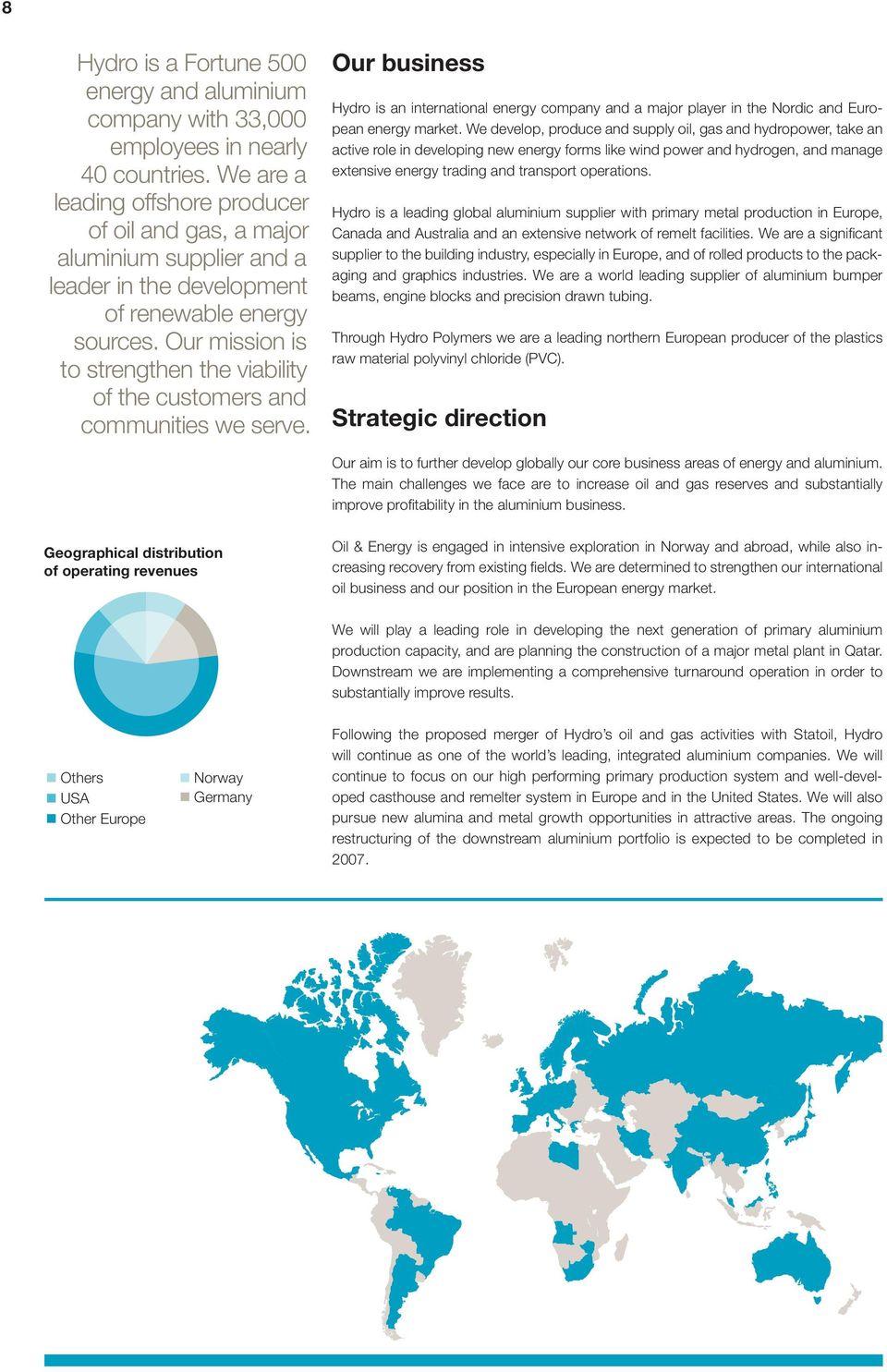
9 9 Hydro President & CEO Eivind Reiten Legal Department Internal Audit Business description Leadership & Culture Executive Vice President To be nominated Communication Executive Vice President Cecilie Ditlev-Simonsen Oil & Energy Executive Vice President Tore Torvund Aluminium Metal Executive Vice President Torstein Dale Sjøtveit Aluminium Products Executive Vice President Svein Richard Brandtzæg Chief Financial Officer Executive Vice President John O. Ottestad Operations Primary Production Rolled Products Other Businesses Development Norway Commercial Products Extrusion Europe Markets Power & Raw Materials Extrusion Overseas Projects International Business Development International Business Units Global Alumina & Smelter Growth Sourcing & Trading Technology & Competence Qatalum Project Building Systems Precision Tubing Automotive Components The Hydro Way Hydro s mission is to create a more viable society by developing natural resources and products in innovative and efficient ways. The way we work is characterized by our institutional talents: An ability to develop source businesses A drive to optimize An instinct to commercialize A passion for social commerce Our mission, institutional talents and values courage, respect, cooperation, determination and foresight together create a platform, The Hydro Way, which has contributed to value creation for more than 100 years and will influence us in the future. We are continuously developing our corporate culture, work practices and commercial outlook with a view to long-term value creation. Employees Hydro s organization is made up of 33,000 employees in almost 40 countries. These employees represent great diversity, both in terms of education, experience, gender, age and cultural background. We see this diversity as a significant resource, not least to encourage innovation. To be able to pull together as a team we depend on an efficient organization with common values and goals. Good leadership, proper organizational structure and the right tools are all essential if we are to achieve this. This includes attracting and retaining the right employees. A more focused portfolio Capital employed NOK 96 billion Net book value of assets 31 Dec 2006 Oil & Energy Aluminium Metal Aluminium Products Other Growth NOK 55 billion Upstream repositioning and growth NOK 26 billion Cash generation and divestments NOK 17 billion NOK (2) billion
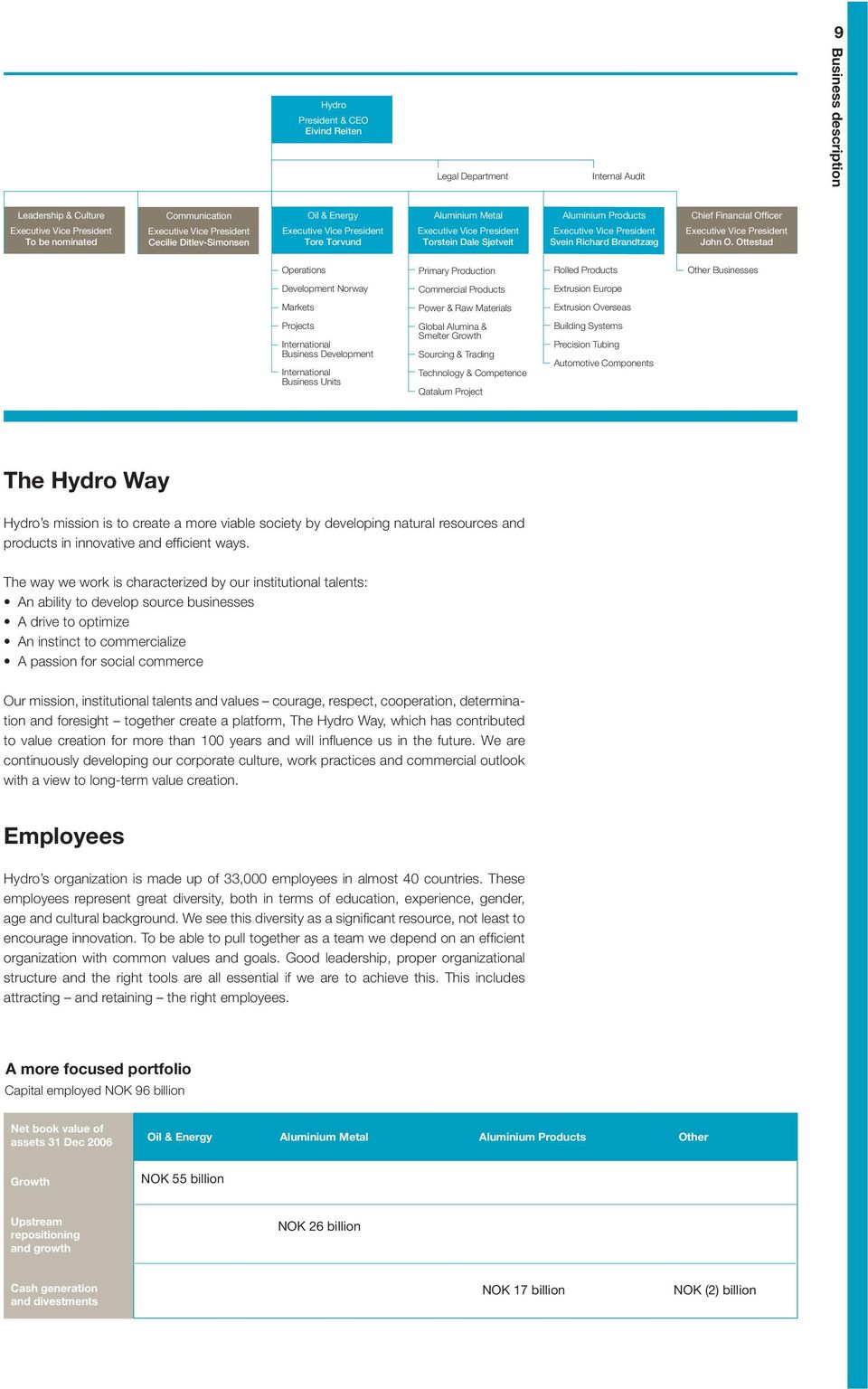
10 10 Oil & Energy Hydro s Oil & Energy business consists of the sub-segments, Exploration and Production and Energy and Oil Marketing. Exploration and Production consists of our oil and gas exploration activities, field development activities and production of oil and gas. Energy and Oil Marketing consists of our commercial operations within oil, natural gas and power, the operation of our hydroelectric power stations, management of our interest in the gas transportation system on the Norwegian Continental Shelf (NCS) and the marketing and sales of refined petroleum products such as gasoline, diesel and heating oil. Energy and Oil Marketing also includes our new energy business activities. Our technological competence in oil and gas, including the application of leading edge reservoir and field development solutions, is making an important contribution to our international expansion. EXPLORATION AND PRODUCTION Hydro is the second largest operator on the NCS. In 2006, we produced an average of 861,000 barrels of oil equivalents (boe) per day from our 11 operating fields: Oseberg, Oseberg Øst (East), Oseberg Sør (South), Brage, Tune, Njord, Troll Oil (Troll B and C), Heimdal, Vale, Grane and Fram. We are also the operator for the development phase of the Ormen Lange gas field, including the Langeled pipeline to the UK. In 2006, 90 percent of our average daily equity production of 573,000 boe was from the NCS. Internationally, we are building on our experience as an operator of oil and gas producing fields in the demanding Norwegian offshore environment. We have producing fields in Canada, Angola, Russia, Libya, and in the US Gulf of Mexico (GoM), and we continue to focus on developing our international oil and gas business. Our technological competence, including the application of leading edge reservoir and field development solutions, is making an important contribution to our international expansion. Total oil and gas production from Hydro operated fields 1,000 barrels of oil equivalents per day 1,500 1, Gas 04 Oil We believe we have an extensive and balanced exploration profile with a large majority of prospects linked to existing infrastructure. We also have contracts securing drilling rig capacity on the NCS through 2009 and in the GoM through During 2006, we secured new exploration acreage in Norway, GoM, Denmark and Canada. ENERGY AND OIL MARKETING Hydro has an established position in the Northern European natural gas and power markets. We are a substantial producer of natural gas and power and active trader in the continental European and UK markets. We have an interest in all of the major natural gas fields on the NCS and hold substantial equity interests in the Gassled pipeline system, including the new Langeled pipeline that will transport gas from Ormen Lange, and pipelines and transportation systems connecting other fields on the NCS. Exploration and production core areas Norway Russia Canada Denmark US Gulf of Mexico Cuba Morocco Libya Iran Current E&P activity Frontier E&P activity Nigeria Angola Brazil Mozambique
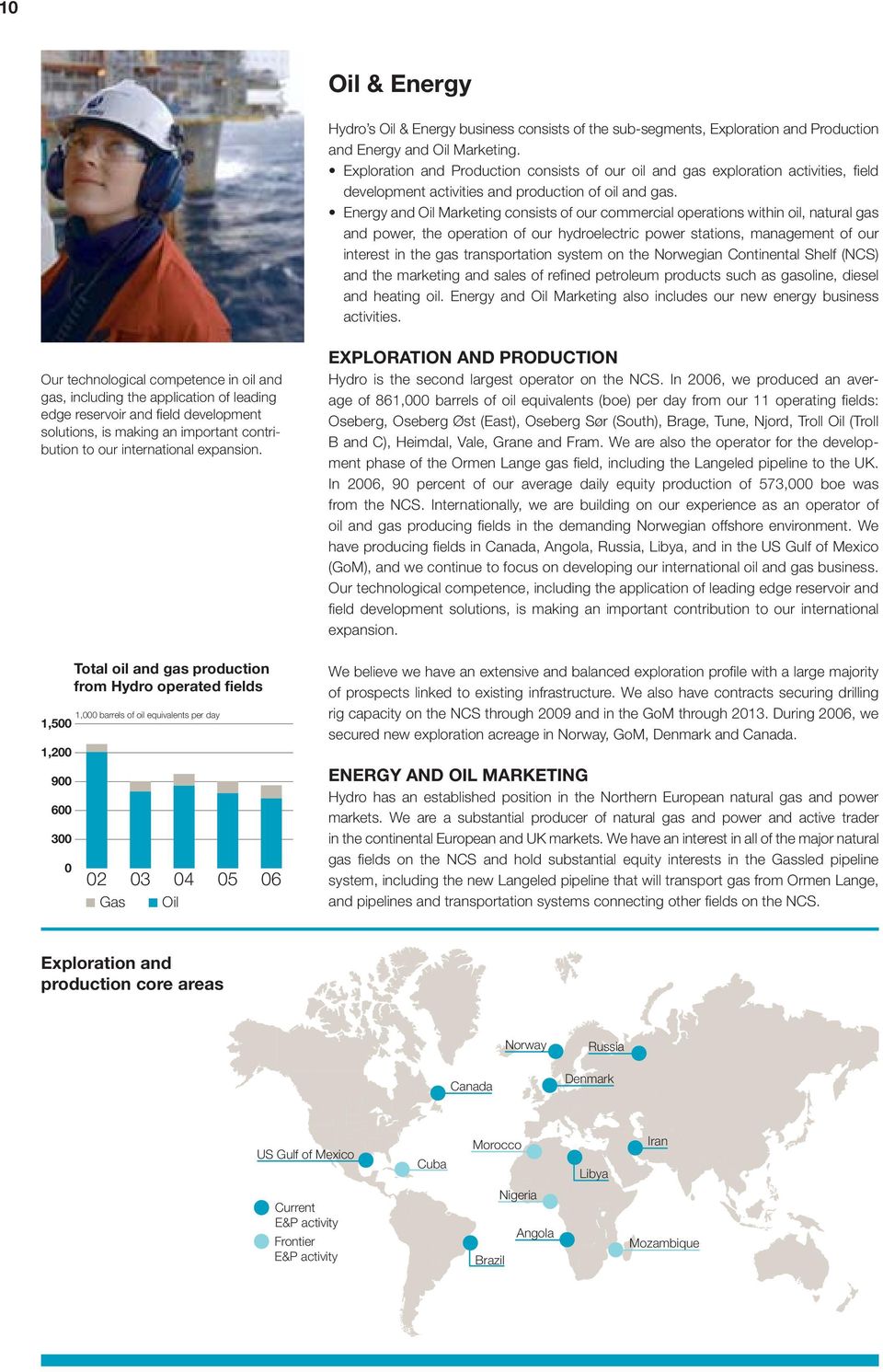
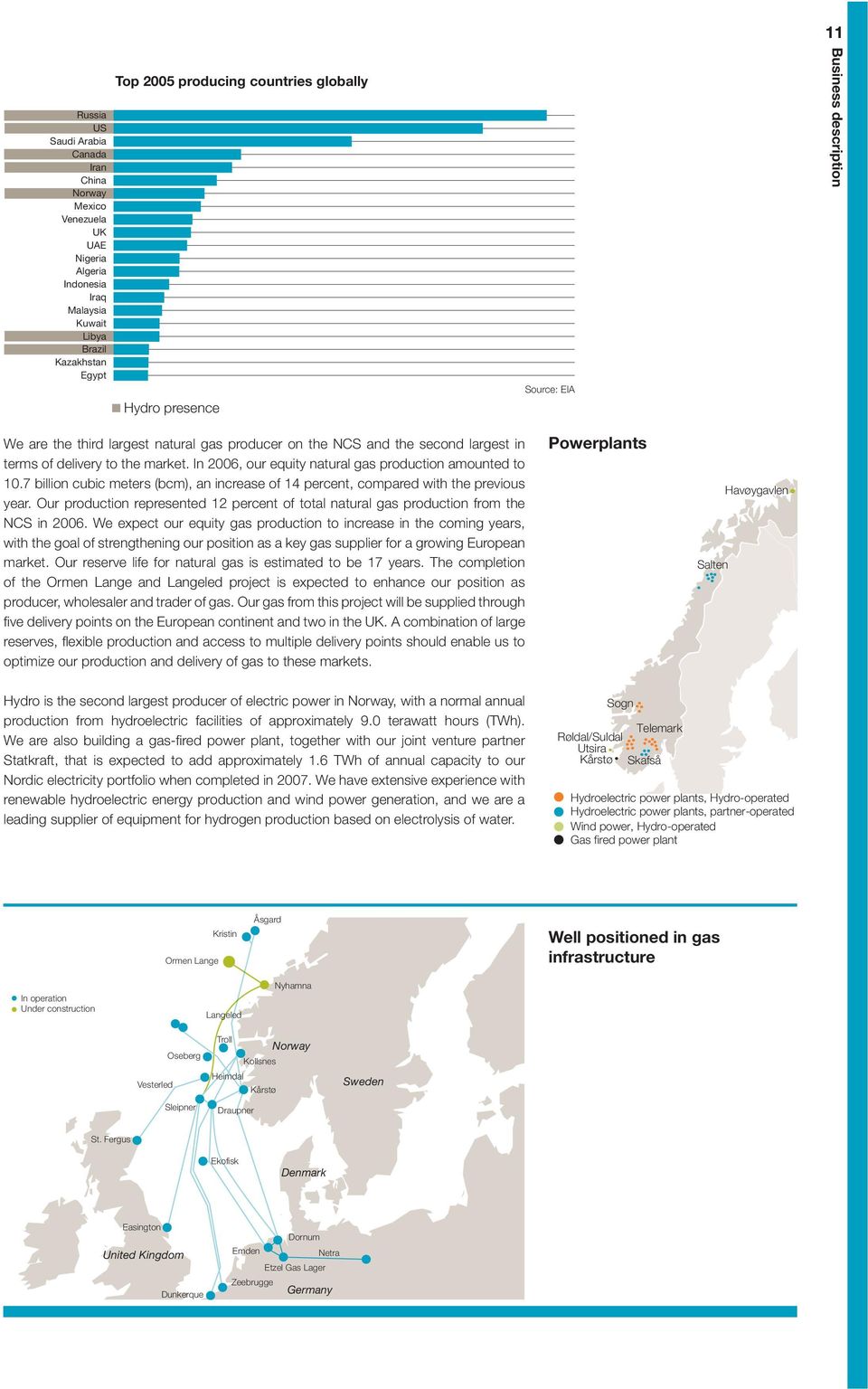
11 11 Russia US Saudi Arabia Canada Iran China Norway Mexico Venezuela UK UAE Nigeria Algeria Indonesia Iraq Malaysia Kuwait Libya Brazil Kazakhstan Egypt Top 2005 producing countries globally Hydro presence Source: EIA Business description We are the third largest natural gas producer on the NCS and the second largest in terms of delivery to the market. In 2006, our equity natural gas production amounted to 10.7 billion cubic meters (bcm), an increase of 14 percent, compared with the previous year. Our production represented 12 percent of total natural gas production from the NCS in We expect our equity gas production to increase in the coming years, with the goal of strengthening our position as a key gas supplier for a growing European market. Our reserve life for natural gas is estimated to be 17 years. The completion of the Ormen Lange and Langeled project is expected to enhance our position as producer, wholesaler and trader of gas. Our gas from this project will be supplied through five delivery points on the European continent and two in the UK. A combination of large reserves, flexible production and access to multiple delivery points should enable us to optimize our production and delivery of gas to these markets. Powerplants Salten Havøygavlen Hydro is the second largest producer of electric power in Norway, with a normal annual production from hydroelectric facilities of approximately 9.0 terawatt hours (TWh). We are also building a gas-fired power plant, together with our joint venture partner Statkraft, that is expected to add approximately 1.6 TWh of annual capacity to our Nordic electricity portfolio when completed in We have extensive experience with renewable hydroelectric energy production and wind power generation, and we are a leading supplier of equipment for hydrogen production based on electrolysis of water. Sogn Telemark Røldal/Suldal Utsira Kårstø Skafså Hydroelectric power plants, Hydro-operated Hydroelectric power plants, partner-operated Wind power, Hydro-operated Gas fired power plant Ormen Lange Kristin Åsgard Well positioned in gas infrastructure In operation Under construction Langeled Nyhamna Vesterled Oseberg Sleipner Troll Norway Kollsnes Heimdal Kårstø Draupner Sweden St. Fergus Ekofisk Denmark Easington United Kingdom Dunkerque Dornum Emden Netra Etzel Gas Lager Zeebrugge Germany
12 12 STRATEGY Exploration and Production Hydro intends to secure long-term profitable growth in its upstream oil and gas business by exploiting its core competencies in exploration, project design, project execution and operations. Delivering strong production growth based on a broad portfolio of well-defined and profitable projects We strive to maintain strong production growth through exploration and field development activities together with selective acquisitions. Since 1998, we have achieved a compound annual production growth rate of nearly 10 percent through organic growth and the acquisitions of Saga Petroleum and Spinnaker Exploration Company in addition to direct acquisitions of field interests from the Norwegian state. We have a well-defined field development portfolio where plateau production from new fields coming on stream by 2010 is expected to add up to 200,000 boe per day with fields peaking in different years. We are targeting production of 700,000 boe per day in Building the basis for future, long-term production We intend to pursue the optimal development and exploitation of our existing portfolio to secure a solid foundation for future growth with continually high exploration activity. Approximately 60 wells are planned to be spudded in 2007, including several wells with the potential for large discoveries. We believe our exploration portfolio, which endeavors to balance risk and geography profiles with improved exploration work processes, will provide a sound basis for long-term production growth. We intend to build on our substantial exploration portfolio in the GoM. We also aim to acquire proven and technical resources where our core competencies and expertise, including advanced drilling techniques, flow-assurance, reservoir management and execution of complex and technologically challenging projects, can add value to assets traded in the marketplace. Continued production growth 1,000 boed E 10E Capturing the opportunities on the NCS We intend to exploit our extensive asset portfolio on the NCS through technological advances and innovative field development solutions. Many of our fields on the NCS contain large amounts of gas. As a result, gas production is expected to increase in importance relative to oil. These gas resources benefit from existing infrastructure linking them to the UK and European continental markets. There is also a potential to exploit smaller finds in the vicinity of existing field facilities and pipelines since development costs should be lower than for stand-alone projects. Existing infrastructure with spare capacity is a key driver for exploration in maturing areas. Produced oil end 2005 Remaining oil reserves Remaining in ground at planned field close down Fields in Hydro portfolio Large remaining oil potential in Hydro fields Long-term ambition of 60 percent recovery factor on NCS remaining -4,000-3,000-2,000-1,000 0 million boe Eldfisk Valhall Snorre Heidrun Statfjord Oseberg Gullfaks Oseberg Sør Tor Balder Gullfaks Sør Njord Brage Grane Åsgard Visund Ula Oseberg Øst Norne Veslefrikk Vigdis Kristin Troll Ekofisk 1,000 2,000 3,000 4,000 Source: Norwegian Petroleum Directorate

13 Continuing to pursue cost improvements in exploration and production activities As fields on the NCS mature and production declines, we will continue to give high priority to cost control and implementing measures to increase production on existing fields, including IOR measures and development of satellite fields. We intend to maintain and improve our status as an efficient operator and will continue our efforts to reduce costs on operated facilities despite the underlying maturing nature of the portfolio. Active infrastructure-led exploration is also a key factor in containing production cost per barrel and extending the life of the infrastructure in the tail-end production phase. Operating cost per boe is expected to be NOK 28 excluding gas injection costs in 2007, and our target is to stabilize operating cost per boe at that level in the following years. Energy and Oil Marketing Hydro s strategy is to further enhance its position in the northern European energy market based on increasing gas production and commercial competence gained from the European gas market and the liberalized Nordic power market. We also intend to continue to optimize the commercial value of our crude oil portfolio. Enhancing the value of our natural gas portfolio Location, transportation, infrastructure and substantial reserves make Norwegian natural gas competitive in the European region. We intend to develop our role as a natural gas producer, wholesaler and trader to increase our market share in the developing, liberalized European natural gas market. We aim to further develop our strong and balanced customer portfolio, including a mix of long-term contracts with wholesalers, end-user sales to the power and industrial segments, and spot sales, in order to optimize our natural gas portfolio. Building on our crude oil marketing competencies We intend to continue to maximize the prices we receive for crude oil from our production portfolio by utilizing our marketing competencies relative to our core grades of crude oil. Our aim is to continually improve our marketing competency, particularly through further development of international crude oil marketing as a result of our growth in international oil production. Optimizing our power activities Since the liberalization of the Norwegian electricity market in 1991, we have developed our commercial power activities, along with analysis, portfolio and risk management systems. We will continue to focus on optimizing our Nordic electricity portfolio and sourcing of power to our larger consuming plants in the Nordic area and continental Europe. Operating our hydroelectric power plants in Norway as efficiently as possible remains a key priority. Where we are and what we are striving to achieve 2006 targets 615,000 boe per day Operator in all our geographical core areas Ormen Lange 85 percent completed No fatal accidents. Total recordable injuries per million hours down by 20 percent 2006 results 573,000 barrels of oil equivalents per day Operator in all geographical core areas except Russia and Angola Ormen Lange 91 percent completed No fatal accidents. Total recordable injuries per million hours 3.0. The target was ,000 barrels of oil equivalents per day Ormen Lange completed on time and budget PDO for Peregrino field approved by Brazilian authorities No fatal accidents. Total recordable injuries per million hours down by 20 percent ,000 barrels of oil equivalents per day Our project expertise applied in all geographical core areas The Peregrino field on stream 13 Business description Pursuing opportunities in new energy We plan to continue our focus on new sources of energy, such as wind power, hydrogen, solar power and bio-fuels. We view wind power generation as one of the most important components of the new energy market and see good potential in offshore generation. Our potential wind project portfolio amounted to roughly 3 TWh at the end of We have been involved in several hydrogen projects and are presently participating in the construction of a hydrogen filling station in Norway. We are also investing in solar generation activities and evaluating the production of biodiesel. Well placed to extract market value in Northwest Europe Market developments New import capacity Increased volatility Geographical differentials Long-term relationships with all major players Proacive positioning in emerging markets Strong trading presence Hydro s position Competitive cost base Flexible production Multiple landing points Strong NCS gas base in volatile markets p/th jan-02 jan-04 jan-06 German import price (est) NBP DAH jan-08 march-10 NBP forward Ormen Lange PDO break-even

14 14 Aluminium Metal In January 2006, we reorganized our upstream and downstream aluminium operations into two separate business areas: Aluminium Metal and Aluminium Products. Hydro s Aluminium Metal business consists of Hydro s upstream activities, principally the production and sale of primary aluminium and casthouse products such as sheet ingot, extrusion ingot and foundry alloys. Our metal activities also include the remelting and processing of scrap and ingot, as well as long-term commercial contracts and all aluminium and raw materials trading activities. The expansion of our Sunndal plant in Norway has established a new industry standard for aluminium smelter technology. Hydro s smelter size All figures in 1,000 mt per year 2,000 1,500 1, Hydro s smelter geography 1,000 tonnes per year 2,500 2,000 1,500 1, Europe E Outside Europe 10E Below 300,000 Above 500,000 Between 300, ,000 Introduction Hydro is the world s fifth largest primary aluminium producer. We are a major worldwide supplier of value-added casthouse products, including extrusion ingots, sheet ingots and foundry alloys. Our 2006 operating revenues were approximately NOK 68 billion, generated by around 5,300 employees in 20 countries. We produced approximately 1.8 million metric tons (mt) of primary metal in 2006 at plants located in Australia, Canada, Germany, Norway and Slovakia. In total, 3.5 million mt were delivered to the market, including 1.4 million mt of remelted and recycled metal. We believe our competitive position is improving as we continue to reposition our primary metal capacity toward modern, cost-efficient production facilities. In 2007, we expect to make a final decision for Qatalum, a major new primary metal facility in Qatar. Our 50 percent ownership share in Qatalum is expected to add additional capacity of approximately 290,000 mt a year of highly competitive liquid metal by the end of We are targeting approximately 1.7 million mt of primary metal production in 2007 and 2.0 million mt in 2009 (amounts are net of closed, uncompetitive primary metal capacity). Aluminium is processed to meet customers needs in casthouses. Many of these casthouses are integrated with our primary aluminium plants, and some are located in specialized remelt and/or recycling facilities close to our customers in Europe and the US that provide tailormade deliveries. In 2006, remelted and recycled metal accounted for about 40 percent of the metal that we delivered to the market. Our casthouse product position in Asia has been strengthened by investments in our primary metal plant in Australia. Alumina, power and labor are the three most important smelter cost elements for the industry. We have ownership interests in alumina refineries providing approximately 55 percent of our alumina needs (Alunorte in Brazil and Alpart in Jamaica). The most important of these interests, Alunorte, is the world s largest alumina refinery and, we believe, Metal production facilities Primary aluminium smelter locations Remelting/recycling locations Aluminium Metal s main markets

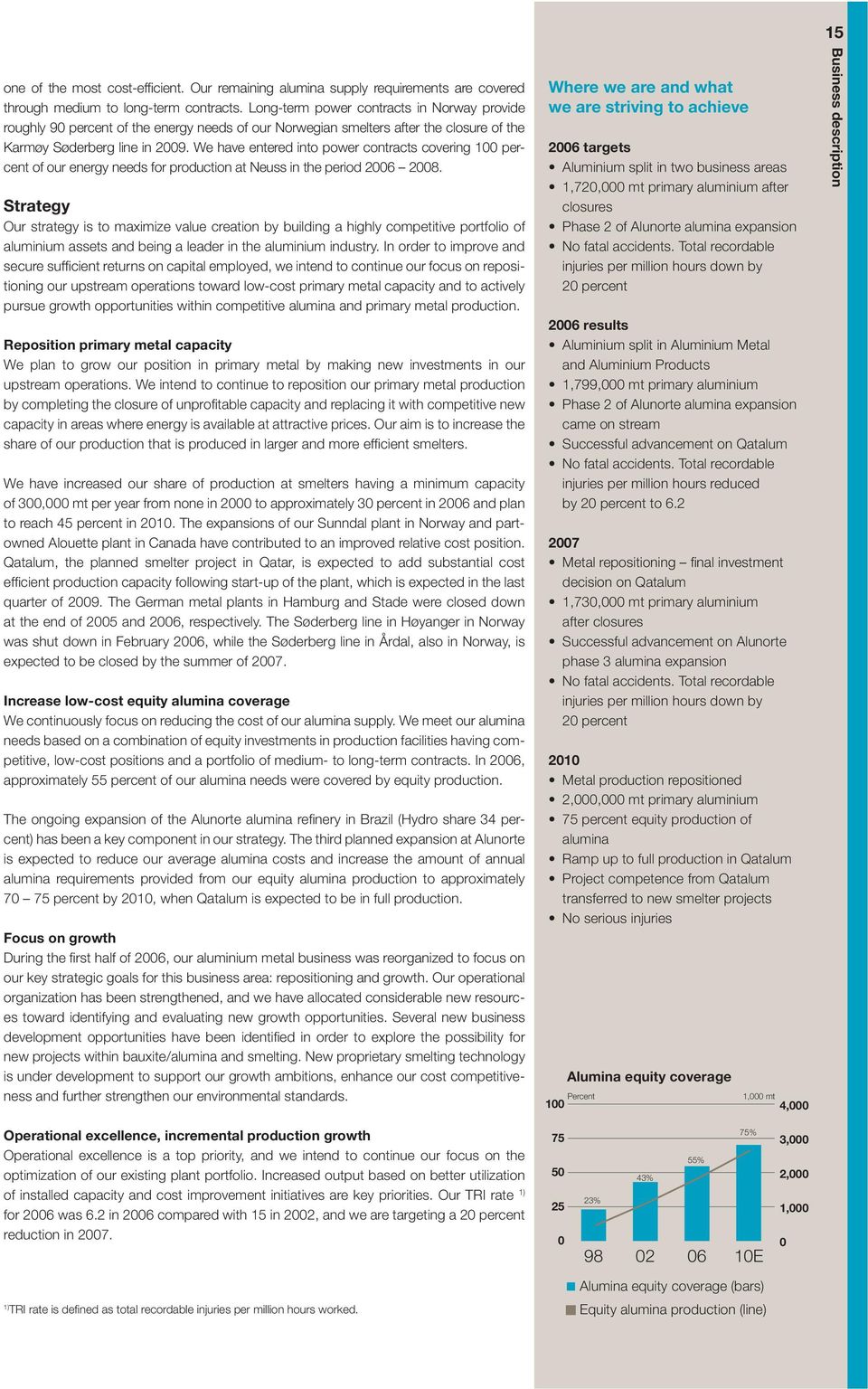
15 one of the most cost-efficient. Our remaining alumina supply requirements are covered through medium to long-term contracts. Long-term power contracts in Norway provide roughly 90 percent of the energy needs of our Norwegian smelters after the closure of the Karmøy Søderberg line in We have entered into power contracts covering 100 percent of our energy needs for production at Neuss in the period Strategy Our strategy is to maximize value creation by building a highly competitive portfolio of aluminium assets and being a leader in the aluminium industry. In order to improve and secure sufficient returns on capital employed, we intend to continue our focus on repositioning our upstream operations toward low-cost primary metal capacity and to actively pursue growth opportunities within competitive alumina and primary metal production. Reposition primary metal capacity We plan to grow our position in primary metal by making new investments in our upstream operations. We intend to continue to reposition our primary metal production by completing the closure of unprofitable capacity and replacing it with competitive new capacity in areas where energy is available at attractive prices. Our aim is to increase the share of our production that is produced in larger and more efficient smelters. We have increased our share of production at smelters having a minimum capacity of 300,000 mt per year from none in 2000 to approximately 30 percent in 2006 and plan to reach 45 percent in The expansions of our Sunndal plant in Norway and partowned Alouette plant in Canada have contributed to an improved relative cost position. Qatalum, the planned smelter project in Qatar, is expected to add substantial cost efficient production capacity following start-up of the plant, which is expected in the last quarter of The German metal plants in Hamburg and Stade were closed down at the end of 2005 and 2006, respectively. The Søderberg line in Høyanger in Norway was shut down in February 2006, while the Søderberg line in Årdal, also in Norway, is expected to be closed by the summer of Increase low-cost equity alumina coverage We continuously focus on reducing the cost of our alumina supply. We meet our alumina needs based on a combination of equity investments in production facilities having competitive, low-cost positions and a portfolio of medium- to long-term contracts. In 2006, approximately 55 percent of our alumina needs were covered by equity production. The ongoing expansion of the Alunorte alumina refinery in Brazil (Hydro share 34 percent) has been a key component in our strategy. The third planned expansion at Alunorte is expected to reduce our average alumina costs and increase the amount of annual alumina requirements provided from our equity alumina production to approximately percent by 2010, when Qatalum is expected to be in full production. Focus on growth During the first half of 2006, our aluminium metal business was reorganized to focus on our key strategic goals for this business area: repositioning and growth. Our operational organization has been strengthened, and we have allocated considerable new resources toward identifying and evaluating new growth opportunities. Several new business development opportunities have been identified in order to explore the possibility for new projects within bauxite/alumina and smelting. New proprietary smelting technology is under development to support our growth ambitions, enhance our cost competitiveness and further strengthen our environmental standards. Where we are and what we are striving to achieve 2006 targets Aluminium split in two business areas 1,720,000 mt primary aluminium after closures Phase 2 of Alunorte alumina expansion No fatal accidents. Total recordable injuries per million hours down by 20 percent 2006 results Aluminium split in Aluminium Metal and Aluminium Products 1,799,000 mt primary aluminium Phase 2 of Alunorte alumina expansion came on stream Successful advancement on Qatalum No fatal accidents. Total recordable injuries per million hours reduced by 20 percent to Metal repositioning final investment decision on Qatalum 1,730,000 mt primary aluminium after closures Successful advancement on Alunorte phase 3 alumina expansion No fatal accidents. Total recordable injuries per million hours down by 20 percent 2010 Metal production repositioned 2,000,000 mt primary aluminium 75 percent equity production of alumina Ramp up to full production in Qatalum Project competence from Qatalum transferred to new smelter projects No serious injuries Alumina equity coverage Percent 100 1,000 mt 4, Business description Operational excellence, incremental production growth Operational excellence is a top priority, and we intend to continue our focus on the optimization of our existing plant portfolio. Increased output based on better utilization of installed capacity and cost improvement initiatives are key priorities. Our TRI rate 1) for 2006 was 6.2 in 2006 compared with 15 in 2002, and we are targeting a 20 percent reduction in % % % % E 3,000 2,000 1, ) TRI rate is defined as total recordable injuries per million hours worked. Alumina equity coverage (bars) Equity alumina production (line)
16 16 Aluminium Products Hydro s Aluminium Products business consists of the sub-segments rolled products, extrusion and automotive. Rolled products consists of our rolling mills located primarily in Europe. Rolled products also includes our 50 percent interest in the AluNorf hot rolling mill located in Germany. Extrusion consists of our extruded products business focused mainly on the building, construction and transportation industry sectors. Our building systems activities are included in this sub-segment. Automotive consists of our precision tubing, structures and casting operations 2) primarily serving the automotive industry. The automotive sub-segment also includes our magnesium operations. Hydro is a leading supplier of downstream aluminium products to the building, packaging, transportation and lithographic markets. Global semis consumption by end use Forecasted annual growth in brackets (5.4%) (7.2%) (6.0%) (5.3%) (4.9%) (2.5%) Transport Construction Packaging Foil stock Electrical (4.4%) (5.9%) Consumer durables Machinery & equipment Other Introduction Hydro is an industry leader for a range of downstream aluminium products and markets, in particular the transportation, building, packaging and lithographic market sectors. Our ambition is to be a high quality and value-adding supplier of aluminium products and solutions, with strong positions in markets that provide opportunities for good financial returns. We are currently working to improve the financial performance and cash generation of our downstream operations. In 2006, we generated revenues of approximately NOK 50 billion from the sale of aluminium products, employing around 19,000 employees in 28 countries. Our operations are primarily located in Europe, where we generated approximately 75 percent of our total operating revenues in About 16 percent of our total operating revenues were generated from North America in Our extrusion operations consist mainly of general soft alloy extruded products and building systems for facades, wall partitions, doors and windows. About 70 percent of our total extrusion revenues in 2006 came from our general extrusion businesses and 30 percent came from building systems. We have wholly-owned extrusion, extrusion-related fabrication and building systems operations located throughout Europe and the US, in addition to units in Brazil and Argentina, smaller units in India, China and Russia, and partly owned operations in South Africa and Bahrain. Through our global network of extrusion plants we serve local customers with customized profiles and building systems. In 2006, we produced 560 mt of extruded products from our network of extrusion plants. 2) See discussion included in section Financial performance Financial review Discontinued operations for information on our accounting and disclosure relating to our Automotive castings operations. Automotive Components Precision Tubing Extrusion Rolled Products Building Systems

17 We are the second largest producer in the European rolling industry in terms of market share and hold leading positions within high value-added rolled products segments such as lithographic (printing) plates and aseptic foil. In 2006, we shipped just above one million mt of rolled products from our six European plants and our Malaysian plant. More than half of this production was produced in Grevenbroich, Germany, which is also the center of our rolled products foil and lithographic sheet operations. Our automotive business comprises precision tubing, structures, automotive casting and our primary and remelt magnesium production. In 2006, we announced further measures to divest or close under-performing units, and we signed a contract to divest our automotive casting operations that was completed in March of We are also evaluating alternative opportunities relating to the divestment our automotive structures business. During 2006, we also decided to exit the magnesium business and announced the closure of our primary magnesium plant in Becancour, Canada and the plan to divest our remaining magnesium remelters in China and Germany. We also plan to evaluate the divestment of a number of smaller, extrusion-based units. Strategy Hydro s European extrusion and global building systems operations delivered a strong performance in However, we announced a restructuring of other downstream operations last year in order to improve the overall operating results for our aluminium products business area. We intend to continually improve the operational performance of profitable businesses and to turn around, divest or close under-performing units. Our focus for our aluminium products business is on cash generation. Maintain high performance in extrusion and building system activities We intend to focus on our extrusion-based activities within four defined business sectors: Extrusion Europe, Extrusion Overseas, Building Systems and Precision Tubing. We intend to build a sustainable performance level, and a platform for further business development, based on our existing technological strength and strong market positions within these businesses. Particular attention is being given to improving the performance of our North American extrusion and precision tubing business activities. We are also working to enhance the performance and to further develop our European extrusion operations and building system businesses. Where we are and what we are striving to achieve 2006 targets Aluminium split in two business areas Initiate restructuring of the Aluminium Products area business portfolio No fatal accidents. Total recordable injuries per million hours down by 20 percent 2006 results Aluminium split in Aluminium Metal and Aluminium Products Sold Automotive Castings and 49 percent stake in Meridian Technologies Inc. Decision to close primary Magnesium plant in Becancour, closing process initiated Divestment process under evaluation relating to Automotive structures and other entities defined as non-core Plant rationalizations undertaken and improvement programs initiated One fatal accident. Total recordable injuries per million hours reduced by 23 percent to Restructuring process completed Long-term business strategy defined No fatal accidents. Total recordable injuries per million hours down by 20 percent 17 Business description Develop and improve position in rolled products We view our position in the European rolled products industry as strong, and consider ourselves a global leader in value-added products like lithographic plates and aseptic foil. We also have a strong European position in heat transfer applications. We believe we have a highly competent organization and the technical expertise to enable us to focus on continued growth in selected markets and to improve our cost position. We also intend to play a role in the necessary restructuring of the rolled products industry in Europe Sustainable profitability level Profitable growth No serious injuries Restructuring our business portfolio During 2006 we performed a comprehensive portfolio review that resulted in a defined restructuring program that identified specific units for divestment or closure. A decision was taken to divest our automotive castings business and we are evaluating alternative opportunities relating to the divestment of our automotive structures business, possibly in combination with closures of certain units. In addition, under-performing units within the non-automotive sectors are being evaluated for possible divestment or closure. A decision was also taken to exit the magnesium business. We expect to complete the announced restructurings by the end of Aluminium consumption per region 1,000 tonnes 5,221 2,078 9,382 Plant rationalization and performance improvement Rationalization programs are being initiated for under-performing units that will remain in the portfolio, with the aim to lift their performance to a viable level. Rationalization programs were initiated in several operating units in 2006, including our extrusion activities in the UK and our precision tubing activities in North America, and we intend to continue the program in In addition, we have defined and initiated comprehensive improvement programs for all of our business sectors, with the focus on reducing cost and enhancing revenues and margins. 11,007 4,083 1,405 West Europe East Europe & CIS North America & Mexico Japan 2,374 11,927 Latin America China Other Asia Middle East & Africa

18 18 Focus on cash generation Our strategy is to prioritize cash generation over growth opportunities in the short-term. We intend to keep capital expenditures at a moderate level, to be comprised mainly of investments designed to ensure stable operations and good safety standards and to maintain the value of our remaining assets. We will also focus on maintaining a lean level of operating capital. History and development Hydro was originally founded to provide a solution to one of the most pressing problems of the day industrial manufacture of fertilizer to increase food production throughout the world. Norsk Hydro ASA was organized under Norwegian law as a public company in 1905 to utilize Norway s large hydroelectric energy resources for the industrial production of nitrogen fertilizers. In the years since, energy, in the form of hydroelectric power, natural gas and petroleum, has been the basis for Hydro s growth and the common link among its core business activities. Following the end of the Second World War, we expanded into a number of new businesses. In 1951, we began to produce magnesium metal and polyvinyl chloride at Porsgrunn, Norway. In 1967, we opened an aluminium reduction plant and semifabricating facilities at Karmøy, Norway, and built the Røldal-Suldal hydroelectric power project to provide energy to the Karmøy facilities. In 1965 and 1967, we commenced production of ammonia at two large ammonia plants in Norway, one of which made use of naphtha and the other, heavy fuel oil, as feedstocks (i.e., sources of hydrogen) in the ammonia production process. We had previously depended on the electrolysis of water to provide the hydrogen needed to produce ammonia used in nitrogen-based fertilizers. The discovery of natural gas in the Netherlands and on the continental shelf off England in the North Sea created a new and competing source of feedstock for ammonia in Europe. Consequently, we began to take steps to ensure that we could continue to compete with other European producers of ammonia that were obtaining access to these relatively inexpensive natural gas supplies. As a result, we began to investigate various opportunities to participate in oil and gas production. In 1965, we obtained concessions from the Norwegian State to explore for petroleum on the NCS. Hydro and its partners discovered oil and gas in the Ekofisk field in 1969 and in the Frigg field in Exploration of these discoveries ensured a source of feedstock for our fertilizer plants and also brought us into the petroleum refining and marketing business. In 1975, we began oil refining operations at Mongstad, Norway. Norway s natural gas liquids resources and our experience in the chemical process industry served as the foundation for our investments in the petrochemicals industry in Norway and, in 1978, we commenced production of ethylene and vinyl chloride monomer. In the 1980s, we acquired a number of businesses, both in Norway and in other areas. The expansion of our fertilizer operations resulted in Hydro becoming one of the leading suppliers of fertilizer in Europe. We also entered a new era as an oil company, becoming operator of the Oseberg offshore oil field. Hydro also developed or tested new technologies for deep-water oil and gas production and horizontal drilling, which we subsequently put to commercial use in developing the Troll oil project. In we acquired the Norwegian State-owned aluminium company, Årdal og Sunndal Verk, and several European aluminium extrusion plants from Alcan and Alcoa, thus establishing Hydro Aluminium as a major business within Hydro and an important player in the European aluminium industry. In recent years, our business areas have grown as a result of substantial investments, including several acquisitions. In 1999, we acquired Saga Petroleum ASA, a Norwegianbased oil company, merging Saga s operations into our Oil and Energy business area. In 2002, we acquired interests in eight oil and gas licenses on the NCS from the Norwegian State. This acquisition increased our interests in the Oseberg, Tune and Grane fields, where we are the operator. We paid NOK 3.45 billion (USD 415 million) for the license interests which expire between 2015 and In 2005, we acquired all of the shares of Spinnaker Exploration Company in an all-cash transaction for USD 2.45
19 19 billion (NOK 16.5 billion). In March 2002, we acquired all the outstanding shares of VAW Aluminium AG for a total purchase price, including indirect acquisition costs, of Euro 1,911 million (NOK 14.8 billion; USD 1.7 billion). Earlier in that same year, we acquired the French building systems supplier, Technal. A significant portion of the expansion of these two core business areas has been financed through the sale of non-core businesses. In March of 2004, we completed the demerger of our Agri business transferring all assets, rights, liabilities and obligations primarily relating to the Agri business to Yara International ASA. Business description Demerger of Hydro s oil and gas operations In December, Hydro s Board of Directors decided to recommend for approval by our shareholders a demerger of Hydro and a merger of Hydro s oil and gas operations with Statoil, a Norwegian-based oil and gas company. Hydro s and Statoil s Boards signed the final plan for this demerger and merger on 13 March The plan calls for Hydro s shareholders to own 32.7 percent and for Statoil s shareholders to own 67.3 percent of the merged company, which will be called StatoilHydro ASA. As compensation for the transfer of Hydro s oil and gas operations, Hydro s shareholders are expected to receive a share in StatoilHydro ASA for every share they own in Hydro. StatoilHydro is expected to comprise around employees, of which around are expected to come from Hydro. Following the demerger and merger, Hydro will go forward as a financially strong aluminium and power company pursuing business opportunities on a global basis. We will be the world s third-largest listed aluminium company focused on growing profitably through targeted international business development, operational excellence, leading technology and innovative solutions. The proposed de-merger and merger are expected to be completed in the third quarter of 2007 and are subject to shareholder and regulatory approvals. Other information As a public limited company organized under Norwegian law, Hydro is subject to the provisions of the Norwegian act relating to public limited liability companies (i.e. the Norwegian Public Limited Companies Act). Our principal executive offices are located at Drammensveien 264, Vækerø, N-0240 Oslo, Norway; telephone number: Our registered agent in the United States is Glenn Smyth, whose address is c/o Hydro Gulf of Mexico, Inc., 1200 Smith Street, Suite 800, Houston TX 77002, United States; telephone number: (713) Hydro s internet site is Following the demerger of our oil and gas operations, Hydro will go forward as a financially strong aluminium and power company pursuing business opportunities on a global basis. The information on Hydro s website is not incorporated by reference to this report and should not be considered part of this report. Hydro has three significant subsidiaries as that term is defined by applicable rules of the US Securities and Exchange Commission (SEC), all of which are owned 100 percent. They are Norsk Hydro Produksjon AS and Hydro Aluminium AS, both incorporated in Norway and Hydro Aluminium Deutschland GmbH which is incorporated in Germany.
20

21 02 Operational review Operational review Oil & Energy Exploration and Production Energy and Oil Marketing Aluminium Metal Aluminium Products Rolled Products Extrusion Automotive Other activities Regulation and taxation We produced an average of 573,000 boe per day during Our original target was 615,000 boe per day. About half of the shortfall related to production interruptions on partner operated fields on the NCS. In 2006, we completed 51 wells with a success rate of 50 percent of commercial discoveries. Our remaining proved oil and gas reserves were 1,916 million boe at the end of We produced 1,799,000 metric tonnes of primary aluminium at 11 wholly or partly owned primary aluminium plants in Preparations for the Qatalum primary aluminium plant in Qatar where we have a 50 percent share continued during We plan to continue to restructure and improve the financial performance of Aluminium Products during At the end of 2007, our portfolio should consist of businesses well positioned to deliver viable returns.
22 22 Oil & Energy INDUSTRY OVERVIEW High crude oil price levels The high crude oil price levels experienced in recent years continued during Brent Dated averaged USD 65.1 per barrel in 2006, USD 10.6 per barrel higher than in Oil markets continued to be very tight in 2006 with limited global spare capacity and OPEC spare capacity only marginally higher than in 2005 The increase in crude prices in 2006 was mainly driven by supply concerns due to geopolitical developments. During most of 2006, oil markets anticipated possible supply shortages due to ongoing political unrest in Nigeria and tensions concerning the Iranian nuclear situation. The Israeli attack on Lebanon added to geopolitical concerns due to fears that the conflict would escalate to the oil-producing countries in the region. In addition, the oil market was also concerned about possible supply disruptions in the GoM with the approaching hurricane season that was predicted to be very active for In the beginning of August 2006 Brent Dated reached a new nominal price record due to a temporary shutdown of BP s large Prudhoe Bay oil field. With limited spare production capacity the oil market has been very vulnerable to potential production disruptions and crude prices were therefore pushed to very high levels for a major part of However, because most of the anticipated supply shortages did not materialize, crude prices trended downward starting in the middle of the third quarter of High oil price driven by supply concerns OPEC spare capacity at low levels, but increasing Million bbl/day USD per bbl OPEC spare capacity Brent dated Brent forward Access to world proven oil reserves, end % 30% 13% Iraq National companies only 9% 37% Concession Production sharing Limited access: national companies dominant Source: World Energy Outlook 2006 OECD/IEA, 2006; Figure 3.12, 105 Exploration becoming increasingly important Uncertain oil prices and increasing technical challenges have led to lower exploration investments in recent years. The result has been reduced reserve replacement ratios. According to IHS Energy, discoveries have failed to replace oil production for nearly 20 years and gas production has exceeded discoveries since However, high oil and gas prices in 2005 and 2006 have created more opportunities for companies to step up exploration activity in order to secure long-term production. Inflationary pressures, increased competition for exploration areas and capacity constraints relating to drilling rigs and other technical services and resources are continuing to drive up exploration costs. Because it is becoming increasingly difficult to replace oil production by new discoveries, advances in reservoir management technology to achieve increased oil recovery (IOR) are becoming more important. Fewer major discoveries have also increased the focus on developing viable solutions for exploiting smaller oil fields. The NCS a maturing oil province Production on the Norwegian Continental Shelf (NCS) continued to decline in 2006, with total oil production reduced to million Sm 3 a reduction of almost 8 percent compared with Oil production from new developments is not keeping pace with production declines from maturing fields.
23 Increasing gas production offset to some extent the negative trend in oil production. In 2006, approximately 87.6 billion cubic meters of gas were produced from the NCS, an increase of 3 percent compared to Total petroleum production for 2006 decreased by approximately 3 percent compared to Increased access to attractive acreage on the NCS would lead to an increase in exploration and development activity. In March 2006, 17 companies were awarded 13 new licenses covering a total of 33 blocks or parts of blocks in the Norwegian Sea and Barents Sea. In January 2007, 33 companies were awarded 48 new licenses including 85 blocks or parts of blocks close to existing infrastructure in the mature areas of the North Sea, the Norwegian Sea and the Barents Sea relating to APA 2006 (Awards in Predefined Areas). This is the highest number of licenses ever offered on the NCS. Eight of the 33 companies being offered licenses were new operators on the NCS. 23 Operational review Strategic review of EU environmental and energy policy The liberalization of the EU gas and electricity markets continues. There is a mutual understanding among the EU member states that a common European response to the energy and environmental challenges is required a new comprehensive European energy policy. In March 2006, the EU Commission issued for public hearing a Green Paper A European Strategy for Sustainable, Competitive and Secure Energy. The Green Paper is the first stage in a process setting the course for a strategy for EU energy policy in the coming years. Core principles for the Green Paper are sustainability, competitiveness and security of supply. The Green Paper focuses on six priority areas: completion of the internal electricity and gas markets; security of supply; a more sustainable, efficient and diverse energy mix; climate change; encouraging innovation a strategic energy technology plan; and a common external energy policy. The findings from the Energy Market Sector Inquiry launched in 2005 and the Green Paper process launched in 2006 culminated in a broad Strategic EU Energy Review launched in January The Strategic Energy Review establishes the framework for a European energy policy covering everything from foreign policy to the role of renewables. For the first time, an overall energy strategy covering all aspects of energy policy has been set out by the Commission. Key elements of the energy package are: a review of the European climate policy; completion of the single energy market; and promotion of renewables European gas supply and demand bcm Production Europe ex. Norway Algeria Other non- European Production Norway Other external Russia Demand Source: Global Insight Supply and Demand Report Growth in European natural gas demand It is anticipated that natural gas demand growth in Europe, together with reduced local production over the coming years, will lead to a shortage of natural gas by 2010 based on current committed pipeline gas contracts, including anticipated contract extensions. By 2010, all European countries, except Norway, are predicted to become net importers of gas, and Russia, Algeria and Norway are predicted to be the key suppliers of gas to Europe. Analysts indicate that demand for natural gas in Europe is expected to grow significantly from the 2006 level of approximately 575 bcm to nearly 750 bcm in Electricity generation is the key to the growing demand for gas. mb/d World oil supply by source Source: World Energy Outlook 2006 OECD/IEA, 2006; Figure 3.5, 95 * Including NGLs Middle East OPEC crude* Non-OPEC crude* 15 OPEC market share 30 Other OPEC crude* 55% 50% 45% 40% 35% 30% Non-conventional oil In 2006, Norway supplied approximately 15 percent of the total consumption of natural gas to Europe. This percentage is expected to rise in future years based on existing
24 24 contract commitments and planned production. The United Kingdom, in particular, is an attractive market for Norwegian gas due to declining UK gas reserves. Continued focus on renewable energy The worldwide interest in new energy solutions continued to increase in 2006, primarily due to a growing reluctance to become increasingly dependent on oil and gas imports and the increasing awareness of the seriousness of climate change. The EU, in particular, has put these issues high on its energy agenda and this is expected to influence the energy markets in the future. Renewable energy solutions contribute both to security of supply and to the reduction of greenhouse gas emissions. In January 2007, the EU launched a new policy package proposing new legally-binding targets for the share of renewables in the energy mix. The overall target for renewables in 2020 will, if adopted, increase the market for new energy solutions, including biofuels, electricity and heating/cooling. EU member states would be required to create incentives securing investments in order to reach their targets. So far the Norwegian government has not provided sufficient incentives for investments in new capacity for wind power. Consequently, for Hydro, the new EU energy package is expected to create investment possibilities primarily outside Norway. EXPLORATION AND PRODUCTION Exploration activity Norway In 2006, we participated in eight exploratory wells and five exploration extensions of production wells. Of these thirteen wells, four were Hydro-operated resulting in two commercial discoveries. In the Oseberg area, the Gamma Main Statfjord oil discovery, drilled from Oseberg B, is expected to be in production during In the Troll/Sogn area, we appraised the Astero oil discovery by a new oil discovery in the Astero B structure. Of the nine partner-operated wells completed in 2006, four resulted in commercial discoveries. The Morvin appraisal well upgraded the oil volumes of the Morvin discovery. The Trost well detected more gas around the Norne field. The Apollo/Epidot well, drilled from Gullfaks, found oil in two levels. The Valemon well was drilled from Kvitebjørn and proved commercial. In early 2006, Hydro was awarded two new licenses in the Barents Sea as part of the 19th Concession Round. Both licenses were awarded with Hydro as operator. Our share in the licenses is 40 percent in PL 394 Arenaria and 30 percent in PL 393 Nucula, that was spudded in January In January 2007, the Ministry of Petroleum and Energy announced the results of the postponed 2006 Awards in Predefined Areas (APA). We were awarded seven new licenses, of which four were awarded with Hydro as operator. Due to limited rig capacity for exploration drilling in 2006, several wells have been moved to 2007, such as the Loshavn well in the Farsund frontier basin and the Nucula well in the Barents Sea. The Nucula well in the Barents Sea was spudded in January Hydro has secured drilling rig capacity for its currently planned exploration activities on the NCS through We believe that, for 2007, we have a balanced exploration portfolio on the NCS that is close to existing infrastructure as well as in frontier areas and comprised of acreage extending from the southernmost Farsund Basin to the Barents Sea. Angola In 2006, two appraisal wells were successfully completed on Block 17 Orquidea 2 and Violeta 2. We have a balanced exploration portfolio on the Norwegian Continental Shelf, that is close to existing infrastructure, as well as in frontier areas. Hydro holds a 30 percent interest in Block 34 and is the technical assistant to the operator, the Angolan national oil company Sonangol P&P. In 2005, Sonangol P&P signed an agreement with the Concessionaire to enter into the second exploration phase for Block 34. One exploration well remains to be drilled in Block 34 and alternative exploration models will be evaluated for the well.
25 25 In October 2005, Hydro signed a Production Sharing Agreement (PSA) for Block 4, which comprises the Gimboa discovery, which was sanctioned for development in November The Block 4 PSA includes a commitment of one exploration well. Canada One exploration well drilled in 2006 on the West Bonne Bay License resulted in a discovery that is under evaluation. Our strategy in Canada includes infrastructure-led exploration, maturing the existing exploration license portfolio and assessing risks and volumes in immature basins on the Grand Banks and on the Scotian Shelf. Operational review Libya Hydro is taking part in oil exploration in the Murzuq basin in Libya. Eight exploration wells relating to licenses NC 186,187 and 190 and one well related to license in the Murzuq basin were drilled during All eight wells were dry or non-commercial. Seven appraisal wells were also drilled in the same basin. Six of the appraisal wells were successful oil wells. The exploration and appraisal program in Libya will continue in 2007 with the planned drilling of further wells relating to the Murzuq licenses. The Azar discovery in Iran has great potential. We submitted a draft Master Development Plan to National Iranian Oil Company in October 2006 and are currently negotiating a Development Service Contract. Iran In April 2000, Hydro entered into a contract with the National Iranian Oil Company, or NIOC, for exploration of the Anaran Block close to the Iraqi border. The Changuleh West-1 well was spudded in October 2005 and the Azar discovery was made in In order to evaluate the result from this discovery, the contract was extended in the fall of 2006 for one more year, until 9 October The agreement provides Hydro with the right to enter into negotiations for a buy-back agreement to develop reserves in the event of a commercial discovery. A commerciality report for Azar was submitted in December 2005, and Azar was declared commercial in the middle of We submitted a draft Master Development Plan to NIOC in October 2006 and are currently negotiating a Development Service Contract. On 17 September 2006 Hydro signed an exploration and development agreement with NIOC. The agreement covers the Khorramabad block in Lurestan province in south-western Iran. US Gulf of Mexico Hydro was awarded 37 new exploration blocks from lease sales held in March and August of The total number of blocks we own in the Gulf of Mexico (GoM) amounts to 389, including 129 blocks located on the shelf and 260 blocks located in deepwater. In December 2005, we acquired Spinnaker Exploration Company, an independent energy company engaged in the exploration, development and production of oil and gas mainly in the GoM. Spinnaker s portfolio held significant exploration acreage, comprising deepwater and deep-shelf prospects, as well as an extensive seismic database covering a large portion of the GoM. The Spinnaker assets added major exploration areas and prospects to our portfolio, including the GoM shelf, Front Runner, Thunder Hawk and the Eastern Gulf. See Field descriptions International operating fields US Gulf of Mexico for information on an impairment write-down of the Front Runner field in To secure our exploration program in the Gulf of Mexico in the coming years, we have signed a contract with Transocean ensuring that Hydro has capacity for deepwater drilling operations through We expect to participate in approximately one exploration well on the shelf and six exploration wells in deepwater in the GoM during To secure our exploration program in the coming years, we have signed a contract with Transocean ensuring that Hydro has capacity for deepwater drilling operations through The contract includes use of the semi-submersible drilling rig, the Henry Goodrich, for two years from 2007 until In addition, Hydro has entered into a contract with Transocean regarding their contracted enhanced Enterprise-class drillship, which is due to be completed in Nigeria Hydro acquired two exploration licenses in Nigeria through the acquisition of Spinnaker. Two commitment wells remain in Nigeria. We expect to spud one exploration well in Brazil In 2006, Hydro participated in the 8th Brazilian Bid Round. It is announced that Hydro was awarded three blocks in the deepwater Santos Basin before the bid round was sus-
26 26 pended. The three blocks are in partnership with Petrobras and Repsol. We are operator of block S-M 1233 with a 40 percent equity interest. Our equity interest in the two other blocks is 30 percent. The acquisition of our 50 percent share in the Peregrino field was finalized in the third quarter of One appraisal well will be drilled on BM-C-7, the Peregrino license, in Denmark An exploration well was drilled on the Stork prospect, in license 4/98, in 2006 by the operator ConocoPhillps. The well proved non-commercial amounts of gas/condensate and was expensed in In connection with the 6th concession round in the spring of 2006, Hydro strengthened its position significantly on the Danish Continental Shelf. We were awarded a 30 percent equity interest in three licenses with Wintershall as operator. We have an option to become operator in case of a commercial oil discovery. Three commitment exploration wells will be drilled following a comprehensive 3D seismic program expected to be completed in In addition, we were awarded an extension in January 2006 of the Hejre license 5/98 with ConocoPhillips as operator. Madagascar Hydro withdrew its 30 percent participating interest in Majunga on 26 April We have no further commitments towards the license from that date. Morocco In July 2005, we signed an offshore exploration agreement covering four licenses in North-West Safi in Morocco. Hydro, as operator of the exploration program with an ownership interest of percent, has completed a large 3D seismic acquisition project. A decision regarding drilling operations is expected in the second half of Mozambique In December 2005, the Mozambican government approved Hydro s Exploration and Production Concession Contract for the areas two and five off the Mozambique coast. The blocks are located in the Rovuma basin stretching eastwards from coastal shallow waters into deepwaters. The contract was signed in February We are the operator with a 90 percent interest. Exploration phase activities such as seismic acquisition, reprocessing and piston coring are scheduled to take place during Cuba In 2005, Hydro entered into an agreement with Spanish oil company Repsol-YPF to acquire a 30 percent participating interest in the deepwater exploration Blocks 25, 26, 27, 28, 29 and 36 in Cuba. In May 2006, the Cuban government approved the transaction. A comprehensive 3D seismic acquisition program of 3000 km2 was completed in May The results will be evaluated during 2007 and exploration drilling may take place during Drilling information The following tables reflect the number of exploratory oil and gas wells we drilled as of 31 December The first table reflects all of the gross and net exploratory wells and exploration extensions of production wells drilled and completed during the years indicated. The second table reflects the gross and net exploratory wells in the process of being drilled as of 31 December A total of 51 exploration targets were drilled and completed in 2006, of which 26 wells so far have been deemed productive. Five wells were in the process of being drilled at the end of Four of the wells, including the Zita well under license 263 on Haltenbanken, were completed in January 2007 and proved disappointing. As part of its exploration program in 2007, Hydro, as operator and partner, plans to spud 60 wells. About half of the wells are on the NCS, and will mainly be drilled close to existing infrastructure. Internationally, we plan to participate in wells mainly in the GoM and Libya, but also in Angola where we will commence significant exploration activity in 2007.
27 27 Drilling activity Norway International Total Operational review Exploratory wells Productive 1) Gross 3) Net 4) Dry 2) Gross 3) Net 4) Under evaluation 5) Gross 3) Net 4) Exploration extensions of production wells Productive 1) Gross 3) Net 4) Dry 2) Gross 3) Net 4) Under evaluation 5) Gross 3) Net 4) Total exploration targets drilled Productive 1) Gross 3) Net 4) Dry 2) Gross 3) Net 4) Under evaluation 5) Gross 3) Net 4) ) A productive well is an exploratory well deemed to be commercially viable. 2) A dry well is an exploratory well found to be incapable of producing either oil or gas in sufficient quantities to justify completion as an oil or gas well. 3) A gross well is a well in which a whole or fractional working interest is owned. 4) A net well is the sum of the whole or fractional working interest in gross wells. A gross well equals one. In process drilling activity As of 31 December 2006 Norway International Total Exploratory Gross Net
28 28 Developed and undeveloped acreage Hydro s investment in developed and undeveloped acreage is comprised of numerous concessions, blocks and leases. The terms and conditions under which Hydro maintains rights to the acreage are property-specific and contractually-defined, and vary significantly. Reserve information At the end of 2006, Hydro s share of proved developed reserves of oil and gas was estimated to be 1,329 million boe. Hydro s share of proved undeveloped reserves accounted for an additional 587 million boe. Total developed and undeveloped proved reserves amounted to 1,916 million boe, of which gas reserves represented approximately 61 percent. Reserve life, defined as the number of years of production from proved reserves at the present production level, was approximately 9 years at the end of 2006, with approximately 5 years for oil and approximately 17 years for gas. An analysis of changes to proved developed and proved undeveloped reserves of oil and gas as of and for the three years ended 31 December 2006, 2005 and 2004 is included on page F58. Developed and undeveloped acreage As of 31 December 2006 Developed acreage 1) in square kilometres Undeveloped acreage 2) insquare kilometres Gross 3) Net 3) Gross 3) Net 3) NCS 8,035 1,571 28,699 12,692 Denmark 1-2, Angola ,398 2,926 Canada ,586 4,211 Gulf of Mexico ,184 4,105 Cuba ,279 3,384 Brazil Nigeria - - 4, Libya 5, ,784 2,678 Iran - - 3,200 2,400 Russia Morocco - - 6,663 3,248 Mozambique ,402 12,062 Total 15,366 2, ,192 49,403 1) Developed acreage is acreage spaced or assignable to productive wells. 2) Undeveloped acreage is the acreage on which wells have not been drilled or completed to a point that would permit the production of commercial quantities of oil or gas, regardless of whether or not such acreage contains proved reserves. 3) Gross acreage includes the total number of square kilometres in which the company has an interest. Net acreage is the sum of the company s fractional interests in gross acreage. Oil and gas reserves Oil in millions of boe Gas in billions of cubic feet ( bcf ) Norway Int l 1) Total Norway Int l 1) Total Norway Int l 1) Total Proved oil reserves, developed and undeveloped 2) Of which developed Proved gas reserves, developed and undeveloped 2) 6, ,611 6, ,761 6,626-6,626 Of which developed 4, ,305 4, ,609 4,197-4,197 Proved oil and gas reserves, developed and undeveloped 2) 1, ,916 1, ,046 1, ,076 Of which developed 1, ,329 1, ,483 1, ,447
29 29 Proved reserves As of 31 December 2006 Hydro s share Field Block Operator Hydro s %-interest Total mill. boe Oil/NGL mill. boe Gas bill. Scf Gas bill. Sm 3 Prod. Start up Troll 31/2, 31/3, 31/5, 31/6 Hydro/ , Statoil 1996 Oseberg fields 30/6, 30/9 Hydro , Ormen Lange 6304/9 6305/1, 2, 4, 5, 7, 8 Hydro/Shell 1) , Grane 25/11 Hydro Åsgard 6407/2, 6506/11,12, 6507/11 Statoil Ekofisk fields 2/4, 2/5, 2/7 ConocoPhillips Snorre fields 34/4, 34/7, 33/9 Statoil Kvitebjørn 34/11 Statoil Visund 34/8, 34/7 Statoil Kristin 6406/2, 6506/11 Statoil Gullfaks fields 34/10, 33/12 Statoil Sleipner fields 15/6, 15/9, 16/7 Statoil Tyrihans 6407/1 Statoil Fram 35/11 Hydro Vega 35/8, 35/11 Hydro Njord 6407/7,10 Hydro Mikkel 6407/5,6 Statoil Norne/Urd 6608/10, 6508/1 Statoil Heimdal fields 25/4, 25/5 Hydro/Total Volve 15/9 Statoil Tune 30/8, 30/5, 30/6 Hydro Ringhorne Øst 25/8 Esso Brage 31/4, 30/6, 31/7 Hydro Total Norway 1, , Terra Nova Grand Banks, Canada Petro-Canada Dalia 5) Block 17, Angola Total Eastern Gulf Gulf of Mexico Anadarko/Dominion Resources/Hydro Kharyaga 5) Timan Pechora, Russia Total Hibernia Grand Banks, Canada HMDC 4) GoM, Shallow water Gulf of Mexico 2) Rosa 5) Block 17, Angola Total Girassol/Jasmim 5) Block 17, Angola Total Thunder Hawk Gulf of Mexico Murphy Oil Mabruk 5) Sirte Basin, Libya Total Murzuq 5) Murzuq Basin, Libya Repsol Front Runner Gulf of Mexico Murphy Oil Other deepwater fields 6) Gulf of Mexico 3) Lorien Gulf of Mexico Noble Energy Total International Total - 1, , Operational review 1) Hydro is operator for the field development. Shell is operator for the field operation 2) Several operators including Hydro 3) Several operators 4) HMDC: Hibernia Management Development Company 5) Fields with production sharing agreements (PSA) 6) Includes Constitution, Seventeen hands and Zia fields
30 30 Development In 2006, Hydro invested NOK 17,491 million in the development of new and existing fields and transportation systems compared to NOK 12,854 million and NOK 10,678 million in 2005 and 2004, respectively. These amounts include changes in estimates for asset retirement costs and new accruals for fields that commenced production during the year, in total amounting to NOK 3.9 billion in A summary of new fields under development as of 31 December 2006 is included in the following table (see Field descriptions Fields under development sections). Only the main fields are presented in the table. Development projects in connection with fields under production and smaller satellite developments relating to fields in production are described under the Field descriptions Operating fields section. In connection with the development projects described in this section, we have invested NOK 1 billion, NOK 2.8 billion and NOK 4.1 billion for the years 2004, 2005 and 2006, respectively. These investments exclude acquisition costs relating to Eastern Gulf and Thunder Hawk that were acquired through the Spinnaker acquisition in Estimated investments for the same projects for 2007, 2008 and 2009 are NOK 4.4 billion, NOK 2.3 billion and NOK 1.5 billion, respectively. Fields under development Production scheduled to commence Total estimated investment 1) (in NOK billion) Investment incurred to date 1) (in NOK billion) Hydro s equity share Field Type of field Operator Approved for development Norway Vega/Vega Sør Gas/condensate Hydro %/25% Ormen Lange 2) Gas/condensate Hydro % Vilje Oil Hydro % Alve Gas Statoil % Tyrihans Oil/gas Statoil % Volve Oil Statoil % International Rosa Oil Total % Gimboa Oil Sonangol % Eastern Gulf 3) Gas Dominion/Anadarko/ Hydro % Thunder Hawk Oil Murphy % 1) Totale estimated investment and investment incurred to date amounts are as of 31 December These amounts represent the total estimated investment otale estimated investment and investment incurred to date amounts are as of 31 December These amounts represent the total estimated investment based on the PDO or current cost estimate and total incurred investment for the applicable field, respectively. All amounts are in nominal values (i.e, not discounted to present value). The exchange rate used for the international fields was NOK/USD 6.26 as of 31 December ) The total estimated investment for Ormen Lange excludes the cost of the Langeled gas export pipeline. 3) Includes the San Jacinto (Hydro s share percent), Spiderman (Hydro s share percent), and Q fields (Hydro s share 50 percent). Production The following table includes the number of gross and net productive oil and gas wells in which Hydro had interests as of 31 December Productive wells are producing wells and wells capable of production. Productive oil and gas wells Type of well Norway International Total 1) Crude oil Gross Net Natural gas Gross Net ) Includes 72 wells with multiple completions (i.e., more than one formation producing into the same well bore). If one of the multiple completions in a well is an oil completion, the well is classified as an oil well.
31 31 Hydro s share of average daily production Field Hydro s share of average daily production in 2006 Hydro s share of average daily production in 2005 Total in thousands of boe Oil in thousands of boe (1) Gas in millions of cubic feet Total in thousands of boe Oil in thousands Gas in millions of of boe cubic feet Operational review Norway Oseberg fields 2) Grane Troll Snorre fields 3) Åsgard Sleipner fields 4) Ekofisk fields 5) Kvitebjørn Gullfaks fields 6) Tune Kristin Norne/Urd Visund Fram Mikkel Heimdal fields 7) Njord Brage Ringhorne Øst Total Norway International GoM, Shallow water Girassol/Jasmim/Dalia Hibernia Terra Nova Kharyaga Frontrunner Lorien Murzuq Mabruk Other deepwater fields 8) Total International Total , ) Includes crude oil and NGL/condensate 2) Includes Oseberg, Oseberg Vest, Oseberg Sør and Oseberg Øst fields 3) Includes Snorre, Tordis, Vigdis, Statfjord Øst and Sygna fields 4) Includes Sleipner Vest, Sleipner Øst, Gungne and Sigyn fields 5) Includes Ekofisk, Eldfisk, Embla and Tor fields 6) Includes Gullfaks, Gullfaks Sør and Gimle fields 7) Includes Heimdal, Vale and Skirne fields 8) Includes Constitution, 17-hands and Zia fields
32 production of oil and gas Hydro s share Hydro s %-interest Total mill. boe Oil/NGL mill. boe Gas bill. scf Gas bill. Sm 3 Remaining prod. period License period Field Operator Oseberg fields Hydro Grane Hydro Troll Hydro/Statoil Snorre fields Statoil ) Åsgard Statoil ) Sleipner fields Statoil Ekofisk fields ConocoPhillips Kvitebjørn Statoil Gullfaks fields Statoil Tune Hydro Kristin Statoil Norne/Urd Statoil Visund Statoil Fram Hydro Mikkel Statoil Heimdal fields Hydro/Total Njord Hydro Brage Hydro Ringhorne Øst Exxon Mobil Total Norway GoM, Shallow water 3) Girassol/Jasmim/Dalia Total Hibernia HMDC 4) Terra Nova Petro-Canada Kharyaga Total Front Runner Murphy Oil Lorien Noble Energy Murzuq Repsol Mabruk Total GoM, Other deepwater fields 5) Total International Total ) A redetermination of the Snorre Unit equity shares led to an increase of Hydro s share from percent to percent, effective from 1 May ) A redetermination of the Åsgard Unit equity shares led to an increase of Hydro s share from 9.60 percent to 9.61 percent, effective from 1 August ) Several operators including Hydro 4) HMDC: Hibernia Management Development Company 5) Several operators
33 33 Field descriptions NCS fields under development Vega/Vega Sør comprises three separate gas-condensate accumulations formerly called Camilla, Belinda and Fram B located in the Sogn area km N-NW of the Fram fields. A joint plan for development and operation, or PDO, for Vega and Vega Sør was submitted to the authorities in December Hydro is operator and has a 40 percent share of Vega and a 25 percent share of Vega Sør. The three structures will be developed with one subsea template and two production wells each. The three templates will be tied in to the Gjøa platform through a subsea flowline. Gas will be transported to the UK and condensate to Mongstad in Norway according to the PDO. Production is scheduled to start in October Operational review Ormen Lange. Hydro is the operator during the development phase of the Ormen Lange gas field. Ormen Lange is situated in water depths of 850 to 1,100 meters in the Norwegian Sea, 100 km off the northwest coast of Norway. Based on seismic and other data, Ormen Lange is expected to be the second-largest gas field on the NCS when it comes on stream, and the largest field presently under development in Norway. The field is being developed as a sub-sea installation linked to the Nyhamna onshore processing plant not far from the city of Molde in Norway. Production is scheduled to commence during The operatorship will be transferred to Shell when the facilities are confirmed as completed and stable production is established. The related Langeled gas pipeline will transport gas from Ormen Lange approximately 1,200 kilometers to the UK. The southern leg of Langeled is currently transporting gas from Sleipner in the North Sea to Easington UK. See Transportation of oil and gas. Ormen Lange is expected to be the second-largest gas field on the Norwegian Continental Shelf when it comes on stream in October The Nyhamna onshore processing plant, at the west coast of Norway, is nearing completion. Vilje. The Vilje oil field will be developed as a two-well sub-sea tie-back to the Alvheim floating production, storage and offloading unit, or FPSO, situated 18 km away. Two subsea single structures were installed on the field in The drilling of the production wells and start of production from the Vilje field is planned to commence during Alve is a small gas field situated in the Norwegian Sea approximately 18 km south-west of Norne. The field will initially be developed with at least one subsea well. The gas and condensate will be processed through the Norne production ship and the gas exported through the Åsgard Transport pipeline to Kårstø. A PDO was prepared in the fourth quarter of 2006 and submitted to the Norwegian authorities in January Production is expected to start at the end of Tyrihans is situated in the Norwegian Sea approximately 40 km east of Kristin. The field will be developed with sub-sea wells. The oil and gas will be processed and exported through the Kristin platform. Injection gas for pressure support will be provided from Åsgard. The PDO was submitted for approval in July 2005, and was approved in February 2006 including an extension of the license period until Production is planned to start in Volve is an oil discovery recently carved out as separate license, PL 046BS, from license PL 046, Sleipner Øst Field. The development is ongoing, based on a lease concept including a jack-up rig with a Floating Storage Unit. Three production wells, three water injection wells and two water production wells are planned. The gas produced on Volve will be exported to Sleipner A for processing and export. Production is expected to start in the second quarter of Langeled, serving Ormen Lange, is the world s longest undersea gas pipeline, at 1,200 kilometers, spanning from Norway to the UK. The southern leg is already transporting gas from Sleipner.
34 34 Oseberg Øst Troll C Fram Vest Oseberg C Oseberg Feltsenter Brage Troll B Troll A Sture Mongstad Tune Oseberg Sør Kollsnes Bergen Heimdal Grane NCS fields in operation Only the main producing fields and fields where there have been specific developments in 2006 are described below. Oseberg Area Unit. The Oseberg Area Unit includes the main Oseberg field, the Field Center installations and the Oseberg C production platform, and the two satellite fields, Oseberg Øst (East) and Oseberg Sør (South). Oil and gas from the satellites are piped to the Oseberg Field Center for processing and transportation. Oil production from the Oseberg Field Center and the Oseberg C platform are currently in the decline phase. The Oseberg Vestflanken (West flank), which is developed with a separate sub-sea installation, started production in February In 2004, partners in the Oseberg Area Unit and the Norwegian authorities approved a plan for upgrading the Oseberg Øst platform to achieve a profitable solution for further drilling and well activities, and the drilling of seven new wells. Production from the new wells is planned to commence late in In 2005, partners in the Oseberg Area Unit and the Norwegian authorities approved a plan for development and operation of the Oseberg Delta structure. Oseberg Delta is being developed by a sub-sea installation tied into the Oseberg Field Center platforms. Production from Oseberg Delta is planned to commence in early Tune Sør. The first phase of the Tune gas and condensate field is producing, with a subsea satellite to Oseberg. Tune Sør is currently being developed as a single well satellite. Troll Field. The Troll field is the largest gas field on the NCS and a major oil field. A staged development has taken place with Phase 1 covering gas reserves in Troll East and Phase 2 focusing on the oil reserves in Troll West. The gas development consists of a platform, Troll A, linked to the Kollsnes gas terminal. The oil development consists of two floating production units, Troll B and C, linked by two oil pipelines to the Mongstad terminal and two gas pipelines connected to the Troll A gas platform. Through the ongoing Troll Future Development project, or TFD, the Troll license holders are evaluating the future production strategy for the Troll field. In 2006, we increased our resource estimates for recoverable oil from Troll by 30 percent. During 2006, different development concepts were evaluated by the integrated Hydro/ Statoil/Gassco project team. The project team expects to select a final concept during first half of 2007.
35 The final delivery from the TFD project will be a PDO, which is expected to be issued to the Norwegian Authorities at the end of Fram Field. The first phase of the field, Fram Vest, is developed by a sub-sea installation linked to the Troll C platform for processing. Production started in The gas is being used for re-injection for a period of approximately six years to facilitate oil recovery. After this period, gas will be transported to the Kollsnes gas terminal. The second phase of the Fram field, Fram Øst, is planned to include five horizontal oil production wells and two multilateral (branched) water injection wells, drilled from two 4-slot sub-sea templates. The Fram Øst PDO was approved by the Norwegian Authorities in April The production from one Fram Øst well was successfully started on 30 October The drilling of remaining production wells and production from new wells is expected to commence in The drilling program on Fram Øst includes appraisal aspects, which could lead to a third phase of Fram field development in the future. Facilities designed for Fram Øst incorporate flexibility to add two more sub-sea templates. Grane Field. The Grane oil field is developed with an integrated production and drilling platform. Gas injected into the field to maintain pressure is imported through a 50 km pipeline from the Heimdal Gas Center to ensure optimum production of oil. The Grane field contains heavier oil than what is normally found on the NCS. At Fram Vest, gas will be re-injected to the reservoir for approximately six years in order to maintain pressure support for oil recovery. Later, it will recovered and transported to the Kollsnes gas terminal. 35 Operational review Ekofisk Fields. Ekofisk is the oldest operating field complex within Hydro s portfolio. The Ekofisk Area Growth project is ongoing, including several sub-projects such as Eldfisk II, Ekofisk South and a new accommodation platform for the Ekofisk Centre. Alternatives for improved resource management of the Ekofisk, Eldfisk and Tor fields are being evaluated. Gullfaks Fields. The main Gullfaks field consists of three integrated platforms. The satellite fields, Gullfaks Vest, Gullveig, Skinfaks/Rimfaks and Gullfaks Sør, are linked to the main field. The Gulltopp satellite is under development with one long-reach well and is expected to start production late in Production from the Skinfaks/Rimfaks IOR project started in January from Rimfaks and is planned to start in the second half of 2007 from Skinfaks. The development solution for Skinfaks is based on a sub-sea production system tied back to the Gullfaks C platform. A study to increase recovery and lifetime for the fields has been initiated. Gimle Field is located between the Gullfaks and Visund fields. The unitized field, where Hydro holds a 17.9 percent share, started regular production in May The field is producing through one well drilled from Gullfaks C. An injector is scheduled to be drilled in 2007 and drilling of a production well is expected to start late in Åsgard Field. The Åsgard Unit covers the three fields Midgard, Smørbukk and Smørbukk Sør. The field has been developed with a production ship, Åsgard A, for oil and condensate production, a floating production platform, Åsgard B, for condensate and gas production, a storage vessel, Åsgard C. The Åsgard Q project, phase two, started production in October 2006, on the basis of Smørbukk Sør s additional potential identified from oil zones within formations not drained by the original wells.
36 36 Sleipner Fields. The Sleipner fields include Sleipner Øst, Sleipner Vest and the satellite fields Gungne and Sigyn. Sleipner Øst, Gungne and Sigyn are produced through the Sleipner A platform, while Sleipner Vest is produced through the Sleipner B wellhead platform and the Sleipner T gas treatment facility. The Sleipner B compression project is under construction which is expected to contribute to maintaining a high level of production from Sleipner Vest when completed in Kvitebjørn Field. The field has been developed with a fixed production platform. Production was reduced late in December 2006 due to restrictions on drilling in the high temperature and high pressure reservoir. Plateau production will be reached again when the drilling campaign has been completed. Based on reservoir model updates conducted in 2006, Kvitebjørn has had a substantial increase in proved reserves. To increase recovery from mature fields, we are building on our strengths in subsea engineering with increasing use of subsea templates and multilateral wells. Snorre Fields. The Snorre fields include the Snorre, Tordis, Vigdis, Statfjord Øst and Sygna fields. Given the significant upside potential in the area, several projects for IOR have been initiated. Phase two of the Vigdis extension project is an important IOR initiative for the field. Production from one producer and one injector is expected late in The Tordis IOR project, which comprises the first full scale subsea separation and boosting station of its kind, is expected to be installed during the second half of Production from the installation is expected to start in late The Snorre redetermination commenced in 2004 and concluded in 2006, which increased our share of the Snorre Unit by 0.12 percent points to percent. Visund Field. The Visund field is developed with a floating production unit. Oil is stored in and shipped from Gullfaks A. Gas export from Visund started in October A gas export pipeline is connected to the Kvitebjørn gas pipeline for transport to the Kollsnes terminal. The production from the field was halted from January to May 2006 due to a severe gas leakage incident. Njord Field. The Njord installation consists of a floating production unit, Njord A, combined with a tanker, Njord Bravo, for storage and loading of oil. Gas produced is reinjected into the field to maintain reservoir pressure. In January 2005, the PDO for gas export from the Njord field was approved. Gas exports are planned to commence late in The gas will be exported through the Åsgard gas transportation system to Kårstø. In September 2006, the twelve-inch gas export pipeline from Njord to the Åsgard pipeline was successfully installed at the field. Norne Field. The Norne installation consists of a combined production and storage vessel with gas handling facilities and a gas transportation pipeline. In November 2005, Urd, also known as Norne satellites, started production. The field is developed with subsea wells tied back to the Norne vessel. Kristin Field. The Kristin oil and gas field has been developed with sub-sea production facilities tied back to a semi-submersible production platform. Gas is exported through the Åsgard transport pipeline while condensate is loaded offshore from Åsgard C. Production from the field commenced in November 2005, but plateau production was not achieved in 2006 due to technical difficulties delaying the completion of the production wells. Ringhorne Øst Field. The Ringhorne Øst field is located within PL 027 and PL 169 in the North Sea. The unitized field started production in March Three production wells have been drilled from the Ringhorne facility. Oil is transported via Ringhorne to Balder for offshore loading. Gas is exported via Jotun into Statpipe. A fourth production well is planned. International fields under development Rosa. The Rosa field is located in Block 17 in Angola. The operator, Total, will develop Rosa as a tie-back to the Girassol FPSO. We expect the field to commence production in the first half of Gimboa. The Gimboa field, which is located on the Block 4 offshore Angola, was sanctioned in November The field will be a subsea development with a tie-in to a leased FPSO. We expect production to start in 2008.
37 37 Louisiana Seventeen Hands San Jacint Spiderman Operational review Shelf Thunder Hawk Lorien Front Runner Zia Q Km Independence Hub Eastern Gulf. The deepwater natural gas discoveries comprised of the Spiderman, San Jacinto and Q fields position Hydro as a key player in the development of the Eastern GoM. These natural gas fields are being developed via subsea tieback to the Independence Hub, a floating production facility to be installed in 2007 on Mississippi Canyon Block 920. The Independence Hub is being constructed and is owned by third parties and is expected to be capable of processing 1 billion cubic feet of natural gas per day. Hydro owns 12.7 percent of the capacity. First production from the Eastern Gulf is anticipated in The fields in the Eastern Gulf are expected to reach peak production in The Hydro operated Q field is expected to contribute 3,200 boe per day of equity production at peak. Thunder Hawk. The Thunder Hawk field is located at Mississippi Canyon 734 in the GoM. The Thunder Hawk field will be developed with a four well sub-sea tieback to a leased semi-submersible production facility operated by Murphy Exploration & Production Company. Production start-up is anticipated in 2009, and we expect to reach peak production of 7,600 boe per day in International fields in operation Angola. Hydro s main asset is its 10 percent interest (PSA) in the deepwater offshore Block 17. Block 17 includes the producing Girassol, Jasmin and Dalia fields. The Girassol installation consists of a production and storage-offloading vessel. The Jasmim field is a sub-sea satellite connected to the Girassol FPSO. The Dalia installation consists of a production and storage-offloading vessel. An optimal gas storage and export solution for Block 17 is expected to be decided in Canada. The Hibernia and Terra Nova fields are located in the Grand Banks area off the east coast of Newfoundland. The Hibernia field development is a gravity base structure and the Terra Nova field is developed as a FPSO. An extensive overhaul on the vessel was carried out from June to November Floating production and storage-offloading vessels, or FPSOs, provide an ideal solution in our international deepwater projects. Libya. The onshore Mabruk West field is situated in the north of Libya. The Libyan authorities approved a field development plan, or FDP, for Mabruk Phase IV, Mabruk Central and East, in July The development includes construction of new facilities and drilling of additional development wells in East and West Mabruk. The start-up of the new facilities is planned for May Production from the NC 186 A-field in the Murzuq basin started in October 2003, the NC 186 D-field in June 2004, the NC 186 B-field in October 2006 and the NC 186-Hfield in December The 186 A, B, D and H fields are being developed with one common processing facility. Oil from these fields is transported from the NC 186 gas oil
38 38 separation plant and blended with oil from NC 115 and then transported by pipeline to the As Zawiyah terminal west of Tripoli. A FDP for the NC 186/115 I/R field was sent to the Libyan authorities in September 2006 and is awaiting approval. The I/R field will be developed with a new Gas Oil Separation Plant in NC 186. Russia. The Kharyaga field is located in the Timan Pechora basin in northwest Russia. Production commenced in October 1999 under the PSA entered into with the Russian authorities. Production from phase 2 of the project has been gradually phased in since May Gross production increased slightly in 2006, compared with the previous year, although average production from Kharyaga was below design capacity during the first half of 2006 due to a shortage of transportation capacity. In the second half of 2006, after the debottlenecking of the Transneft pipeline, the export allocation was increased significantly. However, as a result of the PSA Hydro s net production share was slightly reduced in 2006 compared to A third development phase is being considered and is expected to be sanctioned in Gulf of Mexico. Hydro produces oil and gas from 38 blocks on the GoM shelf. Most of this production is natural gas. Generally, our producing properties on the shelf have high initial production rates followed by steep declines. As a result, we must continually drill for and develop new oil and gas reserves on the shelf in order to replace those being depleted by production. Of the 38 producing fields on the GoM shelf, some are producing above and some below expectations. As of January 2007, we produce oil and gas from several deepwater fields in the GoM. Lorien, where we own a 30 percent working interest, is located in Green Canyon 199 and commenced production during We also own a 25 percent working interest in the deepwater Front Runner field, which is located in Green Canyon 338/339/382 and was the largest producing field in our GoM portfolio in The field began production in December At the end of 2006, four of the eight wells were producing while the remaining wells were shut down. Production from Front Runner amounted to 18,771 boe per day for 2006 (our share 4,106 boe per day) compared with 27,530 boe per day in 2005 (our share 6,022 boe per day). We acquired our interest in the Front Runner field as part of the Spinnaker acquisition in Due to production shortfalls we announced an extensive review of the field in October 2006, to determine if the recoverable resources estimated at the time of the acquisition could be produced from the field s reservoirs. Our review concluded that the geology of Front Runner is more complex and the reservoir communication weaker than expected at the time of acquisition. As a result, expected recoverable reserves from Front Runner have been reduced by 56 percent due to lower expected volumes of oil in place and reduced expected recovery rates, and we have written down the value of the field assets in the fourth quarter of We have also written down the value of nine other fields in the portfolio on the shelf. See Financial review Oil Energy Overview for a further discussion of the impairment write-down relating to Front Runner and other GoM shelf producing fields in Transportation of oil and gas Norway All the main gas pipelines and terminals in Norway are owned and operated by a joint venture called Gassled. The information in the following table reflects Hydro s interest in the major pipelines for the transportation of oil and gas from the NCS and in the corresponding land terminals as of 31 December Gassled, the natural gas transportation infrastructure joint venture on the NCS, has been in operation since 1 January The NCS natural gas pipelines and associated terminals had previously been organized as several different joint ventures owned by oil companies and the Norwegian State. Gassled consists of the following systems: Europipe, Europipe II, Norpipe gas pipeline, Zeepipe, Franpipe, Vesterled, Statpipe, Oseberg Gas Transport, Åsgard Transport and the Kårstø terminal. The Kollsnes gas terminal was included in Gassled from 1 February 2004 and the Langeled pipeline was included
39 39 from 1 September Langeled is the world s longest subsea export pipeline, running approximately 1,200 kilometers from the west coast of Norway via Sleipner in the North Sea to Easington in the UK. At the end of 2006, we held a direct ownership interest of percent in Gassled, compared with percent at the end of In accordance with the redistribution of ownership interests agreed as part of the establishment of Gassled, our participation in capacity expansions such as Langeled initially will result in moderate increases in our ownership interest before it is reduced to about 10 percent in Operational review The Sture terminal outside Bergen receives crude oil and condensate from the Oseberg fields, Tune, Brage, Veslefrikk and Huldra through the Oseberg Transport System, or OTS, and since 2003, from the Grane field through the Grane Oil Pipeline. The Sture terminal includes facilities for the further processing of crude oil and for production of LPG, a mix of propane and butane gases. The terminal has the same ownership structure as OTS, excluding the LPG facilities that are owned 100 percent by Hydro and the export facilities for NGL that are owned by Vestprosess DA, in which we have an equity share of 17 percent. Pipeline End point Length (km) Hydro s percentage interest Gassled (gas) From the NCS to Germany, Belgium, France and the U.K. 7, ) Tampen Link (gas) St. Fergus via FLAGS (UK) Norpipe Oil A/S (oil) Ekofisk Teesside (U.K.) Oseberg Transport System (OTS) (oil) Oseberg Sture (Norway) Frostpipe (oil) Frigg Oseberg (Norway) Sleipner Øst NGL pipeline (NGL) Sleipner Kårstø (Norway) Troll Oil 1 & 2 (oil) Troll Mongstad (Norway) Grane Oil Pipeline (oil) Grane Sture (Norway) Grane Gas Pipeline (gas) Grane Heimdal (Norway) Norne Gas Transport (gas) Norne Åsgard (Norway) Vestprosess (NGL) Kollsnes/Sture Mongstad (Norway) ) For further information please see below. International Crude oil from the Hibernia and Terra Nova fields in Canada is transported from the fields either directly to market or to a terminal located at Whiffen Head, Newfoundland, in dedicated offshore loading tankers. We have an ownership interest in two of the tankers of 14.9 percent and 12.7 percent, respectively, and a 5 percent interest in the terminal. In addition, we have long-term contracts for use of storage capacity at the terminal. Hydro owns 7.7 percent in the Norddeutsche Erdgas Transversale, Netra gas pipeline. Netra is 341 kilometers long and transports gas from the Europipe Receiving Facilities in Dornum to Salzwedel in eastern Germany. We also own 3.6 percent in the Etzel gas storage facility in Northern Germany, which is partly used for commercial purposes and partly as storage for gas from Hydro s production on the NCS.
40 40 ENERGY AND OIL MARKETING Oil trading Trading activities include the sale of Hydro s crude oil and NGL production. Oil & Energy also supplies NGL feedstock to our petrochemical plants, as well as the former Hydro Agri, now Yara, fertilizer plants. Following the demerger of Agri, we continue to supply the Yara fertilizer plants under arm s-length agreements. The tables below reflect the volumes of our sales and refining activities, respectively, in the last three years. Gas activities The table below reflects our equity gas production and downstream non-equity gas sales and sourcing in the last three years. In 2006, our equity natural gas production from the NCS and the GoM amounted to 10.7 bcm, an increase of approximately 14 percent compared to the previous year. In addition to our equity gas, we supplied 3.1 bcm in the downstream market during 2006, including 1.6 bcm supplied to the Norwegian-based fertilizer producer Yara, in the Netherlands. Approximately 70 percent of the natural gas produced from fields in which we have an equity interest is sold under long-term contracts. Pricing under long-term contracts is generally based on a price formula whereby the natural gas price is indexed to oil product prices in the end-user market, mainly gas oil and low sulphur fuel oil. These contracts typically have provisions for price reviews based on changes in certain market conditions. In the UK, gas prices decreased substantially in 2006 compared to HydroWingas, the marketing joint venture between Hydro and Wingas, was active in the market during 2006, offering flexible products to industrial customers. Wholesalers continue to be interested in larger gas volumes in the medium and longer term. Gas production and sales billion Sm In the last several years we have made substantial investments in natural gas export capacity from the Oseberg and Troll fields, together comprising a major portion of our proved reserves of natural gas. This capacity should enable us to increase exports of gas significantly in the coming years as reservoir conditions allow higher natural gas production. The start-up of the Ormen Lange gas field is planned to take place during 2007 and is expected to further increase our gas production and the related Langeled transportation system is expected to enhance our transportation flexibility on the NCS Non-equity gas sale Equity production Power activities Hydro is one of the largest producers of power in Norway. The main hydroelectric power plants are located in Telemark, Røldal/Suldal and Sogn, with a normal annual production of approximately 9.0 TWh. Our Nordic electricity portfolio includes owned generation facilities, long-term supply contracts and internal and external sales contracts. Oil trading Sales (thousands of tonnes) Crude oil/ngl 16,943 17,877 20,096 Gas production (in bcm) Equity natural gas production Sales of non-equity gas
41 41 A separate concession applies to each hydroelectric power plant. Hydroelectric power plants representing approximately two-thirds, or 6.0 TWh per year, of our normal production capacity will revert to the Norwegian government under the present legislation 3) without compensation at the expiration date of each concession. The year of expiration of the individual concessions ranges from 2022 to Our title concessions on the remaining part of the hydroelectric production capacity, of approximately 3.8 TWh per year, do not contain a compulsory reversion to the Norwegian government. Operational review In addition to our hydroelectric power stations, we are a partial owner (44 percent) of the Havøygavlen wind power plant with a normal annual production of about 105 gigawatt hours (GWh). The table below reflects our power production and the volumes acquired under longterm purchase contracts in Norway for the last three years. Power production (in TWh) Power production Acquired under long-term contracts for Hydro s industrial use As reflected in the table above, power generation in 2006 was lower than 2005 due to lower than normal precipitation from January until October of Power acquired under long-term contracts in 2006 included 94 GWh generated from the Havøygavlen wind power plants and 12 GWh generated from Svartdalen, a small hydroelectric power station. We are a large consumer of power, and the power supply needs for our own industrial plants is larger than our own power generation. To meet the total demand, we have entered into long-term purchase contracts, the majority of which are with the Norwegian State-owned power company, Statkraft. These long-term contracts provide assurance of the availability of and predictable prices for a certain quantity of power. In 1997, we entered into an agreement with Statkraft to purchase electricity from 2000 to The agreement replaces supplies under existing long-term contracts, which terminate during the period. We are a 50 percent owner of the company Naturkraft AS. A final decision to build a new gas-fired power plant at Kårstø in Norway was taken in the summer of The power plant is planned to be in operation during the second half of Our share of the expected annual production of the plant is roughly 1.5 TWh. Oil Marketing activities Oil Marketing markets and sells refined petroleum products, gasoline, diesel and heating oil, and electricity to customers in Sweden and the Baltic countries. As of the end of 2006 we owned 100 percent of our oil marketing unit in Sweden. Our 50 percent stake in Hydro Texaco, an oil marketing company with retail outlets in Norway, Denmark and the Baltic countries, was sold to the Reitan Group effective 1 October We market a range of complementary energy products in addition to refined petroleum products, such as electricity, natural gas, and bio-energy for heating purposes, as well as convenience store goods. At the end of 2006, our retail network in Sweden comprised 495 gasoline stations and 150 Hydro Diesel service stations. We operate both Hydro and the Uno-X branded stations in the Swedish gasoline market. Approximately 50 percent of the station network is Hydro-branded. We have a strong brand and market position in the most profitable segments of the industrial and residential heating oil markets. Our large customer base offers a platform for the sale of electricity to residential and industrial customers. Also, Hydro s customer 3) The legislation regarding reversion is under revision.
42 42 Oil marketing Volumes (thousands of m 3 ) ) Gasoline 1,167 1,471 1,487 Gasoil 1,883 2,541 2,266 1) Volumes from Hydro Texaco is 100% of sales in 9 months. bases provide potential for cross-sales. Sales of electricity have, to date, been relatively modest compared to Hydro s sale of gasoline and gasoil, but are growing. In 2006, our market share in the Swedish gasoline market decreased by 0.4 percent to 9.3 percent as a result of our exit from sales to Volvo. In 2006, the consumption of heating oil in the Swedish market decreased by 13.3%, while Hydro s decline was 10.4%. The heating oil market is exposed to alternative energy sources such as electricity, pellets and heat exchangers. Hydro s share of the Swedish gasoil market was 15 percent at 31 December Aluminium Metal China driving global demand primary aluminium 4 percent annual growth rate Million tonnes % 87% 00 China 25% 75% 06 Source: CRU % 67% 10E 39% 61% 15E Other 42% 58% 20E Primary aluminium production* 2006 million tonnes 4,5 4,0 3,5 3,0 2,5 2,0 1,5 1,0 0,5 0,0 Rusal Alcoa E * The merger between Rusal and SUAL has been approved by the European Union. Source: CRU 2006 Chalco Alcan Hydro BHP Billiton Sual Comalco CVRD Industry overview Aluminum smelting is a capital-intensive, technology driven industry concentrated in relatively few dominant companies. In recent years, China has emerged as a main driver of market fundamentals. Russia is also growing in importance in terms of industry developments. There are two raw material sources for new aluminium products: primary aluminium made from electrolysis of alumina, as well as remelting and recycling of aluminium scrap. Scrap is generated throughout the value chain when producing finished aluminium products and collected in the market place after the use of the products is over. The recycling process requires approximately 5 percent of the energy needed in the electrolytic primary production process, and the properties of the metal are the same. About one third of new aluminium products are made from collected scrap according to the International Aluminium Institute (IAI). Structural developments Three major global integrated companies have emerged from the substantial concentration of upstream aluminium activities in the past 10 years: Alcoa, Alcan and Hydro. Industry analysts expect that the consolidation activity within the aluminium industry will continue. In addition to the three integrated companies, there are several large companies that focus mainly on upstream operations bauxite, alumina and/or primary metal such as BHP Billiton, based in Australia and the United Kingdom, Rio Tinto Aluminium, based in Australia, and CVRD, based in Brazil. The Russian aluminium industry is being consolidated into one major company as a result of the announced merger of two Russian companies, Rusal and Sual, and the Swiss natural resource group Glencore, which will contribute part of its aluminium business. The new company, United Company Rusal, will control Russia s entire annual aluminium output approaching 4 million mt, but will have only minor downstream operations. Since the 1990s, China has emerged as a major consumer as well as producer of primary metal. The industry structure in China is still rather fragmented with many small- and medium-sized companies, although the number of players has been reduced by more than 40 percent during the last four years. Chalco has evolved as the most significant operator in China, with a 2006 production of about 1,800 million mt. Alcoa has an 8 percent ownership interest in Chalco. Many smaller companies have merged with or been taken over by Chalco. Growth in aluminium consumption Aluminium consumption has enjoyed good average growth over the last few decades, partly due to general economic growth and partly due to its substitution for other materials. Total aluminium consumption, primary and recycled-based, has been growing at a somewhat higher rate than the development in overall industrial production, while primary aluminium consumption shows a growth rate corresponding to or slightly higher than industrial production. During 2006, the global primary aluminium consumption
43 growth rate was around 7 percent, greatly influenced by a very strong rise in Chinese consumption. Primary aluminium consumption in the western world increased by an estimated 4.5 percent in 2006, compared with 2.5 percent in Western world production increased by about 2 percent during 2006, compared with Globally, the increase was about 6 percent, also led by China. Both production and consumption in China continued to increase at a rapid pace, up about 18 percent in 2006 compared with In 2006 China accounted for about 25 percent of global primary aluminium consumption, contributing about 4 percentage points, or about 55 percent, to the total increase in world consumption. China s share of global primary aluminium production in 2006 was about 27 percent. Net exports of primary aluminium amounted to approximately 700,000 mt in Adjusting for net imports of scrap metal, and including net exports of rolled and extruded products, as well as other fabricated products, China was for the first time a net exporter of aluminium, estimated at about 500,000 mt for the year. Chinese production of semi-fabricated aluminium is increasing rapidly, up an estimated 37 percent from 2005 to This has led to a significant rise in net exports of semi-fabricated products, reaching about 500,000 mt in It is uncertain if China will remain a net exporter of primary aluminium in the long term, but is expected to concentrate on labor-intensive production of semi-finished and fabricated products for export. This would be in line with announced Chinese policy, as demonstrated by the increased export tax for primary aluminium from 5 percent to 15 percent. Further, it seems likely that China will depend on increasing imports of scrap and off-grade metal to meet domestic needs and as a basis for export of semi-fabricated and finished products. It is possible that domestic aluminium production, together with scrap imports, will not be sufficient to meet the growth in Chinese demand over time, resulting in the need to import primary metal. Aluminium price developments Primary aluminium in its basic ingot form is traded on various metal exchanges, primarily the London Metal Exchange (LME). In the long run, prices generally reflect market fundamentals of the physical market as well as underlying cost developments. However, financial investors high trading volumes in the derivative markets can have a strong influence on price developments in the short and medium term, occasionally in contradiction with developments in the physical market. Price volatility may therefore be high. During the last three years, there has been an upward shift in the cost curve for primary aluminium production, triggered mainly by a significant increase in energy prices in historically-important producing areas for aluminium. The increase in energy prices is also influencing the cost of, and consequently the price for, alumina, as well as other important cost elements. Even though the estimated long-term aluminium price expectation has been increased, announcements of temporary and permanent closure of aluminium production plants have been made in Europe and the United States, the regions most severely affected by the cost increases. In general terms, aluminium production plants in these regions may be subject to closure if they are unable to renew or replace their power contracts at sustainable terms. However, high aluminium prices, combined with low spot alumina prices, have triggered the restart of certain idle capacity. Global production increase Million tonnes primary aluminium China Middle East America and Japan and Australia Other Western Europe 3,500 3,000 2,500 2,000 1,500 1, Source: CRU Aluminium price in USD/tonne LME (3-month avg.) LME forward Industry smelter cost USD per tonne 2,000 1,500 1, , , Power Other cost 1, , Alumina Source: CRU (Corporate operating cost definition) 1, Operational review New capacity needed to replace closed capacity and to meet increasing future demand is expected to be largely developed in energy-rich areas where at least some of the energy resources have limited alternative value in the foreseeable future. Such countries and regions will include the Middle East, Russia, Iceland and some countries in Africa, Asia and South America. Developments in aluminium inventories Reported primary metal inventories, defined as producer stocks reported by IAI, metal exchange stocks and Japanese port stocks, decreased by about 250,000 mt during 2006, reflecting a healthy physical market during the year. World smelter average power price Million tonnes world average 27 USD/MWh World smelter production 2006 Source: CRU
44 44 Production in an primary aluminium smelter Primary aluminium production Hydro`s primary aluminium plants are comprised of a reduction plant containing potlines and a casthouse where liquid and remelt aluminium is cast to form value-added products such as extrusion ingots, primary foundry alloys, sheet ingot and standard ingots. In addition, several of our operations include a carbon plant where anodes are formed and baked for delivery to the prebake lines, while some of our plants source their anodes from other plants in our system or from our partially owned (36 percent) Aluchemie carbon plant in the Netherlands. We produced primary aluminium at 11 wholly or partly owned primary aluminium plants in Our proprietary technology plays an important role in ensuring our competitive edge. We believe it serves as an industry benchmark for environmental performance, and sets high standards for safety and productivity. Many plants operated at record production during Production at the plants during the three most recent years is shown in the table below: Stricter emission standards established by the Norwegian Pollution Authority (SFT) in accordance with the Oslo and Paris Convention (OSPAR) relating to the use of Søderberg technology are effective at the beginning of Søderberg technology is based on open cells that produce higher emissions and yield lower productivity than modern prebake cells. We have decided not to upgrade our primary aluminium production facilities that use Søderberg technology in Høyanger, Årdal and Karmøy. We have further decided that investments to replace this capacity will not be made in Høyanger and Årdal, where the resulting closures will reduce our annual primary aluminium production capacity by approximately 70,000 mt in total over the years The Søderberg line in Høyanger was closed down in February 2006, while the line in Årdal is expected to be closed down by the summer of We were not able to renew or replace the electricity contracts related to our German activities at sustainable terms and conditions after As a result, we decided to close the
45 45 Primary aluminium production (tonnes) Smelter Country Karmøy Norway 288, , ,000 Årdal Norway 232, , ,000 Sunndal Norway 357, , ,000 Høyanger 1) Norway 60,000 78,000 76,000 Søral (49.9% share) Norway 82,000 81,000 82,000 Slovalco Slovakia 158, , ,000 Neuss Germany 226, , ,000 Stade 2) Germany 54,000 60,000 69,000 HAW (33.3% share) 3) Germany - 40,000 44,000 Kurri Kurri Australia 164, , ,000 Tomago (12.4% share) Australia 64,000 63,000 60,000 Alouette (20% share) Canada 114,000 96,000 48,000 Total 1,799,000 1,826,000 1,720,000 Operational review 1) Shutdown of Høyanger Søderberg production line completed end of February ) Shutdown of Stade production completed end of ) Shutdown of HAW production completed end of 2005 plant in Stade and, together with our co-owners, we decided to close the HAW smelter in Hamburg. HAW production was shut down at the end of 2005 and Stade was phased out by the end of 2006, together reducing production by 110,000 mt. These closures, combined with the shutdown of the Søderberg production lines discussed above, will reduce uncompetitive production by a total of 180,000 mt by the end of Such production has been largely replaced by new, cost-efficient production from the expansion of our Sunndal plant in Norway and the part-owned Alouette plant in Canada. We have a strong commitment to safety and systematically review and follow several key performance indicators. One of these, the TRI rate (total recordable injuries per million hours worked) for 2006, declined to 6.2 in 2006 compared with 15 in 2002, and we are targeting a further 20 percent reduction in Primary aluminium smelters We acquired a substantial number of our primary aluminium plants through two major acquisitions: the acquisition of the Norwegian state-owned aluminium company, Årdal og Sunndal Verk (ÅSV) in 1986 and the acquisition of VAW Aluminium AG in The Årdal, Sunndal and Høyanger plants were acquired as a result of the ÅSV acquisition. The Neuss, Stade and Kurri Kurri plants and the interest in the Alouette and Tomago plants were acquired as a result of the VAW acquisition. Karmøy, Norway. Aluminium production in Karmøy started in 1967, and the plant had about 650 employees at the end of Production lines at the plant consist of two prebake and one Søderberg line. The casthouse at Karmøy delivered 287,000 mt of extrusion ingot and 72,000 mt of wire rod in The industrial site also contains a carbon paste plant, a R&D center, a rolling mill, an extrusion plant and other downstream activities. SFT has postponed implementation of the new emission restrictions at the Karmøy plant so that they will now become effective in November Collective emissions from the plant at Karmøy are comparable with the best modern aluminium production facilities in the EU and, taken as a whole, fall within the new SFT limits, thereby supporting the continued operation of the Søderberg facility at Karmøy until the planned shutdown of the Søderberg line at the end of In February 2007, an application from the Karmøy plant to continue production on the line until the end of 2009 was declined by SFT. We have appealed this decision to the Norwegian Environmental Ministry. See Regulation and taxation Aluminium regulation Integrated pollution prevention and control later in this section for further information on environmental regulation.
46 46 Årdal, Norway. Årdal has been producing aluminium since 1948, and the plant had about 600 employees at the end of Årdal produces primary aluminium on two prebake and one Søderberg line. The two casthouses delivered 194,000 mt of sheet ingot and 120,000 mt of foundry alloys in Permission to operate the Søderberg line at Årdal has been extended to 1 October The Søderberg line, which today produces 50,000 mt primary aluminium, will be shut down within this time frame. As part of the restructuring at the metal plant, we have contributed to the development of several new business activities in order to create new employment opportunities in Årdal. In addition, we decided in June 2006 to invest an additional NOK 200 million in our research center in Årdal. In 2004, we completed an expansion of our Sunndal plant which is now the largest and, we believe, most modern aluminium plant in Europe. Sunndal, Norway. Aluminium production in Sunndal started in In 2004, we completed an expansion of our Sunndal plant which is now the largest and, we believe, most modern aluminium plant in Europe. Sunndal produces primary aluminium from two prebake lines and had about 700 employees at the end of The casthouse at Sunndal delivered 352,000 mt of extrusion ingot and 77,000 mt of foundry alloys in Høyanger, Norway. Høyanger started production in 1918 as the first aluminium smelter established in Norway and had about 140 employees at the end of The plant produces primary aluminium from one prebake line. The casthouse at Høyanger delivered 81,000 mt of sheet ingot in The Søderberg production line was closed in February Neuss, Germany. Neuss, which is Germany`s largest electrolysis plant, started production in 1961, and had about 650 employees at the end of Neuss produces primary aluminium from three prebake lines. The casthouse at Neuss delivered 329,000 mt of rolled products ingot to the Alunorf rolling mill in 2006, which in turn delivers aluminium coil to Aluminium Product`s foil mill at Grevenbroich. We also remelt 22,000 mt of foil scrap annually from the Grevenbroich rolling mill. This provides an important environmental benefit and improves our competitive position since remelting consumes substantially less energy than production of virgin metal. We have entered into power contracts covering our energy needs for production at Neuss for the period Stade, Germany. After more than 33 years of continuous production, the metal plant in Stade was shut down in December 2006 due to high power prices. Being the smallest German primary aluminium production facility, with an outdated and labor intensive technology, continuing production at the plant was not viable. The shutdown proceeded according to plan. As of 1 January 2007, Prokon Nord Energie Systeme GmbH has taken over the facilities at the site, including the commitment to offer at least 90 employment positions to Hydro employees in Stade. Over time, Prokon will refurbish and operate several facilities located at the site. Kurri Kurri, Australia. Aluminium production in Kurri Kurri commenced in 1969, and the plant had about 500 employees at the end of Kurri Kurri produces primary aluminium from three prebake lines and completed an upgrade in all operational areas during 2006, including a new carbon-baking furnace, modernization of one potline and construction of a new casting facility to produce foundry alloy ingots. Production and safety performance for 2006 set new benchmark standards for the site. Kurri Kurri had the lowest recordable injury rate among our wholly-owned smelters for Reductions in PFC (perfluorocarbon) emissions from the plant in 2006 were significant and it is anticipated that the reductions will translate into a noticeable improvement in the Australian national PFC emission level. The upgrade of the casthouse to meet the strong growth in demand for value-added products in the Asia Pacific market was successfully completed during the third quarter of The investment enables the plant to supply up to 88,000 mt of foundry alloys and 110,000 mt of extrusion ingots per year. Slovalco, Slovakia (55.3 percent share). Slovalco had about 600 employees at the end of 2006 and produces primary aluminium on one prebake line. The plant is geographically well positioned in the middle of the European market. Hydro acquired a majority position in the Slovakian aluminium company in August The European
47 47 Bank for Reconstruction and Development (EBRD) owns 10 percent, while the Slovakian company ZSNP holds the remaining 34.7 percent. Slovalco has been fully consolidated in terms of financial results and volumes since Søral, Norway (49.9 percent share). The plant had about 400 employees at the end of 2006 and produces primary aluminium on one prebake line. Operational review Tomago, Australia (12.4 percent share). The plant had about 1000 employees at the end of 2006 and produces primary aluminium on three prebake lines. Tomago ranks among the world s lowest operating cost smelters. Alouette, Canada (20 percent share). The plant had about 900 employees at the end of 2006, and produces primary aluminium on two prebake lines. In 2002, Hydro decided to participate in the expansion of the plant, making Alouette the largest aluminium plant in North America and among the world s lowest operating cost primary aluminium plants. The expansion project was completed during 2005 and the increased production is fully reflected in the volumes for Raw materials Approximately two metric tons of alumina are required to produce one metric ton of aluminium. Over the last decade, we have mainly based our supply of alumina on a combination of equity investments in production facilities having competitive, low-cost positions and a portfolio of medium to long-term contracts. In 2006, approximately 55 percent of our alumina requirements for primary metal production was provided by such equity investments. Our average cash cost of equity alumina production increased from USD 167 per mt in 2005 to approximately USD 195 per mt in 2006 due to high energy prices, currency effects and high bauxite prices resulting from the increased LME prices. See Financial performance Financial review Aluminium metal Outlook for a discussion of the developments in spot prices for alumina. We produced primary aluminium at 11 wholly- or partly-owned primary aluminium plants in Our proprietary technology plays an important role in ensuring our competitive edge. Hydro s major alumina investment is its 34 percent participation in Alunorte, a Brazilian alumina refiner. After an initial expansion of the plant in 2003, annual capacity reached approximately 2.4 million mt, enabling Hydro to secure access to 810,000 mt of alumina per year. During 2006, the second expansion of the Alunorte refinery was completed and increased annual capacity to approximately 4.4 million mt. A third expansion started in 2006 and is targeting an increased total annual production capacity of approximately 6.5 million mt by We also have a 35 percent equity interest in the Alpart alumina refinery in Jamaica, which has an annual production capacity of approximately 1.65 million mt. In 2010, when the Qatar smelter is expected to be on stream, approximately percent of our annual alumina requirements is expected to be provided from our equity alumina production. We purchase alumina from Alunorte based on market prices for similar duration contracts. The financial effects of our equity ownership in Alunorte are reflected in earnings from non-consolidated investees. In June 2003, Hydro and Comalco, now Rio Tinto, signed one of the largest alumina supply contracts in the history of the aluminium industry. Under the agreement, Rio Tinto will supply Hydro with 500,000 mt of alumina annually from 2006 through In addition to the equity interests in alumina production capacity mentioned above and the long-term Rio Tinto contract, we have a number of short-, medium- and long-term purchase contracts to secure alumina for our own smelters. These contracts typically have pricing formulas based upon a percentage of the LME price. Energy represents on average about 25 to 30 percent of the operating costs associated with primary aluminium production. We have access to self-generated power and have negotiated long-term contracts of 10 to 15 years for a vast majority of our production worldwide with the exception of the German metal plant. German energy prices have increased dramatically over the last years, which is also reflected in the forward market prices. The energy cost for aluminium production in Germany now exceeds the industry average by a factor of 2 to 3. Nearly all of the electricity needed to operate the Norwegian smelters in 2006 was covered by internal and external contracts. Certain long-term supply contracts with the
48 48 Norwegian electricity company, Statkraft, expired in the summer of We have entered into new contacts with Statkraft replacing those contracts through the year Compared with the expired contracts, the pricing structure of the new contracts has increased energy costs in the second half of Internal contracts cover about 50 percent of the energy consumption of the fully-owned Norwegian smelters. The pricing structure of internal contracts was changed from 1 January 2006, also increasing energy costs for our aluminium operations. Long-term availability of electricity at predictable prices is considered a prerequisite for the further development of the Norwegian operations, particularly since Nordic spot market prices can be highly volatile. Anodes used and consumed in the smelting process account for approximately percent of the total production cost of primary aluminium. Most of Hydro s smelters produce anodes at their own on-site facilities. During the last several years we have expanded our capacity of anode production both at our Årdal plant and in our partowned company Aluchemie in the Netherlands. In addition, we have upgraded the anode facility at our Kurri Kurri plant in Australia. Aluminium Metal value chain Bauxite* Equity LT contracts 25% 75% Alumina** Equity LT contracts 55% 45% Primary metal Product sourcing Equity Equity 1,799 Remelt 3rd party 1,799 1, Inventory Sales volumes*** Internal customers External customers 1,846 1,718 * Bauxite expressed as alumina equivalents (2 tonnes bauxite per tonne alumina). ** Alumina expressed as aluminium equivalents (2 tonnes alumina per tonne aluminium). *** Exclusive ingot trading volumes. Casthouse products and remelt activities To optimize our casthouse capacity for the production of midstream aluminium products, we supplement the metal produced by our own smelters with remelt metal. We have established remelt and refining plants for conversion of scrap metal and standard ingot into extrusion ingot and sheet ingot in all major European markets, as well as in the United States. In Europe, facilities are located in Norway, Luxembourg, United Kingdom, Germany, Spain, Italy and France, as well as at the primary metal plants in Norway, Germany and Slovakia. In addition to remelting scrap returned from customers and purchased from third parties, aluminium standard ingot is procured globally under a combination of short and long-term contracts, with the major sources in the CIS, South America and Southern Africa. Our aluminium metal remelting activities in 2006 accounted for approximately 1.4 million mt. We have entered into several long-term commercial agreements. These include our technology and remarketing agreement with Rusal, currently providing 130,000 mt per year of extrusion ingot from the Sayanogorsk smelter located in Siberia and an agreement with Talum in Slovenia for 105,000 mt of foundry alloy and extrusion ingot through Remelt activity and third-party sourcing represents about half of our external sales of metal each year.
49 49 Sales, distribution and trading activities Most of our aluminium is sold in the form of value-added products such as extrusion ingot, sheet ingot, wire rod and foundry alloys to semi-fabricating plants such as extruders, rollers, wire and cable mills, as well as foundries in Western Europe and in the United States. The main consumer segments are transportation, building/construction and packaging. The major consuming countries in Western Europe are Germany, France, the United Kingdom, Italy and Spain. We have consistently strengthened our commitment to customer service and increased the efficiency of our production systems. Our regional market teams have competencies within technical and commercial service, research and development, logistics, contract administration and scrap conversion. Operational review Trading is an extension of our internal sourcing activity of raw materials. The trading activities contribute to optimizing capacity utilization within our own system as well as reducing logistical costs by sourcing from a variety of sources. Our trading activities consist of physical metal purchases and sales, as well as trading on the LME. The main trading product is aluminium standard ingot, which is the global aluminium product on which price quotations on the LME and other metal exchanges are based. We also enter into purchase and sales contracts on alumina to optimize our physical alumina portfolio on a short- and medium-term basis. Alumina is often used in combination with metal trading and sourcing activities, for example, by supplying a third party smelter with alumina and receiving metal as compensation. High purity aluminium We produce and sell high purity aluminium products, which are mainly used in the electronics industry in products like electrolytic capacitors, semiconductors and flat panel displays. Primary production opportunities Primary metal opportunities Bauxite/alumina opportunities Projects Qatalum The Qatalum project, a 50 percent joint venture with Qatar Petroleum to construct a new primary aluminium plant in Qatar, is progressing according to schedule. A final decision by the partners to proceed with the project is expected to be taken in July Construction is scheduled to begin in November 2007 and liquid metal production is expected to commence in the fourth quarter of Qatalum will be the largest greenfield primary aluminium plant ever built, and is an important element in our strategy to reposition our upstream aluminium operations. Primary aluminium capacity is expected to be 585,000 mt annually (100 percent) when the plant is fully operational, and future expansion potential could increase production by up to 1.2 million mt per year. The total project includes the potrooms, anode production, two casthouses, a gas-fired power plant and port facilities. Qatalum profitable mega smelter in key region Cost 2006* (USD/tonne) 2,500 2,000 1,500 1, Qatalum 6,000 12,000 18,000 24,000 30,000 36,000 Source: CRU, Liquid metal cost definition, September 2006
50 50 The estimated capital investment for the total Qatalum project is approximately USD 4.5 billion. Operating costs are expected to be among the lowest in the industry, making Qatalum a highly competitive smelter. A key strength is Qatalum`s dedicated electrical power generation plant that will be supplied with gas from Qatar Petroleum under a long-term gas contract. The Qatalum casthouses will have the capacity to deliver all metal produced as valueadded products, serving customers in Europe, Asia and North America. Other project developments In order to deliver on our strategy for repositioning and growth of our upstream aluminium metal business, a number of projects and opportunities are being evaluated globally. A key priority in 2007 will be to further mature opportunities with the areas of bauxite, alumina and aluminium smelting. We have entered into memoranda of understanding (MoU`s) for primary aluminium projects targeting primary aluminium projects in Angola and Russia, and two MoU`s have recently been signed in Asia one for a greenfield bauxite and alumina project and one for a greenfield primary aluminium project. We have also entered into an agreement with the Greenland Home Rule to examine the possibilities for a primary aluminium plant in Greenland. Aluminium Products Industry overview Aluminium is a highly competitive business, challenged by substitution materials like steel, plastics, composites, wood, glass and magnesium. In addition, there is strong competition among the various aluminium producers with regard to product development, new solutions for customers and continuous cost reductions. Aluminium is used in a variety of applications in several industries. The major consumer segments are transportation, building/construction and packaging. Transportation is expected to show the largest growth. The major consuming areas are North America, Western Europe and China. We expect continued healthy longer-term growth in aluminium consumption in both Western Europe and North America. However, China and other emerging markets are expected to be the main drivers behind a significant growth in global aluminium consumption during the next decade. See also Aluminium Metal Industry overview Growth in aluminium consumption in this section regarding developments in China relating to production and export of semi-fabricated aluminium products. Aluminium semi-fabrication 1,000 tonnes 2,000 1,500 1, Extruded products Rolled products Industry structure Over the last decade the downstream aluminium industry has evolved significantly, with consolidations as well as selected spin-offs from large integrated aluminium companies. All three major global integrated aluminium companies, Alcoa, Alcan and Hydro, have made or announced significant restructuring of their downstream portfolios. In 2005, Alcan spun off a major part of its rolled products business into the new company Novelis. Alcoa signed a letter of intent with Orkla s Sapa Group to create a joint venture that would combine its soft alloy extrusion business with Sapa s Profiles extruded aluminium business in late 2006, with the intention of bringing forward an initial public offering of the combined entity. Hydro decided in 2006 to divest its automotive castings business and is evaluating alternative opportunities relating to the divestment of its automotive structures business. In addition to the integrated companies and a few major independent semi-fabricating producers, the structure in fabricated and finished products is more fragmented. Industry analysts expect that the restructuring activity within the downstream aluminium industry will continue, including a shift in capacity build-up towards the emerging high-growth markets. In February 2007, Hindalco, India s largest non-ferrous metal company and Novelis entered into an agreement for Hindalco to acquire Novelis. Developments within the flat rolled products industry Today, there is an overcapacity in the Western European flat rolled products industry.
51 51 Combined with rising energy costs and high labor costs, this prevents a satisfactory margin for some product segments. A similar situation exists within the North American industry. Due to more favorable cost structures and more than a proportional share of the global growth in emerging markets, it is expected that new capacity will originate from countries outside Western Europe and North America, most notably in Asia. The expected annual growth in global demand for flat rolled products from 2005 to 2010 is 4.5 percent. Operational review Developments within the extruded products industries In Europe, the five largest producers of extruded products represent approximately 40 percent of the market in terms of shipments. The remainder is very fragmented with about 220 mainly independent producers representing roughly 55 percent. Only about 5 percent comes from imports. A major share of the market is considered to be local, often based on a national level, although an increasing amount of business is carried out on a pan-european basis. There is also a small increase in low cost imports. Increasingly, new capacity is originating from Eastern Europe, and, to a limited degree, is being replaced by low cost capacity outside Europe. Overall there is overcapacity in most of the European markets. However, partly due to a relatively variable cost structure, the current margins within the industry allow the most efficient producers to earn returns at sustainable levels. A gradual further consolidation is expected within the European industry, as well as a stronger drive among the existing producers towards developing value-added business. The North American extrusion industry is somewhat more consolidated than the European industry, with the five largest producers representing about 60 percent of the market in terms of shipments and 15 percent served by another five medium sized domestic producers. 10 percent of the market is based on imports, mainly from Asia and South America. The margins are under pressure both from overcapacity as well as an increasing level of imports. As a result, a further restructuring is expected within the North American extrusion industry. The expected annual growth in global demand for extrusions from 2005 to 2010 is 4.9 percent. Aluminium Products sales volumes Tonnes to external market (1,000 mt) Aluminium extrusions* Aluminium flat rolled products 1, Magnesium * Includes extrusion volumes in Extrusion, Precision Tubing and Structures Rolled Products We are the second largest producer in the European rolling industry with an estimated 2006 market share of approximately 17 percent in Europe based on external shipments of about 1 million mt of rolled products, of which 790 thousand mt is sold in Europe. We have key positions within high value-added rolled products segments such as lithographic (printing) plates and liquid packaging. Hydro has a 50 percent ownership interest in Aluminium Norf GmbH (AluNorf), which is the world s largest hot rolling mill. Most of our products from AluNorf are further processed in our nearby plant in Grevenbroich before being delivered to customers. Grevenbroich is also the center of our rolled products foil and lithographic sheet operations. The table below shows the ownership interest and sales volume per main site in our rolled products production system in Flat rolled products consumption Europe 2006 Other Engineering Packaging Can stock Foil stock Building & construction Transport
52 52 Rolled Products production sites Ownership percentage 2006 sales volume (1,000 mt) Norf/Grevenbroich, Germany 50/ Hamburg, Germany Slim, Italy Inasa, Spain AISB, Malaysia Karmøy, Norway Holmestrand, Norway Total, excluding internal sales 1,000 Rolled Products sales volumes Tonnes to external market (1,000 mt) Lithography Foil Strip Total flat rolled products 1, Global flat rolled products consumption 2006 Our rolled products business, like the overall rolling industry, produces a wide variety of products for different industries and with varying product margins. Important success factors within the rolling industry are optimizing the product mix and capacity utilization, as well as streamlining the production system. Because the rolling industry is capital intensive, high capacity utilization (volume) is important to reach an acceptable fixed cost per mt. This must be balanced with optimizing margins and product mix. Capacity utilization in the industry varies between the products. In general, there is over capacity within parts of the strip business while we have a high capacity utilization within our higher-value foil and lithography businesses. We pursue specialization of our plants in order to further improve efficiency, as well as upgrading and de-bottlenecking production lines, selling, general administration cost-reduction efforts. In addition, we are holding capital investments at a moderate level and working on reducing inventories as part of our overall focus on cash generation and lean operations. Middle East Africa CIS Asia Pacific Hydro s flat rolled products sales 2006 China South America North America Europe Our customer base includes customers in the packaging, automotive, transport, building, engineering, electrical and printing industries. A major part of our sales function is organized centrally along product lines. Such organization enables optimization of sales, planning and production in entire total system. Our rolled products business is organized into three business units serving different market segments, which in 2006 had sales volumes to external customers as indicated in the table. As a result of improved market conditions and improved productivity in our operations, as well as a consistent focus on quality and service, we experienced a growth of 5 percent in total shipments in 2006, compared with The lithography market is characterized by a high degree of concentration of both demand and supply. Shipments in 2006 for our lithography business unit stabilized at last year s level. We believe that we are well-positioned to continue to expand our customer base and meet the expected increased competition within this market sector. In 2006, shipments for our foil business were also in line with Within key foil segments, such as liquid packaging, we hold leading global positions. Europe Rest of world Our strip business is characterized by higher volumes and lower margins compared to the other units within our rolled products operation. For this business, high capacity utilization and production efficiency are particularly important. The current strategy for this business is to optimize our combined rolled products production and market system to realize the full potential of the overall operation. Following improved market conditions, our shipments of strip products increased 8 percent in 2006 compared to 2005.
53 53 Extrusion sales volumes Tonnes to external market (1,000 mt) General Extrusion Europe Building Systems Extrusion Americas Total extrusions Operational review During 2006, we upgraded the hot rolling mill and installed a state-of-the-art cold rolling mill in our plant in Italy as part of our performance improvement programs. Extrusion consumption Europe and North America Most of the metal required for our production of rolled products is sourced internally. In addition, process scrap from customers and scrap collected from the market are remelted together with our own process scrap. Internal metal supplies are priced on an arm s-length basis with reference to the LME price. External supplies of rolling ingot were approximately 10 percent of Hydro s total requirements in Extrusion Our extrusion business mainly consists of general extrusion activities, organized into two separate business sectors, one within Europe and one outside Europe, and our building systems activities organized as a separate business sector. General extrusion and value-added activities Hydro supplies custom-made general extrusions of soft alloy aluminium to a broad range of market segments. We have major operations throughout Europe and the US, as well as in Brazil and Argentina, in addition to minor operations in Asia and Africa. We hold a leading position in Europe and estimate our market share at 14 percent for In North America, we believe we are the third largest operator with a market share of 7 percent in In South America, we believe our plants in Brazil and Argentina are both solid footholds that will provide a basis for future developments in the region. Domestic & office equipment Building & construction Transport Other General engineering Electrical i i Global extrusion consumption We also operate a range of value-added activities such as surface treatment (e.g. anodizing, liquid painting and powder coating) and fabrication activities, as well as components and finished products businesses. These activities represent an increasingly important part of our extrusion-related activities and are key elements in the further strategic and financial development in our markets. A key to the success of our extrusion business is our network of smaller, relatively independently operated extrusion plants where decentralized organizations ensure good market alignment and close contact with customers and where plants actively use internal benchmarking and apply best practices to ensure continuous improvements in the flexibility and efficiency of operations. In 2006, our total production of extruded products from all sectors including automotive was approximately 660,000 mt. Western Europe Eastern Europe North America South America China Asia ex. China CIS Africa & Oceania Building systems Our building systems operations supply complete design and solution packages to metal builders, enabling them to supply both the commercial and residential building markets with products such as facades, partition walls, doors and windows, as well as other building applications through our three main brands: Technal, Wicona and Domal. We also consider ourselves a leader within the very fragmented building systems market in Europe. Hydro s extrusion sales per segment We believe that our network of building systems brands and geographic locations represents an important competitive strength in terms of sharing development, technology, product portfolios and procurement. Our strategy is to combine these global attributes with local knowledge and presence to enable us to deliver a good service to each of our individual customers. Automotive Hydro s automotive business comprises our precision tubing and automotive components business sectors, as well as our magnesium business unit. The automotive components sector includes our structures and engine casting business units. The business sectors and business units include all related worldwide operations and activities. Domestic & office equipment Building & construction Transport Other General engineering Electrical
54 54 Hydro s Extrusion sales 2006 Our automotive structures unit supplies extrusion-based crash management applications such as bumper beams and crash boxes. Our engine castings unit is one of a few independent that is, not affiliated with an automotive manufacturer suppliers of aluminium cylinder heads and engine blocks in Europe and North America. As part of our announced intention to restructure and improve our downstream aluminium business operations, we decided during 2006 to exit the automotive structures and casting businesses. Towards the end of 2006 we entered into agreements to divest our automotive casting business unit and our 49 percent stake in Meridian Technologies Inc, the world s largest supplier of die-cast magnesium components to the automotive industry. The transactions were finalized in early March We are also considering alternative opportunities to divest our automotive structures business unit with the aim to complete that process by the end of South America Europe North America Our magnesium business consisted of our primary magnesium plant in Becancour, Canada and our remelt operations in Norway, Germany and China. As part of our restructuring, we also decided to exit the magnesium business. In 2006, we decided to close our primary magnesium plant in Becancour, Canada and our magnesium remelt plant in Porsgrunn. The remelter in Porsgrunn was closed during the first half of 2006 and the plant in Becancour will close by the end of first quarter Divestment processes have been initiated for our remaining magnesium remelt operations in Germany and China. Automotive sales volumes 1,000 tonnes to market Precision Tubing Structures Magnesium Our Precision Tubing business sector makes products used primarily within radiators, evaporators, fuel coolers and liquid lines. We have a significant market presence in Europe, North and South America as well as China, thus being the only player with operations in all major regions. We have four European operations located in Denmark, Belgium, the UK and Germany, and three plants in the US: one in Florida and two in Michigan. In addition, we have one operation in Brazil and, in August 2006, we commenced production in our new precision tubing plant in Reynosa in northern Mexico. We also have a precision tubing plant in China that started production in May This business sector, especially the North American part of our operations, is undergoing a significant rationalization program to improve its operational and financial performance, through cost-reduction programs at the plant level. Moreover, a plan for ramp-up of recently installed production capacity in Mexico and China is in place and we are evaluating some smaller portfolio adjustments. Other activities Other Businesses activities consist of Polymers, Hydro s own service providers, including IS Partner and Production Partner, and Industriforsikring, Hydro s captive insurance company. Other Businesses also included Biomar A/S until it was sold in December Polymers Hydro Polymers is involved in all stages of production of the plastic raw material polyvinyl chloride (PVC), and its intermediate products, ethylene, chlorine and vinyl chloride monomer (VCM). We are the largest PVC supplier in the Nordic countries, with a market share of approximately 65 percent. In the United Kingdom, we rank first with approximately 42 percent of the market. The PVC industry in Europe is relatively fragmented, reflecting the industry s development on a national, rather than European, basis. We have an advantage in being backward integrated into ethylene and with production located in close proximity to our Scandinavian customers with whom we have long-term relationships.
55 55 Hydro has a 29.7 percent interest in Qatar Vinyl Company Ltd., which operates a petrochemical plant at Mesaieed Industrial City, Qatar. The plant has an annual capacity of 300,000 tonnes of VCM, 210,000 tonnes of ethylene dichloride and 360,000 tonnes of caustic soda. In China, we have a 35.2 percent interest in Suzhou Huasu Plastics Co., Ltd., which produces PVC film and has a suspension PVC (S-PVC) capacity of 130,000 tonnes per year. We also have a 26.2 percent interest in CIRES, a PVC resin and compound manufacturer in Portugal. Operational review In December 2006, we announced that we are considering a public listing or possible divestment of Hydro Polymers. We believe it is an appropriate time to create new opportunities for Polymers by re-exploring options for new ownership. Raw materials and production We have a 50 percent ownership interest in an ethylene cracker through our joint venture interest in Noretyl AS. The cracker is integrated with our chlorine and VCM production facilities located at Rafnes, in Norway. The production efficiencies inherent in an integrated production process contribute to higher margins compared to margins of competitors that rely on purchased ethylene. Noretyl produced 522,000 tonnes of ethylene in This was a record production, mainly as a result of the substantial debottlenecking project undertaken in the previous year. We now cover most of our ethylene needs from the production from Noretyl. S-PVC price EUR per tonne 1, Petrochemicals production (in tonnes) Base products VCM 645, , ,000 Caustic soda 406, , ,000 Polymers S-PVC 543, , ,000 P-PVC 97,000 85,000 82,000 Total polymers 640, , ,000 PVC compounds 129, , ,000 We manufacture PVC at Hydro Polymers AS (Porsgrunn, Norway), Hydro Polymers AB (Stenungsund, Sweden) and Hydro Polymers Ltd. (Aycliffe, United Kingdom). The Nordic sites produce suspension PVC (S-PVC) and paste PVC (P-PVC), while the UK site produces S-PVC and PVC compounds. Compounds are S-PVC with additives in a variety of grades to meet customer specifications. There is also a small compounding plant at Halsingborg, Sweden. VCM is produced at Hydro s Rafnes and Stenungsund plants. Ethylene feedstock for the Rafnes facility is supplied by long-term NGL contracts from a number of North Sea fields covering approximately 80 percent of required volumes. The expansion at Noretyl and the new long-term NGL contracts have improved the long-term competitiveness of the ethylene plant. During the last half of 2006, the old diaphragm chlorine plant at Rafnes, Norway was converted to membrane technology. The conversion, together with the completion of the new membrane technology chlorine plant at the site late in 2005, increased the production of caustic soda by 100,000 mt for 2006, compared with We transport raw materials and intermediates between our plants in Rafnes, Stenungsund and Aycliffe. The new ethylene capacities from the Noretyl plant and self-sufficiency on chlorine from the new chlorine plant at Rafnes, Norway, have reduced the amount of internal transfers of raw materials and thus increased efficiency and reduced transportation costs.
56 56 Average market quoted prices in Northwest Europe Ethylene euro/tonne delivered VCM Spot export fob USD/tonne S-PVC euro/tonne delivered Sales and distribution PVC and PVC compounds are mainly sold by our own sales organization. Distribution is mainly by truck. Pipe grade S-PVC is considered to be a commodity product, while there is considerable product and price differentiation in other S-PVC applications. P-PVC is a specialty product influenced only to a limited extent by S-PVC price developments. Caustic soda, a by-product of chlorine production, which is used by a variety of industries such as paper and pulp, alumina and soap production, is sold to customers in Europe and North America mainly through our own sales organization. Distribution is by vessel, rail or truck. In addition to our own production, we trade moderate quantities of caustic soda in the same markets. Industriforsikring Industriforsikring AS, a captive insurance company, is a wholly-owned subsidiary of Hydro. Industriforsikring provides property damage, business interruption, cargo and third party liability insurance coverage for subsidiary companies of the Hydro Group. Industriforsikring also provides similar coverage for several related companies where we own a substantial equity interest. Industriforsikring has an extensive reinsurance program and has maximum exposure per policy varying from NOK 2.5 million for cargo insurance up to NOK 85 million for third party liability claims exceeding NOK 1,675 million. Industriforsikring is also a member of a mutual insurance pool in order to reduce the cost of insurance coverage it provides to our operating units. The operations of Industriforsikring are not substantial to our overall business and the exposure to uninsured risk is not material. Other Hydro Production Partner is extensively involved in production and maintenance support within Hydro and also for external customers. The main activities are in Norway. The operations include approximately 1,500 employees. Hydro Production Partner was established as a wholly-owned subsidiary as of 31 December Hydro IS Partner is a wholly-owned subsidiary rendering IT/IS services primarily to our units but also to external customers in Norway and internationally. The company has approximately 600 employees. Other business also includes support services such as procurement, accounting, communication and human resources, as well as operation of the industrial and business parks in Norway. Regulation and taxation Oil and energy regulation Norwegian licensing system The Norwegian Petroleum Act of 1996 and related regulations issued by the Norwegian Ministry of Petroleum and Energy (the Ministry) contain the main legal basis for the license system which regulates Norwegian petroleum activity. The most important type of license award under the Petroleum Act is the production license. A production license grants the holder an exclusive right to explore for and produce petroleum within a specified geographical area. The licensee becomes the owner of the petroleum produced from the field covered by the license, and, together with any partners, is jointly and severally responsible to the Norwegian state for obligations arising from petroleum operations carried out under the license.
57 Production licenses are normally awarded for an initial exploration period, which is typically six years but can be for a shorter period or for a maximum period of ten years. During this exploration period, the licensees must meet specified work obligations (such as seismic surveying and/or exploration drilling) set out in the license. If the licensees fulfill the work obligations under the production license, they are entitled to extend the license for a period specified at the time when the license is awarded, typically 30 years. The licensees are, however, normally not entitled to require that the license be extended for more than half of the originally awarded license area. 57 Operational review For licenses granted after 1 July 1985, the Norwegian governmental authorities can delay development of a field indefinitely under the Norwegian Petroleum Act. However, the right to produce the petroleum in the reservoir remains exclusively with the licensees for the total duration of the licenses. Should development be delayed, licensees can apply for an automatic extension of the license term corresponding to the delay period. For licenses granted before 1 July 1985, the conditions in the specific license apply. To date the authorities have not postponed a development indefinitely. The only examples of delayed development occurred at the end of the 1980s. At that time, the authorities were concerned about an excessive development level on the NCS, and postponed the development of the Brage, Draugen and Heidrun fields for a short period. The longest postponement was for the Heidrun field, which was delayed for approximately three years. The Norwegian state may, if important public interests are at stake, direct licensees on the NCS to reduce their production of petroleum. From 15 July 1987 until the end of 1989, licensees (including Hydro) were directed to curtail oil production by 7.5 percent. Between 1 January 1990 and 30 June 1990, licensees (including Hydro) were directed to curtail oil production by 5 percent. In 1998, the Norwegian state resolved to reduce Norwegian oil production by about 3 percent, or 100,000 boed. In March 1999, the Norwegian state decided to further decrease production by 200,000 boed. In the second quarter of 2000, the reduction was brought back to 100,000 boed. On 1 July 2000, this restriction was removed. By a royal decree of 19 December 2001, the Norwegian government decided that Norwegian oil production should be reduced by 150,000 boed from 1 January 2002 until 30 June This amounted to roughly a 5 percent reduction in output. A license from the Ministry is also required in order to establish facilities for transport and utilization of petroleum. When applying for such licenses, the owners, who are, in practice, licensees under a production license, must prepare a plan for installation and operation. Non-field dedicated natural gas transportation infrastructure on the NCS is organized under one joint venture called Gassled. For major new gas infrastructure, the Ministry will typically require that the new facilities be included in Gassled when operational. Licensees are required to prepare a decommissioning plan before a production license or a license to establish and use facilities for transportation and utilization of petroleum expires or is relinquished, or the use of a facility ceases. The Ministry makes a decision as to the disposal of the facilities on the basis of the decommissioning plan submitted by the licensees. The Norwegian government can require that licensees participate in the removal of offshore oil and gas installations (platforms, pipelines, etc.) on the NCS when production ceases or at the expiration of the concessions, whichever occurs first. As a basis for estimating Hydro s future liabilities related to well closures, decommissioning and removal costs of the installation, Hydro s management evaluates Norwegian and international laws, treaties and practices, and the estimated value of recoverable oil and gas reserves that are expected to exist at the end of the various concession periods. See also the discussion in Financial performance Critical accounting policies Asset retirement obligations later in this report. The regulations allow for full deductibility in taxable income of dismantlement and removal costs.
58 58 Organization of Norwegian gas sales and transportation Production licensees on the NCS dispose of their share of gas production on an individual basis. The gas may be transported through the Gassled infrastructure to various landing points in Continental Europe and the United Kingdom. The Ministry has issued regulations for access to and tariffs for capacity in Gassled. Access to the system is based on long-term and short-term transportation agreements. Gassled tariffs have been established through regulations established by the Ministry. Environmental regulations In Hydro s capacity as a holder of licenses on the NCS and internationally, it is subject to strict statutory liability in respect of losses or damages suffered as a result of pollution caused by spills or discharges of petroleum from petroleum facilities covered by any of its licenses. Any failure by Hydro to comply with such environmental regulations may potentially involve criminal liability for Hydro and its employees, and/or a liability to Hydro to pay compensations. Anyone who suffers losses or damages as a result of pollution caused by any of Hydro s NCS license areas may claim compensation from Hydro without necessarily needing to demonstrate that the damage is due to any fault on Hydro s part. If the pollution is caused by a force majeure event, a Norwegian court may reduce the level of damages to the extent it considers reasonable. Oil and gas taxation Norway Ordinary taxes. Profits from petroleum production and pipeline transportation are subject to ordinary Norwegian corporate income tax at the current rate of 28 percent. Revenue for tax purposes is based on market norm prices as determined by a government-appointed board for crude oil, and on realized prices for gas and other primary products. The taxation of a company s income associated with its exploration and production activities on the NCS is assessed on a consolidated basis. Investments in oil and gas production facilities are, in general, depreciated for tax purposes over six years using a straight-line method of depreciation (i.e., percent per year). Depreciation commences when expenditures are incurred. Deductions for exploration and other costs can be taken in the year such costs are incurred. Both NCS losses and on-shore losses may be carried forward indefinitely against subsequent income earned. One half of the losses relating to activity conducted onshore in Norway may be deducted from NCS income subject to the 28 percent tax rate. Losses from foreign activities may not be deducted against NCS income. Losses from NCS activities are fully deductible against onshore income. Special petroleum tax. A special petroleum tax is levied on profits derived from petroleum production and pipeline transportation on the NCS. The special petroleum tax is currently levied at a rate of 50 percent. The special petroleum tax is imposed in addition to the standard 28 percent income tax, resulting in a 78 percent marginal tax rate on income subject to the special petroleum tax. The basis for measuring income subject to the special petroleum tax is the same as for income subject to ordinary corporate income tax, except that (i) onshore losses are not deductible against the basis for special petroleum tax, and (ii) the basis for the special petroleum tax is reduced by a tax-free allowance, or uplift, of 7.5 percent of the accumulated capital expenditures incurred in the income year and the three previous income years (equal to a maximum total of 30 percent of the capital expenditures). Uplift for capital expenditures incurred prior to 1 January 2005, and for capital expenditures that relate to projects approved by the Norwegian Parliament in 2004, is granted at a rate of 5 percent each year over 6 years. The uplift is computed on the basis of the original capitalized cost, including capitalized interest, of offshore production installations. Unused uplift may be carried forward indefinitely. Special provisions apply to investments made prior to Interest costs and other financial costs are as a starting point deductible against income subject to the special petroleum tax, but certain limitations apply. The regulations that limit the maximum deduction for financial costs were amended with effect from 1 Janu-
59 ary Pursuant to the new regulations, the deduction for interest costs and net currency losses on interest-bearing debt against income from petroleum production shall be equal to a share of the net financial costs that corresponds to 50 percent of the tax values of petroleum production assets as per 31 December of the income year, divided by the average interest-bearing debt during that income year. Financial cost that cannot be deducted against income from petroleum production may be deducted against income from other sources. 59 Operational review Deficits relating to NCS exploration and production activities can be carried forward indefinitely, both for ordinary and special petroleum tax purposes. NCS deficits incurred in 2002 and later for both tax categories can be carried forward with interest. Taxation outside Norway Hydro s international petroleum activities are covered by local tax legislation. The following provides a brief description of the relevant tax systems of the countries other than Norway where Hydro has production. Local tax legislation is based on corporate income tax regimes and/or production sharing agreement (PSA) regimes. Royalties may apply to both regimes. Hydro s production in Canada and in the United States is covered by corporate income tax regimes, while Hydro s production in Angola, Libya and Russia is regulated by PSAs. Production sharing agreements. Under a PSA, the host government typically retains the right to the hydrocarbons in place. The contractor under a PSA normally receives a share of the oil produced to recover its cost, and additionally is entitled to an agreed share of the oil as profit. Normally, the contractors carry the exploration costs and risk prior to a commercial discovery. Provisions are, to a large extent, negotiable and are unique to each PSA. All negotiated and bilateral provisions in PSAs are subject to confidentiality obligations. The presentation of Hydro s PSAs below is, therefore, limited to the structure of the PSAs and to the official information involved. Under some PSAs, all government take will be in the form of royalties and/or profit oil allocated to the state, whereas other PSAs also include an income tax element. Income is split between a cost oil share for the recovery of costs, and a profit oil pool for further split between the state and the contractors. Allocation of profit oil between the state and the contractor group may depend on many factors, for example, the development of the internal rate of return of the project, the production rate or the accumulated production. As a result, a larger share will normally be allocated to the state during the life of the production period. Linear depreciation over the first four to five years in production is commonly used. Some PSAs allow for an uplift of the investments, which is included as an additional depreciation in the investment costs and thereby increases the cost recovery entitlement. Most PSAs allow unrecovered costs in one year to be carried forward for recovery in later years. The direct state participation in PSAs has varied, but seems to be more frequent in recently-awarded licenses. Some PSA regimes allow for consolidation of income from different developments in a license; other PSAs set a ring fence for tax purposes around each development. A ring fence around a development means that the development is defined as a separate entity for tax-calculation purposes, so that all development and production costs related to a development can only be recovered through income from the same development. One development may also consist of different development areas, each of which is ring fenced for tax purposes. The term development area in this respect may be a defined geological structure from which oil and gas may be produced from a common production facility. Income tax regimes. Under an income tax/royalty regime, the companies are granted licenses by the government to extract petroleum, and the state may be entitled to royalties, in addition to income tax based on the contractor s net income from the operations. The terms are, in general, not negotiable and are subject to legislative change. Canada. The fiscal regime consists of both royalty and provincial/federal tax systems. There are generic royalty regimes for the Grand Banks and Scotian Shelf areas; however, the Hibernia and Terra Nova fields have unique royalty systems. An allowance of 25 percent of operating income is deductible for income tax purposes, and replaces
60 60 actual royalties paid. This allowance will be phased out by 2007 and replaced by full deductibility of royalties paid for income tax purposes. The East Coast royalty regimes are progressive with the size of the royalty depending on the field s economy and life cycle. Tax depreciation of facilities is 25 percent per year based on a declining balance method of depreciation. Exploration expenses may be fully written off. The combined Canadian federal and provincial tax rates are declining and the combined tax, including Newfoundland provincial tax, will be reduced from 38 percent for 2006, to 36 percent for 2007, 34 percent for 2008 and 2009, and 33 percent for 2010 and thereafter. Consolidation for tax purposes across all Canadian income is allowed within one legal entity (corporation); however, it is not allowed between separate legal entities. United States, Gulf of Mexico. The petroleum authorities use a concession system with a fiscal regime comprised of royalties and taxes administrated by United States Department of the Interior, Minerals Management Service (MMS) and federal laws. Petroleum offshore assets are allocated by MMS to contractors through a bidding system called a lease sales auction. Taxable income for corporations and other entities required to file a corporate income tax return is defined as gross income less allowable deductions. The royalty system is administered by MMS and rates vary with water depth and other factors. A typical rate in deepwater is 12.5 percent while properties located on the Gulf of Mexico shelf are taxed at percent. Royalty is free for any cost related to developing or operating the property. Different tax depreciation methods may apply, and the most commonly used are: the seven-year Modified Accelerated Cost Recovery System (MACRS); the 60 months straight line method, and the Unit of Production method. Federal income tax is levied on net income at a rate of 35 percent, in addition to a state tax of 2 percent. Domestic corporations are generally taxed on worldwide income, although they may receive credit for tax paid to foreign countries. Most businesses use the accrual method of accounting, and businesses that have inventories are required to do so. Russia. The Kharyaga field is taxed based on a PSA. Gross income after the deduction of royalties is split into a cost oil and a profit oil share. The profit oil split is based on the project s cumulative internal rate of return. A 35 percent income tax is levied on the contractor s share of the profit oil. Libya. The Mabruk field is taxed based on a PSA. Gross income after the deduction of royalties is eligible as cost oil, and any surplus oil is allocated to profit oil. The profit oil is divided between the state and the contractors based on a sliding scale which is related to the daily production rate and a cumulative income to cost ratio. No further income tax is levied on the contractors share of the profit oil. The Murzuq fields are taxed based on a PSA. The Libyan national oil company (NOC) is carried through the exploration phase and partly through the development phase, and then takes a certain ownership share of total production. The net income, after deduction of NOC`s direct share, is used for cost recovery. Any surplus is split as profit oil between the NOC and the contractors, with a sharing principle as for the Mabruk development. No further income tax is levied. Consolidation of operations within the Murzuq blocks is allowed. Angola. The producing fields, Girassol and Jasmim, are taxed based on the Block 17 PSA. Gross income is split into a cost oil and a profit oil share. The contractor s share of the profit oil is based on the project s cumulative internal rate of return. A 50 percent income tax is levied on the contractors share of the profit oil. A ring fence around each development area in the block applies for tax purposes. Exploration costs, however, can be recovered from the entire block. Power activities taxation Ordinary income taxes Profits from Hydro s hydroelectric power production in Norway are subject to ordinary corporate income tax, currently at 28 percent. Revenue for ordinary income tax purposes is based on realized prices. Dams, tunnels and power stations are for tax purposes depreciated linearly over 67 years, and machinery and generators over 40 years. However, such fixed assets are depreciated over the concession period if that is shorter. Transmission and other electrical equipment is depreciated at a 5 percent declining balance. A company s ordinary income tax for hydroelectric power plants is assessed on an aggregate basis and may be tax consolidated with other activities in Norway. A natural
61 resource tax of NOK per KWh is currently levied on hydro-generated electricity. The tax is fully deductible from the ordinary income tax of the company. Resource rent tax on hydroelectric power plants A special resource rent tax is imposed on hydroelectric power production in Norway, which is a tax on profits above a certain rate of return and is additional to the ordinary income tax. The tax rate is currently 27 percent and it is assessed individually for each hydroelectric power plant (i.e., ring-fenced taxation). Unlike the ordinary income tax, financial costs are not deductible against the basis for the resource rent tax. Uplift is a special deduction in the net income computed as a percentage of the average tax basis of fixed assets (including intangible assets and goodwill) for the income year. The percentage, which is determined annually by the Ministry of Finance, essentially provides for a certain return on fixed assets that is not subject to the resource rent tax. The percentage used to calculate the uplift for 2006 was 7.2 percent. 61 Operational review Revenue for resource rent tax is, with certain exceptions, not calculated based on realized prices but on the plant s hourly production, multiplied by the area spot price in the corresponding hour. Revenues from power supplies used for a company s own industrial production facilities and from sales under certain long-term contracts are not subject to spot price assessment. As most of Hydro s hydroelectric production is used for its own industrial production or sold under qualifying contracts, only a minor portion of the production is subject to spot price taxation. Revenue from power production supplied to Hydros s own industrial use in Norway was, for the purpose of calculating the resource rent tax, assessed at NOK/MWh in Losses in the resource rent assessment can be carried forward indefinitely against future resource rent income from the same power plant. Losses carried forward are increased by accrued interest. Aluminium regulation Environmental matters Hydro s aluminium business is subject to a broad range of environmental laws and regulations in each of the jurisdictions in which it operates. These laws and regulations, as interpreted by relevant agencies and the courts, impose increasingly stringent environmental protection standards regarding, among other things, air emissions, the storage, treatment and discharge of wastewater, the use and handling of hazardous or toxic materials, waste disposal practices, the marketing and sale of chemicals, and the remediation of environmental contamination. The costs of complying with these laws and regulations, including participation in assessments and remediation of sites, could be significant. Aluminium production is an energy-intensive process that has the potential to produce significant environmental emissions, especially air emissions. Carbon dioxide, a greenhouse gas, is a major emission from primary aluminium production. The European Commission has adopted a directive that limits carbon dioxide emissions from a broad range of industries and establishes an internal emission trading system. So far, the aluminium industry has not been included in the emission-trading directive, but has been exposed to the EU emission-trading system through the indirect effects of regulation of the power generation industry and the resulting increase in power prices. In the European Union and other jurisdictions, various protocols address transboundary pollution controls, including the reduction in emissions from industrial sources of various toxic substances such as polyaromatic hydrocarbons, and the control of pollutants that lead to acidification. The European Union has a framework of environmental directives integrated into the Water Framework Directive (2000/60/EC) regarding discharges of dangerous substances to water. The implementation of the directive has started in Europe and must be finalized by The manner in which this directive will be interpreted and enforced cannot be predicted. However, based upon the information currently available, Hydro s management does not believe it will have a material negative impact on its business. The United States has a regulatory permit system limiting the discharge from facilities
62 62 to water bodies and publicly-owned treatment works, as well as regulations to prohibit discharges of hazardous substances into groundwater. Hydro has a number of aluminium facilities that have been operated for a number of years or have been acquired after operation by other entities. Subsurface contamination of soil and groundwater has been identified at a number of such sites and may require remediation under the laws of the various jurisdictions in which the plants are located. Hydro has reserved amounts for sites where contamination has been identified that, based on presently known facts, it believes will be sufficient to pay the cost of remediation under existing laws. Because of uncertainties inherent in making such estimates, it is possible that such estimates could be revised and increased in the future. In addition, contamination may be determined to exist at additional sites that could require future expenditure. Therefore, actual costs could be greater than the amounts reserved. Hydro believes that it is currently in material compliance with the various environmental regulatory and permitting systems that affect its facilities. However, the effect of new or changed laws or regulations or permit requirements, or changes in the ways that such laws, regulations or permit requirements are administered, interpreted or enforced, cannot be predicted. Oslo and Paris Commission (OSPAR) The Oslo and Paris Convention for the Protection of the Marine Environment of the North-East Atlantic has resulted in new discharged levels for the aluminium industry related to the prevention of marine pollution, which are scheduled for implementation by all signatories to the Convention before In accordance with the Oslo and Paris Convention regulations, the Norwegian Pollution Authority has issued stricter emission permits for primary aluminium plants. As a result, the Søderberg primary aluminium production line in Høyanger was shut down in February 2006, and the Søderberg line in Årdal is expected to be closed by the summer of Integrated pollution prevention and control Under the EU Directive on Integrated Pollution Prevention and Control 1996/61/EC (the IPPC directive ), from October 2007 existing industrial installations will require national operating permits, which will be based on best available techniques (BAT) for pollution prevention and control. The directive already applies to all new installations. The European Commission has issued a guidance document relevant for the aluminium industry: Best Practice Reference (BREF) for the Non-Ferrous Metals Industries (2001). In 2000, Norwegian authorities determined stricter emission limits for the aluminium industry in Norway applicable from 1 January 2007 in line with the IPPC directive. Hydro s aluminium production facilities comply with the new requirements except for the facilities at Årdal and Karmøy, which have applied for and been granted an extension until 1 October and 30 October 2007, respectively, to comply with the new emission requirements. The applicable BAT is expected to be revised by the EU in We believe Hydro s aluminium production facilities are positioned to comply with future expected requirements from both the European and the Norwegian authorities. Climate gases The EU Emissions Trading directive 2003/87/EC establishes a scheme for trading greenhouse gas emission allowances. The directive introduces limited allowances of carbon dioxide from emissions for combustion plants and certain specified industry sectors effective as of 1 January 2005, and has established a trading system whereby regulated facilities may procure and sell allowances depending on whether their emissions exceed or fall below the allowances allocated to them. The implementation of this directive in Germany, which resulted in a major pass-through of CO 2 allowance prices by producers to customers, together with little progress in energy market liberalization throughout Europe, has led to significant and perhaps unintended increases in the price of power, which again have necessitated restructuring throughout Germany s aluminium industry. All EU Member States national authorities have set up National Allocation Plans and registries of carbon dioxide emission allowances. The European Commission is in the process of approving the National Allocation Plans for the trading period This EU directive is also relevant for the EEA. The Norwegian Government has announced that Norway will join the EU Emissions Trading Scheme from 1 January 2008
63 and is currently negotiating with the EU Commission the necessary adjustments in order to implement the EU Emissions Trading directive in the EEA. The precise details of the Norwegian National Allocation Plan are not yet available. The aluminium industry is not expected to be included before, at the earliest, 2013, when the third trading period is expected to start. We believe Hydro s aluminium operations are positioned to comply with the new requirements, when applicable. The directive presently impacts production costs at Hydro s facilities in the EU indirectly through increased electricity costs. EU aluminium tariffs The EU has an import duty of six percent on non-eu imports of primary aluminium. The EEA, of which Norway is a member, is exempt from such duty for aluminium metal produced in the EEA. The World Trade Organization (WTO) round of negotiations on tariff and non-tariff barriers on industrial products may ultimately lead to a reduction, if not elimination, of aluminium tariffs. However, it is likely that changes arising from WTO commitments will not be phased in until 2008, at the earliest. Thus, the WTO negotiations are not expected to have a substantial impact on Hydro in the near future. The import duty, however, has been subject to debate within the European Union. The Federation of Aluminium Consumers in Europe, which represents some aluminium consuming industries in the EU, has been pressing the EU authorities for the removal of the EU s aluminium tariff for the past several years. The EU Commission has in January 2007 presented a proposal to reduce the duty from 6 percent to 3 percent retroactively from 1 January 2007, and to eliminate it completely from 1 January The EU member states are currently discussing this proposal. While the reduction of the duty to 3 percent from 2007 seems to have general support, its abolition from 2009 is more controversial. A final decision could be taken later in Energy taxation An EU directive on the taxation of energy products became effective on 1 January The directive expanded the minimum tax system of energy products from mineral oils to all energy products, including coal, coke, natural gas and electricity, and sets forth a minimum level of taxation of energy products in the EU. The directive has so far not made an impact on our operations, since the taxation level in Germany is higher than the level provided by the directive, and our electrolysis production in Norway is exempted from the implementation of this directive in the EEA. Chemicals legislation REACH The new European Union Regulation (EC) No 1907/2006 concerning the Registration, Evaluation, Authorization and Restriction of Chemicals (known as REACH ) was adopted in late Aluminium is covered by this regulation, which will enter into force in the European Union on 1 June The regulation will become applicable in Norway through the EEA-agreement, but the effective date has not been determined. Indications are that Norway will be implementing it at the same time as the EU. The main aim of REACH is to protect the European citizen and the environment from exposure to hazardous chemicals. This will be achieved by requiring producers and importers of chemicals to register them formally and to evaluate their health and safety impacts. In some cases, REACH may require producers and importers to replace hazardous chemicals with those of less concern. Registration of chemicals will be a lengthy process (over a number of years) and will be prioritized by volumes produced. Although REACH compliance is in its early stages of planning, we expect Hydro s aluminium business to be prepared to meet the legal requirements under REACH. Other activities environmental regulations Hydro s chlorine plant in Stenungsund uses mercury in the production process. As a result of actions taken by the Swedish authorities, all industrial uses of mercury should cease by As a result, a provision of SEK 74 million has been accrued to cover potential clean-up costs. In addition, it is intended that all elementary mercury and waste containing mercury above threshold values will be removed and stored in a secure environment by An accrual of SEK 120 million has been made for this. There are still some uncertainties regarding economic, technical and practical aspects of the final treatment and deposition of such waste, and the accruals are based on qualified best estimates made by an external environmental consulting firm. Polyvinyl chloride, or PVC, has been the focus of environmental groups due to alleged negative health and environmental effects arising from the production and use of PVC. Scientific research has indicated that much of this criticism is unjustified. However, because the requirements imposed by laws and regulations are frequently changed, laws and regulations enacted in the future, including changes to existing laws and regulations, could adversely affect Hydro Polymers business. The new REACH regulation will affect Hydro Polymers together with the whole of the European chemicals industry (see also Aluminium regulation in this section). Polymers including PVC are presently excluded from the regulation but are likely to be included at a later stage. However, chemicals used in the manufacture of PVC and additives used in formulating PVC compounds are presently included. Hydro Polymers is presently assessing the impact of this legislation on our business with the aim to minimize any negative impact and, where possible, to gain a market advantage against our competitors. In addition, Hydro Polymers is subject to other environmental laws and regulations in the different jurisdictions in which we operate. These laws and regulations impose increasingly stringent environmental protection standards regarding, among other things, air emissions, the storage, treatment and discharge of waste waters, the use and handling of hazardous or toxic materials, waste disposals practices, and the remediation of environmental contamination. The cost of complying with these laws and regulations, including participation in assessments and remediation of sites, could be significant. 63 Operational review
64
65 03 Financial performance Financial performance Selected financial data Financial review Oil & Energy overview Aluminium Metal overview Aluminium Products overview Oil & Energy Exploration and Production Energy and Oil Marketing Aluminium Metal Aluminium Products Rolled Products Extrusion Automotive Other activities Liquidity and capital resources Critical accounting policies Hydro delivered record results for Results for the year reflected sustained high oil and gas prices together with substantially higher aluminium prices. However, production interruptions caused average oil and gas production to be lower than target for the year. Results were also impacted by an impairment write-down of the Front Runner and nine other fields in our Gulf of Mexico. Our aluminium metal business achieved record high operating income for 2006, mainly due to the significant increase in realized aluminium prices during the year combined with good cost control in a high cost environment. Operating results for our downstream aluminium operations were impacted by write-downs and losses relating to our ongoing restructuring and divestment efforts.
66 66 Hydro achieved record-high results in So did our shareholders. A strong operating performance and continued high oil and gas prices together with a significant increase in aluminium prices, contributed to Hydro s best financial result ever. And our strategic decision to merge Hydro s oil and gas activities with Statoil sent our share price to an all time high. The listing of our fertilizer activities in 2004 and the oil and gas merger plans has, in combination with record high financial results, increased our shareholders values by about NOK 160 billion or 150 percent since the beginning of Our exploration performance was strong in 2006, achieving a success rate of 50 percent. But production interruptions and shortfalls meant that our average production for the year was below target. We celebrated a major milestone for the Ormen Lange project with the opening of the southern leg of the Langeled pipeline. We made good headway developing our aluminium businesses during the year. The restructuring of our aluminium products operations progressed well during the year and our efforts to significantly improve our smelter cost position are on track brought encouraging results in important areas related to viability, including safety and environmental impact. The year also reflected that the restructuring processes continue to require significant attention. Hydro ended a successful year with an important decision. During 2006, Hydro s Board of Directors concluded a lengthy and thorough strategic review with the aim of securing strong platforms for growth for both of our main business areas: Oil & Energy and Aluminium. In December, the Board decided to prepare for approval by our shareholders a merger of Hydro s oil and gas activities with Statoil, the Norwegian-based oil and gas company. The merger has the potential of creating a leading offshore operator with a strengthened platform for future growth. The merged company will combine the best of both Hydro and Statoil into a highly competent and financially strong Norwegian-based energy champion ensuring long-term value creation for its shareholders. Hydro will go forward as a financially strong aluminium and power company pursuing profitable business opportunities on a global basis.
67 67 Selected financial data The following table includes selected Income Statement data prepared in accordance with US GAAP for each of the five year periods ending 31 December See also the Liquidity and capital resources section of this report for selected balance sheet data as of 31 December Financial performance Income statement data Year ended 31 December NOK million (except per share data) Operating revenues 196, , , , ,574 Depreciation, depletion and amortization 22,164 15,752 16,581 13,619 12,520 Other operating costs 121, , ,670 94, ,484 Operating income 52,224 46,237 31,796 21,651 17,580 Equity in net income on non-consolidated investees (44) Financial income (expense), net 1,785 (1,889) ,815 Other income (loss), net (1,253) 77 Income from continuing operations before tax and minority interest 55,024 45,932 32,682 21,150 19,428 Income tax expense (37,598) (30,271) (21,181) (12,928) (12,429) Minority interest (202) (118) (106) Income from continuing operations 17,224 15,542 11,394 8,373 7,026 Income from discontinued operations ,166 2,314 1,740 Income before cumulative effect of change in accounting principle 17,391 15,716 12,560 10,687 8,765 Cumulative effect of change in accounting principle - (78) Net income 17,391 15,638 12,560 10,968 8,765 Basic and diluted earnings per share from continuing operations (in NOK) 1) 2) Basic and diluted earnings per share from discontinued operations (in NOK) Basic and diluted earnings per share before change in accounting principles (in NOK) 1) 2) Basic and diluted earnings per share (in NOK) Weighted average number of outstanding shares (million) 1,241 1,254 1,272 1,288 1,289 1) Basic earnings per share are computed using the weighted average number of ordinary shares outstanding. There were no diluting elements. 2) Previously reported earnings per share and total number of outstanding shares have been adjusted to reflect the 5-for-1 stock split effective 10 May NOK million 200, , ,000 80,000 40,000 0 Operating revenues NOK 196,234 million 06 Operating income NOK million 60,000 50,000 40,000 30,000 20,000 10, NOK 52,224 million 06 Net income from continuing operations NOK million 18,000 15,000 12,000 9,000 6,000 3, NOK 17,224 million 05 06
68 68 Financial review 4) ,500 3,000 2,500 2,000 1,500 1, Oil price in USD/bbl Brent FOB dated IPE Brent forward Aluminium price in USD/tonne LME (3-month avg.) LME forward Hydro delivered record results for Results for the year reflected sustained high oil and gas prices together with substantially higher aluminium prices. However, production interruptions on partner operated fields on the NCS, together with shortfalls from fields in our international portfolio, caused average production to be lower than target for the year. Results for 2006 were also impacted by an impairment write-down of the Front Runner and nine other fields in our Gulf of Mexico (GoM) portfolio amounting to USD 836 million (NOK 5,240 million) before tax. We had an extensive exploration program in 2006, with a success rate of 50 percent of commercial discoveries for the year. We also achieved a major milestone for the Ormen Lange project with the opening of the southern leg of the Langeled pipeline. Ormen Lange is the largest industrial project ever undertaken in Norway. Efforts to reposition our primary aluminium operations are progressing and are expected to significantly improve our smelter cost position. The Qatalum project (Hydro share 50 percent), a major element in our growth strategy, is on track and a final decision to construct the new plant is expected in The second expansion of the Alunorte alumina refinery in Brazil (Hydro share 34 percent) was completed during 2006 and a third expansion is underway. The expansion program at Alunorte has been a substantial achievement and the most important component of our strengthened alumina equity position. When completed in 2009, annual production capacity is expected to increase to 6.5 million mt from 1.5 million mt in Alunorte is the world s largest and is considered one of the most cost-efficient refineries. Operating results for our downstream aluminium operations were impacted by writedowns and losses relating to our ongoing restructuring and divestment efforts. We have taken steps to exit the automotive castings and structures businesses and have decided to close our primary magnesium plant in Becancour, Canada. When we complete the restructuring expected by the end of 2007, our aluminium products business portfolio will consist mainly of businesses that we believe are well positioned to deliver viable returns. Hydro Polymers has delivered a strong performance for In December 2006, we announced that we are considering a divestment or public listing of this business. We believe it is an appropriate time to create new opportunities for Polymers by re-exploring options for new ownership. In December 2006, Hydro s Board of Directors decided to prepare for approval by our shareholders a demerger from Hydro and a merger with Statoil of our oil and gas operations, the Norwegian-based oil and gas company. The merger has the potential of creating the world s largest offshore operator (in water depths of more than 100 meters) with a strengthened platform for future growth. The merged company will combine the best of both Hydro and Statoil into a highly competent and financially strong Norwegian-based energy champion, well positioned to ensure long-term value creation for its shareholders. Hydro will go forward as a financially strong aluminium and power company pursuing business opportunities on a global basis. We will be the world s third-largest listed aluminium company focused on growing profitably through targeted international business development, operational excellence, leading technology and innovative solutions. The proposed demerger and merger are expected to be completed in the third quarter of 2007 and are subject to shareholder and regulatory approvals. 4) The following financial review should be read in conjunction with the consolidated financial statements and the related notes contained elsewhere in this report. The financial review is based upon Hydro s financial statements prepared in accordance with US GAAP. We present certain non-gaap measures in this financial review that management believes facilitate the understanding of the underlying business performance and improves the comparability of results for the periods covered. Further explanation of these measures and why management believes they are useful in understanding the results of operations can be found in the section Use of non-gaap financial measures appearing later in this report. Certain of the matters discussed in this financial review are forward-looking statements. Such statements are subject to risks, uncertainties and other factors, which could cause our actual results to differ materially from those expressed or implied by the statements.
69 69 Financial results for 2006 Operating income (loss) NOK million Oil & Energy 46,253 43,451 31,144 Aluminium Metal 6,362 2, Aluminium Products (83) (370) 1,072 Other activities 1,277 (2) 312 Corporate and eliminations (1,584) 464 (1,517) Total 52,224 46,237 31,796 Financial performance Operating income for the full-year 2006 rose to NOK 52,224 million, up 13 percent compared with In addition to the write-downs relating to our assets in the GoM, operating income included NOK 890 million related to impairments and other costs resulting from the restructuring of our aluminium products operations. Operating income for 2005 increased 46 percent to NOK 46,237 million, compared with Operating income for 2005 included non-cash charges of approximately NOK 1.8 billion, including impairment losses of NOK 1.2 billion relating to our magnesium and rolled products businesses. In addition, 2005 operating income included approximately NOK 1.4 billion of unrealized losses on derivative contracts relating to a significant rise in the forward prices for aluminium, oil, gas, and power at the end of the year. In 2004, operating income included impairment losses of NOK 2 billion relating to our German primary aluminium plants in addition to manning-reduction costs of NOK 500 million. Oil & Energy overview The need to discover significant new oil and gas resources continues to be the most important issue facing the oil and gas industry. In 2006, we completed 51 wells with a success rate of 50 percent of commercial discoveries. We drilled 13 wells on the NCS achieving six discoveries. Outside Norway we discovered hydrocarbons in 20 of the 38 wells that were drilled during At the end 2006, five wells were in the process of being drilled. Four of the wells were completed in January 2007 and proved dry. We intend to continue our high exploration level in 2007 with plans for drilling 60 wells. Our international drilling activity will be concentrated in Libya, the Gulf of Mexico and Angola. Increased oil recovery and selective acquisitions are also key elements in our strategy to replace reserves. Hydro is focusing on improved oil recovery from existing fields in addition to finding viable solutions for developing smaller fields and making optimal use of present infrastructure. Outside of Norway, we increased our international resource portfolio through the acquisition of 50 percent of the Peregrino field (formerly called Chinook) located offshore Brazil. In 2006, we opened the southern leg of Langeled gas pipeline. This was a major milestone for the Ormen Lange/Langeled project. Ormen Lange/Langeled, which is expected to begin producing gas during 2007, will secure an important new strategic position in the European gas market. Our expanded pipeline infrastructure should enable a sustainable delivery of our gas reserves to the UK and continental Europe and enable us to position our gas in these relatively high-priced markets. Hydro has been involved in the Norwegian offshore sector since Norway s petroleum industry started in the late 1960s. We are currently present in seven of the top 21 oil producing countries globally, but more than 90 percent of our production is currently in OECD countries. As fields mature in more developed regions, reserve replacement opportunities are increasingly concentrated in areas characterized by emerging and transitioning markets. As a result, we are maneuvering in an increasingly complex and difficult landscape. Hydro has been involved with the giant Shtokman gas field project located in the Barents sea since In 2005, we were short listed as a possible partner for the development of the field. In October 2006, however, Gazprom publicly communicated that it would develop the field without awarding international oil and gas companies ownership interests in the field.
70 70 A substantial increase in exploration and development activities for the industry as a whole is driving a higher demand for drilling rig capacity and other services leading to increased costs. We have secured rig capacity on the NCS for our planned drilling activity through We have also secured rig capacity in the GoM through Our average daily production by 2010 is expected to reach 700,000 boe per day which is lower than the target we presented one year ago. We produced an average of 573,000 boe per day during Our original target was 615,000 boe per day. About half of the shortfall related to production interruptions on partner operated fields on the NCS. Lower than expected production from fields in our international portfolio, mainly relating to the Terra Nova field in Canada and fields in the GoM, also contributed to the shortfall. We have targeted production of 605,000 boe per day for We believe our strong operational focus on Hydro operated fields and proactive follow-up of partner operated fields should enable us to meet this target. Ormen Lange is expected to contribute substantially to our production capacity. In Canada, Terra Nova has been upgraded to ensure higher up-time. In October of 2006, we announced an extensive review of the Front Runner field, in our GoM portfolio, based on a weaker than expected production performance. The review was completed in the fourth quarter and concluded that the reserves were lower that previously estimated. As a result, we wrote down the Front Runner field, and nine other GoM shelf assets, by a total amount of USD 836 million (NOK 5,240 million) before tax. The writedown relating to Front Runner amounted to USD 710 million, of which USD 58 million related to in-field prospect areas and was charged to exploration costs. The remaining amount of USD 652 million was charged to depreciation expense. The USD 126 million writedown relating to the nine other shelf assets was also charged to depreciation expense. Our proved reserves in the GoM were reduced by approximately 7.6 million boe for the year, which represents less than 0.4 percent of our total proved reserves as of December 31, See Operating information Field descriptions International operating fields for further information on Front Runner. We have a strong gas infrastructure position in Northwestern Europe, which is well linked with our upstream position. The ongoing liberalization process of the European gas market is leading to a more liquid market with contract prices influenced by shortterm gas market developments. Liquidity within the UK market has increased, and the UK is considered a well functioning short-term market. While there is less liquidity on the European continent, it is increasing at several hubs. We intend to combine our role as a natural gas producer with that of a wholesaler and trader to increase our share in the European gas market. Climate change and security of supply are the main drivers for our new energy business activities. Market demand and government incentives are expected to result in fast growing markets for new energy solutions. During 2006, we divested our gasoline retail business HydroTexaco (Hydro share 50 percent) located in Norway and Denmark. Operating income Operating income increased by 6 percent to NOK 46,253 million in 2006 mainly due to the higher oil and gas prices. However, results for the year were heavily impacted by an impairment writedown of the Front Runner and nine shelf fields in the GoM, amounting to USD 836 million (NOK 5,240 million) before tax. Operating income increased 40 percent during 2005 compared to 2004 primarily driven by higher prices for oil and gas. We realized average oil prices 5) of USD in 2006, up 19 percent from In 2005, our average realized oil price increased 42 percent in US dollars. Our average realized oil price measured in Norwegian kroner increased by 18 percent in 2006, compared with 2005 and by 36 percent in 2005, compared with Average realized gas prices in 2006 were NOK 1.93 per standard cubic meter, up 27 percent from ) Average oil price realized by Oil & Energy s Exploration and Production sub-segment.
71 71 Operating income (loss) NOK million Exploration and Production 41,352 40,594 28,363 Energy and Oil Marketing 3,578 3,575 2,650 Eliminations 1,323 (719) 132 Total 46,253 43,451 31,144 Financial performance Operating statistics Oil and gas production (thousands boe/d) Oil production (thousands boe/d) Gas production (thousands boe/d) Realized oil price (USD/bbl) Realized gas price (NOK/Sm 3 ) The positive development compared to last year reflected increased reference prices (oil products) for long-term gas contracts and a strong spot market for gas for most of the year. Realized average gas prices increased approximately 39 percent during 2005, compared with Realized Nordic electricity prices increased by 66 percent in 2006 to NOK per MWh, compared with 2005, mainly due to record low water reservoir levels in 2006, which returned to normal levels toward the end of the year. Realized Nordic electricity prices amounted to NOK per MWh in 2005, compared with NOK per MWh in Production costs per barrel* NOK In 2006 we achieved an average daily production of 573,000 boe per day, up approximately 2 percent, compared with 2005 production. Average production declined by 2 percent in 2005 from a level of 572,000 boe per day in NOK 24.3 * Excluding gas injection costs 06 Average production cost 6) for Exploration and Production was NOK 32.2 per boe in 2006, an increase of 27 percent compared to NOK 25.3 per boe in The main reason for the increase was higher field-costs, including well maintenance costs and costs related to the Terra Nova shutdown. Gas for injection into the Grane field included in average production costs amounted to NOK 7.9 per boe in 2006, compared to NOK 5.4 per boe in 2005 and NOK 2.8 per boe in Depreciation cost, excluding transportation systems on the NCS, averaged NOK 83 per boe in 2006, increasing from NOK 48 in 2005 and NOK 46 in Depreciation in 2006 included approximately NOK 7,948 million relating to our GoM portfolio, including NOK 4,877 million relating to the write-down of the Front Runner field and the other nine shelf assets. Exploration activity levels were substantially higher in 2006 than in Total amounts spent on exploration activity amounted to NOK 5,947 million in 2006, compared to NOK 2,582 million in 2005 and NOK 1,412 million in About 80 percent of our exploration activity in 2006 related to areas outside the NCS, significantly higher than the 66 percent share in Exploration costs charged to expense amounted to NOK 4,986 million, up from NOK 1,839 million in Costs expensed in 2006 included NOK 1,949 million relating to exploration activity in the GoM including USD 58 million (NOK 364 million) related to the write-down of the Front Runner field s prospects. Costs in 2006 also included NOK 525 million related to the acquisition of seismic data under licenses held by Spinnaker. In addition, costs related to a potential participation on the Shtokman field were expensed during 2006 following Gazprom s decision to develop the field alone. 6) Production cost is comprised of the cost of operating fields, including CO 2 emission tax, insurance, gas purchased for injection, and lease costs for production installations, but excluding transportation and processing tariffs, operation costs for transportation systems and depreciation.
72 72 Outlook Economic indicators signal continued global growth in 2007, though at a slightly lower rate than experienced in recent years. Economic growth in the United States is expected to slow from the 2006 level. Development in the major Asian economies, including China, is expected to continue in line with 2006 growth rates. The European economy strengthened during 2006 and is expected to remain strong in Oil demand is expected to be relatively strong in 2007, but an anticipated increase in oil production capacity from both non-opec and OPEC producers is expected to increase global spare capacity somewhat from 2006 levels. Start-up of new gas infrastructure, as well as warmer-than-expected weather, have led to lower European gas prices this winter than during the winter of British gas production is declining, but comfortable gas-storage levels and new supply sources coming on stream are expected to improve supplies to Europe in With more normal seasonal temperatures, demand should improve in the winter of In addition, some of the LNG scheduled for delivery in the European market may be rerouted to either the US or Asia, which is expected to create a more balanced supply situation than during this winter season. Norwegian water reservoir levels rose considerably during the last months of This resulted in a substantial drop in Nordic electricity prices. Mild weather and a decreasing CO 2 emission quota price have also contributed to lower electricity prices. Nordic electricity prices in 2007 are expected to be lower than the historically high average spot price of 391 NOK/MWh in Aluminium activities In January 2006, Hydro divided its upstream and downstream aluminium operations into two separate business areas: Aluminium Metal and Aluminium Products 7). Operating income for 2006 as a whole amounted to NOK 6,181 million compared with NOK 2,316 million in 2005 and NOK 1,754 million in Results for 2006 were heavily influenced by a substantial increase in aluminium prices, although raw material and energy costs were also substantially higher during the year. In addition, 2006 operating income included costs relating to the restructuring of our Aluminium Products business amounting to NOK 890 million. Increased primary aluminium production and higher realized aluminium prices had a positive influence on operating income in 2005, compared with However, operating income in 2005 was also impacted by impairment losses relating to our magnesium and rolled products businesses amounting to NOK 1,238 million. Aluminium activities Operating income (loss) NOK million Aluminium Metal 6,362 2, Aluminium Products 1) (83) (370) 1,072 Eliminations (98) (8) (103) Total 6,181 2,316 1,754 1) The specifications are based on continuing operations. See discussion pertaining to Non-GAAP financial measures included later in this report. 7) Unrealized gains and losses previously included as part of Aluminium Other and eliminations have been allocated between the two new business areas and are included in the operating income and adjusted EBITDA amounts above.
73 73 Aluminium Metal overview Hydro s aluminium metal business achieved record high operating income for 2006 of NOK 6,362 million, mainly due to the significant increase in realized aluminium prices during the year combined with good cost control in a high cost environment. Increased raw material and energy costs negatively impacted the results, in addition to costs related to the closures of the Stade metal plant in Germany and the Søderberg production lines in the Norwegian plants in Høyanger and Årdal. Financial performance Efforts to reposition our upstream aluminium operations are on track. During 2005 and 2006, we closed down 110,000 mt of high-cost annual primary production capacity. This was partly replaced by new, low-cost capacity from the expansion of the Alouette smelter in Canada (Hydro share 20 percent) and incremental increases at other plants in our smelter system. We expect to complete the closure of an additional 70,000 mt of annual capacity during These measures aim to significantly improve our smelter cost position. In order to deliver our strategy for repositioning and growth, we are evaluating a number of projects globally to expand our upstream aluminium metal business. New smelter projects are being explored in areas where energy can be secured on a long-term basis at competitive prices. We are also pursuing several new bauxite and alumina opportunities globally. A key priority is to further develop these opportunities into profitable bauxite, alumina and smelter projects. New smelter projects are being explored in areas where energy can be secured on a long-term basis at competitive prices. We are also pursuing several new bauxite and alumina opportunities globally. Preparations for the Qatalum primary aluminium plant (Hydro share 50 percent) continued during The estimated total investment cost for the project is in the range of USD 4.5 billion (100 percent). A final cost estimate and a decision to proceed with the project are expected in The Qatalum project is a major element in our strategy for growth and repositioning our primary production aimed at increasing capacity in a location with long-term competitively priced energy and attractive logistics for primary metal. Alumina and energy are key cost drivers for the primary aluminium industry. The significant increase in power costs in major aluminium producing regions such as Europe and the United States has been an important factor leading to higher aluminium prices. Power costs relating to our ongoing primary production increased by roughly NOK 1.4 billion during 2006, compared with The power cost increase for 2007 is expected to be in the magnitude of NOK 300 million for continuing operations, compared with Our long-term power contract portfolio is expected to ensure fairly stable cost levels for future years. Increased alumina costs accounted for about two-thirds of the substantial upward shift in the industry cost curve between Approximately 55 percent of our alumina requirements were met through equity production in 2006, the most important being our 34 percent interest in Alunorte in Brazil. During 2006, the second expansion of the Alunorte refinery was completed. A third expansion was started in 2006 with the aim to increase total annual production capacity up to 6.5 million mt by 2009, thereby increasing the amount of annual alumina coverage including for Qatalum expected to be provided from our equity alumina production to approximately percent. Developments in China continue to be a main driver of industry fundamentals. Relatively small changes in Chinese supply and demand can lead to substantial changes in the global metal balance. Strong increases in global alumina production capacities, particularly in China, have caused a sharp drop in alumina spot prices. A combination of low spot prices together with high aluminium prices are expected to lead to increased smelter capacity utilization, especially in China. At the same time, China s growth in consumption is expected to continue and is estimated to be 20 percent in Operating income Operating income amounted to NOK 6,362 million for the year, heavily influenced by a substantial increase in aluminium prices. However, results for the year were negatively impacted by the increased costs and charges described below. In addition, operating results for the year were influenced by realized and unrealized gains and losses relating to strategic and operational hedge programs.
74 74 Operating income NOK million Aluminium Metal 6,362 2, Operating statistics Primary aluminium production (1,000 mt) 1) 1,799 1,826 1,720 Realized aluminium price LME (USD/mt) 2) 2,352 1,812 1,629 Realized aluminium price LME (NOK/mt) 3) 15,371 11,813 11,403 Realized NOK/USD exchange rate ) Includes Søral and HAW volumes (non-consolidated investees) 2) Includes the effect of strategic and operational LME hedges 3) Includes the effect of strategic currency hedges Realized prices measured in Norwegian kroner increased 30 percent for 2006, compared with 2005, contributing about NOK 6,200 million to operating income, and 4 percent in 2005 compared with Raw material and energy costs related to primary production increased by approximately NOK 3,100 million for the year, compared with Our average cash cost of equity alumina production increased from USD 167 per mt in 2005 to approximately USD 195 per mt in 2006 due to high energy prices, currency effects and high bauxite prices resulting from the increased LME prices. Operating costs for 2005 were impacted by increased costs related to new capacity amounting to NOK 819 million and higher raw material and energy costs of NOK 1,717 million compared with In addition, costs relating to the closures of the Stade metal plant in Germany and the Søderberg production lines in the Norwegian plants in Årdal and Høyanger amounted to NOK 560 million for 2006, compared with NOK 200 million in Costs of about NOK 150 million related to the Qatalum project were expensed in 2006, while NOK 70 million was expensed over the years 2004 and Unrealized losses on power contracts amounting to NOK 290 million also impacted the result for Primary aluminium production, including production from partly owned companies, decreased slightly to 1,799,000 mt in 2006 from 1,826,000 mt in 2005, due to closures of the Hamburger Aluminium Werk (HAW) smelter in Germany and the Søderberg production line at Høyanger. The reduced capacity was mostly offset by increased production from the expansion of the Alouette plant in Canada and record production levels for other plants in our smelter system. Primary aluminium production increased by 6 percent in 2005, compared with *) Marked-to-market adjustments on LME contracts entered into by Hydro`s sourcing and trading operating unit are excluded from the results reported for this operating unit. These effects are evaluated for the business area as a whole and not on an individual operating unit basis. When realized, gains and losses on LME contracts are included in the various unit results. In addition, the results exclude gains and losses on currency contracts purchased to hedge currency positions resulting from operations, which are included in financial items. Operating income for sourcing and trading operations amounted to NOK 157 million in 2006 compared with an operating income of NOK 575 million in 2005 and NOK 383 million in Unrealized effects on LME and currency contracts related to the sourcing and trading operations which are excluded from these amounts* ), amounted to a net negative effect of about NOK 437 million in 2006 compared with a positive effect of NOK 210 million in 2005 and NOK 285 million in Operating results relating to alumina sales increased in 2006 compared with 2005, as well as Outlook Production of primary aluminium in the western world is expected to increase about 4 percent in 2007 and globally about 8.5 percent. Global primary aluminium consumption, however, is expected to grow by less (about 7 percent) in Consumption growth in Europe is expected to slow down to about 2.5 percent in 2007, somewhat lower than the expected increase in industrial production. A minor decline of about 1 percent is expected for the US. China s growth in both production and consumption of primary aluminium is expected to continue at a high level in 2007, close to 20 percent. A moderate surplus is expected in the global metal balance in 2007 as a result of a decline in the consumption growth rate and increasing production. In addition, the behavior of financial investors continues to be an important factor affecting the development of primary aluminium prices on the LME.
75 75 Continued high aluminium prices and lower spot alumina prices could lead to restarts of shut-down capacity, particularly in China, where capacity utilization is expected to increase from about 76 percent in 2006 to about 85 percent in Based on this increase in capacity utilization, net primary aluminium exports from China could reach one million mt in 2007, depending on developments in domestic consumption and increases in net exports of semi fabricated aluminium products. Financial performance In 2005 and early 2006, there was a tight supply and demand balance for alumina, resulting in significant increases in spot alumina prices. However, during the second quarter 2006 the market changed dramatically and spot alumina prices fell on the basis of an expected alumina surplus in the market in 2006 and an even more significant surplus position in Lower prices in the spot market are also influencing the medium and long-term markets, a situation which is expected to continue. Driving this development was a substantial alumina production increase in China of more than 50 percent in 2006, combined with major brownfield expansions in other important alumina producing countries. Early in 2007, spot alumina prices have temporarily recovered due to delays in alumina projects and bauxite production disturbances. Electricity prices in Europe, and in most of the United States, are expected to remain at high levels in Volatility in the aluminium market is expected to continue and could result in substantial unrealized gains and losses related to our operational LME hedge program in future quarters. 8) Aluminium Products overview Aluminium Products incurred an operating loss of NOK 83 million in 2006, compared with an operating loss of NOK 370 million in 2005 and an operating income of NOK 1,072 million in Our European extrusion and global building systems delivered a strong performance during However, the 2006 results were heavily influenced by writedowns and charges related to our ongoing restructuring and divestment program. We plan to continue to restructure and improve the financial performance of our aluminium products portfolio during At the end of 2007, our portfolio should consist of businesses well positioned to deliver viable returns. Further divestments and plant rationalization efforts are planned, and we expect additional charges relating to plant rationalization cost in Results for our rolled products business improved during 2006 but the market remains challenging. However, we are generating good cash flow from this business and intend to improve and develop our operations and build on our role as a key player within this market sector. As part of our drive to increase the profitability of our downstream operations, we decided to exit the automotive castings businesses and, in November 2006, announced the sale of this business. The sale was finalized on 1 March 2007 resulting in a gain of about NOK 900 million. In December 2006, we announced the divestment of our 49 percent share in the magnesium automotive castings company, Meridian Technologies Inc. The sale was finalized on 2 March 2007 with a gain of approximately NOK 50 million. During the third quarter of 2006, we wrote down the value of our investment in Meridian by NOK 239 million. We are currently evaluating alternative opportunities relating to the divestment of our automotive structures business. Lithographic plates for commercial offset printing are one of the primary application areas for our rolled aluminium products. During 2006, the global magnesium market continued to weaken from an already poor level in Competition from Chinese magnesium producers resulted in an oversupply of magnesium on the world market, driving down prices. We see limited potential for improvement in this market. In October 2006, we decided to exit this business following the closure of our magnesium plant in Porsgrunn, Norway in 2002 and termination of remelting operations at Porsgrunn in Our plant in Becancour, Canada is expected to be closed by the end of first quarter 2007 and work is ongoing towards divesting our remaining remelting operations in Germany and China. 8) We use financial derivatives to manage and hedge unfavorable fluctuations in prices in order to minimize the exposure of LME price fluctuations on our net margins. Certain contracts are marked-to-market value in the balance sheet with unrealized gains and losses reflected in operating results for the period or deferred if certain hedge accounting criteria are met. Offsetting gains and losses on physical contracts within Hydro s total portfolio that are not marked-to-market value are recognized when realized (i.e., when the contractual volumes are sold). This can result in significant deviations between results from physical positions and contracts and off-setting results from derivative hedges in any given period.
76 76 Rationalization programs have been initiated in several units in 2006, including our extrusion activities both in the UK and in the US, and our precision tubing activities in North America. These rationalization efforts are part of a comprehensive portfolio-restructuring program with the aim to lift our financial performance to a viable level for the long-term. Total rationalization and closure costs and fixed asset impairments amounted to NOK 890 million in Operating income Aluminium Products incurred an operating loss amounting to NOK 83 million for 2006, compared with an operating loss of NOK 370 million in 2005 and an operating profit of NOK 1,072 million in In December 2005, we announced plans to restructure our aluminium products business. Following a thorough review of the downstream portfolio, measures were taken to implement these plans, including divestments, closures and significant plant rationalizations. We made good progress in 2006 on the restructuring, but results were heavily impacted by the related impairments and rationalization costs amounting to about NOK 890 million for the year as well as a UK pension fund contribution of NOK 380 million results included losses of about NOK 1,450 million related to impairments in our magnesium and rolled products operations and closure costs in our automotive castings operations in the UK. Overall market conditions for extrusion and rolled products improved during 2006 contributing to an improved underlying financial performance. However, the automotive business sector continued to suffer challenging market conditions and declining margins. Operating income (loss) NOK million Rolled Products Extrusion Automotive (1,006) (1,579) (400) Other and eliminations (90) Total (83) (370) 1,072 During fourth quarter 2006 Hydro entered agreements to divest its castings business. As a result, the castings business was reclassified as an asset held for sale and reported as a discontinued operations and is excluded from the operating results of Aluminium Products for the current and all prior periods in the report. Outlook Global growth in semi-finished aluminium products in the last 10 years has been led by China, and it is expected that China will continue to expand strongly over the medium term. The fastest growing sector over the past decade has been the transport sector, which is expected to maintain a robust expansion in the medium term, partly due to further increase in the use of aluminium in the motor vehicle sector. A continued gain in aluminium use is also expected in many other sectors. The other major driver of consumption of semi-finished products is the general economic growth which is expected to remain strong on a global basis. The pace of the European economy at the beginning of 2007 remains solid and shipments to the European rolled products and extrusion markets are expected to remain strong, although with a certain pressure on margins remaining. Growth estimates for Western Europe are 2 percent and 1.4 percent, respectively, for flat rolled products and extrusions in Electricity prices in Europe are expected to remain at high levels and are expected to cause higher costs for our European downstream operations in 2007, compared with The US economy shows increasing signs of continued softening, especially visible in the adverse development of the housing market. Even so, overall consumption of all semi-finished aluminium products in North America and Mexico is expected to grow at a very moderate pace in 2007, and consumption of flat rolled products and extrusions
77 77 in North America is expected to remain rather flat in 2007 compared to While the global light vehicle automotive market is expected to grow moderately during 2007, developments in the United States are expected to be flat. Continued strong growth is expected in Argentina whereas a more moderate development is expected in Brazil. Financial performance Earnings from non-consolidated investees Earnings from non-consolidated investees amounted to NOK 962 million for 2006, compared with NOK 593 million in 2005 and NOK 597 million in The improvement in 2006 reflected increased production from Alunorte in Brazil, following the completion of the second major expansion of the plant in Earnings from non-consolidated investees in 2005 was mainly influenced by reduced earnings from Alunorte due to unrealized currency losses on US dollar loans, increased production costs and unrealized losses on operational hedge programs as a result of the increased aluminium market prices. Earnings from non-consolidated investees for 2004 included a charge of NOK 268 million relating to the write-down of the Hamburger Aluminium Werk (HAW) smelter in Germany. NOK million Interest income 1, Dividends received / net gain (loss) on securities Interest income and other financial income 1,424 1,233 1,163 Interest expense (1,870) (1,743) (2,075) Capitalized interest 1, Net foreign exchange gain (loss) 1,058 (2,157) 1,348 Other (58) (89) (963) Interest expense and foreign exchange gain/(loss) 361 (3,122) (1,043) Net financial income (expense) 1,785 (1,889) 121 Financial income (expense), net Net financial income for 2006 amounted to NOK 1,785 million, including a net foreign currency gain of NOK 1,058 million. The currency gain was mainly due to a weakening of the US dollar against the NOK resulting in gains on Hydro s US dollar denominated debt and currency contracts. Higher capitalized interest contributed to the lower net interest expense in 2006, compared with Net financial expenses for 2005 amounted to NOK 1,889 million, including a net foreign currency loss of NOK 2,157 million. In 2005, the average US dollar rate was lower than in 2004 but ended the year substantially higher than the rate at the end of 2004 resulting in losses on Hydro s US dollar denominated debt. Net financial income for 2004 included net currency gains amounting to NOK 1,348. Net financial income for 2004 also included a charge of approximately NOK 860 million relating to the prepayment of bonds denominated in US dollars, Euro and pounds sterling totaling about NOK 5 billion in nominal value. Other income and expense net Other income (net) was NOK 53 million for the year, compared with NOK 990 million and NOK 169 million for 2005 and 2004, respectively. During 2006 we divested our gasoline retail business, Hydro Texaco (Hydro share 50 percent) located in Norway and Denmark. Results for 2006 included a gain of NOK 53 million related to this sale. Other income in 2005 included a gain of NOK 693 million from the sale of our interest in Biomar Holding A/S and a gain of NOK 233 million from the sale of our remaining interest in Pronova Biocare. Other income in 2004 included NOK 110 million relating to the divestment of 80.1 percent of Pronova Biocare.
78 78 Income tax expense The provision for current and deferred taxes for 2006 amounted to NOK 37,598 million, approximately 68 percent of income from continuing operations before tax. The provision for current taxes was NOK 42,101 million. The reduction in deferred taxes in 2006 amounted to NOK 4,503 million including a deferred tax effect of NOK 1,834 million from the write-down of our GoM portfolio. The equivalent amount for 2005 amounted to NOK 30,271 million, approximately 66 percent of income from continuing operations before tax. The provision for current and deferred taxes for 2004 was NOK 21,181 million, approximately 65 percent of income from continuing operations before tax. In 2004, Hydro reversed deferred tax liabilities of approximately NOK 900 million as a result of changes in Norwegian tax regulations. The high effective tax rate results from oil and gas activities in Norway, which accounts for a relatively large part of earnings and are charged a marginal tax rate of 78 percent. Discontinued operations Income from discontinued operations was NOK 167 million for 2006, compared with NOK 174 million for 2005 and NOK 1,166 million for In November 2006, we announced the sale of our automotive castings business. The sale was finalized on 1 March 2007 resulting in a gain of about NOK 900 million. In December 2006, we announced the divestment of our 49 percent share in the magnesium automotive castings company, Meridian Technologies Inc. The sale was finalized on 2 March 2007 with no significant gain or loss. During the third quarter of 2006, we wrote down the value of our investment in Meridian by NOK 239 million. In the fourth quarter of 2006, the castings business was reclassified as an asset held for sale and is reported as discontinued operations for the current and all prior periods in this report. The amounts for 2004 relate to activities transferred to Yara International ASA in the Agri demerger transaction completed 24 March All results directly connected to the demerged operations as well as the demerger transaction costs and gains are included in income from discontinued operations. The amounts include Yara s results for the periods up to its listing on the Oslo Stock Exchange and the direct costs of the demerger. The amount in 2004 also includes Hydro s gain from the sale of its 20 percent shareholding in Yara, amounting to NOK 385 million after tax. The effects of internal transactions, including interest and currency gains and losses, are excluded from income from discontinued operations. See note 2 Business combinations dispositions and demerger to the Consolidated Financial Statements for additional information relating to discontinued operations and specification of related amounts. Return on average capital employed Percent Return on average capital employed (RoaCE) 9) RoaCE was 14.9 percent for 2006, compared with 16.6 percent for 2005 and 12.9 percent for Adjusted for the effects of special events 10) RoaCE was 17.8 and 20.0 percent for 2006 and 2005, respectively. See also the following discussion in this section Use of non-gaap financial measures. Adjusted EBITDA 11) The segment discussion below refers to adjusted EBITDA which is an integral part of our steering model percent A reconciliation of operating income to adjusted EBITDA for 2006 for each of Hydro s operating segments is presented in the table below. 9) RoaCE is defined as Earnings after tax divided by average Capital Employed. See also discussion pertaining to non-gaap financial measures included later in this report. 10) 2006: Impairment write-downs and divestment of castings business. 2005: The acquisition of Spinnaker in December and the impairment loss within our aluminium business. 2004: Impairment losses within our aluminium business, together with the effect of a change in Norwegian tax legislation. 11) See discussion relating to Segment Measures included in note 5 Operating and geographic segment information to Hydro s consolidated financial statements included later in this report.
79 79 Operating income adjusted EBIT adjusted EBITDA Year 2006 Selected Operating Non-cons. Interest financial Other Adjusted Depr. Adjusted NOK million income (loss) Investees Income income income EBIT and amort. EBITDA Exploration and Production 41, ,387 17,417 58,804 Energy and Oil Marketing 3, , ,827 Eliminations 1,323 (2) , ,323 Oil & Energy 46, ,655 18,299 64,954 Aluminium Metal 1) 6, ,364 1,770 9,134 Aluminium Products 1) (83) (179) (245) 1,960 1,715 Other activities 1, , ,094 Corporate and eliminations (1,584) (677) (1) (678) Total 52, , ,663 22,556 77,219 Financial performance 1) Effective 1 February 2006, Hydro decided to split Aluminium into two business areas, Aluminium Metal and Aluminium Products. Aluminium Metal consists of the previous Metals sub-segment. Aluminium Products consists of the previous Rolled Products and Extrusion and Automotive sub-segments. Prior periods have been restated to be comparable. Net income and dividend Norsk Hydro ASA (the parent company) had a profit before tax of NOK 20,506 million in 2006, compared with NOK 16,041 million in 2005 and NOK 9,557 million in Net income was NOK 20,248 million, compared with NOK 16,060 million in 2005 and NOK 10,285 million in The increase was mainly due to higher dividends from subsidiary companies. The Board proposes to the Annual General Meeting a dividend of NOK 5 per share for 2006, in total NOK 6,131 million. The balance, NOK 14,117 million, will be transferred to retained earnings. According to Section 3-3 of the Norwegian Accounting Act, the Board of Directors confirms that the financial statements have been prepared on the assumption of a going concern. OIL & ENERGY Market conditions The key drivers for oil prices during 2006 have been a very tight oil market due to geopolitical unrest and strong demand in the US gasoline market. In August 2006, oil prices reached a new nominal price record as a result of geopolitical concerns and the temporary shutdown of a major oil field in Alaska. Crude oil prices stabilized during October and November following a considerable downward correction in the middle of the third quarter. Expectations of OPEC production cuts pushed prices higher toward the end of November but prices fell in December due to unusually warm weather. We realized an average oil price of USD in ), up 19 percent from In 2005, our realized average oil price increased by 42 percent, compared with Measured in Norwegian kroner (NOK), our average oil prices increased by 18 percent in 2006 and by 36 percent during Our realized average liquids prices (oil, NGL and condensate) increased by 18 percent in 2006 and by 41 percent during Our average realized gas prices 13) in 2006 were NOK 1.93 per standard cubic meter, up 27 percent from The positive development compared to last year reflected increased reference prices (oil products) for long-term gas contracts and a strong spot market for gas for most of However, spot prices at the National Balancing Point (NBP) in the UK decreased significantly towards the end of The decline resulted from the opening of the southern leg of the Langeled pipeline from Sleipner, Norway to Easington, UK and a warm autumn throughout Europe. 12) Due to a negative price differential on oil from the Grane field, which is heavier than Brent blend and therefore sold at lower average prices, our realized oil price was USD 2 less than average Brent dated in ) Realized gas prices include both spot market prices and long-term contract prices. In 2006 approximately 70 percent of the natural gas produced from fields in which Hydro has an equity interest is sold under longterm contracts.
80 80 Oil & Energy NOK million Operating revenues 100,743 86,475 69,146 Operating costs 54,491 43,024 38,002 Operating income 46,253 43,451 31,144 Adjusted EBITDA 64,954 54,339 41,777 RoaCE 17.4% 26.2% 23.4% Number of employees 4,394 3,715 3,527 Operating statistics Oil and gas production (thousands boe/d) Oil production (thousands boe/d) Gas production (thousands boe/d) Power production (TWh) Realized oil price (USD/bbl) Realized oil price (NOK/bbl) Realized average liquids price (USD/bbl) Realized gas price (NOK/Sm 3 ) Exploration expense (NOK million) 4,986 1,839 1,264 Market statistics Brent dated oil price (USD/bbl) WTI oil price (USD/bbl) NBP spot price (NOK/Sm 3 ) NBP spot price (pence/therm) Henry Hub (USD/mmbtu) Nordic spot electricity price (NOK/Mwh) NOK/USD exchange rate Oil and gas production 1,000 barrels oil equivalents per day Oil Gas 06 Nordic electricity prices in 2006 have been significantly higher than 2005, with a growth of 66 percent to NOK 391 per MWh. The increase in prices resulted from record lowwater reservoir levels in However, wet and warm weather toward the end of 2006 increased the reservoirs to normal levels. Key development activities The Ormen Lange and Langeled development continued to be the main project for us in Ormen Lange is the largest discovered undeveloped gas field on the NCS, at water depths of 850 to 1,100 meters. We opened the southern leg of the Langeled gas pipeline during 2006, an important milestone for the project. At the end of December, the project was 91 percent complete. The project is on schedule and expected to be completed during Oil price Brent blend (USD) Brent blend (NOK, indexed) In August 2006, we completed the acquisition of a 50 percent interest in the BM-C-7 license offshore Brazil, containing the Peregrino (formerly known as Chinook) heavy oil discovery. The purchase price was approximately NOK 2.1 billion. We are the operator in the development planning phase of the Peregrino field. The development of the Naturkraft gas-fired power plant at Kårstø, located on the west coast of Norway, commenced in The power plant is planned to be in operation during the fall of Our share of the expected annual production of the plant is roughly 1.5 TWh. The total investment cost of the project is estimated to be somewhat more than NOK 2 billion. In July 2006, we announced the sale of our 50 percent interest in the gasoline retail chain Hydro Texaco in Norway and Denmark. The transaction was finalized in October 2006 and resulted in a gain of NOK 53 million.
81 81 Exploration and Production NOK million Operating revenues 76,948 1) 64,201 48,962 Operating costs 35,597 23,606 20,599 Operating income 41,352 40,594 28,363 Adjusted EBITDA 58,804 50,601 38,168 Number of employees 3,740 3,067 2,821 Financial performance 1) As of 1 April 2006 the presentation of certain internal buy/sell arrangements is presented on a net basis to better represent revenue on transactions within the subsegments in Oil & Energy. Previously released first quarter 2006 figures (included in the year-to-date 2006 figures) are reclassified on a net basis. Total revenue for first quarter 2006 was reduced by NOK 865 million figures have not been netted. Variance analysis Exploration and Production NOK million Operating income ,352 Operating income ,594 Change 757 Prices and currency 12,515 Volume 190 Depreciation (2,575) Production costs (1,515) Exploration costs (2,785) Infrequent items (5,240) Other 170 Total change in operating income 757 Exploration and Production Operating revenues Operating revenues increased by 20 percent to NOK 76,948 million in 2006, as a result of production growth combined with a substantial increase in the oil and gas prices during the year. In 2005, operating revenues increased by 31 percent compared to 2004, mainly driven by higher oil and gas prices. Operating income Oil & Energy NOK million 50,000 40,000 30,000 20,000 10,000 Average production increased by approximately 2 percent, from 563,000 boe per day in 2005 to 573,000 boe per day in Production for 2006 was negatively impacted by production interruptions on partner operated fields on the NCS as well as lower production from fields in our international portfolio. The most significant interruption on the NCS was related to the Visund field due to gas leakage in January In addition to planned maintenance, the Terra Nova field offshore Canada was shutdown as a result of a mechanical failure. Production from fields in our GoM portfolio amounted to 20,000 boe per day for 2006, but did not meet expectations. During 2005, average production declined by approximately 2 percent, from 572,000 boe per day in NOK 46,253 million 06 Oil production was 387,000 boe per day in 2006, a decrease of about 3 percent compared to Oil production accounted for approximately 68 percent of our total production compared to 71 percent in 2005 and 73 percent in Gas production increased to 10.7 billion standard cubic meters in 2006, an increase of approximately 14 percent, compared with 9.4 billion standard cubic meters in The increase was mainly due to production from the Kristin field, which came on-stream late in 2005, as well as higher volumes sold to European continental customers. Gas production increased 7 percent in 2005 from 8.8 billion standard cubic meters in Operating costs Operating costs increased by 51 percent to NOK 35,597 million in 2006, compared with Operating costs increased by 15 percent in 2005, compared to 2004.
82 82 Hydro s average production cost 14 ) was NOK 32.2 per boe in 2006, an increase of 27 percent compared to NOK 25.3 per boe in The main reason for the increase was higher fieldcosts, including well-maintenance costs and costs related to the Terra Nova shutdown. Gas for injection into the Grane field included in average production costs amounted to NOK 7.9 per boe in 2006, compared to NOK 5.4 per boe in 2005 and NOK 2.8 per boe in Depreciation, including write-downs and depreciation of capitalized costs relating to abandonment and well closures, averaged NOK 83 per boe in 2006, increasing from NOK 48 in 2005 and NOK 46 in Depreciation in 2006 included approximately NOK 7,948 million relating to our GoM portfolio, including NOK 4,087 million relating to the write-down of the Front Runner field. Exploration activity levels were substantially higher in 2006 than in Total amounts spent on exploration activity amounted to NOK 5,947 million in 2006, compared to NOK 2,582 million in 2005 and NOK 1,412 million in Capitalized exploration well costs amounted to NOK 1,751 million in 2006, compared with NOK 707 million in 2005 and NOK 397 million in About 80 percent of our exploration activity in 2006 related to areas outside the NCS, significantly higher than the 66 percent share in Exploration costs 15) expensed in 2006 included NOK 1,949 million relating to exploration activity in the GoM including USD 58 million (NOK 364 million) related to the write-down of the Front Runner field s prospects. Costs in 2006 also included NOK 525 million related to the acquisition of seismic data under licenses held by Spinnaker. In addition, costs related to a potential participation on the Shtokman field were expensed during 2006 following Gazprom s decision to develop the field alone. A total of 51 exploration wells, including five extensions of production wells, were completed in 2006 resulting in 26 discoveries. We were operator for six of the discoveries. Of the total discoveries, six were made on the NCS, two in Angola, seven in Libya, eight in the GoM, two in Canada and one discovery was made in Iran. At the end of 2006, five wells were in the process of being drilled. four wells proved dry in the beginning of Operating income Operating income increased slightly to NOK 41,352 million in 2006, mainly due to the higher oil and gas prices. In 2005, operating income increased by 43 percent compared to 2004 primarily driven by higher prices for oil and gas. Operating income for 2006 included unrealized gains of NOK 220 million relating to our Spinnaker 16) hedge program, compared with unrealized losses of NOK 440 million in Reserves Hydro s proved oil and gas reserves and changes to the reserves for 2006 and the four preceding years are included in the table below. Our remaining proved oil and gas reserves were 1,916 million boe at the end of 2006, compared with 2,046 million boe at the end of Reserve revisions of previous estimates added 45 million boe of proved reserves, while new reserves amounted to 34 million boe, including 17 million boe from the Vega discovery. Production amounted to 209 million boe in Our proved reserves in the GoM were reduced by approxi- 14) Production cost is comprised of the cost of operating fields, including CO 2 emission tax, insurance, gas purchased for injection, and lease costs for production installations, but excluding transportation and processing tariffs, operation costs for transportation systems and depreciation. 15) See discussion included in Financial statements note 2. Business combinations, dispositions and demerger included later in this report. In accordance with our accounting policies, all expenses related to exploration, with the exception of the cost of drilling exploratory wells, are expensed as incurred. As a result, any fair value allocated to such costs relating to acquired assets must be expensed. 16) Hydro has hedged the majority of the oil and gas production from Spinnaker s portfolio for the period Under the hedging program, crude oil prices (WTI) have been secured between US dollar 45 per boe and US dollar per boe using zero cost collar options. Hydro has secured the gas price (Henry Hub reference) by purchasing put options for the same period with a strike price of US dollar 7.5 per mmbtu. These derivatives are included in the balance sheet at fair value, with changes in the fair value recognized in the income statement.
83 83 Reserves in million boe Proved reserves at beginning of year 2,046 2,076 2,288 2,225 2,073 New reserves Revisions of reserves (6) 23 Net purchase and sales - 52 (65) (2) 186 Production (209) (206) (209) (194) (175) Proved reserves at end of year 1,916 2,046 2,076 2,288 2,225 Financial performance mately 7.6 million boe. Reserve life, defined as the number of years of production from proved reserves at the present production level, was approximately nine years at the end of 2006, comprised of five years for oil and approximately 17 years for gas. Adjusted EBITDA Adjusted EBITDA in 2006 increased by 16 percent to NOK 58,804 million compared with Adjusted EBITDA increased 33 percent in 2005 compared to Energy and Oil Marketing The business activities of Energy and Oil Marketing consist of the development and operation of our own power stations and gas infrastructure as well as margin-based sales and trading activities. As a result, operating revenues and costs in any given year are largely a function of volume traded and the level of prevailing market prices for crude oil, natural gas and electricity. Operating revenues Operating revenues increased by 12 percent to NOK 81,073 million in 2006 and by 26 percent from 2004 to The increase reflects the increased market prices for energy, as well as increased volumes in gas activities. Power production declined to 8.3 TWh in 2006 from 10.8 TWh in The negative effects from lower production were offset by significantly higher electricity prices in Power production amounted to 8.0 TWh in In 2006, internal sales to other business areas within Hydro amounted to NOK 6,623 million. Internal sales in 2005 were NOK 6,698 million and NOK 6,291 million in All internal sales were at market prices. Operating costs Operating costs increased by 13 percent to NOK 77,495 million in Operating costs increased about 25 percent in 2005 compared to As described above, operating costs are mainly comprised of purchases of crude oil, natural gas and electricity. Operating costs also include process costs relating to the operations of power stations, the gas infrastructure and other costs. There were no substantial changes in these costs in 2006 compared to Energy and Oil Marketing NOK million Operating revenues 81,073 1) 72,440 2) 57,319 2) Operating costs 77,495 68,865 54,670 Operating income 3,578 3,575 2,650 Ajusted EBITDA 4,827 4,456 3,478 Number of employees ) As of 1 April 2006 the presentation of certain internal buy/sell arrangements is presented on a net basis to better represent revenue on transactions within the subsegments in Oil & Energy. Previously released first quarter 2006 figures (included in the year-to-date 2006 figures) are reclassified on a net basis. Total revenue for first quarter 2006 was reduced by NOK 865 million figures have not been netted. 2) Certain internal revenues within the Oil & Energy business area were inadvertently reported as intersegment revenues in prior periods. Prior periods have been amended to correct the error.
84 84 Variance analysis Energy and Oil Marketing NOK million Operating income ,578 Operating income ,575 Change 3 Margin 1,095 Volume (565) Fixed costs (335) Depreciation (200) Other 10 Total change in operating income 3 Operating income NOK million Power activities 1,173 1, Gas transport 1,895 1,764 1,496 Gas trading Oil trading activities Oil marketing (267) Other 1) (252) (80) (207) Total 3,578 3,575 2,650 1) Other mainly consists of new energy activities. Operating income Operating income was at approximately the same level in 2006 and Operating income increased by 35 percent from 2004 to Operating income from power activities increased by 6 percent to NOK 1,173 million in 2006 compared with 2005, due to higher electricity prices. Power production declined due to lower precipitation in the three first quarters in 2006 compared to Our reservoir levels at the end of 2006 were above normal level and slightly above the level at the end of The increase in operating income from power activities in 2005, compared to 2004, resulted from higher production. Operating income from gas activities increased by 26 percent to NOK 2,709 million in Gas activities consist of gas transportation and gas trading activities. Operating income for gas transportation increased by 7 percent during the year, amounting to NOK 1,895 million in 2006, compared with NOK 1,764 million in 2005 and NOK 1,496 million in The increase in 2006 mainly reflected higher transportation volumes. For 2006, operating income for gas trading amounted to NOK 814 million, compared with NOK 392 million in 2005 and NOK 337 million in Operating income for gas trading was impacted by marked-to-market valuations on certain gas contracts included in the total gas contracts portfolio 17). Operating income for 2006 included unrealized gains on gas derivatives of NOK 145 million, compared with unrealized losses of NOK 39 million in 2005 and unrealized gains of NOK 382 million in Oil trading activities include crude oil trading, gas liquids trading and shipping. Operating income from oil trading activities decreased 28 percent to NOK 215 million in 2006 mainly from negative currency effects included in operating margins 18). Operating income from oil trading activities increased by 59 percent in 2005 compared to ) Contracts for delivery on the highly liquid UK gas market are accounted for as derivatives and therefore Contracts for delivery on the highly liquid UK gas market are accounted for as derivatives and therefore reflected at market values in the balance sheet while many contracts for delivery on the less liquid continental market are not. 18) Our external oil sales are denominated in US dollars while our internal purchases are based on Norwegian kroner. As a result, changes in the USD/NOK currency exchange rates impact the development in our margins.
85 85 Operating income for oil marketing decreased in 2006, compared with 2005, amounting to an operating loss of NOK 267 million. The decline resulted mainly from inventory losses due to falling oil prices and demanding competitive conditions. An accrual for closure costs and impairment losses of NOK 45 million, as well as unrealized losses on market value adjustments relating to electricity contracts amounting to NOK 39 million, negatively impacted results for Financial performance Adjusted EBITDA Adjusted EBITDA for 2006 increased by 8 percent to NOK 4,827 million. During 2006 we divested our gasoline retail business, Hydro Texaco (Hydro share 50 percent) located in Norway and Denmark resulting in a gain of NOK 53 million. Adjusted EBITDA increased 28 percent in 2005, compared with Adjusted EBITDA for 2006 and 2005 was primarily influenced by the factors described above under operating income. Eliminations Oil & Energy As part of its downstream activities, Energy and Oil Marketing enters into purchase contracts for natural gas with Exploration and Production for resale to external customers. Energy and Oil Marketing recognizes both the internal purchase and the external sales contracts at market value. As a result, Energy and Oil Marketing recognizes unrealized gains and losses on the internal contracts as a result of fluctuations in the forward price of gas. Exploration and Production regard the supply contracts to Energy and Oil Marketing as normal sales agreements and does not recognize unrealized gains and losses on the contracts. Eliminations of the internal sales and purchase contracts between Energy and Oil Marketing and Exploration and Production resulted in a positive effect on the operating income for Oil & Energy of NOK 1,323 million for 2006 as a result of decreasing forward prices, compared with a negative effect of NOK 719 million in ALUMINIUM METAL Aluminium Metal 1) NOK million Operating revenues 68,405 54,579 51,957 Operating costs 62,043 51,885 51,172 Operating income 6,362 2, Adjusted EBITDA 9,134 4,821 5,297 RoaCE 18.7% 7.9% 3.3% Number of employees 5,286 5,558 6,447 1) Effective 1 February 2006, Hydro decided to split Aluminium into two business areas, Aluminium Metal and Aluminium Products. Aluminium Metal consists of the previous Metals sub-segments. Prior periods have been restated to be comparable. Variance analysis Aluminium Metal NOK million Operating income ,362 Operating income ,694 Change 3,668 Margin 3,665 Volume 80 Fixed costs (270) Depreciation (40) Trading & price hedging 1) (1,175) Unrealized LME effects 1,800 Infrequent items (495) Other 105 Total change in operating income 3,668 1) Includes realized effects from the strategic hedge program.
86 86 Market statistics LME three month average (USD/mt) 2,594 1,900 1,721 LME three month average (NOK/mt) 16,628 12,236 11,600 Global production of primary aluminium (1,000 mt) 33,800 32,000 29,900 Global consumption of primary aluminium (1,000 mt) 34,200 31,900 2,880 Reported primary aluminium inventories (1,000 mt) 2,720 2,930 (670) Operating income Aluminium Metal NOK million 7,000 6,000 5,000 4,000 3,000 2,000 1, NOK 6,362 million Market conditions The average market price for aluminium (LME three month average) increased 36 percent to USD 2,594, compared with Overall market fundamentals were favorable in 2006, led by consumption growth and low inventory levels. Global consumption and production of primary metal increased by around 7 and 6 percent, respectively, in China continued to demonstrate strong growth in aluminium production and consumption, both increasing by around 18 percent in 2006, compared with Chinese net exports of primary metal during 2006 amounted to approximately 700,000 mt. Adjusted for net imports of scrap metal, and including net exports of rolled and extruded products, as well as other fabricated products, China was, for the first time, a net exporter of aluminium, estimated at about 500,000 mt for the year. Financial investors maintained a high activity level on the LME during 2006, increasing their net aluminium positions and adding volatility to the market. Key development projects Following the signing of the joint venture agreement between Hydro and Qatar Petroleum in March 2006 (Hydro s share 50 percent), the project is progressing according to schedule. A final decision by the partners to proceed with the project is expected to be made in During 2006, the second expansion of the Alunorte refinery was completed (Hydro`s share 34 percent), increasing capacity to approximately 4.4 million mt. In 2005, Hydro decided to participate in a third expansion targeting a total annual production capacity of 6.5 million mt by When completed, we expect approximately percent of our annual alumina requirements, including for Qatalum, to be provided from our equity alumina production. Plant closures Total costs related to the closure of the Norwegian Søderberg lines in Høyanger and Årdal and the German metal plants in Hamburg and Stade are expected to be somewhat lower than NOK 1 billion. Of the total estimated amount, NOK 560 million was expensed in 2006 and NOK 200 million was expensed in The remaining costs are expected to be incurred in The production at the Stade smelter was fully shut down in December The Søderberg line in Høyanger was shut down in February 2006, and the Søderberg line in Årdal is expected to be closed by the summer of More stringent air emissions restrictions related to the Søderberg line at our Karmøy plant will become effective in November In February 2007, an application to continue production on the line until the end of 2009 was declined by the Norwegian Pollution Authority SFT. We have appealed this decision to the Norwegian Environmental Ministry. Operating revenues Operating revenues increased 25 percent to NOK 68,405 million in 2006, compared with 2005 and 5 percent in 2005, compared with Results for 2006 reflected a significant increase in aluminium prices. Our realized aluminium prices increased 29 percent to USD 2,352 million per mt in 2006, compared with In 2005, our realized aluminium prices increased by 11 percent, compared with Measured in Norwegian kroner, our realized aluminium prices increased by approximately 30 percent in 2006 and 4 percent in 2005.
87 87 Operating statistics Primary aluminium production (1,000 mt) 1) 1,799 1,826 1,720 Realized aluminium price LME (USD/mt) 2) 2,352 1,812 1,629 1) Includes Søral and HAW volumes (non-consolidated investees). 2) Includes the effect of strategic and operational LME hedges. Financial performance Metal effects and unrealized gains (losses) LME futures contracts, realized (strategic hedges) 1) (929) (231) (107) US dollar forward contracts, realized (strategic hedges) 1) LME future contracts, unrealized (operational hedges) 2) 597 (1,204) (75) 1) Strategic hedge programs (hedge accounting) will continue to impact reported results during The LME future contracts and US dollar forward contracts underlying the hedge in the Sunndal program were priced at approximately US dollar 1,500 and NOK/USD 9.4, respectively, for the remainder of the program. An additional hedge program was implemented during the first quarter of 2006, for the period The program consists of LME contracts, sold at an average price of approximately US dollar 2,225 (power prices are fixed for corresponding production volumes by contracts evaluated at market value). The remaining hedged volumes for amounted to 371,000 mt at the end of the fourth quarter of 2006, of which 290,000 mt relates to the program entered into during the first quarter of ) Changes in the market value of open LME derivative contracts relate mainly to operational hedges. Offsetting changes to the value of the hedged contracts, which are not marked to their market value, are not reflected in the results until realized. Primary metal production volumes decreased slightly to 1,799,000 mt in 2006, compared with Production declines due to closures of the German metal plant in Hamburg and the Søderberg production line at Høyanger in Norway were mostly offset by increased production from the expansion of the Alouette plant in Canada and record production levels for other plants in our smelter system. Primary metal volumes increased by 6 percent in 2005, compared with The increase resulted primarily from the expansions of the Sunndal plant in Norway and the Alouette plant in Canada of approximately 56,000 mt and about 48,000 mt respectively. During 2006, we supplied 3.5 million mt of casthouse products to the market, an increase of roughly 4 percent from External sales of casthouse products represented about 50 percent of total metal sales for the year. About 52 percent of the tonnage supplied originated from our own primary metal production (on an equity basis), while approximately 40 percent consisted of re-melted or recycled material, and 8 percent was provided from commercial agreements. Production of primary aluminium 1,000 tonnes 2,000 1,600 1, ,799 tonnes Including our share of non-consolidated investees Operating costs Operating costs increased about 20 percent in 2006 compared with Raw material and power costs related to primary aluminium production increased by about NOK 3.1 billion in Our average cash cost of equity alumina production increased from USD 167 per mt in 2005 to approximately USD 195 per mt in 2006 due to high energy prices, currency effects and high bauxite prices resulting from the increased LME prices. About NOK 6 billion of the remaining increase related to remelting activities and reflected the effects of substantially higher LME prices on raw material costs of casthouse products. Operating costs also include the costs related to the plant closures discussed above. Operating costs for 2005 were impacted by increased costs relating to higher production volumes from new capacity amounting to NOK 819 million and higher raw material and energy costs of NOK 1,717 million. Operating costs for 2004 included the impairment losses of NOK 2,042 million relating to our German primary metal plants in addition to manning reduction costs of about NOK 500 million. Aluminium price USD per tonne 3,000 2,500 2,000 1,500 1, Aluminium LME (USD) Aluminium LME (NOK, indexed) Operating income Operating income increased substantially to NOK 6,362 million in 2006, mainly as a result of the significant increase in aluminium prices, compared with In addition, operating income was influenced by realized and unrealized gains and losses relating to strategic and operational hedge programs included in the table above. Unrealized losses on power contracts amounting to NOK 290 million also impacted the result for the year.
88 88 Industry cost rising Cost (USD/tonne) 2,500 2,000 1,500 1, Hydro s 2006 position average 1, average 1,120 0% 25% 50% 75% 100% Cumulative production Hydro s 2003 position Source: CRU (Corporate operating cost definition) Premiums on casthouse products improved in 2006, particularly in Europe, compared to 2005, making positive contribution to margins in 2006 compared to In the US, reduced production had a negative impact on margins. Operating income for sourcing and trading operations amounted to NOK 157 million in 2006 compared with an operating income of NOK 575 million in 2005, and NOK 383 million in Unrealized effects on LME and currency contracts related to the sourcing and trading operations which are excluded from these amounts 19), amounted to a net negative effect of about NOK 437 million in 2006 compared with a positive effect of NOK 210 million in 2005, and NOK 285 million in Operating results relating to alumina sales increased in 2006 compared with Adjusted EBITDA Adjusted EBITDA increased substantially to NOK 9,134 million in 2006, compared with 2005 influenced by the factors discussed above. Adjusted EBITDA declined about 9 percent in 2005, compared with Adjusted EBITDA also included earnings from non-consolidated investees amounting to NOK 837 million for 2006, compared with NOK 272 million in 2005 and NOK 281 million in 2004, which included a charge of NOK 268 million relating to the writedown of the HAW smelter in Germany. Earnings for Alunorte, the Brazilian alumina refinery, amounted to NOK 624 million in 2006, NOK 246 million in 2005 and NOK 397 million in The improved results in 2006 reflected increased production following the completion of the second major expansion of the plant. Results for Alunorte were also impacted by unrealized gains and losses on LME contracts amounting to a loss of NOK 143 million in 2006, compared with a gain of NOK 12 million in 2005 and a loss of NOK 77 million in Unrealized currency gains on US dollar loans included in the results for Alunorte amounted to about NOK 90 million in 2006, NOK 103 million in 2005 and NOK 53 million in Earnings from the Søral metal plant in Norway amounted to NOK 223 million in 2006, NOK 196 million in 2005 and NOK 175 million in Results for Søral included unrealized effects on power contracts amounting to a loss of NOK 26 million in 2006, a gain of NOK 50 million in 2005 and a gain of NOK 54 million in ALUMINIUM PRODUCTS Market conditions 20) Global consumption of aluminium semi-finished products increased by around 6.4 percent in 2006, while consumption of both flat rolled products and extruded products increased with 4 to 5 percent, compared with The European and North American markets for semi-finished products both grew about 3 to 3.5 percent, while China and other emerging markets fuelled an even stronger growth in global demand. Transportation and electrical components were the strongest growing end-use market segments. Following stronger economic development in Europe, the market for standard rolled products improved during 2006 with good order activity. Estimates indicate an increase of about 4.5 percent for 2006, compared with 2005, contributing to improve a challenging margin situation. Consumption of rolled products in the US in 2006 was flat compared with 2005 and an increasing share of the market demand was covered by low-cost imports. During 2006 European consumption of extruded aluminium products was influenced by strong underlying demand. Orders throughout Europe improved even although orders in southern Europe appeared to soften slightly towards the end of the year. Forecasts indicate that consumption of extrusions in 2006 rose by 4 percent, compared with In the US, orders for extruded aluminium products improved during the first half of 2006 but declined during the second half. Estimates indicate that shipments for 2006 as a 19) Marked-to-market adjustments on LME contracts entered into by Hydro s sourcing and trading operating unit are excluded from the results reported for this operating unit. These effects are evaluated for the business area as a whole and not on an individual operating unit basis. When realized, gains and losses on LME contracts are included in the various units results. In addition, the results exclude gains and losses on currency contracts purchased to hedge currency positions resulting from operations, which are included in financial items. 20) Industry statistics have been derived from analyst reports, trade associations and other public sources unless otherwise indicated.
89 89 Aluminium Products 1) NOK million Operating revenues 49,844 42,477 43,533 Operating costs 49,927 42,847 42,461 Operating income (83) (370) 1,072 Adjusted EBITDA 1,715 2,670 3,058 RoaCE (1.3%) (3.2%) 3.7% Number of employees 19,370 18,997 19,520 Financial performance 1) Effective 1 February 2006, Hydro decided to split Aluminium into two business areas, Aluminium Metal and Aluminium Products. Aluminium Products consists of the previous Rolled Products and Extrusion and Automotive sub-segments. Prior periods have been restated to be comparable. During fourth quarter 2006 Hydro entered agreements to divest its castings business. As a result, the castings business was reclassified as an asset held for sale and reported as a discontinued operations and is excluded from the operating results of Aluminium Products for the current and all prior periods in the report. Metal effects and unrealized gains (losses) Metal effect 1) Unrealized results operational LME hedges 2) (101) ) Rolled Products sales prices are based on a margin over the metal price. The production and logistic process of Rolled Products lasts two to three months. As a result, margins are impacted by timing differences resulting from the FIFO (first in, first out) inventory valuation method, due to changing aluminium prices during the production process. Decreasing aluminium prices in Euro results in a negative metal effect, while increasing prices have a positive effect on margins. 2) Unrealized gains and losses result from marked-to-market valuation of open LME derivative contracts related to operational hedges, which are reported as part of eliminations for various units in Aluminium Products utilizing derivatives to mitigate their LME price exposure. Gains and losses on the LME contracts are included in the various units results when realized. Offsetting changes to the value of the hedged contracts, which are not marked to their market value, are not reflected in the results until realized. whole were at the same level as in Negative developments within the residential construction market were offset by positive developments within the commercial and institutional construction market. Orders in the truck and trailer market were good in the first part of 2006 but softened significantly during the year. Estimated global automotive sales increased by 3.4 percent for 2006, compared with 2005, driven by growth in emerging markets. North American sales were down 2 percent and the big three US producers were down significantly more, losing market share to Asian and European car manufacturers. Sales in Western Europe were slightly up by 0.8 percent in 2006 compared with Key development activities As part of our drive to increase the profitability of our downstream operations, we have decided to exit the automotive castings businesses. See discussion on Discontinued operations earlier in this section for further discussion on this business operation. We are currently evaluating alternative opportunities relating to the divestment of our automotive structures business. Operating income Aluminium Products NOK million 1, NOK (83) million Following the conclusion of the divestments described above, our remaining automotive business will be comprised solely of our precision tubing operating sector. This business makes products used primarily within radiators, evaporators, fuel coolers and liquid lines. We believe that we have a significant market presence in Europe, North and South America as well as China and that we are the only player with operations in all major regions. Although automotive market remains the main business our precision tubing operating sector will also support customers in developing non-automotive applications. We intend to continue significant rationalization and improvement efforts to improve our operational and financial performance of this business, in particular in connection with our North American operations. Plant closures During 2006, the global magnesium market continued to weaken from an already poor level in Competition from Chinese magnesium producers resulted in an oversupply of magnesium on the world market driving down prices. We see limited potential for improvement in this market. In October 2006, we decided to exit this business following
90 90 the closure of our primary magnesium plant in Porsgrunn, Norway in 2002 and termination of remelting operations in Porsgrunn in Our plant in Becancour, Canada is expected to be closed by the end of first quarter 2007 and work is ongoing towards divesting our remaining remelting operations in Germany and China. During 2006 we also evaluated our extrusion operations in the UK and identified a need to reduce our extrusion capacity and adjust our overall business portfolio related to extrusion operations. As a consequence of this we have closed one extrusion press and one fabrication plant in the UK. Additional plant closures are being evaluated as part of our ongoing rationalization program. Rolled Products Operating revenues Operating revenues increased approximately 19 percent to NOK 23,227 million in 2006, compared with 2005, following higher volumes and improved margins as well as an increase in metal costs reflecting significantly higher LME prices. Operating revenues declined approximately 4 percent to NOK 19,490 million in 2005, compared with 2004, due to reduced margins and lower Euro revenues from US dollar denominated export sales offsetting positive effects of higher volumes and increased sales prices reflecting higher metal costs. Revenues measured in Norwegian kroner declined further due to the stronger NOK/Euro exchange rate. Shipments increased around 5 percent to just over one million mt in 2006 compared to 953 thousand mt in In 2006, shipments of strip products and foil increased by 8 and 1 percent, respectively, while shipment of lithographic sheets declined by 1 percent. Shipments of strip products, foil and lithographic sheet amounted to 68 percent, 16 percent and 16 percent, respectively, of total shipments for About 21 percent of Rolled Products volumes were sold outside of Europe, mainly to Asia and the Americas. Shipments increased by 1 percent in 2005 from 941,000 mt in In 2005, shipments of strip declined by 2 percent while shipments of foil and lithographic increased by 2 and 14 percent, respectively. Operating costs Operating cost increased by approximately 20 percent to NOK 22,445 million in 2006, compared with The increase was mainly due to higher metal costs as a result of Rolled Products NOK million Operating revenues 23,227 19,490 20,288 Operating costs 22,445 18,735 19,663 Operating income Adjusted EBITDA 1,354 1,565 1,361 Number of employees 4,090 3,981 4,013 Variance analysis Rolled Products NOK million Operating income Operating income Change 27 Margin 190 Volume 270 Fixed costs (630) Depreciation 95 Infrequent items 100 Total change in operating income 27
91 91 the significant increase in LME prices. In addition, costs increased as a consequence of higher volumes and increased energy prices. Energy costs increased by about NOK 185 million in 2006, compared with Operating costs declined 5 percent to NOK 18,735 million in 2005, compared with The decline resulted from a reversal of loss accruals, cost reduction programs and settlements received related to our operations in Malaysia, in addition to the effects of a stronger NOK/Euro exchange rate. Operating costs in 2005 included an impairment loss relating to our Inasa rolled products plant in Spain amounting to NOK 154 million. Operating costs were also influenced by metal effects indicated in the table above. Financial performance Operating income Operating income in 2006 increased about 4 percent to NOK 782 million, compared with Margins increased, compared with 2005 as result of positive metal effects. Operating income increased 20 percent in 2005 to NOK 754 million compared with 2004, due to increased shipments, further optimization of product mix and reduced capacity related costs. Adjusted EBITDA Adjusted EBITDA decreased by 13 percent to NOK 1,354 million in 2006, compared with Adjusted EBITDA increased by 15 percent to NOK 1,565 million in 2005, compared with Developments were primarily influenced by the factors described above, excluding the impairment losses relating to the Inasa plant in Spain incurred in Extrusion Operating revenues Operating revenues in 2006 amounted to NOK 20,418 million, increasing by about 21 percent, compared with In addition to an increase in prices resulting from the significant increase in LME prices, revenues were influenced by increased volumes. Shipments in Europe increased by about 12 percent, including higher shipments relating to building systems. In North America, shipments were at approximately the same level as in Margins improved moderately in 2006 compared with Operating revenues in Norwegian kroner declined about 2 percent in 2005, compared with 2004, due to lower shipments and a strengthened NOK/Euro exchange rate. Extrusion NOK million Operating revenues 20,418 16,826 17,137 Operating costs 20,186 16,551 16,531 Operating income Adjusted EBITDA ,152 Number of employees 9,635 9,430 10,000 Variance analysis Extrusion NOK million Operating income Operating income Change (44) Margin 195 Volume 455 Fixed costs (195) Depreciation 70 Infrequent items (535) Other (35) Total change in operating income (44)
92 92 Operating costs Operating costs for 2006 increased by 22 percent to NOK 20,186 million, compared with In addition to the effects of higher LME prices and increased volumes, operating costs in 2006 included an amount of about NOK 585 million, mainly comprised of an impairment of our extrusion operations in Ellenville, US, charges relating to the rationalization of our extrusion operations in the UK and the US and costs related to pension plan contributions in the UK. Operating costs were at the same level in 2005 as in 2004, despite lower volumes, primarily due to provisions for bad debts in Operating income Operating income declined by NOK 44 million to NOK 231 million for 2006, compared with Negative effects relating to the impairment, rationalization and other costs described above were partly offset by improved volumes and margins. Operating income declined by NOK 331 million to NOK 275 million in 2005, compared with The decline was due to reduced margins for extruded products, in addition to higher costs. Adjusted EBITDA Adjusted EBITDA amounted to NOK 887 million in 2006, compared with NOK 867 million in 2005 and NOK 1,152 million in Developments were primarily influenced by the factors described above. Automotive Operating revenues Operating revenues amounted to NOK 6,463 million in 2006, slightly up from NOK 6,423 million in The impact on revenues from higher LME prices and increased aluminium volumes was offset by lower magnesium volumes, unfavorable product-mix effects and reduced margins. Operating revenues in 2005 declined 13 percent to NOK 7,363 million in 2004 mainly due to reduced shipments and the effects of a strengthened NOK/Euro exchange rate on Euro denominated sales. Operating costs Operating costs for 2006 amounted to NOK 7,469 million including costs amounting to about NOK 640 million, mainly relating to the closures of our magnesium operations in Becancour and Porsgrunn and fixed asset impairments. In 2005, operating costs Automotive NOK million Operating revenues 6,463 6,423 7,363 Operating costs 7,469 8,002 7,763 Operating income (1,006) (1,579) (400) Adjusted EBITDA (436) Number of employees 5,460 5,586 5,507 Variance analysis Automotive NOK million Operating income 2006 (1,006) Operating income 2005 (1,579) Change 573 Margin (520) Volume 120 Fixed costs 190 Depreciation 160 Infrequent items 635 Other (10) Total change in operating income 573
93 93 amounted to NOK 8,002 million, including an impairment loss of NOK 1,084 million relating to our magnesium operations and about NOK 211 million relating to the closure of our automotive castings operation in the UK. Operating costs in 2006 also reflected increased metal costs as a consequence of higher LME prices. Operating income We incurred operating losses in our automotive business in 2006 and 2005 of NOK 1,006 million and NOK 1,579 million, respectively, largely as a result of the impairment and other costs described above. Declining margins also impacted our 2006 operating results, partly offset by higher volumes and fixed cost reductions, resulting in a net negative impact of NOK 200 million, compared to Results in 2006 were positively impacted by lower depreciation expense amounting to NOK 160 million. Financial performance Adjusted EBITDA Adjusted EBITDA for our automotive operations amounted to a loss of NOK 436 million in 2006, compared with earnings of NOK 67 million in 2005 and NOK 304 million in Developments were primarily influenced by the factors described above, excluding the non-cash effects of the impairment losses discussed above. Other and eliminations Unrealized losses on LME contracts amounted to NOK 101 million for 2006, compared with unrealized gains of NOK 171 million in Unrealized gains on LME contracts amounted to NOK 249 million for The unrealized gains and losses relate to operational hedges in our rolled products operations for which hedge accounting is not applied. Offsetting changes to the value of physical contracts, which are not marked to their market value, are not reflected in the results. Realized effects for changes in the value of physical contracts and hedge contracts are included in the results of rolled products. OTHER ACTIVITIES Other activities consist of Hydro Polymers and our service providers including IS Partner, Production Partner and Hydro s captive insurance company Industriforsikring. Other activities also included Biomar A/S until it was sold in December Operating income Other Activities Polymers Operating income for Polymers amounted to NOK 1,029 million in 2006, compared with NOK 69 million in 2005 and NOK 254 million in Operating income increased substantially for the year. Stable operations provided record production levels at all sites during 2006 and good market conditions contributed to higher prices and volumes, partly offset by increased raw materials costs as a result of high energy prices. Results for 2006 included NOK 380 million relating to unrealized gains on internal power derivative contracts. Effects relating to such contracts were included in Corporate activities and elimination in earlier years. The decline in operat- NOK million 1,500 1,300 1, (100) (300) (500) NOK 1,277 million Other Activities Operating income (loss) Year NOK million Polymers 1, Other 248 (71) 58 Total 1,277 (2) 312 Adjusted EBITDA Year NOK million Polymers 1, Other 551 1, Total 2,094 1,880 1,363
94 94 ing income in 2005, compared with 2004 resulted from higher raw material costs due to increased oil prices and high costs related to external purchases of ethylene during a major planned maintenance shutdown of the Noretyl ethylene cracker (50 percent Hydro investee). Adjusted EBITDA amounted to NOK 1,542 million in 2006, compared with NOK 564 million in 2005 and NOK 774 million in Results from non-consolidated investees amounted to NOK 53 million in 2006, a decrease of NOK 84 million compared to The decrease was mainly due to weaker results in Qatar Vinyl Company and to a writedown of the value of our 26.2 percent interest in CIRES, a PVC resin and compound manufacturer in Portugal, by NOK 43 million. In 2006, we completed the conversion of the diaphragm chlorine plant located in Rafnes, Norway, to new membrane technology. The project was completed on time and below budget. Together with the new chlorine plant at Rafnes completed in 2005, this contributed to an increase in production of caustic soda of 100,000 mt in 2006, compared with In December 2006, Hydro announced that a divestment or possible public listing of Hydro Polymers was under consideration. We believe it is an appropriate time to create new opportunities for Polymers by re-exploring options for new ownership. Other Other had operating income of NOK 248 million for the year, compared with an operating loss of NOK 71 million in 2005 and operating income of NOK 58 million in The operating loss for 2005 included insurance costs of approximately NOK 240 million, compared with costs of approximately NOK 230 million in also included approximately NOK 90 million of pension charges relating to Hydro s interest in Biomar. Adjusted EBITDA for other amounted to NOK 551 million, compared with NOK 1,316 million in 2005 and NOK 589 million in Adjusted EBITDA for 2005 included a gain on the sale of Hydro s interest in Biomar amounting to NOK 693 million and a gain of NOK 233 million relating to the sale of its remaining interest in Pronova Biocare. In 2004, Hydro recognized a gain of NOK 110 million on the sale of Pronova Biocare. Corporate and eliminations Operating income for Corporate activities and eliminations amounted to a loss of NOK 1,584 million in 2006, compared with NOK 464 million in 2005 and losses of NOK 1,571 million in The result for 2006 included a charge relating to the elimination of unrealized gains on power-purchase contracts amounting to NOK 686 million, compared with a credit of NOK 1,391 million in 2005 and a corresponding charge of NOK 235 million for Hydro s Energy and Oil Marketing unit is responsible for supplying electricity for Hydro s own consumption, and has entered into long-term purchase contracts with external power suppliers. The power is then sold on long-term sales contracts to other units in Hydro. Energy and Oil Marketing recognizes the majority of the external purchase contracts and the internal sales contracts at market value, while the related internal purchase contracts are regarded as normal purchase agreements by the consuming unit and are not recognized at market value. The power purchase contracts have a long duration and can result in significant unrealized gains and losses, impacting the reported results in future periods. The magnitude of the reported effects depends on changes in forward prices for electricity and changes in the contract portfolio. Net costs related to pensions and related social security included as part of corporate activities for the year amounted to NOK 527 million in 2006, compared to NOK 495 million in 2005 and NOK 1,001 million in The amount for 2006 included the reversal of costs relating to funding a deficit in a UK-defined benefit pension plan of approximately NOK 380 million. The amount for 2005 included the reversal of a settlement loss of NOK 154 million charged to Automotive, related to the plant closure in Leeds. Such losses are required to be amortized in Hydro s consolidated accounts. The effect of reversing the charge and amortizing the unrecognized net losses is included in the result for the period. Net pension costs also declined in 2005 due to increased recovery
95 95 of pension costs from Hydro s operating units. As of 31 December 2006, with the adoption of a new accounting standard, the funded status of our pension plans is recognized in the balance sheet. The ending balance of Shareholders equity reflects a related downward adjustment of NOK 6,270 million. Liquidity and capital resources Financial performance Cash flow We have historically financed our operations primarily through cash generated by operating activities. In 2006, net cash generated by our operations of NOK 38.7 billion was sufficient to fund the net cash used in investing activities of NOK 31.7 billion, including net purchases of bank time deposits of NOK 11.1 billion (see Investing activities below). We used another NOK 11.2 billion in financing activities, mainly for dividends and share repurchases. Including the previously mentioned uses and net foreign currency gains on cash of NOK 0.3 billion and cash provided by discontinued operations of NOK 0.2 billion, our cash balance was reduced by NOK 3.7 billion. Operating activities In 2006, net cash provided by operating activities amounted to NOK 38.7 billion compared to NOK 27.0 billion in Positive effects of increased earnings due to sustained high oil and gas prices and improved aluminium prices were offset by increased working capital requirements and higher tax payments. Investing activities In 2006, net cash used in investing activities was NOK 31.7 billion compared to NOK 24.0 billion in In 2005, purchases of other long-term investments included the acquisition of Spinnaker Exploration Company in an all-cash transaction for US dollar 2.45 billion, equivalent to NOK 16.5 billion. Cash flows relating to purchases and sales of short-term investments explain why net cash used in investing activities in 2006, despite the Spinnaker acquisition in 2005, increased compared to the year before. Source and uses of cash NOK billion 45,000 36,000 27,000 18,000 9, Disposals* Operations Investments Operations Acquisitions Debt (net) Buyback Dividends * Includes net cash provided by discontinued operations Liquidity and capital resources NOK million Cash flow provided by (used for): Operations 38,727 27,008 27,185 Investments (31,727) (24,062) (23,488) Financing (11,152) (6,797) (13,579) Decrease in cash and cash equivalents (3,656) (3,903) (507) Return on shareholders equity 18.1% 17.2% 14.4% RoaCE 14.9% 16.6% 12.9% Adjusted net debt/equity ratio 1) ) Adjusted net interest-bearing debt divided by shareholders equity plus minority interest, adjusted for unfunded pension obligation (after tax) and present value of future obligations on operating leases. See Use of non-gaap financial measures in this report. Balance sheet data As of 31 December NOK million Cash, cash equivalents and short-term investments 21,780 14,329 25,336 16,426 8,158 Total assets 233, , , , ,211 Short-term debt 3,655 5,037 4,353 6,485 8,819 Long-term debt 19,619 21,387 19,487 28,403 30,728 Deferred tax liabilities 27,307 33,713 29,515 32,796 36,554 Ordinary shares and additional paid-in capital 14,444 15,240 15,207 20,403 20,420 Total shareholders equity 96,496 95,495 85,890 88,080 75,867
96 96 During 2004, Hydro changed the investment policy that required that all cash should be deposited with a maximum maturity of three months. To take advantage of somewhat higher interest rates, as well as having the opportunity of matching maturities with specified and known large cash outflows (e.g., petroleum tax payments and dividends), the maximum maturity for the cash deposits was increased to twelve months. Cash flows relating to bank time deposits with original maturities beyond three months are classified as investing activities and included in short-term investments on the balance sheet. In 2006, net cash used for such time deposits amounted to NOK 11.1 billion compared to cash proceeds from net withdrawals of such deposits of NOK 7.3 billion in See Investments section for an analysis of expenditures for property, plant and equipment and long-term investments by segment. Financing activities In 2006, NOK 11.2 billion was used in financing activities compared to NOK 6.8 billion in The increase in cash used in 2006 is primarily explained by higher share repurchases of NOK 2.4 billion and lower loan proceeds of NOK 1.8 billion. Liquidity Cash and cash equivalents were NOK 6.8 billion at the end of 2006, compared with NOK 10.5 billion at the end of Our cash position and short-term investments, including bank time deposits, amounted to NOK 21.8 billion at the end of 2006, compared with NOK 14.3 billion at the end of The increase in cash and short-term investments resulted primarily from improved cash provided by operating activities, combined with substantially less net cash used for long-term investments when compared to the prior year. It is our opinion that cash from continuing operations, together with the liquid holdings and available credit facilities, will be more than sufficient to meet our planned capital expenditures, operational requirements, dividends and debt repayments in Capital expenditures are estimated to be approximately NOK 30 billion for Short and long-term borrowing At year-end 2006, short-term bank loans and the current portion of long-term debt amounted to NOK 3.7 billion, compared to NOK 5 billion at year-end Hydro s long-term interest-bearing debt at the end of 2006 was NOK 19.6 billion, a decrease of NOK 1.8 billion from NOK 21.4 billion at the end of During 2006, a total of NOK 0.4 billion became current and was reclassified to short-term liabilities. The net NOK 1.8 billion decrease in long-term debt was primarily attributable to a lower USD/ NOK exchange rate at year-end 2006 compared to year-end As of 31 December 2006, the fair value of Hydro s long-term bonds, including the current portion, was NOK 21.9 billion, and the carrying value was NOK 18.9 billion. More than 80 percent of Hydro s long-term debt was denominated in US dollars at the end of The weighted average interest rate on all long-term debt was approximately 7.15 percent, and substantially all long-term debt carried fixed interest rates. The average maturity of the outstanding long-term bond debt was approximately 13.1 years, with approximately 28.1 percent of the debt falling due within the next five years. See note 18 Long-term debt to Hydro s consolidated financial statements for additional information related to our long-term debt. Substantially all of Hydro s indebtedness is situated in the parent company, Norsk Hydro ASA. In general, the terms of each of the debt agreements and indentures governing the indebtedness contain cross-default provisions under which a default under any other loan, indebtedness or other obligation for borrowed money on the part of Hydro would trigger a default under that debt agreement or indenture. The cross-default provisions are generally limited to borrowing obligations of Norsk Hydro ASA or any of its Principal Subsidiaries (defined to mean a company or other entity (i) which is fully consolidated in the consolidated balance sheet of the Company or in which the Company owns more than 50 percent of the issued share capital, (ii) the gross assets of which represent more than 10 percent of the consolidated gross assets of the Company and its subsidiaries (taken as a whole) and (iii) which is incorporated in the Kingdom of Norway), and require that the indebtedness in default under another agreement or indenture be greater than USD 25 million.
97 97 In 2005, Hydro entered into a USD 2 billion seven-year multi-currency revolving credit facility with a syndicate of banks, replacing the bilateral bank agreements. Under this agreement, the definition of Principal Subsidiaries was changed to mean any (directly or indirectly) wholly owned Subsidiary the gross assets of which represent more than 10 per cent of the consolidated gross assets of the Company and the Subsidiaries (taken as a whole), and the cross-default threshold amount was increased to USD 100 million. It is Hydro s intention to use these updated definitions of Principal Subsidiaries and threshold amount in the terms for any future bond issues or bank financing. Financial performance Substantially all of Hydro s debt is unsecured. However, the agreements and indentures contain provisions restricting the pledging of assets in Norsk Hydro ASA to secure future borrowings without granting equivalent status to existing lenders. The debt agreements and indentures contain no financial ratio covenants and no provisions connected to Hydro s credit rating or value of underlying assets. None of the agreements give the lenders the right to demand repayment prior to its scheduled maturity. However, certain agreements allow for Hydro s early redemption or repayment of the indebtedness at certain specified premiums, plus accrued and unpaid interest. At 31 December 2006, Hydro s senior unsecured debt was rated A2 by Moody s and A- from Standard & Poor s. Hydro s debt was downgraded by both rating agencies in May/June 2006, in both cases based on the rating agencies view that the oil and gas reserve replacement ratio has been too low over the recent when compared to peers, resulting in a reduced reserve life. As of 31 December 2006, the Ministry of Trade and Industry of Norway owned 43.8 percent of the outstanding ordinary shares, and the National Insurance Fund owned 3.9 percent, for a total shareholding by the Norwegian government of 49.9 percent of the total shares outstanding. Therefore, Hydro is regarded as a Government Related Issuer (GRI) by Moody s, resulting in additional credit sufficient to lift the rating one level. Standard & Poor s has not factored in the Norwegian State s equity interest in Hydro in determining their rating. Other factors given significant weight in determining Hydro s current credit rating include: the diversification of Hydro s portfolio; the cash flow generated from a strong position in upstream oil, gas and aluminium activities; and a sound financial profile. The ratings also, however, reflect the commodity characteristics of most of Hydro s products, and consequently, the exposure to market price fluctuations and economic cyclicality. Net interest-bearing debt (short- and long-term interest bearing debt, including the current portion of long-term debt, less cash and cash equivalents and short-term investments) at the end of 2006 was NOK 1.5 billion, compared to NOK 12.1 billion at the end of Including net unfunded pension obligations, after tax, and the present value of operating lease obligations, the adjusted net interest-bearing debt divided by adjusted equity was 0.22 by the end of 2006, which was well within the stated target of 0.5. See Use of Non-GAAP Financial Measures later in this report for further discussion on adjusted net interest-bearing debt and adjusted equity. As of 31 December 2006, Hydro had unused short-term credit facilities totaling approximately NOK 1.9 billion. We also have a syndicated revolving long-term credit facility totaling USD 2 billion (NOK 13.5 billion) and a long-term loan facility of EUR 300 million (NOK 2.4 billion) with the European Investment Bank (EIB) in connection with the Ormen Lange and Langeled developments. There were no borrowings under any of these agreements as of 31 December Hydro has in place a shelf registration in the US under which it may raise up to an aggregate of USD 1.5 billion in debt securities. There are no substantial restrictions on the use of borrowed funds under Hydro s material credit and debt facilities except for the EIB facility mentioned above where any drawings are subject to ownership and investments in the Ormen Lange and Langeled projects. Employee retirement plans Hydro s employee retirement plans consist primarily of defined-benefit pension plans. As of 31 December 2006, the projected benefit obligation (PBO) associated with Hydro s defined-benefit plans was NOK 34.0 billion. The fair value of pension plan assets was NOK 23.3 billion, resulting in a net unfunded obligation relating to the plans of NOK 10.7 billion. In addition, termination benefit obligations and other pension obligations amounted to NOK 1.1 billion, resulting in a total net unfunded pension obligation of NOK 11.8 billion. Hydro s net pension cost for 2005 amounted to NOK 2.2 billion. Cash
98 98 outflows from operating activities in 2006 regarding pensions amounted to NOK 2.3 billion. For further information on Hydro s employee retirement plans see the discussion under Hydro s Critical Accounting Policies Employee Retirement Plan later in this section and Note 19 Employee retirement plans to Hydro s Consolidated Financial Statements. Contractual obligations, commitments and off balance sheet arrangements A summary of Hydro s total contractual obligations and commercial commitments to make future payments is presented below. For further details see notes 6 Operating costs and expenses, 18 Long-term debt, and 22 Contractual and other commitments for future investments and operations to Hydro s consolidated financial statements. In addition, Hydro is contingently liable for guarantees made directly by the parent company or made on behalf of subsidiaries in the normal course of business. Hydro grants guarantees at market-based fees to enable subsidiary companies to obtain credit or engage in contracts of a greater magnitude than would otherwise be possible without such guarantees. Hydro makes such guarantees to facilitate transactions, which are considered necessary to reach its business objectives. See note 21 Secured debt and guarantees to Hydro s consolidated financial statements for a description of such guarantees. Contractual obligations Payments due by period NOK million Total Less than 1 year 1-3 years 3-5 years Thereafter Long-term debt 19, ,027 2,692 14,557 Interest related to long-term debt 18,719 1,409 2,705 2,343 12,262 Finance lease obligations Operating lease obligations 15,242 2,415 5,893 3,530 3,404 Unconditional purchase obligations 87,401 18,176 33,912 12,113 23,200 Contractual commitments for: PP&E 18,608 6,749 7,245 1,810 2,804 Other future investments Benefit payments unfunded defined benefit plans ,057 Termination benefits Other long-term liabilities 4,976 1,359 1, ,074 Total contractual cash obligations 31,183 54,452 24,577 } See 1) 1) Annual payments are expected to continue to increase gradually into the foreseeable future starting in the range of NOK 800 to 900 million. Hydro also has other obligations connected with pension plans that are not contractually fixed to timing and amount. Minority interest Minority interest was NOK 707 million as of 31 December 2006, compared with NOK 981 million at the end of The decrease is due entirely to the acquisition of an additional 35 percent share ownership in Slovalco, which reduced the minority interest in Slovalco from 80 percent to 45 percent. Shareholders equity was NOK 96,496 million at the end of 2006, compared with NOK 95,495 million at the end of In addition to net income, the main items impacting shareholders equity included dividends, recognition of the funded status of definedbenefit pension plans, net purchases of treasury stock, purchase of shares from the Norwegian State and foreign currency translation gains. See note 3 Consolidated shareholders equity to Hydro s consolidated financial statements for a detailed reconciliation of shareholders equity. Investments Investments in 2006 amounted to NOK 26,713 million, compared with NOK 41.1 billion in Investments in 2005 included NOK 21.9 billion relating to the Spinnaker acquisition. Investments in 2004 amounted to NOK 19,464 million.
99 99 Investments 1) NOK million 2006 % 2005 % 2004 % Exploration and Production 20, , , Energy and Oil Marketing 2, , ,460 8 Oil & Energy 22, , , Aluminium Metal 2) 1, ,792 3) 4 4,244 4) 22 Aluminium Products 2) 1, ,970 3) 5 1, Other activities , ,058 5 Corporate and eliminations Total 26, , , Financial performance 1) Additions to property, plant and equipment (capital expenditures) plus long-term securities, intangible assets, long-term advances and investments in nonconsolidated investees. 2) Effective 1 February 2006, Hydro decided to split Aluminium into two business areas, Aluminium Metal and Aluminium Products. Aluminium Metal consists of the previous Metals sub-segment. Aluminium Products consists of the previous Rolled Products and Extrusion and Automotive sub-segments. Prior periods have been restated to be comparable. 3) Includes effect of change in accounting principles (FIN 47). Non-cash increase in investment of NOK 186 million for Aluminium Metal and NOK 9 million for Aluminium Products. 4) Includes effect of change in accounting principles (FIN 46R). Non-cash increase in investment of NOK 1,275 million. Investment amounts contain certain items that have no cash effect in the near term. In 2006, investments included NOK 3.6 billion of such items relating to future assets retirement obligations. In 2005, investments included NOK 5.5 billion of such items relating to the Spinnaker acquisition and NOK 1.1 billion related to future assets retirement obligations. In 2004, the most significant of such items included NOK 1.3 billion relating to the consolidation of the aluminium producer Slovalco and NOK 0.9 billion relating to future assets retirement obligations for oil and gas installations. Oil & Energy The largest investment for Hydro s exploration and production operations in 2006 was the acquisition of 50 percent share in the Peregrino field (formerly known as Chinook) offshore Brazil. Important development projects were Rosa field in Angola and Ormen Lange. For Hydro s energy and oil marketing operations, the most important investment in 2006 was related to the Langeled project. The largest investments for Hydro s exploration and production operations in 2005, apart from the acquisition of Spinnaker, related to development projects, of which Ormen Lange, Dalia and Kristin were the most important. For Hydro s energy and oil marketing operations, the most important investment in 2005 was related to the Langeled project. The largest investments for Hydro s exploration and production operations in 2004 related to development projects, of which Snøhvit (Hydro s share in Snøhvit was sold to Statoil and the sale was settled in December 2004), Kristin, Ormen Lange and Dalia were the most important. For Hydro s energy and oil marketing operations, the most important investment in 2004 was related to the Langeled project. Aluminium Metal The major investments for Hydro s aluminium metal business in 2006 included the proceeding expansion of the alumina plant Alunorte in Brazil and the upgrade and expansion of the cast houses at the Sunndal plant in Norway. The major investments for Hydro s aluminium metal business in 2005 included the finalization of the primary metal plant expansion in Alouette in Canada and the upgrade of the cast house at the Kurri Kurri plant in Australia. The major investments for Hydro s aluminium metal business in 2004 included the expansion activities in Sunndal, Norway, where the third and final phase was completed, and in Alouette in Canada.
100 100 Aluminium Products Investments for Aluminium Products in 2006 related primarily to a revamp of the rolled products plant in Slim, Italy and the completion of the precision tubing plant in Reynosa, Mexico. The main investments in 2005 related to the plant in Slim and a new automotive casting line in Dillingen, Germany. In 2004, the main investments related to the automotive casting line in Dillingen, and the construction of a lithographic line in Germany. Material commitments Contractual commitments for investments in property, plant and equipment relating to land-based activities and oil and gas field activities, including transport systems at the end of 2006 were NOK 3,028 million and NOK 15,581 million, respectively. The total amount of NOK 18,609 million is included in the contractual obligations table above in Contractual commitments for PP&E. Additional authorized future investments representing projects formally approved by the Board of Directors or management were NOK 1,871 million relating to land-based activities and NOK 1,924 million relating to oil and gas field activities and transport systems. Hydro s long-term committed stand-by facilities of approximately USD 2 billion, the EUR 300 million loan facility with EIB in connection with the Ormen Lange and Langeled developments, as well as cash holdings and expected cash flow from operations, are expected to provide sufficient reserves to fund these expenditures. In addition, the company s A/A1 rating (investment grade) ensures adequate access to the global capital markets for raising additional liquidity, if needed. Critical accounting policies Hydro s Consolidated Financial Statements and supplementary information are prepared in accordance with generally accepted accounting principles in the US (US GAAP). Note 1 to the Notes to the Consolidated Financial Statements describes Hydro s significant accounting policies. Inherent in many of the accounting policies is the need for management to make estimates and judgments in the determination of certain revenues, expenses, assets, and liabilities. The following accounting policies represent the more critical areas that involve a higher degree of judgment and complexity which, in turn, could materially impact Hydro s financial statements if various assumptions were changed significantly. Oil and gas exploration costs Hydro uses the successful efforts method of accounting for oil and gas exploration and development costs. All expenditures related to exploration, with the exception of the cost of acquisition of exploration rights and the costs of drilling exploratory wells, are charged to expense as incurred. The costs of drilling exploratory wells are capitalized on the balance sheet pending determination of whether commercially producible oil and gas reserves have been discovered. If the determination is made that a well did not encounter potentially economic oil and gas quantities, the well costs and possible related acreage acquisition costs are charged to expense. The majority of our wells capitalized on the balance sheet at 31 December 2006, 2005 and 2004 are in offshore areas where a major capital expenditure (e.g., offshore installation) would be required before production could begin. In such areas, the economic viability might depend on the completion of additional exploratory drilling and the discovery of sufficient commercially producible reserves. Once the additional exploration drilling demonstrates that sufficient quantities of reserves have been discovered, continued capitalization is dependent on project reviews, which take place periodically and no less frequently than every quarter, to ensure that satisfactory progress toward ultimate development of the reserves is being achieved. Costs related to acquisition of exploration rights are allocated to the relevant geographic areas and are charged to operating expense if no proved reserves are determined to exist. If proved reserves are determined to exist, the acquisition costs are transferred to development cost, and subsequently amortized as part of the cost of the oil and gas produced.
101 101 A determination that proved reserves do not exist, or that the production of such reserves will not be economically viable, can result in a reduction of long-term assets and an increase in operating costs. Each block or area is assessed separately. The amount of the impact depends on the level of current drilling activity and the amount of exploration costs currently capitalized. During 2006, exploration activity (costs) totaled NOK 5,948 million, of which NOK 1,751 million was capitalized during the year. NOK 4,986 million was expensed during the year, including NOK 525 million related to seismic database acquisitions and NOK 729 million of acquisition cost for exploration acreage mainly related to the Spinnaker acquisition. At the end of 2006, NOK 6,603 million of such costs were capitalized pending the evaluation of drilling results and planned development, of which NOK 4,141 million related to acquisition costs. Financial performance Proved oil and gas reserves Proved reserves are the estimated quantities of crude oil, natural gas, and natural gas liquids which geological and engineering data demonstrate with reasonable certainty to be recoverable in future years from known reservoirs under existing economic and operating conditions. Proved reserves are related to developed fields (proved developed reserves), and to undeveloped fields (proved undeveloped reserves). The estimation of proved reserves is based on technical evaluations using all available reservoir, well and production data. Proved reserves do not include volumes after license expiry or volumes that are not commercially producible with known technology and prices at year-end. Reserves are revised upwards or downwards as oil and gas are produced and additional data become available. Revisions can result from evaluation of already available geologic, reservoir or production data, or from new geologic or reservoir data obtained from wells. Revisions can also include changes resulting from the performance of improved recovery projects, production facility capacity, significant changes in development strategy, oil and gas prices or changes in the regulatory environment. Proved developed reserves are the basis for calculating unit-of-production depreciation. Depreciation of oil and gas producing assets is calculated by field as the relationship between actual volumes produced to total proved developed reserves applied to the cost of the assets. The volumes produced and asset cost are known, while total proved reserves are based on estimates. Future changes in proved oil and gas reserves can materially impact unit-of-production rates for depreciation, depletion and amortization. Downward revisions in reserve estimates can result in higher per-unit depreciation and depletion expense in future periods. Conversely, upward revisions in reserve estimates can result in lower future per unit depreciation, depletion and amortization. Historically, Hydro has experienced a majority of upwards revisions of proved reserves in developed fields, as more information has become known through production experience and the drilling of additional wells. Such revisions had limited impact on depreciation, depletion and amortization for At the end of 2006, proved developed properties amounts to NOK 54,725 million, and proved undeveloped properties amounts to NOK 16,777 million, while related transportation systems amounts to NOK 15,132 million. Depreciation, depletion and amortization related to oil and gas producing activities in 2006, 2005 and 2004 were NOK 17,598, NOK 9,803 and NOK 9,825 million, respectively. Estimated proved reserves also impacts impairment considerations for proved oil and gas properties. However, impairment tests also take into consideration other classes of reserves and resources in a total estimate of expected future cash flows and the fair value of the property, see discussion below. Derivative instruments Certain commodity contracts are deemed to be derivatives under US GAAP or to contain embedded derivatives, and are required to be recognized at fair value, with changes in fair value impacting earnings. Determining whether contracts qualify as derivative instruments involves evaluation of market liquidity, traded volumes and transportation cost for physical products from contract delivery points to a liquid market for the product. Determining whether embedded derivatives are required to be bifurcated for separate valuation involves assessing price correlations and normal market pricing mechanisms for various products and market places. When market prices are not directly observable through market quotes, the estimated fair value is calculated using valuation models, relying on internal assumptions as well as observable market information. Such assumptions includes
102 102 forward curves, yield curves and interest rates. The use of models and assumptions are in accordance with prevailing guidance from the FASB and valuations are based on Hydro s best estimate. However, changes in observable market information and assumptions will likely occur and such changes may have a material impact on the estimated fair value of derivative contracts, in particular on long-term contracts, resulting in corresponding gains and losses affecting future periods income statements. It is important to note that the use of such instruments and other commodity contracts may preclude or limit Hydro s ability to realize the full benefit of a market improvement. To further understand Hydro s sensitivity to these factors please refer to the Indicative income statement sensitivities table included in the Risk Management section of this Financial Review. Asset retirement obligations Hydro accounts for asset retirement obligations under FASB Statement of Financial Accounting Standards No. 143 Accounting for Asset Retirement Obligations which prescribes the accounting for obligations associated with the retirement of long-lived assets such as the abandonment of oil and gas production platforms, facilities and pipelines. Effective in 2005 Hydro implemented FASB Interpretation No. 47 Accounting for Conditional Asset Retirement Obligations (FIN 47). The fair value of the asset retirement liability is recognized when it is incurred and added to the carrying amount of the long-lived asset. The effect of the passage of time on the liability is recognized as an accretion expense, included in Depreciation, depletion and amortization, and the costs added to the carrying value of the asset are subsequently expensed over the assets useful life. Measurement of an asset retirement obligation requires us to evaluate legal, technical and economic data to determine which activities or sites are subject to asset retirement obligations, as well as the method, cost and timing of such obligations. Hydro s asset retirement obligations consist mainly of accruals for the dismantlement and removal of oil and gas installations on the Norwegian Continental Shelf. Norwegian regulations and the OSPAR convention (convention for the protection of the marine environment of the North-East Atlantic) regulate which installations must be disposed of and which can be abandoned. The OSPAR convention has imposed a general ban on sea disposal of offshore installations and requires removal and recycling unless exceptions are made which allow abandonment of specific installations. The OSPAR convention does not cover pipelines and cables. Report No. 47 ( ) to Stortinget (the Norwegian Parliament) on the disposal of pipelines and cables that have ceased to be used includes general guidelines permitting such facilities to be left in place if they do not result in any inconvenience or safety hazards. A termination and removal plan for each field must be approved by the Norwegian authorities. Furthermore, asset retirement obligations related to oil and gas installations in other regions are recognized based on a similar evaluation under the relevant laws and regulations. The asset retirement obligation is estimated as the present value of the future expected dismantlement and removal costs based on an expected retirement concept and timing and current prices for goods and services. The timing of retirement activities is normally assumed to be at the end of production. Retirement activities relating to most oil and gas fields where Hydro has an ownership interest are expected to begin relatively far into the future. There is substantial uncertainty in the scope and timing of future termination and removal activities both from the fact that the activities will take place relatively far into the future, and because very limited removal activities have occurred on the NCS in the past. Changes to technology, regulations, prices for necessary goods and services and other factors may affect the timing and scope of retirement activities. In 2006, changes to estimates of future asset retirement obligations related to producing fields were approximately NOK 3,600 million, primarily resulting from changes in estimated plugging and abandonment costs. Estimates of asset retirement obligations for fields where production has ceased were increased approximately NOK 65 million. The major part of the increase was attributable to significantly higher rates relating to floating rigs used in retirement activities. Future changes in rig rate levels or other relevant prices may substantially alter the book value of property, plant and equipment, asset retirement obligations and future operating costs. Impairment of long-lived assets Hydro accounts for the impairment of long-lived assets in accordance with FASB Statement of Financial Accounting Standards No. 144 Accounting for Impairment or Disposal
103 103 of Long-Lived Assets. Under SFAS 144, we are required to assess the conditions that could cause an asset to become impaired and to perform a recoverability test for potentially impaired long-lived assets held by Hydro. These conditions include whether a significant decrease in the market value of the asset has occurred, whether changes in the Company s business plan for the asset have been made or whether a significant adverse change in the local business and legal climate has arisen. Impairment is assessed at the lowest level where reasonably independent cash flows are deemed to exist. This is usually the individual plant (land-based) or field (oil and gas production), unless the asset or asset group is an integral part of a value chain where no independent prices for the intermediate products exist. If the carrying value of an asset exceeds the future undiscounted cash flows expected from the asset, an impairment charge is recognized for the excess of the carrying value over the estimated fair value. Determination of whether and how much an asset is impaired involves management estimates on highly uncertain matters, such as commodity prices and their impact on markets and prices for upgraded products, development in inflation and operating expenses, technology changes and the available resources and production profile for oil and gas fields. We use internal business plans, quoted forward prices and our best estimate of commodity prices, currency rates, discount rates and other relevant information. Such estimates are consistent with Hydro s business plans, and may vary with business cycles and other changes. Financial performance Impairment charges result in a decrease to Property, Plant and Equipment on the balance sheet and an increase in operating costs. After negative production experience during several months of 2006, we performed an impairment review of the Front Runner field in Gulf of Mexico. The conclusion was that expected recoverable reserves were reduced by 56 percent compared with Hydro s initial valuation of the field due to lower expected volumes of oil in place, reduced expected recovery rates and increased field development costs. This resulted in a write-down of Hydro s share in the Front Runner assets by approximately NOK 4.5 billion in December In addition, other fields in the region were written down by approximately NOK 800 million mainly due to negative production experience for those fields. Contingencies and environmental liabilities Contingencies and environmental liabilities are recorded when such items are asserted, or are probable of assertion, and a loss is probable and can be reasonably estimated. Evaluation of contingencies requires management to make assumptions about the probability that contingencies will be realized and the amount or range of amounts that may ultimately be incurred. Such estimates may vary from the ultimate outcome based on differing interpretations of laws and the assessment of the amount of damages. The measurement of environmental liabilities is based on an evaluation of currently available facts with respect to each site, and considers factors such as type and level of contamination, present laws and regulations related to such contamination, prior experience in remediation of contaminated material and existing technology. Environmental liabilities require interpretation of scientific and legal data, in addition to assumptions about probability and future costs. The liabilities are reviewed periodically and adjusted to reflect updated information as it becomes available. Actual costs to be incurred may vary from the estimates following the inherent uncertainties in the evaluation of such exposures. Accruals for contingencies and environmental liabilities are included in Other current liabilities and Other long-term liabilities in the balance sheet. Business combinations and goodwill In accounting for the acquisition of businesses, Hydro is required to determine the fair value of assets, liabilities, and intangible assets at the time of acquisition. Any excess purchase price is included in Goodwill. In the businesses Hydro operates, fair values of individual assets and liabilities are normally not readily observable in active markets, which require us to estimate the fair value of acquired assets and liabilities through valuation techniques. Such valuations are subject to a number of assumptions including the useful lives of assets, replacement costs and the timing and amounts of certain future cash flows, which may be dependent on future commodity prices, currency rates, discount rates and other factors. Hydro s most recent significant acquisition was the purchase of the US-based Spinnaker Exploration Company for a purchase price of USD 2,450 million (NOK 16.5 billion) in December The process of allocating the purchase price to the assets acquired and
104 104 liabilities assumed was finalized during the fourth quarter of The final allocation of the purchase price to assets and liabilities for this acquisition did not differ significantly from the provisional allocation. The allocation of the purchase price to assets and liabilities acquired can be found in Note 2 in Notes to the Consolidated Financial Statements. Under FASB Statement of Financial Accounting Standards No. 142 Goodwill and Other Intangible Assets, goodwill and certain intangible assets are reviewed at least annually for impairment. The impairment test for goodwill involves estimating the fair value of the reporting unit to which goodwill is assigned, and comparing the estimated fair value to the carrying value of the reporting unit. Should the carrying value exceed the estimated fair value, step two of the goodwill impairment test involves assigning fair value to all assets and liabilities in the reporting unit to arrive at an implied fair value of goodwill. If the carrying value of the goodwill exceeds its implied fair value, the excess is written down as impaired. To determine whether and how much goodwill is impaired we must develop estimates on highly uncertain matters, such as commodity prices and their impact on markets and prices for upgraded products, development in inflation and operating expenses, technology changes and the available resources and production profile for oil and gas fields. We use internal business plans, quoted forward prices and its best estimate of commodity prices, currency rates, discount rates and other input. Such estimates are consistent with Hydro s business plans, and may vary with business cycles and other changes. The largest portion of goodwill was recorded in the Exploration and Production sub-segment of Oil & Energy, resulting mainly from the acquisition of Spinnaker Exploration Company in December In addition, goodwill is assigned to the sectors in Aluminium Products (Extrusion and Automotive), and to Metal Products within Aluminium Metal. We annually assess the fair value of the sectors goodwill in relation to the carrying value of the sectors net assets. Assumptions related to certain cash flow forecasts and the discount rates are made reflecting the sectors industry. Total goodwill at the end of 2006 was NOK 4,275 million. Goodwill is included in Intangible assets. Income taxes Hydro calculates income tax expense based on reported income in the different legal entities. Deferred income tax expense is calculated based on the differences between the tax assets carrying value for financial reporting purposes and their respective tax basis that are considered temporary in nature. The total amount of income tax expense and allocation between current and deferred income tax requires management s interpretation of complex tax laws and regulations in the many tax jurisdictions where Hydro operates. Valuation of deferred tax assets is dependent on management s assessment of future recoverability of the deferred benefit. Expected recoverability may result from expected taxable income in the near future, planned transactions or planned tax optimizing measures. Economic conditions may change and lead to a different conclusion regarding recoverability, and such change may affect the results for each reporting period. Tax authorities in different jurisdictions may challenge Hydro s calculation of taxes payable from prior periods. Such processes may lead to changes to prior periods taxable income, resulting in changes to income tax expense in the period of change. During the period when tax authorities may challenge the taxable income, management is required to make estimates of the probability and size of possible tax adjustments. Such estimates may change as additional information becomes known.
105 105 Employee retirement plans Hydro s employee retirement plans consist primarily of defined benefit pension plans. Measurement of pension cost and obligations under the plans require us to make a number of assumptions and estimates. These include future salary levels, discount rates, turnover rate, and the rate of return on plan assets. The discount rate used for determining pension obligations and pension cost is based on the yield from a portfolio of long-term debt instruments. Hydro provides defined benefit plans in several countries and in various economic environments that will affect the actual discount rate applied. Around threequarters of Hydro s projected benefit obligation relates to Norway. The discount rate applied for Norwegian plans as of 31 December 2005 is 4.5 percent. The expected rate of return on plan assets is, based on the current portfolio of plan assets, determined to be approximately one percentage point above the yield on a portfolio of long-term corporate bonds that receive one of the two highest ratings given by a recognized rating agency, and around 1.5 percentage points above the yield on government bonds. Financial performance Changes in these assumptions can influence the funded status of the plan as well as the net periodic pension expense. The Projected Benefit Obligation (PBO) is sensitive to changes in assumed discount rates and assumed compensation rates. Based on indicative sensitivities, a one percentage point reduction or increase in the discount rate will increase or decrease the PBO in the range of 15 to 20 percent, for 2006 this is between NOK 5 to 7 billion. For 2006, Hydro incurred a change in the average discount rate of 0.4 percentage points as a result of the increase of interest levels in the areas where Hydro s main pension obligations are situated. Hydro incurred an actuarial gain of NOK 846 million for the year, mainly resulting from higher than estimated return on plan assets. A one percentage point reduction or increase in compensation rates for all plan member categories will decrease or increase the PBO in the range of 15 to 20 percent, for 2006 between NOK 5 to 7 billion. It should be noted that changes in the aforementioned parameters and changes in the PBO will affect net periodic pension cost in subsequent periods, and both the service cost and interest cost components, in addition to the amortization of any unrecognized net gains or losses.
106
107 04 Viability performance Viability performance The Hydro Way Energy and climate change Integrity and human rights Community impact Organization and work environment Innovation About the reporting Independent auditor s report Facts and figures GRI index Progress report UN Global Compact Viability in Hydro terms comprises two dimensions: a specific way of bridging viability with the characteristics of our business; and a set of performance areas where we measure our progress. These two dimensions are mirrored in our viability performance reporting. First, we describe The Hydro Way, a set of guiding principles that govern all our activities and underpin our approach to viability. Next, we report on our viability performance in 2006 according to a set of areas that capture our most important viability issues while corresponding to generally acknowledged domains of reporting.
108 108 Hydro s mission is to create a more viable society by developing natural resources and products in innovative and efficient ways. This statement reflects an attitude that has been present in our company ever since Hydro was established in 1905 a consciousness about being a participant in business as well as society. It forms the foundation of our approach to viability. We call it The Hydro Way. Viability The Hydro Way The Hydro Way embraces our values, our approach to corporate responsibility and our inherent, collective talents. Inspired by our five core values courage, respect, cooperation, determination, foresight our talents reflect what we do and the way we go about it: An ability to develop source businesses A drive to optimize An instinct to commercialize A passion for social commerce In order to ensure a uniform high standard, Hydro s corporate directives lay down requirements. They are compulsory for all parts of the organization and build on The Hydro Way. The directives address various issues including strategy and business planning, economy and finance, risk management, organizational and employee development, health, safety, security and environment (HSE), as well as ethics and social responsibility. The Hydro Way forms our basis for defining what is material to include in our viability reporting. In 2006, Hydro headed the aluminium and basic resources sector in the Dow Jones Sustainability Index, and qualified for FTSE4Good. An ability to develop source businesses. Harnessing of the earth s energy provides the starting point for progress. Our advances in refining energy 100 years ago helped meet the increasing demands of an expanding population. Our technological achievements in North Sea oil exploration provided the world with new energy resources. We try every day to find new ways to apply our ingenuity. We continue to improve the production of durable goods through creative uses of aluminium and enable people throughout the world to derive benefits from our energy products. A drive to optimize. In Hydro we get the most out of the resources available to us. At the same time we are careful to use resources efficiently and with respect for the environment. Our drive to optimize is all about increasing efficiency and adding value. We work hard to improve our processes. We gear our R&D activities to find solutions that increase our own productivity and the productivity of others, thus creating new opportunities. An instinct to commercialize. We work with natural resources, but we are much more than a production-oriented upstream operation. We constantly look for new and interesting business possibilities. From the beginning we have devoted much effort to winning new markets and actively seeking new application for our expertise. One example is our determination to sell more than we make. Our instinct to commercialize drives us to sell gas to wholesale customers; and in our aluminium business it demands we stay ahead of changes that affect our customers, and how people live and behave. Looking forward, we are able to develop new applications and products that make a material difference in the marketplace. A passion for social commerce. Today all companies must make a conscious effort to balance the need for profit with the needs of society. At Hydro, we have from the start taken a profoundly different approach to the relationship between business and society. We look upon the demands of business and society as inseparable and interdependent. You cannot have true, long-term business success without societal success. We define this worldview as social commerce, a bold way of thinking and operating that combines business performance and societal contribution into one seamless discipline.
109 Energy and climate change The world s growing need for energy presents us with a formidable challenge. Not only do we have to limit the negative environmental impacts of fossil energy, we also have to develop new technology for the next generation energy supply. As a supplier of both energy and aluminium, Hydro is seeking to contribute to sustainable solutions. Developments in 2006 demonstrate that Hydro is getting to grips with this task, both operationally and strategically. Where we are and what we are striving to achieve: 2006 targets New energy-efficiency strategy in Oil & Energy New waste-handling strategy in Aluminium 109 Viability performance Statistics published by The International Energy Agency (IEA) indicate that global energy demand may rise by roughly 50 per cent over the next 25 years. High consumption in the western world coupled with rapid growth in populous countries such as India, China and Brazil, represent demanding challenges. We at Hydro, along with others, are working to develop alternative sources of energy. All the same, we must assume that fossil fuels will dominate for many years to come. The high energy prices in parts of the world creates the need to relocate energy-intensive activities to areas where energy availability is good. As a major energy supplier, this situation involves both opportunities and challenges for Hydro. The challenges consist of reducing the negative environmental impact from extraction and use of fossil energy sources. The opportunities are found in new sources of energy and energy-efficient products. Reduce the negative environmental impact The need for a sustainable energy supply makes it necessary to reduce the negative impact of current energy use. This can be done by making energy consumption more efficient and producing more energy-efficient products. We contribute in both areas. Since 1990 we have considerably reduced energy consumption and greenhouse-gas emissions in our aluminium operations. In 2006 we used an average of 14.0 kwh electricity on the production of one kilogram of aluminium, down from 14.2 kwh in The plan is to reduce electricity consumption to 13.5 kwh by We have achieved improvements in aluminium production by dedicated efforts over many years. Limited energy availability and rising prices also mean that this makes sound economic sense. Energy accounts for roughly 30 percent of primary aluminium production costs. In 2006 our oil and energy business in Norway renewed its energy-efficiency strategy, identifying possible measures to support these efforts. The measures will be updated as our knowledge increases and our technology is refined. We will consider setting individual targets for energy-efficiency work on each installation on the Norwegian continental shelf. It is crucial that we develop technology to capture and store CO 2. The technology is still costly, and there is a need for substantial further development to make it fully commercial. Carbon capture and storage may represent a substantial contribution globally; IEA estimates that global greenhouse-gas emissions can be reduced by per cent in this way. We work on developing and refining technologies with reduced cost, by for example the Just Catch project in collaboration with Gass Nova and the Carbon Capture Project. Both of these projects aim at delivering purification technology within a couple of years. We are also looking into the possibility of using CO 2 as pressure support for increasing oil recovery on the Norwegian continental shelf, and working towards identifying suitable locations for the long-term storage of CO 2. But we are not just an energy supplier. We use energy and other natural resources in order to produce useful products, first and foremost aluminium. Used in the transport sector and in buildings, aluminium helps curb energy consumption and greenhouse gas emissions. Aluminium in vehicles makes them safer and lighter, thus reducing the fuel consumption. Among the light metal s advantages is that it can be remelted many times over without losing its properties. The remelting of scrap metal and the recycling of used metal is energy efficient, environmentally correct and cost efficient. It requires only about five per cent of the energy needed to produce primary metal results Aluminium production required 14.0 kwh/kg New energy efficiency strategy established in Oil & Energy Waste-handling included as part of new HSE strategy in Aluminium Metal 2007 Aluminium production requires 13.8 kwh/kg Establish key performance indicator for energy efficiency in Oil & Energy 2010 Aluminium production requires maximum 13.5 kwh/kg in 2011 Energy efficiency in Oil & Energy 3 to 5 percent improved No waste from our own aluminium plants in 2015 Total greenhouse gas emissions million tonnes CO2-equivalents (CO2e) Polymers Oil & Energy Aluminium The greenhouse gas emissions from Hydro-operated activities were 7.5 million tonnes CO 2 equivalents (CO2e) in Based on equity, emissions were 8.8 million tonnes CO2e, a reduction of roughly 35 percent compared with 1990 given the same ownership structure as in The decline comes as a result of closure of plants and process lines in our aluminium business, systematic operational improvements and the introduction of new technology, amongst others at our metal plants.
110 110 PJ Total energy consumption Others NGL Natural gas Coke Oil Electricity Gas power in Qatar In connection with the Qatalum project in Qatar, a gas-fired plant will be built to supply the new smelter with power. This will increase CO 2 emissions by 1.8 million tonnes from In the same period, the closure of our Søderberg plants in Norway will free up about 3 TWh hydroelectric power, which will help reduce the need for imported electricity. Converted to its coal power equivalent, this represents roughly three million tonnes CO 2 in the European power market. Compared to the average European power production, this corresponds to approximately 1.5 million tonnes CO 2. In 2005 our aluminium business developed an environmental indicator that focuses on resource utilization and the reduction of waste and emissions. The aim is to help the organization focus on important measures. The indicator was implemented in the metal production part of the aluminium organization in Developing new energy resources Hydro has more than 100 years experience in the production of renewable energy. Our operations were founded on hydroelectric power, and in the years from 1909 to 1911 we built the world s biggest hydroelectric power plant in Norway. The challenge at that time was to enable agriculture to produce enough food for a growing population. A century later the challenge is to produce sufficient energy. More than 80 percent of the total increase in energy use is being met by fossil fuels. However, production capacity is not expanding in line with consumption. The intensified combustion of fossil energy sources leads to increased greenhouse gas emissions, hurting long-term sustainable development. Research into alternative, renewable forms of energy is therefore important. Hydro is engaged in several areas, and is involved in projects in connection with windpower, hydrogen, solar energy and biodiesel. In 2005 we launched the Hywind research project in which we combine oil production expertise in one of the world s most demanding waters with the opportunities we see in windpower. Hywind consists of floating wind turbines which can be anchored where wind conditions are best without an invasive impact on the natural surroundings. In 2006 we were licensed to build a demonstration wind turbine in the sea off Karmøy in Norway. Hydrogen has great potential to become the fuel of the future. The use of hydrogen for transport purposes brings major local benefits compared with traditional fuels. If hydrogen is produced from renewable sources, it can also help meet the energy needs of the transport sector in a sustainable way. Seventy-five years experience as a hydrogen producer have equipped us to take this technology further. In 2006 we laid the foundation stone for a hydrogen station in Porsgrunn. The station will be part of a long chain of stations along the Hydrogen Road from Stavanger to Oslo. In 2006 we invested NOK 150 million in the solar energy company Norsun, which will build a plant in Årdal to produce silicone chips for solar cells. Along with Norske Skog we also launched a project aimed at assessing the possibility of producing biodiesel from wood. Climate challenges can be solved We have the technology to solve the climate challenges in a 50-year perspective at an acceptable cost. This is a political rather than a technological challenge. To implement effective technological solutions, we need broad international cooperation and regulatory conditions that provide a basis for the necessary investments. We should see climate and the environment as an opportunity, not an obstacle. The future belongs to those who succeed in developing tomorrow s solutions for generating energy and producing goods with less impact on the environment. Lasse Nord, head of Hydro s work on climate matters Read full interview at Hydro produced 8.3 TWh renewable energy in 2006 of which 0.1 TWh from wind power. Our normal annual production is about 9.0 TWh. The Norwegian authorities have not provided the frame conditions being a premise for our ambition set in 2005 of producing minimum 11 TWh renewable energy in The ambition will therefore be revised. Other environmental issues We consider the responsible utilization of natural resources as an important contribution to securing economic growth and prosperity. One contribution is to increase the recovery and recycling of waste. As an example we recover large volumes of drilling fluids used on the Norwegian continental shelf in cooperation with our suppliers and partners. Through dedicated efforts we have reduced consumption and emissions from our petroleum operations and improved the waste treatment. Our strategy going forward sets out ambitious waste disposal goals. In our aluminium business, production of spent potlinings is a challenge. We work continuously in order to find good solutions for taking care of this waste. We achieved our objectives for reduction of discharges to sea from our oil and gas installations in March The Norwegian Pollution Control Authority (SFT) reviewed our reports in 2006 and consider both the status and our further plans to be satisfactory. In 2006 we mapped our challenges with respect to biological diversity and water consumption. This mapping revealed that the challenges are primarily related to major development projects. These issues are therefore part of the environmental impact assessments carried out during the early phase of such projects. Biological diversity is also taken into account in our daily operations.
111 Integrity and human rights Corruption and human rights violations are a reality in several of the countries where Hydro operates. It is important for us to work systematically and to have a consistent approach in order to ensure and promote ethical conduct. Our position is zero tolerance of corruption and human rights violation. No negative incidents were discovered in these areas in our activities in 2006, but we know that it is necessary to continue our work aimed at preventing incidents. Countering corruption and human rights violations are important elements of our ambition to contribute to a viable society. Both legislation and internal regulations place demands on us in these areas. We will be an attractive employer, and a supplier and partner of choice. It is important for us to avoid child labor and forced labor, not just in Hydro s activities, but also in those of our suppliers and collaborating partners. We are concerned about fundamental labor rights, such as freedom of association, minimum wage requirements, and regulation of working hours. A survey carried out in the entire organization in 2005 revealed no serious violations of these rights. Hydro has actively worked to bring about improvements, for instance in our part-owned activities in Mexico. Hydro does not allow discrimination on the basis of gender, race, national or ethnic origin, cultural background, social group, disability, family status, age, or political views. When entering areas with an indigenous population or other minority groups, we strive to apply caution and respect. This is one of several human rights issues that are addressed at an early stage in our projects. In Brazil and Canada, where we have minority shares in projects affecting indigenous people, the operator companies have a good dialogue and cooperation with these groups. Security staff are required in some areas, including armed guards for protecting personnel, property and business activities. Hydro supports the Voluntary Principles on Security and Human Rights. No negative incidents connected to our use of security staff were registered in Countering corruption, promoting human rights Our work on Hydro s Integrity Program began in 2005, and has continued at full strength in A handbook providing guidelines and advice on topics such as avoiding bribery, facilitation payments, gifts, representation, the covering of expenses, and human rights, is an important tool. The program has been implemented through training of our managers, new reporting routines, and follow-up of the requirements in our internal work processes e.g. in business planning and through audits. About 2000 leaders and other personnel in senior positions have participated in training regarding the integrity program. This includes dilemma discussions a method we employ to an increasing extent. In 2007, the implementation and effectiveness of the program will be evaluated through external review. Where we are and what we are striving to achieve 2006 targets No instances of corruption or human rights violations New corporate responsibility and business ethics standards for suppliers Implementation of Hydro s Integrity Program throughout the organization 2006 results No known instances of corruption or human rights violations New corporate responsibility and business ethics requirements introduced for suppliers Hydro Integrity Program implemented throughout the organization 2007 No instances of corruption or human rights violations Hydro Integrity Program effectiveness evaluated through self-assessment and external review More tools and guidelines (such as Conflicts of Interest) added to the Hydro Integrity Program 2010 All important suppliers comply with our supplier standards All units comply with and report on anti-corruption standards, human and labor rights, and report their performance Preferred partner worldwide due to responsible business operations 111 Viability performance In the business plans for 2007, the business areas have included measures that contribute to making the integrity program and other topics within corporate responsibility ever more integrated with our business activities. Requirements have also been drawn up regarding how corporate responsibility should be taken into account in business development, investments, and in the execution of projects. In order to identify areas of risk and avoiding unethical practice with regard to business relations, guidelines were drawn up in 2006 for performing integrity due diligence on collaborating partners, agents etc. Work has been initiated to develop more detailed guidelines for avoiding conflicts of interest situations. We are cooperating with several organizations, including TRACE (Transparent Agent and Contracting Entities), Transparency International (TI), and Amnesty International (AI). These are all involved in internal activities linked to the Integrity Program. Hydro supports the principles set out in the UN Global Compact regarding human rights, labour standards, environment and anti-corruption.
112 112 Hydro s Integrity Program Corruption is not tolerated by Hydro, and all our activities must be carried out without violating fundamental human rights. In order to ensure that these principles are followed, we have developed the Hydro Integrity Program, which has a number of elements: 1. An internal survey, to map risks and challenges related to corruption and human rights 2. A handbook containing important requirements from internal directives, international legislation, and voluntary commitments 3. Guidelines and methods of working to ensure compliance with these standards 4. A process to ensure implementation of the integrity program in all parts of Hydro: Meetings with managers and senior personnel in the organization Integration of these topics in business plans, work processes and training programs Seminars with external actors such as Amnesty International, Transparency International and TRACE Internal control routines, audits, and expanded reporting routines Development of methods to support the implementation process Corporate responsibility in the supply chain To an increasing extent, international companies are being held responsible for their suppliers actions or lack of action with regard to health, safety, environment, and social responsibility. Integrity and corporate responsibility requirements towards suppliers were developed in 2005 and 2006, along with implementation plans and routines for following up of the suppliers. The program was launched in the end of By signing a separate declaration, suppliers must commit to implementing measures in compliance with the principles set out in the declaration. It is also a requirement that suppliers apply these principles to their own value chain. The routines are implemented stepwise, with training and information for those working on projects and procurement. The work will continue in 2007 and beyond as an incorporated part of our business plans. Hydro is participating in a working group led by Achilles, a Norwegian limited company providing an integrated solution for prequalifying suppliers for the oil and gas industry. The aim is to integrate corporate responsibility as a part of the prequalification system. Voluntary commitments Our most important voluntary commitments are our support of the principles set out in the Universal Declaration of Human Rights and the UN Global Compact regarding human rights, labor standards, environment, and anti-corruption. We also support the OECD s Guidelines for Multinational Enterprises, the Voluntary Principles on Security and Human Rights, Transparency International s Business Principles for Countering Bribery (BPCB), the World Economic Forum s Partnering Against Corruption Initiative (PACI), and the Extractive Industries Transparency Initiative (EITI). We report all payments to authorities in the countries where we have exploration and extraction activities for oil, gas, and bauxite, as well as production of aluminium oxide. According to our internal directives, Hydro is not allowed to make financial contributions to political parties. Total payments (taxes, fees etc.) to host governments* Dare to say no! We do not issue any standard answer regarding who companies can enter into contracts with and when, but neither do we relent as far as the requirements for clarity and consistency are concerned. Hydro s ethical guidelines must be followed precisely, and that means that Hydro should probably say no more often to agreements with companies and authorities. In certain situations, the risk of breaching ethics and legislation is simply too high. NOK million Oil & Energy Norway 33,466 27,579 Iran - - US Cuba - - Canada Denmark - - Brazil 1 - Mozambique Angola 1, Morocco - - Libya Madagascar - - Russia Nigeria - - Aluminium Brazil Jamaica Jan Borgen, Transparency International Read full interview at * Total payments to host governments connected to exploration and production of oil, gas, bauxite and alumina. Payments include benefit streams, profit tax, royalty, signature bonus, license fees, rental fees, entry fees etc. The reporting is based on the principles in Extractive Industries Transparency Initiative (EITI). Certain 2005 figures have been restated compared to the 2005 reporting.
113 Community impact Increased energy prices and other changes in our markets require an ability to adapt. Adjustment is part of our daily life, as the year 2006 has also confirmed. Processes have ranged from preparing closures to building new plants and acquiring and divesting activities. Ensuring responsible behavior in relation to the society around us is an important part of our restructuring work. Where we are and what we are striving to achieve 2006 targets Effective restructuring carried out with respect for employees and their communities 113 Viability performance Restructuring entails both positive and negative aspects for employees and local communities. At many locations, Hydro is the cornerstone company. In such cases, it is particularly important to involve both employees and resources in the local community. Our ambition is to find measures that are adapted to local conditions. As an industrial company, we depend on the society in which we operate, and we have a responsibility to contribute to further development. We analyze the social consequences, and enter into dialogue with local actors. On this basis, we can initiate projects to promote local development, such as building schools, improving access to water, or improving roads. Involvement in local and regional initiatives must be in line with Hydro s business strategy and our guidelines for community investments. Restructuring in Germany Hydro s primary aluminium plant in Stade, Germany, was closed down in December The plant had produced primary aluminium for more than 33 years. High energy prices made continued operations difficult. The decision was made by Hydro s Board in June 2005, and was met by strong opposition in the local community at the time. Despite this, the closure has taken place in an assured and efficient manner, in close cooperation with the local community and the plant s 400 employees. At the start of the new year, the plant was taken over by new owners, who will start new businesses within power production, production of bioethanol, and rotor-blade repairs for wind turbines. Over the last couple of years, Hydro has worked actively to offer the employees alternative work, either in existing local companies, or in new ones. New enterprises will probably offer between 150 and 200 new positions, while around 50 employees have been given work in existing local businesses results Restructuring processes in Western Norway, Stade in Germany, and Becancour in Canada, and divestment of Automotive Castings, carried out in cooperation with employees and local communities 2007 Effective restructuring carried out with respect for employees and their communities 2010 Preferred partner worldwide due to responsible business operations Production of primary aluminium at the Hamburger Aluminium Werk GmbH (HAW) was terminated in December 2005, again as a consequence of increased energy prices. However, the casthouse was taken over by Hydro s rolling mill in Hamburg, and production is continuing there. At the end of 2006, a decision was made to invest EUR 12 million in the casthouse and in the rolling mill in Hamburg. The employees have made a significant contribution, including changes in working hours, to securing the company s future and its over 600 jobs. The carbon plant and the potlines were sold to Trimet Aluminium AG in the autumn of 2006, and they will be restarted during The processes of closure in the Stade plant and the divestment of the Hamburg plant have been conducted in accordance with the obligations that follow from the German Works Constitution Act and agreements on information to and involvement from the relevant Economic Committees and Works Councils. Hydro has secured the energy requirements for production at the aluminium plant in Neuss in Germany for the years 2007 and This is an important step in order to achieve the objective of continued profitable production at this plant. Closure of older plants in Norway Hydro has previously announced that the Søderberg lines in the aluminium plants in Høyanger and Årdal, Norway, would be closed at the end of In connection with this, Hydro established local business development companies at both locations in the beginning of 2004, in cooperation with the municipalities and employee representatives in Hydro, who are also on the boards of these companies. In this way, Hydro has contributed with expertise and funding in order to create new job opportunities externally. Other parties involved in the cooperation include school authorities, local companies and the public restructuring agency, particularly Innovation Norway in the county of Sogn and Fjordane. The Søderberg line in Høyanger was closed in the spring of 2006, but production continues in a modern and efficient prebake line. Through the business development company Høyanger Industriutvikling, Hydro has contributed to creating new positions in several Wanted to continue working It was upsetting to have to close down a business that we have followed so long, and that was still profitable when the decision to stop production was made. It is difficult for us to comprehend why we couldn t continue to work, with the high level of expertise we have in Stade. But once the decision to make us redundant was taken, we see that Hydro was perhaps the best company to be employed in. Jürgen Schneider, trade union leader at Hydro in Stade Read full interview at
114 114 small start-up companies, for instance within zinc recycling and the cleaning of production equipment on oil platforms. These new positions exceed the number of positions lost due to the closure of the Søderberg lines. The closure affected 90 employees, and the industrial park has subsequently taken on around 140 employees. Our magnesium plant in Becancour, Canada, will be closed down during first half of 2007 as a necessary response to intense global competition. A significant effort has been made to ease the transition for the 350 affected employees. In Årdal, the Norwegian Pollution Control Authority (SFT) has granted permission for continued operation of the Søderberg plant until October Hydro plans to close the production line during the first half of 2007, and will continue to produce aluminium in the two prebake lines in Årdal. These employ around 800 people, while it has been estimated that the closure of the Søderberg plant may affect around 200 employees. In Årdal, too, Hydro has contributed to setting up two companies, with initially 50 and 100 employees respectively, Dooria Årdal AS (a Scandinavian door factory), and Norsun (producing monocrystalline silicon wafers for solar panels) this time through the company Årdal Framtid AS. Again, it is anticipated that the newly-established companies in Årdal will provide more jobs than there were redundancies at the aluminium plant. The new companies currently being built up will commence production during 2007 and Employee representatives have actively taken part throughout the restructuring processes in Høyanger and Årdal. They have made significant contributions, especially related to business development and creation of new job opportunities. Leaving magnesium production The global market for magnesium has changed dramatically in just a few years. Extensive exports from China have made it difficult to continue our production of the metal. In the spring of 2006, Hydro decided to close down the magnesium casthouse in Porsgrunn, Norway, and later that year a decision was made to close the metal plant in Becancour, Canada. In total, this affects almost 450 of our employees. In December 2006, we entered into an agreement to sell our 49 per cent share in the Canadian company Meridian Technologies Inc. The company employs around 1,350 people at six production plants in five countries. Seeking labor Right from the start, Hydro understood that it would face demanding restructuring tasks in vulnerable local communities. Høyanger s mayor was contacted as soon as the decision was taken. Hydro was ready to cooperate and help out with the restructuring process. We could start working with highly qualified Hydro consultants back at the turn of the year 2003/2004. After the restructuring Høyanger will have a more diverse industrial base than when we started. One of the challenges in coming years will be to attract labor to the area. Petter Sortland, business development officer, Høyanger municipality Read full interview at Changes in the production of automotive components We have decided to sell our European production of automotive castings to the Mexican group Nemak. This is part of the ongoing work to restructure the company s aluminium processing activities. In addition, we will sell our share in a Mexican castings plant mainly producing engine blocks and cylinder heads. Altogether, these production plants employ more than 2100 people. We are also preparing the sale of Automotive Structures, which has 1600 employees. Dialogue with the employees has been based on experiences gained from the closure of Leeds Motorcast in England in Regular communication with the employees and openness about the situation have been important. Generally, employees have been well prepared for the decisions, but some of the Norwegian employee representatives, in particular, disagree with the strategy and have expressed this clearly. New production When planning new projects in Hydro, we also map environmental and social impact. Our analyses follow the Equator Principles, and thus reflect the World Bank s requirements regarding information, consultation and investigation of the project s environmental and social consequences, as well as an action plan and suggested initiatives. Dialogue with affected groups are used as input to plans describing environmental and social responsibility. We strive to act in an open and credible manner, and gather views from interested parties with the aim of achieving a common understanding of the decisions that are made. We have developed detailed plans for dialogue regarding our activities in Iran and Qatar. In March 2006, Qatar Petroleum and Hydro agreed to set up a joint venture project, Qatalum, for the development, construction and operation of a major aluminium plant in Qatar. A final decision regarding the project is anticipated in the middle of 2007, with possible production start-up in the fourth quarter of In November 2006 the authorities approved our analysis of the project s social and environmental consequences. One of the conclusions is that the project creates benefits for the society in Qatar, and that those affected are in general positive. The greatest social challenges will be in connection with the construction work organizing the living and working conditions for foreign workers.
115 115 The aluminium plant will provide lasting employment opportunities for the local community a total of around 1,100 permanent positions, with roughly 700 positions created through indirect employment. Dialogue in Iran During exploration of the Anaran block in Iran, Hydro placed great emphasis on maintaining good relations with the affected local communities. Negotiations are taking place regarding a possible development of the Azar field close to the border to Iraq. Dialogue with the affected parties will be extremely important, both prior to and during development. Hydro has a comprehensive plan for this. We are also preparing an analysis of the environmental and social consequences of a development. In 2006, Hydro entered into an exploration agreement for the Khorram-Abad block in southwest Iran. Exploration commenced during the autumn, and initial contact was made with the affected local community. Prior to the next phase of exploration we will carry out a study of local conditions, and make plans for further follow-up work in the local community. Guidelines for stakeholder dialogue New guidelines for stakeholder dialogue were prepared in 2006 for implementation in The guidelines are based on Hydro s own experience and principles developed through an international working group headed by the Institute of Social and Ethical Accountability. The guidelines aim at a systematic process to identify and attend to relevant stakeholders, and securing transfer of knowledge in the organization. As an industrial company, we depend on the society in which we operate. Dialogue and cooperation with the local community is a prioritized activity. Viability performance Sponsorships and community investments In total, Hydro spent about 280 million Norwegian kroner on charitable donations, sponsorships and community investments in A substantial part is connected to funds for local business development and restructuring in Årdal and Høyanger in Norway. Smaller funds are also connected to, inter alia, Stade in Germany. Other important elements are our ten year agreement with a national science center in Bergen, Norway, our support to the Nobel Peace Center in Oslo and our long-standing sole sponsorship of the Oslo Philharmonic Orchestra. Other important contributions are transfer of competency that takes place through cooperation with universities and research institutions. This includes scholarships to selected PhD students within Hydro s business areas. Development in 2007 To a great extent, 2007 will be marked by the planned merger between Hydro s oil and gas activities and Statoil. This will affect more than 5000 Hydro employees directly, primarily in Norway, but reductions in the workforce are not expected to any great degree. Other sizeable restructuring processes will be the sale of two magnesium casthouses with a total of 200 employees, and the closure of the magnesium production plant in Becancour in Canada, with around 350 employees. In addition, plans exist to list Hydro Polymers with its almost 1200 employees as an independent company on the Oslo Stock Exchange. An alternative is to divest the activity. A new strategy for developing the other units in Hydro Other Businesses will be determined in There are also plans to sell Automotive Structures, with its 1,600 employees. Construction of the aluminium smelter Qatalum in Qatar will be decided during summer The smelter is planned to create approximately 1,100 new jobs based in Mesaieed. In addition approximately 10,700 manyears will be created in total throughout the three-year construction period. In all these situations, Hydro will build on the experience we have acquired in our long history as an industrial company, where the ability to adapt has been crucial.
116 116 Where we are and what we are striving to achieve 2006 targets No fatal accidents. Total recordable injuries per million hours down by 20 percent 2006 results One fatal accident. Total recordable injuries per million hours down 25 percent to No fatal accidents. Total recordable injuries per million hours down by 20 percent Implement indicator for technical safety at all relevant plants and installations by end No serious injuries Share of non-norwegian leaders Percent Top 50 leaders Top 200 leaders Hydro Monitor Introduced in 2004, Hydro Monitor gives us a broader perspective on the organization, enabling us to identify where we have progressed and where additional measures are required. From 2007, all employees will be able to participate in the survey every other year. In 2006, around half of all employees had the opportunity to take part. The response rate was 89 percent, up from 82 percent in Through Hydro Monitor, employees can give anonymous feedback on, for instance, organizational climate. In 2006, 82 percent of those who responded said that they had a good understanding of Hydro s values, 70 percent said that they were encouraged to participate in decisions that affect their own work situation, while 88 percent thought they would be able to tackle future organizational changes. These results were roughly the same as the previous year. Organization and work environment Hydro competes for market positions and for the best employees. On both fronts, we need an efficient organization that is constantly evolving, along with a good and safe working environment proved that our systematic work in these areas is reaping rewards. However, not all our goals have been reached. Hydro s organization is made up of more than 33,000 employees in almost 40 countries. These employees represent great diversity, both in terms of education, experience, gender, age and cultural background. We see this diversity as a significant resource, not least to encourage innovation. To be able to pull together as a team we depend on an efficient organization with common values and goals. Good leadership, proper organizational structure and the right tools are all essential if we are to achieve this. This includes attracting and retaining the right employees. It is very important that our employees enjoy good health, and feel safe and appreciated. Healthy and motivated employees perform better and are more creative, and in that way contribute to increased profitability and better results. In the area of safety we reached one of our goals for 2006 a 20 percent reduction in personal injuries with a good margin. Although this is positive, it is overshadowed by the fatal accident at our plant in Birtley in the UK. This incident shows that safety work must continue to have top priority. Efficient organization Hydro had 33,605 employees at the end of 2006, an increase from 32,765 in This growth is partly due to the fact that Hydro s ownership stake in Slovalco has increased to 55 percent, making this a consolidated company. Our aim is that every employee should have a yearly appraisal dialogue with his or her line manager and participate in organizational surveys at least once every two years. Two key processes form the basis for organizational development in Hydro. Hydro Monitor is an employee survey where we measure the climate in the organization at regular intervals. The Hydro Leadership Development Process (HLDP) is our common tool for employee appraisal dialogues and performance follow-up. In our Oil & Energy area, all employees are offered an appraisal dialogue and the possibility of participating in Hydro Monitor. The Aluminium area does not have annual appraisal dialogues for all employees, but the goal is set, and in 2006 over 50 percent of employees had such dialogues. Almost all employees have individual development plans. HLDP was used by 7,300 employees in total in 2006, including managers. In addition, the majority of Hydro plants have appraisal dialogues or individual development plans for all employees. In the last Hydro Monitor survey, 93 percent of respondents said that they have the necessary ability and competence to carry out their jobs in a satisfactory manner. Despite this, only 69 percent feel that they are able to make best possible use of their abilities and expertise in their jobs. Still, this is an improvement from 2005, when the corresponding figure was 66 percent. This is being specially followed up in the organization. Development of the top 200 managers is a strategic corporate responsibility. Initiatives include follow-up of HLDP, and annual conferences where the top 50 and the top 200 leaders, respectively, take part. In 2006 most top managers were also given training in Hydro s Integrity Program (see page 111), and the HSE training initiated in 2004 was completed. Management training is provided at all levels of the organization, and training of new managers is important. This is provided through company-wide programs as well as local courses. In the Oil & Energy area, managers and other key personnel are given an introduction to leadership, culture and business strategy. In the Aluminium area, many different programs are run, based on different business needs. For example, in the extrusion business, emphasis is placed both on managers receiving an introduction to good leadership principles and gaining solid technical understanding. Diversity We emphasize diversity both when recruiting, and when forming management teams and other working groups. In 2006, the proportion of women in the Corporate Management Board increased from 20 to 29 percent while the proportion of women among Hydro s 50 top managers was 19 percent, compared to 20 percent in The number of non- Norwegian leaders was 11 percent compared to nine percent the year before. Equivalent
117 117 figures for the group of top 200 managers in 2006 were 20 and 19, respectively. The proportion of women in this group was somewhat reduced from the previous year, but at around the same level as in The ratio of non-norwegians was significantly lower than in 2005 and slightly lower than in Deliberate recruitment of women is important in order to increase the proportion of women in the organization. In 2006, around 700 new employees were recruited to the Norwegian part of the organization. Of these, 26 percent were women, as compared to 22 percent in the Norwegian organization as a whole. Among the recruited graduates, the proportion of women recruits was approximately 30 percent. Share of women leaders Percent Viability performance Recruitment In the Norwegian part of the organization alone, over 700 employees were hired in 2006, most of them to Oil & Energy and Other Businesses. Internal recruitment to the Qatalum project in Qatar has already begun, to ensure the necessary transfer of expertise. New employees are offered essential training, both in order to get to know the organization and their work tasks, and to gain the required competence within health, security, safety and environment. To further strengthen our position as an attractive employer, and give new employees the opportunity to gain a wide-ranging introduction to the company, we continued the graduate trainee program in new trainees were appointed, representing many nationalities, different cultural backgrounds, and great diversity in terms of educational background. There is an even gender distribution. The trainees follow an 18-month introduction and development program, which includes rotation in the organization, as well as joint gatherings aimed at promoting knowledge about the company, and individual development. Global employment standards As a global company we must also abide by legislation and local practices in the countries where we operate, in addition to following our own regulations. In the autumn of 2005 we began charting our practice in relation to employment standards. A pilot project was carried out in the spring of 2006 at selected plant sites within the aluminium business in Norway, Germany and Spain. The work on developing a systematic approach to these topics will continue in Compensation All employees shall be secured a total salary that is fair, competitive, and in accordance with the local industry standard. Only relevant qualifications such as education, experience, results and other professional criteria shall be taken into account when making appointments, or when giving training, remuneration and promotion. There are no significant gender pay differentials for employees earning tariff wages in Norway. Salary conditions for graduates in the Norwegian business are reviewed annually. Once again, no general differences were found in 2006 that could be related to gender. Career, personal development and a flexible workplace are also important elements in our compensation system. In the Norwegian part of the company the majority of employees are covered by a bonus system. In other countries there are bonus systems at management level, and at some locations also at other levels. Criteria for awarding bonuses include the degree of business plan implementation. Managers results within the area of health, security, safety and environment are also measured, along with their results within organizational development and social responsibility. The aim is to promote a resultsoriented culture, improve results, and reward achievements. Health and work environment Hydro shall be a leading company in the area of health and working environment. We work actively to ensure an environment characterized by trust, honesty, and mutual respect. In order to reduce work related illness and long-term sick leave, the objective is that all units shall carry out risk assessments and risk-reducing measures. A new model for reporting sick leave was piloted in Norway in 2005, and used for quarterly reporting for all our Norwegian activities in In the new model, sick leave at sector and unit level is measured against comparable units elsewhere in the company both with regard to development and level. This has given better reference points for setting appropriate goals at local level. Local statistics for comparable groups outside Norway and Hydro are difficult to obtain. For this reason, work in this area in 2007 will focus on prevention and follow-up of work-related illness Top 50 leaders Top 200 leaders Diversity in Rolled Products The sector Rolled Products, with over 4000 employees, provides an example of working with diversity. In 2006, efforts continued here to increase the proportion of women at all levels in the organization, both on an overarching level, and by establishing local action plans at the plants in Germany, Italy, Malaysia, Norway, and Spain. Discussions also took place with the European Works Council. The sector is working on the project Women an opportunity for Hydro in cooperation with Cologne University of Applied Sciences. President s Safety Award The President s Safety Award recognizes the efforts made to prevent accidents and injuries. In 2006, the award went to Hydro Polymers Aycliffe UK due to high performance, good compliance with Hydro requirements, strong commitment and a systematic approach to improvement within all HSE areas. Devouring employees free time We find that the company has an excellent flow of incoming orders, but this means that there is great pressure on the employees. This in turn affects their free time and family life, which is unfortunate in the long run. On the other hand, Hydro s decision to continue to invest fully in extruded aluminium profiles was a very positive signal following a period of uncertainty about the future. Now we feel that Nenzing s future is secure. Klaus Willi, trade union leader at Hydro s extrusion plant in Nenzing Read full interview at
118 118 Lost-time injuries per million hours worked Hydro employees Fatal accidents Contractor employees per 100 million hours worked, five years running average Total recordable injuries per million hours worked /02 99/03 00/04 01/05 02/06 Total Hydro employees Contractor employees Have the same goals In fact, the trade unions have the same goals as the company management, but we have to talk to each other in such a way that we reduce uncertainty as much as possible. This is a goal not just for us in Germany, but for all our colleagues at Hydro s European rolling mills. Remember that we are just as interested in innovation, profitability, and long-term, safe workplaces as we are in wage conditions. Sometimes we have got the impression that the Hydro management doesn t see this in our understanding, but nevertheless we have just got also the impression that they act on our suggestions. Ernst Schumacher, Works Council leader at Hydro s rolling mill in Grevenbroich and head of Rolled Products European Works Council. Read full interview at We have developed a handbook for assessing risk in the working environment, which is used actively in mapping and evaluating Hydro s working environment. The results provide the basis for decision-making in the continued improvement efforts in line management. In 2007, a module specially designed for office environments will be added to the mapping tool. We will continue to investigate opportunities for including specific tools to monitor the organizational and psychosocial environment, which could be of help in following up problems identified in the Hydro Monitor survey and health controls. Sick leave was 2.6 percent in 2006, down from 3.2 percent i In Norway, sick leave was 5.0 percent, up from 4.7 percent the previous year, but at the same level as in Men s sickleave remained stable at 4.5 percent, while women s sickleave increased from 5.7 percent in 2005 to 6.8 percent in Safety A high level of safety in our plants is a prerequisite for safe and stable operations, as well as contributing to increased profitability in our production. Our ambition is to avoid all accidents, and we work continuously to avoid work-related illness, damage to property, and loss of production. This applies to all our activities, irrespective of geographical location. The accident at the Birtley plant in the UK in November 2006, where a 38-year-old engineer was killed, was a grave reminder of the great responsibility we have to constantly strive for improvements. The total number of personal injuries per million hours worked (including injuries leading to absence, injuries resulting in alternative work, and injuries demanding medical attention) was reduced from 5.4 in 2005 to 4.0 in This corresponds to a 25 percent reduction. The goal of a 20 percent reduction in injuries was thereby reached. In a ten-year perspective, we have reduced the number of personal injuries per million hours worked from 18.3 in 1996 to 4.0 in For several years we have been working to develop an indicator for technical safety. Pilot studies are being carried out in many of Hydro s sectors. The plan is to implement the indicator in all relevant plants and installations by the end of A project aiming to reassess technical safety at all Hydro s offshore installations was started in This project was completed in All the critical safety systems were examined with a view to checking their design and physical condition, as well as the operational and organizational procedures behind them. New assessments of technical safety will be performed approximately every fourth year. Human factors Human factors have been proven to contribute to many accidents. Investigations reveal that the human factor is not just a matter of attitudes, but equally a case of knowledge, organization and communication. This is reflected in our work on the company s safety culture, which is broad in scope. We are also working systematically to transfer attitudes and knowledge to our cooperating partners. One example is the training center in the Oil & Energy area, which also provides training for contractors working for us for an extended period. In the Aluminium business, efforts include experience transfer, guidance and training for employees in a company in Mexico where we have a 50 percent ownership stake. Security Securing employees and Hydro s assets has always been important for the company. Increased presence in areas of risk, and increased threats generally, have intensified the effort to protect employees and assets. Mandatory analyses of threat and vulnerability are fundamental to all our activities. The results form the basis for securing our employees, plants, office locations and other assets. They also govern the design of an appropriate emergency preparedness organization. Emergency preparedness, competence and training are also important. In every incident, our concerns in order of priority are people, environment, assets, and reputation. Requirements for travelers have been made more rigorous in response to increased threats. Employees are secured by way of tools for journey planning, risk assessment, and preparedness. When using computer systems, we ensure good security of information by training users to focus on observing the company s security regulations. Crucial computer systems are under constant surveillance.
119 Innovation The ability to innovate is crucial to a viable Hydro. Our growth ambitions mean that we need to come up with breakthroughs while continuing to improve our daily operations brought significant progress on both dimensions. Hydro was founded on an apparently impossible idea when Birkeland and Eyde commenced the production of industrial plant nutrition in In the contest to be the first to utilize atmospheric nitrogen, Hydro was at that time Europe s most innovative company. A century later we are still innovative and constantly improving. Major projects such as Grane and Ormen Lange exemplify the innovative breakthroughs we have achieved. This is not just about research and technology, but also about our working methodology, teamwork and the way we think. Structured and efficient processes nurture our bright ideas from conception to realization. It is now much more demanding to recover the world s remaining oil and gas resources than was the case in the past. Innovative solutions are therefore required to recover these resources profitably. Meanwhile, the market for aluminium is renowned for tough competition and high costs in terms of both raw materials and power. Innovative solutions are also necessary here. Virtual Geological Reality (VGR) is a revolutionary way to handle land-based geological data, advancing our search for recoverable oil and gas fields. 119 Viability performance During 2006, Hydro allocated NOK 726 million to R&D. Roughly half of this goes to our in-house research organization, while the other half supports work carried out at external institutions. Our aluminium business, which has research centers in Årdal and Porsgrunn in Norway as well as smaller groups of researchers elsewhere in the world, spent a total of NOK 487 million in Our oil and energy operations, which run research centers in Porsgrunn and Bergen, Norway, expended NOK 212 million in Hydro spent approximately NOK 716 million and NOK 760 million in total on research and development activities in 2005 and 2004, respectively. Innovation in oil and energy Our oil and gas research is concentrated on six main programs: breakthrough exploration, increased recovery, field development, operations in arctic areas, CO 2 handling and new energy. In addition, a basic program helps secure and renew strategically important competence for Hydro in areas such as health, safety and environment (HSE) and material technology. Our technology forum allocates around NOK 60 million to new projects on an annual basis. The projects are selected on the basis of criteria such as financial return, potential to be a game changer, probability of success, new business opportunities and HSE effects. Additional funds are available for refining early-stage ideas conceived at the Porsgrunn and Bergen research centers. One idea refined and implemented in 2006 by means of such funds was Virtual Reality (VR) Safety, a unique safety training tool. By moving about virtually in an installation, people can see how potential leaks can spread, how safety measures influence the course of events and what happens if the leakage ignites. This type of training enables participants to gain a conscious awareness of risk and the need for safety measures on installations. This helps us find the optimal locations for elements like gas detectors, emergency assembly points and explosion panels. The entire concept realization process from idea to implementation took six months intensive effort. The training program is now offered to platform management on all Hydro s North Sea installations. Virtual Geological Reality (VGR), a revolutionary way to handle land-based geological data, is another example of our use of VR technology. A three-dimensional model of the reservoir is made, based on input from topography, regional geology, landscape photographs and local 3D-data. VR technology is used to analyze the 3D-model more closely. Like other petroleum companies, we allocate considerable resources to finding new recoverable oil and gas fields. VGR has proved to be most useful in terms of positioning the wells in the right place in the reservoir. The system is now being used on the Azar field in Iran. It is estimated that this technology may save drilling costs amounting to USD 20 million. There will also be additional savings gained by the optimal positioning of the wells. Financial gain will depend on area, while reduced drilling costs may amount to several tens of million US dollars, with the additional bonus in the form of increased production of several tens of million barrels of oil. VGR was awarded Hydro s Innovation Prize for The prize is awarded each year to provide recognition for employees who have converted bright ideas into practical and financially rewarding innovations.
120 120 In addition to finding new reserves, we are also keen to extract the maximum resources possible from our reservoirs. In cooperation with Schlumberger and Halliburton, Hydro has developed a new device for the smart control of multilateral wells. By connecting several well branches to a single manifold, while still keeping the well streams from all the branches separate, we can optimize recovery from our reservoirs. The device has been tested and installed on two wells on Troll where it has resulted in increased production. Thanks to this new technology, 19 new wells have been planned on Troll. On Troll alone we will be able to boost oil extraction by roughly 8 million Sm 3. This is equivalent to around NOK 18 billion at current oil prices. Hydro is supplying advanced aluminium building systems to Morgan Center in Beijing, part of the facilities being built for the 2008 Olympics. Innovative design and production secured the contract. New ways of working In 2006 a project team was established consisting of nine persons drawn from seven different countries and working locations. They were given the task of using their joint expertise to develop a new product for Hydro. All of them were released from their regular duties for 90 days and they all moved together into a rented house in Ulm, Germany, in order to concentrate on product development. The concrete product resulting from the effort was a window-shade with an annual market potential of 800 tonnes aluminium. Equally important was the valuable experience with a new work mode and the strengthened links forged between participants and local Hydro units. Our efforts within new energy are discussed in the section Energy and climate change at page 110. Continuous improvement in metal production In our aluminium business we intend to make production more efficient and secure the necessary access to alumina and electrical power. Improvement efforts revolve around electrolysis technology and positioning new capacity in locations where there is a surplus of power. In addition, efforts are underway to secure access to alumina. The Alunorte expansion of 2006 makes Hydro self-sufficient for 50 per cent of our alumina requirements. The next expansion at Alunorte, which will be completed in a couple of years time, will provide us with access to 2.15 million tonnes alumina each year, greatly boosting security of raw material supplies at Hydro s metal plants. A high level of self-sufficiency also means greater flexibility in terms of other deliveries. Aluminium production is energy intensive. We therefore attach great importance to energy-efficient solutions at our plants. We are developing cell technology while at the same time increasing amperage. In this way we can produce more aluminium while at the same time boosting productivity by more than several hundred million Norwegian kroner. In addition, we are using less electrical power per tonne of aluminium produced. Hydro s proprietary electrolytic process is among the world s most efficient. It is used in the new plants in Sunndal and is also planned for use on the Qatalum project. Innovation in existing plants revolves mostly around continuous improvements in technology and our working methodology. Aluminium product development Implementing and commercializing innovative product ideas and concepts is a core activity in our aluminium business. Innovation often takes place in joint projects with the customer, once his needs have been identified. In 2006 numerous new products were launched. Hydro is producing the aluminium building systems for the enormous Morgan Center complex in Beijing. The Center will consist of a shopping center, apartments and a sevenstar hotel that are all due for completion in time for the Olympics in the summer of The delivery will provide a reference for Hydro for many years hence. Today s China is characterized by the import of raw materials and the fabrication and export of finished products. But at times the flow of goods is reversed. An innovative product, of high quality and energy efficiency, combined with advanced production technology, made it possible for Hydro to succeed in one of the world s most competitive markets. Our new aluminium coating process simplifies the brazing of heat exchangers for automotive applications, achieving significant environmental benefits. The new process is safer than previous technology and therefore reduces the potential for occupational health problems. It also reduces the amount of waste, and consumes less energy than the previous best available practice. We are also applying new technology to further strengthen our position as the leading supplier of aluminium tubing for automotive heat exchanger solutions. Our latest innovation increases both manufacturing speed and product quality, benefiting both customer and supplier. Further, the integrated technology covers automatic inspection of 100 percent of the components produced. It also improves the packaging process.
121 About the reporting Hydro s main reporting for 2006 on Viability Performance is included in the Annual Report. In the web version of the annual report we have also included some supplementary information. On the Internet an index can also be found referring to the Global Reporting Initiative s Sustainability Reporting Guidelines and a progress report in accordance with the United Nations (UN) Global Compact, both with links to relevant information. Printed versions are also included in this report. Visit and globalcompact 121 Viability performance Principles for the reporting The purpose of Hydro s reporting is to provide stakeholders with an overall fair and balanced picture of relevant aspects, engagements, practices and results for 2006 at corporate level. We believe that the reporting in total satisfies this purpose. Our reporting on Viability Performance also reflects the main reporting principles of the Sustainability Reporting Guidelines 2006 from the Global Reporting Initiative (GRI). The selection of elements reported was based on extensive dialogue with stakeholders and proposals from them. In addition, the reporting builds on processes that are part of the Company s daily operations. Important stakeholders include investors and financial analysts, Hydro employees and local communities affected by major development projects or restructuring processes. We believe that this approach is consistent with the principles of materiality, completeness and responsiveness required of reporting organizations by the voluntary standard AA1000 Assurance Standard (AA1000 AS) drawn up by the Institute of Social and Ethical Accountability. We have endeavored to provide information that is in accordance with the principles of sound reporting practice. The absence of generally accepted reporting standards and practices in certain areas may nevertheless make it difficult to compare results with reports compiled with other companies, without the availability of further data, analyses and interpretations. Reporting scope and limitations The scope of the report is Hydro s global organization for the period 1 January to 31 December Data relating to health, environment and safety has been prepared by individual reporting units in accordance with corporate procedures. It applies to all Hydro s operations, including consolidated subsidiaries and units for which we have operator responsibility. The ownership stake in Slovalco was increased to 55 percent in 2006 and will be included in full in the viability reporting in Environmental data for 2006 are not included. It is not the intention to include detailed information that is primarily of significance for individual sites, processes, activities and products. Information in the reporting is based on input from many units and sources of data. Emphasis has been placed on ensuring that the information is neither incomplete nor misleading. However the scope of the report, and varying certainty of data in connection with for instance diversity and HSE matters, may mean that there are uncertainties regarding some figures reported. Assurance principles and scope We have requested our company auditor to review the information relating to Viability Performance and apply the principles of AA1000AS. This is a standard of assurance for this type of reporting. For the underlying systems, the reader is referred to Hydro s steering documents as described under Corporate Governance. The review was conducted in accordance with the international audit standard ISAE 3000 Assurance Engagements other than Audits or reviews of Historical Financial Information. This year we have adopted a limited level of assurance. Learn more:
122 122 Independent auditor s report to Hydro s viability performance reporting We have reviewed Hydro s management systems related to sustainable development within environment, health & safety and social responsibility and information about this presented in Hydro Annual Report 2006, pages , in total referred to as the Reporting. The Reporting is the responsibility of and has been approved by the management of the Company. Our responsibility is to draw a conclusion based on our review. We have based our approach on emerging best practice and standards for independent assurance on sustainability reporting, including ISAE 3000 Assurance Engagements other than Audits or Reviews of Historical Financial Information issued by the International Auditing and Assurance Standards Board as well as on the principles of AA1000 Assurance Standard (AA1000AS) issued by AccountAbility. The objective and scope of the engagement were agreed with the management of the Company and included those subject matters on which we have concluded below. Based on an assessment of materiality and risks, our work included analytical procedures and interviews as well as a review on a sample basis of evidence supporting the subject matters. We have performed interviews with management responsible for environment, health & safety and social responsibility at corporate and the business areas, as well as at the reporting units: Oil & Energy Operations Norway Sandsli and Sture; Oil & Energy International Gulf of Mexico headquarters; Aluminium Metal, Commerce and Årdal; and Other Businesses, Production Partner Årdal. We believe that our work provides an appropriate basis for us to conclude with a limited level of assurance on the subject matters. In such an engagement, less assurance is obtained than would be the case had an audit-level engagement been performed. Conclusions In conclusion, in all material respects, nothing has come to our attention that causes us not to believe that: 1. Hydro has established systems at corporate and business areas to identify and manage, and to involve stakeholders on material aspects related to sustainable development within environment, health & safety and social responsibility, in accordance with the principles of AA1000AS. 2. Hydro has applied detailed procedures to identify, collect, compile, and validate data and information about environment, health & safety and social responsibility to be included in the Reporting, as described on page 121. Data for 2006 presented in the Reporting is consistent with data accumulated as a result of these procedures and appropriately reflected in the Reporting. 3. Hydro has implemented and locally adopted as necessary, the management systems referred to in item 1 above at the reporting units that we have tested. Data for 2006 from these units has been reported according to the procedures noted in item 2 and is consistent with source documentation presented to us. 4. Hydro applies a reporting practice in accordance with its objectives and principles for reporting, as described on page 121 and aligned with the Global Reporting Initiative (GRI) reporting principles. The GRI Index presented in the Hydro Annual Report, pages , together with the GRI Index presented on appropriately reflects the extent to which the Reporting aligns with the indicators in the GRI Sustainability Reporting Guidelines. References made in the Global Compact Reporting table on page 131 are consistent with the Reporting. Oslo, Norway, 15 March 2007 Deloitte AS Preben J. Sørensen State Authorised Public Accountant Environment & Sustainability Services
123 Facts and figures Society Geographical distribution of sales 123 Viability performance NOK million Norway 18,138 24,834 25,012 16,363 16,393 Germany 27,369 17,176 19,030 17,909 17,050 Other Europe 107,595 98,197 81,589 78,763 78,475 Total Europe 153, , , , ,918 USA 21,179 13,229 10,224 10,466 11,552 Canada 3,035 3,439 5,188 2,690 2,742 Other Americas 8,956 8,201 2,519 1,879 1,481 Africa 1, Asia 7,760 6,313 5,943 5,567 4,813 Australia and New Zealand 1,058 1, Total outside Europe 43,132 33,199 25,394 21,583 21,317 Total 196, , , , ,335 Geographical distribution of employees and payroll Number of employees* Payroll (NOK million) Norway 11,625 11,638 12,133 12,587 14,610 6,949 6,354 6,771 6,771 6,337 Germany 5,748 5,613 5,591 5,629 7,062 2,370 1,942 2,037 2,155 2,207 Other Europe 10,472 9,760 10,536 10,937 15,859 3,020 2,969 3,258 3,174 3,121 Total Europe 27,845 27,011 28,260 29,153 37,531 12,339 11,265 12,066 12,100 11,665 USA 3,447 3,621 3,780 3,719 4,058 1,268 1, Canada Other Americas , Asia , Other , Total outside Europe 5,760 5,754 6,344 6,420 12,181 1,982 1,643 1,249 1,287 1,266 Total 33,605 32,765 34,604 35,573 49,712 14,321 12,909 13,316 13,574 12,931 * Per 31 December Fluctuations in the number of employees are primarily due to the acquisition, divestment and spin-off of businesses. The increase in 2006 is partly due to Slovalco becoming a consolidated company after the increase in Hydro s ownership stake. Significant changes have been the establishment of Yara International ASA as a separate listed company in 2004 (7,500 employees), the divestment of Flexible Packaging in 2003 (4,400 employees) and the acquisition of VAW in 2002 (17,000 employees). Major efficiency improvement programs throughout the entire period have also entailed reductions in the number of employees.
124 124 Current income tax NOK million Norway 40,056 28,784 22,529 13,661 12,166 Germany Other Europe (67) 618 Total Europe 40,946 29,452 23,385 14,299 12,968 US (130) (130) Canada Other Americas Africa Asia (56) Australia and New Zealand (11) 34 Total outside Europe 1,155 1, Total 42,101 30,774 24,128 14,464 13,112 Community investments, gifts and sponsorships In 2006 Hydro spent in total aound 280 million NOK on social investments, gifts and sponsorships. Research and development See note 6 to the consolidated financial statement. Further information For further information, also visit People Diversity in management Women Men Non-Norwegians Board of Directors (nine members*) 33% 22% 22% 33% 67% 78% 78% 67% 22% 22% 22% 11% Corporate Management Board 29% 20% 20% 20% 71% 80% 80% 80% 0% 0% 0% 0% Top 50 managers 19% 20% 25% 23% 81% 80% 75% 77% 11% 9% 14% 14% Top 200 managers 20% 23% 19% - 80% 77% 81% - 19% 24% 20% - * Three of the board members are employee representatives. All are Norwegian men. Diversity in Norway Women and men at different levels Women Men Managers 20% 18% 18% 17% 80% 82% 82% 83% Salaried employees 43% 44% 43% 43% 57% 56% 57% 57% Hourly paid 14% 14% 14% 16% 86% 86% 86% 84% Total 22% 22% 21% 22% 78% 78% 79% 78% Share of women per business area Oil & Energy Aluminium Other Managers 19% 17% 16% 16% 15% 14% 23% 22% 22% Salaried employees 44% 46% 43% 41% 40% 37% 43% 44% 45% Hourly paid 22% 12% 11% 13% 14% 14% 10% 16% 17% Total 27% 24% 22% 17% 17% 17% 21% 24% 25% The reduction of women in Other is due to transfer of personnel to Oil & Energy.
125 125 Recruitment Women Men Managers 22% 32% 21% 78% 68% 79% Salaried employees* 34% 35% 38% 66% 65% 62% Hourly paid 15% 16% 13% 85% 84% 87% Total 26% 27% 30% 74% 73% 70% Viability performance * The group salaried employees largely consist of younger persons with higher educational qualifications. They constitute an important group with respect to managerial recruitment. Equal pay All employees shall be ensured a salary that is fair, competitive and in line with good local business standard. When making decisions regarding appointments, training, compensation and promotion, the company only takes into account criteria such as education, experience, results and other relevant qualifications. Among employees who are part of collective wage agreements in Norway, there are no significant wage differentials between men and women. Thorough annual reviews of the salaries of employees holding university degrees are conducted in the Norwegian part of the company. No general gender-related differentials were found in 2006 either. Part-time employees Hydro employees normally work full time. The opportunity to work part time is considered a benefit for which a special application must be made. In Norway 16 percent of the women worked part time in 2006, compared to 17 percent in 2005 and 18 percent in In percent of male employees worked part time, which is approximately at the same level as the two previous years. Health and safety Total recordable injuries (TRI) 1) Lost-time injuries (LTI) 1) Employees Contractors Fatalities 2) Employees Contractors Sick leave 2.6% 3.2% 3.1% 3.0% 1) Per million working hours 2) Per 100 million working hours, five-year rolling average Further information For further information, visit also
126 126 Environment Resource use 1,000 tonnes Alumina 2,576 2,687 2,585 2,347 2,202 Sodium chloride (salt) Magnesite Aluminium fluoride Water consumption Million m Norway Europe Rest of the world Total Energy consumption PJ Electricity Oil Coke Natural gas Natural gas liquid Other Total Energy consumption includes energy losses in hydroelectric plants, energy consumption in connection with oil and gas recovery, as well as direct energy consumption in land-based plants and installations. Energy consumption per business area PJ Oil & Energy Aluminium Polymers Total Greenhouse gas emissions Million tonnes CO2e N 2 O SF PFC CH CO Total SF 6 was reduced in 2006 due to the closure of the magnesium remelt plant in Porsgrunn. The reduction of PFC emissions is a result of the closure of the Søderberg production at Høyanger, Norway, and improvements of existing technology at Kurri Kurri, Australia. Greenhouse gas emissions are based on operatorship on the Norwegian Continental Shelf, as well as plants owned more than 50 percent by Hydro. Greenhouse gas emissions per business area Million tonnes CO2e Oil & Energy Aluminium Polymers Total
127 127 Hazardous waste Tonnes Oil & Energy 54,414 11,198 10,644 20,461 42,925 Aluminium 138, , , , ,409 Polymers 6,998 6,638 1,948 1, Total 200, , , , ,867 The increase in hazardous waste from Oil & Energy in 2006 is a result of technical problems with reinjection of drilling mud. The drilling mud was therefore transported to shore. The problem is now solved and the situation is back to normal. Viability performance Other waste Tonnes Oil & Energy 3,323 8,582 2,408 3,442 4,732 Aluminium 165, , , , ,597 Polymers 2,932 4,401 7,667 2,423 4,847 Total 171, , , , ,175 Waste treatment Landfill 34% 27% 28% 35% Energy recovery 10% 5% 4% 4% Reuse/recycling 42% 46% 40% 37% Other treatment 14% 22% 28% 24% The increase in waste to landfill is a result of several factors. Drilling mud from Oil & Energy (see comment above) has been landfilled. In addition, waste from our oil and gas activities in the Gulf of Mexico has been reported for the first time in Some of the increase is also a result of changes in reporting routines. Incineration without energy recovery is included in Other treatment. Emissions Oil & Energy CO 2 from flaring, tonnes 224, , , ,969 - Oil and chemical spillages, number Produced water, mill. m Aluminium (Electrolysis) SO 2, tonnes 7,145 6,544 6,754 6,465 6,220 Fluorides to air, tonnes PAH, to air, tonnes (incl. carbon plants) Ozone depleting substances HCFC, tonnes The increase in CO 2 from flaring is partly a result of a revision stop at Brage, Njord and Troll. Reduction in discharge of produced water is a result of increased focus on discharges to sea. The increase in SO 2 emissions is a result of the use of anodes with increased sulphur content. The high emissions of PAH and fluorides in 2005 was a result of problems with one of our aluminium smelters. In 2006, the normal level was reached. HCFC is used as a cooling agent. Emissions of HCFC is a result of diffuse leakages, and is reported when the cooling systems are refilled. The reduction in 2003 was due to no refilling that year. Reductions the last years is a result of replacement of cooling agent. Financial provisions Provisions for future environmental clean-up measures amounted to NOK 235 million as of 31 December See note 20 in the consolidated financial statements. Further information For further information, visit also
128 128 + GRI index This overview shows how Hydro reports related to Global Reporting Initiative (GRI) guidelines for voluntary reporting of sustainable development. The tables show where information about each issue can be found, this is either fully or partly described compared to GRI s definition. The guidelines comprise economic, environmental and social dimensions relating to an enterprise s activities, products and services. GRI collaborates with the United Nations Environment Programme (UNEP) and UN Global Compact. We believe in all material respects that our reporting practice is consistent with GRI s reporting principles. We have used the terms Full and Partial to indicate our reporting level for each core indicator. Where we believe that we fulfill GRI s intentions for the indicator, it is reported as Full, otherwise we use Partial or Not reported. We have not indicated this for additional indicators. These are marked with an asterisk. The electronic version of the GRI Index includes the full definition of each indicator and refers to specific sections in this report, and to additional information on See G3 GRI Content Index G3 Disclosure Description Page no. Extent of reporting (full/partial) Comment/ Reason for omission 1.1 Statement of the CEO 4-5 Full 1.2 Description of key impacts, risks, and opportunities , , website Full Organizational Profile 2.1 Name of the organization Norsk Hydro ASA Full 2.2 Primary brands, products, and/or services 7-19, website Full 2.3 Operational structure of the organization 7-19, website Full 2.4 Location of organization s headquarters 19 Full 2.5 Countries where the organization operates 7-19, website Full 2.6 Nature of ownership and legal form 19, Full 2.7 Markets served 123, F24, website Full 2.8 Scale of the reporting organization , F1-F4, website Full 2.9 Significant changes during the reporting period Cover, 14, Full 2.10 Awards received in the reporting period 5, 156 Full Website Report Parameters 3.1 Reporting period 1 Jan - 31 Dec 2006 Full 3.2 Date of most recent previous report (if any) Annual review 2005 Full 3.3 Reporting cycle (annual, biennial, etc.) Annual Full 3.4 Contact point for questions regarding the report [email protected] Full 3.5 Process for defining report content 3, 121 Full 3.6 Boundary of the report 121, F6-F12 Full 3.7 Limitations on the scope or boundary of the report 108, 121, F6-F12 Full 3.8 Basis for reporting on joint ventures, subsidiaries etc. 121, F6-F12 Full 3.9 Data measurement techniques 121, F6-F12 Full 3.10 Explanation of the effect of any re-statements F6-F12 Full 3.11 Significant changes from previous reporting periods Full No significant changes 3.12 Overview of reported indicators Full 3.13 Practice for seeking external assurance for the report 121 Full Governance, Commitments, and Engagement 4.1 Governance structure of the organization Full 4.2 Is the Chair of the board also an executive officer? Full 4.3 Applies only to organizations with unitary board structures Not applicable 4.4 Mechanisms to provide recommendations to the Board , website Full 4.5 Linkage between compensation and performance ,117 Full 4.6 The Board s role to ensure conflicts of interest are avoided Full * Additional indicator
129 129 G3 Disclosure Description Page no. Extent of reporting (full/partial) Comment/ Reason for omission Viability performance 4.7 Evaluation of the qualifications of the Board members 162 Full 4.8 Mission or values, codes of conduct, and principles 108, 156, website Full 4.9 Board procedures for overseeing the organization 156, website Full 4.10 Processes for evaluating the Board s own performance 156, 162, website Full 4.11 Precautionary approach or principle , , 157 Full 4.12 Externally developed charters, principles, or other initiatives 112, website Full 4.13 Memberships in associations Website Full 4.14 Stakeholder groups engaged by the organization , 148, website Partial 4.15 Identification and selection of stakeholders , 121, 148 Full 4.16 Approaches to stakeholder engagement , 121, 148, website Full 4.17 Key topics and concerns raised in stakeholder engagement , website Full Management Approach and Performance Indicators Economic Disclosure on Management Approach 7-19 Full EC1 Direct economic value generated and distributed , website Full EC2 Financial implications due to climate change 61-63, , 139 Full EC3 Organization s defined benefit plan obligations F35-F37 Full EC4 Financial assistance received from government Not applicable EC5 Standard entry level wage compared to local minimum wage* Website Partial EC6 Spending on locally-based suppliers Website Partial EC7 Procedures for local hiring Website Partial EC8 Development and impact of infrastructure investments , website Full EC9 Indirect economic impacts* Not reported Environmental Disclosure on Management Approach 4-5, , , website Full EN1 Materials used by weight or volume 126 Full EN2 Percentage of recycled materials 48, , website Partial EN3 Direct energy consumption by primary energy source 126 Full EN4 Indirect energy consumption by primary source* Not reported EN5 Energy conservation and efficiency improvements* , website EN6 Energy-efficient or renewable energy based products* , website EN7 Reduced indirect energy consumption* Not reported EN8 Total water withdrawal by source 126 Partial EN9 Water sources significantly affected by withdrawal of water* 110, website EN10 Percentage and total volume of water recycled and reused* Not reported EN11 Locations in, or adjacent to, areas of high biodiversity value 110, website Partial EN12 Significant biodiversity impacts 110, website Partial EN13 Habitats protected or restored* 110, website EN14 Managing impacts on biodiversity* 110, website EN15 IUCN Red List and national conservation list species* Not reported EN16 Direct and indirect greenhouse gas emissions 126 Partial EN17 Other relevant indirect greenhouse gas emissions Not reported EN18 Initiatives to reduce greenhouse gas emissions* ,website EN19 Emissions of ozone-depleting substances 126 Partial EN20 NOx, SOx, and other significant air emissions 127 Partial EN21 Total water discharge by quality and destination 126 Partial EN22 Total weight of waste by type and disposal method 127 Full EN23 Total number and volume of significant spills 127 Full EN24 Transported, imported, exported or treated hazardous waste* Not reported EN25 Habitats significantly affected by discharges and run-off* Not reported EN26 Mitigation of environmental impacts of products , website Full EN27 Packaging materials that are reclaimed Not reported EN28 Fines and sanctions related to environmental issues F37 Partial EN29 Significant environmental impacts of transporting products* Not reported EN30 Total environmental protection expenditures and investments* Not reported * Additional indicator
130 130 G3 Disclosure Description Page no. Extent of reporting (full/partial) Comment/ Reason for omission Social : Labor Practices and Decent Work Disclosure on Management Approach 4-5, , website Full LA1 Workforce by employment type, contract, and region Partial LA2 Total number and rate of employee turnover Website Partial LA3 Difference in benefits between full-time and other employees* Not reported LA4 Employees covered by collective bargaining agreements Website Partial LA5 Notice period(s) regarding significant operational changes , website Partial LA6 Joint management-worker health and safety committees* Website Partial LA7 Health and safety indicators 125, website Partial LA8 Assistance programs regarding serious diseases Not reported LA9 Health and safety in union agreements* Website LA10 Average training hours per employee by employee category Not relevant See p. 116 and website LA11 Skills management and lifelong learning* LA12 Performance and career development reviews* 116 LA13 Governance bodies and employees diversity 124 Partial LA14 Ratio of basic salary of men to women 125 Partial Social : Human Rights Disclosure on Management Approach 4-5, , website Full HR1 Significant investments that include human rights issues 111, Full HR2 Suppliers undergone screening on human rights , website Partial HR3 Training on human rights policies and procedures* HR4 Incidents of discrimination and actions taken Partial No serious incidents unveiled in 2006 HR5 Freedom of association and collective bargaining , website Full HR6 Child labor , website Full HR7 Forced or compulsory labor , website Full HR8 Human rights training of security personnel* , website HR9 Violations of indigenous peoples rights* , website Social : Society Disclosure on Management Approach Disclosure , , Full website SO1 Programs and practices for assessing community impact Full SO2 Business units analyzed for risks related to corruption Partial SO3 Employees trained in anti-corruption policies and procedures Full SO4 Actions taken in response to incidents of corruption Full No known incidents SO5 Participation in public policy development and lobbying Website Partial SO6 Financial and in-kind contributions to political parties* 112 SO7 Anti-competitive behavior, anti-trust, and monopoly practices* No significant incidents SO8 Significant fines and non-monetary sanctions* No significant incidents Social : Product Responsibility Disclosure on Management Approach 108, , website Full PR1 Health and safety impacts in the life-cycle of products Website Full PR2 Non-compliance concerning health and safety impacts* 143 No significant incidents PR3 Product and service information required by procedures Not reported Website PR4 Non-compliance regarding product information and labeling* F37 PR5 Practices related to customer satisfaction* Website PR6 Adherence to laws, standards etc.related to marketing Not reported Website PR7 Non-compliance concerning marketing communications* 140, 143 No significant incidents PR8 Breaches of customer privacy and losses of customer data* F37 Website PR9 Fines concerning the provision and use of products 143 Full No significant incidents * Additional indicator
131 131 Progress report UN Global Compact We support the principles of the UN Global Compact. Human rights, international labor standards, working against corruption, and environmental considerations are fundamental to our approach to corporate responsibility. Viability performance The Global Compact was formed at the initiative of the former UN Secretary General, Kofi Annan, in 1999, because the UN wants business and industry to be more closely associated with the UN s work. Companies that sign the Global Compact undertake to support 10 principles regaeding human rights, labor standards, the environment, and countering corruption, and to communicate annually on progress. Hydro has played an active role in the Global Compact since its formation. Our commitment has been expressed by the President and CEO in his letter to shareholders on page 4 in this report. The table below provides a summary of our progress in relation to the Compact s 10 principles. A more complete report can be found at Human rights Page Principle 1 Support and respect the protection of internationally proclaimed human rights Principle 2 Make sure not to be complicit in human rights abuses Labor standards Principle 3 Uphold the freedom of association and the effective recognition of the right so collective bargaining 111 Principle 4 Elimination of all forms of forced and compulsory labor 111, 114 Principle 5 Effective abolition of child labor 111 Principle 6 Eliminate discrimination in respect of employment and occupation 111, , Environment Principle 7 Support a precautionary approach to environmental challenges Principle 8 Undertake initiatives to promote greater environmental responsibility , Principle 9 Encourage the development and diffusion of environmentally friendly technologies , Anti-corruption Principle
132
133 05Risk review Risk review Risk factors Market risk Legal proceedings Hydro faces many risks and uncertainties within the global marketplace in which we operate. Changes in competitive and market conditions may affect margin and volume developments. Complex projects are challenging in terms of timing and cost control. The outcome of potential acquisitions, mergers or strategic alliances is uncertain and execution is demanding both for management and the wider organization. Exploration results determine the development of our reserves, and oil and gas reserves are only estimates and may prove to be inaccurate. Our aluminium operations are highly dependent on securing substantial amounts of energy and adequate supplies of alumina. Our repositioning and restructuring activities will be important in determining the viability of our future aluminium operations.
134 134 Risk factors Introduction Hydro faces many risks and uncertainties within the global marketplace in which we operate. Changes in competitive and market conditions including currency exchange rates may affect margin and volume developments, while exploration results determine the development of our reserves. Oil and gas reserves are only estimates and may prove to be inaccurate. Complex projects are challenging in terms of timing and cost control. The outcome of potential acquisitions, mergers or strategic alliances is uncertain and execution is demanding for management and the wider organization. Our aluminium operations are highly dependent on securing substantial amounts of energy and adequate supplies of alumina. Our repositioning and restructuring activities will be important in determining the viability of our future aluminium operations. Decisions taken by the authorities may result in unforeseen taxes and duties or more difficult operating conditions, or obstruct foreign currency transfers. Our business expansion is expected to take place increasingly in areas that are politically unstable, heightening the risk related to unforeseen changes in the overall operating framework. In addition, there may be a greater risk of being affected by economic sanctions than was the case previously. Below is a description of certain risks that may affect our business, financial condition and results of operations from time to time. You should carefully consider all the information in this report and, in particular, the risks that are common to both our Oil & Energy and Aluminium businesses and those that are specific to each business segment outlined below. Common The pending merger of our oil and gas business with Statoil could adversely affect our business, and completion of the merger will leave us with a less diversified business portfolio, which could adversely affect our results of operations. In December 2006, our Board of Directors and that of Statoil, the Norwegian-based oil and gas company, agreed to recommend to our respective shareholders a merger of our oil and gas operations. In connection with the pending merger, some of our customers and strategic partners may delay or defer decisions involving our businesses, which could negatively affect our revenues, earnings and cash flows as well as the market price of our ordinary shares. The merger also will divert management attention and other corporate resources from our day-to-day operations. In addition, it prohibits us from pursuing or facilitating acquisition proposals from third parties other than Statoil that could result in greater value to our shareholders. Rating agencies that provide security ratings on our debt may also downgrade their ratings in light of the pending merger, which could materially adversely affect our ability to finance our operations, including increasing the cost of obtaining financing. If the merger is terminated and we determine to seek another business combination, we cannot assure that we will be able to negotiate a transaction with another company on terms comparable to the terms of the merger, or that we will avoid incurrence of any fees associated with termination of the merger. We expect to go forward as an aluminium and power company if the merger with Statoil is successfully completed. As such, we will have a less diversified asset portfolio and our revenues and earnings will be dependent on less diversified operations and industries, which could adversely impact our financial condition, results of operations or cash flows. Future acquisitions, mergers, or strategic alliances may adversely affect our financial condition. Our business has grown partly through the acquisition of other businesses. In 1999, we acquired Saga Petroleum a.s, a Norwegian-based oil company, merging Saga s operations with our Oil & Energy operations. In 2002, we acquired all of the outstanding shares of the German aluminium company VAW. In 2005, we acquired Spinnaker Exploration Company, which is engaged in the exploration, development and production of oil and gas, mainly in the US Gulf of Mexico. If the proposed merger of our oil and gas business with Statoil is completed, we intend to focus on growing our aluminium business through targeted international business development. We also intend to play a role in the restructuring of the rolled products industry in Europe. Such strategies may involve future mergers and acquisitions or strategic alliances. There are numerous risks commonly encountered in business combinations, including the risk that we may not be able to effectively integrate businesses acquired or generate the cost savings and synergies anticipated. The integration of a business may involve a number of risks, including the diversion of management attention and other corporate resources from day-to-day operations. Integration of information and transaction systems can also be complex and time-consuming. Failures could result in delays of critical business processes such as invoicing, payments and collections. Unknown or unrecorded material liabilities could also exist within an acquired business and not be detected regardless of adhering to accepted levels of investigation and due diligence in the acquisition process. Similarly, expectations about future developments influencing the valuation of assets may prove to be inaccurate, resulting in lower operating results and potential asset write-downs. Any of these risks could have a material effect on our financial condition and operating results. In addition, financial markets and investors closely follow merger and acquisition activities. As a result, success or failure could have a substantial impact on our share price and the overall valuation of the company. A substantial or extended decline in oil or natural gas prices or aluminium prices would have a material adverse effect on our business. Historically, prices for oil and natural gas have fluctuated widely in response to changes in many factors, including: Global and regional economic and political developments in resource-producing regions, particularly in the Middle East; Changes in the supply of and demand for oil and natural gas; Agreements among the members of the Organization of the Petroleum Exporting Countries (OPEC) regarding oil price and production controls; and Oil companies spending on exploration and production activities. Notwithstanding current high oil prices, it is impossible to predict future oil and natural gas price movements. Declines in oil and natural gas prices will reduce our financial results. See following section Market risk Introduction for an analysis of indicative price and currency sensitivities of earnings to changes in these
135 factors. Declines in prices may also affect the economic viability of our projects, leading to cancellation or postponement and subsequent failure to maintain production levels or develop new reserves. The aluminium industry is highly cyclical. Virtually all aluminium end-use markets, including the building, transportation and packaging industries, are also cyclical. In addition, there is uncertainty concerning developments in supply and demand, in particular, regarding the overall economic developments in China as well as potential further restructuring within the aluminium industry as a whole. Price developments within the London Metal Exchange (LME), which represents the main reference price for the industry, reflect the cyclicality and uncertainties discussed above. Active trading by financial investors and investment funds on the LME has added a significant risk of increased volatility in aluminium prices. Fluctuations in prevailing aluminium prices could negatively affect the financial results of our Aluminium business area. See following section Market risk Introduction for an analysis of indicative price and currency sensitivities of earnings to changes in these factors. Expansion of our business in emerging and transitioning market countries presents a higher degree of financial, political, economic and business risk. Our Oil & Energy business is exposed to general financial, political, economic and business risks in connection with its international exploration, development and production activities. The degree of these risks for us is generally higher in emerging and transitioning markets such as Angola, Brazil, Iran, Libya and Russia, where we have substantial or potentially expanding oil and energy business interests as fields mature in more developed areas. In Russia, recent developments within the oil and energy industry indicate that national oil companies may play a more dominant role in developing and operating major new projects. For example, we have been involved with the giant Shtokman gas field project since 1989 and we were short-listed as a possible partner for development of the field in In October 2006, Gazprom, the Russian-owned gas company, communicated that it would develop the field without awarding international oil and gas companies working interests in the field. We have decided to reposition our aluminium business and focus more on upstream operations, including primary metal production. In the future, development of new primary capacity is expected to migrate to areas with abundant, low cost energy. Many such areas are located in countries characterized by emerging and transitioning markets. We are also evaluating a number of projects globally to grow and expand our upstream aluminium operations. New business development offices have been opened in several key regions including Angola, Brazil, Indonesia, Russia and South Africa. We have a substantial interest in the Brazilian alumina refinery, Alunorte, and have decided to participate in a further expansion of the plant. Alunorte is a key supplier of alumina for our aluminium operations. The expansion will increase the relative importance of Alunorte as the major supplier of raw materials for our smelters. that threaten the safe operation of facilities, and governments in such countries may engage in expropriation or nationalization of property, may impose restrictions on production or imports and exports, price controls or tax increases, and may cancel contract rights. Any of these conditions occurring could disrupt or terminate our operations, causing development activities to be curtailed or terminated in these areas or production to decline and could result in additional costs. In addition, legal, fiscal and regulatory systems may be less stable and have a lower degree of transparency, making investment evaluation more difficult and increasing the risk that actual returns are substantially lower than expected. Emerging and transitioning market countries represent a competitive threat to our businesses that could be exacerbated by regulatory developments in Europe. Emerging or transitioning market countries with abundant natural resources, low cost labor and energy and lower environmental standards have posed and will continue to pose a competitive threat to our business. China, for example, has developed a substantial aluminium industry with a significant influence on the global aluminium market balance. While consumption of primary aluminium in China has increased at a very rapid pace in recent years, China s own increased production may decrease the need for imports and thereby cause a decline in the market for our primary metal. Moreover, China is expected to significantly increase production of semi-fabricated and finished aluminium products in the near term, both of which could cause a decline in the market for our primary metal and metal products. In recent years China also has developed substantial magnesium capacity based on labor-intensive production processes. Increased quantities of Chinese magnesium available in Western markets have resulted in significant downward pressure on prices and a substantial restructuring of the Western magnesium industry, including our decision to exit the magnesium business. Russia s aluminium industry is being consolidated into one major company that will control Russia s entire annual aluminium output of approximately 4 million mt. The new company will be an increasingly important player in primary metal production and could adversely impact the market for our production. The EU has imposed a duty of 6 percent on imports of primary aluminium from non-eu countries, from which duty imports from EEA countries, including Norway, are exempt. However, this duty has been the subject of criticism and it is not possible to predict to what extent it will be maintained. In January 2007, the EU Commission presented a proposal to reduce the duty from 6 percent to 3 percent retroactively from 1 January 2007, and to eliminate it completely from 1 January While the reduction of the duty to 3 percent from 2007 seems to have general support, its abolishment from 2008 is more controversal. See section in this report on Operational review Regulation and taxation Aluminium regulation for further information. Any reduction or cancellation of this duty could result in increased primary aluminium in the EU market from sources such as Russia and place downward pricing pressure on the primary metal we produce for the EU market. 135 Risk review Emerging or transitioning market countries may experience political instability, civil strife, acts of war and local security concerns Natural gas production and sale are becoming increasingly important to our business. While 70 percent of our annual gas
136 136 production is committed for delivery to the EU through long-term contracts, fundamental changes opening the European gas market to greater competition which commenced with the EU Gas Directive effective in August 2000 could adversely affect prices, pricing structures or our ability to expand or maintain our current market position in the EU. Our most significant competition in the EU gas market is deliveries from Russia and Algeria, and EU policies could result in significant increases in deliveries of Russian and Algerian gas into the EU market, thereby creating downward pricing pressure. Consequently, we could suffer a decline in the value of our gas reserves or quantities of gas sold under our contracts could become subject to a material reduction in gas prices. Our businesses are exposed to foreign currency exchange rate fluctuations. Our core businesses are impacted by changes in exchange rates primarily relating to the Norwegian kroner, the Euro and the US dollar. Both aluminium and oil prices are denominated in US dollars while our gas sales are denominated in Euro. Our operating results are reported in Norwegian kroner. Accordingly, operating results will, in general, decline when the Norwegian kroner strengthens against the US dollar or Euro. See following section Market risk Introduction for an analysis of indicative price and currency sensitivities of earnings to changes in these factors. Our aluminium smelters are located in several countries other than the United States. As a result, a substantial portion of fixed costs is denominated in currencies other than the US dollar. The weak US dollar has resulted in a decline in the competitive position of our aluminium smelter system. As a result of weakened competitiveness due to the strengthened Euro compared to the US dollar and increasing energy costs, we wrote down the value of our German smelter system in 2004 by approximately NOK 2.3 billion. Our down-stream aluminium operations within the Eurozone have also suffered a decline in competitiveness compared to US dollar-based competitors as a result of the continuing weak US dollar. Our reported earnings are subject to substantial volatility as a result of fluctuations in the market value of commodity contracts. We are exposed to market risks from commodity price fluctuations. Market risk exposures are determined on a net exposure basis taking advantage of offsetting positions. We use derivative contracts to hedge certain exposures. For example, we hedge metal prices when entering into customer and supplier contracts with corresponding futures contracts at fixed prices. We have also initiated hedging programs relating to several of our metal plants and, more recently, a program to secure prices of the expected oil and gas production from fields acquired as part of the Spinnaker acquisition for the period In addition, certain of our normal purchase and sales contracts are deemed to be derivatives under United States Generally Accepted Accounting Principals (US GAAP). For example, certain of our gas contracts are deemed to be derivative contracts in accordance with SFAS 133 Accounting for Derivative Instruments and Hedging Activities. In accordance with SFAS 133, all derivative instruments are required to be included in the balance sheet at fair value with changes in fair value recognized in earnings unless specific hedge criteria are met. Changes in the fair value of such contracts could cause significant fluctuations in our reported earnings. See note 24 to our consolidated financial statements for further information on derivative instruments and market risk. We are exposed to risks relating to trading and commercial activities. We are engaged in substantial trading and commercial activities in the physical markets and also use financial instruments such as forwards, futures and options both on and off exchanges in order to manage and hedge certain fluctuations in prices and production volumes. Although we believe we have established appropriate risk management procedures, trading activities involve elements of forecasting and we bear the risk of market movements the risk of significant losses if prices move contrary to expectations and the risk of default by counterparties. See note 24 to our consolidated financial statements for further information on derivative instruments and market risk. Any of these risks could result in lower profits and could cause the value of our shares to decline. We may suffer a major operational incident resulting in loss of life or extensive damage to the environment or communities, resulting in substantial damage to our reputation or financial position. Our business demands large and complex industrial sites involving extensive numbers of employees. Certain of our operations are located in close proximity to sizable communities while other operations are situated in areas highly sensitive to environmental harm. Important and sizable production facilities are located both on and offshore Norway, an area subject to extreme and dramatic weather on a periodic basis. The safe operation of all facilities is paramount in our governance model and management systems. However, major accidents due to human error, systems failures, extreme weather or deliberate sabotage, while considered remote, could result in loss of life or extensive damage to the environment or communities, resulting in substantial damage to our reputation, financial position and future prospects. We are exposed to the risk of a deterioration or sudden dramatic decline in our reputation among important stakeholders. Our future success depends on acknowledging and actively monitoring the concerns of all legitimate stakeholders, including employees, investors, governments, civil society groups, nongovernmental organizations and the communities in which we operate. Failure to take appropriate consideration of legitimate corporate responsibility issues in investment decisions and dayto-day operations could have a material impact on our reputation or share value. Inappropriate or inadequate communication following a major crisis, such as a major operational incident, breach of law or ethics or leak of market-sensitive confidential information could quickly and seriously impair our reputation. Depending on the nature of such a major crisis, effective communication may not mitigate serious damage to our reputation and may render our company subject to criminal and civil prosecution or class action suits by shareholders and other interested parties. Any of these risks could have a material impact on our share value.
137 We are subject to a broad range of environmental, health and safety laws and regulations in the jurisdictions in which we operate. We incur, and expect to continue to incur, substantial capital and operating costs and expenditures to comply with new laws and regulations increasing the protection of the environment and natural resources and the promotion of health and safety. These laws and regulations impose more stringent standards and requirements and potential liabilities regarding accidents and injuries, the construction and operation of our plants and facilities, oil spills or discharges, air and water pollutant emissions, the storage, treatment and discharge of waste waters, the use and handling of hazardous or toxic materials, waste disposal practices, and the remediation of environmental contamination, among other things. Although we believe we are in substantial compliance with currently applicable environmental, health and safety laws and regulations, there is a possibility of unintentional violation by us or violations by partners or other parties that we may be involved with. Violations of such laws and regulations could result in substantial fines or penalties, costs of corrective works and, in rare instances, the suspension or shutdown of our operations. In addition, new laws and regulations, the imposition of tougher licensing requirements or increasingly strict enforcement or new interpretations of existing laws and regulations, may result in additional, substantial capital or operating costs, including for modifying operations, installing pollution control equipment and implementing additional safety measures. Environmental laws may impose cleanup liability on owners and occupiers of contaminated property, including past or divested properties, regardless of whether the owners and occupiers caused the contamination or whether the activity that caused the contamination was lawful at the time it was conducted. Many of our present and former operations are and were located on properties with a long history of industrial use. Hazardous or other waste materials may have been disposed of or released at or from these properties, and examinations that have taken place at certain of these properties may not be sufficient to ascertain that they are free from contamination. Investigation and remediation of contamination, including previously unknown contamination discovered, can result in significant costs and liabilities for us. Demand for personnel with the range of capabilities and experience required in our businesses is high and success in attracting and retaining such employees is not guaranteed. Failure to retain and attract critical personnel could result in a shortage of such people due to normal attrition. This could result in the inability to maintain the appropriate technological or business improvements or take advantage of new opportunities that may arise. A subsequent decline in competitiveness could have a negative impact on our operating results and financial condition. Oil & Energy The future performance of the Oil & Energy business depends on the ability to find or gain access to additional oil and gas reserves that are recoverable in a profitable way. Our future production is dependent upon our success in finding or acquiring, and developing, additional reserves in a manner that allows economically viable production. Over 90 percent of our proved reserves are located on the NCS. The southern part of the NCS, the location of the most easily accessible and exploitable fields offshore Norway, is a maturing resource province from which reserve additions have been low in recent years. Internationally, national oil companies control roughly two-thirds of the potential resource base, with only the remainder available for exploration by international oil companies like us. Accordingly, to the extent that national oil companies choose to develop their oil and gas resources without the participation of international oil companies or that we are not viewed as a sufficiently attractive collaborating partner, our exploration and development opportunities would be limited to a much smaller potential resource base. Because of limited access to major new exploration provinces, the bidding for available properties and prospects has intensified and is characterized by high price expectations and increasingly stringent conditions. In addition, the substantial increase in exploration activities by the industry as a whole has had a significant effect on the rates and availability of drilling rigs and other technical resources. While we have secured drilling rig capacity for our own operated fields on the NCS through 2009 and in the GoM through 2013, capacity beyond those dates is not guaranteed. Nor do we control such capacity on fields operated by our thirdparty partners. 137 Risk review We are also subject to claims made for damage to property or injury, including adverse health effects, to employees and other persons resulting from the environmental, health or safety effects of our operations or past contamination. While we are not presently the subject of any material claims in this regard, there can be no assurance that such claims will not be made or that, if made, such claims will not have a material adverse effect on our business, financial condition or results of operations. We may not be successful in attracting and retaining sufficient skilled employees. We are highly dependent on the continuous development and successful application of new technologies. In addition, our position as a major, global industrial company requires substantial capacity and competence in terms of complex management and critical business processes. In order to manage new developments in a rapidly changing world and to achieve future growth, we must recruit and retain qualified scientists, engineers, managers and other professionals within the areas of human resources, finance and accounting, law and communications. Unless we conduct successful exploration and development activities or acquire properties containing proved reserves or resources to be matured into proved reserves, or both, our proved reserves will decline as reserves are produced, which could have an adverse impact on operating results and our future financial position. If we are unable to consistently replace our oil and gas reserves, targets for future production may not be met. A significant portion of our oil and gas production is from third-party operated fields over which we have less control, which could adversely impact our production stability and our ability to meet our production targets. About 50 percent of our oil and gas production is sourced from our own operated fields on the NCS while the other half is derived from our participation in fields operated by our third-party partners. We have less control over production from those fields and, as a result, our production stability and ability to reach production targets are highly dependent on our partners competence, qualifications and capacity. Moreover, the substantial increase in exploration activities for the industry as a whole has
138 138 had a significant effect on the rates and availability of drilling rigs and cost components, which could adversely impact the regularity and cost of production at our third-party operated fields. Our production in 2006 was negatively impacted by interruptions on third-party operated fields on the NCS, which was one of the main contributing factors to the downward adjustments of our 2006 production target. Our future production targets may be adversely impacted similarly. Our oil and gas reserves are only estimates and may prove to be inaccurate. There are numerous uncertainties inherent in estimating quantities of proved reserves and their values, including many factors beyond the control of the producer. The reserve data included in this report represent only our estimates. The estimates of other companies with interests in the same oil and gas field or fields may differ and the magnitude of the differences may be substantial. This reflects the degree to which reservoir engineering is a subjective and inexact process, requiring the estimate of underground accumulations of oil and natural gas that cannot be measured in an exact manner. Evaluating properties for their recoverable reserves of oil and natural gas entails the assessment of geological, engineering and production data, some or all of which may prove to be unreliable. Accordingly, reserve estimates may be subject to downward or upward adjustment. Actual production, revenues and expenditures with respect to our reserves will likely vary from estimates, and those variances may be material. Any downward adjustment in our reserve data could lead to lower future production, which would negatively affect operating results and financial condition. See discussion under Business and Operating Information Financial information Critical Accounting Policies for further information on estimates of proved oil and gas reserves. The Oil & Energy development projects and production involve many uncertainties and operating risks that can prevent us from realizing profits and can cause substantial losses. We are involved in potential development projects in remote locations with limited operational histories and, consequently, the success of these projects is uncertain. In addition, some of our development projects are located in deepwater or other hostile physical environments, such as areas on the NCS, the US Gulf of Mexico and Angola. Some projects are also engaged in developing solutions for highly complex reservoirs. Planning and development of the Ormen Lange field, for example, has been described as one of the most challenging assignments any oil company has tackled, not just in Norway but in a global context, given the combination of deepwater, harsh weather conditions, freezing water temperatures and the need to transport gas for processing over long distances and a very uneven seabed. Such complexity increases the risk of significant cost overruns or delays in completion. Failures in project delivery could also reduce our ability to gain important operator licenses for future major development projects. The production of oil and natural gas is vulnerable to weather conditions, operator error or other incidents, which can result in oil spills, gas leakages, equipment failure, unplanned maintenance stops, loss of well control or other occurrences disrupting production and potentially causing harm to the environment. In addition, reservoir conditions may differ from design expectations resulting in higher production cost, lower output or lower total recovery without additional significant investment in infrastructure. We are also exposed to operational risks, including uncertainties related to costs of drilling, completing or operating wells. We may be required to curtail, delay or cancel drilling because of unexpected drilling conditions, pressure or irregularities in geological foundations, equipment failures or accidents, adverse weather and other operating risks. We may also experience engineering or design failures relating to highly complex or advanced technical field solutions. Any of the risks above could result in cost overruns and potentially impair our ability to make discoveries and/or economical production on a consistent basis, thereby negatively affecting our financial condition. We may be subject to the imposition of sanctions by the US government in connection with our activities in Iran. Since 2000 our Oil & Energy business has been engaged in certain petroleum exploration activities in Iran, which in 2005 resulted in the Azar oil discovery and in 2006 resulted in the Changuleh West oil discovery, both in the Anaran Block. LUKOIL farmed into the block in 2003 with an equity share of 25 percent. Following the commerciality declaration of the Azar discovery on August 1, 2006, the National Iranian Oil Company and Hydro/LU- KOIL agreed to conduct negotiations of a Master Development Plan and a Development Service Contract. In September 2006, we signed the Khorramabad Exploration and Development Contract, with a total commitment of USD 49.5 million over four years related to seismic survey and other exploration activities. We have no petroleum production in Iran, nor do we receive any fees or income from petroleum production in Iran. The Iran Sanctions Act of 1996 ( ISA ) (as amended) requires the President of the United States to impose two or more sanctions against any person or company, regardless of nationality, that makes investments in Iran of USD 20 million or more in any 12-month period that directly and significantly contribute to the enhancement of Iran s ability to develop its petroleum resources. To date, no sanctions have ever been imposed against any person or entity under ISA, which makes it difficult to predict the political and other policy considerations that would prompt the US government to impose sanctions under ISA for our activities in Iran. Should the US government, however, determine that we have violated ISA, we would face sanctions that could include a ban on the issuance of a license to export goods or technology to a sanctioned person, the prohibition of loans or extensions of credit by US financial institutions to a sanctioned person, and restrictions on imports into the United States from a sanctioned person. The imposition of such sanctions may have a material adverse effect on us. Our Oil & Energy business is exposed to tax increases or other changes in fiscal regimes on its petroleum production. Our Oil & Energy business has income from petroleum production which is taxed under the applicable tax laws of Norway, Angola, Canada, Libya, Russia and the United States. Any of these countries could modify its tax laws in ways that would adversely affect us.
139 Historically, the long-term marginal tax rate applicable to oil and gas production has tended to change in correlation with the price of crude oil. The currently high oil and gas prices increase the risk of adverse changes in tax regimes. Significant changes in the tax regimes of countries in which our Oil & Energy business operates could have a material adverse effect on our liquidity and results of operation. Aluminium Our Aluminium operations are dependent on substantial amounts of energy and, as a result, our profitability may decline if energy costs rise. Our Aluminium operations consume large volumes of energy, mainly electricity, in producing primary aluminium. Most of our smelters in Norway, Canada and Australia have electricity supply contracts with terms ranging from approximately 10 to 15 years. The electricity supply contracts for our German smelters expired at the end of We were not able to renew or replace these contracts on competitive terms following the expiry of these contracts. As a result, we have decided to close our wholly owned smelter located in Stade and, together with our partners, the HAW smelter. In 2004, we wrote down the value of the German smelter system by approximately NOK 2.3 billion as a result of the increasing energy costs, as well as weakened competitiveness due to the strengthened Euro compared to the US dollar. Our Aluminium business is exposed to energy tax regimes, particularly in Norway and Germany, because of its substantial electricity consumption in these countries. Our smelters in Germany are also exposed to the impact on electricity prices from the imposition of CO 2 quotas and related trading regimes. Our Norwegian smelters are also exposed to the impact of CO 2 quotas but to a lesser extent since most of the electricity consumption in Norway is covered under long-term supply contracts. If electricity costs rise as a result of market or other factors such as new taxes, our operating results could decline. We may fail to achieve a sufficiently competitive position through our efforts to reposition our smelter portfolio or find and gain access to further growth projects with alumina and primary metal production. We must achieve a timely and cost-effective repositioning of our smelter portfolio to secure a competitive position within the aluminium industry. This entails closing down unprofitable capacity and replacing it with competitive new capacity in areas where energy is available at attractive prices. Energy represents one quarter to one third of the total production cost and favorable energy cost is crucial to be competitive on a cost level. Smelter size is also an important factor influencing unit cost. The Quatalum project in Qatar is an important element of our repositioning strategy. Deployment of the most advanced smelter technology is another key factor. In order to improve and secure sufficient returns on capital employed, we also intend to grow our position in primary metal by making new investments in our upstream operations. We may fail to develop the Quatalum project on a timely basis or achieve sufficient speed for other development processes due to inadequate human resources or other constraints. Profitability of repositioning initiatives may be below targets due to unfavorable market developments or other factors. Access to favorable power contracts in relevant locations may be limited. The aluminium industry has recently experienced considerable consolidation and we may lose attractiveness as a collaborating partner. We may also fail to develop or access the latest technological and productivity developments on a timely basis. Any of these risks could result in a failure to achieve or maintain a sufficiently competitive position and have a negative impact on our future operating performance. We may fail to achieve adequate returns for our Aluminium Products operations through our program of turnaround, divestment and closure. Significant changes in terms of portfolio adjustments and turnaround programs are required in order for us to generate adequate returns for our Aluminium Products business. For example, during 2006 we decided to exit the automotive castings and structures businesses and began a process of divesting such business operations. We also made a decision to exit the magnesium business. We are in the process of closing our primary magnesium plant in Becancour, Canada and have started a process to divest our magnesium remelt operations in Germany and China. Successful divestment depends on sufficient management and administrative capacity to dispose of such units, willing buyers and the overall quality and attractiveness of the assets for sale. Plant closures demand substantial management attention and can be subject to significant resistance and opposition from unions and local communities. Successful turnaround programs demand a combination of volume increases, manning reductions and general shift toward higher margin products, all of which require effective management, employee cooperation and marketing expertise. We may not succeed to the extent necessary to increase returns for this business, which could have a negative effect on our share value and future operating performance. Our Aluminium business is dependent on securing adequate supplies of alumina to develop and grow our upstream primary metal business. The principal raw material used in the manufacture of primary aluminium is alumina. We have secured approximately 70 percent of our long-term planned alumina needs through equity investments in alumina plants, and we rely on medium and long term contracts for the remainder of our alumina needs. In general, over the last decade there has been a favorable alumina supply situation, with the exception of a few periods of tight supply. Since 2003, the alumina market has been tight with spot prices remaining at high levels. However, during the second quarter of 2006, the market changed dramatically and spot alumina prices fell on the basis of an expected alumina surplus in the market in 2006 and an even more significant surplus in See Financial performance Financial review Aluminium metal Outlook for more information on developments in the alumina spot market. We have made substantial investments in expanding our primary metal production at Sunndal in Norway and Alouette in Canada. We also plan to invest in what will be one of the world s largest primary metal plants in Qatar. Our strategy to reposition ourself and prioritize the development of our upstream business operations is dependent upon obtaining adequate supplies of alumina to support the expansion of primary production at existing plants and the development of new facilities. We participate in highly competitive aluminium markets. We participate in the downstream aluminium markets for rolled 139 Risk review
140 140 and extruded products. With the acquisition of VAW in 2002, the importance of rolled product activities to our downstream results increased significantly. The rolled product market is highly competitive, with competition based on cost and innovation. Operating results could decline if we cannot effectively compete in this market or if the market continues to experience weakness. We also derive a substantial amount of our total downstream business from highly competitive end use industries such as building and construction transportation, engineering and packaging. Our Aluminium business is exposed to the nonperformance of its contract partners. We enter into various contracts to secure the price and availability of raw material and products for our Aluminium manufacturing and remelt operations. These activities contain the risk that one or more counterparties will default on their obligations to us, resulting in direct financial losses, unexpected increased market exposure or higher operating costs. Poor or deteriorating economic conditions on a global, regional or industry sector level also increase the risk of counterparty default. For example, recent developments in the automotive industry, in particular, the deteriorating financial situation of certain of our automotive customers, increase the risk for us of potential credit or contract default. We could be adversely affected by disruptions in our Aluminium operations. Many of our Aluminium customers are, to varying degrees, dependent on planned deliveries from our plants located in various parts of the world. Breakdown of equipment or other unexpected events such as catastrophic damage, labor disputes, supply disruptions, terrorism, or wars leading to production interruptions in our plants could lead to financial losses. Interruption in the energy supply to a smelter for more than six to eight hours could lead to the metal solidifying in the pots which would result in our incurring significant costs to restore the smelter to normal operations. Reduced production, itself, could result in reduced income. Further, customers may have to reschedule their own production due to missed deliveries, which may result in customers pursuing financial claims against us. For example, we supply many of the automotive manufacturers in the world and, in a number of cases, we are a sole supplier for special products. The automotive industry is particularly dependent on regular, on-time supplies. The consequences of not meeting scheduled deliveries or quality standards might be costly. We may incur costs to correct any such problems, in addition to facing claims from customers. Further, our reputation among actual and potential customers may be harmed, potentially resulting in a loss of business. While we maintain insurance policies covering, among other things, physical damage, business interruptions, product liability and transportation, these policies may not cover all of our losses. We could be subject to unusual or significant litigation or other actions arising out of alleged defects in Aluminium products. We have been a leading supplier of extrusion-based applications within crash management (i.e., bumper beams) in Europe and have crash management operations in the United States. We have also produced and delivered frames and other automotive structures, cylinder heads and engine blocks to automobile manufacturers. We could be subject to class action suits in the event of failure of such systems or be subject to claims or litigation relating to recall campaigns by automobile manufacturers deemed necessary as a result of defects within such systems or products. Hydro s shares Preferential rights may not be available to US holders of our shares. Under Norwegian law, prior to our issuance of any new shares against consideration in cash, we must offer holders of our then outstanding shares preferential rights to subscribe and pay for a sufficient number of shares to maintain their existing ownership percentages, unless these rights are waived at a general meeting of our shareholders. These preferential rights are generally transferable during the subscription period for the related offering and may be quoted on the Oslo Stock Exchange (the OSE). US holders of our shares may not be able to receive, trade or exercise preferential rights for new shares unless a registration statement under the US Securities Act of 1933, as amended (the Securities Act) is effective with respect to such rights or an exemption from the registration requirements of the Securities Act is available. If US holders of our shares are not able to receive, trade or exercise preferential rights granted in respect of their shares in any rights offering conducted by us, then they may not receive the economic benefit of such rights. In addition, their proportional ownership interests in Hydro will be diluted. Holders of our shares that are registered in a nominee account may not be able to exercise voting rights as readily as shareholders whose shares are registered in their own names with the VPS. Beneficial owners of Hydro s shares that are registered in a nominee account, such as through brokers, dealers or other third parties, may not vote such shares unless their ownership is reregistered in their own names with the Norwegian Central Securities Depository, Verdipapirsentralen (the VPS), prior to Hydro general meetings. We cannot guarantee that beneficial owners of our shares will receive the notice for a general meeting in time to instruct their nominees to either effect a re-registration of their shares or otherwise vote their shares in the manner desired by such beneficial owners. It may be difficult for investors based in the United States to enforce civil liabilities predicated on US securities laws against us, our Norwegian affiliates, or our directors and executive officers. We are organized under the laws of the Kingdom of Norway. All of our directors and executive officers reside outside the United States. Further, a significant portion of our assets, and those of our directors and executive officers, are located in Norway and other Western European countries. As a result, it may be difficult for investors in the United States to effect service of process within the United States upon us or our directors and executive officers or to enforce against us or our directors and executive officers judgments obtained in US courts predicated on the civil liability provisions of US federal securities laws. Although US investors may bring actions against Hydro, our Norwegian affiliates or any of our directors or executive officers resident in Norway, Norwegian courts are unlikely to apply US law when deciding such cases. Accordingly, there is doubt as to the enforceability, in original actions in Norwegian courts, of liabilities predicated solely on US federal securities laws. Furthermore, judgments of US courts are not enforceable in Norway.
141 Market risk Introduction Risk management in Hydro is based on the principle that risk evaluation is an integral part of all business activities. The main responsibility for risk management is therefore placed with the business areas and coordinated by staff units at the corporate level. instruments and contracts classified as derivatives may influence reported earnings, as described in more detail in the following paragraphs. Please also see note 23 to the Consolidated Financial Statements for a detailed description of Hydro s commercial and financial risk exposures and hedging activities related to such exposures. 141 Risk review Policies and procedures have been established to manage risk. Hydro s main risk management strategy for its upstream operations is to accept exposure to oil and aluminium price movements. Downstream and other margin-based operations are hedged to protect processing and manufacturing margins against raw material price fluctuations. This is particularly the case for aluminium, but also applies to a certain extent to the Company s gas business. Upstream oil and aluminium prices may be hedged in special circumstances as was the case when the Spinnaker Exploration Company in the US was acquired in The main strategy for mitigating risk, however, is to maintain a solid financial position and strong credit-worthiness, as expressed by the Company s adjusted net debt/equity target ratio of 0.5. Most of Hydro s operating revenues are denominated in, or heavily influenced by, the US dollar. In order to mitigate the Company s exposure to US dollar currency fluctuations, most of the Company s debt is also US dollar-denominated. Hydro maintains guidelines for liquidity reserves and its installment payment profile. The Company s financial position at the end of 2006 was well within the established guidelines. The following discussion provides information regarding Hydro s exposure to financial and commercial risks with a focus on commodity prices, foreign exchange rates and interest rates. Risk management The overall objective of financial and commercial risk management is to safeguard Hydro s ability to continuously meet its cash commitments and maintain a strong financial position. This includes identifying and monitoring the Company s main risk exposures, quantifying the potential impact on key financial ratios and proposing corrective actions when deemed appropriate. Shortfalls in operational cash flow due to unfavorable developments in prices of main products, raw materials and/or exchange rates could substantially impact Hydro s financial position. Cash commitments are risk evaluated against cash flow from operations. Probabilities of not meeting set financial targets, such as maintaining the adjusted net debt/equity ratio target of 0.5, are monitored. Simulations of cash flow scenarios, using a 5-year rolling horizon, are carried out for this purpose. The outcome of this analysis is reported to management on a quarterly basis. Hydro s operating results are primarily affected by price developments of Hydro s main products, oil and aluminium, in addition to foreign currency fluctuation of the most significant currency, the US dollar, against the Norwegian krone. An indication of the sensitivity regarding prices and foreign currency fluctuation for 2006 is provided below. The table illustrates the sensitivity of earnings, before and after tax, to changes in these factors and is provided to supplement the sensitivity analysis required by the US Securities and Exchange Commission (SEC), included later in this section. In addition to the above sensitivities, the revaluation of derivative Mitigating financial and commercial risk exposures through the use of derivative instruments is done only to some extent. For this purpose, Hydro utilizes financial derivatives as well as commodity derivatives. The most common use of financial and exchange traded commodity derivatives relates to currency hedging and LME-hedging as part of the Company s day-to-day aluminium operations. For accounting purposes, unless otherwise indicated below, derivative financial and commodity instruments are recognized at fair value with changes in the fair value impacting earnings. Hedge accounting, as allowed by Statement of Financial Indicative price and currency sensitivities ) NOK million Income before tax Net income Change Oil price per barrel 1, USD Aluminium price per tonne 1, USD US dollar Oil & Energy 2) 10,340 3,780 1 NOK US dollar Aluminium Metal 2) 3,280 2,130 1 NOK US dollar Aluminium Products 2) (90) (60) 1 NOK US dollar before financial items 13,530 5,850 1 NOK US dollar financial items 3) (3,600) (2,500) 1 NOK US dollar Net income 9,930 3,350 1 NOK 1) Based on approximate average 2006 prices and expected business volumes for 2007: Oil 65 US dollar/bbl, aluminium 2,575 USD/mt and Norwegian krone USD ) USD sensitivity for Oil & Energy and Aluminium business areas includes both USD revenues and USD costs. 3) Total USD sensitivity of financial positions is NOK 4,600 million negative and consists of assets and liabilities in various financial instruments. Positive USD sensitivity on net working capital of USD 1,000 million reduces the total sensitivity to NOK 3,600 million.
142 142 Accounting Standards (SFAS) No. 133 Accounting for Derivative Instruments and Hedging Activities, is used to a limited extent, and only when specific hedge criteria are met. This can result in volatility in earnings since the associated gain or loss on the related physical transactions may be reported in earnings in different periods. Sensitivity analysis In accordance with applicable requirements of the SEC, Hydro has chosen to provide information about market risk and potential exposure to hypothetical loss from its use of derivative financial instruments and other financial instruments and derivative commodity instruments through sensitivity analysis disclosures. The sensitivity analysis depicted in the tables below reflects the hypothetical loss in fair values assuming a 10 percent change in rates or prices and no changes in the portfolio of instruments as of 31 December 2006 and 31 December 2005, respectively. The overall use of derivatives has remained stable from 2005 to Certain material contracts that were not classified as derivatives at end of 2005 have over the course of the year been classified as derivatives or deemed to contain embedded derivatives. The decrease in sensitivity to commodity prices is due to electricity and oil/gas positions being more offsetting to aluminium contracts than at year-end The fair value of other financial instruments has increased compared to 2005, as a consequence of a weaker USD, reductions in interest-bearing debt and higher cash and cash-equivalent balances at the end of Further, reduced short-term investments in currency instruments, combined with higher USD short positions and reduced long positions in other currencies in the forward market increased the sensitivity related to changes in foreign currency exchange rates. Reduction in interest rate sensitivities are directly related to reductions in interest-bearing debt, slightly adjusted for higher interest rates. Hydro s management emphasizes that the sensitivity analysis contains material limitations. This is due to the arbitrary nature of assumptions involved as well as the inability of such a simple analysis to model reality and continuous changes to Hydro s portfolio. The most significant limitations on the figures provided are as follows: The tables only include the effects of the derivative instruments discussed above and of certain financial instruments (see note 3). The analysis does not include any related physical positions, contracts, and anticipated transactions that many of the derivative instruments are meant to secure. A rate or price change of 10 percent will often result in a corresponding effect to the fair value of the physical or underlying position such that the resulting gains and losses would offset. As allowed by the SEC regulations, Hydro has excluded accounts payable and accounts receivable from the presentation, which may have had a significant effect on the foreign exchange risk figures provided. The computations, which provide the most negative effect to Hydro of either a 10 percent increase or decrease in each rate or price, do not take into account correlations, which would be expected to occur between the risk exposure categories. For example, the effect that a change in a foreign exchange rate may have on a commodity price is not reflected in the tables. It is not likely that all rates or prices would simultaneously move in directions that would have negative effects on Hydro s portfolio of instruments The above discussion about Hydro s risk management policies and the estimated amounts generated from the sensitivity analyses are forward looking statements that involve risks and uncertainties. Actual results could differ materially from those projected due to actual developments in the global markets. The methods used by Hydro to analyze risks discussed above should not be considered projections of future events, gains or losses. Hypothetical loss from +/- 10 percent change in Fair value as of 31 December, Foreign currency Commodity NOK million (unaudited) ) Interest rates exchange rates prices Volatility Other Derivative financial instruments 2) 3) 1, , Other financial instruments 4) (1,092) 1,014 1, Derivative commodity instruments 3) (10) - Hypothetical loss from +/- 10 percent change in Fair value as of 31 December, Foreign currency Commodity NOK million (unaudited) ) Interest rates exchange rates prices Volatility Other Derivative financial instruments 2) 3) , Other financial instruments 4) (10,799) 1,153 1, Derivative commodity instruments 3) (489) , ) The change in fair value due to price changes is calculated based on pricing formulas for certain derivatives, relevant option pricing models and the net present value of cash flows for certain financial instruments or derivatives. Discount rates vary as appropriate for the individual instruments. 2) Includes mainly forward currency contracts, embedded forward currency contracts and currency swaps. 3) Cash-flow hedge derivatives are included. Changes in fair value will affect profit and loss at the same time as the underlying hedged transaction. 4) Includes cash and cash equivalents, investments in marketable securities, bank loans and other interest-bearing short-term debt and long-term debt. A substantial portion of the hypothetical loss in fair value for changes in interest rates relates to Hydro s long-term fixed rate debt. As Hydro expects to hold this debt until maturity, changes in the fair value of debt would not be expected to impact earnings.
143 Legal proceedings Hydro is involved in or threatened with various legal and tax matters arising in the ordinary course of business. Hydro is of the opinion that resulting liabilities, if any, will not have a material adverse effect on its consolidated results of operations, liquidity or financial position. 143 Risk review As operator on the Norwegian Continental Shelf, Hydro makes charges to its partners for pension costs. Since 1 January 2001, pension costs have been charged to the partners on a current basis as a percentage of the salary costs. Prior to that date, costs of funded pensions were charged to the partners based upon pension premiums. Costs related to unfunded pensions were charged when pensions were paid to the recipients. As part of the transition to the current system, Hydro made a one-time charge to its partners related to prior periods. Certain of the partners did not accept the charge and have brought the case to arbitration. During the preparations for the arbitration proceedings the partners have acknowledged that Hydro is entitled to charge all relevant pension costs incurred as operator. In the third quarter of 2005, Hydro has repaid the one-time charge related to prior periods. These costs will instead be charged to the partners later in accordance with the principles in place prior to 1 January Final settlement of this issue could result in a range of possible outcomes, resulting in a gain or loss to Hydro. Hydro has long-term gas sales contracts with several European gas distribution companies. According to the contracts, each party may request adjustment of the price provisions at regular intervals during the contract period. In case the parties fail to agree on an adjustment to the price provisions, the matter will be referred to an independent arbitration panel as provided for under the contracts. Certain of the price reviews have recently been resolved through arbitration, whereas others are ongoing.
144
145 06 Shareholder information Shareholder information Dividend policy Buyback of shares Revised dividend policy for new Hydro Funding and credit rating Major shareholders and voting rights Information from Hydro Annual General Meeting Change of address Key figures for the Hydro share Financial calendar 2007 Other information Hydro s share price increased from NOK at the end of 2005 to NOK at the end of Including dividends of NOK 4.40 per share, the total return for 2006 was 43 percent. During 2006 we repurchased more than 25 million shares for NOK 3.9 billion, corresponding to approximately 2 percent of the shares outstanding. We also executed a fivefor-one share split to further increase the liquidity of our shares. At the end of 2006, Hydro had 42,125 registered shareholders. The Norwegian State was the largest of these with a shareholding of 43.8 percent. During 2007 we plan to adopt a revised dividend policy for new Hydro.
146 146 Hydro s share price increased from NOK at the end of 2005 to NOK at the end of Including dividends of NOK 4.40 per share, the total return for 2006 was NOK or 43 percent. Due to our strong operating results in 2006 the Board of Directors has proposed a dividend of NOK 5.00 per share for approval by the Annual General Meeting on 8 May During 2006 we repurchased 25,271,685 shares for NOK 3.9 billion, corresponding to approximately 2 percent of the shares outstanding. To further increase the liquidity of our shares, we executed a fivefor-one share split effective 10 May 2006 for our ordinary shares and 25 May 2006 for our American Depositary Shares (ADSs). Hydro has one class of share. By the end of 2006 there were 1,226,175,885 outstanding shares. A total of 2.3 billion Hydro shares were traded on the Oslo Stock Exchange during 2006, representing about 15 percent of the total turnover on the exchange in terms of share value. In addition, Hydro s ordinary shares are listed in London, Paris, Frankfurt, Düsseldorf and Hamburg. ADSs are listed on the New York Stock Exchange. All share prices and number of shares in this section have been recalculated to reflect the five-for-one share split in Dividend policy Long-term returns to shareholders should reflect the value created by Hydro. Shareholders returns consist of dividends and share price development. Over time value creation should be reflected to a greater extent by share price development than through dividends. Our dividend policy for current Hydro has been to pay out 30 percent of net income over time to our shareholders. The payout ratio in one specific year may be above or below 30 percent of net income, but should average 30 percent of net income over a period of several years. In setting the dividend for a specific year we will take into consideration future earnings, future investment opportunities, the outlook for world commodity markets and our financial position. Hydro s Board of Directors normally proposes a dividend per share in connection with the publication of our fourth quarter results. The Annual General Meeting then considers this proposal in May each year, and the approved dividend is subsequently paid to shareholders in May or June. We pay dividends once each year. For non-norwegian shareholders, Norwegian tax will be deducted at source in accordance with the current regulations. The Board of Directors has proposed a dividend of NOK 5.00 per share for 2006, up from NOK 4.40 per share in The Annual General Meeting on 8 May 2007 will consider the dividend proposal. See financial calendar for more information on key dates related to the dividend. Buyback of shares In periods when earnings are high, Hydro may consider buying back shares in addition In periods when earnings are high, Hydro s policy has been to buy back shares in addition to ordinary dividend payments. This consideration has been made in the light of alternative investment opportunities and our financial situation. In circumstances when buying back shares are relevant, our Board of Directors proposes buyback authorizations to be considered and approved by the Annual General Meeting. Share buyback authorizations are granted for a specific time period and for a specific share price interval for which share buybacks can be made. The Annual General Meeting on 9 May 2006 approved a new buyback authorization of 22,470,482 shares over a one-year period to be purchased in the market. Our intention is to cancel the repurchased shares through a capital reduction. The Norwegian State has agreed to participate by redemption and cancellation of a proportional number of shares. Upon redeeming the State s shares, Hydro will pay a price equal to the volume-weighted average of the prices we paid for shares bought in the market, plus an interest rate of NIBOR plus one percent to compensate for the later settlement. The share price interval for the potential buybacks was between NOK 50 and NOK 300 per share. During 2006 we repurchased 21,627,000 shares in the market under this buyback authorization at an average price of NOK per share. No further repurchases will be made under this authorization. The Norwegian State s proportional number of shares amounting to 16,871,506 shares will be redeemed during At the Extraordinary General Meeting expected in second quarter 2007, we will propose to cancel 38,498,506 shares by means of a capital reduction. We also redeemed 3,644,685 shares held by the Norwegian state at an average price of NOK per share as part of a buyback authorization approved by the Extraordinary General Meeting on 1 December At the same time we executed a capital reduction by canceling 8,316,685 shares. The following table shows the total number of shares and the average price paid per share for shares repurchased during NOK 200 Share price in NOK Share price in USD USD 30 Dividend per share NOK Oslo Stock Exchange benchmark index Hydro Hydro S&P NOK * * proposed dividend
147 147 Share repurchases 2006 Total number of shares purchased Average price paid per share in NOK Total number of shares purchased as part of publicly announced authorization Maximum number of shares that may yet be purchased under the authorization May 3,262, ,262,000 19,208, June 5,007, ,007,000 14,201, July 1) 3,644, ,644,685 14,201, July 685, ,000 13,516, August 4,144, ,144,000 9,372, September 3,352, ,352,000 6,020, October ,020, November 2,962, ,962,000 3,058, December 2,215, ,215, ,482 Total 25,271, ,271, ,482 Shareholder information 1) Redemption of shares held by the Norwegian state related to the buyback authorization approved by the Extraordinary General Meeting 1 December Revised dividend policy for new Hydro Following the completion of the proposed merger of our oil and gas activities and Statoil, Hydro will continue its existing dividend policy with an average payout of 30 percent of net earnings. Share buybacks or extraordinary dividends will supplement dividends during periods of strong financials, due consideration being given to the commodity cycle and capital requirements for future growth. The payout should reflect Hydro s aim to give its shareholders competitive returns benchmarked against alternative investments in comparable companies. Funding and credit rating Maintaining a strong financial position and credit rating are viewed as important risk mitigating factors, supporting Hydro s possibilities for strategic development of its businesses. Access to external financial resources is required in order to maximize value creation over time, balanced with an acceptable risk exposure. To secure access to debt capital on attractive terms we aim at maintaining a single A rating from the leading rating agencies, Standard & Poor s and Moody s. Contributing to retaining this credit rating, we intend to keep our net interest bearing debt at a ratio of 0.5 to equity capital including minority interests over time. In calculating this ratio, we include off balance sheet pension obligations and operating lease commitments. For a discussion of these adjustments see Non-GAAP Financial Measures in this report. During 2007 we will establish a revised funding and credit rating policy for new Hydro after the completion of the proposed merger of our oil and gas activities with Statoil. Major shareholders and voting rights At the end of 2006, Hydro had 42,125 registered shareholders. The Ministry of Trade and Industry of Norway was the largest of these with a shareholding of 43.8 percent of the total number of ordinary shares authorized and issued and 46 percent of the total shares outstanding. As of 31 December 2006 The National Insurance Fund, Folketrygdfondet owned 47,699,635 ordinary shares. This represents 3.7 percent of the total number of ordinary shares issued and 3.9 percent of the total shares outstanding. In total the Norwegian state owns 611,473,240 ordinary shares. This represents 47.5 percent of the total number of ordinary shares issued and 49.9 percent of the total shares outstanding. Other Norwegian shareholders owned 14.4 percent of the total number of ordinary shares issued (including Hydro s own shares), while 38.1 percent of the total number of ordinary shares issued was held by foreign owners. The Norwegian state is the only person or entity known to us to own beneficially, directly or indirectly, more than 5 percent of our outstanding shares. As of 28 February 2007, the state owned 611,842,240 ordinary shares, representing 47.6 percent of the total number of issued shares and 49.9 percent of the total number of outstanding shares. There are no different voting rights associated with the ordinary shares held by the state. As of 28 February 2007, there were a total of 39,159 registered holders of our shares resident in Norway. The state acquired most of its interest in Hydro in From that time and until July 1999, the state owned 51 percent of the total number of ordinary shares issued and outstanding. Ordinary shares issued in connection with the acquisition of Saga Petroleum ASA in July 1999 increased the total number of shares issued and outstanding with a corresponding decrease in the state s percentage ownership interest. Since 1945, the state has not disposed of any of the ordinary shares owned by it, except when participating in the share buyback programs. However, there can be no assurance that the state will not do so in the future. The Norwegian Ministry of Trade and Industry represents the Norwegian government in exercising the state s voting rights. Acting through the Norwegian government, the state, in its capacity as a shareholder, has never taken an active role in the day-to-day management of Hydro. Following the demerger of our oil and gas activities the state will continue to have an ownership interest of 43.8 percent in Hydro. As of 28 February 2007, JPMorgan Chase & Co, as depositary of the ADSs (the Depositary), through its nominee company, Morgan Guaranty Trust Company, held interests in 67,665,688 ordinary shares, or approximately 5.3 percent of the issued and outstanding ordinary shares as of such date, on behalf of 530 registered and an estimated 20,897 beneficial holders of ADSs. There were 325 holders of ordinary shares with addresses in the United States, not including the Depositary, as of the same date. These shareholders held 89,527,775 ordinary shares, equal to approximately 7.0 percent of the issued and outstanding ordinary shares. All shares basically carry one vote. It is, however, a requirement of Norwegian legislation that a shareholder can only vote for shares registered in their name. Shares registered with a nominee account must be re-registered in the Norwegian Central Securities Depository before the Annual General Meeting in order to obtain voting rights. This requirement also applies to our NYSE-listed ADSs.
148 148 Hydro s 20 largest shareholders, 31 December 2006 Shareholder Number of shares Ownership interest Norwegian State 563,773, % Morgan Guaranty Trust (ADR) 65,978, % Hydro 60,279, % State Street Bank and Trust (nominee) 48,625, % Folketrygdfondet 47,699, % JPMorgan Chase Bank (nominee) 22,657, % Euroclear Bank (nominee) 13,974, % Vital Forsikring 13,193, % Capital EuroPacific Growth Fund 12,392, % Capital New Perspective Fund 10,820, % Capital World Growth and Income Fund 7,329, % Mellon Bank (nominee) 7,079, % Clearstream Banking (nominee) 6,835, % SIS Segaintersettle (nominee) 6,733, % JPMorgan Chase Bank (nominee) 6,691, % Investors Bank & Trust Company (nominee) 6,655, % DnB NOR Norge (IV) 6,652, % State Street Bank and Trust (nominee) 6,162, % Goldman Sachs International 6,094, % Goldman Sachs & Co (nominee) 5,595, % Source: Norwegian Central Securities Depository (VPS) Information from Hydro Hydro gives a high priority to communicating with the stock market, and aims to maintain an open dialog with market participants. Our objective is to provide sufficient information on a timely basis to all market participants to ensure a fair valuation of our shares. Information that is considered price sensitive is communicated by news releases and stock exchange announcements. We host regular meetings for investors in Europe and the US. Most brokers in Oslo and London publish equity research reports on Hydro. Information about Hydro is published on our website: Our annual and quarterly reports are available on and our latest annual reports can also be ordered in printed versions from the website. Our annual report incorporates the requirements of the annual report on Form 20-F in order to meet the requirements of the US Securities and Exchange Commission (SEC), and is filed with SEC. Hydro s quarterly reports are submitted on Form 6-K to the SEC. Hydro also publishes an annual report which satisfies Norwegian statutory requirements titled Financial Statements and Directors Report This report is available in both English and Norwegian. Annual General Meeting The Annual General Meeting of Norsk Hydro ASA will be held at the Radisson SAS Scandinavia Hotel, Holbergsgate 30, Oslo, Norway, on Tuesday, 8 May 2007, at 17:00 CET. In accordance with Hydro s Articles of Association, notice of the Annual General Meeting will be published in the Norwegian newspapers Aftenposten, Dagens Næringsliv and Dagsavisen. Shareholders who wish to attend are asked to inform the registrar by CET on Friday, 4 May: DnB NOR Bank ASA Verdipapirservice 0021 Oslo, Norway Fax: You may also register electronically on our website or via VPS Investor Services. Any shareholder may appoint a proxy with written authority to attend the meeting and vote on his or her behalf. Holders of shares in the form of ADSs need to exchange their ADSs for shares in accordance with the Deposit Agreement and then register such shares with the Norwegian Central Securities Depository to be eligible to vote their shares at the Annual General Meeting. Change of address Shareholders registered in the Norwegian Central Securities Depository should send information on changes of address to their registrars and not directly to Hydro.
149 Key figures for the Hydro share Share price development per quarter for two most recent fiscal years Oslo Stock Exchange New York Stock Exchange High Low High Low Period (in NOK) (in NOK) (in USD) (in USD) First quarter Second quarter Third quarter Fourth quarter First quarter Second quarter Third quarter Fourth quarter First quarter ) Shareholder information 1) As of 28 February 2007 Share price development per month for six most recent months Oslo Stock Exchange New York Stock Exchange High Low High Low Period (in NOK) (in NOK) (in USD) (in USD) September October November December January February ) ) As of 28 February 2007 Geographical ownership distribution of shares 10.4% 16.0% 11.7% 13.4% 4.7% Hydro Norwegian State Great Britain 43.8% Norway other USA Others Hydro Statoil BG Group ENI ConocoPhillips RepsolYPF Total ExxonMobil Chevron Shell BP Alcan Alcoa Relative share price development NYSE Percent Earnings per share from continuing operations NOK NOK Financial calendar May Annual General Meeting 9 May Ordinary shares and ADRs trading ex-dividend 11 May Record date for dividend ADRs 12 May Record date for dividend ordinary shares 21 May Payment of dividend ordinary shares 29 May Payment of dividend ADRs 31 May First quarter results 24 July Second quarter results 23 October Third quarter results
150 Share price high, Oslo (NOK) 1) Share price low, Oslo (NOK) Share price average, Oslo (NOK) Share price year-end, Oslo (NOK) Share price high, NYSE (USD) Share price low, NYSE (USD) Share price average, NYSE (USD) Share price year-end, NYSE (USD) Earnings per share (EPS) (NOK) EPS from continuing operations (NOK) P/E 2) Dividend per share (NOK) 3) Pay-out ratio 4) 36% 35% 44% 26% 31% Dividend growth 14% 10% 82% 5% 5% Pay-out ratio five year average 5) 34% 34% 29% 28% 31% Debt/equity ratio 6) Credit rating, Standard & Poor s A- A A A A Credit rating, Moody s A2 A1 A2 A2 A2 Beta 7) Non-Norwegian ownership, year-end 38% 40% 37% 35% 36% Outstanding shares, average 1,240,804,344 1,254,036,520 1,272,057,165 1,287,642,555 1,288,997,055 Outstanding shares, year-end 1,226,175,885 1,250,692,320 1,254,196,150 1,283,560,000 1,289,802,660 1) Adjustment factor used for share prices prior to the demerger of 25 March 2004, according to Oslo Stock Exchange s calculation methods. 2) Share price at year-end divided by EPS from continuing operations 3) Proposed dividend for ) Dividend per share divided by earnings per share. EPS from continuing operations in ) Total dividend divided by net income for last five years 6) Interest-bearing debt + net pension liability (tax adjusted) + operating lease commitments (discounted) - cash and cash equivalents - short-term investments divided by shareholders equity + minority interest 7) Change in share price compared with Oslo Benchmark Index (measured for rolling 48 months) Other information Taxation United States federal income tax consequences The following is a general summary of certain material US federal income tax consequences of the ownership and disposition of ordinary shares or American Depositary Shares (ADSs) to a US holder (as defined below) that holds its ordinary shares or ADSs as capital assets. This summary is based on US tax laws, including the Internal Revenue Code of 1986, as amended (the Code), Treasury regulations, rulings, judicial decisions, administrative pronouncements, Norwegian tax laws, and the Convention between the United States and the Kingdom of Norway for the Avoidance of Double Taxation and the Prevention of Fiscal Evasion with Respect to Taxes on Income and Property, entered into force 29 November 1972, and the Protocol thereto (the Treaty). All are currently in effect as of the date of this report, but are subject to change or changes in interpretation, possibly with retroactive effect. In addition, this summary is based in part upon the representations of the Depositary and the assumption that each obligation in the Deposit Agreement relating to the ADSs and any related agreement will be performed in accordance with its terms. This summary does not address all aspects of US federal income taxation that may apply to holders that are subject to special tax rules, including US expatriates, insurance companies, tax-exempt organizations, banks, financial institutions, regulated investment companies, persons subject to the alternative minimum tax, securities broker-dealers, traders in securities who elect to apply a mark-to-market method of accounting, investors that actually or constructively own 10 percent or more of the share capital or voting stock of Norsk Hydro ASA, persons holding their ordinary shares or ADSs as part of a straddle, hedging transaction, or conversion transaction, persons who acquired their ordinary shares or ADSs pursuant to the exercise of employee stock options or otherwise as compensation, or persons whose functional currency is not the US dollar. Such holders may be subject to US federal income tax consequences different from those set forth below.
151 A US holder of ordinary shares or ADSs is a US holder if the holder is a beneficial owner of such ordinary shares or ADSs and is (i) a citizen or individual resident of the United States, a corporation (or other entity taxable as a corporation for US federal income tax purposes) created or organized in or under the laws of the United States or any political subdivision thereof, an estate the income of which is subject to US federal income tax regardless of its source, or a trust if a court within the United States can exercise primary supervision over the administration of the trust and one or more US persons are authorized to control all substantial decisions of the trust; and (ii) who is not also a resident of Norway for Norwegian tax purposes or holding the shares or ADSs through a permanent establishment or other fixed presence in Norway. If a partnership (or other entity treated as a partnership for US federal income tax purposes) holds ordinary shares or ADSs, the tax treatment of the partner generally will depend upon the status of the partner and the activities of the partnership. A partner in a partnership that holds ordinary shares or ADSs is urged to consult its own tax advisor regarding the specific tax consequences of owning and disposing of the ordinary shares or ADSs. US holders are advised to consult their own tax advisors regarding the specific Norwegian and US federal, state and local tax consequences of owning and disposing of ordinary shares or ADSs in light of their particular circumstances as well as any consequences arising under the laws of any other taxing jurisdiction. In particular, US holders are urged to consult their own tax advisors regarding whether they are eligible for benefits under the Treaty. For US federal income tax purposes, a US holder of ADSs should be treated as owning the underlying ordinary shares represented by those ADSs. The following discussion (except where otherwise expressly noted) applies equally to US holders of ordinary shares and US holders of ADSs. Furthermore, deposits or withdrawals by a US holder of ordinary shares for ADSs, or of ADSs for ordinary shares, will not be subject to US federal income tax or Norwegian tax. the date of receipt, a US holder of ordinary shares will have a basis in the foreign currency equal to its US dollar value on the date of receipt. Any gain or loss recognized upon a subsequent conversion or other disposition of foreign currency will be treated as US source ordinary income or loss. In the case of a US holder of ADSs, the amount of any distribution paid in Norwegian kroner ordinarily will be converted into US dollars by the Depositary upon its receipt. Accordingly, a US holder of ADSs generally will not be required to recognize foreign currency gain or loss in respect of the distribution. Special rules govern and specific elections are available to accrual method taxpayers to determine the US dollar amount included in income in the case of taxes withheld in a foreign currency. Accrual basis taxpayers are urged to consult their own tax advisors regarding the requirements and elections applicable in this regard. Certain US holders (including individuals) are eligible for reduced rates of US federal income tax (at a maximum rate of 15 percent) in respect of qualified dividend income received in taxable years beginning before 1 January For this purpose, qualified dividend income generally includes dividends paid by a non-us corporation if, among other things, the US holders meet certain minimum holding periods and the non-us corporation satisfies certain requirements, including that either (i) the shares (or ADSs) with respect to which the dividend has been paid are readily tradable on an established securities market in the United States or (ii) the non-us corporation is eligible for the benefits of a comprehensive US income tax treaty (such as the Treaty) which provides for the exchange of information. The Company currently believes that dividends paid with respect to its ordinary shares and ADSs should constitute qualified dividend income for US federal income tax purposes, however, this is a factual matter and is subject to change. The Company anticipates its dividends will be reported as qualified dividends on Forms 1099-DIV delivered to US holders. US holders of ordinary shares or ADSs are urged to consult their own tax advisors regarding the availability to them of the reduced dividend tax rate in light of their own particular situation and the computations of their foreign tax credit limitation with respect to any qualified dividends paid to them, as applicable. 151 Shareholder information Taxation of dividends For US federal income tax purposes, the gross amount of any distributions, including the amount of any withholding tax thereon, paid to a US holder by Hydro will be taxable as dividend income to the US holder, based on the US dollar value of the distribution calculated by reference to the spot rate in effect on the date the distribution is actually or constructively received by the US holder, in the case of ordinary shares, or by the Depositary, in the case of ADSs. Dividends paid by Hydro will not be eligible for the dividends received deduction generally allowed to US corporations in respect of dividends received from other US corporations. The amount of any distribution paid in Norwegian kroner will be includible in the gross income of a US holder of ordinary shares in an amount equal to the US dollar value of the Norwegian kroner calculated by reference to the spot rate in effect on the date of receipt, regardless of whether the Norwegian kroner are converted into US dollars. If the Norwegian kroner are converted into US dollars on the date of receipt, a US holder of ordinary shares generally should not be required to recognize foreign currency gain or loss in respect of the dividend. If the Norwegian kroner received in the distribution are not converted into US dollars on Subject to certain limitations, Norwegian withholding taxes will be treated as foreign taxes eligible for credit against a US holder s US federal income tax liability. Dividends generally will constitute foreign source passive income or financial services income. For taxable years beginning after 31 December 2006, dividend income generally will constitute passive category income, or, in the case of certain US holders, general category income. The use of foreign tax credits is subject to complex rules and limitations. In lieu of a credit, a US holder who itemizes deductions may elect to deduct all of such US holder s foreign taxes in the taxable year. A deduction does not reduce tax on a dollar-for-dollar basis like a credit, but the deduction for foreign taxes is not subject to the same limitations applicable to foreign tax credits. Each US holder is urged to consult its own tax advisor concerning whether the US holder is eligible for benefits under the Treaty, and whether, and to what extent, a foreign tax credit will be available. The US Treasury has expressed concern that parties to whom ADSs are released may be taking actions that are inconsistent with the claiming of foreign tax credits or reduced tax rates in respect of qualified dividends by US holders of ADSs. Accord-
152 152 ingly, the analysis of the creditability of Norwegian withholding taxes or the availability of qualified dividend treatment could be affected by future actions that may be taken by the US Treasury with respect to ADSs. Taxation on sale, exchange, or other disposition Upon a sale, exchange, or other disposition of ordinary shares or ADSs, a US holder will generally recognize capital gain or loss for US federal income tax purposes in an amount equal to the difference between the US dollar value of the amount realized on the disposition and the US holder s adjusted tax basis, determined in US dollars, in the ordinary shares or ADSs. Such gain or loss generally will be US source gain or loss, and generally will be treated as a long-term capital gain or loss if the US holder s holding period in the ordinary shares or ADSs exceeds one year at the time of disposition. The deductibility of capital losses is subject to significant limitations. If the US holder is an individual, any capital gain generally will be subject to US federal income tax at preferential rates if specified minimum holding periods are met. Passive foreign investment company considerations A non-us corporation will be classified as a Passive Foreign Investment Company (a PFIC) for any taxable year if at least 75 percent of its gross income consists of passive income (such as dividends, interest, rents or royalties and gains on the disposition of certain minority interests), or at least 50 percent of the average value of its assets consist of assets that produce, or are held for the production of, passive income. The Company currently believes that it will not be treated as a PFIC for the taxable year ended 31 December If the Company were to become a PFIC in any taxable year, the tax on distributions on its ordinary shares or ADSs may be less favorable than as described herein. Furthermore, dividends paid by the Company would not be qualified dividend income and would be taxed at the higher rates applicable to other items of ordinary income. US holders should consult their own tax advisors regarding the application of the PFIC rules to their ownership of ordinary shares or ADSs. US information and backup withholding Dividend payments with respect to ordinary shares or ADSs and proceeds from the sale, exchange, or other disposition of ordinary shares or ADSs may be subject to information reporting to the Internal Revenue Service (the IRS) and possible US backup withholding at a current rate of 28 percent. Backup withholding will not apply, however, to a holder who furnishes an accurate taxpayer identification number or certificate of foreign status and makes any other required certification or who is otherwise exempt from backup withholding. US persons who are required to establish their exempt status generally must provide such certification on IRS Form W-9 (Request for Taxpayer Identification Number and Certification). Non-US holders generally are not subject to US information reporting and backup withholding. However, such holders may be required to provide certification of non-us status (generally on IRS Form W-8BEN) in connection with payments received in the United States or through US-related financial intermediaries. Backup withholding is not an additional tax. Amounts withheld as backup withholding may be credited against a holder s US federal income tax liability, and a holder may obtain a refund of any excess amounts withheld under the backup withholding rules by timely filing the appropriate claim for refund with the IRS and by furnishing any required information. Norwegian tax consequences taxation of dividends A non-norwegian shareholder is generally subject to a withholding tax at a rate of 25 percent on dividends distributed by Norwegian companies, unless the non-norwegian shareholder is a limited liability company or a similar entity resident within the European Economic Area, or the non-norwegian shareholder is carrying on business activities in Norway and such shares are effectively connected with such activities. The withholding tax of 25 percent may be lower pursuant to tax treaties between Norway and the country in which the shareholder is resident. The Treaty rate is generally 15 percent. The Treaty withholding tax rate will generally apply to dividends paid on shares held directly by US holders that are residents of the United States within the meaning of the Treaty.
153 153 Exchange rate information NOK/USD average noon buying rate 1) Shareholder information NOK/USD noon buying rate 2) Month High Low September October November December January February ) The average of the noon buying rates on the last business day of each month during the year indicated. 2) The noon buying rate on 28 February 2007 was NOK 6.13 = USD 1.00 Exchange controls Under current Norwegian foreign exchange regulations, transfers of capital to and from Norway are not subject to prior approval from Norwegian authorities or the Central Bank provided that payments are made through licensed banks. Thus, non-norwegian shareholders may receive dividend payments without a Norwegian exchange control consent. Exchange rate information We publish our consolidated financial statements in Norwegian kroner (NOK). In this report, references to US dollar, US dollars, USD, US$ or $ are to United States dollars. The following tables set forth, for the periods indicated, certain information concerning the exchange rate of Norwegian kroner for USD 1.00, based on the noon buying rate in the City of New York for cable transfers in foreign currencies as certified for customs purposes by the Federal Reserve Bank of New York (the Noon Buying Rate): Fluctuations in the exchange rate between the Norwegian kroner and the US dollar will affect the US dollar equivalent of the Norwegian kroner price of Hydro s ordinary shares on the Oslo Stock Exchange and, as a result, are likely to affect the market price of the ordinary shares represented by ADSs in the United States. Such fluctuations could also affect the US dollar amounts received by holders of ADSs on conversion of cash dividends, paid by Hydro in Norwegian kroner, on the ordinary shares represented by the ADSs.
154
155 07 Corporate governance Corporate governance Regulatory compliance Corporate directives and code of conduct Business planning and risk management Controls and procedures Transparency and communication Board of Directors Corporate Management Board Management compensation Governance bodies Hydro is a public limited company organized under Norwegian law with a governance structure based on Norwegian corporate law. Our corporate governance has been designed to provide a foundation for value creation and to ensure good control mechanisms. We maintain common requirements in the form of corporate directives that are mandatory for all parts of our organization. The Board of Directors has approved our code of conduct that applies to all employees throughout the world, as well as to board members of Hydro and its subsidiaries. Our Integrity Program was launched in 2005 to secure compliance with anti-corruption legislation and basic human rights.
156 156 Sound and transparent governance contributes to both value creation and improved results; it builds trust and establishes a basis for responsible conduct. Corporate governance is therefore central to Hydro s development. Strategies and targets are developed on the basis of an integrated governance and management system that builds on The Hydro Way, our framework for leadership, organization and culture. Our corporate governance has been designed to provide a foundation for value creation and to ensure good control mechanisms. This section includes a description of our governance structure and provides an overview of our governing bodies. More comprehensive information about our corporate governance practices, procedures and requirements can be found on our website www. hydro.com/governance. Hydro s strategic direction is described at page 8. Regulatory compliance Hydro is a public limited company organized under Norwegian law with a governance structure based on Norwegian corporate law. Our main share listing is on the Oslo Stock Exchange, which subjects us to Norwegian securities legislation and stock exchange regulations. We are also listed on five other European stock exchanges and the New York Stock Exchange (NYSE). Our NYSE listing is regulated by the NYSE and the US Securities and Exchange Commission (SEC). Information regarding our shareholder policy can be found in section 06, page 145. We also comply with the Norwegian Code of Practice for Corporate Governance of November A detailed description of our compliance is presented at We have a disclosure committee comprised of senior managers responsible for reviewing financial and related information included in our reports. In 2006, we completed our implementation of section 404 of the Sarbanes-Oxley Act. Compliance with section 404 demands comprehensive documentation and review procedures designed to ensure that internal controls over financial reporting are reliable. The NYSE s corporate governance listing standards require listed non-us companies, like Hydro, to disclose any significant ways in which their corporate governance practices differ from those followed by US companies under the NYSE listing standards. There are no significant differences in the corporate governance practices followed by Hydro as compared to those followed by US domestic companies under the NYSE listing standards. Hydro relies on the SEC s exemption regarding independence that allows a non-executive employee of Hydro to be a member of our audit committee in accordance with Norwegian law. We follow the requirements of Norwegian law with respect to the approval of equity compensation plans and from January 2007 executive management share-based compensation plans must be approved by Hydro s shareholders. See note 4 to the Consolidated Financial Statements. See also page 163. In 2006, Hydro was named supersector leader in the aluminium sector and the basic resources group in the Dow Jones Sustainability Index (DJSI). We have been listed on DJSI every year since the start of the index in 1999, and were also listed in the corresponding UK index, FTSE4Good. Corporate directives and code of conduct The Hydro Way represents our framework for leadership, organization and culture and is the foundation for our governance system. See page 108 for further information on our mission, institutional talents and values defined within our Hydro Way framework. Our system is based on the delegation of responsibility to our business areas and to corporate functions including finance, tax and accounting. In order to maintain uniformly high standards, we maintain common requirements in the form of corporate directives that are mandatory for all parts of our organization. The directives address, among other things, strategy and business planning, finance, risk management, organizational and employee development, health, safety and environment (HSE), ethics and social responsibility. This information is made available to all employees. The corporate directives help ensure that all our employees carry out their activities in an ethical manner and in accordance with current legislation and Hydro standards. The Board of Directors has approved our code of conduct that applies to all employees throughout the world, as well as to board members of Hydro and its subsidiaries. The code addresses compliance with laws and other matters such as handling of conflicts of interest and a commitment to equal opportunities for all employees. Our Integrity Program was launched in 2005 to secure compliance with anti-corruption legislation and basic human rights. See page 111 for more information about Hydro s Integrity Program. We have posted our code of conduct at and you can also find more information at this web address regarding our corporate directives. Employees are encouraged to discuss any concerns regarding possible breaches of our requirements with their immediate supervisor. Employees also have recourse through a whistle- GENERAL MEETING OF SHAREHOLDERS CORPORATE ASSEMBLY BOARD OF DIRECTORS PRESIDENT AND CEO NOMINATION COMMITTEE AUDIT COMMITTEE COMPENSATION COMMITTEE CORPORATE MANAGEMENT BOARD
157 157 MISSION VISION PORTFOLIO STRATEGY BUSINESS STRATEGY BUSINESS PLANNING PERFORMANCE MANAGEMENT Corporate governance VALUE BASED MANAGEMENT blower channel administered by our internal audit function which reports to the Board Audit Committee. Reports may be provided anonymously. Business planning and risk management Hydro s overall goal is to create shareholder value through satisfied customers and motivated and competent employees. We have defined two main processes to ensure that short and longterm targets are achieved. The portfolio, strategy and business planning process involves strategic and operative planning and results monitoring. Planning, which reflects our ambitions and values, is the basis for the strategies and measures that form the business plans at all levels of our organization. We have defined key performance indicators for each unit, including financial, human resource and HSE objectives, in addition to unit-specific operating targets. The people process is designed to assess and develop our human resources, and is an integral part of our annual business planning. Its aim is to promote the potential of individual employees and of our organization as a whole. Risk management is also an integrated part of our planning and reporting process. Risk management deals with all aspects of value creation, including strategy, finance, commercial matters, organization, HSE, reputation, social responsibility, regulatory and legal matters. Hydro s Board of Directors regularly reviews and evaluates the overall risk management systems and environment within Hydro. We carry out risk assessments for defined exposure areas. Exposure to certain risks, particularly those threatening life and health, has been consistently reduced to very low levels. See also Risk review Market risk in this report for a more detailed discussion of Hydro s financial risk management. Controls and procedures Hydro s internal control framework provides sound controls, built on a foundation of integrity, ethical values and appropriate organizational attitudes. Our internal audit function is an integral element of our management structure. This function evaluates our risk management, control, and governance processes to determine if they are adequate and contribute to the achievement of our objectives. It also supports management s evaluation of internal controls over financial reporting in accordance with section 404 of the Sarbanes-Oxley Act and other relevant legislation through various audit activities. In compliance with SEC regulations, our Chief Executive Officer and Chief Financial Officer have certified Hydro s annual report on Form 20-F. The certification covers an evaluation of the effectiveness of disclosure controls and procedures underlying the preparation of the report and the information contained in the report. It also covers any changes which could have a material effect on our internal controls over financial reporting. In designing and evaluating our disclosure controls and procedures, management, including the Chief Executive Officer and Chief Financial Officer, recognized that any controls and procedures, no matter how well designed and operated, can provide only reasonable assurance of achieving the desired control objectives. Because of the inherent limitations in all control systems, no evaluation of controls can provide absolute assurance that all control issues and instances of fraud, if any, have been detected. Management was also necessarily required to apply its judgment in evaluating the cost-benefit relationship of possible controls and procedures. Based on their evaluation, the Chief Executive Officer and Chief Financial Officer have concluded that the Company s disclosure controls and procedures are designed to provide reasonable assurance of achieving the Company s desired control objectives and that these disclosure controls and procedures are, in fact, effective at a reasonable assurance level. There has been no change in the Company s internal control over financial reporting that occurred during the period covered by this report that has materially affected, or is reasonably likely to materially affect, the Company s internal control over financial reporting. Pre-approval of audit services Hydro s audit committee has a pre-approval policy governing the engagement of primary and other external auditors to provide audit and non-audit services to Hydro or any entity within the group. Under this pre-approval policy, the audit committee has defined and pre-approved subcategories of audit and non-audit services, such non-audit services being limited to services permitted to be provided by Hydro s primary external auditors under SEC regulations. The audit committee s pre-approval policy includes annual monetary frames for each of the following categories of services: audit-related, tax, and non-audit related The chairperson of our audit committee is authorized to approve changes to the subcategories of these services and/or any increase in the monetary frames between regular meetings of the
158 158 audit committee. Any such change must be disclosed to the full audit committee on a quarterly basis. The audit committee s pre-approval policy also applies to auditors, other than our primary external auditors, which, in the aggregate, audit more than 5 percent of Hydro s consolidated assets or income from continuing operations before tax. For such auditors, the pre-approval policy applies only to services provided to the Hydro subsidiary or subsidiaries under audit. Within the scope of the pre-approval policy, all services have been pre-approved and all amounts for audit related, tax and other non-audit related services are within the monetary frames established by the audit committee. Employment of external auditor personnel Principles have been established to ensure that the independence of Hydro s external auditor is not impaired in connection with recruitment of former or current external auditor personnel and their close family members. Our policy requires a coolingoff period before recruiting former employees from the current external auditor to defined positions within Hydro. The policy is intended to comply with the corporate governance listing standards of the New York Stock Exchange. Transparency and communication Hydro s corporate culture embodies the principles of honesty and respect for others. Our ability to operate efficiently in the Norwegian market and internationally requires consistent and professional communication. We adhere, therefore, to the principles of transparency, honesty and sensitivity when interacting with our stakeholders. Board of Directors Jan Reinås has been Chairperson of the Board of Norsk Hydro ASA since He was CEO of Norske Skog from 1994 to the end of 2003 and was previously CEO of SAS. Reinås sits on the Boards of Munksjö AB and Aleris AB, and previously chaired the Boards of Sparebanken Midt-Norge, Postverket and NSB, and was a member of the Boards of Schibsted ASA and Swiss International Air Lines. Reinås heads the Compensation Committee. Elisabeth Grieg has been a member of the Board since She is co-owner of the Grieg Group, chairperson of Grieg Shipping Group AS and CEO of Grieg International AS. She is also Deputy Chairperson of the board of the Norwegian Shipowners Association and member of the Boards of Star Shipping AS, Grieg International AS, Grieg Maturitas AS, the Grieg Foundation and SOS Childrens Villages in Norway. She is a member of Orkla ASA s Corporate Assembly and Election Commitee and the Council and Election Commitee of Det Norske Veritas. Grieg is a member of the Board s Audit Committee. Håkan Mogren has been a member of the Board since 2001, and has previously been CEO of AB Marabou from 1977 to 1988 and Astra AB from 1988 to He is deputy chairman of the boards of AstraZeneca PLC and sits also on the boards of Investor AB, Rémy Cointreau SA, Danonegruppen and the Marianne and Marcus Wallenberg Foundation. Mogren is a member of the Compensation Committee. Grete Faremo has been a member of the Board since She is Director for Legal and Corporate Affairs in Western Europe for Microsoft. She was Executive Vice President of Storebrand Insurance Company from 1997 to Faremo has held a range of political positions for the Norwegian Labour Party. From 1990 to 1992 she was Minister of Development Cooperation, from 1992 to 1996 she was Minister of Justice, and in 1996 she was Minister of Oil and Energy. She was an elected Member of Stortinget, the Norwegian Parliament, from 1993 to She has also held a number of positions in Boards and Commissions and is presently chairperson of Norwegian People s Aid. Faremo is a member of the Compensation Committee. Lena Olving has been a member of the Board since She is Senior Vice President for Process & Operational Excellence in the Volvo Car Corporation, and has been member of the Volvo Car Corporation Executive Management Team since The majority of her professional career has been spent in the Volvo Car Corporation. From 1997 to 2002 she held central management positions for Volvo in Asia. Olving is a member of the Audit Committee. Kurt Anker Nielsen has been a member of the Board since He previously held senior positions in Novo A/S and Novo Nordisk A/S, including that of Financial Manager and Managing Director. He currently sits on the Boards of Novo Nordisk A/S, Novozymes A/S, Novo Nordisk Fond, Dako A/S, ZymoGenetics Inc., Reliance A/S, Lifecycle Pharma A/S and Vestas Wind Systems A/S. Nielsen heads the Board s Audit Committee. Terje Friestad has been a member of the Board since He is employed in Hydro and works as senior engineer at Hydro s aluminium plant at Karmøy. Friestad represents the employees through the Central Cooperative Council (Sentralt samarbeidsråd). He is a member of the Board s Audit Committee. Name Place of residence Year of birth Position Term expires Jan Reinås Oslo, Norway 1944 Chairperson 2008 Elisabeth Grieg Oslo, Norway 1959 Deputy chairperson 2008 Håkan Mogren Stockholm, Sweden 1944 Director 2008 Grete Faremo Oslo, Norway 1955 Director 2008 Lena Olving Hjo, Sweden 1956 Director 2008 Kurt Anker Nielsen Copenhagen, Denmark 1945 Director 2008 Terje Friestad Skudeneshavn, Norway 1952 Director 2007 Sten Roar Martinsen Kopervik, Norway 1962 Director 2007 Geir Nilsen Porsgrunn, Norway 1955 Director 2007
159 159 Corporate governance From left to right: Terje Friestad, Lena Olving, Kurt Anker Nielsen, Jan Reinås, Grete Faremo and Håkan Mogren. Sitting in front: Sten Roar Martinsen, Elisabeth Grieg and Geir Nilsen. Sten Roar Martinsen has been a member of the Board since He is employed in Hydro as process operator and represents members of the Norwegian Federation of Trades Union (LO). He is a full time union official. Geir Nilsen has been a member of the Board since He is employed in Hydro as maintenance supervisor and represents members of the Norwegian Federation of Trades Union (LO). He is a full time union official. Corporate Management Board Eivind Reiten has been President and Chief Executive Officer of Hydro since From 1999 to the date of his appointment as President and CEO, Reiten served as Executive Vice President for Hydro s Light Metals business area. From 1996 to 1998, he served as President of Hydro Aluminium Metal Products. From 1992 to 1996, he served as President of Hydro s Refining and Marketing Division. From 1991 to 1992, he served as Senior Vice President, Special Projects. From 1988 to 1990, he served as President of the Energy Division, following a two-year period as manager, and later Vice President for Hydro Agri. From 1990 to 1991, he had the position of Minister of Petroleum and Energy in the Norwegian government. During the seven-year period from 1979 to 1986, Reiten held several governmental posts including Junior Executive Officer in the Ministry of Fisheries and Secretary to the Center Party s Parliamentary Group and State Secretary, Ministry of Finance and Minister of Fisheries. Reiten graduated from the University of Oslo in 1978 with a degree in economics. John Ove Ottestad has served as Executive Vice President and Chief Financial Officer since 1 March Employed at Hydro since 1975, Ottestad has held numerous positions. Ottestad served as Senior Vice President for Mergers and Acquisitions from 1999 to 2002, as President of Hydro s Refining and Marketing Division from 1996 to 1999, as President of Hydro s Magnesium Division from 1988 to 1996, and as President of Hydro Innovation from 1985 to Between 1975 and 1985, Ottestad served as Director for Corporate Strategic Planning, as a manager in Corporate Financial Planning and as an engineer in the Oil and Gas Division. Ottestad also served two years as an EDP scientist with the Norwegian Research Foundation, SINTEF. Ottestad graduated from the Norwegian Institute of Technology in 1973 with a master degree in physics. Hilde Merete Aasheim joined Hydro in 2005, as Executive Vice President for Leadership & Culture (Human Resources, Health, Security, Safety and Environment, and Corporate Social Responsibility). Before she came to Hydro, she was working at the Norwegian industrial company Elkem AS for almost 20
160 160 years. She held several senior positions in the Company, both as line manager and manager for functions such as finance, human resources, health, environment and safety. Since 2002, she was head of the Silicon Division and also member of Elkem s Corporate Management Board. She has a master degree from Norwegian School of Economics and Business Administration in 1982 and is also a chartered accountant. Aasheim has also work experience from Arthur Andersen & Co. In January 2007, Aasheim withdrew from the Corporate Management Board to take on the responsibility as head of the Integration Planning Team in connection with the merger between Hydro s oil and gas activities and Statoil. Cecilie Ditlev-Simonsen was appointed Executive Vice President and Chief Communication Officer in She joined Hydro as Senior Vice President of Corporate Communication in She has previously worked as Managing Consultant in the executive search firm Futurestep/Korn Ferry International and Executive Vice President for the Norwegian State Railways. Ditlev-Simonsen has also been communication manager for IBM Norway and for IBM Nordic. She has also worked as a consultant with Norwegian communication agencies and as a political adviser to the Executive Board of the City of Oslo. Ditlev- Simonsen was an elected member of the Oslo City Council from She worked for several US newspapers during and after studying journalism at the Medill School of Journalism at Northwestern University, USA. Tore Torvund has served as Executive Vice President for Hydro s Oil and Energy area since January From 1996 to the date of his appointment as Executive Vice President, Torvund served as Senior Vice President with responsibility for all exploration and production activities in Norway, and from 1992 to 1996, he had responsibility for Hydro s operations on the Norwegian Continental Shelf. Between 1990 and 1992, he served as Vice President for drilling operations, and from he held different management positions within the Exploration & Production Division related to a North Sea field development project. From 1977 to 1982, Torvund worked for the French oil company, Elf Aquitaine, where he was involved with oil and gas projects. Torvund received a master degree in petroleum engineering from the Norwegian Institute of Technology in Svein Richard Brandtzæg was appointed Executive Vice President responsible for Aluminium Products in Brandtzæg was employed by ÅSV in 1986 when the company was acquired by Hydro and held a number of management positions until becoming head of Hydro s magnesium business in During the period he was President of Metal Products. From 2003 onwards he was Sector President for Rolled Products. Brandtzæg holds a doctorate from the Norwegian Institute of Technology. He is also a business graduate. Torstein Dale Sjøtveit was appointed Executive Vice President responsible for Aluminium Metal in He has held a wide From left to right: Svein Richard Brandtzæg, Hilde Merete Aasheim, Cecilie Ditlev-Simonsen, Eivind Reiten, Tore Torvund, John Ove Ottestad and Torstein Dale Sjøtveit.
161 161 Name Place of residence Year of birth Position Eivind Reiten Oslo, Norway 1953 President and Chief Executive Officer John Ove Ottestad Lier, Norway 1949 Executive Vice President and Chief Financial Officer Hilde Merete Aasheim Oslo, Norway 1958 Executive Vice President Leadership & Culture Cecilie Ditlev-Simonsen Oslo, Norway 1964 Executive Vice President and Chief Communication Officer Tore Torvund Bergen, Norway 1952 Executive Vice President Oil & Energy Torstein Dale Sjøtveit Bærum, Norway 1955 Executive Vice President Aluminium Metal Svein Richard Brandtzæg Karmøy, Norway 1957 Executive Vice President Aluminium Products Corporate governance range of positions in Hydro since These include total quality management, planning and finance, project management and international exploration. From 1996 to 2001 he was head of the company s West African Business Unit, based in Angola. Between 2001 and 2003 he was President of Exploration and Development Norway. He became President, Hydro Other Businesses, in He was appointed Sector President of Primary Metal in Sjøtveit holds a degree in civil engineering from the Stavanger School of Engineering. In February 2007 Tom Røtjer and Jørgen C. Arentz Rostrup were appointed Executive Vice Presidents and members of the new Corporate Management Board in Hydro, with effect following the completion of the proposed merger of Hydro s oil and gas activities with Statoil. Røtjer, who will head Projects, is currently heading the Ormen Lange project. Rostrup will head Power. He is currently head of Markets in Oil & Energy. Management compensation Introduction Following is a summary of Hydro s remuneration, share-based compensation, share ownership and loan practices relating to the Board of Directors and the Corporate Management Board. Please see note 4 Remuneration and share-based compensation to Hydro s Consolidated financial statements for additional information. Board of directors remuneration Remuneration to the Board of Directors consists of the payment of fees, and is based on the position of the board member and specific board committee appointments. Total fees paid to Board members in 2006 amounted to NOK 2.9 million. Corporate Management Board remuneration Hydro has a compensation system for top management consisting of three elements: fixed salary, performance-related bonus and share-based compensation (share appreciation rights). The fixed salary, or base pay, reflects the continuous performance of management and is in line with Hydro s general policies for the determination of base pay. The annual bonus scheme is linked to the achievement of targets in the business plans for the various units. The intention of the share-based compensation plan is to provide management an incentive to focus on the long-term creation of shareholder value, and, in addition, places importance on these executives having an ownership interest in Hydro. In total during 2006, Hydro paid NOK 19 million in salary and NOK 3 million in bonus to the members of the Corporate Management Board. Executive management share-based compensation Hydro has granted share appreciation rights (SARs) to executive management during the years The awards were granted to approximately 30 Hydro executives each year, including the president and CEO and members of the corporate management board. In June 2006 the Board of Directors approved the 2006 Executive Stock Option Plan for corporate officers and certain key employees, authorizing 705,000 share appreciation rights. On 1 July 2006, 31 Hydro executives were granted a total of 705,000 SARs, with a vesting period of three years, an exercise period of three years, and an exercise price of NOK when the market price was NOK As of 31 December 2006, 1,987,500 SARs were outstanding, with a remaining average contractual life of 4.3 years and an aggregate intrinsic value of NOK 130 million. Of the total number of SARs outstanding at year-end, 175,000 are vested with a remaining life of 1.5 years and an intrinsic value as of 31 December 2006 of NOK 23 million. Share ownership The number of Hydro shares held by the Corporate Management Board and the Board of Directors as of 31 December 2006 amounted to 174,835 shares and 33,030 shares, respectively. Their share ownership in total represents substantially less than one percent of Hydro s issued and outstanding shares. There was no change in the number of shares held by members of the Corporate Management Board or the Board of Directors as of 28 February 2007, compared to 31 December Loans to members of the BOD and CMB Any and all loans extended to members of the Corporate Management Board or employee members of the Board of Directors have been extended under terms and conditions that are equivalent to those made available to all Norway-based employees of the Company. Loans extended to employees appointed to the Board of Directors during 2006 were granted prior to their appointment to the Board. Individuals joining the Corporate Management Board during 2006 were extended loans prior to their appointment to the Corporate Management Board. As of yearend, loans outstanding to employee board members and members of the corporate management board totaled NOK 261,000 and NOK 871,000, respectively.
162 162 Governance bodies Description General Meeting of Shareholders Company shareholders exercise ultimate authority through the General Meeting. Shareholders registered in VPS, the Norwegian Registry of Securities, can vote in person or by proxy. Invitations are sent to shareholders or to the shareholder s security deposit bank. The General Meeting of Shareholders: Elects the shareholders representatives in the Corporate Assembly Elects the external auditor and determines the auditor s remuneration Approves the report according to Norwegian requirements and financial statements, including the dividend proposed by the Board of Directors and recommended by the Corporate Assembly Deals with any other matters listed in the notice convening the meeting Shareholders may, at least 14 days before an ordinary general meeting, request that proposals for resolutions are submitted to the General Meeting, or that points are added to the agenda. Developments and events in 2006 General Meeting in May References The protocols can be found at Corporate Assembly Eighteen members. Twelve are elected by the General Meeting of Shareholders, six are elected by and among the Group s employees in Norway. In accordance with Norwegian law, the Corporate Assembly: Elects the Board of Directors and determines their remuneration Nominates the external auditor to be elected by the General Meeting of Shareholders Based on recommendations from the Board of Directors, makes decisions in matters relating to investments that are substantial in relation to Hydro s resources, and when closures and reorganizations will lead to significant changes for the workforce Provides recommendations to the General Meeting of Shareholders on the approval of the Board of Director s proposal on financial statements and dividend Nomination Commitee Four members. Two appointed by the General Meeting of Shareholders, two appointed by the Corporate Assembly. The Chair of the Corporate Assembly has a permanent seat on the committee. Nominates candidates to the Board of Directors and the Corporate Assembly and proposes remuneration to the Board, its sub-committees and to the Corporate Assembly. Board of Directors Nine members. Six elected by the Corporate Assembly. Three elected by and among the Company s employees in Norway. Elections are normally made for a period of two years. In accordance with Norwegian law, the Board of Directors assumes the overall governance of the Company, ensures that appropriate steering and control systems are in place and supervises the day-to-day management as carried out by the President and CEO. All shareholder-elected members are external. No members elected by employees belong to the Company s executive management. Employee directors have no other service contractual agreements with the Company outside of their employee contracts, though they are subject to their duties as Board members. Five meetings Members: Svein Steen Thomassen (chairperson) Siri Teigum (deputy chairperson) Sven Edin, Billy Fredagsvik, Anne-Margrethe Firing, Aase Gudding Gresvig, Westye Høegh, Idar Kreutzer, Kjell Kvinge, Dag Harald Madsen, Roger Oterholt, Anne Merete Steensland, Rune Strande, Sten-Arthur Sælør, Lars Tronsgaard, Karen Helene Ulltveit-Moe, Terje Venold, Svein Aaser Deputy members: Nils Roar Brevik, Tore Amund Fredriksen, Erik Garaas, Sónia F. T. Gjesdal, Line Melkild, Bjørn Nedreaas, Wolfgang Ruch, Bjørn Øvstetun, Unni Steinsmo, Gunvor Ulstein Seven meetings Members: Svein Steen Thomassen (chairperson) Siri Teigum Westye Høegh Reier Søberg 20 meetings. 95 percent meeting attendance by the board members In May, Lena Olving and Grete Faremo were elected to the Board of Directors, replacing Borger A. Lenth and Ingvild Myhre. The Board of Directors conducted a selfevaluation of its work, competence and cooperation with management. Competence development measures included a dedicated training day for the whole board as well as an introduction program for new board members. The board had a one-week visit to Hydro s activities in Qatar and Libya. All shareholder-elected members were deemed to be independent in accordance with Norwegian and New York Stock Exchange (NYSE) standards. Except as noted below, none of the Company s nonemployee Board members had any other service contractual agreements with the Company. Elisabeth Grieg, who is a member of the Board of Directors and the Audit Committee, partly owns the family company Grieg Maturitas AS, which indirectly holds 20 percent of the ownership of AON See Note 25 to the Consolidated Financial Statements for remuneration paid to, and share ownership by, members of the Corporate Assembly See the Articles of Association 7-8 at See Articles of Association 5A Biographical information of the Nomination Committee members can be found at The Board s mandate can be found at See page 158 for biographical information on the Board members See Note 4 to the Consolidated Financial Statements for remuneration, share ownership and loans to Board members
163 163 Governance bodies Description Developments and events in 2006 References Board of Directors (cont.) Grieg. AON Grieg acted as a broker for Hydro in relation to off-shore insurance in 2006 and received NOK 5,864,132 in fees from Hydro. Her husband, Stig Grimsgaard Andersen, is a Board member in AON Grieg. In addition, Grieg Maturitas AS holds indirectly 65 percent of the ownership of Grieg Logistics. Grieg Logistics has provided logistics/transportation services to Hydro entities, mainly offshore operations and the Ormen Lange project. In 2006 the total amount for transactions to Hydro was NOK 123,222,009. In 2005 the total amount for transactions from Grieg Logistics to Hydro was NOK 125,745,650. Corporate governance Compensation Commitee Consists of three of the Board of Directors nine members. The committee reviews the performance and recommends proposals on compensation for the President & CEO to the Board of Directors. The committee asists in the evaluation of compensation for the Corporate Management Board and in determination of performance-promoting schemes for management. Audit Commitee Consists of four of the Board of Directors nine members. The committee meets the SEC and NYSE rules and requirements regarding independence and competence. The committee assists the Board of Directors relating to the integrity of the Company s financial statements and financial reporting processes and internal controls; the Company s risk assessment and risk management policies related to financial reporting; the qualifications, independence and performance of the external auditor; and the performance of the internal audit function related to internal controls over financial reporting. To ensure the independence of the internal audit function, the director of Internal Audit may report any matters directly to the Board Audit Committee, at his own discretion. The committee maintains a pre-approval policy governing the engagement of the Company s primary and other external auditors to ensure auditor independence in accordance with SEC rules and regulations. President & CEO and Corporate Management Board According to Norwegian corporate law, the President & CEO constitutes a formal governing body that is responsible for the daily management of the Company. The division of functions and responsibilities between the President & CEO and the Board of Directors is defined in greater detail in the rules of procedures established by the Board. The Corporate Management Board, including the President & CEO, has a shared responsibility for promoting Hydro s objectives and securing the Company s property, organization and reputation. Members of the Corporate Management Board are also Executive Vice Presidents (EVPs) with responsibility for the respective business areas, Finance, Communication and Leadership & Culture. Six meetings Members*: Jan Reinås (chairperson) Håkan Mogren, Grete Faremo * The Board concluded that each of the members of the Compensation Committee is independent under Norwegian and NYSE listing standards. Eight meetings Conducted a self-evaluation in accordance with its mandate. Members: Kurt Anker Nielsen* (chairperson) Elisabeth Grieg Terje Friestad** Lena Olving * Nielsen serves on the committee as a financial expert as defined by SEC rules. ** Friestad is employed in Hydro and represents the employees through the Central Cooperative Council. We rely on the SEC s exemption regarding independence in Rule 10A-3(b)(1)(iv)(C) under the Securities Exchange Act of We believe that such reliance does not materially adversely affect the ability of the Audit Committee to act independently or to satisfy the other requirements of Rule 10A-3. Met on a weekly basis Svein Richard Brandtzæg was appointed EVP and head of Aluminium Products. Torstein Dale Sjøtveit was appointed EVP and head of Aluminium Metal. Cecilie Ditlev-Simonsen was appointed EVP and Chief Communication Officer. Hilde Aasheim, EVP Leadership & Culture, resigned from the Corporate Management Board in January 2007 to head the integration process related to the merger between Hydro s oil and energy activities and Statoil. No member of Hydro s Board of Directors or the Corporate Management Board has any family relationship with any other director or member of the Corporate Management Board. The mandate can be found on The mandate can be found on See Pre-Approval of Audit Services on page 157 of this report. See page 159 for biographical information on the Corporate Management Board See Note 4 to the Consolidated Financial Statements for remuneration, share ownership and loans to the President & CEO and members of the Corporate Management Board
164
165 08 Financial statements Financial statements Consolidated financial statements US GAAP Consolidated financial statements N GAAP Notes to the consolidated financial statements Note 1 Summary of significant accounting policies Note 2 Business combinations, dispositions and demerger Note 3 Consolidated shareholders equity Note 4 Remuneration and share-based compensation Note 5 Operating and geographic segment information Note 6 Operating cost and expenses Note 7 Financial income and expense Note 8 Other income and expense Note 9 Income taxes Note 10 Short-term investments Note 11 Inventories and other current assets Note 12 Non-consolidated investees Note 13 Intangible assets, prepaid pension, investments and non-current assets Note 14 Property, plant and equipment Note 15 Goodwill and intangibles Note 16 Bank loans and other interest-bearing short-term debt Note 17 Other current liabilities Note 18 Long-term debt Note 19 Employee retirement plans Note 20 Contingencies and other long-term liabilities Note 21 Secured debt and guarantees Note 22 Contractual and other commitments for future investments and operations Note 23 Market risk management and derivative instruments Note 24 External audit remuneration Note 25 Related parties Note 26 Supplementary oil and gas information Note 27 Summary of differences in accounting policies and reconciliation of US GAAP to N GAAP Financial statements Norsk Hydro ASA Notes to the financial statements Management s annual report on internal control over financial reporting Auditors report Corporate Assembly Supplementary oil and gas information Use of non-gaap financial measures IFRS in Hydro s financial statements F1 F4 F6 F6 F13 F16 F19 F24 F28 F28 F28 F29 F30 F30 F31 F32 F33 F34 F34 F34 F34 F35 F37 F38 F39 F39 F43 F43 F44 F46 F48 F49 F54 F54 F55 F56 F60 F66
166
167 F1 Consolidated income statements US GAAP Consolidated statements of comprehensive income Year ended 31 December, Amounts in NOK million (except per share amounts) Notes Financial statements Operating revenues 5 196, , ,026 Raw materials and energy costs 98,961 86,973 79,728 Payroll and related costs 4, 6, 19 19,404 17,681 18,155 Depreciation, depletion and amortization 5, 14, 15 16,937 14,285 14,400 Impairment losses 5, 14, 15 5,228 1,467 2,182 Other 6, 24 3,481 4,588 4,787 Restructuring costs (income) - - (22) Operating costs and expenses 144, , ,229 Operating income 5 52,224 46,237 31,796 Equity in net income of non-consolidated investees 5, Financial income (expense), net 7, 10, 23 1,785 (1,889) 121 Other income (expense), net 5, Income from continuing operations before taxes and minority interest 55,024 45,932 32,682 Income tax expense 9 (37,598) (30,271) (21,181) Minority interest (202) (118) (106) Income from continuing operations before cumulative effect of changes in accounting principles 17,224 15,542 11,394 Income from discontinued operations ,166 Income before cumulative effect of changes in accounting principles 17,391 15,716 12,560 Cumulative effect of changes in accounting principles 1, 20 - (78) - Net income 27 17,391 15,638 12,560 Basic and diluted earnings per share from continuing operations before cumulative effect of changes in accounting principles 1) Basic and diluted earnings per share from discontinued operations 1) Basic and diluted earnings per share before cumulative effect of changes in accounting principles 1) Basic and diluted earnings per share 1) Consolidated statements of comprehensive income 2) Net income 17,391 15,638 12,560 Net unrealized loss on available-for-sale securities 3 - (9) (2) Minimum pension liability adjustment (510) (132) Net investment hedge Cash flow hedges 3 (772) (751) (339) Net foreign currency translation adjustments 3 (1,335) 711 (1,628) Total other comprehensive income (loss), net of tax 3 (1,800) (526) (1,781) Comprehensive income, net of tax 15,591 15,112 10,779 1) Previously reported earnings per share and total number of outstanding shares have been adjusted to reflect the 5-for-1 stock split effective 10 May ) Changes in shareholders equity include net income together with other changes not related to investments by and distribution to shareholders. (See Note 3.) The accompanying notes are an integral part of the consolidated financial statements.
168 F2 Consolidated balance sheets US GAAP 31 December, Amounts in NOK million Notes Assets Cash and cash equivalents 6,760 10,463 Short-term investments 10 15,020 3,865 Accounts receivable, less allowances of NOK 813 and NOK ,608 23,333 Inventories 11 16,497 14,553 Prepaid expenses and other current assets 11 14,025 15,912 Current deferred tax assets 9 3,099 2,166 Current assets held for sale 2 1,122 - Total current assets 5 82,131 70,293 Non-consolidated investees 12 10,455 10,814 Property, plant and equipment, less accumulated depreciation, depletion, amortization and impairment losses , ,191 Intangible assets 13,15 4,861 5,153 Prepaid pension, investments and other non-current assets 13,19 7,763 11,910 Deferred tax assets 9 1, Non-current assets held for sale 2 2,569 - Total non-current assets 5 151, ,902 Total assets 5 233, ,195 Liabilities and shareholders equity Bank loans and other interest-bearing short-term debt 16 3,213 4,658 Current portion of long-term debt Other current liabilities 17 55,550 47,239 Current deferred tax liabilities 9 1, Current liabilities in disposal group Total current liabilities 61,076 53,256 Long-term debt 18 19,619 21,387 Accrued pension liabilities 19 12,391 9,939 Other long-term liabilities 20 16,126 12,424 Deferred tax liabilities 9 27,307 33,713 Long-term liabilities in disposal group Total long-term liabilities 75,715 77,462 Minority shareholders interest in consolidated subsidiaries Share capital 3 4,708 4,739 Additional paid-in capital 3 9,736 10,501 Retained earnings 3 97,811 85,927 Treasury shares at cost 3 (6,624) (3,589) Accumulated other comprehensive income (loss) 3 (9,135) (2,083) Shareholders equity 3, 27 96,496 95,495 Total liabilities and shareholders equity 233, ,195 Total number of outstanding shares 1) 1,226,175,885 1,250,692,320 Nominal value per share 1) ) Previously reported nominal value per share and total number of outstanding shares have been adjusted to reflect the 5-for-1 stock split effective 10 May 2006.
169 F3 Consolidated statements of cash flows US GAAP and N GAAP 1) Financial statements Year ended 31 December, Amounts in NOK million Notes Operating activities: Net income 17,391 15,638 12,560 Adjustments to reconcile net income to net cash provided by operating activities: Income from discontinued operations 2 (167) (174) (1,166) Depreciation, depletion, amortization and impairment losses 5 22,164 15,752 16,581 Restructuring costs (income) - - (22) Equity in net income of non-consolidated investees 5, 12 (962) (593) (597) Dividends received from non-consolidated investees Deferred taxes 9 (4,503) (503) (2,946) Loss (gain) on sale of non-current assets 493 (905) 41 Loss (gain) on foreign currency transactions 7 (1,058) 2,157 (1,348) Net sales (purchases) of trading securities 29 (49) (177) Other (201) Working capital changes that provided (used) cash: Receivables (2,900) (2,095) (940) Inventories (2,060) (1,903) (1,042) Prepaid expenses and other current assets 3,723 (7,847) 1,781 Other current liabilities 6,361 6,424 3,355 Net cash provided by continuing operating activities 38,727 27,008 27,185 Investing activities: Purchases of property, plant and equipment (18,580) (17,270) (15,743) Purchases of other long-term investments (4,060) (17,259) (815) Purchases of short-term investments (22,650) (15,162) (9,166) Proceeds from sales of property, plant and equipment 481 1,322 2) 835 Proceeds from sales of other long-term investments 1,532 1,862 1,389 Proceeds from sales of short-term investments 11,550 22, Net cash used in continuing investing activities (31,727) (24,062) (23,488) Financing activities: Loan proceeds 85 1, Principal repayments (1,841) (2,102) (9,271) Ordinary shares purchased 3 (3,949) (1,589) (1,684) Ordinary shares issued Dividends paid 3 (5,506) (5,021) (2,811) Net cash used in continuing financing activities (11,152) (6,797) (13,579) Foreign currency effects on cash 315 (172) (264) Discontinued operations: Net cash provided by operating activities ,377 Net cash provided by (used in) investing activities 2 (173) (256) 8,366 Net cash provided by (used in) financing activities (109) Foreign currency effects on cash 2 1 (1) 5 Net cash provided by discontinued operations ,639 Net decrease in cash and cash equivalents (3,656) (3,903) (507) Cash and cash equivalents reclassified to assets held for sale (47) - - Cash and cash equivalents at beginning of year 10,463 14,366 14,873 Cash and cash equivalents at end of year 6,760 10,463 14,366 Cash disbursements (receipts) regarding: Interest (net of amount capitalized) 3) (378) (48) 1,701 Income taxes 37,057 29,612 19,758 1) There are no material differences between consolidated statements of cash flows according to US GAAP and Norwegian accounting principles (N GAAP). 2) In January 2005, Hydro received approximately NOK 1.1 billion relating to the sale of its 10% ownership interest in Snøhvit in 2004, and that was reported as a short-term receivable within Other current assets as of 31 December ) Includes cash disbursements relating to early repayment of long-term debt ( breaking costs ) of NOK 15 million, NOK 6 million, and NOK 938 million, for the years ended 2006, 2005, and 2004, respectively (Note 7). The accompanying notes are an integral part of the consolidated financial statements.
170 F4 Consolidated income statements N GAAP Year ended 31 December, Amounts in NOK million Notes Operating revenues 5 195, , ,247 Raw materials and energy costs 99,729 87,457 79,800 Change in inventories of own production (1,009) (448) (214) Payroll and related costs 4, 6, 19 19,404 17,681 18,155 Depreciation, depletion, amortization and impairment losses 5, 14, 15 22,836 16,018 16,764 Other 3,470 4,539 4,745 Restructuring costs (income) - - (22) Operating costs and expenses 6 144, , ,229 Operating income 5 50,679 45,784 31,018 Equity in net income of non-consolidated investees 5, 12 1, Financial income (expense), net 7, 10, 23 1,785 (1,889) 121 Other income, net 5, Income from continuing operations before taxes and minority interest 53,612 45,436 31,864 Income tax expense 9 (37,280) (30,317) (20,980) Net income continuing operations 16,332 15,119 10,884 Net income discontinued operations ,140 Net income 16,499 15,292 12,025 Minority interest (246) (118) (80) Net income after minority interest 27 16,253 15,174 11,944 Oslo 12 March 2007 Jan Reinås Elisabeth Grieg Grete Faremo Chairperson Deputy Chairperson Board member Håkan Mogren Lena Olving Geir Nilsen Board member Board member Board member Kurt Anker Nielsen Sten Roar Martinsen Terje Friestad Board member Board member Board member The accompanying notes are an intergral part of the consolidated financial statements in accordance with Norwegian accounting principles (N GAAP). See Note 27 for a reconciliation and explanation of differences in accounting principles between US GAAP and N GAAP. Eivind Reiten President and CEO
171 F5 Consolidated balance sheets N GAAP 31 December, Amounts in NOK million Notes Financial statements Assets Deferred tax assets 9 1, Other intangible assets 13, 15 3,884 4,596 Intangible assets 5,309 5,572 Property, plant and equipment , ,113 Non-consolidated investees 12 10,637 10,669 Prepaid pension, investments and other non-current assets 13, 19 9,635 8,943 Financial non-current assets 20,272 19,612 Asset held for sale 2 3,691 - Inventories 11 16,497 14,553 Accounts receivable, less allowances of 813 and ,608 23,333 Prepaid expenses and other current assets 9,824 12,186 Short-term investments 10 15,020 3,865 Cash and cash equivalents 6,760 10,463 Current assets 73,709 64,401 Total assets 5 227, ,697 Liabilities and shareholders equity Share capital 3 4,708 4,739 - Treasury shares (nominal value) (221) (161) Premium paid-in capital 9,611 10,432 Other paid-in capital Total paid-in capital 14,223 15,078 Retained earnings incl. treasury stock 3 86,818 76,685 - Treasury shares (6,404) (3,428) Total retained earnings 80,414 73,258 Minority shareholders interest in consolidated subsidiaries Shareholders equity 3, 27 95,389 89,317 Accrued pension liabilities 19 7,804 9,939 Deferred tax liabilities 9 27,845 32,459 Other long-term liabilities 20 14,327 10,269 Long-term liabilities 49,977 52,667 Long-term debt 18 19,619 21,387 Liabilities in disposal groups 2 1,011 - Bank loans and other interest-bearing short-term debt 16 3,213 4,658 Current portion of long-term debt Dividends payable 6,131 5,503 Other current liabilities 17 51,883 43,786 Current liabilities 61,669 54,326 Total liabilities and shareholders equity 227, ,697 The accompanying notes are an integral part of the consolidated financial statements in accordance with Norwegian accounting principles (N GAAP). See Note 27 for a reconciliation and explanation of differences in accounting principles between US GAAP and N GAAP.
172 F6 Notes to the consolidated financial statements Note 1 Summary of significant accounting policies Norsk Hydro ASA is an offshore producer of oil and gas, as well as an integrated aluminium supplier with operations in nearly 40 countries. The consolidated financial statements of Norsk Hydro ASA and its subsidiaries (Hydro) prepared in accordance with accounting principles generally accepted in the United States of America (US GAAP) are included on pages F1 to F3. The consolidated financial statements prepared in accordance with accounting principles generally accepted in Norway (N GAAP) are located on pages F3 to F5. Financial statement preparation requires management to make estimates and assumptions that affect the reported amounts of assets, liabilities, revenues and expenses as well as disclosures of contingencies. Actual results may differ from estimates. The accompanying notes include disclosures required by US GAAP as well as disclosures in accordance with N GAAP (given in italics) and are an integral part of both sets of financial statements. The following description of accounting principles applies to both US GAAP and N GAAP unless otherwise specified. See note 27 for a reconciliation and explanation of the differences between net income and shareholders equity for US GAAP and N GAAP. Consolidation The consolidated financial statements include Norsk Hydro ASA and subsidiary companies. Hydro consolidates subsidiaries where Hydro controls directly or indirectly more than 50 percent of the voting interest. Hydro consolidates variable interest entities (VIEs) when Hydro is considered as the primary beneficiary based on contractual and risk-sharing arrangements. Variable Interest Entities (VIEs) are entities in which equity investors do not have the characteristics of a controlling financial interest or do not have sufficient equity at risk for the entity to finance its activities without additional subordinated financial support. All significant intercompany transactions and balances have been eliminated. Investments in companies (non-consolidated investees) in which Hydro exercises significant influence are accounted for using the equity method. The equity method involves showing the investment at Hydro s share of the equity in the investee, including any excess values or goodwill. Hydro s share of net income, including depreciation and amortization of excess values, is included in Equity in net income from non-consolidated investees. Material unrealized profits resulting from transactions with an investee are eliminated. Significant influence normally exists when Hydro has a substantial ownership interest of 20 to 50 percent of the voting shares. Hydro uses the equity method for a limited number of investees where Hydro owns less than 20 percent of the voting rights, based on an evaluation of the governance structure in each investee. In corporate joint ventures, special voting rights in some companies give each of the partners decision rights that exceed what normally would follow from the ownership share. This may be in the form of a specified number of board representatives, in the form of a right of refusal on important decisions, or by requiring a qualified majority for all or most of the important decisions. Participation in joint ventures is accounted for using the equity method, except for jointly controlled assets where the partners have an undivided interest. These and other participations in joint ventures in the upstream oil and gas business are accounted for using the pro-rata method. Hydro reviews non-consolidated investees for impairment when indicators of a possible loss in value are identified. As Hydro s non-consolidated investees generally are not listed on a stock exchange or regularly traded, our impairment review for such investees can only in rare cases be based on market prices. Impairment indicators include such items as operating losses or adverse market conditions. The fair value of the investment is estimated based on valuation model techniques. If the estimated fair value of the investee is below Hydro s carrying value and the impairment is considered to be other than temporary, the investment is written down as impaired. Business combinations Business combinations are accounted for as acquisitions (purchase accounting). Purchase accounting involves recording assets and liabilities of the acquired company at their fair value as of the time of the acquisition. Any excess of the purchase price over the fair value is recorded as goodwill. When the ownership interest in a subsidiary is less than 100 percent, the recorded amount of assets and liabilities acquired reflect only Hydro s relative share of excess values. For VIEs, the total fair value of assets and liabilities are recognized and any excess value attributable to non-controlling interests affects minority interests. See note 2 for a description of significant acquisitions and disposals during the past three years. For N GAAP, consolidated assets and liabilities reflect 100 percent of the fair market value at the purchase date, except for goodwill. (There are currently no acquisitions giving rise to such differences.) The relative portion of any excess value recorded relating to minority shareholders is reflected in the total Minority shareholders interest and is a component of Group equity. Assets held for sale and discontinued operations When an asset or a group of assets are decided to be sold, they are reported as Assets held for sale in accordance with FASB Statement of Accounting Standards No. 144 Accounting for the Impairment or Disposal of Long-Lived Assets, provided that certain criteria are met, including that it is probable that the sale will be completed within one year. Assets meeting the criteria for presentation as an Asset held for sale are not reclassified as an Asset held for sale in prior period balance sheets, unless the classification is due to a spin-off to shareholders. When a component of Hydro is sold or decided to be sold, it is reported as Discontinued operations, provided that certain criteria are met. A component can be a reportable segment or a smaller unit which can be clearly distinguished, and for which separate financial information is available. Cash flows, results of operations and any gain or loss from disposal are excluded from Continuing operations and reported separately. Components to be disposed of through a spin-off to shareholders are reclassified to Discontinued operations as of the date of disposal. Prior period assets, liabilities, cash flows and results of operations are reclassified to be comparable. Immaterial disposal groups are not classified as assets held for sale or discontinued operations. Exit costs Hydro recognizes a liability for costs associated with an exit or
173 F7 disposal activity when the liability is incurred, not at the commitment date of an exit plan. Termination benefits for involuntary termination of employees that are not required to render services beyond a minimum retention period are expensed as of the date of employee notification. For N GAAP, costs related to restructuring or exit activities are required to be recognized upon formal commitment to an exit plan, and may therefore be recognized in an earlier period than for US GAAP. Foreign currency translation The financial statements, including any excess values, of foreign operations are translated using the exchange rate at year-end for the balance sheet, and average exchange rates for the income statement. Translation gains and losses, including the effects of exchange rate changes on transactions designated as hedges of net foreign investments, are included in other comprehensive income. Foreign currency transactions Realized and unrealized currency gains or losses on transactions are included in net income. Similarly, unrealized currency gains or losses on assets and liabilities denominated in a currency other than the functional currency not qualifying for hedge accounting treatment are also included in net income. Revenue recognition Revenue from sales of products, including products sold in international commodity markets, is recognized when ownership passes to the customer. Generally, this is when products are delivered. Certain contracts specify price determination in a later period. In these cases, the revenue is recognized in the period prices are determinable. Rebates and incentive allowances are deferred and recognized in income upon the realization or at the closing of the rebate period. In arrangements where Hydro acts as an agent, such as commission sales, only the net commission fee is recognized as revenue. Revenues from the production of oil and gas are recognized on the basis of the company s net working interest, regardless of whether the production is sold (entitlement method). The difference between Hydro s share of produced volumes and sold volumes is not material. Activities related to the trading of derivative commodity instruments, or related to the purchase or delivery of physical commodities on a widely recognized commodity exchange or delivery hub, as well as physical commodity swaps with a single counterparty, are presented on a net basis in the income statement, with the margin from trading recognized in operating revenues. Cash and cash equivalents Cash and cash equivalents includes cash, bank deposits and all other monetary instruments with a maturity of less than three months at the date of purchase. Short-term investments Short-term investments include bank deposits and all other monetary instruments with a maturity between three and twelve months at the date of purchase and Hydro s current portfolio of marketable equity and debt securities. The securities in this portfolio are considered trading securities and are valued at fair value. The resulting unrealized holding gains and losses are included in financial income and expense. Investment income is recognized when earned. Inventories Inventories are valued at the lower of cost, using the first-in, firstout method (FIFO), or net realizable value. Cost includes direct materials, direct labor and the appropriate portion of production overhead or the purchase price of the inventory. Abnormal amounts of idle facility expense, freight, handling costs, and wasted materials are recognized as expense in the current period. Investments Investments include Hydro s portfolio of long-term marketable equity securities that are not consolidated or accounted for using the equity method. The portfolio is considered available-for-sale securities and is measured at fair value. Unrealized holding gains and losses, net of applicable taxes, are credited or charged to Other Comprehensive Income. Other investment income is recognized when earned. Investments where a market value is not readily observable are recognized at cost. Investments are reviewed for impairment if indications of a loss in value are identified. Fair value of the investment is estimated based on valuation model techniques for non-marketable securities. When the estimated fair value of the investee is below Hydro s carrying value and the impairment is considered to be other than temporary, the investment is written down as impaired. For N GAAP, investments are valued at the lower of historical cost or market value. See note 27 for further information. Exchanges of nonmonetary assets Nonmonetary transactions that have commercial substance are accounted for at fair value and any resulting gain or loss on the exchange is recognized in the income statement. A nonmonetary exchange has commercial substance if Hydro s future cash flows are expected to change significantly as a result of the exchange. Hydro accounts for certain nonmonetary exchanges of oil and gas related assets at fair value and accounts for certain other nonmonetary exchanges of oil and gas producing assets where Hydro has substantial continuing involvement without recognizing a gain or loss on the exchange. Property, plant and equipment Property, plant and equipment is carried at historical cost less accumulated depreciation, depletion and amortization. If a legal obligation for the retirement of a tangible long-lived asset is incurred, the carrying value of the related asset is increased by the estimated fair value of the asset retirement obligation upon initial recognition of the liability. Long-lived assets are reviewed for impairment whenever events or changes in circumstances indicate that the carrying amount may not be recoverable, as described in FASB Statement of Financial Accounting Standards No. 144 Accounting for the Impairment or Disposal of Long-Lived Assets. The carrying amount is not recoverable if it exceeds the sum of the undiscounted cash flows expected to result from the use and disposition of the asset or group of assets working together to create identifiable, relatively independent cash flows. If the carrying amount is not recoverable, a write-down (impairment) to fair value is recorded. In the event of a subsequent increase in the fair value of the impaired asset or group of assets, previously recognized impairment write-downs are not reversed. For N GAAP the impairment of long-lived assets is recognized when the recoverable amount determined as the higher of fair value or value in use of the asset or group of assets is less than the book value. The amount of the impairment is the difference Financial statements
174 F8 between the carrying value and the higher of an asset s value in use and its net selling price. An impairment loss is reversed if the impairment situation is deemed to no longer exist. in the rates and at a minimum all producing fields are reviewed at least once a year. Any revisions in the rates are accounted for prospectively. Periodic maintenance Expenditures for periodic maintenance and repairs applicable to production facilities are accounted for on an accrual basis. Normal maintenance and repairs for all other properties are expensed as incurred. Major replacements and renewals that materially extend the life of properties are capitalized and any assets replaced are retired. Capitalized interest Interest is capitalized as part of the historical cost of qualifying assets, and subsequently amortized over the estimated useful life of the asset. Leased assets Leases which provide Hydro with substantially all the rights and obligations of ownership are accounted for as capital leases. Such leases are valued at the present value of the minimum lease payments or the fair value, if lower, and recorded as assets under Property, plant and equipment. The liability is included in Long-term debt. The capital leases are depreciated and the related liability reduced by the amount of the lease payment less the effective interest expense. All other leases are classified as operating leases and the lease payments are recognized as an expense over the term of the lease. Exploration and development costs of oil and gas reserves Hydro uses the successful efforts method of accounting for oil and gas exploration and development costs. Exploratory costs, excluding the cost of exploratory wells and acquired exploration rights, are charged to expense as incurred. Drilling costs for exploratory wells are capitalized pending the determination of the existence of proved reserves. If reserves are not found, the drilling costs are charged to operating expense. Cost relating to acquired exploration rights are allocated to the relevant areas and capitalized, pending the determination of the existence of proved reserves. The acquired exploration rights are charged to operating expense when a determination is made that proved reserves will not be found in the area. Each block or area is assessed separately. All development costs for wells, platforms, equipment and related interest are capitalized. Capitalized exploration and development costs are reviewed for impairment whenever events or changes in circumstances indicate that the carrying amount may not be recoverable. To the extent that Hydro uses future net cash flows to evaluate unproved properties for impairment, the improved reserves are risk adjusted before estimating future cash flows associated with those resources. Preproduction costs are expensed as incurred. See note 26 for additional information. Depreciation, depletion and amortization Depreciation and depletion expense includes the accretion of discounted asset retirement obligations. Depreciation is determined using the straight-line method over the estimated useful life of the asset with the following rates: Machinery and equipment 5-25 percent Buildings 2-5 percent Other percent Oil and gas producing properties are depreciated individually using the unit-of-production method as proved developed reserves are produced. Unit-of-production depreciation rates are reviewed and revised whenever there is an indication of the need for a change Asset retirement obligations Hydro recognizes the estimated fair value of asset retirement obligations in the period in which it is incurred. Obligations for oil and gas installations are recognized when the assets are constructed and ready for production. Related asset retirement costs are capitalized as part of the carrying value of the long-lived asset and the liability is accreted for the change in its present value each reporting period. Liabilities that are conditional on a future event (e.g. the timing or method of settlement), whether under the control of Hydro or not, are recognized if the fair value of the liability can be reasonably estimated. Asset retirement costs are depreciated over the useful life of the related long-lived asset. Intangible assets Intangible assets acquired individually or as a group are recorded at fair value when acquired. Intangible assets acquired in a business combination are recognized at fair value separately from goodwill when they arise from contractual or legal rights or can be separated from the acquired entity and sold or transferred. Intangible assets with finite useful lives are amortized on a straightline basis over their benefit period. Intangible assets determined to have an indefinite useful life are not amortized but are subject to impairment testing on an annual basis. Goodwill When a business is acquired, the purchase price in excess of the identified fair value of assets and liabilities is accounted for as goodwill. Goodwill is not amortized, but is reviewed for impairment at a minimum on an annual basis and whenever indicators of possible impairment are observed. Goodwill is recorded at the reporting unit level, which is one level below the operating segments. (For Hydro this is the sector level in Aluminium Metal and Aluminium Products, and the sub-segment level in Oil & Energy; see note 5 for a description of segments). The impairment test requires that the fair value of the reporting unit be compared to the carrying value of the reporting unit. The fair value of the reporting unit is estimated using valuation techniques. For N GAAP, goodwill is amortized over a period not exceeding 10 years. See note 27 for further information. Emission rights Hydro accounts for Norwegian and EU government granted and purchased CO 2 emission allowances at nominal value (cost) as an intangible asset. The emission rights are not amortized as they are either settled on an annual basis before year-end (matched specifically against actual CO 2 emissions) or rolled over to cover the next year s emissions; impairment testing is done on an annual basis. Actual CO 2 emissions over the 95 percent level granted by the government are recognized as a liability at the point in time when emissions exceed the 95 percent level. Any sale of government granted CO 2 emission rights is recognized at the time of sale at the transaction price. See note 15 for additional information. Contingencies and guarantees Hydro recognizes a liability for the fair value of obligations it has undertaken in issuing guarantees, including Hydro s ongoing obligation to stand ready to perform over the term of the guarantee in the event that the specified triggering events or conditions occur. Contingencies are recognized in the financial statements when probable of occurrence and can be estimated reliably.
175 F9 Oil and gas royalty Oil and gas revenue is recorded net of royalties payable in kind. Shipping costs Shipping and handling costs are included in Other operating expenses. Shipping and handling costs invoiced to customers are included in Operating revenues. Research and development Research and development costs are expensed as incurred. To the extent development costs are directly contributing to the construction of a fixed asset, the development costs are capitalized as part of the asset provided all criteria for capitalizing the cost are met. For N GAAP development costs are capitalized as an intangible asset at cost if, and only if, (a) it is probable that the future economic benefit that is attributable to the asset will flow to the enterprise; and (b) the cost of the asset can be measured reliably. All expenditures on research are expensed as incurred. Development costs contributing to the exploration for oil and gas resources are accounted for under the specific guidance for exploration costs, and generally do not qualify for capitalization under the successful efforts method. See note 27 for additional information. Other income (expense), net Transactions resulting in income or expense which are material in nature and from sources other than normal production and sales operations are classified as Other income and expense. Income taxes Deferred income tax expense is calculated using the liability method in accordance with FASB Financial Accounting Standards No. 109 Accounting for Income Taxes (SFAS 109). Under this method, deferred tax assets and liabilities are measured based on the difference between the carrying value of assets and liabilities for financial reporting and their tax basis when such differences are considered temporary in nature. Deferred tax assets are reviewed for recoverability, and a valuation allowance is recorded against deferred tax assets to the extent that it is more likely than not that the deferred tax asset will not be realized. Deferred income tax expense represents the change in deferred tax asset and liability balances during the year except for the deferred tax related to items charged directly to equity. Changes resulting from amendments and revisions in tax laws and tax rates are recognized when the new tax laws or rates become effective. Hydro recognizes the effect of uplift, a special deduction for petroleum surtax in Norway, at the investment date. Deferred taxes are not provided on undistributed earnings of most subsidiaries, as such earnings are deemed to be indefinitely reinvested. For N GAAP, Hydro follows the Norwegian Accounting Standards Board standard which, like SFAS 109, is based on the liability method. See note 27 for additional information. Derivative instruments Hydro applies FASB Statement of Financial Accounting Standards No. 133 Accounting for Derivative Instruments and Hedging Activities, as amended, when accounting for derivatives, as well as when determining whether contracts are derivatives. Derivative financial instruments are marked-to-market with the resulting gain or loss reflected in net financial expense, except when the instruments meet the criteria for hedge accounting. Derivatives are classified as short-term if their final maturity date is within 12 months of the balance sheet date. If Hydro has master netting agreements, or the intention and ability to settle two or more derivatives net, they are presented net on the face of the balance sheet. Otherwise derivative contracts are presented gross at their fair value. Forward currency contracts and currency options are recognized in the financial statements and measured at fair value at each balance sheet date with the resulting unrealized gain or loss recorded in interest expense and foreign exchange gain (loss). Interest income and expense relating to swaps are netted and recognized as income or expense over the life of the contract. Foreign currency swaps are translated into Norwegian kroner at applicable exchange rates as of the balance sheet date with the resulting unrealized exchange gain or loss recorded in Financial income (expense), net. Swaption contracts are marked to their market value at each balance sheet date with the resulting unrealized gain or loss reflected in Financial income (expense), net. Derivative commodity instruments are marked-to-market with their fair value recorded in the balance sheet as either assets or liabilities. Adjustments for changes in the fair value of the instruments are reflected in the current period s revenue and/or operating cost, unless the instrument is designated as a hedge instrument and qualifies for hedge accounting. Hedge accounting is applied when specific hedge criteria are met. The changes in fair value of the qualifying hedging instruments are offset in part or in whole by the corresponding changes in the fair value or cash flows of the underlying exposures being hedged. For cash flow hedges, gains and losses on the hedging instruments are deferred in Other Comprehensive Income (OCI) until the underlying transaction is recognized in earnings. When it is determined that a forecasted hedged transaction is not probable to occur, all the corresponding gains and losses deferred in OCI are immediately recognized in earnings. Any amounts resulting from hedge ineffectiveness for both fair value and cash flow hedges are recognized in current period s earnings. For fair value hedges, both the changes in the fair value of the designated derivative instrument and the changes in the fair value of hedged item are recognized currently in earnings. Energy contracts are accounted for according to EITF 02-3 Energy Contracts, and are recorded in the balance sheet at fair value unless those contracts qualify for the normal purchase or normal sale exemption. Energy contracts that do not meet the criteria of EITF 02-3 are treated as executory contracts with no gain or loss recognized prior to realization. For N GAAP, commodity derivative instruments that are traded in a regulated, liquid market are marked-to-market with their fair market value recorded in the balance sheet as either assets or liabilities. Unrealized gains and losses for commodity derivative instruments that are not traded in a regulated, liquid market are netted and net unrealized gains are not recognized. The traded and not traded commodity contracts can be evaluated as one portfolio (if applicable) and recognized at a zero market value or at a loss. Cash flow hedges with derivative instruments are not recognized on the balance sheet or income statement under N GAAP, until the underlying hedged transactions actually occur. See note 27 for further information. Share-based compensation Hydro accounts for share-based compensation in accordance with FASB Statement of Financial Accounting Standards No. 123 (R) Share-Based Payment (SFAS 123 (R)). At each reporting period, the fair value of any share-based compensation is measured using a Black-Scholes option-pricing model and compensation expense is accrued, pro-rata based on the fair value, over the service period. For additional information see note 4. Financial statements
176 F10 Pro-forma Information In the year of adoption of SFAS 123 (R), the pro-forma disclosures required by the predecessor accounting standard (SFAS 123) are still required. The following table illustrates the effect on net income and earnings per share for 2004 and 2005 as if Hydro had applied the fair value recognition provisions of SFAS 123 (R) to our share appreciation rights in the prior periods. In NOK million, except for earnings per share Net income, as reported 15,638 12,560 Add: share-based employee compensation expense included in reported net income, net of related tax effects (66 442; ) 48 8 Less: Total share-based compensation expense determined under the fair value method, net of tax (29) (11) Pro-forma net income 15,657 12,557 Earnings per share: 1) Basic and diluted as reported Basic and diluted, pro-forma ) Previously reported earnings per share figures are adjusted to reflect the 5-for-1 stock split effective 10 May Employee retirement plans Pension costs are calculated in accordance with FASB Statement of Accounting Standards No. 87 Employers Accounting for Pensions and FASB Statement of Accounting Standards No. 88 Employers Accounting for Settlements and Curtailments of Defined Benefit Pension Plans and for Termination Benefits. Prior service costs are amortized on a straight-line basis over the average remaining service period of active participants. Accumulated gains and losses in excess of 10 percent of the greater of the benefit obligation or the fair value of assets are amortized over the remaining service period of active plan participants. The funded status of a pension plan is measured as of 31 December. Disclosures related to pension plans and other retirement benefits are in accordance with FASB Statement of Financial Accounting Standards No. 158 Employers Accounting for Defined Benefit Pension and Other Postretirement Plans (SFAS 158) and FASB Statement No. 132 (R) Employers Disclosures about Pensions and Other Postretirement Benefits. Hydro recognizes the overfunded or underfunded status of defined benefit plans as an asset or liability in the statement of financial position, with changes in the funded status, net of tax recognized as Other comprehensive income. For N GAAP, the same measurement principles have been applied, in accordance with the NRS 6 Pension Cost, and there is no difference in the net periodic pension cost or projected benefit obligation under N GAAP as compared to US GAAP. For N GAAP, the overfunded or underfunded status of defined benefit plans is not recognized in the balance sheet. See note 27 for additional information. Changes in accounting principles Recognition of over- or underfunded status of retirement plans In September 2006 the FASB issued Statement of Financial Accounting Standards No. 158 Employers Accounting for Defined Benefit Pension and Other Postretirement Plans. This standard is an amendment of FASB Statements No. 87, 88, 106 and 132 (R). The standard requires an employer to recognize the overfunded or underfunded status of a defined benefit postretirement plan as an asset or liability in its statement of financial position. Changes in the funded status are to be recognized through comprehensive income in the year in which changes occur. In accordance with SFAS 158 Hydro is initially applying the requirement to recognize the funded status of a benefit plan and the additional disclosure requirements as of 31 December The impact of this requirement on the statement of financial position is material, see note 19 for additional information. SFAS 158 also mandates measurement of the funded status of a plan as of year-end, thus eliminating the previously allowed possibility for measurement within the last three months of the fiscal year. Adoption of a year-end measurement date is required by SFAS 158 for fiscal years ending after 15 December 2008, with early application encouraged. Hydro is adopting the yearend measurement date requirement as of 31 December The impact of adopting the measurement date provisions is nil, as Hydro s policy for the measurement date for funded employee retirement plans has always been as of 31 December. For N GAAP, the overfunded or underfunded status of defined benefit plans is not recognized in the balance sheet. Inventory counterparty purchases and sales During 2005 the FASB ratified the consensus reached by the EITF on Issue No Accounting for Purchases and Sales of Inventory with the Same Counterparty. The issue arose specifically related to buy/sell arrangements within the oil and gas industry. The EITF concluded that inventory purchase and sale transactions with the same counterparty that are entered into in contemplation of one another should be combined for purposes of applying Opinion 29 (nonmonetary exchanges). The EITF also concluded that exchanges of inventory should be recognized at carryover basis except for exchanges of finished goods for either raw materials or work-in-process, which would be recognized at fair value. Effective 1 April 2006 Hydro implemented Issue No with no material impact. Issue No applies to any new arrangements entered into after the implementation date. Accounting changes and error corrections In May 2005, the FASB issued Statement of Financial Accounting Standards No. 154 Accounting Changes and Error Corrections, a replacement of APB Opinion No. 20 and FASB Statement No. 3 (SFAS 154). The standard applies to all voluntary changes in accounting principle, error corrections and required changes due to new accounting pronouncements that do not specify a certain transition method. It generally requires retrospective application to prior periods financial statements for changes in accounting principles. Hydro adopted SFAS 154 as of 1 January Hydro did not have any accounting changes or error corrections within the scope of SFAS 154 during The implementation of SFAS 154 eliminates a prior difference between US GAAP and N GAAP.
177 F11 Altersteilzeit (atz) early retirement programs In June 2005 the EITF reached a consensus on Issue No Accounting for the Altersteilzeit Early Retirement Programs and Similar Type Arrangements. An Altersteilzeit Type II program is an early retirement program supported by the German government. This Issue addresses the accounting treatment of the annual bonus and additional pension contributions. The EITF consensus is that employee benefits provided under a Type II ATZ arrangement should be accounted for as a termination benefit under the FASB Statement of Financial Accounting Standards No. 112 Employers Accounting for Postemployment Benefits. Recognition of the cost of the benefits begins at the time individual employees enroll in the ATZ arrangements (e.g., sign a contract). The German government provides a subsidy to an employer related to the early retirement benefit payments if the employer has hired replacement employees. The EITF concluded that subsidies received under the ATZ arrangements should be accounted for when the employer meets the criteria necessary to receive the subsidy. Hydro has adopted EITF No as of 1 January 2006 with no material effect. Share-based payment In December 2004 the FASB issued Statement of Financial Accounting Standards No. 123 (revised 2004) Share-Based Payment. SFAS 123 (R) requires all share-based payment plans to be recognized in the financial statements at fair value. Hydro adopted SFAS 123 (R) as of 1 January The impact of adopting SFAS 123 (R) on Hydro s financial statements for 2006 is not material and the income statement cumulative effect of change in accounting principle is nill. For N GAAP, Hydro adopted NRS 15A Share-Based Payment effective for The Norwegian standard is the same as International Financial Reporting Standards 2 Share-based Payment (IFRS 2). The standard requires all share-based payment plans to be recognized in the financial statements at fair value. Although differences exist between the US GAAP and N GAAP accounting standards for share-based payments, as all stock options granted by Hydro are cash settled the accounting treatment is the same under US GAAP and N GAAP. Asset retirement obligations In March 2005, the FASB issued FASB Interpretation (FIN) No. 47 Accounting for Conditional Asset Retirement Obligations. This Interpretation is a clarification of the term Conditional Asset Retirement Obligation as used in Statement of Financial Accounting Standards No. 143 Accounting for Asset Retirement Obligations and requires an entity to recognize a liability for a legal obligation to perform asset retirement activities even though the retirement of the asset is conditional on a future event. Hydro adopted FIN 47 as of 31 December The cumulative effect of the change in accounting principle related to FIN 47 is an after-tax decrease in net income of NOK 78 million. For N GAAP, the change in accounting principle was implemented on a retrospective basis, with the effect recorded to equity. Comparable figures are restated for N GAAP purposes; see note 27. Inventory cost In November 2004, the FASB issued Statement of Financial Accounting Standards No. 151 Inventory Cost, an amendment of ARB 43, Chapter 4 (SFAS 151). The standard clarifies that abnormal amounts of idle facility expense, freight, handling costs and spoilage should be recognized as current period charges rather than as a portion of the inventory cost. Hydro adopted SFAS 151 as of 1 July The impact of adopting SFAS 151 on Hydro s financial statements has not been material. For N GAAP the adoption of SFAS No. 151 does not represent any difference in the measurement of inventory. Exchanges of nonmonetary assets In December 2004, the FASB issued Statement of Financial Accounting Standards No. 153 Exchanges of Nonmonetary Assets, an amendment of APB Opinion No. 29 (SFAS 153). The statement amends APB 29 Accounting for Nonmonetary Transactions, FASB Statement of Financial Accounting Standards No. 19 Financial Accounting and Reporting by Oil and Gas Producing Companies and certain other standards. Hydro implemented the provisions of SFAS 153 for nonmonetary exchange transactions as of 1 January 2005 with no material effect. For N GAAP the adoption of SFAS 153 has not represented differences in the measurement of nonmonetary exchange transactions. Suspended well cost Effective for reporting periods beginning after the issuance date of 4 April 2005, the FASB Staff Position No. FAS 19-1 Accounting for Suspended Well Costs provides guidance in the accounting for exploratory well costs. Paragraph 19 of FASB Financial Accounting Standards Statement No. 19 Financial Accounting and Reporting by Oil and Gas Producing Companies (SFAS 19) requires the cost of drilling exploratory wells to be capitalized pending determination of whether the well has found proved reserves. FSP FAS 19-1 amended SFAS 19 to allow suspended well costs to remain capitalized beyond one year from drilling if certain specific criteria are met and additional disclosures provided. Hydro has not recognized any changes to the amounts previously capitalized. See note 26 for additional information. Consolidation of variable interest entities Effective 1 January 2004, Hydro adopted FASB Interpretation 46 (revised December 2003) Consolidation of Variable Interest Entities (FIN 46 (R)), which is an interpretation of Accounting Research Bulletin No. 51 Consolidated Financial Statements, relating to certain entities in which equity investors do not have the characteristics of a controlling financial interest or do not have sufficient equity at risk for the entity to finance its activities without additional subordinated financial support. These entities are referred to as variable interest entities or VIEs. FIN 46 (R) provides guidance for determining which party retains the controlling financial interest in VIEs when such interest is achieved through arrangements other than voting rights. Implementation of the new requirements depended on when a company became involved with such entities. Because Hydro did not become involved with any new VIEs during the period 31 January to 31 December 2003 or have any interests in Special Purpose Entities (SPEs) as of 31 December 2003, implementation of the Interpretation was required as of 31 March Applying the guidance of FIN 46 (R), Hydro has consolidated one VIE (Slovalco) since the implementation date of FIN 46 (R) until August See note 2 for additional information. Application of FIN 46 (R) may result in differences between US GAAP and N GAAP, depending on the relevant facts and circumstances for units required to be consolidated, or not consolidated, under FIN 46 (R). As of 31 December 2006 Hydro does not have any entities consolidated under FIN 46 (R). Financial statements
178 F12 Contractual mineral rights The FASB issued FSP FAS Application of FASB Statement No. 142, Goodwill and Other Intangible Assets (SFAS 142), to Oiland Gas-Producing Entities on 2 September This FSP is effective for the first reporting period beginning after the issuance date and clarifies that the costs for acquiring contractual mineral rights in oil and gas properties would continue to be recorded as those for tangible assets. It also addresses whether the scope exception within SFAS 142 for the accounting as prescribed in SFAS 19 extends to the balance sheet classification and disclosures for drilling and mineral rights of oil- and gas-producing entities. The FSP concluded that the scope exception in SFAS 142 extends to the balance sheet classification and disclosure provisions for such assets. The FSP confirms Hydro s current practice. Intangible assets Effective from 1 January 2004, NRS (F) Intangible assets was revised to require that intangible assets are recognized at cost if, and only if, (a) it is probable that the future economic benefits that are attributable to the asset will flow to the enterprise; and (b) the cost of the asset can be measured reliably. The standard requires all expenditure on research to be recognized as an expense when incurred. This does not represent a difference between US GAAP and N GAAP at transition, however, for future periods the standard may represent differences for development activities compared to US GAAP. New pronouncements Fair value option In February 2007 the FASB issued Statement of Financial Accounting Standards No. 159 The Fair Value Option for Financial Assets and Financial Liabilities (SFAS 159). SFAS 159 is effective as of the beginning of an entity s first fiscal year beginning after 15 November SFAS 159 permits companies to choose to report eligible financial assets and liabilities at fair value, without having to apply complex hedge accounting provisions. The fair value option can be applied instrument by instrument and once chosen is irrevocable. SFAS 159 also establishes presentation and disclosure requirements designed to facilitate comparisons between companies that choose different measurement attributes for similar types of assets and liabilities. Hydro currently has very few financial instruments that are in scope for the fair value option, and the expected impact of SFAS 159 is minimal. Hydro will implement SFAS 159 no later than 1 January Fair value measurement In September 2006 the FASB issued Statement of Financial Accounting Standards No. 157 Fair Value Measurements (SFAS 157). SFAS 157 is effective for fiscal years beginning after 15 November 2007 and interim periods within those fiscal years. This statement defines fair value, establishes a framework for measuring fair value in generally accepted accounting principles, and expands disclosures about fair value measurements. This statement does not require any new fair value measurements, but applies under other accounting pronouncements that require or permit fair value measurements. Hydro is currently evaluating the accounting impact of SFAS 157 on the fair value measures that are recognized and/or disclosed in the financial statements. Hydro will implement SFAS 157 no later than 1 January Major maintenance On 8 September 2006 the FASB posted the Staff Position (FSP) Accounting for Planned Major Maintenance Activities. The FSP amends certain provisions in the AICPA Industry Audit Guide, Audits of Airlines, and APB Opinion No. 28, Interim Financial Reporting. FSP AUG AIR-1 prohibits the use of the currently allowed accrue-in-advance method of accounting for planned major maintenance activities in the annual and interim financial statements. This guidance shall be applied retrospectively for all financial statements presented, unless impracticable to do so. Hydro currently accounts for periodic maintenance and repairs applicable to production facilities on an accrual basis. Hydro will implement FSP AUG AIR-1 as of 1 January 2007 with application retrospectively applied for all comparable prior periods presented. The impact of implementing FSP AUG AIR-1 on the financial statements is expected to be material. Uncertainty in income tax positions In June 2006 the FASB issued Interpretation No. 48 Accounting for Uncertainty in Income Tax Positions, an interpretation of FASB Statement No. 109 (FIN 48). This interpretation addresses the diversity in practice that has arisen, due to a lack of specific guidance in SFAS 109, related to the recognition, derecognition and measurement of income taxes. FIN 48 specifically clarifies the accounting for uncertainty in income taxes by prescribing a recognition threshold. Tax positions must meet a more-likely-than-not recognition threshold. The tax benefit is measured at the largest amount of benefit that is greater than 50 percent likely of being realized upon ultimate settlement. Hydro will implement FIN 48 as of 1 January Hydro is currently evaluating the accounting impact but does not expect the adoption of FIN 48 to materially impact the results of operations or financial position. Recognition of buy/sell arrangements In February 2005, the SEC issued guidance requiring companies to provide disclosures about their buy/sell arrangements. A buy/ sell arrangement is one in which a company buys and sells a commodity with the same counterparty under a single contract or separate contracts entered into concurrently. The first issue, recently discussed by the EITF and now addressed by EITF 04-13, concerns whether such buy/sell arrangements should be considered non-monetary exchanges accounted for at historical cost in accordance with APB Opinion No. 29, and, if so, when, if at all, could such arrangements be accounted for at fair value. A second issue is whether buy/sell arrangements should be presented gross as revenue and expense in the income statement, or whether such arrangements should be presented net. Hydro currently presents the trading of derivative commodity instruments and physical commodities where net settlement occurs on a net basis, with the margin included in operating revenues. Trading of physical commodities, which are not net settled, are generally presented on a gross basis in the income statement. Hydro has reviewed its presentation of certain buy/sell arrangements whereby commodities are sold and bought with the same counterparty. Hydro has concluded that net presentation on the income statement is a better representation of the underlying business purpose of certain contracts. As a result, effective 1 January 2005, these arrangements have been presented net in the income statement. These arrangements were previously presented gross in the income statement, and have been reclassified for comparison purposes. Total revenue under these contracts was NOK 1,534 million for 2004.
179 F13 Note 2 Business combinations, dispositions and demerger In December 2006 the board of directors of Hydro and Statoil recommend to their shareholders a merger of Hydro s oil and gas activities with the Norwegian oil and gas company Statoil. The merger presupposes a demerger of Norsk Hydro ASA, the parent company. As a part of the merger, a transfer will also take place of the ownership interests in a number of companies to be included in the merged company s corporate structure, as well as a transfer of the ownership interests in certain other partly owned companies. The financial effective date of the merger shall be 1 January The proposed transaction will be put forward for approval by the share holders in a general meeting, expected in June As the proposed transaction will be a spin-off to shareholders, the oil and gas activities are not considered assets held for sale or discontinued operations as of the end of Subsequent to and during the three years ended 31 December 2006, Hydro entered into the following significant business combinations and dispositions. the acquisition. As Hydro uses the successful effort method of accounting for oil and gas exploration, this part of the purchase price was expensed as Exploration expense at acquisition. The remaining net value of NOK 180 million was expensed as the rights to acquire the seismic database licenses were exercised during The allocation of purchase price was provisional, and adjustments were made as further information about the acquired assets and liabilities assumed became known through remaining planned analyses of expected reserves in oil and gas properties and their estimated fair value. Property, plant and equipment, including proved and unproved properties were downward adjusted by approximately NOK 800 million corresponding to around 4 percent following detailed analyzes of the fair value of the acquired assets. The allocation resulted in recognition of goodwill. The main contributors to goodwill are the difference between nominal deferred tax and the present value of deferred tax, and certain seismic information not qualifying for separate recognition as intangible assets. Allocation of purchase price Financial statements 2006 Acquisitions No major acquisition were agreed or completed during Dispositions In November 2006 Hydro s Board of Directors decided to sell the Company s Automotive Castings activities. Contracts to sell the 100 percent owned operations in Europe and Hydro s 50 percent interest in a joint venture company in Mexico for a total consideration of approximately NOK 3,700 million was entered into in late November. The transaction was completed on 28 February 2007 after receiving clearance from competition authorities, and resulted in a gain of approximately NOK 900 million. The Automotive Castings business is reported as Assets held for sale as of the same time. Liabilities in the companies to be sold are reported as Liabilities in disposal groups. Results from the units to be sold are reported as Discontinued operations for all prior periods. Further information about Assets held for sale and Discontinued operations is given below. In July 2006 Hydro agreed to sell its 50 percent ownership share in Hydro Texaco for a total consideration of NOK 1,064 million. The transaction was completed in October after approval of the relevant authorities, and resulted in a gain of NOK 53 million. The Hydro Texaco investment was included as a non-consolidated investee in Oil & Energy Acquisitions In September 2005 Hydro issued an offer to acquire Spinnaker Exploration Company (Spinnaker), a US based public company. The acquisition substantially increased Hydro s presence and growth potential in the US Gulf of Mexico. The transaction was completed 13 December after approval of Spinnakers shareholders and US authorities, and is reflected in Hydro s consolidated results from that date. Spinnaker was engaged in exploration, development and production of oil and gas, mainly in the Gulf of Mexico. The consideration for all outstanding shares, including direct acquisition costs, amounted to NOK 16,534 million (USD 2,458 million). Assets acquired and liabilities assumed have been recognized at estimated fair value. The majority of the fair values are allocated to developed and undeveloped oil and gas properties. Seismic database licenses controlled by Spinnaker, and rights to acquire such licenses by paying a change of control fee have been allocated a combined value of around NOK 500 million, of which NOK 320 million relates to database licenses that Hydro gained control of upon Amounts in NOK million Cash and cash equivalents 89 Other current assets 1,094 Property, plant and equipment 18,087 Goodwill 3,435 Short-term liabilities (886) Long-term liabilities (5,284) Estimated fair value of the net assets of Spinnaker 16, Dispositions In November 2005 Hydro agreed to sell its 68.8 percent ownership share in BioMar Holding A/S for a total consideration of NOK 947 million. The transaction was completed in December after approval of the relevant authorities, and resulted in a gain of NOK 693 million. BioMar was included in Other activities Acquisitions No major acquisition were agreed or completed during Dispositions In June 2004, Hydro sold its German based alumina activities consisting of the 50 percent stake in the nonconsolidated investee Aluminium Oxid Stade GmbH, the related chemical grade alumina business and the dedicated bauxite supply source represented by Hydro s 10 percent share in Halco (Mining) Inc. The total consideration was NOK 677 million. The dispositions resulted in a total pretax gain of NOK 35 million. In December 2003, Hydro entered into an agreement to sell 80.1 percent of Pronova Biocare for NOK 165 million. The sale was completed in January 2004, resulting in a gain of NOK 110 million. Variable interest entity As of 31 December 2005, Hydro was deemed to have the majority of economic interests in Slovalco, such that for financial reporting purposes this entity was consolidated as a variable interest entity (VIE) under FIN 46R. In August 2006 Hydro exercised the option and acquired additional shares in Slovalco. Hydro now owns 55 percent of Slovalco s outstanding shares and Slovalco has been consolidated as a voting interest subsidiary, rather than a VIE. This change in classification has not resulted in any material changes in Hydro s consolidated accounts.
180 F14 Assets held for sale, liabilities in disposal group and discontinued operations The Automotive Castings business, decided to be sold in November 2006 as described above, was reported as assets held for sale and discontinued operations as of the end of November This involves separate reporting of results of operations in the businesses to be disposed of under the caption Discontinued operations for the current and all prior periods. No financial expenses related to loans are allocated to discontinued operations. Hydro s gain on the sales, after direct sales expenses and tax, will be reported as part of Discontinued operations when the transactions are completed, in the first quarter of Cash flows from discontinued operations are separately presented, and include cash flows from activities in the units to be disposed of. In the balance sheet, assets in the businesses to be disposed of and related liabilities are reported as asset groups held for sale and liabilities in disposal group as of 31 December Prior periods are not represented. The discontinued activities were part of the Automotive sector in the Aluminium Products segment. The following table summarize financial information for the discontinued operations related to the Automotive castings business for the periods 2004 to 2006, and the balance sheet as of 31 December Summary of financial data for Automotive Castings as included in discontinued operations NOK million Operating revenues 3,889 2,970 2,865 Operating income Non-consolidated investees Financial income (expense), net - (1) 16 Income before taxes and minority interest Income tax expense (66) (46) (16) Net income from discontinued operations NOK million Current assets 1,122 - Non-current assets 2,569 - Total assets 3,691 - Current liabilities Long-term liabilities Minority interest - - Discontinued operations, net 2,681 - NOK million Net cash provided by operating activities Net cash used in investing activities (173) (256) (474) Net cash provided by financing activities Foreign currency effects on cash flows 1 (1) - Net cash provided by discontinued operations Demerger 2004 In November 2003, Hydro s Board of Directors concluded a plan to demerge the Company s Agri activities and transfer the operations to a newly formed company, Yara International ASA. The plan was approved by an Extraordinary General Meeting on 15 January The demerger was completed on 24 March 2004 and Yara was listed on the Oslo Stock Exchange with effect from 25 March Under the demerger plan, the demerger had financial effect from 1 October From this date, Yara International ASA assumed the risk of the agri activities. The demerger was reflected in the accounts as of the completion date, 24 March In the demerger process, substantial assets and liabilities, including subsidiaries and non-consolidated investees, were transferred to Yara. As a result of the demerger, Hydro s share capital was reduced by 8.5 percent, representing the estimated relative value of the transferred Agri activities compared to the business activity retained by Hydro. The total equity reduction amounted to NOK 7,614 million. In accordance with the demerger plan, adjustments to the equity reduction may occur relating to the allocation of certain costs and liabilities where amounts are not fully determinable. Revisions are possible through the end of Possible related adjustments are not expected to be material. At the completion date, Hydro s shareholders received shares in Yara International ASA equal to 80 percent of the to total value of Yara, based on a valuation completed at the time of the demerger plan (November 2003). The remaining shares in Yara International ASA were owned by Norsk Hydro ASA. The Company has subsequently sold its share holdings in Yara in connection with the demerger transaction. The demerger was reflected in the Company s accounts based on historical values of the transferred assets and liabilities. Hydro did not recognize any gain or loss, or receive any proceeds, as a result of the demerger transaction. Hydro received proceeds of NOK 2,619 million, and recognized a gain of NOK 533 million, from sale of its 20 percent ownership in Yara in March The gain is included in Income from discontinued operations. Under the Norwegian public limited companies act section 14-11, Hydro and Yara are jointly liable for liabilities accrued before the demerger date. This statutory liability is unlimited in time, but is limited in amount to the net value allocated to the non-defaulting party in the demerger. Income from discontinued operations Income from discontinued operations related to Yara includes operating results from activities which, according to the demerger plan, have been transferred to Yara International ASA. Effects directly related to Yara activities, the demerger process and Hydro s sale of Yara shares are included. Results from Yara activities includes net income from subsidiaries transferred in the demerger. In addition income and expenses in Norsk Hydro ASA and certain holding companies abroad directly related to the Yara activities are included to the extent these activities are transferred to Yara or are terminated as a direct consequence of the demerger of Yara. Income from discontinued operations also includes financial expense related to loans in companies transferred to Yara. No financial expenses related to loans retained in Hydro are allocated to discontinued operations. External fees and similar expenses related to the waiving of Yara s joint liabilities for certain of Hydro s loans, and expenses directly related to the demerger process and Hydro s sale of Yara shares are included. Hydro s gain on sale of its shares in Yara International ASA, after direct sales expenses and tax, amounted to NOK 385 million. Tax is allocated to the sales gain based on tax rules enacted at the time of sale.
181 F15 For prior periods, assets and liabilities transferred to Yara in the demerger process are included in Assets of discontinued operations and Liabilities of discontinued operations, respectively. This includes assets and liabilities in subsidiaries transferred to Yara, assets and liabilities in business units separated from Hydro s other activities for which separate accounts exists in addition to other identified assets transferred to Yara. Cash flows from discontinued operations includes cash flows from activities transferred to Yara and expenses directly related to the demerger. In addition, cash flows include Hydro s sale of its shares in Yara immediately after the demerger in the amount of NOK 2,619 million, and Yara s repayment of debt to Hydro in the amount of NOK 7.1 billion. The major part of discontinued activities relates to the Agri business area within Hydro s segment reporting. Minor amounts also relate to Pronova which is included within Other businesses. In addition, Corporate and eliminations reflect the transfer to Yara of certain activities previously reported as part of Corporate, and demerger costs included in Corporate for The following table summarize financial information for the discontinued operations for the periods they are included in Hydro s financial statements. Summary of financial data for Yara as included in discontinued operations NOK million Operating revenues ,036 Operating income Non-consolidated investees Financial income (expense), net - - (88) Income before taxes and minority interest Income tax expense - - (307) Minority interest Income before sale of shares Gain from sale of shares Tax on gain from sale of shares - - (148) Net income US GAAP - - 1,083 Adjustment N GAAP: Amortization goodwill Minority interest - - (26) Net income N GAAP - - 1,057 Financial statements NOK million Current assets - - Non-current assets - - Total assets - - Current liabilities - - Long-term liabilities - - Minority interest - - Discontinued operations, net US GAAP - - Adjustment N GAAP: Accumulated additional amortization goodwill - - Minority interest - - Discontinued operations, net N GAAP - - NOK million Net cash provided by operating activities Net cash provided by (used in) investing activities 1) - - 8,840 Net cash used in financing activities - - (109) Foreign currency effects on cash flows Net cash provided by discontinued operations - - 9,574 1) Includes proceeds from sale of Yara shares and loan repayments from Yara.
182 F16 Note 3 Consolidated shareholders equity On 9 May 2006 the Annual General Meeting approved a share split whereby one old Hydro share was split into five new shares. The share split was effective on 10 May All references to number of shares and share prices have been adjusted to reflect the share split. Norsk Hydro ASA had authorized and issued 1,286,455,455 ordinary shares as of 31 December 2006 and 1,294,772,140 ordinary shares as of 31 December 2005 and 2004 having a nominal value of NOK 3,66 per share. As of 31 December 2006, 60,279,570 shares were treasury shares resulting in 1,226,175,885 outstanding ordinary shares, and as of 31 December 2005, outstanding ordinary shares were 1,250,692,320. The amount for the treasury shares of NOK 6,624 million was comprised of NOK 221 million for share capital and NOK 6,404 million for retained earnings. A total of 21,627,000 shares were bought back under the buyback authorization approved by the Annual General Meeting on 9 May 2006, see below. Remaining 38,652,570 treasury shares may be used as consideration in connection with commercial transactions or share schemes for the employees and representatives of the Corporate Assembly and the Board of Directors. The weighted average number of outstanding shares used for calculating basic and diluted earnings per share was 1,240,804,344 for the year 2006, 1,254,036,520 for 2005 and 1,272,057,165 for The Annual General Meeting held on 9 May 2006 approved a new buyback authorization of 22,470,482 shares over a one-year period. The Norwegian State has agreed to participate in the redemption of a proportional number of shares in order to leave its ownership interest unchanged. Including the share redemption a total of 40,000,000 shares may be cancelled. Share repurchases can be made in the share price interval of NOK 50 to NOK 300 per share, and the shares acquired in accordance with the authorization shall be for no other purpose than cancellation by means of capital reduction. A final decision on cancelling any of the shares repurchased must be approved by a minimum of two-thirds of the shares represented at a General Meeting of shareholders. In addition, the 9 May 2006 Annual General Meeting resolved to revoke the buyback authorization approved by the Extraordinary General Meeting held on 1 December 2004, allowing for a buyback of up to 28,088,105 shares in the share price interval of NOK 40 to NOK 140 per share. Under this authorization 4,672,000 were bought back in the open market at an average price of per share from June to December The General Meeting decided to cancel the acquired shares. The Norwegian State agreed to participate in the redemption of a proportional number of shares in order to leave its ownership interest unchanged. Consequently, 3,644,685 shares were redeemed at a price of NOK per share on 14 July A total of 8,316,685 shares at par value of NOK 3.66 per share were cancelled. In December 2004, an extraordinary General Meeting approved a capital reduction by cancellation of 14,044,050 treasury shares acquired in 2004 in a buyback program approved by the 2004 Annual General Meeting. These shares were acquired at a market price of NOK 1,239 million. The extraordinary General Meeting also authorized the redemption of 10,955,950 shares owned by the Norwegian State. As compensation, the State received NOK 981 million. The cancellation and redemption were completed in February In January 2004, an extraordinary General Meeting approved a capital reduction by cancellation of 7,421,500 treasury shares acquired in 2003 for a market price of NOK 555 million. The General Meeting also authorized the redemption of 5,789,610 shares owned by the Norwegian State. As compensation, the State received NOK 445 million. The cancellation and redemption were completed on 17 March In addition, the General Meeting approved the demerger of Norsk Hydro ASA, resulting in reduction of the nominal value of each Hydro share from NOK 20 to NOK (equal to a reduction from NOK 4.00 to NOK 3.66 after the 2006 share split). Each shareholder received one share in the newly established Yara International ASA, with a nominal value of NOK 1.70 for each Hydro share. The demerger was completed on 24 March In 2006, Hydro reissued 755,250 shares to emploees at a 50 percent rebate of NOK 58 million and equity effect of NOK 117 million. See note 4.
183 F17 Consolidated shareholders equity Accumulated Total Amounts in NOK million Ordinary Shares issued Additional Total Treasury Stock other com- shareexcept number of shares Norsk Hydro ASA paid-in paid-in Retained Norsk Hydro ASA prehensive holders in thousands Number 1) Amount capital capital earnings Number 1) Amount income equity 2) Balance 31 December ,332,983 5,332 15,071 20,403 71,517 (49,423) (3,524) (316) 88,080 Financial statements Net income ,560 12,560 Dividend declared and paid (NOK 2.20 per share) (2,811) (2,811) Net unrealized gain on securities (2) (2) Minimum pension liability (132) (132) Hedge of net investment Cash flow hedges (339) (339) Purchase of treasury stock (14,044) (1,239) (1,239) Treasury stock reissued to employees , Cancellation treasury stock (21,466) (82) (1,511) (1,593) 2 21,466 1,591 - Redeemed shares, the Norwegian State (16,746) (63) (1,363) (1,426) (1,426) Demerger Yara International ASA (449) (1,749) (2,198) (5,957) 540 (7,615) Foreign currency translation (1,628) (1,628) Balance 31 December ,294,772 4,739 10,467 15,205 75,311 (40,576) (3,070) (1,557) 85,890 Net income ,638 15,638 Dividend declared and paid (NOK 4.00 per share) (5,021) (5,021) Net unrealized gain on securities (9) (9) Minimum pension liability (510) (510) Hedge of net investment Cash flow hedges (751) (751) Purchase of treasury stock (4,672) (608) (608) Treasury stock reissued to employees , Foreign currency translation Balance 31 December ,294,772 4,739 10,501 15,240 85,927 (44,080) (3,589) (2,083) 95,495 Net income ,391 17,391 Dividend declared and paid (NOK 4.40 per share) (5,506) (5,506) Minimum pension liability Incremental impact of recognizing funded status of defined benefit pension plans and postretirement benefits (5,253) (5,253) Cash flow hedges (772) (772) Purchase of treasury stock (21,627) (3,477) (3,477) Treasury stock reissued to employees Cancellation treasury stock (4,672) (17) (363) (380) 4, Redeemed shares, the Norwegian State (3,645) (13) (458) (471) (471) Foreign currency translation (1,335) (1,335) Balance 31 December ,286,455 4,708 9,736 14,444 97,811 (60,280) (6,624) (9,135) 96,496 1) Previously reported number of shares have been adjusted to reflect the 5-for-1 stock split effective 10 May ) See note 27 for a reconciliation to N GAAP equity.
184 F18 Components of total accumulated other comprehensive income Amounts in NOK million Net unrealized gain on securities Net unrealized gain (loss) investment hedge Net gain (loss) cash flow hedge Minimum pension liability adjustment Funded status of defined benefit pension plans Net foreign currency translation loss Total accumulated other comprehensive income (loss) Balance 31 December (252) 1,149 (996) - (228) (316) Balance 31 December (814) - (1,664) (1,557) Balance 31 December (1,324) - (953) (2,083) Balance 31 December (712) - (6,270) (2,288) (9,135) Changes in other comprehensive income and related tax effects 31 December December December ) Amounts in NOK million Pretax Tax Net Pretax Tax Net Pretax Tax Net Net unrealized gain on securities (12) 3 (9) (3) 1 (2) Net investment hedge (125) 320 Companies sold Net investment hedge (125) 320 Cash flow hedge (1,548) 431 (1,117) (782) 219 (563) (214) 60 (154) Reclassification of hedging gain 479 (134) 345 (261) 73 (188) (256) 71 (185) Net cash flow hedge (1,069) 297 (772) (1,043) 292 (751) (470) 131 (339) Minimum pension liability adjustment 437 (130) 307 (744) 234 (510) (189) 57 (132) Foreign currency translation (1,366) - (1,366) 1,081-1,081 (1,625) - (1,625) Companies sold (370) - (370) (3) - (3) Net foreign currency translation (1,335) - (1,335) (1,628) - (1,628) Total change in other comprehensive income (1,967) 167 (1,800) (1,055) 529 (526) (1,845) 64 (1,781) 1) Effects of the Yara demerger, NOK 540 million, are not included in the changes specified.
185 F19 Note 4 Remuneration and share-based compensation Board of Directors statement on Corporate Management Board remuneration In accordance with the Norwegian Public Limited Companies Act, allmennaksjeloven 6-16a, the Board of Directors will prepare a separate statement related to the determination of salary and other benefits for the Corporate Management Board (CMB). The salary and benefits earned during 2006 are given below. The following guidelines for Corporate Management Board salary and benefits for the coming fiscal year will be presented to the General Assembly for their recommendations at the May 2007 annual meeting. The Hydro Corporate Management Board remuneration will, at all times, reflect the responsibilities placed on the board members related specifically to the management of Hydro, especially to Hydro s breadth of operations, growth and sustainability. The determination of the level of total compensation, as well as the composition of the different elements of the total compensation package is, first and foremost, to be competitive within the Norwegian labor market, while at the same time reflecting Hydro s increasingly international focus. Remuneration to the CMB consists of both fixed and variable elements. The fixed components of their remuneration are the base salary and other remuneration. Other remuneration consists of telephone, car and other similar benefits. The variable portion of total compensation at present consists of an annual bonus and share-based compensation in the form of share appreciation rights and a share rebate purchase plan. Remuneration also includes a pension plan and for the president and CEO a termination agreement. The annual bonus is determined based on the achievement of agreed financial targets and key performance indicators (KPIs) that are related to other targets and goals (non-financial in nature). The financial targets and KPIs are established each year as part of the annual business planning specifically for each business area. The CMB maximum bonus is set at 25 percent of annual salary (three month s salary). The president and CEO has a maximum bonus of 50 percent of annual salary (six month s salary). Bonus payments are not included when determining pension or vacation pay. The president and CEO is entitled to retire at 60 years of age with a pension benefit representing around 65% of his base salary. In general, for all other members of the CMB, the retirement age is set at 65. Currently, two members of the CMB have a retirement age of 62 years of age. This is as a result of a previous agreement that was offered to about 50 executive managers, and is not specifically connected to their position on the CMB. The president and CEO has a termination package of three year s salary and benefits. The president and CEO is the only member of the CMB that has such an agreement as part of his compensation package. The Board of Directors undertakes a yearly evaluation of the remuneration plan. This review includes evaluating any needed changes to the plan, as well as the effectiveness and functionality of the existing plan. The overall objective is to ensure that Hydro has a competitive compensation system, taking into account applicable legislation and the Ministry of Trade and Industry s Guidelines for Compensation in Companies with State Ownership from December 2006, and which contributes to an increase in shareholder value and the future development of Hydro. Board of Directors remuneration Remuneration to the Board of Directors consists of the payment of fees, and is based on the number of board meetings per year combined with the position of the board member and specific board committee appointments. Board fees for 2006 as well as any outstanding loans and share ownership as of 31 December 2006 are shown in the table below. Hydro did not have any guarantees made on the behalf of any of the board members during Board member Board fees 1) loans 1) 2) shares 3) Outstanding Number of Jan Reinås Borger A. Lenth 4) Elisabeth Grieg ,400 Håkan Mogren Ingvild Myhre 4) Kurt Anker Nielsen Grete Faremo 5) Lena Olving 5) Geir Nilsen 6) Terje Friestad 6) ,370 Sten Roar Martinsen 6) Total board fees ,875 1) Amount in NOK thousands. 2) Geir Nilsen s loan is at an interest rate of percent and has a repayment period of 3.5 years. Terje Friestad s loan is at an interest rate of 4.1 percent and has a repayment period of 1.5 years. Both loans are extended to the board members under an employee benefit scheme applicable to all employees in Norway. Since their election to the Board of Directors, there have been no modifications to the loan agreements. No additional credit has been extended after election to the Board of Directors. The payment plan schedule has remained the same, and all payments have been made in a timely fashion. The loans are not in default. 3) Number of shares includes any related party share holdings, in addition to shares held directly by the board member. 4) Board member until 18 May ) Board member as of 19 May ) Employee representative on the board elected by the employees in accordance with Norwegian company law. As such, these three individuals also are paid regular salary, remuneration in kind and pension benefits that are not included in the table above. Corporate Management Board remuneration Hydro has a compensation system for top management consisting of three elements, fixed salary, performance-related bonus and share-based compensation (share appreciation rights). The fixed salary, or base pay, reflects the continuous performance of management and is in line with Hydro s general policies for the determination of base pay. The annual bonus scheme is linked to the achievement of targets in the business plans for the various units. The intention of the share-based compensation plan is to provide management an incentive to focus on the long-term creation of shareholder value and, in addition, places importance on these executives having an ownership interest in Hydro. The president and CEO is entitled to retire at 60 years of age with a pension benefit representing around 65% of his base salary. In the event that employment of Eivind Reiten terminates for reasons other than serious misconduct, he has the right to salary for a three-year period, but not to extend beyond 60 years of age. Hydro s obligation can be reduced by salary received or pension rights accrued from other sources. Out of the other members of the Corporate Management Board, two members have a retirement age of 62 years of age, and four members have a retirement age of 65 years of age. Financial statements
186 F20 An employee s bonus is limited to a maximum of one-twelfth of their annual salary. For approximately 100 managers with substantial responsibility for performance, their bonus is limited to a maximum of two-twelfths of their annual salary. For top management, approximately 35 managers, their bonus is limited to a maximum of one-fourth of their annual salary. For the president, the upper limit of the bonus is one-half of his annual salary. It is the actual improvements of Hydro s activities that is measured and rewarded. Corporate management board salaries, exercise of SARs, remunition in kind, bonus for 2005 paid in 2006, and the estimated increase in the value of their pension benefits for 2006, as well as any loans outstanding as of 31 December 2006 are shown in the table below. Hydro did not have any guarantees made on the behalf of any of the corporate management board members during Estimated Corporate Management Board Salary 1) 2) Exercise of options 1) 3) Remuneration in kind 1) 2) Bonus 1) 4) change in value of pension benefits 5) Outstanding loans 1) 6) Eivind Reiten 4,888 4, ,500 6,182 - John Ove Ottestad 2,677 3, ,154 - Jon-Harald Nilsen 7) , Tore Torvund 3,350 8, ,329 - Hilde Aasheim 8) 1, ,893 - Svein Richard Brandtzæg 9) 3,912 1, , Torstein Dale Sjøtveit 10) 1,892 1, , Cecilie Ditlev-Simonsen 11) ,846-1) Amounts in NOK thousands. 2) Salary disclosed for Jon-Harald Nilsen, Svein Richard Brandtzæg, Torstein Dale Sjøtveit and Cecilie Ditlev-Simonsen is the actual amount paid during 2006 for the months served on the corporate management board. Remuneration in kind is pro-rata based on the actual number of months in 2006 they were on the corporate management board. 3) Disclosure is not given for corporate management board members who exercised options prior to their appointment to the corporate management board (Cecilie Ditlev-Simonsen), or after stepping down from the corporate management board (Jon-Harald Nilsen). Eivind Reiten exercised 40,000 options on 1 August 2006 at an exercise price of NOK John Ove Ottestad exercised 32,620 options on 1 August 2006 at an exercise price of NOK The average share price of the five trading days preceding 1 August 2006 was NOK On 27 December 2006, Tore Torvund exercised 32,620 options at an exercise price of NOK and 35,000 options at an exercise price of NOK The average share price of the five trading days preceding 27 December 2006 was NOK Svein Richard Brandtzæg exercised 17,500 options on 15 August 2006 at an exercise price of NOK The average share price of the five trading days preceding 15 August 2006 was NOK Torstein Dale Sjøtveit exercised 17,500 options on 2 August 2006 at an exercise price of NOK The average share price of the five trading days preceding 2 August 2006 was NOK ) Bonus is the amount paid in 2006 for corporate management board services rendered during 2005, including any payments made to individuals after leaving the corporate management board. Any bonus paid prior to appointment to the corporate management board, for services rendered in 2005 while not on the corporate management board, are not disclosed. 5) The estimated change in the value of pension benefits reflects both the effect of earning an additional year s pension benefit and the adjustment to present value of previously earned pension rights. For all individuals listed in the table, this is the estimated change from 1 January 2006 to 31 December The estimated change in the value of the pension benefit is calculated as the increase in Projected Benefit Obligations (PBO) calculated with stable assumptions. As such, the number includes both the annual accrual of pension benefits and the interest element related to the total accrued pension benefits. 6) The loans to Jon-Harald Nilsen, Svein Richard Brandtzæg and Torstein Dale Sjøtveit were extended under an employee benefit scheme applicable to all employees in Norway. The loan to Jon-Harald Nilsen was entered into prior to 30 July The loan has an interest rate of 3.5 percent and a repayment period of 6.5 years. The loan to Svein Richard Brandtzæg has an interest rate of percent and a repayment period of 10 years. The loan to Torstein Dale Sjøtveit has an interest rate of 4.1 percent and a repayment period of 4 years. The loans to Svein Richard Brandtzæg and Torstein Dale Sjøtveit were extended to them prior to their appointment on the corporate management board. Related to the loans outstanding to Svein Richard Brandtzæg and Torstein Dale Sjøtveit, since their appointment to the corporate management board in 2006, there have been no modifications to their loan agreements. No additional credit has been extended post appointment and the payment plan schedule has remained the same. Payments have been made in a timely fashion and the loans are not in default. 7) Jon-Harald Nilsen stepped down from the corporate management board 1 February ) Hilde Merete Aasheim stepped down from the corporate management board 16 January ) Svein Richard Brandtzæg was appointed as a member of the corporate management board 1 February ) Torstein Dale Sjøtveit was appointed as a member of the corporate management board 1 April ) Cecilie Ditlev-Simonsen was appointed as a member of the corporate management board 5 December Executive management share-based compensation Hydro has granted executive management share appreciation rights (SARs) during the years The awards were granted to approximately 30 Hydro executives each year, including the president and CEO and members of the corporate management board. In June 2006 the Board of Directors approved the 2006 Executive Stock Option Plan for corporate officers and certain key employees, authorizing 705,000 share appreciation rights. On 1 July 2006, 31 Hydro executives were granted a total of 705,000 SARs, with a vesting period of three years, an exercise period of three years and an exercise price of NOK when the market price was NOK Upon exercise, the option holder receives a cash payment equal to the difference between the exercise price and the average market price of the Company s stock for the five trading days previous to exercise date (gross cash proceeds). All option holders are restricted from exercising options that will result in gross cash proceeds upon exercise per calendar year that exceed the option holder s annual base salary. This restriction applies to options granted in 2004 and later. All granted options that have not been exercised are forfeited if the option holder resigns from the company. Upon retirement or dismissal from the company as a result of redundancy or reorganization, all granted SARs immediately vest and are exercisable over the next twelve months, contingent on the salary restriction per calendar year as mentioned above. In order to remain eligible to exercise vested SARs in the future and to receive new grants, plan participants are required to convert the net after-tax value of exercised SARs into an equivalent value of Hydro shares. All net proceeds from the exercise of the SARs must be converted into Hydro share ownership until, at a minimum,
187 F21 a share value holding of between 50 percent and 200 percent of their annual salary is achieved. The minimum share holding is established based on management position, with the president and CEO required to maintain 200 percent of base pay, members of the corporate management board required to maintain 100 percent of salary and all other plan participants required to maintain a investment value in Hydro shares equal to 50 percent of their salary. The SAR vesting schedule for the 2003 plan was based on total shareholder return. If shareholder return was less than 12 percent between the grant date and vesting date, none of the granted options would be vested. If the shareholder return was between 12 percent and 20 percent over the vesting period, the corresponding percentage of options that vested would increase linearly between 20 percent and 100 percent. On 30 June 2006, the vesting date for the 2003 SARs, the total shareholder return target of 20 percent was met, and all 487,500 options outstanding were vested 100 percent. SARs granted in do not have any performance related vesting requirement. SAR activity during 2006, as well as SARs outstanding as of year-end and share ownership as of 31 December 2006 for the corporate management board is given in the table below. Financial statements SARs granted SARs vested in 2006 SARs exercised in 2006 SARs outstanding Weighted average exercise price of SARs outstanding as of Intrinsic value of outstanding options 3) Number of shares held ) Corporate Mangement Board SARs ) SARs forfeited 2) Eivind Reiten 200,000 75,000 50, , , ,234,300 68,395 John Ove Ottestad 167,620 50,000 35, , , ,816,300 41,380 Jon-Harald Nilsen 5) 167,620 17,500 35, , , ,215,050 6,540 Tore Torvund 167,620 50,000 35, , , ,295,000 38,580 Hilde Aasheim 6) 0 50, , , Svein Richard Brandtzæg 7) 52,500 50,000 17, ,500 85, ,854,500 8,790 Torstein Dale Sjøtveit 8) 52,500 50,000 17, ,500 85, ,854,500 6,990 Cecilie Ditlev-Simonsen 9) 35,000 12,500 10, ,000 37, ,323,750 4,085 1) Previously reported SAR amounts have been adjusted to reflect the 5-for-1 stock split effective 10 May ) No SARs were forfeited in 2006 as SARs granted in 2003 vesting in 2006 achieved the total shareholder return target. 3) Share price 31 December 2006 less exercise price multiplied by the number of SARs outstanding as of year-end. 4) Number of shares held includes related party share holdings as of 31 December 2006, in addition to the shares held directly by the corporate management board member. 5) Jon-Harald Nilsen stepped down from the corporate management board 1 February ) Hilde Merete Aasheim joined Hydro as a member of the corporate management board on 1 October 2005 and stepped down from the corporate management board effective 16 January ) Svein Richard Brandtzæg joined the corporate managment board 1 February ) Torstein Dale Sjøtveit joined the corporate management board 1 April ) Cecilie Ditlev-Simonsen joined the corporate management board 5 December SAR compensation expense is remeasured each reporting period at fair value using a Black-Scholes option valuation model, and accrued pro-rata over the vesting period. Pre-tax SAR compensation expense recognized in 2006 was NOK 98 million and as of 31 December 2006 the accrued liability for the SARs was NOK 109 million. Cash paid during the year upon exercise of options totaled NOK 55 million. Prior to the adoption of SFAS 123 (R) on 1 January 2006, the accrued expense related to the SARs was measured using the intrinsic method. The accrued liability as of 31 December 2005 and 2004 was NOK 66 million and NOK 11 million, respectively. Cash paid during 2005 upon exercise of options totaled NOK 22 million. No options were vested and exercisable during Pre-tax SAR compensation expense was NOK 77 million and NOK 11 million for 2005 and 2004, respectively. See also Note 1 for comparative pro-forma information. The fair value at grant date is measured using a Black-Scholes option pricing model. Option valuation models require the input of highly subjective assumptions including the expected stock price volatility. Hydro s SARs may have characteristics that vary significantly from traded options and changes in subjective assumptions can materially affect the fair value of the option. Information related to the measurement of the SAR fair value at grant date using the Black-Scholes model is given below, including the assumptions that were used to estimate the option fair value at grant date for the SARs granted in 2006, 2005 and 2004:
188 F22 Fair value at grant date Expected option life at grant date Risk-free interest rate 3.93% 2.48% 3.05% Expected volatility 27.67% 25.45% 26.26% Expected dividend per share Estimated weighted average fair value per option, NOK Fair value of total options granted during fiscal year, NOK thousands 22,536 10,999 7,327 1) The disclosure of the fair value at grant date is for information purposes only, as Hydro s options are cash settled. Hydro accrues SAR expense based on the current fair value, pro-rata over the vesting period. Upon exercise, the total expense recognized over the life of the option is limited to the cash paid. As of 31 December 2006, 1,987,500 SARs were outstanding, with a remaining average contractual life of 4.3 years and an aggregate intrinsic value of NOK 130 million. Of the total number of SARs outstanding at year-end, 175,000 are vested with a remaining life of 1.5 years and an intrinsic value as of 31 December 2006 of NOK 23 million. Information related to SAR activity during 2006, 2005, and 2004 is given in the table below. Share appreciation rights 1) 2) Options Weighted average exercise price (NOK) Outstanding 1 January ,362, Exercise price at grant date Market price at grant date 3) Vesting period Exercise period Granted 9 September , Exercised - Forfeited (412,500) Expired Outstanding 31 December ,575, Exercisable 31 December Granted 1 July , Exercised (314,550) Forfeited 4) (48,950) Expired - Outstanding 31 December ,801, Exercisable 31 December , Granted 1 July , Exercised 5) (436,500) Forfeited 6) (82,500) Expired Outstanding 31 December ,987, Exercisable 31 December , ) All SARs granted and then cancelled or exercised related to the 2004 Yara de-merger are not included in this table. 2) Previously reported number of options, exercise prices and market prices have been adjusted to reflect the 5-for-1 stock split effective 10 May ) Close of day share prices, adjusted for changes in group structure, as appropriate. 4) SARs granted in 2002 totaling (6.8 percent of total number options granted) were forfeited as of 30 June SARs were forfeited as the total shareholder return target was not met during the vesting period. 5) Includes exercise of 2004 and 2005 granted SARs that vested upon retirement. 6) SARs granted in 2003 vested at 100 percent as the total shareholder return target of 20% over the vesting period was met. SARs forfeited in 2006 relate to option holders terminating their employment with Hydro.
189 F23 United Kingdom employee share-based compensation In 1988, Hydro established a stock option share purchase program for employees in the United Kingdom. The stock option purchase program is organized in an independent trust. The trust acquired shares in the market at the time the options were granted. The last options were granted in July 2002 and the program will be operational until July 2012, when the last remaining options expire. The program consists of three different schemes following amendments to the original scheme rules. Each year the employees were given the option to acquire a limited number of shares at a fixed price during a period from the third to the tenth year from the grant date. The exercise price of the shares equals the share price at the time the options were granted. At year-end 2003, 999,485 options were outstanding and the trust kept a balance of 1,053,245 shares. During 2004, 520,600 options were exercised and 41,370 options expired. At year-end ,515 options were outstanding and the trust s balance of shares at 31 December 2004 was 614,580. During 2005, 257,965 options were exercised and 4,965 options expired. At year-end 2005, 174,585 options were outstanding and the trust s balance of shares at 31 December 2005 was 614,580. As of 31 December ,970 options were outstanding and the trust s balance of shares was 614,580. Activity during 2006 is given in the table below. Average Strike number price of shares (NOK) 1) Options outstanding as of 31 December ) 174, Options exercised during , Options expired during , Options outstanding as of 31 December , ) Presentation in NOK is based on a translation from GBP using the 29 December 2006 exchange rate of (unaudited). 2) Previously reported options outstanding and strike price have been adjusted to reflect the 5-for-1 stock split effective 10 May Financial statements Employee share purchase plan Hydro has established a subsidized share-purchase plans for employees in Norway. The plan payout is based on share price performance and is therefore share-based compensation. Under the plan, Hydro employees receive a NOK 1,500 share purchase rebate to purchase shares of Norsk Hydro ASA, which corresponds to a 20 percent discount from the market price. If shareholder return, as defined by the plan, meets or exceeds 12 percent in the period from 1 January to 31 December (the measurement period), employees receive an additional rebate of NOK 4,500, for a total rebate of NOK The total rebate of NOK 6,000 corresponds to a 50 percent discount from the market price. Employees are eligible to receive an offer to purchase shares under this plan if they are 1) employed by Norsk Hydro ASA or a 90 percent or more owned Norwegian subsidiary, and 2) are employed as of 31 December through the date of the offer of the share purchase (typically late February or early March of the following year). Details related to the employee share purchase plan are given in the table below. Shares related to the 1 January December 2006 performance period were offered to employees in March 2007 and distributed during the second quarter of Performance measurement period Total shareholder return performance target achieved 12% 12% 12% 12% Employee rebate, NOK 6,000 6,000 6,000 6,000 Employee rebate, percent 50% 50% 50% 50% Award share price, NOK 1) Total number of shares issued to employees 1) - 755,250 1,168,170 1,425,760 Compensation expense related to the award, NOK thousands - 58,736 60,803 60,524 1) Previously reported award share price and total number of shares issued to employees have been adjusted to reflect the 5-for-1 stock split effective 10 May 2006.
190 F24 Note 5 Operating and geographic segment information Operating segments are components of a business that are evaluated regularly by dedicated senior management utilizing financial and operational information prepared specifically for the segment for the purpose of assessing performance and allocating resources. Generally, financial information is required to be disclosed on the same basis that is used internally enabling investors to see the company through the eyes of management. Hydro s operating segments are managed separately and each operating segment represents a strategic business area that offers different products and serves different markets. Hydro s operating segments are the three business areas Oil & Energy, Aluminium Metal and Aluminium Products. For reporting purposes, Oil & Energy is divided into sub-segments, each of which comprises a combination of sectors and business units. Sub-segments are not operating units, but their results are presented in order to illustrate the results of upstream and downstream activities within a value chain of Hydro s vertically integrated Oil & Energy activities. Oil & Energy consists of Exploration and Production, and Energy and Oil Marketing. Exploration and Production is responsible for Hydro s oil and gas exploration, field development, and operation of production and transportation facilities. Energy and Oil Marketing includes Hydro s commercial operations in the oil, natural gas and power markets, the operation of Hydro s power stations and Hydro s share of natural gas transportation systems as well as marketing and sale of refined petroleum products (gasoline, diesel and heating oil) to retail customers. Energy and Oil Marketing buys and/or markets almost all oil production from Exploration and Production, and sells the equity gas production on a commission basis. Aluminium Metal activities include the production of primary aluminium, alumina, remelting of metal, and the international trading of aluminium, aluminium products and alumina. Aluminium Products comprises the downstream activities, divided into the three sectors Rolled Products, Extrusion and Automotive. Late in 2006, the sectors were reorganized into smaller sectors within Extrusion and Automotive with more limited responsibilities. Rolled Products delivers foil, strip, sheet and plate for application in such sectors as packaging, automotive and transport industries, as well as for offset printing plates. Extrusion delivers custom-made general extrusion products, surface treatment, fabrication and components and finished products. The building systems unit supplies complete designs and solution packages to metal builders, including products such as facades, partion walls, doors and windows. Automotive comprises the precision tubing and structures units, and is involved in the manufacture and sale of extruded aluminium products and components for the automotive industry. The automotive castings business has been decided to be sold, and is reported as Discontinued operations, see note 2. Other activities consist of Polymers, BioMar AS (sold in December 2005) and certain other activities. Polymers is a producer of the plastic raw material polyvinyl chloride (PVC) in Scandinavia and in the UK. BioMar s main activity was production and sale of fish feed. Operating segment information Hydro s segment reporting, presented in accordance with SFAS 131, Disclosures about Segments of an Enterprise and related Information, includes two measures of segment results, Operating Income and Adjusted EBITDA which both are regularly reviewed by senior management. Operating Income is defined in accordance with the Norwegian Accounting Act, and is consistent with the same measure for the Group. The segment measures are an integral part of Hydro s steering model. Hydro s management makes regular use of both these measures to evaluate performance in its operating segments, both in absolute terms and comparatively from period to period, and to allocate resources among its operating segments. Management views the combination of these measures, in combination with other reported measures, as providing a better understanding for management and for investors of the operating results of its business segments for the period under evaluation compared to relying on one of the measures. Hydro defines Adjusted EBITDA as Income/(loss) before tax, interest expense, depreciation, amortization and write-downs. Adjusted EBITDA is a measure that includes in addition to Operating income, Interest income and other financial income, results from non-consolidated investees and gains and losses on sales of activities classified as Other income, net in the income statement. It excludes depreciation, write-downs and amortization, as well as amortization of excess values in non-consolidated investees. Hydro s definition of Adjusted EBITDA may differ from that of other companies. Specifically, Hydro has chosen to include interest income in Adjusted EBITDA. Hydro manages long-term debt and taxes on a Group basis. Therefore, net income is presented only for the Group as a whole. Intersegment sales and transfers reflect arms length prices as if sold or transferred to third parties. Transfers of businesses or assets within or between Hydro s segments are not considered to be intersegment sales, and are reported without recognizing gains or losses. Results of activities considered incidental to Hydro s main operations as well as unallocated revenues, expenses, liabilities and assets are reported separately under the caption Corporate and eliminations. These amounts principally include interest income and expenses, realized and unrealized foreign exchange gains and losses and the net effect of pension schemes. In addition, elimination of gains and losses related to transactions between the operating segments are included in Corporate and Eliminations. The accounting policies of the operating segments reflect those described in the summary of significant accounting policies in Note 1 to Hydro s financial statements, with the following exceptions: Certain internal commodity contracts may meet the definition of a derivative under SFAS 133. However, Hydro considers these contracts as sourcing of raw materials or sale of own production even though contracts for various reasons include clauses that meets the definition of a derivative. Such internal contracts are accounted for as executory contracts. Also certain internal contracts may contain lease arrangements that qualify as capital leases. However, Hydro management has allocated the responsibility for assets to a segment, and this allocation is reflected in the segment reporting even though contract clauses may indicate that another segment leases the assets under a capital lease arrangement. Costs related to certain pension schemes covering more than one segment are allocated to the operating segments based on either a premium charged by the scheme (UK) or a charge based on estimated service cost (Norway and Germany). Any difference between these charges and pension expenses measured in accordance with GAAP is included in Corporate and Eliminations. Similarly, a pension liability or prepaid pension expense for these defined benefit plans is reported on an unallocated basis as part of Corporate and Elimination.
191 F25 External revenues Internal revenues Total operating revenues NOK million Exploration and Production 21,006 18,362 13,519 55,942 45,838 35,444 76,948 64,201 48,962 Energy and Oil Marketing 73,744 65,742 51,303 7,329 6,698 6,017 81,073 72,440 57,319 Eliminations 1) (57,350) (50,166) (37,136) (57,278) (50,166) (37,136) Oil & Energy 94,821 84,104 64,821 5,922 2,371 4, ,743 86,475 69,146 Financial statements Alumunium Metal 2) 43,748 35,642 33,572 24,657 18,937 18,385 68,405 54,579 51,957 Aluminium Products 2) 49,587 41,963 42, ,844 42,477 43,533 Other activities 4) 8,077 9,510 9,665 3,137 2,787 3,204 11,214 12,297 12,869 Corporate and eliminations 3) 5) (33,972) (24,608) (26,494) (33,972) (24,597) (26,479) Total 196, , , , , ,026 Depreciation, depletion and amortization 6) Other operating expenses Operating income (loss) before fin. and other income NOK million Exploration and Production 17,417 9,961 9,752 18,179 13,645 10,848 41,352 40,594 28,363 Energy and Oil Marketing ,642 68,214 54,030 3,578 3,575 2,650 Eliminations 1) (58,601) (49,447) (37,267) 1,323 (719) 132 Oil & Energy 18,270 10,612 10,391 36,220 32,412 27,610 46,253 43,451 31,144 Alumunium Metal 2) 1,728 1,687 3,798 60,315 50,198 47,374 6,362 2, Aluminium Products 2) 1,666 2,913 1,848 48,261 39,934 40,613 (83) (370) 1,072 Other activities 4) ,444 11,782 12,025 1,277 (2) 312 Corporate and eliminations 3) 5) (32,395) (25,084) (24,975) (1,584) 464 (1,517) Total 22,164 15,752 16, , , ,648 52,224 46,237 31,796 Equity in net income non-consolidated investees Other income (expense), net Adjusted EBITDA NOK million Exploration and Production ,804 50,601 38,168 Energy and Oil Marketing ,827 4,456 3,478 Eliminations 1) (2) (2) (2) ,323 (719) 132 Oil & Energy ,954 54,339 41,777 Alumunium Metal 2) ,134 4,821 5,297 Aluminium Products 2) (179) ,715 2,670 3,058 Other activities 4) ,094 1,880 1,363 Corporate and eliminations 3) 5) 8 (1) (678) 1,223 (783) Total ,219 64,933 50,713 1) Eliminations Oil & Energy includes elimination of unrealized gains and losses on gas contracts with a gain of NOK 1,335 million in 2006, loss of NOK 739 million in 2005 and gain of NOK 144 million in ) Effective 1 February 2006, Hydro decided to split the previous Aluminium Business Area into two business areas, Aluminium Metal and Aluminium Products. Aluminium Metal consists of the previous Metals sub segment. Aluminium Products consists of the previous Rolled Products and Extrusion and Automotive sub segments. Prior periods have been restated to be comparable. 3) Corporate and eliminations includes elimination of unrealized gains and losses on power contracts between Energy and other units in Hydro with a loss of NOK 686 million in 2006, a gain of NOK 1,391 million in 2005 and a loss of NOK 235 million in In addition, gains and losses on electricity contracts, NOK 13 million, NOK 21 million and NOK 13 million are eliminated within the Oil and Energy Area in 2006, 2005 and 2004, respectively. 4) Other activities consist of the following: Polymers, BioMar AS (sold December 2005), the industrial insurance company Industriforsikring, and Hydro s internal services. 5) Corporate and elimination s operating income (loss) and Adjusted EBITDA includes a net periodic pension cost of NOK 527 million for 2006, NOK 495 million for 2005 and NOK 1,001 million for ) Depreciation, depletion and amortization include impairment losses.
192 F26 Current Assets 1) Non-current Assets Assets 1) NOK million Exploration and Production 16,174 14,939 87,839 87, , ,475 Energy and Oil Marketing 14,775 17,723 21,482 21,934 36,257 39,657 Eliminations (5,042) (7,308) 15 (287) (5,027) (7,594) Oil & Energy 25,907 25, , , , ,537 Alumunium Metal 5) 18,337 16,491 22,869 22,749 41,206 39,240 Aluminium Products 5) 17,455 15,613 13,025 16,302 30,480 31,916 Other activities 6) 5,208 4,740 5,646 5,202 10,854 9,942 Corporate and eliminations 14,102 8,095 (1,582) 3,466 12,520 11,560 Total continued operations 81,009 70, , , , ,195 Classified as held for sale 1,122-2,569-3,691 - Total 82,131 70, , , , ,195 Non-consolidated investees 2) Segment debt 3) Investments 4) NOK million ) Exploration and Production ,177 10,090 20,742 33,846 Energy and Oil Marketing 1,957 2,528 11,697 15,117 2,062 2,333 Eliminations (5,780) (7,030) - - Oil & Energy 2,027 2,598 18,094 18,177 22,804 36,179 Alumunium Metal 4,830 3,863 10,443 8,299 1,979 1,792 Aluminium Products 1,900 2,495 9,135 8,547 1,250 1,970 Other activities 6) 1,135 1,125 2,391 2, ,097 Corporate and eliminations (3,507) (3,973) Total continued operations 10,455 10,814 36,555 33,396 26,713 41,110 Classified as held for sale Total 10,734 10,814 37,275 33,396 26,881 41,110 1) Current assets and assets exclude internal cash accounts and accounts receivables related to group relief. 2) Non-consolidated investees comprises investments and advances, see note 12. 3) Segment debt is defined as short-term interest from liabilities excluding income tax payable and short-term deferred tax liabilities. 4) Additions to property, plant and equipment plus long-term securities, intangibles assets, long-term advances and investments in non-consolidated investees. 5) Effective 1 February 2006, Hydro decided to split the previous Aluminium Business Area into two business areas, Aluminium Metal and Aluminium Products. Aluminium Metal consists of the previous Metals sub segment. Aluminium Products consists of the previous Rolled Products and Extrusion and Automotive sub segments. Prior periods have been restated to be comparable. 6) Other activities consist of the following: Polymers, BioMar AS (sold December 2005), the industrial insurance company, Industriforsikring, and Hydro s internal services. 7) Includes non-cash increase in investment from effect of change in accounting principle (FIN 47), of NOK 186 million in Aluminium Metal and NOK 9 million in Aluminium Products.
193 F27 Assets Long-lived assets Investments Amounts in NOK million Norway 146, , ,005 92,069 92,121 88,096 15,307 13,795 11,988 Germany 14,785 15,619 15,973 6,575 8,328 8, ,107 Sweden 3,822 4,299 4,453 1,128 1,085 1, Italy 2,698 2,284 2, Great Britain 2,577 2,669 2, ,093 1, France 2,422 2,340 2, The Netherlands 1,306 2,663 2, ,194 1, Denmark 1,071 1,330 3, , Spain , Other 3,875 4,928 4,684 1,779 2,824 2, ,720 Total EU 33,552 37,094 39,530 13,590 17,292 18,685 1,286 2,090 3,696 Financial statements Other Europe 1,169 1,391 1, ,134 1, Total Europe 181, , , , , ,107 16,688 15,934 15,854 USA 20,641 28,159 4,428 13,630 21,411 1,918 3,213 21, Other Americas 8,434 4,787 3,855 7,685 4,272 3,432 3, Africa 7,137 5,728 4,613 5,914 4,937 4,113 2,154 1,653 1,218 Canada 6,827 6,636 6,746 5,377 5,618 6, ,203 Australia and New Zealand 3,148 3,049 2,588 2,237 2,464 2, Asia 2,890 2,434 1,880 1,822 1,667 1, Total outside Europe 49,076 50,792 24,111 36,665 40,368 18,738 9,857 25,177 3,610 Total continued operations 230, , , , , ,846 26,545 41,110 19,464 Classified as held for sale 3, , Total 233, , , , , ,846 26,713 41,110 19,464 Operating revenues NOK million Norway 18,138 24,834 25,012 Great Britain 31,505 34,583 27,591 Germany 27,369 17,176 19,030 France 10,617 9,706 6,746 Italy 10,046 6,864 7,357 The Netherlands 8,512 6,694 5,114 Sweden 8,222 9,307 8,131 Spain 5,925 4,472 5,993 Denmark 1,686 1,220 1,201 Other 20,807 14,195 12,195 Total EU 124, ,218 93,359 The identification of assets, long-lived assets and investments is based upon location of operation. Included in long-lived assets are investments in non-consolidated investees; property, plant and equipment (net of accumulated depreciation) and non-current financial assets. Operating revenues are identified by customer location. Switzerland 6,912 6,631 5,603 Other Europe 3,363 2,349 1,658 Total Europe 153, , ,631 USA 21,179 13,229 10,224 Other Americas 8,956 8,201 2,519 Asia 7,760 6,313 5,943 Canada 3,035 3,439 5,188 Africa 1, Australia and New Zealand 1,058 1, Total outside Europe 43,132 33,199 25,394 Total 196, , ,026
194 F28 Note 6 Operating costs and expenses Note 7 Financial income and expense Operating costs include research and development, operating lease expense, bad debt, shipping and handling costs, and payroll and related costs as follows: Amounts in NOK million Research and development expense Bad debt Shipping and handling costs 3,563 3,188 3,142 Operating lease expense: 1) Drilling rigs, ships, office space Office space leased from Hydro s independent pension trust Total 1,161 1, Payroll and related costs: Salaries 14,321 12,909 13,316 Social security costs 2,200 2,136 2,200 Social benefits Net periodic pension cost (Note 19) 2) 2,237 2,180 2,116 Total 19,404 17,681 18,155 1) Total minimum future rentals of NOK 15,241 million are due under non-cancellable operating leases as follows (in NOK million): ,415; ,805; ,087; ,823; ,707; and thereafter - 3,404. 2) Net periodic pension cost from discontinued operations is excluded for 2006, 2005 and Estimating earnings relating to research and development costs incurred is considered impracticable for the years ended 31 December 2006, 2005 and Amounts in NOK million Interest income 1, Net gain on securities Dividends received Interest income and other financial income 1,424 1,233 1,163 Interest expense (1,870) (1,743) (2,075) Capitalized interest 1, Net foreign exchange gain (loss) 1,058 (2,157) 1,348 Other, net 1) (58) (89) (963) Interest expense and foreign exchange gain (loss) 361 (3,122) (1,043) Financial income (expense), net 1,785 (1,889) 121 1) Other, net includes premium paid for early retirement of long-term debt (breaking costs) of NOK 15 million for 2006, NOK 6 million for 2005 and NOK 938 million for Note 8 Other income and expense For 2006, other income was a gain of NOK 53 million from the sale of Hydro s 50 percent interest in the gasoline retail chain Hydro Texaco. For 2005, other income was NOK 990 million. Other income consisted of a gain of NOK 233 million on the sale of Hydro s remaining interest in Pronova Biocare, a gain of NOK 65 million related to the final settlement of the 2003 sale of Hydro s share in the Skandinaviska Raffinaderi AS, the Scanraff oil refinery, and a gain of NOK 693 million on the disposal of the 68.8 percent interest in Biomar. For 2004, other income was NOK 169 million. Other income consisted of a gain on the divestment of 80.1 percent of Pronova Biocare of NOK 110 million and a gain of NOK 59 million related to an adjustment of the price for the 2003 sale of Hydro s share in Scanraff.
195 F29 Note 9 Income taxes Amounts in NOK million Income from continuing operations before taxes and minority interest: Norway 55,635 40,254 29,378 Other countries (611) 5,678 3,304 Total 55,024 45,932 32,682 Current taxes: Norway 40,056 28,784 22,529 Other countries 2,046 1,990 1,599 Current income tax expense 42,101 30,774 24,128 Deferred taxes: Norway (929) (217) (2,340) Other countries (3,574) (286) (607) Deferred tax expense (benefit) (4,503) (503) (2,946) Total income tax expense 37,598 30,271 21,181 Components of deferred income tax expense Reconciliation of Norwegian nominal statutory tax rate to effective tax rate Amounts in NOK million Expected income taxes at statutory tax rate 1) 15,407 12,923 9,179 Petroleum surtax 2) 25,553 18,739 13,977 Uplift benefit 2) (1,321) (1,357) (967) Hydro-electric power surtax 3) Tax law changes 58 5 (846) Losses and other deductions with no tax benefit 491 1, Non-deductible expenses Foreign tax rate differences (402) Tax free income (456) (683) (473) Dividend exclusion (25) (23) (37) Losses and other benefits not previously recognized (1,171) (579) (146) Other, net (639) (281) (56) Income tax expense 37,665 30,317 21,197 Reclassified to discontinued operations (66) (46) (16) Income tax expense - US GAAP 37,598 30,271 21,181 Effective tax rate - US GAAP 68.3% 65.9% 64.8% Financial statements Amounts in NOK million Deferred tax expense (benefit), excluding items below (6,082) (1,512) (2,299) Benefits of tax loss carryforwards (42) (578) 156 Tax expense (benefit) from recognizing funded status of defined pension plans and postretirement benefits to OCI 2, Tax expense (benefit) allocated to OCI Effect of tax law changes 58 5 (842) Net change in valuation allowance (681) 1,054 (26) Deferred tax expense (benefit) - US GAAP (4,503) (503) (2,946) Tax effect of differences between US GAAP and N GAAP (Note 27) (318) 46 (202) Income tax expense - N GAAP 37,280 30,317 20,980 Income before taxes - N GAAP 53,612 45,436 31,864 Effective tax rate - N GAAP 69.5% 66.7% 65.8% 1) Norwegian nominal statutory tax rate is 28 percent. 2) Income from oil and gas activities on the Norwegian Continental Shelf is taxed according to the Petroleum Tax Law. This stipulates a surtax of 50 percent after deducting uplift, a special deduction for surtax, in addition to normal corporate taxation of 28 percent. 3) A surtax of 27 percent is applied to taxable income, with certain adjustments, for Norwegian hydro-electric power plants. The surtax comes in addition to the normal corporate taxation. Tax depreciation, including that from the upward revision of basis under the new law, is deductible for both corporate tax and surtax purposes. Adjustments to N GAAP: Tax effects of differences between US GAAP and N GAAP (Note 27) (318) 46 (202) Deferred tax expense (benefit) - N GAAP (4,821) (457) (3,148)
196 F30 The tax effects of temporary differences and tax loss carryforwards giving rise to deferred tax assets and liabilities were as follows as of 31 December, 2006 and US GAAP Deferred Tax Assets Liabilities Assets Liabilities Amounts in NOK million Short-term: Marketable securities Inventory valuation 271 (887) 435 (410) Accrued expenses 3,557 (1,183) 1,174 (1,115) Unrealized exchange (gains) losses 602 (1,428) 958 (852) Uplift benefit 1,090-1,068 - Other Long-term: Unrealized exchange (gains) losses 1,079 (1,591) 736 (1,350) Property, plant and equipment 8,460 (41,155) 6,325 (40,893) Capitalized interest - (3,631) - (3,506) Exploration drilling costs - (2,496) - (2,455) Other non-current assets 357 (482) 544 (600) Accrued expenses 1,332 (982) 1,179 (681) Pensions 4,047 (1,473) 2,209 (1,430) Deferred (gains) losses on sales 140 (459) 169 (575) Uplift benefit 1,668-1,740 - Abandonments and decommissioning accruals 7,234-4,866 - Cash flow hedges 306 (38) 13 (42) Other 931 (490) 788 (697) Tax effect tax loss carryforwards 3,244-3,290 - Subtotal 34,337 (56,295) 25,503 (54,606) Total valuation allowance (2,144) - (2,591) - Gross deferred tax assets and liabilities 32,193 (56,295) 22,912 (54,606) Adjustments for N GAAP: (Note 27) Short and long-term: Differences between US GAAP/N GAAP (899) (1,418) Gross deferred tax assets and liabilities, N GAAP 31,294 (57,713) 22,912 (54,396) Net - N GAAP 1,426 (27,845) 975 (32,459) Deferred income taxes have not been provided for on undistributed earnings of foreign subsidiaries, amounting to NOK 21,558 million, since those earnings are considered to be indefinitely invested. No deferred income taxes have been recognized on undistributed earnings of Norwegian subsidiary which can be remitted tax-free as dividends. At the end of 2006, Hydro had tax loss carryforwards of NOK 9,220 million, primarily in United States, Malaysia, Jamaica, Brazil, Canada, Spain and Trinidad. Carry forward amounts expire as follows: Amounts in NOK million After ,231 Without expiration 2,343 Total tax loss carryforwards 9,220 Note 10 Short-term investments Amounts in NOK million Bank, time deposits 12,950 1,851 Marketable equity securities Debt securities and other 1,499 1,498 Total short-term investment 15,020 3,865 The net change in unrealized gains on securities for the years ended 31 December 2006, 2005 and 2004 was a net gain of NOK 46 million, a net gain of NOK 90 million and a net gain of NOK 91 million, respectively. Total cost of marketable equity securities and debt securities and other was NOK 1,895 million and NOK 1,886 million as of 31 December 2006 and 2005, respectively. Note 11 Inventories and other current assets Amounts in NOK million Finished goods 7,500 6,736 Work in progress 2,807 2,598 Raw materials 6,190 5,218 Total inventories 16,497 14,553 Prepaid expenses 4,302 6,171 Other current assets 9,723 9,742 Total prepaid expenses and other current assets 14,025 15,912
197 F31 Note 12 Non-consolidated investees Naturkraft Hydro Alunorf Alunorte Søral Aluchemie Meridian QVC Noretyl Other Total Amounts in NOK million Texaco Balance 1 January ,532 1, ,391 10,017 Investments (sale), net (46) 435 Change in long-term advances, net (70) (400) (470) Transfers (to) from other investments (20) (20) Hydro s share of net income (loss) 1) (41) Amortization and write-down 1) (56) (21) (15) (39) (131) Dividends and other payments received by Hydro (48) (12) (27) (100) (2) (35) (99) (323) Foreign currency translation and other (51) (63) 413 (19) (18) Balance 31 December ,430 2, ,000 10,814 Financial statements Changes in 2006: Investments (sale), net 400 (998) 628 (99) (69) Change in long-term advances, net 353 (8) (524) (178) Transfers (to) from other investments - - Hydro s share of net income (loss) 1) (21) ,365 Amortization and write-down 1) (56) (19) (17) (238) (64) (394) Dividends and other payments received by Hydro (16) (55) (249) (3) (31) (64) (417) Foreign currency translation and other 2) 4 10 (155) (72) 14 (35) (17) (137) (387) Asset held for sale 3) (279) (279) Balance 31 December ,773 3, ,084 10,455 Accumulated additional amortization N GAAP 4) Balance 31 December 2006 N GAAP ,838 3, ,110 10,637 1) Share of net income relating to Castech investment classified as held for sale amounted to NOK 12 million in 2006 and NOK 29 million in Amortizations amounted to NOK 3 million in 2006 and ) Includes FAS 158 fair value adjustment regarding pension and postretirement benefits in non-consolidated investees of NOK 190 million in ) Investment in Castech classified as held for sale in ) Includes amortization N GAAP 2006 of NOK 2 million, lower impairment loss of goodwill in Meridian of NOK 135 million resulting from previous amortizations under N GAAP and add-back of FAS 158 fair, value adjustment regarding pensions, of NOK 190 million. Specification of non-consolidated investees Amounts NOK million, except ownership Percentage owned by Hydro Investments in and advances to investees Hydro s current receivable (payable), net with investees Naturkraft 50.0% Hydro Texaco 50.0% Alunorf 50.0% 1,773 1, Alunorte 34.0% 3,397 2, Søral 49.9% (178) (165) Aluchemie 36.2% (8) - Meridian 49.0% QVC 29.7% Noretyl 50.0% Others 2,083 3, (245) Total 10,455 10, (51) A description of significant investees business, majority owners and the nature of related party transactions with Hydro including amounts if material follow: Naturkraft AS, part of Energy and Oil Marketing, is a joint venture between Hydro and Statkraft (50 percent each). Naturkraft is currently constructing a gas power plant at Kårstø in Norway. It is expected that the power plant will be finalized during autumn Each of the partners will supply gas to the power plant for conversion to electricity on a tolling basis. The electricity will be sold in the market by each of the partners. Share of production will be based on the partner s ownership, unless other conditions are agreed upon. Hydro Texaco a.s operates gasoline stations and diesel stations in Norway and Denmark. Hydro and Chevron Corp. each owned 50 percent in the joint venture. Hydro and Chervron sold their ownership in Hydro Texaco in October Hydro sold and purchased oil related products with the joint venture at market prices. Sales from Hydro Texaco to Hydro amounted to NOK 8 million, 417 million and NOK 347 million in 2006, 2005 and 2004, respectively. Sales from Hydro to Hydro Texaco amounted to NOK 27 million, NOK 93 million and NOK 248 million in 2006, 2005 and 2004 respectively. Hydro Texaco was part of Energy and Oil Marketing.
198 F32 Aluminium Norf GmbH (Alunorf) is the world largest rolling mill located in Germany nearby other Hydro facilities. Alunorf is jointly owned by Hydro and Novelis (50 percent each). Each partner supplies Alunorf with raw material, which is transformed to flat rolled coils and delivered to the partners. Sales from Alunorf to Hydro based on this tolling arrangement amounted to NOK 1,433 million in 2006, NOK 1,317 million in 2005 and NOK 1,373 million in Hydro s revenues from sales to Alunorf were not material. Alunorf is part of Rolled Products. Alumina do Norte do Brasil S.A. (Alunorte) is an alumina refinery located in Brazil. Hydro s owner share is 34 percent. Hydro purchased alumina from Alunorte amounting to NOK 2,751 million, 1,314 million, and NOK 1,109 million in 2006, 2005 and 2004, respectively. Alunorte is part of Aluminium Metal. Sør-Norge Aluminium AS (Søral), part of Aluminium Metal, is a Norwegian primary aluminium manufacturer. Søral sells 50 percent of its production to each major owner at current market prices. The other 50 percent owner of Søral is Alcan. Sale of aluminium from Søral to Hydro amounted to NOK 1,531 million, NOK 1,047 million and NOK 1,115 million in 2006, 2005 and 2004, respectively. Sale of alumina, metal and carbon from Hydro to Søral amounted to NOK 568 million, NOK 496 million and NOK 671 million in 2006, 2005 and 2004 respectively. Aluminium & Chemie Rotterdam B.V (Aluchemie) is an anode producer located in the Netherlands. Hydro increased its shareholding in 2004 from percent to 36.2 percent. Hydro purchased anodes from Aluchemie amounting to NOK 587 million, NOK 482 million and 591 million in 2006, 2005 and 2004, respectively. Sales from Hydro to Aluchemie amounted to NOK 111 million, NOK 84 million and NOK 12 million in 2006, 2005 and 2004 respectively. Aluchemie is part of Aluminium Metal. Meridian Technologies Inc. (Meridian) is a Canadian company owned 51 percent by Teksid S.p.A. (a subsidary of the Fiat group) and 49 percent by Hydro. Meridian provides magnesium diecasting products to the automobile industry. Meridian purchases alloyed magnesium from Hydro. Sales from Hydro to Meridian amounted to NOK 38 million, NOK 196 million and NOK 238 million in 2006, 2005 and 2004, respectively. A contract to sell Hydro s shares in Meridian was signed in December The transaction is expected to be completed in the first half of 2007 with no significant impact on Hydro s result. Meridian is part of Aluminium Products. Hydro owns 29.7 percent of Qatar Vinyl Company Ltd (QVC). The other owners are three unaffiliated companies. QVC produces Caustic Soda, EDC and VCM. Hydro and the other partners deliver technical, marketing and support services to QVC. Hydro and Borealis each own 50 percent of Noretyl AS, a joint venture. Noretyl is part of Polymers. Hydro paid processing fees to Noretyl for refining of NGL of NOK 267 million, NOK 277 million and NOK 242 million in 2006, 2005 and 2004, respectively. Non-consolidated investees split by segment can be found in Note 5. Income statement data 1) Amounts in NOK million (unaudited) Operating revenues 38,839 34,349 30,570 Operating income 7,283 4,243 4,117 Income before taxes and minority interest 6,498 4,100 3,733 Net income 4,614 3,189 3,394 Hydro s share of net income 1, ,004 1) All periods are excluding Castech investment classified as held for sale in Balance sheet data Amounts in NOK million (unaudited) ) Current assets 14,370 15,721 15,052 Non-current assets 33,857 34,009 29,759 Assets 48,228 49,730 44,811 Current liabilites 8,102 9,534 8,572 Non-current liabilities 12,351 13,877 13,275 Minority interest Shareholders equity 27,739 26,289 22,945 Liabilites and shareholders equity 48,228 49,730 44,811 Hydro s investments and advances 10,455 10,814 10,017 1) Figures are excluding Castech investment in Note 13 Intangible assets, prepaid pension, investments and non-current assets Amounts in NOK million Goodwill for consolidated subsidiaries 4,275 4,100 Intangible assets, less accumulated amortization (Note 15, note 19) 586 1,053 Total intangible assets 4,861 5,153 Prepaid pension (Note 19) 1,205 4,659 Other investments at cost 2,185 2,046 Non-current assets 4,372 5,205 Prepaid pension, investments and other non-current assets - US GAAP 7,763 11,910 Adjustments 1) 1,872 (2,967) Prepaid pension, investments and other non-current assets - N GAAP 9,635 8,943 1) The difference consists of fair value adjustment for cash flow hedge instruments, unrealized gain on freestanding derivatives and fair value adjustment of pensions. Non-consolidated investees 100 percent basis The following table sets forth summarized unaudited financial information of Hydro s non-consolidated investees on a 100 percent combined basis. Hydro s share of these investments, which is also specified below, is accounted for using the equity method. Non-consolidated investees classified as discontinued operations are excluded from the income statement information for all periods. Non-consolidated investees are excluded from the balance sheet information for the periods when those investees are classified as held for sale.
199 F33 Note 14 Property, plant and equipment Land-based activities Machinery and equipment Plant under construction Oil and gas activities 1) Amounts in NOK million Land Buildings Total Cost: Cost ,056 53,426 17,861 2, , ,985 Additions at cost 1 1, ,857 21,211 6) 24,440 Retirements (14) (727) (396) (84) (1,228) 7) (2,448) Transfers - 2, (2,725) Foreign currency translation 15 (104) (57) (36) (3,427) (3,609) Reclassified to assets held for sale (59) (2,610) (570) (172) - (3,412) Cost ,390 17,279 1, , ,956 Financial statements Depreciation: Accumulated depreciation (1) (31,187) (8,420) - (81,188) (120,795) Depreciation, depletion and amortization 2) 3) (18) (3,558) (551) - (17,598) (21,725) Retirements ,355 Foreign currency translation and transfers Reclassified to assets held for sale - 1, ,281 Accumulated depreciation (18) (32,680) (8,486) - (97,797) (138,980) Net book value ) 1,055 22,239 9,441 2,414 93, ,191 Net book value ) ,710 8,793 1,254 93, ,976 N GAAP adjustments (note 27): Accumulated depreciation US GAAP (18) (32,680) (8,486) - (97,797) (138,980) Adjusted impairment N GAAP 5) - (365) (291) Foreign currency translation - (3) (3) Accumulated depreciation N GAAP (18) (33,047) (8,486) - (97,723) (139,274) Net book value N GAAP 1,055 22,077 9,441 2,414 93, ,113 Net book value N GAAP ,343 8,793 1,254 93, ,682 1) Includes land-based oil and gas activities and transportation systems for Oil & Energy. 2) NOK 286 million hereof have been reclassified to income from discontinued operations. 3) Impairment losses for 2006, 2005 and 2004 were NOK 5,177 million, NOK 1,467 million and NOK 2,176 million, respectively. 4) Includes NOK 451 million and NOK 542 million related to capital leases for 2006 and 2005, respectively. 5) Under N GAAP Aluminium Metal had an additional impairment loss of NOK 67 million, Aluminium Products had an additional impairment loss of NOK 146 million and a reversal of impairment loss of NOK 10 million. Oil & Energy s sub-segment Exploration and Production had an impairment loss of NOK 11 million. 6) Includes purchase price adjustement related to the acqusition of Spinnaker Exploration Company in December 2005, see note 2. 7) Includes previously capitalized exploration costs, including acqusition costs, expensed in the current period, see note 26. The fair value of the impaired assets is generally estimated by discounting the expected future cash flows of the individual asset or asset group. Impairment is generally indicated by adverse change in market prices, current period cash flow losses combined with a history of losses, or a significant change in the manner in which the asset is to be used. Impairment losses in 2006 include a write-down related to the Front Runner field and nine shelf fields in the Gulf of Mexico. The impairment was indicated by production shortfalls in the fields. A review concluded that the geology of Front Runner is more complex and the reservoir communication weaker than expected at the time of acquisition. As a result, expected recoverable reserves from Front Runner have been reduced by 56 percent due to lower expected volumes of oil in place, reduced expected recovery rates and increased field development costs. The total amount of writedown relating to the Front Runner field and the nine shelf fields amounts to NOK 5,240 million, of which NOK 362 million is related to in-field prospects and is charged to exploration expense, and NOK 4,879 is included in impairment losses. The impairment losses in 2006 also included additional NOK 24 million related to Exploration and Production, NOK 26 million related to Energy and Oil Marketing, NOK 10 million related to Aluminium Metal and NOK 237 million related to Aluminium Products, of which NOK 144 million was related to Extrusion and NOK 93 was related to Automotive.
200 F34 Note 15 Goodwill and intangible assets Intangible assets Amounts in NOK million Finite Useful Life Indefinite Useful Life Total Cost , ,077 Additions at cost Disposals (620) - (620) Foreign currency translation and other Accumulated amortization (1,992) - (1,992) Reclassified to assets held for sale (47) - (47) Net book value Capitalized development cost N GAAP Net book value N GAAP Original cost of goodwill from continuing operations was NOK 4,603 million in Original cost of goodwill from assets reclassified as held for sale was NOK 73 million. Accumulated amortization of goodwill from continuing operations for N GAAP amounted to NOK 1,316 million. Accumulated amortization of goodwill from assets reclassified as held for sale was NOK 5 million. Note 16 Bank loans and other interest-bearing short-term debt Weighted average interest rates Amounts in NOK million Bank loans and overdraft facilities 5.0% 3.5% Other 2.9% 2.6% 2,994 4,071 Total bank loans and other interest-bearing short-term debt 3,213 4,658 Amortization of intangibles from continuing operations amounted to NOK 233 million and NOK 259 million for 2006 and 2005, respectively. Amortization from discontinued operations amounted to NOK 46 million and NOK 60 million in 2006 and 2005, respectively. In addition, 2006 figures includes impairment loss of NOK 51 million. Estimated amortization expense, in million NOK for the next five years is , , , and Beginning in 2005 Hydro was required by law to participate in the Norwegian and EU emissions trading system. Quotas are granted on an installation by installation basis, and are not exchanged between Hydro entities. Quotas are received for 95 percent (for Norwegian installations) of estimated CO 2 emissions. Any emissions shortfall must be covered with quotas purchased in the open market. Both purchased and granted quotas not used in 2005 were available to roll over to 2006; similarly, purchased and granted quotas from 2006 can be rolled over to During 2006 some emission rights were rolled over from As of 31 December 2006 Hydro has retained all quotas granted by the Norwegian authorities for own use and all liability amounts related to CO 2 emission rights are immaterial. As of 31 December 2006, Norsk Hydro ASA had unused shortterm credit facilities with various banks totaling approximately NOK 1,825 million. The interest rate for withdrawals under these facilities is based on the interbank interest rate for the relevant currency plus a margin depending on the currency. Note 17 Other current liabilities Amounts in NOK million Accounts payable 15,788 14,035 Income taxes payable 18,995 13,843 Payroll and value added taxes 3,623 2,956 Accrued liabilities 12,303 10,605 Other liabilities 4,841 5,799 Total other current liabilities - US GAAP 55,550 47,239 N GAAP adjustments Reversal of cash flow hedge and derivatives (3,667) (3,453) Balance N GAAP 51,883 43,786 Goodwill Oil & Aluminium Aluminium Amounts in NOK million Energy Metal Products Total Net book value , ,100 Goodwill acquired Currency translation effect (229) (16) (19) (263) Purchase price adjustment 1) Other (21) - (2) (23) Reclassified to assets held for sale - - (68) (68) Net book value , ,275 Note 18 Long-term debt Substantially all unsecured debenture bonds and unsecured bank loan agreements contain provisions restricting the pledging of assets to secure future borrowings without granting a similar secured status to the existing bondholders and lenders. Certain of the debenture bond agreements contain provisions allowing Hydro to call the debt prior to its final redemption date at certain specified premiums. Accumulated additional amortization N GAAP 2) (342) (172) (501) (1,015) Foreign currency translation N GAAP Net book value N GAAP 2, ,287 1) Purchase price adjustment related to Spinnaker acquisition in ) Amortization N GAAP from continuing operations 2006 amounts to NOK 458 million.
201 F35 Long-term debt payable in various currencies Weighted average interest rates Denominated amount Balance in NOK Amounts in million USD 7.3% 2,618 16,420 17,708 NOK GBP 6.5% EUR 6.3% 300 2,479 2,401 Total unsecured debenture bonds 18,912 20,401 Note 19 Employee retirement plans Pension benefits Norsk Hydro ASA and many of its subsidiaries have defined benefit retirement plans that cover substantially all of their employees. Plan benefits are generally based on years of service and final salary levels. Some subsidiaries have defined contribution or multiemployer plans. Financial statements USD 5.0% EUR 3.7% Other 5.5% Total unsecured bank loans Capital lease obligations Mortgage loans Other long-term debt Outstanding debt 20,060 21,766 Less: Current portion (441) (379) Total long-term debt 19,619 21,387 As of 31 December 2006 the fair value of long-term debt, including the current portion, was NOK 23,001 million and the carrying value was NOK 20,060 million. Foreign currency swaps are not reflected in the table above. (See Note 23). Payments on long-term debt fall due as follows Amounts in NOK million Debentures Bankloans Capital lease and other Total , , , , Thereafter 14, ,709 Total 18,912 1) ,060 1) Of which Norsk Hydro ASA (the parent company) is responsible for NOK 18,811 million. In 2005 Norsk Hydro ASA entered into a syndicated long-term revolving credit facility with several international banks for a total amount of USD 2,000 million maturing in The commitment fee on the facility is percent per annum for the first five years, and 0.06 percent thereafter. Hydro also has a long-term loan facility of EUR 300 million with the European Investment Bank (EIB). There are no borrowings under either of these facilities as of 31 December Net periodic pension cost and other amounts recognized in other comprehensive income Amounts in NOK million Defined benefit plans: Benefits earned during the year, net of participants contributions 1, Interest cost on prior period benefit obligation 1,289 1,292 1,355 Expected return on plan assets (1,080) (1,003) (1,000) Recognized loss Amortization of prior service cost Amortization of net transition (asset) obligation Curtailment loss Settlement (gain) loss Net periodic pension cost 1,877 1,510 1,716 Defined contribution plans Multiemployer plans Termination benefits and other 1) Total net periodic pension cost 2,237 2,185 2,121 Changes in other comprehensive income that have not been recognized as components of net periodic pension cost: Additional minimum pension liability (435) Reversal of additional minimum pension liability (1,471) - - Net loss 7, Prior service cost Total recognized in other comprehensive income 6, Total recognized in net periodic pension cost and other comrehensive income 8,926 2,909 2,310 1) For 2006 Termination benefits and other excludes pension cost from discontinued operations for 2006 of NOK 3 million. For 2004 and 2005 termination benefits and other include pension costs from discontinued operations of NOK 5 million and NOK 5 million, respectively. The estimated net loss and prior service cost for the defined benefit pension plans that will be amortized from accumulated other comprehensive income into net periodic pension cost in 2007 are NOK 326 million and NOK 95 million, respectively.
202 F36 Change in projected benefit obligation (PBO) Amounts in NOK million Projected benefit obligation at beginning of year (31,560) (25,399) Benefits earned during the year (1,139) (851) Interest cost on prior period benefit obligation (1,289) (1,292) Actuarial loss (629) (4,799) Plan amendments (50) (20) Benefits paid Settlements (5) 2 Special termination benefits (16) (80) Divestments 20 6 Business combinations - (40) Foreign currency translation (252) 38 Projected benefit obligation at end of year (34,007) (31,560) Plans in which the accumulated benefit obligation exceeds plan assets Amounts in NOK million Projected benefit obligation (13,595) (15,343) Accumulated benefit obligation (ABO) (10,986) (12,755) Plan assets 2,350 4,250 Weighted-average assumptions used to determine net periodic pension cost Discount rate 4.1% 5.2% 5.8% Expected return on plan assets 5.5% 6.2% 7.0% Rate of compensation increase 3.1% 3.1% 3.5% Change in pension plan assets Weighted-average assumptions used to determine pension obligation at end of year Amounts in NOK million Fair value of plan assets at beginning of year 19,277 16,504 Actual return on plan assets 2,966 2,528 Company contributions 1, Plan participants contributions Benefits paid (613) (596) Settlements 1 (2) Divestments (12) (4) Foreign currency translation Fair value of plan assets at end of year 23,332 19,277 Status of pension plans reconciled to balance sheet Amounts in NOK million Defined benefit plans: Funded status of the plans at end of year (10,674) (12,282) Unrecognized net loss 7,776 9,498 Unrecognized prior service cost Net accrued pension recognized (2,079) (1,902) Termination benefits and other (1,076) (1,247) Total net accrued pension recognized (3,155) (3,148) Amounts recognized in the balance sheet consist of: Prepaid pension 1,205 4,659 Other current liabilities (564) - Accrued pension liabilities (12,391) (9,939) Intangible asset Accumulated other comprehensive income: Net loss 7,776 - Prior service cost Additional minimum pension liability - 1,907 Net amount recognized (3,155) (3,148) The accumulated benefit obligation for all defined pension benefit retirement plans was NOK 27,722 million and NOK 26,163 million at 31 December, 2006 and 2005, respectively Discount rate 4.5% 4.1% Rate of compensation increase 3.5% 3.1% Weighted-average investment profile plan assets at end of year Target allocation Asset category Equity securities 25-42% 40% 40% Debt securities 30-54% 39% 41% Real estate 17% 14% 15% Other 3-10% 7% 4% Total 100% 100% Management of plan assets must comply with applicable laws and regulations in the countries where Hydro provides funded defined benefit plans. Within constraints imposed by laws and regulations, and given the assumed pension obligations and future contribution rates, the majority of assets are managed actively to obtain a long-term rate of return that at least reflects the chosen investment risk. Based on the current portfolio of plan assets the expected rate of return on plan assets is determined to be one to two percentage points above the yield on a portfolio of long-term high-quality debt instruments that receive one of the two highest ratings given by a recognized rating agency. Social security tax imposed on pensions has been recognized and accrued for where applicable, together with social security tax imposed on other personnel benefits, and has not been treated as pensions. Hydro expects to contribute approximately NOK 400 million to its pension plans in Total pension benefit payments expected to be paid to participants, which include payments funded from Hydro s assets as well as payments paid from the plans are as follows:
203 F37 Expected pension benefit payments Amounts in NOK million , , , , , ,505 Other retirement benefits Hydro has unfunded retiree medical and life insurance plans for certain of its employees outside Norway. Related net periodic postretirement cost was NOK 14 million, NOK 13 million and NOK 19 million for 2006, 2005 and 2004, respectively. The post retirement liability as of 31 December, 2006 was NOK 175 million of which NOK 32 million has been recognized in the accumulated other comprehensive income. The post retirement liability was NOK 150 million as of 31 December, Note 20 Contingencies and other long-term liabilities Hydro is subject to changing environmental laws and regulations that in the future may require the company to modernize technology to meet more stringent emissions standards or to take actions for contaminated areas. As of 31 December 2006 and 2005, Hydro had accrued NOK 235 million and NOK 412 million, respectively, for corrective environmental measures. The corresponding expense was NOK 96 million in 2006 compared to NOK 89 million and NOK 44 million in 2005 and 2004, respectively. During 2006 Hydro reclassified an accrued environmental liability of NOK 184 million to an asset retirement obligation. Hydro s future expenses for these corrective environmental measures are affected by a number of uncertainties including, but not limited to, the method and extent of corrective action. Due to uncertainties inherent in the estimation process, it is at least reasonably possible that such estimates could be revised in the near term. In addition, conditions which could require future expenditures may be determined to exist for various sites, including Hydro s major production facilities and product storage terminals. The amount of such future costs is not determinable due to the unknown timing and extent of corrective actions which may be required. Hydro is involved in or threatened with various legal and tax matters arising in the ordinary course of business. Hydro is of the opinion that resulting liabilities, if any, will not have a material adverse effect on its consolidated results of operations, liquidity or financial position. As operator on the Norwegian Continental Shelf, Hydro makes charges to its partners for pension costs. Since 1 January 2001, pension costs have been charged to the partners on a current basis as a percentage of the salary costs. Prior to that date, costs of funded pensions were charged to the partners based upon pension premiums. Costs related to unfunded pensions were charged when pensions were paid to the recipients. As part of the transition to the current system, Hydro made a one-time charge to its partners related to prior periods. Certain of the partners did not accept the charge and have brought the case to arbitration. During the preparations for the arbitration proceedings the partners have acknowledged that Hydro is entitled to charge all relevant pension costs incurred as operator. In the third quarter of 2005, Hydro has repaid the one-time charge related to prior periods. These costs will instead be charged to the partners later in accordance with the principles in place prior to 1 January Final settlement of this issue could result in a range of possible outcomes, resulting in a gain or loss to Hydro. Hydro has long-term gas sales contracts with several European gas distribution companies. According to the contracts, each party may request adjustment of the price provisions at regular intervals during the contract period. In case the parties fail to agree on an adjustment to the price provisions, the matter will be referred to an independent arbitration panel as provided for under the contracts. Certain of the price reviews have recently been resolved through arbitration, whereas others are ongoing. Contingencies and other long-term liabilities Amounts in NOK million Insurance premiums and loss reserves Asset retirement obligations 11,381 7,447 Postretirement benefits other than pensions Derivatives 2,047 2,336 Other 2,385 1,935 Total US GAAP 16,126 12,424 Adjustment to N GAAP Fair value adjustment postretirement benefits (Note 27) (32) - Cash flow hedge and derivatives (Note 27) (1,766) (2,155) Total N GAAP 14,327 10,269 Hydro s asset retirement obligations covered by SFAS 143 Accounting for Asset Retirement Obligations are associated mainly with the removal and decommissioning of oil- and gas offshore installations. The obligations are imposed and defined by legal requirements in Norway and other countries as well as the OSPAR convention (The Convention for the Protection of the Marine Environment of the North-East Atlantic). The fair value of the obligation is recognized in the balance sheet in the period in which it is incurred, i.e. when the oil- and gas installations are constructed and ready for production, and the obligation amount is adjusted for accretion and estimate changes in subsequent periods until settlement. In 2006, the major part of the increase in estimates was attributable to significantly higher rates on floating rigs to be used in retirement activities. Hydro implemented FASB Interpretation No. 47 Accounting for Conditional Asset Retirement Obligations (FIN 47), as of 31 December FIN 47 is an interpretation of SFAS 143, which refers to legal obligations to perform asset retirement activities. FIN 47 requires an entity to recognize a liability for the fair value of a conditional asset retirement obligation, if the fair value of the liability can be reasonably estimated, even if the timing and/or method of settlement is conditional on a future event that may not be within the control of the entity. The FIN 47 implementation of asset retirement obligations relates primarily to the activities within the Aluminium Metal segment. Financial statements
204 F38 Asset retirement obligations Amounts in NOK million Total asset retirement obligations 1.1 7,694 6,281 Incurred this year Revision in estimates 3, FIN 47 implementation Settlements (274) (356) Accretion Currency translation (61) 56 Total asset retirement obligations ,060 7,694 Note 21 Secured debt and guarantees Amounts in NOK million Amount of secured debt Assets used as security: Machinery and equipment Buildings Other 3 2 Total Of which: Short-term asset retirement obligations Long-term asset retirement obligations 11,381 7,447 In accordance with FIN 47, previous years have not been restated. The following table reconciles the reported net income, reported earnings per share and asset retirement obligations to that which would have been reported for 2005 and 2004 under FIN 47. Pro-forma information (unaudited) Amounts in NOK million, except per share data 1) Net income 15,638 12,560 Depreciation change (after tax) (31) (32) Other operating cost (after tax) Cumulative effect of changes in accounting principles 78 - Pro-forma net income 15,713 12,557 Reported basic and diluted earnings per share from continuing operations 1) Reported basic and diluted earnings per share from discontinued operations Net adjustment changes in accounting principles earnings per share Pro-forma basic and diluted earnings per share from continuing operations 1) Pro-forma asset retirement obligations, 1 January 6,500 5,451 1) Previously reported earnings per share have been adjusted to reflect the 5-for-1 stock split effective 10 May Guarantees (off-balance sheet): Non-consolidated investee debt Contingency for discounted bills Tax guarantees Sales guarantees 7,694 7,925 Commercial guarantees 26,222 15,191 Total 34,159 23,724 Hydro is contingently liable for guarantees made directly or on behalf of subsidiaries by the parent company, Norsk Hydro ASA, in the normal course of business. The amounts in the table above represents the maximum amount of potential future payments related to such guarantees. None of the contingent amounts described above are recorded on the balance sheet as of 31 December Guarantees of non-consolidated investee debt relates to guarantees covering credit facilities with external banks. Tax guarantees includes guarantees to tax authorities regarding the non-taxable treatment on gains on internal sales of assets. Gains on such sales could become taxable if certain assets were sold outside the group. Hydro controls whether such assets are offered for sale outside the group. Guarantees in connection with the sale of companies, referred to as sales guarantees in the table above, reflect the maximum contractual amount that Hydro could be liable for in the event of certain defaults or the realization of specific uncertainties. The amount indicated includes liabilities relating to the demerger of Yara. Under the Norwegian public limited companies act section 14-11, Hydro and Yara are jointly liable for liabilities accrued before the demerger date. This statutory liability is unlimited in time, but is limited in amount to the net value allocated to the non-defaulting party in the demerger. In addition, Hydro has certain guarantees relating to sales of companies that are unspecified in amount and unlimited in time. No amounts relating to such guarantees are included in the table above. Hydro believes that the likelihood of any material liability arising from guarantees relating to sales of companies is remote. Historically, Hydro has not made any significant indemnification payments under such guarantees and no amount has been accrued in the consolidated financial statements. Hydro estimates that the fair value of guarantees related to sale of companies is immaterial. In addition to guarantees relating to the sale or divestment of companies, Hydro has guaranteed certain recoverable reserves of crude oil in the Veslefrikk field on the NCS as part of an asset exchange between Hydro and Petro Canada. Under the guarantee, Hydro is obligated to deliver indemnity reserves to Petro Canada in the event that recoverable reserves are evaluated to be lower than a specified amount. An evaluation of the recoverable reserves was completed in 2002 in accordance with the agree-
205 F39 ment which resulted in compensation by Hydro to Petro Canada. The agreement with Petro Canada was renegotiated in 2002 with the possibility of making a new evaluation of the reserves in 2008, 2014 and the end of the field s productive lifetime. The agreement includes the possibility of recovery by Hydro of earlier compensation if new evaluations indicate improvements in the estimated recoverability. The guarantee is not applicable in cases of force majeure, the failure of the field operator to comply with appropriate field practices and other instances. As of 31 December 2006, the remaining volume covered under the guarantee was 0,78 million Sm 3 of crude oil, equivalent to approximately NOK 1,844 million calculated at current market prices. As of 31 December 2005, the remaining volume covered under the guarantee was 0,88 million Sm 3 of crude oil, equivalent to approximately NOK 2,208 million. Commercial guarantees consist of advance payment guarantees, bid bonds, stand-by letters of credit, performance guarantees and payment guarantees. While most commercial guarantees are issued directly by the parent company, certain guarantees are obtained from external banks and covered by Hydro by a counter indemnity to such banks. Hydro s contingent liability relating to commercial guarantees is linked to the performance of its subsidiaries under various contracts. Because the payment of commercial guarantees is related to events directly or indirectly controlled by Hydro, the risk related to such instruments is considered to be limited. However, a certain portion of the guarantees are payable on demand. Therefore, there is a certain amount of litigation risk in the event of unfair calls relating to such guarantees. Note 22 Contractual and other commitments for future investments and operations As of 31 December 2006: Investments Amounts in NOK million 2007 thereafter Total Contract commitments for investments in property, plant and equipment: Land based 754 2,274 3,028 Oil and gas fields and transport systems 5,995 9,586 15,581 Total 6,749 11,860 18,609 Additional authorized future investments in property, plant and equipment: Land based 636 1,235 1,871 Oil and gas fields and transport systems 1, ,924 Total 2,528 1,267 3,794 Contract commitments for other future investments: Additional authorized future investments include projects formally approved for development by the Board of Directors or management given the authority to approve such investments. General investment budgets are excluded from these amounts. Hydro has entered into take-and-pay and long-term contracts providing for future payments to secure pipeline and transportation capacity, processing services, raw materials, electricity and steam. In addition, Hydro has entered into long-term sales commitments. This principally relates to obligations to deliver gas from fields on the Norwegian Continental Shelf and delivering of electricity. The delivery of gas from the Norwegian Continental Shelf amounts to NOK 267 billion. The delivery commitment of concession power is 30,7 TWh. The non-cancelable future fixed and determinable obligation as of 31 December 2006 is as follows: Take-and-pay and long-term contracts Amounts in Transport Raw Energy Sales com- NOK million and other materials related mitments ,292 3,739 13,145 (40,312) ,588 17,072 (29,443) ,078 1,077 12,135 (25,081) ,002 1,126 5,796 (25,540) , ,184 (16,565) Thereafter 3,632 7,099 12,469 (160,700) Total 8,974 15,625 62,801 (292,641) Terms of certain of these agreements include additional charges covering variable operating expenses in addition to the fixed and determinable component shown above, including contracts to purchase 12 million tonnes of alumina over the next 24 years where the variable part of the prices are normally linked to the London Metal Exchange quoted prices. Hydro has also entered into take-and-pay and other long-term contracts as part of shareholders agreement in non-consolidated investees, including contracts to purchase alumina according to ownership share and production, where Hydro s share is estimated to be 46 million tonnes of alumina over the next 19 years. These commitments are not included in the figures above. The total purchases under the take-and-pay agreements and long-term contracts were as follows (in NOK million): ,348; ,438; ,736; ,670 and ,065. Note 23 Market risk management and derivative instruments Hydro is exposed to market risks from prices on commodities bought and sold, prices of other raw materials, currency exchange rates and interest rates. Depending on the degree of price volatility, such fluctuations in market prices may create fluctuations in Hydro s results. To manage this exposure, Hydro s main strategy is to maintain a strong financial position to be able to meet fluctuations in results. Market risk exposures are evaluated based on a portfolio view in order to take advantage of offsetting positions and to manage risk on a net exposure basis. Natural hedging positions are established where possible and if economically viable. Hydro uses financial derivatives to some extent to manage financial and commercial risk exposures. Some of Hydro s commodity contracts are deemed to be derivatives under US GAAP. Derivative instruments, whether physically or financially settled, are accounted for under FASB Statements of Financial Accounting Standards No. 133 Accounting for Derivative Instruments and Hedging Activities as amended (SFAS 133). All derivative instruments are accounted for on the balance sheet at fair value with changes in the fair value of derivative instruments recognized in earnings, unless specific hedge criteria are met. Financial statements
206 F40 Commodity price risk exposure Oil Hydro produces and sells crude oil and gas liquids. Hydro s production of crude oil and gas liquids is, for the most part, sold in the spot market. Hydro utilizes futures, swaps and options to mitigate unwanted price exposures for a portion of its crude oil portfolio production. While engaging in economic hedging activities, as of the end of 2006 Hydro has no hedge accounting program in place for the purpose of protecting against the risk of low oil prices. The main portion of oil and gas related economic hedge activities, entered into in December 2005, are related to the acquisition of Spinnaker. There has been no material changes in economic hedges in 2006 relating to oil. See also economic hedges below. Natural gas Hydro is a producer, buyer, seller and to a limited extent consumer, of natural gas. The majority of Hydro s equity gas production is sold to European counterparties based on long-term gas supply contracts. Contract prices are mainly indexed to oil products. Hydro utilizes instruments such as forwards, swaps and options to mitigate unwanted price exposures on the portion of the natural gas portfolio not sold on long-term contracts. The main portion of natural gas economic hedge activities were entered into in 2005 in connection with the acquisition of Spinnaker, see economic hedges below. Hydro is also participating in trading activities based on equity gas production and externally sourced gas volumes. In addition, Hydro engages in limited energy trading activity in derivatives as defined under EITF The fair value of these traded financial instruments is determined by reference to various market prices or by use of other appropriate valuation methodologies. Commodity price, foreign exchange rate and credit exposures arising from energy trading have not been significant during An increasing number of the Company s sales and purchase contracts related to natural gas are being classified as derivatives or deemed to contain embedded derivatives according to SFAS 133. These contracts are marked to their market value with changes in market value recognized in operating income. Gas contracts can be indexed to the oil price or quoted gas prices at recognized gas delivery points such as the National Balancing Point (NBP) in Great Britain, Zeebrugge Hub (ZB) in Belgium or the Dutch Title Transfer Facility (TTF). Only a portion of these derivative contracts are hedged with other natural gas derivatives. As such, Hydro expects to have certain open derivative positions at any one point in time, which can result in earnings fluctuations. The magnitude of the unrealized gains and losses on these contracts will be influenced by geographic price differentials and spreads on the above mentioned gas contract indices. Electricity Hydro is a producer and consumer of electricity. Hydro s consumption of electricity exceeds its production both in Norway and in Continental Europe. The deficit is principally covered through long-term commodity purchase contracts with other producers and suppliers to secure electricity for Hydro s own consumption and delivery commitments. In order to manage and hedge the risks of unfavorable fluctuations in electricity prices and production volumes, Hydro utilizes both physical contracts and financial derivative instruments such as futures, forwards and options. These are traded either bilaterally or over electricity exchanges such as the Nordic power exchange (Nord Pool). Hydro participates in limited speculative trading. Hydro occasionally will financially settle obligations to physically deliver electric power in concession power agreements. These commitments are recognized at fair value. Aluminium Hydro produces primary aluminium and fabricated aluminium products. Hydro s sourcing and trading activities procure raw materials and primary aluminium for use in Hydro s smelters and cast-houses or in downstream operations. These materials are also sold to external customers. In addition, the trading activities contribute to optimize capacity utilization and to reduce logistical costs, as well as strengthening market positions by providing customers with flexibility in pricing and sourcing. Hydro has considerable activities relating to remelting and long-term commercial agreements to secure sourcing of casthouse products. All these activities are considered when evaluating the risk profile of Hydro s aluminium activities. Hydro enters into future contracts with the London Metal Exchange (LME) mainly for the following purposes. The first is to achieve an average LME aluminium price on smelter production. Second, because the Company s downstream business and the sale of third party products are based on margins above the LME price, Hydro hedges metal prices when entering into customer and supplier contracts with corresponding physical or derivative future contracts at fixed prices (back-to-back hedging). The majority of these contracts mature within one year. Hydro manages these hedging activities on a portfolio basis, taking external LME positions based upon net exposures within given limits. Aluminium price volatility can result in significant fluctuations in earnings as the derivative positions are marked to their market value with changes to market value recognized in operating income, while the underlying physical transactions normally are not marked-tomarket, except for trading portfolios. See also economic hedges below. In order to secure the margins for certain projects or related to special situations, Hydro has sold forward on a longer-term basis. In these situations, hedge accounting has occasionally been utilized. See the section on cash flow hedges below. The following types of commodity derivatives were recorded at fair value on the balance sheet as of 31 December 2006 and 31 December Contracts that are designated as hedging instruments in cash flow and fair value hedges are not included. The presentation of fair values for electricity and natural gas contracts shown in the table below include the fair value of derivative instruments such as futures, forwards and swaps, in conjunction with the fair values of physical contracts. The following types of commodity derivatives were recorded at fair value on the balance sheet as of 31 December 2006 and 2005: Amounts in NOK million Assets: Swaps and futures, crude oil 34 9 Electricity contracts 1,920 1,570 Natural gas contracts 4,184 4,275 Aluminium futures, forwards, swaps and options 30 - Total 6,168 5,854 Liabilities: Electricity contracts (1,146) (391) Natural gas contracts (2,276) (4,063) Swaps and futures, crude oil (285) (175) Aluminium futures, forwards, swaps and options (893) (902) Total (4,600) (5,530)
207 F41 Embedded derivatives Some contracts contain pricing links that affect cash flows in a manner different than the underlying commodity or financial instrument in the contract. For accounting purposes, these embedded derivatives are in some circumstances separated from the host contract and recognized at fair value. In some cases, the entire contract, including the embedded derivative, is recognized at fair value. Hydro has separated and recognized at fair value embedded derivatives related to aluminium-, inflation-, Brent- and coal links, in addition to currency forwards, from the underlying contracts. Foreign currency risk exposure Prices of many of Hydro s most important products, mainly crude oil, aluminium and natural gas, are either denominated in US dollars or are influenced by movements in the value of other currencies against the US dollar. Further, the cost of raw materials, including natural gas, NGLs and alumina, are affected by the US dollar price of crude oil or the US dollar price of aluminium, and variations in the US dollar exchange rates against local currencies. Hydro s primary foreign currency risk is therefore linked to fluctuations in the value of the US dollar. To reduce the long-term effects of fluctuations in the US dollar exchange rates, Hydro has issued most of its debt in US dollars. As of 31 December 2006, 85 percent of Hydro s long-term debt is denominated in US dollars. The majority of the remaining long-term debt is denominated in Euro, Danish kroner, and British pounds. Hydro also employs foreign currency swaps and forward currency contracts to manage the currency exposures for Hydro s long-term debt portfolio. Forward currency contracts are entered into to safeguard cash flows for forecasted future transactions or to cover short-term liquidity needs in one currency through excess liquidity available in another currency. Hydro also incurs costs related to the production, distribution and marketing of products in a number of different currencies, mainly Euro, Norwegian krone, US dollar, Canadian dollar, Australian dollar, British Pound and Swedish krone. Consequently, the effects of changes in currency rates on the translation of local currencies into Norwegian krone for subsidiaries outside of Norway can influence the comparative results of operations. Contractual arrangements for the majority of the purchase and sales activities within the European aluminium business are committed in Euro based on the prevailing exchanges rates between the US dollar and Euro at the time of entering into the contracts. This gives a Euro exposure in the operating income, from the time of entering into the contractual arrangements until settlement. This exposure is generally quite short term as the contracts are committed and settled within six months. Hydro has previously designated a portion of its foreign-denominated long-term debt, including certain related balances in currencies arising from foreign currency swaps and forwards, as hedges of net foreign investments in subsidiary companies. As of 1 January 2005 Hydro no longer designated portions of its longterm debt and forward currency contracts as hedges of net investments in foreign subsidiaries. The foreign currency effects of these former net investment hedges reflected in the cumulative translation section of shareholders equity produced a NOK 320 million after-tax gain during the year ended 31 December 2004; offsetting a foreign currency translation loss of NOK 1,628 million in shareholders equity for On 10 November 2005 Hydro agreed to sell the entire investment in Biomar Holding A/S. A net investment hedging loss of NOK 33 million was expensed to the income statement from equity relating to this transaction. During 2006 no former net investment hedges have been reclassified to equity. The following types of financial derivatives were recorded at fair value on the balance sheet as of 31 December 2006 and 31 December Currency contracts that are designated as hedging instruments in cash flow hedges are not included. Bifurcated embedded currency derivatives are included. Amounts in NOK million Assets: Currency forwards and swaps Liabilities: Currency forwards and swaps (136) (297) The currency contracts listed below were outstanding as of 31 December Bifurcated embedded currency derivatives are not included. Currency Nominal value in currency Fair value in NOK Maturity by nominal amount in currency Amount in million Within one year Later Buying currency AUD CAD 187 1, EUR 375 3, NOK 20,734 20,633 20,734 - SEK 1,200 1,091 1,200 - USD Selling currency GBP (55) (673) (55) - JPY (5,242) (261) (300) (4,942) EUR (110) (903) (110) - SEK (1,200) (1,094) (1,200) - USD (3,690) (22,986) (3,688) (2) Interest rate exposure Hydro is exposed to changes in interest rates, primarily as a result of borrowing and investing activities used to maintain liquidity and fund business operations in different currencies. Hydro maintains a high ratio of long-term, fixed-rate debt, as a proportion of its total interest bearing debt, with an even debt repayment schedule. Hydro uses foreign exchange and interest rate swaps from time to time and other derivatives to optimize currency and interest rate exposure. The fair value of interest rate derivatives as of 31 December 2006 and 2005 are immaterial and not presented here. Cash flow hedges Hydro has over time entered into hedge programs to secure the price of aluminium ingot to be sold. Aluminium futures and options on the London Metal Exchange have been used for this purpose. Some of these hedge programs are accounted for as cash-flow hedges, where gains and losses on the hedge derivatives are recorded to Other comprehensive income (OCI) and will be reclassified into operating revenues (cost of goods sold) when the corresponding forecasted sale (purchase) of aluminium ingot is recognized. As the critical terms of the commodity derivatives and the forecasted aluminium sales are substantially similar, no ineffectiveness was recognized in 2006, 2005 or 2004 in connection with these cash flow hedges. The table below gives aggregated numbers related to the aluminium cash-flow hedges for the period 2004 to 2006: Financial statements
208 F Aluminium sold forward with hedge accounting (1,000 mt) 1) of which open at year-end (1,000 mt) 2) Average prices achieved in hedges in USD (per mt) 3) 2,108 1,750 1,505 Expected to be reclassified to earnings (after tax) during the year 4) (NOK million) (541) (154) Reclassified to earnings from OCI after tax 5) (NOK million) (349) ) Remaining volume sold forward at inception of hedge programs. Hydro has sold forward in the period ) Including closed out positions / repurchases of hedge derivatives. 3) Weighted average of remaining volume sold forward at inception of hedge program. 4) In the period part of the hedged ingot has also been hedged for currency risk at an exchange rate of NOK to USD. For 2007 a currency gain after tax of NOK 370 million is expected to be reclassified into earnings, and is included in the negative NOK 541 million. Negative amounts indicate a loss. 5) Deviates from expected reclassifications due to changes in market prices throughout the year. Negative amounts indicate a loss. At the end of 2006 the maximum horizon for existing cash-flow hedging instruments is 24 months. Hydro hedged the foreign currency exposure between US and Canadian dollar in connection with a major expansion project at the Alouette plant in Canada over the period March 2003 to March No amount of ineffectiveness was recognized during the life of the hedge. An annual gain after tax of NOK 3 million was reclassified from OCI into earnings during the period ending 31 December 2006 and 31 December A gain after tax of NOK 3 million is expected to be reclassified from OCI into earnings during the period ending 31 December The following fair values were recorded on the balance sheet for hedging instruments as of 31 December 2006 and 31 December Amounts in NOK million Assets: Cash flow hedging instruments, currency Total Liabilities: - - Cash flow hedging instruments, aluminium (1,299) (844) Total (1,299) (844) Economic hedges In certain cases, Hydro enters into derivative transactions which are not designated as hedges for accounting purposes, but provide an economic hedge of a particular transaction risk or a risk component of a transaction. Economic hedging instruments include aluminium future contracts on the LME, oil swaps and certain other derivative instruments. Gains and losses on economic hedges are recognized either as a part of operating revenues or as a part cost of goods sold. In 2006 a gain of NOK 333 million relating to economic hedges was recognized as a part of operating revenues. A loss of NOK 515 million and a gain of NOK 210 million were recognized in operating revenues related to economic hedging activities in 2005 and 2004, respectively. In 2006, a loss of NOK million relating to economic hedges was recognized as cost of goods sold. A loss of NOK 195 million and a gain of NOK 90 million were similarly recognized as cost of goods sold in 2005 and 2004, respectively. In connection with the acquisition of Spinnaker Inc., Hydro purchased put options on gas prices in the US and executed a collar (buying a put option in combination with selling a call option) on oil prices in the US. The purpose of the hedges was to protect the value of the investment against impairment related to lower oil and gas prices over a three-year period. The hedges relating to operations in the Gulf of Mexico are recognized at fair value with net realized and unrealized gains of NOK 194 million for 2006 in operating income and an unrealized loss of NOK 440 million for In addition to the economic commodity hedges, Hydro also performs trading operations to reduce currency exposures on commodity positions. The effect of such operations is recognized as a part of Financial income (expense), net, in the income statement. Fair value of derivative instruments The fair market value of derivative financial instruments such as currency forwards and swaps is based on quoted market prices. The fair market value of aluminium futures and option contracts is based on quoted market prices obtained from the London Metals Exchange. The fair value of other commodity over-thecounter contracts and swaps is based on quoted market prices, estimates obtained from brokers and other appropriate valuation techniques. Where long-term physical delivery commodity contracts are recognized at fair value in accordance with SFAS 133, such fair market values are based on quoted forward prices in the market and assumptions of forward prices and margins where market prices are not available. See note 18 for fair value information on Hydro s long-term debt. Credit risk management Setting counterparty risk limits, requiring insurance, and establishing procedures for monitoring exposures and settlement of accounts limits Hydro s credit risk. Hydro s overall credit risk level is reduced through a diversified customer base representing various industries and geographic areas. Follow-up of timely payments of accounts receivables is given high priority. Credit risk arising from the inability of a counterparty to meet the terms of derivative financial instrument contracts is generally limited to amounts by which the counterparty s obligations exceed the obligations of Hydro. Pre-approval of exposure limits is required for financial institutions relating to current accounts, deposits and other obligations. Credit risk related to derivative commodity instruments is substantially limited since most instruments are settled through commodity exchanges. Counterparty risk related to the use of derivative instruments and financial operations is regarded as minimal.
209 F43 Note 24 External audit remuneration Deloitte AS is the principal auditor of Norsk Hydro ASA. In 2006 Hydro completed a transition of auditors from Ernst & Young to Deloitte for some of it s subisidaries. The following table shows total audit and non-audit fees for the fiscal years 2006 and Financial statements 2006 Audit Other related non-audit Amounts in NOK thousand Audit fees fees fees Tax fees Total Deloitte Norway 1) 51, , ,930 Deloitte Abroad 54, ,224 61,789 Total Deloitte 106,341 1,115 1,915 6, ,719 Others 3, ,064 Total fees 109,355 1,115 1,945 6, , Audit Other related non-audit Amounts in NOK thousand Audit fees fees fees Tax fees Total Deloitte Norway 1) 32,210 1,796 1, ,081 Deloitte Abroad 25,696 3, ,784 35,737 Total Deloitte 57,906 4,921 1,575 7,416 71,818 Ernst & Young 11, ,667 Others 3, ,244 1,149 5,836 Total fees 72,259 5,720 2,819 9,523 90,321 1) Reported amount for Deloitte Norway includes fee for audit of license related activities. Note 25 Related parties As of 31 December 2006, The Ministry of Trade and Industry of Norway owned, 563,773,605 ordinary shares. This represents 43.8 percent of the total number of ordinary shares authorized and issued and 46 percent of the total shares outstanding. As of 31 December 2006 The National Insurance Fund, Folketrygdfondet owned, 47,699,635 ordinary shares. This represents 3.7 percent of the total number of ordinary shares issued and 3.9 percent of the total shares outstanding. In total the Norwegian State owns 611,473,240 ordinary shares. This represents 47.5 percent of the total number of ordinary shares issued and 49.9 percent of the total shared outstanding. There are no preferential voting rights associated with the ordinary shares held by the State. In the discussion that follows, all previously reported share amounts or share prices have been adjusted to reflect the 5-for-1 stock split effective 10 May The Annual General Meeting held on 9 May 2006 approved a new buyback authorization of 22,470,482 shares over a one-year period. The Norwegian State has agreed to participate in the redemption of a proportional number of shares in order to leave its ownership interest unchanged. Including the share redemption a total of 40,000,000 shares may be cancelled. Share repurchases can be made in the share price interval of NOK 50 to NOK 300 per share, and the shares acquired in accordance with the authorization shall be for no other purpose than cancellation by means of capital reduction. A final decision on canceling any of the shares repurchased must be approved by a minimum of two-thirds of the shares represented at a General Meeting of shareholders. In addition, the 9 May 2006 Annual General Meeting resolved to revoke the buyback authorization approved by the Extraordinary General Meeting held on 1 December 2004, allowing for a buyback of up to 28,088,105 shares in the share price interval of NOK 40 to NOK 140 per share. The General Meeting decided to cancel the acquired shares. The Norwegian State agreed to participate in the redemption of a proportional number of shares in order to leave its ownership interest unchanged. Consequently, 3,644,685 shares were redeemed at a price of NOK per share on 14 July A total of 8,316,685 shares at par value of NOK 3.66 per share were cancelled. For the transactions, the state received compensation of 471 million. In December 2004, an extraordinary General Meeting approved a capital reduction by cancellation of 14,044,050 treasury shares acquired in 2004 in a buyback program approved by the 2004 Annual General Meeting. These shares were acquired at a market price of NOK 1,239 million. The extraordinary General Meeting also authorized the redemption of 10,955,950 shares owned by the Norwegian State. As compensation, the Norwegian State received NOK 981 million. The cancellation and redemption were completed in February In January 2004, an extraordinary General Meeting approved a capital reduction by cancellation of 7,421,500 treasury shares acquired in 2003 for a market price of NOK 555 million. The General Meeting also authorized the redemption of 5,789,610 shares owned by the Norwegian State. As compensation, the State received NOK 445 million. The cancellation and redemption were completed on 17 March Transactions with non-consolidated investees are described in Note 12 Non-Consolidated Investees. During 2006 the Corporate Assembly as a whole received remuneration of NOK 552,812, with the chairperson and deputy chairperson of the Corporate Assembly receiving NOK 120,000 and NOK 70,000, respectively. Corporate Assembly Member share ownership as of 31 December 2006 is given in the table below. Total Corporate Assembly shareholdings represent less than 1 percent of the total Hydro shares outstanding as of 31 December 2006.
210 F44 Corporate Assembly members Shares 1) Svein Steen Thomassen (Chairperson) 500 Siri Teigum (Deputy Chairperson) - Sven Edin 1,195 Billy Fredagsvik 265 Anne-Margrethe Firing 2) 5,820 Aase Gudding Gresvig - Westye Høegh 64,000 Idar Kreutzer - Kjell Kvinge 685 Dag Harald Madsen 190 Roger Oterholt 75 Anne Merete Steensland 121,360 Rune Strande 80 Sten-Arthur Sælør - Lars Tronsgaard - Karen Helene Ulltveit-Moe 55,000 Terje Venold 2) 200 Svein Aaser 9,360 Deputy members Nils Roar Brevik 80 Tore Amund Fredriksen 645 Erik Garaas - Sónia F.T. Gjesdal 660 Line Melkild 140 Bjørn Nedreaas 270 Wolfgang Ruch 875 Unni Steinsmo - Gunvor Ulstein - Bjørn Øvstetun 75 Previous members Sigurd Støren 3) - Astrid Sylvi Lem 3) - 1) Number of shares includes any related party shareholdings, in addition to the shares held directly by the corporate assembly member. 2) Members of the Corporate Assembly from 10 May ) Members of the Corporate Assembly until 9 May Note 26 Supplementary oil and gas information Hydro uses the successful efforts method of accounting for oil and gas exploration and development costs. Exploratory costs, excluding the costs of exploratory wells and acquired exploration rights, are charged to expense as incurred. Drilling costs for exploratory wells are capitalized pending the determination of the existence of proved reserves. If reserves are not found, the drilling costs are charged to operating expense. Once the exploration drilling demonstrates that sufficient quantities of resources have been discovered, continued capitalization is dependent on project reviews, which take place periodically and no less frequently than every quarter, to ensure that satisfactory progress for the well or group of wells toward ultimate development of the reserves is being achieved. Evaluation of whether commercial quantities of hydrocarbons have been discovered is based on existing technology and price conditions, unless Hydro expects long-term price conditions to be less favorable. Most of Hydro s exploration activities are performed in areas requiring major capital expenditures, such as platforms or sub-sea stations with related equipment. For complicated offshore exploratory discoveries, it is not unusual to have exploratory well costs remain suspended on the balance sheet for several years while we perform appraisal work, evaluate the optimal development plans and timing, and secure final regulatory approvals for development. Appraisal work for each project normally includes an assessment process covering choice of the optimal technical and economical solution taking into consideration existing pipelines, platforms and processing facilities in the area, regulatory issues including environmental requirements and legal issues, and relationship to other joint ventures involved in the area and/or utilizing the same infrastructure. When the appraisal work is completed, the Plan for Development and Operation (PDO), which shall contain an account of economic aspects, resource aspects, technical, safety related, commercial and environmental aspects as well as information as to how a facility may be decommissioned and disposed of when petroleum activities ceases, can be prepared. Discovered reserves are classified as proved reserved (as defined by SEC s rules) when the PDO is submitted to the authorities for approval (Norway) or the project has matured to a similar level (outside Norway). At the same time, related costs are transferred to development cost. It normally takes more than one year to complete all of the activities that permit recognition of proved reserves under the current SEC guidelines. Cost relating to acquired exploration rights are allocated to the relevant areas, pending the determination of the existence of proved reserves. The acquired exploration rights are charged to operating expense when a determination is made that proved reserves will not be found in the area. Each block or area is assessed separately, based on exploration experience. Capitalized exploration and development costs are reviewed for impairment whenever events or changes in circumstances indicate that the carrying amount may not be recoverable. To the extent that Hydro uses future net cash flows to evaluate unproved properties for impairment, the unproved reserves are risk adjusted before estimating future cash flows associated with those resources. All development costs for wells, platforms, equipment and related interest are capitalized. Preproduction costs are expensed as incurred.
211 F45 Costs incurred on oil and gas properties Capitalized exploration costs and costs related to property acquisition Norway International Total Amounts in NOK million Capitalized at beginning of year , ,444 1,245 1,023 Exploration well costs capitalized during the year , , Exploration acquisition costs capitalized during the year 1) ,719 3, ,719 3, Capitalized exploration costs charged to expense (16) (45) (110) (761) (4) (138) (777) (49) (248) Transferred to development (65) (292) (125) (1,936) (142) 5 (2,001) (434) (120) Disposals (12) - - (137) - - (149) - - Foreign currency translation (384) 56 (19) (384) 56 (19) Capitalized exploration well costs at end of year , ,492 1,329 1,022 Capitalized acquisition costs at end of year ,111 4, ,111 4, Capitalized exploration costs at end of year ,749 4, ,603 5,444 1,245 Financial statements Wells in process of drilling at end of year Wells in areas where the drilling program is uncompleted or completed during the year , ,186 1, Wells where drilling program is completed more than one year ago Other cost including acquisition of unproved property ,111 4, ,141 4, Capitalized exploration costs at end of year ,749 4, ,603 5,444 1,245 1) The capitalized acquisition costs in 2006 is related to the purchase of licences in Brazil, Gulf of Mexico, Cuba and Mozambique. Hereof NOK 2,360 million was related to the acquisition of Peregrino. The capitalized acquisition costs in 2005 was related to the purchase of Spinnaker Exploration, and licenses in Morocco, Libya and Angola. In 2004, NOK 213 million was related to the purchase of license PL 248 in Norway and licenses in the Gulf of Mexico and Madagascar. The following table provides an aging of capitalized exploratory well costs based on the date the drilling program for the project was completed, and the number of projects for which exploratory well costs have been capitalized for a period greater than one year since the completion of drilling. A project is, in this context, defined as an area which is expected to be developed as one single development solution. A project may use existing infrastructure, including pipelines, processing facilities on existing platforms etc. There may be more than one development solution used for one reservoir or for one license if physical and/or legal and/or economic conditions make that viable. Specification of age of category More than 1 year 2 years 3 years 4 years 5 years 5 years Total Amounts (NOK million) Number of projects The following is a description of projects that have been capitalized for a period greater than one year following the completion of drilling, including a description of activities undertaken in the project and remaining activities to classify the associated resources as proved reserves. Two year from end of drilling program: The Idun project The project consists of one discovery well drilled in 1998 in the Nordland II area, located north in the Norwegian Sea. The discovery consists primarily of gas. In 2004 an appraisal well were drilled, and evaluation of various possible development solutions for the discoveries in this area have been performed. It is decided to develop the Idun field as a joint development with the Skarv field (PL 212). The fields will be developed with sub-sea solutions connected to a production ship. Gas export will be through the Åsgard Transport System to the onshore Kårstø facility. PDO is planned for submittal to the Norwegian Government in the second half of More than 5 years from end of drilling program: The Grane Outside project The project consists of one discovery well drilled in 1992 as part of the Grane drilling program which ended in The well has a total suspended cost of NOK 12 million. In connection with the Grane development, the licenses were unitized. The Grane Outside well was located outside the then established Grane unit, and therefore has a different ownership structure. Grane Outside is planned as a sub-sea development with tie-in to the producing Grane field installations. Grane Outside is expected to be developed and start production when Grane goes off plateau production, expected in The development of Grane Outside will require a separate PDO, and has not yet been included as proved reserves. In addition, six wells were completed more than one year ago. These wells are kept suspended on the balance sheet awaiting the completion of ongoing or planned drilling activities in these areas.
212 F46 Note 27 Summary of differences in accounting policies and reconciliation of US GAAP to N GAAP The financial statements prepared in accordance with accounting principles generally accepted in Norway that are presented on pages F1-F3 differ in certain respects from the financial statements prepared in accordance with US accounting principles (US GAAP) that are presented on pages F3-F5. A reconciliation of net income and shareholders equity from US GAAP to Norwegian accounting principles (N GAAP) and a description of these differences follow. The lines with a note reference indicate that a difference exists between the US GAAP reported amounts in that note and the N GAAP figures. Reconciliation of US GAAP to N GAAP Net income: Amounts in NOK million Notes Operating revenues US GAAP 196, , ,026 Change in unrealized losses (gains) commodity derivative instruments (1,126) (199) (779) Operating revenues N GAAP 195, , ,247 Operating costs and expenses US GAAP 144, , ,229 Change in unrealized gains (losses) commodity derivative instruments (241) 36 (141) Capitalized development costs 15 (11) - - Amortization and impairment loss on goodwill Impaiment loss (reversal of impairment loss) PP&E Restatement of changes in accounting principles Other adjustments - (11) (1) Operating income before financial and other income N GAAP 50,679 45,784 31,018 Equity in net income of non-consolidated investees US GAAP Amortization and impairment loss goodwill non-consolidated investees (41) (40) Equity in net income of non-consolidated investees N GAAP 1, Financial income, net 1,785 (1,889) 121 Other income, net Adjustments for N GAAP gain on sale of subsidiary in Other income 8 - (2) - Income before taxes and minority interest N GAAP 53,612 45,436 31,864 Income tax expense US GAAP (37,598) (30,271) (21,181) Adjustments for N GAAP (46) 202 Net income from continuing operations N GAAP 16,332 15,119 10,884 Net income from discontinued operations US GAAP ,166 Adjustments for N GAAP (26) Net income from discontinued operations N GAAP ,140 Net income N GAAP 16,499 15,292 12,025 Minority interest US GAAP (202) (118) (106) Adjustments for N GAAP (44) - 26 Net income after minority interest N GAAP 16,253 15,174 11,944 Shareholders equity: Amounts in NOK million Notes Shareholders equity US GAAP 96,496 95,495 85,890 Unrealized gains commodity derivative instruments current and long-term (a) (1,885) (997) (771) Cash flow hedge current and long-term (a) (88) (1,128) Unrealized gain on securities (b) (12) Capitalized development costs (c) Accumulated amortization and impairment loss on goodwill (d) 12, 15 (996) (702) (469) Impaiment loss (reversal of impairment loss) PP&E (e) 14 (294) (78) - Deferred tax assets and liabilities current and long-term (f) 9 (2,317) Changes in funded status of postretirement benefit plans (g) 12, 19 8, Dividends payable (h) (6,131) (5,503) (5,017) Minority interest (i) ,571 Restatement of changes in accounting principles (j) (109) Shareholders equity N GAAP 95,389 89,317 80,544
213 F47 Explanation of the material differences between N GAAP and US GAAP (a) Derivative commodity contracts: Under N GAAP, unrealized gains and losses for commodity derivative instruments that are not hedge designated, and that are not held for trading and traded in a liquid, regulated market, are netted for each portfolio and net unrealized gains are not recognized. For US GAAP, unrealized gains and losses are recorded as a part of operating revenues or operating costs. The instruments are accounted for as assets or liabilities at fair value. For N GAAP, cash flow hedges with derivative instruments are not recognized on the balance sheet or income statement until the underlying hedged transactions actually occur. Under US GAAP, such instruments are accounted for as assets or liabilities as appropriate, at their fair value. Gains and losses on the hedging instruments are deferred in Other Comprehensive Income until the underlying transaction is recognized in earnings. (b) Unrealized holding gain (loss) on securities: Under N GAAP, Hydro s long-term marketable equity and debt securities are carried at the lower of historical cost or fair value. Under US GAAP, these securities are classified as available-for-sale and carried at fair value. Unrealized holding gains or losses are included in other comprehensive income, net of tax effects. (c) Capitalized development costs: For N GAAP development costs are capitalized as an intangible asset at cost if, and only if, (a) it is probable that the future economic benefit that is attributable to the asset will flow to the enterprise; and (b) the cost of the asset can be measured reliably. Research costs are expensed as incurred. Under US GAAP research and development costs are expensed as incurred. (d) Amortization of goodwill: For N GAAP, goodwill is amortized over a period not exceeding 10 years. US GAAP does not allow amortization of goodwill, but requires that goodwill is reviewed at least annually for impairment. (e) Impairment: Under N GAAP impairment is recognized when an asset s carrying amount exceeds the higher of the asset s value-in-use or fair value less costs to sell. Value-in-use is the discounted present value of the asset s expected future cash flows. Under US GAAP impairment is recorded when an asset s carrying amount exceeds the expected future cash flows to be derived from the asset on an undiscounted basis. Under N GAAP an impairment loss is reversed for all assets other than goodwill, if the impairment situation is deemed to no longer exist, while under US GAAP reversal of impairment losses is prohibited. (f) Deferred taxes: Under N GAAP, deferred taxes are recorded based upon the liability method similar to US GAAP. Differences occur primarily because items accounted for differently under US GAAP also have deferred tax effects. Under N GAAP, deferred tax assets and liabilities for each tax entity are netted and classified as a long-term liability or asset. A reconciliation of the current and long-term temporary differences giving rise to the N GAAP deferred tax asset and liability is provided in Note 9. Classification between current and long-term deferred tax for US GAAP is determined by the classification of the related asset or liability giving rise to the temporary difference. For each tax entity, deferred tax assets and liabilities are offset within the respective current or long-term groups and presented as a single amount. (g) Funded status of postretirement benefit plans: For US GAAP, SFAS 158 is implemented in This involves recognizing the overfunded or underfunded status of defined benefit plans as an asset or liability with changes in the funded status recognized as Other comprehensive income. For N GAAP the overfunded or underfunded status of defined benefit plans is not recognized in the balance sheet. (h) Dividends payable: For N GAAP, dividends proposed at the end of the year, which will be declared and paid in the following year, are recorded as a reduction to equity and as a liability. For US GAAP, equity is not reduced until dividends are formally declared. (i) Minority Interest: For N GAAP, shareholders equity is presented including minority interest. For US GAAP, shareholders equity is presented excluding minority interest. For N GAAP, minority interest includes minority interest in both continuing and discontinued operations. For US GAAP, minority interest refers to continuing operations only. (j) Changes in accounting principles: Hydro implemented FASB Interpretation (FIN) No. 47 Accounting for Conditional Asset Retirement Obligations as of 31 December For N GAAP, previous periods are restated as if FIN 47 was implemented 31 December For US GAAP, the total effect of the implementation is included in the 2005 financial statements. Financial statements
214 F48 Financial statements Norsk Hydro ASA Income statements Balance sheets Amounts in NOK million Notes Operating revenues Raw materials and energy costs Payroll and related costs 2, 3 1,211 1,064 Depreciation, depletion and amortization Other Total operating costs and expenses 1,507 1,507 Operating income (1,089) (863) Financial income, net 5 21,595 16,905 Income before taxes 20,506 16,041 Income taxes 6 (258) 19 Net income 20,248 16,060 Appropriation of net income and equity transfers: Dividend proposed (6,131) (5,503) Retained earnings (14,117) (10,557) Total appropriation (20,248) (16,060) 31 December Amounts in NOK million Notes Assets Intangible assets 10 8 Property, plant and equipment Shares in subsidiaries 7 46,863 47,634 Intercompany receivables 44,206 29,795 Non-consolidated investees Prepaid pension, investments and other non-current assets 2, 9 5,407 5,723 Total financial non-current assets 96,661 83,609 Accounts receivable Intercompany receivables 27,224 34,212 Prepaid expenses and other current assets 2,885 2,245 Short-term investments 12,950 1,850 Cash and cash equivalents 5,677 9,357 Current assets 48,771 47,723 Total assets 145, ,520 Statements of cash flows Net income 20,248 16,060 Depreciation, depletion and amortization Write-down and loss (gain) on sale of non-current assets 3,207 (50) Other adjustments (16,466) 6,983 Net cash provided by operating activities 7,004 23,015 Investments in subsidiaries (2,443) (17,177) Sales of subsidiaries Net sales (purchases) of other investments (10,848) 7,584 Net cash used in investing activities (13,253) (9,256) Dividends paid (5,506) (5,021) Other financing activities, net 7,747 (12,358) Net cash provided by (used in) financing activities 2,241 (17,379) Foreign currency effects on cash 328 (165) Net decrease in cash and cash equivalents (3,680) (3,785) Cash and cash equivalents ,357 13,142 Cash and cash equivalents ,677 9,357 The accompanying notes are an integral part of the financial statements. Liabilities and shareholders equity Paid-in capital: Share capital 1,286,455,455 at NOK ,708 4,739 Treasury shares 60,279,570 at NOK 3.66 (221) (161) Paid-in premium 9,611 10,432 Other paid-in capital Retained earnings: Retained earnings 48,921 34,808 Treasury shares (6,404) (3,428) Shareholders equity 11 56,741 46,458 Deferred tax liabilities Other long-term liabilities 3,262 3,133 Long-term liabilities 3,529 3,431 Intercompany payables Other long-term interest-bearing debt 18,811 20,117 Long-term debt 19,036 20,336 Bank loans and other interestbearing short-term debt 9 2,638 4,118 Dividends payable 6,131 5,503 Intercompany payables 55,206 49,344 Current portion of long-term debt Other current liabilities 2,319 2,156 Current liabilities 66,294 61,295 Total liabilities and shareholders equity 145, ,520
215 F49 Note 1 Summary of significant accounting policies The financial statements of Norsk Hydro ASA are prepared in accordance with accounting principles generally accepted in Norway (N GAAP). Hydro s general accounting policies are presented in Note 1 to the consolidated financial statements on pages xx-xx. See Note 27 to the consolidated financial statements for an additional clarification of the major differences in accordance with N GAAP compared with US GAAP. Shares in subsidiaries and non-consolidated investees are presented according to the cost method in Norsk Hydro ASA s financial statements. Group relief received is included in dividends from subsidiaries. For information about risk management in Norsk Hydro ASA see Note 23 in Notes to the consolidated financial statements and the Risk Management discussion in the Operating and Financial Review and Prospects section of this report. The information given in Note 18 in Notes to the consolidated financial statements on payments on long-term debt also applies to Norsk Hydro ASA. Norsk Hydro ASA does not present sold or demerged business as discontinued operations. The 2004 transfer of the agri operations to Yara International ASA in a demerger, described in Note 2 to the consolidated financial statements, was reflected in the Company s accounts based on historical values of assets and liabilities. Norsk Hydro ASA provides financing to most of the subsidiary companies in Norway as well as abroad. All employees working for Norsk Hydro Produksjon AS are employed by Norsk Hydro ASA. Note 2 Employee retirement plans Norsk Hydro ASA is affiliated with the Hydro Group s Norwegian pension plans that are administered by Norsk Hydro s independent pension trust. Norsk Hydro ASA s employee retirement plans covered 12,511 participants as of 31 December 2006 and 12,481 participants as of 31 December Net periodic pension cost Amounts in NOK million Defined benefit plans: Benefits earned during the year Interest cost on prior period benefit obligation Expected return on plan assets (587) (557) Recognized net loss Amortization of prior service cost Net periodic pension cost Termination benefits and other Total net periodic pension cost 1, Change in projected benefit obligation (PBO) Amounts in NOK million Projected benefit obligation at beginning of year (15,340) (11,813) Benefits earned during the year (636) (458) Interest cost on prior period benefit obligation (606) (609) Actuarial loss (270) (2,776) Plan amendments (37) (13) Benefits paid Settlements 25 3 Special termination benefits (13) (32) Projected benefit obligation at end of year (16,501) (15,340) Change in pension plan assets Amounts in NOK million Fair value of plan assets at beginning of year 10,754 9,129 Actual return on plan assets 1,923 1,585 Company contributions Benefits paid (312) (308) Settlements (7) (12) Fair value of plan assets at end of year 12,988 10,754 Status of pension plans reconciled to balance sheet Amounts in NOK million Defined benefit plans: Funded status of the plans at end of year (3,513) (4,586) Unrecognized net loss 4,071 5,404 Unrecognized prior service cost Net prepaid pension recognized 1,023 1,316 Termination benefits and other (329) (433) Total net prepaid pension recognized Amounts recognized in the balance sheet consist of: Prepaid pension 3,697 3,586 Other current liabilities (229) - Accrued pension liabilities (2,774) (2,703) Net amount recognized Financial statements
216 F50 Assumptions used to determine net periodic pension cost Discount rate 4.00% 5.25% Expected return on plan assets 5.50% 6.25% Expected salary increase 3.50% 3.50% Expected pension increase 3.00% 3.00% Assumptions used to determine pension obligation at end of year Discount rate 4.50% 4.00% Expected salary increase 4.00% 3.50% Expected pension increase 3.50% 3.00% Investment profile plan assets at end of year Asset category: Equity securities 38% 36% Debt securities 38% 42% Real estate 17% 18% Other 7% 4% Total 100% 100% See Note 19 in Notes to the consolidated financial statements for further information. Note 3 Management remuneration, Employee costs and auditor fees Refer to note 4 and note 25 to the consolidated financial statements for details of remuneration to the Board of Directors and Corporate Assembly, respectively. Partners and employees of Hydro s appointed independent auditors, Deloitte AS (Deloitte), own no shares in Norsk Hydro ASA or any of its subsidiaries. Fees in 2006 to Deloitte for the ordinary audit were NOK 23,424,000 for Norsk Hydro ASA and NOK 27,115,050 for the Norwegian subsidiaries. Fees for audit-related services were zero for Norsk Hydro ASA and NOK 1,144,000 for the Norwegian subsidiaries. Fees for tax services were zero for Norsk Hydro ASA and NOK 58,000 for the Norwegian subsidiaries. Fees for other services were NOK 1,652,000 for Norsk Hydro ASA and NOK 77,000 for the Norwegian subsidiaries. In 2006, the average number of employees in the Group was 33,185 compared to 33,685 for The average number of employees in Norsk Hydro ASA was 6,037 in 2006 versus 5,991 in A substantial number of employees in Norsk Hydro ASA are engaged in activities for other Group companies. The cost for these employees is accounted for on a net basis, reducing Payroll and related costs. Employee related payroll expenses, on a net basis, are given in the table below. Amounts in NOK million Payroll and related costs: Salaries 4,201 3,896 Social security costs Social benefits Net periodic pension cost (Note 2) 1, Internal invoicing of payroll related costs (4,785) (4,435) Total 1,211 1,064 Total loans to the Company s employees as of 31 December 2006 were NOK 827 million. All loans were given in accordance with general market terms.
217 F51 Note 4 Property, plant and equipment Plant under Amounts in NOK million Machinery, etc Buildings construction Land Total Cost Additions at cost Retirements (69) (1) - - (70) Transfers 20 - (20) - - Accumulated depreciation (85) (52) - - (137) Net book value Depreciation in 2006 (8) (5) - - (13) Financial statements Note 5 Financial income and expense Amounts in NOK million Dividends from subsidiaries 23,917 18,410 Non-consolidated investees 3 10 Interest from group companies 3,700 2,977 Other interest income Interest paid to group companies (1,824) (1,200) Other interest expense (1,423) (1,455) Write-down of shares (3,135) (12) Other financial expense, net (287) (2.407) Financial income, net 21,595 16,905 Note 6 Income taxes The tax effect of temporary differences resulting in the deferred tax assets (liabilities) and the change in temporary differences are: Reconciliation of nominal statutory tax rate to effective tax rate Temporary differences Tax effected Change Amounts in NOK million Short-term items (202) (71) (672) 1,578 Write-down on shares (38) Prepaid pension (1,035) (1,004) (103) 34 Pension liabilities Other long-term (1,821) Deferred tax liabilities (267) (298) Change for year Amounts in NOK million Income (loss) before taxes 20,506 16,041 Expected income taxes at statutory tax rate 5,742 4,492 Dividend exclusion (5,975) (4,956) Losses and other deductions not previously recognized (439) - Losses and other deductions with no tax benefit Write-down of shares Non-deductible expenses and other, net 58 7 Income taxes 258 (19) Effective tax rate 1.26% (0.12%) See Note 9 in Notes to the consolidated financial statements for further information.
218 F52 Note 7 Shares in subsidiaries Percentage of Book value shares owned by Total share capital of Company name: Norsk Hydro ASA the company (1,000 s) (in NOK 1,000 s) Norsk Hydro Kraft OY 100 EUR Hydro Hydrogen Technologies AS 100 NOK 4,000 4,300 Hydro Aluminium AS 100 NOK 7,236,126 22,004,268 Norsk Hydro Magnesiumgesellschaft GmbH 1) 2 EUR Securus Industrier AS 100 NOK 59, ,510 Industriforsikring AS 100 NOK 20,000 20,000 Grenland Industriutvikling AS 100 NOK 26, ,950 Polymers Holding AS 100 NOK 66,300 2,629,158 Hydro Production Partner Holding AS 100 NOK 80,000 95,010 Hydro IS Partner AS 100 NOK 712, ,000 Norsk Hydro Plastic Pipe AS 100 NOK 10,000 91,472 Norsk Hydro Danmark AS 100 DKK 1,002,000 1,840,000 Hydro Aluminium Deutschland GmbH 2) 25 EUR 295,136 92,479 Norsk Hydros Handelsselskap AS 100 NOK 1,000 1,000 Norsk Hydro Produksjon AS 100 NOK 2,178,000 18,814,231 Norsk Hydro Russland AS 100 NOK 19,000 19,000 Hydro Kapitalforvaltning ASA 100 NOK 2,500 3,500 Total 46,863,326 The foreign currency designation indicates country of domicile. Percentage of shares owned equals percentage of voting shares owned. A number of the above-mentioned companies also own shares in other companies as specified in their annual reports. 1) The company is owned 98 percent by Hydro Aluminium Deutschland GmbH and 2 percent by Norsk Hydro ASA. 2) The company is owned 75 percent by Norsk Hydro Deutschland GmbH & CoKG., which is a subsidiary of Hydro Aluminium AS and 25 percent by Norsk Hydro ASA. Note 8 Shares in non-consolidated investees Investments in non-consolidated investees consists mainly of loans to such investees owned by subsidiaries. The most significant investments in non-consolidated investees for Norsk Hydro ASA are (amounts in NOK million): Percentage owned Book value as of Long-term Name (equals voting rights) Country 31 December, 2006 advances Total Alumina Partners of Jamaica 35.0% Jamaica Suzhou Huasu Plastics Co. Ltd. 35.2% China Other Total
219 F53 Note 9 Specification of balance sheet items Amounts in NOK million Prepaid pension, investments and other non-current assets: Securities Prepaid pension 3,697 3,586 Other non-current assets 916 1,322 Total 5,407 5,723 Bank loans and other short-term interest-bearing debt: Bank overdraft Other interest-bearing debt 2,628 3,629 Total 2,638 4,118 Note 11 Number of shares outstanding, shareholders, equity reconciliation etc The share capital of the company consists of NOK 4,708,426, consisting of 1,286,455,455 ordinary shares at NOK 3.66 per share, after the decision of the annual General Meeting 9 May 2006 to split the shares 1:5 and redeem and cancel shares. As of 31 December, 2006 the company had purchased 60,279,570 treasury shares at a cost of NOK 6.6 billion. For further information on these issues see Note 3 in Notes to the consolidated financial statements. Shareholders holding one percent or more of the total 1,226,175,885 shares outstanding as of 31 December, 2006 are according to information in the Norwegian Central Securities Depository (Verdipapirsentralen): Financial statements Note 10 Guarantees Norsk Hydro ASA provides guarantees arising in the ordinary course of business including stand-by letters of credit, performance bonds and various payment or financial guarantees. Sales guarantees include liabilities relating to the demerger of Yara. Under the Norwegian Public Limited Companies Act section 14-11, Hydro and Yara are jointly liable for liabilities accrued before the demerger date. This statutory liability is unlimited in time, but is limited in amount to the net value allocated to the non-defaulting party in the demerger. See Note 21 in Notes to the consolidated financial statements for further information about guarantees. Amounts in NOK million Guarantees (off-balance sheet): Non-consolidated investee debt Tax guarantees Sales guarantees 1,492 1,487 Commercial guarantees 26,090 14,956 Total 27,769 16,938 Name Number of shares The Ministry of Trade and Industry of Norway 563,773,605 Morgan Guaranty Trust 1) 65,978,114 State Street Bank and Trust 2) 48,625,179 Folketrygdfondet 47,699,635 JP Morgan Chase Bank 2) 22,657,683 Euroclear Bank 2) 13,974,448 Vital Forsikring 13,193,640 Capital EuroPacific Growth Fund 12,392,000 1) Representing American Depositary Shares. 2) Client accounts and similar. Change in shareholders equity Total Share- Paid-in Retained holders Amounts in NOK million capital earnings equity Balance 31 December, ,078 31,380 46,458 Net income - 20,248 20,248 Dividend proposed - (6,131) (6,131) Dividend paid in 2006 not accrued 3) (3) (3) Treasury shares (384) (2,976) (3,360) Redeemed shares, Ministry of Trade and Industry (471) (471) Balance 31 December, ,223 42,517 56,741 3) Owners of shares sold from treasury shares in April 2006 received dividends for those shares in May However, this was not accrued in 2005.
220 F54 The following management s annual report on internal control over financial reporting is taken from Hydro s Annual Report on Form 20-F for the year ended 31 December The Form 20-F was signed on Hydro s behalf by John Ove Ottestad, Executive Vice President and Chief Financial Officer, and filed with the U.S. Securities and Exchange Commission on 16 March Management s annual report on internal control over financial reporting In accordance with the requirements of Section 404 of the US Sarbanes-Oxley Act of 2002, the following report is provided by management of Norsk Hydro ASA in respect of our internal control over financial reporting (as defined in Rules 13a-15(f) and 15d- 15(f) under the US Securities Exchange Act of 1934): management is responsible for establishing and maintaining adequate internal control over financial reporting our internal control over financial reporting is designed to provide reasonable assurance to our management and the Board of Directors regarding the preparation and fair presentation of published financial statements because of its inherent limitations, internal control over financial reporting may not prevent or detect misstatements. Therefore, even those systems determined to be effective can provide only reasonable assurances with respect to financial statement preparation and presentation. Also, projections of any evaluation of effectiveness to future periods are subject to the risk that controls may become inadequate because of changes in conditions, or that the degree of compliance with the policies or procedures may decline management has used the Committee of Sponsoring Organisations of the Treadway Commission ( COSO ) framework to evaluate the effectiveness of our internal control over financial reporting based on the evaluation under the COSO criteria, management has assessed the effectiveness of our internal control over financial reporting, as of 31 December 2006, and has concluded that such internal control over financial reporting is effective Deloitte AS, an independent registered public accounting firm, has issued an attestation report on management s assessment of the effectiveness of our internal control over financial reporting. Report of independent registered public accounting firm for US GAAP financial statements To the annual general meeting of Norsk Hydro ASA We have audited the accompanying consolidated balance sheets of Norsk Hydro ASA and subsidiaries (the Company ) as of 31 December 2006 and 2005, and the related consolidated statements of income, stockholders equity and comprehensive income, and cash flows for each of the three years in the period ended December 31, We also have audited management s assessment, included in the accompanying Management s annual report on internal control over financial reporting, that the Company maintained effective internal control over financial reporting as of 31 December 2006, based on criteria established in Internal Control Integrated Framework issued by the Committee of Sponsoring Organizations of the Treadway Commission. The Company s management is responsible for these financial statements, for maintaining effective internal control over financial reporting, and for its assessment of the effectiveness of internal control over financial reporting. Our responsibility is to express an opinion on these financial statements, an opinion on management s assessment, and an opinion on the effectiveness of the Company s internal control over financial reporting based on our audits. We conducted our audits in accordance with the standards of the Public Company Accounting Oversight Board (United States). Those standards require that we plan and perform the audit to obtain reasonable assurance about whether the financial statements are free of material misstatement and whether effective internal control over financial reporting was maintained in all material respects. Our audit of financial statements included examining, on a test basis, evidence supporting the amounts and disclosures in the financial statements, assessing the accounting principles used and significant estimates made by management, and evaluating the overall financial statement presentation. Our audit of internal control over financial reporting included obtaining an understanding of internal control over financial reporting, evaluating management s assessment, testing and evaluating the design and operating effectiveness of internal control, and performing such other procedures as we considered necessary in the circumstances. We believe that our audits provide a reasonable basis for our opinions. A company s internal control over financial reporting is a process designed by, or under the supervision of, the company s principal executive and principal financial officers, or persons performing similar functions, and effected by the company s board of directors, management, and other personnel to provide reasonable assurance regarding the reliability of financial reporting and the preparation of financial statements for external purposes in accordance with generally accepted accounting principles. A company s internal control over financial reporting includes those policies and procedures that (1) pertain to the maintenance of records that, in reasonable detail, accurately and fairly reflect the transactions and dispositions of the assets of the company; (2) provide reasonable assurance that transactions are recorded as necessary to permit preparation of financial statements in accordance with generally accepted accounting principles, and that receipts and expenditures of the company are being made only in accordance with authorizations of management and directors of the company; and (3) provide reasonable assurance regarding prevention or timely detection of unauthorized acquisition, use, or disposition of the company s assets that could have a material effect on the financial statements. Because of the inherent limitations of internal control over financial reporting, including the possibility of collusion or improper management override of controls, material misstatements due to error or fraud may not be prevented or detected on a timely basis. Also, projections of any evaluation of the effectiveness of the internal control over financial reporting to future periods are subject
221 F55 Financial statements to the risk that the controls may become inadequate because of changes in conditions, or that the degree of compliance with the policies or procedures may deteriorate. In our opinion, the consolidated financial statements referred to above present fairly, in all material respects, the financial position of the Company as of 31 December 2006 and 2005, and the results of its operations and its cash flows for each of the three years in the period ended 31 December 2006, in conformity with accounting principles generally accepted in the United States of America. Also in our opinion, management s assessment that the Company maintained effective internal control over financial reporting as of 31 December 2006, is fairly stated, in all material respects, based on the criteria established in Internal Control Integrated Framework issued by the Committee of Sponsoring Organizations of the Treadway Commission. Furthermore, in our opinion, the Company maintained, in all material respects, effective internal control over financial reporting as of 31 December 2006, based on the criteria established in Internal Control Integrated Framework issued by the Committee of Sponsoring Organizations of the Treadway Commission. As discussed in Note 1 to the financial statements, the Company changed its method of accounting for the recognition of over/under funded status of retirement plans in 2006, contingent asset retirement obligations in 2005, and variable interest entities in 2004 to conform to newly adopted accounting principles. Oslo, Norway, 12 March, 2007 /s/ Deloitte AS Independent auditor s report for N GAAP financial statements 2006 To the Annual General Meeting of Norsk Hydro ASA We have audited the annual financial statements of Norsk Hydro ASA as of 31 December 2006, showing a profit of NOK for the parent company and a profit of NOK for the group. We have also audited the information in the Board of Directors report concerning the financial statements, the going concern assumption and the proposal for the allocation of the profit. The annual financial statements comprise the parent company s financial statements and the group accounts. The parent company s financial statements comprise the balance sheet, the statements of income and cash flows, and the accompanying notes. The group accounts comprise the balance sheet, the statements of income and cash flows, and the accompanying notes. The rules of the Norwegian Accounting Act and generally accepted accounting practice in Norway have been applied to prepare the financial statements. These financial statements are the responsibility of the Company s Board of Directors and President. Our responsibility is to express an opinion on these financial statements and on other information according to the requirements of the Norwegian Act on Auditing and Auditors. We have conducted our audit in accordance with the Norwegian Act on Auditing and Auditors and generally accepted auditing practice in Norway, including standards on auditing adopted by Den norske Revisorforening. These auditing standards require that we plan and perform the audit to obtain reasonable assurance about whether the financial statements are free of material misstatement. An audit includes examining, on a test basis, evidence supporting the amounts and disclosures in the financial statements. An audit also includes assessing the accounting principles used and significant estimates made by management, as well as evaluating the overall financial statement presentation. To the extent required by law and generally accepted auditing practice an audit also comprises a review of the management of the Company s financial affairs and its accounting and internal control systems. We believe that our audit provides a reasonable basis for our opinion. In our opinion, the financial statements are prepared in accordance with law and regulations and give a true and fair view of the financial position of the Company and of the Group as of 31 December 2006, and the results of its operations and its cash flows for the year then ended, in accordance with generally accepted accounting practice in Norway the Company s management has fulfilled its duty to see to proper and well arranged recording and documentation of accounting information in accordance with law and generally accepted bookkeeping practice in Norway the information in the Board of Directors report concerning the financial statements, the going concern assumption and the proposal for the allocation of the profit is consistent with the financial statements and complies with law and regulations. Oslo, 12 March 2007 Deloitte AS /s/ Aase Aa. Lundgaard Aase Aa. Lundgaard State Authorised Public Accountant (Norway) Statement of the corporate assembly to the Annual general meeting of Norsk Hydro ASA The board of directors proposal for the financial statements for the financial year 2006 and the Auditors report have been submitted to the corporate assembly. The corporate assembly recommends that the directors proposal regarding the financial statements for 2006 for the parent company, Norsk Hydro ASA, and for Norsk Hydro ASA and its subsidiaries be approved by the annual general meeting, and that the net income for 2006 of Norsk Hydro ASA be appropriated as recommended by the directors. Oslo, 12 March 2007 Svein Steen Thomassen
222 F56 Supplementary oil and gas information Exploration costs incurred during the year Norway International Total NOK million Exploration activity 1, ,793 1, ,948 2,582 1,412 Capitalized exploration costs , , Capitalized exploration costs charged to expense (16) (45) (110) (761) (4) (138) (777) (49) (248) Other 1) (12) (9) (12) 82 - Exploration costs expensed during the year ,147 1, ,986 1,839 1,264 1) In 2005, NOK 91 million was related to insurance refund in Iran due to an unsuccessfull well drilled in Costs related to development, transportation systems and other Norway International Total Amounts inn NOK million Net book value at beginning of year 63,610 61,401 62,672 23,989 7,461 7,540 87,599 68,862 70,212 Cost incurred during the year 12,838 10,258 9,093 4,653 2,596 1,585 17,491 12,854 10,678 Acquisition cost (732) 15,069 - (732) 15, Transferred from exploration cost , (5) 2, Amortization and impairment (8,923) (8,330) (8,259) (8,675) (1,473) (1,566) (17,598) (9,803) (9,825) Disposals (2) (32) (2,527) - (211) (3) (2) (243) (2,530) Foreign currency translation (2,124) 404 (90) (2,124) 404 (90) Net book value at end of year 67,588 63,610 61,401 19,047 23,989 7,461 86,635 87,599 68,862 Cost incurred during 2006 included NOK 1,837 million related to activities in Angola, NOK 1,757 million related to activities in the USA, NOK 505 million related to activities in Canada, NOK 234 million related to activities in Libya and NOK 91 million of development cost related to activities in Russia. NOK 3,089 million and NOK 842 million relates to accruals in Norway and international regarding asset retirement obligations under SFAS 143, mainly resulting changes in estimates. Cost incurred during 2005 included NOK 1,269 million related to activities in Angola, NOK 615 million related to activities in the US, NOK 409 million related to activities in Canada, NOK 257 million related to activities in Libya and NOK 43 million of development cost related to activities in Russia. NOK 461 million and NOK 241 million relates to accruals in Norway and international regarding asset retirement obligations under SFAS 143, mainly resulting from new fields ready for production during the year and changes in estimates. Cost incurred during 2004 included NOK 972 million, NOK 290 million and NOK 168 million of development cost related to activities in Angola, Canada and Russia respectively. NOK 851 million and NOK 71 million relate to accruals in Norway and international regarding asset retirement obligations under SFAS 143. This is as a result of changes in estimates and new accruals in connection with fields ready for production during the year. During 2006 NOK 732 million of acquisition cost for Spinnaker Exploration Company in the Gulf of Mexico, acquired late 2005, have been reallocated. In 2005, NOK 15,069 million was allocated to the properties acquired as part of Hydro s acquisition of Spinnaker Exploration, see note 2 in the Consolidated Financial Statements for further information. In addition, NOK 21 million was related to the acquisition of Skinfaks in Norway. Acquisitions in 2004 included NOK 297 million relating to the purchase of 2 percent of the Kristin field in Norway. Results of operations for oil and gas producing activities As required by SFAS 69, the revenues and expenses included in the following table reflect only those relating to the oil and gas producing operations of Hydro. The results of operations should not be equated to net income since no deduction nor allocation is made for interest costs, general corporate overhead costs, and other costs. Income tax expense is a theoretical computation based on the statutory tax rates after giving effect to the effects of uplift and permanent differences only.
223 F57 Financial statements Results of operations for oil and gas producing activities Norway International Total Amounts in NOK million Sales to unaffiliated customers 12,024 10,528 6,817 7,272 6,700 5,039 19,296 17,228 11,856 Intercompany transfers 1) 55,731 45,344 35, ,731 45,344 35,164 Total revenues 67,755 55,872 41,981 7,272 6,700 5,039 75,027 62,572 47,020 Operating costs and expenses: Production costs 5,800 4,774 3, ,758 5,230 4,334 Exploration expenses ,147 1, ,986 1,839 1,264 Depreciation, depletion and amortization 8,590 8,201 8,101 8,719 1,699 1,578 17,309 9,900 9,679 Transportation systems 2,333 1,691 1, ,521 1,831 1,765 Total expenses 17,561 15,253 14,138 14,012 3,547 2,904 31,574 18,800 17,042 Results of operations before taxes 50,194 40,619 27,843 (6,740) 3,153 2,135 43,454 43,772 29,978 Current and deferred income tax expense (38,287) (30,810) (21,279) 479 (1,602) (965) (37,808) (32,412) (22,244) Results of operations 11,907 9,809 6,564 (6,261) 1,551 1,170 5,646 11,360 7,734 1) The majority of intercompany transfers are resold from the Energy and Oil Marketing sub segment without further processing. Proved reserves of oil and gas Proved reserves are the estimated quantities of crude oil, natural gas and natural gas liquids which geological and engineering data demonstrate with reasonable certainty to be recoverable in future years from known reservoirs under existing economic and operating conditions. Proved developed reserves can be expected to be recovered through existing wells with existing equipment and operating methods. Proved undeveloped reserves are expected to be recovered from undrilled production wells on exploration licenses. Reserves are expected to be revised as oil and gas are produced and additional data become available. International reserves under PSA contracts (production sharing agreement) are shown net of Royalties in kind and Government s share of Profit Oil, based on prices at the balance sheet date. See Financial Review Critical accounting policies Proved oil and gas reserves.
224 F58 Proved developed and undeveloped reserves of oil and gas Norway International Total Oil Natural gas Oil and Oil Natural gas Oil and Oil Natural gas Oil and billion billion gas billion billion gas billion billion gas mmboe 1) Sm 3 2) cf 2) mmboe 3) mmboe 1) Sm 3 2) cf 2) mmboe 3) mmboe 1) Sm 3 2) cf 2) mmboe 3) As of 31 December, ,317 2, ,317 2,288 Revisions of previous estimates 4) 43 (3.0) (106) (3.0) (106) 39 Purchase (sale)/exchange of reserves in place (6) (9.1) (324) (65) (6) (9.1) (324) (65) Extensions and new discoveries Production for the year (132) (8.8) (312) (188) (21) - - (21) (153) (8.8) (312) (209) As of 31 December, ,626 1, ,626 2,076 Revisions of previous estimates 4) Purchase (sale)/exchange of reserves in place Extensions and new discoveries Production for the year (125) (9.4) (334) (185) (21) - (1) (21) (146) (9.4) (335) (206) As of 31 December, ,571 1, ,761 2,046 Revisions of previous estimates 4) (11) (10) Purchase (sale)/exchange of reserves in place Extensions and new discoveries Production for the year (125) (10.0) (354) (189) (16) (0.7) (25) (20) (141) (10.7) (379) (209) As of 31 December, ,429 1, ,611 1,916 Proved developed reserves: As of 31 December, ,415 1, ,415 1,558 As of 31 December, ,197 1, ,197 1,447 As of 31 December, ,551 1, ,609 1,483 As of 31 December, ,244 1, ,305 1,329 1) Includes crude oil, NGL and Condensate. 1 Sm 3 Oil/Condensate = boe. 1 tonne NGL = boe. 2) Sm 3 = Standard cubic meter at 15 degrees Celcius. cf = cubic feet at 60 degrees Fahrenheit. 1 Sm 3 gas at 15 degrees Celcius = cubic feet gas at 60 degrees Fahrenheit. 3) Includes crude oil, NGL, Condensate and natural gas. When converting natural gas into barrels of oil equivalents adjustment for calorific value to an equivalent 40 MJ/Sm 3 volume is calculated, then 1000 Sm 40 MJ/Sm 3 = boe. 4) The revision of previous estimates relates to new information from current year s drilling operations and additional data which is now available. Purchase of reserves during 2005 was related to the acquisition of Spinnaker Exploration Company in the US Gulf of Mexico. In 2004 the purchase of reserves included the sale of the 10 percent share in the Snøhvit field in Norway to Statoil ASA and purchase of an additional 2 percent share in the Kristin field in Norway from Statoil ASA. Extensions and new discoveries for oil in 2006 where related to the Gimle, Vega, Vigdis and Urd fields in Norway. Internationally there were extensions and new oil discoveries related to the Murzuq field in Libya and the Thunder Hawk field in the Gulf of Mexico. Extensions and new discoveries for gas were related to the Gimle, Vega and Vigdis fields in Norway and the Thunder Hawk field in the Gulf of Mexico. Extensions and new discoveries for oil in 2005 related to the following fields on the NCS: Tyrihans, Oseberg Delta, Fram Øst, Volve, Urd and Ringhorne Øst. Internationally, the Mabruk field in Libya and the Lorien field in the Gulf of Mexico contributed new oil reserves. Extensions and new discoveries for gas were related to the following fields on the NCS: Tyrihans, Oseberg Delta, Fram Øst, Oseberg Sør and Tune, and in addition the Lorien field in the Gulf of Mexico. Extensions and new discoveries for oil in 2004 were related to the Gulltopp field in Norway, the Rosa field in Angola and the Hibernia field in Canada. Extensions and new discoveries for gas were related to the Njord field in Norway. Reserve estimates at the end of the years 2006, 2005 and 2004 includes 171 million boe, 192 million boe and 156 million boe, respectively. For 2006, the reserves were situated mainly outside the Norwegian Continental Shelf, in Canada, Angola, Russia, Libya and Gulf of Mexico. For 2005, the reserves were mainly situated in Canada, the US Gulf of Mexico, Angola, Libya and Russia. For 2004, the reserves were mainly situated in Canada, Angola, Russia and Libya. Reserve estimates in Norway are made before royalties of approximately 0.0, 0.0 and 0.3 million boe for 2006, 2005 and Reserve estimates on fields in Angola, Russia and Libya are made after deduction of royalty in kind and Government s share of profit oil of approximately 56, 62 and 40 million boe for 2006, 2005 and 2004, respectively.
225 F59 Financial statements US GAAP standardized measure of discounted future net cash flows and changes therein relating to proved oil and gas reserves The standardized measure of discounted future net cash flows of Hydro s proved reserves of oil (including natural gas liquids and condensate) and gas is prepared in compliance with SFAS 69. Future net cash flows are based on numerous assumptions which may or may not be realized. The Management of Hydro cautions against relying on the information presented because of the highly arbitrary nature of assumptions involved and susceptibility of estimates to change as new and more accurate data become available. The individual components of future net cash flows shown below were computed using prices, production costs, development costs, royalty levels, foreign exchange rates, statutory tax rates and estimated proved reserve quantities at the respective year ends. Standardized measure of discounted future net cash flows Norway International Total Amounts in NOK million Future cash inflows 524, , ,800 51,100 70,900 35, , , ,600 Future production costs (102,900) (105,200) (91,500) (11,300) (17,500) (10,600) (114,200) (122,700) (102,100) Future development costs (53,900) (42,500) (38,500) (7,700) (7,100) (5,600) (61,600) (49,600) (44,100) Future income tax expense (279,900) (324,700) (189,800) (8,500) (13,100) (5,200) (288,400) (337,800) (195,000) Future net cash flows 87, ,500 63,000 23,600 33,200 14, , ,700 77,400 Less: 10% annual discount for estimated timing of cash flows (35,600) (40,100) (26,400) (6,700) (8,800) (4,700) (42,300) (48,900) (31,100) Standardized measure of discounted future net cash flows 51,800 63,400 36,600 16,900 24,400 9,700 68,700 87,800 46,300 Major sources of changes in the standardized measure of discounted future net cash flows Amounts in NOK million Net changes in prices and production costs (3,800) 127,800 33,200 Sales and transfers of oil and gas produced, net of production costs (65,800) (55,500) (40,900) Extensions, unitizations, discoveries and improved recovery, net of related costs 5,000 11,200 2,600 Purchase/exchange of interests in fields - 13, Sale/exchange of interests in fields - - (3,600) Changes in estimated development costs (17,300) (11,300) (900) Development costs incurred during the year 11,900 9,800 8,400 Net change in income taxes 36,300 (72,200) (8,500) Accretion of discount 6,800 2,900 3,100 Revisions of previous reserve quantity estimates 7,800 16,300 5,500 Other - (700) 300 Total change in the standardized measure during the year (19,100) 41,500 - Development costs for the years 2007, 2008 and 2009 are estimated to NOK 11,500 million, NOK 8,400 million and NOK 7,300 million respectively. Sales price and production cost per unit The following table presents the average sales price (including transfers) net of reductions in respect of royalty payments, and production costs per unit of crude oil and natural gas. Norway International Total Amounts in NOK Average sales price 1) crude oil (per barrel) natural gas (per Sm 3 ) Average production cost (per boe) 2) ) In the years 2006, 2005 and 2004 Hydro has not had any hedging gain or loss that has affected the realized oil and gas prices. 2) Includes the cost of purchased gas for injection with NOK 7.90 per barrel in 2006, NOK 5.40 per barrel in 2005 and NOK 2.80 per barrel in 2004.
226 F60 Use of non-gaap financial measures Non-GAAP financial measures are defined in the SEC regulations as financial measures that either exclude or include amounts that are not excluded from or included in the most directly comparable measure calculated and presented in accordance with GAAP. Adjusted net interest-bearing debt, adjusted equity and adjusted net debt/equity Hydro refers to Adjusted net interest-bearing debt and Adjusted net debt/equity ratio in its discussion of its financial condition. The Adjusted net debt/equity ratio is comprised of Adjusted net interest-bearing debt divided by Adjusted equity. Adjusted net interest-bearing debt is defined as net interestbearing debt, plus net unfunded pension obligations, after tax, and the present value of operating lease obligations. Net interest-bearing debt is comprised of interest-bearing debt less cash and cash equivalents and short-term investments. Hydro s interest-bearing debt consists primarily of long-term debenture bonds which are not readily repayable. Cash and cash equivalents are therefore accumulated in periods with significant cash in-flow. Investments, including substantial acquisitions, have, to a large extent, been financed through drawing on accumulated cash positions. Hydro uses net debt to calculate the adjusted net debt/equity ratio in order to reflect the considerable variances in ability to assume additional debt from changes in cash holdings over time. Net interest-bearing debt is adjusted for the estimated effects of changes in the fair value of net pension liabilities. Prior to the adoption of SFAS 158 as of 31 December 2006, this liability was partially recognized in the balance sheet. However, effective with the implementation of SFAS 158, the entire estimated liability is recognized, with changes in the liability that are not recognized in earnings being recognized in Other Comprehensive Income and therefore as part of shareholders equity. Prior periods are not restated; the liability is not recognized in any balance sheet prior to 31 December Hydro also adjusts Net interest-bearing debt for liabilities relating to operating lease agreements. Both of the obligations described above are considered debt-like in nature and therefore affect Hydro s ability to incur additional debt. Adjusted equity reported for 2005 consists of equity plus minority interests, less unrecorded pension liabilities which are not reflected in retained earnings and therefore excluded from equity under US GAAP. The adjustment is net of the expected income tax benefit. Adjusted equity reported for 2006 consists of equity plus minority interests, as the pension liability is now recognized in the 31 December 2006 equity. No adjustment to Equity is made for operating lease agreements in either the 2005 or 2006 figures because the value of the right to use leased assets is considered to be similar to the payment obligation. To summarize, no adjustment is made to equity as of 31 December 2006, while equity in prior periods is adjusted for unrecognized pension liabilities net of the related tax benefit. The measurement of the adjusted net debt/equity ratio as described above is considered important to measure Hydro s financial position. Since market conditions may result in significant differences between pension liabilities recognized under generally accepted accounting principles in prior periods and the fair value of these liabilities, and because leases represent commitments affecting Hydro s financial capacity going forward, these adjustments add information value when measuring Hydro s financial position. The Adjusted debt/equity ratio is calculated by Hydro using similar methodology as the major credit rating agencies, and we believe it helps management and investors to evaluate potential changes in credit rating. Management makes regular use of the Adjusted net debt/equity ratio in its assessment of Hydro s financial stability and ability to incur new debt. Management believes that this ratio provides useful information to readers of Hydro s financial statements and helps them to assess the effect of pension liabilities and operating lease commitments that are otherwise not apparent when analyzing Hydro s financial statements prepared in accordance with US GAAP. However, this measure does not recognize the fact that cash may not be available for debt repayments, but may be required for operational needs including tax payments on periodic results, contractual obligations or necessary investments. Adjusted net interest-bearing debt, Adjusted equity and Adjusted net debt/equity ratio are presented in the following table. Management believes that the most directly comparable US GAAP ratio is the Debt/equity ratio. However, this ratio measures gross interest-bearing debt relative to equity, i.e. it does not measure changes in cash position, and is therefore not directly comparable with the non-gaap measure Adjusted net debt/equity ratio. Hydro management s use of the described non-gaap measures should not be construed as an alternative to Debt/equity ratio, gross debt and statements of cash flows in accordance with generally accepted accounting principles when evaluating Hydro s financial condition. Management carefully reviews the appropriateness of adjustments to the US GAAP figures, and also makes regular use of measures calculated according to generally accepted accounting principles in addition to Adjusted net interest-bearing debt and Adjusted net debt/equity ratio when measuring financial condition.
227 F61 Net interest-bearing debt to equity 31 December 31 December NOK million Cash and cash equivalents 6,760 10,463 Current assets 15,020 3,865 Bank loans and other interest-bearing short-term debt (3,213) (4,658) Current portion of long-term debt (441) (379) Long-term debt (19,619) (21,387) Net interest-bearing debt (1,493) (12,095) Financial statements Net pension liabilities at fair value (11,750) (13,529) Expected income tax benefit on pension liability (30%) 3,525 4,059 Operating leases commitments discounted at 6.9% 1) (12,068) (6,287) Adjusted net interest-bearing debt (21,786) (27,852) Shareholders equity (96,496) (95,495) Minority interest (707) (981) Shareholders equity and minority interests (97,202) (96,476) Net pension liabilities not recognized without equity effect - 8,474 Expected income tax benefit (30%) - (2,542) Equity adjustment off-balance sheet pension liabilities - 5,932 Adjusted shareholders equity and minority (97,202) (90,544) Adjusted net debt/equity ratio ) The discount rate for the operating lease commitments is 6.9%, reflecting Hydro s average interest expense. This also corresponds to amended methodology used by major rating agencies for the purpose of credit rating. The most directly comparable GAAP figure is considered to be Debt/equity ratio. However, this ratio measures gross debt relative to equity, and does not measure changes in cash position, and the non-gaap measure Adjusted debt/equity ratio is therefore not directly comparable. Debt/equity ratio Return on average capital employed (RoaCE) In this Report, Hydro refers to certain non-gaap financial measures, which are an integral part of Hydro s steering model. These non-gaap financial measures are: Return on average Capital Employed (RoaCE) Earnings after tax Capital Employed Hydro s management makes regular use of these indicators to measure performance for the group as a whole and within its operating segments, both in absolute terms and comparatively from period to period. Management views these measures as providing additional understanding, - for management and for investors -, of: The rate of return on investments over time, in each of its capital intensive businesses The operating results of its business segments RoaCE is defined as Earnings after tax divided by average Capital Employed. Earnings after tax is defined as Operating income plus Equity in net income of non-consolidated investees plus Other income, net less Adjusted income tax expense. Because RoaCE represents the return to the capital providers before dividend and interest payments, adjusted income tax expense included in Earnings after tax does not include the effect of items reported as Financial income and expense. Capital Employed is defined as Shareholders Equity plus Minority interest plus long-term and short-term interest-bearing debt less Cash and cash equivalents and Short-term investments. Capital Employed can be derived by deducting Cash and cash equivalents, Shortterm investments and Short-term and long-term interest free liabilities (including deferred tax liabilities) from Total assets. The two different approaches yield the same value. In order to calculate Earnings after tax for the Company s operating segments, an imputed tax is calculated for each segment. An adjusted income tax expense is calculated as Operating income and Other income, net multiplied by an applicable tax rate. For most operating segments the applicable tax rate is estimated at 35 percent. Oil & Energy businesses are subject to various tax regimes including Norwegian surtax on petroleum and power production. To calculate tax effects for these business units applicable statutory tax rates based on the source of income are applied. For the Group as a whole, Adjusted Income tax expense is calculated as US GAAP Income tax expense less tax effects relating to items reported as Financial income and expense. Hydro believes that RoaCE facilitates benchmarking of Hydro with its peers. It is important to note, however, that RoaCE is, similar to all other financial metrics, influenced by a company s selection of acceptable accounting principles and applying different GAAPs which can result in significant differences when comparing RoaCE for different companies. This is particularly important when comparing companies with an active acquisition history.
228 F62 RoaCE should not be construed as an alternative to operating income, income before taxes and net income as an indicator of Hydro s results of operations in accordance with generally accepted accounting principles. Hydro s management make regular use of measures calculated according to generally accepted accounting principles in addition to non-gaap financial measures described above when measuring financial performance. In order to illustrate the effects of certain events, RoaCE have also been calculated excluding such events. In 2006, the impairment write-down of the Front Runner and 9 shelf fields in our GoM portfolio have impacted the RoaCE metric negatively and the write-down has been excluded when calculating RoaCE adjusted for certain events. Our Castings business have now been classified as discontinued operations and is therefore no longer included in the calculation of RoaCE. When calculating RoaCE, excluding certain events, the castings business has therefore been included for the years 2005 and For 2005, the write-down in Hydro s magnesium business (affecting the Group and Aluminium Products) have been excluded for this purpose. In addition, the effect of the Spinnaker acquisition (affecting the Group and Oil & Energy) completed in December 2005, and therefore impacting the capital employed without significant impact on earnings have been excluded. Excluding such items from RoaCE should not be considered as an adjustment of the metric, but rather as supplemental information to demonstrate how these events affects RoaCE. Return on average Capital Employed Hydro Year ended Amounts in NOK million Operating income 52,224 46,237 31,796 Equity in net income of non-consolidated investees Other income/expense, net Earnings before tax 53,239 47,821 32,561 Adjusted income tax expense (38,033) (31,647) (21,150) Earnings after tax 15,207 16,174 11, December 31 December 31 December 31 December Amounts in NOK million Current assets 1) 59,229 55,964 45,070 45,468 Non-consolidated investees 10,455 10,814 10,017 10,162 Property, plant and equipment 124, , , ,779 Prepaid pension, investments and other non-current assets 2) 13,862 17,897 13,703 13,228 Other current liabilities 3) (56,684) (48,219) (41,724) (37,725) Other long-term liabilities 4) (55,823) (56,076) (47,218) (48,082) Capital Employed 96, ,571 85,965 90, Return on average Capital Employed (RoaCE) 14.9% 16.6% 12.9% 1) Excluding cash and cash equivalents and short-term investments, but including deferred tax assets 2) Including deferred tax assets 3) Including deferred tax liabilities 4) Including accrued pension liabilities and deferred tax liabilities
229 F63 Return on average Capital Employed Oil & Energy Year ended Amounts in NOK million Operating income 46,253 43,451 31,144 Equity in net income of non-consolidated investees Other income/expense, net Earnings before tax 46,529 43,628 31,278 Adjusted income tax expense (36,832) (31,470) (22,051) Earnings after tax 9,697 12,158 9,227 Financial statements 31 December 31 December 31 December 31 December Amounts in NOK million Current assets 1) 25,725 25,084 15,630 16,015 Non-consolidated investees 2,027 2,598 2,347 2,406 Property, plant and equipment 96,482 96,321 73,437 74,460 Prepaid pension, investments and other non-current assets 2) 10,828 10,264 4,392 3,903 Other current liabilities 3) (35,635) (34,027) (23,310) (18,829) Other long-term liabilities 4) (44,461) (43,888) (35,985) (35,627) Capital Employed 54,964 56,353 36,511 42, Return on average Capital Employed (RoaCE) 17.4% 26.2% 23.4% 1) Excluding cash and cash equivalents and short-term investments, but including deferred tax assets 2) Including deferred tax assets 3) Including deferred tax liabilities 4) Including accrued pension liabilities and deferred tax liabilities Return on average Capital Employed - Aluminium Metal Year ended Amounts in NOK million Operating income 6,362 2, Equity in net income of non-consolidated investees Other income/expense, net Earnings before tax 7,199 2,966 1,066 Adjusted income tax expense (2,227) (943) (275) Earnings after tax 4,973 2, December 31 December 31 December 31 December Amounts in NOK million Current assets 1) 18,001 16,299 13,306 10,855 Non-consolidated investees 4,830 3,863 3,066 3,384 Property, plant and equipment 15,933 16,847 16,263 16,388 Prepaid pension, investments and other non-current assets 2) 2,060 1,994 1,934 1,999 Other current liabilities 3) (12,109) (8,983) (8,765) (5,984) Other long-term liabilities 4) (2,858) (2,766) (1,951) (2,145) Capital Employed 25,858 27,254 23,853 24, Return on average Capital Employed (RoaCE) 18.7% 7.9% 3.3% 1) Excluding cash and cash equivalents and short-term investments, but including deferred tax assets 2) Including deferred tax assets 3) Including deferred tax liabilities 4) Including accrued pension liabilities and deferred tax liabilities
230 F64 Return on average Capital Employed - Aluminum Products Year ended Amounts in NOK million Operating income (83) (370) 1,072 Equity in net income of non-consolidated investees (179) Other income/expense, net Earnings before tax (261) (323) 1,140 Adjusted income tax expense 30 (304) (375) Earnings after tax (231) (627) December 31 December 31 December 31 December Amounts in NOK million Current assets 1) 17,143 15,357 14,667 13,984 Non-consolidated investees 1,900 2,495 2,391 2,403 Property, plant and equipment 8,639 11,259 12,433 13,116 Prepaid pension, investments and other non-current assets 2) 2,485 2,228 2,481 2,849 Other current liabilities 3) (10,417) (9,042) (9,020) (8,092) Other long-term liabilities 4) (3,138) (2,835) (2,869) (3,156) Capital Employed 16,613 19,462 20,082 21, Return on average Capital Employed (RoaCE) (1.3)% (3.2)% 3.7% 1) Excluding cash and cash equivalents and short-term investments, but including deferred tax assets 2) Including deferred tax assets 3) Including deferred tax liabilities 4) Including accrued pension liabilities and deferred tax liabilities Effect on RoaCE of certain events Actual RoaCE Hydro Year ended Oil & Energy Year ended Aluminium Products Year ended Amounts in NOK million Earnings after tax 15,207 16,174 9,697 12,158 (231) (627) Adjustment for write downs 3,407 1,239 3, ,239 Adjustment for Spinnaker Adjustment for Castings Adjusted Earnings after tax 18,781 17,828 13,104 12,399 (64) December 31 December 31 December 31 December 31 December 31 December Amounts in NOK million Capital Employed 96, ,571 54,964 56,353 16,613 19,462 Adjustment for write downs 3,407 1,239 3, ,239 Adjustment for Spinnaker - (17,065) - (17,065) - - Adjustment for Castings 2, ,643 - Adjusted Capital Employed 102,065 92,745 58,371 39,288 19,256 20, RoaCE adjusted for certain events 17.8% 20.0% 22.8% 32.7% (0.3)% 3.9% Average Capital Employed in 2006 calculated based on adjusted 2006 closing balance, but 2005 unadjusted balance.
231 F65 Combined information for the aluminium activities Hydro refers to combined information for the Aluminium activities, including both the Aluminium Metal business area and the Aluminium Products business area, and eliminations related to transactions between those areas, which are included in Corporate and Elimination. The activities were organized as one business area, Aluminium, until the end of January Management makes regular use of these measures and believes that combined information about the Aluminium activities gives important information about Hydro s activities related to the Aluminium businesses in addition to the information provided for the segments separately and for the group as a whole. Management uses this information to assess the impact of horizontal integration in the aluminium activities, in addition to reviewing the business areas Aluminium Metal and Aluminium Products individually. The combined information for the Aluminium business should not be construed as an alternative to segment information under GAAP or to the consolidated financial statements. Financial statements Aluminium activities Operating income (loss) NOK million Aluminium Metal 6,362 2, Aluminium Products 1) (83) (370) 1,072 Eliminations (98) (8) (103) Total 6,181 2,316 1,754 1) The specifications are based on continuing operations.
232 F66 IFRS in Hydro s financial statements The European Union s (EU) Regulation (the regulation ) requires the use of International Financial Reporting Standards (IFRS) for all listed companies in the EU and European Economic Area (EEA) and will apply to Hydro. The regulation was incorporated into Norwegian law in December The regulation requires that most companies adopt IFRS by However, companies using internationally accepted accounting standards for the purpose of a non-eu stock exchange listing for their primary financial statements may, if the member state permits, delay the implementation of IFRS until Hydro uses United States Generally Accepted Accounting Principles (US GAAP) as the accounting principles underlying its primary financial statements. Because Norway has implemented the member state option to delay implementation for certain companies, Hydro qualifies for the 2007 implementation. Hydro intends to implement IFRS effective in From the same time, information relating to Hydro s filing with the US Securities and Exchange Commission (SEC) on Form 20-F will be based on IFRS with a reconciliation to US GAAP. Additionally, Hydro will no longer report consolidated financial statements in accordance with accounting principles generally accepted in Norway. Hydro s planned implementation of IFRS in 2007 will require the preparation of an opening balance as of 1 January 2006 and income statement, balance sheet and cash flow statement for 2006 in accordance with IFRS. Amendments to IFRS during 2007 will be implemented retrospectively. Hydro will issue its accounting policies under IFRS and converted comparable financial information for 2006 in a separate document before the release of the 2007 quarterly results. Hydro s analysis of IFRS and comparison with currently applied US GAAP accounting principles has identified a number of differences relevant for Hydro. Many of these differences will not have a significant impact on the reported results or financial position for However, there will be a significant influence from some accounting changes as a result of the conversion to IFRS and provisions for the first time adoption of IFRS, primarily in the areas relating to financial instruments, pensions, certain aspects of accounting for property, plant and equipment (PP&E) and the related tax effects. IAS 32 Financial Instruments: Disclosure and Presentation, IFRS 7 Financial Instruments: Disclosures and IAS 39 Financial Instruments: Recognition and Measurement contain important differences from comparable US standards, primarily SFAS 133 Accounting for Derivative Instruments and Hedging Activities (including later revisions and interpretations). In particular, these differences relate to commodity instruments and contracts in connection with commodities traded in liquid markets. Examples of such commodities are crude oil, natural gas and metals, including physical delivery contracts for commodities. Hydro s evaluation of the consequences of applying IFRS implies that the majority of contract types used by Hydro will have similar treatment under the two sets of accounting standards. However, certain individual contracts or types of contracts will receive different treatment, e.g. marked to their market value under one set of standards while accrual accounting may be the treatment under the other set of standards. There are also differences related to accounting for contracts with embedded derivatives, including when to separately value the embedded derivative and when the existence of an embedded derivative in a host contract requires the host contract to be marked to its market value. The monetary effect of these differences is dependent on the contract portfolio in place at any given time, and the evaluation of market conditions and market development in future periods. Therefore, the financial statement effects of the differences between the two sets of accounting principles will vary from period to period. IFRS requires either full retrospective application of IAS 19 Employee benefits, or recognition of all cumulative actuarial gains and losses at the date of transition to IFRS. Hydro will utilize the implementation provision to recognize prior periods unrecognized gains and losses directly in equity at transition. Because the funded status of pension plans is recognized in the balance sheet under US GAAP, the impact on Hydro s balance sheet as of the end of 2006 will be limited. Hydro will apply the same economic and actuarial assumptions under IFRS as applied under US GAAP. There are certain other measurement differences between IFRS and US GAAP, mainly related to plan amendments, curtailments and other changes, which may lead to differences in specific situations and over time. IFRS offers the opportunity to revalue property, plant and equipment on a regular basis to current fair market value. Hydro will not utilize this option, and will continue to account for property, plant and equipment based on historic cost, depreciated over the asset s expected useful life. One important difference for PP&E relates to major servicing costs, which is maintenance not defined as day-to-day servicing. Hydro s conversion to IFRS will result in an income statement reclassification from reporting all maintenance costs as Other operating expense to capitalizing a significant part of such costs upon expenditure and depreciating them over the service time period. This change will not have a significant impact on Hydro s net result, but it will impact the IFRS equity and PP&E in the balance sheet, as the major servicing accrued liabilities under US GAAP will be reversed and major servicing and certain other maintenance costs will be capitalized and depreciated. Related to the impairment of property, plant and equipment, a relevant accounting principles difference is related to how to test fixed assets for impairment. US GAAP requires a two-step test where the first step involves testing the asset s carrying value against the sum of undiscounted expected cash flows from the asset. If this test implies that the asset is impaired, the asset is written down to its estimated fair value. In IFRS, there is a one-step impairment test whereby the asset s carrying value is compared to the higher of its estimated fair value and its value in use based on discounted expected cash flows from the asset. Generally, the difference related to the impairment testing procedure implies that impairments can be expected to occur earlier under IFRS than when applying US GAAP. Additionally, under IFRS, impairment losses are reversed if the reason for the impairment is no longer present, whereas under US GAAP reversal of an impairment loss is not allowed. The N GAAP standard for impairment is in all significant respects the same as the IFRS standard. Therefore, previously reported impairments in the N GAAP financial statements (and in the N GAAP US GAAP reconciliation) are expected to be the same impairment differences reported in IFRS for the same periods.
233 F67 Financial statements Asset retirement obligations (AROs) are measured differently over the life of the asset and related liability. The difference is mainly linked to changes in interest rate level. US GAAP requires that AROs continue to be measured at the interest rate level in place at initial recognition, while IFRS requires the obligation and related asset to be remeasured at each reporting period at the current interest rate. This implies an increase in both asset and liability in periods of a reduction in the interest level, and a corresponding decreas of both asset value and liability in periods with an increasing interest level. IFRS have specific regulations stipulating how to reflect changing interest rate levels over the life of an asset when IFRS is first implemented. The liability is measured at the current interest level, while the corresponding asset is measured at historic interest rate levels, with the impact in the financial statements that parts of the interest rate level changes in the liability are not offset in the asset value. As interest levels were lower at the date of Hydro s IFRS implementation than when the liabilities were first recognized under US GAAP, the recognized IFRS asset retirement obligation will be higher with an offsetting effect (net of tax) in equity. IFRS offers options to elect accounting principles for accounting for joint ventures operated as an entity. Hydro has elected to continue to account for such jointly controlled entities under the equity method. There is currently limited IFRS industry specific regulations pertaining to oil and gas activities. However, IFRS 6 Exploration for and Evaluation of Mineral Resources allows for the continued application of accounting policies relating to exploration costs in use immediately prior to adopting IFRS. After analyzing the implications of IFRS 6 and other relevant IFRSs, Hydro s conclusion is that there will be limited changes to the specific accounting principles applied to the company s oil and gas activities. Hydro has identified other differences, in addition to those specifically discussed above, which, based on the specific facts and circumstances, may or may not result in an effect on reported earnings and the recognition, measurement and valuation of assets and liabilities in future periods. These differences are not expected to represent significant differences between Hydro s reported US GAAP financial statements for 2006 and the converted IFRS financial statements for the same period.
234
235 T1 Appendix Terms and definitions
236 T2 Terms and definitions Term ADRs ADSs AluNorf Articles of Association Audit Committee BAT bbl bcf Definition American Depositary Receipts, evidencing a specified number of ADSs American Depositary Shares, each ADS representing one deposited ordinary share Aluminium Norf GmbH The articles of association of the Company, as amended and currently in effect The audit committee of the Company s Board of Directors Best Available Techniques for pollution prevention and control Barrels Billion cubic feet bcm Billion cubic meters (Sm 3 ) boe boed Barrels of oil equivalents Barrels of oil equivalents per day cf Cubic feet measured at 60 degrees Fahrenheit. See also Sm 3 Code Company Compensation Committee condensate Consolidated Financial Statements Corporate Assembly Corporate Management Board CRU Custodian Deposit Agreement Depositary The U.S. Internal Revenue Code of 1986, as amended. Norsk Hydro ASA, a Norwegian public company limited by shares, or Norsk Hydro ASA and its consolidated subsidiaries, as the context requires The compensation committee of the Company s Board of Directors Light hydrocarbon substances produced with natural gas, which condense into liquid at normal temperatures and pressures associated with surface production equipment. The consolidated financial statements and notes included in the Company s annual report to shareholders for the year ended 31 December 2004, included in Exhibit 10 to this annual report on Form 20-F The corporate assembly, a body contemplated by Norwegian companies law, with responsibility, among other things, for the election of the members of the Company s Board of Directors and nomination of the external auditor The corporate management board established by the Company s President and Chief Executive Officer to assist him in discharging his responsibilities CRU International Limited Den norske Bank, the custodian in connection with the Company s ADR facility Deposit Agreement, dated as of 3 January 1986, as amended and restated as of 1 October 1987, and as further amended by Amendment No. 1 thereto, dated 27 May 1999, among the Company, the Depositary and the holders from time to time of the ADRs JPMorgan Chase Bank, as depositary of the ADSs Depositary s Office The Depositary s office located at [60 Wall Street, New York, New York 10260] Deposited Securities development well Disclosure Committee dry well EEA EEA Agreement EFTA ADRs, together with all securities, property and cash received by the Depositary or the Custodian in respect of or in lieu of the Company s ordinary shares A well drilled within the proved area of an oil or gas reservoir to the depth of a stratigraphic horizon known to be productive. See Regulation S-X, Rule 4-10(a)(11). The disclosure committee of the Company, comprised of members of senior management, which is responsible for reviewing financial and related information before it is made public An exploratory well found to be incapable of producing either oil or gas in sufficient quantities to justify completion as an oil or gas well. European Economic Area The European Economic Area Agreement European Free Trade Association
237 Terms and definitions T3 Appendix EU Exchange Act exploratory well FDP field FPSO GFU gross well Group HBP HSE Hydro Hydro Aluminium Hydro Oil and Energy IOR kwh LME LPG Ministry mm NCS net well NGLs NOC NOK Nomination Committee Noon Buying Rate NYSE OPEC OSE PDO P-PVC European Union The U.S. Securities Exchange Act of 1934, as amended A well drilled to find and produce oil or gas in an unproved area, to find a new reservoir in a field previously found to be productive of oil or gas in another reservoir, or to extend a known reservoir. See Regulation S-X, Rule 4-10(a)(10). Field Development Plan An area consisting of a single reservoir or multiple reservoirs all grouped on or related to the same individual geological structural feature and/or stratigraphic condition. See Regulation S-X, Rule 4-10(a)(8). Floating Production, Storage and Offloading The Gas Negotiation Committee ( Gassforhandlingsutvalget ) A well in which a whole or fractional working interest is owned. Norsk Hydro ASA and its consolidated subsidiaries Hydro Business Partner, a business unit of Norsk Hydro ASA and Norsk Hydro Produksjon AS Health, safety and environment Norsk Hydro ASA and its consolidated subsidiaries The aluminium business of Hydro, comprising the sub-segments Metals, Rolled Products, and Extrusion and Automotive The oil and energy business of Hydro, comprising two sub-segments, Exploration and Production, and Energy and Oil Marketing Increased Oil Recovery Kilowatt hour London Metal Exchange Liquefied petroleum gas, a liquid composed chiefly of butane and propane. The Norwegian Ministry of Petroleum and Energy Millimeter Norwegian Continental Shelf The sum of the whole or fractional working interests in gross wells that equals one. Oil and gas condensate and natural gas liquids. For purposes of converting quantities of NGL cited in this annual report, 1 ton NGL = boe. The National Oil Company of Libya Norwegian kroner The nomination committee provided for in the Company s Articles of Association and operating under a charter established by the shareholders representatives in the Corporate Assembly The noon buying rate in the City of New York for cable transfers in foreign currencies, as announced by the Federal Reserve Bank of New York for customs purposes New York Stock Exchange Organization of the Petroleum Exporting Countries Oslo Stock Exchange Plan for development and operation Paste PVC
238 T4 Terms and definitions proved reserves,proved developed reserves, proved undeveloped reserves PSA PVC reservoir Sanctions Act Proved reserves are estimated quantities of crude oil, natural gas and natural gas liquids which geological and engineering data demonstrate with reasonable certainty to be recoverable in future years from known reservoirs under existing economic and operating conditions (i.e., prices and costs as of the date the estimate is made). Proved developed reserves are reserves that can be expected to be recovered through existing wells with existing equipment and operating methods. Proved undeveloped reserves are reserves that are expected to be recovered from new wells on undrilled acreage, or from existing wells where a relatively major expenditure is required for recompletion. For a more complete understanding of these terms, see Regulation S-X, Rule 4-10(a) (2), (3) and (4). This information can be accessed on the website of the SEC at Production sharing agreement. Polyvinyl chloride, a plastic raw material A porous and permeable underground formation containing a natural accumulation of producible oil or gas that is confined by impermeable rock or water barriers and is individual and separate from other reservoirs. See Regulation S-X, Rule 4-10(a)(9). The Iran and Libya Sanctions Act of 1996, adopted by the United States Sarbanes-Oxley Act The U.S. Sarbanes-Oxley Act of 2002 SDFI SEC Securities Act Sm 3 S-PVC tonne TWh US GAAP VAW VCM VPS or VPS System WTO Yara The Norwegian State s Direct Financial Interest The United States Securities and Exchange Commission The U.S. Securities Act of 1933, as amended Standard cubic meters measured at 15 degrees C. For purposes of converting quantities of natural gas cited in this annual report, 1 Sm 3 = cubic feet. When converting natural gas into barrels of oil equivalents, Hydro makes an adjustment for calorific value to an equivalent 40 MegaJoule/Sm 3 volume Sm 3 of natural gas = boe. Suspension PVC One metric tonne (approximately 1,000 kilograms or 2,205 pounds) Terawatt hour (one billion kilowatt hours) Generally accepted accounting principles in the United States VAW Aluminium AG Vinyl chloride monomer, the main raw material for PVC The Norwegian Central Securities Depository, Verdipapirsentralen. World Trade Organization Yara International ASA
239 C1 Appendix Cross reference to Form 20-F
240 C2 Form 20-F Item Disclosure Item in this Annual Report Page 1. Identity of Directors, Senior Management and Advisers Not applicable 2. Offer Statistics and Expected Timetable Not applicable 3. Key Information A. Selected Financial Data Financial performance Selected financial data Shareholder information Other information Exchange rate information B. Capitalization and Indebtedness Not applicable C. Reasons for the Offer and Use of Proceeds Not applicable D. Risk Factors Risk review Risk factors Information on the Company A. History and Development of the Company Business description Our business Strategic direction The Hydro way History and development Other information Financial performance Liquidity and capital resources Investing activities Investments Material commitments Financial statements Note 2: Business combinations, dispositions and demerger Appendix T: Terms and definitions B. Business Overview Business description Operational review Viability performance About the reporting Facts and figures Financial statements Use of non-gaap financial measures Appendix T: Terms and definitions Cautionary note in relation to certain forward-looking statements F13 - F15 T1 - T F60 F65 T1 T4 Back cover C. Organizational Structure Business description Organization chart 9 D. Property, Plants and Equipment Business description Operational review Regulation and taxation Financial statements Note 14: Property, plant and equipment Appendix T: Terms and definitions F33 T1 T4 4.A Unresolved Staff Comments Not applicable
241 C3 Form 20-F Item Disclosure Item in this Annual Report Page Appendix 5. Operating and Financial Review and Prospects A. Operating Results Financial performance Financial review Critical accounting policies Financial statements Use of non-gaap financial measures IFRS in Hydro s financial statements Appendix T: Terms and definitions Cautionary note in relation to certain forward-looking statements B. Liquidity and Capital Resources Financial performance Liquidity and capital resources Financial statements Use of non-gaap financial measures Cautionary note in relation to certain forward-looking statements F60 F65 F66 F67 T1 T4 Back cover F60 F65 Back cover C. Research and Development, Patents and Licenses, etc. Viability performance Innovation D. Trend Information Financial performance Financial review Cautionary note in relation to certain forward-looking statements E. Off-Balance Sheet Arrangements Financial performance Liquidity and capital resources Contractual obligations, commitments and off balance sheet arrangements Financial statements Note 21: Secured debt and guarantees Back cover 98 F38 F39 F. Tabular Disclosure of Contractual Obligations Financial performance Liquidity and capital resources Contractual obligations, commitments and off balance sheet arrangements (table) 98 G. Safe Harbor Cautionary note in relation to certain forward-looking statements Back cover 6. Directors, Senior Management and Employees A. Directors and Senior Management Corporate governance Board of directors Corporate management board Appendix T: Terms and definitions B. Compensation Corporate governance Management compensation Governance bodies Corporate assembly Financial statements Note 4: Remuneration and share-based compensation Note 25: Related parties Appendix T: Terms and definitions C. Board Practices Corporate governance Board of directors Governance bodies Appendix T: Terms and definitions D. Employees Viability performance Facts and figures Society Geographical distribution of employees and payroll (table) People T1- T F19 F23 F43 F44 T1 T T1 T
242 C4 Form 20-F Item Disclosure Item in this Annual Report Page E. Share Ownership Corporate governance Management compensation Share ownership Governance bodies Corporate assembly Financial statements Note 4: Remuneration and share-based compensation Note 25: Related parties Appendix T: Terms and definitions F19 F23 F43 F44 T1 T4 7. Major Shareholders and Related Party Transactions A. Major Shareholders Shareholder information Major shareholders and voting rights B. Related Party Transactions Corporate governance Governance bodies Board of directors Financial statements Note 4: Remuneration and share-based compensation Note 12: Non-consolidated investees Note 25: Related parties F19 F23 F31 F32 F43 F44 C. Interests of Experts and Counsel Not applicable 8. Financial Information A. Consolidated Statements and Other Financial Information Financial statements Consolidated financial statements US GAAP Notes 1-26 Supplementary oil and gas information Risk review Legal proceedings Shareholder information Dividend policy Revised dividend policy for new Hydro F1 F3 F6 F45 F56 F B. Significant Changes None 9. The Offer and Listing A. Offer and Listing Details Shareholder information Key figures for the Hydro share B. Plan of Distribution Not applicable C. Markets Shareholder information Introductory paragraph 146 D. Selling Shareholders Not applicable E. Dilution Not applicable F. Expenses of the Issue Not applicable 10. Additional Information A. Share Capital Not applicable B. Memorandum and Articles of Association See Item 10.B of the Company s Form 20-F for the year ended 31 December 2004, as filed with the US Securities and Exchange Commission on 18 March 2005, except for the information under Description of Ordinary Shares - General thereunder C. Material Contracts Business description History and development D. Exchange Controls Shareholder information Other information Exchange controls 153
243 C5 Form 20-F Item Disclosure Item in this Annual Report Page Appendix E. Taxation Shareholder information Other information Taxation F. Dividends and Paying Agents Not applicable G. Statement by Experts Not applicable H. Documents on Display Not applicable I. Subsidiary Information Not applicable 11. Quantitative and Qualitative Disclosures About Market Risk Risk review Market risk Appendix T: Terms and definitions T1 T4 12. Description of Securities Other than Equity Securities Not applicable 13. Defaults, Dividend Arrearages and Delinquencies None 14. Material Modifications to the Rights of Security Holders and Use of Proceeds None 15. Controls and Procedures Corporate governance Controls and procedures Financial statements Management s annual report on internal control over financial reporting Appendix T: Terms and definitions See Item 18 of the Company s Form 20-F for the year ended 31 December 2006, as filed with the US Securities and Exchange Commission on 16 March 2007, for the US Report of Independent Accountants 157 F54 T1 T4 16A Audit Committee Financial Expert 16B Code of Ethics 16C Principal Accountant Fees and Services Corporate governance Governance bodies Audit committee Appendix T: Terms and definitions Corporate governance Corporate directives and code of conduct Corporate governance Controls and procedures Pre-approval of audit services Corporate governance Governance bodies Audit committee Financial statements Note 24: External audit remuneration 163 T1 T F43 16D Exemption from the Listing Standards for Audit Committees Corporate governance Governance bodies Audit committee E Purchases of Equity Securities by the Issuer and Affiliated Purchasers Shareholder information Buyback of shares Financial statements Note 25: Related parties F43 F Financial Statements Not applicable 18. Financial Statements See Item 18 of the Company s Form 20-F for the year ended 31 December 2006, as filed with the US Securities and Exchange Commission on 16 March 2007, for the US Report of Independent Accountants Financial statements Consolidated financial statements US GAAP Notes 1-26 F1 F3 F6 F Exhibits See Item 19 of the Company s Form 20-F for the year ended 31 December 2006, as filed with the US Securities and Exchange Commission on 16 March 2007
244
245 Cautionary note in relation to certain forward-looking statements Certain statements contained in this report constitute forward-looking information within the meaning of Section 27A of the US Securities Act of 1933, as amended, and Section 21E of the US Securities Exchange Act of 1934, as amended. In order to utilize the safe harbors within these provisions, Hydro is providing the following cautionary statement. Certain statements included within this report contain forward-looking information, including, without limitation, those relating to (a) forecasts, projections and estimates, (b) statements of management s plans, objectives and strategies for Hydro, such as planned expansions, investments, drilling activity or other projects, (c) targeted production volumes and costs, capacities or rates, start-up costs, cost reductions and profit objectives, (d) various expectations about future developments in Hydro s markets, particularly prices, supply and demand and competition, (e) results of operations, (f) margins, (g) growth rates, (h) risk management, as well as (i) statements preceded by expected, scheduled, targeted, planned, proposed, intended or similar statements. Although Hydro believes that the expectations reflected in such forward-looking statements are reasonable, these forward-looking statements are based on a number of assumptions and forecasts that, by their nature, involve risk and uncertainty. Various factors could cause Hydro s actual results to differ materially from those projected in a forwardlooking statement or affect the extent to which a particular projection is realized. Factors that could cause these differences include, but are not limited to, world economic growth and other economic indicators, including rates of inflation and industrial production, trends in Hydro s key markets, and global oil and gas and aluminium supply and demand conditions, as well as the risk factors specified in this report under Risk review - Risk Factors on page 134. No assurance can be given that such expectations will prove to have been correct. Hydro disclaims any obligation to update or revise any forward-looking statements, whether as a result of new information, future events or otherwise. Printed on environmentallyfriendly paper and produced at a print shop accredited with the Nordic Swan eco-label (license number , LOS Grafisk AS).
246 Hydro is a Fortune 500 energy and aluminium company with 33,000 employees in nearly 40 countries. We are a leading offshore producer of oil and gas, a major aluminium supplier and a leader in the development of renewable energy sources. Our mission is to strengthen the viability of the customers and communities we serve. Norsk Hydro ASA N-0240 Oslo Norway t: f: e: [email protected] Design: Cobra Foto: Ole Walter Jacobsen, Hydro Produksjon: Hydro Trykk: LOS Grafisk AS
Fourth quarter 2007. February 19, 2008 (1)
 Fourth quarter 1 3 2 4 February 19, 2008 (1) Highlights Strong year for Hydro hit by lower aluminium prices in NOK and weaker downstream markets Solid operational performance Qatalum on track, 9% complete
A reliable gas supplier FACTS
 A reliable gas supplier FACTS At Kollsnes on the Norwegian west coast gas comes ashore for further processing before it is transported in pipelines in Europe. Leading player A leading gas producer Statoil
First quarter report Q 2014
 report Q page 2 FIRST QUARTER About our reporting About our reporting As of January 1, Hydro has implemented the new accounting standards IFRS 10, IFRS 11, IFRS 12 and the amended IAS 27 and IAS 31 with
Annual Report 2008 YES, WE ARE.
 Annual Report 2008 YES, WE ARE. Key figures Highlights Amounts in NOK million unless other unit indicated 2008 2007 Revenue 88,643 94,316 Underlying EBIT: a Aluminium Metal 3,575 8,265 Aluminium Products
PIPELINES AND ONSHORE FACILITIES. ruc FACTS 127
 14 PIPELINES AND ONSHORE FACILITIES ruc 2011 FACTS 127 EUROPIPE ll 12 10 8 6 4 2 0 2 4 6 8 62 Norne Skarv Åsgard Heidrun Kristin 66 FAROE ISLANDS Ormen Lange Draugen Njord HALTENPIPE 64 60 58 56 THE ORKNEYS
Norsk Hydro. Second quarter 1997
 Norsk Hydro Second quarter 1997 Norsk Hydro 2nd quarter 1997 CONSOLIDATED RESULTS (US GAAP) 1996 1997 1997 1997 1996 2nd qtr 1st qtr 2nd qtr NOK million 1st half 1st half 2,633 3,145 2,830 Operating income
Result up on higher volumes and prices
 Result up on higher volumes and prices First quarter presentation 2013 (1) highlights Underlying EBIT NOK 1 077 million Higher sales volumes driven by seasonality Increased realized alumina and aluminium
Alunorte improvements, seasonality and lower power production
 Alunorte improvements, seasonality and lower power production Fourth quarter presentation (1) Cautionary note Certain statements included within this announcement contain forward-looking information, including,
THE WORLD OIL MARKET. Mohan G. Francis
 THE WORLD OIL MARKET Mohan G. Francis With the Bush administration busily moving military forces to the Gulf region, the sense of an impending war has begun to make an impact on the world petroleum markets.
Statoil s Gas Business. Jan Rune Schøpp, SVP, Natural Gas - Strategy and Analysis Oslo, 17 November 2009
 Statoil s Gas Business Jan Rune Schøpp, SVP, Natural Gas - Strategy and Analysis Oslo, 17 November 2009 A challenging gas market Reduced UK industrial demand, similar reductions through out Europe Increased
ANNUAL Financial statements 20-F. 4th quarter 2013
 ANNUAL Financial statements REPORT and review /2012 /2013 20-F 4th quarter 2013 2013 FOURTH QUARTER RESULTS Statoil's fourth quarter and preliminary 2013 results and capital markets update Statoil's fourth
Biomass Pellet Prices Drivers and Outlook What is the worst that can happen?
 Biomass Pellet Prices Drivers and Outlook What is the worst that can happen? European Biomass Power Generation 1st October 2012 Cormac O Carroll Director, London Office Pöyry Management Consulting (UK)
Financial Information
 Financial Information Solid results with in all key financial metrics of 23.6 bn, up 0.4% like-for like Adjusted EBITA margin up 0.3 pt on organic basis Net profit up +4% to 1.9 bn Record Free Cash Flow
Global growth rates Macroeconomic indicators CEDIGAZ Reference Scenario
 Medium and Long Term Natural Gas Outlook CEDIGAZ February 215 Global growth rates Macroeconomic indicators CEDIGAZ Reference Scenario 4 3 %/year 199-213 213-235 6 Main consuming markets - %/year (213-235)
Global Oil and Gas Capital Expenditure Outlook 2010: National Oil Companies (NOCs) to Drive Investment
 Global Oil and Gas Capital Expenditure Outlook 21: GlobalData s new report Global Oil and Gas Capital Expenditure Outlook 21: National Oil Companies (NOCs) to Drive Investment provides in-depth analysis
Baltic Pipe Polish diversification project
 Baltic Pipe Polish diversification project Oil & Gas Department Based on materials from PGNiG S.A. Brussels, February 2008 Risk of Dependency Dependency on one supplier only, creates a high risk in every
Yara International ASA Second quarter results 2014
 Yara International ASA Second quarter results 214 18 July 214 1 Summary second quarter Strong result Lower nitrate deliveries amid early end to season in Europe Continued strong NPK deliveries and value-added
Kårstø. Gas processing plant FACTS
 Kårstø Gas processing plant FACTS The Kårstø gas processing plant in Nord-Rogaland is the largest of its type in Europe. The installation plays a key role in the transportation and treatment of gas and
Yara International ASA Third Quarter results 2012
 Yara International ASA Third Quarter results 212 19 October 212 1 Summary third quarter Strong results and cash flow Yara-produced NPK deliveries up 1% Strong production increase Cautious start to European
NCS on track. London, 7 February, 2013 Øystein Michelsen, Executive Vice President, Development and Production Norway
 NCS on track London, 7 February, 213 Øystein Michelsen, Executive Vice President, Development and Production Norway Successful strategy execution Continue portfolio management to enhance value creation
The Norwegian Model: Evolution, performance and benefits
 The Norwegian Model: Evolution, performance and benefits Ola Borten Moe Minister of Petroleum and Energy Olje- og energidepartementet regjeringen.no/oed Our largest industry Norwegian Oil and Gas Activities
UNECE Energy Week Geneva. in Energy Security
 UNECE Energy Week Geneva Investing in Energy Security Committee on Sustainable Energy and related Meetings Wednesday 28 November 2007 Special Session: Investing in and Financing the Hydrocarbon Sector
How To Get Gas From A Boat
 riser_id riser_name operator 373449 10" Oil at ULA PP BP 416111 10" Oil/gas at ULA PP BP 364058 10" Oil/gas at VALHALL FLANKE NORD BP 364069 10" Oil/gas at VALHALL FLANKE SØR BP 429465 10" Oil/gas at VALHALL
Preliminary results 2005. www.hydro.com
 Preliminary results 2005 www.hydro.com Highlights 2005 Record-high earnings High energy prices and good cost control Successful exploration year Acquisition of Spinnaker Strategic shift in Aluminium Strong
Finance. Eivind Kallevik. Capital Markets Day 2013 (1)
 Finance Eivind Kallevik Capital Markets Day 2013 (1) Agenda Financial policy Financial reporting going forward Internal measures External results Earning drivers (2) Financial policy 01 (3) Priorities
Operational data First quarter Full year 2010 2009 Change 2009
 Press release 5 May 2010 Stronger results in volatile markets Operating and Financial Review Statoil's first quarter 2010 net operating income was NOK 39.6 billion, an 11% increase compared to NOK 35.5
FINANCIAL RESULTS Q2 2015
 FINANCIAL RESULTS Q2 2015 CEO CHRISTIAN RYNNING-TØNNESEN CFO HALLVARD GRANHEIM 23 July 2015 Highlights Solid underlying results (EBITDA) - Lower Nordic prices offset by increased production and contribution
Oil & Gas Capital Expenditure Outlook 2013. GDGE0020TR / Published January 2013
 Oil & Gas Capital Expenditure Outlook 2013 GDGE0020TR / Published January 2013 Global Oil and Gas Capital Expenditure is Expected to Increase to US$XX Billion in 2013 The global oil and gas capital expenditure
WELL POSITIONED. Annual report Key figures and highlights. Revenue 91 444 75 754
 Annual Report 2011 2 Annual report Key figures and highlights Key figures Highlights Amounts in NOK million unless other unit indicated 2011 2010 Revenue 91 444 75 754 Underlying EBIT : a Bauxite & Alumina
Nippon Mining Holdings, Inc.
 Supplementary Explanation for Financial Results for Fiscal 2008 - From April 1, 2008 to March 31, 2009 - April 30, 2009 Disclaimers concerning forward-looking statements are prepared on the last page of
Conventional Oil and Gas Technologies
 Conventional Oil and Gas Technologies HIGHLIGHTS PROCESS AND TECHNOLOGY STATUS Oil and gas technologies include the exploration and development of oil and gas fields, and production processes. Over the
Risk management and major accident potential in a safe late phase. Experience from Supervisory Activities.
 Risk management and major accident potential in a safe late phase. Experience from Supervisory Activities. Ingvill Hagesæther Foss Director of supervisory activities Kjell Arild Anfinsen Supervision Coordinator
Preparing for Changes in Market Design
 Preparing for Changes in Market Design EMART Conference Didier Lebout, Strategy and Development Director Gazprom Marketing and Trading France Amsterdam, 21 November 2012 In this presentation GM&T Ltd:
The Global Chemical Industry: US, China and Global Status and Opportunities, 2015
 The Global Chemical Industry: US, China and Global Status and Opportunities, 2015 August 28, 2005 American Chemical Society Martha Gilchrist Moore Moore Economics [email protected] Opportunities
Energy Prices. Presented by: John Heffernan
 Global Wholesale Energy Prices Presented by: John Heffernan Energy in 2012 In 2012, the growth in Energy consumption slowed in 2012 90% of this growth came from China & India Consumption & production of
Oil and Gas Steve Oliver
 English for Global Industries Oil and Gas Steve Oliver Contents Sections 1 Oil and Gas 2 Working on a Rig 3 Drilling Operations 4 Geological and Geophysical Operations 5 Producing and Delivering Units
Yara International ASA Fourth quarter results 2011. 7 February 2012
 Yara International ASA Fourth quarter results 211 7 February 212 1 Summary fourth quarter Strong quarter and best full-year results so far Good farm profitability drove improved margins, more than offsetting
Forsikring av offshoreprosjekter Foreleser: Harry Nilsen, Norsk Hydro
 Forsikring av offshoreprosjekter Foreleser: Harry Nilsen, Norsk Hydro Ettertrykk er kun tillatt etter avtale med foreleser og Tekna Hydro Oil & Energy Erfaringer vedr. utviklingen av forsikringspremier
ENERGY REFORM. Strengthen the stewardship of the State as the owner of the oil and gas, and as regulator of the oil industry.
 I. The Objectives of the Reform. The bill being submitted by the Federal Executive for the consideration of the Congress of the Union, proposes that Constitutional Article 27 return to state what President
Murchison Snorre A Gullfaks C. Kvitebjørn. N. Alwyn Oseberg. Bruce. Heimdal Jotun B. Alvheim. Ringhorne Grane. Glitne Volve Sleipner.
 First six months 2011 H1 11 Eider Tern Cormorant Heather Magnus Thistle Dunlin Brent C Brent B Ninian Murchison Snorre A Gullfaks C N. Alwyn Oseberg Kvitebjørn Troll Kollsnes Bergen Beryl A/B Harding Bruce
eni eni eni eni eni eni s activities exploration & production engineering and construction eni saipem eni saipem gas & power chemicals eni versalis
 our promise With 10 years of experience delivering gas to the UK market, the presence of eni continues to offer a fresh and innovative perspective to downstream sales. Drawing on the experience and resources
March 2015 MEGATRENDS IN THE OIL AND GAS INDUSTRY
 March 2015 MEGATRENDS IN THE OIL AND GAS INDUSTRY Cautionary Statement The following presentation includes forward-looking statements. These statements relate to future events, such as anticipated revenues,
The Competitive Edge. The Foundation For Competing
 Passion - Creativity - Innovation - Initiative - Intellect - Dedication - Compliance - The Competitive Edge The Foundation For Competing Statoil s Subsea Technology Strategy, with selected technology challenges
The shale revolution - impact on the global oil and gas market
 The shale revolution - impact on the global oil and gas market Thina Margrethe Saltvedt, Senior Analyst, Macro/Oil March 2013 @ThinaSaltvedt Brief intro to the oil market Drivers of the oil price Short-term
Press Release. 2014 Q1 key figures Q1 14 Q1 13 Change
 ABB reports four divisions on track, "Step change" program in Power Systems Orders stable on a like-for-like 1 basis, early-cycle trends remain positive Operational EBITDA 2 steady, excluding Power Systems
Pipelines and land facilities
 Pipelines and land facilities Pipelines Norpipe Frigg Transport Frostpipe Sleipner East condensate Statpipe Zeepipe Europipe I Troll Oil Pipeline I Troll Oil Pipeline II Oseberg Transport System (OSF)
The Impact of Dollar Devaluation on World Oil Industry: Do Exchange Rates Matter?
 The Impact of Dollar Devaluation on World Oil Industry: Do Exchange Rates Matter? A. F. Alhajji, Ph.D. Associate Professor College of Business Administration Ohio Northern university Ada, Oh, 4581 A. F.
BEATING THE HIRING CYCLE OIL AND GAS COMPANIES NEED TO REDESIGN THEIR HUMAN RESOURCES PROCESSES. Bill Heath Robert Peterson Susie Scott
 BEATING THE HIRING CYCLE OIL AND GAS COMPANIES NEED TO REDESIGN THEIR HUMAN RESOURCES PROCESSES Bill Heath Robert Peterson Susie Scott In the past 12 months, oil and gas companies have been forced to do
The Global Outlook for Aluminium in Transportation
 The Global Outlook for Aluminium in Transportation l What is the future of aluminium in the transportation sector? l What are the key trends and drivers in the industry? l What is the aluminium market
Oil and Gas U.S. Industry Outlook
 Oil and Gas U.S. Industry Outlook VERSION 01 YEAR 13 OUTLOOK: Positive fundamentals & outlook www.eulerhermes.us Key points WTI Crude is expected to continue to converge to Brent crude prices, narrowing
CBRE CLARION SECURITIES MASTER LIMITED PARTNERSHIPS: GLOBALIZATION OF ENERGY MARKETS LEADING TO SECULAR GROWTH
 CBRE CLARION SECURITIES MASTER LIMITED PARTNERSHIPS: GLOBALIZATION OF ENERGY MARKETS LEADING TO SECULAR GROWTH MAY 2014 201 King of Prussia Road, Suite 600 Radnor, PA 19087 USA T. 610.995.2500 www.cbreclarion.com
FINANCIAL RESULTS Q1 2012. 16 May 2012
 FINANCIAL RESULTS Q1 2012 16 May 2012 Highlights Q1 2012 Satisfactory Q1 financials underlying EBITDA and profit before tax on a par with Q1 2011 - Lower power prices partly offset by increased power generation
STRATEGIC CONSULTING AND INDUSTRY ADVISORY SERVICES Due Diligence and Advisor to Lenders and Investors
 For over 20 years, Baker & O'Brien consultants have acted as "Technical Advisor" on major energy projects. In this role, we often perform a technical and economic due diligence analysis of the project.
Statoil (U.K.) Limited 2008 Offshore Environmental Statement
 Statoil (U.K.) Limited 2008 Offshore Environmental Statement 23 March 2009 Statoil (U.K.) Limited Statoil House 11a Regent Street London SW1Y 4ST (until 19 June 2009) Statoil (U.K.) Limited 1 Kingdom Street
SWEDBANK SUMMIT. Det norske presentation. Oslo, 20 March 2014
 SWEDBANK SUMMIT Det norske presentation Oslo, 20 March 2014 Building a company for the future Strong production growth Current production ~4,000 boepd (Jette, Atla, Jotun, Varg) Ivar Aasen and Johan Sverdrup
Sulfuric Acid 2013 World Market Outlook and Forecast up to 2017
 Brochure More information from http://www.researchandmarkets.com/reports/2547547/ Sulfuric Acid 2013 World Market Outlook and Forecast up to 2017 Description: Sulfuric Acid 2013 World Market Outlook and
OMV (NORGE) AS Growth on the NCS NOC-Conference, November 20, 2014
 OMV (NORGE) AS Growth on the NCS NOC-Conference, November 20, 2014 OMV Exploration & Production Content Introduction - OMV at a glance OMV (Norge) AS Overview & Portfolio Growth & Production Wisting Status
Third quarter results 2014
 Third quarter results 2014 Highlights Third quarter 2014 High operational activity H6 rig upgrade completed ahead of time Cooperation with KBR for Sverdrup Study awarded for Subsea on a Stick Order backlog
Press Release. FY 2012/13 Alstom achieves a solid commercial and operational performance and free cash flow turns positive
 Press Release 7 May 2013 FY 2012/13 Alstom achieves a solid commercial and operational performance and free cash flow turns positive Between 1 April 2012 and 31 March 2013, Alstom booked 23.8 billion of
Unconventional oil and gas: outlook, risks, and potential
 20140519_SBC_International Energy Forum - Paper_v05 Unconventional oil and gas: outlook, risks, and potential May 2014 Moscow Table of Contents KEY INSIGHTS... 2 1. UNCONVENTIONAL RESOURCES ARE SIZEABLE
Oil Gas expo 2015 is comprised of 13 Main tracks and 131 sub tracks designed to offer comprehensive sessions that address current issues.
 OMICS Group cordially invites participants from all over the world to attend International Conference and Expo on Oil and Gas, scheduled during November, 16-18, 2015 at Dubai, UAE mainly focused on the
Introduction to Oil & Gas Industry, Accounting & Financial Statement Analysis. Copyright by Wall Street Prep, Inc. All rights reserved 1
 Introduction to Oil & Gas Industry, Accounting & Financial Statement Analysis Copyright by Wall Street Prep, Inc. All rights reserved 1 A number of distinct yet interconnected sectors There are a number
How To Profit From Oil And Gas
 2 nd Quarter 2015 Torgrim Reitan, CFO Second quarter 2015 Encouraging results in current market environment Efficiency improvements coming through Solid operational performance Strong cash flow and reduced
How to find field candidates for enhanced recovery by water additives on the NCS
 How to find field candidates for enhanced recovery by water additives on the NCS Enhanced Recovery by water additives FORCE Seminar 8. 2. 27 Jan Bygdevoll, Principal Engineer, NPD Why is a field a candidate
first quar ter r eport
 Q1 first report 2 FIRST QUARTER REPORT Contents Financial review 3 Overview 3 Market developments and outlook 5 Additional factors impacting Hydro 7 Underlying EBIT 8 Finance 12 Tax 12 Items excluded from
NATURAL GAS IN NORWAY
 NATURAL GAS IN NORWAY Jón Steinar Guðmundsson TPG 4140 Natural Gas August 29, 2012 Resources, licenses, operatorship and gas production State/authorities management and ownership Infrastructure offshore
Natural Gas / Electricity and the Industrial Sector. The Dismantling of US Manufacturing
 Natural Gas / Electricity and the Industrial Sector The Dismantling of US Manufacturing Paul Cicio President Industrial Energy Consumers of America August, 2007 Who Are Energy Price Sensitive Industries?
THE GROWING GLOBAL MARKET OF LNG
 THE GROWING GLOBAL MARKET OF LNG ISSUES & CHALLENGES Dr Naji Abi-Aad April 2013 The Growing Global Market of LNG Outline Characteristics of Liquefied Natural Gas (LNG) & its Trade Increasing Volumes of
Market Outlook. Arvid Moss and Erik Fossum. Capital Markets Day 2012 (1)
 Market Outlook Arvid Moss and Erik Fossum Capital Markets Day 2012 (1) Balanced outlook for primary metal market Strong long-term demand projections China increasingly dependent on upstream imports Physical
Aluminium. Dieter J. Braun Sector President, Automotive. Automotive sector
 Aluminium Dieter J. Braun Sector President, Automotive Automotive sector 51145_3 H ydro M edia 08.2004 2 A broad product range Precision tubing Structures Castings Aluminium & magnesium alloys Rolled products
PRAXAIR, INC. Hydrogen: The Growth Story Continues. Charles Miller, Vice President Dan Yankowski, Vice President. February 9, 2005
 PRAXAIR, INC. Hydrogen: The Growth Story Continues Charles Miller, Vice President Dan Yankowski, Vice President February 9, 2005 Page 1 Deutsche Bank Houston, TX 2/9/05 Forward Looking Statements The forward-looking
Third quarter results 2012
 Q3 Third quarter results 2012 Fornebu, Øyvind Eriksen and Leif Borge 2012 Aker Solutions Slide 1 Agenda Q3 2012 Introduction Øyvind Eriksen Executive chairman Financials Leif Borge President & CFO Q&A
HitecVision Private Equity AS
 HITEC VISION HitecVision Private Equity AS First six months 2006 HitecVision Private Equity AS 1 st half year 2006 HitecVision has had a good six months. Some highlights are: Operating revenues of NOK
2. as source of heat in processes requiring large amounts of caloric energy
 Mr. Giacomo Luciani The Gulf Countries and Nuclear Energy In recent months, the GCC and its member countries have manifested an interest in the development of peaceful uses of nuclear technology, meaning
INTRODUCTION. Production / Extraction of Oil. Distribution & Sale to refined products to end users
 CRUDE OIL INTRODUCTION Crude oil holds prominence as input to the global growth engine since it is the most important source of energy accounting for more than two fifth of the global energy consumption.
Jean-Yves Garnier Independent Consultant
 Jean-Yves Garnier Independent Consultant JODI is much more than a database The JODI Databases Cooperation Harmonisation between organisations Image Coverage Cooperation between Countries and Organisations
Global Marine Insurance Report. Astrid Seltmann Fact and Figures Committee: Analyst/Actuary, Cefor - The Nordic Association of Marine Insurers, Oslo
 Global Marine Insurance Report Astrid Seltmann Fact and Figures Committee: Analyst/Actuary, Cefor - The Nordic Association of Marine Insurers, Oslo Warming up Find a suitable Shakespeare quote! IUMI and
The Gas Market - Overview
 The Gas Market - Overview Dr. Burckhard Bergmann, CEO of Ruhrgas AG and Member of the E.ON Board of Management March 11, 2004 1. Gas Market 2. Ruhrgas Business Model 3. Strategy 2 New Market-Unit (MU)-Structure