
Visual Link Spanish : Spanish Level I DAILY LESSON PLANS
|
|
|
- Cassandra Short
- 9 years ago
- Views:
Transcription

1 Visual Link Spanish : Spanish Level I DAILY LESSON PLANS NOTE: THIS SAMPLE INCLUDES 30 OF THE 180 TOTAL LESSON PLANS AVAILABLE IN THE TEACHER TOOL KIT 1893 E Skyline Drive Suite 105, South Ogden, UT Phone Number: (801) Fax Number: (801) Director: David S. Clark Created 8/20/08 Updated 1/5/09 - Page 1 -

2 Hola y Bienvenido! Introduction Welcome to the Daily Lesson Plan Manual for the Visual Link TM Spanish Level I course. In the following pages you will find a step-by-step guide to walk you through an entire school year s worth of lessons! Each lesson has been carefully designed to work seamlessly within the Visual Link Method as described in the Instructor Handbook. Technology Frequently Asked Questions (F.A.Q.) The Visual Link course represents a dramatic step forward in the incorporation of technology in the classroom. Don t worry! Visual Link Spanish makes multimedia use easy! Ask your school s technology specialist to help you set up and become familiar with the following before class begins: Classroom computer with CD drive. Microsoft PowerPoint software o If you do not have Microsoft Office installed on your classroom computer, a completely free PowerPoint Viewer can be downloaded at (search for PowerPoint Viewer). Video Projector (recommended light output of at least 2500 ANSI lumens). o Ask for help connecting your classroom computer to the projector. o Tip: practice opening PowerPoints, adjusting lighting, displaying and focusing your projector, and navigating between slides before class begins). Projection Screen o If no screen is available, a blank white or light-colored wall may suffice. Stereo or computer speakers for playing Music and Audio CDs. How do I navigate the PowerPoint Presentations? 1. Place the PowerPoint CD into a computer that is connected to a video projector. 2. Open up the appropriate PowerPoint file (Each Lección will tell you the name of the file to open--files are listed in the order they appear in the course). 3. Using your computer s arrow keys or mouse, click through the slides until you find the ones you need for the particular Lección (Slide #s are found near the top right of each PowerPoint Slide). a. TIP: if you hover your mouse pointer near the bottom left corner of the slide, a small transparent options panel will appear; by clicking the option button that looks like a pen you can write or highlight directly on the slide. Why doesn t the course start out with verb conjugations? Where is the introductory vocabulary like greetings, colors, numbers, etc? You will quickly notice that unlike traditional Spanish courses, the Visual Link method does not initially jump into complex grammar topics or traditional vocabulary lists. The innovative conversational method employed by the Visual Link course teaches students to communicate using complete sentences from the very first lessons! Rather than getting bogged down and overwhelmed by long lists of vocabulary and verb conjugations, the course is designed so students will feel successful and confortable about expressing themselves in Spanish from day one. By jumping right into conversations, students will gain valuable confidence and familiarity working with our highly effective phrase-building charts; the Basic Needs section provides a good introduction to these charts. Greetings is then the very next section taught. Traditional introductory vocabulary on colors, days, etc can be found in Sección 13: Bonus. These Bonus lessons can be included at any point of the course; teachers may jump to them at the time they deem most appropriate. - Page 2 -

3 Verb Conjugations make up a key part of the course and will be covered in depth during weekly Grammar lessons beginning right after the Pronunciation section. Experience has shown that it is most effective to teach proper speech and pronunciation at the beginning so that students will solidify good habits rather than become mired in bad ones. In reality, students will be practicing verb conjugations from the very start as they learn to form correct phrases and sentences. This will give students the necessary context to later understand the conjugation rules. We have found that by building this framework early, students will understand the grammar rules and concepts better because they will have something to relate them to. Teaching students to express themselves in complete sentences before anything else may seem an unfamiliar and even intimidating concept. Through our extensive experience and research, this conversational approach has been proven to greatly motivate students and help them feel a sense of confidence and achievement about their progress. We are confident that both you and your students will quickly reap the rewards of this ingenious method of language-learning. Why does the course begin by using Usted rather than Tu conjugations? The course was designed to introduce unfamiliar concepts gradually to students in order to avoid confusion and build their confidence; for this reason we start by only using one translation for the English you. Ud. was chosen over tu since in some social situations, the improper use the the informal tense can be somewhat offensive. Also, students tend to favor the use of tu over ud. and will sometimes neglect practice/use of the formal tense if they are introduced simultaneously. How do I use the Vocabulary/Quiz lists? In all of the Quiz sections of the course, students are encouraged to answer out loud as a class. According to scientific research, students are able to learn information faster and retain it longer through verbal repetition. The lists of vocabulary and questions in the Group Practice/Quiz portions of the lesson plans have been meticulously chosen to cover every word and phrase thoroughly and proportionaly. This will save you the time and trouble of trying to remember during class which words you have practiced and which you have not. We highly recommend that you follow the practices as they are written as this will ensure that students get a balanced practice using all the vocabulary taught in the course. This will greatly improve students retention and overall grasp of the material. What is the purpose of the Notes and Summary Page after each Lesson Plan? This page was designed to give you a convenient bullet-point summary of what was taught in the previous Lección as well as space to write specific notes about each class you are teaching. A quick glance at the the Summary box of the previous Lección will give you a reminder of what was taught and any homework assigned so that you can conduct a brief review. These daily reviews will prove invaluable for retention and organization purposes. The rest of the available boxes can be used as you see fit to keep track of things pertaining to a specific class period. Note to Teachers: We are constantly updating and revising our materials and would appreciate your feedback to help us in the process. If you come across any errors in the course materials, or if you have any ideas on additional content you would like to see in the course, please let us know so that we might continue to cater to your teaching needs. Whenever a new edition of the materials is released, we would be happy to inform you so that you might receive the most advanced materials available. Some of the culture lessons may contain a few religious references as they were taken from the experiences of missionaries. If this concerns you, please read each culture topic first to ensure its appropriateness for your classroom. - Page 3 -

4 First Day of Class Day 1 Give Students a Brief Summary of What They ll be Learning This course will teach them to converse in complete sentence after only a few weeks of class. They will learn how to comprehend native speakers and build confidence in speaking with them They will learn culture and how to apply it in conversations with native speakers They will have assignments to communicate with others in-class and outside of class to help develop their skills They will be encouraged to speak Spanish as much as possible in the classroom after learning it. Teach them about the Superlearning music and how it will be used in the classroom (see page 3 of the Instructor Handbook) Go Over Basic Administrative Items Rules, Policies, Disclosures, etc. Class Syllabus (Created by instructor) Student Contract Optional (Workbook: pg 27) Go Over Classroom Vocabulary (Have Students turn to Workbook: pg 28) See instructions (Instructor Handbook pg 5) Be sure to use the Escuchen y repitan as well as Escuchen y NO repitan (See Instructor Handbook pg 7) o Note: There is not a PowerPoint slide for the Classroom Vocabulary. Students simply turn to the workbook. Go Over the Alphabet (Have Students turn to Workbook: pg 70) Teach basic Spanish sounds that are different from English as you go over the alphabet. Give Students Spanish Names (Optional) Play Name Game The instructor starts off by saying Me llamo Dave (or whatever your name is). The next person says Me llamo María, y él se llama Dave. The third person says Me llamo Marcos, ella se llama María, él se llama Dave and so forth, the goal being to see who can go through the entire class without missing anyone s name. To add another element to the game, students might invent a Spanish nickname to go by for the duration of the course. The same game can be played with the new nicknames. - Page 4 -

5 Sección 1 Basic Needs Lección 1: Groups 1&2, Part I Day 2 PowerPoint: 01 Basic Needs, Slide 1 Learn Vocabulary: Teach the words on the slide using the Escuchen y repitan and Escuchen y NO repitan techniques (See Instructor Handbook pg 7) Quiz Vocabulary on Slide 1 Below: (With Spanish Word Prompts on Slide) Use the quiz below to quiz students. Be sure to say Cómo se dice? before each English phrase. English Spanish Cómo se dice subject prounouns are optional! 1. I want to run (Yo) quiero correr 2. He needs to take a taxi (El) necesita tomar un taxi 3. You have to do (Ud.) tiene que hacer 4. She wants to go (Ella) quiere ir 5. He needs to walk (El) necesita caminar 6. I have to run (Yo) tengo que correr 7. You want to take a taxi (Ud.) quiere tomar un taxi 8. I need to run (Yo) necesito correr 9. He has to walk (El) tiene que caminar 10. I want to make (Yo) quiero hacer 11. She needs to walk (Ella) necesita caminar 12. You have to run (Ud.) tiene que correr Teach Students How to Use Negatives then Quiz as Below (see Instructor Handbook pg 9) English Spanish Cómo se dice subject prounouns are optional! 1. He does not want to walk (El) no quiere caminar 2. You don t need to go (Ud.) no necesita ir 3. I don t need to do (Yo) no tengo hacer 4. You do not want to take a taxi (Ud.) no quiere tomar un taxi 5. I do not need to go (Yo) no necesito ir 6. She doesn t have to run (Ella) no tiene que correr 7. You don t want to make (Ud.) no quiere hacer 8. He does not need to walk (El) no necesita caminar 9. I don t want to run (Yo) no quiero corer 10. She doesn t need to take a taxi (Ella) no necesita tomar un taxi 11. You have to do (Ud.) tiene que hacer 12. He doesn t want to go (El) no quiere ir - Page 5 -

6 Quiz Vocabulary on Slide 2: (Without Spanish Word Prompts) Use the list below to quiz students. Be sure to ask Cómo se dice? before each English phrase. Day 2 English Spanish Cómo se dice subject prounouns are optional! 1. You need to take a taxi (Ud.) necesita tomar un taxi 2. She does not want to walk (Ella) no quiere caminar 3. I don t have to go (Yo) no tengo que correr 4. He needs to do (El) necesita hacer 5. You don t want to go (Ud.) no quiere ir 6. She has to take a taxi (Ella) tiene que tomar un taxi 7. I don t need to walk (Yo) no necesito caminar 8. He doesn t want to go (El) no quiere ir 9. You have to run (Ud.) tiene que corer 10. She needs to make (Ella) necesita hacer 11. I don t want to take a taxi (Yo) no quiero tomar un taxi 12. He has to walk (El) tiene que caminar In Class Writing: Give students 5-10 minutes to write at least 10 sentences with the words they just learned from the slide. Practice using Practice Model: Follow the steps of the practice model to review the first slide. (See Instructor Handbook pg 12 for complete details) - Use the Following for the Model step: English Cómo se dice I don t need to walk He doesn t want to go You have to run I don t need to take a taxi She does not want to walk He has to walk She has to take a taxi He needs to do You don t want to go I don t have to go Spanish subject prounouns are optional! (Yo) no necesito caminar (El) no quiere ir (Ud.) tiene que corer (Yo) no necesito tomar un taxi (Ella) no quiere caminar (El) tiene que caminar (Ella) tiene que tomar un taxi (El) necesita hacer (Ud.) no quiere ir (Yo) no tengo que correr PRACTICE MODEL 1. Explain 2. Model 3. Practice 4. Feedback 5. Present 6. Summarize - Page 6 -

7 Notes and Summary Day 2 Summary of Day 2 Basic Needs Slide 1 Negatives Practice Session Period 4 Period 1 Period 5 Period 2 Period 6 Period 3 Period 7 - Page 7 -

8 Sección 1 Basic Needs Lección 2: Groups 1&2, Part II Day 3 Review Day 2 (Summary Found on Previous Page) Learn Vocabulary: New Slide 01 Basic Needs, Slides 3-4 Teach the words on the slide using the Escuchen y repitan and Escuchen y NO repitan techniques (See Instructor Handbook pg 7) Quiz Vocabulary on Slide 3 Below: (With Spanish Word Prompts on Slide) Use the quiz below to quiz students. Be sure to say Cómo se dice? before each English phrase. English Spanish Cómo se dice subject prounouns are optional! 1. She can cook (Ella) puede cocinar 2. It s possible to drink Es posible tomar 3. He doesn t like to study No le gusta estudiar 4. I can prepare (Yo) puedo preparer 5. It s important to eat Es importante comer 6. She likes to read Le gusta leer 7. You can buy (Ud.) puede comprar 8. I don t like to cook No me gusta cocinar 9. It s not possible to prepare No es pssible preparer 10. He can t eat (El) no puede comer 11. You like to drink Le gusta tomar 12. It s not important to buy No es importante comprar Quiz Vocabulary on Slide 4: (Without Spanish Word Prompts) Use the quiz below to quiz students. Be sure to say Cómo se dice? before each English phrase. English Spanish Cómo se dice 1. He doesn t like to eat No le gusta comer 2. You can read (Ud.) puede leer 3. It s not important to buy No es importante comprar 4. She likes to cook Le gusta cocinar 5. I can t drink No puedo tomar 6. He likes to study Le gusta estudiar 7. It s not possible to prepare No es posible preparar 8. You can t eat (Ud.) no puede comer 9. She doesn t like to read No le gusta leer 10. I can buy Yo puedo comprar 11. It s important to cook Es importante cocinar - Page 8 -
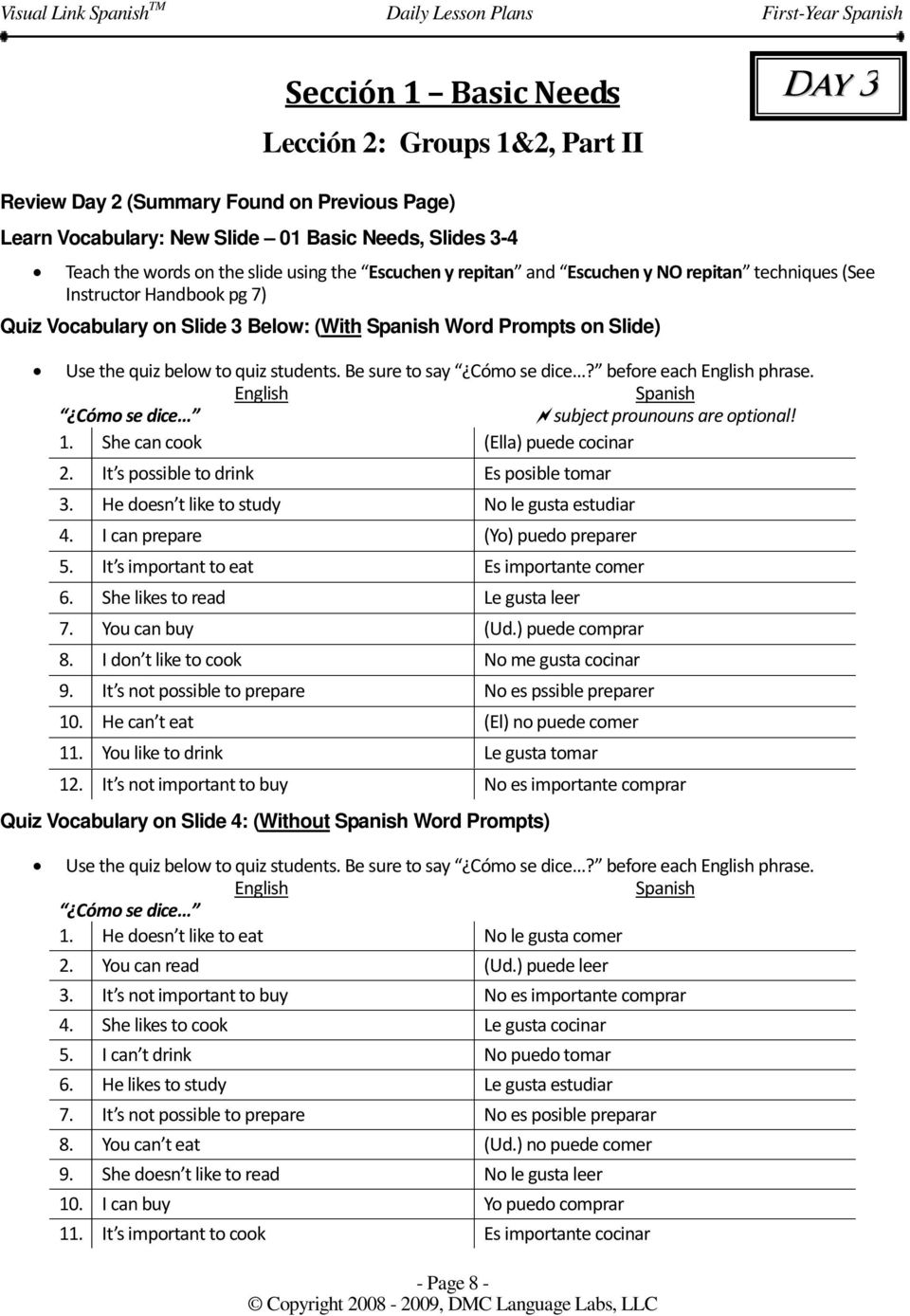
9 12. He doesn t like to buy No le gusta comprar Day 3 In Class Writing: Give students 5-10 minutes to write at least 10 sentences with the words they just learned from the slide. Practice using Practice Model: Follow the steps of the practice model to review the current slide. (See Instructor Handbook pg 12 for complete details) - Use the Following for the Model step: English Spanish Cómo se dice 1. You like to drink Le gusta tomar 2. It s not possible to prepare No es pssible preparer 3. It s important to eat Es importante comer 4. You can buy (Ud.) puede comprar 5. I don t like to cook No me gusta cocinar 6. She likes to read Le gusta leer 7. It s not important to buy No es importante comprar 8. It s possible to drink Es posible tomar 9. He doesn t like to study No le gusta estudiar 10. I can prepare (Yo) puedo preparer 11. She can cook (Ella) puede cocinar 12. He can t eat (El) no puede comer PRACTICE MODEL 1. Explain 2. Model 3. Practice 4. Feedback 5. Present 6. Summarize - Page 9 -

10 Notes and Summary Day 3 Summary of Day 3 Basic Needs Slides 3-4 Practice Session Period 4 Period 1 Period 5 Period 2 Period 6 Period 3 Period 7 - Page 10 -

11 Pronunciation Day 4 Introduction Read the poem entitled English on page 29 of the Student Workbook as a class. o Discuss how Spanish Pronunciation compares to English. Ask students which they feel would be harder to learn. Encourage your students by expressing your confidence that, with proper practice and study, they will will be able to master Spanish pronunciation. After all, if they were able to learn how to pronounce words in English, with all of its nuances and variations, Spanish should be pan comido ( a piece of cake )! ENGLISH I take it you already know Of tough and bough and cough and dough? Others may stumble, but not you On hiccough, thorough, slough, and through. Well done! And now you wish, perhaps, To learn of less familiar traps? Beware of heard, a dreadful word That looks like beard and sounds like bird. And dead: it s said like bed, not bead; For goodness sake, don t call it deed! Watch out for meat and great and threat (They rhyme with suite and straight and debt). A moth is not a moth in mother. Nor both in bother, broth in brother. And here is not a match for there, Nor dear and fear for bear and pear. And then there s close and rose and lose Just look them up and goose and choose, And cork and work and card and ward, And font and front and word and sword. And do and go, then thwart and cart. Come, come I ve hardly made a start. A dreadful language? Why, man alive, I d learn to talk it when I was five, And yet to write it the more I tried, I hadn t learned it at fifty-five. - AUTHOR UNKNOWN - Suggested Method for Teaching Pronunciation Lessons: See Instructor Handbook pages Sounds Covered: Vocales Abecedario Turn to page 70 in the Student Workbook - Page 11 -

12 Comprehension Lección 1 - Basic Needs I, Yes/No Questions Day 4 Suggested Lesson Outline for Comprehension CDs 1 & 2: 1. Display the Comprehension PowerPoint of today s Lección for the class to see. a. (Turn on projector, insert the PowerPoint CD into the computer connected to the projector, open the Comprehension folder, and double-click on today s Lección). 2. Play the Dialogue audio track listed in today s Lección for the class. a. (Place the appropriate Comprehension Audio CD in a stereo or computer, select the track number listed below, and press play). 3. Pause the Dialogue after every few phrases to check for understanding. a. Have the students try to guess the meaning of the Dialogue and pick out any vocabulary they do not understand. 4. Listen to the Dialogue a second time. This time find and project the corresponding PowerPoint lesson. a. Tell the students to listen for the new words they just learned 5. Group Discussion: a. Have the class identify the correct meaning of the narrative/conversation. b. Encourage students use as much Spanish as they can during the discussion. 6. Listen to the dialogue again without looking at the PowerPoint lesson. Comprehension CD 1: Track 2 - Page 12 -

13 1. Tiene que ir? - Do you have to go? 1a. No, no tengo que ir - No, I don t have to go. Day 4 2. Necesita estudiar? - Does she need to study? 2a. No, necesita comer. - No, she needs to eat. 3. Tengo que cocinar? - Do I have to cook? 3a. Sí, tiene que cocinar. - Yes, you have to cook. 4. Es importante comer? - Is it important to eat? 4a. Sí, es importante comer. - Yes, it is important to eat. 5. Quiere caminar? - Do you want to walk? 5a. No, quiero tomar un taxi. - No, I want to take a taxi. 6. Le gusta leer? - Do you like to read? 6a. Sí, me gusta leer. - Yes, I like to read. 7. Tiene que comprar? - Does he have to buy? 7a. No, no necesita comprar. - No, He doesn t have to buy. 8. Es posible correr? - Is it possible to run? 8a. Sí, es posible correr - Yes, it is possible to run. 9. Ella quiere cocinar? - Does she want to cook? 9a. No, Ella no quiere cocinar. No, She doesn t want to cook. 10. Necesita ir? Do you need to go? 10a. No, no necesito ir. No, I don t need to go. 11. A ella le gusta caminar? Does she like to walk? 11a. Sí, a ella le gusta caminar - Yes, she likes to walk. 12. Él necesita correr? Does he need to run? 12a. No, él no necesita correr. No, He doesn t need to run. 13. A ti te gusta tomar? Do you like to drink? 13a. No, a mi no me gusta tomar. No, I don t like to drink. - Page 13 -

14 Notes and Summary Day 4 Summary of Day 4 Pronunciation o Vocales o Abecedario Comprehension CD 1, Tracks 1 & 2 Period 4 Period 1 Period 5 Period 2 Period 6 Period 3 Period 7 - Page 14 -

15 Culture Lección 1 - Spanish Symbols Suggested Outline for Culture Lessons: 1. Display the Culture PowerPoint of today s Lección for the class to read. a. (Turn on projector, Place the PowerPoint CD into the computer connected to the projector, open the Culture folder, and double-click on today s Lección). 2. Read the Culture Newsletter. a. As you read, have the students try to guess the meaning of the Spanish words. b. You may ask individual students to take turns reading. 3. Read and Practice the Vocabulario de la Semana list. a. Inform the students that they do not need to memorize the words just recognize them for comprehension while reading. 4. (Optional) Read the culture lesson again focusing on the new vocabulary. 5. Group Discussion. a. Compare and contrast the lesson with the students own diverse cultures. b. Encourage the students to use as much Spanish as they can during the discussion. Mucha gente ha preguntado, "What is the ' ' sign al principio of questions in Spanish?". It is officially called - - Are you ready for the technical term? -- the "upsidedown question mark." It is placed al principio of any Spanish oración that is una pregunta. Day 5 question mark at the beginning of una oración and how it could help you. When I was in High School English class, we read quite a few short stories and plays en voz alta. The whole class would follow along and students would take turns reading different parts o párrafos. I remember más de una vez, when I was reading a long paragraph, all of a sudden, I would get to the end and realize there was a question mark there. El problema fue que I had read the whole párrafo as if it were a statement. I would then try to compensate and make my voice change at the last minute so it sounded like una pregunta. I know I must have sounded ridículo trying to change my voice at the last minute and I was always a bit embarrassed when this would happen. Has that ever happened a usted? With the upside-down question mark, eso nunca pasa in Spanish because you see that a sentence is a question desde el comienzo! No more embarrassing "end of sentence voice change to compensate for question marks" phobia or vergüenza. Me encanta the Spanish language and all the cool little things they have like the "upside-down question mark." Tal vez con esta lección, we can start a grassroots effort to change the English language and add the "upside-down question mark"! Llame o escriba a su senador or parliament representative today, para que podamos evitar "end of sentence voice change to compensate for question mark" phobia and vergüenza para siempre! Anyway, if you can't tell, me encanta the Spanish language y espero que through this Lección and by learning Spanish with our Visual Link Spanish course, you gain the same love for it que yo tengo. Mucha gente piensa, "Why in the world does Spanish have an upside down question mark?" En realidad, you'll see as we talk about it, que tiene mucho sentido. You may even want to petition the people that make English grammar rules and get them to put an upsidedown question mark en el idioma de inglés. Let me explain porque necesitaría an upside-down - Page 15 -

16 Vocabulario de la Semana mucha gente ha preguntado many people have asked al principio at the beginning oración sentence una pregunta a question mucha gente piensa many people think en realidad actually (in reality) que tiene mucho sentido that it makes a lot of sense en el idioma de inglés in the English language porque necesitaría why you would need una oración a sentence en voz alta aloud o párrafos or paragraphs más de una vez more than once el problema fue que the problem was that una pregunta a question ridículo rediculous a usted to you eso nunca pasa that never happens desde el comienzo from the start vergüenza embarrassment me encanta I love tal vez con esta lección maybe with this lesson llame o escriba a su senador call or write your senator para que podamos evitar so that we can avoid para siempre forever y espero que and (I) hope that que yo tengo that I have mucha gente ha preguntado many people have asked al principio at the beginning oración sentence una pregunta a question mucha gente piensa many people think en realidad actually (in reality) que tiene mucho sentido that it makes a lot of sense en el idioma de inglés in the English language porque necesitaría why you would need una oración a sentence en voz alta aloud o párrafos or paragraphs más de una vez more than once Day 5 el problema fue que the problem was that una pregunta a question ridículo rediculous a usted to you eso nunca pasa that never happens desde el comienzo from the start vergüenza embarrassment me encanta I love tal vez con esta lección maybe with this lesson llame o escriba a su senador call or write your senator para que podamos evitar so that we can avoid para siempre forever y espero que and (I) hope that lección lesson que yo tengo that I have - Page 16 -

17 Notes and Summary Day 5 Summary of Day 5 Culture o Spanish Symbols Period 4 Period 1 Period 5 Period 2 Period 6 Period 3 Period 7 - Page 17 -

18 Sección 1 Basic Needs Lección 3: Group 3, Part I Day 6 Review 01 Basic Needs, Slides 1-4 Learn Vocabulary: New Slide 01 Basic Needs, Slide 5-6 (Group 3) Teach the words on the slide using the Escuchen y repitan and Escuchen y NO repitan techniques (See Instructor Handbook pg 7) Quiz Vocabulary on Slide 5 Below: (With Spanish Word Prompts on Slide) Use the quiz below to quiz students as a group. English Spanish Cómo se dice subject prounouns are optional! 1. pool piscina 2. bathroom baño 3. store tienda 4. later luego 5. work trabajo 6. post office correo 7. bank banco 8. now ahora 9. it lo/la 10. them los/las 11. restaurant restaurante 12. tomorrow mañana 13. in (5) minutes en (cinco) minutos 14. park parque 15. office oficina 16. home casa 17. hotel hotel 18. movies cine 19. today hoy 20. in an hour en una hora 21. tonight esta noche Grammar Explanation Open the Grammar PowerPoint Slide and take 5-10 minutes to teach the articles (un, una, el, la etc.). NOTE: Don t cover the exercises with colored pictures yet those will be covered in-depth when you get to the Grammar section. - Page 18 -

19 Quiz Vocabulary on Slide 5 Using Articles: (With Spanish Word Prompts) Use the quiz below to quiz students as a group. English Cómo se dice 1. a bathroom un baño 2. some banks unos banco 3. a movie theatre un cine 4. the pools las piscinas 5. the houses las casas 6. the post office el correo 7. the offices las oficinas 8. the bathroom el baño 9. some hotels unos hotels 10. a restaurant un restaurante 11. the park el parque 12. some stores unas tiendas Spanish Day 6 Quiz Vocabulary on Slide 6: (Without Spanish Word Prompts) Use the quiz below to quiz students as a group. English Spanish Cómo se dice 1. the bathroom el baño 2. in (5) minutes en (cinco) minutos 3. work trabajo 4. the stores las tiendas 5. in an hour en una hora 6. now ahora 7. home casa 8. it lo/la 9. some post offices unos correo 10. the restaurants los restaurants 11. a bank un banco 12. tomorrow mañana 13. them los/las 14. some parks unos parques 15. the movies (or movie theater) el cine 16. a pool una piscina 17. tonight esta noche 18. today hoy 19. some hotels unos hotels 20. later luego 21. an office una oficina 22. the bathroom el baño - Page 19 -

20 Day 6 Practice using Practice Model: Follow the steps of the practice model to review the current slide. (See Instructor Handbook pg 12 for complete details) Use the Following for the Model step in the Practice Model: Be sure to ask each student individually here as compared to the other quizzes. English Spanish Cómo se dice 1. home casa 2. it lo/la 3. some post offices unos correo 4. the restaurants los restaurants 5. a bank un banco 6. tomorrow mañana 7. them los/las 8. some parks unos parques 9. the hotel el hotel 10. a pool una piscina 11. tonight esta noche 12. today hoy PRACTICE MODEL 1. Explain 2. Model 3. Practice 4. Feedback 5. Present 6. Summarize - Page 20 -

21 Notes and Summary Day 6 Summary of Day 6 Basic Needs Slide 5-6 Grammar Explanation: Articles Practice Session Period 4 Period 1 Period 5 Period 2 Period 6 Period 3 Period 7 - Page 21 -
22 Sección 1 Basic Needs Lección 4: Group 3, Part II Day 7 Review Day 2 (Summary Found on Previous Page) Learn Vocabulary: New Slide 01 Basic Needs, Slides 7-8 (Group 3) Teach the words on the slide using the Escuchen y repitan and Escuchen y NO repitan techniques (See Instructor Handbook pg 7) Quiz Vocabulary on Slide 7 Below: (With Spanish Word Prompts on Slide) Use the quiz below to quiz students as a whole group. English Spanish Cómo se dice subject prounouns are optional! 1. food comida 2. a drink una bebida 3. the vegetables las verduras 4. the magazines las revistas 5. also también 6. some books unos libros 7. the juice el jugo 8. water agua 9. a document un documento 10. the dictionary el diccionario 11. some salads unas ensaladas 12. the meat la carne 13. the fruit la fruta 14. the hamburgers las hamburguesas 15. something algo 16. a newspaper un periódico 17. some contracts unos contratos 18. nothing/anything nada 19. the cookies/crackers las galletas 20. some magazines unas revistas Quiz Vocabulary on Slide 8: (Without Spanish Word Prompts) Quiz students collectively using quiz below English Cómo se dice 1. also también 2. some magazines unas revistas 3. the meat la carne 4. some contracts unos contratos Spanish - Page 22 -
23 5. the dictionary el diccionario 6. the hamburgers las hamburguesas 7. some books unos libros 8. the cookies/crackers las galletas 9. the vegetables las verduras 10. food comida 11. a newspaper un periódico 12. some salads unas ensaladas 13. water agua 14. a drink una bebida 15. something algo 16. the magazines las revistas 17. the juice el jugo 18. the fruit la fruta 19. nothing/anything nada 20. a document un documento Day 7 In Class Writing: Give students 5-10 minutes to write at least 10 sentences with the words they just learned from the slide using words from Groups 1, 2 and 3 learned up to this point. Practice using Practice Model: Follow the steps of the practice model to review the current slide. (See Instructor Handbook pg 12 for complete details) Use the Following for the Model step (remember to ask students individually not collectively) English Spanish Cómo se dice 1. a drink una bebida 2. food comida 3. a newspaper un periódico 4. some books unos libros 5. the dictionary el diccionario 6. the hamburgers las hamburguesas 7. some contracts unos contratos 8. the cookies/crackers las galletas 9. the vegetables las verduras 10. water agua 11. something algo 12. some salads unas ensaladas 13. the magazines las revistas PRACTICE MODEL 1. Explain 2. Model 3. Practice 4. Feedback 5. Present 6. Summarize - Page 23 -
24 Notes and Summary Day 7 Summary of Day 7 Basic Needs Slide 7-8 Practice Session Period 4 Period 1 Period 5 Period 2 Period 6 Period 3 Period 7 - Page 24 -
25 Sección 1 Basic Needs Lección 5: Groups 1-3, Phrases Day 9 Workbook Recognition: Have Students turn to page 3-4 in the workbooks and spend 3 5 minutes looking at groups 1, 2, & 3. Help them recognize that everything they have learned up to this point on the slides is in the workbook. Teach them that there are a few variations in group 3 and go over them: the park is el parque and to the park is al parque etc... Also teach them the difference between masculine and feminine: to the store - f is a la tienda and to the bank - m is al banco. Show them that al banco is really a el banco put together or contracted. Quiz Groups 1, 2 & 3 (using Workbooks): Say English phrases below and have students, as a group, say the Spanish equivalent: * Como se dice Inglés Español Subject pronouns are optional! 1. It's possible to take a taxi to the office Es posible tomar un taxi a la oficina 2. You have to prepare the contract (Ud.) Tiene que preparar el contrato 3. He can t go to the movies tomorrow (El) No puede ir al cine mañana 4. I don t have to study now (Yo) No tengo que estudiar ahora 5. She doesn t likes to eat hamburgers No le gusta comer hamburguesas 6. You want to walk to the store (Ud.) Quiere caminar a la tienda 7. I don t want to read a book (Yo) No quiero leer un libro 8. It's important to cook meat Es importante cocinar carne 9. You want to buy a magazine (Ud.) Quiere comprar una revista 10. You like to drink juice Le gusta tomar jugo 11. She wants to go to the pool (Ella) Quiere ir a la piscina 12. He doesn t want to study now (El) No quiere estudiar ahora 13. I can do it tomorrow (Yo) Puedo hacerlo mañana 14. She has to buy the vegetables (Ella) Tiene que comprar las verduras 15. He doesn t need to take a taxi today (El) No necesita tomar un taxi hoy 16. I want to make some cookies (Yo) Quiero hacer unas galletas 17. I need to run to the store (Yo) Necesito correr a la tienda 18. I don t like to walk to work No me gusta caminar al trabajo 19. You can prepare the salad (Ud.) Puede preparar la ensalada 20. You need to read the documents (Ud.) Necesita leer los documentos - Page 25 -
26 Day 9 Quiz Groups 1, 2 & 3 (No Workbooks): Have students close workbook. Say English phrases below and have students, as a group, say the Spanish equivalent: Inglés Español * Como se dice 13. She likes to go to the park Le gusta ir al parque 14. I can study in an hour (Yo) Puedo estudiar en una hora 15. He has to read a book (El) Tiene que leer un libro 16. I don t want to cook the vegetables (Yo) No quiero cocinar las verduras 17. I have to do something tonight (Yo) Tengo que hacer algo esta noche 18. She can make the salad (Ella) Puede hacer la ensalada 19. She doesn t want to walk to the hotel (Ella) No quiere caminar al hotel 20. It's important to eat fruit Es importante comer fruta 21. I need to read the newspaper (Yo) Necesito leer el periódico 22. You want to take a taxi to the restaurant (Ud.) Quiere tomar un taxi al restaurante 23. I have to go to the bank (Yo) Tengo que ir al banco 24. It's not possible to prepare the food No es posible preparar la comida 25. You like to buy drinks Le gusta comprar bebidas 26. You need to take a taxi to the post office (Ud.) Necesita tomar un taxi al correo 27. I want to run home (Yo) Quiero correr a la casa 28. You don t want to buy anything (Ud.) No quiere comprar nada 29. You have to drink water (Ud.) Tiene que tomar agua 30. He wants to run to the bathroom (El) Quiere correr al baño 31. She doesn t need to study today (Ella) No necesita estudiar hoy 32. You can walk to the store (Ud.) Puede caminar a la tienda - Page 26 -
27 In Class Writing Assignment: Give students 5-10 minutes to write at least 10 sentences using Groups 1, 2 & 3 from the workbook. It is important for spatial learning that students learn the position of the words on the pages of the workbook. Day 9 Practice using Practice Model: Follow the steps of the practice model to review the section. (See Instructor Handbook pg 12 for complete details.) Use the Following for the Model step (remember to ask students individually not collectively) English Spanish Cómo se dice 1. She can go to the bank (Ella) Puede ir al banco 2. I have to study the dictionary (Yo) Tengo que estudiar el diccionario 3. He likes to eat cookies Le gusta comer galletas 4. You don t want to walk home (Ud.) No quiere caminar a la casa 5. I want to read the contract (Yo) Quiero leer el contrato 6. You don t want to buy some drinks (Ud.) No quiere comprar unas bebidas 7. You don t like to read magazines No le gusta leer revistas 8. He wants to go to a restaurant (El) Quiere ir a un restaurante 9. I like to cook hamburgers Me gusta cocinar hamburguesas 10. You can t walk to work (Ud.) No puede caminar al trabajo 11. You need to read some documents (Ud.) Necesita leer unos documentos 12. She has to buy the food (Ella) Tiene que comprar la comida 13. He can go to the bank (El) Puede ir al banco PRACTICE MODEL 1. Explain 2. Model 3. Practice 4. Feedback 5. Present 6. Summarize Important Note: When students are in the Practice step of the Practice Model, have them use the sentences they created during the In-Class Writing Assignment to quiz others in their group. - Page 27 -
28 Notes and Summary Day 9 Summary of Day 8 Basic Needs Slide Sentence Building with Groups 1, 2 & 3 Practice Session Period 4 Period 1 Period 5 Period 2 Period 6 Period 3 Period 7 - Page 28 -
29 Pronunciation Day 9 Sounds Covered: ll, ñ, z Turn to page in the Student Workbook Suggested Lesson Outline: Comprehension Lección 2 - Basic Needs II, Yes/No Questions (cont.) 1. Display the Comprehension PowerPoint. 2. Listen to the Dialogue listed below. 3. Pause after every few phrases to check for understanding. a. Have the students try to guess the meaning and pick out vocabulary they do not understand. 4. Practice/review the unfamiliar vocabulary. 5. Listen to the Dialogue a second time. This time find and project the corresponding PowerPoint lesson. 6. Group Discussion: as a class, discuss the correct meaning. 7. Listen to the dialogue again without looking at the PowerPoint lesson. Comprehension CD 1: Track 3 This next set of questions will use words from Groups 1, 2 and 3 of the Basic Needs Section 1. Quiere ir al banco? - Do you want to go to the bank? a) Sí, quiero ir al banco. - Yes, I want to go to the bank. 2. Quiere cocinar una hamburguesa? - Does she want to cook a hamburger? a) No, no quiere cocinar una hamburguesa. - No, She doesn t want to cook a hamburger. 3. Es importante estudiar el contrato? - Is it important to study the contract? a) Sí, es importante estudiar el contrato. - Yes, it s important to study the contract. 4. Es posible caminar a mi hotel? - Is it possible to walk to my hotel? a) No, necesitamos tomar un taxi. - No, we need to take a taxi. 5. No quieres comer algo? - Don t you want to eat something? a) Sí, me gusta comer fruta. - Yes, I like to eat fruit. (It is important to know that as part of the culture people ask questions this way also) 6. Le gusta ir a la alberca, no? - He likes to go to the pool, doesn t he? (In this case the word no? means doesn t he? And accualy the question is the word no? ) a) Sí, le gusta ir a la alberca. - Yes, He likes to go to the pool. 7. A él le gusta preparar ensaladas? Does he like to prepare salads? a) No, a él le gusta cocinar carne. No, he likes to cook meat. 8. Ella necesita ir a la tienda? Does she need to go to the store? a) Sí, ella necesita comprar comida. Yes, she needs to buy food. 9. Quiere ir a la oficina, verdad? You want to go to the office, right? a) No, quiero ir a un restaurante. No, I want to go to a restaurant. 10. No quiere comer galletas? Don t you want to eat cookies? a) No, quiero tomar agua. No, I want to drink water. 11. El puede ir a la casa en una hora? Can he go to the home in an hour? a) No, él puede ir a la casa en cinco minutos. No, he can go to the home in five minutes. 12. Es posible comprar un diccionario? Is it possible to buy a dictionary? a) Sí, es posible ir a la tienda ahora. Yes, it is possible to go to the store now. 13. Él quiere ir al parque luego? Does he want to go to the park later? a) No, él quiere que ir ahora. No, He wants to go now. - Page 29 -
30 Notes and Summary Day 9 Summary of Day 9 Pronunciation o ll o ñ o z Comprehension CD 1, Track 3 Period 4 Period 1 Period 5 Period 2 Period 6 Period 3 Period 7 - Page 30 -
31 Culture Lección 2: Don t Throw Things! Culture Lesson Suggested Outline: 1. Display the Culture PowerPoint. a. (Insert the PowerPoint CD into computer, open the Culture folder, and double-click today s Lección). 2. Read the culture lesson and have students guess the meaning of Spanish words 3. Read the vocabulary list tell students they are not trying to memorize the words just recognize them for comprehension while reading 4. Read the culture lesson again 5. Compare and Contrast: Have a discussion to compare and contrast with students own culture Day 10 this cultural difference and I apologized profusely. Y entonces expliqué que it was a normal thing for us to do where I was from. Me miraron in disbelief, as if I had grown up without any form of education and then proceeded to show me, more than once, how to hand a pen to someone como si nunca lo había hecho antes. Ese día, I learned a valuable Lección cultural, a faux pas that, I'm sure, many foreigners commit. Hopefully aprenderán de mi experiencia. When most native Spanish speakers vienen a los Estados Unidos, they adapt a nuestra cultura and will usually get somewhat accustomed to our "throwing things" to each other. But, la próxima vez you go to Latin America and someone asks for a pen, be sure to walk over and hand it a ellos. Voy a hablar hoy about something that Americans commonly do that is not done en la cultura Latina. I'm not sure if this happens en Inglaterra o Australia (if someone from Inglaterra o Australia would reply to this lesson and let me know I would enjoy hearing from you). Anyway, if I was at home or en la oficina and needed a pen, or some cinta for example, I would ask a family member or co-worker for it, and they would probably toss or throw it a mí. Likewise, at home if I needed mis llaves and mi esposa had them, she would probably toss them to me. Esto es una cosa normal to do. In Latin America however, the culture about throwing objects es muy diferente. Let me explain to you exactly lo que me pasó. Cuando vivía en Latin America, I was visiting a family in their home; me habían invitado over for dinner. While we were waiting for dinner, about 6 of them and I were sitting in their living room platicando. We were having una conversación muy buena and I was really enjoying myself. Then uno de ellos me preguntó if I had a pen. Without giving it a second thought, I pulled out a pen and tossed it to the person que la pidió. Everyone gasped and the room went dead silent I suddenly felt my face turn red and asked, " Qué pasó?". I was startled by the situation and truly had no idea what was wrong. Por fin, one of them said in a subdued tone, "Acabas de tirar that pen!" I answered carefully and said, "Yes, is something wrong?" They said "Here, it is very impolite to throw pens or things to people." Me asombré by - Page 31 -
32 Vocabulario de la Semana mucha gente ha preguntado many people have asked al principio at the beginning oración sentence una pregunta a question mucha gente piensa many people think en realidad actually (in reality) que tiene mucho sentido that it makes a lot of sense en el idioma de inglés in the English language porque necesitaría why you would need una oración a sentence en voz alta aloud o párrafos or paragraphs más de una vez more than once el problema fue que the problem was that una pregunta a question ridículo ridiculous a usted to you eso nunca pasa that never happens desde el comienzo from the start vergüenza embarrassment me encanta I love tal vez con esta lección maybe with this lesson llame o escriba a su senador call or write your senator para que podamos evitar so that we can avoid para siempre forever y espero que and (I) hope that lección lesson que yo tengo that I have Day 10 - Page 32 -
33 Notes and Summary Day 10 Summary of Day 10 Culture o Don t Throw Things! Period 4 Period 1 Period 5 Period 2 Period 6 Period 3 Period 7 - Page 33 -
34 Sección 1 Basic Needs Lección 6: Yes/No Questions Day 11 Teach Yes/No Questions (Basic Needs Slide 9-13) Ask Questions to Students and Students Answer in Spanish (using Workbooks): Ask individual students the questions below and have students answer in Spanish using the Workbook. Quiere leer el libro? Quiere comer una hamburguesa? Quiero comprar carne? Necesita tomar un taxi al trabajo? No necesita caminar hoy? Necesita cocinar las verduras? Tiene que estudiar el diccionario? Tiene que hacer algo? No tiene que ir al correo? Le gusta leer el periódico? Pregunta 11. Quiere leer el documento ahora? 12. Necesita ir al banco hoy? 13. Necesita tomar un taxi en una hora? 14. Le gusta preparar comida? 15. Puede preparar algo? 16. Quiere comer una ensalada? 17. Le gusta caminar? 18. Necesita cocinar la hamburguesa? 19. Le gusta comer fruta? 20. Le gusta ir al parque? Ask Questions to Students and Students Answer in Spanish (No Workbooks): Have students close workbooks and ask individual students the questions below and have students answer in Spanish using the Workbook. Note: if students are struggling and really need to look at the workbook, it is ok at this point. Le gusta tomar jugo? Le gusta cocinar carne? Puede ir al banco hoy? Puede prepararlo esta noche? Puede caminar a la piscina luego? Es importante comer verduras? Es importante estudiar algo? Es importante correr? Es posible cocinar agua? Es posible comprarla? Pregunta 1. Quiere hacerlo luego? 2. Quiere ir en una hora? 3. Quiere ir mañana? 4. Quiere ir al trabajo hoy? 5. Necesita tomar un taxi? 6. Necesita tomar un taxi al hotel esta noche? 7. Puede cocinar galletas en una hora? 8. Puede correr al correo luego? 9. Es importante leer el contrato? 10. Es importante tomar agua? - Page 34 -
35 Day 11 In Class or At Home Writing Assignment: Have students write down at least 10 Yes/No questions using Groups 1, 2 & 3 from the Workbook. Practice using Practice Model: Follow the steps of the practice model to review the section. (See Instructor Handbook pg 12 for complete details.) Use the Following for the Model step (remember to ask individual students questions in Spanish and they answer in Spanish let them use their Workbooks if they need to.) Pregunta 1. Es posible tomar una bebida esta noche? 7. Le gusta estudiar el diccionario? 2. No le gusta leer la revista? 8. Es posible comer comida ahora? 3. No necesita comprar el libro mañana? 9. Necesita tomar jugo también? 4. Tiene que cocinar comida ahora? 10. Tiene que ir al baño? 5. Puede tomar un taxi a la tienda? 11. No le gusta hacer nada? 6. Le gusta correr al baño? 12. No quiere comprar una bebida? Important Note: When students are in the Practice step of the Practice Model, have them use the questions they created during the In-Class or At Home Writing Assignment. They should ask questions in Spanish and members of their group should answer in Spanish. PRACTICE MODEL 1. Explain 2. Model 3. Practice 4. Feedback 5. Present 6. Summarize Homework Assignment: Have students go home and write 20 Yes/No Questions from the Basic Needs section. - Page 35 -
36 Notes and Summary Day 11 Summary of Day 11 Learn to Ask and Answer Yes / No Questions Homework write 20 Yes / No questions. Period 4 Period 1 Period 5 Period 2 Period 6 Period 3 Period 7 - Page 36 -
37 Sección 1 Basic Needs Lección 7: Yes/No Questions (cont.) Day 12 Ask Questions to Students and Students Answer in Spanish (using Workbooks): Ask individual students the questions below and have students answer in Spanish using the Workbook. Pregunta 1. Quiere ir al trabajo hoy? 11. Quiere leer el documento ahora? 2. Necesita tomar un taxi? 12. Necesita ir al banco hoy? 3. Necesita tomar un taxi al banco esta noche? 13. Necesita tomar un taxi en una hora? 4. Puede cocinar galletas en una hora? 14. Le gusta preparar comida? 5. Puede correr al correo luego? 15. Puede preparar algo? 6. Es importante leer el contrato? 16. Quiere comer una ensalada? 7. Es importante tomar agua? 17. Le gusta caminar? 8. Le gusta estudiar el diccionario? 18. Necesita cocinar la hamburguesa? 9. No tiene que ir al correo? 19. Le gusta comer fruta? 10. Le gusta leer el periódico? 20. Le gusta ir al parque? Ask Questions to Students and Students Answer in Spanish (No Workbooks): Have students close workbooks and ask individual students the questions below and have students answer in Spanish without using the Workbook if possible. Note: if students are still struggling try to encourage them to answer without the Workbook. Pregunta 1. Le gusta tomar jugo? 11. Quiere hacerlo luego? 2. Le gusta cocinar carne? 12. Quiere ir en una hora? 3. Puede ir al banco hoy? 13. Quiere ir mañana? 4. Puede prepararlo esta noche? 14. Quiere ir al trabajo hoy? 5. Puede caminar a la piscina luego? 15. Necesita tomar un taxi? 6. Es importante comer verduras? 16. Necesita tomar un taxi al hotel esta noche? 7. Es importante estudiar algo? 17. Puede cocinar galletas en una hora? 8. Es importante correr? 18. Puede correr al correo luego? 9. Es posible cocinar agua? 19. Es importante leer el contrato? 10. Es posible comprarla? 20. Es importante tomar agua? - Page 37 -
38 Day 12 Practice using Practice Model: Follow the steps of the practice model to review the section. (See Instructor Handbook pg 12 for complete details.) Use the Following for the Model step (remember to ask individual students questions in Spanish and they answer in Spanish let them use their Workbooks if they need to.) Pregunta 1. Es posible tomar una bebida esta noche? 7. Le gusta estudiar el diccionario? 2. No le gusta leer la revista? 8. Es posible comer comida ahora? 3. No necesita comprar el libro mañana? 9. Necesita tomar jugo también? 4. Tiene que cocinar comida ahora? 10. Tiene que ir al baño? 5. Puede tomar un taxi a la tienda? 11. No le gusta hacer nada? 6. Le gusta correr al baño? 12. No quiere comprar una bebida? Use Homework Here!: When students are in the Practice step of the Practice Model, have them use the questions they created during the Homework Writing Assignment. They should ask questions in Spanish and members of their group should answer in Spanish. PRACTICE MODEL 1. Explain 2. Model 3. Practice 4. Feedback 5. Present 6. Summarize - Page 38 -
39 Notes and Summary Day 12 Summary of Day 12 Review of Yes / No Questions More Yes / No Question Practice Period 4 Period 1 Period 5 Period 2 Period 6 Period 3 Period 7 - Page 39 -
40 Sección 1 Basic Needs Lección 8: Open Questions Day 13 Learn Vocabulary: New Slide Basic Needs Slide (? / Ans. / Links) Teach the words on the slide using the Escuchen y repitan and Escuchen y NO repitan techniques (See Instructor Handbook pg 7) Ask Questions to Students and Students Answer in Spanish (using Workbooks): Ask individual students the questions below and have students answer in Spanish using the Workbook. Pregunta 1. Adónde necesita ir esta noche? 12. Cuándo tiene que ir al banco? 2. Adónde necesita ir mañana? 13. Cuándo necesita cocinar? 3. Adónde quiere correr hoy? 14. Cuándo es importante tomar agua? 4. Adónde tiene que tomar un taxi? 15. Cuándo tiene que estudiar? 5. Adónde puede caminar esta noche? 16. Dónde puede comprar verduras? 6. Adónde quiere correr? 17. Qué le gusta leer? 7. Adónde tiene que ir en una hora? 18. Qué necesita preparar luego? 8. Qué le gusta comer? 19. Cuándo puede leer el contrato? 9. Qué necesita estudiar? 20. Adónde tiene que ir mañana? 10. Qué teine que hacer mañana? 21. Adónde quiere caminar hoy? 11. Cuándo quiere ir a la piscina? 22. Cuándo puede hacer una ensalada? Ask Questions to Students and Students Answer in Spanish (No Workbooks): Have students close workbooks and ask individual students the questions below and have students answer in Spanish without using the Workbook if possible. Note: if students are still struggling try to encourage them to answer without the Workbook. Pregunta 1. Cuándo puede preparar una ensalada? 12. Qué quiere leer hoy? 2. Adónde tiene que tomar un taxi mañana? 13. Cuándo necesito ir a la oficina? 3. Qué tiene que cocinar hoy? 14. Qué le gusta hacer? 4. Qué le gusta tomar? 15. Dónde le gusta estudiar? 5. Cuándo necesita comprar un diccionario? 16. Qué necesita comprar luego? 6. Dónde puede cocinar la carne? 17. Qué necesita hacer hoy? 7. Adónde tiene que ir en una hora? 18. Cuándo puede ir al cine? 8. Adónde necesita ir mañana? 19. Adónde le gusta correr? 9. Cuándo necesita leer el libro? 20. Qué tiene que comprar esta noche? 10. Cuándo es importante correr? 21. Dónde puede preparar la comida? 11. Cuándo tiene que ir a la tienda? 22. Qué le gusta cocinar? - Page 40 -
41 Day 13 In Class or At Home Writing Assignment: Have students write down at least 10 questions using question words from the Workbook. Practice using Practice Model: Follow the steps of the practice model to review the section. (See Instructor Handbook pg 12 for complete details.) Note: Only a rare use of Por qué? is recommended in this section since students generally aren t prepared to answer questions of that type yet. Use the Following for the Model step (remember to ask individual students questions in Spanish and they answer in Spanish let them use their Workbooks if they need to.) Pregunta 1. Qué le gusta hacer? 7. Por qué ir a la tienda? 2. Qué le gusta comer? 8. Qué le gusta leer? 3. Cuándo puede ir al cine? 9. Adónde tiene que ir en una hora? 4. Cuándo tiene que ir a la tienda? 10. Qué necesita estudiar? 5. Adónde tiene que ir mañana? 11. Adónde quiere correr? 6. Adónde le gusta correr? 12. Cuándo puede leer el libro? Important Note: When students are in the Practice step of the Practice Model, have them use the questions they created during the In-Class or At Home Writing Assignment. They should ask questions in Spanish and members of their group should answer in Spanish. PRACTICE MODEL 1. Explain 2. Model 3. Practice 4. Feedback 5. Present 6. Summarize Homework Assignment: Have students go home and write 20 questions using question words from the Basic Needs section. - Page 41 -
42 Notes and Summary Day 13 Summary of Day 13 Learn to ask questions using question words Practice with Question Words Period 4 Period 1 Period 5 Period 2 Period 6 Period 3 Period 7 - Page 42 -
43 Pronunciation Day 14 Sounds Covered: Hard and Soft d Trilled r/rr Turn to page in the Student Workbook Suggested Lesson Outline: Comprehension Lección 3 - Basic Needs III, Question Words 1. Display the Comprehension PowerPoint. 2. Listen to the Dialogue listed below. 3. Pause after every few phrases to check for understanding. a. Have the students try to guess the meaning and pick out vocabulary they do not understand. 4. Practice/review the unfamiliar vocabulary. 5. Listen to the Dialogue a second time. This time find and project the corresponding PowerPoint lesson. 6. Group Discussion: as a class, discuss the correct meaning. 7. Listen to the dialogue again without looking at the PowerPoint lesson. Comprehension CD 1: Track 4 1. Why do you want to walk to the post office? Por qué quiere caminar al correo? 1a. Because I don t want to take a taxi. Porque no quiero tomar un taxi. 2. Where does she need to study the book? Dónde necesita estudiar el libro? 2a. She needs to study the book at home. Necesita estudiar el libro en la casa. 3. What do you like to prepare? Qué le gusta preparar? 3a. I like to prepare a salad. Me gusta preparar una ensalada. 4. Where does she like to drink juice? Dónde le gusta tomar jugo? 4a. She likes to drink juice at the pool. Le gusta tomar jugo en la alberca. 5. Where do you want to go tonight? Adónde quiere ir esta noche? 5a. I want to go to a restaurant. Quiero ir a un restaurante. 6. What do you want to do tomorrow? Qué quiere hacer mañana? 6a. I want to run to the park. Quiero correr al parque. 7. Why do you want to go to the restaurant? - Por qué quiere ir al restaurante? 7a. Because I want to eat something. Porque quiero comer algo. 8. Adónde necesita ir esta noche? - Where do you need to go tonight (to)? 8a. Necesito ir a la tienda esta noche - I need to go to the store tonight. 9. Cuándo puede ir al restaurante? - When can you go to the restaurant? 9a. Puedo ir al restaurante en una hora? I can go to the restaurant in an hour. 9. Qué tiene que leer ella hoy? What does she have to read today? 9a. Ella tiene que leer un contrato hoy. She has to read a contract today. 10. Por qué necesita él correr a la oficina? Why does he need to run to the office? 10a.Porque él no puede tomar un taxi. - Because he can t take a taxi. 11. Cuándo necesita Juan ir al correo? When does Juan need to go to the post office? 11a. Juan necesita ir al correo el viernes. He needs to go to the post office on Friday. notice when we use days of the week on means el and it s always el, never la) 12. Qué le gusta comer a Pedro en el restaurante? What does Pedro like to eat at the restaurant? 12a. Le gusta comer una hamburguesa. He likes to eat a hamburger. 13. Cuándo puede leer Marcela un libro? When can Marcela read a book? 13a. Marcela puede leer un libro ahora. Marcela can a read a book now. 14. Qué tiene que estudiar usted hoy? What do you have to study today? 14a. Tengo que estudiar un documento. I have to study a document. - Page 43 -
44 Notes and Summary Day 14 Summary of Day 14 Pronunciation o Hard and Soft d o Trilled r/rr Comprehension CD 1, Track 4 Period 4 Period 1 Period 5 Period 2 Period 6 Period 3 Period 7 - Page 44 -
45 Culture Lección 3: Usted habla muy bien! Day 15 Culture Lesson Guidelines: 1. Display the Culture PowerPoint. a. (Insert the PowerPoint CD into computer, open the Culture folder, and double-click today s Lección). 2. Read the culture lesson and have students guess the meaning of Spanish words 3. Read the vocabulary list tell students they are not trying to memorize the words just recognize them for comprehension while reading 4. Read the culture lesson again 5. Compare and Contrast: Have a discussion to compare and contrast with students own culture Esta semana I wanted to talk un poco acerca de pronunciation. In español, you could know thousands of words y como to put them together into oraciones, but if you don't have good pronunciation, you'll never be understood. De hecho, your efforts to learn español will have been en vano. Por otra parte, if you really take el tiempo to learn la pronunciación de español, native speakers are so impressed cuando habla. You may not have gramática perfecta or a very extensive vocabulario, but if you have good pronunciación, native speakers will usually say, " Usted habla muy bien!", or in English "You speak very well!". The pronunciación is the key! They'll think you are a great Spanish speaker just by having good solid técnicas de pronunciación! Many people make the mistake of thinking that because they took español in Junior High, High School, or even College, they automaticamente have great técnicas de pronunciación when in-fact, they may not be understood by a native speaker at all. Como Director del Instituto, I started teaching our curso de Visual Link Spanish through Weber State University as an online course por la primera vez in enero of At the first of the course, I gave mis estudiantes a pronunciation assignment. They had una semana para aprender our Pronunciation CD-ROM software and then turn in an audio recording en español. I was amazed cuando los escuché. A few de ellos had obviously not practiced with the software, but por la mayor parte, los estudiantes sounded similar a native Spanish speakers. You don't have to be a College student to do well in pronunciación, gente of all edades and backgrounds have been able to sound similar a native speakers by using nuestro programa. Now is your chance. By learning pronunciación ahora, puede continuar with su meta of learning español! Moral of the Historia: Si quiere impresionar the native Spanish speakers, one of the ways to do it is to focus on la pronunciación. If you sound good, no importa how good your grammar is, they'll be impressed. - Page 45 -
46 Vocabulario de la Semana Day 15 esta semana un poco acerca de español y como oraciones de hecho en vano por otra parte el tiempo la pronunciación de español cuando habla gramática perfecta vocabulario técnicas de pronunciación automaticamente curso de Visual Link Spanish por la primera vez enero mis estudiantes una semana para aprender cuando los escuché de ellos por la mayor parte los estudiantes similar a gente edades nuestro programa ahora puede continuar su meta si quiere impresionar no importa this week a little about Spanish and how sentences in fact in vain on the other hand the time Spanish pronunciation when you speak perfect grammar vocabulary pronunciation skills automatically Visual Link Spanish course for the first time January my students one week to learn (in order to learn) when I listened to them of them for the most part the students similar to people ages our program now you can continue your goal if you want to impress it doesn't matter - Page 46 -
47 Notes and Summary Day 15 Summary of Day 15 Culture o Usted habla muy bien! Period 4 Period 1 Period 5 Period 2 Period 6 Period 3 Period 7 - Page 47 -
48 Sección 1 Basic Needs Lección 9: Open Questions (cont.) Day 16 Review Slides with Question Words Ask Questions to Students and Students Answer in Spanish (using Workbooks): Ask individual students the questions below and have students answer in Spanish using the Workbook. Pregunta 12. Adónde necesita ir esta noche? 23. Cuándo tiene que ir al banco? 13. Adónde quiere correr? 24. Cuándo necesita cocinar? 14. Qué necesita preparar luego? 25. Cuándo es importante tomar agua? 15. Cuándo puede leer el contrato? 26. (before asking the next one, teach students how to say at en ) 16. Adónde puede caminar esta noche? 27. Dónde puede comprar verduras? 17. Cuándo quiere ir a la piscina? 28. Qué le gusta leer? 18. Qué necesita comprar luego? 29. Adónde tiene que ir en una hora? 19. Qué necesita hacer hoy? 30. Qué le gusta comer? 20. Cuándo necesita comprar un diccionario? 31. Adónde tiene que ir mañana? 21. Qué teine que hacer mañana? 32. Adónde quiere caminar hoy? 22. Adónde tiene que tomar un taxi? 33. Cuándo puede hacer una ensalada? Ask Questions to Students and Students Answer in Spanish (No Workbooks): Have students close workbooks and ask individual students the questions below and have students answer in Spanish without using the Workbook if possible. Note: if students are still struggling try to encourage them to answer without the Workbook. Pregunta 12. Qué le gusta hacer? 12. Qué quiere leer hoy? 13. Dónde le gusta estudiar? 13. Cuándo necesito ir a la oficina? 14. Qué tiene que cocinar hoy? 14. Cuándo puede preparar una ensalada? 15. Qué le gusta tomar? 15. Dónde puede cocinar la carne? 16. Cuándo puede ir al cine? 16. Adónde tiene que ir en una hora? 17. Adónde tiene que tomar un taxi mañana? 17. Adónde necesita ir mañana? 18. Adónde necesita ir mañana? 18. Cuándo puede leer el libro? 19. Adónde quiere correr hoy? 19. Adónde le gusta correr? 20. Cuándo necesita leer el libro? 20. Qué tiene que comprar esta noche? 21. Cuándo es importante corer? 21. Dónde puede preparar la comida? 22. Cuándo tiene que ir a la tienda? 22. Qué le gusta cocinar? - Page 48 -
49 Day 16 Practice using Practice Model: Follow the steps of the practice model to review the section. (See Instructor Handbook pg 12 for complete details.) Use the Following for the Model step (remember to ask individual students questions in Spanish and they answer in Spanish let them use their Workbooks if they need to.) Pregunta 7. Es posible tomar una bebida esta noche? 13. Le gusta estudiar el diccionario? 8. No le gusta leer la revista? 14. Es posible comer comida ahora? 9. No necesita comprar el libro mañana? 15. Necesita tomar jugo también? 10. Tiene que cocinar comida ahora? 16. Tiene que ir al baño? 11. Puede tomar un taxi a la tienda? 17. No le gusta hacer nada? 12. Le gusta correr al baño? 18. No quiere comprar una bebida? Use Homework Here!: When students are in the Practice step of the Practice Model, have them use the questions they created during the Homework Writing Assignment. They should ask questions in Spanish and members of their group should answer in Spanish. PRACTICE MODEL 1. Explain 2. Model 3. Practice 4. Feedback 5. Present 6. Summarize - Page 49 -
50 Notes and Summary Day 16 Summary of Day 16 Review of questions using question words Practice with Question Words Period 4 Period 1 Period 5 Period 2 Period 6 Period 3 Period 7 - Page 50 -
51 Sección 1 Basic Needs Lección 10: Review of All Slides Day 17 PowerPoint Slides: Review all Slides Notes and Summary Summary of Day 16 Review of questions using question words Practice with Question Words Period 4 Period 1 Period 5 Period 2 Period 6 Period 3 Period 7 - Page 51 -
52 Sección 1 Basic Needs Lección 11: Enrichment Activities Day18 Suggested Enrichment Activities: o Use group activities and games found in the Instructor Handbook (pg 18) o o o o o Take time in class to correct the Workbook assignments Lead a group discussion about real-life opportunities where students can utilize their Spanish knowledge (i.e. vocations/jobs, vacations/travel, business, college, social interactions, etc ). o Discuss how knowledge of Spanish can be applied to many other fields and disciplines (e.g. Government, Business, Social Studies, Health, English, Communications, etc ) Use this time to introduce students to popular Spanish media such as movies, music, literature, or art. Much of this can be obtained through local public and school libraries. Encourage students to seek out such media on their own and share their findings with the class. Create Crossword Puzzles or Word Searches using the free resources found at: Take students to the computer lab to review using the Level I Interactive Software. The Software includes games, activities, and lessons for each of the Conversation Sections of the course. o NOTE: Multiple licenses should be purchases to install software in a computer lab (call for more info). - Page 52 -
53 Notes and Summary Day18 Summary of Day 18 Enrichment Activities Period 4 Period 1 Period 5 Period 2 Period 6 Period 3 Period 7 - Page 53 -
54 Sounds Covered: Pronunciation Day19 Tripped single r h i - Page 54 -
55 Turn to page in the Student Workbook Day19 Suggested Lesson Outline: Comprehension Lección 4 - Basic Needs IV, Compound Sentences 1. Display the Comprehension PowerPoint. 2. Listen to the Dialogue listed below. 3. Pause after every few phrases to check for understanding. b. Have the students try to guess the meaning and pick out vocabulary they do not understand. 4. Practice/review the unfamiliar vocabulary. 5. Listen to the Dialogue a second time. This time find and project the corresponding PowerPoint lesson. 6. Group Discussion: as a class, discuss the correct meaning. 7. Listen to the dialogue again without looking at the PowerPoint lesson. Comprehension CD 1: Track 5 Now we ll practice a few compound sentences. 1. Where do you want to go tonight? - Adónde quiere ir esta noche? 1a. I want to go to the park tonight, but I have to take a taxi to my hotel. Quiero ir al parque esta noche, pero tengo que tomar un taxi a mi hotel. 2. What do you have to do now? - Qué tiene que hacer ahora? 2a. I need to walk to the store and I need to run to the bank. Necesito caminar a la tienda, y necesito correr al banco. 3. Do you want to run to work? - Quieres correr al trabajo? 3a. I can run to work, but I want to take a taxi. Puedo correr al trabajo, pero quiero tomar un taxi. 4. Does Martín want to eat a hamburger? Martín quiere comer una hamburguesa? 4a. Sí, él quiere comer una hamburguesa y una ensalada. Yes, he wants to eat a hamburger and a salad. 5. Cuándo quiere María leer el libro? When does Maria want to read the book? 5a. María quiere leer el libro esta noche pero ella tiene que ir a la oficina. María wants to read the book tonight but she has to go to the office. 6. Amanda puede ir al restaurante ahora? 6a. Amanda puede ir al restaurante ahora o en una hora. Amanda can go to the restaurant now or in an hour. 7. Qué necesitas hacer en la casa? What do you need to do at home? 7a. Necesito preparar la comida en la casa pero necesito ir a la tienda. I need to prepare the food at home but I need to go to the store. 8. Por qué tienes que correr a la oficina? Why do you have to run to the offfice? 8a. Porque necesito preparar un contrato y tengo que leer un documento. Because I need to prepare a contract and I need to read a document. - Page 55 -
56 Notes and Summary Culture Lección 4 - Spanish Punctuation, Dates and Capital Letters Suggested Lesson Outline: 1. Display the Culture PowerPoint. a. (Insert the PowerPoint CD into computer, open the Culture folder, and double-click today s Lección). 2. Read the Newsletter and guess the meaning of the Spanish words. 3. Read and Practice Vocabulario de la Semana. 4. Read the Newsletter again. 5. Group Discussion: compare and contrast with students personal cultures. In the U.S., cuando nuevas palabras are added to dictionaries, or when grammar changes are made, committees at the major dictionary companies, according to my understanding, deciden qué cambios adoptar year to year and then los publican. Every year there are many nuevas palabras added to dictionaries que han sido adoptadas by society. Vamos a ver unos ejemplos: inglés (US) español 6,000, , ,456, , , ,1 Day 20 Capitalization of Titles A diferencia del inglés, in Spanish just the first letter of the first word of a title es mayúscula but the rest of the title isn't. En otras palabras, titles of books, magazines or lesson articles would follow this pattern. For example, el título "Little Red Riding Hood" in Spanish would be "Caperucita roja". Now just a side note - even though esto es supuestamente the "official" guideline, there are many native Spanish people that don't follow it - including some newspaper reporters and even editors. Now you know the rule, aquí está la excepción. Con títulos of people and organizations, the first letter of each word es mayúscula, for example: "Real Academia Española". Otra excepción is that sometimes los títulos of books are in all letras mayúsuclas, for example - "FORTUNATA Y JACINTA". For the Spanish language, the process works differently y es mucho más formal. There is an official organization that dictates the acceptance of nuevas palabras, Spanish grammar and punctuation. Se llama "La Real Academia Española". It was founded in 1713 bajo la dirección de Rey Felipe V. According to the statement on their website, its purpose was "to determine the words and expressions of the Spanish language in their most natural state, elegance and purity". Si le gustaría visitar their website, which is only in Spanish of course, you can go to: Esta semana I would like to share algunas de las diferencias between Spanish and English that I learned from university classes as well as from my own copy of "ORTOGRAFÍA de le LENGUA ESPAÑOLA" written by "la Real Academia Española". By the way, "orthography" is "the art of writing words with the proper letters de acuerdo con standard usage". Punctuation in Numbers In the U.S. si escribimos la palabra "three thousand", usamos una coma: 3,000. In Spanish, instead of using una coma, usan a period El contrario is also true; for the American 3.4, in Spanish it would be 3,4. - Page 56 - Accents on Capital (Upper Case) Letters De acuerdo con la Real Academia Española, if accents should be placed on a particular letter, no importa si it is mayúscula or lower case, it should still carry the accent. For example, the word "águila" carries an accent. De acuerdo con the "la Real Academia Española", if a sentence were started by this word (so it was mayúscula), it should still carry the accent - "Águila". While attending la universidad, the professors taught us that it was optional whether or not letras mayúsculas had accents; most of us didn't put them on. It is still a common belief among many Spanish speakers that accents on capital letters are optional. However, la Real Academia Española, de acuerdo con su libro, has never stated otherwise. Basically, you can choose either way of doing it and you will be okay; sin embargo, to be más correcto, you should add the accents onto upper case letters. Capitalization of Dates A diferencia del inglés, in Spanish los días de la semana and los meses del año don't begin with a capital letter.
57 English Spanish January enero August agosto Monday lunes Friday viernes Day 20 Backwards Dates In English, at least in the U.S., when fechas are given, we say the month first, then the day, then the year. For example, escribimos "10/26/04" (October 26, 2004). In Spanish, they do el contrario. They write the day first, then the month, then the year. They would write the previous date as "26/10/04" (26th of October, 2004). To me, esto tiene más sentido because they go from the day (the smallest increment of time) to the month then year (which is the largest). Es importante saber este concepto; especially if you are doing business with Latin America. For example, a company in Mexico may put as a due date for a project "10/11/04". Como Norteamericano, that would be October 11th, Pero, for the company in Mexico, it would be November 10th, 2004! Para evitar la confusión, I recommend writing out the month when giving dates. Moral of la historia: Knowing some of the basic punctuation rules of Spanish can not only help you write más preciso y correcto en español, as shown in the case of dates, it can also help you avoid major malentendidos. Qué le vaya bien! (May everything go well for you!) - Page 57 -
58 Vocabulario de la Semana cuando nuevas palabras when new words deciden qué cambios (they) decide what como Norteamericano changes pero adoptar to adopt para evitar la confusión los publican they publish them hágannos saber que han sido adoptadas that have been adopted la historia y es mucho más formal and is much more formal más preciso y correcto se llama it is called en español La Real Academia The Royal Spanish malentendidos Española Academy bajo la dirección de under the direction of Rey Felipe V King Phillip V Si le gustaría visitar If you'd like to visit esta semana this week algunas de las some of the differences diferencias de acuerdo con according to si escribimos la palabra if we write the word usamos una coma we use a comma usan they use el contrario the opposite (contrary) vamos a ver unos Let's look at some ejemplos examples inglés English español Spanish a diferencia del inglés unlike English es mayúscula is capitalized (upper case) en otras palabras in other words el título the title esto es supuestamente this is supposedly aquí está here is la excepción the exception con títulos with titles otra excepción another exception los títulos the titles letras mayúsuclas upper case (capital) letters no importa si it doesn't matter if águila eagle la universidad the university de acuerdo con su libro according to their book sin embargo however más correcto more correct los días de la semana the days of the week los meses del año the months of the year fechas dates escribimos we write esto tiene más sentido this makes more sense es importante saber este it's important to know this concepto concept - Page 58 - Day 20 as an American but to avoid confusion let us know the story more precise and correct in Spanish misunderstandings
59 Notes and Summary Day 20 Summary of Day 20 Culture o Spanish Punctuation, Dates and Capital Letters Period 4 Period 1 Period 5 Period 2 Period 6 Period 3 Period 7 - Page 59 -
60 Sección 1 Basic Needs Lección 12: Enrichment Activities Day 21 Suggested Enrichment Activities: o Use group activities and games found in the Instructor Handbook (pg 18) o o o o o Take time in class to correct the Workbook assignments Lead a group discussion about real-life opportunities where students can utilize their Spanish knowledge (i.e. vocations/jobs, vacations/travel, business, college, social interactions, etc ). o Discuss how knowledge of Spanish can be applied to many other fields and disciplines (e.g. Government, Business, Social Studies, Health, English, Communications, etc ) Use this time to introduce students to popular Spanish media such as movies, music, literature, or art. Much of this can be obtained through local public and school libraries. Encourage students to seek out such media on their own and share their findings with the class. Create Crossword Puzzles or Word Searches using the free resources found at: Take students to the computer lab to review using the Level I Interactive Software. The Software includes games, activities, and lessons for each of the Conversation Sections of the course. o NOTE: Multiple licenses should be purchases to install software in a computer lab (call for more info). - Page 60 -
61 Notes and Summary Day 21 Summary of Day Enrichment Activities Period 4 Period 1 Period 5 Period 2 Period 6 Period 3 Period 7 - Page 61 -
62 Sección 1 Basic Needs Day 22 Lección 13: Exam Review Take students to the computer lab and have them take the Written Practice Test in the Basic Needs section of the software. Another option is to go over the workbook if that was not covered yesterday. Notes and Summary Summary of Day 22 Enrichment Activities Period 4 Period 1 Period 5 Period 2 Period 6 Period 3 Period 7 - Page 62 -
63 Sección 1 Basic Needs Day 23 Lección 14: Basic Needs Exam Take students to the computer lab and have them take the Online on the Basic Needs section of the software. Here is some info to get you started, for more detailed info on exam tracking, see the Instructor Handbook. Online Testing The U.S. Institute of Languages can setup an online classroom for each course you are teaching for a one-time setup fee of $150 + $50 per additional class if instructor wants the ability to view students by class. Teachers can see all the students in a class, which tests they ve taken and their results on each. Each time you setup an online classroom, you will receive a form like the one below, by mail or , showing your username and password. Exam Tracking Instructions For Instructors (Computer Network-based Courses) How to Login Students 1. Students can also go directly to and login to take exams. First Time Use After following the step above, the first time students login to take a test, they must click Sign Up. They must then fill out the form and under Group: they must write Group Name. Students then create their own usernames and passwords. Please recommend that they use upper and lower case letters and numbers when creating their passwords. You will be able to see them all from the Administrative Login area below. Administrators Login at and can check student scores. User Name (used to login): Password: Group Name Assigned by U.S. Institute of Languages NOTE: The login is case sensitive, so be sure to use upper and lower case letters as indicated above. For Technical Support, call Jay Banner at: during business hours. Thank you! - Page 63 -
64 Notes and Summary Day 23 Summary of Day 23 Final Exam Taken for the Basic Needs Section Period 4 Period 1 Period 5 Period 2 Period 6 Period 3 Period 7 - Page 64 -
65 Pronunciation Day 24 Sounds Covered: j g c/q Turn to page in the Student Workbook Suggested Lesson Outline: Comprehension Lección 5 Greetings I-V 1. Display the Comprehension PowerPoint. 2. Listen to the Dialogue listed below. 3. Pause after every few phrases to check for understanding. c. Have the students try to guess the meaning and pick out vocabulary they do not understand. 4. Practice/review the unfamiliar vocabulary. 5. Listen to the Dialogue a second time. This time find and project the corresponding PowerPoint lesson. 6. Group Discussion: as a class, discuss the correct meaning. 7. Listen to the dialogue again without looking at the PowerPoint lesson. - Page 65 -
66 Comprehension CD 1: Track 6 Greetings I Now we ll move to the GREETINGS section. See how much of the following short conversations you can understand. English to Spanish 1. Good morning. Buenos días. 2. Hello. - Hola. 3. What s new? - Qué hay de nuevo? 4. Nothing. Nada. 5. Until tomorrow. Hasta mañana. 6. May everything go well for you! Qué le vaya bien! Greetings V English to Spanish 26. Hello. Hola. 27. Good afternoon. Buenas tardes. 28. How are things? - Qué tal? 29. Bad Mal. 30. What s wrong? - Qué pasa? 31. Not much. No mucho. 32. We ll see ya. Nos vemos. 33. Goodbye. Adiós. Day 24 Comprehension CD 1: Track 7 Greetings II Spanish to English 7. Buenos días. Good morning. 8. Cuál es su nombre? - What s your name? 9. Mi nombre es Pablo. - My name is Pablo. 10. Mucho gusto en conocerla Hilda. - Pleased to meet you Hilda. 11. El gusto es mío. The pleasure is mine. 12. Hasta luego. Until later. 13. Nos vemos. - We ll see ya. Comprehension CD 1: Track 8 Greetings III English to Spanish 14. Good morning. Buenos días. Comprehension CD 1: Track 8 (cont.) 15. How are things doing? - Cómo le va? 16. Fine, thanks. How about you? - Bien, gracias Y usted? 17. More or less. - Más o menos. 18. Until later. Hasta luego. 19. Good bye. Adiós. Comprehension CD 1: Track 9 Greetings IV Spanish to English 20. Buenas noches. Good evening. 21. Buenas noches. Good evening. 22. Qué hay de nuevo? What s new? 23. No mucho. Not much. 24. Adiós. Goodbye. 25. Chau. Bye. Comprehension CD 1: Track 10 - Page 66 -
67 Notes and Summary Day 24 Summary of Day 24 Pronunciation o o o j g c/q Comprehension CD 1, Tracks 6-10 Period 4 Period 1 Period 5 Period 2 Period 6 Period 3 Period 7 - Page 67 -
68 Culture Lección 5 No Mucho Day 25 Culture Lesson Guidelines: 1. Display the Culture PowerPoint. a. (Insert the PowerPoint CD into computer, open the Culture folder, and double-click today s Lección). 2. Read the culture lesson and have students guess the meaning of Spanish words 3. Read the vocabulary list tell students they are not trying to memorize the words just recognize them for comprehension while reading 4. Read the culture lesson again 5. Compare and Contrast: Have a discussion to compare and contrast with students own culture Esta semana I'm going to talk acerca de otra phrase that Americans, and English speakers in general (for you readers outside of the U.S.) generalmente dicen incorrectly. Si usa this phrase, you will definitely sound like a "Gringo" or "foreigner" (we'll talk about the exact definición of "Gringo" next week). I am talking about la frase "Not mucho". Many native English speakers will say "Nada mucho" for "Not much", this is simply equivocado!!! The problem is that now I've told you la frase you will have a tendency to remember and say it. Don't! It's incorrect! -- necesita recordar the correct phrase "No mucho" [no moo-choh]. Let's repeat it a few times to help you remember it "No mucho"... "No mucho". Now say it en voz alta -- "No mucho". Now yell it for emphasis " NO MUCHO!!". To let you know how funny this incorrect phrase suena to native Spanish speakers, I'm going to tell you about a TV commercial which aired in the Dominican Republic hace más o menos diez años. It was a shampoo commercial where an American was shampooing his hair and some Dominicans asked him " Qué pasa?" [Kay paw-saw]. The American, with a very "Gringo" accent said "Nada mucho" and all the Dominicans laughed because not only did he say la frase with a "Gringo" accent, but because it was incorrecto. I didn't quite see how the commercial sold shampoo, but I guess debe haber funcionado. La razón I can vividly remember what happened in the commercial es porque cuando I was walking around the streets of the Dominican Republic, por lo menos once or twice a day groups of teenage Dominican boys, the kind that think they're really "cool", would come up to me and say " Qué pasa?"... " Nada mucho?". Then they would all die laughing hysterically. Al principio, it would drive me crazy, but then I would start a conversation with them in Spanish. Se asombraron that I could speak fluently and correctly and it would quiet them down más o menos, but el día siguiente it would happen all over again. Vamos a darnos a good name and reputation as English speakers learning Spanish y en vez de decir "Nada mucho", say "No mucho". Why don't you say it una última vez para ayudarle a recordar..."no mucho". - Page 68 -
69 Vocabulario de la Semana esta semana this week acerca de otro/a about another generalmente dicen generally (they) say si usa if you use definición definition la frase the phrase equivocado wrong la frase the phrase necesita recordar you need to remember en voz alta out loud y su maestro and your teacher suena sounds hace más o menos diez años about ten years ago Qué pasa? What's happening? incorrecto incorrect debe haber funcionado it must have worked la razón the reason es porque cuando is because when por lo menos at least al principio at first se asombraron they were amazed más o menos more or less (somewhat) el día siguiente the next day vamos a darnos let's give ourselves y en vez de decir and instead of saying una última vez one last time para ayudarle a recordar to help you remember le enseña teaches you que usted es that you are (a) también aprenderá you will also learn la mayoría de los cursos most courses en oraciones in sentences Day 25 - Page 69 -
70 Notes and Summary Day 25 Summary of Day 25 Culture o No mucho Period 4 Period 1 Period 5 Period 2 Period 6 Period 3 Period 7 - Page 70 -
71 Sección 2 Greetings Lección 1 Slides 1-2 Day 26 PowerPoint Slides: Open Greetings Slide 1 Learn Vocabulary: Teach the words on the slide using the Escuchen y repitan and Escuchen y NO repitan techniques (See Instructor Handbook pg 7) Quiz Vocabulary on Slide 1 Below: (With Spanish Word Prompts on Slide) Use the quiz below to quiz students. Be sure to say Cómo se dice? before each English phrase. English Spanish Cómo se dice subject prounouns are optional! 1. Good morning. Buenos días. 2. Good afternoon. Buenas tardes. 3. How s it going? Cómo le va? 4. More or less. Más o menos. 5. What s your name? Cómo se llama (usted)? 6. How are you? Cómo está (usted)? 7. Hello. Hola. 8. The pleasure is mine El gusto es mío. 9. How are things? Qué tal? 10. Equally/Likewise (You too) Igualmente. 11. Very bad. Mal. 12. Fine. Bien. 13. Good evening. Buenas noches. 14. Nice to meet you. Mucho gusto. 15. My name is Me llamo. 16. Fine, thanks. Bien, gracias. - Page 71 -
72 Quiz Vocabulary on Slide 2: (Without Spanish Word Prompts) - Page 72 - Day 26 Use the quiz below to quiz students. Be sure to say Cómo se dice? before each English phrase. English Spanish Cómo se dice subject prounouns are optional! 1. Fine, thanks. Bien, gracias. 2. Good evening. Buenas noches. 3. Equally/Likewise (You too) Igualmente. 4. How s it going? Cómo le va? 5. Good morning. Buenos días. 6. What s your name? Cómo se llama (usted)? 7. Good afternoon. Buenas tardes. 8. More or less. Más o menos. 9. Very bad. Mal. 10. Nice to meet you. Mucho gusto. 11. Hello. Hola. 12. My name is Me llamo. 13. Fine. Bien. 14. How are things? Qué tal? 15. The pleasure is mine El gusto es mío. 16. How are you? Cómo está (usted)? In Class Writing: Give students 5-10 minutes to write at least 10 small conversations using the Greetings. They can also add in a few sentences from the Basic Needs section if desired. Practice using Practice Model: Follow the steps of the practice model to review the first slide. (See Instructor Handbook pg 12 for complete details) - Use the Following for the Model step: English Cómo se dice 1. How s it going? Cómo le va? 2. Hello. Hola. 3. Fine. Bien. 4. Good afternoon. Buenas tardes. 5. Nice to meet you. Mucho gusto. 6. Very bad. Mal. 7. My name is Me llamo. 8. Good evening. Buenas noches. Spanish subject prounouns are optional! 9. What s your name? Cómo se llama (usted)? 10. Fine, thanks. Bien, gracias. PRACTICE MODEL 1. Explain 2. Model 3. Practice 4. Feedback 5. Present 6. Summarize
73 Notes and Summary Day 26 Summary of Day 26 Greetings Slide 1-2 Practice Session Period 4 Period 1 Period 5 Period 2 Period 6 Period 3 Period 7 - Page 73 -
74 Sección 2 Greetings Lección 2 Slides 3-4 Day 27 PowerPoint Slides: Open Greetings Slide 3 Learn Vocabulary: Teach the words on the slide using the Escuchen y repitan and Escuchen y NO repitan techniques (See Instructor Handbook pg 7) Quiz Vocabulary on Slide 3 Below: (With Spanish Word Prompts on Slide) Use the quiz below to quiz students. Be sure to say Cómo se dice? before each English phrase. English Spanish Cómo se dice subject prounouns are optional! 1. What s happening/wrong? Qué pasa? 2. May everything go well for you! Qué le vaya bien! 3. Thank you. Gracias. 4. Until tomorrow. Hasta mañana. 5. And what about you? Y usted? 6. What s new? Qué hay de nuevo? 7. Nothing. Nada. 8. Until later. Hasta luego. 9. Ciao. Chao. 10. Not much. No mucho. 11. Good bye. Adiós. 12. We ll see you. Nos vemos. Quiz Vocabulary on Slide 4: (Without Spanish Word Prompts) Use the quiz below to quiz students as a collective group (they all answer at once) English Spanish Cómo se dice subject prounouns are optional! 1. What s new? Qué hay de nuevo? 2. Thank you. Gracias. 3. Nothing. Nada. 4. And what about you? Y usted? 5. Ciao. Chao. 6. What s happening/wrong? Qué pasa? 7. Until later. Hasta luego. 8. May everything go well for you! Qué le vaya bien! 9. Good bye. Adiós. 10. We ll see you. Nos vemos. 11. Until tomorrow. Hasta mañana. 12. Not much. No mucho. - Page 74 -
75 Day 27 In Class Writing: Give students 5-10 minutes to write at least 10 small conversations using the Greetings. They can also add in a few sentences from the Basic Needs section if desired. Practice using Practice Model: Follow the steps of the practice model to review the first slide. (See Instructor Handbook pg 12 for complete details) - Use the Following for the Model step: English Spanish Cómo se dice subject prounouns are optional! 1. Until tomorrow. Hasta mañana. 2. What s happening/wrong? Qué pasa? 3. Nothing. Nada. 4. Not much. No mucho. May everything go well for Qué le vaya bien! 5. you! 6. What s new? Qué hay de nuevo? 7. And what about you? Y usted? 8. Ciao. Chao. 9. We ll see you. Nos vemos. 10. Thank you. Gracias. 11. Good bye. Adiós. 12. Until later. Hasta luego. PRACTICE MODEL 1. Explain 2. Model 3. Practice 4. Feedback 5. Present 6. Summarize Homework Assignment: Have students go home and write 10 short conversations using the vocabulary from the Greetings section of the Workbook (pg 5) - Page 75 -
76 Notes and Summary Day 27 Summary of Day 27 Greetings Slide 3-4 Practice Session Homework create conversations Period 4 Period 1 Period 5 Period 2 Period 6 Period 3 Period 7 - Page 76 -
77 Sección 2 Greetings Lección 3: Greetings Practice Day 28 PowerPoint Slides: Review Greetings Slides 1-4 Have Students Open Workbooks and Review (pg 5): Give students 5 minutes to review all the words from the slides in the Workbook Quiz Vocabulary on Slides 1-4 Below English to Spanish: (With Spanish Word Prompts on Slide) Use the quiz below to quiz students. Be sure to say Cómo se dice? before each English phrase. English Cómo se dice Spanish subject prounouns are optional! 1. What s happening/wrong? Qué pasa? 2. May everything go well for you! Qué le vaya bien! 3. Thank you. Gracias. 4. Until tomorrow. Hasta mañana. 5. And what about you? Y usted? 6. What s new? Qué hay de nuevo? 7. Nothing. Nada. 8. Until later. Hasta luego. 9. Ciao. Chao. 10. Not much. No mucho. 11. Good bye. Adiós. 12. We ll see you. Nos vemos. 13. Good morning. Buenos días. 14. Good afternoon. Buenas tardes. 15. How s it going? Cómo le va? 16. More or less. Más o menos. 17. What s your name? Cómo se llama (usted)? 18. How are you? Cómo está (usted)? 19. Hello. Hola. 20. The pleasure is mine El gusto es mío. 21. How are things? Qué tal? 22. Equally/Likewise (You too) Igualmente. 23. Very bad. Mal. 24. Fine. Bien. 25. Good evening. Buenas noches. 26. Nice to meet you. Mucho gusto. 27. My name is Me llamo. 28. Fine, thanks. Bien, gracias. - Page 77 -
78 Practice using Practice Model: - Use the Following for the Model step: English Cómo se dice Spanish subject prounouns are optional! 1. Hello. Hola. 2. How s it going? Cómo le va? 3. Good morning. Buenos días. 4. What s new? Qué hay de nuevo? 5. Good afternoon. Buenas tardes. 6. What s happening/wrong? Qué pasa? 7. Good evening. Buenas noches. 8. What s your name? Cómo se llama (usted)? 9. How are you? Cómo está (usted)? 10. How are things? Qué tal? Day 28 Incorporation of Homework: When students are in the Practice step of the Practice Model, have them use the questions they created during the Homework Assignment. They should start conversations in Spanish and members of their group should answer in Spanish and continue the conversation. PRACTICE MODEL 1. Explain 2. Model 3. Practice 4. Feedback 5. Present 6. Summarize - Page 78 -
79 Notes and Summary Day 28 Summary of Day 28 Greetings Slide 1-4 Review Practice Session Period 4 Period 1 Period 5 Period 2 Period 6 Period 3 Period 7 - Page 79 -
80 Pronunciation Day 29 Sounds Covered: Hard b/v Soft b/v Turn to page in the Student Workbook Suggested Lesson Outline: Comprehension Lección 6 - Greetings VI-X 1. Display the Comprehension PowerPoint. 2. Listen to the Dialogue listed below. 3. Pause after every few phrases to check for understanding. d. Have the students try to guess the meaning and pick out vocabulary they do not understand. 4. Practice/review the unfamiliar vocabulary. 5. Listen to the Dialogue a second time. This time find and project the corresponding PowerPoint lesson. 6. Group Discussion: as a class, discuss the correct meaning. 7. Listen to the dialogue again without looking at the PowerPoint lesson. - Page 80 -
81 Comprehension CD 1: Track 11 Greetings VI Spanish to English 1. Buenos días. Good morning. 2. Bueos días, Cómo le va? - Good morning, how are things going? 3. Bien, y y usted? Fine, and you? 4. Bien, gracias Fine, thanks. 5. Hasta luego. Until later. 6. Chau Bye. Comprehension CD 1: Track 15 Greetings X English to Spanish Day Hello. Good evening. Hola. Buenas noches. 59. Good evening. - Buenas noches. 60. How are things going? - Cómo le va? 61. Very bad. How are you? Mal. Cómo está usted? 62. Fine, thanks. - Bien, gracias. 63. We ll see you. - Nos vemos. 64. We ll see you. Nos vemos. Comprehension CD 1: Track 12 Greetings VII English to Spanish 7. Good afternoon. Buenas tardes. 8. Good afternoon. My name is Sofía. - Buenas tardes, me llamo Sofía. 9. Pleased to meet you Sofía. My name is Marcos Mucho gusto Sofía. Mi nombre es Marcos. 10. We ll see ya - Nos vemos. 11. Until tomorrow - Hasta mañana. Comprehension CD 1: Track 13 Greetings IIX Spanish to English Buenos días, Cómo se llama? Good morning, What is your name? 12. Me llamo Rosa My name is Rosa. Comprehension CD 1: Track 13 (cont.) 13. Mucho gusto Rosa - Pleased to meet you, Rosa. 14. El gusto es mío. The pleasure is mine. 15. Hasta luego. Until later. 16. Hasta luego. Until later. Comprehension CD 1: Track 14 Greetings IX Spanish to English 51. Hola, me llamo Héctor. Hello, my name is Héctor. 52. Mucho gusto en conocerlo Pleased to meet you. 53. El gusto es mío The pleasure is mine. 54. Cómo le va? - How are things? 55. Bien, gracias. Fine, thanks. 56. Hasta luego. Until later. 57. Adiós. Goodbye. - Page 81 -
82 Notes and Summary Day 29 Summary of Day 29 Pronunciation o o Hard b/v Soft b/v Comprehension CD 1, Tracks Period 4 Period 1 Period 5 Period 2 Period 6 Period 3 Period 7 - Page 82 -
83 Culture Lección 6 - How to Properly Greet Spanish Speakers Day 30 Culture Lesson Guidelines: 1. Display the Culture PowerPoint. a. (Insert the PowerPoint CD into computer, open the Culture folder, and double-click today s Lección). 2. Read the culture lesson and have students guess the meaning of Spanish words 3. Read the vocabulary list tell students they are not trying to memorize the words just recognize them for comprehension while reading 4. Read the culture lesson again 5. Compare and Contrast: Have a discussion to compare and contrast with students own culture Si no está preparado, greetings can be some of the most awkward sitautions in a different culture. Some cultures wave, some shake hands, others kiss once, some cultures kiss multiple times, y otros aun dan "high fives." With Spanish speakers, the way people greet each other puede variar region to region. En esta lección, I'll give you a few tips so you can be prepared para situaciones diferentes. 1. Amigos y parientes - Generally, when you greet amigos y parientes in the Latin culture, here's what you do. When a male greets a female or when a female greets a female, they will gently touch both arms while moving their bodies to about 6 inches apart, then they cock their heads, put their mejillas juntas, and make a light kissing sound. Their lips don't actually make contact with anything. All this will take about 1 or maybe 2 seconds. For men greeting men, in most areas, it is completely customary to give each other un abrazo. This may seem unnatural para mucha gente outside of the Latin culture, so you may have to practice hugging a few times before you gain any close friends or relatives que viven in Latin areas. 2. Casual Parties - For small groups en la casa de alguien, you will generally follow the guideline for "amigos y parientes." Basically, en esta situación let the host take the lead. You can follow their body language and be prepared for a light hug and kiss on the cheek as explained above. En algunos países and regions people may kiss twice -- once on one cheek and once on the other cheek. If you are prepared to follow the lead of the Latin person, you'll do just fine! A propósito, before some of you get too excited about all the kissing, these are the kind of hugs and kisses that are so commonplace in the Latin culture that they have absolutely no significado romántico. 3. Negocios - Cuando está in a business situation, you generally shake hands when greeting someone a menos que they are a long-time acquaintance or relative. En este caso, follow the "amigos y parientes" guideline, pero otra vez, be sure to follow their lead. Mientras vivía en Latin America, I became friends con un hombre local and we would have conversations about the difference between Greetings in Latin culture and saludos in English speaking culture. He thought it was so funny and so unnatural to see two Americans que eran buenos amigos greet each other. He described it this way, "It's funny to see two American friends approach each other and then just sort of stop a few feet away and say 'Hi', or wave their hands and say 'hi', or even give each other a 'high five.'" Él dijo que for him, "It seems much more natural to have contact with each other either through a hug or a kiss on the cheek." Después de oír his point of view, the whole idea me tenía más sentido, and I completely understood how he felt. I love la cultura Latina and hope that you are gradually gaining a love for it too!! - Page 83 -
84 Vocabulario de la Semana Day 30 si no está preparado y otros aun dan puede variar en esta Lección para situaciones diferentes amigos y parientes mejillas juntas un abrazo para mucha gente que viven en la casa de alguien en esta situación en algunos países a propósito significado romántico negocios cuando está a menos que en este caso pero otra vez mientras vivía en con un hombre local saludos que eran buenos amigos él dijo que después de oír me tenía más sentido la cultura Latina que está de oferta ahora miles de otras oraciones if you're not prepared and others even give can vary in this lesson for different situations friends and family (relatives) cheeks together a hug for many people that live (plural) at someone's house in this situation in some countries by the way romantic meaning business when you (formal) unless in this case but again while I lived in with a local man greetings that were good friends he said that after hearing made more sense to me the Latin culture that is on sale now thousands of other sentences - Page 84 -
85 Notes and Summary Day 30 Summary of Day 30 Culture o How to properly greet Spanish speakers Period 4 Period 1 Period 5 Period 2 Period 6 Period 3 Period 7 - Page 85 -
86 Note: The other 150 days of lesson plans are available in the Teacher Tool Kit. - Page 86 -
Lesson 08. Notes. Me gusta la música. Lesson 08. December 09, 2006. I like... te gusta tu trabajo? do you like your job? (inf)
 December 09, 2006 Lesson 08 Notes In this edition: talking about your likes and dislikes. Me gusta la música. Lesson 08 Programme Notes Welcome to Coffee Break Spanish, the podcast aimed at independent
Lesson B: Ordering food and drinks
 Prepare to speak Spanish Out There Aim: In this mini, self-study lesson we are going to learn how to order some typical Spanish food and drinks. Venue: To practise you should go to Plaza Mayor, if you
TEST-TAKING STRATEGIES FOR READING
 TEST-TAKING STRATEGIES FOR READING For students who have enrolled in this class shortly before taking the reading proficiency exam, here are some helpful test-taking strategies you can use: 1. Always read
BSD Spanish 1 Scope and Sequence August 2011
 BSD Spanish 1 Scope and Sequence August 2011 Greetings & Introductions What happens in the school day Numbers Time Naming parts of the body How do I greet and take leave of people? How do I introduce others
demonstrates competence in
 AP SPANISH LANGUAGE 2012 INTERPERSONAL WRITING SCORING GUIDELINES SCORE DESCRIPTION TASK COMPLETION/TOPIC DEVELOPMENT LANGUAGE USE 5 excellence 4 command 3 competence 2 Suggests lack of competence 1 lack
Be courteous and respectful. - treat others the way you would like to be treated.
 Sra. Morales Be courteous and respectful - treat others the way you would like to be treated. Be prepared and on time - not only in class but with your assignments as well. Be a team player - help those
Spanish IA Grade Levels 9 12
 Spanish IA Grade Levels 9 12 Spanish IA addresses the following: vocabulary, grammar, pronunciation, reading, and writing in Spanish basic conversational skills alphabet and numbers common greetings and
Overview of the Spanish 1 Course
 Syllabus: Español 1 Mr. / Sr. Rogina HAIS Houston Academy for International Studies Textbook: Realidades 1 (Prentice Hall) Materials: textbook, pen/pencil, notebook Overview of the Spanish 1 Course During
COMPUTER TECHNOLOGY IN TEACHING READING
 Лю Пэн COMPUTER TECHNOLOGY IN TEACHING READING Effective Elementary Reading Program Effective approach must contain the following five components: 1. Phonemic awareness instruction to help children learn
Spanish Pronouns The R.I.D. Rule. Aaron Losness
 Spanish Pronouns The R.I.D. Rule Aaron Losness RID: Sentences with Two Object Pronouns When you have two object pronouns in a sentence, they will appear r in RID order: reflexive, indirect,, and direct..
To download the script for the listening go to: http://www.teachingenglish.org.uk/sites/teacheng/files/learning-stylesaudioscript.
 Learning styles Topic: Idioms Aims: - To apply listening skills to an audio extract of non-native speakers - To raise awareness of personal learning styles - To provide concrete learning aids to enable
General Certificate of Secondary Education. Spanish Paper 2 Speaking Tests Role-playing Situations (Foundation and Higher Tiers) [G9102] [G9106]
![General Certificate of Secondary Education. Spanish Paper 2 Speaking Tests Role-playing Situations (Foundation and Higher Tiers) [G9102] [G9106]](/thumbs/39/19107536.jpg "General Certificate of Secondary Education. Spanish Paper 2 Speaking Tests Role-playing Situations (Foundation and Higher Tiers) [G9102] [G9106]") General Certificate of Secondary Education 2006 Spanish Paper 2 Speaking Tests Role-playing Situations (Foundation and Higher Tiers) [G9102] [G9106] G9102G9106EB TEACHER S BOOKLET, ALL SESSIONS TEACHER
General Certificate of Secondary Education 2006 Spanish Paper 2 Speaking Tests Role-playing Situations (Foundation and Higher Tiers) [G9102] [G9106] G9102G9106EB TEACHER S BOOKLET, ALL SESSIONS TEACHER
Prepare to speak Spanish Out There
 Prepare to speak Spanish Out There Aim: Of course a lot of us travel with a map, but sometimes we need the help of the locals for directions to the best-kept secrets. What we are going to learn in this
Stratford School Academy 2014-2015 Schemes of Learning: MFL Year 9 Spanish
 Number of weeks (between 6&8) Content of the unit : La salud Module 3 Assumed prior learning (tested at the beginning of the unit) HT3 / HT4 6 weeks (coverage) + 1/2 weeks end of module assessment (revision,
Sideways Spanish Transcript. Why Spanish Verb Charts Cause Failure and How to Fix It so Anyone at Any Age Can Speak Spanish
 Marcus Santamaria presents Sideways Spanish Transcript Why Spanish Verb Charts Cause Failure and How to Fix It so Anyone at Any Age Can Speak Spanish For the audio lesson go to http://www.sidewaysspanish.com
A Step By Step Guide On How To Attract Your Dream Life Now
 A Step By Step Guide On How To Attract Your Dream Life Now This guide is about doing things in a step by step fashion every day to get the results you truly desire. There are some techniques and methods
Spanish Workbook IA Adult Program
 www.spanish-4-you.com 310-994-0964 111 W. Ocean Blvd. Suite 409 Long Beach, CA 90802 310-994-0964 [email protected] Spanish Workbook IA Adult Program (free Preliminary lesson) Please read Introduction
Transportation: Week 2 of 2
 The Minnesota Literacy Council created this curriculum with funding from the MN Department of Education. We invite you to adapt it for your own classrooms. Beginning Level (CASAS reading scores of 181-200)
FOR TEACHERS ONLY The University of the State of New York
 FOR TEACHERS ONLY The University of the State of New York REGENTS HIGH SCHOOL EXAMINATION S COMPREHENSIVE EXAMINATION IN SPANISH Wednesday, January 24, 2007 9:15 a.m. to 12:15 p.m., only SCORING KEY Updated
How To Speak Spain
 February 17th, 2007 In this edition: visiting the restaurant and ordering food Lesson 17 Notes CoffeeBreakSpanish.com Tiene una mesa para cuatro? Lesson 17 Programme Notes Welcome to Coffee Break Spanish,
SPANISH III CP STUDENTS WILL BE ABLE TO:
 Masconomet Regional High School Curriculum Guide Course Title: Spanish III CP Course Number: 4321 Department: Foreign Language Grade Level and Phase: 10 College Prep Length of Course: Year See also Spanish
How to become a successful language learner
 How to become a successful language learner By Alison Fenner English and German Co-ordinator, Institution Wide Language Programme Introduction Your success in learning a language depends on you! You may
Knowledge. Subject Knowledge Audit - Spanish Meta-linguistic challenges full some none
 Knowledge Subject Knowledge Audit - Spanish Meta-linguistic challenges full some none Draw up a list of useful Proper nouns in Spanish eg la Península Ibérica, el Reino Unido, la Comunidad Europea, Don
EXAMPLES: Señor Sánchez, no coma el cereal ahora, cómalo después. (Ud.) Mr. Sanchez, don t eat your cereal now, eat it later.
 SAMPLE 43: Command Performance Los mandatos directos e indirectos Direct and Indirect Commands In the English language, when we affirmatively command someone to do something, we simply use the main verb,
Spanish for You! Mi vida 2013. Spanish for You! Mi vida Lesson Plan Grades 5-6 by Debbie Annett MSEd. Copyright 2013 Debbie Annett
 Spanish for You! Mi vida Lesson Plan Grades 5-6 by Debbie Annett MSEd. Copyright 2013 Debbie Annett All rights reserved. No print of this work may be reproduced in any form without permission in writing
S P A N I S H G R A M M A R T I P S
 S P A N I S H G R A M M A R T I P S One of the main impulses behind the earworms approach is to really get your brain used to the linguistic patterns, even the melody, of the target language. We do this
PROFICIENCY TARGET FOR END OF INSTRUCTION, SPANISH I
 PROFICIENCY TARGET FOR END OF INSTRUCTION, SPANISH I NOVICE-MID Writers at the Novice-Mid level are able to copy or transcribe familiar words or phrases, and reproduce from memory a modest number of isolated
Copyright 2016-123TeachMe.com 4ea67 1
 Sentence Match Quiz for Category: hacer_make_do_1 1) Nosotros hacemos todo lo posible para proporcionar un buen servicio. - A: We do our best to provide good service. - B: These chores are done each time.
Bexley City School World Language Program Overview
 Bexley City School World Language Program Overview Communication express needs, feelings, and opinions. provide and obtain information. understand spoken and written language. function in authentic situations.
xxx Lesson 11 1. Comprehend the writing process 2. Respond positively to the writing process
 xxx Lesson 11 The Writing Process Overview: This lesson will focus on the writing process and how it relates to communication. Learners will be taught what the writing process is, its parts, and how they
Masconomet Regional High School Curriculum Guide
 Masconomet Regional High School Curriculum Guide Course Title: Spanish II CP Course Number: 4311 Department: Foreign Languages Grade Level and Phase: 9 College Prep Length of Course: Year Course Description:
Work & Education What school/college is like. Pressures and problems. Looking for and getting a job. Advantages and disadvantages of different jobs.
 REVISION SPANISH GCSE Topics Lifestyle Healthy and unhealthy lifestyles and their consequences. Relationships with family and friends. Future plans regarding marriage/partnership. Social issues and equality.
AP Spanish Study Sheet: El Imperativo
 Page 1 of 6 Figure It Out! Compra el libro! Compre el libro! Compren el libro! No compres el libro! No compre el libro! No compren el libro! Cómpramelo! Cómpremelo! Cómprenmelo! No me lo compres! No me
Shortcut to Informal Spanish Conversations Level 2 Lesson 1
 Shortcut to Informal Spanish Conversations Level 2 Lesson 1 These lessons extend on the ideas from Shortcut to Informal Spanish Conversations Level 1 http://www.informalspanish.com and Shortcut to Spanish
Saludos!: Greetings & Introductions for Spanish 1 [7th-9th grade]
![Saludos!: Greetings & Introductions for Spanish 1 [7th-9th grade]](/thumbs/39/19932836.jpg "Saludos!: Greetings & Introductions for Spanish 1 [7th-9th grade]") Trinity University Digital Commons @ Trinity Understanding by Design: Complete Collection Understanding by Design 6-2014 Saludos!: Greetings & Introductions for Spanish 1 [7th-9th grade] Shannon Probe
Trinity University Digital Commons @ Trinity Understanding by Design: Complete Collection Understanding by Design 6-2014 Saludos!: Greetings & Introductions for Spanish 1 [7th-9th grade] Shannon Probe
Table of Contents. Lesson 2: The Daily Path To Good Oral Health... 9 Identifies the number of teeth for their age and how to take good care of them.
 Third Edition Table of Contents Pre-Test...v Lesson 1: The Daily Path To Good Health... 1 Some of the main behaviors for good health involve eating three healthy meals, eating healthy snacks, getting exercise
BBC Learning English Talk about English Business Language To Go Part 1 - Interviews
 BBC Learning English Business Language To Go Part 1 - Interviews This programme was first broadcast in 2001. This is not a word for word transcript of the programme This series is all about chunks of language
How Can Teachers Teach Listening?
 3 How Can Teachers Teach Listening? The research findings discussed in the previous chapter have several important implications for teachers. Although many aspects of the traditional listening classroom
Spanish III Honors Summer Assignment
 Spanish III Honors Summer Assignment Práctica Español durante el verano! Disfrútalo, mejóralo, y documéntalo! Exposure to foreign language outside of the classroom is critical. The purpose of this assignment
Grade 2 Lesson 3: Refusing Bullying. Getting Started
 Getting Started Lesson Concepts You can refuse to let bullying happen to you or to others. Being assertive is one way to refuse bullying. Key Words Refuse, assertive Objectives Students will be able to:
Spanish 3 Unit 2, Lesson 8 Patterns Study Sheet
 Page 1 of 5 Introduction You want a banana! Which one? This one or that one? Demonstrative adjectives and demonstrative pronouns help to clarify which one. In English, demonstrative adjectives and pronouns
Communication Process
 Welcome and Introductions Lesson 7 Communication Process Overview: This lesson teaches learners to define the elements of effective communication and its process. It will focus on communication as the
New words to remember
 Finanza Toolbox Materials What is a Bank Loan? Borrowing money from the bank is called a bank loan. People borrow money from the bank for many reasons. One reason to get a bank loan might be to buy a car.
Reading Strategies by Level. Early Emergent Readers
 The charts below were created as a common language for teachers and students in the Wallingford Public Schools in kindergarten through eighth grade. The level of the chart selected for use in the classroom
The New Forest Small School
 The New Forest Small School Spanish For Children Aged 11 to 16 OCR GCSE in Spanish J732 AIMS AND OBJECTIVES To provide: A meaningful and enjoyable educational experience Known and achievable but challenging
Close-ended question:
 Open-Ended Questions Questions that have more than one right answer, or ones than can be answered in many ways, are called open-ended or divergent questions. This way of asking questions stimulates more
Math: Study Skills, Note Taking Skills, And Test Taking Strategies
 Math: Study Skills, Note Taking Skills, And Test Taking Strategies Math Study Skill Active Study vs. Passive Study Be actively involved in managing the learning process, the mathematics and your study
LEARNING MASTERS. Explore the Northeast
 LEARNING MASTERS Explore the Northeast Explore the Northeast BUILD BACKGROUND Reading Expeditions: Language, Literacy & Vocabulary Five Regions Map Use the information on page 4 of Explore the Northeast
GER 397P Issues in Language Pedagogy: Teacher Development & Classroom Teaching Laura Rigby/ Verónica Ríos. Grammar
 Grammar This lesson plan is for a 50 minute class of Spanish 508k (beginner-intermediate). The pre-activity is planned to start raising their metalinguistic awareness. Due to their basic level, is better
Shortcut to Spanish Mnemonic Flashcards System How To Learn Spanish Words 3-5 Times Faster
 Shortcut to Spanish Mnemonic Flashcards System How To Learn Spanish Words 3-5 Times Faster By Marcus Santamaria / Edited by Elena Chagoya How to increase you ability to remember Spanish Words 3-5 Times
Copyright 2016-123TeachMe.com 242ea 1
 Sentence Match Quiz for Category: por_vs_para_1 1) Son las habitaciones accesibles para discapacitados? - A: Are the rooms handicapped accessible? - B: You must fill out this form in order to get work
Lesson Plan for Level 1 Spanish. Essential Question of year: What are my routines?
 Lesson Plan for Level 1 Spanish Essential Question of year: What are my routines? Unit: Greetings - how and where might we greet someone using Spanish? Learning Outcomes: Students will review the word
COURSE SYLLABUS SPANISH IA
 COURSE SYLLABUS SPANISH IA COURSE DESCRIPTION Spanish 1A (first-year Spanish, first semester) is a communicative beginning-level Spanish course. Students will begin to develop their Spanish proficiency
SPEAK SPANiSH ONE TiDBiT AT A TiME
 SPEAK ONE TiDBiT AT A TiME BOOK 1 Did you know that in Spanish we don t have popcorn? Find out why on page 39 These tidbits will help you understand the similarities and differences between English and
Lesson Effective Communication Skills
 Lesson Effective Communication Skills Lesson Overview In this lesson, participants will learn about various types of communication and how important effective communication is in the workplace. Lesson
Lesson 29. Notes. Necesita tomar estos comprimidos. Lesson 29. CoffeeBreakSpanish.com. Recap. A little more pain... May 28th, 2007
 May 28th, 2007 In this edition: more aches and pains, illnesses and useful language for a visit to the pharmacy Lesson 29 Notes CoffeeBreakSpanish.com Necesita tomar estos comprimidos Lesson 29 Programme
Teaching Public Speaking Online
 Teaching Public Speaking Online By Tim Sheldon Bryant & Stratton College January 27, 2009 I teach public speaking Online using PowerPoint audio, and it has proven to be as effective in developing speaking
Getting Started with WebSite Tonight
 Getting Started with WebSite Tonight WebSite Tonight Getting Started Guide Version 3.0 (12.2010) Copyright 2010. All rights reserved. Distribution of this work or derivative of this work is prohibited
Suggested Grade 1 2 Lesson Plan Students Rights and Responsibilities
 Suggested Grade 1 2 Lesson Plan Students Rights and Responsibilities Lesson 1 My Rights and Responsibilities Grade 1 st and 2 nd Objective: The students will discuss and summarize their rights and responsibilities
Complete a Relationships Presentation
 Complete a Relationships Presentation Speech Tips 1. I am so scared of giving my speech. How do I get over my nervousness? Nervousness is natural. Think of it as a friend rather than an enemy. You need
Student Performance Q&A: 2001 AP Spanish Language Section II. Part A-1. Paragraph Completion and Discrete Sentence Fill-Ins
 Student Performance Q&A: 2001 AP Spanish Language Section II The following comments are provided by the Chief Faculty Consultant regarding the 2001 free-response questions for AP Spanish Language. They
Planning and preparing presentations Giving presentations Features of a good presentation Poster presentations
 Presentations What is a presentation? Planning and preparing presentations Giving presentations Features of a good presentation Poster presentations For further information and the full range of study
90 HOURS PROGRAMME LEVEL A1
 90 HOURS PROGRAMME LEVEL A1 GENERAL AIMS On completing this course, students should be able to: be familiar with the Spanish alphabet letters and signs and relate them to the corresponding sounds. recognise
Copyright 2016-123TeachMe.com d7419 1
 Sentence Match Quiz for Category: adverbs_place_1 1) Está muy cerca. - A: It's very near. - B: Does the pain get better if you lean forward? - C: There is where I saw him. - D: The city that you can see
VAK Learning Styles Self-Assessment Questionnaire
 Student Services Study Skills Student Development and Counselling VAK Learning Styles Self-Assessment Questionnaire Circle or tick the answer that most represents how you generally behave. (It s best to
Exemplar for Internal Achievement Standard. Spanish Level 1
 Exemplar for Internal Achievement Standard Spanish Level 1 This exemplar supports assessment against: Achievement Standard 90910 Interact using spoken Spanish to communicate personal information, ideas
Spanish Curriculum - Course Objectives and Descriptions
 Spanish Curriculum - Course Objectives and Descriptions Our small group classes of 4 to 12 students provide a lot of exciting opportunities to practice your conversation skills. We offer 14 skill levels
MAY 1. Possibility (50%): He may win (Puede que él gane) 2. Permission May I go out? (Tendría permiso?) You may go out.
 MODAL VERBS Autor: Enrique Hinojosa CAN 1. Ability: I can swim 2. Permission: Can I go out? / You can go out 3. Prohibition: You can t stay here 4. Request: Can you close the door, please? 5. Offers: Can
Lesson Plan for Note Taking
 Lesson Plan for Note Taking Goals: To prepare students to take pertinent notes form lecture, books and activities. Expose students to different styles of note-taking. Give students an opportunity to practice
to Become a Better Reader and Thinker
 1 How to Become a Better Reader and Thinker The chances are that you are not as good a reader as you should be to do well in college. If so, it s not surprising. You live in a culture where people watch
1 Grammar in the Real World
 U NIT 31 Adjectives and Adverbs Making a Good Impression 1 Grammar in the Real World A Do you know how to give a presentation? What do you do to prepare? Read the article How many of your ideas are in
GESE Initial steps. Guide for teachers, Grades 1 3. GESE Grade 1 Introduction
 GESE Initial steps Guide for teachers, Grades 1 3 GESE Grade 1 Introduction cover photos: left and right Martin Dalton, middle Speak! Learning Centre Contents Contents What is Trinity College London?...3
How To Speak Spain
 LECCIÓN 4: LA SALUD Y EL BIENESTAR E S PA Ñ O L I I I TERMINO DE LA UNIDAD: 10 DE ABRIL PRÁCTICA Explicación de los mandatos. Por and para are both translated as for, but they are not interchangeable.
Expressive Objective: Realize the importance of using polite expressions in showing respect when communicating with others
 QUARTER 4 - WEEK 1 Theme: My School and Friends TARGET SKILLS : At the end of the lesson the students should be able to: Expressive Objective: Realize the importance of using polite expressions in showing
YASAR UNIVERSITY SCHOOL OF FOREIGN LANGUAGES COURSE SYLLABUS SPANISH I
 YASAR UNIVERSITY SCHOOL OF FOREIGN LANGUAGES COURSE SYLLABUS SPANISH I Course Code : SOFL 041 Course Title : Spanish I Academic Year : 2010-2011 Semester : Winter Course Language : Spanish Course Material
THE EF ENGLISHLIVE GUIDE TO: Dating in English TOP TIPS. For making the right impression
 EF Englishlive: Language & Lifestyle Guides THE EF ENGLISHLIVE GUIDE TO: Dating in English TOP TIPS For making the right impression Index INDEX 03 Introduction 05 Asking someone out on a date 09 Booking
CHILD CARE 2016 SUMMER CREDENTIAL COURSES NEW YORK
 CHILD CARE 2016 SUMMER CREDENTIAL COURSES NEW YORK 100% online Convenient, evening classes Caring instructors with field experience Scholarships available We are proud to offer you the fully accredited
We will include a small token of our appreciation for your participation in this study with the survey.
 NHES-1L(CS) I am pleased to inform you that the has selected your household to participate in the 2012 National Household Education Survey, which we are conducting on behalf of the U.S. Department of Education.
Speaking for IELTS. About Speaking for IELTS. Vocabulary. Grammar. Pronunciation. Exam technique. English for Exams.
 About Collins series has been designed to be easy to use, whether by learners studying at home on their own or in a classroom with a teacher: Instructions are easy to follow Exercises are carefully arranged
Thought for the Day Master Lesson
 Welcome and Introductions Lesson 2 LESSON 2 Thought for the Day Master Lesson Thought for the Day Education is not the filling of a pail, but the lighting of a fire. William Butler Yeats Overview: The
HAVERHILL PUBLIC SCHOOLS Spanish I College Prep Curriculum Map. AR Verbs Present Regular Tense
 AR Verbs Present Regular Tense Translate the following verbs 1. hablar- 2. bailar- 3. cantar- 4. mirar- 5. andar- 6. pintar- 7. llegar- 8. practicar- How do you conjugate AR verbs in the given forms 1.
Spanish I: Youtube End of Year Review
 Spanish I: Youtube End of Year Review Youtube Review Lesson Plan 1. This assignment will require computers with access to Youtube and headphones. If there are not enough headphones to go around, students
Here are some examples of gustar in action:
 Gustar If you're a beginner, chances are most of the Spanish sentences you've been using as examples are ones that follow roughly the same word order as we use in English, with the verb following the subject.
Grade 5: Module 1: Unit 2: Lesson 10 Characters Charging Over Time (Chapter 10: Las Papas/Potatoes )
 Grade 5: Module 1: Unit 2: Lesson 10 Characters Charging Over Time This work is licensed under a Creative Commons Attribution-NonCommercial-ShareAlike 3.0 Unported License. Exempt third-party content is
AR State PIRC/ Center for Effective Parenting
 Helping Young Children Learn to Read What Parents Can Do Reading is one of the basic building blocks for your child s learning and school success. It is a skill on which most other learning is built. Children
Lesson 8 Setting Healthy Eating & Physical Activity Goals
 Lesson 8 Setting Healthy Eating & Physical Activity Goals Overview In this lesson, students learn about goal setting. They review the activity sheets they filled out earlier to log their eating and activity
Level 2 6.4 Lesson Plan Session 1
 Session 1 Materials Materials provided: image of 3R symbol; 4 environment images; Word Map; homework puzzle. Suggested additional materials: examples of compostable and non-compostable waste, i.e., apple
CAMBRIDGE FIRST CERTIFICATE Listening and Speaking NEW EDITION. Sue O Connell with Louise Hashemi
 CAMBRIDGE FIRST CERTIFICATE SKILLS Series Editor: Sue O Connell CAMBRIDGE FIRST CERTIFICATE Listening and Speaking NEW EDITION Sue O Connell with Louise Hashemi PUBLISHED BY THE PRESS SYNDICATE OF THE
How To Proofread
 GRADE 8 English Language Arts Proofreading: Lesson 6 Read aloud to the students the material that is printed in boldface type inside the boxes. Information in regular type inside the boxes and all information
BIENVENIDOS A LA CLASE DE ESPAÑOL! WELCOME TO SPANISH CLASS!
 BIENVENIDOS A LA CLASE DE ESPAÑOL! WELCOME TO SPANISH CLASS! WARM-UP: 1) Find a partner must be someone you ve never met before. Introduce yourself: Name, School last year Complete the phrase: If I were
Sir John Cass Red Coat School Programme of Study Key Stage 4 Subject: Spanish
 Sir John Cass Red Coat School Programme of Study Key Stage 4 Subject: Spanish 1 Year 10 Year 11 Topics Covered/ Areas of Focus: Leisure - Free Time and the Media Free time activities Shopping, money, fashion
H O W T O P REP A R E A N
 H O W T O P REP A R E A N A CCORDING TO SPEAKING CONSULTANT Lilyan Wilder (1999), two of the greatest myths about delivering oral presentations are that you re better off winging it and that good speakers
Sentence Blocks. Sentence Focus Activity. Contents
 Sentence Focus Activity Sentence Blocks Contents Instructions 2.1 Activity Template (Blank) 2.7 Sentence Blocks Q & A 2.8 Sentence Blocks Six Great Tips for Students 2.9 Designed specifically for the Talk
What Have I Learned In This Class?
 xxx Lesson 26 Learning Skills Review What Have I Learned In This Class? Overview: The Learning Skills review focuses on what a learner has learned during Learning Skills. More importantly this lesson gives
This goes in the Quiz & Homework List section of your portfolio.
 Tarea 4-10 Ensayo 4-10 Read the section EL MUNDO HISPANO on p. 192-193 and 216-217. Write down the important points on those pages and write down any additional information you would like to know that
Handouts for teachers
 ASKING QUESTIONS THAT ENCOURAGE INQUIRY- BASED LEARNING How do we ask questions to develop scientific thinking and reasoning? Handouts for teachers Contents 1. Thinking about why we ask questions... 1