
Small Business Lending Matrix and Analysis
|
|
|
- Janis Fields
- 10 years ago
- Views:
Transcription
1 Small Business Lending Matrix and Analysis The Impact of the Credit Crisis on the Franchise Sector Prepared for the International Franchise Association Educational Foundation Volume VI March 2014
2 Small Business Lending Matrix and Analysis The Impact of the Credit Crisis on the Franchise Sector Volume VI 2 Source Material Information for this report is based on SBA data, the Franchise Business Economic Outlook for 2014, and additional third-party data such as government agencies. Additional information in this report was compiled from FDDs received and registered by state franchise examiners. Franchisors are required under state and federal laws to produce and deliver FDDs to prospective franchisees. As part of this disclosure process, certain state regulatory agencies require complete and updated FDDs to be filed and approved before a franchisor is permitted to sell franchising rights within their jurisdictions. These documents must be accurate by law. More information concerning FDD disclosure guidelines is available at the North American Securities Administration Association (NASAA) website: Regulatory_Resources/Corporation_Finance/588.cfm Franchise Information Systems, Inc. (all rights reserved) FRANDATA HAS NOT CONDUCTED ANY INDEPENDENT INVESTIGATION WITH RESPECT TO THE INFORMATION COMPILED BY FRANDATA FOR INCLUSION IN THIS REPORT, AND FRANDATA DOES NOT WARRANT THE ACCURACY OR COMPLETENESS OF THE INFORMATION CONTAINED IN THIS REPORT. FRANDATA HEREBY DISCLAIMS ALL EXPRESS, IMPLIED AND STATUTORY WARRANTIES, INCLUDING, WITHOUT LIMITATION, WARRANTIES OF MERCHANTABILITY, FITNESS FOR A PARTICULAR PURPOSE AND NONINFRINGEMENT. FRANdata may be contacted at: FRANdata 4075 Wilson Blvd, Suite 410 Arlington, VA FRANdata TM and the FRANdata logo are registered trademarks of Franchise Information Services, Inc.

3 3 TABLE OF CONTENTS EXECUTIVE SUMMARY... 5 OVERVIEW... 7 INTRODUCTION PROJECTED TRANSACTIONS FOR Franchisor Capacity...19 Operator Willingness and Ability...21 Willingness...21 Ability...23 Projected Franchised Unit Transactions...25 ESTIMATED CAPITAL REQUIREMENTS Estimated Average Initial Investment...27 Loan to Cost Ratio...27 The Lending Environment...28 Ability to Lend...28 Willingness to Lend...29 ECONOMIC IMPACT AND LENDING SHORTFALL Franchise Economic Impact...33 Shortfall in Lending...34 Economic Impact due to Shortfall in Lending in BANK LENDING SCENARIOS ANALYSIS Aggressive Scenario...37 Conservative Scenario...39 APPENDIX Operator Willingness...41 Operator Ability...43 Bank Ability to Lend...46 Bank Willingness to Lend...49

4 4 This Page Has Intentionally Been Left Blank

5 EXECUTIVE SUMMARY 5 The franchise business climate is improving for the fifth consecutive year, supported by a higher demand for unit transactions, improved franchisor capacity for growth, greater bank willingness and ability to lend, and an economy that is finally taking off. Demand for unit transactions from both new prospects and existing franchisees is expected to increase significantly in FRANdata projects a demand for more than 73,800 unit transactions this year, including new, transfer, and refranchised units. Collectively, this represents a 12.4 percent increase in demand over 2013 and an 18.8 percent increase over Multiple factors contribute to the increasing demand, including improved willingness and ability to invest. In addition, existing franchisor staff and resources will not limit investment or expansion ability in 2014, consistent with the past couple years. To satisfy demand completely, franchising will require $29.4 billion in lending. If capital is supplied at this level, the financed unit transactions will generate or maintain a total of $144.3 billion in economic output and create 1.1 million direct and indirect jobs. Obtaining needed financing depends on bank willingness and ability to lend. Both factors are projected to improve considerably in 2014 and the banks willingness will be at its highest level since the recession. Nevertheless, lenders will not fully meet franchise borrowing demand. FRANdata projects that of the $29.4 billion needed, banks will only make $28.1 billion available. This means a 4.4 percent shortfall in the supply of lending capital, which will result in 3,200 unit transactions not being financed. A shortfall in lending has limited franchise growth since the start of the recession. However, the lending gap is projected to decline dramatically this year, down more than 530 basis points from the 9.7 percent shortfall in 2013 and 470 basis points from the adjusted 9.1 percent in Conventional and SBA lenders alike are finally making funds available at a faster pace than growth in franchise demand. However, the amount of projected lending is still not at a level to support 100 percent of demand in unit transaction. This year s gap between demand and the supply of lending capital will again result in fewer than the demanded unit transactions and therefore more than 46,600 jobs not created and $6.3 billion in economic output lost. PROJECTIONS 73,800 unit transactions for 2014 a YoY increase of 12.4% Requiring $29.4B in lending capital Supporting $144.3B in economic output 1.1M jobs created HIGHLIGHTS Banks willingness to lend at highest point since recession Lending gap to decline dramatically in 2014 Projected lending gaps could cause 46,600 jobs not being created $6.3B in economic output lost

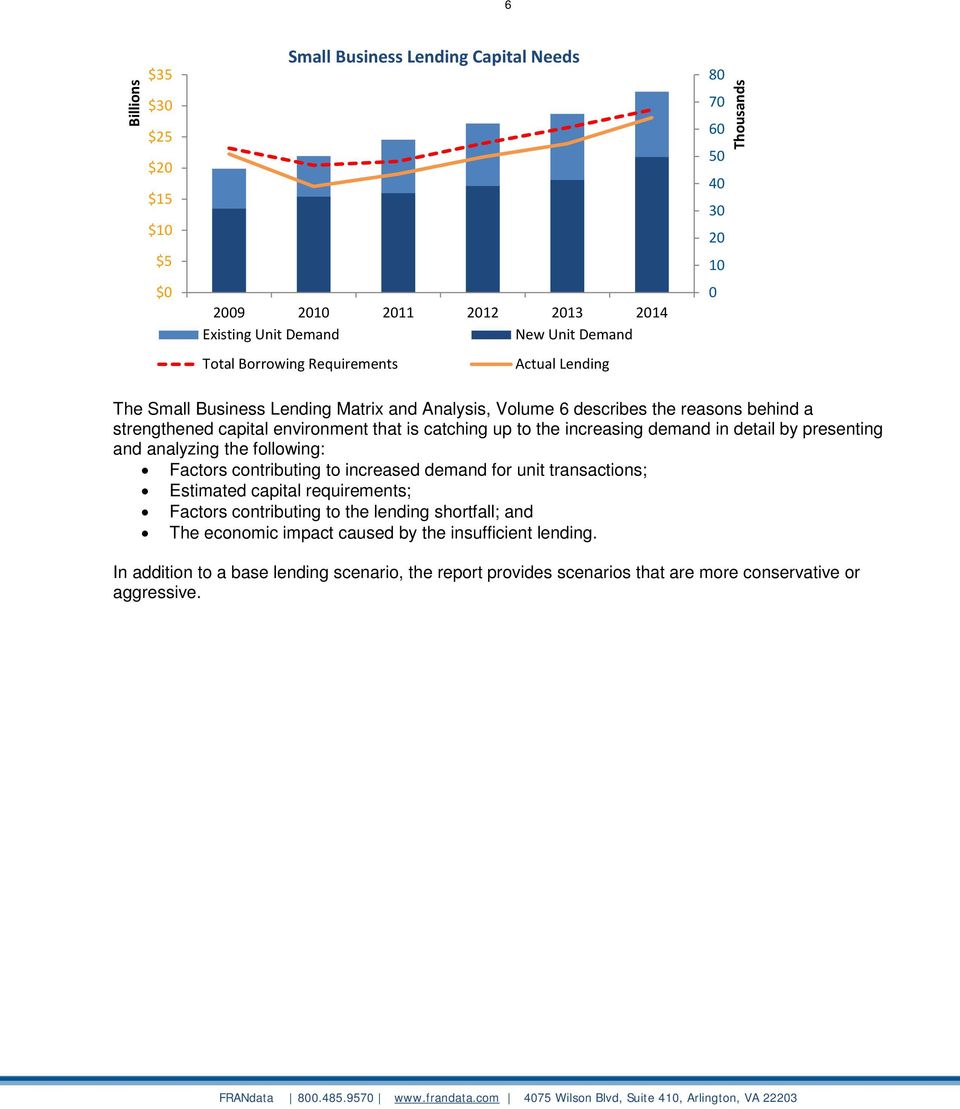
6 6 Billions $35 $30 $25 $20 $15 $10 $5 $0 Small Business Lending Capital Needs Existing Unit Demand New Unit Demand Thousands Total Borrowing Requirements Actual Lending The Small Business Lending Matrix and Analysis, Volume 6 describes the reasons behind a strengthened capital environment that is catching up to the increasing demand in detail by presenting and analyzing the following: Factors contributing to increased demand for unit transactions; Estimated capital requirements; Factors contributing to the lending shortfall; and The economic impact caused by the insufficient lending. In addition to a base lending scenario, the report provides scenarios that are more conservative or aggressive.
7 7 OVERVIEW FRANdata projects that the franchise climate will improve considerably in 2014, in line with the positive trends since The main factors that shaped the franchise business environment in 2013 will continue to take effect in 2014, including: Higher demand for franchise transactions Unconstrained franchisor capacity for growth Increased lending ability by banks to franchisees Increased willingness for both SBA and conventional lenders to finance franchisees In 2014, franchise activity is projected to improve significantly as the economy is finally on track to a full recovery. However, capital access will remain a challenge. Despite the fact that lender willingness to provide financing is projected to reach the highest level since the recession, banks will still not meet prospective and existing franchisees borrowing requirements. However, this gap has been reduced compared to previous years. Franchises will require $29.4 billion in new lending capital to fulfill 100 percent of the forecasted demand for new and existing units in However, banks are only projected to make $28.1 billion available, resulting in a shortfall of $1.3 billion. With access to $28.1 billion in lending, more than 70,500 unit transactions will be financed. These new and existing units will create or maintain more than 1 million jobs and generate $138 billion of annual economic output. The lending gap decline in 2014 will be the greatest since the recession as the SBA has a larger budget to support $25 billion in loans this year. Another reason is that conventional lenders are going out on their risk curve to make more loans to small businesses. The lending gap is expected to decline by half from 2013 to 4.4 percent. As a result, the $1.3 billion shortfall will result in 3,200 transactions not financed in addition to The connection between sufficient capital for franchise transactions and its effect on job creation and sustained economic recovery is a critical one. more than 46,600 jobs not created or protected, and a loss of $6.3 billion in annual economic output that could otherwise take place in The sixth volume of Small Business Lending Matrix and Analysis provides a framework to estimate how the lending environment will impact the demand and supply of capital needed to finance franchise transactions, for both new and existing units. The report examines the main factors noted above and their inter-relationships. The connection between sufficient capital for franchise transactions and its effect on job creation and sustained economic recovery is a critical one. Franchising as a business model has shown extraordinary resilience to economic downturns and has revived quickly even when the overall economy is still on its rocky recovery. In past recessionary and post-recessionary periods, franchise units have grown by 6 percent (between 1999 and 2006) and 5 percent (during the Tech Bubble). Because franchising represents an opportunity for entrepreneurs to change careers or expand their business, it has helped spur the pace of economic growth and the recovery from the recession. The potential pool of investors willing to start franchising has been sustained at high levels since the recession, partially due to the high unemployment rate. During the recession, however, banks have

8 8 been left with limited funds after accounting for declines in their home mortgage loans. As a result, entrepreneurs access to capital has been limited, constraining franchise growth and slowing the recovery. Therefore, lending has a direct effect on franchises, small businesses, job creation, economic output, and consequently, on the overall recovery. Increased Demand for Franchises FRANdata projects that the demand for franchise transactions will increase to 73,800 in 2014, up 12.4 percent from the 65,600 demanded transactions in 2013 and 18.8 percent from the adjusted estimate of 62,100 for As the backlog for existing unit transactions has cleared out over the past years, the demand for new unit transactions will continue to surpass that for existing units. In 2014, demand for new units is projected to increase by 20.2 percent to 49,800 while that for existing ones will decline by 1.1 percent to 24,000. Of the total required capital in 2014, only $29.4 billion will need to be borrowed to sustain the full demand for transactions, representing an increase of 10.9 percent from the $26.5 billion needed in Unconstrained Franchisor Capacity for Growth Similar to 2013, franchisor capacity, including staff and resources to support franchisee recruitment efforts, will not be a restraining factor in During the recession, franchisors capacity to grow was limited. Over time, the improving economic and business climate over the past couple years has helped them to reinvest in their franchise development capabilities and strengthened their capacity to grow. Lending Environment Ability and Willingness As they did in the previous four years, banks will continue to have sufficient funds available to meet the demand for franchise unit transactions in FRANdata projects that bank willingness to lend will improve for SBA lenders and more significantly for conventional lenders. However, they will still not make sufficient funds available to meet overall lending demand. FRANdata projects that banks willingness to provide conventional loans will increase by 21.1 percent and by 5.8 percent for SBAguaranteed loans. The rate at which conventional and SBA lenders alike are finally making funds available to small businesses rises faster than the growth in demand for franchise lending. However, the amount of projected lending is still not at a level to support 100 percent of demand in unit transactions. In addition, lenders are still prepared to tighten credit at any signs of economic distress. Evidently in the fourth quarter of 2013, a fraction of lenders stated a somewhat tightened credit environment that had not been observed earlier during the year. FRANdata estimates that between 20 and 25 percent of the SBA-guaranteed loans are provided to new and existing franchisees. Based on factors such as the solid economic growth, the increased ability in SBA lending, and an improved willingness among conventional lenders, FRANdata projects that SBAguaranteed lending will constitute a smaller portion of the overall financing to franchisees in 2014, down from the estimated 23.6 percent in 2013 to 21.3 percent. Based on the assessment of SBA lending activities, business and economic trends, and the lending environment as a whole, FRANdata projects that lenders will have a pool of more than $42.3 billion available to finance franchise unit transactions in This represents a 21.4 percent increase from the $34.8 billion FRANdata estimated for 2013, reflecting economic growth and stronger balance sheets. At the same time, however, banks will only be willing to provide a total of $28.1 billion in lending to new and existing franchisees. Even though this represents a nearly 17.5 percent increase from the
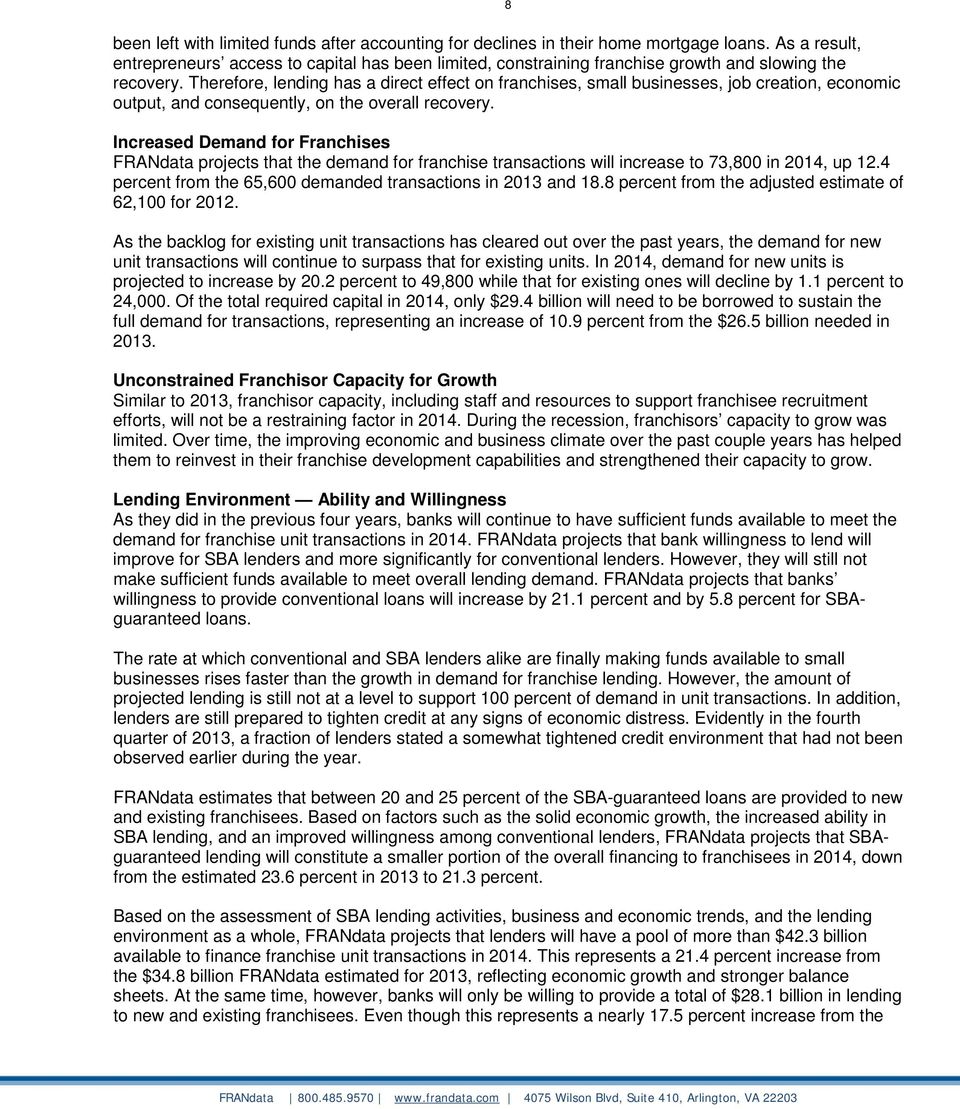
9 lending volume they were willing to provide in 2013, it is still not sufficient to meet the borrowing needs of all projected transactions for Billions New Units Borrowing Needed Supply of Funds Capital Demand FRANdata projects that in 2014, the 49,800 possible new unit transactions would create 1 million direct and indirect jobs and add $140.9 billion in annual economic output. This also means that the shortfall in lending will cost the economy 2,200 new units, 45,400 jobs not created, and $6.1 billion less in annual economic output. 9 Effect of Lending Shortfall in 2014 In 2014, FRANdata projects that banks will lend $6 billion through SBA-guaranteed loans and $22.1 billion through conventional loans, a total of $28.1 billion, to new and prospective franchisees. The difference between what is required to fund 100 percent of the demand and the capital that banks are willing to make available represents a shortfall of $1.3 billion, or 4.4 percent. This shortfall in lending will result in 3,200 transactions not being financed. Effect of Lending Shortfall 2014 $30.5 The figure presents the effect of the $29.5 projected lending shortfall on the number of transactions. The yellow area $28.5 defines the shortfall in lending due to the difference between bank willingness $27.5 to lend, presented by the Supply of Funds, and franchise borrowing $26.5 requirements, presented by the Borrowing Needed. Base Scenario, Effect of Lending Shortfall on New Unit Transactions Created through Financing New Unit Transactions Total Jobs Total Annual Economic Output Maximum Level 49,768 1,044,648 $140,866,560,749 Effect of Shortfall (2,166) (45,463) ($6,130,571,059) Given Funding, Projected Actual 47, ,184 $134,735,989,690 Existing Units The lending shortfall has a similar but more muted effect on transactions of existing units, which include both transfer and refranchised units. FRANdata assumes that if a unit that needs to transfer or refranchise but is unable to get funding, 95 percent of the time it will continue to operate for the following year. As a result, 5 percent of the existing units would be unsustainable. This means that a demand for 24,000 existing units would maintain 25,200 direct and indirect jobs and $3.4 billion in annual economic output. However, due to the shortfall in lending, FRANdata projects 1,000 existing unit will close. Consequently, 1,100 jobs and $147.7 million in economic output will not be protected.

10 10 Base Scenario, Effect of Lending Shortfall on Existing Unit Transactions Maintained through Financing Existing Unit Transactions Total Jobs Total Annual Economic Output Maximum Level 23,987 25,175 $3,394,714,333 Effect of Shortfall (1,044) (1,096) ($147,739,374) Given Funding, Projected Actual 22,943 24,079 $3,246,974,959 Total Transactions New and Existing Units In 2014, the 73,800 total unit transactions seeking capital could create or maintain 1.1 million total direct and indirect jobs and create or maintain $144.3 billion in total direct and indirect economic output. However, due to banks unwillingness to lend, 3,200 unit transactions will not take place. As a result, 46,600 direct and indirect jobs will not be created or maintained and more than $6.3 billion in economic output will be lost. Base Scenario, Effect of Lending Shortfall on New and Existing Unit Transactions Maintained thru Financing Total Unit Transactions Total Jobs Total Annual Economic Output Maximum Level 73,755 1,069,822 $144,261,275,082 Effect of Shortfall (3,210) (46,559) ($6,278,310,432) Given Funding, Projected Actual 70,545 1,023,263 $137,982,964,649 More Aggressive Lending Scenario The above projections are based on FRANdata s analysis of a combination of factors that would affect small business lending. In addition to the base case scenario, it is worth examining a more aggressive and a more conservative approach to lending and their effects on the economy than the one discussed above. Under an aggressive lending scenario, banks will increase their lending to $29 billion. This scenario can take place if the current level of economic growth and stabilization continues at an accelerated pace in This approach assumes that a larger portion of the SBA lending will gravitate towards franchising and the willingness for conventional lenders will also increase from the 2013 level. Under the aggressive scenario, more than 31,500 jobs and $4.2 billion more economic output will be maintained compared to the base approach. This represents a 3.1 percent increase from the base scenario in both jobs and economic output created or maintained.

11 11 Aggressive Scenario, Effect of Lending Shortfall on New and Existing Unit Transactions Created or Maintained thru Financing Total Unit Transactions Total Jobs Total Annual Economic Output % of Maximum Level Maximum Level 73,755 1,069,822 $144,261,275, % Effect of Shortfall (1,039) (15,064) ($2,031,361,611) 1.41% Given Funding, Projected Actual 72,717 1,054,758 $142,229,913, % More Conservative Lending Scenario On the other hand, banks may take a more conservative approach to lending than projected. This scenario will take place if the U.S. economic growth slows down either due to weakened fundamentals or will be affected by the international economic environment. In addition, conventional lenders can become less optimistic if such events unfold over the year. Under the conservative scenario, total available lending will be reduced to $27.2 billion. This shortfall will result in an additional 2,200 unit transactions unable to take place. Consequently, an additional 31,500 direct and indirect jobs and an additional $4.2 billion in economic output will not be created or maintained. A total 78,100 jobs and $10.5 billion in economic output will not be created or maintained under the conservative scenario. Conservative Scenario, Combined Effect of Lending Shortfall on New and Existing Unit Transactions Created or Maintained thru Financing Total Unit Transactions Total Jobs Total Annual Economic Output % of Maximum Level Maximum Level 73,755 1,069,822 $144,261,275, % Effect of Shortfall (5,381) (78,054) ($10,525,259,253) 7.30% Given Funding, Projected Actual 68, ,768 $133,736,015, %

12 12 This Page Has Intentionally Been Left Blank

13 13 INTRODUCTION The sixth volume of the Small Business Lending Matrix and Analysis examines how the current lending environment will impact the demand for and supply of capital to franchising in the year The combined unit transactions and the investment in a new or an existing unit have a huge impact on the U.S. economy. Each franchise unit supports an average of 23 direct and indirect jobs and generates $3.2 million in direct and indirect annual economic output 1. The ability to create and protect jobs is essential for an economy that is turning around. Franchising plays an important role in ensuring the continued recovery. Since 2009, FRANdata s Small Business Lending Matrix and Analyses have projected lending capital requirements for franchise systems across all industries based on the following factors: 1. Average initial investment for a unit transaction 2. The number of unit transactions, defined as both new and existing units 3. Distinction between new prospective franchisee and experienced operator, and their willingness and ability to start new units or acquire existing units 4. Banks willingness and ability to lend 5. Bank loan terms The year 2013 was one of the better years since the recession. The housing market improved, retail sales reports were positive for the most part, and the unemployment rate continued to decline. Even though the budget crisis and government standoffs in the third quarter of 2013 negatively affected consumer confidence, the market still logged stellar gains in the fourth quarter, recording another banner year. The year ahead will not be entirely free of economic hurdles, but the headwinds will be distinctly lighter than last year. Real GDP grew at an annual rate of 2.4 percent in the fourth quarter of For the full year, it rose 1.9 percent, below the 2.8 percent increase in Into 2014, cuts in government spending are expected to slightly diminish growth. However, they are likely to be weaker than the factors that affected the economic recovery That year, monthly retail and food services sales (seasonally adjusted) grew by an average of 4.4 percent over the previous year. The cold and snowy winter, along with a shorter holiday season, temporarily disrupted economic activity at the end of the year. However, retail sales beat expectations both during and after the holiday seasons. Self-reported spending also recovered in February 2014 to an average of $87, up from $83 recorded from in February 2013, which had been the strongest February since These developments are likely to boost consumer outlook on the economy, translating to a higher willingness to invest in new business operations. With fluctuations, consumer confidence is trending upward, at the highest level in almost six years. All these factors point to an optimistic and confident outlook into Franchisee willingness to engage in unit transactions is expected to increase. In addition, personal income maintained its upward trend since the end of the recession, increasing by $43.9 billion, or 0.3 percent, to $14.4 trillion in January The personal saving rate stood at 4.3 percent at the end of 2013, a bit higher than its 10-year average of 3.9 percent, but well below the recent five-year high of 8.7 percent recorded in December Personal wealth hit the highest level at $80.7 trillion in January 2014, up 14 percent from a year ago, fueled by rising stock and real estate values. The average 401(k) balance continued to grow to a record high of $89,300 by the end of 2013, up 15.5 percent from a year ago. Similarly, 78 percent of the increase was due to the robust stock market. Only 22 percent can be attributed to increases in contributions. In March 2014, home prices 1 Franchise Business Economic Outlook for 2014, International Franchise Association Educational Foundation, January, 2014.
14 14 gained 13.4 percent year over year, making it the tenth consecutive month of double digit growth on an annual basis. Consequently, the national negative equity rate dropped to 19.4 percent at year-end. The financial position of Americans is stronger than before, allowing them to leverage and to start investing again. All indicators point to a tremendously improved ability for prospective franchisees to participate in unit transactions. The SBA-guaranteed loans took on a significant role in lending during the recovery. In fiscal year 2013, the agency continued to help small businesses grow and create jobs, by supporting more than $29.6 billion in lending. This was the third highest level of SBA lending. To further assist small businesses, the SBA has temporarily suspended fees to guaranteed 7(a) loans of $150,000 or less. In addition, the ongoing monthly fees paid by SBA lenders will be eliminated for the life of these loans. For fiscal year 2014, the agency requested $810 billion in total budget. This will support $25 billion in loans, up 4.3 percent from the $23.2 billion budgeted level in The banking system is stabilizing, as is evident from their strengthened financial position year over year. Accompanied by increased assets, loan portfolios grew for the ninth time in the past 11 quarter. Loans to small businesses rose by $2.9 billion, or 0.4 percent, in the last quarter. The financial industry is in the best health and position to make funding available in order to fully revive the economy. These trends and developments point to a healthier and more stable financial environment. This will further facilitate banks improved ability to lend in While banks are able to meet 100 percent of the capital needed for franchise development, the limiting factor in 2014 will continue to be their willingness to do so for the fifth year in a row. Still, the prospects for small businesses in search of capital are bright in 2014, as non-sba loans made by larger banks are on the rise. In February, the loan approval rate among big banks with more than $10 billion in assets jumped 130 basis points to 19.1 percent, while that for small banks only edged up 50 basis points to 51.4 percent. Creditworthy borrowers, attracted by lower interest rates, are switching from alternative lenders to larger national banks. Increasingly, small business owners are opting for non-sba loans as they require less paperwork and can be processed faster. The Thomson Reuters/PayNet Small Business Lending Index (SBLI) recorded tremendous growth since the recovery. Commercial loans and leases made to small businesses jumped 5.6 percent in 2013, catching up to pre-recession levels in August While banks are lending more in absolute terms, the lending to deposit ratio continued to decline. This imbalance in the loan to deposit ratio continues to put pressure on financial institutions to generate earnings through interest. Many banks have slowly picked up their lending activities over the past years, as evidenced by the ratio leveling off in For the 2014 projections, FRANdata used the same methodology as revised for 2013 and made adjustments to the initial investment approach. The inclusion of the lodging industry in 2013 influenced the initial investment calculation that year. FRANdata took the weighted average calculation to account for the percentage of transactions that are projected to take place by the lodging industry and other industries. In 2014, to provide more clarity, FRANdata provided a separate investment estimate for lodging and non-lodging industries. The initial investment for lodging brands averages $14.3 million, compared to the $418,800 for non-lodging brands. With access to more detailed loan data, FRANdata estimated the loan to cost ratio for lodging to be between 20 to 40 percent, below the 70 to 80 percent upper range for non-lodging sectors. Overall, these changes did not have any material effect on this year s projections. As in the previous studies, potential investors were divided into two groups, first time owners and experienced franchisees. FRANdata examines the ability and willingness to invest in a unit transaction for each group separately.

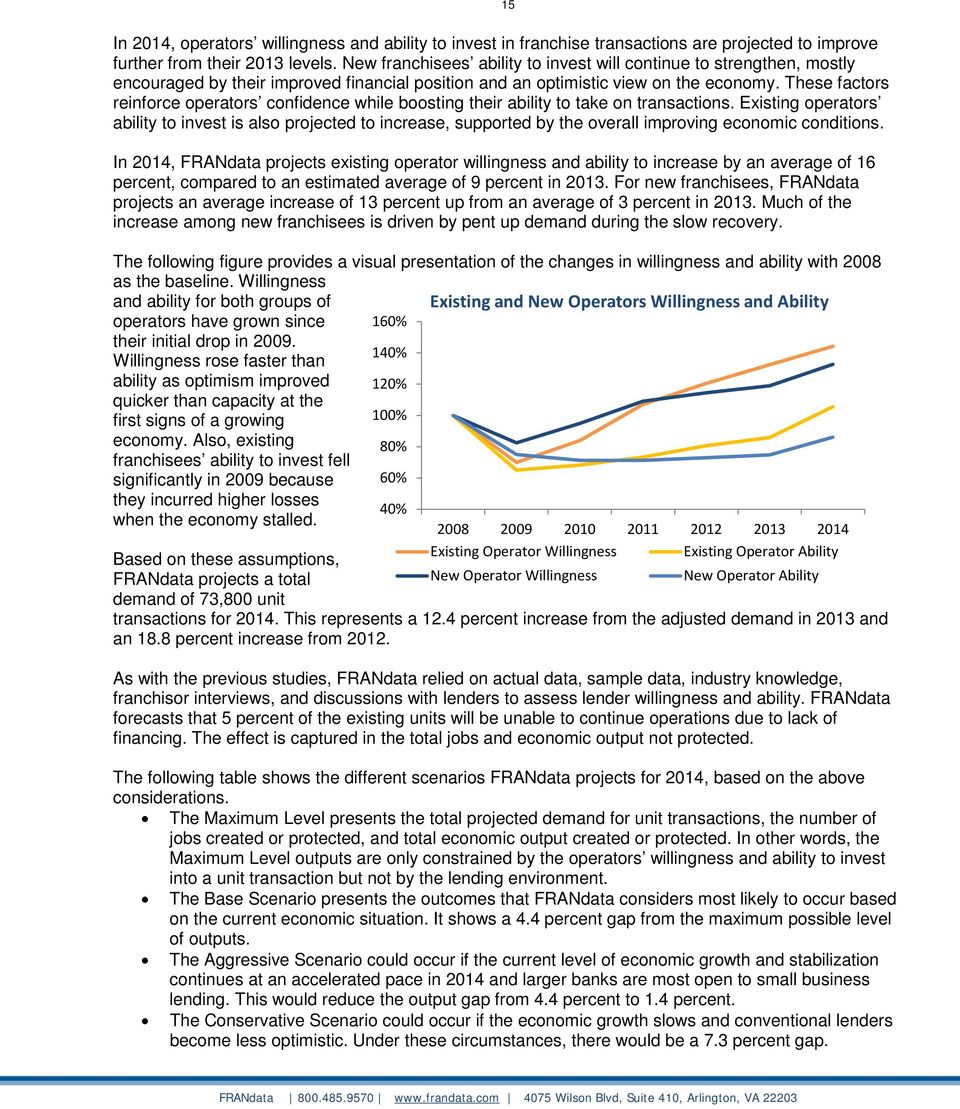
15 15 In 2014, operators willingness and ability to invest in franchise transactions are projected to improve further from their 2013 levels. New franchisees ability to invest will continue to strengthen, mostly encouraged by their improved financial position and an optimistic view on the economy. These factors reinforce operators confidence while boosting their ability to take on transactions. Existing operators ability to invest is also projected to increase, supported by the overall improving economic conditions. In 2014, FRANdata projects existing operator willingness and ability to increase by an average of 16 percent, compared to an estimated average of 9 percent in For new franchisees, FRANdata projects an average increase of 13 percent up from an average of 3 percent in Much of the increase among new franchisees is driven by pent up demand during the slow recovery. The following figure provides a visual presentation of the changes in willingness and ability with 2008 as the baseline. Willingness and ability for both groups of Existing and New Operators Willingness and Ability operators have grown since 160% their initial drop in Willingness rose faster than 140% ability as optimism improved 120% quicker than capacity at the first signs of a growing 100% economy. Also, existing franchisees ability to invest fell 80% significantly in 2009 because 60% they incurred higher losses when the economy stalled. 40% Based on these assumptions, FRANdata projects a total demand of 73,800 unit Existing Operator Willingness Existing Operator Ability New Operator Willingness New Operator Ability transactions for This represents a 12.4 percent increase from the adjusted demand in 2013 and an 18.8 percent increase from As with the previous studies, FRANdata relied on actual data, sample data, industry knowledge, franchisor interviews, and discussions with lenders to assess lender willingness and ability. FRANdata forecasts that 5 percent of the existing units will be unable to continue operations due to lack of financing. The effect is captured in the total jobs and economic output not protected. The following table shows the different scenarios FRANdata projects for 2014, based on the above considerations. The Maximum Level presents the total projected demand for unit transactions, the number of jobs created or protected, and total economic output created or protected. In other words, the Maximum Level outputs are only constrained by the operators willingness and ability to invest into a unit transaction but not by the lending environment. The Base Scenario presents the outcomes that FRANdata considers most likely to occur based on the current economic situation. It shows a 4.4 percent gap from the maximum possible level of outputs. The Aggressive Scenario could occur if the current level of economic growth and stabilization continues at an accelerated pace in 2014 and larger banks are most open to small business lending. This would reduce the output gap from 4.4 percent to 1.4 percent. The Conservative Scenario could occur if the economic growth slows and conventional lenders become less optimistic. Under these circumstances, there would be a 7.3 percent gap.
16 16 Scenarios Comparison Scenario New Existing Total Jobs Created or Maintained thru Financing Total Annual Economic Output % of Maximum Level Maximum Level 49,768 23,987 1,069,822 $144,261,275, % Base Scenario 47,602 22,943 1,023,263 $137,982,964,649 96% Aggressive 49,067 23,649 1,054,758 $142,229,913,470 99% Conservative 46,137 22, ,768 $133,736,015,829 93% The jobs created or maintained through financing include the jobs created by opening a new unit and the jobs maintained through financing an existing unit that would have closed without sufficient funds. FRANdata projects that 5 percent of the transactions for existing units that do not receive financing will close in FRANdata assumes 23 direct and indirect jobs per unit to calculate the number of jobs that would be created or maintained based on financing availability. Every new unit transaction that does not occur because of financing constraints results in 23 of these jobs not created. Conversely, only 5 percent of existing unit transactions without financing will result in jobs not protected. The same methodology was applied to estimate the economic output. The projected demand of 73,800 franchise transactions reflects a 10.2 percent compound annual growth rate (CAGR) from the adjusted 2009 level of 45,500. Over the same period, total borrowing required is projected to rise at a CAGR of 4.82 percent from an adjusted $23.2 billion in 2009 to $29.4 billion in Actual lending is projected to improve steadily, but at a slightly slower pace of 4.76 percent, from an adjusted $22.3 billion to $28.1 billion. Over the examined period, the gap between the demand and supply of funds was the largest in FRANdata projects the lending gap to diminish by half in 2014, from 9.7 percent to 4.4 percent, as the amount of funds being made available is expected to grow at a faster rate than the demand for franchise transactions. In other words, the eased underwriting standards result in more funds in the market and therefore absorb much of the shortfall. The following table summarizes FRANdata s estimates and projections for the lending environment from 2009 to Small Business Lending Capital Needs Lending Capital Needs Estimated Projected $ in Millions New Unit Demand 30,850 35,291 36,499 39,094 41,331 49,768 Existing Unit Demand 14,639 14,814 19,646 22,998 24,314 23,987 Total Borrowing Requirements $23,213 $20,448 $21,089 $23,965 $26,494 $29,373 Actual Lending $22,271 $17,050 $19,044 $21,783 $23,918 $28,095 Lending Gap 4.06% 16.62% 9.70% 9.10% 9.72% 4.35%

17 17 The figure summarizes the estimated and projected developments of the franchise lending environment from 2009 to Billions $35 $30 $25 $20 $15 $10 $5 $0 Small Business Lending Capital Needs Existing Unit Demand New Unit Demand Total Borrowing Requirements Actual Lending Thousands Under FRANdata s base scenario projection, the lending gap for 2014 will reach $1.3 billion. Due to this shortfall, a total of 3,200 unit transactions will not take place, resulting in a total of 46,600 direct and indirect jobs not created or maintained and more than $6.3 billion in direct and indirect economic output not generated or maintained.

18 18 This Page Has Intentionally Been Left Blank

19 19 PROJECTED TRANSACTIONS FOR 2014 FRANdata calculated the projected demand for franchise unit transactions by using the prior year s estimate as a baseline. Demand projections are further based on assumptions about franchisor and franchisee willingness and ability to either develop new units or invest in an existing unit, such as a transfer or a refranchised unit. The main factors impacting the likelihood for a unit transaction to take place include franchisor capacity, operator willingness and ability to open or purchase a unit and the lending environment. Franchisor Capacity In 2008 and 2009, franchisors adjusted to the weak economic conditions by reducing their capacity to develop and support franchise unit transactions. As the economy slowly recovered, they started to rebuild their infrastructure and growth capacity in 2010 and 2011 by strengthening training and hiring support staff needed for expansion. Since franchisor capacity for growth depends primarily on employing an adequate work force and less on capital investment, it was not a constraining factor to franchise development in those years. In 2013, businesses were more optimistic than during other post-recession years, as evidenced by a high CEO and small business confidence during spring and summer. However, the government shutdown put a dent in America s confidence in the government and economy in October. As a result, many confidence indices declined in the third quarter of With a strong fourth quarter economic rebound, executive confidence rose to the highest level in two years. The budget compromise has further reduced uncertainty and encouraged optimism, mostly about the overall economy. As the pace of economic growth is expected to improve in the year ahead, firms anticipate even greater gains in revenues and profits. This will lead to more hires and investment spending, particularly by businesses that horded cash throughout the recovery. 2 According to the WSJ/Vistage survey, 76 percent of all CEOs anticipate higher revenues in 2014, compared to 63 percent a year ago. In addition, 56 percent of CEOs plan to expand their payrolls in the year ahead, up from 45 percent a year ago. 3 Small business CEOs are more confident compared to a year ago. The same survey points to 41 percent of the CEOs expecting increased overall economic conditions. This number was only 26 percent a year ago. Furthermore, 62 percent of executives anticipate increasing employment during the next 12 months. This compares to only 47 percent in the beginning of The small business confidence index improved again in January 2014 as firms were more optimistic about future business conditions and future earnings. 2 CEO Confidence Index, Vistage, December, WSJ/Vistage Small Business CEO Survey, Vistage, February, 2014.

20 CEO and Small Business Confidence Jan. Mar. May. Jul. Sep. Nov. Jan. Mar. May. Jul. Sep. Nov. Jan. Mar. May. Jul. Sep. Nov. Jan CEO Confidence Index Small Business Confidence Within the franchise community, the franchisors view on the economy is also optimistic, according to the Franchise Business Leader Survey. As of 2014, the number of franchisors expecting the economy to improve jumped to 39 percent from 21.4 percent in Only 11 percent of executives believe the economy will take a turn for the worse, significantly below the 29.4 percent from a year ago. 4 60% 50% Franchisor View on the Economy 40% 30% 20% 10% % Better Worse About the same Business confidence is an important driver of capital spending and investment as decisions to invest are framed by current growth and expectations of future activity. The overall sentiments in the franchising community fare better than what the market suggests. Franchise job growth is expected to outpace other private sector businesses by 0.3 percent in With this, FRANdata expects franchisors to continue their moderate hiring pace in As a result, franchisor growth capacity will not be a limiting factor for franchise growth this year. 4 Franchise Business Economic Outlook for 2014, IFA, March, 2014.

21 21 Operator Willingness and Ability Besides franchisor capacity, the two main factors affecting the demand for unit transactions are operator ability and willingness to develop new or to acquire existing units. Operator ability is determined by their access to capital and personal financial position. However, the demand for unit transactions will be mostly affected by the operators willingness to invest, which is based on intangible factors, such as perception of the economy, forecasts, risk aversion, and other individual emotional and psychological factors. Demand for unit transactions is further influenced by the type of operators. FRANdata distinguishes between new owners and existing owners who are experienced franchisees with operating franchised location(s). The ability and willingness to invest differ for these two types. Changes in Willingness and Ability for Existing and New Franchisee Franchisee Type Changes in Willingness and Ability New Unit Existing Unit Existing Operator Willingness 23% -5% Existing Operator Ability 23% 23% New Franchisee Willingness 20% 3% New Franchisee Ability 15% 15% The matrix in the table above assesses the change in operator willingness and ability for unit transactions in 2014, which is used as a basis to determine the demand for new and existing unit transactions assuming no constraining market factors. Willingness In 2013, FRANdata projected that existing operator willingness to invest in both new and existing units would increase by 10 percent. New franchisees willingness to open new units was also projected to increase, although to a smaller extent, at 5 percent. Their willingness to engage in existing unit transactions would be up by 3 percent. These projections were supported by an economy that continued to recover, an optimistic economic outlook, and an improved consumer confidence. In 2014, FRANdata expects that new and existing franchisees willingness will grow further from their 2013 levels. FRANdata projects that, in 2014, existing operator willingness to develop new units will improve by 23 percent but investing into an existing one will decline by 5 percent. The demand for new units is more susceptible to the overall market conditions than that for existing locations. As the economy improves and optimism picks up, new units become a more attractive option while the demand for existing locations still remains relatively stable. In addition, existing units are expected to sell at the same level as new ones, while some are even selling at a premium because of the availability of performance history. All these factors are likely to drive existing operators towards new operations. New franchisee willingness to invest in a new unit will increase substantially by 20 percent over its 2013 level. Their willingness to invest in existing units will improve by 3 percent. New operators improved willingness is mostly driven by their strengthened financial position and the overall optimistic view of the economy. The faster than average rebound among small business owners is also an encouraging sign for young entrepreneurs. Prospective new franchisees willingness to take on an existing unit is lower than to open a new one. Existing units that are in good shape are more expensive while those that are affordable pose high challenges to survive any economic uncertainties.
22 22 The main business and economic factors affecting franchisee willingness to develop new and existing units are discussed below. For more details, please refer to the Appendix. The U.S. economy had one of its better years in 2013: the housing market improved, retail sales reports were mostly positive, and the unemployment rate continued to decline. As the year progressed, the euro zone came out of recession, and Japan and the United States held interest rates low as their bond-buying campaign continued. Even though the U.S. budget crisis and government standoffs in the third quarter of 2013 negatively affected consumer confidence, the market still logged stellar gains in the fourth quarter, recording another banner year. As the economic outlook remains mostly optimistic, franchisees willingness to invest in franchise unit transactions in 2014 is expected to improve from The year ahead will not be entirely free of economic hurdles, but the headwinds will be distinctly lighter than last year. Real GDP grew at an annual rate of 2.4 percent in the fourth quarter of For the full year, it increased 1.9 percent, below the 2.8 percent increase in Into 2014, cuts in government spending are expected to slightly diminish growth. However, they are likely to be weaker than the payroll-tax increase, earlier spending cuts, and fiscal strategy that affected Not surprisingly for 2014, various sources all gave an optimistic economic growth projection, ranging from 2.6 to 3 percent. The economy is anticipated to grow at a solid pace in 2014 and for the next few years. Nevertheless, the consumer confidence index fell moderately in February 2014 after an increase in January to The decline was driven by concerns over the short-term outlook for business conditions, jobs, and earnings. Similar to 2013, franchisees and franchisors have mixed views and diverge even more about the direction of the economy in In fact, franchisees have become more pessimistic than franchisors. At 46 percent, significantly more franchisees grew pessimistic, compared to the 22.2 percent in A less than optimistic outlook will hinder operators willingness to invest in small business transactions. However, the overall improving economy may yet boost the confidence of business owners. Retail sales, a coincident indicator, actively reflect the current state of the economy. Growth in retail sales has a strong positive effect on existing and new franchisees willingness to develop franchise units. In 2013, monthly retail and food services sales grew by an average of 4.4 percent over the previous year, but remained below the 5.3 percent average growth achieved in Growth in retail sales points to increased consumer willingness to spend as well as a higher price point. Retail sales beat expectations both during and after the holiday seasons. Such strong numbers are likely to boost consumer outlook on the economy, translating to a higher willingness for new business operations. An unusually cold and snowy winter, along with a shorter holiday season, temporarily disrupted economic activity at the end of Retailers responded by offering discounts and aggressive promotions early in the season. Effectively, retail sales showed decent growth during the holiday season, with a 2.3 percent increase year over year. Following the harsh winter and a steeper than usual post-holiday drop, U.S. retail sales in February 2014 rose more than expected for the first time in three months. Self-reported spending also recovered in February to an average of $87, up from $83 recorded from the prior year, which had been the strongest February since The positive outlook is further reinforced by the auto industry, which makes up more than 18 percent of retail sales. Even with the wintery weather, the auto industry closed 2013 with robust sales, pushing December s volume to a six-year high for the month. This was followed by a 3 percent drop in January 2014 and sales of only 1.2 million new cars and trucks in February. The drop in January represented the first year over year decline since August On the other hand, the first quarter is traditionally slow for car and truck sales. The market is expected to recover as the weather improves.
23 23 A healthy economic growth, robust retail sales trend, coupled with an improved automobile industry all point to an optimistic outlook. Even though franchisees and franchisors hold mixed views on the economy, the overall improving trends may yet boost the confidence of business owners. Therefore, FRANdata projects an improved willingness among prospective and existing franchisees. Ability In 2013, FRANdata estimated that existing operators ability to acquire new and invest in existing units would improve by 6 percent. New franchisee ability to invest in new and existing units was estimated to improve by 3 percent. These projections were based on a less than robust economic recovery in 2012, a suppressed growth rate, high unemployment rate, and concerns over both domestic policies and developments in Europe. With a much improved economy, existing and new franchisees ability to undertake unit transactions has improved significantly from the 2013 levels. FRANdata forecasts that, in 2014, existing operators ability to develop new and existing units will rise by 23 percent over last year s figure. New franchisees ability to develop is projected to improve by 15 percent for both types of transactions. This is also the first time since the recession that new operators will see a significant improvement in ability to invest in both new and existing units. Limited access to capital continues to be a restraining factor limiting operators ability to invest in unit transactions. In addition, new and existing operators ability is influenced by multiple factors, such as their personal investment portfolio, equity market performance, the housing market, etc. However, these factors are playing mostly in favor of new and old operators as the economy is on the road to another good year. For more details on the factors affecting investor ability to invest in franchise unit transactions, please refer to the Appendix. As a direct indicator for operators ability to engage in franchise transactions, personal income has maintained its upward trend since the end of the recession. In January 2014, it increased by $43.9 billion, or 0.3 percent, to $14.4 trillion. Disposal income was also up $45.2 billion, equivalent to a 0.4 percent increase. The personal saving rate stood at 4.3 percent at the end of 2013, a bit higher than its 10-year average of 3.9 percent, but well below the recent five-year high of 8.7 percent in December Fueled by rising stock and real estate values, personal wealth hit the highest level at $80.7 trillion in January 2014, up 14 percent from a year ago. However, more affluent and older Americans have predominantly benefited from this trend, leaving behind many middle- and lower-income families. On the flip slide, household debt climbed 0.9 percent in 2013, the biggest gain since Nevertheless, as Americans are digging out of debt and households are in a much better position to borrow and spend at a time when the job market recovers only slowly. The rebound of the stock market continues to drive most of the increases in household wealth. The anticipation of the Fed tapering caused a temporary stir in the spring of By the time the announcement was made, investors stood their ground and equities added gains through the end of year. The S&P 500 advanced 29.6 percent with 45 new highs, enjoying its best gains in 16 years. The Dow Jones Industrial Average registered 52 record closes, ending 2013 up 26.5 percent. Small cap stocks also performed with the Russell 2000 index gaining 37 percent for the year. Increases in the stock markets will positively affect operators ability to invest in franchises. If the continuing signs of economic recovery remain stable, the franchise environment will continue to improve.
24 24 Without alternatives to capital, drawing on traditional source of financing, such as dipping into retirement accounts and obtaining a home equity loan, is still a top choice for many first time operators. According to Fidelity, the average 401(k) balance continued to grow to a record high of $89,300 by the end of 2013, up 15.5 percent from a year ago. Similar to last year, 78 percent of the increase was due to the robust stock market. Only 22 percent can be attributed to increases in contribution. A more recent trend included over a third of participants cashing out an average of $16,000 when leaving their jobs in This trend is most severe among younger participants between the ages of 20 and 39. However, as unemployment declines, it can be expected that fewer young people dip into their 401(k)s. Home prices gained 13.4 percent year over year in 2013, making it the tenth consecutive month of double digit growth on an annual basis. Consequently, the national negative equity rate dropped to 19.4 percent at year-end, freeing almost 3.9 million homeowners nationwide. This compared to a staggering 31.4 percent rate in the first quarter of However, 9.8 million homes remain under water, that is 13.7 percent of all mortgaged homes. As home values continue to appreciate, negative equity will be reduced. Property value forecasts for 2014 may cool down a little possibly to single digit growth as interest rates are under increased pressure to move up. The U.S. unemployment rate, at 6.7 percent as of February 2014, is well below its recession peak of 10 percent, but still above the 4.7 percent level before the downturn. The economy added a solid 175,000 jobs in February, despite harsh winter weather that threatened to curtail hiring. Although ahead of most projections, the economy added an average of 205,000 jobs each month in the 12 months leading up to the winter. In February 2014, the unemployment rate ticked up ten basis points as more people entered the labor force. Projections into 2014 appear solid, if somewhat mixed. Based on these factors, FRANdata projects that new and existing franchisees ability to invest in franchised units in 2014 will improve significantly from 2013 levels. The economy is on the right path for a more robust recovery, even though domestic politics and international affairs can still bring uncertainties to the market.
25 Projected Franchised Unit Transactions 25 Based on the economic factors discussed in the previous two sections, FRANdata projects that the ability to purchase a new or existing unit will continue to be a more limiting factor for new operators. Existing franchisees, boosted by their strengthened financial position and improved business performance, have the financial ability to catch up with their operational willingness. The demand for new units is projected to grow faster than that for existing locations. Based on FRANdata s database, in 2013, transactions for existing units represented an estimated 33 percent of total demand while new unit transactions represented 67 percent. FRANdata projects that the demand for new units will continue to be higher than that of existing units in Demand for new unit transactions is projected to increase by 20.2 percent to 49,800, while the demand for existing ones will decline by 1.1 percent to 24,000. This will lead to a demand for a total of 73,800 unit transactions in 2014, up 12.4 percent from the 65,600 transactions projected in In other words, a total of 73,800 new and existing unit transactions are projected to seek financing in 2014.
26 26 This Page Has Intentionally Been Left Blank
27 Estimated Average Initial Investment 27 ESTIMATED CAPITAL REQUIREMENTS Transactions for existing units account for a smaller portion, 32.5 percent, of the overall transactions, and the actual sales multiples differ largely by sector and are difficult of measure. Therefore, FRANdata calculates the average initial investment under the assumption that the price for an existing unit is equal to the initial cost of a new unit. In the past couple years, the backlog for existing unit transactions has cleared out and the price of an existing unit is at the same level as that for a new unit. FRANdata believes that the price of an existing unit is no longer suppressed in 2014 and they should be selling at a premium because of the availability of performance history. In order to estimate the capital requirements for the 73,800 projected unit transactions in 2014, FRANdata examined the average initial investment for non-lodging and lodging transactions. The estimated average for non-lodging industries remains unchanged in 2014 at $418,800, while the initial investment for lodging brands is estimated at $14.3 million. In 2013, FRANdata included the lodging industry and the average initial investment was calculated as a weighted average based on the percentage of transactions that is projected to take place. Because of the industry s intensive capital requirement and to provide more clarity, FRANdata provided a separate investment estimate for lodging and non-lodging industries. In 2010 and 2011, many non-lodging franchisors lowered their IFF requirements and sought alternative ways to reduce investment in order to make their brands more appealing. In 2012, we observed a stabilizing initial investment and in 2013, it is slowly reverting back to the pre-recession levels. Coming out of the recession, many brands are also undergoing remodeling and establishing new prototypes. This has led to a lowered investment as brands seek out a refreshing layout and cost effective materials. FRANdata expects the two factors to balance each other out in 2014, and the initial investment estimate to remain largely unchanged at $418,800. Due to the large amount of capital needed for lodging brands, changes in investment levels are minimal during the recovery period. However, in 2013, we observed a 3 percent decline among several hotel concepts as they start to focus on economy models with fewer rooms and put more emphasis on conversions instead of new constructions. Countered by other concepts that are still adjusting investment for inflation, FRANdata expects the average investment estimate for the lodging industry to remain unchanged at $14.3 million. Loan to Cost Ratio Using the projected average initial investment of $418,800 for non-lodging transactions and $14.3 million for lodging transactions, FRANdata projects that operators will require a total of $69.6 billion in capital to sustain the 73,800 projected transactions in Only a part of the calculated $69.6 billion in required capital will come from lenders. Lenders require borrowers to make an equity contribution at the time of applying for a loan. The loan to cost ratio banks expect on franchise transactions varies by type. Since SBA loans have a government guarantee of up to 90 percent of the principal, protecting banks from loan charge-offs, such transactions often offer a higher loan to cost ratio than conventional loans. This means that a smaller equity contribution would qualify franchisees for an SBA loan.
28 At the beginning of 2013, FRANdata projected that SBA-guaranteed loans would account for 23.6 percent of the total Total borrowing of $29.4 billion is required to financing available to franchises. The basis meet 100 percent of transaction demand in 2014, was derived from the budget reduction up 4.6 percent from the $28.1 billion in 2013 anticipated for the fiscal year and a boost in and by 22.5 percent from the adjusted $24 lending from the private sector. In 2014, the billion in The increase in borrowing SBA requested budget is expected to requirements is mostly driven by an increase in support $17.9 billion through the 7(a) demand for unit transactions. program and $11.7 billion through the 504 program. Larger banks have also shown an improved willingness to lend to small FRANdata Projections businesses. FRANdata projects that in 2014, SBA guaranteed lending to franchises will continue to constitute a smaller portion of the overall financing, accounting for roughly 21.3 percent. 28 In 2014, FRANdata projects the upper range of the loan to cost ratio to be 80 percent for SBA and 70 percent for conventional loans. On average, however, this ratio will remain largely unchanged from its 2013 levels of 65 percent to 75 percent for SBA and 50 percent to 60 percent for conventional lending. For the lodging industry, the loan to cost ratio is generally lower due to its large investment requirement. FRANdata projects the ratio to be between 20 percent and 40 percent. The Lending Environment The lending environment is impacted by the amount of funds that banks have available to lend, and banks willingness to put this capital to use. The following section examines both the banks ability and willingness to lend. Ability to Lend FRANdata projects that banking ability to lend will continue to surpass the capital needed to satisfy the projected demand for unit transactions in This is a continuation of trends observed since Based on the assessment of SBA franchise activity sources, FRANdata estimates that between 20 and 25 percent of SBA loans are made to franchises, and about 21.3 percent of franchisees funding will come from SBA-guaranteed loans. In 2014, FRANdata projects a pool of over $42.6 billion in funds to be available to support franchise lending. About $9.1 billion, or 21.2 percent, will be available through SBA-guaranteed lending with the rest coming from conventional lending. Thus, the estimated bank lending ability will be well above the total borrowing requirements of $29.4 billion to fulfill the projected demand of 73,800 transactions in As in the last four years, banks should have the ability to meet 100 percent of demand for funds. This means that 2014 is the fifth year in a row where banks lending ability surpasses small business loan demand. With the overall economic recovery, conventional lending is also likely to improve from its 2013 level. The ability to lend to small businesses is influenced by monetary policy, commercial real estate values, and the condition of financial institutions. Please refer to the Appendix for detailed information. At a time of tight credit markets and little access to additional capital, the government implemented a number of stimulus measures to assist lending to small businesses. In fiscal year 2013, the SBA continued to help small businesses grow and create jobs by supporting more than $29.6 billion in lending. This was the third highest level of SBA lending. Over the past years, the smaller-dollar-value
29 loans have been declining with larger loans driving most of the underwriting. Evidently, the year 2013 had the highest amount of 7(a) loans disbursed over the past 14 years. 29 To further assist small businesses, the SBA has temporarily suspended fees for guaranteed 7(a) loans of $150,000 or less. In addition, the ongoing monthly fees paid by SBA lenders will be eliminated for the life of these loans. In fiscal year 2014, the agency requested $810 billion in total budget. This will support $25 billion in loans, of which $17.5 billion are allocated to the 7(a) program and $7.5 billion to the 504 program. The total guaranteed lending is up 4.3 percent from the $23.2 billion budgeted level in Commercial real estate (CRE) values are important indicators for banks ability to lend. An improvement in CRE values is likely to increase large banks ability and willingness to lend. Like many other economic indicators, CRE prices gained 8 percent in 2013, according to the commercial repeat sale indices tracked by CoStar. This compared to a 5.5 percent price gain in The upbeat performance was driven by relatively steady economic growth and job gains. Since the recession, investment grade properties led the real estate recovery with a more than 33 percent gain through The general commercial index, however, waited until 2011 to turn positive. This trend is becoming more obvious in 2013 as investors seek higher yields with the improving economy. As the recovery in rents and occupancy broadened across property types, consistent pricing gains are expected across the board. Since 2008, a total of 494 financial institutions have failed. This number reached a high of 157 in 2010 and has since dropped continuously. In 2013, only 24 banks closed. As larger banks stabilize and smaller institutions account for more than 95 percent of failures, the estimated loss also dropped significantly to $2.7 billion in 2012 from $36.2 billion in The banking system is strengthening, as evidenced by their improving financial position year over year. Full-year earnings increased for the fourth consecutive year ending in 2013 with a total of $154.7 billion. This represents a 9.6 percent increase from 2012, down from a 19.3 percent growth from Earnings improved despite declines in quarterly revenues, caused largely by reduced mortgage lending activity. Bank earnings have been aided by improving loan quality for several years. In the last quarter of 2013, commercial banks and savings institutions reduced loan loss provisions by $8.1 billion, contributing 20 percent to net income. The full-year provisions were at $32.1 billion, $25.7 billion less than what banks set aside in All FDIC insured institutions follow similar trends. Net charge-offs totaled $11.7 billion in the fourth quarter, down 36.7 percent from a year ago. This drop also represents the fourteenth consecutive quarter in which charge-offs have declined, an indicator of improved asset quality. The financial industry is in the best health and position to make funding available in order to fully revive the economy. These trends and developments point to a healthier and more stable financial environment. This will further facilitate banks improved ability to lend in Willingness to Lend While banks are able to meet 100 percent of the capital needed for franchise development, the limiting factor in 2014 will still be their willingness to do so. FRANdata projects that banks willingness to lend will continue to improve, alongside an optimistic economic and business climate. For the first time since 2008, banks willingness to provide conventional loan is significantly enhanced. FRANdata projects that in 2014, conventional lending will increase by up to 21.1 percent to provide $22.1 billion, pressured by trillions of dollars on the sideline. Simultaneously, lenders willingness to provide SBA-guaranteed lending is projected to improve by 5.8 percent to an estimated $6 billion. These projections are based on factors such as pressure to lend based on a prolonged period of
30 30 suppressed lending, an improved loan approval rate, and loan officer opinion surveys. Additionally, the improving economic and business conditions will provide a further boost to banks willingness. Improving data on employment, manufacturing and overall growth trends are likely to have a positive effect on the lending environment. Please refer to the Appendix for detailed information has been a great year for small business lending. The prospects for small businesses in search of capital are even brighter in 2014, as non-sba loans made by larger banks are on the rise. In February, the loan approval rate among big banks with more than $10 billion in assets jumped 130 basis points to 19.1 percent, while that for small banks only edged up 50 basis points to 51.4 percent. The Thomson In 2014, conventional lending will increase by up to 21.1 percent to provide $22.1 billion, pressured by trillions of dollars on the sideline. Simultaneously, lenders willingness to provide SBA-guaranteed lending is projected to improve by 5.8 percent to an estimated $6 billion. FRANdata Projections Reuters/PayNet Small Business Lending Index (SBLI) has recorded tremendous growth since the recovery. Commercial loans and leases made to small businesses jumped 5.6 percent in 2013, catching up to pre-recession levels in August On the flip side, loan delinquency rates trickled down marginally in January towards a near-record low. While banks are lending more in absolute terms, the lending to deposit ratio continued to decline. Between 2009 and 2013, total domestic deposits at all insured institutions grew at a 6.2 percent annual rate. Loans issued, on the other hand, increased at a much more cautious rate of 2 percent. In 2013, this gap continued to close as deposits rose 3.6 percent, less than half of the growth in 2012, but slightly ahead of the growth in loans at 2.6 percent. At the end of 2013, the ratio stood at 80.6 percent. Collectively, banks are sitting on an even larger cash pile of close to $1.9 trillion. This imbalance in the loan to deposit ratio continues to put pressure on financial institutions to generate earnings through interest. Many banks have slowly picked up their lending activities over the past years, as is evident from the ratio leveling off in In response to an increasing competitive environment, changes in economic outlook, and plentiful market liquidity, banks continue to ease underwriting standards for both commercial and retail products. According to a survey of 45 banks, none tightened small business underwriting practices, with 79 percent reporting unchanged standards from the last survey and 21 percent reporting eased standards. Similarly, the Senior Loan Officer Survey also finds that the vast majority of banks left standards unchanged for loan approvals to smaller firms. About 5 percent of banks said standards on C&I loans have eased somewhat. Increased competition from other lenders or nonbank lenders, a more favorable economic outlook, and an increased tolerance for risk were the most commonly cited reasons for having eased standards or terms. While banks are ready to make new loans and put idle capital to use, finding qualified borrowers still seems to be a challenge. Franchised businesses have an advantage over independent small businesses in that franchises have the ability to statistically and quantitatively measure a brand s performance history. This provides franchisees with a competitive advantage when securing financing as the creditworthiness of the system is addressed, in addition to the borrower s qualification. The key to lender willingness in this environment centers on information. As banks are slowly changing from a mindset of not losing money to positioning to competition, greater underwriting due diligence
31 remains. As anyone who has applied for a home mortgage in the past three years can attest, much more analysis and paperwork is required. 31
32 32 This Page Has Intentionally Been Left Blank
33 33 ECONOMIC IMPACT AND LENDING SHORTFALL Franchise Economic Impact Based on the Economic Impact of Franchised Business Study, an average franchise unit provides approximately 12 direct jobs and 11 indirect jobs and creates $1.2 million of direct economic output and $2 million indirect economic output. 5 This section examines the economic impact of franchising in 2014 in case the entire borrowing requirements were met by lenders. Franchise Direct and Indirect Jobs and Economic Output per Industry Industry # Jobs/Unit Economic Output/Unit Direct Indirect Direct Indirect Automotive 6 5 $1,300,973 $2,081,557 Business Services 10 9 $1,607,780 $2,572,447 Commercial & Residential Services 6 5 $863,842 $1,382,148 Lodging $3,123,509 $4,997,614 Personal Services 6 5 $820,778 $1,313,244 QSR $1,415,045 $2,264,072 Real Estate 4 3 $586,297 $938,075 Retail Food 8 7 $654,237 $1,046,780 Retail Products & Services 5 5 $413,506 $661,610 Table/Full Service Restaurants $1,663,827 $2,662,124 Average $1,244,979 $1,991,967 The projected 49,800 new unit transactions for 2014 would create 549,800 new direct jobs and 494,800 indirect jobs, a total of over 1 million jobs. The new unit transactions projected for 2014 would translate into $54.2 billion in direct annual economic output and $86.7 billion in indirect economic output, for a total of $140.9 billion annual economic output. 6 Transactions for existing units do not generate new jobs or additional economic output, but sustain the existing number of jobs and level of output. However, some units that are looking to transfer or refranchise might not find a buyer. Although some franchisors may re-acquire some transfer units, others will be closed. FRANdata assumes that 5 percent of Full demand for unit transactions seeking capital in 2014 will support 1.1 million total direct and indirect jobs and over $144.3 billion in total direct and indirect annual economic output either created or protected. FRANdata Projections the existing units awaiting an investor will be closed in 2014 because of lack of funding. Therefore, the 24,000 transactions of existing units that could occur without the limitation of lending would sustain 5 Franchise Business Economic Outlook for 2014, International Franchise Association Educational Foundation, January, Jobs are defined as positions filled by part-time and full-time employees or by self-employed individuals. Economic output is defined as the gross value of the goods and service it produces.
34 13,250 direct jobs and 11,900 indirect jobs, a total of 25,200 jobs. These existing units would also maintain $1.3 billion of direct annual economic output and $2.1 billion in indirect economic output, totaling $3.4 billion. Shortfall in Lending Billions 34 The improvement in willingness will not be sufficient to meet new and existing franchisees demand for funds in However, the gap is diminishing as lenders are eager to put money to use and bigger bankers are reengaging the market. FRANdata estimates a shortfall of $1.3 billion, or 4.4 percent, in lending to franchise businesses this year. Banks are forecasted to lend $28.1 billion to franchises in 2014 versus the $29.4 billion needed to meet 100 percent of the demand. The 4.4 percent gap in lending represents a 530 basis point decline from the 9.7 percent gap in That year, FRANdata forecasted that banks would be willing to lend Effect of Lending Shortfall 2014 an adjusted $23.9 billion to $30.5 franchises, $2.6 billion less than the estimated demand to meet 100 $29.5 percent of unit transactions. $28.5 Figure 1 presents the effect the projected lending shortfall has on $27.5 the number of franchise unit transactions, including new and $26.5 existing ones. The yellow area defines the shortfall in lending as the difference between bank Borrowing Needed Supply of Funds Capital Demand willingness to lend, presented by the Supply of Funds, and franchise capital borrowing requirements, presented by the Borrowing Needed. Economic Impact due to Shortfall in Lending in 2014 FRANdata projects that franchises will require $29.4 billion in new lending capital to fulfill 100 percent of the projected demand for unit transactions in At the same time, FRANdata forecasts that banks will only make available $28.1 billion to franchises. The estimated 4.4 percent shortfall in lending will result in 3,200 unit transactions that will not be funded. The following section examines the negative impact on economic output caused by the shortfall in lending capital. Each new franchise unit is estimated to employ nearly 23 people (12 directly and 11 indirectly) and to create $3.2 million in total annual economic output. With this assumption, the 49,800 new unit transactions in 2014 would create 1 million total jobs and add $140.9 billion in annual economic output. This also means that the shortfall in lending would cost the economy 2,200 new units, 45,500 jobs not created or sustained, and $6.1 billion in annual economic output not created or maintained.
35 35 Base Scenario, Effect of Lending Shortfall on New Unit Transactions Created through Financing New Unit Transactions Total Jobs Total Annual Economic Output Maximum Level 49,768 1,044,648 $140,866,560,749 Effect of Shortfall (2,166) (45,463) ($6,130,571,059) Given Funding, Projected Actual 47, ,184 $134,735,989,690 From a lender s perspective, transactions for existing units involve less risk than new unit transactions. This is due to the availability of historical performance data. However, it is not possible to project the exact way in which the shortfall in lending will affect existing versus new unit transactions because it depends on the banks individual underwriting considerations. For simplicity purposes, FRANdata assumes that an equal percentage of new and existing unit transactions out of the respective projected units will not be developed due to the shortfall in lending. This means that 4.4 percent of loan applications for both new and existing unit will not receive financing. The lending shortfall has a similar but more subdued effect on existing unit transactions. FRANdata assumes that if these units are unable to get funding, 95 percent of the time the unit will continue to operate for the following year. The 24,000 transactions for existing units would maintain 25,200 jobs and $3.4 billion in annual economic output if funding were received. 7 However, due to the shortfall in lending, FRANdata estimates that 1,000 transactions of exiting units will not occur. The cost to the economy will be 1,100 total jobs and $147.7 million in annual economic output not maintained. Base Scenario, Effect of Lending Shortfall on Existing Unit Transactions Maintained through Financing Existing Unit Transactions Total Jobs Total Annual Economic Output Maximum Level 23,987 25,175 $3,394,714,333 Effect of Shortfall (1,044) (1,096) ($147,739,374) Given Funding, Projected Actual 22,943 24,079 $3,246,974,959 To summarize, the shortfall of $1.3 billion in capital will result in a total of 3,200 unit transactions unable to take place. This will result in 46,600 total jobs and $6.3 billion in annual economic output not created or maintained. 7 The projected 24,000 transactions of existing units would result in a total of 25,200 direct and indirect jobs. Approximately 95 percent of these transactions would continue to operate even if funding was unavailable. The remaining 5 percent that are projected to close due to lack of funding will result in 1,100 jobs not sustained. The number of jobs maintained was calculated by taking the 24,000 total demanded transactions for existing units and multiplying them by the estimated 23 (direct and indirect) jobs. The product is multiplied by 5 percent to estimate the number of jobs lost from the units that close. The same methodology was applied to estimate the effect on economic output.
36 36 Base Scenario, Effect of Lending Shortfall on New and Existing Unit Transactions Maintained thru Financing Total Unit Transactions Total Jobs Total Annual Economic Output Maximum Level 73,755 1,069,822 $144,261,275,082 Effect of Shortfall (3,210) (46,559) ($6,278,310,432) Given Funding, Projected Actual 70,545 1,023,263 $137,982,964,649
37 37 BANK LENDING SCENARIOS ANALYSIS FRANdata projects that the constraints in bank lending throughout 2014 will result in 46,600 jobs and annual economic output of $6.3 billion not created or maintained. These estimates are based on FRANdata s expected net effect of a combination of issues that could affect bank lending to small businesses. In addition to the expected 5.8 percent increase in SBA-guaranteed lending and 21.1 percent increases in conventional loans, it is worth examining the effects on the economy if banks took a more aggressive or a more conservative approach to lending than under the assumed base scenario discussed previously. Aggressive Scenario Under an aggressive lending scenario, FRANdata assumes that in 2014, SBA-guaranteed lending to franchises will be at its maximum level given the budget. This approach assumes that a larger portion of the SBA lending will gravitate towards franchising and the willingness for conventional lenders will also increase from the 2013 level by 24.8 percent. The aggressive approach represents the upper limit of an optimistic but reasonable case. This scenario can take place if the current level of economic growth and stabilization continues at an accelerated pace in Loan delinquencies have improved considerably in 2013 and are expected to continue. In addition, the stock market is reaching record highs along with a strengthened household net worth. In 2013, larger banks started to get back in the lending game. Both SBA-guaranteed and conventional loans are on the rise. As a larger number of domestic institutions maintain an optimistic outlook for 2014, this trend is expected to become more obvious throughout the year. Based on the projected increases in lending, banks would be willing to provide $29 billion, an increase of 3.1 percent over the base case scenario. This will reduce the number of transactions not financed by 67.6 percent from 3,200 under the base scenario to 1,000 under the aggressive scenario. The additional unit transactions in this scenario will result in 31,500 more jobs and over $4.2 billion more in economic output. Under the aggressive scenario, 49,100 new franchise transactions will be funded, resulting in 1 million new jobs and $138.9 billion economic output. Aggressive Scenario, Effect of Lending Shortfall on New Unit Transactions Created thru Financing New Unit Transactions Total Jobs Total Annual Economic Output % of Maximum Level Maximum Level 49,768 1,044,648 $140,866,560, % Effect of Shortfall (701) (14,710) ($1,983,560,201) 1.41% Given Funding, Projected Actual 49,067 1,029,938 $138,883,000, % Similarly, 23,600 transactions for existing units will be funded, resulting in 24,800 jobs and $3.3 billion economic output maintained.
38 38 Aggressive Scenario, Effect of Lending Shortfall on Existing Unit Transactions Maintained thru Financing Existing Unit Transactions Total Jobs Total Annual Economic Output % of Maximum Level Maximum Level 23,987 25,175 $3,394,714, % Effect of Shortfall (338) (354) ($47,801,410) 1.41% Given Funding, Projected Actual 23,649 24,820 $3,346,912, % The number of jobs maintained was calculated by taking the 24,000 total demanded unit transactions and multiplying them by the estimated 23 (direct and indirect) jobs. The product is then multiplied by 5% to get the number of jobs lost from the units that would have closed without financing. The same methodology was applied to estimate the economic output. In total, if banks increased their lending to franchisees aggressively, 1.1 million total jobs and $142.2 billion total economic output will be either created or maintained in This represents 98.6 percent of the maximum level of output that could have been generated or maintained if the entire demand for capital was met. Aggressive Scenario, Combined Effect of Lending Shortfall on New and Existing Unit Transactions Total Unit Transactions Total Jobs Created or Maintained thru Financing Total Annual Economic Output % of Maximum Level Maximum Level 73,755 1,069,822 $144,261,275, % Effect of Shortfall (1,039) (15,064) ($2,031,361,611) 1.41% Given Funding, Projected Actual 72,717 1,054,758 $142,229,913, % The shortfall under the aggressive lending scenario is presented by the yellow area as shown in the following figure. Billions $30.5 $29.5 Effect of Lending Shortfall Aggressive $28.5 $27.5 $ ,500 64,500 66,500 68,500 70,500 72,500 74,500 76,500 78,500 Borrowing Needed Aggressive Supply of Funds Base Supply of Funds Capital Demand
39 39 Conservative Scenario Under a conservative scenario, FRANdata assumes that bank willingness to lend will improve, however, at a lower level. Under this scenario, willingness for SBA-guaranteed lending will only improve by 2.5 percent and willingness for conventional loans will only improve by 17.3 percent from their 2013 levels. This scenario represents the lower limit of a pessimistic but reasonable case. This scenario will take place if the U.S. economic growth slows down either due to weakened fundamentals or due to the international economic environment. Market uncertainties around the Fed s monetary policy and mid-term elections may also have negative implications. In addition, conventional lenders can become less optimistic if such events unfold over the year. However, with mostly positive economic data in the first quarter of 2014, such a conservative scenario is less likely to happen. Under this scenario, banks will be willing to lend only $27 billion, 3.1 percent below the base scenario and 13.8 percent above the estimated funds for Under the conservative scenario, an additional 2,200 transactions will not be funded. Effectively, an additional 31,500 jobs and $4.2 billion in output would not be created or maintained in With this conservative scenario, 46,100 new franchise units will take place, adding 968,400 jobs and $130.6 billion output to the economy. Conservative Scenario, Effect of Lending Shortfall on New Unit Transactions New Unit Transactions Total Jobs Created thru Financing Total Annual Economic Output % of Maximum Level Maximum Level 49,768 1,044,648 $140,866,560, % Effect of Shortfall (3,631) (76,217) ($10,277,581,916) 7.30% Given Funding, Projected Actual 46, ,430 $130,588,978, % Similarly, 22,200 existing transactions will be funded, maintaining 23,300 jobs and $3.1 billion in economic output. Conservative Scenario, Effect of Lending Shortfall on Existing Unit Transactions Maintained thru Financing Existing Unit Transactions Total Jobs Total Annual Economic Output % of Maximum Level Maximum Level 23,987 25,175 $3,394,714, % Effect of Shortfall (1,750) (1,837) ($247,677,337) 7.30% Given Funding, Projected Actual 22,237 23,338 $3,147,036, % The number of jobs maintained was calculated by taking the 24,000 total demanded unit transactions and multiplying them by the estimated 23 (direct and indirect) jobs. The product is then multiplied by 5% to get the number of jobs lost from the units that would have closed without financing. The same methodology was applied to estimate the economic output. Under the conservative scenario, a total of 991,800 jobs and $133.7 billion in economic output will be created or maintained in This represents a 7.3 percent shortfall from the maximum level of output that could have been generated or maintained if the entire demand for capital was met.
40 40 Conservative Scenario, Combined Effect of Lending Shortfall on New and Existing Unit Transactions Total Unit Transactions Total Jobs Created or Maintained thru Financing Total Annual Economic Output %of Maximum Level Maximum Level 73,755 1,069,822 $144,261,275, % Effect of Shortfall (5,381) (78,054) ($10,525,259,253) 7.30% Given Funding, Projected Actual 68, ,768 $133,736,015, % The shortfall under the conservative lending scenario is presented by the yellow shaded area. Billions $30.5 $29.5 Effect of Lending Shortfall Conservative $28.5 $27.5 $26.5 Borrowing Needed Conservative Supply of Funds Base Supply of Funds Capital Demand
41 41 APPENDIX Operator Willingness The U.S. economy had one of its better years in The housing market improved, retail sales reports were positive for the most part, and the unemployment rate continued to decline. As the year progressed, the euro zone came out of recession, and Japan and the United States held interest rates low as their bond-buying campaign continued. Even though the budget crisis and government standoffs in the third quarter of 2013 negatively affected consumer confidence, the market still logged stellar gains in the fourth quarter, recording another banner year. As the economic outlook remains mostly optimistic, franchisees willingness to invest in franchise unit transactions in 2014 is expected to improve from The year ahead will not be entirely free of economic hurdles, but the headwinds will be distinctly lighter than last year. Economic Outlook Real GDP grew at an annual rate of 2.4 percent in the fourth quarter of This increase reflected positive contributions from personal consumption expenditures, exports, and fixed investment, which were partly offset by diminished government spending. 8 For the full year, real GDP increased 1.9 percent, below the 2.8 percent increase in Into 2014, cuts in government spending are expected to slightly diminish growth. However, they are likely to be weaker than the payroll-tax increase, earlier spending cuts, and fiscal strategy that affected Not surprisingly for 2014, various sources, such as the Conference Board, IMF, and PWC, all gave an optimistic economic growth projection, 2.6 to 3 percent. 9 This will mark the largest rise in nearly a decade, following a frustratingly slow recovery. The economy is anticipated to grow at a solid pace in 2014 and for the next few years. Nevertheless, the consumer Quarterly Seasonally Adjusted Real GDP confidence index fell $17 moderately in February after $17 an increase in January to $ The decline was driven by concerns over the shortterm $16 outlook for business conditions, jobs, and earnings, according to the Conference $15 $15 $14 Board. 10 While confidence $14 fluctuated over the recent $13 months, the overall consumer Q1 Q3 Q1 Q3 Q1 Q3 Q1 Q3 Q1 Q3 Q1 Q3 Q1 Q3 sentiment continues to trend upward. It is now at the highest level in almost six * * Projected years, suggesting consumers believe the economy has improved, but do not foresee it gaining considerable momentum in the months ahead. Trillions 8 Bureau of Economic Analysis, February, The Conference Board projected the U.S. Economy will grow at a 2.6 percent annual rate. IMF projected the economy to expand at 2.8 percent. PWC is the most optimistic with a 3 percent growth rate. 10 Consumer Confidence Survey, The Conference Board, February, 2014.
42 42 Similar to 2013, franchisees and franchisors have mixed views and diverge even more about the direction of the economy in In fact, franchisees have become more pessimistic than franchisors. While 39 percent of franchisors hold positive views on the economy, franchisees are at a distant 15 percent, down from 24.6 percent a year ago. At 46 percent, significantly more franchisees grew pessimistic, compared to the 22.2 percent in A less than optimistic outlook will hinder operators willingness to invest in small business transactions. However, the overall improving economy may yet boost their confidence. 60% 50% 40% 30% 20% 10% 0% Franchisee View on the Economy Better Worse About the same Retail Sales Retail sales, a coincident indicator, actively reflect the current state of the economy. Growth in retail sales has a strong positive effect on existing and new franchisees willingness to develop franchise units. In 2013, monthly retail and food services sales (seasonally adjusted) grew by an average of 4.4 percent over the previous year, but remained below the 5.3 percent and 7.5 percent average growth achieved in 2012 and 2011, respectively. Growth in retail sales points to increased consumer willingness to spend as well as a higher price point. An unusually cold and snowy winter, along with a shorter holiday season, disrupted economic activity at the end of Foot traffic in stores dropped off in December. Retailers responded with aggressive discounting and promotions started early in the season. Effectively, retail sales showed decent growth during the holiday season, with a 2.3 percent increase year over year, thanks to consumers who were stuck indoors and turned to online shopping to drive ecommerce growth. 12 There was a clear shift in consumer spending from Black Friday to Thanksgiving Day in 201 reversing a traditional trend. Specifically, electronics retailers opened early on Thanksgiving Day, pocketing a triple digit growth. In addition, apparel and jewelry also saw notable growth. ShopperTrak, a company that tracks holiday shopping through traffic-tracking devices installed at large retailers, also estimated a 2.7 percent increase in retail sales. Consumers spent an estimated $266 billion on holiday items in 2013, compared to $259 billion in This was better than the 2.4 percent growth projected ahead of the holidays. 13 Following a harsh winter and a steeper than usual post-holiday drop, U.S. retail sales in February 2014 rose more than expected for the first time in three months. The Census Bureau reported an increase of 0.3 percent from the previous month, and 1.5 percent above February Retail sales tracked by MasterCard Spendingpulse also showed consumer spending inched up 2.7 percent year over year. However, bricks and mortar stores continued to suffer from a snowy winter, resulting in the weakest reading since March last year Franchise Business Economic Outlook for 2014, IFA, March, MasterCard Spendingpulse: U.S. Holiday Retail Sales Improve Year over Year, MasterCard Advisors, December, ShopperTrak Data Points to Lackluster Holiday for Retailers, The Wall Street Journal, January, MasterCard Spendingpulse: Bad Weather Continues to Weaken U.S. Retail Sales, MasterCard Advisors, March, 2014.
43 43 Self-reported spending also recovered in February to an average of $87, up from $83 recorded from the prior year, which had been the strongest February since Contrary to general belief, this increase was mostly Retail and Food Services Sales fueled by lower- and middle-income $440 consumers, with an average daily $420 spending estimate of $79 versus the $ in January of Spending typically $400 picks up over the course of the year, 2013 $380 pointing to an economy regaining traction 2012 and on track to a full recovery. $ Retail sales beat expectations both during and after the holiday seasons. The positive outlook is further reinforced by the auto industry, which makes up more Billions $340 $320 Jan Feb Jan Feb Mar Apr May Jun Jul Aug Sep Oct Nov Dec than 18 percent of retail sales. Even with the wintery weather, the auto industry closed 2013 with robust sales, pushing December s volume to a six-year high for the month. This was followed by a 3 percent drop in January 2014 and sales of only 1.2 million new cars and trucks in February. The drop in January represented the first year over year decline since August On the other hand, the first quarter is traditionally slow for car and truck sales. The market is expected to recover as the weather improves. Such strong numbers are likely to boost consumer outlook on the economy, translating to a higher willingness for new business operations. Operator Ability Mar U.S. Retail Light-Vehicle Sales Limited access to capital continues to be a restraining factor hindering operators ability to invest in unit transactions. In addition, new and existing operators ability is influenced by multiple factors, such as their personal investment 9 portfolio, equity market performance, the housing market, etc. However, these factors are currently playing mostly in favor of new and old operators as the economy is on the road to another outstanding year. Personal Financial Position As a direct indicator for operators ability to engage in franchise transactions, personal income has maintained its upward trend since the end of the recession. In January 2014, it increased by $43.9 billion, or 0.3 percent, to $14.4 trillion. Disposal income was also up $45.2 billion, equal to a 0.4 percent increase. The personal saving rate stood at 4.3 percent at the end of 2013, a bit higher than its 10-year average of 3.9 percent, but well below the recent five-year high of 8.7 percent in December The saving rate trends higher when the economy is contracting and trends lower under a recovery. Apr May Jun Jul Aug Sep Oct Nov Dec U.S. Consumer Spending Rebounds in February, Gallup Economy, March, Personal Income and Outlays, Bureau of Economic Analysis, March, 2014.
44 44 Fueled by rising stock and real estate values, personal wealth peaked at $80.7 trillion in January 2014, up 14 percent from a year ago. 17 However, more affluent and older Americans have predominantly benefited from this trend, leaving behind many middle- and lowerincome families. On the flip slide, household debt climbed 0.9 percent in 2013, the biggest gain since Nevertheless, Americans are digging out of debt, which accounted for 109 percent of disposable income as of the fourth quarter of 2013, down from 135 percent peak in As a result, households are in a much better position to borrow and spend more at a time when the job market recovers only slowly. $15,000 $14,000 $13,000 $12,000 $11,000 Billions Jan. Apr. Jul. Personal Income and Saving Rate Oct. Jan. Apr. Jul. Oct. Jan. Apr. Jul. Oct. Jan. Apr. Jul. Oct. Jan Personal Income Personal Saving Rate The Equity Market The rebound of the stock market continues to drive most of the increases in household wealth. It is also an indicator for operators investment capability in franchise transactions. In 2013, the stock market performed its best since the 1990s. The anticipation of the Fed tapering was a dominant theme in the financial markets throughout The prospect caused a temporary stir in the spring of By the time the announcement was made, investors stood their ground and equities added gains through the end of year. The S&P 500 advanced 29.6 percent with 45 new highs, enjoying its best gains in 16 years. The Dow Jones Industrial Average, supported by the Fed s 20,000 15,000 10,000 5,000 0 Equity Market Performance 1/4/10 3/18/10 6/1/10 8/12/10 10/25/10 1/6/11 3/22/11 6/3/11 8/16/11 10/27/11 1/11/12 3/26/12 6/7/12 8/20/12 11/2/12 1/17/13 4/3/13 6/14/13 8/27/13 11/7/13 DJIA S&P 500 Russell 2000 easy money policy and an improving economy, also registered 52 record closes, ending 2013 up 26.5 percent. Small cap stocks also performed with Russell 2000 index gaining 37 percent for the year. While global deal-making was flat for the fourth consecutive year, annual deal volume in the United States was up 4 percent in 2013, making it the strongest period since In the fourth quarter of 0 10% 9% 8% 7% 6% 5% 4% 3% 2% 1% 0% 2,000 1,500 1, Financial Accounts of the United States, The Federal Reserve, March, Mergermarket M&A Trend Report: 2013, Mergermarket, January, 2014.
45 Jan. Apr. 45 that year, sectors generated the biggest increase in deal activity as well as deal volume compared to a year ago. The year 2014 may look rosy with rising equity prices and falling bond prices, but it will not be without challenges. The euro crisis is still an ongoing concern and may to turn from an economic problem into a political one. The crisis between Russia and Ukraine brings crude oil to the center of the attention. Energy prices are already high. Even though the effect on the U.S. market is not immediate, anticipations of investors banking their money with a credible source will likely send treasury yields into a decline. Traditional Sources of Financing Traditional sources of financing have a direct impact on operators ability to invest. Without alternatives to capital, drawing on traditional sources of financing, such as dipping into retirement accounts and obtaining a home equity loan, is still a top choice for many first time operators. According to Fidelity, the average 401(k) balance continued to grow to a record high of $89,300 by the end of 2013, up 15.5 percent from a year ago. This growth rate is faster than the 12 percent observed in Similar to last year, 78 percent of the increase was due to the robust stock market. Only 22 percent can be attributed to increases in contribution. A more recent trend included over a third of participants cashing out an average of $16,000 when leaving their jobs in This trend is most severe among younger participants between the ages of 20 and 39. Young participants are missing out on their greatest opportunity to build long-term wealth. The combination of penalties, taxes, and lost opportunity costs will result in a loss to 401(k) that is a lot more than $16, However, as unemployment declines, it can be expected that fewer young people dip into their 401(k)s. The housing market has been the backbone of the economic recovery and its rebound continued in In March 2014, home prices gained 13.4 percent year over year 190 in 2013, making it the tenth 180 S&P/Case-Shiller Home Price Index consecutive month of double digit 170 growth on an annual basis. 160 Consequently, the national 150 negative equity rate dropped to percent at year-end, freeing 130 almost 3.9 million homeowners 120 nationwide. 20 This compared to a staggering 31.4 percent in the first quarter of Jul. However, 9.8 million homes remain 10-City Composite 20-City Composite under water, 13.7 percent of all mortgaged homes. On average, a U.S. homeowner in negative equity owes $73,400 more than what the house is worth. 21 As home values continue to appreciate, negative equity will be reduced. Forecast on property s value into 2014 may cool down a little possibly to single digit growth as interest rates are under increased pressure to move up. Oct. Jan. Apr. Jul. Oct. Jan. Apr. Jul. Oct. Jan. Apr. Jul. Oct. 19 Fidelity Average 401(k) Balance Nearly Doubles Since Downturn, Fidelity, February, Negative Equity Crosses 20 Percent Threshold to End 2013, Zillow Real Estate Research, February, Ibid.
46 46 Unemployment The U.S. unemployment rate, at 6.7 percent as of February 2014, is well below its recession peak of 10 percent, but still above the 4.7 percent level before the downturn. More jobs, along with rising stock and housing markets, helped propel household net worth in the third quarter of 2013 to a record level. The economy added a solid 175,000 jobs in February 2014, despite harsh winter weather that threatened to curtail hiring. Although ahead of most projections, the economy added an average of 205,000 jobs each month in the 12 months leading up to the winter. In February 2014, the unemployment rate ticked up ten basis points as more people entered the labor force. 22 Nevertheless, the unemployment rate has declined consistently from 7.9 percent since the beginning of The job numbers are expected to improve as the weather gets better. $100,000 $80,000 $60,000 $40,000 $20,000 $0 401(k) Balance and Unemployment Rate Jan. Apr. Jul. Oct. Jan. Apr. Jul. Oct. Jan. Apr. Jul. Oct. Jan. Apr. Jul. Oct. Jan Avg. 401 (k) Balance Unemployment Rate Projections into 2014 appear solid, if somewhat mixed. The Congressional Budget Office estimates that the economy will continue to have considerable unused labor and capital resources for the next few years. The unemployment rate is expected to remain at about 6 percent with slow declines. Due to the aging of the population, the rate of participation in the labor force is projected to move back only slowly toward what it would be without the cyclical weakness in the economy. 23 With increased business spending, growing consumer confidence, and a housing recovery, many experts hold a more optimistic outlook. The rise in unemployment rate could be encouraging. In fact, the U.S. Federal Reserve raised its assessment of the outlook, predicting an unemployment rate of 6.3 percent by the end of 2014, down from the 6.4 to 6.8 range published in September. 24 Overall, the unemployment rate is likely to bounce around a bit. The rate of decline will decelerate from last year s pace as labor force increases. Bank Ability to Lend FRANdata estimates banks will continue to have sufficient funds to finance the projected demand in 2014, continuing the trend since With the overall economic recovery, conventional lending is also likely to improve from its 2013 level. The ability to lend to small businesses is influenced by monetary policy, commercial real estate values, and the condition of financial institutions. Small Business Lending and Monetary Policy At a time of tight credit markets and little access to additional capital, the government implemented a number of stimulus measures to assist lending to small businesses. The 2010 Recovery Act set aside a $375 million funding pool to temporarily eliminate fees for SBA loans and to increase the government guarantee of loans to up to 90 percent. As a result, SBA-guaranteed loans took on a significant role in lending during the recovery. 12% 10% 8% 6% 4% 2% 0% 22 Bureau of Labor Statistics, March The Budget and Economic Outlook: 2014 to 2024, Congressional Budget Office, February, Economic Projections of Federal Reserve Board Members and Federal Reserve Bank President, December, 2013, The Federal Reserve, December, 2013.
47 47 In fiscal year 2013, the SBA continued to help small businesses grow and create jobs, by supporting more than $29.6 billion in lending. This was the third highest level of SBA lending, only SBA Lending by Program slightly behind the $30 billion made available in the record years 2011 and 2012 because of $35 a drop in 504 lending. 25 Over the past years, $30 the smaller-dollar-value loans have been $25 declining with larger loans driving most of the $ underwriting. Evidently, the year 2013 had the $15 highest amount of 7(a) loans disbursed over 7(a) $10 the past 14 years. The decrease in 2013 $5 lending is also partially attribute to the $0 expiration of the 2010 Small Business Jobs FY 2010 FY 2011 FY 2012 FY 2013 Act provisions, which allowed entrepreneurs to use 504 loan proceeds to refinance existing mortgage. Billions Based on SBA data, between 2011 and 2013, more than a half of its portfolio consists of loans less than $150,000. To further assist small businesses, especially those requiring a smaller loan amount, the SBA has temporarily suspended fees to guaranteed 7(a) loans of $150,000 or less. In addition, the ongoing monthly fees will be eliminated for the life of these loans. 26 Although the SBA did not announce an expiration date, such initiatives help lenders to make the origination of small loans more cost effective. In fiscal year 2014, the agency requested $810 billion in total budget. This will support $25 billion in loans, of which $17.5 billion are allocated to the 7(a) program and $7.5 billion to the 504 program. The total guaranteed lending is up 4.3 percent from the $23.2 billion budgeted level in In addition, the tightening effort of the Federal Reserve s bond purchasing program may be a positive sign for small businesses. The expansionary policy has plowed most of its proceeds to long maturity government bonds, crowding out newer and smaller borrowers. In the five years through 2013, credit to government grew $6.1 trillion while that to the private sector only grew $1.2 trillion. 28 The monitory tightening will allow the market to normalize interest rates, therefore restate the market-based allocation of capital across the economy. Commercial Real Estate Value Commercial real estate (CRE) values are important indicators for bank ability to lend. Larger banks have traditionally had more CRE exposure than small community banks. An improvement in CRE values is likely to increase large banks ability and willingness to lend. Like many other economic indicators, CRE prices gained 8 percent in 2013, according to the commercial repeat sale indices tracked by CoStar. This compared to a 5.5 percent price gain in The upbeat performance was driven by relatively steady economic growth and job gains SBA Lending in FY 2013 Shows SBA Continuing to Help Small Businesses Grow and Create Jobs, U.S. Small Business Administration, October, SBA Suspends Fees on Smallest Business Loans, American Banker, November, FY 2014 Congressional Budget Justification and FY 2012 Annual Performance Report, U.S. Small Business Administration, March, The Fed s Taper is Already Paying Off, The Wall Street Journal, March, Commercial Real Estate Prices Remain on Upward Trajectory in January, CoStar Commercial Repeat Sale Indices, March, 2014.
48 Since the recession, investment grade properties led the real estate recovery with a more than 33 percent gain through The general commercial index, however, took until 2011 to turn positive. This 200 U.S. Commercial Property Prices Indices trend is becoming more obvious in as investors seek higher yield as the economy improved. In 2013, 160 the general commercial index rose 6.8 percent, compared with the percent gain registered by the 120 investment grade index. As the recovery in rents and occupancy 100 broadened across property types, consistent pricing gains are expected in both indices. Despite seasonal volatility, CRE prices advanced in January 2014, 48 1/31/2008 5/31/2008 9/30/2008 1/31/2009 5/31/2009 9/30/2009 1/31/2010 5/31/2010 9/30/2010 1/31/2011 5/31/2011 9/30/2011 1/31/2012 5/31/2012 9/30/2012 1/31/2013 5/31/2013 9/30/2013 1/31/2014 U.S. Composite U.S. General Commercial U.S. Investment Grade maintaining their upward trend. However, development activity is still low, except for multifamily and hotel construction. These sectors may see tapering off in rents and occupancy due to rising new supply. In general, the CRE market is expected to improve in line with the macroeconomic situation. Condition of Financial Institutions Between 2008 and 2013, a total of 494 financial institutions have failed. This number reached a high of 157 in 2010 and has since dropped continuously. In 2013, 24 banks closed. 30 The estimated loss reached its peak in 2009 at $36.2 billion, driven by larger institutions with more than $10 billion in assets. As larger banks stabilize and smaller institutions account for more than 95 percent 200 Number of Banks Failed per Year of failures, the estimated loss also dropped significantly to $2.7 billion in The banking system is stabilizing, as is evident from their strengthened financial position year 100 over year. In 2011, net income for the surviving institutions surpassed $100 billion for the first time since Full-year earnings 50 improved for the fourth consecutive year ending in 2013 with a total of $154.7 billion. 0 This represents a 9.6 percent increase from , down from a 19.3 percent growth from Earnings improved despite declines in quarterly revenues, caused largely by reduced mortgage lending activity. Other measurements for financial health, such as return on assets and the core capital ratio, all showed improvements in More banks are putting idle capital to use. Accompanied by increased assets, loan portfolios grew for the ninth time in the past 11 quarters. Loans to small businesses rose by $2.9 billion, or 0.4 percent, in the last quarter. 31 Bank earnings have been aided by improving loan quality for several years. In the last quarter of 2013, commercial banks and savings institutions reduced loan loss provisions by $8.1 billion, contributing Failed Banks, FDIC, March, Quarterly Banking Profile, Fourth Quarter 2013, FDIC, March, 2014.
49 49 percent to net income. The full-year provisions were at $32.1 billion, $25.7 billion less than what banks set aside in In addition, business and consumer loan delinquency rates are improving, down 26 basis points from the third quarter to 3.5 percent. This represents a 113 basis points improvement from a year ago and the lowest rate since the second quarter of All FDIC insured institutions follow similar trends. Net charge-offs totaled $11.7 billion in the fourth quarter, down 36.7 percent from a year ago. This drop also represents the fourteenth consecutive quarter in which charge-offs have declined, an indicator of improved asset quality. The financial industry is in the best health and position to make funding available in order to fully revive the economy. These trends and developments point to a healthier and more stable financial environment. This will further facilitate banks improved ability to lend in Bank Willingness to Lend While banks are able to meet 100 percent of the capital needed for franchise development, the limiting factor in 2014 will continue to be their willingness to do so for the fifth year in a row. FRANdata projects that banks willingness to lend will continue to improve, alongside an optimistic economic and business climate. Also, for the first time since the recession, banks willingness to provide conventional loans is significantly enhanced. FRANdata projects that in 2014, conventional lending will increase by up to 21.1 percent to provide $22.1 billion, pressured by trillions of dollars on the sideline. Simultaneously, lenders willingness to provide SBA-guaranteed lending is projected to improve by 5.8 percent to an estimated $6 billion. These projections are based on factors such as pressure to lend based on a prolonged period of suppressed lending, an improved loan approval rate, and loan officer opinion surveys. Additionally, the improving economic and business conditions will provide a further boost to banks willingness to lend. Improved employment, manufacturing and overall growth trends are likely to have a positive effect among the lending community as well. The Lending Environment 2013 has been a great year for small business lending. The prospects for small businesses in search of capital are even brighter in 2014, as non-sba loans made by larger banks are on the rise. In February, the loan approval rate among big banks with more than $10 billion in assets jumped 130 basis points to 19.1 percent, while that for small banks only edged up 50 basis points to 51.4 percent. 33 Encouraged by small businesses performance in the past three years, larger banks are under pressure to put cash to work. Creditworthy borrowers, attracted by lower interest rates, are switching from alternative lenders, such as community development financial institutions, accounts receivable financers, and advance companies, to larger national banks. Increasingly, small business owners are opting for non-sba loans as they require less paperwork and can be processed faster Charge-off and Delinquency Rates on Loans and Leases at Commercial Banks, Board of Governors of the Federal Reserve System, March, Bank Lending to Small Companies Improved Dramatically in February, Biz2Credit Small Business Lending Index Reports Record High Loan Approval Rates at Banks, Biz2Credit Small Business Lending Index, March, Why the Big Banks are Lending to Small Business, Fox Business, January, 2014.
50 50 Approval Rates by Institutions Big Bank Small Bank Credit Union Alternative Lenders Institutional Investors 0% 10% 20% 30% 40% 50% 60% 70% 80% Feb Mar Apr May Jun Jul Aug Sep Oct Nov Dec Jan Feb The two types of lenders that have been hurt the most are high interest alternative lenders and credit unions. In the first two months of 2014, the approval rates at both kinds of institutions dropped. Nevertheless, alternative lending remains strong. Almost two-thirds of funding requests were approved by these institutions in February. While still behind on technology development, these players try to compete by offering more lucrative terms. There is still way for big and small banks to catch up and gain market share. As the lending environment improves, this trend is highly likely. The Thomson Reuters/PayNet Small Business Lending Index (SBLI) recorded tremendous growth since the recovery. Commercial loans and leases made to small businesses jumped 5.6 percent in 2013, catching up to pre-recession levels in August On the flip side, loan delinquency rates trickled down marginally in January towards a near-record low. Delinquencies within 31 to 180 days slipped to 1.45 percent, just shy of the record low of 1.44 reached in October Thomson Reuters/PayNet SBLI Jan. May Sep. Jan. May Sep. Jan. May Sep. Jan. May Sep. Jan. May Sep. Jan. May Sep. Jan. On the SBA guaranteed loan front, the agency finished 2013 by supporting 4 another $29.6 billion in lending, the third highest year on record. This despite a reduced budget and limited resources under the sequestration. In 2014, the support from the SBA is expected to strengthen. However, this increase pales in comparison with what conventional lenders may be able to offer in the coming year. Lending Potential While banks are lending more in absolute terms, the lending to deposit ratio continued to decline. Between 2009 and 2013, total domestic deposits at all insured institutions grew at a 6.2 percent annual rate. Loans issued, on the other hand, increased at a much more cautious rate of 2 percent. In 2013, 35 Thomson Reuters/PayNet Small Business Lending Index, Paynet, March, 2014.
51 this gap continued to close as deposits rose 3.6 percent, less than half of the growth in 2012, but slightly ahead of the growth in loans at 2.6 percent. As a result, the loan to deposit ratio only fell 85 basis points, the smallest decline since At the end of 2013, the ratio stood at 80.6 percent. Collectively, banks are sitting on an even larger cash pile of close to $1.9 trillion. 36 This imbalance in the loan to deposit ratio continues to put pressure on financial institutions to generate earnings through interest. Many banks have slowly picked up their lending activities over the past years, as is evident from the ratio leveling off in This also points to lenders extending their credit box and moving out on the risk curve to remain competitive. If the same trend continues throughout 2014, lending is positioned for a robust rebound. Billions $11 $10 $9 $8 $7 $6 $5 51 Loan to Deposit Ratio Domestic Deposits Loans Loan to Deposit Ratio In response to an increasing competitive environment, changes in economic outlook, and plentiful market liquidity, banks continue to ease underwriting standards for both commercial and retail products. According to a survey of 45 banks, none tightened small business underwriting practices, with 79 percent reporting unchanged standards from the last survey and 21 percent reporting eased standards. The level of credit risk remained stable, even though 32 percent of the surveyed banks expected this to increase. 37 Banks are compelled to loosen the standards as a result of competitive pressures and a desire to achieve loan growth and increased earnings. Similarly, the Senior Loan Officer Survey also finds that the vast majority of banks left standards unchanged for loan approvals to smaller firms. About 5 percent of banks said standards on C&I loans have eased somewhat. Increased competition from other lenders or nonbank lenders, a more favorable economic outlook, and an increased tolerance for risk were the most commonly cited reasons for having eased standards or terms. Only a fraction of lenders stated a somewhat tightened credit environment in the last two quarters of 2013, a trend observed since Regarding the outlook for the performance of business loans, about 20 to 40 percent expect delinquency and charge-off rates on most types of C&I loans to decline in % 110% 100% 90% 80% 70% 60% 36 Federal Deposit Insurance Corporation, March, Survey of Credit Underwriting Practices, Office of the Comptroller of the Currency, January, Senior Loan Officer Opinion Survey on Bank Lending Practices, Federal Reserve Board, February, 2014.
52 52 100% Senior Loan Officer Opinion Survey on Bank Lending Practices for Small Firms 80% 60% 40% 20% 0% Q1 Q2 Q3 Q4 Q1 Q2 Q3 Q4 Q1 Q2 Q3 Q4 Q1 Q2 Q3 Q4 Q1 Q2 Q3 Q4 Q1 Q2 Q3 Q Tightened Conisderably Tightened Somewhat Unchanged Eased Somewhat Eased Considerably Franchise Advantage While banks are ready to make new loans and put idle capital to use, finding qualified borrowers still seems to be a challenge. Franchised businesses have an advantage over independent small businesses in that franchises have the ability to statistically and quantitatively measure a brand s performance history. This provides franchisees with a competitive advantage when securing financing as the creditworthiness of the system is addressed, in addition to the borrower s qualification. There are three areas that lenders want to assess in addressing system creditworthiness: unit economics, system performance, and franchisor performance. Lender willingness to extend a loan declines as a system s credit risk becomes less transparent. Franchise systems with a proven track record have the best access to the credit market, compared to other franchise systems and independent businesses that are competing for the same loan. The key to lender willingness in this environment centers on information. As banks are slowly changing from a mindset of not losing money to positioning to competition, greater underwriting due diligence remains. As anyone who has applied for a home mortgage in the past three years can attest, much more analysis and paperwork is required.
53 53 This Page Has Intentionally Been Left Blank
54 54 About FRANdata FRANdata is celebrating 25 years of serving best performing franchisors, FORTUNE 500 suppliers who want to target the franchising industry and some of the largest brands in the world. Leveraging the largest database of franchise information in the industry, FRANdata provides their clients with the most comprehensive and in-depth analysis of franchise businesses and their corresponding industries' available. FRANdata is proud to be a strategic partner of the International Franchise Association (IFA) and continues to provide business intelligence tools to lenders, franchisees, franchisors, franchise suppliers, educational institutions and government agencies. FRANdata is headquartered in Arlington, Va., and is often cited as franchise experts in such leading media as The New York Times, The Wall Street Journal and The Washington Post.
Small Business Lending Matrix and Analysis
 Small Business Lending Matrix and Analysis The Impact of the Credit Crisis on the Franchise Sector Prepared for the International Franchise Association Educational Foundation Volume IV April 2012 29 FRANdata
Small Business Lending Matrix and Analysis
 Small Business Lending Matrix and Analysis The Impact of the Credit Crisis on the Franchise Sector Prepared for the International Franchise Association Educational Foundation Volume III March 2011 29 FRANdata
MBA Forecast Commentary Joel Kan
 MBA Forecast Commentary Joel Kan Mortgage Originations Estimates Revised Higher MBA Economic and Mortgage Finance Commentary: February 2016 In our most recent forecast, we presented revisions to our mortgage
THE POTENTIAL MACROECONOMIC EFFECT OF DEBT CEILING BRINKMANSHIP
 OCTOBER 2013 THE POTENTIAL MACROECONOMIC EFFECT OF DEBT CEILING BRINKMANSHIP Introduction The United States has never defaulted on its obligations, and the U. S. dollar and Treasury securities are at the
CANADA AND U.S. AUTO SALES: ROOM FOR FUR- THER GROWTH? October 2014. Factors supporting the U.S. sales outlook: Employment Growth
 93619 CANADA AND U.S. AUTO SALES: ROOM FOR FUR- THER GROWTH? October 2014 Canadian and U.S. auto sales have strengthened significantly from recession lows. Canadian new motor vehicle sales have surprised
THE STATE OF THE ECONOMY
 THE STATE OF THE ECONOMY CARLY HARRISON Portland State University Following data revisions, the economy continues to grow steadily, but slowly, in line with expectations. Gross domestic product has increased,
CREDIT UNION TRENDS REPORT
 CREDIT UNION TRENDS REPORT CUNA Mutual Group Economics July 2 (May 2 data) Highlights First quarter data revisions were modest. The number of credit unions was revised down by and assets and loans were
Monetary policy assessment of 13 September 2007 SNB aiming to calm the money market
 Communications P.O. Box, CH-8022 Zurich Telephone +41 44 631 31 11 Fax +41 44 631 39 10 Zurich, 13 September 2007 Monetary policy assessment of 13 September 2007 SNB aiming to calm the money market The
MBA Forecast Commentary Joel Kan, [email protected]
 Jun 20, 2014 MBA Forecast Commentary Joel Kan, [email protected] Improving Job Market, Weak Housing Market, Lower Mortgage Originations MBA Economic and Mortgage Finance Commentary: June 2014 Key highlights
MBA Forecast Commentary Joel Kan, [email protected]
 MBA Forecast Commentary Joel Kan, [email protected] Weak First Quarter, But Growth Expected to Recover MBA Economic and Mortgage Finance Commentary: May 2015 Broad economic growth in the US got off to a slow
Logo and tagline. 2014 Investment Shareholders Update. meridiancu.ca 1-866-592-2226. Dear Shareholder,
 2014 Investment Shareholders Update Dear Shareholder, As we look back on the first half of 2014, I m happy to report that Meridian s continued focus on serving and meeting the needs of our Members while
The U.S. Economy after September 11. 1. pushing us from sluggish growth to an outright contraction. b and there s a lot of uncertainty.
 Presentation to the University of Washington Business School For delivery November 15, 2001 at approximately 8:05 AM Pacific Standard Time (11:05 AM Eastern) By Robert T. Parry, President and CEO of the
LEE BUSI N ESS SCHOOL UNITED STATES QUARTERLY ECONOMIC FORECAST. U.S. Economic Growth to Accelerate. Chart 1. Growth Rate of U.S.
 CENTER FOR BUSINESS & ECONOMIC RESEARCH LEE BUSI N ESS SCHOOL UNITED STATES QUARTERLY ECONOMIC FORECAST O U.S. Economic Growth to Accelerate ver the past few years, U.S. economic activity has remained
Housing Price Forecasts, 2015. Illinois and Chicago MSA
 Housing Price Forecasts, 2015 Illinois and Chicago MSA Presented To Illinois Association of Realtors From R E A L Regional Economics Applications Laboratory, Institute of Government and Public Affairs
Statement by. Janet L. Yellen. Chair. Board of Governors of the Federal Reserve System. before the. Committee on Financial Services
 For release at 8:30 a.m. EST February 10, 2016 Statement by Janet L. Yellen Chair Board of Governors of the Federal Reserve System before the Committee on Financial Services U.S. House of Representatives
DEUTSCHE ASSET & WEALTH MANAGEMENT REAL ESTATE OUTLOOK
 Research Report DEUTSCHE ASSET & WEALTH MANAGEMENT REAL ESTATE OUTLOOK Second Quarter 2013 Economic Outlook Business and consumer spending to drive recovery Quantitative easing beginning its expected unwinding
Monthly Economic Dashboard
 RETIREMENT INSTITUTE SM Economic perspective Monthly Economic Dashboard Modest acceleration in economic growth appears in store for 2016 as the inventory-caused soft patch ends, while monetary policy moves
hometrends The State of the Market December 2013
 hometrends The State of the Market December 2013 A letter from Joseph A. Horning, President of Shorewest, REALTORS Southeastern Wisconsin s solid real estate market started to slow in October; sales of
Lecture 4: The Aftermath of the Crisis
 Lecture 4: The Aftermath of the Crisis 2 The Fed s Efforts to Restore Financial Stability A financial panic in fall 2008 threatened the stability of the global financial system. In its lender-of-last-resort
CREDIT UNION TRENDS REPORT
 CREDIT UNION TRENDS REPORT CUNA Mutual Group Economics May 216 (March 216 Data) Highlights During March, credit unions picked-up 577, in new memberships, loan and savings balances grew at a % and 7.6%
CURRENT ANALYSIS May 2014
 CURRENT ANALYSIS May 14 A Look at the Recovery of the Canadian Auto Sector since the 08-09 Recession Chart 1: Motor vehicle production and Canada & US auto sales millions of units 3. Canadian car & truck
Economic Review, April 2012
 Economic Review, April 2012 Author Name(s): Malindi Myers, Office for National Statistics Abstract This note provides some wider economic analysis to support the Statistical Bulletin relating to the latest
may 2014 Improved Household Spending & Global Environment Expected to Accelerate Economic Growth A Cushman & Wakefield Research Publication
 United States economic update A Cushman & Wakefield Research Publication may 2014 The Thaw is Here Improved Household Spending & Global Environment Expected to Accelerate Economic Growth Summary & Conclusions
Gauging Current Conditions: The Economic Outlook and Its Impact on Workers Compensation
 Gauging Current Conditions: The Economic Outlook and Its Impact on Workers Compensation October 2006 The gauges below indicate the economic outlook for the current year and for 2007 for factors that typically
Executive Summary. 3 Attracting ~ ~ ~ ~ ~ ~ ~ ~ ~ ~
 Visa Small Business REPORT AUGUST 0 Spend Insights Visa Small Business Spend Insights monitors the economic confidence of U.S. small business owners by analyzing Visa Business card spend data and responses
Preparing for 2015 Housing Market Opportunities
 January U.S. Economic & Housing Market Outlook Preparing for 2015 Housing Market Opportunities As we enter 2015, the U.S. economy and housing markets are prepared for a robust start. Unlike one year ago,
2012 Survey of Credit Underwriting Practices
 2012 Survey of Credit Underwriting Practices Office of the Comptroller of the Currency Washington, D.C. June 2012 Contents Introduction... 1 Part I: Overall Results... 3 Primary Findings... 3 Commentary
FACTORS AFFECTING THE LOAN SUPPLY OF BANKS
 FACTORS AFFECTING THE LOAN SUPPLY OF BANKS Funding resources The liabilities of banks operating in Estonia mainly consist of non-financial sector deposits, which totalled almost 11 billion euros as at
2014 Survey of Credit Underwriting Practices
 2014 Survey of Credit Underwriting Practices Office of the Comptroller of the Currency Washington, D.C. December 2014 Contents Introduction... 1 Part I: Overall Results... 3 Primary Findings... 3 Commentary
Statement to Parliamentary Committee
 Statement to Parliamentary Committee Opening Remarks by Mr Glenn Stevens, Governor, in testimony to the House of Representatives Standing Committee on Economics, Sydney, 14 August 2009. The Bank s Statement
UK Economic Forecast Q3 2014
 UK Economic Forecast Q3 2014 David Kern, Chief Economist at the BCC The main purpose of the BCC Economic Forecast is to articulate a BCC view on economic topics that are relevant to our members, and to
INFLATION REPORT PRESS CONFERENCE. Thursday 4 th February 2016. Opening remarks by the Governor
 INFLATION REPORT PRESS CONFERENCE Thursday 4 th February 2016 Opening remarks by the Governor Good afternoon. At its meeting yesterday, the Monetary Policy Committee (MPC) voted 9-0 to maintain Bank Rate
Manpower Employment Outlook Survey Norway
 Manpower Employment Outlook Survey Norway Q2 2015 The Manpower Employment Outlook Survey for the second quarter 2015 was conducted by interviewing a representative sample of 751 employers in Norway. All
First Home Buyers: The Big Picture
 First Home Buyers: The Big Picture April 2014 Key Points: There has been considerable coverage of late regarding the First Home Buyer (FHB) market share, with the widespread perception that this group
TIMING YOUR INVESTMENT STRATEGIES USING BUSINESS CYCLES AND STOCK SECTORS. Developed by Peter Dag & Associates, Inc.
 TIMING YOUR INVESTMENT STRATEGIES USING BUSINESS CYCLES AND STOCK SECTORS Developed by Peter Dag & Associates, Inc. 5 4 6 7 3 8 3 1 2 Fig. 1 Introduction The business cycle goes through 4 major growth
Joint Economic Forecast Spring 2013. German Economy Recovering Long-Term Approach Needed to Economic Policy
 Joint Economic Forecast Spring 2013 German Economy Recovering Long-Term Approach Needed to Economic Policy Press version Embargo until: Thursday, 18 April 2013, 11.00 a.m. CEST Joint Economic Forecast
MACROECONOMIC OVERVIEW
 MACROECONOMIC OVERVIEW MAY 20 Koç Holding CONTENTS Global Economy... 3 Global Financial Markets... 3 Global Economic Growth Forecasts... 3 Turkey Macroeconomic Indicators... Economic Growth... Industrial
S&P 500 Composite (Adjusted for Inflation)
 12/31/1820 03/31/1824 06/30/1827 09/30/1830 12/31/1833 03/31/1837 06/30/1840 09/30/1843 12/31/1846 03/31/1850 06/30/1853 09/30/1856 12/31/1859 03/31/1863 06/30/1866 09/30/1869 12/31/1872 03/31/1876 06/30/1879
FRBSF ECONOMIC LETTER
 FRBSF ECONOMIC LETTER 01-1 April, 01 Commercial Real Estate and Low Interest Rates BY JOHN KRAINER Commercial real estate construction faltered during the 00 recession and has improved only slowly during
Inquiry into Access of Small Business to Finance 31 03 2010. ANZ Submission to the Senate Economics References Committee
 Inquiry into Access of Small Business to Finance 31 03 2010 ANZ Submission to the Senate Economics References Committee TABLE OF CONTENTS EXECUTIVE SUMMARY 3 ANZ S COMMERCIAL BANKING BUSINESS 5 ANZ SUPPORT
Deutsche Bank UK Banks Conference 07 April 2011 Chris Lucas, Group Finance Director
 Deutsche Bank UK Banks Conference 07 April 2011 Chris Lucas, Group Finance Director Slide: Name Slide Thanks very much, it s a great pleasure to be here today and I d like to thank our hosts Deutsche Bank
Massachusetts Department of Revenue. Briefing Book FY2015 Consensus Revenue Estimate Hearing. December 11, 2013. Presented by: Amy Pitter COMMISSIONER
 Massachusetts Department of Revenue Briefing Book FY2015 Consensus Revenue Estimate Hearing December 11, 2013 Presented by: Amy Pitter COMMISSIONER Kazim P. Ozyurt DIRECTOR OFFICE OF TAX POLICY ANALYSIS
DSIP List (Diversified Stock Income Plan)
 Kent A. Newcomb, CFA, Equity Sector Analyst Joseph E. Buffa, Equity Sector Analyst DSIP List (Diversified Stock Income Plan) Commentary from ASG's Equity Sector Analysts January 2014 Concept Review The
Jarle Bergo: Monetary policy and the outlook for the Norwegian economy
 Jarle Bergo: Monetary policy and the outlook for the Norwegian economy Speech by Mr Jarle Bergo, Deputy Governor of Norges Bank, at the Capital markets seminar, hosted by Terra-Gruppen AS, Gardermoen,
CONGRESS OF THE UNITED STATES CONGRESSIONAL BUDGET OFFICE CBO. An Update to the Budget and Economic Outlook: 2015 to 2025. Defense 2.7 3.3 2.2 2.
 CONGRESS OF THE UNITED STATES CONGRESSIONAL BUDGET OFFICE An Update to the Budget and Economic Outlook: 2015 to 2025 Percentage of GDP Major Health Care Programs Mandatory Spending Social Security Other
The Small Business Economy. Small and Medium Enterprises (SMEs)
 The Small Business Economy Small and Medium Enterprises (SMEs) Seung Bach, Ph.D., Professor, College of Business Administration, Sacramento State Sanjay Varshney, Ph.D., CFA, Dean, College of Business
Further Developments of Hong Kong s Offshore RMB Market: Opportunities and Challenges
 Further Developments of Hong Kong s Offshore RMB Market: Opportunities and Challenges Zhang Ying, Senior Economist In recent years, as the internationalization of the RMB has been steadily carrying out,
 The Credit Card Report May 4 The Credit Card Report May 4 Contents Visa makes no representations or warranties about the accuracy or suitability of the information or advice provided. You use the information
The Value of a Home. RCIO Monthly Market Advisor
 The following information and opinions are provided courtesy of Wells Fargo Bank N.A RCIO Monthly Market Advisor The Value of a Home JULY 16, 2015 Regional Chief Investment Officers Sean McCarthy, CFA,
Unaudited Half Year Financial Report January June 2013. Creating career prospects and deploying targeted professional skills.
 Creating career prospects and deploying targeted professional skills Amadeus FiRe AG Unaudited Half Year Financial Report January June 2013 Unaudited Half Year Financial Report, January June 2013 1 Unaudited
Perspective. Economic and Market. Does a 2% 10-year U.S. Bond Yield Make Sense When...
 James W. Paulsen, Ph.D. Perspective Bringing you national and global economic trends for more than 30 years Economic and Market January 27, 2015 Does a 2% 10-year U.S. Bond Yield Make Sense When... For
UK Economic Forecast Q1 2015
 UK Economic Forecast Q1 2015 David Kern, Chief Economist at the BCC The main purpose of the BCC Economic Forecast is to articulate a BCC view on economic topics that are relevant to our members, and to
2015 Farm Bank Performance Report Key Findings
 2015 Farm Bank Performance Report Key Findings The banking industry is the nation s most important supplier of credit to agriculture providing nearly 50 percent of all farm loans in the U.S. $170 billion
A Strong Housing Recovery Fuels Growth
 Chapman University A. Gary Anderson Center for Economic Research FOR RELEASE: ONLINE: June 12, 2013; 10:00 a.m. PRINT: June 13, 2013 CONTACT: James Doti, President and Donald Bren Distinguished Chair of
X. INTERNATIONAL ECONOMIC DEVELOPMENT 1/
 1/ X. INTERNATIONAL ECONOMIC DEVELOPMENT 1/ 10.1 Overview of World Economy Latest indicators are increasingly suggesting that the significant contraction in economic activity has come to an end, notably
CREDIT UNION TRENDS REPORT
 CREDIT UNION TRENDS REPORT CUNA Mutual Group Economics May 215 (March 215 data) Highlights During March, credit unions picked up 496, new memberships, credit union loan balances grew at an annualized pace,
Perspective. Economic and Market. A Productivity Problem?
 James W. Paulsen, Ph.D. Perspective Bringing you national and global economic trends for more than 30 years Economic and Market March 20, 2015 A Productivity Problem? In the post-war era, U.S. productivity
Economic Snapshot for February 2013
 Economic Snapshot for February 2013 Christian E. Weller on the State of the Economy Christian E. Weller, associate professor, Department of Public Policy and Public Affairs, University of Massachusetts
EUROSYSTEM STAFF MACROECONOMIC PROJECTIONS FOR THE EURO AREA
 EUROSYSTEM STAFF MACROECONOMIC PROJECTIONS FOR THE EURO AREA On the basis of the information available up to 22 May 2009, Eurosystem staff have prepared projections for macroeconomic developments in the
Enhanced SBA Loan Loss Analysis
 FRANdata Enhanced SBA Loan Loss Analysis for the years 2000-2011 on the Tropical Smoothie Franchise Brand Ritwik Donde, Lead Research Analyst 5/15/2012 2 Source Material All information in this report
Today s bond market is riskier and more volatile than in several generations. As
 Fixed Income Approach 2014 Volume 1 Executive Summary Today s bond market is riskier and more volatile than in several generations. As interest rates rise so does the anxiety of fixed income investors
Postbank Group Interim Management Statement as of September 30, 2013
 Postbank Group Interim Management Statement as of September 30, 2013 Preliminary Remarks Macroeconomic Development Business Performance Preliminary Remarks This document is an interim management statement
PROJECTION OF THE FISCAL BALANCE AND PUBLIC DEBT (2012 2027) - SUMMARY
 PROJECTION OF THE FISCAL BALANCE AND PUBLIC DEBT (2012 2027) - SUMMARY PUBLIC FINANCE REVIEW February 2013 SUMMARY Key messages The purpose of our analysis is to highlight the risks that fiscal policy
2013 global economic outlook: Are promising growth trends sustainable? Timothy Hopper, Ph.D., Chief Economist, TIAA-CREF January 24, 2013
 2013 global economic outlook: Are promising growth trends sustainable? Timothy Hopper, Ph.D., Chief Economist, TIAA-CREF January 24, 2013 U.S. stock market performance in 2012 * +12.59% total return +6.35%
Euro Zone s Economic Outlook and What it Means for the United States
 WELCOME TO THE WEBINAR WEBINAR LINK: HTTP://FRBATL.ADOBECONNECT.COM/ECONOMY/ DIAL-IN NUMBER (MUST USE FOR AUDIO): 855-377-2663 ACCESS CODE: 71032685 Euro Zone s Economic Outlook and What it Means for the
Large and Small Companies Exhibit Diverging Bankruptcy Trends
 JANUARY, 22 NUMBER 2-1 D I V I S I O N O F I N S U R A N C E Bank Trends Analysis of Emerging Risks In Banking WASHINGTON, D.C. ALAN DEATON (22) 898-738 [email protected] Large and Small Companies Exhibit
2015 Survey of Credit Underwriting Practices
 2015 Survey of Credit Underwriting Practices Office of the Comptroller of the Currency Washington, D.C. December 2015 Contents Introduction... 1 Part I: Overall Results... 3 Primary Findings... 3 Commentary
Meeting with Analysts
 CNB s New Forecast (Inflation Report II/2015) Meeting with Analysts Petr Král Prague, 11 May, 2015 1 Outline Assumptions of the forecast The new macroeconomic forecast Comparison with the previous forecast
More than Just Curb Appeal Factors that affect the Housing Market
 Insight. Education. Analysis. M a r c h 2 0 1 5 More than Just Curb Appeal Factors that affect the Housing Market By Kevin Chambers Not only is buying a house usually the largest purchase anyone will make,
Forecasting Chinese Economy for the Years 2013-2014
 Forecasting Chinese Economy for the Years 2013-2014 Xuesong Li Professor of Economics Deputy Director of Institute of Quantitative & Technical Economics Chinese Academy of Social Sciences Email: [email protected]
Real estate: The impact of rising interest rates
 Fall 015 TIAA-CREF Asset Management Real estate: The impact of rising interest rates Overview TIAA-CREF Global Real Estate Strategy & Research Martha Peyton, Ph.D. Managing Director Edward F. Pierzak,