
Factors Influencing Human Postures
|
|
|
- Jane White
- 9 years ago
- Views:
Transcription
1 Chapter 3 Factors Influencing Human Postures 3.1 Introduction Postures and motions generated by the human body are very difficult to simulate since the human body has so many interrelated muscles that produce movement. They are affected by factors such as muscular strength, fatigue, general health or state of mind. Biomechanical and biomedical studies have tried to model some of these factors [Kul84][Has71]. The force applications in the most of occupational tasks are the result of a combination of various limb poses, and are effected through patterns of muscles contractions of the limbs and trunk [Kum86]. That succession of muscles contractions are directly influenced by physiological factors such as fatigue or psychological factors such as the state of mind. 3.2 Physiological Factors The Muscular and the Skeletal System The muscular system is composed of specialized cells called muscle fibers. The main goal of the muscular system is to provide movement for the body [Bla92]. All muscles do is contract and relax. There are approximately 650 muscles in the human body.
2 Chapter 3 Factors Influencing Human Postures 50 The skeletal system is made up of the bones that hold the human body upright. It determines the shape of the body, and protects the organs. Both the muscular system and the skeletal system work closely together to allow the human body to move. The combined action of joints, bones and skeletal muscles produces movements such as walking and running. Muscles have other important functions in the body. These functions are posture and joint stability. Postures like sitting and standing are maintained because of muscle contraction. The skeletal muscles are continually making fine adjustments that hold the body in stationary positions. For example, the continuous postural changes produced when two standing persons are talking [Smi53]. In the human body, there are three types of muscles: skeletal, smooth, and cardiac. Skeletal muscles are connected to bones to provide movement. Smooth muscles form the walls of organs, such as the stomach. The cardiac muscles keep the heart beating. Human body poses mainly depends on skeletal muscles actions. Skeletal muscles are attached to bones and are responsible for skeletal movements (Figure 3-1). Skeletal muscles usually act in groups rather than individually, so that most movements are produced by the coordinated action of several muscles. Agonist muscles are those whose contractions cause the movement. Antagonist muscles relax while the agonist contract. Also, when a weight is raised in a concentric contraction, the antagonist muscles contract eccentrically to control the movement and to provide greater joint stability. A concentric contraction is a movement in which the muscle shortens as it contracts, done by the biceps muscle in the upward motion of biceps curl. If the direction is inverted and the weight is lowered, the biceps muscle remains contracted, but in an eccentric contraction: a movement in which the muscle lengthens during contraction. Antagonist muscles have opposite actions and opposite locations. Synergist muscles assist the agonist and reduce undesired action or unnecessary movement. The Peripheral Nervous System (PNS) consists of nerves that exit the Central Nervous System (CNS) to their specific location within the body according to their function. There are two types: motor nerves and sensory nerves.
3 Physiological Factors Figure 3-1. Skeletal muscles (from [Spe01]) Motor nerves control muscles and therefore locomotion. Sensory nerves are special sensory receptors in the muscles, tendons and joints that relay information concerning muscle dynamics (state of muscle stretch or contraction) and limb movements to the brain. The peripheral portion of the central nervous system controls the skeletal muscles. Thus, these muscles are under conscious, or voluntary control. Figure 3-2 depicts how the CNS system activates muscles. CNS processes its sensory inputs and initiates the appropriate, and coordinated, motor outputs. Muscles produce forces that in turn produce movement in the skeletal system. The physiological sensory system is affected by the force produced by the muscle and by the movement produced in the skeletal system. In fact, the physiological system gives information to the CNS that may vary the new motor outputs given to the muscles.
4 Chapter 3 Factors Influencing Human Postures 52 Central Nervous System (CNS) Motor Outputs Physiological Sensory System MUSCLE Force Skeletal System Motion Figure 3-2. Central Nervous System (CNS) activating muscles (from [Koo01]) Influence of Fatigue A study from Hashimoto defined fatigue from different points of views. Physiologists consider fatigue simply as a decrease in physical performance. Psychologists consider it as a condition affecting the mental process. Ergonomists and physicians lay stress on the consequences of fatigue [Has71]. At the neuron level, Tsaneva has described a fatigue mechanism based on two basic observations [Tsa69]. Fatigue is a biological reaction, which protects the working organ from overexertion. The protection is achieved by uncoupling the transmission of the excitation between the nerve and the working organ, i.e.. the membrane permeability is modified by the release of a substance. Two types of muscular contractions can produce fatigue. When an activated muscle shortens, the contraction is called dynamic (isotonic). On the other case, the muscle contracts without any change in its length, then the contraction is static (isometric). Dynamic work allows muscle groups to contract and relax alternately whereas the static work induces rapid muscular fatigue [Ind94].
5 Physiological Factors A fatiguing state causes the muscular strength to decrease. The purpose of several researches has been to study the effects of exhaustive muscular efforts upon strength decrements and strength recovery rate [Cla66]. They concluded that the immediate effect of fatiguing muscles is a reduction of their contractile power Age A considerable change in postural attitudes can be observed in the elderly. It is due to the aging process. The aging process is characterized by a decrease of flexibility, strength, and power [Dan84]. The most common consequence of normal aging is the loss of skeletal muscle mass. It is due to a complex interaction of nerve and muscle alterations. Several studies have stated that many of the determinants for aerobic and anaerobic capacity change with age. In particular, muscle mass, which is central to both aerobic and anaerobic capacity, decreases with sedentary aging [Lex88] [Cog92] [Man95]. As can be seen in Figure 3-3 the loss of muscle fibers is produced in both male and females and corresponds to the age around 50 years when muscle atrophy becomes most noticeable. One of the manifestations of a decrease in muscle mass is the decreased ability to produce force. Figure 3-3. Loss of muscle fibers with age (from [Com96])
6 Chapter 3 Factors Influencing Human Postures 54 Researches that studied isometric force production characteristics during the aging process reported that the earliest decreases in strength occurred for the forearm extensors and the muscles of the lower leg around age 40, while the greatest loss of strength occurred for the two lower limb muscles (dorsiflexors and plantar flexors). The age-related loss of muscle mass can be improved with strength training. In the study of Frontera [Fro88], subject s muscle cross sectional area increased by 11% after 12 weeks of training, which is similar to the increases experienced by young adults for similar training. The subjects in the study of Brown [Bro90] trained only one arm for twelve weeks, and increased CSA (Cross Sectional Area) in the trained arm by 17%. In all the studies, cross sectional area raised due to hypertrophy (increase in the size) of individual fibers, not by reconstruction of lost fibers. It is clear that the manifestation of muscle fatigue in the elderly can result in mobility, postural, and gait deficiencies. To include aging in the fatigue model presented in this research, we would need to relate the decrease in muscle mass with the decrease in muscular strength (maximum voluntary contraction). Therefore, the earlier apparition of fatigue had been modeled but not the relation between fatigue and postural changes. 3.3 Psychological Factors Neuro-psychologists study psychosocial behaviors in an effort to assess individual behavior patterns and develop diagnosis of psychological issues. In particular, a subject s emotional or mental attitudes may influence the behavior of his muscular system and, in consequence, the stances or movements adopted. The state of mind is determinant when adopting postures, depressed people adopt different poses than happy people. Another factor that influence a person when adopting a pose is the people who surrounded him, that is, adopted poses depends on the people he has to deal with. Figure 3-4 shows an interesting classification of muscles based on psychological muscle functions. For example, pectorals demonstrate self-worth and power, wrist flexors give fine control of social and interpersonal actions such as modifying behavior depending on the company.
7 Psychological Factors Figure 3-4. Psychological muscle function of general muscle groups (from [Bod99])
8 Chapter 3 Factors Influencing Human Postures 56 Bowen is the founder of Psycho-Physical Therapy 1. He has studied how the body moves and how these movement patterns interact with psychological patterns [Bow03]. Psycho-Biomechanics deals with the interaction of mental, emotional and physical forces. Hence, we can affirm that psychological issues are present in the movements of the body. 3.4 Psycho-physiological Factors Overview In the previous section we introduced psychological factors that influence the behaviour of the muscular system. Now we present how a mixture between psycho and phsysiological causes can also influence postures adopted by humans Muscular Tonus The state of mind can influence the activity of the muscular system, that is, the muscular tonus. The muscular activation, or in the contrary case, the muscular relaxation influences postures adopted by people. A pose of muscular relaxation avoids using muscles actively. An example is the standing pose, a bored person adopts a different posture than another that is prepared to change the posture. A very common posture is adopted when standing people rest on one leg. Standing postures are classified in two basic groups: symmetrical standing and asymmetrical standing (See Figure 3-5). In symmetrical standing, the body weight is equally distributed among both feet. In asymmetrical right pose, the body right side bears body weight while in an asymmetrical left pose, the body left side bears body weight. Asymmetrical poses are also called pelvic slouch [Smi53]. Evans analyzed who uses the pelvic slouch. People just leaning with time to spare [Eva79]. In general, the pelvic slouch posture is only adopted if there is no immediate action, just remain standing. For example, people waiting to be collected, waiting for the bus or waiting for the kids to come out of school. If there is a possibility of having to do something, people adopt a symmetrical standing. In fact, the asymmetrical posture is a 1 Psycho-Physical Therapy 7826 NW Skyline Blvd. Portland, Oregon 97229
9 Training Factors relaxed pose, incompatible with sudden responses. Therefore, standing people do not adopt that posture while doing something (police officers, waiters, etc.) Symmetrical posture Asymmetrical Right (Right side bears the weight) Asymmetrical Left (Left side bears the weight) Figure 3-5. Symmetrical and Asymmetrical poses The contraposto pose is a natural position of weight shift, where all body weight is put on one leg with the other knee bent. The contraposto posture is a typical asymmetrical pose that appeared in primitive art sculptures [Gom80]. Appendix B shows several contraposto pictures. 3.5 Training Factors A person who is doing training to increase his muscular volume and resistance may adopt different poses and motions than those adopted before the training. The aim of physical training is to increase body capacity. Regular training leads to favorable changes in body composition by reducing body fat and increasing muscle mass. The ultimate effect of training is the increase in muscular strength. As a principle of strength training, muscles must be exercised near peak tension for increases in strength. In general, untrained males have greater absolute strength than untrained females. Bart Koopman in Physiological Actuation System gives data about strength improvement for a group of males and females. Figure 3-6 shows results for men and women after several weeks of training.
10 Chapter 3 Factors Influencing Human Postures 58 Figure 3-6. Strength improvement after weeks of training A trained person adopts body poses and adjustments influenced by his preparation. His training influences muscular strength, fatigue apparition and others. In this research, we are not considering people with increased strength or endurance. We deal with people with standard physical aptitudes. 3.6 Summary In this chapter, we have reviewed the factors that influence postures and motions generated by the human body. These factors can be physiological, psychological or physical. We have shown how motor outputs of the Central Nervous System (CNS) are directly influenced by the feedback of the Physiological Sensory System. Not only physiological variables are determinant but also psychological reasons can influence the signals sent by the CNS. Several variables determine the global state of the human body so that it behaves differently depending on body state. In particular, our research exploits the fatigue physiological factor and the muscular tonus.
Chapter 6. Components of Elasticity. Musculotendinous Unit. Behavioral Properties of the Musculotendinous Unit. Biomechanics of Skeletal Muscle
 Chapter 6 Behavioral Properties of the Musculotendinous Unit 1) extensibility: ability to be stretched or to increase in length 2) elasticity: ability to return to normal resting length following a stretch
Reflex Physiology. Dr. Ali Ebneshahidi. 2009 Ebneshahidi
 Reflex Physiology Dr. Ali Ebneshahidi Reflex Physiology Reflexes are automatic, subconscious response to changes within or outside the body. a. Reflexes maintain homeostasis (autonomic reflexes) heart
Dr. Enas Elsayed. Brunnstrom Approach
 Brunnstrom Approach Learning Objectives: By the end of this lab, the student will be able to: 1. Demonstrate different reflexes including stimulus and muscle tone response. 2. Demonstrate how to evoke
Chapter 13. The Nature of Somatic Reflexes
 Chapter 13 The Nature of Somatic Reflexes Nature of Reflexes (1 of 3) A reflex is an involuntary responses initiated by a sensory input resulting in a change in a gland or muscle tissue occur without our
MUSCULAR SYSTEM REVIEW. 1. Identify the general functions of the muscular system
 MUSCULAR SYSTEM REVIEW 1. Identify the general functions of the muscular system 2. Define the four characteristics of muscular tissue a. irritability (excitability) - b. extensibility- c. contractibility
Module F SKELETAL SYSTEM & ARTICULATIONS
 Module F SKELETAL SYSTEM & ARTICULATIONS Topic from General functions of bone & the skeletal system Structural components microscopic anatomy Structural components gross anatomy Physiology of embryonic
MUSCLES G.C.S.E. PHYSICAL EDUCATION. Unit 1. Factors Affecting Participation and Performance. G.C.S.E. P.E. Teacher:.
 G.C.S.E. PHYSICAL EDUCATION Unit 1 Factors Affecting Participation and Performance MUSCLES Name: G.C.S.E. P.E. Teacher:. By the end of this booklet you should: Be able to describe and explain how muscles
The Science Behind MAT
 The Science Behind MAT Muscle Activation Techniques (MAT) is a system designed to evaluate and treat muscular imbalances, I will expand on the process of evaluation in response and the use of isometrics
North Bergen School District Benchmarks
 Grade: 10,11, and 12 Subject: Anatomy and Physiology First Marking Period Define anatomy and physiology, and describe various subspecialties of each discipline. Describe the five basic functions of living
Muscle Fibres. Anatomy and Physiology Advanced Diploma Course Sample Pages Page 1
 Muscle Fibres Muscles are composed of thousands of individual muscle fibres, which are held together by connective tissue. However, muscle fibres may differ in physiological makeup. Anatomy and Physiology
Strength Training for the Runner
 Strength Training for the Runner Strength Training for the Runner What? The goal of resistance training for runners is not necessarily adding muscle mass but 1. improving muscular strength, 2. improving
Chapter 6: The Muscular System
 Chapter 6: The Muscular System I. Overview of Muscle Tissues Objectives: Describe the similarities and differences in the structure and function of the three types of muscle tissue, and indicate where
The type of cancer Your specific treatment Your pre training levels before diagnose (your current strength and fitness levels)
 Exercise and Breast Cancer: Things you can do! Cancer within the fire service is one of the most dangerous threats to our firefighter s health & wellness. According to the latest studies firefighters are
Animal Systems: The Musculoskeletal System
 Animal Systems: The Musculoskeletal System Tissues, Organs, and Systems of Living Things Cells, Cell Division, and Animal Systems and Plant Systems Cell Specialization Human Systems The Digestive The Circulatory
Review of Last Lecture - TE
 Gait Review of Last Lecture - TE Interventions to increase flexibility Generating muscle force depends on Open chain vs. closed chain PNF Balance strategies Benefits of aerobic exercise Gait An individual
ALL ABOUT SPASTICITY. www.almirall.com. Solutions with you in mind
 ALL ABOUT SPASTICITY www.almirall.com Solutions with you in mind WHAT IS SPASTICITY? The muscles of the body maintain what is called normal muscle tone, a level of muscle tension that allows us to hold
Muscle Energy Technique. Applied to the Shoulder
 Muscle Energy Technique Applied to the Shoulder MUSCLE ENERGY Theory Muscle energy technique is a manual therapy procedure which involves the voluntary contraction of a muscle in a precisely controlled
Muscle Movements, Types, and Names
 Muscle Movements, Types, and Names A. Gross Skeletal Muscle Activity 1. With a few exceptions, all muscles cross at least one joint 2. Typically, the bulk of the muscle lies proximal to the joint it crossed
How To Train For Flexibility
 FLEXIBILITY It has been proven that participating in a flexibility program will have numerous benefits. A flexibility-training program is a planned and deliberate program of specific stretching exercises
Anatomy & Physiology 120. Lab #7 Muscle Tissue and Skeletal Muscles
 Anatomy & Physiology 120 Lab #7 Muscle Tissue and Skeletal Muscles What you Need to Know Look briefly at the Structure of: 1) Skeletal, 2) Smooth & 3) Cardiac Muscle Naming, Identification, Functions You
Chapter 1. Introduction. 1.1 The Challenge of Computer Generated Postures
 Chapter 1 Introduction 1.1 The Challenge of Computer Generated Postures With advances in hardware technology, more powerful computers become available for the majority of users. A few years ago, computer
Exercises for Low Back Injury Prevention
 DIVISION OF AGRICULTURE RESEARCH & EXTENSION University of Arkansas System Family and Consumer Sciences Increasing Physical Activity as We Age Exercises for Low Back Injury Prevention FSFCS38 Lisa Washburn,
Level 2 Certificate in Fitness Instructing Unit 1: Anatomy and Physiology
 Level 2 Certificate in Fitness Instructing Unit 1: Anatomy and Physiology These questions have been compiled based on the information available for the above qualification and unit. This mock should be
Biology 141 Anatomy and Physiology I
 Fall 2016 Biology 141 Anatomy and Physiology I COURSE OUTLINE Faculty Name: Enter Faculty Name Here Program Head: Enter Program Head Here Dean s Review: Dean s Signature: Date Reviewed: / / Revised: Fall
9 TH GRADE KINETIC WELLNESS
 Teacher: Mr. Hartung 9 TH GRADE KINETIC WELLNESS Introduction to 9 th Grade Physical Education Introduction/Overview Chapter 1 10 reasons to get and stay in shape - Key terms you should be able to define
Chapter 4 Exercise Metabolism and Bioenergetics:
 CPT Study Guide, Version 4 On the actual exam, you will be tested in the following subject areas (exam breakdown): Basic and Applied Sciences Assessment Exercise Technique and Training Instruction Program
BASIC PROPERTIES OF MUSCLE
 BASIC PROPERTIES OF MUSCLE 18-1 Lecture Overview Muscles and motion Muscles Muscle structure Relevant properties Force-length properties Muscle states Force-velocity relationship Muscle fiber types Isometric
The Reflex Arc and Reflexes Laboratory Exercise 28
 The Reflex Arc and Reflexes Laboratory Exercise 28 Background A reflex arc represents the simplest type of nerve pathway found in the nervous system. This pathway begins with a receptor at the dendrite
Strength Exercises for Improved Running Biomechanics
 2 CHAPTER Strength Exercises for Improved Running Biomechanics ssssssssssssssssssssssssssssssssssssssssssssssssssssssssssssssssssssssssssssssssssssssssssssssssssssssssssdd s Many gait abnormalities seen
IFA Senior Fitness Certification Test Answer Form
 IFA Senior Fitness Certification Test Answer Form In order to receive your certification card, take the following test and mail this single page answer sheet in with your check or money order in US funds.
5TH GRADE FITNESS STUDY GUIDE
 PHYSICAL EDUCATION 5 TH GRADE FITNESS STUDY GUIDE PART I. Revised 5-13 DIRECTIONS: Review the following terms and concepts. Do not try to memorize the definitions, rather think about and understand: 1)
Trunk Strengthening and Muscle and Coordination Exercises for Lower Limb Amputees
 Trunk Strengthening and Muscle and Coordination Exercises for Lower Limb Amputees Part One: Trunk Strengthening Trunk Extension Needed: Sturdy chair or stool, Theraband, and a Theraball if necessary. Sit
Diagram 2(i): Structure of the Neuron
 Diagram 2(i): Structure of the Neuron Generally speaking, we can divide the nervous system into different parts, according to location and function. So far we have mentioned the central nervous system
Stretching in the Office
 Stretching in the Office Legs: Quads, Hamstrings, IT band, Hip flexors, Gluts, Calves Quads: Standing @ desk maintaining upright posture, grab one leg @ a time by foot or ankle and bring it towards backside
A1 Reasons for taking part in activity. A2 Health, fitness, exercise and performance
 Centre No. Paper Reference (complete below) Candidate No. / Surname Signature Initials Paper Reference 1827/01 Edexcel GCSE Physical Education End Of Unit Test SECTION 1: FITNESS A1 Reasons for taking
The Rehabilitation Team
 Considerations in Designing a Rehab Program Philosophy of Sports Medicine Healing Process Pathomechanics of Injury Psychological Aspects Goals of Rehab Chapter 1 Group effort The Rehabilitation Team AEP/Athletic
Aerobics: Knowledge and Practice
 Aerobics: Knowledge and Practice Brought to you by the Wellness Center and Vanderbilt Recreation Group Fitness Program Overview The goal of this self-study course is to provide aspiring aerobics instructors
ELEC 811 Skeletal Muscle Anatomy and Function. Skeletal muscles act on bones to produce movement of the limb and to move (lift and carry) objects.
 ELEC 811 Skeletal Muscle Anatomy and Function The primary function of a skeletal muscle is to generate forces, by contracting; these forces allow us to move through and interact with our environment Skeletal
Musculoskeletal System
 CHAPTER 3 Impact of SCI on the Musculoskeletal System Voluntary movement of the body is dependent on a number of systems. These include: The brain initiates the movement and receives feedback to assess
I tro r duct c io i n t o Exercise Technique
 Introduction to Exercise Technique Is Exercise Technique Important? It is the actual technique used for a resistance training exercise that determines; The precise movement pattern the body will be attempting
Illinois Law Enforcement Training and Standards Board. Preface
 Illinois Law Enforcement Training and Standards Board Preface The Illinois Law Enforcement Training and Standards Board, in recognizing the importance of physical fitness status for academy performance
Fact sheet Exercises for older adults undergoing rehabilitation
 Fact sheet Exercises for older adults undergoing rehabilitation Flexibility refers to the amount of movement possible around a joint and is necessary for normal activities of daily living such as stretching,
The Process of Strength and Conditioning for Golfers
 The Process of Strength and Conditioning for Golfers The use of different sporting activities and resistance work to develop a strength and conditioning program specific to golf. Many club golfers are
Psoas Syndrome. The pain is worse from continued standing and from twisting at the waist without moving the feet.
 Psoas Syndrome The iliopsoas muscle is a major body mover but seldom considered as a source of pain. Chronic lower back pain involving the hips, legs, or thoracic regions can often be traced to an iliopsoas
Rehabilitation after ACL Reconstruction: From the OR to the Playing Field. Mark V. Paterno PT, PhD, MBA, SCS, ATC
 Objectives Rehabilitation after ACL Reconstruction: From the OR to the Playing Field Mark V. Paterno PT, PhD, MBA, SCS, ATC Coordinator of Orthopaedic and Sports Physical Therapy Cincinnati Children s
Nervous System: Spinal Cord and Spinal Nerves (Chapter 13) Lecture Materials for Amy Warenda Czura, Ph.D. Suffolk County Community College
 Nervous System: Spinal Cord and Spinal Nerves (Chapter 13) Lecture Materials for Amy Warenda Czura, Ph.D. Suffolk County Community College Primary Sources for figures and content: Eastern Campus Marieb,
Class 10 NCERT Science Text Book Chapter 7 Control and Coordination
 Class 10 NCERT Science Text Book Chapter 7 Control and Coordination Question 1: What is the difference between a reflex action and walking? A reflex action is a rapid, automatic response to a stimulus.
Clinical Care Program
 Clinical Care Program Therapy for the Cardiac Patient What s CHF? Not a kind of heart disease o Heart disease is called cardiomyopathy o Heart failure occurs when the heart can t pump enough blood to meet
Physiotherapy Database Exercises for people with Spinal Cord Injury
 Physiotherapy Database Exercises for people with Spinal Cord Injury Compiled by the physiotherapists associated with the following Sydney (Australian) spinal units : Last Generated on Mon Mar 29 16:57:20
Mechanics of the Human Spine Lifting and Spinal Compression
 Mechanics of the Human Spine Lifting and Spinal Compression Hamill and Knutzen: Chapter 7 Nordin and Frankel: Ch. 10 by Margareta Lindh Hall: Ch. 9 (more muscle anatomy detail than required) Low Back Pain
Instructions & Forms for Submitting Claims to Medicare
 Instructions & Forms for Submitting Claims to Medicare The Centers for Medicare and Medicaid services have issued a national coverage policy for the WalkAide. CMS will cover patients who have a diagnosis
General Guidelines. Neck Stretch: Side. Neck Stretch: Forward. Shoulder Rolls. Side Stretch
 Stretching Exercises General Guidelines Perform stretching exercises at least 2 3 days per week and preferably more Hold each stretch for 15 20 seconds Relax and breathe normally Stretching is most effective
he American Physical Therapy Association would like to share a secret with you. It can help you do more with less effort breathe easier feel great.
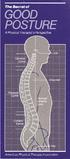 The Secret... T he American Physical Therapy Association would like to share a secret with you. It can help you do more with less effort breathe easier feel great. The secret is about good posture, which
The Detection of Neural Fatigue during intensive conditioning for football: The Potential of Transcranial Magnetic Stimulation
 The Detection of Neural Fatigue during intensive conditioning for football: The Potential of Transcranial Magnetic Stimulation Carl Wells PhD Sport Science Lead, Perform, National Football Centre, St.
Don t. Hamstrings. Calf Muscles. both legs 2-3 times. stretch is felt in the back of the calf. Repeat with both legs 2-3 times.
 Remember to: Warm-up your muscles first before stretching (e.g. stretch after walking). Stretch until you feel mild discomfort, not pain. Never bounce or force a stretch. Hold the stretch for 10-30 seconds
NECK STRENGTHENING PROGRAM
 NECK STRENGTHENING PROGRAM The Orthopedic Specialty Hospital (TOSH) is one of the country's premier facilities for orthopedic surgical care, physical therapy, sport specific rehabilitation, sports training,
Human Anatomy & Physiology Reflex Physiology lab. Objectives: To understand what reflexes are, the processes involved, and purpose of reflexes.
 Human Anatomy & Physiology Reflex Physiology lab Objectives: To understand what reflexes are, the processes involved, and purpose of reflexes. Introduction: A reflex is an involuntary neural response to
Rehabilitation after shoulder dislocation
 Physiotherapy Department Rehabilitation after shoulder dislocation Information for patients This information leaflet gives you advice on rehabilitation after your shoulder dislocation. It is not a substitute
1.1.1 To include: Body language - facial expressions, gestures, eye contact and posture
 Unit 415 Delivering Personal Training Sessions Recommended Guided Learning Hours: 58 Credit value 9 QCF Unit Number J/600/9053 1. Understand how to instruct exercise during personal training sessions 1.1
SHOULDER PULL DOWNS. To learn efficient use of the shoulder blades and arms while maintaining a neutral spine position.
 SHOULDER INTRODUCT ION Welcome to your shoulder exercise program The exercises in the program are designed to improve your shoulder mobility, posture and the control of the muscles in your neck and shoulder
HOPE EXERCISE RECOVERY RESOURCES RELATIONSHIPS INFORMATION REHABILITATION PREVENTION SELF ADVOCACY RELATIONSHIPS MOVEMENT. A Stroke Recovery Guide
 INFORMATION REHABILITATION PREVENTION SELF ADVOCACY RECOVERY HOPE A Stroke Recovery Guide RELATIONSHIPS MOVEMENT RESOURCES RELATIONSHIPS EXERCISE www.stroke.org CHAPTER FOUR Movement and Exercise Moving
Diagram showing Systemic and Portal Circulation
 Diagram showing Systemic and Portal Circulation The Lymphatic System The Lymphatic System comprises of lymphatic capillaries, lymphatic vessels, nodes and ducts. Lymph fluid is not blood plasma, it contains
Overactive bladder is a common condition thought to. women, and is a serious condition that can lead to. significant lifestyle changes.
 Overactive bladder is a common condition thought to FADE UP TO WIDE SHOT OF FEMALE MODEL WITH TRANSPARENT SKIN. URINARY BLADDER VISIBLE IN PELVIC REGION affect over 16 percent of adults. It affects men
Muscle Tissue. Muscle Physiology. Skeletal Muscle. Types of Muscle. Skeletal Muscle Organization. Myofibril Structure
 Muscle Tissue Muscle Physiology Chapter 12 Specially designed to contract Generates mechanical force Functions locomotion and external movements internal movement (circulation, digestion) heat generation
Stretching the Major Muscle Groups of the Lower Limb
 2 Stretching the Major Muscle Groups of the Lower Limb In this chapter, we present appropriate stretching exercises for the major muscle groups of the lower limb. All four methods (3S, yoga, slow/static,
Exercise 1: Knee to Chest. Exercise 2: Pelvic Tilt. Exercise 3: Hip Rolling. Starting Position: Lie on your back on a table or firm surface.
 Exercise 1: Knee to Chest Starting Position: Lie on your back on a table or firm surface. Action: Clasp your hands behind the thigh and pull it towards your chest. Keep the opposite leg flat on the surface
Weight Room Rules. 7. A towel is recommended for use in the Weight Room to use as a barrier when working on the benches and mats.
 Weight Room Rules 1. The Weight Room and Recreation Facilities are for the use of Barnard students, Barnard faculty & staff, Barnard alumnae (with Sport Pass) and Columbia undergraduate students (CC, SEAS).
McMaster Spikeyball Therapy Drills
 BODY BLOCKS In sequencing Breathing and Tempo Flexibility / Mobility and Proprioception (feel) Upper body segment Middle body segment Lower body segment Extension / Static Posture Office / Computer Travel
Chapter 7: The Nervous System
 Chapter 7: The Nervous System Objectives Discuss the general organization of the nervous system Describe the structure & function of a nerve Draw and label the pathways involved in a withdraw reflex Define
Always warm up before commencing any exercise. Wear the correct clothing and footwear; do not train if you are unwell or injured.
 SUGGESTED FITNESS PROGRAMME General Exercise Guidance Good exercise training advice is highly specific to the individual. It should be understood, therefore, that the advice provided here can only be general.
What is Physical Fitness?
 What is Physical Fitness? Physical fitness is made up of two components: Skill-related fitness and Health related fitness. Skill related fitness items are factors, which relate to the possibility of you
Why Back Safety is Important
 Back Safety Why Back Safety is Important Back injuries are considered by OSHA (the Occupational Safety and Health Administration) as the nation's #1 workplace safety problem. Back Injuries are often: Very
Exercise Physiologist
 Considerations in Designing a Rehab Program Philosophy of Sports Medicine Healing Process Pathomechanics of Injury Psychological Aspects Goals of Rehab Reading: Chapter 1 Quiz 1: Anatomy review Group effort
Sit stand desks and musculo skeletal health. Katharine Metters
 Sit stand desks and musculo skeletal health Katharine Metters Topics Sitting Standing Movement and activity Work and human change Sitting uses less energy Sitting provides support for the body to reduce
MUSCULAR SYSTEM. A. K. Sengupta 9/9/2010 1/12
 MUSCULAR SYSTEM Introduction Functions and basic types of muscle cells Skeletal muscle cells and connective tissues The nervous system Mechanism of muscle contraction Motor unit Action potential basis
CHAPTER XV PDL 101 HUMAN ANATOMY & PHYSIOLOGY. Ms. K. GOWRI. M.Pharm., Lecturer.
 CHAPTER XV PDL 101 HUMAN ANATOMY & PHYSIOLOGY Ms. K. GOWRI. M.Pharm., Lecturer. Types of Muscle Tissue Classified by location, appearance, and by the type of nervous system control or innervation. Skeletal
Biomechanics of cycling - Improving performance and reducing injury through biomechanics
 Biomechanics of cycling - Improving performance and reducing injury through biomechanics Biomechanics is the science concerned with the forces that act on the human body and the effects these forces produce.
CHAPTER 3: BACK & ABDOMINAL STRETCHES. Standing Quad Stretch Athletic Edge - www.athleticedge.biz - (650) 815-6552
 CHAPTER : BACK & ABDOMINAL STRETCHES Standing Quad Stretch ) Stand and grasp right ankle with same hand, use a wall or chair to Lower maintain Back balance with left hand. Maintain an upright Stretches
By Agnes Tan (PT) I-Sports Rehab Centre Island Hospital
 By Agnes Tan (PT) I-Sports Rehab Centre Island Hospital Physiotherapy Provides aids to people Deals with abrasion and dysfunction (muscles, joints, bones) To control and repair maximum movement potentials
A proper warm-up is important before any athletic performance with the goal of preparing the athlete both mentally and physically for exercise and
 A proper warm-up is important before any athletic performance with the goal of preparing the athlete both mentally and physically for exercise and competition. A warm-up is designed to prepare an athlete
Back Safety and Lifting
 Back Safety and Lifting Structure of the Back: Spine The spine is the part of the back that supports the trunk and head. It protects the spinal cord as well as giving flexibility to the body. Vertebrae
Department of Defense DIRECTIVE
 Department of Defense DIRECTIVE NUMBER 1308.1 June 30, 2004 PDUSD(P&R) SUBJECT: DoD Physical Fitness and Body Fat Program References: (a) DoD Directive 1308.1, "DoD Physical Fitness and Body Fat Program,"
UNIT 5 - MUSCULAR SYSTEM LECTURE NOTES
 UNIT 5 - MUSCULAR SYSTEM LECTURE NOTES 5.0I MUSCLE TISSUE FUNCTIONS A. Motion by moving the skeletal levers of the body B. Posture - stabilizing body positions C. Regulation of organ volume D. Thermogenesis
Archery: Coaching Young Athletes. Developing Fundamental Movement Skills
 Archery: Coaching Young Athletes Developing Fundamental Movement Skills Make a long term commitment Long Term Athlete Development Long Term Athlete Development (LTAD) is a strategy for helping youngsters
COMMON OVERUSE INJURIES ATTRIBUTED TO CYCLING, AND WAYS TO MINIMIZE THESE INJURIES
 COMMON OVERUSE INJURIES ATTRIBUTED TO CYCLING, AND WAYS TO MINIMIZE THESE INJURIES Listed are a few of the most common overuse injuries associated with cycling long distances. 1. Cervical and upper back
SAMPLE WORKOUT Full Body
 SAMPLE WORKOUT Full Body Perform each exercise: 30 secs each x 2 rounds or 2-3 sets of 8-12 reps Monday & Wednesday or Tuesday & Thursday Standing Squat Muscles: glutes (butt), quadriceps (thigh) Stand
Origin of Electrical Membrane Potential
 Origin of Electrical Membrane Potential parti This book is about the physiological characteristics of nerve and muscle cells. As we shall see, the ability of these cells to generate and conduct electricity
Please read chapter 15, The Autonomic Nervous System, complete this study guide, and study this material BEFORE coming to the first class.
 Please read chapter 15,, complete this study guide, and study this material BEFORE coming to the first class. I. Introduction to the autonomic nervous system: Briefly describe the autonomic nervous system.
Anaerobic and Aerobic Training Adaptations. Chapters 5 & 6
 Anaerobic and Aerobic Training Adaptations Chapters 5 & 6 Adaptations to Training Chronic exercise provides stimulus for the systems of the body to change Systems will adapt according to level, intensity,
IMGPT: Exercise After a Heart Attack 610 944 8140 805 N. RICHMOND ST (Located next to Fleetwood HS) Why is exercise important following a heart
 Why is exercise important following a heart attack? Slow progression back into daily activity is important to strengthen the heart muscle and return blood flow to normal. By adding aerobic exercises, your
9-12 Physical Education and Leisure Curriculum Framework. Revised 2011
 9-12 Physical Education and Leisure Curriculum Framework Revised 2011 Course Title: Physical Education and Leisure Course/Unit Credit: 1 Course Number: 485000 Teacher Licensure: Please refer to the Course
Chapter 15. The Autonomic Nervous. The Autonomic Nervous System. Autonomic Motor Pathways. ANS vs. SNS
 The Autonomic Nervous System Chapter 15 The subconscious involuntary nervous system Regulates activity of smooth muscle, cardiac muscle & certain glands The Autonomic Nervous System 1 2 ANS vs. SNS Somatic
DROP FOOT AND TREATMENTS YOUNGMEE PARK
 DROP FOOT AND TREATMENTS YOUNGMEE PARK WHAT IS FOOT DROP Foot drop / Drop foot the inability to lift the front part of the foot not a disease a symptom of some other medical problems a sign of an underlying
An Effective Exercise Prescription for Ataxia. Polly Swingle, PT The Recovery Project, LLC www.therecoveryproject.net 734-953-1745
 An Effective Exercise Prescription for Ataxia Polly Swingle, PT The Recovery Project, LLC www.therecoveryproject.net 734-953-1745 1 Are you Functional? Sit to stand from a chair without the use of your
Evaluating muscle injuries and residuals of shell fragment and gunshot wounds
 Evaluating muscle injuries and residuals of shell fragment and gunshot wounds Training conducted by: Michael Fishman and Sandrine Fisher 1 Objectives To become familiar with the application of the rating
Name. Most of the bones of the limbs (arms & legs) act as levers. These levers are powered by muscles.
 Bones as Levers 1 Name Bones as Levers You may not think of your limbs as being machines, but they are. The action of a muscle pulling on a bone often works like a type of simple machine called a lever.
Low Back Pain Exercise Guide
 Nader M. Hebela, MD Fellow of the American Academy of Orthopaedic Surgeons http://orthodoc.aaos.org/hebela Cleveland Clinic Abu Dhabi Cleveland Clinic Abu Dhabi Neurological Institute Al Maryah Island
What is the Spasticity Clinic?
 The Spasticity Clinic This booklet can help you learn about: the Spasticity Clinic at McMaster Children s Hospital spasticity and how it may be treated Your therapist will give you more information and