
Australian Public Service Recruitment Guidelines: Operational guidance for agencies
|
|
|
- Coleen May
- 10 years ago
- Views:
Transcription
1 Australian Public Service Recruitment Guidelines: Operational guidance for agencies Australian Public Service Commission

2 Message from the Commissioner Recruitment, be it engagement, promotion or movement of existing APS employees, underpins the integrity and performance of the Australian Public Service (APS). Processes that support recruiting the right employees represent a key step in ensuring the APS is representative of the people we serve and effective in administering our responsibilities. I welcome the publication of the APS Recruitment Guidelines which provides recruiters at all levels with a best practice guide to support the good work already taking place across agencies. The overarching goal of the guidelines is to provide a resource that is easy to use, practical and one that explains the highly involved recruitment process. This guide is designed for ease of use whilst still being a comprehensive guide for recruiters. It provides guidance on tailoring recruitment processes to achieve greater efficiency while maintaining transparency and agency autonomy. The guideline s key aims are to: ensure the principle of merit is upheld dispel some widespread myths about the recruitment process build capacity encourage agencies to consider alternative recruitment processes. I thank the agencies that have contributed to the development of these guidelines and trust you will find them valuable and informative, enabling your agency to continuously improve its recruitment processes and to find the right people for the right job. Stephen Sedgwick AO Australian Public Service Commissioner ii

3 Table of Contents Message from the Commissioner...ii Introduction...v Scope of the guidelines...vi Stage 1 - Planning...1 Overview...2 Roles and responsibilities...2 Job analysis...4 Writing a job description...6 Defining other work-related requirements for the job...7 Workforce diversity...9 Other planning considerations...11 Administration...13 Options to fill a vacancy...15 Stage 2 - Sourcing...17 Overview...18 APS Redeployment Register...18 Attracting applicants...18 Accessibility issues...19 Notifying the employment opportunity...19 Developing selection criteria...20 Existing orders of merit...20 Stage 3 - Assessing...23 Overview...24 The merit principle...24 Work-related qualities...24 Selection panels...24 Short-listing...25 Stage 4 Selecting...27 Overview...28 Recommending preferred applicant...28 Selection report...28 Delegate decision...28 Secondary considerations...29 Providing feedback to unsuccessful applicants...29 Australian Public Service Recruitment Guidelines: Operational guidance for agencies iii
4 Stage 5 On-boarding...31 Overview...32 Contacting successful applicant and making the employment offer...32 Notifying the outcome in the APS Employment Gazette...33 Induction...33 Probation...34 Cancelling an employment decision...34 Recruitment Performance Measures...35 Overview...36 Direct cost of recruitment activities...36 Quality of recruitment outcomes...36 Quality of recruitment processes...37 Improved applicant experience...37 References...38 iv

5 Introduction The APS Recruitment Guidelines (the guidelines) provide APS agencies with information to tailor recruitment processes to achieve greater efficiency, preserve transparency and open competition while upholding the principle of merit. The guidelines encourage agencies to continue to be autonomous and flexible when managing their recruitment processes within the boundaries of legislation while providing consolidated information and guidance modelled on best practice. They provide human resource practitioners and APS managers with: links to relevant legislation agency case studies facts to dispel recruitment myths a Manager s Toolkit (toolkit). The guidelines are to be used in conjunction with the Australian Public Service Commission (APSC) publication Recruitment and selection in the APS which details the legislative and policy framework applying to recruitment. The guidelines are structured around the five stages of a recruitment process: planning sourcing assessing selecting on-boarding. Table 1: Relationship of guidelines to Recruitment and selection in the APS APS Recruitment Guidelines Recruitment and selection in the APS Stage 1 - Planning Step 1: identify employment opportunity, category and classification and whether vacancy needs to be filled Step 2: Step 3: decide how vacancy is likely to be filled (i.e. engagement of new employees or promotion or movement of existing employees) develop supporting documentation Stage 2 - Sourcing Step 4: decide what notification is required (i.e. is gazettal needed?) Step 5: Step 6: Stage 3 - Assessing Step 7: accept applications Step 8: decide if opportunity is to be open to all eligible members of the community notify in the gazette additional advertising optional assess relative suitability of candidates Stage 4 - Selecting Step 9: recommend preferred candidate on basis of relative merit Step 10: delegate makes selection decision Stage 5 - On-boarding Step 11: implement decision Australian Public Service Recruitment Guidelines: Operational guidance for agencies v
6 The guidelines also include performance measures that can be applied to recruitment which can drive greater accountability for recruitment, encourage staff to plan and implement efficient recruitment processes and provide agencies with data to inform continuous improvement. Scope of the guidelines The guidelines apply to APS Level and Executive Level recruitment processes for: ongoing employment opportunities non-ongoing opportunities for a specified term of more than 12 months non-ongoing opportunities for a specified task reasonably estimated to take more than 12 months. The following topics are not covered by the guidelines because they are covered by other APSC policy and guidelines: Senior Executive Service recruitment agency head and statutory office holder selection non-ongoing employment for 12 months or less workforce planning ion dy kit vi
7 Roles and responsibilities Job analysis Writing a job description Defining other work-related requirements for the job Workforce diversity Other planning considerations Administration Options to fill a vacancy Planning

8 Overview Recruitment is the process of having the right person in the right place at the right time. It is crucial to organisational performance in the APS. Recruitment is a critical activity, not just for the human resources area but also for line managers increasingly involved in the selection process. As with any other important project, recruitment needs to be thoroughly considered, planned and appropriately resourced. A well-planned recruitment process is more likely to result in selecting the applicant/s that best fit the job. Recruitment processes vary and each has its own considerations and requirements. It is important for everyone involved in recruitment to be equipped with the knowledge and skills needed to undertake their respective roles. A well run recruitment process reflects positively on the agency and the APS as a whole. In a competitive labour market it is important that applicants consider the APS as an employer of choice. An applicant s perception of the APS can be influenced through participation in efficient and transparent recruitment. From a strategic perspective, each agency should consider how the planning stage can help achieve: more timely and efficient recruitment processes well defined job requirements that attract applicants who are the best fit for the role and agency greater buy in to recruitment from managers and employees, including a greater willingness to assist in the process (e.g. as a selection panel member) greater diversity of applicants, allowing the APS to better serve the diverse Australian community. From an operational perspective, a well-planned recruitment process should consider: gaining the delegate s approval to commence the process gaining the delegate s approval at the end of the planning stage establishing the required start date for the successful applicant scheduling assessment activities, such as short-listing applicants, interviewing and contacting referees (if needed) ensuring the availability and commitment of each selection panel member securing an appropriate and accessible venue for selection activities budgeting impacts if applicants need to travel to attend selection activities (which may depend on the agency s Enterprise Agreement) providing applicants with reasonable notice if they are to attend selection activities. Roles and responsibilities This section explains the roles that may be involved in the recruitment process. ion While there is no legislative requirement to form a selection panel, in most APS agencies a selection panel is formed and tasked with the responsibility of assessing the suitability of applicants. ion dy Stage 3 - Assessing section of the guidelines kit dy Information Sheet - Selection panel composition kit 2

9 Role of the delegate The delegate is delegated employer powers by the agency head. The delegate is responsible for making the selection decision, and is accountable for ensuring that selection processes and decisions comply with merit requirements. Agencies may decide to have the delegate solely responsible for assessing applications and employment decisions, although this is rare. The delegate may be part of the selection panel, although some APS agencies have internal policies specifying that the delegate cannot be part of such a panel to ensure impartiality and avoid any perception of patronage or favouritism. In many cases an agency may require the delegate to approve the request for recruitment. This may include ensuring that the employment opportunity is correctly notified and endorsing selection documentation and assessment methods. information case study tool kit Role of the chairperson The chairperson is responsible for leading the selection process and managing the selection panel (if one is used). This may include overseeing panel composition and administrative requirements such as scheduling assessment activities and procuring scribe services (if one is used). Many agencies require the chairperson to complete specific training before assuming these duties. information case study tool kit Role of the selection panel member There are no legislative requirements on the number of people to be on a selection panel, nor the classification of panel members or gender balance. Each selection panel member is responsible for assisting in assessing the suitability of applicants for the role advertised. Many agencies require selection panel members to complete specific training before assuming selection panel duties. Role of the scribe There is no requirement for a scribe to be used in APS recruitment processes. A scribe is designated to document the recruitment process. A scribe can be asked to be a member of the selection panel, although this is not usual practice. Having a scribe can allow selection panel members to focus on assessment activities rather than on taking notes. A scribe can also draft the selection report more quickly, if they have been specifically designated for that role and are therefore able to give it a high priority. A scribe can be an APS employee, an APSC Recruitment Advisor or an external recruitment service provider. Australian Public Service Recruitment Guidelines: Operational guidance for agencies 1: Planning 3
10 ation study ol kit Role of the contact officer A contact officer must be identified for each vacancy notified in the APS Employment Gazette. This officer should be able to respond to queries from potential applicants regarding: duties to be performed work-related qualities required background information and context about the role and agency reporting structure where the work will be undertaken special requirements of the job shift work, peak work periods, part time or full time reasonable adjustments for people with disability that can be put in place in relation to the selection process. Contact officers are often the applicant s first contact with the agency and it is important that they be available, professional and friendly, with a good understanding of the role and an ability to convey relevant information to applicants. The APSC offers the Getting that selection right training program for any APS employee that has been or is likely to be selected for a recruitment selection panel. The program aims to achieve quality recruitment outcomes in line with APS merit-based assessment requirements. It is good practice to ensure the contact officer is not acting in the role being filled and is not a potential applicant. This removes any conflict of interest or perception of patronage or favouritism. The applicant The applicant (or candidate) is a person who has submitted a formal job application for assessment. ion ation dy study kit ol kit Job analysis Job analysis is the process used to collect information about the duties, responsibilities, necessary skills, essential qualifications, personal attributes and work environment relevant to a job. The process can assist in preparing selection documentation and identifying work-related qualities for the job. Investing time in job analysis increases the likelihood of attracting, selecting and retaining the best person. 4

11 Job definition A number of triggers can lead to a recruitment process, including an employee leaving, a restructure, the expansion of a product or service or a new policy or program leading to the creation of new jobs. Re-using existing job documentation can be tempting and a quick option for those involved in recruitment, but agencies will benefit from reviewing previous documentation and accurately defining the role to be filled. Changes to the role and tasks involved since the original job description was written should be considered and incorporated. The recruiting manager should consider restructuring or re-allocating particular tasks and functions, as this may result in more efficient processes or present an opportunity for existing staff to benefit by: gaining wider experience developing new skills experiencing an increased variety of tasks participating in job-sharing opportunities increasing hours of part-time staff increasing flexibility of hours. The manager should also consider if the: job is still necessary duties need to be performed in the same way or be amended classification is appropriate for the duties given the agency s work level standards or whether the role should be re-classified scope is right for new duties (location of the job; reporting structure etc) duties could be assigned to an existing employee on an ongoing or temporary basis introduction of alternative working methods could reduce workload and/or improve service quality job is likely to change in the foreseeable future job lends itself to flexible working arrangements, for example whether it could be filled on a part time basis job could be best performed by an Aboriginal or Torres Strait Islander person, and therefore could be advertised as a special measure job could be performed by a person with intellectual disability, and therefore could be advertised as a special measure. information case study This information can be gathered through internal reports, performance agreements observation (e.g. what tasks are performed and how long is spent on them), questionnaires and/or interviews. The analysis of this information should form the basis of a job description and work-related qualities specification. Agencies should also consider if the job could be performed by a person with intellectual disability who cannot compete in a competitive selection process. If this is the case, special measures can apply. tool kit Information sheet - Recruiting people with an intellectual disability Template - Job analysis Australian Public Service Recruitment Guidelines: Operational guidance for agencies 1: Planning 5

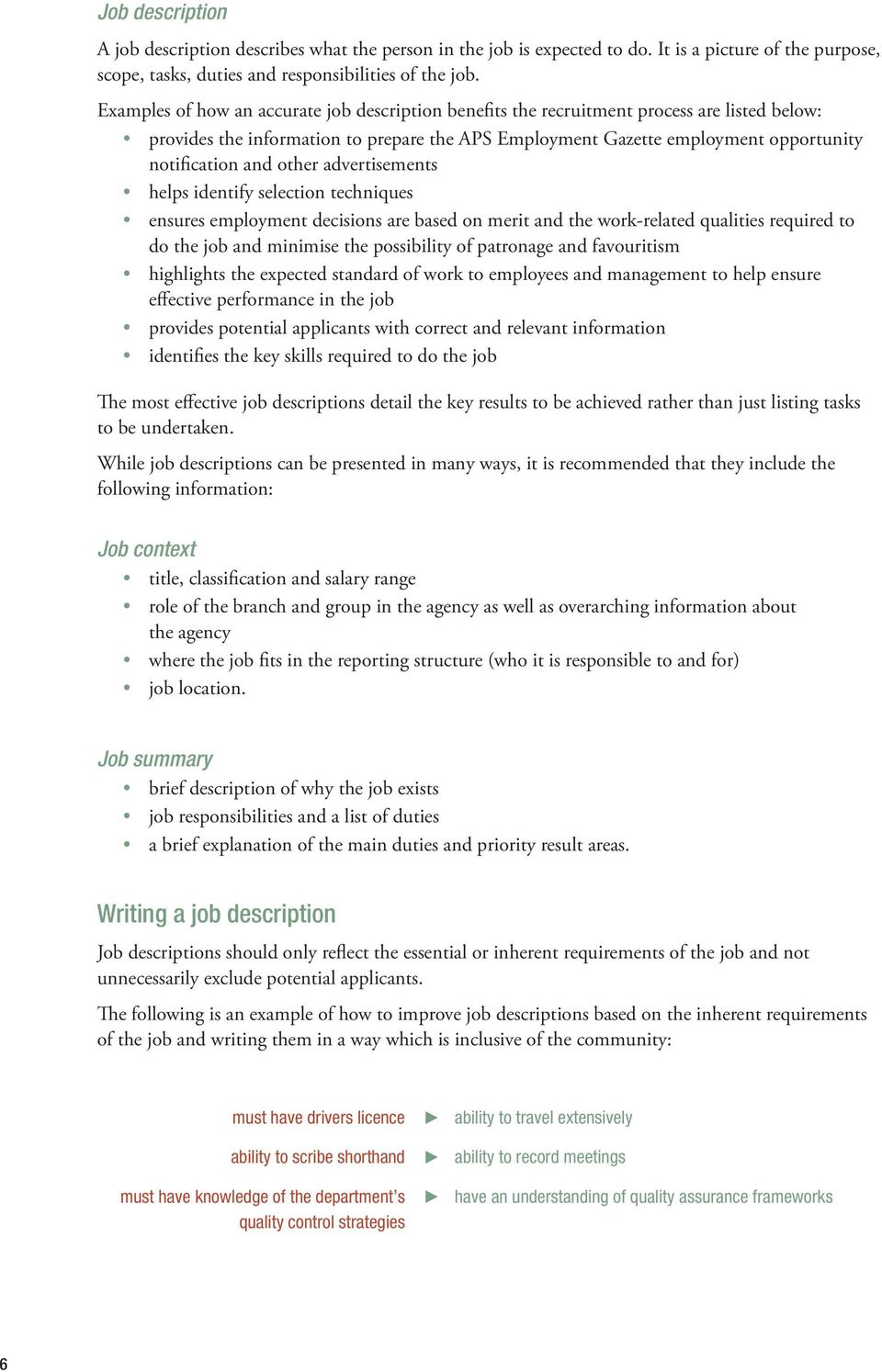
12 Job description A job description describes what the person in the job is expected to do. It is a picture of the purpose, scope, tasks, duties and responsibilities of the job. Examples of how an accurate job description benefits the recruitment process are listed below: provides the information to prepare the APS Employment Gazette employment opportunity notification and other advertisements helps identify selection techniques ensures employment decisions are based on merit and the work-related qualities required to do the job and minimise the possibility of patronage and favouritism highlights the expected standard of work to employees and management to help ensure effective performance in the job provides potential applicants with correct and relevant information identifies the key skills required to do the job The most effective job descriptions detail the key results to be achieved rather than just listing tasks to be undertaken. While job descriptions can be presented in many ways, it is recommended that they include the following information: Job context title, classification and salary range role of the branch and group in the agency as well as overarching information about the agency where the job fits in the reporting structure (who it is responsible to and for) job location. Job summary brief description of why the job exists job responsibilities and a list of duties a brief explanation of the main duties and priority result areas. Writing a job description Job descriptions should only reflect the essential or inherent requirements of the job and not unnecessarily exclude potential applicants. The following is an example of how to improve job descriptions based on the inherent requirements of the job and writing them in a way which is inclusive of the community: must have drivers licence ability to scribe shorthand must have knowledge of the department s quality control strategies ability to travel extensively ability to record meetings have an understanding of quality assurance frameworks 6
13 Identifying the role s inherent requirements involves analysing what a person is being hired to do, rather than prescribing how a job is done. Firstly identify and list the main activities to be carried out. After identifying activities, group them and consolidate to ensure not too many are listed. Job descriptions should not be too lengthy and in most cases need no more than six to eight headings. Then define each activity as a statement of what the employee is expected to achieve and deliver on - in effect the output. This can be done in one sentence, beginning with a verb, in line with the examples below: drafts plans tests manages schedules. Describe the object of the verb (what is done) as briefly as possible, in line with the examples below: drafts ministerial correspondence plans a stakeholder management strategy tests new Information Technology systems manages a small team schedules Information Technology change releases. State briefly the purpose of the activity in terms of outputs or standards to be achieved, in line with the example below: Manages a small team to organise mail and deliver records to the Secretary s office in accordance with departmental standards. Defining other work-related requirements for the job Agencies should consider the following issues early so they can be included in planning processes as appropriate. Essential qualifications Agencies may require people to hold certain qualifications, such as academic or technical qualifications or certification from a professional body. Examples of essential qualifications include: registration as a medical practitioner for medical roles a law degree and eligibility to be admitted to practice in a state or territory of Australia for legal roles an undergraduate degree for entry into a graduate development program. Attaining and verifying essential qualifications can be imposed as a condition of engagement. information case study Australian Public Service Recruitment Guidelines: Operational guidance for agencies 1: Planning 7
14 tion tudy l kit Information sheet - Essential qualifications Citizenship There is a general expectation that a person to be engaged as an APS employee will be an Australian citizen (section 22(8) of the Public Service Act 1999). An agency head may, however, waive this requirement depending on the agencies needs and circumstances (e.g. a shortage of the skills or professional qualifications required to perform particular duties). In these circumstances agencies may choose to waive the citizenship requirement or impose the attainment of citizenship as a condition of engagement. ion dy kit Security clearances An agency head may determine that some positions require staff to carry out duties requiring a security clearance. The level of security clearance should be reviewed before starting a recruitment process, as the nature of duties may have changed. The requirement to have or obtain a security clearance may be imposed as a condition of engagement. In some cases the agency may require clearance before engagement takes effect. When an existing APS employee is moved or promoted to a job requiring the employee to obtain or upgrade a security clearance, the agency may choose to delay their start date (or gazettal of promotion) until the clearance is obtained. Some base level security vetting can be conducted by the selection panel by including integrityrelated questions in the scope of the referee s report. The Protective Security Policy Framework provides the appropriate controls for the Australian Government to protect its people, information and assets, at home and overseas. The Australian Government Security Vetting Agency (AGSVA) is the central unit that conducts security vetting for all Commonwealth agencies (apart from exempt ones). Clearances granted by AGSVA have whole-of-government effect. 8
15 information Attorney-General s website: case study information tool kit case study AGSVA website: (Part 2.2) tool kit Information sheet - Security clearances Workforce diversity The diversity of people working in the APS is one of its greatest strengths. Some groups of people are disproportionately represented in the APS and agencies have a responsibility to ensure that they continue to increase the diversity of the APS workforce. There is continued disadvantage experienced by particular groups of people in the workplace, including women, Indigenous Australians, people with disabilities and those who suffer disadvantage on the basis of race or ethnicity. It is recommended that agencies develop recruitment strategies that accommodate differences in the background, perspectives and other factors (such as family responsibilities) of both prospective and existing employees. People with disability The recruitment and retention of people with disability increases the diversity of the APS and develops an organisation that better represents the Australian community. It is important to remember that people with disability as a group are diverse, and include people with physical, intellectual, psychological, behavioural and sensory impairments. According to the Australian Bureau of Statistics, around 18.5% of the general population experiences disability. In 1999, 5% of APS staff identified as having a disability, but this figure fell to 4% by 2002 and to 3% by To reverse the decline in the representation of people with disability in the APS, the APSC launched the As One- APS Disability Employment Strategy. This strategy aims to strengthen the APS as a progressive and sustainable employer of people with disability, and to improve the experience of people with disability in APS employment. The As One strategy includes some fundamental actions and objectives related to diversity including: improving leadership increasing agency demand for candidates with disability improving recruitment processes to enable more candidates with disability to enter the APS fostering inclusive cultures that support and encourage employees with a disability. Australian Public Service Recruitment Guidelines: Operational guidance for agencies 1: Planning 9
16 ion dy kit Reasonable adjustments A recruitment process should allow people with disability to compete on an equal basis for employment opportunities. This sometimes means the selection process needs to be modified or adjusted in some way to suit a particular individual. It is important to provide adjustments that maintain the dignity of the person and do not impose unnecessary administration on the person with disability. The process of arriving at reasonable adjustments, if not conducted with the experience of that applicant in mind, can be seen by that applicant as unwelcoming. Most adjustments come at little or no cost to the agency, but agencies are responsible for ensuring that adjustments are made. Applicants should be asked if they require any adjustments when submitting their application, to allow time to discuss modifications with them and perform preparatory work to put the adjustment in place. For example, Auslan interpreters (for hearing impaired applicants) are in demand and must be booked in advance, or certain software installed if the applicant is being tested using a computer. Reasonable adjustments can occur at any part of the recruitment process, including on-boarding. Some applicants will wait until a job offer is made before disclosing their disability or asking for reasonable adjustments. Note that, aside from being good practice, the Disability Discrimination Act 1992 requires employers to make reasonable adjustments for applicants and employees with disability. Special measures provisions relating to certain groups with disability The Public Service Commissioner s Directions make special measures provisions available to assist people with intellectual disability or people with disability that are unable to compete on merit to gain APS employment. Often recruiting through a special measure can be faster and less expensive than mainstream recruitment. People with intellectual disability The APS can play a significant role in increasing the participation of people with intellectual disability in employment. People with intellectual disability encounter challenges that are different from people with other types of impairment. The APS can recruit people with intellectual disability using special measures using the Public Service Commissioner s Directions. ion Information sheet - Making reasonable adjustments in a recruitment process Information sheet - Disclosure of disability dy ation Information sheet - Developing a business case for disability employment kit study Case study - Traineeships for people with intellectual disability ol kit 10
17 Indigenous applicants Increasing employment of Indigenous peoples and reducing the level of disadvantage experienced by them is integral to the Australian Government s agenda. The government is committed to achieving 2.7% Indigenous employment by The APS has an important role to play here by modelling better practice to the broader workforce and strengthening community capacity. Agencies should consider how they will attract Indigenous applicants to apply for all vacancies, not just those that use Indigenous specific processes. Agencies should consider the use of targeted avenues to increase the awareness of Indigenous employment opportunities through the use of Identified Positions or Special Measures. Identified positions Identified positions are jobs open to Indigenous and non-indigenous applicants who meet selection criteria requiring: an understanding of the issues affecting Indigenous peoples the ability to communicate sensitively and effectively with Indigenous peoples. Agencies should note that these criteria can be tailored to suit business needs as appropriate. The use of Identified Positions does not directly increase the representation of Indigenous people in the APS workforce but it does assist in ensuring that the APS has people with the necessary skills to deliver appropriate services to all Australians, and that the APS is seen as an employer of choice amongst Indigenous Australians. Special measures Special measures provisions identify jobs restricted to applications from Indigenous peoples, to provide opportunities for them to work in the APS. information case study tool kit circular Other planning considerations Agencies can access other planning options to help with recruitment, including the following. Using an Independent Selection Advisory Committee An Independent Selection Advisory Committee (ISAC) is an independent committee that makes recommendations to agencies about the suitability of candidates in staff recruitment exercises. Such a committee may be used to fill vacancies for APS 1 to 6 (or equivalent levels). Australian Public Service Recruitment Guidelines: Operational guidance for agencies 1: Planning 11

18 If an agency wants to establish an ISAC they must make a formal request to the Merit Protection Commissioner. tion ion udy dy l kit kit Information sheet - Entry level recruitment program Australian Taxation Office Outsourcing the recruitment process Many commercial recruitment providers can help conduct recruitment. Agencies can outsource the entire process or specific components (e.g. short-listing, interviews or online assessment) to these providers. However, agencies must be mindful that it is their responsibility when outsourcing some or all of the recruitment process to ensure that: all legislative requirements are met the employment opportunity is notified in the APS Employment Gazette reasonable adjustments are made to level the recruitment field for people with disability Agencies must adhere to procurement processes and procedures when sourcing a commercial recruitment provider. Also, even though a recruitment process is outsourced, the delegation to make the employment decision remains with the agency s delegate. Agencies should note that when a recruitment process is outsourced the advertising of the job must still comply with the Department of Finance and Deregulation s (DoFD) policy on non-campaign recruitment advertising and employment opportunities must still be notified in the APS Employment Gazette. ion tion dy udy DoFD Website: kit l kit Information sheet - Outsourcing recruitment services Bulk recruitment rounds Bulk recruitment rounds can be an efficient way to employ a large number of employees for the same or similar roles within an agency. Bulk recruitment rounds can be undertaken for different classifications or a single classification. Orders of merit can be formed from bulk recruitment rounds and used to fill the same or similar roles across the agency for a 12 month period from the date the vacancy was initially notified in the APS Employment Gazette. 12
19 information Stage 4 Sourcing section of the guidelines case study information tool kit case study Case study - Entry level recruitment program Australian Taxation Office tool kit Administration Scheduling Scheduling the recruitment process should start as soon as it is confirmed that recruitment is required. Consideration should be given to: nominating selection panel members and ensuring they have the time to be involved in the selection process scheduling dates by which assessments need to be completed by (e.g. short-listing) scheduling and booking venues for meetings and assessment activities Late applications Agencies are responsible for developing their own policy for managing late applications. These policies should be fair and transparent and be made apparent to applicants when the job is advertised. In considering whether to accept late applications, agencies should discuss the following types of questions: Will all late applications be accepted or will they be considered on a case by case basis? Were there extenuating circumstances preventing the applicant from submitting their application by the due date? How much extra time should be given to applicants to submit their application, bearing in mind the process must be fair to all applicants? Agencies may also consider an alternative approach should issues arise with e-recruit systems or other technology preventing applicants from submitting on time. Agencies need to ensure applicants are not adversely affected because of these issues. information case study tool kit Australian Public Service Recruitment Guidelines: Operational guidance for agencies 1: Planning 13

20 Engagement of people who have received a redundancy benefit Applicants who have received a redundancy benefit payment from the APS or Australian Parliamentary Service have limitations placed on their APS engagement. In broad terms, redundancy benefit recipients cannot be re-engaged until their redundancy benefit period has expired. A redundancy benefit is defined as a: severance or similar payment made to the employee on cessation of their employment payment made to the employee as a result of shortening the retention period. There is no standard exclusion period for which redundancy benefit recipients are limited from being engaged in the APS. The period is commensurate with the redundancy benefit paid. In some circumstances an agency head may re-engage a redundancy benefit recipient before their redundancy benefit period expires. ion dy kit ation study ool kit Record keeping The Administrative Functions Disposal Authority (AFDA) sets out requirements for keeping or destroying records of administrative business performed by most Australian Government agencies. Records documenting the filling of vacancies in an agency must be retained for 7 years after the recruitment has been finalised. These documents would be retained on a recruitment file and may include: advertisements applications referee reports psychological testing interview assessments/exercises interview reports gazette notices notification to unsuccessful applicants. Records documenting the employment history of ongoing employees (letters of engagement, letter of acceptance, details of assigned duties, probation reports, evidence of education qualifications, medical examinations/health clearances) should be retained until 75 years after the date of birth of the employee or 7 years after last action whichever is the later. These papers would be retained on a personnel file. Records documenting reviews of promotion decisions must be retained for 1 year after the recruitment has been finalised. These papers would be retained on a recruitment file. 14
21 information case study National Archives of Australia website: tool kit Delegate approval Once the recruitment planning stage is finalised it is recommended that delegate approval be obtained. Gaining delegate approval at this stage can avoid complications later in the process. Options to fill a vacancy Three possible options can be used to fill a vacancy: engaging a person into the APS promoting an existing APS employee moving an existing APS employee Each option presents the agency with the following requirements and considerations. Engagement of an APS employee Engagement is when the applicant is not an APS employee or is a non-ongoing APS employee and is to be engaged as ongoing. The preferred applicant must have been through a competitive merit-based selection process before being engaged. One exception is the engagement through special measures for people with disability who cannot compete in a competitive merit selection process. All engagements must be notified in the APS Employment Gazette. The agency can impose conditions of engagement. Security clearances, citizenship and essential qualifications are examples of this (though conditions of engagement are not limited to these). information case study tool kit Promotion of an APS employee Promotion is the ongoing movement of an ongoing APS employee to a job at a higher classification level in their agency or in another agency. Promotion decisions from APS level 1 to level 6 can be reviewed. An APS employee who has applied for a position and not been promoted can ask for a promotion review. This is commonly referred to as an appeal. Promotions must be notified in the APS Employment Gazette and in most cases they take effect four weeks after notification (unless subject to a promotion review or a different date is agreed). Australian Public Service Recruitment Guidelines: Operational guidance for agencies 1: Planning 15
22 ion dy kit promotion-reviews Movement of an APS employee Movement of an APS employee within an agency or to another agency is commonly referred to as a transfer or transfer at level. The date of effect of a transfer within an agency is negotiated between work areas. A transfer to a position in another agency, at the same or lower classification level, generally takes effect four weeks from the date on which the employee informs their current agency head of the agreement to transfer. An alternative date can be agreed between the APS employee and two agencies. A transfer may result from a competitive selection process, but this is not a legislative requirement. If a transfer results from a competitive selection process notified in the APS Employment Gazette then the outcome of that process should also be notified in the gazette. The APS Redeployment Register gives agencies the option to consider potentially excess employees seeking redeployment. Agencies can view employee CVs and contact potentially suitable people before or at the same time as advertising the vacancy. ion dy Stage 2 Sourcing kit managing-redeployment-agency-guidelines 16
23 APS Redeployment Register Attracting applicants Accessibility issues Notifying the employment opportunity Developing selection criteria Existing orders of merit Sourcing
24 Overview The sourcing stage includes activities undertaken to attract candidates. This includes advertising positions and developing relevant selection criteria. APS Redeployment Register The APS Redeployment Register is a central register of APS employees identified as excess or potentially excess by their agency who have expressed interest in continuing to work in the APS. The APS Redeployment Policy requires agencies that are recruiting to consider employees on the register before, or concurrent with, recruitment. The register is a source of experienced employees available to transfer at level or to be considered for opportunities at lower classifications. Agencies can access CVs on the register and quickly make an initial assessment of whether the employee has the work-related qualities needed to fill the vacancy. If an agency identifies a suitable employee through the register they can save the time and expense associated with conducting a full recruitment process. Many APS agencies have additional internal redeployment processes to redeploy excess and potentially excess staff within their agency, before vacancies are advertised externally and this practice is strongly encouraged. ion dy managing-redeployment-agency-guidelines kit data/assets/pdf_file/0011/4988/operatingproceduresagency.pdf Attracting applicants Agencies may wish to consider developing an Employee Value Proposition (EVP). An EVP is often described as the balance of reward and benefit, work policies and practices, experienced by an employee in return for their work. It describes why one agency s total work experience is better than working elsewhere and can be the key to attracting and retaining quality people. An EVP can include, but is not limited to: easy access to flexible working conditions serving the Australian public by contributing to policy, regulation and/or service delivery remuneration superannuation a diverse workforce training and development opportunities study assistance programs health and wellbeing programs location of workplaces. 18
25 EVPs can be referred to in job advertisements or supporting documentation and can help applicants form a view about the agency and identify if there are any shared values. Accessibility issues Accessibility is important to everyone, not just people with disability. The online environment is in many ways now more accessible than the print environment, if it is properly authored and formatted. E-recruitment systems used by APS agencies are built to conform to international web accessibility standards. Despite this accessibility, agencies should have a back up facility for applicants to submit applications through other means, for example , in the event the agency e-recruitment system fails for whatever reason. There will be some instances where people, both with disability and without disability, are not able to apply online. Notifying the employment opportunity The following employment opportunities must be notified in the APS Employment Gazette: ongoing employment opportunities non-ongoing opportunities for a specified term of more than 12 months or for a specified task that is reasonably estimated to take more than 12 months. Advertising In 2012, the Department of Finance and Deregulation (DoFD) revised the Non-Campaign Recruitment Advertising Policy. This policy outlines the Australian Government s position on non-campaign recruitment advertising and helps agencies achieve value for money in recruitment advertising by: mandating the use of online advertising instead of print media mandating maximum sizes and placement of advertisements in limited print media (such as regional, periodic publications or specialist media such as those produced for Indigenous peoples) mandating that colour must not be used in print advertisements. The Non-Campaign Recruitment Advertising Policy is available on the DoFD website: Writing an online job advertisement When writing an online job advertisement, agencies should convey key information in a clear and easy to understand way. Advertisements should present the agency and the APS in the best possible way to attract potential applicants. Social media The number of APS agencies considering using social media and mobile devices to advertise employment opportunities and engage with potential applicants has increased. Social media is not always an appropriate channel to advertise employment opportunities and agencies need to consider this carefully when developing their recruitment strategy. It can Australian Public Service Recruitment Guidelines: Operational guidance for agencies 2: Sourcing 19
26 ion provide agencies with a quick and low-cost way to attract and engage active and passive applicants (those not actively looking for another job). However there is a longer-term commitment with social media to keeping information up to date and responding to questions and feedback. Agencies also need to be aware that they have limited control over the feedback and comments posted on a social media site. ion dy dy kit Information sheet - Writing a job advertisement for the Internet ion kit Information sheet - Using social media to attract applicants dy Case study - Using social media in an APS recruitment process Department of Finance and Deregulation kit Developing selection criteria Although there is no legislative requirement for agencies to use selection criteria it is the most common method of assessment in the APS. Many agencies use the Integrated Leadership System (ILS) capabilities as selection criteria, however this is not in line with the system s original intent which is to provide a common language to support consistent whole-of-aps capability development. Agencies should avoid using selection criteria that are too long or contain jargon and acronyms that can discourage potential applicants from applying. Agencies deciding to use selection criteria should consider the following when developing them: each criterion should be specifically related to the work to be performed and be aligned with the job description each criteria should reflect the work-related qualities needed to perform the duties there should not be too many criteria essential qualifications, training, security clearances or other requirements should be included each criteria should not include more than one requirement (i.e. they should not contain double-barrelled criteria that are difficult to both address and assess). ion Information sheet Developing selection criteria dy kit Existing orders of merit An order of merit is a list or grouping of applicants found suitable in a current or previous recruitment process conducted by an agency. 20
27 When planning a recruitment process, agencies should consider using a previously formed order of merit as it provides a pool of assessed applicants and can negate the need for a full recruitment exercise, saving time and resources. Suitable applicants can be grouped (under headings such as highly suitable or suitable) or ranked in a numerical order of merit. The Public Service Commissioner s Directions allow engagements and promotions to be made provided the opportunity to apply for the employment, or similar employment, was notified in the APS Employment Gazette during the 12 months before the decision to engage or promote a person was made. The Public Service Commissioner s Directions define similar employment as employment that: comprises similar duties is at the same classification as, and is to be performed in a similar location as, the notified employment. An order of merit is valid for 12 months from the date the employment opportunity was notified in the gazette. The decision to engage or promote an employee from an order of merit does not have to be notified in the gazette within the 12-month period; however the delegate must approve the decision in writing within 12 months of the initial gazette notification. information case study tool kit Australian Public Service Recruitment Guidelines: Operational guidance for agencies 2: Sourcing 21
28 22
29 The merit principle Work-related qualities Selection panels Short-listing Assessing
30 Overview The Assessing stage focuses on the range of assessment options and processes available to agencies to select suitably skilled and experienced applicant/s. The merit principle Merit is about getting the best available person for the job. The Public Service Act, Section 10 (2), states that a decision relating to engagement or promotion is based on merit if: an assessment is made of the relative suitability of the candidates for the duties, using a competitive selection process the assessment is based on the relationship between the candidates work- related qualities and the work- related qualities genuinely required for the duties the assessment focuses on the relative capacity of the candidates to achieve the outcomes related to the duties the assessment is the primary consideration in making the decision. Work-related qualities The Public Service Commissioner s Directions provide the following examples of work-related qualities that may be taken into account in making merit-based assessment: skills and abilities qualifications, training and competencies standard of work performance capacity to produce outcomes from effective performance at the level required relevant personal qualities demonstrated potential for further development ability to contribute to team performance. 24 Selection panels Although not mandatory, the most common assessment method adopted across the APS is to establish a selection panel (also known as a selection committee, selection advisory committee and assessment panel or selection team). Approval from the delegate to undertake a recruitment process is generally obtained before a selection panel can be established. There are no specific requirements for the composition or size of a selection panel, but it is good practice that members reflect diverse backgrounds and experience, which will enable the panel to select the best applicant. Non-APS employees can be a part of a selection panel but they must be made aware of the legislative framework governing merit-based recruitment and selection in the APS. Employees chosen to be a part of a selection panel may wish to participate in training to prepare for the role. This can be provided by the APSC or the agency itself. It is important to consider if any selection panel member may have, or appear to have, a conflict of interest and may be influenced, or appear to be influenced, by personal interest when making an employment decision. Selection panel members may wish to consider the weighting given to each assessment component and advise applicants of this in advance.
31 In many cases the selection panel handles the following processes before the final decision is made by the agency head (or, in most cases, their delegate): makes an initial assessment of applicants based on written applications addressing selection criteria short-lists applicants to be invited to attend an interview or further assessment seeks referee reports for applicants in contention after the interview combines assessment of application, interview and referee reports identifies preferred applicant/s and makes a recommendation to the delegate. Agencies need to be mindful that recruitment is not a one size fits all approach. While the above processes are widely adopted across the APS, it is not mandatory for agencies to handle recruitment this way. Agencies are therefore encouraged to consider other assessment options, some of which are included in the toolkit. information information case study case study tool kit tool kit Short-listing Short-listing is the process of identifying which applicants have the work-related qualities to be considered for further assessment. It is a useful technique when a large number of applicants are involved. Effective short-listing can improve timeliness by enabling agencies to quickly identify which applicants should move to the next assessment stage. Many agencies are choosing to use online assessment tools to help short-list, particularly with bulk recruitment. When a selection panels is used, all members should take part in short-listing. Initial short-listing can be undertaken by individual members but the selection panel should meet later to discuss applicants and agree which ones to short-list and move to the next assessment stage. Those applicants that are short-listed should also be asked to verify any qualifications they have cited in their application (for example a certified copy of an academic transcript or certificate of completion). Information sheet - Selection panel composition Information sheet - Conflict of interest Information sheet - Assessment centres Information sheet - Psychometric testing Information sheet - Interviews Information sheet - Referee reports Template - Conflict of interest disclosure Template - Short-listing template Case study Using a self assessment questionnaire to inform suitability for working in Customs Australian Public Service Recruitment Guidelines: Operational guidance for agencies 3: Assessing 25
32 26
33 Recommending preferred applicant Selection report Delegate decision Secondary considerations Providing feedback to unsuccessful applicants Selecting
34 Overview In the selecting stage of the recruitment process the selection panel evaluates the information gathered in the assessment phase to decide on the preferred applicant and make a recommendation to the delegate. Recommending preferred applicant The best practice approach to making a recruitment decision is to consider all aspects of the assessment process and assign a ranking or rating to each applicant. This ensures that decisions are not subjective and that a strong, logical and structured argument can be presented to the delegate in the selection report. In some cases selection panel members will differ in their assessment of the best applicant. If this occurs it is recommended that any panel member with an opinion that is not the same as the majority of members submit a minority selection report stating their reasons for ranking applicants differently. Most APS agencies have internal policy and procedures on minority selection reports. Selection report A well-structured and comprehensive selection report conveys the following information to the delegate: selection documentation date of gazette notification and other advertising details a full list of applicants how short-listing was conducted how short-listed applicants were assessed (including details and results from assessment activities such as an interview or referee report) how short-listed applicants were ranked on process completion how the final decision was reached, including reasoning and conclusions the name and details of the recommended applicant/s a merit list of other candidates ranked as suitable (an order of merit can be a valuable source of suitable applicants for similar jobs). The delegate needs to be provided with sufficient information to satisfy them that the selection process, and the resultant decision, is based on merit and that all other legislative requirements have been met. Many APS agencies use e-recruitment systems with mandatory templates for selection reports which include some or all of the above information. Delegate decision Once the delegate has approved the selection panel s recommendation, the agency can proceed to engage, promote or transfer the successful applicant/s. Each outcome has different legislative requirements for notification in the APS Employment Gazette. These are discussed in detail in the on-boarding stage. The delegate is not obliged to approve selection panel recommendations and may ask the panel for more information on the performance of applicants or may make a decision to the contrary to the 28
35 panel s recommendations. If this occurs the delegate should document their reasons for making a different decision. Secondary considerations Merit is the primary consideration when making an employment decision in the APS, however there are circumstances when a secondary consideration may determine which applicant is to be engaged, promoted or moved. The use of secondary considerations must be transparent and fair. Agencies should note that: a secondary consideration cannot be given such prominence that it becomes the primary consideration a person not assessed as suitable cannot be selected on the basis of secondary considerations. Examples of legitimate secondary considerations are: Starting date This can occur when the agency requires, and has stated from the start of the recruitment process, that the successful applicant would need to start by a particular date and the preferred applicant cannot start on that date. If a mutually agreed start date cannot be negotiated, the agency may offer the job to the next highest ranked applicant. Salary This can occur when the preferred applicant is not willing to accept the salary offered. If a salary cannot be agreed upon, then the agency may offer the job to the next highest ranked applicant. information information case study Agencies should document how all secondary consideration decisions were made. With orders of merit the preferred applicant retains their top ranking for the duration of the order of merit and should be made first offer of employment. case study tool kit tool kit Template - Selection report Providing feedback to unsuccessful applicants Agencies should develop policies on providing feedback to unsuccessful applicants. The advantages of providing structured and informative feedback include: increasing the transparency of the recruitment process and assuring the applicant that their application received fair consideration assisting in the development of the applicant by highlighting the skills and experiences they need to develop enhancing the reputation of the agency and the APS and, in doing so, encouraging the applicant to apply for other jobs in the agency and in the APS. Feedback may vary according to how far the applicant progressed in the selection process. For example, an applicant who was not short-listed would unlikely be provided with the same level of feedback as one who progressed further. Australian Public Service Recruitment Guidelines: Operational guidance for agencies 4: Selecting 29
36 ion udy All applicants should be informed of the outcome of their application in writing, and where appropriate, be offered the opportunity to seek more feedback from the agency. Contact details of the selection panel member who will provide feedback should be provided so applicants can ask for more information or discuss other aspects of the process. l kit Information sheet - Providing feedback to unsuccessful applicants Template - Unsuccessful applicant correspondence 30
37 Contacting successful applicant and making the employment offer Notifying the outcome in the APS Employment Gazette Induction Probation Cancelling an employment decision On-boarding
38 Overview On-boarding is the process which supports new employees to acquire the necessary knowledge, skills, and behaviours to become productive employees of the agency. On-boarding provides an opportunity for agencies to follow through on their EVP, or to make the best first impression for a new employee. Research has demonstrated that structured on-boarding processes lead to positive outcomes for new employees such as higher job satisfaction, better job performance, greater organisational commitment, and reduction in stress. On-boarding can include a range of processes from the time the employment offer is made through to probation. Contacting successful applicant and making the employment offer Agencies should not make verbal offers of employment to a successful applicant until the delegate has made a decision and signed off the selection report. Once this has been done, a selection panel member or HR practitioner can contact the successful applicant to let them know that they have been selected based on their suitability and the delegate s decision. At this point the agency could inform the applicant as to when they should expect a formal offer in writing, discuss timeframes for starting and answer applicant queries. It is also advisable to ask the preferred applicant not to announce the offer until all other applicants have been informed of the outcome. Letter of offer The letter of offer sent to the successful applicant will depend on the type of employment decision. In the case of an engagement, the letter will also contain an Instrument of Engagement which should clearly define any conditions of engagement. It is at this stage you are most likely to obtain equal employment opportunity data from the candidate and be able to ask what would help them do their job, including reasonable adjustments required under the Disability Discrimination Act ion ion dy dy kit Template - Engagement letter of offer kit Template - Movement at level letter of offer Template - Promotion letter of offer 32
39 Notifying the outcome in the APS Employment Gazette It is a legislative requirement that all engagements and promotions be notified in the APS Employment Gazette. Movements or transfers occurring as a result of a recruitment process notified in the gazette should also have the outcome notified. information case study tool kit Induction An agency is responsible for developing and initiating a comprehensive induction program for new employees. The type of induction will vary as some employees will be new to the APS while others will be existing APS employees who are new to the agency. All induction programs should focus in part on the agency s mission, goals and values as well as on information relating to the APS structure, the APS values and the APS Code of Conduct. information case study tool kit New starter procedures Agencies should also consider compiling new starter packs. Content may include: APS Values and Code of Conduct key agency documents enterprise agreement performance agreements employee services (such as the Employee Assistance Program). organisational charts contact lists work health and safety information parking and public transport options flexible working arrangements Agencies should also consider procedures to ensure new starters have the following on their first day: initial point of contact desk, phone, computer and information technology access building access name badge (if required). Australian Public Service Recruitment Guidelines: Operational guidance for agencies 5: On-boarding 33
40 Probation Probation can only be imposed when a person is engaged as an APS employee, and can be included as a condition of engagement. The probation period is important for ensuring that the new employee is the right fit for the job and for the agency. It is also an opportunity for the new employee to gain a better understanding of the agency, their new role and work-level standards. The manager involved can also use this period to set clear performance expectations, monitor the new employee s behaviour and work performance, and address any issues of concern. ion dy kit Cancelling an employment decision Occasionally an agency may decide to cancel an employment decision. Circumstances that could lead to cancellation include a: change to the agency s work, such as government decision or a change to the Administrative Arrangements Order change to the agency s budget change in the successful candidate s circumstances discovery of relevant information that may have influenced the selection decision had it been known flawed selection process. In the case of the cancellation of an employment decision that has been notified in the APS Employment Gazette an agency head must notify the cancellation in the relevant section of the Gazette (Public Service Regulation 3.12 A). A decision to cancel an employment decision must comply with relevant administrative law provisions. Agencies considering cancelling an employment decision may wish to seek legal advice. ion dy kit 34
41 Direct cost of recruitment activities Quality of recruitment outcomes Quality of recruitment processes Improved applicant experience Recruitment performance measures
42 Overview The competition for talent continues to challenge agencies across the APS who want to attract and recruit the best people, with the right skills, at the right time. How do agencies, and the broader APS, assess recruitment processes and outcomes to inform continuous improvement? The State of the Service Report indicated that although many agencies collect recruitment data there was little consistency in the type of data being collected. For example only twenty three percent of agencies reported using cost of recruitment activities as a recruitment performance measure. Performance data provides agencies with evidence of where recruitment practice is working well and helps them to identify stages of the recruitment process that could be conducted more efficiently or effectively. To encourage more consistent reporting, four key recruitment performance measures have been identified and include: direct cost of recruitment activities increased quality of recruitment outcomes time to fill - comprising time to finalise and time to start improved applicant experience. To assist agencies report against the four key measures the following elements have been identified that will inform an evidence base and lead to continuous improvement in APS recruitment. Table 2: APS Recruitment Performance Measures Recruitment measure Direct cost of recruitment activities Quality of recruitment outcomes Elements advertising costs, including print costs associated with exemptions to the Department of Finance and Deregulation s policy external agency or search firm costs pre-employment testing (e.g. online psychometric testing) background verification internal selection panel costs (prorated salary and benefits) agency contract management costs travel expenses incurred by recruiters and applicants (if reimbursed) re-location costs (if paid). Proportion of engaged employees who successfully complete their probation period. Proportion of new employees retained by the agency for more than 12 months. Proportion of new employees who, after their first 12 months with the agency, achieved a performing effectively or above performance rating. Proportion of new recruits promoted to a higher classification within the agency, inside of 12 months of being engaged, promoted or moved. Percentage of times the preferred candidate accepted the position. 36
43 Recruitment measure Quality of recruitment processes Elements Time taken to finalise a recruitment process from advertising to when an offer of employment is made (time to finalise). Time taken from advertising to when the successful candidate starts in the position (time to fill). information case study tool kit Improved applicant experience The number of applicants who applied for the role. Proportion of applicants short-listed for interview. Proportion of candidates found suitable for the role. Number of times the delegate did not accept the selection panels recommendation. Proportion of applicants satisfied they were kept informed of their application s progress throughout the selection process. Proportion of applicants satisfied with the time taken to complete the process. Proportion of applicants satisfied with the timeliness of feedback provided. Proportion of applicants satisfied with the usefulness of feedback provided. Proportion of applicants left with a positive impression of the agency following the selection process. Australian National Audit Office advised that direct recruitment costs equate to between 15% and 25% of the annual salary of the position being advertised. (SOSR ) Australian Public Service Recruitment Guidelines: Operational guidance for agencies Recruitment Performance Measures 37
44 References Recruitment and selection in the APS (APSC 2010) data/assets/pdf_file/0020/3737/recruitmentandselection.pdf as one Australian Public Service Disability Employment Strategy (APSC 2012) data/assets/pdf_file/0011/5699/asone.pdf Best Practice Recruitment and Selection Tool Kit (State Services Authority Victorian Government 2010) we help people who do a great job do it better - recruitment and selection toolkit to support small and medium sized employers. (Skills for Care 2009) Conflicts of Interest Scenario 7: Recruitment, selection and appointment (Government of Western Australia, Public Sector Commission 2011) Conflicts of Interest: Human Resource Management Handbook (University of New England 2007) Procedure Conflict/Declaration of Interest (Queensland Government 2008) shtml Identifying and Managing Conflicts of Interest in the Public Sector (Independent Commission Against Corruption 2009) Right Job, Right Person (Tasmanian Government 2012) data/assets/pdf_file/0004/74254/information_sheet_-_stage_3_select_-_a_ Step_by_Step_Guide_to_Advising_Applicants_of_Recruitment_Outcomes.pdf 38
45 Australian Public Service Recruitment Guidelines: Operational guidance for agencies Recruitment Performance Measures 39
46 40
Introduction. Thank you for your interest in working with the Queensland Ambulance Service.
 Introduction Thank you for your interest in working with the Queensland Ambulance Service. This information package has been developed to inform potential applicants about the recruitment and selection
SELECTION PANEL PROCEDURES FOR SCHOOL TEACHERS 2013
 SELECTION PANEL PROCEDURES FOR SCHOOL TEACHERS 2013 Selection Panel Procedures for School Teachers 2013, which is located on the Department s website at http://www.teach.nsw.edu.au/documents/sel_panelproc.pdf,
About the Australian Electoral Commission. Our purpose. Background. Organisation
 Thank you for considering a career with the Australian Electoral Commission (AEC). This candidate s kit has been designed to provide you with information about the AEC and the advertised role. If having
Human Services Quality Framework. User Guide
 Human Services Quality Framework User Guide Purpose The purpose of the user guide is to assist in interpreting and applying the Human Services Quality Standards and associated indicators across all service
PROCEDURES FOR DETERMINING BREACHES OF THE CODE OF CONDUCT AND SANCTIONS
 PROCEDURES FOR DETERMINING BREACHES OF THE CODE OF CONDUCT AND SANCTIONS VERSION 1.0 EFFECTIVE SEPTEMBER 2013 DOCUMENT CONTROL Contact for enquiries and proposed changes: Name Christine King Phone 6203
07 Our people and our corporate governance
 07 Our people and our corporate governance The department is committed to creating a capable, agile and innovative workforce to meet current and future business needs. To achieve this, the department has
Information for applicants. Working life. Benefits and conditions. 1. Flexibility. 2. Equal employment opportunity (EEO) employer
 Information for applicants This guide is provided to assist you in applying for a job with the Department of National Parks, Sport and Racing and to provide you with information on our benefits and conditions.
OUR WORKPLACE DIVERSITY PROGRAM. Diversity is important to AFSA.
 OUR WORKPLACE DIVERSITY PROGRAM Diversity is important to AFSA. 2014 2017 OUR WORKPLACE DIVERSITY PROGRAM PAGE 1 OF 9 What is diversity? The concept of diversity encompasses acceptance and respect. It
Disability Act 2006 A guide for disability service providers
 Disability Act 2006 A guide for disability service providers ii Disabilty Act 2006 A guide for disability service providers Published by the Victorian Government Department of Human Services, Melbourne,
Cracking the code. How to apply for jobs in the Australian Public Service. Fact sheets. Fact sheets. Fact sheets
 Cracking the code How to apply for jobs in the Australian Public Service application kit APS Values selection criteria gazette contact officer code of conduct mandatory qualifications entry level posititions
CHC30113 Certificate III in Early Childhood Education and Care
 ENROLMENT APPLICATION FORM CHC30113 Certificate III in Early Childhood Education and Care About this application Use this Enrolment Application to apply for enrolment in the CHC30113 Certificate III in
Appendix D. Reference to days in Appendix D is to be taken to mean calendar days unless otherwise indicated.
 Appendix D Teacher and Principal Appointment Procedures The procedures set out in this appendix are designed to provide fair and impartial procedures for candidates for appointment and a Board of Management
Recruitment in Schools
 Recruitment in Schools Last updated 6 August 2015 RECRUITMENT IN SCHOOLS CONTENTS PAGE OVERVIEW 2 PREFERRED STAFFING PROFILE 3 VACANCY MANAGEMENT 4 ADVERTISING VACANCIES 9 EMPLOYEES WITH PRIORITY/REDEPLOYMENT
VICTIMS SUPPORT PROGRAMME. Guidance Note on the Recruitment of Staff G3/VSP
 VICTIMS SUPPORT PROGRAMME Guidance Note on the Recruitment of Staff G3/VSP Version 1.0 Effective Date 19 th August 2013 1 Contents 1. Introduction and Background... 3 2. Recruitment Code... 4 3. The Recruitment
CODE OF PRACTICE APPOINTMENT TO POSITIONS IN THE CIVIL SERVICE AND PUBLIC SERVICE MERIT PROBITY ACCOUNTABILITY
 CODE OF PRACTICE APPOINTMENT TO POSITIONS IN THE CIVIL SERVICE AND PUBLIC SERVICE MERIT PROBITY BEST PRACTICE ACCOUNTABILITY CONSISTENCY Published in 2007 by the Commission for Public Service Appointments
Rural Financial Counselling Service Programme 2016 to 2019 Grant application assessment plan
 Rural Financial Counselling Service Programme 2016 to 2019 Grant application assessment plan SEPTEMBER 2015 i Commonwealth of Australia 2015 Ownership of intellectual property rights Unless otherwise noted,
Recruitment and Selection Procedure
 Recruitment and Selection Procedure INTRODUCTION The College aims to attract, select and retain the best candidate to any given vacancy within the college. The College is committed to safeguarding and
Supervisors Guide to Induction and Onboarding
 Supervisors Guide to Induction and Onboarding Human Resources University of Southern Queensland Document title 1 Contents... 1 Welcome... 3 What is induction and onboarding?... 3 Induction... 3 Onboarding...
Selection Reports. Index 1 INTRODUCTION 6 RESOURCES WHAT IS THE PURPOSE OF A SELECTION REPORT? WHAT SHOULD YOU INCLUDE IN A SELECTION REPORT?
 Reports Index 1 INTRODUCTION 2 3 4 5 WHAT IS THE PURPOSE OF A SELECTION REPORT? WHAT SHOULD YOU INCLUDE IN A SELECTION REPORT? IMPORTANT THINGS TO CONSIDER WHEN WRITING A SELECTION REPORT GUIDE TO WRITING
WORKPLACE DIVERSITY PROGRAM
 WORKPLACE DIVERSITY PROGRAM 2010-2014 TABLE OF CONTENTS LEGAL FRAMEWORK... 2 CONCEPT OF WORKPLACE DIVERSITY... 2 AIM OF THE WORKPLACE DIVERSITY PROGRAM... 2 WORKPLACE DIVERSITY PROGRAM... 3 REPORTING...
SECTION 1 POSITION DETAILS. Classification: Executive Level 1 Salary $94,445 - $104,254* Enabling Services
 Thank you for considering the advertised vacancy: Financial Accountant Reference No: 15/1023 We appreciate your interest and, if successful, you will not only be provided with a unique opportunity to join
Management of Excess Teaching Service
 Management of Excess Teaching Service Last updated 6 August 2015 MANAGEMENT OF EXCESS TEACHING SERVICE CONTENTS PAGE OVERVIEW... 2 CONSULTATION... 3 IDENTIFICATION... 5 REDEPLOYMENT/CAREER TRANSITION SUPPORT...
Reconciliation action plan 2010 13
 Reconciliation action plan 2010 13 COMMONWEALTH OF AUSTRALIA 2010 This work is copyright. Apart from any use as permitted under the Copyright Act 1968, no part may be reproduced by any process without
Recruitment and Selection Guide. December 2014
 Recruitment and Selection Guide December 2014 Contents 1. Context... 3 2. Merit, Diversity and Ethics... 4 3. Planning... 5 4. Advertising... 13 5. Selecting... 17 5.1 Panel assessment process... 18 5.2
Derbyshire Constabulary REORGANISATION, REDUNDANCY AND REDEPLOYMENT POLICY POLICY REFERENCE 05/001. This policy is suitable for Public Disclosure
 Derbyshire Constabulary REORGANISATION, REDUNDANCY AND REDEPLOYMENT POLICY POLICY REFERENCE 05/001 This policy is suitable for Public Disclosure Owner of Doc: Head of Department, Human Resources Date Approved:
Records Disposal Schedule Anti-Discrimination Services Northern Territory Anti-Discrimination Commission
 Records disposal schedule Records Disposal Schedule Anti-Discrimination Services Northern Territory Anti-Discrimination Commission Disposal Schedule No. 2015/12 August 2015 NT Archives Service For information
RESTRUCTURING PRINCIPLES AND REDUNDANCY GUIDELINES
 RESTRUCTURING PRINCIPLES AND REDUNDANCY GUIDELINES Contents 1 Introduction 2 Key Steps to Restructuring 3 Planning 4 What changes need to take place? 5 What are the implications of the changes on my team?
Graduate Project Engineer
 Position Information Package Graduate Project Engineer POSITION NUMBER: R15/16.15 APPLICATIONS CLOSE: 5:00pm Friday 2 nd October 2015 POSITION INFORMATION Salary: $52 344 - $60 501 (Band 5) Hours: Location:
www.mpb.vic.gov.au VPS Slides
 www.mpb.vic.gov.au VPS Slides Introduction Today s Program Introduction / Legislative Framework for Decision Making Peter Hibbins, Senior Chairperson, MPB Effective Staff Selection DEECD Representative
Project Agreements. Information for employers requesting a project labour agreement May 2015
 Project Agreements Information for employers requesting a project labour agreement May 2015 Table of Contents What is a project agreement?... 4 What is a labour agreement... 5 Duration of a labour agreement...
PUBLIC SERVICE COMMISSION
 ANNEX A PUBLIC SERVICE COMMISSION Open Merit Based Recruitment and Selection Guideline 1 1.0 OBJECTIVES 1.1 The objectives of this guideline are to: Define Merit and provide the policy basis for Permanent
JOB AND PERSON SPECIFICATION
 Coober Pedy Hospital & Health Services JOB AND PERSON SPECIFICATION Position Title: Director of Nursing or Midwifery Classification Code: Registered Nurse/Midwife (Level 6.2) Division: Far North Health
National Standards for Disability Services. DSS 1504.02.15 Version 0.1. December 2013
 National Standards for Disability Services DSS 1504.02.15 Version 0.1. December 2013 National Standards for Disability Services Copyright statement All material is provided under a Creative Commons Attribution-NonCommercial-
RECRUITMENT, SELECTION AND APPOINTMENT PROCEDURE
 RECRUITMENT, SELECTION AND APPOINTMENT PROCEDURE 1. INTRODUCTION This Procedure should be read in conjunction with the WA Health Recruitment, Selection and Appointment Policy. The Procedure provides minimum
Position Description
 Position Description Position Title Human Resources Officer Position No 5023 Directorate Department Unit Appointment Type Chief Executive Officer Organisational Development Human Resources Permanent Full
Information for Applicants
 Information for Applicants Thank you for your interest in employment with the Department of Education The Department is Western Australia s largest employer with approximately 42,000 staff in nearly 900
Human Resources Report 2014 and People Strategy
 24 February 2015 Council 5 To consider Human Resources Report 2014 and People Strategy Issue 1 The annual report on Human Resources issues and a proposed People Strategy. Recommendations 2 Council is asked
Introduction... 1. Part one Legislative and industrial framework... 2. 1.1 Public Service Act and subordinate legislation... 2
 i Contents Introduction... 1 Part one Legislative and industrial framework... 2 1.1 Public Service Act and subordinate legislation... 2 1.1.1 Ongoing APS employees... 3 1.1.2 Non-ongoing APS employees...
Prestige Staffing Personnel is locally owned and operated and has continuously provided
 Company profile The Complete HR package Prestige Staffing Personnel is locally owned and operated and has continuously provided the complete human resources package on a national level since 1998 including:
Nomination, Remuneration and Human Resources Committee Charter
 Nomination, Remuneration and Human Resources Committee Class Limited (ACN 116 802 054) As approved by the Board on 6 October 2015 1. Purpose of this The purpose of this is to specify the authority delegated
Department of Finance and Deregulation Reconciliation Action Plan Annual Progress Report for the Year 2007/2008
 Department of Finance and Deregulation Reconciliation Action Plan Annual Progress Report for the Year 2007/2008 Reconciliation Action Area 1: Employ Aboriginal and Torres Strait Islander people into Finance
University of Surrey. PsychD Clinical Psychology Programme
 Selection Policy 2014: Introduction University of Surrey PsychD Clinical Psychology Programme The Surrey PsychD Programme in Clinical Psychology is aware of the importance of recruiting and selecting high
NSW Public Service Commissioner NSW Health Good Health Great Jobs Stepping Up Forum 2015
 NSW Public Service Commissioner NSW Health Good Health Great Jobs Stepping Up Forum 2015 Our Aboriginal workforce The Australian Bureau of Statistics figures from 2011 estimate that 2.9% of the NSW population
Queensland. Health Practitioner Regulation (Administrative Arrangements) National Law Act 2008
 Queensland Health Practitioner Regulation (Administrative Arrangements) National Law Act 2008 Act No. 62 of 2008 Queensland Health Practitioner Regulation (Administrative Arrangements) National Law Act
Corporate Governance Statement
 Corporate Governance Statement The Board of Directors of APN Outdoor Group Limited (APO) is responsible for the overall corporate governance of APO, including establishing the corporate governance framework
Workplace Diversity Program 2006-2010
 Workplace Diversity Program 2006-2010 Version 1.0: November 2007 CASADOC 255 Copyright Australian Government 2007 This work is copyright. Apart from any use as permitted under the Copyright Act 1968, no
Lexcel England and Wales v6 Standard for in-house legal departments Excellence in legal practice management and client care
 www.lawsociety.org.uk/lexcel Lexcel England and Wales v6 Standard for in-house legal departments Excellence in legal practice management and client care Lexcel England and Wales v6 Contents About Lexcel...
How To Become A Doctor Of Philosophy (Clinical Psychology)
 Doctor of Philosophy (Clinical Psychology) Working Rules THE AUSTRALIAN NATIONAL UNIVERSITY COLLEGE OF MEDICINE, BIOLOGY & ENVIRONMENT DOCTOR OF PHILOSOPHY (CLINICAL PSYCHOLOGY) Definitions WORKING RULES
DRAFT VERSION 4. Wiltshire Council Human Resources. Recruitment Policy and Procedure
 DRAFT VERSION 4 Wiltshire Council Human Resources Recruitment Policy and Procedure This policy can be made available in other languages and formats such as large print and audio on request. What is it?
Chiropractic Boards response 15 December 2008
 NATIONAL REGISTRATION AND ACCREDITATION SCHEME FOR THE HEALTH PROFESSIONS Chiropractic Boards response 15 December 2008 CONSULTATION PAPER Proposed arrangements for accreditation Issued by the Practitioner
----------\~J----------
 Cour Penale Internationale International Criminal Court (1\T7\~ ----------\~J---------- ~~ ICC RECRUITMENT GUIDELINES FOR ESTABLISHED POSTS Professional and higher and General Service categories TABLE
Graduate nurse and midwife recruitment prospectus for 2016. August 2015
 Graduate nurse and midwife recruitment prospectus for 2016 August 2015 Graduate nurse and midwife recruitment prospectus for 2016 Published by the State of Queensland (Queensland Health), August 2015 This
Guidelines for Recruiting People with Disabilities 4
 Guidelines for Recruiting People with Disabilities 4 This checklist is a guideline to improve practices during recruitment, so that disabled people are not discriminated against, and can be assessed on
MERIT SELECTION PROCEDURES 2005
 MERIT SELECTION PROCEDURES 2005 FOR SCHOOL TEACHER POSITIONS Merit Selection Procedures 2005 https://www.det.nsw.edu.au/employment/promotion provides information on the selection process for advertised
EMPLOYMENT COMMITTEE 15 JUNE 2005. SUCCESSION PLANNING POLICY (Director of Corporate Services & Resources Human Resources)
 EMPLOYMENT COMMITTEE 15 JUNE 2005 (ITEM 8) SUCCESSION PLANNING POLICY (Director of Corporate Services & Resources Human Resources) 1 INTRODUCTION 1.1 Succession planning is increasingly gaining acceptance
Preparation of a Rail Safety Management System Guideline
 Preparation of a Rail Safety Management System Guideline Page 1 of 99 Version History Version No. Approved by Date approved Review date 1 By 20 January 2014 Guideline for Preparation of a Safety Management
Queensland Government Human Services Quality Framework. Quality Pathway Kit for Service Providers
 Queensland Government Human Services Quality Framework Quality Pathway Kit for Service Providers July 2015 Introduction The Human Services Quality Framework (HSQF) The Human Services Quality Framework
Admissions Policy. 1 Introduction
 Admissions Policy 1 Introduction 1.1 The School is committed to delivering excellence in the quality of both its research and teaching at all levels and maintaining its high standards. It is firmly committed
EIGE VACANCY NOTICE REF: EIGE/2009/TA/02/AD11_02 HEAD OF OPERATIONS UNIT (F/M) EUROPEAN INSTITUTE FOR GENDER EQUALITY. Temporary Agent, AD 11
 EUROPEAN INSTITUTE FOR GENDER EQUALITY VACANCY NOTICE REF: EIGE/2009/TA/02/AD11_02 EIGE HEAD OF OPERATIONS UNIT (F/M) Temporary Agent, AD 11 The EIGE is organising a call for applications with a view to
Customers first Ideas into action Unleash potential Be courageous Empower people
 Role Description Job ad reference: RK6B204896 Hospital and Health Service: Role title: Allied Health Senior (Clinical Intake Officer) Status: Permanent Part Time (38 hrs p.f.) Unit: Child Development Services
1. Build core capability at all levels to improve organisational and individual performance;
 Graduate Development Program Australian Bureau of Statistics Workshop on Human Resources Management and Training Budapest 5-7 September 2012 Day 1 Session 4(a) Recruitment and training of new staff members
JOB DESCRIPTION. Tatchbury Mount base and other Southern Health Sites as required
 JOB DESCRIPTION Job Title: Band: Hours: Location: Accountable to: Lead Manager for Workforce Planning & Resourcing 8a 37.5 per week Tatchbury Mount base and other Southern Health Sites as required Deputy
Procurement Transformation Division. Procurement guidance. Engaging and managing consultants. Includes definitions for consultants and contractors
 Procurement guidance Engaging and managing consultants Includes definitions for consultants and contractors Procurement guidance: Engaging and managing consultants Page 2 of 17 Table of contents Table
Management of Recruitment in the Australian Public Service
 The Auditor-General Audit Report No.31 2007 08 Performance Audit Management of Recruitment in the Australian Public Service Australian National Audit Office Commonwealth of Australia 2008 ISSN 1036 7632
Service Desk Officer
 Service Desk Officer APS Level 4 Position Numbers: 00130 & 05144 Technology Team Corporate Services Group Ongoing Vacancy Full-time Canberra $59,350 to $64,908 plus 15.4% superannuation Contact Officer
DEFENCE SCHOOL TRANSITION AIDE (DSTA) PROGRAM 2015-16 GUIDELINES
 DEFENCE SCHOOL TRANSITION AIDE (DSTA) PROGRAM 2015-16 GUIDELINES These guidelines will assist schools to apply for DSTA funding in 2015-16 DSTA 2015-16 application funding round closes on 20 March 2015
About these Customer Guidelines
 About these Customer Guidelines Throughout these Customer Guidelines, terms that are in italics and capitalised are defined terms. Please see Appendix 1 for the relevant definitions. The information contained
PhD Industry Experience Program: frequently asked questions
 PhD Industry Experience Program: frequently asked questions What is the Queensland Government s role in the PhD Industry Experience Program? The Department of Science, Information Technology and Innovation
Accreditation under the Health Practitioner Regulation National Law Act 1 (the National Law)
 Accreditation under the Health Practitioner Regulation National Law Act 1 (the National Law) This paper which has been developed by accreditation authorities, national boards and the Australian Health
Strategic Workforce Plan 2012 2016
 Strategic Workforce Plan 2012 2016 Executive Summary The Treasury Strategic Workforce Plan is a statement of intent for the next four years in relation to the department s people strategies. It is based
www.monitor.gov.uk The NHS Foundation Trust Code of Governance
 www.monitor.gov.uk The NHS Foundation Trust Code of Governance About Monitor Monitor is the sector regulator for health services in England. Our job is to protect and promote the interests of patients
NHS Business Services Authority HR Policies Recruitment and Selection
 1. POLICY STATEMENT 1.1 The Policy is designed to support managers in providing a fair, consistent and effective approach to the recruitment of all employees and to help managers deal with recruitment
Selection Panel Procedures for School Teachers 2013 Training for conveners and members of selection panels
 Selection Panel Procedures for School Teachers 2013 Training for conveners and members of selection panels Updated February 2014 PEOPLE AND CAREERS Key Documents This training is based on two key departmental
Procedures for Assessment and Accreditation of Medical Schools by the Australian Medical Council 2011
 Australian Medical Council Limited Procedures for Assessment and Accreditation of Medical Schools by the Australian Medical Council 2011 Medical School Accreditation Committee These procedures were approved
Disclosure of pre-existing conditions under the Workers Compensation and Rehabilitation Act 2003
 Guideline Human Resource Services Disclosure of pre-existing conditions under the Workers Compensation and Rehabilitation Act 2003 Table of Contents 1. Introduction... 2 2. Purpose... 2 3. Recruitment...
CHANGE MANAGEMENT IN THE NTPS
 Office of the Commissioner for Public Employment www.ocpe.nt.gov.au CHANGE MANAGEMENT IN THE NTPS Industrial Obligations and Considerations under NTPS Enterprise Agreements A GUIDE FOR MANAGERS Edition
2016 Course Prospectus
 RTO ID 88112 2016 Course Prospectus For Certificate IV, Diploma and Advanced Diploma Qualifications Practical. Accessible. Simple to use. PO Box 493, Fyshwick, ACT 2610 T: 02 6188 4320 F: 02 6273 8988
Request for feedback on the revised Code of Governance for NHS Foundation Trusts
 Request for feedback on the revised Code of Governance for NHS Foundation Trusts Introduction 8 November 2013 One of Monitor s key objectives is to make sure that public providers are well led. To this
Standards for Registered Training Organisations (RTOs) 2015
 Standards for Registered Training Organisations (RTOs) 2015 I, Ian Elgin Macfarlane, Minister for Industry, make this legislative instrument under subsection 185(1) and subsection 186(1) of the National
Standard 1. Governance for Safety and Quality in Health Service Organisations. Safety and Quality Improvement Guide
 Standard 1 Governance for Safety and Quality in Health Service Organisations Safety and Quality Improvement Guide 1 1 1October 1 2012 ISBN: Print: 978-1-921983-27-6 Electronic: 978-1-921983-28-3 Suggested
Forms and Templates. Recognition of Prior Learning Initiative CHC50113
 Recognition of Prior Learning Initiative Forms and Templates RPL Assessment Toolkit for CHC50113 Diploma of Early Childhood Education and Care CHC50113 DIPLOMA Effective July 2013 Commonwealth of Australia
Rolls Royce s Corporate Governance ADOPTED BY RESOLUTION OF THE BOARD OF ROLLS ROYCE HOLDINGS PLC ON 16 JANUARY 2015
 Rolls Royce s Corporate Governance ADOPTED BY RESOLUTION OF THE BOARD OF ROLLS ROYCE HOLDINGS PLC ON 16 JANUARY 2015 Contents INTRODUCTION 2 THE BOARD 3 ROLE OF THE BOARD 5 TERMS OF REFERENCE OF THE NOMINATIONS
How to do Business with the London. Borough of Sutton
 How to do Business with the London Borough of Sutton February 2013 1 About this guide This guide has been developed to assist businesses wishing to sell their goods and services to the Borough. Contents
Power and Water Corporation. Real Time Operations Manager
 Power and Water Corporation Job Title: Senior System Controller Designation: SW7 SSW2 Work Unit: System Control - Power Networks Position Number 13577 Responsible to: Real Time Operations Manager Primary
Guidelines on best practice in recruitment and selection
 Guidelines on best practice in recruitment and selection These guidelines are primarily designed to assist you in implementing effective and fair recruitment and selection processes, which will contribute
Trade Training Centres in Schools Programme
 Trade Training Centres in Schools Programme Discussion Paper for Stakeholder Consultations February 2007 1 Contents Introduction...3 Overview...3 Programme objectives...4 Priorities...4 A partnership approach...5
AUSTRALIAN CONSULATE-GENERAL - NEW YORK HUMAN RESOURCES (HR) AND OFFICE MANAGER
 AUSTRALIAN CONSULATE-GENERAL - NEW YORK HUMAN RESOURCES (HR) AND OFFICE MANAGER The Australian Consulate-General in New York invites applications for the position of Human Resources (HR) and Office Manager