
Detailed analysis on storm surge impacts due to Typhoon Yolanda and multidisciplinary research for disaster risk reduction
|
|
|
- Wilfred McKinney
- 9 years ago
- Views:
Transcription

1 Eastwood Richmonde Hotel, Quezon City, Manila, April 16, 2015 Detailed analysis on storm surge impacts due to Typhoon Yolanda and multidisciplinary research for disaster risk reduction Hiroshi Takagi / Mario P. de Leon Ryo Matsumaru DOST PCIEERD


2 J-Rapid Team Principle Investigators: H. Takagi (Tokyo Tech), L. D. Mario (DLSU) Co-researchers: R.Matsumaru (Toyo Univ.), T.Shibayama (Waseda U.), T.Mikami (Waseda U.), M. Esteban (U. Tokyo), Paolo B. V. (Disaster Preparedness Foundation), Ruth L. Caminong (DPWH), Thao N.D. (HCMUT), Nistor I. (U. Ottawa) Students: S. Li, W. Wu (Tokyo Tech), L.C. Yap (DLSU), R. Nakamura (Waseda U.), M. Hayashi, K. Kimura (Toyo U.)

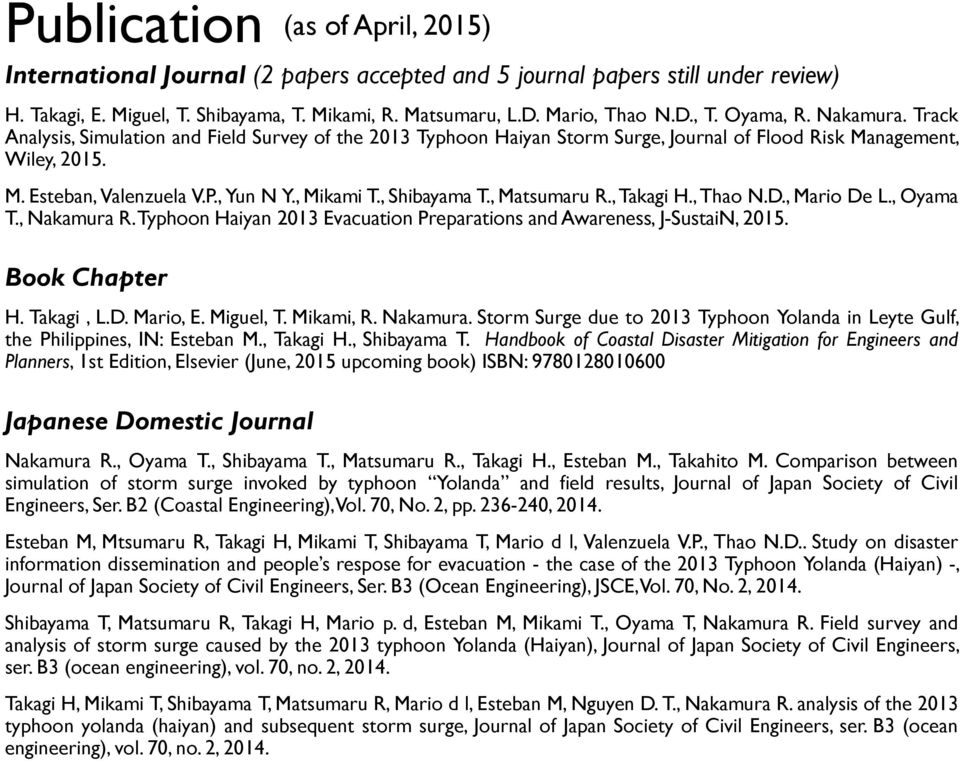
3 Publication (as of April, 2015) International Journal (2 papers accepted and 5 journal papers still under review) H. Takagi, E. Miguel, T. Shibayama, T. Mikami, R. Matsumaru, L.D. Mario, Thao N.D., T. Oyama, R. Nakamura. Track Analysis, Simulation and Field Survey of the 2013 Typhoon Haiyan Storm Surge, Journal of Flood Risk Management, Wiley, M. Esteban, Valenzuela V.P., Yun N Y., Mikami T., Shibayama T., Matsumaru R., Takagi H., Thao N.D., Mario De L., Oyama T., Nakamura R. Typhoon Haiyan 2013 Evacuation Preparations and Awareness, J-SustaiN, Book Chapter H. Takagi, L.D. Mario, E. Miguel, T. Mikami, R. Nakamura. Storm Surge due to 2013 Typhoon Yolanda in Leyte Gulf, the Philippines, IN: Esteban M., Takagi H., Shibayama T. Handbook of Coastal Disaster Mitigation for Engineers and Planners, 1st Edition, Elsevier (June, 2015 upcoming book) ISBN: Japanese Domestic Journal Nakamura R., Oyama T., Shibayama T., Matsumaru R., Takagi H., Esteban M., Takahito M. Comparison between simulation of storm surge invoked by typhoon Yolanda and field results, Journal of Japan Society of Civil Engineers, Ser. B2 (Coastal Engineering), Vol. 70, No. 2, pp , Esteban M, Mtsumaru R, Takagi H, Mikami T, Shibayama T, Mario d l, Valenzuela V.P., Thao N.D.. Study on disaster information dissemination and people s respose for evacuation - the case of the 2013 Typhoon Yolanda (Haiyan) -, Journal of Japan Society of Civil Engineers, Ser. B3 (Ocean Engineering), JSCE, Vol. 70, No. 2, Shibayama T, Matsumaru R, Takagi H, Mario p. d, Esteban M, Mikami T., Oyama T, Nakamura R. Field survey and analysis of storm surge caused by the 2013 typhoon Yolanda (Haiyan), Journal of Japan Society of Civil Engineers, ser. B3 (ocean engineering), vol. 70, no. 2, Takagi H, Mikami T, Shibayama T, Matsumaru R, Mario d l, Esteban M, Nguyen D. T., Nakamura R. analysis of the 2013 typhoon yolanda (haiyan) and subsequent storm surge, Journal of Japan Society of Civil Engineers, ser. B3 (ocean engineering), vol. 70, no. 2, 2014.
4 Seminar at De La Salle University, October 17, 2014

5 Topics 1. Characteristics of Typhoon Yolanda 2. Findings through the Field Surveys 3. Findings through Storm Surge Simulation 4. Intense Investigation in Tacloban 5. People s awareness of Storm Surge 6. Recovery Process

6 1. Characteristics of Typhoon Yolanda

7 Typhoon Track Analysis Yolanda was one of the largest typhoons in the North West Pacific, only 28 typhoons are comparable.

8 Track analysis using the JTWC Best track ( ) 1. detect the landfall point at which a TC track intersects a coastline 2. estimate landfall time and wind speeds by interpolating the data before and after landfalls


9 A statistical analysis indicated that the number of TC making landfall around Leyte and Samar Island has been steadily increasing over the past 7 decades, while other islands do not show any particular upward or downward trends. There were a total of 406 landfalls between 1945 and 2013, an average of 5.9 times per year. increased by times per year TC landfall points Wind speeds frequency of TC

10 Fig. Relationship between wind speeds and forward speeds for the strongest 67 among 406 TCs, which made landfall in the Philippines between 1945 and 2013 Haiyan (Yolanda) can be characterized as both the fastest moving and strongest typhoon measured in the Philippines.

11 Relationship between return periods and wind speeds derived from extreme value analysis using a Weibull distribution. The return period of Haiyan (Yolanda) is estimated to be 200 years, while that of typhoon Zeb in 1998 is 19 years.

12 Key Points for Disaster Management (1) The wind speed at the time of landfall (165.8 knots) was found to be the strongest among 406 TCs in the last seven decades, 16% faster than the second strongest typhoon (142.7 knots during Typhoon Zeb in 1998). The return period for a Haiyan-class typhoon to make landfall was estimated to be 200 years. A significant increase in TC landfall frequency (+0.02 times per year) in recent decades was found in the latitude zone between 10 N and 12 N, which encompasses Leyte Island. One of the most unusual characteristics of Haiyan is that it was found to be the fastest typhoon in addition to the strongest typhoon in the past 7 decades. The fast moving typhoon caused: amplification of storm surge at some locations insufficient time for local people to prepare and evacuate

13 2. Findings through the Field Surveys


14 Post-disaster Survey in the Philippines after Yolanda The 1 st Dispatch, December 4-13, 2013 The 2 nd Dispatch, May 1-6, 2014 The 3 rd Dispatch, Oct 18-20, 2014 Tanauan Giposo Dulag Surveyed extent

15 Storm Surge Height Measurements


16 Storm Surge Height Distribution

17 Storm Surge Height Distribution Results of survey in May 2014


18 Storm Surge Height Distribution Tacloban City Google Earth Storm Surge Height (m)

19 Surveyed Points (San Pedro Bay) Tacloban City a. Airport b. Convention Center c. Paterno Street d. City Hall e. Anibong

20 Survey Results - Airport, Tacloban City Located in a narrow low-lying peninsula Airport worker (remained at the airport during the event) the water level came to the outer air conditioning machine Height: 5.25m (Depth: 3.45m)

21 Survey Results - Tacloban City Height: more than 3.90m (at Hotel) Height: 7.02m (2 nd floor of a house) It was difficult to estimate the maximum storm surge height around this area.
22 Survey Results - Anibong, Tacloban City Height at a house: 5.65m (residents evacuated to a hill behind the house). Storm surge attacked densely populated area. Ships were washed inland (this area is next to a port area).
23 Survey Results - Alejandro Hotel, Tacloban City Height: 4.31m (350m from the coast) Video footage during storm surge The inundation started at 7:30AM and family decided to evacuate after the sea water reached a waist level. Source: YouTube,
24 Survey Results - Edible Oil Mfg., Tanauan Height: 6.10m (100m from the coast) Oil tanks were displaced by the storm surge and the high waves. 2012/02/ /11/10
25 Survey Results - Bislig, Tanauan Height: 7.71m (near the coast) Height: 3.72m (290m from the coast) The water carried a great deal of garbage with it (flow was like washing machine ). Waves was breaking at this height
26 Survey Results - Luan, Dulag Height: 2.84m (300m from the coast) When the typhoon came, residents evacuated to an elementary school (designated evacuation site). Storm surge reached this school (depth was 80cm).
27 Survey Results - Basey Height: 5.87m (City Hall) Height: 5.22m (behind the City Hall) 1 st floor was flooded Strong winds started around 5AM the water started to recede 6AM the storm surge started 7AM
28 Survey Results - Gigoso, Giporlos The mayor brought us to the most affected barangay. Height: 3.93m (near the coast) 1 st floor was flooded and the water came to the 2 nd floor (wind waves?).
29 Survey Results - Northern Cebu Some evidence of storm surges was found (but not as great as that observed in Leyte and Samar). Low tide during the typhoon. Coral reef and mangrove forests. Daanbantayan Medellin Medellin Bogo
30 Key Points for Disaster Management (2) Storm Surge Field Survey after the 2013 Typhoon Yolanda Field surveys revealed that: Storm surge heights were over 5m inside Leyte Gulf Storm surge above 3m started to cause damage to housing, especially to the wooden settlements Devastating storm surge was induced by rapid change of wind direction over Leyte Gulf In the Philippines, the characteristics of storm surges can be different depending on typhoon path, shape of a bay, near shore bathymetry, etc. In order to prepare for future typhoons, it is important to analyze past storm surge events as well as recent events and accumulate knowledge and lessons.
31 3. Characteristics of Storm Surge revealed through Numerical Simulation
32 Storm Surge Model Typhoon Path Typhoon Model Fluid Dynamics Model Computational Domain Bathymetry Terrain Data JMA Typhoon Best Track Pressure: Myers Formula, Wind: Gradient winds considering Supergradient wind effect Nonlinear shallow water equation Cartesian (UTM51N), (San Pedro Bay) GEBCO_08 Grid (Philippines) Chart by NAMRIA (San Pedro Bay) ASTER GDEM (Satellite Data) Tacloban, measured by the team Manning s n value Ocean: 0.025, Land: 0.060
33 Bathymetry around Leyte and Samar Cebu Leyte Samar Data: GEBCO_08 Grid, GEBCO (General Bathymetric Chart of the Oceans)

34 Simulation for a wide area of the Philippines storm surge Guiuan Panay Leyte Cebu Negros Wave movie embedded
35 Samar Island Detailed simulation focusing on Leyte Gulf Leyte Island Leyte Gulf movie embedded
36 Storm surge elevations (m)


37 Receding of water observed in Basey, which was reproduced by the simulation as well. Strong wind towards the sea shallow depth Rapid decrease movie embedded water was receded by strong wind towards the sea Damage of houses due to runup flow
38 Key Points for Disaster Management (3) The winds brought by Yolanda was one of the strongest in the history of the Philippines between 1945 and The return period of Yolanda-class typhoon was estimated to be 200 years. The forward speed of Yolanda was unusually fast, reaching speeds of 41km/h, which potentially increased the extent of damage. Water levels begun with receding at some places, which might have intrigued people living nearby the coasts. The result of numerical simulation is sufficiently reliable, which shows a good agreement with the inundations observed in the survey along the coast of Leyte Island.
39 4. Intense Investigation in Tacloban
40 Detail simulation focusing on the downtown Tacloban Intense field survey (a) Inundation height (b) Inundation height (c) Inundation height (d) Topographical survey


41 Topographical survey in the downtown Tacloban The precise ground elevation is a key to a reliable simulation unrealistic elevations Tacloban downtown Satellite Data ASTER- GDEM 30 meters Refined elevation data of Tacloban City realistic elevations topographical survey
42 Storm surge heights from the sea surface (black) and inundation depths from the ground (blue) (unit: meter)


43 Visual inspection using a movie taken from Alejandro Hotel (a) movie embedded 43
44 Comparison of flow speed between the movie and simulation The flow speed was about 60cm/s in front of Alejandro Hotel from the visual inspection from the simulation
45 Comparison of storm surge between measured and simulated heights at 15 locations in Tacloban downtown
46
47 Flow velocity was significantly fast along some streets, which reached more than 4m/s.
48 Key Points for Disaster Management (4) Flow velocities along the streets reached more than 4m/s, intensified by flow contraction due to the high-density residential district, and water significantly rose just in 10 minutes. Pedestrian evacuation during the peak of typhoons could be more hazardous than staying in houses some places. Early evacuation before the arrival of typhoon is definitely important for safe evacuation. Evacuation is needed to finish sufficiently before typhoon arrives.
49 5. People s awareness of Storm Surge Survey Period: Dec. 2013
50 Types of Questionnaires Conducted Methods Number of Participants (areas) Structured Questionnaire Survey Group Interview (5-8 participants) 172 (survey locations, see next slide) 20 from Tacloban City, Tanauan, Leyte and Giporlos, Eastern Samar, Semistructured Nonstructured Interview (1:1) Government officials in towns of Tanauan, Palo, Tacloban, and Basey and DRRM officer of the province of Leyte
51 Structured Questionnaires (I): Distribution Same place as storm surge survey. 172(valid response) /198(distribution) Place No. of response Storm Surge Height (m) a Tacloban Airport d Tacloban City Hall b Convention Center g Basey Sto Nino Gigoso Balangiga Bislig, Tanauan e Barangay 68, Tacloban c Hotel Alejandro, Tacloban Palo 14 -
52 Structured Questionnaires (II): Demographics Structured questionnaires of local residents and emergency officials (n=172) % or respondents 30% 25% 20% 15% 10% 5% 0% 23% 24% 16% Age distribution 11% 9% 6% 3% 0% 9% Unclear /No answer 12% Female 56% Male 32%
53 Structured Questionnaires (III): Occupation Majority were young people, many students and people in fishing industry Others 24% Fishing 17% Also many office workers (emergency officials, etc) Office workers 24% Housewife 15% Students 20%
54 Storm Surge Awareness Despite no recent storm surge events 77% of all respondents felt that storm surges represented a strong or very strong danger for them. Thus, relatively high awareness about the potential danger % or respondents 60% 50% 40% 30% 20% 10% 0% Previous Experiences 35% 5% 2% 56% 2% % or respondents 70% 60% 50% 40% 30% 20% 10% 0% 62% 15% 3% 1% 1% 18% Yes (1 time) Yes (2 times) Yes (3 or more times) No No Answer Storm Surge Awareness
55 Understanding of Storm Surges All Male Female Office W. Fisherman Housewife Student Others Gov. Officer Yes No No reply!!! Semi-structured interview showed that only a few respondent correctly answered the phenomena of storm surge. Therefore, it can be judged that actual knowledge of the people was lower than that of the questionnaire survey result.
56 Understanding of Storm Surges It is not entirely clear that respondents understood the phenomenon of the disaster before it struck. Only 47% of respondents said that they understood what a storm surge was and that the typhoon could bring with it a storm surge. It is not even clear that this 47% of people accurately understood the threat of the storm surge.
57 Sources of information (by gender) TV/Radio Police/Fire Sta. Family Internet Neighbors Speaker on the Car Speaker in community Others Myself No reply Multiple Reply Total: 187 male female People rely on media. Information from the Internet was emerging. Diffusion of smart phone? Government-based information sources were not widely used. Might be issue considering gov. responsibility.
58 Sources of information (by age group) TV/Radio Police/Fire Sta. Family Internet Neighbors Speaker on the Car Speaker in community Others Myself No reply Multiple Reply Total: 193
59 Knowledge about evacuation Only 20% or respondents confirmed that they had taken part in evacuation drills at some point in their lives (13% in one evacuation drill, and 7% in 2 or more) 58% said they knew how to evacuate Indication of efforts by train the population, generally understood by a sizeable majority of the population. % or respondents 70% 60% 50% 40% 30% 20% 10% 0% 20% Yes, have joined 58% No, but knows how to evacuate 19% No, did not join 3% No answer
60 Actual Evacuation Behavior No answer/unclear answer After the typhoon had passed After the typhoon made landfall After I got warning or order After I saw the forecast 6% 8% 23% 31% 35% 0% 10% 20% 30% 40% % or respondents I evacuated because I was forced by authorities (police, army, firefighters, etc) I evacuated because I saw those who were evacuating I evacuated because of verbal warnings given by those around me I evacuated after seeing the rainfall and sea/river levels rise I evacuated because of the evacuation warning/order 4% 11% 6% 17% OCD issued an evacuation warning, obeyed by 73% (n=124) 73% 0% 20% 40% 60% 80% % or respondents
61 Evacuation mode and destination Destination Mode of Evacuation No answer 2% No answer 6% High Buildings 8% Other 2% Other public facility 7% Car or multicab 8% Nearby high ground 20% Bycicle 2% Place of other family or relatives Shelter Area (Evacuation Centre) 29% 34% Motorcycle Walking 9% 74% 0% 10% 20% 30% 40% % or respondents 0% 20% 40% 60% 80% % or respondents
62 Reasons for not evacuating Nevertheless, 94% of respondents agreed that if they faced a similar situation once again, they would indeed evacuate. No answer/unclear answer Thought house was sturdy enough Wanted to protect house/belongings On duty/at work at time, so couldn t I thought I could run away It was hard to get to the shelter area I got no evacuation order I was out of risk area The storm surge shouldn t be large The ground was high enough I didn t know how to evacuate/didn't 5% 1% 3% 1% 9% 9% 9% 15% 15% 32% 34% 0% 10% 20% 30% 40% % or respondents
63 Key Informant Interview Leyte & Samar Regional Director, OCD Region VIII DRRMO Officer Leyte Province Cities of Tacloban, Tanauan, Palo and Basey Manila Advisor to OCD Administrator Officer in charge of PAGASA Key Informant Interview at OCD Regional Office
64 Key Points for Disaster Management (5) Give an accurate picture of the event Many respondents said that they did not possess an accurate picture of the event. Key informants emphasized that people had been warned of the flooding, though they just did not seem to conceptualize the phenomenon itself correctly. Many people expressed the view that it would have been better for authorities and media to describe it as a tsunami or tidal wave, which would have given people a better feeling of the danger Give an easy warning Information given by PAGASA being too technical. Storm surges were explained as dagko nga balod ( very big waves ). Some people thought that their houses could withstand strong waves, and did not evacuate Education Many of respondent did not evacuate because of the lack of knowledge on evacuation.
65 6. Recovery Process Survey Period: May 2014
66 6. Recovery Process (1) Change of Living Place
67 Living place Four different case 1. Own House (Original Place) 2. Evacuation Center 3. Bunkhouse 4. Tent 67
68 Change of living place - Own house Before the disaster Own house or emergency shelter At the time of disaster Own house or emergency shelter Soon after the disaster Stayed short period in emergency shelter then 1. Went back to own house 2. Left Leyte for relatives or friends place (sometimes stayed in several place) then came back to own house May 2014 Own house 68
69 Why they left? Difficult to reach emergency supplies. No water and electricity Reason for they left Tacloban City Threfore, After establishment a system to supply relief goods to the disaster affected people who were staying outside the evacuation centers, they came back to Tacloban. Relief goods supply ended at the end of March,

70 Change of living place - Bunkhouse Almost people living with family. Time to move to bunkhouse Most of the people moved to the bunkhouse between Mar. 1 and Mar
71 Q: Why did you choose the place? Time to move to bunkhouse 71

72 Q: Who instructed you to go to the place? BGY Captain Gov. Official Time to move to bunkhouse 72
73 6. Recovery Process (2) Gaps between Assistance and Needs
74 Q: What kind of assistance did you receive? 74
75 Q: Who gave you the assistance? 75
76 Q: What kind of assistance did you need? 76
77 Time to move to bunkhouse Assistance No Change Needs Affected people were expecting financial support and to have safe place (shelter) throughout of the period. Assistance for Livelihood recovery was important for affected people after passing relief period. Needs of affected people changed when they moved to the bunkhouse. However, provided assistances were not changed. 77
78 Key Points for Disaster Management (6) Establishment of an appropriate system for distributing assistances to the people who were staying outside the evacuation centers Victims who returned to home from the evacuation center left Tacloban because of the difficulty of access to the assistance Establishment of the appropriate system will also contribute to minimize the people in evacuation centers, and it will lead the improvement of living environment of the evacuation centers Mindsets Change of assistance providers Gap between provided assistance and needs Victim s needs: changed form goods to livelihood recovery Provided assistances: no change
79 Thank you for your attention
Mapping of the Typhoon Haiyan Affected Areas in the Philippines Using Geospatial Data and Very High Resolution Satellite Images *
 UNITED NATIONS E/CONF.104/IP.15 ECONOMIC AND SOCIAL COUNCIL Twentieth United Nations Regional Cartographic Conference for Asia and the Pacific Jeju, 6-9 October 2015 Item 7(b) of the provisional agenda
EARTH SCIENCE ACTIVITY #1 Tsunami in a Bottle
 EARTH SCIENCE ACTIVITY #1 Tsunami in a Bottle Grades 3 and Up This activity is one of several in a basic curriculum designed to increase student knowledge about earthquake science and preparedness. The
Hurricanes and Storm Surge www.hcfcd.org/tropicalweather
 Hurricanes and Storm Surge www.hcfcd.org High-level winds fl ow outward Strong surface winds spiral inward EYE Calm, sometimes cloudfree, sinking air Air sinks in calm area at the storm s eye THUNDERSTORMS
The Dynamics of Disaster Economics: The Philippines Recovery and Response to Typhoon Haiyan (Yolanda)
 The Dynamics of Disaster Economics: The Philippines Recovery and Response to Typhoon Haiyan (Yolanda) Antonio Louis A. Holmes Industrial Engineering Department, De La Salle University-Manila 2401 Taft
ASEM Manila Conference on Disaster Risk Reduction and Management 4-6 June 2014, Manila, Philippines. Post- Haiyan/Yolanda A Way Forward
 ASEM Manila Conference on Disaster Risk Reduction and Management 4-6 June 2014, Manila, Philippines Post- Haiyan/Yolanda A Way Forward CHAIR S SUMMARY STATEMENT 1. The ASEM Manila Conference on Disaster
Tsunami Practice Questions and Answers Revised November 2008
 Tsunami Practice Questions and Answers Revised November 2008 1. What happened on 26 December 2004 off the west coast of Sumatra? 2. What is the final estimate of the magnitude of the Sumatra 26 December
4.14 Netherlands. Interactive flood risk map of a part of the province of Gelderland in the Netherlands. Atlas of Flood Maps
 4.14 Netherlands The Netherlands is flood prone for about 60% of its surface. 95 so-called dike-rings protect the polders from being flooded from the North Sea, rivers or lakes. The protection level has
Best Practice of Flood Hazard Map in Japan
 Best Practice of Flood Hazard Map in Japan 1. Hazard map in Japan There are about 1,500 municipalities in Japan, which need to prepare flood hazard map. 510 municipalities have already made and disclosed
Storm tide is the water level rise during a storm due to the combination of storm surge and the astronomical tide.
 INTRODUCTION TO STORM SURGE Introduction to Storm Surge BOLIVAR PENINSULA IN TEXAS AFTER HURRICANE IKE (2008) What is Storm Surge? Inland Extent Storm surge can penetrate well inland from the coastline.
ABSTRACT INTRODUCTION PURPOSE
 EVALUATION OF TSUNAMI DISASTER BY THE 2011 OFF THE PACIFIC COAST OF TOHOKU EARTHQUAKE IN JAPAN BY USING TIME SERIES SATELLITE IMAGES WITH MULTI RESOLUTION Hideki Hashiba Associate Professor Department
Storm tide is the water level rise during a storm due to the combination of storm surge and the astronomical tide.
 INTRODUCTION TO STORM SURGE Introduction to Storm Surge National Hurricane Center Storm Surge Unit BOLIVAR PENINSULA IN TEXAS AFTER HURRICANE IKE (2008) What is Storm Surge? Inland Extent Storm surge can
Coastal Erosion Risk Mitigation Strategies applied in a Small Island Developing State: The Barbados Model
 Coastal Erosion Risk Mitigation Strategies applied in a Small Island Developing State: The Barbados Model BY Dr. Leo Brewster, Director Coastal Zone Management Unit, Barbados Presented At UNFCCC Expert
EMERGENCY UPDATE, 8 FEB 2014 THREE MONTHS ON
 EMERGENCY UPDATE, 8 FEB 2014 THREE MONTHS ON What we need most is to recover our livelihoods our source of income We are roofless, homeless, but not helpless Rose Felicio, who received a hygiene kit and
DISASTER DISASTER MANAGEMENT CRISIS INFORMATICS GIS IN DIFFEERENT STAGES OF DISASTER MANAGEMENT
 APPLICATION OF GIS AND REMOTE SENSING IN DISASTER PRONE AREAS: A CASE STUDY IN COASTAL KERALA DISASTER Disaster is an unpleasant event than occurs with little or no warning which results in economic disruption,
PACIFIC CATASTROPHE RISK ASSESSMENT AND FINANCING INITIATIVE
 PACIFIC CATASTROPHE RISK ASSESSMENT AND FINANCING INITIATIVE NIUE SEPTEMBER 11 COUNTRY RISK PROFILE: NIUE Niue is expected to incur, on average,.9 million USD per year in losses due to earthquakes and
Flooding Fast Facts. flooding), seismic events (tsunami) or large landslides (sometime also called tsunami).
 Flooding Fast Facts What is a flood? Flooding is the unusual presence of water on land to a depth which affects normal activities. Flooding can arise from: Overflowing rivers (river flooding), Heavy rainfall
CHAPTER 7. EMERGENCY SERVICES
 CHAPTER 7. EMERGENCY SERVICES Although better forecasts and warning processes have helped save lives by providing more lead time to evacuate, the tremendous growth of development and human population in
ASEM Manila Conference on Disaster Risk Reduction and Management. Post- Haiyan A Way Forward Manila, Philippines 04-06 June 2014
 ASEM Manila Conference on Disaster Risk Reduction and Management Post- Haiyan A Way Forward Manila, Philippines 04-06 June 2014 Theme: A Stronger Asia-Europe Partnership to Meet the Challenges of Mega
In the Caribbean, August and September are peak months during the hurricane season that lasts from June 1 through November 30.
 Hurricane Fact sheet What is a hurricane? A hurricane is a tropical storm with winds that have reached a constant speed of 74 miles per hour more. Hurricane winds blow in a large spiral around a relative
Planning for sea level rise. Assessing development in areas prone to tidal inundation from sea level rise in the Port Phillip and Westernport Region
 Planning for sea level rise Assessing development in areas prone to tidal inundation from sea level rise in the Port Phillip and Westernport Region Table of contents Introduction 1 New flood levels for
Flood Emergency Response Planning: How to Protect Your Business from a Natural Disaster RIC005
 Flood Emergency Response Planning: How to Protect Your Business from a Natural Disaster RIC005 Speakers: Tom Chan, CEO, Global Risk Miyamoto Greg Bates, Principal, Global Risk Consultants Learning Objectives
Response and Recovery
 LESSON PLAN 3 Response and Recovery Hurricanes When young people see what individuals and communities can do before, during and after a hurricane, they will begin to understand the importance of people
Damage Potential of Tropical Cyclone
 Damage Potential of Tropical Cyclone Regional Specialised Meteorological Centre (RSMC)- Tropical Cyclone, New Delhi Cyclone Warning Division India Meteorological Department Mausam Bhavan, Lodi Road, New
Climate Change Impacts in the Asia/Pacific Region
 Climate Change Impacts in the Asia/Pacific Region Global CC threat CC in the A/P region The Stern Review and IPCC 4 th Assessment Report both state that climate change will have adverse impact on people
With a combination of soaking rain, flying debris, high winds, and tidal surges, Hurricanes and tropical storms can pack a powerful punch.
 With a combination of soaking rain, flying debris, high winds, and tidal surges, Hurricanes and tropical storms can pack a powerful punch. Besides causing extensive damage in coastal areas, hurricanes
Section E2 Coastal Engineering: Reconstruction Management and Mitigation
 271 Section E2 Coastal Engineering: Reconstruction Management and Mitigation 272 Objectives To familiarize the assessor with the process that should be followed in organizing any reconstruction efforts.
Hurricanes: Nature's Wildest Storms by Erin Ryan
 Name: : Nature's Wildest Storms by Erin Ryan You may already know that hurricanes are major tropical storms that can cause devastating waves, wind, and rain. They happen during Hurricane Season, which
Exploring Florida: Teaching Resources for Science 1 of 6
 Exploring Florida: Teaching Resources for Science 1 of 6 Tropical Cyclones This document describes tropical cyclones and the dangers they pose to coastal populations. It is intended to help teachers improve
Probabilistic Risk Assessment Studies in Yemen
 Probabilistic Risk Assessment Studies in Yemen The catastrophic risk analysis quantifies the risks of hazard, exposure, vulnerability, and loss, thus providing the decision maker with the necessary information
LEARNING THE LANDFORMS Grade Level: Third Presented by: Elizabeth Turcott, Endeavor Charter Academy, Springfield, Michigan Length of Unit: 14 lessons
 LEARNING THE LANDFORMS Grade Level: Third Presented by: Elizabeth Turcott, Endeavor Charter Academy, Springfield, Michigan Length of Unit: 14 lessons I. ABSTRACT This unit develops an understanding of
PUSD High Frequency Word List
 PUSD High Frequency Word List For Reading and Spelling Grades K-5 High Frequency or instant words are important because: 1. You can t read a sentence or a paragraph without knowing at least the most common.
Motion & The Global Positioning System (GPS)
 Grade Level: K - 8 Subject: Motion Prep Time: < 10 minutes Duration: 30 minutes Objective: To learn how to analyze GPS data in order to track an object and derive its velocity from positions and times.
Implementing Marine SDI Through Capacity Building
 Implementing Marine SDI Through Capacity Building A TopoBathy Database for Mozambique NIOHC Colombo, 20 th 23 rd March 2012 Fredericton Canada Heeswijk The Netherlands Washington DC United States Adelaide
DRAFT TSUNAMI WARNING INFORMATION DISSEMINATION PROTOCOL FOR TRINIDAD AND TOBAGO (CDEMA PARTICIPATING STATE)
 DRAFT TSUNAMI WARNING INFORMATION DISSEMINATION PROTOCOL FOR TRINIDAD AND TOBAGO (CDEMA PARTICIPATING STATE) ODPM 6/3/2011 CONTENTS 1. Acronyms 2. Standard operating procedures A: (SOP A): 3. Standard
A Documentation of the 10-Point Checklist for Making San Francisco, Camotes Resilient to Disasters. Sasakawa Award Nomination Submission
 A Documentation of the 10-Point Checklist for Making San Francisco, Camotes Resilient to Disasters Sasakawa Award Nomination Submission February 2011 Municipal Profile The Municipality of San Francisco,
HAZUS 2014. 7 th Annual Conference
 HAZUS 2014 7 th Annual Conference HAZUS Comparison of Storm Surge Levels from Different Hurricanes to the Newest SLOSH Models for Berkeley, Charleston, & Dorchester Counties Along the SC Coastline. Charlie
Presented by: Michael DePue, PE, CFM Annual Georgia Association of Floodplain Management Conference Lake Lanier Islands, Georgia March 23, 2010
 Flood Types and Characteristics Presented by: Michael DePue, PE, CFM Annual Georgia Association of Floodplain Management Conference Lake Lanier Islands, Georgia March 23, 2010 Agenda Why study flood types?
Natural Disaster Impact on Business and Communities in Taiwan. Dr. Chung-Sheng Lee. NCDR Chinese Taipei
 Natural Disaster Impact on Business and Communities in Taiwan Dr. Chung-Sheng Lee NCDR Chinese Taipei 1 Brief Introduction of NCDR 2 Organizational Chart of NCDR NDPPC: National Disaster Preparation and
New Brunswick s Flood Risk Reduction Strategy. Province of New Brunswick PO 6000, Fredericton NB E3B 5H1. www.gnb.ca
 New Brunswick s Flood Risk Reduction Strategy i New Brunswick s Flood Risk Reduction Strategy Province of New Brunswick PO 6000, Fredericton NB E3B 5H1 2014 www.gnb.ca ISBN 978-1-4605-0533-5 (print edition)
STATUS REPORT FOR THE SUBMERGED REEF BALL TM ARTIFICIAL REEF SUBMERGED BREAKWATER BEACH STABILIZATION PROJECT FOR THE GRAND CAYMAN MARRIOTT HOTEL
 STATUS REPORT FOR THE SUBMERGED REEF BALL TM ARTIFICIAL REEF SUBMERGED BREAKWATER BEACH STABILIZATION PROJECT FOR THE GRAND CAYMAN MARRIOTT HOTEL performed by Lee E. Harris, Ph.D., P.E. Consulting Coastal
IRIDeS Fact-finding mission to Philippines (2nd mission, January 16-24, 2014)
 IRIDeS Fact-finding mission to Philippines (2nd mission, January 16-24, 2014) International Research Institute of Disaster Science Tohoku University, Japan IRIDeS Survey Team Hazard and Damage Evaluation
Waves disturbances caused by the movement of energy from a source through some medium.
 Oceanography Chapter 10 Waves disturbances caused by the movement of energy from a source through some medium. Floating Gull- Figure 10.1 water is not moving only the energy is moving through the water.
CONFEDERATION OF ASIA-PACIFIC CHAMBERS OF COMMERCE AND INDUSTRY (CACCI)
 CONFEDERATION OF ASIA-PACIFIC CHAMBERS OF COMMERCE AND INDUSTRY (CACCI) Policy Paper on Flexible Responses to Environmental Uncertainty and Infrastructure Resolved as of 3 rd October,. A. BACKGROUND 1.
UN YOUTH VOLUNTEER DESCRIPTION OF ASSIGNMENT
 Preamble: UN YOUTH VOLUNTEER DESCRIPTION OF ASSIGNMENT The United Nations Volunteers (UNV) programme is the UN organization that promotes volunteerism to support peace and development worldwide. Volunteerism
Chapter 7 Earthquake Hazards Practice Exam and Study Guide
 Chapter 7 Earthquake Hazards Practice Exam and Study Guide 1. Select from the following list, all of the factors that affect the intensity of ground shaking. a. The magnitude of the earthquake b. Rather
Most Vulnerable US Cities to Storm Surge Flooding. August 2015 2 COPLEY PLACE BOSTON, MA 02116 T: 617.423.2800 F: 617.423.2808
 Most Vulnerable US Cities to Storm Surge Flooding August 2015 2 COPLEY PLACE BOSTON, MA 02116 T: 617.423.2800 F: 617.423.2808 Introduction Hurricane Katrina was a stark reminder that strong winds are only
ebb current, the velocity alternately increasing and decreasing without coming to
 Slack water (slack tide): The state of a tidal current when its velocity is near zero, especially the moment when a reversing current changes its direction and its velocity is zero. The term is also applied
Application of Space Technology for Disaster monitoring and assessment current state in Vietnam
 Application of Space Technology for Disaster monitoring and assessment current state in Vietnam Lai Anh Khoi SPACE TECHNOLOGY INSTITUTE 8th GEOSS Asian Pacific Symposium Beijing, Sep. 09-11, 2015 Types
Interactive comment on A simple 2-D inundation model for incorporating flood damage in urban drainage planning by A. Pathirana et al.
 Hydrol. Earth Syst. Sci. Discuss., 5, C2756 C2764, 2010 www.hydrol-earth-syst-sci-discuss.net/5/c2756/2010/ Author(s) 2010. This work is distributed under the Creative Commons Attribute 3.0 License. Hydrology
Department of Commerce National Oceanic & Atmospheric Administration National Weather Service
 Department of Commerce National Oceanic & Atmospheric Administration National Weather Service NATIONAL WEATHER SERVICE WESTERN REGION SUPPLEMENT 17-2003 APPLICABLE TO NWSI 10-701 MARCH 16, 2015 Operations
Emergency Plan of Action (EPoA) Kiribati: Tropical Cyclone Pam
 Emergency Plan of Action (EPoA) Kiribati: Tropical Cyclone Pam DREF operation n o MDRKI001 Date of issue: 16 March 2015 Date of disaster: 11 March 2015 Manager responsible for this DREF operation: Laura
RISD Hurricane Preparedness
 RISD Hurricane Preparedness Hurricane It is the policy of RISD to view each hurricane threat as an extremely hazardous condition. As such, our goal is to minimize the risk to personnel consistent with
Perth Academy. Geography Department
 Perth Academy Geography Department Natural Hazards Tropical Storms Natural Hazards Natural Hazards affect a large percentage of the world s population. Despite the damage and destruction caused, there
Flood Facts 2F.1. Flood Facts
 Flood Facts 2F.1 Engage Flood Facts To introduce students to the causes and effects of flooding in Western Australia. Flooding occurs in the Australian environment as part of the natural water or hydrologic
A disaster occurs at the point of contact between social activities and a natural phenomenon of unusual scale.
 Hazard Mapping and Vulnerability Assessment Mr. Toshiaki Udono Senior Project Manager, Kansai Division, PASCO Corporation, Japan Mr. Awadh Kishor Sah Project Manager, Project Implementation Department,
What causes Tides? If tidal forces were based only on mass, the Sun should have a tidegenerating
 What are Tides? Tides are very long-period waves that move through the oceans as a result of the gravitational attraction of the Moon and the Sun for the water in the oceans of the Earth. Tides start in
 Disaster Prevention Measures in Global-Local Context 4 th World Water Forum Dr. Yoshihiko Yamashita CTI Engineering Co., Ltd Association of Japanese Consulting Engineers Outline of Presentation Up-to to-date
FOR TEACHERS ONLY. The University of the State of New York REGENTS HIGH SCHOOL EXAMINATION PHYSICAL SETTING/EARTH SCIENCE
 FOR TEACHERS ONLY PS ES The University of the State of New York REGENTS HIGH SCHOOL EXAMINATION PHYSICAL SETTING/EARTH SCIENCE Tuesday, June 22, 2010 9:15 a.m. to 12:15 p.m., only SCORING KEY AND RATING
MIKE 21 FLOW MODEL HINTS AND RECOMMENDATIONS IN APPLICATIONS WITH SIGNIFICANT FLOODING AND DRYING
 1 MIKE 21 FLOW MODEL HINTS AND RECOMMENDATIONS IN APPLICATIONS WITH SIGNIFICANT FLOODING AND DRYING This note is intended as a general guideline to setting up a standard MIKE 21 model for applications
TopoBathy Database Mozambique
 TopoBathy Database Mozambique Andrew Hoggarth, (Canada), Gordon Johnston (UK) Charles de Jongh and peter Schwarzberg (Netherlands) Montevideo Uruguay, 28 th November 2012 Fredericton Canada Heeswijk The
Preparation. Preparation. Step 2 Prepare an emergency kit. Step 1 Prepare your emergency plan. Step 4 Tune into warnings
 This emergency toolkit provides you with steps to take before and during emergencies to protect you and your property. The Victoria State Emergency Service (SES) is a volunteer organisation dedicated to
Lessons learned from the tsunami disaster caused by the 2011 Great East Japan Earthquake and improvements in JMA's tsunami warning system
 Lessons learned from the tsunami disaster caused by the 2011 Great East Japan Earthquake and improvements in JMA's tsunami warning system October 2013 Japan Meteorological Agency Lessons learned from the
Coastal Resilience through Integrated Coastal Management. Alan T. White Indian Ocean Tsunami Warning System Program
 Coastal Resilience through Integrated Coastal Management Alan T. White Indian Ocean Tsunami Warning System Program The coastal zone:an endangered environment Overexploitation and destruction Unplanned
Report Tidal Power Generation Systems
 The American University in Cairo Engineering Department ENGR 318 Spring 2001 Report Tidal Power Generation Systems Submitted to: Prof. Dr. Mahmoud Gilany By: Sherif Masoud Maher Amer Mohamed Samir Introduction
Standard Operating Procedures for Flood Preparation and Response
 Standard Operating Procedures for Flood Preparation and Response General Discussion Hurricanes, tropical storms and intense thunderstorms support a conclusion that more severe flooding conditions than
FLOOD CONTROL FOR SPECIFIC TYPES OF FLOODS. A.F. Mandych Department of Physical Geography and Land Use, Institute of Geography, Moscow, Russia
 FLOOD CONTROL FOR SPECIFIC TYPES OF FLOODS A.F. Mandych Department of Physical Geography and Land Use, Institute of Geography, Moscow, Russia Keywords: control, dam, dike (dyke), embankment, flood, flood
TsunamiReady Program Definitions
 TsunamiReady Program Definitions 24-Hour Warning Point (WP): A communication facility at a state or local level, operating 24 hours a day, which has the capability to receive NWS alerts and warnings, plus
Tides and Water Levels
 Tides and Water Levels What are Tides? Tides are one of the most reliable phenomena in the world. As the sun rises in the east and the stars come out at night, we are confident that the ocean waters will
SECTOR ASSESSMENT (SUMMARY): CLIMATE CHANGE. 1. Sector Performance, Problems, and Opportunities
 Climate Resilience Sector Project (RRP TON 46351) Sector Road Map SECTOR ASSESSMENT (SUMMARY): CLIMATE CHANGE 1. Sector Performance, Problems, and Opportunities 1. Tonga is being affected by climate change,
Submission by the United States of America to the UN Framework Convention on Climate Change Communication of U.S. Adaptation Priorities May 29, 2015
 Submission by the United States of America to the UN Framework Convention on Climate Change Communication of U.S. Adaptation Priorities May 29, 2015 Adaptation is a challenge for all Parties. In addition
Climate Change Long Term Trends and their Implications for Emergency Management August 2011
 Climate Change Long Term Trends and their Implications for Emergency Management August 2011 Overview A significant amount of existing research indicates that the world s climate is changing. Emergency
Draft 8/1/05 SYSTEM First Rev. 8/9/05 2 nd Rev. 8/30/05 EMERGENCY OPERATIONS PLAN
 Draft 8/1/05 SYSTEM First Rev. 8/9/05 2 nd Rev. 8/30/05 EMERGENCY OPERATIONS PLAN I. INTRODUCTION A. PURPOSE - The University of Hawaii System Emergency Operations Plan (EOP) provides procedures for managing
Basic system of measures for flood damage mitigation in Japan. Preparedness for major floods
 Basic system of measures for flood damage mitigation in Japan Preparedness for major floods Past major floods and state-level efforts Role of the 2 MLIT's disaster prevention efforts Disaster prevention
NOAA COASTAL SERVICES CENTER Strategic Plan: 2010 to 2015
 NOAA COASTAL SERVICES CENTER Strategic Plan: 2010 to 2015 N a t i o n a l O c e a n i c a n d A t m o s p h e r i c A d m i n i s t r a t i o n ( N O A A ) C o a s t a l S e r v i c e s C e n t e r March
Chincha and Cañete, Peru, Based
 Reconstruction of Ica, Pisco, Chincha and Cañete, Peru, Based on Updated Hazard Maps Julio Kuroiwa Professor emeritus National University of Engineering and UNDP Reconstruction Program/Sustainable Cities.
How can we defend ourselves from the hazard of Nature in the modern society?
 How can we defend ourselves from the hazard of Nature in the modern society?, University of Bologna President of the EGU Division of Natural Hazards Email: [email protected] [email protected] GIFT 2013 Natural
SITE INVESTIGATIONS OF THE BEACH EROSION PROBLEM AT MAHO BEACH, ST. MAARTEN
 SITE INVESTIGATIONS OF THE BEACH EROSION PROBLEM AT MAHO BEACH, ST. MAARTEN Performed February 2003 Performed by: Dr. Lee E. Harris, Ph.D., P.E. Associate Professor of Ocean Engineering & Oceanography
Chapter Overview. Bathymetry. Measuring Bathymetry. Echo Sounding Record. Measuring Bathymetry. CHAPTER 3 Marine Provinces
 Chapter Overview CHAPTER 3 Marine Provinces The study of bathymetry charts ocean depths and ocean floor topography. Echo sounding and satellites are efficient bathymetric tools. Most ocean floor features
Karlstad, Sweden. Local progress report on the implementation of the Hyogo Framework for Action (2013-2014)
 Karlstad, Sweden Local progress report on the implementation of the Hyogo Framework for Action (2013-2014) Mayor: Ulf Nyqvist Name of focal point: -Anna -Sjödin Organization: -Karlstad Municipality Title/Position:
New Coastal Study for Puerto Rico FIRMs. Paul Weberg, FEMA RII Mat Mampara, Dewberry Jeff Gangai, Dewberry Krista Collier, Baker
 New Coastal Study for Puerto Rico FIRMs Paul Weberg, FEMA RII Mat Mampara, Dewberry Jeff Gangai, Dewberry Krista Collier, Baker September 2007 Project Team FEMA Region II Program Manager Collaboration
Shoreline Change Prediction Model for Coastal Zone Management in Thailand
 Journal of Shipping and Ocean Engineering 2 (2012) 238-243 D DAVID PUBLISHING Shoreline Change Prediction Model for Coastal Zone Management in Thailand Siriluk Prukpitikul, Varatip Buakaew, Watchara Keshdet,
The IPCC Special Report on Managing the Risks of Extreme Events and Disasters to Advance Climate Change Adaptation
 The IPCC Special Report on Managing the Risks of Extreme Events and Disasters to Advance Climate Change Adaptation A changing climate leads to changes in extreme weather and climate events 2 How do changes
Procedure for Marine Traffic Simulation with AIS Data
 http://www.transnav.eu the International Journal on Marine Navigation and Safety of Sea Transportation Volume 9 Number 1 March 2015 DOI: 10.12716/1001.09.01.07 Procedure for Marine Traffic Simulation with
Impacts of Global Warming on Hurricane-related Flooding in Corpus Christi,Texas
 Impacts of Global Warming on Hurricane-related Flooding in Corpus Christi,Texas Sea-level Rise and Flood Elevation A one-foot rise in flood elevation due to both sea-level rise and hurricane intensification
Earthquake Disaster Recovery Plan in TMG
 Earthquake Disaster Recovery Plan in TMG Pre-disaster Management Measures by District and Recovery from Expected Earthquake Directly Underneath Tokyo Planning Section Urban Development Projects Division
City of Salinas Flood Response Preparations
 City of Salinas Flood Response Preparations Winter Preparations Goals for 2015/2016 Community Preparedness in the event of flooding Media cooperation on safety and preparedness, public information sharing
Disaster Risk Reduction through people centered National Multi-hazard Early Warning System in the context of Maldives
 Disaster Risk Reduction through people centered National Multi-hazard Early Warning System in the context of Maldives Abdul Muhusin, Deputy Director Department of Meteorology, Maldives Fourth Technical
Global Flood Alert System (GFAS)
 An Introduction of Global Flood Alert System (GFAS) Kazuo UMEDA Director of 2 nd Research Department, Infrastructure Development Institute-JAPAN Target: Reduction of Human Loss World s s natural disaster
CHAPTER 8 Natural Disasters
 CHAPTER 8 Natural Disasters Chapter 8 Natural Disasters 55 Toll of Natural Disasters South Asia is extremely vulnerable to natural disasters, with more than 900 events reported since 1970 alone. Between