
TEXTILE PROPERTIES OF SANSEVIERA CYLINDRICA
|
|
|
- Anissa McDonald
- 9 years ago
- Views:
Transcription
1 TEXTILE PROPERTIES OF SANSEVIERA CYLINDRICA Elizabeth B. Tumbaga, Priscilla I. Gesta, & Florentina A. Corpuz ABSTRACT Using descriptive-evaluative research design, this study aimed to spin the Sanseveria cylindrica fiber, to determine the physical properties of blended Sanseveria cylindrica yarn in terms of breaking force, actual blend ratio, yarn number and twist direction, and to evaluate the yarn as to quality for textile materials. The findings were as follows: The spinnability of the fiber sample blended with polyester yielded yarn count of Ne; the physical property test of the polyester/sanseviera yarns in the twist direction of the yarn was Z twist with 668 twist count per meter (tpm); the yarn properties of the polyester/sanseviera yarn possessed acceptable properties comparable to polyester/pineapple and polyester/water hyacinth which was successfully used for clothing and apparels. The researchers concluded that the blended yarn exhibited yarn realization with a minimum ends down; the blended yarn is strong due to higher number of twist per meter; the blended yarn possessed acceptable properties comparable to polyester/pineapple and polyester/water hyacinth which was successfully used for clothing and apparels. The researchers recommend that other natural fibers be blended with Sanseviera cylindrica; that different degumming treatments be used to give the most satisfactory performance during spinning; that weaving of yarns be undertaken to assess the economic viability of Sanseviera cylindrica for textile material. INTRODUCTION The textile and garments sector in the Philippines is a vital part of the country s economy. The industry expanded rapidly during the 1960 s and 1970 s but has recently experienced a decline. This has been due to mainly to tougher conditions in export market and failure to invest in new manufacturing technology. Considering its geographical condition, the Philippines is strategically suited for natural fiber production. Development of natural fiber is in consonance with the Republic Act 9242, which prescribes the use of Philippine tropical fabrics for official uniforms of government officials and employees and for other purposes. All fabrics to be used for uniforms and for other purposes shall contain at least five percent-weight of abaca, banana, and pineapple; 15 percent-weight of silk. All of these components should have passed the test and certification of compliance by PTRI-DOST, the certifying agency. Yet, one of the bottlenecks of the textile 121

2 industry today is the insufficiency of raw material supply and modern high-tech machinery to upgrade the characteristics of the natural fiber in order to compete with the synthetic fiber. Thus, investigation, production, and development of viable sources of fibers should be developed and sustained. Sanseviera cylindrica or Spear Sanseviera, a native of South Tropical Africa and Natal, is one of the more interesting sansevieras that are grown on the ground. This plant has rigid leaves reaching about five feet in height and about one and one fourth inches in diameter. Like all sanseverias this plant is easy to culture. It is well-suited to the home environment. The Cylindrica nature of the leaf apparently occurs due to a suspension of dorsi-venral symmetry, which procedures a true top and bottom in most leaves. Instead, the precursor tip produced during the earliest stages of leaf development (usually small in most species) enlarges without breaking radial symmetry. The flowers are white tinged with pink measuring one and half inch. Moreover, Sanseveria cylindrica grows easily and tolerates a wide range of conditions with the use of a soil consisting of three parts to one part sand. The plant is very tolerant to drought. It is watered about every other week during the growing season. It can be fertilized once during the growing season. During the winter months it is watered once a month. Furthermore, Sanseveria cylindrica is propagated by cuttings or by divisions taken at any time. Cuttings should be at least 3 inches long and inserted in moist sand. A rhizome emerges at the cut edge of the leaf. (http// of the week.org/listserv.shtml.) Based on previous findings that Sanseveria cylindrica fiber could be processed into yarn, the researchers undertook this study to determine further the properties of yarn that could be turned into fabrics that will compete with the existing natural fabrics. Conceptual Framework This study was based on the initial assessment that Sanseveria cylindrica can be processed into yarn based on the exhibited fibers properties of the fibers. Spinning is an operation that converts fibers into yarns, which could either be in pure form or in blend with other textile fibers, natural or synthetic. Processes ability of fiber into yarns will validate further the textile value of the fiber and will measure the effectiveness of the pretreatment conditions of the fibers. The concept of the study with the Input-Process-Output (IPO) model is illustrated in the paradigm below. 122

3 Input Process Output Sanseviera cylindrical Fiber 1. Spinning of San seviera Cylindrica fiber 2. Testing of Physical Properties 2.1. Breaking Force 2.2 Actual blend ratio 2.3. Yarn number 2.4. Twist Direction 3. Evaluation of yarn property feedback Textile Materials Statement of Objectives Figure 1. The Research Paradigm The main concern of this study was to determine the physical properties of Sanseveria Cylindrica yarn for textile materials. Specifically, this study aimed: 1. To spin the Sanseveria cylindrica fiber; 2. To determine the physical properties of blended Sanseveria Cylindrica yarn in terms of: a. breaking force b. actual blend ratio c. yarn number d. twist direction; 3. To evaluate the yarn as to quality for textile materials. RELATED LITERATURE Sanseveria cylindrica or Spear Sanseveria, a native of South Tropical Africa and natal, is one of the more interesting sanseverias that we grow the ground, rigid leaves reach about 5 feet in height and are about one and one fourth inches in diameter. Like all sanseverias they are easy to culture and well suited to the home environment. The Cylindrica nature of the leaf apparently occurs due to a suspension of dorsi-ventral symmetry, which procedures a true top and bottom in most leaves. Instead, the precursor tip produced during the earliest stages of leaf development (usually small in most species) enlarges without breaking radial symmetry. 123

4 The flowers are white tinged with pink measuring one and half inch. Sanseveria cylindrica is propagated by cuttings or by divisions taken at any time. Cuttings should be at least 3 inches long and inserted in moist sand. A rhizome emerges at the cut edge of the leaf. (http// week.org.listserv.shtml.) Yarn is a long continuous length of interlocked fibers, suitable for use in the production of textiles, sewing, crocheting, knitting, weaving, embroidery and rope making. Thread is a type of yarn intended for sewing by hand or machine. Modern manufactured sewing threads may be finished with wax or other lubricants to withstand the stress involved in sewing. Embroidery threads are yarns specifically designed for hand or machine embroidery ( Physical properties are the inherent strength and behavior of yarn under applied force, which determine the mechanical service ability or usefulness in commerce. For some products, like cordage and handicrafts, they alone determine the suitability of as fiber for such uses. For other products, such as pulp, paper and textile, physical, together with chemical properties of fibers/yarns, is a factor in the evaluation of the suitability of a fiber/yarn for a particular use. Hence, while fiber length and fiber fineness are the two most important factors in the production of yarn on ring spinning machines, in rotor spinning it is the fiber tenacity and elongation of fibers which are predominantly important for successful spinning. In the rotor spinning method, fiber length plays a secondary role (Schenek, 1993). In the processing of hemp as a natural product, from a straw-like, agricultural product to high value raw material for modern industrial sectors, development of processing technology is required which facilities a design of the fibers, corresponding to processing possibilities (cotton spinning), and the desired end product (yarn). The requirement is that the profile of hemp fibers should strongly resemble that of cotton to avoid any extensive modifications of cotton machines (Nebel 1994). Moreover, in the study of Hagad (2003), spinnable form of Dracaena sp. Fibers were already successfully converted into textile material, specifically for suiting, thus giving an indication that yarn displaying similar properties can also be converted into similar material. In the preparatory process (after carding and drawing), there is a recordable wastage of about 13% to 17%, which is slightly above the acceptable norm of 11% to 15%. This could be possibly attributed to the fiber drops during carding. The actual blend ratios of the resulting yarn from PE/Dracaena sp.blend were lower by 16% to 20% from the targeted theoretical blends. Furthermore, the spin ability of the treated fiber was determined as a further measure of the effectiveness of the pretreatment method employed on the fiber. The spinning performance exhibited by the treated Dracaena sp.fiber in blend with polyester fibers at different blend ratios gave an indication of the extent of the fiber s spin ability to yarn as well as its most likely end use. The produced yarns are relatively coarse thus limiting the end-use of the fiber. In the study of Marin, et al. (2011), water hyacinth (Eichhomia crassipes) as a potential source of fiber for yarn manufacture. Results showed that the yarn from the combined woolenization-degumming treatment exhibited fewer and higher yarn realization with acceptable technical properties. 124

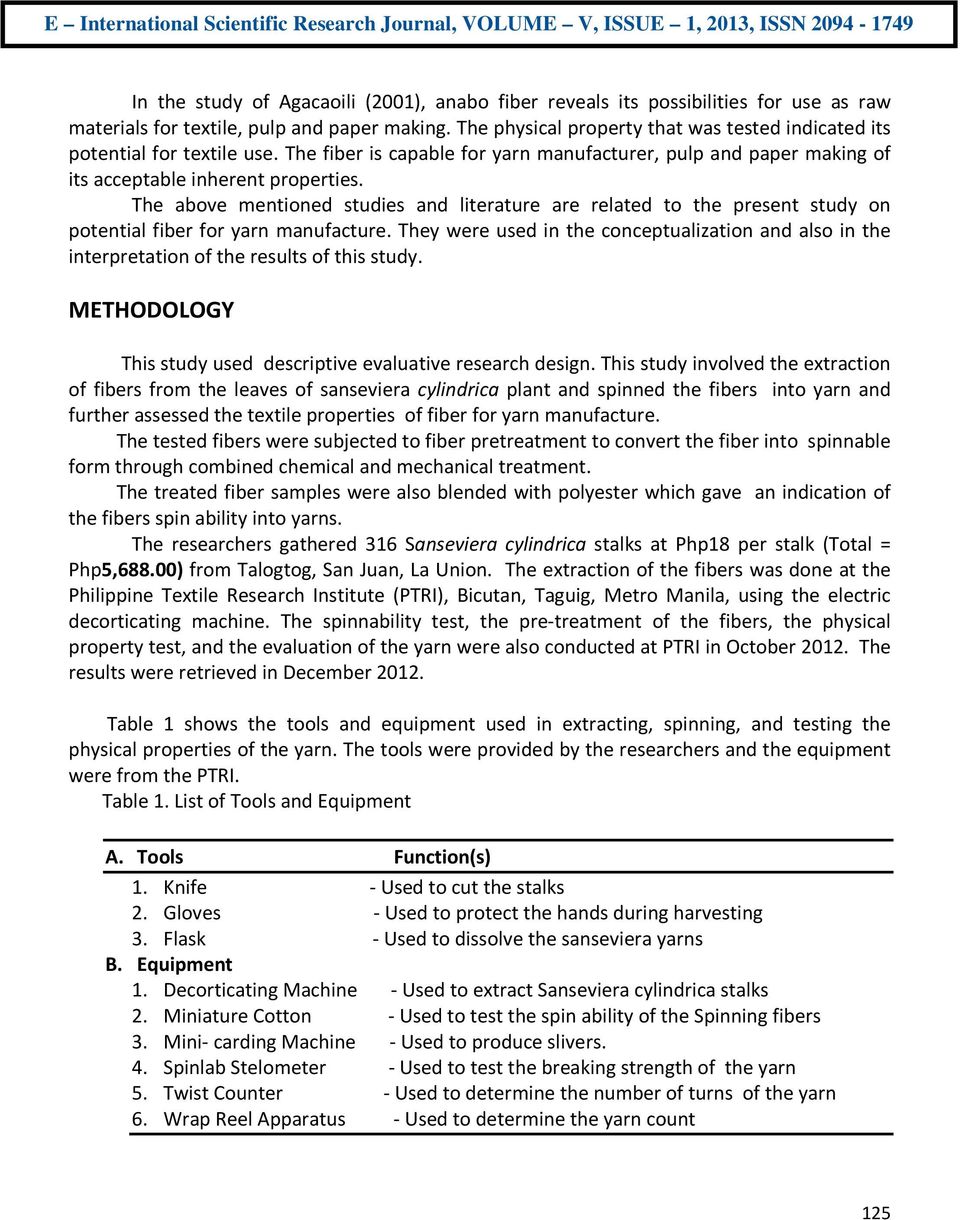
5 In the study of Agacaoili (2001), anabo fiber reveals its possibilities for use as raw materials for textile, pulp and paper making. The physical property that was tested indicated its potential for textile use. The fiber is capable for yarn manufacturer, pulp and paper making of its acceptable inherent properties. The above mentioned studies and literature are related to the present study on potential fiber for yarn manufacture. They were used in the conceptualization and also in the interpretation of the results of this study. METHODOLOGY This study used descriptive evaluative research design. This study involved the extraction of fibers from the leaves of sanseviera cylindrica plant and spinned the fibers into yarn and further assessed the textile properties of fiber for yarn manufacture. The tested fibers were subjected to fiber pretreatment to convert the fiber into spinnable form through combined chemical and mechanical treatment. The treated fiber samples were also blended with polyester which gave an indication of the fibers spin ability into yarns. The researchers gathered 316 Sanseviera cylindrica stalks at Php18 per stalk (Total = Php5,688.00) from Talogtog, San Juan, La Union. The extraction of the fibers was done at the Philippine Textile Research Institute (PTRI), Bicutan, Taguig, Metro Manila, using the electric decorticating machine. The spinnability test, the pre-treatment of the fibers, the physical property test, and the evaluation of the yarn were also conducted at PTRI in October The results were retrieved in December Table 1 shows the tools and equipment used in extracting, spinning, and testing the physical properties of the yarn. The tools were provided by the researchers and the equipment were from the PTRI. Table 1. List of Tools and Equipment A. Tools Function(s) 1. Knife - Used to cut the stalks 2. Gloves - Used to protect the hands during harvesting 3. Flask - Used to dissolve the sanseviera yarns B. Equipment 1. Decorticating Machine - Used to extract Sanseviera cylindrica stalks 2. Miniature Cotton - Used to test the spin ability of the Spinning fibers 3. Mini- carding Machine - Used to produce slivers. 4. Spinlab Stelometer - Used to test the breaking strength of the yarn 5. Twist Counter - Used to determine the number of turns of the yarn 6. Wrap Reel Apparatus - Used to determine the yarn count 125
6 PROCEDURE This study underwent four phases: Phase 1: Raw fibers were extracted from sanseviera cylindrica stalks with the use of electric decorticating machine. The sanseviera cylindrica stalks were harvested during maturity. The stalks were cut at the base of the plant using a knife. About three hundred sixteen (316) pieces of Sanseviera cylindrica stalks were harvested (47 kilograms). After harvesting the sanseciera stalks were brought to PTRI for fiber extraction using the electric decorticating machine.. Aftere extraction the fibers were washed immediately with clean water, and then dried under sun until comletely dried. The fibers will cleaned thoroughly and air-dry for one day. The weight of the dried fibers will be taken. Phase 2: This involved the evaluation of the fiber properties such as tensile strength, fineness/denier, fiber pretreatment and residual gum content. Phase 3: Spinnability testing. The fibers were spun into yarn and these were then tested and evaluated using the Standard Method of the PTRI. Spinning of the Sanseveria stalks was done at the Philippine Textile Research Institute. The actual fiber blend ratio was tested using the AATCC Test Method 20A-1989: Seventy percent Sulfuric Acid. The Uster Tensorapid 3 (CRE) was used to measure the elongation of the yarn following the ASTM D The Wrap Reel Apparatus was used to determine the yarn count. Phase 4: Yarn physical properties test and evaluation. The test and evaluation of the yarn were conducted at the PTRI testing laboratory using relevant international standards. Yarn Number. Yarn number was evaluated using the skein method wherein a pre-set length of yarn were wound on a reel as skein and weighted. The yarn number was calculated from the mass obtained and the length of the skein as specified per ASTM D Breaking Strength. The specimen was placed in the clamp of tensile testing machine, stretched or loased until broken and the breaking strength was observed per ASTM D Actual Blend Ratio. Cut samples of polyester/sanseviera yarns were put in a flask containing 70 percent sulfuric acid and agitated in a mechanical shaker for 30 minutes. The acid solution dissolved the cellulose (sanseviera) leaving the polyester still intact. The fibers were then washed and oven-dried. Percent loss was cellulose content of the yarn. (AATCC 20A-2007) Twist. Twist is the number of turns about a yarn s axis observed length. A 25 mm yarn length was clamped on the twist counter instrument. The twists were counted as the yarns were untwisted by rotating one end of the specimen. The number of turns required to completely remove the twists were counted and reported as twists per meter (ASTM D ). 126

7 RESULTS AND DISCUSSION Spinnability Testing Spinning is an operation that converts fibers into yarns, which could either be in pure form or in-blended with other textile fibers, natural or synthetic. Spinnability of fibers into yarn will further enhanced the textile value of the fiber. This study determined three important physical of fiber before it could be used to reach its highest potential: yarn count, breaking force, and twist direction. Table 2 reflects the data pertinent to the physical properties of Sansevieria cylindrica yarn. The Sansevieria cylindrica was blended with polyester fiber with 85 percent polyester and 15 percent Sansevieria cylindrica fiber. Further, the sansevieria/polyester yarn with a yarn realization of percent showed satisfactory performance in terms of spinning. This means that this was acceptable within the range of percent using the Philippine Textile Research Institute (PTRI) standard on testing of natural fibers. This finding runs parallel to the study of De Leon, et al. (2012) on water hyacinth using the treatment employed, the combined woolenization-degumming treatment yielded the most desirable fiber quality for spinning. The yarn exhibited higher natural fiber composition and higher yarn realization compared to the other treatments. In addition, in the study of Hagad (2003), the spinning performance exhibited by the treated Dracaena sp. fiber in blend with polyester fibers at different blend ratios gave an indication of the extent of the fiber s spinnability to yarn as well as its most likely end use. The produced yarns are relatively coarse thus limiting the end-use of the fiber. Furthermore, the Sanseviera cylindrica yielded yarn count of Ne, This finding, an indication that the fiber is within the medium yarn category, having finer strands. Hence, it can be spun into finer count yarn. This was based on the ISO that the higher the number of the yarn Table 2. Physical Properties of Polyester/Sanseviera cylindrica Spinning Ends- down Yarn Yarn Yarn per spindlehr realiza- number tion ( %) (Ne) Polyester/ Sanseviera cylindrica Breaking force (N) Yarn Properties Twist Fiber count composition (tpm) % (poly/nat) 1* 82.89* 21.54* Z /15 *Data from the study Potential Fiber Sources For Textile Materials, Unpublished Thesis, Talicuad, et al., October 2008 count, the finer the yarn size. Yarn counts up to 20 are called coarse yarn; 20 to 60 medium yarn and above 60 are fine yarns (Fibers to Yarn, 1975). Hence, based on the standards made by the Philippine Textile Research Institute, the produced yarn is relatively coarse thus limiting the 127

8 end-use. The yarn, although coarse in terms of yarn quality, can be spun into textile materials (Samay Bulletin 2006). It can also be gleaned from the Table that the twist direction of the yarn was Z twist with 668 twist count per meter (tpm). This means that the yarn was fine based on the ISO standard. The finding implies the Sanseviera cylindrical yarn was fine. The breaking force of the yarn exhibited This finding means that the breaking force simplified and improved the technical preparation of the weaving process. While the actual blend ratio (fiber composition) was (85/15) nearest to the targeted 89/20 blend was achieved. Also, as the twist increased, the strength of the yarn also increases (Fiber to Fabric, 2005). In addition, the breaking force of the yarn is 16.2 therefore; the twisting process is employed to produce twisted yarns which can be used to produce fabrics for various applications. The breaking properties of twisted yarn depend on the strength of the component yarns, the number of strands, the twisting amount, the friction forces between the yarns, as well as on the twisting method used. This finding means the breaking force simplify and improve the technical preparation of the weaving process. Table 3 presents the properties of Polyester/Sanseviera cylindrica yarn is presented for comparison. Sanseviera cylindrica exhibited (16.2) breaking force, and yarn number (15.1), which is comparable to polyester/pineapple and polyester/water hyacinth that was studied by the Philippine Textile Research Institute, to the fiber composition (85/15) nearest to the targeted 89/20 blend was achieved. The twist, however, is slightly higher compared to polyester/pineapple and polyester/water hyacinth. The results of the yarn property testing of blended yarn possessed acceptable properties comparable to polyester/pineapple and polyester/water hyacinth which was successfully used for clothing and apparels. Table 3. Physical Properties of Polyester/Sanseviera cylindrica yarn and some PTRI Developed Yarn Spinning Yarn Properties Ends- down Yarn Yarn Breaking Twist Fiber Yarn per spindlehr realization ( %) number (Ne) force (N) count (tpm) composition % (poly/nat) Polyester/ 1* 82.89* 21.54* 16.2 I Z /15 Sanseviera cylindrica Polyester/ 2** 90.6** 10.31** 13.25** IZ 509** 83/17 Water hyacinth Polyester/ 4** 85.5** 11.86** 13.9** IZ 443 ** 80.3/19.7** Pineapple *Data from the study Potential Fiber Sources for Textile Materials, Unpublished Thesis, Talicuad, et al, October

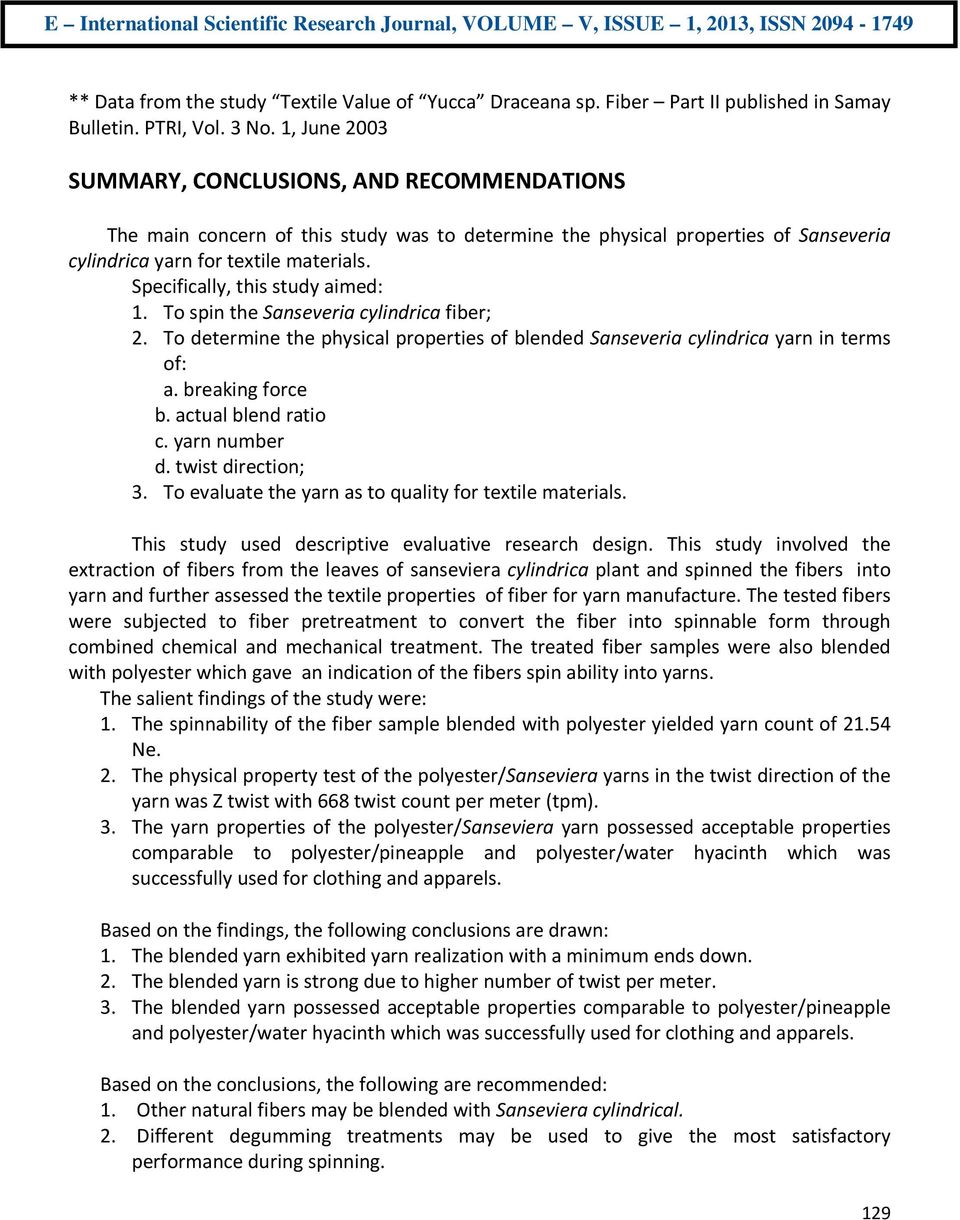
9 ** Data from the study Textile Value of Yucca Draceana sp. Fiber Part II published in Samay Bulletin. PTRI, Vol. 3 No. 1, June 2003 SUMMARY, CONCLUSIONS, AND RECOMMENDATIONS The main concern of this study was to determine the physical properties of Sanseveria cylindrica yarn for textile materials. Specifically, this study aimed: 1. To spin the Sanseveria cylindrica fiber; 2. To determine the physical properties of blended Sanseveria cylindrica yarn in terms of: a. breaking force b. actual blend ratio c. yarn number d. twist direction; 3. To evaluate the yarn as to quality for textile materials. This study used descriptive evaluative research design. This study involved the extraction of fibers from the leaves of sanseviera cylindrica plant and spinned the fibers into yarn and further assessed the textile properties of fiber for yarn manufacture. The tested fibers were subjected to fiber pretreatment to convert the fiber into spinnable form through combined chemical and mechanical treatment. The treated fiber samples were also blended with polyester which gave an indication of the fibers spin ability into yarns. The salient findings of the study were: 1. The spinnability of the fiber sample blended with polyester yielded yarn count of Ne. 2. The physical property test of the polyester/sanseviera yarns in the twist direction of the yarn was Z twist with 668 twist count per meter (tpm). 3. The yarn properties of the polyester/sanseviera yarn possessed acceptable properties comparable to polyester/pineapple and polyester/water hyacinth which was successfully used for clothing and apparels. Based on the findings, the following conclusions are drawn: 1. The blended yarn exhibited yarn realization with a minimum ends down. 2. The blended yarn is strong due to higher number of twist per meter. 3. The blended yarn possessed acceptable properties comparable to polyester/pineapple and polyester/water hyacinth which was successfully used for clothing and apparels. Based on the conclusions, the following are recommended: 1. Other natural fibers may be blended with Sanseviera cylindrical. 2. Different degumming treatments may be used to give the most satisfactory performance during spinning. 129
10 3. Weaving of yarns may be undertaken to assess the economic viability of Sanseviera cylindrica for textile material. BIBLIOGRAPHY A. Books Corbman, Bernard P. (2005) Textile: Fiber to Fabric. New York: Mc Graw-Hill Book Company Cutchon, et al (2004). Handbook on Pre-treatment and Dying of Indegeneous Plant Materials for World Class Product. PTRI, Bicutan, Taguig, Metro Manila. PTRI Standard Definitions of Terms Relating to Textile Materials B. Journals Marin, et al (December 2011). Water Hyacinth (Eichhomia crassipes) for Yarn Manufacture. PTRI Samay Bulletin, Vol. 11, pp Hangad, Stela Marie C Textile Value of yucca Draceana sp. Fiber- Part II Samay Bulletin Vo. 3 No. 1,June Agacaoili (2001). Potential Uses of Annabo (Abroma Augusta L.) C. Unpublished Theses Agacaoili. (2001). Potential Uses of Annabo (Abroma Augusta L.) Talicuad, et al. (October 2008). Potential Fiber Sources For Textile Materials, Unpublished Undergraduate Thesis. D. Electronic Sources http// of the week.org/listserv.shtml. retrieved 17 December cylindrica, retrieved 17, December retrieved 17 December retrieved 17, retrieved 17, 2012 http// of the week.org.listserv.shtml, retrieved December 26, retrieved December 26,

1370 EFFECT OF BLENDING EGYPTIAN AND UPLAND COTTONS ON O.E. YARN QUALITY
 1370 EFFECT OF BLENDING EGYPTIAN AND UPLAND COTTONS ON O.E. YARN QUALITY Dr. Souzan Sanad, Cotton Research Institute, Giza, Egypt Mr. Mohamed El-Sayed, Cotton Research Institute, Giza, Egypt Dr. Ahmed
Impacts of Fiber Length Distribution on Market Value and Yarn Quality: Implications for U.S. Cotton Eric F. Hequet M.
 Impacts of Fiber Length Distribution on Market Value and Yarn Quality: Implications for U.S. Cotton Eric F. Hequet M. Dean Ethridge International Textile Center Texas Tech University Lubbock, Texas 79409
Yarns. Definition of Yarn. Classification: * Types of Yarn. Yarns may be: In addition, Filament yarns may be: From fibers to yarns
 Yarns From fibers to yarns Definition of Yarn A yarn is a constructed assemblage of textile fibers which acts as a unit in fabric formation. Classification: Yarns may be: Staple or Filament Single or Plied
a versatile specie a variety of uses
 a versatile specie For thousands of years, sheep have been among the most efficient of all the domestic animals. They thrive in extreme conditions of climate and habitat. They produce wool, used for varieties
CCS COTTON CLASSIFYING SYSTEM
 CCS COTTON CLASSIFYING SYSTEM COTTON TESTING In production of spun yarns an effective quality control of fibres, slivers, rovings, and yarns serves to secure material properties as well as optimal spinning
REGULATIONS AND SYLLABUS FOR Executive Training Course On Jute Technology and Management
 REGULATIONS AND SYLLABUS FOR Executive Training Course On Jute Technology and Management UNDER ISDS PROJECT 2014 Department of Jute and Fibre Technology Institute of Jute Technology University of Calcutta
Wool processing is the multi step process
 Wool Dyeing process Wool processing is the multi step process Wool processing is the multi step process of turning raw wool into finished product. The basic steps Scouring Drying Carding or Combing Spinning
COMPARISON BETWEEN MECHANICAL PROPERTIES OF FABRICS WOVEN FROM COMPACT AND RING SPUN YARNS
 COMPARISON BETWEEN MECHANICAL PROPERTIES OF FABRICS WOVEN FROM COMPACT AND RING SPUN YARNS Alsaid. A. Almetwally 1 and Mona. M. Salem 2 Textile Division, National Research Centre, Egypt 1 e-mail: [email protected]
Ingeo Fibre Apparel Product Guidelines. Fiber to Fabric. 1. Introduction to Ingeo fibers 2. Fiber to yarn 3. yarn to fabric
 Ingeo Fibre Apparel Product Guidelines Fiber to Fabric 1. Introduction to Ingeo fibers 2. Fiber to yarn 3. yarn to fabric Apparel Products 1. Introduction to Ingeo fibers Ingeo fibre The only synthetic
GRADATION OF AGGREGATE FOR CONCRETE BLOCK
 GRADATION OF AGGREGATE FOR CONCRETE BLOCK Although numerous papers have been written concerning the proper gradation for concrete mixes, they have generally dealt with plastic mixes, and very little published
Design, Manufacturing of a New Laboratory Type Filament Yarn Drawing Machine and Featured Yarn Development Studies
 Marmara Journal of Pure and Applied Sciences 2015, Special Issue-1: 53-57 DOI:10.7240/mufbed.94696 Design, Manufacturing of a New Laboratory Type Filament Yarn Drawing Machine and Featured Yarn Development
Dispersion of Synthetic Fibers in Wet-Lay Nonwovens
 Dispersion of Synthetic Fibers in Wet-Lay Nonwovens This article was written by James M. Keith, retired Director of Technical Services for MiniFIBERS, and published in the Tappi Journal, Vol. 77, No. 6,
Effect of Lycra Extension Percent on Single Jersey Knitted Fabric Properties
 Effect of Lycra Extension Percent on Single Jersey Knitted Fabric Properties R. Sadek, A. M. El-Hossini, A. S. Eldeeb, A.A. Yassen Mansoura University, Textile Engineering Department, Mansoura, EGYPT Correspondence
EVALUATION OF THE CARE AND PERFORMANCE OF COMFORT STRETCH KNIT FABRICS. Introduction
 EVALUATION OF THE CARE AND PERFORMANCE OF COMFORT STRETCH KNIT FABRICS Elizabeth P. Easter, University of Kentucky, Lexington, KY and Bruce E. Ankenman, Northwestern University, Evanston, IL Introduction
FABRIC INDUSTRY PRODUCTION
 FABRIC INDUSTRY Having the largest share in Turkish industrial production, the textile industry is one of the first established industries in Turkey. The sector comprises 19 thousand manufacturing companies
Evaluation of Egyptian cotton variety (Giza 90) and promising cotton cross for yarn characters
 Evaluation of Egyptian cotton variety (Giza 90) and promising cotton cross for yarn characters 1 El-Banna, A.A.A. ; 2 M.N. El-Banna; 3 M.A.A. Nassar; 4 M.I. El-Bagoury and 5 Rasha M. Abdo 1,2,3 Fac. Agric.,
Properties of Fibers and Fabrics Luke Ferguson, Ph.D. Materials Education Associates Seattle, WA [email protected]
 Properties of Fibers and Fabrics Luke Ferguson, Ph.D. Materials Education Associates Seattle, WA [email protected] Copyright: Edmonds Community College 2009 Abstract This experiment tests the strength of threads,
GENERAL GUIDELINES AND TECHNICAL SPECIFICATIONS OF UNIFORM FABRICS FOR MGVCL EMPOLYEES FOR BLOCK YEAR 2011-2013
 / GENERAL GUIDELINES AND TECHNICAL SPECIFICATIONS OF UNIFORM FABRICS FOR MGVCL EMPOLYEES FOR BLOCK YEAR 2011-2013 MADHYA GUJARAT VIJ COMPANY LTD. REGISTERED OFFICE: SARDAR PATEL VIDYUT BHAVAN, RACE COURSE,
Apr 17, 2000 LAB MANUAL 1302.0. 1302 PARTICLE SIZE ANALYSIS OF SOILS AASHTO Designation T 88 (Mn/DOT Modified)
 Apr 17, 2000 LAB MANUAL 1302.0 1302 PARTICLE SIZE ANALYSIS OF SOILS AASHTO Designation T 88 (Mn/DOT Modified) 1302.1 SCOPE This method describes a procedure for the quantitative determination of the distribution
The Effects of Different Fabric Types and Seam Designs on the Seams [sic] Efficiency
![The Effects of Different Fabric Types and Seam Designs on the Seams [sic] Efficiency](/thumbs/40/21784870.jpg "The Effects of Different Fabric Types and Seam Designs on the Seams [sic] Efficiency") Eastern Michigan University DigitalCommons@EMU Senior Honors Theses Honors College 2006 The Effects of Different Fabric Types and Seam Designs on the Seams [sic] Efficiency Courtney LaPere Follow this
Eastern Michigan University DigitalCommons@EMU Senior Honors Theses Honors College 2006 The Effects of Different Fabric Types and Seam Designs on the Seams [sic] Efficiency Courtney LaPere Follow this
California State University, Fresno MeAg 1 School of Agricultural Sciences and Technology Department of Plant Science. Rope 1. Section I.
 Rope 1 Section I. Fiber Rope In the fabrication of fiber rope, a number of fibers of various plants are twisted together to form yarns. These yarns are then twisted together in the opposite direction of
Every picture tells a story...
 Every picture tells a story... gift from nature When the artist mixes the paint, lays his knives and brushes ready and stretches the canvas onto the frame, that canvas already has a long Ahistory behind
Naue GmbH&Co.KG. Quality Control and. Quality Assurance. Manual. For Geomembranes
 Naue GmbH&Co.KG Quality Control and Quality Assurance Manual For Geomembranes July 2004 V.O TABLE OF CONTENTS 1. Introduction 2. Quality Assurance and Control 2.1 General 2.2 Quality management acc. to
Chapter 55. Man-made staple fibres
 Note. Chapter 55 Man-made 1.- Headings 55.01 and 55.02 apply only to man-made filament tow, consisting of parallel filaments of a uniform length equal to the length of the tow, meeting the following specifications
Textile Merit Badge Workbook
 Merit Badge Workbook This workbook can help you but you still need to read the merit badge pamphlet. The work space provided for each requirement should be used by the Scout to make notes for discussing
Lapping and Polishing Basics
 Lapping and Polishing Basics Applications Laboratory Report 54 Lapping and Polishing 1.0: Introduction Lapping and polishing is a process by which material is precisely removed from a workpiece (or specimen)
Banana Fiber Processing and Textile Unit. Banana Fiber Extraction and Processing up to Textile
 Sector Sub - sector Profile No. Project Title Agro & Food Processing Agro Processing AF-13 Banana Fiber Extraction and Processing up to Textile Project Description The use of Banana fiber for textile and
Predicting Yarn Quality Performance Based on Fibers types and Yarn Structure. N. A. Kotb
 Predicting Yarn Quality Performance Based on Fibers types and Yarn Structure N. A. Kotb Department of Technical Education, Faculty of Education, Helwan University, Egypt [email protected] Abstract:
THE EFFECT OF BLENDING A RATIO OF EGYPTIAN CHORISIA SPP. FIBERS WITH COTTON AND POLYESTER WASTES ON SOME PROPERTIES OF THE YARNS
 THE EFFECT OF BLENDING A RATIO OF EGYPTIAN CHORISIA SPP. FIBERS WITH COTTON AND POLYESTER WASTES ON SOME PROPERTIES OF THE YARNS Amal Mohamed EL-Moursy¹, Abeer Ibrahim Mohamed² ¹ ²Department of Textile
34. PROFILE ON SYNTHETIC YARN
 34. PROFILE ON SYNTHETIC YARN 34-2 TABLE OF CONTENTS PAGE I. SUMMARY 34-3 II. PRODUCT DESCRIPTION & APPLICATION 34-3 III. MARKET STUDY AND PLANT CAPACITY 34-4 A. MARKET STUDY 34-4 B. PLANT CAPACITY & PRODUCTION
INSTRUCTIONS FOR CHAIN LINK INSTALLATION Chain Link fence & Posts Meshdirect.co.uk
 INSTRUCTIONS FOR CHAIN LINK INSTALLATION Chain Link fence & Posts Meshdirect.co.uk This guide explains how to correctly install our chain link fencing and post system. The guide provides details of the
peel adhesion 2 breaking load 4 rolling ball 6 shear adhesion 7 carton test 9 summary test methods 11
 CONTENT peel adhesion 2 breaking load 4 rolling ball 6 shear adhesion 7 carton test 9 summary test methods 11 PEEL ADHESION Testing the peel adhesion on stainless steel 1. Definition Peel adhesion - The
Choosing The Proper Short Cut Fiber for Your Nonwoven Web
 Choosing The Proper Short Cut Fiber for Your Nonwoven Web ABSTRACT You have decided that your web needs a synthetic fiber. There are three important factors that have to be considered: generic type, diameter,
Compact Spinning for Improved Quality of Ring-Spun Yarns
 Momir Nikolić, Zoran Stjepanovič*, Franc Lesjak**, Andrej Štritof** Compact Spinning for Improved Quality of Ring-Spun Yarns University in Ljubljana, Faculty of Natural Sciences and Technology, Department
How To Work With Beads. By Rowan
 R O W A N How To Work With Beads By Rowan HOW TO WORK WITH BEADS Adding beads to a knitted or crocheted design gives it a really special touch especially when the beads added are as stunning as those in
Fertility Guidelines for Hops in the Northeast Dr. Heather Darby, University of Vermont Extension Agronomist
 Fertility Guidelines for Hops in the Northeast Dr. Heather Darby, University of Vermont Extension Agronomist The increasing acreage of hops in the Northeast has prompted the need for fertility guidelines
Card C 60. The concept for excellence
 Card C 60 The concept for excellence C 60 Tradition meets Innovation Tradition Experience from bale to yarn Rieter Tradition since 1795 Rieter has been a leader in the textile industry for more than 200
Metric System & Specifications
 Metric System & Specifications Throughout history, people have been trying to limit the number of measurement systems. Today, only two systems, inch-pound and metric, are predominate in most industrial
Lab 1 Concrete Proportioning, Mixing, and Testing
 Lab 1 Concrete Proportioning, Mixing, and Testing Supplemental Lab manual Objectives Concepts Background Experimental Procedure Report Requirements Discussion Prepared By Mutlu Ozer Objectives Students
Numerical Analysis of Independent Wire Strand Core (IWSC) Wire Rope
 Numerical Analysis of Independent Wire Strand Core (IWSC) Wire Rope Rakesh Sidharthan 1 Gnanavel B K 2 Assistant professor Mechanical, Department Professor, Mechanical Department, Gojan engineering college,
Math Matters: Dissecting Hydrometer Calculations
 Math Matters: Dissecting Hydrometer Calculations By Jonathan Sirianni, Laboratory Assessor In the 16th century Galileo and the Tower of Pisa made famous the fact that two objects, no matter their mass,
VISCOSTAR - A STAR-SHAPED VISCOSE FIBER FOR IMPROVED ABSORBENCY
 15 VISCOSTAR - A STAR-SHAPED VISCOSE FIBER FOR IMPROVED ABSORBENCY Josef Schmidtbauer Lenzing R & D, Lenzing AG, A-4860 Lenzing, Austria Phone : +43 7672 701 2387, Fax : +43 7672 9 2387, e-mail: [email protected]
DryWeight BulkVolume
 Test Procedure for BULK SPECIFIC GRAVITY AND WATER ABSORPTION OF AGGREGATE TxDOT Designation: Tex-201-F Effective Date: January 2016 1. SCOPE 1.1 Use this method to determine the bulk specific gravity
Two most common lock nut groups: 1-Prevailing Torque Type Lock Nuts:
 Two most common lock nut groups: 1. PREVAILING TORQUE a design feature of the lock nut produces friction between threads of mated components thereby increasing the force needed to tighten as well as loosen
LIFE CYCLE ASSESSMENT ON COTTON AND VISCOSE FIBRES FOR TEXTILE PRODUCTION
 LIFE CYCLE ASSESSMENT ON COTTON AND VISCOSE FIBRES FOR TEXTILE PRODUCTION Janka Dibdiakova, Volkmar Timmermann Norwegian Forest and Landscape Institute (NFLI) Ås, Norway COST FP1205 Innovative applications
Stock Preparation Division: The C-bar screen basket a high-tech product
 14 Stock Preparation Division: The C-bar screen basket a high-tech product According to an old saying: paper is made in the Holländer. Despite the common opinion that paper mills only contain paper machines,
WASSCE / WAEC CLOTHING AND TEXTILES SYLLABUS WWW.LARNEDU.COM
 WASSCE / WAEC CLOTHING AND TEXTILES SYLLABUS WWW.LARNEDU.COM Visit www.larnedu.com for WASSCE / WAEC syllabus on different subjects and more great stuff to help you ace the WASSCE in flying colours. 1.
NOTE: FOR PROJECTS REQUIRING CONTRACTOR MIX DESIGN, THE DESIGN PROCEDURES ARE SPECIFIED IN THE SPECIAL PROVISIONS OF THE CONTRACT.
 September 1, 2003 CONCRETE MANUAL 5-694.300 MIX DESIGN 5-694.300 NOTE: FOR PROJECTS REQUIRING CONTRACTOR MIX DESIGN, THE DESIGN PROCEDURES ARE SPECIFIED IN THE SPECIAL PROVISIONS OF THE CONTRACT. 5-694.301
ENVIRONMENTAL BEST PRACTICE IN DYEING AND FINISHING OF TENCEL AND LENZING MODAL
 Lenzinger Berichte 89 (11) 3-36 ENVIRONMENTAL BEST PRACTICE IN DYEING AND FINISHING OF TENCEL AND LENZING MODAL Jim Taylor Lenzing AG, Werkstr. 1, 486 Lenzing, Austria Phone: (+43) 767 71-3488; Fax: (+43)
Besides the aesthetic properties, mechanical and
 Influence of Warp Yarn Tension on Cotton Greige and Dyed Woven Fabric Prosperities UZMA SYED*, AND RAFIQUE AHMED JHATIAL** RECEIVED ON 12.10.2012 ACCEPTED ON 31.12.2012 ABSTRACT Fabric properties such
The Effect of Fiber Twist on the Mechanical Properties of Natural Fiber Reinforced Composites
 The Effect of Fiber Twist on the Mechanical Properties of Natural Fiber Reinforced Composites H. Ma, Y. Li * and Y. Luo 1 School of Aerospace Engineering and Applied Mechanics Tongji University, Shanghai
Brief about Texpo 2016 07~10 April 2016 at Karachi Expo Centre. Textile Sector of Pakistan
 Subject: TEXPO 206 Pakistan (24-27 March 206) at Karachi EXPO Centre Trade Development Authority of Pakistan (TDAP) in consultation with Ministry of Commerce of Pakistan will be organizing a maiden sector
Nepalese organic baby clothing
 Running head: EXPORTING ORGANIC CLOTHES FOR BABIES Nepalese organic baby clothing Gabriela Gomes de Lima AGR*2150 Plant Agriculture for International Development University of Guelph November, 2014 - Fall
Tex-421-A, Splitting Tensile Strength of Cylindrical Concrete Specimens
 Contents: Section 1 Overview...2 Section 2 Apparatus...3 Section 3 Test Specimens...4 Section 4 Procedure...5 Texas Department of Transportation 1 08/99 06/08 Section 1 Overview Effective dates: August
User Instruction Manual Vertical Lifelines and Vertical Lifeline Subsystems
 Instructions for the following series products: User Instruction Manual Vertical Lifelines and Vertical Lifeline Subsystems Vertical Lifelines Vertical Lifeline Subsystems (See back pages for specific
RAINBOW: A NOVEL VISCOSE FIBER FOR PES BLENDS INNOVATIONS IN DYEING TECHNOLOGY
 22 RAINBOW: A NOVEL VISCOSE FIBER FOR PES BLENDS INNOVATIONS IN DYEING TECHNOLOGY Peter Sulek, Marina Crnoja-Cosic, Jörg Schlangen Lenzing Aktiengesellschaft, A-486 Lenzing, Austria Phone: (43) (7672)
POWDER PROPERTIES LABORATORY
 Ground Rules POWDER PROPERTIES LABORATORY You will work as a team of no more than 6 students. At the end of this laboratory session each team will turn in a single report. The report will be reviewed,
Peel Adhesion of Pressure Sensitive Tape
 Harmonized International Standard Call Letters PSTC 101 Date of Issuance 10/00 Revised 10/03 Revised 05/07 Peel Adhesion of Pressure Sensitive Tape 1. SCOPE 1.1 These methods cover the measurement of the
The University of Toledo Soil Mechanics Laboratory
 1 Grain Size Distribution Sieve Analysis The University of Toledo Soil Mechanics Laboratory Introduction The grain size distribution is a representation of the approximate distribution of soil grain sizes
400.00 IS 3675 :1966 Re08 100 g cotton fibre By Flat Bundle Method Spinlab. Spinlab. Statex
 Fibre Testing :- 1) Testing of Various types of Fibres, Silver, Roving, Yarn, Threads, Rope, Fabric, Garment, Carpets, Pile fabrics, Netting Fabric, Blankets, Filter fabrics, Automotive textiles, Non-Woven
The entire document shall be read and understood before proceeding with a test. ISTA 3B 2013 - Page 1 of 35
 Packaged-Products for Less-Than-Truckload (LTL) Shipment ISTA 3 Series General Simulation Performance Test PROCEDURE VERSION DATE Last TECHNICAL Change: NOVEMBER 2012 Last EDITORIAL Change: JANUARY 2013
Force measurement. Forces VECTORIAL ISSUES ACTION ET RÉACTION ISOSTATISM
 Force measurement Forces VECTORIAL ISSUES In classical mechanics, a force is defined as "an action capable of modifying the quantity of movement of a material point". Therefore, a force has the attributes
Study on dyeing behavior of cotton/organic cotton knitted fabrics D. Raja 1, A.Arputharaj 2, C. Prakash 1, V.Ramesh Babu 1 and C.V.
 Indian Journal of Science and Technology Vol. No. 7 (July ) ISSN: 97-686 76 Study on dyeing behavior of cotton/organic cotton knitted fabrics D. Raja, A.Arputharaj, C. Prakash, V.Ramesh Babu and C.V. Koushik
consulting group Increase Competitiveness Reduce Costs
 Strengthen the Textile Supply Chain Through IT Increase Competitiveness Increase Efficiencies Reduce Costs The real Textile World The Garment Industry Retail The Chemical Fibre Industry The Chemical Industry
Ring-spinning processing
 Technical Bulletin 341104 Introduction The sections that follow relate to the processing of 1.5dtex 38 mm Ingeo PLA fiber intended for conversion through the cotton or short staple spinning route. The
Structural Integrity Analysis
 Structural Integrity Analysis 1. STRESS CONCENTRATION Igor Kokcharov 1.1 STRESSES AND CONCENTRATORS 1.1.1 Stress An applied external force F causes inner forces in the carrying structure. Inner forces
Creating tomorrow s solutions
 Creating tomorrow s solutions Silicone Products for Household Fabric Care Textile fabrics are much more than just a piece of clothing or a consumer item. Regardless of whether it is a towel or a pair of
Objective To conduct Charpy V-notch impact test and determine the ductile-brittle transition temperature of steels.
 IMPACT TESTING Objective To conduct Charpy V-notch impact test and determine the ductile-brittle transition temperature of steels. Equipment Coolants Standard Charpy V-Notched Test specimens Impact tester
TURKISH TEXTILE INDUSTRY
 TURKISH TEXTILE INDUSTRY The history of textile production in Turkey goes back to the Ottoman period. In the 16th and 17th centuries, textile production was widespread and at an advanced level. The fact
Specific volume and absorption properties
 Accepted 1980 Fluff Specific volume and absorption properties 1 Scope This SCAN-test Method describes the preparation of test pieces of fluff and a procedure for their use in determining the specific volume
Culture in field conditions - Challenges A South American point of view Roberto Campos Pura Natura, Argentina
 A South American point of view Roberto Campos Pura Natura, Argentina EUSTAS 6 th Stevia Symposium Leuven, July 3 rd and 4 th I. Area of cultivation II. Environment III. Production of seedlings IV. Planting
Synthetic Fabric vs. Natural Fabric
 Synthetic Fabric vs. Natural Fabric Many people have been advertizing the benefits of natural fibers and how much less destructive they are for the environment. From wool to cotton to bamboo and even hemp,
Standard Test Procedures Manual
 STP 206-1 Standard Test Procedures Manual Section: 1. SCOPE 1.1. Description of Test 2. APPARATUS This method describes the procedure for determining the relationship between the particle size distribution
DOUBLE DRUM TRACTION WINCH SYSTEMS FOR OCEANOGRAPHIC RESEARCH 1.0 TRACTION WINCH SYSTEM ADVANTAGES 11-2
 Chapter 11 DOUBLE DRUM TRACTION WINCH SYSTEMS FOR OCEANOGRAPHIC RESEARCH James Stasny 1.0 TRACTION WINCH SYSTEM ADVANTAGES 11-2 2.0 THEORY OF OPERATION 11-3 3.0 ADVANTAGES IN TRACTION WINCH SYSTEM DESIGN/
Soil Testing Soil index properties 24. Cone Penetrometer Method BS 1377, 1924-2, EN DD ENV 1997-2. Semi-Automatic Cone Penetrometer
 24 Soil index properties Soil Index Properties Soil index properties are used extensively by engineers to discriminate between the different kinds of soil within a broad category, e.g. clay will exhibit
Forensics Lab Identification of Fibers
 Forensics Lab Identification of Fibers Name Per Due Date Background Information Fibers, strands of thread that make up yarn and cloth, are all around us. You encounter a wide variety of fibers every day.
Villeneuve. Yarn: Habu N-84 Wrapped Silk 6P; 78 yds (71 m)/0.49 oz (14 g) 4 (5, 5, 5, 6, 7) skeins; color shown is Ecru Materials:
 Villeneuve Yarn: Habu N-84 Wrapped Silk 6P; 78 yds (71 m)/0.49 oz (14 g) 4 (5, 5, 5, 6, 7) skeins; color shown is Ecru Materials: Gauge: 5.5 mm (US 9) circular needles - or needles required to obtain gauge.
Practice Midterm Exam #2
 The Islamic University of Gaza Faculty of Engineering Department of Civil Engineering 12/12/2009 Statistics and Probability for Engineering Applications 9.2 X is a binomial random variable, show that (
Impact testing ACTIVITY BRIEF
 ACTIVITY BRIEF Impact testing The science at work Impact testing is of enormous importance. A collision between two objects can often result in damage to one or both of them. The damage might be a scratch,
Standard Test Procedures Manual
 STP 206-4 Standard Test Procedures Manual Section: 1. SCOPE 1.1. Description of Test This method describes the procedure for determining the liquid limit, plastic limit and the plasticity index of coarse-grained
Creative Sewing. Content Skills Learning Targets Assessment Resources & Technology CEQ: What affect does choice of clothing, accessories
 St. Michael-Albertville High School Teacher: Julie Read Creative September 2014 CEQ: What affect does choice of clothing, accessories Course Learning Targets: and overall appearance CLT: I will work to
Let s look at an example of where grade 5 and grade 8 bolts are subjected to single shear loads (winch plate reference).
 Bolt s I have been on a quite a few online email lists over the last 7 years or so, basically since they first came out. From the original Jeep-L list to the XJ-list to the Rockcrawler.com board, a common
Derakane epoxy vinyl ester resins: The Evolution of Corrosion Resistant FRP
 A Brief History on Corrosion Derakane epoxy vinyl ester resins: The Evolution of Corrosion Resistant FRP Corrosion in industrial processes has always threatened pipes, ducting, process equipment, scrubbers
Slipped Rib Bib and Cloth
 Slipped Rib Bib and Cloth Copyright 2011; 2015 by Elaine Fitzpatrick. Permission is granted to make and sell items from this pattern provided that credit is given to me as the designer. Permission is not
Lesson 6: Measuring Trees
 Review and Introduction Lesson 6: Measuring Trees In Lesson 4 and Lesson 5, you learned how to establish either a fixed plot or a variable plot. With your plot established and your in trees tallied, now
A NEW APPROACH FOR MEASUREMENT OF TENSILE STRENGTH OF CONCRETE
 Journal of Research (Science), Bahauddin Zakariya University, Multan, Pakistan. Vol.16, No.1, June 2005, pp. 01-09 ISSN 1021-1012 A NEW APPROACH FOR MEASUREMENT OF TENSILE STRENGTH OF CONCRETE A. Ghaffar,
MaxCell Technical Manual Design Parameters
 MaxCell Technical Manual Design Parameters Breaking Strength by Product Style, lbs Product Style Standard MaxCell Fire Resistant MaxCell Test Method 4 Cell 2,750 2,200 ASTM D 5 Bellcore 5 5.. Cell 2,50
WORKING DRAFT OF COMMITTEE MEETING OUTPUT CONTENT NOT FINAL SUBJECT TO REVISION PRIOR TO LETTER BALLOT AND PUBLICATION OF SECOND DRAFT REPORT
 WORKING DRAFT OF COMMITTEE MEETING OUTPUT Standard on Life Safety Rope and Equipment for Emergency Services NFPA 1983 January 5-6, 2016; Subject to Revision Not for Publication WORKING DRAFT OF COMMITTEE
COMPACTING BITUMINOUS SPECIMENS USING THE SUPERPAVE GYRATORY COMPACTOR (SGC)
 Test Procedure for COMPACTING BITUMINOUS SPECIMENS USING THE SUPERPAVE TxDOT Designation: Tex-241-F Effective Date: December 2015 1. SCOPE 1.1 Use this test method to: compact cylindrical specimens of
Texanlab Laboratories Pvt. Ltd. Colourfastness Testing Series
 COLOUR FASTNESS TO PERSPIRATION Color fading and alteration can be caused by the reaction between dyes on garments and the constituents of human perspiration, such as skin waste. It varies for different
A STUDY ON BONDING STRENGTH OF POLYMERIC FIBERS TO CEMENTITIOUS MATRIX
 CD01-006 A STUDY ON BONDING STRENGTH OF POLYMERIC FIBERS TO CEMENTITIOUS MATRIX H.R. Pakravan 1, M. Jamshidi 2, M. Latifi 3 1 M.Sc. student, Textile Engineering Department, Amirkabir University, Tehran,
CUSTOMS TARIFF - SCHEDULE 56 - i
 56 - i Chapter 56 WADDING, FELT AND NONWOVENS; SPECIAL YARNS; TWINE, CORDAGE, ROPES AND CABLES AND ARTICLES THEREOF Notes. 1. This Chapter does not cover: (a) Wadding, felt or nonwovens, impregnated, coated
Growing Cocoa Beans. Growing Region
 Growing Cocoa Beans All chocolate begins with cocoa beans, the fruit of the cacao tree (also called a cocoa tree). Scientists know that the cacao tree originated somewhere in South or Central America.
- - - - - - - - - - - - - - - - - - - - - - - - - - - - - - - - - - - - - - - - - - - - - - - - - - - - - - - - - - - - - - - - - - -
 Levi Strauss & Co. Life Cycle Approach to Examine the Environmental Performance of its Products Levi Strauss & Co. (LS&Co.) is focused on building sustainability into everything we do. In 2007 LS&Co. commissioned
Determination of Thermal Conductivity of Coarse and Fine Sand Soils
 Proceedings World Geothermal Congress Bali, Indonesia, - April Determination of Thermal Conductivity of Coarse and Fine Sand Soils Indra Noer Hamdhan 1 and Barry G. Clarke 2 1 Bandung National of Institute
METHOD A7 THE DETERMINATION OF THE MAXIMUM DRY DENSITY AND OPTIMUM MOISTURE CONTENT OF GRAVEL, SOIL AND SAND
 SCOPE METHOD A7 THE DETERMINATION OF THE MAXIMUM DRY DENSITY AND OPTIMUM MOISTURE CONTENT OF GRAVEL, SOIL AND SAND Definition The maximum dry density and optimum moisture content, as defined below, is
chapter >> Making Decisions Section 2: Making How Much Decisions: The Role of Marginal Analysis
 chapter 7 >> Making Decisions Section : Making How Much Decisions: The Role of Marginal Analysis As the story of the two wars at the beginning of this chapter demonstrated, there are two types of decisions:
Study on Different Types of Dyeing Faults, Causes and Remedies of Knit Fabrics
 International Journal of Engineering & Technology IJET-IJENS Vol:15 No:02 6 Study on Different Types of Dyeing Faults, Causes and Remedies of Knit Fabrics Md. Moyinul Islam 1, Sakil Mahmud 2 1 M.S in Dyeing
T 549. WORKING GROUP CHAIRMAN N/A; reaffirmed SUBJECT RELATED
 NOTICE: This is a DRAFT of a TAPPI Standard in ballot. Although available for public viewing, it is still under TAPPI s copyright and may not be reproduced or distributed without permission of TAPPI. This