
AUGUST IAS 7: Statement of Cash Flows a guide to avoiding common pitfalls and application issues
|
|
|
- Regina Fox
- 10 years ago
- Views:
Transcription
1 AUGUST 2012 IAS 7: Statement of Cash Flows a guide to avoiding common pitfalls and application issues
2 Important Disclaimer: This document has been developed as an information resource. It is intended as a guide only and the application of its contents to specific situations will depend on the particular circumstances involved. While every care has been taken in its presentation, personnel who use this document to assist in evaluating compliance with International Financial Reporting Standards should have sufficient training and experience to do so. No person should act specifically on the basis of the material contained herein without considering and taking professional advice. Neither Grant Thornton International Ltd, nor any of its personnel nor any of its member firms or their partners or employees, accept any responsibility for any errors it might contain, whether caused by negligence or otherwise, or any loss, howsoever caused, incurred by any person as a result of utilising or otherwise placing any reliance upon this document.
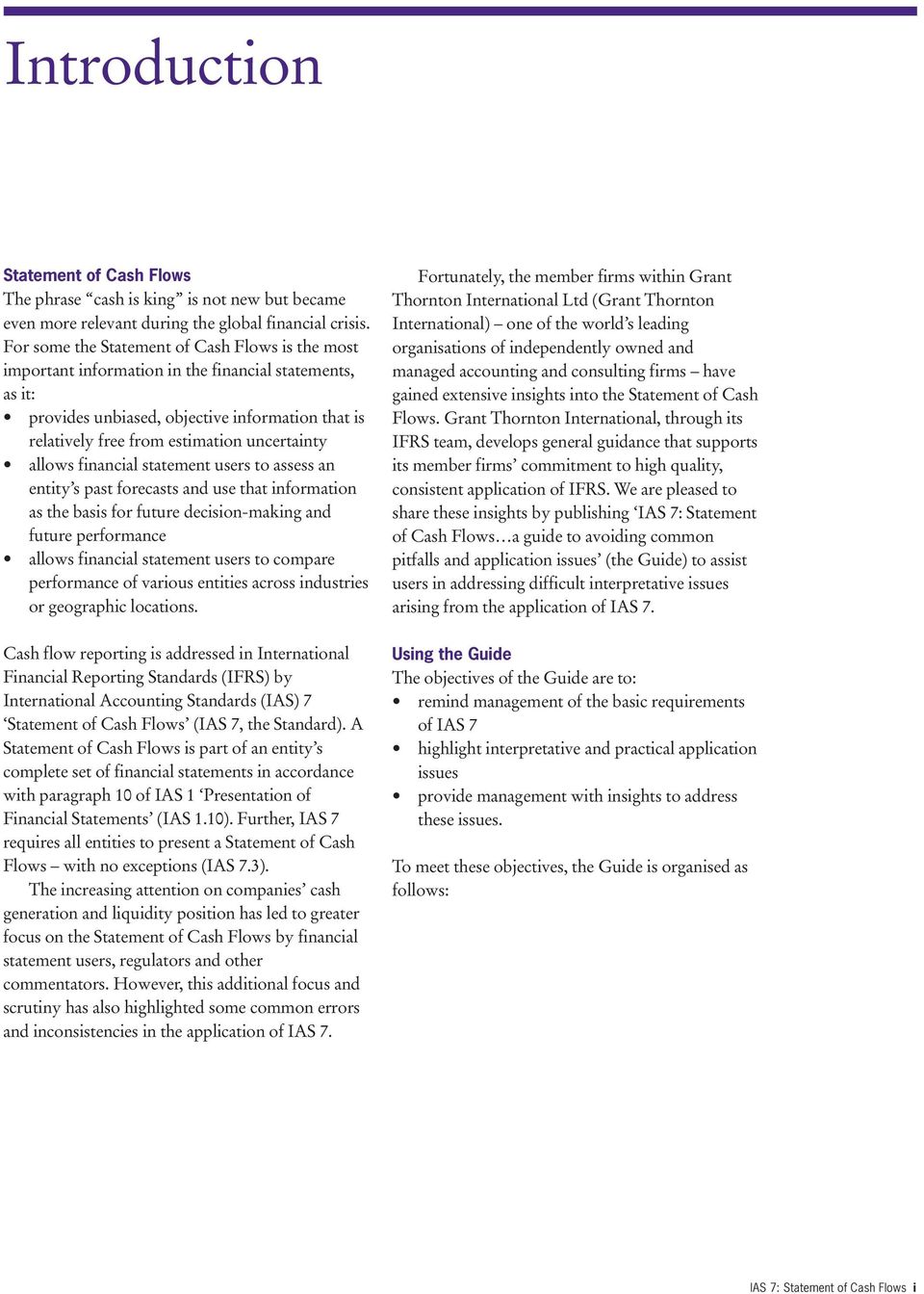
3 Introduction Statement of Cash Flows The phrase cash is king is not new but became even more relevant during the global financial crisis. For some the Statement of Cash Flows is the most important information in the financial statements, as it: provides unbiased, objective information that is relatively free from estimation uncertainty allows financial statement users to assess an entity s past forecasts and use that information as the basis for future decision-making and future performance allows financial statement users to compare performance of various entities across industries or geographic locations. Cash flow reporting is addressed in International Financial Reporting Standards (IFRS) by International Accounting Standards (IAS) 7 Statement of Cash Flows (IAS 7, the Standard). A Statement of Cash Flows is part of an entity s complete set of financial statements in accordance with paragraph 10 of IAS 1 Presentation of Financial Statements (IAS 1.10). Further, IAS 7 requires all entities to present a Statement of Cash Flows with no exceptions (IAS 7.3). The increasing attention on companies cash generation and liquidity position has led to greater focus on the Statement of Cash Flows by financial statement users, regulators and other commentators. However, this additional focus and scrutiny has also highlighted some common errors and inconsistencies in the application of IAS 7. Fortunately, the member firms within Grant Thornton International Ltd (Grant Thornton International) one of the world s leading organisations of independently owned and managed accounting and consulting firms have gained extensive insights into the Statement of Cash Flows. Grant Thornton International, through its IFRS team, develops general guidance that supports its member firms commitment to high quality, consistent application of IFRS. We are pleased to share these insights by publishing IAS 7: Statement of Cash Flows a guide to avoiding common pitfalls and application issues (the Guide) to assist users in addressing difficult interpretative issues arising from the application of IAS 7. Using the Guide The objectives of the Guide are to: remind management of the basic requirements of IAS 7 highlight interpretative and practical application issues provide management with insights to address these issues. To meet these objectives, the Guide is organised as follows: IAS 7: Statement of Cash Flows i
4 Overview of the Guide Section A: IAS 7 at a glance Provides an at a glance overview of IAS 7 s main requirements Section B: Identifying cash and cash equivalents Defines cash and cash equivalents and discusses application issues related to various instruments (eg bank overdrafts, demand deposits, money market funds, restricted cash) Outlines the requirements for reconciling cash and cash equivalents in the Statement of Cash Flows to the cash and cash equivalents balance in the Statement of Financial Position and common application issues in doing so Section C: Classifying cash flows as operating, investing or financing activities Outlines the requirements for classifying cash flows as operating, investing or financing activities Provides common examples of cash flows from operating, investing and financing activities Addresses various application issues that arise when classifying cash flows as operating, investing or financing activities Section D: Presentation issues Summarises the general presentation requirements of IAS 7 Discusses common presentation application issues including: gross versus net presentation using the indirect method impact of a central banking function disclosure of total interest paid cash flow per share Section E: Group cash flows Provides an overview of the cash flow requirements related to: business combinations accounting for groups Addresses common application issues related to both Section F: Foreign currency cash flows Provides an overview of the requirements related to cash flows from foreign currency transactions Addresses common application issues on this topic Grant Thornton International Ltd August IAS 7: Statement of Cash Flows

5 Contents Introduction i A. IAS 7 at a glance 1 B. Identifying cash and cash equivalents 3 1 Guidance overview Defining cash and cash equivalents 3 2 Application issues Exploring the meaning of short-term Bank overdrafts Demand deposits Money market funds Restricted cash Reconciling cash and cash equivalent balances 8 C. Classifying cash flows as operating, investing or financing activities 9 1 Guidance overview Classifying cash flows as operating, investing or financing activities 9 2 Application issues Interest and dividends Short-term loans to related parties Expenditure on internally generated intangibles Cash flows relating to assets held for rental to others Cash flows relating to a business combination Tax cash flows 13 D. Presentation issues 14 1 Guidance overview Gross cash flows Selecting the direct or indirect methods Direct method Indirect method Non-cash transactions 16

6 2 Application issues Gross or net cash flows? Starting point for the indirect method Presentation of adjustments to profit or loss using the indirect method Non-cash transactions Central banking function Disclosure of total interest paid Cash flow per share 19 E. Group cash flows 20 1 Guidance overview 20 2 Application issues Cash flows relating to business combinations Deferred consideration Contingent consideration Cash and cash equivalents acquired Transaction costs Other group cash flow considerations Changes in non-controlling interests Acquisitions and disposals of subsidiaries 24 F. Foreign currency cash flows 26 1 Guidance overview 26 2 Application issues Foreign currency exchange differences Individual entities Foreign operations 28

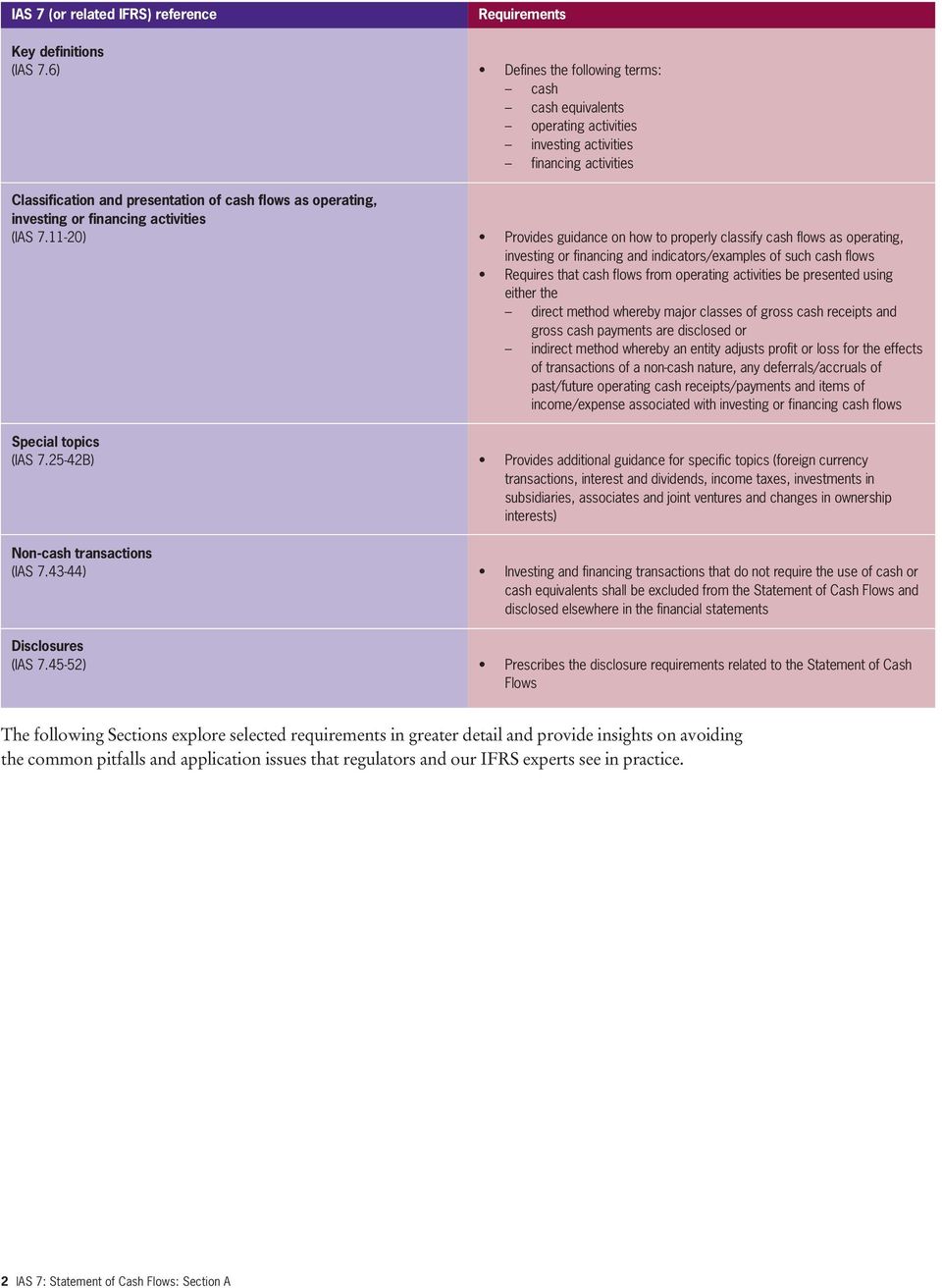
7 A. IAS 7 at a glance Section A: IAS 7 at a glance Reminds readers of the main requirements of IAS 7 All entities need cash to run their day-to-day operations, pay their obligations and provide returns to investors, regardless of their particular line of business or geographic location. The overall objective of IAS 7 is to require entities to report their historical changes in cash and cash equivalents by means of a Statement of Cash Flows which classifies the period s cash flows by operating, investing and financing activities. As a result, this Statement provides financial statement users with insight to how the entity generates and uses cash and cash equivalents. The table below outlines the overall requirements and guidance provided in IAS 7, as well as other related guidance: Table A.1 IAS 7 at a glance: IAS 7 (or related IFRS) reference Scope (IAS 7.3) (IAS ) Presentation (IAS 7.1) (IAS ) Benefits of cash flow information (IAS 7.3-4) Requirements All entities must prepare a Statement of Cash Flows The Statement of Cash Flows comprises part of an entity s complete set of financial statements under IFRS 1 The Statement of Cash Flows must be presented with equal prominence with the other statements comprising a complete set of financial statements 1 An entity must include each period for which financial statements are presented Prescribes that cash flows shall generally be presented on a gross basis and provides exceptions to that general principle Enables users to evaluate an entity s: changes in net assets financial structure, liquidity and solvency ability to affect amounts and timing of cash flows ability to generate cash and cash equivalents Allows users to compare entities, irrespective of the nature of the entity s activities, industry or geographic location 1 This requirement is outlined in IAS 1 Presentation of Financial Statements, but relates to the Statement of Cash Flows. IAS 7: Statement of Cash Flows: Section A 1
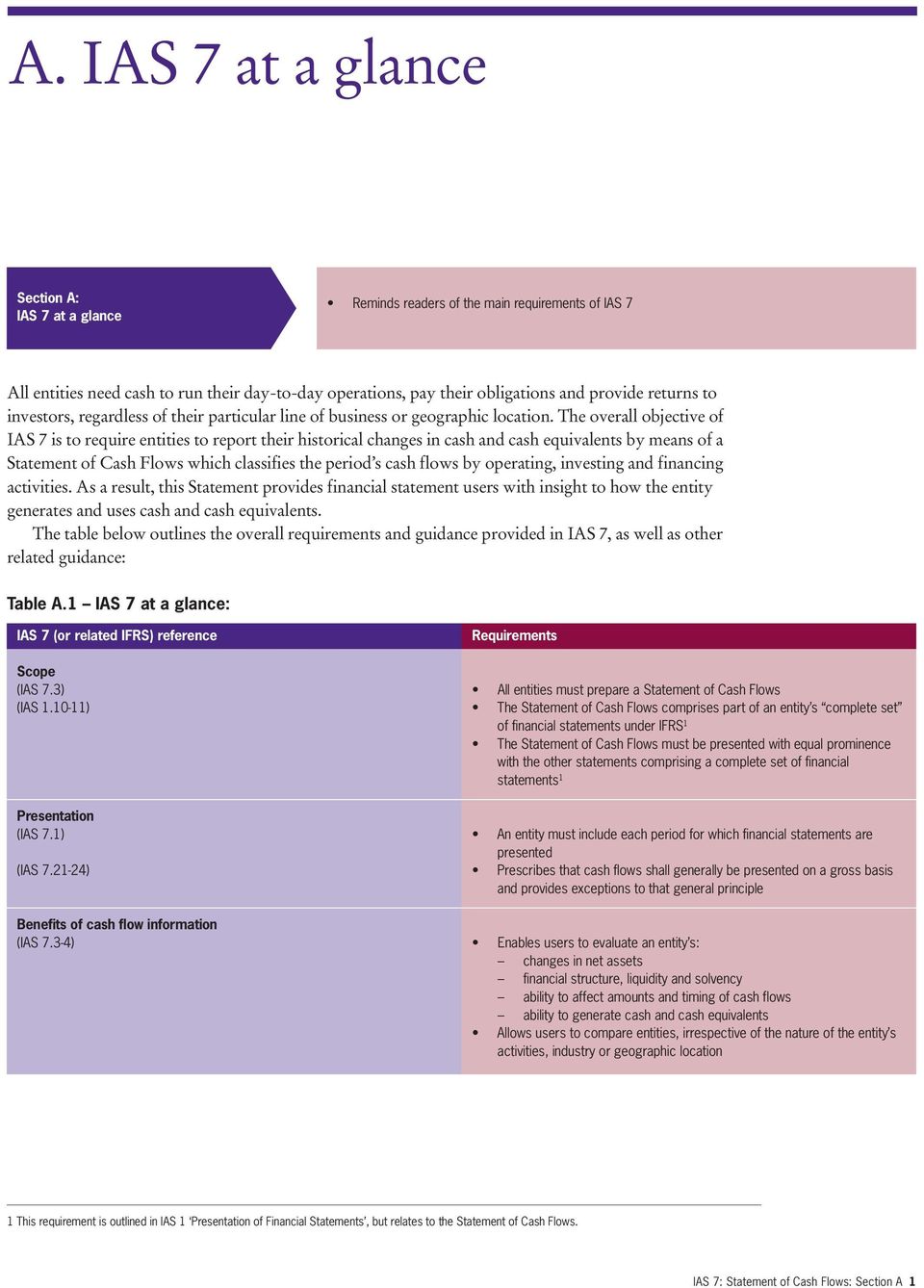
8 IAS 7 (or related IFRS) reference Key definitions (IAS 7.6) Classification and presentation of cash flows as operating, investing or financing activities (IAS ) Special topics (IAS B) Non-cash transactions (IAS ) Disclosures (IAS ) Requirements Defines the following terms: cash cash equivalents operating activities investing activities financing activities Provides guidance on how to properly classify cash flows as operating, investing or financing and indicators/examples of such cash flows Requires that cash flows from operating activities be presented using either the direct method whereby major classes of gross cash receipts and gross cash payments are disclosed or indirect method whereby an entity adjusts profit or loss for the effects of transactions of a non-cash nature, any deferrals/accruals of past/future operating cash receipts/payments and items of income/expense associated with investing or financing cash flows Provides additional guidance for specific topics (foreign currency transactions, interest and dividends, income taxes, investments in subsidiaries, associates and joint ventures and changes in ownership interests) Investing and financing transactions that do not require the use of cash or cash equivalents shall be excluded from the Statement of Cash Flows and disclosed elsewhere in the financial statements Prescribes the disclosure requirements related to the Statement of Cash Flows The following Sections explore selected requirements in greater detail and provide insights on avoiding the common pitfalls and application issues that regulators and our IFRS experts see in practice. 2 IAS 7: Statement of Cash Flows: Section A
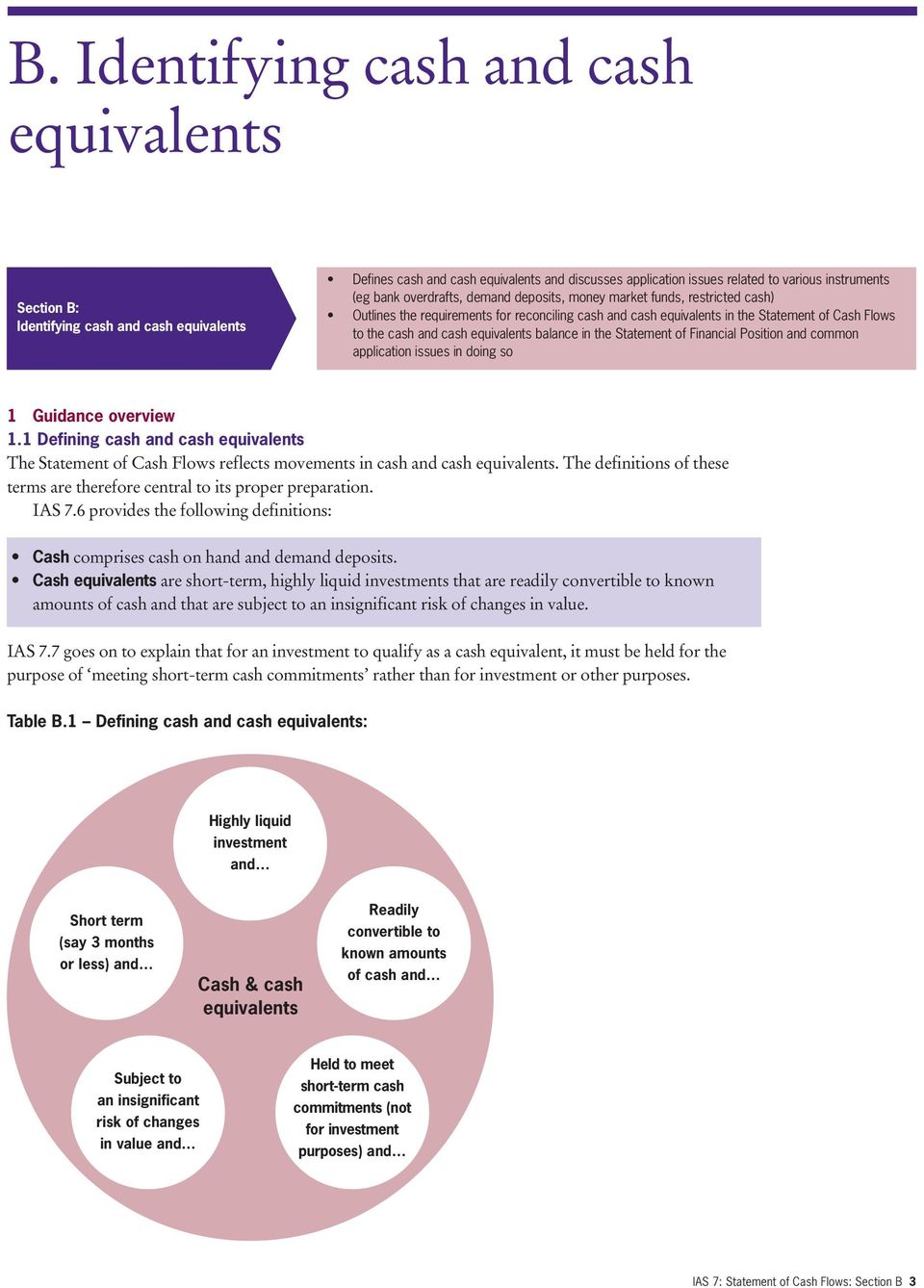
9 B. Identifying cash and cash equivalents Section B: Identifying cash and cash equivalents Defines cash and cash equivalents and discusses application issues related to various instruments (eg bank overdrafts, demand deposits, money market funds, restricted cash) Outlines the requirements for reconciling cash and cash equivalents in the Statement of Cash Flows to the cash and cash equivalents balance in the Statement of Financial Position and common application issues in doing so 1 Guidance overview 1.1 Defining cash and cash equivalents The Statement of Cash Flows reflects movements in cash and cash equivalents. The definitions of these terms are therefore central to its proper preparation. IAS 7.6 provides the following definitions: Cash comprises cash on hand and demand deposits. Cash equivalents are short-term, highly liquid investments that are readily convertible to known amounts of cash and that are subject to an insignificant risk of changes in value. IAS 7.7 goes on to explain that for an investment to qualify as a cash equivalent, it must be held for the purpose of meeting short-term cash commitments rather than for investment or other purposes. Table B.1 Defining cash and cash equivalents: Highly liquid investment and Short term (say 3 months or less) and Cash & cash equivalents Readily convertible to known amounts of cash and Subject to an insignificant risk of changes in value and Held to meet short-term cash commitments (not for investment purposes) and IAS 7: Statement of Cash Flows: Section B 3
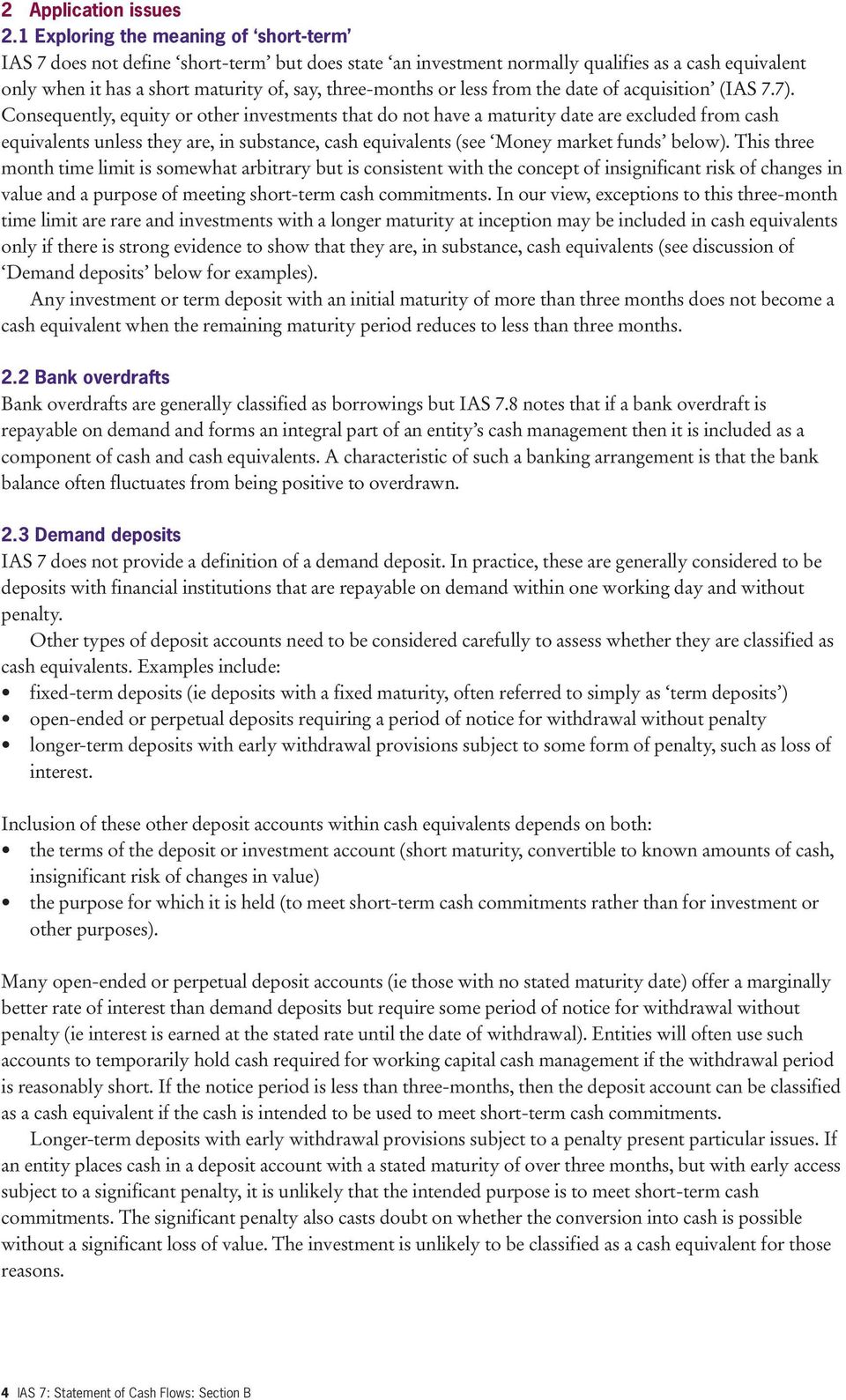
10 2 Application issues 2.1 Exploring the meaning of short-term IAS 7 does not define short-term but does state an investment normally qualifies as a cash equivalent only when it has a short maturity of, say, three-months or less from the date of acquisition (IAS 7.7). Consequently, equity or other investments that do not have a maturity date are excluded from cash equivalents unless they are, in substance, cash equivalents (see Money market funds below). This three month time limit is somewhat arbitrary but is consistent with the concept of insignificant risk of changes in value and a purpose of meeting short-term cash commitments. In our view, exceptions to this three-month time limit are rare and investments with a longer maturity at inception may be included in cash equivalents only if there is strong evidence to show that they are, in substance, cash equivalents (see discussion of Demand deposits below for examples). Any investment or term deposit with an initial maturity of more than three months does not become a cash equivalent when the remaining maturity period reduces to less than three months. 2.2 Bank overdrafts Bank overdrafts are generally classified as borrowings but IAS 7.8 notes that if a bank overdraft is repayable on demand and forms an integral part of an entity s cash management then it is included as a component of cash and cash equivalents. A characteristic of such a banking arrangement is that the bank balance often fluctuates from being positive to overdrawn. 2.3 Demand deposits IAS 7 does not provide a definition of a demand deposit. In practice, these are generally considered to be deposits with financial institutions that are repayable on demand within one working day and without penalty. Other types of deposit accounts need to be considered carefully to assess whether they are classified as cash equivalents. Examples include: fixed-term deposits (ie deposits with a fixed maturity, often referred to simply as term deposits ) open-ended or perpetual deposits requiring a period of notice for withdrawal without penalty longer-term deposits with early withdrawal provisions subject to some form of penalty, such as loss of interest. Inclusion of these other deposit accounts within cash equivalents depends on both: the terms of the deposit or investment account (short maturity, convertible to known amounts of cash, insignificant risk of changes in value) the purpose for which it is held (to meet short-term cash commitments rather than for investment or other purposes). Many open-ended or perpetual deposit accounts (ie those with no stated maturity date) offer a marginally better rate of interest than demand deposits but require some period of notice for withdrawal without penalty (ie interest is earned at the stated rate until the date of withdrawal). Entities will often use such accounts to temporarily hold cash required for working capital cash management if the withdrawal period is reasonably short. If the notice period is less than three-months, then the deposit account can be classified as a cash equivalent if the cash is intended to be used to meet short-term cash commitments. Longer-term deposits with early withdrawal provisions subject to a penalty present particular issues. If an entity places cash in a deposit account with a stated maturity of over three months, but with early access subject to a significant penalty, it is unlikely that the intended purpose is to meet short-term cash commitments. The significant penalty also casts doubt on whether the conversion into cash is possible without a significant loss of value. The investment is unlikely to be classified as a cash equivalent for those reasons. 4 IAS 7: Statement of Cash Flows: Section B
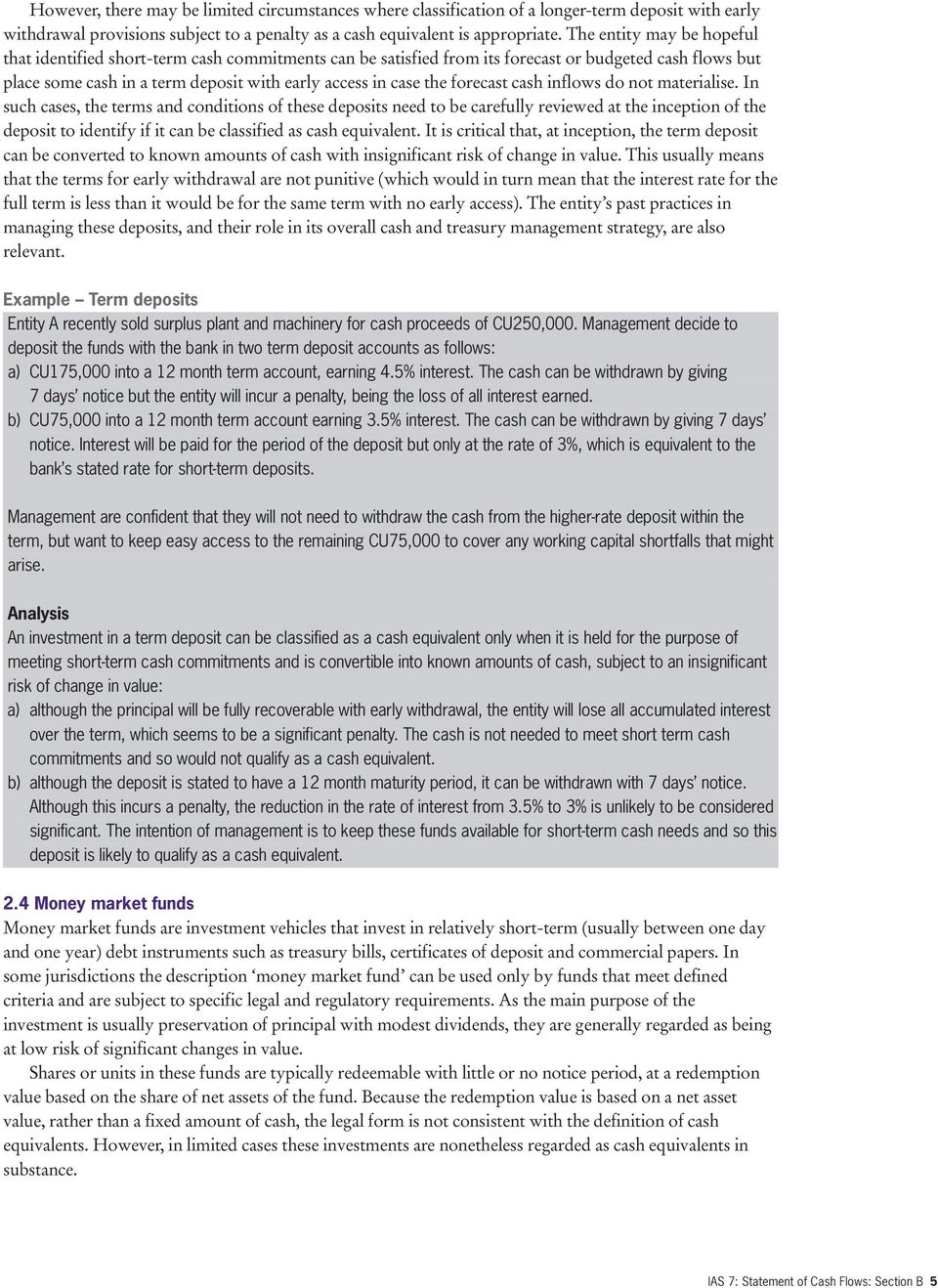
11 However, there may be limited circumstances where classification of a longer-term deposit with early withdrawal provisions subject to a penalty as a cash equivalent is appropriate. The entity may be hopeful that identified short-term cash commitments can be satisfied from its forecast or budgeted cash flows but place some cash in a term deposit with early access in case the forecast cash inflows do not materialise. In such cases, the terms and conditions of these deposits need to be carefully reviewed at the inception of the deposit to identify if it can be classified as cash equivalent. It is critical that, at inception, the term deposit can be converted to known amounts of cash with insignificant risk of change in value. This usually means that the terms for early withdrawal are not punitive (which would in turn mean that the interest rate for the full term is less than it would be for the same term with no early access). The entity s past practices in managing these deposits, and their role in its overall cash and treasury management strategy, are also relevant. Example Term deposits Entity A recently sold surplus plant and machinery for cash proceeds of CU250,000. Management decide to deposit the funds with the bank in two term deposit accounts as follows: a) CU175,000 into a 12 month term account, earning 4.5% interest. The cash can be withdrawn by giving 7 days notice but the entity will incur a penalty, being the loss of all interest earned. b) CU75,000 into a 12 month term account earning 3.5% interest. The cash can be withdrawn by giving 7 days notice. Interest will be paid for the period of the deposit but only at the rate of 3%, which is equivalent to the bank s stated rate for short-term deposits. Management are confident that they will not need to withdraw the cash from the higher-rate deposit within the term, but want to keep easy access to the remaining CU75,000 to cover any working capital shortfalls that might arise. Analysis An investment in a term deposit can be classified as a cash equivalent only when it is held for the purpose of meeting short-term cash commitments and is convertible into known amounts of cash, subject to an insignificant risk of change in value: a) although the principal will be fully recoverable with early withdrawal, the entity will lose all accumulated interest over the term, which seems to be a significant penalty. The cash is not needed to meet short term cash commitments and so would not qualify as a cash equivalent. b) although the deposit is stated to have a 12 month maturity period, it can be withdrawn with 7 days notice. Although this incurs a penalty, the reduction in the rate of interest from 3.5% to 3% is unlikely to be considered significant. The intention of management is to keep these funds available for short-term cash needs and so this deposit is likely to qualify as a cash equivalent. 2.4 Money market funds Money market funds are investment vehicles that invest in relatively short-term (usually between one day and one year) debt instruments such as treasury bills, certificates of deposit and commercial papers. In some jurisdictions the description money market fund can be used only by funds that meet defined criteria and are subject to specific legal and regulatory requirements. As the main purpose of the investment is usually preservation of principal with modest dividends, they are generally regarded as being at low risk of significant changes in value. Shares or units in these funds are typically redeemable with little or no notice period, at a redemption value based on the share of net assets of the fund. Because the redemption value is based on a net asset value, rather than a fixed amount of cash, the legal form is not consistent with the definition of cash equivalents. However, in limited cases these investments are nonetheless regarded as cash equivalents in substance. IAS 7: Statement of Cash Flows: Section B 5
12 In our view it is acceptable to classify an investment in a money market fund as a cash equivalent only if there is sufficient evidence that, in substance, the definition of cash equivalents is satisfied. In particular, it is not sufficient that the investment can readily be realised in cash. The investment must be readily convertible (normally through redemption with the fund) to an amount of cash that is subject to an insignificant risk of change. The assessment of risk must be done at the time of the initial investment. This assessment would include a review of the fund s investment rules, the nature of its underlying investments and the stability of the redemption value. Again, the entity s past practices in managing these investments, and their role in its overall cash and treasury management strategy, are also relevant. Example Money market funds Entity A holds units in two money market funds that are redeemable on demand at net asset value: a) high-returns fund the fund aims to achieve superior returns and may invest in longer-term (up to 2 years) sovereign and corporate bonds to do so, including some bonds with higher credit risk. During the year, entity A invested CU80,000 in this fund and recorded a related fair value gain of CU9,300 in profit or loss. Two weeks after the reporting date, entity A converted the investment into CU87,900 cash (ie CU1,400 less than the yearend value) b) short-term fund the fund holds a low risk portfolio of short-maturity, low credit risk investments designed to achieve a stable level of income while maintaining the value of each unit at close to nominal value. The entity uses this fund to park surplus cash and invested CU100,000 in this fund at the beginning of the year. The entity will convert this into cash whenever needed to satisfy any working capital shortfalls or other cash needs. Analysis An investment in a money market fund can be classified as an in substance cash equivalent only when it is held for the purpose of meeting short-term cash commitments, and is convertible into an amount of cash that is subject to an insignificant risk of change. a) high-returns fund although the investment in this fund is readily convertible into cash, the high risk portfolio and observed exposure to changes in value determine that it is not a cash equivalent. b) short-term fund by comparison, this fund seems to be subject to an insignificant risk of change in value. The investment is readily convertible into cash and is held to meet short-term cash commitments. It is therefore likely to be classified as a cash equivalent. 2.5 Restricted cash Sometimes, cash deposits are described as restricted because they are set aside for a specific purpose and are either notionally or legally ring-fenced. The nature of the restriction needs to be considered to identify whether the deposit can be classified as cash or cash equivalent. For example, a bank account may be subject to a floating charge to provide general security for a loan or loans. Such a charge is unlikely to restrict the account from being classified as cash or cash equivalent (assuming the other criteria are met), because a floating charge does not restrict the use of the account for normal trading purposes. This may be compared to a deposit account subject to a fixed charge which is held as security for a specific loan. The charge may prevent the deposit account from being used for any purpose other than providing the lender with a right of set-off to secure repayment of the loan if the borrower defaults on the scheduled payments. The restriction in this case would prevent classification as a cash equivalent because the deposit cannot be converted into cash on demand and is not available to meet short-term cash needs. Another situation is a client money account used by an entity such as an insurance broker or travel agent. Before considering IAS 7 classification, an assessment should be made as to whether the client money account should be recognised as an asset by the entity in its statement of financial position. If the entity does not recognise the client money account, it does not appear in the Statement of Cash Flows. 6 IAS 7: Statement of Cash Flows: Section B
13 In a group situation, there may be restrictions on the transfer of monies from a foreign subsidiary to the parent because of exchange control restrictions. This restriction would not prevent classification as cash or cash equivalent in the consolidated financial statements, provided it meets the definition as such in the subsidiary. Where a restriction applies but does not prevent classification as cash or a cash equivalent, the nature of the restriction needs to be disclosed (IAS 7.48). If the restriction prevents classification as a cash equivalent, this may need to be shown as a separate item in the reconciliation of cash and cash equivalent balances with the appropriate line items in the statement of financial position (see Reconciling cash and cash equivalent balances below for further details). Example Restricted cash: designated account Entity A is a property company. During the year it has secured CU5m of finance, which is ring-fenced for use only for a specific development. The funds are held in a designated bank deposit account to be used only for the purposes of the specific development project, which is expected to take 3 years to complete. Withdrawals from the account can only be made with the approval of the lender when specified milestones are met. At the year end, CU1m of the fund has been used on the development and CU4m remains in the designated account. Analysis In this situation, the money has been obtained in order to support long-term cash needs, being the completion of the development over the three-year period. Although the designated account may not have a specified term, withdrawals can only be made to pay for actual expenditure when certain conditions are met on the specified project, which is expected to occur over the three-year lifespan of the project. Consequently, the account is not available on demand and is not available to meet short-term cash commitments. Consequently, it will not meet the definition of cash equivalents. The balance in the designated account at the reporting date is likely to be included in the cash at bank line item in the statement of financial position so adequate disclosure on the amount of and the reasons for the restrictions should be given in a note. Example Restricted cash: government restrictions Entity A has a wholly owned subsidiary Entity B, which holds bank accounts with domestic banks. Entity B can use the money freely within its local jurisdiction and classifies the amounts as cash and cash equivalents in accordance with IAS 7, but government restrictions prevent it from remitting cash abroad to Entity A or to any fellow subsidiary outside the local jurisdiction. Analysis Entity B has appropriately classified the amounts as cash and cash equivalents in its individual financial statements and it seems likely that this is still an appropriate classification in the consolidated financial statements. However, the amounts are only available to meet the short-term cash commitments of the subsidiary, Entity B. The restriction preventing remittance to the rest of the group should be disclosed in sufficient detail to enable users to understand the impact on the group s financial position and liquidity. IAS 7: Statement of Cash Flows: Section B 7
14 2.6 Reconciling cash and cash equivalent balances IAS 7 requires that the components making up the total opening and closing balances of cash and cash equivalents in the Statement of Cash Flows should be disclosed. These totals should be reconciled to the appropriate line items in the Statement of Financial Position (IAS 7.45). For example, some term deposits or restricted cash deposits may be included in the line item cash at bank in the Statement of Financial Position, but are excluded from the balance of cash and cash equivalents (see Defining cash and cash equivalents section above). Where the reporting entity holds foreign currency cash and cash equivalent balances, these are monetary items that will be retranslated at the reporting date in accordance with IAS 21 The Effects of Changes in Foreign Exchange Rates (IAS 21). Any exchange differences arising on retranslation will increase or decrease these balances but do not give rise to cash flows. The effect of these exchange differences is presented at the foot of the Statement of Cash Flows in order to reconcile cash and cash equivalents at the beginning and end of the period (IAS 7.28). The treatment of foreign exchange differences in the Statement of Cash Flows is discussed later in Section F: Foreign currency cash flows. 8 IAS 7: Statement of Cash Flows: Section B
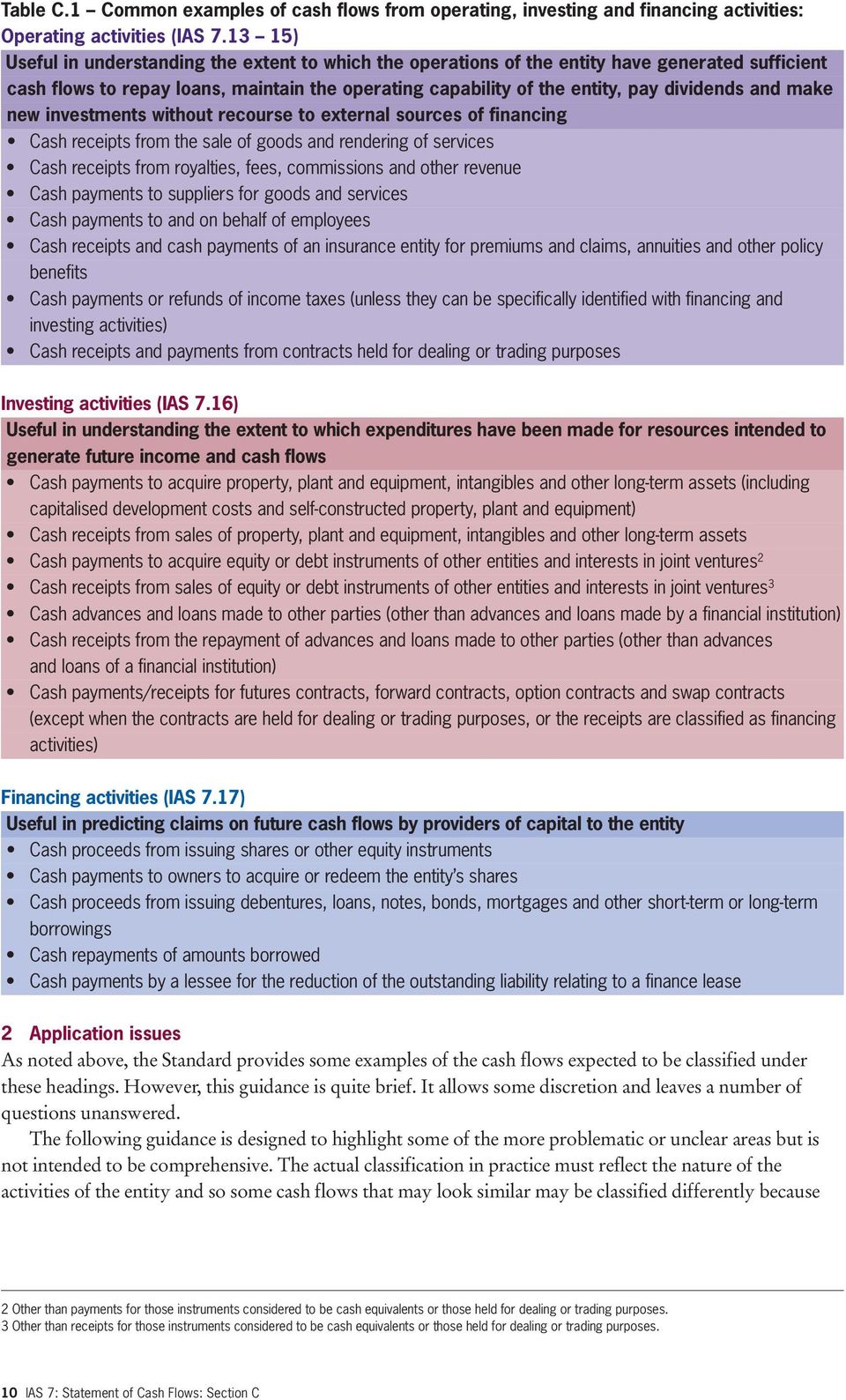
15 C. Classifying cash flows as operating, investing or financing activities Section C: Classifying cash flows as operating, investing or financing activities Outlines the requirements for classifying cash flows as operating, investing or financing activities Provides common examples of cash flows from operating, investing and financing activities Addresses various application issues that arise when classifying cash flows as operating, investing or financing activities 1 Guidance overview 1.1 Classifying cash flows as operating, investing or financing activities IAS 7 requires entities to classify and report cash flows according to the activity which gave rise to them. There are three activity classes: operating activities are the principal revenue-producing activities of the entity and other activities that are not investing or financing activities investing activities are the acquisition and disposal of long-term assets and other investments not included in cash equivalents financing activities are activities that result in changes in the size and composition of the contributed equity and borrowings of the entity (IAS 7.6). This classification by activities is designed to provide useful information about the relative importance of these activities and the inter-relationships between them to help users of the financial statements to assess the liquidity and financial adaptability of the entity (IAS 7.11). The wording of the definitions means that operating activities is the default category for all cash flows that do not meet the definition of either investing or financing. The Standard provides the following examples of cash flows expected to be classified under the operating, investing and financing headings (note, each entity must consider its own facts and circumstances in appropriately classifying cash flows due to the nature of its business): IAS 7: Statement of Cash Flows: Section C 9
16 Table C.1 Common examples of cash flows from operating, investing and financing activities: Operating activities (IAS ) Useful in understanding the extent to which the operations of the entity have generated sufficient cash flows to repay loans, maintain the operating capability of the entity, pay dividends and make new investments without recourse to external sources of financing Cash receipts from the sale of goods and rendering of services Cash receipts from royalties, fees, commissions and other revenue Cash payments to suppliers for goods and services Cash payments to and on behalf of employees Cash receipts and cash payments of an insurance entity for premiums and claims, annuities and other policy benefits Cash payments or refunds of income taxes (unless they can be specifically identified with financing and investing activities) Cash receipts and payments from contracts held for dealing or trading purposes Investing activities (IAS 7.16) Useful in understanding the extent to which expenditures have been made for resources intended to generate future income and cash flows Cash payments to acquire property, plant and equipment, intangibles and other long-term assets (including capitalised development costs and self-constructed property, plant and equipment) Cash receipts from sales of property, plant and equipment, intangibles and other long-term assets Cash payments to acquire equity or debt instruments of other entities and interests in joint ventures 2 Cash receipts from sales of equity or debt instruments of other entities and interests in joint ventures 3 Cash advances and loans made to other parties (other than advances and loans made by a financial institution) Cash receipts from the repayment of advances and loans made to other parties (other than advances and loans of a financial institution) Cash payments/receipts for futures contracts, forward contracts, option contracts and swap contracts (except when the contracts are held for dealing or trading purposes, or the receipts are classified as financing activities) Financing activities (IAS 7.17) Useful in predicting claims on future cash flows by providers of capital to the entity Cash proceeds from issuing shares or other equity instruments Cash payments to owners to acquire or redeem the entity s shares Cash proceeds from issuing debentures, loans, notes, bonds, mortgages and other short-term or long-term borrowings Cash repayments of amounts borrowed Cash payments by a lessee for the reduction of the outstanding liability relating to a finance lease 2 Application issues As noted above, the Standard provides some examples of the cash flows expected to be classified under these headings. However, this guidance is quite brief. It allows some discretion and leaves a number of questions unanswered. The following guidance is designed to highlight some of the more problematic or unclear areas but is not intended to be comprehensive. The actual classification in practice must reflect the nature of the activities of the entity and so some cash flows that may look similar may be classified differently because 2 Other than payments for those instruments considered to be cash equivalents or those held for dealing or trading purposes. 3 Other than receipts for those instruments considered to be cash equivalents or those held for dealing or trading purposes. 10 IAS 7: Statement of Cash Flows: Section C
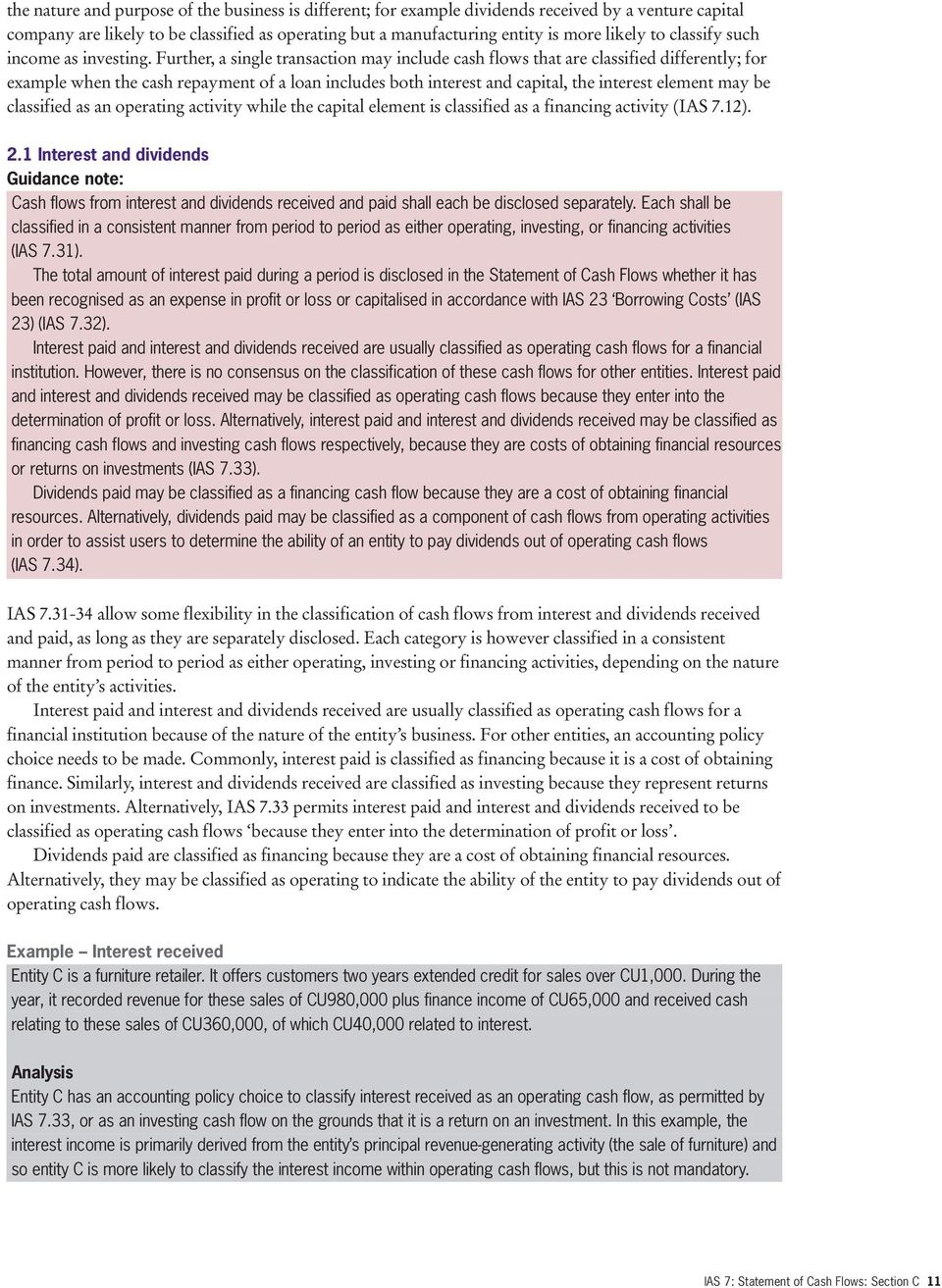
17 the nature and purpose of the business is different; for example dividends received by a venture capital company are likely to be classified as operating but a manufacturing entity is more likely to classify such income as investing. Further, a single transaction may include cash flows that are classified differently; for example when the cash repayment of a loan includes both interest and capital, the interest element may be classified as an operating activity while the capital element is classified as a financing activity (IAS 7.12). 2.1 Interest and dividends Guidance note: Cash flows from interest and dividends received and paid shall each be disclosed separately. Each shall be classified in a consistent manner from period to period as either operating, investing, or financing activities (IAS 7.31). The total amount of interest paid during a period is disclosed in the Statement of Cash Flows whether it has been recognised as an expense in profit or loss or capitalised in accordance with IAS 23 Borrowing Costs (IAS 23) (IAS 7.32). Interest paid and interest and dividends received are usually classified as operating cash flows for a financial institution. However, there is no consensus on the classification of these cash flows for other entities. Interest paid and interest and dividends received may be classified as operating cash flows because they enter into the determination of profit or loss. Alternatively, interest paid and interest and dividends received may be classified as financing cash flows and investing cash flows respectively, because they are costs of obtaining financial resources or returns on investments (IAS 7.33). Dividends paid may be classified as a financing cash flow because they are a cost of obtaining financial resources. Alternatively, dividends paid may be classified as a component of cash flows from operating activities in order to assist users to determine the ability of an entity to pay dividends out of operating cash flows (IAS 7.34). IAS allow some flexibility in the classification of cash flows from interest and dividends received and paid, as long as they are separately disclosed. Each category is however classified in a consistent manner from period to period as either operating, investing or financing activities, depending on the nature of the entity s activities. Interest paid and interest and dividends received are usually classified as operating cash flows for a financial institution because of the nature of the entity s business. For other entities, an accounting policy choice needs to be made. Commonly, interest paid is classified as financing because it is a cost of obtaining finance. Similarly, interest and dividends received are classified as investing because they represent returns on investments. Alternatively, IAS 7.33 permits interest paid and interest and dividends received to be classified as operating cash flows because they enter into the determination of profit or loss. Dividends paid are classified as financing because they are a cost of obtaining financial resources. Alternatively, they may be classified as operating to indicate the ability of the entity to pay dividends out of operating cash flows. Example Interest received Entity C is a furniture retailer. It offers customers two years extended credit for sales over CU1,000. During the year, it recorded revenue for these sales of CU980,000 plus finance income of CU65,000 and received cash relating to these sales of CU360,000, of which CU40,000 related to interest. Analysis Entity C has an accounting policy choice to classify interest received as an operating cash flow, as permitted by IAS 7.33, or as an investing cash flow on the grounds that it is a return on an investment. In this example, the interest income is primarily derived from the entity s principal revenue-generating activity (the sale of furniture) and so entity C is more likely to classify the interest income within operating cash flows, but this is not mandatory. IAS 7: Statement of Cash Flows: Section C 11
18 In practice, a single cash flow may include both an interest element and a repayment of capital. In such cases, the two elements may need to be disaggregated if they are classified differently. Even if the two elements are included in the same category, interest paid needs to be disclosed separately (see Section D: Presentation issues for additional discussion). IAS 23 requires some amounts of interest expense to be capitalised into the cost of qualifying assets in certain circumstances. IAS 7.32 and 33 seem to require that interest paid be classified as either an operating or a financing cash flow. This seems inconsistent with IAS 7.16, which might be interpreted to require that capitalised interest paid should be classified as an investing cash flow as it is part of the amount recognised for the related asset in the statement of financial position. IAS 7 does not currently deal explicitly with capitalised interest and so judgement is required to select which category to use. The classification selected should be applied consistently. Example Capitalised interest Entity A constructs a machine (that is a qualifying asset under IAS 23) and pays construction expenses of CU1,000, which includes CU50 of capitalised interest. The entity paid CU120 interest in the year, including the amount capitalised. Entity A normally classifies interest paid as a financing cash flow. Analysis Entity A has an accounting policy choice: recognise CU950 as an investing cash flow and CU120 as financing recognise CU1,000 as an investing cash flow and CU70 as financing. In addition, the total amount of CU120 interest paid is disclosed in a note (see Section D: Presentation issues ). Future developments: At its meeting in September 2011, the IASB tentatively decided that interest paid that is capitalised in accordance with IAS 23 should follow the classification of the underlying asset in which those payments were capitalised (ie the qualifying asset). For example, payments of interest that are capitalised as part of the cost of property, plant and equipment shall be classified as part of an entity s investing activities, and payments of interest capitalised as part of the cost of inventories shall be classified as part of an entity s operating activities. An amendment to IAS 7 was proposed in the Improvements to IFRSs exposure draft, published on 3 May The proposed effective date would be for annual periods beginning on or after 1 January 2014 with earlier application permitted. The comment period ends on 5 September In addition, the IFRIC continues to discuss a range of clarification issues and is considering making some broader changes to clarify IAS 7 s classification principles. 2.2 Short-term loans to related parties An entity may provide a loan or advance to another group entity or other related party, sometimes on a short-term basis, with or without charging interest. The short-term nature of such advances does not automatically result in classification as an operating activity. Unless making cash advances to other entities is part of the normal operating activities of the entity (eg trade receivables or payables), such cash flows would normally be classified as investing. 12 IAS 7: Statement of Cash Flows: Section C

19 2.3 Expenditure on internally generated intangibles Improvements to IFRSs April 2009 amended IAS 7.16 such that only expenditure that results in a recognised asset in the statement of financial position is eligible for classification as investing activities. To illustrate two applications of this requirement: expenditure relating to internally generated intangible assets is recognised in investing cash flows only if the capitalisation criteria in IAS 38 Intangible Assets paragraph 57 are met in the extractive industries, expenditure on exploration or evaluation activities is included as investing only if these costs are capitalised in accordance with IFRS 6 Exploration for and Evaluation of Mineral Resources. Expenditure that is expensed to profit or loss as incurred, such as research costs or training expenses, is recognised in operating cash flow activities. 2.4 Cash flows relating to assets held for rental to others For entities that routinely rent out assets to others in the ordinary course of business, cash flows associated with the rental assets are classified within operating activities (IAS 7.14). This includes cash payments to acquire or manufacture such assets and cash receipts from rents and the subsequent sales of the assets. This explicit requirement was introduced through Improvements to IFRSs May 2008, related to an amendment in IAS 16 Property, Plant and Equipment. This contrasts with the usual investing activity classification of cash payments made to acquire or manufacture property, plant and equipment for own use and cash receipts from the sale of such assets. 2.5 Cash flows relating to a business combination Guidance note: The aggregate cash flows arising from acquisitions and from disposals of subsidiaries or other business units shall be presented separately and classified as investing activities (IAS 7.39). A number of Statement of Cash Flow issues arise in relation to business combinations, including classification of different types of consideration paid. Generally, this is expected to be an investing activity because IAS 7.39 requires that aggregate cash flows arising from obtaining or losing control of a subsidiary are presented separately within investing activities. However, in more complex scenarios the guidance in IAS 7 is not always clear. This and other issues related to the acquisition and disposal of subsidiaries are considered in Section E: Group cash flows. 2.6 Tax cash flows Guidance note: Cash flows arising from taxes on income shall be separately disclosed and shall be classified as cash flows from operating activities unless they can be specifically identified with financing and investing activities (IAS 7.35). It is usually possible to identify tax expense/income with the related transaction or event in order to recognise the tax amount in profit or loss, other comprehensive income or equity in accordance with IAS 12 Income Taxes paragraphs 57-68C. Similarly, when it is practicable to identify a tax cash flow with an individual transaction that is classified as investing or financing, the tax cash flow is also classified as investing or financing in accordance with the underlying transaction. However, IAS 7 notes that it is often impracticable to identify tax cash flows with individual transactions. Also, tax cash flows often arise in a different period from the cash flows of the underlying transactions. Accordingly, taxes paid should generally be classified as operating cash flows (IAS ). Total cash flows arising from taxes should be separately disclosed, either on the face of the statement or in the notes. IAS 7: Statement of Cash Flows: Section C 13

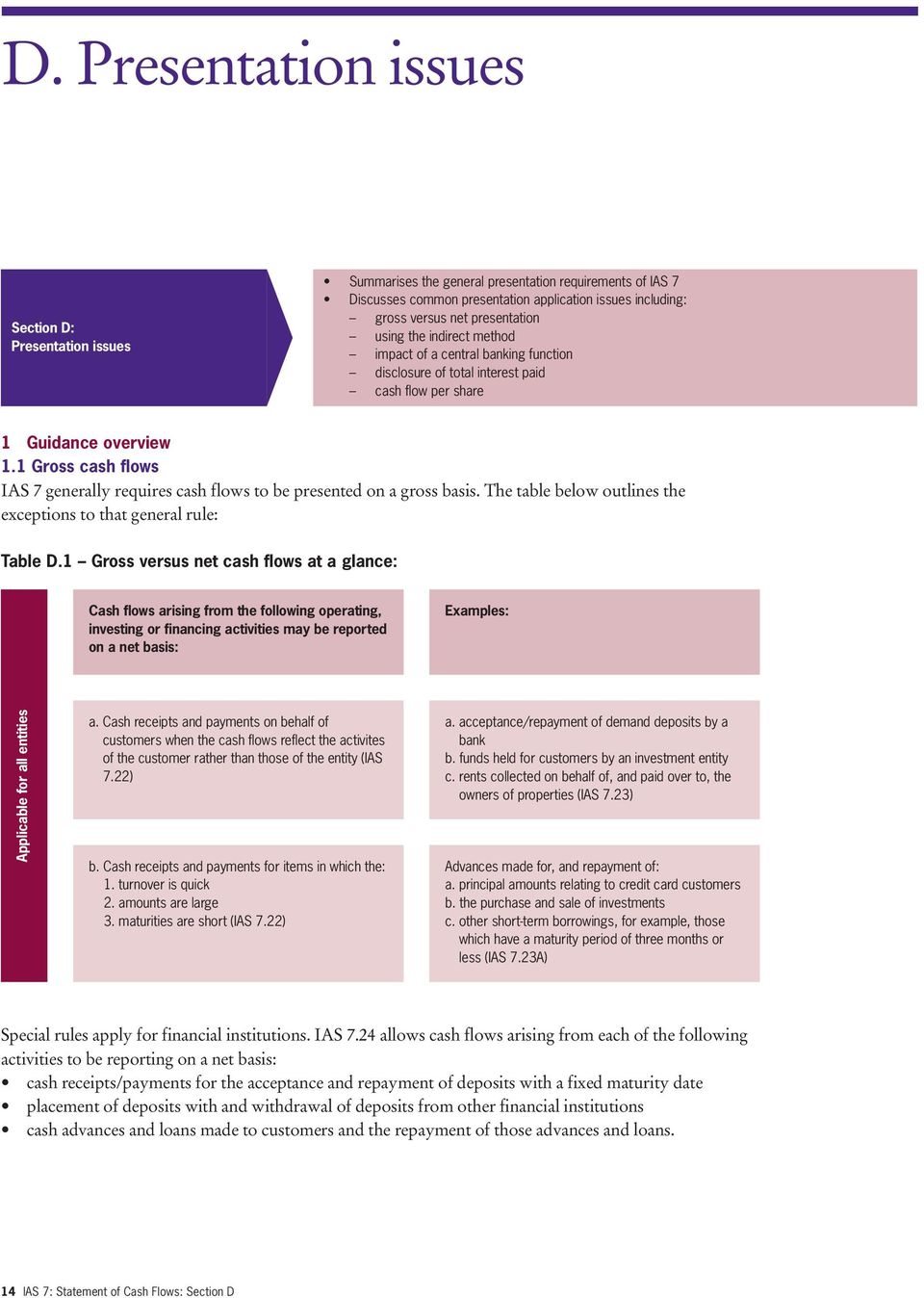
20 D. Presentation issues Section D: Presentation issues Summarises the general presentation requirements of IAS 7 Discusses common presentation application issues including: gross versus net presentation using the indirect method impact of a central banking function disclosure of total interest paid cash flow per share 1 Guidance overview 1.1 Gross cash flows IAS 7 generally requires cash flows to be presented on a gross basis. The table below outlines the exceptions to that general rule: Table D.1 Gross versus net cash flows at a glance: Cash flows arising from the following operating, investing or financing activities may be reported on a net basis: Examples: Applicable for all entities a. Cash receipts and payments on behalf of customers when the cash flows reflect the activites of the customer rather than those of the entity (IAS 7.22) b. Cash receipts and payments for items in which the: 1. turnover is quick 2. amounts are large 3. maturities are short (IAS 7.22) a. acceptance/repayment of demand deposits by a bank b. funds held for customers by an investment entity c. rents collected on behalf of, and paid over to, the owners of properties (IAS 7.23) Advances made for, and repayment of: a. principal amounts relating to credit card customers b. the purchase and sale of investments c. other short-term borrowings, for example, those which have a maturity period of three months or less (IAS 7.23A) Special rules apply for financial institutions. IAS 7.24 allows cash flows arising from each of the following activities to be reporting on a net basis: cash receipts/payments for the acceptance and repayment of deposits with a fixed maturity date placement of deposits with and withdrawal of deposits from other financial institutions cash advances and loans made to customers and the repayment of those advances and loans. 14 IAS 7: Statement of Cash Flows: Section D
21 1.2 Selecting the direct or indirect methods Cash flows from operating activities can be presented using either: the direct method (IAS 7.18(a)) each major class of gross cash receipts and gross cash payments is disclosed separately, such as cash receipts from the sale of goods or services; cash payments to suppliers and cash payments to and on behalf of employees the indirect method (IAS 7.18(b)) profit or loss is adjusted for items relating to investing and financing activities and for the effects of non-cash transactions, such as changes in inventories and operating receivables and payables; depreciation and amortisation; movements in provisions; deferred taxes and unrealised foreign currency gains and losses Direct method Under the direct method, information about major classes of gross cash receipts and gross cash payments may be obtained either: from the accounting records or by adjusting sales, cost of sales and other items in the statement of comprehensive income for: changes during the period in inventories and operating receivables and payables other non-cash items and other items for which the cash effects are investing and financing cash flows (IAS 7.19) Indirect method Under the indirect method, the net cash flow from operating activities is determined by adjusting profit or loss for the effects of: changes during the period in inventories and operating receivables and payables non-cash items such as depreciation, provisions, deferred taxes, unrealised foreign currency gains and losses, and undistributed profits of associates all other items for which the cash effects are investing or financing cash flows (IAS 7.20). The examples below show how the Statement of Cash Flows may differ by applying the direct or indirect method to present cash flows from operating activities. Table D.2 Direct versus indirect methods of presentation at a glance: Direct method (IAS 7.18(a)) Indirect method (IAS 7.18(b)) Cash flows from operating activities Cash receipts from customers Cash paid to suppliers and employees Cash generated from operations Interest received Income taxes paid Net cash from operating activities XX Cash flows from operating activities Profit before taxation Adjustments for: Depreciation Foreign exchange loss Investment income Interest expense Increase in trade and other receivables Decrease in inventories Decrease in trade payables Cash generated from operations Interest paid Income taxes paid Net cash from operating activities XX XX Cash flows from investing activities Purchase of property, plant and equipment Proceeds from sale of equipment Interest received Dividends received Net cash used in investing activities XX Cash flows from investing activities Purchase of property, plant and equipment Proceeds from sale of equipment Interest received Dividends received Net cash used in investing activities XX IAS 7: Statement of Cash Flows: Section D 15
22 Direct method (IAS 7.18(a)) continued Indirect method (IAS 7.18(b)) continued Cash Direct flows method from financing (IAS 7.18(a)) activities Indirect method (IAS 7.18(b)) Cash flows from financing activities Proceeds from issue of share capital Proceeds from issue of share capital Cash Proceeds flows from from long-term operating borrowings activities Proceeds from long-term borrowings Payment Cash receipts of finance from lease liabilities customers Payment of finance lease liabilities Dividends Cash paid to suppliers and employees Dividends paid Net cash used in financing activities Cash generated from operations XX Net cash used in financing activities Net increase Interest in received cash and cash equivalents XX Net increase in cash and cash equivalents Income taxes paid Cash and cash equivalents at beginning of period XX Cash and cash equivalents at beginning of period XX XX XX Cash and cash equivalents at end of period XX Cash and cash equivalents at end of period XX 1.3 Non-cash transactions IAS 7.43 requires that investing and financing transactions that do not involve an inflow or outflow of cash or cash equivalents are excluded from the Statement of Cash Flows. IAS 7.44 provides examples of noncash transactions: the acquisition of assets either by assuming directly related liabilities or by means of a finance lease the acquisition of an entity by means of an equity issue the conversion of debt to equity 2 Application issues There are a number of presentation issues that have created differences in the practical application of IAS 7. The following guidance highlights the more common presentation issues and provides some reminders of how to address them. In some areas, an entity can choose the most appropriate method of presentation, which should then be applied consistently each period. 2.1 Gross or net cash flows? Major classes of investing and financing cash receipts and payments should be presented gross on the face of the Statement of Cash Flows (IAS 7.21). Similarly, when using the direct method, major classes of operating cash receipts and payments are also presented gross (IAS 7.18). There are limited exceptions to this gross presentation where inflows and outflows can be offset and presented net (IAS 7.22). For nonfinancial institutions, cash receipts and payments made on behalf of customers, where these reflect the activities of the customer, can be presented net. For example, where an entity is acting as agent, cash flows should only reflect the commission received by the agent. There may also be some limited circumstances where the turnover of transactions is quick, the amounts are large and the maturities are short. For example, an entity may have a portfolio of investments that it actively manages with frequent sales and purchases. For financial institutions, there are additional exceptions to the gross presentation requirements, allowing many transactions with customers such as making loans and collecting repayments, to be presented net (IAS 7.24). Example Net cash flows Entity A is a travel agent that provides travel services to its customers. Customers pay the entity and entity A then remits the cash to the travel service providers, after deducting the related agency commissions. The suppliers are responsible for providing services direct to customers and for settling any claims from customers. Entity A presents as revenue the net commissions earned in accordance with IAS 18 Revenue. 16 IAS 7: Statement of Cash Flows: Section D
23 Analysis If the direct method of presenting operating cash flows is used, entity A will present cash receipts from customers and cash payments to suppliers on a net basis. This reflects the substance of the transactions with customers and suppliers, consistently with the statement of comprehensive income presentation of net revenue. If the indirect method of presenting operating cash flows is used, this net presentation is automatically reflected. 2.2 Starting point for the indirect method As outlined in the requirements above, an entity may present its cash flows from operating activities using either the direct or indirect methods. Using the indirect method, an entity determines its cash flows from operating activities by adjusting profit or loss for various items (IAS 7.18(b)). This raises the question as to which profit or loss figure should be used. The illustrative example in Appendix A to IAS 7 starts with profit before tax and so may be considered the preferred treatment but others are acceptable. Alternatives commonly seen in practice are: start with operating profit (this term is not defined in IFRS and so management judgement is needed to identify an appropriate sub-total for this item) start with the final profit or loss figure at the foot of the income statement (or the sub-total used immediately before the section presenting other comprehensive income if a single statement format is used). IFRS 5 Non-current Assets Held for Sale and Discontinued Operations (IFRS 5) requires the results of any discontinued operation to be presented separately from those of continuing operations on the face of the statement of comprehensive income. Consequently, the profit before tax figure relates only to continuing operations and so will need to be adjusted for relevant operating cash flows relating to the discontinued operation if profit before tax is used as the starting point in the Statement of Cash Flows. If the entity chooses to use the bottom line profit or loss for the period amount, then this will include both continuing and discontinued operations and so no adjustment is needed. In either case, the taxation paid figure should include the total from both continuing and discontinued operations. 2.3 Presentation of adjustments to profit or loss using the indirect method IAS 7 is not explicit as to whether the adjustments to profit or loss should be presented on the face of the Statement of Cash Flows or in the notes. The Illustrative Example in Appendix A to IAS 7 shows them in the statement itself and is a widely-used presentation. Presentation in the notes is also used but placement varies in practice (either among the other notes to the financial statements or immediately following the Statement of Cash Flows). 2.4 Non-cash transactions Such transactions require specific disclosure to give the user of the financial statements relevant information about the transaction. For example, when equipment is acquired under a finance lease, it is necessary to eliminate this item from the total amount of tangible asset additions to identify the appropriate investing cash outflow. The non-cash transaction note can be used to reconcile the tangible asset additions figure, distinguishing cash additions from leased additions. Similarly, the creation of the finance lease liability does not involve any cash inflow so again the non-cash transaction note can be used to reconcile the movement in the liability. Any payments of principal are reported as financing cash outflows (IAS 7.17(e)), with any interest element reported as financing or operating, depending on the entity s accounting policy. IAS 7: Statement of Cash Flows: Section D 17
24 Example Non-cash transactions Entity B is a manufacturing company. It obtains a new machine to use within its manufacturing plant under a 5-year finance lease agreement. Entity B recognises the machine within property, plant and equipment at an amount of CU400,000 and recognises a finance lease liability for CU400,000. By the end of the reporting period, B has paid scheduled repayments of CU35,000, of which CU2,900 was recognised as a finance cost in profit or loss. Entity B has a policy of recognising interest paid within financing activities. Analysis The addition to property, plant and equipment of CU400,000 will be shown as a non-cash transaction in the notes to the financial statements (IAS 7.43) because there is no immediate cash flow involved at the inception of the lease. The creation of the CU400,000 lease liability is not shown as a financing inflow but is instead disclosed in the non-cash transactions note. The CU2,900 interest element of the lease rentals is included in the total of interest paid within financing activities in accordance with the entity s accounting policy and the CU32,100 (CU35,000 CU2,900) capital element of the lease rentals paid will be classified as a financing outflow in accordance with IAS 7.17(e). 2.5 Central banking function In some cases, the reporting entity may have no cash in its own name. For example, the cash operations of a subsidiary may be administered by the parent company which effectively acts as a bank. All suppliers and employees are paid by the parent company and receipts from customers are received into the parent company s bank account. As the subsidiary has no direct cash transactions, a question arises as to whether a Statement of Cash Flows is required. IAS 7.43 requires an entity to disclose its non-cash investing and financing transactions, suggesting that the subsidiary s transactions that are channelled through the parent should be disclosed. This does not, however, explicitly require disclosure of non-cash transactions relating to operating activities. On this basis, some may argue that there is no need to provide any such disclosure for a subsidiary that has no bank account. In our view, however, that approach is hard to reconcile with IAS 7 s overall objectives. The fact that they channel these cash flows through another entity for administrative purposes should not detract from the need to present relevant information to users of the financial statements. In such situations, the subsidiary is effectively using the parent entity as its bank and the intra-group account is, in substance, the subsidiary s bank account. In our view, the cash flow information described above is best presented as a primary Statement of Cash Flows, clearly annotated to confirm that all cash flows are directed through another entity and recognising a zero balance in cash and cash equivalents at the beginning and end of the reporting period. The net impact of these centrally managed cash flows will be reflected in the intercompany balances between the parent and subsidiary. The net movement should be shown as an investing or financing activity as appropriate. This approach is consistent with the requirements in IAS 7 that all entities should prepare a Statement of Cash Flows that forms an integral part of the financial statements. 18 IAS 7: Statement of Cash Flows: Section D
25 2.6 Disclosure of total interest paid IAS 7.31 requires that cash flows arising from interest and dividends received and paid be classified separately under the activity appropriate to their nature. In addition, IAS 7.32 requires that the total amount of interest paid during a period be disclosed in the Statement of Cash Flows. The amount included in this total includes all interest paid in the period, irrespective of whether it has been recognised as an expense in profit or loss or capitalised in accordance with IAS 23. If all interest paid falls to be classified under a single activity, our preferred view is to show the total under the appropriate heading on the face of the Statement of Cash Flows but presentation in a note to the financial statements is also acceptable. Some entities disclose this information immediately after the Statement of Cash Flows. Example Capitalised interest As in a previous example, entity A constructs a machine (that is a qualifying asset under IAS 23) and pays construction expenses of CU1,000, which includes CU50 of capitalised interest. The entity paid CU120 interest in the year, including the amount capitalised. Analysis Entity A has an accounting policy choice relating to the classification of capitalised interest: recognise CU950 as an investing cash flow and CU120 as financing. In this case, the inclusion of a separate line item interest paid CU120 in financing activities is sufficient to satisfy the IAS 7.32 disclosure requirement recognise CU1,000 as an investing cash flow and CU70 as financing. If this option is selected, entity A would also need to disclose the total amount of CU120 interest paid, either at the foot of the Statement of Cash Flows or in a note to the financial statements. Note See 2.1 Interest and dividends in Section C. Classifying cash flows as operating, investing or financing activities for future developments related to the proposed amendment to IAS 7 on this topic. 2.7 Cash flow per share Some entities may wish to disclose a cash flow per share amount. This is not specifically addressed in IFRS and so judgement is needed to determine the appropriate accounting policy. Relevant guidance may be found in IAS 33 Earnings Per Share (IAS 33), which envisages that an entity may choose to disclose an amount per share that is based on a different amount than the earnings figure required by IAS 33. In such cases, IAS requires specific disclosure, including details of how the numerator is calculated, together with a reconciliation to a related line item in the statement of comprehensive income. Although some entities wishing to disclose cash flow per share may not be included within the scope of IAS 33, the guidance for developing accounting policies given in IAS would require that it be considered. IAS 7: Statement of Cash Flows: Section D 19
26 E. Group cash flows Section E: Group cash flows Provides an overview of the cash flow requirements related to: business combinations accounting for groups Addresses common application issues related to both 1 Guidance overview The table below summarizes the IAS 7 guidance applicable to changes in ownership interests in subsidiaries and other businesses: Table E.1 IAS 7 group requirements at a glance: IAS 7 reference (IAS 7.39) (IAS 7.40) (IAS 7.41) (IAS 7.42) (IAS 7.42A) (IAS 7.42B) Requirements Aggregate cash flows arising from obtaining or losing control of subsidiaries or other businesses shall be presented separately and classified as investing activities An entity shall disclose, in aggregate, (when both obtaining and losing control during the period): total consideration paid or received portion of the consideration consisting of cash and cash equivalents amount of cash and cash equivalents in the subsidiaries or other businesses over which control is obtained or lost and amount of the assets and liabilities other than cash or cash equivalents in the subsidiaries or other businesses over which control is obtained or lost, by each major category An entity shall separately present the cash flow effects of obtaining or losing control of subsidiaries or other businesses as single line items, together with the separate disclosures of the amounts of assets and liabilities acquired or disposed of. This presentation helps distinguish these cash flows from others in the Statement of Cash Flows Cash flow effects of losing control are not deducted from those of obtaining control Aggregate amount of cash paid or received as consideration for obtaining or losing control of subsidiaries or other businesses is reported net of cash and cash equivalents acquired or disposed of as part of such transactions, events or changes in circumstances Cash flows arising from changes in ownership interests in a subsidiary that do not result in a loss of control shall be classified as cash flows from financing activities Changes in ownership interests in a subsidiary that do not result in a loss of control, such as the subsequent purchase or sale by a parent of a subsidiary s equity instruments, are accounted for as equity transactions. Accordingly, the resulting cash flows are classified in the same way as other transactions with owners. 20 IAS 7: Statement of Cash Flows: Section E
27 2 Application issues 2.1 Cash flows relating to business combinations A number of cash flows can arise relating to the acquisition of a business by an entity. Generally, these are expected to be recognised as investing activities as noted in the table above because IAS 7.39 requires that aggregate cash flows arising from obtaining or losing control of a subsidiary are presented separately within investing activities. However, other requirements in IAS 7 create apparent contradictions that have led to inconsistencies in practice Deferred consideration Normally, cash consideration paid at the time of a business combination will be classified as an investing activity (IAS 7.39). The acquiring entity will record the fair value of the deferred consideration as a liability at the acquisition date in accordance with paragraph 37 of IFRS 3 Business Combinations (IFRS 3). This liability will increase as the discount reflecting the time value of money unwinds and is reflected as a finance charge in profit or loss. When the liability is settled at a later date, the payment will reflect both the amount initially recognised as consideration plus the interest element (ie the unwinding of the discount). IAS 7 does not deal directly with how this payment should be classified and so in practice the following alternatives may be observed: Alternative one: classify the entire payment as an investing cash flow on the grounds that it is part of the aggregate cash flows arising from obtaining control of the subsidiary (IAS 7.39) Alternative two: classify the entire payment as a financing cash flow on the grounds that the payment of deferred items represent a reduction of a liability; this is consistent with the required treatment of a payment made by a lessee to reduce the outstanding liability relating to a finance lease (IAS 7.17(e)) Alternative three: disaggregate the payment into (a.) the amount initially recognised as consideration (and treat as investing or financing as above) and (b.) the interest element resulting from the unwinding of the discount, which should be treated as a financing or operating cash flow according to the entity s policy choice (see Interest and dividends in Section C: Classifying cash flows as operating, investing or financing activities ). The disaggregation approach is consistent with IAS 7.12, which notes that a single payment may include cash flows that are classified differently and gives the repayment of a loan as an example. Our preferred view is to disaggregate the payment into the consideration and interest components in accordance with the third approach described above. Future developments: The IFRS Interpretations Committee (IFRIC) has debated the treatment of both deferred and contingent (see below) consideration in a business combination at its meetings in September 2011, November 2011 and March No firm decisions were made at these meetings but the supporting Agenda Papers suggest that our preferred views are currently better supported than the alternatives. However, these discussions are not final and so cannot be considered as interpretive guidance from the IFRIC. Consequently, judgement is required to select an accounting policy until such time as IAS 7 is amended to address this lack of clarity. IAS 7: Statement of Cash Flows: Section E 21
28 2.1.2 Contingent consideration Similar decisions need to be made for contingent consideration as for deferred consideration (see above) but with an added complication. As with deferred consideration, the amount initially recognised as a liability is the fair value of the contingent consideration (IFRS 3.39). Changes to this fair value that relate to conditions and events after the acquisition date are recognised in profit or loss and do not affect the consideration transferred in exchange for the acquiree (and, consequently, do not affect goodwill (IFRS 3.58)). In addition, the fair value initially recognised will be adjusted to reflect the passage of time and related unwinding of the discount. Again, inconsistency is observed in practice and the subsequent payment of the contingent consideration may be recognised as follows: Alternative one: classify the entire payment as an investing cash flow on the grounds that it is part of the aggregate cash flows arising from obtaining control of the subsidiary (IAS 7.39). Alternative two: classify the entire payment as a financing cash flow on the grounds that the payment of contingent consideration recognised as a liability represents a reduction of that liability; consistent with the required treatment of a payment made by a lessee to reduce the outstanding liability relating to a finance lease (IAS 7.17(e)). Alternative three: disaggregate the payment in accordance with IAS 7.12 into: the principal amount of contingent consideration, including any changes to the amount initially recognised to reflect any changes in the expected outcome of the contingency (classify this principal amount as investing or financing as above) and the interest element resulting from the unwinding of the discount which should be treated as a financing or operating cash flow according to the entity s policy choice. Alternative four: disaggregate the payment in accordance with IAS 7.12 into: the amount initially recognised as consideration (and treat as investing or financing as above) the amount of any excess over the amount initially recognised as consideration that reflects conditions and events after the acquisition date and are recognised in profit or loss. Classify this element of the payment as an operating cash flow on the grounds that it does not result in a recognised asset in the statement of financial position (IAS 7.16) the interest element resulting from the unwinding of the discount, which should be treated as a financing or operating cash flow according to the entity s policy choice (see Interest and dividends in Section C: Classifying cash flows as operating, investing or financing activities ). Although technical arguments can be made to support the fourth approach (disaggregation into three components), this can be challenging to apply in practice, especially if the amount actually paid is lower than the original estimated amount of contingent consideration. Therefore, our preferred view is to disaggregate at least the interest component in accordance with the third approach Cash and cash equivalents acquired Any cash and cash equivalents acquired in a business combination must be netted against the amount of consideration paid and disclosed under investing activities (IAS 7.42). 22 IAS 7: Statement of Cash Flows: Section E
29 2.1.4 Transaction costs There is no specific guidance in IAS 7 regarding transaction costs relating to the acquisition of a subsidiary and some inconsistency is seen in practice. IAS 7.39 states that the aggregate cash flows arising from obtaining or losing control of a subsidiary shall be presented separately and classified as investing. However, Improvements to IFRSs April 2009 amended IAS 7.16 such that only expenditure that results in a recognised asset in the statement of financial position is eligible for classification as investing activities. This seems to contradict IAS 7.39 because these transaction costs are expensed to profit or loss in accordance with IFRS In our view, classification as operating is preferred but classification as investing is considered acceptable. In either case, clear disclosure will be required. Example Acquisition of subsidiary Entity D acquired a subsidiary on 1 October 20X1. Consideration of CU1,000,000 recognised at the date of acquisition consisted of: cash CU450,000 present value of deferred consideration payable in 6 months CU225,000 fair value of contingent consideration CU325,000. The actual amount payable depends on whether certain revenue and profit targets are met over the following year. In addition, entity D paid CU25,000 acquisition costs. The identifiable net assets of the newly acquired subsidiary included cash and cash equivalents of CU140,000. How is this acquisition reflected in the Statement of Cash Flows for the year ended 31 December 20X1? Analysis within investing activities, a cash outflow of CU310,000 is reported, being the cash consideration paid of CU450,000 less the cash and cash equivalents acquired of CU140,000 the deferred and contingent consideration amounts of CU225,000 and CU325,000 are non-cash transactions, as no cash has yet been paid. These amounts are excluded from the Statement of Cash Flows but will be reported as part of the total consideration disclosure required by IAS 7.40 our preferred approach is to include the transaction costs of CU25,000 within operating cash flows Example Acquisition of subsidiary continued During 20X2, Entity D paid the deferred consideration CU225,000, plus interest of CU5,000 paid contingent consideration of CU375,000. This was a higher amount than recognised as consideration because the subsidiary s results exceeded expectations and included interest of CU15,000. How are these payments reflected in the Statement of Cash Flows for the year ended 31 December 20X2? Analysis Entity D has to make an accounting policy choice for the classification of each of these payments. If the disaggregation into three components approach is chosen: the deferred payment of CU225,000 is classified as investing the contingent consideration payment of CU375,000 is broken down into its component parts as follows: CU325,000 initially recognised as consideration is classified as investing CU15,000 interest is classified as below (either operating or financing) the remaining CU35,000 relates to changes in circumstances since acquisition and is classified as operating the total interest payment of CU20,000 (5,000+15,000) is classified as either operating or financing in accordance with the entity s normal policy choice. IAS 7: Statement of Cash Flows: Section E 23
30 2.2 Other group cash flow considerations Changes in non-controlling interests Changes in ownership interests in a subsidiary that do not result in a loss of control are treated as equity transactions in accordance with IAS 27 Consolidated and separate financial statements and the cash flows arising from such changes are included within financing activities in accordance with IAS 7.42A Acquisitions and disposals of subsidiaries When a subsidiary joins or leaves the group, its cash flows should be included in the consolidated Statement of Cash Flows for the same period as the results are reported in the consolidated statement of comprehensive income. As noted previously, an entity presents separately within investing activities the aggregate cash flow arising from obtaining or losing control of a subsidiary (IAS 7.39). This aggregate cash flow includes any cash consideration paid or received and the amount of cash and cash equivalents in the subsidiary over which control is obtained or lost. IAS 7.42 requires the net of these two amounts to be included in investing activities. Recording the cash consideration or proceeds net of any cash and cash equivalent balances transferred means that any property, plant and equipment, intangible assets and working capital (excluding cash and cash equivalents) of the subsidiary at the acquisition or disposal date would need to be eliminated from other cash flow headings so as to avoid double counting because the related amounts are already included within the investing activities figure. For example, when using the indirect method, the adjustments for changes in working capital between the opening and closing consolidated position are adjusted to eliminate the assets and liabilities acquired or disposed of. Any additions to property, plant and equipment and goodwill will not be separately reported within the Statement of Cash Flows. An example using the indirect method is set out below. This example is intended to demonstrate the mechanics of dealing with an acquisition or disposal of a subsidiary during the year in the Statement of Cash Flows. A number of disclosure requirements have not been dealt with here but examples can be seen in the publication Reporting Under IFRS: Example consolidated financial statements published by Grant Thornton International s IFRS Team in September For full details, refer to IAS 7, IFRS 3 and IFRS 5. Example Subsidiary acquired in the year Entity A acquires a subsidiary, entity B, during the year. Summarised information from the consolidated statements of comprehensive income and financial position is provided, together with some supplementary information, to demonstrate how the Statement of Cash Flows under the indirect method is derived. Entity A has chosen to classify interest paid as a financing activity. 20X2 Consolidated statement of comprehensive income (extract) CU Revenue 1,900 Cost of sales 1,100 Gross profit 800 Depreciation (150) Other operating expenses (280) Interest cost (20) Profit before taxation 350 Taxation (75) Profit after taxation IAS 7: Statement of Cash Flows: Section E
31 Consolidated statement of financial position (extract) 20X2 20X1 Assets CU CU Cash and cash equivalents Trade receivables Inventories Property, plant and equipment Goodwill 90 Total assets 1, Liabilities CU CU Trade payables Income tax payable Long term debt Total liabilities Net assets Other information All of the shares of entity B were acquired for CU370 cash. The fair values of assets acquired and liabilities assumed were: Inventories 20 Trade receivables 40 Cash 10 Property, plant and equipment 550 Trade payables (160) Long term debt (180) Goodwill 90 Cash consideration paid 370 CU Analysis This information will be incorporated into the Statement of Cash Flows as follows: Statement of Cash Flows for 20X2 (extract) CU CU Profit before taxation 350 Adjustments for non-cash items Depreciation 150 Decrease in inventories ( ) 45 Decrease in trade receivables ( ) 20 Decrease in trade payables ( ) (120) Interest paid included in financing activities 20 Taxation ( ) (70) Net cash inflow from operating activities 395 Interest paid (20) Net cash outflow from financing activities (20) Cash paid to acquire subsidiary (370-10) (360) Net cash outflow from investing activities (360) Increase in cash and cash equivalents 15 Cash and cash equivalents, beginning of year 25 Cash and cash equivalents, end of year IAS 7: Statement of Cash Flows: Section E 25
32 F. Foreign currency cash flows Section F: Foreign currency cash flows Provides an overview of the requirements related to cash flows from foreign currency transactions Addresses common application issues on this topic 1 Guidance overview Table F.1 IAS 7 foreign currency cash flow requirements at a glance: IAS 7 reference (IAS 7.25) (IAS 7.26) (IAS 7.27) (IAS 7.28) Requirements Cash flows arising from transactions in a foreign currency shall be recorded in an entity s functional currency A foreign subsidiary s cash flows shall be translated at the exchange rates between the functional currency and the foreign currency at the dates of the cash flows Cash flows denominated in a foreign currency are reported in a manner consistent with IAS 21 Unrealised gains and losses arising from changes in foreign currency exchanges rates are not cash flows; However, the effect of exchange rate changes on cash and cash equivalents held or due in a foreign currency is reported in the Statement of Cash Flows in order to reconcile cash and cash equivalents at the beginning and end of the period. An entity presents this amount separately from operating, investing and financing activities and includes the differences, if any, had those cash flows been reported at the end of period exchange rates. There is little guidance within IAS 7 relating to the measurement of items to be included within the Statement of Cash Flows because the measurement of gross cash flows usually requires little judgement or estimation. However, when the indirect method for the presentation of operational cash flows is used, there are some reconciliations that can cause problems in practice. The following guidance provides some reminders of how to address the most common issues related to foreign currency cash flows. 2 Application issues 2.1 Foreign currency exchange differences As summarised in the requirements table above, when the reporting entity holds foreign currency cash and cash equivalents, these are monetary items that will be retranslated at the reporting date in accordance with IAS 21. Any exchange differences arising on this retranslation will have increased or decreased these cash and cash equivalent balances. As these exchange differences do not give rise to any cash flows, they should not be reported as any part of the cash flow activities presented in the Statement of Cash Flows. Their net impact should be disclosed as a reconciling item between opening and closing balances of cash and cash equivalents at the foot of the Statement of Cash Flows. 26 IAS 7: Statement of Cash Flows: Section F
33 The non-cash impact of the exchange differences needs to be eliminated from the operating, financing and investing cash flows. The method of doing this within the Statement of Cash Flows depends on a number of factors, including whether: the exchange difference has been recognised in profit and loss or in other comprehensive income (OCI) the related transaction is settled or unsettled the related transaction relates to operating, investing or financing activities the entity applies the direct or indirect method. 2.2 Individual entities Exchange differences that have been recognised in profit or loss on settled transactions classified as operating activities do not cause any difficulties in the Statement of Cash Flows as they will automatically have been reflected either through the direct cash flows or in the reconciliation from profit to operating cash flows using the indirect method. However, where a settled transaction does not relate to operating activities and the exchange gain or loss is included in profit or loss, it should be removed in the reconciliation required under the indirect method as it will in effect be included as part of the cash flows arising from the settlement disclosed under financing or investing activities. Example Foreign currency cash flows Entity A (whose functional currency is CU) had a balance of cash and cash equivalents of CU10,000, but no trade receivables or trade payables on 1 Jan 20X2. During 20X2, the entity entered into the following foreign currency transactions: Entity A purchased goods for resale from Europe for 200,000 when the exchange rate was CU1= 1.5. This balance is still unpaid at 31 Dec 20X2 when the exchange rate is CU1= 1.6. An exchange gain on retranslation of the trade payable of CU8,333 is recorded in profit or loss [ 200,[email protected] = CU133,333; 200,[email protected] = CU125,000] Entity A sold the goods to an American client for $280,000 when the exchange rate was CU1=$2. This amount was settled when the exchange rate was CU1=$1.96. A further exchange gain of CU2,857 regarding the trade receivable is recorded in profit or loss [$280,000@2 = CU140,000; $280,[email protected] = CU142,857] Entity A also borrowed 100,000 under a long-term loan agreement when the exchange rate was CU1= 1.54 and immediately converted it to CU64,935. The loan was retranslated at 31 Dec [email protected] = CU62,500, with a further exchange gain of CU2,435 recorded in profit or loss. Entity A therefore records a cumulative exchange gain of CU13,625 (8, , ,435) in arriving at its profit for the year. In addition, Entity A records a gross profit of CU6,667 (CU140,000 CU133,333) on the sale of the goods. Analysis Entity A includes the following amounts in its Statement of Cash Flows using the indirect method of reporting operating activities. CU Profit (13, ,667) 20,292 Adjustment for: Foreign exchange gain on financing item (2,435) Increase in trade payables 125,000 Net cash inflow from operating activities 142,857 Cash inflow from financing activity 64,935 Net increase in cash and cash equivalents 207,792 Cash and cash equivalents at beginning of period 10,000 Cash and cash equivalents at end of period 217,792 IAS 7: Statement of Cash Flows: Section F 27
34 2.3 Foreign operations In a group situation, a foreign operation with a different functional currency may be included in the consolidated financial statements. IAS 21 requires that the foreign operation s assets and liabilities be retranslated at the closing rate of exchange and income and expenditure items are translated at their actual exchange rate (or an average rate if appropriate). In this case, all exchange differences are recorded in other comprehensive income (OCI), until disposal of the foreign operation when they are reclassified into profit or loss. IAS 7 requires the foreign operation s cash flows to be translated at the actual exchange rate or an average rate, if appropriate (IAS ). Care is needed when applying the indirect method in the consolidated Statement of Cash Flows that includes a foreign operation. If translated financial statements of the foreign operation are used, exchange differences will be included in the movements between opening and closing balances of assets and liabilities. For example, an increase in inventories held by a foreign subsidiary from $240 to $270 during the year will be reported as an unchanged amount of CU150 if the opening rate of CU1=$1.60 becomes CU1=$1.80 by the reporting date. It is therefore advisable to take the functional currency Statement of Cash Flows of the foreign subsidiary as the starting point. The $30 increase in inventories can then be translated at the average exchange rate (assuming this is an appropriate approximation) to achieve the required cash flow amount in the consolidated Statement of Cash Flows. Otherwise, an adjustment is needed to not only account for the exchange difference related to the opening balance but also to reflect the difference between the closing rate used for the closing balance and the average rate used for the recognition of inventory used in profit or loss. Example Cash flows of foreign operations (extract) Entity A (whose functional currency is CU) has a foreign subsidiary entity B, based in the USA. Entity B has an opening balance of inventory of $240 and a closing balance of $270. At the start of the year, the exchange rate is CU1 = $1.60, the closing rate is CU1 = $1.80 and the average rate for the year is CU1 = $1.65. Analysis IAS 7.26 requires that the cash flows of the foreign subsidiary are translated at the actual exchange rate at the time of the transaction, or at an average exchange rate if that is a suitable approximation (IAS 7.27). The simplest way of presenting the change in inventory of the foreign subsidiary is to identify the change in the subsidiary s foreign currency cash flows and translate that at the average rate, ie $30 ( )@1.65 = CU This amount is included in the changes in working capital presented in the reconciliation of net cash flows from operating activities using the indirect method. This can be reconciled as follows: CU Inventories at end of year 1.8) 150 Inventories at beginning of year 1.6) 150 Change in inventory $30 Exchange difference: Retranslation of opening balance at closing rate 1.6) Retranslation of movement included in profit or loss ) 1.51 Increase in inventories reported in the Statement of Cash Flows IAS 7: Statement of Cash Flows: Section F
35
36 Grant Thornton International Ltd. All rights reserved. Grant Thornton International Ltd and the member firms are not a worldwide partnership. Services are delivered independently by the member firms. Grant Thornton International Ltd is a company limited by guarantee incorporated in England and Wales. Registered number: Registered office: Grant Thornton House, 22 Melton Street, Euston Square, London NW1 2EP
Adviser alert New publication on IAS 7: Statement of Cash Flows a guide to avoiding common pitfalls and application issues
 Adviser alert New publication on IAS 7: Statement of Cash Flows a guide to avoiding common pitfalls and application issues August 2012 Overview The Grant Thornton International IFRS team has published
International Accounting Standard 7 Statement of cash flows *
 International Accounting Standard 7 Statement of cash flows * Objective Information about the cash flows of an entity is useful in providing users of financial statements with a basis to assess the ability
Statement of Cash Flows
 STATUTORY BOARD FINANCIAL REPORTING STANDARD SB-FRS 7 Statement of Cash Flows This version of SB-FRS 7 does not include amendments that are effective for annual periods beginning after 1 January 2014.
Indian Accounting Standard (Ind AS) 7 Statement of Cash Flows
 Contents Indian Accounting Standard (Ind AS) 7 Statement of Cash Flows Paragraphs OBJECTIVE SCOPE 1 3 BENEFITS OF CASH FLOW INFORMATION 4 5 DEFINITIONS 6 9 Cash and cash equivalents 7 9 PRESENTATION OF
Sri Lanka Accounting Standard-LKAS 7. Statement of Cash Flows
 Sri Lanka Accounting Standard-LKAS 7 Statement of Cash Flows CONTENTS SRI LANKA ACCOUNTING STANDARD-LKAS 7 STATEMENT OF CASH FLOWS paragraphs OBJECTIVE SCOPE 1 3 BENEFITS OF CASH FLOW INFORMATION 4 5 DEFINITIONS
NEPAL ACCOUNTING STANDARDS ON CASH FLOW STATEMENTS
 NAS 03 NEPAL ACCOUNTING STANDARDS ON CASH FLOW STATEMENTS CONTENTS Paragraphs OBJECTIVE SCOPE 1-3 BENEFITS OF CASH FLOWS INFORMATION 4-5 DEFINITIONS 6-9 Cash and cash equivalents 7-9 PRESENTATION OF A
Statement of Cash Flows
 HKAS 7 Revised February November 2014 Hong Kong Accounting Standard 7 Statement of Cash Flows HKAS 7 COPYRIGHT Copyright 2014 Hong Kong Institute of Certified Public Accountants This Hong Kong Financial
Cash Flow Statements
 Compiled Accounting Standard AASB 107 Cash Flow Statements This compiled Standard applies to annual reporting periods beginning on or after 1 July 2007. Early application is permitted. It incorporates
Deloitte GAAP 2014: FRS 102 - Volume B (UK Series)
 Deloitte GAAP 2014: UK Reporting - FRS 102 - Volume B (UK Series) Chapter B7: Free postage when you order online www.lexisnexis.co.uk/store or call 0845 370 1234 B7 Contents 1 Introduction 211 2 Scope
IPSAS 2 CASH FLOW STATEMENTS
 IPSAS 2 CASH FLOW STATEMENTS Acknowledgment This International Public Sector Accounting Standard (IPSAS) is drawn primarily from International Accounting Standard (IAS) 7, Cash Flow Statements published
International Financial Reporting Standards (IFRS)
 FACT SHEET September 2011 IAS 7 Statement of Cash Flows (This fact sheet is based on the standard as at 1 January 2010.) Important note: This fact sheet is based on the requirements of the International
MPSAS 2 GOVERNMENT OF MALAYSIA MPSAS 2. Cash Flow Statements
 MPSAS 2 GOVERNMENT OF MALAYSIA MPSAS 2 Cash Flow Statements March 2013 MPSAS 2 CASH FLOW STATEMENTS Acknowledgment The Malaysian Public Sector Accounting Standard (MPSAS) 2 is based on International Public
IFRS IN PRACTICE. IAS 7 Statement of Cash Flows
 IFRS IN PRACTICE IAS 7 Statement of Cash Flows 2 IFRS IN PRACTICE - IAS 7 STATEMENT OF CASH FLOWS TABLE OF CONTENTS 1. Introduction 3 2. Definition of cash and cash equivalents 4 2.1. Demand deposits 4
G8 Education Limited ABN: 95 123 828 553. Accounting Policies
 G8 Education Limited ABN: 95 123 828 553 Accounting Policies Table of Contents Note 1: Summary of significant accounting policies... 3 (a) Basis of preparation... 3 (b) Principles of consolidation... 3
Module 7 Statement of Cash Flows
 IFRS for SMEs (2009) + Q&As IFRS Foundation: Training Material for the IFRS for SMEs Module 7 Statement of Cash Flows IFRS Foundation: Training Material for the IFRS for SMEs including the full text of
IFrS. Disclosure checklist. July 2011. kpmg.com/ifrs
 IFrS Disclosure checklist July 2011 kpmg.com/ifrs Contents What s new? 1 1. General presentation 2 1.1 Presentation of financial statements 2 1.2 Changes in equity 12 1.3 Statement of cash flows 13 1.4
International Financial Accounting (IFA)
 International Financial Accounting (IFA) Preparation and presentation of Financial Statements DEPARTMENT OF BUSINESS AND LAW ROBERTO DI PIETRA SIENA, NOVEMBER 4, 2013 1 INTERNATIONAL FINANCIAL ACCOUNTING
5 BUSINESS ACCOUNTING STANDARD CASH FLOW STATEMENT I. GENERAL PROVISIONS II. KEY DEFINITIONS
 APPROVED by Resolution No. 1 of 18 December 2003 of the Standards Board of the Public Establishment the Institute of Accounting of the Republic of Lithuania 5 BUSINESS ACCOUNTING STANDARD CASH FLOW STATEMENT
Financial Instruments on Display. Illustrative Disclosures and Guidance on IFRS 7 September 2009
 Financial Instruments on Display Illustrative Disclosures and Guidance on IFRS 7 September 2009 Financial Instruments on Display 3 Introduction IFRS 7 Financial Instruments: Disclosures (IFRS 7) is not
Accounting and Reporting Policy FRS 102. Staff Education Note 1 Cash flow statements
 Staff Education Note 1: Cash flow Statements Accounting and Reporting Policy FRS 102 Staff Education Note 1 Cash flow statements Disclaimer This Education Note has been prepared by FRC staff for the convenience
The consolidated financial statements of
 Our 2014 financial statements The consolidated financial statements of plc and its subsidiaries (the Group) for the year ended 31 December 2014 have been prepared in accordance with International Financial
International Accounting Standard 12 Income Taxes. Objective. Scope. Definitions IAS 12
 International Accounting Standard 12 Income Taxes Objective The objective of this Standard is to prescribe the accounting treatment for income taxes. The principal issue in accounting for income taxes
FRS1 FINANCIAL REPORTING STANDARDS ACCOUNTING STANDARDS BOARD OCTOBER 1996 FRS 1 (REVISED 1996)
 ACCOUNTING STANDARDS BOARD OCTOBER 1996 FRS 1 (REVISED 1996) Financial Reporting Standard 1 (Revised 1996) is set out in paragraphs 1-50. The Statement of Standard Accounting Practice set out in paragraphs
Reporting under IFRSs. Example consolidated financial statements 2013 and guidance notes
 Reporting under IFRSs Example consolidated financial statements 2013 and guidance notes Important Disclaimer: This document has been developed as an information resource. It is intended as a guide only
Definitions of operating, investing and financing activities
 STAFF PAPER IFRS Interpretations Committee Meeting Project Paper topic IAS 7 Statement of Cash Flows 22 23 January 2013 IFRS IC March/July 2012 IASB January 2012 Definitions of operating, investing and
SAMPLE MANUFACTURING COMPANY LIMITED CONSOLIDATED FINANCIAL STATEMENTS. Year ended December 31, 2011
 SAMPLE MANUFACTURING COMPANY LIMITED CONSOLIDATED FINANCIAL STATEMENTS Year ended SAMPLE MANUFACTURING COMPANY LIMITED CONSOLIDATED FINANCIAL STATEMENTS For the year ended The information contained in
Adviser alert Example Consolidated Financial Statements 2011 October 2011
 Adviser alert Example Consolidated Financial Statements 2011 October 2011 Overview The Grant Thornton International IFRS team have published the 2011 version of the Reporting under IFRS: Example Consolidated
Example Consolidated Financial Statements. International Financial Reporting Standards (IFRS) Illustrative Corporation Group 31 December 2010
 Example Consolidated Financial Statements International Financial Reporting Standards (IFRS) Illustrative Corporation Group 1 Introduction 2010 The preparation of financial statements in accordance with
International Accounting Standard 12 Income Taxes
 EC staff consolidated version as of 21 June 2012, EN IAS 12 FOR INFORMATION PURPOSES ONLY International Accounting Standard 12 Income Taxes Objective The objective of this Standard is to prescribe the
Capitalisation of borrowing costs. From theory to practice April 2009
 Capitalisation of borrowing costs From theory to practice April 2009 Capitalisation of borrowing costs 1 Introduction The International Accounting Standards Board (IASB) issued a revised version of IAS
ILLUSTRATIVE FINANCIAL STATEMENTS YEAR ENDED 31 DECEMBER 2013 International Financial Reporting Standards
 ILLUSTRATIVE FINANCIAL STATEMENTS YEAR ENDED 31 DECEMBER 2013 International Financial Reporting Standards 2 A Layout (International) Group Ltd Annual report and financial statements For the year ended
Illustrative financial statements
 IFRS Illustrative financial statements October 2012 kpmg.com/ifrs 1 Contents What s new 2 About this publication 3 Independent auditors report on consolidated financial statements 5 Consolidated financial
Accounting Guideline
 Accounting Guideline GAP 2 Cash Flow Statements All rights reserved. No part of this publication may be reproduced, stored in retrieval system, or transmitted, in any form or by any means, electronic,
Note 2 SIGNIFICANT ACCOUNTING
 Note 2 SIGNIFICANT ACCOUNTING POLICIES BASIS FOR THE PREPARATION OF THE FINANCIAL STATEMENTS The consolidated financial statements have been prepared in accordance with International Financial Reporting
2 This Standard shall be applied by all entities that are investors with joint control of, or significant influence over, an investee.
 International Accounting Standard 28 Investments in Associates and Joint Ventures Objective 1 The objective of this Standard is to prescribe the accounting for investments in associates and to set out
POLICY MANUAL. Financial Management Significant Accounting Policies (July 2015)
 POLICY 1. Objective To adopt Full Accrual Accounting and all other applicable Accounting Standards. 2. Local Government Reference Local Government Act 1995 Local Government (Financial Management) Regulations
Structure of the Standard
 INTERNATIONAL PUBLIC SECTOR ACCOUNTING STANDARD: FINANCIAL REPORTING UNDER THE CASH BASIS OF ACCOUNTING Structure of the Standard This Standard comprises two parts: Part 1 is mandatory. It sets out the
International Accounting Standard 40 Investment Property
 International Accounting Standard 40 Investment Property Objective 1 The objective of this Standard is to prescribe the accounting treatment for investment property and related disclosure requirements.
EXPLANATORY NOTES. 1. Summary of accounting policies
 1. Summary of accounting policies Reporting Entity Taranaki Regional Council is a regional local authority governed by the Local Government Act 2002. The Taranaki Regional Council group (TRC) consists
How To Account For Paid Advances In Russia
 IASB EMERGING ECONOMIES GROUP 8th MEETING December 11-12, 2014 ISSUES FOR DISCUSSON: OTHER NON-FINANSIAL ASSETS AND RELATED MATTERS National Organization for Financial Accounting and Reporting Standards
Investments in Associates and Joint Ventures
 International Accounting Standard 28 Investments in Associates and Joint Ventures In April 2001 the International Accounting Standards Board (IASB) adopted IAS 28 Accounting for Investments in Associates,
A PRACTICAL GUIDE TO THE CLASSIFICATION OF FINANCIAL INSTRUMENTS UNDER IAS 32 MARCH 2013. Liability or equity?
 A PRACTICAL GUIDE TO THE CLASSIFICATION OF FINANCIAL INSTRUMENTS UNDER IAS 32 MARCH 2013 Liability or equity? Important Disclaimer: This document has been developed as an information resource. It is intended
Income Taxes STATUTORY BOARD SB-FRS 12 FINANCIAL REPORTING STANDARD
 STATUTORY BOARD SB-FRS 12 FINANCIAL REPORTING STANDARD Income Taxes This version of the Statutory Board Financial Reporting Standard does not include amendments that are effective for annual periods beginning
International Accounting Standard 1 Presentation of Financial Statements
 IAS 1 Presentation of Financial Statements International Accounting Standard 1 Presentation of Financial Statements Objective 1 This Standard prescribes the basis for presentation of general purpose financial
International Accounting Standard 21 The Effects of Changes in Foreign Exchange Rates
 International Accounting Standard 21 The Effects of Changes in Foreign Exchange Rates Objective 1 An entity may carry on foreign activities in two ways. It may have transactions in foreign currencies or
Transition to International Financial Reporting Standards
 Transition to International Financial Reporting Standards Topps Tiles Plc In accordance with IFRS 1, First-time adoption of International Financial Reporting Standards ( IFRS ), Topps Tiles Plc, ( Topps
Principal Accounting Policies
 1. Basis of Preparation The accounts have been prepared in accordance with Hong Kong Financial Reporting Standards ( HKFRS ). The accounts have been prepared under the historical cost convention as modified
Adviser alert Liability or equity? A practical guide to the classification of financial instruments under IAS 32 (revised guide)
 Adviser alert Liability or equity? A practical guide to the classification of financial instruments under IAS 32 (revised guide) April 2013 Overview The Grant Thornton International IFRS team has published
IFRS. Disclosure checklist. August 2012. kpmg.com/ifrs
 IFRS Disclosure checklist August 2012 kpmg.com/ifrs Contents About this publication 1 What s new? 2 The Checklist 3 1. General presentation 3 1.1 Presentation of financial statements 3 1.2 Changes in equity
VASSETI (UK) PLC CONSOLIDATED FINANCIAL STATEMENTS FOR THE SIX MONTHS ENDED 30 JUNE 2013
 CONSOLIDATED FINANCIAL STATEMENTS FOR THE SIX MONTHS ENDED 30 JUNE 2013 INTERIM MANAGEMENT REPORT (UNAUDITED) FOR THE 6 MONTHS ENDED 30 JUNE 2013 1. Key Risks and uncertainties Risks and uncertainties
International Accounting Standard 32 Financial Instruments: Presentation
 EC staff consolidated version as of 21 June 2012, EN EU IAS 32 FOR INFORMATION PURPOSES ONLY International Accounting Standard 32 Financial Instruments: Presentation Objective 1 [Deleted] 2 The objective
IGAS 3. Cash Flow Statements. Government Accounting Standards Advisory Board. Contents
 Cash Flow Statements Government Accounting Standards Advisory Board Contents Description Page Number 1. Introduction 3 2. Objective 3 3. Scope 3 4. Benefits of Cash Flow Information 4 5. Definitions 4
Adviser alert Example Consolidated Financial Statements 2012
 Adviser alert Example Consolidated Financial Statements 2012 October 2012 Overview The Grant Thornton International IFRS team has published the 2012 version of the Reporting under IFRS: Example Consolidated
Similarities and differences*
 Investment Management & Real Estate Similarities and differences* Global Reporting Revolution June 2007 *connectedthinking Contents How to use this publication 01 Summary of Similarities and Difference
NOTES TO THE COMPANY FINANCIAL STATEMENTS
 FINANCIAL S 78 79 80 81 82 CONSOLIDATED INCOME CONSOLIDATED OF COMPREHENSIVE INCOME CONSOLIDATED OF FINANCIAL POSITION CONSOLIDATED OF CONSOLIDATED OF CHANGES IN EQUITY 83 NOTES TO THE CONSOLIDATED FINANCIAL
Acal plc. Accounting policies March 2006
 Acal plc Accounting policies March 2006 Basis of preparation The consolidated financial statements of Acal plc and all its subsidiaries have been prepared in accordance with International Financial Reporting
CASH FLOW STATEMENT. MODULE - 6A Analysis of Financial Statements. Cash Flow Statement. Notes
 MODULE - 6A Cash Flow Statement 30 CASH FLOW STATEMENT In the previous lesson, you have learnt various types of analysis of financial statements and its tools such as comparative statements, common size
NAS 09 NEPAL ACCOUNTING STANDARDS ON INCOME TAXES
 NAS 09 NEPAL ACCOUNTING STANDARDS ON INCOME TAXES CONTENTS Paragraphs OBJECTIVE SCOPE 1-4 DEFINITIONS 5-11 Tax Base 7-11 RECOGNITION OF CURRENT TAX LIABILITIES AND CURRENT TAX ASSETS 12-14 RECOGNITION
ACCOUNTING POLICIES. for the year ended 30 June 2014
 ACCOUNTING POLICIES REPORTING ENTITIES City Lodge Hotels Limited (the company) is a company domiciled in South Africa. The group financial statements of the company as at and comprise the company and its
The Kansai Electric Power Company, Incorporated and Subsidiaries
 The Kansai Electric Power Company, Incorporated and Subsidiaries Consolidated Financial Statements for the Years Ended March 31, 2003 and 2002 and for the Six Months Ended September 30, 2003 and 2002 The
HKAS 12 Revised May November 2014. Hong Kong Accounting Standard 12. Income Taxes
 HKAS 12 Revised May November 2014 Hong Kong Accounting Standard 12 Income Taxes HKAS 12 COPYRIGHT Copyright 2014 Hong Kong Institute of Certified Public Accountants This Hong Kong Financial Reporting Standard
SAGICOR FINANCIAL CORPORATION
 Interim Financial Statements Nine-months ended September 30, 2015 FINANCIAL RESULTS FOR THE CHAIRMAN S REVIEW The Sagicor Group recorded net income from continuing operations of US $60.4 million for the
International Accounting Standard 28 Investments in Associates
 International Accounting Standard 28 Investments in Associates Scope 1 This Standard shall be applied in accounting for investments in associates. However, it does not apply to investments in associates
International Financial Reporting Standard 7. Financial Instruments: Disclosures
 International Financial Reporting Standard 7 Financial Instruments: Disclosures INTERNATIONAL FINANCIAL REPORTING STANDARD AUGUST 2005 International Financial Reporting Standard 7 Financial Instruments:
HOLLY SPRINGS INVESTMENTS LIMITED HALF YEAR REPORT FOR THE SIX MONTHS ENDED 30 SEPTEMBER 2008 CONTENTS STATEMENT OF FINANCIAL PERFORMANCE 1
 HALF YEAR REPORT FOR THE SIX MONTHS ENDED 30 SEPTEMBER 2008 CONTENTS PAGES STATEMENT OF FINANCIAL PERFORMANCE 1 STATEMENT OF MOVEMENTS IN EQUITY 2 STATEMENT OF FINANCIAL POSITION 4-4 STATEMENT OF CASH
Summary of Significant Accounting Policies FOR THE FINANCIAL YEAR ENDED 31 MARCH 2014
 46 Unless otherwise stated, the following accounting policies have been applied consistently in dealing with items which are considered material in relation to the financial statements. The Company and
Roche Capital Market Ltd Financial Statements 2009
 R Roche Capital Market Ltd Financial Statements 2009 1 Roche Capital Market Ltd, Financial Statements Reference numbers indicate corresponding Notes to the Financial Statements. Roche Capital Market Ltd,
Global Value Fund Limited A.B.N. 90 168 653 521. Appendix 4E - Preliminary Financial Report for the year ended 30 June 2015
 A.B.N. 90 168 653 521 Appendix 4E - Preliminary Financial Report for the year ended 30 June 2015 Appendix 4E - Preliminary Financial Report For the year ended 30 June 2015 Preliminary Report This preliminary
Chapter. Statement of Cash Flows For Single Company
 Chapter 4 Statement of Cash Flows For Single Company 4.1 Single company statement of cash flows Statement of cash flows are primary financial statements and are required along side the income statement
Indian Accounting Standard (Ind AS) 21 The Effects of Changes in Foreign Exchange Rates
 Indian Accounting Standard (Ind AS) 21 The Effects of Changes in Foreign Exchange Rates Contents Paragraph OBJECTIVE 1-2 SCOPE 3-7 DEFINITIONS 8-16 Elaboration on the definitions 9-16 Functional currency
IFRS Hot Topics. Full Text Edition February 2013. ottopics...
 IFRS Hot Topics Full Text Edition February 2013 ottopics... Grant Thornton International Ltd (Grant Thornton International) and the member firms are not a worldwide partnership. Services are delivered
Comparison between Generally Recognised Accounting Practice (GRAP) and International Financial Reporting Standards (IFRS) Contents Next
 GRAP / IFRS Comparing apples with apples Comparison between Generally Recognised Accounting Practice (GRAP) and International Financial Reporting Standards (IFRS) Contents Next Contents Introduction...
FINANCE POLICY POLICY NO F.6 SIGNIFICANT ACCOUNTING POLICIES. FILE NUMBER FIN 2 ADOPTION DATE 13 June 2002
 POLICY NO F.6 POLICY SUBJECT FILE NUMBER FIN 2 ADOPTION DATE 13 June 2002 Shire of Toodyay Policy Manual FINANCE POLICY SIGNIFICANT ACCOUNTING POLICIES LAST REVIEW 22 July 2014 (Council Resolution No 201/07/14)
How To Write A Budget For The Council
 FP5 SIGNIFICANT ACCOUNTING POLICIES - BUDGET Adopted: Audit Committee 20 June 2013 Committee Decision No. 10 Audit Committee Minutes endorsed by Council OMC 18 July 2013 Council Decision No. 2753 AASB
Indian Accounting Standard (Ind AS) 12. Income Taxes
 Indian Accounting Standard (Ind AS) 12 Contents Income Taxes Paragraphs Objective Scope 1 4 Definitions 5 11 Tax base 7 11 Recognition of current tax liabilities and current tax assets 12 14 Recognition
HARMONIC DRIVE SYSTEMS INC. AND CONSOLIDATED SUBSIDIARIES CONSOLIDATED FINANCIAL STATEMENTS MARCH 31, 2013
 HARMONIC DRIVE SYSTEMS INC. AND CONSOLIDATED SUBSIDIARIES CONSOLIDATED FINANCIAL STATEMENTS MARCH 31, 2013 HARMONIC DRIVE SYSTEMS INC. AND CONSOLIDATED SUBSIDIARIES CONSOLIDATED BALANCE SHEETS ASSETS
In addition, Outokumpu has adopted the following amended standards as of January 1, 2009:
 1. Corporate information Outokumpu Oyj is a Finnish public limited liability company organised under the laws of Finland and domiciled in Espoo. The parent company, Outokumpu Oyj, has been listed on the
Accounting and Reporting Policy FRS 102. Staff Education Note 14 Credit unions - Illustrative financial statements
 Accounting and Reporting Policy FRS 102 Staff Education Note 14 Credit unions - Illustrative financial statements Disclaimer This Education Note has been prepared by FRC staff for the convenience of users
Sri Lanka Accounting Standard LKAS 12. Income Taxes
 Sri Lanka Accounting Standard LKAS 12 Income Taxes CONTENTS paragraphs SRI LANKA ACCOUNTING STANDARD-LKAS 12 INCOME TAXES OBJECTIVE SCOPE 1 4 DEFINITIONS 5 11 Tax base 7 11 RECOGNITION OF CURRENT TAX LIABILITIES
Investments in Associates
 International Accounting Standard 28 Investments in Associates This version includes amendments resulting from IFRSs issued up to 31 December 2008. IAS 28 Accounting for Investments in Associates was issued
CONSOLIDATED INCOME STATEMENT for the year ended 31st December
 CONSOLIDATED INCOME STATEMENT for the year ended 31st December HK$ million Notes 2012 2011 Group turnover 5 4,105 3,493 Share of turnover of jointly controlled entities 5 1,644 1,532 5,749 5,025 Group
IFRS Illustrative Consolidated Financial Statements 2014
 IFRS Illustrative Consolidated Financial Statements 2014 1 PKF International Limited administers a network of legally independent member firms which carry on separate businesses under the PKF Name. PKF
Investments in Associates and Joint Ventures
 STATUTORY BOARD FINANCIAL REPORTING STANDARD SB-FRS 28 Investments in Associates and Joint Ventures This standard applies for annual periods beginning on or after 1 January 2013. Earlier application is
FOREIGN CURRENCY TRANSACTIONS 8-16. Initial Recognition 8-10. Reporting at Subsequent Balance Sheet Dates 11-12
 108 Accounting Standard (AS) 11 The Effects of Changes in Foreign Exchange Rates Contents OBJECTIVE SCOPE Paragraphs 1-6 DEFINITIONS 7 FOREIGN CURRENCY TRANSACTIONS 8-16 Initial Recognition 8-10 Reporting
EKO FAKTORİNG A.Ş. FINANCIAL STATEMENTS AT 31 DECEMBER 2013 TOGETHER WITH INDEPENDENT AUDITOR S REPORT
 FINANCIAL STATEMENTS TOGETHER WITH INDEPENDENT AUDITOR S REPORT FINANCIAL STATEMENTS CONTENTS PAGES BALANCE SHEET (STATEMENT OF FINANCIAL POSITION)... 1 STATEMENT OF COMPREHENSIVE INCOME... 2 STATEMENT
Reporting under the IFRS for SMEs. Illustrative consolidated financial statements and guidance notes
 Reporting under the IFRS for SMEs Illustrative consolidated financial statements and guidance notes Important Disclaimer: This document has been developed as an information resource. It is intended as
IFRS Foundation: Training Material for the IFRS for SMEs. Module 30 Foreign Currency Translation
 2009 IFRS Foundation: Training Material for the IFRS for SMEs Module 30 Foreign Currency Translation IFRS Foundation: Training Material for the IFRS for SMEs including the full text of Section 30 Foreign
Consolidated financial statements
 Summary of significant accounting policies Basis of preparation DSM s consolidated financial statements have been prepared in accordance with International Financial Reporting Standards (IFRS) as adopted
NOTES TO THE ANNUAL FINANCIAL STATEMENTSNOTE
 NOTES TO THE ANNUAL FINANCIAL STATEMENTSNOTE Notes to the ANNUAL FINANCIAL STATEMENTS 19 1. SUMMARY OF SIGNIFICANT ACCOUNTING POLICIES The principal accounting policies adopted in the preparation of these
RELIANCE INDUSTRIES (MIDDLE EAST) DMCC 1. Reliance Industries (Middle East) DMCC Reports and Financial Statements for the year ended 31 December 2014
 RELIANCE INDUSTRIES (MIDDLE EAST) DMCC 1 Reliance Industries (Middle East) DMCC Reports and Financial Statements for the year ended 31 December 2014 2 RELIANCE INDUSTRIES (MIDDLE EAST) DMCC Independent
ANNUAL FINANCIAL RESULTS
 ANNUAL FINANCIAL RESULTS For the year ended 31 July 2013 ANNUAL FINANCIAL RESULTS 2013 FONTERRA CO-OPERATIVE GROUP LIMITED Contents: DIRECTORS STATEMENT... 1 INCOME STATEMENT... 2 STATEMENT OF COMPREHENSIVE
18,343 18,308 3 Accumulated other comprehensive income (and other reserves)
 The information in this report is prepared quarterly based on the ADI financial records. The financial records are not audited for the Quarters ended 30 September, 31 December and 31 March. The report
MATRIX IT LTD. AND ITS SUBSIDIARIES CONSOLIDATED FINANCIAL STATEMENTS
 CONSOLIDATED FINANCIAL STATEMENTS AS OF DECEMBER 31, 2013 CONSOLIDATED FINANCIAL STATEMENTS AS OF DECEMBER 31, 2013 NIS IN THOUSANDS INDEX Page Auditors' Reports 2-4 Consolidated Statements of Financial
Roche Capital Market Ltd Financial Statements 2014
 Roche Capital Market Ltd Financial Statements 2014 1 Roche Capital Market Ltd - Financial Statements 2014 Roche Capital Market Ltd, Financial Statements Roche Capital Market Ltd, statement of comprehensive
The Effects of Changes in Foreign Exchange Rates
 HKAS 21 Revised July 2012May 2014 Hong Kong Accounting Standard 21 The Effects of Changes in Foreign Exchange Rates HKAS 21 COPYRIGHT Copyright 2014 Hong Kong Institute of Certified Public Accountants
Consolidated Financial Statements
 Consolidated Financial Statements For the year ended February 20, 2016 Nitori Holdings Co., Ltd. Consolidated Balance Sheet Nitori Holdings Co., Ltd. and consolidated subsidiaries As at February 20, 2016
Consolidated financial statements
 Rexam Annual Report 83 Consolidated financial statements Consolidated financial statements: Independent auditors report to the members of Rexam PLC 84 Consolidated income statement 87 Consolidated statement