
Deloitte GAAP 2014: FRS Volume B (UK Series)
|
|
|
- Russell Curtis
- 10 years ago
- Views:
Transcription
1 Deloitte GAAP 2014: UK Reporting - FRS Volume B (UK Series) Chapter B7: Free postage when you order online or call
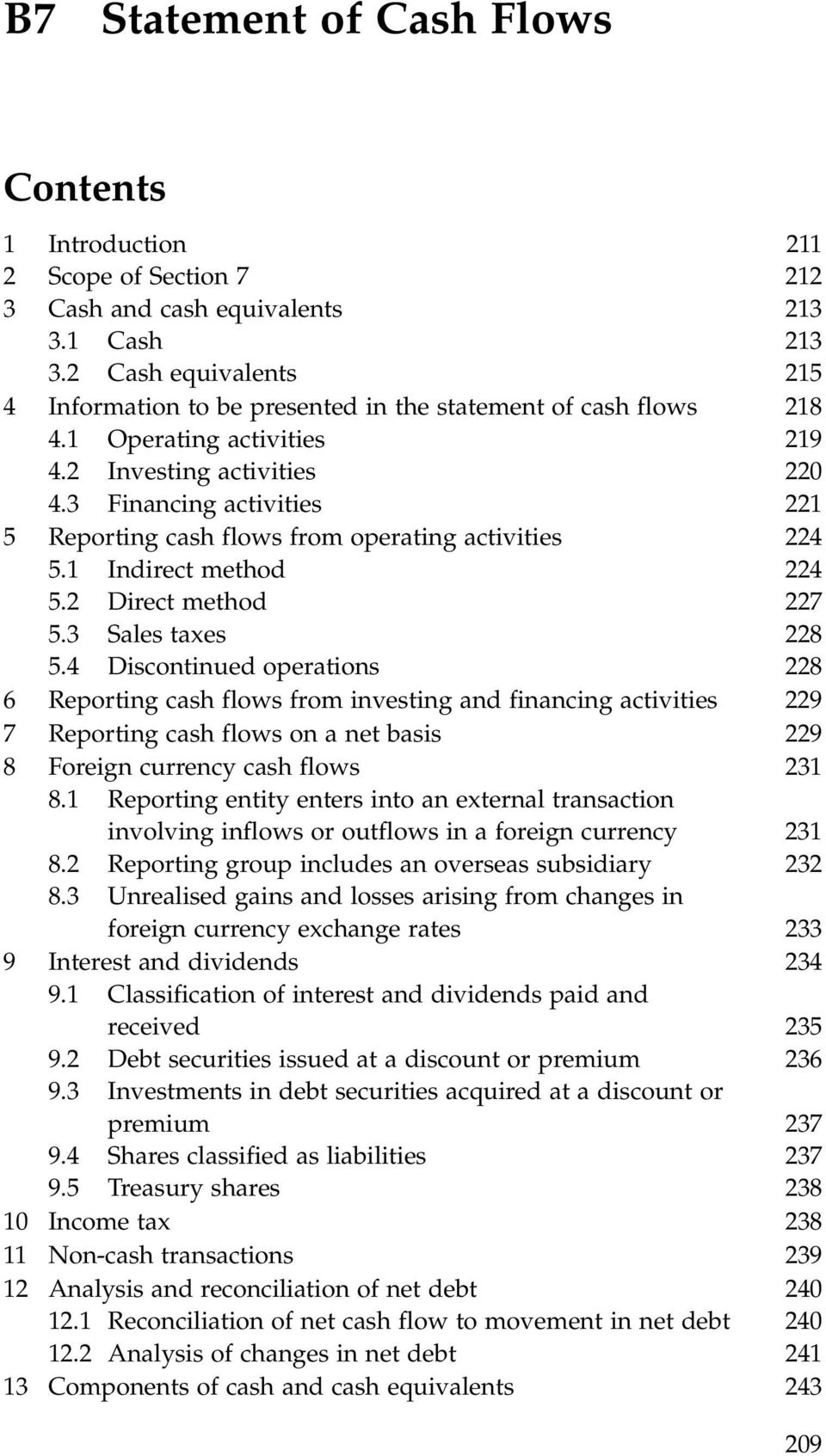
2 B7 Contents 1 Introduction Scope of Section Cash and cash equivalents Cash Cash equivalents Information to be presented in the statement of cash flows Operating activities Investing activities Financing activities Reporting cash flows from operating activities Indirect method Direct method Sales taxes Discontinued operations Reporting cash flows from investing and financing activities Reporting cash flows on a net basis Foreign currency cash flows Reporting entity enters into an external transaction involving inflows or outflows in a foreign currency Reporting group includes an overseas subsidiary Unrealised gains and losses arising from changes in foreign currency exchange rates Interest and dividends Classification of interest and dividends paid and received Debt securities issued at a discount or premium Investments in debt securities acquired at a discount or premium Shares classified as liabilities Treasury shares Income tax Non-cash transactions Analysis and reconciliation of net debt Reconciliation of net cash flow to movement in net debt Analysis of changes in net debt Components of cash and cash equivalents Letterpart Ltd Typeset in XML Division: DIGNUK_B07_citi3 Sequential 1
3 B7 14 Investments in subsidiaries, associates and joint ventures Changes in ownership interests in subsidiaries and other businesses Separate presentation of cash flows relating to changes in ownership interests Cash flows arising from shares issued by a subsidiary Cash flows arising subsequent to an acquisition Other disclosures Letterpart Ltd Typeset in XML Division: DIGNUK_B07_citi3 Sequential 2
4 Introduction B7 1 Introduction Section 7 sets out the information that is to be presented in a statement of cash flows and how to present it. Although the title of Section 7 is, entities are not required to use that title for the statement itself. For example, some entities may instead use the title Cash flow statement There are various differences between Section 7 and old UK GAAP, FRS 1 Cash Flow Statements. The most significant of these are highlighted below: UK Under FRS 1, certain entities were exempt from the requirement to prepare a cash flow statement. Section 7 of FRS 102 retains exemptions for mutual life assurance companies, retirement benefit plans and investment funds meeting certain conditions. In addition, although Section 7 does not include an exemption for subsidiaries, most subsidiaries will be qualifying entities and therefore able to take advantage of reduced disclosures, including an exemption from preparation of a statement of cash flows. However, there is no exemption for small companies in FRS 102 but such companies would be eligible to prepare their financial statements in accordance with the FRSSE. Similarly, Section 7 of FRS 102 does not contain any exemption from preparation of a statement of cash flows in relation to the separate financial statements of a parent. However, in practice, most such entities will be qualifying entities and therefore able to take advantage of reduced disclosures, including an exemption from preparation of a statement of cash flows. FRS 1 focused on movements in cash, whereas FRS 102 is concerned with movements in cash and cash equivalents, being certain highly liquid short-term investments. FRS 1 required cash flows to be classified under (up to) nine headings and mandated the order in which they were to be presented in the cash flow statement. FRS 102 specifies only three headings (operating, investing and financing) and does not mandate the order in which they are presented. Under FRS 1, the reconciliation between operating profit and net cash flow from operating activities was not permitted to be shown as part of the primary cash flow statement on the basis that the reconciling items are not cash flows and therefore have no place in the cash flow statement. This was required to be shown either adjoining the cash 211 Letterpart Ltd Typeset in XML Division: DIGNUK_B07 Sequential 1

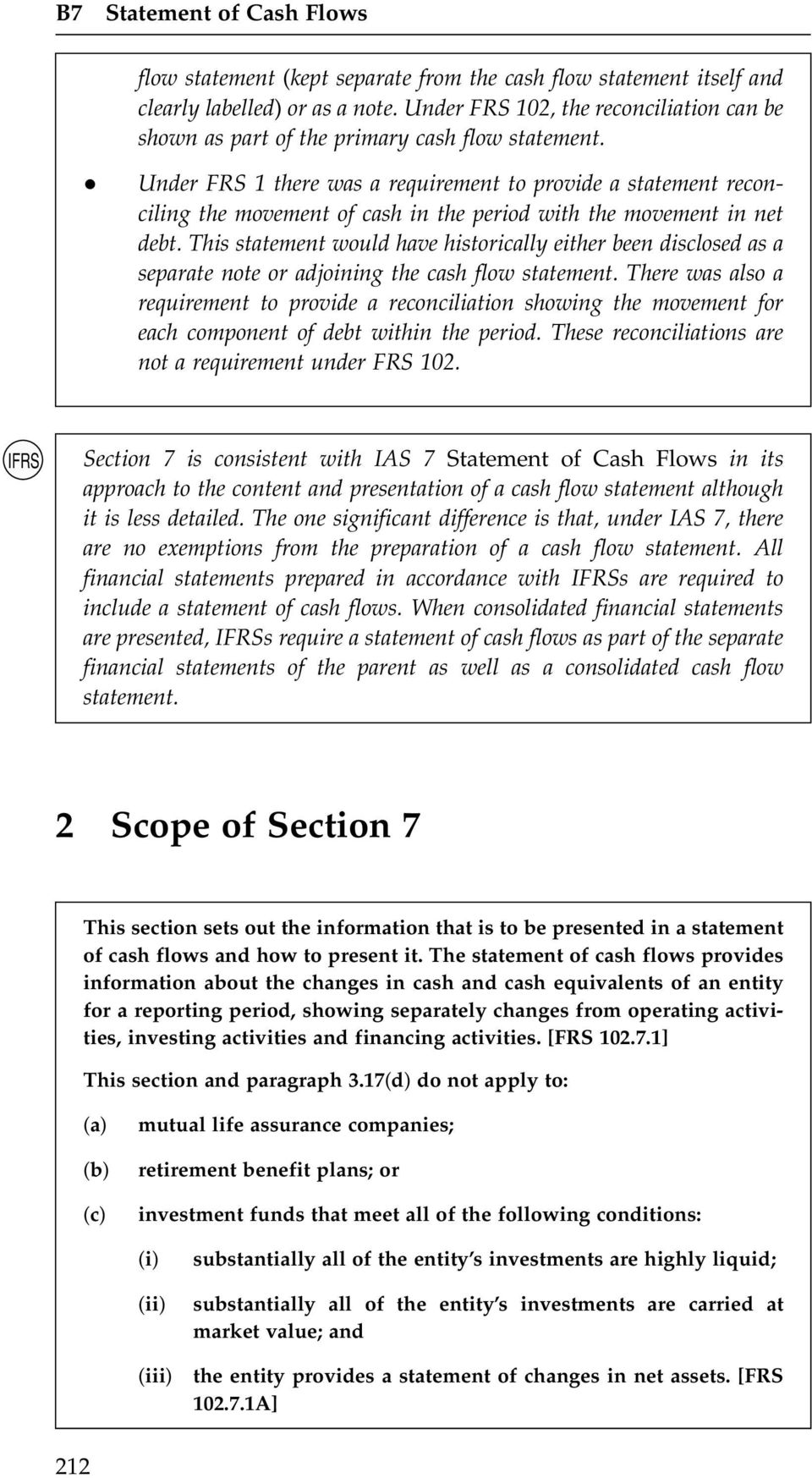
5 B7 flow statement (kept separate from the cash flow statement itself and clearly labelled) or as a note. Under FRS 102, the reconciliation can be shown as part of the primary cash flow statement. Under FRS 1 there was a requirement to provide a statement reconciling the movement of cash in the period with the movement in net debt. This statement would have historically either been disclosed as a separate note or adjoining the cash flow statement. There was also a requirement to provide a reconciliation showing the movement for each component of debt within the period. These reconciliations are not a requirement under FRS 102. IFRS Section 7 is consistent with IAS 7 in its approach to the content and presentation of a cash flow statement although it is less detailed. The one significant difference is that, under IAS 7, there are no exemptions from the preparation of a cash flow statement. All financial statements prepared in accordance with IFRSs are required to include a statement of cash flows. When consolidated financial statements are presented, IFRSs require a statement of cash flows as part of the separate financial statements of the parent as well as a consolidated cash flow statement. 2 Scope of Section 7 This section sets out the information that is to be presented in a statement of cash flows and how to present it. The statement of cash flows provides information about the changes in cash and cash equivalents of an entity for a reporting period, showing separately changes from operating activities, investing activities and financing activities. [FRS ] This section and paragraph 3.17(d) do not apply to: (a) (b) (c) mutual life assurance companies; retirement benefit plans; or investment funds that meet all of the following conditions: (i) (ii) (iii) substantially all of the entity s investments are highly liquid; substantially all of the entity s investments are carried at market value; and the entity provides a statement of changes in net assets. [FRS A] 212 Letterpart Ltd Typeset in XML Division: DIGNUK_B07 Sequential 2
6 Cash and cash equivalents B7 In addition to the exemptions set out in FRS A, a qualifying entity meeting certain conditions is also exempt from presenting a statement of cash flows as part of its individual or separate financial statements (see 3.3 in chapter B1). Therefore, in practice, most subsidiaries will not be required to present a statement of cash flows and most parents will not be required to present one in relation to their separate financial statements. The exemptions from preparation of a statement of cash flows are in practice the same as those available under FRS 1 except that there is no exemption for small entities. The Accounting Council took the view that an entity qualifying as small could prepare its financial statements in accordance with the FRSSE if it wished to take advantage of this and other exemptions available to small entities. Although the exemption for qualifying entities is slightly more restrictive in that certain conditions and formalities have to be observed, it is also broader in that it is not restricted to those subsidiaries where 90 per cent or more of the voting rights are controlled within the group. UK Under IAS 7 there are no exemptions from the preparation of a statement of cash flows. All financial statements prepared in accordance with IFRSs are required to include a statement of cash flows. IFRS 3 Cash and cash equivalents Cash flows are inflows and outflows of cash and cash equivalents. [FRS 102 Glossary] FRS 102 and full IFRSs require that the cash flow statement provide information about changes in cash and cash equivalents whereas under old UK GAAP, FRS 1 Cash Flow Statements, the focus was on movements in cash. In fact, FRS 102 returns UK GAAP to where it was before FRS 1 was revised in 1996 in this respect. The original version of FRS 1 was more closely based on its international equivalent. UK 3.1 Cash Cash comprises cash on hand and demand deposits. [FRS 102 Glossary] 213 Letterpart Ltd Typeset in XML Division: DIGNUK_B07 Sequential 3
7 B7 Some issues concerning the definition of cash are set out below. However, the statement of cash flows required by FRS 102 is based on movements in cash and cash equivalents (see 3.2 below). Therefore, whether or not an account meets the narrower definition of cash has no real practical effect so long as it meets the broader definition of a cash equivalent Demand deposits The term demand deposits is not defined in FRS 102, but the term may be taken to refer to deposits where the reporting entity can withdraw cash without giving any notice and without suffering any penalty. A seven-day call deposit would therefore not qualify as cash, because seven days notice of withdrawal is required. The deposit could, however, be reported as a cash equivalent. Similarly, if an entity has an account with its bank under which the entity has to give ninety days notice to the bank before it can withdraw money, the account does not meet the definition of cash because it is not a demand deposit. However, only ninety days notice is required and, therefore, it may meet the definition of a cash equivalent. The term demand deposits is not restricted to deposits with banks or financial institutions Minimum average cash balances Some entities have banking arrangements that require them to maintain a minimum average cash balance over a specified period instead of a constant minimum balance at the end of each day. It is therefore possible to have balances below the threshold for certain days as long as the average balance over the period is in excess of the minimum requirement. For such arrangements, it is necessary to consider whether the balance can be withdrawn on demand, in a way similar to demand deposits; i.e. whether the entity can withdraw the cash without giving any notice and without suffering any penalty. If these criteria are met, the cash balances will meet the definition of cash in FRS Letterpart Ltd Typeset in XML Division: DIGNUK_B07 Sequential 4
8 Cash and cash equivalents B7 3.2 Cash equivalents Cash equivalents are short-term, highly liquid investments that are readily convertible to known amounts of cash and that are subject to an insignificant risk of changes in value. Therefore, an investment normally qualifies as a cash equivalent only when it has a short maturity of, say, three months or less from the date of acquisition. Bank overdrafts are normally considered financing activities similar to borrowings. However, if they are repayable on demand and form an integral part of an entity s cash management, bank overdrafts are a component of cash. [FRS ] FRS 102 does not provide any further guidance on the definition of cash and cash equivalents. Due to the consistency between section 7 of FRS 102 and IAS 7, it would seem reasonable for an entity preparing financial statements under FRS 102 to consider the requirements in IAS 7 which goes on to explain that cash equivalents are held for the purpose of meeting short-term cash commitments rather than for investment or other purposes. The application of this definition is illustrated further below at to below Held to meet short-term cash commitments In order to determine whether a particular investment qualifies for classification as a cash equivalent, it is necessary to look at the purpose for which it is held. Even though the investment may meet the definition set out in FRS , unless it is held for the purpose of meeting short-term cash commitments, it will not be classified as a cash equivalent. For example, an entity purchases a two-year bond in the market when the bond only has two months remaining before its redemption date. The purchase is made for investment purposes. The bond does not qualify as a cash equivalent because, even though it meets the definition in FRS , it is not held for the purpose of meeting short-term cash commitments Presumption of maturity of three months or less The definition of cash equivalents includes the requirement that they be held for the short-term. In order to qualify as such, FRS 102 states that the 215 Letterpart Ltd Typeset in XML Division: DIGNUK_B07 Sequential 5

9 B7 investment will normally have a maturity of three months or less from the date of acquisition. Therefore, the requirement for a three-month maturity is not part of the definition, but will nevertheless be a presumption except in very exceptional circumstances. FRS 102 implicitly suggests that only in unusual cases will investments with more than three months to maturity nevertheless be free from significant risk of changes in value (arising, for example, from changes in interest rates). An entity purchasing a two-year bond in the market when the bond only has three months remaining before its redemption date could therefore classify the bond as a cash equivalent (assuming that there are no other factors causing it to be subject to a significant risk of change in value, and that the underlying purpose of holding the bond is to meet short-term cash commitments). However, the reference to three months or less from the date of acquisition means that, if the entity instead purchased the same two-year bond when it had four months remaining before maturity, the entity could not classify the bond as a cash equivalent either at the date of purchase or once it has less than three months remaining to maturity (unless it could justify a departure from the three-month guideline, in which case the instrument would be classified as a cash equivalent throughout the entire four months). The three-month limit may appear somewhat arbitrary, but the intention is to promote consistency between entities Foreign currency investments Provided that the definition of a cash equivalent is met, there is no reason why an investment acquired in a foreign currency could not be classified as a cash equivalent. Indeed FRS refers specifically to cash and cash equivalents held or due in a foreign currency Equity investments Equity investments will not normally meet the definition of a cash equivalent because, even when they are readily convertible to cash, the amount of that cash is generally not known and the risk of changes in value is generally not insignificant, although there are exceptions. The example of an exception given under full IFRSs is that of preferred shares with a specific redemption date which, when 216 Letterpart Ltd Typeset in XML Division: DIGNUK_B07 Sequential 6
10 Cash and cash equivalents B7 acquired, are close to maturity. Under full IFRSs, the majority of equity investments will not meet the definition, however, and therefore cannot be classified as cash equivalents. FRS 102 is silent in mentioning the classification of equity investments as cash equivalents but, due to the consistency with full IFRSs, it would seem reasonable to draw a similar conclusion under FRS Gold bullion Gold (and similar traded commodities) will not qualify as cash equivalents for the same reason as equity investments (see above) Bank borrowings The definition of cash equivalents makes no reference to the inclusion of bank borrowings. Bank borrowings are generally considered to be financing cash flows. However, FRS 102 acknowledges that bank overdrafts repayable on demand may form an integral part of an entity s cash management, in which case they should be included as a component of cash and cash equivalents. FRS 102 does not therefore mandate the inclusion of bank overdrafts in cash equivalents in all circumstances. But it does require their inclusion when the bank overdraft forms an integral part of the entity s cash management. FRS 102 also emphasises that bank borrowings are generally considered to be financing activities. Therefore, FRS 102 does not allow for other short-term loans (e.g. shortterm bank loans, advances from factors or similar credit arrangements) to be classified as cash equivalents, because they are financing in nature. Although the statement of cash flows may present movements in cash and cash equivalents net of overdraft balances, this does not imply that they may be offset with positive cash balances in the balance sheet. They may be offset in the balance sheet only if the conditions in FRS A are met (see 12.1 in chapter B11). 217 Letterpart Ltd Typeset in XML Division: DIGNUK_B07 Sequential 7
11 B7 4 Information to be presented in the statement of cash flows An entity shall present a statement of cash flows that presents cash flows for a reporting period classified by operating activities, investing activities and financing activities. [FRS ] The classification of cash flows under FRS 102 is consistent with that under full IFRS and there does not appear to be any specific order that these headings are required to be shown. Usual practice under full IFRSs, which an FRS 102 reporter may consider adopting, is to follow the order of the headings as listed in the Standard (i.e. operating and then investing and then financing). UK Old UK GAAP required cash flows to be classified under (up to) nine headings and mandated the order that they were to be presented in the cash flow statement. The headings for the statement of cash flows are standard, and should not be altered to suit individual circumstances (unless, very exceptionally, the use of the standard wording is likely to mislead readers of the financial statements). There are no requirements, however, that would prevent further sub-classifications or analyses appropriate to the entity s business being shown within these three headings in the statement of cash flows. Cash flows should be classified under the standard headings in the most appropriate manner for the entity s business. When a single payment or receipt of cash represents a number of smaller payments or receipts, each should be classified according to its nature. For example when the cash repayment of a loan includes both interest and capital, the interest element may be classified as an operating activity and the capital element is classified as a financing activity. This guidance is drawn from IAS 7 and would appear sensible for an FRS 102 reporter to follow due to the consistency of IAS 7 requirements with those of Section 7. Cash flows from operating activities will generally be presented as a single net number using the indirect method and reconciled to a measure of profit or loss (see section 5 below). Cash flows from 218 Letterpart Ltd Typeset in XML Division: DIGNUK_B07 Sequential 8
![3] The classification of cash flows under FRS 102 is consistent with that under full IFRS and there does not appear to be any specific order that these headings are required to be shown.](/docs-images/43/15691771/images/page_11.jpg "Usual practice under full IFRSs, which an FRS 102 reporter may consider adopting, is to follow the order of the headings as listed in the Standard (i.e. operating and then investing and then financing).")
12 Information to be presented in the statement of cash flows B7 investing and financing activities should be analysed into major classes of gross receipts and payments with some limited exceptions (see section 6 and section 7 below). Such analysis may be given either on the face of the statement of cash flows or in the notes. 4.1 Operating activities Operating activities are the principal revenue-producing activities of the entity. Therefore, cash flows from operating activities generally result from the transactions and other events and conditions that enter into the determination of profit or loss. Examples of cash flows from operating activities are: (a) (b) (c) (d) (e) (f) (g) cash receipts from the sale of goods and the rendering of services; cash receipts from royalties, fees, commissions and other revenue; cash payments to suppliers for goods and services; cash payments to and on behalf of employees; cash payments or refunds of income tax, unless they can be specifically identified with financing and investing activities; cash receipts and payments from investments, loans and other contracts held for dealing or trading purposes, which are similar to inventory acquired specifically for resale; and cash advances and loans made to other parties by financial institutions. Some transactions, such as the sale of an item of plant by a manufacturing entity, may give rise to a gain or loss that is included in profit or loss. However, the cash flows relating to such transactions are cash flows from investing activities. [FRS ] Consistent with old UK GAAP and full IFRS, cash flows from operating activities should be reported using either the direct (gross) method or the indirect (net) method as discussed in section 5 below. The use of the indirect method is almost universal by UK companies. Cash flows from operating activities may also include interest and dividends paid and interest and dividends received although FRS 102 allows some alternatives as described at 9.1 below. 219 Letterpart Ltd Typeset in XML Division: DIGNUK_B07 Sequential 9
13 B7 4.2 Investing activities Investing activities are the acquisition and disposal of long-term assets and other investments not included in cash equivalents. Examples of cash flows arising from investing activities are: (a) (b) (c) (d) (e) (f) (g) (h) cash payments to acquire property, plant and equipment (including self-constructed property, plant and equipment), intangible assets and other long-term assets; cash receipts from sales of property, plant and equipment, intangibles and other long-term assets; cash payments to acquire equity or debt instruments of other entities and interests in joint ventures (other than payments for those instruments classified as cash equivalents or held for dealing or trading).; cash receipts from sales of equity or debt instruments of other entities and interests in joint ventures (other than receipts for those instruments classified as cash equivalents or held for dealing or trading); cash advances and loans made to other parties (except those made by financial institutions see paragraph 7.4(g)); cash receipts from the repayment of advances and loans made to other parties; cash payments for futures contracts, forward contracts, option contracts and swap contracts, except when the contracts are held for dealing or trading, or the payments are classified as financing activities; and cash receipts from futures contracts, forward contracts, option contracts and swap contracts, except when the contracts are held for dealing or trading, or the receipts are classified as financing activities. When a contract is accounted for as a hedge (see Section 12 Other Financial Instruments Issues), an entity shall classify the cash flows of the contract in the same manner as the cash flows of the item being hedged. [FRS ] As explained at 9.1 below, cash flows from investing activities may also include interest and dividends received because they are returns on investments although FRS 102 also permits them to be reported as cash flows from operating activities. Although not mentioned in FRS , cash flows from investing activities also include the aggregate cash flows arising from acquisitions and 220 Letterpart Ltd Typeset in XML Division: DIGNUK_B07 Sequential 10
14 Information to be presented in the statement of cash flows B7 from disposals of subsidiaries or other business units which must be presented separately as required by FRS (see section 6 below). As noted above, cash flows associated with the acquisition and disposal of property, plant and equipment, intangible and other long-term assets will generally be classified as investing activities. However, for entities that routinely sell items of property, plant and equipment that they have previously held for rental to others, the resulting cash flows are cash flows from operating activities It is odd that FRS refers explicitly to interests in joint ventures but not to interests in associates. However, this is not significant and any cash flows from the acquisition or disposal of interests in associates should be included in cash flows from investing activities Classification of expenditure as operating or investing Inevitably there will be situations where an FRS 102 reporter is required to make a distinction between those expenditures that are of an operating nature and those which are of an investing nature for classification within the cash flow statement. FRS 102 contains no requirements to help preparers distinguish between the two different categories. In the absence of such guidance, FRS 102 preparers are recommended to follow the guidance provided in IAS 7 which states that only expenditures that result in a recognised asset in the statement of financial position are eligible for classification as investing activities. So, for example, expenditure for exploration and evaluation activities would be classed as investing activities only if the entity s accounting policy is to capitalise such costs. Similarly the guidance in IAS 7 suggests that marketing expenditure that has been written off to the income statement cannot be treated as an investing activity cash flow in the statement of cash flows. Whilst the approach under full IFRSs is recommended, it is also recognised that in the absence of guidance in FRS 102, a range of approaches may be adopted in practice. 4.3 Financing activities Financing activities are activities that result in changes in the size and composition of the contributed equity and borrowings of an entity. Examples of cash flows arising from financing activities are: 221 Letterpart Ltd Typeset in XML Division: DIGNUK_B07 Sequential 11
15 B7 (a) (b) (c) (d) (e) cash proceeds from issuing shares or other equity instruments; cash payments to owners to acquire or redeem the entity s shares; cash proceeds from issuing debentures, loans, notes, bonds, mortgages and other short-term or long-term borrowings; cash repayments of amounts borrowed; and cash payments by a lessee for the reduction of the outstanding liability relating to a finance lease. [FRS ] As explained at 9.1 below, cash flows from financing activities may also include interest and dividends paid because they are a cost of obtaining financial resources although FRS 102 also permits them to be reported as cash flows from operating activities Sale and leaseback transactions For some sale and leaseback arrangements, the substance of the arrangements is that the asset is not sold, but that the lessor makes a loan to the lessee (i.e. a sale and finance leaseback) with the asset as security. From an accounting perspective, the entity has not disposed of the asset. In this case, the receipt from the sale of the asset should be included as a financing cash flow rather than an investing cash flow. This treatment is consistent with that in the statement of comprehensive income and the statement of financial position. In contrast, when the substance of the transaction is that the asset is sold and then an operating lease is put in place, the receipt from the disposal of the asset should be included as an investing cash flow Factoring FRS 102 does not provide guidance on the treatment of factored receivables in a statement of cash flows. When receivables are factored without recourse in circumstances qualifying for derecognition of the receivables, no particular problems arise. The receipt of the proceeds from the factor will simply be treated as an operating cash flow, just as if it had been received directly from the customer. When receivables are factored with recourse, however, and the advances from factors are treated as financing creditors in the statement of financial position, the appropriate treatment is less clear. 222 Letterpart Ltd Typeset in XML Division: DIGNUK_B07 Sequential 12
![finance lease. [FRS 102.7.6] As explained at 9.](/docs-images/43/15691771/images/page_15.jpg "1 below, cash flows from financing activities may also include interest and dividends paid because they are a cost of obtaining financial resources although FRS 102 also permits them to be reported")
16 Information to be presented in the statement of cash flows B7 The guidance in IAS 7, which an FRS 102 reporter may follow, requires that cash flows are analysed under the standard headings according to the substance of the underlying transactions. When factoring is viewed as being, in substance, a financing transaction, it might be argued that all of the cash flows received from the factor should be viewed as financing cash inflows. This would be consistent with the treatment of finance leases prescribed by FRS 102, when entering into the lease is viewed as a non-cash transaction and so does not appear in the statement of cash flows. The capital elements of the lease payments then appear as a financing outflow. This could be argued as leading to an overstatement of the financing outflows, and an understatement of the investing outflows. But the treatment for finance leases is specifically required by FRS 102 and is well established under both IFRSs and old UK GAAP. It could be argued that a similar principle should be applied to factored receivables. The distortion would be more significant, however, and potentially the entity would have no operating cash inflows at all if all of its receivables were factored with recourse. It appears questionable whether showing all of an entity s sales revenue as cash flows from financing could be said to give a true and fair view of its cash flows. Also, importantly, the treatment of factored receivables is not referred to in FRS 102, whereas the treatment of leases is specifically addressed. If it is concluded that the receipts from the factor should be viewed as operating cash flows rather than financing cash flows (because they are, in substance, the receipts from trade customers), there is a second question to be addressed. This is whether all of the cash flows should be shown as operating or the movement on the financing creditor should be treated as a financing cash flow. The preferable treatment is to show this movement as a financing cash flow because this results in operating cash flows including the cash flows from the customers as if the factoring had not been entered into. It also results in financing cash flows as if the customers had been financed by a loan. Finally, it also reflects the FRS 102 definition of financing activities as those that result in changes in the size and composition of borrowings. Due to lack of clarity in FRS 102 as to the appropriate treatment of such transactions, it is important that the policy adopted is clearly explained. 223 Letterpart Ltd Typeset in XML Division: DIGNUK_B07 Sequential 13
17 B Capital contributions Capital contributions are a means sometimes used by a parent company to increase capital in a subsidiary. Quite simply, the parent passes funds to the subsidiary in the form of a non-returnable gift (as discussed at in chapter A5). FRS 102 does not indicate how such contributions from shareholders should be treated either from the perspective of the parent company or the subsidiary. For the subsidiary, as they are a form of capital financing, they should be treated as inflows within the Financing section of the statement. For the parent it would be considered that the cash flows should be included as investing as the effect of the capital contribution is to increase the equity stake of the parent in the subsidiary. 5 Reporting cash flows from operating activities An entity shall present cash flows from operating activities using either: (a) (b) the indirect method, whereby profit or loss is adjusted for the effects of non-cash transactions, any deferrals or accruals of past or future operating cash receipts or payments, and items of income or expense associated with investing or financing cash flows; or the direct method, whereby major classes of gross cash receipts and gross cash payments are disclosed. [FRS ] As noted above, there are two methods for the presentation of cash flows from operating activities the indirect or the direct method. FRS 102 does not provide a preference for a method to adopt; full IFRSs encourage (but do not require) the use of the direct method. In practice it is likely that UK companies adopting FRS 102 will continue to use the indirect method which almost all will have been using under old UK GAAP. 5.1 Indirect method Under the indirect method, the net cash flow from operating activities is determined by adjusting profit or loss for the effects of: 224 Letterpart Ltd Typeset in XML Division: DIGNUK_B07 Sequential 14
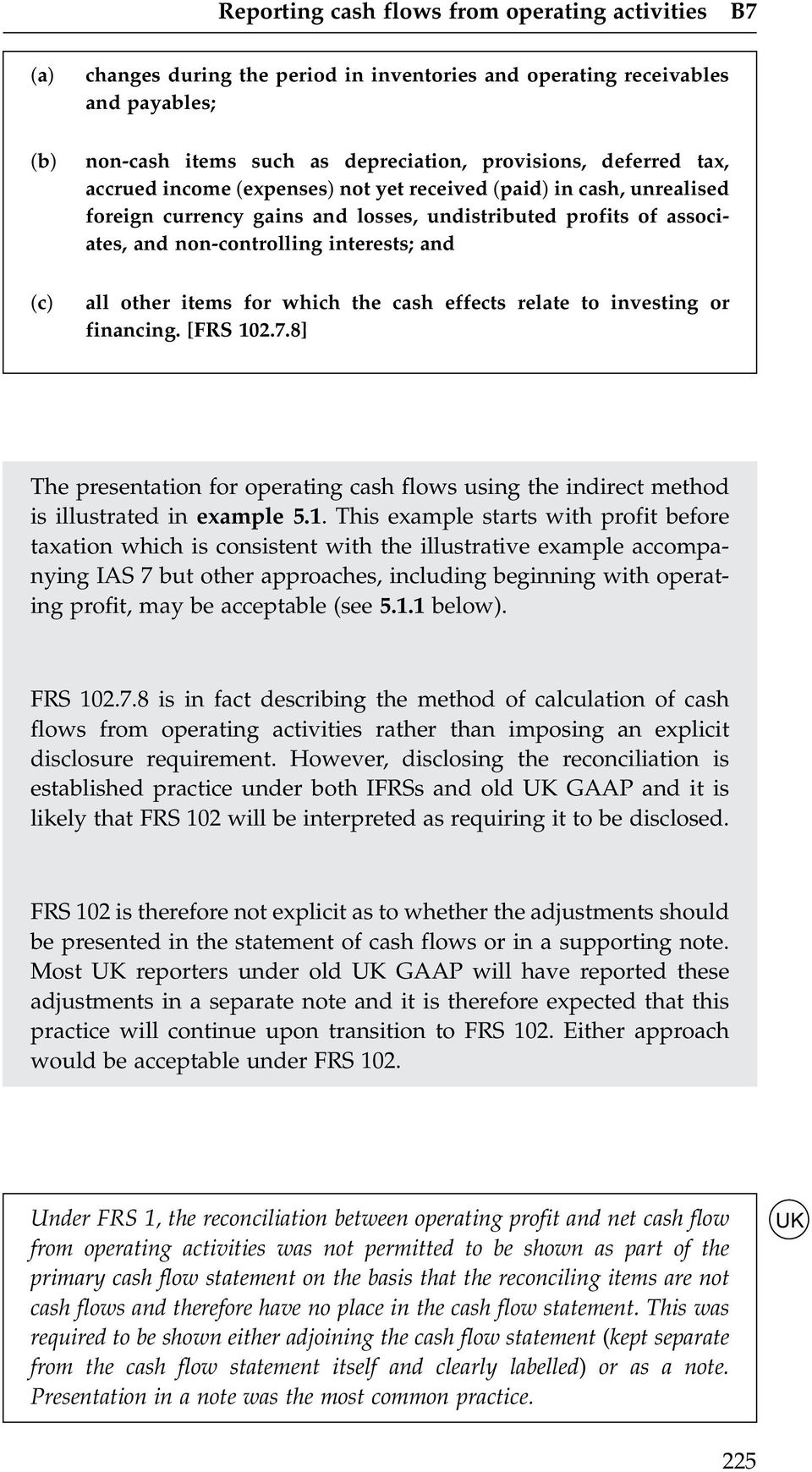
18 Reporting cash flows from operating activities B7 (a) (b) (c) changes during the period in inventories and operating receivables and payables; non-cash items such as depreciation, provisions, deferred tax, accrued income (expenses) not yet received (paid) in cash, unrealised foreign currency gains and losses, undistributed profits of associates, and non-controlling interests; and all other items for which the cash effects relate to investing or financing. [FRS ] The presentation for operating cash flows using the indirect method is illustrated in example 5.1. This example starts with profit before taxation which is consistent with the illustrative example accompanying IAS 7 but other approaches, including beginning with operating profit, may be acceptable (see below). FRS is in fact describing the method of calculation of cash flows from operating activities rather than imposing an explicit disclosure requirement. However, disclosing the reconciliation is established practice under both IFRSs and old UK GAAP and it is likely that FRS 102 will be interpreted as requiring it to be disclosed. FRS 102 is therefore not explicit as to whether the adjustments should be presented in the statement of cash flows or in a supporting note. Most UK reporters under old UK GAAP will have reported these adjustments in a separate note and it is therefore expected that this practice will continue upon transition to FRS 102. Either approach would be acceptable under FRS 102. Under FRS 1, the reconciliation between operating profit and net cash flow from operating activities was not permitted to be shown as part of the primary cash flow statement on the basis that the reconciling items are not cash flows and therefore have no place in the cash flow statement. This was required to be shown either adjoining the cash flow statement (kept separate from the cash flow statement itself and clearly labelled) or as a note. Presentation in a note was the most common practice. UK 225 Letterpart Ltd Typeset in XML Division: DIGNUK_B07 Sequential 15
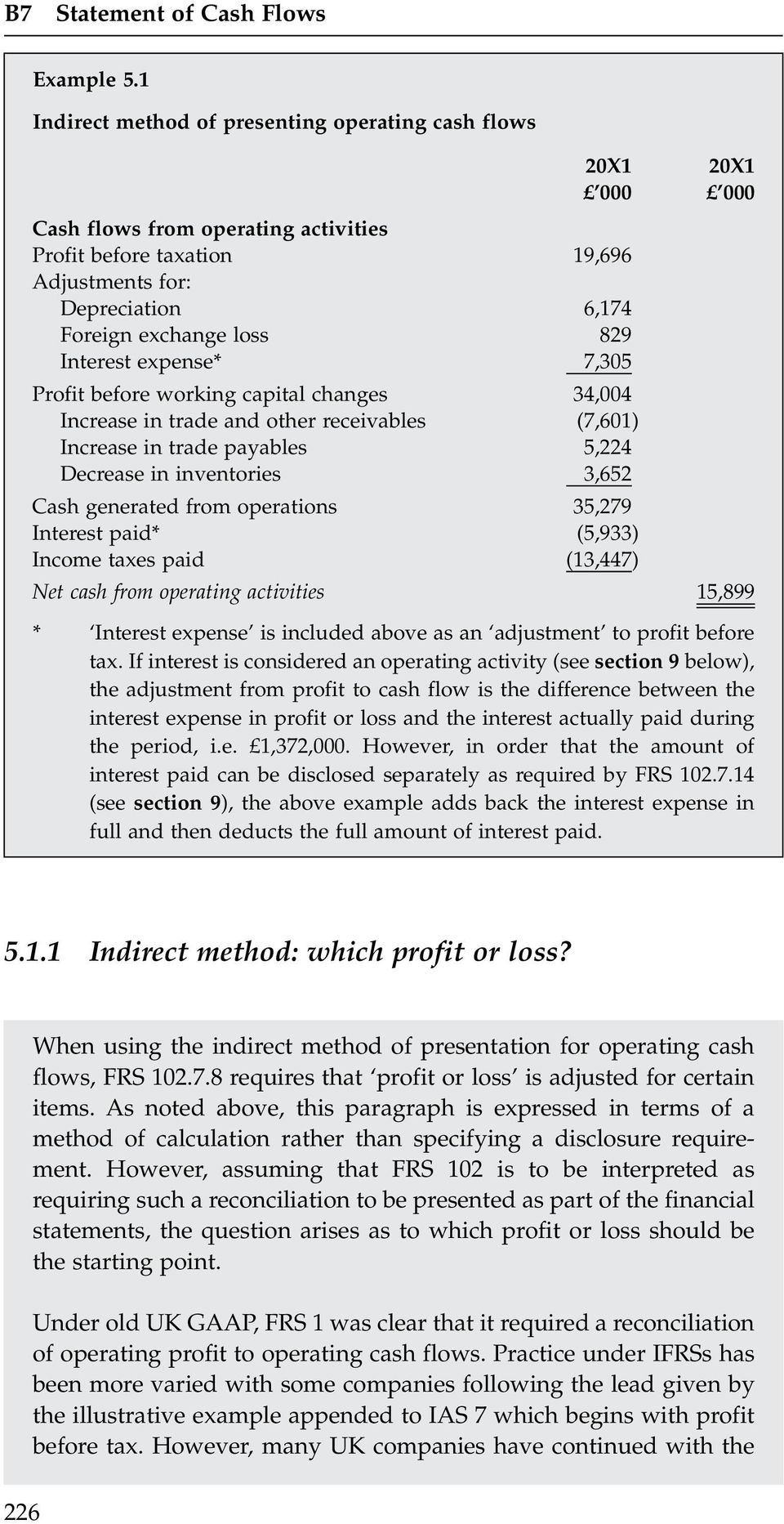
19 B7 Example 5.1 Indirect method of presenting operating cash flows 20X1 20X Cash flows from operating activities Profit before taxation 19,696 Adjustments for: Depreciation 6,174 Foreign exchange loss 829 Interest expense* 7,305 Profit before working capital changes 34,004 Increase in trade and other receivables (7,601) Increase in trade payables 5,224 Decrease in inventories 3,652 Cash generated from operations 35,279 Interest paid* (5,933) Income taxes paid (13,447) Net cash from operating activities 15,899 * Interest expense is included above as an adjustment to profit before tax. If interest is considered an operating activity (see section 9 below), the adjustment from profit to cash flow is the difference between the interest expense in profit or loss and the interest actually paid during the period, i.e. 1,372,000. However, in order that the amount of interest paid can be disclosed separately as required by FRS (see section 9), the above example adds back the interest expense in full and then deducts the full amount of interest paid Indirect method: which profit or loss? When using the indirect method of presentation for operating cash flows, FRS requires that profit or loss is adjusted for certain items. As noted above, this paragraph is expressed in terms of a method of calculation rather than specifying a disclosure requirement. However, assuming that FRS 102 is to be interpreted as requiring such a reconciliation to be presented as part of the financial statements, the question arises as to which profit or loss should be the starting point. Under old UK GAAP, FRS 1 was clear that it required a reconciliation of operating profit to operating cash flows. Practice under IFRSs has been more varied with some companies following the lead given by the illustrative example appended to IAS 7 which begins with profit before tax. However, many UK companies have continued with the 226 Letterpart Ltd Typeset in XML Division: DIGNUK_B07 Sequential 16
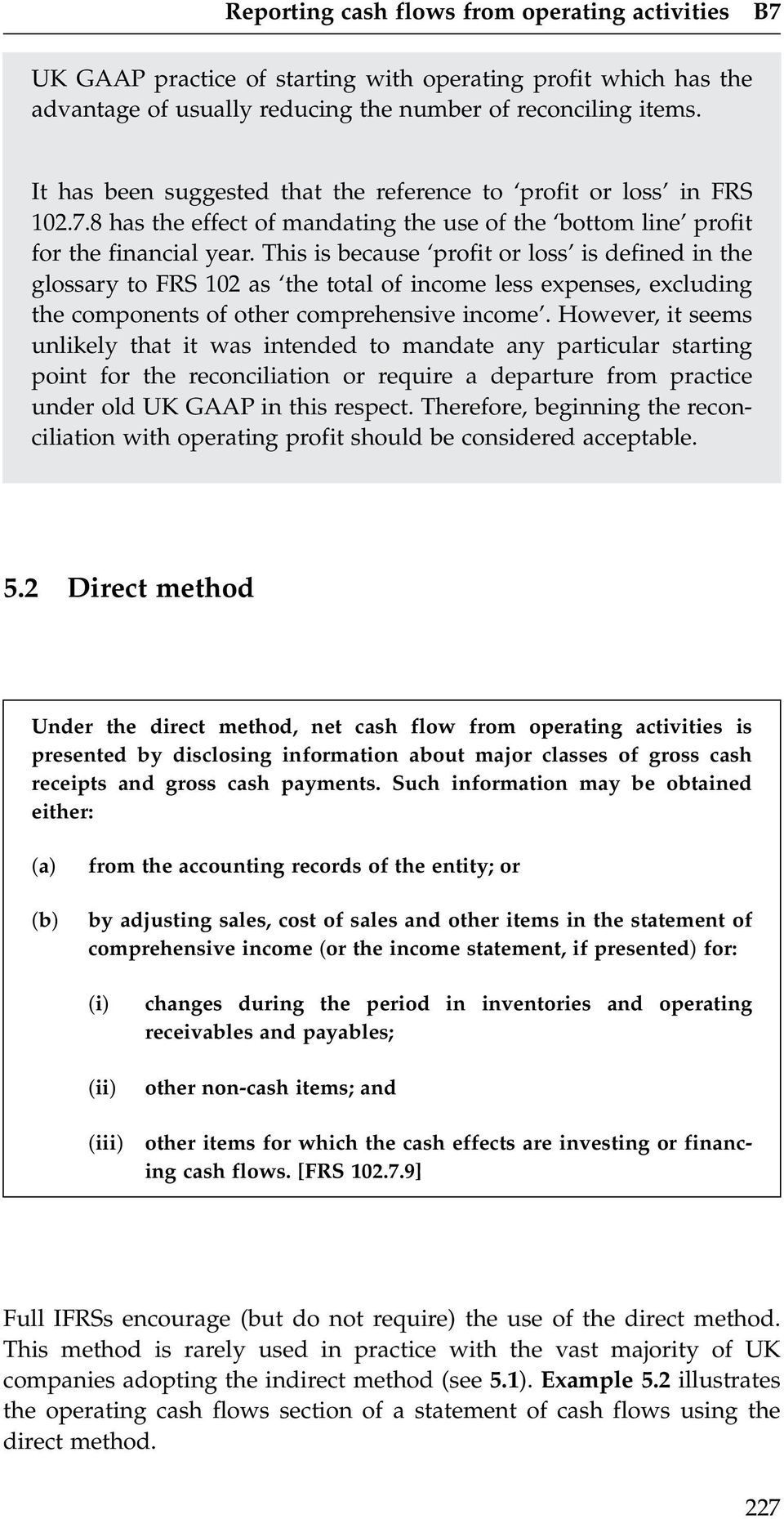
20 Reporting cash flows from operating activities B7 UK GAAP practice of starting with operating profit which has the advantage of usually reducing the number of reconciling items. It has been suggested that the reference to profit or loss in FRS has the effect of mandating the use of the bottom line profit for the financial year. This is because profit or loss is defined in the glossary to FRS 102 as the total of income less expenses, excluding the components of other comprehensive income. However, it seems unlikely that it was intended to mandate any particular starting point for the reconciliation or require a departure from practice under old UK GAAP in this respect. Therefore, beginning the reconciliation with operating profit should be considered acceptable. 5.2 Direct method Under the direct method, net cash flow from operating activities is presented by disclosing information about major classes of gross cash receipts and gross cash payments. Such information may be obtained either: (a) (b) from the accounting records of the entity; or by adjusting sales, cost of sales and other items in the statement of comprehensive income (or the income statement, if presented) for: (i) (ii) (iii) changes during the period in inventories and operating receivables and payables; other non-cash items; and other items for which the cash effects are investing or financing cash flows. [FRS ] Full IFRSs encourage (but do not require) the use of the direct method. This method is rarely used in practice with the vast majority of UK companies adopting the indirect method (see 5.1). Example 5.2 illustrates the operating cash flows section of a statement of cash flows using the direct method. 227 Letterpart Ltd Typeset in XML Division: DIGNUK_B07 Sequential 17
21 B7 Example 5.2 Direct method of presenting operating cash flows 20X1 000 Cash flows from operating activities Cash receipts from customers 252,376 Cash paid to suppliers (127,045) Cash paid to and on behalf of employees (78,014) Other cash payments (12,038) Cash generated from operations 35,279 Interest paid (5,933) Income taxes paid (13,447) Net cash from operating activities 15, Sales taxes FRS 102, as with full IFRSs, does not explicitly address whether cash flows reported in accordance with FRS 102 should be measured as inclusive or exclusive of sales taxes. This lack of guidance creates a choice for FRS 102 reporters. An FRS 102 reporter should provide sufficient disclosure of the measurement basis selected in the notes to the financial statements. Under old UK GAAP, cash flows were required to be shown net of VAT and other sales taxes unless the tax was irrecoverable by the reporting entity. As this is still an allowable option under FRS 102 it is expected that this will continue to be adopted by those old UK GAAP reporters transitioning to an FRS 102 environment. 5.4 Discontinued operations Under IFRSs, the treatment of discontinued operations creates some challenges for the presentation of the cash flow statement and related reconciliation of operating cash flows. This is because of the way in which IFRS 5 requires the results of discontinued operations to be disclosed as a separate item in the income statement. This treatment is not required (or permitted) by FRS 102 which, in keeping with old UK GAAP under FRS 3, merely requires additional analysis of line items in the profit and loss account between continuing and discontinued operations. 228 Letterpart Ltd Typeset in XML Division: DIGNUK_B07 Sequential 18
22 Reporting cash flows on a net basis B7 There is no requirement in FRS 102 to provide an analysis of cash flows between continuing and discontinued operations. In some cases such additional analysis may be seen as helpful and may be provided on a voluntary basis. This might take the form of merely analysing operating cash flows between continuing and discontinued operations or, at the other extreme, providing a columnar layout for the cash flow statement and related reconciliation of cash flows from operations. 6 Reporting cash flows from investing and financing activities An entity shall present separately major classes of gross cash receipts and gross cash payments arising from investing and financing activities, except to the extent that net presentation is permitted by paragraphs 7.10A and 7.10D. The aggregate cash flows arising from acquisitions and from disposals of subsidiaries or other business units shall be presented separately and classified as investing activities. [FRS ] Consistent with full IFRSs, major classes of gross cash receipts and gross cash payments arising from investing and financing activities are reported separately, except to the extent that net presentation is permitted by paragraphs 7.10A and 7.10D as discussed in section 7 below. Such analysis may be provided either on the face of the statement of cash flows or in the notes. 7 Reporting cash flows on a net basis Cash flows arising from the following operating, investing or financing activities may be reported on a net basis: (a) (b) cash receipts and payments on behalf of customers when the cash flows reflect the activities of the customer rather than those of the entity; and cash receipts and payments for items in which the turnover is quick, the amounts are large, and the maturities are short. [FRS A] 229 Letterpart Ltd Typeset in XML Division: DIGNUK_B07 Sequential 19
23 B7 Examples of cash receipts and payments referred to in paragraph 7.10A(a) are: (a) (b) (c) the acceptance and repayment of demand deposits of a bank; funds held for customers by an investment entity; and rents collected on behalf of, and paid over to, the owners of properties. [FRS B] Examples of cash receipts and payments referred to in paragraph 7.10A(b) are advances made for, and the repayment of: (a) (b) (c) principal amounts relating to credit card customers; the purchase and sale of investments; and other short-term borrowings, for example, those which have a maturity period of three months or less. [FRS C] Financial institutions may report cash flows described in paragraph on a net basis. [FRS D] A financial institution that undertakes the business of effecting or carrying out insurance contracts, other than mutual life assurance companies scoped out of this section in paragraph 7.1A(a), should include the cash flows of their long-term businesses only to the extent of cash transferred and available to meet the obligations of the company or group as a whole. [FRS E] These paragraphs do not appear in the IFRS for SMEs and did not appear in FRED 48 but were added to address comments received on that exposure draft. No specific explanation is provided in FRS 102 or the related advice of the Accounting Council to the FRC. Paragraphs 10A, 10B and 10C are identical to paragraphs 22, 23 and 23A of IAS 7. Paragraph 10D cross refers to paragraph 33 in section 34 which is identical to paragraph 24 of IAS 7. The effect is therefore to provide consistency with the treatment under IFRSs and permit netting when it would be permitted under IAS 7. In addition, paragraph 10E addresses the specific situation of long-term insurance business. The exemption under FRS A(b) for items with a quick turnover has some similarities to a requirement in FRS 1 to net cash flows in some cases where they relate in substance to a single financing transaction or are due to short maturities and high turnover occurring from rollover or reissue (for example, short term deposits or a commercial paper programme). 230 Letterpart Ltd Typeset in XML Division: DIGNUK_B07 Sequential 20
24 Foreign currency cash flows B7 Further details regarding the reporting of cash flows by a financial institution are in section 5 of chapter B34. 8 Foreign currency cash flows Foreign currency cash flows arise in two instances when the reporting entity enters into an external transaction involving inflows or outflows in a foreign currency, and when the reporting entity includes a foreign operation (usually an overseas subsidiary in the context of consolidated accounts but sometimes a branch of an individual legal entity) and there are cash movements between that foreign operation and other entities in the group. Old UK GAAP was surprisingly brief on how to deal with the effects of foreign currency in a cash flow statement. However, although the guidance was brief, it did follow similar principles to those required under FRS 102 as detailed in 8.1, 8.2 and 8.3 below. 8.1 Reporting entity enters into an external transaction involving inflows or outflows in a foreign currency An entity shall record cash flows arising from transactions in a foreign currency in the entity s functional currency by applying to the foreign currency amount the exchange rate between the functional currency and the foreign currency at the date of the cash flow or an exchange rate that approximates the actual rate (for example, a weighted average exchange rate for the period). [FRS ] The words or an exchange rate that approximates the actual rate (for example, a weighted average rate for the period do not appear in the equivalent paragraph of the IFRS for SMEs and were added by the Accounting Council to make the requirement easier to apply in practice. Example 8.1 Foreign currency cash flows An entity, whose functional currency is Sterling, buys an item of equipment for US$100,000. It recognises the purchase in its accounting records on the date of delivery of the equipment. The rate of exchange on that date ($2 to 1) results in the equipment being recognised at 50,000. The invoice for the 231 Letterpart Ltd Typeset in XML Division: DIGNUK_B07 Sequential 21
25 B7 equipment is settled by bank transfer 30 days later, at which date 55,000 is needed to settle the liability. The exchange difference of 5,000 is recognised in profit or loss. The purchase of the equipment should be presented in the statement of cash flows as an investing cash outflow of 55,000. Therefore, if the operating cash flows are shown using the indirect method, one of the adjustments to net profit will be to adjust for the exchange difference of 5,000. If the item purchased had been goods for resale, then the cash flow for the purchase would have been reported in operating (not investing) cash flows. Under the requirements of FRS 102, a cash outflow of 55,000 would have been included in the operating cash flows section of the statement of cash flows in respect of the purchase. In the statement of comprehensive income, the cost of the goods, recognised at 50,000, would have been included in purchases and the exchange difference of 5,000 would have been recognised in arriving at profit for the year. Therefore, the full 55,000 would have been recognised in the statement of comprehensive income in arriving at the net profit for the year. Consequently, if the operating cash flows are shown using the indirect method, there will be no need to adjust for the exchange difference of 5, Reporting group includes an overseas subsidiary An entity shall translate cash flows of a foreign subsidiary at the exchange rate between the entity s functional currency and the foreign currency at the date of the cash flow or at an exchange rate that approximates the actual rate (for example, a weighted average exchange rate for the period). [FRS ] In practice, it is likely that the same approach will be adopted as for the translation of income and expenses in the profit and loss account. Although FRS refers to exchange rates at the date of the transaction, FRS clarifies that, for practical reasons, an entity may use a rate that approximates the exchange rates at the date of the transaction, for example an average rate for the period. However, it does add that if exchange rates fluctuate significantly, the use of the average rate for the period is inappropriate. This paragraph refers to a foreign subsidiary and is therefore written in the context of the consolidated statement of cash flows for a group. However, a similar issue would arise where an individual legal 232 Letterpart Ltd Typeset in XML Division: DIGNUK_B07 Sequential 22
26 Foreign currency cash flows B7 entity has a foreign branch which falls within the definition of a foreign operation in FRS 102 and the same approach should be adopted. It is slightly odd that the paragraph refers to the entity s functional currency in the context of consolidated financial statements because, in accordance with FRS , a group has a presentation currency rather than a functional currency. 8.3 Unrealised gains and losses arising from changes in foreign currency exchange rates Unrealised gains and losses arising from changes in foreign currency exchange rates are not cash flows. However, to reconcile cash and cash equivalents at the beginning and the end of the period, the effect of exchange rate changes on cash and cash equivalents held or due in a foreign currency must be presented in the statement of cash flows. Therefore, the entity shall remeasure cash and cash equivalents held during the reporting period (such as amounts of foreign currency held and foreign currency bank accounts) at period-end exchange rates. The entity shall present the resulting unrealised gain or loss separately from cash flows from operating, investing and financing activities. [FRS ] This paragraph is taken directly from the IFRS for SMEs and uses the term unrealised gains and losses which may be confusing in a UK context. As explained in section 5 of chapter A5, realised profits are those that are readily convertible to cash and can include gains arising on remeasurement as well as gains arising from transactions. Consequently, unrealised gains and losses would be those that are not readily convertible to cash. However, in FRS the term unrealised gains and losses is intended to refer to those arising from remeasurement rather than transactions irrespective of whether they are readily convertible to cash. The practical consequence of this requirement is that a statement of cash flows prepared in accordance with FRS 102 will include a line towards the foot of the statement representing the retranslation of the opening balance of cash and cash equivalents. This is a reconciling item rather than a cash flow and is consistent with the treatment under IFRSs. Under old UK GAAP, the remeasurement of any 233 Letterpart Ltd Typeset in XML Division: DIGNUK_B07 Sequential 23
27 B7 foreign currency cash balances fell within the definition of cash flows and was not generally reported separately although practice did vary. This issue can arise in the context of an individual legal entity with foreign currency cash balances but is more frequently relevant in the case of consolidated accounts which include overseas subsidiaries. 9 Interest and dividends An entity shall present separately cash flows from interest and dividends received and paid. The entity shall classify these cash flows consistently from period to period as operating, investing or financing activities. [FRS ] The Standard permits each entity to choose how it wishes to classify its interest and dividends, subject to the constraints set out at 9.1 below, provided that the classification is consistently applied from period to period. IAS 7.32 requires that the amount of interest paid to be disclosed in the cash flow statement is the total amount of interest paid during the period by an entity. This may be different from the expense recognised in profit or loss if interest has been capitalised. However, in May 2012, as part of its 2010/12 improvements cycle, the IASB issued proposals to amend this requirement and to require that interest payments which are capitalised in accordance with IAS 23 should be classified in the statement of cash flows consistent with the underlying asset into which those payments are capitalised. The finalised amendment is expected to be issued in the fourth quarter of FRS 102 does not specify a treatment for capitalised interest in the statement of cash flows and entities are free to choose between the existing requirement in IAS 7 and the proposed amended requirement although the latter seems to better reflect the substance of the transactions. 234 Letterpart Ltd Typeset in XML Division: DIGNUK_B07 Sequential 24
28 Interest and dividends B7 The following table summarises the treatments permitted by FRS 102 as more fully explained at 9.1 below. Operating Investing Financing Interest received Dividends received Interest paid Dividends paid As explained at 9.4 below, dividends on shares that are classified as liabilities should be presented consistently with other interest paid which may be presented differently from dividends on equity shares. 9.1 Classification of interest and dividends paid and received An entity may classify interest paid and interest and dividends received as operating cash flows because they are included in profit or loss. Alternatively, the entity may classify interest paid and interest and dividends received as financing cash flows and investing cash flows respectively, because they are costs of obtaining financial resources or returns on investments. [FRS ] Under full IFRS interest paid and interest and dividends received should generally be classified as operating cash flows by a financial institution. This choice would be permitted by FRS 102 which, unlike IAS 7, is silent in suggesting the classification in respect of financial institutions and other entities. FRS 1 did not provide such choice in classification as permitted under FRS 102 and full IFRSs and was more prescriptive as to where interest paid and interest and dividends received were to be disclosed. Specifically, cash flows relating to interest paid were always required to be shown under the Returns on investment and servicing of finance heading. Dividends received will ordinarily have been required to be shown under the Returns on investment and servicing of finance heading. UK As with FRS 102, under old UK GAAP, interest received was permitted to be shown under operating activities if it was included within operating profit. In most other instances, old UK GAAP required interest received to be shown under Returns on investment and servicing of finance. 235 Letterpart Ltd Typeset in XML Division: DIGNUK_B07 Sequential 25
29 B7 An entity may classify dividends paid as a financing cash flow because they are a cost of obtaining financial resources. Alternatively, the entity may classify dividends paid as a component of cash flows from operating activities because they are paid out of operating cash flows. [FRS ] The Standard suggests that dividends paid should be reported in either financing or operating activities. The argument for the classification of dividends paid as financing outflows is that the dividends represent a cost of obtaining financial resources. The argument in favour of classification within operating activities is that such classification will assist users to determine the ability of an entity to pay dividends out of operating cash flows. UK Under FRS 1, dividends paid to non-equity shareholders will have been classified under the standard heading Returns on investment and servicing of finance. Dividends paid to equity shareholders will have been disclosed under a separate standard heading, Equity dividends paid. 9.2 Debt securities issued at a discount or premium For more complex financial instruments, it is important not to confuse principal amounts of finance with the nominal amounts of the instruments concerned. The principal amount of a financing arrangement is the amount borrowed at the beginning of the arrangement. It is not necessarily the same as any amount shown as the nominal amount of the financial instrument. This distinction is necessary to ensure that cash flows relating to finance costs are appropriately classified. If an entity issues debt securities at a discount or a premium (e.g. zero-coupon debt securities), the proceeds received from issuing the debt securities should be classified as a financing cash inflow. The excess of the amounts paid out (during the life of the instrument and at maturity) over the amount received when the debt securities were issued should be reported as a cash outflow, classified in the same way as interest paid. 236 Letterpart Ltd Typeset in XML Division: DIGNUK_B07 Sequential 26
30 Interest and dividends B7 Example 9.2 Zero-coupon bond issued at a discount An entity receives 100,000 on 1 January 20X1, when it issues a zero-coupon bond. On 31 December 20X5, it redeems the bond by paying cash of 140,255 to the bondholder. In its statements of comprehensive income for the five years ended 31 December 20X5, the entity classifies the 40,255 as interest expense. In its statement of cash flows for the year ended 31 December 20X5, 100,000 is classified as a financing cash flow and 40,255 is classified according to the entity s general classification for interest (see 9.1). 9.3 Investments in debt securities acquired at a discount or premium If an entity invests in debt securities at a discount or a premium (e.g. zero-coupon bonds), the cash paid at acquisition is classified as an investing cash flow. The excess of the amounts received (during the life of the instrument and on maturity) over the amount of the original investment should be reported as a cash inflow, classified in the same way as interest received. 9.4 Shares classified as liabilities When instruments that are legally shares (e.g. certain preference shares) are classified as financial liabilities in accordance with Section 22 Liabilities and Equity, the question arises as to how the cash flows relating to the dividends paid on those instruments should be classified in the statement of cash flows. FRS and FRS (see 9.1 above) set out considerations for the classification of interest and dividends and allow entities a number of alternatives. Interest paid and dividends paid may each be classified under either operating activities or financing activities. When instruments that are legally shares are classified as financial liabilities in accordance with Section 22, the dividends paid on those shares will be presented as part of the interest expense in the 237 Letterpart Ltd Typeset in XML Division: DIGNUK_B07 Sequential 27
31 B7 statement of comprehensive income. It follows that, in the statement of cash flows, the dividends paid on such shares should similarly be presented as interest paid and not as dividends and, therefore, should be classified consistently with other interest payable. 9.5 Treasury shares The acquisition by an entity of its own equity instruments represents a transaction with owners (who have given up their equity interest) rather than a gain or loss to the entity and, accordingly, any consideration paid is recognised as a deduction in equity (see FRS ). When consideration paid is in the form of cash, the associated cash flows should be classified as cash flows from financing activities. 10 Income tax An entity shall present separately cash flows arising from income tax and shall classify them as cash flows from operating activities unless they can be specifically identified with financing and investing activities. When tax cash flows are allocated over more than one class of activity, the entity shall disclose the total amount of taxes paid. [FRS ] When it is practicable to identify a tax cash flow with an individual transaction that is classified as investing or financing, the tax cash flow will be classified as investing or financing in accordance with the underlying transaction. In these circumstances, the total amount of taxes paid is also disclosed. However, it is very rare to allocate tax cash flows in this way in practice under IFRSs. IAS 7.36 points out that, because it is often impracticable to identify tax cash flows in respect of investing and financing activities, and because such cash flows often arise in a different period from the cash flows of the underlying transaction, taxes paid should generally be classified as cash flows from operating activities. This is likely to be the same for entities applying FRS 102. UK Under FRS 1, cash flows arising from income tax would not have been classified under Operating activities but would have been classified under their own standard heading; Taxation. 238 Letterpart Ltd Typeset in XML Division: DIGNUK_B07 Sequential 28
32 Non-cash transactions B7 11 Non-cash transactions An entity shall exclude from the statement of cash flows investing and financing transactions that do not require the use of cash or cash equivalents. An entity shall disclose such transactions elsewhere in the financial statements in a way that provides all the relevant information about those investing and financing activities. [FRS ] As a general principle, only transactions that require the use of cash or cash equivalents should be included in a statement of cash flows. Note, however, that when the indirect method of presenting cash flows from operating activities is used (as discussed in 5.1), this will result in certain non-cash items appearing in the statement of cash flows as adjustments to profit or loss for the period. The disclosure required by FRS for non-cash transactions will normally be in narrative form in the notes. Many investing and financing activities do not have a direct impact on current cash flows even though they affect the capital and asset structure of an entity. The exclusion of non-cash transactions from the statement of cash flows is consistent with the objective of a statement of cash flows because these items do not involve cash flows in the current period. Examples of non-cash transactions are: (a) (b) the acquisition of assets either by assuming directly related liabilities or by means of a finance lease; the acquisition of an entity by means of an equity issue; and (c) the conversion of debt to equity. [FRS ] The inception of a finance lease contract is one of the most commonly encountered non-cash transactions. Such a transaction, although reflected in the statement of financial position by recognising an asset and a matching liability, should not be reflected in the statement of cash flows because the reporting entity neither pays nor receives cash. It is not appropriate to show a cash outflow in respect of an asset purchase and the drawdown of a loan. A sale and leaseback arrangement, however, will generate cash flows and, therefore, should be included in the statement of cash flows (see 4.3.1). 239 Letterpart Ltd Typeset in XML Division: DIGNUK_B07 Sequential 29
33 B7 12 Analysis and reconciliation of net debt UK Under FRS 1 there was a requirement for the financial statements to include a statement reconciling the movement of cash in the period with the movement in net debt. This statement would have historically either been disclosed as a separate note or adjoining the cash flow statement. There was also a requirement to provide a reconciliation showing the movement for each component of debt within the period. These reconciliations are not a requirement under FRS 102 or full IFRSs. The FRC s Financial Reporting Lab has issued a recommendation encouraging voluntary disclosure of net debt reconciliations by listed companies. Such reconciliations are generally valued by users of financial statements and it has been suggested that IAS 7 should be amended to include such a requirement. However, there is no requirement for a company applying FRS 102 to present such a reconciliation and the Financial Reporting Lab s recommendation is principally aimed at listed companies. Some unlisted companies may wish to continue with the old UK GAAP practice of presenting such a reconciliation in which case the examples given at 12.1 and 12.2 below may be useful. Under old UK GAAP, comparatives were not required for the reconciliation. FRS contains a general requirement to present comparative information in respect of the preceding period for all amounts presented in the current period s financial statements. This does not distinguish between those disclosures required by FRS 102 and additional voluntary information although it seems unlikely that an entity would be criticised for failing to give comparatives for the net debt reconciliation Reconciliation of net cash flow to movement in net debt The following examples provide illustrations of reconciliations of net cash flows to movements in net debt and are based on old UK GAAP under FRS 1 but amended for consistency with FRS 102. The first example is reasonably straightforward, with all of the changes in net debt generated by cash flows. The second example is more complicated, involving noncash changes in net debt. 240 Letterpart Ltd Typeset in XML Division: DIGNUK_B07 Sequential 30
34 Analysis and reconciliation of net debt B7 Example 12.1A Reconciliation of net cash flow to movement in net debt 000 Increase in cash and cash equivalents in the period 2,631 Cash to repurchase debenture 149 Cash used to purchase investments 450 Change in net debt 3,230 Net debt at 1 January (2,903) Net funds at 31 December 327 Example 12.1B Reconciliation of net cash flow to movement in net debt Decrease in cash and cash equivalents in the period (6,752) Cash inflow from increase in debt and lease financing (2,347) Cash inflow from sale of investments (700) Change in net debt resulting from cash flows (9,799) Loans and finance leases acquired with subsidiary (3,817) New finance leases (2,845) Translation difference 643 Movement in net debt in the period (15,818) Net debt at 1 January (15,215) Net debt at 31 December (31,033) 12.2 Analysis of changes in net debt The following examples provide illustrations of the analysis of changes in net debt and are based on old UK GAAP under FRS 1 but amended for consistency with FRS Letterpart Ltd Typeset in XML Division: DIGNUK_B07 Sequential 31
35 B7 Example 12.2A Analysis of changes in net debt At 1 Jan 20XX Cash flows Other changes At 31 Dec 20XX Cash at bank and in hand Overdrafts (1,784) 1,784 2,631 Debt due within one year (149) 149 (230) (230) Debt due after one year (1,262) 230 (1,032) Current asset investments TOTAL (2,903) 3, Example 12.2B Analysis of changes in net debt At 1 Jan 20XX Cash flows Acquisition (exc. cash and overdrafts) Other noncash changes Foreign exchange movements At 31 Dec 20XX Cash at bank and in hand 235 (1,250) 1, Overdrafts (2,528) (5,502) (1,422) (9,452) (6,752) Debt due after one year (9,640) (2,533) (1,749) 2,560 (792) (12,154) Debt due within one year (352) (1,156) (837) (2,560) 1,465 (3,440) Finance leases (4,170) 1,342 (1,231) (2,845) (6,904) (2,347) Current asset investments 1,240 (700) 540 TOTAL (15,215) (9,799) (3,817) (2,845) 643 (31,033) 242 Letterpart Ltd Typeset in XML Division: DIGNUK_B07 Sequential 32
36 Components of cash and cash equivalents B7 13 Components of cash and cash equivalents An entity shall present the components of cash and cash equivalents and shall present a reconciliation of the amounts presented in the statement of cash flows to the equivalent items presented in the statement of financial position. However, an entity is not required to present this reconciliation if the amount of cash and cash equivalents presented in the statement of cash flows is identical to the amount similarly described in the statement of financial position. [FRS ] It is unlikely that there will be an amount described as cash and cash equivalents in the statement of financial position because of the requirement in section 4 of FRS 102 to comply with the statutory formats which include cash at bank and in hand. Short-term investments falling within the definition of cash equivalents would be included under another heading such as other investments. Although not explicitly required under old UK GAAP, a similar level of information will have been shown in the analysis of changes in net debt reconciliations as described in section 12 above. UK Under full IFRSs, there is also a requirement to disclose the policy adopted in determining the composition of cash and cash equivalents. There is also a requirement to report the effect of a change in the policy for determining the components of cash and cash equivalents in accordance with IAS 8 Accounting Policies, Changes in Accounting Estimates and Errors. IFRS Entities applying Part 1 General Rules and Formats of Schedule 2 to the Regulations should include as cash only cash and balances at central banks and loans and advances to banks repayable on demand. [FRS A] Section 3 above describes what would constitute cash and cash equivalents for companies that are not banking or insurance companies. For banking companies, which are required to apply Part 1 General Rules and Formats of Schedule 2 to the Regulations, cash and cash equivalents would constitute cash and balances at central banks and loans and advances to banks repayable on demand as required by FRS A. 243 Letterpart Ltd Typeset in XML Division: DIGNUK_B07 Sequential 33
37 B7 14 Investments in subsidiaries, associates and joint ventures Consistent with full IFRSs and old UK GAAP, when an entity prepares a consolidated statement of cash flows, that statement of cash flows includes the cash flows of consolidated subsidiaries, but excludes any that are intragroup. When a consolidated subsidiary is only partly owned by the group, the dividends paid to the non-controlling interests (but not the dividends paid to group entities) are classified as either financing or operating cash outflows, consistently with the classification of dividends paid by the parent (see 9.1 above). When an interest in an associate, a joint venture or a subsidiary is accounted for using the equity or the cost method, the investor s statement of cash flows should report only the cash flows between itself and the investee, such as dividends and advances. Such guidance, drawn from IAS 7 and consistent with that provided under old UK GAAP, would be considered good practice to follow in the absence of any similar guidance in FRS Changes in ownership interests in subsidiaries and other businesses 15.1 Separate presentation of cash flows relating to changes in ownership interests FRS 102 is silent on how to account for cash flows that arise as a result of changes in ownership interests. In such circumstances an FRS 102 reporter may choose to apply the guidance contained within IAS 7, set out in and , below. This approach, although not mandatory, would be considered good practice in the absence of other applicable guidance. 244 Letterpart Ltd Typeset in XML Division: DIGNUK_B07 Sequential 34
38 Changes in ownership interests in subsidiaries etc B Changes in ownership interests involving a change in control When an entity has obtained or lost control of subsidiaries or other businesses during the reporting period, the aggregate cash flows arising should be presented separately and classified as investing activities. The single-line entry in the statement of cash flows comprises the amount of cash paid or received as consideration for obtaining or losing control, net of the cash and cash equivalents in the subsidiaries or businesses at the date of the transaction, event or change in circumstance. The cash flow effects of losing control are not to be deducted from those of obtaining control. Rather, each is to be shown separately. Example Cash flows arising on sale of a subsidiary On 30 June 20X1, an entity sells its 100 per cent holding in a subsidiary for 900,000. At that date, the net assets of the subsidiary included in the consolidated statement of financial position are as follows. 000 Property, plant and equipment 500 Inventories 150 Accounts receivable 230 Cash 80 Cash equivalents 100 Trade payables (110) Long-term debt (300) 650 The consideration is received during the year ended 31 December 20X1 and comprises cash of 300,000 and equity shares of 600,000. In the investing activities section of the statement of cash flows for the year ended 31 December 20X1, the entry in respect of the sale of the subsidiary will be an inflow of 120,000 (being 300,000 cash received less cash and cash equivalents of 180,000 in the subsidiary at the date of sale). The cash and cash equivalents of 180,000 in the subsidiary at the date of sale are deducted from the cash received because the cash and cash equivalents of the group are reduced by this amount as a result of the sale of the subsidiary. If the cash consideration of 300,000 were instead received over two years with 150,000 being received in 20X1 and 150,000 being received in 20X2, the investing activities section of the statement of cash flows would present an outflow in 20X1 of 30,000 (being 150,000 less the cash and cash equivalents of 180,000) and an inflow in 20X2 of 150, Letterpart Ltd Typeset in XML Division: DIGNUK_B07 Sequential 35
39 B7 The group s property, plant and equipment is reduced by 500,000 as a result of the sale. However, this is not presented in the statement of cash flows as a sale of property, plant and equipment for cash. When the indirect method is used to present the operating activities section of the statement of cash flows, the increase or decrease in inventories and accounts receivable and payable will need to be adjusted for the sale of the subsidiary. Taking inventories as an example, assume that on 31 December 20X1 the inventories in the consolidated statement of financial position total 950,000 and at 31 December 20X0 total 1,000,000. In the adjustments from profit before taxation to the operating cash flow, the movement in inventories is an increase of 100,000 (being the decrease in the year of 50,000 offset by the subsidiary s inventories in the consolidated statement of financial position at the date of sale of 150,000). Although not explicitly required by FRS 102, it would be considered good practice to disclose each of the following, in aggregate, in respect of obtaining control of subsidiaries or other businesses during the period: the total consideration paid; the portion of the consideration consisting of cash and cash equivalents; the amount of cash and cash equivalents in the subsidiaries or other businesses over which control is obtained; and the amount of the assets and liabilities other than cash or cash equivalents in the subsidiaries or other businesses over which control is obtained, summarised by each major category. Similarly where the requirements of IAS 7 are followed, it would be considered good practice to disclose, each of the following, in aggregate, in respect of losing control of subsidiaries or other businesses during the period: the total consideration received; the portion of the consideration consisting of cash and cash equivalents; the amount of cash and cash equivalents in the subsidiaries or other businesses over which control is lost; and 246 Letterpart Ltd Typeset in XML Division: DIGNUK_B07 Sequential 36
40 Changes in ownership interests in subsidiaries etc B7 the amount of the assets and liabilities other than cash or cash equivalents in the subsidiaries or other businesses over which control is lost, summarised by each major category Changes in ownership interests in a subsidiary not resulting in a loss of control FRS 102 does not address cash flows arising in connection with changes in ownership interests in a subsidiary not resulting in a change of control. The following guidance is based on the requirements of paragraphs 42A and 42B of IAS 7 although other approaches might be possible under FRS 102. When there has been a change in ownership interests in a subsidiary, but the transaction, event or circumstance has not resulted in a loss of control, the associated cash flows are classified as financing activities (in contrast to cash flows associated with a loss of control, as discussed at , which are classified as investing activities). Such changes will arise from transactions such as the purchase or sale by a parent of a subsidiary s equity instruments. Transactions of this nature are accounted for as equity transactions i.e. as transactions with owners in their capacity as owners Cash flows arising from shares issued by a subsidiary FRS (a) states that cash proceeds from issuing shares should be classified as financing activities. Applicable guidance in IAS 7:39 (which an FRS 102 reporter may consider following in the absence of FRS 102 guidance) states that cash flows arising as a result of a transaction, event or change in circumstance when control of a subsidiary is lost should be classified as investing activities. The question arises as to how the cash flows from a rights issue by a partly-owned subsidiary should be reflected in the statement of cash flows. 247 Letterpart Ltd Typeset in XML Division: DIGNUK_B07 Sequential 37
41 B7 Take, for example, a rights issue when the shares of the subsidiary are issued on a pro rata basis to its parent and to the other shareholders (i.e. the non-controlling interests). In the subsidiary s own statement of cash flows, the entire proceeds from the rights issue should be shown under financing activities because they clearly represent a cash inflow from issuing shares. In the consolidated statement of cash flows, when shares are issued to the parent and to the other shareholders on a pro rata basis such that the percentage interest held by the group is not changed, the cash received from issuing shares to the parent will be eliminated on consolidation, leaving the receipt from the other shareholders as a cash inflow to the group. Because there is no change in the group s interest in the subsidiary, this cash flow is also financing in nature, and should be classified as such in the consolidated statement of cash flows. When shares are issued only to the other shareholders (i.e. the non-controlling interests), the treatment in the subsidiary s own statement of cash flows is the same as that described above. From the group perspective, although the other shareholders have injected new funds into the subsidiary, the issue of shares outside the group gives rise to a reduction in the group s interest in the subsidiary The presentation in the consolidated statement of cash flows will depend on whether control has been lost as a result of that reduction. Following the principles outlined in above, when the transaction has resulted in a loss of control, the associated cash flows should be classified as investing activities. When control remains with the parent, the transaction is considered an equity transaction and the associated cash flows are classified as financing (see ). This is illustrated in the following example. Example 15.2 Loss of control as a result of shares issued by a subsidiary Company P enters into a joint arrangement with Company Q under which Company Q acquires a 50 per cent interest in Company R, formerly a wholly-owned subsidiary of Company P. Company R, which issues new shares to Company Q for cash, has a bank overdraft of CU250,000 at the date that it ceases to be a subsidiary of Company P. The bank overdraft is included as a component of cash and cash equivalents for the purposes of preparing the statement of cash flows. Following the disposal transaction, its investment in Company R is classified as a joint venture in accordance with Section 15 Investments in Joint Ventures (and, consequently, accounted for using the equity method). How should the change in status from a subsidiary to a joint venture be reflected in the consolidated statement of cash flows? 248 Letterpart Ltd Typeset in XML Division: DIGNUK_B07 Sequential 38
42 Changes in ownership interests in subsidiaries etc B7 Although Company P retains a 50 per cent interest, Company R is no longer part of the group, and its cash flows will no longer be consolidated. Drawing on the guidance in IAS 7:39 (see ), when a transaction results in the loss of control of a subsidiary, the amount to be shown under investing activities comprises cash and cash equivalents received as consideration net of any cash or cash equivalents transferred. In this case, because the shares were issued directly to Company Q by Company R, Company P receives no disposal proceeds. Therefore, the only amount to be presented in the consolidated statement of cash flows is an investing cash inflow of CU250,000, representing the balance on the subsidiary s overdraft at the date it ceases to be a subsidiary Cash flows arising subsequent to an acquisition Cash flows relating to an acquisition may arise subsequent to the acquisition. Examples of cash outflows include the payment of deferred and contingent consideration. Examples of cash inflows include the receipt of proceeds of a warranty claim or in respect of an indemnification asset. FRS 102 provides no explicit guidance on the treatment of such items. Consideration payable shortly after the acquisition date When consideration is payable shortly after the acquisition date, so that no adjustment is necessary for the effects of discounting, the cash outflow will be classified as investing. This is because there is no significant financing element and the payment clearly represents the cost of making the acquisition. Deferred consideration In the case of deferred consideration, both the principal and any interest element could be presented as financing cash flows on the basis that the payments represent the servicing and settlement of a financing liability recognised on the acquisition. This approach is consistent with Section 19 Business Combinations and goodwill which is implicit in its requirement to discount deferred consideration in order to arrive at the acquisition date fair value. It is also consistent with the treatment of finance leases under Section 20 Leases, when the inception of the lease is treated as a non-cash transaction so that the cash cost of acquiring the asset is recognised in financing cash flows over the lease term. 249 Letterpart Ltd Typeset in XML Division: DIGNUK_B07 Sequential 39
43 B7 Contingent consideration In the case of contingent consideration, under FRS 102, an entity is required to estimate the contingent payments to be made at the date of acquisition and include in the cost of the business combination where the payment is probable and the payment can be measured reliably. Any subsequent changes in contingent consideration (e.g. a payment becomes probable and can be measured reliably, or there is an adjustment to a previously recorded amount) are adjusted against the original cost of the business combination and affect the goodwill value. Because these changes are treated as a cost of the acquisition, and adjustments to goodwill, the payment of contingent consideration could be presented as an investing cash flow. Warranties Warranties may be received from the seller regarding the value and condition of the assets of the acquiree and its business, and are often short term in nature. For example, the seller may warrant that, at the acquisition date, there will be at least a specified level of working capital within the business, with a warranty payment becoming due to the extent that the actual level of working capital turns out to be lower. When a warranty payment is determined based on the facts and circumstances that existed at the acquisition date, any receipt by the acquirer is, in substance, an adjustment to the consideration paid for the acquisition (and, consequently, gives rise to a reduction in goodwill). Generally, such a payment will be made shortly after the acquisition date and will not include any significant financing element, in which case it should be shown as an investing cash flow in the statement of cash flows. When such a payment is deferred and includes a significant financing element, it should be classified as a financing cash flow, following the logic outlined above in respect of deferred consideration. Indemnification asset When a seller provides an indemnity, giving rise to an indemnification asset, it is agreeing to reimburse the buyer for specific outflows it may incur. Because receipts under indemnities are a direct reimbursement of an outflow incurred, the receipt should be classified in accordance with the nature of the cash outflow. This matching of inflows and outflows is consistent with the treatment of reimbursement assets under Section 21 Provisions and Contingencies. 250 Letterpart Ltd Typeset in XML Division: DIGNUK_B07 Sequential 40
44 Other disclosures B7 16 Other disclosures An entity shall disclose, together with a commentary by management, the amount of significant cash and cash equivalent balances held by the entity that are not available for use by the entity. Cash and cash equivalents held by an entity may not be available for use by the entity because of, among other reasons, foreign exchange controls or legal restrictions. [FRS ] The above requirements are consistent with full IFRSs and old UK GAAP, which required these to be presented in a note. IAS 7.49 states that examples include cash and cash equivalent balances held by a subsidiary that operates in a country where exchange controls or other legal restrictions apply when the balances are not available for general use by the parent or other subsidiaries. Under old UK GAAP, FRS 1.68 stated that the note identifying the amounts and explaining the circumstances where restrictions prevent transfer of cash from one part of the business or group to another should refer only to circumstances where access is severely restricted by external factors such as strict exchange controls rather than where the sole constraint is a special purpose designated by the reporting entity itself. That paragraph also noted that, depending on the regulatory environment, cash balances in escrow, deposited with a regulator or held within an employee share ownership trust may be subject to restrictions on remittability that should be disclosed. Example 16 Cash and cash equivalents Cash at bank and in hand includes an amount of 245,000 (20X7 250,000) deposited with banks in Mozambique. This cash cannot currently be transferred outside Mozambique due to exchange control restrictions. Full IFRS recommends further additional disclosures that are not mentioned in FRS 102. Such disclosures would include, among other things, the amount of cash flows arising from operating, investing and financing activities of each reportable segment under IFRS 8 Operating Segments. IFRS 251 Letterpart Ltd Typeset in XML Division: DIGNUK_B07 Sequential 41
45 The Front Line is where you stand face to face with HMRC and agree tax. It s not a place to be alone. Not a place to go to unprepared. As the UK s only provider of critical tax information, in-depth reference, ground-breaking training and learning resources and unique market insight, Tolley is there by your side with four product families designed for tax professionals working on The Front Line. Tolley Insight Tolley Guidance Tolley Library Tolley Learning Tolley, Lexis House, 30 Farringdon Street, London, EC4A 4HH
International Accounting Standard 7 Statement of cash flows *
 International Accounting Standard 7 Statement of cash flows * Objective Information about the cash flows of an entity is useful in providing users of financial statements with a basis to assess the ability
Statement of Cash Flows
 STATUTORY BOARD FINANCIAL REPORTING STANDARD SB-FRS 7 Statement of Cash Flows This version of SB-FRS 7 does not include amendments that are effective for annual periods beginning after 1 January 2014.
Indian Accounting Standard (Ind AS) 7 Statement of Cash Flows
 Contents Indian Accounting Standard (Ind AS) 7 Statement of Cash Flows Paragraphs OBJECTIVE SCOPE 1 3 BENEFITS OF CASH FLOW INFORMATION 4 5 DEFINITIONS 6 9 Cash and cash equivalents 7 9 PRESENTATION OF
NEPAL ACCOUNTING STANDARDS ON CASH FLOW STATEMENTS
 NAS 03 NEPAL ACCOUNTING STANDARDS ON CASH FLOW STATEMENTS CONTENTS Paragraphs OBJECTIVE SCOPE 1-3 BENEFITS OF CASH FLOWS INFORMATION 4-5 DEFINITIONS 6-9 Cash and cash equivalents 7-9 PRESENTATION OF A
Sri Lanka Accounting Standard-LKAS 7. Statement of Cash Flows
 Sri Lanka Accounting Standard-LKAS 7 Statement of Cash Flows CONTENTS SRI LANKA ACCOUNTING STANDARD-LKAS 7 STATEMENT OF CASH FLOWS paragraphs OBJECTIVE SCOPE 1 3 BENEFITS OF CASH FLOW INFORMATION 4 5 DEFINITIONS
Statement of Cash Flows
 HKAS 7 Revised February November 2014 Hong Kong Accounting Standard 7 Statement of Cash Flows HKAS 7 COPYRIGHT Copyright 2014 Hong Kong Institute of Certified Public Accountants This Hong Kong Financial
Cash Flow Statements
 Compiled Accounting Standard AASB 107 Cash Flow Statements This compiled Standard applies to annual reporting periods beginning on or after 1 July 2007. Early application is permitted. It incorporates
IFRS IN PRACTICE. IAS 7 Statement of Cash Flows
 IFRS IN PRACTICE IAS 7 Statement of Cash Flows 2 IFRS IN PRACTICE - IAS 7 STATEMENT OF CASH FLOWS TABLE OF CONTENTS 1. Introduction 3 2. Definition of cash and cash equivalents 4 2.1. Demand deposits 4
IPSAS 2 CASH FLOW STATEMENTS
 IPSAS 2 CASH FLOW STATEMENTS Acknowledgment This International Public Sector Accounting Standard (IPSAS) is drawn primarily from International Accounting Standard (IAS) 7, Cash Flow Statements published
AUGUST 2012. IAS 7: Statement of Cash Flows a guide to avoiding common pitfalls and application issues
 AUGUST 2012 IAS 7: Statement of Cash Flows a guide to avoiding common pitfalls and application issues Important Disclaimer: This document has been developed as an information resource. It is intended as
FRS1 FINANCIAL REPORTING STANDARDS ACCOUNTING STANDARDS BOARD OCTOBER 1996 FRS 1 (REVISED 1996)
 ACCOUNTING STANDARDS BOARD OCTOBER 1996 FRS 1 (REVISED 1996) Financial Reporting Standard 1 (Revised 1996) is set out in paragraphs 1-50. The Statement of Standard Accounting Practice set out in paragraphs
MPSAS 2 GOVERNMENT OF MALAYSIA MPSAS 2. Cash Flow Statements
 MPSAS 2 GOVERNMENT OF MALAYSIA MPSAS 2 Cash Flow Statements March 2013 MPSAS 2 CASH FLOW STATEMENTS Acknowledgment The Malaysian Public Sector Accounting Standard (MPSAS) 2 is based on International Public
Accounting and Reporting Policy FRS 102. Staff Education Note 1 Cash flow statements
 Staff Education Note 1: Cash flow Statements Accounting and Reporting Policy FRS 102 Staff Education Note 1 Cash flow statements Disclaimer This Education Note has been prepared by FRC staff for the convenience
International Financial Reporting Standards (IFRS)
 FACT SHEET September 2011 IAS 7 Statement of Cash Flows (This fact sheet is based on the standard as at 1 January 2010.) Important note: This fact sheet is based on the requirements of the International
Adviser alert New publication on IAS 7: Statement of Cash Flows a guide to avoiding common pitfalls and application issues
 Adviser alert New publication on IAS 7: Statement of Cash Flows a guide to avoiding common pitfalls and application issues August 2012 Overview The Grant Thornton International IFRS team has published
International Financial Accounting (IFA)
 International Financial Accounting (IFA) Preparation and presentation of Financial Statements DEPARTMENT OF BUSINESS AND LAW ROBERTO DI PIETRA SIENA, NOVEMBER 4, 2013 1 INTERNATIONAL FINANCIAL ACCOUNTING
G8 Education Limited ABN: 95 123 828 553. Accounting Policies
 G8 Education Limited ABN: 95 123 828 553 Accounting Policies Table of Contents Note 1: Summary of significant accounting policies... 3 (a) Basis of preparation... 3 (b) Principles of consolidation... 3
Acal plc. Accounting policies March 2006
 Acal plc Accounting policies March 2006 Basis of preparation The consolidated financial statements of Acal plc and all its subsidiaries have been prepared in accordance with International Financial Reporting
Module 7 Statement of Cash Flows
 IFRS for SMEs (2009) + Q&As IFRS Foundation: Training Material for the IFRS for SMEs Module 7 Statement of Cash Flows IFRS Foundation: Training Material for the IFRS for SMEs including the full text of
5 BUSINESS ACCOUNTING STANDARD CASH FLOW STATEMENT I. GENERAL PROVISIONS II. KEY DEFINITIONS
 APPROVED by Resolution No. 1 of 18 December 2003 of the Standards Board of the Public Establishment the Institute of Accounting of the Republic of Lithuania 5 BUSINESS ACCOUNTING STANDARD CASH FLOW STATEMENT
IFrS. Disclosure checklist. July 2011. kpmg.com/ifrs
 IFrS Disclosure checklist July 2011 kpmg.com/ifrs Contents What s new? 1 1. General presentation 2 1.1 Presentation of financial statements 2 1.2 Changes in equity 12 1.3 Statement of cash flows 13 1.4
Transition to International Financial Reporting Standards
 Transition to International Financial Reporting Standards Topps Tiles Plc In accordance with IFRS 1, First-time adoption of International Financial Reporting Standards ( IFRS ), Topps Tiles Plc, ( Topps
GUIDE TO FRS 102 DISCLOSURE
 GUIDE TO FRS 102 DISCLOSURE in Relate Accounts +353 1 4597800 +44 871 284 3446 [email protected] www.relate-software.com ROI R005 CONTENTS Relate Accounts Introduction...4 Background...4 The Future
International Accounting Standard 40 Investment Property
 International Accounting Standard 40 Investment Property Objective 1 The objective of this Standard is to prescribe the accounting treatment for investment property and related disclosure requirements.
Similarities and differences*
 Investment Management & Real Estate Similarities and differences* Global Reporting Revolution June 2007 *connectedthinking Contents How to use this publication 01 Summary of Similarities and Difference
Structure of the Standard
 INTERNATIONAL PUBLIC SECTOR ACCOUNTING STANDARD: FINANCIAL REPORTING UNDER THE CASH BASIS OF ACCOUNTING Structure of the Standard This Standard comprises two parts: Part 1 is mandatory. It sets out the
International Accounting Standard 12 Income Taxes
 EC staff consolidated version as of 21 June 2012, EN IAS 12 FOR INFORMATION PURPOSES ONLY International Accounting Standard 12 Income Taxes Objective The objective of this Standard is to prescribe the
IGAS 3. Cash Flow Statements. Government Accounting Standards Advisory Board. Contents
 Cash Flow Statements Government Accounting Standards Advisory Board Contents Description Page Number 1. Introduction 3 2. Objective 3 3. Scope 3 4. Benefits of Cash Flow Information 4 5. Definitions 4
The consolidated financial statements of
 Our 2014 financial statements The consolidated financial statements of plc and its subsidiaries (the Group) for the year ended 31 December 2014 have been prepared in accordance with International Financial
International Accounting Standard 12 Income Taxes. Objective. Scope. Definitions IAS 12
 International Accounting Standard 12 Income Taxes Objective The objective of this Standard is to prescribe the accounting treatment for income taxes. The principal issue in accounting for income taxes
ILLUSTRATIVE FINANCIAL STATEMENTS YEAR ENDED 31 DECEMBER 2013 International Financial Reporting Standards
 ILLUSTRATIVE FINANCIAL STATEMENTS YEAR ENDED 31 DECEMBER 2013 International Financial Reporting Standards 2 A Layout (International) Group Ltd Annual report and financial statements For the year ended
International Financial Reporting Standard 7. Financial Instruments: Disclosures
 International Financial Reporting Standard 7 Financial Instruments: Disclosures INTERNATIONAL FINANCIAL REPORTING STANDARD AUGUST 2005 International Financial Reporting Standard 7 Financial Instruments:
Definitions of operating, investing and financing activities
 STAFF PAPER IFRS Interpretations Committee Meeting Project Paper topic IAS 7 Statement of Cash Flows 22 23 January 2013 IFRS IC March/July 2012 IASB January 2012 Definitions of operating, investing and
EXPLANATORY NOTES. 1. Summary of accounting policies
 1. Summary of accounting policies Reporting Entity Taranaki Regional Council is a regional local authority governed by the Local Government Act 2002. The Taranaki Regional Council group (TRC) consists
The statements are presented in pounds sterling and have been prepared under IFRS using the historical cost convention.
 Note 1 to the financial information Basis of accounting ITE Group Plc is a UK listed company and together with its subsidiary operations is hereafter referred to as the Company. The Company is required
Statement of Cash Flows: Reporting and Analysis
 Statement of Cash Flows: Reporting and Analysis Statement of Cash Flows: Reporting and Analysis Copyright 2014 by DELTACPE LLC All rights reserved. No part of this course may be reproduced in any form
STATEMENT OF STANDARD ACCOUNTING PRACTICE FOREIGN CURRENCY TRANSLATION. (Issued April 1983)
 Contents (Issued April 1983) Part 1 - Explanatory Note 1-32 Background 1 Objectives of translation 2 Procedures 3 The individual company stage 4-12 The consolidated financial statements stage 13-14 The
CIMA Managerial Level Paper F2 FINANCIAL MANAGEMENT (REVISION SUMMARIES)
 CIMA Managerial Level Paper F2 FINANCIAL MANAGEMENT (REVISION SUMMARIES) Chapter Title Page number 1 The regulatory framework 3 2 What is a group 9 3 Group accounts the statement of financial position
Chapter 21 The Statement of Cash Flows Revisited
 Chapter 21 The Statement of Cash Flows Revisited AACSB assurance of learning standards in accounting and business education require documentation of outcomes assessment. Although schools, departments,
Suruhanjaya Syarikat Malaysia Taxonomy Tagging List Templates ssmt_20131231
 Suruhanjaya Syarikat Malaysia Taxonomy Tagging List Templates ssmt_20131231 A view of financial and non financial elements as may be presented in set of financial statements. Content Page [010000] Filing
Singapore Illustrative Financial Statements 2013
 Singapore Illustrative Financial Statements 2013 About KPMG KPMG is one of the world s leading networks of professional services firms. With more than 152,000 professionals worldwide, KPMG member firms
The Kansai Electric Power Company, Incorporated and Subsidiaries
 The Kansai Electric Power Company, Incorporated and Subsidiaries Consolidated Financial Statements for the Years Ended March 31, 2003 and 2002 and for the Six Months Ended September 30, 2003 and 2002 The
Charities Accounting Standard Accounting Template Explanatory Notes
 Charities Accounting Standard Accounting Template Explanatory Notes Introduction Purpose of Accounting Template The Accounting Template is designed to help smaller charities prepare and present financial
Illustrative financial statements
 IFRS Illustrative financial statements October 2012 kpmg.com/ifrs 1 Contents What s new 2 About this publication 3 Independent auditors report on consolidated financial statements 5 Consolidated financial
Large Company Limited. Report and Accounts. 31 December 2009
 Registered number 123456 Large Company Limited Report and Accounts 31 December 2009 Report and accounts Contents Page Company information 1 Directors' report 2 Statement of directors' responsibilities
Income Taxes STATUTORY BOARD SB-FRS 12 FINANCIAL REPORTING STANDARD
 STATUTORY BOARD SB-FRS 12 FINANCIAL REPORTING STANDARD Income Taxes This version of the Statutory Board Financial Reporting Standard does not include amendments that are effective for annual periods beginning
NAS 09 NEPAL ACCOUNTING STANDARDS ON INCOME TAXES
 NAS 09 NEPAL ACCOUNTING STANDARDS ON INCOME TAXES CONTENTS Paragraphs OBJECTIVE SCOPE 1-4 DEFINITIONS 5-11 Tax Base 7-11 RECOGNITION OF CURRENT TAX LIABILITIES AND CURRENT TAX ASSETS 12-14 RECOGNITION
Notes on the parent company financial statements
 316 Financial statements Prudential plc Annual Report 2012 Notes on the parent company financial statements 1 Nature of operations Prudential plc (the Company) is a parent holding company. The Company
ASPE AT A GLANCE Section 3856 Financial Instruments
 ASPE AT A GLANCE Section 3856 Financial Instruments December 2014 Section 3856 Financial Instruments Effective Date Fiscal years beginning on or after January 1, 2011 1 SCOPE Applies to all financial instruments
Accounting Guideline
 Accounting Guideline GAP 2 Cash Flow Statements All rights reserved. No part of this publication may be reproduced, stored in retrieval system, or transmitted, in any form or by any means, electronic,
CASH FLOW STATEMENT. MODULE - 6A Analysis of Financial Statements. Cash Flow Statement. Notes
 MODULE - 6A Cash Flow Statement 30 CASH FLOW STATEMENT In the previous lesson, you have learnt various types of analysis of financial statements and its tools such as comparative statements, common size
ACCOUNTING STANDARDS BOARD SEPTEMBER 1998 FRS 13 FINANCIAL REPORTING STANDARD DERIVATIVES AND OTHER DISCLOSURES ACCOUNTING STANDARDS BOARD
 ACCOUNTING STANDARDS BOARD SEPTEMBER 1998 FRS 13 13 DERIVATIVES AND OTHER FINANCIAL REPORTING STANDARD FINANCIAL INSTRUMENTS: DISCLOSURES ACCOUNTING STANDARDS BOARD Financial Reporting Standard 13 Derivatives
IPSAS 4 THE EFFECTS OF CHANGES IN FOREIGN EXCHANGE RATES ACKNOWLEDGMENT
 THE EFFECTS OF CHANGES IN FOREIGN EXCHANGE RATES ACKNOWLEDGMENT This International Public Sector Accounting Standard (IPSAS) is drawn primarily from International Accounting Standard (IAS) 21 (revised
ANNUAL FINANCIAL RESULTS
 ANNUAL FINANCIAL RESULTS Directors Statement The directors of Air New Zealand Limited are pleased to present to shareholders the Annual Report* and financial statements for Air New Zealand and its controlled
PAPER OF THE ACCOUNTING ADVISORY FORUM FOREIGN CURRENCY TRANSLATION
 XV/304/91 - EN rev. 6 PAPER OF THE ACCOUNTING ADVISORY FORUM FOREIGN CURRENCY TRANSLATION CONTENTS PREFACE EXECUTIVE SUMMARY paragraph INTRODUCTION 1-6 Scope 4-5 Definitions 6 EXPLANATION 7-40 ANNUAL ACCOUNTS
International Accounting Standard 21 The Effects of Changes in Foreign Exchange Rates
 International Accounting Standard 21 The Effects of Changes in Foreign Exchange Rates Objective 1 An entity may carry on foreign activities in two ways. It may have transactions in foreign currencies or
NOTES TO THE COMPANY FINANCIAL STATEMENTS
 FINANCIAL S 78 79 80 81 82 CONSOLIDATED INCOME CONSOLIDATED OF COMPREHENSIVE INCOME CONSOLIDATED OF FINANCIAL POSITION CONSOLIDATED OF CONSOLIDATED OF CHANGES IN EQUITY 83 NOTES TO THE CONSOLIDATED FINANCIAL
IFRS. Disclosure checklist. August 2012. kpmg.com/ifrs
 IFRS Disclosure checklist August 2012 kpmg.com/ifrs Contents About this publication 1 What s new? 2 The Checklist 3 1. General presentation 3 1.1 Presentation of financial statements 3 1.2 Changes in equity
Accounting and Reporting Policy FRS 102. Staff Education Note 14 Credit unions - Illustrative financial statements
 Accounting and Reporting Policy FRS 102 Staff Education Note 14 Credit unions - Illustrative financial statements Disclaimer This Education Note has been prepared by FRC staff for the convenience of users
Indian Accounting Standard (Ind AS) 12. Income Taxes
 Indian Accounting Standard (Ind AS) 12 Contents Income Taxes Paragraphs Objective Scope 1 4 Definitions 5 11 Tax base 7 11 Recognition of current tax liabilities and current tax assets 12 14 Recognition
Chapter. Statement of Cash Flows For Single Company
 Chapter 4 Statement of Cash Flows For Single Company 4.1 Single company statement of cash flows Statement of cash flows are primary financial statements and are required along side the income statement
Sri Lanka Accounting Standard for Smaller Enterprises
 Sri Lanka Accounting Standard for Smaller Enterprises The Sri Lanka Accounting Standards for Smaller Enterprises (SLASSE) was published in Year 2003. This needs to be revised to be in line with the revisions
International Accounting Standard 32 Financial Instruments: Presentation
 EC staff consolidated version as of 21 June 2012, EN EU IAS 32 FOR INFORMATION PURPOSES ONLY International Accounting Standard 32 Financial Instruments: Presentation Objective 1 [Deleted] 2 The objective
SIGNIFICANT GROUP ACCOUNTING POLICIES
 SIGNIFICANT GROUP ACCOUNTING POLICIES Basis of consolidation Subsidiaries Subsidiaries are all entities over which the Group has the sole right to exercise control over the operations and govern the financial
Sri Lanka Accounting Standard LKAS 12. Income Taxes
 Sri Lanka Accounting Standard LKAS 12 Income Taxes CONTENTS paragraphs SRI LANKA ACCOUNTING STANDARD-LKAS 12 INCOME TAXES OBJECTIVE SCOPE 1 4 DEFINITIONS 5 11 Tax base 7 11 RECOGNITION OF CURRENT TAX LIABILITIES
Professional Level Essentials Module, Paper P2 (INT)
 Answers Professional Level Essentials Module, Paper P2 (INT) Corporate Reporting (International) December 2013 Answers 1 (a) Angel Group Statement of cash flows for the year ended 30 November 2013 Profit
Note 2 SIGNIFICANT ACCOUNTING
 Note 2 SIGNIFICANT ACCOUNTING POLICIES BASIS FOR THE PREPARATION OF THE FINANCIAL STATEMENTS The consolidated financial statements have been prepared in accordance with International Financial Reporting
RULES ON THE CHART OF ACCOUNTS AND THE CONTENTS OF ACCOUNTS IN THE CHART OF ACCOUNTS FOR BANKS
 Outsourced translation Official Gazette of RS, Nos 98/2007, 57/2008 and 3/2009 Pursuant to Article 15, paragraph 2, item 2 of the Accounting and Auditing Law (Official Gazette of RS, No. 46/2006), the
PRINCIPLES FOR PRODUCING AND SUBMITTING REPORTS
 December 2014 PRINCIPLES FOR PRODUCING AND SUBMITTING REPORTS (1) The balance sheet and income statement are in euros, rounded up to integers. Amounts recorded in foreign currencies must be converted into
IFRS for SMEs IFRS Swiss GAAP FER
 IFRS for SMEs IFRS Swiss GAAP FER Similarities and differences 2009 Edition IFRS for SMEs IFRS Swiss GAAP FER Similarities and differences 2009 Edition This PricewaterhouseCoopers publication is for those
Indian Accounting Standard (Ind AS) 32 Financial Instruments: Presentation
 Indian Accounting Standard (Ind AS) 32 Financial Instruments: Presentation Contents Paragraphs Objective 2 3 Scope 4 10 Definitions 11 14 Presentation 15 50 Liabilities and equity 15 27 Puttable instruments
Consolidated financial statements
 Rexam Annual Report 83 Consolidated financial statements Consolidated financial statements: Independent auditors report to the members of Rexam PLC 84 Consolidated income statement 87 Consolidated statement
Abbey plc ( Abbey or the Company ) Interim Statement for the six months ended 31 October 2007
 Abbey plc ( Abbey or the Company ) Interim Statement for the six months ended 31 October 2007 The Board of Abbey plc reports a profit before taxation of 18.20m which compares with a profit of 22.57m for
Example Consolidated Financial Statements. International Financial Reporting Standards (IFRS) Illustrative Corporation Group 31 December 2010
 Example Consolidated Financial Statements International Financial Reporting Standards (IFRS) Illustrative Corporation Group 1 Introduction 2010 The preparation of financial statements in accordance with
Principal Accounting Policies
 1. Basis of Preparation The accounts have been prepared in accordance with Hong Kong Financial Reporting Standards ( HKFRS ). The accounts have been prepared under the historical cost convention as modified
Summary of Significant Accounting Policies FOR THE FINANCIAL YEAR ENDED 31 MARCH 2014
 46 Unless otherwise stated, the following accounting policies have been applied consistently in dealing with items which are considered material in relation to the financial statements. The Company and
CONSOLIDATED PROFIT AND LOSS ACCOUNT For the six months ended June 30, 2002
 CONSOLIDATED PROFIT AND LOSS ACCOUNT For the six months ended June 30, 2002 Unaudited Unaudited Note Turnover 2 5,576 5,803 Other net losses (1) (39) 5,575 5,764 Direct costs and operating expenses (1,910)
SAGICOR FINANCIAL CORPORATION
 Interim Financial Statements Nine-months ended September 30, 2015 FINANCIAL RESULTS FOR THE CHAIRMAN S REVIEW The Sagicor Group recorded net income from continuing operations of US $60.4 million for the
(1.1) (7.3) $250m 6.05% US$ Guaranteed notes 2014 (164.5) Bank and other loans. (0.9) (1.2) Interest accrual
 17 Financial assets Available for sale financial assets include 111.1m (2013: 83.0m) UK government bonds. This investment forms part of the deficit-funding plan agreed with the trustee of one of the principal
Foreign Currency Translation
 Statement of Accounting Standards Foreign Currency Translation Prepared by the Accounting Standards Board and the Public Sector Accounting Standards Board of the Australian Accounting Research Foundation
Volex Group plc. Transition to International Financial Reporting Standards Supporting document for 2 October 2005 Interim Statement. 1.
 Volex Group plc Transition to International Financial Reporting Standards Supporting document for 2 October 2005 Interim Statement 1. Introduction The consolidated financial statements of Volex Group plc
Accounting policies. General information. Comparatives for 2011. Summary of significant accounting policies. Changes in accounting policies
 Accounting policies General information This document constitutes the Annual Report and Financial Statements in accordance with UK Listing Rules requirements and the Annual Report on Form 20-F in accordance
SSAP 24 STATEMENT OF STANDARD ACCOUNTING PRACTICE 24 ACCOUNTING FOR INVESTMENTS IN SECURITIES
 SSAP 24 STATEMENT OF STANDARD ACCOUNTING PRACTICE 24 ACCOUNTING FOR INVESTMENTS IN SECURITIES (Issued April 1999) The standards, which have been set in bold italic type, should be read in the context of
International Accounting Standard 1 Presentation of Financial Statements
 IAS 1 Presentation of Financial Statements International Accounting Standard 1 Presentation of Financial Statements Objective 1 This Standard prescribes the basis for presentation of general purpose financial
How To Account For Paid Advances In Russia
 IASB EMERGING ECONOMIES GROUP 8th MEETING December 11-12, 2014 ISSUES FOR DISCUSSON: OTHER NON-FINANSIAL ASSETS AND RELATED MATTERS National Organization for Financial Accounting and Reporting Standards
POLICY MANUAL. Financial Management Significant Accounting Policies (July 2015)
 POLICY 1. Objective To adopt Full Accrual Accounting and all other applicable Accounting Standards. 2. Local Government Reference Local Government Act 1995 Local Government (Financial Management) Regulations
Investments in Associates and Joint Ventures
 International Accounting Standard 28 Investments in Associates and Joint Ventures In April 2001 the International Accounting Standards Board (IASB) adopted IAS 28 Accounting for Investments in Associates,
Consolidated balance sheet
 83 Consolidated balance sheet December 31 Non-current assets Goodwill 14 675.1 978.4 Other intangible assets 14 317.4 303.8 Property, plant, and equipment 15 530.7 492.0 Investment in associates 16 2.5
136 ST ENGINEERING / ABOVE & BEYOND
 136 ST ENGINEERING / ABOVE & BEYOND Independent auditors report Members of the Company Singapore Technologies Engineering Ltd Report on the financial STATEMENTS We have audited the accompanying financial
Consolidated Financial Statements
 Consolidated Financial Statements For the year ended February 20, 2016 Nitori Holdings Co., Ltd. Consolidated Balance Sheet Nitori Holdings Co., Ltd. and consolidated subsidiaries As at February 20, 2016
ASPE AT A GLANCE Financial Statement Presentation1
 ASPE AT A GLANCE Financial Statement Presentation1 December 2014 Financial Statement Presentation 1 OVERALL CONSIDERATIONS Effective Date Fiscal years beginning on or after January 1, 2011 2 FAIR PRESENTATION
Consolidated financial statements
 Summary of significant accounting policies Basis of preparation DSM s consolidated financial statements have been prepared in accordance with International Financial Reporting Standards (IFRS) as adopted
Financial Instruments: Disclosures
 STATUTORY BOARD SB-FRS 107 FINANCIAL REPORTING STANDARD Financial Instruments: Disclosures This version of the Statutory Board Financial Reporting Standard does not include amendments that are effective
HOLLY SPRINGS INVESTMENTS LIMITED HALF YEAR REPORT FOR THE SIX MONTHS ENDED 30 SEPTEMBER 2008 CONTENTS STATEMENT OF FINANCIAL PERFORMANCE 1
 HALF YEAR REPORT FOR THE SIX MONTHS ENDED 30 SEPTEMBER 2008 CONTENTS PAGES STATEMENT OF FINANCIAL PERFORMANCE 1 STATEMENT OF MOVEMENTS IN EQUITY 2 STATEMENT OF FINANCIAL POSITION 4-4 STATEMENT OF CASH
2 This Standard shall be applied by all entities that are investors with joint control of, or significant influence over, an investee.
 International Accounting Standard 28 Investments in Associates and Joint Ventures Objective 1 The objective of this Standard is to prescribe the accounting for investments in associates and to set out
AssetCo plc ( AssetCo or the Company ) Results for the six-month period ended 31 March 2012
 Issued on behalf of AssetCo plc Date: Friday 29 June 2012 Immediate Release Statement by the Chairman, Tudor Davies AssetCo plc ( AssetCo or the Company ) Results for the six-month period ended 31 March
Indian Accounting Standard (Ind AS) 21 The Effects of Changes in Foreign Exchange Rates
 Indian Accounting Standard (Ind AS) 21 The Effects of Changes in Foreign Exchange Rates Contents Paragraph OBJECTIVE 1-2 SCOPE 3-7 DEFINITIONS 8-16 Elaboration on the definitions 9-16 Functional currency
International Accounting Standard 39 Financial Instruments: Recognition and Measurement
 EC staff consolidated version as of 18 February 2011 FOR INFORMATION PURPOSES ONLY International Accounting Standard 39 Financial Instruments: Recognition and Measurement Objective 1 The objective of this
Paper P2 (INT) Corporate Reporting (International) Tuesday 10 December 2013. Professional Level Essentials Module
 Professional Level Essentials Module Corporate Reporting (International) Tuesday 10 December 2013 Time allowed Reading and planning: Writing: 15 minutes 3 hours This paper is divided into two sections:
Professional Level Essentials Module, Paper P2 (UK)
 Answers Professional Level Essentials Module, Paper P2 (UK) Corporate Reporting (United Kingdom) December 2013 Answers 1 (a) Angel Group Statement of cash flows for the year ended 30 November 2013 Profit