
DESIGN OF AXIALLY LOADED COLUMNS
|
|
|
- Jennifer Lynch
- 9 years ago
- Views:
Transcription
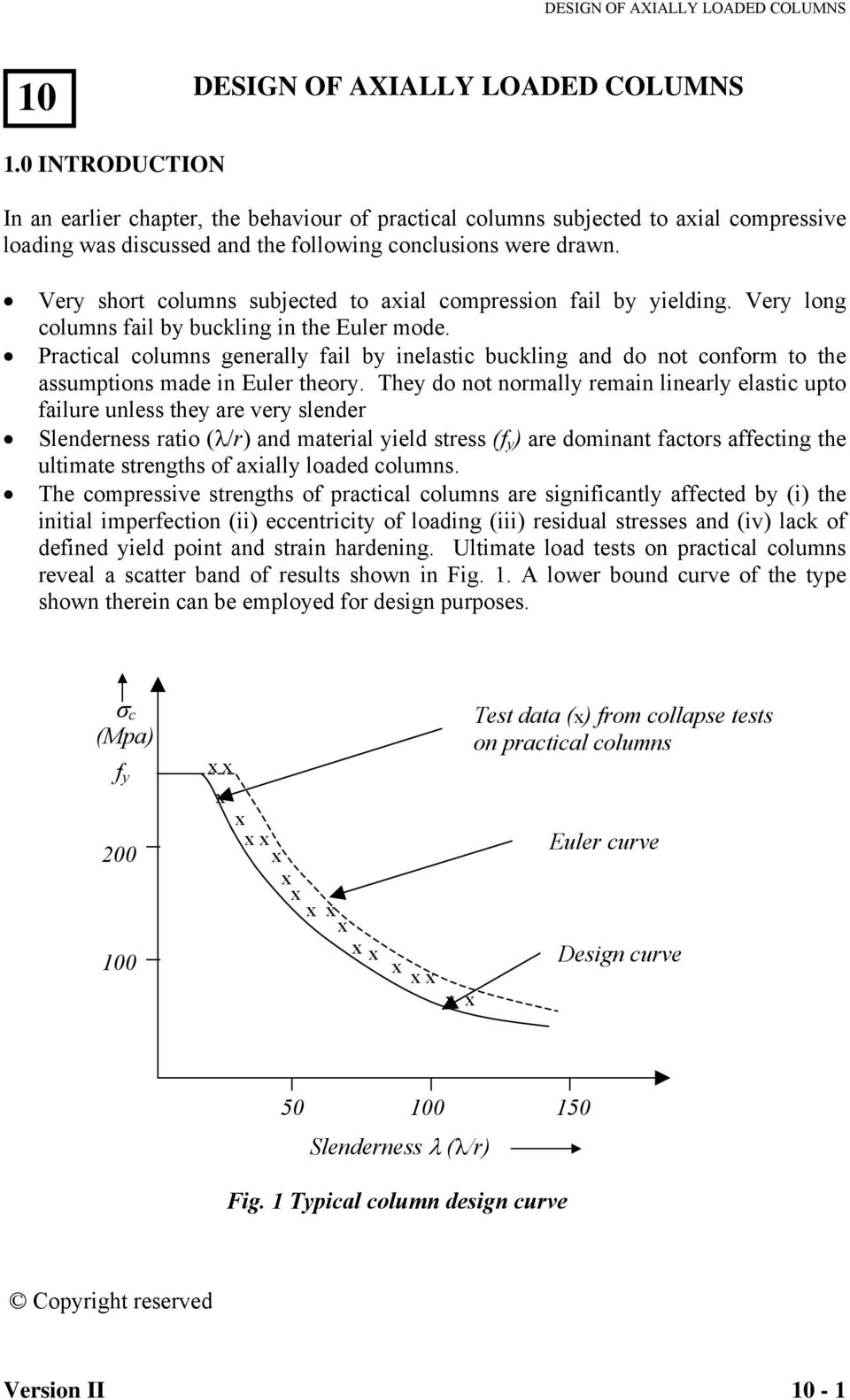
1 10 ESIGN OF AXIALLY LOAE COLUMNS 1.0 INTROUCTION In an earlier chapter, the behaviour of practical columns subjected to aial compressive loading was discussed and the following conclusions were drawn. Ver short columns subjected to aial compression fail b ielding. Ver long columns fail b buckling in the Euler mode. Practical columns generall fail b inelastic buckling and do not conform to the assumptions made in Euler theor. The do not normall remain linearl elastic upto failure unless the are ver slender Slenderness ratio (λ/r) and material ield stress (f ) are dominant factors affecting the ultimate strengths of aiall loaded columns. The compressive strengths of practical columns are significantl affected b (i) the initial imperfection (ii) eccentricit of loading (iii) residual stresses and (iv) lack of defined ield point and strain hardening. Ultimate load tests on practical columns reveal a scatter band of results shown in Fig. 1. A lower bound curve of the tpe shown therein can be emploed for design purposes. σ c (Mpa) f Test data () from collapse tests on practical columns Euler curve esign curve Slenderness λ (λ/r) Fig. 1 Tpical column design curve Copright reserved Version II 10-1
2 .0 HISTORICAL REVIEW Based on the studies of Arton & Perr (1886), the British Codes had traditionall based the column strength curve on the following equation. ( f σ ( σ σ ) = η σ σ (1 ) where c) e c e c f = ield stress σ c = compressive strength of the column obtained from the positive root of the above equation π E σ e = Euler buckling stress given b (1a) λ η = a parameter allowing for the effect of lack of straightness and eccentricit of loading. λ = Slenderness ratio given b (λ/r) In the deviation of the above formula, the imperfection factor η was based on η = r () where = the distance of centroid of the cross section to the etreme fibre of the section. = initial bow or lack of straightness r = radius of gration. Based on about 00 column tests, Robertson (195) concluded that the initial bow ( ) could be taken as length of the column/1000 consequentl η is given b η = λ. r r λ = α r = α λ (3) where α is a parameter dependent on the shape of the cross section. Version II 10 -

3 σ c (Mpa) f 00 Euler curve 100 esign curve with α = λ Fig. Robertson s esign Curve Robertson evaluated the mean values of α for man sections as given in Table 1: Table1: α values Calculated b Robertson Column tpe Beams & Columns about the major ais Rectangular Hollow sections Beams & Universal columns about the minor ais Tees in the plane of the stem α Values He concluded that the lower bound value of α = was appropriate for column designs. This served as the basis for column designs in Great Britain until recentl. The design curve using this approach is shown in Fig.. The esign method is termed "Perr- Robertson approach". 3.0 MOIFICATION TO THE PERRY ROBERTSON APPROACH 3.1 Stock Columns It has been shown previousl that ver stock columns (e.g. stub columns) resisted loads in ecess of their squash load of f.a (i.e. theoretical ield stress multiplied b the area of the column). This is because the effect of strain hardening is predominant in low Version II 10-3

4 values of slenderness (λ). Equation (1) will result in column strength values lower than f even in ver low slenderness cases. To allow empiricall for this discrepanc, recent British and European Codes have made the following modification to equation 3 given b η = α λ In the unmodified form this will cause a drop in the calculated value of column strength even for ver low values of slenderness. Such columns actuall fail b squashing and there is no drop in observed strengths in such ver short columns. B modifing the slenderness, λ to (λ - λ 0 ) we can introduce a plateau to the design curve at low slenderness values. In generating the British esign (BS: 5950 Part-1) curves λ = ( E / ) 0 0. π f was used as an appropriate fit to the observed test data, so that we obtain the failure load (equal to squash load) for ver low slenderness values. Thus in calculating the elastic critical stress, we modif the formula used previousl as follows: π E σ = for all values of λ > λ e ( λ λ ) 0 0 (4) Note that no calculations for σ e is needed when λ λ e as the column would fail b squashing at f. σ c (Mpa) f Test data () from collapse tests on practical columns Euler curve Robertson s curve λ [0.π (E/f ) 1/ ] λ Fig.3 Strut curve with a plateau for low slenderness values Version II 10-4

5 3. Influence of Residual Stresses Reference was made earlier to the adverse effect of locked-in residual stresses on column strengths (see Fig. 4). Studies on columns of various tpes carried out b the European Communit have resulted in the recommendation for adopting a famil of design curves rather than a single Tpical esign Curve shown in Fig. 3. Tpicall four column curves are suggested in British and European codes for the different tpes of sections commonl used as compression members [See Fig. 5(a)]. In these curves, η = α (λ -λ 0 ) where λ0 = 0.π E f and the α values are varied corresponding to various sections. Thus all column designs are to be carried out using the strut curves given in [Fig. 5(a)]. C T C T T C T T C T C C C C C T C T T C T T C T C Rolled beam Welded bo Rolled column f Compressive strength σ c (Mpa) Fig. 4 istribution of residual stresses a) α = 0.00 b) α = c) α = d) α = (Curve A) (Curve B) (Curve C) (Curve ) Slenderness, λ Fig. 5(a) Compressive strength curves for struts for different values of α Version II 10-5
![3. Tpicall four column curves are suggested in British and European codes for the different tpes of sections commonl used as compression members [See Fig. 5(a)].](/docs-images/46/21594820/images/page_5.jpg "In these curves, η = α (λ -λ 0 ) where λ0 = 0.π E f and the α values are varied corresponding to various sections. Thus all column designs are to be carried out using the strut curves given in [Fig.")
6 The selection of an appropriate curve is based on cross section and suggested curves are listed in Table. σ c (Mpa) 0N/mm f λ Fig. 5(b) Compressive strength of welded sections fcd/f a b c d λ Fig. 5(c) Column Buckling Curves as per IS: 800 Version II 10-6

7 Sections Table : Choice of appropriate values of α Ais of buckling X -X Y - Y Hot rolled structural hollow sections α = 0.00 (Curve A) α = 0.00 (Curve A) Hot rolled I section α = 0.00 (Curve A) α = (Curve B) Welded plate I section (up to 40 mm thick) I section (above 40 mm thick) Welded Bo Section (Up to 40 mm thick) (Over 40 mm thick) Rolled I section with Welded cover plates (Up to 40mm thick) (Over 40mm thick) Rolled angle, Channel, T section Compound sections - Two rolled sections back to back, Battened or laced sections α = (Curve B) α = (Curve B) α = (Curve B) α = (Curve C) α = (Curve B) α = (Curve C) α = (Curve C) α = (Curve ) α = (Curve B) α = (Curve C) α = 0.00 (Curve A) α = (Curve B) Check buckling about ANY ais With α = (Curve C) Note: For sections fabricated b plates b welding the Value of f should be reduced b 0 N/mm [See Fig. 5(b)]. For computational convenience, formulae linking σ c and λ are required. The lower root of equation (1) [based on Perr - Robertson approach] represents the strut curves given Fig. 3 and BS: 5950 Part - 1. σ c = φ φ f σ e f (5) where, φ = f + ( η + 1) σ e (6a) and η = ( λ λ ) 0 α (6b) 3.3 Tpes of Column Sections Steel suppliers manufacture several tpes of sections, each tpe being most suitable for specific uses. Some of these are described below. It is important to note that columns ma buckle about Z, Y, V or U ais. It is necessar to check the safet of the column about several aes, so that the lowest load that triggers the onset of collapse ma be identified. Version II 10-7

8 Universal Column (UC) sections have been designed to be most suitable for compression members. The have broad and relativel thick flanges, which avoid the problems of local buckling. The open shape is ideal for economic rolling and facilitates eas beam-tocolumn connections. The most optimum theoretical shape is in fact a circular hollow section (CHS), which has no weak bending ais. Although these have been emploed in large offshore structures like oil platforms, their use is somewhat limited because of high connection costs and comparativel weaker in combined bending and aiall compressive loads. Rectangular Hollow Sections (RHS) have been widel used in multi-store buildings satisfactoril. For relativel light loads, (e.g. Roof trusses) angle sections are convenient as the can be connected through one leg. Columns, which are subjected to bending in addition to aial loads, are designed using Universal beams (UB). 3.4 Heavil Welded Sections Although both hot rolled sections and welded sections have lock-in residual stresses, the distribution and magnitude differ significantl. Residual stresses due to welding are ver high and can be of greater consequence in reducing the ultimate capacit of compression members. 3.5 Stipulations of IS: 800 The stipulations of IS: 800 follow the same methodolog as detailed above. For various tpes of column cross sections including Indian Standard rolled steel sections (as against Universal Column sections), CHS, SHS, RHS and Heavil Welded sections, IS: 800 recommends the classifications following the column buckling curves a, b, c and d as detailed in fig. 5(c) above. Apart from tpes of column cross-sections, the respective geometric dimensions of individual structural elements and their corresponding limits also guide Buckling Class. For eample, if the ratio of overall height is to the overall width of the flange of rolled I section i.e. h/b is greater than 1. and the thickness of flange is less than 40 mm, the buckling class corresponding to ais z-z will be guided b Curve a of Fig. 5 (c). This shows for same slenderness ratio, more reserve strength is available for the case described above in comparison to built-up welded sections. For various tpes of column cross-sections, Table 3 (Table 7. of Revised IS: 800) defines the buckling classes with respect to their respective limits of height to width ratio, thickness of flange and the ais about which the buckling takes place (to be determined based on the column buckling curves as indicated in fig. 5 (c) corresponding to both major and minor ais): Version II 10-8

9 TABLE 3: BUCKLING CLASS OF CROSS SECTIONS Cross Section Limits Rolled I-Sections h z d t w t f h/b f > 1. : t f 40 mm 40 mm< t f 100 mm z h/b f < 1. : t f 100 mm Buckling about ais z-z - z-z - z-z - Buckling Class a b b c b c Welded I-Section h z t w t f b f z h z t w t f z t f >100 mm t f <40 mm t f >40 mm z-z - z-z - z-z - d d b c c d b Hollow Section b Hot rolled An a Welded Bo Section h z b Channel, Angle, T and Solid Sections t f z t w Cold formed An b Generall (Ecept as below) An b Thick welds and b/t f < 30 h/t w < 30 z-z - c c An c z z Built-up Member An c z z Version II 10-9

10 4.0 EFFECTIVE LENGTH OF COLUMNS The effective length, KL, is calculated from the actual length, L, of the member, considering the rotational and relative translational boundar conditions at the ends. The actual length shall be taken as the length from center to center of its intersections with the supporting members in the plane of the buckling deformation, or in the case of a member with a free end, the free standing length from the center of the intersecting member at the supported end. Effective Length Where the boundar conditions in the plane of buckling can be assessed, the effective length, KL, can be calculated on the basis of Table 7.5. Where frame analsis does not consider the equilibrium of a framed structure in the deformed shape (Second-order analsis or Advanced analsis), the effective length of compression members in such cases can be calculated using the procedure given in Appendi E.1. The effective length of stepped column in individual buildings can be calculated using the procedure given in Appendi E.. Eccentric Beam Connection In cases where the beam connections are eccentric in plan with respect to the aes of the column, the same conditions of restraint as in concentric connection, shall be deemed to appl, provided the connections are carried across the flange or web of the columns as the case ma be, and the web of the beam lies within, or in direct contact with the column section. Where practical difficulties prevent this, the effective length shall be taken as equal to the distance between points of restraint, in nonswa frames. Stipulations of IS: 800 Method for determining Effective Length for Stepped Columns Single Stepped Columns Effective length in the plane of stepping (bending about ais z- z) for bottom and top parts for single stepped column shall be taken as given in Table E. Note: The provisions of E..1 are applicable to intermediate columns as well with stepping on either side, provided appropriate values of I1and I are taken ouble Stepped Columns Effective lengths in the plane of stepping (bending about ais z-z) for bottom, middle and top parts for a double stepped column shall be taken as per the stipulations of Appendi E3 Coefficient K 1 for effective length of bottom part of double stepped column shall be taken from the formula: where 1 t K 1 1 K 1, K, and K 3 are taken from Table E.6, K = + ( t K + K ) ( 1+ n ) 1+ t t I I' 1 av Version II 10-10

11 TABLE 4: EFFECTIVE LENGTH OF PRISMATIC COMPRESSION MEMBERS Boundar Conditions At one end At the other end Translation Rotation Translation Rotation Schematic representation Effective Length Restrained Restrained Free Free.0L Free Restrained Restrained Free Restrained Free Restrained Free 1.0L Restrained Restrained Free Restrained 1.L Restrained Restrained Restrained Free 0.8L Restrained Restrained Restrained Restrained 0.65 L Note L is the unsupported length of the compression member (7..1). Version II 10-11

12 esigns of columns have to be checked using the appropriate effective length for buckling in both strong and weak aes. A worked eample illustrating this concept is appended to this chapter. 5.0 STEPS IN ESIGN OF AXIALLY LOAE COLUMNS AS PER IS: 800 The procedure for the design of an aiall compressed column as stipulated in IS: 800 is as follows: (i) Assume a suitable trial section and classif the section in accordance with the classification as detailed in Table 3.1 (Limiting Width to Thickness Ratios) of the Chapter 3 of IS: 800. (If, the section is slender then appl appropriate correction factor). (ii) Calculate effective sectional area, A e as defined in Clause 7.3. of IS: 800 (iii) Calculate effective slenderness ration, KL/r, ratio of effective length KL, to appropriate radius of gration, r (iv) Calculate λ from the equation, λ = non-dimensional effective slenderness ratio = f = f ( ) π E f cc KL r (v) Calculate φ from the equation, φ = 0.5[1+α (λ - 0.)+ λ ] Where, α = Imperfection factors for various Column Buckling Curves a, b, c and d are given in the following Table: (Table 7.1 of IS: 800) TABLE 5: IMPERFECTION FACTOR, α Buckling Class a b c d α (vi) 1 Calculate χ from equation, χ = 0.5 φ + ( φ λ ) (vii) Choose appropriate value of Partial safet factor for material strength, γ m0 from Table 5. of Chapter 5 of IS: 800 (viii) Calculate design stress in compression, f cd, as per the following equation (Clause of IS: 800): f / γ m0 f cd = = χ f / 0.5 γ m0 f / γ m0 φ + [ φ λ ] (i) Compute the load P d, that the compression member can resist P d = A e f cd Version II 10-1
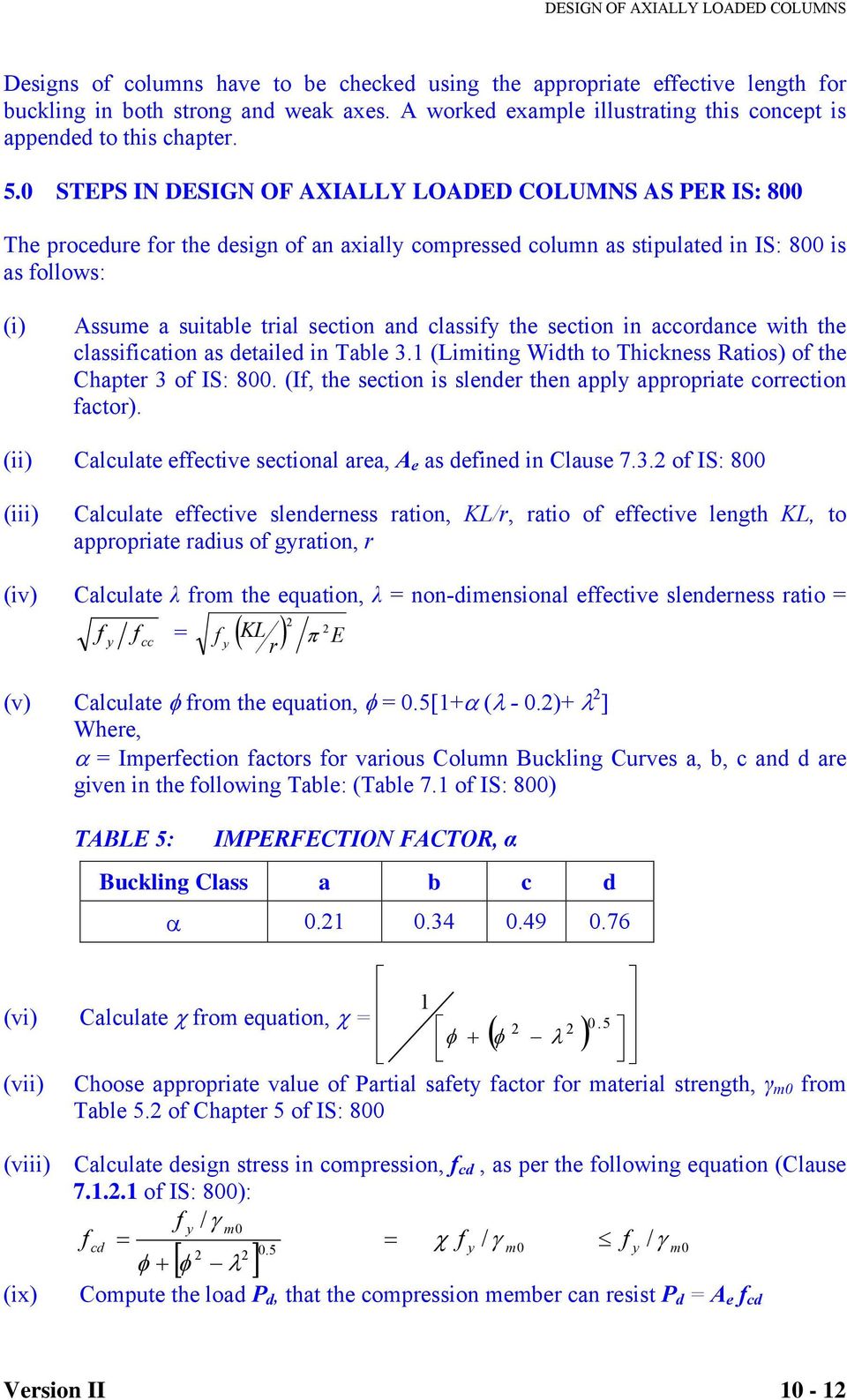
13 () Calculate the factored applied load and check whether the column is safe against the given loading. The most economical section can be arrived at b trial and error, i.e. repeating the above process. 6.0 CROSS SECTIONAL SHAPES FOR COMPRESSION MEMBERS AN BUILT- UP COLUMNS Although theoreticall we can emplo an cross sectional shape to resist a compressive load we encounter practical limitations in our choice of sections as onl a limited number of sections are rolled b steel makers and there are sometimes problems in connecting them to the other components of the structure. Another limitation is due to the adverse impact of increasing slenderness ratio on compressive strengths; this virtuall ecludes the use of wide plates, rods and bars, as the are far too slender. It must be speciall noted that all values of slenderness ratio referred to herein are based on the least favourable value of radius of gration, so that (λ/r) is the highest value about an ais. 6.1 Rolled Steel Sections Some of the sections emploed as compression members are shown in Fig. 6. Single angles [Fig 6(a)] are satisfactor for bracings and for light trusses. Top chord members of roof trusses are usuall made up of twin angles back to back [Fig 6(b)] ouble angle sections shown in Fig. 6(b) are probabl the most commonl used members in light trusses. The pair of angles used has to be connected together, so the will act as one unit. Welds ma be used at intervals with a spacer bar between the connecting legs. Alternatel stitch bolts, washers and ring fills are placed between the angles to keep them at the proper distance apart (e.g. to enable a gusset to be connected). When welded roof trusses are required, there is no need for gusset plates and T sections [Fig 6(c)] can be emploed as compression members. Single channels or C-sections [Fig. 6(d)] are generall not satisfactor for use in compression, because of the low value of radius of gration. The can be used if the could be supported in a suitable wa in the weak direction. Circular hollow sections [Fig. 6(e)] are perhaps the most efficient as the have equal values of radius of gration about ever ais. But connecting them is difficult but satisfactor methods have been evolved in recent ears for their use in tall buildings. The net best in terms of structural efficienc will be the square hollow sections (SHS) and rectangular hollow sections, [Fig. 6(f)] both of which are increasingl becoming popular in tall buildings, as the are easil fabricated and erected. Welded tubes of circular, rectangular or square sections are ver satisfactor for use as columns in a long series of windows and as short columns in walkwas and covered warehouses. For man Version II 10-13

14 structural applications the weight of hollow sections required would be onl 50% of that required for open profiles like I or C sections. (a) Single Angle (b) ouble Angle (c) Tee (d) Channel (e) Circular Hollow Section (CHS) (f) Rectangular Hollow Section (RHS) Fig 6: Cross Section Shapes for Rolled Steel Compression Members The following general guidance is given regarding connection requirements: When compression members consist of different components, which are in contact with each other and are bearing on base plates or milled surfaces, the should be connected at their ends with welds or bolts. When welds are used, the weld length must be not less than the maimum width of the member. If bolts are used the should be spaced longitudinall at less than 4 times the bolt diameter and the connection should etend to at least 1 ½ times the width of the member. Single angle discontinuous struts connected b a single bolt are rarel emploed. When such a strut is required, it ma be designed for 1.5 times the factored aial load and the effective length taken as centre to centre of the intersection at each end. Single angle discontinuous struts connected b two or more bolts in line along the member at each end ma be designed for the factored aial load, assuming the effective length to be 0.85 times the centre to centre distance of the intersection at each end. For double angle discontinuous struts connected back to back to both sides of a gusset or section b not less than two bolts or b welding, the factored aial load is used in design, with an effective length conservativel chosen. (A value between 0.7 and 0.85 depending upon the degree of restraint provided at the ends). All double angle struts must be tack bolted or welded. The spacing of connectors must be such that the largest slenderness ratio of each component member is neither greater than 60 nor less than 40. A minimum of two bolts at each end and a minimum of two Version II 10-14

15 additional connectors spaced equidistant in between will be required. Solid washers or packing plates should be used in-between if the leg width of angles eceed 15 mm. For member thickness upto 10 mm, M16 bolts are used; otherwise M0 bolts are used. Spacing of tack bolts or welds should be less than 600 mm. The following guide values are suggested for initial choice of members: (i) (ii) (iii) Single angle size : 1/30 of the length of the strut ouble angle size : 1/35 of the length of strut Circular hollow sections diameter = 1/40 length 6. Built-up or fabricated Compression Members ( λ 150) r ( λ ) r ( λ 100) When compression members are required for large structures like bridges, it will be necessar to use built-up sections. The are particularl useful when loads are heav and members are long (e.g. top chords of Bridge Trusses). Built up sections [illustrated in Fig. 7(a) and 7(b)] are popular in India when heav loads are encountered. The cross section consists of two channel sections connected on their open sides with some tpe of lacing or latticing (dotted lines) to hold the parts together and ensure that the act together as one unit. The ends of these members are connected with batten plates which tie the ends together. Bo sections of the tpe shown in Fig. 7(a) or 7(b) are sometimes connected b solid plates also (represented b straight lines). A pair of channels connected b cover plates on one side and latticing on the other [Fig.7(c)] is sometimes used as top chords of bridge trusses. The gussets at joints can be convenientl connected to the inside of the channels. Plated I sections or built-up I sections are used when the available rolled I sections do not have sufficient strengths to resist column loads [Fig 7(d) and 7(e)]. For ver heav column loads, a welded built up section [See Fig. 7(f)] is quite satisfactor. r (a) Bo Section (b) Bo Section (c) Bo Section (f) Built-up Bo (d) Plated I Section (e) Built - up I Section Section Fig 7: Cross Section Shapes for Built - up or fabricated Compression Members Version II 10-15

16 Built up columns made up of solid webs: In these columns the webs are solid and continuous [See Fig 7(d), 7(e), and 7(f)]. Flange plates or channels ma be used in combination with rolled sections to enhance the load resistance of the commonl available sections, which are directl welded or bolted to each other. For preliminar calculations, approimate values of radii of gration given in Fig. 8 for various built-up sections ma be emploed. The lateral dimension of the column is generall chosen at around 1/10 to 1/15 of the height of the column. For purposes of detailing the connection between the flange cover plates or the outer rolled sections to the flanges of the main rolled section, it is customar to design the fasteners for a transverse shear force equal to.5% of the compressive load of the column. (Connection esign is dealt later in this resource). Version II 10-16

17 B B r =0.9 r =0.9 B r =0.4 m =mean r =0.5 B B r =0.31 r =0.15 B =B ( ) r =0.1 r =0.1 B r z =0.19 z m r =0.35 m r =0.3 r =0.1 B = B ( ) B z B r = r = 0.31 r z =0.197 r =0.4 r =0.4B r =0.9 r =0.3 B B B B r 3 =0.18(+B)/ r =0.36 r =0.45 B Fig 8: Approimate radii of gration (Continued in net page) Version II 10-17

18 ESIGN OF AXIALLY LOAE COLUMNS r =0.36 r =0.6 B r =0.36 r =0.53 B B B r =0.39 r =0.55 B r =0.38 r =0. B B B r =0.4 r =0.1 B r =0.4 B Fig 8: Approimate radii of gration Open Web Columns: In Fig. 9 the two channel sections of the column are connected together b batten plates or laces which are shown b dotted lines. A tpical lacing or batten plate is shown in Fig. 9. Laced columns (also called latticed columns) generall carr 10% more load than battened columns for the same area of cross section. This necessitates a 10% increase in the slenderness ratio for battened columns. All columns should be tied at the ends b tie plates or end battens to ensure a satisfactor performance. 6.3 esign Considerations for Laced and Battened Columns The two channel constituents of a laced column, shown in Fig. 9(a) and 9 (b) have a tendenc to buckle independentl. Lacing provides a ting force to ensure that the channels do not do so. The load that these ting forces cause is generall assumed to cause a shearing force equal to.5% of aial load on the column. (Additionall if the columns are subjected to moments or lateral loading the lacing should be designed for the additional bending moment and shear). To prevent local buckling of unsupported lengths between the two constituent lattice points (or between two battens), the slenderness ratio Version II 10-18

19 of individual components should be less than 50 % or 70% of the slenderness ratio of the built up column (whichever is less). In laced columns, the lacing should be smmetrical in an two opposing faces to avoid torsion. Lacings and battens are not combined in the same column. The inclination of lacing bars from the ais of the column should not be less than 40 0 nor more than The slenderness ratio of the lacing bars should not eceed 145. The effective length of lacing bars is the length between bolts for single lacing and 0.7 of this length for double lacing. The width of the lacing bar should be at least 3 times the diameter of the bolt. Thickness of lacing bars should be at least 1/40 th of the length between bolts for single lacing and 1/60 of this length for double lacing (both for welded and bolted connections). (a) Single Lacing (b) ouble Lacing (c) Battens Fig. 9 Built-up column members In the Western world, it was common practice to build-up the required cross sectional area of steel compression members from a number of smaller sections. Since then, the increasing availabilit of larger rolled steel sections and the high fabrication costs have resulted in a ver large drop in the use of built-up compression members. The disrepute of built-up compression members arises from the unrealistic epectation of man designers that a built-up member should have the same capacit of a solid member and Version II 10-19

20 also behaves in ever respect in an identical manner to the latter. Earl designers were disappointed to discover that this was just not possible. A contributor cause to this decline was the restrictive clauses introduced in man western design codes, following the Quebec Bridge Failure in However there is a continuing use of built-up members, where stiffness and lightness are required, as in Transmission line Towers. There is, however, a wide spread use of built up compression members in the developing world, India included, largel because of the non-availabilit of heavier rolled sections and the perception that fabrication of members is cheaper. For Laced and Battened Columns, Section 7.6 and 7.7 of IS: 800 shall be followed. In practical columns, the battens are ver stiff and as the are normall welded to the vertical members, the can be considered as rigid connectors. To allow approimatel for this behaviour, a modified formula for calculating the effective slenderness (λ b ) of battened columns has been widel emploed. This ensures that the Perr-Robertson approach outlined earlier could be used with a modified value for slenderness given b λ b defined below. f λ b = λ + λ (7) where, λ f = lower value of slenderness of the individual vertical members between batten intervals and λ = slenderness of the overall column, using the radius of gration of the whole built up section. This equation, though an approimation, has been shown b Porter and Williams of Cardiff Universit actuall to give accurate and safe values over the entire range of practical parameters for uniform columns with normal depth battens. In calculating the values of σ e in the Perr Robertson equation, [equation 1 and 1(a)] λ b is to be emploed in place of λ, using slenderness ratio in defined in equation (3). The imperfection (η b ) is calculated from η b = (λ b ) (8) The strength of the battened column is evaluated from σ c = f + ( η + 1) σ f + ( η 1) b e b + σ e f σ e (9) λ b = effective slenderness with η b computed as given in equation (8) σ e = calculated using η b values given in equation (7) Version II 10-0

21 7.0 BASE PLATES FOR CONCENTRICALLY LOAE COLUMNS The design compressive stress in a concrete footing is much smaller than it is in a steel column. So it becomes necessar that a suitable base plate should be provided below the column to distribute the load from it evenl to the footing below. The main function of the base plate is to spread the column load over a sufficientl wide area and keep the footing from being over stressed. For a purel aial load, a plain square steel plate or a slab attached to the column is adequate. If uplift or overturning forces are present, a more positive attachment is necessar. These base plates can be welded directl to the columns or the can be fastened b means of bolted or welded lug angles. These connection methods are illustrated in Fig. 10. A base plate welded directl to the columns is shown in Fig. 10(a). For small columns these plates will be shop-welded to the columns, but for larger columns, it ma be necessar to ship the plates separatel and set them to the correct elevations. For this second case the columns are connected to the footing with anchor bolts that pass through the lug angles which have been shop-welded to the columns. This tpe of arrangement is shown in Fig. 10(b). Anchor bolts Anchor Concrete footing Angle (a) (b) Fig. 10 Column base Sometimes, when there is a large moment in relation to the verticall applied load a gusseted base ma be required. This is intended to allow the lever arm from the holding down bolts to be increased to give maimum efficienc while keeping the base plate thickness to an acceptable minimum. Version II 10-1
22 A critical phase in the erection of a steel building is the proper positioning of column base plates. If the are not located at their correct elevations, serious stress changes ma occur in the beams and columns of the steel frame. In man cases, levelling plates of the same dimensions as the base plate are carefull grouted in place to the proper elevations first and then the columns with attached base plates are set on the levelling plates. The lengths and widths of column base plates are usuall selected in multiples of 10 mm and the thickness chosen to conform to rolled steel plates. Usuall the thickness of base plates is in the range of mm. If plates of this range are insufficient to develop the applied bending moment or if thinner plates are used, some form of stiffening must be provided. Concrete support area should be significantl larger than the base plate area so that the applied load can disperse satisfactoril on to the foundation. To spread the column loads uniforml over the base plates, and to ensure there is good contact between the two, it is customar not to polish the underside of the base plate, but grout it in place. Columns supporting predominantl aial loads are designed as being pin-ended at the base. The design steps for a base plate attached to an aiall loaded column with pinned base is eplained below. Procedure for empirical design of a slab base plate for aial load onl (pinned connection) 1. etermine the factored aial load and shear at the column base.. ecide on the number and tpe of holding down bolts to resist shear and tension. The chosen number of bolts are to be arranged smmetricall near corners of base plate or net to column web, similar to the arrangement sketched in Fig Maimum allowable bearing strength = 0.4 f cu (where f cu = cube strength of concrete) Actual bearing pressure to be less than or equal to 0.4 f cu. 4. etermine base plate thickness t; For I, H, channel, bo or RHS columns ( ) t =.5w a 0.3 b but not less than the thickness of the flange of the supported f p column. w = pressure in N/mm on underside of plate, assuming a uniform distribution. a = larger plate projection from column [See Fig. 11] b = smaller plate projection from column f p = design strength of plate, but not greater than 50 N/mm divided b γ m a t f1 a t f1 b b t f t f1 Fig. 11 Base plates subjected to concentric forces Version II 10 -
23 5. Check for adequac of weld. Calculate the total length of weld to resist aial load. 6. Select weld size. 7. Check shear stress on weld. 8. Vector sum of all the stresses carried b the weld must not eceed p w, the design strength, of the weld. 9. Check for bolt. Check maimum co-eistent factored shear and tension, if an, on the holding down bolts. 10. Check the bolts for adequac (see a later chapter for bolt design). Stipulations of IS: 800 for Column Bases Column bases should have sufficient, stiffness and strength to transmit aial force, bending moments and shear forces at the base of the columns to their foundation without eceeding the load carring capacit of the supports. Anchor bolts and shear kes should be provided wherever necessar. Shear resistance at the proper contact surface between steel base and concrete/grout ma be calculated using a friction coefficient of The nominal bearing pressure between the base plate and the support below ma be determined on the basis of linearl varing distribution of pressure. The maimum bearing pressure should not eceed the bearing strength equal to 0.6f ck, where f ck is the smaller of characteristic cube strength of concrete or bedding material. If the size of the base plate is larger than that required to limit the bearing pressure on the base support, an equal projection, c, of the base plate beond the face of the column and gusset ma be taken as effective in transferring the column load (Fig 7.), such that beam pressure as the effective area does not eceed bearing capacit of concrete base. Gusseted Bases For stanchion with gusseted bases, the gusset plates, angle cleats, stiffeners, fastenings, etc., in combination with the bearing area of the shaft, shall be sufficient to take the loads, bending moments and reactions to the base plate without eceeding specified strength. All the bearing surfaces shall be machined to ensure perfect contact. Where the ends of the column shaft and the gusset plates are not faced for complete bearing, the welding, fastenings connecting them to the base plate shall be sufficient to transmit all the forces to which the base is subjected. Column and Base Plate Connections Where the end of the column is connected directl to the base plate b means of full penetration butt welds, the connection shall be deemed to transmit to the base all the forces and moments to which the column is subjected. Slab Bases Columns with slab bases need not be provided with gussets, but sufficient fastenings shall be provided to retain the parts securel in place and to resist all moments and forces, other than direct compression, including those arising during transit, unloading and erection. Version II 10-3
24 c c t c+t c+t c+t Effective Portion Stiffener c c FIG 7. EFFECTIVE AREA OF A BASE PLATE The minimum thickness, t s, of rectangular slab bases, supporting columns under aial compression shall be t =.5 w ( a 0.3b ) γ / f > t s m 0 where, w = uniform pressure from below on the slab base under the factored load aial compression a, b = larger and smaller projection of the slab base beond the rectangle circumscribing the column, respectivel t f = flange thickness of compression member When onl the effective area of the base plate is used as in section instead of (a - 0.3b ), c ma be used in the above equation (see Fig 7.) When the slab does not distribute the column load uniforml, due to eccentricit of the load etc, special calculation shall be made to show that the base is adequate to resist the moment due to the non-uniform pressure from below. Bases for bearing upon concrete or masonr need not be machined on the underside. In cases where the cap or base is fillet welded directl to the end of the column without boring and shouldering, the contact surfaces shall be machined to give a perfect bearing f Version II 10-4
25 and the welding shall be sufficient to transmit the forces as required in Where full strength butt welds are provided, machining of contact surfaces is not required. 7.0 CONCLUING REMARKS esign of columns using multiple column curves is discussed in this chapter. Additional provision required for accounting for heavil welded sections are detailed. Built-up fabricated members frequentl emploed (when rolled sections are found inadequate) are discussed in detail. esign guidance is provided for laced/battened columns. Effective lengths for various end conditions are listed and illustrative worked eamples are appended. A simple method of designing a base plate for an aiall loaded column is proposed and illustrated b a worked eample. Wherever required, provisions of IS: 800 (latest Version) have been highlighted and worked eamples have been prepared based on the stipulations of IS: 800 (Latest Version). 8.0 REFERENCES 1. Owens G.W., Knowles P.R (1994): "Steel esigners Manual", The Steel Construction Institute, Ascot, England.. owling P.J., Knowles P.R., Owens G.W (1998): "Structural Steel esign", Butterworths, London. 3. British Standards Institution (1985): "BS 5950, Part-1 Structural use of steelwork in building", British Standards Institution, London. 4. Bureau of Indian Standard, IS: 800, Version II 10-5
26 Table3: Ultimate Compressive stress (σ c ) values in compression members ( f = 50 N/mm ) λ α = 0.00 α = α = α = Version II 10-6
27 Structural Steel esign Project Calculation Sheet Job No: Sheet 1 of 4 Rev Job Title: AXIALLY COMPRESSE COLUMN Worked Eample - 1 Made b ate GC Checked b ate TKB Obtain factored aial load on the column section ISHB400. The height of the column is 3.0m and it is pin-ended. [ f = 50 N/mm ; E = 10 5 N/mm ; γ m = 1.10] Table 5. of IS: 800 CROSS-SECTION PROPERTIES: T b Z d h t Y 3.0 m Version II 10-7
28 Structural Steel esign Project Calculation Sheet Flange thickness = T = 1.7 mm Overall height of ISHB400 = h = 400 mm Job No: Sheet of 4 Rev Job Title: AXIALLY COMPRESSE COLUMN Worked Eample - 1 Made b ate GC Checked b ate TKB Clear depth between flanges = d = 400 (1.7 * ) = mm Thickness of web = t = 10.6 mm Flange width = b = b f = 50 mm Hence, half Flange Width = b = 15 mm Self weight = w = 0.8 kn/m Area of cross-section = A = mm Radius of gration about = r = mm Radius of gration about = r = 51.6 mm (i) Tpe of section: b T = = 9.8 < 10.5ε d t = = 35.3 < 4ε Table 3.1 of IS: 800 where, ε = 50 f = = 1.0 Hence, cross- section can be classified as COMPACT (ii) Effective Sectional Area, A e = mm (Since there is no hole, no reduction has been considered) Clause 7.3. of IS:
29 (iii) Structural Steel esign Project Calculation Sheet Effective Length: Job No: Sheet 3 of 4 Rev Job Title: AXIALLY COMPRESSE COLUMN Worked Eample - 1 Made b ate GC Checked b ate TKB (iv) As, both ends are pin-jointed effective length KL = KL = 1.0 L = 1.0 L = m = 3.0 m Slenderness ratios: Clause 7. and Table 7.5 of IS: 800 KL / r = = 18.1 KL / r = = 58.1 (v) Non-dimensional Effective Slenderness ratio, λ : λ = f f cc = ( KL 5 f ) π E = 50( 58.1) π 10 r = (vi) Value of φ from equation φ = 0.5[1+α (λ - 0.)+ λ ]: Where, α = Imperfection Factor which depends on Buckling Class Now, from Table 7. of Chapter 7, for h/b f = 400 / 50 = 1.6 > 1. and also thickness of flange, T = 1.7 mm, hence for z-z ais buckling class a and for - ais buckling class b will be followed. Clause of IS: 800 Table 7.1 of IS: 800 Hence, α = 0.34 for buckling class b will be considered. Hence, φ = 0.5 [ ( ) ] = (vii) Calculation of χ from equation χ = χ = 1 φ ( φ λ ) = 1 = φ ( φ λ ) 0.5 [ ( ) ] : 10-9
30 Structural Steel esign Project Calculation Sheet Job No: Sheet 4 of 4 Rev Job Title: AXIALLY COMPRESSE COLUMN Worked Eample - 1 Made b ate GC Checked b ate TKB (viii) Calculation of f cd from the following equation: f cd f / γ m0 = = χ f / 0 = /1.10 = γ N/mm m φ + [ φ λ ] (i) Factored Aial Load in kn, P d : P d = A e f cd = /1000 = kn 10-30
31 Structural Steel esign Project Calculation Sheet Job No: Sheet 1 of Rev Job Title: AXIALLY COMPRESSE COLUMN Worked Eample - Made b ate GC Checked b ate TKB Obtain maimum aial load carried b the column shown when ISHB 400 is emploed. The column is effectivel restrained at mid-height in the - direction, but is free in -ais. The data is the same as in problem1. [ f = 50 N/mm ; E = N/mm ; γ m = 1.10 ] (i) Tpe of section: Section is COMPACT from previous eample. (ii) Effective lengths: 3.0 m (iii) As, both ends are pin-jointed effective length KL = = 6000 mm KL = = 3000 mm Slenderness ratios: KL / r = = 36.1 KL / r = 3000 = (iv) Non-dimensional Effective Slenderness ratio, λ : 3.0 m As calculated in previous eample, λ = (for worst slenderness ratio) (v) Value of φ: As calculated in previous eample, φ = (for λ = 0.654) (vi) Value of χ: As calculated in previous eample, χ = (for φ = 0.791) 10-31
32 Structural Steel esign Project Calculation Sheet Job No: Sheet of Rev Job Title: AXIALLY COMPRESSE COLUMN Worked Eample - Made b ate GC Checked b ate TKB (vii) Calculation of f cd : As calculated in previous eample, f cd = N/mm (viii) Calculation of Factored Load: Factored Load = f cd A e /γ m = / /1000= kn 10-3
33 Structural Steel esign Project Calculation Sheet Job No: Sheet 1 of 1 Rev Job Title: BASE PLATE Worked Eample - 3 Made b ate GC Checked b ate TKB esign a simple base plate for a 0.8 kn/m column to carr a factored load of 1800 kn. [f cu = 40 N/mm ; f = 50 N/mm ; γ m = 1.10] Table 5. of IS: 800 ISHB mm 450 mm Thickness of Flange for ISHB400 = T = 1.7 mm Bearing strength of concrete = 0.4f cu = 0.4 * 40 = 16 N/mm Area required = 1800*10 3 /16 = mm Use plate of 450 X 300 mm ( mm ) Assuming projection of 5 mm on each side, a = b = 5 mm 3 ( ) = w = N/mm Now thickness of Slab Base, t s t s =.5 w ( a 0.3b ) γ m 0 / f > =.5w ( a 0.3b ) ( ) 1.10 = = 8.01 mm f < T = 1.7 mm, Hence provide a base plate of thickness not less than 1.7 mm and since the available net higher thickness of plate is 16 mm T 50 Clause of IS: 800 Use 450 X 300 X 16 mm plate
STEEL-CONCRETE COMPOSITE COLUMNS-I
 5 STEEL-CONCRETE COMOSITE COLUMNS-I 1.0 INTRODUCTION A steel-concrete composite column is a compression member, comprising either a concrete encased hot-rolled steel section or a concrete filled tubular
Design of Steel Structures Prof. S.R.Satish Kumar and Prof. A.R.Santha Kumar. Fig. 7.21 some of the trusses that are used in steel bridges
 7.7 Truss bridges Fig. 7.21 some of the trusses that are used in steel bridges Truss Girders, lattice girders or open web girders are efficient and economical structural systems, since the members experience
Compression Members: Structural elements that are subjected to axial compressive forces
 CHAPTER 3. COMPRESSION MEMBER DESIGN 3.1 INTRODUCTORY CONCEPTS Compression Members: Structural elements that are subjected to axial compressive forces onl are called columns. Columns are subjected to axial
MECHANICS OF SOLIDS - BEAMS TUTORIAL TUTORIAL 4 - COMPLEMENTARY SHEAR STRESS
 MECHANICS OF SOLIDS - BEAMS TUTORIAL TUTORIAL 4 - COMPLEMENTARY SHEAR STRESS This the fourth and final tutorial on bending of beams. You should judge our progress b completing the self assessment exercises.
Rigid and Braced Frames
 Rigid Frames Rigid and raced Frames Rigid frames are identified b the lack of pinned joints within the frame. The joints are rigid and resist rotation. The ma be supported b pins or fied supports. The
COMPLEX STRESS TUTORIAL 3 COMPLEX STRESS AND STRAIN
 COMPLX STRSS TUTORIAL COMPLX STRSS AND STRAIN This tutorial is not part of the decel unit mechanical Principles but covers elements of the following sllabi. o Parts of the ngineering Council eam subject
SEISMIC DESIGN. Various building codes consider the following categories for the analysis and design for earthquake loading:
 SEISMIC DESIGN Various building codes consider the following categories for the analysis and design for earthquake loading: 1. Seismic Performance Category (SPC), varies from A to E, depending on how the
DESIGN OF SLABS. 3) Based on support or boundary condition: Simply supported, Cantilever slab,
 DESIGN OF SLABS Dr. G. P. Chandradhara Professor of Civil Engineering S. J. College of Engineering Mysore 1. GENERAL A slab is a flat two dimensional planar structural element having thickness small compared
EDEXCEL NATIONAL CERTIFICATE/DIPLOMA MECHANICAL PRINCIPLES OUTCOME 2 ENGINEERING COMPONENTS TUTORIAL 1 STRUCTURAL MEMBERS
 ENGINEERING COMPONENTS EDEXCEL NATIONAL CERTIFICATE/DIPLOMA MECHANICAL PRINCIPLES OUTCOME ENGINEERING COMPONENTS TUTORIAL 1 STRUCTURAL MEMBERS Structural members: struts and ties; direct stress and strain,
Design of Steel Structures Prof. S.R.Satish Kumar and Prof. A.R.Santha Kumar
 Problem 1 Design a hand operated overhead crane, which is provided in a shed, whose details are: Capacity of crane = 50 kn Longitudinal spacing of column = 6m Center to center distance of gantry girder
Solving Quadratic Equations by Graphing. Consider an equation of the form. y ax 2 bx c a 0. In an equation of the form
 SECTION 11.3 Solving Quadratic Equations b Graphing 11.3 OBJECTIVES 1. Find an ais of smmetr 2. Find a verte 3. Graph a parabola 4. Solve quadratic equations b graphing 5. Solve an application involving
III. Compression Members. Design of Steel Structures. Introduction. Compression Members (cont.)
 ENCE 455 Design of Steel Structures III. Compression Members C. C. Fu, Ph.D., P.E. Civil and Environmental Engineering Department University it of Maryland Compression Members Following subjects are covered:
EDEXCEL NATIONAL CERTIFICATE/DIPLOMA MECHANICAL PRINCIPLES AND APPLICATIONS NQF LEVEL 3 OUTCOME 1 - LOADING SYSTEMS TUTORIAL 3 LOADED COMPONENTS
 EDEXCEL NATIONAL CERTIICATE/DIPLOMA MECHANICAL PRINCIPLES AND APPLICATIONS NQ LEVEL 3 OUTCOME 1 - LOADING SYSTEMS TUTORIAL 3 LOADED COMPONENTS 1. Be able to determine the effects of loading in static engineering
New approaches in Eurocode 3 efficient global structural design
 New approaches in Eurocode 3 efficient global structural design Part 1: 3D model based analysis using general beam-column FEM Ferenc Papp* and József Szalai ** * Associate Professor, Department of Structural
UNRESTRAINED BEAM DESIGN I
 11 UNRESTRAINED BEA DESIGN I 1.0 INTRODUCTION Generally, a beam resists transverse loads by bending action. In a typical building frame, main beams are employed to span between adjacent columns; secondary
Comparative Study of Steel Structures Design Using IS 800:1984 & IS 800:2007
 International Journal of Scientific & Engineering Research, Volume 4, Issue 4, April-2013 810 Comparative Study of Steel Structures Design Using IS 800:1984 & IS 800:2007 Prof. S.S.Patil, L.A.Pasnur Abstract
5 Steel elements. 5.1 Structural design At present there are two British Standards devoted to the design of strucof tural steel elements:
 5 Steel elements 5.1 Structural design At present there are two British Standards devoted to the design of strucof steelwork tural steel elements: BS 449 The use of structural steel in building. BS 5950
Design of reinforced concrete columns. Type of columns. Failure of reinforced concrete columns. Short column. Long column
 Design of reinforced concrete columns Type of columns Failure of reinforced concrete columns Short column Column fails in concrete crushed and bursting. Outward pressure break horizontal ties and bend
Page 1 of 18 28.4.2008 Sven Alexander Last revised 1.3.2010. SB-Produksjon STATICAL CALCULATIONS FOR BCC 250
 Page 1 of 18 CONTENT PART 1 BASIC ASSUMPTIONS PAGE 1.1 General 1. Standards 1.3 Loads 1. Qualities PART ANCHORAGE OF THE UNITS.1 Beam unit equilibrium 3. Beam unit anchorage in front..1 Check of capacity..
The following sketches show the plans of the two cases of one-way slabs. The spanning direction in each case is shown by the double headed arrow.
 9.2 One-way Slabs This section covers the following topics. Introduction Analysis and Design 9.2.1 Introduction Slabs are an important structural component where prestressing is applied. With increase
Detailing of Reinforcment in Concrete Structures
 Chapter 8 Detailing of Reinforcment in Concrete Structures 8.1 Scope Provisions of Sec. 8.1 and 8.2 of Chapter 8 shall apply for detailing of reinforcement in reinforced concrete members, in general. For
Optimum proportions for the design of suspension bridge
 Journal of Civil Engineering (IEB), 34 (1) (26) 1-14 Optimum proportions for the design of suspension bridge Tanvir Manzur and Alamgir Habib Department of Civil Engineering Bangladesh University of Engineering
Optimising plate girder design
 Optimising plate girder design NSCC29 R. Abspoel 1 1 Division of structural engineering, Delft University of Technology, Delft, The Netherlands ABSTRACT: In the design of steel plate girders a high degree
ENGINEERING COUNCIL CERTIFICATE LEVEL
 ENGINEERING COUNCIL CERTIICATE LEVEL ENGINEERING SCIENCE C103 TUTORIAL - BASIC STUDIES O STRESS AND STRAIN You should judge your progress by completing the self assessment exercises. These may be sent
MECHANICAL PRINCIPLES HNC/D PRELIMINARY LEVEL TUTORIAL 1 BASIC STUDIES OF STRESS AND STRAIN
 MECHANICAL PRINCIPLES HNC/D PRELIMINARY LEVEL TUTORIAL 1 BASIC STUDIES O STRESS AND STRAIN This tutorial is essential for anyone studying the group of tutorials on beams. Essential pre-requisite knowledge
TECHNICAL SPECIFICATION SERIES 8000 PRECAST CONCRETE
 TECHNICAL SPECIFICATION SERIES 8000 PRECAST CONCRETE TECHNICAL SPECIFICATION PART 8000 - PRECAST CONCRETE TABLE OF CONTENTS Item Number Page 8100 PRECAST CONCRETE CONSTRUCTION - GENERAL 8-3 8101 General
MECHANICS OF SOLIDS - BEAMS TUTORIAL 1 STRESSES IN BEAMS DUE TO BENDING. On completion of this tutorial you should be able to do the following.
 MECHANICS OF SOLIDS - BEAMS TUTOIAL 1 STESSES IN BEAMS DUE TO BENDING This is the first tutorial on bending of beams designed for anyone wishing to study it at a fairly advanced level. You should judge
STRESS AND DEFORMATION ANALYSIS OF LINEAR ELASTIC BARS IN TENSION
 Chapter 11 STRESS AND DEFORMATION ANALYSIS OF LINEAR ELASTIC BARS IN TENSION Figure 11.1: In Chapter10, the equilibrium, kinematic and constitutive equations for a general three-dimensional solid deformable
Chapter 7 Structural design
 115 Chapter 7 Structural design Introduction Structural design is the methodical investigation of the stabilit, strength and rigidit of structures. The basic objective in structural analsis and design
INTRODUCTION TO LIMIT STATES
 4 INTRODUCTION TO LIMIT STATES 1.0 INTRODUCTION A Civil Engineering Designer has to ensure that the structures and facilities he designs are (i) fit for their purpose (ii) safe and (iii) economical and
WELDS- STATIC AND FATIGUE STRENGTH II
 31 WELDS- STATIC AND FATIGUE STRENGTH II 1.0 INTRODUCTION In the previous chapter, a detailed account of various welding processes, types of welds, advantages of welded connections etc. were presented.
Stresses in Beam (Basic Topics)
 Chapter 5 Stresses in Beam (Basic Topics) 5.1 Introduction Beam : loads acting transversely to the longitudinal axis the loads create shear forces and bending moments, stresses and strains due to V and
The elements used in commercial codes can be classified in two basic categories:
 CHAPTER 3 Truss Element 3.1 Introduction The single most important concept in understanding FEA, is the basic understanding of various finite elements that we employ in an analysis. Elements are used for
FOOTING DESIGN EXAMPLE
 County: Any Design: BRG Date: 10/007 Hwy: Any Ck Dsn: BRG Date: 10/007 FOOTING DESIGN EXAMPLE Design: Based on AASHTO LRFD 007 Specifications, TxDOT LRFD Bridge Design Manual, and TxDOT Project 0-4371
MECHANICS OF SOLIDS - BEAMS TUTORIAL 2 SHEAR FORCE AND BENDING MOMENTS IN BEAMS
 MECHANICS OF SOLIDS - BEAMS TUTORIAL 2 SHEAR FORCE AND BENDING MOMENTS IN BEAMS This is the second tutorial on bending of beams. You should judge your progress by completing the self assessment exercises.
Technical Notes 3B - Brick Masonry Section Properties May 1993
 Technical Notes 3B - Brick Masonry Section Properties May 1993 Abstract: This Technical Notes is a design aid for the Building Code Requirements for Masonry Structures (ACI 530/ASCE 5/TMS 402-92) and Specifications
Structural Axial, Shear and Bending Moments
 Structural Axial, Shear and Bending Moments Positive Internal Forces Acting Recall from mechanics of materials that the internal forces P (generic axial), V (shear) and M (moment) represent resultants
DESIGN OF SLABS. Department of Structures and Materials Engineering Faculty of Civil and Environmental Engineering University Tun Hussein Onn Malaysia
 DESIGN OF SLABS Department of Structures and Materials Engineering Faculty of Civil and Environmental Engineering University Tun Hussein Onn Malaysia Introduction Types of Slab Slabs are plate elements
Introduction to Mechanical Behavior of Biological Materials
 Introduction to Mechanical Behavior of Biological Materials Ozkaya and Nordin Chapter 7, pages 127-151 Chapter 8, pages 173-194 Outline Modes of loading Internal forces and moments Stiffness of a structure
AISI CHEMICAL COMPOSITION LIMITS: Nonresulphurized Carbon Steels
 AISI CHEMICAL COMPOSITION LIMITS: Nonresulphurized Carbon Steels AISI No. 1008 1010 1012 1015 1016 1017 1018 1019 1020 1021 1022 1023 1024 10 1026 1027 1029 10 1035 1036 1037 1038 1039 10 1041 1042 1043
FOUNDATION DESIGN. Instructional Materials Complementing FEMA 451, Design Examples
 FOUNDATION DESIGN Proportioning elements for: Transfer of seismic forces Strength and stiffness Shallow and deep foundations Elastic and plastic analysis Foundation Design 14-1 Load Path and Transfer to
Design Manual to BS8110
 Design Manual to BS8110 February 2010 195 195 195 280 280 195 195 195 195 195 195 280 280 195 195 195 The specialist team at LinkStudPSR Limited have created this comprehensive Design Manual, to assist
APPENDIX H DESIGN CRITERIA FOR NCHRP 12-79 PROJECT NEW BRIDGE DESIGNS
 APPENDIX H DESIGN CRITERIA FOR NCHRP 12-79 PROJECT NEW BRIDGE DESIGNS This appendix summarizes the criteria applied for the design of new hypothetical bridges considered in NCHRP 12-79 s Task 7 parametric
Conceptual Design of Buildings (Course unit code 1C2)
 (Course unit code 1C2) Module C Design of Steel Members J.P. Jaspart (University of Liège) 520121-1-2011-1-CZ-ERA MUNDUS-EMMC Bolts are the main type of fasteners used in steel joints. The main geometrical
ENGINEERING SCIENCE H1 OUTCOME 1 - TUTORIAL 3 BENDING MOMENTS EDEXCEL HNC/D ENGINEERING SCIENCE LEVEL 4 H1 FORMERLY UNIT 21718P
 ENGINEERING SCIENCE H1 OUTCOME 1 - TUTORIAL 3 BENDING MOMENTS EDEXCEL HNC/D ENGINEERING SCIENCE LEVEL 4 H1 FORMERLY UNIT 21718P This material is duplicated in the Mechanical Principles module H2 and those
Local buckling of plates made of high strength steel
 Local buckling of plates made of high strength steel Tapani Halmea, Lauri Huusko b,a, Gary Marquis a, Timo Björk a a Lappeenranta University of Technology, Faculty of Technology Engineering, Lappeenranta,
EQUILIBRIUM STRESS SYSTEMS
 EQUILIBRIUM STRESS SYSTEMS Definition of stress The general definition of stress is: Stress = Force Area where the area is the cross-sectional area on which the force is acting. Consider the rectangular
Joist. Reinforcement. Draft 12/7/02
 Joist Reinforcement Draft 12/7/02 1 JOIST REINFORCING The purpose of this CSD Design Aid is to provide procedures and suggested details for the reinforcement of open web steel joists. There are three basic
Lecture slides on rolling By: Dr H N Dhakal Lecturer in Mechanical and Marine Engineering, School of Engineering, University of Plymouth
 Lecture slides on rolling By: Dr H N Dhakal Lecturer in Mechanical and Marine Engineering, School of Engineering, University of Plymouth Bulk deformation forming (rolling) Rolling is the process of reducing
Introduction to Plates
 Chapter Introduction to Plates Plate is a flat surface having considerabl large dimensions as compared to its thickness. Common eamples of plates in civil engineering are. Slab in a building.. Base slab
ARCH 331 Structural Glossary S2014abn. Structural Glossary
 Structural Glossary Allowable strength: Nominal strength divided by the safety factor. Allowable stress: Allowable strength divided by the appropriate section property, such as section modulus or cross
REINFORCED CONCRETE. Reinforced Concrete Design. A Fundamental Approach - Fifth Edition. Walls are generally used to provide lateral support for:
 HANDOUT REINFORCED CONCRETE Reinforced Concrete Design A Fundamental Approach - Fifth Edition RETAINING WALLS Fifth Edition A. J. Clark School of Engineering Department of Civil and Environmental Engineering
Diameter. Swift Lift Round Recess Plug. Note: The diameter of the narrow recess plug is the same as the diameter of the round recess plug.
 P-5 The P-5 is hot forged from carbon steel. The formed head provis spherical seating that the Lifting Eye engages, while a disc-shaped foot is embedd in the concrete. Due to its being a forged part, the
SLAB DESIGN. Introduction ACI318 Code provides two design procedures for slab systems:
 Reading Assignment SLAB DESIGN Chapter 9 of Text and, Chapter 13 of ACI318-02 Introduction ACI318 Code provides two design procedures for slab systems: 13.6.1 Direct Design Method (DDM) For slab systems
B.TECH. (AEROSPACE ENGINEERING) PROGRAMME (BTAE) Term-End Examination December, 2011 BAS-010 : MACHINE DESIGN
 No. of Printed Pages : 7 BAS-01.0 B.TECH. (AEROSPACE ENGINEERING) PROGRAMME (BTAE) CV CA CV C:) O Term-End Examination December, 2011 BAS-010 : MACHINE DESIGN Time : 3 hours Maximum Marks : 70 Note : (1)
Module 5 (Lectures 17 to 19) MAT FOUNDATIONS
 Module 5 (Lectures 17 to 19) MAT FOUNDATIONS Topics 17.1 INTRODUCTION Rectangular Combined Footing: Trapezoidal Combined Footings: Cantilever Footing: Mat foundation: 17.2 COMMON TYPES OF MAT FOUNDATIONS
Design MEMO 54a Reinforcement design for RVK 41
 Page of 5 CONTENTS PART BASIC ASSUMTIONS... 2 GENERAL... 2 STANDARDS... 2 QUALITIES... 3 DIMENSIONS... 3 LOADS... 3 PART 2 REINFORCEMENT... 4 EQUILIBRIUM... 4 Page 2 of 5 PART BASIC ASSUMTIONS GENERAL
PRESENTATION ON REPAIR AND REHABILITATION OF BUILDINGS DAMAGED IN EARTHQUAKE. By H P Gupta & D K Gupta
 PRESENTATION ON REPAIR AND REHABILITATION OF BUILDINGS DAMAGED IN EARTHQUAKE By H P Gupta & D K Gupta DIFFERENT TYPES OF DAMAGES 1.Minor cracks 0.5 to 5 mm wide in load or non-load bearing walls 2.Major
Eurocode 3 for Dummies The Opportunities and Traps
 Eurocode 3 for Dummies The Opportunities and Traps a brief guide on element design to EC3 Tim McCarthy Email [email protected] Slides available on the web http://www2.umist.ac.uk/construction/staff/
INSTALLATION. General. Important Note. Design. Transport
 General The roof trusses you are about to install have been manufactured to precise engineering standards. To ensure that the trusses perform as designed, it is essential that they be handled, erected
ACT Math Vocabulary. Altitude The height of a triangle that makes a 90-degree angle with the base of the triangle. Altitude
 ACT Math Vocabular Acute When referring to an angle acute means less than 90 degrees. When referring to a triangle, acute means that all angles are less than 90 degrees. For eample: Altitude The height
Full-Scale Load Testing of Steel Strutting System. For. Yongnam Holding Limited
 Report on Full-Scale Load Testing of Steel Strutting System For Yongnam Holding Limited Prepared by Dr Richard Liew PhD, MIStrutE, CEng, PE(S pore) Department of Civil Engineering National University of
Design MEMO 60 Reinforcement design for TSS 102
 Date: 04.0.0 sss Page of 5 CONTENTS PART BASIC ASSUMTIONS... GENERAL... STANDARDS... QUALITIES... 3 DIMENSIONS... 3 LOADS... 3 PART REINFORCEMENT... 4 EQUILIBRIUM... 4 Date: 04.0.0 sss Page of 5 PART BASIC
Nonlinear analysis and form-finding in GSA Training Course
 Nonlinear analysis and form-finding in GSA Training Course Non-linear analysis and form-finding in GSA 1 of 47 Oasys Ltd Non-linear analysis and form-finding in GSA 2 of 47 Using the GSA GsRelax Solver
Section 16: Neutral Axis and Parallel Axis Theorem 16-1
 Section 16: Neutral Axis and Parallel Axis Theorem 16-1 Geometry of deformation We will consider the deformation of an ideal, isotropic prismatic beam the cross section is symmetric about y-axis All parts
METHOD OF STATEMENT FOR STATIC LOADING TEST
 Compression Test, METHOD OF STATEMENT FOR STATIC LOADING TEST Tension Test and Lateral Test According to the American Standards ASTM D1143 07, ASTM D3689 07, ASTM D3966 07 and Euro Codes EC7 Table of Contents
Aluminium systems profile selection
 Aluminium systems profile selection The purpose of this document is to summarise the way that aluminium profile selection should be made, based on the strength requirements for each application. Curtain
Design and Construction of Cantilevered Reinforced Concrete Structures
 Buildings Department Practice Note for Authorized Persons, Registered Structural Engineers and Registered Geotechnical Engineers APP-68 Design and Construction of Cantilevered Reinforced Concrete Structures
Type of Force 1 Axial (tension / compression) Shear. 3 Bending 4 Torsion 5 Images 6 Symbol (+ -)
 Cause: external force P Force vs. Stress Effect: internal stress f 05 Force vs. Stress Copyright G G Schierle, 2001-05 press Esc to end, for next, for previous slide 1 Type of Force 1 Axial (tension /
TECHNICAL NOTE. Design of Diagonal Strap Bracing Lateral Force Resisting Systems for the 2006 IBC. On Cold-Formed Steel Construction INTRODUCTION
 TECHNICAL NOTE On Cold-Formed Steel Construction 1201 15th Street, NW, Suite 320 W ashington, DC 20005 (202) 785-2022 $5.00 Design of Diagonal Strap Bracing Lateral Force Resisting Systems for the 2006
Design Analysis and Review of Stresses at a Point
 Design Analysis and Review of Stresses at a Point Need for Design Analysis: To verify the design for safety of the structure and the users. To understand the results obtained in FEA, it is necessary to
Activity 2.3b Engineering Problem Solving Answer Key
 Activity.3b Engineering roblem Solving Answer Key 1. A force of 00 lbs pushes against a rectangular plate that is 1 ft. by ft. Determine the lb lb pressure in and that the plate exerts on the ground due
INVESTIGATIONS AND FUNCTIONS 1.1.1 1.1.4. Example 1
 Chapter 1 INVESTIGATIONS AND FUNCTIONS 1.1.1 1.1.4 This opening section introduces the students to man of the big ideas of Algebra 2, as well as different was of thinking and various problem solving strategies.
STEEL BUILDINGS IN EUROPE. Single-Storey Steel Buildings Part 5: Detailed Design of Trusses
 STEEL BUILDIGS I EUROPE Single-Storey Steel Buildings Part 5: Detailed Design of Trusses Single-Storey Steel Buildings Part 5: Detailed Design of Trusses 5 - ii Part 5: Detailed Design of Trusses FOREWORD
Structural Design Calculation For Pergola
 Structural Design Calculation For Pergola Revision :5 Prepared by :EC Date : 8/10/009 CONTENTS 1. Introduction... Design Code and Reference 3. Design Synopsis 4. Design Parameters 4.1 Design Load. 4. Design
ALLOWABLE LOADS ON A SINGLE PILE
 C H A P T E R 5 ALLOWABLE LOADS ON A SINGLE PILE Section I. BASICS 5-1. Considerations. For safe, economical pile foundations in military construction, it is necessary to determine the allowable load capacity
CSA S16-09 Design of Steel Structures Canada
 CSA S16-09 Design of Steel Structures Canada Ed Whalen, P.Eng CISC President CSA S16-09 1 CSA Standard S16-09 Standard, Design of Steel Structures. Sets out minimum requirements used by engineers in the
INTRODUCTION TO BEAMS
 CHAPTER Structural Steel Design LRFD Method INTRODUCTION TO BEAMS Third Edition A. J. Clark School of Engineering Department of Civil and Environmental Engineering Part II Structural Steel Design and Analysis
Beam Deflections: Second-Order Method
 10 eam Deflections: Second-Order Method 10 1 Lecture 10: EM DEFLECTIONS: SECOND-ORDER METHOD TLE OF CONTENTS Page 10.1 Introduction..................... 10 3 10.2 What is a eam?................... 10 3
INTRODUCTION TO BEAMS
 CHAPTER Structural Steel Design LRFD etho INTRODUCTION TO BEAS Thir Eition A. J. Clark School of Engineering Department of Civil an Environmental Engineering Part II Structural Steel Design an Analsis
Design Parameters for Steel Special Moment Frame Connections
 SEAOC 2011 CONVENTION PROCEEDINGS Design Parameters for Steel Special Moment Frame Connections Scott M. Adan, Ph.D., S.E., SECB, Chair SEAONC Structural Steel Subcommittee Principal Adan Engineering Oakland,
EUROPEAN ORGANISATION FOR TECHNICAL APPROVALS
 E TA TECHNICAL REPORT Design of Bonded Anchors TR 29 Edition June 27 EUROPEAN ORGANISATION FOR TECHNICAL APPROVALS TABLE OF CONTENTS Design method for bonded anchors Introduction..4 1 Scope...2 1.1 Type
INSTRUCTIONS FOR USE
 2/2013 ANCHOR BOLTS INSTRUCTIONS FOR USE - Threaded rebars ATP, AHP, AJP - Threaded high strength steel bolts ALP-L, ALP-P, AMP ATP AHP ALP-L ALP-P AMP Eurocode design according to EN1993-1-8 (2005) &
Transverse web stiffeners and shear moment interaction for steel plate girder bridges
 Transverse web stiffeners and shear moment 017 Chris R Hendy MA (Cantab) CEng FICE Head of Bridge Design and Technology Highways & Transportation Atkins Epsom, UK Francesco Presta CEng, MIStructE Senior
Draft Table of Contents. Building Code Requirements for Structural Concrete and Commentary ACI 318-14
 Draft Table of Contents Building Code Requirements for Structural Concrete and Commentary ACI 318-14 BUILDING CODE REQUIREMENTS FOR STRUCTURAL CONCRETE (ACI 318 14) Chapter 1 General 1.1 Scope of ACI 318
4B-2. 2. The stiffness of the floor and roof diaphragms. 3. The relative flexural and shear stiffness of the shear walls and of connections.
 Shear Walls Buildings that use shear walls as the lateral force-resisting system can be designed to provide a safe, serviceable, and economical solution for wind and earthquake resistance. Shear walls
6. The given function is only drawn for x > 0. Complete the function for x < 0 with the following conditions:
 Precalculus Worksheet 1. Da 1 1. The relation described b the set of points {(-, 5 ),( 0, 5 ),(,8 ),(, 9) } is NOT a function. Eplain wh. For questions - 4, use the graph at the right.. Eplain wh the graph
Plane Stress Transformations
 6 Plane Stress Transformations ASEN 311 - Structures ASEN 311 Lecture 6 Slide 1 Plane Stress State ASEN 311 - Structures Recall that in a bod in plane stress, the general 3D stress state with 9 components
Overhang Bracket Loading. Deck Issues: Design Perspective
 Deck Issues: Design Perspective Overhang Bracket Loading Deck overhangs and screed rails are generally supported on cantilever brackets during the deck pour These brackets produce an overturning couple
8.2 Elastic Strain Energy
 Section 8. 8. Elastic Strain Energy The strain energy stored in an elastic material upon deformation is calculated below for a number of different geometries and loading conditions. These expressions for
Detailing of Reinforcement in Concrete Structures
 THE CIVIL & STRUCTURAL ENGINEERING PANEL ENGINEERS AUSTRALIA SYDNEY DIVISION 28 August 2012 Detailing of Reinforcement in Concrete Structures R.I. Gilbert Introduction: Detailing is often considered to
Chapter 3 - Structural Design
 Chapter 3 - Structural Design 3.0 General 3.0.1 Design Overview Greenhouse buildings are a complete structure including the structural support and enclosure elements. The primary structural system includes:
MODULE E: BEAM-COLUMNS
 MODULE E: BEAM-COLUMNS This module of CIE 428 covers the following subjects P-M interaction formulas Moment amplification Web local buckling Braced and unbraced frames Members in braced frames Members
Preliminary steel concrete composite bridge design charts for Eurocodes
 Preliminary steel concrete composite bridge 90 Rachel Jones Senior Engineer Highways & Transportation Atkins David A Smith Regional Head of Bridge Engineering Highways & Transportation Atkins Abstract
EFFECTS ON NUMBER OF CABLES FOR MODAL ANALYSIS OF CABLE-STAYED BRIDGES
 EFFECTS ON NUMBER OF CABLES FOR MODAL ANALYSIS OF CABLE-STAYED BRIDGES Yang-Cheng Wang Associate Professor & Chairman Department of Civil Engineering Chinese Military Academy Feng-Shan 83000,Taiwan Republic
Eurocode 4: Design of composite steel and concrete structures
 Eurocode 4: Design of composite steel and concrete structures Dr Stephen Hicks, Manager Structural Systems, Heavy Engineering Research Association, New Zealand Introduction BS EN 1994 (Eurocode 4) is the
MATERIALS AND MECHANICS OF BENDING
 HAPTER Reinforced oncrete Design Fifth Edition MATERIALS AND MEHANIS OF BENDING A. J. lark School of Engineering Department of ivil and Environmental Engineering Part I oncrete Design and Analysis b FALL
Solid Mechanics. Stress. What you ll learn: Motivation
 Solid Mechanics Stress What you ll learn: What is stress? Why stress is important? What are normal and shear stresses? What is strain? Hooke s law (relationship between stress and strain) Stress strain