
SOFTSTARTER HANDBOOK
|
|
|
- Dale Jennings
- 9 years ago
- Views:
Transcription
1 SOFTSTARTER HANDBOOK

2 FOREWORD This book is written with the thought of being a general guide for people working with softstarter applications but also for those just interested in learning more about this type of starting method. It doesn t matter if you are an expert or novice, hopefully you will find some interesting and useful information either by reading from cover to cover or just the chapters of interest. The index at the end of the book can be used to simplify your search. The content of this book is very much based on the 20 years of experience we have within ABB of developing, manufacturing and selling low voltage softstarters. The book is not a complete technical guide or manual for all type of ABB Softstarters that may exist on the market. It is a complement to the technical catalogues and brochures we have for our products and will give a general picture of what to think about when working with softstarters. More information about softstarters as well as other ABB products is available on All advice given in this book is only general and every single application must be handled as a specific case. ABB Automation Technology Products AB, Control February 2003 Magnus Kjellberg Sören Kling

3 ABB will not take any responsibility for any type of faults or damage due to the use of this handbook.

4 Contents Contents Standards...1 European Directives...1 CE Marking...1 Specification in USA and Canada...1 Used standards...1 General about motors...2 Squirrel cage motors...3 Voltage...4 Power factor...5 Speed...6 Torque...7 Slip-ring motors...7 Different starting methods...8 Direct-on-line start (D.O.L)...9 Star-delta start...10 Frequency converter...12 Softstarter...13 Common problem when starting and stopping motors...14 I Different applications...15 Centrifugal fan...16 Direct-on-line start (D.O.L)...16 Star-delta start...17 Softstarter...17 Selection of a suitable Softstarter...18 Centrifugal pump...19 Direct-on-line start (D.O.L)...19 Star-delta start...20 Softstarter...21 Selection of a suitable Softstarter...22
5 Contents Compressor...23 Direct-on-line start (D.O.L)...23 Star-delta start...24 Softstarter...25 Selection of a suitable Softstarter...26 Conveyor belt...27 Direct-on-line start (D.O.L)...27 Star-delta start...28 Softstarter...29 Selection of a suitable Softstarter...30 How to select a softstarter...31 Description of the softstarters...33 II Description of different components...34 Common settings...36 Start ramp...36 Stop ramp...36 Initial voltage...36 Current limit...37 Step down voltage...38 Adjustable rated motor current...38 Different indications...39 Different voltage names...40 Ambient temperature...41 High altitudes...42 Start of several motors...43 Parallel start of motors...43 Sequential start of motors...44

6 Contents Different ways of connecting the softstarter...45 In-Line connection...46 Inside Delta connection...46 Location of the main contactor...47 Basic settings...49 Table for settings without current limit function...50 Table for settings with current limit function...51 Starting capacity and overload protection...52 Starting capacity for softstarters...52 Starting capacity when using by-pass contactor...53 Starting capacity when using overload protection...53 Number of starts/hour...54 Intermittance factor...54 Harmonics...55 Harmonic content...55 III Explosive atmospheres (EEx)...56 Hazardous areas and zones...57 Location and selection of softstarter...57 Co-ordination...58 Types of co-ordination...59 Utilization Categories...60 Types of fuses...61 Where to find the co-ordination tables...62 How to read the co-ordination tables...63 ESD aspects...65 Two type of faults and different circuits...65 Electro static voltage levels...66 Protection against ESD damages...66

7 Contents Frequently Asked Questions (FAQ)...67 Environmental information...69 LCA...69 EPD...70 Industrial IT...71 Different levels...72 Softstarter level...72 Formulas and conversion factors...73 Formulas...73 Quantities and units...75 Conversion factors...76 Glossary...78 IV Index...84

8 Standards Standards All ABB low voltage softstarters are developed and manufactured according to the rules set out in the IEC (International Electrotechnical Commission) which is a part of the International Standard Organisation, ISO. ISO issue IEC publications that act as a basis for the world market. Softstarters built according to these standards are in most countries not subject to any other tests besides the manufacturer responsibility. In some countries, law requires certificates. For softstarters used on board ships, maritime insurance companies sometimes require certificates of approval from BV (Bureau Veritas), GL (Germanisher Lloyd) and LRS (Lloyd s Register of Shipping) or other independent certification organisation. European Directives There are three essential European directives: Low Voltage Directive 73/23/EEC Concerns electrical equipment from 50 to 1000 V AC and from 75 to 1500 V DC. Machines Directive 89/392/EEC Concerns safety specifications of machines and equipment on complete machines. Electromagnetic Compatibility Directive 89/336/EEC Concerns all devices able to create electromagnetic disturbance including the level of emission and immunity. CE Marking When a product is verified according to its applicable EN standard (EN for softstarters) the product will then fulfil both the Low Voltage Directive and Electromagnetic Compability Directive and it is allowed to use the CE marking on the product. In this case the CE marking does not cover the Machines Directive concerning the connection of the softstarter for a safe run of the motor. The CE marking is not a quality label; it is proof of conformity with the European Directives concerning the product. Specifications in USA and Canada The specifications for the American and Canadian markets are quite equal but differ a lot from the IEC standards and other European specifications. USA UL Underwriters Laboratories File ref E E Canada CSA Canadian Standards File ref Used standards Following standards are used or partly used for the softstarters. IEC IEC EN EN UL 508 CSA C22.2 No M91 LRS 00/

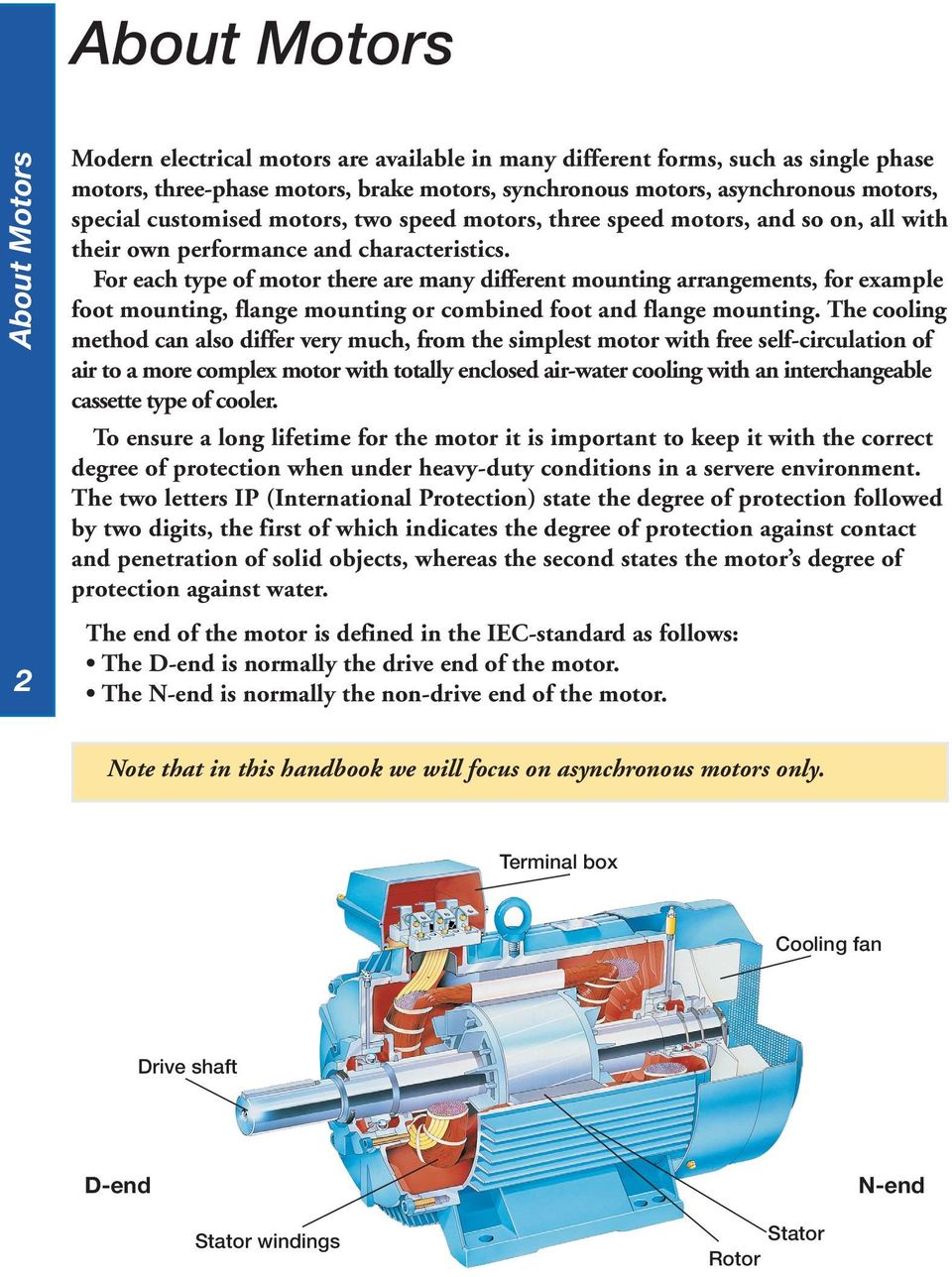
9 About Motors About Motors 2 Modern electrical motors are available in many different forms, such as single phase motors, three-phase motors, brake motors, synchronous motors, asynchronous motors, special customised motors, two speed motors, three speed motors, and so on, all with their own performance and characteristics. For each type of motor there are many different mounting arrangements, for example foot mounting, flange mounting or combined foot and flange mounting. The cooling method can also differ very much, from the simplest motor with free self-circulation of air to a more complex motor with totally enclosed air-water cooling with an interchangeable cassette type of cooler. To ensure a long lifetime for the motor it is important to keep it with the correct degree of protection when under heavy-duty conditions in a servere environment. The two letters IP (International Protection) state the degree of protection followed by two digits, the first of which indicates the degree of protection against contact and penetration of solid objects, whereas the second states the motor s degree of protection against water. The end of the motor is defined in the IEC-standard as follows: The D-end is normally the drive end of the motor. The N-end is normally the non-drive end of the motor. Note that in this handbook we will focus on asynchronous motors only. Terminal box Cooling fan Drive shaft D-end N-end Stator windings Stator Rotor
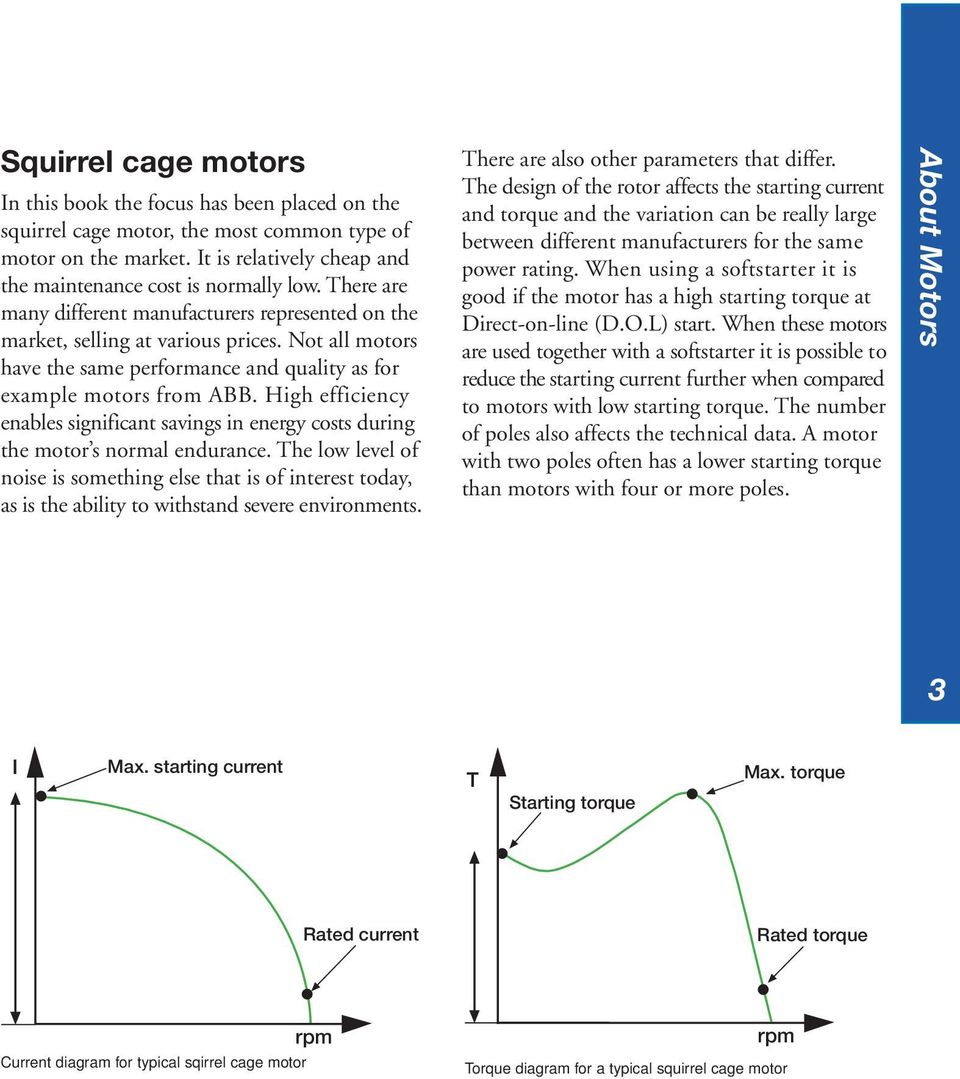
10 About Motors Squirrel cage motors In this book the focus has been placed on the squirrel cage motor, the most common type of motor on the market. It is relatively cheap and the maintenance cost is normally low. There are many different manufacturers represented on the market, selling at various prices. Not all motors have the same performance and quality as for example motors from ABB. High efficiency enables significant savings in energy costs during the motor s normal endurance. The low level of noise is something else that is of interest today, as is the ability to withstand severe environments. There are also other parameters that differ. The design of the rotor affects the starting current and torque and the variation can be really large between different manufacturers for the same power rating. When using a softstarter it is good if the motor has a high starting torque at Direct-on-line (D.O.L) start. When these motors are used together with a softstarter it is possible to reduce the starting current further when compared to motors with low starting torque. The number of poles also affects the technical data. A motor with two poles often has a lower starting torque than motors with four or more poles. 3 I Max. starting current T Starting torque Max. torque Rated current Rated torque Current diagram for typical sqirrel cage motor rpm rpm Torque diagram for a typical squirrel cage motor
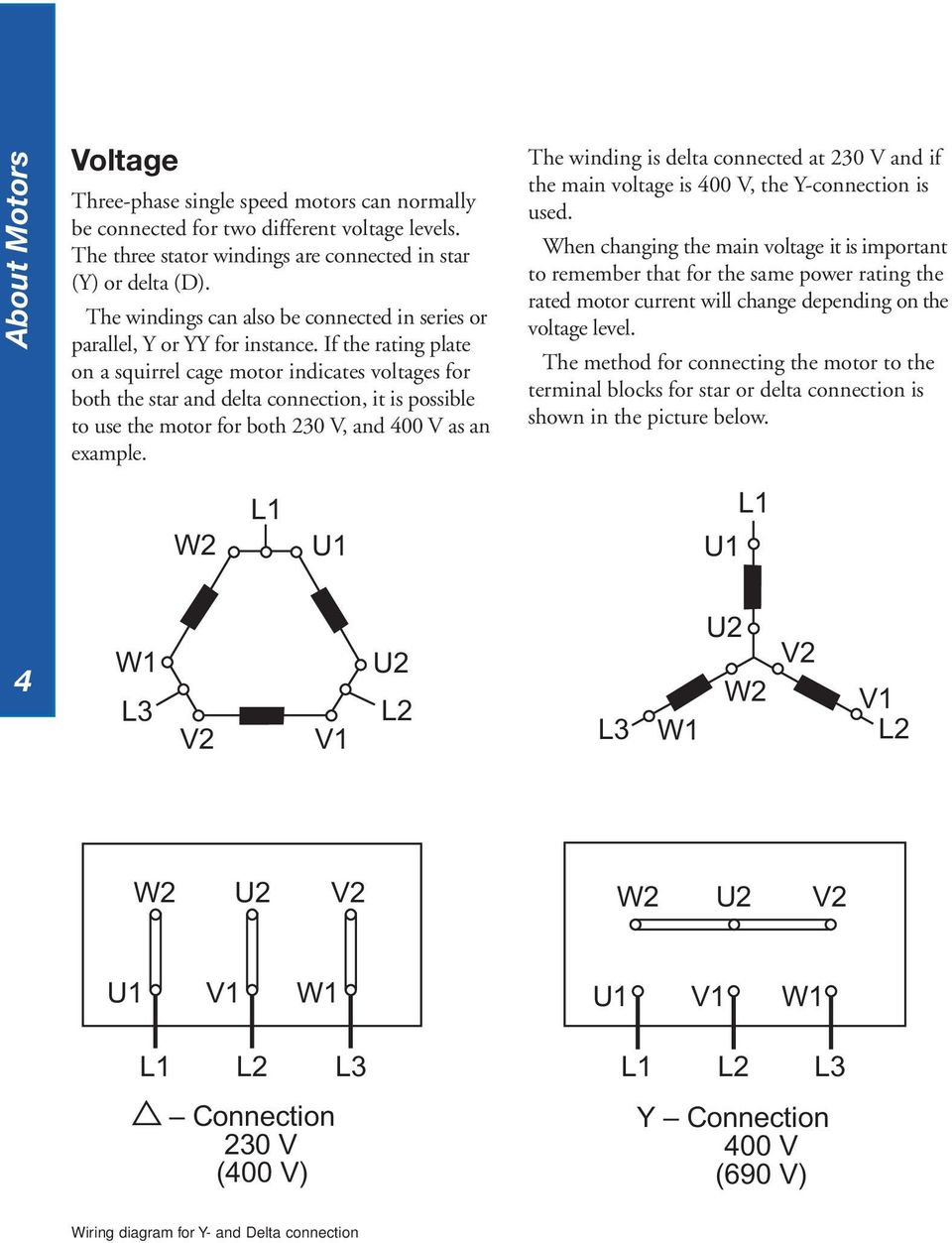
11 About Motors Voltage Three-phase single speed motors can normally be connected for two different voltage levels. The three stator windings are connected in star (Y) or delta (D). The windings can also be connected in series or parallel, Y or YY for instance. If the rating plate on a squirrel cage motor indicates voltages for both the star and delta connection, it is possible to use the motor for both 230 V, and 400 V as an example. The winding is delta connected at 230 V and if the main voltage is 400 V, the Y-connection is used. When changing the main voltage it is important to remember that for the same power rating the rated motor current will change depending on the voltage level. The method for connecting the motor to the terminal blocks for star or delta connection is shown in the picture below. W2 L1 U1 U1 L1 4 W1 L3 V2 V1 U2 L2 U2 V2 W2 V1 L3 W1 L2 W2 U2 V2 W2 U2 V2 U1 V1 W1 U1 V1 W1 L1 L2 Connection 230 V (400 V) L3 L1 L2 Y Connection 400 V (690 V) L3 Wiring diagram for Y- and Delta connection
12 About Motors Power factor A motor always consumes active power, which it converts into mechanical action. Reactive power is also required for the magnetisation of the motor but it doesn t perform any action. In the diagram below the active and reactive power is represented by P and Q, which together give the power S. The ratio between the active power (kw) and the reactive power (kva) is known as the power factor, and is often designated as the cos ϕ. A normal value is between 0.7 and 0.9, when running where the lower value is for small motors and the higher for large ones. P S 5 ϕ Q Diagram indicating P, Q, S and Cos ϕ

13 About Motors 6 Speed The speed of an AC motor depends on two things: the number of poles of the stator winding and the main frequency. At 50 Hz, a motor will run at a speed related to a constant of 6000 divided by the number of poles and for a 60 Hz motor the constant is 7200 rpm. To calculate the speed of a motor, the following formula can be used: n = 2 x f x 60 p n = speed f = net frequency p = number of poles Example: 4-pole motor running at 50 Hz n = 2 x 50 x 60 = 1500 rpm 4 This speed is the synchronous speed and a squirrel-cage or a slip-ring motor can never reach it. At unloaded condition the speed will be very close to synchronous speed and will then drop when the motor is loaded. T The difference between the synchronous and asynchronous speed also named rated speed is the slip and it is possible to calculate this by using the following formula: s = n 1 - n n 1 s = slip (a normal value is between 1 and 3 %) n 1 = synchronous speed n = asynchronous speed (rated speed) Table for synchronous speed at different number of poles and frequency: No. of poles 50 Hz 60 Hz Rated speed Syncronous speed } Slip rpm Diagram showing syncronous speed vs.rated speed

14 About Motors Torque The starting torque for a motor differs significantly depending on the size of the motor. A small motor, e.g. 30 kw, normally has a value of between 2.5 and 3 times the rated torque, and for a medium size motor, say up to 250 kw, a typical value is between 2 to 2.5 times the rated torque. Really big motors have a tendency to have a very low starting torque, sometimes even lower than the rated torque. It is not possible to start such a motor fully loaded not even at D.O.L start. The rated torque of a motor can be calculated using the following formula: M r = 9550 x P r n r M r = Rated torque (Nm) P r = Rated motor power (kw) n r = Rated motor speed (rpm) Slip-ring motors In some cases when a D.O.L start is not permitted due to the high starting current, or when starting with a star-delta starter will give too low starting torque, a slip-ring motor is used. The motor is started by changing the rotor resistance and when speeding up the resistance is gradually removed until the rated speed is achieved and the motor is working at the equivalent rate of a standard squirrel-cage motor. The advantage of a slip-ring motor is that the starting current will be lower and it is possible to adjust the starting torque up to the maximum torque. In general, if a softstarter is going to be used for this application you also need to replace the motor. T 7 T T st /T n rpm Torque diagram for a slip-ring motor I T n rpm Torque diagram for a typical squirrel cage motor rpm Current diagram for a slip-ring motor

15 Different starting methods Different starting methods The following is a short description of the most common starting methods for squirrel cage motors. An overview of common problems when starting and stopping a motor with different starting methods, see page 14 Direct-on-line start (D.O.L) Frequency converter 8 Start-delta start Softstarter

16 Different starting methods Direct-on-line start (D.O.L) This is by far the most common starting method available on the market. The starting equipment consists of only a main contactor and thermal or electronic overload relay. The disadvantage with this method is that it gives the highest possible starting current. A normal value is between 6 to 7 times the rated motor current but values of up to 9 or 10 times the rated current exist. Besides the starting current there also exists a current peak that can rise up to 14 times the rated current since the motor is not energised from the the first moment when starting. The values are dependent on the design and size of the motor, but in general, a smaller motor gives higher values than a larger one. During a direct-on-line start, the starting torque is also very high, and is higher than necessary for most applications. The torque is the same as the force, and an unnecessary high force gives unnecessary high stresses on couplings and the driven application. Naturally, there are cases where this starting method works perfectly and in some cases also the only starting method that works. T Starting torque Max. torque 9 KM 1 Rated torque FR 1 Torque/speed curve att D.O.L start rpm M I Max. starting current D.O.L. starter with contactor and O/L relay Single line diagram for a D.O.L. KM 1 FR 1 Main contactor Overload relay Rated current Current curve at D.O.L start rpm

17 Different starting methods Star-delta start This is a starting method that reduces the starting current and starting torque. The device normally consists of three contactors, an overload relay and a timer for setting the time in the star-position (starting position). The motor must be delta connected during a normal run, in order to be able to use this starting method. The received starting current is about 30 % of the starting current during direct on line start and the starting torque is reduced to about 25 % of the torque available at a D.O.L start. This starting method only works when the application is light loaded during the start. If the motor is too heavily loaded, there will not be enough torque to accelerate the motor up to speed before switching over to the delta position. When starting up pumps and fans for example, the load torque is low at the beginning of the start and increases with the square of the speed. When reaching approx % of the motor rated speed the load torque is equal to the motor torque and the acceleration ceases. To reach the rated speed, a switch over to delta position is necessary, and this will very often result in high transmission and current peaks. In some cases the current peak can reach a value that is even bigger than for a D.O.L start. Applications with a load torque higher than 50 % of the motor rated torque will not be able to start using the start-delta starter. 10

18 Different starting methods KM 2 KM 3 KM V 230 V KM 1 KM 2 KM 3 FR 1 Star-delta starter with contactors and O/L relay FR 1 M Single line diagram for a Star-delta starter KM 1 KM 2 KM 3 FR 1 Main contactor Delta contactor Star contactor Overload relay 11 T I rpm rpm Torque/speed curve at Star-Delta start Current curve at Star-Delta start

19 Different starting methods 12 Frequency converter The frequency converter is sometimes also called VSD (Variable Speed Drive), VFD (Variable Frequency Drive) or simply Drives, which is probably the most common name. The drive consists primarily of two parts, one which converts AC (50 or 60 Hz) to DC and the second part which converts the DC back to AC, but now with a variable frequency of Hz. As the speed of the motor depends on the frequency this makes it possible to control the speed of the motor by changing the output frequency from the drive and this is a big advantage if there is a need for speed regulation during a continuous run. In many applications a drive is still only used for starting and stopping the motor, despite the fact that there is no need for speed regulation during a normal run. Of course this will create a need for much more expensive starting equipment than necessary. By controlling the frequency, the rated motor torque is available at a low speed and the starting current is low, between 0.5 and 1.0 times the rated motor current, maximum 1.5 x I n. Another available feature is softstop, which is very useful, for example when stopping pumps where the problem is water hammering in the pipe systems at direct stop. The softstop function is also useful when stopping conveyor belts from transporting fragile material that can be damaged when the belts stop too quickly. It is very common to install a filter together with the drive in order to reduce the levels of emission and harmonics generated. KM 1 Q 1 Main contactor Frequency converter Q 1 AC DC DC AC KM 1 M Frequency converter Single line diagram for a frequency converter

20 Different starting methods Softstarter A softstarter has different characteristics to the other starting methods. It has thyristors in the main circuit, and the motor voltage is regulated with a printed circuit board. The softstarter makes use of the fact that when the motor voltage is low during start, the starting current and starting torque is also low. During the first part of the start the voltage to the motor is so low that it is only able to adjust the play between the gear wheels or stretching driving belts or chains etc. In other words, eliminating unnecessary jerks during the start. Gradually, the voltage and the torque increase so that the machinery starts to accelerate. One of the benefits with this starting method is the possibility to adjust the torque to the exact need, whether the application is loaded or not. In principle the full starting torque is available, but with the big difference that the starting procedure is much more forgiving to the driven machinery, with lower maintenance costs as a result. Another feature of the softstarter is the softstop function, which is very useful when stopping pumps where the problem is water hammering in the pipe system at direct stop as for star-delta starter and direct-on-line starter. The softstop function can also be used when stopping conveyor belts to prevent material from damage when the belts stop too quickly. 13 KM 1 KM 1 FR 1 Q 1 Main contactor Overload relay Softstarter FR 1 Q 1 M Softstarter Single line diagram for a softstarter

21 Different starting methods Common problems when starting and stopping motors with different starting methods Type of problem Type of starting method Direct-on-line Star-delta start Drives Softstarter Slipping belts and Yes Medium No No heavy wear on bearings High inrush current Yes No No No Heavy wear and tear Yes Yes No No on gear boxes (loaded start) Damaged goods / Yes Yes No No products during stop 14 Water hammering in pipe Yes Yes Best Reduced system when stopping solution Transmission peaks Yes Yes No No Auto transformer start and start of a part winding motor have similar problems to the star-delta start.
22 Different applications Different applications All motors are used for starting and running different applications. This chapter covers the most common ones. The different applications will also result in different load conditions for the motor. There are two factors to consider: 1. Braking load torque, a direct braking force on the motor shaft. To be able to accelerate, the motor has to be stronger than the load. The accelerating torque is the difference between the available motor torque and the load toque. Accelerating torque = Available motor torque load torque 2. Involved moment of inertia or flywheel mass will also affect the start. The bigger inertia the longer starting time for the same motor. T Available motor torque Accelerating torque Centrifugal fan Centrifugal pump 15 Braking load (load torque) Compressor Conveyor belt rpm
23 Centrifugal fan Different applications For some applications the motor is started with reduced load torque, i.e. unloaded start. Big centrifugal fans are often started with a closed damper and this will make the start easier (shorter) but since the moment of inertia is still present the starting time might be quite long anyway. Direct-on-line start Centrifugal fans are very often driven by one or more drive belts. During a D.O.L start these belts have a tendency to slip. The reason is that these types of fans always have a more or less high moment of inertia (big flywheel). So even if the fan is started unloaded, the flywheel is still there. The belts slip depending on whether the starting torque from the motor is too high during the start sequence and the belts are not able to transfer these forces. This typical problem gives high maintenance costs but also production losses when you need to stop production to change belts and bearings. 16 T I rpm rpm Torque/speed curve at D.O.L start Current curve at D.O.L start
24 Different applications Star-delta starter (Y-D) The star-delta starter gives lower starting torque but depending on the fact that the load torque increases with the square of the speed, the motor torque will not be high enough in the star position to accelerate the fan to the rated speed. When switching over to delta position it will be both a high transmission and current peak, often equal to values when making a D.O.L start or even higher, with a slipping belt as a result. It is possible to reduce the slip by stretching the belts very hard. This gives high mechanical stresses on bearings both in the motor and the fan with high maintenance costs as result. Softstarter The key to solve these problems is to reduce the starting torque from the motor during start. By using an ABB softstarter the voltage is decreased to a low value at the beginning of the start, low enough to avoid slip but high enough to start up the fan. The softstarter provides the ability to adjust to fit any starting condition, both unloaded and fully loaded starts. T T 17 Torque/speed curve at Star-Delta start rpm rpm Torque/speed curve when using a softstarter I I Current curve at Star-Delta start rpm Current curve when using a softstarter rpm
25 Different applications 18 Selection of a suitable softstarter Normal start For fans with small or medium large flywheels, select a softstarter according to the rated motor power. The above is valid if the time for D.O.L start is less than 5 seconds. Heavy duty start For fans with large flywheels, select a softstarter designed for heavy duty start according to the rated motor power. It is also possible to select a softstarter for normal start, select a unit with one size bigger power rating than the motor and use an overload relay class 30. The above is valid if the time for D.O.L start is more than 5 seconds. Recommended basic settings: Start ramp: 10 sec. Stop ramp: 0 sec. Initial voltage: 30 % Current limit is recommended for use. Application with a centrifugal fan
26 Different applications Centrifugal pump There are a lot of different types of pumps; like piston pumps, centrifugal pumps, screw pumps etc. But the most common version is the centrifugal pump and we have selected this one to describe. Direct-on-line start Starting up a pump is normally not a problem for a squirrel cage motor. The problem is the wear and tear depending on pressure waves in the pipe system created when the motor starts and stops too quickly. During a D.O.L start the motor gives much too high starting torque with the result that the motor accelerates and reaches nominal speed too quickly. The reason is that the braking load torque is low for a pump during start. This starting method also gives maximum possible starting current. 19 T I rpm rpm Torque/speed curve at D.O.L start Current curve at D.O.L start
27 Different applications Star-delta starter (Y-D) By using a star-delta starter it is possible to reduce the starting torque. The motor torque in the star position is too weak to be able to complete the start and reach the rated speed. The quadratic load torque will become too high for the motor when reaching approx % of the rated speed and the switch over to the delta position will give both high transmission and current peaks with pressure waves as a result. The current peaks can be equally high as at a D.O.L start or even higher. When stopping a pump During stop it is also normal to have problems. When making a direct stop by disconnecting the main supply the motor stops too quickly. Depending on high mass flow in the pipe system the water will continue with the same speed for a short period and then come back again, backwards in the pipe system. This creates high pressure shocks on valves and gives high mechanical stresses on the pipe system. 20 T I Torque/speed curve at Star-Delta start rpm Current curve at Star-Delta start rpm
28 Different applications Softstarter By using an ABB softstarter the voltage is reduced during the start sequence with the result that the motor torque is reduced. During the start sequence the softstarter increases the voltage so that the motor will be strong enough to accelerate the pump to the nominal speed without any torque or current peaks. A normal starting current with a softstarter when starting a fully loaded centrifugal pump is approx. 4 times rated motor current. Also during the stop sequence the softstarter is the solution. The softstarter reduces the voltage during stop via a voltage ramp and the motor becomes weaker and weaker. Because of this the water speed slows down very smoothly without creating any pressure waves. A special function on the softstarter is sometimes available, called "step-down voltage",which ensures an optimum setting to the actual need for any pipe system. T I 21 rpm Torque/speed curve when using a softstarter Current curve when using a softstarter rpm
29 Different applications Selection of a suitable softstarter Normal start Starting a pump is a typical normal start condition. Select a softstarter according to the rated motor power. Heavy duty start Not applicable for this application. Recommended basic settings: Start ramp: 10 sec. Stop ramp: 20 sec. Initial voltage: 30 % 22 Application with a pump.
30 Different applications Compressor Smaller compressors are often of piston type and the load torque increases linearly with the speed. Screw compressors are often used when there is a bigger need for air flow and this type has a load torque increasing with the square of the speed. Drive belts are often used between motor and compressor but direct connections via some type of toothed couplings are also common. Some compressors are started with reduced load. Direct-on-line start (D.O.L) Compressors started direct-on-line are exposed to high mechanical stresses on the compressor itself, but also on drive belts and couplings. The result is shortened endurance. In cases where the drive belts are used the belts very often slip during start. The high starting torque received during starting with this method is the source of the problems. The starting current is always high at D.O.L start. A normal value can be approx. 7 times rated motor current. T I 23 Torque/speed curve at D.O.L start rpm Current curve at D.O.L start rpm
31 Different applications Star-delta starter (Y-D) Star-delta start gives a lower starting torque and starting current but the motor is too weak during the start up to be able to accelerate the motor up to nominal speed. When switching to the delta position both current and torque peaks will occur with high mechanical stresses as a result. Compressors are very often running at no load condition for longer periods when the pressure in the system is high. A motor running under these circumstances always has a poor power factor and low efficiency. Some times the value is so low that it must be compensated. 24 T I Torque/speed curve at Star-delta start rpm Current curve at Star-delta start rpm
32 Different applications Softstarter By using an ABB softstarter it is possible to limit the starting torque to a level suitable for all different applications. The result is less stress on couplings, bearings and no slipping belts during start. The maintenance cost will be reduced to a minimum. When using a softstarter the starting current received is approx. 3 to 4 times the rated motor current. T I 25 rpm Torque/speed curve when using a softstarter Current curve when using a softstarter rpm
33 Different applications Selection of a suitable softstarter Normal start For compressors with D.O.L starting time less than 5 seconds, select a softstarter according to the rated motor power. Heavy duty start For compressors with D.O.L starting time more than 5 seconds, select a softstarter designed for heavy duty start according to the rated motor power. It is also possible to select a softstarter for normal start, select a unit with one size bigger power rating than the motor and use an overload relay class 30. Recommended basic settings: Start ramp: 10 sec. Stop ramp: 0 sec. Initial voltage: 30 % (piston compressor) 40 % (screw compressor) 26 Application with a compressor
34 Different applications Conveyor belt Conveyor belts can have a lot of different looks and directions of use. It is a typical constant torque load with low to high braking torque depending on how heavy it is loaded. Direct-on-line start (D.O.L) Conveyor belts often need a starting torque very near or just above the rated torque of the motor. A direct-on-line start with a normal squirrel cage motor gives approx. 1.5 to 2.5 times rated torque of the motor depending on motor size, type etc. When making a direct-on-line start there is a very high risk of slipping between the belt and Low braking torque the driving role depending on this high starting torque. Gearboxes and couplings are also exposed to high mechanical stresses. This result is considerable wear and tear and often high maintenance costs. Sometimes fluid couplings are used to reduce the transferred torque. This method is expensive and requires a lot of maintenance. High braking torque T T 27 Torque/speed curve at D.O.L start rpm Torque/speed curve at D.O.L start rpm I I rpm rpm Current curve at D.O.L start Current curve at D.O.L start
35 Different applications Star-delta start It is not possible to use this starting method when the load torque is close to the rated motor torque during start (see figure below, High braking torque). Low braking torque High braking torque T T 28 Torque/speed curve at Star-delta start rpm Torque/speed curve at Star-delta start rpm I I Current curve at Star-delta start rpm Current curve at Star-delta start rpm
36 Different applications Softstarter By using an ABB softstarter the starting torque can be reduced to a minimum value still able to start up the conveyor belt. The setting possibility of the softstarter makes it possible to adjust the torque to exactly the level that is necessary for the start. The result is the least possible stress on gearboxes and couplings and no slipping belts during start. This will reduce the maintenance cost to a minimum. When using a softstarter you will receive approx. 3 to 4 times rated motor current during start. Low braking torque High braking torque T T 29 rpm Torque/speed curve when using a softstarter rpm Torque/speed curve when using a softstarter I I Current curve when using a softstarter rpm Current curve when using a softstarter rpm
37 Different applications 30 Selection of a suitable softstarter Normal start A start of short and light loaded conveyor belt is a typical normal start. For conveyors with D.O.L starting time less than 5 seconds, select a softstarter according to the rated motor power. Heavy duty start Conveyor belts can in some cases be very long and if the belt is fully loaded during start the starting time can be very long. For such applications select a softstarter designed for heavy duty start. It is also possible to select a softstarter for normal start if the softstarter is chosen one size larger than the rated motor power and use an overload relay class 30. Recommended basic settings: Start ramp: 10 sec. Stop ramp: 0 sec. (If fragile material use 10 seconds) Initial voltage: 40 % Application with a conveyor belt
38 How to select a softstarter How to select a softstarter for different applications It is normally possible to select a softstarter according to the rated motor power. In some cases it is neccessary to select a larger softstarter than the rated motor power depending on the starting conditions (heavy duty start, many starts/h etc.) The starting capacity of a softstarter is very much depending on the thyristor capacity and the heat sink. The table below can be used as a guide to select a softstarter if you need a quick answer and you want to be sure that the size is large enough to suit the application. This selection will not give the most optimized solution. If an opimised solution is required, the software selection program ProSoft for selection of softstarters can be used, available on Quick guide Normal start Typical applications»bow thruster»centrifugal pump»compressor»conveyor belt (short)»elevator»escalator Selection Select the softstarter according to the rated motor power. For units with built-in overload, select trip class 10. Heavy duty start Typical applications»centrifugal fan»conveyor belt (long)»crusher»mill»mixer»stirrer Selection For softstarters designed for nomal start, select one size larger than the rated motor power. For softstarters designed for heavy duty start, select according to the rated motor power. For units with built-in overload, select trip class If more than 6 starts /h Select one size larger than the selection above.
39 32
40 Description of the softstarter Description of the softstarters - Design, settings and signals A softstarter in general is built up with a few main components such as a printed circuit board (PCB), heat sink, thyristors, fans and housing (plastic or metal). The controlling circuits can be of digital type, analogue type or a combination of these. The output signal relays can be of a type with fixed function or as a free programmable type where the user can decide upon the output function. The softstarter is sometimes equipped with a built-in electronic overload relay (EOL) replacing the conventional bi-metal relay which is normally used. A built in EOL has much better accuracy than a conventional relay, since the values are calculated electronically and this is especially useful when on intermittent duty. The need for communication between different devices in a plant and from the devices to a control board is increasing all the time. Many of today s softstarters are equipped with a port for such communication, which normally consists of a few fibre optic cables instead of former solutions, which often reqired hundreds of thousands of wires. Many different communication protocols exist today and some of them are more common than others, for example Modbus, Profibus, DeviceNet, Interbus-S, LON Works and so on. 33
41 Description of different components: Description of components Housing Printed circuit board 34 Main terminals Thyristor Heat sink Housing Fan
42 Description of components Printed circuit board is used to control the firing of the thyristors based on the current and voltage references, and also for the calculation of different values, for example the power factor, active power, etc. It can also be used for storing historical data, the event log, indicating trends and much more. Heat sink is used to get rid of the heat in the softstarter generated by the current during the start and the continuous run. The capacity of the heat sink very much reflects the starting capacity and the operational current of the softstarter. Fans are used to increase the cooling capacity of the heat sink. One, two or several fans can be used depending on size and design. Some smaller softstarters don t have fans at all and the number of starts may be limited. Housing can be made of plastic material, metal or a combination of these, and its function is to protect the inside components from mechanical and electrical damage. It is also used to protect the components from dust and dirt. For total outside protection from dust and dirt a separate enclosure is often required since the degree of protection (IP class) of the unit itself is too low. Thyristors are semi-conducting components connected in an anti-parallel fasion and placed in two or three phases of the main circuit. They regulate (by increasing or decreasing) the level of voltage during start and the stop ramp, as described in the picture below. During a continuous run the thyristors are conducting fully. 35 Zero crosses Firing angle Start: The thyristors let part of the voltage through at the beginning and then increase it, according to the set ramp time for the start. Stop: The thyristors are fully conducting and when soft stopping, they decrease the voltage according to the set ramp time for stop. Off : Thyristor is non-conducting On : Thyristor is conducting
43 Common settings 36 Common settings This section includes a short description of some common setting parameters available on most of the softstarters. Other settings may be available depending on the type of softstarter and manufacturer. The setting can be done either by adjusting potentiometers, changing dip switches, using a key pad, a computer or similar. Start ramp is the time from were the softstarter start its ramp (initial voltage) until full voltage is reached. The ramp time should not be too long, as this will only result in unnecessary heating of the motor and a risk of the overload relay to trip. If the motor is unloaded the start time for the motor will probably become shorter than the set ramp time, and if the motor is heavily loaded, the start time will probably become longer. Stop ramp is used when a soft stopping of the motor is required, for example a pump or a conveyor belt. The stop ramp is the time from full voltage until stop voltage (initial voltage) is reached. If the ramp time is set to zero the stop will be like a direct stop. Initial voltage. Sometimes named pedestrian voltage or torque, this is the point from where the softstarter starts or stops its ramps. The torque of the motor will drop with the square of the voltage and if the voltage is set too low, for example 20 %, the starting torque will become = 0.04 = 4 % only, and the motor will not start from the very beginning. Therefore it is very important to find a level that is just high enough to make the motor take off directly to avoid unnecessary heating. U e Initial voltage (U ini ) Start ramp Stop ramp Time Diagram showing start ramp, stop ramp and initial voltage
44 Common settings Current limit can be used in applications where a limited starting current is required, or at a heavy-duty start when it is difficult to achieve a perfect start with the setting of the initial voltage and the start ramp only. When the current limit is reached, the softstarter will temporarily stop increasing the voltage until the current drops below the set limit, and then continues ramping up to full voltage. Note that this feature is not available on all softstarters. U 100 % 30 % fixed voltage reached set level of current limit 37 t1 t2 Time t1 + t2 = set ramp time I 5 set level of current limit 2 Time Current limit function in softstarter use
45 Common settings Step down voltage gives a special type of stop ramp. It is possible to adjust the voltage to drop to a level where the speed of the motor starts to reduce immediately at the stop command. For low loaded motors the speed will not reduce until a very low voltage is reached, but using the step down voltage function can eliminate this phenomenon and is especially useful for stopping pumps. Adjustable rated motor current makes it possible to set the motor rated current on the softstarter for the used motor. This setting may affect other values as well, such as the trip level of the electronic overload relay, the level of the current limit function and so on. 38 Step down voltage = U SD U 100 % Example 50 % 30 % Initial voltage 30 % (= end voltage 30 %) Stop Time Curve showing the step down voltage function
46 Different indications Different indications The indications on a softstarter differ very much from one type to another and also between manufacturers. Some of the most common indications are described below. On normally indicates that the power supply is connected to the softstarter and that the unit is ready to start the motor. Top of Ramp indicates that the start ramp is completed and full voltage is reached. If a by-pass contactor is used it will be activated at this point. Fault indication can be of many different types. One is if there is an internal fault on the softstarter itself, a fault on the feeding side (phase loss, blown fuse or similar) or on the motor side (motor not connected, phase missing etc.) Overload indicates that the overload protection has tripped. The reason for a tripping overload can be too high motor current, too long starting time, too many starts after each other, wrong set overload, wrong trip class of overload or a combination of these. Overtemperature indicates that the softstarter unit is over-heated, due to the number of starts exceeded, too high-rated current, too long starting time or similar. 39
47 Different voltages Different voltages Different named voltages are used for the softstarters. The name and use of these different voltages is stated in the IEC-standard as below. Main Voltage (Ue), which is the voltage feeding the motor and also the voltage exposed to the main circuit (thyristors) in the softstarter V are normal values. Control Voltage (Uc), which is the voltage for controlling the start and stop command of the softstarter. Values between V exist. Supply voltage (Us), which is the voltage feeding the electronic components inside the softstarter, for example the printed circuit board. Common values are V or V. 40 Main Voltage (U e ) Main Voltage (U e ) Internal supply L1 L2 L3 L1 L2 L3 Start Power Stop supply T1 T2 T3 Supply Voltage (Us ) Control Voltage (U c ) Start Stop T1 T2 T3 Power supply (Internal power supply) M M Main voltage and supply voltage to a softstarter Main voltage and control voltage to a softstarter
48 Ambient temperature Ambient temperature The ambient temperature is the average surrounding temperature of the softstarter over a period of 24 hours. For most types of softstarter the temperature may not exceed 40 o C without derating the operational current for the unit. The maximum ambient temperature during operation differs from one type of softstarter to another and must be checked individually according to the manufacturer s specification. When using an ABB softstarter with an ambient temperature of above 40 o C, the following formula can be used to calculate the operational current: I e derated = I e - ( T x I e x 0.008) I e derated = maximum operational current after derating I e = rated current of the softstarter T = temperature difference = derating factor Example 1 Rated current: 105 A Ambient temperature: 48 o C Derating with 0.8 % per o C above 40 o C (PS S ) T = o C = 8 o C New current = I e - ( T x I e x 0.008) = (8 x 105 x 0.008) = 98,2 A Example 2 Rated current: 300 A Ambient temperature: 46 o C Derating with 0.8 % per o C above 40 o C (PS S ) T = o C = 6 o C New current = I e - ( T x I e x 0.008) = (6 x 300 x 0.008) = A 41
49 Derating when used at high altitudes High altitudes 42 When a softstarter is used at high altitudes the rated current for the unit has to be derated, due to less cooling. For most manufacturers the catalogue values are valid up to 1000 m above sea level before derating is necessary. In some cases a larger softstarter is required to be able to cope with the motor current when used at high altitudes. For ABB softstarters the following formula can be used for calculating the derating: % of I e = x x = actual altitude for the softstarter Example: Softstarter with rated current 300 A used at 2500 meter above sea level. % of I e = = 150 = = I e = 300 x 0.9 = 270 A The diagram below can also be used for defining the derating of the softstarter. % of I e 100 % 90 % 80 % m meter above sea level Derating of motor current at high altitudes
50 Start of several motors Start of several motors In some applications, more than one motor will be started with one softstarter, in parallel with each other or in a sequence. This is often possible to do but some data has to be taken into consideration. Parallel start of motors If a softstarter is going to be used for starting several motors at the same time (parallel start), there are two important parameters to check: 1. The softstarter must be able to cope with the rated current for all motors together. 2. The softstarter must be able to cope with the starting current for all motors together until rated speed is achieved. KM 1 FR 1 KM 1 FR 1 Q 1 Main contactor Overload relay Softstarter Note! If a by-pass contactor is used for the softstarter, only point 2 above has to be taken into consideration. Example: Start of two motors with I e = 100 A and relative starting current 4 x I e. Starting time is 10 seconds. Total starting current is 100 x 4 x 2 = 800 A over 10 seconds. Check the softstarter starting capacity graph to verify the selected size. Q 1 M Parallel start of motors using a softstarter M 43
51 Start of several motors 44 Sequential start of motors If a softstarter is going to be used for starting several motors one by one (sequential start), it is important to check that the softstarter is able to cope with the starting current for each motor during the whole starting sequence. Example: Start of three motors with I e =100 A and relative starting current 4 x I e. Starting time for the motors is: Motor 1 = 5 seconds Motor 2 = 10 seconds Motor 3 = 8 seconds KM 1 The starting current for the motors is 100 x 4 = 400 A and the total starting time is = 23 seconds. Check the softstarter starting capacity graph to verify the selected size. Note! It is not possible to add the starting time for each motor if the rated current is different from one motor to another. A separate calculation has to be made for those applications. KM 1 K 25, 27, 29 K 26, 26, 30 FR 1, 2, 3 Q 1 Main contactor Starting contactor Run contactor Overload relay Softstarter Q 1 K 26 K 28 K 30 K 25 K 27 K 29 FR 1 FR 2 FR 3 M M M Sequential start of motors using a softstarter
52 Different ways of connecting Different ways of connecting the softstarter There are two different ways of connecting the softstarter - In line, which is the most common method, and Inside Delta. Note that only a few types of softstarters can actually be connected Inside Delta for example the ABB softstarter range PS S 18/ / In line Inside Delta
53 Different ways of connecting 46 In-line connection This is easily the most common way to connect the softstarter. All three phases are connected in a series with the overload relay, the main contactor and other devices used just like the diagram below. The selected devices for Inline connection must be chosen to cope with the rated motor current. Example: 100 A motor requires a 100 A softstarter, 100 A main contactor etc. 100 A Inside Delta connection The Inside Delta connection makes it possible to place the softstarter in the delta circuit and in that way it can easily replace an existing Y/D-starter. When the softstarter is Inside Delta it will only be exposed to 58 % (1/ 3) of the In-line current. Therefore it is possible to downsize the devices in order to achieve a more cost-effective solution. Example: A 100 A motor requires a 58 A softstarter, a 58 A main contactor if placed in the delta circuit, etc. A motor used for an Inside Delta connection must be able to delta-connect during a continuous run. In the USA and some other countries a special six-wire motor has to be ordered for this type of connection. 100 A 100 A 100 A 100 A 58 A 58 A 58 A M 100 A Softstarter connected In-line with the motor M 100 A Softstarter connected Inside Delta
54 Different ways of connecting Location of the main contactor When using the softstarter Inside Delta there are two options for the main contactor: in the delta circuit or outside. Both locations will stop the motor but in alternative A, the motor is still considered to be under tension. In alternative B the main contactor must be chosen according to the rated current of the motor, while the contactor in alternative A can be chosen according to 58 % (1/ 3) of the rated current. x x B 47 A M M Alternative A Main contactor located in the delta circuit Alternative B Main contactor located outside the delta circuit
55 48
56 Basic settings Basic settings for different applications The required settings for the softstarter will differ from one application to another depending on the type of load, motor characteristics, how much the motor is loaded, etc. For a more in depth description of each setting, please see chapter Description of the softstarters. Note! All settings on next page are only proposals and may change from one application to another and therefore need to be checked individually. 49
57 Basic settings 50 Settings when using a softstarter without current limit function Type of load Ramp time for Ramp time Initial voltage start (sec.) for stop (sec.) U ini Bow thruster % Centrifugal fan % Centrifugal pump % Centrifuge % Conveyor belt ) 40 % Crusher % Escalator % Heat pump % Hydraulic pump % Lifting equipment % Mill % Piston compressor % Rotary converter % Scraper % Screw compressor % Screw conveyor % Stirrer, Mixer % Unloaded motor % 1) If fragile material, use 10 seconds.
58 Basic settings Settings when using a softstarter with current limit function Type of load Ramp time for Ramp time Initial voltage Current limit start (sec.) for stop (sec.) Uini ( x I e ) Bow thruster % 3 Centrifugal fan % 4 Centrifugal pump % 3.5 Centrifuge % 4.5 Conveyor belt ) 40 % 4 Crusher % 5 Escalator % 3.5 Heat pump % 3.5 Hydraulic pump % 3.5 Lifting equipment % 4 Mill % 5 Piston compressor % 4 Rotary converter % 3 Scraper % 4.5 Screw compressor % 4 Screw conveyor % 4 Stirrer, Mixer % 5 Unloaded motor % ) If fragile material, use 10 seconds.
59 Starting capacity and overload protection Starting capacity Starting capacity for softstarters When starting a squirrel cage motor there will always be a starting current (I st ) which is higher than the rated motor current. The starting current depends on what type of starting method is used and in some cases also the size of the motor, particular at D.O.L-start. For a softstarter a normal value is 3-4 times the rated motor current. Heavy duty applications normally require a starting current between 4 and 5 times the rated motor current. The maximum permitted starting current for a softstarter depends on the starting time. The ratio between the current and time is displayed in the graph below. A higher starting current will give a shorter possible starting time, for example a crusher application. A lower current will allow a longer starting time, for example a pump application. 52 Time Sec A Starting current Typical starting capacty graph for a softstarter
60 Starting capacity Starting capacity when using by-pass contactor When using a softstarter with a by-pass contactor it is sometimes possible to select a softstarter with a lower rated power than the motor rated power since the softstarter will be working during start and stop only, not continuously. The softstarter can not withstand the rated motor current and therefore a check of the starting capacity must be carried out for the selected size. Time Starting capacity when using overload protection The overload protection for the motor (thermal or electronic) will very often set the limit of the starting capacity. A class 10 relay is used for normal starts in general while a class 30 relay is used for heavy-duty starts where a longer starting time must be used. In some applications where the overload protection is by-passed (other protection active) during a start to achieve a longer available starting time, it is particularly important to check the softstarter starting capacity since this will be the limitation. 53 a b Starting current a) Tripping curve for overload protection b) Max starting capacity for a softstarter (This will limit the starting time / current if the overload is by-passed during start)
61 Number of starts/hour Number of starts/hour 54 The maximum number of starts/hour for a softstarter depends on several different factors such as the starting current, ambient temperature, starting time and the intermittens factor. Intermittens factor The intermittens factor is a figure indicating how long the softstarter has been running for (starting time and running time) compared with the total cycle time. It is important to define the intermittens factor when talking about the number of starts/ hour since the OFF time is the cooling time for the softstarter. A high starting current and a long starting time require a longer OFF time than a low starting current and short time to maintain the same number of starts/hour. Examples: If a softstarter has been running for 5 minutes of a total duty cycle of 10 minutes then the intermittens factor is 50 % ON time and 50 % OFF time. If a softstarter has been running for 45 minutes of a duty cycle of 60 minutes then the intermittens factor is 75 % ON time and 25 % OFF time. Duty cycle On Off Intermittens factor on = on + off x 100 % Time
62 Harmonics Harmonics Harmonics are unwanted voltages and currents existing in almost every electrical system today and are always a multiple of the rated frequency. Typical harmonics are 3rd, 5th, 7th, 9th etc. The harmonics contribute to the unnecessary heating of motors, cables and other equipment and may shorten the lifetime of these devices if exposed for a long period of time. It can sometimes also disturb functions on electronics and systems. The harmonic contents and the level naturally depends on the source but also on several other parameters such as the impedance in the feeding network, the motor, capacitors and other devices used in the system altogether - in other words a quite complex phenomenon. Harmonic content and softstarters The question of harmonic content for softstarter applications is actually in general not relevant at all. These reflections usually come from drive applications where harmonics are generated continuously and a filter is always required in public networks and very often used also in industrial networks. With our softstarters we fulfil the EMC directive concerning emission and immunity and there is no need for any particular actions regarding this matter at all. 55
63 Explosive atmospheres (Ex) Explosive atmospheres 56 For plants in environments where the hazard of explosion is due to an explosive mixture of gases, explosive matter or combustible dust other than explosive dust, special provisions are applicable regarding the use of electrical material. For electrical motors there are two main principles for explosion protection. One is to design the motor so that no sparks or dangerous heat occurs. The other method is to isolate sparks and dangerous heat inside the motor to prevent ignition of any explosive mixture of gases outside the motor. The different classes of explosive protection (Ex) are described by the following parts of IEC 60079: IEC : flameproof enclosures d IEC : pressurised enclosures p IEC : powder filling q IEC : oil immersion o IEC : increased safety e IEC : intrinsic safety i IEC : encapsulation m IEC : caplights for mines susceptible to firedamp (under consideration) Example: Electrical apparatus for explosive atmospheres - oil immersion o shall be recognised as Exo.
64 Explosive atmospheres Hazardous areas and zones The hazardous areas are categorised in zones as follows: Zone 0 An area in which an explosive gas atmosphere is present continuously or for long periods. Only intrinsically-safe circuits of category Exi may be used in this zone. Motors are thus excluded. Zone 1 An area in which an explosive gas atmosphere is likely to occur in normal operation. Motors of category Exd, Exe and Exp may be used in this zone. Zone 2 An area in which an explosive gas atmosphere is not likely to occur during normal operation and if it does occur it will exist for a short period only. Equipment permitted in zones 0 and 1 may of course be used. Under certain conditions the equipment, motors for instance, need not to be of explosion-protected design. 3 m r4.5 m Location and selection of softstarter for Ex environments If a softstarter is going to be used for an Ex application it is normally located in a separate enclosure outside any of the hazardous zones. The overload relay used shall be of a special version designed for EEx motors, for example TA 25 DU...V 1000 to T 900 DU/SU...V This type of relay has a more accurate tripping curve compared with the standard relay. Special attention has to be paid to this. The softstarter type and size and other devices used in the circuit shall suitably be selected according to type 2 co-ordination. Note! If any electrical equipment is going to be used in any of the hazardous zones a special enclosure must be used. This type of enclosure (steel box or similar) must be able to withstand an inside explosion caused by any of the components without letting anything out to the surroundings. This solution is in general very unusual m Surface of liquid Height of wall Low point To wall Zone 0 Zone 1 Zone 2 Example of classification and extent of the hazardous area in a tank
65 Co-ordination Co-ordination 58 By co-ordination we mean a selected combination of electrical apparatus which is safe for the surroundings and personnel, even if an overload or a fault should occur in the system. The co-ordinated group must ensure the following four essential functions: Protection against overloads. A protection, which guards all components, cables and the motor from overheating, active for all currents up to, locked rotor current. This device will send a trip signal to a disconnection mean, which is normally a contactor used for the motor control. Motor control. This function is commonly carried out by a contactor. Protection against short-circuits, which takes care of all currents above the locked rotor current - i.e. all fault currents. Isolation. Ensure an isolating air-gap when opened for personnel safety. The co-ordinations for the ABB softstarters are done according to IEC AC semiconductor motor controllers and starters and EN The provisions of IEC , General Rules, are applicable to IEC where specifically called for.
66 Co-ordination Types of co-ordination The standard IEC defines two types of co-ordination according to the expected level of service continuity. The standard IEC , General Rule are applicable to this standard, where specifically called for. Type 1: Co-ordination requires that, under short-circuit conditions, the device shall cause no danger to persons or installation and may not be suitable for further service without repair and replacement of parts. Type 2: Co-ordination requires that, under short-circuit conditions, the device shall cause no danger to persons or installation and shall be suitable for further use. For hybrid controllers and starters, the risk of contact welding is recognized, in which case the manufacturer shall indicate the measures to be taken as regards the maintenance of the equipment. Note! When using a softstarter in a type 2 co-ordination, replacing the fuses and restart has to be accepted after a shortcircuit. Only semi-conductor fuses can be used to achieve a type 2 co-ordination for a softstarter. 59
67 Co-ordination Utilization Categories Some utilization categories are stated in the standard IEC , AC semiconductor motor controllers and starters. The one used for ABB Low Voltage softstarters is AC Utilization Category AC-52a AC-52b AC-53a AC-53b AC-58a AC-58b Typical application Control of slip-ring motor stators: 8 h duty with on-load currents for start, acceleration, run Control of slip-ring motor stators: intermittent duty Control of squirrel cage motors: 8 h duty with on-load currents for start, acceleration, run Control of squirrel cage motors: intermittent duty Control of hermetic refrigerant compressor motors with automatic resetting of overload releases: 8 h duty with on-load currents for start, acceleration, run Control of hermetic refrigerant compressor motors with automatic resetting of overload releases: intermittent duty Remarks AC-53 is the utilization category used for softstarters in general since this is about controlling squirrel cage motors. This is the category stated in the header of the co-ordination tables for softstarters. AC-53a is about softstarter designed for use without by-pass contactor. AC-53b is about softstarter designed for use with by-pass contactor.
68 Co-ordination Types of fuses There are basically three types of fuses used on the market (see below) with different functions and characteristics. One type of fuse cannot in general replace another type without checking the other protection devices in the circuit since the protection characteristic of the fuse is different between the types. If replacing a 100 A fuse with another 100 A fuse (same rating) without checking the type there is a risk of losing protection since the first type may be of type with both short-circuit protection and thermal protection while the replacement fuse is only short-circuit protection. gl/gg fuses have a combination of short circuit protection and thermal overload protection (5s > 3,5 x I n ) for cables. If using these types of fuses together with a softstarter, type 1 co-ordination can be achieved. For type 2 co-ordination semi-conductor fuses must be used. am fuses have only a short-circuit protection (5s > 9 x I n ), and for thermal overload protection a separate protection device is required. If using these types of fuses together with a softstarter, type 1 co-ordination can be achieved. For type 2 co-ordination semi-conductor fuses must be used. Semi-conductor fuses (High speed fuses) are the only type of fuses that are fast enough to achieve a fully type 2 co-ordination when using a softstarter. A separate overload relay for the motor protection is always required in combination with this type of fuse. If replacing the semi-conductor fuses with an MCCB, MMS or similar, type 1 co-ordination will be achieved instead. Time a a: Characteristic of the overload relay b: Characteristic of a gl/gg fuse c: Characteristic of a semi-conductor fuse d: Area where the gl/gg fuse is not fast enough to achieve a type 2 co-ordination b c d Current 61
69 Co-ordination Where to find the co-ordination tables The co-ordination tables for softstarters can be found on internet page under Low Voltage Products - Product Coordination. When selecting the wanted product type, for example softstarters the table below will show up. 62 Ue Iq Coor. Type Starting type SCPD type Size kw Table Last Update Main voltage for the application Short-circuit current rating Type of co-ordination Type of start, normal or heavy duty Type of protection device Rated motor power range Name of the co-ordination table (click on the text to open) Latest date of table update Example of starter range, U e = V.
70 Co-ordination How to read the co-ordination tables In the header of the selected table, information about softstarter type, main voltage, shortcircuit rating, maximum ambient temperature, IEC-standard and co-ordination type can be found. Motor Softstarter Semi-conductor fuses Switch fuse Thermal overload relay Line contactor By-pass contactor Indicates the rated output of the motor and maximum current. If this does not correspond fully to the actual motor, select according to the maximum current. Indicates suitable softstarter type and size for this motor. Indicates rated current and type of semi-conductor fuse. Indicates suitable switch fuse for the semi-conductor fuses. Indicates suitable thermal overload relay, type and setting range. Indicates suitable line (main) contactor for the motor. This contactor is given with AC-3 rating. Indicates suitable by-pass contactor which is not required for the co-ordination. This contactor is given with AC-1 rating. 63 Example of co-ordination table: 500V, 65kA, normal start, type 2 (PSD5065LINE40)
71 Co-ordination Starter and fuses In-line The co-ordinations with the devices In-line are based on this circuit diagram. Note that the by-pass contactor is not required for the co-ordination. Starter Inside Delta and fuses In-line The co-ordinations with the softstarter Inside Delta are based on this circuit diagram. Note that the by-pass contactor is not required for the co-ordination. 64 Switch fuse Semi-conductor fuse Switch Fuse Semi-conductor fuse Line contactor O/L relay Line contactor Softstarter By-pass contactor Softstarter By-pass contactor O/L relay Motor M Motor M Starter and fuses In-line Line contactor AC-3 By-pass contactor AC-1 Starter inside delta and fuses In-line Line contactor AC-3 By-pass contactor AC-1 Line contactor and by-pass contactor Inside Delta connected
72 ESD - Electro Static Discharge ESD Electro Static Discharge An increasing problem today with the use of more and more electronic equipment in our systems is the Electro Static Discharge (ESD). The main source of the problem is the wrong handling of electronic components, printed circuit-boards, etc. A component damaged by ESD has been exposed to a too high voltage level and today the components are much more sensitive depending on integration, which means more functions in the same capsule. The distances between the conductors are decreased and therefore the insulation distance will be at a minimum. A value of mm is common in modern integrated circuits. Electro static charge is caused in three different ways: Rubbing of two surfaces to each other. Separation of two surfaces from each other, for example when removing a plastic cover from its contents. Induction caused by static electricity without any contact of the material. Two type of faults and different circuits The ESD damages are divided into two groups of faults: direct fault and latent defect. The direct faults are quite easy to detect since the component will not work at all and this is very often discovered at the factory before shipping. The latent defects can be very difficult to identify since the component is not working in a reliable way and the life length of the device may be reduced dramatically. Fault generated by ESD Digital circuits: Ones becomes zeros and zeros becomes ones for no reason. No ones or zeros at all ( the circuit is dead). Analogue circuits: Worsening accuracy of measuring Wrong voltage levels that require adjustments Malfunction Printed Circuit Board (PCB) 65
73 ESD - Electro Static Discharge 66 Electro static voltage levels A voltage level of between V can destroy any electronic components in principle. The most sensitive components can only withstand voltages between V. Sometimes it is possible to hear a click sound when touching an object and that is typical ESD phenomena. When it is possible to hear that click sound the voltage level is already at least 3,5 kv. Sometimes it is also possible to see a spark when touching an object and the voltage level is then at least 10 kv. Below some values are given for typical Electro static charge: Walking on a wall-to-wall carpet: kv Walking on a plastic floor (PVC): 2-5 kv Walking on an anti-static floor: 0-2 kv Lifting paper from a table: 5-35 kv Rising from a chair: kv Protection against ESD damages It is possible to reduce the risk of ESD to a minimum for the equipment. This is very important to remember when making service and/or repair with electronic components for example the printed circuit board on a softstarter. Actions to prevent damages: Avoid charge if possible Always use a wrist strap or similar connected to ground potential when working with electrical components Always use the right type of package (ESD protected bags, etc.) Connect all machines and apparatus to ground potential High humidity
74 FAQ Frequently asked questions (FAQ) Main contactor Q Is there any requirement to put a main contactor in series before the softstarter? A The softstarter does not require any main contactor but we recommend the use of one for emergency stop and/or trip of the overload relay. In some applications an MCCB can be used instead of the main contactor. Ambient temperature Q Can I use a softstarter if the ambient temperature is higher than the recommended value during operation? A The softstarter can normally be operated at a higher ambient temperature during operation if the rated current for the unit is derated according to the manufacturer s recommendation. Thyristor shorted Q Is it possible to run a softstarter with one thyristor shorted? A Yes, it is possible but not for all types of softstarters. Soft stop applications Q What applications are suitable for soft stop? A Pumps and conveyor belts loaded with fragile products are the two main applications suitable for soft stop. Advantages of by-pass Q What are the advantages of using by-pass? A Reduction of power loss. It is also possible to reduce the enclosure size and use a higher IP-class since air ventilation is not required. Power loss Q What is the power loss of a softstarter during a continuous run? A The values can normally be found in the catalogue. For ABB softstarters the following formula can be used (for example for PS S ): P Ltot = [3 x I e x 1.0] + 50 (W) reduced to 50 W only which is the power of the cooling fans when using by-pass. I e is the operational current of the motor. Utilisation category Q What utilisation category should be used for the main contactor and the by-pass contactor? A Main contactor: always use AC-3. By-pass contactor: it is possible to use AC-1. Fault indication when starting Q Why does the softstarter indicate a fault when the start signal is given to the main contactor and softstarter at the same time? A If the main contactor is closed too late the softstarter will indicate this as a phase loss fault. Delay the start signal to the soft starter by approx. 0.5 sec. to solve this phenomenon. 67
75 FAQ 68 Test without motor Q Can I test a softstarter without using a motor? A No, this is not possible since there will be no current going through the softstarter and some types will also indicate loss of load. Overload relay trips during start Q Why does the overload relay trip during start? A Possible reasons can be one of these or in a combination: - too low current limit - too long ramp time - too low initial voltage - wrong tripping class on the overload - wrong setting on the overload Separate overload relay when using by-pass Q Do I need a separate overload relay when using a softstarter with built-in electronic overload and by-pass? A If the current transformers of the softstarter can be installed so that the measuring can be performed when by-passed a separate relay is not required; otherwise yes. Different frequency Q Can I use the same softstarter at both 50 and 60 Hz? A It is possible with all type of ABB softstarters as long as the curve is sinusoidal. Voltage fluctuations Q What voltage fluctuations are allowed for the softstarters? A The minimum and maximum value where we can guarantee full function is -15 % to +10 % of the rated value. This is also stated in the IEC-standard. Example: 400 V - 15 % to +10 % 340 V V range. Semi-conductor fuses Q Do I always have to use semi-conductor fuses? A When using semi-conductor fuses a type 2 co-ordination can be achieved. It is possible to use an MCCB (moulded case circuit breaker) or MMS (manual motorstarter) instead but then with a type 1 co-ordination. For a more in-depth description see the chapter on co-ordination.
76 Environmental information Environmental information How a product affects the environment is a matter that is becoming more and more important when designing new products today but also when updating existing product ranges. In order to get a complete picture of all environmental aspects, there are some different methods of doing this. LCA LCA (Life Cycle Assessment) is a management tool for appraising and quantifying the entire life cycle of particular materials, the impact of products or activities over their total lifetime by analysing the entire life cycle of particular materials, processes, products, technologies, services or activities. The most important aspects affecting the environment for a softstarter has proven to be: 69 Choice of material in the softstarter Energy losses during lifetime Recycling possibilities The LCA process includes the entire lifecycle of a product
77 Environmental information 70 EPD EPD (Environmental Product Declaration) is a document describing the environmental effects both during manufacturing and the usage of a specific product, for example the softstarter range PS S 18/ /515. The document includes among other things a material list indicating kg/product used of aluminium, copper, steel, glass, etc. and also tables for energy consumption and losses. It is possible to see the difference when using the softstarter In-line, Inside Delta and/or with a by-pass contactor. Tables for global warming potential, ozone depletion potential, acidification potential and so on are also included. The complete declaration is available on under document number 1SFC en. Type of material kg/product kg/kw Aluminium Cardboard Copper and copper alloys Steel Wood Polymers Epoxy resin Glass Silicone rubber *10-4 Example of a material list for a softstarter.
78 Industrial IT Industrial IT ABB has committed, as a key element of its business strategy, to a broad program of product development and positioning under the Industrial IT umbrella (IIT). The main reason behind the Industrial IT certification is to make it easier and more effective to combine products into systems and solutions. All products that pass the Industrial IT certification tests achieve the Industrial IT enabled sign. Enabled products are verified for properties that make them work together in a pre-defined manner with other enabled products in an Industrial IT environment throughout the full life cycle of the plant. This means that IIT certified products should be easier to: Purchase Design Engineer Install Commission Operate Maintain De-install 71
79 Industrial IT 72 Different levels In order to acknowledge the fact that there are different requirements on integration properties between different applications and markets, there are four levels that a certain product can be certified for: Level 0 - Information Product is supplied with minimal aspect set in prescribed formats including Product Information, Product Classification, Product Documentation, CAD Data and Technical Data. Level 1 - Connectivity As Information, plus. Hardware can be physically connected via defined interfaces. Software is installed and handled in a consistent way. Basic interoperability of the product in the environment it is inserted in. Basic data can be exchanged via defined protocols. Level 2 - Integration As Connectivity, plus. Aspect Object Types are provided with at least the Basic set of Aspects. Extended data can be exchanged via defined protocols. Relevant functionality is available as Aspect Systems on integration level 2. Level 3 - Optimisation As Integration, plus. Aspect Object Types are provided with at least the Extended set of Aspects. Relevant functionality is available as Aspect Systems on integration level 3. The product is handled consistently throughout the life cycle and value chain. Softstarter level All our softstarter ranges today are Industrial IT enabled with the suite name Control IT Softstarters, certifiaction level 0 - Information. An Industrial IT enabled product can be recognized by the Industrial IT enabled sign on the packing. More information and documentation is available on
80 Formula and conversion factors Formula and conversion factors In this chapter some useful formula and conversion factors can be found. The formulas can be used for calculating for example rated motor torque, moment of inertia, flywheel mass, etc. The conversion factors can be used to convert for example kw to HP, Celsius to Fahrenheit, km/h to miles/hour, etc. Formula Ohm s law I = U R = U U = I x R R I Rated motor torque M r = 9550 x P r n r Moment of inertia J = m(r2 + r 2 ) 2 Flywheel mass md 2 or GD 2 (md 2 ~ GD 2 ) Relation Moment of inertia and Flywheel mass J = 1 GD2 = 1 md2 4 4 I = Current (ampere) U = Voltage (volt) R = Resistance (ohm) M r = Rated torque, Nm P r = Rated motor power, kw n r = Rated motor speed, rpm J = Moment of inertia, kgm 2 m = Mass for the flywheel, kg R = Outer radius, m r = Inner radius, m md 2 = Flywheel mass, kpm 2 GD 2 = Flywheel mass, kgm 2 J = Moment of inertia, kgm 2 md 2 = Flywheel mass, kpm 2 GD 2 = Flywheel mass, kgm 2 73
81 Formula and conversion factors 74 Moment of inertia on load shaft recalculated to the motor shaft J b = J b x n b 2 n Load torque on load shaft recalculated to the motor shaft M b = M b x n b n r Electrical power P = U x I x PF 1000 J b = Moment of inertia recalcu lated to the motor shaft, kgm 2 J b n b n r = Moment of inertia for the load, kgm 2 = Speed of the load, rpm = Speed of the motor, rpm M b = Load torque recalculated to the motor shaft, Nm M b = Load torque, Nm n b = Speed of the load, rpm n r = Speed of the motor, rpm P = Power in kw (1-phase) PF = Power factor U x I x PF x 2 P = 1000 P = U x I x PF x P P = Power in kw (2-phase) = Power in kw (3-phase)
82 Formula and conversion factors Quantities and units Length yd. = yard m = metre mm = millimetre cm = centimetre in. = inch ft. = feet km = kilometre Time h = hour min = minute s = second Weight oz. = ounce lb. = pound kg = kilogram g = gram Power / Energy HP = horsepower W = watt kw = kilowatt kwh = kilowatt-hours Volume l = litre ml = millilitre cu.in. = cubic inch cu.ft. = cubic feet gal. = gallon fl.oz. = fluid ounce Electrical A = Ampere V = Volt W = Watt Ω = Ohm F = Farad 75
83 Formula and conversion factors 76 Conversion factors Length 1 mile = 1, km 1 km = 0,621 mile 1 yd = 0,9144 m 1 m = 1,09 yd 1 ft = 0,3048 m 1 m = 3,28 ft 1 in = 25,4 mm 1 mm = 0,039 in Velocity 1 knot = 1,852 km/h 1 km/h = 0,540 knot 1 mile/h = 1,61 km/h 1 km/h = 0,622 mile/h 1 m/s = 3,6 km/h 1 km/h = 0,278 m/s Area 1 acre = 0,405 ha 1 ha = 2,471 acre 1 ft 2 = 0,0929 m 2 1 m 2 = 10,8 ft 2 1 in 2 = 6,45 cm 2 1 cm 2 = 0,155 in 2 Volume 1 ft 3 = 0,0283 m 3 1 m 3 = 35,3 ft 3 1 in 3 = 16,4 cm 3 1 cm 3 = 0,0610 in 3 1 gallon = 4,55 l (UK) 1 l = 0,220 gallon (UK) 1 gallon = 3,79 l (US) 1 l = 0,264 gallon (US) 1 pint = 0,568 l 1 l = 1,76 pint Mass 1 lb = 0,454 kg 1 kg = 2,20 lb 1 oz = 28,3 g 1 g = 0,0352 oz
84 Formula and conversion factors Moment of Inertia 1 Nm 2 = 2,42 ft.-lb 2 1 ft.-lb 2 = 0,41322 Nm 2 1 kgm 2 = 0,2469 ft.-lb 2 1 ft.-lb 2 = 4,0537 kgm 2 1 oz.-in 2 = 0, ft.-lb 2 1 ft.-lb 2 = 2304,147 oz.-in 2 Force 1 kp = 9,80665 N 1 N = 0,102 kp 1 lbf = 4,45 N 1 N = 0,225 lbf Energy 1 kpm = 9,80665 J 1 J = 0,102 kpm 1 cal = 4,1868 J 1 J = 0,239 cal 1 kwh = 3,6 MJ 1 MJ = 0,278 kwh Power 1 hp = 0,736 kw 1 kw = 1,36 hp 1 hp = 0,746 kw (UK,US) 1 kw = 1,34 hp (UK;US) 1 kcal/h = 1,16 W 1 W = 0,860 kcal/h Temperature 0 o C = 32 o F o C = 5 / 9 ( o F-32) 77 0 o F = -17,8 o C o F = 9 / 5 ( o C+32)
85 Glossary Glossary 78 AC Ambient Temperature Asynchronous speed Bearing By-pass CSA Current limit Cycle D-end DC Degree of Protection Derating D.O.L Alternating current. Ambient temperature is the temperature of water, air or surrounding medium where the equipment is used or stored. The speed of an AC induction motor at full load and full voltage, also defined as the rated speed. A component used to reduce the friction and wear between rotating devices. A by-pass contactor is used to by-pass another device, for example a softstarter to reduce the power loss. Canadian Standard Association An electronic method to limit the starting current to the motor during start up. It is normally possible to adjust the function so that the motor torque will be high enought to take off. A sequence of operations that is repeated regularly or the time it takes to complete one operation. The end that is normally the drive end of an electrical motor. Direct current Defined and stated as IP (International Protection) class indicating the degree of protection against contact and penetration of solid objects and water. When a device has to be operated with reduced ratings (normally the current) due to high ambient temperature or high altitude. Direct-on-line
86 Glossary Duty Cycle The total cycle from one start to the next, including ramp time for start and stop, operation and pause time, if any. Efficiency EMF EPD ESD Fault Flywheel mass Frequency Gate Heat Sink Heavy Duty Start The ratio between mechanical output and electrical input. The percentage given indicates how effective the motor is at converting electrical energy to mechanical energy. Electromotive Force, another term for voltage or potential difference, for example the voltage generated by a motor. Environmental Product Declaration, a description of how a specific product affects the environment. Electro Static Discharge. Any malfunction that occur and interferes with normal operation. The total mass (md 2 or GD 2 ) of a rotating body normally given in kpm 2 or kgm 2. The value of the flywheel mass is 4 times the moment of inertia. The number of periodic cycles per unit of time. The control element of an SCR (thyristor). When giving a small positive voltage to the SCR it will start conducting. A component often made of aluminium used to get rid of the heat inside an electrical device generated by the current. A start with a load that has a high or very high moment of inertia. A starting time D.O.L. of more then 5 seconds can be defined as a heavy-duty start. 79
87 Glossary 80 High load torque IEC Inertia Induction motor In-Line connection Inside Delta connection Integrated Circuit (IC) Intermitens factor Jog LCA The braking torque on the motor shaft caused by the load. If the braking torque is equal or nearly equal to the rated motor torque it can be defined as high load torque. International Electrotechnical Commission which is part of the International Standard Organisation. A measure of a body s resistance to change in velocity whether the body is moving at a constant speed or is at rest. The velocity can be rotational or linear. An AC motor with a primary winding (usually the stator) connected to the power supply and a secondary winding (usually the rotor) carrying the induced current. A connection type where the devices in the main supply are connected in series with each other. A connection type where the devices are connected inside the motor delta circuit. The current is reduced to 1/ 3 = 58% compared to the line current. A small electronic unit that can consist of thousands of transistors usually mounted on a PCB. The relation between how long a machinery is working (ON time) and how long it is resting (OFF time) in a cycle. Momentary moving of the motor by repetitive closure of a circuit using a contact element or a pushbutton. Life Cycle Assessment, an analysis of how a product affects the environment from cradle to grave.
88 Glossary LCD Liquid Crystal Display, a readout interface used in digital watches and laptop computers. LED Locked Rotor Current Megger Test Micro processor MCCB MMS N-end NEMA Network Noise Normally Closed Contact (NC) Light-emitting diode. The current taken from the line when a rotor is at a standstill at rated voltage and frequency. It is the on line current when starting the motor direct. This is normally measured in megohms using full voltage with low current and is used to measure the resistance in an insulation system. It can be used for checking the thyristors, for example. A central processing unit utilising large-scale integration technology. Moulded Case Circuit Breaker Manual Motor Starter The end that is normally the non-drive end of an electrical motor. The National Electrical Manufacturers Association (USA) A number of nodes connected to each other with some type of communication medium. A network can be of single link type or multiple link type. Unwanted disturbances in a communication medium that tend to obscure the data content. A contact or set of contacts that are closed when the relay or switch is de-energised. The contact(s) open when a relay or switch is energised. 81
89 Glossary Normally Open Contact A contact or set of contacts that are open when (NO) the relay or switch is de-energised. The contact(s) close when the relay or switch is energised. Normal Start A start with a load that has small or medium high moment of inertia. A starting time D.O.L. of less then 5 seconds can be defined as normal start. 82 Overload relay Parallel start PCB PLC Power Power Factor Protocol Reversing SCR A device used to avoid overheating of the motor. Can be of electronic or thermal type. Parallel start of motors is normally when two or more motors are started at the same time with the same starting equipment. Printed Circuit Board. Programmable Logic Controller, consists of a central processor, input/output interfaces and a memory designed as an industrial control system. A PLC system is used for the storage of instructions, timing, counting, report generation I/O control and more. Work done per unit of time measured in horsepower (HP) or watt (W). The phase difference measured between the voltage and the current in an AC circuit represented by the cosine angle. A set of conventions governing the format and timing of data between communication devices. Changing of the rotation direction of the rotor or motor armature. Silicon Controlled Rectifier often referred to as a thyristor.
90 Glossary Semi-conductor fuses A special type of high-speed fuse used as thyristor protection since normal (gg/gl or am) fuses are not fast enough. Sequential start Serial Communication Slip Star connection Synchronous speed Thyristor Tripping class Torque UL Y connection Sequential start of motors is normally when two or more motors are started one by one in a sequence with the same starting equipment. The way of transmitting data in a network between different nodes, using some type of protocol. The difference (usually expressed in percentage) between the synchronous speed and the rotor speed of an AC induction motor. The connection type where each winding in a polyphase circuit is connected at one end to a common point. The speed of the rotating magnetic field on an AC induction motor determined by the frequency and the number of magnetic poles in each phase of the stator windings. A solid-state switch that has an anode, cathode and a control element called the gate, which makes it possible to turn it on at will. It can rapidly switch large currents at high voltages. The tripping class defines the starting time at a specific current before tripping occurs. Different classes exist, for example 10, 20, 30 etc. where class 30 allows the longest starting time. A measure of the turning force ability for a device. Underwrites Laboratories (an approval agency). See Star connection. 83
91 Index Index 84 A Accelerating torque 15 Adjustable rated motor current 38 Ambient temperature 41 B Braking load torque 15 C CE Marking 1 Centrifugal fan. See Fan Centrifugal pump. See Pump Co-ordination 58, 59 table of 62, 63 Common problems, table of 14 Compressor 23 Suitable softstarter 26 Control voltage 40 Conveyor belt 27 Suitable softstarter 30 CSA specifications 1 Current limit 37 D D-end 2 Delta connection 4 Direct-on-line start 9, 16, 19, 23, 27 E Electro Static Discharge(ESD) 65, 66 Electronic overload relay (EOL) 33 Environmental Product Declaration (EPD) 70 Explosive atmospheres (Ex) 56 Zone catergories 57 F Fan 35 Suitable softstarter 18 FAQ - Softstarters 67 Fault 39 Firing angle 35 Formula and conversion factors 73 Frequency drive 12 Fuses 61, 64 G Glossary 78 H Harmonics 55 Heat sink 35 High altitudes, derating 42 Housing 35 I In-line connection 46 Indications 39 Industrial IT 71, 72 Levels of certification 72 Initial voltage 36 Inside delta connection 46 L Life Cycle Assessment (LCA) 69
92 Index M Main voltage 40 Motors about 2 calculations, speed 6 calculations, torque 7 mechanical overview 2 Parallel start 43 problems, start & stop 14 Sequential start 44 Slip-ring 7 Squirrel cage 3 Winding 4 O Overload 39 Overload relay. See Electronic overload relay (EOL) P Power factor 5 Printed Circuit Board (PCB) 35 Pump 19 stopping a pump 20 Suitable softstarter 22 Q Quick guide, softstarter applications 31 S Settings 36 Adjustable rated motor current 38 Current limit 37 Initial voltage 36 Start ramp 36 Step down voltage 38 table, with current lim. 51 table, without current lim. 50 settings Stop ramp 36 Softstarter 13, 17, 21, 25, 29 Component picture 34 How to select - Quickguide 31 Indications 39 Starting capacity 52 starts/hour 54 using by-pass contactor 53 using overload protection 53 Standards 1 Star-delta start 10 Star-delta starter 17, 20, 24, 28 Start connection 4 Start ramp 36 Starting capacity 52, 53 Step down voltage 38 Stop ramp 36 Supply voltage 40 T Temperature, derating 41 Thyristor 35 U UL specifications 1 Utilization Categories 60 V Voltage 4 Voltage definitions 40 85
93 86
94 ABB Automation Technologies AB/Cewe-Control, SE Västerås, Sweden, Telephone , Telefax Id.No 1SFC132002M0201, ed. 2, September 2004, ATAP/CL/XM, reprinted in Sept.2004/Edita Västra Aros
Handbook Softstarter Handbook
 Handbook Softstarter Handbook The purpose of this handbook is to provide guidance for correct selection and maintenance of softstarters in industrial installations to ensure a trouble free operation. This
BIG SAVINGS FOR A LOT MORE APPLICATIONS
 MSF SOFT STARTERS BIG SAVINGS FOR A LOT MORE APPLICATIONS Soft Starters from Emotron Unique features built into Emotron MSF Soft Starters reduce costs significantly for many more applications when compared
PSR The compact range Description
 Description The PSR range is the most compact of all the ABB softstarter ranges, thereby making it possible to fit many devices into the same enclosure. The system concept with Manual Motor Starters provides
Softstarters Type PSR
 Catalog Softstarters Softstarters ABB Softstarters General To the left: A combination with PSR and a manual Motor Starter MS116 Above: PSR16, PSR30 and PSR 45 1 ABB Automation Products serve customers
Data Sheet. AC Industrial Electric Motors
 Data Pack B Issued ovember 2005 1502325812 Data Sheet AC Industrial Electric Motors Standards organisations The RS-ABB range of ac induction motors is produced to common European standards, these being
Efficient and reliable fans, compressors and blowers
 Efficient and reliable fans, compressors and blowers Reliable operation p rotects your process Reliable operation Energy savings Low operating cost Extended equipment lifetime Would you like to protect
Torque control MSF Softstarter
 Torque control MSF Softstarter INTRODUCTION Soft starting an AC motor refers to any one of several starting methods that limit the starting current and torque of the motor. The method discussed in this
Phone: 800.894.0412 - Fax: 888.723.4773 - Web: www.clrwtr.com - Email: [email protected]
 Product description Wide rated operational voltage 208 600 V AC Wide rated control supply voltage 100 250 V, 50/60 Hz Rated operational current 18 to 370 A Wide ambient temperature range, -25 to +60 ºC
Specifying a Variable Frequency Drive s
 Specifying a Variable Frequency Drive s Put on by Bruce Reeves and Jeremy Gonzales Dykman Electrical Covering the Western US For all of your VFD and Soft Start and Motor Needs How To Specify a Variable
WIND TURBINE TECHNOLOGY
 Module 2.2-2 WIND TURBINE TECHNOLOGY Electrical System Gerhard J. Gerdes Workshop on Renewable Energies November 14-25, 2005 Nadi, Republic of the Fiji Islands Contents Module 2.2 Types of generator systems
Panorama. Softstarters The complete range
 Panorama Softstarters The complete range Why does soft starting matter? Controlling industrial electricity. The vast majority of the world s industrial applications are driven by motors. It is estimated
XFE. The cost effective starter for all AC induction motors from 4A 2800A The choice for small to medium industrial applications
 The cost effective starter for all AC induction motors from 4A 2800A The choice for small to medium industrial applications The XFE Soft Starter range provides a combination of competitive prices, flexible
WYE-DELTA AND SOLID STATE STARTER APPLICATION GUIDE
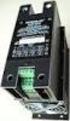 WHITE PAPER WYE-DELTA AND SOLID STATE STARTER APPLICATION GUIDE EXPLANATION AND ASSISTANCE FOR APPLYING SOLID STATE SOFT STARTERS IN TRADITIONAL REDUCED VOLTAGE APPLICATIONS Introduction..............................................................2
Bulletin 150 Smart Motor Controllers SMC-3 Smart Motor Controller
 Overview/Modes of Operation Bulletin 150 Smart Motor Controller The SMC-3 is a compact, simple to use, solid-state motor controller designed to operate 3-phase motors. It features a built-in overload relay
Siemens AG 2011 SINAMICS V60. The perfect solution for basic servo applications. Brochure May 2011 SINAMICS. Answers for industry.
 The perfect solution for basic servo applications Brochure May 2011 SINAMICS Answers for industry. with 1FL5 servomotors The solution for basic servo applications There is a requirement to automate motion
MOTOR CONTROL IS OUR NATURE
 MOTOR CONTROL IS OUR NATURE profile Founded in 1977, Solcon Industries Ltd. is a dynamic Power Electronics Company that develops, manufactures and manages worldwide product sales all under one roof. Our
32VFD Variable Frequency Drives for Centrifugal Chillers
 32VFD 32VFD Variable Frequency Drives for Centrifugal Chillers ENERGY-SAVING CONTROL FOR CENTRIFUGAL CHILLERS Reduce energy consumption in your existing centrifugal chiller Your chiller was specified to
We will discuss common industrial applications with guides for the proper use of electric motors on these.
 INTRODUCTION: Baldor Electric Company has prepared this Specifiers Guide to help you cover all the bases when you are specifying electric motors. It will cover in a generic way most of the subjects which
Softstarters. Main Catalogue. Type PSR Type PSS Type PST/PSTB. Latest updated 2010-02-23 not printed, only in PDF-format
 Main Catalogue Latest updated 2010-02-23 not printed, only in PDF-format Softstarters Type PSR Type PSS Type PST/PSTB Catalogue 1SFC132004C0201, Edition 7 February 2010 (1SFC132198F0001) News Functionality
ABB drives. Technical guide No. 4 Guide to variable speed drives
 ABB drives Technical guide No. 4 Guide to variable speed drives 2 Guide to variable speed drives Technical guide No. 4 Technical guide No. 4 Guide to variable speed drives Copyright 2011 ABB. All rights
Bulletin 150 SMC Flex Smart Motor Controller Specifications
 Specifications Specifications Standard Features Optional Features Installation Setup Communications Power Wiring Control Wiring Keypad Software Starting and Stopping Modes Protection and Diagnostics Metering
Discover the power of e-learning! The Quick Guide to AC Variable Frequency
 The Quick Guide to AC Variable Frequency This ebook is meant as an easy guide to any electrical or electronic engineer or technician, who would like to know how modern ac variable frequency drives work.
CONTROLS DATA MANAGEMENT PROCESS AUTOMATION EUROCUBE. General purpose single phase thyristors and solid state relays Product data.
 425 CONTROLS DATA MANAGEMENT PROCESS AUTOMATION EUROCUBE General purpose single phase thyristors and solid state relays Product data abc 425 EUROCUBE A complete range of low cost solid state relays and
PRODUCTS DC MOTORS BLPM MOTORS AC MOTORS CONTROLLERS
 D R I V E S Y S T E M S PRODUCTS DC MOTORS BLPM MOTORS AC MOTORS CONTROLLERS The vision of Iskra Avtoelektrika is to be: One of the world's leading manufacturers of electric motors and controllers for
... Electronic Softstarter...
 . CT-START Electronic Softstarter. 6 A. to 900. A......... CT START CT-START is a multi-function electronic system with a microcontroller and thyristors, designed for use with all 3-phase squirrel cage
RM4TG20 three-phase network control relay RM4-T - range 200..500 V
 Characteristics three-phase network control relay RM4-T - range 200..500 V Complementary [Us] rated supply voltage Output contacts Setting accuracy of time delay Delay at power up Measuring cycle Marking
PM734F - Technical Data Sheet Winding 28
 - Technical Data Sheet Winding 28 SPECIFICATIONS & OPTIONS STANDARDS STAMFORD AC generators are designed to meet the performance requirements of IEC EN 60034-1. Other international standards, including
Product Brochure. Controlled start transmission
 Product Brochure Controlled start transmission What CST does The Dodge CST (Controlled Start Transmission) is a 2 in 1 gearbox which combines a planetary gear reducer with an integral wet clutch system.
REVIEWED BY CAPITAL PROJECTS MANAGER (DAN REDDY) GENERAL MANAGER EQUIPMENT ENGINEERING & ASSET MANAGEMENT (HAMILTON NXUMALO)
 SA Port Operations DOCUMENT TYPE: REFERENCE EEAM-Q-014 (ORIGINAL SPECIFICATION HE8.2.3 Ver5) REVISION 0 SPECIFICATION TITLE: SPECIFICATION FOR ELECTRICAL MOTORS AND GENERATORS PAGE 0 of 07 COMPILED BY
Drives and motors. A guide to using variable speed drives and motors in data centres Meeting your Carbon Reduction Commitment (CRC)
 Drives and motors A guide to using variable speed drives and motors in data centres Meeting your Carbon Reduction Commitment (CRC) The power behind the data Private and public businesses, from banks to
Softstarters. Index. 5 - Softstarters. Phone: 800.894.0412 - Fax: 888.723.4773 - Web: www.clrwtr.com - Email: [email protected].
 Index 5 5 - General information... 5.1 Softstarter overview...5.2-5.3 Applications...5.4-5.5 PSR - The compact range Description...5.7-5.8 Overview... 5.9 Ordering details... 5.10 Accessories... 5.11 Technical
Current valve. for AC 24 V pulse/pause control of electrical loads up to 30 kw
 4 937 DESIO Current valve for AC 24 V pulse/pause control of electrical loads up to 30 kw SEA45.1 Use The current valve is used for the control of electric heating elements in heating, ventilation and
C Standard AC Motors
 C Standard AC Standard AC C-1 Overview, Product Series... C-2 Constant... C-9 C-21 C-113 Reversible C-147 Overview, Product Series Constant Reversible Electromagnetic Brake C-155 Electromagnetic Brake
Product Description Full Voltage Starting Electric Fire Pump Controllers FTA1000
 Product Description Full Voltage Starting Electric Fire Pump Controllers FTA1000 Description Firetrol FTA1000 Full Voltage Fire Pump Controllers are intended for use with electric motor driven fi re pumps
AND8008/D. Solid State Control Solutions for Three Phase 1 HP Motor APPLICATION NOTE
 Solid State Control Solutions for Three Phase 1 HP Motor APPLICATION NOTE INTRODUCTION In all kinds of manufacturing, it is very common to have equipment that has three phase motors for doing different
Unit 33 Three-Phase Motors
 Unit 33 Three-Phase Motors Objectives: Discuss the operation of wound rotor motors. Discuss the operation of selsyn motors. Discuss the operation of synchronous motors. Determine the direction of rotation
Type: DILM115(RAC240) Article No.: 239548 Sales text Contactor,55kW/400V,AC operated. Ordering information
 Type: DILM115(RAC240) Article No.: 239548 Sales text Contactor,55kW/400V,AC operated Ordering information Connection technique Description Description Rated operational current Screw terminals 3 pole AC
Soft Starter. Product Description. Ordering Code. Type Selection. Selection Guide RSG D 40 16 E 0 VD00
 Soft Starter Three Phase General Purpose Soft Starters Type RSGD Soft starting and soft-stopping of 3-phase squirrel cage motors 45mm wide IP20 housing Operational Voltage: RSGD40 (220-400V), RSGD60 (220-600V)
Drives and motors. A guide to using variable-speed drives and motors in data centres
 Drives motors A guide to using variable-speed drives motors in data centres The power behind the data Private public businesses, from banks to supermarkets, to telecommunications companies internet providers
INSTALLATION AND MAINTENANCE INSTRUCTIONS FOR THREE PHASE INDUCTION MOTORS
 INSTALLATION AND MAINTENANCE INSTRUCTIONS FOR THREE PHASE INDUCTION MOTORS Frames 143T - 449TZ 5100 North IH 35 Round Rock, Texas 78681 Phone: 800-451-8798 512-255-4141 Fax: 512-244-5512 RECEIVING 1. Check
Equipment: Power Supply, DAI, Wound rotor induction motor (8231), Electrodynamometer (8960), timing belt.
 Lab 13: Wound rotor induction motor. Objective: to examine the construction of a 3-phase wound rotor induction motor; to understand exciting current, synchronous speed and slip in this motor; to determine
AC Induction Motor Slip What It Is And How To Minimize It
 AC Induction Motor Slip What It Is And How To Minimize It Mauri Peltola, ABB Oy, Helsinki, Finland The alternating current (AC) induction motor is often referred to as the workhorse of the industry because
HCM434F - Winding 311 APPROVED DOCUMENT. Technical Data Sheet
 HCM434F - Winding 311 Technical Data Sheet HCM434F SPECIFICATIONS & OPTIONS STANDARDS Marine generators may be certified to Lloyds, DnV, Bureau Veritas, ABS, Germanischer-Lloyd or RINA. Other standards
Phone: 800.894.0412 - Fax: 888.723.4773 - Web: www.clrwtr.com - Email: [email protected]
 Description Wide rated operational voltage 208 690 V AC Wide rated control supply voltage 100 250 V, 50/60 Hz Rated operational current 30 to 1050 A (Up to 1810 A inside delta) Wide ambient temperature
Number 1 in efficiency
 PowerXL DE1 Variable Speed Starter www.eaton.eu/de1 Number 1 in efficiency The easiest way of variable motor speed NEW Variation DE11 The new device category! The PowerXL DE1 Variable Speed Starter Why
Product Description Primary Resistance Starting Electric Fire Pump Controllers FTA1500
 Product Description Primary Resistance Starting Electric Fire Pump Controllers FTA1500 Description Firetrol FTA1500 Primary Resistance Fire Pump Controllers use resistors in the line to reduce line voltage
ANCILLARY EQUIPMENT AND ELECTRICAL EQUIPMENT Power Supply Systems and Electrical Equipment for Desalination Plants - Y.M. Hamud and A.H.
 POWER SUPPLY SYSTEMS AND ELECTRICAL EQUIPMENT FOR DESALINATION PLANTS Y.M. Hamud and A.H. Anwar Abu Dhabi Water and Electricity Authority, Abu Dhabi, UAE Keywords : Electrical System, Network for Desalination,
Controlled Start transmission
 Controlled Start transmission TM What CSt does The DODGE CST (Controlled Start Transmission) is a 2 in 1 gearbox which combines a planetary gear reducer with an integral wet clutch system. When coupled
ABB 1. Three-phase monitoring relay CM-PFS. Data sheet. Features. Approvals. Marks. Order data. Order data - Accessories. Application.
 1SR 430 824 F9300 Features Monitoring of three-phase mains for phase sequence and failure Powered by the measuring circuit 2 c/o (SPDT) contacts 1 LED for status indication Approvals R: yellow LED - relay
Medium Voltage. Application Guide
 Medium Voltage Application Guide CONTENTS Contents 1 Introduction... 4 2 Motors... 5 2.1 Common types of industrial motors... 5 Induction motors... 5 Useful formulae... 6 Slip-ring motors... 7 Synchronous
SECTION 4 ELECTRIC MOTORS UNIT 17: TYPES OF ELECTRIC MOTORS
 SECTION 4 ELECTRIC MOTORS UNIT 17: TYPES OF ELECTRIC MOTORS UNIT OBJECTIVES After studying this unit, the reader should be able to Describe the different types of open single-phase motors used to drive
ABB central inverters PVS800 100 to 1000 kw
 Solar inverters ABB central inverters PVS800 100 to 1000 kw ABB central inverters raise reliability, efficiency and ease of installation to new levels. The inverters are aimed at system integrators and
FREQUENCY CONTROLLED AC MOTOR DRIVE
 FREQUENCY CONTROLLED AC MOTOR DRIVE 1.0 Features of Standard AC Motors The squirrel cage induction motor is the electrical motor motor type most widely used in industry. This leading position results mainly
Three-phase monitoring relay CM-PFE
 Data sheet Three-phase monitoring relay CM-PFE The CM-PFE is a three-phase monitoring relay that monitors the phase parameter phase sequence and phase failure in three-phase mains. 2CDC 251 005 S0012 Characteristics
Electronic overload relay EF19 and EF45
 Data sheet Electronic overload relay EF19 and EF45 Electronic overload relays offer reliable protection in case of overload and phase-failure. They are the alternative to thermal overload relays. Motor
Speed Control Methods of Various Types of Speed Control Motors. Kazuya SHIRAHATA
 Speed Control Methods of Various Types of Speed Control Motors Kazuya SHIRAHATA Oriental Motor Co., Ltd. offers a wide variety of speed control motors. Our speed control motor packages include the motor,
Installation and Maintenance manual. Softstarters PST / PSTB
 Installation and Maintenance manual Softstarters PST / PSTB Installation and maintenance PST30... PST1050 manual PST30...PSTB1050 Installation and maintenance manual Introduction... 1.1-1.3 1 Quickstart...
Motor Fundamentals. DC Motor
 Motor Fundamentals Before we can examine the function of a drive, we must understand the basic operation of the motor. It is used to convert the electrical energy, supplied by the controller, to mechanical
Equipment: Power Supply, DAI, Synchronous motor (8241), Electrodynamometer (8960), Tachometer, Timing belt.
 Lab 9: Synchronous motor. Objective: to examine the design of a 3-phase synchronous motor; to learn how to connect it; to obtain its starting characteristic; to determine the full-load characteristic of
SERVOMECH Linear Actuators
 . SERVOMECH Linear actuators SERVOMECH mechanical linear actuators are motorised mechanical cylinders able to transform the rotary motion of a motor into the linear motion of a push rod. They are designed
PI044E - Winding 311 APPROVED DOCUMENT. Technical Data Sheet
 PI044E - Winding 311 Technical Data Sheet PI044E SPECIFICATIONS & OPTIONS STANDARDS Stamford industrial generators meet the requirements of BS EN 60034 and the relevant section of other international standards
Electronic overload relay EF65, EF96 and EF146
 Data sheet Electronic overload relay EF65, EF96 and EF146 Electronic overload relays offer reliable protection in case of overload and phase-failure. They are the alternative to thermal overload relays.
Softstarters. Type PST/PSTB Fieldbus communication CANopen for PST sw CU 06.00.00. 1SFC132070M0201 February 2011 1SFC132070M0201 1
 Softstarters Type PST/PSTB Fieldbus communication CANopen for PST sw CU 06.00.00 1SFC132070M0201 February 2011 1SFC132070M0201 1 CANopen The CANopen protocol is a fieldbus protocol that provides full control
Electric Rotary Actuator - On/Off or programmable control actuator
 Electric Rotary Actuator - On/Off or programmable control actuator Direct mounting on quarter-turn valves Manual override standard Corrosion resistant Adjustable limit switches Multi-voltage version Type
AC Electric Motors best practice
 If you want to learn more about best practice machinery maintenance, or world class mechanical equipment maintenance and installation practices, follow the link to our Online Store and see the Training
FRENIC5000MS5 for Machine Tool Spindle Drives
 FRENIC5MS5 for Machine Tool Spindle Drives Yoshikazu Tanaka Hiroaki Hayashi Hiroshi Takahashi 1. Introduction Fig.1 External view of FRENIC5MS5 In AC spindle drive systems for machine tools, operation
8 Speed control of Induction Machines
 8 Speed control of Induction Machines We have seen the speed torque characteristic of the machine. In the stable region of operation in the motoring mode, the curve is rather steep and goes from zero torque
MC Series Drives. Flexible, simple, rugged, robust! Phone: 800.894.0412 - Fax: 888.723.4773 - Web: www.actechdrives.com - Email: info@actechdrives.
 Drives Flexible, simple, rugged, robust! Our promise Commitment to Price Leadership Price leadership is serious business. It takes continuous life cycle management to make price leadership a sustainable
PI144K - Winding 311 APPROVED DOCUMENT. Technical Data Sheet. Generator Solutions AS
 PI144K - Winding 311 Technical Data Sheet PI144K SPECIFICATIONS & OPTIONS STANDARDS TERMINALS & TERMINAL BOX Stamford industrial generators meet the requirements of BS EN 60034 and the relevant section
Single-Phase AC Synchronous Generator
 ST Series Single-Phase AC Synchronous Generator Instructions for Operation and Maintenance English to English translation by R.G. Keen, May 2004. ST Series of Single-Phase AC Synchronous Generators Description
Rotating Machinery Diagnostics & Instrumentation Solutions for Maintenance That Matters www.mbesi.com
 13 Aberdeen Way Elgin, SC 29045 Cell (803) 427-0791 VFD Fundamentals & Troubleshooting 19-Feb-2010 By: Timothy S. Irwin, P.E. Sr. Engineer [email protected] Rotating Machinery Diagnostics & Instrumentation
FIXED DISPLACEMENT HYDRAULIC VANE PUMPS BQ SERIES
 BQ FIXED DISPLACEMENT HYDRAULIC VANE PUMPS BQ SERIES Versatility, power, compactness and low running costs are the main characteristics of B&C vane pumps. All the components subject to wear are contained
Softstarters. Type PST30...PSTB1050 Installation and Commissioning Manual. Manual 1SFC132003M0201 June 2007. Fault. Power on Protection
 Power on Fault Protection Power on Fault Protection Power on Fault Protection Power on Protection Fault Power on Protection Fault Softstarters Type PST30...PSTB1050 Installation and Commissioning Manual
Emergency stop As an emergency switching off/emergency stop device. Standards According to IEC/EN 60204-1, VDE 0113 Part 1
 MainswitchSurfacemounting Partno. P3-63/I4/SVB Articleno. 207343 CatalogNo. SP3-063-I4CRQ IP65 Deliveryprogramme Product range Switch-disconnectors Basic function Main switches Maintenance switches Manual
Manual motor starter MS116
 Data sheet Manual motor starter MS116 Manual motor starters are electromechanical devices for motor and circuit protection. These devices offer local motor disconnect means, manual ON/ OFF control, and
Rotary Phase Converters
 FACTS from Ronk Electrical Industries, Inc. Bulletin 11981 Rotary Phase Converters ROTOVERTER Pat. No. 3,670,238 ROTO-CON Pat. No. 4,158,225 What are the ROTO-CON and ROTOVERTER power converters? The ROTO-CON
32:(5#5$7,1* 4833#USP283#+] 4;33#USP293#+] 3ULPH 113 kva, 90 kw 124 kva, 99 kw 6WDQGE\ 114 kva, 91 kw 125 kva, 100 kw
![32:(5#5$7,1* 4833#USP283#+] 4;33#USP293#+] 3ULPH 113 kva, 90 kw 124 kva, 99 kw 6WDQGE\ 114 kva, 91 kw 125 kva, 100 kw](/thumbs/30/14614129.jpg "32:(5#5$7,1* 4833#USP283#+] 4;33#USP293#+] 3ULPH 113 kva, 90 kw 124 kva, 99 kw 6WDQGE\ 114 kva, 91 kw 125 kva, 100 kw") ,1'8675,$/#*(16(7 6HULHV#'9#448 32:(5#5$7,1* 4833#USP283#+] 4;33#USP293#+] 3ULPH 113 kva, 90 kw 124 kva, 99 kw 6WDQGE\ 114 kva, 91 kw 125 kva, 100 kw Generator set consisting of engine and alternator mounted
,1'8675,$/#*(16(7 6HULHV#'9#448 32:(5#5$7,1* 4833#USP283#+] 4;33#USP293#+] 3ULPH 113 kva, 90 kw 124 kva, 99 kw 6WDQGE\ 114 kva, 91 kw 125 kva, 100 kw Generator set consisting of engine and alternator mounted
AuCom s IMS2 soft starters are a total motor starting solution, combining highlevel functionality with ease of use:
 AuCom s IMS2 soft starters are a total motor starting solution, combining highlevel functionality with ease of use: advanced soft start and soft stop control protection functions that operate even when
Single Phase Soft Starter
 Single Phase Soft Starter Installation & Operating Manual 6/02 Table of Contents Section 1 General Information................................................... 1 1 General Description................................................
KINETIC ENERGY RECOVERY SYSTEM BY MEANS OF FLYWHEEL ENERGY STORAGE
 ADVANCED ENGINEERING 3(2009)1, ISSN 1846-5900 KINETIC ENERGY RECOVERY SYSTEM BY MEANS OF FLYWHEEL ENERGY STORAGE Cibulka, J. Abstract: This paper deals with the design of Kinetic Energy Recovery Systems
Products and solutions for lifting systems
 Products and solutions for lifting systems 100% electricity www.lovatoelectric.com Tra dition and Innovation LOVATO Electric S.p.A. - Bergamo - Italy Since 1922 The first LOVATO Electric headquarters founded
Synchronous motor. Type. Non-excited motors
 Synchronous motor A synchronous electric motor is an AC motor in which the rotation rate of the shaft is synchronized with the frequency of the AC supply current; the rotation period is exactly equal to
(3) Explosion proof. Designed to prevent ignition of any explosive gases or dust and dirt which may surround the motor.
 ELECTRIC MOTORS Enclosures for Motors Types of motor enclosures generally used in farm applications: (1) Open type; drip proof or splash-proof. A general purpose motor for use in dry locations which are
FIXED DISPLACEMENT HYDRAULIC VANE PUMPS BQ SERIES
 BQ FIXED DISPLACEMENT HYDRAULIC VANE PUMPS BQ SERIES Versatility, power, compactness and low running costs are the main characteristics of B&C vane pumps. All the components subject to wear are contained
The Right Drive to Maximize Efficiency and Production for Large Overland Conveyors
 The Right Drive to Maximize Efficiency and Production for Large Overland Conveyors By: Nicole Hampton, P.Eng. ABSTRACT: This paper examines various drive systems available for large overland conveyors,
ABB PSPS Erich Steinmann; Generator control-2013
 ABB PSPS Erich Steinmann; Generator control-2013 GENERATOR CONTROL THE MODULAR SOLUTION FOR GENERATORS To make sure that power is efficiently converted into electric energy, it is necessary to supervise
LC1D65AM7 TeSys D contactor - 3P(3 NO) - AC-3 - <= 440 V 65 A - 220 V AC coil
 Product data sheet Characteristics LC1D65AM7 TeSys D contactor - 3P(3 NO) - AC-3 -
Siemens Standard Drives. Application Handbook
 Siemens Standard Drives Application Handbook Martin Brown Siemens Standard Drives Congleton December 1997 1. Introduction....4 1.1 What is a Variable Speed Drive?...4 1.2 The Variable Frequency Inverter...7
Softstarters Type PSE18...PSE370 Installation and commissioning manual
 Softstarters Type PSE18...PSE370 Installation and commissioning manual PSE 18-600-70 PSE 18-600-70 PSE 18-600-70 This manual belongs to: 2 Softstarters Type PSE18...PSE370 Installation and commissioning
Annex-A TECHNICAL SPECIFICATION
 Annex-A TECHNICAL SPECIFICATION FOR SUPPLY, INSTALLATION, TESTING AND COMMISSIONING OF 0.4kV (2,000kVA) DIESEL GENERATOR 1 1.0 SCOPE This specification covers the requirements of design, manufacture, delivery
NO LOAD & BLOCK ROTOR TEST ON THREE PHASE INDUCTION MOTOR
 INDEX NO. : M-142 TECHNICAL MANUAL FOR NO LOAD & BLOCK ROTOR TEST ON THREE PHASE INDUCTION MOTOR Manufactured by : PREMIER TRADING CORPORATION (An ISO 9001:2000 Certified Company) 212/1, Mansarover Civil
FIXED DISPLACEMENT HYDRAULIC VANE PUMPS BQ SERIES
 BQ FIXED DISPLACEMENT HYDRAULIC VANE PUMPS BQ SERIES Versatility, power, compactness and low running costs are the main characteristics of B&C vane pumps. All the components subject to wear are contained
RM17TE 183...528 V AC. Main. Product or component type. Product specific application. Relay monitored parameters 250 V DC 5 A DC
 Characteristics multifunction control relay RM17-TE - range 183..528 V AC Complementary Reset time Maximum switching voltage Minimum switching current Maximum switching current [Us] rated supply voltage
Safety along the complete line: SIRIUS 3SE7 cable-operated switches. sirius COMMANDING & SIGNALING
 Safety along the complete line: 3SE7 cable-operated switches sirius COMMANDING & SIGNALING Everything well under control. 3SE7 cable-operated switches With cable-operated switches from our 3SE7 product
PI734D - Technical Data Sheet
 PI734D - Technical Data Sheet PI734D SPECIFICATIONS & OPTIONS STANDARDS Newage Stamford industrial generators meet the requirements of BS EN 60034 and the relevant sections of other national and international
PI734B - Technical Data Sheet
 PI734B - Technical Data Sheet PI734B SPECIFICATIONS & OPTIONS STANDARDS Newage Stamford industrial generators meet the requirements of BS EN 60034 and the relevant sections of other national and international
4chapter. AC motors starting and protection systems
 4chapter AC motors starting and protection Presentation : AC motors starting and braking AC motors protection devices and failure analysis Protection devices selection guide 60 Summary 1 2 4.1 Asynchronous
SYNCHRONOUS MACHINE TESTING WITH MOTOR CIRCUIT ANALYSIS INSTRUMENTATION
 SYNCHRONOUS MACHINE TESTING WITH MOTOR CIRCUIT ANALYSIS INSTRUMENTATION Introduction Howard W. Penrose, Ph.D., CMRP Vice President, Engineering and Reliability Services Dreisilker Electric Motors, Inc.
SYNCHRONOUS MACHINES
 SYNCHRONOUS MACHINES The geometry of a synchronous machine is quite similar to that of the induction machine. The stator core and windings of a three-phase synchronous machine are practically identical
Brochure. Electric generators to power the world
 Brochure Electric generators to power the world We provide motors and generators, services and expertise to save energy and improve customers processes over the total life cycle of our products, and beyond.