
Facilities Use and Management
|
|
|
- Collin McDowell
- 10 years ago
- Views:
Transcription
1 Facilities Use and Management Overview The Facilities Use and Management chapter covers the following departments: Construction Management Environmental Compliance Maintenance The Overview section of this chapter presents the current division level organizational chart and the recommended organizational changes in the overall Facilities Services Division. Safe, clean, soundly constructed, and well-maintained buildings with sufficient, appropriate space have a significant impact on a school s climate and the self-esteem of students and staff. Facilities Services which includes Construction Management, Environmental Compliance, Maintenance, Custodial, and Special Crews (Grounds) functions is responsible for managing the District s facilities. Construction Management is responsible for managing the District s growing building program. Environmental Compliance ensures that environmental regulations are met. The Maintenance Division safeguards the investment made in public schools by keeping all school buildings in safe condition and in good repair. Custodial Services maintains the cleanliness of the facilities to provide a healthy environment for the District s facilities. Special Crews ensures that the District s grounds are clean, well-groomed, and in an attractive state to provide a healthy, safe, and attractive setting for the educational program. Facilities - 1

2 Facilities Use and Management Overview Facilities Services current organizational structure does not adequately support the District s facility needs and does not meet KPMG s standards for an effective organization. For example: Facilities planning is not being performed by Facilities Services. Construction Management s current organizational structure is missing job positions that address core areas of responsibility. For example, there is no clear design function as reflected by a lack of design engineers in civil, mechanical and electrical areas. Certain facilities-related functions, such as real estate acquisition, and office design, are not located in Facilities Services. OCPS field maintenance technician (FMT) program is an overly decentralized and heavily staffed maintenance function that has resulted in high-cost, low quality services to schools. OCPS maintenance organization is organized into 13 zones that do not align with the District s new five area regional structure. The current deployment of trades positions into 13 zones and 140 schools creates an overabundance of maintenance generalists and too few maintenance specialists. This makes it difficult to handle complex or large maintenance activities, while also limiting the ability of the district to benefit from economies of scale gained through regional leverage of highly skilled positions. In terms of customer service, on the Facilities Services customer survey, 67% of customers responded that they are dissatisfied with OCPS maintenance services. This compares to a 29% dissatisfaction rate from the same question posed to the Wake County Public School System, a KPMG best practice district. Survey responses were echoed in the principal focus group. Although some principals were happy with their FMT, the majority of the group claimed that their FMT was completely unaccountable and that they did not perceive they were getting adequate value for the resources expended on this position. Facilities - 2

3 Facilities Use and Management Overview Organizational recommendations described in this section include: Add facilities planning and design capabilities to Facilities Services. Move the real estate function from its existing location and place it within Facilities Services to enable the District to create a complete continuum of service, from site acquisition to site development. Consolidate the 13 maintenance zones into five zones to align with OCPS new five area regional structure. OCPS should eliminate the FMT program, replacing school level generalists with regional level specialists to increase accountability, provide the District with a greater depth of expertise, and improve the District s ability to handle larger, more complex maintenance projects more effectively and efficiently. Facilities - 3

4 Facilities Use and Management Overview As part of this study, KPMG assessed OCPS Facilities Services Division using the Best Financial Practices and Indicators developed by OPPAGA. OPPAGA developed specific indicators for facilities in three major areas: Use of state and district construction funds Educational facilities construction Facilities maintenance KPMG submitted the list of indicators to OCPS Facilities Division and requested that the leadership team perform a self assessment to determine the degree to which OCPS is meeting the Best Financial Practices and Indicators. After Facilities completed the self assessment, KPMG followed up with Facilities staff to discuss several of the key results. KPMG then developed findings and recommendations based on the results of the assessment. These findings and recommendations have been incorporated into the Facilities Use and Management section of this report. The remainder of the chapter provides a detailed functional analysis for each of the departments listed above. Facilities - 4

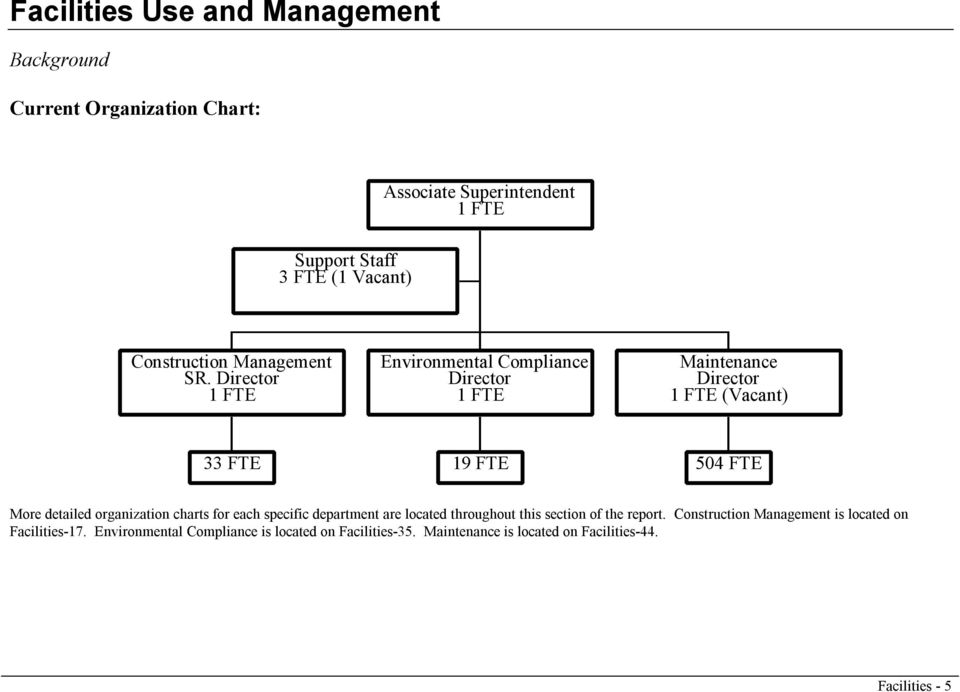
5 Facilities Use and Management Background Current Organization Chart: Associate Superintendent 1 FTE Support Staff 3 FTE (1 Vacant) Construction Management SR. Director 1 FTE Environmental Compliance Director 1 FTE Maintenance Director 1 FTE (Vacant) 33 FTE 19 FTE 504 FTE More detailed organization charts for each specific department are located throughout this section of the report. Construction Management is located on Facilities-17. Environmental Compliance is located on Facilities-35. Maintenance is located on Facilities-44. Facilities - 5
6 Facilities Use and Management Recommended Organization: Facilities Services Associate Superintendent of Facilities Services 1 FTE Administration Budget/Personnel/Clerical 9 FTE Planning & Real Estate Facilities Planning F.I.S.H.- Real Estate 4 FTE Information Services 2 FTE Director of Maintenance 2 FTE Director of Special Services 2 FTE Director of Design & Construction 7 FTE Area Maintenance Coordinator/ Manager (5 Areas) 5 FTE Central Facility Trades & Shops 133 FTE Special Crews Administrator 1 FTE Custodial Services Administrator 1 FTE Environmental Programs 9 FTE Project Management 11 FTE Trades 190 FTE Special Crews Staff 85 FTE Area Custodial Coordinators 5 FTE Custodial Staff 14 FTE Energy Management 2 FTE Engineering Design Inspection 16 FTE Construction Services Portables 31 FTE Facilities - 6

7 Facilities Use and Management Organizational Structure: Facilities Services current organizational structure does not adequately support the District s facility needs and does not meet KPMG s standards 1 for an effective organization. For example: Facility planning is not being performed by Facilities Services (discussed later). Certain facilities-related functions, such as real estate acquisition, and office design, are not located in Facilities Services. Environmental Management is currently responsible for activities such as Florida Inventory of School Houses (F.I.S.H.), training, clerical, and information support, which is not consistent with its key mission. FM1: Reorganize Facilities Services as illustrated in the organization chart. Specific changes include: Implement facilities planning function. Real Estate should be transferred to Facilities Services. The Senior Manager Design and Services position should be moved to Facilities Services. Realign responsibility for F.I.S.H., clerical, and information support. The Director of Special Services also directs Environmental Programs. Estimated fiscal impact: None 1 KPMG has developed organizational standards, documented in Section 1: Organization and Management, based on research into management and staffing practices in high performing governments and school systems, private sector companies, and not-for-profit organizations. Facilities - 7

8 Facilities Use and Management Management Practices and Technology Facilities Services lacks overall strategic direction, which has resulted in ineffective management of the facilities management function as well as a lack of focus and direction. Facilities Services leadership is currently in the process of addressing this issue by implementing key elements of a strategic management process (such as developing vision and mission statements, defining responsibilities, and developing policies and procedures). Prior to the new leadership, the guidance and responsibilities in some areas were not clear. The Maintenance Department, for example, focused more on construction than maintenance, which has had a negative impact on the condition of OCPS facilities. FM2: The Facilities Services leadership team must finalize and implement its strategic mission and plans to ensure that there is a coordinated effort to plan, design, construct, and maintain quality facilities for the students of Orange County. Facilities Services should involve all relevant staff in the development of the mission, vision, goals, and responsibilities, and should give all Facilities Services staff the opportunity to provide input. When finalized, the vision, mission, goals, and responsibilities should be disseminated to all Facilities Management employees. Estimated fiscal impact: None Facilities - 8

9 Facilities Use and Management Findings, and Recommendations for Opportunities to Improve Facilities Services indicated that although the District has established a Facilities Steering Committee, the committee s role has not been established in writing and that district goals, procedures, and processes, as well as project responsibilities, have not been explained to the committee. The committee also may not be broadly representative of the community and its members may not be free from conflict of interest. In addition, there is no mechanism for documenting decisions of the committee and for submitting recommendations to the School Board. FM3: OCPS should define the Facilities Steering Committee s role in writing, and should explain to the committee the district goals, procedures, and processes, as well as project responsibilities. OCPS should also ensure that the committee members are broadly representative of the community and that they are free from conflict of interest. In addition, OCPS should develop a mechanism for documenting decisions of the committee and for submitting recommendations to the School Board. Estimated fiscal impact: None Facilities - 9

10 Facilities Use and Management Findings, and Recommendations for Opportunities to Improve Facilities Services lacks a coordinated facilities planning office/function, a key element of an effective facilities management function. Planning has been accomplished by the Associate Superintendent for Government Relations, who is filling the planning void left in Facilities Services. A Facilities Steering Committee exists; however, its main function is site acquisition. Planning is an important part of the facilities management function, and lack of a planning function can have serious repercussions. For example, without adequate planning, the District might not have enough schools in the future to handle the growth in enrollment, or the District may end up building too many new schools. FM4: OCPS should establish a planning function in Facilities Services as soon as possible to address current planning requirements. The responsibility for facilities planning should be assigned to the Senior Manager Real Property position (which should be transferred to Facilities Services). In addition, the Senior Manager Office Design and Services position be should be assigned to support this planning function. Facilities Services should continue to utilize the Facilities Steering Committee and its mission should be expanded to include the entire planning process, from needs determination to construction. Estimated fiscal impact: None Facilities - 10

11 Facilities Use and Management OCPS does not routinely assess alternatives, including estimates of cost and other appropriate considerations, prior to considering the use of construction funds. For example, OCPS does not consider alternatives such as revising the timing of the school day and school year to include extended-day schedules and year-round schools. FM5: OCPS should consider alternatives prior to using construction funds. Alternatives include: Revising the timing of the school day and school year to include extended-day schedules and yearround schools. Evaluating how existing facilities could be used more efficiency to include revising grade-level configuration and making changes in attendance boundaries. Consider the use of alternative sites for the growing student population in lieu of building new schools. Alternative sites could include major employers in the area, vacant shopping centers, etc. In addition, OCPS could arrange for a local university (such as the University of Central Florida) to create a school on its campus to use as a teaching site for education students. Estimated fiscal impact: None Facilities - 11

12 Facilities Use and Management Findings, and Recommendations for Opportunities to Improve OCPS indicated that although they are currently doing so, in the past the district has not incorporated factors to minimize the maintenance and operations requirements of new facilities when designing and constructing new educational facilities. OCPS has not established policies and procedures that define education facilities construction and identify the types of expenditures that are consistent with that definition, and consistent with law and rule. Facilities Services indicated that the District is not using all available building capacity to the fullest extend. FM6: OCPS should continue to work to minimize the maintenance and operations requirements of new facilities. The district should ensure that the factors used minimize maintenance and operations costs based on appropriate standards from comparable school districts, government agencies, and private industry. Estimated fiscal impact: None FM7: OCPS should establish policies and procedures that define education facilities construction and identify the types of expenditures that are consistent with that definition. Estimated fiscal impact: None FM8: OCPS should conduct an assessment to evaluate whether the District is using all available building capacity to the fullest extent. Estimated fiscal impact: None Facilities - 12

13 Facilities Use and Management Findings, and Recommendations for Opportunities to Improve OCPS indicated that although all projects are given estimated budgets, the items within each program s budgets are not prioritized. This prioritization is necessary in the event that the estimated budget will not be adequate for the stated program. For example, the Facilities Director does not provide the School Board and the public with a full, detailed accounting of the use of all capital funds each year (contracted services, day labor, purchase orders, etc.). There is currently no plan in place to accomplish the significant amount of planning work that needs to be completed by June 1998, nor is there planning staff to perform this work. Examples of the planning work to be accomplished include: 10-year educational facility master plan needs to be revalidated 5-year plant survey needs to be revised and revalidated House Bill 17-A requirements need to be addressed FM9: OCPS should prioritize items within each program s budgets. Estimated fiscal impact: None FM10: The Facilities Director should present the School Board with a full accounting of the use of all capital funds at least once each year. Estimated fiscal impact: None Facilities - 13

14 Facilities Use and Management OCPS indicated that the District has not met its planned time frames in the long-range plan. Facilities Services indicated that this is in the process of being corrected. House Bill 17-A could potentially have a significant impact on future needs determination and the level of state funding the District receives for facilities. Currently, OCPS has not assessed how House Bill 17-A will affect the District s future funding levels and workload, and has not planned how it will address these issues. The potential impact of not addressing House Bill 17-A is a loss of qualification for state funds. FM11: OCPS should work to meet time frames as much as possible. When time frames are not met, the District should revise its time frames accordingly and identify why the time frames were not met. The District should also provide updates to the Board and the public. Estimated fiscal impact: None FM12: OCPS must examine the impacts of House Bill 17A and other state initiatives and develop a strategy to address these issues. Work programs, plant surveys, capital budgets and other related documents must be developed and/or updated to meet state requirements. Estimated fiscal impact: None Facilities - 14

15 Facilities Use and Management: Construction Management Background Functional Components: Construction Management Architect Support: Responsible for the design and architectural support of construction projects. Project Management: Responsible for the life-cycle management of projects from design through construction. This includes managing contracts with various design and construction firms. Construction: Responsible for the construction requirements associated with the relocation of the portable units. Staffing and Budget: Construction Management 64 FTE positions budgeted in FY98 15 FTE vacancies (as of February 3, 1998) The construction FY 98 operating budget is $4,337,157 Facilities Services FY98 capital budget is $282,261,189 (includes $138,902,589 in carry forward project funds) Construction operating expenditures were $1,431,436 in FY97 (Note: this function was moved from maintenance to construction beginning in FY98) Facilities Services capital expenditures were $ 74,991,048 in FY97 Facilities - 15

16 Facilities Use and Management: Construction Management Background Workload: The Capital Projects Priority List (published January 1997) consists of 124 facilities at an estimated cost of $107,000,000. Seven schools under construction 17 new schools are planned for FY1998 through FY2002, at an estimated cost of $329,000,000: 10 elementary schools 5 middle schools 2 high schools Facilities - 16

17 Facilities Use and Management: Construction Management Background Current Organization Chart: Construction Management Construction Management SR. Director 1 FTE Support Staff 6 FTE Project Management SR. Administrator 1 FTE (Vacant) SR. Administrator 2 FTE (1 vacant) Construction Management SR. Administrator 1 FTE (Vacant) Construction Management SR. Administrator 1 FTE Construction Management SR. Administrator 1 FTE Architectual Support SR. Manger 1 FTE Project Management/Oversight Renovation/Remodeling New Construction SR. Manager 1 FTE (Vacant) Project Design SR. Manager 1 FTE (Vacant) Portable Hook-ups, Drainage, Striping, Paving, and Concrete Crews 29 FTE Project Management SR. Manager 1 FTE (Vacant) Manager 1 FTE Project Design SR. Manager 1 FTE Manager 1 FTE SR. Manager 1 FTE (Vacant) Draftsman 4 FTE Manager 1 FTE Manager 1 FTE UBCI 9 Vacant (4 Vacant) Facilities - 17

18 Facilities Use and Management: Construction Management Background Recommended Organization: Design and Construction Department Director Design & Construction 1 FTE Clerical Support 6 FTE SR. Administrator Engineering/Design and Inspection 1 FTE SR. Administrator Project M anagement 1 FTE SR. Administrator Construction Services 1 FTE SR. M anager Architect Support 1 FTE SR. Manager Project M anagement Five Areas 5 FTE M anager Project M anagement 5 Areas 5 FTE Portable Construction Services 30 FTE Engineering Staff 4 FTE Technical Staff CADD 1 FTE Uniform Building Code Inspectors 9 FTE Please see FM13 for explanation of recommended organization chart beginning on Facilities 20. Facilities - 18

19 Facilities Use and Management: Construction Management Key Achievements/Commendations Key Achievements/Commendations: The District has established the Construction Oversight Value Engineering (COVE) Committee, composed of business leaders and community members, to oversee the construction management program. This represents a KPMG best practice based on the experience of KPMG's Public Education Practice. Facilities - 19

20 Facilities Use and Management: Construction Management Customer Satisfaction 68 percent of customers* indicated they are dissatisfied with the services provided by Construction Management. Overall Satisfaction with Construction Management Services, % 40% 42% 35% 30% 25% 20% 15% 26% 25% 10% 5% 0% 6% Excellent Good Fair Poor Source: KPMG customer satisfaction survey results * 186 principals and assistant principals who responded to the Facilities Services Customer Survey. See response rate in the Introduction portion of this report and the completed survey in Appendix B. Facilities - 20

21 Facilities Use and Management: Construction Management Benchmarks OCPS construction costs per square foot are 42 percent higher than its peers. The construction costs reflect the following activities in the peer districts: Broward a learning center, Duval two elementary schools, Hillsborough a high school, and Pinellas three elementary schools and one middle school. Orange County costs represent only those associated with the construction of four elementary schools. $120 Construction Costs per Square Foot ($) for All Contracts Awarded in 1996 $119 $100 $80 $60 $91 $89 $87 Peer Average $84 $68 $40 $20 $- Orange Pinellas Hillsborough Broward Duval Source: Benchmarking surveys and the Florida Department of Education. Facilities - 21
22 Facilities Use and Management: Construction Management Organizational Structure Construction Management s current organizational structure is missing job positions addressing core areas of responsibility, while having excess capacity in other areas. For example, there is no clear design function as reflected by a lack of design engineers in civil, mechanical and electrical areas of expertise. OCPS has too many high level administrative and draftsman positions, while lacking lower level project management job responsibilities. In addition, Construction Management s title focuses only on building and project management. The department title should reflect all department functions, i.e., life-cycle project management (design through construction). FM13: The Construction Management Department should be reorganized to facilitate the execution of its engineering, design, and construction functions. Reorganize the department into three sections reporting to the Senior Director: Engineering/Design and Inspection: This unit should be responsible for architectural, civil, mechanical, and electrical engineering functions, and Uniform Building Code inspections. This section should focus on providing the expertise needed for: Design contract administration Design review Limited in-house designs Uniform Building Code Inspections Project Management (design through construction): This section should manage all projects from design through construction. All project management functions should remain centralized, but project managers should be assigned to support specific geographic areas of the District. Facilities - 22
23 Facilities Use and Management: Construction Management (previous finding continued) (previous recommendation continued) Construction Services: This section should manage the installation of portables and do small capital projects. This new organizational structure eliminates two of the five Senior Administrator positions and three draftsman. The two Senior Administrator positions are currently vacant; their elimination will facilitate the addition of two lower level project managers. These two positions, one manager and one senior manager, are needed to provide additional project management capabilities. Three draftsman positions are also eliminated; these positions are currently underutilized. Four engineer positions are added to provide in-house design expertise. Facilities - 23
24 Facilities Use and Management: Construction Management Staffing and Workload Facilities Services has a dedicated staff of 34 positions who are responsible for the preparation and installation of portable units, which may not be an efficient use of resources. Facilities Services was unable to provide workload or performance measurement data for this unit to show that this unit is being used effectively. Many other districts do not have a dedicated staff for this function; they often use maintenance personnel for these installations or they contract out this function. (previous recommendation continued) These engineers should include at least one of the following: one civil engineer, one mechanical engineer, and electrical engineer. An additional engineer should be added to handle additional workload increases. Estimated Fiscal impact: $10,500 Annual Investment FM14: Rename Construction Management to accurately reflect its functions. A more accurate name would be Design and Construction Department. Estimated fiscal impact: None FM15: Facilities Services should assess the feasibility of contracting out for all or a portion of portable functions. If outsourced, the unit currently responsible for this function should be eliminated. Estimated fiscal impact: None Facilities - 24
25 Facilities Use and Management: Construction Management There has been a lack of visible progress on the capital project priority list published and approved in January To date, no projects have been cleared from the list. However, 15 projects (facilities) with an estimated cost of $34,000,000 are in design and construction this fiscal year. The list consists of 124 facilities with an estimated cost of $107,000,000. If these projects are not completed in a timely manner, the problems and costs associated with them are likely to increase. FM16: OCPS must continue to focus on addressing the projects on the priority list and should develop a plan for addressing these issues. Life safety issues must be resolved and the appropriate action plans should be expeditiously developed and implemented. Estimated fiscal impact: None The life safety issues on the capital project priority list have not been resolved, which is a significant liability for the District and a safety issue for students and staff. A council of fire chiefs has been appointed to address and make recommendations on the priority/actions of these issues. To date, Facilities Services has not received the recommendations on the issues. Facilities - 25
26 Facilities Use and Management: Construction Management Construction Management makes limited use of program/project management tools for design and construction. Most effective construction management functions make use of these tools. They help keep programs and projects on schedule and within budget, and can be used for the measurement of performance. Construction Management does develop individual project status reports to report on design and construction, but these reports are not adequate given the size and complexity of the District s construction program. FM17: Facilities Services should select, develop, and utilize standardized program/project management, reporting, and tracking tools to help effectively manage the planning, design, and construction programs. Individual project status reports should continue to be developed. These tools should allow for the development of a master planning schedule that reflects the key design and construction milestone dates for all the projects budgeted for execution during the fiscal year. Scheduled progress information can be added to this schedule. From this master schedule, budget curves can be developed to track program execution from a financial perspective. These tools should also be utilized for the measurement of performance. Potential software used for this includes Microsoft Project, a software program the District currently has. Estimated fiscal impact: None. Facilities - 26
27 Facilities Use and Management: Construction Management Data from the Florida DOE indicates that OCPS average construction cost per square foot for five recently completed elementary schools was $119.10, which is higher than most districts in the state. Effective construction management departments work to keep construction costs as low as possible, without sacrificing quality. FM18: OCPS should continue its efforts to reduce construction costs. This should include the following: The utilization of more independent construction estimates to ensure that they are paying a fair price for construction projects. These estimates should be accomplished through in-house staff. These costs vary depending on the estimates sought and cannot be determined at this time. Continue to work with the Construction Oversight Value Engineering (COVE) Committee to find methods to build schools within the amounts specified. Facilities - 27
28 Facilities Use and Management: Construction Management (previous finding continued) There is a discrepancy between construction cost data provided by DOE and OCPS Construction Management Department. As stated above, DOE indicates that OCPS average construction cost per square foot is $119.10, while OCPS data indicates that the cost per square foot is $91.68, which is close to the Florida state average of $ Construction cost per square foot is a key performance measure used by construction management departments. The lack of consistent data regarding construction costs makes it difficult for OCPS to appropriately project and monitor its costs. (previous recommendation continued) The District should continue to investigate designs that can be site adapted to save on design costs. Designs can be formally value engineered by engineer/design and construction firms to identify additional savings. Economies of scale should be considered when developing construction packages; there may be a cost savings in management and materials by building more than one school under the same contract. When developing methods to reduce construction costs, quality should not be sacrificed. Adequate standards and specifications must be maintained to obtain a long-lasting, maintainable, quality facility. Estimated fiscal impact: None FM19: OCPS should work with the DOE to resolve the difference in construction costs. Estimated fiscal impact: None Facilities - 28
29 Facilities Use and Management: Construction Management The School Board does not establish a total not-toexceed cost per square foot contract amount for each new project prior to the beginning to the initial planning phase. Instead, OCPS indicated that costs are based on target costs per student station. Facilities Services was not actively involved in the development of its FY98 capital projects budget. The FY98 and future-year capital construction budgets were developed by Business Services due to the turnover in leadership and management personnel in Facilities Services. Ideally, department budgets should first be developed by individual departments. The lack of involvement by Facilities Services in the development of its budget can result in a budget that does not accurately reflect OCPS facility needs due to lack of information on plant surveys, priority lists, work programs, and plans when developing the budget. FM20: The School Board should consider establishing a total not-to-exceed cost per square foot contract amount for each new project prior to the beginning to the initial planning phase. Estimated fiscal impact: None FM21: Facilities Services must establish itself as the leader and key team member in the development of the capital and operating budgets for the functional areas administer. The budgets should be developed through a team process. Plant surveys, priority lists, work programs, plans, and other tools should serve as the basis for building and finalizing the budgets. Estimated fiscal impact: None Facilities - 29
30 Facilities Use and Management: Construction Management OCPS architect selection committee does not review and evaluate the architects performance at the completion of projects. OCPS develops general project descriptions for new projects, but these descriptions do not include all relevant information such as: A stated rationale for the project A narrative describing the district in general A historical description of the growth pattern of the district A map that shows the location of the planning facilities within the community and the proposed attendance area of the school Recommendations FM22: OCPS architect selection committee should review and evaluate the architects performance at the completion of projects, and should report findings to the School Board. Estimated fiscal impact: None FM23: Future project descriptions should include all relevant information, such as that cited in OPPAGA s Best Financial Practices and Indicators. Estimated fiscal impact: None Facilities - 30
31 Facilities Use and Management: Construction Management Although OCPS indicated that it conducts comprehensive building evaluations at the end of the first year of operation and periodically during the next three to five years to collect information about building operation and performance, OCPS noted that the comprehensiveness of these building evaluations is questionable. In addition, the District cannot demonstrate that other evaluations were performed at appropriate intervals during the first three to five years of operation. FM24: OCPS should ensure that these building evaluations are comprehensive, and that other evaluations are performed at appropriate intervals during the first three to five years of operation. Estimated fiscal impact: None Facilities - 31
32 Facilities Use and Management: Construction Management OCPS does not analyze building evaluations to determine whether facilities are fully used, operating costs are minimized, and changes in the District s construction planning process are needed. FM25: OCPS should analyze building evaluations to determine whether facilities are fully used, operating costs are minimized, and changes in the District s construction planning process are needed. This should include: Conducting formal, structured post-occupancy building evaluations to assess facility use and operating costs Using the results of the evaluation to compare the product with the specifications to see whether the District received the product it said it wanted, and whether the District still needs the product built. Estimated fiscal impact: None Facilities - 32
33 Facilities Use and Management: Construction Management Construction Management does not have a comprehensive policies and procedures manual. An effective organization consistently updates its policies and procedures manual. FM26: Work processes should be reviewed and updated. Procedure manuals should then be developed to facilitate the uniform execution of programs and projects. When formalizing the work processes, elements from the OPPAGA Best Financial Practices and Indicators checklist should be incorporated. Estimated fiscal impact: None Facilities - 33
34 Facilities Use and Management: Environmental Compliance Background Function Components: Environmental Compliance Environmental: Responsible for compliance with all federal, state, and local environmental regulations. Responsibilities include managing asbestos levels, lead paint, indoor air quality, underground storage tanks, hazardous waste, solid waste, and water/waste water treatment. This department is also responsible for the District s recycling program. Information Support: Responsible for clerical support and maintenance of the Florida Inventory School House (F.I.S.H.) data. Staffing and Budget 25 FTE positions budgeted in FY98 7 vacancies (as of February 3, 1998) The FY98 environmental operating budget is $1,557,685 Environmental operating expenditures were $1,268,469 in FY97 Workload: 17 environmental programs Operate and maintain 12 wastewater and 5 water treatment plants Facilities - 34
35 Facilities Use and Management: Environmental Compliance Background Current Organization Chart: Environmental Compliance Environmental Compliance Director 1 FTE Support Staff 2 FTE Fiscal Controls Administrator 1 FTE Manager 5 FTE (2 Vacant) Support Staff 1 FTE Tradesman 7 FTE Lead Clerk 1 FTE Trades Technicians 2 FTE Systems Support Clerk 4 FTE Technical Assistant 1 FTE Facilities - 35
36 Facilities Use and Management: Environmental Compliance Key Achievements/Commendations Key Achievements/Commendations: OCPS received the 1996 Business in Industry Recycling Program Award. The District estimates that it realizes an annual savings of $200,000 to $300,000 from the recycle program. OCPS received an Environmental Leadership award in 1996 from the Mayor of Orlando. Facilities - 36
37 Facilities Use and Management: Environmental Compliance Customer Satisfaction 76 percent of the customers are satisfied with the services provided by Environmental Compliance. Overall Satisfaction with Environmental Compliance Services, % 56% 50% 40% 30% 20% 20% 17% 10% 7% 0% Excellent Good Fair Poor Source: KPMG customer satisfaction survey results. Facilities - 37
38 Facilities Use and Management: Environmental Compliance Customer Satisfaction 55 percent of customers were satisfied with Environmental Compliance s responsiveness, but 55 percent were dissatisfied with the quality of service provided. Satisfaction with Environmental Compliance, % 40% 35% 30% 25% 20% 15% 10% 5% 0% 42% 40% 37% 32% 18% 13% 13% 5% Excellent Good Fair Poor Quality Responsiveness Source: KPMG customer satisfaction survey results. Facilities - 38
39 Facilities Use and Management: Environmental Compliance Benchmarks OCPS has more Environmental Compliance staff than peer districts based on schools and square footage per FTE Number of Schools per Environmental Compliance FTE, Peer Average ,000,000 1,800,000 1,600,000 1,400,000 1,200,000 1,000, , , , ,000 Square Footage per Environmental Compliance FTE, ,840,000 1,611,111 Peer Average 1,435,571 1,156,333 0 Broward Hillsborough Duval Palm Beach Orange 0 Hillsborough Duval Orange Source: KPMG Benchmarking surveys Please note that information from Pinellas County was unavailable for both benchmarks. Information for Palm Beach, Hillsborough, and Broward Counties was unavailable for the square footage per environmental compliance FTE benchmark. Facilities - 39
40 Facilities Use and Management: Environmental Compliance OCPS provides a higher level of service in Environmental Compliance than other school districts. OCPS manages more environmental programs than peers, including silver recovery, recycling, and solid waste. Although these are important functions, they are not part of the core mission of the District, educating students. Because of this high level of service, Environmental Compliance s staffing is significantly higher than that of their peers. Based on square footage and schools per FTE, OCPS Environmental Compliance should have a staff between 7 to 12 FTEs. FM27: Environmental Compliance should focus on the core environmental programs for which environmental regulatory compliance is required. If OCPS staffed closer to the peer average, 4 of the current 15 positions could be reduced. However, OCPS should analyze revenues per FTE and the cost savings attributable its environmental programs to determine if its current level of staffing is justified. Estimated Fiscal impact: $151,000 Annual Savings Facilities - 40
41 Facilities Use and Management: Maintenance Background Function Components: Maintenance: performs preventive and routine maintenance for the school district s facilities, such as plumbing, electrical, painting, HVAC, and roofing services. Special Crews (Grounds): performs grass cutting, pest control, tree maintenance, irrigation management, gym floor refinishing, small engine repairs, landscaping, playground sand installation, and baseball and football field fertilization and management. Custodial Services: responsible for oversight of the custodial function, including training custodians, evaluating supplies and equipment, controlling allocation of overtime, conducting school inspections, and assisting principals with disciplinary problems. Energy Management: responsible for monitoring energy and utility costs. Staffing and Budget Within the Maintenance Department, 391 budgeted FTEs are responsible for maintenance activities (57 vacancies) Operating budget is $19,300,000 in FY98 (maintenance only) Expenditures were $22,098,000 in FY97 (maintenance only) Special Crews (Grounds) 94 FTEs budgeted in FY98 Operating budget is $4,025,000 in FY98 Expenditures were $3,910,000 in FY97 Facilities - 41
42 Facilities Use and Management: Maintenance Background Staffing and Budget: (continued): Custodial Services 20 FTEs budgeted in FY98 (10 of which are custodians) custodians (10 at Facilities Services compound) Operating budget is $843,000 in FY98 District-wide operating budget for custodial supplies is $699,000 in FY98 District-wide expenditures for custodial supplies was $771,113 District-wide salaries and benefits for custodians is $12,589,000 in FY98 Workload: Maintenance 160 facilities maintained according to the Florida Inventory of School Houses (FISH) report: 14,071,879 permanent square feet 3,279,065 portable square feet 1,811 open maintenance work orders as of January ,400 maintenance work orders completed in and 3,400 completed year-to-date Responsible for maintenance on 807 vehicles Responsible for maintenance on approximately 3250 portable facilities Facilities - 42
43 Facilities Use and Management: Maintenance Background Workload: Custodial Services Responsible for custodial services 15,723,643 square feet and 144 facilities Trained 116 custodians in and 59 in Conducted 322 school inspections in and 171 in Responsible for contract management on contracts involving the Education Learning Center, Tampa Avenue complex, Orlando Tech, Piedmont Lakes (Gotha) Middle School, Hunters Creek Middle School, Southwest Middle School, Dr. Phillips (West Orange) Ninth Grade Center, and Evans (Apopka) Ninth Grade Center. Workload: Special Crews (Grounds) Responsible for 3,000 acres at 147 facilities. Responsible for pest control on: 14,071,879 permanent square feet 3,279,065 portable square feet Performed 720 lawn maintenance engine repairs in Performed 150 non-lawn equipment related repairs on Facilities - 43
44 Facilities Use and Management: Maintenance Background Current Organization Chart: Maintenance Maintenance Director 1 FTE Support Staff 5 FTE Maintenance Manager 3 FTE (2 vacant) Special Crews Administrator 1 FTE Custodial Services Administrator 1 FTE Maintenance Manager 1 FTE Maintenance Manager 1 FTE (Vacant) Energy Controls 2 FTE (2 vacant) Air Conditioning 12 FTE Cabinet Maker 4 FTE Support Staff 3 FTE Systems Support 1 FTE Zone 3 17 FTE Zone 1 19 FTE Carpenter 6 FTE General Maintenance 4 FTE Heavy Equipment 12 FTE Communications 6 FTE Grounds Pavement 6 FTE Light Equipment 1 FTE Manager 1 FTE (Vacant) Grounds Personnel 90 FTE (9 Vacant) Custodail Technicians 5 FTE Custodial Crew Leader 2 FTE 1 Zone Lead 6 Tradesmen 10 FMTs Zone 4 22 FTE 1 Zone Lead 6 Tradesmen 12 FMTs (2 vacant) Zone 2 15 FTE Locksmith 2 FTE Machinist 1 FTE Custodians 10 FTE 1 Zone Lead 6 Tradesmen 15 FMTs (3 vacant) 1 Zone Lead 6 Tradesmen (1 vacant) 8 FMTs (2 vacant) Painter 16 FTE Refinisher 2 FTE Zone 7 20 FTE Zone 5 23 FTE Refrigeration 4 FTE Roofer 11 FTE Sheet Metal 7 FTE Shipping Clerk 1 FTE 1 Zone Lead 6 Tradesmen 13 FMTs 1 Zone Lead 7 Tradesmen (1 vacant) 15 FMTs (1 vacant) Technical Assistant 1 FTE Trades Technician 17 FTE Zone 8 24 FTE Zone 6 21 FTE Welder 5 FTE Electrical 5 FTE 1 Zone Lead 8 Tradesmen 15 FMTs (2 vacant) 1 Zone Lead 6 Tradesmen (1 vacant) 14 FMTs (3 vacant) Zone 9 20 FTE Zone FTE 1 Zone Lead 7 Tradesmen (1 vacant) 12 FMTs (1 vacant) 1 Zone Lead 7 Tradesmen 13 FMTs (2 vacant) Zone FTE Zone FTE 1 Zone Lead 6 Tradesmen (1 vacant) 15 FMTs (4 vacant) 1 Zone Lead (1 vacant) 6 Tradesmen (2 vacant) 11 FMTs (1 vacant) Zone FTE 1 Zone Lead 10 Tradesmen (1 vacant) 1 FMT Please refer to Recommended Organization Chart on page 4 to see recommended maintenance organization. Facilities - 44
45 Facilities Use and Management: Maintenance Key Achievements/Commendations Key Achievements/Commendations: Inventory control initiatives reduced cost of lost supplies and equipment from 38 percent in to less than one percent in (to date). Analysis of electric bills has enabled the District to receive refunds from local power companies in the amount of approximately $78,000. Outsourcing initiatives in lawn mowing reduced the need for seasonal personnel, reduced the District s exposure to workers compensation claims, and eliminated the need for additional part-time and full-time staff. Outsourcing of grounds maintenance at 13 schools allowed OCPS to maintain current staffing levels as workload levels increased. Facilities - 45
46 Facilities Use and Management: Maintenance Customer Satisfaction 67 percent of OCPS customers are dissatisfied with the maintenance services provided by Facilities Services. A similar survey KPMG conducted for Wake County Public School showed that only 29 percent of customers were dissatisfied with maintenance services. (See Appendix B). Overall Satisfaction with Maintenance Services, % 40% 35% 30% 25% 20% 15% 10% 5% 0% 44% 26% 24% 6% Excellent Good Fair Poor Source: KPMG customer satisfaction survey results. Facilities - 46
47 Facilities Use and Management: Maintenance Customer Satisfaction 82 percent of customers are dissatisfied with Maintenance s response time to routine roofing work orders. 73 percent of customers are dissatisfied with Maintenance s response time to routine painting work orders. 50% 45% 40% 35% 30% 25% 20% 15% 10% 5% 0% Timeliness of Response to Routine Work Orders - Roofing and Painting, % 4% 18% 24% 45% 33% 39% 36% Excellent Good Fair Poor Roofing Painting Source: KPMG customer satisfaction survey results. Facilities - 47
48 Facilities Use and Management: Maintenance Customer Satisfaction 57 percent of customers are generally satisfied with the services provided by OCPS Custodial Services, although 43 percent rated Custodial Services as fair or poor. Overall Satisfaction with Custodial Services, % 40% 35% 30% 25% 20% 15% 10% 5% 0% 43% 34% 14% 9% Excellent Good Fair Poor Source: KPMG customer satisfaction survey results. Facilities - 48
49 Facilities Use and Management: Maintenance Customer Satisfaction Only 27 percent of customers are satisfied with the District s contracted custodial services. Satisfaction with Contracted Custodial Services, % 35% 30% 25% 20% 15% 10% 5% 0% 9% Very satisfied 18% 38% 15% 21% Satisfied Neutral Dissatisfied Very dissatisfied Source: KPMG customer satisfaction survey results. Facilities - 49
50 Facilities Use and Management: Maintenance Customer Satisfaction 76 percent of customers are generally satisfied with the services provided by both OCPS Special Crews and those outsourced, making it the highest rated function within Facilities Services. Overall Satisfaction with Special Crews Services, % 56% 50% 40% 30% 20% 20% 17% 10% 0% Excellent Good Fair Poor 7% Source: KPMG customer satisfaction survey results. Facilities - 50
51 Facilities Use and Management: Maintenance Benchmarks Some categories of custodial and maintenance costs in the District are higher than the regional average and the national median. Maintenance and Operations Costs, 1997 Region National Costs per Student OCPS Average Median Custodian payroll per student * Maintenance payroll per student Grounds payroll per student Equipment and maintenance supplies per student Grounds equipment and supplies per student Utilities per student Total M&O per Student Costs per Square Foot Custodian payroll per square foot ** Maintenance payroll per square foot Equipment and maintenance per square foot Grounds equipment and supplies per square foot Utilities per square foot Total M&O per Square Foot * KPMG assumes benefits equal 30% of payroll. ** Based on total square footage. Source: "1997 AS&U Maintenance and Operations Cost Study," American School & University, April Information received from Orange County Public Schools. Facilities - 51
52 Facilities Use and Management: Maintenance Benchmarks OCPS average salaries are above the regional average, but below the national median. OCPS Salaries, 1997 Region National OCPS Average Median Average custodial salary 16,289 14,861 20,990 Average maintenance salary 24,146 24,000 27,528 Average grounds salary 20,423 19,143 22,726 Source: "1997 AS&U Maintenance and Operations Cost Study," American School & University, April Information received from Orange County Public Schools. Facilities - 52
53 Facilities Use and Management: Maintenance Benchmarks OCPS maintenance FTEs are responsible for 15 percent less square feet than the peer average. Number of Square Feet per Maintenance FTE, ,000 60,000 64,394 61,111 52,723 Peer Average 52,582 50,000 40,000 45,046 44,604 39,634 30,000 20,000 10,000 - Cobb Fairfax Clark Pinellas Orange Duval Source: District budgets and benchmarking surveys. Please note that Cobb and Clark were chosen as peer districts because they are leaders in facilities use and management and that information on Palm Beach County and Hillsborough County was unavailable. Facilities - 53
54 Facilities Use and Management: Maintenance Organizational Structure OCPS currently has 13 maintenance zones. This number of zones does not match the District initiative to move to a four-five area structure. In addition, 13 maintenance zones do not allow OCPS to take advantage of economies of scale, such as that provided by better leveraging highly paid trade positions across a greater number of schools. FM28: Collapse existing 13 maintenance zones into four or five areas, depending on the organization structure implemented by the District. Estimated fiscal impacts are based upon five areas. Allocate trade personnel based on regional needs. Area offices should coordinate to allow for consistent distribution of workload among the areas. Reassign two existing maintenance managers that currently monitor the District s thirteen zones as Area Maintenance Coordinators for two of the area offices. Upgrade two or three Zone Lead positions to Area Maintenance Coordinators. Estimated fiscal impact: $16,000 annual cost Facilities - 54
55 Facilities Use and Management: Maintenance Staffing and Workload OCPS field maintenance technician (FMT) program is an overly decentralized and heavily staffed maintenance function that has resulted in high-cost, low quality services to schools. (This program budgets at least one FMT per school whose role is to perform preventive and routine maintenance as needs arise.) As described above in the Facilities Services customer survey, 67% of customers are dissatisfied with OCPS maintenance services. This compares to a 29% dissatisfaction rate from the same question posed to the Wake County Public School System, a KPMG best practice district. Survey responses were echoed in the principal focus group. Although some principals were happy with their FMT, the majority of the group claimed that their FMT was completely unaccountable and that they did not perceive they were getting adequate value. FM29: Eliminate the FMT program. Reassign 108 of 167 FMT and Zone Lead (ZL) positions to regional trade positions. Ensure area coordinators best leverage their trade specialists among schools within their region. Eliminating 59 FMTs and ZLs positions will result in savings to the District of $1,298, Upgrading 105 FMTs/ZLs to trades will require an investment of $1,103,000. Estimated fiscal impact: $195,000 Annual Savings 2 Based on average FMT salary (including benefits) of $22,000. Facilities - 55
56 Facilities Use and Management: Maintenance The OCPS Maintenance Department also has more staff than peer school systems. OCPS maintenance FTEs are responsible for 15 percent less square feet per FTE than the peer average. OCPS maintenance FTEs are responsible for 44,604 square feet, compared to the peer average of 52,582 square feet per maintenance FTE. (previous finding continued) In addition to OCPS high level of staff, each FMT is trained in more trade areas than other districts. OCPS FMTs should have a general working knowledge of several disciplines, i.e. plumbing, masonry, electric, in order to manage a school s diverse maintenance needs. The District provides a training program intended to increase their skill level to that of a master tradesman in approximately five disciplines. However, the use of a highly skilled trade specialist position in each school does not best leverage these resources which should be allocated on a regional basis. Facilities - 56
57 Facilities Use and Management: Maintenance Maintenance staff currently perform a limited amount of preventive maintenance. Similar to other districts, OCPS focuses on emergency and other reactive measures, instead of operating under a preventive maintenance plan. Lack of preventive maintenance threatens the integrity of OCPS facilities and equipment. Conducting preventive maintenance can increase or maintain the life cycle of equipment and facilities at a fraction of the cost needed to refurbish or replace materials. Failure to conduct preventive maintenance reduces the useful life, thus exposing the District to the increased financial burden of replacing equipment and facilities before the exhaustion of their scheduled life. FM30: Reinitiate the preventive maintenance program to prolong the useful life of equipment and facilities and reduce the District s exposure to large (unscheduled) expenditures. Please note that preventative maintenance is a funded activity within OCPS, but preventive maintenance is not currently emphasized in the organization s operations. Estimated fiscal impact: Already Captured Facilities - 57
58 Facilities Use and Management: Maintenance Facilities Services indicated that its budget does not adequately address recurring maintenance tasks. The District does not fund deferred maintenance projects within the resources available. In addition, the budget process does not provide for periodic evaluation of actual versus planned expenditures. The District s current capital project list contains items that most likely could have been prevented with preventive maintenance. A large portion of the projects are roofing-related repairs that could have been prevented or delayed if preventive maintenance was performed. FM31: Consider assigning certain minor preventive maintenance tasks (such as changing air filters) to custodians. Estimated fiscal impact: None FM32: OCPS and Facilities Services should ensure that its budget adequately addresses recurring maintenance tasks, and that it includes sufficient funds for deferred maintenance projects. OCPS should also ensure that the budget process provides for periodic evaluation of actual versus planned expenditures. Estimated fiscal impact: None Facilities - 58
59 Facilities Use and Management: Maintenance Although the District indicated that it analyzes maintenance and operations costs to identify improvements to the construction management process, no changes have been implemented that have resulted in documentable cost savings. FM33: OCPS should ensure that it analyzes maintenance and operations costs to identify improvements to the construction management process, and use the information obtained from this analysis to implement changes that will result in documentable cost savings. Estimated fiscal impact: None Facilities - 59
60 Facilities Use and Management: Maintenance Management Practices and Technology There is a lack of clear definitions of roles and responsibilities between maintenance and construction responsibilities. Prior to the Facilities Services recent change in management, the Maintenance Department became heavily involved in performing construction activities within the District. The Department s focus changed from maintenance priorities to construction objectives because OCPS Construction Management Department was unable to meet all the District s need for construction services. Due to Maintenance s involvement in construction related activities for several years, OCPS facilities and equipment did not receive an appropriate level of maintenance attention and budgeted maintenance dollars were used on capital projects. FM34: Develop clear and concise definitions of roles and responsibilities between maintenance and construction. This will enable clear differentiation between functions, reduce duplication of services, and improved management of resources. Estimated fiscal impact: None Facilities - 60
61 Facilities Use and Management: Maintenance (previous finding continued) The future continuation of this activity will result in duplication of services and mismanagement of resources. An effective organization clearly delineates the roles and responsibilities of all units, so that individuals are focused and have clear direction. The Maintenance Department does not use performance measures to monitor performance and identify areas of concern. The department also indicated that it does not have work standards, quality levels, completion schedules, and other standards for job performance. In addition, the department does not use external and internal benchmarking to monitor performance, evaluate service quality, and determine appropriate staffing levels. Many best practice organizations use performance measures and benchmarking as tools to monitor and improve their performance. Without these tools, organizations tend to maintain the status quo. FM35: Develop and implement work standards, quality levels, completion schedules, and other standards for job performance. Also develop internal and external performance measures to monitor performance and identify areas of concern. OCPS should continually benchmark these measures with other school districts and the private sector (if applicable). Estimated fiscal impact: None Facilities - 61
62 Facilities Use and Management: Maintenance (previous finding continued) OCPS utility costs (estimated at $20,000,000 a year) are higher than the regional averages, according to AS&U s Maintenance and Operations Cost Study. This may be due in part to the fact that OCPS does not have a negotiated rate from Florida Power and Light concerning its cost of power. OCPS is one of the largest users of electricity in Orange County and its buying power should enable the negotiation of a reduced rent. FM36: Develop a system for projecting cost estimates associated with maintenance projects. Estimated fiscal impact: None FM37: OCPS should work to reduce the cost of electricity within the District by negotiating better rates with Florida Power and Light. Estimated fiscal impact: $1,500,000 annual savings (outlined below) Facilities - 62
63 Facilities Use and Management: Maintenance Energy Education, Inc., an independent company, has estimated that it can save the District $30,000,000 over seven years by implementing an education program. These savings include operating expenses associated with the implementation of Energy Education s program. Operating expenses are estimated at $1,000,000 per year, for the first four years of the program. The School Board of Polk County initiated the program in 1992 and has experienced total savings of $9,149,969, compared to estimated savings of $5,446,000. FM38: Consider implementation of Energy Education, Inc. s proposal to save OCPS an estimated $30,000,000 over seven years with the implementation of an energy management program. Energy Education contractually guarantees to save the District more money than their fees; if estimated savings are not achieved they will reimburse the District for the difference. The final three years of the program provide the largest benefit because OCPS would not have to pay Energy Education s administration fees. The average savings per year, for the first five years is approximately $1,500,000. Facilities - 63
64 Facilities Use and Management: Maintenance OCPS does not use external benchmarks to achieve energy efficiency, or perform analysis on utility costs. This makes it impossible to identify cost trends, and it increases the District s exposure to misbillings. In addition, analysis of utility costs at specific locations could enable the District to identify inefficiencies and then implement corrective measures to reduce utility costs. 24 percent of schools lack Power Line Carrier (PLC) capability, which could be increasing the District s utility costs. PLC enables the District to automatically turn power at facilities on and off. FM39: OCPS should use external benchmarks to determine more cost-effective ways to meet health and safety standards. To improve energy efficiency, OCPS should consider collaborating with its utility providers, the U.S. EPA, available local industry expertise, and/or other organizations to identify energy efficiency benchmarks and implement actions to increase cost efficiency. If OCPS could reduce utility expenditures to the regional average (per student) it would save $595,000 per year. Obtaining an improved power rate or reduce electric usage should be the primary method investigated to obtain these. If OCPS implements Energy Education s program, KPMG assumes that the $595,000 savings will be captured in that program. FM40: Determine costs and benefits of configuring schools with PLC. Estimated fiscal impact: None Facilities - 64
65 Facilities Use and Management: Maintenance OCPS currently has nine unique technological Direct Digital Control (DDC) platforms that monitor twentysix schools. DDC is used to control the use of electricity and monitor current equipment and situations in specific rooms, as well as turn power off and on. For example, DDC equipped schools enable the District to select a specific room and obtain temperature and humidity information. This capability enables the District to monitor conditions in specific locations and implement corrective measures before they become impediments to the educational activities. FM41: Ensure that all future schools equipped with DDC use equipment utilizing a standard open system (e.g. BackNet). This will provide a standard reporting monitoring system and enable the District to make equipment purchases based on overall quality, and not necessarily the equipment s ability to be integrated into the existing DDC system. Savings attributable to Energy Education s plan and the recommendation associated with reducing electric costs (at a savings of $595,000) are mutually exclusive. KPMG assumes that the $595,00 would be included in the Energy Education s plan; however, if OCPS does not implement Energy Education s plan, it should achieve the $595,000 savings attributable to a better power rate. KPMG developed a range of savings, $595,000 to $1,500,000, and determined a conservative midpoint of $1,000,000. Facilities - 65
66 Facilities Use and Management: Maintenance Although Maintenance indicated that the District provides a staff development program that includes appropriate training for maintenance and operations staff to enhance worker job satisfaction, efficiency, and safety, several key elements are missing. For example: There are not written goals in the areas of safety, trades enhancement, cross trades utilization, interpersonal team skills, district policy awareness, and department procedures. Instructors for staff training are not from appropriate trade/instructional areas. FM42: Develop or contract out for a training program that enables staff to integrate new technologies, materials, and processes into maintenance activities. Estimated fiscal impact: None FM43: Provide continual staff development to ensure staff maintains a consistent level of capabilities. This will ensure staff members possess a high level of competency and understand work procedures. Estimated fiscal impact: None Facilities - 66
67 Facilities Use and Management: Maintenance (previous finding continued) Additionally, the District does not have ongoing staff development that focuses on use of new technologies, materials, and processes. Lack of a solid program in these areas can reduce the effectiveness and efficiency of work performed by the staff. In addition, failure to continually integrate new processes and technologies into operations prevents the District from capitalizing on potential cost savings, time requirement reductions, and quality improvements. (previous recommendation continued) Facilities - 67
68 Facilities Use and Management: Maintenance The Central Office Maintenance Department does not offer career advancement programs or training, which can make it difficult to retain staff and can result in poor morale. Although Human Resources offers some training and workshops, Maintenance staff indicated the training is not targeted at the unique needs of the Department. FM44: Work with local technical colleges to provide career advancement courses to those employees willing to use personal time and money to acquire managerial skills. Local community and technical colleges charge approximately $100 per credit hour for management courses. If OCPS selected five candidates that possess the ability and willingness to enroll in 6 credit hours of management related courses, the cost would be $3,000, or $600 per person. Six hours of management courses provides an individual with a solid understanding of basic managerial skills and would be suitable for team leaders, shop managers, or foremans. As job requirements and responsibilities associated with a position increase, OCPS may require staff to take additional courses. Facilities - 68
69 Facilities Use and Management: Maintenance (previous recommendation continued) This gives employees the opportunity to obtain the skills necessary to advance within the District. Additionally, this program will enable the District to hire qualified candidates from within (which fosters ownership). Estimated fiscal impact: $3,000 Annual Investment Facilities - 69
70 Facilities Use and Management: Maintenance The District s work order information system (COIN) does not provide management with necessary information to monitor performance and costs. Information captured and entered into the COIN system is difficult to retrieve, modify, and interpret for use as a management tool. New or unique reports require additional computer programming, which requires the skills and costs (financial and time) of an outside vendor. FM45: Implementation of Financial Information System will enable OCPS to track and monitor work order activity. This will enable: development of performance measures, monitoring of performance, turnaround time, and tracking of costs (labor, material, and supplies). Please note that the implementation of the Financial Information System is part of the Human Resource Financial Information System that the District is currently in the process of purchasing. Therefore, the cost of the Financial Information System is not realized by Facilities, but by the Information Systems Department. Estimated fiscal impact: None Facilities - 70
71 Facilities Use and Management: Maintenance School-based staff use several different communication devices (i.e. telephone, interoffice mail, fax, and computer) to submit work orders. This makes tracking of work orders difficult-from Maintenance s and school-based staff s perspectivebecause of lack of standardization. The Maintenance Department does not have an updated and comprehensive employee manual that explains OCPS policies and procedures. This can result in lack of understanding concerning roles and responsibilities, reduced job quality, and duplication of services. In addition, personnel may be unaware of their roles in relation to the mission and overriding principles of the Maintenance Department, and in turn, the Department s place within the Facilities Services Division. FM46: Educate users on how to properly use current work order system to submit, track, and follow-up on submitted work orders. Education could be a pamphlet or mailing explaining the process. Classes, seminars, tutorials, or additional staff is not necessary. Estimated fiscal impact: None FM47: Continue with plans to revise and update the policy and procedure manual. Updated policies and procedures allow for clear definitions of roles and responsibilities and a standard level of job quality and performance. This in turn allows personnel to be responsive to the missions and goals of the Maintenance Department and its role within Facilities Services. Estimated fiscal impact: None Facilities - 71
72 Facilities Use and Management: Maintenance The Maintenance Department does not utilize many of the best practices identified in the Office of Program Policy and Government Accountability s (OPPAGA) Best Financial Management Practices. FM48: Use OPPAGA s Best Financial Management Practices as a management tool to monitor performance, identify areas for improvement, and determine appropriate staffing levels. Also, the effective implementation of programs to achieve best practices will allow the District to demonstrate to Orange County citizens the effective management of taxpayer funding. This in turn may enable OCPS to garner increased voter support for bond referendums. Estimated fiscal impact: None Facilities - 72
73 Facilities Use and Management: Maintenance The Maintenance Department lacks technology-based tracking and monitoring process for the maintenance tool warehouse. Currently, the maintenance warehouse uses a manual system to track items checked out from the warehouse, which is time consuming and can result in errors. FM49: Integration of the new Financial Information System s requirements will provide this capability. This will free up valuable personnel time and enable quick and accurate retrieval and monitoring of information. Please note that the implementation of the Financial Information System is part of the Human Resource Financial Information System that the District is currently in the process of purchasing. Therefore, the cost of the Financial Information System is not realized by Facilities, but by the Information Systems Department. Estimated fiscal impact: None Facilities - 73
74 Facilities Use and Management: Maintenance The District lacks a comprehensive maintenance system that includes scheduling capabilities. This can result in inefficient scheduling and lack of coordinated schedules between Maintenance and Construction. The District lacks a technology-based scheduling process to monitor maintenance projects and ensure coordination of future maintenance activities. This capability will enable the District to perform cost/benefit analysis comparing immediate needs versus scheduled events. For example, if a gym is scheduled for roof repair in six months, resurfacing the floor in one month would probably lead to a ruined floor. The District has not developed a hazardous materials business plan. FM50: Implement a Computer Aided Facilities Management (CAFM) program that enables the tracking of maintenance projects, schedule future maintenance projects, and coordinate activities with construction. This component may be offered through the District s Financial Information System. If this option is unavailable in the District s system, it would cost $400,000 to implement a stand-alone CAFM system. Estimated fiscal impact: $400,000 FM51: OCPS should consider developing a hazardous materials business plan. Facilities - 74
75 Facilities Use and Management: Maintenance Service Alternatives Findings and recommendations presented on the previous pages represent an evaluation of OCPS current methods and recommendations to improve them. This page presents alternatives to those current methods. It includes recommendations, which we fully support, and portions for which OCPS should weigh costs and benefits. Service Alternative Option: OCPS should implement a pilot program to contract out for maintenance in an area (ideally in a part of the County that is remote from OCPS Maintenance and area offices). Locating the pilot study at a relatively remote location will help reduce the amount of travel time spent by OCPS maintenance workers. OCPS should allow the County, private vendors, and in-house staff to bid on the contracts. OCPS should closely monitor the schools and consider using different contractors at each school to increase competition and allow for comparisons of quality among contractors. OCPS should consider contracting out for all roofing maintenance. OCPS staff indicated that they have numerous schools that require roofing attention. Currently OCPS contracts out for some of its roofing needs. Extending the service to cover a greater portion of needs could allow the District to avoid hiring additional staff to perform roof maintenance, and allow the District to focus on other maintenance needs. OCPS should allow the County, private vendors, and in-house staff to bid on the contracts. OCPS should closely monitor the contractors and consider using different contractors at each school to increase competition and allow for comparisons of quality among contractors. Facilities - 75
76 Facilities Use and Management: Custodial Services Benchmarks OCPS custodians are responsible for less square feet than the regional and national averages. Square Feet per Custodian, 1997 Region National OCPS Average Median Square feet per custodian 19,941 20,485 20,936 Source: "1997 AS&U Maintenance and Operations Cost Study," American School & University, April Information received from Orange County Public Schools. Facilities - 76
77 Facilities Use and Management: Custodial Services Benchmarks OCPS custodians are responsible for approximately the same amount of square feet as their peers. Number of Square Feet per Custodian, ,000 20,000 22,472 20,846 19,941 18,836 Peer Average 19,941 17,307 17,218 15,000 10,000 5,000 - Charlotte- Mecklenburg Duval Orange Fairfax Hillsborough Pinellas Source: District operating budgets. Please note that information on Palm Beach County and Broward County was unavailable. Facilities - 77
78 Facilities Use and Management: Custodial Services Findings and Recommendation for Opportunities to Improve Workload and Staffing Currently the District has four Custodial Technicians that provide training and oversight. If the District moves to a five area concept, there will not be enough custodial supervision in the areas, given current staffing allocations. FM52: Allocate existing Custodial Technicians to five area offices and change title to Area Custodial Coordinator. This will provide the District with appropriate oversight and training. FM53: Add one Area Custodial Coordinator to provide uniform support. Estimated fiscal impact: $36,000 Annual Investment Facilities - 78
79 Facilities Use and Management: Custodial Services Management Practices and Technology The Custodial Services policy and procedure manual was last updated August of Because of its age, the manual may contain information that is irrelevant or outdated. This may lead to improper use of custodial products which may result in personal injury, reduced quality, and additional costs. Lack of a policy and procedure manual may also lead to confusion over roles and responsibilities. The District s current custodial outsourcing program will save the District approximately $360,000 in FY ; however, principals with contracted services indicated they are dissatisfied with the service provided by contractors, because it is difficult to hold the contractors accountable. FM54: Update and modify the Custodial Handbook to ensure District policies and procedures meet current federal, state, and local regulations and address the appropriate use of new technologies and equipment. Estimated fiscal impact: None FM55: Continue to evaluate opportunities to outsource custodial operations in additional schools. Expansion of outsourcing program to include 20 additional facilities in FY will result in savings of $540,000. Facilities - 79
80 Facilities Use and Management: Custodial Services An effective outsourcing contract should hold contractors accountable. The contract should include stringent performance measures and technical provisions to ensure contractors provide appropriate level of service. If the contractor does not meet the terms of the contract, action can them be taken. FM56: Integrate more stringent performance measures and technical provisions into future contracts to ensure contractors provide appropriate level of service. Additionally, increase number of OCPS inspections to monitor performance. This will increase performance and raise the quality of work provided by contractors. FM57: Evaluate renewal considerations based on past performance, principal input, and costs and benefits of in-house capabilities. Situations where inhouse capabilities can provide better service at a similar or reduced cost, should be considered in light of contracted services. Estimated fiscal impact: $540,000 Annual Savings Facilities - 80
81 Facilities Services: Special Crews Benchmarks OCPS Special Crews staff is responsible for less acres per FTE than the regional average, but more than the national median. Acres per Grounds FTE, 1997 Region National OCPS Average Median Acres per grounds FTE Source: "1997 AS&U Maintenance and Operations Cost Study," American School & University, April Information received from Orange County Public Schools. Staffing per acre includes only those individuals responsible for lawn and tree maintenance. Facilities - 81
82 Facilities Services: Special Crews Workload and Staffing Special Crews is responsible for less acres per FTE (44) than the regional average of 99, which indicates that the District is over staffed. This is be an inefficient use of the District s scarce staffing resources. As of February 1998, Special Crews had 11 vacancies or 12 percent of budgeted positions. KPMG s organization criteria state that positions that have been vacant for six months or longer should be considered for elimination, because long-term vacancies may indicate that the organization has adapted by modifying activities and procedures. FM58: OCPS should reduce Special Crews staff by 3 FTE to bring staffing levels in line with regional averages. FM59: Eliminate all positions that have been vacant for more than six months. As of February 1998, five positions have been vacant for more than six months. Long-term vacancies indicate that the organization has adapted by successfully reengineering activities. Estimated fiscal impact: $212,000 Annual Savings Facilities - 82
83 Facilities Services: Special Crews Management Practices and Technology There is often a lack of coordination between the Special Crews and Maintenance Departments. For example, Special Crews and Maintenance both have responsibility for playground installations (Special Crews installs the sand and Maintenance installs the playground equipment). Often, however, these activities are not coordinated between the two departments which results in additional work and reduced quality. FM60: Develop a coordinated schedule for installing playground equipment. This will ensure that operations are coordinated and maximize the efficient and effective use of OCPS resources. Estimated fiscal impact: None Facilities - 83
84 Facilities Services: Special Crews Special Crews often does not have access to equipment and personnel from other divisions needed to complete projects (e.g., Special Crews delivers baseball diamond clay, but is unable to spread the clay because it does not have the necessary equipment). This is inefficient, and can increase the time required to complete projects. The gym floor maintenance function within Special Crews does not align with the mission of this department and it is not appropriately grouped with similar functions. Functions should align with the organizational mission of their unit. FM61: Identify needs in accordance with demand (i.e., demand for spreading of clay occurs at the start of baseball season). After identifying demand, schedule with other departments to secure the necessary equipment and personnel needed to complete projects. Estimated fiscal impact: None FM62: Eliminate or outsource the gym floor maintenance function or transfer the function to a more appropriate department, such as Custodial Services. Estimated fiscal impact: None Facilities - 84
85 Facilities Services: Special Crews Lawn mowing outsourcing initiatives only compose 8 percent of Special Crews $4,025,000 total operating budget ($305,000 in outsourced contracts). A peer district, Duval County, outsources as much as 40 percent of their grounds activities. FM63: Investigate the costs and benefits of expanding lawn mowing outsourcing initiatives. If inhouse capabilities provide the District with an economically feasible alternative to outsourcing, then allow in-house staff to perform. However, it is imperative that all costs associated with in-house performance are captured. Failure to capture overhead and other miscellaneous costs could generate a false financial picture, and lead to an erroneous decision. Estimated fiscal impact: None Facilities - 85
86 Facilities Services: Special Crews Service Alternative Findings and recommendations presented on the previous pages represent an evaluation of OCPS current methods and recommendations to improve them. This page presents alternatives to those current methods. It includes recommendations, which we fully support, and portions for which OCPS should weigh costs and benefits. Service Alternative Option: OCPS should contract for all of the grounds maintenance as a pilot program of geographically concentrated schools (ideally in a part of the County that is remote from OCPS grounds offices). Locating the pilot study at a relatively remote location will help reduce the amount of travel time spent by OCPS grounds workers. OCPS should allow the County, private vendors, and in-house staff to bid on the contracts. OCPS should closely monitor the schools and consider using different contractors at each school to increase competition and allow for comparisons of quality among contractors. Facilities - 86
Facilities Maintenance Area
 10 Facilities Maintenance The Maintenance Department is well managed and has implemented innovative programs to maximize the efficiency of the staff and value of the funds spent on facilities maintenance.
Indicators for Florida School District Best Financial Management Practices
 Indicators for Florida School District Best Financial Management Practices January 1998 Office of Program Policy Analysis and Government Accountability Report No. 97-33 Contents Introduction... i Chapter
FACILITIES MAINTENANCE
 Program Direction and Accountability 1. The district s maintenance and operations department has a mission statement and goals and objectives that are established in writing. a. The maintenance department
Organizational Structure
 Organizational Structure 12 Organizational Structure The Superintendent of Schools shall oversee and hold responsible the Assistant Superintendent of Supporting Services for the implementation of the Comprehensive
Information Systems. Background
 Background The goal of the Information Systems is to provide an integrated set of information systems to efficiency and effectively support the administration and operational needs of the District. Functional
37TH ANNUAL MAINTENANCE & OPERATIONS COST STUDY SCHOOLS BY JOE AGRON
 Karen Wagner High School San Antonio, Texas Architect: PBK Photographer: Jud Haggard 37TH ANNUAL MAINTENANCE & OPERATIONS COST STUDY SCHOOLS BY JOE AGRON As tough economic conditions and rapidly rising
SAN DIEGO UNIFIED SCHOOL DISTRICT Office of the Superintendent APPROVAL OF MAINTENANCE & OPERATIONS REORGANIZATION.
 SAN DIEGO UNIFIED SCHOOL DISTRICT Office of the Superintendent APPROVAL OF MAINTENANCE & OPERATIONS REORGANIZATION Introductory Statement This is a recommendation by the Superintendent to begin the restructuring
ORANGE COUNTY PUBLIC SCHOOLS CLASSIFIED PAY SCHEDULE, 2007-2008
 2 Child Care Assistant $7.81 $7.89 $7.97 $8.04 $8.12 $8.20 $11.57 $3.76 Ed. Paraprofessional Basic Ed. Paraprofessional Title I Receptionist/Switchboard Operator School Food Service Assistant I Support
BOARD OF EDUCATION The School District of South Orange and Maplewood 525 Academy Street, Maplewood, NJ 07040
 BOARD OF EDUCATION The School District of South Orange and Maplewood 525 Academy Street, Maplewood, NJ 07040 Karla Milanette (973) 762-8500 x1800 School Business Administrator and (fax) (973) 378-9310
Road to Recovery. John G. Forney Executive Director, Facilities/Maintenance and Operations. February 24, 2015. District Facts
 Road to Recovery John G. Forney Executive Director, Facilities/Maintenance and Operations February 24, 2015 District Facts Unified in 1965 Largest employer in South Orange County (FY 2013 2014) $372 million
Effort Needed to Improve the Capability of School Facility Maintenance Services
 Effort Needed to Improve the Capability of School Facility Maintenance Services A report by the District Performance Auditor March 2008 PORTLAND PUBLIC SCHOOLS PORTLAND, OREGON Contents SUMMARY...1 INTRODUCTION...3
Facilities Central Operational Rates and Charging Methodology FY13 & Base for FY14 Planning
 Facilities Central Operational Rates and Charging Methodology FY13 & Base for FY14 Planning Questions please contact John Kaufhold, Director of Finance & Administration Facilities Rates: Physical Plant
Table of Contents. Transmittal Letter... 1. Executive Summary... 2. Background... 3-8. Objectives and Approach... 9-10. Issues Matrix...
 Internal Audit Committee of Brevard, Florida Internal Audit of Central Fleet Services Prepared By: January 4, 2013 Table of Contents Transmittal Letter... 1 Executive Summary... 2 Background... 3-8 Objectives
Florida Department of Education. Organizational Structures of Maintenance and Operations Departments
 Florida Department of Education 4.0 Maintenance and Operations Administrative Guidelines for School Districts and Community Colleges Organizational Structures of Maintenance and Operations Departments
STAFFING LEVEL ANALYSIS
 STAFFING LEVEL ANALYSIS October 15, 2010 Updated November 30, 2011 University of Manoa Office of Facilities and Grounds TABLE OF CONTENTS Table of Contents... ii I. Analysis of Current Staffing Levels...
Administrative and Instructional Technology
 Administrative and Instructional Technology Summary The Indian River County School District is using all nine of the administrative and instructional technology best practices. The district acquires technology
Classification Index
 801 Account Clerk 1 4019 Chemist Supervisor 19 1510 Convention Center Stagehand Supervisor 4 803 Account Clerk Supervisor 1 2120 Chief Architect 5 1544 Convention Center Technical Manager 4 811 Accountant
Program Performance Review
 Program Performance Review Human Resources Division of the Finance and Administrative Services Department September 9, 2009 Report No. 09-19 Office of the County Auditor Evan A. Lukic, CPA County Auditor
Audit of the Disaster Recovery Plan
 Audit of the Disaster Recovery Plan Report # 11-05 Prepared by Office of Inspector General J. Timothy Beirnes, CPA, Inspector General Kit Robbins, CISA, CISM, CRISC, Lead Information Systems Auditor TABLE
INTERNAL AUDIT REPORT REVIEW OF PHYSICAL FACILITIES MAINTENANCE AND REPAIRS
 INTERNAL AUDIT REPORT REVIEW OF PHYSICAL FACILITIES MAINTENANCE AND REPAIRS FAIRFAX COUNTY, VIRGINIA INTERNAL AUDIT OFFICE M E M O R A N D U M TO: Anthony H. Griffin DATE: March 22, 2001 County Executive
VA Office of Inspector General
 VA Office of Inspector General OFFICE OF AUDITS AND EVALUATIONS Department of Veterans Affairs Audit of Office of Information Technology s Strategic Human Capital Management October 29, 2012 11-00324-20
The following terms should be understood prior to review of the Services Policy:
 1.0 BACKGROUND AND PURPOSE The Department of Facilities Management (FM) at the Colorado School of Mines has developed a Services policy to define for the campus community the types of services provided
Internal Service Funds
 Internal Service Funds Overview There are two types of internal service funds. The first type of fund provides support to the City s daily operations. These funds include: Risk Management, Information
SBBC: JJ-002 FL: 28 THE SCHOOL BOARD OF BROWARD COUNTY, FLORIDA JOB DESCRIPTION. Approved School-based Administrators Salary Schedule
 THE SCHOOL BOARD OF BROWARD COUNTY, FLORIDA JOB DESCRIPTION POSITION TITLE: CONTRACT YEAR: PAY GRADE: School Assistant Principal Eleven Months* Approved School-based Administrators Salary Schedule QUALIFICATIONS:
CLERMONT COUNTY FACILITIES MANAGEMENT PERFORMANCE AUDIT
 CLERMONT COUNTY FACILITIES MANAGEMENT PERFORMANCE AUDIT OCTOBER 17, 2000 EXECUTIVE SUMMARY Project History In January of 2000, the Clermont County Office of Management and Budget contacted the Auditor
Facilities Maintenance & Operations
 Office of Superintendent of Public Instruction Facilities Maintenance & Operations Classified Adequacy Staffing Report December 2010 TABLE OF CONTENTS EXECUTIVE SUMMARY... 3 INTRODUCTION TO FACILITIES
September 2005 Report No. 06-009
 An Audit Report on The Health and Human Services Commission s Consolidation of Administrative Support Functions Report No. 06-009 John Keel, CPA State Auditor An Audit Report on The Health and Human Services
Baltimore City Public Schools. City Schools District Office Organizational Structure for FY16
 Baltimore City Public Schools City Schools District Office Organizational Structure for FY16 BOARD OF SCHOOL COMMISSIONERS Parent and Community Advisory Board Board of School Commissioners Director Internal
4000 OPERATIONS AND MAINTENANCE OF PLANT
 4000 OPERATIONS AND MAINTENANCE OF PLANT Most of the expenditures in this category are specific to the Department of Public Facilities and have been transferred out of the School Department budget. However,
West Texas A&M University: Review of Physical Plant Operations PROJECT SUMMARY. Summary of Significant Results
 PROJECT SUMMARY Overview Table of Contents Project Summary... 1 Detailed Observations... 4 Basis of Review... 12 Audit Team Information... 14 Distribution List... 14 Controls within certain areas of West
INFORMATION TECHNOLOGY
 MISSION STATEMENT The Information Technology department provides technology, telecommunications and information systems leadership and strategic planning while ensuring efficient, cost effective implementation
ORANGE COUNTY PUBLIC SCHOOLS CLASSIFIED PAY SCHEDULE Effective July 1, 2014
 less (2 full yrs but less (3 full yrs but less (4 full yrs but less Title of * 2 Receptionist/Switchboard Operator $8.10 $8.18 $8.26 $8.34 $8.42 $8.50 $13.17 $5.17 School Food Service Assistant I Support
Program: Facilities and Construction Management. Program Based Budget 2016-2018. Facilities and Construction Management. Page 81
 Program: Program Based Budget 2016-2018 Page 81 Program: Vision: To develop and maintain town buildings which are safe, comfortable and welcoming to all. Mission Statement: To provide technical expertise
BOE Policy 4502 Page 1 of 7 Wichita Public Schools USD 259
 P4502 WAGE AND SALARY ADMINISTRATION BOARD POLICY: Increment or step increases are included in all wage and salary schedules, to recognize changes in responsibility based on assignment, and to reward length
Human Resources. General Government 209. Prince William County FY 2014 Budget MISSION STATEMENT. Human Resources; 3.7%
 Prince William Self- Insurance Group; 8.6% General Registrar; 2.5% Unemployment Insurance Reserve; 0.1% Board of County Supervisors; 4.4% Executive Management; 3.9% Audit Services; 1.0% County Attorney;
Mission. - 139 - Human Resources
 Human Resources Mission The mission of Human Resources is to serve our community by attracting and retaining a highly qualified workforce and creating a work environment for them that supports their commitment
ORANGE COUNTY PUBLIC SCHOOLS CLASSIFIED PAY SCHEDULE
 ORANGE COUNTY PUBLIC SCHOOLS CLASSIFIED PAY SCHEDULE Effective July 1, 2013 Job 2 Receptionist/Switchboard Operator $8.00 $8.08 $8.16 $8.24 $8.32 $8.40 $13.07 $5.07 School Food Service Assistant I Support
M E M O R A N D U M. April 15, 2010. Planning, Housing, and Economic Development Committee
 M E M O R A N D U M April 15, 2010 TO: FROM: SUBJECT: Planning, Housing, and Economic Development Committee Jennifer Renkema, Research Associate Office of Legislative Oversight Examples of Proposed FY11
Office of the CIO. Department Description. Goals and Objectives
 Department Description The Office of the Chief Information Officer (OCIO) is comprised of the Communications and Information Technology (IT) divisions. The Communications Division provides all wireless
Every Student I Every Day I Every Possibility
 For the Facilities Master Plan March 4, 2015 1 Introduction This has been prepared to describe a proposed process to be implemented in order to develop comprehensive Facility Master Plans for all schools
CITY OF GRANTS PASS ORGANIZATIONAL CHART
 CITY OF GRANTS PASS ORGANIZATIONAL CHART PUBLIC SAFETY Bill Landis Police Division Fire Rescue Division Support Division CITIZENS Population 34,855 MAYOR (1) COUNCIL (8) ELECTED - 4 Year Terms COMMITTEES
Department of Public Utilities Facilities Maintenance Operations
 REPORT # 2010-02 LIMITED REVIEW of the Facilities Maintenance Operations September 2009 TABLE OF CONTENTS Executive Summary..... i Comprehensive List of Recommendations v Introduction, Scope, Objective
- 143 - Human Resources
 Mission The mission of is to serve our community by attracting and retaining a highly qualified workforce and creating a work environment for them that supports their commitment to public service, reflects
How to Analyze and Communicate Preventive Maintenance Address Now or Pay Later
 How to ANALYZE AND COMMUNICATE PREVENTIVE MAINTENANCE - ADDRESS NOW - OR PAY LATER Tuesday, February 22, 2012, 10:15 a.m. 11:30 a.m. John Poytress Moderator Clovis USD Doug Halverson Presented by Clovis
Oracle ERP Support Benchmark Findings
 Appendix K Oracle ERP Support Benchmark Findings City of Virginia Beach ComIT Master Technology Plan (Appendix K) 1 City of Virginia Beach Oracle ERP Support Benchmark Findings 23 September 2013 Prepared
Department of Human Resources
 Workforce Services Workforce Policy and Planning Department Management/ Human Resource Information Systems Employee Relations Employment Compensation and Workforce Analysis Employee Benefits Organizational
Facilities Planning, Design & Operations University of Kansas Job Title Definitions Job Family Definition:
 Facilities Planning, Design & Operations University of Kansas Job Title Definitions Job Family Definition: Plans, designs, manages or performs activities related to the maintenance, construction, repair
The following summarizes the overall budget and staffing plan associated with the supplemental grant funding request.
 California Health Benefit Exchange Level 2.0 Establishment Grant Supplemental Funding Request Budget and Budget Narrative Covered California s Budget and Staffing Plan The budget and staffing plan was
How To Run A City Hall Program
 Director Benefits Safety Administrative Program Training/Development Employee/Employer Relations Workers Compensation Recruitment Classifications & Compensation Youth Job Training Description of the Service
COUNTY ADMINISTERED - JOBS AND GRADE REPORT
 GRADE 2: $23,216 $30,387 $37,558 Custodial Worker I GRADE 4: $27,020 $35,331 $43,642 Animal Shelter Van Driver Custodial Worker II Solid Waste Worker GRADE 5: $29,159 $38,112 $47,066 Animal Shelter Service/Clerical
John Keel, CPA State Auditor. An Audit Report on The Dam Safety Program at the Commission on Environmental Quality. May 2008 Report No.
 John Keel, CPA State Auditor An Audit Report on The Dam Safety Program at the Commission on Environmental Quality Report No. 08-032 An Audit Report on The Dam Safety Program at the Commission on Environmental
Strategic Resource Allocation Project. Administration Response to Recommendations of the Support Task Force. November 2014
 1 Strategic Resource Allocation Project Administration Response to Recommendations of the Support Task Force INTRODUCTION November 2014 Given the volume of support functions reviewed by the Support Task
Vacancy Impact - Not Mandated/Not Exempt Vacancy Data Current as of: 02/13/2015
 BOARD OF COUNTY SUPERVISORS BOCS Coles 702012 ASST TO THE DISTRICT SUPV I 504 $76,301.06 $76,301.06 $0.00 No In accordance with Res 10-620, individual Supervisors can use their budgeted office funds for
Department of Human Resources
 Workforce Services Workforce Policy and Planning Department Management/ Human Resource Information Systems Employee Relations Employment Compensation and Workforce Analysis Employee Benefits Organizational
Fund 40050 Reston Community Center
 Governing Board Administration Aquatics Leisure and Learning Arts and Events Mission To create positive leisure, cultural and educational experiences which enhance the quality of life for all people living
City of Winder Job Description: Golf Course Operations Manager Department: Golf Rev 4/14
 Job Description: Department: Golf Rev 4/14 EEO Function: Pay Grade: 22 EEO Category: Professional Status: Exempt Pay Type: Salary Position Number: 3170 I. Chain of Command/ Reports To City Administrator
CONTRACTORS POLLUTION LIABILITY APPLICATION
 CONTRACTORS POLLUTION LIABILITY APPLICATION SECTION I: APPLICANT NAME OF APPLICANT ADDRESS CITY STATE ZIP TELEPHONE WEB ADDRESS DATE Company is an: INDIVIDUAL PARTNERSHIP CORPORATION JOINT VENTURE OTHER
LOCAL GOVERNMENT MANAGEMENT ASSESSMENT OVERVIEW AND QUESTIONNAIRE
 LOCAL GOVERNMENT MANAGEMENT ASSESSMENT OVERVIEW AND QUESTIONNAIRE The Comptroller s Economic Development and Analysis (EDA) Division provides education and direct assistance to local governments, helping
REPORT 2016/035 INTERNAL AUDIT DIVISION
 INTERNAL AUDIT DIVISION REPORT 2016/035 Audit of the use of consultants and individual contractors in the United Nations Stabilization Mission in Haiti Overall results relating to the effective hiring
FACILITIES PLANT OPERATIONS SERVICES
 FACILITIES PLANT OPERATIONS SERVICES Plant Operations consists of five areas of responsibility: Grounds, Utilities, Building Services, Trades and Automotive each managed by an Assistant Director, except
Atlanta Public Schools Fiscal Year 2015-2016 Salary Schedule - Instructional Support (formerly the ST salary schedule)
 Fiscal Year 2015-2016 Salary Schedule - Instructional Support (formerly the ST salary schedule) Years of Experience IS4 - AB Scale Bachelors' 191 Day Work Schedule IS5 -MS Scale Masters' IS6 ED Scale Speciality
COUNTY ADMINISTERED - JOBS AND GRADE REPORT
 GRADE 2: $23,680 $30,995 $38,309 Custodial Worker I GRADE 4: $27,560 $36,038 $44,515 Animal Shelter Van Driver Custodial Worker II Solid Waste Worker GRADE 5: $29,742 $38,874 $48,007 Animal Shelter Service/Clerical
CLERK & COMPTROLLER, PALM BEACH COUNTY CLASS DESCRIPTION CLASSIFICATION TITLE: MANAGER FINANCE SERVICES GENERAL DESCRIPTION OF DUTIES
 CLERK & COMPTROLLER, PALM BEACH COUNTY CLASS DESCRIPTION CLASSIFICATION TITLE: MANAGER FINANCE SERVICES GENERAL DESCRIPTION OF DUTIES Under general direction, the purpose of the position is to manage the
4. Maintenance and Materials Management
 The Superintendent of Operations has various oversight responsibilities that impair his ability to effectively manage maintenance activities within the Project Operations Section. This impairment manifests
Department of Finance & Management Strategic Plan V.3.3
 Department of Finance & Management Strategic Plan V.3.3 Planning Period: 2012 2015 Table of Contents Message from the Commissioner... 3 Department Overview... 4 Department Strategic Planning Process...
City of Bakersfield Public Works Department Sewer System Management Plan December 2014
 City of Bakersfield Public Works Department Sewer System Management Plan December 2014 C:\Users\hmayberry\Desktop\SEWER SYSTEM MANAGEMENT PLAN 2014.doc 1 Sewer System Management Plan Index: Section 1 Goals
Information Technology Report MTA IT Department. MTA Finance Committee June 2015
 Information Technology Report MTA IT Department MTA Finance Committee June 2015 Purpose/Overview This presentation has been prepared to update MTA Board members on major enterprise-wide technology strategies
General Schedule Leader Grade Evaluation Guide
 General Schedule Leader Grade Evaluation Guide TABLE OF CONTENTS PART I - GENERAL SCHEDULE WORK LEADER POSITIONS... 2 COVERAGE OF PART I...2 EXCLUSIONS... 3 NOTE TO USERS... 4 GRADE LEVEL DETERMINATION...
THE SCHOOL BOARD OF BROWARD COUNTY, FLORIDA JOB DESCRIPTION
 THE SCHOOL BOARD OF BROWARD COUNTY, FLORIDA JOB DESCRIPTION POSITION TITLE: CONTRACT YEAR: PAY GRADE: BARGAINING UNIT: Chief Talent Development Officer Twelve Months S E ESMAB PREFERRED QUALIFICATIONS
Fleet Management Services
 Fleet Management Services MISSION STATEMENT The mission of the Department of General Services Fleet Management Services (Motor Pool Internal Service Fund) is to plan for, acquire, maintain, and dispose