
Machinery's Handbook 27th Edition OTHER THREADS
|
|
|
- Derek Cross
- 9 years ago
- Views:
Transcription
1 Previous page Machinery's Handbook 27th Edition INTERFERENCE FIT THREADS 1877 OTHER THREADS Interference-Fit Threads Interference-Fit Threads. Interference-fit threads are threads in which the externally threaded member is larger than the internally threaded member when both members are in the free state and that, when assembled, become the same size and develop a holding torque through elastic compression, plastic movement of material, or both. By custom, these threads are designated Class 5. The data in Tables 1, 2, and 3, which are based on years of research, testing and field study, represent an American standard for interference-fit threads that overcomes the difficulties experienced with previous interference-fit recommendations such as are given in Federal Screw Thread Handbook H28. These data were adopted as American Standard ASA B Subsequently, the standard was revised and issued as American National Standard ANSI B More recent research conducted by the Portsmouth Naval Shipyard has led to the current revision ASME/ANSI B (R1998). The data in Tables 1, 2, and 3 provide dimensions for external and internal interferencefit (Class 5) threads of modified American National form in the Coarse Thread series, sizes 1 4 inch to inches. It is intended that interference-fit threads conforming with this standard will provide adequate torque conditions which fall within the limits shown in Table 3. The minimum torques are intended to be sufficient to ensure that externally threaded members will not loosen in service; the maximum torques establish a ceiling below which seizing, galling, or torsional failure of the externally threaded components is reduced. Tables 1 and 2 give external and internal thread dimensions and are based on engagement lengths, external thread lengths, and tapping hole depths specified in Table 3 and in compliance with the design and application data given in the following paragraphs. Table 4 gives the allowances and Table 5 gives the tolerances for pitch, major, and minor diameters for the Coarse Thread Series..125P.125H Major Dia. Pitch Dia. Minor Dia P P Basic Profile of American National Standard Class 5 Interference Fit Thread P Axis of Screw Thread.625H.250H H

2 1878 INTERFERENCE FIT THREADS Internal Thread Max. Material Stud (Largest Stud) Max. Major Dia. Max. Pitch Dia. Minor Dia. (Design Form) External Thread Max. Interference MAXIMUM INTERFERENCE Max. Material Tapped Hole (Smallest Tapped Hole) Min. Pitch Dia. Min. Minor Dia. Min. Material Stud (Smallest Stud) Major Dia. External Thread Internal Thread Min. Material Tapped Hole (Largest Tapped Hole) Max. Pitch Dia. Min. Pitch Dia. Min. Interference Max. Minor Dia. Min. Minor Dia. P 8 MINIMUM INTERFERENCE Note: Plastic flow of interference metal into cavities at major and minor diameters is not illustrated. Maximum and Minimum Material Limits for Class 5 Interference-Fit Thread Design and Application Data for Class 5 Interference-Fit Threads. Following are conditions of usage and inspection on which satisfactory application of products made to dimensions in Tables 1, 2, and 3 are based. Thread Designations: The following thread designations provide a means of distinguishing the American Standard Class 5 Threads from the tentative Class 5 and alternate Class 5 threads, specified in Handbook H28. They also distinguish between external and internal American Standard Class 5 Threads. Class 5 External Threads are designated as follows: NC-5 HF For driving in hard ferrous material of hardness over 160 BHN. NC-5 CSF For driving in copper alloy and soft ferrous material of 160 BHN or less. NC-5 ONF For driving in other nonferrous material (nonferrous materials other than copper alloys), any hardness. Class 5 Internal Threads are designated as follows: NC-5 IF Entire ferrous material range. NC-5 INF Entire nonferrous material range.

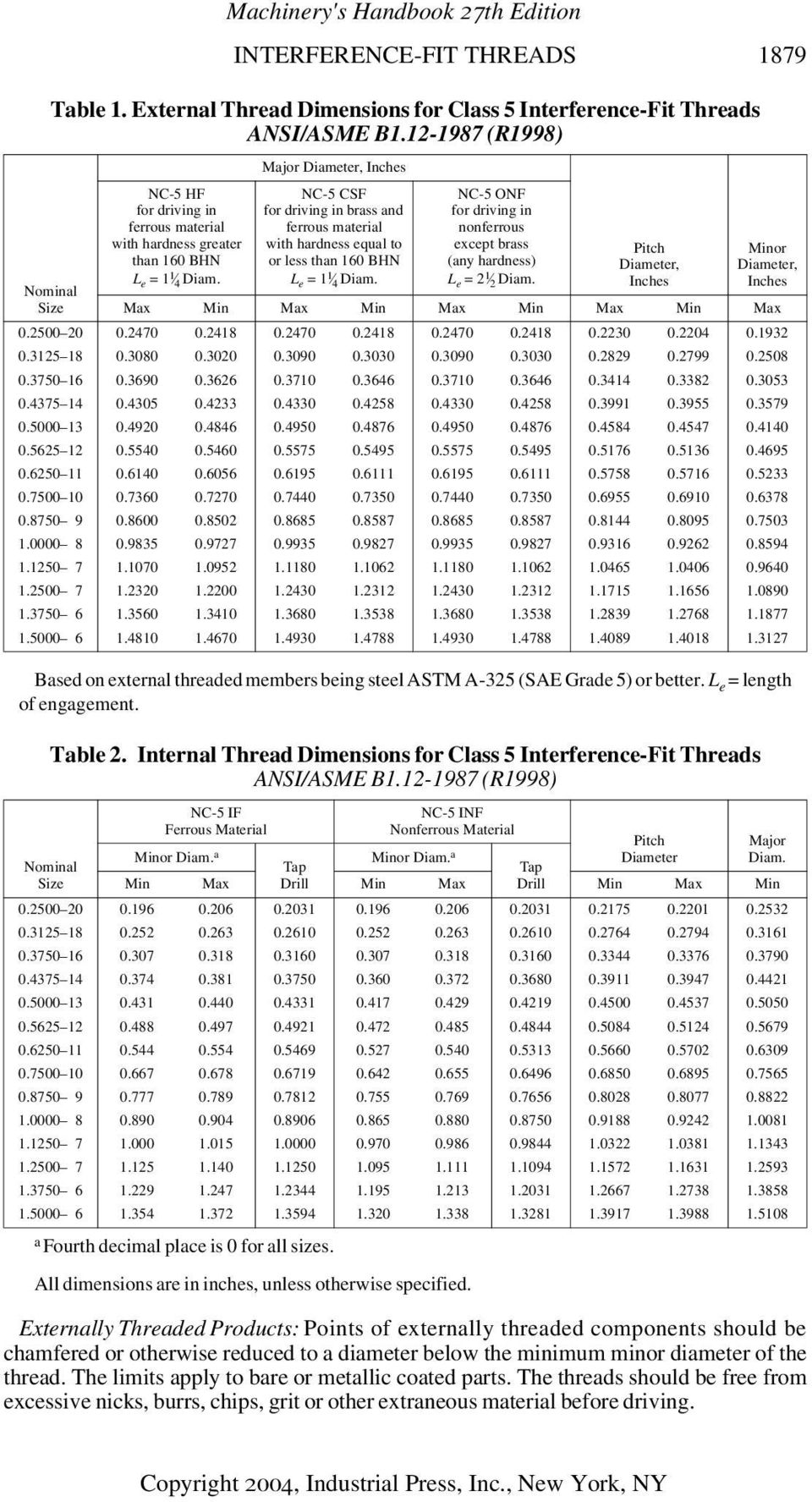
3 INTERFERENCE-FIT THREADS 1879 Table 1. External Thread Dimensions for Class 5 Interference-Fit Threads ANSI/ASME B (R1998) Nominal Size NC-5 HF for driving in ferrous material with hardness greater than 160 BHN L e = Diam. Major Diameter, Inches NC-5 CSF for driving in brass and ferrous material with hardness equal to or less than 160 BHN L e = Diam. Based on external threaded members being steel ASTM A-325 (SAE Grade 5) or better. L e = length of engagement. All dimensions are in inches, unless otherwise specified. NC-5 ONF for driving in nonferrous except brass (any hardness) L e = Diam. Pitch Diameter, Inches Minor Diameter, Inches Max Min Max Min Max Min Max Min Max Table 2. Internal Thread Dimensions for Class 5 Interference-Fit Threads ANSI/ASME B (R1998) NC-5 IF Ferrous Material Minor Diam. a Machinery's Handbook 27th Edition NC-5 INF Nonferrous Material Pitch Diameter Major Diam. Nominal Tap Minor Diam. a Tap Size Min Max Drill Min Max Drill Min Max Min a Fourth decimal place is 0 for all sizes. Externally Threaded Products: Points of externally threaded components should be chamfered or otherwise reduced to a diameter below the minimum minor diameter of the thread. The limits apply to bare or metallic coated parts. The threads should be free from excessive nicks, burrs, chips, grit or other extraneous material before driving.
4 1880 INTERFERENCE-FIT THREADS Nominal Size Table 3. Torques, Interferences, and Engagement Lengths for Class 5 Interference-Fit Threads ANSI/ASME B (R1998) Interference on Pitch Diameter All dimensions are inches. Engagement Lengths, External Thread Lengths and Tapped Hole Depths a a L e = Length of engagement. T s = External thread length of full form thread. T h = Minimum depth of full form thread in hole. In Brass and Ferrous In Nonferrous Except Brass Max Min L e T s min L e T s min T h T h Torque at D Engagement in Ferrous Material Materials for Externally Threaded Products: The length of engagement, depth of thread engagement and pitch diameter in Tables 1, 2, and 3 are designed to produce adequate torque conditions when heat-treated medium-carbon steel products, ASTM A-325 (SAE Grade 5) or better, are used. In many applications, case-carburized and nonheat-treated medium-carbon steel products of SAE Grade 4 are satisfactory. SAE Grades 1 and 2, may be usable under certain conditions. This standard is not intended to cover the use of products made of stainless steel, silicon bronze, brass or similar materials. When such materials are used, the tabulated dimensions will probably require adjustment based on pilot experimental work with the materials involved. Lubrication: For driving in ferrous material, a good lubricant sealer should be used, particularly in the hole. A non-carbonizing type of lubricant (such as a rubber-in-water dispersion) is suggested. The lubricant must be applied to the hole and it may be applied to the male member. In applying it to the hole, care must be taken so that an excess amount of lubricant will not cause the male member to be impeded by hydraulic pressure in a blind hole. Where sealing is involved, the lubricant selected should be insoluble in the medium being sealed. For driving, in nonferrous material, lubrication may not be needed. The use of medium gear oil for driving in aluminum is recommended. American research has observed that the minor diameter of lubricated tapped holes in non-ferrous materials may tend to close in, that is, be reduced in driving; whereas with an unlubricated hole the minor diameter may tend to open up. Driving Speed: This standard makes no recommendation for driving speed. Some opinion has been advanced that careful selection and control of driving speed is desirable to obtain optimum results with various combinations of surface hardness and roughness. Experience with threads made to this standard may indicate what limitations should be placed on driving speeds. Max, lb-ft Min, lb-ft

5 INTERFERENCE-FIT THREADS 1881 Table 4. Allowances for Coarse Thread Series ANSI/ASME B (R1998) TPI Difference between Nom. Size and Max Major Diam of NC-5 HF a Difference between Nom. Size and Max Major Diam. of NC-5 CSF or NC-5 ONF a Difference between Basic Minor Diam. and Min Minor Diam. of NC-5 IF a Difference between Basic Minor Diam. and Min Minor Diam.of NC-5 INF Max PD Inteference or Neg Allowance, Ext Thread b Difference between Max Minor Diam. and Basic Minor Diam., Ext Thread a The allowances in these columns were obtained from industrial research data. b Negative allowance is the difference between the basic pitch diameter and pitch diameter value at maximum material condition. All dimensions are in inches. The difference between basic major diameter and internal thread minimum major diameter is 0.075H and is tabulated in Table 5. Table 5. Tolerances for Pitch Diameter, Major Diameter, and Minor Diameter for Coarse Thread Series ANSI/ASME B (R1998) Minor Diam. Tolerance for Int Thread NC-5 IF Minor Diam. Tolerance for Int Thread NC-5 INF c Tolerance 0.075H or 0.065P for Tap Major Diam. PD Tolerance Major Diam. for Ext and Int Tolerance for TPI Threads a Ext Thread b a National Class 3 pitch diameter tolerance from ASA B b Twice the NC-3 pitch diameter tolerance. c National Class 3 minor diameter tolerance from ASA B All dimensions are in inches. Relation of Driving Torque to Length of Engagement: Torques increase directly as the length of engagement and this increase is proportionately more rapid as size increases. The standard does not establish recommended breakloose torques. Surface Roughness: Surface roughnesss is not a required measurement. Roughness between 63 and 125 µin. Ra is recommended. Surface roughness greater than 125 µin. Ra may encourage galling and tearing of threads. Surfaces with roughness less than 63 µin. Ra may hold insufficient lubricant and wring or weld together.

6 1882 INTERFERENCE-FIT THREADS Lead and Angle Variations: The lead variation values tabulated in Table 6 are the maximum variations from specified lead between any two points not farther apart than the length of the standard GO thread gage. Flank angle variation values tabulated in Table 7 are maximum variations from the basic 30 angle between thread flanks and perpendiculars to the thread axis. The application of these data in accordance with ANSI/ASME B1.3M, the screw thread gaging system for dimensional acceptability, is given in the Standard. Lead variation does not change the volume of displaced metal, but it exerts a cumulative unilateral stress on the pressure side of the thread flank. Control of the difference between pitch diameter size and functional diameter size to within one-half the pitch diameter tolerance will hold lead and angle variables to within satisfactory limits. Both the variations may produce unacceptable torque and faulty assemblies. Table 6. Maximum Allowable Variations in Lead and Maximum Equivalent Change in Functional Diameter ANSI/ASME B (R1998) Nominal Size Allowable Variation in Axial Lead (Plus or Minus) External and Internal Threads Max Equivalent Change in Functional Diam. (Plus for Ext, Minus for Int) All dimensions are in inches. Note: The equivalent change in functional diameter applies to total effect of form errors. Maximum allowable variation in lead is permitted only when all other form variations are zero. For sizes not tabulated, maximum allowable variation in lead is equal to times one-half the pitch diameter tolerance. Table 7. Maximum Allowable Variation in 30 Basic Half-Angle of External and Internal Screw Threads ANSI/ASME B (R1998) TPI Allowable Variation in Half-Angle of Thread (Plus or Minus) Machinery's Handbook 27th Edition TPI Allowable Variation in Half-Angle of Thread (Plus or Minus) TPI Allowable Variation in Half-Angle of Thread (Plus or Minus)

7 SPARK PLUG THREADS 1883 Spark Plug Threads British Standard for Spark Plugs BS 45:1972 (withdrawn). This revised British Standard refers solely to spark plugs used in automobiles and industrial spark ignition internal combustion engines. The basic thread form is that of the ISO metric (see page 1816). In assigning tolerances to the threads of the spark plug and the tapped holes, full consideration has been given to the desirability of achieving the closest possible measure of interchangeability between British spark plugs and engines, and those made to the standards of other ISO Member Bodies. Basic Thread Dimensions for Spark Plug and Tapped Hole in Cylinder Head Nom. Size Pitch Thread Plug a a Not specified All dimensions are given in millimeters. Machinery's Handbook 27th Edition Major Dia. Pitch Dia. Minor Dia. Max. Min. Max. Min. Max. Min Hole Plug a Hole The tolerance grades for finished spark plugs and corresponding tapped holes in the cylinder head are: for 14 mm size, 6e for spark plugs and 6H for tapped holes which gives a minimum clearance of mm; and for 18 mm size, 6e for spark plugs and 6H for tapped holes which gives a minimum clearance of mm. These minimum clearances are intended to prevent the possibility of seizure, as a result of combustion deposits on the bare threads, when removing the spark plugs and applies to both ferrous and non-ferrous materials. These clearances are also intended to enable spark plugs with threads in accordance with this standard to be fitted into existing holes. SAE Spark-Plug Screw Threads. The SAE Standard includes the following sizes: inch nominal diameter with 18 threads per inch: 18-millimeter nominal diameter with a 18- millimeter nominal diameter with 1.5-millimeter pitch; 14-millimeter nominal diameter with a 1.25-millimeter pitch; 10-millimeter nominal diameter with a 1.0 millimeter pitch; 3 8 -inch nominal diameter with 24 threads per inch; and 1 4 -inch nominal diameter with 32 threads per inch. During manufacture, in order to keep the wear on the threading tools within permissible limits, the threads in the spark plug GO (ring) gage should be truncated to the maximum minor diameter of the spark plug; and in the tapped hole GO (plug) gage to the minimum major diameter of the tapped hole. SAE Standard Threads for Spark Plugs Size a Major Diameter Pitch Diameter Minor Diameter Nom. Pitch Max. Min. Max. Min. Max. Min. Spark Plug Threads, mm (inches) M ( ) (0.7009) (0.6677) (0.6635) (0.6320) M (0.5460) (0.5410) (0.5159) (0.5117) (0.4858) M (0.4670) (0.4620) (0.4370) (0.4330) (0.4020) M (0.3927) (0.3856) (0.3671) (0.3627) (0.3444)

8 1884 ELECTRIC SOCKET AND LAMP BASE THREAD SAE Standard Threads for Spark Plugs (Continued) Size a Major Diameter Pitch Diameter Minor Diameter Nom. Pitch Max. Min. Max. Min. Max. Min. Tapped Hole Threads, mm (inches) M (0.7102) (0.6753) (0.6703) (0.6467) (0.6404) M (0.5525) (0.5235) (0.5192) (0.4997) (0.4921) M (0.4724) (0.4426) (0.4405) (0.4157) (0.4081) M (0.3937) (0.3740) (0.3681) (0,3604) (0.3511) a M14 and M18 are preferred for new applications. In order to keep the wear on the threading tools within permissible limits, the threads in the spark plug GO (ring) gage shall be truncated to the maximum minor diameter of the spark plug, and in the tapped hole GO (plug) gage to the minimum major diameter of the tapped hole. The plain plug gage for checking the minor diameter of the tapped hole shall be the minimum specified. The thread form is that of the ISO metric (see page 1816). Reprinted with permission 1990 Society of Automotive Engineers, Inc. Lamp Base and Electrical Fixture Threads Lamp Base and Socket Shell Threads. The American Standard threads for lamp base and socket shells are sponsored by the American Society of Mechanical Engineers, the National Electrical Manufacturers Association and by most of the large manufacturers of products requiring rolled threads on sheet metal shells or parts, such as lamp bases, fuse plugs, attachment plugs, etc. There are five sizes, designated as the miniature size, the candelabra size, the intermediate size, the medium size and the mogul size. Rolled Threads for Screw Shells of Electric Sockets and Lamp Bases American Standard P D R R R R A a b B Male or Base Screw Shells Before Assembly Threads Pitch Depth of Radius Crest Major Dia. Minor Diam. Size per Inch P Thread D Root R Max. A Min. a Max. B Min. b Miniature Candelabra Intermediate Medium Mogul Socket Screw Shells Before Assembly Miniature Candelabra Intermediate Medium Mogul All dimensions are in inches.

9 BRITISH ASSOCIATION THREADS 1885 Base Screw Shell Gage Tolerances: Threaded ring gages Go, Max. thread size to minus inch; Not Go, Min. thread size to plus inch. Plain ring gages Go, Max. thread O.D. to minus inch; Not Go, Min. thread O.D. to plus inch. Socket Screw Shell Gages: Threaded plug gages Go, Min. thread size to plus inch; Not Go, Max. thread size to minus inch. Plain plug gages Go, Min. minor dia. to plus inch; Not Go, Max. minor dia. to minus inch. Check Gages for Base Screw Shell Gages: Threaded plugs for checking threaded ring gages Go, Max. thread size to minus inch; Not Go, Min. thread size to plus inch. Electric Fixture Thread. The special straight electric fixture thread consists of a straight thread of the same pitches as the American standard pipe thread, and having the regular American or U. S. standard form; it is used for caps, etc. The male thread is smaller, and the female thread larger than those of the special straight-fixture pipe threads. The male thread assembles with a standard taper female thread, while the female thread assembles with a standard taper male thread. This thread is used when it is desired to have the joint make up on a shoulder. The gages used are straight-threaded limit gages. Instrument and Microscope Threads British Association Standard Thread (BA). This form of thread is similar to the Whitworth thread in that the root and crest are rounded (see illustration). The angle, however, is only 47 degrees 30 minutes and the radius of the root and crest are proportionately larger. This thread is used in Great Britain and, to some extent, in other European countries for very small screws. Its use in the United States is practically confined to the manufacture of tools for export. This thread system was originated in Switzerland as a standard for watch and clock screws, and it is sometimes referred to as the Swiss small screw thread standard. See also Swiss Screw Thread. This screw thread system is recommended by the British Standards Institution for use in preference to the BSW and BSF systems for all screws smaller than 1 4 inch except that the use of the 0 BA thread be discontinued in favor of the 1 4 -in. BSF. It is further recommended that in the selection of sizes, preference be given to even numbered BA sizes. The thread form is shown by the diagram. H s r H = p h h = p r r = p s s = p p British Association Thread It is a symmetrical V-thread, of degree included angle, having its crests and roots rounded with equal radii, such that the basic depth of the thread is of the pitch. Where p = pitch of thread, H = depth of V-thread, h = depth of BA thread, r = radius at root and crest of thread, and s = root and crest truncation.

10 1886 MICROSCOPE OBJECTIVE THREAD In these formulas, p = pitch in millimeters. Instrument Makers' Screw Thread System. The standard screw system of the Royal Microscopical Society of London, also known as the Society Thread, is employed for microscope objectives and the nose pieces of the microscope into which these objectives screw. The form of the thread is the standard Whitworth form. The number of threads per inch is 36. There is one size only. The maximum pitch diameter of the objective is inch and the minimum pitch diameter of the nose-piece is inch. The dimensions are as follows: outside dia. max., inch min., inch Male thread root dia. max., inch min., inch root of thread max, inch min., inch Female thread top of thread max., inch min., inch The Royal Photographic Society Standard Screw Thread ranges from 1-inch diameter upward. For screws less than 1 inch, the Microscopical Society Standard is used. The British Association thread is another thread system employed on instruments abroad. American Microscope Objective Thread (AMO). The standard, ANSI B (R2001), describes the American microscope objective thread, AMO, the screw thread form used for mounting a microscope objective assembly to the body or lens turret of a microscope. This screw thread is also recommended for other microscope optical assem- Designation Number British Association (BA) Standard Thread, Basic Dimensions BS 93:1951 (obsolescent) Pitch, mm Depth of Thread, mm Machinery's Handbook 27th Edition Major Diameter, mm Bolt and Nut Effective Diameter, mm Minor Diameter, mm Radius, mm Tolerances and Allowances: Two classes of bolts and one for nuts are provided: Close Class bolts are intended for precision parts subject to stress, no allowance being provided between maximum bolt and minimum nut sizes. Normal Class bolts are intended for general commercial production and general engineering use; for sizes 0 to 10 BA, an allowance of mm is provided. Tolerance Formulas for British Association (BA) Screw Threads Threads per Inch (approx.) Tolerance (+ for nuts, for bolts) Class or Fit Major Dia. Effective Dia. Minor Dia. Close Class 0 to 10 BA incl. 0.15p mm 0.08p mm 0.16p mm Bolts Normal Class 0 to 10 BA incl. 0.20p mm 0.10p mm 0.20p mm Normal Class 11 to 16 BA incl. 0.25p mm 0.10p mm 0.20p mm Nuts All Classes 0.12p mm 0.375p mm

11 MICROSCOPE OBJECTIVE THREAD 1887 bles as well as related applications such as photomicrographic equipment. It is based on, and intended to be interchangeable with, the screw thread produced and adopted many years ago by the Royal Microscopical Society of Great Britain, generally known as the RMS thread. While the standard is almost universally accepted as the basic standard for microscope objective mountings, formal recognition has been extremely limited. The basic thread possesses the overall British Standard Whitworth form. (See Whitworth Standard Thread Form starting on page 1857). However, the actual design thread form implementation is based on the WWII era ASA B Truncated Whitworth Form in which the rounded crests and roots are removed. ASA B was withdrawn in 1951, however, ANSI B (R2001) is still active for new design. Design Requirements of Microscope Objective Threads: Due to the inherent longevity of optical equipment and the repeated use to which the objective threads are subjected, the following factors should be considered when designing microscope objective threads: Adequate clearance to afford protection against binding due to the presence of foreign particles or minor crest damage. Sufficient depth of thread engagement to assure security in the short lengths of engagement commonly encountered. Allowances for limited eccentricities so that centralization and squareness of the objective are not influenced by such errors in manufacture. Deviation from the Truncated Whitworth Thread Form: Although ANSI B (R2001) is based on the withdrawn ASA B truncated Whitworth standard, the previously described design requirements necessitate a deviation from the truncated Whitworth thread form. Some of the more significant modifications are: A larger allowance on the pitch diameter of the external thread. Smaller tolerances on the major diameter of the external thread and minor diameter of the internal thread. The provision of allowances on the major and minor diameters of the external thread. Thread Overview: The thread is a single start type. There is only one class of thread based on a basic major diameter of in. and a pitch, p, of inch (36 threads per inch). The AMO thread shall be designated on drawings, tools and gages as AMO. Thread nomenclature, definitions and terminology are based on ANSI B (R1972), Nomenclature, Threads, and Letter Symbols for Screw Threads. It should also be noted that ISO :1997 Screw threads for objectives and related nosepieces is also based on the inch, 36 tpi RMS thread form. Tolerances and Allowances: Tolerances are given in Table 2. A positive allowance (minimum clearance) of in. is provided for the pitch diamter E, major diameter D, and minor diameter, K If interchangeability with full-form Whitworth threads is not required, the allowances for the major and minor diameters are not necessary, because the forms at the root and crest are truncated. In these cases, either both limits or only the maximum limit of the major and minor diameters may be increased by the amount of the allowance, inch. Lengths of Engagement: The tolerances specified in Table 2 are applicable to lengths of engagement ranging from 1 8 in. to 3 8 inch, approximately 15% to 50% of the basic diameter. Microscope objective assembles generally have a length of engagement of 1 8 inch. Lengths exceeding these limits are seldom employed and not covered in this standard. Gage testing: Recommended ring and plug testing gage dimensions for the AMO thread size can be found in ANSI B (R2001), Appendix. Dimensional Terminology: Because the active standard ANSI B (R2001) is based on the withdrawn ASA Truncated Whitworth standard, dimensional nomenclature is described below.

12 1888 MICROSCOPE OBJECTIVE THREAD p 20 Fc The Dotted Line Indicates the Full Form British Whitworth Thread on Which the Royal Microscopical Society Thread is Based Internal Thread (Nut) U 1/2 Major Diameter Allowance on External Thread 1/2 Major Diameter Tolerance on External Thread Maximum Major Diameter of Internal Thread Minimum Major Diameter of Internal Thread Basic Major Diameter Maximum Major Diameter of External Thread External Thread (Screw) Minimum Major Diameter of External Thread 55 Maximum Pitch Diameter of Internal Thread Minimum Pitch Diameter of Internal Thread Basic Pitch Diameter Maximum Pitch Diameter of External Thread Minimum Pitch Diameter of External Thread Basic Minor Diameter on British Whitworth Thread 1/2 Minor Diameter Allowance on External Thread Fc Fr 12 p Permissible Form of Thread from New Tool 1/2 PD Tolerance on External Thread 1/2 Tolerance (External Thread Only) 1/2 PD Tolerance On External Thread Minimum Minor Diameter of External Thread U 1/2 Minor Diameter Tolerance on Internal Thread Maximum Minor Diameter of External Thread Minimum Minor Diameter of Internal Thread Maximum Minor Diameter of Internal Thread Tolerances, Allowances and Crest Clearances for Microscope Objective Thread (AMO) ANSI B (R2001) Table 1. Definitions, Formulas, Basic and Design Dimensions ANSI B (R1994) Symbol Property Formula Dimension Basic Thread Form α Half angle of thread α Included angle of thread n Number of threads per inch 36 p Pitch 1/n H Height of fundamental triangle p h b Height of basic thread p r Radius at crest and root of British Standard Whitworth basic thread (not used) p

13 MICROSCOPE OBJECTIVE THREAD 1889 Table 1. (Continued) Definitions, Formulas, Basic and Design Dimensions ANSI B (R1994) Symbol Property Formula Dimension Design Thread Form k Height of truncated Whitworth thread h b U = p F c Width of flat at crest p F r Width of flat at root p U Basic truncation of crest from basic Whitworth form p Basic and Design Sizes D Major diameter, nominal and basic D n Major diameter of internal thread D D s Major diameter of external thread a D 2U G E Pitch (effective) diameter, basic D h b E n Pitch (effective) diameter of internal thread D h b E s Pitch (effective) diameter of external thread b D h b G K Minor diameter, basic D 2h b K n Minor diameter of internal thread D 2k K s Minor diameter of external thread a D 2h b G G Allowance at pitch (effective) diameter a, b a An allowance equal to that on the pitch diameter is also provided on the major and minor diameters of the external thread for additional clearance and centralizing. b Allowance (minimum clearance) on pitch (effective) diameter is the same as the British RMS thread. All dimensions are in inches. Table 2. Limits of Size and Tolerances AMO Thread ANSI B (R2001) Element Major Diameter, D Pitch Diameter, E Minor Diameter, K Max. Min. Tol. Max. Min. Tol. Max. Min. Tol. External thread a Internal thread b a Extreme minimum minor diameter produced by a new threading tool having a minimum flat of p 12 = inch. This minimum diameter is not controlled by gages but by the form of the threading tool. b Extreme maximum major diameter produced by a new threading tool having a minimum flat of p 20 = inch. This maximum diameter is not controlled by gages but by the form of the threading tool. Tolerances on the internal thread are applied in a plus direction from the basic and design size and tolerances on the external thread are applied in a minus direction from its design (maximum material) size. All dimensions are in inches. Machinery's Handbook 27th Edition Swiss Screw Thread. This is a thread system originated in Switzerland as a standard for screws used in watch and clock making. The angle between the two sides of the thread is 47 degrees 30 minutes, and the top and bottom of the thread are rounded. This system has been adopted by the British Association as a standard for small screws, and is known as the British Association thread. See British Association Standard Thread (BA) on page 1885.

14 1890 HISTORICAL AND MISCELANEOUS THREADS Historical and Miscellaneous Threads Aero-Thread. The name Aero-thread has been applied to a patented screw thread system that is specially applicable in cases where the nut or internally threaded part is made from a soft material, such as aluminum or magnesium alloy, for the sake of obtaining lightness, as in aircraft construction, and where the screw is made from a high-strength steel to provide strength and good wearing qualities. The nut or part containing the internal thread has a 60-degree truncated form of thread. See Fig. 1. The screw, or stud, is provided with a semi-circular thread form, as shown. Between the screw and the nut there is an intermediary part known as a thread lining or insert, which is made in the form of a helical spring, so that it can be screwed into the nut. The stud, in turn, is then screwed into the thread formed by the semicircular part of the thread insert. When the screw is provided with a V-form of thread, like the American Standard, frequent loosening and tightening of the screw would cause rapid wear of the softer metal from which the nut is made; furthermore, all the threads might not have an even bearing on the mating threads. By using a thread insert which is screwed into the nut permanently, and which is made from a reasonably hard material like phosphor bronze, good wearing qualities are obtained. Also, the bearing or load is evenly distributed over all the threads of the nut since the insert, being in the form of a spring, can adjust itself to bear on all of the thread surfaces. Boss or Nut Thread Insert Screw or Stud Fig. 1. The Basic Thread Form Used in the Aero-Thread System Briggs Pipe Thread. The Briggs pipe thread (now known as the American Standard) is used for threaded pipe joints and is the standard for this purpose in the United States. It derives its name from Robert Briggs. Casing Thread. The standard casing thread of the American Petroleum Institute has an included angle of 60 degrees and a taper of 3 4 inch per foot. The fourteen casing sizes listed in the 1942 revision have outside diameters ranging from to 20 inches. All sizes have 8 threads per inch. Rounded Thread Form: Threads for casing sizes up to inches, inclusive, have rounded crests and roots, and the depth, measured perpendicular to the axis of the pipe, equals pitch = inch. Truncated Form: Threads for the 16-and 20-inch casing sizes have fiat crests and roots. The depth equals pitch = inch. This truncated form is designated in the A.P.I. Standard as a sharp thread.

15 HISTORICAL AND MISCELANEOUS THREADS 1891 Cordeaux Thread. The Cordeaux screw thread derives its name from John Henry Cordeaux, an English telegraph inspector who obtained a patent for this thread in This thread is used for connecting porcelain insulators with their stalks by means of a screw thread on the stalk and a corresponding thread in the insulator. The thread is approximately a Whitworth thread, 6 threads per inch, the diameters most commonly used being 5 8 or 3 4 inch outside diameter of thread; 5 8 inch is almost universally used for telegraph purposes, while a limited number of 3 4 -inch sizes are used for large insulators. Dardelet Thread. The Dardelet patented self-locking thread is designed to resist vibrations and remain tight without auxiliary locking devices. The locking surfaces are the tapered root of the bolt thread and the tapered crest of the nut thread. The nut is free to turn until seated tightly against a resisting surface, thus causing it to shift from the free position (indicated by dotted lines) to the locking position. The locking is due to a wedging action between the tapered crest of the nut thread and the tapered root or binding surface of the bolt thread. This self-locking thread is also applied to set-screws and cap-screws. The holes must, of course, be threaded with Dardelet taps. The abutment sides of the Dardelet thread carry the major part of the tensile load. The nut is unlocked simply by turning it backward with a wrench. The Dardelet thread can either be cut or rolled, using standard equipment provided with tools, taps, dies, or rolls made to suit the Dardelet thread profile. The included thread angle is 29 degrees; depth E = 0.3P; maximum axial movement = 0.28 P. The major internal thread diameter (standard series) equals major external thread diameter plus inch except for 1 4 -inch size which is plus inch. The width of both external and internal threads at pitch line equals 0.36 P. Drunken Thread. A drunken thread, according to prevalent usage of this expression by machinists, etc., is a thread that does not coincide with a true helix or advance uniformly. This irregularity in a taper thread may be due to the fact that in taper turning with the tailstock set over, the work does not turn with a uniform angular velocity, while the cutting tool is advancing along the work longitudinally with a uniform linear velocity. The change in the pitch and the irregularity of the thread is so small as to be imperceptible to the eye, if the taper is slight, but as the tapers increase to, say, 3 4 inch per foot or more, the errors become more pronounced. To avoid this defect, a taper attachment should be used for taper thread cutting. Echols Thread. Chip room is of great importance in machine taps and tapper taps where the cutting speed is high and always in one direction. The tap as well as the nut to be threaded is liable to be injured, if ample space for the chips to pass away from the cutting edges is not provided. A method of decreasing the number of cutting edges, as well as increasing the amount of chip room, is embodied in the Echols thread, where every alternate tooth is removed. If a tap has an even number of flutes, the removal of every other tooth in the lands will be equivalent to the removal of the teeth of a continuous thread. It is, therefore, necessary that taps provided with this thread be made with an odd number of lands, so that removing the tooth in alternate lands may result in removing every other tooth in each individual land. Machine taps are often provided with the Echols thread. French Thread (S.F.). The French thread has the same form and proportions as the American Standard (formerly U. S. Standard). This French thread is being displaced gradually by the International Metric Thread System. Harvey Grip Thread. The characteristic feature of this thread is that one side inclines 44 degrees from a line at right angles to the axis, whereas the other side has an inclination of only 1 degree. This form of thread is sometimes used when there is considerable resistance or pressure in an axial direction and when it is desirable to reduce the radial or bursting pressure on the nut as much as possible. See BUTTRESS THREADS.

16 1892 HISTORICAL AND MISCELANEOUS THREADS Lloyd & Lloyd Thread. The Lloyd & Lloyd screw thread is the same as the regular Whitworth screw thread in which the sides of the thread form an angle of 55 degrees with one another. The top and bottom of the thread are rounded. Lock-Nut Pipe Thread. The lock-nut pipe thread is a straight thread of the largest diameter which can be cut on a pipe. Its form is identical with that of the American or Briggs standard taper pipe thread. In general, Go gages only are required. These consist of a straight-threaded plug representing the minimum female lock-nut thread, and a straight-threaded ring representing the maximum male lock-nut thread. This thread is used only to hold parts together, or to retain a collar on the pipe. It is never used where a tight threaded joint is required. Philadelphia Carriage Bolt Thread. This is a screw thread for carriage bolts which is somewhat similar to a square thread, but having rounded corners at the top and bottom. The sides of the thread are inclined to an inclusive angle of degrees. The width of the thread at the top is 0.53 times the pitch. SAE Standard Screw Thread. The screw thread standard of the Society of Automotive Engineers (SAE) is intended for use in the automotive industries of the United States. The SAE Standard includes a Coarse series, a Fine series, an 8-thread series, a 12-thread series, a 16-thread series, an Extra-fine series, and a Special-pitch series. The Coarse and Fine series, and also the 8-, 12- and 16-thread series, are exactly the same as corresponding series in the American Standard. The Extra-fine and Special-pitch series are SAE Standards only. The American Standard thread form (or the form previously known as the U. S. Standard) is applied to all SAE Standard screw threads. The Extra-fine series has a total of six pitches ranging from 32 down to 16 threads per inch. The 16 threads per inch in the Extra-fine series, applies to all diameters from up to 6 inches. This Extra-fine series is intended for use on relatively light sections; on parts requiring fine adjustment; where jar and vibration are important factors; when the thickness of a threaded section is relatively small as in tubing, and where assembly is made without the use of wrenches. The SAE Special pitches include some which are finer than any in the Extra-fine series. The special pitches apply to a range of diameters extending from No. 10 ( inch) up to 6 inches. Each diameter has a range of pitches varying from five to eight. For example, a inch diameter has six pitches ranging from 24 to 56 threads per inch, whereas a 6-inch diameter has eight pitches ranging from 4 to 16 threads per inch. These various SAE Standard series are intended to provide adequate screw thread specifications for all uses in the automotive industries. Sellers Screw Thread. The Sellers screw thread, later known as the United States standard thread, and now as the American Standard, is the most commonly used screw thread in the United States. It was originated by William Sellers, of Philadelphia, and first proposed by him in a paper read before the Franklin Institute, in April, In 1868, it was adopted by the United States Navy and has since become the generally accepted standard screw thread in the United States.

17 MEASURING SCREW THREADS 1893 MEASURING SCREW THREADS Measuring Screw Threads Pitch and Lead of Screw Threads. The pitch of a screw thread is the distance from the center of one thread to the center of the next thread. This applies no matter whether the screw has a single, double, triple or quadruple thread. The lead of a screw thread is the distance the nut will move forward on the screw if it is turned around one full revolution. In a single-threaded screw, the pitch and lead are equal, because the nut would move forward the distance from one thread to the next, if turned around once. In a double-threaded screw, the nut will move forward two threads, or twice the pitch, so that in this case the lead equals twice the pitch. In a triple-threaded screw, the lead equals three times the pitch, and so on. The word pitch is often, although improperly, used to denote the number of threads per inch. Screws are spoken of as having a 12-pitch thread, when twelve threads per inch is what is really meant. The number of threads per inch equals 1 divided by the pitch, or expressed as a formula: 1 Number of threads per inch = pitch The pitch of a screw equals 1 divided by the number of threads per inch, or: 1 Pitch = number of threads per inch If the number of threads per inch equals 16, the pitch = If the pitch equals 0.05, the number of threads equals = 20. If the pitch is 2 5 inch, the number of threads per inch equals = Confusion is often caused by the indefinite designation of multiple-thread screws (double, triple, quadruple, etc.). The expression, four threads per inch, triple, for example, is not to be recommended. It means that the screw is cut with four triple threads or with twelve threads per inch, if the threads are counted by placing a scale alongside the screw. To cut this screw, the lathe would be geared to cut four threads per inch, but they would be cut only to the depth required for twelve threads per inch. The best expression, when a multiple-thread is to be cut, is to say, in this case, 1 4 inch lead, 1 12 inch pitch, triple thread. For single-threaded screws, only the number of threads per inch and the form of the thread are specified. The word single is not required. Measuring Screw Thread Pitch Diameters by Thread Micrometers. As the pitch or angle diameter of a tap or screw is the most important dimension, it is necessary that the pitch diameter of screw threads be measured, in addition to the outside diameter Fig. 1. One method of measuring in the angle of a thread is by means of a special screw thread micrometer, as shown in the accompanying engraving, Fig. 1. The fixed anvil is W-shaped to engage two thread flanks, and the movable point is cone-shaped so as to enable it to enter the space between two threads, and at the same time be at liberty to revolve. The contact points are on the sides of the thread, as they necessarily must be in order that the pitch diam-

18 1894 MEASURING SCREW THREADS eter may be determined. The cone-shaped point of the measuring screw is slightly rounded so that it will not bear in the bottom of the thread. There is also sufficient clearance at the bottom of the V-shaped anvil to prevent it from bearing on the top of the thread. The movable point is adapted to measuring all pitches, but the fixed anvil is limited in its capacity. To cover the whole range of pitches, from the finest to the coarsest, a number of fixed anvils are therefore required. To find the theoretical pitch diameter, which is measured by the micrometer, subtract twice the addendum of the thread from the standard outside diameter. The addendum of the thread for the American and other standard threads is given in the section on screw thread systems. Ball-point Micrometers. If standard plug gages are available, it is not necessary to actually measure the pitch diameter, but merely to compare it with the standard gage. In this case, a ball-point micrometer, as shown in Fig. 2, may be employed. Two types of ballpoint micrometers are ordinarily used. One is simply a regular plain micrometer with ball points made to slip over both measuring points. (See B, Fig. 2.) This makes a kind of combination plain and ball-point micrometer, the ball points being easily removed. These ball points, however, do not fit solidly on their seats, even if they are split, as shown, and are apt to cause errors in measurements. The best, and, in the long run, the cheapest, method is to use a regular micrometer arranged as shown at A. Drill and ream out both the end of the measuring screw or spindle and the anvil, and fit ball points into them as shown. Care should be taken to have the ball point in the spindle run true. The holes in the micrometer spindle and anvil and the shanks on the points are tapered to insure a good fit. The hole H in spindle G is provided so that the ball point can be easily driven out when a change for a larger or smaller size of ball point is required. Fig. 2. A ball-point micrometer may be used for comparing the angle of a screw thread, with that of a gage. This can be done by using different sizes of ball points, comparing the size first near the root of the thread, then (using a larger ball point) at about the point of the pitch diameter, and finally near the top of the thread (using in the latter case, of course, a much larger ball point). If the gage and thread measurements are the same at each of the three points referred to, this indicates that the thread angle is correct. Measuring Screw Threads by Three-wire Method. The effective or pitch diameter of a screw thread may be measured very accurately by means of some form of micrometer and three wires of equal diameter. This method is extensively used in checking the accuracy of threaded plug gages and other precision screw threads. Two of the wires are placed in contact with the thread on one side and the third wire in a position diametrically opposite as illustrated by the diagram, (see table Formulas for Checking Pitch Diameters of Screw Threads ) and the dimension over the wires is determined by means of a micrometer. An ordinary micrometer is commonly used but some form of floating micrometer is preferable, especially for measuring thread gages and other precision work. The floating micrometer is mounted upon a compound slide so that it can move freely in directions parallel or at right angles to the axis of the screw, which is held in a horizontal position between adjustable centers. With this arrangement the micrometer is held constantly at

19 MEASURING SCREW THREADS 1895 right angles to the axis of the screw so that only one wire on each side may be used instead of having two on one side and one on the other, as is necessary when using an ordinary micrometer. The pitch diameter may be determined accurately if the correct micrometer reading for wires of a given size is known. Classes of Formulas for Three-Wire Measurement. Various formulas have been established for checking the pitch diameters of screw threads by measurement over wires of known size. These formulas differ with regard to their simplicity or complexity and resulting accuracy. They also differ in that some show what measurement M over the wires should be to obtain a given pitch diameter E, whereas others show the value of the pitch diameter E for a given measurement M. Formulas for Finding Measurement M: In using a formula for finding the value of measurement M, the required pitch diameter E is inserted in the formula. Then, in cutting or grinding a screw thread, the actual measurement M is made to conform to the calculated value of M. Formulas for finding measurement M may be modified so that the basic major or outside diameter is inserted in the formula instead of the pitch diameter; however, the pitch-diameter type of formula is preferable because the pitch diameter is a more important dimension than the major diameter. Formulas for Finding Pitch Diameters E: Some formulas are arranged to show the value of the pitch diameter E when measurement M is known. Thus, the value of M is first determined by measurement and then is inserted in the formula for finding the corresponding pitch diameter E. This type of formula is useful for determining the pitch diameter of an existing thread gage or other screw thread in connection with inspection work. The formula for finding measurement M is more convenient to use in the shop or tool room in cutting or grinding new threads, because the pitch diameter is specified on the drawing and the problem is to find the value of measurement M for obtaining that pitch diameter. General Classes of Screw Thread Profiles. Thread profiles may be divided into three general classes or types as follows: Screw Helicoid: Represented by a screw thread having a straight-line profile in the axial plane. Such a screw thread may be cut in a lathe by using a straight-sided single-point tool, provided the top surface lies in the axial plane. Involute Helicoid: Represented either by a screw thread or a helical gear tooth having an involute profile in a plane perpendicular to the axis. A rolled screw thread, theoretically at least, is an exact involute helicoid. Intermediate Profiles: An intermediate profile that lies somewhere between the screw helicoid and the involute helicoid will be formed on a screw thread either by milling or grinding with a straight-sided wheel set in alignment with the thread groove. The resulting form will approach closely the involute helicoid form. In milling or grinding a thread, the included cutter or wheel angle may either equal the standard thread angle (which is always measured in the axial plane) or the cutter or wheel angle may be reduced to approximate, at least, the thread angle in the normal plane. In practice, all these variations affect the three-wire measurement. Accuracy of Formulas for Checking Pitch Diameters by Three-Wire Method. The exact measurement M for a given pitch diameter depends upon the lead angle, the thread angle, and the profile or cross-sectional shape of the thread. As pointed out in the preceding paragraph, the profile depends upon the method of cutting or forming the thread. In a milled or ground thread, the profile is affected not only by the cutter or wheel angle, but also by the diameter of the cutter or wheel; hence, because of these variations, an absolutely exact and reasonably simple general formula for measurement M cannot be established; however, if the lead angle is low, as with a standard single-thread screw, and especially if the thread angle is high like a 60-degree thread, simple formulas that are not arranged to compensate for the lead angle are used ordinarily and meet most practical requirements, particularly in measuring 60-degree threads. If lead angles are large enough

20 1896 MEASURING SCREW THREADS to greatly affect the result, as with most multiple threads (especially Acme or 29-degree worm threads), a formula should be used that compensates for the lead angle sufficiently to obtain the necessary accuracy. The formulas that follow include 1) a very simple type in which the effect of the lead angle on measurementm is entirely ignored. This simple formula usually is applicable to the measurement of 60-degree single-thread screws, except possibly when gage-making accuracy is required; 2) formulas that do include the effect of the lead angle but, nevertheless, are approximations and not always suitable for the higher lead angles when extreme accuracy is required; and 3) formulas for the higher lead angles and the most precise classes of work. Where approximate formulas are applied consistently in the measurement of both thread plug gages and the thread setting plugs for ring gages, interchangeability might be secured, assuming that such approximate formulas were universally employed. Wire Sizes for Checking Pitch Diameters of Screw Threads. In checking screw threads by the 3-wire method, the general practice is to use measuring wires of the socalled best size. The best-size wire is one that contacts at the pitch line or midslope of the thread because then the measurement of the pitch diameter is least affected by an error in the thread angle. In the following formula for determining approximately the best-size wire or the diameter for pitch-line contact, A = one-half included angle of thread in the axial plane. Best-size wire = pitch = 0.5 pitch seca cosa For 60-degree threads, this formula reduces to Best-size wire = pitch Threads per Inch Pitch, Inch Diameters of Wires for Measuring American Standard and British Standard Whitworth Screw Threads Wire Diameters for American Standard Threads Wire Diameters for Whitworth Standard Threads Max. Machinery's Handbook 27th Edition Min. Pitch-Line Contact Max. Min. Pitch-Line Contact

21 MEASURING SCREW THREAD 1897 These formulas are based upon a thread groove of zero lead angle because ordinary variations in the lead angle have little effect on the wire diameter and it is desirable to use one wire size for a given pitch regardless of the lead angle. A theoretically correct solution for finding the exact size for pitch-line contact involves the use of cumbersome indeterminate equations with solution by successive trials. The accompanying table gives the wire sizes for both American Standard (formerly, U.S. Standard) and the Whitworth Standard Threads. The following formulas for determining wire diameters do not give the extreme theoretical limits, but the smallest and largest practicable sizes. The diameters in the table are based upon these approximate formulas. American Standard Whitworth Smallest wire diameter = 0.56 pitch Largest wire diameter = 0.90 pitch Diameter for pitch-line contact = pitch Smallest wire diameter = 0.54 pitch Largest wire diameter = 0.76 pitch Diameter for pitch-line contact = pitch Measuring Wire Accuracy. A set of three measuring wires should have the same diameter within inch. To measure the pitch diameter of a screw-thread gage to an accuracy of inch by means of wires, it is necessary to know the wire diameters to inch. If the diameters of the wires are known only to an accuracy of inch, an accuracy better than inch in the measurement of pitch diameter cannot be expected. The wires should be accurately finished hardened steel cylinders of the maximum possible hardness without being brittle. The hardness should not be less than that corresponding to a Knoop indentation number of 630. A wire of this hardness can be cut with a file only with difficulty. The surface should not be rougher than the equivalent of a deviation of 3 microinches from a true cylindrical surface. Measuring or Contact Pressure. In measuring screw threads or screw-thread gages by the 3-wire method, variations in contact pressure will result in different readings. The effect of a variation in contact pressure in measuring threads of fine pitches is indicated by the difference in readings obtained with pressures of 2 and 5 pounds in checking a thread plug gage having 24 threads per inch. The reading over the wires with 5 pounds pressure was inch less than with 2 pounds pressure. For pitches finer than 20 threads per inch, a pressure of 16 ounces is recommended by the National Bureau of Standards, now National Institute of Standards and Technology (NIST). For pitches of 20 threads per inch and coarser, a pressure of pounds is recommended. For Acme threads, the wire presses against the sides of the thread with a pressure of approximately twice that of the measuring instrument. To limit the tendency of the wires to wedge in between the sides of an Acme thread, it is recommended that pitch-diameter measurements be made at 1 pound on 8 threads per inch and finer, and at pounds for pitches coarser than 8 threads per inch. Approximate Three-Wire Formulas That Do Not Compensate for Lead Angle. A general formula in which the effect of lead angle is ignored is as follows (see accompanying notation used in formulas): M = E TcotA+ W( 1 + csca) (1) This formula can be simplified for any given thread angle and pitch. To illustrate, because T = 0.5P, M = E 0.5P cot 30 + W(1 + 2), for a 60-degree thread, such as the American Standard, M = E P + 3W
22 1898 MEASURING SCREW THREADS The accompanying table contains these simplified formulas for different standard threads. Two formulas are given for each. The upper one is used when the measurement over wires, M, is known and the corresponding pitch diameter, E, is required; the lower formula gives the measurement M for a specified value of pitch diameter. These formulas are sufficiently accurate for checking practically all standard 60-degree single-thread screws because of the low lead angles, which vary from 1 11 to 4 31 in the American Standard Coarse-Thread Series. Bureau of Standards (now NIST) General Formula. Formula (2), which follows, compensates quite largely for the effect of the lead angle. It is from the National Bureau of Standards Handbook H 28 (1944), now FED-STD-H28. The formula, however, as here given has been arranged for finding the value of M (instead of E). M = E TcotA+ W( 1 + csca tan 2 B cosacota) (2) This expression is also found in ANSI/ASME B (R2001). The Bureau of Standards uses Formula (2) in preference to Formula (1) when the value of 0.5W tan 2 B cos A cot A exceeds , with the larger lead angles. If this test is applied to American Standard 60-degree threads, it will show that Formula (1) is generally applicable; but for 29- degree Acme or worm threads, Formula (2) (or some other that includes the effect of lead angle) should be employed. Notation Used in Formulas for Checking Pitch Diameters by Three-Wire Method A=one-half included thread angle in the axial plane A n =one-half included thread angle in the normal plane or in plane perpendicular to sides of thread = one-half included angle of cutter when thread is milled (tan A n = tan A cos B). (Note: Included angle of milling cutter or grinding wheel may equal the nominal included angle of thread, or may be reduced to whatever normal angle is required to make the thread angle standard in the axial plane. In either case, A n = one-half cutter angle.) B=lead angle at pitch diameter = helix angle of thread as measured from a plane perpendicular to the axis, tan B = L E D=basic major or outside diameter E=pitch diameter (basic, maximum, or minimum) for which M is required, or pitch diameter corresponding to measurement M F=angle required in Formulas (4b), (4d), and (4e) G=angle required in Formula (4) H=helix angle at pitch diameter and measured from axis = 90 B or tan H = cot B H b =helix angle at R b measured from axis L=lead of thread = pitch P number of threads S M=dimension over wires P=pitch = 1 number of threads per inch R b =radius required in Formulas (4) and (4e) S=number of starts or threads on a multiple-threaded worm or screw T=0.5 P = width of thread in axial plane at diameter E T a =arc thickness on pitch cylinder in plane perpendicular to axis W=wire or pin diameter
23 MEASURING SCREW THREADS 1899 Formulas for Checking Pitch Diameters of Screw Threads The formulas below do not compensate for the effect of the lead angle upon measurement M, but they are sufficiently accurate for checking standard single-thread screws unless exceptional accuracy is required. See accompanying information on effect of lead angle; also matter relating to measuring wire sizes, accuracy required for such wires, and contact or measuring pressure. The approximate best wire size for pitch-line contact may be obtained by the formula W = 0.5 pitch sec 1 2 included thread angle For 60-degree threads, W = pitch. Form of Thread American National Standard Unified British Standard Whitworth British Association Standard Lowenherz Thread Sharp V-Thread International Standard Pipe Thread Acme and Worm Threads Buttress Form of Thread Formulas for determining measurement M corresponding to correct pitch diameter and the pitch diameter E corresponding to a given measurement over wires. a When measurement M is known, E = M P 3W When pitch diameter E is used in formula, M = E P + 3W The American Standard formerly was known as U.S. Standard. When measurement M is known, E = M P W When pitch diameter E is used in formula, M = E P W When measurement M is known, E = M P W When pitch diameter E is used in formula, M = E P W When measurement M is known, E = M+ P W When pitch diameter E is used in formula, M = E P W When measurement M is known, E = M P 3W When pitch diameter E is used in formula, M = E P + 3W Use the formula above for the American National Standard Unified Thread. See accompanying paragraph on Buckingham Exact Involute Helicoid Formula Applied to Screw Threads. See Buckingham Formulas page 1903; also Three-wire Measurement of Acme and Stub Acme Thread Pitch Diameter. Different forms of buttress threads are used. See paragraph on Three-Wire Method Applied to Buttress Threads. a The wires must be lapped to a uniform diameter and it is very important to insert in the rule or formula the wire diameter as determined by precise means of measurement. Any error will be multiplied. See paragraph on Wire Sizes for Checking Pitch Diameters of Screw Threads on page Why Small Thread Angle Affects Accuracy of Three-Wire Measurement. In measuring or checking Acme threads, or any others having a comparatively small thread angle A, it is particularly important to use a formula that compensates largely, if not entirely, for the effect of the lead angle, especially in all gage and precision work. The effect of the lead angle on the position of the wires and upon the resulting measurement M is much greater in a 29-degree thread than in a higher thread angle such, for example, as a 60-degree thread. This effect results from an increase in the cotangent of the thread angle as this angle becomes smaller. The reduction in the width of the thread groove in the normal plane due
24 1900 MEASURING SCREW THREADS to the lead angle causes a wire of given size to rest higher in the groove of a thread having a small thread angle A (like a 29-degree thread) than in the groove of a thread with a larger angle (like a 60-degree American Standard). Acme Threads: Three-wire measurements of high accuracy require the use of Formula (4). For most measurements, however, Formula (2) or (3) gives satisfactory results. The table on page 1906 lists suitable wire sizes for use in Formulas (2) and (4). No. of Threads per Inch Values of Constants Used in Formulas for Measuring Pitch Diameters of Screws by the Three-wire System American Standard Unified and Sharp V-Thread P Whitworth Thread P No. of Threads per Inch American Standard Unified and Sharp V-Thread P Constants Used for Measuring Pitch Diameters of Metric Screws by the Three-wire System Whitworth Thread P Pitch in mm P in Inches W in Inches Machinery's Handbook 27th Edition Pitch in mm P in Inches W in Inches This table may be used for American National Standard Metric Threads. The formulas for American Standard Unified Threads on page 1899 are used. In the table above, the values of P and W are in inches so that the values for E and M calculated from the formulas on page 1899 are also in inches. Pitch in mm P in Inches W in Inches
25 Dia. of Thread MEASURING SCREW THREADS 1901 Dimensions Over Wires of Given Diameter for Checking Screw Threads of American National Form (U.S. Standard) and the V-Form No. of Threads per Inch Wire Dia. Used Machinery's Handbook 27th Edition Dimension over Wires V- Thread U.S. Thread Dia. of Thread No. of Threads per Inch Wire Dia. Used Dimension over Wires V- Thread U.S. Thread Buckingham Simplified Formula which Includes Effect of Lead Angle. The Formula (3) which follows gives very accurate results for the lower lead angles in determining measurement M. However, if extreme accuracy is essential, it may be advisable to use the involute helicoid formulas as explained later. M = E+ W( 1 + sina n ) (3) where W = T cosb (3a) cosa n Theoretically correct equations for determining measurement M are complex and cumbersome to apply. Formula (3) combines simplicity with a degree of accuracy which meets all but the most exacting requirements, particularly for lead angles below 8 or 10 degrees and the higher thread angles. However, the wire diameter used in Formula (3) must conform to that obtained by Formula (3a) to permit a direct solution or one not involving indeterminate equations and successive trials. Application of Buckingham Formula: In the application of Formula (3) to screw or worm threads, two general cases are to be considered. Case 1: The screw thread or worm is to be milled with a cutter having an included angle equal to the nominal or standard thread angle that is assumed to be the angle in the axial plane. For example, a 60-degree cutter is to be used for milling a thread. In this case, the
26 1902 MEASURING SCREW THREADS Table for Measuring Whitworth Standard Threads by the Three-wire Method Dia. of Thread No. of Threads per Inch Machinery's Handbook 27th Edition Dia. of Wire Used Dia. Measured over Wires Dia. of Thread No. of Threads per Inch Dia. of Wire Used Dia. Measured over Wires All dimensions are given in inches. thread angle in the plane of the axis will exceed 60 degrees by an amount increasing with the lead angle. This variation from the standard angle may be of little or no practical importance if the lead angle is small or if the mating nut (or teeth in worm gearing) is formed to suit the thread as milled. Case 2: The screw thread or worm is to be milled with a cutter reduced to whatever normal angle is equivalent to the standard thread angle in the axial plane. For example, a 29- degree Acme thread is to be milled with a cutter having some angle smaller than 29 degrees (the reduction increasing with the lead angle) to make the thread angle standard in the plane of the axis. Theoretically, the milling cutter angle should always be corrected to suit the normal angle; but if the lead angle is small, such correction may be unnecessary.
27 MEASURING SCREW THREADS 1903 If the thread is cut in a lathe to the standard angle as measured in the axial plane, Case 2 applies in determining the pin size W and the overall measurement M. In solving all problems under Case 1, angle A n used in Formulas (3) and (3a) equals onehalf the included angle of the milling cutter. When Case 2 applies, angle A n for milled threads also equals one-half the included angle of the cutter, but the cutter angle is reduced and is determined as follows: tana n = tana cosb The included angle of the cutter or the normal included angle of the thread groove = 2A n. Examples 1 and 2, which follow, illustrate Cases 1 and 2. Example 1 (Case 1):Take, for example, an Acme screw thread that is milled with a cutter having an included angle of 29 degrees; consequently, the angle of the thread exceeds 29 degrees in the axial section. The outside or major diameter is 3 inches; the pitch, 1 2 inch; the lead, 1 inch; the number of threads or starts, 2. Find pin size W and measurement M. Pitch diameter E = 2.75; T = 0.25; L = 1.0; A n = tan A n = ; sin A n = ; and cos A n = tanb = = B = W = = inch M = ( ) = inches Note: This value of M is only inch larger than that obtained by using the very accurate involute helicoid Formula (4) discussed on the following page. Example 2 (Case 2):A triple-threaded worm has a pitch diameter of inches, pitch of 1.5 inches, lead of 4.5 inches, lead angle of 30 degrees, and nominal thread angle of 60 degrees in the axial plane. Milling cutter angle is to be reduced. T = 0.75 inch; cos B = ; and tan A = Again use Formula (3) to see if it is applicable. tan A n = tan A cos B = = ; hence A n = , making the included cutter angle 53.13, thus cos A n = and sin A n = W = = inch M = ( ) = inches Note: If the value of measurement M is determined by using the following Formula (4) it will be found that M = inches; hence the error equals = inch approximately, which indicates that Formula (3) is not accurate enough here. The application of this simpler Formula (3) will depend upon the lead angle and thread angle (as previously explained) and upon the class of work. Buckingham Exact Involute Helicoid Formula Applied to Screw Threads. When extreme accuracy is required in finding measurement M for obtaining a given pitch diameter, the equations that follow, although somewhat cumbersome to apply, have the merit of providing a direct and very accurate solution; consequently, they are preferable to the indeterminate equations and successive trial solutions heretofore employed when extreme precision is required. These equations are exact for involute helical gears and, consequently, give theoretically correct results when applied to a screw thread of the involute helicoidal form; they also give very close approximations for threads having intermediate profiles. Helical Gear Equation Applied to Screw Thread Measurement: In applying the helical gear equations to a screw thread, use either the axial or normal thread angle and the lead
28 1904 MEASURING SCREW THREADS angle of the helix. To keep the solution on a practical basis, either thread angle A or A n, as the case may be, is assumed to equal the cutter angle of a milled thread. Actually, the profile of a milled thread will have some curvature in both axial and normal sections; hence angles A and A n represent the angular approximations of these slightly curved profiles. The equations that follow give the values needed to solve the screw thread problem as a helical gear problem. 2R M = b + W cosg tanf tana tana = = n (4a) R b = E -- cosf tanb sinb 2 (4) (4b) T T (4c) a = tanh (4d) tanb b = cosf tanh T inv G a W π = inv F (4e) E 2R b cosh b S The tables of involute functions starting on page 104 provide values for angles from 14 to 51 degrees, used for gear calculations. The formula for involute functions on page 103 may be used to extend this table as required. Example 3:To illustrate the application of Formula (4) and the supplementary formulas, assume that the number of starts S = 6; pitch diameter E = ; normal thread angle A n = 20 ; lead of thread L = inch; T = 0.072; W = inch. tanb = L = = B = πe Helix angle H = = tana tanf n = = = F = sinb E R b = -- cosf = = T T a = = = tanb tanh b = cosftanh = = H b = The involute function of G is found next by Formula (4e). inv G = = Since is outside the values for involute functions given in the tables on pages 104 through 107 use the formula for involute functions on page 103 to extend these tables as required. It will be found that 44 deg. 21 min. or degrees is the angular equivalent of ; hence, G = degrees. 2R M = b + W = = inch cosg Accuracy of Formulas (3) and (4) Compared. With the involute helicoid Formula (4) any wire size that makes contact with the flanks of the thread may be used; however, in the preceding example, the wire diameter W was obtained by Formula (3a) in order to compare Formula (4) with (3). If Example (3) is solved by Formula (3), M = ; hence
29 MEASURING SCREW THREADS 1905 the difference between the values of M obtained with Formulas (3) and (4) equals = inch. The included thread angle in this case is 40 degrees. If Formulas (3) and (4) are applied to a 29-degree thread, the difference in measurements M or the error resulting from the use of Formulas (3) will be larger. For example, with an Acme thread having a lead angle of about 34 degrees, the difference in values of M obtained by the two formulas equals inch. Three-wire Measurement of Acme and Stub Acme Thread Pitch Diameter. For single- and multiple-start Acme and Stub Acme threads having lead angles of less than 5 degrees, the approximate three-wire formula given on page 1897 and the best wire size taken from the table on page 1906 may be used. Multiple-start Acme and Stub Acme threads commonly have a lead angle of greater than 5 degrees. For these, a direct determination of the actual pitch diameter is obtained by using the formula: E = M (C + c) in conjunction with the table on page To enter the table, the lead angle B of the thread to be measured must be known. It is found by the formula: tan B = L E 1 where L is the lead of the thread and E 1 is the nominal pitch diameter. The best wire size is now found by taking the value of w 1 as given in the table for lead angle B, with interpolation, and dividing it by the number of threads per inch. The value of (C + c) 1 given in the table for lead angle B is also divided by the number of threads per inch to get (C + c). Using the best size wires, the actual measurement over wires M is made and the actual pitch diameter E found by using the formula: E = M (C + c). Example:For a 5 tpi, 4-start Acme thread with a lead angle, using three inch wires, M = inches, hence E = = inches. Under certain conditions, a wire may contact one thread flank at two points, and it is then advisable to substitute balls of the same diameter as the wires. Checking Thickness of Acme Screw Threads. In some instances it may be preferable to check the thread thickness instead of the pitch diameter, especially if there is a thread thickness tolerance. A direct method, applicable to the larger pitches, is to use a vernier gear-tooth caliper for measuring the thickness in the normal plane of the thread. This measurement, for an American Standard General Purpose Acme thread, should be made at a distance below the basic outside diameter equal to p/4. The thickness at this basic pitch-line depth and in the axial plane should be p/ the pitch diameter allowance from the table on page 1827 with a tolerance of minus the pitch diameter tolerance from the table on page The thickness in the normal plane or plane of measurement is equal to the thickness in the axial plane multiplied by the cosine of the helix angle. The helix angle may be determined from the formula: tangent of helix angle = lead of thread ( pitch diameter) Three-Wire Method for Checking Thickness of Acme Threads. The application of the 3-wire method of checking the thickness of an Acme screw thread is included in the Report of the National Screw Thread Commission. In applying the 3-wire method for checking thread thickness, the procedure is the same as in checking pitch diameter (see Three-wire Measurement of Acme and Stub Acme Thread Pitch Diameter), although a different formula is required. Assume that D = basic major diameter of screw; M = measurement over wires; W = diameter of wires; S = tangent of helix angle at pitch line; P = pitch; T = thread thickness at depth equal to 0.25P. T = P ( M D) W ( S 2 ) This formula transposed to show the correct measurement M equivalent to a given required thread thickness is as follows: M D W ( S2 = ) + T P
30 1906 MEASURING SCREW THREADS Threads per Inch Machinery's Handbook 27th Edition Wire Sizes for Three-Wire Measurement of Acme Threads with Lead Angles of Less than 5 Degrees Best Size Max. Min. Threads per Inch Best Size Max. Min Wire sizes are based upon zero helix angle. Best size = pitch; maximum size = pitch; minimum size = pitch. Example:An Acme General Purpose thread, Class 2G, has a 5-inch basic major diameter, 0.5-inch pitch, and 1-inch lead (double thread). Assume the wire size is inch. Determine measurement M for a thread thickness T at the basic pitch line of inch. (T is the maximum thickness at the basic pitch line and equals 0.5P, the basic thickness, allowance from Table 4, page 1832.) M [ ( ) 2 = ] = inches Testing Angle of Thread by Three-Wire Method. The error in the angle of a thread may be determined by using sets of wires of two diameters, the measurement over the two sets of wires being followed by calculations to determine the amount of error, assuming that the angle cannot be tested by comparison with a standard plug gage, known to be correct. The diameter of the small wires for the American Standard thread is usually about 0.6 times the pitch and the diameter of the large wires, about 0.9 times the pitch. The total difference between the measurements over the large and small sets of wires is first determined. If the thread is an American Standard or any other form having an included angle of 60 degrees, the difference between the two measurements should equal three times the difference between the diameters of the wires used. Thus, if the wires are and inch in diameter, respectively, the difference equals = inch. Therefore, the difference between the micrometer readings for a standard angle of 60 degrees equals = inch for this example. If the angle is incorrect, the amount of error may be determined by the following formula, which applies to any thread regardless of angle: sina = A B A where A=difference in diameters of the large and small wires used B=total difference between the measurements over the large and small wires a=one-half the included thread angle Example:The diameter of the large wires used for testing the angle of a thread is inch and of the small wires inch. The measurement over the two sets of wires shows a total difference of inch instead of the correct difference, inch, for a standard angle of 60 degrees when using the sizes of wires mentioned. The amount of error is determined as follows: sina = = = A table of sines shows that this value (0.4878) is the sine of 29 degrees 12 minutes, approximately. Therefore, the angle of the thread is 58 degrees 24 minutes or 1 degree 36 minutes less than the standard angle.
31 MEASURING SCREW THREADS 1907 Best Wire Diameters and Constants for Three-wire Measurement of Acme and Stub Acme Threads with Large Lead Angles, 1 inch Axial Pitch Lead 1-start threads 2-start threads Lead 2-start threads 3-start threads angle, B, angle, B, deg. w 1 (C + c) 1 w 1 (C + c) 1 deg. w 1 (C + c) 1 w 1 (C + c) For these 3-start thread values see table on following page. All dimensions are in inches. Values given for w 1 and (C + c) 1 in table are for 1-inch pitch axial threads. For other pitches, divide table values by number of threads per inch. Courtesy of Van Keuren Co.
32 1908 MEASURING SCREW THREADS Best Wire Diameters and Constants for Three-wire Measurement of Acme and Stub Acme Threads with Large Lead Angles 1-inch Axial Pitch Lead 3-start threads 4-start threads Lead 3-start threads 4-start threads angle, B, angle, B, deg. w 1 (C + c) 1 w 1 (C + c) 1 deg. w 1 (C + c) 1 w 1 (C + c) All dimensions are in inches. Values given for w 1 and (C + c) 1 in table are for 1-inch pitch axial threads. For other pitches divide table values by number of threads per inch. Courtesy of Van Keuren Co.
33 MEASURING SCREW THREADS 1909 Measuring Taper Screw Threads by Three-Wire Method. When the 3-wire method is used in measuring a taper screw thread, the measurement is along a line that is not perpendicular to the axis of the screw thread, the inclination from the perpendicular equaling one-half the included angle of the taper. The formula that follows compensates for this inclination resulting from contact of the measuring instrument surfaces, with two wires on one side and one on the other. The taper thread is measured over the wires in the usual manner except that the single wire must be located in the thread at a point where the effective diameter is to be checked (as described more fully later). The formula shows the dimension equivalent to the correct pitch diameter at this given point. The general formula for taper screw threads follows: M = E ( cota) 2N+ W( 1 + csca) secb where M=measurement over the 3 wires E=pitch diameter a=one-half the angle of the thread N=number of threads per inch W=diameter of wires; and b=one-half the angle of taper. This formula is not theoretically correct but it is accurate for screw threads having tapers of 3 4 inch per foot or less. This general formula can be simplified for a given thread angle and taper. The simplified formula following (in which P = pitch) is for an American National Standard pipe thread: M = E ( P) + 3 W Standard pitch diameters for pipe threads will be found in the section American Pipe Threads, which also shows the location, or distance, of this pitch diameter from the end of the pipe. In using the formula for finding dimension M over the wires,the single wire is placed in whatever part of the thread groove locates it at the point where the pitch diameter is to be checked. The wire must be accurately located at this point. The other wires are then placed on each side of the thread that is diametrically opposite the single wire. If the pipe thread is straight or without taper, M = E ( P) + 3 W Application of Formula to Taper Pipe Threads: To illustrate the use of the formula for taper threads, assume that dimension M is required for an American Standard 3-inch pipe thread gage. Table 1a starting on page 1861 shows that the 3-inch size has 8 threads per inch, or a pitch of inch, and a pitch diameter at the gaging notch of inches. Assume that the wire diameter is inch: Then when the pitch diameter is correct M = ( ) = inches Pitch Diameter Equivalent to a Given Measurement Over the Wires: The formula following may be used to check the pitch diameter at any point along a tapering thread when measurement M over wires of a given diameter is known. In this formula, E = the effective or pitch diameter at the position occupied by the single wire. The formula is not theoretically correct but gives very accurate results when applied to tapers of 3 4 inch per foot or less. E = M + ( P) 3 W Example:Measurement M = inches at the gaging notch of a 3-inch pipe thread and the wire diameter = inch. Then
34 1910 MEASURING SCREW THREADS E = ( ) = inches Pitch Diameter at Any Point Along Taper Screw Thread: When the pitch diameter in any position along a tapering thread is known, the pitch diameter at any other position may be determined as follows: Multiply the distance (measured along the axis) between the location of the known pitch diameter and the location of the required pitch diameter, by the taper per inch or by for American National Standard pipe threads. Add this product to the known diameter, if the required diameter is at a large part of the taper, or subtract if the required diameter is smaller. Example:The pitch diameter of a 3-inch American National Standard pipe thread is at the gaging notch. Determine the pitch diameter at the small end. The table starting on page 1861 shows that the distance between the gaging notch and the small end of a 3-inch pipe is 0.77 inch. Hence the pitch diameter at the small end = ( ) = inches. Three-Wire Method Applied to Buttress Threads The angles of buttress threads vary somewhat, especially on the front or load-resisting side. Formula (1), which follows, may be applied to any angles required. In this formula, M = measurement over wires when pitch diameter E is correct; A = included angle of thread and thread groove; a = angle of front face or load-resisting side, measured from a line perpendicular to screw thread axis; P = pitch of thread; and W = wire diameter. M = E Machinery's Handbook 27th Edition P + tana + tan( A a) W 1 + cos A -- a 2 csc-- A 2 (1) For given angles A and a, this general formula may be simplified as shown by Formulas (3) and (4). These simplified formulas contain constants with values depending upon angles A and a. Wire Diameter: The wire diameter for obtaining pitch-line contact at the back of a buttress thread may be determined by the following general Formula (2): cosa W = P (2) 1 + cosa 45-Degree Buttress Thread: The buttress thread shown by the diagram at the left, has a front or load-resisting side that is perpendicular to the axis of the screw. Measurement M equivalent to a correct pitch diameter E may be determined by Formula (3): M = E P+ ( W ) (3) Wire diameter W for pitch-line contact at back of thread = pitch.
35 THREAD GAGES Degree Buttress Thread with Front-face Inclination of 5 Degrees: This buttress thread form is illustrated by the diagram at the right. Measurement M equivalent to the correct pitch diameter E may be determined by Formula (4): M = E ( P ) + ( W ) (4) Wire diameter W for pitch-line contact at back of thread = pitch. If the width of flat at crest and root = 1 8 pitch, depth = 0.69 pitch. American National Standard Buttress Threads ANSI B : This buttress screw thread has an included thread angle of 52 degrees and a front face inclination of 7 degrees. Measurements M equivalent to a pitch diameter E may be determined by Formula (5): M = E P W+ c (5) The wire angle correction factor c is less than inch for recommended combinations of thread diameters and pitches and may be neglected. Use of wire diameter W = P is recommended. Measurement of Pitch Diameter of Thread Ring Gages. The application of direct methods of measurement to determine the pitch diameter of thread ring gages presents serious difficulties, particularly in securing proper contact pressure when a high degree of precision is required. The usual practice is to fit the ring gage to a master setting plug. When the thread ring gage is of correct lead, angle, and thread form, within close limits, this method is quite satisfactory and represents standard American practice. It is the only method available for small sizes of threads. For the larger sizes, various more or less satisfactory methods have been devised, but none of these have found wide application. Screw Thread Gage Classification. Screw thread gages are classified by their degree of accuracy, that is, by the amount of tolerance afforded the gage manufacturer and the wear allowance, if any. There are also three classifications according to use: 1) Working gages for controlling production; 2) inspection gages for rejection or acceptance of the finished product; and 3) reference gages for determining the accuracy of the working and inspection gages. American National Standard for Gages and Gaging for Unified Inch Screw Threads ANSI/ASME B (R2001). This standard covers gaging methods for conformance of Unified Screw threads and provides the essential specifications for applicable gages required for unified inch screw threads. The standard includes the following gages for Product Internal Thread: GO Working Thread Plug Gage for inspecting the maximum-material GO functional limit. NOT GO (HI) Thread Plug Gage for inspecting the NOT GO (HI) functional diameter limit. Thread Snap Gage GO Segments or Rolls for inspecting the maximum-material GO functional limit. Thread Snap Gage NOT GO (HI) Segments or Rolls for inspecting the NOT GO (HI) functional diameter limit. Thread Snap Gages Minimum Material: Pitch Diameter Cone Type and Vee and Thread Groove Diameter Type for inspecting the minimum-material limit pitch diameter. Thread-Setting Solid Ring Gage for setting internal thread indicating and snap gages. Plain Plug, Snap, and Indicating Gages for checking the minor diameter of internal threads. Snap and Indicating Gages for checking the major diameter of internal threads. Functional Indicating Thread Gage for inspecting the maximum-material GO functional limit and size and the NOT GO (HI) functional diameter limit and size.
36 1912 THREAD GAGES Minimum-Material Indicating Thread Gage for inspecting the minimum-material limit and size. Indicating Runout Thread Gage for inspecting runout of the minor diameter to pitch diameter. In addition to these gages for product internal threads, the Standard also covers differential gaging and such instruments as pitch micrometers, thread-measuring balls, optical comparator and toolmaker's microscope, profile tracing instrument, surface roughness measuring instrument, and roundness measuring equipment. The Standard includes the following gages for Product External Thread: GO Working Thread Ring Gage for inspecting the maximum-material GO functional limit. NOT GO (LO) Thread Ring Gage for inspecting the NOT GO (LO) functional diameter limit. Thread Snap Gage GO Segments or Rolls for inspecting the maximum-material GO functional limit. Thread Snap Gage NOT GO (LO) Segments or Rolls for inspecting the NOT GO (LO) functional diameter limit. Thread Snap Gages Cone and Vee Type and Minimum Material Thread Groove Diameter Type for inspecting the minimum-material pitch diameter limit. Plain Ring and Snap Gages for checking the major diameter. Snap Gage for checking the minor diameter. Functional Indicating Thread Gage for inspecting the maximum-material GO functional limit and size and the NOT GO (LO) functional diameter limit and size. Minimum-Material Indicating Thread Gage for inspecting the minimum-material limit and size. Indicating Runout Gage for inspecting the runout of the major diameter to the pitch diameter. W Tolerance Thread-Setting Plug Gage for setting adjustable thread ring gages, checking solid thread ring gages, setting thread snap limit gages, and setting indicating thread gages. Plain Check Plug Gage for Thread Ring Gage for verifying the minor diameter limits of thread ring gages after the thread rings have been properly set with the applicable threadsetting plug gages. Indicating Plain Diameter Gage for checking the major diameter. Indicating Gage for checking the minor diameter. In addition to these gages for product external threads, the Standard also covers differential gaging and such instruments as thread micrometers, thread-measuring wires, optical comparator and toolmaker's microscope, profile tracing instrument, electromechanical lead tester, helical path attachment used with GO type thread indicating gage, helical path analyzer, surface roughness measuring equipment, and roundness measuring equipment. The standard lists the following for use of Threaded and Plain Gages for verification of product internal threads: Tolerance: Unless otherwise specified all thread gages which directly check the product thread shall be X tolerance for all classes. GO Thread Plug Gages: GO thread plug gages must enter and pass through the full threaded length of the product freely. The GO thread plug gage is a cumulative check of all thread elements except the minor diameter.
37 THREAD GAGES 1913 NOT GO (HI) Thread Plug Gages: NOT GO (HI) thread plug gages when applied to the product internal thread may engage only the end threads (which may not be representative of the complete thread). Entering threads on product are incomplete and permit gage to start. Starting threads on NOT GO (HI) plugs are subject to greater wear than the remaining threads. Such wear in combination with the incomplete product threads permits further entry of the gage. NOT GO (HI) functional diameter is acceptable when the NOT GO (HI) thread plug gage applied to the product internal thread does not enter more than three complete turns. The gage should not be forced. Special requirements such as exceptionally thin or ductile material, small number of threads, etc., may necessitate modification of this practice. GO and NOT GO Plain Plug Gages for Minor Diameter of Product Internal Thread: (Recommended in Class Z tolerance.) GO plain plug gages must completely enter and pass through the length of the product without force. NOT GO cylindrical plug gage must not enter. The standard lists the following for use of Thread Gages for verification of product external threads: GO Thread Ring Gages: Adjustable GO thread ring gages must be set to the applicable W tolerance setting plugs to assure they are within specified limits. The product thread must freely enter the GO thread ring gage for the entire length of the threaded portion. The GO thread ring gage is a cumulative check of all thread elements except the major diameter. NOT GO (LO) Thread Ring Gages: NOT GO (LO) thread ring gages must be set to the applicable W tolerance setting plugs to assure that they are within specified limits. NOT GO (LO) thread ring gages when applied to the product external thread may engage only the end threads (which may not be representative of the complete product thread) Starting threads on NOT GO (LO) rings are subject to greater wear than the remaining threads. Such wear in combination with the incomplete threads at the end of the product thread permit further entry in the gage. NOT GO (LO) functional diameter is acceptable when the NOT GO (LO) thread ring gage applied to the product external thread does not pass over the thread more than three complete turns. The gage should not be forced. Special requirements such as exceptionally thin or ductile material, small number of threads, etc., may necessitate modification of this practice. GO and NOT GO Plain Ring and Snap Gages for Checking Major Diameter of Product External Thread: The GO gage must completely receive or pass over the major diameter of the product external thread to ensure that the major diameter does not exceed the maximum-material-limit. The NOT GO gage must not pass over the major diameter of the product external thread to ensure that the major diameter is not less than the minimum-materiallimit. Limitations concerning the use of gages are given in the standard as follows: Product threads accepted by a gage of one type may be verified by other types. It is possible, however, that parts which are near either rejection limit may be accepted by one type and rejected by another. Also, it is possible for two individual limit gages of the same type to be at the opposite extremes of the gage tolerances permitted, and borderline product threads accepted by one gage could be rejected by another. For these reasons, a product screw thread is considered acceptable when it passes a test by any of the permissible gages in ANSI B1.3 for the gaging system that are within the tolerances. Gaging large product external and internal threads equal to above 6.25-inch nominal size with plain and threaded plug and ring gages presents problems for technical and economic reasons. In these instances, verification may be based on use of modified snap or indicating gages or measurement of thread elements. Various types of gages or measuring
38 1914 THREAD GAGES devices in addition to those defined in the Standard are available and acceptable when properly correlated to this Standard. Producer and user should agree on the method and equipment used. Thread Forms of Gages. Thread forms of gages for product internal and external threads are given in Table 1. The Standard ANSI/ASME B (R2001) also gives illustrations of the thread forms of truncated thread setting plug gages, the thread forms of full-form thread setting plug gages, the thread forms of solid thread setting ring gages, and an illustration that shows the chip groove and removal of partial thread. Thread Gage Tolerances. Gage tolerances of thread plug and ring gages, thread setting plugs, and setting rings for Unified screw threads, designated as W and X tolerances, are given in Table 4. W tolerances represent the highest commercial grade of accuracy and workmanship, and are specified for thread setting gages; X tolerances are larger than W tolerances and are used for product inspection gages. Tolerances for plain gages are given in Table 2. Determining Size of Gages: The three-wire method of determining pitch diameter size of plug gages is recommended for gages covered by American National Standard B1.2, described in Appendix B of the 1983 issue of that Standard. Size limit adjustments of thread ring and external thread snap gages are determined by their fit on their respective calibrated setting plugs. Indicating gages and thread gages for product external threads are controlled by reference to appropriate calibrated setting plugs. Size limit adjustments of internal thread snap gages are determined by their fit on their respective calibrated setting rings. Indicating gages and other adjustable thread gages for product internal threads are controlled by reference to appropriate calibrated setting rings or by direct measuring methods. Interpretation of Tolerances: Tolerances on lead, half-angle, and pitch diameter are variations which may be taken independently for each of these elements and may be taken to the extent allowed by respective tabulated dimensional limits. The tabulated tolerance on any one element must not be exceeded, even though variations in the other two elements are smaller than the respective tabulated tolerances. Direction of Tolerance on Gages: At the maximum-material limit (GO), the dimensions of all gages used for final conformance gaging are to be within limits of size of the product thread. At the functional diameter limit, using NOT GO (HI and LO) thread gages, the standard practice is to have the gage tolerance within the limits of size of the product thread. Formulas for Limits of Gages: Formulas for limits of American National Standard Gages for Unified screw threads are given in Table 5. Some constants which are required to determine gage dimensions are tabulated in Table 3.
39 Table 1. Thread Forms of Gages for Product Internal and External Threads THREAD GAGES 1915
40 1916 THREAD GAGES Table 2. American National Standard Tolerances for Plain Cylindrical Gages ANSI/ASME B (R2001) Above Size Range To and Including All dimensions are given in inches. Machinery's Handbook 27th Edition Table 3. Constants for Computing Thread Gage Dimensions ANSI/ASME B (R2001) All dimensions are given in inches unless otherwise specified. Tolerance Class a XX X Y Z ZZ Tolerance a Tolerances apply to actual diameter of plug or ring. Apply tolerances as specified in the Standard. Symbols XX, X, Y, Z, and ZZ are standard gage tolerance classes. Threads Height of Sharp V- per Pitch, Thread, H = H/2 = H/4 = Inch p p p.05p.087p p.43301p p
41 THREAD GAGES 1917 Thds. per Inch Table 4. American National Standard Tolerance for GO, HI, and LO Thread Gages for Unified Inch Screw Thread To & incl. 1 2 in. Dia. Tolerance on Lead a Above 1 2 in. Dia. Tol. on Thread Halfangle (±), minutes To & incl. 1 2 in. Dia. Tol. on Major and Minor Diams. b Above 1 2 to 4 in. Dia. a Allowable variation in lead between any two threads not farther apart than the length of the standard gage as shown in ANSI B47.1. The tolerance on lead establishes the width of a zone, measured parallel to the axis of the thread, within which the actual helical path must lie for the specified length of the thread. Measurements are taken from a fixed reference point, located at the start of the first full thread, to a sufficient number of positions along the entire helix to detect all types of lead variations. The amounts that these positions vary from their basic (theoretical) positions are recorded with due respect to sign. The greatest variation in each direction (±) is selected, and the sum of their values, disregarding sign, must not exceed the tolerance limits specified for W gages. b Tolerances apply to designated size of thread. The application of the tolerances is specified in the Standard. c Above 12 in. the tolerance is directly proportional to the tolerance given in this column below, in the ratio of the diameter to 12 in. Above 4 in. Dia. To & incl. 1 2 in. Dia. All dimensions are given in inches unless otherwise specified. Above 1 2 to in. Dia. Tolerance on Pitch Diameter b Above to 4 in. Dia. Above 4 to 8 in. Dia. Above 8 to 12 in. c Dia. W GAGES 80, , , , , X GAGES 80, , , , , , , , , ,
42 1918 THREAD GAGES No. Table 5. Formulas for Limits of American National Standard Gages for Unified Inch Screw Threads ANSI/ASME B (R2001) Thread Gages for External Threads 1 GO Pitch Diameter = Maximum pitch diameter of external thread. Gage tolerance is minus. 2 GO Minor Diameter = Maximum pitch diameter of external thread minus H/2. Gage tolerance is minus. 3 NOT GO (LO) Pitch Diameter (for plus tolerance gage) = Minimum pitch diameter of external thread. Gage tolerance is plus. 4 NOT GO (LO) Minor Diameter = Minimum pitch diameter of external thread minus H/4. Gage tolerance is plus. Plain Gages for Major Diameter of External Threads 5 GO = Maximum major diameter of external thread. Gage tolerance is minus. 6 NOT GO = Minimum major diameter of external thread. Gage tolerance is plus. Thread Gages for Internal Threads 7 GO Major Diameter = Minimum major diameter of internal thread. Gage tolerance is plus. 8 GO Pitch Diameter = Minimum pitch diameter of internal thread. Gage tolerance is plus. 9 NOT GO (HI) Major Diameter = Maximum pitch diameter of internal thread plus H/2. Gage tolerance is minus. 10 NOT GO (HI) Pitch Diameter = Maximum pitch diameter of internal thread. Gage tolerance is minus. Plain Gages for Minor Diameter of Internal Threads 11 GO = Minimum minor diameter of internal thread. Gage tolerance is plus. 12 NOT GO = Maximum minor diameter of internal thread. Gage tolerance is minus. Full Form nd Truncated Setting Plugs 13 GO Major Diameter (Truncated Portion) = Maximum major diameter of external thread (= minimum major diameter of full portion of GO setting plug) minus minus. Machinery's Handbook 27th Edition ( p p). Gage tolerance is 14 GO Major Diameter (Full Portion) = Maximum major diameter of external thread. Gage tolerance is plus. 15 GO Pitch Diameter = Maximum pitch diameter of external thread. Gage tolerance is minus. 16 a NOT GO (LO) Major Diameter (Truncated Portion) = Minimum pitch diameter of external thread plus H/2. Gage tolerance is minus. 17 NOT GO (LO) Major Diameter (Full Portion) = Maximum major diameter of external thread provided major diameter crest width shall not be less than in. ( in. truncation). Apply W tolerance plus for maximum size except that for in. crest width apply tolerance minus. For the in. crest width, major diameter is equal to maximum major diameter of external thread plus p minus the sum of external thread pitch diameter tolerance and in. 18 NOT GO (LO) Pitch Diameter = Minimum pitch diameter of external thread. Gage tolerance is plus. Solid Thread-setting Rings for Snap and Indicating Gages 19 b GO Pitch Diameter = Minimum pitch diameter of internal thread. W gage tolerance is plus. 20 GO Minor Diameter = Minimum minor diameter of internal thread. W gage tolerance is minus. 21 b NOT GO (HI) Pitch Diameter = Maximum pitch diameter of internal thread. W gage tolerance is minus. 22 NOT GO (HI) Minor Diameter = Maximum minor diameter of internal thread. W gage tolerance is minus. a Truncated portion is required when optional sharp root profile is used. b Tolerances greater than W tolerance for pitch diameter are acceptable when internal indicating or snap gage can accommodate a greater tolerance and when agreed upon by supplier and user. See data in Screw Thread Systems section for symbols and dimensions of Unified Screw Threads.
43 TAPPING 1919 TAPPING AND THREAD CUTTING Selection of Taps. For most applications, a standard tap supplied by the manufacturer can be used, but some jobs may require special taps. A variety of standard taps can be obtained. In addition to specifying the size of the tap it is necessary to be able to select the one most suitable for the application at hand. The elements of standard taps that are varied are: the number of flutes; the type of flute, whether straight, spiral pointed, or spiral fluted; the chamfer length; the relief of the land, if any; the tool steel used to make the tap; and the surface treatment of the tap. Details regarding the nomenclature of tap elements are given in the section TAPS AND THREADING DIES starting on page 892, along with a listing of the standard sizes available. Factors to consider in selecting a tap include: the method of tapping, by hand or by machine; the material to be tapped and its heat treatment; the length of thread, or depth of the tapped hole; the required tolerance or class of fit; and the production requirement and the type of machine to be used. The diameter of the hole must also be considered, although this action is usually only a matter of design and the specification of the tap drill size. Method of Tapping: The term hand tap is used for both hand and machine taps, and almost all taps can be applied by the hand or machine method. While any tap can be used for hand tapping, those having a concentric land without the relief are preferable. In hand tapping the tool is reversed periodically to break the chip, and the heel of the land of a tap with a concentric land (without relief) will cut the chip off cleanly or any portion of it that is attached to the work, whereas a tap with an eccentric or con-eccentric relief may leave a small burr that becomes wedged between the relieved portion of the land and the work. This wedging creates a pressure towards the cutting face of the tap that may cause it to chip; it tends to roughen the threads in the hole, and it increases the overall torque required to turn the tool. When tapping by machine, however, the tap is usually turned only in one direction until the operation is complete, and an eccentric or con-eccentric relief is often an advantage. Chamfer Length: Three types of hand taps, used both for hand and machine tapping, are available, and they are distinguished from each other by the length of chamfer. Taper taps have a chamfer angle that reduces the height about 8 10 teeth; plug taps have a chamfer angle with 3 5 threads reduced in height; and bottoming taps have a chamfer angle with threads reduced in height. Since the teeth that are reduced in height do practically all the cutting, the chip load or chip thickness per tooth will be least for a taper tap, greater for a plug tap, and greatest for a bottoming tap. For most through hole tapping applications it is necessary to use only a plug type tap, which is also most suitable for blind holes where the tap drill hole is deeper than the required thread. If the tap must bottom in a blind hole, the hole is usually threaded first with a plug tap and then finished with a bottoming tap to catch the last threads in the bottom of the hole. Taper taps are used on materials where the chip load per tooth must be kept to a minimum. However, taper taps should not be used on materials that have a strong tendency to work harden, such as the austenitic stainless steels. Spiral Point Taps: Spiral point taps offer a special advantage when machine tapping through holes in ductile materials because they are designed to handle the long continuous chips that form and would otherwise cause a disposal problem. An angular gash is ground at the point or end of the tap along the face of the chamfered threads or lead teeth of the tap. This gash forms a left-hand helix in the flutes adjacent to the lead teeth which causes the chips to flow ahead of the tap and through the hole. The gash is usually formed to produce a rake angle on the cutting face that increases progressively toward the end of the tool. Since the flutes are used primarily to provide a passage for the cutting fluid, they are usu-
44 1920 TAPPING ally made narrower and shallower thereby strengthening the tool. For tapping thin workpieces short fluted spiral point taps are recommended. They have a spiral point gash along the cutting teeth; the remainder of the threaded portion of the tap has no flute. Most spiral pointed taps are of plug type; however, spiral point bottoming taps are also made. Spiral Fluted Taps: Spiral fluted taps have a helical flute; the helix angle of the flute may be between 15 and 52 degrees and the hand of the helix is the same as that of the threads on the tap. The spiral flute and the rake that it forms on the cutting face of the tap combine to induce the chips to flow backward along the helix and out of the hole. Thus, they are ideally suited for tapping blind holes and they are available as plug and bottoming types. A higher spiral angle should be specified for tapping very ductile materials; when tapping harder materials, chipping at the cutting edge may result and the spiral angle must be reduced. Holes having a pronounced interruption such as a groove or a keyway can be tapped with spiral fluted taps. The land bridges the interruption and allows the tap to cut relatively smoothly. Serial Taps and Close Tolerance Threads: For tapping holes to close tolerances a set of serial taps is used. They are usually available in sets of three: the No. 1 tap is undersize and is the first rougher; the No. 2 tap is of intermediate size and is the second rougher; and the No. 3 tap is used for finishing. The different taps are identified by one, two, and three annular grooves in the shank adjacent to the square. For some applications involving finer pitches only two serial taps are required. Sets are also used to tap hard or tough materials having a high tensile strength, deep blind holes in normal materials, and large coarse threads. A set of more than three taps is sometimes required to produce threads of coarse pitch. Threads to some commercial tolerances, such as American Standard Unified 2B, or ISO Metric 6H, can be produced in one cut using a ground tap; sometimes even closer tolerances can be produced with a single tap. Ground taps are recommended for all close tolerance tapping operations. For much ordinary work, cut taps are satisfactory and more economical than ground taps. Tap Steels: Most taps are made from high speed steel. The type of tool steel used is determined by the tap manufacturer and is usually satisfactory when correctly applied except in a few exceptional cases. Typical grades of high speed steel used to make taps are M-1, M- 2, M-3, M-42, etc. Carbon tool steel taps are satisfactory where the operating temperature of the tap is low and where a high resistance to abrasion is not required as in some types of hand tapping. Surface Treatment: The life of high speed steel taps can sometimes be increased significantly by treating the surface of the tap. A very common treatment is oxide coating, which forms a thin metallic oxide coating on the tap that has lubricity and is somewhat porous to absorb and retain oil. This coating reduces the friction between the tap and the work and it makes the surface virtually impervious to rust. It does not increase the hardness of the surface but it significantly reduces or prevents entirely galling, or the tendency of the work material to weld or stick to the cutting edge and to other areas on the tap with which it is in contact. For this reason oxide coated taps are recommended for metals that tend to gall and stick such as non-free cutting low carbon steels and soft copper. It is also useful for tapping other steels having higher strength properties. Nitriding provides a very hard and wear resistant case on high speed steel. Nitrided taps are especially recommended for tapping plastics; they have also been used successfully on a variety of other materials including high strength high alloy steels. However, some caution must be used in specifying nitrided taps because the nitride case is very brittle and may have a tendency to chip. Chrome plating has been used to increase the wear resistance of taps but its application has been limited because of the high cost and the danger of hydrogen embrittlement which can cause cracks to form in the tool. A flash plate of about.0001 in. or less in thickness is
45 TAPPING 1921 applied to the tap. Chrome-plated taps have been used successfully to tap a variety of ferrous and nonferrous materials including plastics, hard rubber, mild steel, and tool steel. Other surface treatments that have been used successfully to a limited extent are vapor blasting and liquid honing. Rake Angle: For the majority of applications in both ferrous and nonferrous materials the rake angle machined on the tap by the manufacturer is satisfactory. This angle is approximately 5 to 7 degrees. In some instances it may be desirable to alter the rake angle of the tap to obtain beneficial results and Table 1 provides a guide that can be used. In selecting a rake angle from this table, consideration must be given to the size of the tap and the strength of the land. Most standard taps are made with a curved face with the rake angle measured as a chord between the crest and root of the thread. The resulting shape is called a hook angle. Table 1. Tap Rake Angles for Tapping Different Materials Rake Angle, Rake Angle, Material Degrees Material Degrees Cast Iron 0 3 Aluminum 8 20 Malleable Iron 5 8 Brass 2 7 Steel Naval Brass 5 8 AISI 1100 Series 5 12 Phosphor Bronze 5 12 Low Carbon (up 5 12 Tobin Bronze 5 8 to.25 per cent) Manganese Bronze 5 12 Medium Carbon, Annealed 5 10 Magnesium (.30 to.60 per cent) Monel 9 12 Heat Treated, Copper Brinell. (.30 to.60 per cent) Zinc Die Castings High Carbon and 0 5 Plastic High Speed Thermoplastic 5 8 Stainless 8 15 Thermosetting 0 3 Titanium 5 10 Hard Rubber 0 3 Cutting Speed. The cutting speed for machine tapping is treated in detail on page It suffices to say here that many variables must be considered in selecting this cutting speed and any tabulation may have to be modified greatly. Where cutting speeds are mentioned in the following section, they are intended only to provide a guideline to show the possible range of speeds that could be used. Tapping Specific Materials. The work material has a great influence on the ease with which a hole can be tapped. For production work, in many instances, modified taps are recommended; however, for toolroom or short batch work, standard hand taps can be used on most jobs, providing reasonable care is taken when tapping. The following concerns the tapping of metallic materials; information on the tapping of plastics is given on page 623. Low Carbon Steel (Less than 0.15% C): These steels are very soft and ductile resulting in a tendency for the work material to tear and to weld to the tap. They produce a continuous chip that is difficult to break and spiral pointed taps are recommended for tapping through holes; for blind holes a spiral fluted tap is recommended. To prevent galling and welding, a liberal application of a sulfur base or other suitable cutting fluid is essential and the selection of an oxide coated tap is very helpful. Low Carbon Steels (0.15 to 0.30% C): The additional carbon in these steels is beneficial as it reduces the tendency to tear and to weld; their machinability is further improved by cold drawing. These steels present no serious problems in tapping provided a suitable cut-
46 1922 TAPPING ting fluid is used. An oxide coated tap is recommended, particularly in the lower carbon range. Medium Carbon Steels (0.30 to 0.60% C): These steels can be tapped without too much difficulty, although a lower cutting speed must be used in machine tapping. The cutting speed is dependent on the carbon content and the heat treatment. Steels that have a higher carbon content must be tapped more slowly, especially if the heat treatment has produced a pearlitic microstructure. The cutting speed and ease of tapping is significantly improved by heat treating to produce a spheroidized microstructure. A suitable cutting fluid must be used. High Carbon Steels (More than 0.6% C): Usually these materials are tapped in the annealed or normalized condition although sometimes tapping is done after hardening and tempering to a hardness below 55 Rc. Recommendations for tapping after hardening and tempering are given under High Tensile Strength Steels. In the annealed and normalized condition these steels have a higher strength and are more abrasive than steels with a lower carbon content; thus, they are more difficult to tap. The microstructure resulting from the heat treatment has a significant effect on the ease of tapping and the tap life, a spheroidite structure being better in this respect than a pearlitic structure. The rake angle of the tap should not exceed 5 degrees and for the harder materials a concentric tap is recommended. The cutting speed is considerably lower for these steels and an activated sulfur-chlorinated cutting fluid is recommended. Alloy Steels: This classification includes a wide variety of steels, each of which may be heat treated to have a wide range of properties. When annealed and normalized they are similar to medium to high carbon steels and usually can be tapped without difficulty, although for some alloy steels a lower tapping speed may be required. Standard taps can be used and for machine tapping a con-eccentric relief may be helpful. A suitable cutting fluid must be used. High-Tensile Strength Steels: Any steel that must be tapped after being heat treated to a hardness range of Rc is included in this classification. Low tap life and excessive tap breakage are characteristics of tapping these materials; those that have a high chromium content are particularly troublesome. Best results are obtained with taps that have concentric lands, a rake angle that is at or near zero degrees, and 6 to 8 chamfered threads on the end to reduce the chip load per tooth. The chamfer relief should be kept to a minimum. The load on the tap should be kept to a minimum by every possible means, including using the largest possible tap drill size; keeping the hole depth to a minimum; avoidance of bottoming holes; and, in the larger sizes, using fine instead of coarse pitches. Oxide coated taps are recommended although a nitrided tap can sometimes be used to reduce tap wear. An active sulfur-chlorinated oil is recommended as a cutting fluid and the tapping speed should not exceed about 10 feet per minute. Stainless Steels: Ferritic and martensitic type stainless steels are somewhat like alloy steels that have a high chromium content, and they can be tapped in a similar manner, although a slightly slower cutting speed may have to be used. Standard rake angle oxide coated taps are recommended and a cutting fluid containing molybdenum disulphide is helpful to reduce the friction in tapping. Austenitic stainless steels are very difficult to tap because of their high resistance to cutting and their great tendency to work harden. A workhardened layer is formed by a cutting edge of the tap and the depth of this layer depends on the severity of the cut and the sharpness of the tool. The next cutting edge must penetrate below the work-hardened layer, if it is to be able to cut. Therefore, the tap must be kept sharp and each succeeding cutting edge on the tool must penetrate below the work-hardened layer formed by the preceding cutting edge. For this reason, a taper tap should not be used, but rather a plug tap having 3 5 chamfered threads. To reduce the rubbing of the lands, an eccentric or con-eccentric relieved land should be used and a degree rake angle is recommended. A tough continuous chip is formed that is difficult to break. To con-
47 TAPPING 1923 trol this chip, spiral pointed taps are recommended for through holes and low-helix angle spiral fluted taps for blind holes. An oxide coating on the tap is very helpful and a sulfurchlorinated mineral lard oil is recommended, although heavy duty soluble oils have also been used successfully. Free Cutting Steels: There are large numbers of free cutting steels, including free cutting stainless steels, which are also called free machining steels. Sulfur, lead, or phosphorus are added to these steels to improve their machinability. Free machining steels are always easier to tap than their counterparts that do not have the free machining additives. Tool life is usually increased and a somewhat higher cutting speed can be used. The type of tap recommended depends on the particular type of free machining steel and the nature of the tapping operation; usually a standard tap can be used. High Temperature Alloys: These are cobalt or nickel base nonferrous alloys that cut like austenitic stainless steel, but are often even more difficult to machine. The recommendations given for austenitic stainless steel also apply to tapping these alloys but the rake angle should be 0 to 10 degrees to strengthen the cutting edge. For most applications a nitrided tap or one made from M41, M42, M43, or M44 steel is recommended. The tapping speed is usually in the range of 5 to 10 feet per minute. Titanium and Titanium Alloys: Titanium and its alloys have a low specific heat and a pronounced tendency to weld on to the tool material; therefore, oxide coated taps are recommended to minimize galling and welding. The rake angle of the tap should be from 6 to 10 degrees. To minimize the contact between the work and the tap an eccentric or con-eccentric relief land should be used. Taps having interrupted threads are sometimes helpful. Pure titanium is comparatively easy to tap but the alloys are very difficult. The cutting speed depends on the composition of the alloy and may vary from 40 to 10 feet per minute. Special cutting oils are recommended for tapping titanium. Gray Cast Iron: The microstructure of gray cast iron can vary, even within a single casting, and compositions are used that vary in tensile strength from about 20,000 to 60,000 psi (160 to 250 Bhn). Thus, cast iron is not a single material, although in general it is not difficult to tap. The cutting speed may vary from 90 feet per minute for the softer grades to 30 feet per minute for the harder grades. The chip is discontinuous and straight fluted taps should be used for all applications. Oxide coated taps are helpful and gray cast iron can usually be tapped dry, although water soluble oils and chemical emulsions are sometimes used. Malleable Cast Iron: Commercial malleable cast irons are also available having a rather wide range of properties, although within a single casting they tend to be quite uniform. They are relatively easy to tap and standard taps can be used. The cutting speed for ferritic cast irons is feet per minute, for pearlitic malleable irons feet per minute, and for martensitic malleable irons feet per minute. A soluble oil cutting fluid is recommended except for martensitic malleable iron where a sulfur base oil may work better. Ductile or Nodular Cast Iron: Several classes of nodular iron are used having a tensile strength varying from 60,000 to 120,000 psi. Moreover, the microstructure in a single casting and in castings produced at different times vary rather widely. The chips are easily controlled but have some tendency to weld to the faces and flanks of cutting tools. For this reason oxide coated taps are recommended. The cutting speed may vary from 15 fpm for the harder martensitic ductile irons to 60 fpm for the softer ferritic grades. A suitable cutting fluid should be used. Aluminum: Aluminum and aluminum alloys are relatively soft materials that have little resistance to cutting. The danger in tapping these alloys is that the tap will ream the hole instead of cutting threads, or that it will cut a thread eccentric to the hole. For these reasons, extra care must be taken when aligning the tap and starting the thread. For production tapping a spiral pointed tap is recommended for through holes and a spiral fluted tap for blind holes; preferably these taps should have a 10 to 15 degree rake angle. A lead screw tapping
48 1924 TAPPING machine is helpful in cutting accurate threads. A heavy duty soluble oil or a light base mineral oil should be used as a cutting fluid. Copper Alloys: Most copper alloys are not difficult to tap, except beryllium copper and a few other hard alloys. Pure copper offers some difficulty because of its ductility and the ductile continuous chip formed, which can be difficult to control. However, with reasonable care and the use of medium heavy duty mineral lard oil it can be tapped successfully. Red brass, yellow brass, and similar alloys containing not more than 35 per cent zinc produce a continuous chip. While straight fluted taps can be used for hand tapping these alloys, machine tapping should be done with spiral pointed or spiral fluted taps for through and blind holes respectively. Naval brass, leaded brass, and cast brasses produce a discontinuous chip and a straight fluted tap can be used for machine tapping. These alloys exhibit a tendency to close in on the tap and sometimes an interrupted thread tap is used to reduce the resulting jamming effect. Beryllium copper and the silicon bronzes are the strongest of the copper alloys. Their strength combined with their ability to work harden can cause difficulties in tapping. For these alloys plug type taps should be used and the taps should be kept as sharp as possible. A medium or heavy duty water soluble oil is recommended as a cutting fluid. Diameter of Tap Drill. Tapping troubles are sometimes caused by tap drills that are too small in diameter. The tap drill should not be smaller than is necessary to give the required strength to the thread as even a very small decrease in the diameter of the drill will increase the torque required and the possibility of broken taps. Tests have shown that any increase in the percentage of full thread over 60 per cent does not significantly increase the strength of the thread. Often, a 55 to 60 per cent thread is satisfactory, although 75 per cent threads are commonly used to provide an extra measure of safety. The present thread specifications do not always allow the use of the smaller thread depths. However, the specification given on a part drawing must be adhered to and may require smaller minor diameters than might otherwise be recommended. The depth of the thread in the tapped hole is dependent on the length of thread engagement and on the material. In general, when the engagement length is more than one and one-half times the nominal diameter a 50 or 55 per cent thread is satisfactory. Soft ductile materials may permit use of a slightly larger tapping hole than brittle materials such as gray cast iron. It must be remembered that a twist drill is a roughing tool that may be expected to drill slightly oversize and that some variations in the size of the tapping holes are almost inevitable. When a closer control of the hole size is required it must be reamed. Reaming is recommended for the larger thread diameters and for some fine pitch threads. For threads of Unified form (see American National and Unified Screw Thread Forms on page 1725) the selection of tap drills is covered in the following section, Factors Influencing Minor Diameter Tolerances of Tapped Holes and the hole size limits are given in Table 2. Tables 3 and 4 give tap drill sizes for American National Form threads based on 75 per cent of full thread depth. For smaller-size threads the use of slightly larger drills, if permissible, will reduce tap breakage. The selection of tap drills for these threads also may be based on the hole size limits given in Table 2 for Unified threads that take lengths of engagement into account.
49 Table 2. Recommended Hole Size Limits Before Tapping Unified Threads Thread Size To and Including 1 3 D Above 1 3 D to 2 3 D Classes 1B and 2B Above 2 3 D to D Length of Engagement (D = Nominal Size of Thread) Above D to 3D To and Including 1 3 D Recommended Hole Size Limits Above 1 3 D to 2 3 D Class 3B Above 2 3 D to D Above D to 3D Min a Max Min Max Min Max b Min Max Min a Max Min Max Min Max b Min Max TAPPING 1925
50 Thread Size To and Including 1 3 D Table 2. (Continued) Recommended Hole Size Limits Before Tapping Unified Threads Above 1 3 D to 2 3 D Classes 1B and 2B Above 2 3 D to D Length of Engagement (D = Nominal Size of Thread) Above D to 3D To and Including 1 3 D Recommended Hole Size Limits Above 1 3 D to 2 3 D Min a Max Min Max Min Max b Min Max Min a Max Min Max Min Max b Min Max Class 3B Above 2 3 D to D Above D to 3D 1926 TAPPING
51 Thread Size To and Including 1 3 D Table 2. (Continued) Recommended Hole Size Limits Before Tapping Unified Threads Above 1 3 D to 2 3 D Classes 1B and 2B Above 2 3 D to D Length of Engagement (D = Nominal Size of Thread) Above D to 3D To and Including 1 3 D Recommended Hole Size Limits Above 1 3 D to 2 3 D Min a Max Min Max Min Max b Min Max Min a Max Min Max Min Max b Min Max Class 3B Above 2 3 D to D Above D to 3D TAPPING 1927
52 Thread Size To and Including 1 3 D Table 2. (Continued) Recommended Hole Size Limits Before Tapping Unified Threads Above 1 3 D to 2 3 D Classes 1B and 2B Above 2 3 D to D Length of Engagement (D = Nominal Size of Thread) Above D to 3D To and Including 1 3 D Recommended Hole Size Limits Above 1 3 D to 2 3 D Min a Max Min Max Min Max b Min Max Min a Max Min Max Min Max b Min Max Class 3B Above 2 3 D to D Above D to 3D 1928 TAPPING
53 Thread Size To and Including 1 3 D Table 2. (Continued) Recommended Hole Size Limits Before Tapping Unified Threads Above 1 3 D to 2 3 D Classes 1B and 2B Above 2 3 D to D Length of Engagement (D = Nominal Size of Thread) Above D to 3D To and Including 1 3 D Recommended Hole Size Limits Above 1 3 D to 2 3 D Min a Max Min Max Min Max b Min Max Min a Max Min Max Min Max b Min Max Class 3B Above 2 3 D to D Above D to 3D TAPPING 1929
54 Thread Size To and Including 1 3 D Table 2. (Continued) Recommended Hole Size Limits Before Tapping Unified Threads Above 1 3 D to 2 3 D Classes 1B and 2B Above 2 3 D to D Length of Engagement (D = Nominal Size of Thread) Above D to 3D To and Including 1 3 D Recommended Hole Size Limits Above 1 3 D to 2 3 D Min a Max Min Max Min Max b Min Max Min a Max Min Max Min Max b Min Max Class 3B Above 2 3 D to D Above D to 3D 1930 TAPPING
55 Thread Size To and Including 1 3 D Table 2. (Continued) Recommended Hole Size Limits Before Tapping Unified Threads Above 1 3 D to 2 3 D Classes 1B and 2B Above 2 3 D to D Length of Engagement (D = Nominal Size of Thread) Above D to 3D To and Including 1 3 D Recommended Hole Size Limits Above 1 3 D to 2 3 D Min a Max Min Max Min Max b Min Max Min a Max Min Max Min Max b Min Max Class 3B Above 2 3 D to D Above D to 3D TAPPING 1931
56 Thread Size To and Including 1 3 D Table 2. (Continued) Recommended Hole Size Limits Before Tapping Unified Threads Above 1 3 D to 2 3 D Classes 1B and 2B Above 2 3 D to D Length of Engagement (D = Nominal Size of Thread) Above D to 3D To and Including 1 3 D Above 1 3 D to 2 3 D Recommended Hole Size Limits Min a Max Min Max Min Max b Min Max Min a Max Min Max Min Max b Min Max a This is the minimum minor diameter specified in the thread tables, page b This is the maximum minor diameter specified in the thread tables, page All dimensions are in inches. For basis of recommended hole size limits see accompanying text. As an aid in selecting suitable drills, see the listing of American Standard drill sizes in the twist drill section. For amount of expected drill oversize, see page 885. Class 3B Above 2 3 D to D Above D to 3D 1932 TAPPING
57 Outside Diam. Pitch TAPPING 1933 Table 3. Tap Drill Sizes for Threads of American National Form Screw Thread Root Diam. Machinery's Handbook 27th Edition Commercial Tap Drills a Size or Number Decimal Equiv. Outside Diam. Pitch Screw Thread Root Diam. Commercial Tap Drills a Size or Number Decimal Equiv F I J Q R U X Y a These tap drill diameters allow approximately 75 per cent of a full thread to be produced. For small thread sizes in the first column, the use of drills to produce the larger hole sizes shown in Table 2 will reduce defects caused by tap problems and breakage.
58 1934 TAPPING No. or Diam. Size of Screw Table 4. Tap Drills and Clearance Drills for Machine Screws with American National Thread Form Decimal Equiv. No. of Threads per Inch 36 a a Drill Size Tap Drills Decimal Equiv. Close Fit Clearance Hole Drills Free Fit Drill Size Decimal Equiv. Drill Size Decimal Equiv a F 24 I Machinery's Handbook 27th Edition Q U D.2460 F.2570 F.2570 H.2660 P.3230 Q.3320 W.3860 X a These screws are not in the American Standard but are from the former A.S.M.E. Standard. The size of the tap drill hole for any desired percentage of full thread depth can be calculated by the formulas below. In these formulas the Per Cent Full Thread is expressed as a decimal; e.g., 75 per cent is expressed as.75. The tap drill size is the size nearest to the calculated hole size. For American Unified Thread form: Per Cent Full Thread Hole Size = Basic Major Diameter Number of Threads per Inch For ISO Metric threads (all dimensions in millimeters): Hole Size = Basic Major Diameter ( Pitch Per Cent Full Thread) The constant in the above equation represents 5H/8 where H is the height of a sharp V-thread (see page 1725). (The pitch is taken to be 1.) Factors Influencing Minor Diameter Tolerances of Tapped Holes. As stated in the Unified screw thread standard, the principle practical factors that govern minor diameter tolerances of internal threads are tapping difficulties, particularly tap breakage in the small sizes, availability of standard drill sizes in the medium and large sizes, and depth (radial) of engagement. Depth of engagement is related to the stripping strength of the thread assembly, and thus also, to the length of engagement. It also has an influence on the tendency toward disengagement of the threads on one side when assembly is eccentric. The amount of possible eccentricity is one-half of the sum of the pitch diameter allowance and toler-
59 TAPPING 1935 ances on both mating threads. For a given pitch, or height of thread, this sum increases with the diameter, and accordingly this factor would require a decrease in minor diameter tolerance with increase in diameter. However, such decrease in tolerance would often require the use of special drill sizes; therefore, to facilitate the use of standard drill sizes, for any given pitch the minor diameter tolerance for Unified thread classes 1B and 2B threads of 1 4 inch diameter and larger is constant, in accordance with a formula given in the American Standard for Unified Screw Threads. Effect of Length of Engagement of Minor Diameter Tolerances: There may be applications where the lengths of engagement of mating threads is relatively short or the combination of materials used for mating threads is such that the maximum minor diameter tolerance given in the Standard (based on a length of engagement equal to the nominal diameter) may not provide the desired strength of the fastening. Experience has shown that for lengths of engagement less than 2 3 D (the minimum thickness of standard nuts) the minor diameter tolerance may be reduced without causing tapping difficulties. In other applications the length of engagement of mating threads may be long because of design considerations or the combination of materials used for mating threads. As the threads engaged increase in number, a shallower depth of engagement may be permitted and still develop stripping strength greater than the external thread breaking strength. Under these conditions the maximum tolerance given in the Standard should be increased to reduce the possibility of tapping difficulties. The following paragraphs indicate how the aforementioned considerations were taken into account in determining the minor diameter limits for various lengths of engagement given in Table 2. Recommended Hole Sizes before Tapping. Recommended hole size limits before threading to provide for optimum strength of fastenings and tapping conditions are shown in Table 2 for classes 1B, 2B, and 3B. The hole size limit before threading, and the tolerances between them, are derived from the minimum and maximum minor diameters of the internal thread given in the dimensional tables for Unified threads in the screw thread section using the following rules: 1) For lengths of engagement in the range to and including 1 3 D, where D equals nominal diameter, the minimum hole size will be equal to the minimum minor diameter of the internal thread and the maximum hole size will be larger by one-half the minor diameter tolerance. 2) For the range from 1 3 D to 2 3 D, the minimum and maximum hole sizes will each be one quarter of the minor diameter tolerance larger than the corresponding limits for the length of engagement to and including 1 3 D. 3) For the range from 2 3 D to D the minimum hole size will be larger than the minimum minor diameter of the internal thread by one-half the minor diameter tolerance and the maximum hole size will be equal to the maximum minor diameter. 4) For the range from D to 3D the minimum and maximum hole sizes will each be onequarter of the minor diameter tolerance of the internal thread larger than the corresponding limits for the 2 3 D to D length of engagement. From the foregoing it will be seen that the difference between limits in each range is the same and equal to one-half of the minor diameter tolerance given in the Unified screw thread dimensional tables. This is a general rule, except that the minimum differences for sizes below 1 4 inch are equal to the minor diameter tolerances calculated on the basis of lengths of engagement to and including 1 3 D. Also, for lengths of engagement greater than 1 3 D and for sizes 1 4 inch and larger the values are adjusted so that the difference between limits is never less than inch. For diameter-pitch combinations other than those given in Table 2, the foregoing rules should be applied to the tolerances given in the dimensional tables in the screw thread sec-
60 1936 TAPPING tion or the tolerances derived from the formulas given in the Standard to determine the hole size limits. Selection of Tap Drills: In selecting standard drills to produce holes within the limits given in Table 2 it should be recognized that drills have a tendency to cut oversize. The material on page 885 may be used as a guide to the expected amount of oversize. Table 5. Unified Miniature Screw Threads Recommended Hole Size Limits Before Tapping Thread Size Internal Threads Lengths of Engagement To and including 2 3 D Above 2 3 D to D Above D to 3D Minor Diameter Limits Recommended Hole Size Limits Pitch Min Max Min Max Min Max Min Max Designation mm mm mm mm mm mm mm mm mm 0.30 UNM UNM UNM UNM UNM UNM UNM UNM UNM UNM UNM UNM UNM UNM Designation Thds. per in. inch inch inch inch inch inch inch inch 0.30 UNM UNM UNM UNM UNM UNM UNM UNM UNM UNM UNM UNM UNM UNM As an aid in selecting suitable drills, see the listing of American Standard drill sizes in the twist drill section. Thread sizes in heavy type are preferred sizes. Hole Sizes for Tapping Unified Miniature Screw Threads. Table 5 indicates the hole size limits recommended for tapping. These limits are derived from the internal thread minor diameter limits given in the American Standard for Unified Miniature Screw Threads ASA B and are disposed so as to provide the optimum conditions for tapping. The maximum limits are based on providing a functionally adequate fastening for the most common applications, where the material of the externally threaded member is of a strength essentially equal to or greater than that of its mating part. In applications where, because of considerations other than the fastening, the screw is made of an appreciably
61 TAPPING 1937 weaker material, the use of smaller hole sizes is usually necessary to extend thread engagement to a greater depth on the external thread. Recommended minimum hole sizes are greater than the minimum limits of the minor diameters to allow for the spin-up developed in tapping. In selecting drills to produce holes within the limits given in Table 5 it should be recognized that drills have a tendency to cut oversize. The material on page 885 may be used as a guide to the expected amount of oversize. British Standard Tapping Drill Sizes for Screw and Pipe Threads. British Standard BS 1157:1975 (1998) provides recommendations for tapping drill sizes for use with fluted taps for various ISO metric, Unified, British Standard fine, British Association, and British Standard Whitworth screw threads as well as British Standard parallel and taper pipe threads. Table 6. British Standard Tapping Drill Sizes for ISO Metric Coarse Pitch Series Threads BS 1157:1975 (1998) Standard Drill Sizes a Standard Drill Sizes a Recommended Alternative Recommended Alternative Theoretical Theoretical Theoretical Theoretical Nom. Size and Thread Radial Engagement with Ext. Thread Radial Engagement with Ext. Thread Nom. Size and Thread Radial Engagement with Ext. Thread Radial Engagement with Ext. Thread Diam. Size (Per Cent) Size (Per Cent) Diam. Size (Per Cent) Size (Per Cent) M M b M M b M M c M M c M M c M M c M M b M M b M M b M M b M M M b M M M M b M M M M M M b M M b M M M M M a These tapping drill sizes are for fluted taps only. b For tolerance class 6H and 7H threads only. c For tolerance class 7H threads only. Drill sizes are given in millimeters. In the accompanying Table 6, recommended and alternative drill sizes are given for producing holes for ISO metric coarse pitch series threads. These coarse pitch threads are suitable for the large majority of general-purpose applications, and the limits and tolerances for internal coarse threads are given in the table starting on page It should be noted that Table 6 is for fluted taps only since a fluteless tap will require for the same screw thread a different size of twist drill than will a fluted tap. When tapped, holes produced with drills of the recommended sizes provide for a theoretical radial engagement with the external thread of about 81 per cent in most cases. Holes produced with drills of the alternative sizes provide for a theoretical radial engagement with the external thread of about 70 to 75
62 1938 TAPPING per cent. In some cases, as indicated in Table 6, the alternative drill sizes are suitable only for medium (6H) or for free (7H) thread tolerance classes. When relatively soft material is being tapped, there is a tendency for the metal to be squeezed down towards the root of the tap thread, and in such instances, the minor diameter of the tapped hole may become smaller than the diameter of the drill employed. Users may wish to choose different tapping drill sizes to overcome this problem or for special purposes, and reference can be made to the pages mentioned above to obtain the minor diameter limits for internal pitch series threads. Reference should be made to this standard BS 1157:1975 (1998) for recommended tapping hole sizes for other types of British Standard screw threads and pipe threads. Table 7. British Standard Metric Bolt and Screw Clearance Holes BS 4186: 1967 Nominal Thread Diameter Close Fit Series All dimensions are given in millimeters. Machinery's Handbook 27th Edition Clearance Hole Sizes Medium Fit Series Free Fit Series Nominal Thread Diameter Close Fit Series Clearance Hole Sizes Medium Fit Series Free Fit Series British Standard Clearance Holes for Metric Bolts and Screws. The dimensions of the clearance holes specified in this British Standard BS 4186:1967 have been chosen in such a way as to require the use of the minimum number of drills. The recommendations cover three series of clearance holes, namely close fit (H 12), medium fit (H 13), and free fit (H 14) and are suitable for use with bolts and screws specified in the following metric British Standards: BS 3692, ISO metric precision hexagon bolts, screws, and nuts; BS 4168, Hexagon socket screws and wrench keys; BS 4183, Machine screws and machine screw nuts; and BS 4190, ISO metric black hexagon bolts, screws, and nuts. The sizes are in accordance with those given in ISO Recommendation R273, and the range has been extended up to 150 millimeters diameter in accordance with an addendum to that recommendation. The selection of clearance holes sizes to suit particular design requirements
63 TAPPING 1939 can of course be dependent upon many variable factors. It is however felt that the medium fit series should suit the majority of general purpose applications. In the Standard, limiting dimensions are given in a table which is included for reference purposes only, for use in instances where it may be desirable to specify tolerances. To avoid any risk of interference with the radius under the head of bolts and screws, it is necessary to countersink slightly all recommended clearance holes in the close and medium fit series. Dimensional details for the radius under the head of fasteners made according to BS 3692 are given on page 1575; those for fasteners to BS 4168 are given on page 1633; those to BS 4183 are given on pages 1607 through Cold Form Tapping. Cold form taps do not have cutting edges or conventional flutes; the threads on the tap form the threads in the hole by displacing the metal in an extrusion or swaging process. The threads thus produced are stronger than conventionally cut threads because the grains in the metal are unbroken and the displaced metal is work hardened. The surface of the thread is burnished and has an excellent finish. Although chip problems are eliminated, cold form tapping does displace the metal surrounding the hole and countersinking or chamfering before tapping is recommended. Cold form tapping is not recommended if the wall thickness of the hole is less than two-thirds of the nominal diameter of the thread. If possible, blind holes should be drilled deep enough to permit a cold form tap having a four thread lead to be used as this will require less torque, produce less burr surrounding the hole, and give a greater tool life. The operation requires 0 to 50 per cent more torque than conventional tapping, and the cold form tap will pick up its own lead when entering the hole; thus, conventional tapping machines and tapping heads can be used. Another advantage is the better tool life obtained. The best results are obtained by using a good lubricating oil instead of a conventional cutting oil. The method can be applied only to relatively ductile metals, such as low-carbon steel, leaded steels, austenitic stainless steels, wrought aluminum, low-silicon aluminum die casting alloys, zinc die casting alloys, magnesium, copper, and ductile copper alloys. A higher than normal tapping speed can be used, sometimes by as much as 100 per cent. Conventional tap drill sizes should not be used for cold form tapping because the metal is displaced to form the thread. The cold formed thread is stronger than the conventionally tapped thread, so the thread height can be reduced to 60 per cent without much loss of strength; however, the use of a 65 per cent thread is strongly recommended. The following formula is used to calculate the theoretical hole size for cold form tapping: per cent of full thread Theoretical hole size = basic tap O.D threads per inch The theoretical hole size and the tap drill sizes for American Unified threads are given in Table 8, and Table 9 lists drills for ISO metric threads. Sharp drills should be used to prevent cold working the walls of the hole, especially on metals that are prone to work hardening. Such damage may cause the torque to increase, possibly stopping the machine or breaking the tap. On materials that can be die cast, cold form tapping can be done in cored holes provided the correct core pin size is used. The core pins are slightly tapered, so the theoretical hole size should be at the position on the pin that corresponds to one-half of the required engagement length of the thread in the hole. The core pins should be designed to form a chamfer on the hole to accept the vertical extrusion.
64 1940 TAPPING Tap Size Threads Per Inch Table 8. Theoretical and Tap Drill or Core Hole Sizes for Cold Form Tapping Unified Threads Theor. Hole Size Percentage of Full Thread Nearest Drill Size Dec. Equiv. Theor. Hole Size Nearest Drill Size Dec. Equiv. Theor. Hole Size Nearest Drill Size Dec. Equiv mm Machinery's Handbook 27th Edition mm mm mm mm mm mm mm mm mm mm mm mm mm mm mm mm mm mm mm mm mm mm mm mm A mm mm mm mm mm M S mm Z mm mm mm
65 TAPPING 1941 Table 9. Tap Drill or Core Hole Sizes for Cold Form Tapping ISO Metric Threads Nominal Size of Tap Pitch Recommended Tap Drill Size 1.6 mm 0.35 mm 1.45 mm 1.8 mm 0.35 mm 1.65 mm 2.0 mm 0.40 mm 1.8 mm 2.2 mm mm 2.0 mm 2.5 mm 0.45 mm 2.3 mm 3.0 mm 0.50 mm 2.8 mm a 3.5 mm 0.60 mm 3.2 mm 4.0 mm 0.70 mm 3.7 mm 4.5 mm 0.75 mm 4.2 mm a 5.0 mm 0.80 mm 4.6 mm 6.0 mm 1.00 mm 5.6 mm a 7.0 mm 1.00 mm 6.5 mm 8.0 mm 1.25 mm 7.4 mm 10.0 mm 1.50 mm 9.3 mm a These diameters are the nearest stocked drill sizes and not the theoretical hole size, and may not produce 60 to 75 per cent full thread. The sizes are calculated to provide 60 to 75 per cent of full thread. Removing a Broken Tap. Broken taps can be removed by electrodischarge machining (EDM), and this method is recommended when available. When an EDM machine is not available, broken taps may be removed by using a tap extractor, which has fingers that enter the flutes of the tap; the tap is backed out of the hole by turning the extractor with a wrench. Sometimes the injection of a small amount of a proprietary solvent into the hole will be helpful. A solvent can be made by diluting about one part nitric acid with five parts water. The action of the proprietary solvent or the diluted nitric acid on the steel loosens the tap so that it can be removed with pliers or with a tap extractor. The hole should be washed out afterwards so that the acid will not continue to work on the part. Another method is to add, by electric arc welding, additional metal to the shank of the broken tap, above the level of the hole. Care must be taken to prevent depositing metal on the threads in the tapped hole. After the shank has been built up, the head of a bolt or a nut is welded to it and then the tap may be backed out. Size of Tap Drills for Briggs PipeTaps Drills for Whitworth Pipe Taps Machinery's Handbook 27th Edition Size of Tap Tap Drills for Pipe Taps Drills for Briggs Pipe Taps Drills for Whitworth Pipe Taps Size of Tap Drills for Briggs Pipe Taps Drills for Whitworth Pipe Taps All dimensions are in inches. To secure the best results, the hole should be reamed before tapping with a reamer having a taper of 3 4 inch per foot. Power for Pipe Taps. The power required for driving pipe taps is given in the following table, which includes nominal pipe tap sizes from 2 to 8 inches. The holes to be tapped were reamed with standard pipe tap reamers before tapping. The horsepower recorded was read off just before the tap was reversed. The table gives the net horsepower, deductions being made for the power required to run the machine without a load. The material tapped was cast iron, except in two instances, where cast steel was tapped. It will be seen that nearly double the power is required for tapping cast steel. The
66 a Machinery's Handbook 27th Edition 1942 TAPPING power varies, of course, with the conditions. More power than that indicated in the table will be required if the cast iron is of a harder quality or if the taps are not properly relieved. The taps used in these experiments were of the inserted-blade type, the blades being made of high-speed steel. Power Required for Pipe Taps Nominal Tap Size Rev. per Min. Net H.P. Thickness of Metal Nominal Tap Size Rev. per Min. Net H.P. Thickness of Metal a a Tapping cast steel; other tests in cast iron. Tap size and metal thickness are in inches. High-Speed CNC Tapping. Tapping speed depends on the type of material being cut, the type of cutting tool, the speed and rigidity of the machine, the rigidity of the part-holding fixture, and the proper use of coolants and cutting fluids. When tapping, each revolution of the tool feeds the tap a distance equal to the thread pitch. Both spindle speed and feed per revolution must be accurately controlled so that changes in spindle speed result in a corresponding change in feed rate. If the feed/rev is not right, a stripped thread or broken tap will result. NC/CNC machines equipped with the synchronous tapping feature are able to control the tap feed as a function of spindle speed. These machines can use rigid-type tap holders or automatic tapping attachments and are able to control depth very accurately. Older NC machines that are unable to reliably coordinate spindle speed and feed must use a tension-compression type tapping head that permits some variation of the spindle speed while still letting the tap feed at the required rate. CNC machines capable of synchronous tapping accurately coordinate feed rate and rotational speed so that the tap advances at the correct rate regardless of the spindle speed. A canned tapping cycle (see Fixed (Canned) Cycles on page 1287 in the NUMERICAL CON- TROL section) usually controls the operation, and feed and speed are set by the machine operator or part programmer. Synchronized tapping requires reversing the tapping spindle twice for each hole tapped, once after finishing the cut and again at the end of the cycle. Because the rotating mass is fairly large (motor, spindle, chuck or tap holder, and tap), the acceleration and deceleration of the tap are rather slow and a lot of time is lost by this process. The frequent changes in cutting speed during the cut also accelerate tap wear and reduce tap life. A self-reversing tapping attachment has a forward drive that rotates in the same direction as the machine spindle, a reverse drive that rotates in the opposite direction, and a neutral position in between the two. When a hole is tapped, the spindle feeds at a slightly slower rate than the tap to keep the forward drive engaged until the tap reaches the bottom of the hole. Through holes are tapped by feeding to the desired depth and then retracting the spindle, which engages the tapping-head reverse drive and backs the tap out of the hole the spindle does not need to be reversed. For tapping blind holes, the spindle is fed to a depth equal to the thread depth minus the self-feed of the tapping attachment. When the spindle is retracted (without reversing), the tap continues to feed forward a short distance (the tapping head self-feed distance) before the reverse drive engages and reverse drives the tap out of the hole. The depth can be controlled to within about 1 4 revolution of the tap. The tapping cycle normally used for the self-reversing tap attachment is a standard boring cycle with feed return and no dwell. A typical programming cycle is illustrated with a G85 block on page The inward feed is set to about 95 per cent of the normal tapping feed (i.e.,
67 TAPPING per cent of the pitch per revolution). Because the tap is lightweight, tap reversal is almost instantaneous and tapping speed is very fast compared with synchronous tapping. Tapping speeds are usually given in surface feet per minute (sfm) or the equivalent feet per minute (fpm or ft/min), so a conversion is necessary to get the spindle speed in revolutions per minute. The tapping speed in rpm depends on the diameter of the tap, and is given by the following formula: rpm = sfm 12 = sfm 3.82 d d where d is the nominal diameter of the tap in inches. As indicated previously, the feed in in/rev is equal to the thread pitch and is independent of the cutting speed. The feed rate in inches per minute is found by dividing the tapping speed in rpm by the number of threads per inch, or by multiplying the speed in rpm by the pitch or feed per revolution: feed rate ( in min) Machinery's Handbook 27th Edition rpm = = rpm thread pitch = rpm feed rev threads per inch Example:If the recommended tapping speed for 1020 steel is given as 45 to 60 sfm, find the required spindle speed and feed rate for tapping a UNF thread in 1020 steel. Assuming that the machine being used is in good condition and rigid, and the tap is sharp, use the higher rate of 60 sfm and calculate the required spindle speed and feed rate as follows: speed = = rpm feed rate = = 46 in/min Coolant for Tapping. Proper use of through-the-tap high-pressure coolant/lubricant can result in increased tap life, increased speed and feed, and more accurate threads. In most chip-cutting processes, cutting fluid is used primarily as a coolant, with lubrication being a secondary but important benefit. Tapping, however, requires a cutting fluid with lubricity as the primary property and coolant as a secondary benefit. Consequently, the typical blend of 5 per cent coolant concentrate to 95 per cent water is too low for best results. An increased percentage of concentrate in the blend helps the fluid to cling to the tap, providing better lubrication at the cutting interface. A method of increasing the tap lubrication qualities without changing the concentration of the primary fluid blend is to use a cutting fluid dispenser controlled by an M code different from that used to control the high-pressure flood coolant (for example, use an M08 code in addition to M07). The secondary coolant-delivery system applies a small amount of an edge-type cutting fluid (about a drop at a time) directly onto the tap-cutting surfaces providing the lubrication needed for cutting. The edge-type fluid applied in this way clings to the tap, increasing the lubrication effect and ensuring that the cutting fluid becomes directly involved in the cutting action at the shear zone. High-pressure coolant fed through the tap is important in many high-volume tapping applications. The coolant is fed directly through the spindle or tool holder to the cutting zone, greatly improving the process of chip evacuation and resulting in better thread quality. High-pressure through-the-tap coolant flushes blind holes before the tap enters and can remove chips from the holes after tapping is finished. The flushing action prevents chip recutting by forcing chips through the flutes and back out of the hole, improving the surface of the thread and increasing tap life. By improving lubrication and reducing heat and friction, the use of high-pressure coolant may result in increased tap life up to five times that of conventional tapping and may permit speed and feed increases that reduce overall cycle time. Combined Drilling and Tapping. A special tool that drills and taps in one operation can save a lot of time by reducing setup and eliminating a secondary operation in some
68 1944 THREAD CUTTING applications. A combination drill and tap can be used for through holes if the length of the fluted drill section is greater than the material thickness, but cannot be used for drilling and tapping blind holes because the tip (drill point) must cut completely through the material before the tapping section begins to cut threads. Drilling and tapping depths up to twice the tool diameter are typical. Determine the appropriate speed by starting the tool at the recommended speed for the tap size and material, and adjust the speed higher or lower to suit the application. Feed during tapping is dependent on the thread pitch. NC/CNC programs can use a fast drilling speed and a slower tapping speed to combine both operations into one and minimize cutting time. Relief Angles for Single-Point Thread Cutting Tools. The surface finish on threads cut with single-point thread cutting tools is influenced by the relief angles on the tools. The leading and trailing cutting edges that form the sides of the thread, and the cutting edge at the nose of the tool must all be provided with an adequate amount of relief. Moreover, it is recommended that the effective relief angle, a e, for all of these cutting edges be made equal, although the practice in some shops is to use slightly less relief at the trailing cutting edge. While too much relief may weaken the cutting edge, causing it to chip, an inadequate amount of relief will result in rough threads and in a shortened tool life. Other factors that influence the finish produced on threads include the following: the work material; the cutting speed; the cutting fluid used; the method used to cut the thread; and, the condition of the cutting edge. Two similar diagrams showing relationships of various relief angles of thread cutting tools Relief angles on single-point thread cutting tools are often specified on the basis of experience. While this method may give satisfactory results in many instances, better results can usually be obtained by calculating these angles, using the formulas provided further on. When special high helix angle threads are to be cut, the magnitude of the relief angles should always be calculated. These calculations are based on the effective relief angle, a e ; this is the angle between the flank of the tool and the sloping sides of the thread, measured in a direction parallel to the axis of the thread. Recommended values of this angle are 8 to 14 degrees for high speed steel tools, and 5 to 10 degrees for cemented carbide tools. The larger values are recommended for cutting threads on soft and gummy materials, and the smaller values are for the harder materials, which inherently take a better surface finish. Harder materials also require more support below the cutting edges, which is provided by using a smaller relief angle. These values are recommended for the relief angle below the cutting edge at the nose without any further modification. The angles below the leading and trailing side cutting edges are modified, using the formulas provided. The angles b and b are the relief angles actually ground on the tool below the leading and trailing side cutting edges respectively; they are measured perpendicular to the side cutting edges. When designing or grinding the thread cutting tool, it is sometimes helpful to know the magnitude of the angle, n, for which a formula is provided. This angle would occur only in the event that the tool were ground to a sharp point. It is the angle of the edge formed by the intersection of the flank surfaces.
69 tanb = tana cos 1 2 ω tanb = tana cos 1 2 ω tann tana tana = tan 1 2 ω where θ =helix angle of thread at minor diameter θ =helix angle of thread at major diameter K=minor diameter of thread D=major diameter of thread THREAD CUTTING 1945 tanφ = lead of thread tanφ = lead of thread πk πd a=side relief angle parallel to thread axis at leading edge of tool a =side relief angle parallel to thread axis at trailing edge of tool a e =effective relief angle Machinery's Handbook 27th Edition a = a e + φ a = a e φ b=side relief angle perpendicular to leading edge of tool b =side relief angle perpendicular to trailing edge of tool ω =included angle of thread cutting tool n=nose angle resulting from intersection of flank surfaces Example:Calculate the relief angles and the nose angle n for a single-point thread cutting tool that is to be used to cut a 1-inch diameter, 5-threads-per-inch, double Acme thread. The lead of this thread is = inch. The included angle ω of this thread is 29 degrees, the minor diameter K is inch, and the effective relief angle a e below all cutting edges is to be 10 degrees. lead of thread tanφ = = πk π φ = 9.27 ( 9 16 ) lead of thread tanφ = = πd π φ = 7.26 ( 7 15 ) a = a e + φ = = a = a e φ = = 2.74 tanb = tana cos 1 2 ω = tan19.27 cos14.5 b = ( ) tanb = tana cos 1 2 ω = tan2.74 cos14.5 b = 2.65 ( 2 39 ) tana tana tan19.27 tan2.74 tann = = tan 1 2 ω 2 tan14.5 n = ( )
70 1946 THREAD CUTTING Lathe Change Gears Change Gears for Thread Cutting. To determine the change gears to use for cutting a thread of given pitch, first find what number of threads per inch will be cut when gears of the same size are placed on the lead screw and spindle stud, either by trial or by referring to the index plate; then multiply this number, called the lathe screw constant, by some trial number to obtain the number of teeth in the gear for the spindle stud, and multiply the threads per inch to be cut by the same trial number to obtain the number of teeth in the gear for the lead screw. Expressing this rule as a formula: Trial number lathe screw constant = teeth in gear on spindle stud Trial number threads per inch to be cut teeth in gear on lead screw For example, suppose the available change gears supplied with the lathe have 24, 28, 32, 36 teeth, etc., the number increasing by 4 up to 100, and that 10 threads per inch are to be cut in a lathe having a lathe screw constant of 6; then, if the screw constant is written as the numerator, the number of threads per inch to be cut as the denominator of a fraction, and both numerator and denominator are multiplied by some trial number, say, 4, it is found that gears having 24 and 40 teeth can be used. Thus: = = 10 4 The 24-tooth gear goes on the spindle stud and the 40-toothgear on the lead screw. The lathe screw constant is, of course, equal to the number of threads per inch on the lead screw, provided the spindle stud and spindle are geared in the ratio of 1 to 1, which, however. is not always so. Compound Gearing. To find the change gears used in compound gearing, place the screw constant as the numerator and the number of threads per inch to be cut as the denominator of a fraction; resolve both numerator and denominator into two factors each, and multiply each pair of factors by the same number, until values are obtained representing suitable numbers of teeth for the change gears. (One factor in the numerator and one in the denominator make a pair of factors.) Example: threads per inch are to be cut in a lathe having a screw constant of 8; the available gears have 24, 28, 32, 36, 40 teeth. etc., increasing by 4 up to 100. Following the rule: ( 2 36) ( 4 16) = = = ( 1 36) ( ) The gears having 72 and 64 teeth are the driving gears and those with 36 and 28 teeth are the driven gears. Fractional Threads. Sometimes the lead of a thread is given as a fraction of an inch instead of stating the number of threads per inch. For example, a thread may be required to be cut, having 3 8 inch lead. The expression 3 8 inch lead should first be transformed to number of threads per inch. The number of threads per inch (the thread being single) equals: = -- = -- = To find the change gears to cut threads per inch in a lathe having a screw constant 8 and change gears ranging from 24 to 100 teeth, increasing in increments of 4, proceed as below: Machinery's Handbook 27th Edition ( 2 36) ( 4 24) = = = ( 1 36) ( ) 36 64
71 THREAD CUTTING 1947 Change Gears for Metric Pitches. When screws are cut in accordance with the metric system, it is the usual practice to give the lead of the thread in millimeters, instead of the number of threads per unit of measurement. To find the change gears for cutting metric threads, when using a lathe having an inch lead screw, first determine the number of threads per inch corresponding to the given lead in millimeters. Suppose a thread of 3 millimeters lead is to be cut in a lathe having an inch lead screw and a screw constant of 6. As there are 25.4 millimeters per inch, the number of threads per inch will equal Place the screw constant as the numerator, and the number of threads per inch to be cut as the denominator: = = The numerator and denominator of this fractional expression of the change gear ratio is next multiplied by some trial number to determine the size of the gears. The first whole number by which 25.4 can be multiplied so as to get a whole number as the result is 5. Thus, = 127. Hence, one gear having 127 teeth is always used when cutting metric threads with an inch lead screw. The other gear required has 90 teeth. Thus: = Therefore, the following rule can be used to find the change gears for cutting metric pitches with an inch lead screw: Rule: Place the lathe screw constant multiplied by the lead of the required thread in millimeters multiplied by 5 as the numerator of the fraction and 127 as the denominator. The product of the numbers in the numerator equals the number of teeth for the spindle-stud gear, and 127 is the number of teeth for the lead-screw gear. If the lathe has a metric pitch lead screw, and a screw having a given number of threads per inch is to be cut, first find the metric screw constant of the lathe or the lead of thread in millimeters that would be cut with change gears of equal size on the lead screw and spindle stud; then the method of determining the change gears is simply the reverse of the one already explained for cutting a metric thread with an inch lead screw. Rule: To find the change gears for cutting inch threads with a metric lead screw, place 127 in the numerator and the threads per inch to be cut, multiplied by the metric screw constant multiplied by 5 in the denominator; 127 is the number of teeth on the spindle-stud gear and the product of the numbers in the denominator equals the number of teeth in the lead-screw gear. Threads per Inch Obtained with a Given Combination of Gears. To determine the number of threads per inch that will be obtained with a given combination of gearing, multiply the lathe screw constant by the number of teeth in the driven gear (or by the product of the numbers of teeth in both driven gears of compound gearing), and divide the product thus obtained by the number of teeth in the driving gear (or by the product of the two driving gears of a compound train). The quotient equals the number of threads per inch. Change Gears for Fractional Ratios. When gear ratios cannot be expressed exactly in whole numbers that are within the range of ordinary gearing, the combination of gearing required for the fractional ratio may be determined quite easily, often by the cancellation method. To illustrate this method, assume that the speeds of two gears are to be in the ratio of to 1. The number is first changed to to clear it of decimals. Then, in order to secure a fraction that can be reduced, 3423 is changed to 3420; = = =
72 1948 THREAD CUTTING Then, multiplying 3 1 by some trial number, say, 24, the following gear combination is obtained: = = As the desired ratio is to I, there is an error of When the ratios are comparatively simple, the cancellation method is not difficult and is frequently used; but by the logarithmic method to be described, more accurate results are usually possible. Modifying the Quick-Change Gearbox Output. On most modern lathes, the gear train connecting the headstock spindle with the lead screw contains a quick-change gearbox. Instead of using different change gears, it is only necessary to position the handles of the gearbox to adjust the speed ratio between the spindle and the lead screw in preparation for cutting a thread. However, a thread sometimes must be cut for which there is no quickchange gearbox setting. It is then necessary to modify the normal, or standard, gear ratio between the spindle and the gearbox by installing modifying change gears to replace the standard gears normally used. Metric and other odd pitch threads can be cut on lathes that have an inch thread lead screw and a quick-change gearbox having only settings for inch threads by using modifying-change gears in the gear train. Likewise, inch threads and other odd pitch threads can be cut on metric lead-screw lathes having a gearbox on which only metric thread settings can be made. Modifying-change gears also can be used for cutting odd pitch threads on lathes having a quick-change gearbox that has both inch and metric thread settings. The sizes of the modifying-change gears can be calculated by formulas to be given later; they depend on the thread to be cut and on the setting of the quick-change gearbox. Many different sets of gears can be found for each thread to be cut. It is recommended that several calculations be made in order to find the set of gears that is most suitable for installation on the lathe. The modifying-change gear formulas that follow are based on the type of lead screw, i.e., whether the lead screw has inch or metric threads. Metric Threads on Inch Lead-Screw Lathes: A 127-tooth translating gear must be used in the modifying-change gear train in order to be able to cut metric threads on inch leadscrew lathes. The formula for calculating the modifying change gears is: 5 gearbox setting in thds/in. pitch in mm to be cut driving gears = driven gears The numerator and denominator of this formula are multiplied by equal numbers, called trial numbers, to find the gears. If suitable gears cannot be found with one set, then another set of equal trial numbers is used. (Because these numbers are equal, such as or 24 24, they are equal to the number one when thought of as a fraction; their inclusion has the effect of multiplying the formula by one, which does not change its value.) It is necessary to select the gearbox setting in threads per inch that must be used to cut the metric thread when using the gears calculated by the formula. One method is to select a quickchange gearbox setting that is close to the actual number of metric threads in a 1-inch length, called the equivalent threads per inch, which can be calculated by the following formula: Equivalent thds/in. = 25.4 pitch in millimeters to be cut. Example:Select the quick-change gearbox setting and calculate the modifying change gears required to set up a lathe having an inch-thread lead screw in order to cut an M metric thread.
73 THREAD CUTTING 1949 Equivalent thds/in. = = = 1.45 (use 14 thds/in.) pitch in mm to be cut gearbox setting in thds/in. pitch in mm to be cut = ( 24) ( 5 14) ( ) = = ( 24) driving gears = driven gears Odd Inch Pitch Threads: The calculation of the modifying change gears used for cutting odd pitch threads that are specified by their pitch in inches involves the sizes of the standard gears, which can be found by counting their teeth. Standard gears are those used to enable the lathe to cut the thread for which the gearbox setting is made; they are the gears that are normally used. The threads on worms used with worm gears are among the odd pitch threads that can be cut by this method. As before, it is usually advisable to calculate the actual number of threads per inch of the odd pitch thread and to select a gearbox setting that is close to this value. The following formula is used to calculate the modifying-change gears to cut odd inch pitch threads: Standard driving gear pitch to be cut in inches gearbox setting in thds/in Standard driven gear = driving gears driven gears Example:Select the quick-change gearbox setting and calculate the modifying change gears required to cut a thread having a pitch equal to inch. The standard driving and driven gears both have 48 teeth. To find equivalent threads per inch: Thds in. 1 1 = = = 5.13 (use 5 thds/in.) pitch Standard driving gear pitch to be cut in inches gearbox setting in thds/in Standard driven gear = = ( 1000) = = = ( 8) 48 ( 1000) ( 8) = = driving gears driven gears Machinery's Handbook 27th Edition It will be noted that in the second step above, has been substituted for This substitution does not change the ratio. The reason for this substitution is that = 195, a whole number. Actually, might have been substituted because = 39, also a whole number. The procedure for calculating the modifying gears using the following formulas is the same as illustrated by the two previous examples. Odd Threads per Inch on Inch Lead Screw Lathes: Standard driving gear gearbox setting in thds/in. driving gears = Standard driven gear thds/in. to be cut driven gears
74 1950 THREAD CUTTING Inch Threads on Metric Lead Screw Lathes: = driving gears 5 gearbox setting in mm pitch thds/in. to be cut driven gears Odd Metric Pitch Threads on Metric Lead Screw Lathes: Standard driving gear mm pitch to be cut = driving gears Standard driven gear gearbox setting in mm pitch driven gears Finding Accurate Gear Ratios. Tables included in the 23rd and earlier editions of this handbook furnished a series of logarithms of gear ratios as a quick means of finding ratios for all gear combinations having 15 to 120 teeth. The ratios thus determined could be factored into sets of 2, 4, 6, or any other even numbers of gears to provide a desired overall ratio. Although the method of using logarithms of gear ratios provides results of suitable accuracy for many gear-ratio problems, it does not provide a systematic means of evaluating whether other, more accurate ratios are available. In critical applications, especially in the design of mechanisms using reduction gear trains, it may be desirable to find many or all possible ratios to meet a specified accuracy requirement. The methods best suited to such problems use Continued Fractions and Conjugate Fractions as explained starting on pages 11 and illustrated in the worked-out example on page 13 for a set of four change gears. As an example, if an overall reduction of is required, a fraction must be found such that the factors of the numerator and denominator may be used to form a four-gear reduction train in which no gear has more than 120 teeth. By using the method of conjugate fractions discussed on page 12, the ratios listed above, and their factors are found to be successively closer approximations to the required overall gear ratio. Ratio Numerator Factors Denominator Error Factors Lathe Change-gears. To calculate the change gears to cut any pitch on a lathe, the constant of the machine must be known. For any lathe, the ratio C:L = driver:driven gear, in which C = constant of machine and L = threads per inch. For example, to find the change gears required to cut threads per inch on a lathe having a constant of 4, the formula:
75 THREAD CUTTING 1951 may be used. The method of conjugate fractions shown on page 12 will find the ratio, = , which is closer than any other having suitable factors. This ratio is in error by only = Therefore, the driver should have 113 teeth and the driven gear 49 teeth. Relieving Helical-Fluted Hobs. Relieving hobs that have been fluted at right angles to the thread is another example of approximating a required change-gear ratio. The usual method is to change the angle of the helical flutes to agree with previously calculated change-gears. The ratio between the hob and the relieving attachment is expressed in the formula: and Machinery's Handbook 27th Edition C --- L = = N = driver gears ( C cos 2 α) driven tanα = P H c in which: N = number of flutes in hob; α = helix angle of thread from plane perpendicular to axis; C = constant of relieving attachment; P = axial lead of hob; and H c = hob pitch circumference, = times pitch diameter. The constant of the relieving attachment is found on its index plate and is determined by the number of flutes that require equal gears on the change-gear studs. These values will vary with different makes of lathes. For example, what four change-gears can be used to relieve a helical-fluted worm-gear hob, of 24 diametral pitch, six starts, 13 degrees, 41 minutes helix angle of thread, with eleven helical flutes, assuming a relieving attachment having a constant of 4 is to be used? N = = 11 ( C cos 2 α) ( 4 cos ) ( = ) Using the conjugate fractions method discussed on page 12, the following ratios are found to provide factors that are successively closer approximations to the required change-gear ratio Numerator/Denominator Ratio Error 67 78/(39 46) /(22 22) /(21 34) /(20 38) /(24 59) /(57 41)
76 1952 THREAD ROLLING THREAD ROLLING Screw threads may be formed by rolling either by using some type of thread-rolling machine or by equipping an automatic screw machine or turret lathe with a suitable threading roll. If a thread-rolling machine is used, the unthreaded screw, bolt, or other blank is placed (either automatically or by hand) between dies having thread-shaped ridges that sink into the blank, and by displacing the metal, form a thread of the required shape and pitch. The thread-rolling process is applied where bolts, screws, studs, threaded rods, etc., are required in large quantities. Screw threads that are within the range of the rolling process may be produced more rapidly by this method than in any other way. Because of the cold-working action of the dies, the rolled thread is 10 to 20 per cent stronger than a cut or ground thread, and the increase may be much higher for fatigue resistance. Other advantages of the rolling process are that no stock is wasted in forming the thread, and the surface of a rolled thread is harder than that of a cut thread, thus increasing wear resistance. Thread-Rolling Machine of Flat-Die Type. One type of machine that is used extensively for thread rolling is equipped with a pair of flat or straight dies. One die is stationary and the other has a reciprocating movement when the machine is in use. The ridges on these dies, which form the screw thread, incline at an angle equal to the helix angle of the thread. In making dies for precision thread rolling, the threads may be formed either by milling and grinding after heat treatment, or by grinding from the solid after heat treating. A vitrified wheel is used. In a thread-rolling machine, thread is formed in one passage of the work, which is inserted at one end of the dies, either by hand or automatically, and then rolls between the die faces until it is ejected at the opposite end. The relation between the position of the dies and a screw thread being rolled is such that the top of the thread-shaped ridge of one die, at the point of contact with the screw thread, is directly opposite the bottom of the thread groove in the other die at the point of contact. Some form of mechanism ensures starting the blank at the right time and square with the dies. Thread-Rolling Machine of Cylindrical-Die Type. With machines of this type, the blank is threaded while being rolled between two or three cylindrical dies (depending upon the type of machine) that are pressed into the blank at a rate of penetration adjusted to the hardness of the material, or wall thickness in threading operations on tubing or hollow parts. The dies have ground, or ground and lapped, threads and a pitch diameter that is a multiple of the pitch diameter of the thread to be rolled. As the dies are much larger in diameter than the work, a multiple thread is required to obtain the same lead angle as that of the work. The thread may be formed in one die revolution or even less, or several revolutions may be required (as in rolling hard materials) to obtain a gradual rate of penetration equivalent to that obtained with flat or straight dies if extended to a length of possibly 15 or 20 feet. Provisions for accurately adjusting or matching the thread rolls to bring them into proper alignment with each other are important features of these machines. Two-Roll Type of Machine: With a two-roll type of machine, the work is rotated between two horizontal power-driven threading rolls and is supported by a hardened rest bar on the lower side. One roll is fed inward by hydraulic pressure to a depth that is governed automatically. Three-Roll Type of Machine: With this machine, the blank to be threaded is held in a floating position while being rolled between three cylindrical dies that, through toggle arms, are moved inward at a predetermined rate of penetration until the required pitch diameter is obtained. The die movement is governed by a cam driven through change gears selected to give the required cycle of squeeze, dwell, and release. Rate of Production. Production rates in thread rolling depend upon the type of machine, the size of both machine and work, and whether the parts to be threaded are inserted by hand or automatically. A reciprocating flat die type of machine, applied to ordinary steels, may thread 30 or 40 parts per minute in diameters ranging from about 5 8 to 1 1 8
77 THREAD ROLLING 1953 inch, and 150 to 175 per minute in machine screw sizes from No. 10 (.190) to No. 6 (.138). In the case of heat-treated alloy steels in the usual hardness range of 26 to 32 Rockwell C, the production may be 30 or 40 per minute or less. With a cylindrical die type of machine, which is designed primarily for precision work and hard metals, 10 to 30 parts per minute are common production rates, the amount depending upon the hardness of material and allowable rate of die penetration per work revolution. These production rates are intended as a general guide only. The diameters of rolled threads usually range from the smallest machine screw sizes up to 1 or inches, depending upon the type and size of machine. Precision Thread Rolling. Both flat and cylindrical dies are used in aeronautical and other plants for precision work. With accurate dies and blank diameters held to close limits, it is practicable to produce rolled threads for American Standard Class 3 and Class 4 fits. The blank sizing may be by centerless grinding or by means of a die in conjunction with the heading operations. The blank should be round, and, as a general rule, the diameter tolerance should not exceed 1 2 to 2 3 the pitch diameter tolerance. The blank diameter should range from the correct size (which is close to the pitch diameter, but should be determined by actual trial), down to the allowable minimum, the tolerance being minus to insure a correct pitch diameter, even though the major diameter may vary slightly. Precision thread rolling has become an important method of threading alloy steel studs and other threaded parts, especially in aeronautical work where precision and high-fatigue resistance are required. Micrometer screws are also an outstanding example of precision thread rolling. This process has also been applied in tap making, although it is the general practice to finish rolled taps by grinding when the Class 3 and Class 4 fits are required. Steels for Thread Rolling. Steels vary from soft low-carbon types for ordinary screws and bolts, to nickel, nickel-chromium and molybdenum steels for aircraft studs, bolts, etc., or for any work requiring exceptional strength and fatigue resistance. Typical SAE alloy steels are No. 2330, 3135, 3140, 4027, 4042, 4640 and The hardness of these steels after heat-treatment usually ranges from 26 to 32 Rockwell C, with tensile strengths varying from 130,000 to 150,000 pounds per square inch. While harder materials might be rolled, grinding is more practicable when the hardness exceeds 40 Rockwell C. Thread rolling is applicable not only to a wide range of steels but for non-ferrous materials, especially if there is difficulty in cutting due to tearing the threads. Diameter of Blank for Thread Rolling. The diameter of the screw blank or cylindrical part upon which a thread is to be rolled should be less than the outside screw diameter by an amount that will just compensate for the metal that is displaced and raised above the original surface by the rolling process. The increase in diameter is approximately equal to the depth of one thread. While there are rules and formulas for determining blank diameters, it may be necessary to make slight changes in the calculated size in order to secure a wellformed thread. The blank diameter should be verified by trial, especially when rolling accurate screw threads. Some stock offers greater resistance to displacement than other stock, owing to the greater hardness or tenacity of the metal. The following figures may prove useful in establishing trial sizes. The blank diameters for screws varying from 1 4 to 1 2 are from to inch larger than the pitch diameter, and for screws varying from 1 2 to 1 inch or larger, the blank diameters are from to.003 inch larger than the pitch diameter. Blanks which are slightly less than the pitch diameter are intended for bolts, screws, etc., which are to have a comparatively free fit. Blanks for this class of work may vary from to inch less than the pitch diameter for screw thread sizes varying from 1 4 to 1 2 inch, and from to inch less than the pitch diameter for sizes above 1 2 inch. If the screw threads are smaller than 1 4 inch, the blanks are usually from to inch less than the pitch diameter for ordinary grades of work. Thread Rolling in Automatic Screw Machines. Screw threads are sometimes rolled in automatic screw machines and turret lathes when the thread is behind a shoulder so that
78 1954 THREAD ROLLING it cannot be cut with a die. In such cases, the advantage of rolling the thread is that a second operation is avoided. A circular roll is used for rolling threads in screw machines. The roll may be presented to the work either in a tangential direction or radially, either method producing a satisfactory thread. In the former case, the roll gradually comes into contact with the periphery of the work and completes the thread as it passes across the surface to be threaded. When the roll is held in a radial position, it is simply forced against one side until a complete thread is formed. The method of applying the roll may depend upon the relation between the threading operation and other machining operations. Thread rolling in automatic screw machines is generally applied only to brass and other relatively soft metals, owing to the difficulty of rolling threads in steel. Thread rolls made of chrome-nickel steel containing from 0.15 to 0.20 per cent of carbon have given fairly good results, however, when applied to steel. A 3 per cent nickel steel containing about 0.12 per cent carbon has also proved satisfactory for threading brass. Factors Governing the Diameter of Thread Rolling. The threading roll used in screw machines may be about the same diameter as the screw thread, but for sizes smaller than, say, 3 4 inch, the roll diameter is some multiple of the thread diameter minus a slight amount to obtain a better rolling action. When the diameters of the thread and roll are practically the same, a single-threaded roll is used to form a single thread on the screw. If the diameter of the roll is made double that of the screw, in order to avoid using a small roll, then the roll must have a double thread. If the thread roll is three times the size of the screw thread, a triple thread is used, and so on. These multiple threads are necessary when the roll diameter is some multiple of the work, in order to obtain corresponding helix angles on the roll and work. Diameter of Threading Roll. The pitch diameter of a threading roll having a single thread is slightly less than the pitch diameter of the screw thread to be rolled, and in the case of multiple-thread rolls, the pitch diameter is not an exact multiple of the screw thread pitch diameter but is also reduced somewhat. The amount of reduction recommended by one screw machine manufacturer is given by the formula shown at the end of this paragraph. A description of the terms used in the formula is given as follows: D = pitch diameter of threading roll, d = pitch diameter of screw thread, N = number of single threads or starts on the roll (this number is selected with reference to diameter of roll desired), T = single depth of thread: D N d T = -- T 2 Example:Find, by using above formula, the pitch diameter of a double-thread roll for rolling a 1 2 -inch American standard screw thread. Pitch diameter d = inch and thread depth T = inch. D = = inch 2 Kind of Thread on Roll and Its Shape. The thread (or threads) on the roll should be left hand for rolling a right-hand thread, and vice versa. The roll should be wide enough to overlap the part to be threaded, provided there are clearance spaces at the ends, which should be formed if possible. The thread on the roll should be sharp on top for rolling an American (National) standard form of thread, so that less pressure will be required to displace the metal when rolling the thread. The bottom of the thread groove on the roll may also be left sharp or it may have a flat. If the bottom is sharp, the roll is sunk only far enough into the blank to form a thread having a flat top, assuming that the thread is the American form. The number of threads on the roll (whether double, triple, quadruple, etc.) is selected, as a rule, so that the diameter of the thread roll will be somewhere between and inches. In making a thread roll, the ends are beveled at an angle of 45 degrees, to prevent
79 THREAD ROLLING 1955 the threads on the ends of the roll from chipping. Precautions should be taken in hardening, because, if the sharp edges are burnt, the roll will be useless. Thread rolls are usually lapped after hardening, by holding them on an arbor in the lathe and using emery and oil on a piece of hard wood. To give good results a thread roll should fit closely in the holder. If the roll is made to fit loosely, it will mar the threads. Application of Thread Roll. The shape of the work and the character of the operations necessary to produce it, govern, to a large extent, the method employed in applying the thread roll. Some of the points to consider are as follows: 1) Diameter of the part to be threaded. 2) Location of the part to be threaded. 3) Length of the part to be threaded. 4) Relation that the thread rolling operation bears to the other operations. 5) Shape of the part to be threaded, whether straight, tapered or otherwise. 6) Method of applying the support. When the diameter to be rolled is much smaller than the diameter of the shoulder preceding it, a cross-slide knurl-holder should be used. If the part to be threaded is not behind a shoulder, a holder on the swing principle should be used. When the work is long (greater in length than two-and-one-half times its diameter) a swing roll-holder should be employed, carrying a support. When the work can be cut off after the thread is rolled, a cross-slide rollholder should be used. The method of applying the support to the work also governs to some extent the method of applying the thread roll. When no other tool is working at the same time as the thread roll, and when there is freedom from chips, the roll can be held more rigidly by passing it under instead of over the work. When passing the roll over the work, there is a tendency to raise the cross-slide. Where the part to be threaded is tapered, the roll can best be presented to the work by holding it in a cross-slide roll-holder. Speeds and Feeds for Thread Rolling. When the thread roll is made from high-carbon steel and used on brass, a surface speed as high as 200 feet per minute can be used. However, better results are obtained by using a lower speed than this. When the roll is held in a holder attached to the cross-slide, and is presented either tangentially or radially to the work, a considerably higher speed can be used than if it is held in a swing tool. This is due to the lack of rigidity in a holder of the swing type. The feeds to be used when a cross-slide roll-holder is used are given in the upper half of the table Feeds for Thread Rolling; the lower half of the table gives the feeds for thread rolling with swing tools. These feeds are applicable for rolling threads without a support, when the root diameter of the blank is not less than five times the double depth of the thread. When the root diameter is less than this, a support should be used. A support should also be used when the width of the roll is more than two-and-one-half times the smallest diameter of the piece to be rolled, irrespective of the pitch of the thread. When the smallest diameter of the piece to be rolled is much less than the root diameter of the thread, the smallest diameter should be taken as the deciding factor for the feed to be used.
80 Root Diam. of Blank Feeds for Thread Rolling Number of Threads per Inch Cross-slide Holders Feed per Revolution in Inches Root Diam. Swing Holders Feed per Revolution in Inches THREAD ROLLING
81 THREAD GRINDING 1957 THREAD GRINDING Thread grinding is employed for precision tool and gage work and also in producing certain classes of threaded parts. Thread grinding may be utilized 1) because of the accuracy and finish obtained; 2) hardness of material to be threaded; and 3) economy in grinding certain classes of screw threads when using modern machines, wheels, and thread-grinding oils. In some cases pre-cut threads are finished by grinding; but usually, threads are ground from the solid, being formed entirely by the grinding process. Examples of work include thread gages and taps of steel and tungsten carbide, hobs, worms, lead-screws, adjusting or traversing screws, alloy steel studs, etc. Grinding is applied to external, internal, straight, and tapering threads, and to various thread forms. Accuracy Obtainable by Thread Grinding. With single-edge or single-ribbed wheels it is possible to grind threads on gages to a degree of accuracy that requires but very little lapping to produce a so-called master thread gage. As far as lead is concerned, some thread grinding machine manufacturers guarantee to hold the lead within inch per inch of thread; and while it is not guaranteed that a higher degree of accuracy for lead is obtainable, it is known that threads have been ground to closer tolerances than this on the lead. Pitch diameter accuracies for either Class 3 or Class 4 fits are obtainable according to the grinding method used; with single-edge wheels, the thread angle can be ground to an accuracy of within two or three minutes in half the angle. Wheels for Thread Grinding. The wheels used for steel have an aluminous abrasive and, ordinarily, either a resinoid bond or a vitrified bond. The general rule is to use resinoid wheels when extreme tolerances are not required, and it is desirable to form the thread with a minimum number of passes, as in grinding threaded machine parts, such as studs, adjusting screws which are not calibrated, and for some classes of taps. Resinoid wheels, as a rule, will hold a fine edge longer than a vitrified wheel but they are more flexible and, consequently, less suitable for accurate work, especially when there is lateral grinding pressure that causes wheel deflection. Vitrified wheels are utilized for obtaining extreme accuracy in thread form and lead because they are very rigid and not easily deflected by side pressure in grinding. This rigidity is especially important in grinding pre-cut threads on such work as gages, taps and lead-screws. The progressive lead errors in long leadscrews, for example, might cause an increasing lateral pressure that would deflect a resinoid wheel. Vitrified wheels are also recommended for internal grinding. Diamond Wheels: Diamond wheels set in a rubber or plastic bond are also used for thread grinding, especially for grinding threads in carbide materials and in other hardened alloys. Thread grinding is now being done successfully on a commercial basis on both taps and gages made from carbides. Gear hobs made from carbides have also been tested with successful results. Diamond wheels are dressed by means of silicon-carbide grinding wheels which travel past the diamond-wheel thread form at the angle required for the flanks of the thread to be ground. The action of the dressing wheels is, perhaps, best described as a scrubbing of the bond which holds the diamond grits. Obviously, the silicon-carbide wheels do not dress the diamonds, but they loosen the bond until the diamonds not wanted drop out. Thread Grinding with Single-Edge Wheel. With this type of wheel, the edge is trued to the cross-sectional shape of the thread groove. The wheel, when new, may have a diameter of 18 or 20 inches and, when grinding a thread, the wheel is inclined to align it with the thread groove. On some machines, lead variations are obtained by means of change-gears which transmit motion from the work-driving spindle to the lead-screw. Other machines are so designed that a lead-screw is selected to suit the lead of thread to be ground and transmits motion directly to the work-driving spindle.
82 1958 THREAD GRINDING Wheels with Edges for Roughing and Finishing. The three-ribbed type of wheel has a roughing edge or rib which removes about two-thirds of the metal. This is followed by an intermediate rib which leaves about inch for the third or finishing rib. The accuracy obtained with this triple-edge type compares with that of a single-edge wheel, which means that it may be used for the greatest accuracy obtainable in thread grinding. When the accuracy required makes it necessary, this wheel can be inclined to the helix angle of the thread, the same as is the single-edge wheel. The three-ribbed wheel is recommended not only for precision work but for grinding threads which are too long for the multi-ribbed wheel referred to later. It is also well adapted to tap grinding, because it is possible to dress a portion of the wheel adjacent to the finish rib for the purpose of grinding the outside diameter of the thread, as indicated in Fig. 1. Furthermore, the wheel can be dressed for grinding or relieving both crests and flanks at the same time. Fig. 1. Wheel with Edges for Roughing and Finishing Fig. 2. Multi-ribbed Type of Thread-grinding Wheel Fig. 3. Alternate-ribbed Wheel for Grinding the Finer Pitches Multi-ribbed Wheels. This type of wheel is employed when rapid production is more important than extreme accuracy, which means that it is intended primarily for the grinding of duplicate parts in manufacturing. A wheel to 2 inches wide has formed upon its face a series of annular thread-shaped ridges (see Fig. 2); hence, if the length of the thread is not greater than the wheel width, a thread may be ground in one work revolution plus about one-half revolution for feeding in and withdrawing the wheel. The principle of operation is the same as that of thread milling with a multiple type cutter. This type of wheel is not inclined to the lead angle. To obtain a Class 3 fit, the lead angle should not exceed 4 degrees.
83 THREAD GRINDING 1959 It is not practicable to use this form of wheel on thread pitches where the root is less than inch wide, because of difficulties in wheel dressing. When this method can be applied, it is the fastest means known of producing threads in hardened materials. It is not recommended, however, that thread gages, taps, and work of this character be ground with multi-ribbed wheels. The single-ribbed wheel has a definite field for accurate, small-lot production. It is necessary, in multi-ribbed grinding, to use more horsepower than is required for single-ribbed wheel grinding. Coarse threads, in particular, may require a wheel motor with two or three times more horsepower than would be necessary for grinding with a singleribbed wheel. Alternate-ribbed Wheel for Fine Pitches. The spacing of ribs on this type of wheel (Fig. 3) equals twice the pitch, so that during the first revolution every other thread groove section is being ground; consequently, about two and one-half work revolutions are required for grinding a complete thread, but the better distribution of cooling oil and resulting increase in work speeds makes this wheel very efficient. This alternate-type of wheel is adapted for grinding threads of fine pitch. Since these wheels cannot be tipped to the helix angle of the thread, they are not recommended for anything closer than Class 3 fits. The three-ribbed wheels referred to in a previous paragraph are also made in the alternate type for the finer pitches. Grinding Threads from the Solid.. The process of forming threads entirely by grinding, or without preliminary cutting, is applied both in the manufacture of certain classes of threaded parts and also in the production of precision tools, such as taps and thread gages. For example, in airplane engine manufacture, certain parts are heat-treated and then the threads are ground from the solid, thus eliminating distortion. Minute cracks are sometimes found at the roots of threads that were cut and then hardened, or ground from the solid. Steel threads of coarse pitch that are to be surface hardened, may be rough threaded by cutting, then hardened and finally corrected by grinding. Many ground thread taps are produced by grinding from the solid after heat-treatment. Hardening highspeed steel taps before the thread is formed will make sure there are no narrow or delicate crests to interfere with the application of the high temperature required for uniform hardness and the best steel structure. Number of Wheel Passes. The number of cuts or passes for grinding from the solid depends upon the type of wheel and accuracy required. In general, threads of 12 or 14 per inch and finer may be ground in one pass of a single-edge wheel unless the unwrapped thread length is much greater than normal. Unwrapped length = pitch circumference total number of thread turns, approximately. For example, a thread gage inches long with 24 threads per inch would have an unwrapped length equal to 30 pitch circumference. (If more convenient, outside circumference may be used instead of pitch circumference.) Assume that there are 6 or 7 feet of unwrapped length on a screw thread having 12 threads per inch. In this case, one pass might be sufficient for a Class 3 fit, whereas two passes might be recommended for a Class 4 fit. When two passes are required, too deep a roughing cut may break down the narrow edge of the wheel. To prevent this, try a roughing cut depth equal to about two-thirds the total thread depth, thus leaving one-third for the finishing cut. Wheel and Work Rotation. When a screw thread, on the side being ground, is moving upward or against the grinding wheel rotation, less heat is generated and the grinding operation is more efficient than when wheel and work are moving in the same direction on the grinding side; however, to avoid running a machine idle during its return stroke, many screw threads are ground during both the forward and return traversing movements, by reversing the work rotation at the end of the forward stroke. For this reason, thread grinders generally are equipped so that both forward and return work speeds may be changed; they may also be designed to accelerate the return movement when grinding in one direction only.
84 1960 THREAD GRINDING Wheel Speeds. Wheel speeds should always be limited to the maximum specified on the wheel by the manufacturer. According to the American National Standard Safety Code, resinoid and vitrified wheels are limited to 12,000 surface feet per minute; however, according to Norton Co., the most efficient speeds are from 9,000 to 10,000 for resinoid wheels and 7,500 to 9,500 for vitrified wheels. Only tested wheels recommended by the wheel manufacturer should be used. After a suitable surface speed has been established, it should be maintained by increasing the rpm of the wheel, as the latter is reduced in diameter by wear. Since thread grinding wheels work close to the limit of their stock-removing capacity, some adjustment of the wheel or work speed may be required to get the best results. If the wheel speed is too slow for a given job and excessive heat is generated, try an increase in speed, assuming that such increase is within the safety limits. If the wheel is too soft and the edge wears excessively, again an increase in wheel speed will give the effect of a harder wheel and result in better form-retaining qualities. Work Speeds. The work speed usually ranges from 3 to 10 feet per minute. In grinding with a comparatively heavy feed, and a mininum number of passes, the speed may not exceed or 3 feet per minute. If very light feeds are employed, as in grinding hardened high-speed steel, the work speed may be much higher than 3 feet per minute and should be determined by test. If excessive heat is generated by removing stock too rapidly, a work speed reduction is one remedy. If a wheel is working below its normal capacity, an increase in work speed would prevent dulling of the grains and reduce the tendency to heat or burn the work. An increase in work speed and reduction in feed may also be employed to prevent burning while grinding hardened steel. Truing Grinding Wheels. Thread grinding wheels are trued both to maintain the required thread form and also an efficient grinding surface. Thread grinders ordinarily are equipped with precision truing devices which function automatically. One type automatically dresses the wheel and also compensates for the slight amount removed in dressing, thus automatically maintaining size control of the work. While truing the wheel, a small amount of grinding oil should be used to reduce diamond wear. Light truing cuts are advisable, especially in truing resinoid wheels which may be deflected by excessive truing pressure. A master former for controlling the path followed by the truing diamond may require a modified profile to prevent distortion of the thread form, especially when the lead angles are comparatively large. Such modification usually is not required for 60-degree threads when the pitches for a given diameter are standard because then the resulting lead angles are less than degrees. In grinding Acme threads or 29-degree worm threads having lead angles greater than 4 or 5 degrees, modified formers may be required to prevent a bulge in the thread profile. The highest point of this bulge is approximately at the pitch line. A bulge of about inch may be within allowable limits on some commercial worms but precision worms for gear hobbers, etc., require straight flanks in the axial plane. Crushing Method: Thread grinding wheels are also dressed or formed by the crushing method, which is used in connection with some types of thread grinding machines. When this method is used, the annular ridge or ridges on the wheel are formed by a hardened steel cylindrical dresser or crusher. The crusher has a series of smooth annular ridges which are shaped and spaced like the thread that is to be ground. During the wheel dressing operation, the crusher is positively driven instead of the grinding wheel, and the ridges on the wheel face are formed by the rotating crusher being forced inward. Wheel Hardness or Grade. Wheel hardness or grade selection is based upon a compromise between efficient cutting and durability of the grinding edge. Grade selection depends on the bond and the character of the work. The following general recommendations are based upon Norton grading. Vitrified wheels usually range from J to M, and resinoid wheels from R to U. For heattreated screws or studs and the Unified Standard Thread, try the following. For 8 to 12
85 THREAD GRINDING 1961 threads per inch, grade S resinoid wheel; for 14 to 20 threads per inch, grade T resinoid; for 24 threads per inch and finer, grades T or U resinoid. For high-speed steel taps 4 to 12 threads per inch, grade J vitrified or S resinoid; 14 to 20 threads per inch, grade K vitrified or T resinoid; 24 to 36 threads per inch, grade M vitrified or T resinoid. Grain Size. A thread grinding wheel usually operates close to its maximum stockremoving capacity, and the narrow edge which forms the root of the thread is the most vulnerable part. In grain selection, the general rule is to use the coarsest grained wheel that will hold its form while grinding a reasonable amount of work. Pitch of thread and quality of finish are two governing factors. Thus, to obtain an exceptionally fine finish, the grain size might be smaller than is needed to retain the edge profile. The usual grain sizes range from 120 to 150. For heat-treated screws and studs with Unified Standard Threads, 100 to 180 is the usual range. For precision screw threads of very fine pitch, the grain size may range from 220 to 320. For high-speed steel taps, the usual range is from 150 to 180 for Unified Standard Threads, and from 80 to 150 for pre-cut Acme threads. Thread Grinding by Centerless Method. Screw threads may be ground from the solid by the centerless method. A centerless thread grinder is similar in its operating principle to a centerless grinder designed for general work, in that it has a grinding wheel, a regulating or feed wheel (with speed adjustments), and a work-rest. Adjustments are provided to accommodate work of different sizes and for varying the rates of feed. The grinding wheel is a multi-ribbed type, being a series of annular ridges across the face. These ridges conform in pitch and profile with the thread to be ground. The grinding wheel is inclined to suit the helix or lead angle of the thread. In grinding threads on such work as socket type setscrews, the blanks are fed automatically and passed between the grinding and regulating wheels in a continuous stream. To illustrate production possibilities, hardened socket setscrews of size may be ground from the solid at the rate of 60 to 70 per minute and with the wheel operating continuously for 8 hours without redressing. The lead errors of centerless ground screw threads may be limited to inch per inch or even less by reducing the production rate. The pitch diameter tolerances are within to inch of the basic size. The grain size for the wheel is selected with reference to the pitch of the thread, the following sizes being recommended: For 11 to 13 threads per inch, 150; for 16 threads per inch, 180; for 18 to 20 threads per inch, 220; for 24 to 28 threads per inch, 320; for 40 threads per inch, 400.
86 1962 THREAD MILLING THREAD MILLING Single-cutter Method. Usually, when a single point cutter is used, the axis of the cutter is inclined an amount equal to the lead angle of the screw thread, in order to locate the cutter in line with the thread groove at the point where the cutting action takes place. Tangent of lead angle = lead of screw thread pitch circumference of screw. The helical thread groove is generated by making as many turns around the workpiece diameter as there are pitches in the length of thread to be cut. For example, a 16-pitch thread, 1 inch long, would require 16 turns of the cutter around the work. The single cutter process is especially applicable to the milling of large screw threads of coarse pitch, and either single or multiple threads. The cutter should revolve as fast as possible without dulling the cutting edges excessively, in order to mill a smooth thread and prevent the unevenness that would result with a slow-moving cutter, on account of the tooth spaces. As the cutter rotates, the part on which a thread is to be milled is also revolved, but at a very slow rate (a few inches per minute), since this rotation of the work is practically a feeding movement. The cutter is ordinarily set to the full depth of the thread groove and finishes a single thread in one passage, although deep threads of coarse pitch may require two or even three cuts. For fine pitches and short threads, the multiple-cutter method (described in the next paragraph) usually is preferable, because it is more rapid. The milling of taper screw threads may be done on a single-cutter type of machine by traversing the cutter laterally as it feeds along in a lengthwise direction, the same as when using a taper attachment on a lathe. Multiple-cutter Method. The multiple cutter for thread milling is practically a series of single cutters, although formed of one solid piece of steel, at least so far as the cutter proper is concerned. The rows of teeth do not lie in a helical path, like the teeth of a hob or tap, but they are annular or without lead. If the cutter had helical teeth the same as a gear hob, it would have to be geared to revolve in a certain fixed ratio with the screw being milled, but a cutter having annular teeth may rotate at any desired cutting speed, while the screw blank is rotated slowly to provide a suitable rate of feed. (The multiple thread milling cutters used are frequently called hobs, but the term hob should be applied only to cutters having a helical row of teeth like a gear-cutting hob.) The object in using a multiple cutter instead of a single cutter is to finish a screw thread complete in approximately one revolution of the work, a slight amount of over-travel being allowed to insure milling the thread to the full depth where the end of cut joins the starting point. The cutter which is at least one and one half or two threads or pitches wider than the thread to be milled, is fed in to the full thread depth and then either the cutter or screw blank is moved in a lengthwise direction a distance equal to the lead of the thread during one revolution of the work. The multiple cutter is used for milling comparatively short threads and coarse, medium or fine pitches. The accompanying illustration shows typical examples of external and internal work for which the multiple-cutter type of thread milling has proved very efficient, although its usefulness is not confined to shoulder work and blind holes. In using multiple cutters either for internal or external thread milling, the axis of the cutter is set parallel with the axis of the work, instead of inclining the cutter to suit the lead angle of the thread, as when using a single cutter. Theoretically, this is not the correct position for a cutter, since each cutting edge is revolving in a plane at right angles to the screw's axis while milling a thread groove of helical form. However, as a general rule, interference between the cutter and the thread, does not result a decided change in the standard thread form. Usually the deviation is very slight and may be disregarded except when milling threads which incline considerably relative to the axis like a thread of multiple form and large lead angle. Multiple cutters are suitable for external threads having lead angles under 3 1 2
87 THREAD MILLING 1963 degrees and for internal threads having lead angles under degrees. Threads which have steeper sides or smaller included angles than the American Standard or Whitworth forms have greater limitations on the maximum helix angle and may have to be milled with a single point cutter tilted to the helix angle, assuming that the milling process is preferable to other methods. For instance, in milling an Acme thread which has an included angle between the sides of 29 degrees, there might be considerable interference if a multiple cutter were used, unless the screw thread diameter were large enough in proportion to the pitch to prevent such interference. If an attempt were made to mill a square thread with a multiple cutter, the results would be unsatisfactory owing to the interference. Examples of External and Internal Thread Milling with a Multiple Thread Milling Cutter Interference between the cutter and work is more pronounced when milling internal threads, because the cutter does not clear itself so well. It is preferable to use as small a cutter as practicable, either for internal or external work, not only to avoid interference, but to reduce the strain on the driving mechanism. Some thread milling cutters, known as topping cutters, are made for milling the outside diameter of the thread as well as the angular sides and root, but most are made non-tapping. Planetary Method. The planetary method of thread milling is similar in principle to planetary milling. The part to be threaded is held stationary and the thread milling cutter, while revolving about its own axis, is given a planetary movement around the work in order to mill the thread in one planetary revolution. The machine spindle and the cutter which is held by it is moved longitudinally for thread milling, an amount equal to the thread lead during one planetary revolution. This operation is applicable to both internal and external threads. Other advantages: Thread milling is frequently accompanied by milling operations on other adjoining surfaces, and may be performed with conventional and planetary methods. For example, a machine may be used for milling a screw thread and a concentric cylindrical surface simultaneously. When the milling operation begins, the cutterspindle feeds the cutter in to the right depth and the planetary movement then begins, thus milling the thread and the cylindrical surface. Thin sharp starting edges are eliminated on threads milled by this method and the thread begins with a smooth gradual approach. One design of machine will mill internal and external threads simultaneously. These threads may be of the same hand or one may be right hand and the other left hand. The threads may also be either of the same pitch or of a different pitch, and either straight or tapered. Classes of Work for Thread Milling Machines. Thread milling machines are used in preference to lathes or taps and dies for certain threading operations.
88 1964 HELICAL MILLING There are four general reasons why a thread milling machine may be preferred: 1) Because the pitch of the thread is too coarse for cutting with a die; 2) because the milling process is more efficient than using a single-point tool in a lathe; 3) to secure a smoother and more accurate thread than would be obtained with a tap or die; and 4) because the thread is so located relative to a shoulder or other surface that the milling method is superior, if not the only practicable way. A thread milling machine having a single cutter is especially adapted for coarse pitches, multiple-threaded screws, or any form or size of thread requiring the removal of a relatively large amount of metal, particularly if the pitch of the thread is large in proportion to the screw diameter, since the torsional strain due to the milling process is relatively small. Thread milling often gives a higher rate of production, and a thread is usually finished by means of a single turn of the multiple thread milling cutter around the thread diameter. The multiple-cutter type of thread milling machine frequently comes into competition with dies and taps, and especially self-opening dies and collapsing taps. The use of a multiple cutter is desirable when a thread must be cut close to a shoulder or to the bottom of a shallow recess, although the usefulness of the multiple cutter is not confined to shoulder work and blind holes. Maximum Pitches of Die-cut Threads. Dies of special design could be constructed for practically any pitch, if the screw blank were strong enough to resist the cutting strains and the size and cost of the die were immaterial; but, as a general rule, when the pitch is coarser than four or five threads per inch, the difficulty of cutting threads with dies increases rapidly, although in a few cases some dies are used successfully on screw threads having two or three threads per inch or less. Much depends upon the design of the die, the finish or smoothness required, and the relation between the pitch of the thread and the diameter of the screw. When the screw diameter is relatively small in proportion to the pitch, there may be considerable distortion due to the twisting strains set up when the thread is being cut. If the number of threads per inch is only one or two less than the standard number for a given diameter, a screw blank ordinarily will be strong enough to permit the use of a die. Changing Pitch of Screw Thread Slightly. A very slight change in the pitch of a screw thread may be necessary as, for example, when the pitch of a tap is increased a small amount to compensate for shrinkage in hardening. One method of obtaining slight variations in pitch is by means of a taper attachment. This attachment is set at an angle and the work is located at the same angle by adjusting the tailstock center. The result is that the tool follows an angular path relative to the movement of the carriage and, consequently, the pitch of the thread is increased slightly, the amount depending upon the angle to which the work and taper attachment are set. The cosine of this angle, for obtaining a given increase in pitch, equals the standard pitch (which would be obtained with the lathe used in the regular way) divided by the increased pitch necessary to compensate for shrinkage. Example:If the pitch of a 3 4 -inch American standard screw is to be increased from to , the cosine of the angle to which the taper attachment and work should be set is found as follows: Cosine of required angle = = which is the cosine of 5 degrees 45 minutes, nearly. Change Gears for Helical Milling Lead of a Milling Machine. If gears with an equal number of teeth are placed on the table feed-screw and the worm-gear stud, then the lead of the milling machine is the distance the table will travel while the index spindle makes one complete revolution. This distance is a constant used in figuring the change gears.
89 HELICAL MILLING 1965 The lead of a helix or spiral is the distance, measured along the axis of the work, in which the helix makes one full turn around the work. The lead of the milling machine may, therefore, also be expressed as the lead of the helix that will be cut when gears with an equal number of teeth are placed on the feed-screw and the worm-gear stud, and an idler of suitable size is interposed between the gears. Rule: To find the lead of a milling machine, place equal gears on the worm-gear stud and on the feed-screw, and multiply the number of revolutions made by the feed-screw to produce one revolution of the index head spindle, by the lead of the thread on the feed-screw. Expressing the rule given as a formula: lead of milling machine = rev. of feed-screw for one revolution of index spindle with equal gears lead of feed-screw Assume that it is necessary to make 40 revolutions of the feed-screw to turn the index head spindle one complete revolution, when the gears are equal, and that the lead of the thread on the feed-screw of the milling machine is 1 4 inch; then the lead of the machine equals inch = 10 inches. Change Gears for Helical Milling. To find the change gears to be used in the compound train of gears for helical milling, place the lead of the helix to be cut in the numerator and the lead of the milling machine in the denominator of a fraction; divide numerator and denominator into two factors each; and multiply each pair of factors by the same number until suitable numbers of teeth for the change gears are obtained. (One factor in the numerator and one in the denominator are considered as one pair in this calculation.) Example:Assume that the lead of a machine is 10 inches, and that a helix having a 48- inch lead is to be cut. Following the method explained: ( ) ( 8 8) = = = ( 2 12) ( 5 8) The gear having 72 teeth is placed on the worm-gear stud and meshes with the 24-tooth gear on the intermediate stud. On the same intermediate stud is then placed the gear having 64 teeth, which is driven by the gear having 40 teeth placed on the feed-screw. This makes the gears having 72 and 64 teeth the driven gears, and the gears having 24 and 40 teeth the driving gears. In general, for compound gearing, the following formula may be used: lead of helix to be cut product of driven gears = lead of machine product of driving gears Short-lead Milling. If the lead to be milled is exceptionally short, the drive may be direct from the table feed-screw to the dividing head spindle to avoid excessive load on feed-screw and change-gears. If the table feed-screw has 4 threads per inch (usual standard), then Change-gear ratio = Lead to be milled = Driven gears 0.25 Driving gears For indexing, the number of teeth on the spindle change-gear should be some multiple of the number of divisions required, to permit indexing by disengaging and turning the gear. Helix. A helix is a curve generated by a point moving about a cylindrical surface (real or imaginary) at a constant rate in the direction of the cylinder's axis. The curvature of a screw thread is one common example of a helical curve. Lead of Helix: The lead of a helix is the distance that it advances in an axial direction, in one complete turn about the cylindrical surface. To illustrate, the lead of a screw thread
90 1966 HELICAL MILLING equals the distance that a thread advances in one turn; it also equals the distance that a nut would advance in one turn. Development of Helix: If one turn of a helical curve were unrolled onto a plane surface (as shown by diagram), the helix would become a straight line forming the hypotenuse of a right angle triangle. The length of one side of this triangle would equal the circumference of the cylinder with which the helix coincides, and the length of the other side of the triangle would equal the lead of the helix. Helix Angles. The triangular development of a helix has one angle A subtended by the circumference of the cylinder, and another angle B subtended by the lead of the helix. The term helix angle applies to angle A. For example, the helix angle of a helical gear, according to the general usage of the term, is always angle A, because this is the angle used in helical gear-designing formulas. Helix angle A would also be applied in milling the helical teeth of cutters, reamers, etc. Angle A of a gear or cutter tooth is a measure of its inclination relative to the axis of the gear or cutter. Lead Angle: Angle B is applied to screw threads and worm threads and is referred to as the lead angle of the screw thread or worm. This angle B is a measure of the inclination of a screw thread from a plane that is perpendicular to the screw thread axis. Angle B is called the lead angle because it is subtended by the lead of the thread, and to distinguish it from the term helix angle as applied to helical gears. Finding Helix Angle of Helical Gear: A helical gear tooth has an infinite number of helix angles, but the angle at the pitch diameter or mid-working depth is the one required in gear designing and gear cutting. This angle A, relative to the axis of the gear, is found as follows: pitch diameter of gear tan helix angle = Lead of gear tooth Finding Lead Angle of Screw Thread: The lead or helix angle at the pitch diameter of a screw thread usually is required when, for example, a thread milling cutter must be aligned with the thread. This angle measured from a plane perpendicular to the screw thread axis, is found as follows: Lead of screw thread tan lead angle = pitch diameter of screw thread
91 HELICAL MILLING 1967 Change Gears for Different Leads Inch to Inches Lead in Inches Driven Gear on Worm Driver First Gear on Stud Driven Second Gear on Stud Driver Gear on Screw Lead in Inches Driven Gear on Worm Driver First Gear on Stud Driven Second Gear on Stud Driver Gear on Screw Lead in Inches Driven Gear on Worm Driver First Gear on Stud Driven Second Gear on Stud Driver Gear on Screw
92 1968 HELICAL MILLING Change Gears for Different Leads Inches to Inches Lead in Inches Driven Gear on Worm Driver First Gear on Stud Driven Second Gear on Stud Driver Gear on Screw Lead in Inches Driven Gear on Worm Driver First Gear on Stud Driven Second Gear on Stud Driver Gear on Screw Lead in Inches Driven Gear on Worm Driver First Gear on Stud Driven Second Gear on Stud Driver Gear on Screw
93 HELICAL MILLING 1969 Change Gears for Different Leads Inches to Inches Lead in Inches Driven Gear on Worm Driver First Gear on Stud Driven Second Gear on Stud Driver Gear on Screw Lead in Inches Driven Gear on Worm Driver First Gear on Stud Driven Second Gear on Stud Driver Gear on Screw Lead in Inches Driven Gear on Worm Driver First Gear on Stud Driven Second Gear on Stud Driver Gear on Screw
94 1970 HELICAL MILLING Change Gears for Different Leads Inches to Inches Lead in Inches Driven Gear on Worm Driver First Gear on Stud Driven Second Gear on Stud Driver Gear on Screw Lead in Inches Driven Gear on Worm Driver First Gear on Stud Driven Second Gear on Stud Driver Gear on Screw Lead in Inches Driven Gear on Worm Driver First Gear on Stud Driven Second Gear on Stud Driver Gear on Screw
95 HELICAL MILLING 1971 Change Gears for Different Leads Inches to Inches Lead in Inches Driven Gear on Worm Driver First Gear on Stud Driven Second Gear on Stud Driver Gear on Screw Lead in Inches Driven Gear on Worm Driver First Gear on Stud Driven Second Gear on Stud Driver Gear on Screw Lead in Inches Driven Gear on Worm Driver First Gear on Stud Driven Second Gear on Stud Driver Gear on Screw
96 1972 HELICAL MILLING Change Gears for Different Leads Inches to Inches Lead in Inches Driven Gear on Worm Driver First Gear on Stud Driven Second Gear on Stud Driver Gear on Screw Lead in Inches Driven Gear on Worm Driver First Gear on Stud Driven Second Gear on Stud Driver Gear on Screw Lead in Inches Driven Gear on Worm Driver First Gear on Stud Driven Second Gear on Stud Driver Gear on Screw
97 HELICAL MILLING 1973 Change Gears for Different Leads Inches to Inches Lead in Inches Driven Gear on Worm Driver First Gear on Stud Driven Second Gear on Stud Driver Gear on Screw Lead in Inches Driven Gear on Worm Driver First Gear on Stud Driven Second Gear on Stud Driver Gear on Screw Lead in Inches Driven Gear on Worm Driver First Gear on Stud Driven Second Gear on Stud Driver Gear on Screw
98 1974 HELICAL MILLING Change Gears for Different Leads Inches to Inches Lead in Inches Driven Gear on Worm Driver First Gear on Stud Driven Second Gear on Stud Driver Gear on Screw Lead in Inches Driven Gear on Worm Driver First Gear on Stud Driven Second Gear on Stud Driver Gear on Screw Lead in Inches Driven Gear on Worm Driver First Gear on Stud Driven Second Gear on Stud Driver Gear on Screw
99 HELICAL MILLING 1975 Change Gears for Different Leads Inches to Inches Lead in Inches Driven Gear on Worm Driver First Gear on Stud Driven Second Gear on Stud Driver Gear on Screw Lead in Inches Driven Gear on Worm Driver First Gear on Stud Driven Second Gear on Stud Driver Gear on Screw Lead in Inches Driven Gear on Worm Driver First Gear on Stud Driven Second Gear on Stud Driver Gear on Screw
100 1976 HELICAL MILLING Change Gears for Different Leads Inches to Inches Lead in Inches Driven Gear on Worm Driver First Gear on Stud Driven Second Gear on Stud Driver Gear on Screw Lead in Inches Driven Gear on Worm Driver First Gear on Stud Driven Second Gear on Stud Driver Gear on Screw Lead in Inches Driven Gear on Worm Driver First Gear on Stud Driven Second Gear on Stud Driver Gear on Screw
101 Lead of Helix for Given Helix Angle Relative to Axis, When Diameter = 1 Deg Infin HELICAL MILLING 1977
102 Lead of Helix for Given Helix Angle Relative to Axis, When Diameter = 1(Continued) Deg HELICAL MILLING
103 Lead of Helix for Given Helix Angle Relative to Axis, When Diameter = 1(Continued) Deg HELICAL MILLING 1979
104 1980 HELICAL MILLING Lead of Helix, Inches Gear on Wor m Leads, Change Gears and Angles for Helical Milling Change Gears Second First Gear Gear on on Stud Stud Machinery's Handbook 27th Edition Gear on Screw Diameter of Work, Inches Approximate Angles for Milling Machine Table
105 Lead of Helix, Inches Gear on Worm HELICAL MILLING 1981 Leads, Change Gears and Angles for Helical Milling Change Gears Second First Gear Gear on on Stud Stud Machinery's Handbook 27th Edition Gear on Screw Diameter of Work, Inches Approximate Angles for Milling Machine Table Helix Angle for Given Lead and Diameter. The table on this and the preceding page gives helix angles (relative to axis) equivalent to a range of leads and diameters. The expression Diameter of Work at the top of the table might mean pitch diameter or outside diameter, depending upon the class of work. Assume, for example, that a plain milling cutter 4 inches in diameter is to have helical teeth and a helix angle of about 25 degrees is desired. The table shows that this angle will be obtained approximately by using changegears that will give a lead of inches. As the outside diameter of the cutter is 4 inches,
106 1982 MILLING MACHINE INDEXING the helix angle of degrees is at the top of the teeth. The angles listed for different diameters are used in setting the table of a milling machine. In milling a right-hand helix (or cutter teeth that turn to the right as seen from the end of the cutter), swivel the right-hand end of the machine table toward the rear, and, inversely, for a left-hand helix, swivel the lefthand end of the table toward the rear. The angles in the table are based upon the following formula: Lead of Helix for Given Angle. The lead of a helix or spiral for given angles measured with the axis of the work is given in the table, starting on page 1977, for a diameter of 1. For other diameters, lead equals the value found in the table multiplied by the given diameter. Suppose the angle is 55 degrees, and the diameter 5 inches; what would be the lead? By referring to the table starting on page 1977, it is found that the lead for a diameter of 1 and an angle of 55 degrees 0 minutes equals Multiply this value by 5; = 11 inches, which is the required lead. If the lead and diameter are given, and the angle is wanted, divide the given lead by the given diameter, thus obtaining the lead for a diameter equal to 1; then find the angle corresponding to this lead in the table. If the lead and angle are given, and the diameter is wanted, divide the lead by the value in the table for the angle. Helix Angle for Given Lead and Pitch Radius. To determine the helix angle for a helical gear, knowing the pitch radius and the lead, use the formula: where ψ =helix angle R=pitch radius of gear, and L=lead of tooth Example: Machinery's Handbook 27th Edition cot helix angle relative to axis = lead of helix diameter tanψ = 2πR L R = 3.000, L = , tanψ = ( ) = ψ = degrees Helix Angle and Lead, Given Normal DP and Numbers of Teeth. When N 1 = number of teeth in pinion, N 2 = number of teeth in gear, P n = normal diametral pitch, C = center distance, ψ = helix angle, L 1 = lead of pinion, and L 2 = lead ofgear, then: N cosψ 1 + N 2 πn = , L 1 2P n C 1 = P n sinψ, πn L 2 2 = P n sinψ P n = 6, N 1 = 18, N 2 = 30, C = cosψ = = , ψ = , and sinψ = L 1 = = , and L = = Lead of Tooth Given Pitch Radius and Helix Angle. To determine the lead of the tooth for a helical gear, given the helix angle and the pitch radius, the formula becomes: L = 2πR/tan ψ. ψ = 22.5, tanψ = , R = L = =
107 MILLING MACHINE INDEXING 1983 SIMPLE, COMPOUND, DIFFERENTIAL, AND BLOCK INDEXING Milling Machine Indexing. Positioning a workpiece at a precise angle or interval of rotation for a machining operation is called indexing. A dividing head is a milling machine attachment that provides this fine control of rotational positioning through a combination of a crank-operated worm and worm gear, and one or more indexing plates with several circles of evenly spaced holes to measure partial turns of the worm crank. The indexing crank carries a movable indexing pin that can be inserted into and withdrawn from any of the holes in a given circle with an adjustment provided for changing the circle that the indexing pin tracks. Hole Circles. The Brown & Sharpe dividing head has three standard indexing plates, each with six circles of holes as listed in the table below. Numbers of Holes in Brown & Sharpe Standard Indexing Plates Plate Number Numbers of Holes Dividing heads of Cincinnati Milling Machine design have two-sided, standard, and high-number plates with the numbers of holes shown in the following table. Numbers of Holes in Cincinnati Milling Machine Standard Indexing Plates Side Standard Plate High-Number Plates A B C D E F Some dividing heads provide for Direct Indexing through the attachment of a special indexing plate directly to the main spindle where a separate indexing pin engages indexing holes in the plate. The worm is disengaged from the worm gear during this quick method of indexing, which is mostly used for common, small-numbered divisions such as six, used in machining hexagonal forms for bolt heads and nuts, for instance. Simple Indexing. Also called Plain Indexing or Indirect Indexing, simple indexing is based on the ratio between the worm and the worm gear, which is usually, but not always, 40:1. All the tables in this section are based on a 40:1 gear ratio, except for Table 8 on page 2023 that gives indexing movements for dividing heads utilizing a 60:1 gear ratio. The number of turns of the indexing crank needed for each indexing movement to produce a specified number of evenly spaced divisions is equal to the number of turns of the crank that produce exactly one full turn of the main spindle, divided by the specified number of divisions required for the workpiece. The accompanying tables in this section provide data for the indexing movements to meet most division requirements, and include the simple indexing movements along with the more complex movements for divisions that are not available through simple indexing. The fractional entries in the tables are deliberately not reduced to lowest terms. Thus, the numerator represents the number of holes to be moved on the circle of holes specified by the denominator.
108 1984 MILLING MACHINE INDEXING Setting up for an indexing job includes setting the sector arms to the fractional part of a turn required for each indexing movement to avoid the need to count holes each time. The current location of the indexing pin in the circle of holes to be used is always hole zero when counting the number of holes to be moved. The wormshaft hub carrying the dividing plate may also carry one or two sets of sector arms, each of which can be used to define two arcs of holes. As shown at the right in the drawing of a typical dividing head at the top of the table Simple and Differential Indexing with Browne & Sharpe Indexing Plates on page 2011, these sector arms can make up an inner arc, A, and an outer arc, B. The inner arc is used most often, but some indexing movements require the use of the outer arc. Example:With a worm/worm gear ratio of 40:1 making 35 divisions requires each indexing movement to be = turns: one full turn of the indexing crank plus one-seventh of a full turn more. A full turn is easily achieved using any circle of holes, but to continue the indexing movement to completion for this example requires a circle in which the number of holes is evenly divisible by 7. The Brown & Sharpe dividing head has a 21- hole circle on plate 2 and a 49-hole circle on plate 3. Either circle could be used because 3 21 and 7 49 both equal 1 7th. The Cincinnati dividing head standard plate has a 28-hole circle on the first side and a 49-hole circle on the second side and again, either 4 28 or 7 49 could be used for the fractional part of a turn needed for 35 divisions. In selecting among equivalent indexing solutions, the one with the smallest number of holes in the fractional part of a turn is generally preferred (except that if an indexing plate with an alternate solution is already mounted on the dividing head, the alternate should be used to avoid switching indexing plates). Compound Indexing. Compound indexing is used to obtain divisions that are not available by simple indexing. Two simple indexing movements are used with different circles of holes on an indexing plate that is not bolted to the dividing head frame so that it is free to rotate on the worm shaft. A second, stationary indexing pin arrangement is clamped or otherwise fixed to the frame of the dividing head to hold the indexing plate in position except during the second portion of the compound indexing movement. If available, a double set of low-profile sector arms would improve the ease and reliability of this method. Sector arms for the innermost circle of an indexing movement should not reach as far as the outermost circle of the movement, and sector arms for the outermost circle should be full length. Positioning the outermost circle sector arms may have to wait until the indexing pin on the innermost circle is withdrawn, and may sometimes coincide with the position of that pin. The indexing pin on the crank is set to track the innermost of the two circles in the compound movement and the stationary indexing pin is set to track the outermost circle. Some divisions are only available using adjacent circles, so the intercircle spacing may become a constraining factor in the design or evaluation of a stationary pin arrangement. The first part of the indexing movement is performed as in simple indexing by withdrawing the indexing pin on the crank arm from its hole in the indexing plate, rotating the crank to its next position, and reinserting the indexing pin in the new hole. For the second part of the movement, the stationary indexing pin is released from its hole in the indexing plate, and with the crank indexing pin seated in its hole, the crank is used to turn the crank arm and indexing plate together to the next position for reinserting the stationary pin into its new hole. There are two possibilities for the separate movements in compound indexing: they may both be in the same direction of rotation, referred to as positive compounding and indicated in the table by a plus (+) sign between the two indexing movements, or they may be in opposite directions of rotation, referred to as negative compounding and indicated in the table by a minus ( ) sign between the two indexing movements. In positive compounding, it does not matter whether the rotation is clockwise or counterclockwise, as long as it is the same throughout the job. In negative compounding, there will be one clockwise movement and one counterclockwise movement for each unit of the division. The mathematical difference is in whether the two fractional turns are to be added together or whether one is to
109 MILLING MACHINE INDEXING 1985 be subtracted from the other. Operationally, this difference is important because of the backlash, or free play, between the worm and the worm gear of the dividing head. In positive compounding, this play is always taken up because the worm is turned continually in the same direction. In negative compounding, however, the direction of each turn is always opposite that of the previous turn, requiring each portion of each division to be started by backing off a few holes to allow the play to be taken up before the movement to the next position begins. The Tables 1a and 1b, Simple and Compound Indexing with Brown & Sharpe Plates, gives indexing movements for all divisions up to and including 250 with plain dividing heads of the Brown & Sharpe design. All the simple indexing movements, and many of the compound indexing movements, are exact for the divisions they provide. There remains a substantial number of divisions for which the indexing movements are approximate. For these divisions, the indexing movements shown come very close to the target number, but the price of getting close is increased length and complexity of the indexing movements. The table shows all divisions that can be obtained through simple indexing and all divisions for which exact compound indexing movements are available. Approximate movements are only used when it is necessary to obtain a division that would otherwise not be available. The approximate indexing movements usually involve multiple revolutions of the workpiece, with successive revolutions filling in spaces left during earlier turns. Number of Divisions Target Divisions Table 1a. Simple and Compound Indexing with Brown & Sharpe Plates Whole Turns Fractions of a Turn Number of Divisions Whole Turns Fractions of a Turn Number of Divisions Whole Turns Fractions of a Turn / / / / / / / / / / / / / / / / / / / / / / / / / / / / / / / / / / / / / / / / / / / / / / / / / / / / / / / / / / / /16 Table 1b. Simple and Compound Indexing with Brown & Sharpe Plates Indexing Movements Workpiece Revolutions Machinery's Handbook 27th Edition Precise Number of Divisions Diameter at Which Error = Target Divisions Indexing Movements Workpiece Revolutions Precise Number of Divisions Diameter at Which Error = Exact Exact 51 a a Exact Exact a a Exact Exact Exact Exact Exact Exact Exact
110 1986 MILLING MACHINE INDEXING Table 1b. (Continued) Simple and Compound Indexing with Brown & Sharpe Plates Target Divisions Indexing Workpiece Machinery's Handbook 27th Edition Precise Number of Diameter at Which Error = Movements Revolutions Divisions Movements Revolutions Divisions Exact 61 a Exact a Exact Exact Exact a a Exact Exact Exact 99 a Exact Exact Exact a Exact Exact Exact 102 a a Exact 103 a Exact Exact Exact 71 a Exact Exact Exact 106 a a a Exact Exact Exact Exact a Exact 109 a Exact Exact Exact 79 a a a Exact a Exact 113 a a a Exact Exact Exact Exact Exact Exact Exact 117 a Exact 118 a Exact a a Exact Exact Exact Exact 91 a Exact Exact Exact Exact 121 a a Exact Target Divisions Indexing Workpiece Precise Number of Diameter at Which Error =
111 MILLING MACHINE INDEXING 1987 Table 1b. (Continued) Simple and Compound Indexing with Brown & Sharpe Plates Target Divisions Indexing Movements Workpiece Revolutions Machinery's Handbook 27th Edition Precise Number of Divisions Diameter at Which Error = Exact a Exact 122 a Exact Exact a Exact 149 a Exact a Exact Exact Exact 127 a a Exact 154 a Exact Exact Exact 129 a Exact Exact a a a Exact a a Exact Exact 134 a a Exact Exact a a Exact 163 a a Exact Exact Exact a a Exact Exact 167 a a a Exact 143 a a Exact Exact Exact Exact 171 a Exact a a Target Divisions Indexing Movements Workpiece Revolutions Precise Number of Divisions Diameter at Which Error = 0.001
112 1988 MILLING MACHINE INDEXING Table 1b. (Continued) Simple and Compound Indexing with Brown & Sharpe Plates Target Divisions Indexing Workpiece Machinery's Handbook 27th Edition Precise Number of Diameter at Which Error = Movements Revolutions Divisions Movements Revolutions Divisions Exact a Exact a a Exact a a a a a Exact a Exact a a Exact Exact Exact a a Exact a a Exact 208 a a a Exact Exact Exact 211 a Exact a Exact a a Exact 213 a Exact a Exact a a Exact Exact Exact Exact 217 a a a a a a Exact Exact Exact a a Exact 198 a Exact 222 a Target Divisions Indexing Workpiece Precise Number of Diameter at Which Error =
113 MILLING MACHINE INDEXING 1989 Table 1b. (Continued) Simple and Compound Indexing with Brown & Sharpe Plates Target Divisions Indexing Workpiece Machinery's Handbook 27th Edition Precise Number of Diameter at Which Error = Movements Revolutions Divisions Movements Revolutions Divisions a a Exact a a Exact a Exact a a a Exact 243 a a Exact 244 a a Exact Exact Exact Exact a a a a Exact Exact a a a a a Target Divisions Indexing a Requires only the outer most circle of holes on indexing plate. Workpiece Precise Number of Diameter at Which Error = The greater spacing between successive machining operations may be used to advantage to spread out and reduce the effects of heat generation on the workpiece. The number of workpiece revolutions required by an approximation is shown in the table in the column to the right of the indexing movements. The table gives two or three choices for each division requiring approximate movements. Two measures of the closeness of each approximation are provided to aid in the trade-off between complexity and precision. The first measure is the precise number of divisions that a set of indexing movements produces, offering a direct comparison of the degree of approximation. However, the difference between the precise number of divisions and the target number of divisions is angular in nature, so the error introduced by an approximation depends on the size of the circle being divided. The second measure of closeness reflects this characteristic by expressing the degree of approximation as the diameter at which the error is equal to This second measure is unitless, so that taking the error as 0.001
114 1990 MILLING MACHINE INDEXING inch means that the entries in that column are to be taken as diameters in inches, but the measure works as well with centimeter and diameters in centimeters. The measure can also be used to calculate the error of approximation at a given diameter. Divide the given diameter by the value of the measure and multiply the result by to determine the amount of error that using an approximation will introduce. Example:A gear is to be cut with 127 teeth at 16 diametral pitch using a Brown & Sharpe plain dividing head. The indexing table gives three approximations for 127 divisions. The pitch diameter of a 16 DP gear with 127 teeth is about 7.9 inches, so the calculated error of approximation for the three choices would be about ( ) = inch, ( ) = inch, and ( ) = inch. Considering the increased potential for operator error with longer indexing movements and such other factors as may be appropriate, assume that the first of the three approximations is selected. Plate 3 is mounted on the worm shaft of the dividing head but not bolted to the frame. A double set of sector arms is installed, if available; otherwise, the single pair of sector arms is installed. The indexing pin on the crank arm is set to track the 39-hole circle. The stationary indexing pin is installed and set to track the 47-hole circle. If only one pair of sector arms is used, it is used for the movement and is set for 0-42 holes using the outer arc. Six holes should be showing in the inner arc on the 47-hole circle (the zero-hole, the 42-hole, and four extra holes). The second set of sector arms is set for 0-2 holes on the 39-hole circle using the inner arc (three holes showing). If there is no second pair of sector arms, this is a short enough movement to do freehand without adding much risk of error. Angular Indexing. The plain dividing head with a 40:1 gear ratio will rotate the main spindle and the workpiece 9 degrees for each full turn of the indexing crank, and therefore 1 degree for movements of 2 18 or 3 27 on Brown & Sharpe dividing heads and 6 54 on heads of Cincinnati design. To find the indexing movement for an angle, divide that angle, in degrees, by 9 to get the number of full turns and the remainder, if any. If the remainder, expressed in minutes, is evenly divisible by 36, 33.75, 30, 27, or 20, then the quotient is the number of holes to be moved on the 15-, 16-, 18-, 20-, or 27-hole circles, respectively, to obtain the fractional turn required (or evenly divisible by 22.5, 21.6, 18, , 15, 11.25, or 10 for the number of holes to be moved on the 24-, 25-, 30-, 32-, 36-, 48-, or 54-hole circles, respectively, for the standard and high number plates of a Cincinnati dividing head). If none of these divisions is even, it is not possible to index the angle (exactly) by this method. Example:An angle of is required. Expressed in degrees, this angle is 61.8, which when divided by 9 equals 6 with a remainder of 7.8, or 468. Division of 468 by 20, 27, 30, 33.75, and 36 reveals an even division by 36, yielding 13. The indexing movement for is six full turns plus 13 holes on the 15-hole circle. Tables for Angular Indexing. Table 2, headed Angular Values of One-Hole Moves, provides the angular movement obtained with a move of one hole in each of the indexing circles available on standard Brown & Sharpe and Cincinnati plates, for a selection of angles that can be approximated with simple indexing. Table 3, titled Accurate Angular Indexing, provides the simple and compound indexing movements to obtain the full range of fractional turns with the standard indexing plates of both the Brown & Sharpe and Cincinnati dividing heads. Compound indexing movements depend on the presence of specific indexing circles on the same indexing plate, so some movements may not be available with plates of different configurations. To use the table to index an angle, first convert the angle to seconds and then divide the number of seconds in the angle by 32,400 (the number of seconds in 9 degrees, which is one full turn of the indexing crank). The whole-number portion of the quotient gives the number of full turns of the indexing crank, and the decimal fraction of the quotient gives the fractional turn required.
115 MILLING MACHINE INDEXING 1991 Table 2. Angular Values of One-Hole Moves for B&S and Cincinnati Index Plates Holes in Circle Angle in Minutes Machinery's Handbook 27th Edition Holes in Circle Angle in Minutes Holes in Circle Angle in Minutes Use Table 3 to locate the indexing movement for the decimal fraction nearest to the decimal fraction of the quotient for which there is an entry in the column for the dividing head to be used. If the decimal fraction of the quotient is close to the midpoint between two table entries, calculate the mathematical value of the two indexing movements to more decimal places to make the closeness determination. Example:Movement through an angle of is required. Expressed in seconds, this angle , which, divided by 32,400, equals The indexing movement is three full turns of the crank plus a fractional turn of The nearest Table 3 entry is for , which requires a compound indexing movement of 8 holes on the 23-hole circle plus 4 holes on the 27-hole circle in the same direction. Checking the value of these movements shows that = = , which, multiplied by 32,400, = 16,069.56, or from the fractional turn. Adding the 27 from three full turns gives a total movement of
116 1992 MILLING MACHINE INDEXING Part of a Turn B&S, Becker, Hendey, K&T, & Rockford Table 3. Accurate Angular Indexing Cincinnati and LeBlond Part of a Turn B&S, Becker, Hendey, K&T, & Rockford Cincinnati and LeBlond /49 10/41 15/51 17/ /43 13/49 6/51 5/ /49 20/41 23/51 22/ /27 2/ /23 10/29 7/39 6/ / /41 1/49 4/66 3/ /41 12/43 12/49 12/ /39 4/41 3/24 3/ /29 11/23 9/54 6/ /29 7/23 18/51 17/ / /31 8/23 5/46 6/ /41 7/39 1/ /41 2/49 10/49 10/ /49 2/ /23 1/29 8/24 12/ /41 21/47 21/43 17/ /39 8/41 6/24 6/ / /39 7/49 11/59 10/ /47 5/39 23/59 16/ /47 7/39 15/49 15/ /47 2/ /33 1/21 3/54 2/ /21 9/31 8/59 5/ /47 16/41 10/46 12/ /23 2/ /29 6/23 9/24 9/ /43 13/37 17/57 15/ / /49 7/39 3/24 2/ /49 13/37 20/49 20/ / / /37 8/47 19/39 15/ / /43 2/ /41 15/43 9/49 11/ /49 5/43 26/66 17/ / /21 2/ / /47 8/43 13/51 12/ /39 10/47 11/42 10/ / / /41 2/ / /43 13/47 8/47 8/ /37 8/47 6/49 6/ /20 2/24 1/ / / /39 16/41 3/30 2/ /17 1/15 16/54 13/ /49 1/ /39 2/ /43 2/41 15/46 18/ / /47 1/ /37 18/39 6/46 4/ / /19 2/ /37 13/43 22/59 20/ / /37 4/47 3/47 2/ /47 12/49 1/54 + 2/ /43 1/ /47 12/39 12/53 10/ / /37 2/ /47 14/39 23/58 19/ /41 2/47 9/24 8/ /41 1/ /18 3/ /16 2/20 2/30 1/ /49 9/43 7/38 5/ /39 1/ / /33 2/21 3/46 2/ /29 9/23 18/49 18/ / /41 15/37 7/53 4/ /23 3/29 6/53 5/ /17 2/ /37 1/ / /43 18/49 20/46 24/ /41 9/43 21/49 17/ /37 11/41 4/49 3/ /39 2/47 3/30 1/ / /33 4/ /39 1/47 7/25 6/ /37 5/39 5/51 2/ /33 2/ /49 3/ /39 13/43 13/34 13/ /43 13/39 11/37 8/ /37 13/49 8/37 7/ / /31 2/ /21 1/31 5/59 1/ /49 9/47 11/49 9/ /47 3/ / /49 15/37 10/51 7/ / /31 4/ /49 13/39 18/49 17/ /43 2/39 11/25 9/ /29 2/ / /41 11/39 4/25 3/ /49 18/47 22/49 18/ / /15 2/ / /39 3/49 19/49 17/ /39 20/47 21/41 20/ /59
117 Part of a B&S, Becker, Hendey, K&T, Machinery's Handbook 27th Edition MILLING MACHINE INDEXING 1993 Table 3. (Continued) Accurate Angular Indexing Cincinnati and Turn & Rockford LeBlond Turn & Rockford LeBlond /39 7/43 23/51 18/ / /29 4/ /29 + 2/31 20/47 16/ /37 12/47 7/66 2/ /20 3/ /43 3/ /27 4/33 18/59 10/ /33 5/29 8/25 6/ / / /47 1/39 11/54 6/ /43 12/37 11/58 7/ /49 5/ / /39 4/ / /49 14/43 18/57 10/ /47 3/39 10/49 7/ / /37 8/47 1/47 + 3/ / /41 3/ /41 20/49 15/62 8/ /49 17/43 19/42 14/ /41 8/49 12/25 9/ /27 4/ /19 4/ /16 1/20 1/24 + 1/ / / /27 + 2/29 2/54 + 4/ / / /47 14/49 24/49 24/ /47 5/ /39 3/ /37 8/49 2/51 + 4/ /46 7/ / /37 4/ /23 + 2/31 24/53 20/ /39 12/47 9/46 6/ /37 4/ / / / /47 3/49 25/58 19/ /37 18/39 21/39 17/ /41 + 3/49 9/25 6/ /37 8/49 2/ /49 8/41 32/59 22/ / /27 6/ /23 9/29 17/47 16/ / /37 3/ /41 22/49 23/47 20/ /49 4/ / /47 1/41 4/38 1/ /41 10/49 1/49 + 5/ /23 3/33 8/46 6/ / / /43 2/41 22/58 13/ /43 5/49 8/47 5/ /31 7/23 6/25 3/ / /29 3/33 14/53 8/ /17 8/18 3/24 1/ /43 5/ /47 4/ /33 1/29 5/59 + 2/ /31 7/21 16/59 10/ /17 4/ / / /23 4/ /23 3/21 27/59 18/ /33 2/31 21/54 16/ / / /29 7/31 4/47 + 2/ /37 5/39 28/57 25/ / / /39 4/47 3/ /37 3/41 22/53 15/ / /49 14/39 6/24 4/ /43 18/49 26/53 17/ /33 6/ /33 8/ /49 14/37 21/51 17/ /41 5/ /31 1/27 4/34 1/ /47 18/49 10/51 4/ / /49 6/ /29 14/33 5/34 2/ / /43 4/ /49 3/37 1/59 + 7/ /47 17/43 15/49 14/ /23 + 1/27 18/34 15/ / /16 3/ /43 1/47 9/24 7/ /47 15/39 10/59 2/ /21 4/ /43 15/39 1/46 + 6/ /39 8/43 11/39 8/ /47 6/ /31 6/ /37 3/49 33/62 19/ /43 17/41 12/59 5/ /39 5/ /41 4/ /27 7/29 24/59 15/ /27 5/31 16/47 16/ /31 8/62 Part of a B&S, Becker, Hendey, K&T, Cincinnati and
118 1994 MILLING MACHINE INDEXING Part of a B&S, Becker, Hendey, K&T, Machinery's Handbook 27th Edition Table 3. (Continued) Accurate Angular Indexing Cincinnati and Turn & Rockford LeBlond Turn & Rockford LeBlond / /31 10/ /43 4/39 6/24 3/ /39 + 4/47 25/57 13/ /23 6/ /37 6/ /43 + 3/49 8/49 2/ /43 7/ / /29 6/33 22/47 18/ /47 5/49 11/47 5/ /49 8/ / /47 2/41 8/38 2/ /29 3/21 2/37 + 3/ /47 + 6/49 3/24 + 1/ /15 4/ /23 6/33 16/46 12/ /17 5/18 19/53 11/ /18 4/ /43 4/41 9/24 6/ / /37 5/ / / / /16 3/17 11/47 5/ / / /39 9/37 19/53 9/ /41 + 3/47 10/47 5/ /43 10/49 26/57 17/ / /39 + 2/49 10/46 3/ /29 8/ / /47 13/37 18/39 11/ / /49 16/37 16/38 11/ /23 3/33 6/24 2/ /43 6/ /47 8/ /49 1/43 1/25 + 3/ /41 7/ / /49 5/37 15/47 8/ /47 4/43 12/66 2/ /39 + 6/41 32/59 20/ /49 1/47 21/57 12/ /29 10/ / /41 2/31 9/41 2/ /21 6/ /23 8/ /49 7/ /33 4/31 21/53 12/ /47 3/43 24/51 19/ /16 + 1/20 1/24 + 4/ /43 14/47 20/49 14/ / /47 2/43 15/24 12/ /37 + 5/41 2/37 + 5/ / /17 6/ /49 15/39 2/47 + 6/ / /41 6/ /39 + 2/41 14/49 5/ /21 1/23 16/41 9/ / / /41 18/47 6/49 + 3/ /19 1/16 9/37 4/ / /27 8/ /21 10/29 19/51 12/ /47 7/ /39 7/ /31 5/21 11/49 4/ /47 2/37 2/25 + 3/ /20 7/30 2/ /37 5/43 18/38 12/ / /33 12/ /47 13/41 25/59 18/ /39 2/41 21/46 14/ /33 10/ /17 2/18 33/58 22/ /41 5/43 16/ /49 9/ / /31 2/27 19/62 6/ / / /27 5/23 13/54 5/ /37 + 3/39 14/25 9/ /39 6/ /27 10/ /37 5/43 5/58 + 4/ /29 + 5/33 18/47 13/ /37 3/49 7/25 3/ /43 8/ / / /21 1/29 1/49 + 8/ /49 6/43 24/57 11/ / / /47 6/37 31/59 21/ /29 7/31 30/49 28/ /19 6/ / / /29 7/27 23/58 11/ /37 + 3/39 3/34 + 3/ /37 7/ /43 15/49 3/54 + 6/ / /37 16/49 4/ /43 2/47 11/25 6/ /39 3/43 9/39 3/ /21 8/42 Part of a B&S, Becker, Hendey, K&T, Cincinnati and
119 Part of a B&S, Becker, Hendey, K&T, Machinery's Handbook 27th Edition MILLING MACHINE INDEXING 1995 Table 3. (Continued) Accurate Angular Indexing Cincinnati and Turn & Rockford LeBlond Turn & Rockford LeBlond /39 12/49 21/57 11/ / /47 9/ /27 12/ /41 + 1/47 12/57 1/ /31 6/23 11/46 1/ / /41 + 5/49 15/38 7/ /19 5/15 19/59 8/ / /31 12/ /49 11/ /41 + 1/43 14/43 5/ /16 + 2/20 3/24 + 3/ /23 + 5/33 8/25 3/ /31 14/ /41 8/ /39 + 2/43 2/ / / / /49 10/43 34/66 15/ /27 1/31 14/54 2/ / / / /39 2/37 23/49 14/ /39 14/41 11/47 2/ / /29 + 4/31 17/49 7/ /39 10/43 29/51 18/ /37 + 3/47 27/59 15/ /37 + 2/49 12/25 6/ /15 5/ /39 9/ /20 6/ /49 16/47 26/59 13/ /39 3/37 8/49 + 2/ /41 11/43 26/57 13/ /41 14/39 23/41 14/ /43 10/ /37 + 7/47 19/62 6/ /47 14/41 25/62 8/ / / / /41 13/37 2/ / /47 2/39 18/51 7/ /47 11/ /49 10/ /27 5/29 9/25 3/ /37 6/41 3/24 + 2/ /17 8/ /39 8/ / / /39 1/49 29/66 12/ /43 7/49 12/53 1/ / /29 12/ /37 15/39 23/37 15/ /41 10/39 19/41 10/ / / /43 + 9/47 34/57 19/ /31 8/29 13/58 1/ /21 10/ / /43 15/47 12/62 + 3/ /33 8/29 8/46 + 2/ / /43 9/ /43 + 8/47 6/ / / /37 15/39 6/24 1/ /47 8/49 17/47 7/ /19 8/ /29 14/ / / /41 14/43 22/41 14/ /37 14/43 12/46 1/ /27 4/29 4/54 + 8/ /33 16/ /33 14/ /49 15/43 4/47 + 9/ /47 10/ /37 9/ /49 10/39 2/30 + 6/ /41 10/ /37 16/49 12/51 1/ /49 1/47 30/53 19/ / /49 12/ / /37 5/47 3/24 + 3/ /43 2/49 9/24 4/ / / / /23 + 4/31 25/51 17/ /49 6/37 11/37 2/ /37 8/ /37 1/43 29/49 20/ /41 2/39 28/59 17/ /23 + 2/27 26/49 13/ /23 10/ /37 1/47 17/43 6/ /31 + 4/33 21/59 8/ /16 6/ /23 7/27 3/47 + 9/ /20 7/ /41 9/ /15 + 2/17 34/66 14/ /41 + 6/49 3/25 + 3/ /43 15/49 22/49 13/ / /37 + 3/47 11/53 + 3/ /49 6/41 21/47 14/ /49 13/47 2/ / /41 19/49 7/51 + 5/ /59 Part of a B&S, Becker, Hendey, K&T, Cincinnati and
120 1996 MILLING MACHINE INDEXING Part of a B&S, Becker, Hendey, K&T, Machinery's Handbook 27th Edition Table 3. (Continued) Accurate Angular Indexing Cincinnati and Turn & Rockford LeBlond Turn & Rockford LeBlond / / /21 + 2/31 9/24 3/ / /47 12/ /47 6/43 20/58 3/ /43 11/ /41 + 5/43 20/42 7/ /33 4/29 9/47 + 4/ / /39 10/ /43 6/39 19/43 6/ /39 11/43 8/53 + 7/ / / /21 + 7/29 16/46 3/ /29 7/27 24/54 11/ / /31 16/ /43 12/49 6/24 + 1/ / /31 18/ /49 9/39 16/42 5/ /39 + 7/43 7/49 + 8/ /27 14/ / /43 8/39 4/25 + 3/ /39 + 3/49 35/57 19/ /23 12/ /41 12/ /33 6/31 5/53 + 9/ /39 7/49 28/53 12/ / / /37 11/49 16/51 3/ /21 2/23 14/57 + 3/ /41 2/37 13/46 1/ /17 10/ /19 10/ / / /37 9/47 9/24 2/ /47 10/49 22/47 10/ /41 8/37 29/57 10/ / /27 16/ / /29 + 6/31 13/47 + 1/ /37 + 2/41 15/24 9/ /37 11/ /49 13/ /47 14/ /27 1/33 28/51 15/ /21 7/31 12/37 1/ / / /37 9/41 19/47 7/ /43 7/49 19/43 4/ /18 3/17 27/49 15/ /20 9/ /41 11/ / /47 19/54 3/ /18 + 3/19 6/54 + 9/ / /27 10/31 13/25 6/ /29 + 2/33 23/62 4/ /37 10/ /43 13/ / /49 1/28 + 8/ /39 4/49 25/57 8/ / /33 20/ /37 5/47 17/59 1/ /31 7/33 33/59 12/ /33 18/ /23 14/ /16 + 4/19 18/34 10/ /31 + 9/33 15/24 8/ /41 + 6/47 26/59 9/ / / /31 8/33 33/54 18/ / /49 15/ /16 + 3/20 5/24 + 2/ / /29 16/ /37 7/39 1/ / /31 3/27 13/43 1/ /39 12/ /47 13/ /41 + 8/43 16/49 1/ /27 3/23 18/28 15/ / /49 19/30 12/ /18 15/ / /23 + 2/33 17/39 6/ /37 6/49 14/25 6/ /29 9/33 14/47 1/ /29 18/ /43 12/ / /47 19/46 5/ /49 2/43 7/ /21 2/29 2/ / / / / /49 17/57 1/ /37 + 3/43 4/24 + 6/ /27 + 3/31 24/66 4/ / /39 11/ /27 3/23 14/47 + 1/ / / /43 2/47 15/ /41 15/47 21/24 14/ /47 7/43 37/66 13/ / /43 3/47 3/24 + 4/ / /49 14/ /37 + 6/39 6/34 + 6/43 Part of a B&S, Becker, Hendey, K&T, Cincinnati and
121 Part of a B&S, Becker, Hendey, K&T, Machinery's Handbook 27th Edition MILLING MACHINE INDEXING 1997 Table 3. (Continued) Accurate Angular Indexing Cincinnati and Turn & Rockford LeBlond Turn & Rockford LeBlond /18 5/17 34/59 14/ / /41 13/ /43 15/ /37 13/47 6/ / /29 1/33 2/ / / /20 6/24 + 3/ /27 + 3/31 3/34 + 9/ / /47 15/ /27 3/23 25/53 7/ /47 1/49 8/ /37 13/ / / /49 7/37 10/ / / /41 24/62 2/ / /17 12/ /39 6/43 18/39 6/ / / / /49 31/59 10/ /31 20/ /37 1/41 22/59 1/ /41 7/37 21/41 7/ /31 22/ / /43 + 6/49 12/25 3/ /23 + 6/31 21/47 7/ / /37 12/ / /47 12/49 + 6/ /16 + 4/20 3/24 + 5/ /43 4/37 20/43 4/ /43 14/ / /49 4/39 23/59 3/ / / /37 1/49 38/62 13/ /49 16/ / /49 7/43 17/58 + 2/ /39 14/ / /47 4/37 9/ /41 15/49 15/51 + 2/ /23 1/33 18/46 2/ /21 + 3/33 23/43 7/ /47 17/ / /49 6/24 + 2/ /27 6/31 17/41 2/ /31 5/23 23/59 3/ / /43 15/47 30/59 9/ /49 5/47 25/53 5/ /43 + 8/47 36/51 22/ /33 24/ /15 8/ /47 7/37 25/62 2/ /18 10/ /47 9/39 3/24 + 6/ /21 13/ / /27 14/ /17 4/18 13/57 + 8/ /33 17/ / /39 18/ /27 + 6/33 13/49 + 6/ / /49 18/ / /31 4/27 31/66 6/ /41 + 8/49 29/47 15/ /19 14/ /37 10/43 9/24 1/ / /41 17/49 9/46 + 8/ /49 9/37 21/62 + 2/ / /49 33/57 15/ / /23 3/31 25/62 3/ /47 11/41 6/24 + 3/ / /27 20/ /49 2/41 20/ /49 11/39 23/ / / /33 34/57 11/ /49 8/47 6/25 + 3/ /43 16/ /47 16/ / /27 3/29 22/46 7/ / /41 14/ /47 13/49 21/49 3/ /21 + 5/33 25/62 3/ /49 12/43 5/ / / /16 9/ /23 6/27 37/57 15/ /21 + 4/29 11/ / / /41 14/54 + 5/ /37 + 1/39 20/51 1/ / / /23 + 8/31 15/24 7/ /27 3/29 31/53 12/ /41 4/43 18/41 4/ /37 14/ /49 17/ / /31 + 4/33 7/38 + 7/ /37 + 7/43 8/37 + 7/ /23 16/ /29 22/ /33 8/31 31/59 11/ /43 4/47 7/25 + 3/30 Part of a B&S, Becker, Hendey, K&T, Cincinnati and
122 1998 MILLING MACHINE INDEXING Part of a B&S, Becker, Hendey, K&T, Machinery's Handbook 27th Edition Table 3. (Continued) Accurate Angular Indexing Cincinnati and Turn & Rockford LeBlond Turn & Rockford LeBlond /21 16/ /41 1/37 24/53 2/ /47 1/43 8/ / / /47 19/ /49 5/39 40/62 15/ /29 24/ / /39 3/41 19/39 3/ /47 18/ /41 17/ /43 12/49 37/58 13/ /33 3/23 9/24 + 1/ /43 10/41 27/43 10/ / /39 15/ /39 6/49 41/62 13/ /37 1/49 15/24 6/ / / /39 22/ /37 14/49 10/38 + 6/ /17 + 4/19 16/39 1/ /21 + 1/27 16/46 + 4/ /31 24/ /43 18/ /49 19/ /39 2/47 31/46 13/ /41 + 2/43 18/53 + 3/ /31 26/ /18 21/ /49 3/43 8/25 + 3/ /41 1/39 24/53 3/ / /43 23/49 3/ / /19 16/ / /33 16/25 6/ / /41 16/ /29 2/21 3/ / /31 2/33 29/66 3/ /43 5/37 20/54 + 3/ /23 18/ / /33 1/31 17/47 + 2/ /27 + 8/29 41/62 14/ / /33 28/ / /16 + 1/20 7/24 + 4/ / /49 28/46 11/ /47 20/ /33 26/ / / /41 24/53 3/ /41 10/43 28/57 3/ / /39 13/49 29/59 4/ /37 12/39 13/25 3/ /43 + 7/47 33/57 8/ /43 17/ /21 12/ /29 + 8/31 33/47 15/ /49 18/ / / / /47 9/43 21/51 + 1/ /41 10/47 7/ / /43 4/49 17/25 6/ /16 + 4/19 28/58 5/ /39 + 7/47 25/ /39 + 9/41 6/37 + 9/ / /15 10/ /23 + 8/31 28/62 1/ /20 12/ /37 16/ / /49 27/62 2/ / /47 26/42 8/ / /49 16/49 + 4/ / /49 6/47 30/47 12/ /31 + 9/33 23/ / /23 20/ / /31 8/33 14/25 3/ /39 + 5/41 11/39 + 5/ / /47 19/ / / /31 + 8/33 42/59 16/ /41 13/43 3/24 + 7/ /39 12/47 31/49 9/ /37 15/ / /47 2/49 17/58 + 7/ /27 1/23 24/57 + 1/ / / /19 1/15 7/ / /43 + 1/49 34/59 7/ /27 22/ /41 18/ /37 1/41 2/ / / /49 20/ / /49 11/ /39 + 1/41 15/39 + 1/ / / /37 + 7/41 10/37 + 7/ / /47 6/24 + 4/ / /39 16/ /43 19/ /41 + 9/47 7/34 + 8/ /33 3/29 34/62 5/ /17 14/ / /47 20/51 + 3/ / / /49 14/ /59 Part of a B&S, Becker, Hendey, K&T, Cincinnati and
123 Part of a B&S, Becker, Hendey, K&T, Machinery's Handbook 27th Edition MILLING MACHINE INDEXING 1999 Table 3. (Continued) Accurate Angular Indexing Cincinnati and Turn & Rockford LeBlond Turn & Rockford LeBlond /27 24/ / / /37 + 9/39 9/34 + 9/ / /43 3/24 + 8/ / /23 1/31 22/46 2/ /16 + 2/20 9/24 + 3/ /47 21/ / /47 15/ / /21 + 5/31 14/ / /21 20/ / /43 6/47 30/47 10/ / /49 27/41 8/ /31 + 3/33 24/62 + 6/ /29 26/ /23 22/ /49 22/ /39 4/47 10/ / /39 3/47 14/ / /39 + 3/43 12/ /20 6/24 + 6/ /41 + 6/43 22/58 + 6/ / /27 26/ /15 + 2/17 42/62 12/ /49 9/47 19/46 + 4/ /31 28/ /29 28/ /39 + 4/43 4/ / /39 9/43 27/39 9/ / /31 30/ / / /43 24/46 2/ / /31 16/ / /33 32/ /27 2/31 1/ / /47 1/39 3/24 + 9/ /33 30/ /43 + 9/49 43/62 11/ /47 3/39 9/24 + 2/ /37 18/ / /47 17/ / /37 + 4/49 26/43 4/ / /39 19/ / /41 20/ / /43 27/39 8/ /29 + 7/33 5/ / / /43 21/ /49 4/43 20/53 + 5/ /43 6/37 19/47 + 5/ / /47 23/ /49 12/47 18/51 + 7/ /49 24/ /37 17/ /21 4/31 6/24 + 6/ /41 + 3/43 9/25 + 3/ / /39 + 6/47 22/34 8/ / /39 18/ /39 + 5/47 21/46 + 2/ /47 + 7/49 36/62 7/ / / / / / /37 9/49 17/46 + 6/ /21 + 1/ / /47 21/53 + 6/ /41 19/ /49 7/39 14/ / /43 1/41 32/58 5/ / /31 9/24 + 3/ / /23 + 4/27 20/53 + 7/ /37 4/39 15/24 4/ /47 8/39 7/ / /43 20/ /37 2/47 29/41 9/ / /41 5/37 26/41 5/ /41 + 7/47 31/47 12/ /16 12/ /15 14/ /18 14/ /37 2/43 25/34 11/ /20 15/ / / /27 + 2/33 3/ / / /47 22/ / /23 + 4/33 35/49 13/ / /49 23/ / / / /29 5/27 18/25 6/ / /17 16/ / / / /41 37/51 11/ /39 + 8/49 12/ / /37 + 2/47 25/53 + 2/ / / /47 16/49 + 9/ /39 2/49 31/53 7/ / /49 37/66 3/ / /47 29/59 1/ /31 5/29 15/24 3/ /19 18/ / /49 22/53 + 6/66 Part of a B&S, Becker, Hendey, K&T, Cincinnati and
124 2000 MILLING MACHINE INDEXING Part of a B&S, Becker, Hendey, K&T, Machinery's Handbook 27th Edition Table 3. (Continued) Accurate Angular Indexing Cincinnati and Turn & Rockford LeBlond Turn & Rockford LeBlond /47 8/41 28/46 6/ / /37 + 9/49 41/66 6/ / / / /41 + 6/ / /18 + 6/19 12/ / /39 5/47 27/51 1/ /39 21/ / /39 6/47 34/51 6/ / /41 3/43 6/25 + 9/ /21 + 4/31 18/24 6/ /37 20/ /49 25/ / /49 2/ / /47 24/ / / /43 26/49 1/ / /49 7/ / /43 22/ / /29 7/33 45/66 9/ /43 11/49 22/54 + 8/ /41 21/ / /39 20/ / /37 4/49 30/54 2/ / /39 4/ / /37 19/ / /47 15/24 2/ /43 9/49 33/46 12/ /33 36/ / /47 16/25 3/ /27 + 2/31 2/ / /33 34/ /31 3/23 32/49 7/ /43 5/37 37/59 6/ / /31 32/ / /39 + 9/49 9/ / / /47 25/39 4/ /29 30/ /31 34/ / /49 31/41 10/ /15 2/17 8/ / /27 28/ / /41 6/43 6/ / /20 6/24 + 9/ / /47 13/ /39 + 3/47 31/53 2/ /39 + 4/47 41/59 8/ / /23 24/ /29 32/ /31 3/33 14/ / /41 10/49 29/46 4/ /43 + 6/47 14/ / / /21 22/ /21 5/31 28/54 + 2/ /47 4/43 32/51 6/ /47 26/ /16 + 3/20 7/24 + 7/ /23 + 1/31 12/ / / / /49 17/25 3/ /37 9/39 26/46 2/ /18 30/ /19 20/ / / /41 11/49 35/47 10/ /47 6/39 6/ / /41 + 1/49 18/ / /39 + 2/49 35/59 3/ / /33 7/ / / /43 24/ /37 + 2/47 30/53 2/ / /17 18/ /37 7/41 43/59 9/ / / / /29 6/24 + 7/ /49 8/41 14/ / / /49 26/ /41 23/ /23 4/33 24/37 4/ / /31 5/ / /47 25/ / /27 + 9/33 5/ / / /27 9/ / / / /37 + 2/43 16/ / / /47 22/46 + 5/ /15 16/ /33 6/31 41/49 18/ /41 7/47 37/51 9/ /39 22/ / / /43 23/ /31 + 8/33 3/ / /37 + 4/39 9/24 + 4/ /23 26/ / / /41 9/ / / /43 5/ / / /41 22/ /30 Part of a B&S, Becker, Hendey, K&T, Cincinnati and
125 Part of a B&S, Becker, Hendey, K&T, Machinery's Handbook 27th Edition MILLING MACHINE INDEXING 2001 Table 3. (Continued) Accurate Angular Indexing Cincinnati and Turn & Rockford LeBlond Turn & Rockford LeBlond /47 5/37 25/47 + 2/ / /49 13/ / /37 21/ /49 5/43 16/ / /31 4/23 21/47 + 8/ /37 + 6/43 23/49 + 7/ / /15 15/ / /20 18/ /39 7/47 42/59 7/ /41 7/39 32/41 7/ /43 + 4/49 6/24 + 8/ /16 4/19 20/47 + 9/ / /47 39/57 6/ / /47 24/49 + 6/ /21 16/ / /49 24/ / / /31 4/29 21/ / /43 7/47 40/58 6/ / / /49 23/ / / /39 3/ / / /43 23/37 2/ / / /41 3/39 29/54 + 4/ /47 27/ /33 40/ /15 + 6/16 9/24 + 6/ /49 1/39 23/47 + 6/ /33 38/ / /29 4/27 24/49 + 5/ / / / /33 24/53 + 9/ / /43 32/46 7/ /23 28/ / /29 25/49 + 4/ /31 + 2/33 40/59 4/ /19 22/ /41 25/ / /33 2/23 6/24 + 9/ /43 1/39 38/62 2/ / / /49 12/25 + 3/ / /41 5/ / /31 36/ / /39 + 2/47 18/ / /41 2/43 29/39 5/ /43 25/ /49 30/ /21 + 8/27 23/38 1/ /31 38/ / /49 8/ / /19 3/17 1/ / / /39 1/37 36/49 7/ /39 + 6/49 13/ / / / /37 + 1/49 9/24 + 6/ / /33 15/24 1/ /39 24/ /41 24/ / /43 14/ / /39 + 3/41 17/ / / /41 5/ / /29 34/ /47 29/ / / /47 2/39 37/53 6/ / /49 3/ / / /41 28/57 + 6/ / /47 17/ / /17 20/ /21 26/ / /43 + 4/47 8/25 + 9/ /41 9/47 8/ / / /39 23/ /37 7/43 6/ / /47 1/37 18/24 4/ / / /37 23/ /39 1/41 40/59 4/ /27 + 3/29 15/ / /49 29/ / /37 + 1/41 21/34 1/ /37 1/39 24/37 1/ /27 32/ / /31 4/ / / /19 22/34 2/ /16 15/ / / /49 21/ / / /31 15/ / / /49 24/46 + 6/ /37 22/ / / /43 18/25 3/ / / /43 27/ /47 28/ /33 2/29 28/47 + 2/ /39 5/41 15/ / / /49 12/ / / / / /27 34/54 Part of a B&S, Becker, Hendey, K&T, Cincinnati and
126 2002 MILLING MACHINE INDEXING Part of a B&S, Becker, Hendey, K&T, Machinery's Handbook 27th Edition Table 3. (Continued) Accurate Angular Indexing Cincinnati and Turn & Rockford LeBlond Turn & Rockford LeBlond / /47 18/24 3/ / / / / /49 8/ / /23 + 3/31 36/53 1/ /19 24/ /49 2/39 11/ / / / /49 33/51 + 1/ / /39 12/ / / /43 15/24 + 1/ /49 31/ /41 8/49 21/ / /27 + 5/33 14/ / /15 16/ / /18 20/ /17 + 4/18 25/37 1/ /21 26/ /41 26/ /27 28/ / /47 19/25 3/ /33 34/ / /47 12/ / /39 36/ /33 42/ / / /49 10/ / / / /41 + 4/49 5/ / /27 + 6/31 6/ / / /49 11/ / /47 30/ / /31 10/ / /23 + 1/33 28/39 3/ /49 4/47 18/24 2/ / /47 16/ /21 + 8/33 15/ / /66 2/ / //49 7/ // /39 25/ / / / //49 42/57 3// /37 + 1/49 20/ / /49 33/ / / / / /49 21/ / /37 20/43 24/ / /43 29/ /43 3/39 31/43 3/ /16 + 1/20 9/24 + 9/ / /37 25/ /43 6/49 3/ / /23 6/31 43/62 1/ /31 40/ / /37 + 1/41 2/ / / /41 26/ / / /43 24/47 + 9/ /31 42/ /17 22/ / / /39 + 6/43 6/ / /41 4/37 43/57 5/ / / / /49 19/ / /37 24/ / / /27 8/ / /47 + 1/49 17/ / /47 32/ /20 6/ / /27 3/31 29/41 1/ /29 + 1/33 25/ / / / / /47 37/51 2/ / /41 28/ / /33 46/59 6/ /17 + 7/18 35/57 + 4/ /23 30/ /37 6/39 13/ / /31 4/33 22/ / /19 26/ /49 32/ / /41 + 4/43 34/58 + 4/ / /47 3/ / /31 2/23 9/24 + 7/ / /29 38/ / /27 19/ / /41 2/39 23/24 13/ / /23 + 6/27 20/ / /37 3/43 36/51 1/ / / /21 + 6/33 20/34 + 3/ /21 + 2/29 30/49 + 5/ /41 27/ /47 3/39 42/53 6/ /27 + 3/29 3/ / /29 40/ /47 31/ /37 + 6/49 6/ / / /49 9/25 + 9/ / / /49 1/43 21/ / / /49 34/57 + 4/ /43 5/41 35/43 5/41 Part of a B&S, Becker, Hendey, K&T, Cincinnati and
127 Part of a B&S, Becker, Hendey, K&T, Machinery's Handbook 27th Edition MILLING MACHINE INDEXING 2003 Table 3. (Continued) Accurate Angular Indexing Cincinnati and Turn & Rockford LeBlond Turn & Rockford LeBlond /39 27/ / /37 + 7/39 19/37 + 7/ / /31 34/41 4/ / /29 42/ /49 34/ / /20 7/ / /23 + 7/27 14/ / / / / /33 1/31 9/24 + 8/ /41 6/47 2/ / /23 32/ /19 1/16 14/ / /31 + 7/33 32/47 + 1/ /33 48/ / /37 + 5/47 23/ / /39 + 4/49 24/ / / /43 30/ /49 2/43 12/ / /29 2/33 4/ / /37 27/ / / /31 6/ / /47 1/41 14/ / / /43 26/ / /20 21/ /41 30/ /43 + 7/49 28/47 + 6/ /37 + 9/47 26/ / / /37 + 9/41 39/47 6/ /21 + 7/31 7/ / /15 22/ /47 33/ / /29 26/ / /37 26/ /49 36/ /31 3/29 23/ / /37 2/41 9/24 + 9/ /27 38/ / / /41 47/59 5/ / /37 + 9/47 15/24 + 2/ / /49 47/59 4/ /17 24/ /19 28/ / / /37 + 9/41 38/58 + 3/ / /41 13/ / / / /49 31/47 + 4/ / /47 7/ / / / / /33 12/ / /39 3/49 13/ / /23 34/ / / /43 6/ / /39 7/43 31/46 + 2/ /27 40/ /31 44/ / /49 49/57 7/ / /49 18/24 1/ / / /31 46/ /29 1/21 33/39 5/ / /49 28/ / / / / /43 31/54 + 8/ / /43 1/ / / / /43 + 4/47 17/30 + 6/ / /33 27/ / / /47 45/57 4/ /43 32/ /21 20/ /47 35/ /49 30/ /21 2/31 15/24 + 3/ / / /43 + 3/47 21/25 3/ / / /49 25/ / / /49 2/ / / /41 + 8/43 29/49 + 9/ /43 + 2/47 28/ / / /49 10/ / / /15 2/17 36/47 1/ /39 28/ /16 18/ /27 3/31 21/ / /20 21/ /49 3/39 12/ / /23 + 9/33 39/53 + 1/ / /23 2/27 39/57 + 4/ / /49 18/ /39 + 8/49 11/ / /43 31/ / /49 25/ / /29 + 9/33 21/ / / /23 2/33 13/ / / /18 39/ /37 + 5/47 21/24 3/ / /31 11/ / /49 37/49 Part of a B&S, Becker, Hendey, K&T, Cincinnati and
128 2004 MILLING MACHINE INDEXING Part of a B&S, Becker, Hendey, K&T, Machinery's Handbook 27th Edition Table 3. (Continued) Accurate Angular Indexing Cincinnati and Turn & Rockford LeBlond Turn & Rockford LeBlond / /49 9/ / / /49 49/58 3/ /41 31/ / /49 30/37 1/ /37 28/ /47 37/ / /49 8/ / /33 52/ /33 50/ / /41 45/51 5/ / /43 48/59 3/ / /43 37/49 + 2/ / / /29 44/ / /47 + 8/49 36/41 5/ / /39 18/24 + 1/ / / /47 3/43 19/ /43 34/ / / /33 7/ / / /47 34/51 + 5/ / /21 32/ / /31 4/ / /47 2/43 16/ / / / / /41 7/ / / /39 36/46 1/ /29 46/ / /43 + 7/49 14/ / /39 + 1/49 27/ / / /17 26/ /39 31/ / /37 + 6/41 21/24 2/ /27 + 5/29 3/ / /49 39/ /47 36/ / /47 18/ / / /41 4/ / / / / / /47 31/38 2/ /47 2/37 13/ / /43 33/ / /41 33/51 + 8/ / /43 21/ / / /39 10/ / / /49 15/ / /15 20/ /39 30/ /20 24/ /23 + 5/31 6/ / /37 3/47 10/ / / /43 48/59 2/ /31 2/29 54/62 4/ / / /41 18/ / / /39 2/ / / / / /27 + 1/31 1/ / / /49 32/49 + 8/ / / /39 2/43 32/39 2/ /41 33/ /31 48/ /23 5/33 3/ / /16 + 8/20 9/ / /41 1/43 13/ / /49 38/ /31 50/ / /15 + 9/19 15/ / /41 5/49 5/ / / / /31 47/59 1/ /21 3/31 22/ / /18 42/ /47 38/ / / /49 28/ / / /49 41/47 5/ / / /49 49/57 5/ /43 + 2/47 6/ / / / /37 + 1/43 17/25 + 3/ /37 30/ /41 32/ / /29 34/ / /23 + 7/27 17/ / / /31 4/33 45/49 9/ /29 + 7/31 34/ / /23 36/ / / /33 23/ / / /49 16/24 + 6/ /37 29/ / /23 4/31 34/47 + 4/ /43 35/ / /33 1/29 14/ / /43 + 2/49 15/24 + 4/ /27 44/ / / /49 9/ / / /38 Part of a B&S, Becker, Hendey, K&T, Cincinnati and
129 Part of a B&S, Becker, Hendey, K&T, Machinery's Handbook 27th Edition MILLING MACHINE INDEXING 2005 Table 3. (Continued) Accurate Angular Indexing Cincinnati and Turn & Rockford LeBlond Turn & Rockford LeBlond / /47 23/34 + 6/ / /49 40/ /41 + 5/43 31/ / /17 + 2/18 13/ / /33 56/ /39 + 2/41 33/ / / /47 2/ / /33 54/ / /37 + 5/43 20/34 + 9/ /20 18/24 + 3/ /39 + 5/49 8/ / / /31 22/ / /39 32/ /47 40/ / /29 10/ / /27 46/ / / /19 55/62 2/ / /47 11/ / / / /21 + 1/23 19/ / /39 2/41 4/ / /41 35/ /17 28/ / /49 54/62 1/ / / / /43 19/ / / /41 9/ / / / /47 37/53 + 9/ /16 + 9/20 7/ / / /47 51/57 2/ / /33 39/ / /21 24/ /23 38/ /49 36/ /41 + 2/43 46/58 + 2/ / /29 48/ / /47 38/51 + 7/ /41 1/39 35/41 1/ / /31 22/ / / /49 10/ / / /41 34/ / /49 9/ / /47 39/ /43 37/ /23 + 3/33 18/24 + 2/ / /49 18/ / / / /47 17/ / / /29 50/ /39 2/49 39/49 + 2/ / / /49 27/ / /41 3/47 18/ / / /39 42/47 4/ / /18 20/ /16 + 3/17 56/62 2/ / / / /37 32/ / / /43 15/24 + 6/ / /17 + 5/18 13/ / /23 + 6/33 20/ / /15 26/ /49 2/47 21/24 1/ / /29 28/ / / /47 32/46 + 8/ / /49 41/ /47 + 5/49 53/59 2/ /29 + 6/33 33/ / / / /43 3/49 39/47 + 2/ / /23 40/ / /41 20/ / / /43 18/24 + 3/ /31 52/ / /39 + 3/43 3/ / /31 54/ / /49 21/ /27 + 7/29 31/ / / /49 44/51 1/ /39 34/ /37 3/39 46/49 6/ /37 + 3/49 26/ / /19 32/ /47 41/ / / /43 21/ / / /47 9/ / / /47 5/ / / /16 21/ /21 + 1/29 41/54 + 5/ /23 1/27 48/57 + 2/ / / /49 37/ / /37 + 3/49 3/ / / /37 + 5/43 22/ / /49 43/ /39 33/ / /49 31/ / / /27 26/38 + 7/ /41 36/ / /66 Part of a B&S, Becker, Hendey, K&T, Cincinnati and
130 2006 MILLING MACHINE INDEXING Part of a B&S, Becker, Hendey, K&T, Machinery's Handbook 27th Edition Table 3. (Continued) Accurate Angular Indexing Cincinnati and Turn & Rockford LeBlond Turn & Rockford LeBlond / /49 52/58 1/ /37 + 3/41 31/37 + 3/ / / /39 + 4/47 22/ /37 + 9/43 52/43 11/ / / /29 + 7/31 8/ / / /33 35/ / / /23 42/ / /41 42/57 + 9/ / /17 30/ / /31 42/47 + 1/ / /47 43/ / /49 7/ / /17 + 8/18 21/24 + 1/ /43 38/ / /29 + 3/33 37/47 + 6/ /43 + 5/49 40/ / / /31 3/ / / /41 2/49 38/ / /23 + 3/33 29/38 + 6/ / / /47 39/46 + 4/ / /49 34/ / /49 45/ / /37 34/ / /49 28/ / /23 + 9/29 8/ / /18 48/ / / /37 + 8/49 23/ / /49 53/57 2/ / /39 23/ / /41 3/49 6/ / / /41 + 9/49 52/57 1/ / / / /47 10/ / /37 33/ /37 + 4/ / /49 17/ / / / / /39 36/ /37 + 8/49 5/ / / /43 45/ / /47 42/ / / / /29 1/27 28/ / /16 + 1/20 7/ / /19 34/ /27 50/ / / /49 2/ / /41 + 8/49 9/ / /41 38/ / /49 8/ / /37 + 8/47 29/ / /29 52/ / /47 47/57 + 6/ / /49 7/ / / /39 35/ / /49 44/ / /43 16/ / / /47 28/ / / / / /33 6/ / / /49 42/51 + 4/ /43 40/ /20 27/ / /47 7/ / /29 2/31 27/ / /29 54/ /27 + 5/31 46/ /39 + 7/43 59/62 + 1/ / / / /41 37/ /39 + 3/49 5/ / / /43 17/ / /15 28/ /31 56/ / /43 56/59 1/ / /47 7/ / / /21 38/ / /43 9/ / /43 + 1/47 15/24 + 7/ /31 58/ / / /49 13/ / / /47 17/ / /47 44/ /43 39/ /21 + 1/31 29/ / / /33 7/ / / / / /43 21/ / / /31 29/ / /49 46/ / /49 8/ / /37 + 5/39 30/37 + 5/ /33 60/ /33 62/ / /49 18/24 + 4/ /39 + 2/47 16/25 + 9/30 Part of a B&S, Becker, Hendey, K&T, Cincinnati and
131 Part of a B&S, Becker, Hendey, K&T, Machinery's Handbook 27th Edition MILLING MACHINE INDEXING 2007 Table 3. (Continued) Accurate Angular Indexing Cincinnati and Turn & Rockford LeBlond Turn & Rockford LeBlond /43 25/ / / /49 8/ / /17 32/ /31 60/ / / /49 2/ / / /41 42/47 + 3/ / /43 5/ / / /29 12/ / /33 64/ / / /29 6/ / / /49 26/ / / /18 51/ / /41 14/ / /41 + 2/47 15/24 + 8/ / /49 31/ / /37 35/ /37 36/ / /47 22/ / /23 + 3/29 26/ / / /49 14/ / / /19 36/ /21 + 7/33 26/34 + 9/ / /39 38/ / /39 11/ / /16 + 7/20 13/ / / /41 40/ /39 37/ / /47 10/ / / /17 13/ / / / /43 42/ /20 6/ / /37 + 4/47 30/ / / /47 41/ / / /43 25/ / /41 39/ / / /47 46/ / /47 30/ / / /29 10/ / /21 40/ /49 48/ / /49 16/ / / /41 17/25 + 9/ /43 41/ / /37 + 8/47 28/ / / /49 51/58 + 6/ / / / /49 21/24 + 2/ / / /43 13/ / / /47 19/ / /23 44/ / /21 + 9/31 21/ / / /47 45/ / /43 45/ / / /47 20/ / / / / / /47 18/ / / /49 1/ / /49 47/ / / /41 24/ / /29 15/24 + 9/ / /23 + 9/31 42/ / / /29 5/ / /21 + 9/33 13/ / / /43 52/59 + 5/ / /47 5/ / / /39 + 7/49 20/ / /27 52/ / /31 18/24 + 6/ / /49 1/ / /23 + 1/29 21/ / / /47 52/57 + 3/ /41 + 2/49 40/ / / / /31 21/ / / / /29 14/ / / /41 3/ / /39 + 4/41 21/24 + 3/ /29 56/ /41 + 1/49 43/46 + 3/ / /49 15/ / / /29 30/ / / / /49 12/ / / / /49 6/ /59 Approximate Indexing for Small Angles. To find approximate indexing movements for small angles, such as the remainder from the method discussed in Angular Indexing starting on page 1990, on a dividing head with a 40:1 worm-gear ratio, divide 540 by the number of minutes in the angle, and then divide the number of holes in each of the available indexing circles by this quotient. The result that is closest to a whole number is the best approximation of the angle for a simple indexing movement and is the number of holes to Part of a B&S, Becker, Hendey, K&T, Cincinnati and
132 2008 MILLING MACHINE INDEXING be moved in the corresponding circle of holes. If the angle is greater than 9 degrees, the whole number will be greater than the number of holes in the circle, indicating that one or more full turns of the crank are required. Dividing by the number of holes in the indicated circle of holes will reduce the required indexing movement to the number of full turns, and the remainder will be the number of holes to be moved for the fractional turn. If the angle is less than about 11 minutes, it cannot be indexed by simple indexing with standard B & S plates (the corresponding angle for standard plates on a Cincinnati head is about 8 minutes, and for Cincinnati high number plates, 2.7 minutes. See Tables 5, 6a, and 6b for indexing movements with Cincinnati standard and high number plates). Example:An angle of 7 25 is to be indexed. Expressed in minutes, it is 445 and 540 divided by 445 equals The indexing circles available on standard B & S plates are 15, 16, 17, 18, 19, 20, 21, 23, 27, 29, 31, 33, 37, 39, 41, 43, 47, and 49. Each of these numbers is divided by and the closest to a whole number is found to be = The best approximation for a simple indexing movement to obtain 7 25 is 14 holes on the 17-hole circle. Differential Indexing. This method is the same, in principle, as compound indexing (see Compound Indexing on page 1984), but differs from the latter in that the index plate is rotated by suitable gearing that connects it to the spiral-head spindle. This rotation or differential motion of the index plate takes place when the crank is turned, the plate moving either in the same direction as the crank or opposite to it, as may be required. The result is that the actual movement of the crank, at every indexing, is either greater or less than its movement with relation to the index plate. The differential method makes it possible to obtain almost any division by using only one circle of holes for that division and turning the index crank in one direction, as with plain indexing. The gears to use for turning the index plate the required amount (when gears are required) are shown by Tables 4a and 4b, Simple and Differential Indexing with Browne & Sharpe Indexing Plates, which shows what divisions can be obtained by plain indexing, and when it is necessary to use gears and the differential system. For example, if 50 divisions are required, the 20-hole index circle is used and the crank is moved 16 holes, but no gears are required. For 51 divisions, a 24-tooth gear is placed on the wormshaft and a 48-tooth gear on the spindle. These two gears are connected by two idler gears having 24 and 44 teeth, respectively. To illustrate the principle of differential indexing, suppose a dividing head is to be geared for 271 divisions. Table 4b calls for a gear on the wormshaft having 56 teeth, a spindle gear with 72 teeth, and a 24-tooth idler to rotate the index plate in the same direction as the crank. The sector arms should be set to give the crank a movement of 3 holes in the 21-hole circle. If the spindle and the index plate were not connected through gearing, 280 divisions would be obtained by successively moving the crank 3 holes in the 21-hole circle, but the gears cause the index plate to turn in the same direction as the crank at such a rate that, when 271 indexings have been made, the work is turned one complete revolution. Therefore, we have 271 divisions instead of 280, the number being reduced because the total movement of the crank, for each indexing, is equal to the movement relative to the index plate, plus the movement of the plate itself when, as here, the crank and plate rotate in the same direction. If they were rotated in opposite directions, the crank would have a total movement equal to the amount it turned relative to the plate, minus the plate's movement. Sometimes it is necessary to use compound gearing to move the index plate the required amount for each turn of the crank. The differential method cannot be used in connection with helical or spiral milling because the spiral head is then geared to the leadscrew of the machine. Finding Ratio of Gearing for Differential Indexing. To find the ratio of gearing for differential indexing, first select some approximate number A of divisions either greater or less than the required number N. For example, if the required number N is 67, the approxi-
133 MILLING MACHINE INDEXING 2009 mate number A might be 70. Then, if 40 turns of the index crank are required for 1 revolution of the spindle, the gearing ratio R = (A N) 40/A. If the approximate number A is less than N, the formula is the same as above except that A N is replaced by N A. Example:Find the gearing ratio and indexing movement for 67 divisions. If A 70, gearing ratio ( 70 67) gear on spindle (driver) = = = = gear on worm (driven) The fraction 12 7 is raised to obtain a numerator and a denominator to match gears that are available. For example, 12 7 = Various combinations of gearing and index circles are possible for a given number of divisions. The index numbers and gear combinations in the accompanying Tables 4a and 4b apply to a given series of index circles and gear-tooth numbers. The approximate number A on which any combination is based may be determined by dividing 40 by the fraction representing the indexing movement. For example, the approximate number used for 109 divisions equals , or = If this approximate number is inserted in the preceding formula, it will be found that the gear ratio is 7 8, as shown in the table. Second Method of Determining Gear Ratio: In illustrating a somewhat different method of obtaining the gear ratio, 67 divisions will again be used. If 70 is selected as the approximate number, then = 4 7 or turn of the index crank will be required. If the crank is indexed four-sevenths of a turn, sixty-seven times, it will make = revolutions. This number is turns less than the 40 required for one revolution of the work (indicating that the gearing should be arranged to rotate the index plate in the same direction as the index crank to increase the indexing movement). Hence the gear ratio = To Find the Indexing Movement. The indexing movement is represented by the fraction 40/A. For example, if 70 is the approximate number A used in calculating the gear ratio for 67 divisions, then, to find the required movement of the index crank, reduce to any fraction of equal value and having as denominator any number equal to the number of holes available in an index circle. To illustrate, Machinery's Handbook 27th Edition = 4 -- = = number of holes indexed number of holes in index circle Use of Idler Gears. In differential indexing, idler gears are used to rotate the index plate in the same direction as the index crank, thus increasing the resulting indexing movement, or to rotate the index plate in the opposite direction, thus reducing the resulting indexing movement. Example 1:If the approximate number A is greater than the required number of divisions N, simple gearing will require one idler, and compound gearing, no idler. Index plate and crank rotate in the same direction. Example 2:If the approximate number A is less than the required number of divisions N, simple gearing requires two idlers, and compound gearing, one idler. Index plate and crank rotate in opposite directions. When Compound Gearing Is Required. It is sometimes necessary, as shown in the table, to use a train of four gears to obtain the required ratio with the gear-tooth numbers that are available. Example:Find the gear combination and indexing movement for 99 divisions, assuming that an approximate number A of 100 is used. Ratio = ( ) = = = The final numbers here represent available gear sizes. The gears having 32 and 28 teeth are the drivers (gear on spindle and first gear on stud), and gears having 40 and 56 teeth are
134 2010 MILLING MACHINE INDEXING driven (second gear on stud and gear on wormshaft). The indexing movement is represented by the fraction , which is reduced to 8 20, the 20-hole index circle being used here. Example:Determine the gear combination to use for indexing 53 divisions. If 56 is used as an approximate number (possibly after one or more trial solutions to find an approximate number and resulting gear ratio coinciding with available gears): Gearing ratio ( 56 53) = = = = The tooth numbers above the line here represent gear on spindle and first gear on stud. The tooth numbers below the line represent second gear on stud and gear on wormshaft. Indexing movement = = 5 -- = = holes hole circle To Check the Number of Divisions Obtained with a Given Gear Ratio and Index Movement. Invert the fraction representing the indexing movement. Let C = this inverted fraction and R = gearing ratio. Example 1:If simple gearing with one idler, or compound gearing with no idler, is used: number of divisions N = 40C RC. For instance, if the gear ratio is 12 7, there is simple gearing and one idler, and the indexing movement is 12 21, making the inverted fraction C, ; find the number of divisions N. N = = = Example 2:If simple gearing with two idlers, or compound gearing with one idler, is used: number of divisions N = 40C + RC. For instance, if the gear ratio is 7 8, two idlers are used with simple gearing, and the indexing movement is 6 holes in the 16-hole circle, then number of divisions: N = = b c a Sector Graduations
135 MILLING MACHINE INDEXING 2011 Table 4a. Simple and Differential Indexing with Browne & Sharpe Indexing Plates Gear on Spindle 64 T. Idler 24 T. A No. 1 Hole B Gear on Worm No T. Hole 2nd Gear on Stud, 32 T. 1st Gear on Stud, 56 T. Geared for 107 Divisions No. of Div. Index Circle No. of Turns of Crank Graduation on Sector No. of Div. Index Circle No. of Turns of Crank Graduation on Sector Gear on Worm No. 1 Hole First Gear on Stud Second Gear on Stud Gear on Spindle No. 1 Hole Idlers No. 2 Hole 2 Any Note: The data in columns labeled Graduation on Sector refer to a graduated dial that accompanies the sector arms on some dividing heads, page The 4 Any graduated sector ring eliminates the requirement of 5 Any counting holes and thereby lessens the possbility of error. Graduations in table indicate setting for sector arms when index crank moves through arc A, except figures marked *, when crank moves through arc B. 8 Any Any 1 Differential Indexing 10 Any /41 3* Certain divisions such as 51, 53, 57, etc., require the use of differential indexing. In differential indexing, /21 9* change gears are used to transmit motion from the main spindle of the dividing head to the index plate, which /43 12* turns (either in the same direction as the index plate or in /33 17* the opposite direction) whatever amount is required to /27 21* obtain the correct indexing movement / / The numbers in the columns below represent numbers / of teeth for the change gears necessary to give the divisions required. Where no numbers are shown simple indexing, which does not require change gears, is used / Differential Gears / Any /17 33* * / / / / / / / / / / / /
136 2012 MILLING MACHINE INDEXING No. of Divisions Index Circle Table 4b. Simple and Differential Indexing Browne & Sharpe Indexing Plates No. of Turns of Crank Machinery's Handbook 27th Edition Graduation on Sector a Gear on Worm First Gear on Stud No. 1 Hole Second Gear on Stud Gear on Spindle No. 1 Hole / / / / / / / / / / / / / / / / / / / / / / / / / / / / / / / / / / / / / / / / / / / / / / / / / / / / / / / / / / / / /31 63 Idlers No. 2 Hole b
137 Index MILLING MACHINE INDEXING 2013 Table 4b. (Continued) Simple and Differential Indexing Browne & Sharpe Indexing Plates No. of Turns of Machinery's Handbook 27th Edition Graduation on Gear on No. 1 Hole Second First Gear Gear on No. of Divisions Circle Crank Sector a Worm on Stud Stud Spindle Hole Hole b / / / / / / / / / / / / / / / / / / / / / / / / / / / / / / / / / / / / / / / / / / / / / / / / / / / / / / / / / / / / /37 42 Gear on No. 1 Idlers No. 2
138 2014 MILLING MACHINE INDEXING Index Table 4b. (Continued) Simple and Differential Indexing Browne & Sharpe Indexing Plates No. of Turns of Machinery's Handbook 27th Edition Graduation on Gear on No. 1 Hole Second First Gear Gear on No. of Divisions Circle Crank Sector a Worm on Stud Stud Spindle Hole Hole b / / / / / / / / / / / / / / / / / / / / / / / / / / / / / / / / / / / / / / / / / / / / / / / / / / / / / / / / / / / / /49 30 Gear on No. 1 Idlers No. 2
139 Index MILLING MACHINE INDEXING 2015 Table 4b. (Continued) Simple and Differential Indexing Browne & Sharpe Indexing Plates No. of Turns of Machinery's Handbook 27th Edition Graduation on Gear on No. 1 Hole Second First Gear Gear on No. of Divisions Circle Crank Sector a Worm on Stud Stud Spindle Hole Hole b / / / / / / / / / / / / / / / / / / / / / / / / / / / / / / / / / / / / / / / / / / / / / / / / / / / / / / / / / / / / / Gear on No. 1 Idlers No. 2
140 2016 MILLING MACHINE INDEXING Index Table 4b. (Continued) Simple and Differential Indexing Browne & Sharpe Indexing Plates No. of Turns of Machinery's Handbook 27th Edition Graduation on Gear on No. 1 Hole Second First Gear Gear on No. of Divisions Circle Crank Sector a Worm on Stud Stud Spindle Hole Hole b / / / / / / / / / / / / / / / / / / / / / / / / / / / / / / / / / / / / / / / / / / / / / / / / / / / / / / / / / / a See Note on page b On B & S numbers 1, 1 1 2, and 2 machines, number 2 hole is in the machine table. On numbers 3 and 4 machines, number 2 hole is in the head. Gear on No. 1 Idlers No. 2
141 MILLING MACHINE INDEXING 2017 Table 5. Indexing Movements for Standard Index Plate Cincinnati Milling Machine The standard index plate indexes all numbers up to and including 60; all even numbers and those divisible by 5 up to 120; and all divisions listed below up to 400. This plate is drilled on both sides, and has holes as follows: First side: 24, 25, 28, 30, 34, 37, 38, 39, 41, 42, 43. Second side: 46, 47, 49, 51, 53, 54, 57, 58, 59, 62, 66. No. of Divisions Index Plate Circle No. of Turns No. of Holes No. of Divisions Index Plate Circle No. of Holes No. of Divisions Index Plate Circle No. of Holes No. of Divisions Index Plate Circle 2 Any Any Any Any Any Any Any No. of Holes
142 2018 MILLING MACHINE INDEXING Table 6a. Indexing Movements for High Numbers Cincinnati Milling Machine This set of 3 index plates indexes all numbers up to and including 200; all even numbers and those divisible by 5 up to and including 400. The plates are drilled on each side, making six sides A, B, C, D, E and F. Example: It is required to index 35 divisions. The preferred side is F, since this requires the least number of holes; but should one of plates D, A or E be in place, either can be used, thus avoiding the changing of plates. No. of Divisions Side Circle Turns Holes No. of Divisions Side Circle 2 Any Any C D A F A B E E E F A C A B F D E Any Any C C Any Any B F A C C B E F E C D C F B F B A F A A E C C D F E A E F Any Any A F B Any Any D A E A C A E Any Any D B D A A A F C F C B A A F B E E E A A C B A F E Any Any E C C A F E F A A B E A F F D E A A D B F A B B A A A B F C E E C Turns Holes No. of Divisions Side Circle Turns Holes
143 MILLING MACHINE INDEXING 2019 Table 6b. Indexing Movements for High Numbers Cincinnati Milling Machine No. of Division Side Circle Holes No. of Divisions Side 46 A E B E F A B B B A A A B C A A E A A B E E A F C F C E E E A A E F D A B A F F C B B E E A F A D A F F D D F C B E B A D E C A B D A C A E F F A E B A A F B C E E E F F F A B A C C E A A D E D A E A F A E D A A B E F A A B C B A A E B C C C A F E E D F C B A B C F F C D E E A A A B A A D E B A B A A D E E C F A A C F F C B C E F E E A A E E B A B C F B E D A F A C A B E A A Circle Holes No. of Division Side Circle Holes
144 2020 MILLING MACHINE INDEXING Table 6b. (Continued) Indexing Movements for High Numbers Cincinnati Milling Machine No. of Division Side Circle Holes No. of Divisions Side 137 D F C A E D C E A F D F E A B D D F A D F B B A F A C F C A B C E E A E E B A A C B B A A E E E A B A D C B F F E E B A A A D C F B D E A C A C A E C B A E C D A F B B F A C D A D B C A E F A A B F F C D B D D F C B A A A F B C E A C B C A B F E A D B C A C D E B A B C C D F F C B E A A D F F A C E B B A F E E A B A F C D B E D E F B E A A A A A A A C B F C E E A A E B D D A 30 3 Circle Holes No. of Division Side Circle Holes
145 MILLING MACHINE INDEXING 2021 Indexing Tables. Indexing tables are usually circular, with a flat, T-slotted table, 12 to 24 in. in diameter, to which workpieces can be clamped. The flat table surface may be horizontal, universal, or angularly adjustable. The table can be turned continuously through 360 about an axis normal to the surface. Rotation is through a worm drive with a graduated scale, and a means of angular readout is provided. Indexed locations to 0.25 with accuracy of ±0.1 second can be obtained from mechanical means, or greater accuracy from an autocollimator or sine-angle attachment built into the base, or under numerical control. Provision is made for locking the table at any angular position while a machining operation is being performed. Power for rotation of the table during machining can be transmitted, as with a dividing head, for cutting a continuous, spiral scroll, for instance. The indexing table is usually more rigid and can be used with larger workpieces than the dividing head. Block or Multiple Indexing for Gear Cutting. With the block system of indexing, numbers of teeth are indexed at one time, instead of cutting the teeth consecutively, and the gear is revolved several times before all the teeth are finished. For example, when cutting a gear having 25 teeth, the indexing mechanism is geared to index four teeth at once (see Table 7) and the first time around, six widely separated tooth spaces are cut. The second time around, the cutter is one tooth behind the spaces originally milled. On the third indexing, the cutter has dropped back another tooth, and the gear in question is thus finished by indexing it through four cycles. The various combinations of change gears to use for block or multiple indexing are given in the accompanying Table 7. The advantage claimed for block indexing is that the heat generated by the cutter (especially when cutting cast iron gears of coarse pitch) is distributed more evenly about the rim and is dissipated to a greater extent, thus avoiding distortion due to local heating and permitting higher speeds and feeds to be used. Table 7 gives values for use with Brown & Sharpe automatic gear cutting machines, but the gears for any other machine equipped with a similar indexing mechanism can be calculated easily. Assume, for example, that a gear cutter requires the following change gears for indexing a certain number of teeth: driving gears having 20 and 30 teeth, respectively, and driven gears having 50 and 60 teeth. Then if it is desired to cut, for instance, every fifth tooth, multiply the fractions and by 5. Then = 1 1. In this instance, the blank could be divided so that every fifth space was cut, by using gears of equal size. The number of teeth in the gear and the number of teeth indexed in each block must not have a common factor. Table 7. Block or Multiple Indexing for Gear Cutting Number of Teeth to be Cut Number Indexed at Once 1st Driver 1st Follower 2nd Driver 2nd Follower Turns of Locking Disk Number of Teeth to be Cut Number Indexed at Once 1st Driver 1st Follower 2nd Driver 2nd Follower Turns of Locking Disk
146 2022 MILLING MACHINE INDEXING Number of Teeth to be Cut Number Indexed at Once Table 7. (Continued) Block or Multiple Indexing for Gear Cutting 1st Driver 1st Follower Machinery's Handbook 27th Edition 2nd Driver 2nd Follower Turns of Locking Disk Number of Teeth to be Cut Number Indexed at Once st Driver 1st Follower 2nd Driver 2nd Follower Turns of Locking Disk
147 MILLING MACHINE INDEXING 2023 Table 8. Indexing Movements for 60-Tooth Worm-Wheel Dividing Head Divisions Index Circle No. of Turns No. of Holes Divisions Index Circle No. of Turns No. of Holes Divisions Index Circle No. of Holes Divisions Index Circle No. of Holes 2 Any Any Any Any Any Any Any Any Any Any Any
148 2024 MILLING MACHINE INDEXING Linear Indexing for Rack Cutting. When racks are cut on a milling machine, two general methods of linear indexing are used. One is by using the graduated dial on the feedscrew and the other is by using an indexing attachment. The accompanying Table 9 shows the indexing movements when the first method is employed. This table applies to milling machines having feed-screws with the usual lead of 1 4 inch and 250 dial graduations each equivalent to inch of table movement. Linear pitch of rack Actual rotation of feed-screw = Lead of feed-screw Multiply decimal part of turn (obtained by above formula) by 250, to obtain dial reading for fractional part of indexing movement, assuming that dial has 250 graduations. Table 9. Linear Indexing Movements for Cutting Rack Teeth on a Milling Machine Pitch of Rack Teeth Indexing, Movement Pitch of Rack Teeth Indexing, Movement Diametral Pitch Linear or Circular No. of Whole Turns No. of Inch Divisions Diametral Pitch Linear or Circular No. of Whole Turns No. of Inch Divisions These movements are for table feed-screws having the usual lead of 1 4 inch Note: The linear pitch of the rack equals the circular pitch of gear or pinion which is to mesh with the rack. The table gives both standard diametral pitches and their equivalent linear or circular pitches. Example:Find indexing movement for cutting rack to mesh with a pinion of 10 diametral pitch. Indexing movement equals 1 whole turn of feed-screw plus 64.2 thousandths or divisions on feed-screw dial. The feed-screw may be turned this fractional amount by setting dial back to its zero position for each indexing (without backward movement of feed-screw), or, if preferred, 64.2 (in this example) may be added to each successive dial position as shown below. Dial reading for second position = = (complete movement = 1 turn 64.2 additional divisions by turning feed-screw until dial reading is 128.4). Third dial position = = (complete movement = 1 turn additional divisions by turning until dial reading is 192.6). Fourth position = = 6.8 (1 turn additional divisions by turning feedscrew until dial reading is 6.8 divisions past the zero mark); or, to simplify operation, set dial back to zero for fourth indexing (without moving feed-screw) and then repeat settings for the three previous indexings or whatever number can be made before making a complete turn of the dial.
149 CONTOUR MILLING 2025 Counter Milling. Changing the direction of a linear milling operation by a specific angle requires a linear offset before changing the angle of cut. This compensates for the radius of the milling cutters, as illustrated in Figs. 1a and 1b. radius radius x path Fig. 1a. Inside Milling Fig. 1b. Outside Milling For inside cuts ;ycutter ;; yy ;; yy x Cutter r path r Inside angle Outside angle the offset is subtracted ;; yy from the point at which the cutting direction changes (Fig. 1a), and for outside cuts the offset is added to the point at which the cutting direction changes (Fig. 1b). The formula for the offset is x = rm where x=offset distance; r = radius of the milling cutter; and, M = the multiplication factor (M = tan θ 2 ). The value of M for certain angles can be found in Table 10. Table 10. Offset Multiplication Factors Deg M Deg M Deg M Deg M Deg M Multiply factor M by the tool radius r to determine the offset dimension
Screw Thread Design. Rev. 3-4-09
 Screw Thread Design Screw Thread Fundamentals A screw thread is defined as a ridge of uniform section in the form of a helix on either the external or internal surface of a cylinder. Internal threads refer
SCREW THREADS C H A P T E R 17
 C H A P T E R 17 SCREW THREADS Screw threads are of prime importance in machine drawing. It is a functional element used as temporary fasteners such as bolt, stud, nut and screw etc. These are constructed
Thread and End Connection
 www.swagelok.com and End Connection Identification Guide 2 Contents Introduction and End Connection Terminology.. 4 General Terminology... 5 Step-by-Step Identification Procedure for s and End Connections...
This last dimension, the thread pitch diameter, is the most important as it is a reference from which all other thread measurements originate
 Training Objectives After watching the video and reviewing this printed material, the viewer will gain knowledge and understanding of the design and use of various thread types and how they are produced.
Removing chips is a method for producing plastic threads of small diameters and high batches, which cause frequent failures of thread punches.
 Plastic Threads Technical University of Gabrovo Yordanka Atanasova Threads in plastic products can be produced in three ways: a) by direct moulding with thread punch or die; b) by placing a threaded metal
Pipe Thread Types and Designations
 Pipe Thread Types and Designations Overview: Different types of screw threads have evolved for fastening, and hydraulic systems. Of special concern are plastic-to-metal, taper/parallel threaded joints
Working Drawing and Assemblies. Chapter 10
 Working Drawing and Assemblies Chapter 10 Objectives 1.Define working drawings. 2. Describe how working drawings are used in industry. 3. List the major components of a complete set of working drawings.
OD 1401 9 PRECISION MEASURING INSTRUMENTS
 SUBCOURSE EDITION OD 1401 9 PRECISION MEASURING INSTRUMENTS PRECISION MEASURING INSTRUMENTS SUBCOURSE OD1401 EDITION 9 Unites States Army Combined Arms Support Command Fort Lee, VA 23801-1809 5 CREDIT
Technical Information
 tapping Technical Information Troubleshooting Guide 115 TAP DOES NOT START Program depth: Tap drill size: Tap sharpness: Compression stroke may use up the entire program depth. Check for tap drill size.
DESCRIPTION. Stud Bolts for Pressure-Temperature Piping 2-1. General Purpose End-to-End Studs 2-2. Tap End Stud Bolts 2-3. Double End Stud Bolts 2-4
 DESCRIPTION PAGE B7 Studs and Nuts Stud Bolts for Pressure-Temperature Piping 2-1 General Purpose End-to-End Studs 2-2 Tap End Stud Bolts 2-3 Double End Stud Bolts 2-4 Sigma Fasteners, Inc. Section 2 STUD
Two most common lock nut groups: 1-Prevailing Torque Type Lock Nuts:
 Two most common lock nut groups: 1. PREVAILING TORQUE a design feature of the lock nut produces friction between threads of mated components thereby increasing the force needed to tighten as well as loosen
Technical Data. 7. Bearing Fits. 7.1 Interference. 7.2 Calculation of interference F B LLLLLLLLL( A-54
 Technical Data 7. Bearing Fits 7.1 Interference For rolling s the rings are fixed on the or in the housing so that slip or movement does not occur between the mated surface during operation or under. This
DRAFTING MANUAL. Gears (Bevel and Hypoid) Drafting Practice
 Page 1 1.0 General This section provides the basis for uniformity in engineering gears drawings and their technical data for gears with intersecting axes (bevel gears), and nonparallel, nonintersecting
GEAROLOGY 4-1 WORMS AND WORM GEARS WORMS AND WORM GEARS
 GEAROLOGY 4-1 4 4-2 GEAROLOGY COMMON APPLICATIONS: Worm and worm gear sets are used in many, everyday products including: electrical mixers, hubometers, right Now that you have an understanding of two
UNITED STATES CUTTING TOOL INSTITUTE Product Groupings for Standards Activities CUTTING TOOL PRODUCTS
 CUTTING TOOL PRODUCTS 1. BORING ISO 5609 Boring bars for indexable inserts Dimensions ISO 6261 Boring bars (tool holders with cylindrical shank) for indexable inserts Designation JIS B 4128 Boring bars
Fastener Handout. Introduction: Engineering Design Representation 2. Threads 2. Local Notes (callouts) 8. Threaded Mechanical Fasteners 13
 Fastener Handout Introduction: Engineering Design Representation 2 Threads 2 Effect of thread angle on strength: 3 Standardization of Threads: 4 Descriptions of the Thread Series: 4 Class fit: 5 Specification
Metric System & Specifications
 Metric System & Specifications Throughout history, people have been trying to limit the number of measurement systems. Today, only two systems, inch-pound and metric, are predominate in most industrial
Chapter 6 Machining Center Carbide Insert Fundamentals
 This sample chapter is for review purposes only. Copyright The Goodheart-Willcox Co., Inc. All rights reserved. N10G20G99G40 N20G96S800M3 N30G50S4000 N40T0100M8 N50G00X3.35Z1.25T0101 N60G01X3.25F.002 N70G04X0.5
Die casting Figure M2.3.1
 Die casting Die casting is a moulding process in which the molten metal is injected under high pressure and velocity into a split mould die. It is also called pressure die casting. The split mould used
TL-Series Sub-Spindle Operator s Addendum
 3 4 5 11 9 TL-Series Sub-Spindle Operator s Addendum 2 1 12 10 6 7 8 20HP VECTOR DUAL DRIVE LIVE TOOLING SUB SPINDLE 2008 Haas Automation, Inc. 96-0037 rev L 9/08 1 1. Introduction Specific M codes are
Fastener Handout. Introduction: Engineering Design Representation 2. Threads 2. Local Notes (callouts) 8. Threaded Mechanical Fasteners 13
 Fastener Handout Introduction: Engineering Design Representation 2 Threads 2 Effect of thread angle on strength: 3 Standardization of Threads: 4 Descriptions of the Thread Series: 4 Class fit: 5 Specification
Gear Engineering Data. Spur Gear Gear Formulas Drive Selection Horsepower and Torque Tables
 Engineering Gear Engineering Data Spur Gear Gear Formulas Drive Selection Horsepower and Torque Tables G-79 Gear Selection Stock Spur Gear Drive Selection When designing a stock gear drive using the horsepower
Making 3D Threads in Feature Based Solid Modelers
 Making 3D Threads in Feature Based Solid Modelers THREAD BASICS Making true geometric threads in feature-based solid modelers is a fairly straightforward process and can be handled using several different
These features have made Lo Torc valves the choice of high pressure plug value users, worldwide:
 LO TORC Plug Valve The high value, dependable performance, and low maintenance requirements of Halliburton Lo Torc valves can help reduce overall operating costs and help cut downtime. These features have
Section. Tolerances. Aluminum Extrusion Manual. 4th Edition
 Section 8 Tolerances Aluminum Extrusion Manual 4th Edition Section 8 How straight is straight enough? How flat is flat enough? How uniform must a wall thickness be in order to be acceptable? These are
Think precision, Think HSS REAMING
 Think precision, Think HSS REAMING SUMMARY REAMING TOOLS 2 Zoom on a reamer 3 Which HSS for maximum efficiency? 4 Coatings for the best performance 5 Vocabulary 6 Choose the right design 7 Types of bevel
Machine Screws, Dowel Pins and Hardware
 Machine Screws, Dowel Pins and Section Contents Plain Socket Head Screws...Page 13-2 Wire Locking Screws...Page 13-3 Captive Screws...Page 13- Ventilation Screws...Page 13- Shoulder Screws...Page 13-
Lathe Milling Attachment
 Lathe Milling Attachment By L C. MASON BY CLEVERLY stacking cold-rolled flat stock together, T-slots and slide for this lathe milling attachment are made without costly machinery. In fact, only two tools,
Rebuild Instructions for 70001 and 70010 Transmission
 Rebuild Instructions for 70001 and 70010 Transmission Brinn, Incorporated 1615 Tech Drive Bay City, MI 48706 Telephone 989.686.8920 Fax 989.686.6520 www.brinninc.com Notice Read all instructions before
The word teamster today means a truck driver,
 Page 47 Heron of Alexandria The word teamster today means a truck driver, but originally it meant a wagon driver, someone who drives a team of horses, mules or oxen. Over 2000 years ago teamsters in the
Slide the new steering column shaft through the steering column from the driver compartment.
 Slide the new steering column shaft through the steering column from the driver compartment. Push the column shaft through the steering column until the machined end is out past the column lower bushing.
Machine devices, jig devices
 Machine devices, jig devices 853 K0697 Rolled thread studs DIN 6379 Material: Tempered steel. KIPP Rolled thread studs DIN 6379 Order No. D L B1 B2 Approx. weight g Surface finish: Thread rolled. Class
Drive shaft, servicing
 Volkswagen Passat B6 - Drive shaft, servicing Стр. 1 из 41 40-7 Drive shaft, servicing Drive shafts, overview I - Assembly overview: Drive axle with CV joint VL100 40-7, Drive axle with CV joint VL100,
Measurement of Length, Mass, Volume and Density
 Measurement of Length, Mass, Volume and Density Experimental Objective The objective of this experiment is to acquaint you with basic scientific conventions for measuring physical quantities. You will
TECHNICAL INFORMATION
 TECHNICAL INFORMATION Models No. 2012NB Description 304mm (12") Automatic Thickness Planer CONCEPTION AND MAIN APPLICATIONS * Compact and light weight (27 Kg./59 lbs) automatic thickness planer for easier
Telescoping Post Indicator Wall Post KENNEDY VALVE ISO 9000 ISO 14001
 Telescoping Post Indicator Wall Post KENNEDY VALVE ISO 9000 ISO 14001 Telescoping Post Indicator 2945 A 1" SQUARE STEM 9" MAX. = 10" MIN. = 7" FIELD ADJUSTMENT INSTRUCTIONS 1. Remove the top section from
MEASURING TOOLS AND TECHNIQUES
 CHAPTER 2 MEASURING TOOLS AND TECHNIQUES When performing maintenance and repair tasks on catapults and arresting gear equipment, you must take accurate measurements during inspection, to determine the
The Ensat self-tapping threaded insert...
 The Ensat selftapping threaded insert... Ensat is a selftapping threaded insert with external and internal thread, cutting slots or cutting bores. A continuous process of further development has brought
800-348-8467 www.fittingsunlimited.com
 Thread and Port Identification Guide 800-348-8467 www.fittingsunlimited.com INDEX Index... 1 Explanation of Symbols... 2 How to Measure Threads... 3-4 Metric vs English Threads... 5 North American Connections
Working Pressure - Hose Ends
 Working Pressure - Hose Ends The maximum dynamic working pressure of a hose assembly is the lesser of the rated working pressure of the hose and the end connection used. HIGH SPECIALTY HOSE ACCESSORRIES
THRUST NEEDLE ROLLER AND CAGE ASSEMBLIES Assembly Dimensions, Load Ratings, Thrust Washer and Piloting Dimensions... 480-487
 Thrust Bearings Page Nomenclature............................................ 474 Introduction............................................. 476 Identification.............................................
7.3 Fit selection. Inner ring: Rotating. Outer ring: Stationary. Inner ring: Stationary. Outer ring: Rotating. Inner ring: Stationary
 7. Bearing Fits 7. Fitting For rolling s, inner and outer rings are fixed on the or in the housing so that relative movement does not occur between fitting surfaces during operation or under. This relative
Char-Lynn Hydraulic Motor. Repair Information. 10 000 Series. October, 1997
 Char-Lynn Hydraulic Motor October, 1997 Repair Information Geroler Motor Two Speed 001 27 Retainer inside bore of valve plate bearingless motors only 4 15 16 3 6 35 Parts Drawing 25 2 2 1 19 17 36 40 47
STEADYfast Stabilizer Installation Notes Fifth Wheel and Travel Trailers 11/23/13
 STEADYfast Stabilizer Installation Notes Fifth Wheel and Travel Trailers 11/23/13 (See Supplemental Instructions for trailers with heavy duty round footplates and/or Power Leveling Systems) PHONE SUPPORT
DRAFTING. Prepared by:
 GTRI MACHINE SERVICES DRAFTING STANDARDS Prepared by: Machine Services Department Georgia Tech Research Institute December 16, 2011 Copyright 2011 Georgia Tech Research Corporation. Alll rights reserved.
IHSS-N1 WELDED HONEYCOMB CORE SPECIFICATION. Generated: Sergiy Papyshev Engineering. Approved: Don Prysi Manufacturing. Approved: Merzuk Ramic Quality
 IHSS-N1 WELDED HONEYCOMB CORE SPECIFICATION Generated: Sergiy Papyshev Engineering Approved: Don Prysi Manufacturing Approved: Merzuk Ramic Quality Approved: Steven Barnett Administrative DATE DATE DATE
CAST IRON THE BASICS. Heatline - Cast Iron Radiators SMOOTH FLAT FILE TO REMOVE ANY SWARF. ONE TIME. ASSEMBLY. JOINTS SHOULD BE TIGHTENED.
 CAST IRON THE BASICS 1. DO NOT LIFT ON YOUR OWN. 2. ONLY LIFT THE RADIATOR VERTICALLY. 3. DO NOT LIFT MORE THAN 8/10 SECTIONS AT ANY ONE TIME. 4. POSITION THE RADIATOR BEFORE FINAL ASSEMBLY. 5. THIS PRODUCT
KIRÁLY TRADING KFT H-1151 Budapest Mogyoród útja 12-14 tel: 061307-3801 [email protected]. Clamps Clamping devices
 04000 Clamps Clamping devices 23000 22000 21000 20000 09000 08000 07000 06000 05000 04000 03000 02000 01000 297 04010 Adjustable straps Tempered steel 1.1191 Black oxide finish nlm 04010-101 Suitable thrust
GEAROLOGY 2-1 SPUR GEARS SPUR GEARS
 GEAROLOGY 2-1 2 2-2 GEAROLOGY COMMON APPLICATIONS: Spur gears are used to Now that you ve been introduced to both Boston Gear and some of the basics of our Gearology course which we like to call Power
Ensat. Self-tapping inserts SOLID BODIES LINE
 Ensat Self-tapping inserts SOLID BODIES LINE Index DESCRIPTION Page Presentation 3 Materials and Applications 4 Features 5 Preparing the receiving hole 6 Tools Codes 7 Ensat Series 302 Ensat Series 303
Module 2 GEARS. Lecture 3 - INVOLUTE SPUR GEARS
 Module 2 GEARS Lecture 3 - INVOLUTE SPUR GEARS Contents 3.1 Introduction 3.2 Standard tooth systems for spur gears 3.3 Profile shifted gears 3.4 Involutometry 3.5 Design of gear blanks 3.1 INTRODUCTION
American National, Unified Screw Threads
 C h a p t e r 9 American National, Unified Screw Threads In this chapter, you will learn the following to World Class standards:! Why Use Fasteners! The Text Designation for the Unified National Thread!
ENGLISH FORK GUIDE 2013
 FORK GUIDE 2013 ENGLISH 1 With a brand which is synonymous with specialists in forest products handling attachments, BOLZONI AURAMO offers its expertise and market leading attachments for all requirements,
Advantages and application of PCD and CBn tools
 PCD and CBN tools Advantages and application of PCD and CBn tools Powerful and economical Tools with PCD and CBN cutting edges are the ideal solution for difficult-to machine, highly abrasive materials.
Introduction to JIGS AND FIXTURES
 Introduction to JIGS AND FIXTURES Introduction The successful running of any mass production depends upon the interchangeability to facilitate easy assembly and reduction of unit cost. Mass production
ANSI APPROVED 04/11/2014 ANSI APPROVED 08/17/2011. 45 Reaffirmation ANSI APPROVED 02/28/2014. 45 Reaffirmation ANSI APPROVED 05/06/2013
 STANDARDS STATUS REPORT As of November 4, 2015 Note: Dates in RED indicate the last action taken; Highlighted Items Indicate New/Open Items; Grey items have been closed Document TC Status Comments ASME
Splined connections with involute splines based on reference diameters Part 1: Principles
 March 2006 DIN 5480-1 Splined connections with involute splines based on reference diameters Part 1: Principles Passverzahnungen mit Evolventenflanken und Bezugsdurchmesser Teil 1: Grundlagen Supersedes
FAG Hydraulic nuts. Technical Product Information
 FAG Hydraulic nuts Technical Product Information Contents Application 2 Design 2 Design variants 3 Pressure generators, connectors 4 Dimension tables for FAG hydraulic nuts (metric) 6 Dimension tables
Fasteners and screw threads
 ISO Standards Handbook: Fasteners and screw threads Volume 2: Product standards Contents Part 3 : Product standards 2001, Ed. 5, 1094 p., ISBN 92-67-10345-8 3.1 External drive hexagon head bolts and screws
6.6 GEAR MANUFACTURING. Introduction. Gear forming
 Valery Marinov, Manufacturing Technology Gear Manufacturing 123 6.6 GEAR MANUFACTURING Introduction Because of their capability for transmitting motion and power, gears are among the most important of
Speed-Mat Rectangle Cutter
 Speed-Mat Rectangle Cutter 1 Honeycomb baseboard. 2 Left hold down. 14 3 Bottom hold down. 4 4 Left / right rule. 8 5 8 5 Left / right rule pointer. 1 6 Top / bottom rule. 7 Top / bottom rule pointer.
Machinery's Handbook 27th Edition TABLE OF CONTENTS FASTENERS
 TABLE OF CONTENTS FASTENERS NAILS, SPIKES, AND WOOD SCREWS 1476 Wire Nails and Spikes 1477 Wood Screws RIVETS AND RIVETED JOINTS 1478 Riveted Joint Design 1478 Classes and Types of Joints 1478 General
Guidelines for Earthquake Bracing of Residential Water Heaters
 Guidelines for Earthquake Bracing of Residential Water Heaters Department of General Services Division of the State Architect 1102 Q Street, Suite 5100 Sacramento, CA 95814 Phone: (916) 324-7099 Fax: (916)
Structural Bolting. Notice the Grade 5 has a much smaller head configuration and a shorter shank then the A325 structural bolt. Rev.
 Structural Bolting ASTM A325 and ASTM A490 are the two U.S. standard structural bolts. When looking at the mechanical requirements of bolts it appears that an ASTM A325 and SAE J429 Grade 5 are identical
Repair of Hyd-ro-ac Actuators
 Repair of Hyd-ro-ac Actuators OVERHAUL INSTRUCTIONS SS-.2A-1V SS-.5A-1V SS-.5A-2V Read the entire contents of these instructions before installing the actuator and before making any connections to the
Resharpening Companion
 Resharpening Companion 10950 Correct Angles, Pictures, and Step-By-Step Instructions The Resharpening Companion is meant to be a guide and quick reference to help you resharpen. It is not meant to replace
Guidelines for Earthquake Bracing Residential Water Heaters
 Guidelines for Earthquake Bracing Residential Water Heaters Department of General Services Division of the State Architect In accordance with the Health and Safety Code Section 19215, the Division of the
Milling. COPYRIGHT 2008, Seco Tools AB 1/111
 Milling 1/111 2/111 Milling A simple choice! Experts required? No Just follow some basic rules. 3/111 Face milling 4/111 Square shoulder milling 5/111 Disc milling 6/111 Copy milling 7/111 Plunge milling
The Bonelle Tool and Cutter Grinder
 The Bonelle Tool and Cutter Grinder The grinder was constructed about 1987 and exhibited at the 89th Model Engineering exhibition where it was awarded a bronze medal (see ME Vol164 No 3868 page 273). Subsequently
I BEAM TRACK INSTALLATION
 PDQ 0/700 FESTOON SYSTEM INSTALLATION AND MAINTENANCE INSTRUCTIONS INTRODUCTION The PDQ Festoon System was designed to run on one of three sizes of I-beams: S x., S8 x 8. and S x.. System trolleys must
Ultrasonic Reference Blocks
 Ultrasonic Reference Blocks Custom and Standard Test Blocks for Nondestructive Testing Introduction 3 IIW Type 1 Calibration Block 4 Miniature Angle Beam (ROMPAS) Calibration Block 4 Distance Calibration
JIS G3472 Electric Resistance Welded Carbon Steel Tubes for Automobile Structural Purposes
 JIS G3472 Electric Resistance Welded Carbon Steel Tubes for Automobile Structural Purposes 1. Scope This Japanese Industrial Standard specifies the electric resistance welded carbon steel tubes, hereinafter
Sheet Metal Shearing & Bending
 Training Objective After watching the program and reviewing this printed material, the viewer will gain a knowledge and understanding of the principles and machine methods of shearing and bending sheetmetal
Force measurement. Forces VECTORIAL ISSUES ACTION ET RÉACTION ISOSTATISM
 Force measurement Forces VECTORIAL ISSUES In classical mechanics, a force is defined as "an action capable of modifying the quantity of movement of a material point". Therefore, a force has the attributes
1000/14.02 KOBSERT. Thread inserts for metals
 1000/14.02 KOBSERT Thread inserts for metals Contents KOBSERT Thread inserts for metals Page The principle 3 The benefits 3 Product types 3 Applications in the Automotive and General industry 4 Technical
GEOMETRY OF SINGLE POINT TURNING TOOLS
 GEOMETRY OF SINGLE POINT TURNING TOOLS LEARNING OBJECTIVES Introduction to Features of single point cutting tool. Concept of rake and clearance angle and its importance System of description of Tool geometry
VALLIAMMAI ENGINEERING COLLEGE SRM NAGAR KATTANKULATHUR DEPARTMENT OF MECHANICAL ENGINEERING ME2304 ENGINEERING METROLOGY AND MEASUREMENT
 VALLIAMMAI ENGINEERING COLLEGE SRM NAGAR KATTANKULATHUR DEPARTMENT OF MECHANICAL ENGINEERING ME2304 ENGINEERING METROLOGY AND MEASUREMENT QUESTION BANK UNIT I CONCEPT OF MEASUREMENT 1. What are the uses
James M. Pleasants Company
 James M. Pleasants Company SUBMITTAL DATA GAINESVILLE MECHANICAL DECEMBER 20, 2013 PROJECT: GSU: J-183 HUMANITIES LAW BLDG. QUOTE NO:12116 ENGINEER: STEVENS & WILKINSON GASKETED PLATE HEAT EXCHANGER Tag:
METHOD STATEMENT INSTALLATION OF INSULATING FLANGE KITS
 METHOD STATEMENT INSTALLATION OF INSULATING FLANGE KITS Revision Date Prepared By Approved By Method Statement IF Kits BAC Corrosion Control Limited Stafford Park 11 Telford TF3 3AY Tel: 01952 290321 Fax:
It's large enough to handle most welding job shop projects, yet small enough to make it a worth while home-workshop tool
 It's large enough to handle most welding job shop projects, yet small enough to make it a worth while home-workshop tool H Craft Print Project No. 272 ERE'S a metal bender that will enable you to bend
Specification for Rotary Drill Stem Elements
 Addendum 1 March 2007 Effective Date: September 1, 2007 Specification for Rotary Drill Stem Elements ANSI/API SPECIFICATION 7-1 FIRST EDITION, MARCH 2006 EFFECTIVE DATE: SEPTEMBER 2006 ISO 10424-1:2004
STORAGE, INSTALLATION AND MAINTENANCE PROCEDURES
 GATE VALVE O.S. & Y 1.0 Periodic Inspections 1.1 The valve stem packing should be inspected at least monthly. If the stem packing shows signs of leakage, simply tighten the adjusting nuts to compress the
Profile rail guides LLR
 Profile rail guides LLR Content The SKF brand now stands for more than ever before, and means more to you as a valued customer. While SKF maintains its leadership as the hallmark of quality bearings throughout
INSTALLATION INSTRUCTIONS HUSTLER 4-BTV, 5-BTV TRAP VERTICAL WARNING INSTALLATION OF THIS PRODUCT NEAR POWER LINES IS DANGEROUS
 INSTALLATION INSTRUCTIONS HUSTLER 4-BTV, 5-BTV TRAP VERTICAL WARNING INSTALLATION OF THIS PRODUCT NEAR POWER LINES IS DANGEROUS FOR YOUR SAFETY, FOLLOW THE INSTALLATION DIRECTIONS GENERAL DESCRIPTION:
THREAD-FORMING SCREWS CUT COSTS WITH DIRECT FASTENING
 RIBE Th r e a d-fo r m i n g Sc r e w s Di r e c t Fa s t e n i n g in St e e l, Cas t Ir o n, Al u m i n u m, Sh e e t Me t a l, Ma g n e s i u m an d Plastic THREAD-FORMING SCREWS CUT COSTS WITH DIRECT
NORSOK Compact Flange Installation and Assembly Procedure
 NORSOK Compact Flange Installation and Assembly Procedure Hytorc Norway www.hytorc.no P.Nødland. Page 2 INTRODUCTION Scope The following main operations are covered in this section: Assembly/disassembly
due to uncertainty. This, in turn, has a direct impact on equipment availability and maintenance costs. Unfortunately, due to misconceptions and
 due to uncertainty. This, in turn, has a direct impact on equipment availability and maintenance costs. Unfortunately, due to misconceptions and pressure from plant operators to get "back on line", it
Copper and Copper Alloy Tube, Pipe and Fittings
 Copper and Copper Alloy Tube, Pipe and Fittings COPPER and COPPER ALLOY TUBE and PIPE Seamless Copper Pipe: Copper pipe is almost pure copper manufactured to the requirements of ASTM B 42 - Standard Specification
AMPSEAL* Automotive Plug Connector and Header Assembly
 AMPSEAL* Automotive Plug Connector and Header Assembly Application Specification 24 SEP 97 Rev E All dimensions are given in millimeters unless otherwise specified. All dimensional tolerances are +0.2
SERVICE PARTS LIST PAGE 1 OF 6 BASE ASSEMBLY SPECIFY CATALOG NO. AND SERIAL NO. WHEN ORDERING PARTS 12" DUAL BEVEL COMPOUND MITER SAW B27A
 PAGE 1 OF 6 BASE ASSEMBLY 00 0 EXAMPLE: Component Parts (Small #) Are Included When Ordering The Assembly (Large #). SPECIFY CATALOG NO. AND NO. WHEN ORDERING PARTS 1 02-80-0050 Thrust Bearing (1) 2 05-80-0510
SELF-STEERING AXLE TABLE OF CONTENTS
 SELF-STEERING AXLE TABLE OF CONTENTS Section 1 - Introduction Section 2 - Pre-Installation Check List Section 3 - Ride Height Adjustments Section 4 - Suspension Mount Section 5 - Axle Mount Section 6 -
LEGACY REPORT ER-5110. www.icc-es.org. ICC Evaluation Service, Inc. Reissued November 1, 2003. Legacy report on the 1997 Uniform Building Code
 LEGACY REPORT Reissued November 1, 2003 ICC Evaluation Service, Inc. www.icc-es.org Business/Regional Office # 5360 Workman Mill Road, Whittier, California 90601 # (562) 699-0543 Regional Office # 900
DMS 680. Universal length measuring system gauge inspection for»iso 9000«requirements
 DMS 680 Universal length measuring system gauge inspection for»iso 9000«requirements Universal length measuring system DMS 680 Wide range of applications For periodic inspection of gauges, reference gauges,
AISI CHEMICAL COMPOSITION LIMITS: Nonresulphurized Carbon Steels
 AISI CHEMICAL COMPOSITION LIMITS: Nonresulphurized Carbon Steels AISI No. 1008 1010 1012 1015 1016 1017 1018 1019 1020 1021 1022 1023 1024 10 1026 1027 1029 10 1035 1036 1037 1038 1039 10 1041 1042 1043
Home"" """"> ar.cn.de.en.es.fr.id.it.ph.po.ru.sw
 Home"" """"> ar.cn.de.en.es.fr.id.it.ph.po.ru.sw Milling of Grooves, Elongated Slots and Break-throughs - Course: Techniques for machining of material. Trainees' handbook of lessons (Institut fr Berufliche
FAG tools for mechanical mounting and dismounting of rolling bearings. Technical Product Information
 FAG tools for mechanical mounting and dismounting of rolling bearings Technical Product Information Contents Mechanical mounting and dismounting of rolling bearings 2 Tools for mounting 4 Mounting tool
MACHINE DRAWING QUESTION BANK. 2. What are the parts not usually sectioned? (Nov 04)
 MACHINE DRAWING QUESTION BANK UNIT-I 1. Answer the following: Sketch a i. Hexagonal nut convention, ii. Convention of a stud bolt. (Nov 04) 2. What are the parts not usually sectioned? (Nov 04) 3 Answer
DUGARD. Machine Tools Since 1939. Dugard 700L Series Heavy Duty CNC Lathes. www.dugard.com
 DUGARD Machine Tools Since 1939 Dugard 700L Series Heavy Duty CNC Lathes www.dugard.com Dugard 700L Heavy Duty CNC Lathe 2000, 3000 or 4000mm bed length Designed for easy and convenient operation The concave
Camcar Socket Screw Technical Manual
 Camcar Socket Screw Technical Manual Camcar Socket Screws Founded on Innovation and Technical Expertise The Camcar brand began in 1943, cold forming a component others said couldn't be made. From that
NEW SIX-SEALS CUTTING RING. INTERNATIONAL INDUSTRIAL PATENT Nr. 864061 of the 10/03/99 FLANKS AND DOES NOT REPLACE THE STANDARD RING CURRENTLY IN USE
 B4 NEW SIX-SEALS CUTTING RING. INTERNATIONAL INDUSTRIAL PATENT Nr. 864061 of the 10/03/99 FLANKS AND DOES NOT REPLACE THE STANDARD RING CURRENTLY IN USE AVAILABLE IN CARBON AND STAINLESS STEEL 23 THEORY