
Chapter 8. Computer Networking: A Top Down Approach, 5 th edition. Jim Kurose, Keith Ross Addison-Wesley, sl April Thanks and enjoy!
|
|
|
- Fay Gilmore
- 10 years ago
- Views:
Transcription
1 Chapter 8 Network Security A note on the use of these ppt slides: We re making these slides freely available to all (faculty, students, readers). They re in PowerPoint form so you can add, modify, and delete slides (including this one) and slide content to suit your needs. They obviously represent a lot of work on our part. In return for use, we only ask the following: If you use these slides (e.g., in a class) in substantially unaltered form, that you mention their source (after all, we d like people to use our book!) If you post any slides in substantially unaltered form on a www site, that you note that they are adapted from (or perhaps identical to) our slides, and note our copyright of this material. Computer Networking: A Top Down Approach, 5 th edition. Jim Kurose, Keith Ross Addison-Wesley, sl April Thanks and enjoy! JFK/KWR All material copyright J.F Kurose and K.W. Ross, All Rights Reserved

2 Chapter 8: Network Security Chapter goals: understand principles of network security: cryptography and its many uses beyond confidentiality authentication message integrity security in practice: firewalls and intrusion detection systems i i li i k li k security in application, transport, network, link layers
3 Chapter 8 roadmap 8.1 What is network security? 8.2 Principles of cryptography 8.3 Message integrity 84Securing Securing TCP connections: SSL 8.6 Network layer security: IPsec 8.7 Securing wireless LANs 8.8 Operational security: firewalls and IDS
4 What is network security? Confidentiality: i only sender, intended d receiver should understand message contents sender encrypts message receiver decrypts message Authentication: ti ti sender, receiver want to confirm identity of each other Message integrity: sender, receiver want to ensure message not altered (in transit, or afterwards) without detection Access and availability: services must be accessible and available to users

5 Friends and enemies: Alice, Bob, Trudy well-known in network security world Bob, Alice (lovers!) want to communicate securely Trudy (intruder) may intercept, delete, add messages Alice channel data, control messages Bob data secure sender secure receiver data Trudy

6 Who might Bob, Alice be? well, real-life lif Bobs and Alices! Web browser/server for electronic transactions ti (e.g., on-line purchases) on-line banking client/server DNS servers routers exchanging g routing table updates other examples?

7 There are bad guys (and girls) out there! Q: What can a bad guy do? A: A lot! See section 1.6 eavesdrop: intercept messages actively insert messages into connection impersonation: can fake (spoof) source address in packet (or any field in packet) hijacking: take over ongoing connection by removing sender or receiver, inserting himself in place denial of service: prevent service from being used by others (e.g., by overloading resources)
8 Chapter 8 roadmap 8.1 What is network security? 8.2 Principles of cryptography 8.3 Message integrity 84Securing Securing TCP connections: SSL 8.6 Network layer security: IPsec 8.7 Securing wireless LANs 8.8 Operational security: firewalls and IDS

9 The language of cryptography Alice s K encryption A key Bob s K decryption B key plaintext encryption algorithm ciphertext decryption algorithm plaintext m plaintext message K A (m) ciphertext, encrypted with key K A m = K B (K A (m)) 9

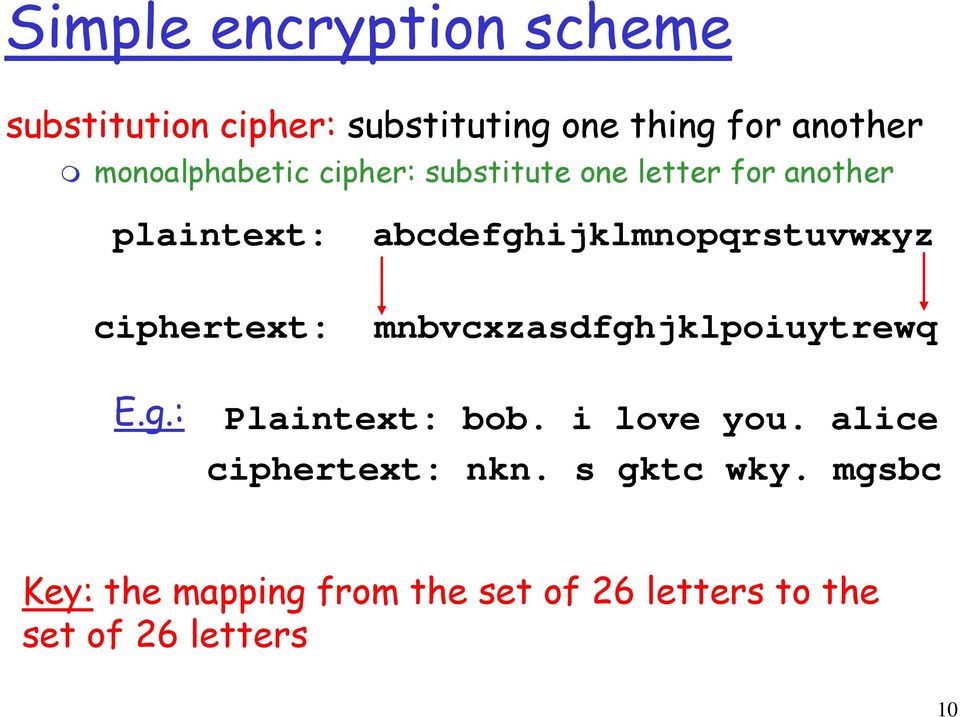
10 Simple encryption scheme substitution cipher: substituting one thing for another monoalphabetic cipher: substitute one letter for another plaintext: abcdefghijklmnopqrstuvwxyz ciphertext: t: mnbvcxzasdfghjklpoiuytrewq E.g.: Plaintext: bob. i love you. alice ciphertext: nkn. s gktc wky. mgsbc Key: the mapping from the set of 26 letters to the set of 26 letters 10
11 Polyalphabetic encryption n monoalphabetic cyphers, M 1,M 2,,M n Cycling pattern: e.g., n=4, M 1,M 3,M 4,M 3,M 2; M 1,M 3,M 4,M 3,M 2; For each new plaintext symbol, use subsequent monoalphabetic pattern in cyclic pattern dog: d from M 1, o from M 3, g from M 4 Key: the n ciphers and the cyclic pattern 11
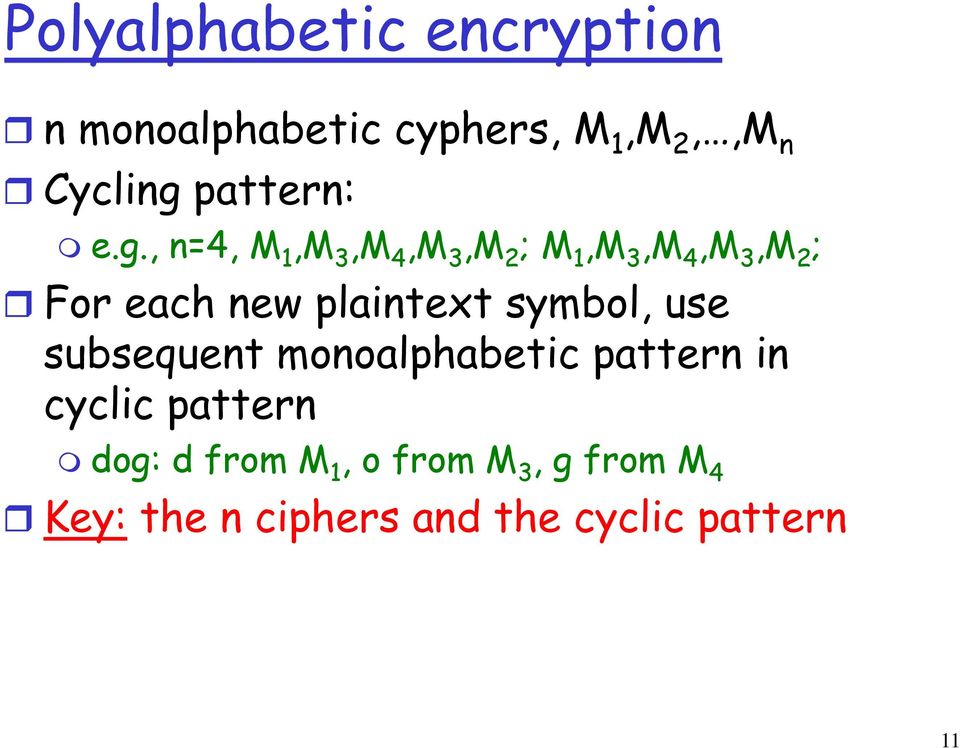
12 Breaking an encryption scheme Cipher-text only Known-plaintext attack: attack: Trudy has trudy has some plaintext ciphertext that she corresponding to some can analyze ciphertext Two approaches: eg, in monoalphabetic Search through all keys: must be able to differentiate t resulting plaintext from gibberish Statistical analysis cipher, trudy determines pairings for a,l,i,c,e,b,o, Chosen-plaintext attack: trudy can get the cyphertext for some chosen plaintext 12
13 Types of Cryptography Crypto often uses keys: Algorithm is known to everyone Only keys are secret Public key cryptography Involves the use of two keys Symmetric key cryptography Involves the use one key Hash functions Involves the use of no keys Nothing secret: How can this be useful? 13

14 Symmetric key cryptography K S K S plaintext message, m encryption algorithm ciphertext K (m) S decryption algorithm plaintext m = K S (K S (m)) symmetric key crypto: Bob and Alice share same (symmetric) key: K S e.g., key is knowing substitution pattern in mono alphabetic substitution cipher Q: how do Bob and Alice agree on key value? 14

15 Two types of symmetric ciphers Stream ciphers encrypt one bit at time Block ciphers Break plaintext message in equal-size blocks Encrypt each block as a unit 15
16 Stream Ciphers pseudo random key keystream generator keystream Combine each bit of keystream with bit of plaintext to get bit of ciphertext m(i) = ith bit of message ks(i) = ith bit of keystream c(i) = ith bit of ciphertext c(i) = ks(i) m(i) ( = exclusive or) m(i) = ks(i) c(i) 16

17 RC4 Stream Cipher RC4 is a popular stream cipher Extensively analyzed and considered good Key can be from 1 to 256 bytes Used in WEP for Can be used in SSL 17

18 Block ciphers Message to be encrypted is processed in blocks of k bits (e.g., 64-bit blocks). 1-to-1 mapping is used to map k-bit block of plaintext to k-bit block of ciphertext Example with k=3: input output input output What is the ciphertext t for ? 18

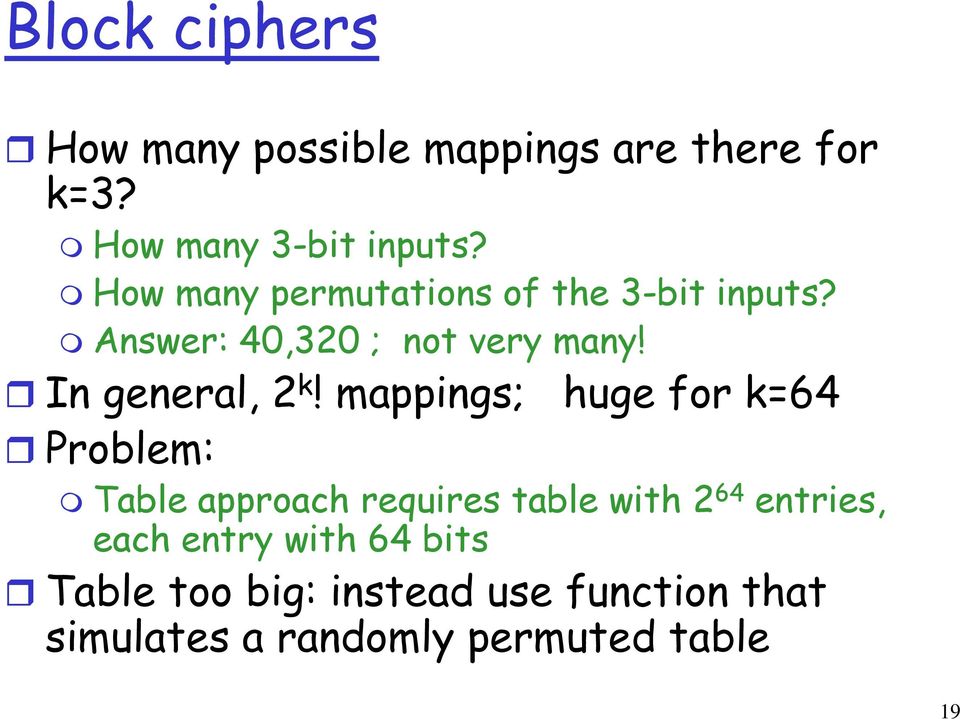
19 Block ciphers How many possible mappings are there for k=3? How many 3-bit inputs? How many permutations of the 3-bit inputs? Answer: 40,320 ; not very many! In general, 2 k! mappings; huge for k=64 Problem: Table approach requires table with 2 64 entries, each entry with 64 bits Table too big: instead use function that simulates a randomly permuted table 19
20 Prototype function From Kaufman et al 64-bit input 8bits 8bits 8bits 8bits 8bits 8bits 8bits 8bits S 1 S 2 S 3 S 4 S 5 S 6 S 7 S 8 8 bits 8 bits 8 bits 8 bits 8 bits 8 bits 8 bits 8 bits 64-bit intermediate 8-bit to 8-bit mapping Loop for n rounds 64-bit output 20
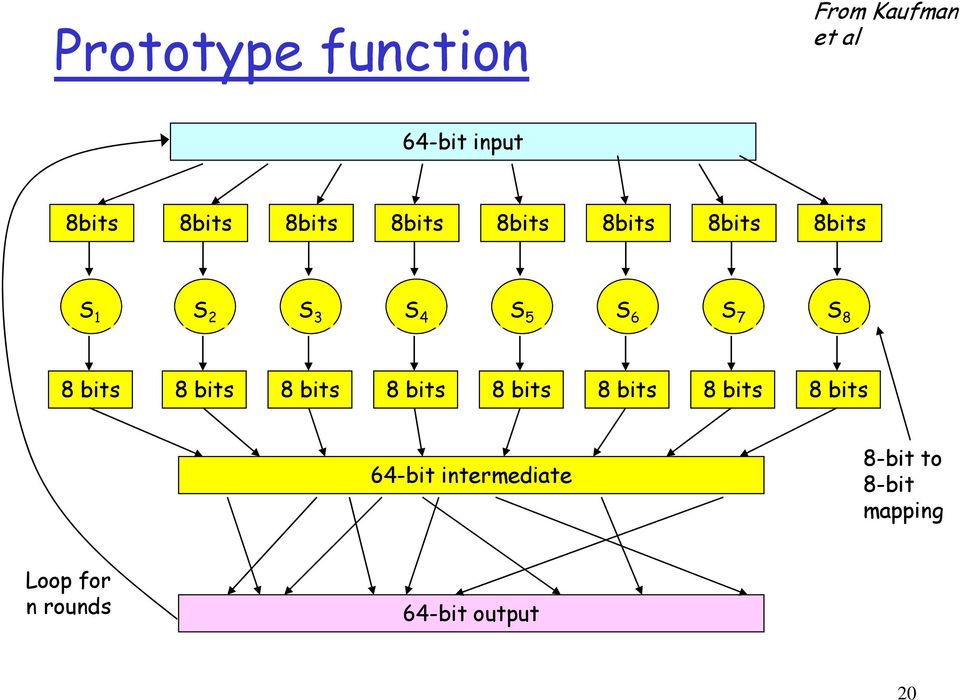
21 Why rounds in prototpe? If only a single round, then one bit of input affects at most 8 bits of output. In 2 nd round, the 8 affected bits get scattered and inputted into multiple substitution boxes. How many rounds? How many times do you need to shuffle cards Becomes less efficient as n increases 21
22 Encrypting a large message Why not just break message in 64-bit blocks, encrypt each block separately? If same block of plaintext t appears twice, will give same cyphertext. How about: Generate random 64-bit number r(i) for each plaintext block m(i) Calculate c(i) = K S ( m(i) r(i) ) Transmit c(i), r(i), i=1,2, At receiver: m(i) = K S (c(i)) r(i) Problem: inefficient, need to send c(i) and r(i) 22
23 Cipher Block Chaining (CBC) CBC generates its own random numbers Have encryption of current block depend on result of previous block c(i) = K S ( m(i) c(i-1) ) m(i) = K S ( c(i)) c(i-1) How do we encrypt first block? Initialization vector (IV): random block = c(0) IV does not have to be secret Change IV for each message (or session) Guarantees that even if the same message is sent repeatedly, the ciphertext will be completely different each time 23
24 Cipher Block Chaining cipher block: if input block repeated, will produce same cipher text: t () t=1 m(1) = HTTP/1.1 block cipher t=17 m(17) = HTTP/1.1 block cipher c(1) () c(17) = k329am02 = k329am02 cipher block chaining: XOR ith input block, m(i), with previous block of cipher text, c(i-1) c(0) transmitted to receiver in clear what happens in HTTP/1.1 scenario from above? c(i-1) m(i) + block cipher c(i)
25 Symmetric key crypto: DES DES: Data Encryption Standard US encryption standard [NIST 1993] 56-bit symmetric key, 64-bit plaintext input Block cipher with cipher block chaining How secure is DES? DES Challenge: 56-bit-key-encrypted phrase decrypted (brute force) in less than a day No known good analytic attack making DES more secure: 3DES: encrypt 3 times with 3 different keys (actually encrypt, decrypt, encrypt) 25
26 Symmetric key crypto: DES DES operation initial permutation 16 identical rounds of function application, each using different 48 bits of key final permutation 26
27 AES: Advanced Encryption Standard new (Nov. 2001) symmetric-key NIST standard, replacing DES processes data in 128 bit blocks 128, 192, or 256 bit keys brute force decryption (try each key) taking 1 sec on DES, takes 149 trillion years for AES 27
28 Public Key Cryptography symmetric key crypto requires sender, receiver know shared secret key Q: how to agree on key in first place (particularly r if never met )? public key cryptography radically different approach [Diffie- Hellman76, RSA78] sender, receiver do not share secret key public encryption key known to all private decryption key known only to receiver 28
29 Public key cryptography + K Bob s public B key K - Bob s private B key plaintext encryption ciphertext decryption plaintext message, m algorithm + algorithm K (m) message B - + m = K (K (m)) B B 29
30 Public key encryption algorithms Requirements: B - + B need K ( ) and K ( ) such that K (K (m)) = m B B given public key K B, it should be impossible to compute private key - K B + RSA: Rivest, Shamir, Adelson algorithm 30
31 Prerequisite: modular arithmetic x mod n = remainder of x when divide id by n Facts: [(a mod n) + (b mod n)] mod n = (a+b) mod n [(a mod n) - (b mod n)] mod n = (a-b) mod n [(a mod n) * (b mod n)] mod n = (a*b) mod n Thus (a mod n) d mod n = a d mod n Example: x=14, n=10, d=2: (x mod n) d mod n = 4 2 mod 10 = 6 x d = 14 2 = 196 x d mod 10 = 6 31
32 RSA: getting ready A message is a bit pattern. A bit pattern can be uniquely represented by an integer number. Thus encrypting a message is equivalent to encrypting a number. Example m= This message is uniquely represented by the decimal number 145. To encrypt m, we encrypt the corresponding number, which gives a new number (the cyphertext). 32
33 RSA: Creating public/private key pair 1. Choose two large prime numbers p, q. (e.g., 1024 bits each) 2. Compute n = pq, z = (p-1)(q-1) 3. Choose e (with e<n) that has no common factors with z. (e, z are relatively prime ). 4. Choose d such that t ed-1 is exactly divisible isibl by z. (in other words: ed mod z = 1 ). 5. Public key is (n,e). Private key is (n,d). K + B K - B 33
34 RSA: Encryption, decryption 0. Given (n,e) and (n,d) as computed above 1. To encrypt message m (<n), compute c = m e mod n 2. To decrypt received bit pattern, c, compute m = c d mod n Magic m = (m e d mod n) mod n happens! c 34
35 RSA example: Bob chooses p=5, q=7. Then n=35, z=24. e=5 (so e, z relatively prime). d=29 (so ed-1 exactly divisible by z). Encrypting 8-bit messages. encrypt: bit pattern m m e c = m e mod n 0000l decrypt: c c d m = c d mod n
36 Why does RSA work? Must show that c d mod n = m where c = m e mod n Fact: for any x and y: x y mod n = x (y mod z) mod n where n= pq and z = (p-1)(q-1) Thus, c d mod n = (m e mod n) d mod n = m ed mod n = m (ed mod z) mod n = m 1 mod n = m 36
37 RSA: another important property The following property will be very useful later: - + ( ) K (K (m)) = m B B use public key first, followed by private key = + - B B ( ) K (K (m)) use private key first, followed by public key Result is the same! 37
38 - + Why K (K (m)) = m = K (K (m))? B B + - B B Follows directly from modular arithmetic: ti (m e mod n) d mod n = m ed mod n = m de mod n = (m d mod n) e mod n 38
39 Why is RSA Secure? Suppose you know Bob s public key (n,e). How hard is it to determine d? Essentially need to find factors of n without knowing the two factors p and q. Fact: factoring a big number is hard. Generating RSA keys Have to find big primes p and q Approach: make good guess then apply testing rules (see Kaufman) 39
40 Session keys Exponentiation is computationally intensive DES is at least 100 times faster than RSA Session key, K S Bob and Alice use RSA to exchange a symmetric key K S Once both have K S, they use symmetric key cryptography 40
41 Chapter 8 roadmap 8.1 What is network security? 8.2 Principles of cryptography 8.3 Message integrity 84Securing Securing TCP connections: SSL 8.6 Network layer security: IPsec 8.7 Securing wireless LANs 8.8 Operational security: firewalls and IDS
42 Message Integrity Allows communicating parties to verify that received messages are authentic. Content of message has not been altered Source of message is who/what you think it is Message has not been replayed Sequence of messages is maintained Let s first talk about message digests 42
43 Message Digests Function H( ) that t takes as input an arbitrary length message and outputs a fixed-length string: message signature Note that H( ) is a many- to-1 function H( ) is often called a hash function large H: Hash message Function m H(m) Desirable properties: Easy to calculate Irreversibility: Can t determine m from H(m) Collision resistance: Computationally difficult to produce m and m such that H(m) = H(m ) Seemingly random output 43
44 Internet checksum: poor message digest Internet checksum has some properties of hash function: produces fixed length digest (16-bit sum) of input is many-to-one But given message with given hash value, it is easy to find another message with same hash value. Example: Simplified checksum: add 4-byte chunks at a time: message I O U B O B ASCII format 49 4F E D2 42 message I O U B O B ASCII format 49 4F E D2 42 B2 C1 D2 AC different messages but identical checksums! B2 C1 D2 AC 44
45 Hash Function Algorithms MD5 hash function widely used (RFC 1321) computes 128-bit message digest in 4-step process. SHA-1 is also used. US standard [NIST, FIPS PUB 180-1] 1] 160-bit message digest 45
46 Message Authentication Code (MAC) s s = shared secret messag ge me essage s me essage H( ) H( ) compare Authenticates sender Verifies message integrity No encryption! Also called keyed hash Notation: ti MD m = H(s m) ; send m MD m 46
47 HMAC Popular MAC standard d Addresses some subtle security flaws 1. Concatenates secret to front of message. 2. Hashes concatenated message 3. Concatenates the secret to front of digest 4. Hashes the combination again. 47
48 Example: OSPF Recall that OSPF is an Attacks: intra-as routing Message insertion protocol Message deletion Each router creates Message modification map of entire AS (or area) and runs shortest path How do we know if an algorithm over map. OSPF message is Router receives link- authentic? state advertisements (LSAs) from all other routers in AS. 48
49 OSPF Authentication Within an Autonomous Cryptographic hash h System, routers send with MD5 OSPF messages to each other. OSPF provides MD5 is run over a authentication choices No authentication Shared password: inserted in clear in 64- bit authentication field in OSPF packet Cryptographic hash 64-bit authentication field includes 32-bit sequence number concatenation of the OSPF packet and shared secret key MD5 hash then appended to OSPF packet; encapsulated in IP datagram 49
50 End-point authentication Want to be sure of the originator of the message end-point authentication. Assuming Alice and Bob have a shared secret, will MAC provide end-point authentication. We do know that Alice created the message. But did she send it? 50
51 Playback attack MAC = f(msg,s) Transfer $1M from Bill to Trudy MAC Transfer $1M from Bill to Trudy MAC
52 Defending against playback attack: nonce I am Alice R MAC = f(msg,s,r) Transfer $1M from Bill to Susan MAC
53 Digital Signatures Cryptographic technique analogous to handwritten signatures. sender (Bob) digitally signs document, establishing he is document owner/creator. Goal is similar to that of a MAC, except now use public-key cryptography verifiable, nonforgeable: recipient (Alice) can prove to someone that Bob, and no one else (including Alice), must have signed document 53
54 Digital Signatures Simple digital signature for message m: Bob signs m by encrypting with his private key - - K B, creating signed message, K B (m) Bob s message, m Dear Alice Oh, how I have missed you. I think of you all the time! (blah blah blah) Bob - K Bob s private B key Public key encryption algorithm - K B (m) Bob s message, m, signed (encrypted) with his private key 54
55 Digital signature = signed message digest Bob sends digitally signed message: large message H: Hash m function H(m) Bob s private key - K B digital signature (encrypt) encrypted msg digest - + K B (H(m)) Alice verifies signature and integrity of digitally signed message: large message m H: Hash function H(m) Bob s public key K + B equal? encrypted msg digest - K B (H(m)) digital signature (decrypt) H(m) 55
56 Digital Signatures (more) - Suppose Alice receives msg m, digital signature K B (m) Alice verifies m signed by Bob by applying Bob s public key K B to K B (m) then checks K B (K B (m) ) = m. + - If K B (K B (m) ) = m, whoever signed m must have used Bob s private key. Alice thus verifies that: Bob signed m. No one else signed m. Bob signed m and not m. Non-repudiation: - Alice can take m, and signature K B B( (m) to court and prove that Bob signed m. 56
57 Public-key certification Motivation: Trudy plays pizza prank on Bob Trudy creates order: Dear Pizza Store, Please deliver to me four pepperoni pizzas. Thank you, Bob Trudy signs order with her private key Trudy sends order to Pizza Store Trudy sends to Pizza Store her public key, but says it s Bob s public key. Pizza Store verifies signature; then delivers four pizzas to Bob. Bob doesn t even like Pepperoni 57
58 Certification Authorities Certification authority (CA): binds public key to particular entity, E. E (person, router) registers its public key with CA. E provides proof of identity to CA. CA creates certificate binding E to its public key. certificate containing E s public key digitally signed by CA CA says this is E s public key Bob s identifying information Bob s public + key K B digital signature (encrypt) CA private key K - CA K B + certificate for Bob s public key, signed by CA 58
59 Certification Authorities When Alice wants Bob s public key: gets Bob s certificate (Bob or elsewhere). apply CA s public key to Bob s certificate, get Bob s public key K B + digital signature (decrypt) + K B Bob s public key CA public key + K CA 59
60 Certificates: summary Primary standard d X.509 (RFC 2459) Certificate contains: Issuer name Entity name, address, domain name, etc. Entity s public key Digital signature (signed with issuer s private key) Public-Key Infrastructure (PKI) Certificates and certification authorities Often considered heavy 60
61 Chapter 8 roadmap 8.1 What is network security? 8.2 Principles of cryptography 8.3 Message integrity Securing 8.5 Securing TCP connections: SSL 8.6 Network layer security: IPsec 8.7 Securing wireless LANs 8.8 Operational security: firewalls and IDS
62 Secure Alice wants to send confidential , m, to Bob. K S m K S ( ). K S (m ) K S (m ) ). K S ( ) m + - Internet +. K S K B ( ) + + K B (K S ) K B (K S ) K B + K B - Alice: generates random symmetric private key, K S. encrypts message with K S (for efficiency) also encrypts K S with Bob s public key. sends both K S (m) and K B (K S ) to Bob. K S -. K B ( )
63 Secure Alice wants to send confidential , m, to Bob. K S m K S ( ). K S (m ) K S (m ) ). K S ( ) m + - Internet +. K S K B ( ) + + K B (K S ) K B (K S ) K B + K B - Bob: uses his private key to decrypt and recover K S uses K S to decrypt K S (m) to recover m K S -. K B ( )
64 Secure (continued) Alice wants to provide sender authentication message integrity. m H( ) K Ā.. K A ( ) K+ A K A (H(m)) K. A (H(m)) + K A () H(m ) () A () + - Internet compare m m. H( ) H(m ) Alice digitally signs message. sends both message (in the clear) and digital signature.
65 Secure (continued) Alice wants to provide secrecy, sender authentication, message integrity. m H( ) K Ā. -. K A ( ) - K A (H(m)) K S + ). K S ( ) m K S +. K B ( ) K + B + K B (K S ) + Internet Alice uses three keys: her private key, Bob s public key, newly created symmetric key
66 Chapter 8 roadmap 8.1 What is network security? 8.2 Principles of cryptography 8.3 Message integrity 84Securing Securing TCP connections: SSL 8.6 Network layer security: IPsec 8.7 Securing wireless LANs 8.8 Operational security: firewalls and IDS
67 SSL: Secure Sockets Layer Widely deployed security protocol Supported by almost all browsers and web servers https Tens of billions $ spent per year over SSL Originally designed by Netscape in 1993 Number of variations: TLS: transport layer security, RFC 2246 Provides Confidentiality Integrity Authentication Original goals: Had Web e-commerce transactions in mind Encryption (especially credit-card numbers) Web-server authentication Optional client authentication Minimum hassle in doing business with new merchant Available to all TCP applications Secure socket interface 67
68 SSL and TCP/IP Application TCP IP Normal Application Application SSL TCP IP Application with SSL SSL provides application programming interface (API) to applications C and Java SSL libraries/classes readily available 68
69 Could do something like PGP: m H( ) K Ā - - K A (H(m)).. K A ( ) +. K S( ) K S m K S +. K B ( ) + K B + K B (K S ) + Internet But want to send byte streams & interactive data Want a set of secret keys for the entire connection Want certificate exchange part of protocol: handshake phase 69
70 Toy SSL: a simple secure channel Handshake: Alice and Bob use their certificates and private keys to authenticate each other and exchange shared secret Key Derivation: Alice and Bob use shared secret to derive set of keys Data Transfer: Data to be transferred is broken up into a series es of records Connection Closure: Special messages to securely close connection 70
71 Toy: A simple handshake MS = master secret EMS = encrypted master secret 71
72 Toy: Key derivation Considered d bad to use same key for more than one cryptographic operation Use different keys for message authentication code (MAC) and encryption Four keys: K c = encryption key for data sent from client to server M c = MAC key for data sent from client to server K s = encryption key for data sent from server to client M s = MAC key for data sent from server to client Keys derived d from key derivation function (KDF) Takes master secret and (possibly) some additional random data and creates the keys 72
73 Toy: Data Records Why not encrypt data in constant stream as we write it to TCP? Where would we put the MAC? If at end, no message integrity until all data processed. For example, e, with instant messaging, how can we do integrity check over all bytes sent before displaying? Instead, break stream in series of records Each record carries a MAC Receiver can act on each record as it arrives Issue: in record, receiver needs to distinguish MAC from data Want to use variable-length records length data MAC 73
74 Toy: Sequence Numbers Attacker can capture and replay record or re-order records Solution: put sequence number into MAC: MAC = MAC(M x, sequence data) Note: no sequence number field Attacker could still replay all of the records Use random nonce 74
75 Toy: Control information Truncation attack: attacker forges TCP connection close segment One or both sides thinks there is less data than there actually is. Solution: record types, with one type for closure type 0 for data; type 1 for closure MAC = MAC(M x x, sequence type data) length type data MAC 75
76 Toy SSL: summary bob.com encrypt ted 76
77 Toy SSL isn t complete How long are the fields? What encryption protocols? No negotiation Allow client and server to support different encryption algorithms Allow client and server to choose together specific algorithm before data transfer 77
78 Most common symmetric ciphers in SSL DES Data Encryption Standard: d block 3DES Triple strength: block RC2 Rivest Cipher 2: block RC4 Rivest Cipher 4: stream Public key encryption RSA 78
79 SSL Cipher Suite Cipher Suite Public-key algorithm Symmetric encryption algorithm MAC algorithm SSL supports a variety of cipher suites Negotiation: client and server must agree on cipher suite Client offers choice; server picks one 79
80 Real SSL: Handshake (1) Purpose 1. Server authentication 2. Negotiation: agree on crypto algorithms 3. Establish keys 4. Client authentication (optional) 80
81 Real SSL: Handshake (2) 1. Client sends list of algorithms it supports, along with client nonce 2. Server chooses algorithms from list; sends back: choice + certificate + server nonce 3. Client verifies certificate, extracts server s public key, generates pre_master_secret, secret encrypts with server s public key, sends to server 4. Client and server independently compute encryption and MAC keys from pre_master_secret and nonces 5. Client sends a MAC of all the handshake messages 6. Server sends a MAC of all the handshake messages 81
82 Real SSL: Handshaking (3) Last 2 steps protect handshake h from tampering Client typically y offers range of algorithms, some strong, some weak Man-in-the middle could delete the stronger algorithms from list Last 2 steps prevent this Last two messages are encrypted 82
83 Real SSL: Handshaking (4) Why the two random nonces? Suppose Trudy sniffs all messages between Alice & Bob. Next day, Trudy sets up TCP connection with Bob, sends the exact same sequence of records,. Bob (Amazon) thinks Alice made two separate orders for the same thing. Solution: Bob sends different random nonce for each connection. This causes encryption keys to be different on the two days. Trudy s messages will fail Bob s integrity check. 83
84 SSL Record Protocol data data fragment MAC data fragment MAC record header encrypted data and MAC record header encrypted data and MAC record header: content t type; version; length MAC: includes sequence number, MAC key M x Fragment: each SSL fragment 2 14 bytes (~16 Kbytes) 84
85 SSL Record Format 1 byte 2 bytes 3 bytes content type SSL version length data MAC Data and MAC encrypted (symmetric algo) 85
86 Real Connection Everything henceforth is encrypted TCP Fin follow 86
87 Key derivation Client nonce, server nonce, and pre-master secret input into pseudo random-number generator. Produces master secret Master secret and new nonces inputed into another random-number generator: key block Because of resumption: TBD Key block sliced and diced: client MAC key server MAC key client encryption key server encryption key client initialization vector (IV) server initialization vector (IV) 87
88 Chapter 8 roadmap 8.1 What is network security? 8.2 Principles of cryptography 8.3 Message integrity 84Securing Securing TCP connections: SSL 8.6 Network layer security: IPsec 8.7 Securing wireless LANs 8.8 Operational security: firewalls and IDS
89 What is confidentiality at the network-layer? Between two network entities: Sending entity encrypts the payloads of datagrams. Payload could be: TCP segment, UDP segment, ICMP message, OSPF message, and so on. All data sent from one entity to the other would be hidden: Web pages, , P2P file transfers, TCP SYN packets, and so on. That is, blanket coverage. 89
90 Virtual Private Networks (VPNs) Institutions often want private networks for security. Costly! Separate routers, links, DNS infrastructure. t With a VPN, institution s inter-office traffic is sent over public Internet instead. But inter-office traffic is encrypted before entering public Internet 90
91 Virtual Private Network (VPN) Public Internet IP header IPsec header Secure payload laptop w/ IPsec salesperson in hotel Router w/ IPv4 and IPsec Router w/ IPv4 and IPsec headquarters branch office 91
92 IPsec services Data integrity Origin authentication Replay attack prevention Confidentiality Two protocols providing different service models: AH ESP 92
93 IPsec Transport Mode IPsec IPsec IPsec datagram emitted and received by end-system. Protects upper level protocols 93
94 IPsec tunneling mode (1) IPsec IPsec End routers are IPsec aware. Hosts need not be. 94
95 IPsec tunneling mode (2) IPsec IPsec Also tunneling mode. 95
96 Two protocols Authentication Header (AH) protocol provides source authentication & data integrity but not confidentiality fd Encapsulation Security Protocol (ESP) provides source authentication,data integrity, and confidentiality more widely used than AH 96
97 Four combinations are possible! Host mode with AH Host mode with ESP Tunnel mode with AH Tunnel mode with ESP Most common and most important 97
98 Security associations (SAs) Before sending data, a virtual connection is established from sending entity to receiving entity. Called security association (SA) SAs are simplex: for only one direction Both sending and receiving entites maintain state information about the SA Recall that TCP endpoints also maintain state information. IP is connectionless; IPsec is connection-oriented! How many SAs in VPN w/ headquarters, branch office, and n traveling salesperson? 98
99 Example SA from R1 to R2 Headquarters Internet Branch Office SA /24 R1 R /24 R1 stores for SA 32-bit identifier for SA: Security Parameter Index (SPI) the origin interface of the SA ( ) destination interface of the SA ( ) type of encryption to be used (for example, 3DES with CBC) encryption key type of integrity check (for example, HMAC with with MD5) authentication key 99
100 Security Association Database (SAD) Endpoint holds state t of its SAs in a SAD, where it can locate them during processing. With n salespersons, 2 + 2n SAs in R1 s SAD When sending IPsec datagram, R1 accesses SAD to determine how to process datagram. When IPsec datagram arrives to R2, R2 examines SPI in IPsec datagram, indexes SAD with SPI, and processes datagram accordingly. 100
101 IPsec datagram Focus for now on tunnel mode with ESP enchilada authenticated encrypted new IP header ESP hdr original IP hdr Original IP datagram payload ESP trl ESP auth SPI Seq pad padding # length next header 101
102 What happens? Headquarters Internet Branch Office SA /24 R1 R /24 enchilada authenticated encrypted new IP header ESP hdr original IP hdr Original IP datagram payload ESP trl ESP auth SPI Seq # padding pad length next header 102
103 R1 converts original datagram into IPsec datagram Appends to back of original ii datagram (which hih includes ld original header fields!) an ESP trailer field. Encrypts result using algorithm & key specified by SA. Appends to front of this encrypted quantity the ESP header, creating enchilada. Creates authentication MAC over the whole enchilada, using algorithm and key specified in SA; Appends MAC to back of enchilada, forming payload; Creates brand new IP header, with all the classic IPv4 header fields, which it appends before payload. 103
104 Inside the enchilada: enchilada authenticated encrypted new IP header ESP hdr original IP hdr Original IP datagram payload ESP trl ESP auth SPI Seq # pad next padding length header ESP trailer: Padding for block ciphers ESP header: SPI, so receiving entity knows what to do Sequence number, to thwart replay attacks MAC in ESP auth field is created with shared secret key 104
105 IPsec sequence numbers For new SA, sender initializes i i seq. # to 0 Each time datagram is sent on SA: Sender increments seq # counter Places value in seq # field Goal: Prevent attacker from sniffing and replaying a packet Method: Receipt of duplicate, authenticated IP packets may disrupt service Destination checks for duplicates But doesn t keep track of ALL received packets; instead uses a window 105
106 Security Policy Database (SPD) Policy: For a given datagram, sending entity needs to know if it should use IPsec. Needs also to know which SA to use May use: source and destination IP address; protocol number. Info in SPD indicates what to do with arriving datagram; Info in the SAD indicates how to do it. 106
107 Summary: IPsec services Suppose Trudy sits somewhere between R1 and R2. She doesn t know the keys. Will Trudy be able to see contents of original datagram? How about source, dest IP address, transport t protocol, application port? Flip bits without detection? Masquerade as R1 using R1 s IP address? Replay a datagram? 107
108 Internet Key Exchange In previous examples, we manually established IPsec SAs in IPsec endpoints: Example SA SPI: Source IP: Dest IP: Protocol: ESP Encryption algorithm: 3DES-cbc HMAC algorithm: MD5 Encryption key: 0x7aeaca HMAC key:0xc0291f Such manually keying is impractical for large VPN with, say, hundreds of sales people. Instead use IPsec IKE (Internet Key Exchange) 108
109 IKE: PSK and PKI Authentication (proof who you are) with either pre-shared secret (PSK) or with PKI (pubic/private keys and certificates). With PSK, both sides start with secret: then run IKE to authenticate each other and to generate IPsec SAs (one in each direction), including encryption and authentication keys With PKI, both sides start with public/private key pair and certificate. run IKE to authenticate each other and obtain IPsec SAs (one in each direction). Similar with handshake in SSL. 109
110 IKE Phases IKE has two phases Phase 1: Establish bi-directional IKE SA Note: IKE SA different from IPsec SA Also called ISAKMP security association Phase 2: ISAKMP is used to securely negotiate the IPsec pair of SAs Phase 1 has two modes: aggressive mode and main mode Aggressive mode uses fewer messages Main mode provides identity protection and is more flexible 110
111 Summary of IPsec IKE message exchange for algorithms, secret keys, SPI numbers Either the AH or the ESP protocol (or both) The AH protocol provides integrity and source authentication The ESP protocol (with AH) additionally provides encryption IPsec peers can be two end systems, two routers/firewalls, or a router/firewall and an end system 111
112 Chapter 8 roadmap 8.1 What is network security? 8.2 Principles of cryptography 8.3 Message integrity 84Securing Securing TCP connections: SSL 8.6 Network layer security: IPsec 8.7 Securing wireless LANs 8.8 Operational security: firewalls and IDS
113 WEP Design Goals Symmetric key crypto Confidentiality Station authorization Data integrity Self synchronizing: each packet separately encrypted Given encrypted packet and key, can decrypt; can continue to decrypt packets when preceding packet was lost Unlike Cipher Block Chaining (CBC) in block ciphers Efficient Can be implemented in hardware or software 113
114 Review: Symmetric Stream Ciphers key keystream generator keystream Combine each byte of keystream with byte of plaintext to get ciphertext m(i) = ith unit of message ks(i) = ith unit of keystream c(i) = ith unit of ciphertext c(i) = ks(i) m(i) ( = exclusive or) m(i) = ks(i) c(i) WEP uses RC4 114
115 Stream cipher and packet independence Recall design goal: each packet separately encrypted If for frame n+1, use keystream from where we left off for frame n, then each frame is not separately encrypted Need to know where we left off for packet n WEP approach: initialize keystream with key + new IV for each packet: Key+IV packet keystream generator keystream packet 115
116 WEP encryption (1) Sender calculates Integrity Check Value (ICV) over data four-byte hash/crc for data integrity Each side has 104-bit shared key Sender creates 24-bit initialization vector (IV), appends to key: gives 128-bit key Sender also appends keyid (in 8-bit field) 128-bit key inputted into pseudo random number generator to get keystream data in frame + ICV is encrypted with RC4: Bytes of keystream are XORed with bytes of data & ICV IV & keyid are appended d to encrypted data to create payload Payload inserted into frame encrypted IV Key ID data ICV MAC payload 116
117 WEP encryption (2) IV (per frame) K S : 104-bit secret symmetric plaintext frame data plus CRC key sequence generator (f for given K S, IV) IV k 1 k IV 2 k IV IV 3 k N k IV IV N+1 k N+1 d 1 d 2 d 3 d N CRC 1 CRC header IV WEP-encrypted data plus ICV c 1 c 2 c 3 c N c N+1 c N+4 Figure New 7.8-new1: IV for each WEP frame protocol 117
118 WEP decryption overview encrypted IV Key ID data ICV MAC payload Receiver extracts IV Inputs IV and shared secret key into pseudo random generator, gets keystream XORs keystream with encrypted data to decrypt data + ICV Verifies integrity of data with ICV Note that message integrity approach used here is different from the MAC (message authentication code) and signatures s (using PKI). 118
119 End-point authentication w/ nonce Nonce: number (R) used only once in-a-lifetime How: to prove Alice live live, Bob sends Alice nonce, nce R. Alice must return R, encrypted with shared secret key I am Alice R K (R) A-B Alice is live, and only Alice knows key to encrypt nonce, so it must be Alice! 119
120 WEP Authentication Not all APs do it, even if WEP is being used. AP indicates if authentication is necessary in beacon frame. Done before association. authentication request AP nonce (128 bytes) nonce encrypted shared key success if decrypted value equals nonce 120
121 Breaking WEP encryption security hole: 24-bit IV, one IV per frame, -> IV s eventually reused IV transmitted in plaintext -> IV reuse detected attack: Trudy causes s Alice to encrypt known n plaintext d 1 d 2 d 3 d 4 Trudy sees: c IV i = d i XOR k i Trudy knows c i d i, so can compute k i IV IV IV Trudy knows encrypting key sequence k IV 1 k 2 k 3 Next time IV is used, Trudy can decrypt!
122 802.11i: improved security numerous (stronger) forms of encryption possible provides key distribution uses authentication server separate from uses authentication server separate from access point
123 802.11i: four phases of operation STA: client station AP: access point wired network AS: Authentication server 1 Discovery of security capabilities STA 2and AS mutually authenticate, together generate Master Key (MK). AP servers as pass through 3STA derives Pairwise Master Key (PMK) STA, 4 AP use PMK to derive Temporal Key (TK) used for message encryption, integrity 3 AS derives same PMK, sends to AP
124 EAP: extensible authentication protocol EAP: end-end client (mobile) to authentication server protocol EAP sent over separate links mobile-to-ap (EAP over LAN) AP to authentication server (RADIUS over UDP) wired network EAP over LAN (EAPoL) IEEE EAP TLS EAP RADIUS UDP/IP
125 Chapter 8 roadmap 8.1 What is network security? 8.2 Principles of cryptography 8.3 Message integrity 84Securing Securing TCP connections: SSL 8.6 Network layer security: IPsec 8.7 Securing wireless LANs 8.8 Operational security: firewalls and IDS
126 Firewalls firewall isolates organization s internal net from larger Internet, allowing some packets to pass, blocking others. administered network public Internet firewall
127 Firewalls: Why prevent denial of service attacks: SYN flooding: attacker establishes many bogus TCP connections, no resources left for real connections prevent illegal modification/access of internal data. e.g., attacker replaces CIA s homepage with something else allow only authorized access to inside network (set of authenticated users/hosts) three types of firewalls: stateless t packet filters stateful packet filters application gateways
128 Stateless packet filtering Should arriving packet be allowed in? Departing packet let out? internal network connected to Internet via router firewall router filters packet-by-packet, decision to forward/drop packet based on: source IP address, destination IP address TCP/UDP source and destination port numbers ICMP message type TCP SYN and ACK bits
129 Stateless packet filtering: example example 1: block incoming and outgoing g datagrams with IP protocol field = 17 and with either source or dest port = 23. all incoming, outgoing UDP flows and telnet connections are blocked. example 2: Block inbound TCP segments with ACK=0. prevents external clients from making TCP connections with internal clients, but allows internal clients to connect to outside.
130 Stateless packet filtering: more examples Policy No outside Web access. No incoming TCP connections, except those for institution s public Web server only. Prevent Web-radios from eating up the available bandwidth. Prevent your network from being used for a smurf DoS attack. Prevent your network from being tracerouted Firewall Setting Drop all outgoing packets to any IP address, port 80 Drop all incoming TCP SYN packets to any IP except , port 80 Drop all incoming UDP packets - except DNS and router broadcasts. Drop all ICMP packets going to a broadcast address (eg ). Drop all outgoing ICMP TTL expired traffic
131 Access Control Lists ACL: table of rules, applied top to bottom to incoming packets: (action, condition) pairs action source address allow /16 dest address outside of /1622/16 source dest flag protocol port port bit any TCP > allow outside of / /16 TCP 80 > 1023 ACK outside of allow /16 UDP > /16 allow outside of /1622/16 UDP 53 > /16 deny all all all all all all
132 Stateful packet filtering stateless packet filter: heavy handed tool admits packets that make no sense, e.g., dest port = 80, ACK bit set, even though no TCP connection established: action source address dest address protocol source port dest port flag bit allow outside of / /16 TCP 80 > 1023 ACK stateful packet filter: track status of every TCP connection track connection setup (SYN), teardown (FIN): can determine whether incoming, i outgoing packets makes sense timeout inactive connections at firewall: no longer admit packets
133 Stateful packet filtering ACL augmented to indicate need to check connection state table before admitting packet action source address dest address proto source port dest port flag bit check conxion allow /1622/16 allow outside of /16 outside of / /16 any TCP > TCP 80 > 1023 ACK x allow /16 outside of /16 UDP > allow outside of / /16 UDP 53 > x deny all all all all all all
134 Application gateways filters packets on application data as well as on IP/TCP/UDP fields. example: allow select internal users to telnet outside. host-to-gateway telnet session application gateway gateway-to-remote to host telnet session router and filter 1. require all telnet users to telnet through gateway. 2. for authorized users, gateway sets up telnet connection to dest host. Gateway relays data between 2 connections 3. router filter blocks all telnet connections not originating from gateway.
135 Limitations of firewalls and gateways IP spoofing: router can t know if data really comes from claimed source if multiple app s. need special treatment, each has own app. gateway. client software must know how to contact gateway. e.g., must set IP address of proxy in Web browser filters often use all or nothing policy for UDP. tradeoff: degree of communication with outside world, level of security many highly protected sites still suffer from attacks.
136 Intrusion detection systems packet filtering: operates on TCP/IP headers only no correlation check among sessions IDS: intrusion detection system deep packet inspection: look at packet contents (e.g., check character strings in packet against database of known virus, attack strings) s) examine correlation among multiple packets port scanning network mapping DoS attack
137 Intrusion detection systems multiple IDSs: different types of checking at different locations application gateway firewall Internet internal network IDS sensors Web server FTP server DNS server demilitarized zone
138 Network Security (summary) Basic techniques... cryptography (symmetric and public) message integrity end-point authentication. used in many different security scenarios s secure secure transport (SSL) IP sec Operational Security: firewalls and IDS 8: Network Security
Chapter 8 Network Security
 Chapter 8 Network Security A note on the use of these ppt slides: We re making these slides freely available to all (faculty, students, readers). They re in PowerPoint form so you can add, modify, and
Network Security. Abusayeed Saifullah. CS 5600 Computer Networks. These slides are adapted from Kurose and Ross 8-1
 Network Security Abusayeed Saifullah CS 5600 Computer Networks These slides are adapted from Kurose and Ross 8-1 roadmap 1 What is network security? 2 Principles of cryptography 3 Message integrity, authentication
Netzwerksicherheit: Anwendungen
 Internet-Technologien (CS262) Netzwerksicherheit: Anwendungen 22. Mai 2015 Christian Tschudin & Thomas Meyer Departement Mathematik und Informatik, Universität Basel Chapter 8 Security in Computer Networks
SECURITY IN NETWORKS
 SECURITY IN NETWORKS GOALS Understand principles of network security: Cryptography and its many uses beyond confidentiality Authentication Message integrity Security in practice: Security in application,
Network Security (2) CPSC 441 Department of Computer Science University of Calgary
 Network Security (2) CPSC 441 Department of Computer Science University of Calgary 1 Friends and enemies: Alice, Bob, Trudy well-known in network security world Bob, Alice (lovers!) want to communicate
Telematics Chapter 11: Network Security Beispielbild User watching video clip
 Telematics Chapter 11: Network Security Beispielbild User watching video clip Server with video clips Application Layer Application Layer Prof. Dr. Mesut Güneş Presentation Layer Presentation Layer Computer
Chapter 8 Security. IC322 Fall 2014. Computer Networking: A Top Down Approach. 6 th edition Jim Kurose, Keith Ross Addison-Wesley March 2012
 Chapter 8 Security IC322 Fall 2014 Computer Networking: A Top Down Approach 6 th edition Jim Kurose, Keith Ross Addison-Wesley March 2012 All material copyright 1996-2012 J.F Kurose and K.W. Ross, All
Chapter 8 Network Security
 Chapter 8 A note on the use of these ppt slides: We re making these slides freely available to all (faculty, students, readers). They re in PowerPoint form so you can add, modify, and delete slides (including
Network Security. Abusayeed Saifullah. CS 5600 Computer Networks. These slides are adapted from Kurose and Ross 8-1
 Network Security Abusayeed Saifullah CS 5600 Computer Networks These slides are adapted from Kurose and Ross 8-1 Public Key Cryptography symmetric key crypto v requires sender, receiver know shared secret
Network Security. Abusayeed Saifullah. CS 5600 Computer Networks. These slides are adapted from Kurose and Ross 8-1
 Network Security Abusayeed Saifullah CS 5600 Computer Networks These slides are adapted from Kurose and Ross 8-1 Goals v understand principles of network security: cryptography and its many uses beyond
Data Communications & Networks. Session 11 Main Theme Network Security. Dr. Jean-Claude Franchitti
 Data Communications & Networks Session 11 Main Theme Network Security Dr. Jean-Claude Franchitti New York University Computer Science Department Courant Institute of Mathematical Sciences Adapted from
Chapter 8 Security Pt 2
 Chapter 8 Security Pt 2 IC322 Fall 2014 Computer Networking: A Top Down Approach 6 th edition Jim Kurose, Keith Ross Addison-Wesley March 2012 All material copyright 1996-2012 J.F Kurose and K.W. Ross,
Network Security. HIT Shimrit Tzur-David
 Network Security HIT Shimrit Tzur-David 1 Goals: 2 Network Security Understand principles of network security: cryptography and its many uses beyond confidentiality authentication message integrity key
Chapter 8 Network Security
 [Computer networking, 5 th ed., Kurose] Chapter 8 8.1 What is network security? 8.2 Principles of cryptography 8.3 Message integrity 84Securing 8.4 e-mail 8.5 Securing TCP connections: SSL 8.6 Network
Chapter 6 CDMA/802.11i
 Chapter 6 CDMA/802.11i IC322 Fall 2014 Computer Networking: A Top Down Approach 6 th edition Jim Kurose, Keith Ross Addison-Wesley March 2012 Some material copyright 1996-2012 J.F Kurose and K.W. Ross,
Overview of Network Security
 Overview of Network Security from à Computer Networking: A Top Down Approach, 4 th edition. Jim Kurose, Keith Ross AddisonWesley, July 2007. 81 Roadmap: What is network security? Principles of cryptography
Chapter 7: Network security
 Chapter 7: Network security Foundations: what is security? cryptography authentication message integrity key distribution and certification Security in practice: application layer: secure e-mail transport
Chapter 8 Network Security. Slides adapted from the book and Tomas Olovsson
 Chapter 8 Network Security Slides adapted from the book and Tomas Olovsson Roadmap 8.1 What is network security? 8.2 Principles of cryptography 8.3 Message integrity Security protocols and measures: Securing
Internet Firewall CSIS 3230. Internet Firewall. Spring 2012 CSIS 4222. net13 1. Firewalls. Stateless Packet Filtering
 Internet Firewall CSIS 3230 A combination of hardware and software that isolates an organization s internal network from the Internet at large Ch 8.8: Packet filtering, firewalls, intrusion detection Ch
FIREWALLS. Firewall: isolates organization s internal net from larger Internet, allowing some packets to pass, blocking others
 FIREWALLS FIREWALLS Firewall: isolates organization s internal net from larger Internet, allowing some packets to pass, blocking others FIREWALLS: WHY Prevent denial of service attacks: SYN flooding: attacker
What is network security?
 Network security Network Security Srinidhi Varadarajan Foundations: what is security? cryptography authentication message integrity key distribution and certification Security in practice: application
COSC4377. Chapter 8 roadmap
 Lecture 28 Chapter 8 roadmap 8.1 What is network security? 8.2 Principles of cryptography 8.3 Message integrity 8.4 Securing e mail 8.5 Securing TCP connections: SSL 8.6 Network layer security: IPsec 8.7
Chapter 5: Network Layer Security
 Managing and Securing Computer Networks Guy Leduc Mainly based on Network Security - PRIVATE Communication in a PUBLIC World C. Kaufman, R. Pearlman, M. Speciner Pearson Education, 2002. (chapters 17 and
Principles of Network Security
 he Network Security Model Bob and lice want to communicate securely. rudy (the adversary) has access to the channel. lice channel data, control s Bob Kai Shen data secure sender secure receiver data rudy
Network Security #10. Overview. Encryption Authentication Message integrity Key distribution & Certificates Secure Socket Layer (SSL) IPsec
 Network Security #10 Parts modified from Computer Networking: A Top Down Approach Featuring the Internet, 2nd edition. Jim Kurose, Keith Ross, Addison-Wesley, 2002. 1 Overview Encryption Authentication
Managing and Securing Computer Networks. Guy Leduc. Chapter 4: Securing TCP. connections. connections. Chapter goals: security in practice:
 Managing and Securing Computer Networks Guy Leduc Chapter 4: Securing TCP connections Computer Networking: A Top Down Approach, 6 th edition. Jim Kurose, Keith Ross Addison-Wesley, March 2012. (section
VLAN und MPLS, Firewall und NAT,
 Internet-Technologien (CS262) VLAN und MPLS, Firewall und NAT, 15.4.2015 Christian Tschudin Departement Mathematik und Informatik, Universität Basel 6-1 Wiederholung Unterschied CSMA/CD und CSMA/CA? Was
Chapter 10. Network Security
 Chapter 10 Network Security 10.1. Chapter 10: Outline 10.1 INTRODUCTION 10.2 CONFIDENTIALITY 10.3 OTHER ASPECTS OF SECURITY 10.4 INTERNET SECURITY 10.5 FIREWALLS 10.2 Chapter 10: Objective We introduce
Security Protocols HTTPS/ DNSSEC TLS. Internet (IPSEC) Network (802.1x) Application (HTTP,DNS) Transport (TCP/UDP) Transport (TCP/UDP) Internet (IP)
 Security Protocols Security Protocols Necessary to communicate securely across untrusted network Provide integrity, confidentiality, authenticity of communications Based on previously discussed cryptographic
APNIC elearning: IPSec Basics. Contact: [email protected]. esec03_v1.0
 APNIC elearning: IPSec Basics Contact: [email protected] esec03_v1.0 Overview Virtual Private Networks What is IPsec? Benefits of IPsec Tunnel and Transport Mode IPsec Architecture Security Associations
Security. Contents. S-72.3240 Wireless Personal, Local, Metropolitan, and Wide Area Networks 1
 Contents Security requirements Public key cryptography Key agreement/transport schemes Man-in-the-middle attack vulnerability Encryption. digital signature, hash, certification Complete security solutions
Client Server Registration Protocol
 Client Server Registration Protocol The Client-Server protocol involves these following steps: 1. Login 2. Discovery phase User (Alice or Bob) has K s Server (S) has hash[pw A ].The passwords hashes are
12/3/08. Security in Wireless LANs and Mobile Networks. Wireless Magnifies Exposure Vulnerability. Mobility Makes it Difficult to Establish Trust
 Security in Wireless LANs and Mobile Networks Wireless Magnifies Exposure Vulnerability Information going across the wireless link is exposed to anyone within radio range RF may extend beyond a room or
INF3510 Information Security University of Oslo Spring 2011. Lecture 9 Communication Security. Audun Jøsang
 INF3510 Information Security University of Oslo Spring 2011 Lecture 9 Communication Security Audun Jøsang Outline Network security concepts Communication security Perimeter security Protocol architecture
Chapter 6: Network Access Control
 Managing and Securing Computer Networks Guy Leduc Computer Networking: A Top Down Approach, 6 th edition. Jim Kurose, Keith Ross Addison-Wesley, March 2012. (section 8.9) Chapter 6: Network Access Control
Security vulnerabilities in the Internet and possible solutions
 Security vulnerabilities in the Internet and possible solutions 1. Introduction The foundation of today's Internet is the TCP/IP protocol suite. Since the time when these specifications were finished in
Security in Computer Networks
 Security in Computer Networks Raj Jain Washington University in Saint Louis Saint Louis, MO 63130 [email protected] Audio/Video recordings of this lecture are available on-line at: http://www.cse.wustl.edu/~jain/cse473-10/
CSCI 454/554 Computer and Network Security. Topic 8.1 IPsec
 CSCI 454/554 Computer and Network Security Topic 8.1 IPsec Outline IPsec Objectives IPsec architecture & concepts IPsec authentication header IPsec encapsulating security payload 2 IPsec Objectives Why
Network Security [2] Plain text Encryption algorithm Public and private key pair Cipher text Decryption algorithm. See next slide
![Network Security [2] Plain text Encryption algorithm Public and private key pair Cipher text Decryption algorithm. See next slide](/thumbs/24/4351346.jpg "Network Security [2] Plain text Encryption algorithm Public and private key pair Cipher text Decryption algorithm. See next slide") Network Security [2] Public Key Encryption Also used in message authentication & key distribution Based on mathematical algorithms, not only on operations over bit patterns (as conventional) => much overhead
Network Security [2] Public Key Encryption Also used in message authentication & key distribution Based on mathematical algorithms, not only on operations over bit patterns (as conventional) => much overhead
Security in IPv6. Basic Security Requirements and Techniques. Confidentiality. Integrity
 Basic Security Requirements and Techniques Confidentiality The property that stored or transmitted information cannot be read or altered by an unauthorized party Integrity The property that any alteration
Security. Friends and Enemies. Overview Plaintext Cryptography functions. Secret Key (DES) Symmetric Key
 Friends and Enemies Security Outline Encryption lgorithms Protocols Message Integrity Protocols Key Distribution Firewalls Figure 7.1 goes here ob, lice want to communicate securely Trudy, the intruder
Lecture Objectives. Lecture 8 Mobile Networks: Security in Wireless LANs and Mobile Networks. Agenda. References
 Lecture Objectives Wireless Networks and Mobile Systems Lecture 8 Mobile Networks: Security in Wireless LANs and Mobile Networks Introduce security vulnerabilities and defenses Describe security functions
Network Security Part II: Standards
 Network Security Part II: Standards Raj Jain Washington University Saint Louis, MO 63131 [email protected] These slides are available on-line at: http://www.cse.wustl.edu/~jain/cse473-05/ 18-1 Overview
Key Management (Distribution and Certification) (1)
 Key Management (Distribution and Certification) (1) Remaining problem of the public key approach: How to ensure that the public key received is really the one of the sender? Illustration of the problem
Computer Networks - CS132/EECS148 - Spring 2013 --------------------------------------------------------------------------
 Computer Networks - CS132/EECS148 - Spring 2013 Instructor: Karim El Defrawy Assignment 5 Deadline : May 30th 9:30pm (hard and soft copies required) --------------------------------------------------------------------------
7 Network Security. 7.1 Introduction 7.2 Improving the Security 7.3 Internet Security Framework. 7.5 Absolute Security?
 7 Network Security 7.1 Introduction 7.2 Improving the Security 7.3 Internet Security Framework 7.4 Firewalls 7.5 Absolute Security? 7.1 Introduction Security of Communications data transport e.g. risk
IP Security. Ola Flygt Växjö University, Sweden http://w3.msi.vxu.se/users/ofl/ [email protected] +46 470 70 86 49
 IP Security Ola Flygt Växjö University, Sweden http://w3.msi.vxu.se/users/ofl/ [email protected] +46 470 70 86 49 1 Internetworking and Internet Protocols (Appendix 6A) IP Security Overview IP Security
Overview. Securing TCP/IP. Introduction to TCP/IP (cont d) Introduction to TCP/IP
 Overview Securing TCP/IP Chapter 6 TCP/IP Open Systems Interconnection Model Anatomy of a Packet Internet Protocol Security (IPSec) Web Security (HTTP over TLS, Secure-HTTP) Lecturer: Pei-yih Ting 1 2
Outline. INF3510 Information Security. Lecture 10: Communications Security. Communication Security Analogy. Network Security Concepts
 Outline INF3510 Information Security Lecture 10: Communications Security Network security concepts Communication security Perimeter security Protocol architecture and security services Example security
Lecture 10: Communications Security
 INF3510 Information Security Lecture 10: Communications Security Audun Jøsang University of Oslo Spring 2015 Outline Network security concepts Communication security Perimeter security Protocol architecture
Chapter 8. Cryptography Symmetric-Key Algorithms. Digital Signatures Management of Public Keys Communication Security Authentication Protocols
 Network Security Chapter 8 Cryptography Symmetric-Key Algorithms Public-Key Algorithms Digital Signatures Management of Public Keys Communication Security Authentication Protocols Email Security Web Security
IPsec Details 1 / 43. IPsec Details
 Header (AH) AH Layout Other AH Fields Mutable Parts of the IP Header What is an SPI? What s an SA? Encapsulating Security Payload (ESP) ESP Layout Padding Using ESP IPsec and Firewalls IPsec and the DNS
Overview. SSL Cryptography Overview CHAPTER 1
 CHAPTER 1 Note The information in this chapter applies to both the ACE module and the ACE appliance unless otherwise noted. The features in this chapter apply to IPv4 and IPv6 unless otherwise noted. Secure
Securing IP Networks with Implementation of IPv6
 Securing IP Networks with Implementation of IPv6 R.M.Agarwal DDG(SA), TEC Security Threats in IP Networks Packet sniffing IP Spoofing Connection Hijacking Denial of Service (DoS) Attacks Man in the Middle
CS 356 Lecture 27 Internet Security Protocols. Spring 2013
 CS 356 Lecture 27 Internet Security Protocols Spring 2013 Review Chapter 1: Basic Concepts and Terminology Chapter 2: Basic Cryptographic Tools Chapter 3 User Authentication Chapter 4 Access Control Lists
Security in Computer Networks
 CHAPTER 8 Security in Computer Networks Way back in Section 1.6 we described some of the more prevalent and damaging classes of Internet attacks, including malware attacks, denial of service, sniffing,
Lecture 9 - Network Security TDTS41-2006 (ht1)
 Lecture 9 - Network Security TDTS41-2006 (ht1) Prof. Dr. Christoph Schuba Linköpings University/IDA [email protected] Reading: Office hours: [Hal05] 10.1-10.2.3; 10.2.5-10.7.1; 10.8.1 9-10am on Oct. 4+5,
IP SECURITY (IPSEC) PROTOCOLS
 29 IP SECURITY (IPSEC) PROTOCOLS One of the weaknesses of the original Internet Protocol (IP) is that it lacks any sort of general-purpose mechanism for ensuring the authenticity and privacy of data as
Network Security Fundamentals
 APNIC elearning: Network Security Fundamentals 27 November 2013 04:30 pm Brisbane Time (GMT+10) Introduction Presenter Sheryl Hermoso Training Officer [email protected] Specialties: Network Security IPv6
Chapter 7 Transport-Level Security
 Cryptography and Network Security Chapter 7 Transport-Level Security Lectured by Nguyễn Đức Thái Outline Web Security Issues Security Socket Layer (SSL) Transport Layer Security (TLS) HTTPS Secure Shell
APNIC elearning: Network Security Fundamentals. 20 March 2013 10:30 pm Brisbane Time (GMT+10)
 APNIC elearning: Network Security Fundamentals 20 March 2013 10:30 pm Brisbane Time (GMT+10) Introduction Presenter/s Nurul Islam Roman Senior Training Specialist [email protected] Specialties: Routing &
Transport Level Security
 Transport Level Security Overview Raj Jain Washington University in Saint Louis Saint Louis, MO 63130 [email protected] Audio/Video recordings of this lecture are available at: http://www.cse.wustl.edu/~jain/cse571-14/
Authentication applications Kerberos X.509 Authentication services E mail security IP security Web security
 UNIT 4 SECURITY PRACTICE Authentication applications Kerberos X.509 Authentication services E mail security IP security Web security Slides Courtesy of William Stallings, Cryptography & Network Security,
13 Virtual Private Networks 13.1 Point-to-Point Protocol (PPP) 13.2 Layer 2/3/4 VPNs 13.3 Multi-Protocol Label Switching 13.4 IPsec Transport Mode
 13 Virtual Private Networks 13.1 Point-to-Point Protocol (PPP) PPP-based remote access using dial-in PPP encryption control protocol (ECP) PPP extensible authentication protocol (EAP) 13.2 Layer 2/3/4
Security: Focus of Control. Authentication
 Security: Focus of Control Three approaches for protection against security threats a) Protection against invalid operations b) Protection against unauthorized invocations c) Protection against unauthorized
Network Security Technology Network Management
 COMPUTER NETWORKS Network Security Technology Network Management Source Encryption E(K,P) Decryption D(K,C) Destination The author of these slides is Dr. Mark Pullen of George Mason University. Permission
Security in IEEE 802.11 WLANs
 Security in IEEE 802.11 WLANs 1 IEEE 802.11 Architecture Extended Service Set (ESS) Distribution System LAN Segment AP 3 AP 1 AP 2 MS MS Basic Service Set (BSS) Courtesy: Prashant Krishnamurthy, Univ Pittsburgh
Network Security. Computer Networking Lecture 08. March 19, 2012. HKU SPACE Community College. HKU SPACE CC CN Lecture 08 1/23
 Network Security Computer Networking Lecture 08 HKU SPACE Community College March 19, 2012 HKU SPACE CC CN Lecture 08 1/23 Outline Introduction Cryptography Algorithms Secret Key Algorithm Message Digest
Network Security. Gaurav Naik Gus Anderson. College of Engineering. Drexel University, Philadelphia, PA. Drexel University. College of Engineering
 Network Security Gaurav Naik Gus Anderson, Philadelphia, PA Lectures on Network Security Feb 12 (Today!): Public Key Crypto, Hash Functions, Digital Signatures, and the Public Key Infrastructure Feb 14:
Computer Networks. Secure Systems
 Computer Networks Secure Systems Summary Common Secure Protocols SSH HTTPS (SSL/TSL) IPSec Wireless Security WPA2 PSK vs EAP Firewalls Discussion Secure Shell (SSH) A protocol to allow secure login to
Network Security. Lecture 3
 Network Security Lecture 3 Design and Analysis of Communication Networks (DACS) University of Twente The Netherlands Security protocols application transport network datalink physical Contents IPSec overview
Network Access Security. Lesson 10
 Network Access Security Lesson 10 Objectives Exam Objective Matrix Technology Skill Covered Exam Objective Exam Objective Number Firewalls Given a scenario, install and configure routers and switches.
CPS 590.5 Computer Security Lecture 9: Introduction to Network Security. Xiaowei Yang [email protected]
 CPS 590.5 Computer Security Lecture 9: Introduction to Network Security Xiaowei Yang [email protected] Previous lectures Worm Fast worm design Today Network security Cryptography building blocks Existing
: Network Security. Name of Staff: Anusha Linda Kostka Department : MSc SE/CT/IT
 Subject Code Department Semester : Network Security : XCS593 : MSc SE : Nineth Name of Staff: Anusha Linda Kostka Department : MSc SE/CT/IT Part A (2 marks) 1. What are the various layers of an OSI reference
Chapter 8. Network Security
 Chapter 8 Network Security Cryptography Introduction to Cryptography Substitution Ciphers Transposition Ciphers One-Time Pads Two Fundamental Cryptographic Principles Need for Security Some people who
Internetwork Security
 Internetwork Security Why Network Security Layers? Fundamentals of Encryption Network Security Layer Overview PGP Security on Internet Layer IPSec IPv6-GCAs SSL/TLS Lower Layers 1 Prof. Dr. Thomas Schmidt
Network Security. Marcus Bendtsen Institutionen för Datavetenskap (IDA) Avdelningen för Databas- och Informationsteknik (ADIT)
 Network Security Securing communications (SSL/TLS and IPSec) Marcus Bendtsen Institutionen för Datavetenskap (IDA) Avdelningen för Databas- och Informationsteknik (ADIT) Network communication Who are you
CS5008: Internet Computing
 CS5008: Internet Computing Lecture 22: Internet Security A. O Riordan, 2009, latest revision 2015 Internet Security When a computer connects to the Internet and begins communicating with others, it is
Lukasz Pater CMMS Administrator and Developer
 Lukasz Pater CMMS Administrator and Developer EDMS 1373428 Agenda Introduction Why do we need asymmetric ciphers? One-way functions RSA Cipher Message Integrity Examples Secure Socket Layer Single Sign
CIS 6930 Emerging Topics in Network Security. Topic 2. Network Security Primitives
 CIS 6930 Emerging Topics in Network Security Topic 2. Network Security Primitives 1 Outline Absolute basics Encryption/Decryption; Digital signatures; D-H key exchange; Hash functions; Application of hash
Security & Privacy on the WWW. Topic Outline. Information Security. Briefing for CS4173
 Security & Privacy on the WWW Briefing for CS4173 Topic Outline 1. Information Security Relationship to safety Definition of important terms Where breaches can occur Web techniques Components of security
Symm ym e m t e r t ic i c cr c yptogr ypt aphy a Ex: RC4, AES 2
 Wi-Fi Security FEUP>MIEIC>Mobile Communications Jaime Dias Symmetric cryptography Ex: RC4, AES 2 Digest (hash) Cryptography Input: variable length message Output: a fixed-length bit
Chapter 32 Internet Security
 Chapter 32 Internet Security Copyright The McGraw-Hill Companies, Inc. Permission required for reproduction or display. Chapter 32: Outline 32.1 NETWORK-LAYER SECURITY 32.2 TRANSPORT-LAYER SECURITY 32.3
CS5490/6490: Network Security- Lecture Notes - November 9 th 2015
 CS5490/6490: Network Security- Lecture Notes - November 9 th 2015 Wireless LAN security (Reference - Security & Cooperation in Wireless Networks by Buttyan & Hubaux, Cambridge Univ. Press, 2007, Chapter
Module 8. Network Security. Version 2 CSE IIT, Kharagpur
 Module 8 Network Security Lesson 2 Secured Communication Specific Instructional Objectives On completion of this lesson, the student will be able to: State various services needed for secured communication
Application Layer (1)
 Application Layer (1) Functionality: providing applications (e-mail, www, USENET etc) providing support protocols to allow the real applications to function properly security comprising a large number
Part III-b. Universität Klagenfurt - IWAS Multimedia Kommunikation (VK) M. Euchner; Mai 2001. Siemens AG 2001, ICN M NT
 Part III-b Contents Part III-b Secure Applications and Security Protocols Practical Security Measures Internet Security IPSEC, IKE SSL/TLS Virtual Private Networks Firewall Kerberos SET Security Measures
Overview of Cryptographic Tools for Data Security. Murat Kantarcioglu
 UT DALLAS Erik Jonsson School of Engineering & Computer Science Overview of Cryptographic Tools for Data Security Murat Kantarcioglu Pag. 1 Purdue University Cryptographic Primitives We will discuss the
EXAM questions for the course TTM4135 - Information Security May 2013. Part 1
 EXAM questions for the course TTM4135 - Information Security May 2013 Part 1 This part consists of 5 questions all from one common topic. The number of maximal points for every correctly answered question
802.11 Security (WEP, WPA\WPA2) 19/05/2009. Giulio Rossetti Unipi [email protected]
 802.11 Security (WEP, WPA\WPA2) 19/05/2009 Giulio Rossetti Unipi [email protected] 802.11 Security Standard: WEP Wired Equivalent Privacy The packets are encrypted, before sent, with a Secret Key
Insecure network services. Firewalls. Two separable topics. Packet filtering. Example: blocking forgeries. Example: blocking outgoing mail
 Insecure network services NFS (port 2049) - Read/write entire FS as any non-root user given a dir. handle - Many OSes make handles easy to guess Portmap (port 111) - Relays RPC requests, making them seem
Network Security. Network Security. Security in Computer Networks
 Network Security Network Security introduction cryptography authentication key exchange Reading: Tannenbaum, section 7.1 Ross/Kurose, Ch 7 (which is incomplete) Intruder may eavesdrop remove, modify, and/or
Internet Security Architecture
 accepted for publication in Computer Networks and ISDN Systems Journal Internet Security Architecture Refik Molva Institut Eurécom 2229, route des Crêtes F-06904 Sophia-Antipolis [email protected] Abstract
Computer and Network Security
 Computer and Network Security c Copyright 2000 R E Newman Computer & Information Sciences & Engineering University Of Florida Gainesville, Florida 32611-6120 nemo@ciseufledu Network Security Protocols
Security Engineering Part III Network Security. Security Protocols (II): IPsec
 Security Engineering Part III Network Security Security Protocols (II): IPsec Juan E. Tapiador [email protected] Department of Computer Science, UC3M Security Engineering 4th year BSc in Computer Science,
Final exam review, Fall 2005 FSU (CIS-5357) Network Security
 Final exam review, Fall 2005 FSU (CIS-5357) Network Security Instructor: Breno de Medeiros 1. What is an insertion attack against a NIDS? Answer: An insertion attack against a network intrusion detection
CRYPTOGRAPHY IN NETWORK SECURITY
 ELE548 Research Essays CRYPTOGRAPHY IN NETWORK SECURITY AUTHOR: SHENGLI LI INSTRUCTOR: DR. JIEN-CHUNG LO Date: March 5, 1999 Computer network brings lots of great benefits and convenience to us. We can
INTERNET SECURITY: FIREWALLS AND BEYOND. Mehernosh H. Amroli 4-25-2002
 INTERNET SECURITY: FIREWALLS AND BEYOND Mehernosh H. Amroli 4-25-2002 Preview History of Internet Firewall Technology Internet Layer Security Transport Layer Security Application Layer Security Before
Wireless Security Overview. Ann Geyer Partner, Tunitas Group Chair, Mobile Healthcare Alliance 209-754-9130 [email protected]
 Wireless Security Overview Ann Geyer Partner, Tunitas Group Chair, Mobile Healthcare Alliance 209-754-9130 [email protected] Ground Setting Three Basics Availability Authenticity Confidentiality Challenge