
APNIC elearning: IPSec Basics. Contact: esec03_v1.0
|
|
|
- Georgiana Alaina Powers
- 10 years ago
- Views:
Transcription
1 APNIC elearning: IPSec Basics Contact: esec03_v1.0
2 Overview Virtual Private Networks What is IPsec? Benefits of IPsec Tunnel and Transport Mode IPsec Architecture Security Associations and ISAKMP Authentication Header (AH) Encapsulating Security Payload (ESP) Internet Key Exchange (IKE) IPSec Tunnel Creation
3 Virtual Private Network Creates a secure tunnel over a public network Client to firewall Router to router Firewall to firewall Uses the Internet as the public backbone to access a secure private network Remote employees can access their office network VPN Protocols PPTP (Point-to-Point tunneling Protocol) L2F (Layer 2 Forwarding Protocol) L2TP (Layer 2 Tunneling Protocol) IPSec (Internet Protocol Security)
4 IPsec Provides Layer 3 security (RFC 2401) Transparent to applications (no need for integrated IPSec support) A set of protocols and algorithms used to secure IP data at the network layer Combines different components: Security associations (SA) Authentication headers (AH) Encapsulating security payload (ESP) Internet Key Exchange (IKE) A security context for the VPN tunnel is established via the ISAKMP
5 Why IPsec? Internet Protocol (IP) is not secure IP protocol was designed in the early stages of the Internet where security was not an issue All hosts in the network are known Possible security issues Source spoofing Replay packets No data integrity or confidentiality
6 IPsec Standards RFC 4301 The IP Security Architecture Defines the original IPsec architecture and elements common to both AH and ESP RFC 4302 Defines authentication headers (AH) RFC 4303 Defines the Encapsulating Security Payload (ESP) RFC 2408 ISAKMP RFC 5996 IKE v2 (Sept 2010) RFC 4835 Cryptographic algorithm implementation for ESP and AH
7 Benefits of IPsec Confidentiality By encrypting data Integrity Routers at each end of a tunnel calculates the checksum or hash value of the data Authentication Signatures and certificates All these while still maintaining the ability to route through existing IP networks IPsec is designed to provide interoperable, high quality, cryptographicallybased security for IPv4 and IPv6 - (RFC 2401)
8 Benefits of IPsec Offers Confidentiality (encrypting data), Integrity, and Authentication Data integrity and source authentication Data signed by sender and signature is verified by the recipient Modification of data can be detected by signature verification Because signature is based on a shared secret, it gives source authentication Anti-replay protection Optional; the sender must provide it but the recipient may ignore Key management IKE session negotiation and establishment Sessions are rekeyed or deleted automatically Secret keys are securely established and authenticated Remote peer is authenticated through varying options
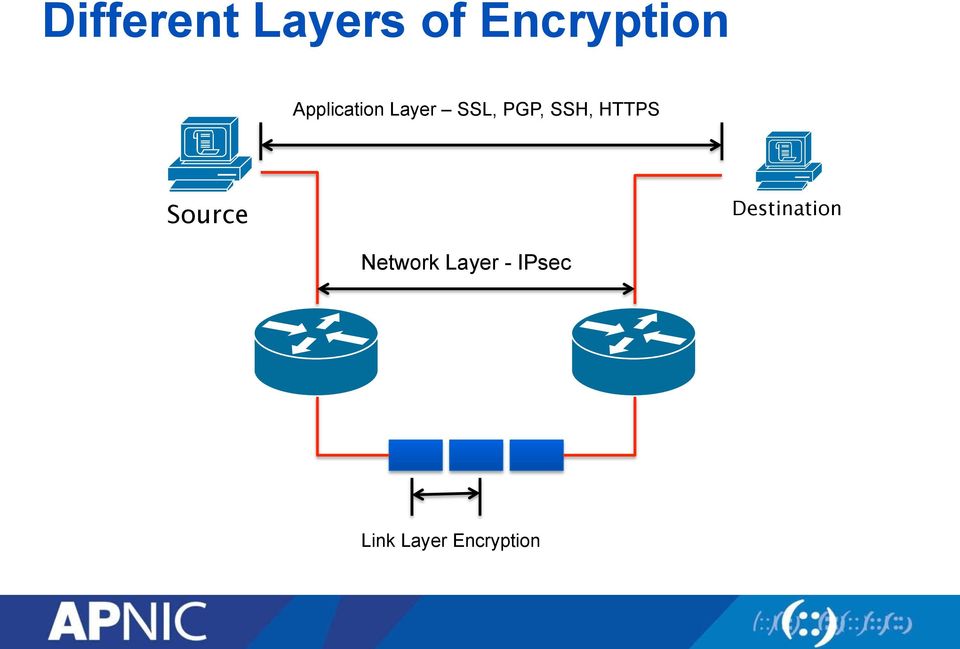
9 Different Layers of Encryption Application Layer SSL, PGP, SSH, HTTPS Source Destination Network Layer - IPsec Link Layer Encryption
10 IPsec Modes Tunnel Mode Entire IP packet is encrypted and becomes the data component of a new (and larger) IP packet. Frequently used in an IPsec site-to-site VPN Transport Mode IPsec header is inserted into the IP packet No new packet is created Works well in networks where increasing a packet s size could cause an issue Frequently used for remote-access VPNs

11 Tunnel vs. Transport Mode IPsec IP Header TCP Header Payload Without IPsec IP Header IPsec Header TCP Header Payload Transport Mode IPsec New IP Header IPsec Header IP Header TCP Header Payload Tunnel Mode IPsec

12 IPsec Architecture AH Authentication Header Security Protocols IPsec Security Policy ESP Encapsulating Security Payload IKE The Internet Key Exchange Establishes the tunnel Key management

13 Security Associations (SA) A collection of parameters required to establish a secure session Uniquely identified by three parameters consisting of Security Parameter Index (SPI) IP destination address Security protocol (AH or ESP) identifier An SA is unidirectional Two SAs required for a bidirectional communication A single SA can be used for AH or ESP, but not both must create two (or more) SAs for each direction if using both AH and ESP

14 How to Set Up an SA Manually Sometimes referred to as manual keying You configure on each node: Participating nodes (I.e. traffic selectors) AH and/or ESP [tunnel or transport] Cryptographic algorithm and key Automatically Using IKE (Internet Key Exchange) 14
![traffic selectors) AH and/or ESP [tunnel or transport]](/docs-images/43/4351203/images/page_14.jpg "Cryptographic algorithm and key Automatically Using IKE")
15 ISAKMP Internet Security Association and Key Management Protocol Defined by RFC 2408 Used for establishing Security Associations (SA) and cryptographic keys Only provides the framework for authentication and key exchange, but key exchange independent Key exchange protocols Internet Key Exchange (IKE) and Kerberized Internet Negotiation of Keys (KINK)
16 Authentication Header (AH) Provides source authentication and data integrity Protection against source spoofing and replay attacks Authentication is applied to the entire packet, with the mutable fields in the IP header zeroed out If both AH and ESP are applied to a packet, AH follows ESP Operates on top of IP using protocol 51 In IPv4, AH protects the payload and all header fields except mutable fields and IP options (such as IPSec option)
17 Encapsulating Security Payload (ESP) Uses IP protocol 50 Provides all that is offered by AH, plus data confidentiality It uses symmetric key encryption Must encrypt and/or authenticate in each packet Encryption occurs before authentication Authentication is applied to data in the IPsec header as well as the data contained as payload
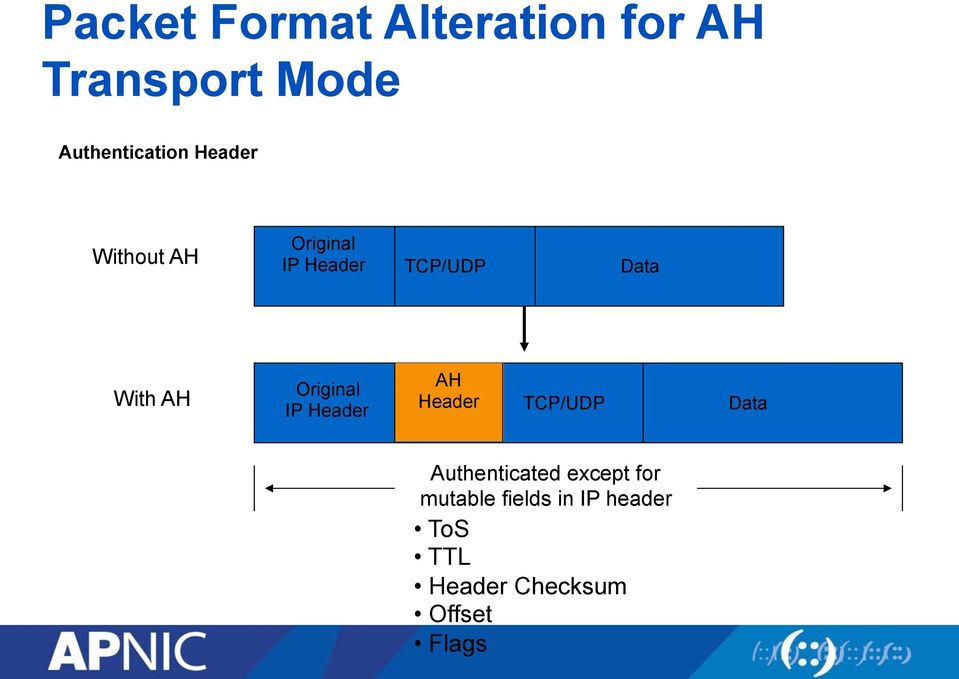
18 Packet Format Alteration for AH Transport Mode Authentication Header Without AH Original IP Header TCP/UDP Data With AH Original IP Header AH Header TCP/UDP Data Authenticated except for mutable fields in IP header ToS TTL Header Checksum Offset Flags
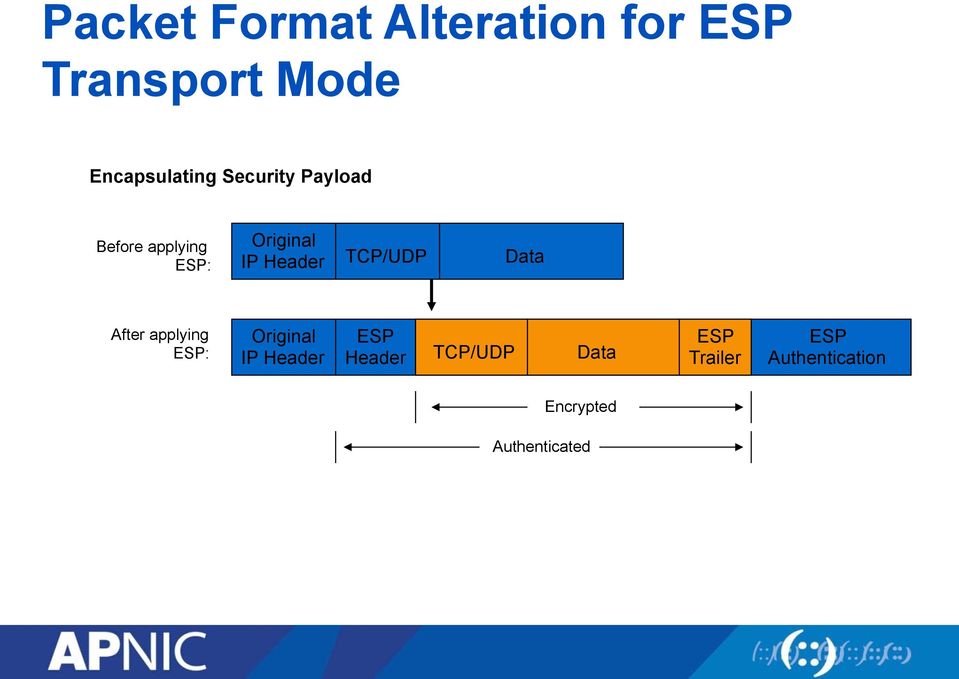
19 Packet Format Alteration for ESP Transport Mode Encapsulating Security Payload Before applying ESP: Original IP Header TCP/UDP Data After applying ESP: Original IP Header ESP Header TCP/UDP Data ESP Trailer ESP Authentication Encrypted Authenticated
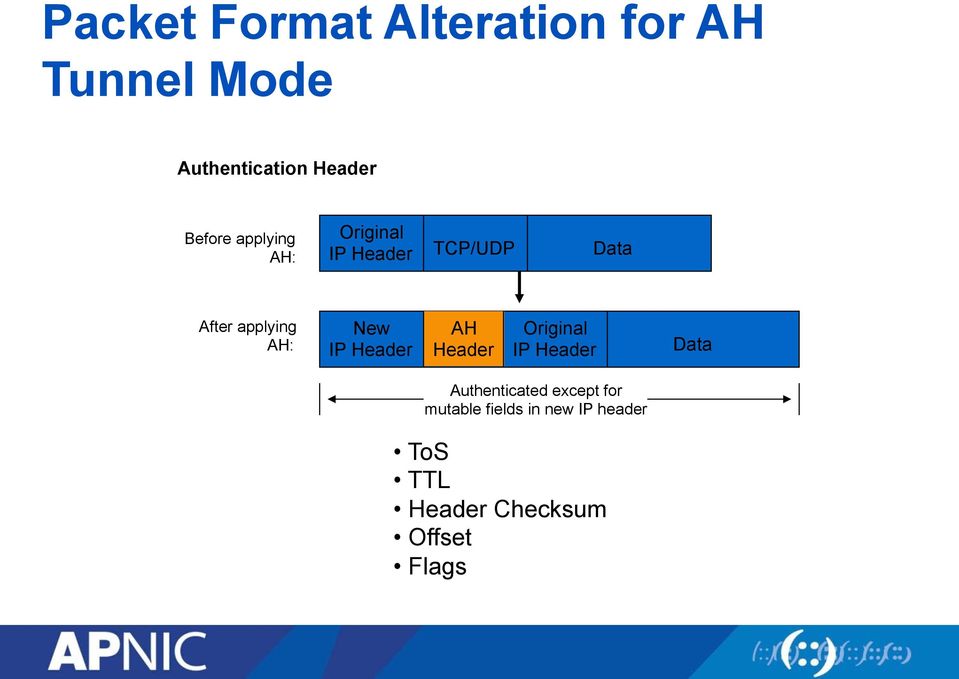
20 Packet Format Alteration for AH Tunnel Mode Authentication Header Before applying AH: Original IP Header TCP/UDP Data After applying AH: New IP Header AH Header Original IP Header Data Authenticated except for mutable fields in new IP header ToS TTL Header Checksum Offset Flags
21 Packet Format Alteration for ESP Tunnel Mode Encapsulating Security Payload Before applying ESP: Original IP Header TCP/UDP Data After applying ESP: New IP Header ESP Header Original IP Header TCP/UDP Data ESP Trailer ESP Authentication Encrypted Authenticated
22 Internet Key Exchange (IKE) An IPsec component used for performing mutual authentication and establishing and maintaining Security Associations. (RFC 5996) Typically used for establishing IPsec sessions A key exchange mechanism Five variations of an IKE negotiation: Two modes (aggressive and main modes) Three authentication methods (pre-shared, public key encryption, and public key signature) Uses UDP port 500
23 IKE Modes Mode Main mode Aggressive Mode Quick Mode Description Three exchanges of information between IPsec peers. Initiator sends one or more proposals to the other peer (responder) Responder selects a proposal Achieves same result as main mode using only 3 packets First packet sent by initiator containing all info to establish SA Second packet by responder with all security parameters selected Third packet finalizes authentication of the ISAKMP session Negotiates the parameters for the IPsec session. Entire negotiation occurs within the protection of ISAKMP session
24 Internet Key Exchange (IKE) Phase I Establish a secure channel (ISAKMP SA) Using either main mode or aggressive mode Authenticate computer identity using certificates or pre-shared secret Phase II Establishes a secure channel between computers intended for the transmission of data (IPsec SA) Using quick mode
25 Overview of IKE 1 Traffic which needs to be protected IPsec Peer 2 IKE Phase 1 IPsec Peer Secure communication channel 3 IKE Phase 2 IPsec Tunnel 4 Secured traffic exchange
26 IKE Phase 1 (Main Mode) Main mode negotiates an ISAKMP SA which will be used to create IPsec SAs Three steps SA negotiation (encryption algorithm, hash algorithm, authentication method, which DF group to use) Do a Diffie-Hellman exchange Provide authentication information Authenticate the peer
27 IKE Phase 1 (Main Mode) Initiator 3 Compute DH shared secret and derive keying material Responder Internet 1 Negotiate IKE Policy IKE Message 1 (SA proposal) IKE Message 2 (accepted SA) 2 Authenticated DH Exchange IKE Message 3 (DH public value, nonce) IKE Message 4 (DH public value, nonce) 4 Protect IKE Peer Identity IKE Message 5 (Authentication material, ID) IKE Message 6 (Authentication material, ID) (Encrypted)
28 IKE Phase 1 (Aggressive Mode) Uses 3 (vs 6) messages to establish IKE SA No denial of service protection Does not have identity protection Optional exchange and not widely implemented 28
29 IKE Phase 2 (Quick Mode) All traffic is encrypted using the ISAKMP Security Association Each quick mode negotiation results in two IPsec Security Associations (one inbound, one outbound) Creates/refreshes keys 29
30 IKE Phase 2 (Quick Mode) 4 Validate message Compute keying material Initiator Responder Internet Message 1 (authentication/keying material and SA proposal) 2 Validate message 1 6 Validate message 3 Message 2 (authentication/keying material and accepted SA) 3 5 Message 3 (hash for proof of integrity/authentication) 30
31 IPsec Best Practices Use IPsec to provide integrity in addition to encryption. Use ESP option Use strong encryption algorithms 3DES and AES instead of DES Use SHA instead of MD5 as a hashing algorithm Reduce the lifetime of the Security Association (SA) by enabling Perfect Forward Secrecy (PFS) Increases processor burden so do this only if data is highly sensitive
32 Questions Please remember to fill out the feedback form <survey-link> Slide handouts will be available after completing the survey
33 APNIC Helpdesk Chat
34 Thank You! End of Session
IP Security. Ola Flygt Växjö University, Sweden http://w3.msi.vxu.se/users/ofl/ [email protected] +46 470 70 86 49
 IP Security Ola Flygt Växjö University, Sweden http://w3.msi.vxu.se/users/ofl/ [email protected] +46 470 70 86 49 1 Internetworking and Internet Protocols (Appendix 6A) IP Security Overview IP Security
Protocol Security Where?
 IPsec: AH and ESP 1 Protocol Security Where? Application layer: (+) easy access to user credentials, extend without waiting for OS vendor, understand data; (-) design again and again; e.g., PGP, ssh, Kerberos
Security in IPv6. Basic Security Requirements and Techniques. Confidentiality. Integrity
 Basic Security Requirements and Techniques Confidentiality The property that stored or transmitted information cannot be read or altered by an unauthorized party Integrity The property that any alteration
IPSec and SSL Virtual Private Networks
 IPSec and SSL Virtual Private Networks ISP Workshops Last updated 29 June 2014 1 Acknowledgment p Content sourced from n Merike Kaeo of Double Shot Security n Contact: [email protected] Virtual
Securing IP Networks with Implementation of IPv6
 Securing IP Networks with Implementation of IPv6 R.M.Agarwal DDG(SA), TEC Security Threats in IP Networks Packet sniffing IP Spoofing Connection Hijacking Denial of Service (DoS) Attacks Man in the Middle
CSCI 454/554 Computer and Network Security. Topic 8.1 IPsec
 CSCI 454/554 Computer and Network Security Topic 8.1 IPsec Outline IPsec Objectives IPsec architecture & concepts IPsec authentication header IPsec encapsulating security payload 2 IPsec Objectives Why
Security Protocols HTTPS/ DNSSEC TLS. Internet (IPSEC) Network (802.1x) Application (HTTP,DNS) Transport (TCP/UDP) Transport (TCP/UDP) Internet (IP)
 Security Protocols Security Protocols Necessary to communicate securely across untrusted network Provide integrity, confidentiality, authenticity of communications Based on previously discussed cryptographic
Internetwork Security
 Internetwork Security Why Network Security Layers? Fundamentals of Encryption Network Security Layer Overview PGP Security on Internet Layer IPSec IPv6-GCAs SSL/TLS Lower Layers 1 Prof. Dr. Thomas Schmidt
Network Security. Lecture 3
 Network Security Lecture 3 Design and Analysis of Communication Networks (DACS) University of Twente The Netherlands Security protocols application transport network datalink physical Contents IPSec overview
Network Security Part II: Standards
 Network Security Part II: Standards Raj Jain Washington University Saint Louis, MO 63131 [email protected] These slides are available on-line at: http://www.cse.wustl.edu/~jain/cse473-05/ 18-1 Overview
Lecture 17 - Network Security
 Lecture 17 - Network Security CMPSC 443 - Spring 2012 Introduction Computer and Network Security Professor Jaeger www.cse.psu.edu/~tjaeger/cse443-s12/ Idea Why donʼt we just integrate some of these neat
Security Engineering Part III Network Security. Security Protocols (II): IPsec
 Security Engineering Part III Network Security Security Protocols (II): IPsec Juan E. Tapiador [email protected] Department of Computer Science, UC3M Security Engineering 4th year BSc in Computer Science,
The BANDIT Products in Virtual Private Networks
 encor! enetworks TM Version A.1, March 2010 2010 Encore Networks, Inc. All rights reserved. The BANDIT Products in Virtual Private Networks One of the principal features of the BANDIT products is their
Branch Office VPN Tunnels and Mobile VPN
 WatchGuard Certified Training Branch Office VPN Tunnels and Mobile VPN Fireware XTM and WatchGuard System Manager v11.7 Revised: January 2013 Updated for: Fireware XTM v11.7 Notice to Users Information
INF3510 Information Security University of Oslo Spring 2011. Lecture 9 Communication Security. Audun Jøsang
 INF3510 Information Security University of Oslo Spring 2011 Lecture 9 Communication Security Audun Jøsang Outline Network security concepts Communication security Perimeter security Protocol architecture
VPN. VPN For BIPAC 741/743GE
 VPN For BIPAC 741/743GE August, 2003 1 The router supports VPN to establish secure, end-to-end private network connections over a public networking infrastructure. There are two types of VPN connections,
Internet Protocol Security IPSec
 Internet Protocol Security IPSec Summer Semester 2011 Integrated Communication Systems Group Ilmenau University of Technology Outline Introduction Authentication Header (AH) Encapsulating Security Payload
Appendix A: Configuring Firewalls for a VPN Server Running Windows Server 2003
 http://technet.microsoft.com/en-us/library/cc757501(ws.10).aspx Appendix A: Configuring Firewalls for a VPN Server Running Windows Server 2003 Updated: October 7, 2005 Applies To: Windows Server 2003 with
Network Security Fundamentals
 APNIC elearning: Network Security Fundamentals 27 November 2013 04:30 pm Brisbane Time (GMT+10) Introduction Presenter Sheryl Hermoso Training Officer [email protected] Specialties: Network Security IPv6
Introduction to Security and PIX Firewall
 Introduction to Security and PIX Firewall Agenda Dag 28 Föreläsning LAB PIX Firewall VPN A Virtual Private Network (VPN) is a service offering secure, reliable connectivity over a shared, public network
Chapter 5: Network Layer Security
 Managing and Securing Computer Networks Guy Leduc Mainly based on Network Security - PRIVATE Communication in a PUBLIC World C. Kaufman, R. Pearlman, M. Speciner Pearson Education, 2002. (chapters 17 and
13 Virtual Private Networks 13.1 Point-to-Point Protocol (PPP) 13.2 Layer 2/3/4 VPNs 13.3 Multi-Protocol Label Switching 13.4 IPsec Transport Mode
 13 Virtual Private Networks 13.1 Point-to-Point Protocol (PPP) PPP-based remote access using dial-in PPP encryption control protocol (ECP) PPP extensible authentication protocol (EAP) 13.2 Layer 2/3/4
APNIC elearning: Network Security Fundamentals. 20 March 2013 10:30 pm Brisbane Time (GMT+10)
 APNIC elearning: Network Security Fundamentals 20 March 2013 10:30 pm Brisbane Time (GMT+10) Introduction Presenter/s Nurul Islam Roman Senior Training Specialist [email protected] Specialties: Routing &
Configuring IPSec VPN Tunnel between NetScreen Remote Client and RN300
 Configuring IPSec VPN Tunnel between NetScreen Remote Client and RN300 This example explains how to configure pre-shared key based simple IPSec tunnel between NetScreen Remote Client and RN300 VPN Gateway.
Chapter 4 Virtual Private Networking
 Chapter 4 Virtual Private Networking This chapter describes how to use the virtual private networking (VPN) features of the FVL328 Firewall. VPN tunnels provide secure, encrypted communications between
IPsec VPN Security between Aruba Remote Access Points and Mobility Controllers
 IPsec VPN Security between Aruba Remote Access Points and Mobility Controllers Application Note Revision 1.0 10 February 2011 Copyright 2011. Aruba Networks, Inc. All rights reserved. IPsec VPN Security
Fireware How To VPN. Introduction. Is there anything I need to know before I start? Configuring a BOVPN Gateway
 Fireware How To VPN How do I set up a manual branch office VPN tunnel? Introduction You use Branch Office VPN (BOVPN) with manual IPSec to make encrypted tunnels between a Firebox and a second IPSec-compliant
CS 4803 Computer and Network Security
 Network layers CS 4803 Computer and Network Security Application Transport Network Lower level Alexandra (Sasha) Boldyreva IPsec 1 2 Roughly Application layer: the communicating processes themselves and
Application Note: Onsight Device VPN Configuration V1.1
 Application Note: Onsight Device VPN Configuration V1.1 Table of Contents OVERVIEW 2 1 SUPPORTED VPN TYPES 2 1.1 OD VPN CLIENT 2 1.2 SUPPORTED PROTOCOLS AND CONFIGURATION 2 2 OD VPN CONFIGURATION 2 2.1
Dr. Arjan Durresi. Baton Rouge, LA 70810 [email protected] These slides are available at: http://www.csc.lsu.edu/~durresi/csc4601_07/
 Set of Problems 2 Dr. Arjan Durresi Louisiana State University Baton Rouge, LA 70810 [email protected] These slides are available at: http://www.csc.lsu.edu/~durresi/csc4601_07/ Louisiana State University
VPN Solutions. Lesson 10. etoken Certification Course. April 2004
 VPN Solutions Lesson 10 April 2004 etoken Certification Course VPN Overview Lesson 10a April 2004 etoken Certification Course Virtual Private Network A Virtual Private Network (VPN) is a private data network
VPNs. Palo Alto Networks. PAN-OS Administrator s Guide Version 6.0. Copyright 2007-2015 Palo Alto Networks
 VPNs Palo Alto Networks PAN-OS Administrator s Guide Version 6.0 Contact Information Corporate Headquarters: Palo Alto Networks 4401 Great America Parkway Santa Clara, CA 95054 www.paloaltonetworks.com/company/contact-us
Site to Site Virtual Private Networks (VPNs):
 Site to Site Virtual Private Networks Programme NPFIT DOCUMENT RECORD ID KEY Sub-Prog / Project Information Governance NPFIT-FNT-TO-IG-GPG-0002.01 Prog. Director Mark Ferrar Owner Tim Davis Version 1.0
Chapter 10. Network Security
 Chapter 10 Network Security 10.1. Chapter 10: Outline 10.1 INTRODUCTION 10.2 CONFIDENTIALITY 10.3 OTHER ASPECTS OF SECURITY 10.4 INTERNET SECURITY 10.5 FIREWALLS 10.2 Chapter 10: Objective We introduce
IP Security. IPSec, PPTP, OpenVPN. Pawel Cieplinski, AkademiaWIFI.pl. MUM Wroclaw
 IP Security IPSec, PPTP, OpenVPN Pawel Cieplinski, AkademiaWIFI.pl MUM Wroclaw Introduction www.akademiawifi.pl WCNG - Wireless Network Consulting Group We are group of experienced professionals. Our company
SonicOS Enhanced 3.2 IKE Version 2 Support
 SonicOS Enhanced 3.2 IKE Version 2 Support Document Scope This document describes the integration of SonicOS Enhanced 3.2 with Internet Key Exchange protocol version 2 (IKEv2). This document contains the
Laboratory Exercises V: IP Security Protocol (IPSec)
 Department of Electronics Faculty of Electrical Engineering, Mechanical Engineering and Naval Architecture (FESB) University of Split, Croatia Laboratory Exercises V: IP Security Protocol (IPSec) Keywords:
Chapter 32 Internet Security
 Chapter 32 Internet Security Copyright The McGraw-Hill Companies, Inc. Permission required for reproduction or display. Chapter 32: Outline 32.1 NETWORK-LAYER SECURITY 32.2 TRANSPORT-LAYER SECURITY 32.3
CCNA Security 1.1 Instructional Resource
 CCNA Security 1.1 Instructional Resource Chapter 8 Implementing Virtual Private Networks 2012 Cisco and/or its affiliates. All rights reserved. 1 Describe the purpose and types of VPNs and define where
Security. Contents. S-72.3240 Wireless Personal, Local, Metropolitan, and Wide Area Networks 1
 Contents Security requirements Public key cryptography Key agreement/transport schemes Man-in-the-middle attack vulnerability Encryption. digital signature, hash, certification Complete security solutions
IP SECURITY (IPSEC) PROTOCOLS
 29 IP SECURITY (IPSEC) PROTOCOLS One of the weaknesses of the original Internet Protocol (IP) is that it lacks any sort of general-purpose mechanism for ensuring the authenticity and privacy of data as
Configuring IPsec VPN with a FortiGate and a Cisco ASA
 Configuring IPsec VPN with a FortiGate and a Cisco ASA The following recipe describes how to configure a site-to-site IPsec VPN tunnel. In this example, one site is behind a FortiGate and another site
Príprava štúdia matematiky a informatiky na FMFI UK v anglickom jazyku
 Univerzita Komenského v Bratislave Fakulta matematiky, fyziky a informatiky Príprava štúdia matematiky a informatiky na FMFI UK v anglickom jazyku ITMS: 26140230008 dopytovo orientovaný projekt Moderné
IPsec Details 1 / 43. IPsec Details
 Header (AH) AH Layout Other AH Fields Mutable Parts of the IP Header What is an SPI? What s an SA? Encapsulating Security Payload (ESP) ESP Layout Padding Using ESP IPsec and Firewalls IPsec and the DNS
CSCI 454/554 Computer and Network Security. Final Exam Review
 CSCI 454/554 Computer and Network Security Final Exam Review Topics covered by Final Topic before Midterm 20% Topic after Midterm 80% Date: 05/13/2015 9:00am noon Place: the same classroom Open book/notes
Chapter 49 IP Security (IPsec)
 Chapter 49 IP Security (IPsec) Introduction...49-3 IP Security (IPsec)...49-4 Security Protocols and Modes... 49-4 Compression Protocol... 49-5 Security Associations (SA)... 49-5 ISAKMP/IKE...49-6 ISAKMP...
Outline. INF3510 Information Security. Lecture 10: Communications Security. Communication Security Analogy. Network Security Concepts
 Outline INF3510 Information Security Lecture 10: Communications Security Network security concepts Communication security Perimeter security Protocol architecture and security services Example security
7 Network Security. 7.1 Introduction 7.2 Improving the Security 7.3 Internet Security Framework. 7.5 Absolute Security?
 7 Network Security 7.1 Introduction 7.2 Improving the Security 7.3 Internet Security Framework 7.4 Firewalls 7.5 Absolute Security? 7.1 Introduction Security of Communications data transport e.g. risk
Chapter 8 Virtual Private Networking
 Chapter 8 Virtual Private Networking This chapter describes how to use the virtual private networking (VPN) features of the FWG114P v2 Wireless Firewall/Print Server. VPN tunnels provide secure, encrypted
Lecture 10: Communications Security
 INF3510 Information Security Lecture 10: Communications Security Audun Jøsang University of Oslo Spring 2015 Outline Network security concepts Communication security Perimeter security Protocol architecture
Implementing and Managing Security for Network Communications
 3 Implementing and Managing Security for Network Communications............................................... Terms you ll need to understand: Internet Protocol Security (IPSec) Authentication Authentication
FortiOS Handbook IPsec VPN for FortiOS 5.0
 FortiOS Handbook IPsec VPN for FortiOS 5.0 IPsec VPN for FortiOS 5.0 26 August 2015 01-504-112804-20150826 Copyright 2015 Fortinet, Inc. All rights reserved. Fortinet, FortiGate, and FortiGuard, are registered
Overview. Protocols. VPN and Firewalls
 Computer Network Lab 2015 Fachgebiet Technische h Informatik, Joachim Zumbrägel Overview VPN VPN requirements Encryption VPN-Types Protocols VPN and Firewalls VPN-Definition VPNs (Virtual Private Networks)
Configure an IPSec Tunnel between a Firebox Vclass & a Check Point FireWall-1
 Configure an IPSec Tunnel between a Firebox Vclass & a Check Point FireWall-1 This document describes how to configure an IPSec tunnel between a WatchGuard Firebox Vclass appliance (Vcontroller version
Security vulnerabilities in the Internet and possible solutions
 Security vulnerabilities in the Internet and possible solutions 1. Introduction The foundation of today's Internet is the TCP/IP protocol suite. Since the time when these specifications were finished in
CS 356 Lecture 27 Internet Security Protocols. Spring 2013
 CS 356 Lecture 27 Internet Security Protocols Spring 2013 Review Chapter 1: Basic Concepts and Terminology Chapter 2: Basic Cryptographic Tools Chapter 3 User Authentication Chapter 4 Access Control Lists
Chapter 2 Virtual Private Networking Basics
 Chapter 2 Virtual Private Networking Basics What is a Virtual Private Network? There have been many improvements in the Internet including Quality of Service, network performance, and inexpensive technologies,
Network Security [2] Plain text Encryption algorithm Public and private key pair Cipher text Decryption algorithm. See next slide
![Network Security [2] Plain text Encryption algorithm Public and private key pair Cipher text Decryption algorithm. See next slide](/thumbs/24/4351346.jpg "Network Security [2] Plain text Encryption algorithm Public and private key pair Cipher text Decryption algorithm. See next slide") Network Security [2] Public Key Encryption Also used in message authentication & key distribution Based on mathematical algorithms, not only on operations over bit patterns (as conventional) => much overhead
Network Security [2] Public Key Encryption Also used in message authentication & key distribution Based on mathematical algorithms, not only on operations over bit patterns (as conventional) => much overhead
Objectives. Remote Connection Options. Teleworking. Connecting Teleworkers to the Corporate WAN. Providing Teleworker Services
 ITE I Chapter 6 2006 Cisco Systems, Inc. All rights reserved. Cisco Public 1 Objectives Providing Teleworker Services Describe the enterprise requirements for providing teleworker services Explain how
VPN SECURITY. February 2008. The Government of the Hong Kong Special Administrative Region
 VPN SECURITY February 2008 The Government of the Hong Kong Special Administrative Region The contents of this document remain the property of, and may not be reproduced in whole or in part without the
IPSEC: IKE. Markus Hidell [email protected]. Based on material by Vitaly Shmatikov, Univ. of Texas, and by the previous course teachers
 IPSEC: IKE Markus Hidell [email protected] Based on material by Vitaly Shmatikov, Univ. of Texas, and by the previous course teachers 1 Reading Kaufman, chapter 18 (and some of 16) 2 Secure Key Establishment
VPN VPN requirements Encryption VPN-Types Protocols VPN and Firewalls
 Overview VPN VPN requirements Encryption VPN-Types Protocols VPN and Firewalls Computer Net Lab/Praktikum Datenverarbeitung 2 1 VPN - Definition VPNs (Virtual Private Networks) allow secure data transmission
FortiOS Handbook - IPsec VPN VERSION 5.2.2
 FortiOS Handbook - IPsec VPN VERSION 5.2.2 FORTINET DOCUMENT LIBRARY http://docs.fortinet.com FORTINET VIDEO GUIDE http://video.fortinet.com FORTINET BLOG https://blog.fortinet.com CUSTOMER SERVICE & SUPPORT
Virtual Private Network and Remote Access Setup
 CHAPTER 10 Virtual Private Network and Remote Access Setup 10.1 Introduction A Virtual Private Network (VPN) is the extension of a private network that encompasses links across shared or public networks
Network Security. Marcus Bendtsen Institutionen för Datavetenskap (IDA) Avdelningen för Databas- och Informationsteknik (ADIT)
 Network Security Securing communications (SSL/TLS and IPSec) Marcus Bendtsen Institutionen för Datavetenskap (IDA) Avdelningen för Databas- och Informationsteknik (ADIT) Network communication Who are you
Chapter 9. IP Secure
 Chapter 9 IP Secure 1 Network architecture is usually explained as a stack of different layers. Figure 1 explains the OSI (Open System Interconnect) model stack and IP (Internet Protocol) model stack.
NetScreen Concepts & Examples
 NetScreen Concepts & Examples ScreenOS Reference Guide Volume 5: VPNs ScreenOS 5.1.0 P/N 093-1370-000 Rev. A Copyright Notice Copyright 2004 Juniper Networks, Inc. All rights reserved. Juniper Networks,
ISG50 Application Note Version 1.0 June, 2011
 ISG50 Application Note Version 1.0 June, 2011 Scenario 1 - ISG50 is placed behind an existing ZyWALL 1.1 Application Scenario For companies with existing network infrastructures and demanding VoIP requirements,
Lab14.8.1 Configure a PIX Firewall VPN
 Lab14.8.1 Configure a PIX Firewall VPN Complete the following lab exercise to practice what you learned in this chapter. Objectives In this lab exercise you will complete the following tasks: Visual Objective
GNAT Box VPN and VPN Client
 Technical Document TD VPN-GB-WG-02 with SoftRemoteLT from SafeNet, Inc. GTA Firewall WatchGuard Firebox Configuring an IPSec VPN with IKE GNAT Box System Software version 3.3.2 Firebox 1000 Strong Encryption
Configuring a Site-to-Site VPN Tunnel Between Cisco RV320 Gigabit Dual WAN VPN Router and Cisco (1900/2900/3900) Series Integrated Services Router
 print email Article ID: 4938 Configuring a Site-to-Site VPN Tunnel Between Cisco RV320 Gigabit Dual WAN VPN Router and Cisco (1900/2900/3900) Series Integrated Services Router Objective Virtual Private
Technical Document. Creating a VPN. GTA Firewall to WatchGuard Firebox SOHO 6 TD: GB-WGSOHO6
 Technical Document Creating a VPN GTA Firewall to WatchGuard Firebox SOHO 6 TD: GB-WGSOHO6 Contents INTRODUCTION 1 Supported Encryption and Authentication Methods 1 Addresses Used in Examples 1 Documentation
Configuring a GB-OS Site-to-Site VPN to a Non-GTA Firewall
 Configuring a GB-OS Site-to-Site VPN to a Non-GTA Firewall S2SVPN201102-02 Global Technology Associates 3505 Lake Lynda Drive Suite 109 Orlando, FL 32817 Tel: +1.407.380.0220 Fax. +1.407.380.6080 Email:
Virtual Private Network (VPN)
 Configuration Guide 5991-2120 April 2005 Virtual Private Network (VPN) VPN Using Preset Keys, Mode Config, and Manual Keys This Configuration Guide is designed to provide you with a basic understanding
Part III-b. Universität Klagenfurt - IWAS Multimedia Kommunikation (VK) M. Euchner; Mai 2001. Siemens AG 2001, ICN M NT
 Part III-b Contents Part III-b Secure Applications and Security Protocols Practical Security Measures Internet Security IPSEC, IKE SSL/TLS Virtual Private Networks Firewall Kerberos SET Security Measures
This section provides a summary of using network location profiles to identify network connection types. Details include:
 Module 7 Network Access and Security In Module 7 students will learn several strategies for controlling network access and enhancing network security. These will include: controlling network location profiles,
Virtual Private Networks
 Virtual Private Networks ECE 4886 Internetwork Security Dr. Henry Owen Definition Virtual Private Network VPN! Virtual separation in protocol provides a virtual network using no new hardware! Private communication
Using IPSec in Windows 2000 and XP, Part 2
 Page 1 of 8 Using IPSec in Windows 2000 and XP, Part 2 Chris Weber 2001-12-20 This is the second part of a three-part series devoted to discussing the technical details of using Internet Protocol Security
Viewing VPN Status, page 335. Configuring a Site-to-Site VPN, page 340. Configuring IPsec Remote Access, page 355
 VPN This chapter describes how to configure Virtual Private Networks (VPNs) that allow other sites and remote workers to access your network resources. It includes the following sections: About VPNs, page
IPSec Pass through via Gateway to Gateway VPN Connection
 IPSec Pass through via Gateway to Gateway VPN Connection 1. Connection 2 In the diagram depicted below, the left side router represents the SME200/SME100/SME50 in HQ and right side represents the PC installed
Virtual Private Network VPN IPSec Testing: Functionality Interoperability and Performance
 Virtual Private Network VPN IPSec Testing: Functionality Interoperability and Performance Johnnie Chen Project Manager of Network Security Group Network Benchmarking Lab Network Benchmarking Laboratory
Secure Remote Monitoring of the Critical System Infrastructure. An Application Note from the Experts in Business-Critical Continuity
 Secure Remote Monitoring of the Critical System Infrastructure An Application Note from the Experts in Business-Critical Continuity TABLE OF CONTENTS Introduction................................................2
Network Security. Abusayeed Saifullah. CS 5600 Computer Networks. These slides are adapted from Kurose and Ross 8-1
 Network Security Abusayeed Saifullah CS 5600 Computer Networks These slides are adapted from Kurose and Ross 8-1 roadmap 1 What is network security? 2 Principles of cryptography 3 Message integrity, authentication
Configuring Internet Key Exchange Security Protocol
 Configuring Internet Key Exchange Security Protocol This chapter describes how to configure the Internet Key Exchange (IKE) protocol. IKE is a key management protocol standard that is used in conjunction
Configuring TheGreenBow VPN Client with a TP-LINK VPN Router
 Configuring TheGreenBow VPN Client with a TP-LINK VPN Router This chapter describes how to configure TheGreenBow VPN Client with a TP-LINK router. This chapter includes the following sections: Example
Case Study for Layer 3 Authentication and Encryption
 CHAPTER 2 Case Study for Layer 3 Authentication and Encryption This chapter explains the basic tasks for configuring a multi-service, extranet Virtual Private Network (VPN) between a Cisco Secure VPN Client
Configuring an IPSec Tunnel between a Firebox & a Check Point FireWall-1
 Configuring an IPSec Tunnel between a Firebox & a Check Point FireWall-1 This document describes how to configure an IPSec tunnel with a WatchGuard Firebox II or Firebox III (software version 4.5 or later)
Other VPNs TLS/SSL, PPTP, L2TP. Advanced Computer Networks SS2005 Jürgen Häuselhofer
 Other VPNs TLS/SSL, PPTP, L2TP Advanced Computer Networks SS2005 Jürgen Häuselhofer Overview Introduction to VPNs Why using VPNs What are VPNs VPN technologies... TLS/SSL Layer 2 VPNs (PPTP, L2TP, L2TP/IPSec)
Internet Security Architecture
 accepted for publication in Computer Networks and ISDN Systems Journal Internet Security Architecture Refik Molva Institut Eurécom 2229, route des Crêtes F-06904 Sophia-Antipolis [email protected] Abstract
Computer and Network Security
 Computer and Network Security c Copyright 2000 R E Newman Computer & Information Sciences & Engineering University Of Florida Gainesville, Florida 32611-6120 nemo@ciseufledu Network Security Protocols
Introduction to Computer Security
 Introduction to Computer Security Network Security Pavel Laskov Wilhelm Schickard Institute for Computer Science Circuit switching vs. packet switching OSI and TCP/IP layered models TCP/IP encapsulation
Lab 4.4.8a Configure a Cisco GRE over IPSec Tunnel using SDM
 Lab 4.4.8a Configure a Cisco GRE over IPSec Tunnel using SDM Objective Scenario Topology In this lab, the students will complete the following tasks: Prepare to configure Virtual Private Network (VPN)
Brocade 5600 vrouter IPsec Site-to-Site VPN
 14 September 2015 Brocade 5600 vrouter IPsec Site-to-Site VPN Reference Guide Supporting Brocade 5600 vrouter 3.5R6 2015, Brocade Communications Systems, Inc. All Rights Reserved. ADX, Brocade, Brocade
Computer Networks. Secure Systems
 Computer Networks Secure Systems Summary Common Secure Protocols SSH HTTPS (SSL/TSL) IPSec Wireless Security WPA2 PSK vs EAP Firewalls Discussion Secure Shell (SSH) A protocol to allow secure login to
Security Architecture for IP (IPsec)
 Security Architecture for IP (IPsec) Security Association (SA), AH-Protocol, ESP-Protocol Operation-Modes, Internet Key Exchange Protocol (IKE) Agenda Overview AH Protocol ESP Protocol Security Association
MINI-FAQ: OpenBSD 2.4 IPSEC VPN Configuration
 MINI-FAQ: OpenBSD 2.4 IPSEC VPN Configuration Maintainer: Steve McQuade v1.07 - March 2, 1999 After trying to configure an OpenBSD 2.4 IPSEC based VPN based on the samples and
How to configure VPN function on TP-LINK Routers
 How to configure VPN function on TP-LINK Routers 1. VPN Overview... 2 2. How to configure LAN-to-LAN IPsec VPN on TP-LINK Router... 3 3. How to configure GreenBow IPsec VPN Client with a TP-LINK VPN Router...
Cisco 3745. Cisco 3845 X X X X X X X X X X X X X X X X X X
 Data Sheet Virtual Private Network (VPN) Advanced Integration Module (AIM) for the 1841 Integrated Services Router and 2800 and 3800 Series Integrated Services Routers The VPN Advanced Integration Module
Integrated Services Router with the "AIM-VPN/SSL" Module
 Virtual Private Network (VPN) Advanced Integration Module (AIM) for the 1841 Integrated Services Router and 2800 and 3800 Series Integrated Services Routers The VPN Advanced Integration Module (AIM) for