
Chemistry Worksheet: Matter #1
|
|
|
- Alexander Robbins
- 9 years ago
- Views:
Transcription
1 Chemistry Worksheet: Matter #1 1. A mixture (is/is not) a chemical combining of substances. 2. In a compound the (atoms/molecules) are (chemically/physically) combined so that the elements that make up the compound (retain/lose) their identities and (do/do not) take on a new set of properties. 3. The smallest identifiable unit of a compound is a(n), which is made up of which are chemically bonded. 4. True or False: A mixture is always made up of a combination of elements. 5. In a mixture, the substances (lose/retain) their identities. 6. In a mixture the substances involved (can/cannot) be separated by a simple physical process. In a compound the elements involved (can/cannot) be separated by a simple physical process because the elements are (physically combined/chemically bonded). 7. True or False: An element can be broken down into a simpler substance. 8. The smallest identifiable unit of an element is a(n). 9. From the following list of substances, circle the ones that are elements: silver carbon dioxide wood alcohol chromium water hydrogen carbon nitrogen oxygen gold sugar salt air sulfur magnesium nickel 10. Explain how to separate the sugar and water in a solution of sugar and water. 11. How would you separate a mixture of alcohol and water? 12. How would you separate sand and water? Laliberte, 7/17/08

2 13. Classify the following as pure substances or as mixtures: air gasoline grain alcohol water sugar gold mercury oxygen salt water 14. Classify the following as heterogeneous or as homogeneous: sand & salt mixture hydrogen iron salt water unfiltered air iron with rust pure water an apple nitric acid tossed salad granite wood 15. Classify the following as an element, a compound, a solution, or a heterogeneous mixture: aluminum carbon dioxide sugar and water sulfuric acid an orange a pencil nitrogen gasoline raisin bread water sulfur mercury water & instant coffee carbon particles & sugar air grain alcohol Laliberte, 7/17/08
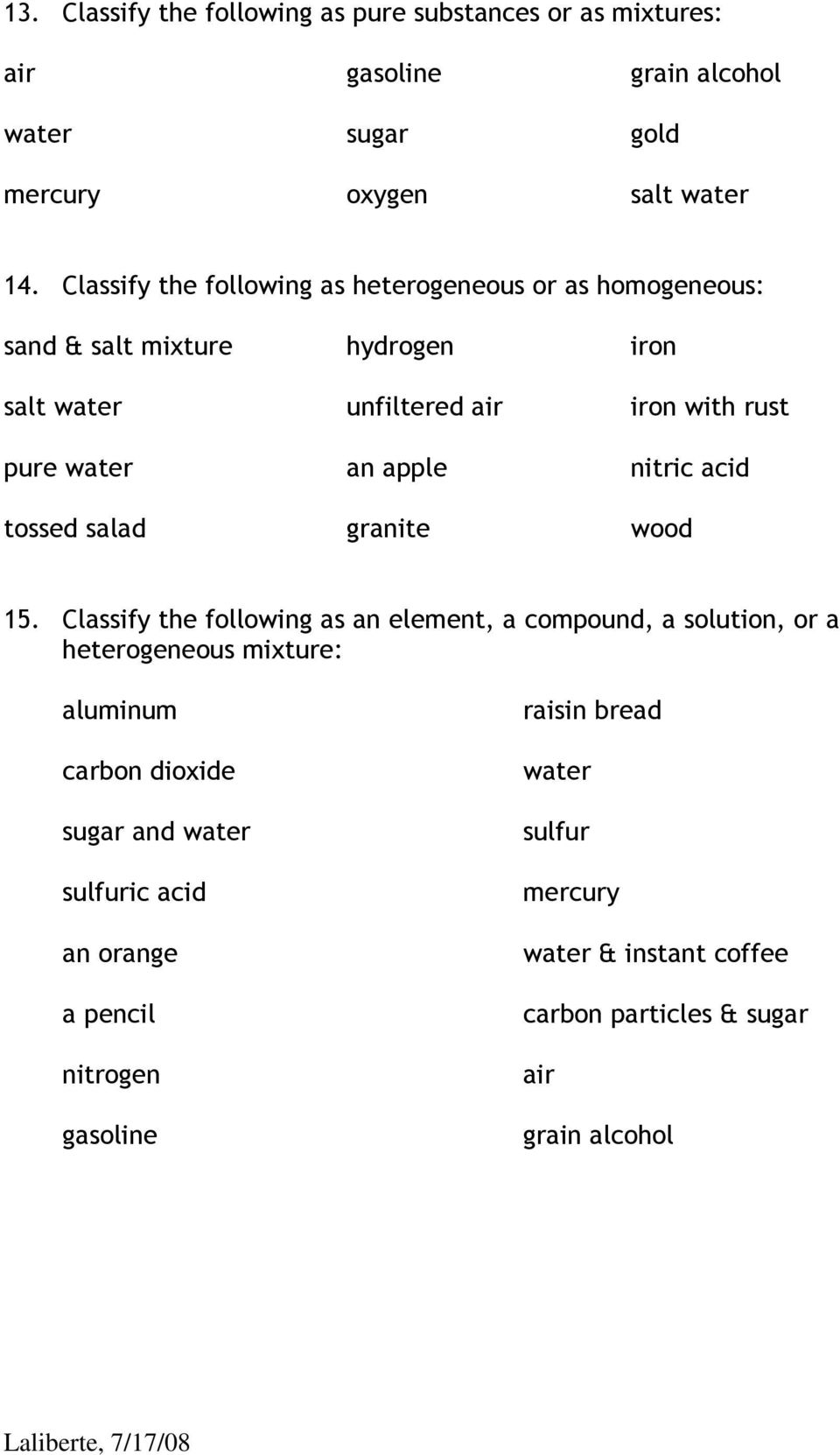
3 Elements, Compounds, and Mixtures Classify each of the pictures below by placing the correct label in the blanks below: A= Element D= Mixture of compounds B= Compound E= Mixture of elements and compounds C= Mixture of elements Each circle represents an atom and each different color represents a different kind of atom. If two atoms are touching then they are bonded together. 1) 2) 3) 4) 5) 6) 7) 8) 9) 10) 11) 12) 13) 14) 15)
4 Physical and Chemical Changes Name: Date: Hour: Place a check in the appropriate column: Change Physical Chemical Change Change Salt dissolves in water. Hydrochloric acid reacts with magnesium to produce hydrogen gas. A piece of copper is cut in half. A sugar cube is ground up. Water is heated and changed to steam. Iron rusts. Ethyl alcohol evaporates. Ice melts. Milk sours (goes bad). Sugar dissolves in water. Sodium and potassium react violently with water. Pancakes cook on a griddle. Grass grows on a lawn. A tire is inflated with air. Food is digested in the stomach. Water is absorbed by a paper towel. Ethyl alcohol boils at 79 C. Paper burns. Water freezes at 0 C. Fireworks explode. Alka-Seltzer gives off carbon dioxide when added to water. Clouds form in the sky.

5 NAME Chemistry I Worksheet Classification of Matter and Changes INSTRUCTIONS: Write E in the blank if the material is heterogeneous or O if it is homogeneous. 1. Wood 6. Dirt 2. Freshly-brewed black coffee 7. Sausage-and-mushroom pizza 3. Water 8. Air 4. Lucky Charms 9. Milk 5. Salt 10. Gold INSTRUCTIONS: Classify each of the following as an element [E], a compound [C], or a mixture [M]. 11. Gold 16. Air 12. Water 17. Carbon dioxide 13. Seawater 18. Silver 14. Sugar 19. Ice 15. A chocolate sundae 20. A Big Mac INSTRUCTIONS: Classify each of the following properties of matter as physical [P] or chemical [C]. 21. Color 26. Reacts violently with chlorine 22. Density 27. Good conductor of heat 23. Burns easily (flammable) 28. Dissolves readily in water 24. Not affected by acids 29. Melts at 145 C 25. Boils at 450 C 30. Malleable INSTRUCTIONS: Classify each of the following changes in matter as physical [P] or chemical [C]. 31. Grinding chalk into powder 36. Burning gasoline 32. Dissolving salt in water 37. Hammering gold into foil 33. Dissolving zinc in acid 38. Melting ice 34. Tearing a piece of paper 39. Digesting food 35. Stretching copper into wire 40. Making hydrogen from water INSTRUCTIONS: Classify each of the following as an intensive property [I] or an extensive property [E]. 41. Mass 46. Color 42. Density 47. Volume 43. Melting point 48. Length
![Gold INSTRUCTIONS: Classify each of the following as an element [E], a compound [C], or a mixture [M]. 11. Gold 16. Air 12. Water 17. Carbon dioxide 13. Seawater 18. Silver 14. Sugar 19. Ice 15.](/docs-images/43/21459517/images/page_5.jpg "A chocolate sundae 20. A Big Mac INSTRUCTIONS: Classify each of the following properties of matter as physical [P] or chemical [C]. 21. Color 26. Reacts violently with chlorine 22. Density 27.")
6 Getting To Know the Periodic Table 1. Number the groups. 2. Number the periods 3. Draw a heavy black line between the metals and nonmetals. 4. Write the name of each of the following groups above the number: Group 1 alkali metals Group 2 alkaline earth metal Group 3-12 (collectively) transition metals Group 16 chalcogens Group 17 halogens Group 18 Noble gases 5. Write the names of the two rows at the bottom of the chart: lanthanides and actinides 6. Write the symbol of each element that exists as a gas at ordinary conditions in RED. 7. Write the symbol of each element that is a solid at ordinary conditions in BLACK Place the atomic number for each element above the symbol. 11. Use the following chart to color the periodic table. 12. Outline the symbol s box in dark green if it is RADIOACTIVE in its most Write the symbol of each element that is a liquid at ordinary condition in BLUE. 9. Write the symbol of each element that is a man-made element as an outline. Example: Pm Halogen blue Noble gases yellow Alkali metals purple Alkaline earth metals red Transition elements green Chalcogens brown Lanthanides orange Actinides light blue common form.

PHYSICAL AND CHEMICAL PROPERTIES AND CHANGES
 PHYSICAL AND CHEMICAL PROPERTIES AND CHANGES Name Key PHYSICAL PROPERTY CHEMICAL PROPERTY 1. observed with senses 1. indicates how a substance 2. determined without destroying matter reacts with something
EXAMPLE EXERCISE 4.1 Change of Physical State
 EXAMPLE EXERCISE 4.1 Change of Physical State State the term that applies to each of the following changes of physical state: (a) Snow changes from a solid to a liquid. (b) Gasoline changes from a liquid
CHAPTER 3: MATTER. Active Learning Questions: 1-6, 9, 13-14; End-of-Chapter Questions: 1-18, 20, 24-32, 38-42, 44, 49-52, 55-56, 61-64
 CHAPTER 3: MATTER Active Learning Questions: 1-6, 9, 13-14; End-of-Chapter Questions: 1-18, 20, 24-32, 38-42, 44, 49-52, 55-56, 61-64 3.1 MATTER Matter: Anything that has mass and occupies volume We study
Section 1: Arranging the Elements Pages 106-112
 Study Guide Chapter 5 Periodic Table Section 1: Arranging the Elements Pages 106-112 DISCOVERING A PATTERN 1. How did Mendeleev arrange the elements? a. by increasing density b. by increasing melting point
Name: Unit 2- Elements, Compounds and Mixtures and Physical/Chemical Properties and Changes. Elements, Compounds and Mixtures
 Name: Unit 2- Elements, Compounds and Mixtures and Physical/Chemical Properties and Changes Day Page # Description IC/HW All 2 Warm-up IC 1 3 5 Matter Notes IC 1 6 Nuts & Bolts IC 1 7 Elements, Compounds
Name: Class: Date: ID: A
 Name: Class: Date: ID: A Chapter 2 Assessment Multiple Choice Identify the choice that best completes the statement or answers the question. Complete short answer questions on a separate sheet of paper.
Name Date Class CHAPTER 1 REVIEW. Answer the following questions in the space provided.
 CHAPTER 1 REVIEW Matter and Change SECTION 1 SHORT ANSWER Answer the following questions in the space provided. 1. a Technological development of a chemical product often (a) lags behind basic research
Chapter Outline. 3 Elements and Compounds. Elements and Atoms. Elements. Elements. Elements 9/4/2013
 3 Elements and Compounds Chapter Outline 3.1 Elements A. Distribution of Elements Foundations of College Chemistry, 14 th Ed. Morris Hein and Susan Arena Copyright This reclining Buddha in Thailand is
Chemical Building Blocks: Chapter 3: Elements and Periodic Table
 Name: Class: Date: Chemical Building Blocks: Chapter 3: Elements and Periodic Table Study Guide Multiple Choice Identify the letter of the choice that best completes the statement or answers the question.
2 MATTER. 2.1 Physical and Chemical Properties and Changes
 2 MATTER Matter is the material of which the universe is composed. It has two characteristics: It has mass; and It occupies space (i.e., it has a volume). Matter can be found in three generic states: Solid;
Warm-Up 9/9. 1. Define the term matter. 2. Name something in this room that is not matter.
 Warm-Up 9/9 1. Define the term matter. 2. Name something in this room that is not matter. Warm-Up 9/16 1. List the three most important rules of lab safety. 2. Would you classify jello as a solid or a
Name Class Date. What is ionic bonding? What happens to atoms that gain or lose electrons? What kinds of solids are formed from ionic bonds?
 CHAPTER 1 2 Ionic Bonds SECTION Chemical Bonding BEFORE YOU READ After you read this section, you should be able to answer these questions: What is ionic bonding? What happens to atoms that gain or lose
Physical and Chemical Changes Pre Test Questions
 Pre Test Questions Name: Period: Date: 1. Which of the following is an example of physical change? a. Mixing baking soda and vinegar together, and this causes bubbles and foam. b. A glass cup falls from
Chapter Test A. Elements, Compounds, and Mixtures MULTIPLE CHOICE. chemically combined? MIXs2 a. element b. compound c. mixture d.
 Assessment Chapter Test A Elements, Compounds, and Mixtures MULTIPLE CHOICE Write the letter of the correct answer in the space provided. 1. What is a pure substance made of two or more elements that are
Untitled Document. 1. Which of the following best describes an atom? 4. Which statement best describes the density of an atom s nucleus?
 Name: Date: 1. Which of the following best describes an atom? A. protons and electrons grouped together in a random pattern B. protons and electrons grouped together in an alternating pattern C. a core
Metals are located on the left side of the periodic table and are generally shiny, malleable, ductile, and good conductors.
 Section 1: are located on the left side of the periodic table and are generally shiny, malleable, ductile, and good conductors. K What I Know W What I Want to Find Out L What I Learned Essential Questions
Chapter 16: Tests for ions and gases
 The position of hydrogen in the reactivity series Hydrogen, although not a metal, is included in the reactivity series because it, like metals, can be displaced from aqueous solution, only this time the
2. John Dalton did his research work in which of the following countries? a. France b. Greece c. Russia d. England
 CHAPTER 3 1. Which combination of individual and contribution is not correct? a. Antoine Lavoisier - clarified confusion over cause of burning b. John Dalton - proposed atomic theory c. Marie Curie - discovered
Unit 3.2: The Periodic Table and Periodic Trends Notes
 Unit 3.2: The Periodic Table and Periodic Trends Notes The Organization of the Periodic Table Dmitri Mendeleev was the first to organize the elements by their periodic properties. In 1871 he arranged the
Atomic Structure Chapter 5 Assignment & Problem Set
 Atomic Structure Name Warm-Ups (Show your work for credit) Date 1. Date 2. Date 3. Date 4. Date 5. Date 6. Date 7. Date 8. Atomic Structure 2 Study Guide: Things You Must Know Vocabulary (know the definition
Properties and Classifications of Matter
 PS-3.1 Distinguish chemical properties of matter (including reactivity) from physical properties of matter (including boiling point, freezing/melting point, density [with density calculations], solubility,
Pure Substances, Mixtures, and Solutions
 Pure Substances, Mixtures, and Solutions Mixtures, elements, compounds Scientists like to classify things. One way that scientists classify matter is by its composition. Ultimately, all matter can be classified
Matter Properties and Changes
 Matter Properties and Changes Section 3.1 Properties of Matter pages 70 75 b. Iron is more dense than aluminum. Problem-Solving Lab 1. Explain why the flow of a compressed gas must be controlled for practical
Cambridge International Examinations Cambridge International General Certificate of Secondary Education
 Cambridge International Examinations Cambridge International General Certificate of Secondary Education *0123456789* CHEMISTRY 0620/03 Paper 3 Theory (Core) For Examination from 2016 SPECIMEN PAPER 1 hour
UNIT (2) ATOMS AND ELEMENTS
 UNIT (2) ATOMS AND ELEMENTS 2.1 Elements An element is a fundamental substance that cannot be broken down by chemical means into simpler substances. Each element is represented by an abbreviation called
Chapter 5 TEST: The Periodic Table name
 Chapter 5 TEST: The Periodic Table name HPS # date: Multiple Choice Identify the choice that best completes the statement or answers the question. 1. The order of elements in the periodic table is based
Mixtures and Pure Substances
 Unit 2 Mixtures and Pure Substances Matter can be classified into two groups: mixtures and pure substances. Mixtures are the most common form of matter and consist of mixtures of pure substances. They
Heterogeneous Homogenous. Mixtures; Solutions. Phases of matter: Solid. Phases of Matter: Liquid. Phases of Matter: Gas. Solid, Liquid, Gas
 Phases of matter: Solid Heterogeneous Homogenous Mixtures Solutions Phases of Matter: Liquid Atoms and molecules are more spaced out and now can move. The material can be slightly compressed into a smaller
MOLES AND MOLE CALCULATIONS
 35 MOLES ND MOLE CLCULTIONS INTRODUCTION The purpose of this section is to present some methods for calculating both how much of each reactant is used in a chemical reaction, and how much of each product
Periodic Table Questions
 Periodic Table Questions 1. The elements characterized as nonmetals are located in the periodic table at the (1) far left; (2) bottom; (3) center; (4) top right. 2. An element that is a liquid at STP is
First Grade Unit A: PHYSICAL SCIENCE Chapter 1: Observing Solids, Liquids and Gases Lessons 1 to 5
 First Grade Unit A: PHYSICAL SCIENCE Chapter 1: Observing Solids, Liquids and Gases Lessons 1 to 5 Physical Science Overview Materials (matter) come in different forms. Water can be rain falling (liquid)
Specimen Paper. Time allowed! 60 minutes
 Centre Number Surname Candidate Number Specimen Paper For Examiner s Use Other Names Candidate Signature Examiner s Initials General Certificate of Secondary Education Foundation Tier Question 1 Mark Chemistry
A Study of Matter. Video Notes
 A Study of Matter Video Notes In this lesson you will: Define physical property, chemical property and chemical change. Describe the phases of matter. Label properties as physical or chemical. Label changes
Trends of the Periodic Table Diary
 Trends of the Periodic Table Diary Trends are patterns of behaviors that atoms on the periodic table of elements follow. Trends hold true most of the time, but there are exceptions, or blips, where the
CHM 1311: General Chemistry 1, Fall 2004 Exam #1, September 8, 2004. Name (print) SSN
 CHM 1311: General Chemistry 1, Fall 2004 Exam #1, September 8, 2004 Name (print) SSN Pledge: I have neither given nor received aid on this exam: Signature For ALL problems: SHOW ALL WORK TO GET FULL CREDIT
******* KEY ******* Atomic Structure & Periodic Table Test Study Guide
 Atomic Structure & Periodic Table Test Study Guide VOCABULARY: Write a brief definition of each term in the space provided. 1. Atoms: smallest unit of an element that has all of the properties of that
2014 Spring CHEM101 Ch1-2 Review Worksheet Modified by Dr. Cheng-Yu Lai,
 Ch1 1) Which of the following underlined items is not an intensive property? A) A chemical reaction requires 3.00 g of oxygen. B) The density of helium at 25 C is 1.64 10-4 g/cm3. C) The melting point
FIRST GRADE CHEMISTRY
 FIRST GRADE CHEMISTRY 1 WEEK LESSON PLANS AND ACTIVITIES ROCK CYCLE OVERVIEW OF FIRST GRADE CHEMISTRY WEEK 1. PRE: Comparing solids, gases, liquids, and plasma. LAB: Exploring how states of matter can
Chemical Change Unit Test
 Chemical Change Unit Test Student Name Class Properties of Matter 1. Aluminum foam is used to create lighter, safer cars. The reason that a lighter car is a safer car is because aluminum foam is A. less
SCH 4C1 Unit 2 Problem Set Questions taken from Frank Mustoe et all, "Chemistry 11", McGraw-Hill Ryerson, 2001
 SCH 4C1 Unit 2 Problem Set Questions taken from Frank Mustoe et all, "Chemistry 11", McGraw-Hill Ryerson, 2001 1. A small pin contains 0.0178 mol of iron. How many atoms of iron are in the pin? 2. A sample
O o. Thomas Jefferson National Accelerator Facility - Office of Science Education http://education.jlab.org/
 O o b l ekk c What is Oobleck? Can you use THE SCIENTIFIC METHOD AND your senses to solve the mystery of Oobleck? Problem Three liquids are mixed together in a plastic bag. Using your senses (except for
Class Notes Standards Addressed: 8.3.11
 Name: Period #: Class Notes Standards Addressed: 8.3.11 History of the Periodic Table: Demitri Mendeleev = Russian chemist who discovered a pattern to the in 1869. o How did he discovery a pattern to the
PERIODIC TABLE OF GROUPS OF ELEMENTS Elements can be classified using two different schemes.
 1 PERIODIC TABLE OF GROUPS OF ELEMENTS Elements can be classified using two different schemes. Metal Nonmetal Scheme (based on physical properties) Metals - most elements are metals - elements on left
KS3 Science: Chemistry Contents
 summary KS3 Science MyWorks Guide Chemistry KS3 Science: Chemistry Mini zes: 40 Super zes: 5 Extension zes: 4 Skills zes: 6 TOTAL 54 What are MyWorks zes? MyWorks zes are short individual learning tasks
Unit 2 Periodic Behavior and Ionic Bonding
 Unit 2 Periodic Behavior and Ionic Bonding 6.1 Organizing the Elements I. The Periodic Law A. The physical and chemical properties of the elements are periodic functions of their atomic numbers B. Elements
EACH CLASS of fire A, B, C, or D has a different source. Some
 Classes of Fires and Types of Extinguishers EACH CLASS of fire A, B, C, or D has a different source. Some principles apply to putting out all fires. However, certain procedures and products are used only
7-5.5. Translate chemical symbols and the chemical formulas of common substances to show the component parts of the substances including:
 7-5.5 Translate chemical symbols and the chemical formulas of common substances to show the component parts of the substances including: NaCl [salt], H 2 O [water], C 6 H 12 O 6 [simple sugar], O 2 [oxygen
ANSWER KEY. Acids, Bases, and Solutions. Chapter Project Worksheet 1 1. Answers will vary. Sample: cherries, blueberries,
 Chapter Project Worksheet 1 1. Answers will vary. Sample: cherries, blueberries, and grass 2. Answers will vary. Sample: Cut 5 g of cherries into small pieces and place in blender. Blend for two minutes,
About the course GENERAL CHEMISTRY. Recommended literature: Chemistry: science of the matter. Responsible for the course: Dr.
 About the course GENERAL CHEMISTRY University of Pécs Medical School Academic year 2009-2010. Responsible for the course: Dr. Attila AGÓCS Optional course for 2 credit points. To have grade at the and
Ionic and Metallic Bonding
 Ionic and Metallic Bonding BNDING AND INTERACTINS 71 Ions For students using the Foundation edition, assign problems 1, 3 5, 7 12, 14, 15, 18 20 Essential Understanding Ions form when atoms gain or lose
Balancing Chemical Equations Worksheet
 Balancing Chemical Equations Worksheet Student Instructions 1. Identify the reactants and products and write a word equation. 2. Write the correct chemical formula for each of the reactants and the products.
47374_04_p25-32.qxd 2/9/07 7:50 AM Page 25. 4 Atoms and Elements
 47374_04_p25-32.qxd 2/9/07 7:50 AM Page 25 4 Atoms and Elements 4.1 a. Cu b. Si c. K d. N e. Fe f. Ba g. Pb h. Sr 4.2 a. O b. Li c. S d. Al e. H f. Ne g. Sn h. Au 4.3 a. carbon b. chlorine c. iodine d.
Work hard. Be nice. Name: Period: Date: UNIT 1: Introduction to Matter Lesson 4: A Fine Line Between Compounds and Mixtures
 Name: Period: Date: UNIT 1: Introduction to Matter Lesson 4: A Fine Line Between Compounds and Mixtures Do Now: PRE-READING OPEN-NOTES QUIZ! By the end of today, you will have an answer to: How do pure
TRENDS IN THE PERIODIC TABLE
 Noble gases Period alogens Alkaline earth metals Alkali metals TRENDS IN TE PERIDI TABLE Usual charge +1 + +3-3 - -1 Number of Valence e - s 1 3 4 5 6 7 Electron dot diagram X X X X X X X X X 8 Group 1
5. Which temperature is equal to +20 K? 1) 253ºC 2) 293ºC 3) 253 C 4) 293 C
 1. The average kinetic energy of water molecules increases when 1) H 2 O(s) changes to H 2 O( ) at 0ºC 3) H 2 O( ) at 10ºC changes to H 2 O( ) at 20ºC 2) H 2 O( ) changes to H 2 O(s) at 0ºC 4) H 2 O( )
Physical and Chemical Properties and Changes
 Physical and Chemical Properties and Changes An understanding of material things requires an understanding of the physical and chemical characteristics of matter. A few planned experiments can help you
Question Bank Electrolysis
 Question Bank Electrolysis 1. (a) What do you understand by the terms (i) electrolytes (ii) non-electrolytes? (b) Arrange electrolytes and non-electrolytes from the following substances (i) sugar solution
EXPERIMENT 12: Empirical Formula of a Compound
 EXPERIMENT 12: Empirical Formula of a Compound INTRODUCTION Chemical formulas indicate the composition of compounds. A formula that gives only the simplest ratio of the relative number of atoms in a compound
Chapter 2 Atoms, Ions, and the Periodic Table
 Chapter 2 Atoms, Ions, and the Periodic Table 2.1 (a) neutron; (b) law of conservation of mass; (c) proton; (d) main-group element; (e) relative atomic mass; (f) mass number; (g) isotope; (h) cation; (i)
20.2 Chemical Equations
 All of the chemical changes you observed in the last Investigation were the result of chemical reactions. A chemical reaction involves a rearrangement of atoms in one or more reactants to form one or more
Science 20. Unit A: Chemical Change. Assignment Booklet A1
 Science 20 Unit A: Chemical Change Assignment Booklet A FOR TEACHER S USE ONLY Summary Teacher s Comments Chapter Assignment Total Possible Marks 79 Your Mark Science 20 Unit A: Chemical Change Assignment
Name Block Date Ch 17 Atomic Nature of Matter Notes Mrs. Peck. atoms- the smallest particle of an element that can be identified with that element
 Name Block Date Ch 17 Atomic Nature of Matter Notes Mrs. Peck atoms- the smallest particle of an element that can be identified with that element are the building blocks of matter consists of protons and
Chapter 7. Chemistry, The Central Science, 11th edition Theodore L. Brown; H. Eugene LeMay, Jr.; and Bruce E. Bursten
 Chemistry, The Central Science, 11th edition Theodore L. Brown; H. Eugene LeMay, Jr.; and Bruce E. Bursten Chapter 7 John D. Bookstaver St. Charles Community College Cottleville, MO Development of Table
Electrons in Atoms & Periodic Table Chapter 13 & 14 Assignment & Problem Set
 Electrons in Atoms & Periodic Table Name Warm-Ups (Show your work for credit) Date 1. Date 2. Date 3. Date 4. Date 5. Date 6. Date 7. Date 8. Electrons in Atoms & Periodic Table 2 Study Guide: Things You
Oxidizer(s) Management and Use Guidelines
 Facilities and Campus Services EHS/RMS 3101 Science Circle CPISB Room 102B Anchorage, AK 99508 Oxidizer(s) Management and Use Guidelines This document provides information concerning the handling, storage,
ATOMS. Multiple Choice Questions
 Chapter 3 ATOMS AND MOLECULES Multiple Choice Questions 1. Which of the following correctly represents 360 g of water? (i) 2 moles of H 2 0 (ii) 20 moles of water (iii) 6.022 10 23 molecules of water (iv)
Cambridge International Examinations Cambridge Secondary 1 Checkpoint
 Cambridge International Examinations Cambridge Secondary 1 Checkpoint SCIENCE 1113/02 Paper 2 For Examination from 2014 SPECIMEN PAPER Candidates answer on the Question Paper. Additional Materials: Pen
B) atomic number C) both the solid and the liquid phase D) Au C) Sn, Si, C A) metal C) O, S, Se C) In D) tin D) methane D) bismuth B) Group 2 metal
 1. The elements on the Periodic Table are arranged in order of increasing A) atomic mass B) atomic number C) molar mass D) oxidation number 2. Which list of elements consists of a metal, a metalloid, and
Chapter Test B. Chapter: Measurements and Calculations
 Assessment Chapter Test B Chapter: Measurements and Calculations PART I In the space provided, write the letter of the term or phrase that best completes each statement or best answers each question. 1.
Acids and Bases. AND a widemouth container of the following solids:
 Acids and Bases GOAL To introduce students to acids and bases. MATERIALS: 3 10oz clear plastic cups 1 4 oz. bottle white vinegar - labeled Acid 1 4 oz. bottle of water - labeled Water 1 4 oz. bottle of
Elements, Atoms & Ions
 Introductory Chemistry: A Foundation FOURTH EDITION by Steven S. Zumdahl University of Illinois Elements, Atoms & Ions Chapter 4 1 2 Elements Aims: To learn about the relative abundances of the elements,
Chemistry Post-Enrolment Worksheet
 Name: Chemistry Post-Enrolment Worksheet The purpose of this worksheet is to get you to recap some of the fundamental concepts that you studied at GCSE and introduce some of the concepts that will be part
7.4. Using the Bohr Theory KNOW? Using the Bohr Theory to Describe Atoms and Ions
 7.4 Using the Bohr Theory LEARNING TIP Models such as Figures 1 to 4, on pages 218 and 219, help you visualize scientific explanations. As you examine Figures 1 to 4, look back and forth between the diagrams
Lesson 1. Pure Substances and Mixtures (Heterogeneous and Homogeneous)
 Grade 7 Science Module 2, Lesson 1 5 Lesson 1 Vocabulary matter particle theory of matter pure substance mixture Pure Substances and Mixtures (Heterogeneous and Homogeneous) Learning Outcomes After completing
Instructions Answer all questions in the spaces provided. Do all rough work in this book. Cross through any work you do not want to be marked.
 GCSE CHEMISTRY Higher Tier Chemistry 1H H Specimen 2018 Time allowed: 1 hour 45 minutes Materials For this paper you must have: a ruler a calculator the periodic table (enclosed). Instructions Answer all
Unit 3 Study Guide: Electron Configuration & The Periodic Table
 Name: Teacher s Name: Class: Block: Date: Unit 3 Study Guide: Electron Configuration & The Periodic Table 1. For each of the following elements, state whether the element is radioactive, synthetic or both.
Physical and Chemical Properties of Matter
 Physical and Chemical Properties of Matter What is matter? Anything that has mass and takes up space Chemical or Physical Property? Physical properties of matter: characteristics that can be observed or
University of Pittsburgh Safety Manual Subject: COMBUSTIBLE METALS. EH&S Guideline Number: 02-005. Effective Date 09/10/13.
 Page 1 of 7 These guidelines provide requirements for all University faculty, staff, and students using, handling, or storing combustible metals. These requirements are established to ensure faculty, staff
Mixtures. reflect. How is seawater different from pure water? How is it different from rocky soil?
 reflect Everything around us is made out of tiny bits of matter. These particles may combine in different ways to produce new materials. Sometimes we need to separate the parts of a material. If we know
KEY for Unit 1 Your Chemical Toolbox: Scientific Concepts, Fundamentals of Typical Calculations, the Atom and Much More
 KEY for Unit 1 Your Chemical Toolbox: Scientific Concepts, Fundamentals of Typical Calculations, the Atom and Much More The Modern Periodic Table The Periodic Law - when elements are arranged according
APS Science Curriculum Unit Planner
 APS Science Curriculum Unit Planner Grade Level/Subject Chemistry Stage 1: Desired Results Enduring Understanding Topic 1: Elements and the Periodic Table: The placement of elements on the periodic table
3 CHEMICAL FOUNDATIONS: ELEMENTS, ATOMS AND IONS
 3 CHEMICAL FOUNDATIONS: ELEMENTS, ATOMS AND IONS All matter is built up from chemical combinations of elements. As of 2003, there are 114 known elements, of which 88 are naturally occurring; the remaining
PERIODIC TABLE. reflect
 reflect Suppose you wanted to organize your locker at school. How could you separate and arrange everything in an organized way? You could place the books, notebooks, and folders on a shelf that is separate
The Periodic Table: Periodic trends
 Unit 1 The Periodic Table: Periodic trends There are over one hundred different chemical elements. Some of these elements are familiar to you such as hydrogen, oxygen, nitrogen and carbon. Each one has
Electron Configurations, Isoelectronic Elements, & Ionization Reactions. Chemistry 11
 Electron Configurations, Isoelectronic Elements, & Ionization Reactions Chemistry 11 Note: Of the 3 subatomic particles, the electron plays the greatest role in determining the physical and chemical properties
Composition of nucleus. Priority Vocabulary: Electron, Proton, Neutron, Nucleus, Isotopes, Atomic Number, Atomic Mass, Element, Electron Shell,
 Lake County, Lakeview, 9 th grade, Physical Science, Brent Starr Standard: H1P1 Explain how atomic structure is related to the properties of elements and their position in the Periodic Table. Explain how
3. What would you predict for the intensity and binding energy for the 3p orbital for that of sulfur?
 PSI AP Chemistry Periodic Trends MC Review Name Periodic Law and the Quantum Model Use the PES spectrum of Phosphorus below to answer questions 1-3. 1. Which peak corresponds to the 1s orbital? (A) 1.06
Chapter 7 Periodic Properties of the Elements
 Chapter 7 Periodic Properties of the Elements 1. Elements in the modern version of the periodic table are arranged in order of increasing. (a). oxidation number (b). atomic mass (c). average atomic mass
CHEMICAL FORMULAS AND EQUATIONS
 reflect Imagine that you and three other classmates had enough supplies and the recipe to make one pepperoni pizza. The recipe might include a ball of dough, a cup of pizza sauce, a cup of cheese, and
Chapter Test. Teacher Notes and Answers 5 The Periodic Law TEST A 1. b 2. d 3. b 4. b 5. d 6. a 7. b 8. b 9. b 10. a 11. c 12. a.
 Assessment Chapter Test A Teacher Notes and Answers 5 The Periodic Law TEST A 1. b 2. d 3. b 4. b 5. d 6. a 7. b 8. b 9. b 10. a 11. c 12. a 13. c 14. d 15. c 16. b 17. d 18. a 19. d 20. c 21. d 22. a
Review - After School Matter Name: Review - After School Matter Tuesday, April 29, 2008
 Name: Review - After School Matter Tuesday, April 29, 2008 1. Figure 1 The graph represents the relationship between temperature and time as heat was added uniformly to a substance starting at a solid
Experiment 16-Acids, Bases and ph
 Definitions acid-an ionic compound that releases or reacts with water to form hydrogen ion (H + ) in aqueous solution. They taste sour and turn litmus red. Acids react with certain metals such as zinc,
Chapter 2 Atoms, Molecules, and Ions
 Chapter 2 Atoms, Molecules, and Ions 1. Methane and ethane are both made up of carbon and hydrogen. In methane, there are 12.0 g of carbon for every 4.00 g of hydrogen, a ration of 3:1 by mass. In ethane,
Syllabus OC18 Use litmus or a universal indicator to test a variety of solutions, and classify these as acidic, basic or neutral
 Chemistry: 9. Acids and Bases Please remember to photocopy 4 pages onto one sheet by going A3 A4 and using back to back on the photocopier Syllabus OC18 Use litmus or a universal indicator to test a variety
Elements, Compounds, and Mixtures
 Elements, Compounds, and Mixtures Elements........... 82 Internet Connect..... 85 Compounds......... 86 QuickLab........... 87 Physics Connection... 88 Internet Connect..... 89 Mixtures........... 90 MathBreak..........
IB Chemistry. DP Chemistry Review
 DP Chemistry Review Topic 1: Quantitative chemistry 1.1 The mole concept and Avogadro s constant Assessment statement Apply the mole concept to substances. Determine the number of particles and the amount
Chemical Formulas, Equations, and Reactions Test Pre-AP Write all answers on your answer document.
 Name: Period: Chemical Formulas, Equations, and Reactions Test Pre-AP Write all answers on your answer document. 1. Which of the following is a NOT a physical property of hydrogen? A. It is gas C. It is
Find a pair of elements in the periodic table with atomic numbers less than 20 that are an exception to the original periodic law.
 Example Exercise 6.1 Periodic Law Find the two elements in the fifth row of the periodic table that violate the original periodic law proposed by Mendeleev. Mendeleev proposed that elements be arranged
Experiment 12- Classification of Matter Experiment
 Experiment 12- Classification of Matter Experiment Matter can be classified into two groups: mixtures and pure substances. Mixtures are the most common form of matter and consist of mixtures of pure substances.
Experiment 5. Chemical Reactions A + X AX AX A + X A + BX AX + B AZ + BX AX + BZ
 Experiment 5 Chemical Reactions OBJECTIVES 1. To observe the various criteria that are used to indicate that a chemical reaction has occurred. 2. To convert word equations into balanced inorganic chemical