
The new assembly line of the Car Corp.
|
|
|
- Annabelle Sparks
- 9 years ago
- Views:
Transcription
1 MaMaEuSch Maagemet Mathematics for Europea Schools The ew assembly lie of the Car Corp. Silvia Schwarze Horst W. Hamacher 2 MaMaEuSch has bee carried out with the partial support of the Europea Commuity i the framework of the Sokrates programme. The cotet does ot ecessarily reflect the positio of the Europea Commuity, or does it ivolve ay resposibility o the part of the Europea Commuity. Uiversity of Kaiserslauter, Departmet of Mathematics 2 Uiversity of Kaiserslauter, Departmet of Mathematics
2 2 CHAPTER 2: The ew assembly lie of the Car Corp. Keywords from ecoomy - job - work cetre - capacity - assembly lie efficiecy - processig time - assembly lie productio - output - daily output - cycle time Keywords from school mathematics - biomial coefficiet - expoetial growth - factorial - fuctio, fuctio family - equilateral hyperbola - idex shift - combiatory - costat - zero - parameter - Pascal s triagle - permutatio - power set - jump discotiuity - radom sample, ordered/disordered - subset - iversely proportioal - odd fuctio - feasible/optimal solutio Compedium of Chapter 2 The preset chapter describes the plaig processes i the assembly lie productio o the basis of a example from the car idustry. Productio plaig always cotais combiatorial tasks. Thus the first sectio describes the developmet of a combiatorial problem from the ecoomic applicatio. I the followig secod sectio the give problem will be aalyzed mathematically, ew cocepts will be derived. The aalysis will always be close to the ecoomic applicatio. The third sectio goes ito detail o the relatioship betwee biomial coefficiets ad Pascal s triagle. Here i particular techical aspects are of great importace. For the
3 3 iterested reader two mathematical proofs were icluded i this paragraph. The fourth sectio explais briefly the expoetial growth of fuctios. Here agai the coectio betwee theory ad practice is show. Expoetial growth of real-world problems is ofte resposible for difficulties i hadlig these problems ad may cause the failure of solutio algorithms. The fifth sectio the turs agai to the productio plaig. Various techical terms from the field of maufacturig will be itroduced. Operatig figures ad diagrams serve as tools for searchig for a solutio method. I the fial sixth sectio the problem of iteger solutios will be discussed. This makes the give problem more difficult. By usig algorithms oe ca deal with it i the give example ad fid solutios. The process of mathematical modelig is complex ad i practice set backs do occur every ow ad the. The preset chapter will describe this procedure, as far as it is possible i these few words. Startig from the real-world task, the problem will be formalized with well-kow or ewly developed mathematical methods. The solutio methods foud have to be tested agai ad agai by goig back to the applicatio. I doig so weakesses of the modelig may become apparet, possibly ew approaches will be chose. I the ed of the process of modelig there is a solutio that will be preseted to the customer. I reality oe ofte settles for a compromise solutio, also due to the lack of time. This chapter closes with a satisfactory solutio, last but ot least to give the pupils a feelig of success, but it also leaves ope some further questios. 2. A telephoe call at the Car Corp. Although at first glace it does t look like it, but all four colleagues of the Clever Cosultig Team are doig their job. Oliver driks a cup of coffee two ad talks about the latest Star Trek film; while Nadie writes log lists where etries like hazels, brow sugar ad aubergies ca be foud. Sebastia browses olie at a shop for books, CDs ad software ad obviously oly has eyes for the site with the Import-CDs; meawhile Selia discusses the latest sports car models with a car dealer o the phoe. Selia: Well, ow I have leart a lot about the productio at the Car Corp. ad about the plaed productio lie. Nadie: But it souded more as if you wated to buy a ew car. Selia: That s the case! A blue sports car! I started to chat a bit with the car dealer. Coicidetally the productio maager of the Car Corp. was just visitig him. So I have come to kow that soo a ew sports car model will be produced, for which the Car Corp. plas to start up a ew assembly lie. Of course I have metioed that we are experts i the area of productio plaig. Nadie: We are what? Selia: Well, do t be worried! We re ot that igorat; remember the cooperatio with the compay SchokoLeb. Furthermore we ve always become acquaited with ew topics very quickly. Ayway it was worth doig to show off a bit, because i the ed the productio maager himself talk to me o the phoe! Sebastia: Did he tell you iteral iformatio? That s certaily importat iformatio that you do t tell everybody. You could have worked for a competitor! Selia: Well, I had to persuade the productio maager a bit. I told him who we are ad which projects we ve already doe. It did reassure him to hear that we ve successfully worked together with other compaies i the past. I offered him that we re goig to prepare a cocept for the plaig of the assembly lie. Nadie: Of course without commitmet for him, I suppose?
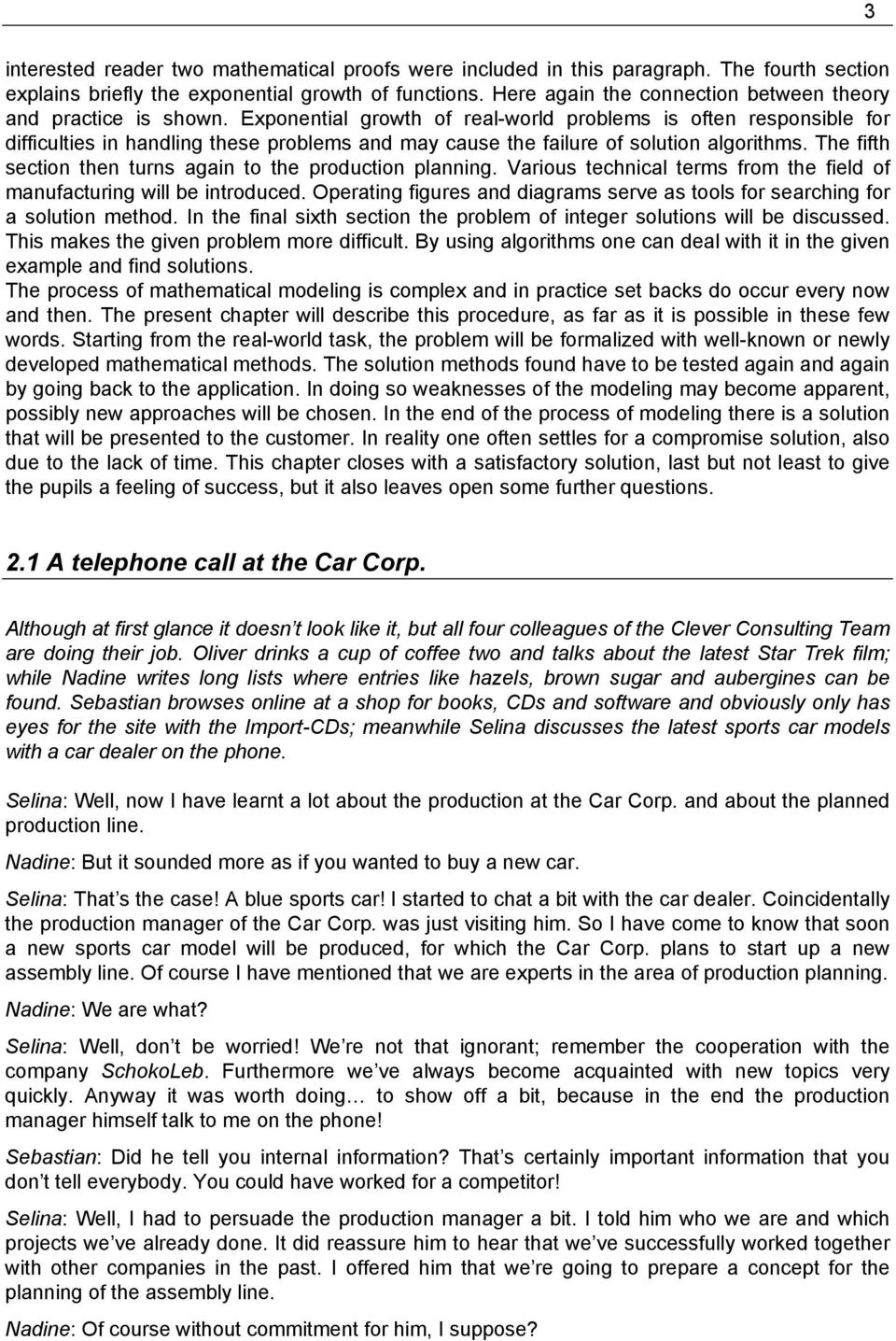
4 4 Selia: There was o other way to covice him. But this is a big chace. If the Car Corp. is satisfied with our work, they ll surely let us do further projects, ad you caot image all the thigs that have to be plaed! Oliver: Now tell us somethig about the ew assembly lie! Selia tells her colleagues i detail about the telephoe call with Mister Wieder, the productio maager of the Car Corp.. The compay plas to start up a ew moder assembly lie. A ew sports car model will be produced. The productio of a car is divided ito eleve stages, so-called jobs. The Car Corp. kows how log the sigle jobs take o the machies. This time spa is called the processig time of the job. All jobs are processed alog a assembly lie, this meas that alog the assembly lie there are statios where the jobs are executed. Nadie: I see, so for the eleve jobs there are also eleve statios i the assembly lie. Selia: No, it is t that easy. Some of the jobs take log, others are very short. The assembly lie has to stop at every statio ad ca t move o before all statios have fiished their work. The egieers vo Car Corp. call this the die cycle time of the assembly lie. Here we will leave the discussio at Clever Cosultig ad have a closer look at what was discussed. There are eleve jobs that have to be processed cosecutively: Figure 2. Eleve jobs are ecessary for the productio of the sports car. The legth of the blocks shows the processig time of the jobs If there is build oe statio i the assembly lie for each job, the eleve sports cars could be (o/)i (auf) the assembly lie at the same time, oe at each statio. The assembly lie stops at the statios ad moves o whe all statios have completed their work. This would mea that the cycle time would be as log as the processig time of the logest job. Selia has realized right away that this is ot a very good idea. Some of the jobs are very short, e.g. job 3. I the associated statio the work would be completed much faster tha at job 8. Thus the statio would ot be workig at high capacity, the worker i/at this statio would have a log idle time betwee two productio/workig processes. The maagemet of course does ot like it at all. O the oe had the worker ad the machie cost a lot of moey, both should ot be idle. O the other had it would also be very ufair if the worker i/at statio 3 has a rest all the time, while umber 8 has to work o-stop. It is easy to uderstad that this is ot a good solutio. But what ca be doe to overcome this? Ofte the obvious solutio is also the best: Statios that are workig at low capacity are simply used for further jobs. The aim is that the work is shared equitably by the statios.
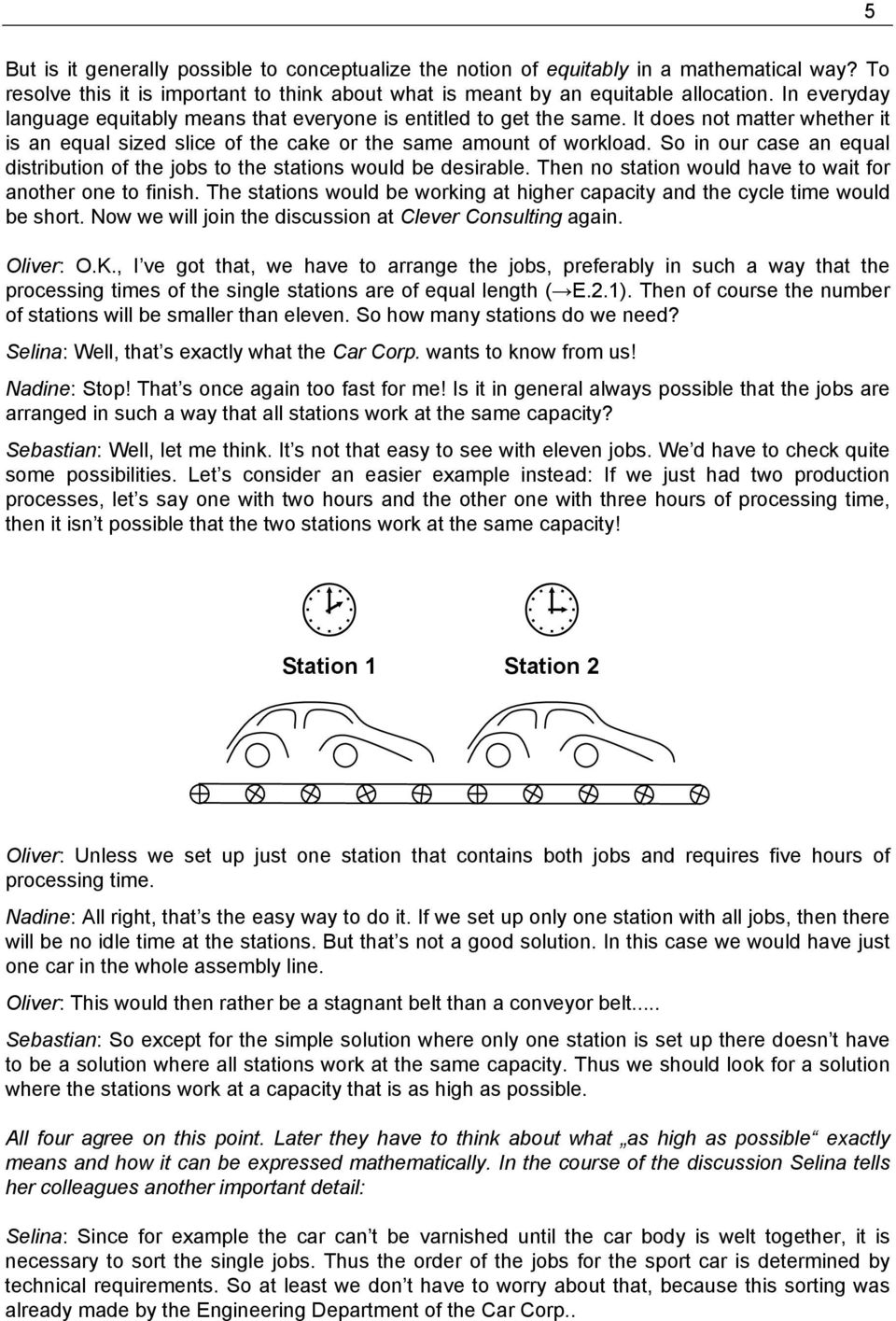
5 5 But is it geerally possible to coceptualize the otio of equitably i a mathematical way? To resolve this it is importat to thik about what is meat by a equitable allocatio. I everyday laguage equitably meas that everyoe is etitled to get the same. It does ot matter whether it is a equal sized slice of the cake or the same amout of workload. So i our case a equal distributio of the jobs to the statios would be desirable. The o statio would have to wait for aother oe to fiish. The statios would be workig at higher capacity ad the cycle time would be short. Now we will joi the discussio at Clever Cosultig agai. Oliver: O.K., I ve got that, we have to arrage the jobs, preferably i such a way that the processig times of the sigle statios are of equal legth ( E.2.). The of course the umber of statios will be smaller tha eleve. So how may statios do we eed? Selia: Well, that s exactly what the Car Corp. wats to kow from us! Nadie: Stop! That s oce agai too fast for me! Is it i geeral always possible that the jobs are arraged i such a way that all statios work at the same capacity? Sebastia: Well, let me thik. It s ot that easy to see with eleve jobs. We d have to check quite some possibilities. Let s cosider a easier example istead: If we just had two productio processes, let s say oe with two hours ad the other oe with three hours of processig time, the it is t possible that the two statios work at the same capacity! Statio Statio 2 Oliver: Uless we set up just oe statio that cotais both jobs ad requires five hours of processig time. Nadie: All right, that s the easy way to do it. If we set up oly oe statio with all jobs, the there will be o idle time at the statios. But that s ot a good solutio. I this case we would have just oe car i the whole assembly lie. Oliver: This would the rather be a stagat belt tha a coveyor belt... Sebastia: So except for the simple solutio where oly oe statio is set up there does t have to be a solutio where all statios work at the same capacity. Thus we should look for a solutio where the statios work at a capacity that is as high as possible. All four agree o this poit. Later they have to thik about what as high as possible exactly meas ad how it ca be expressed mathematically. I the course of the discussio Selia tells her colleagues aother importat detail: Selia: Sice for example the car ca t be varished util the car body is welt together, it is ecessary to sort the sigle jobs. Thus the order of the jobs for the sport car is determied by techical requiremets. So at least we do t have to worry about that, because this sortig was already made by the Egieerig Departmet of the Car Corp..
6 6 Oliver: Do t these requiremets make it much more difficult for us? After all we have to be very careful i our plaig that that we do t chage this order. Sebastia: No, far from it! It will be easier for us, sice if the productio sequece was t specified, we would have to aalyze all possible orders fid to the best oe. The there would be may more cases that we have to aalyze. So we should be happy about it ( E.2.2). Exercises E.2. Arrage the followig processig times i two differet ways by keepig the order, such that all statios work at the same capacity: 3, 4, 5, 2, 7, 5,,. Please ote: Whe you have foud a solutio, you should have a close look at it. E.2.2 Arrage the followig processig times i at least two differet ways, such that all statios work at the same capacity. The umber of statios ca be chose arbitrarily. I cotrast to exercise E.2. the order of the jobs may be chaged. Processig times:,, 2, 2, 3, 3, 4, How much is much? Oliver: So how may possibilities of arragemets do exist? Let s assume that it s a maageable amout, the we could write a computer program that goes through all possibilities ad returs the best solutio as output. Selia: Oh o, we ow have to write dow all possibilities ad cout? Cout me out! Nadie: No, of course ot. It must somehow be possible to work it out logically. Ad if we do it this way, we oly kow the solutio to our problem with eleve jobs. It would be ice if we could calculate a solutio for ay possible umber of jobs, this meas depedig o a umber that represets the umber of jobs. Oliver: I thik the best is to sketch the jobs. Whe we have the problem o paper, it s easier to come up with a idea how to solve it. Nadie: All right, here s some scribblig paper! Here you go! Nadie: Whe we ow do a divisio ito statios, the order has to remai uchaged, right? Sebastia: That s it. Nadie: Good, i.e. we ca build statios here o the paper by drawig lies betwee the jobs. That s quick ad we do t have to write dow the umbers over ad over agai. I ca build for example three statios by drawig two lies:
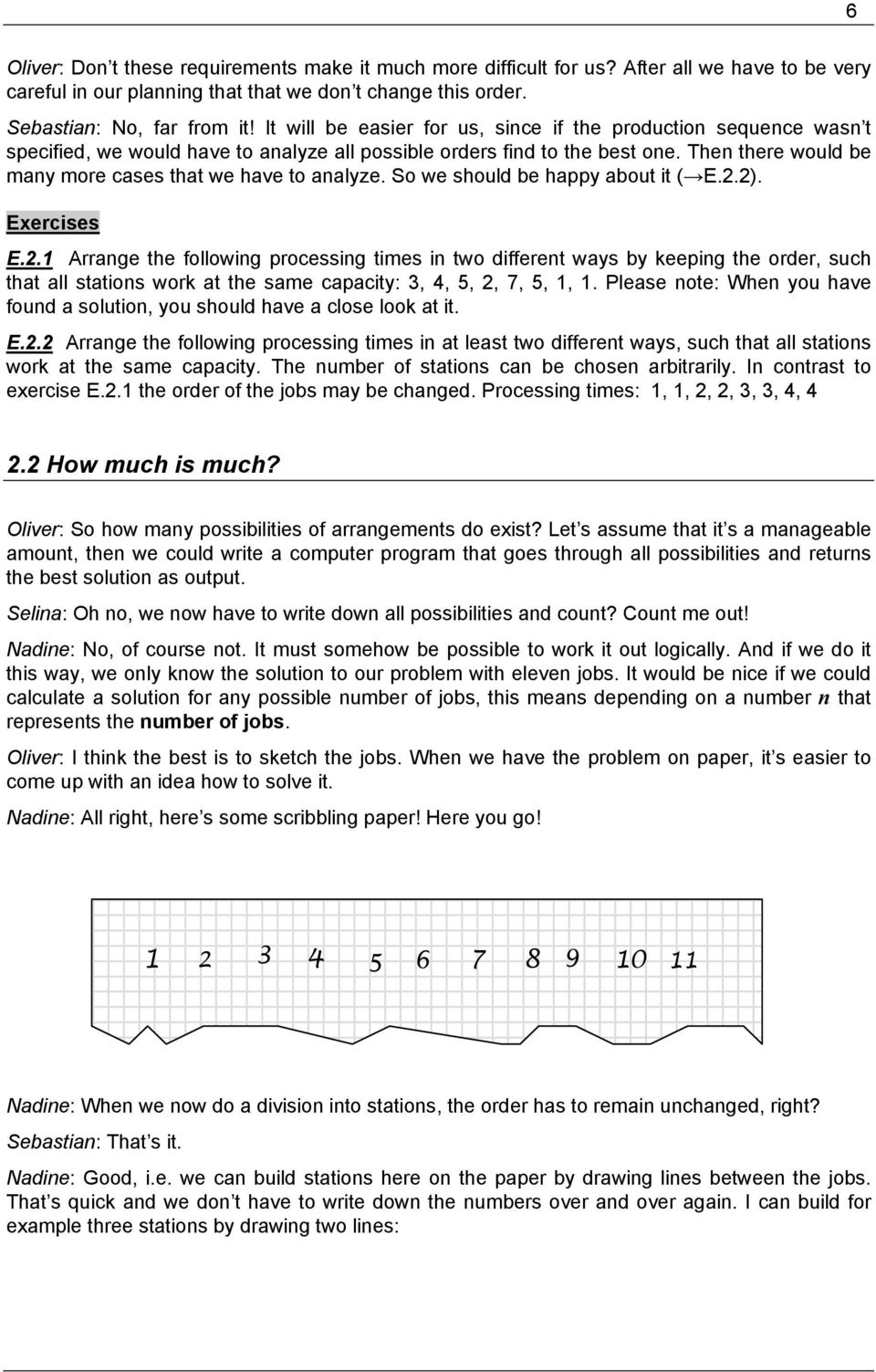
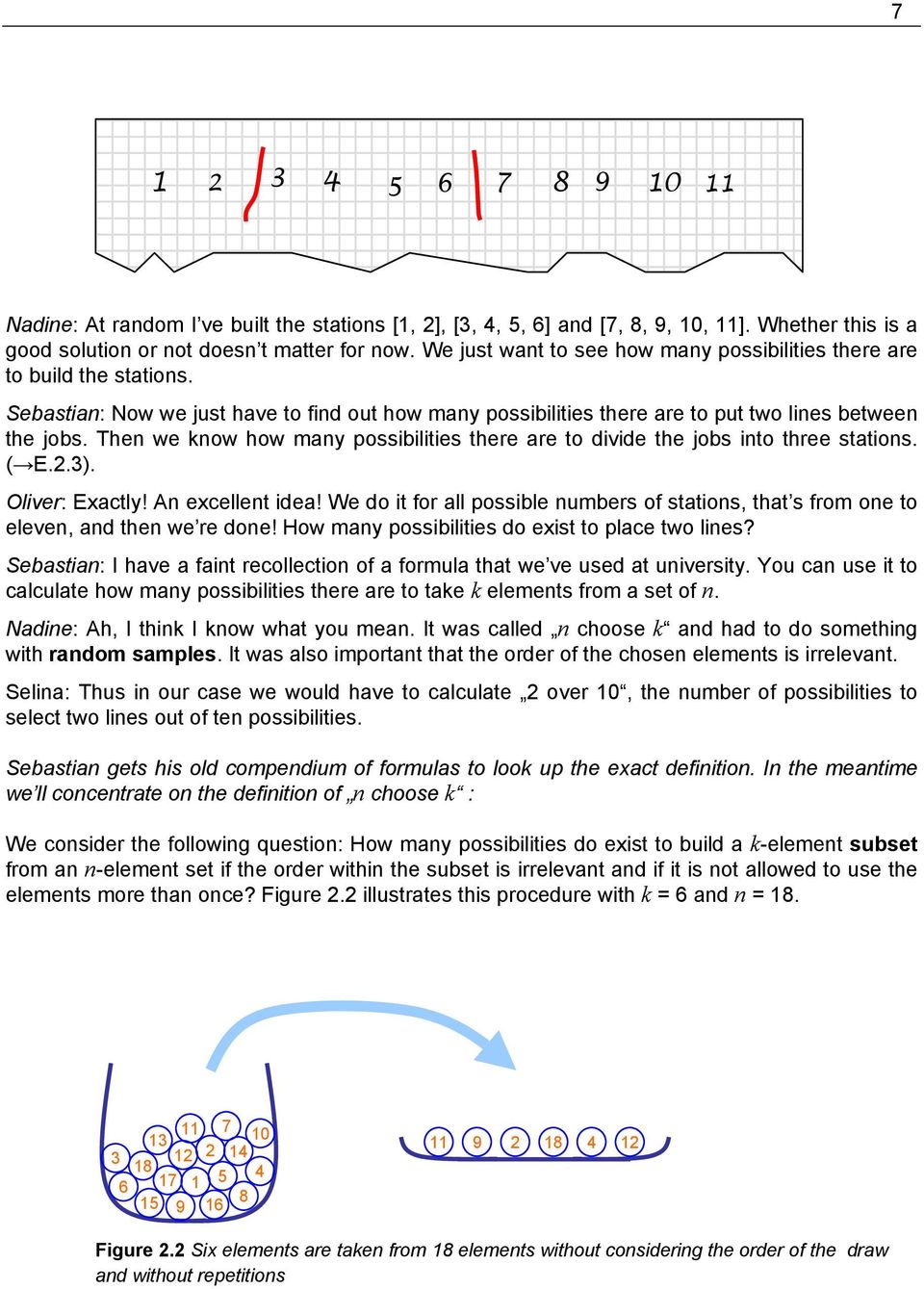
7 Nadie: At radom I ve built the statios [, 2], [3, 4, 5, 6] ad [7, 8, 9, 0, ]. Whether this is a good solutio or ot does t matter for ow. We just wat to see how may possibilities there are to build the statios. Sebastia: Now we just have to fid out how may possibilities there are to put two lies betwee the jobs. The we kow how may possibilities there are to divide the jobs ito three statios. ( E.2.3). Oliver: Exactly! A excellet idea! We do it for all possible umbers of statios, that s from oe to eleve, ad the we re doe! How may possibilities do exist to place two lies? Sebastia: I have a fait recollectio of a formula that we ve used at uiversity. You ca use it to calculate how may possibilities there are to take k elemets from a set of. Nadie: Ah, I thik I kow what you mea. It was called choose k ad had to do somethig with radom samples. It was also importat that the order of the chose elemets is irrelevat. Selia: Thus i our case we would have to calculate 2 over 0, the umber of possibilities to select two lies out of te possibilities. Sebastia gets his old compedium of formulas to look up the exact defiitio. I the meatime we ll cocetrate o the defiitio of choose k : We cosider the followig questio: How may possibilities do exist to build a k-elemet subset from a -elemet set if the order withi the subset is irrelevat ad if it is ot allowed to use the elemets more tha oce? Figure 2.2 illustrates this procedure with k = 6 ad = Figure 2.2 Six elemets are take from 8 elemets without cosiderig the order of the draw ad without repetitios
8 8 Disordered samples without replacemet The umber of possibilities to draw a disordered sample of k elemets from elemets without replacemet is: ( ) ( ) ( ) ( ) ( ) ( ) 2 2! = =. k k k 2 2 k k 2 k! ( k)! k reads as choose k. This term is a commo abbreviatio for the k formula show above. This value is also called Biomial coefficiet. What do the exclamatio marks i the biomial coefficiet mea?!, factorial of, is a commo abbreviatio for the product of the umbers from to. Thus it holds:! = 2 3 ( 2) ( ). It reads as factorial. The otio of factorial i oly defied for oegative atural umbers. For = 0 it holds: 0! =. For oe does ot hurt oe s figers from typig to calculate the factorial especially for large, may calculators have this fuctio as a feature. Why is the biomial coefficiet defied i such a way? First we wat to fid out how may possibilities there are to draw k elemets from elemets if the order of the draw is importat. Thus we aalyze the umber of ordered samples. This meas that e.g. the combiatios, 2, 3 ad 2, 3, are distiguishable ad have to be couted separately. For the first draw there exist possibilities, sice each of the elemets ca be draw. For the secod draw elemets are still available. So there are - possibilities. With each further draw the umber of available elemets ad thus the umber of possibilities is reduced by oe. For the k th draw there is still a choice of k + possibilities. The umber of possibilities that ca occur with k moves? results from the multiplicatio of the umber of possibilities for the sigle moves?. This meas that the umber of possibilities to select k from elemets with cosiderig the order is ( ) ( 2) ( ) k + k +.

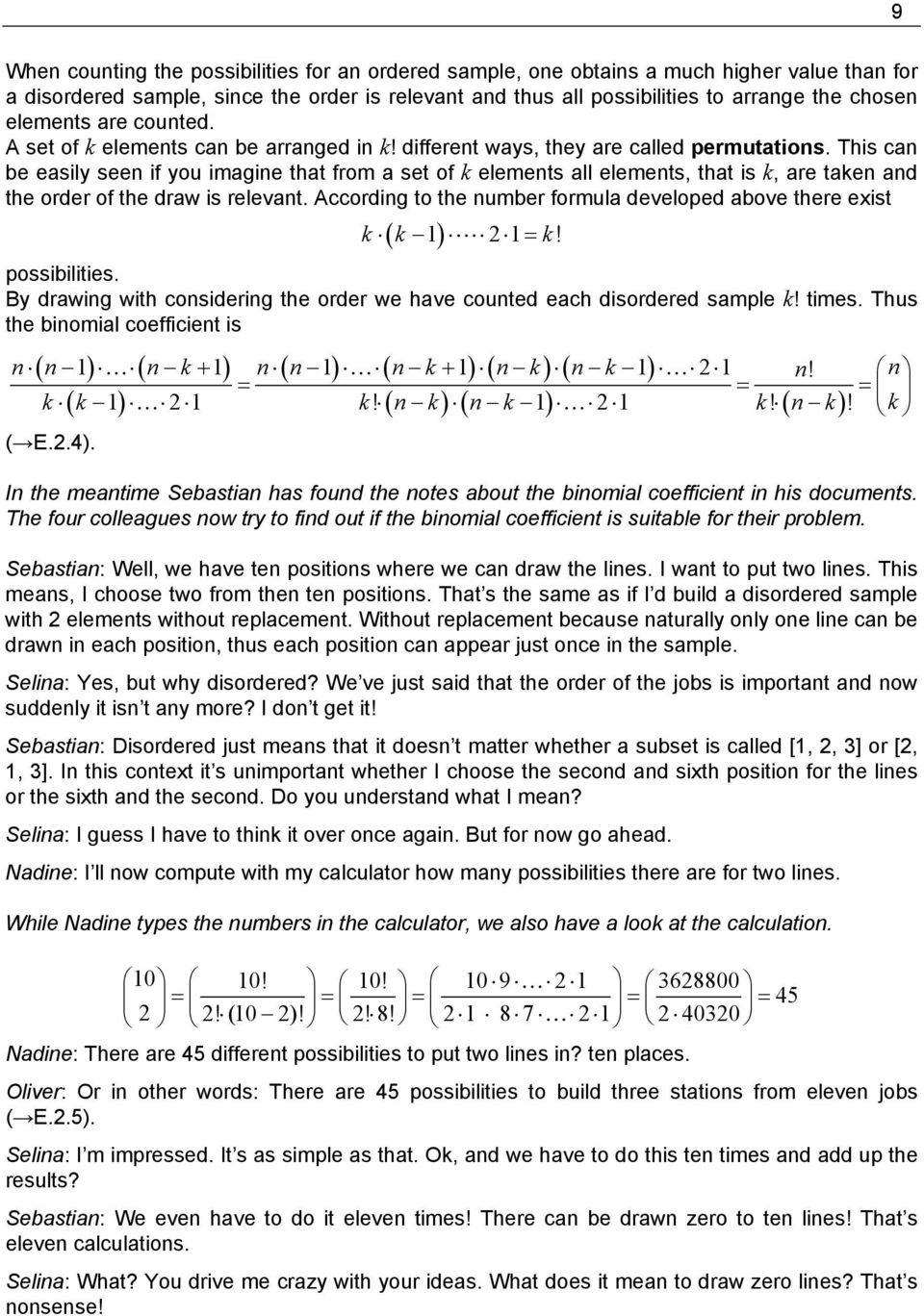
9 9 Whe coutig the possibilities for a ordered sample, oe obtais a much higher value tha for a disordered sample, sice the order is relevat ad thus all possibilities to arrage the chose elemets are couted. A set of k elemets ca be arraged i k! differet ways, they are called permutatios. This ca be easily see if you imagie that from a set of k elemets all elemets, that is k, are take ad the order of the draw is relevat. Accordig to the umber formula developed above there exist ( ) k k 2 = k! possibilities. By drawig with cosiderig the order we have couted each disordered sample k! times. Thus the biomial coefficiet is ( ) ( ) ( ) ( ) ( ) ( ) ( ) ( ) ( ) ( ) k + k + k k 2! = = = k k 2 k! k k 2 k! k! k ( E.2.4). I the meatime Sebastia has foud the otes about the biomial coefficiet i his documets. The four colleagues ow try to fid out if the biomial coefficiet is suitable for their problem. Sebastia: Well, we have te positios where we ca draw the lies. I wat to put two lies. This meas, I choose two from the te positios. That s the same as if I d build a disordered sample with 2 elemets without replacemet. Without replacemet because aturally oly oe lie ca be draw i each positio, thus each positio ca appear just oce i the sample. Selia: Yes, but why disordered? We ve just said that the order of the jobs is importat ad ow suddely it is t ay more? I do t get it! Sebastia: Disordered just meas that it does t matter whether a subset is called [, 2, 3] or [2,, 3]. I this cotext it s uimportat whether I choose the secod ad sixth positio for the lies or the sixth ad the secod. Do you uderstad what I mea? Selia: I guess I have to thik it over oce agai. But for ow go ahead. Nadie: I ll ow compute with my calculator how may possibilities there are for two lies. While Nadie types the umbers i the calculator, we also have a look at the calculatio. 0 0! 0! = = 45 2 = = = 2! (0 2)! 2! 8! Nadie: There are 45 differet possibilities to put two lies i? te places. Oliver: Or i other words: There are 45 possibilities to build three statios from eleve jobs ( E.2.5). Selia: I m impressed. It s as simple as that. Ok, ad we have to do this te times ad add up the results? Sebastia: We eve have to do it eleve times! There ca be draw zero to te lies! That s eleve calculatios. Selia: What? You drive me crazy with your ideas. What does it mea to draw zero lies? That s osese!
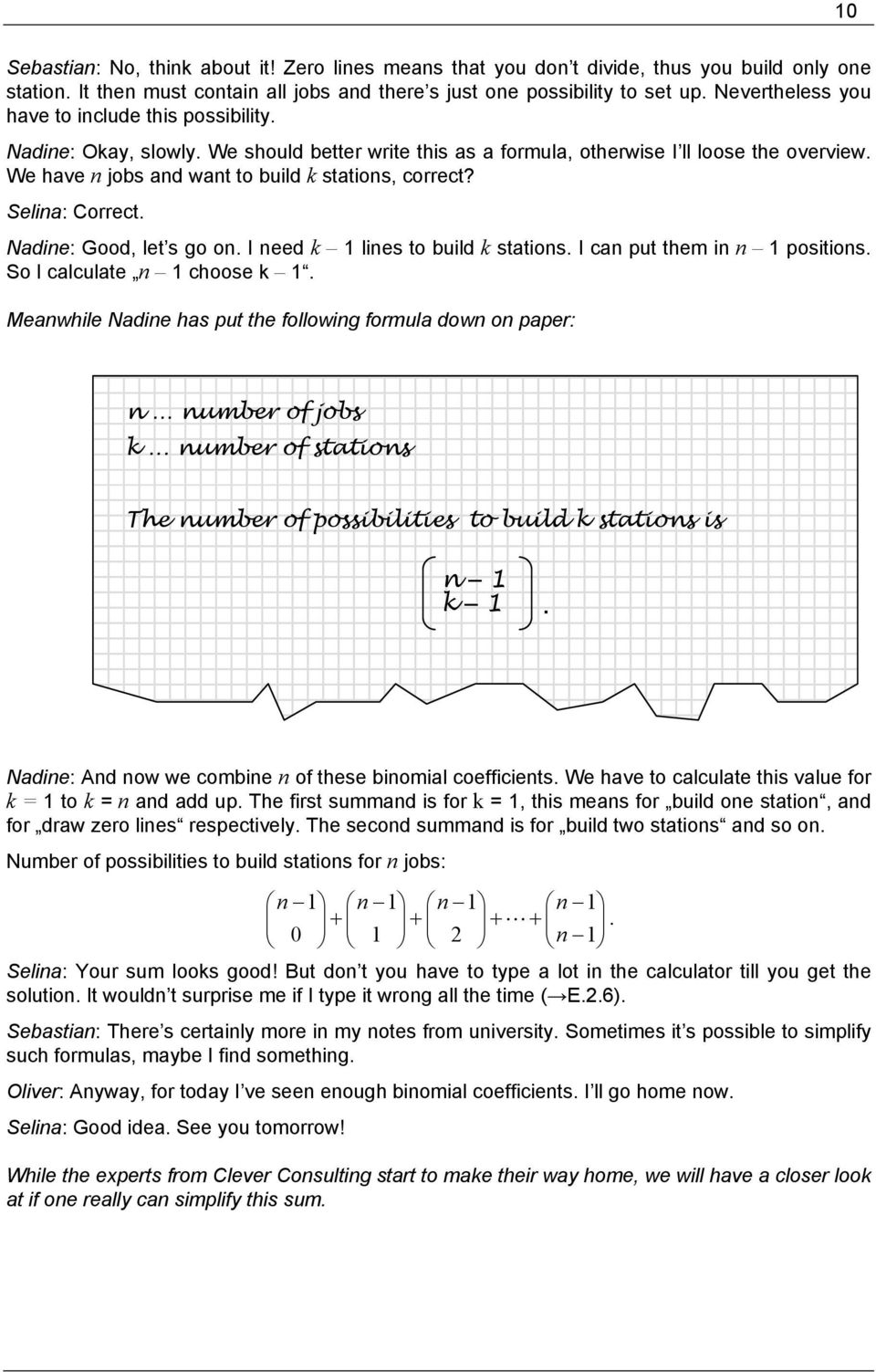
10 0 Sebastia: No, thik about it! Zero lies meas that you do t divide, thus you build oly oe statio. It the must cotai all jobs ad there s just oe possibility to set up. Nevertheless you have to iclude this possibility. Nadie: Okay, slowly. We should better write this as a formula, otherwise I ll loose the overview. We have jobs ad wat to build k statios, correct? Selia: Correct. Nadie: Good, let s go o. I eed k lies to build k statios. I ca put them i positios. So I calculate choose k. Meawhile Nadie has put the followig formula dow o paper:... umber of jobs k... umber of statios The umber of possibilities to build k statios is k. Nadie: Ad ow we combie of these biomial coefficiets. We have to calculate this value for k = to k = ad add up. The first summad is for k =, this meas for build oe statio, ad for draw zero lies respectively. The secod summad is for build two statios ad so o. Number of possibilities to build statios for jobs: Selia: Your sum looks good! But do t you have to type a lot i the calculator till you get the solutio. It would t surprise me if I type it wrog all the time ( E.2.6). Sebastia: There s certaily more i my otes from uiversity. Sometimes it s possible to simplify such formulas, maybe I fid somethig. Oliver: Ayway, for today I ve see eough biomial coefficiets. I ll go home ow. Selia: Good idea. See you tomorrow! While the experts from Clever Cosultig start to make their way home, we will have a closer look at if oe really ca simplify this sum.
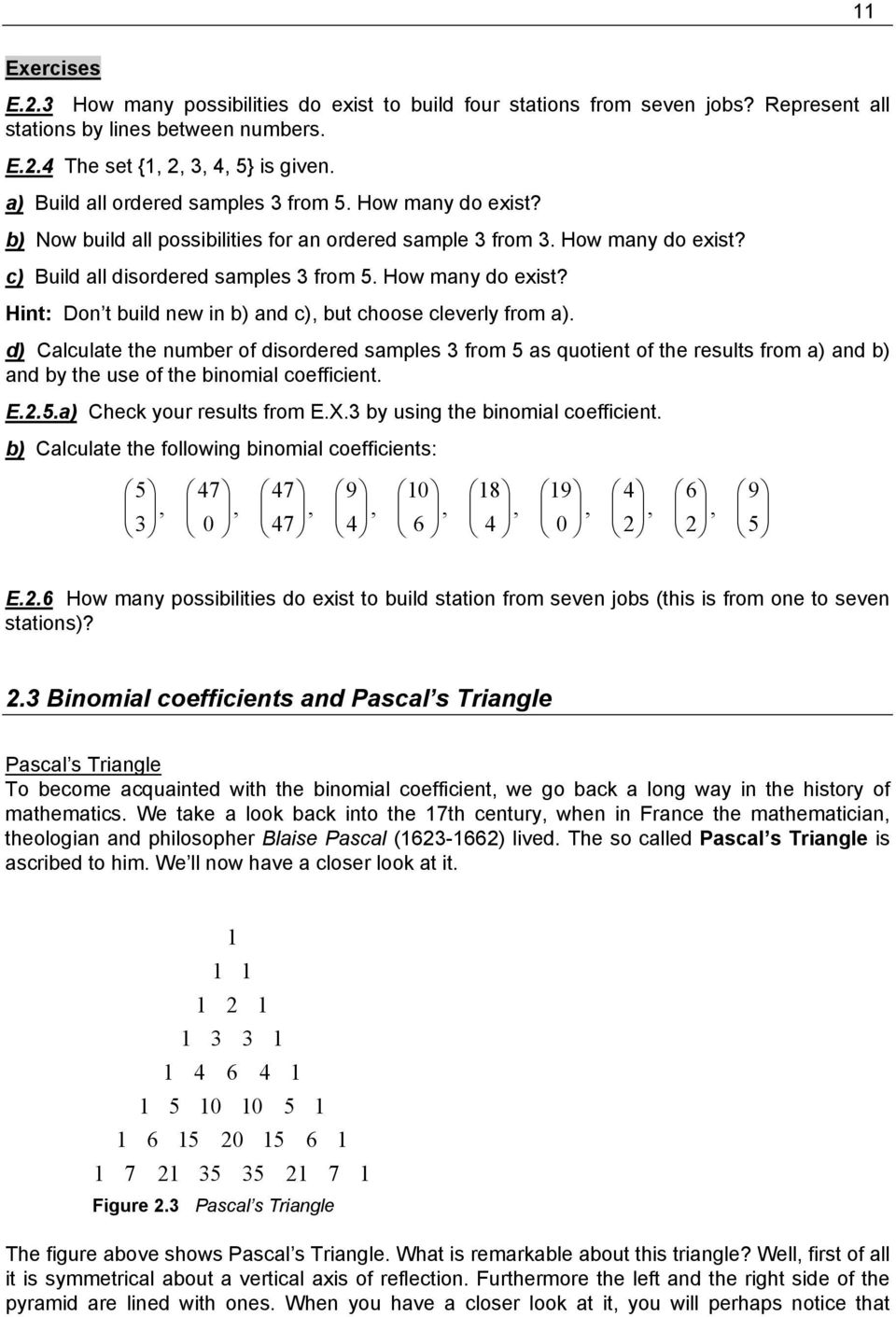
11 Exercises E.2.3 How may possibilities do exist to build four statios from seve jobs? Represet all statios by lies betwee umbers. E.2.4 The set {, 2, 3, 4, 5} is give. a) Build all ordered samples 3 from 5. How may do exist? b) Now build all possibilities for a ordered sample 3 from 3. How may do exist? c) Build all disordered samples 3 from 5. How may do exist? Hit: Do t build ew i b) ad c), but choose cleverly from a). d) Calculate the umber of disordered samples 3 from 5 as quotiet of the results from a) ad b) ad by the use of the biomial coefficiet. E.2.5.a) Check your results from E.X.3 by usig the biomial coefficiet. b) Calculate the followig biomial coefficiets: ,,,,,,,,, E.2.6 How may possibilities do exist to build statio from seve jobs (this is from oe to seve statios)? 2.3 Biomial coefficiets ad Pascal s Triagle Pascal s Triagle To become acquaited with the biomial coefficiet, we go back a log way i the history of mathematics. We take a look back ito the 7th cetury, whe i Frace the mathematicia, theologia ad philosopher Blaise Pascal ( ) lived. The so called Pascal s Triagle is ascribed to him. We ll ow have a closer look at it Figure 2.3 Pascal s Triagle The figure above shows Pascal s Triagle. What is remarkable about this triagle? Well, first of all it is symmetrical about a vertical axis of reflectio. Furthermore the left ad the right side of the pyramid are lied with oes. Whe you have a closer look at it, you will perhaps otice that
12 2 directly below the oes, alog the sides, the sequece of atural umbers shows up, this is, 2, 3, 4,.... How ca you build this triagle ad what is there to it? Pascal s Triagle is i fact geerated by usig a calculatio rule ad you ca exted it by arbitrarily may umbers. The calculatio rule is: Each etry i the triagle comes from the sum of the etries that are i the previous row diagoally above the etry. To illustrate this, the calculatio rule is show i a example ad is the preseted as a mathematical otatio = 3+ 3 Figure 2.4 Example of the calculatio rule for Pascal s Triagle Furthermore it must be poited out that the umberig of the rows ad row elemets i Pascal s Triagle all begi with zero. As you ca see, the secod elemet of the fourth row comes from addig the two elemets that are writte directly above. For the calculatio of the zeroth ad the last elemet of each row you imagie that there is a zero i the empty place above. So the first mystery is already solved: at the sides of the triagle oly oes ca occur, because for these elemets it always results i: + 0 = ( E.2.7) Figure 2.5 Calculatio of the side elemets i Pascal s Triagle As aouced, here is the mathematical otatio of the calculatio rule: Calculatio rule for the geeratio of Pascal s Triagle Let d k be the k th elemet i the th row of the triagle. The it holds: d = d + d d k, k, k 00 0 = d = ; d = for all. ( E.2.8) The secod costrait of this formulatio is eeded to iitialize the triagle, i.e. to eable the triagle to start. Equally the two costraits i the third row are required for the iitializatio of the sigle rows. These three coditios are ecessary, because otherwise the

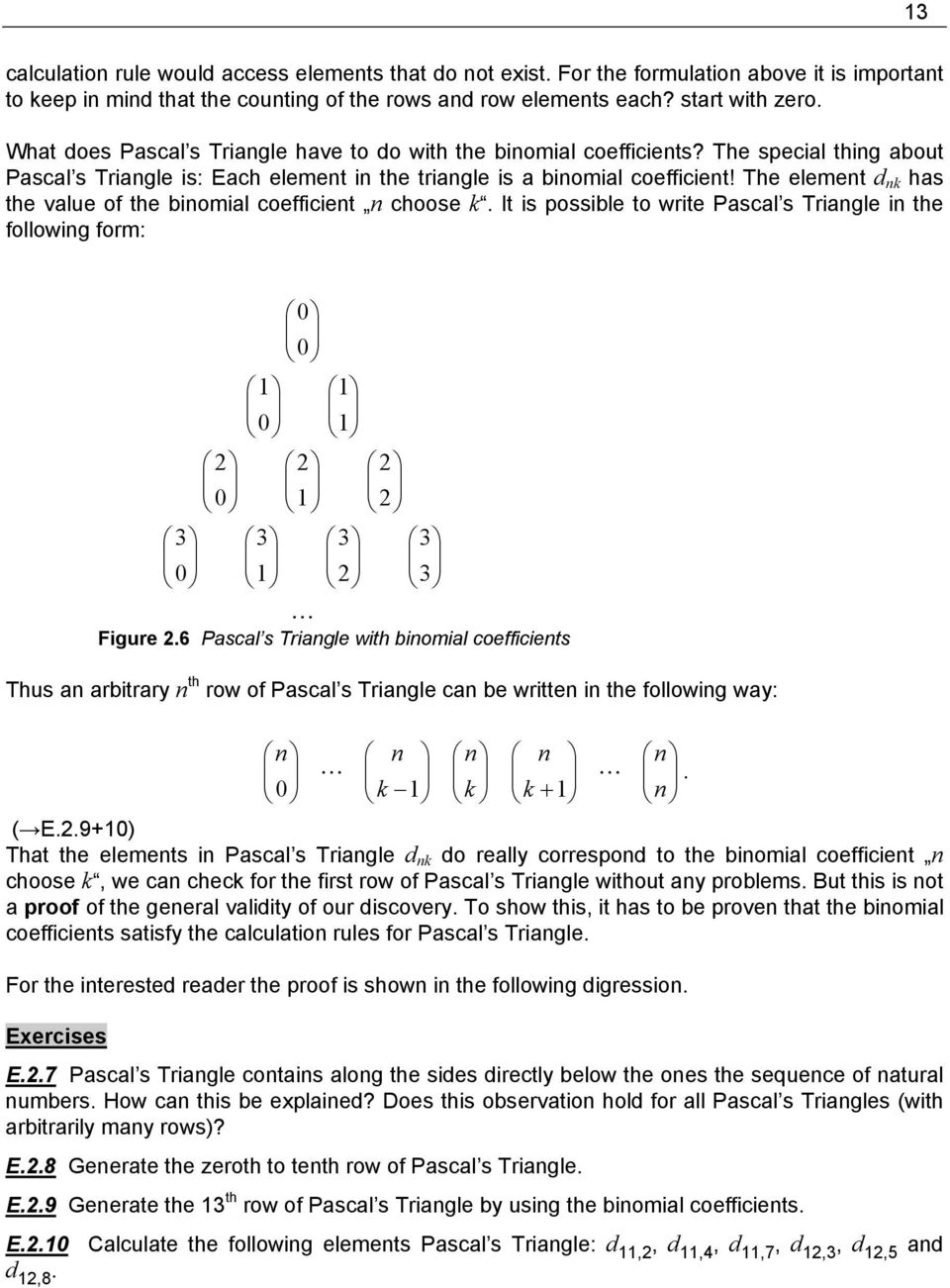
13 3 calculatio rule would access elemets that do ot exist. For the formulatio above it is importat to keep i mid that the coutig of the rows ad row elemets each? start with zero. What does Pascal s Triagle have to do with the biomial coefficiets? The special thig about Pascal s Triagle is: Each elemet i the triagle is a biomial coefficiet! The elemet d k has the value of the biomial coefficiet choose k. It is possible to write Pascal s Triagle i the followig form: Figure 2.6 Pascal s Triagle with biomial coefficiets Thus a arbitrary th row of Pascal s Triagle ca be writte i the followig way:. 0 k k k + ( E.2.9+0) That the elemets i Pascal s Triagle d k do really correspod to the biomial coefficiet choose k, we ca check for the first row of Pascal s Triagle without ay problems. But this is ot a proof of the geeral validity of our discovery. To show this, it has to be prove that the biomial coefficiets satisfy the calculatio rules for Pascal s Triagle. For the iterested reader the proof is show i the followig digressio. Exercises E.2.7 Pascal s Triagle cotais alog the sides directly below the oes the sequece of atural umbers. How ca this be explaied? Does this observatio hold for all Pascal s Triagles (with arbitrarily may rows)? E.2.8 Geerate the zeroth to teth row of Pascal s Triagle. E.2.9 Geerate the 3 th row of Pascal s Triagle by usig the biomial coefficiets. E.2.0 Calculate the followig elemets Pascal s Triagle: d,2, d,4, d,7, d 2,3, d 2,5 ad d 2,8.
14 4 Proof*: Biomial coefficiets geerate Pascal s Triagle We wat to show that the calculatio rule for Pascal s Triagle geerates biomial coefficiets choose k. Or i other words, that the biomial coefficiets satisfy the calculatio rule for Pascal s Triagle. First of all we repeat the calculatio rule for Pascal s Triagle. d = d + d d k, k, k 00 0 ( ) ( ) ( ) = 2 d = ; d = for all 3 Let us start with the easiest rule, amely with (2). That this is satisfied by the biomial coefficiet, we show by pluggig i the values. 0 0! 0 = = = d 0 0! (0 0)! 0 = Now for rule (3): We have to show that choose 0 ad choose are both oe for ay arbitrary :!!! = = = = for all d0 0 0! ( 0 )!!! 0 =,!!!! = = = = = for all d! ( )!! 0!!! =. Agai we were very successful by pluggig i the values ad calculatig the biomial coefficiets. A bit more arithmetic is eeded to check coditio (). We have to show that the followig equatio holds: or i detail: ( ) = + k k k ( ) ( ) (( ) ( )) 00 ( ) (( ) )!!! = +. k! k! k! k! k! k! We start with the right-had side of the equatio ad try to obtai the left-had side by trasformatios. + = k k (! ) (! ) + = ( k! ) ( ( ) ( k ))! ( k)! ( ( ) k)! ( ) ( 2) ( k + ) ( k) ( k ) ( ) ( 2) ( k ) ( k ) + ( k! ) ( k) ( k ) 2 k! ( k ) 2 2 2
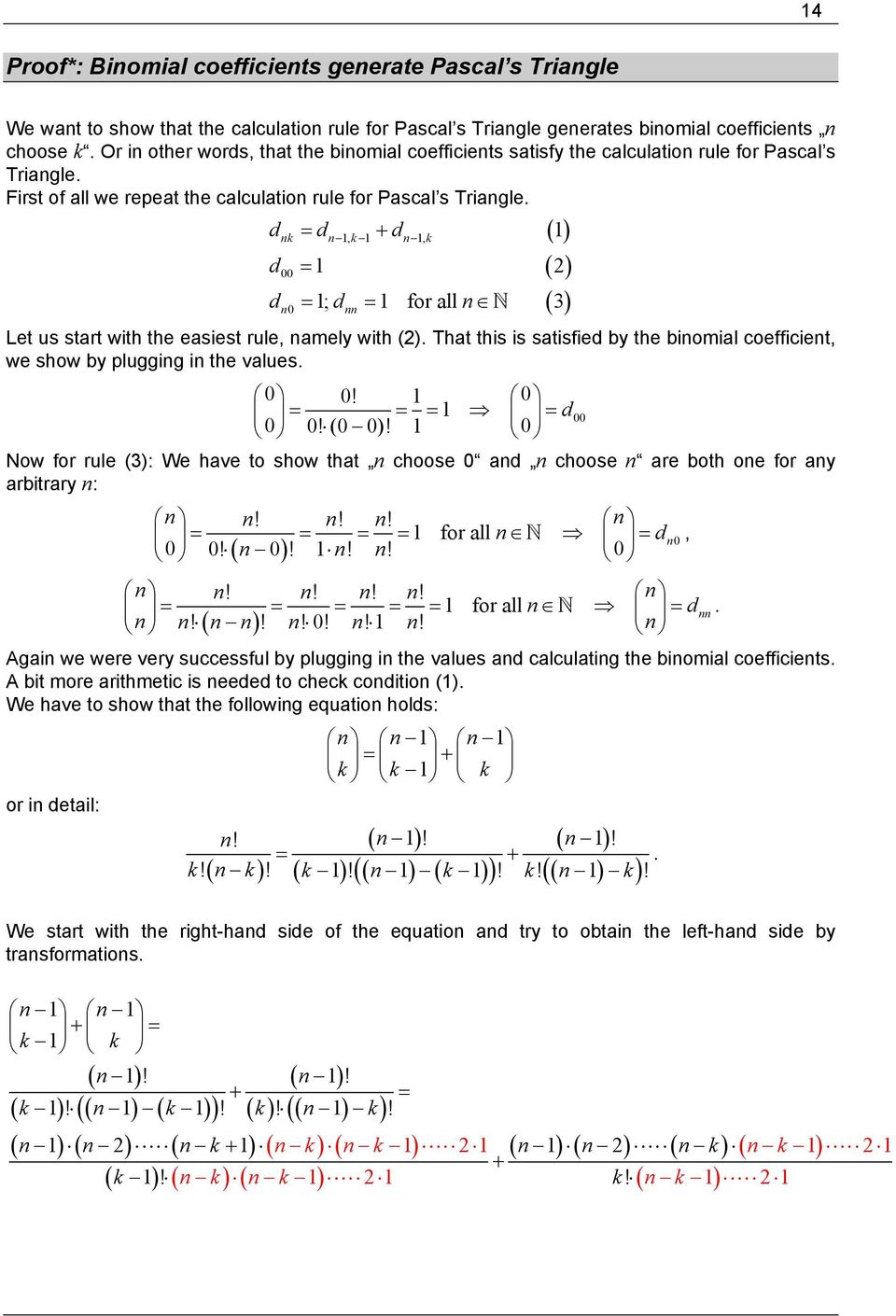
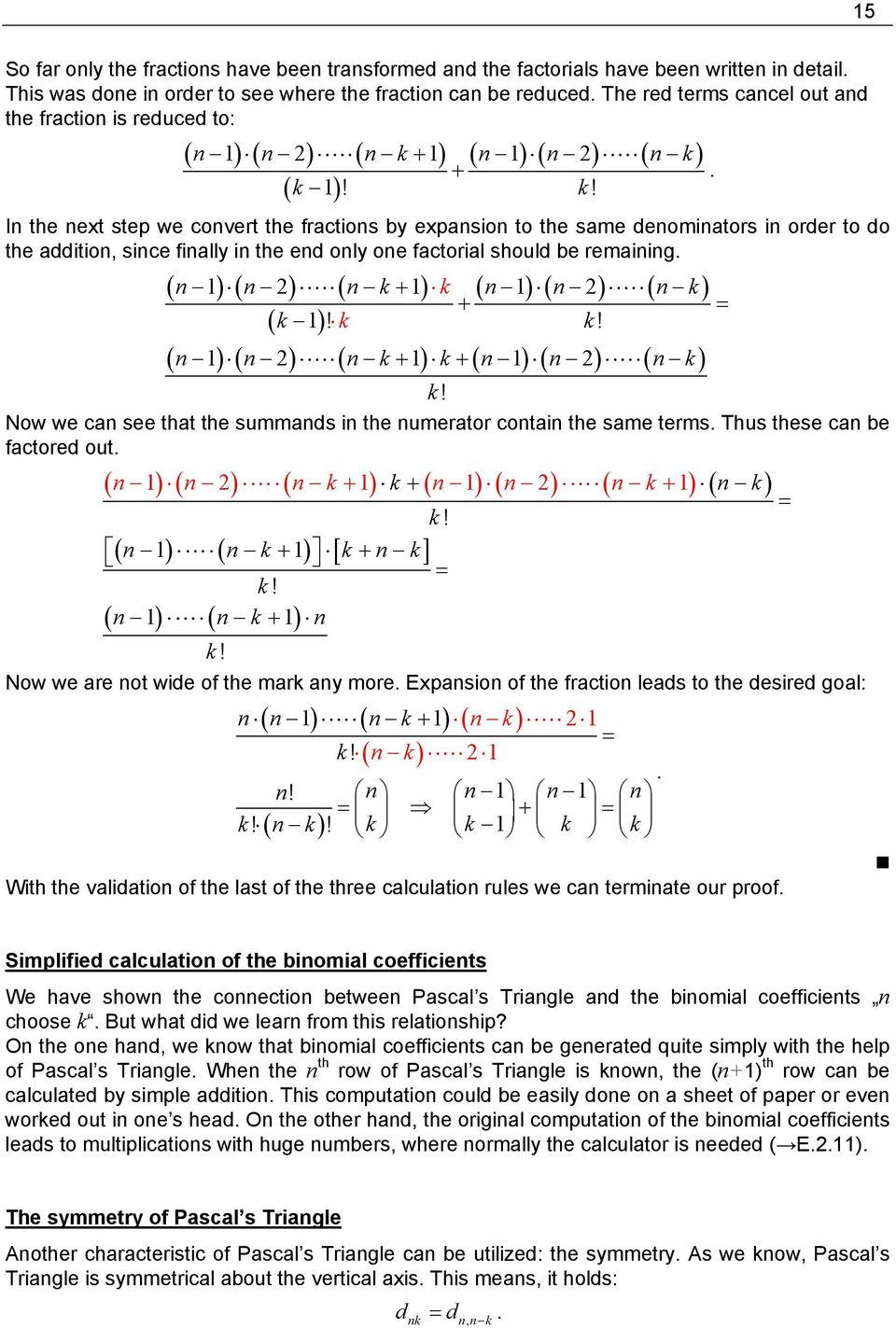
15 5 So far oly the fractios have bee trasformed ad the factorials have bee writte i detail. This was doe i order to see where the fractio ca be reduced. The red terms cacel out ad the fractio is reduced to: ( ) ( ) ( ) ( k ) ( ) ( ) ( ) 2 k + 2 k +.! k! I the ext step we covert the fractios by expasio to the same deomiators i order to do the additio, sice fially i the ed oly oe factorial should be remaiig. ( ) ( 2) ( k + ) k ( ) ( 2) ( k) ( k )!k k! ( ) ( 2) ( k + ) k + ( ) ( 2) ( k ) k! + = Now we ca see that the summads i the umerator cotai the same terms. Thus these ca be factored out. ( ) ( 2) ( k + ) k + ( ) ( 2) ( k + ) ( k) ( ) ( k ) [ k k] + + k! k ( ) ( + ) k! k! = Now we are ot wide of the mark ay more. Expasio of the fractio leads to the desired goal: ( ) ( ) k! ( k) ( k) k + 2 = 2.! = + = k! ( k)! k k k k With the validatio of the last of the three calculatio rules we ca termiate our proof. = Simplified calculatio of the biomial coefficiets We have show the coectio betwee Pascal s Triagle ad the biomial coefficiets choose k. But what did we lear from this relatioship? O the oe had, we kow that biomial coefficiets ca be geerated quite simply with the help of Pascal s Triagle. Whe the th row of Pascal s Triagle is kow, the (+) th row ca be calculated by simple additio. This computatio could be easily doe o a sheet of paper or eve worked out i oe s head. O the other had, the origial computatio of the biomial coefficiets leads to multiplicatios with huge umbers, where ormally the calculator is eeded ( E.2.). The symmetry of Pascal s Triagle Aother characteristic of Pascal s Triagle ca be utilized: the symmetry. As we kow, Pascal s Triagle is symmetrical about the vertical axis. This meas, it holds: dk d, k =.
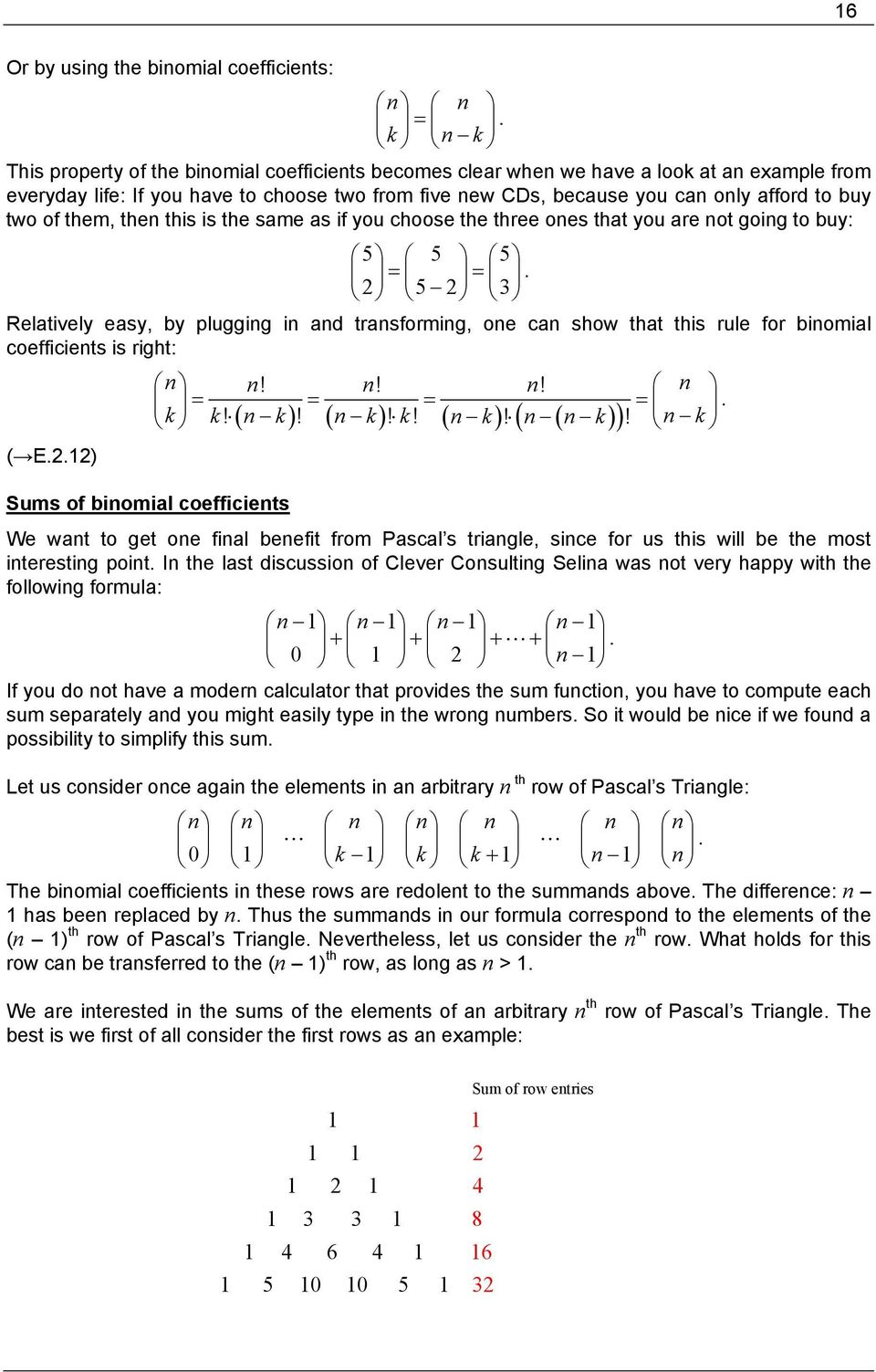
16 6 Or by usig the biomial coefficiets: = k k. This property of the biomial coefficiets becomes clear whe we have a look at a example from everyday life: If you have to choose two from five ew CDs, because you ca oly afford to buy two of them, the this is the same as if you choose the three oes that you are ot goig to buy: = = Relatively easy, by pluggig i ad trasformig, oe ca show that this rule for biomial coefficiets is right: ( E.2.2) Sums of biomial coefficiets!!! = = = =. k k! k! k! k! k! k! k ( ) ( ) ( ) ( ( )) We wat to get oe fial beefit from Pascal s triagle, sice for us this will be the most iterestig poit. I the last discussio of Clever Cosultig Selia was ot very happy with the followig formula: If you do ot have a moder calculator that provides the sum fuctio, you have to compute each sum separately ad you might easily type i the wrog umbers. So it would be ice if we foud a possibility to simplify this sum. Let us cosider oce agai the elemets i a arbitrary th row of Pascal s Triagle:. 0 k k k + The biomial coefficiets i these rows are redolet to the summads above. The differece: has bee replaced by. Thus the summads i our formula correspod to the elemets of the ( ) th row of Pascal s Triagle. Nevertheless, let us cosider the th row. What holds for this row ca be trasferred to the ( ) th row, as log as >. We are iterested i the sums of the elemets of a arbitrary th row of Pascal s Triagle. The best is we first of all cosider the first rows as a example: Sum of row etries
17 7 Somethig is remarkable here: The sum of the etries i the rows is doubled from row to row! Ca we already derive a geeral rule from this observatio? No, sice the observatio could hold for the cosidered example oly, we have to prove the property for the geeral case. So let us thik about what the reaso for the doublig of the sums of the rows might be ad have a closer look at the geeratio of Pascal s triagle. I the followig row = 4 is geerated from row = 3: = = = 3 + Oe ca see that each etry from the upper row appears exactly twice as summad (ad as separate etry at the sides respectively). This behavior ca be recostructed for arbitrary rows. Sice each etry from the previous row appears twice i the followig row, as summad or as separate etry, the sum of the etries i the row is doubled from oe row to the ext. Aybody who is iterested i a proof of this behavior is ivited to study the proof at the ed of this chapter. Let us deote sum of the etries i the th row with RS, where RS = d 0 + d d,- + d. We kow the sum of the etries i row zero, it holds: ZS 0 =. There is o eed to kow the sum of the etries i the first row, we ca calculate it: RS = RS0 2= 2= 2. The sum of the etries i the third row is calculated i a aalogous maer: The for the th row it holds: RS = RS 2= RS 2 2= 2 2= RS = RS 2 = RS 2 2 = RS 2 = 2 for. 0 0 But what about the zeroth row? 2 0 = = RS 0. So this rule also holds for the zeros row ad thus i geeral: RS = d + d d, + d = 2 for 0. So the reductio of the sum formula was successful.

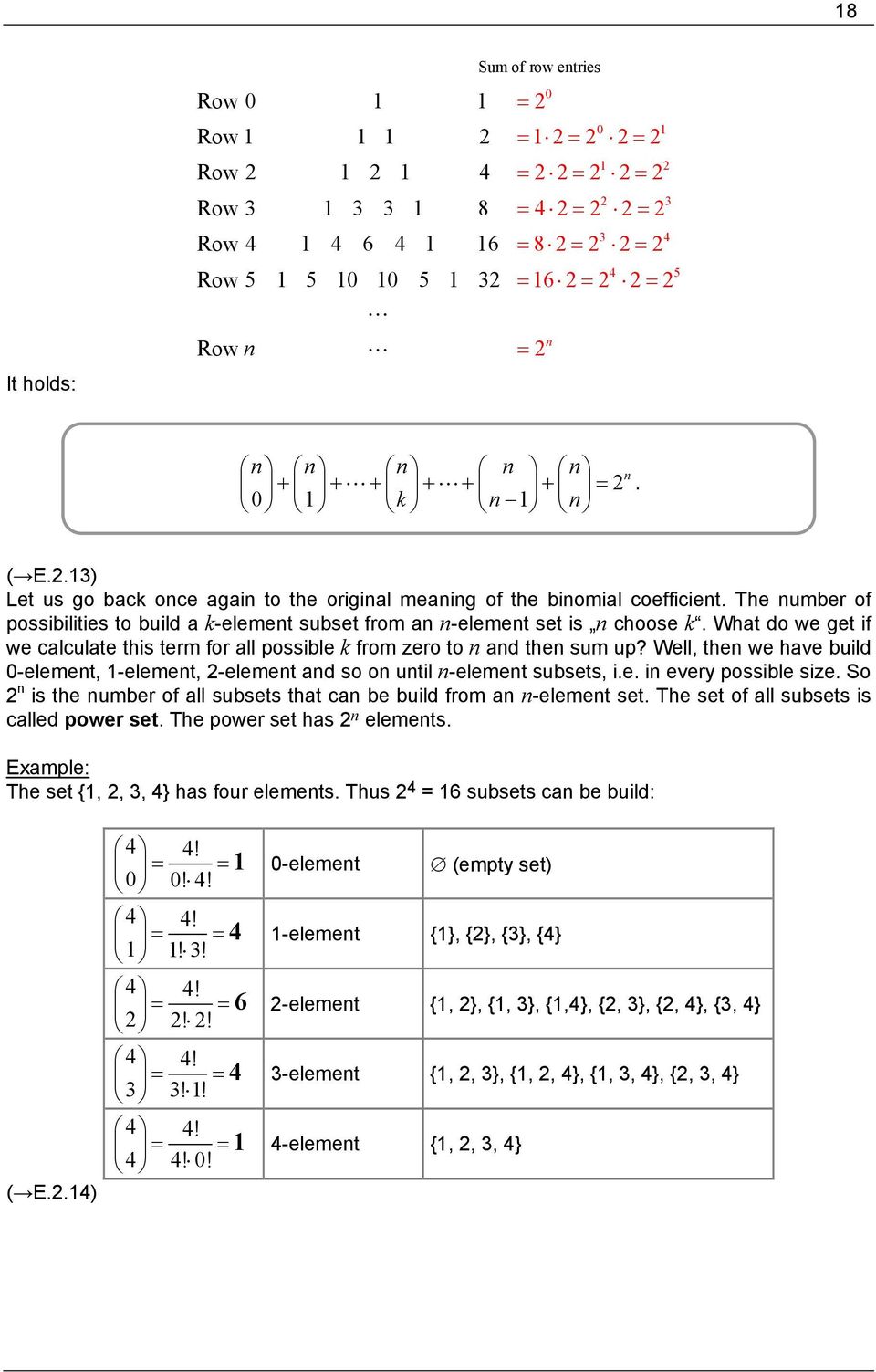
18 8 It holds: Sum of row etries Row 0 0 = 2 Row 2 0 = 2 = 2 2= 2 Row = 2 2= 2 2= 2 Row = 4 2= 2 2= 2 Row = 8 2= 2 2= 2 Row = 6 2 = 2 2 = 2 Row = = 2 0 k. ( E.2.3) Let us go back oce agai to the origial meaig of the biomial coefficiet. The umber of possibilities to build a k-elemet subset from a -elemet set is choose k. What do we get if we calculate this term for all possible k from zero to ad the sum up? Well, the we have build 0-elemet, -elemet, 2-elemet ad so o util -elemet subsets, i.e. i every possible size. So 2 is the umber of all subsets that ca be build from a -elemet set. The set of all subsets is called power set. The power set has 2 elemets. Example: The set {, 2, 3, 4} has four elemets. Thus 2 4 = 6 subsets ca be build: ( E.2.4) 4 4! = = 0 0! 4! 0-elemet (empty set) 4 4! = = 4! 3! -elemet {}, {2}, {3}, {4} 4 4! = = 6 2-elemet 2 2! 2! {, 2}, {, 3}, {,4}, {2, 3}, {2, 4}, {3, 4} 4 4! = = 4 3 3!! 3-elemet {, 2, 3}, {, 2, 4}, {, 3, 4}, {2, 3, 4} 4 4! = = 4 4! 0! 4-elemet {, 2, 3, 4}
19 9 Exercises E.2. The 7 th row of Pascal s Triagle is: Calculate the 8 th row of Pascal s Triagle without usig a calculator ad by applyig additio oly. Check your results for the elemets d 8,4, d 8,3, d 8, ad d 8,8 with the aid of the calculator, by computig the biomial coefficiets. E.2.2 Which of the followig equatios ad iequalities are right, which are wrog? =, =,, =,,, =, =, =,,, =, ,,, =, =, =, ,, =,,, = E.2.3 Check the solutio from E.2.5. I additio, give the sum of all elemets i the 0 th ad 3 th row of Pascal Triagle. E.2.4 Complete the followig table of subsets for the set {,2,3,4,5}: Number of subsets Number of elemets per subset Subset(s) 5 5! = = 0-elemet (empty set) 0 0! 5!

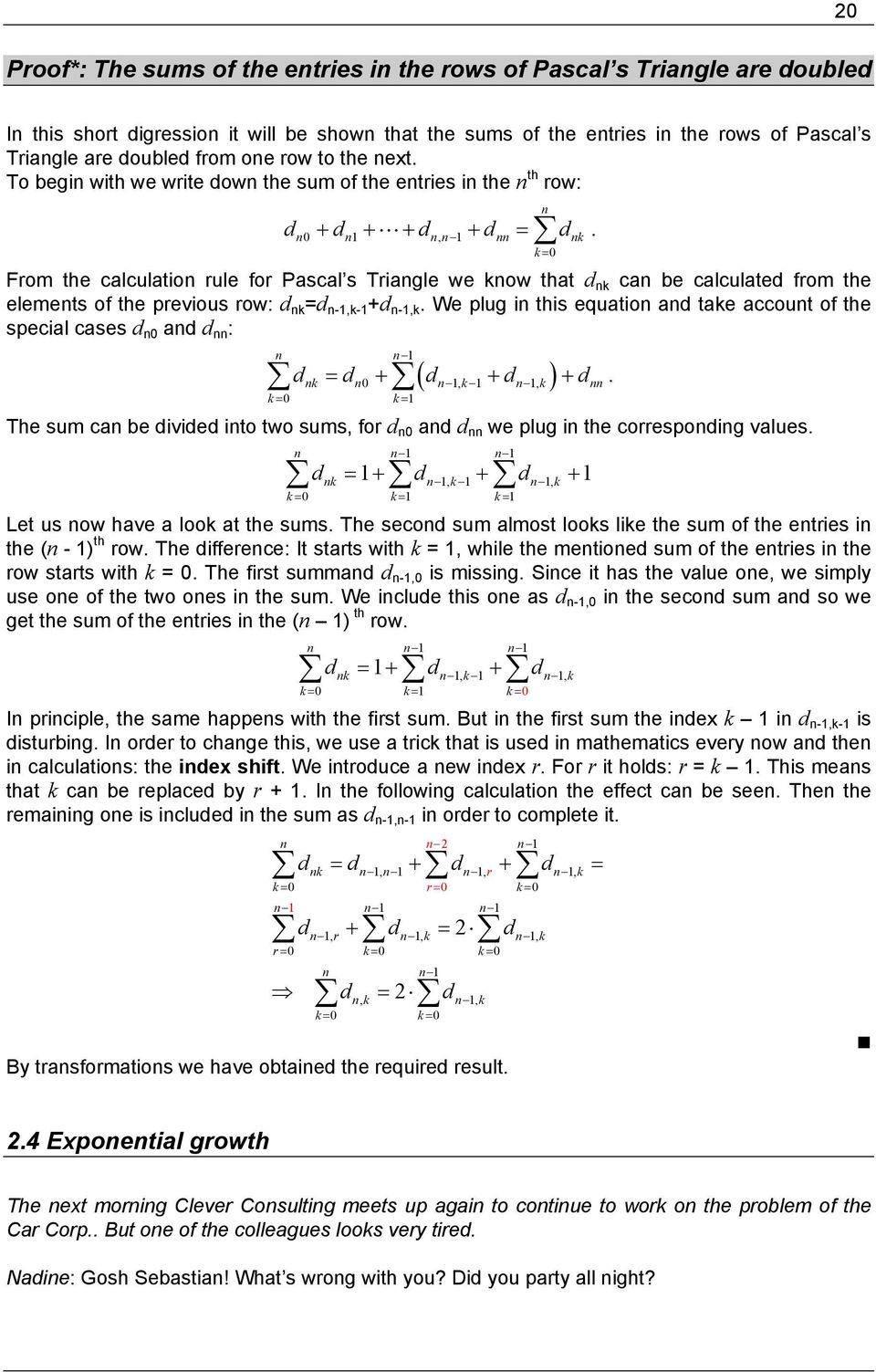
20 Proof*: The sums of the etries i the rows of Pascal s Triagle are doubled 20 I this short digressio it will be show that the sums of the etries i the rows of Pascal s Triagle are doubled from oe row to the ext. To begi with we write dow the sum of the etries i the th row: d + d + + d + d = d. 0, k k = 0 From the calculatio rule for Pascal s Triagle we kow that d k ca be calculated from the elemets of the previous row: d k =d -,k- +d -,k. We plug i this equatio ad take accout of the special cases d 0 ad d : ( ) d = d + d + d + d k 0, k, k k= 0 k= The sum ca be divided ito two sums, for d 0 ad d we plug i the correspodig values. + d = + d + d k, k, k k= 0 k= k= Let us ow have a look at the sums. The secod sum almost looks like the sum of the etries i the ( - ) th row. The differece: It starts with k =, while the metioed sum of the etries i the row starts with k = 0. The first summad d -,0 is missig. Sice it has the value oe, we simply use oe of the two oes i the sum. We iclude this oe as d -,0 i the secod sum ad so we get the sum of the etries i the ( ) th row. d = + d + d k, k, k k= 0 k= k= 0 I priciple, the same happes with the first sum. But i the first sum the idex k i d -,k- is disturbig. I order to chage this, we use a trick that is used i mathematics every ow ad the i calculatios: the idex shift. We itroduce a ew idex r. For r it holds: r = k. This meas that k ca be replaced by r +. I the followig calculatio the effect ca be see. The the remaiig oe is icluded i the sum as d -,- i order to complete it. 2 d = d + d + d k,, r, k k= 0 r=0 k= 0 d + d = 2 d, r, k, k r= 0 k= 0 k= 0 d = 2 d k,, k k= 0 k= 0 By trasformatios we have obtaied the required result. =. 2.4 Expoetial growth The ext morig Clever Cosultig meets up agai to cotiue to work o the problem of the Car Corp.. But oe of the colleagues looks very tired. Nadie: Gosh Sebastia! What s wrog with you? Did you party all ight?
21 2 Oliver: Come off it! Not our workaholic! Probably you ve bee sittig over your books all ight, right? Sebastia: Oh, leave me aloe. You d better be glad that at least someoe shows dedicatio! Yesterday I ve bee diggig aroud i my otes from ui. Oliver: That was clear! Sebastia: Ad I ve foud out somethig! We ca simplify our sum formula of yesterday very well. Selia: Really? Show me! Sebastia: No, first of all I ll get a coffee, the you may apologize icely ad maybe the I ll tell you about my results. So Sebastia discovered the same simplificatio that we have developed i detail i the last chapters. After two cups of coffee ad beig i better spirits Sebastia explais what he foud out about the biomial coefficiets. Sebastia: So, ad we ca use this simplificatio of the sum formula for our yesterday s result. Nadie, do you have the otes of yesterday with you? Havig a quick look i her bag, Nadie puts a sheet of paper with the followig formula o the table: Sebastia: You see? Here we build the sum of the elemets i the ( ) th row, this meas our sum is 2 -. The umber of possibilities to combie jobs, whose order is give, ito statios is: = ( E.2.5) Oliver: All right, this meas we d have to examie 2 0 cases fro the Car Corp.. Could you type it i your i your calculator? Nadie: Already doe: 024 possibilities. Oliver: Well, that s still ok. We ca write a program for the computer ad the it calculates all possibilities. Further o it should show those possibilities, where the statios work at almost the same capacity. Nadie: Well, that souds pretty simple. But the umber of possibilities growths rapidly, does t it? If we had 20 jobs, the there d be possibilities. Ad with 00 jobs there d be... oh, my calculator ca t display the umber completely, there d be 6,338*0 29 possibilities! That s a 30- digits umber!
22 22 The eormous growth that the four colleagues observed is called expoetial growth. The otio refers to the fact that i 2 - the variable appears i the expoet. There it accelerates the growth eormously. Let us compare the results for = 0, = 20, = 00 ad = ,33825* ,03469*0 59 A doublig from = 0 to = 20 results i a 024-times higher value of 2 -. A doublig from = 00 to = 200 results i a.26765*0 30 -times higher value of 2 -. Thus the value of 2 - grows very much faster tha the variable Figure 2.8 Fuctio y = 2 - I figure 2.8 oe ca see very clearly that 2 - does ot oly grow with, but also that this growths accelerates with icreasig. Such tasks quickly reach a size where they ca o loger be hadled by usig eve the latest computer techology. The the umber of possibilities is so large that those caot be calculated i appropriate time. Today oe comes across similar tasks whe tryig to decipher codes, for example. But i those cases oe is glad that these tasks have ot bee solved yet, sice otherwise the ecryptio systems, like they are used for credit cards or iteret coectios, would ot provide security ay more. Oliver: O.K. The size of the task grows rapidly. But evertheless we ca cope with the 024 possibilities for the Car Corp.. Sebastia: That might be the case, but I do t like it. There must be a more effective procedure tha calculatig all possible solutios? I mea, the Car Corp. surely would have hit o it as well! Nadie: Well, maybe we should summarize everythig we kow so far, as which values are give ad which have to be calculated. Nadie writes the followig list o a scribblig paper:
23 23 Give: Number of jobs: Idex of the job: i, i=... Processig time of job i: p i Ukow: Number of statios: k, with idex of the statio j Processig time of statio j: s j Cycle time: C Assigmet: jobs to statios Sebastia: The cycle time C is ot kow, but we kow at least that it is as log as the logest processig time of the statios. C = max s j=,, k j Selia: What does this otatio mea? The max with the j udereath? Sebastia: It s ot very difficult. It meas that amog all existig s j, amely from j = to j = k, the oe with the maximum value is chose. Selia: Ah, o.k. I ll keep that i mid ( E.2.6). Nadie: I thik we should defie a variable that measures the variatio from full capacity, so that we ca decide which solutio is appropriate. Oliver: That s a poit we have to discuss with the maagers of the Car Corp.. How do we kow which solutio they thik is appropriate? O.K., the capacity should be as high as possible, the best is full capacity. But this ca t always be achieved. Is it better if the the idle time of all statios together is as small as possible, so that expeses are saved? Or is it more importat that the idle time is divided as equal as possible betwee the sigle statios, so that o worker feels treated ufairly? These are two differet poits of view ad certaily there are eve more. Oliver poited out a very importat issue: The defiitio of a goal. What do Clever Cosultig ad the Car Corp. wat to achieve? Terms like the capacity should be as high as possible are ot precise eough. So Selia made a appoitmet at the Car Corp. to discuss this poit. Of course she does ot wat to miss the chace to see the productio of the sports car o site!
24 24 Exercises E.2.5 How may possibilities do exist to combie 3, 8, 3, 5 or 20 jobs, whose order is give, ito statios? E.2.6 Please specify max m for the followig sets M with elemets m i : i=,, k i a) M = {, 2, 3, 4} with k = 4 b) M = {4, 6, -3, -0, 3} with k = 5 c) M = {8, -20, 46, 43} with k = 4 d) M = {8, 3, -60, 4, 0} with k = 5 e) M = {4, 9, 243, 34} with k = 4 f) M = {8,-200, 34, 9} with k = Assembly lies workig to full capacity ad the assembly lie efficiecy Oe week later the team of Clever Cosultig arrives at the productio halls of the Car Corp.. There is a hustle ad bustle of activity. At the delivery etrace some trucks got stuck, people gesticulate wildly ad seem to be very excited. Obviously some suppliers did queue i the wrog place ad mixed up the elaborate system of just-i-time deliveries. Is this also a optimizatio problem for Clever Cosultig? Eve before the four colleagues fid the time to thik about it, Herr Wieder arrives. Mr. Wieder: Good afteroo! You must be the team of Clever Cosultig. It s ice to have you here. Ad who s the lady I ve talked to o the phoe? Selia: Good afteroo, Mr. Wieder. My ame is Selia Malik. Thak you very much for the ivitatio. Mr. Wieder: Do you wish to go for a short tour to see the productio facilities before we go to my office? Sebastia: That s fie! It s always better to actually see what we ve bee talkig about. Selia: Ad I ca fid out which sports car model is the right oe for me. Nadie: How may cars do you produce per day o a average? Mr. Wieder: It depeds o the order situatio, but the assembly lie should make aroud 20 uits, that s the daily output. O the tour Mr. Wieder explais how the productio process works. Obviously Mr. Wieder is very proud that the productio rus like a clockwork. He explais that a breakdow at ay statio of the lie ca of course paralyze the complete assembly lie. Such failures are a expesive problem for the Car Corp., sice the the machies ad workers caot work productively. Thus at ay time there are egieers o site, who ca take appropriate actios i case of a failure. As the group arrives at the ed of the productio street, a brad ew blue sports car i the luxury versio leaves the assembly lie. Selia: Oh! That s exactly the oe that I wat! Mr. Wieder, I thik I kow how you could pay for our service. Mr. Wieder: Well, let s talk about that at the ed of your work. But for this sports car model you ll probably have to optimize further processes. Oliver: It was a good idea to see the productio o site. Thak you very much for the tour, Mr. Wieder.
25 25 Mr. Wieder: You re welcome. You really seem to tackle this problem seriously. I m curious to see your results. If you ca help us, we could talk to the busiess maagemet about a cosultig cotract betwee Clever Cosultig ad the Car Corp.. I thik we ll fid some more tasks for your compay. I the meatime I ve talked with our process egieers about the aims. They use the so-called assembly lie efficiecy as a measure for the utilizatio. The assembly lie efficiecy is the ratio betwee the sum of the processig times ad the product of cycle time ad umber of statios. I the meatime, the group arrived at Mr. Wieder s office. While he talks, Mr. Wieder writes the followig formula o a flipchart: ALE = p + p + + p + p C k 2 Assembly lie efficiecy:. Herr Wieder: The assembly lie efficiecy shows the utilizatio of the lie, it should be as high as possible. The best is if you have a close look at it without ruffle. I do t wat to throw you out, but I ve a importat appoitmet ow. Nadie: Ok, we do t wat to hold you up ay loger, thak you very much for your support. Herr Wieder: Oh, ad before I forget about it: Our egieer gave me a list of the processig times. It s for you, you ll eed the figures to get started. The uits of the values are miutes. p = 8 p 2 = 5 p 3 = p 4 = 3 p 5 = 7 p 6 = 4 p 7 = 2 p 8 = 9 p 9 = 2 p 0 = 5 p = 7 Impressed by the huge productio site ad ready to start their work, the Clever Cosultig team sets off to its office. Oliver: Did you uderstad the formula? I did t. Nadie: The best is if we plug i the values that we do already have. Those are the productio times i the umerator: p+ p2 + + p + p = = 53. The sum of the processig times is 53 miutes. Thus for the assembly lie efficiecy it holds: 53 ALE =. C k But we either kow the cycle time C or the umber of statios k. Let s choose a arbitrary divisio of jobs ito statios to simplify matters. The we ca determie the resultig assembly lie efficiecy. Nadie is o the right track. A example, eve a desiged oe, ofte helps to achieve a better uderstadig of mathematical terms.
26 26 Example: Give is the divisio of the jobs ito three statios: [, 2, 3, 4] [5, 6, 7] [8, 9, 0, ]; k = 3. From this we ca compute: - Processig time of the statios s = p + p + p + p = 7; s = p + p + p = 3; s = p + p + p + p = Cycle time - Assembly lie efficiecy { } { } C = max s, s, s = max 7,3,23 = ALE = 0,768 C = k 23 3 = 69. The assembly lie efficiecy is 0,768 ( E.2.7). Havig a look at the processig times of the statios, you ca see that this is ot a very good value. Statio 3 is workig at very high capacity. There the workig takes 23 miutes. This statio determies the legth of the cycle time. I cotrast, statio 2 oly has to work for 3 miutes ad the waits te miutes for the ed of the cycle time. The efficiecy of the statios is listed i the diagram below. Statio 3 Statio 2 Statio Bearbeitugsdauer [Miute] Figure 2.9 Diagram of the utilizatio of the statios The diagram shows the time sequece of a productio process. Here you ca see explicitly that statio 3 is very heavily used. We obtai a better solutio, if we move job 8 from statio 3 to statio 2, for example. - Divisio ito statios: [, 2, 3, 4] [5, 6, 7, 8] [ 9, 0, ] - Processig time of the statios s = p + p + p + p = 7; s = p + p + p + b = 22; s = p + p + p = Cycle time { } { } C = max s, s, s = max 7,22,4 =
27 27 - Assembly lie efficiecy ALE = 0,803 T = k 22 3 = 66. Statio 3 Statio 2 Statio Bearbeitugsdauer [Miute] Figure 2.0 Diagram after shiftig job 8 ( E.2.8) The cycle time was shorteed by oe miute. The assembly lie efficiecy did icrease to 0,803. The efficiecy of the machies did improve. Of course this is a success. Nevertheless we do ot kow if this is the best solutio to the problem. The possibilities of fidig ew solutios is ot oly limited to the shiftig of jobs. The umber of statios ca be modified as well. The umber of the statios was chose arbitrarily i the example. Mr. Wieder told us that the assembly lie efficiecy should be as high as possible. But how high ca it actually get? The cycle time, that is the processig time at oe statio, multiplied by the umber of statios must be at least as log as the sum of the processig times, i.e. it has to hold: C k p + p + + p + p. 2 Why does this hold? Well, the processig times of the jobs p i are allocated amog the statios ad are cotaied i the processig times of the statios s j. Thus it holds: p + p + + p + p = s + s + + s + s. 2 2 k k Note: The left-had side of the equatio cotais summads, the right-had side oly k summads. Sice C correspods to the maximum processig time of oe statio, it holds: Thus we ca coclude: We will ow cosider two cases: C k = s k s + s + + s + s. max j 2 k k j=,, k C k p + p + + p + p 2.
28 28 Case : I the first case both sides of the above iequality have exactly the same value, thus the equatio holds: p + p + + p + p = C k. 2 I this case, the umerator ad deomiator for the computatio of the assembly lie efficiecy have the same value, i.e. it follows: ALE =. Case 2: I the secod case the iequality holds: p + p + + p + p < C k. 2 So the deomiator of the assembly lie efficiecy is always greater tha the umerator. This meas that the ALE must be smaller tha oe: ALE <. Takig both cases ito accout leads to: ALE. The assembly lie efficiecy ca attai at most a value of oe. If we as i the first case obtai a ALE of oe, the all jobs are evely distributed amog the statios, the there would be o idle time for the machies. This would be the ideal case, the best solutio that ca be obtaied. We say, the assembly lie works at 00% capacity. The assembly lie efficiecy is a key figure of utilizatio. As Mr. Wieder from the Car Corp. said, we have to try to get a assembly lie efficiecy that is as high as possible. Now we kow that it ca be at most oe. We ca obtai a efficiecy of 00% if we build oly oe sigle statio that deals with all jobs. The cycle time the is the sum of the processig times: C = p + p p - + p. Let us study this case with example of the Car Corp.: C = p + p + p + p = 53 k = ALE 2 p + p + p + p C k 2 = = 53 = 53 But this optio is ot iterestig. I priciple it meas that we do ot use a assembly lie aymore. All jobs are executed at oe sigle statio. I additio, it would ot be possible to process several cars at the same time; the output would be very small. Thus the case k = is ot relevat i practice. I the followig we will forbid k =. The Clever Cosultig Team had the same ideas: Selia: I do t kow; that s very difficult. There re so may parameters that we do t kow, the cycle time, the umber ad the allocatio of the statios. So where shall we start? Oliver: That s true. But basically all these parameters are related. For example: If I build more statios, the ormally the cycle time decreases. Maybe we ca use this somehow? Nadie: Furthermore the umber of statios ca surely be limited. For example, we do already kow that it s osese to build oly oe statio. I could imagie that two are also isufficiet if we wat to produce a certai miimum amout per day..
29 29 Oliver: That s a good idea! Maybe we ca take the miimum output ito cosideratio, we have t thought about that before. Selia: O.K. Mr. Wieder said 20 uits of output per day. Let s deote the miimum output with O mi ad say: O mi = 20. So how may hours per day does the assembly lie ru? Sebastia: As far as I kow, it ca ru three shifts, that s 24 hours. If the order situatio is weak, sometimes oly two shifts are required, but the the Car Corp. does t have to produce 20 cars. Nadie: Good. After the lapse of oe cycle time C always oe car is completed. This meas, if the Car Corp. wats to produce at least 20 cars i oe day, the cycle time ca at most be 24/20 hours. Or 440/20 miutes. Reducig the fractio gives twelve miutes. Thus the Clever Cosultig Team did fid a estimate for the cycle time. The cycle time caot be loger tha this estimate; otherwise 24 hours would ot be eough to produce 20 cars. Therefore this value is called the maximum cycle time C max. A cycle time that is loger tha C max is ot allowed. Before we write dow the formula, we deote the productio period with P. I our case it is 24 hours or 440 miutes respectively. But it would also be possible to cosider a whole moth or just oe hour. C max P 440 = = = 2 = 2 O mi 20 The half brackets aroud the fractios cause that their cotet is rouded to a iteger. The brackets opeig upwards i the above equatio mea roudig dow. Brackets opeig dowwards mea roudig up. See the followig examples: 3, 2 = 4 3, 2 = 3 5 = 5 5 = 5 Fractioal umbers are rouded up or dow. Itegers remai uchaged ( E.2.9-2). Why is the maximum cycle time rouded dow? The cycle time is the sum of the processig times p i, which are itegers i our case. The sum of itegers is agai a iteger. Hece a reasoable cycle time is always a iteger. Now we have to explai why we roud dow. Here we study the maximum, i.e. the logest possible cycle time. A loger cycle time is ot allowed. If P / O mi yields a fractio, we ca oly choose smaller itegers. Thus C max results from roudig dow. The maximum cycle time of course has ifluece o the umber of statios. No statio ca have a processig time that is loger tha the maximum cycle time. If the maximum cycle time was already exceeded by a sigle job, if e.g. p = 5 did hold, the the miimum output could ot be achieved. The Car Corp. would have take o too much with this. The oly way to overcome this problem would be to decompose the relevat job ito several smaller jobs, util the maximum cycle time is ot exceeded aymore. But this possibility would have bee examied by the egieerig departmet of the Car Corp.. Sebastia: Very good. Now we have a upper boud for the cycle time. With this it should be possible to limit the umber of statios as well. Sice the smaller I choose the cycle time, the
30 30 more statio I have to set up. If I boud the cycle time from above, it meas that I eed a miimum umber of statios. We already kow that the cycle time multiplied by the umber of statios must be greater tha the sum of the processig times: C k p + p + + p + p 2 The p i are give. C ad k are variables. If we wat to kow what ifluece the variable C has o k, we have to rewrite the iequality: k C p p2 p p Nadie: Now you ca see: If C icreases, the right-had side gets smaller ad thus k ca be smaller. This behavior ca be see very well if you draw the iequality with the data form our example (see figure 2.): 53 k. C For the momet we will to forget about the costrait that C is a iteger. All poits (C k) that lie i the grey hatched area or o the curve are a valid combiatio of the parameters k ad C... Number Statiosazahl of Statios k k Cycle time C Taktzeit T Figure 2. Area of feasible solutios Sice C is bouded from above by C max, the area of the solutios is restricted. The restrictio of the area esures that k caot be arbitrarily small. Thus the smallest value that k ca reach depeds o C max.
31 3 Number Statiosazahl of Statios k k k mi Cmaxma T x Taktzeit Cycle time C T Figure 2.2 Restrictio by k mi ad C max Sebastia: Great! With this we ca leave out the aalysis of all k that are below the boud. This is much less work tha checkig all possibilities. We should write dow a formula for the miimum umber of statios k mi. Sebastia comes up with the followig formula: k mi = p + p2 + + p + p. C Selia: I do t thik that this is etirely true. Do plug i our values ito the equatio. Sebastia: Well, k mi is 53 over 2, that is aroud 4,42. Selia: Ad how ca the Car Corp. build 4,42 statios? The always oe half of the worker at the last statio has a luch break? Sebastia: Ok, you re right. So what do we do with the formula? Istead of at least 4,42 statios we the eed at least five statios. Oliver: I programmig there s this dow. max fuctio with the square brackets that rouds a umber up or Oliver corrects the formula by usig the brackets that we are already familiar with ad fially the four colleagues get the right result:
32 32 k p + p + + p + p. 2 mi = Cmax ( E.2.22) Nadie: While we re o that subject, we could also boud k from above by a maximum umber of statios. After all, k caot be bigger tha the umber of jobs, otherwise we would have to split up the jobs, which is t allowed here. kmax Oliver: Exactly, ad for the same reaso the cycle time caot be smaller tha the logest processig time of a job. = C max p i=,, Sebastia: That s true. But there exists eve aother costrait for the miimum cycle time: Sice the umber of statios is bouded from above, we caot choose the cycle time arbitrarily small, otherwise we caot meet the processig times. C k p + p2 + + p + p Oliver: Yes, you re right. So if both costraits are correct, what do we do the? Selia: Just take the boud that is stroger. The cycle time caot be smaller tha ay of the two bouds. This meas, the boud with the higher value is the better oe. max i C mi p+ p2 + + p + p = max max pi, i=,, kmax ( E.2.23) Selia: For our example it meas: C k k C max mi max mi Oliver: Ad how do we go o ow? = 440/20 = 2 53 = = 5 2 = 53 = max 9; = max{ 9;5} 9 = Sebastia: I suggest that we re optimistic ad go o as if we could get a assembly lie efficiecy of oe..
33 33 p + p + + p + p p + p + + p + p ALE = = k = = C k C C Nadie: Aha, ad what s the advatage of doig so? Sebastia: Well, for ay arbitrary C withi our bouds I ca calculate a k with the help of this equatio that yields a assembly lie efficiecy of oe. Nadie: What? It s as simple as that? Sebastia: Well, it is t that simple. I additio, we have to take care that k is a iteger, otherwise we caot use the result ( E.2.24). Oliver: The best is if we draw the curve, the you ll see more. Oliver s drawig is show i figure 2.3. k Statiosazahl Number of Statios k 2 k max k mi Taktzeit Cycle time C 4 T Figure 2.3 C mi C max The curve i figure 2.3 shows the iteractio betwee C ad k. Each poit (C k) o this curve represets a combiatio of the two variables, which yields the highest possible assembly lie efficiecy of oe. The blue poit marks a situatio where the cycle time was chose very short ad therefore a lot of statios are required. If you, i cotrast, set up oly a few statios, the it is ecessary that the cycle time is chose log eough. The gree poit shows a example of this alterative. Both poits lie outside of the computed bouds. This meas that they could ot be realized uder the give coditios ( E ). Exercises E.2.7 The followig productio times come from a supplier of the Car Corp.. p = 3 p 2 = 7 p 3 = 5 p 4 = 3 p 5 = p 6 = 9 p 7 = 3 p 8 = 2 Calculate the assembly lie efficiecy for the followig partitios ito statios: a) [, 2, 3] [4, 5, 6] [7, 8] b) [, 2] [3, 4] [5, 6] [7, 8] c) [, 2, 3, 4] [5, 6, 7, 8]
34 34 d) [, 2] [3, 4, 5] [6, 7, 8] e) [, 2, 3] [4, 5] [6, 7, 8] f) [, 2, 3] [4] [5, 6] [7, 8] Which partitio has the best assembly lie efficiecy? E.2.8 Draw the diagrams for E.2.6. Describe the differet profiles of utilizatio: Do the statios work at the same capacity? Which statios work at a capacity that is too high, which work at a capacity that is too low? Ca the utilizatio be improved? E.2.9 Calculate the followig expressios: a ) 3,9 = 3, 2 = 2,9 = 3 = 23,99 = b ) 9,2 = 9,000 = 20 = 20,000 = 43,6 = c ) 4,9 = 4,9 = 326 = 326 = 0, 0 = E.2.20 Which of the followig equatios ad iequalities are correct, which are wrog? 4 3,99 ; 4 = 4,99 ; 5,0 = 4,09 ; 4 4 ; 34,09 35 ; 8,34 = 9 ; 37, ; 4 = 5,999 ; 34, 23 34,97 ; 8, 0 = 9,90 ; 4 5,99 ; 43,22 = 44 ; 432, 432 ; 94,23 = 95 ; 8,03 9,40 E.2.2 Calculate the maximum cycle time C max for the followig pairs of productio period P ad miimum output O mi : a) P = 00, O mi = 0 b) P = 98, O mi = 9, c) P = 346, O mi = 45 d) P = 46, O mi = 4, e) P = 888, O mi = 98, f) P = 435, O mi = 43, g) P = 43, O mi = 52 h) P = 339, O mi = 30 E.2.22 Calculate the miimum umber of statios k mi for the costat values p = 4, p 2 = 9, p 3 = 2, p 4 = 3, p 5 = 5, p 6 = 9, p 7 = 6 ad for: a) C max = 0, b) C max = 2, c) C max = 4, d) C max = 6 e) C max = 2, f) C max = 9 E.2.23 Calculate the miimum cycle time C mi for the values from E.2.6 ad E.2.2. E.2.24 Let p + p p - + p = 40. Fid, idepedetly of C mi, C max, k mi ad k max, all positive values of C, such that for ALE = the values of k are iteger. E.2.25 Draw a diagram (similar to figure 2.3) with the cycle time C o the horizotal axis ad the umber of statios k o the vertical axis. I this diagram, draw the maximum ad miimum cycle time as well as the maximum ad miimum umber of statios for the followig values: P = 20, O mi = 9, p = 5, p 2 = 3, p 3 = 2, p 4 = 9, p 5 = 8, p 6 = 7, p 7 =, p 8 = 5, p 9 = 6 ad p 0 = 4.
35 35 E.2.26 I the diagram from E.2.25, plot all iteger poits that lie withi the rectagle give by C mi, C max, k mi ad k max. Furthermore draw the followig poits: (7 6), (2 6), (0 4), (0 ). Give cocrete reasos, i.e. without usig the formulas or the diagram, why the last four poits are ot feasible. Excursus: Iversely proportioal fuctios equilateral hyperbolas The curve discussed before belogs to the class of fuctios that are geerally deoted by k y = f( x) = k costat x Such curves are called equilateral hyperbolas ( E.2.27). I this case we say: y is iversely proportioal to x. Whe you cosider equilateral hyperbolas with k > 0, the the followig depedecy betwee x ad y holds: If x icreases, the y decreases; if x decreases, the y icreases. To what extet a chage i x affects the parameter y is depedet o k. y k f( x) = y= x with k > 0 y k f( x) = y= x with k < 0 x x Figure 2.4.a k is positive Figure 2.4.b k is egative Equilateral hyperbolas have the followig properties: - The y-value at x = 0 is ot defied. As the fuctio with a positive k approaches the y-axis from the left, it coverges to egative ifiity ( ). As, i cotrast, the fuctio approaches the y-axis from the left, it coverges to positive ifiity (+ ). We say, the fuctio has a jump discotiuity at x = 0. - The fuctio does ot have a zero, i.e. there is o poit where y = 0 holds. Ideed, the fuctio approaches the y-axis as x coverges to + or, but it ever reaches the y- axis. - The fuctio is odd, i.e. it holds: This coditio is satisfied here, sice f ( x) = f ( x ).
36 36 k k f x f x x ( ) = = = ( ) Odd fuctios are poit symmetric about the poit of origi (0 0). - The fuctio is symmetric to the axis of reflectio y = x. This meas: or ( E.2.28). Exercises x. f ( x) = y f ( y) = x ( ( )) f f x = x E.2.27 Which of the followig fuctios are equilateral hyperbolas, which are ot? Explai your solutios. a) f( x) = y = x b) f( x) = y= 2 x c) 3 f( x) = y = x d) 4 f( x) = y= x e) x f( x) = y = x f) 2x f( x) = y = 2 x g) 29 f( x) = y = x h) f( x) = y= x e i) f( x) = y = x j) f( x) = y = e x k) 2+ 3x f( x) = y = x l) 4 f( x) = y = 4 x E.2.28 Show that f(f(x)) = x holds for equilateral hyperbolas. For this, use the geeral formula of a equilateral hyperbola Search for iteger solutios I the meatime, Oliver worked o the small diagram ad marked all iteger poits (see figure 2.5).
37 37 Number k Statiosazahl of k 2 k max k mi Taktzeit T Cycle time C Figure 2.5 C mi C max Oliver: Well, did t I do a good job? We ve already said that k ad C have to be iteger values, so I ve marked all iteger poits. The poits show combiatios of k ad C where both values are iteger. If the fuctio goes through oe of these poits, the we would have foud a solutio that yields a assembly lie efficiecy of oe. Nadie: But what do we do if there s o solutio that lies o the curve, as it is the case i our example? The we have to accept that ALE = caot be achieved. I ve a idea: We should decrease the assembly lie efficiecy ad fid out what happes to our fuctio the. Let s just try ALE = 0,9. p + p2 + + p + p ALE = 0,9 = C k p + p + + p + p 0,9 C 53 58,8 0,9 C C 2 k = k = = Nadie: You see? The costat i our fuctio icreased, sice the ALE was reduced. So what happes to the fuctio if the costat icreases? Oliver, you re good at drawig fuctios. Please costruct a diagram that cotais the ew fuctio.
38 38 Number k Statiosazahl of Statios k ALE = 0,9 ALE = 2 Figure Taktzeit T Cycle time C Selia: The ew fuctio moved up ad to the right ad is a bit more flat. Let s try aother value, e.g. ALE = 0.5. Maybe we ca see the movemet more clearly the ALE = 0,5 0,5 k = k C = 0,5 C = C k Statiosazahl Number of Statios k ALE = 0, ALE = 0,9 ALE = Taktzeit T Cycle time C Figure 2.7 Sebastia: So the fuctio varies with each ew value for the assembly lie efficiecy. We should write this dow i geeral:
39 39 k = p + p2 + + p + p ALE C. Sebastia: The processig times b i are still costats, i.e. they re fixed ad do t chage i the course of our calculatios. The ALE is a parameter i this fuctio. This meas, it ca be chose arbitrarily, but the is fixed for the calculatios. The set of all fuctios that result from varyig the assembly lie efficiecy is called a fuctio family ( E.2.29). Oliver: Stop it! You use all these techical terms. Sebastia: Those are just the correct ames. It s good if we ca use the right terms whe we re talkig to our cliets, is t it? Nadie: You re right. Let s go o: We re ow lookig for a fuctio withi this fuctio family o which a solutio to our problem ca be foud ad that also has a as high as possible assembly lie efficiecy. But how ca we get it? Selia: First of all, I d erase all poits from the diagram that are out of the questio. Those are for example the poits that lie outside the bouds k mi, k max, C mi ad C max. Oliver: Good idea! We oly mark the feasible solutios i our diagram. Those are the poits that lie withi the bouds. Ad sice the ALE ca ever be greater tha oe, we ca also omit the poits below the curve. Number k Statiosazahl of Statios k ALE = Cycle time C Taktzeit T Figure 2.8 Feasible solutios Oliver: The closer a poit is to the curve, the better. I the diagram you ca see that oe poit is very close to the curve: (9 6). The assembly lie efficiecy of (9 6) is 53/(9 6) = 53/54 0,98. Selia: Great! So we ve already foud the solutio, right? Six statios with a cycle time of ie miutes ad a assembly lie efficiecy of 0,98. Ad that s a very good value, is t it? Sebastia: I agree with that. The other assembly lies of the Car Corp. have a assembly lie efficiecy of aroud 0,75 0,85, Mr. Wieder said.
40 40 Selia: Good, the let s write dow the productio schedule. We ve to assig the jobs to the statios, ad i doig so we ve to keep i mid that o statio ca work loger tha ie miutes. Statio 7 Statio 6 Statio 5 Statio 4 Statio 3 Statio 2 Statio Bearbeitugsdauer [Miute] 0 Figure 2.9 Diagram: With a cycle time of ie miutes seve statios are required Selia: Oh o, it s ot workig out with six statios! If we do t wat to exceed ie miutes, we ve to set up seve statios. Now we ve foud the best combiatio of cycle time ad umber of statios ad caot realize it. Sebastia: I have t thought about that! Sure, we ve igored the legths of the jobs. Oliver: That s a pity, but we ve other poits that are also very close to the curve ALE =. These poits have a assembly lie efficiecy which is hardly worse. Maybe we ca realize oe of these combiatios ( E.2.30)? Nadie: Well, so if we have to check several poits, I suggest that we use the computer. The best is if we write a program for the computer that calculates all feasible solutios with the relevat assembly lie efficiecy ad the sorts the poits by assembly lie efficiecy i descedig order. Accordig to this order we the ca check whether the combiatio of cycle time ad umber of statios of these poits ca be realized. Oliver: I ll try to write a algorithm that gives us all feasible solutios. So Oliver rus off to his computer ad comes back a quarter of a hour later with the followig algorithm.
41 4 Algorithm 2. Determiatio of the feasible poits Iput: processig times p i, miimum output O mi, time frame P Output: feasible poits ListFP P C max := Omi If C max = 0 the Output: Stop p + p2 + + p + p k mi := Cmax k max := C mi := The maximum productio time per step is 0, i.e. the problem is ifeasible. p + p + + p + p 2 max max pi, i=,, kmax i := C mi j := k mi ListFP := empty set While j k max do While i C max do If p + p + + p + p i j 2 The add the followig elemet to ListFP: p + p2 + + p + p i, j, i j i := i + Ed While i j := j + i := C mi Ed While j If ListFP = The Output: There are o feasible poits. Else Output: ListFP. Oliver: I m doe! The algorithm gives us a list of feasible solutios. For each solutio we get the cycle time, the umber of statios ad the assembly lie efficiecy.
42 42 Nadie: Could you please explai how the algorithm works? Oliver: Of course, it s ot very complicated. First of all, the algorithm calculates all bouds that we ve just worked out, this meas C max, C mi, etc. I the outer while -loop all feasible umbers of statios are examied. The the ier while -loop geerates the feasible cycle times for each umber of statios. Afterwards time the assembly lie efficiecy is calculated for each pair of umber of statios ad cycle. If it is smaller tha or equal to oe, the algorithm saves this pair as a feasible solutio. Selia: So ow we have to check the feasible solutios oe after the other? Sebastia: No way! We should also come up with a algorithm for this. How else ca we sell our result to the Car Corp.? I do t thik that they wat to calculate maually. Oliver: Ok, I go right back to work. Some time later, Oliver ca provide a algorithm for checkig the poits.
43 43 Algorithm 2.2 Checkig the feasible poits Iput: processig times b i, feasible poits ListFP Output: feasible poit with the best assembly lie efficiecy ALE = p + p2 + p + p i j Sort ListFP by the ALE i descedig order (3 rd elemet of the etries i the list) i := 0 While i < legth(listfp) do i := i + poit := ListFP[i] CouterPS := j := 0 While j < poit[2] do j := j + sum := 0 ok := While ok = ad CouterPS do If sum+b CouterP poit[] S The sum := sum + b CouterPS CouterPS := CouterPS + Else ok := 0 Ed While ok If CouterPS = + The Stop. Output: Poit is the best feasible solutio. Ed While j Ed While i ( E.2.3) Oliver: I m doe! This algorithm is a bit more difficult. Do you wat me to explai how it works? Sebastia: Sure, go ahead! Oliver: This algorithm uses three while -loops. The outer loop goes through the etries of ListFP, which are the feasible solutios. Each feasible solutio is examied ad saved as poit. Poit is a vector ad cosists of three elemets: cycle time, umber of statios, assembly lie efficiecy. The middle loop goes through the statios of the solutio. The i the iermost loop each statio gets filled with jobs as log as the cycle time allows it. The parameter CouterPS shows the curret job. Sice at the begiig the feasible solutios were sorted by the assembly lie efficiecy the program ca stop as soo as a solutio is foud where all jobs are scheduled. Nadie: Clever. But if there were two solutios with the same assembly lie efficiecy, you d oly fid oe of them.
44 44 Oliver: That s true. The best is if we ask the Car Corp., whether they wat to fid all equivalet solutios. It should t be too difficult to adjust the program. Selia: That s great! We simply let the computer do the work ad we ve got a solutio. Sebastia: Which solutio do we get for the dates of the Car Corp.? Oliver: I ve already calculated it: The first solutio from our list that ca be realized is (9 7), a cycle time of ie miutes ad seve statios. Selia: I ll draw the correspodig diagram: Statio 7 Statio 6 Statio 5 Statio 4 Statio 3 Statio 2 Statio Processig Bearbeitugsdauer time [miutes] [Miute] 0 Figure 2.20 Diagram for seve statios with a cycle time of ie miutes Selia: Wait a miute, the diagram looks exactly like the previous oe! We ve agai a cycle time of ie miutes. A little while ago, we ve required six statios. That did t work out, it works with seve statios. Sebastia: But it s just by chace that the solutio we ve foud first is the best. Nadie: The assembly lie efficiecy is 84,3%. The whole productio time of a sports car is 9 7 = 63 miutes ad seve cars ca be processed at the same time. Sebastia: So this is the highest assembly lie efficiecy that ca be obtaied for our problem. Thus we ve foud a optimal solutio! We could oly get a better assembly lie efficiecy if we chaged the techical data, e.g. split up or speed up the jobs. Selia: Would t this be a possibility for aother job? We could aalyze where it s profitable to modify the techical data. Oliver: First let s see if we give a good impressio with our result. It would be great if we aalyzed the other assembly lies as well. Nadie: Ad we could solve the questio, if a reorgaizatio is profitable, mathematically. For each lie we d oly eed the costs of reorgaizatio for oe job, the remaiig time, the icrease of efficiecy ad thus the ecoomies Selia: I still like blue the best, what do you thik? Nadie: Pardo? Selia: Blue! For the car! Nadie:...
45 45 Selia: Well, if we do that may jobs for the Car Corp., we ve already worked hard eough to get the ew car! Would t that be great? We eed a compay car! Oliver: Ad o the weeked we simply share the car. Sebastia: O.K., let s get back to work the! Who s goig to write the field report? Oliver: Sebastia, that s very kid of you; it s a great idea that you re goig to write the report! Nadie: Ad please metio that we ve may ew ideas for improvemet, the Car Corp. would be a good customer for us. Selia: Bye Sebastia, ad do t work too log! Sebastia: But, I did t mea it that way... Selia: Exactly, either did we. Of course we ll write the report together, but right ow we re goig to celebrate our success. Exercises E.2.29 Draw the fuctio family k(t) fort he values from E.2.7 ad ALE {; 0,8; 0,5}. Therefore choose for the legth of the x-axis ad 600 for the legth of the y-axis. E.2.30 Which of the followig combiatios ca be realized if the values from E.2.7 are give? a) (3 4) b) (4 4) c) (5 3) d) (6 3) e) (26 2) f) (27 2) g) (28 2) E.2.3 Use the algorithms 2. ad 2.2 to obtai the best solutio for a assembly lie problem with the followig dates: p = 5, p 2 = 6, p 3 = 3, p 4 = 7, p 5 =, p 6 = 5, p 7 = 2, p 8 = 3, O mi = 9, P = 70
In nite Sequences. Dr. Philippe B. Laval Kennesaw State University. October 9, 2008
 I ite Sequeces Dr. Philippe B. Laval Keesaw State Uiversity October 9, 2008 Abstract This had out is a itroductio to i ite sequeces. mai de itios ad presets some elemetary results. It gives the I ite Sequeces
SECTION 1.5 : SUMMATION NOTATION + WORK WITH SEQUENCES
 SECTION 1.5 : SUMMATION NOTATION + WORK WITH SEQUENCES Read Sectio 1.5 (pages 5 9) Overview I Sectio 1.5 we lear to work with summatio otatio ad formulas. We will also itroduce a brief overview of sequeces,
Properties of MLE: consistency, asymptotic normality. Fisher information.
 Lecture 3 Properties of MLE: cosistecy, asymptotic ormality. Fisher iformatio. I this sectio we will try to uderstad why MLEs are good. Let us recall two facts from probability that we be used ofte throughout
Example 2 Find the square root of 0. The only square root of 0 is 0 (since 0 is not positive or negative, so those choices don t exist here).
 BEGINNING ALGEBRA Roots ad Radicals (revised summer, 00 Olso) Packet to Supplemet the Curret Textbook - Part Review of Square Roots & Irratioals (This portio ca be ay time before Part ad should mostly
THE ARITHMETIC OF INTEGERS. - multiplication, exponentiation, division, addition, and subtraction
 THE ARITHMETIC OF INTEGERS - multiplicatio, expoetiatio, divisio, additio, ad subtractio What to do ad what ot to do. THE INTEGERS Recall that a iteger is oe of the whole umbers, which may be either positive,
.04. This means $1000 is multiplied by 1.02 five times, once for each of the remaining sixmonth
 Questio 1: What is a ordiary auity? Let s look at a ordiary auity that is certai ad simple. By this, we mea a auity over a fixed term whose paymet period matches the iterest coversio period. Additioally,
Soving Recurrence Relations
 Sovig Recurrece Relatios Part 1. Homogeeous liear 2d degree relatios with costat coefficiets. Cosider the recurrece relatio ( ) T () + at ( 1) + bt ( 2) = 0 This is called a homogeeous liear 2d degree
Basic Elements of Arithmetic Sequences and Series
 MA40S PRE-CALCULUS UNIT G GEOMETRIC SEQUENCES CLASS NOTES (COMPLETED NO NEED TO COPY NOTES FROM OVERHEAD) Basic Elemets of Arithmetic Sequeces ad Series Objective: To establish basic elemets of arithmetic
How To Solve The Homewor Problem Beautifully
 Egieerig 33 eautiful Homewor et 3 of 7 Kuszmar roblem.5.5 large departmet store sells sport shirts i three sizes small, medium, ad large, three patters plaid, prit, ad stripe, ad two sleeve legths log
I. Chi-squared Distributions
 1 M 358K Supplemet to Chapter 23: CHI-SQUARED DISTRIBUTIONS, T-DISTRIBUTIONS, AND DEGREES OF FREEDOM To uderstad t-distributios, we first eed to look at aother family of distributios, the chi-squared distributios.
CHAPTER 7: Central Limit Theorem: CLT for Averages (Means)
 CHAPTER 7: Cetral Limit Theorem: CLT for Averages (Meas) X = the umber obtaied whe rollig oe six sided die oce. If we roll a six sided die oce, the mea of the probability distributio is X P(X = x) Simulatio:
Here are a couple of warnings to my students who may be here to get a copy of what happened on a day that you missed.
 This documet was writte ad copyrighted by Paul Dawkis. Use of this documet ad its olie versio is govered by the Terms ad Coditios of Use located at http://tutorial.math.lamar.edu/terms.asp. The olie versio
CS103X: Discrete Structures Homework 4 Solutions
 CS103X: Discrete Structures Homewor 4 Solutios Due February 22, 2008 Exercise 1 10 poits. Silico Valley questios: a How may possible six-figure salaries i whole dollar amouts are there that cotai at least
Sequences and Series
 CHAPTER 9 Sequeces ad Series 9.. Covergece: Defiitio ad Examples Sequeces The purpose of this chapter is to itroduce a particular way of geeratig algorithms for fidig the values of fuctios defied by their
CS103A Handout 23 Winter 2002 February 22, 2002 Solving Recurrence Relations
 CS3A Hadout 3 Witer 00 February, 00 Solvig Recurrece Relatios Itroductio A wide variety of recurrece problems occur i models. Some of these recurrece relatios ca be solved usig iteratio or some other ad
Lecture 4: Cauchy sequences, Bolzano-Weierstrass, and the Squeeze theorem
 Lecture 4: Cauchy sequeces, Bolzao-Weierstrass, ad the Squeeze theorem The purpose of this lecture is more modest tha the previous oes. It is to state certai coditios uder which we are guarateed that limits
*The most important feature of MRP as compared with ordinary inventory control analysis is its time phasing feature.
 Itegrated Productio ad Ivetory Cotrol System MRP ad MRP II Framework of Maufacturig System Ivetory cotrol, productio schedulig, capacity plaig ad fiacial ad busiess decisios i a productio system are iterrelated.
BINOMIAL EXPANSIONS 12.5. In this section. Some Examples. Obtaining the Coefficients
 652 (12-26) Chapter 12 Sequeces ad Series 12.5 BINOMIAL EXPANSIONS I this sectio Some Examples Otaiig the Coefficiets The Biomial Theorem I Chapter 5 you leared how to square a iomial. I this sectio you
Measures of Spread and Boxplots Discrete Math, Section 9.4
 Measures of Spread ad Boxplots Discrete Math, Sectio 9.4 We start with a example: Example 1: Comparig Mea ad Media Compute the mea ad media of each data set: S 1 = {4, 6, 8, 10, 1, 14, 16} S = {4, 7, 9,
A probabilistic proof of a binomial identity
 A probabilistic proof of a biomial idetity Joatho Peterso Abstract We give a elemetary probabilistic proof of a biomial idetity. The proof is obtaied by computig the probability of a certai evet i two
THE REGRESSION MODEL IN MATRIX FORM. For simple linear regression, meaning one predictor, the model is. for i = 1, 2, 3,, n
 We will cosider the liear regressio model i matrix form. For simple liear regressio, meaig oe predictor, the model is i = + x i + ε i for i =,,,, This model icludes the assumptio that the ε i s are a sample
1. C. The formula for the confidence interval for a population mean is: x t, which was
 s 1. C. The formula for the cofidece iterval for a populatio mea is: x t, which was based o the sample Mea. So, x is guarateed to be i the iterval you form.. D. Use the rule : p-value
where: T = number of years of cash flow in investment's life n = the year in which the cash flow X n i = IRR = the internal rate of return
 EVALUATING ALTERNATIVE CAPITAL INVESTMENT PROGRAMS By Ke D. Duft, Extesio Ecoomist I the March 98 issue of this publicatio we reviewed the procedure by which a capital ivestmet project was assessed. The
Hypothesis testing. Null and alternative hypotheses
 Hypothesis testig Aother importat use of samplig distributios is to test hypotheses about populatio parameters, e.g. mea, proportio, regressio coefficiets, etc. For example, it is possible to stipulate
Determining the sample size
 Determiig the sample size Oe of the most commo questios ay statisticia gets asked is How large a sample size do I eed? Researchers are ofte surprised to fid out that the aswer depeds o a umber of factors
5 Boolean Decision Trees (February 11)
 5 Boolea Decisio Trees (February 11) 5.1 Graph Coectivity Suppose we are give a udirected graph G, represeted as a boolea adjacecy matrix = (a ij ), where a ij = 1 if ad oly if vertices i ad j are coected
3. Greatest Common Divisor - Least Common Multiple
 3 Greatest Commo Divisor - Least Commo Multiple Defiitio 31: The greatest commo divisor of two atural umbers a ad b is the largest atural umber c which divides both a ad b We deote the greatest commo gcd
Lesson 17 Pearson s Correlation Coefficient
 Outlie Measures of Relatioships Pearso s Correlatio Coefficiet (r) -types of data -scatter plots -measure of directio -measure of stregth Computatio -covariatio of X ad Y -uique variatio i X ad Y -measurig
Math C067 Sampling Distributions
 Math C067 Samplig Distributios Sample Mea ad Sample Proportio Richard Beigel Some time betwee April 16, 2007 ad April 16, 2007 Examples of Samplig A pollster may try to estimate the proportio of voters
5.4 Amortization. Question 1: How do you find the present value of an annuity? Question 2: How is a loan amortized?
 5.4 Amortizatio Questio 1: How do you fid the preset value of a auity? Questio 2: How is a loa amortized? Questio 3: How do you make a amortizatio table? Oe of the most commo fiacial istrumets a perso
5: Introduction to Estimation
 5: Itroductio to Estimatio Cotets Acroyms ad symbols... 1 Statistical iferece... Estimatig µ with cofidece... 3 Samplig distributio of the mea... 3 Cofidece Iterval for μ whe σ is kow before had... 4 Sample
Elementary Theory of Russian Roulette
 Elemetary Theory of Russia Roulette -iterestig patters of fractios- Satoshi Hashiba Daisuke Miematsu Ryohei Miyadera Itroductio. Today we are goig to study mathematical theory of Russia roulette. If some
1. MATHEMATICAL INDUCTION
 1. MATHEMATICAL INDUCTION EXAMPLE 1: Prove that for ay iteger 1. Proof: 1 + 2 + 3 +... + ( + 1 2 (1.1 STEP 1: For 1 (1.1 is true, sice 1 1(1 + 1. 2 STEP 2: Suppose (1.1 is true for some k 1, that is 1
CHAPTER 3 THE TIME VALUE OF MONEY
 CHAPTER 3 THE TIME VALUE OF MONEY OVERVIEW A dollar i the had today is worth more tha a dollar to be received i the future because, if you had it ow, you could ivest that dollar ad ear iterest. Of all
Incremental calculation of weighted mean and variance
 Icremetal calculatio of weighted mea ad variace Toy Fich [email protected] [email protected] Uiversity of Cambridge Computig Service February 009 Abstract I these otes I eplai how to derive formulae for umerically
Discrete Mathematics and Probability Theory Spring 2014 Anant Sahai Note 13
 EECS 70 Discrete Mathematics ad Probability Theory Sprig 2014 Aat Sahai Note 13 Itroductio At this poit, we have see eough examples that it is worth just takig stock of our model of probability ad may
Chapter 7: Confidence Interval and Sample Size
 Chapter 7: Cofidece Iterval ad Sample Size Learig Objectives Upo successful completio of Chapter 7, you will be able to: Fid the cofidece iterval for the mea, proportio, ad variace. Determie the miimum
University of California, Los Angeles Department of Statistics. Distributions related to the normal distribution
 Uiversity of Califoria, Los Ageles Departmet of Statistics Statistics 100B Istructor: Nicolas Christou Three importat distributios: Distributios related to the ormal distributio Chi-square (χ ) distributio.
1 Computing the Standard Deviation of Sample Means
 Computig the Stadard Deviatio of Sample Meas Quality cotrol charts are based o sample meas ot o idividual values withi a sample. A sample is a group of items, which are cosidered all together for our aalysis.
5.3. Generalized Permutations and Combinations
 53 GENERALIZED PERMUTATIONS AND COMBINATIONS 73 53 Geeralized Permutatios ad Combiatios 53 Permutatios with Repeated Elemets Assume that we have a alphabet with letters ad we wat to write all possible
CHAPTER 3 DIGITAL CODING OF SIGNALS
 CHAPTER 3 DIGITAL CODING OF SIGNALS Computers are ofte used to automate the recordig of measuremets. The trasducers ad sigal coditioig circuits produce a voltage sigal that is proportioal to a quatity
Repeating Decimals are decimal numbers that have number(s) after the decimal point that repeat in a pattern.
 5.5 Fractios ad Decimals Steps for Chagig a Fractio to a Decimal. Simplify the fractio, if possible. 2. Divide the umerator by the deomiator. d d Repeatig Decimals Repeatig Decimals are decimal umbers
Chapter 5 Unit 1. IET 350 Engineering Economics. Learning Objectives Chapter 5. Learning Objectives Unit 1. Annual Amount and Gradient Functions
 Chapter 5 Uit Aual Amout ad Gradiet Fuctios IET 350 Egieerig Ecoomics Learig Objectives Chapter 5 Upo completio of this chapter you should uderstad: Calculatig future values from aual amouts. Calculatig
Hypergeometric Distributions
 7.4 Hypergeometric Distributios Whe choosig the startig lie-up for a game, a coach obviously has to choose a differet player for each positio. Similarly, whe a uio elects delegates for a covetio or you
Listing terms of a finite sequence List all of the terms of each finite sequence. a) a n n 2 for 1 n 5 1 b) a n for 1 n 4 n 2
 74 (4 ) Chapter 4 Sequeces ad Series 4. SEQUENCES I this sectio Defiitio Fidig a Formula for the th Term The word sequece is a familiar word. We may speak of a sequece of evets or say that somethig is
Confidence Intervals. CI for a population mean (σ is known and n > 30 or the variable is normally distributed in the.
 Cofidece Itervals A cofidece iterval is a iterval whose purpose is to estimate a parameter (a umber that could, i theory, be calculated from the populatio, if measuremets were available for the whole populatio).
Week 3 Conditional probabilities, Bayes formula, WEEK 3 page 1 Expected value of a random variable
 Week 3 Coditioal probabilities, Bayes formula, WEEK 3 page 1 Expected value of a radom variable We recall our discussio of 5 card poker hads. Example 13 : a) What is the probability of evet A that a 5
Confidence Intervals for One Mean
 Chapter 420 Cofidece Itervals for Oe Mea Itroductio This routie calculates the sample size ecessary to achieve a specified distace from the mea to the cofidece limit(s) at a stated cofidece level for a
Lecture 4: Cheeger s Inequality
 Spectral Graph Theory ad Applicatios WS 0/0 Lecture 4: Cheeger s Iequality Lecturer: Thomas Sauerwald & He Su Statemet of Cheeger s Iequality I this lecture we assume for simplicity that G is a d-regular
The analysis of the Cournot oligopoly model considering the subjective motive in the strategy selection
 The aalysis of the Courot oligopoly model cosiderig the subjective motive i the strategy selectio Shigehito Furuyama Teruhisa Nakai Departmet of Systems Maagemet Egieerig Faculty of Egieerig Kasai Uiversity
Department of Computer Science, University of Otago
 Departmet of Computer Sciece, Uiversity of Otago Techical Report OUCS-2006-09 Permutatios Cotaiig May Patters Authors: M.H. Albert Departmet of Computer Sciece, Uiversity of Otago Micah Colema, Rya Fly
Chatpun Khamyat Department of Industrial Engineering, Kasetsart University, Bangkok, Thailand [email protected]
 SOLVING THE OIL DELIVERY TRUCKS ROUTING PROBLEM WITH MODIFY MULTI-TRAVELING SALESMAN PROBLEM APPROACH CASE STUDY: THE SME'S OIL LOGISTIC COMPANY IN BANGKOK THAILAND Chatpu Khamyat Departmet of Idustrial
Section 11.3: The Integral Test
 Sectio.3: The Itegral Test Most of the series we have looked at have either diverged or have coverged ad we have bee able to fid what they coverge to. I geeral however, the problem is much more difficult
PENSION ANNUITY. Policy Conditions Document reference: PPAS1(7) This is an important document. Please keep it in a safe place.
 PENSION ANNUITY Policy Coditios Documet referece: PPAS1(7) This is a importat documet. Please keep it i a safe place. Pesio Auity Policy Coditios Welcome to LV=, ad thak you for choosig our Pesio Auity.
7.1 Finding Rational Solutions of Polynomial Equations
 4 Locker LESSON 7. Fidig Ratioal Solutios of Polyomial Equatios Name Class Date 7. Fidig Ratioal Solutios of Polyomial Equatios Essetial Questio: How do you fid the ratioal roots of a polyomial equatio?
A Guide to the Pricing Conventions of SFE Interest Rate Products
 A Guide to the Pricig Covetios of SFE Iterest Rate Products SFE 30 Day Iterbak Cash Rate Futures Physical 90 Day Bak Bills SFE 90 Day Bak Bill Futures SFE 90 Day Bak Bill Futures Tick Value Calculatios
WHEN IS THE (CO)SINE OF A RATIONAL ANGLE EQUAL TO A RATIONAL NUMBER?
 WHEN IS THE (CO)SINE OF A RATIONAL ANGLE EQUAL TO A RATIONAL NUMBER? JÖRG JAHNEL 1. My Motivatio Some Sort of a Itroductio Last term I tought Topological Groups at the Göttige Georg August Uiversity. This
Simple Annuities Present Value.
 Simple Auities Preset Value. OBJECTIVES (i) To uderstad the uderlyig priciple of a preset value auity. (ii) To use a CASIO CFX-9850GB PLUS to efficietly compute values associated with preset value auities.
Professional Networking
 Professioal Networkig 1. Lear from people who ve bee where you are. Oe of your best resources for etworkig is alumi from your school. They ve take the classes you have take, they have bee o the job market
The following example will help us understand The Sampling Distribution of the Mean. C1 C2 C3 C4 C5 50 miles 84 miles 38 miles 120 miles 48 miles
 The followig eample will help us uderstad The Samplig Distributio of the Mea Review: The populatio is the etire collectio of all idividuals or objects of iterest The sample is the portio of the populatio
CHAPTER 11 Financial mathematics
 CHAPTER 11 Fiacial mathematics I this chapter you will: Calculate iterest usig the simple iterest formula ( ) Use the simple iterest formula to calculate the pricipal (P) Use the simple iterest formula
Trigonometric Form of a Complex Number. The Complex Plane. axis. ( 2, 1) or 2 i FIGURE 6.44. The absolute value of the complex number z a bi is
 0_0605.qxd /5/05 0:45 AM Page 470 470 Chapter 6 Additioal Topics i Trigoometry 6.5 Trigoometric Form of a Complex Number What you should lear Plot complex umbers i the complex plae ad fid absolute values
Infinite Sequences and Series
 CHAPTER 4 Ifiite Sequeces ad Series 4.1. Sequeces A sequece is a ifiite ordered list of umbers, for example the sequece of odd positive itegers: 1, 3, 5, 7, 9, 11, 13, 15, 17, 19, 21, 23, 25, 27, 29...
Building Blocks Problem Related to Harmonic Series
 TMME, vol3, o, p.76 Buildig Blocks Problem Related to Harmoic Series Yutaka Nishiyama Osaka Uiversity of Ecoomics, Japa Abstract: I this discussio I give a eplaatio of the divergece ad covergece of ifiite
Chapter 6: Variance, the law of large numbers and the Monte-Carlo method
 Chapter 6: Variace, the law of large umbers ad the Mote-Carlo method Expected value, variace, ad Chebyshev iequality. If X is a radom variable recall that the expected value of X, E[X] is the average value
GCSE STATISTICS. 4) How to calculate the range: The difference between the biggest number and the smallest number.
 GCSE STATISTICS You should kow: 1) How to draw a frequecy diagram: e.g. NUMBER TALLY FREQUENCY 1 3 5 ) How to draw a bar chart, a pictogram, ad a pie chart. 3) How to use averages: a) Mea - add up all
How to use what you OWN to reduce what you OWE
 How to use what you OWN to reduce what you OWE Maulife Oe A Overview Most Caadias maage their fiaces by doig two thigs: 1. Depositig their icome ad other short-term assets ito chequig ad savigs accouts.
1 Correlation and Regression Analysis
 1 Correlatio ad Regressio Aalysis I this sectio we will be ivestigatig the relatioship betwee two cotiuous variable, such as height ad weight, the cocetratio of a ijected drug ad heart rate, or the cosumptio
Present Value Factor To bring one dollar in the future back to present, one uses the Present Value Factor (PVF): Concept 9: Present Value
 Cocept 9: Preset Value Is the value of a dollar received today the same as received a year from today? A dollar today is worth more tha a dollar tomorrow because of iflatio, opportuity cost, ad risk Brigig
Chapter 7 Methods of Finding Estimators
 Chapter 7 for BST 695: Special Topics i Statistical Theory. Kui Zhag, 011 Chapter 7 Methods of Fidig Estimators Sectio 7.1 Itroductio Defiitio 7.1.1 A poit estimator is ay fuctio W( X) W( X1, X,, X ) of
Overview of some probability distributions.
 Lecture Overview of some probability distributios. I this lecture we will review several commo distributios that will be used ofte throughtout the class. Each distributio is usually described by its probability
Modified Line Search Method for Global Optimization
 Modified Lie Search Method for Global Optimizatio Cria Grosa ad Ajith Abraham Ceter of Excellece for Quatifiable Quality of Service Norwegia Uiversity of Sciece ad Techology Trodheim, Norway {cria, ajith}@q2s.tu.o
Asymptotic Growth of Functions
 CMPS Itroductio to Aalysis of Algorithms Fall 3 Asymptotic Growth of Fuctios We itroduce several types of asymptotic otatio which are used to compare the performace ad efficiecy of algorithms As we ll
0.7 0.6 0.2 0 0 96 96.5 97 97.5 98 98.5 99 99.5 100 100.5 96.5 97 97.5 98 98.5 99 99.5 100 100.5
 Sectio 13 Kolmogorov-Smirov test. Suppose that we have a i.i.d. sample X 1,..., X with some ukow distributio P ad we would like to test the hypothesis that P is equal to a particular distributio P 0, i.e.
Convexity, Inequalities, and Norms
 Covexity, Iequalities, ad Norms Covex Fuctios You are probably familiar with the otio of cocavity of fuctios. Give a twicedifferetiable fuctio ϕ: R R, We say that ϕ is covex (or cocave up) if ϕ (x) 0 for
Notes on exponential generating functions and structures.
 Notes o expoetial geeratig fuctios ad structures. 1. The cocept of a structure. Cosider the followig coutig problems: (1) to fid for each the umber of partitios of a -elemet set, (2) to fid for each the
For customers Key features of the Guaranteed Pension Annuity
 For customers Key features of the Guarateed Pesio Auity The Fiacial Coduct Authority is a fiacial services regulator. It requires us, Aego, to give you this importat iformatio to help you to decide whether
INVESTMENT PERFORMANCE COUNCIL (IPC)
 INVESTMENT PEFOMANCE COUNCIL (IPC) INVITATION TO COMMENT: Global Ivestmet Performace Stadards (GIPS ) Guidace Statemet o Calculatio Methodology The Associatio for Ivestmet Maagemet ad esearch (AIM) seeks
BENEFIT-COST ANALYSIS Financial and Economic Appraisal using Spreadsheets
 BENEIT-CST ANALYSIS iacial ad Ecoomic Appraisal usig Spreadsheets Ch. 2: Ivestmet Appraisal - Priciples Harry Campbell & Richard Brow School of Ecoomics The Uiversity of Queeslad Review of basic cocepts
Time Value of Money. First some technical stuff. HP10B II users
 Time Value of Moey Basis for the course Power of compoud iterest $3,600 each year ito a 401(k) pla yields $2,390,000 i 40 years First some techical stuff You will use your fiacial calculator i every sigle
Lecture 2: Karger s Min Cut Algorithm
 priceto uiv. F 3 cos 5: Advaced Algorithm Desig Lecture : Karger s Mi Cut Algorithm Lecturer: Sajeev Arora Scribe:Sajeev Today s topic is simple but gorgeous: Karger s mi cut algorithm ad its extesio.
Domain 1: Designing a SQL Server Instance and a Database Solution
 Maual SQL Server 2008 Desig, Optimize ad Maitai (70-450) 1-800-418-6789 Domai 1: Desigig a SQL Server Istace ad a Database Solutio Desigig for CPU, Memory ad Storage Capacity Requiremets Whe desigig a
Ekkehart Schlicht: Economic Surplus and Derived Demand
 Ekkehart Schlicht: Ecoomic Surplus ad Derived Demad Muich Discussio Paper No. 2006-17 Departmet of Ecoomics Uiversity of Muich Volkswirtschaftliche Fakultät Ludwig-Maximilias-Uiversität Müche Olie at http://epub.ub.ui-mueche.de/940/
Output Analysis (2, Chapters 10 &11 Law)
 B. Maddah ENMG 6 Simulatio 05/0/07 Output Aalysis (, Chapters 10 &11 Law) Comparig alterative system cofiguratio Sice the output of a simulatio is radom, the comparig differet systems via simulatio should
Baan Service Master Data Management
 Baa Service Master Data Maagemet Module Procedure UP069A US Documetiformatio Documet Documet code : UP069A US Documet group : User Documetatio Documet title : Master Data Maagemet Applicatio/Package :
Engineering Data Management
 BaaERP 5.0c Maufacturig Egieerig Data Maagemet Module Procedure UP128A US Documetiformatio Documet Documet code : UP128A US Documet group : User Documetatio Documet title : Egieerig Data Maagemet Applicatio/Package
2-3 The Remainder and Factor Theorems
 - The Remaider ad Factor Theorems Factor each polyomial completely usig the give factor ad log divisio 1 x + x x 60; x + So, x + x x 60 = (x + )(x x 15) Factorig the quadratic expressio yields x + x x
Lesson 15 ANOVA (analysis of variance)
 Outlie Variability -betwee group variability -withi group variability -total variability -F-ratio Computatio -sums of squares (betwee/withi/total -degrees of freedom (betwee/withi/total -mea square (betwee/withi
Case Study. Normal and t Distributions. Density Plot. Normal Distributions
 Case Study Normal ad t Distributios Bret Halo ad Bret Larget Departmet of Statistics Uiversity of Wiscosi Madiso October 11 13, 2011 Case Study Body temperature varies withi idividuals over time (it ca
Definition. A variable X that takes on values X 1, X 2, X 3,...X k with respective frequencies f 1, f 2, f 3,...f k has mean
 1 Social Studies 201 October 13, 2004 Note: The examples i these otes may be differet tha used i class. However, the examples are similar ad the methods used are idetical to what was preseted i class.
Maximum Likelihood Estimators.
 Lecture 2 Maximum Likelihood Estimators. Matlab example. As a motivatio, let us look at oe Matlab example. Let us geerate a radom sample of size 00 from beta distributio Beta(5, 2). We will lear the defiitio
Lecture 3. denote the orthogonal complement of S k. Then. 1 x S k. n. 2 x T Ax = ( ) λ x. with x = 1, we have. i = λ k x 2 = λ k.
 18.409 A Algorithmist s Toolkit September 17, 009 Lecture 3 Lecturer: Joatha Keler Scribe: Adre Wibisoo 1 Outlie Today s lecture covers three mai parts: Courat-Fischer formula ad Rayleigh quotiets The
Taking DCOP to the Real World: Efficient Complete Solutions for Distributed Multi-Event Scheduling
 Taig DCOP to the Real World: Efficiet Complete Solutios for Distributed Multi-Evet Schedulig Rajiv T. Maheswara, Milid Tambe, Emma Bowrig, Joatha P. Pearce, ad Pradeep araatham Uiversity of Souther Califoria
Center, Spread, and Shape in Inference: Claims, Caveats, and Insights
 Ceter, Spread, ad Shape i Iferece: Claims, Caveats, ad Isights Dr. Nacy Pfeig (Uiversity of Pittsburgh) AMATYC November 2008 Prelimiary Activities 1. I would like to produce a iterval estimate for the
NATIONAL SENIOR CERTIFICATE GRADE 12
 NATIONAL SENIOR CERTIFICATE GRADE MATHEMATICS P EXEMPLAR 04 MARKS: 50 TIME: 3 hours This questio paper cosists of 8 pages ad iformatio sheet. Please tur over Mathematics/P DBE/04 NSC Grade Eemplar INSTRUCTIONS
The Stable Marriage Problem
 The Stable Marriage Problem William Hut Lae Departmet of Computer Sciece ad Electrical Egieerig, West Virgiia Uiversity, Morgatow, WV [email protected] 1 Itroductio Imagie you are a matchmaker,
Information about Bankruptcy
 Iformatio about Bakruptcy Isolvecy Service of Irelad Seirbhís Dócmhaieachta a héirea Isolvecy Service of Irelad Seirbhís Dócmhaieachta a héirea What is the? The Isolvecy Service of Irelad () is a idepedet