
Profile of Black and Minority ethnic groups in the UK
|
|
|
- Evelyn Bates
- 9 years ago
- Views:
Transcription
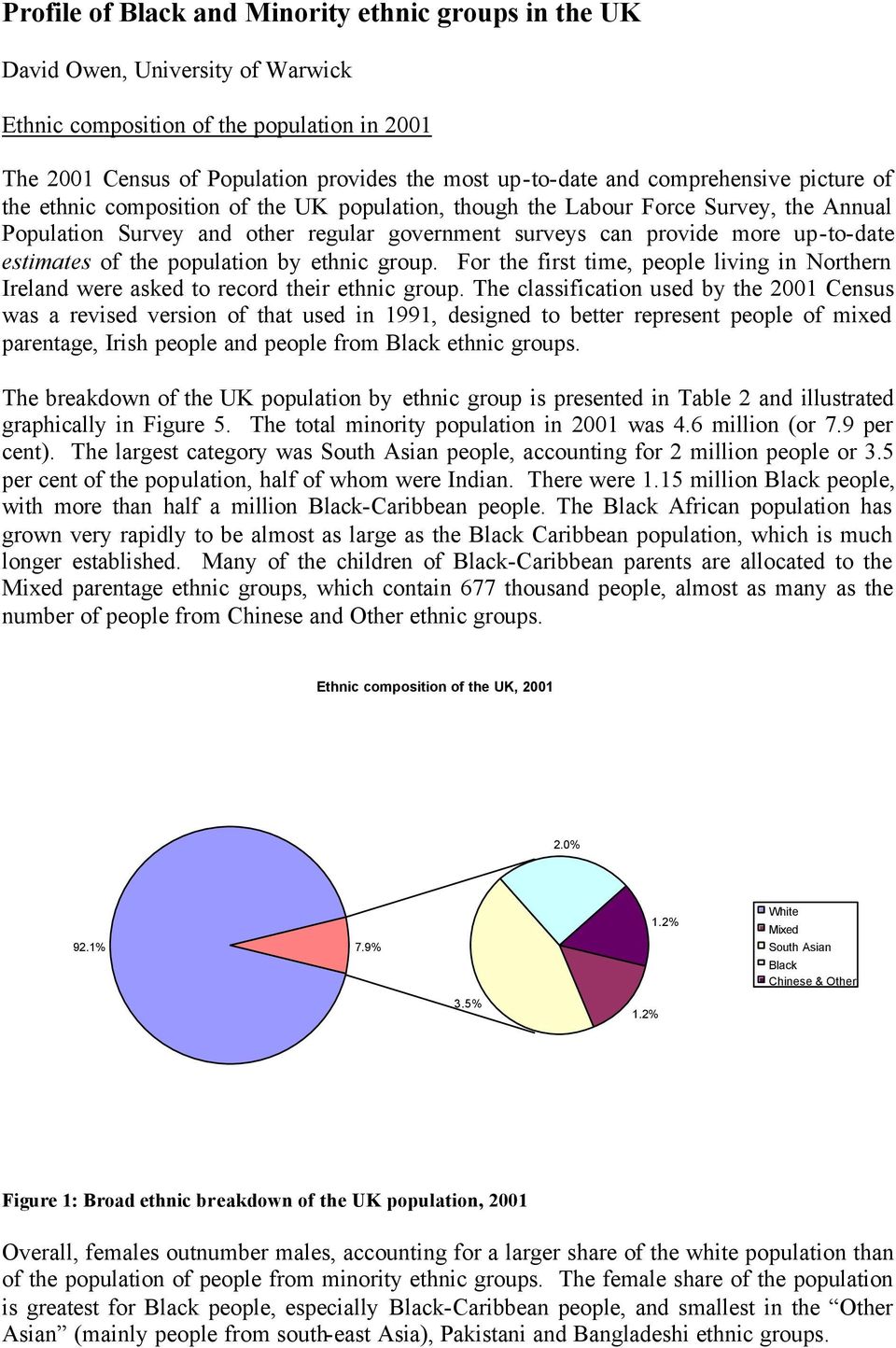
1 Profile of Black and Minority ethnic groups in the UK David Owen, University of Warwick Ethnic composition of the population in 2001 The 2001 Census of Population provides the most up-to-date and comprehensive picture of the ethnic composition of the UK population, though the Labour Force Survey, the Annual Population Survey and other regular government surveys can provide more up-to-date estimates of the population by ethnic group. For the first time, people living in Northern Ireland were asked to record their ethnic group. The classification used by the 2001 Census was a revised version of that used in 1991, designed to better represent people of mixed parentage, Irish people and people from Black ethnic groups. The breakdown of the UK population by ethnic group is presented in Table 2 and illustrated graphically in Figure 5. The total minority population in 2001 was 4.6 million (or 7.9 per cent). The largest category was South Asian people, accounting for 2 million people or 3.5 per cent of the population, half of whom were Indian. There were 1.15 million Black people, with more than half a million Black-Caribbean people. The Black African population has grown very rapidly to be almost as large as the Black Caribbean population, which is much longer established. Many of the children of Black-Caribbean parents are allocated to the Mixed parentage ethnic groups, which contain 677 thousand people, almost as many as the number of people from Chinese and Other ethnic groups. Ethnic composition of the UK, % 92.1% 7.9% 1.2% White Mixed South Asian Black Chinese & Other 3.5% 1.2% Figure 1: Broad ethnic breakdown of the UK population, 2001 Overall, females outnumber males, accounting for a larger share of the white population than of the population of people from minority ethnic groups. The female share of the population is greatest for Black people, especially Black-Caribbean people, and smallest in the Other Asian (mainly people from south-east Asia), Pakistani and Bangladeshi ethnic groups.
2 Table 1: Ethnic composition of the UK, 2001 Ethnic group Number Percent Males per Mean age in years 1000 females Males Females White Minority ethnic groups Mixed parentage Asian and Asian British Indian Pakistani Bangladeshi Black and Black British Black Caribbean Black African Black Other Chinese & Other Chinese Other Asian Other ethnic groups All ethnic groups On average, women are 1.5 years older than men, with white women being just over 40 on average. In contrast, the mean age of people from minority ethnic groups is about ten years less, with little difference between men and women. Among minority ethnic groups, Black- Caribbean people are oldest on average, followed by Indian, Other Asian and Chinese people. At the other extreme, the mean age for people of mixed parentage is just over 20, with Pakistani and Bangladeshi people around 24 or 25 on average. The more youthful age structure of minority etnic groups relative to white people is apparent from a comparison of Figures 6 and 7. The number of people in each 5-year age group is largest for year olds, declining for each younger age group. This reflects the baby booms of the late 1940s and 1960s, and the decline in fertility thereafter. In contrast, the shape of the minority pyramid is more triangular, with children outnumbering older people, indicating that population growth will remain rapid well into the 21 st century. However, the number of people of retirement age from both white and minority ethnic groups will increase substantially in the next few decades. Table 2: Religious breakdown of Great Britain, 2001 Persons Percent Percent answered Percent with religion ALL PEOPLE Christian Buddhist Hindu Jewish Muslim Sikh All other religions With religious belief No religion Answered question Religion not stated

3 Data on religion was collected by the Census in Great Britain for the first time in 2001 (Table 2). This was a voluntary question and 7.8 per cent of respondents to the Census did not complete it. Among people who answered the religion question, more than three-quarters declared themselves to be Christian, while 16.3 per cent professed not to have a religion. The largest minority religion was Islam, with more than 1.5 million Muslims enumerated. There were over half a million Hindus, and 329 thousand Sikhs. Overall, 6.6 per cent of those with a religious faith had a religion drawn from one of the minority religions identified in the question. Geographical distribution of the minority population, 2001 Migrants from the New Commonwealth who came to Britain in the 1950s and 1960s in search of work tended to settle in London, Birmingham and other industrial cities and towns of the midlands and northern England, where jobs in manufacturing industry and public sector services were readily available. Minority ethnic groups are highly concentrated geographically within the UK. The main areas of concentration are Greater London, the West Midlands, Greater Manchester, West Yorkshire and the Leicester/Nottingham corridor in the East Midlands (Table 3). More than a quarter of the population of Greater London is from minority ethnic groups, while a fifth of the population of the West Midlands (former) metropolitan county is from a minority ethnic group. Elsewhere, the minority share of the population only exceeds the UK average in Greater Manchester. At the other extreme, only just over 2 per cent of the populations of the Northern region of England, Wales and Scotland (and less than 1 per cent of the Northern Ireland population) are from minority ethnic groups. Table 3: Minority population change by region, Region, country or metropolitan county Total populatio n 2001 % change Percent Minority ethnic group population Percent Percent Percent Minority populatio n (000s) South East Greater London East Anglia South West West Midlands West Midlands MC East Midlands Yorkshire&Humberside West Yorkshire North West Greater Manchester North Tyne & Wear Wales Scotland Great Britain Note: Data missing for Scotland in 1981 In spite of the general tendency for people to leave the cities and move to smaller towns and rural areas, and the massive loss of jobs in the larger urban areas, people from minority ethnic groups have remained geographically concentrated into the major cities. Table 3 demonstrates that the share of minority ethnic groups in the main areas of settlement steadily increased between 1971 and 2001, at the same time as these regions and metropolitan counties were losing population in relative terms to the areas of more recent employment

4 growth, notably East Anglia and South West England. Thus, the spatial separation between the white and minority ethnic groups has been maintained over this period. Since the mid- 1980s, the population decline of the larger cities has been halted by the growth of the minority ethic group population, and London s population has been increasing over this period, driven by high rates of net international migration. Table 4 emphasises the regional concentration of minority ethnic groups within the UK. Greater London contains only one-eighth of the population of the UK, but nearly half the minority population (and a fifth live in Inner London). A further eighth lives in the West Midlands metropolitan county. More than two-thirds of people from Black ethnic groups live in Greater London, the bulk of the remainder living in the West Midlands metropolitan county and the South East beyond London. More than a third of South Asian people live in Greater London (a larger share of whom live in Outer London), with the second largest concentration being in the West Midlands, followed by the North West, Yorkshire and the Humber and the East Midlands. Table 4: Regional distribution of ethnic groups Government Office Region All people All White Mixed South Asian Black Chinese & Other Minority ethnic groups ENGLAND NORTH EAST NORTH WEST Greater Manchester (Met County) YORKSHIRE & HUMBER West Yorkshire (Met County) EAST MIDLANDS West Midlands (Met County) WEST MIDLANDS EAST LONDON Inner London Outer London SOUTH EAST SOUTH WEST WALES SCOTLAND Great Britain NORTHERN IRELAND United Kingdom Figure 2 presents the detailed local distribution of the minority population of Great Britain in This highlights the highly localised geographical distribution of people from minority ethnic groups within regions. The largest concentrations of people from minority ethnic groups occurred in Greater London, the West Midlands, the Pennine towns and the cities of the East Midlands. A general spread of the minority population outwards into the remainder of the South East and into the Midlands and North West is apparent. However, in Wales and Scotland the minority population remains concentrated in the major cities and the minority share of the population remains very small in the areas of England outside the main axis of urbanisation stretching from London to Leeds.

5 Percent minority 37 to to to to to to to Figure 2: Great Britain - percentage of resident population from minority ethnic groups, 2001 Age structure The Black and Minority ethnic population of Great Britain is substantially younger on average than white people. This is demonstrated in Figures 3a to 3d, which present age/sex pyramids for white and BME people as a whole, and for individual ethnic groups within the broad groupings of minority groups. In Figure 3(a), the base of the pyramid for BME people is much wider than that of white people, demonstrating the much larger percentage of children and young people in the BME population. The white population is stable, with the largest age cohort being people in middle age, reflecting the high fertility of the immediate post-war years and the 1960s. The lower panel of Figure 3(a) presents the population in each age group of white and BME people, emphasising the decreasing BME share of the population as age increases.

6 Figure 3(a) Contrasting white and minority ethnic group age structures, 2001 Great Britain 2001: White ethnic groups Great Britain 2001: Minority ethnic groups Percent of females Percent of males Percent of females Percent of males Great Britain 2001:White people Great Britain 2001: Minority ethnic groups Female Male Female Male

7 Figure 3(b) Asian and Asian British ethnic groups Asian and Asian British ethnic groups Indian people Pakistani people Great Britain: Bangladeshi people Other Asian people

8 Figure 3(c) Black and Black British ethnic groups Black and Black British ethnic groups Black Caribbean people Black-African people Black-Other people

9 Figure 3(d) Mixed parentage and Other ethnic groups Mixed parentage Chinese & Other ethnic groups Chinese people Other ethnic groups

10 There are substantial differences between the age structures of individual minority ethnic groups. The Pakistani and Bangladeshi ethnic groups are very youthful, reflecting high rates of fertility. The Black-Other population is even more youthful, but the most youthful and most rapidly growing population is people of mixed parentage. The Indian and Black-Caribbean populations display fewer people in the younger age ranges than in the middle age range, reflecting an ageing population, following the period of migration and high fertility. Three generations (migrants, their children and their grandchildren) can just be discerned in the age/sex pyramid for the Black-Caribbean ethnic group. The Chinese, Asian Other and Other populations are heavily biased towards the working age population, reflecting migration of economically active adults. The Black-African population displays similar features, but also a large number of children, indicating that the initial migrant generation (over three-fifths of Black-Africans have come to the UK since 1990) is currently experiencing high fertility rates. Economic circumstances of ethnic groups Table 5: Economic activity by ethnic group, United Kingdom 2004 employ Males Females ment rate Economi c activity unemplo yment Economi c activity Unempl oyment rate rate rate rate White Black and Minority Ethnic Mixed parentage Indian Pakistani Bangladeshi Other Asian Black Caribbean Black African Chinese Other ethnic groups All ethnic groups Note : a dash is used where the weighted count upon which a percentage is based is less than 6000 Table 5 summarises the labour market circumstances of men and women from each ethnic group of economically active age (aged for men and for women) in the UK, using data from the Labour Force Survey. Overall, white people are more likely to be active in the labour market than people from minority ethnic groups, who are two and a half times as likely as white people to be unemployed. Economic activity rates are higher for men than women, while the overall female unemployment rate is lower than that for men. The UK government Ethnic Minority Employment Task Force is working to reduce the differential between white and BME people in the percentage in employment, but in 2004, this stood at 16.7 per cent. This differential was narrowest for Indian and Black-Caribbean people, but just greatest for Pakistani and Bangladeshi people, for whom only just over two-fifths of adults were in work.

11 White men display higher economic activity rates and lower unemployment rates than men from all minority ethnic groups. Indian and Black-Caribbean men have the highest economic activity rates and Chinese men the lowest. The unemployment rate is highest for Bangladeshi, Black-African men and men of mixed parentage. The unemployment rate for Pakistani and Black-Caribbean men is well over twice the average for all ethnic groups. Chinese and Indian men experience unemployment rates similar to white men. Amongst women, a slightly higher percentage of Black-Caribbean than white women are economically active. Indian and Other-Asian women are the next most likely to be engaged in the labour market. For most other ethnic groups, over half of all women aged 16 to 59 are economically active, but Pakistani (32.7 per cent) and Bangladeshi women (26.8 per cent) are distinctive in displaying extremely low economic activity rates. The unemployment rate is extremely high for Pakistani women (and Bangladeshi women, though the LFS sample included too few to report), around twice the corresponding male rate. The unemployment rate for women from Black, mixed parentage and Other ethnic groups is more than twice the average for all women. The Indian female unemployment rate is lowest, but still 50 per cent higher than that for white women. Health differentials Standardised illness ratio (100=all ethnic groups) Male Female 0.0 White Mixed Indian Pakistani Bangladeshi Asian Other Black Caribbean Black African Black Other Chinese Other BME Asian Black Other All Figure 4: Incidence of limiting long-term illness by ethnic group and gender, UK 2001 Figure 4 presents age-standardized differentials in the incidence of long-term limiting illness by ethnic group and gender for the UK in 2001, calculated using the (Sample of Anonymised Records). In many ethnic groups, women are more likely than men to suffer limiting longterm illness, after the effect of age differentials are controlled for. The female/female differential is relatively small in most ethnic groups. The likelihood of long-term illness was highest for Pakistani and Bangladeshi people, followed by Black-Other, Black-Caribbean and

12 Indian people. Illness rates were below average for Black-African people and well below average for Chinese people and people from other ethnic groups proportion with LLTI White male BME male White female BME female Figure 5: Proportion of white and BME males and females with limiting long-term illness, by age UK 2001 The likelihood of experiencing a long-term limiting illness increased with age for both white and BME people. Under 1 per cent of people experience a long-term illness until the age group, after which illness rates increase substantially. A differential between white and BME people emerges with increasing age, with BME people more likely than white people to have long-term illness and BME women experiencing higher rates of illness than BME men. The gender differential is smaller for white people. The ethnic differential in illness rates narrows in the oldest section of the population. The Labour Force Survey records the incidence of a number of health problems. Table 6 presents the percentage of people of all ages who experienced a range of health problems, comparing white people with people from some of the largest minority ethnic groups. For white people, the most commonly reported problems were heart blood pressure circulation, and chest breathing problems, followed by back or neck and legs or feet. For men from BME groups, these were also the most important illnesses, though the percentage experiencing them was smaller. One notable difference was the much higher percentage of BME than white men experiencing diabetes; the second largest health problem for Black Caribbean men. BME women also experience a much higher incidence of diabetes than white women. Heart and circulation problems are more common among Black- Caribbean women than white women.

13 Table 6: Percentage of people experiencing health problems, by ethnic group and gender, UK 2004 Male Female White Indian Pakistan i Black Caribbe White Indian Pakistan i Black Caribbe an an Arms hands Legs or feet Back or neck Difficulty in seeing Difficulty in hearing Speech impediment Skin conditions allergies Chest breathing problems Heart blood pressure circulation Stomach liver kidney digestion Diabetes Depression bad nerves Epilepsy Learning difficulties Mental illness phobia panics Progressive illness n.e.c. Other problems disabilities Note : a dash is used where the weighted count upon which a percentage is based is less than 6000

Maidstone is the largest district in Kent with a resident population of 155,143. This grew by 11.7% between 2001 and 2011.
 Census 2011 Briefing Ethnicity & National Identity The 1991 Census was the first census to include a question about ethnic background to monitor equal opportunities /anti-discrimination policies. Over
The ageing of the ethnic minority populations of England and Wales: findings from the 2011 census
 The ageing of the ethnic minority populations of England and Wales: findings from the 2011 census A briefing paper from the Centre for Policy on Ageing June 2013 The Centre for Policy on Ageing was set
Poverty among ethnic groups
 Poverty among ethnic groups how and why does it differ? Peter Kenway and Guy Palmer, New Policy Institute www.jrf.org.uk Contents Introduction and summary 3 1 Poverty rates by ethnic group 9 1 In low income
Disability Rights Commission Disability Briefing June 2005
 Disability Rights Commission Disability Briefing June 2005 Contents Page Introduction 1 Definitions of disability used in the LFS 2 Some Key Facts and Figures 3 Section 1: Autumn 2004 Data 5 Table 1: Economic
Ethnicity and Second Generation Immigrants
 Ethnicity and Second Generation Immigrants Christian Dustmann, Tommaso Frattini, Nikolaos Theodoropoulos Key findings: Ethnic minority individuals constitute a large and growing share of the UK population:
Who are the Other ethnic groups?
 Article Who are the Other ethnic groups? Social and Welfare David Gardener Helen Connolly October 2005 Crown copyright Office for National Statistics 1 Drummond Gate London SW1V 2QQ Tel: 020 7533 9233
2. Incidence, prevalence and duration of breastfeeding
 2. Incidence, prevalence and duration of breastfeeding Key Findings Mothers in the UK are breastfeeding their babies for longer with one in three mothers still breastfeeding at six months in 2010 compared
TRADE UNION MEMBERSHIP 2014. Statistical Bulletin JUNE 2015
 TRADE UNION MEMBERSHIP 2014 Statistical Bulletin JUNE 2015 Contents Contents... 2 Introduction... 3 Key findings... 5 1. Long Term Trends... 6 2.Private and Public Sectors. 12 3. Personal and job characteristics...
Ageing & Ethnicity. BME Elders Forum. A demographic profile of black and minority ethnic older people in England. Dr Savita Katbamna and Ruth Matthews
 419_0207 Ageing & Ethnic Cover.qxp 26/02/2007 16:12 Page 1 Ageing & Ethnicity A demographic profile of black and minority ethnic older people in England Dr Savita Katbamna and Ruth Matthews BME Elders
2011 Census: Cultural diversity in Kent
 Business Intelligence Statistical Bulletin January 2013 2011 Census: Cultural diversity in Kent Related documents 2011 Census results 2011 Census release timetable Equality & diversity The Office for National
Regional characteristics of foreignborn people living in the United Kingdom
 Regional characteristics of foreignborn people living in the United Kingdom By Alice Reid and Caroline Miller, Office for National Statistics Abstract This article examines the characteristics of foreign-born
Population Size. 7.9% from a non-white ethnic group. Population: by ethnic group, April 2001
 Focus on Ethnicity and Identity paints a picture of the ethnic groups in the UK today. It includes information on their characteristics, lifestyles and experiences, placing particular emphasis on comparing
UK application rates by country, region, constituency, sex, age and background. (2015 cycle, January deadline)
 UK application rates by country, region, constituency, sex, age and background () UCAS Analysis and Research 30 January 2015 Key findings JANUARY DEADLINE APPLICATION RATES PROVIDE THE FIRST RELIABLE INDICATION
This briefing is divided into themes, where possible 2001 data is provided for comparison.
 Information Action 2011 Census Second Release December 2012 Consultation The Office for National Statistics (ONS) has now begun the Second Release of outputs from the 2011 Census at local authority level.
PEI Population Demographics and Labour Force Statistics
 PEI Population Demographics and Labour Force Statistics PEI Public Service Commission PEI Population Demographics and Labour Force Statistics Diversity Division PEI Public Service Commission November 2010.
Ethnic Minorities, Refugees and Migrant Communities: physical activity and health
 Ethnic Minorities, Refugees and Migrant Communities: physical activity and health July 2007 Introduction This briefing paper was put together by Sporting Equals. Sporting Equals exists to address racial
Black and Minority Ethnic Groups Author/Key Contact: Dr Lucy Jessop, Consultant in Public Health, Buckinghamshire County Council
 Black and Minority Ethnic Groups Author/Key Contact: Dr Lucy Jessop, Consultant in Public Health, Buckinghamshire County Council Introduction England is a country of great ethnic diversity, with approximately
Creative Industries: Focus on Employment. June 2014
 : Focus on Employment June 2014 27/06/2014 : Focus on Employment These estimates are Official Statistics and have been produced to the standards set out in the Code of Practice for Official Statistics
IV. DEMOGRAPHIC PROFILE OF THE OLDER POPULATION
 World Population Ageing 195-25 IV. DEMOGRAPHIC PROFILE OF THE OLDER POPULATION A. AGE COMPOSITION Older populations themselves are ageing A notable aspect of the global ageing process is the progressive
Census 2011. Census 2011- Ethnicity in England and Wales 2011 01.03.2013. Doncaster Data Observatory
 Census 2011 Census 2011- Ethnicity in England and Wales 2011 01.03.2013 Doncaster Data Observatory Census 2011 Ethnicity in England and Wales 2011 01.03.13 1. Introduction Purpose 1.1. To detail the first
Sports Coaching in the UK III. A statistical analysis of coaches and coaching in the UK
 Sports Coaching in the UK III A statistical analysis of coaches and coaching in the UK January 2011 Contents Executive Summary... 3 1. Introduction... 5 2. Participation in Sport... 6 3. Use of Coaching...
FREELANCE TRAINER APPLICATION FORM
 FREELANCE TRAINER APPLICATION FORM PERSONAL DETAILS: Full Name: Address: Contact (day) (eve) (mobile) (e-mail) QUALIFICATIONS and MEMBERSHIP: Please detail your academic or professional qualifications
Just under a fifth of full time 16-18 year olds (19.4%) were aged 18 at the beginning of the 2012/13 academic year.
 Analysis of 18 Year in FE Colleges RCU ref. Analysis of 18 Year olds in FE Colleges 1. Introduction This report has been prepared by RCU to support the AoC s response to the recent proposal by EFA to cut
Religious Populations
 Focus on Religion paints a picture of the different faith groups in the UK today. It looks separately at Great Britain and Northern Ireland. Information comparing and contrasting the characteristics of
Collecting data on equality and diversity: examples of diversity monitoring questions
 Collecting data on equality and diversity: examples of diversity monitoring questions Subject Page Age 3 Disability 4-5 Race/Ethnicity 6-7 Gender or sex, and gender reassignment 8-9 Religion and belief
The examination fee and all relevant information must be included with the application. Please write in capital letters.
 The examination fee and all relevant information must be included with the application. Please write in capital letters. Give details of any username or personal ID issued to you by the College to which
Chapter 2: Health in Wales and the United Kingdom
 Chapter 2: Health in Wales and the United Kingdom This section uses statistics from a range of sources to compare health outcomes in Wales with the remainder of the United Kingdom. Population trends Annual
UK application rates by country, region, sex, age and background. (2014 cycle, January deadline)
 UK application rates by country, region, sex, age and background (2014 cycle, January deadline) UCAS Analysis and Research 31 January 2014 Key findings Application rates for 18 year olds in England, Wales
Islington Housing Services in partnership with London Metropolitan University delivering an accredited course on housing issues
 Islington Housing Services in partnership with London Metropolitan University delivering an accredited course on housing issues Please return the completed form by Wednesday 22 June 2013, 10.00am Application
PROFILE OF THE SINGAPORE CHINESE DIALECT GROUPS
 PROFILE OF THE SINGAPORE CHINESE DIALECT GROUPS by Edmond Lee Eu Fah Social Statistics Section Singapore Department of Statistics INTRODUCTION The Singapore society is made up of different ethnic groups
Supporting People Client Records. Executive Summary Annual Report
 Centre for Housing Research (CHR) University of St Andrews Supporting People Client Records Executive Summary Annual Report 2005-2006 CHR SP Client Record Office The Observatory University of St Andrews
A Summary Guide. Delivering equality and diversity
 A Summary Guide Delivering equality and diversity We inform, advise, train and work with you Every year Acas helps employers and employees from thousands of workplaces. That means we keep right up-to-date
Access to meaningful, rewarding and safe employment is available to all.
 Home Previous Reports Links Downloads Contacts The Social Report 2002 te purongo oranga tangata 2002 Introduction Health Knowledge and Skills Safety and Security Paid Work Human Rights Culture and Identity
FOCUS ON. People and Migration. The UK population: past, present and future. Chapter 1. Julie Jefferies
 FOCUS ON People and Migration The UK population: past, present and future Julie Jefferies Chapter 1 Chapter 1: The UK population: past, present and future Focus on People and Migration: 2005 Introduction
2011 Census: Key Results on Population, Ethnicity, Identity, Language, Religion, Health, Housing and Accommodation in Scotland - Release 2A
 Statistical Bulletin Coverage: Scotland Date: 26 September 2013 Geographical Area: Scotland, Council Area, Health Board Area Theme: Population and Household estimates 2011 Census: Key Results on Population,
Ethnicity and family
 Ethnicity and family Relationships within and between s: An analysis using the Labour Force Survey Lucinda Platt Institute for Social & Economic Research University of Essex Ethnicity and family Relationships
Student Statistics. HESA Equality data analysis
 Student Statistics HESA Equality data analysis Gender by level and mode In general, as can be seen in the graph below, female students outnumber male students. The exceptions to this were in postgraduate
Investigating the Accuracy of Predicted A Level Grades as part of 2009 UCAS Admission Process
 RESEARCH PAPER NUMBER 37 Investigating the Accuracy of Predicted A Level Grades as part of 2009 UCAS Admission Process JUNE 2011 Authors: Nick Everett and Joanna Papageorgiou, UCAS The views expressed
architecture and race A study of black and minority ethnic students in the profession Research outcomes: 6
 > architecture and race A study of black and minority ethnic students in the profession Research outcomes: 6 CONTENTS List of Tables 4 Abbreviations 5 01 INTRODUCTION AND METHODS 1.1 The quantitative research
Claims Management Claim Form. When you have filled in the form, please send it to us at:
 For our use only.../... Claims Management Claim Form When you have filled in the form, please send it to us at: Solicitors Regulation Authority Claims Management The Cube 199 Wharfside Street Birmingham
Distribution of Population by Religions
 Drop-in-Article on Census - No.4 Distribution of Population by Religions Religious profile of the populace is an important socio-cultural and demographic feature noticeable from the first Census in 1872
HEADLINE FIGURES 2013. Considering the people in the UK in 2013 who were either women aged between 21 and 59 or men aged between 21 and 64...
 HEADLINE FIGURES 213 Considering the people in the UK in 213 who were either women aged between 21 and 59 or men aged between 21 and 64... 19% 6. million had no qualifications or other qualifications 38%
Population and socio-economic trends in Ontario
 Population and socio-economic trends in Ontario Presentation by Dr. Ivan P. Fellegi, Chief Statistician of Canada February 17 th, 2007 International migration accounts for a larger share of population
Barking Abbey School Teacher Application Form
 Job position applied for Closing Date Where or how did you hear about the vacancy? PERSONAL DETAILS Your preferred title: First name or names: Last name: Address: Home phone number: Work phone number:
Sample Give and Let Live survey questions
 Sample Give and Let Live survey questions Here are some closed questions you might think about using in your questionnaire. The questions you ask will depend on who your target audience is if everyone
Demographic/Migration Context: Britain s Ethnic Diversity and Recent Migration from the A8 Countries
 Demographic/Migration Context: Britain s Ethnic Diversity and Recent Migration from the A8 Countries John Eade, Michal Garapich and Stephen Drinkwater (CRONEM, Surrey and Roehampton universities) 1. Introduction
Ethnic Group Profile of Hampshire. 2011 Census. Published by Research and Intelligence (Autumn 2013) www.hants.gov.uk
 Ethnic Group Profile of Hampshire 2011 Census Published by Research and Intelligence (Autumn 2013) 1 www.hants.gov.uk Contents 1. Introduction 2. Ethnic Group by District 3. Ethnic Group by Age and Sex
A National Statistics Publication for Scotland
 Learning Disability Statistics Scotland, 2014 Published: 12 th August 2015 A National Statistics Publication for Scotland Key Findings Data users should note that this Statistics Release does not include
Statistics about Bourne, South Kesteven. People Statistics. 32UG012 Bourne Parish is within South Kesteven LAD or UA. Resident Population and Age
 Statistics about Bourne, 32UG012 Bourne Parish is within LAD or UA People Statistics Resident Population and Age The resident population of Bourne as measured in the 2001 Census, was 11,933 of which 48.3
Statistics about Sleaford, North Kesteven. People Statistics. 32UE057 Sleaford Parish is within North Kesteven LAD or UA. Resident Population and Age
 Statistics about Sleaford, 32UE057 Sleaford Parish is within LAD or UA People Statistics Resident Population and Age The resident population of Sleaford as measured in the 2001 Census, was 14,494 of which
State of Working Britain
 State of Working Britain Aim is to Gives an up to date assessment of the performance of UK labour market, to highlight recent important developments seeks to describe and understand the major long-term
SalarieS of chemists fall
 ACS news SalarieS of chemists fall Unemployment reaches new heights in 2009 as recession hits profession hard The economic recession has taken its toll on chemists. Despite holding up fairly well in previous
Projections of the Size and Composition of the U.S. Population: 2014 to 2060 Population Estimates and Projections
 Projections of the Size and Composition of the U.S. Population: to Population Estimates and Projections Current Population Reports By Sandra L. Colby and Jennifer M. Ortman Issued March 15 P25-1143 INTRODUCTION
Housing List Application
 Answer all questions on this form fully & truthfully or your application will be delayed. Please use a black pen and write in BLOCK CAPITALS. If you need help filling in this form please contact 020 7364
Foreword. End of Cycle Report 2014. Applicants
 Foreword The End of Cycle Report is our most comprehensive analysis to date of recruitment to full time undergraduate courses in the UK. It provides a rich picture of demand and outcomes for higher education
How has Hounslow s demographic profile changed? An analysis of the 2011 Census data based on releases available up to January 2013
 How has Hounslow s demographic profile changed? An analysis of the 2011 Census data based on releases available up to January 2013 Background Since 2001 Hounslow s population has grown by 19.6% from 212,341
POPULATION AND MIGRATION ESTIMATES NORTHERN IRELAND (2013) STATISTICAL REPORT
 POPULATION AND MIGRATION ESTIMATES NORTHERN IRELAND (2013) STATISTICAL REPORT 9.30am Thursday 26 June 2014 Key Points Northern Ireland population at 30 June 2013 is estimated to be 1.830 million people.
Newham, London. Local Economic Assessment. 2010 to 20279. Newham - Economic Development
 Newham, London Local Economic Assessment Newham - Economic Development 2010 to 20279 F and 3. 2BDemographics Summary The population in Newham is rising and is projected to continue to rise significantly.
Application Form Foundation Degree in Business 2 years Full-Time (Part-Time attendance)
 Application Form Foundation Degree in Business 2 years Full-Time (Part-Time attendance) Please read the online course leaflet page for details of the entry requirements. Personal Details Surname First
Social work education in England 2009-2014
 Social work education in England 2009-2014 A report for the Department of Health (DH) March 2015 Produced by Skills for Care for the Department of Health Contents Introduction 3 1. Enrolments 4 Interim
Application form trainee solicitors
 Application form trainee solicitors for training contracts commencing in 2018 PERSONAL DETAILS Title: Name (in full): Telephone number(s): Email address: Home address (including postcode): Please give
Mortality from Prostate Cancer Urological Cancers SSCRG
 1 Mortality from Prostate Cancer Urological Cancers SSCRG Headline Findings Over 10,000 men die from prostate cancer in the UK each year, nearly 9,000 in England. The rate of death from prostate cancer
How Wakefield Council is working to make sure everyone is treated fairly
 How Wakefield Council is working to make sure everyone is treated fairly As part of meeting the Public Sector Equality Duty, the Council is required to publish information on how it is working to treat
Abuse of Vulnerable Adults in England. 2011-12, Final Report, Experimental Statistics
 Abuse of Vulnerable Adults in England 2011-12, Final Report, Experimental Statistics Published: 6 March 2013 We are England s national source of health and social care information www.ic.nhs.uk [email protected]
NHS Family doctor services registration GMS1
 NHS Family doctor services registration GMS1 Patient s details Please complete in BLOCK CAPITALS and tick as Appropriate Mr Mrs Miss Ms Surname Date of birth d d m m y y First names NHS No. Male Female
The Decline in Student Applications to Computer Science and IT Degree Courses in UK Universities. Anna Round University of Newcastle
 The Decline in Student Applications to Computer Science and IT Degree Courses in UK Universities Introduction Anna Round University of Newcastle The research described in this report was undertaken for
Age/sex/race in New York State
 Age/sex/race in New York State Based on Census 2010 Summary File 1 Jan K. Vink Program on Applied Demographics Cornell University July 14, 2011 Program on Applied Demographics Web: http://pad.human.cornell.edu
Lloyd Potter is the Texas State Demographer and the Director of the Texas State Data Center based at the University of Texas at San Antonio.
 Lloyd Potter is the Texas State Demographer and the Director of the Texas State Data Center based at the University of Texas at San Antonio. 1 2 Texas population in 2014 was just under 27 million and was
THE DEMOGRAPHY OF POPULATION AGEING
 THE DEMOGRAPHY OF POPULATION AGEING Barry Mirkin and Mary Beth Weinberger* An inevitable consequence of the demographic transition and the shift to lower fertility and mortality has been the evolution
Roads Task Force Technical Note 12 How many cars are there in London and who owns them?
 Roads Task Force Technical Note 12 How many cars are there in London and who owns them? Introduction ROADS TASK FORCE This paper forms one of a series of thematic analyses, produced to contribute to the
RR887. Changes in shift work patterns over the last ten years (1999 to 2009)
 Health and Safety Executive Changes in shift work patterns over the last ten years (999 to 009) Prepared by Office for National Statistics for the Health and Safety Executive 0 RR887 Research Report Crown
Dental Care Professionals Pay Findings from the Dental Business Trends survey
 BDA RESEARCH FINDINGS 8 December 2013 Dental Care Professionals Pay Findings from the Dental Business Trends survey British Dental Association 64 Wimpole Street London W1G 8YS Author Henry Edwards, Research
Public and Private Sector Earnings - March 2014
 Public and Private Sector Earnings - March 2014 Coverage: UK Date: 10 March 2014 Geographical Area: Region Theme: Labour Market Theme: Government Key Points Average pay levels vary between the public and
Ireland and the EU 1973-2003 Economic and Social Change
 Ireland and the EU 1973-2003 Economic and Social Change Table 1 Population, 1971-2002 viii Table 2 Population of the provinces ix Table 3 Births, deaths and life expectancy ix Table 4 Numbers in education
Amendments to the Legal Aid, Sentencing and Punishment of Offenders (LASPO) Bill Equality Impact Assessment
 Amendments to the Legal Aid, Sentencing and Punishment of Offenders (LASPO) Bill Equality Impact Assessment Introduction This Equality Impact Assessment (EIA) relates to amendments to the Legal Aid, Sentencing
Minority Ethnic Attainment and Participation in Education and Training: The Evidence
 Minority Ethnic Attainment and Participation in Education and Training: The Evidence Gargi Bhattacharyya 1, Liz Ison 2, Maud Blair 2 1 University of Birmingham and 2 Department for Education and Skills
Age, Demographics and Employment
 Key Facts Age, Demographics and Employment This document summarises key facts about demographic change, age, employment, training, retirement, pensions and savings. 1 Demographic change The population
27 February 2014 Population
 Statistical Bulletin Migration Statistics Quarterly Report, February 2014 Coverage: UK Date: 27 February 2014 Geographical Area: UK Theme: Population Office for National Statistics 1 Migration Statistics
Results of the Second Flexible Working Employee Survey
 Results of the Second Flexible Working Employee Survey 297 Results of the Second Flexible Working Employee Survey By Heidi Grainger and Heather Holt, Employment Market Analysis and Research, Department
The civil service workforce
 INSTITUTE FOR GOVERNMENT The civil service workforce The number of civil servants has been cut by more than 70,000 since the Spending Review in 2010, meaning the Civil Service is at its smallest since
PLEASE READ THIS FORM IN FULL BEFORE COMPLETING IT
 Application Form PLEASE READ THIS FORM IN FULL BEFORE COMPLETING IT Please complete all sections of this form when applying for the grant. Please send your completed application form and relevant documentation
THE EMPLOYMENT AND INCOME SURVEY 2014 RESULTS
 THE EMPLOYMENT AND INCOME SURVEY RESULTS 1 Dear Members, Firstly I would like to thank all members who have taken the trouble and time to be candid and provide the information that has made this survey
Private Sector Employment Indicator, Quarter 1 2015 (February 2015 to April 2015)
 STATISTICAL RELEASE Date: 14 July 2015 Status: Experimental Official Statistics Coverage: England; Regions Private Sector Employment Indicator, Quarter 1 2015 (February 2015 to April 2015) 1. Introduction
Statistical First Release
 Statistical First Release Special Educational Needs in England: January 2014 Reference SFR 26/2014 Date 4 September 2014 Coverage England Theme Children, Education and Skills Issued by Department for Education,
Local Authority Personal Social Services Statistics. Guardianship under the Mental Health Act, 1983. England, 2013
 Local Authority Personal Social Services Statistics Guardianship under the Mental Health Act, 1983 England, 2013 Published 27 September 2013 Guardianship, 2012/13 We are the trusted source of authoritative