
Student Exploration: Dichotomous Keys
|
|
|
- Debra Morton
- 9 years ago
- Views:
Transcription

1 Name: ate: Student xploration: ichotomous Keys Vocabulary: dichotomous key, genus, organism, scientific name, species, traits Prior Knowledge Question (o this OR using the izmo.) Jerome is walking through a park when he sees the spider shown at left. How could Jerome find out what type of spider it is? izmo Warm-up In the field, scientists often have to identify an unfamiliar organism (living thing). reliable way to identify organisms is to use a dichotomous key. dichotomous key is a series of paired statements or questions that lead to the identification of an organism. The ichotomous Keys izmo allows you to use five different dichotomous keys to identify a variety of organisms. To begin, make sure alifornia lbatrosses and Organism are selected. 1. Read the two statements at lower right. Which of the two statements most closely matches the characteristics of the bird pictured? 2. Select that statement and click Next. ontinue until you have correctly identified the albatross. If you change your mind about a choice, you can click the ack button. If you incorrectly identify the albatross, you can click the Start Over button and try again.. What is the name of the albatross?. The scientific name is shown in italics. Scientific names have two parts: the genus name and the species name. What is the scientific name of this albatross?

2 ctivity : Use a dichotomous key et the izmo ready: Make sure the alifornia lbatrosses key is selected. Select Organism. Introduction: s you saw on the previous page, a dichotomous key can help you identify an organism using its characteristics, or traits. The keys in this izmo use only physical traits, such as feather color, to identify organisms. In some cases, behavioral traits are used in dichotomous keys. or example, some frog species can be identified by their croaks. oal: Use a dichotomous key to identify albatross species found in alifornia. 1. ompare: Take a close look at organism.. How does organism differ from organism?. What physical traits do you think can be used to help identify organism? 2. Identify: Use the izmo to identify organism. Then, identify the other albatrosses included in the alifornia lbatrosses key. omplete the table below. alifornia lbatrosses Organism ommon name Scientific name Short-tailed albatross Phoebastria albatrus 3. Think and discuss: What do you think are some limitations of dichotomous keys?

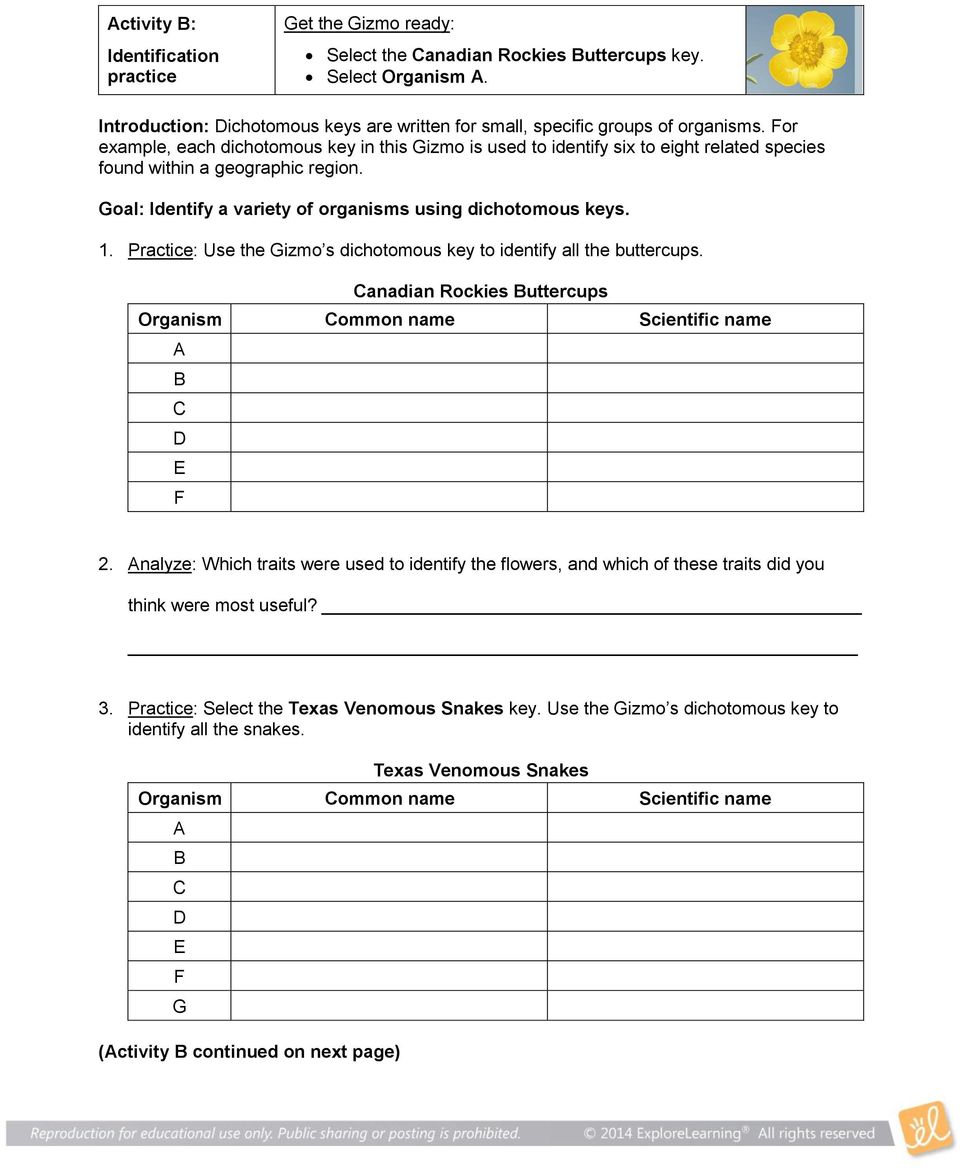
3 ctivity : Identification practice et the izmo ready: Select the anadian Rockies uttercups key. Select Organism. Introduction: ichotomous keys are written for small, specific groups of organisms. or example, each dichotomous key in this izmo is used to identify six to eight related species found within a geographic region. oal: Identify a variety of organisms using dichotomous keys. 1. Practice: Use the izmo s dichotomous key to identify all the buttercups. anadian Rockies uttercups Organism ommon name Scientific name 2. nalyze: Which traits were used to identify the flowers, and which of these traits did you think were most useful? 3. Practice: Select the Texas Venomous Snakes key. Use the izmo s dichotomous key to identify all the snakes. Texas Venomous Snakes Organism ommon name Scientific name (ctivity continued on next page)
4 ctivity (continued from previous page) 4. Reflect: Why is it important to be able to tell a scarlet kingsnake apart from a coral snake? 5. Practice: Select the Virginia vergreens key. Use the izmo s dichotomous key to identify all the trees. Virginia vergreens Organism ommon name Scientific name H 6. Practice: Select the lorida artilaginous ishes key. Use the izmo s dichotomous key to identify all the fishes. lorida artilaginous ishes Organism ommon name Scientific name H

5 ctivity : Make your own dichotomous key et the izmo ready: Select the alifornia lbatrosses key. oal: Make a dichotomous key. 1. Observe: Now that you ve learned how to use a dichotomous key, you get to practice making your own. We ll start with four organisms you ve already seen: Short-tailed albatross Shy albatross Wandering albatross Laysan albatross. What is one trait that could be used to separate these albatrosses into two groups of two birds each? (Hint: Look at the colors and patterns on their plumage and beaks.). Use this trait to write statement set #1 in the table below. The statements should be mutually exclusive. In other words, either the albatross has that trait or it doesn t.. Observe the albatrosses described by statement #1a. Identify one trait that could be used to differentiate these organisms and use it to write statement set #2. Repeat this step for the albatrosses described by statement #1b. Set Statements Identity of Organism a. o to #2 b. o to #3 a. b. a. b. 2. Practice: hoose another key on the izmo. Take screen shots of all the organisms included in that key and place them in a separate document. Make a new dichotomous key that could be used to identify these organisms. Turn the key in with this worksheet.

Lesson Title: Constructing a Dichotomous Key and Exploring Its Relationship to Evolutionary Patterns
 Lesson Title: Constructing a Dichotomous Key and Exploring Its Relationship to Evolutionary Patterns NSF GK-12 Fellow: Tommy Detmer Grade Level: 4 th and 5 th grade Type of Lesson: STEM Objectives: The
Build Vocabulary Students will have a more successful lab experience if they understand these terms.
 Chapter 18 Lab Dichotomous Keys Open-Ended Inquiry Design Your Own Lab Problem Can you construct a dichotomous key that could be used to identify organisms? Introduction In May 2007, scientists and other
IDENTIFICATION OF ORGANISMS
 reflect Take a look at the pictures on the right. Think about what the two organisms have in common. They both need food and water to survive. They both grow and reproduce. They both have similar body
A MIDDLE SCHOOL LESSON FOR CREATING AND USING DICHOTOMOUS KEYS By Sharon Donovan
 A MIDDLE SCHOOL LESSON FOR CREATING AND USING DICHOTOMOUS KEYS By Sharon Donovan INTRODUCTION One of my most enjoyable lessons is on the concept of dichotomous keys. It not only addresses a multitude of
TEACHING Living or Nonliving
 TEACHING GUIDE TEACHING Living or Nonliving Kindergarten Reading Level ISBN 978-0-8225-5692-3 2 TEACHING LIVING OR NONLIVING Standards Science Mathematics Understands the nature of scientific inquiry.
Building a Dichotomous Key: Take home Assignment. - Copy of Aliens Handout - Question Sheet - Dichotomous Key Sheet
 Materials: uilding a Dichotomous Key: Take home Assignment - Copy of Aliens Handout - Question Sheet - Dichotomous Key Sheet Introduction: A dichotomous key is a very useful tool. It helps you identify
Animal Colors and Shapes Teacher s Guide
 Teacher s Guide Grade Level: K 2 Curriculum Focus: Math, Science Lesson Duration: 1 2 class periods Program Description Animals come in all colors, shapes, and sizes. Learn about the shapes animals have
reflect What about other living things? Do all animals look the same as their parents?
 reflect Look at the boy and his father. How do they look the same? They both have two arms and two legs. They both have eyes and a nose. They look a lot alike! People can look like their parents. We get
Animal Adaptations Investigation (K-3)
 Animal Adaptations Investigation (K-3) At a glance Students explore the Zoo in search of animals that fit certain categories and discover their adaptations. Time requirement One Zoo visit of at least 60
Activity Sheet A - Getting Sorted (Cont) Diet (in the wild) Herbivore Carnivore Omnivore Habitat Terrestrial/ground dwelling Arboreal/tree living Aqua
 Activity Sheet A - Getting Sorted Duration: 45 minutes Locate the animals listed below and find out their scientific name. Remember that the scientific name is usually written in italics or is underlined.
Identifying Vertebrates Using Classification Keys
 Name Class Date Chapter 18 Classification Identifying Vertebrates Using Classification Keys Introduction Organisms such as vertebrates (animals with backbones) are classified into groups according to certain
Layers of the Rain Forest Distance Learning
 Layers of the Rain Forest Distance Learning Summary and Goals Students will be able to identify the layers of the rain forest and animal species that live in each layer. Grade Levels Grades 3-5 Engage
Grade: 3 to 5 Length: one hour Subjects: life science, classification Topics: weed identification, dichotomous keys
 Grade: 3 to 5 Length: one hour Subjects: life science, classification Topics: weed identification, dichotomous keys Objectives Exercises in this lesson help students achieve the following objectives: Practice
Jennifer Carmack Cannon s Point Unit
 Jennifer Carmack Cannon s Point Unit Unit Organizer: (Approximate Time: 5 days) OVERVIEW: Organisms are dependent upon other organisms for survival. The absence of one organism can disrupt all other organisms
Everything you wanted to know about using Hexadecimal and Octal Numbers in Visual Basic 6
 Everything you wanted to know about using Hexadecimal and Octal Numbers in Visual Basic 6 Number Systems No course on programming would be complete without a discussion of the Hexadecimal (Hex) number
Move It, Move It! Kindergarten. Concepts. Objectives. Outline. Duration Pre-Visit: 60 minutes Visit: 30 minutes Post-Visit: 35 minutes
 Move It, Move It! Kindergarten Duration Pre-Visit: 60 minutes Visit: 30 minutes Post-Visit: 35 minutes Location Nature Gardens Supplies Movement cards Worksheets Pencils Crayons Markers Colored pencils
Silent, Nighttime Hunters By Guy Belleranti
 By Guy Belleranti Owls are raptors, or birds of prey. They are carnivores who quickly and silently swoop down on their prey from above. Most raptors such as eagles, hawks and falcons are day hunters. They
How to do Split testing on your WordPress site using Google Website Optimizer
 How to do Split testing on your WordPress site using Google Website Optimizer If you are now at a stage where you ve read enough about the merits of split testing that you want to want to jump in and try
Name of Lesson: Properties of Equality A Review. Mathematical Topic: The Four Properties of Equality. Course: Algebra I
 Name of Lesson: Properties of Equality A Review Mathematical Topic: The Four Properties of Equality Course: Algebra I Time Allocation: One (1) 56 minute period Pre-requisite Knowledge: The students will
Tessellating with Regular Polygons
 Tessellating with Regular Polygons You ve probably seen a floor tiled with square tiles. Squares make good tiles because they can cover a surface without any gaps or overlapping. This kind of tiling is
Brazil: Lost in the rainforest
 A IME A IME RAVEL Level: Elementary / Pre-intermediate Age: eenagers / Young adults Duration: Approx. 60 minutes Aims: In this lesson the students will: 1. learn about the Amazon rainforest; 2. practise
Zoo Connections Curriculum
 Zoo Connections Curriculum We Like to Move It, Move It: Classifying animals by features 1 st grade Curriculum is aligned with the Mississippi Academic Framework. Lessons and support material are provided
Student Exploration: Pulleys
 Name: Date: Student Exploration: Pulleys Vocabulary: effort, load, mechanical advantage, pulley, pulley system Prior Knowledge Questions (Do these BEFORE using the Gizmo.) 1. Suppose you had to haul a
Lesson 6: Fisheries Management in the Open Ocean. Open Ocean
 !!! Open Ocean Concepts How does fishing equipment affect the amount of fish and bycatch caught in a fishery? How can we change the way we fish to use the ocean better? Standards Addressed HCPS 5. & 5.2
Focused Learning Lesson Science Grades 10-12 LS-H-C4
 Focused Learning Lesson Science Grades 10-12 LS-H-C4 Overview: This lesson is to be used to help students to understand how to use a dichotomous key in classification. Students will use a dichotomous key
Section 1.5 Exponents, Square Roots, and the Order of Operations
 Section 1.5 Exponents, Square Roots, and the Order of Operations Objectives In this section, you will learn to: To successfully complete this section, you need to understand: Identify perfect squares.
The Toledo Zoo Aviary
 The Toledo Zoo Aviary Look at the Birdie Bird Adaptations Lesson Learning Strategies Background Knowledge Vocabulary Comprehension Application/ Extension Problem Solution Guide Personal Clues Questions
Level 2 6.4 Lesson Plan Session 1
 Session 1 Materials Materials provided: image of 3R symbol; 4 environment images; Word Map; homework puzzle. Suggested additional materials: examples of compostable and non-compostable waste, i.e., apple
3.1 Types of Living Things
 CHAPTER 3 CLASSIFYING LIVING THINGS 3.1 Types of Living Things Look around you. What types of living things do you see? You probably see plants and animals. What would you see if you could shrink down
Talking About Penguins by Guy Belleranti
 Talking About Penguins Penguins are one of the world s most interesting birds. They waddle when they walk, and have flippers instead of wings. The bones in a penguin s flippers are heavier and more solid
Name Class Date. Adapting to the Environment Adaptations and Survival
 CHAPTER 3 4 SECTIN Adapting to the Environment Adaptations and Survival EFRE YU READ After you read this section, you should be able to answer these questions: What adaptations help animals survive? What
PUSD High Frequency Word List
 PUSD High Frequency Word List For Reading and Spelling Grades K-5 High Frequency or instant words are important because: 1. You can t read a sentence or a paragraph without knowing at least the most common.
Natalia Moreno BME 530. Butterflies Subject: Science (Grade Level: Adaptable from 2-3) Introduction:
 Natalia Moreno BME 530 Butterflies Subject: Science (Grade Level: Adaptable from 2-3) Introduction: This lesson will be introducing the students to the life cycle of a butterfly. We will discuss the stages
OA3-10 Patterns in Addition Tables
 OA3-10 Patterns in Addition Tables Pages 60 63 Standards: 3.OA.D.9 Goals: Students will identify and describe various patterns in addition tables. Prior Knowledge Required: Can add two numbers within 20
KET for Schools Reading and Writing Part 9 teacher s notes
 KET for Schools Reading and Writing Part 9 teacher s notes Description This is a guided discovery activity to find out what candidates need to do in KET for Schools Reading and Writing Part 9. Students
Day One: Least Common Multiple
 Grade Level/Course: 5 th /6 th Grade Math Lesson/Unit Plan Name: Using Prime Factors to find LCM and GCF. Rationale/Lesson Abstract: The objective of this two- part lesson is to give students a clear understanding
Task 3 Reading into Writing: Endangered Animals
 At a glance Level: ISE II Task 3 Reading into Writing: Endangered Animals Focus: Task 3 Reading into writing Aims: To read information about endangered animals, to answer questions about the information
Plant and Animal Cells
 Plant and Animal Cells Strand Topic Life Systems Investigating organelles and their functions in cells of living things Primary SOL LS.2 The student will investigate and understand that all living things
Title: Create A New Animal. Grade Level: 3 rd -5 th. Subject: Biology. Time: 60-90 minutes
 Title: Create A New Animal Grade Level: 3 rd -5 th Subject: Biology Time: 60-90 minutes Objective: Students will better understand physical adaptations of certain animals, and how those adaptations increase
Animal Adaptations. Standards. Multiple Intelligences Utilized. Teaching First Step Nonfiction. Titles in this series: Reading.
 Teaching First Step Nonfiction Animal Adaptations K 2nd Grade Interest Level 1st Grade ing Level Titles in this series: What Can Live in a Desert? What Can Live in a Forest? What Can Live in a Grassland?
OA4-13 Rounding on a Number Line Pages 80 81
 OA4-13 Rounding on a Number Line Pages 80 81 STANDARDS 3.NBT.A.1, 4.NBT.A.3 Goals Students will round to the closest ten, except when the number is exactly halfway between a multiple of ten. PRIOR KNOWLEDGE
Sentence Blocks. Sentence Focus Activity. Contents
 Sentence Focus Activity Sentence Blocks Contents Instructions 2.1 Activity Template (Blank) 2.7 Sentence Blocks Q & A 2.8 Sentence Blocks Six Great Tips for Students 2.9 Designed specifically for the Talk
View Your Photos. What you ll need: A folder of digital photos Jasc Paint Shop Photo Album 5
 View Your Photos With Photo Album you can choose the way you view photos, easily switching back and forth between four useful options: Favorite Folders, Calendar, Keywords, or All Folders. You can even
Making and using keys Teacher Guidance
 Teacher Guidance Activities in earlier sections should have laid foundations that lead children to these more complex activities, in which they apply their observation and sorting skills to the practical
Tagxedo. Tagxedo is based on a Microsoft application called SilverLight. If you don t have it, don t worry. Tagxedo will prompt you to download it
 TEACh like a TEChie Tagxedo You can make text come alive for students by stepping into the clouds word clouds. Word clouds are visual representations of words, as shown in the illustration. The words can
Fiction: Poetry. Classic Poems. Contemporary Poems. Example. Key Point. Example
 Reading - Comprehension Fiction: Poetry Read classic and contemporary poems Recognise riddles and rhymes Recognise tongue twisters Classic Poems A poem expresses an emotion or an idea. Rhyme is when words
Vieta s Formulas and the Identity Theorem
 Vieta s Formulas and the Identity Theorem This worksheet will work through the material from our class on 3/21/2013 with some examples that should help you with the homework The topic of our discussion
I. ABSTRACT II. III. IV.
 Teaching About Magnets in Kindergarten Grade Level or Special Area: Kindergarten Written by: Lori Dawn Montanez, Swallows Charter Academy, Pueblo West, CO Length of Unit: Five lessons (approximately two
Objective. Materials. TI-73 Calculator
 0. Objective To explore subtraction of integers using a number line. Activity 2 To develop strategies for subtracting integers. Materials TI-73 Calculator Integer Subtraction What s the Difference? Teacher
Using and Constructing a Dichotomous Key
 Name Class Date Chapter 18 Classification Using and Constructing a Dichotomous Key You may want to refer students to Chapter 18 in the textbook for a discussion of the classification system used in biology.
Kodu Curriculum: Single Session Intro
 Kodu Curriculum: Single Session Intro Table of Contents Kodu Curriculum: Single Session Intro... 2 Kodu Description... 2 Teaching with Kodu... 2 Basic Navigation (5 min)... 3 Creating a Simple Program
6. Which of the following is not a basic need off all animals a. food b. *friends c. water d. protection from predators. NAME SOL 4.
 NAME SOL 4.5 REVIEW - Revised Habitats, Niches and Adaptations POPULATION A group of the same species living in the same place at the same time. COMMUNITY-- All of the populations that live in the same
Factorizations: Searching for Factor Strings
 " 1 Factorizations: Searching for Factor Strings Some numbers can be written as the product of several different pairs of factors. For example, can be written as 1, 0,, 0, and. It is also possible to write
TUTORIAL: BOARDMAKER STUDIO START-UP
 Congratulations, you ve downloaded the Boardmaker Studio trial. To be successful from the start, use this guide to learn the essential skills in Boardmaker Studio. 1 EDIT IN PLACE The most essential skill.
Writing a Dichotomous Key to Wildflowers
 Writing a Dichotomous Key to Wildflowers Objectives: 1. Understand how to use and make dichotomous keys. 2. Understand common terminology of plant morphology. 3. Learn to recognize some fall wildflowers.
Unit 1 Number Sense. In this unit, students will study repeating decimals, percents, fractions, decimals, and proportions.
 Unit 1 Number Sense In this unit, students will study repeating decimals, percents, fractions, decimals, and proportions. BLM Three Types of Percent Problems (p L-34) is a summary BLM for the material
Materials and Resources:
 Keywords: class classification family genus invertebrates kingdom order phylum species 1. Engage: Introduction: Students investigate different questioning techniques through a classification game. Materials
GUESSING BY LOOKING AT CLUES >> see it
 Activity 1: Until now, you ve been asked to check the box beside the statements that represent main ideas found in the video. Now that you re an expert at identifying main ideas (thanks to the Spotlight
Making Judgments. A Winning Breakfast
 Making Judgments PRATIE 5: SAMPLE irections Read the passage. hoose the best answer to each question. A Winning Breakfast When track star Nora James races, she usually finishes first. What makes Nora a
Presentations Phrases Prepositions Pairwork Student A Choose one of the sections below and read out one of the example sentences with a gap or noise
 Presentations Phrases Prepositions Pairwork Student A Choose one of the sections below and read out one of the example sentences with a gap or noise instead of the preposition. Your partner can guess the
Analyzing A DNA Sequence Chromatogram
 LESSON 9 HANDOUT Analyzing A DNA Sequence Chromatogram Student Researcher Background: DNA Analysis and FinchTV DNA sequence data can be used to answer many types of questions. Because DNA sequences differ
Audio Science Sound Card Configuration for Simian
 Audio Science Sound Card Configuration for Simian To assign which audio devices Simian uses, go to the Tools, Hardware Options to bring up the screen shown below. The ASI cards are easily identified by
The Art of the Tree of Life. Catherine Ibes & Priscilla Spears March 2012
 The Art of the Tree of Life Catherine Ibes & Priscilla Spears March 2012 from so simple a beginning endless forms most beautiful and most wonderful have been, and are being, evolved. Charles Darwin, The
ARTHROPOD DICHOTOMOUS KEY
 The following instructional plan is part of a GaDOE collection of Unit Frameworks, Performance Tasks, examples of Student Work, and Teacher Commentary. Many more GaDOE approved instructional plans are
1 Characteristics of Living Things
 CHAPTER 2 1 Characteristics of Living Things SECTION It s Alive!! Or Is It? BEFORE YOU READ After you read this section, you should be able to answer these questions: What are all living things made of?
A Prime Investigation with 7, 11, and 13
 . Objective To investigate the divisibility of 7, 11, and 13, and discover the divisibility characteristics of certain six-digit numbers A c t i v i t y 3 Materials TI-73 calculator A Prime Investigation
www.lakeshorelearning.com
 Get kids excited about science with this fun-filled quiz game! We ve provided 20 sample questions covering a variety of engaging topics. Just download the free game cards and follow the instructions below
Second Grade Science Curriculum
 Second Grade Science Curriculum Approved July 12, 2004 The Georgia Performance Standards are designed to provide students with the knowledge and skills for proficiency in science at the second grade level.
Week 4 Lesson Plan. Pre-K. Animals in the Wild. Macmillan /McGraw-Hill. Extend. the Unit
 Lesson Plan Extend Unit the Unit Pre-K Animals in the Wild Alphabet Time.....................2-3 Book Time.........................-5 Retelling Puppets................... 6 Content Area......................7-8
Compound Words Lesson Plan
 Compound Words Lesson Plan Purpose: 1. Students will develop an understanding of how compound words are formed. 2. To improve student word recognition decoding and encoding compound words. MA Frameworks:
Bar Graphs with Intervals Grade Three
 Bar Graphs with Intervals Grade Three Ohio Standards Connection Data Analysis and Probability Benchmark D Read, interpret and construct graphs in which icons represent more than a single unit or intervals
Classification Why Things are Grouped classify Methods of Classification
 Classification What features do biologists use to group living things? You know that most plants are green and do not more around. You also know that most animals are not green and do move around. The
The Skeleton Key by Kelly Hashway
 by Kelly Hashway Erik rang his grandparents doorbell and silently wished the next four hours would go by quickly. He didn t want to give up his entire Saturday afternoon at his grandparents house where
What activities do you think an organism would use bioluminescence for?
 Relationships for Survival: The Role of Bioluminescence overview In these activities, students will focus on ecological relationships and investigate the many ways that species might interact using bioluminescence.
food chains reflect How are these organisms important to one another? organism: a living thing
 reflect Different plants and animals live together. Look at the picture of the garden. What organisms live there? Grass, trees, bugs, and birds live there. Fish and frogs live there, too. Can you think
Cambridge English: First (FCE) Writing Part 1
 Cambridge English: First (FCE) Writing Part 1 Teacher s notes Aims of the lesson to familiarise students with Part 1 of the Writing paper and give them practice at planning an essay Time needed 50 minutes
2. Name of Inquiry: Where do I belong? : An Introduction to the Use of Dichotomous Keys (Part 1)
 ECOS Inquiry 1. Contributor s Name: Sarah Bisbing 2. Name of Inquiry: Where do I belong? : An Introduction to the Use of Dichotomous Keys (Part 1) 3. Goals and Objectives: a. Inquiry Questions: Why do
How to Make the Most of Excel Spreadsheets
 How to Make the Most of Excel Spreadsheets Analyzing data is often easier when it s in an Excel spreadsheet rather than a PDF for example, you can filter to view just a particular grade, sort to view which
EMILY WANTS SIX STARS. EMMA DREW SEVEN FOOTBALLS. MATHEW BOUGHT EIGHT BOTTLES. ANDREW HAS NINE BANANAS.
 SENTENCE MATRIX INTRODUCTION Matrix One EMILY WANTS SIX STARS. EMMA DREW SEVEN FOOTBALLS. MATHEW BOUGHT EIGHT BOTTLES. ANDREW HAS NINE BANANAS. The table above is a 4 x 4 matrix to be used for presenting
Materials Needed: Choose one of the following methods depending on how familiar your students are with the internet and how to use it.
 Teacher Information Lesson Title: Global Warming, Green House Effect and Climate Changes Lesson Description: This lesson helps students to understand or review their understanding of global warming, the
Producers, Consumers, and Food Webs
 reflect Think about the last meal you ate. Where did the food come from? Maybe it came from the grocery store or a restaurant. Maybe it even came from your backyard. Now think of a lion living on the plains
Study Guide for the Pre-Professional Skills Test: Writing
 Study Guide for the Pre-Professional Skills Test: Writing A PUBLICATION OF ETS Table of Contents Study Guide for the Pre-Professional Skills Test: Writing TABLE OF CONTENTS Chapter 1 Introduction to the
ITS Training Class Charts and PivotTables Using Excel 2007
 When you have a large amount of data and you need to get summary information and graph it, the PivotTable and PivotChart tools in Microsoft Excel will be the answer. The data does not need to be in one
ECOLOGICAL FOOTPRINT
 ECOLOGICAL FOOTPRINT Time Level Skills Knowledge goal Materials 45 60 minutes intermediate speaking, reading raising awareness of people s impact on the environment Ss worksheet: p. S1 a copy per student
The Challenger Sale SOUND SMART. SAVE TIME. SELL MORE. A 15-page guide to the 240-page sales book.
 The Challenger Sale d e iz r a m m Su SOUND SMART. SAVE TIME. SELL MORE. A 15-page guide to the 240-page sales book. Contents (Click to Jump to a section) Quick Synopsis Key Terms Chapters 1-3: The Challenger
One basic need of living things is energy. Living things use food and water to get energy. The bird is living. It eats fish for energy.
 reflect If you are cold, what can you do to get warm? You could put on a coat and hat. You can jump in place. These are ways you might react to the cold. Now think about a rock. What if a rock is somewhere
Slope & y-intercept Discovery Activity
 TI-83 Graphing Calculator Activity Slope & y-intercept Discovery Activity Justin Vallone 11/2/05 In this activity, you will use your TI-83 graphing calculator to graph equations of lines. Follow the steps
How To Proofread
 GRADE 8 English Language Arts Proofreading: Lesson 6 Read aloud to the students the material that is printed in boldface type inside the boxes. Information in regular type inside the boxes and all information
Community Board Orientation
 Communities That Care Community Board Orientation Milestone: Engage Key Leaders Trainer s Guide (60 minutes) Module 4 Slides for Module 4 Module 4... 4-1 Phase Two: Organizing, Introducing, Involving...
Phonics. High Frequency Words P.008. Objective The student will read high frequency words.
 P.008 Jumping Words Objective The student will read high frequency words. Materials High frequency words (P.HFW.005 - P.HFW.064) Choose target words. Checkerboard and checkers (Activity Master P.008.AM1a
The FX Trading Station 2.0
 The FX Trading Station 2.0 Features of the New FX Trading Station July 8 th, 2005 1. New Function: News and charts (Q.) What is the feature? News and charts are now integrated so that users can access
Creating Formulas II. Multiplication/Division Percentages Order of Operations Relative and Absolute Reference
 Creating Formulas II Multiplication/Division Percentages Order of Operations Relative and Absolute Reference Creating Formulas II In the first paper, Creating Formulas I (which I encourage you to read
Backyard Visitor by Kelly Hashway
 Mom! Sarah yelled, running into the house. What is it? her mother asked, looking up from her book. There s a baby deer in the backyard. Can we feed it? Sarah ran for the bowl of fruit on the counter and
Student Exploration: Circuits
 Name: Date: Student Exploration: Circuits Vocabulary: ammeter, circuit, current, ohmmeter, Ohm s law, parallel circuit, resistance, resistor, series circuit, voltage Prior Knowledge Questions (Do these
MULTIPLE INTELLIGENCES CHECKLIST
 MULTIPLE INTELLIGENCES CHECKLIST INSTRUCTIONS: It is hoped that this checklist will be fun to do and will help you discover your many gifts. This is not a test it s just for your own information but it
Lesson 3 Biodiversity
 Biodiversity Cachalú Biological Reserve, Colombia Concept Rainforests are comprised of an extraordinary diversity of plants and animals. Diversity of life is an essential ingredient to healthy ecosystems
PERSONAL LEARNING PLAN- STUDENT GUIDE
 PERSONAL LEARNING PLAN- STUDENT GUIDE TABLE OF CONTENTS SECTION 1: GETTING STARTED WITH PERSONAL LEARNING STEP 1: REGISTERING FOR CONNECT P.2 STEP 2: LOCATING AND ACCESSING YOUR PERSONAL LEARNING ASSIGNMENT
After you complete the survey, compare what you saw on the survey to the actual questions listed below:
 Creating a Basic Survey Using Qualtrics Clayton State University has purchased a campus license to Qualtrics. Both faculty and students can use Qualtrics to create surveys that contain many different types