
Gauge theories and the standard model of elementary particle physics
|
|
|
- Janice Hudson
- 9 years ago
- Views:
Transcription
1 Gauge theories and the standard model of elementary particle physics Mark Hamilton 21st July / 35

2 Table of contents 1 The standard model / 35

3 The standard model The standard model is the most successful theory of elementary particle physics. Its predictions have been verified in numerous experiments at particle accelerators. The standard model describes all known interactions among elementary particles, except gravity. The mathematical foundation of the standard model is a gauge theory, based on the symmetry group U(1) SU(2) SU(3). The particles of the standard model consist of three generations of fermions (electron, neutrino, quarks, etc.), the gauge bosons (photon, gluon, etc.) that mediate the interactions between the fermions and the Higgs boson which is a part of the Higgs field that conveys mass to the fermions and some of the gauge bosons. 3 / 35

4 The particles of the standard model Figure: The elementary particles of the standard model (en.wikipedia.org) 4 / 35

5 History 1940s: Development of quantum electrodynamics. 1954: Yang and Mills develop non-abelian gauge theories. 1956: Lee, Wu and Yang discover chirality of the weak interaction. 1961: Glashow unites electromagnetic and weak interaction. 1964: Gell-Mann and Zweig postulate existence of quarks. 1964: Higgs and others develop the Higgs mechanism. 1967: Salam and Weinberg combine Glashow s model with the Higgs mechanism. 1972: t Hooft and Veltman prove renormalizability of electroweak interaction : Development of quantum chromodynamics. Several Nobel prizes for development of the standard model (in particular 1979 for Glashow, Salam and Weinberg, 1999 für t Hooft and Veltman as well as 2013 for Higgs and Englert). 5 / 35

6 Gauge theories as field theories Gauge theories are field theories that have two kinds of symmetries: Lorentz invariance Gauge invariance We will describe below two models for gauge theories: Geometrical model, in which the symmetries are implicit Physical model, in which the symmetries are explicit. We will also describe the transition from the geometrical to the physical model. We will only discuss the classical field theory, in particular the Lagrangian. In physics the field theory is quantized (quantum field theory) and the Feynman rules are deduced from the Lagrangian. Elementary particles correspond to quanta, i.e. minimal excitations of the fields. 6 / 35

7 Bundles Gauge theories are formulated geometrically in the language of bundles over manifolds, in particular principal bundles and vector bundles (spinor bundle, associated bundles). We have the following fundamental fact: Remark Every bundle over M = R 4 is trivial, i.e. a product M Σ consisting of base M and fiber Σ, since R 4 is contractible. However, such a bundle is not canonically trivial. In other words: There are trivializations, but in general none of them is preferred. In this regard bundles are similar to other mathematical objects. For example, every vector space has a basis, but none of them is preferred. In physics one often chooses trivializations and the independence of such a choice reflects itself in invariances and symmetries. 7 / 35

8 The geometrical model The geometrical model of a gauge theory consists of the following data: 1 Spacetime (M, η), a differentiable manifold with a metric of signature (+,,..., ), and the spinor bundle S over M. 2 The gauge group G, a compact, semisimple Lie group. 3 The gauge bundle P M, a G-principal bundle. 4 A unitary representation G V V on a complex vector space V. 5 The associated bundle E = P G V. 6 The fermion bundle or multiplet bundle F = S E. 7 The gauge boson field, a connection A on the principal bundle P with curvature F A. 8 / 35

9 Spinor bundle The spinor bundle is a certain complex vector bundle over the manifold M (it exists if M is spin). On the spinor bundle there exists a Clifford multiplication so that TM S S, (v, ψ) v ψ, v (v ψ) = 2η(v, v)ψ. If (M, η) = (R 4, η Mink ), then S = M C 4 after a choice of inertial frame. In this case, Clifford multiplication with a basis vector e µ in an inertial frame is given by multiplication of a spinor in C 4 with iγ µ, where γ µ are certain 4 4 Dirac matrices that satisfy {γ µ, γ ν } = γ µ γ ν + γ ν γ µ = 2η µν Id. 9 / 35

10 Principal bundle A G-principal bundle is a manifold P with a projection π : P M and an action P G P so that: 1 Every fibre of P is diffeomorphic to G and the action of G preserves the fibres and is simply transitive on them. 2 P is over small open sets U in M of the form U G. In other words, P is locally trivial. If (M, η) = (R 4, η Mink ), then P is globally trivial. In this case we have P = M G, together with the standard action of G. It is important that these trivializations are not canonical: A trivialization is given by a global section s : M P. We then get every element of P as s(x) g, for x M. 10 / 35
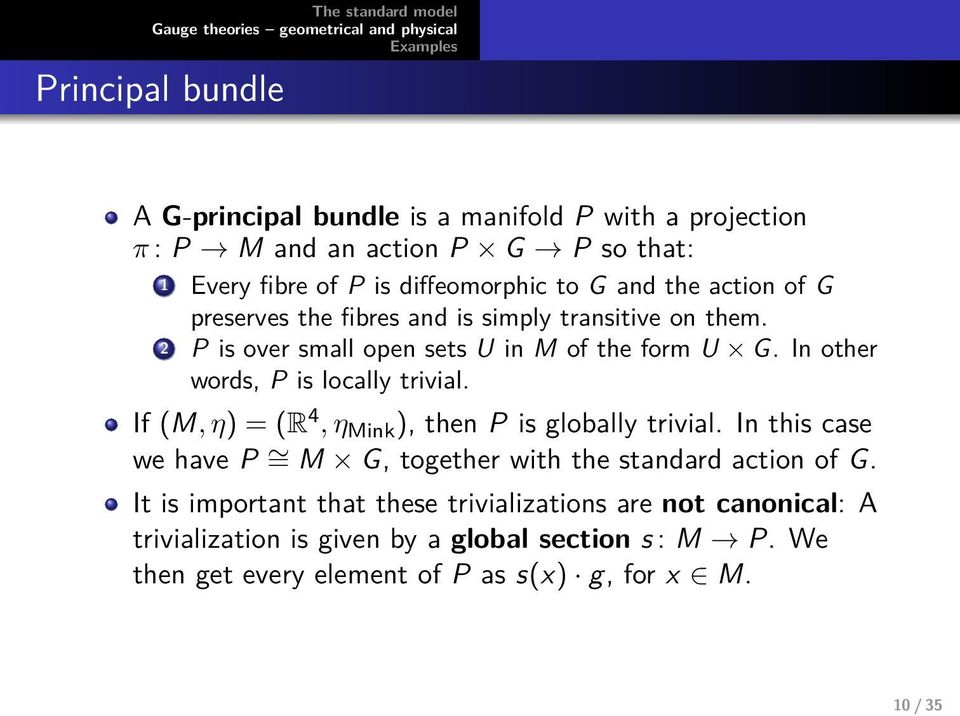
11 Gauge The standard model Definition (Gauge) We call a global section s of the principal bundle P a gauge. Every gauge defines a trivialization of P. The notion of gauge is of central importance for gauge theory (standard notion?). It plays a similar role to the notion of inertial frame in relativity. In both cases there is a manifold which is trivial in a certain sense, but that does not have a preferred trivialization. The change between two trivializations is described by a Lorentz and gauge transformation, respectively. The choice of gauge is the choice of a coordinate system. Gauge invariance will later mean: Invariance under the choice of gauge. 11 / 35

12 Associated bundle Let G V V be a representation. Then G acts on P V from the right via (p, v) g = (p g, g 1 v). The associated bundle is the quotient E = (P V )/G = P G V. It is a vector bundle over M with fibre isomorphic to V. If (M, η) = (R 4, η Mink ), then E is trivial, E = M V. A trivialization is not canonical, but given by a choice of gauge: If s : M P is a gauge, then sections Φ: M E correspond precisely to mappings φ: M V via Φ = [s, φ]. 12 / 35

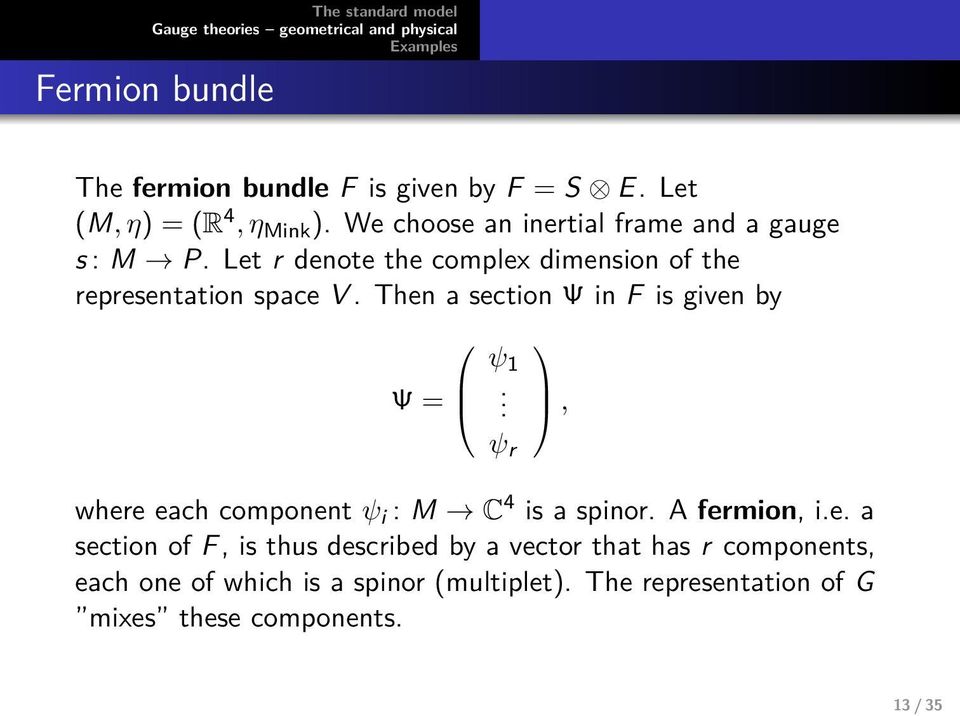
13 Fermion bundle The fermion bundle F is given by F = S E. Let (M, η) = (R 4, η Mink ). We choose an inertial frame and a gauge s : M P. Let r denote the complex dimension of the representation space V. Then a section Ψ in F is given by ψ 1 Ψ =., ψ r where each component ψ i : M C 4 is a spinor. A fermion, i.e. a section of F, is thus described by a vector that has r components, each one of which is a spinor (multiplet). The representation of G mixes these components. 13 / 35
14 Connection and curvature I A connection A on the principal bundle P is a certain invariant 1-form on P with values in the Lie algebra g. The curvature of A is defined as F A = da + 1 [A, A]. 2 Here the commutator is to be taken in g. The curvature F A is a 2-form on P with values in g. One can think of the curvature as a 2-form on the basis M with values in the associated bundle Ad(P) = P G g, defined by the adjoint action. The difference between two connections is a 1-form on M with values in this bundle. One therefore says that gauge bosons transform under the adjoint action of the gauge group G. 14 / 35

15 Connection and curvature II Let (M, η) = (R 4, η Mink ) and choose a gauge s : M P. Then the differential of s defines the following forms on M with values in the Lie algebra g: With A = A ds F A = F(ds( ), ds( )). A µ = A(e µ ), F A µν = F A (e µ, e ν ) we have the fundamental equation Curvature F A µν = µ A ν ν A µ + [A µ, A ν ]. 15 / 35

16 Covariant derivative Every connection A on P defines a covariant derivative A on the associated bundle E: Let (M, η) = (R 4, η Mink ) and s : M P be a gauge. Then every section Φ in E is described by a map φ: M V, so that Φ = [s, φ]. In an inertial frame the corresponding covariant derivative is given by Covariant derivative A µφ = µ φ + A µ φ. On the right hand side the g-valued function A µ acts on the V -valued function φ via the representation of the group G. 16 / 35

17 Gauge fields Let n be the dimension of G. Choosing a basis T a of g, with a = 1,..., n, we can write A µ = A a µt a (Einstein summation convention). The connection A µ corresponds via the Lorentz metric to n vector fields A 1µ, A 2µ,..., A nµ on M. These vector fields describe the gauge bosons. There are thus precisely dim(g)-many gauge bosons in the gauge theory. The corresponding covariant derivative on F = S E describes the coupling of the gauge bosons to the fermions (the fermions interact with the gauge field and thus indirectly with each other, emission/absorption of gauge bosons). The term [A µ, A ν ] describes the interaction of the gauge bosons with each other in non-abelian gauge theories. 17 / 35

18 Dirac operator The covariant derivative A on E defines together with the spin connection S on the spinor bundle S a covariant derivative F on the fermion bundle F = S E. This defines with Clifford multiplication a twisted Dirac operator D A : C (S E) C (S E). We only need a formula for (M, η) = (R 4, η Mink ): Let s : M P be a gauge. Then we have in an inertial frame Dirac operator D A Ψ = iγ µ A µψ = iγ µ ( µ + A µ )Ψ, for Ψ = ψ 1. ψ r. The Dirac matrices γ µ here act on each 4-spinor component ψ i, while the gauge fields A µ act on the r components of Ψ. 18 / 35

19 Lagrangian I We can now write down the Lagrangian L of the gauge theory. The Lagrangian is a real valued function on M. It is given by where L = L fermion + L YM L fermion = Ψ, (D A m)ψ L YM = c 4g 2 FA F A. Here, is a hermitian scalar product on F = S E, m is the mass of the fermion, c a constant depending on the group G, g the coupling constant and a scalar product on the Ad(P)-valued 2-forms on M. 19 / 35

20 Lagrangian II We can also formulate the Lagrangian for (M, η) = (R 4, η Mink ). We choose a gauge s : M P and an inertial frame. Then we have L fermion = Ψ(iγ µ A µ m)ψ L YM = 1 4g 2 F Aaµν F Aa µν = 1 2g 2 tr(f Aµν F A µν). Here Ψ = Ψ γ 0, so that terms like ΨΨ and Ψγ µ A µψ transform as a scalar. In addition we choose a basis T a of the matrix algebra g, so that tr(t a T b ) = 1 2 δab. Then we write F A µν = F Aa µν T a. 20 / 35

21 The physical model The physical model is given precisely by this second Lagrangian. It is supposed to have the following symmetries: Definition (Lorentz invariance) The Lagrangian is independent of the choice of inertial frame. Definition (Gauge invariance) The Lagrangian is independent of the choice of gauge. It is clear that the Lagrangian is Lorentz invariant. We only have to check gauge invariance. 21 / 35
22 Gauge invariance I Let s, s : M P be two gauges. Then there is a gauge transformation U : M G so that s = s U. If Φ is a section of E, then Φ is described by φ, φ : M V with Φ = [s, φ] = [s, φ ]. We therefore have φ = U φ. The connection A is described in the gauges by 1-forms A, A on M with A = A ds, A = A ds. One can check (for a matrix group G): A µ = U A µ U 1 + U µ (U 1 ). 22 / 35
23 Gauge invariance II It follows that A µ φ = U A µ(u 1 φ ) F A µν = U F A µν U 1. These equations imply the gauge invariance of L fermion und L YM (for L fermion we use that the representation of G on V is unitary). Theorem The Lagrangian L = L fermion + L YM is gauge invariant. This was implicitly clear from the geometric formulation. 23 / 35
24 Normalized gauge fields In physics one often uses normalized gauge fields Then we have W µ = 1 ig A µ F W µν = 1 ig F A µν. F W µν = µ W ν ν W µ + ig[w µ, W ν ] W µ φ = µ φ + igw µ φ W µ = UW µ U 1 i g U µ(u 1 ) L YM = 1 2 tr(f W µν F W µν ). 24 / 35
25 In this section we describe some examples of gauge theories as well as the standard model of elementary particle physics. In every example we will indicate in particular the Lie group G and the vector space V. The representations of G on V depend on certain (rational) numbers that are called charges. Example (Charges) Quantum electrodynamics has gauge group U(1). The charge Q is called electric charge. The electroweak interaction has gauge group U(1) Y SU(2) L. The charges are called weak hypercharge Y and weak isospin T 3. We have Q = T 3 + Y / 35
26 QED The standard model The simplest example is quantum electrodynamics (QED). We have G = U(1) (abelian). The 1-form W µ has values in u(1) = R, hence W µ is after a choice of basis for R a standard 1-form. The gauge field W µ is called photon. The curvature F µν is thought of as the field strength. V = C. Therefore we have F = S E = S, i.e. fermions are described by 4-component spinors Ψ. We have g = e (elementary charge). One often writes A µ instead of W µ. We have L = L fermion + L YM = Ψ(iγ µ µ m)ψ 1 4 F µν F µν where µ = µ + iqa µ (charge q) and F µν = µ A ν ν A µ. 26 / 35
27 QCD I The standard model The next example is quantum chromodynamics (QCD). It describes the strong interaction between quarks. We have G = SU(3). The gauge field W µ has dim(su(3)) = 8 components (gluons). Since the group is non-abelian, there is an interaction between the gluons. V = C 3 with the standard representation. A quark (section in F = S E) is of the form q f = q r f q g f q b f, where f = u, d, c, s, t, b is one of six flavours, r, g, b one of three colours (red, green, blue) and q i f a 4-component spinor. The group SU(3) mixes the colours. 27 / 35
28 QCD II The notions of colour and hence quantum chromodynamics come from the triality of basic colours and because one only observes white combinations in nature (color confinement). One often writes G µ instead of W µ. We have L = L fermion + L YM = f q f (iγ µ µ m f )q f 1 2 tr(f µν F µν ) where µ = µ + igg µ F µν = µ G ν ν G µ + ig[g µ, G ν ]. Emission of a gluon can change the colour of a quark, different from the case of photons and electric charge. 28 / 35
29 Chirality Every 4-component spinor Ψ (Dirac spinor) over a 4-manifold M with a Lorentz metric decomposes into the direct sum of two 2-component spinors (Weyl spinors) Ψ R and Ψ L, Ψ = ( ΨR which are eigenvectors of the chirality operator γ 5 = iγ 0 γ 1 γ 2 γ 3 (orientation) with eigenvalues ±1 (right- and left-handed spinors). In the examples so far, right- and left-handed spinors transform in the same representation of the gauge group, which is why we can combine them into a 4-component spinor. The electroweak interaction on the other hand is a chiral gauge theory right- and left-handed spinors transform in different representations of the gauge group. Ψ L ), 29 / 35
30 Electroweak interaction I G = U(1) Y SU(2) L. One writes B µ for the gauge boson that belongs to U(1) Y (with coupling constant g ) and W µ for the gauge bosons that belong to SU(2) L (coupling constant g). The representations of G distinguish between right- and left-handed spinors. For left-handed spinors we have V = C 2 with the standard representation of SU(2). The fermions are of the form ( ) ( ) νel ul el, d L. Here ν e is the electron-neutrino, e the electron, u the up-quark and d the down-quark. Similar doublets exist for the other generations. Every component is a left-handed 2-component spinor. The isospin is T 3 = ± 1 2. The hypercharge is Y = 1 (leptons) and Y = 1 3 (quarks), respectively. 30 / 35
31 Electroweak interaction II For the left-handed quarks we have d L s L = V b L with the so-called CKM-matrix V. A quark of type u L can thus turn via weak interaction into different quarks of type d L, and vice versa (flavour change, β-decay d u + e + ν e ). For right-handed spinors we have V = C with the trivial representation of SU(2). The fermions are right-handed 2-component spinors of the form d L s L b L e R, u R, d R (with T 3 = 0 and Y = 2, 4 3, 2 3 ). One does not observe right-handed neutrinos (sterile). Similar singlets exist for the other generations. 31 / 35
32 The Higgs field I There are two problems: In chiral theories only mass terms with m = 0 in the Lagrangian are gauge invariant. But all fermions except the neutrinos have a mass different from zero. In gauge theories the gauge bosons have zero mass. However, one observes that the gauge bosons W ±, Z 0 of weak interaction have a non-zero mass. Solution: The fermions and gauge bosons have by themselves mass zero and acquire a mass only through interaction with a scalar field (Higgs field). This field is the only one which has a non-zero vacuum expectation value (the vacuum with Higgs field equal to zero is not stable). Since the field is non-zero in the vacuum, the vacuum is only invariant under a subgroup U(1) em of U(1) Y SU(2) L (spontaneous symmetry breaking). In addition a new particle arises, the Higgs boson, with non-zero mass. 32 / 35
33 The Higgs field II The Lagrangian of the Higgs field φ = ( φ1 φ 2 ) is: L = 1 2 ( µ φ) ( µ φ) V (φ), with V (φ) = 1 2 µφ φ λ(φ φ) 2. The minimum of the potential (vacuum) is at v = φ = µ 2λ. The mass of the fermions and weak gauge bosons is proportional to v. The mass of the Higgs boson is µ. Figure: Potential V (φ) of the Higgs field (en.wikipedia.org) 33 / 35
34 Further topics Field quantization, perturbation theory: free fields interacting fields (path integrals, Feynman diagrams, renormalization). Grand Unified Theories (SU(5) U(1) SU(2) SU(3), proton decay p e + + 2γ). Supersymmetry, Minimal Supersymmetric Standard Model (MSSM, superpartners: squark, slepton, gluino, etc.), candidates for dark matter (WIMPs, Weakly Interacting Massive Particles) in addition to sterile neutrinos. Quantum theory of gravity, superstrings. 34 / 35
35 References Helga Baum, Eichfeldtheorie, Springer-Verlag 2014 (in German). Ulrich Mosel, Fields, Symmetries, and Quarks, Springer-Verlag Thank you! 35 / 35
Theoretical Particle Physics FYTN04: Oral Exam Questions, version ht15
 Theoretical Particle Physics FYTN04: Oral Exam Questions, version ht15 Examples of The questions are roughly ordered by chapter but are often connected across the different chapters. Ordering is as in
Spontaneous symmetry breaking in particle physics: a case of cross fertilization
 Spontaneous symmetry breaking in particle physics: a case of cross fertilization Yoichiro Nambu lecture presented by Giovanni Jona-Lasinio Nobel Lecture December 8, 2008 1 / 25 History repeats itself 1960
Standard Model of Particle Physics
 Standard Model of Particle Physics Chris Sachrajda School of Physics and Astronomy University of Southampton Southampton SO17 1BJ UK SUSSP61, St Andrews August 8th 3rd 006 Contents 1. Spontaneous Symmetry
STRING THEORY: Past, Present, and Future
 STRING THEORY: Past, Present, and Future John H. Schwarz Simons Center March 25, 2014 1 OUTLINE I) Early History and Basic Concepts II) String Theory for Unification III) Superstring Revolutions IV) Remaining
Concepts in Theoretical Physics
 Concepts in Theoretical Physics Lecture 6: Particle Physics David Tong e 2 The Structure of Things 4πc 1 137 e d ν u Four fundamental particles Repeated twice! va, 9608085, 9902033 Four fundamental forces
Weak Interactions: towards the Standard Model of Physics
 Weak Interactions: towards the Standard Model of Physics Weak interactions From β-decay to Neutral currents Weak interactions: are very different world CP-violation: power of logics and audacity Some experimental
Quantum Mechanics and Representation Theory
 Quantum Mechanics and Representation Theory Peter Woit Columbia University Texas Tech, November 21 2013 Peter Woit (Columbia University) Quantum Mechanics and Representation Theory November 2013 1 / 30
Introduction to SME and Scattering Theory. Don Colladay. New College of Florida Sarasota, FL, 34243, U.S.A.
 June 2012 Introduction to SME and Scattering Theory Don Colladay New College of Florida Sarasota, FL, 34243, U.S.A. This lecture was given at the IUCSS summer school during June of 2012. It contains a
Quantum Field Theory I
 Quantum Field Theory I Wahlpflichtvorlesung Winter Semester 2009/2010 Fachbereich 08 Physik, Mathematik und Informatik DR. VLADIMIR PASCALUTSA Physik 05-326 Tel ext.: 27162 Email: [email protected]
Feynman diagrams. 1 Aim of the game 2
 Feynman diagrams Contents 1 Aim of the game 2 2 Rules 2 2.1 Vertices................................ 3 2.2 Anti-particles............................. 3 2.3 Distinct diagrams...........................
Particle Physics. Michaelmas Term 2011 Prof Mark Thomson. Handout 7 : Symmetries and the Quark Model. Introduction/Aims
 Particle Physics Michaelmas Term 2011 Prof Mark Thomson Handout 7 : Symmetries and the Quark Model Prof. M.A. Thomson Michaelmas 2011 206 Introduction/Aims Symmetries play a central role in particle physics;
Lecture Notes on the Standard Model of Elementary Particle Physics
 Lecture Notes on the Standard Model of Elementary Particle Physics Preliminary, incomplete version, 15/11/2010 Jean-Pierre Derendinger Albert Einstein Center for Fundamental Physics Institute for Theoretical
A Theory for the Cosmological Constant and its Explanation of the Gravitational Constant
 A Theory for the Cosmological Constant and its Explanation of the Gravitational Constant H.M.Mok Radiation Health Unit, 3/F., Saiwanho Health Centre, Hong Kong SAR Govt, 8 Tai Hong St., Saiwanho, Hong
Physics Department, Southampton University Highfield, Southampton, S09 5NH, U.K.
 \ \ IFT Instituto de Física Teórica Universidade Estadual Paulista July/92 IFT-P.025/92 LEPTON MASSES IN AN SU(Z) L U(1) N GAUGE MODEL R. Foot a, O.F. Hernandez ", F. Pisano e, and V. Pleitez 0 Physics
Mathematicians look at particle physics. Matilde Marcolli
 Mathematicians look at particle physics Matilde Marcolli Year of Mathematics talk July 2008 We do not do these things because they are easy. We do them because they are hard. (J.F.Kennedy Sept. 12, 1962)
Monodromies, Fluxes, and Compact Three-Generation F-theory GUTs
 arxiv:0906.4672 CALT-68-2733 Monodromies, Fluxes, and Compact Three-Generation F-theory GUTs arxiv:0906.4672v2 [hep-th] 1 Jul 2009 Joseph Marsano, Natalia Saulina, and Sakura Schäfer-Nameki California
Beyond the Standard Model. A.N. Schellekens
 Beyond the Standard Model A.N. Schellekens [Word cloud by www.worldle.net] Last modified 22 February 2016 1 Contents 1 Introduction 8 1.1 A Complete Theory?.............................. 8 1.2 Gravity
About the Author. journals as Physics Letters, Nuclear Physics and The Physical Review.
 About the Author Dr. John Hagelin is Professor of Physics and Director of the Doctoral Program in Physics at Maharishi International University. Dr. Hagelin received his A.B. Summa Cum Laude from Dartmouth
Particle Physics. The Standard Model. A New Periodic Table
 5 Particle Physics This lecture is about particle physics, the study of the fundamental building blocks of Nature and the forces between them. We call our best theory of particle physics the Standard Model
Generally Covariant Quantum Mechanics
 Chapter 15 Generally Covariant Quantum Mechanics by Myron W. Evans, Alpha Foundation s Institutute for Advance Study (AIAS). ([email protected], www.aias.us, www.atomicprecision.com) Dedicated to the Late
Introduction to Elementary Particle Physics. Note 01 Page 1 of 8. Natural Units
 Introduction to Elementary Particle Physics. Note 01 Page 1 of 8 Natural Units There are 4 primary SI units: three kinematical (meter, second, kilogram) and one electrical (Ampere 1 ) It is common in the
0.33 d down 1 1. 0.33 c charm + 2 3. 0 0 1.5 s strange 1 3. 0 0 0.5 t top + 2 3. 0 0 172 b bottom 1 3
 Chapter 16 Constituent Quark Model Quarks are fundamental spin- 1 particles from which all hadrons are made up. Baryons consist of three quarks, whereas mesons consist of a quark and an anti-quark. There
Three Pictures of Quantum Mechanics. Thomas R. Shafer April 17, 2009
 Three Pictures of Quantum Mechanics Thomas R. Shafer April 17, 2009 Outline of the Talk Brief review of (or introduction to) quantum mechanics. 3 different viewpoints on calculation. Schrödinger, Heisenberg,
Chapter 22 The Hamiltonian and Lagrangian densities. from my book: Understanding Relativistic Quantum Field Theory. Hans de Vries
 Chapter 22 The Hamiltonian and Lagrangian densities from my book: Understanding Relativistic Quantum Field Theory Hans de Vries January 2, 2009 2 Chapter Contents 22 The Hamiltonian and Lagrangian densities
3. Open Strings and D-Branes
 3. Open Strings and D-Branes In this section we discuss the dynamics of open strings. Clearly their distinguishing feature is the existence of two end points. Our goal is to understand the effect of these
Connections, Gauges and Field Theories
 Connections, Gauges and Field Theories Lionel Brits August 3, 2005 Abstract The theory of gauges and connections in the principal bundle formalism is reviewed. The geometrical aspects of gauge potential,
Special Theory of Relativity
 June 1, 2010 1 1 J.D.Jackson, Classical Electrodynamics, 3rd Edition, Chapter 11 Introduction Einstein s theory of special relativity is based on the assumption (which might be a deep-rooted superstition
by the matrix A results in a vector which is a reflection of the given
 Eigenvalues & Eigenvectors Example Suppose Then So, geometrically, multiplying a vector in by the matrix A results in a vector which is a reflection of the given vector about the y-axis We observe that
Similarity and Diagonalization. Similar Matrices
 MATH022 Linear Algebra Brief lecture notes 48 Similarity and Diagonalization Similar Matrices Let A and B be n n matrices. We say that A is similar to B if there is an invertible n n matrix P such that
The Standard Model Higgs Boson
 The Standard Model Higgs Boson Part of the Lecture Particle Physics II, UvA Particle Physics Master 011-01 Date: November 011 Lecturer: Ivo van Vulpen Assistant: Antonio Castelli Disclaimer These are private
A tentative theory of large distance physics
 hep-th/0204131 RUNHETC-2002-12 A tentative theory of large distance physics Daniel Friedan Department of Physics and Astronomy Rutgers, The State University of New Jersey Piscataway, New Jersey, USA and
The Standard Model of Particle Physics - II
 The Standard Model of Particle Physics II Lecture 4 Gauge Theory and Symmetries Quantum Chromodynamics Neutrinos Eram Rizvi Royal Institution London 6 th March 2012 Outline A Century of Particle Scattering
Unification - The Standard Model
 Unification - The Standard Model Information on Physics level 4 Undergraduate Course PT.4.6 K.S. Stelle, Office Huxley 519 November 9, 2015 Rapid Feedback to be handed in to the UG office Level 3 (day
Periodic Table of Particles/Forces in the Standard Model. Three Generations of Fermions: Pattern of Masses
 Introduction to Elementary Particle Physics. Note 01 Page 1 of 8 Periodic Table of Particles/Forces in the Standard Model Three Generations of Fermions: Pattern of Masses 1.0E+06 1.0E+05 1.0E+04 1.0E+03
The Standard Model of Particle Physics. Tom W.B. Kibble Blackett Laboratory, Imperial College London
 The Standard Model of Particle Physics Tom W.B. Kibble Blackett Laboratory, Imperial College London Abstract This is a historical account from my personal perspective of the development over the last few
MASTER OF SCIENCE IN PHYSICS MASTER OF SCIENCES IN PHYSICS (MS PHYS) (LIST OF COURSES BY SEMESTER, THESIS OPTION)
 MASTER OF SCIENCE IN PHYSICS Admission Requirements 1. Possession of a BS degree from a reputable institution or, for non-physics majors, a GPA of 2.5 or better in at least 15 units in the following advanced
Contents. Goldstone Bosons in 3He-A Soft Modes Dynamics and Lie Algebra of Group G:
 ... Vlll Contents 3. Textures and Supercurrents in Superfluid Phases of 3He 3.1. Textures, Gradient Energy and Rigidity 3.2. Why Superfuids are Superfluid 3.3. Superfluidity and Response to a Transverse
Precession of spin and Precession of a top
 6. Classical Precession of the Angular Momentum Vector A classical bar magnet (Figure 11) may lie motionless at a certain orientation in a magnetic field. However, if the bar magnet possesses angular momentum,
Lecture 18 - Clifford Algebras and Spin groups
 Lecture 18 - Clifford Algebras and Spin groups April 5, 2013 Reference: Lawson and Michelsohn, Spin Geometry. 1 Universal Property If V is a vector space over R or C, let q be any quadratic form, meaning
Invariant Metrics with Nonnegative Curvature on Compact Lie Groups
 Canad. Math. Bull. Vol. 50 (1), 2007 pp. 24 34 Invariant Metrics with Nonnegative Curvature on Compact Lie Groups Nathan Brown, Rachel Finck, Matthew Spencer, Kristopher Tapp and Zhongtao Wu Abstract.
Gravity and running coupling constants
 Gravity and running coupling constants 1) Motivation and history 2) Brief review of running couplings 3) Gravity as an effective field theory 4) Running couplings in effective field theory 5) Summary 6)
A CONFRONTATION WITH INFINITY
 A CONFRONTATION WITH INFINITY Nobel lecture 1999. Gerard t Hooft Institute for Theoretical Physics University of Utrecht, Princetonplein 5 3584 CC Utrecht, the Netherlands e-mail: [email protected] 1.
INVARIANT METRICS WITH NONNEGATIVE CURVATURE ON COMPACT LIE GROUPS
 INVARIANT METRICS WITH NONNEGATIVE CURVATURE ON COMPACT LIE GROUPS NATHAN BROWN, RACHEL FINCK, MATTHEW SPENCER, KRISTOPHER TAPP, AND ZHONGTAO WU Abstract. We classify the left-invariant metrics with nonnegative
REALIZING EINSTEIN S DREAM Exploring Our Mysterious Universe
 REALIZING EINSTEIN S DREAM Exploring Our Mysterious Universe The End of Physics Albert A. Michelson, at the dedication of Ryerson Physics Lab, U. of Chicago, 1894 The Miracle Year - 1905 Relativity Quantum
Extensions of the Standard Model (part 2)
 Extensions of the Standard Model (part 2) Prof. Jorgen D Hondt Vrije Universiteit Brussel Inter-university Institute for High Energies Content: The Higgs sector of the Standard Model and extensions Theoretical
Phase Transitions in the Early Universe
 Trick Phase Transitions in the Early Universe Electroweak and QCD Phase Transitions Master Program of Theoretical Physics Student Seminar in Cosmology Author: Doru STICLET Supervisors: Prof. Dr. Tomislav
Mathematics Course 111: Algebra I Part IV: Vector Spaces
 Mathematics Course 111: Algebra I Part IV: Vector Spaces D. R. Wilkins Academic Year 1996-7 9 Vector Spaces A vector space over some field K is an algebraic structure consisting of a set V on which are
Feynman Diagrams for Beginners
 Feynman Diagrams for Beginners Krešimir Kumerički arxiv:1602.04182v1 [physics.ed-ph] 8 Feb 2016 Department of Physics, Faculty of Science, University of Zagreb, Croatia Abstract We give a short introduction
University of Cambridge Part III Mathematical Tripos
 Preprint typeset in JHEP style - HYPER VERSION Michaelmas Term, 2006 and 2007 Quantum Field Theory University of Cambridge Part III Mathematical Tripos Dr David Tong Department of Applied Mathematics and
Elasticity Theory Basics
 G22.3033-002: Topics in Computer Graphics: Lecture #7 Geometric Modeling New York University Elasticity Theory Basics Lecture #7: 20 October 2003 Lecturer: Denis Zorin Scribe: Adrian Secord, Yotam Gingold
1 Symmetries of regular polyhedra
 1230, notes 5 1 Symmetries of regular polyhedra Symmetry groups Recall: Group axioms: Suppose that (G, ) is a group and a, b, c are elements of G. Then (i) a b G (ii) (a b) c = a (b c) (iii) There is an
Linear Algebra Notes
 Linear Algebra Notes Chapter 19 KERNEL AND IMAGE OF A MATRIX Take an n m matrix a 11 a 12 a 1m a 21 a 22 a 2m a n1 a n2 a nm and think of it as a function A : R m R n The kernel of A is defined as Note
Localization of scalar fields on Branes with an Asymmetric geometries in the bulk
 Localization of scalar fields on Branes with an Asymmetric geometries in the bulk Vladimir A. Andrianov in collaboration with Alexandr A. Andrianov V.A.Fock Department of Theoretical Physics Sankt-Petersburg
5 Homogeneous systems
 5 Homogeneous systems Definition: A homogeneous (ho-mo-jeen -i-us) system of linear algebraic equations is one in which all the numbers on the right hand side are equal to : a x +... + a n x n =.. a m
arxiv:hep-th/0404072v2 15 Apr 2004
 hep-th/0404072 Tree Amplitudes in Gauge Theory as Scalar MHV Diagrams George Georgiou and Valentin V. Khoze arxiv:hep-th/0404072v2 15 Apr 2004 Centre for Particle Theory, Department of Physics and IPPP,
Lecture L3 - Vectors, Matrices and Coordinate Transformations
 S. Widnall 16.07 Dynamics Fall 2009 Lecture notes based on J. Peraire Version 2.0 Lecture L3 - Vectors, Matrices and Coordinate Transformations By using vectors and defining appropriate operations between
State of Stress at Point
 State of Stress at Point Einstein Notation The basic idea of Einstein notation is that a covector and a vector can form a scalar: This is typically written as an explicit sum: According to this convention,
FINDING SUPERSYMMETRY AT THE LHC
 FINDING SUPERSYMMETRY AT THE LHC Tilman Plehn MPI München & University of Edinburgh TeV scale supersymmetry Signals at Tevatron and LHC Measurements at LHC SUSY parameters at LHC (and ILC) Tilman Plehn:
15.062 Data Mining: Algorithms and Applications Matrix Math Review
 .6 Data Mining: Algorithms and Applications Matrix Math Review The purpose of this document is to give a brief review of selected linear algebra concepts that will be useful for the course and to develop
Directed by: Prof. Yuanning Gao, IHEP, Tsinghua University Prof. Aurelio Bay, LPHE, EPFL
 Masters Thesis in High Energy Physics Directed by: Prof. Yuanning Gao, IHEP, Tsinghua University Prof. Aurelio Bay, LPHE, EPFL 1 Study for CP-violation in the ψ π + π J/ψ transition Vincent Fave July 18,
Elements of Abstract Group Theory
 Chapter 2 Elements of Abstract Group Theory Mathematics is a game played according to certain simple rules with meaningless marks on paper. David Hilbert The importance of symmetry in physics, and for
Finite dimensional C -algebras
 Finite dimensional C -algebras S. Sundar September 14, 2012 Throughout H, K stand for finite dimensional Hilbert spaces. 1 Spectral theorem for self-adjoint opertors Let A B(H) and let {ξ 1, ξ 2,, ξ n
1 Introduction. 1 There may, of course, in principle, exist other universes, but they are not accessible to our
 1 1 Introduction Cosmology is the study of the universe as a whole, its structure, its origin, and its evolution. Cosmology is soundly based on observations, mostly astronomical, and laws of physics. These
Chapter 17. Orthogonal Matrices and Symmetries of Space
 Chapter 17. Orthogonal Matrices and Symmetries of Space Take a random matrix, say 1 3 A = 4 5 6, 7 8 9 and compare the lengths of e 1 and Ae 1. The vector e 1 has length 1, while Ae 1 = (1, 4, 7) has length
old supersymmetry as new mathematics
 old supersymmetry as new mathematics PILJIN YI Korea Institute for Advanced Study with help from Sungjay Lee Atiyah-Singer Index Theorem ~ 1963 Calabi-Yau ~ 1978 Calibrated Geometry ~ 1982 (Harvey & Lawson)
UN PICCOLO BIG BANG IN LABORATORIO: L'ESPERIMENTO ALICE AD LHC
 UN PICCOLO BIG BANG IN LABORATORIO: L'ESPERIMENTO ALICE AD LHC Parte 1: Carlos A. Salgado Universidade de Santiago de Compostela [email protected] http://cern.ch/csalgado LHC physics program Fundamental
Axion/Saxion Cosmology Revisited
 Axion/Saxion Cosmology Revisited Masahiro Yamaguchi (Tohoku University) Based on Nakamura, Okumura, MY, PRD77 ( 08) and Work in Progress 1. Introduction Fine Tuning Problems of Particle Physics Smallness
University of Lille I PC first year list of exercises n 7. Review
 University of Lille I PC first year list of exercises n 7 Review Exercise Solve the following systems in 4 different ways (by substitution, by the Gauss method, by inverting the matrix of coefficients
RR charges of D2-branes in the WZW model
 RR charges of 2-branes in the WZW model arxiv:hep-th/0007096v1 12 Jul 2000 Anton Alekseev Institute for Theoretical Physics, Uppsala University, Box 803, S 75108 Uppsala, Sweden Volker Schomerus MPI für
Numerical Analysis Lecture Notes
 Numerical Analysis Lecture Notes Peter J. Olver 5. Inner Products and Norms The norm of a vector is a measure of its size. Besides the familiar Euclidean norm based on the dot product, there are a number
Exploring physics beyond the Standard Electroweak Model in the light of supersymmetry
 Exploring physics beyond the Standard Electroweak Model in the light of supersymmetry Thesis Submitted to The University of Calcutta for The Degree of Doctor of Philosophy (Science) By Pradipta Ghosh Department
A SUSY SO(10) GUT with 2 Intermediate Scales
 A SUSY SO(10) GUT with 2 Intermediate Scales Manuel Drees Bonn University & Bethe Center for Theoretical Physics SUSY SO(10) p. 1/25 Contents 1 Motivation: SO(10), intermediate scales SUSY SO(10) p. 2/25
α = u v. In other words, Orthogonal Projection
 Orthogonal Projection Given any nonzero vector v, it is possible to decompose an arbitrary vector u into a component that points in the direction of v and one that points in a direction orthogonal to v
Journal of Theoretics Journal Home Page
 Journal of Theoretics Journal Home Page MASS BOOM VERSUS BIG BANG: THE ROLE OF PLANCK S CONSTANT by Antonio Alfonso-Faus E.U.I.T. Aeronáutica Plaza Cardenal Cisneros s/n 8040 Madrid, SPAIN e-mail: [email protected]