
Rise of the Revolution Grade Nine
|
|
|
- Todd Patrick
- 9 years ago
- Views:
Transcription
1 Ohio Standards Connection: Citizenship Rights and Responsibilities Benchmark A Analyze ways people achieve governmental change, including political action, social protest, and revolution. Indicator 1 Analyze and evaluate the influence of various forms of citizen action on public policy including: a. The French Revolution b. The international movement to abolish the slave trade and slavery; c. The Russian Revolution; d. The independence movement in India; e. The fall of communism in Europe; f. The end of apartheid. Lesson Summary: Students will analyze the influence of various forms of citizen action on public policy during the period of the French Revolution. They will complete a chart and participate in class to determine the different forms of action taken during this time period. Following instruction, students will write a culminating essay. Estimated Duration: One hour and 40 minutes Commentary: While this lesson only deals with one aspect of the gradelevel indicator, it can serve as a model for lessons addressing other aspects of the indicator. Reviewers indicated that while the lesson might be difficult, the students were interested in the topic. One reviewer noted that the textbook used had the necessary content to start the assignment and the lesson could be completed with the outside resources available in the district. Pre-Assessment: Have students record answers to the questions on Attachment A, Pre-Assessment Worksheet. Allow five to 10 minutes for students to work. After the allotted time, collect the student papers. Review responses by asking for students to volunteer their answers. Scoring Guidelines: Check student answers with Attachment B, Pre-Assessment Worksheet Answer Key. Based on the oral responses when reviewing the pre-assessment and the quality of the written responses, determine if additional work is needed with terminology and examples before proceeding with the lesson. If necessary, discuss the definitions with the class and have the class generate additional examples for each definition. Students who were successful on the pre-assessment may be called upon to identify and explain examples. 1

2 Post-Assessment: Using their completed charts (Attachment D) as a guide, have students individually complete the writing activity found in Attachment C, Post-Assessment Essay and Scoring Rubric. Scoring Guidelines: See Attachment C, Post-Assessment Essay and Scoring Rubric, for a detailed grading rubric. Instructional Procedures: Day One 1. Review any questions from the pre-assessment. 2. Divide the class into groups of two or three students. Once the groups are formed, pose this problem: Remember the definitions the class reviewed as part of the pre-assessment activity. Imagine that your local government instituted a curfew for teenagers. Using the categories of political action, social protest and revolution, what actions could you take if you wanted the local curfew changed? a. Have groups write their means of doing the following: Political Action (e.g., present petition to the mayor; request action at a city council meeting). Social Protest (e.g., make posters of complaints, hold protest march). Revolution (e.g., take over the police department). b. Upon completion, have students share their responses with the class. Discuss which actions would be most likely to achieve the desired change. 3. Distribute Attachment D, Comparative Chart, to each student and assign each student a different row on the chart to complete. Indicate if students will work individually, in pairs or in groups on the assignment. Have each student use textbook, print or other resources to find the answers for his/her row. If any students do not complete this activity in class, have them finish the assignment for homework. Day Two 4. Using a question-and answer-method, have the students assigned the first row share their answers (see Attachment E for the answers). Discuss as needed. Have the remainder of the class fill in these spaces on their charts as the answers are discussed. Next, have the students in the second row share their responses with the class. Repeat until all rows have been discussed. Add any additional information at any time to clarify the entries for the students. 5. Conclude the lesson by answering any questions the students may have about the entries on the chart. 6. Distribute Attachment C, Post-Assessment Essay and Scoring Rubric, and review with the class. Answer any questions and set a date for completion. Differentiated Instructional Support: Instruction is differentiated according to learner needs, to help all learners either meet the intent of the specified indicator(s) or, if the indicator is already met, to advance beyond the specified indicator(s). 2

3 Allow students to choose from a variety of options to demonstrate knowledge learned including an oral report or presentation. Give students additional time for completion of the essay or permit them to work with a partner. Require each student to turn in an individual essay. Allow students to work in groups to complete the Comparative Chart. Each student should take notes to ensure they have complete information. Challenge students to look more closely into the factors that led to change and analyze how the actions taken by citizens created conditions leading to political change. Extensions: Have students extend their charts to include episodes such as the Indian independence movement and the overthrow of dictatorial governments in Europe. Have them compare and contrast these developments using the same structure as the post-assessment essay. Instruct students to use the Internet to find other cases of revolution around the world. Direct students to look for parallels with the events leading up to the American and French Revolutions and note what happened in each instance. Ask students to report their findings to the class. Have students conduct an interview with someone who has lived through a revolution for a personal perspective on this form of citizen action. Homework Options and Home Connections: Send the Comparative Charts to students via and allow the students to work at home. Instruct students to use the Internet or other resources to find a revolution (social, political or cultural) happening in the world today, such as the Technological Revolution, and report their findings to the class. Interdisciplinary Connections: English Language Arts: Have students read excerpts from works of literature pertaining to the French Revolution to gain a sense of the times. Materials and Resources: The inclusion of a specific resource in any lesson formulated by the Ohio Department of Education should not be interpreted as an endorsement of that particular resource, or any of its contents, by the Ohio Department of Education. The Ohio Department of Education does not endorse any particular resource. The Web addresses listed are for a given site s main page, therefore, it may be necessary to search within that site to find the specific information required for a given lesson. Please note that information published on the Internet changes over time, therefore the links provided may no longer contain the specific information related to a given lesson. Teachers are advised to preview all sites before using them with students. For the teacher: None. For the student: Writing materials, textbook, other resources on the French Revolution. 3

4 Vocabulary: revolution (political definition) political action social protest politics public policy Rise of the Revolution Grade Nine Technology Connections: Use a word processor to fill in charts or complete the essay. The Internet can be used for additional research for the homework. Use to send the Comparative Chart to students for homework. Research Connections: Marzano, R. et al. Classroom Instruction that Works: Research Based Strategies for Increasing Student Achievement, Alexandria, VA: Association for Supervision and Curriculum Development, Homework and practice provide students with opportunities to deepen their understanding and skills related to content that has been presented to them. General Tips: Events leading to the American Revolution have been placed in Attachment D, Comparative Chart, as examples of how the chart is to be completed. The students can use their knowledge from the American Revolution to build their understanding for the French Revolution. Attachments: Attachment A, Pre-Assessment Worksheet Attachment B, Pre-Assessment Worksheet Answer Key Attachment C, Post-Assessment Essay and Scoring Rubric Attachment D, Comparative Chart Attachment E, Comparative Chart Answer Key 4

5 Attachment A Pre-Assessment Worksheet Rise of Revolution Name: Date: Answer the following questions to the best of your ability. This will not be scored for a grade, but is meant to see what you know. 1. What is a social protest? 2. Give an example of a social protest. 3. What is a political action? 4. Give an example of political action. 5. What is a revolution, in the political sense of the term? 6. Give a historical example of a revolution. 5

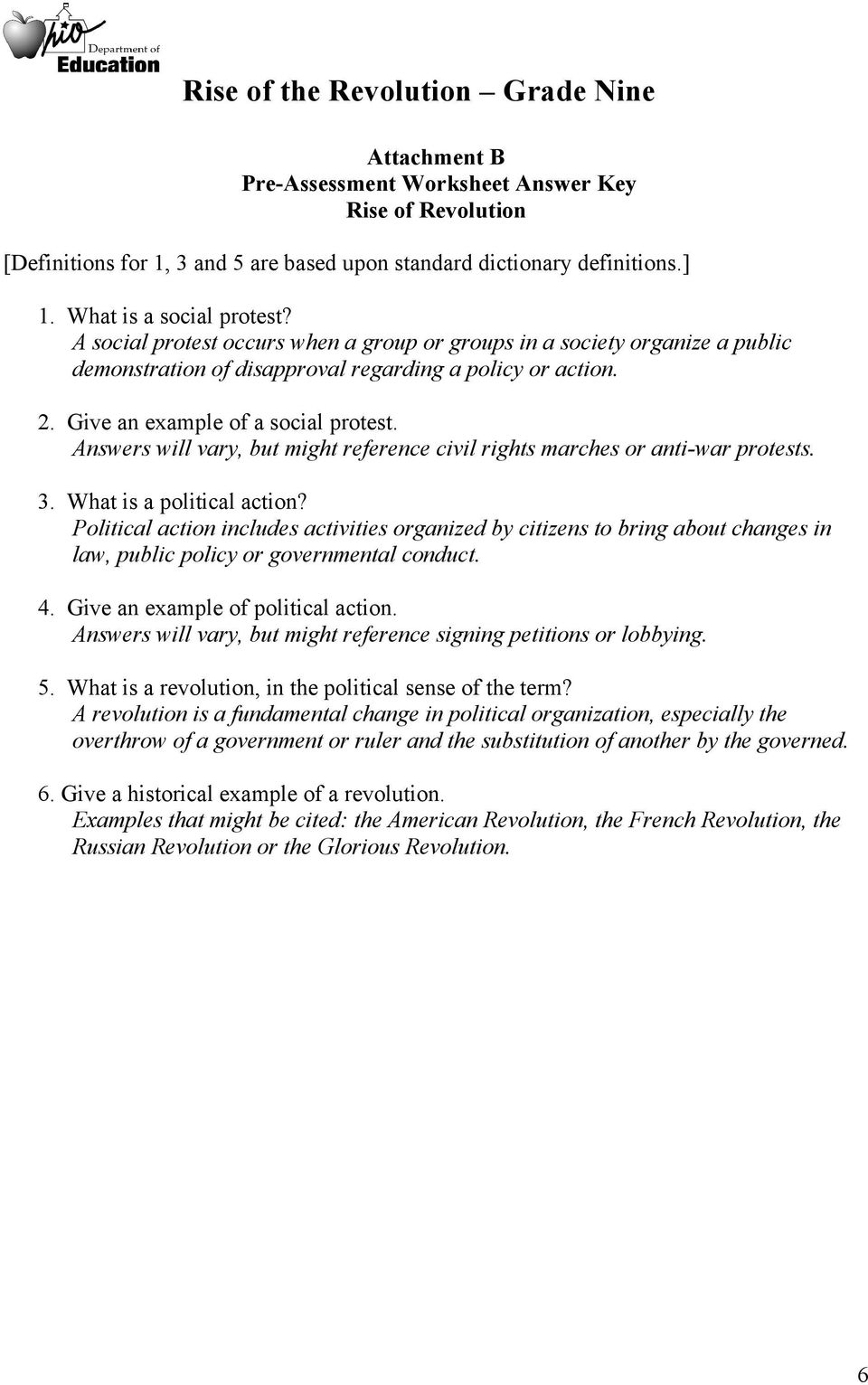
6 Attachment B Pre-Assessment Worksheet Answer Key Rise of Revolution [Definitions for 1, 3 and 5 are based upon standard dictionary definitions.] 1. What is a social protest? A social protest occurs when a group or groups in a society organize a public demonstration of disapproval regarding a policy or action. 2. Give an example of a social protest. Answers will vary, but might reference civil rights marches or anti-war protests. 3. What is a political action? Political action includes activities organized by citizens to bring about changes in law, public policy or governmental conduct. 4. Give an example of political action. Answers will vary, but might reference signing petitions or lobbying. 5. What is a revolution, in the political sense of the term? A revolution is a fundamental change in political organization, especially the overthrow of a government or ruler and the substitution of another by the governed. 6. Give a historical example of a revolution. Examples that might be cited: the American Revolution, the French Revolution, the Russian Revolution or the Glorious Revolution. 6
7 Name: Date: Attachment C Post-Assessment Essay and Scoring Rubric Rise of Revolution Directions: Using your completed chart as a guide, individually respond to the following writing prompt: Consider the events associated with the French Revolution and prepare an essay that analyzes the ways citizens attempted to achieve governmental change. The essay should identify one example each for social protest, political action and revolution. The circumstances surrounding each instance of citizen action and the impacts or results of each action should be discussed completely and in detail. Scoring Rubric Four points: The student response contains a complete and detailed analysis of one correctly identified example each for social protest, political action and revolution related to the French Revolution. Three points: The student response contains a complete, but not detailed, analysis of one correctly identified example each for social protest, political action and revolution related to the French Revolution. OR The student response contains a complete and detailed analysis of citizen action of one correctly identified example each for two of the following: social protest, political action or revolution related to the French Revolution. Two points: The student response contains a complete, but not detailed, analysis of one correctly identified example each for two of the following: social protest, political action or revolution related to the French Revolution. OR The student response contains a complete and detailed analysis of one correctly identified example for one of the following: social protest, political action or revolution related to the French Revolution. One point: The student response contains a complete, but not detailed, analysis of one correctly identified example for one of the following: social protest, political action or revolution related to the French Revolution. No points: The student response does not meet any of the above criteria. The response may discuss the French Revolution, but not analyze the role of citizen action. The response may discuss citizen actions that did not actually occur during the French Revolution. The response may analyze actions related to other historical events or hypothetical examples of citizen action. 7

8 Attachment D Comparative Chart Rise of Revolution Name: Date: Directions: The purpose of the chart below is to gather information relating to different types of actions used by citizens to bring about changes in public policy. Complete the entries on the chart for France, Use the examples from the American Colonies/United States, as a model. Categorize each action as political action, social protest or revolution. Complete the remaining columns based on information in the textbook or other resources. American Colonies/United States, Citizen Action Type of Action Change Desired Public Policy Change/Reaction Desired Result Achieved? Stamp Act Congress/Declaration of Rights and Grievances (Oct. 19, 1765) Political Action Repeal of the Stamp Act Stamp Act repealed; Declaratory Act passed Stamp Act-yes; Declaratory Actlargely ignored Colonists sign nonimportation agreements (1765) Social Protest Repeal of the Stamp Act Stamp Act Repealed; Declaratory Act passed Stamp Act-yes; Declaratory Actlargely ignored Colonists sign nonimportation agreements ( ) Social Protest Repeal of the Townshend duties Duties repealed except for the duty on tea Partially Boston Tea Party (Dec. 16, 1773) Social Protest Repeal of the Tea Act (monopoly on tea trade for the East India Co.) Tea Act retained; Coercive Acts passed No (Coercive Acts tighten British control over Massachusetts) First Continental Congress/ Declaration and Resolves (Oct. 14, 1774) Political Action Repeal of several acts of Parliament, including the Coercive Acts Appeal ignored No Revolutionary War ( ) Revolution Independence for the United States Recognition of the United States in the Treaty of Paris Yes 8

9 Attachment D (continued) Comparative Chart Rise of Revolution France, Citizen Action Type of Action Change Desired Public Policy Change/Reaction Desired Result Achieved? Meeting of the National Assembly/Tennis Court Oath (June 1789) Storming of the Bastille (July 14, 1789) National Assembly adopts Declaration of the Rights of Man and of the Citizen (Aug. 26, 1789) Women s march on Versailles (Oct. 1789) Meeting of the National Assembly/ new constitution proclaimed (Sept. 3, 1791) 9

10 Attachment E Comparative Chart Answer Key France, Citizen Action Type of Action Change Desired Public Policy Change/Reaction Desired Result Achieved? Meeting of the National Assembly/Tennis Court Oath (June 1789) Political Action A constitution with equal voting privileges in the legislature for the third estate Monarchy accepts National Assembly as legislative body with equal voting privileges, but does not endorse the idea of a constitution Partially Storming of the Bastille (July 14, 1789) Social Protest/ Revolution Prevent king s troops from entering Paris Troops withdrawn Yes National Assembly adopts Declaration of the Rights of Man and of the Citizen (Aug. 26, 1789) Political Action Inclusion of rights in a new constitution Monarchy lets Declaration stand Yes Women s march on Versailles (Oct. 1789) Social Protest Return of the king to Paris King returns to Tuileries Palace Yes Meeting of the National Assembly/ new constitution proclaimed (Sept. 3, 1791) Political Action Political reforms in line with Declaration of Rights of Man and of the Citizen Constitution is accepted by the king; monarchy is given limited powers Yes (Later opposition from conservatives and radicals as well as foreign invasion led to next stage of revolution) 10

Urbanization Grade Nine
 Ohio Standards Connection: Geography Benchmark B Analyze geographic changes brought about by human activity using appropriate maps and other geographical data. Indicator 4 Explain the causes and consequences
Civil Disobedience During the Civil Rights Movement Grade 10
 Ohio Standards Connection: Citizenship Rights and Responsibilities Benchmark A Analyze ways people achieve governmental change, including political action, social protest and revolution. Indicator 2 Explain
Local Government and Leaders Grade Three
 Ohio Standards Connection: Government Benchmark A Identify the responsibilities of the branches of the U.S. government and explain why they are necessary. Indicator 2 Explain the structure of local governments
Effects of the Enlightenment Grade Nine
 History Ohio Standards Connection: Benchmark A Explain connections between the ideas of the Enlightenment and changes in the relationships between citizens and their governments. Indicator 1 Explain how
Elements of a Novel and Narrative Writing Grade 10
 Ohio Standards Connection Literary Text Benchmark B Explain and analyze how the context of setting and the author s choice of point of view impact a literary text. Indicator 2 Analyze the features of setting
Production: Specialization and Division of Labor Grade Three
 Ohio Standards Connection: Economics Benchmark B Explain why entrepreneurship, capital goods, technology, specialization and the division of labor are important in the production of goods and services.
Systems of Transportation and Communication Grade Three
 1 Ohio Standards Connection: Geography Benchmark D Analyze ways that transportation and communication relate to patterns of settlement and economic activity. Indicator 8 Identify systems of transportation
Plot Connections Grade Five
 Ohio Standards Connection Reading Applications: Literary Text Benchmark C Identify the elements of plot and establish a connection between an element and a future event. Indicator 3 Identify the main incidents
Mansa Musa s Pilgrimage Grade Seven
 Ohio Standards Connection: Geography Benchmark A Identify on a map the location of major physical and human features of each continent. Indicator 2 On a map, identify places related to the historical events
B.C. or A.D.? That is the Question Grade Six
 History Ohio Standards Connection: Benchmark A Interpret relationships between events shown on multiple-tier time lines. Indicator 2 Arrange dates in order on a time line using the conventions of B.C.
Drawing Lines of Symmetry Grade Three
 Ohio Standards Connection Geometry and Spatial Sense Benchmark H Identify and describe line and rotational symmetry in two-dimensional shapes and designs. Indicator 4 Draw lines of symmetry to verify symmetrical
Bar Graphs with Intervals Grade Three
 Bar Graphs with Intervals Grade Three Ohio Standards Connection Data Analysis and Probability Benchmark D Read, interpret and construct graphs in which icons represent more than a single unit or intervals
French Revolution [10th grade]
![French Revolution [10th grade]](/thumbs/40/20826976.jpg "French Revolution [10th grade]") Trinity University Digital Commons @ Trinity Understanding by Design: Complete Collection Understanding by Design 6-15-2006 French Revolution [10th grade] Jenna Smith Trinity University Follow this and
Trinity University Digital Commons @ Trinity Understanding by Design: Complete Collection Understanding by Design 6-15-2006 French Revolution [10th grade] Jenna Smith Trinity University Follow this and
Investigating Quadrilaterals Grade Four
 Ohio Standards Connection Geometry and Spatial Sense Benchmark A Provide rationale for groupings and comparisons of two-dimensional figures and three-dimensional objects. Indicator 3 Identify similarities
Geometric Transformations Grade Four
 Ohio Standards Connection Geometry and Spatial Sense Benchmark I Describe, identify and model reflections, rotations and translations, using physical materials. Indicator 7 Identify, describe and use reflections
Science Rocks Grade Six
 Ohio Standards Connections: Earth and Space Sciences Benchmark D Identify that the lithosphere contains rocks and minerals and that minerals make up rocks. Describe how rocks and minerals are formed and/or
Scarcity and Choices Grade One
 Ohio Standards Connection: Economics Benchmark A Explain how the scarcity of resources requires people to make choices to satisfy their wants. Indicator 1 Explain that wants are unlimited and resources
Similar Triangles Grade Seven
 Ohio Standards Connection Geometry and Spatial Sense Benchmark E Use proportions to express relationships among corresponding parts of similar figures. Indicator 1 Use proportional reasoning to describe
Changes in Our Sky Grade Two
 Ohio Standards Connection: Earth and Space Sciences Benchmark A Observe constant and changing patterns of objects in the day and night sky. Indicator 2 Observe and describe how the sun, moon and stars
Benchmark C Describe the characteristics of feudal societies and the transition to the Renaissance and Reformation in Europe.
 Feudalism in Japan and Europe Connection: History Benchmark C Describe the characteristics of feudal societies and the transition to the Renaissance and Reformation in Europe. Indicator 3 Describe the
Writing and Presenting a Persuasive Paper Grade Nine
 Ohio Standards Connection Writing Applications Benchmark E Write a persuasive piece that states a clear position, includes relevant information and offers compelling in the form of facts and details. Indicator
Commutative Property Grade One
 Ohio Standards Connection Patterns, Functions and Algebra Benchmark E Solve open sentences and explain strategies. Indicator 4 Solve open sentences by representing an expression in more than one way using
Section III: Jefferson, United States Minister to France
 2002 Shaping the World: Conversation on Democracy A Conversation with Thomas Jefferson and Marquis de Lafayette Section III: Jefferson, United States Minister to France "Behold you, then, my dear friend,
What Caused the Great Depression? Grade 10
 History Ohio Standards Connection: Benchmark F Identify major historical patterns in the domestic affairs of the United States during the 20 th century and explain their significance. Indicator 9 Analyze
Comparing Sets of Data Grade Eight
 Ohio Standards Connection: Data Analysis and Probability Benchmark C Compare the characteristics of the mean, median, and mode for a given set of data, and explain which measure of center best represents
Days of the Week Grade Kindergarten
 History Ohio Standards Connection: Benchmark A Use a calendar to determine the day, week, month and year. Indicator 1 Recite the days of the week. Lesson Summary: The children will participate in a variety
Food Webs and Food Chains Grade Five
 Ohio Standards Connection: Life Sciences Benchmark B Analyze plant and animal structures and functions needed for survival and describe the flow of energy through a system that all organisms use to survive.
Sample Set Boston Tea Party Grade 4
 Sample Set Boston Tea Party Grade 4 Standard 7 Government and Political Systems Students explain the structure and purposes of government and the foundations of the United States democratic system using
Measures of Spread and Their Effects Grade Seven
 Ohio Standards Connection Data Analysis and Probability Benchmark F Determine and use the range, mean, median and mode to analyze and compare data, and explain what each indicates about the data. Indicator
What s My Point? - Grade Six
 Ohio Standards Connection Reading Applications: Informational, Technical and Persuasive Text Benchmark D Identify arguments and persuasive techniques used in persuasive writing. Indicators 6 Identify an
Comparing and Contrasting Grade Three
 Ohio Standards Connection Reading Applications: Literary Text Benchmark A Compare and contrast plot across literary works. Indicator 1 Recognize and describe similarities and differences of plot across
Main Idea in Informational Text Grade Three
 Ohio Standards Connection Informational, Technical and Persuasive Text Benchmark C Identify the central ideas and supporting details of informational text. Indicator 3 Identify and list the important central
Check My Writing Kindergarten
 Ohio Standards Connection Writing Processes Benchmark F Apply tools to judge the quality of writing. Benchmark D Use revision strategies and resources to improve ideas and content, organization, word choice
Linear, Square and Cubic Units Grade Five
 Ohio Standards Connection Measurement Benchmark F Analyze and explain what happens to area and perimeter or surface area and volume when the dimensions of an object are changed. Indicator 4 Demonstrate
Plotting Ordered Pairs on a Four Quadrant Grid Grade Five
 Ohio Standards Connection Geometry and Spatial Sense Benchmark C Specify locations and plot ordered pairs on a coordinate plane. Indicator 6 Extend understanding of coordinate system to include points
Writing Simple Stories Grade One
 Ohio Standards Connections Writing Applications Benchmark A Compose writings that convey a clear message and include well-chosen details. Indicator 1 Write simple stories with a beginning, middle and end
Kindergarten Social Studies Unit 09 Exemplar Lesson 02: George Washington: How Did He Contribute to Our National Community?
 Kindergarten Unit 09 Exemplar Lesson 02: George Washington: How Did He Contribute to Our National Community? This lesson is one approach to teaching the State Standards associated with this unit. Districts
Grade 8. Materials Images of the Boston Tea Party and Edenton Tea Party, attached
 You re Invited! The Edenton Tea Party Overview Through images, reading, and class discussion, students will learn about the Edenton Tea Party, one of the earliest organized women s political actions in
Narrative Literature Response Letters Grade Three
 Ohio Standards Connection Writing Applications Benchmark A Write narrative accounts that develop character, setting and plot. Indicator: 1 Write stories that sequence events and include descriptive details
Energy Chains Grade Seven
 Ohio Standards Connection: Physical Science Benchmark D Describe that energy takes many forms, some forms represent kinetic energy and some forms represent potential energy; and during energy transformations
History. Programme of study for key stage 3 and attainment target (This is an extract from The National Curriculum 2007)
 History Programme of study for key stage 3 and attainment target (This is an extract from The National Curriculum 2007) Crown copyright 2007 Qualifications and Curriculum Authority 2007 Curriculum aims
Adopt an Ecosystem Project Grade Ten
 Ohio Standards Connection: Life Sciences Benchmark F Explain the structure and function of ecosystems and relate how ecosystems change over time. Indicator 15 Explain how living things interact with abiotic
THE MAKING OF THE CONSTITUTION LESSON PLANS
 THE MAKING OF THE CONSTITUTION LESSON PLANS Introduction: These lessons are based on the CALLA approach. See the end of the lessons for more information and resources on teaching with the CALLA approach.
Using Graphic Organizers to Aid Comprehension Grade Two
 Ohio Standards Connections Reading Process: Concepts of Print, Comprehension Strategies and Self- Monitoring Strategies Benchmark A Establish a purpose for reading and use a range of reading comprehension
Investigating Investment Formulas Using Recursion Grade 11
 Ohio Standards Connection Patterns, Functions and Algebra Benchmark C Use recursive functions to model and solve problems; e.g., home mortgages, annuities. Indicator 1 Identify and describe problem situations
Plan 1: The Politics of Revolution. Subject Areas: World History, Political Science, Current Events, and Social Studies
 Plan 1: The Politics of Revolution Introduction: In this lesson, students will focus on learning about the political issues that ultimately led to the French Revolution. They will also learn about the
How did those battles influence the overall outcome?
 On the Road to Revolution: Creating a Living Timeline Overview Students will learn about the road to the American Revolution through a living timeline activity highlighting British actions and American
UNIT Y213: THE FRENCH REVOLUTION AND THE RULE OF NAPOLEON
 UNIT Y213: THE FRENCH REVOLUTION AND THE RULE OF NAPOLEON NOTE: BASED ON 2X 50 MINUTE LESSONS PER WEEK TERMS BASED ON 6 TERM YEAR. Key Topic Term Week Number Indicative Content Extended Content Resources
Models for Dividing Fractions Grade Six
 Ohio Standards Connection Number, Number Sense and Operations Benchmark H Use and analyze the steps in standard and nonstandard algorithms for computing with fractions, decimals and integers. Indicator
Counting Money and Making Change Grade Two
 Ohio Standards Connection Number, Number Sense and Operations Benchmark D Determine the value of a collection of coins and dollar bills. Indicator 4 Represent and write the value of money using the sign
No Taxation Without Representation!! Actions that led to the Revolutionary War
 No Taxation Without Representation!! Actions that led to the Revolutionary War Raising Taxes The French and Indian War had caused the British to be in a great deal of debt. They decided to keep a standing
Asexual Reproduction Grade Six
 Ohio Standards Connection: Life Sciences Benchmark B Describe the characteristics of an organism in terms of a combination of inherited traits and recognize reproduction as a characteristic of living organisms
Lesson 1: Trouble over Taxes
 Lesson 1 Summary Lesson 1: Trouble over Taxes Use with pages 268 273. Vocabulary Parliament Britain s law-making assembly Stamp Act law that placed a tax on printed materials in the colonies repeal cancel
Science Safety is Elementary Grade Three
 Ohio Standards Connection: Scientific Inquiry Benchmark C Develop, design and safely conduct scientific investigations and communicate the results. Indicator 4 Identify and apply science safety procedures.
Combinations and Permutations Grade Eight
 Ohio Standards Connection: Data Analysis and Probability Benchmark H Use counting techniques, such as permutations and combinations, to determine the total number of options and possible outcomes. Indicator
AP EUROPEAN HISTORY 2012 SCORING GUIDELINES
 AP EUROPEAN HISTORY 2012 SCORING GUIDELINES Question 4 Analyze various ways in which government policies during the Revolutionary and Napoleonic era contributed to a greater sense of French national identity
U. S. Constitution [8th grade]
![U. S. Constitution [8th grade]](/thumbs/40/20655561.jpg "U. S. Constitution [8th grade]") Trinity University Digital Commons @ Trinity Understanding by Design: Complete Collection Understanding by Design 6-15-2006 U. S. Constitution [8th grade] Ben Altman Trinity University Follow this and
Trinity University Digital Commons @ Trinity Understanding by Design: Complete Collection Understanding by Design 6-15-2006 U. S. Constitution [8th grade] Ben Altman Trinity University Follow this and
SOCIAL STUDIES UNIT OUTLINES FIFTH GRADE
 SOCIAL STUDIES UNIT OUTLINES FIFTH GRADE In fifth grade, students use their understanding of social studies concepts and cause-and-effect relationships to study the development of the United States up
Grade 8. NC Civic Education Consortium 1 Visit our Database of K-12 Resources at http://database.civics.unc.edu/
 American Revolution: Events Leading to War Overview Students will learn about the events leading up to the Revolutionary War and develop an understanding of the causes of Patriot resentment of the British.
TITLE OF LESSON PLAN: American Independence (HIST 171 World History to Present)
 TITLE OF LESSON PLAN: American Independence (HIST 171 World History to Present) LEARNING OBJECTIVES AND GOALS: Understand the global causes and effects of the American Revolution Practice identifying effects
Mendelian and Non-Mendelian Heredity Grade Ten
 Ohio Standards Connection: Life Sciences Benchmark C Explain the genetic mechanisms and molecular basis of inheritance. Indicator 6 Explain that a unit of hereditary information is called a gene, and genes
Running head: AMERICAN REVOLUTION 1
 Running head: AMERICAN REVOLUTION 1 American Revolution Persuasive Essay Student A. Sample Grand Canyon University: HIS 345 12/12/2012 AMERICAN REVOLUTION 2 American Revolution Persuasive Essay The American
What are some effective standards-based classroom assessment practices?
 How does classroom assessment help teachers and students? Classroom assessments can help teachers plan and implement effective instruction and can help students learn at deeper and higher levels. Assessments
Understanding Ratios Grade Five
 Ohio Standards Connection: Number, Number Sense and Operations Standard Benchmark B Use models and pictures to relate concepts of ratio, proportion and percent. Indicator 1 Use models and visual representation
Personal Timelines Grade Two
 Ohio Standards Connection Data Analysis and Probability Benchmark C Represent data using objects, picture graphs and bar graphs. Indicators 3. Read and construct simple timelines to sequence events. 5.
Indirect Measurement Technique: Using Trigonometric Ratios Grade Nine
 Ohio Standards Connections Measurement Benchmark D Use proportional reasoning and apply indirect measurement techniques, including right triangle trigonometry and properties of similar triangles, to solve
Academic Standards for Civics and Government
 Academic Standards for June 1, 2009 FINAL Elementary Standards Grades 3-8 Pennsylvania Department of Education These standards are offered as a voluntary resource for Pennsylvania s schools and await action
What I Want to Be When I Grow Up Grade Six
 Ohio Standards Connection Fine Arts Music Connections, Relationships and Applications Benchmark D Identify various careers in music. Indicator 7 Identify various careers for musicians (e.g., in education,
Winter 2009 Teaching with Primary Sources Quarterly Learning Activity Elementary Level
 Winter 2009 Teaching with Primary Sources Quarterly Learning Activity Elementary Level The Declaration of Independence: Differentiated Learning Activity OVERVIEW Declaration of Independence Baltimore,
Explorations with Shapes Kindergarten
 Ohio Standards Connections Geometry and Spatial Sense Benchmark C Sort and compare twodimensional figures and threedimensional objects according to their characteristics and properties. Indicator 1 Identify
Note Taking Study Guide ON THE EVE OF REVOLUTION
 SECTION 1 ON THE EVE OF REVOLUTION Focus Question: What led to the storming of the Bastille, and therefore, to the start of the French Revolution? As you read this section in your textbook, complete the
Grade 4: Module 3B: Unit 3: Lesson 2 Reading Opinion Pieces, Part II: How Authors Support Their Opinions with Reasons and Evidence
 Grade 4: Module 3B: Unit 3: Lesson 2 How Authors Support Their Opinions with Reasons and Evidence This work is licensed under a Creative Commons Attribution-NonCommercial-ShareAlike 3.0 Unported License.
Liberty! How the Revolutionary War Began By Lucille Recht Penner ISBN: 0-375-82200-3
 American Revolution Liberty! How the Revolutionary War Began By Lucille Recht Penner ISBN: 0-375-82200-3 Teacher: Karen Ours Unit Topic: Events Leading to Revolutionary War Grade: 5 th - Special Ed- MIMR
GRADE 7 SOCIAL STUDIES. History
 GRADE 7 SOCIAL STUDIES History Standard 1 Historical Thinking Skills Students use information and concepts to interpret, analyze, and draw conclusions about United States history from 1763 1877. 7.1.1
Symbiotic Relationships Grade Seven
 Ohio Standards Connection: Life Sciences Benchmark C Explain how energy entering the ecosystems as sunlight supports the life of organisms through photosynthesis and the transfer of energy through the
Declaration of Independence Lesson Plan. Central Historical Question: Why did the Founders write the Declaration of Independence?
 Lesson Plan Central Historical Question: Why did the Founders write the? Materials: Copies of Two Historians Interpretations Copies of Declaration Preamble worksheet Copies of Declaration of Independece
Correlation Map of LEARNING-FOCUSED to Marzano s Evaluation Model
 Correlation Map of LEARNING-FOCUSED to Marzano s Evaluation Model Correlation Map of LEARNING-FOCUSED to Marzano s Evaluation Model LEARNING-FOCUSED provides schools and districts with the best solutions
Note Taking Study Guide PHILOSOPHY IN THE AGE OF REASON
 SECTION 1 Note Taking Study Guide PHILOSOPHY IN THE AGE OF REASON Focus Question: What effects did Enlightenment philosophers have on government and society? As you read this section in your textbook,
Let s Measure Pre-Kindergarten
 Ohio Standards Connection Measurement Standard Benchmark D Apply measurement techniques to measure length, weight and volume (capacity). Indicator 6 Measure length and volume (capacity) using non-standard
Taxation Without Representation
 Taxation Without Representation INTRODUCTION TO THE AIMS TEACHING MODULE (ATM) Rationale...................................................4 Organization and Management....................................5
The Amendments American History Lesson
 The Amendments American History Lesson Subjects American History Government Grades 6-8 Brief Description Students will be introduced to the 27 Amendments to the Constitution. Then, the students will sort
AFRICAN AMERICAN LIFE IN THE 19TH CENTURY
 AFRICAN AMERICAN LIFE IN THE 19TH CENTURY LIVING UNDER THE ILLINOIS BLACK CODES Grade level: Middle school Estimated time: One class period Topic: Illinois Black Codes Subtopic: African American life in
The French Revolution Begins Close Read
 The French Revolution Begins Close Read Standards Alignment Text with Close Read instructions for students Intended to be the initial read in which students annotate the text as they read. Students may
Decision Making: Hamilton s Economic Policies Part 1: The Debt PROBLEM
 Decision Making: Hamilton s Economic Policies Part 1: The Debt PROBLEM The year is 1790, and George Washington has been President under the new national government, The Constitution, for about a year.
The Cell Grade Ten. Estimated Duration: Three hours
 Ohio Standards Connection: Life Sciences Benchmark A Explain that cells are the basic unit of structure and function of living organisms, that once life originated all cells come from pre-existing cells,
The Declaration of Independence An Analytical View
 1 The Declaration of Independence An Analytical View When in the Course of human events, it becomes necessary for one people to dissolve the political bands which have connected them with another, and
Learning-Focused Introduction. Introduction By Dr. Mills
 Learning-Focused Introduction Introduction By Dr. Mills What is the Learning-Focused Strategies Model? A framework for thinking about planning, and delivering instruction using EXEMPLARY practices with
The Citizenship Test
 Chapter Five The Citizenship Test If you have faith as small as a mustard seed, you can say to the mountain, Move from here to there and it will move. Nothing will be impossible for you. Matthew 17:20
Lesson Plan: Citizenship
 Key Concepts: Rights Responsibilities Bystander Patriotism Democracy Materials: White board, chalkboard, overhead projector, or easel with chart paper Downloadable testimony clips: Testimony - TV and DVD
EVIDENCE OF PRACTICE AND STUDENT LEARNING
 EVIDENCE OF PRACTICE AND STUDENT LEARNING EDUCATOR PRACTICE MULTIPLE MEASURES OF STUDENT LEARNING ENGAGEMENT & OTHER AREAS OF PRACTICE OBSERVATIONS AND ARTIFACTS STUDENT LEARNING, GROWTH AND ACHIEVEMENT
CORRELATION SUNSHINE STATE STANDARDS. 1 SE = Student Edition TE = Teacher Edition TR = Teacher Resources TECH = Technology
 CORRELATION SUNSHINE STATE STANDARDS SUBJECT: Social Studies SUBMISSION TITLE: Prentice Hall Civics: Government and Economics In Action 2005 PUBLISHER: Pearson Prentice Hall GRADE: Grade 6-8 M/J Civics/
COURSE OF STUDY OUTLINE BUSINESS GRADE 9/10, BUSINESS, OPEN (BTT10/BTT20)
 COURSE OF STUDY OUTLINE BUSINESS GRADE 9/10, BUSINESS, OPEN (BTT10/BTT20) 2015 PATHWAYS EDUCATIONAL SERVICES INC. DEPARTMENT: BUSINESS COURSE CODE: BTT10/20 COURSE TITLE: GRADE 9/10 BUSINESS, Open MINISTRY
STUDY GUIDE. Illinois Certification Testing System. Library Information Specialist (175) Illinois State Board of Education
 Illinois Certification Testing System STUDY GUIDE Library Information Specialist (175) Illinois State Board of Education IL-SG-FLD175-04 An Equal Opportunity/Affirmative Action Employer Printed by the
Social Studies Lesson Plan- SS.4.C.3.1 Identify the three branches (Legislative, Judicial, Executive) of government in Florida and the powers of each
 Teacher s Name: Employee Number: School: Social Studies Lesson Plan- SS.4.C.3.1 Identify the three branches (Legislative, Florida and the powers of each 1. Title: Florida s Three Branches of Government-
Unit Plan: The American Revolution
 Unit Plan: The American Revolution Unit Overview: Unit: American Revolution Course: American Studies (this is an integrated History and English course) Grade Level: 11 th Grade Unit Duration: 9 consecutive
Adult Citizenship Education Content Standards and Foundation Skills
 Guide to the Adult Citizenship Education Content Standards and Foundation Skills A Framework for Developing a Comprehensive Curriculum M-1121 (11/14) Naturalization The Naturalization Pre-Interview Components
Research Base and Validation Studies on the Marzano Evaluation Model, April 2011. Research Base and Validation Studies on the Marzano Evaluation Model
 Appendix 9 Research Base and Validation Studies on the Marzano Evaluation Model The Marzano Evaluation Model is currently being used by the Florida Department of Education (DOE) as a model that districts
Cambridge English: First (FCE) Writing Part 1
 Cambridge English: First (FCE) Writing Part 1 Teacher s notes Aims of the lesson to familiarise students with Part 1 of the Writing paper and give them practice at planning an essay Time needed 50 minutes