
Common Cancers & Hereditary Syndromes
|
|
|
- Kelly Carpenter
- 9 years ago
- Views:
Transcription
1 Common Cancers & Hereditary Syndromes Elizabeth Hoodfar, MS, LCGC Regional Cancer Genetics Coordinator Kaiser Permanente Northern California Detect clinical characteristics of hereditary cancer syndromes. Elicit family history and refer patients for genetic evaluation when indicated. Address patient expectations about genetic counseling and testing for hereditary cancer predisposition. Which of the following cancers has the highest proportion of hereditary cases? A. Breast B. Ovarian C. Endometrial D. Colorectal 1

2 Which of the following cancers is most commonly seen in association with colon cancer in a hereditary cancer predisposition syndrome? A. Breast B. Thyroid C. Prostate D. Uterine Which of the following combination of cancers in a family history is not suggestive of a hereditary cancer predisposition syndrome? A. Breast, ovarian, melanoma B. Colon, ovarian, pancreatic C. Breast, endometrial, prostate D. Breast, thyroid, renal Cancer: sporadic, familial, hereditary Family history features Hereditary susceptibility to: Breast cancer Ovarian cancer Endometrial cancer Colorectal cancer Pathological characteristics Guidelines for genetic evaluation referral Hereditary cancer gene panel tests HEREDITARY 5 10% SPORADIC 70 80% FAMILIAL 15 20% 2
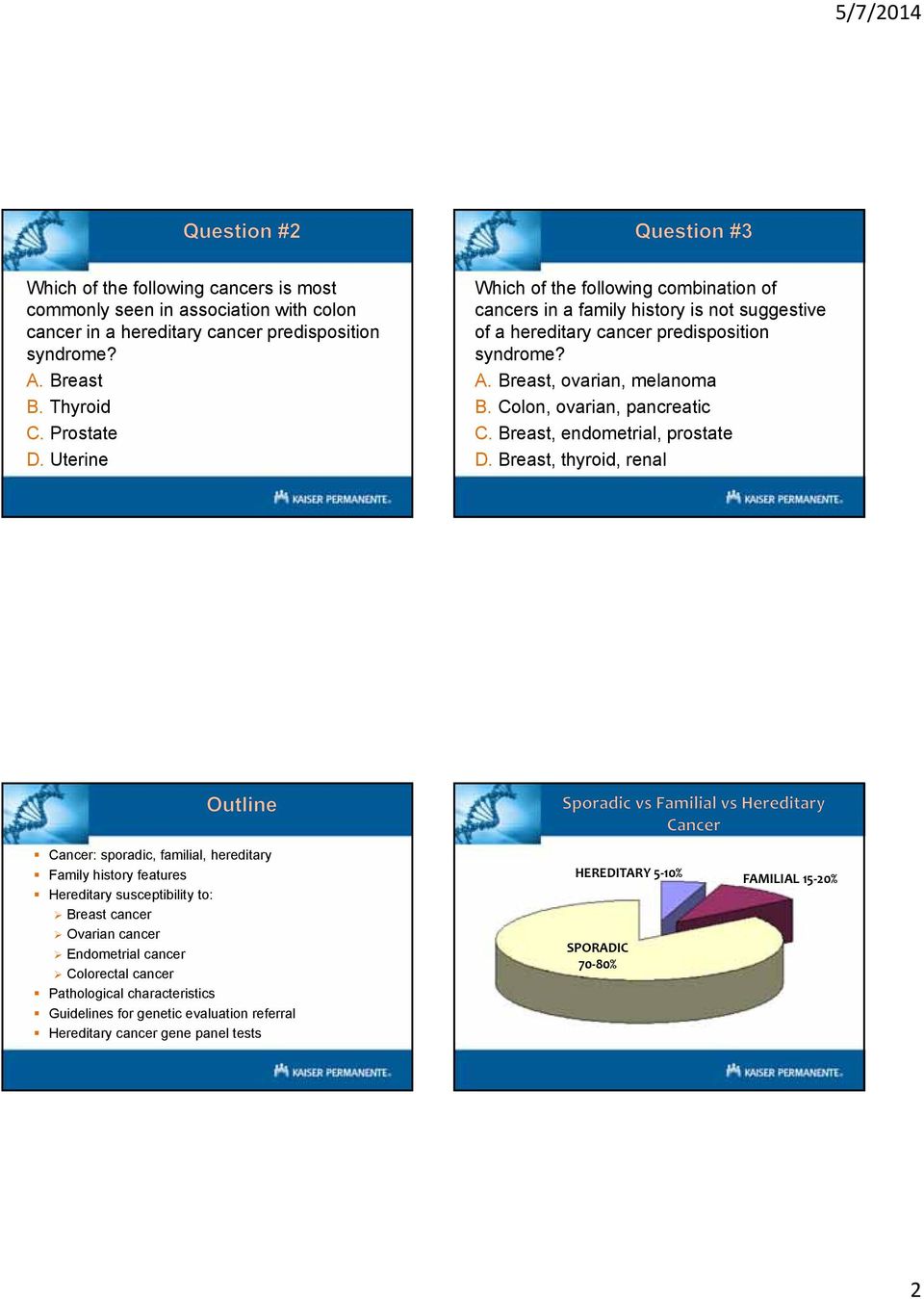
3 CA dx. 64 Sporadic mutations that accumulate over a lifetime in cells Influenced by environmental factors Not passed to family members Genetic testing is not indicated Inherited component Multiple genes involved? Clustering of cancer without a specific pattern Family members may have an elevated risk Genetic testing is not indicated CA 58 CA 60 Breast CA dx. 47 Breast CA dx % of breast cancers Inherited single gene defect Autosomal dominant inheritance Genetic testing is available for some but not all cases Young age of onset Multiple affected relatives in 2 generations Hx of related cancers Specific pathology Paternal family history Ethnicity Ovarian CA dx. 48 Breast CA dx. 45 This slide address cultural/linguistic competence requirements. 3

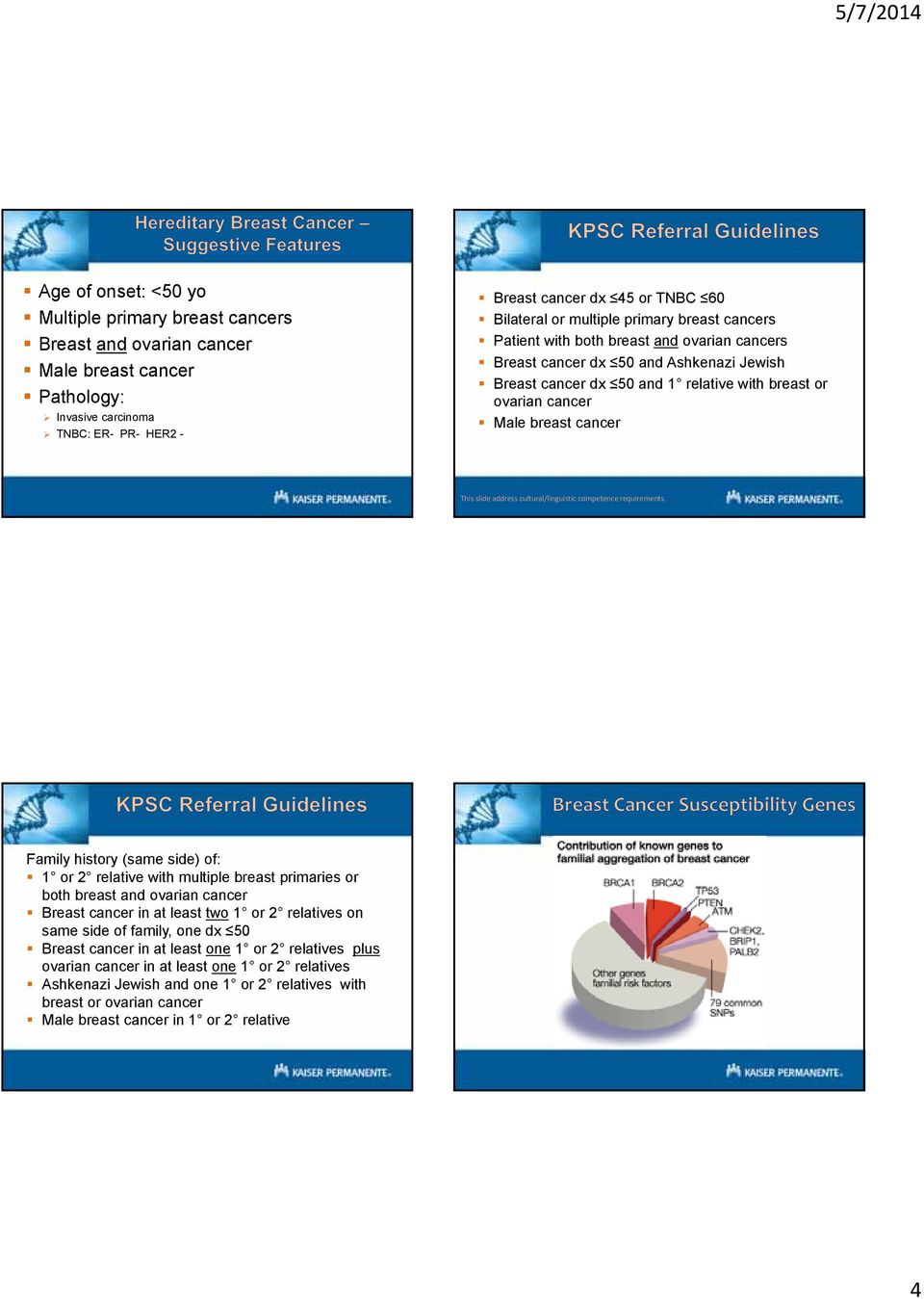
4 Age of onset: <50 yo Multiple primary breast cancers Breast and ovarian cancer Male breast cancer Pathology: Invasive carcinoma TNBC: ER- PR- HER2 - Breast cancer dx 45 or TNBC 60 Bilateral or multiple primary breast cancers Patient with both breast and ovarian cancers Breast cancer dx 50 and Ashkenazi Jewish Breast cancer dx 50 and 1 relative with breast or ovarian cancer Male breast cancer This slide address cultural/linguistic competence requirements. Family history (same side) of: 1 or 2 relative with multiple breast primaries or both breast and ovarian cancer Breast cancer in at least two 1 or 2 relatives on same side of family, one dx 50 Breast cancer in at least one 1 or 2 relatives plus ovarian cancer in at least one 1 or 2 relatives Ashkenazi Jewish and one 1 or 2 relatives with breast or ovarian cancer Male breast cancer in 1 or 2 relative 4
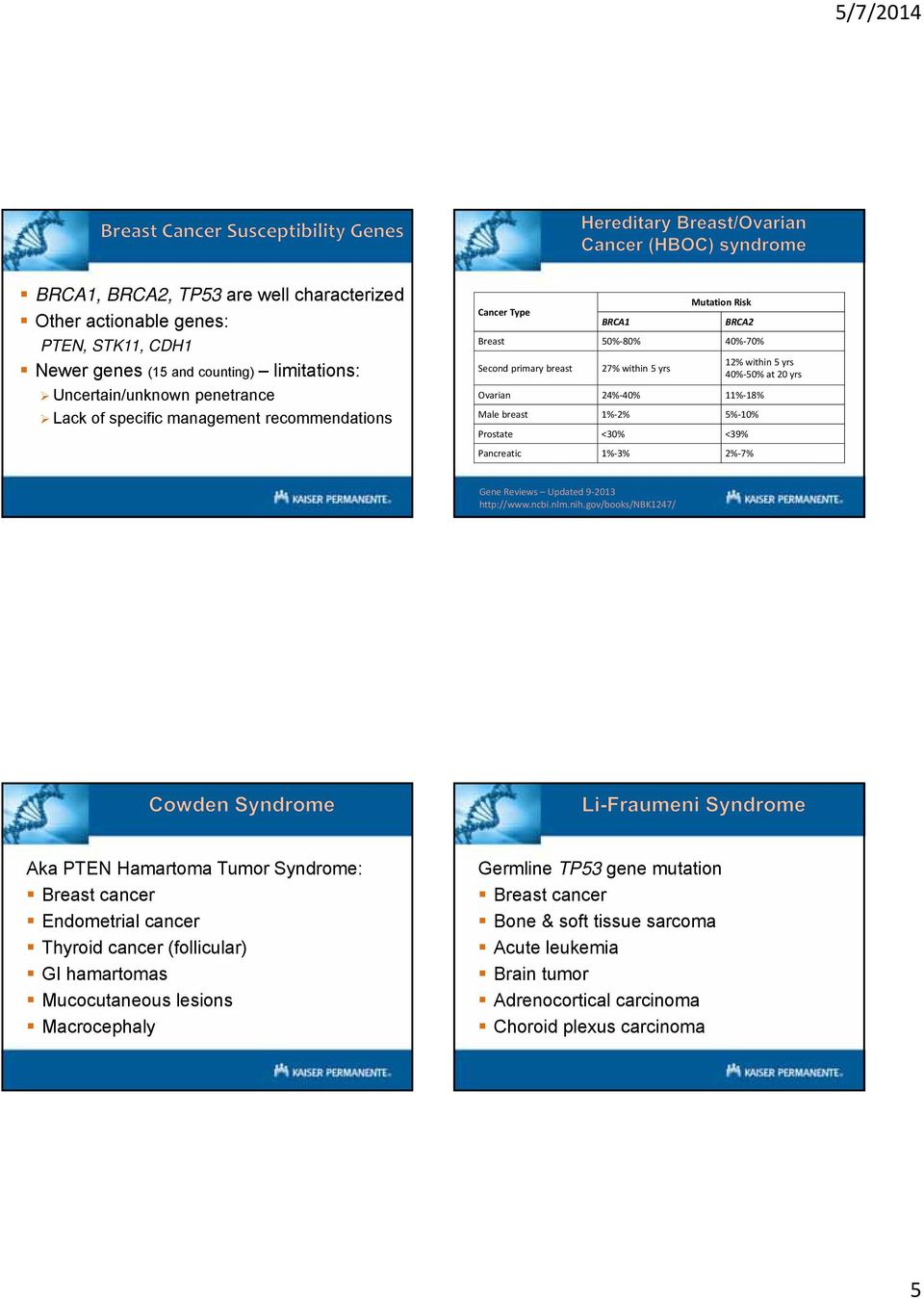
5 BRCA1, BRCA2, TP53 are well characterized Other actionable genes: PTEN, STK11, CDH1 Newer genes (15 and counting) limitations: Uncertain/unknown penetrance Lack of specific management recommendations Mutation Risk Cancer Type BRCA1 BRCA2 Breast 50% 80% 40% 70% Second primary breast 27% within 5 yrs 12% within 5 yrs 40% 50% at 20 yrs Ovarian 24% 40% 11% 18% Male breast 1% 2% 5% 10% Prostate <30% <39% Pancreatic 1% 3% 2% 7% Gene Reviews Updated Aka PTEN Hamartoma Tumor Syndrome: Breast cancer Endometrial cancer Thyroid cancer (follicular) GI hamartomas Mucocutaneous lesions Macrocephaly Germline TP53 gene mutation Breast cancer Bone & soft tissue sarcoma Acute leukemia Brain tumor Adrenocortical carcinoma Choroid plexus carcinoma 5
6 Hereditary Breast Ovarian Cancer (HBOC) syndrome BRCA1/BRCA % of unselected cases Epithelial ovarian carcinoma mainly papillary serous Fallopian tube carcinoma, primary peritoneal carcinoma Lynch syndrome (formerly known as HNPCC) Epithelial ovarian carcinoma 2-3% of unselected cases Serous carcinoma ovary, fallopian tube, or peritonium dx 60 Ashkenazi Jewish any age Both breast and ovarian/fallopian tube/peritoneal cancers Cowden syndrome Lifetime risk 28% Average onset yo Lynch syndrome Lifetime risk 25-60% Average onset yo Aka Hereditary Non-polyposis Colorectal Cancer (HNPCC) syndrome Most common hereditary colon cancer susceptibility syndrome (2-4% of all CRC) Autosomal dominant inheritance Caused by germline mutations in mismatch repair (MMR) genes 6

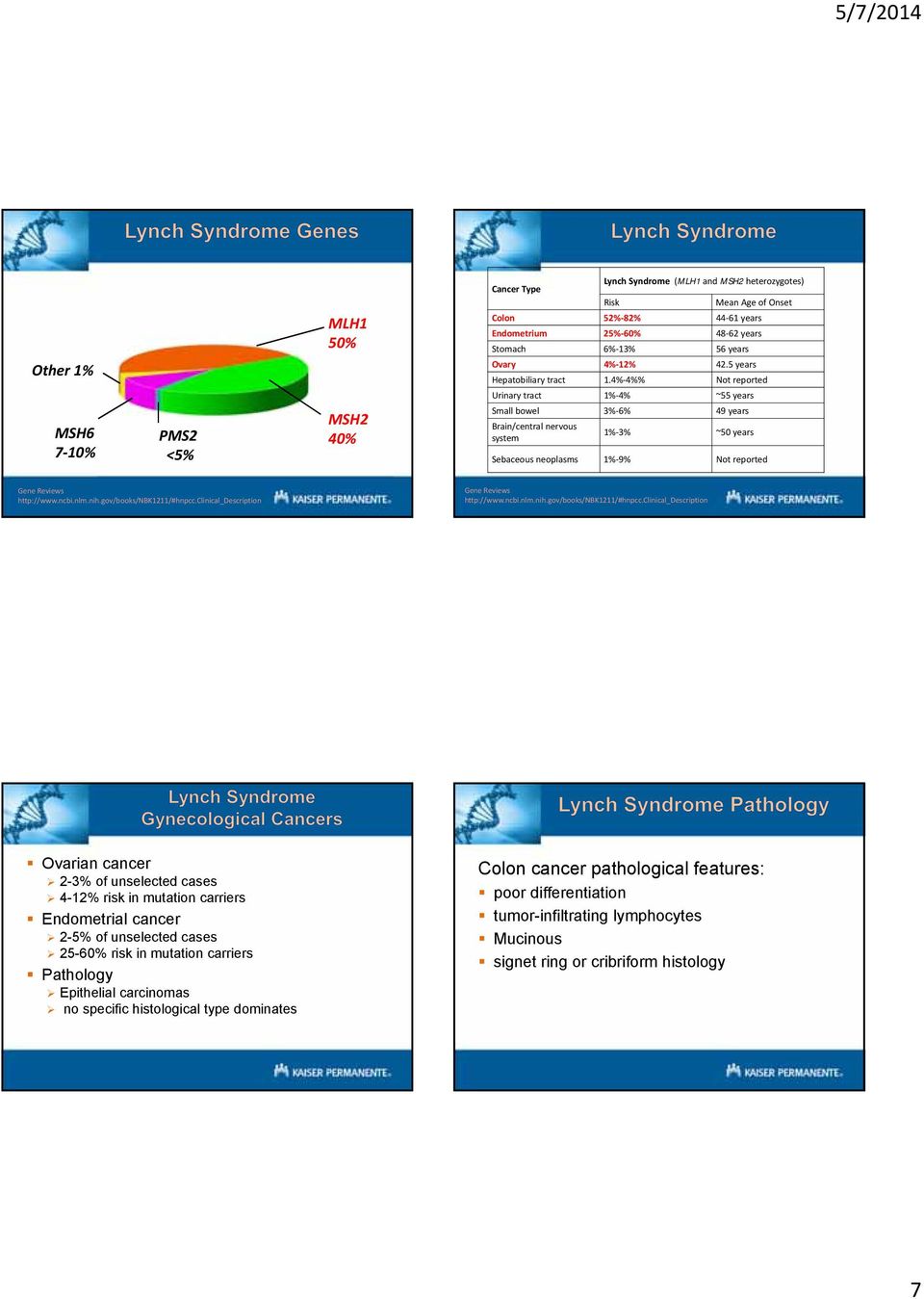
7 Other 1% MSH6 7 10% PMS2 <5% MLH1 50% MSH2 40% Lynch Syndrome (MLH1 and MSH2 heterozygotes) Cancer Type Risk Mean Age of Onset Colon 52% 82% years Endometrium 25% 60% years Stomach 6% 13% 56 years Ovary 4% 12% 42.5 years Hepatobiliary tract 1.4% 4%% Not reported Urinary tract 1% 4% ~55 years Small bowel 3% 6% 49 years Brain/central nervous system 1% 3% ~50 years Sebaceous neoplasms 1% 9% Not reported Gene Reviews Gene Reviews Ovarian cancer 2-3% of unselected cases 4-12% risk in mutation carriers Endometrial cancer 2-5% of unselected cases 25-60% risk in mutation carriers Pathology Epithelial carcinomas no specific histological type dominates Colon cancer pathological features: poor differentiation tumor-infiltrating lymphocytes Mucinous signet ring or cribriform histology 7
8 Clinical Criteria Amsterdam I Criteria Amsterdam II Criteria Prediction Models MMRpro PREMM 1, 2, 6 MMRpredict Genetic testing Microsatellite instability (MSI) testing Immunohistochemistry for MMR proteins Molecular genetic analysis for MMR gene mutations Clinical criteria Low utilization Low sensitivity Genetic testing Molecular genetic testing cost prohibitive MSI testing not specific enough, requires molecular laboratory IHC inexpensive, readily available, specific Universal Lynch syndrome screening Recommended by EGAPP group of CDC in 2009 Evaluate every case of colorectal tumor by MSI and/or IHC for MMR gene defect 100% 90% 80% 70% 60% 50% 40% 30% 20% 10% 0% NCI- CCC Cm- Cm-CP CCC NCI-CCC: NCI-designated Comprehensive Cancer Center Cm-CCC: Community Hospital Comprehensive Cancer Program Cm-CP: Community Hospital Cancer Program Total None IHC + MSI MSI only IHC only Beamer LC, et al. J Clin Oncol

9 Pilot site started in 4/2011 Currently expanded to 60% of facilities Goal of 100% role out by Fall of / screened 681 cases Overall mutation positive rate 2.1% Positive IHC, no germline mutation 0.9% CRC dx <50 yo Multiple primary CRC CRC & endometrial CA Multiple cases of CRC on same side of family CRC & endometrial CA on same side of family CRC & any of the following: other GI cancers, ovarian, urinary or biliary tract Polyposis ( 10 colorectal adenomas) at any age Colorectal polyps dx <40 Sebaceous adenoma or carcinoma A test that uses next-generation sequencing technology to analyze multiple genes simultaneously. Cardiomyopathy panels Neuromuscular disorders X-linked intellectual disability panels Hearing loss panels Cancer predisposition panels 9

10 General collection of genes related to several different hereditary cancer predisposition syndromes Site-specific collection of genes related to hereditary predisposition to a specific cancer type (e.g. breast cancer) Actionable collection of genes related to hereditary cancer predisposition that are well defined and have specific management recommendations Promise of Efficiency through cost effectiveness and time savings Elimination of diagnostic dilemmas Utility Families with cancer history consistent with several different syndromes Patients with negative genetic test for the most likely syndrome No clear guidelines for patient eligibility Unresolved reimbursement issues Variants of Uncertain Significance (VUS) Genetic variant that may or may not be associated with a cancer risk High rate VUS in multiple genes Moderately penetrant genes No established clinical management guidelines Novel genes unknown cancer spectrum limited cancer risk data No management guidelines Mutations in multiple genes Uncertain cancer risks Mutation in a gene inconsistent with clinical history Uncertain clinical management 10

11 Only 5-10% cancers are related to a hereditary susceptibility Personal and family history features help identify those at risk for hereditary cancer susceptibility Common cancers can be part of different susceptibility syndromes Follow regional referral guidelines for genetic evaluation New cancer gene panels have promise and limitations Which of the following cancers has the highest proportion of hereditary cases? 1. Breast 2. Ovarian 3. Endometrial 4. Colorectal Which of the following cancers is most commonly seen in association with colon cancer in a hereditary cancer predisposition syndrome? 1. Breast 2. Thyroid 3. Prostate 4. Uterine Which of the following combination of cancers in a family history is not suggestive of a hereditary cancer predisposition syndrome? 1. Breast, ovarian, melanoma 2. Colon, ovarian, pancreatic 3. Breast, endometrial, prostate 4. Breast, thyroid, renal 11

12 12

The Genetics of Early- Onset Breast Cancer. Cecelia Bellcross, Ph.D., M.S.,C.G.C. Department of Human Genetics Emory University School of Medicine
 The Genetics of Early- Onset Breast Cancer Cecelia Bellcross, Ph.D., M.S.,C.G.C. Department of Human Genetics Emory University School of Medicine All cancers are genetic BUT Not all cancers are hereditary
Hereditary Breast Cancer Panels. High Risk Hereditary Breast Cancer Panel Hereditary Breast/Ovarian/Endometrial Cancer Panel
 P A T I E N T G U I D E Hereditary Breast Cancer Panels High Risk Hereditary Breast Cancer Panel Hereditary Breast/Ovarian/Endometrial Cancer Panel B a y l o r M i r a c a G e n e t i c s L a b o r a t
GENETIC CONSIDERATIONS IN CANCER TREATMENT AND SURVIVORSHIP
 GENETIC CONSIDERATIONS IN CANCER TREATMENT AND SURVIVORSHIP WHO IS AT HIGH RISK OF HEREDITARY CANCER? Hereditary Cancer accounts for a small proportion of all cancer or approximately 5-10% THE DEVELOPMENT
Hereditary Breast Cancer. Nicole Kounalakis, MD Assistant Professor of Surgery University of Colorado Medical Center
 Hereditary Breast Cancer Nicole Kounalakis, MD Assistant Professor of Surgery University of Colorado Medical Center Outline Background Assessing risk of patient Syndromes BRCA 1,2 Li Fraumeni Cowden Hereditary
Ovarian Cancer Genetic Testing: Why, When, How?
 Ovarian Cancer Genetic Testing: Why, When, How? Jeffrey Dungan, MD Associate Professor Division of Clinical Genetics Department of Obstetrics & Gynecology Northwestern University Feinberg School of Medicine
Advice about familial aspects of breast cancer and epithelial ovarian cancer a guide for health professionals DECEMBER 2010
 Advice about familial aspects of breast cancer and epithelial ovarian cancer a guide for health professionals DECEMBER 2010 This guide has three parts: 1. Information for health professionals 2. Tables
Genetics and Breast Cancer. Elly Lynch, Senior Genetic Counsellor Manager, Austin Health Clinical Genetics Service
 Genetics and Breast Cancer Elly Lynch, Senior Genetic Counsellor Manager, Austin Health Clinical Genetics Service Overview Background/Our Team What is the difference between sporadic/familial cancer? How
GENETIC TESTING FOR INHERITED MUTATIONS OR SUSCEPTIBILITY TO CANCER OR OTHER CONDITIONS MED207.110
 GENETIC TESTING FOR INHERITED MUTATIONS OR SUSCEPTIBILITY TO CANCER OR OTHER CONDITIONS MED207.110 COVERAGE: Pre- and post-genetic test counseling may be eligible for coverage in addition to the genetic
Genetic Testing for Lynch Syndrome/Colorectal Cancer and Polyposis Syndromes
 Genetic Testing for Lynch Syndrome/Colorectal Cancer and Polyposis Syndromes Policy Number: Original Effective Date: MM.02.007 09/01/2011 Line(s) of Business: Current Effective Date: HMO; PPO 09/01/2011
Test Information Sheet
 Test Information Sheet GeneDx 207 Perry Parkway Gaithersburg, MD 20877 Phone: 888-729-1206 Fax: 301-710-6594 E-mail: [email protected] www.genedx.com/oncology OncoGene Dx: High/Moderate Risk Panel Sequence
Hereditary Cancer Risk Assessment: Indicators of Hereditary and Familial Risk
 Hereditary Cancer Risk Assessment: Indicators of Hereditary and Familial Risk Karen Copeland Certified Genetic Counselor Director International Medical Affairs Myriad Genetics GmbH Impact of Hereditary
Genetic Testing for Familial Adenomatous Polyposis and MYH-Associated Polyposis (Lynch Syndrome)
 Harmony Behavioral Health, Inc. Harmony Behavioral Health of Florida, Inc. Harmony Health Plan of Illinois, Inc. HealthEase of Florida, Inc. Ohana Health Plan, a plan offered by WellCare Health Insurance
Cancer Genetic Counseling
 Cancer Genetic Counseling Guest Expert: Ellen, MS Director of the Yale Cancer Center Cancer Genetic Counseling Program www.wnpr.org www.yalecancercenter.org I am Bruce Barber and this is Yale Cancer Center
Test Information Sheet
 Test Information Sheet GeneDx 207 Perry Parkway Gaithersburg, MD 20877 Phone: 888-729-1206 Fax: 301-710-6594 E-mail: [email protected] www.genedx.com/oncology OncoGene Dx: Breast/Ovarian Cancer Panel Sequence
Colon Cancer Syndromes. Robin B. Mendelsohn MD Memorial Sloan Kettering Cancer Center Department of Medicine Gastroenterology and Nutrition Service
 Colon Cancer Syndromes Robin B. Mendelsohn MD Memorial Sloan Kettering Cancer Center Department of Medicine Gastroenterology and Nutrition Service Background: Etiology of Colorectal Cancer (CRC) Sporadic:
BRCA1 & BRCA2: Genetic testing for hereditary breast and ovarian cancer patient guide
 BRCA1 & BRCA2: Genetic testing for hereditary breast and ovarian cancer patient guide What is Hereditary? Breast cancer is the most common cancer in women in the U.S. (it affects about 1 in 8 women). Ovarian
Risk stratification for colorectal cancer especially: the difference between sporadic disease and polyposis syndromes. Dr. med. Henrik Csaba Horváth
 Risk stratification for colorectal cancer especially: the difference between sporadic disease and polyposis syndromes Dr. med. Henrik Csaba Horváth Why is risk stratification for colorectal cancer (CRC)
Overview of testing for Lynch syndrome/hnpcc
 Overview of testing for Lynch syndrome/hnpcc This overview provides detailed information about interpreting MSI/IHC testing and genetic testing for Lynch syndrome/hnpcc. It is intended to be a reference
patient guide BRCA1 and BRCA2 Genetic Testing for Hereditary Breast and Ovarian Cancer
 patient guide BRCA1 and BRCA2 Genetic Testing for Hereditary Breast and Ovarian Cancer What is hereditary cancer? Cancer affects many people in the U.S.: breast cancer affects 1 in 8 women and ovarian
BAP1 germline mutations A new Cutaneous Nevus Melanoma Syndrome. Thomas Wiesner
 BAP1 germline mutations A new Cutaneous Nevus Melanoma Syndrome Thomas Wiesner Disclosure Listed as co-inventor US patent application US 61/463,389 BAP1 mutational analysis in determining susceptibility
Dal germinale al somatico nella identificazione di tumori ereditari
 Modena 18-19 novembre 2010 Dal germinale al somatico nella identificazione di tumori ereditari Laura Ottini Tendencies to develop cancer can be inherited Fletcher & Houlston, 2010 Cancer is a genetic disease
6/10/2015. Hereditary Predisposition for Breast Cancer: Looking at BRCA1/BRCA2 Testing & Beyond. Hereditary Cancers. BRCA1 and BRCA2 Review
 Hereditary Predisposition for Breast Cancer: Looking at BRCA1/BRCA2 Testing & Beyond Arturo Anguiano MD, FACMG International Medical Director, Medical Affairs Vice Chairman, Genetics; Medical Director,
Progress and Prospects in Ovarian Cancer Screening and Prevention
 Progress and Prospects in Ovarian Cancer Screening and Prevention Rebecca Stone, MD MS Assistant Professor Kelly Gynecologic Oncology Service The Johns Hopkins Hospital 1 No Disclosures 4/12/2016 2 Ovarian
Number 12.04.516 Effective Date August 11, 2015 Revision Date(s) Replaces 2.04.133 (not adopted)
 MEDICAL POLICY POLICY RELATED POLICIES POLICY GUIDELINES DESCRIPTION SCOPE BENEFIT APPLICATION RATIONALE REFERENCES CODING APPENDI HISTORY Genetic Testing for CHEK2 Mutations for Breast Cancer Number 12.04.516
PROVIDER POLICIES & PROCEDURES
 PROVIDER POLICIES & PROCEDURES BRCA GENETIC TESTING The purpose of this document is to provide guidance to providers enrolled in the Connecticut Medical Assistance Program (CMAP) on the requirements for
patient education Fact Sheet PFS007: BRCA1 and BRCA2 Mutations MARCH 2015
 patient education Fact Sheet PFS007: BRCA1 and BRCA2 Mutations MARCH 2015 BRCA1 and BRCA2 Mutations Cancer is a complex disease thought to be caused by several different factors. A few types of cancer
A Decision Support Tool to Facilitate Cancer Risk Assessment and Referral for Genetics Services. Kristen Vogel Postula, MS, CGC & Leigh Baumgart, PhD
 A Decision Support Tool to Facilitate Cancer Risk Assessment and Referral for Genetics Services Kristen Vogel Postula, MS, CGC & Leigh Baumgart, PhD Importance of Family History Increasing awareness of
Microsatellite Instability (MSI) A New Paradigm in Cancer Treatment. Lynch Syndrome OUTLINE. GI Molecular Pathology
 OUTLINE GI Molecular Pathology Microsatellite Instability and Lynch Syndrome GI Cancer Genotyping KRAS Mutations in Colorectal Cancer A. John Iafrate MD-PhD Department of Pathology Massachusetts General
Cancer Screening and Early Detection Guidelines
 Cancer Screening and Early Detection Guidelines Guillermo Tortolero Luna, MD, PhD Director Cancer Control and Population Sciences Program University of Puerto Rico Comprehensive Cancer Center ASPPR Clinical
ACG Clinical Guideline: Genetic Testing and Management of Hereditary Gastrointestinal Cancer Syndromes
 PRACTICE GUIDELINES nature publishing group 223 CME ACG Clinical Guideline: Genetic Testing and Management of Hereditary Gastrointestinal Cancer Syndromes Sapna Sy nga l, MD, M PH, FAC G 1, 2, 3, R and
Understanding Hereditary Breast and Ovarian Cancer. Maritime Hereditary Cancer Service
 Understanding Hereditary Breast and Ovarian Cancer Maritime Hereditary Cancer Service General Information Cancer is very common. About one in three (33%) people are diagnosed with some form of cancer during
Understanding Lynch Syndrome
 ESSENTIALS Lynch Syndrome Understanding Lynch Syndrome Certain cancers can run in families. Sometimes this happens because of harmful changes (called mutations) in our genes that are passed from one generation
Name of Policy: Genetic Testing for Inherited Cancer Predisposition and/or Pharmacogenetics related to Cancer Treatment
 Name of Policy: Genetic Testing for Inherited Cancer Predisposition and/or Pharmacogenetics related to Cancer Treatment Policy #: 133 Latest Review Date: April 2015 Category: Laboratory Policy Grade: D
Understanding Your Risk of Ovarian Cancer
 Understanding Your Risk of Ovarian Cancer A WOMAN S GUIDE This brochure is made possible through partnership support from Project Hope for Ovarian Cancer Research and Education. Project HOPE FOR OVARIAN
Genetic Counseling and Testing: Cancer Genetics
 KAISER PERMANENTE HAWAII CLINICAL PRACTICE GUIDELINE Genetic Counseling and Testing: Cancer Genetics QUALITY COMMITTEE ADOPTION DATE: October 2015 LAST REVIEW DATE: September 2015 NEXT SCHEDULED REVIEW
Genetic/Familial High-Risk Assessment: Breast and Ovarian
 NCCN Clinical Practice Guidelines in Oncology (NCCN Guidelines ) Genetic/Familial High-Risk Assessment: Version 2.2015 NCCN.org Continue Version 2.2015, 06/25/15 National Comprehensive Cancer Network,
Breast Cancer Screening
 Breast Cancer Screening Summary of the Clinical Practice Guideline September 2013 These recommendations are systematically developed statements to assist practitioner and patient decisions about appropriate
BRCA in Men. Mary B. Daly,M.D.,Ph.D. June 25, 2010
 BRCA in Men Mary B. Daly,M.D.,Ph.D. June 25, 2010 BRCA in Men Inheritance patterns of BRCA1/2 Cancer Risks for men with BRCA1/2 mutations Risk management recommendations for men with BRCA1/2 mutations
Patient Support Guide
 Patient Support Guide to genetic testing for hereditary breast and ovarian cancer syndrome Testing for BRCA1 and BRCA2 is available from Quest Diagnostics. Quest Diagnostics Patient Support Guide to Genetic
The Hereditary Colorectal Cancer Website has been sponsored by the Robert Rauschenberg Foundation
 Introduction The Hereditary Colorectal Cancer Website has been sponsored by the Robert Rauschenberg Foundation Hereditary nonpolyposis colorectal cancer (HNPCC) syndrome was first described over 100 years
Outline. Workup for metastatic breast cancer. Metastatic breast cancer
 Metastatic breast cancer Immunostain Update: Diagnosis of metastatic breast carcinoma, emphasizing distinction from GYN primary 1/3 of breast cancer patients will show metastasis 1 st presentation or 20-30
Beyond BRCA the Future is Now
 Beyond BRCA the Future is Now Richard P. Frieder, MD Medical Director, Intelegene Assistant Clinical Professor Department of Obstetrics and Gynecology David Geffen School of Medicine, UCLA University of
Genetic/Familial High-Risk Assessment: Breast and Ovarian
 NCCN Clinical Practice Guidelines in Oncology (NCCN Guidelines ) Genetic/Familial High-Risk Assessment: Version 2.2013 NCCN.org Continue Version 2.2013, 04/25/13 National Comprehensive Cancer Network,
New Hampshire Childhood Cancer
 Introduction: New Hampshire Childhood Cancer New Hampshire, Childhood Cancer, January 2009 Issue Brief Cancer in children is relatively uncommon, impacting fewer than twenty two of every 100,000 children
BRCA1 & BRCA2 GeneHealth UK
 BRCA1 & BRCA2 GeneHealth UK BRCA1 & BRCA2 What is hereditary breast cancer? Cancer is unfortunately very common, with 1 in 3 people developing cancer at some point in their lifetime. Breast cancer occurs
Frequently Asked Questions About Ovarian Cancer
 Media Contact: Gerri Gomez Howard Cell: 303-748-3933 [email protected] Frequently Asked Questions About Ovarian Cancer What is ovarian cancer? Ovarian cancer is a cancer that forms in tissues
National Medical Policy
 National Medical Policy Subject: Policy Number: Genetic Testing for BRCA1 and BRCA2 NMP136 Effective Date*: April 2004 Updated: September 2015 This National Medical Policy is subject to the terms in the
Cancer: Genetic testing can save lives
 Cancer: Genetic testing can save lives Track chances of having a tumor's tendency among people with a history of disease cases in the family, but practice should not be trivialized and hurt even more who
Hereditary Ovarian cancer: BRCA1 and BRCA2. Karen H. Lu MD September 22, 2013
 Hereditary Ovarian cancer: BRCA1 and BRCA2 Karen H. Lu MD September 22, 2013 Outline Hereditary Breast and Ovarian Cancer (HBOC) BRCA1/2 genes How to identify What it means to you What it means to your
Immunohistochemical differentiation of metastatic tumours
 Immunohistochemical differentiation of metastatic tumours Dr Abi Wheal ST1. TERA 3/2/14 Key points from a review article written by Daisuke Nonaka Intro Metastatic disease is the initial presentation in
MEDICAL POLICY SUBJECT: GENETIC TESTING FOR HEREDITARY BRCA MUTATIONS. POLICY NUMBER: 2.02.06 CATEGORY: Laboratory Test
 MEDICAL POLICY SUBJECT: GENETIC TESTING FOR, 10/15/15 PAGE: 1 OF: 12 If the member's subscriber contract excludes coverage for a specific service it is not covered under that contract. In such cases, medical
Screening guidelines tool
 Screening guidelines tool Disclaimer: This material is intended as a general summary of screening and management recommendations; it is not intended to be comprehensive. Colorectal cancer (CRC) screening
National Coverage Determination (NCD) for Tumor Antigen by Immunoassay - CA 125 (190.28)
 National Coverage Determination (NCD) for Tumor Antigen by Immunoassay - CA 125 (190.28) Tracking Information Publication Number Manual Section Number 100-3 190.28 Manual Section Title Tumor Antigen by
Genetic Testing for CHEK2 Mutations for Breast Cancer
 Genetic Testing for CHEK2 Mutations for Breast Cancer Policy Number: 2.04.133 Last Review: 8/2015 Origination: 8/2015 Next Review: 8/2016 Policy Blue Cross and Blue Shield of Kansas City (Blue KC) will
NOTTINGHAM UNIVERSITY HOSPITAL NHS TRUST NOTTINGHAM BREAST INSTITUTE BREAST AND OVARIAN FAMILY HISTORY GUIDELINES
 NOTTINGHAM UNIVERSITY HOSPITAL NHS TRUST NOTTINGHAM BREAST INSTITUTE BREAST AND OVARIAN FAMILY HISTORY GUIDELINES GP Referrals All GP referrals for asymptomatic women with a family history of breast and/or
Contents. molecular biology techniques. - Mutations in Factor II. - Mutations in MTHFR gene. - Breast cencer genes. - p53 and breast cancer
 Contents Introduction: biology and medicine, two separated compartments What we need to know: - boring basics in DNA/RNA structure and overview of particular aspects of molecular biology techniques - How
BRCA Genes and Inherited Breast and Ovarian Cancer. Patient information leaflet
 BRCA Genes and Inherited Breast and Ovarian Cancer Patient information leaflet This booklet has been written for people who have a personal or family history of breast and/or ovarian cancer that could
Are You at Risk for Ovarian Cancer?
 Are You at Risk for Ovarian Cancer? A Woman s Guide Read this brochure to learn more about ovarian cancer symptoms, risk factors and what you can do to reduce your risk. ALL WOMEN HAVE SOME RISK OF OVARIAN
ScreenWise. Breast, Cervical, and Hereditary Cancer Screenings OCTOBER 28, 2015
 ScreenWise Breast, Cervical, and Hereditary Cancer Screenings OCTOBER 28, 2015 ScreenWise Three programs working together to bring quality screening services to Oregon residents Why we all do this work
Nancy E. Davidson, MD Johns Hopkins University. Breast Cancer
 This work is licensed under a Creative Commons Attribution-NonCommercial-ShareAlike License. Your use of this material constitutes acceptance of that license and the conditions of use of materials on this
Macrae FA 1, Good N 3, Young GP, Bampton P 2, Lane J 2, St John DJB 1, Diehl R 3, J O Dwyer 3, Slattery M 1.
 Macrae FA 1, Good N 3, Young GP, Bampton P 2, Lane J 2, St John DJB 1, Diehl R 3, J O Dwyer 3, Slattery M 1. Colorectal Medicine and Genetics, and University of Melbourne Dept of Medicine The Royal Melbourne
Genomic Medicine Education Initiatives of the College of American Pathologists
 Genomic Medicine Education Initiatives of the College of American Pathologists Debra G.B. Leonard, MD, PhD, FCAP Chair, Personalized Healthcare Committee, CAP Professor of Pathology, Weill Cornell Medical
Breast Cancer s Link to Ovarian Cancer: It s in Your Genes. foundationforwomenscancer.org
 Breast Cancer s Link to Ovarian Cancer: It s in Your Genes foundationforwomenscancer.org There are now more than 2.6 million women in America who have been diagnosed with breast cancer. A very small fraction
Design and development of a decision support system for screening of Lynch syndrome using openehr
 Master's Programme in Health Informatics Spring Semester 2015 Degree thesis, 30 Credits Design and development of a decision support system for screening of Lynch syndrome using openehr Author: Blanca
Hereditary Breast and Ovarian Cancer (HBOC)
 Oxford University Hospitals NHS Trust Oxford Regional Genetic Department Hereditary Breast and Ovarian Cancer (HBOC) Information for women with an increased lifetime risk of breast and ovarian cancer What
Medical Policy An independent licensee of the Blue Cross Blue Shield Association
 BRCA1 and BRCA2 Testing Page 1 of 30 Medical Policy An independent licensee of the Blue Cross Blue Shield Association Title: BRCA1 and BRCA2 Testing Pre-Determination of Services IS REQUIRED by the Member
A 70-year old Man with Pleural Effusion
 Mesothelioma Diagnosis: Pitfalls and Latest Updates S Klebe and DW Henderson Recommendations Indisputable malignant cells on cytomorphological criteria which demonstrate a mesothelial phenotype, which
Practical Effusion Cytology
 Practical Effusion Cytology A Community Pathologist s Approach to Immunocytochemistry in Body Fluid Cytology Emily E. Volk, MD William Beaumont Hospital Troy, MI College of American Pathologists 2004.
Genetic Testing for Hereditary Breast and Ovarian Cancer - BRCA1/2 ANALYSIS -
 Genetic Testing for Hereditary Breast and Ovarian Cancer - BRCA1/2 ANALYSIS - January 2005 SCIENTIFIC BACKGROUND Breast cancer is considered to be one of the most prevalent cancer in women. The overall
Screening for Cancer in Light of New Guidelines and Controversies. Christopher Celio, MD St. Jude Heritage Medical Group
 Screening for Cancer in Light of New Guidelines and Controversies Christopher Celio, MD St. Jude Heritage Medical Group Screening Tests The 2 major objectives of a good screening program are: (1) detection