
BRCA1 & BRCA2: Genetic testing for hereditary breast and ovarian cancer patient guide
|
|
|
- Zoe Sparks
- 9 years ago
- Views:
Transcription
1 BRCA1 & BRCA2: Genetic testing for hereditary breast and ovarian cancer patient guide

2 What is Hereditary? Breast cancer is the most common cancer in women in the U.S. (it affects about 1 in 8 women). Ovarian cancer affects about 1 in 71 women. The majority of breast and ovarian cancer cases occur at older ages in people with little or no family history of the disease and no genetic risk. These occurrences are called sporadic cancers and happen by chance. Although many people have a family history of cancer, the majority of breast and ovarian cancers are not due to inherited causes. Only about 10% of cancer is hereditary (due to inherited genetic changes called mutations). People who carry these mutations are born with them they do not develop over time. Understanding if cancer is due to an inherited mutation can help clarify future risks to develop cancer and help determine options for cancer screening and prevention. cancer type breakdown breast cancer Sporadic 70-80% Familial, 15-20% Hereditary, 5-10% BRCA1 and BRCA2 are the most common causes of hereditary breast and hereditary ovarian cancer ovarian cancer Sporadic 75-90% Hereditary, 10-25% BRCA1 and BRCA2 cause 50-75% of inherited ovarian cancers Many families with a history of breast and/or ovarian cancer do not have an identifiable genetic cause. These familial cases may be due to other genes, shared factors such as environment and lifestyle, or a combination of all of these. notes

3 What is Your Risk for Breast and/or Ovarian? Risk assessment by a healthcare provider can help define your chance of developing breast and ovarian cancer. A woman with no family history of breast or ovarian cancer is most likely at average risk (shown on the graph below as general population risk). For a person who has a family history of breast and/or ovarian cancer, BRCA1/2 genetic testing may be appropriate to help determine his/her risk of developing breast or ovarian cancer. If someone has had breast or ovarian cancer, BRCA1/2 genetic testing may be appropriate to help determine if she/he has an increased risk for additional cancers. Defining a person s cancer risk helps his/her healthcare providers make personalized recommendations for cancer screening and prevention. What are the BRCA1 and BRCA2 Genes? Everyone has two copies of the BRCA1 and BRCA2 genes, which we randomly inherit from each of our parents. Their function is to help prevent cancer in specific body parts. If the BRCA1 or BRCA2 gene is not functioning properly (due to an inherited gene mutation), then there is an increased risk for breast, ovarian, pancreatic, prostate, and male breast cancer. brca1/2 lifetime cancer risks (%) General Population BRCA1/2 Positive Breast Ovarian Male Breast Prostate BRCA1/2 mutation carriers often develop cancer at younger than typical ages and have an increased risk for second primary tumors to develop additional cancers in the same or different organ. This genetic test analyzes the BRCA1 and BRCA2 genes to identify any inherited changes (mutations) in them that increase the risk for cancer.

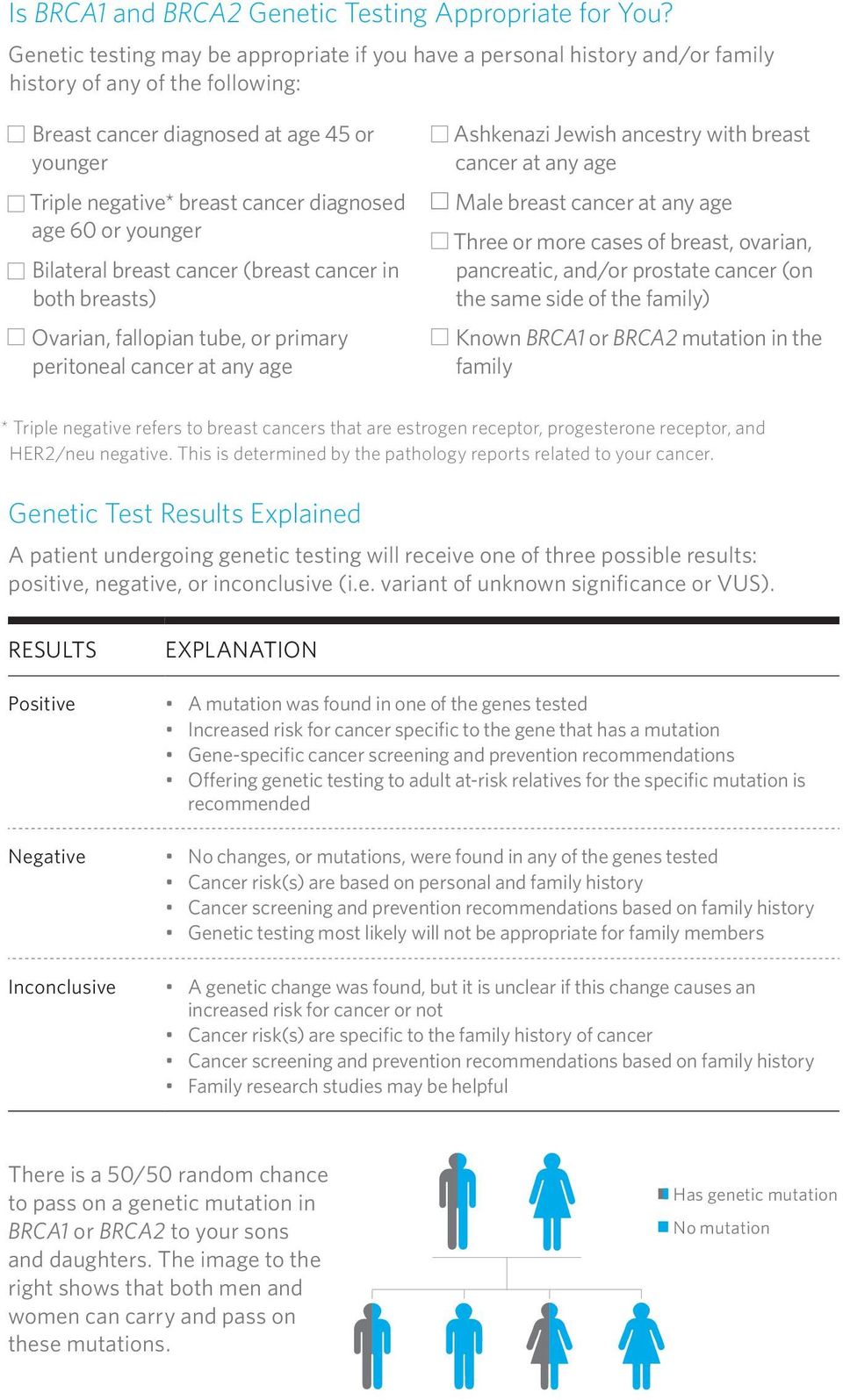
4 Is BRCA1 and BRCA2 Genetic Testing Appropriate for You? Genetic testing may be appropriate if you have a personal history and/or family history of any of the following: Breast cancer diagnosed at age 45 or younger Triple negative* breast cancer diagnosed age 60 or younger Bilateral breast cancer (breast cancer in both breasts) Ovarian, fallopian tube, or primary peritoneal cancer at any age Ashkenazi Jewish ancestry with breast cancer at any age Male breast cancer at any age Three or more cases of breast, ovarian, pancreatic, and/or prostate cancer (on the same side of the family) Known BRCA1 or BRCA2 mutation in the family * Triple negative refers to breast cancers that are estrogen receptor, progesterone receptor, and HER2/neu negative. This is determined by the pathology reports related to your cancer. Genetic Test Results Explained A patient undergoing genetic testing will receive one of three possible results: positive, negative, or inconclusive (i.e. variant of unknown significance or VUS). RESULTS Positive Negative Inconclusive EXPLANATION A mutation was found in one of the genes tested Increased risk for cancer specific to the gene that has a mutation Gene-specific cancer screening and prevention recommendations Offering genetic testing to adult at-risk relatives for the specific mutation is recommended No changes, or mutations, were found in any of the genes tested risk(s) are based on personal and family history screening and prevention recommendations based on family history Genetic testing most likely will not be appropriate for family members A genetic change was found, but it is unclear if this change causes an increased risk for cancer or not risk(s) are specific to the family history of cancer screening and prevention recommendations based on family history Family research studies may be helpful There is a 50/50 random chance to pass on a genetic mutation in BRCA1 or BRCA2 to your sons and daughters. The image to the right shows that both men and women can carry and pass on these mutations. Has genetic mutation No mutation
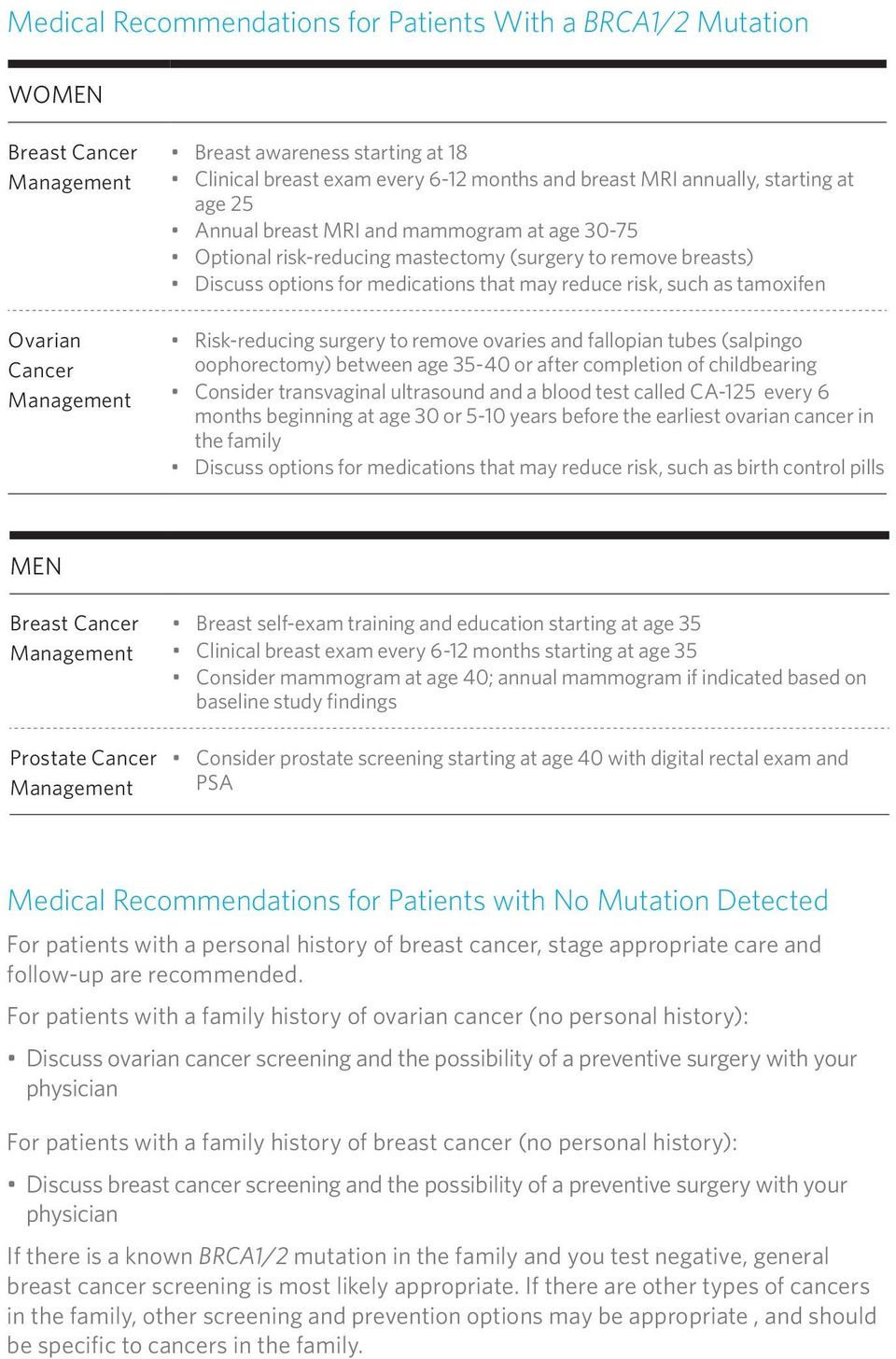
5 Medical Recommendations for Patients With a BRCA1/2 Mutation WOMEN Breast Management Ovarian Management Breast awareness starting at 18 Clinical breast exam every 6-12 months and breast MRI annually, starting at age 25 Annual breast MRI and mammogram at age Optional risk-reducing mastectomy (surgery to remove breasts) Discuss options for medications that may reduce risk, such as tamoxifen Risk-reducing surgery to remove ovaries and fallopian tubes (salpingo oophorectomy) between age or after completion of childbearing Consider transvaginal ultrasound and a blood test called CA-125 every 6 months beginning at age 30 or 5-10 years before the earliest ovarian cancer in the family Discuss options for medications that may reduce risk, such as birth control pills MEN Breast Management Prostate Management Breast self-exam training and education starting at age 35 Clinical breast exam every 6-12 months starting at age 35 Consider mammogram at age 40; annual mammogram if indicated based on baseline study findings Consider prostate screening starting at age 40 with digital rectal exam and PSA Medical Recommendations for Patients with No Mutation Detected For patients with a personal history of breast cancer, stage appropriate care and follow-up are recommended. For patients with a family history of ovarian cancer (no personal history): Discuss ovarian cancer screening and the possibility of a preventive surgery with your physician For patients with a family history of breast cancer (no personal history): Discuss breast cancer screening and the possibility of a preventive surgery with your physician If there is a known BRCA1/2 mutation in the family and you test negative, general breast cancer screening is most likely appropriate. If there are other types of cancers in the family, other screening and prevention options may be appropriate, and should be specific to cancers in the family.
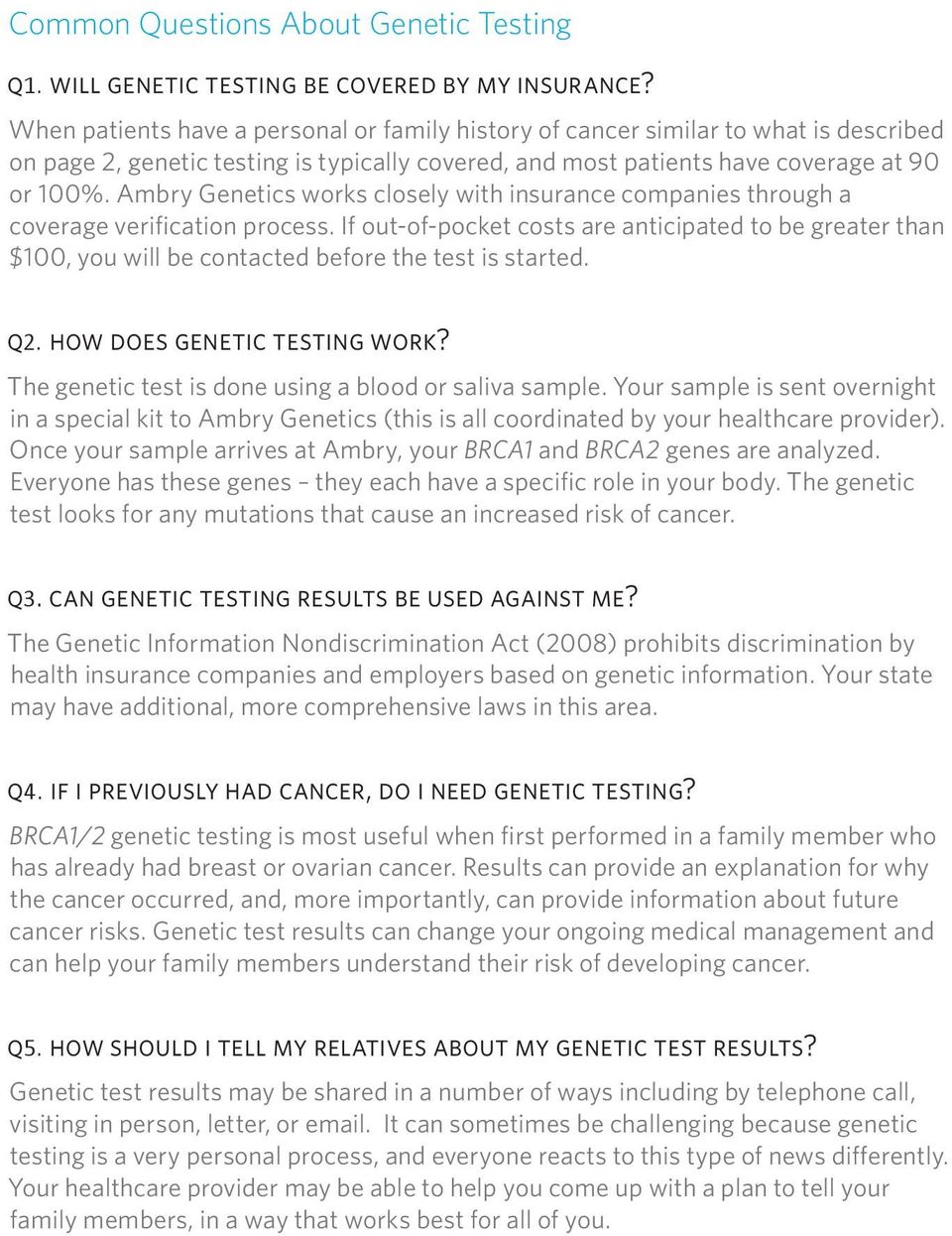
6 Common Questions About Genetic Testing q1. will genetic testing be covered by my insurance? When patients have a personal or family history of cancer similar to what is described on page 2, genetic testing is typically covered, and most patients have coverage at 90 or 100%. Ambry Genetics works closely with insurance companies through a coverage verification process. If out-of-pocket costs are anticipated to be greater than $100, you will be contacted before the test is started. q2. how does genetic testing work? The genetic test is done using a blood or saliva sample. Your sample is sent overnight in a special kit to Ambry Genetics (this is all coordinated by your healthcare provider). Once your sample arrives at Ambry, your BRCA1 and BRCA2 genes are analyzed. Everyone has these genes they each have a specific role in your body. The genetic test looks for any mutations that cause an increased risk of cancer. q3. can genetic testing results be used against me? The Genetic Information Nondiscrimination Act (2008) prohibits discrimination by health insurance companies and employers based on genetic information. Your state may have additional, more comprehensive laws in this area. q4. if i previously had cancer, do i need genetic testing? BRCA1/2 genetic testing is most useful when first performed in a family member who has already had breast or ovarian cancer. Results can provide an explanation for why the cancer occurred, and, more importantly, can provide information about future cancer risks. Genetic test results can change your ongoing medical management and can help your family members understand their risk of developing cancer. q5. how should i tell my relatives about my genetic test results? Genetic test results may be shared in a number of ways including by telephone call, visiting in person, letter, or . It can sometimes be challenging because genetic testing is a very personal process, and everyone reacts to this type of news differently. Your healthcare provider may be able to help you come up with a plan to tell your family members, in a way that works best for all of you.
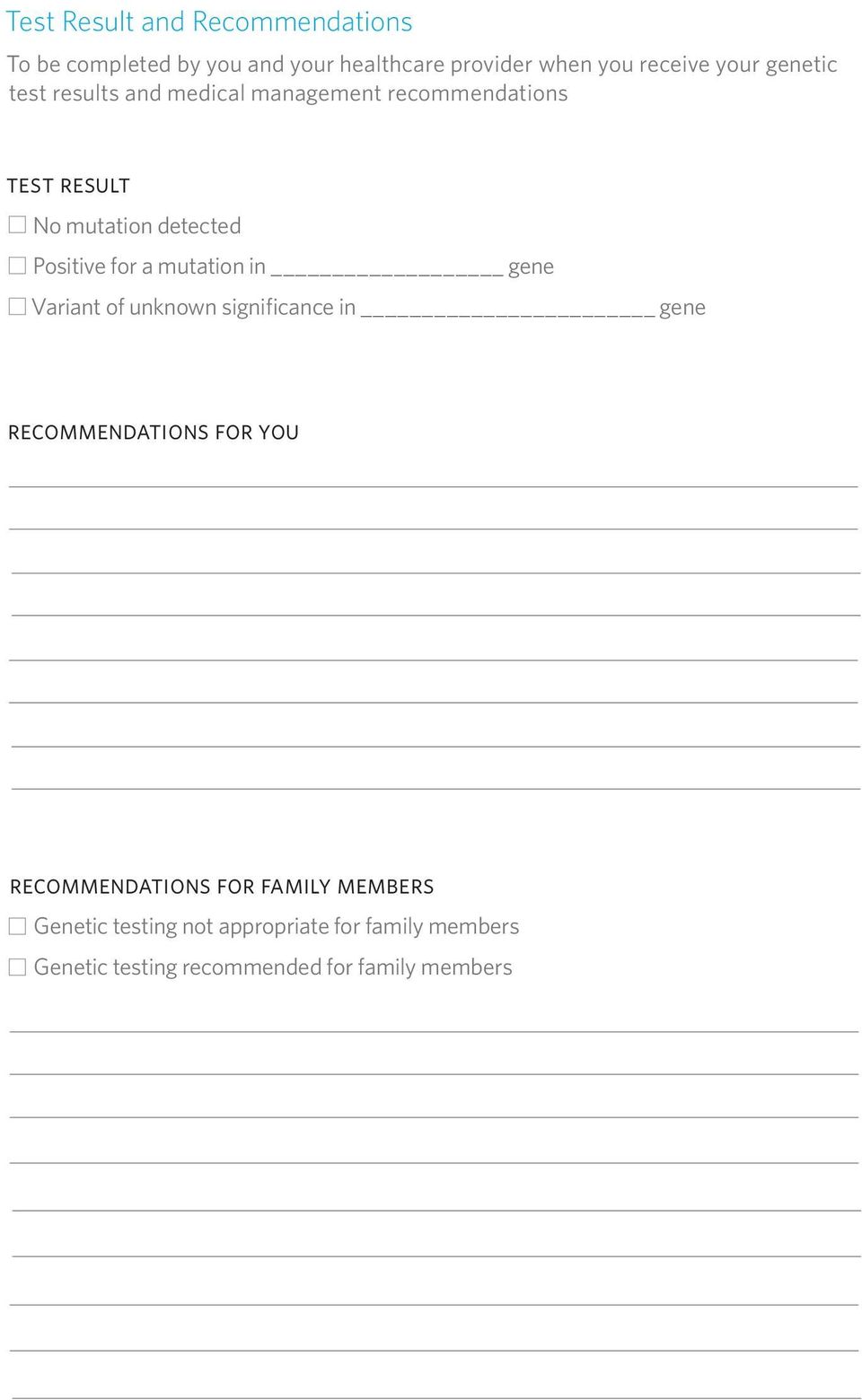
7 Test Result and Recommendations To be completed by you and your healthcare provider when you receive your genetic test results and medical management recommendations test result No mutation detected Positive for a mutation in gene Variant of unknown significance in gene recommendations for you recommendations for family members Genetic testing not appropriate for family members Genetic testing recommended for family members
8 Resources for Patients These and other resources can help build a sense of community and aid in answering some common questions. bright pink brightpink.org facing our risk of cancer empowered (force) facingourrisk.org susan g. komen breast cancer foundation komen.org young survival coalition youngsurvival.org national ovarian cancer coalition ovarian.org genetic information nondiscrimination act information ginahelp.org Find a Genetic Counselor national society of genetic counselors nsgc.org About Ambry innovation Ambry is a leading provider of diagnostic genetic testing, with years of experience using next generation sequencing technologies. expertise Since 2001, Ambry has performed hundreds of thousands of genetic tests and identified more than 45,000 mutations in greater than 500 different genes. ambry genetics 15 Argonaut Aliso Viejo, CA (866) [email protected] For more details about these tests, visit ambrygen.com _v1
patient guide BRCA1 and BRCA2 Genetic Testing for Hereditary Breast and Ovarian Cancer
 patient guide BRCA1 and BRCA2 Genetic Testing for Hereditary Breast and Ovarian Cancer What is hereditary cancer? Cancer affects many people in the U.S.: breast cancer affects 1 in 8 women and ovarian
patient education Fact Sheet PFS007: BRCA1 and BRCA2 Mutations MARCH 2015
 patient education Fact Sheet PFS007: BRCA1 and BRCA2 Mutations MARCH 2015 BRCA1 and BRCA2 Mutations Cancer is a complex disease thought to be caused by several different factors. A few types of cancer
Breast Cancer s Link to Ovarian Cancer: It s in Your Genes. foundationforwomenscancer.org
 Breast Cancer s Link to Ovarian Cancer: It s in Your Genes foundationforwomenscancer.org There are now more than 2.6 million women in America who have been diagnosed with breast cancer. A very small fraction
What s In Your Genes: How changes in the BRCA1/BRCA2 genes
 ESSENTIALS BRCA1/BRCA2 Mutations What s In Your Genes: How changes in the BRCA1/BRCA2 genes might affect you and your family Our genes contain the codes for producing the proteins that are the building
Patient Support Guide
 Patient Support Guide to genetic testing for hereditary breast and ovarian cancer syndrome Testing for BRCA1 and BRCA2 is available from Quest Diagnostics. Quest Diagnostics Patient Support Guide to Genetic
Long QT Syndrome Genetic Testing for Inherited Arrhythmias. patient guide
 Long QT Syndrome Genetic Testing for Inherited Arrhythmias patient guide What is Long QT Syndrome? Arrhythmias are problems with the electrical system in the heart that controls the heartbeat s regular
Understanding Hereditary Breast and Ovarian Cancer. Maritime Hereditary Cancer Service
 Understanding Hereditary Breast and Ovarian Cancer Maritime Hereditary Cancer Service General Information Cancer is very common. About one in three (33%) people are diagnosed with some form of cancer during
BRCA1 & BRCA2 GeneHealth UK
 BRCA1 & BRCA2 GeneHealth UK BRCA1 & BRCA2 What is hereditary breast cancer? Cancer is unfortunately very common, with 1 in 3 people developing cancer at some point in their lifetime. Breast cancer occurs
Understanding Your Risk of Ovarian Cancer
 Understanding Your Risk of Ovarian Cancer A WOMAN S GUIDE This brochure is made possible through partnership support from Project Hope for Ovarian Cancer Research and Education. Project HOPE FOR OVARIAN
Ovarian Cancer Genetic Testing: Why, When, How?
 Ovarian Cancer Genetic Testing: Why, When, How? Jeffrey Dungan, MD Associate Professor Division of Clinical Genetics Department of Obstetrics & Gynecology Northwestern University Feinberg School of Medicine
The Genetics of Early- Onset Breast Cancer. Cecelia Bellcross, Ph.D., M.S.,C.G.C. Department of Human Genetics Emory University School of Medicine
 The Genetics of Early- Onset Breast Cancer Cecelia Bellcross, Ph.D., M.S.,C.G.C. Department of Human Genetics Emory University School of Medicine All cancers are genetic BUT Not all cancers are hereditary
Are You at Risk for Ovarian Cancer?
 Are You at Risk for Ovarian Cancer? A Woman s Guide Read this brochure to learn more about ovarian cancer symptoms, risk factors and what you can do to reduce your risk. ALL WOMEN HAVE SOME RISK OF OVARIAN
BRCA Genes and Inherited Breast and Ovarian Cancer. Patient information leaflet
 BRCA Genes and Inherited Breast and Ovarian Cancer Patient information leaflet This booklet has been written for people who have a personal or family history of breast and/or ovarian cancer that could
Advice about familial aspects of breast cancer and epithelial ovarian cancer a guide for health professionals DECEMBER 2010
 Advice about familial aspects of breast cancer and epithelial ovarian cancer a guide for health professionals DECEMBER 2010 This guide has three parts: 1. Information for health professionals 2. Tables
Hereditary Breast Cancer Panels. High Risk Hereditary Breast Cancer Panel Hereditary Breast/Ovarian/Endometrial Cancer Panel
 P A T I E N T G U I D E Hereditary Breast Cancer Panels High Risk Hereditary Breast Cancer Panel Hereditary Breast/Ovarian/Endometrial Cancer Panel B a y l o r M i r a c a G e n e t i c s L a b o r a t
Hereditary Breast and Ovarian Cancer (HBOC)
 Oxford University Hospitals NHS Trust Oxford Regional Genetic Department Hereditary Breast and Ovarian Cancer (HBOC) Information for women with an increased lifetime risk of breast and ovarian cancer What
Lesson Plan: Genetic Testing and Hereditary Cancer
 Lesson Plan: Genetic Testing and Hereditary Cancer OVERVIEW This lesson plan is designed to be used with the film In the Family, which explores issues related to genetic testing and the difficult decisions
PROVIDER POLICIES & PROCEDURES
 PROVIDER POLICIES & PROCEDURES BRCA GENETIC TESTING The purpose of this document is to provide guidance to providers enrolled in the Connecticut Medical Assistance Program (CMAP) on the requirements for
Hereditary Ovarian cancer: BRCA1 and BRCA2. Karen H. Lu MD September 22, 2013
 Hereditary Ovarian cancer: BRCA1 and BRCA2 Karen H. Lu MD September 22, 2013 Outline Hereditary Breast and Ovarian Cancer (HBOC) BRCA1/2 genes How to identify What it means to you What it means to your
Hereditary Breast Cancer. Nicole Kounalakis, MD Assistant Professor of Surgery University of Colorado Medical Center
 Hereditary Breast Cancer Nicole Kounalakis, MD Assistant Professor of Surgery University of Colorado Medical Center Outline Background Assessing risk of patient Syndromes BRCA 1,2 Li Fraumeni Cowden Hereditary
Breast cancer and genetics
 Breast cancer and genetics Cancer and genes Our bodies are made up of millions of cells. Each cell contains a complete set of genes. We have thousands of genes. We each inherit two copies of most genes,
Genetic Testing for Hereditary Breast and Ovarian Cancer - BRCA1/2 ANALYSIS -
 Genetic Testing for Hereditary Breast and Ovarian Cancer - BRCA1/2 ANALYSIS - January 2005 SCIENTIFIC BACKGROUND Breast cancer is considered to be one of the most prevalent cancer in women. The overall
Genetics and Breast Cancer. Elly Lynch, Senior Genetic Counsellor Manager, Austin Health Clinical Genetics Service
 Genetics and Breast Cancer Elly Lynch, Senior Genetic Counsellor Manager, Austin Health Clinical Genetics Service Overview Background/Our Team What is the difference between sporadic/familial cancer? How
Breast cancer in families. This booklet explains what a family history of breast cancer is, and what this may mean for you or your family.
 Breast cancer in families This booklet explains what a family history of breast cancer is, and what this may mean for you or your family. Worried Lorem about ipsum breast dolore cancer estes Contents
Breast Cancer. CSC Cancer Experience Registry Member, breast cancer
 ESSENTIALS Breast Cancer Take things one step at a time. Try not to be overwhelmed by the tidal wave of technical information coming your way. Finally you know your body best; you have to be your own advocate.
BRCA1 and BRCA2 for men
 Oxford University Hospitals NHS Trust Oxford Regional Genetic Department BRCA1 and BRCA2 for men Information for men from families with a known alteration in the BRCA1/2 gene Introduction BRCA1 and BRCA2
HEREDITARY BRCA1. Faulty gene INFORMATION LEAFLET. How Do I Reduce My Risk?
 HEREDITARY BREAST CANCER BRCA1 Faulty gene INFORMATION LEAFLET How Do I Reduce My Risk? Page 1 CONTENTS Part A 1 What is BRCA1 2 How does BRCA1 affect a person s risk of cancer? 3Testing for BRCA1 4Benefits
Breast Cancer Screening
 Breast Cancer Screening Summary of the Clinical Practice Guideline September 2013 These recommendations are systematically developed statements to assist practitioner and patient decisions about appropriate
BRCA in Men. Mary B. Daly,M.D.,Ph.D. June 25, 2010
 BRCA in Men Mary B. Daly,M.D.,Ph.D. June 25, 2010 BRCA in Men Inheritance patterns of BRCA1/2 Cancer Risks for men with BRCA1/2 mutations Risk management recommendations for men with BRCA1/2 mutations
GENETIC CONSIDERATIONS IN CANCER TREATMENT AND SURVIVORSHIP
 GENETIC CONSIDERATIONS IN CANCER TREATMENT AND SURVIVORSHIP WHO IS AT HIGH RISK OF HEREDITARY CANCER? Hereditary Cancer accounts for a small proportion of all cancer or approximately 5-10% THE DEVELOPMENT
Understanding Lynch Syndrome
 ESSENTIALS Lynch Syndrome Understanding Lynch Syndrome Certain cancers can run in families. Sometimes this happens because of harmful changes (called mutations) in our genes that are passed from one generation
NOTTINGHAM UNIVERSITY HOSPITAL NHS TRUST NOTTINGHAM BREAST INSTITUTE BREAST AND OVARIAN FAMILY HISTORY GUIDELINES
 NOTTINGHAM UNIVERSITY HOSPITAL NHS TRUST NOTTINGHAM BREAST INSTITUTE BREAST AND OVARIAN FAMILY HISTORY GUIDELINES GP Referrals All GP referrals for asymptomatic women with a family history of breast and/or
Guide to Understanding Breast Cancer
 An estimated 220,000 women in the United States are diagnosed with breast cancer each year, and one in eight will be diagnosed during their lifetime. While breast cancer is a serious disease, most patients
ScreenWise. Breast, Cervical, and Hereditary Cancer Screenings OCTOBER 28, 2015
 ScreenWise Breast, Cervical, and Hereditary Cancer Screenings OCTOBER 28, 2015 ScreenWise Three programs working together to bring quality screening services to Oregon residents Why we all do this work
Common Cancers & Hereditary Syndromes
 Common Cancers & Hereditary Syndromes Elizabeth Hoodfar, MS, LCGC Regional Cancer Genetics Coordinator Kaiser Permanente Northern California Detect clinical characteristics of hereditary cancer syndromes.
BREAST CANCER RISK ASSESSMENT AND PRIMARY PREVENTION FOR HIGH RISK PATIENTS, RACHEL CATHERINE JANKOWITZ, MD 1
 FOR HIGH RISK PATIENTS, RACHEL CATHERINE JANKOWITZ, MD 1 Hello, my name is Rachel Jankowitz, I m an assistant professor of medicine in the Division of Hematology Oncology at the University of Pittsburgh
Saving healthcare costs by implementing new genetic risk tests for early detection of cancer and prevention of cardiovascular diseases
 Saving healthcare costs by implementing new genetic risk tests for early detection of cancer and prevention of cardiovascular diseases Jeff Gulcher, MD PhD Chief Scientific Officer and co-founder decode
Hereditary Multifocal Breast Cancer. Farin Amersi M.D., F.A.C.S Division of Surgical Oncology Department of Surgery Cedar Sinai Medical Center
 Hereditary Multifocal Breast Cancer Farin Amersi M.D., F.A.C.S Division of Surgical Oncology Department of Surgery Cedar Sinai Medical Center CASE STUDY 30 year old Ashkenazi Jewish woman Nulliparous Felt
Screening for Cancer in Light of New Guidelines and Controversies. Christopher Celio, MD St. Jude Heritage Medical Group
 Screening for Cancer in Light of New Guidelines and Controversies Christopher Celio, MD St. Jude Heritage Medical Group Screening Tests The 2 major objectives of a good screening program are: (1) detection
Frequently Asked Questions About Ovarian Cancer
 Media Contact: Gerri Gomez Howard Cell: 303-748-3933 [email protected] Frequently Asked Questions About Ovarian Cancer What is ovarian cancer? Ovarian cancer is a cancer that forms in tissues
Office of Population Health Genomics
 Office of Population Health Genomics Policy: Protocol for the management of female BRCA mutation carriers in Western Australia Purpose: Best Practice guidelines for the management of female BRCA mutation
A Beginner s Guide to BRCA1 and BRCA2
 i A Beginner s Guide to BRCA1 and BRCA2 A Beginner s Guide to BRCA1 and BRCA2 Contents Page Introduction What does it mean to have a BRCA gene mutation? 1 Background information about the BRCA1/2 genes
Cancer: Genetic testing can save lives
 Cancer: Genetic testing can save lives Track chances of having a tumor's tendency among people with a history of disease cases in the family, but practice should not be trivialized and hurt even more who
Breast Cancer Screening
 Breast Cancer Screening The American Cancer Society and Congregational Health Ministry Team October Module To access this module via the Web, visit www.cancer.org and type in congregational health ministry
Reduce Your Risk of Breast Cancer
 Reduce Your Risk of Breast Cancer Reduce Your Risk of Breast Cancer There was no history in my family. But the test was positive and it was breast cancer. I was so shocked, I couldn t believe it. ~ Colette
Cancer Genetic Counseling
 Cancer Genetic Counseling Guest Expert: Ellen, MS Director of the Yale Cancer Center Cancer Genetic Counseling Program www.wnpr.org www.yalecancercenter.org I am Bruce Barber and this is Yale Cancer Center
REQUEST FOR IMAGe SYNDROME TESTING
 REQUEST FOR IMAGe SYNDROME TESTING Please provide the following information. We cannot perform your test without ALL of this information. PLEASE PRINT ALL ANSWERS PATIENT INFORMATION* FIRST NAME MI LAST
U.K. Familial Ovarian Cancer Screening Study (UK FOCSS) Phase 2 Patient Information Sheet
 U.K. Familial Ovarian Cancer Screening Study (UK FOCSS) Phase 2 Patient Information Sheet 1. Invitation You are being invited to take part in a research study. Before you decide it is important for you
Breast cancer in the family
 Birmingham Women's NHS Foundation Trust Breast cancer in the family Information for women with a slightly increased risk of breast cancer This is a no smoking hospital Breast cancer in the family what
Recommendations for the management of early breast cancer
 Recommendations for the management of early breast cancer in women with an identified BRCA1 or BRCA2 gene mutation or at high risk of a gene mutation FEBRUARY 2014 Incorporates published evidence to August
Illinois Insurance Facts Illinois Department of Insurance Coverage for the Diagnosis and Treatment of Breast Conditions
 Illinois Insurance Facts Illinois Department of Insurance Coverage for the Diagnosis and Treatment of Breast Conditions Revised May 2015 Note: This information was developed to provide consumers with general
Metastatic Breast Cancer...
 DIAGNOSIS: Metastatic Breast Cancer... What Does It Mean For You? A diagnosis of metastatic breast cancer can be frightening. It raises many questions and reminds us of days past when cancer was such a
Examples of good screening tests include: mammography for breast cancer screening and Pap smears for cervical cancer screening.
 CANCER SCREENING Dr. Tracy Sexton (updated July 2010) What is screening? Screening is the identification of asymptomatic disease or risk factors by history taking, physical examination, laboratory tests
VOLLEY FOR THE CURE 15
 The IHSA would like to acknowledge the Ohio State Activity Association and the Ohio High School Volleyball Coaching Association for information used in this promotional material. Main Objective Educating
Number 12.04.516 Effective Date August 11, 2015 Revision Date(s) Replaces 2.04.133 (not adopted)
 MEDICAL POLICY POLICY RELATED POLICIES POLICY GUIDELINES DESCRIPTION SCOPE BENEFIT APPLICATION RATIONALE REFERENCES CODING APPENDI HISTORY Genetic Testing for CHEK2 Mutations for Breast Cancer Number 12.04.516
There are many different types of cancer and sometimes cancer is diagnosed when in fact you are not suffering from the disease at all.
 About Cancer Cancer is a disease where there is a disturbance in the normal pattern of cell replacement. The cells mutate and become abnormal or grow uncontrollably. Not all tumours are cancerous (i.e.
Prostate Cancer Screening. A Decision Guide for African Americans
 Prostate Cancer Screening A Decision Guide for African Americans This booklet was developed by the U.S. Department of Health and Human Services, Centers for Disease Control and Prevention (CDC). Published
Progress and Prospects in Ovarian Cancer Screening and Prevention
 Progress and Prospects in Ovarian Cancer Screening and Prevention Rebecca Stone, MD MS Assistant Professor Kelly Gynecologic Oncology Service The Johns Hopkins Hospital 1 No Disclosures 4/12/2016 2 Ovarian
How does genetic testing work?
 How does genetic testing work? What is a genetic test? A genetic test looks at to find changes (variants) that cause disease or put you at greater risk to develop disease. DNA is the code our bodies use
Fact sheet 9. Screening for ovarian cancer
 Fact sheet 9 Screening for ovarian cancer Ovacome is a national charity providing advice and support to women with ovarian cancer. We give information about symptoms, diagnosis, treatment, research and
Patient Information. for Childhood
 Patient Information Genetic Testing for Childhood Hearing Loss Introduction This document describes the most common genetic cause of childhood hearing loss and explains the role of genetic testing. Childhood
Official reprint from UpToDate www.uptodate.com 2013 UpToDate
 Official reprint from UpToDate www.uptodate.com 2013 UpToDate Patient information: Breast cancer screening (The Basics) Written by the doctors and editors at UpToDate What is breast cancer screening? Breast
Illinois Insurance Facts Illinois Department of Insurance
 Illinois Insurance Facts Illinois Department of Insurance Women s Health Care Issues Revised August 2012 Note: This information was developed to provide consumers with general information and guidance
Expansion of the Ontario Breast Screening Program (OBSP) to Include Women Aged 30 to 69 at High Risk for Breast Cancer
 To: Physicians, Nurse Practitioners, Genetics Clinics, Hospitals and LHINs Published By: Implementation Branch Date Issued: June 27, 2011 Bulletin #: 10016 Re: Expansion of the Ontario Breast Screening
Impact of Breast Cancer Genetic Testing on Insurance Issues
 Impact of Breast Cancer Genetic Testing on Insurance Issues Prepared by the Health Research Unit September 1999 Introduction The discoveries of BRCA1 and BRCA2, two cancer-susceptibility genes, raise serious
Early-stage Breast Cancer Treatment: A Patient and Doctor Dialogue
 page 1 Early-stage Breast Cancer Treatment: A Patient and Doctor Dialogue Q: What is breast cancer, and what type do I have? A: Cancer is a disease in which cells become abnormal and form more cells in
GENETIC TESTING FOR INHERITED MUTATIONS OR SUSCEPTIBILITY TO CANCER OR OTHER CONDITIONS MED207.110
 GENETIC TESTING FOR INHERITED MUTATIONS OR SUSCEPTIBILITY TO CANCER OR OTHER CONDITIONS MED207.110 COVERAGE: Pre- and post-genetic test counseling may be eligible for coverage in addition to the genetic
Screening for ovarian cancer Page 1 of 5 Ovacome
 Fact sheet 9 Screening for ovarian cancer Ovacome is a national charity providing advice and support to women with ovarian cancer. We give information about symptoms, diagnosis, treatment, research and
Personalized Breast Screening Service
 Frequently Asked Questions WHAT IS BREAST DENSITY? Breasts are made up of a mixture of fibrous, glandular and fatty tissue. Your breasts are considered if you have predominantly fibrous or glandular tissue
Breast Cancer Awareness Month
 Aon Kenya Insurance Brokers Ltd Aon Hewitt Healthcare Division Breast Cancer Awareness Month Issue 12 October 2015 In this Issue 2 Cancer Statistics in Kenya 3 What is Breast Cancer? 4 Symptoms of Breast
MEDICAL POLICY SUBJECT: GENETIC TESTING FOR HEREDITARY BRCA MUTATIONS. POLICY NUMBER: 2.02.06 CATEGORY: Laboratory Test
 MEDICAL POLICY SUBJECT: GENETIC TESTING FOR, 10/15/15 PAGE: 1 OF: 12 If the member's subscriber contract excludes coverage for a specific service it is not covered under that contract. In such cases, medical
Mammography AND CLINICAL BREAST EXAMS. joytolife.org WHAT YOU SHOULD KNOW ABOUT BREAST CANCER HOW TO DO A BREAST SELF-EXAM EARLY DETECTION SAVES LIVES
 Mammography AND CLINICAL BREAST EXAMS WHAT YOU SHOULD KNOW ABOUT BREAST CANCER HOW TO DO A BREAST SELF-EXAM joytolife.org EARLY DETECTION SAVES LIVES As a woman, you face many special concerns that call
Preventive Services for Pregnancy SERVICE WHAT IS COVERED INTERVALS OF COVERAGE Anemia Screening Screening Annual screening for pregnant women
 Preventive Services for Pregnancy SERVICE WHAT IS COVERED INTERVALS OF COVERAGE Anemia Annual screening for pregnant women Bacteriuria For pregnant women at 12-16 weeks gestation or first prenatal visit
Breast Cancer. Sometimes cells keep dividing and growing without normal controls, causing an abnormal growth called a tumor.
 Breast Cancer Introduction Cancer of the breast is the most common form of cancer that affects women but is no longer the leading cause of cancer deaths. About 1 out of 8 women are diagnosed with breast
Tumour Markers. What are Tumour Markers? How Are Tumour Markers Used?
 Dr. Anthony C.H. YING What are? Tumour markers are substances that can be found in the body when cancer is present. They are usually found in the blood or urine. They can be products of cancer cells or
A guide for the patient
 Understanding series LUNG CANCER CLINICAL TRIALS 1-800-298-2436 LungCancerAlliance.org A guide for the patient TABLE OF CONTENTS The Basics What is a Clinical Trial?...3 Types of Clinical Trials... 3 Phases
Ovarian Cancer. in Georgia, 1999-2003. Georgia Department of Human Resources Division of Public Health
 Ovarian Cancer in Georgia, 1999-23 Georgia Department of Human Resources Division of Public Health Acknowledgments Georgia Department of Human Resources......B. J. Walker, Commissioner Division of Public