
Patient Support Guide
|
|
|
- Matilda Berry
- 10 years ago
- Views:
Transcription
1 Patient Support Guide to genetic testing for hereditary breast and ovarian cancer syndrome Testing for BRCA1 and BRCA2 is available from Quest Diagnostics.

2 Quest Diagnostics Patient Support Guide to Genetic Testing for Hereditary Breast and Ovarian Cancer Syndrome The More You Know, The More You Can Do Do You Need To Know? Some women want to know if they have a high risk for getting cancer of the breast or ovary. These women usually have close relatives who have one or both of these cancers. They may have Hereditary Breast and Ovarian Cancer (HBOC) syndrome. Women with HBOC syndrome have an increased risk for getting cancer in the breast and/or ovary. Men with HBOC syndrome have an increased risk for getting cancer in the breast and/or prostate. HBOC syndrome also increases the risk for pancreatic cancer and melanoma in both men and women. There is a genetic test that can help you find out if you have HBOC syndrome. It is called the BRCAvantage test. This Patient Support Guide will help you understand the test, so you can decide if it s for you. Once you know your risk, you and your doctor can decide what the next steps should be. If you are at high risk, there are steps you can take to decrease your risk. Taking steps today can help keep you healthy tomorrow and in the years to come. Life has enough mysteries. Don t let your risk for HBOC syndrome be one of them.

3 The BRCAvantage Test The BRCAvantage test looks for mutations (changes) in 2 genes. These genes are called BRCA1 and BRCA2. Changes in the BRCA1 and BRCA2 genes can lead to hereditary cancer in the breast, ovary, pancreas, or prostate. They can lead to hereditary melanoma too. So people with a mutation have HBOC syndrome and are at high risk for these cancers. Cancers of the breast and ovary are fairly common. About a quarter of a million women will be diagnosed with one of these cancers this year. But only some of them will be hereditary cancers. Hereditary cancer can happen when a parent passes on a change in a BRCA1 or BRCA2 gene to a son or daughter. Changes in these 2 genes cause: About 3% to 5% of all cancers in the breast Up to 15% of all cancers in the ovary Below are some questions that people often ask about this test. FAQ How do I know if I should be tested? This test is only for certain people. You might want to talk with your doctor or genetic counselor about getting tested if you: Have had breast cancer before the age of 50 Have had 2 separate (primary) breast cancers at any age Have had a triple negative (ER, PR, and HER2 negative) breast cancer Have had ovarian cancer at any age Are a man who has had breast cancer Have a strong family history of breast and/or ovarian cancer Have a blood relative with a BRCA1 or BRCA2 mutation Are Ashkenazi Jewish

4 Will the test results tell me if I will get breast or ovarian cancer? No. The test cannot tell you if you will get cancer. The test will tell you if you have a mutation (change) in a BRCA1 or BRCA2 gene. If you do have a mutation, though, you are at higher risk of getting cancer. If I have a BRCA mutation, will someone else in my family have one too? Maybe. Your mother, father, brother, sister, and child each has a 50% chance of having the same mutation. Other relatives are also at risk. Relative Their Risk Identical twin 100% Parent, sibling, child 50% Grandparent, uncle, aunt, niece, nephew 25% First cousin 12.5% At what age should I have this test? First you must meet the criteria for testing. If you do, you can be tested at any age. But, this test is not recommended for people under 18 years old. Where can I get the BRCAvantage test done? You can get the test through your doctor. The first step is to talk with your doctor or genetic counselor. They ll help you learn more about the test. Then if you still want to be tested and your doctor agrees, he/she can order the test for you. How is the BRCAvantage test done? First, a sample of your blood is collected at your doctor s office or at a Quest Diagnostics Patient Service Center. The sample is then sent to Quest Diagnostics for testing. After the test, results are sent to your doctor.

5 Does insurance cover the cost of the test? That depends on your insurance company. Many do cover it. To find out if your insurance company covers it, you can: Call them. Ask someone at your doctor s office to help you. Ask Quest Diagnostics to help you; call 866.GENE.INFO ( ). If needed, your doctor can send your insurance company a letter to help support your claim. This letter is called a letter of medical necessity. Could I lose my health insurance if I test positive? No. A law called the Genetic Information Nondiscrimination Act (GINA) protects you. If you test positive, the insurance company cannot: Cancel your insurance Increase your premium Claim a pre-existing condition Require a relative to get tested Note that GINA does not apply to the military, veterans, Indian Health Service, and federal employees. But these groups have policies that provide similar protections.

6 BRCAvantage Test Results Making Sense of Your Test Results Your doctor or genetic counselor will tell you what your results are. He/she will also help you understand what they mean. Together, you can decide on the next steps. There are 3 possible results: 1. Negative: No BRCA1 or BRCA2 mutations were found. This does not mean you won t get cancer. Your doctor or genetic counselor can help you understand what your revised risk is. 2. Positive: A BRCA1 or BRCA2 mutation was found. If you are a woman, you have a higher risk for hereditary cancer in the breast and ovary. If you are a man, you have a higher risk for hereditary cancer in the breast and prostate. Both women and men have a higher risk for hereditary cancer in the pancreas and for melanoma. But this doesn t mean that you actually have cancer or will get cancer. 3. Inconclusive: A variant of unknown significance was found. This means there is a change in your BRCA1 or BRCA2 gene. But scientists don t know if this means you have a higher risk or not. Over time, scientists may learn more about the change. So, check with your doctor or genetic counselor each year to see if they can update your risk.

7 Below are some questions that people often ask about the test results. FAQ Does a negative result mean I m not at risk for hereditary breast or ovarian cancer? No. A negative result means your risk is lower than if you had a positive result. But you could still be at risk. There are rare mutations in the BRCA1 and BRCA2 genes that this test can t detect. There are also rare mutations in other genes that could cause hereditary breast or ovarian cancer. I have a positive result. Does this mean I will get cancer? No. A positive result means you have a mutation that could lead to cancer. But people with a positive result do not always get cancer. There is no way to know if you will actually get cancer or not. But you do have a greater chance of getting cancer. So it s important that you talk with your doctor to find out what you can do to lower it. I have a positive result. What are my chances of the mutation causing cancer? The chances for breast and ovarian cancer are in the table. Men also have a higher chance of getting prostate cancer. And both women and men have a higher chance of getting melanoma and cancer of the pancreas. Risk of Cancer Cancer With BRCA1 Mutation With BRCA2 Mutation Without BRCA Mutation Women Breast cancer by age 70 Ovarian cancer by age 70 2 nd breast cancer in lifetime 55% to 65% 39% 83% 45% to 47% 11% to 17% 62% 9% 1% 15% Men Breast cancer by age 70 1% 7% 0.06%

8 What are the chances of the results being wrong? The BRCAvantage test is very accurate. But it does not detect all causes of HBOC syndrome. A rare mutation in the BRCA1 or BRCA2 gene might not be detected. And the BRCAvantage test will not detect rare mutations in other genes that cause hereditary cancer in the breast or ovary. I have a positive result. Should anyone else in my family be tested? Yes, if they are a blood relative and they decide they want to be tested. Testing will help them know where they stand and if they need to do something to lower their risk. Your parents, brothers, sisters, and children each have a 50% chance of having the mutation you have. Your other blood relatives have some risk too. So be sure to share your test results with your family. That way each person can decide if he/she wants to be tested. Lowering Your Risk Making Your Choices If you have a negative BRCAvantage test result, you can breathe a little easier. But since you could still be at risk, it s important you do what you can. Talk with your doctor to see what cancer screens he/she recommends for you. If your result is positive, you are at higher risk. It s very important for you to learn about the things that can help lower it. These things could include: Increased cancer screening Surgery Medicines (chemoprevention) Talk with your doctor or genetic counselor to find out what is best for you. If your result is inconclusive, it doesn t tell you if you re at higher risk or not. Testing family members might tell you more. Start by talking with your doctor or genetic counselor.

9 Below are some questions that people often ask about the next steps. FAQ Will increased cancer screening keep me from getting cancer? No. But it might detect cancer sooner. And, as you know, early detection improves your chances of beating it. Will surgery help keep me from getting cancer? Studies have shown that surgery can sometimes be helpful. But surgery is not for everyone. There are down sides to having surgery. So, talk with your doctor or genetic counselor to learn more. How good are medicines at lowering cancer risk? The answer to this question is unclear. Talk with your doctor or genetic counselor to get more information.

10 Is It Time To Know What You Don t Know? Some women have a high risk of getting breast and ovarian cancer. This can come from having a change (mutation) in a BRCA1 or BRCA2 gene. The mutation can be passed down from parent to child. When this happens, cancers in the breast, ovary, pancreas, and/or prostate may be more common among family members. Melanoma might also be more common in the family. You don t have to wait and wonder if you are at high risk. The BRCAvantage test can help you find out if you have a BRCA mutation. To learn more about the BRCAvantage test and to find out if it s right for you, go to BRCAvantage.com. The knowledge you gain will give you the power to do something about your risk. But the BRCAvantage test isn t for everyone. If you think you might be at risk for HBOC syndrome, talk with your doctor. Find out if the BRCAvantage test is right for you. If it is, you can soon begin to take control of your cancer risk.

11 About Quest Diagnostics At Quest Diagnostics, our vision is Empowering Better Health with Diagnostic Insights. This means that we want to give you information that helps you be healthier. We ve been listed in Fortune Magazine s list of the World s Most Admired Companies since Our products have been featured by the Edison Institute for Leadership in Diagnostic Innovation. But what s most important to us is that we: Support your health and well-being Partner with healthcare workers who dedicate themselves to their patients For more information about our products and services, visit QuestDiagnostics.com. Community Health Awareness

12 BRCAvantage.com QuestDiagnostics.com Quest, Quest Diagnostics, BRCAvantage, any associated logos, and all associated Quest Diagnostics registered or unregistered trademarks are the property of Quest Diagnostics. All third party marks and are the property of their respective owners Quest Diagnostics Incorporated. All rights reserved. PP /2013

patient education Fact Sheet PFS007: BRCA1 and BRCA2 Mutations MARCH 2015
 patient education Fact Sheet PFS007: BRCA1 and BRCA2 Mutations MARCH 2015 BRCA1 and BRCA2 Mutations Cancer is a complex disease thought to be caused by several different factors. A few types of cancer
BRCA1 & BRCA2: Genetic testing for hereditary breast and ovarian cancer patient guide
 BRCA1 & BRCA2: Genetic testing for hereditary breast and ovarian cancer patient guide What is Hereditary? Breast cancer is the most common cancer in women in the U.S. (it affects about 1 in 8 women). Ovarian
patient guide BRCA1 and BRCA2 Genetic Testing for Hereditary Breast and Ovarian Cancer
 patient guide BRCA1 and BRCA2 Genetic Testing for Hereditary Breast and Ovarian Cancer What is hereditary cancer? Cancer affects many people in the U.S.: breast cancer affects 1 in 8 women and ovarian
Hereditary Breast Cancer Panels. High Risk Hereditary Breast Cancer Panel Hereditary Breast/Ovarian/Endometrial Cancer Panel
 P A T I E N T G U I D E Hereditary Breast Cancer Panels High Risk Hereditary Breast Cancer Panel Hereditary Breast/Ovarian/Endometrial Cancer Panel B a y l o r M i r a c a G e n e t i c s L a b o r a t
Breast Cancer s Link to Ovarian Cancer: It s in Your Genes. foundationforwomenscancer.org
 Breast Cancer s Link to Ovarian Cancer: It s in Your Genes foundationforwomenscancer.org There are now more than 2.6 million women in America who have been diagnosed with breast cancer. A very small fraction
Breast cancer in families. This booklet explains what a family history of breast cancer is, and what this may mean for you or your family.
 Breast cancer in families This booklet explains what a family history of breast cancer is, and what this may mean for you or your family. Worried Lorem about ipsum breast dolore cancer estes Contents
Advice about familial aspects of breast cancer and epithelial ovarian cancer a guide for health professionals DECEMBER 2010
 Advice about familial aspects of breast cancer and epithelial ovarian cancer a guide for health professionals DECEMBER 2010 This guide has three parts: 1. Information for health professionals 2. Tables
BRCA1 and BRCA2 for men
 Oxford University Hospitals NHS Trust Oxford Regional Genetic Department BRCA1 and BRCA2 for men Information for men from families with a known alteration in the BRCA1/2 gene Introduction BRCA1 and BRCA2
What s In Your Genes: How changes in the BRCA1/BRCA2 genes
 ESSENTIALS BRCA1/BRCA2 Mutations What s In Your Genes: How changes in the BRCA1/BRCA2 genes might affect you and your family Our genes contain the codes for producing the proteins that are the building
Understanding Hereditary Breast and Ovarian Cancer. Maritime Hereditary Cancer Service
 Understanding Hereditary Breast and Ovarian Cancer Maritime Hereditary Cancer Service General Information Cancer is very common. About one in three (33%) people are diagnosed with some form of cancer during
Hereditary Breast and Ovarian Cancer (HBOC)
 Oxford University Hospitals NHS Trust Oxford Regional Genetic Department Hereditary Breast and Ovarian Cancer (HBOC) Information for women with an increased lifetime risk of breast and ovarian cancer What
BRCA Genes and Inherited Breast and Ovarian Cancer. Patient information leaflet
 BRCA Genes and Inherited Breast and Ovarian Cancer Patient information leaflet This booklet has been written for people who have a personal or family history of breast and/or ovarian cancer that could
Breast cancer and genetics
 Breast cancer and genetics Cancer and genes Our bodies are made up of millions of cells. Each cell contains a complete set of genes. We have thousands of genes. We each inherit two copies of most genes,
Are You at Risk for Ovarian Cancer?
 Are You at Risk for Ovarian Cancer? A Woman s Guide Read this brochure to learn more about ovarian cancer symptoms, risk factors and what you can do to reduce your risk. ALL WOMEN HAVE SOME RISK OF OVARIAN
The Genetics of Early- Onset Breast Cancer. Cecelia Bellcross, Ph.D., M.S.,C.G.C. Department of Human Genetics Emory University School of Medicine
 The Genetics of Early- Onset Breast Cancer Cecelia Bellcross, Ph.D., M.S.,C.G.C. Department of Human Genetics Emory University School of Medicine All cancers are genetic BUT Not all cancers are hereditary
PROVIDER POLICIES & PROCEDURES
 PROVIDER POLICIES & PROCEDURES BRCA GENETIC TESTING The purpose of this document is to provide guidance to providers enrolled in the Connecticut Medical Assistance Program (CMAP) on the requirements for
BRCA1 & BRCA2 GeneHealth UK
 BRCA1 & BRCA2 GeneHealth UK BRCA1 & BRCA2 What is hereditary breast cancer? Cancer is unfortunately very common, with 1 in 3 people developing cancer at some point in their lifetime. Breast cancer occurs
Cancer: Genetic testing can save lives
 Cancer: Genetic testing can save lives Track chances of having a tumor's tendency among people with a history of disease cases in the family, but practice should not be trivialized and hurt even more who
Parker Adventist Hospital Genetic Counseling Family History Questionnaire
 PATIENT NAME: To be completed by Questionnaire received: Genetic Counseling Clinic: Parker Adventist Hospital Genetic Counseling History Questionnaire Appointment: You have been referred to Genetic Counseling
Lesson Plan: Genetic Testing and Hereditary Cancer
 Lesson Plan: Genetic Testing and Hereditary Cancer OVERVIEW This lesson plan is designed to be used with the film In the Family, which explores issues related to genetic testing and the difficult decisions
Genomics and Family History Survey Questions Updated March 2007 Compiled by the University of Washington Center for Genomics & Public Health
 Genomics and Survey Questions Updated March 2007 Compiled by the University of Washington Center for Genomics & Public Health This publication is distributed free of charge and supported by CDC Grant #U10/CCU025038-2.
Understanding Your Risk of Ovarian Cancer
 Understanding Your Risk of Ovarian Cancer A WOMAN S GUIDE This brochure is made possible through partnership support from Project Hope for Ovarian Cancer Research and Education. Project HOPE FOR OVARIAN
NOTTINGHAM UNIVERSITY HOSPITAL NHS TRUST NOTTINGHAM BREAST INSTITUTE BREAST AND OVARIAN FAMILY HISTORY GUIDELINES
 NOTTINGHAM UNIVERSITY HOSPITAL NHS TRUST NOTTINGHAM BREAST INSTITUTE BREAST AND OVARIAN FAMILY HISTORY GUIDELINES GP Referrals All GP referrals for asymptomatic women with a family history of breast and/or
Breast Cancer. CSC Cancer Experience Registry Member, breast cancer
 ESSENTIALS Breast Cancer Take things one step at a time. Try not to be overwhelmed by the tidal wave of technical information coming your way. Finally you know your body best; you have to be your own advocate.
Patient Information. for Childhood
 Patient Information Genetic Testing for Childhood Hearing Loss Introduction This document describes the most common genetic cause of childhood hearing loss and explains the role of genetic testing. Childhood
Impact of Breast Cancer Genetic Testing on Insurance Issues
 Impact of Breast Cancer Genetic Testing on Insurance Issues Prepared by the Health Research Unit September 1999 Introduction The discoveries of BRCA1 and BRCA2, two cancer-susceptibility genes, raise serious
Understanding Lynch Syndrome
 ESSENTIALS Lynch Syndrome Understanding Lynch Syndrome Certain cancers can run in families. Sometimes this happens because of harmful changes (called mutations) in our genes that are passed from one generation
Ovarian Cancer Genetic Testing: Why, When, How?
 Ovarian Cancer Genetic Testing: Why, When, How? Jeffrey Dungan, MD Associate Professor Division of Clinical Genetics Department of Obstetrics & Gynecology Northwestern University Feinberg School of Medicine
Long QT Syndrome Genetic Testing for Inherited Arrhythmias. patient guide
 Long QT Syndrome Genetic Testing for Inherited Arrhythmias patient guide What is Long QT Syndrome? Arrhythmias are problems with the electrical system in the heart that controls the heartbeat s regular
BRCA in Men. Mary B. Daly,M.D.,Ph.D. June 25, 2010
 BRCA in Men Mary B. Daly,M.D.,Ph.D. June 25, 2010 BRCA in Men Inheritance patterns of BRCA1/2 Cancer Risks for men with BRCA1/2 mutations Risk management recommendations for men with BRCA1/2 mutations
Cancer Genetic Counseling
 Cancer Genetic Counseling Guest Expert: Ellen, MS Director of the Yale Cancer Center Cancer Genetic Counseling Program www.wnpr.org www.yalecancercenter.org I am Bruce Barber and this is Yale Cancer Center
Paternity Testing. Chapter 23
 Paternity Testing Chapter 23 Kinship and Paternity DNA analysis can also be used for: Kinship testing determining whether individuals are related Paternity testing determining the father of a child Missing
Living benefits. Oasis. A look at critical illness insurance claims
 Living benefits solutions Oasis A look at critical illness insurance claims People are living longer. If you experience a critical illness, you re now more likely to survive it and live for many years.
GENETIC CONSIDERATIONS IN CANCER TREATMENT AND SURVIVORSHIP
 GENETIC CONSIDERATIONS IN CANCER TREATMENT AND SURVIVORSHIP WHO IS AT HIGH RISK OF HEREDITARY CANCER? Hereditary Cancer accounts for a small proportion of all cancer or approximately 5-10% THE DEVELOPMENT
Insurance Protections and Coverage
 Insurance Protections and Coverage The First Line of Defense: Application of Breast Cancer Genomics Standards in Primary Care Friday, February 21, 2014 Presenter: Lisa K. Liang, Esq. Health Law Unit (Breast
Genetics and Breast Cancer. Elly Lynch, Senior Genetic Counsellor Manager, Austin Health Clinical Genetics Service
 Genetics and Breast Cancer Elly Lynch, Senior Genetic Counsellor Manager, Austin Health Clinical Genetics Service Overview Background/Our Team What is the difference between sporadic/familial cancer? How
BREAST CANCER. How to spot the signs and symptoms and reduce your risk. cruk.org
 BREAST CANCER How to spot the signs and symptoms and reduce your risk cruk.org Breast cancer is the most common cancer in the UK. Around 8 in 10 breast cancer cases are in women aged 50 and over. Men can
If you are signing for a minor child, you refers to your child throughout the consent document.
 CONSENT TO PARTICIPATE IN A CLINICAL RESEARCH STUDY Adult Patient or Parent, for Minor Patient INSTITUTE: National Cancer Institute PRINCIPAL INVESTIGATOR: Raffit Hassan, M.D. STUDY TITLE: Tissue Procurement
Reduce Your Risk of Breast Cancer
 Reduce Your Risk of Breast Cancer Reduce Your Risk of Breast Cancer There was no history in my family. But the test was positive and it was breast cancer. I was so shocked, I couldn t believe it. ~ Colette
Breast cancer in the family
 Birmingham Women's NHS Foundation Trust Breast cancer in the family Information for women with a slightly increased risk of breast cancer This is a no smoking hospital Breast cancer in the family what
INFORMATION FOR PATIENTS AND THEIR FAMILIES. You can live a healthy life, if you get treatment early
 INFORMATION FOR PATIENTS AND THEIR FAMILIES Hemochromatosis AN IRON OVERLOAD DISEASE You can live a healthy life, if you get treatment early Department of Health and Human Services Centers for Disease
Hereditary Ovarian cancer: BRCA1 and BRCA2. Karen H. Lu MD September 22, 2013
 Hereditary Ovarian cancer: BRCA1 and BRCA2 Karen H. Lu MD September 22, 2013 Outline Hereditary Breast and Ovarian Cancer (HBOC) BRCA1/2 genes How to identify What it means to you What it means to your
HEREDITARY BRCA1. Faulty gene INFORMATION LEAFLET. How Do I Reduce My Risk?
 HEREDITARY BREAST CANCER BRCA1 Faulty gene INFORMATION LEAFLET How Do I Reduce My Risk? Page 1 CONTENTS Part A 1 What is BRCA1 2 How does BRCA1 affect a person s risk of cancer? 3Testing for BRCA1 4Benefits
Guide to Understanding Breast Cancer
 An estimated 220,000 women in the United States are diagnosed with breast cancer each year, and one in eight will be diagnosed during their lifetime. While breast cancer is a serious disease, most patients
MEDICAL POLICY SUBJECT: GENETIC TESTING FOR HEREDITARY BRCA MUTATIONS. POLICY NUMBER: 2.02.06 CATEGORY: Laboratory Test
 MEDICAL POLICY SUBJECT: GENETIC TESTING FOR, 10/15/15 PAGE: 1 OF: 12 If the member's subscriber contract excludes coverage for a specific service it is not covered under that contract. In such cases, medical
Marrying a relative. Is there an increased chance that a child will have genetic problems if its parents are related to each other?
 Marrying a relative Is there an increased chance that a child will have genetic problems if its parents are related to each other? The simple answer to this question is Yes, there is an increased chance.
Prostate Cancer Screening. A Decision Guide for African Americans
 Prostate Cancer Screening A Decision Guide for African Americans This booklet was developed by the U.S. Department of Health and Human Services, Centers for Disease Control and Prevention (CDC). Published
cancer cervical What women should know about and the human papilloma virus
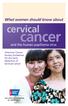 What women should know about cervical cancer and the human papilloma virus American Cancer Society Guidelines for the Early Detection of Cervical Cancer I take care of myself so I can take care of my family.
Genetic Testing for Cancer: What You Need to Know
 Genetic Testing for Cancer: What You Need to Know Here is some basic information about genetic testing and how it s used to learn about inherited cancer risk. It will help you understand what genetic testing
ScreenWise. Breast, Cervical, and Hereditary Cancer Screenings OCTOBER 28, 2015
 ScreenWise Breast, Cervical, and Hereditary Cancer Screenings OCTOBER 28, 2015 ScreenWise Three programs working together to bring quality screening services to Oregon residents Why we all do this work
Where Will my New Kidney Come From?
 Where Will my New Kidney Come From? The Organ Shortage There is a severe shortage of organs for transplant. This means that the wait for a kidney transplant can be many years. The UW Transplant Program
Introduction 70. Who can sponsor under the family class? 70. Who can be sponsored in the family class? 70. Can I sponsor if I live outside Canada?
 Introduction 70 Who can sponsor under the family class? 70 Who can be sponsored in the family class? 70 Can I sponsor if I live outside Canada? 72 Do I have to financially support the person/s I sponsor?
Clinical Trials. Clinical trials the basics
 Clinical Trials Clinical Trials This brochure is for people making decisions about cancer treatment. You may be thinking about a clinical trial for you or your child but need to know more before you decide.
health insurance changes Page 2 pharmacist better management Page 4 Get to know your Let s talk about Putting the care in care WINTER 2013 Page 6
 WINTER 2013 Get to know your pharmacist better Page 6 Let s talk about health insurance changes Page 2 Kristin Weiler, Pharmacist Wayne Thompson Putting the care in care management Page 4 SECURITY HEALTH
Genetic Testing in Research & Healthcare
 We Innovate Healthcare Genetic Testing in Research & Healthcare We Innovate Healthcare Genetic Testing in Research and Healthcare Human genetic testing is a growing science. It is used to study genes
HealtH CARE. Spending account. Product Guide
 HealtH CARE Spending account Product Guide one tool, many applications People at different ages and life stages have different health needs and priorities and they value different benefits as a result.
Common Cancers & Hereditary Syndromes
 Common Cancers & Hereditary Syndromes Elizabeth Hoodfar, MS, LCGC Regional Cancer Genetics Coordinator Kaiser Permanente Northern California Detect clinical characteristics of hereditary cancer syndromes.
Saving healthcare costs by implementing new genetic risk tests for early detection of cancer and prevention of cardiovascular diseases
 Saving healthcare costs by implementing new genetic risk tests for early detection of cancer and prevention of cardiovascular diseases Jeff Gulcher, MD PhD Chief Scientific Officer and co-founder decode
1 ALPHA-1. Am I an Alpha-1 Carrier? FOUNDATION FOUNDATION. Learn how being an Alpha-1 carrier can affect you and your family
 Am I an Alpha-1 Carrier? 1 ALPHA-1 FOUNDATION The Alpha-1 Foundation is committed to finding a cure for Alpha-1 Antitrypsin Deficiency and to improving the lives of people affected by Alpha-1 worldwide.
Being a Healthy Adult:
 Being a Healthy Adult: How to Advocate for Your Health and Health Care Kathy Roberson, M.S.W. Being a Healthy Adult: How to Advocate for Your Health and Health Care Roberson, K. (2010). Being a healthy
The PSA Test for Prostate Cancer Screening:
 For more information, please contact your local VA Medical Center or Health Clinic. U.S. Department of Veterans Affairs Veterans Health Administration Patient Care Services Health Promotion and Disease
HPV is very common and usually clears up on its own
 What is HPV? All cervical cancers are linked to a very common virus called the human papillomavirus or HPV. HPV usually doesn t cause any harm and most people will be infected with it at some point in
Known Donor Questionnaire
 Known Donor Questionnaire Your donor s answers to these questions will provide you with a wealth of information about his health. You ll probably need assistance from a health care provider to interpret
About The Causes of Hearing Loss
 About 1 in 500 infants is born with or develops hearing loss during early childhood. Hearing loss has many causes: some are genetic (that is, caused by a baby s genes) or non-genetic (such as certain infections
Hereditary Breast Cancer. Nicole Kounalakis, MD Assistant Professor of Surgery University of Colorado Medical Center
 Hereditary Breast Cancer Nicole Kounalakis, MD Assistant Professor of Surgery University of Colorado Medical Center Outline Background Assessing risk of patient Syndromes BRCA 1,2 Li Fraumeni Cowden Hereditary
Deciding whether to become a parent
 Deciding whether to become a parent This information is an extract from the booklet, Relationships, sex and fertility for young people affected by cancer. You may find the full booklet helpful. We can
Expansion of the Ontario Breast Screening Program (OBSP) to Include Women Aged 30 to 69 at High Risk for Breast Cancer
 To: Physicians, Nurse Practitioners, Genetics Clinics, Hospitals and LHINs Published By: Implementation Branch Date Issued: June 27, 2011 Bulletin #: 10016 Re: Expansion of the Ontario Breast Screening
Keeping you in touch with our CordBank community
 Safe & safe sound & sound SEPTEMBER 07 Keeping you in touch with our CordBank community We are pleased to bring you some exciting developments, including our new payment plan, enabling more parents to
co-sponsored by the Health & Physical Education Department, the Health Services Office, and the Student Development Center
 Cancer is a group of more than 100 related diseases. Normally, cells grow and divide to produce more cells to keep the body healthy. Sometimes, this process goes wrong. New cells form when the body doesn
A guide to prostate cancer clinical trials
 1 A guide to prostate cancer clinical trials In this fact sheet: What is a clinical trial? Why are trials done? What are trials looking into at the moment? How are clinical trials done? Should I take part
Application for a Parental Order Section 54 Human Fertilisation and Embryology Act 2008
 C51 Application for a Parental Order Section 54 Human Fertilisation and Embryology Act 2008 To be completed by the court Name of court Date received by the court Date issued Please complete this form using
PATIENT PROTECTION AND AFFORDABLE CARE ACT (PPACA) Questions & Answers for Small Business
 The Wharton School University of Pennsylvania 3819-33 Chestnut Street, Suite 325 Philadelphia, PA 19104 (215) 898-1219 www.pasbdc.org Twitter: @PASmallBusiness PATIENT PROTECTION AND AFFORDABLE CARE ACT
So you think you might be pregnant?
 So you think you might be pregnant? About this booklet If you ve had sex in the last 5 days you may be able to use an emergency contraception method. See pages 22-25 for more information regarding emergency
A brief guide to Trusts and our Trustbuilder tool
 guide to guide to trusts trusts A brief guide to Trusts and our Trustbuilder tool A Brief guide to Trusts and our Trustbuilder tool Introduction This brief guide explains some of the main features and