
EXPERIMENT 2 Measurement of g: Use of a simple pendulum
|
|
|
- Jeffry Hunter
- 9 years ago
- Views:
Transcription
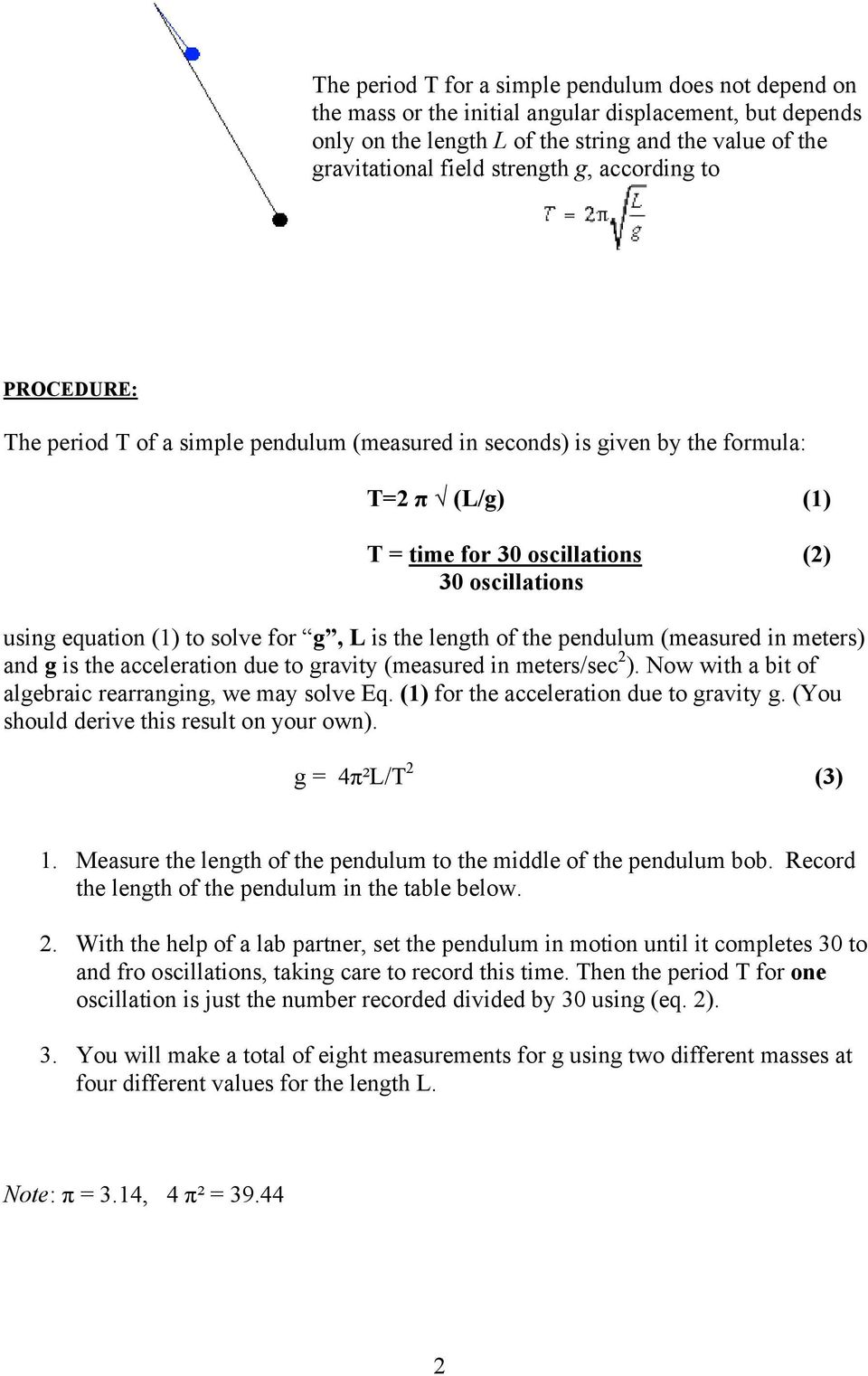
1 EXPERIMENT 2 Measurement of g: Use of a simple pendulum OBJECTIVE: To measure the acceleration due to gravity using a simple pendulum. Textbook reference: pp10-15 INTRODUCTION: Many things in nature wiggle in a periodic fashion. That is, they vibrate. One such example is a simple pendulum. If we suspend a mass at the end of a piece of string, we have a simple pendulum. Here, the to and fro motion represents a periodic motion used in times past to control the motion of grandfather and cuckoo clocks. Such oscillatory motion is called simple harmonic motion. It was Galileo who first observed that the time a pendulum takes to swing back and forth through small distances depends only on the length of the pendulum The time of this to and fro motion, called the period, does not depend on the mass of the pendulum or on the size of the arc through which it swings. Another factor involved in the period of motion is, the acceleration due to gravity (g), which on the earth is 9.8 m/s 2. It follows then that a long pendulum has a greater period than a shorter pendulum. Before coming to lab, you should visit the following web site: This simulation shows a simple pendulum operating under gravity. For small oscillations the pendulum is linear, but it is non-linear for larger oscillations. You can change parameters in the simulation such as mass, gravity, and friction (damping). You can drag the pendulum with your mouse to change the starting position. I With the assumption of small angles, the frequency and period of the pendulum are independent of the initial angular displacement amplitude. All simple pendulums should have the same period regardless of their initial angle (and regardless of their masses). 1

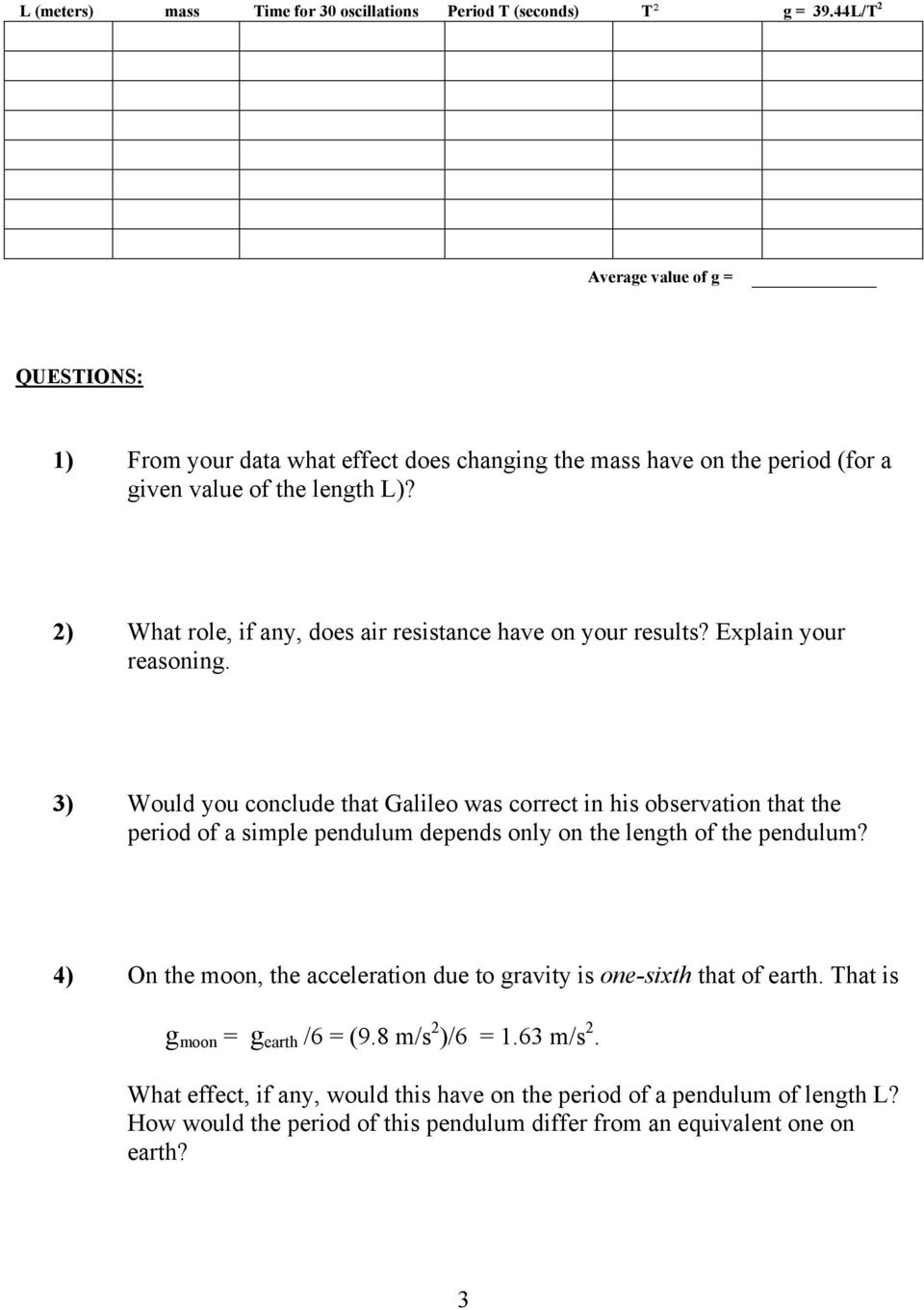
2 The period T for a simple pendulum does not depend on the mass or the initial angular displacement, but depends only on the length L of the string and the value of the gravitational field strength g, according to PROCEDURE: The period T of a simple pendulum (measured in seconds) is given by the formula: T=2 π (L/g) (1) T = time for 30 oscillations (2) 30 oscillations using equation (1) to solve for g, L is the length of the pendulum (measured in meters) and g is the acceleration due to gravity (measured in meters/sec 2 ). Now with a bit of algebraic rearranging, we may solve Eq. (1) for the acceleration due to gravity g. (You should derive this result on your own). g = 4π²L/T 2 (3) 1. Measure the length of the pendulum to the middle of the pendulum bob. Record the length of the pendulum in the table below. 2. With the help of a lab partner, set the pendulum in motion until it completes 30 to and fro oscillations, taking care to record this time. Then the period T for one oscillation is just the number recorded divided by 30 using (eq. 2). 3. You will make a total of eight measurements for g using two different masses at four different values for the length L. Note: π = 3.14, 4 π² =
3 L (meters) mass Time for 30 oscillations Period T (seconds) T² g = 39.44L/T 2 Average value of g = QUESTIONS: 1) From your data what effect does changing the mass have on the period (for a given value of the length L)? 2) What role, if any, does air resistance have on your results? Explain your reasoning. 3) Would you conclude that Galileo was correct in his observation that the period of a simple pendulum depends only on the length of the pendulum? 4) On the moon, the acceleration due to gravity is one-sixth that of earth. That is g moon = g earth /6 = (9.8 m/s 2 )/6 = 1.63 m/s 2. What effect, if any, would this have on the period of a pendulum of length L? How would the period of this pendulum differ from an equivalent one on earth? 3
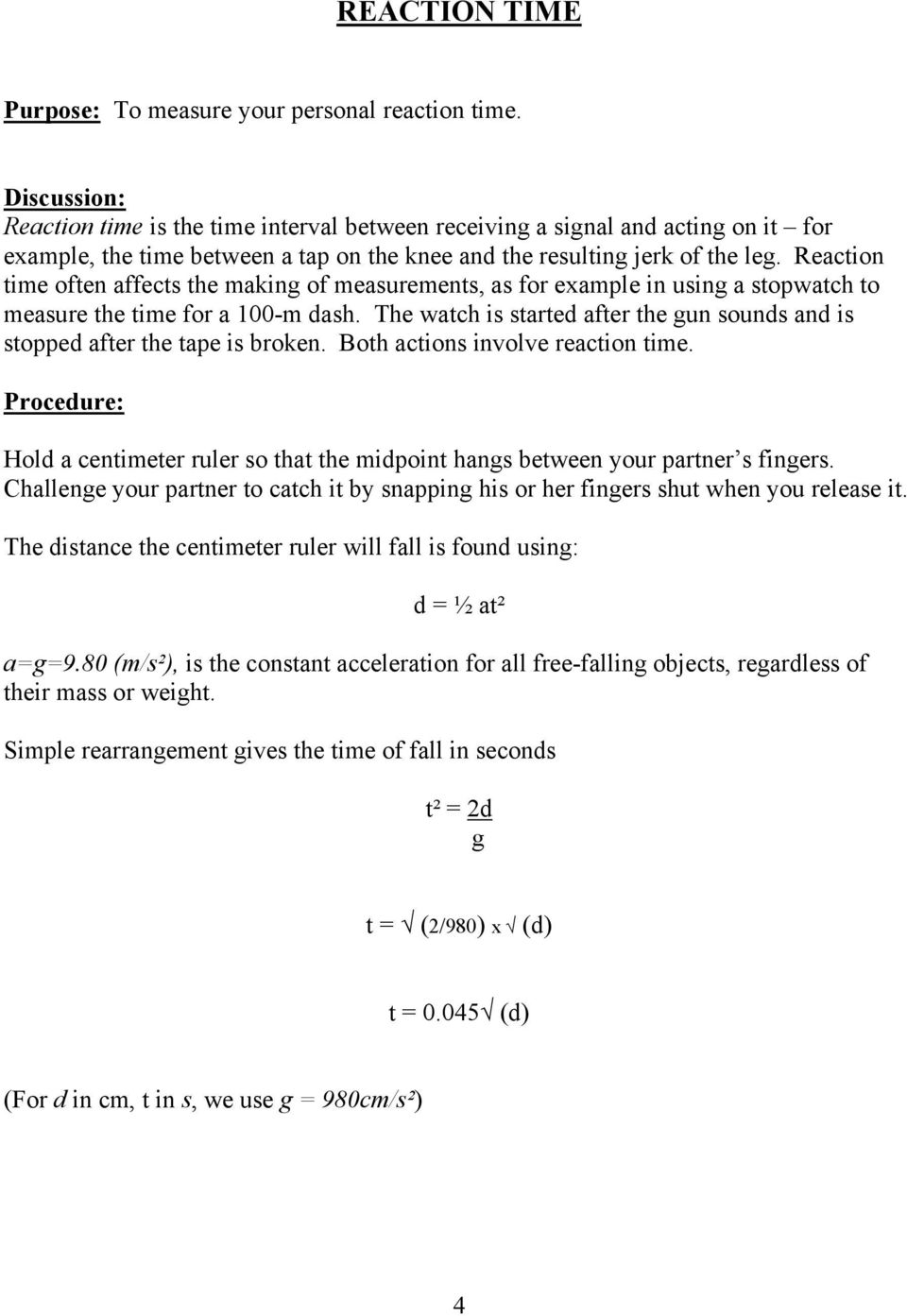
4 REACTION TIME Purpose: To measure your personal reaction time. Discussion: Reaction time is the time interval between receiving a signal and acting on it for example, the time between a tap on the knee and the resulting jerk of the leg. Reaction time often affects the making of measurements, as for example in using a stopwatch to measure the time for a 100-m dash. The watch is started after the gun sounds and is stopped after the tape is broken. Both actions involve reaction time. Procedure: Hold a centimeter ruler so that the midpoint hangs between your partner s fingers. Challenge your partner to catch it by snapping his or her fingers shut when you release it. The distance the centimeter ruler will fall is found using: d = ½ at² a=g=9.80 (m/s²), is the constant acceleration for all free-falling objects, regardless of their mass or weight. Simple rearrangement gives the time of fall in seconds t² = 2d g t = (2/980) x (d) t = (d) (For d in cm, t in s, we use g = 980cm/s²) 4
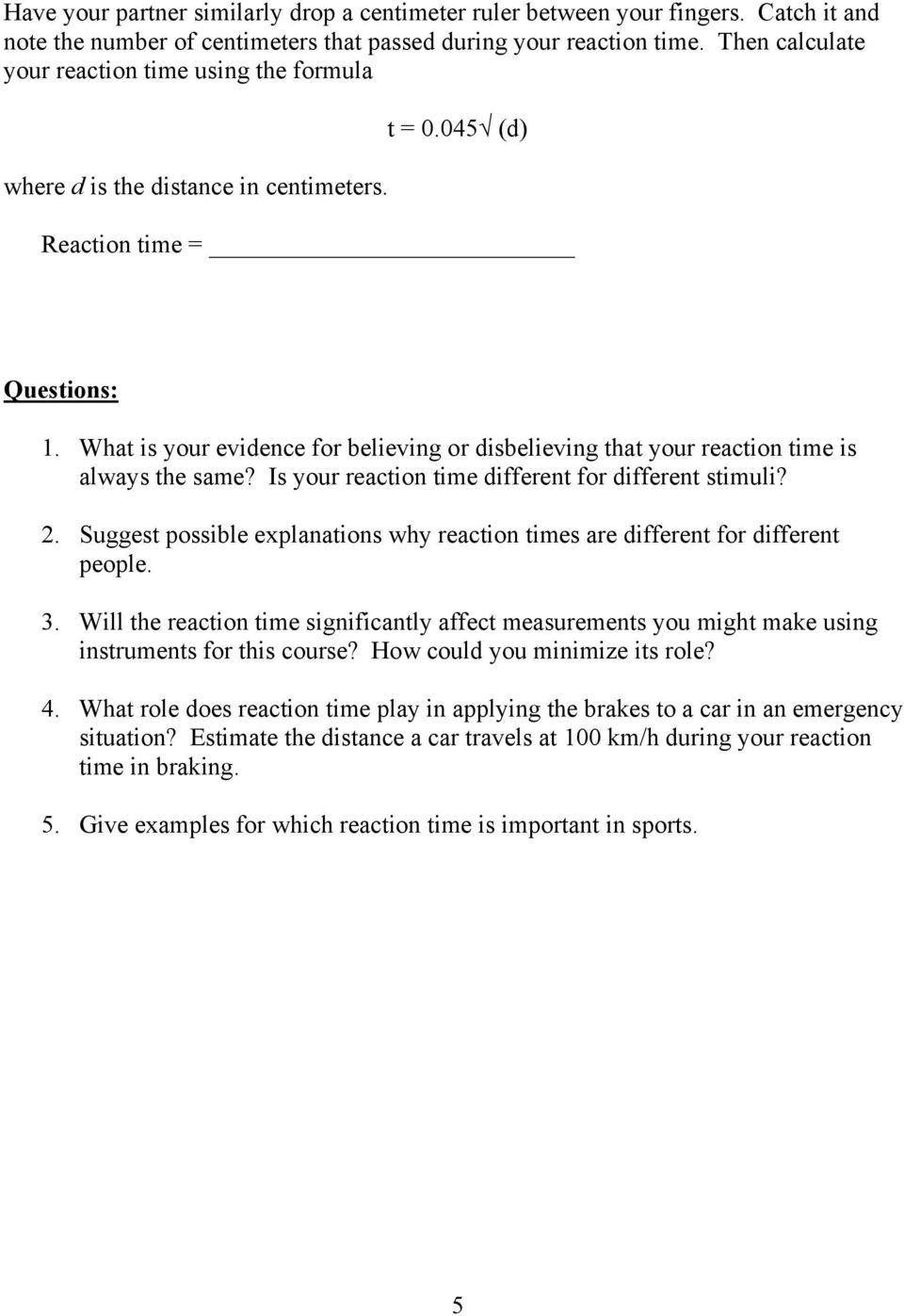
5 Have your partner similarly drop a centimeter ruler between your fingers. Catch it and note the number of centimeters that passed during your reaction time. Then calculate your reaction time using the formula where d is the distance in centimeters. t = (d) Reaction time = Questions: 1. What is your evidence for believing or disbelieving that your reaction time is always the same? Is your reaction time different for different stimuli? 2. Suggest possible explanations why reaction times are different for different people. 3. Will the reaction time significantly affect measurements you might make using instruments for this course? How could you minimize its role? 4. What role does reaction time play in applying the brakes to a car in an emergency situation? Estimate the distance a car travels at 100 km/h during your reaction time in braking. 5. Give examples for which reaction time is important in sports. 5
Oscillations: Mass on a Spring and Pendulums
 Chapter 3 Oscillations: Mass on a Spring and Pendulums 3.1 Purpose 3.2 Introduction Galileo is said to have been sitting in church watching the large chandelier swinging to and fro when he decided that
AP1 Oscillations. 1. Which of the following statements about a spring-block oscillator in simple harmonic motion about its equilibrium point is false?
 1. Which of the following statements about a spring-block oscillator in simple harmonic motion about its equilibrium point is false? (A) The displacement is directly related to the acceleration. (B) The
PENDULUM PERIODS. First Last. Partners: student1, student2, and student3
 PENDULUM PERIODS First Last Partners: student1, student2, and student3 Governor s School for Science and Technology 520 Butler Farm Road, Hampton, VA 23666 April 13, 2011 ABSTRACT The effect of amplitude,
Experiment 9. The Pendulum
 Experiment 9 The Pendulum 9.1 Objectives Investigate the functional dependence of the period (τ) 1 of a pendulum on its length (L), the mass of its bob (m), and the starting angle (θ 0 ). Use a pendulum
Determination of Acceleration due to Gravity
 Experiment 2 24 Kuwait University Physics 105 Physics Department Determination of Acceleration due to Gravity Introduction In this experiment the acceleration due to gravity (g) is determined using two
Practice Test SHM with Answers
 Practice Test SHM with Answers MPC 1) If we double the frequency of a system undergoing simple harmonic motion, which of the following statements about that system are true? (There could be more than one
Lesson 3 - Understanding Energy (with a Pendulum)
 Lesson 3 - Understanding Energy (with a Pendulum) Introduction This lesson is meant to introduce energy and conservation of energy and is a continuation of the fundamentals of roller coaster engineering.
Simple Harmonic Motion
 Simple Harmonic Motion 1 Object To determine the period of motion of objects that are executing simple harmonic motion and to check the theoretical prediction of such periods. 2 Apparatus Assorted weights
226 Chapter 15: OSCILLATIONS
 Chapter 15: OSCILLATIONS 1. In simple harmonic motion, the restoring force must be proportional to the: A. amplitude B. frequency C. velocity D. displacement E. displacement squared 2. An oscillatory motion
Prelab Exercises: Hooke's Law and the Behavior of Springs
 59 Prelab Exercises: Hooke's Law and the Behavior of Springs Study the description of the experiment that follows and answer the following questions.. (3 marks) Explain why a mass suspended vertically
Solution: F = kx is Hooke s law for a mass and spring system. Angular frequency of this system is: k m therefore, k
 Physics 1C Midterm 1 Summer Session II, 2011 Solutions 1. If F = kx, then k m is (a) A (b) ω (c) ω 2 (d) Aω (e) A 2 ω Solution: F = kx is Hooke s law for a mass and spring system. Angular frequency of
A) F = k x B) F = k C) F = x k D) F = x + k E) None of these.
 CT16-1 Which of the following is necessary to make an object oscillate? i. a stable equilibrium ii. little or no friction iii. a disturbance A: i only B: ii only C: iii only D: i and iii E: All three Answer:
Simple Harmonic Motion(SHM) Period and Frequency. Period and Frequency. Cosines and Sines
 Simple Harmonic Motion(SHM) Vibration (oscillation) Equilibrium position position of the natural length of a spring Amplitude maximum displacement Period and Frequency Period (T) Time for one complete
Lab 8: Ballistic Pendulum
 Lab 8: Ballistic Pendulum Equipment: Ballistic pendulum apparatus, 2 meter ruler, 30 cm ruler, blank paper, carbon paper, masking tape, scale. Caution In this experiment a steel ball is projected horizontally
AP Physics C. Oscillations/SHM Review Packet
 AP Physics C Oscillations/SHM Review Packet 1. A 0.5 kg mass on a spring has a displacement as a function of time given by the equation x(t) = 0.8Cos(πt). Find the following: a. The time for one complete
Proving the Law of Conservation of Energy
 Table of Contents List of Tables & Figures: Table 1: Data/6 Figure 1: Example Diagram/4 Figure 2: Setup Diagram/8 1. Abstract/2 2. Introduction & Discussion/3 3. Procedure/5 4. Results/6 5. Summary/6 Proving
HOOKE S LAW AND SIMPLE HARMONIC MOTION
 HOOKE S LAW AND SIMPLE HARMONIC MOTION Alexander Sapozhnikov, Brooklyn College CUNY, New York, [email protected] Objectives Study Hooke s Law and measure the spring constant. Study Simple Harmonic
Acceleration of Gravity Lab Basic Version
 Acceleration of Gravity Lab Basic Version In this lab you will explore the motion of falling objects. As an object begins to fall, it moves faster and faster (its velocity increases) due to the acceleration
Simple Harmonic Motion Experiment. 1 f
 Simple Harmonic Motion Experiment In this experiment, a motion sensor is used to measure the position of an oscillating mass as a function of time. The frequency of oscillations will be obtained by measuring
Physics 41 HW Set 1 Chapter 15
 Physics 4 HW Set Chapter 5 Serway 8 th OC:, 4, 7 CQ: 4, 8 P: 4, 5, 8, 8, 0, 9,, 4, 9, 4, 5, 5 Discussion Problems:, 57, 59, 67, 74 OC CQ P: 4, 5, 8, 8, 0, 9,, 4, 9, 4, 5, 5 Discussion Problems:, 57, 59,
both double. A. T and v max B. T remains the same and v max doubles. both remain the same. C. T and v max
 Q13.1 An object on the end of a spring is oscillating in simple harmonic motion. If the amplitude of oscillation is doubled, how does this affect the oscillation period T and the object s maximum speed
Physics 231 Lecture 15
 Physics 31 ecture 15 Main points of today s lecture: Simple harmonic motion Mass and Spring Pendulum Circular motion T 1/f; f 1/ T; ω πf for mass and spring ω x Acos( ωt) v ωasin( ωt) x ax ω Acos( ωt)
Unit 3 Work and Energy Suggested Time: 25 Hours
 Unit 3 Work and Energy Suggested Time: 25 Hours PHYSICS 2204 CURRICULUM GUIDE 55 DYNAMICS Work and Energy Introduction When two or more objects are considered at once, a system is involved. To make sense
circular motion & gravitation physics 111N
 circular motion & gravitation physics 111N uniform circular motion an object moving around a circle at a constant rate must have an acceleration always perpendicular to the velocity (else the speed would
Pendulum Investigations. Level A Investigations. Level B Investigations
 Pendulum Investigations Level A Investigations The Pendulum How can you change the period of a pendulum? Students are introduced to the vocabulary used to describe harmonic motion: cycle, period, and amplitude.
Torque and Rotary Motion
 Torque and Rotary Motion Name Partner Introduction Motion in a circle is a straight-forward extension of linear motion. According to the textbook, all you have to do is replace displacement, velocity,
Freely Falling Objects
 Freely Falling Objects Physics 1425 Lecture 3 Michael Fowler, UVa. Today s Topics In the previous lecture, we analyzed onedimensional motion, defining displacement, velocity, and acceleration and finding
PHYS 2425 Engineering Physics I EXPERIMENT 9 SIMPLE HARMONIC MOTION
 PHYS 2425 Engineering Physics I EXPERIMENT 9 SIMPLE HARMONIC MOTION I. INTRODUCTION The objective of this experiment is the study of oscillatory motion. In particular the springmass system and the simple
EXPERIMENT 3 Analysis of a freely falling body Dependence of speed and position on time Objectives
 EXPERIMENT 3 Analysis of a freely falling body Dependence of speed and position on time Objectives to verify how the distance of a freely-falling body varies with time to investigate whether the velocity
FXA 2008. UNIT G484 Module 2 4.2.3 Simple Harmonic Oscillations 11. frequency of the applied = natural frequency of the
 11 FORCED OSCILLATIONS AND RESONANCE POINTER INSTRUMENTS Analogue ammeter and voltmeters, have CRITICAL DAMPING so as to allow the needle pointer to reach its correct position on the scale after a single
8. As a cart travels around a horizontal circular track, the cart must undergo a change in (1) velocity (3) speed (2) inertia (4) weight
 1. What is the average speed of an object that travels 6.00 meters north in 2.00 seconds and then travels 3.00 meters east in 1.00 second? 9.00 m/s 3.00 m/s 0.333 m/s 4.24 m/s 2. What is the distance traveled
Rotational Inertia Demonstrator
 WWW.ARBORSCI.COM Rotational Inertia Demonstrator P3-3545 BACKGROUND: The Rotational Inertia Demonstrator provides an engaging way to investigate many of the principles of angular motion and is intended
State Newton's second law of motion for a particle, defining carefully each term used.
 5 Question 1. [Marks 20] An unmarked police car P is, travelling at the legal speed limit, v P, on a straight section of highway. At time t = 0, the police car is overtaken by a car C, which is speeding
In order to describe motion you need to describe the following properties.
 Chapter 2 One Dimensional Kinematics How would you describe the following motion? Ex: random 1-D path speeding up and slowing down In order to describe motion you need to describe the following properties.
CHAPTER 6 WORK AND ENERGY
 CHAPTER 6 WORK AND ENERGY CONCEPTUAL QUESTIONS. REASONING AND SOLUTION The work done by F in moving the box through a displacement s is W = ( F cos 0 ) s= Fs. The work done by F is W = ( F cos θ). s From
Sample Questions for the AP Physics 1 Exam
 Sample Questions for the AP Physics 1 Exam Sample Questions for the AP Physics 1 Exam Multiple-choice Questions Note: To simplify calculations, you may use g 5 10 m/s 2 in all problems. Directions: Each
HOOKE S LAW AND OSCILLATIONS
 9 HOOKE S LAW AND OSCILLATIONS OBJECTIVE To measure the effect of amplitude, mass, and spring constant on the period of a spring-mass oscillator. INTRODUCTION The force which restores a spring to its equilibrium
Sound and stringed instruments
 Sound and stringed instruments Lecture 14: Sound and strings Reminders/Updates: HW 6 due Monday, 10pm. Exam 2, a week today! 1 Sound so far: Sound is a pressure or density fluctuation carried (usually)
Scientific Experiments Using the Inquiry Activity Pendulums
 Scientific Experiments Using the Inquiry Activity Pendulums Prep Time: 30 minutes Class Time: 1 class period Word Wall Words: experiment, independent variable, controlled variable, dependent variables,
E X P E R I M E N T 8
 E X P E R I M E N T 8 Torque, Equilibrium & Center of Gravity Produced by the Physics Staff at Collin College Copyright Collin College Physics Department. All Rights Reserved. University Physics, Exp 8:
Curso2012-2013 Física Básica Experimental I Cuestiones Tema IV. Trabajo y energía.
 1. A body of mass m slides a distance d along a horizontal surface. How much work is done by gravity? A) mgd B) zero C) mgd D) One cannot tell from the given information. E) None of these is correct. 2.
AS COMPETITION PAPER 2008
 AS COMPETITION PAPER 28 Name School Town & County Total Mark/5 Time Allowed: One hour Attempt as many questions as you can. Write your answers on this question paper. Marks allocated for each question
Physics 9e/Cutnell. correlated to the. College Board AP Physics 1 Course Objectives
 Physics 9e/Cutnell correlated to the College Board AP Physics 1 Course Objectives Big Idea 1: Objects and systems have properties such as mass and charge. Systems may have internal structure. Enduring
Spring Simple Harmonic Oscillator. Spring constant. Potential Energy stored in a Spring. Understanding oscillations. Understanding oscillations
 Spring Simple Harmonic Oscillator Simple Harmonic Oscillations and Resonance We have an object attached to a spring. The object is on a horizontal frictionless surface. We move the object so the spring
Candidate Number. General Certificate of Education Advanced Level Examination June 2014
 entre Number andidate Number Surname Other Names andidate Signature General ertificate of Education dvanced Level Examination June 214 Physics PHY4/1 Unit 4 Fields and Further Mechanics Section Wednesday
Columbia University Department of Physics QUALIFYING EXAMINATION
 Columbia University Department of Physics QUALIFYING EXAMINATION Monday, January 13, 2014 1:00PM to 3:00PM Classical Physics Section 1. Classical Mechanics Two hours are permitted for the completion of
PHYS 211 FINAL FALL 2004 Form A
 1. Two boys with masses of 40 kg and 60 kg are holding onto either end of a 10 m long massless pole which is initially at rest and floating in still water. They pull themselves along the pole toward each
Determining the Acceleration Due to Gravity
 Chabot College Physics Lab Scott Hildreth Determining the Acceleration Due to Gravity Introduction In this experiment, you ll determine the acceleration due to earth s gravitational force with three different
Giant Slinky: Quantitative Exhibit Activity
 Name: Giant Slinky: Quantitative Exhibit Activity Materials: Tape Measure, Stopwatch, & Calculator. In this activity, we will explore wave properties using the Giant Slinky. Let s start by describing the
The Physics of Guitar Strings
 The Physics of Guitar Strings R. R. McNeil 1. Introduction The guitar makes a wonderful device to demonstrate the physics of waves on a stretched string. This is because almost every student has seen a
Potential / Kinetic Energy Remedial Exercise
 Potential / Kinetic Energy Remedial Exercise This Conceptual Physics exercise will help you in understanding the Law of Conservation of Energy, and its application to mechanical collisions. Exercise Roles:
Chapter 4: Newton s Laws: Explaining Motion
 Chapter 4: Newton s Laws: Explaining Motion 1. All except one of the following require the application of a net force. Which one is the exception? A. to change an object from a state of rest to a state
Rotation: Moment of Inertia and Torque
 Rotation: Moment of Inertia and Torque Every time we push a door open or tighten a bolt using a wrench, we apply a force that results in a rotational motion about a fixed axis. Through experience we learn
Notice numbers may change randomly in your assignments and you may have to recalculate solutions for your specific case.
 HW1 Possible Solutions Notice numbers may change randomly in your assignments and you may have to recalculate solutions for your specific case. Tipler 14.P.003 An object attached to a spring has simple
Experiment 2 Free Fall and Projectile Motion
 Name Partner(s): Experiment 2 Free Fall and Projectile Motion Objectives Preparation Pre-Lab Learn how to solve projectile motion problems. Understand that the acceleration due to gravity is constant (9.8
Experiment 4 ~ Newton s Second Law: The Atwood Machine
 xperiment 4 ~ Newton s Second Law: The twood Machine Purpose: To predict the acceleration of an twood Machine by applying Newton s 2 nd Law and use the predicted acceleration to verify the equations of
State Newton's second law of motion for a particle, defining carefully each term used.
 5 Question 1. [Marks 28] An unmarked police car P is, travelling at the legal speed limit, v P, on a straight section of highway. At time t = 0, the police car is overtaken by a car C, which is speeding
AP Physics C Fall Final Web Review
 Name: Class: _ Date: _ AP Physics C Fall Final Web Review Multiple Choice Identify the choice that best completes the statement or answers the question. 1. On a position versus time graph, the slope of
Two-Body System: Two Hanging Masses
 Specific Outcome: i. I can apply Newton s laws of motion to solve, algebraically, linear motion problems in horizontal, vertical and inclined planes near the surface of Earth, ignoring air resistance.
AP Physics - Chapter 8 Practice Test
 AP Physics - Chapter 8 Practice Test Multiple Choice Identify the choice that best completes the statement or answers the question. 1. A single conservative force F x = (6.0x 12) N (x is in m) acts on
ELASTIC FORCES and HOOKE S LAW
 PHYS-101 LAB-03 ELASTIC FORCES and HOOKE S LAW 1. Objective The objective of this lab is to show that the response of a spring when an external agent changes its equilibrium length by x can be described
Rockets: Taking Off! Racing Balloon
 Rockets: Taking Off! For every action there is an equal and opposite reaction. Rockets and Balloons What happens when you blow up a balloon then let it go? Does the balloon move through the air? Did you
GENERAL SCIENCE LABORATORY 1110L Lab Experiment 3: PROJECTILE MOTION
 GENERAL SCIENCE LABORATORY 1110L Lab Experiment 3: PROJECTILE MOTION Objective: To understand the motion of a projectile in the earth s gravitational field and measure the muzzle velocity of the projectile
AP PHYSICS C Mechanics - SUMMER ASSIGNMENT FOR 2016-2017
 AP PHYSICS C Mechanics - SUMMER ASSIGNMENT FOR 2016-2017 Dear Student: The AP physics course you have signed up for is designed to prepare you for a superior performance on the AP test. To complete material
PHYS 101-4M, Fall 2005 Exam #3. MULTIPLE CHOICE. Choose the one alternative that best completes the statement or answers the question.
 PHYS 101-4M, Fall 2005 Exam #3 Name MULTIPLE CHOICE. Choose the one alternative that best completes the statement or answers the question. 1) A bicycle wheel rotates uniformly through 2.0 revolutions in
Chapter 5 Using Newton s Laws: Friction, Circular Motion, Drag Forces. Copyright 2009 Pearson Education, Inc.
 Chapter 5 Using Newton s Laws: Friction, Circular Motion, Drag Forces Units of Chapter 5 Applications of Newton s Laws Involving Friction Uniform Circular Motion Kinematics Dynamics of Uniform Circular
Copyright 2011 Casa Software Ltd. www.casaxps.com
 Table of Contents Variable Forces and Differential Equations... 2 Differential Equations... 3 Second Order Linear Differential Equations with Constant Coefficients... 6 Reduction of Differential Equations
1) The time for one cycle of a periodic process is called the A) wavelength. B) period. C) frequency. D) amplitude.
 practice wave test.. Name Use the text to make use of any equations you might need (e.g., to determine the velocity of waves in a given material) MULTIPLE CHOICE. Choose the one alternative that best completes
Physics: Principles and Applications, 6e Giancoli Chapter 2 Describing Motion: Kinematics in One Dimension
 Physics: Principles and Applications, 6e Giancoli Chapter 2 Describing Motion: Kinematics in One Dimension Conceptual Questions 1) Suppose that an object travels from one point in space to another. Make
v v ax v a x a v a v = = = Since F = ma, it follows that a = F/m. The mass of the arrow is unchanged, and ( )
 Week 3 homework IMPORTANT NOTE ABOUT WEBASSIGN: In the WebAssign versions of these problems, various details have been changed, so that the answers will come out differently. The method to find the solution
Practice Exam Three Solutions
 MASSACHUSETTS INSTITUTE OF TECHNOLOGY Department of Physics Physics 8.01T Fall Term 2004 Practice Exam Three Solutions Problem 1a) (5 points) Collisions and Center of Mass Reference Frame In the lab frame,
Pendulum Force and Centripetal Acceleration
 Pendulum Force and Centripetal Acceleration 1 Objectives 1. To calibrate and use a force probe and motion detector. 2. To understand centripetal acceleration. 3. To solve force problems involving centripetal
Work, Energy and Power Practice Test 1
 Name: ate: 1. How much work is required to lift a 2-kilogram mass to a height of 10 meters?. 5 joules. 20 joules. 100 joules. 200 joules 5. ar and car of equal mass travel up a hill. ar moves up the hill
Physics 1120: Simple Harmonic Motion Solutions
 Questions: 1 2 3 4 5 6 7 8 9 10 11 12 13 14 15 16 Physics 1120: Simple Harmonic Motion Solutions 1. A 1.75 kg particle moves as function of time as follows: x = 4cos(1.33t+π/5) where distance is measured
Understanding Kinetic Energy
 Got Science Supplemental Information Video Modules 1 & 2 Understanding Kinetic Energy There are many ways to explore the relationship of mass and speed to kinetic energy. Hot Wheels system was chosen rather
General Physics Lab: Atwood s Machine
 General Physics Lab: Atwood s Machine Introduction One may study Newton s second law using a device known as Atwood s machine, shown below. It consists of a pulley and two hanging masses. The difference
ENERGYand WORK (PART I and II) 9-MAC
 ENERGYand WORK (PART I and II) 9-MAC Purpose: To understand work, potential energy, & kinetic energy. To understand conservation of energy and how energy is converted from one form to the other. Apparatus:
CHAPTER 15 FORCE, MASS AND ACCELERATION
 CHAPTER 5 FORCE, MASS AND ACCELERATION EXERCISE 83, Page 9. A car initially at rest accelerates uniformly to a speed of 55 km/h in 4 s. Determine the accelerating force required if the mass of the car
III. Applications of Force and Motion Concepts. Concept Review. Conflicting Contentions. 1. Airplane Drop 2. Moving Ball Toss 3. Galileo s Argument
 III. Applications of Force and Motion Concepts Concept Review Conflicting Contentions 1. Airplane Drop 2. Moving Ball Toss 3. Galileo s Argument Qualitative Reasoning 1. Dropping Balls 2. Spinning Bug
Physics Lab Report Guidelines
 Physics Lab Report Guidelines Summary The following is an outline of the requirements for a physics lab report. A. Experimental Description 1. Provide a statement of the physical theory or principle observed
Chapter 10: Linear Kinematics of Human Movement
 Chapter 10: Linear Kinematics of Human Movement Basic Biomechanics, 4 th edition Susan J. Hall Presentation Created by TK Koesterer, Ph.D., ATC Humboldt State University Objectives Discuss the interrelationship
Acceleration due to Gravity
 Acceleration due to Gravity 1 Object To determine the acceleration due to gravity by different methods. 2 Apparatus Balance, ball bearing, clamps, electric timers, meter stick, paper strips, precision
Physics 211: Lab Oscillations. Simple Harmonic Motion.
 Physics 11: Lab Oscillations. Siple Haronic Motion. Reading Assignent: Chapter 15 Introduction: As we learned in class, physical systes will undergo an oscillatory otion, when displaced fro a stable equilibriu.
Centripetal force, rotary motion, angular velocity, apparent force.
 Related Topics Centripetal force, rotary motion, angular velocity, apparent force. Principle and Task A body with variable mass moves on a circular path with ad-justable radius and variable angular velocity.
9. The kinetic energy of the moving object is (1) 5 J (3) 15 J (2) 10 J (4) 50 J
 1. If the kinetic energy of an object is 16 joules when its speed is 4.0 meters per second, then the mass of the objects is (1) 0.5 kg (3) 8.0 kg (2) 2.0 kg (4) 19.6 kg Base your answers to questions 9
Tennessee State University
 Tennessee State University Dept. of Physics & Mathematics PHYS 2010 CF SU 2009 Name 30% Time is 2 hours. Cheating will give you an F-grade. Other instructions will be given in the Hall. MULTIPLE CHOICE.
UNIT 2 GCSE PHYSICS 2.2.1 Forces and Energy 2011 FXA WORK DONE (J) = ENERGY TRANSFERRED (J) WORK
 29 When a force causes an object to move through a distance, work is done. Work done, force and distance are related by the equation : W = F x d WORK When a force is applied to an object and cause it to
Oscillations. Vern Lindberg. June 10, 2010
 Oscillations Vern Lindberg June 10, 2010 You have discussed oscillations in Vibs and Waves: we will therefore touch lightly on Chapter 3, mainly trying to refresh your memory and extend the concepts. 1
Aim : To study how the time period of a simple pendulum changes when its amplitude is changed.
 Aim : To study how the time period of a simple pendulum changes when its amplitude is changed. Teacher s Signature Name: Suvrat Raju Class: XIID Board Roll No.: Table of Contents Aim..................................................1
Newton s Second Law. ΣF = m a. (1) In this equation, ΣF is the sum of the forces acting on an object, m is the mass of
 Newton s Second Law Objective The Newton s Second Law experiment provides the student a hands on demonstration of forces in motion. A formulated analysis of forces acting on a dynamics cart will be developed
Applications of Second-Order Differential Equations
 Applications of Second-Order Differential Equations Second-order linear differential equations have a variety of applications in science and engineering. In this section we explore two of them: the vibration
Ph\sics 2210 Fall 2012 - Novcmbcr 21 David Ailion
 Ph\sics 2210 Fall 2012 - Novcmbcr 21 David Ailion Unid: Discussion T A: Bryant Justin Will Yuan 1 Place answers in box provided for each question. Specify units for each answer. Circle correct answer(s)
Newton s Laws. Physics 1425 lecture 6. Michael Fowler, UVa.
 Newton s Laws Physics 1425 lecture 6 Michael Fowler, UVa. Newton Extended Galileo s Picture of Galileo said: Motion to Include Forces Natural horizontal motion is at constant velocity unless a force acts:
AP Physics Circular Motion Practice Test B,B,B,A,D,D,C,B,D,B,E,E,E, 14. 6.6m/s, 0.4 N, 1.5 m, 6.3m/s, 15. 12.9 m/s, 22.9 m/s
 AP Physics Circular Motion Practice Test B,B,B,A,D,D,C,B,D,B,E,E,E, 14. 6.6m/s, 0.4 N, 1.5 m, 6.3m/s, 15. 12.9 m/s, 22.9 m/s Answer the multiple choice questions (2 Points Each) on this sheet with capital
www.mathsbox.org.uk Displacement (x) Velocity (v) Acceleration (a) x = f(t) differentiate v = dx Acceleration Velocity (v) Displacement x
 Mechanics 2 : Revision Notes 1. Kinematics and variable acceleration Displacement (x) Velocity (v) Acceleration (a) x = f(t) differentiate v = dx differentiate a = dv = d2 x dt dt dt 2 Acceleration Velocity
Forces. When an object is pushed or pulled, we say that a force is exerted on it.
 Forces When an object is pushed or pulled, we say that a force is exerted on it. Forces can Cause an object to start moving Change the speed of a moving object Cause a moving object to stop moving Change
ACTIVITY 6: Falling Objects
 UNIT FM Developing Ideas ACTIVITY 6: Falling Objects Purpose and Key Question You developed your ideas about how the motion of an object is related to the forces acting on it using objects that move horizontally.
Chapter 8: Potential Energy and Conservation of Energy. Work and kinetic energy are energies of motion.
 Chapter 8: Potential Energy and Conservation of Energy Work and kinetic energy are energies of motion. Consider a vertical spring oscillating with mass m attached to one end. At the extreme ends of travel
Worksheet #1 Free Body or Force diagrams
 Worksheet #1 Free Body or Force diagrams Drawing Free-Body Diagrams Free-body diagrams are diagrams used to show the relative magnitude and direction of all forces acting upon an object in a given situation.