
SEISMIC DESIGN GUIDE FOR MASONRY BUILDINGS CHAPTER 1. Canadian Concrete Masonry Producers Association
|
|
|
- Amberly Harper
- 9 years ago
- Views:
Transcription
1 SEISMIC DESIGN GUIDE FOR MASONRY BUILDINGS CHAPTER 1 Donld Anderson Svetln Brzev Cndin Concrete Msonry Producers Assocition April 2009
2 DISCLAIMER While the uthors hve tried to be s ccurte s possible, they cnnot be held responsible for the designs of others tht might be bsed on the mteril presented in this document. The mteril included in this document is intended for the use of design professionls who re competent to evlute the significnce nd limittions of its contents nd recommendtions nd ble to ccept responsibility for its ppliction. The uthors, nd the Cndin Concrete Msonry Producers Assocition, disclim ny nd ll responsibility for the pplictions of the stted principles nd for the ccurcy of ny of the mteril included in the document. AUTHORS Don Anderson, Ph.D., P.Eng. Deprtment of Civil Engineering, University of British Columbi Vncouver, BC Svetln Brzev, Ph.D., P.Eng. Deprtment of Civil Engineering British Columbi Institute of Technology Burnby, BC TECHNICAL EDITORS Gry Sturgeon, P.Eng., Director of Technicl Services, CCMPA Bill McEwen, P.Eng., LEED AP, Eecutive Director, Msonry Institute of BC Dr. Mrk Hgel, EIT, Technicl Services Engineer, CCMPA GRAPHIC DESIGN Ntli Leposvic, M.Arch. COVER PAGE Photo credit: Bill McEwen, P.Eng. Grphic design: Mrjorie Greene, AICP COPYRIGHT Cndin Concrete Msonry Producers Assocition, 2009 Cndin Concrete Msonry Producers Assocition P.O. Bo 54503, 1771 Avenue Rod Toronto, ON M5M 4N5 Tel: (416) F: (416) Emil: [email protected] Web site: The Cndin Concrete Msonry Producers Assocition (CCMPA) is non-profit ssocition whose mission is to support nd dvnce the common interests of its members in the mnufcture, mrketing, reserch, nd ppliction of concrete msonry products nd structures. It represents the interests of Region 6 of the Ntionl Concrete Msonry Assocition (NCMA).

3 Contents Summry Chpter 1 NBCC 2005 Seismic Provisions Objective: to provide bckground on seismic response of structures nd seismic nlysis methods nd eplin key NBCC 2005 seismic provisions of relevnce for msonry design DETAILED NBCC SEISMIC PROVISIONS Chpter 2 Seismic Design of Msonry Wlls to CSA S304.1 Objective: to provide bckground nd commentry for CSA S seismic design provisions relted to reinforced concrete msonry wlls, nd discuss the revisions in CSA S seismic design requirements with regrd to the 1994 edition DETAILED MASONRY DESIGN PROVISIONS Chpter 3 Summry of Chnges in NBCC 2005 nd CSA S Seismic Design Requirements for Msonry Buildings Objective: to provide summry of NBCC 2005 nd CSA S SUMMARY OF chnges with regrd to previous editions (NBCC 1995 nd CSA S NBCC AND 94) nd to present the results of design cse study of hypotheticl S304.1 low-rise msonry building to illustrte differences in seismic forces nd CHANGES msonry design requirements due to different site loctions nd different editions of NBCC nd CSA S304.1 Chpter 4 Design Emples Objective: to provide illustrtive design emples of seismic lod clcultion nd distribution of forces to members ccording to NBCC 2005, nd the seismic design of lodbering nd nonlodbering msonry elements ccording to CSA S DESIGN EXAMPLES Appendi A Appendi B Appendi C Appendi D Appendi E Comprison of NBCC 1995 nd NBCC 2005 Seismic Provisions Reserch Studies nd Code Bckground Relevnt to Msonry Design Relevnt Design Bckground Design Aids Nottion i

4 TABLE OF CONTENTS CHAPTER 1 1 SEISMIC DESIGN PROVISIONS OF THE NATIONAL BUILDING CODE OF CANADA Introduction Bckground Design nd Performnce Objectives Response of Structures to Erthqukes Elstic Response Inelstic Response Ductility A Primer on Modl Dynmic Anlysis Procedure Seismic Anlysis According to NBCC Seismic Hzrd Effect of Site Soil Conditions Methods of Anlysis Bse Sher Clcultions- Equivlent Sttic Anlysis Procedure Force Reduction Fctors R d nd R o Higher Mode Effects ( M v fctor) Verticl Distribution of Seismic Forces Overturning Moments ( J fctor) Torsion Configurtion Issues: Irregulrities nd Restrictions Deflections nd Drift Limits Dynmic Anlysis Method Soil-Structure Interction /1/
5 1 Seismic Design Provisions of the Ntionl Building Code of Cnd Introduction This chpter provides review of the seismic design provisions in the 2005 Ntionl Building Code of Cnd (NBCC 2005). Additionlly, there is n introduction to the dynmic nlysis of structures to ssist in understnding the NBCC provisions. Since there re mjor chnges to the seismic provisions reflected in NBCC 2005, some comprisons will be mde to the previous edition of the building code, NBCC 1995, nd this is covered in more detil in Appendi A. In the pst, building structures in mny res of Cnd did not hve to be designed for erthqukes. However, fter the NBCC 2005 ws issued nd dopted by the Provinces, structures in some dditionl res must now be designed for erthqukes, especilly if the structure is n importnt or post-disster building, or if it is locted on soft soil site. Since mny engineers in these regions hve not hd eperience in seismic design nd now my hve to include such design in their prctice, this guideline hs been prepred to eplin the seismic provisions included in the NBCC 2005 nd CSA S , nd to point out the recent chnges in these two documents s they pertin to msonry design. 1.2 Bckground Seismic design of msonry structures becme n issue following the 1933 Long Bech, Cliforni erthquke in which school buildings suffered dmge tht would hve been ftl to students hd the erthquke occurred during school hours. At tht time, seismic lterl lod equl to the product of seismic coefficient nd the structure weight hd to be considered in those res of Cliforni known to be seismiclly ctive. Strong motion instruments tht could mesure the pek ground ccelertion or displcement were developed round tht time, nd in fct, the first strong motion ccelerogrm ws recorded during the 1933 Long Bech erthquke. However, in this er the most widely used strong ground motion ccelertion record ws mesured t El Centro during the 1940 Imperil Vlley erthquke in southern Cliforni. The 1940 El Centro record becme fmous nd is still used by mny reserchers studying the effect of erthqukes on structures. With the vilbility of ground motion ccelertion records (lso known s ccelertion time history records), it ws possible to determine the response of simple structures modelled s single degree of freedom systems. After computers becme vilble in the 1960s it ws possible to develop more comple models for nlyzing the response of lrger structures. The dvent of computers hs lso hd huge impct on the bility to predict the ground motion hzrd t site, nd in prticulr, on probbilistic predictions of hzrd on which the NBCC seismic hzrd model is bsed. 4/1/

6 1.3 Design nd Performnce Objectives For mny yers, seismic design philosophy hs been founded on the understnding tht it would be too epensive to design most structures to remin elstic under the forces tht the erthquke ground motion cretes. Accordingly, most modern building codes llow structures to be designed for forces lower thn the elstic forces with the result tht such structures my be dmged in n erthquke, but they should not collpse, nd the occupnts should be ble to sfely evcute the building. The pst nd present NBCC editions follow this philosophy nd llow for lterl design forces smller thn the elstic forces, but impose detiling requirements so tht the inelstic response remins ductile nd brittle filure is prevented. Reserch studies hve shown tht for most structures, the lterl displcements or drifts re bout the sme irrespective of whether the structure remins elstic or it is llowed to yield nd eperience inelstic (plstic) deformtions. This is known s the equl displcement rule nd will be discussed lter in this chpter, s it forms the bsis for mny of the code provisions. The seismic response of building structure depends on severl fctors, such s the structurl system nd its dynmic chrcteristics, the building mterils nd design detils, but probbly the most importnt is the epected erthquke ground motion t the site. The epected ground motion, termed the seismic hzrd, cn be estimted using probbilistic methods, or be bsed on deterministic mens if there is n dequte history of lrge erthqukes on identifible fults in the immedite vicinity of the site. Cnd generlly uses probbilistic method to ssess the seismic hzrd, nd over the yers, the probbility hs been decresing, from roughly 40% chnce (probbility) of being eceeded in 50 yers in the 1970s (corresponding to 1/100 per nnum probbility, lso termed the 100 yer erthquke), to 10% in 50 yer probbility in the 1980s (the 475 yer erthquke), to finlly 2% in 50 yer probbility (the 2475 yer erthquke) used for NBCC The ltest chnge ws mde so tht the risk of building filure in estern nd western Cnd would be roughly the sme (Adms nd Atkinson, 2003), s well s to recognize tht n cceptble probbility of severe building dmge in North Americ from seismic ctivity is bout 2% in 50 yers. Despite the lrge chnges over the yers in the probbility level for the seismic hzrd determintion, the seismic design forces hve not chnged pprecibly becuse other fctors in the NBCC design equtions hve chnged to compenste for these higher hzrd vlues. Thus, while the code seismic design hzrd hs been rising over the yers, the seismic risk of filure of buildings designed ccording to the code hs not chnged gretly. A comprison of building designs performed ccording to the NBCC 1995 nd the NBCC 2005 will show n increse in design level forces in some res of Cnd nd decresed level in other res, however it is epected tht the overll difference between these designs is not significnt (see Appendi A for more detils). The NBCC 2005 hs tken more rtionl pproch towrds seismic design thn hve previous editions, in tht the seismic hzrd hs been ssessed for certin probbility relted to risk of severe building dmge, with the building designed with no empiricl or clibrting fctors. The rel strength of the building hs been utilized in the design, so tht t this level of ground motion it should not collpse but could be severely dmged. Thus, the probbility of severe dmge or ner collpse is bout 1/2475 per nnum, or bout 2% in the predicted 50- yer life spn of the structure. When compred to wind or snow lods, which re bsed on the 1 4/1/

7 in 50 yer probbility of not being eceeded, the 1 in 2475 yer probbility for seismic design ppers inconsistent. However, unlike design for seismic lods, design for wind nd snow lods uses lod nd mteril performnce fctors, nd so the resulting probbility of filure is epected to be smller thn tht for erthqukes. Seismic design does use mteril resistnce fctors, φ fctors, in ssessing member cpcity, but they re effectively cncelled out by the overstrength fctor, R (which will be described lter), used to reduce the seismic forces. o Work on new model codes round the world is leding to wht is described s, Performnce Bsed Design, concept tht is lredy being pplied by some designers working with owners who hve concerns tht building dmge will hve n dverse effect on their bility to mintin their business. NBCC 2005 only ddresses one performnce level, tht of collpse prevention nd life sfety, nd is essentilly mute on servicebility during smller seismic events tht re epected to occur more frequently. Performnce bsed design ttempts to minimize the cost of erthquke losses by weighing the cost of repir, nd cost of lost business, ginst n incresed cost of construction. 1.4 Response of Structures to Erthqukes Elstic Response When n erthquke strikes, the bse of building is subject to lterl motion while the upper prt of the structure initilly is t rest. The forces creted in the structure from the reltive displcement between the bse nd upper portion cuse the upper portion to ccelerte nd displce. At ech floor the lterl force required to ccelerte the floor mss is provided by the forces in the verticl members. The floor forces re inertil forces, not eternlly pplied forces such s wind lods, nd eist only s long s there is movement in the structure. Erthqukes cuse the ground to shke for reltively short time, 15 to 30 seconds of strong ground shking, lthough movements my go on for few minutes. The motion is cyclic nd the response of the structure cn only be determined by considering the dynmics of the problem. A few importnt dynmic concepts re discussed below. Consider simple single-storey building with msonry wlls nd flt roof. The building cn be represented by Single Degree of Freedom (SDOF) model (lso known s stick model) s shown in Figure 1-1. The mss, M, lumped t the top, represents the mss of the roof nd frction of the totl wll mss, while the column represents the combined wll stiffness, K, in the direction of erthquke ground motion. If n erthquke cuses lterl deflection, Δ, t the top of the building, Figure 1-1b, nd if the building response is elstic with stiffness, K, then the lterl inertil force, F, cting on the mss M will be F = K Δ When the mss of SDOF un-dmped structure is llowed to oscillte freely, the time for structure to complete one full cycle of oscilltion is clled the period, T, which for the SDOF system shown is given by M T = 2π (seconds) K Insted of period, the term nturl frequency, ω, is often used in seismic design. It is relted to the period s follows 4/1/
8 K ω = 2 π T = (rdins/sec) M Frequency is sometimes lso epressed in Hertz, or cycles per second, insted of rdins/sec, denoted by the symbol ω, where ω cps 1 = = T ω 2π cps Figure 1-1. SDOF system: ) stick model; b) displced position. As the structure vibrtes, there is lwys some energy loss which will cuse decrese in the mplitude of the motion over time - this phenomenon is clled dmping. The etent of dmping in building depends on the mterils of construction, its structurl system nd detiling, nd the presence of rchitecturl components such s prtitions, ceilings nd eterior wlls. Dmping is usully modelled s viscous dmping in elstic structures, nd hysteretic dmping in structures tht demonstrte inelstic response. In seismic design of buildings, dmping is usully epressed in terms of dmping rtio, β, which is described in terms of percentge of criticl viscous dmping. Criticl viscous dmping is defined s the level of dmping which brings displced system to rest in minimum time without oscilltion. Dmping less thn criticl, n under-dmped system, llows the system to oscillte; while n over-dmped system will not oscillte but tke longer thn the criticlly dmped system to come to rest. Dmping hs n influence on the period of vibrtion, T, however this influence is miniml for lightly dmped systems, nd in most cses is ignored for structurl systems. For building pplictions, the dmping rtio cn be s low s 2%, lthough 5% is used in most seismic clcultions. Dmping in structure increses with displcement mplitude since with incresing displcement more elements my crck or become slightly nonliner. For liner seismic nlysis viscous dmping is usully tken s 5% of criticl s the structurl response to erthqukes is usully close to or greter thn the yield displcement. A smller vlue of viscous dmping is usully used in nonliner nlyses s hysteretic dmping is lso considered. One of the most useful seismic design concepts is tht of the response spectrum. When structure, sy the SDOF model shown in Figure 1-1, is subjected to n erthquke ground motion, it cycles bck nd forth. At some point in time the displcement reltive to the ground nd the bsolute ccelertion of the mss rech mimum, Δ m nd m, respectively. Figure 1-2 shows the mimum displcement plotted ginst the period, T. Denote the period 4/1/

9 of this structure s T 1. If the dynmic properties, i.e. either the mss or stiffness chnge, the period will chnge, sy to T 2. As result, the mimum displcement will chnge when the structure is subjected to the sme erthquke ground motion, s indicted in Figure 1-2b. Repeting the bove process for mny different period vlues nd then connecting the points produces plot like tht shown in Figure 1-2c, which is termed the displcement response spectrum. The spectrum so determined corresponds to specific input erthquke motion nd specific dmping rtio, β. The sme type of plot could be constructed for the mimum ccelertion, m, rther thn the displcement, nd would be termed the ccelertion response spectrum. Figure 1-2. Development of displcement response spectrum - mimum displcement response for different periods T : ) T = T1 ; b) T = T2 ; c) mny vlues of T. Figure 1-3 shows the displcement response spectrum for the 1940 El Centro erthquke t different dmping levels. Note tht the displcements decrese with n increse in the dmping rtio, β, from 2% to 10%. Figure 1-3b shows the ccelertion response spectrum for the sme erthquke. For the smll mount of dmping present in the structures, the mimum ccelertion, m, occurs t bout the sme time s the mimum displcement, Δ m, nd these two prmeters cn be relted s follows 2 2π m = Δ m T Thus, by knowing the spectrl ccelertion, it is possible to clculte the displcement spectrl vlues nd vice vers. It is lso possible to generte response spectrum for mimum velocity. Ecept for very short nd very long periods, the velocity, v m, is closely pproimted by 2π vm = Δ m T This is generlly clled the pseudo velocity response spectrum s it is not the true velocity response spectrum. 4/1/
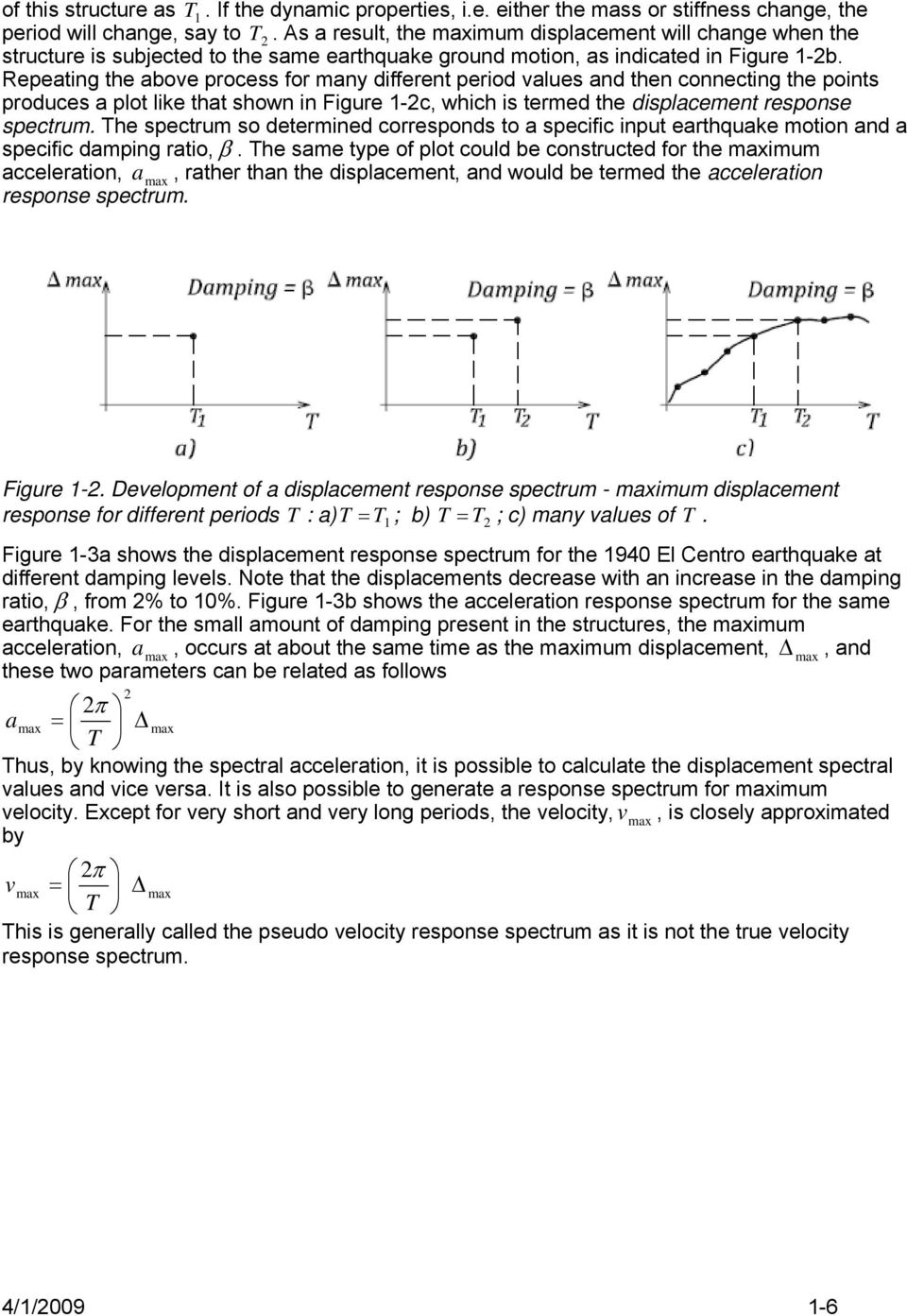
10 ) b) Figure 1-3. Response spectr for the 1940 El Centro NS erthquke t different dmping levels: ) displcement response spectrum; b) ccelertion response spectrum. The response spectrum cn be used to determine the mimum response of SDOF structure, given its fundmentl period nd dmping, to specific erthquke ccelertion record. Different erthqukes produce widely different spectr nd so it hs been the prctice to choose severl erthqukes (usully scled) nd use the resulting verge response spectrum s the design spectrum. For yers, the NBCC seismic provisions hve used this procedure where the design spectrum for site ws described by one or two prmeters, either pek ground ccelertion nd/or pek ground velocity, tht were determined using probbilistic mens. 4/1/

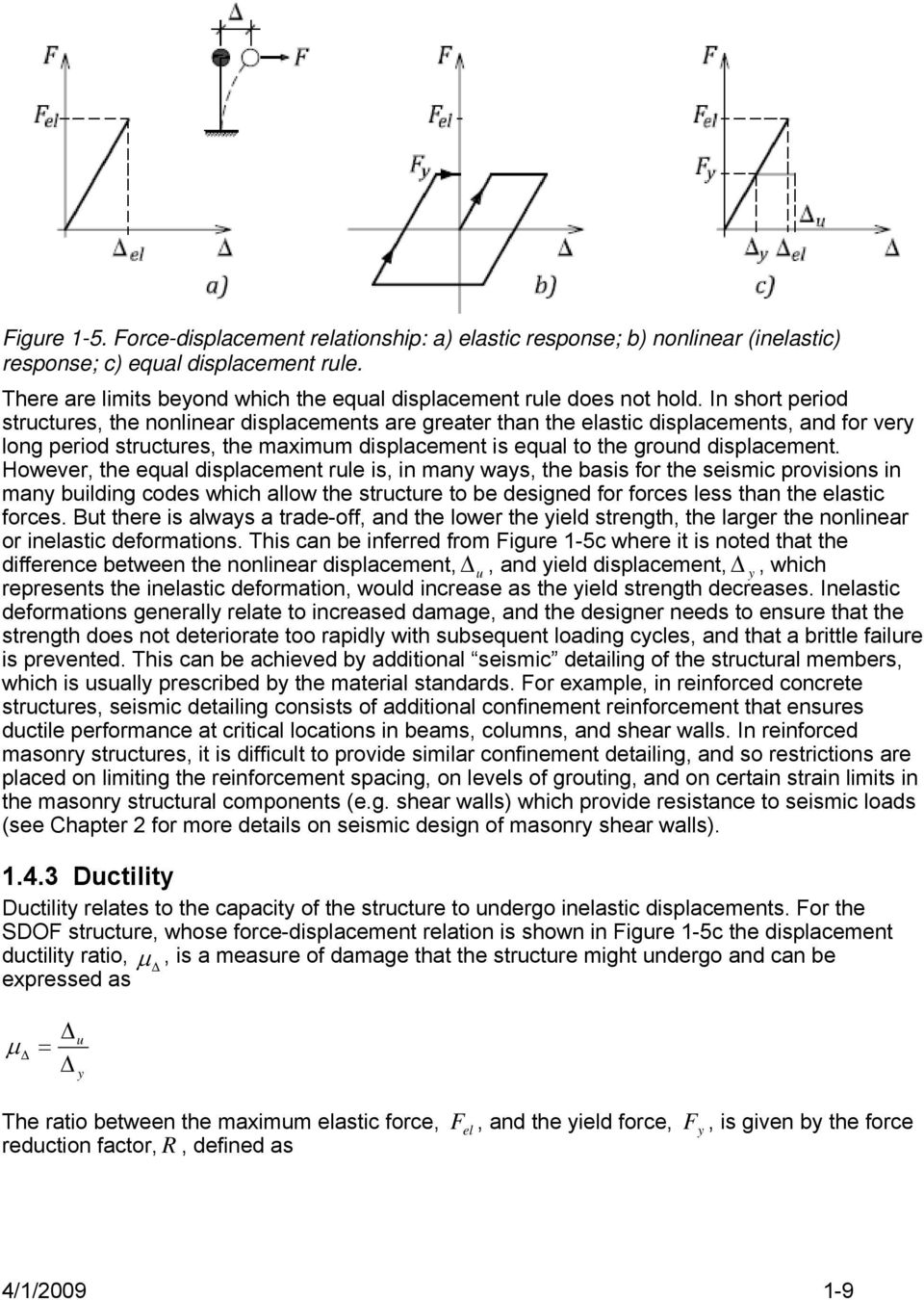
11 More recently, probbilistic methods hve been used to determine the spectrl vlues t site for different structurl periods. Figure 1-4 shows the 5% dmped ccelertion response spectrum for Vncouver used in developing the NBCC This is uniform hzrd response spectrum, i.e., spectrl ccelertions corresponding to different periods re bsed on the sme probbility of being eceeded, tht is, 2% in 50 yers. This will be discussed further in Section Figure 1-4. Uniform hzrd ccelertion response spectrum for Vncouver, 2% in 50 yer probbility, 5% dmping Inelstic Response For ny given erthquke ground motion nd SDOF elstic system it is possible to determine the mimum ccelertion nd the relted inerti force, F el, nd the mimum displcement, Δ el. Figure 1-5 shows force-displcement reltionship with the mimum elstic force nd displcement indicted. If the structure does not hve sufficient strength to resist the elstic force, F el, then it will yield t some lower level of inerti force, sy t lterl force level, F y. It hs been observed in mny studies tht structure with nonliner cyclic force-displcement response similr to tht shown in Figure 1-5b will hve mimum displcement tht is not much different from the mimum elstic displcement. This is indicted in Figure 1-5c where the inelstic (plstic) displcement, Δ u, is shown just slightly greter thn the elstic displcement, Δ el. This observtion hs led to the equl displcement rule, n empiricl rule which sttes tht the mimum displcement tht the structure reches in n erthquke is independent of its yield strength, i.e. irrespective of whether it demonstrtes elstic or inelstic response. The equl displcement rule is thought to hold becuse the nonliner response softens the structure nd so the period increses, thereby giving rise to incresed displcements. However, t the sme time, the yielding mteril dissiptes energy tht effectively increses the dmping (the energy dissiption is proportionl to the re enclosed by the force-displcement loops, termed hysteresis loops). Incresed dmping tends to decrese the displcements; therefore, it is possible tht the two effects blnce one nother with the result tht the elstic nd inelstic displcements re not significntly different. 4/1/

12 Figure 1-5. Force-displcement reltionship: ) elstic response; b) nonliner (inelstic) response; c) equl displcement rule. There re limits beyond which the equl displcement rule does not hold. In short period structures, the nonliner displcements re greter thn the elstic displcements, nd for very long period structures, the mimum displcement is equl to the ground displcement. However, the equl displcement rule is, in mny wys, the bsis for the seismic provisions in mny building codes which llow the structure to be designed for forces less thn the elstic forces. But there is lwys trde-off, nd the lower the yield strength, the lrger the nonliner or inelstic deformtions. This cn be inferred from Figure 1-5c where it is noted tht the difference between the nonliner displcement, Δ u, nd yield displcement, Δ y, which represents the inelstic deformtion, would increse s the yield strength decreses. Inelstic deformtions generlly relte to incresed dmge, nd the designer needs to ensure tht the strength does not deteriorte too rpidly with subsequent loding cycles, nd tht brittle filure is prevented. This cn be chieved by dditionl seismic detiling of the structurl members, which is usully prescribed by the mteril stndrds. For emple, in reinforced concrete structures, seismic detiling consists of dditionl confinement reinforcement tht ensures ductile performnce t criticl loctions in bems, columns, nd sher wlls. In reinforced msonry structures, it is difficult to provide similr confinement detiling, nd so restrictions re plced on limiting the reinforcement spcing, on levels of grouting, nd on certin strin limits in the msonry structurl components (e.g. sher wlls) which provide resistnce to seismic lods (see Chpter 2 for more detils on seismic design of msonry sher wlls) Ductility Ductility reltes to the cpcity of the structure to undergo inelstic displcements. For the SDOF structure, whose force-displcement reltion is shown in Figure 1-5c the displcement ductility rtio, μ, is mesure of dmge tht the structure might undergo nd cn be Δ epressed s μ Δ = Δ Δ u y The rtio between the mimum elstic force, reduction fctor, R, defined s F el, nd the yield force, F y, is given by the force 4/1/
13 R = F F el y If the mteril is elstic-perfectly plstic, i.e. there is no strin hrdening s it yields (see Figure 1-5b), nd if Δ is equl to Δ, then it cn be shown tht μ is equl to R. u el For different types of structures nd detiling requirements, most building codes tend to prescribe the R vlue while not mking reference to the displcement ductility rtio, μ, thus Δ implying tht the μ nd R vlues would be similr. Δ A Primer on Modl Dynmic Anlysis Procedure The min objective of this section is to eplin how more comple multi-degree-of-freedom structures respond to erthquke ground motions nd how such response cn be quntified in form useful for structurl design. This bckground should be helpful in understnding the NBCC seismic provisions Multi-degree-of-freedom systems The ide of modelling the building s SDOF structure ws introduced in Section 1.4.1, nd the dynmic response to erthquke ground motions ws developed in terms of response spectrum. Such simple model might well represent the lterl response of single storey wrehouse building with fleible wlls or brcing system, nd with rigid roof system where the roof comprises most of the weight (mss) of the structure. However, this is not good model for msonry wrehouse with metl deck roof, where the wlls re quite stiff nd the deck is fleible nd light reltive to the wlls. Such system requires more comple model using multi-degree-of-freedom (MDOF) system. A sher wll in multi-storey building is nother emple of MDOF system. Figure 1-6 shows two emples of MDOF structures. A simple four-storey structure is shown in Figure 1-6, nd simple MDOF model for this building consists of column representing the stiffness of verticl members (sher wlls or frmes), with the msses lumped t the floor levels. If the floors re rigid, it cn be ssumed tht the lterl displcements t every point in floor re equl, nd the structure cn be modelled with one degree of freedom (DOF) t ech floor level ( DOF cn be defined s lterl displcement in the direction in which the structure is being nlyzed). This will result in s mny degrees of freedom s number of floors, so this building cn be modelled s 4-DOF system. It must lso be ssumed tht there re no torsionl effects, tht is, there is no rottion of the floors bout verticl is (torsionl effects will be discussed lter in Section 1.5.9). The nlysis will be the sme irrespective of the lterl force resisting system ( sher wll or frme), side from detils in finding the lterl stiffness mtri for the floor displcements. The wrehouse building shown in Figure 1-6b is nother emple of MDOF structure. The wlls re treted s single column with some portion of the wll nd roof mss, M 1, locted t the top. The roof cn be treted s spring (or severl springs) with the remining roof mss, M 2, ttched to the spring(s). How much mss to ttch to ech degree of freedom, nd how to determine the stiffness of the roof, re mjor chllenges in this cse. Δ 4/1/

14 Figure 1-6. MDOF systems: ) multi-storey sher wll building; b) wrehouse with fleible roof Seismic nlysis methods The question of interest to structurl engineers is how to determine relistic seismic response for MDOF systems? The possible pproches re: sttic nlysis, nd dynmic nlysis (modl nlysis or time history method). The simplest method is the equivlent sttic nlysis procedure (lso known s the qusi-sttic method) in which set of sttic horizontl forces is pplied to the structure (similr to wind lod). These forces re ment to emulte the mimum effects in structure tht dynmic nlysis would predict. This procedure works well when pplied to smll, simple structures, nd lso to lrger structures if they re regulr in their lyout. NBCC 2005 specifies dynmic nlysis s the defult method. The simplest type of dynmic nlysis is the modl nlysis method. This method is restricted to liner systems, nd consists of dynmic nlysis to determine the mode shpes nd periods of the structure, nd then uses response spectrum to determine the response in ech mode. The response of ech 4/1/

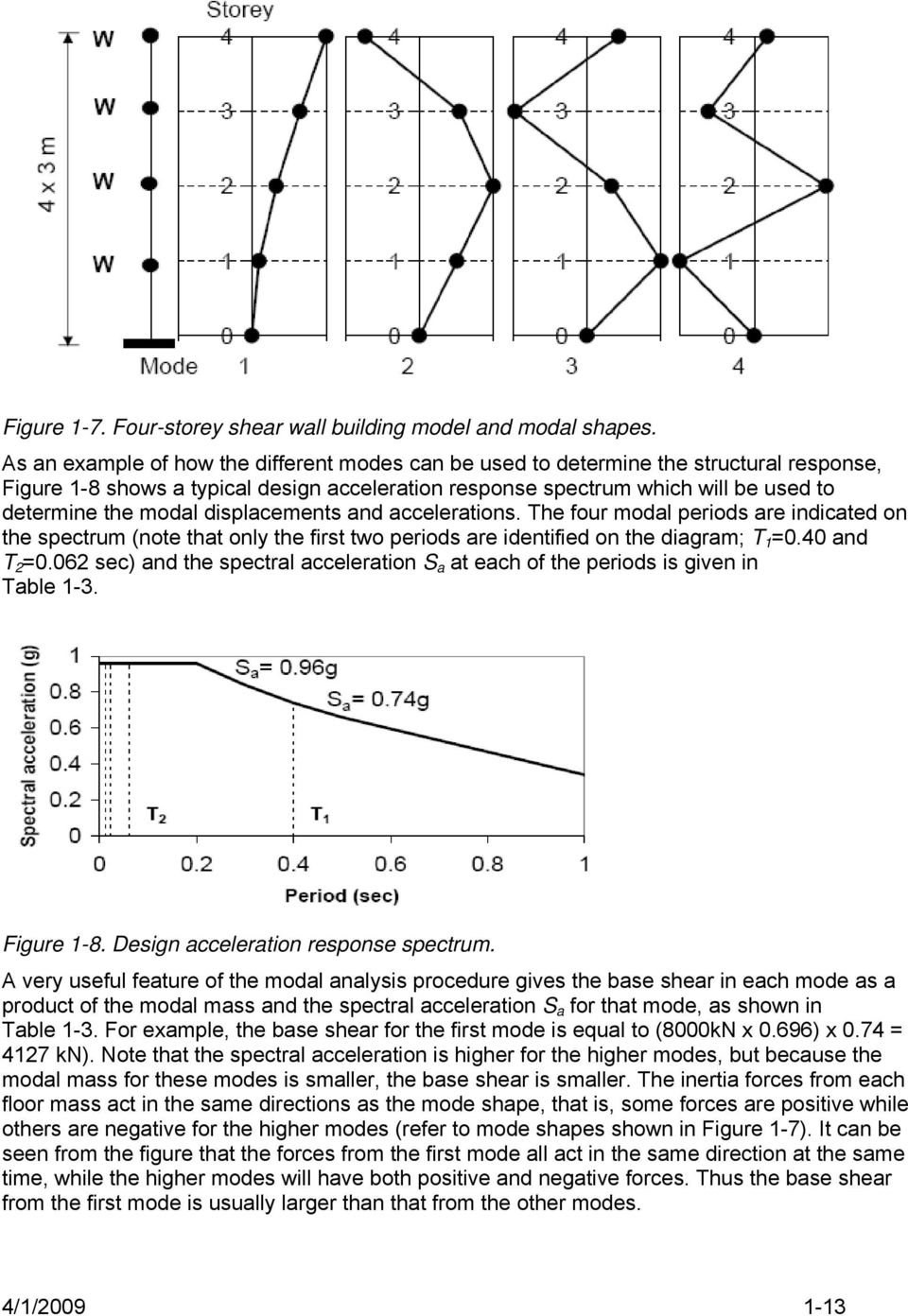
15 mode is independent of the other modes, nd the modl responses cn then be combined to determine the totl structurl response. In the net section, the modl nlysis procedure will be eplined with n emple. The second type of dynmic nlysis is the time history method. This consists of dynmic nlysis model subjected to time-history record of n erthquke ground motion. Time history nlysis is powerful tool for nlyzing comple structures nd cn tke into ccount nonliner structurl response. This procedure is comple nd time-consuming to perform, nd s such, not wrrnted for low-rise nd regulr structures. It requires n dvnced level of knowledge of the dynmics of structures nd it is beyond the scope of this document. For detiled bckground on dynmic nlysis methods the reder is referred to Chopr (2007) Modl nlysis procedure: n emple Consider four-storey sher wll building emple such s tht shown in Figure 1-6. The building cn be modelled s stick model, with weight,w, of 2,000 kn lumped t ech floor level, nd uniform floor height of 3 m (see Figure 1-7). For simplicity, the wll stiffness nd the msses re ssumed uniform over the height. This model is MDOF system with four degrees of freedom consisting of lterl displcement t ech storey level. A MDOF system hs s mny modes of vibrtion s degrees of freedom. Ech mode hs its own chrcteristic shpe nd period of vibrtion. The periods re given in Tble 1-1, the four mode shpes re given in Tble 1-2 nd shown in Figure 1-7. In this emple, the stiffness hs been djusted to give first mode period of 0.4 seconds, which is representtive of four-storey structure bsed on simple rule-of-thumb tht the fundmentl period is on the order of 0.1 sec per floor. Note tht the first mode, lso known s the fundmentl mode, hs the longest period. The first mode is by fr the most importnt for determining lterl displcements nd interstorey drifts, but higher modes cn substntilly contribute to the forces in structures with longer periods. In this emple the mode shpes hve been normlized so tht the lrgest modl mplitude is unity. For liner elstic structures, the equtions governing the response of ech mode re independent of the others provided tht the dmping is prescribed in prticulr mnner. Thus, the response in ech mode cn be treted in mnner similr to SDOF system, nd this llows the mimum displcement, moment nd sher to be clculted for ech mode. In the finl picture, the modl responses hve to somehow be combined to find the design forces (this will be discussed lter in this section). Modl nlysis cn be performed by hnd clcultion for simple structure, however, in most cses, the use of dynmic nlysis computer progrm would be required. Knowing the mode shpes nd the mss t ech level, it is possible to clculte the modl mss for ech mode, which is given in Tble 1-1 s frction of the totl mss of the structure. The modl msses re representtive of how the mss is distributed to ech mode, nd the sum of the modl msses must dd up to the totl mss. When doing modl nlysis, sufficient number of modes should be considered so tht the sum of the modl msses dds up to t lest 90% of the totl mss. In the emple here this would indicte tht only the first two modes would need to be considered ( = 0.906). 4/1/

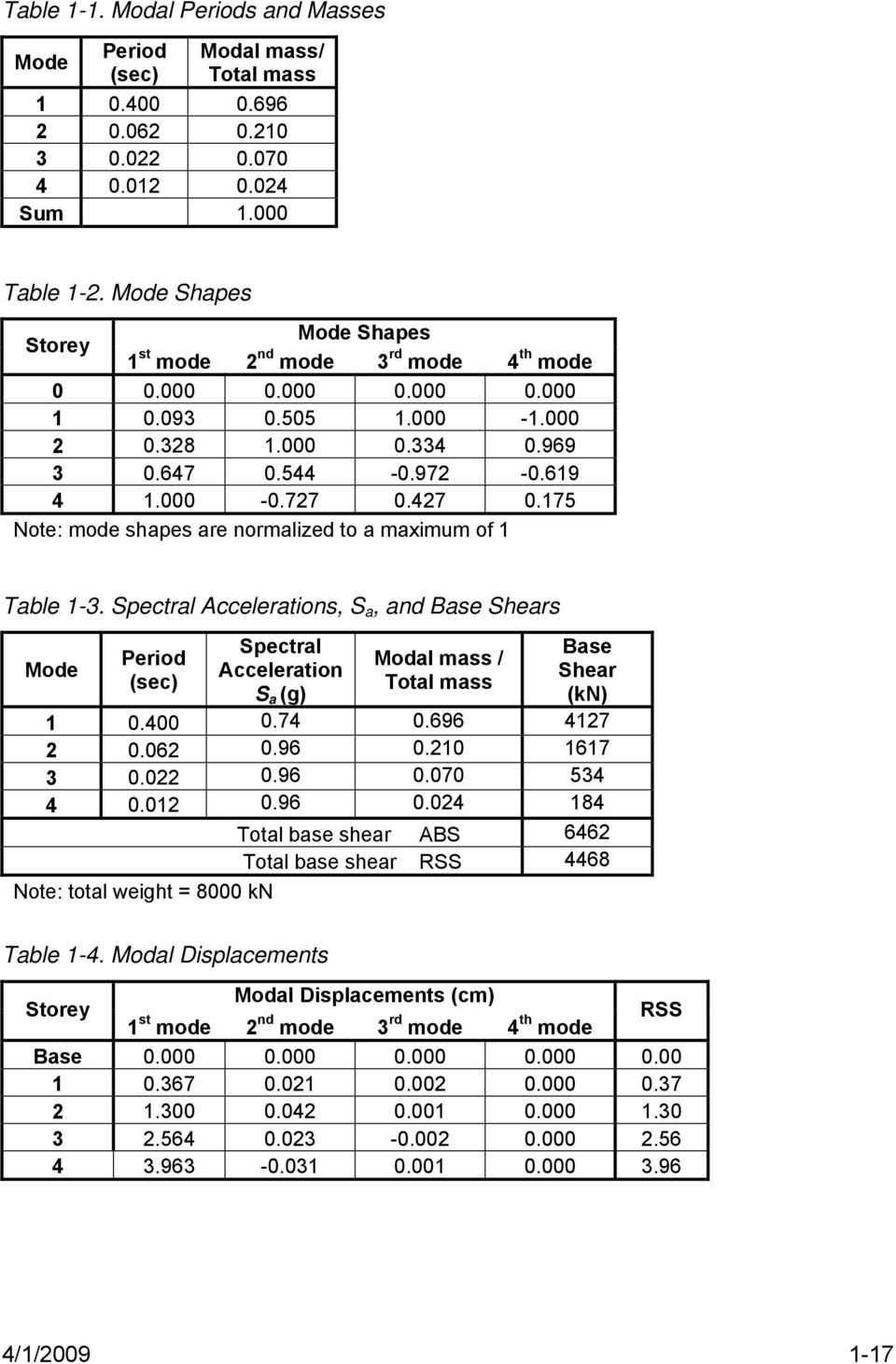
16 Figure 1-7. Four-storey sher wll building model nd modl shpes. As n emple of how the different modes cn be used to determine the structurl response, Figure 1-8 shows typicl design ccelertion response spectrum which will be used to determine the modl displcements nd ccelertions. The four modl periods re indicted on the spectrum (note tht only the first two periods re identified on the digrm; T 1 =0.40 nd T 2 =0.062 sec) nd the spectrl ccelertion S t ech of the periods is given in Tble 1-3. Figure 1-8. Design ccelertion response spectrum. A very useful feture of the modl nlysis procedure gives the bse sher in ech mode s product of the modl mss nd the spectrl ccelertion S for tht mode, s shown in Tble 1-3. For emple, the bse sher for the first mode is equl to (8000kN 0.696) 0.74 = 4127 kn). Note tht the spectrl ccelertion is higher for the higher modes, but becuse the modl mss for these modes is smller, the bse sher is smller. The inerti forces from ech floor mss ct in the sme directions s the mode shpe, tht is, some forces re positive while others re negtive for the higher modes (refer to mode shpes shown in Figure 1-7). It cn be seen from the figure tht the forces from the first mode ll ct in the sme direction t the sme time, while the higher modes will hve both positive nd negtive forces. Thus the bse sher from the first mode is usully lrger thn tht from the other modes. 4/1/
17 The modl bse shers shown in Tble 1-3 re the mimum bse shers for ech mode. It is very unlikely tht these forces will occur t the sme time during the ground shking, nd they could hve either positive or negtive signs. Summing the contribution of ech mode where ll vlues re tken s positive, known s the bsolute sum (ABS) method, produces very high upper bound estimte of the totl bse sher. Sttisticl nlyses hve shown tht the squreroot-of-the-sum-of-the squres (RSS) procedure, whereby the contribution of ech mode is squred, nd the squre root is then tken of the sum of the squres, gives resonbly good estimte of the modl sum, especilly if the modl periods re widely seprted. Tble 1-3 shows the bse sher vlues estimted by the two methods nd gives n indiction of the conservtism of the ABS method for this cse (totl bse sher of 6,462 kn), where the modl periods re widely seprted, nd use of the RSS method is pproprite since it gives lower totl bse sher vlue of 4,468 kn. Note tht there is third method tht is incorported in mny modl nlysis progrms clled the complete-qudrtic-combintion (CQC) method. This method should be used if the periods of some of the modes being combined re close together, s would be the cse in mny three-dimensionl structurl nlyses, but for most structures with well-seprted periods nd low dmping, the result of the RSS nd CQC methods will be nerly identicl (this is true for most two-dimensionl structurl nlyses). The mplitude of displcement in ech mode is dependent upon the spectrl ccelertion for tht mode nd its modl prticiption fctor, which is mesure of the degree to which certin mode prticiptes in the response. The vlue of the modl prticiption fctor depends on how the mode shpes re normlized, nd so will not be given here, however the vlues re smller for the higher modes with the result tht the displcements for the higher modes re generlly smller thn those of the first mode. The modl displcements re presented in Tble 1-4 (to three deciml plces, which is why some vlues re shown s zero) nd plotted in Figure 1-9 for the first two modes s well s the RSS vlue. In this emple, the influence of the two highest modes is very smll nd hs been omitted from the digrm. It is difficult to distinguish between the first mode displcements nd the RSS displcements in Figure 1-9; this is chrcteristic of structures with periods less thn bout 1 second, such s would be the cse for most msonry structures. Figure 1-9. Modl displcements. 4/1/

18 Modl nlysis gives the modl shers nd bending moments in ech member nd these vlues cn be used to generte the sher nd moment digrms. These re summrized in Tbles 1-5 nd 1-6, nd re grphiclly presented in Figure Only the results from the first two modes re shown s the higher modes contribute very little to the response. Ecept for some contribution to the shers, the second mode is insignificnt in contributing to the totl vlues clculted using the RSS method. ) b) Figure Modl nlysis results: ) sher forces; b) bending moments. The inerti force t ech floor for ech mode cn be determined by tking the difference between the sher force bove nd below the floor in question. Modl inerti forces long with the RSS vlues re summrized in Tble 1-7, nd show tht the higher modes t some levels contribute more thn the first mode. Note tht the sum of the inerti forces for ech mode is equl to the bse sher for tht mode. However, the sum of the RSS vlues of the floor forces t ech level is 6284 kn (obtined by dding vlues for storeys 1 to 4 in the lst column of the tble); this is not equl to the totl bse sher of 4468 kn found by tking the RSS of the bse shers in ech mode (see Tble 1-3). This demonstrtes the key rule in combining modl responses: only primry quntities from ech mode should be combined. For emple, if the designer is interested in the sher force digrm for the structure, it is necessry to find the sher forces in ech mode nd then combine these modl quntities using the RSS method. It is incorrect to find the totl floor forces t ech level from the RSS of individul modl vlues, nd then use these totl forces to drw the sher digrm. Even interstorey drift rtios, defined s the difference in the displcement from one floor to the net divided by the storey height, should be clculted for ech mode nd then combined using the RSS procedure. It would be incorrect to divide the totl floor displcements by the storey height; lthough in this emple since the deflection is lmost entirely given by the first mode this pproch would be very close to tht found using the RSS method. One of the disdvntges of modl nlysis is tht the signs of the forces re lost in the RSS procedure nd so equilibrium of the finl force system is not stisfied. Equilibrium is stisfied in ech mode, but this is lost in the procedure to combine modl quntities since ech quntity is squred. Tht is why it is importnt to determine quntities of interest by combining only the originl modl vlues. 4/1/

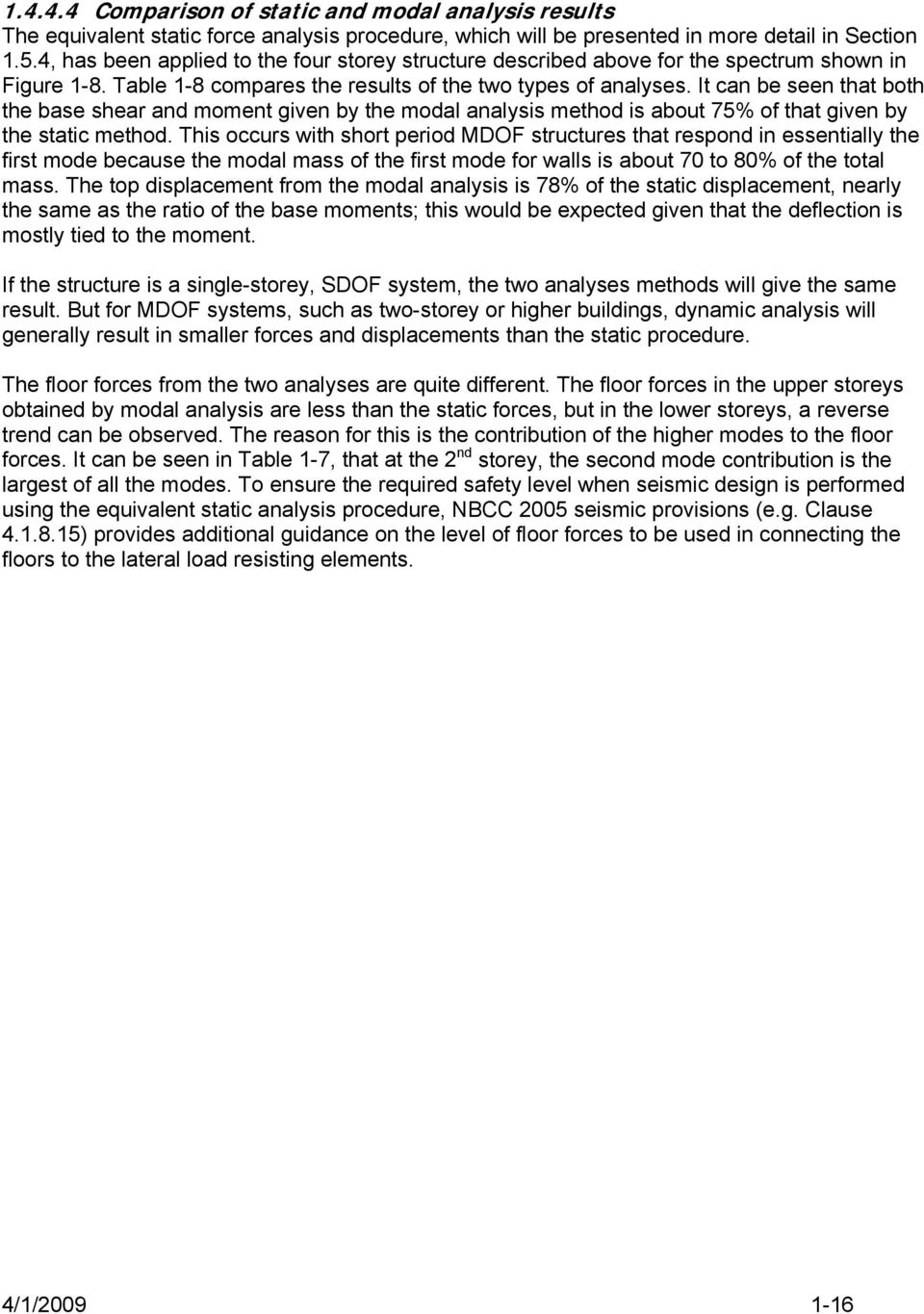
19 Comprison of sttic nd modl nlysis results The equivlent sttic force nlysis procedure, which will be presented in more detil in Section 1.5.4, hs been pplied to the four storey structure described bove for the spectrum shown in Figure 1-8. Tble 1-8 compres the results of the two types of nlyses. It cn be seen tht both the bse sher nd moment given by the modl nlysis method is bout 75% of tht given by the sttic method. This occurs with short period MDOF structures tht respond in essentilly the first mode becuse the modl mss of the first mode for wlls is bout 70 to 80% of the totl mss. The top displcement from the modl nlysis is 78% of the sttic displcement, nerly the sme s the rtio of the bse moments; this would be epected given tht the deflection is mostly tied to the moment. If the structure is single-storey, SDOF system, the two nlyses methods will give the sme result. But for MDOF systems, such s two-storey or higher buildings, dynmic nlysis will generlly result in smller forces nd displcements thn the sttic procedure. The floor forces from the two nlyses re quite different. The floor forces in the upper storeys obtined by modl nlysis re less thn the sttic forces, but in the lower storeys, reverse trend cn be observed. The reson for this is the contribution of the higher modes to the floor forces. It cn be seen in Tble 1-7, tht t the 2 nd storey, the second mode contribution is the lrgest of ll the modes. To ensure the required sfety level when seismic design is performed using the equivlent sttic nlysis procedure, NBCC 2005 seismic provisions (e.g. Cluse ) provides dditionl guidnce on the level of floor forces to be used in connecting the floors to the lterl lod resisting elements. 4/1/
20 Tble 1-1. Modl Periods nd Msses Mode Period (sec) Modl mss/ Totl mss Sum Tble 1-2. Mode Shpes Storey Mode Shpes 1 st mode 2 nd mode 3 rd mode 4 th mode Note: mode shpes re normlized to mimum of 1 Tble 1-3. Spectrl Accelertions, S, nd Bse Shers Mode Period (sec) Spectrl Accelertion S (g) Modl mss / Totl mss Bse Sher (kn) Totl bse sher ABS 6462 Totl bse sher RSS 4468 Note: totl weight = 8000 kn Tble 1-4. Modl Displcements Storey Modl Displcements (cm) 1 st mode 2 nd mode 3 rd mode 4 th mode RSS Bse /1/
21 Tble 1-5. Modl Sher Forces Storey Sher Forces (kn) 1 st mode 2 nd mode 3 rd mode 4 th mode RSS Tble 1-6. Modl Bending Moments Storey Bending Moments (knm) 1 st mode 2 nd mode 3 rd mode 4 th mode RSS Bse Tble 1-7. Modl Inerti Forces (Floor Forces) Storey Floor Forces (kn) 1 st mode 2 nd mode 3 rd mode 4 th mode RSS Sum Tble 1-8. Comprison of Sttic nd Dynmic Anlyses Results Storey Sher Forces (kn) Floor Forces (kn) Moments (knm) Deflections (cm) Sttic Modl (1) Sttic Modl (2) Sttic Modl (3) Sttic Modl (4) Bse Notes: (1) see Tble 1-5, lst column (2) see Tble 1-7, lst column; (3) see Tble 1-6, lst column; (4) see Tble 1-4, lst column. 4/1/
22 1.5 Seismic Anlysis According to NBCC 2005 This section presents nd eplins the relevnt seismic code provisions in NBCC Reference will be mde here to NBCC 1995 where pproprite, but Appendi A contins the pertinent 1995 code provisions nd comprison of the design forces from the two codes Seismic Hzrd (6) One of the mjor chnges to the seismic provisions between the 1995 nd 2005 editions of the NBCC is relted to the determintion of the seismic hzrd. The 1995 code ws bsed on probbilistic estimtes of the pek ground ccelertion nd pek ground velocity for probbility of eceednce of 1/475 per nnum (10% in 50 yers). For NBCC 2005, the seismic hzrd is bsed on 2% in 50 yers probbility (corresponding to 1/2475 per nnum), nd it is represented by the 5% dmped spectrl response ccelertion, S (T ). During the NBCC 2005 code development cycle, records becme vilble, nd the bility to compute how response spectrl vlues vry with mgnitude nd distnce from source to site gretly improved. Thus, it ws possible to compute probbilistic estimtes of spectrl ccelertion for different structurl periods, nd construct response spectrum where ech point on the spectrum hs the sme probbility of eceednce. Such spectrum is termed Uniform Hzrd Spectrum, or UHS. The ccelertion UHS for Montrel is shown in Figure Figure Uniform hzrd spectrum for Montrel (UHS), 2% in 50 yers probbility, 5% dmping. For design purposes, the NBCC 2005 does not use the UHS, but rther n pproimtion given by four period-spectrl vlues which re used to construct spectrum, S (T ), which is used s the bsis for the design spectrum. For mny loctions in the country, these vlues re specified in Tble C-2, Appendi C to the NBCC 2005, long with the pek ground ccelertion (PGA) for ech loction, which is used minly for geotechnicl purposes. For other Cndin loctions, it is possible to find the vlues online t: by entering the coordintes (ltitude nd longitude) of the loction. The progrm does not directly clculte the S (T ) vlues, but insted, interpoltes them from the known vlues t 4/1/
23 severl surrounding loctions. For detiled informtion on the models used s the bsis for the NBCC 2005 seismic hzrd provisions, the reder is referred to Adms nd Hlchuk (2003). Figure 1-12 shows the S (T ) spectrum for Montrel nd the corresponding UHS. Since S (T ) is constructed using only four points (corresponding to different periods), it is n pproimtion to the UHS, nd it lso reflects some conservtism in the code. At very short periods S (T ) is tken to be constnt t the S (0.2) vlue, nd it does not decrese to the PGA, which is the UHS vlue t zero period. This my pper to be very conservtive, but only few structures hve periods less thn 0.2 sec, nd there re other resons relted to the inelstic response of such short-period structures, to be conservtive in this region. Note tht mny low-rise msonry buildings my hve fundmentl period on the order of 0.2 sec. The dt needed to clculte the UHS vlues for lrge periods (over 2 seconds) is not vilble for ll regions in Cnd, nd so between 2 seconds nd 4 seconds, S (T ) is ssumed to vry s1 / T. Beyond 4 seconds there is even less dt, nd S (T ) is ssumed to be constnt t the S (4) vlue for periods lrger thn 4 seconds. S (T ) is defined s the design hzrd spectrum for sites locted on wht is termed soft rock or very dense soil. For sites situted on either hrder rock or softer soil the hzrd spectrum needs to be modified s discussed below. Figure S (T ) nd UHS spectrum for Montrel Effect of Site Soil Conditions In the NBCC 2005, the seismic hzrd given by the S (T ) spectrum hs been developed for site tht consists of either very dense soil or soft rock (Site clss C within NBCC 2005). If the structure is to be locted on soil tht is softer thn this, the ground motion my be mplified, or in the cse of rock or hrd rock sites, the motion will be de-mplified. In NBCC 2005 two site coefficients re provided to be pplied to the S (T ) spectrum to ccount for these locl ground conditions. The coefficients depend on the building period, level of seismic hzrd, s well s on the site properties, which re described in terms of site clsses. The NBCC 2005 site coefficients re more detiled thn the foundtion fctor, F, provided in previous code editions, but should better represent the effect of the locl soil conditions on the seismic response. 4/1/
24 Tble 1-9 ecerpted from NBCC 2005, describes si site clsses, lbelled from A to E, which correspond to different soil profiles (note tht the seventh clss, F, is one tht fits none of the first si nd would require specil investigtion). The site clsses re bsed on the properties of the soil or rock in the top 30 m. Site clss C is the bse clss for which the site coefficients re unity, i.e. it is the type of soil on which the dt used to generte the S ( T ) spectrum is bsed. The tble identifies three soil properties tht cn be used to identify the site clss; the best one being the verge sher wve velocity, V s, which is prmeter tht directly ffects the dynmic response. The site clss determintion is bsed on the weighted verge, of the property being considered, in the top 30 m, which for V s would correspond to the verge velocity it would tke for sher wve to trverse the 30 m depth. NBCC 2005 nd Commentry J (NRC, 2006) do not discuss the level from which the 30 m should be mesured. For buildings on shllow foundtions, the 30 m should be mesured from the bottom of the foundtion. However, if the building hs very deep foundtion where the ground motion forces trnsferred to the building my come from both friction t the bse nd soil pressures on the sides, the nswer is not so cler nd my require site specific investigtion to determine the ccelertions of the building foundtion. Tble 1-9. NBCC 2005 Site Clssifiction for Seismic Response (NBCC 2005 Tble A) Averge Properties in Top 30 m, s per Appendi A Site Clss Ground Profile Nme Averge Sher Wve Velocity, V s (m/s) Averge Stndrd Penetrtion Soil Undrined Sher Strength, s u Resistnce, N 60 A Hrd rock V s > 1500 Not pplicble Not pplicble B Rock 760 < V s 1500 Not pplicble Not pplicble C Very dense soil nd soft rock 360 < V s < 760 N 60 > 50 s u > 100kP D Stiff soil 180 < V s < < N 60 < < s u 100kP V s <180 N 60 < 15 s u < 50kP E Soft soil Any profile with more thn 3 m of soil with the following chrcteristics: plsticity inde: PI > 20 moisture content: w 40%; nd undrined sher strength: s u < 25 kp F Other soils (1) Site-specific evlution required Reproduced with the permission of the Ntionl Reserch Council of Cnd, copyright holder Notes: (1) Other soils include: ) liquefible soils, quick nd highly sensitive clys, collpsible wekly cemented soils, nd other soils susceptible to filure or collpse under seismic loding, b) pet nd/or highly orgnic clys greter thn 3 m in thickness, c) highly plstic clys (PI>75) more thn 8 m thick, d) soft to medium stiff clys more thn 30 m thick. The effect of the site clss on the response spectrum is given by the following two site coefficients: F, which modifies the spectrum S ( T ) in the short period rnge (see Tble 1-10), nd S T in the longer period rnge (see Tble 1-11). F, which modifies ( ) v 4/1/
25 Tble Vlues of F s Function of Site Clss nd S (0.2) (NBCC 2005 Tble B) Site Vlues of F Clss S (0.2) 0.25 S (0.2) = 0.50 S (0.2) = 0.75 S (0.2) =1.00 S (0.2) = 1.25 A B C D E F (1) (1) (1) (1) (1) Reproduced with the permission of the Ntionl Reserch Council of Cnd, copyright holder Notes: (1) See Sentence (5). Tble Vlues of F s Function of Site Clss nd S (1.0) (NBCC 2005 Tble C) v Site Vlues of F v Clss S (1.0) 0.1 S (1.0) = 0.2 S (1.0) = 0.3 S (1.0) =0.4 S (1.0) > 0.5 A B C D E F (1) (1) (1) (1) (1) Reproduced with the permission of the Ntionl Reserch Council of Cnd, copyright holder Notes: (1) See Sentence (5). Note tht the F nd F v vlues depend on the level of seismic hzrd s well s on the site soil clss. For soft soil sites (site clsses D nd E), motion from high hzrd event would led to higher sher strins in the soil, which gives rise to higher soil dmping nd reduced surfce motion, when compred to low hzrd motion. The softer the soil, s given by higher site clssifiction, the higher the site coefficients, ecept for few F vlues t high hzrd level. For rock nd hrd rock, the site coefficients will generlly be less thn unity. The F nd F fctors re pplied to the S ( T ) spectrum to give S ( T ) v spectrl ccelertion for the site. The clcultion of ( T ) emple., which is the design S vlues will be illustrted with n Figure 1-13 shows the design seismic hzrd spectrum, S (T ), for Vncouver for firm ground site, Clss C, nd soft soil site, Clss E. For Vncouver (Grnville nd 41 Ave): S ( 0.2) =0.96g, S ( 0.5) =0.66g, S ( 1.0) =0.34g, nd S ( 2.0) =0.17 (see Appendi C, NBCC 2005; note tht these vlues were tken from n erlier version of Tble C-2 nd re slightly different from the published vlues). Interpolting from the vlues in Tble 1-10 for site Clss E nd ( 0.2) nd from Tble 1-11 for S ( 1.0) =0.34g, gives F v =1.82. S =0.96g, gives F =0.932, The clcultions to determine S (T ) for the Clss E site re (see Cluse (6)): 4/1/
26 For T=0.2 sec: S(0.2) = F S (0.2) = =0.89 S(0.2)=0.89 For T=0.5 sec: S(0.5) = F v S (0.5) = = 1.2, or S(0.5) = F S (0.2) = = 0.89, whichever is smller Since the smller vlue governs, S(0.5)=0.89 For T=1 sec: S(1.0) = F v S (1.0) = = 0.62 S(1.0)=0.62 For T=2 sec: S(2.0) = F v S (2.0) = = 0.31 S(2.0)=0.31 For T 4 sec: S(T) = F v S (2.0)/2 = /2 = S(T 4.0)=0.155 The resulting S (T ) soil Clss C nd E design spectr for Vncouver re plotted in Figure Figure S(T) design spectr for Vncouver for site Clsses C nd E Methods of Anlysis NBCC 2005 prescribes two methods of clculting the design bse sher of structure. The dynmic method is the defult method, but the equivlent sttic method cn be used if the structure meets ny of the following criteri: () is locted in region of low seismic ctivity where I E F S ( 0.2) < ( I E is the erthquke importnce fctor of the structure s defined in Cluse (1)), (b) is regulr structure less thn 60 m in height with period, T, less thn 2 seconds in either direction ( T is defined s the fundmentl lterl period of vibrtion of the structure in the direction under considertion, s defined in Cluse (3)),or (c) is n irregulr structure, but does not hve Type 7 irregulrity, nd is less thn 20 m in height with period, T, less thn 0.5 seconds in either direction (see Section for more detils on irregulrities). The equivlent sttic method will be described in this section becuse it likely cn be used on the mjority of msonry buildings given the bove criteri, nd notwithstnding, if the dynmic method is used, it must be clibrted bck to the bse sher determined from the equivlent sttic nlysis procedure. Bsic concepts of the modl dynmic nlysis method were presented in Section 1.4.4, nd further discussion is offered in Section /1/
27 1.5.4 Bse Sher Clcultions- Equivlent Sttic Anlysis Procedure The lterl erthquke forces used in design re specified in the NBCC 2005, nd re bsed on the mimum (design) bse sher,v, of the structure s given by Cluse The elstic bse sher, V, denotes the bse sher if the structure were to remin elstic. Design bse e sher,v, is equl to V reduced by the force reduction fctors, R e d nd R o, (relted to ductility nd overstrength, respectively; discussed in Section 1.5.5), nd incresed by the importnce fctor I E (see Tble 1-12 for description of prmeters used in these reltions), thus; V = VeI E R R d o where ( T ) M W Ve = S v represents the elstic bse sher, W is the ded lod, s defined in Tble M v is multiplier tht ccounts for higher mode shers, nd The reltionship between V nd e V is shown in Figure Note tht the ctul strength of the structure is greter thn the design strength V. Figure Design bse sher,v, nd elstic bse sher, V. NBCC 2005 prescribes the following lower nd upper bounds for the design bse sher, V : ) Lower bound: Becuse of uncertinties in the hzrd spectrum, S ( T ), for periods greter thn 2 seconds, the minimum design bse sher should not be tken less thn: S( 2.0) M v I EW Vmin = R R d o e 4/1/
28 b) Upper bound: Short period structures hve smll displcements, nd there is not huge body of evidence of filures for very low period structures, provided the structure hs some ductile cpcity. Thus n upper bound on the design bse sher is given by: 2S( 0.2) I EW V = m, provided R d Rd Ro M is not included in the bove eqution s M = 1 for short periods. v Some site specific studies for soil clsses E nd F, especilly those locted in high seismic zones, my show spectrl vlues for periods of 0.5 to1.0 seconds to be greter thn 2S ( 0.2) 3. If this occurs it is recommended tht the spectrl vlue used in the short period rnge not be less thn mimum vlue t the longer period. Note tht the design bse sher force,v, corresponds to the design force t the ultimte limit stte, where the structure is ssumed to be t the point of collpse. Consequently, seismic lods re designed with lod fctor vlue of 1.0 when used in combintion with other lods (e.g. ded nd live lods; see Tble , NBCC 2005). It is lso useful to recll tht while V represents the design bse sher, individul members re designed using fctored resistnces, φ R, nd since the nominl resistnce, R, is greter thn the fctored resistnce, the ctul bse sher cpcity will be pproimtely equl to VR, s shown in Figure T denotes the fundmentl period of vibrtion of the building or structure in seconds in the direction under considertion (i.e. direction of seismic force). The fundmentl period of wll structures is given in the NBCC 2005 by: ) ( ) 3 4 T = 0.05 hn v, where h n is the height of the building in metres (Cl (c)), or b) other estblished methods of mechnics, ecept tht T should not be greter thn 2.0 times tht determined in () bove (Sub Cl (d)iii). The code formul to clculte T in () is simpler thn the corresponding NBCC 1995 eqution, in tht it is bsed solely on building height nd not on the length of the wlls, nd the llownce for using clculted T in (b) is usully more liberl thn in NBCC The period given by the NBCC 2005 in () is conservtive (short) estimte bsed on mesured vlues for eisting buildings. Using method (b) will generlly result in longer period, with resulting lower forces, nd should be bsed on stiffness vlues reflecting possible crcked sections nd sher deformtions. For the purpose of clculting deflections, there is no limit on the clculted period s longer period results in lrger displcements ( conservtive estimte), but it should never be less thn tht period used to clculte the forces. o 4/1/
29 Tble NBCC 2005 Seismic Design Prmeters Design prmeter S ( T ) = the design spectrl ccelertion tht includes the site soil coefficients F nd F v (see Section 1.5.2) S(T) = FS(0.2) for T < 0.2 s = FvS(0.5) or FS (0.2) whichever is smller for T= 0.5 s = FvS (1.0) for T = 1.0 s = FvS (2.0) for T = 2.0 s = FvS (2.0)/2 for T 4.0 s NBCC reference Cl (6) M v = higher mode fctor (see Section 1.5.6) Cl (5) Tble I E = W = R d = R o = importnce fctor for the design of the structure: 1.5 for post-disster buildings, 1.3 for high importnce structures, including schools nd plces of ssembly tht could be used s refuge in the event of n erthquke, 1.0 for norml buildings, nd 0.8 for low importnce structures such s frm buildings where people do not spend much time. See Tble in NBCC 2005 Prt 4 for more complete definitions of the importnce ctegories. There re lso requirements for the servicebility limit sttes for the different ctegories. ded lod plus some portion of live lod tht would move lterlly with the structure (lso known s seismic weight). Live lods considered re 25% of the design snow lod, 60% of storge lods for res used for storge, nd the full contents of ny tnks. This requirement is the sme s in the NBCC 1995 ecept tht minimum prtition lod tht need not eceed 0.5 kp, nd tht prking grges need not be considered s storge res. ductility relted force modifiction fctor tht represents the cpbility of structure to dissipte energy through inelstic behviour (see Tble 1-13 nd Section 1.5.5); rnges from 1.0 for unreinforced msonry to 2.0 for modertely ductile msonry sher wlls. overstrength relted force modifiction fctor tht ccounts for the dependble portion of reserve strength in the structure (see Tble 1-13 nd Section 1.5.5); equl to 1.5 for ll reinforced msonry wlls. Cl (1) Tble Cl Tble Tble /1/
30 1.5.5 Force Reduction Fctors R d nd Tble 1-13 (NBCC 2005 Tble ) gives the R d nd R o vlues for the different types of msonry lterl lod-resisting systems, which re termed the Seismic Force Resisting Systems, SFRS(s), by NBCC 2005 Cl The SFRS is tht prt of the structurl system tht hs been considered in the design to provide the lterl resistnce to the erthquke forces nd effects. In ddition to providing the R d nd R o vlues, Tble 1-13 lists height limits for the different systems depending on the level of seismic hzrd nd importnce fctor, I E. Tble Msonry R d nd R o Fctors nd Generl Restrictions (1) - Forming Prt of Sentence (1) (Source: NBCC 2005 Tble ) Type of SFRS R d R o Height Restrictions (m) (2) Cses where I E F S (0.2) Cses where <0.2 <0.35 to 0.75 to >0.75 >0.3 I E F v S (1.0) Msonry Structures Designed nd Detiled According to CSA S304.1 Modertely ductile sher NL NL wlls 40 Limited ductility sher wlls NL NL Conventionl construction NL sher wlls Conventionl construction NL 30 NP NP NP moment resisting frmes Unreinforced msonry NP NP NP Other msonry SFRS(s) not NP NP NP NP listed bove Reproduced with the permission of the Ntionl Reserch Council of Cnd, copyright holder Notes: (1) See Article (2) NP = not permitted. NL = system is permitted nd not limited in height s n SFRS; height my be limited in other prts of the NBCC. Numbers in this Tble re mimum height limits in m. The most stringent requirement governs. Commentry Tble 1-13 identifies the following five SFRS(s) relted to msonry construction: 1. Modertely ductile sher wlls 2. Limited ductility sher wlls 3. Conventionl construction: sher wlls nd moment resisting frmes 4. Unreinforced msonry 5. Other undefined msonry SFRS(s) R o 4/1/
31 Note tht modertely ductile sher wlls re ssigned the highest R d vlue of 2.0, leding to the lowest design forces for msonry structures. The detiling requirements, given in CSA S , re the most restrictive of ll the msonry sher wll types, but the height limittions imposed by the NBCC 2005 re the most liberl, llowing structures up to 60 m in height (pproimtely 20 storeys) in modertely high seismic regions. This type of construction would normlly only be used in tller structures, but is required for msonry SFRS(s) used in postdisster buildings. Modertely ductile squt sher wlls, those with height-to-length rtio less thn 1, re seprte clss of modertely ductile sher wlls. They re llowed higher sher resistnce, nd less restrictive requirements on the height-to-thickness rtio, when compred to regulr modertely ductile wlls. Limited ductility sher wlls nd conventionl construction sher wlls both hve R d = The limited ductility wlls hve more stringent detiling requirements thn the conventionl construction wlls, but the height restrictions imposed by the NBCC 2005 re not s onerous. It is likely tht the most common type of msonry sher wll construction used would be conventionl construction wlls. Conventionl construction moment-resisting frmes re lso llowed n R d = 1. 5, but re not permitted in modertely high seismic regions. CSA S304.1 does not discuss moment frmes nd they will not be discussed further here s they re rrely, if ever, used in msonry design. Unreinforced msonry construction is only llowed where I E F S ( 0.2) < height of 15 m, ecept tht they cn go to height of 30 m if I F S ( 0.2) < 0. 2, nd is limited to E. Unreinforced msonry does not hve good record in pst erthqukes nd is ssigned R d = R o = 1. 0 vlues, s there is usully no ductility nd brittle filures re possibility. The R o fctor in NBCC 2005 is n overstrength fctor to ccount for the rel resistnce cpcity of the structure when compred to the fctored design resistnce. It is mde up of 3 components: i) 1/ φ = , ii) fctor tht ccounts for the epected yield strength of the reinforcement bove the specified yield strength, nd iii) fctor of bout 1.1 tht recognizes tht, becuse of restrictions on possible loctions for the reinforcement in msonry wlls, the mount of reinforcement is in most cses lrger thn tht required. This results in n R o = 1. 5 fter some rounding of the fctors (Mitchell et l., 2003) Higher Mode Effects ( M v fctor) (5) In the determintion of elstic bse sher, S T is used. e To ccount for the dditionl bse sher tht comes from the higher modes, the M v fctor is introduced. M v depends on the type of SFRS, the fundmentl period T, nd the rtio S ( 0.2) S (2.0). The M v vlues ssigned by NBCC 2005 re presented in Tble A discussion bout the bse overturning reduction fctor, J, (lso tbled) is provided in Section V, only the first mode spectrl vlue ( ) 4/1/
32 Tble Higher Mode Fctor, M v, nd Bse Overturning Reduction Fctor, Prt of Sentence (5) (NBCC 2005 Tble ) Type of Lterl Resisting S ( 0.2) S (2.0) Systems 1. 0 M v (1)(2) J Forming T T 2. 0 T 0. 5 T 2. 0 Moment resisting frmes or coupled wlls (3) < 8.0 Brced frmes Wlls, wll-frme systems, other systems (4) Moment resisting frmes or coupled wlls (3) Brced frmes Wlls, wll-frme systems, other systems (4) Reproduced with the permission of the Ntionl Reserch Council of Cnd, copyright holder Notes: (1) For vlues of M v between fundmentl lterl periods, T, of 1.0 nd 2.0 s, the product S( T ) M v shll be obtined by liner interpoltion. (2) Vlues of J between fundmentl lterl periods, T, of 0.5 nd 2.0 s shll be obtined by liner interpoltion. (3) A coupled wll is wll system with coupling bems, where t lest 66% of the bse overturning moment resisted by the wll system is crried by the il tension nd compression forces resulting from sher in the coupling bems. (4) For hybrid systems, vlues corresponding to wlls must be used or dynmic nlysis must be crried out s per Article Commentry For structures with periods T greter thn 1.0 s (typiclly, buildings of 10 storeys or higher), the contribution of higher modes to the bse sher becomes incresingly importnt. In the estern prt of Cnd, where S ( 0.2) S (2.0) 8. 0, nd where the S ( T ) spectrum decreses shrply with periods beyond 0.2 seconds, the spectrl ccelertion for the second nd third modes cn be high compred to the first mode, nd thus, these modes mke substntil contribution to the bse sher. In western Cnd, where S ( 0.2) S (2.0) < 8. 0, the spectrum does not decrese s shrply with incresing period, nd the higher mode shers re less importnt when compred to the first mode bse sher. It cn be noted from Tble 1-14 tht the M v fctor is lrgest for wll structures, rnging in vlue from 1.0 to 2.5. This is relevnt for high-rise msonry wll structures, nd rises becuse the modl mss for the higher modes is lrger in wll structures thn in frmes, nd becuse the difference in periods between the modes is lrger in wll thn in frme structures. For periods rnging from 1 to 2 seconds, M increses but ( T ) v S decreses, nd it is importnt S T M, nd to note tht interpoltion between the two periods should be done on the product ( ) v not on the individul terms. Beyond periods of 2 seconds, M v is ssumed constnt, lthough it theoreticlly could be lrger. However, since V is conservtively bsed on the S ( 2.0) spectrl vlue, it is pproprite to use e the 2 second vlue of M. v J 4/1/
33 Higher mode effects lso ffect the overturning moments nd the vlue of J ; this will be discussed in Section Verticl Distribution of Seismic Forces (6) The totl lterl seismic force,v, is to be distributed such tht portion, F t, is ssumed to be concentrted t the top of the building; the reminder ( V F t ) is to be distributed long the height of the building, including the top level, in ccordnce with the following formul (see Figure 1-15): F ( V Ft ) = n W h i= 1 where F seismic force cting t level F t portion of the bse sher to be pplied, in ddition to force F n, t the top of the building h height from the bse of the structure up to the level (bse of the structure denotes level t which horizontl erthquke motions re considered to be imprted to the structure - usully the top of the foundtions) W - portion of seismic weight, W, tht is ssigned to level ; tht is, the weight t level which includes the floor weight plus portion of the wll weight bove nd below tht level. According to NBCC 2005, Sentence (4), the seismic weight W is the sum of the weights t ech floor, W = i W h i n 1 W i (see Tble 1-12). Figure Verticl force distribution. 4/1/
34 Commentry The bove formul for the force distribution is bsed on liner first mode pproimtion for the ccelertion t ech level. The purpose of pplying force F t t the top of the structure is to increse the storey sher forces in the upper prt of longer period structures where the first mode pproimtion is not correct. For periods less thn 0.7 sec, sher is dominted by the first mode nd so F t = 0. The F t force is determined s follows, see Cl (6): F = 0 for T 0. 7 sec t Ft = 0. 07TV for 0.7 < T 3. 6 sec F t = 0. 25V for T > 3.6 sec The remining force, V Ft, is distributed ssuming the floor ccelertions vry linerly with height from the bse. By estblishing the forces t ech floor level, the totl storey shers cn be clculted using sttics Overturning Moments ( J fctor) (5) (7) While higher mode forces cn mke significnt contribution to the bse sher, they mke much smller contribution to the storey moments. Thus, moments t ech storey level determined from the seismic floor forces, which include the higher mode shers in the form of the F t fctor, result in overturning moments tht re too lrge. Previous editions of the NBCC hve trditionlly used fctor, termed the J fctor, to reduce the moments, but the vlue of the J fctor nd how it is pplied over the height of the structure is substntilly different in NBCC The J fctor vlues re given in Tble Note tht for the 2 second period, J is nerly equl to the inverse of M v, which implies tht the overturning moment t the bse of the structure is governed by the first mode. The overturning moment t ny level shll be multiplied by the fctor J (see Figure 1-16), where J = 1.0 for h 0. 6hn (there is no reduction over the top 40% of the structure), nd J = J + ( 1 J )( h 0. 6hn ) for h < 0. 6hn ( liner increse from J t the bse to 1.0 t the 60% level). 4/1/
35 Figure Distribution of the Commentry J fctor over the building height. How the J fctor nd reduced overturning moments re incorported into structurl nlysis is not lwys strightforwrd, nd it depends on the structurl system. For sher wll structures the overturning moments cn be clculted using the floor forces from the lterl force distribution, nd then reduced by the J fctor t ech level to give the design overturning moments. Without pplying the J fctor, the wll moment cpcity would be lrger, leding to higher shers when the structure yields, nd could result in sher filure. For frmes, the member shers, moments nd il lods, resulting from pplying the lterl seismic forces t ech floor level, will be too lrge. This would essentilly result in higher il lods in the columns, but not increse the sher demnd on the structure, nd so would be conservtive. The J fctor for frmes is usully smll, nd it is believed tht mny designers ignore it s it is conservtive to do so Torsion Torsionl effects (8) Torsionl effects, tht re concurrent with the effects of the lterl forces F, nd tht re cused by the following torsionl moments shll be considered in the design of the structure: ) torsionl moments introduced by eccentricity between the centre of mss nd the centre of resistnce, nd their dynmic mplifiction, or b) torsionl moments due to ccidentl eccentricities. In determining the torsionl forces on members the stiffness of the diphrgms is importnt. The discussion in Sections to considers rigid diphrgms only, while fleible diphrgms re discussed in Section /1/
36 Commentry Torsionl effects hve been ssocited with mny building filures during erthqukes. Torsionl moments, or torques, rise when the lterl inertil forces cting through the centre of mss t ech floor level do not coincide with the resisting structurl forces cting through the centres of resistnce. The centre of mss, C M, is point through which the lterl seismic inerti force cn be ssumed to ct. The seismic sher is resisted by the verticl elements, nd if the resultnt of the sher forces does not lie long the sme line of ction s the inerti force cting through the centre of mss, then torsionl moment bout verticl is will be creted. The centre of resistnce, C R, lso known s the centre of stiffness, is point through which the resultnt of ll resisting forces ct provided there is no torsionl rottion of the structure. If the centre of mss t certin floor level does not coincide with its centre of resistnce, the building will twist in the horizontl plne bout C R. Torsion genertes significnt dditionl forces nd displcements of the verticl elements (e.g. wlls) furthest wy from C R. Idelly, C R should coincide with, or be close to C M, nd sufficient torsionl resistnce should be vilble to keep the rottions smll. Figure 1-17 shows two different pln configurtions, one of which hs nonsymmetric wll lyout (), nd the other one with symmetric lyout (b). Both plns hve pproimtely the sme mount of wlls in ech direction but the symmetric building will perform better. The loction of the sher wlls determines the torsionl stiffness of the structure; widely spced wlls provide high torsionl stiffness nd consequently smll torsionl rottions. Wlls plced round the perimeter of the building, such s shown in Figure 1-17b, hve very high torsionl stiffness nd re representtive of low-rise or single-storey buildings. Tller buildings, which often hve severl sher wlls distributed cross the footprint of the structure, lso give stisfctory torsionl resistnce (see Section for discussion on torsionl sensitivity). Figure Building pln: ) non-symmetric wll lyout (significnt torsionl effects); b) symmetric wll lyout (minor torsionl effects). Figure 1-18 shows building pln (of single storey building, or one floor of multi-storey building), for which the centre of mss, C M, nd the centre of resistnce, C R, do not coincide. The distnce between C R (t ech floor) nd the line of ction of the lterl force (t ech floor), which psses through C M is termed the nturl floor eccentricity, e (note tht the eccentricity is mesured perpendiculr to the direction of lterl lod). The effect of the lterl seismic force, F, which cts t point C M, cn be treted s the superposition of the following two lod cses: force F cting t point C R (no torsion, only trnsltionl displcements, see Figure 1-18b, nd pure torsion in the form of torsionl moment, T, bout the point C R, s shown in Figure 1-18c. The torsionl moment, T, is clculted s the product of the floor force, F, nd the eccentricity e. In ddition to the nturl eccentricity, the NBCC requires considertion of n dditionl eccentricity, termed the ccidentl eccentricity, e. Accidentl eccentricity is considered 4/1/
37 becuse of possible errors in determining the nturl eccentricity, including errors in locting the centres of mss s well s the centres of resistnce, dditionl eccentricities tht might come from yielding of some elements, nd perhps from some torsionl ground motion. Figure Torsionl effects cn be modelled s combintion of seismic force, F, t point C R (cusing trnsltionl displcements only) nd torsionl moment, T (cusing rottion of building pln) bout point C. R Finding the centre of resistnce, C R, my be comple tsk in some cses. For single-storey structures it is possible to determine centre of stiffness, which is the sme s thec R. However in multi-storey structures, C R is not well defined. For given set of lterl lods, it is possible to find the loction on ech floor through which the lterl lod must pss, so s to produce zero rottion of the structure bout verticl is. These points re often clled the centres of rigidity, rther thn centres of stiffness or resistnce, but they re function of the loding s well s the structure, nd so centres of rigidity re not unique structurl property. A different set of lterl lods will give different centres of rigidity. Erlier versions of the NBCC required the determintion of the C R loction so s to eplicitly determine e, s it ws necessry to mplify e (by fctors of 1.5 or 0.5) to determine the design torque t ech floor level. NBCC 2005 does not require this mplifiction, so the effect of the torque from the nturl eccentricities cn come directly from 3-D lterl lod nlysis, without the dditionl work of eplicitly determining e. However, NBCC 2005 requires comprison of the torsionl stiffness to the lterl stiffness of the structure to evlute the torsionl sensitivity, nd so requires incresed computtionl effort in this regrd Torsionl sensitivity (9) NBCC 2005 requires the determintion of torsionl sensitivity prmeter, B, which is used to determine possible nlysis methods. To determine B, set of lterl forces, F, is pplied t distnce of ± 0.1Dn from the centre of mss C M, where, D n, is the pln dimension of the building perpendiculr to the direction of the seismic loding being considered. The set of lterl lods, F, to be pplied cn either be the sttic lterl lods or those determined from dynmic nlysis. A prmeter, B, evluted t ech level,, should be determined from the following eqution (see Figure 1-19): δ B = m δ ve where 4/1/
38 δ m - the mimum storey displcement t level t one of the etreme corners, in the direction of erthquke, nd δ ve - the verge storey displcement, determined by verging the mimum nd minimum displcements of the storey t level. Figure Torsionl displcements used in the determintion of B. The torsionl sensitivity, B, is the mimum vlue of B for ll storeys for both orthogonl directions. Note tht B needs not be considered for one-storey penthouses with weight less thn 10% of the level below. Commentry A structure is considered to be torsionlly sensitive when the torsionl fleibility compred to the lterl fleibility is bove certin level, tht is, when B > Torsionlly sensitive buildings re considered to be torsionlly vulnerble, nd NBCC 2005 in some cses requires tht the effect of nturl eccentricity be evluted using dynmic nlysis, while the effect of ccidentl eccentricity be evluted stticlly. Structures tht re not torsionlly sensitive, or locted in low seismic region where I EF S ( 0.2) < 0. 35, cn hve the effects of torsion evluted using only the equivlent sttic nlysis. If the structure is torsionlly sensitive nd locted in high seismic region, dynmic nlysis must be used to determine the effect of the nturl eccentricity, but the ccidentl eccentricity effects must be evluted stticlly, nd the results then combined with the dynmic results, s discussed in Section A sttic torsionl nlysis of the ccidentl eccentricity, on torsionlly fleible building, will led to lrge torsionl displcements, nd generlly to lrge torsionl forces in the elements, nd thus my require chnge in the structurl lyout so tht the structure is not so torsionlly sensitive Determintion of torsionl forces (10) Torsionl effects should be ccounted for s follows: 4/1/
39 ) if B 1. 7 (or B > 1. 7 nd I EF S ( 0.2) < ), the equivlent sttic nlysis procedure cn be used, nd the torsionl moments, T, bout verticl is t ech level throughout the building, should be considered seprtely for ech of the following lod cses: T = F e D, nd i) ( n ) ii) T F ( e 0. 1D ) =. n The nlysis required to determine the element forces, for both the lterl lod nd the bove torques, is identicl to tht required to determine the B fctor, where the lterl forces re pplied t distnce ± 0.1Dn from the centre of mss, C M, s shown by the dshed rrows in Figure b) if B > 1. 7, nd I EF S ( 0.2) 0. 35, the dynmic nlysis procedure must be used to determine the effects of the nturl eccentricities, e. The results from the dynmic nlysis must be combined with those from sttic torsionl nlysis tht considers only the ccidentl torques given by T = + F 0. 1D, or ( n ) ( 0. D ) T = F 1 In this nlysis, nlysis. n F cn come from either the equivlent sttic nlysis or from dynmic c) if B 1. 7, it is permitted to use three-dimensionl dynmic nlysis with the centres of mss shifted by by distnce of ± 0.05D (see Cl (4)b). n Figure Torsionl eccentricity ccording to NBCC Commentry When results from dynmic nlysis re combined with ccidentl torques tht use the lterl forces F from the equivlent sttic procedure, the designer should ensure tht the nlysis is done in consistent mnner, tht is, by using either the elstic forces or the reduced design forces (elstic forces modified by I R R ). The finl force results should be given in terms of E d o 4/1/
40 the reduced design forces, while the displcements should correspond to the elstic displcements. If the structure is torsionlly sensitive, B > 1. 7, nd if I E F S ( 0.2) 0. 35, then the member forces nd displcements from the ccidentl eccentricity must be evluted stticlly by pplying set of torques to ech floor of ± F ( 0. 1D n ). The set of lterl forces, F, cn come from either sttic or dynmic nlysis. NBCC 2005 is mute on whether the set of lterl sttic forces should be scled to mtch the dynmic bse sher (if the dynmic bse sher is lrger thn the sttic vlue), nd whether the dynmic set should correspond to the set determined with the floor rottions restrined or not restrined (see Section ). It is suggested here tht if set of sttic forces is used, they should (if necessry) be scled up to mtch the bse sher from the rottionlly restrined dynmic nlysis. The sttic pproch to determine member forces nd displcements from the ccidentl eccentricity is illustrted in Figure If the sttic forces re to be used, then the following steps need to be followed: 1. The forces F re determined using the equivlent sttic method. 2. Torsionl moments t ech level re found using the following equtions T = + F ( 0. 1Dn ), or T = F ( 0. 1Dn ). 3. Displcements nd forces due to torsionl effects re determined, nd combined with the results from the dynmic nlysis. Note tht, in buildings with lrger periods, F t will cuse lrge rottions nd displcements, nd the results will probbly be conservtive. Figure Sttic pproch to determine the ccidentl eccentricity effects (Anderson, 2006). If dynmic set of floor forces, F, re to be used, they should be scled, if necessry (s discussed in Section ), to be equl to the design bse sher. For the determintion of the storey torques, the force F t ech floor cn be determined from the dynmic nlysis by tking the difference in the totl sher in the storeys bove nd below the floor in question. These floor forces re not necessrily the correct floor forces (s discussed in Section ), however the sum of these forces equls the design bse sher nd they provide resonble set of lterl forces to use for the ccidentl eccentricity clcultions. The second nd third steps discussed in the previous prgrph re then the sme. If the structure is not torsionlly sensitive ( B 1. 7 ), nd dynmic nlysis is being used, it is permissible to ccount for both the lterl forces nd the torsionl eccentricity, including the nturl nd ccidentl eccentricity, by using 3-D dynmic nlysis nd moving the centre of 4/1/
41 mss by the distnce ± 0.05Dn. This would require four seprte nlyses, two in ech direction. In these dynmic nlyses the ccidentl eccentricity is tken s ± 0.05Dn, while in the sttic ppliction it is tken s ± 0.10Dn. It is thought tht the rel ccidentl eccentricity is bout ± 0.05Dn, but it would likely be mplified during n erthquke; this is reflected in the results of dynmic nlysis. Thus, ± 0.10Dn is used in the sttic cse to ccount for ccidentl eccentricity nd possible dynmic mplifiction. When using 3-D dynmic nlysis for torsionl response, it is importnt to correctly model the mss moment of inerti bout verticl is. If the floor mss is entered s point mss t the mss centroid, it will not hve the correct mss moment of inerti nd the torsionl period will be too smll. This will hve the effect of mking the structure pper to be torsionlly stiffer thn it relly is, nd could led to smller torsionl deflections. When pplying the lterl lods in one direction, torsionl response gives rise to forces in the elements in the orthogonl direction. For structures with lterl force resisting elements oriented long the principl orthogonl es, NBCC 2005 Cl (1)) requires independent nlyses long ech is. For structures with elements oriented in non-orthogonl directions (s shown in Section for Type 8 Irregulrity), n independent nlysis bout ny two orthogonl es is sufficient in low seismic zones, but in higher zones, it is required tht element forces from loding in both directions be combined. The suggested method for combining forces from both directions is the % rule tht requires the forces in ny element tht rise from 100% of the lods in one direction be combined with 30% of the lods in the orthogonl direction, see NBCC (1)c). Another method is to pply the root-sum-squre procedure to the forces in ech element from 100% of the lods pplied in both directions. The two methods usully give close greement nd re bsed on the knowledge tht the probbility of the mimum forces from the two directions occurring t the sme time is low. For some orthogonl systems, it is possible tht the orthogonl forces from the effects of torsion re substntil, nd prudent design my consider combined forces from both directions s described bove, especilly in high seismic regions. Note tht the NBCC requirements re bsed on n estimte of the elstic properties of the structure. When the structure yields, the eccentricity between the inerti forces cting through the centres of mss nd the resultnt of the resisting forces bsed on the cpcity of the members, termed the plstic eccentricity, will be different thn the elstic eccentricity. In most cses, the plstic eccentricity will be less thn the elstic eccentricity. However, there my be cses where some elements re stronger thn necessry nd do not yield; this could increse the eccentricity when other elements yield, nd it should be voided if possible Fleible diphrgms Diphrgms re horizontl elements of the SFRS whose primry role is to trnsfer inertil forces throughout the building to the verticl elements (sher wlls in cse of msonry buildings) tht resist these forces. A diphrgm cn be treted in mnner nlogous to bem lying in horizontl plne where the floor or roof deck functions s the web to resist the sher forces, nd the boundry elements (bond bems in cse of msonry buildings) serve s the flnges in resisting the bending moment. How the totl sher force is distributed to the verticl elements of the SFRS will depend on their rigidity compred to the rigidity of the diphrgm. For design purposes, diphrgms re usully clssified s rigid or fleible, but tht very much depends on the type of structure. Structures with mny wlls nd smll individul diphrgms between the wlls clerly cn be considered s hving fleible diphrgms. In lrge pln structures, such s wrehouses or industril buildings with the SFRS members locted round the perimeter, it is more common to ssume the diphrgm s being rigid. However the fleibility of the diphrgm 4/1/
42 my led to considerble increse in the period of the structure, nd led to deformtions considerbly lrger thn the deformtions of the SFRS, in which cse more comple nlysis would be required. In rigid diphrgms, sher forces re distributed to verticl elements in proportion to their stiffness. Torsionl effects re considered following the pproch outlined in Sections to Concrete diphrgms, or steel diphrgms with concrete infill, re usully considered rigid. In fleible diphrgms, distribution of sher forces to verticl elements is independent of their reltive rigidity; these diphrgms ct like series of simple bems spnning between verticl elements. A fleible diphrgm must hve dequte strength to trnsfer the sher forces to the SFRS members, but cnnot distribute torsionl forces to the SFRS members cting t right ngles to the direction of erthquke motion without undergoing uncceptble displcements. Corrugted steel diphrgms without concrete fill, nd wood diphrgms, re generlly considered fleible; however, steel nd wood diphrgms with horizontl brcing could be considered rigid. Figure 1-22 shows the pln view of simple one storey structure with wlls on three sides nd non-structurl glzing on the fourth side. For n erthquke producing n inerti force, V, the wlls provide resisting forces to the diphrgm s shown. The displcement of the diphrgm would be s shown in Figure 1-22b, nd it is the size of the displcements tht determines whether the diphrgm is considered fleible or rigid. If the displcements re too lrge to be cceptble, the diphrgm would be clssed s fleible, nd cnnot be used with such lyout of the SFRS. In generl, fleible diphrgms require tht the SFRS hs t lest two wlls in ech direction such s shown in Figure 1-17b. Figure Building pln: ) lods on diphrgm; b) displced shpe of fleible diphrgm. In determining how the inerti forces re distributed to the SFRS, the fleible diphrgm should be divided into sections, with ech section bounded by two wlls in the direction of the inerti forces; preferbly these two wlls will be locted on the sides of the section. The inerti forces from ech section re then distributed to the SFRS on the bsis of tributry res. Equilibrium must be stisfied, nd the diphrgm must hve sufficient strength in sher nd bending to ct s horizontl bem crrying the lods to the supports. Figure 1-23 shows fleible roof system supported by three wlls in the N-S direction. The roof should be divided into two sections s shown, with the inerti force from section 1 distributed to wlls A nd B. Section 2 must be considered s bem with cntilever end etending beyond wll C. Equilibrium of 4/1/
43 section 2 then gives rise to high force in Wll C, with the overhnging portion contributing to reduction in the force in wll B. Figure Pln view for nlysis of fleible diphrgm. NBCC 2005 requires tht ccidentl eccentricity be considered. With rigid diphrgms it is cler how this cn be ccomplished, s described in the bove sections, but trying to ccount for ccidentl eccentricity in fleible diphrgms rises severl questions bout how it is to be pplied. NBCC 2005 Commentry J, prgrph 179 (NRC, 2006) sttes tht it is sufficient to consider n eccentricity of ±0.05D n, where D n is defined s the width of the building in the direction perpendiculr to the direction of the erthquke motion. If the structure consists of single roof section with supporting wlls t ech end seprted by the distnce D n, moving the centre of mss by 0.05D n would increse the wll rections by 10%, nd the ccidentl eccentricity requirement would be stisfied. For structure with severl wlls in the direction of the erthquke motion, shifting the centre of mss by ±0.05D n, which would require moving the centre of mss of ech section by this mount, could led to unrelistic situtions, s well s requiring considerble increse in computtionl effort. Even fleible diphrgms will hve some stiffness, nd in mny cses will trnsfer some of the torsionl lod to the wlls perpendiculr to the direction of motion. This trnsfer is ignored when designing for fleible diphrgms, but does provide etr torsionl resistnce. It is suggested tht the wll forces determined without ny ccidentl eccentricity ll be incresed by 10% to ccount for the ccidentl eccentricity. This minimizes the number of clcultions required, nd it is suggested tht it stisfies the intent of NBCC Configurtion Issues: Irregulrities nd Restrictions Irregulrities New definitions of structurl irregulrities represent substntil chnge in NBCC There re eight different types of irregulrity, nd these re used to trigger restrictions nd specil requirements, some of which re more restrictive thn those in previous codes. Tble 1-15 (sme s Tble in NBCC 2005) lists the eight types of irregulrity, nd the notes to the tble refer to the relevnt code cluses tht consider the irregulrity. The NBCC 2005, Commentry J (NRC, 2006) provides n epnded description of ech type of irregulrity. If structure hs none of the listed irregulrities it is considered to be regulr structure. A trigger for the NBCC 2005 irregulrity provisions (Cl ) is the presence of one of eight types of irregulrity in combintion with the higher seismic hzrd inde, tht is, I F S 0.2 > 0.. E ( ) 35 4/1/
44 Tble Structurl Irregulrities (1) Forming Prt of Sentence (1) (NBCC Tble ) Type Irregulrity Type nd Definition Notes 1 Verticl stiffness irregulrity 2 Weight (mss) irregulrity 3 Verticl geometric irregulrity 4 In-plne discontinuity in verticl lterl forceresisting element 5 Out-of-plne offsets 6 Discontinuity in cpcity - wek storey 7 Torsionl sensitivity Verticl stiffness irregulrity shll be considered to eist when the lterl stiffness of the SFRS in storey is less thn 70% of the stiffness of ny djcent storey, or less thn 80% of the verge stiffness of the three storeys bove or below. Weight irregulrity shll be considered to eist where the weight, W i, of ny storey is more thn 150% of the weight of n djcent storey. A roof tht is lighter thn the floor below need not be considered. Verticl geometric irregulrity shll be considered to eist where the horizontl dimension of the SFRS in ny storey is more thn 130 percent of tht in n djcent storey. An in-plne offset of lterl-force-resisting element of the SFRS or reduction in lterl stiffness of the resisting element in the storey below. Out-of-plne offsets re discontinuities in lterl force pth, such s out-of-plne offsets of the verticl elements of the SFRS. A wek storey is one in which the storey sher strength is less thn tht in the storey bove. The storey sher strength is the totl strength of ll seismic-resisting elements of the SFRS shring the storey sher for the direction under considertion. Torsionl sensitivity shll be considered when diphrgms re not fleible, nd when the rtio B>1.7 (see Sentence (9)). 8 A non-orthogonl system irregulrity shll be considered to eist when the SFRS is not oriented long set of orthogonl es. (4) Non-orthogonl (7) systems Reproduced with the permission of the Ntionl Reserch Council of Cnd, copyright holder Notes: (1) One-storey penthouses with weight less thn 10% of the level below need not be considered in the ppliction of this tble. (2) See Article (3) See Article (4) See Appendi A. (5) See Article (6) See Sentences (9), (10), nd (4) (7) See Article (2) (3) (4) (2) (2) (3) (4) (5) (2) (3) (4) (5) (2) (3) (4) (5) (3) (2) (3) (4) (6) 4/1/
45 Commentry The equivlent sttic nlysis procedure is bsed on regulr distribution of stiffness nd mss in structure. It becomes less ccurte s the structure vries from this ssumption. Historiclly, regulr buildings hve performed better in erthqukes thn hve irregulr buildings. Lyouts prone to dmge re: torsionlly eccentric ones, in nd out of plne offsets of the lterl system, nd buildings with wek storey (Trembly nd DeVll, 2006). For more detils on building configurtion issues refer to Chpter 6 of Neim (2001). Figure 1-24 illustrtes the NBCC 2005 irregulrity types. Note tht Types 1 to 6 re verticl (elevtion) irregulrities, while Types 7 nd 8 re horizontl (pln) irregulrities. According to NBCC 2005 Cluse , the structure is considered to be regulr if it hs none of the eight types of irregulrity, otherwise it is deemed to be irregulr. The defult method of nlysis is the dynmic method, but the equivlent sttic method my be used if ny of the following conditions re stisfied: the seismic hzrd inde I E F S ( 0.2) < 0. 35, or the structure is regulr, less thn 60 m in height, nd hs period T < 0.5 seconds in either direction, or the structure is irregulr, but does not hve Type 7 Irregulrity, nd is less thn 20 m in height with period T < 0.5 seconds in either direction. For single-storey structures such s wrehouses nd other low-rise msonry buildings, only irregulrity Types 7 nd 8 might pply, nd these would not likely prevent the use of the equivlent sttic method. Type 8 irregulrity concerns SFRS(s) which re not oriented long set of orthogonl es. The structures with this type of irregulrity my require more comple seismic nlysis in which seismic lods in two orthogonl directions would need to be considered concurrently. According to Cluse (1).b), where the components of the SFRS re not oriented long set of orthogonl es, nd the structure is in low seismic zone ( I E F S ( 0.2) < ), then independent nlysis bout ny two orthogonl es is permitted. However, where the components of the SFRS re not oriented long set of orthogonl es, nd the structure is in medium or high seismic zone ( I E F S ( 0.2) ), then the nlysis of the structure cn be done independently bout ny two orthogonl es for 100% of the prescribed erthquke lods in one direction concurrently with 30% of the prescribed erthquke lods cting in the perpendiculr direction (see Cluse (1).c). This is so-clled % rule discussed in Section /1/
46 Figure Types of irregulrity ccording to NBCC 2005 (Trembly nd DeVll, 2006). 4/1/
47 Restrictions Restrictions in NBCC 2005 re bsed on (i) the nturl period or height of the building, (ii) whether the building is in high or low seismic zone, (iii) irregulrities, nd (iv) the importnce ctegory of the building. These restrictions re outlined below: 1. Ecept s required by Cluse (2).b), structures with Type 6 irregulrity, I E F S 0.2 < 0. nd the forces used for design of the SFRS re multiplied by R d Ro. 2. Post-disster buildings shll ) not hve ny irregulrities conforming to Types 1, 3, 4, 5, nd 7 s described in Tble , in cses where I E F S ( 0.2) 0. 35, b) not hve Type 6 irregulrity s described in Tble , nd c) hve n SFRS with n R d For buildings hving fundmentl lterl periodst > 1. 0s, nd where Discontinuity in Cpcity Wek Storey, re not permitted unless ( ) 20 ( 0.2) > I E F S, wlls forming prt of the SFRS shll be continuous from their top to the foundtion nd shll not hve irregulrities of Type 4 or 5 s described in Tble Note tht Tble 1-15 in this document is the sme s NBCC 2005 Tble Commentry An importnt restriction for msonry construction concerns post-disster structures. In other thn low seismic regions the structure cnnot hve irregulrity Types 1, 3, 4, 5, or 7; nd must hve n R d Thus msonry post-disster structures must be designed with modertely ductile sher wlls (with R d = 2. 0 ), nd ecept in low seismic regions (where I F S 0.2 < 0. ) the bove noted irregulrity types should be voided. E ( ) 35 Irregulrity Type 6, Discontinuity in Cpcity-Wek Storey, is n importnt restriction for multistorey structures, nd cnnot be present t ll in post-disster structures. For structures with this type of irregulrity, the forces used in the design of the SFRS, ecept in very low seismic res, must be multiplied by R d Ro, which implies tht the members must remin elstic. This type of irregulrity is considered very dngerous s in pst erthqukes mny structures with wek storeys hve hd totl collpse of tht storey, which hs resulted in mny deths. This type of seismic response hs often been reported in reinforced concrete frme structures with msonry infill wlls which contin more infills in the storeys bove the ground floor, leving the first storey s wek storey Deflections nd Drift Limits Lterl displcement (deflection) limits re prescribed in terms of mimum drift. Drift mens the lterl deflection of one floor (or roof) reltive to the floor below. Drift rtio is the drift divided by the storey height between the two floors, nd is thus mesure of the distortion of the structure. 4/1/
48 The NBCC 2005 drift limits re bsed on the storey height h s, s follows: 0.01 h s for post-disster buildings 0.02 h s for schools, nd h s for ll other buildings. Commentry Since lrge deflections nd drifts due to erthqukes contribute to (i) dmge to the nonstructurl components, (ii) dmge to the elements which re not prt of the SFRS, nd (iii) P- Delt effects, NBCC 2005 provisions hve moved in the direction of tightening up the drift limits from the previous versions. NBCC 2005 drift limits re more restrictive thn those stted in NBCC 1995 becuse they pply to displcements bsed on 1/2475 yer return period event, wheres the NBCC 1995 uses the 1/475 yer event (DeVll, 2003). Specificlly, tighter drift limits for post-disster or school buildings reflect the importnce of these structures. Drift nd drift rtio cn be eplined on n emple of three-storey building shown in Figure The drift in sy the second storey is equl to Δ 2 Δ1, where Δ 1 nd Δ 2 denote lterl deflections t the first nd second floor level respectively. The corresponding drift rtio for tht storey is equl to ( Δ 2 Δ 1 ) h, where h = h 2 h1 (storey height). The verge drift rtio for the entire structure is ( Δ 3 ) h. Drifts re the elstic deflections nd need not be incresed by the importnce fctor I E s tht hs lredy been ccounted for in the drift limits. If the equivlent sttic forces, which re the elstic forces multiplied by I E Rd Ro, re pplied to the elstic structure to clculte deflections, then these deflections must be multiplied by R d Ro I E to get relistic vlues of the deflections. Figure Lterl deflections nd drift. In checking drift limits the drift should be tken t the loction on the floor which hs the mimum deflection. Torsionl effects cn result in corner deflections being much lrger thn the deflection t the centre of the floor pln. Since deflections increse with n increse in the period T, the stiffness used in clculting the deflections should reflect softening of the structure (before yielding occurs) tht might come from crcking of the msonry. The stiffness for squt sher wlls should be determined tking into ccount sher deformtion. If the period T determined per NBCC provisions (see Section 4/1/
49 1.5.4) is used to determine the seismic forces, the stiffness of the structure used in clculting the deflections should be such tht the clculted period would not be less thn the NBCC period. Mny msonry structures re very stiff nd the deflections will be well below the code limits, nd so displcement clcultions will not be criticl in mny cses. Drift limits re imposed so tht members of the SFRS will not be subjected to lrge lterl displcements tht might degrde their bility to resist the seismic lods, but lso to ensure tht members tht re not prt of the SFRS, such s columns tht support grvity lod only, should not fil during the erthquke. The seismic portion of the code is mute on drift limits for servicebility, however the designer cn estimte the structurl deflections t different hzrd levels, since displcements re roughly proportionl to the level of hzrd. For emple, the drift t n eceednce probbility of 1/475 per nnum would be bout hlf of tht for the 1/2475 per nnum design drift becuse the 1/475 per nnum hzrd is roughly hlf the 1/2475 per nnum hzrd Dynmic Anlysis Method In NBCC 2005 the defult nlysis method is the dynmic method. For mny structures, even though the equivlent sttic nlysis method could be used ccording to NBCC seismic provisions, dynmic nlysis my be used for other resons. The purpose of this section is not to eplin how to use dynmic nlysis softwre, but to give some guidnce on scling or compring the dynmic results with the results from the sttic method. The bse sher from dynmic nlysis, determined using the site design spectrum, will give the dynmic elstic bse sher, V e. NBCC 2005 requires tht for regulr buildings if the bse sher from the dynmic method is less thn 0.8 times the bse sher from the sttic method, then the dynmic results should be scled to give 0.8 of the sttic bse sher. If the structure is deemed to be irregulr, then the dynmic results should be scled to 100% of the sttic results. In essence this mens tht the dynmic results cnnot be less thn the sttic results (or 80% of the sttic results for regulr structures), but if they re lrger they should not be reduced to the sttic vlues. The comprison cn be mde on the bsis of the elstic bse sher, V e, or the design bse sher, V, but must be the sme for both nlyses. Since the sttic nlysis method is llowed to reduce the design bse sher by fctor of twothirds in the short period rnge while the dynmic nlysis method must use the design spectrum S(T), it is very unlikely tht for short period structures the bse sher determined using the dynmic method would ever be less thn tht given by the sttic method, let lone less thn the 80% vlue llowed for regulr buildings. This is n inconsistency in the code s it dversely impcts the results from dynmic nlysis for short period structures, but not for longer period structures. It is nticipted tht the NBCC code, or t lest the commentry to the code, will be chnged for the net edition due out in 2010, llowing the bse sher from dynmic nlysis be evluted using spectrum where the short period vlues re reduced by one third. If the building is very eccentric, 3-D dynmic nlysis will produce low totl bse sher. In tht cse, it would be very conservtive to require tht these low bse shers be scled to the sttic bse sher, since the sttic method of determining the bse sher V does not consider torsionl motion. To mke fir comprison between the sttic nd dynmic results the suggestion is to perform dynmic nlysis with the rottion of the structure restrined bout 4/1/
50 verticl is, nd then compre the resulting bse sher to the sttic vlue to determine the mount of scling required, if ny. Scling, if necessry, should be pplied to the member forces determined from the full 3-D dynmic nlysis multiplied by I E Rd Ro to give the design member forces. The design displcements re the elstic displcements given by the dynmic nlysis, nd scled if necessry. To these design forces nd displcements must be dded the forces nd displcements from ccidentl torsion Soil-Structure Interction For lrge structures locted on soft soil sites the deformtion of the soil my hve n pprecible influence on the response of the structure. The most common type of soil-structure interction is bsed on the fleibility of the soil, which is usully represented by lterl spring between the foundtion nd the point where the seismic motion is input, nd with rottionl spring t the bse of fleurl wlls. There is second type of soil-structure interction, termed the kinemtic interction, which only pplies to structures with very lrge pln re or deep foundtion, nd which will not be discussed further here. The effect of introducing springs between the point of input motion nd the foundtion is to increse the period of the structure, which usully reduces the seismic forces but increses the deflections. In the cse of wll structure, the incresed deflections my not increse the deformtion of the wll since they would rise from rottions of the foundtion, but they would increse the interstorey drifts which would hve n influence on other prts of the structure. While it is not so pprent, the lrger deflections my led to lrger inelstic deformtions nd lrger ductility demnds. However, t the smll ductilities used in msonry design this is most likely not to be concern. For msonry structures, soil-structure interction will likely only hve n influence for slender wll structures with individul footings, where rottion of the footing would hve lrge effect on the wll displcement. The determintion of the soil stiffness should be left to n eperienced geotechnicl engineer, but it should be recognized tht the precision t which the soil stiffness cn be estimted is quite low. It is common to consider quite wide upper nd lower bounds on the estimted stiffness of the soil springs. 4/1/
Experiment 6: Friction
 Experiment 6: Friction In previous lbs we studied Newton s lws in n idel setting, tht is, one where friction nd ir resistnce were ignored. However, from our everydy experience with motion, we know tht
Module 2. Analysis of Statically Indeterminate Structures by the Matrix Force Method. Version 2 CE IIT, Kharagpur
 Module Anlysis of Stticlly Indeterminte Structures by the Mtrix Force Method Version CE IIT, Khrgpur esson 9 The Force Method of Anlysis: Bems (Continued) Version CE IIT, Khrgpur Instructionl Objectives
Design Example 1 Special Moment Frame
 Design Exmple 1 pecil Moment Frme OVERVIEW tructurl steel specil moment frmes (MF) re typiclly comprised of wide-flnge bems, columns, nd bem-column connections. Connections re proportioned nd detiled to
Operations with Polynomials
 38 Chpter P Prerequisites P.4 Opertions with Polynomils Wht you should lern: Write polynomils in stndrd form nd identify the leding coefficients nd degrees of polynomils Add nd subtrct polynomils Multiply
Basic Analysis of Autarky and Free Trade Models
 Bsic Anlysis of Autrky nd Free Trde Models AUTARKY Autrky condition in prticulr commodity mrket refers to sitution in which country does not engge in ny trde in tht commodity with other countries. Consequently
Graphs on Logarithmic and Semilogarithmic Paper
 0CH_PHClter_TMSETE_ 3//00 :3 PM Pge Grphs on Logrithmic nd Semilogrithmic Pper OBJECTIVES When ou hve completed this chpter, ou should be ble to: Mke grphs on logrithmic nd semilogrithmic pper. Grph empiricl
9 CONTINUOUS DISTRIBUTIONS
 9 CONTINUOUS DISTIBUTIONS A rndom vrible whose vlue my fll nywhere in rnge of vlues is continuous rndom vrible nd will be ssocited with some continuous distribution. Continuous distributions re to discrete
Treatment Spring Late Summer Fall 0.10 5.56 3.85 0.61 6.97 3.01 1.91 3.01 2.13 2.99 5.33 2.50 1.06 3.53 6.10 Mean = 1.33 Mean = 4.88 Mean = 3.
 The nlysis of vrince (ANOVA) Although the t-test is one of the most commonly used sttisticl hypothesis tests, it hs limittions. The mjor limittion is tht the t-test cn be used to compre the mens of only
Polynomial Functions. Polynomial functions in one variable can be written in expanded form as ( )
 Polynomil Functions Polynomil functions in one vrible cn be written in expnded form s n n 1 n 2 2 f x = x + x + x + + x + x+ n n 1 n 2 2 1 0 Exmples of polynomils in expnded form re nd 3 8 7 4 = 5 4 +
DlNBVRGH + Sickness Absence Monitoring Report. Executive of the Council. Purpose of report
 DlNBVRGH + + THE CITY OF EDINBURGH COUNCIL Sickness Absence Monitoring Report Executive of the Council 8fh My 4 I.I...3 Purpose of report This report quntifies the mount of working time lost s result of
TITLE THE PRINCIPLES OF COIN-TAP METHOD OF NON-DESTRUCTIVE TESTING
 TITLE THE PRINCIPLES OF COIN-TAP METHOD OF NON-DESTRUCTIVE TESTING Sung Joon Kim*, Dong-Chul Che Kore Aerospce Reserch Institute, 45 Eoeun-Dong, Youseong-Gu, Dejeon, 35-333, Kore Phone : 82-42-86-231 FAX
Use Geometry Expressions to create a more complex locus of points. Find evidence for equivalence using Geometry Expressions.
 Lerning Objectives Loci nd Conics Lesson 3: The Ellipse Level: Preclculus Time required: 120 minutes In this lesson, students will generlize their knowledge of the circle to the ellipse. The prmetric nd
Example 27.1 Draw a Venn diagram to show the relationship between counting numbers, whole numbers, integers, and rational numbers.
 2 Rtionl Numbers Integers such s 5 were importnt when solving the eqution x+5 = 0. In similr wy, frctions re importnt for solving equtions like 2x = 1. Wht bout equtions like 2x + 1 = 0? Equtions of this
Physics 43 Homework Set 9 Chapter 40 Key
 Physics 43 Homework Set 9 Chpter 4 Key. The wve function for n electron tht is confined to x nm is. Find the normliztion constnt. b. Wht is the probbility of finding the electron in. nm-wide region t x
Uplift Capacity of K-Series Open Web Steel Joist Seats. Florida, Gainesville, FL 32611; email: [email protected]
 Uplift Cpcity of K-Series Open Web Steel Joist Sets Perry S. Green, Ph.D, M.ASCE 1 nd Thoms Sputo, Ph.D., P.E., M.ASCE 2 1 Assistnt Professor, Deprtment of Civil nd Costl Engineering, University of Florid,
COMPONENTS: COMBINED LOADING
 LECTURE COMPONENTS: COMBINED LOADING Third Edition A. J. Clrk School of Engineering Deprtment of Civil nd Environmentl Engineering 24 Chpter 8.4 by Dr. Ibrhim A. Asskkf SPRING 2003 ENES 220 Mechnics of
Helicopter Theme and Variations
 Helicopter Theme nd Vritions Or, Some Experimentl Designs Employing Pper Helicopters Some possible explntory vribles re: Who drops the helicopter The length of the rotor bldes The height from which the
Factoring Polynomials
 Fctoring Polynomils Some definitions (not necessrily ll for secondry school mthemtics): A polynomil is the sum of one or more terms, in which ech term consists of product of constnt nd one or more vribles
Integration. 148 Chapter 7 Integration
 48 Chpter 7 Integrtion 7 Integrtion t ech, by supposing tht during ech tenth of second the object is going t constnt speed Since the object initilly hs speed, we gin suppose it mintins this speed, but
PHY 222 Lab 8 MOTION OF ELECTRONS IN ELECTRIC AND MAGNETIC FIELDS
 PHY 222 Lb 8 MOTION OF ELECTRONS IN ELECTRIC AND MAGNETIC FIELDS Nme: Prtners: INTRODUCTION Before coming to lb, plese red this pcket nd do the prelb on pge 13 of this hndout. From previous experiments,
Project 6 Aircraft static stability and control
 Project 6 Aircrft sttic stbility nd control The min objective of the project No. 6 is to compute the chrcteristics of the ircrft sttic stbility nd control chrcteristics in the pitch nd roll chnnel. The
Or more simply put, when adding or subtracting quantities, their uncertainties add.
 Propgtion of Uncertint through Mthemticl Opertions Since the untit of interest in n eperiment is rrel otined mesuring tht untit directl, we must understnd how error propgtes when mthemticl opertions re
Economics Letters 65 (1999) 9 15. macroeconomists. a b, Ruth A. Judson, Ann L. Owen. Received 11 December 1998; accepted 12 May 1999
 Economics Letters 65 (1999) 9 15 Estimting dynmic pnel dt models: guide for q mcroeconomists b, * Ruth A. Judson, Ann L. Owen Federl Reserve Bord of Governors, 0th & C Sts., N.W. Wshington, D.C. 0551,
PROBLEMS 13 - APPLICATIONS OF DERIVATIVES Page 1
 PROBLEMS - APPLICATIONS OF DERIVATIVES Pge ( ) Wter seeps out of conicl filter t the constnt rte of 5 cc / sec. When the height of wter level in the cone is 5 cm, find the rte t which the height decreses.
Rotating DC Motors Part II
 Rotting Motors rt II II.1 Motor Equivlent Circuit The next step in our consiertion of motors is to evelop n equivlent circuit which cn be use to better unerstn motor opertion. The rmtures in rel motors
Algebra Review. How well do you remember your algebra?
 Algebr Review How well do you remember your lgebr? 1 The Order of Opertions Wht do we men when we write + 4? If we multiply we get 6 nd dding 4 gives 10. But, if we dd + 4 = 7 first, then multiply by then
PROF. BOYAN KOSTADINOV NEW YORK CITY COLLEGE OF TECHNOLOGY, CUNY
 MAT 0630 INTERNET RESOURCES, REVIEW OF CONCEPTS AND COMMON MISTAKES PROF. BOYAN KOSTADINOV NEW YORK CITY COLLEGE OF TECHNOLOGY, CUNY Contents 1. ACT Compss Prctice Tests 1 2. Common Mistkes 2 3. Distributive
Reasoning to Solve Equations and Inequalities
 Lesson4 Resoning to Solve Equtions nd Inequlities In erlier work in this unit, you modeled situtions with severl vriles nd equtions. For exmple, suppose you were given usiness plns for concert showing
Econ 4721 Money and Banking Problem Set 2 Answer Key
 Econ 472 Money nd Bnking Problem Set 2 Answer Key Problem (35 points) Consider n overlpping genertions model in which consumers live for two periods. The number of people born in ech genertion grows in
Section 5-4 Trigonometric Functions
 5- Trigonometric Functions Section 5- Trigonometric Functions Definition of the Trigonometric Functions Clcultor Evlution of Trigonometric Functions Definition of the Trigonometric Functions Alternte Form
An Undergraduate Curriculum Evaluation with the Analytic Hierarchy Process
 An Undergrdute Curriculum Evlution with the Anlytic Hierrchy Process Les Frir Jessic O. Mtson Jck E. Mtson Deprtment of Industril Engineering P.O. Box 870288 University of Albm Tuscloos, AL. 35487 Abstrct
6.2 Volumes of Revolution: The Disk Method
 mth ppliction: volumes of revolution, prt ii Volumes of Revolution: The Disk Method One of the simplest pplictions of integrtion (Theorem ) nd the ccumultion process is to determine so-clled volumes of
Lecture 3 Gaussian Probability Distribution
 Lecture 3 Gussin Probbility Distribution Introduction l Gussin probbility distribution is perhps the most used distribution in ll of science. u lso clled bell shped curve or norml distribution l Unlike
Understanding Basic Analog Ideal Op Amps
 Appliction Report SLAA068A - April 2000 Understnding Bsic Anlog Idel Op Amps Ron Mncini Mixed Signl Products ABSTRACT This ppliction report develops the equtions for the idel opertionl mplifier (op mp).
COMPARISON OF SOME METHODS TO FIT A MULTIPLICATIVE TARIFF STRUCTURE TO OBSERVED RISK DATA BY B. AJNE. Skandza, Stockholm ABSTRACT
 COMPARISON OF SOME METHODS TO FIT A MULTIPLICATIVE TARIFF STRUCTURE TO OBSERVED RISK DATA BY B. AJNE Skndz, Stockholm ABSTRACT Three methods for fitting multiplictive models to observed, cross-clssified
AREA OF A SURFACE OF REVOLUTION
 AREA OF A SURFACE OF REVOLUTION h cut r πr h A surfce of revolution is formed when curve is rotted bout line. Such surfce is the lterl boundr of solid of revolution of the tpe discussed in Sections 7.
SPECIAL PRODUCTS AND FACTORIZATION
 MODULE - Specil Products nd Fctoriztion 4 SPECIAL PRODUCTS AND FACTORIZATION In n erlier lesson you hve lernt multipliction of lgebric epressions, prticulrly polynomils. In the study of lgebr, we come
addition, there are double entries for the symbols used to signify different parameters. These parameters are explained in this appendix.
 APPENDIX A: The ellipse August 15, 1997 Becuse of its importnce in both pproximting the erth s shpe nd describing stellite orbits, n informl discussion of the ellipse is presented in this ppendix. The
Appendix D: Completing the Square and the Quadratic Formula. In Appendix A, two special cases of expanding brackets were considered:
 Appendi D: Completing the Squre nd the Qudrtic Formul Fctoring qudrtic epressions such s: + 6 + 8 ws one of the topics introduced in Appendi C. Fctoring qudrtic epressions is useful skill tht cn help you
LINEAR TRANSFORMATIONS AND THEIR REPRESENTING MATRICES
 LINEAR TRANSFORMATIONS AND THEIR REPRESENTING MATRICES DAVID WEBB CONTENTS Liner trnsformtions 2 The representing mtrix of liner trnsformtion 3 3 An ppliction: reflections in the plne 6 4 The lgebr of
Section 7-4 Translation of Axes
 62 7 ADDITIONAL TOPICS IN ANALYTIC GEOMETRY Section 7-4 Trnsltion of Aes Trnsltion of Aes Stndrd Equtions of Trnslted Conics Grphing Equtions of the Form A 2 C 2 D E F 0 Finding Equtions of Conics In the
Exponential and Logarithmic Functions
 Nme Chpter Eponentil nd Logrithmic Functions Section. Eponentil Functions nd Their Grphs Objective: In this lesson ou lerned how to recognize, evlute, nd grph eponentil functions. Importnt Vocbulr Define
Module Summary Sheets. C3, Methods for Advanced Mathematics (Version B reference to new book) Topic 2: Natural Logarithms and Exponentials
 MEI Mthemtics in Ection nd Instry Topic : Proof MEI Structured Mthemtics Mole Summry Sheets C, Methods for Anced Mthemtics (Version B reference to new book) Topic : Nturl Logrithms nd Eponentils Topic
Why is the NSW prison population falling?
 NSW Bureu of Crime Sttistics nd Reserch Bureu Brief Issue pper no. 80 September 2012 Why is the NSW prison popultion flling? Jcqueline Fitzgerld & Simon Corben 1 Aim: After stedily incresing for more thn
Cypress Creek High School IB Physics SL/AP Physics B 2012 2013 MP2 Test 1 Newton s Laws. Name: SOLUTIONS Date: Period:
 Nme: SOLUTIONS Dte: Period: Directions: Solve ny 5 problems. You my ttempt dditionl problems for extr credit. 1. Two blocks re sliding to the right cross horizontl surfce, s the drwing shows. In Cse A
4.11 Inner Product Spaces
 314 CHAPTER 4 Vector Spces 9. A mtrix of the form 0 0 b c 0 d 0 0 e 0 f g 0 h 0 cnnot be invertible. 10. A mtrix of the form bc d e f ghi such tht e bd = 0 cnnot be invertible. 4.11 Inner Product Spces
All pay auctions with certain and uncertain prizes a comment
 CENTER FOR RESEARC IN ECONOMICS AND MANAGEMENT CREAM Publiction No. 1-2015 All py uctions with certin nd uncertin prizes comment Christin Riis All py uctions with certin nd uncertin prizes comment Christin
A.7.1 Trigonometric interpretation of dot product... 324. A.7.2 Geometric interpretation of dot product... 324
 A P P E N D I X A Vectors CONTENTS A.1 Scling vector................................................ 321 A.2 Unit or Direction vectors...................................... 321 A.3 Vector ddition.................................................
5.2. LINE INTEGRALS 265. Let us quickly review the kind of integrals we have studied so far before we introduce a new one.
 5.2. LINE INTEGRALS 265 5.2 Line Integrls 5.2.1 Introduction Let us quickly review the kind of integrls we hve studied so fr before we introduce new one. 1. Definite integrl. Given continuous rel-vlued
The Velocity Factor of an Insulated Two-Wire Transmission Line
 The Velocity Fctor of n Insulted Two-Wire Trnsmission Line Problem Kirk T. McDonld Joseph Henry Lbortories, Princeton University, Princeton, NJ 08544 Mrch 7, 008 Estimte the velocity fctor F = v/c nd the
Small Business Networking
 Why network is n essentil productivity tool for ny smll business Effective technology is essentil for smll businesses looking to increse the productivity of their people nd business. Introducing technology
Unit 29: Inference for Two-Way Tables
 Unit 29: Inference for Two-Wy Tbles Prerequisites Unit 13, Two-Wy Tbles is prerequisite for this unit. In ddition, students need some bckground in significnce tests, which ws introduced in Unit 25. Additionl
The International Association for the Properties of Water and Steam. Release on the Ionization Constant of H 2 O
 The Interntionl Assocition for the Properties of Wter nd Stem Lucerne, Sitzerlnd August 7 Relese on the Ioniztion Constnt of H O 7 The Interntionl Assocition for the Properties of Wter nd Stem Publiction
Week 7 - Perfect Competition and Monopoly
 Week 7 - Perfect Competition nd Monopoly Our im here is to compre the industry-wide response to chnges in demnd nd costs by monopolized industry nd by perfectly competitive one. We distinguish between
Distributions. (corresponding to the cumulative distribution function for the discrete case).
 Distributions Recll tht n integrble function f : R [,] such tht R f()d = is clled probbility density function (pdf). The distribution function for the pdf is given by F() = (corresponding to the cumultive
P.3 Polynomials and Factoring. P.3 an 1. Polynomial STUDY TIP. Example 1 Writing Polynomials in Standard Form. What you should learn
 33337_0P03.qp 2/27/06 24 9:3 AM Chpter P Pge 24 Prerequisites P.3 Polynomils nd Fctoring Wht you should lern Polynomils An lgeric epression is collection of vriles nd rel numers. The most common type of
Space Vector Pulse Width Modulation Based Induction Motor with V/F Control
 Interntionl Journl of Science nd Reserch (IJSR) Spce Vector Pulse Width Modultion Bsed Induction Motor with V/F Control Vikrmrjn Jmbulingm Electricl nd Electronics Engineering, VIT University, Indi Abstrct:
Example A rectangular box without lid is to be made from a square cardboard of sides 18 cm by cutting equal squares from each corner and then folding
 1 Exmple A rectngulr box without lid is to be mde from squre crdbord of sides 18 cm by cutting equl squres from ech corner nd then folding up the sides. 1 Exmple A rectngulr box without lid is to be mde
Version 001 Summer Review #03 tubman (IBII20142015) 1
 Version 001 Summer Reiew #03 tubmn (IBII20142015) 1 This print-out should he 35 questions. Multiple-choice questions my continue on the next column or pge find ll choices before nswering. Concept 20 P03
Small Business Networking
 Why network is n essentil productivity tool for ny smll business Effective technology is essentil for smll businesses looking to increse the productivity of their people nd business. Introducing technology
1. Find the zeros Find roots. Set function = 0, factor or use quadratic equation if quadratic, graph to find zeros on calculator
 AP Clculus Finl Review Sheet When you see the words. This is wht you think of doing. Find the zeros Find roots. Set function =, fctor or use qudrtic eqution if qudrtic, grph to find zeros on clcultor.
Small Business Networking
 Why network is n essentil productivity tool for ny smll business Effective technology is essentil for smll businesses looking to increse the productivity of their people nd processes. Introducing technology
2 DIODE CLIPPING and CLAMPING CIRCUITS
 2 DIODE CLIPPING nd CLAMPING CIRCUITS 2.1 Ojectives Understnding the operting principle of diode clipping circuit Understnding the operting principle of clmping circuit Understnding the wveform chnge of
Regular Sets and Expressions
 Regulr Sets nd Expressions Finite utomt re importnt in science, mthemtics, nd engineering. Engineers like them ecuse they re super models for circuits (And, since the dvent of VLSI systems sometimes finite
Applications to Physics and Engineering
 Section 7.5 Applictions to Physics nd Engineering Applictions to Physics nd Engineering Work The term work is used in everydy lnguge to men the totl mount of effort required to perform tsk. In physics
Lectures 8 and 9 1 Rectangular waveguides
 1 Lectures 8 nd 9 1 Rectngulr wveguides y b x z Consider rectngulr wveguide with 0 < x b. There re two types of wves in hollow wveguide with only one conductor; Trnsverse electric wves
Quality Evaluation of Entrepreneur Education on Graduate Students Based on AHP-fuzzy Comprehensive Evaluation Approach ZhongXiaojun 1, WangYunfeng 2
 Interntionl Journl of Engineering Reserch & Science (IJOER) ISSN [2395-6992] [Vol-2, Issue-1, Jnury- 2016] Qulity Evlution of Entrepreneur Eduction on Grdute Students Bsed on AHP-fuzzy Comprehensive Evlution
Section 1: Crystal Structure
 Phsics 927 Section 1: Crstl Structure A solid is sid to be crstl if toms re rrnged in such w tht their positions re ectl periodic. This concept is illustrted in Fig.1 using two-dimensionl (2D) structure.
Unit 6: Exponents and Radicals
 Eponents nd Rdicls -: The Rel Numer Sstem Unit : Eponents nd Rdicls Pure Mth 0 Notes Nturl Numers (N): - counting numers. {,,,,, } Whole Numers (W): - counting numers with 0. {0,,,,,, } Integers (I): -
Binary Representation of Numbers Autar Kaw
 Binry Representtion of Numbers Autr Kw After reding this chpter, you should be ble to: 1. convert bse- rel number to its binry representtion,. convert binry number to n equivlent bse- number. In everydy
Integration by Substitution
 Integrtion by Substitution Dr. Philippe B. Lvl Kennesw Stte University August, 8 Abstrct This hndout contins mteril on very importnt integrtion method clled integrtion by substitution. Substitution is
ClearPeaks Customer Care Guide. Business as Usual (BaU) Services Peace of mind for your BI Investment
 ClerPeks Customer Cre Guide Business s Usul (BU) Services Pece of mind for your BI Investment ClerPeks Customer Cre Business s Usul Services Tble of Contents 1. Overview...3 Benefits of Choosing ClerPeks
According to Webster s, the
 dt modeling Universl Dt Models nd P tterns By Len Silversn According Webster s, term universl cn be defined s generlly pplicble s well s pplying whole. There re some very common ptterns tht cn be generlly
CHAPTER 11 Numerical Differentiation and Integration
 CHAPTER 11 Numericl Differentition nd Integrtion Differentition nd integrtion re bsic mthemticl opertions with wide rnge of pplictions in mny res of science. It is therefore importnt to hve good methods
Health insurance marketplace What to expect in 2014
 Helth insurnce mrketplce Wht to expect in 2014 33096VAEENBVA 06/13 The bsics of the mrketplce As prt of the Affordble Cre Act (ACA or helth cre reform lw), strting in 2014 ALL Americns must hve minimum
Health insurance exchanges What to expect in 2014
 Helth insurnce exchnges Wht to expect in 2014 33096CAEENABC 02/13 The bsics of exchnges As prt of the Affordble Cre Act (ACA or helth cre reform lw), strting in 2014 ALL Americns must hve minimum mount
** Dpt. Chemical Engineering, Kasetsart University, Bangkok 10900, Thailand
 Modelling nd Simultion of hemicl Processes in Multi Pulse TP Experiment P. Phnwdee* S.O. Shekhtmn +. Jrungmnorom** J.T. Gleves ++ * Dpt. hemicl Engineering, Ksetsrt University, Bngkok 10900, Thilnd + Dpt.hemicl
Data replication in mobile computing
 Technicl Report, My 2010 Dt repliction in mobile computing Bchelor s Thesis in Electricl Engineering Rodrigo Christovm Pmplon HALMSTAD UNIVERSITY, IDE SCHOOL OF INFORMATION SCIENCE, COMPUTER AND ELECTRICAL
ORBITAL MANEUVERS USING LOW-THRUST
 Proceedings of the 8th WSEAS Interntionl Conference on SIGNAL PROCESSING, ROBOICS nd AUOMAION ORBIAL MANEUVERS USING LOW-HRUS VIVIAN MARINS GOMES, ANONIO F. B. A. PRADO, HÉLIO KOII KUGA Ntionl Institute
Enterprise Risk Management Software Buyer s Guide
 Enterprise Risk Mngement Softwre Buyer s Guide 1. Wht is Enterprise Risk Mngement? 2. Gols of n ERM Progrm 3. Why Implement ERM 4. Steps to Implementing Successful ERM Progrm 5. Key Performnce Indictors
Radius of the Earth - Radii Used in Geodesy James R. Clynch February 2006
 dius of the Erth - dii Used in Geodesy Jmes. Clynch Februry 006 I. Erth dii Uses There is only one rdius of sphere. The erth is pproximtely sphere nd therefore, for some cses, this pproximtion is dequte.
How To Network A Smll Business
 Why network is n essentil productivity tool for ny smll business Effective technology is essentil for smll businesses looking to increse the productivity of their people nd processes. Introducing technology
Small Business Cloud Services
 Smll Business Cloud Services Summry. We re thick in the midst of historic se-chnge in computing. Like the emergence of personl computers, grphicl user interfces, nd mobile devices, the cloud is lredy profoundly
Bayesian Updating with Continuous Priors Class 13, 18.05, Spring 2014 Jeremy Orloff and Jonathan Bloom
 Byesin Updting with Continuous Priors Clss 3, 8.05, Spring 04 Jeremy Orloff nd Jonthn Bloom Lerning Gols. Understnd prmeterized fmily of distriutions s representing continuous rnge of hypotheses for the
Math 135 Circles and Completing the Square Examples
 Mth 135 Circles nd Completing the Squre Exmples A perfect squre is number such tht = b 2 for some rel number b. Some exmples of perfect squres re 4 = 2 2, 16 = 4 2, 169 = 13 2. We wish to hve method for
Small Business Networking
 Why network is n essentil productivity tool for ny smll business Effective technology is essentil for smll businesses looking to increse the productivity of their people nd processes. Introducing technology
Hillsborough Township Public Schools Mathematics Department Computer Programming 1
 Essentil Unit 1 Introduction to Progrmming Pcing: 15 dys Common Unit Test Wht re the ethicl implictions for ming in tody s world? There re ethicl responsibilities to consider when writing computer s. Citizenship,
Review guide for the final exam in Math 233
 Review guide for the finl exm in Mth 33 1 Bsic mteril. This review includes the reminder of the mteril for mth 33. The finl exm will be cumultive exm with mny of the problems coming from the mteril covered
Network Configuration Independence Mechanism
 3GPP TSG SA WG3 Security S3#19 S3-010323 3-6 July, 2001 Newbury, UK Source: Title: Document for: AT&T Wireless Network Configurtion Independence Mechnism Approvl 1 Introduction During the lst S3 meeting
Prescriptive Program Rebate Application
 Prescriptive Progrm Rebte Appliction Check the pproprite progrm box for your rebte. OID Internl Use Only Cooling FSO (Fluid System Optimiztion) Foodservice Equipment Heting Lighting Motors & Drives Customer
JaERM Software-as-a-Solution Package
 JERM Softwre-s--Solution Pckge Enterprise Risk Mngement ( ERM ) Public listed compnies nd orgnistions providing finncil services re required by Monetry Authority of Singpore ( MAS ) nd/or Singpore Stock
How To Set Up A Network For Your Business
 Why Network is n Essentil Productivity Tool for Any Smll Business TechAdvisory.org SME Reports sponsored by Effective technology is essentil for smll businesses looking to increse their productivity. Computer
15.6. The mean value and the root-mean-square value of a function. Introduction. Prerequisites. Learning Outcomes. Learning Style
 The men vlue nd the root-men-squre vlue of function 5.6 Introduction Currents nd voltges often vry with time nd engineers my wish to know the verge vlue of such current or voltge over some prticulr time
AAPT UNITED STATES PHYSICS TEAM AIP 2010
 2010 F = m Exm 1 AAPT UNITED STATES PHYSICS TEAM AIP 2010 Enti non multiplicnd sunt preter necessittem 2010 F = m Contest 25 QUESTIONS - 75 MINUTES INSTRUCTIONS DO NOT OPEN THIS TEST UNTIL YOU ARE TOLD
www.mathsbox.org.uk e.g. f(x) = x domain x 0 (cannot find the square root of negative values)
 www.mthsbo.org.uk CORE SUMMARY NOTES Functions A function is rule which genertes ectl ONE OUTPUT for EVERY INPUT. To be defined full the function hs RULE tells ou how to clculte the output from the input