
I. Questions for VAD slide program
|
|
|
- Margaret Cannon
- 9 years ago
- Views:
Transcription
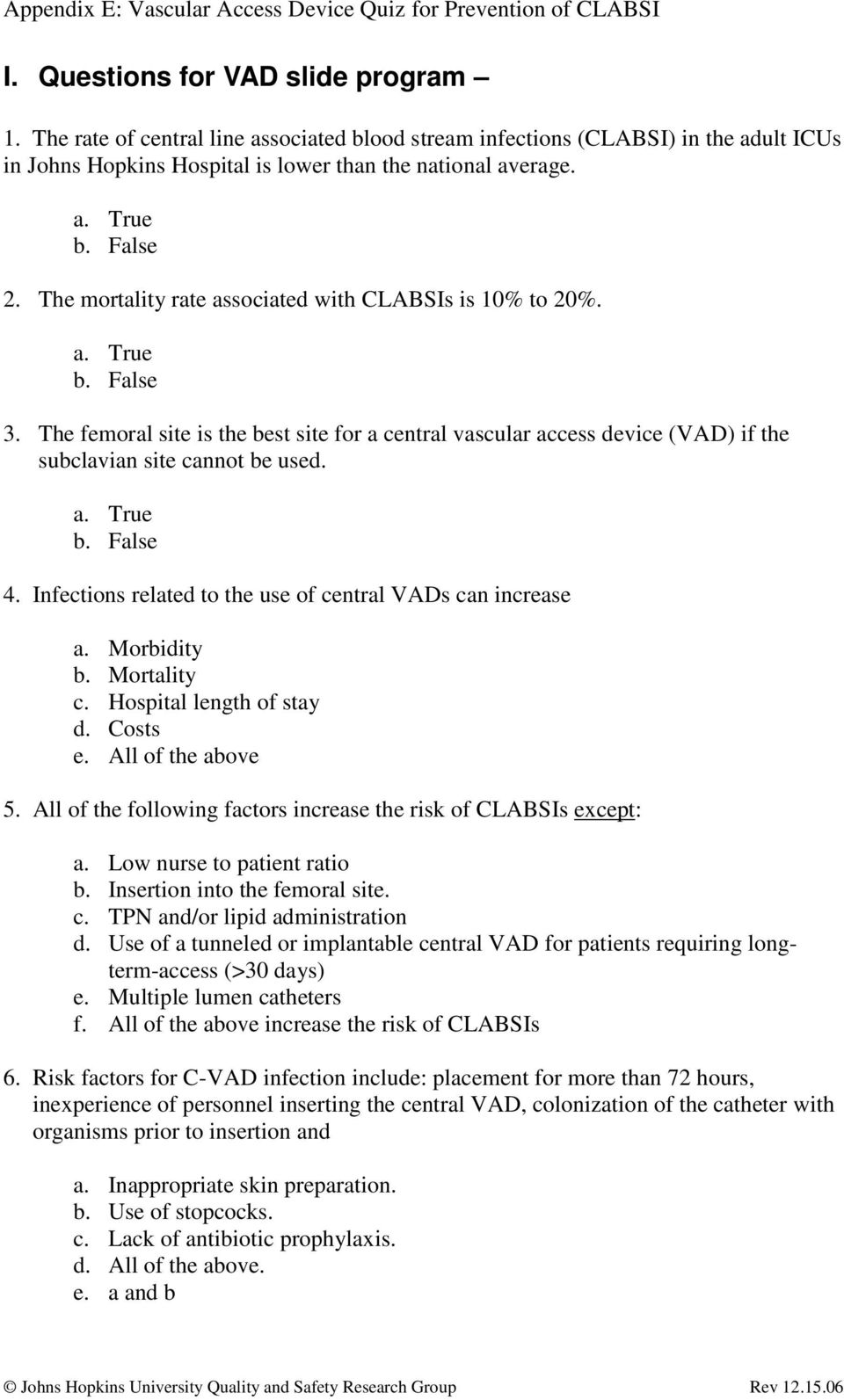
1 I. Questions for VAD slide program 1. The rate of central line associated blood stream infections (CLABSI) in the adult ICUs in Johns Hopkins Hospital is lower than the national average. 2. The mortality rate associated with CLABSIs is 10% to 20%. 3. The femoral site is the best site for a central vascular access device (VAD) if the subclavian site cannot be used. 4. Infections related to the use of central VADs can increase a. Morbidity b. Mortality c. Hospital length of stay d. Costs e. All of the above 5. All of the following factors increase the risk of CLABSIs except: a. Low nurse to patient ratio b. Insertion into the femoral site. c. TPN and/or lipid administration d. Use of a tunneled or implantable central VAD for patients requiring longterm-access (>30 days) e. Multiple lumen catheters f. All of the above increase the risk of CLABSIs 6. Risk factors for C-VAD infection include: placement for more than 72 hours, inexperience of personnel inserting the central VAD, colonization of the catheter with organisms prior to insertion and a. Inappropriate skin preparation. b. Use of stopcocks. c. Lack of antibiotic prophylaxis. d. All of the above. e. a and b
2 f. a and c 7. Antimicrobial ointment should not be applied to the exit site of non-hemodialysis catheters because it does not help to decrease the incidence of CLABSIs. 8. The central line insertion site should be dressed: a. After the sterile barriers are removed b. While the field is still sterile c. After an x-ray has verified correct placement of the catheter d. As soon as the insertion site has stopped bleeding or oozing 9. You have inserted a central VAD and the insertion site is oozing. You should: a. Apply a gauze dressing b. Apply a transparent dressing c. Apply both a gauze and a transparent dressing d. Wait until the site has stopped oozing to apply any dressing 10. You are not required to practice hand hygiene if you wear clean gloves when checking the insertion site or changing the dressing of a VAD. 11. When inserting a central VAD, maximal sterile barriers are required. This includes: 1. Face mask, cap and sterile gloves 2. Sterile gown that is snapped and tied 3. Assistants wearing the same barriers 4. Use of fenestrated drape in kit only 5. Use of large sterile drape that covers the entire patient a. 1, 2, 3, 4 b. 1, 2, 4 c. 1, 2, 3, 5 d. 1, 2, 5 e. All of the above 12. After applying the ChloraPrep to the insertion site, one should wait until the site is completely dry without fanning or blotting before proceeding.

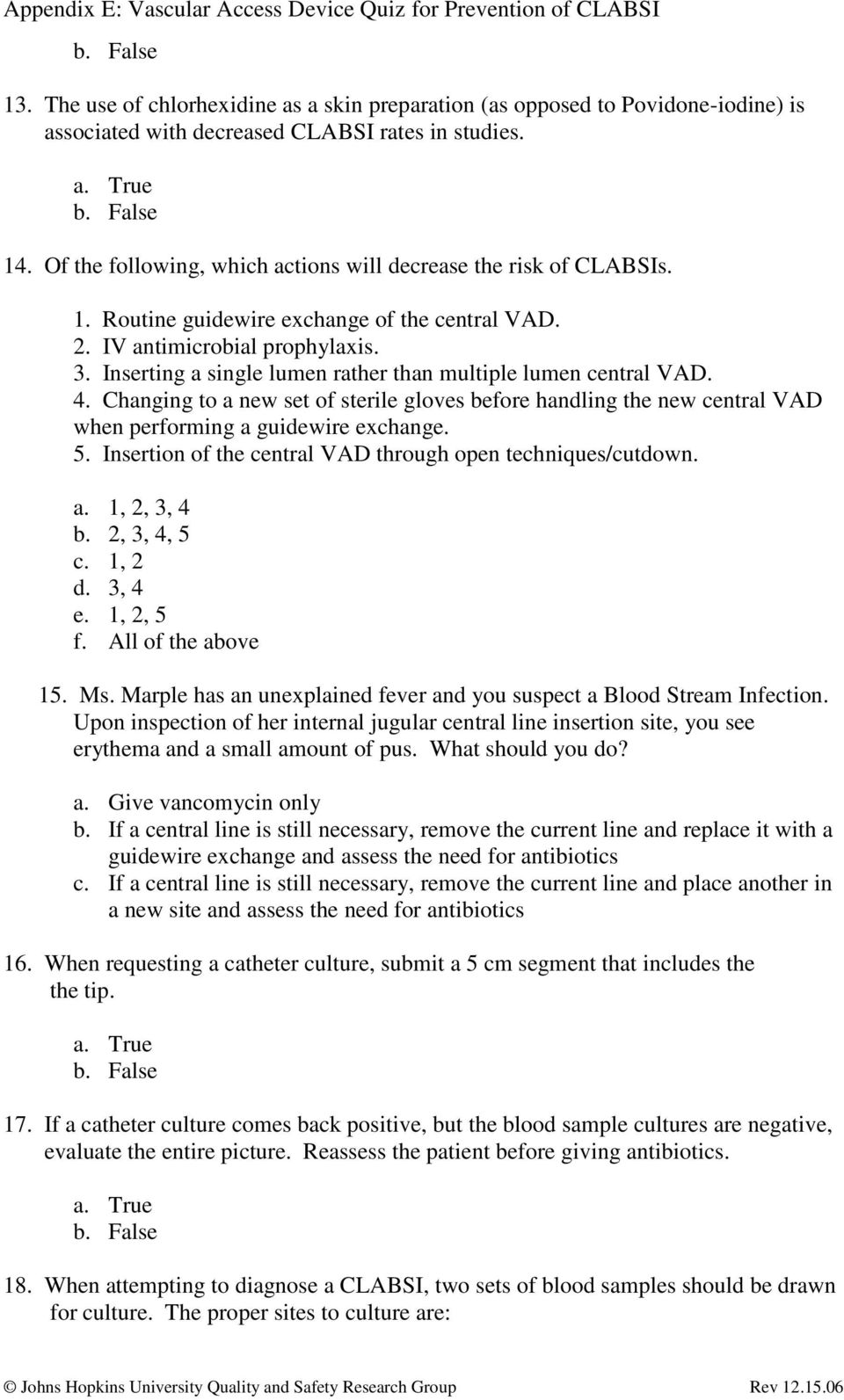
3 13. The use of chlorhexidine as a skin preparation (as opposed to Povidone-iodine) is associated with decreased CLABSI rates in studies. 14. Of the following, which actions will decrease the risk of CLABSIs. 1. Routine guidewire exchange of the central VAD. 2. IV antimicrobial prophylaxis. 3. Inserting a single lumen rather than multiple lumen central VAD. 4. Changing to a new set of sterile gloves before handling the new central VAD when performing a guidewire exchange. 5. Insertion of the central VAD through open techniques/cutdown. a. 1, 2, 3, 4 b. 2, 3, 4, 5 c. 1, 2 d. 3, 4 e. 1, 2, 5 f. All of the above 15. Ms. Marple has an unexplained fever and you suspect a Blood Stream Infection. Upon inspection of her internal jugular central line insertion site, you see erythema and a small amount of pus. What should you do? a. Give vancomycin only b. If a central line is still necessary, remove the current line and replace it with a guidewire exchange and assess the need for antibiotics c. If a central line is still necessary, remove the current line and place another in a new site and assess the need for antibiotics 16. When requesting a catheter culture, submit a 5 cm segment that includes the the tip. 17. If a catheter culture comes back positive, but the blood sample cultures are negative, evaluate the entire picture. Reassess the patient before giving antibiotics. 18. When attempting to diagnose a CLABSI, two sets of blood samples should be drawn for culture. The proper sites to culture are:
4 a. One from a catheter hub, the other from a peripheral source. b. Two different peripheral sources. c. Both from a catheter hub. 19. The proper procedure to culture blood from a suspected source is to draw 20cc of blood and place 10cc in each of two bottles. 20. Preferred site selection for an arterial line is as follows: a. dorsalis pedis > brachial/axillary > radial > femoral b. dorsalis pedis > radial > femoral > brachial/axillary c. radial > brachial/axillary > dorsalis pedis > femoral d. femoral > radial > dorsalis pedis > brachial/axillary e. radial > dorsalis pedis > femoral > brachial/axillary 21. While inserting an arterial line in the radial or dorsalis pedis sites, maximal sterile barriers are not required although sterile drapes should be used to create a sterile work space. Correct answers are: 1. a 2. a 3. b 4. e 5. d 6. e 7. a 8. b 9. a 10. b 11. c 12. a 13. a 14. d 15. c 16. a 17. a 18. b 19. a 20. e 21. a

5

Policies & Procedures. I.D. Number: 1073
 Policies & Procedures Title:: CENTRAL VENOUS CATHETERS INSERTION ASSISTING I.D. Number: 1073 Authorization [] Pharmacy Nursing Committee [] MAC Motion #: [x] SHR Nursing Practice Committee Source: Nursing
Central Line-Associated Bloodstream Infection (CLABSI) Prevention. Basics of Infection Prevention 2-Day Mini-Course 2013
 Central Line-Associated Bloodstream Infection (CLABSI) Prevention Basics of Infection Prevention 2-Day Mini-Course 2013 2 Objectives Describe the etiology and epidemiology of central line associated bloodstream
Are venous catheters safe in terms of blood tream infection? What should I know?
 Are venous catheters safe in terms of blood tream infection? What should I know? DIAGNOSIS, PREVENTION AND TREATMENT OF HAEMODIALYSIS CATHETER-RELATED BLOOD STREAM INFECTIONS (CRBSI): A POSITION STATEMENT
Peripherally Inserted Central Catheter (PICC)
 Peripherally Inserted Central Catheter (PICC) Disclaimer This is general information developed by The Ottawa Hospital. It is not intended to replace the advice of a qualified healthcare provider. Please
PICC & Midline Catheters Patient Information Guide
 PICC & Midline Catheters Patient Information Guide medcompnet.com 1 table of contents Introduction 4 What is a PICC or Midline Catheter? 4 How is the PICC or Midline Catheter Inserted? 6 Catheter Care
Site Care of Your Central Venous Catheter Sterile
 Site Care of Your Central Venous Catheter Sterile Dressing Change Sterile Technique The skin surrounding your catheter s exit site must be kept clean, and a new sterile dressing should be applied on a
VUMC Guidelines for Management of Indwelling Urinary Catheters. UC Access/ Maintenance
 VUMC Guidelines for Management of Indwelling Urinary Catheters UC Insertion Preparation & Procedure Indications for insertion and continued use of indwelling urinary catheters include: Urinary retention
High Impact Intervention Central venous catheter care bundle
 High Impact Intervention Central venous catheter care bundle Aim To reduce the incidence of catheter related bloodstream infection (CRBSI). Introduction The aim of the care bundle, as set out in this high
Peripherally Inserted Central Catheter (PICC) for Outpatient
 Peripherally Inserted Central Catheter (PICC) for Outpatient Introduction A Peripherally Inserted Central Catheter, or PICC line, is a thin, long, soft plastic tube inserted into a vein of the arm. It
Guy s, King s and St Thomas Cancer Centre The Cancer Outpatient Clinic Central venous catheter: Peripherally inserted central catheter
 Guy s, King s and St Thomas Cancer Centre The Cancer Outpatient Clinic Central venous catheter: Peripherally inserted central catheter This information leaflet aims to help answer some of the questions
Management of Catheters Infectious Diseases Working Party/Nurses Group
 Management of Catheters Infectious Diseases Working Party/Nurses Group Arno Mank RN PhD, Amsterdam (NL) www.ebmt.org London 09/04/2012 Content Background Management of CVC Types of CVC Care aspect of CVC
PICC and Midline Catheters
 PICC and Midline Catheters Infusion RN s Deb Bucher RN BSN CRNI Dawn Finch RN CRNI Marianne Hansen RN BSN CRNI Karman Youngblood RN BS CRNI Infusion Pharmacist Kathy Cimakasky Pharm D Tamara Migut RPh
Care of your peripherally inserted central catheter
 Care of your peripherally inserted central catheter A guide for patients and their carers We care, we discover, we teach Contents What is a PICC?.... 1 How is it put in?.... 1 What are the benefits of
Infection Control Manual. Table of Contents
 Infection Control Manual Policy Name The Prevention of Intravascular Catheter-Related Infections Policy Number IC 0032 Date this Version Effective May 2013 Responsible for Content Hospital Epidemiology
Care of Your Hickman Catheter
 Care of Your Hickman Catheter Johns Hopkins Kimmel Cancer Center, Revised 7/11 Contents What is a Hickman Catheter? Page 3 Does the Catheter Limit My Activities? Page 4 How Do I Care for My Catheter? Page
PICCs and Midline Catheters
 Patient Education PICCs and Midline Catheters Patient s guide to PICC (peripherally inserted central catheter) and midline catheters What are PICCs and midline catheters used for? Any medicine given over
Going home with your Tunneled Catheter
 Going home with your Tunneled Catheter Your Tunneled Catheter was put in by on Interventional Radiologist Date Your Tunneled Catheter was put in at: McMaster University Medical Centre Hamilton General
X-Plain Subclavian Inserted Central Catheter (SICC Line) Reference Summary
 X-Plain Subclavian Inserted Central Catheter (SICC Line) Reference Summary Introduction A Subclavian Inserted Central Catheter, or subclavian line, is a long thin hollow tube inserted in a vein under the
PATIENT GUIDE. Understand and care for your peripherally inserted central venous catheter (PICC). MEDICAL
 PATIENT GUIDE Understand and care for your peripherally inserted central venous catheter (PICC). MEDICAL Introduction The following information is presented as a guideline for your reference. The best
Vaxcel PICCs Valved and Non-Valved. A Patient s Guide
 Vaxcel PICCs Valved and Non-Valved A Patient s Guide Information about your Vaxcel PICC is available by calling the Navilyst Medical Vascular Access Information Line 800.513.6876 Vaxcel Peripherally Inserted
CVC = central venous catheter. Insertion and Maintenance
 Central Venous Catheter Insertion and Maintenance A Tutorial on Recommended Practices Introduction Central venous catheters (CVCs) are a commonly used modality throughout the medical center and especially
PICC Dressing Change
 PICC Dressing Change Gather materials: Non-sterile gloves (one pair) Alcohol pads to remove old dressing (as needed) Sterile dressing change kit:(mask, gloves, 2x2" gauze pads, drape, Steri-Strips, chlorhexidine,
Clinician Competency:
 Thanks to CR Bard Clinician Competency: INS (Intravenous Nursing Society) recommends that an institution create a set criteria to evaluate the competency of nurses learning to place PICC Line / Midline
Understanding your Peripherally Inserted Central Catheter (PICC) Patient Information
 Understanding your Peripherally Inserted Central Catheter (PICC) Patient Information The Purpose of this Information Sheet This information sheet has been written by patients, members of the public and
Sterile Dressing Change with Tegaderm CHG for Central Venous Catheter (CVC)
 Sterile Dressing Change with Tegaderm CHG for Central Venous Catheter (CVC) The dressing protects your catheter site. It also helps prevent infection at the site. Keep your dressing clean and dry at all
Peripherally Inserted Central Catheter (PICC Line)
 Feedback We appreciate and encourage feedback. If you need advice or are concerned about any aspect of care or treatment please speak to a member of staff or contact the Patient Advice and Liaison Service
Peripherally Inserted Central Catheter (PICC) Benefits Long-term access - dwell time varies (can be > one year) Decreased length of stay in hospital a
 Nursing Management of Venous Access Devices: Peripherally Inserted Central Catheter (PICC) Mimi Bartholomay, RN, MSN, AOCN Denise Dreher, RN, CRNI, VA-BC Theresa Evans, RN, MSN Susan Finn, RN, MSN, AOCNS
PERIPHERALLY INSERTED CENTRAL CATHETERS (PICC) Fong So Kwan APN, Haematology unit Medical Department, QMH
 PERIPHERALLY INSERTED CENTRAL CATHETERS (PICC) Fong So Kwan APN, Haematology unit Medical Department, QMH 1 What is a PICC catheter? Primary vascular access device since their introduction in the mid-1970s,
Flushing and Dressing a Peripherally Inserted Central Catheter (PICC Line): a Guide for Nurses
 Flushing and Dressing a Peripherally Inserted Central Catheter (PICC Line): a Guide for Nurses Information for Nurses Introduction This information is for community nursing staffs who have been asked to
Appendix L: Accessing/Deaccessing Implanted Central Venous Access Port
 Effective Date: 03/01/2008 Page 1 of 5 Recommendations for Use Insertion Considerations Implanted Port Dressing Access/ Reaccess An implanted port is strongly recommended for patients in whom more than
A PROCEDURAL GUIDE TO MIDLINE CATHETER INSERTION
 A PROCEDURAL GUIDE TO MIDLINE CATHETER INSERTION See Also CPG midline catheters for indications, contraindications and post insertion management What is a midline A midline catheter is an 8-12 cm catheter
PICC/Midclavicular/Midline Catheter
 47 PICC/Midclavicular/Midline Catheter Introduction- PICC/ MCV/ Midline You have a PICC/Midclavicular/Midline (peripherally inserted) catheter. This catheter should make receiving I.V. medicines or solutions
Peripherally Inserted Central Venous Catheter (PICC) Invasive Devices Clinical Nurse Specialist Chief Nurse
 Peripherally Inserted Central Venous Catheter (PICC) Invasive Devices Clinical Nurse Specialist Chief Nurse This leaflet has been designed to give you important information about your condition / procedure,
Hemodialysis catheter infection
 Hemodialysis catheter infection Scary facts In 2006, 82% of patients in the United States initiated dialysis via a catheter The overall likelihood of Tunneled cuffed catheters use was 35% greater in 2005
Managing Your Non-Tunneled (Percutaneous) Catheter: PICC, SICC, and JCC. What is a PICC catheter?
 Managing Your Non-Tunneled The staff of the Procedure, Vascular Access, Conscious Sedation Service has written this information to explain your new PICC (peripherally inserted central catheter), SICC (subclavian
I-140 Venipuncture for Blood Specimen Collection
 I-140 Venipuncture for Blood Specimen Collection Purpose Obtain a blood specimen by venipuncture for laboratory analysis using aseptic technique. Applies To Registered Nurses Licensed Practical/Vocational
Care for your child s Central Venous Catheter (CVC)
 Care for your child s Central Venous Catheter (CVC) This booklet is intended for general informational purposes only. You should consult your doctor for medical advice. Please call the clinic or your home
Policy and Procedure Flushing and / or Blood withdrawal Aspiration Procedure For PICC Line and Midline Catheters
 Policy and Procedure Flushing and / or Blood withdrawal Aspiration Procedure For PICC Line and Midline Catheters Purpose: Blood Withdrawal: To obtain blood samples for laboratory evaluation, eliminating
Central Venous Catheter (CVC) Sterile Dressing Change - The James
 PATIENT EDUCATION patienteducation.osumc.edu Central Venous Catheter (CVC) Sterile Dressing Change - The James A dressing protects your catheter site and helps reduce the risk of infection. You will need
HICKMAN Catheter Care with a Needleless Connector
 HICKMAN Catheter Care with a Needleless Connector Table of Contents Part 1 Learning about the HICKMAN Catheter... 2 Part 2 Caring for Your Hickman Catheter... 3 A. Preventing Infection... 3 B. Bathing...
PICC Catheter for IV Therapy
 PICC Catheter for IV Therapy A Patient Guide for: PATIENT PICC A PICC is defined as a Peripherally Inserted Central Catheter. A PICC is a special IV Catheter. It is put in an arm vein and ends in a large
Tunneled Central Venous Catheter (CVC) Placement
 PATIENT EDUCATION patienteducation.osumc.edu Tunneled Central Venous Catheter (CVC) Placement A tunneled Central Venous Catheter (CVC) is a special type of intravenous (IV) line that is placed into a large
CATHETER for Hemodialysis
 CATHETER for Hemodialysis What You Need to Know to Stay Healthy with a Catheter One treatment choice for kidney failure is hemodialysis (HD). HD removes wastes and excess fluid from your blood. Your lifeline
 Translating Evidence to Safer Care Patient Safety Research Introductory Course Session 7 Albert W Wu, MD, MPH Former Senior Adviser, WHO Professor of Health Policy & Management, Johns Hopkins Bloomberg
Policies & Procedures. ID Number: 1118
 Policies & Procedures Title: INTRAVENOUS AND/OR PERIPHERAL SALINE LOCK INSERTION AND MAINTENANCE ID Number: 1118 Authorization [X] SHR Nursing Practice Committee Source: Nursing Date Revised: September
Arterial pressure monitoring Direct arterial pressure monitoring permits continuous measurement of systolic, diastolic, and mean pressures and allows
 Arterial pressure monitoring Direct arterial pressure monitoring permits continuous measurement of systolic, diastolic, and mean pressures and allows arterial blood sampling. Because direct measurement
PRACTICE GUIDELINE TITLE: INTRAVENOUS LINE INSERTION: PERIPHERAL AND CENTRAL
 PRACTICE GUIDELINE Effective Date: 9-17-04 Manual Reference: Deaconess Trauma Services TITLE: INTRAVENOUS LINE INSERTION: PERIPHERAL AND CENTRAL PURPOSE: To outline the indications and options for intravenous
3/23/12. Learning Objectives. Continuing Education Credit (CE) Arterial Catheter Insertion, Care and Maintenance. Amy Bardin, MS, RRT, VA-BC
 Arterial Catheter Insertion, Care and Maintenance Amy Bardin, MS, RRT, VA-BC 2012 Saxe Healthcare Communications Sponsored by Teleflex Learning Objectives Discuss insertion techniques for arterial catheter
Peripherally Inserted Central Catheter (PICC)
 Patient information leaflet Royal Surrey County Hospital NHS Foundation Trust Peripherally Inserted Central Catheter (PICC) Intravenous Therapy What is a PICC? A PICC is a very fine flexible tube measuring
Central non-tunneled closed end or valved (i.e., Bard Solo Power PICC) Pediatrics: 1.9 F 0.06 ml 3-3.5 F 0.2-0.5 ml 4 F 0.6 ml
 Second Edition Standardizing Central Venous Catheter Care: Hospital to Home Introduction This is the second edition of the guidelines for out of hospital care of central venous access devices (CVAD). The
To maintain a port of entry to venous flow when all available peripheral ports have failed.
 I. Purpose: To maintain a port of entry to venous flow when all available peripheral ports have failed. II. General Comments: Since its development, these catheters have been used with increasing frequency
Providing optimal care
 Providing optimal care for patients with central catheters By Ann Earhart, MSN, RN, ACNS-BC, CRNI WHEN REGISTERED NURSE Andrea arrives on shift for report, she learns that her patient, a 62-year-old male,
Care of your central venous catheter A guide for patients and their carers. We care, we discover, we teach
 Care of your central venous catheter A guide for patients and their carers We care, we discover, we teach This booklet contains information about central venous catheters (CVC). These are sometimes called
Understanding Your Hemodialysis Access Options UNDERSTANDING YOUR HEMODIALYSIS ACCESS OPTIONS
 Understanding Your Hemodialysis Access Options UNDERSTANDING YOUR HEMODIALYSIS ACCESS OPTIONS What is a vascular access? A vascular access is a place on your body close to a vein and artery. This place
Vascular Access. Chapter 3
 Vascular Access Chapter 3 Vascular Access Introduction Obtaining vascular access in infants and children can be difficult even under optimal conditions. Attempting emergent access in a hypotensive, struggling
Medical Education Policy: Central Venous Catheter (CVC) Placement
 Medical Education Policy: Central Venous Catheter (CVC) Placement Facility: CMC Origin Date: June 2015 Revision Date: Sponsor: GMEC 1. PURPOSE: Carilion Clinic is committed to excellent patient care, with
Central Venous Catheters for Veterinary Technicians
 Central Venous Catheters for Veterinary Technicians Erica Mattox, CVT, VTS (ECC) Central venous catheterization is passing a long catheter into a large vein, such as the jugular or caudal vena cava. This
If viewing a printed copy of this policy, please note it could be expired. Got to www.fairview.org/fhipolicies to view current policies.
 If viewing a printed copy of this policy, please note it could be expired. Got to www.fairview.org/fhipolicies to view current policies. Entity: Fairview Pharmacy Services Department: Fairview Home Infusion
The Argon Family of PICC and Midline Catheters. Providing Optimal Outcomes for Long-Term & Intermediate Therapies
 The Argon Family of PICC and Midline Catheters Providing Optimal Outcomes for Long-Term & Intermediate Therapies Introducers Safety MST Accessory Kits Safety MST Accessory Kits for PICC and Midline Placement
Nursing college, Second stage Microbiology Dr.Nada Khazal K. Hendi L14: Hospital acquired infection, nosocomial infection
 L14: Hospital acquired infection, nosocomial infection Definition A hospital acquired infection, also called a nosocomial infection, is an infection that first appears between 48 hours and four days after
Emergency Insertion of Temporary Trans-venous Pacing Catheter in ICU
 TARGET AUDIENCE Junior Medical Staff Critical Care Trained ICU Nurses PURPOSE This document is intended as a basic guide to managing patients who require insertion of Temporary Trans-venous Cardiac Pacing
Central Venous Lines (CVP)
 2011 Central Venous Lines (CVP) Central Venous Line This pamphlet is about a central venous pressure (CVP) line and why it may be needed. We would like to encourage you to read this pamphlet. The nurses
Section 4: Your Vascular Access. What is vascular access?
 Section 4: Your Vascular Access What is vascular access? What is a fistula? Taking care of a new fistula What is a graft? Taking care of a new graft What is a hemodialysis catheter? Taking care of a hemodialysis
Page 1 of 10 MC1482 Peripherally-Inserted Central Catheter. Peripherally-Inserted Central Catheter (PICC)
 Page 1 of 10 MC1482 Peripherally-Inserted Central Catheter Peripherally-Inserted Central Catheter (PICC) Page 2 of 10 MC1482 Peripherally-Inserted Central Catheter Introduction A peripherally-inserted
Aspira* Peritoneal Drainage Catheter
 Aspira* Peritoneal Drainage Catheter Instructions For Use Access Systems Product Description: The Aspira* Peritoneal Drainage Catheter is a tunneled, long-term catheter used to drain accumulated fluid
Understanding Your. Hemodialysis. Access Options
 Understanding Your Hemodialysis Access Options aakp American Association of Kidney Patients 3505 E. Frontage Road, Suite 315 Tampa, FL 33607 Toll-Free: 800-749-2257 Fax: 813-636-8122 www.aakp.org Overview
Community Nurse Referral Letter (PICC Care)
 Community Nurse Referral Letter (PICC Care) Name of nurse making the referral: Name Signature.. Date Ward.Tel 0845 1555 000 Ext. Dear Community Nurse The following patient requires care for a PICC (Peripherally
Within the Scope of Practice/Role of APRN RN _ X_LPN CNA
 Wyoming State Board of Nursing 130 Hobbs Avenue, Suite B Cheyenne, WY 82002 Phone (307) 777-7601 Fax (307) 777-3519 E-Mail: [email protected] Home Page: https://nursing-online.state.wy.us/ OPINION:
All About Your Peripherally Inserted Central Catheter (PICC)
 All About Your Peripherally Inserted Central Catheter (PICC) General Information Intravenous (IV) therapy is the delivery of fluid directly into a vein. An intravenous catheter is a hollow tube that is
The science of medicine. The compassion to heal.
 A PATIENT S GUIDE TO ELECTROPHYSIOLOGY STUDIES OF THE HEART The science of medicine. The compassion to heal. This teaching booklet is designed to introduce you to electrophysiology studies of the heart.
Tunnelled haemodialysis catheter
 Liver, Renal & Surgery Tunnelled haemodialysis catheter Information for patients and carers This leaflet explains what a tunnelled haemodialysis catheter is and how it is put in. It also covers the risks
Peripherally Inserted Central Catheter
 Peripherally Inserted Central Catheter (PICC) by Patricia Griffin Kellicker, BSN En Español (Spanish Version) Definition A peripherally inserted central catheter is a long, thin tube that is inserted through
Central Venous Catheter Care For Haemodialysis
 Central Venous Catheter Care For Haemodialysis Information For Parents and Carers Haemodialysis Unit 01 878 4757 Main Hospital Number 01 878 4200 Central Venous Catheters We hope this booklet will help
Arrow NextStep and Arrow Cannon II Plus Chronic Hemodialysis Catheters
 Retrograde-Tunneling Insertion Poster Arrow NextStep and Arrow Cannon II Plus Chronic Hemodialysis Catheters Arrow Retrograde-Tunneling catheters Luer Lock caps Color-coded Luer Lock caps Arterial port
Strategies to Prevent Deadly Central-Line Associated
 SHEA / IDSA Practices and the Arrow Maximal Barrier Kit Strategies to Prevent Deadly Central-Line Associated Bloodstream Infections SHEA Society for Healthcare Epidemiology in America, IDSA Infection Diseases
1-800-962-9888. Table of Contents. Acute Vascular Access. Chronic Vascular Access
 Dialysis Products 1-800-962-9888 Table of Contents Acute Vascular Access MAHURKAR * Protection and Safety Solution (PASS) Trays... 3 Safety Catheter Insertion Tray (SCIT)... 4 Argyle Personal Protective
A4.7 Management of a totally occluded central catheter and persistent withdrawal occlusion (PWO)
 A4.7 Management of a totally occluded central catheter and persistent withdrawal occlusion (PWO) Types of Catheter Related Thrombotic A catheter-related thrombus may be intraluminal (inside the catheter)
Policy for the Insertion and Management of Central Venous Catheters (CVC s)
 Policy for the Insertion and Management of Central Venous Catheters (CVC s) This APD supersedes PAT/T 23 v.2 Name and title of author/reviewer Louise Lowry, IP&CP- Lead for Invasive Devices Date revised
Safety FIRST: Infection Prevention Tips
 Reading Hospital Safety FIRST: Infection Prevention Tips Reading Hospital is committed to providing high quality care to our patients. Your healthcare team does many things to help prevent infections.
Aspira* Pleural Drainage Catheter
 Aspira* Pleural Drainage Catheter Instructions For Use Access Systems Product Description: The Aspira* Pleural Drainage Catheter is a tunneled, long-term catheter used to drain accumulated fluid from the
CENTRAL VENOUS CATHETERIZATION
 DISCLAIMER: These guidelines were prepared by the Department of Surgical Education, Orlando Regional Medical Center. They are intended to serve as a general statement regarding appropriate patient care
Peripherally Inserted Central Catheter (PICC) Patient Instructions
 Patient Care Services 300 Pasteur Drive Stanford, CA 94305 Peripherally Inserted Central Catheter (PICC) Patient Instructions A Peripherally Inserted Central Catheter (PICC) is a soft flexible tube inserted
TREATMENT 1. Control bleeding by applying pressure over wound with Gauze Pads (Surgical Supply-4). 2. Contact Surgeon for laceration repair options.
 Page 1 of 8 pages NOTE Contact Surgeon before giving any medication marked with an asterisk. In an emergency or during Loss of Signal, begin appropriate treatment; then call Surgeon as soon as possible.
Central venous catheters. Care of the site 88 CVP measurement 90 Removal of CVC (non-tunnelled) 93 Care of long-term CVCs 95
 4 Central venous catheters Care of the site 88 CVP measurement 90 Removal of CVC (non-tunnelled) 93 Care of long-term CVCs 95 CARE OF THE SITE Preparation Patient Equipment/Environment Nurse Explain the
Bard Access Systems, Inc. How to Care For Your. Nursing Guide
 Bard Access Systems, Inc. How to Care For Your Nursing Guide Table of Contents Introduction 1 Product Description Placement PowerPICC SOLO* Catheter Valve Function Indications for Use Catheter Irrigation
Biliary Drain. What is a biliary drain?
 Biliary Drain What is a biliary drain? A biliary drain is a tube to drain bile from your liver. It is put in by a doctor called an Interventional Radiologist. The tube or catheter is placed through your
Tunneled Hemodialysis Catheters: Placement and complications
 Tunneled Hemodialysis Catheters: Placement and complications Arif Asif, M.D. Director, Interventional Nephrology Associate Professor of Medicine University of Miami, FL Tunneled Hemodialysis Catheters:
STANDARD OPERATING PROCEDURE #201 RODENT SURGERY
 STANDARD OPERATING PROCEDURE #201 RODENT SURGERY 1. PURPOSE The intent of this Standard Operating Procedure (SOP) is to describe procedures for survival rodent surgery. 2. RESPONSIBILITY Principal investigators
Located On IV Pole Front of cart- Arrest Board
 ADULT CRASH CART Adult Crash Cart First Supply To Expire Located On IV Pole Front of cart- Arrest Board In a Sleeve (back of cart) Top of cart Clipboard Zoll- checklist Exam gloves- 1 box under defib ACLS
Patient Information Guide Morpheus CT Peripherally Inserted Central Catheter
 Patient Information Guide Morpheus CT Peripherally Inserted Central Catheter IC 192 Rev C A measure of flexibility and strength. Table of Contents 1. Introduction 2. What is the Morpheus CT PICC? 3. What
ATI Skills Modules Checklist for Urinary Catheter Care
 For faculty use only Educator s name Score Date ATI Skills Modules Checklist for Urinary Catheter Care Student s name Date Verify order Patient record Assess for procedure need Identify, gather, and prepare
A PATIENT S GUIDE TO CARDIAC CATHETERIZATION
 A PATIENT S GUIDE TO CARDIAC CATHETERIZATION The science of medicine. The compassion to heal. This teaching booklet is designed to introduce you to cardiac catheterization. In the following pages, we will
Your Guide to Peritoneal Dialysis Module 3: Doing Peritoneal Dialysis at Home
 Your Guide to Peritoneal Dialysis Module 3: 6.0959 in Preparing to do PD One of the most important things about PD is to keep the dialysis area and anything that comes in contact with the PD equipment
Community Nurse Referral Letter (Hickman Line Care)
 Community Nurse Referral Letter (Hickman Line Care) Name of nurse making the referral: Name Signature.. Date Ward.Tel 0845 1555 000 Ext. Dear Community Nurse The following patient requires care for a Hickman
Chester Chest Model 2400 User s Manual
 Chester Chest Model 2400 User s Manual 308 South Sequoia Parkway, Canby, Oregon 97013 USA ph. 503.651.5050 fax 503.651.5052 email [email protected] Thank You For Your Purchase! Thank you for your purchase
NORTH WALES CRITICAL CARE NETWORK
 North Wales Critical Care Network Critical Care Nurses Forum ARTERIAL LINE GUIDELINES Version 2 1 Contents Contents Page Chief of Staff for Anaesthetics Critical Care & Pain Management CPG 3 Approval Introduction
Conference Report: 3M IV Global Leadership Summit Theme -Transforming Leaders: Transforming Care Catharine O Hara RN MN
 Conference Report: 3M IV Global Leadership Summit Theme -Transforming Leaders: Transforming Care Catharine O Hara RN MN Catharine O Hara, Clinical Nurse Specialist (Lead), Intravenous and Related Therapies,