
|
|
|
- Aron Johnson
- 10 years ago
- Views:
Transcription
1 Translating Evidence to Safer Care Patient Safety Research Introductory Course Session 7 Albert W Wu, MD, MPH Former Senior Adviser, WHO Professor of Health Policy & Management, Johns Hopkins Bloomberg School of Public Health Professor of Medicine, School of Medicine, Johns Hopkins University Your picture is also welcome Overview To provide understand and provide strategies on how research findings can be translated into practice.

2 Components 1. In the IHI model for Improvement, what does PDSA stand for? a. Process, Delivery, Study, Activation b. Plan, Do, Study, Act c. Position, Deploy, Steady, Aim d. Patient, Doctor, Student, Administrator 2. In forming a quality improvement team, which of the following members does NOT necessarily need to be represented a. Leaders of the health care organization b. Physicians c. Technical expertise with the clinical problem d. Day-to-day leadership of units

3 3. After summarizing the evidence for effective interventions, what steps are need to translate evidence to safer care? a. Identify local barriers to implementing the intervention b. Measure performance c. Ensure all patients get the intervention d. All of the above 4. What is true about identifying local barriers to implementing interventions? a. Intervention is part of a work process b. It can be helpful to walk-through the steps to implement the intervention c. Compliance can be improved by targeting failure points in implementation d. All of the above 5. The 4 Es of implementing an intervention include a. Educate, Estimate, Eradicate, Evaluate b. Estimate, Educate, Execute, Eradicate c. Engage, Educate, Execute, Evaluate d. None of the above Introduction Despite good evidence, difficult to get into practice changes that improve safety Knowledge translation needs to occur within systems of care
4 Integrated Approach to Translating Evidence to Practice A focus on systems (how we organise work) rather than care of individual patients Engagement of local interdisciplinary teams to assume ownership of the improvement project Creation of centralised support for the technical work Encouraging local adaptation of the intervention Creating a collaborative culture within the local unit and larger system. Institute for Healthcare Improvement (IHI) Model for Improvement

5 Forming the Team Effective teams include members representing three different kinds of expertise within the organization system leadership technical expertise day-to-day leadership There may be one or more individuals on the team with each kind of expertise, or one individual may have expertise in more than one area, but all three areas should be represented in order to drive improvement successfully Team Aim: Reduce adverse drug events (ADEs) on all medical and surgical units by 75 percent within 11 months. Team: Team Leader:, MD, Chair, Pharmacy and Therapeutics Committee, Patient Safety Officer Technical Expertise:, RPh, Director, Clinical Pharmacist Day-to-Day Leadership:, RN, Manager, Medical/Surgical Nursing Additional Team Members: Risk Manager, Quality Improvement Specialist, Staff Nurse, Staff Education, and Information Technology
6 Setting Aims Reduce adverse drug events (ADEs) in critical care by 75 percent within 1 year. Improve medication reconciliation at transition points by 75 percent within 1 year. Achieve > 95 percent compliance with on-time prophylactic antibiotic administration within 1 year. Strategy for Translating Evidence to Practice Pronovost, BMJ 2008

7 Summarize the Evidence For interventions to improve a specific outcome Interdisciplinary team of researchers and clinicians reviews literature using to identify interventions with greatest benefit lowest barriers to use Agree on the top interventions (maximum of seven) and convert them into behaviors Identify Local Barriers to Implementation The intervention will be part of a work process What is the context surrounding this work? Walk through steps with clinician to observe what is required to implement intervention Where are the failure points? What could be done to improve compliance?

8 Understanding Context To help understand the context in which the intervention will be implemented, ask all stakeholders why it is difficult or easy for them to comply with recommended practices Listen carefully and learn what staff may gain or lose from implementing the intervention Measure Performance Need performance measures to evaluate How often patients actually receive the recommended therapy (process measures) Whether patient outcomes improve (outcome measures) Outcome measures are preferred if valid and feasible

9 Measures Teams use quantitative measures to determine if a specific change actually leads to an improvement. Many sequential, observable tests Gather "just enough" data to learn and complete another cycle "Small tests of significant changes" accelerates the rate of improvement Ensure All Patients Receive the Intervention Final and most complex stage is to ensure that all patients reliably receive the intervention Interventions must fit each hospital s current system, including local culture and resources 4 Es Engage Educate Execute Evaluate

10 Engage Share real life stories of patients Estimate the harm attributable to omitting the intervention in their unit or hospital given their baseline data Informed each unit of its annual number of infections and patient deaths attributed to the infections Educate All levels of staff Original scientific literature supporting the proposed interventions Concise summaries Checklist of the evidence
11 Execute Designed an implementation "toolkit" based on identified barriers to implementation Based on 3 principles for redesigning care standardize care processes create independent checks (such as checklists) learn from mistakes Pronovost P, et. al. An Intervention to Decrease Catheter-Related Bloodstream Infections in the ICU. The New England Journal of Medicine, 2006, 355: Link to Abstract (HTML) Link to Full Text (PDF)

12 Translating Evidence to Practice Summarize the evidence Identify local barriers to implementing the intervention Measure performance Ensure all patients get the intervention Summarize the Evidence for Preventing Central Line Infection: 5 Best Practices Remove Unnecessary Lines Hand Hygiene Use of Maximal Barrier Precautions Chlorhexidine for Skin Antisepsis Avoid femoral lines MMWR. 2002;51:RR-10
13 Central Line Cart Observed insertion of central lines Clinicians gathered equipment essential for complying with recommended practice (sterile gloves, full sterile drape, etc) from up to eight different locations! To make compliance easier for clinicians introduced a central line cart storing all the necessary supplies. Identify and Address Local Barriers Nurses reluctant to question or challenge doctors who failed to follow recommended practice Physicians did not like being questioned by nurses in front of patients or other staff Clinicians agreed with the recommended practices, but cultural barriers prevented reliable delivery To address barriers, implemented a comprehensive safety programme that includes methods to improve culture, teamwork, and communication

14 Comprehensive Unit Based Safety Program (CUSP) 1. Safety Culture Assessment 2. Science of Safety Training 3. Staff Identify Safety Hazards 4. Senior Executive Partnership 5. Learn from Safety Defects/Apply Tools to Improve 6. Reassess Safety Culture ICUs also implemented A daily goals sheet to improve clinician-to-clinician communication within the ICU An intervention to reduce the incidence of ventilator-associated pneumonia A comprehensive unit-based safety program to improve the safety culture

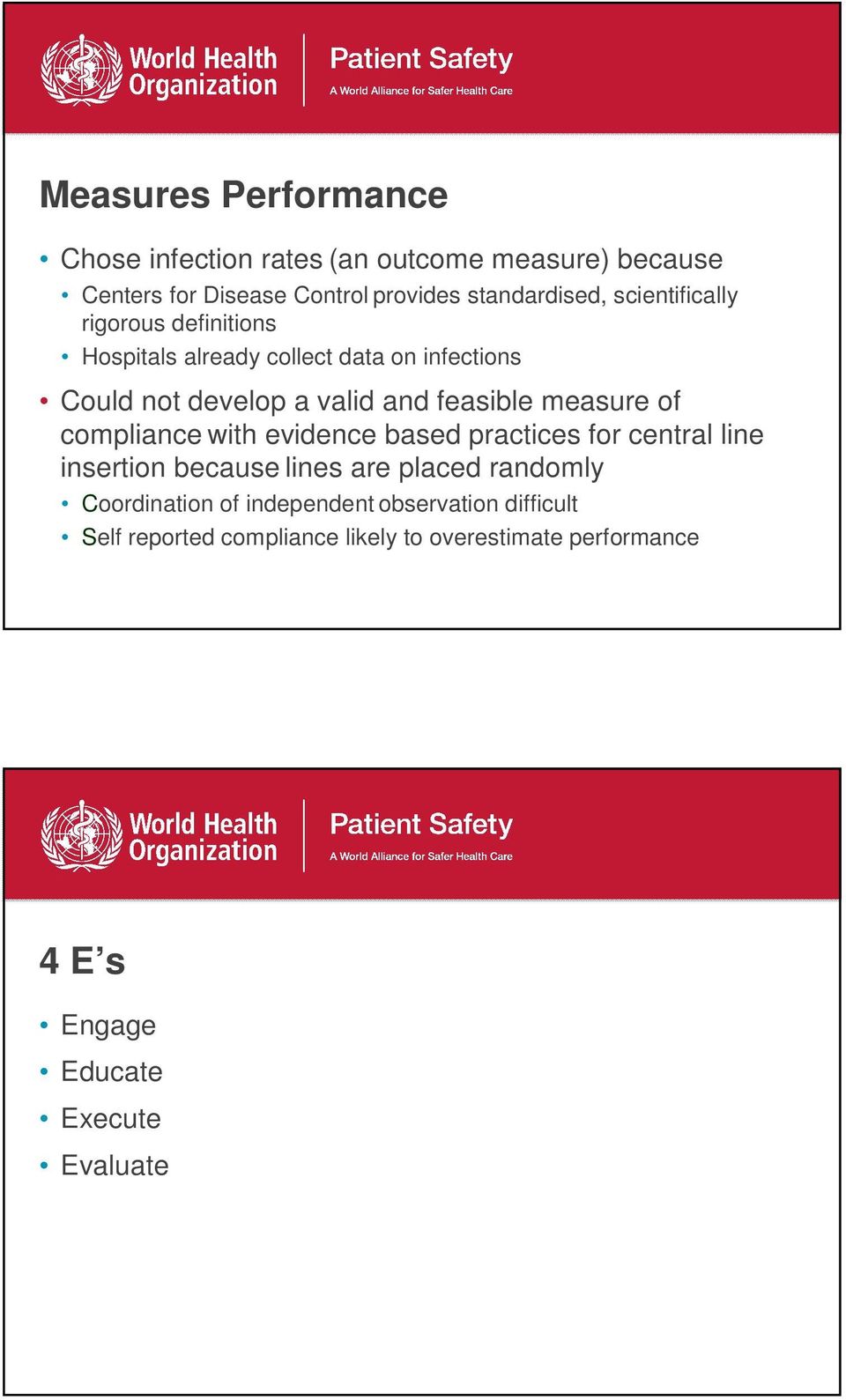
15 Measures Performance Chose infection rates (an outcome measure) because Centers for Disease Control provides standardised, scientifically rigorous definitions Hospitals already collect data on infections Could not develop a valid and feasible measure of compliance with evidence based practices for central line insertion because lines are placed randomly Coordination of independent observation difficult Self reported compliance likely to overestimate performance 4 E s Engage Educate Execute Evaluate
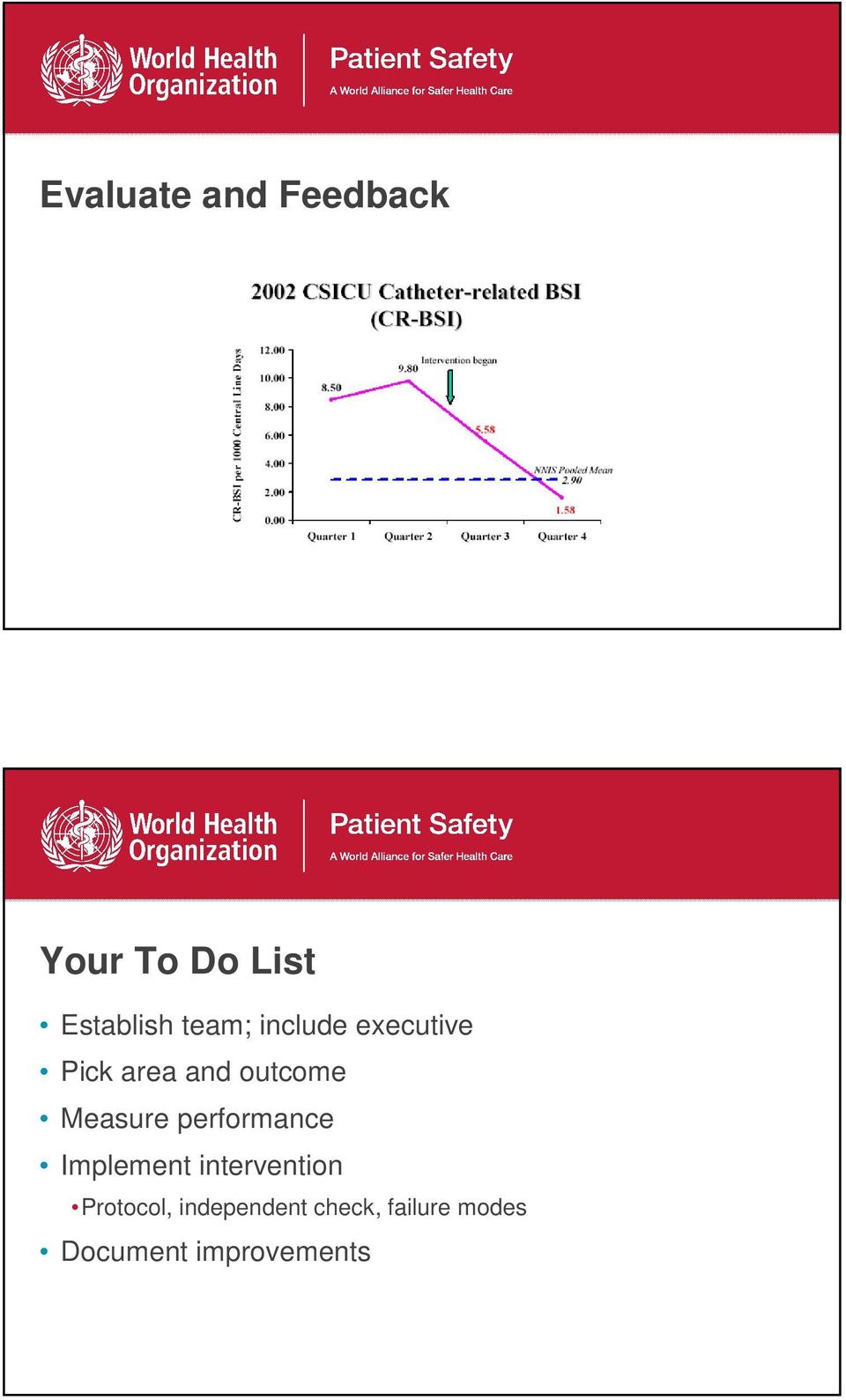
16 Execute: Converted 5 evidence based behaviors to a Checklist Before the procedure, did they: Wash hands Sterilize procedure site with chlorhexadine Drape entire patient in a sterile fashion During the procedure, did they: Use sterile gloves, mask and sterile gown Maintain a sterile field Did all personnel assisting with procedure follow the above precautions Evaluate: ICU catheter-related blood stream infections Rate/1,000 Catheter days Education Line Cart Checklist Jan Feb Mar Apr May Jun Jul Aug Sep Oct Nov Dec Jan Feb Mar April May June July August NNIS Mean

17 Evaluate and Feedback Your To Do List Establish team; include executive Pick area and outcome Measure performance Implement intervention Protocol, independent check, failure modes Document improvements
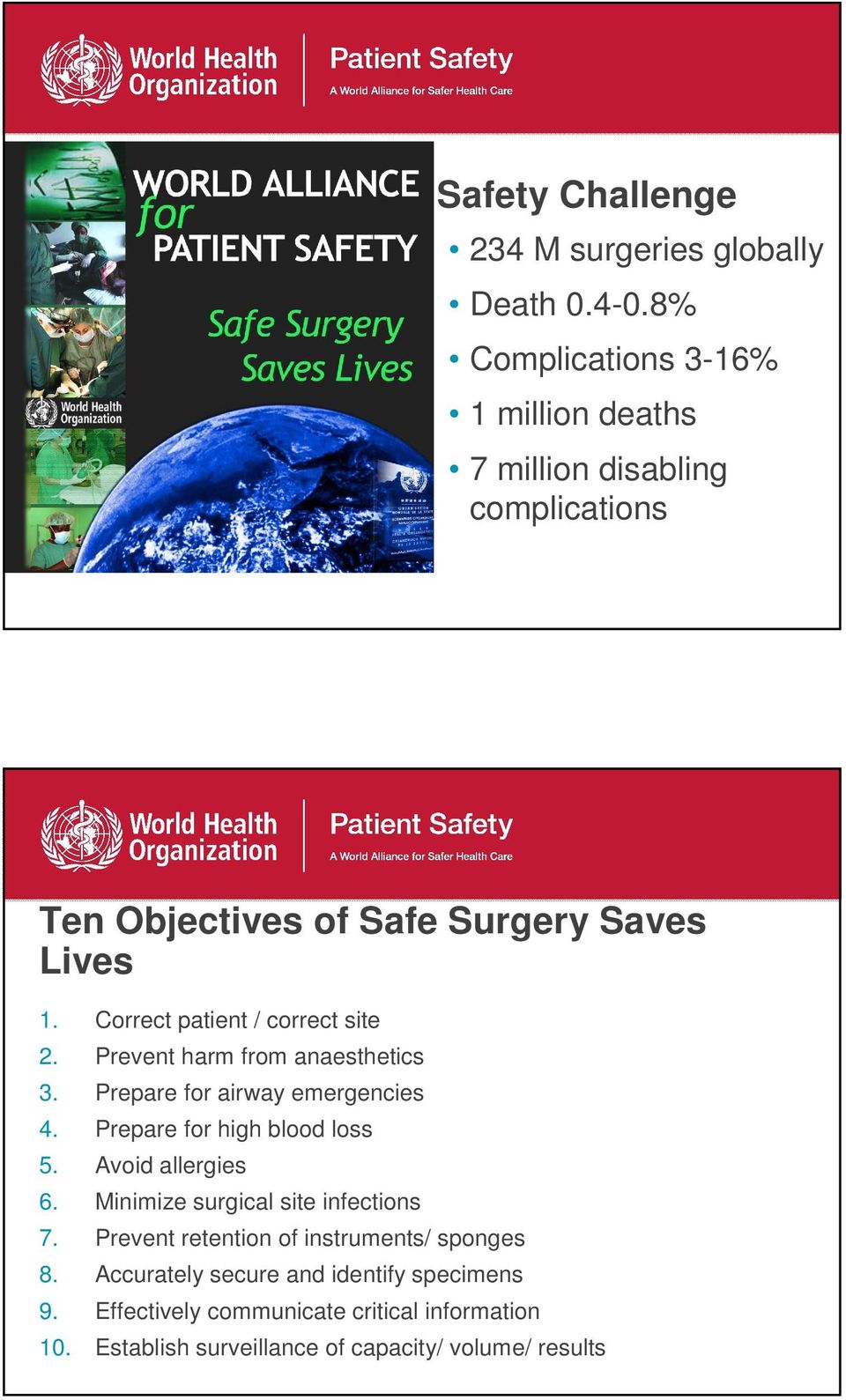
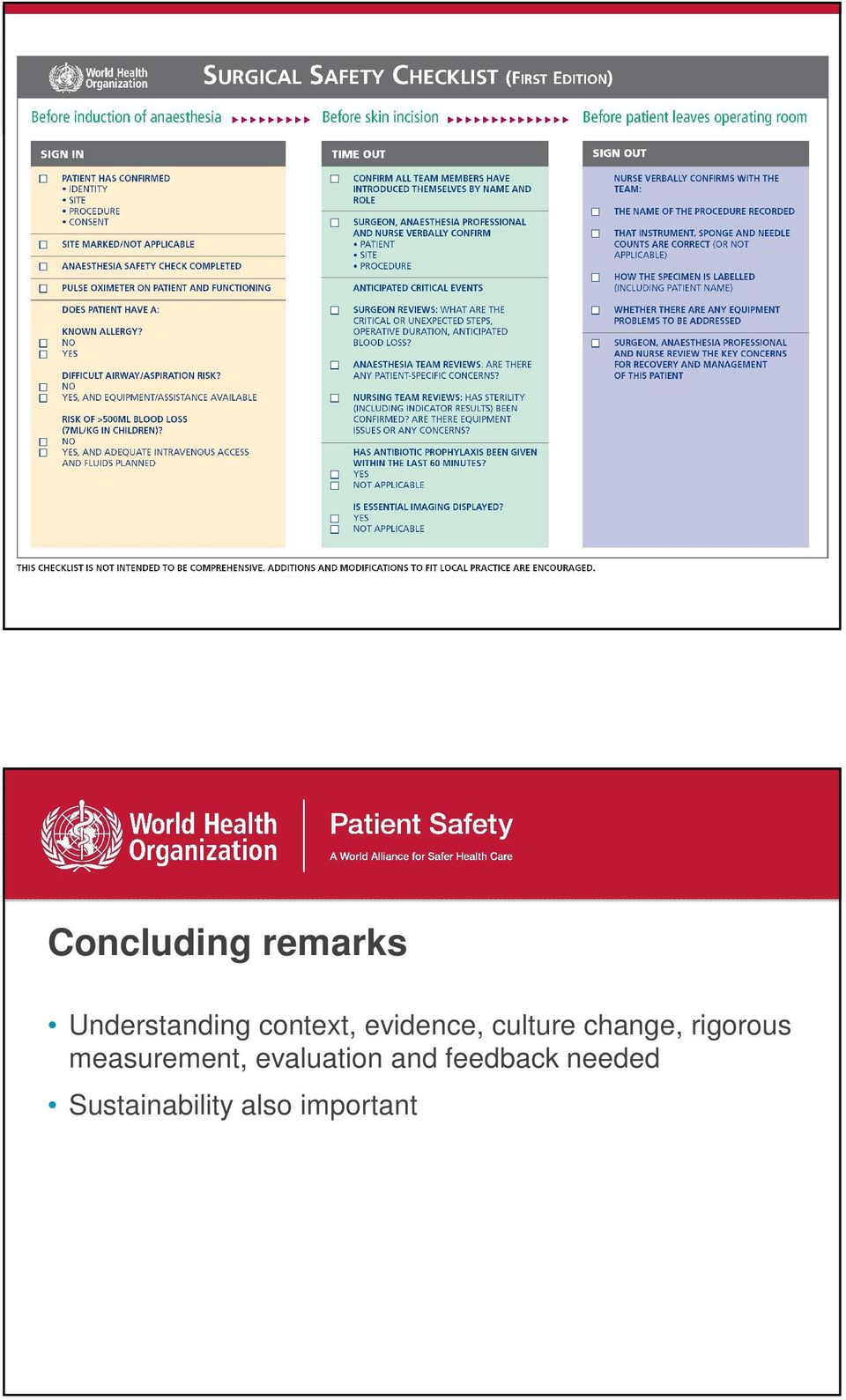
18 The 2 nd Global Patient Safety Challenge 234 M surgeries globally Death % Complications 3-16% 1 million deaths 7 million disabling complications Ten Objectives of Safe Surgery Saves Lives 1. Correct patient / correct site 2. Prevent harm from anaesthetics 3. Prepare for airway emergencies 4. Prepare for high blood loss 5. Avoid allergies 6. Minimize surgical site infections 7. Prevent retention of instruments/ sponges 8. Accurately secure and identify specimens 9. Effectively communicate critical information 10. Establish surveillance of capacity/ volume/ results
19 Concluding remarks Understanding context, evidence, culture change, rigorous measurement, evaluation and feedback needed Sustainability also important
20 References Grol R, Crimshaw J. From best evidence to best practice: effective implementation of change in patients care. Lancet 2003;362: Haynes AB, Weiser TG, Berry WR, Lipsitz SR, Breizat AH, Dellinger EP, Herbosa T, Joseph S, Kibatala PL, Lapitan MC, Merry AF, Moorthy K, Reznick RK, Taylor B, Gawande AA; Safe Surgery Saves Lives Study Group. A surgical safety checklist to reduce morbidity and mortality in a global population. N Engl J Med Jan 29;360(5): Pittet D, Allegranzi B, Boyce J; World Health Organization World Alliance for Patient Safety First Global Patient Safety Challenge Core Group of Experts. The World Health Organization Guidelines on Hand Hygiene in Health Care and their consensus recommendations. Infect Control Hosp Epidemiol Jul;30(7): Pronovost PJ, Berenholtz SM, Needham DM. Translating evidence into practice: a model for large scale knowledge translation. BMJ Oct 6;337:a1714. How to Improve: Improvement Methods. Institute for Healthcare Improvement In the IHI model for Improvement, what does PDSA stand for? a. Process, Delivery, Study, Activation b. Plan, Do, Study, Act c. Position, Deploy, Steady, Aim d. Patient, Doctor, Student, Administrator 2. In forming a quality improvement team, which of the following members does NOT necessarily need to be represented a. Leaders of the health care organization b. Physicians c. Technical expertise with the clinical problem d. Day-to-day leadership of units
21 3. After summarizing the evidence for effective interventions, what steps are need to translate evidence to safer care? a. Identify local barriers to implementing the intervention b. Measure performance c. Ensure all patients get the intervention d. All of the above 4. What is true about identifying local barriers to implementing interventions? a. Intervention is part of a work process b. It can be helpful to walk-through the steps to implement the intervention c. Compliance can be improved by targeting failure points in implementation d. All of the above The 4 Es of implementing an intervention include a. Educate, Estimate, Eradicate, Evaluate b. Estimate, Educate, Execute, Eradicate c. Engage, Educate, Execute, Evaluate d. None of the above Interactive Participants identify local barriers to implementation of safe surgery guidelines
22 Questions?
Creating a Checklist Culture Chris George, RN MS [email protected]
 Creating a Checklist Culture Chris George, RN MS [email protected] Objectives Benefits of using checklists What makes a good checklist Creating a culture that supports checklists Why do we need checklists?
High Impact Intervention Central venous catheter care bundle
 High Impact Intervention Central venous catheter care bundle Aim To reduce the incidence of catheter related bloodstream infection (CRBSI). Introduction The aim of the care bundle, as set out in this high
AT&T Global Network Client for Windows Product Support Matrix January 29, 2015
 AT&T Global Network Client for Windows Product Support Matrix January 29, 2015 Product Support Matrix Following is the Product Support Matrix for the AT&T Global Network Client. See the AT&T Global Network
Prevention of healthcare associated (nosocomial) infection : Safer surgery overview of strategies
 Prevention of healthcare associated (nosocomial) infection : Safer surgery overview of strategies Assoc. Professor John Ferguson May 2011 [email protected] www.tinyurl.com\nepal68 Also see
COMPARISON OF FIXED & VARIABLE RATES (25 YEARS) CHARTERED BANK ADMINISTERED INTEREST RATES - PRIME BUSINESS*
 COMPARISON OF FIXED & VARIABLE RATES (25 YEARS) 2 Fixed Rates Variable Rates FIXED RATES OF THE PAST 25 YEARS AVERAGE RESIDENTIAL MORTGAGE LENDING RATE - 5 YEAR* (Per cent) Year Jan Feb Mar Apr May Jun
COMPARISON OF FIXED & VARIABLE RATES (25 YEARS) CHARTERED BANK ADMINISTERED INTEREST RATES - PRIME BUSINESS*
 COMPARISON OF FIXED & VARIABLE RATES (25 YEARS) 2 Fixed Rates Variable Rates FIXED RATES OF THE PAST 25 YEARS AVERAGE RESIDENTIAL MORTGAGE LENDING RATE - 5 YEAR* (Per cent) Year Jan Feb Mar Apr May Jun
CUSP: Designing a Comprehensive Unit-based Patient Safety Program
 This work is licensed under a Creative Commons Attribution-NonCommercial-ShareAlike License. Your use of this material constitutes acceptance of that license and the conditions of use of materials on this
Policies & Procedures. I.D. Number: 1073
 Policies & Procedures Title:: CENTRAL VENOUS CATHETERS INSERTION ASSISTING I.D. Number: 1073 Authorization [] Pharmacy Nursing Committee [] MAC Motion #: [x] SHR Nursing Practice Committee Source: Nursing
What Is Patient Safety?
 Patient Safety Research Introductory Course Session 1 What Is Patient Safety? David W. Bates, MD, MSc External Program Lead for Research, WHO Professor of Medicine, Harvard Medical School Professor of
I. Questions for VAD slide program
 I. Questions for VAD slide program 1. The rate of central line associated blood stream infections (CLABSI) in the adult ICUs in Johns Hopkins Hospital is lower than the national average. 2. The mortality
Analysis One Code Desc. Transaction Amount. Fiscal Period
 Analysis One Code Desc Transaction Amount Fiscal Period 57.63 Oct-12 12.13 Oct-12-38.90 Oct-12-773.00 Oct-12-800.00 Oct-12-187.00 Oct-12-82.00 Oct-12-82.00 Oct-12-110.00 Oct-12-1115.25 Oct-12-71.00 Oct-12-41.00
UW Medicine Case Study
 Learn Serve Lead April 2013 Association of American Medical Colleges ABOUT THE BEST PRACTICES FOR BETTER CARE CASE STUDY SERIES Better performers from the Best Practices for Better Care initiative, identified
Patient Care Services Quality Report Evaluation of 2013 Outcomes August 2014
 Patient Care Services Quality Report Evaluation of 2013 Outcomes August 2014 Submitted by, Carol A Dwyer, MSN, MM, RN, CENP Vice President, Patient Care Services Chief Nursing Officer 1 Index INTRODUCTION...3
Case 2:08-cv-02463-ABC-E Document 1-4 Filed 04/15/2008 Page 1 of 138. Exhibit 8
 Case 2:08-cv-02463-ABC-E Document 1-4 Filed 04/15/2008 Page 1 of 138 Exhibit 8 Case 2:08-cv-02463-ABC-E Document 1-4 Filed 04/15/2008 Page 2 of 138 Domain Name: CELLULARVERISON.COM Updated Date: 12-dec-2007
Lean thinking and Six sigma at the level of Clinical Service Delivery
 Lean thinking and Six sigma at the level of Clinical Service Delivery Hugh Rogers FRCS Associate, Service Transformation NHS Institute for Innovation & Improvement Healthcare Events 26 th February 2008
Strategies and Tools to Enhance Performance and Patient Safety
 Strategies and Tools to Enhance Performance and Patient Safety Ice Breaker Mod 1 05.2 06.2 Page 2 2 Do No Harm Jess Story Do no Harm Jess' Story Mod 1 05.2 06.2 Page 3 3 Medical Error Have you been affected
Introduction of a Dedicated Admissions Nurse to Improve Access to Care for Surgical Patients
 Introduction of a Dedicated Admissions Nurse to Improve Access to Care for Surgical Patients Editor s Note: In Introduction of a Dedicated Admissions Nurse to Improve Access to Care for Surgical Patients
healthcare associated infection 1.2
 healthcare associated infection A C T I O N G U I D E 1.2 AUSTRALIAN SAFETY AND QUALITY GOALS FOR HEALTH CARE What are the goals? The Australian Safety and Quality Goals for Health Care set out some important
Medication error is the most common
 Medication Reconciliation Transfer of medication information across settings keeping it free from error. By Jane H. Barnsteiner, PhD, RN, FAAN Medication error is the most common type of error affecting
BOARD OF DIRECTORS PAPER COVER SHEET. Meeting date: 29 November 2006 Agenda item: 7.4
 BOARD OF DIRECTORS PAPER COVER SHEET Meeting date: 9 November 6 Agenda item: 7. Title: COMPLAINTS REPORT QUARTER 6/7 (1 July 6 3 September 6) Purpose: To update the board on the number and type of complaints
Sentara Healthcare EMR: Our Journey. Bert Reese, CIO and Senior Vice President
 Sentara Healthcare EMR: Our Journey Bert Reese, CIO and Senior Vice President Sentara Healthcare 123-year not-for-profit mission 10 hospitals; 2,349 beds; 3,700 physicians on staff 10 long term care/assisted
Enhanced Vessel Traffic Management System Booking Slots Available and Vessels Booked per Day From 12-JAN-2016 To 30-JUN-2017
 From -JAN- To -JUN- -JAN- VIRP Page Period Period Period -JAN- 8 -JAN- 8 9 -JAN- 8 8 -JAN- -JAN- -JAN- 8-JAN- 9-JAN- -JAN- -JAN- -JAN- -JAN- -JAN- -JAN- -JAN- -JAN- 8-JAN- 9-JAN- -JAN- -JAN- -FEB- : days
CAUTI Collaborative. Objectives. Speaker. Panelists
 CAUTI Collaborative Discuss the risk of unnecessary use of Foley catheters Identify the appropriate indicators for use of a Foley catheter Define how to apply these indicators within your hospital or unit
Continuous Quality Improvement using Centricity EMR
 Continuous Quality Improvement using Centricity EMR Jamie Howard, MD David A. Nelsen, Jr, MD, MS Associate Professors, UAMS Family & Preventive Medicine Sept 22-25, 2004 CLINICAL INFORMATION SYSTEMS 1
The New Complex Patient. of Diabetes Clinical Programming
 The New Complex Patient as Seen Through the Lens of Diabetes Clinical Programming 1 Valerie Garrett, M.D. Medical Director, Diabetes Center at Mission Health System Nov 6, 2014 Diabetes Health Burden High
Errors in the Operating Room. Patrick E. Voight RN BSN MSA CNOR President Association of perioperative Registered Nurses (AORN)
 Errors in the Operating Room Patrick E. Voight RN BSN MSA CNOR President Association of perioperative Registered Nurses (AORN) What What We All We Strive All Strive For: For: Patient Patient Safety Safety
Components of CVC Care Bundle. selection
 Components of CVC Care Bundle Catheter site selection Site of insertion influences the subsequent risk for CR-BSI and phlebitis The influence of site is related in part to the risk for thrombophlebitis
Health IT and Patient Safety: A Nursing Perspective from the United States
 Health IT and Patient Safety: A Nursing Perspective from the United States Patricia P. Sengstack DNP, RN-BC, CPHIMS Chief Nursing Informatics Officer Bon Secours Health System Marriottsville, Maryland
Informatics Strategies & Tools to Link Nursing Care with Patient Outcomes in the Learning Health Care System
 Nursing Informatics Working Group Informatics Strategies & Tools to Link Nursing Care with Patient Outcomes in the Learning Health Care System Patricia C. Dykes PhD, RN, FAAN, FACMI Judy Murphy RN, FHIMSS,
Central Line-Associated Bloodstream Infection (CLABSI) Prevention. Basics of Infection Prevention 2-Day Mini-Course 2013
 Central Line-Associated Bloodstream Infection (CLABSI) Prevention Basics of Infection Prevention 2-Day Mini-Course 2013 2 Objectives Describe the etiology and epidemiology of central line associated bloodstream
Risk Management and Patient Safety Evolution and Progress
 Risk Management and Patient Safety Evolution and Progress Madrid February 2005 Charles Vincent Professor of Clinical Safety Research Department of Surgical Oncology & Technology Imperial College London
Value-Based Purchasing Program Overview. Maida Soghikian, MD Grand Rounds Scripps Green Hospital November 28, 2012
 Value-Based Purchasing Program Overview Maida Soghikian, MD Grand Rounds Scripps Green Hospital November 28, 2012 Presentation Overview Background and Introduction Inpatient Quality Reporting Program Value-Based
5 Measuring the performance
 5 Measuring the performance of antimicrobial stewardship programs Authors: David Looke and Margaret Duguid 5.1 Key points Part I Measuring the performance of antimicrobial stewardship programs Monitoring
CVC = central venous catheter. Insertion and Maintenance
 Central Venous Catheter Insertion and Maintenance A Tutorial on Recommended Practices Introduction Central venous catheters (CVCs) are a commonly used modality throughout the medical center and especially
Accident & Emergency Department Clinical Quality Indicators
 Overview This dashboard presents our performance in the new A&E clinical quality indicators. These 8 indicators will allow you to see the quality of care being delivered by our A&E department, and reflect
ENROLLED NURSE GRADUATE PROGRAM: BENDIGO HEALTH. Dr Helen Aikman Manager of Nursing and Midwifery Education
 ENROLLED NURSE GRADUATE PROGRAM: BENDIGO HEALTH Dr Helen Aikman Manager of Nursing and Midwifery Education Insert title The need: Most professions have identified that early graduates need support Professional
Care Coordination at Frederick Regional Health System. Heather Kirby, MBA, LBSW, ACM Assistant Vice President of Integrated Care
 Care Coordination at Frederick Regional Health System Heather Kirby, MBA, LBSW, ACM Assistant Vice President of Integrated Care 1 About the Health System 258 Licensed acute beds Approximately 70,000 ED
Unstoppable Report Removing a Barrier to Patient Flow by Nursing Process Redesign
 Unstoppable Report Removing a Barrier to Patient Flow by Nursing Process Redesign 17th Annual Society for Health Systems Management Engineering Forum February 12-13, 2005 Dallas, Texas Norwalk Hospital
Nursing Quality: Measurement and Improvement
 Nursing Quality: Measurement and Improvement This self-directed learning module contains information you are expected to know to protect yourself, our patients, and our guests. Target Audience: CMC and
National Quality Forum (NQF) Endorsed Set of 34 Safe Practices*
 NQF Endorsed Set of Safe Practices (released 2009) 1. Leadership Structures and Systems Leadership structures and systems must be established to ensure that there is organization-wide awareness of patient
Menu Case Study 3: Medication Administration Record
 Menu Case Study 3: Medication Administration Record Applicant Organization: Ontario Shores Centre for Mental Health Sciences Organization s Address: 700 Gordon Street, Whitby, Ontario, Canada, L1N5S9 Submitter
Open Access Journal of Forensic Psychology. Forensic Report Checklist
 Open Access Journal of Forensic Psychology http://www.forensicpsychologyunbound.ws/ 2010. 2: 233-240 Forensic Report Checklist Philip H. Witt, 25 N. Doughty Ave., Somerville, NJ 08876 [email protected]
Analytic-Driven Quality Keys Success in Risk-Based Contracts. Ross Gustafson, Vice President Allina Performance Resources, Health Catalyst
 Analytic-Driven Quality Keys Success in Risk-Based Contracts March 2 nd, 2016 Ross Gustafson, Vice President Allina Performance Resources, Health Catalyst Brian Rice, Vice President Network/ACO Integration,
Improving Safety: Developing Safety Metrics and Improving Error Reporting. Petra Khoury, Pharm D Adnan Tahir, MD
 Improving Safety: Developing Safety Metrics and Improving Error Reporting Petra Khoury, Pharm D Adnan Tahir, MD Learning Objectives List Prevalent patient safety issues reported within hospitals Identify
National Quality Forum Safe Practices for Better Healthcare
 National Quality Forum Safe Practices for Better Healthcare UCLA Health System advocates the National Quality Forum (NQF) endorsed safe practices.this set of safe Practices encompasses 34 practices that
ZERO By Chris Abe, RN, BSN, CIC, HEM; Jeanne Zack, PhD(c), RN, CIC; Stephen R. Lewis, MD; Tim Vanderveen, PharmD, MS
 ZERO Photos courtesy of Cardinal Health By Chris Abe, RN, BSN, CIC, HEM; Jeanne Zack, PhD(c), RN, CIC; Stephen R. Lewis, MD; Tim Vanderveen, PharmD, MS 14 Patient Safety & Quality Healthcare November/December
National Patient Safety Goals Effective January 1, 2015
 National Patient Safety Goals Goal 1 Nursing are enter ccreditation Program Improve the accuracy of patient and resident identification. NPSG.01.01.01 Use at least two patient or resident identifiers when
Implementing a patient centered care model for chronic disease management in Qatar
 Implementing a patient centered care model for chronic disease management in Qatar Elizabeth Ann Thiebe A/Chief Executive Officer Rumailah Hospital Hamad Medical Corporation, Doha, Qatar [email protected]
EMR and ehr Together for patients and providers. ehealth Conference October 3-4, 2014
 EMR and ehr Together for patients and providers ehealth Conference October 3-4, 2014 DISCLOSURES: Commercial Interests NONE Susan Antosh is CEO of ehealth Saskatchewan Vision: Empowering Patients, Enabling
Magnet Recognition and the Role of the Wound, Ostomy and Continence Nurse FACT SHEET
 Magnet Recognition and the Role of the Wound, Ostomy and Continence Nurse Originated By: WOCN Professional Practice Committee Date Completed: May 4, 2012 FACT SHEET The Wound, Ostomy and Continence Nurses
ACCESS Nursing Programs Session 1 Center Valley Campus Only 8 Weeks Academic Calendar 8 Weeks
 Session 1 Academic Calendar August 24, 2015 to October 17, 2015 Tuesday / Thursday, 5:30 pm to 8:30 pm M/W T/TH T/W TH S Saturday lab as scheduled Classes Begin 24-Aug 25-Aug 25-Aug 27-Aug 29-Aug NU205
ACCESS Nursing Programs Session 1 Center Valley Campus Only 8 Weeks Academic Calendar 8 Weeks
 Session 1 Academic Calendar August 24, 2015 to October 17, 2015 Tuesday / Thursday, 5:30 pm to 8:30 pm M/W T/TH T/W TH S Saturday lab as scheduled Classes Begin 24-Aug 25-Aug 25-Aug 27-Aug 29-Aug NU205
One of the Institute of Medicine s 10 rules for health
 MEDICATION RECONCILIATION TOOL A Practical Tool to Reduce Medication Errors During Patient Transfer from an Intensive Care Unit Peter Pronovost, MD, PhD, Deborah Baugher Hobson, BSN, Karen Earsing, RN,
CLINICAL AUDIT: WHERE TO START?
 CLINICAL AUDIT: WHERE TO START? Gillian Whyte Clinical Audit Facilitator (RGN, RNT, DipN, BNS, H.Dip, MSc, PgDip NurEd) Honorary Teaching Associate Faculty of Nursing and Midwifery RCSI Definition of Clinical
NHS BLOOD AND TRANSPLANT MARCH 2009 RESPONDING EFFECTIVELY TO BLOOD DONOR FEEDBACK
 09/26 NHS BLOOD AND TRANSPLANT MARCH 2009 RESPONDING EFFECTIVELY TO BLOOD DONOR FEEDBACK EXECUTIVE SUMMARY From April 2009 an NHS wide common approach to complaint handling comes in to effect. This provides
Report to: Trust Board Agenda item: 13 Date of Meeting: 25 April 2012
 Report to: Trust Board Agenda item: 13 Date of Meeting: 25 April 2012 Title of Report: Status: Board Sponsor: Author: Appendices HR Quarterly Report For information Lynn Vaughan, Director of Human Resources
PROJECT NAME: Improving Effectiveness, Promoting Efficiency; the EMR-based Clinical Pathway for Pressure Ulcer Detection, Prevention, and Treatment
 PROJECT NAME: Improving Effectiveness, Promoting Efficiency; the EMR-based Clinical Pathway for Pressure Ulcer Detection, Prevention, and Treatment Institution: UT Southwestern Medical Center Primary Author:
NZS8134.2:2008 & NZS8134.3:2008
 Winchcombe Healthcare Limited CURRENT STATUS: The following summary has been accepted by the Ministry of Health as being an accurate reflection of the Surveillance audit conducted against the Health and
BC Patient Safety & Learning System
 Presentation to Health Quality Network June 10 th, 2009 1 BC Patient Safety & Learning System Overview Background Project Timeline Pilot evaluation results Provincial implementation Concept Strategies
Keeping patients safe when they transfer between care providers getting the medicines right
 PART 1 Keeping patients safe when they transfer between care providers getting the medicines right Good practice guidance for healthcare professions July 2011 Endorsed by: Foreword Taking a medicine is
Adverse Drug Events and Medication Safety: Diabetes Agents and Hypoglycemia
 Adverse Drug Events and Medication Safety: Diabetes Agents and Hypoglycemia Date: October 20, 2015 Presented by Mike Crooks, PharmD., PCMH-CCE Pharmacy Interventions, Technical Lead 11/9/2015 1 Objectives:
EMR Benefits and Benefit Realization Methods of Stage 6 and 7 Hospitals Hospitals with advanced EMRs report numerous benefits.
 EMR Benefits and Benefit Realization Methods of Stage 6 and 7 Hospitals Hospitals with advanced EMRs report numerous benefits February, 2012 2 Table of Contents 3 Introduction... 4 An Important Question...
NJ DSRIP Learning Collaborative
 NJ DSRIP Learning Collaborative New Jersey Department of Health (NJDOH) May 14, 2015 Prepared by Myers and Stauffer LC 1 Learning Collaborative Session Objectives DSRIP Updates Summary of Last Meeting
Strathalbyn and District Health Service: How a Multidisciplinary team Works?
 Strathalbyn and District Health Service: How a Multidisciplinary team Works? Merridy Chester (Clinical Services Coordinator) Brett Webster (Advanced Clinical Lead OT) Outline Who we are - multidisciplinary
U.S. Department of Health & Human Services May 7, 2014. New HHS Data Shows Major Strides Made in Patient Safety, Leading to Improved Care and Savings
 U.S. Department of Health & Human Services May 7, 2014 New HHS Data Shows Major Strides Made in Patient Safety, Leading to Improved Care and Savings The data in this report shows a substantial nine percent
Organisation of hospital infection control and prevention programmes.
 The infection control practitioner Organisation of hospital infection control and prevention programmes. Our primary goal is to prevent nosocomial infections and ensure that patients, visitors and staff
Health Protection Scotland (HPS) Dr Christopher Sullivan Epidemiologist
 SURGICAL SITE INFECTION (SSI) PROGRAMME Health Protection Scotland (HPS) Dr Christopher Sullivan Epidemiologist Surgical site infection (SSI) is one of the most common healthcare associated infections
Ashley Institute of Training Schedule of VET Tuition Fees 2015
 Ashley Institute of Training Schedule of VET Fees Year of Study Group ID:DECE15G1 Total Course Fees $ 12,000 29-Aug- 17-Oct- 50 14-Sep- 0.167 blended various $2,000 CHC02 Best practice 24-Oct- 12-Dec-
#Aim2Innovate. Share session insights and questions socially. UCLA Primary Care Innovation Model 6/13/2015. Mark S. Grossman, MD, MBA, FAAP, FACP
 UCLA Primary Care Innovation Model Mark S. Grossman, MD, MBA, FAAP, FACP Chief Medical Office, UCLA Community Physicians & Specialty Care Networks June 16, 2015 DISCLAIMER: The views and opinions expressed
P/T 2B: 2 nd Half of Term (8 weeks) Start: 25-AUG-2014 End: 19-OCT-2014 Start: 20-OCT-2014 End: 14-DEC-2014
 2014-2015 SPECIAL TERM ACADEMIC CALENDAR FOR SCRANTON EDUCATION ONLINE (SEOL), MBA ONLINE, HUMAN RESOURCES ONLINE, NURSE ANESTHESIA and ERP PROGRAMS SPECIAL FALL 2014 TERM Key: P/T = Part of Term P/T Description
P/T 2B: 2 nd Half of Term (8 weeks) Start: 26-AUG-2013 End: 20-OCT-2013 Start: 21-OCT-2013 End: 15-DEC-2013
 2013-2014 SPECIAL TERM ACADEMIC CALENDAR FOR SCRANTON EDUCATION ONLINE (SEOL), MBA ONLINE, HUMAN RESOURCES ONLINE, NURSE ANESTHESIA and ERP PROGRAMS SPECIAL FALL 2013 TERM Key: P/T = Part of Term P/T Description
Learning from Defects
 Learning from Defects Problem Statement: Healthcare organizations could increase the extent to which they learn from defects. We define learning as reducing the probability that a future patient will be
Are venous catheters safe in terms of blood tream infection? What should I know?
 Are venous catheters safe in terms of blood tream infection? What should I know? DIAGNOSIS, PREVENTION AND TREATMENT OF HAEMODIALYSIS CATHETER-RELATED BLOOD STREAM INFECTIONS (CRBSI): A POSITION STATEMENT
P/T 2B: 2 nd Half of Term (8 weeks) Start: 24-AUG-2015 End: 18-OCT-2015 Start: 19-OCT-2015 End: 13-DEC-2015
 2015-2016 SPECIAL TERM ACADEMIC CALENDAR For Scranton Education Online (SEOL), Masters of Business Administration Online, Masters of Accountancy Online, Health Administration Online, Health Informatics
High Impact Intervention Care bundle to reduce ventilation-association pneumonia
 High Impact Intervention Care bundle to reduce ventilation-association pneumonia Aim To reduce the incidence of ventilation-associated pneumonia (VAP). Context The aim of the care bundle, as set out in
Catheter-Associated Urinary Tract Infection (CAUTI) Prevention. Basics of Infection Prevention 2 Day Mini-Course 2013
 Catheter-Associated Urinary Tract Infection (CAUTI) Prevention Basics of Infection Prevention 2 Day Mini-Course 2013 2 Objectives Define the scope of healthcare-associated urinary tract infections (UTI)
Maximising Ability, Reducing Disability. Dr. Áine Carroll Clinical Lead Valerie Twomey Programme Manager
 Rehabilitation Medicine Programme Maximising Ability, Reducing Disability Dr. Áine Carroll Clinical Lead Valerie Twomey Programme Manager 1 Quality, Access and Cost Quality: Reduce morbidity: Reduced pressure
Complaints handling- Can this be a positive experience? David Hall Clinical Director NHS Dumfries & Galloway
 Complaints handling- Can this be a positive experience? David Hall Clinical Director NHS Dumfries & Galloway A positive experience? Not immediately if you re the one being complained about! Has to be regarded
Improving Infection Control Practice What Can RNs Do? www.nurses.ab.ca PAGE 16. New President-Elect Announced
 www.nurses.ab.ca IN THIS ISSUE 4 6 8 14 17 18 19 Letter to the Editor CARNA Education Sessions Discipline Decisions NEPAB Update Med-Surg Nurses Recognized Notice Board In Memoriam SEPTEMBER 2007 VOLUME
QI and the EMR: Identifying and Addressing Disparities in Chronic Disease Management
 QI and the EMR: Identifying and Addressing Disparities in Chronic Disease Management Thomas D. Sequist, MD, MPH Assistant Professor of Medicine and Health Care Policy at Brigham and Women's Hospital and
VA Telehealth Technologies: Rural. VISTA / CPRS For Patient Care: Rural. VA Telehealth Technologies EMR / CPRS Order Entry. Care Coordination: Concept
 VISTA / CPRS For Patient Care: Rural VA Telehealth Technologies EMR / CPRS Order Entry VA Telehealth Technologies: Rural Continuity of care for patients across the continuum Focus = Patient & their optimal
CASE STUDY: E-PHARMACY AT CHELSEA AND WESTMINSTER HOSPITAL, UK
 e-business W@tch European Commission, DG Enterprise & Industry E-mail: [email protected], [email protected] This document is based on sector studies, special reports or other publications
Standard 5. Patient Identification and Procedure Matching. Safety and Quality Improvement Guide
 Standard 5 Patient Identification and Procedure Matching Safety and Quality Improvement Guide 5 5 5October 5 2012 ISBN: Print: 978-1-921983-35-1 Electronic: 978-1-921983-36-8 Suggested citation: Australian