
Bond valuation and bond yields
|
|
|
- Octavia Curtis
- 10 years ago
- Views:
Transcription
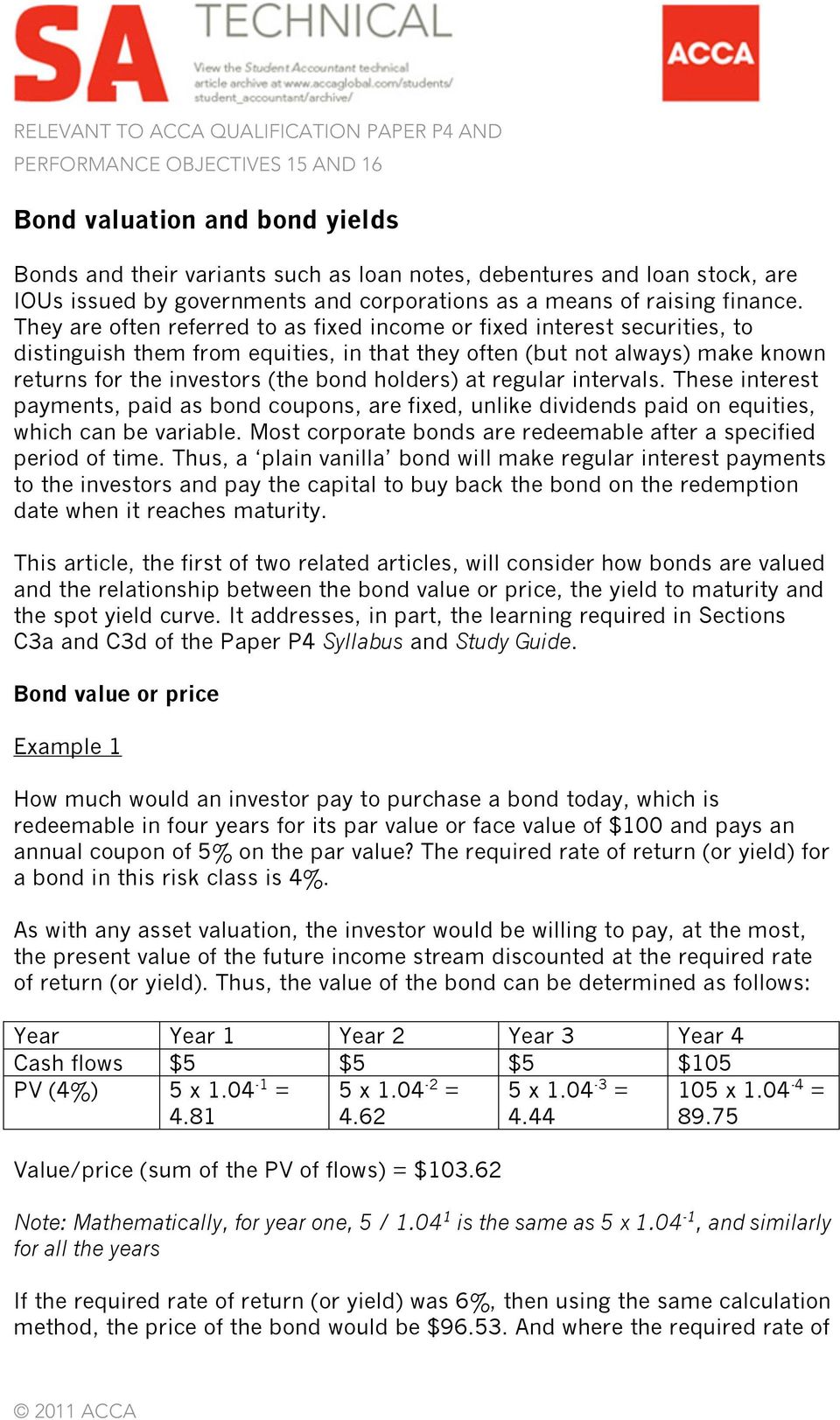
1 RELEVANT TO ACCA QUALIFICATION PAPER P4 AND PERFORMANCE OBJECTIVES 15 AND 16 Bond valuation and bond yields Bonds and their variants such as loan notes, debentures and loan stock, are IOUs issued by governments and corporations as a means of raising finance. They are often referred to as fixed income or fixed interest securities, to distinguish them from equities, in that they often (but not always) make known returns for the investors (the bond holders) at regular intervals. These interest payments, paid as bond coupons, are fixed, unlike dividends paid on equities, which can be variable. Most corporate bonds are redeemable after a specified period of time. Thus, a plain vanilla bond will make regular interest payments to the investors and pay the capital to buy back the bond on the redemption date when it reaches maturity. This article, the first of two related articles, will consider how bonds are valued and the relationship between the bond value or price, the yield to maturity and the spot yield curve. It addresses, in part, the learning required in Sections C3a and C3d of the Paper P4 Syllabus and Study Guide. Bond value or price Example 1 How much would an investor pay to purchase a bond today, which is redeemable in four years for its par value or face value of $100 and pays an annual coupon of 5% on the par value? The required rate of return (or yield) for a bond in this risk class is 4%. As with any asset valuation, the investor would be willing to pay, at the most, the present value of the future income stream discounted at the required rate of return (or yield). Thus, the value of the bond can be determined as follows: Year Year 1 Year 2 Year 3 Year 4 Cash flows $5 $5 $5 $105 PV (4%) 5 x = x = x = x = Value/price (sum of the PV of flows) = $ Note: Mathematically, for year one, 5 / is the same as 5 x , and similarly for all the years If the required rate of return (or yield) was 6%, then using the same calculation method, the price of the bond would be $ And where the required rate of
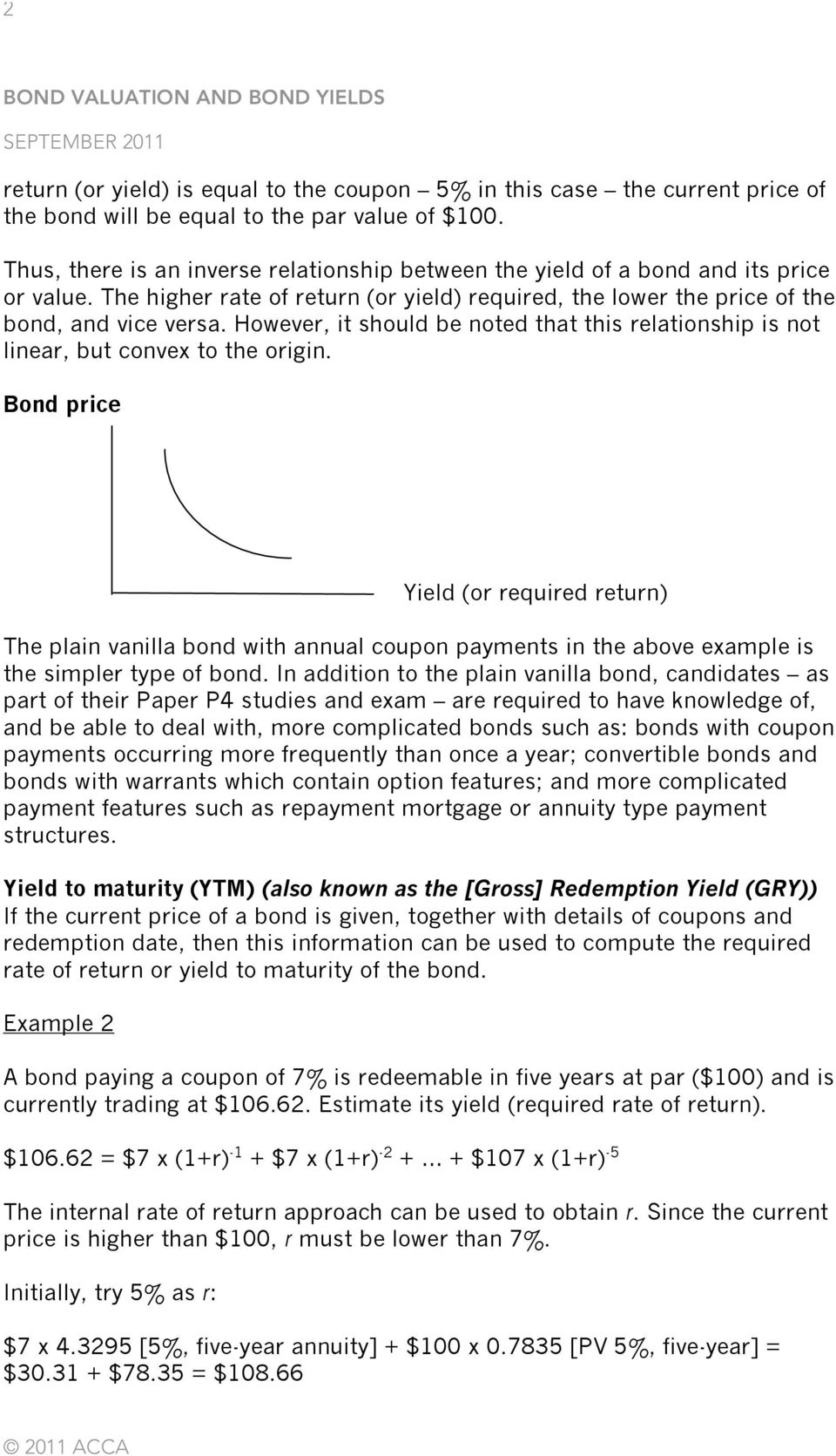
2 2 return (or yield) is equal to the coupon 5% in this case the current price of the bond will be equal to the par value of $100. Thus, there is an inverse relationship between the yield of a bond and its price or value. The higher rate of return (or yield) required, the lower the price of the bond, and vice versa. However, it should be noted that this relationship is not linear, but convex to the origin. Bond price Yield (or required return) The plain vanilla bond with annual coupon payments in the above example is the simpler type of bond. In addition to the plain vanilla bond, candidates as part of their Paper P4 studies and exam are required to have knowledge of, and be able to deal with, more complicated bonds such as: bonds with coupon payments occurring more frequently than once a year; convertible bonds and bonds with warrants which contain option features; and more complicated payment features such as repayment mortgage or annuity type payment structures. Yield to maturity (YTM) (also known as the [Gross] Redemption Yield (GRY)) If the current price of a bond is given, together with details of coupons and redemption date, then this information can be used to compute the required rate of return or yield to maturity of the bond. Example 2 A bond paying a coupon of 7% is redeemable in five years at par ($100) and is currently trading at $ Estimate its yield (required rate of return). $ = $7 x (1+r) -1 + $7 x (1+r) $107 x (1+r) -5 The internal rate of return approach can be used to obtain r. Since the current price is higher than $100, r must be lower than 7%. Initially, try 5% as r: $7 x [5%, five-year annuity] + $100 x [PV 5%, five-year] = $ $78.35 = $108.66
3 3 Try 6% as r: $7 x [6%, five-year annuity] + $100 x [PV 6%, five-year] = $ $74.73 = $ Yield = 5% + ( / ) x 1% = 5.46% The 5.46% is the yield to maturity (YTM) (or redemption yield) of the bond. The YTM is the rate of return at which the sum of the present values of all future income streams of the bond (interest coupons and redemption amount) is equal to the current bond price. It is the average annual rate of return the bond investors expect to receive from the bond till its redemption. YTMs for bonds are normally quoted in the financial press, based on the closing price of the bond. For example, a yield often quoted in the financial press is the bid yield. The bid yield is the YTM for the current bid price (the price at which bonds can be purchased) of a bond. Term structure of interest rates and the yield curve The yield to maturity is calculated implicitly based on the current market price, the term to maturity of the bond and amount (and frequency) of coupon payments. However, if a corporate bond is being issued for the first time, its price and/or coupon payments need to be determined based on the required yield. The required yield is based on the term structure of interest rates and this needs to be discussed before considering how the price of a bond may be determined. It is incorrect to assume that bonds of the same risk class, which are redeemed on different dates, would have the same required rate of return or yield. In fact, it is evident that the markets demand different annual returns or yields on bonds with differing lengths of time before their redemption (or maturity), even where the bonds are of the same risk class. This is known as the term structure of interest rates and is represented by the spot yield curve or simply the yield curve. For example, a company may find that if it wants to issue a one-year bond, it may need to pay interest at 3% for the year, if it wants to issue a two-year bond, the markets may demand an annual interest rate of 3.5%, and for a three-year bond the annual yield required may be 4.2%. Hence, the company would need to pay interest at 3% for one year; 3.5% each year, for two years, if it wants to borrow funds for two years; and 4.2% each year, for three years, if it wants to borrow funds for three years. In this case, the term structure of interest rates is represented by an upward sloping yield curve.

4 4 The normal expectation would be of an upward sloping yield curve on the basis that bonds with a longer period of maturity would require a higher interest rate as compensation for risk. Note here that the bonds considered may be of the same risk class but the longer time period to maturity still adds to higher uncertainty. However, it is entirely normal for yield curves to be of many different shapes dependent on the perceptions of the markets on how interest rates may change in the future. Three main theories have been advanced to explain the term structure of interest rates or the yield curve: expectations hypothesis, liquiditypreference hypothesis and market-segmentation hypothesis. Although it is beyond the remit of this article to explain these theories, many textbooks on investments and financial management cover these in detail. Valuing bonds based on the yield curve Annual spot yield curves are often published by the financial press or by central banks (for example, the Bank of England regularly publishes UK government bond yield curves on its website). The spot yield curve can be used to estimate the price or value of a bond. Example 3 A company wants to issue a bond that is redeemable in four years for its par value or face value of $100, and wants to pay an annual coupon of 5% on the par value. Estimate the price at which the bond should be issued. The annual spot yield curve for a bond of this risk class is as follows: One-year 3.5% Two-year 4.0% Three-year 4.7% Four-year 5.5% The four-year bond pays the following stream of income: Year Payments $5 $5 $5 $105 This can be simplified into four separate bonds with the following payment structure: Year Bond 1 $5 Bond 2 $5 Bond 3 $5 Bond 4 $105

5 5 Each annual payment is a single payment in that particular year, much like a zero-coupon bond, and its present value can be determined by discounting each cash flow by the relevant yield curve rate, as follows: Bond 1 $5 x = $4.83 Bond 2 $5 x = $4.62 Bond 3 $5 x = $4.36 Bond 4 $105 x = $84.76 The sum of these flows is the price at which the bond can be issued, $ The yield to maturity of the bond is estimated at 5.41% using the same methodology as example 2. Some important points can be noted from the above calculation; firstly, the 5.41% is lower than 5.5% because some of the returns from the bond come in earlier years, when the interest rates on the yield curve are lower, but the largest proportion comes in Year 4. Secondly, the yield to maturity is a weighted average of the term structure of interest rates. Thirdly, the yield to maturity is calculated after the price of the bond has been calculated or observed in the markets, but theoretically it is term structure of interest rates that determines the price or value of the bond. Mathematically: Bond price = Coupon x (1+r 1 ) -1 + coupon x (1+r 2 ) coupon x (1+r n ) -n + redemption value x (1+r n ) -n Where r 1, r 2, etc are spot interest rates based on the yield curve and n is the number of time periods in which an amount of the coupon is paid and, finally, the value when the bond is redeemed. In this article it is assumed that coupons are paid annually, but it is common practice to pay coupons more frequently than once a year. In these circumstances, the coupon payments need to be reduced and the time period frequency needs to be increased. Estimating the yield curve There are different methods used to estimate a spot yield curve, and the iterative process based on bootstrapping coupon paying bonds is perhaps the simplest to understand. The following example demonstrates how the process works.

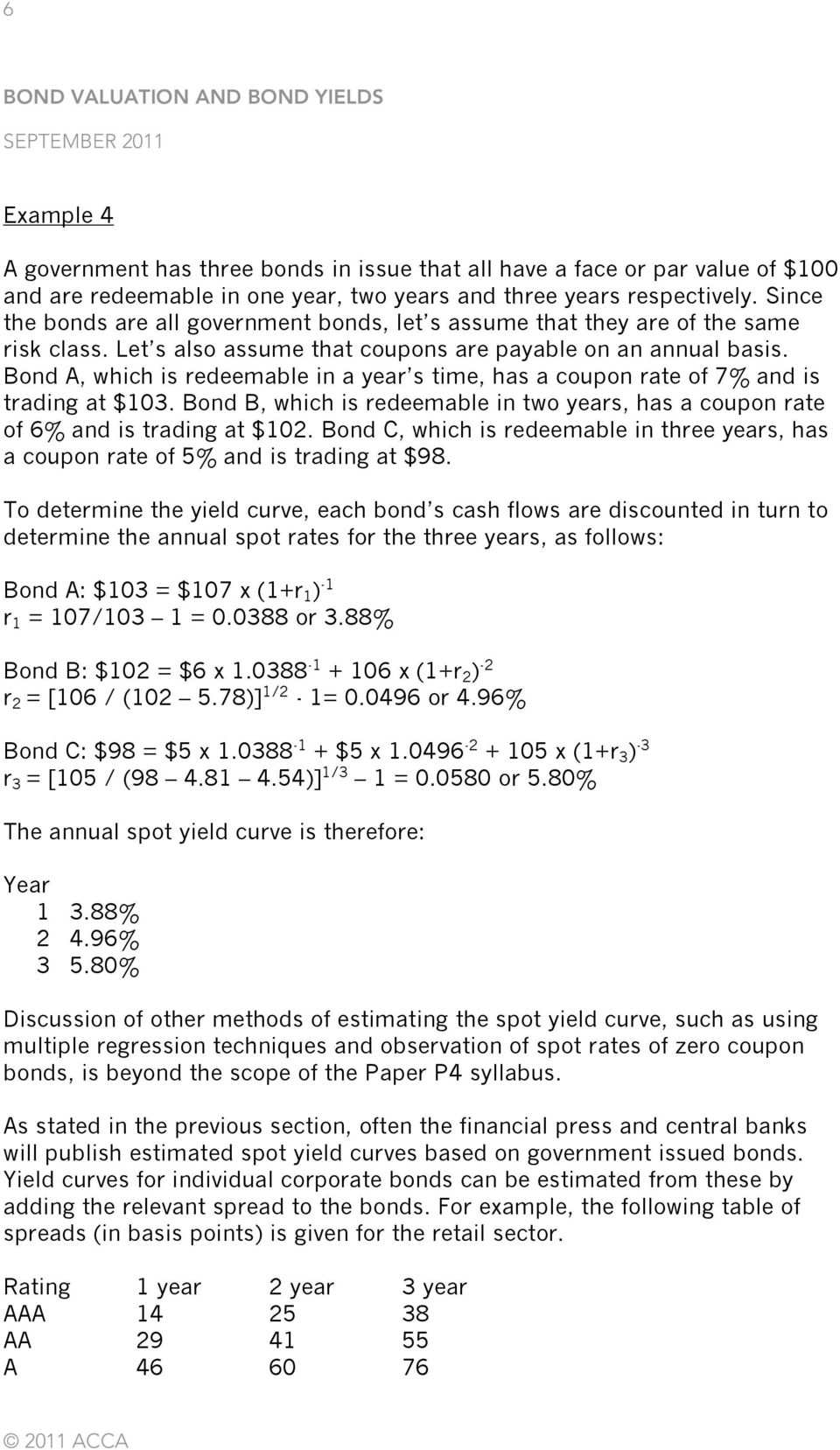
6 6 Example 4 A government has three bonds in issue that all have a face or par value of $100 and are redeemable in one year, two years and three years respectively. Since the bonds are all government bonds, let s assume that they are of the same risk class. Let s also assume that coupons are payable on an annual basis. Bond A, which is redeemable in a year s time, has a coupon rate of 7% and is trading at $103. Bond B, which is redeemable in two years, has a coupon rate of 6% and is trading at $102. Bond C, which is redeemable in three years, has a coupon rate of 5% and is trading at $98. To determine the yield curve, each bond s cash flows are discounted in turn to determine the annual spot rates for the three years, as follows: Bond A: $103 = $107 x (1+r 1 ) -1 r 1 = 107/103 1 = or 3.88% Bond B: $102 = $6 x x (1+r 2 ) -2 r 2 = [106 / ( )] 1/2-1= or 4.96% Bond C: $98 = $5 x $5 x x (1+r 3 ) -3 r 3 = [105 / ( )] 1/3 1 = or 5.80% The annual spot yield curve is therefore: Year % % % Discussion of other methods of estimating the spot yield curve, such as using multiple regression techniques and observation of spot rates of zero coupon bonds, is beyond the scope of the Paper P4 syllabus. As stated in the previous section, often the financial press and central banks will publish estimated spot yield curves based on government issued bonds. Yield curves for individual corporate bonds can be estimated from these by adding the relevant spread to the bonds. For example, the following table of spreads (in basis points) is given for the retail sector. Rating 1 year 2 year 3 year AAA AA A
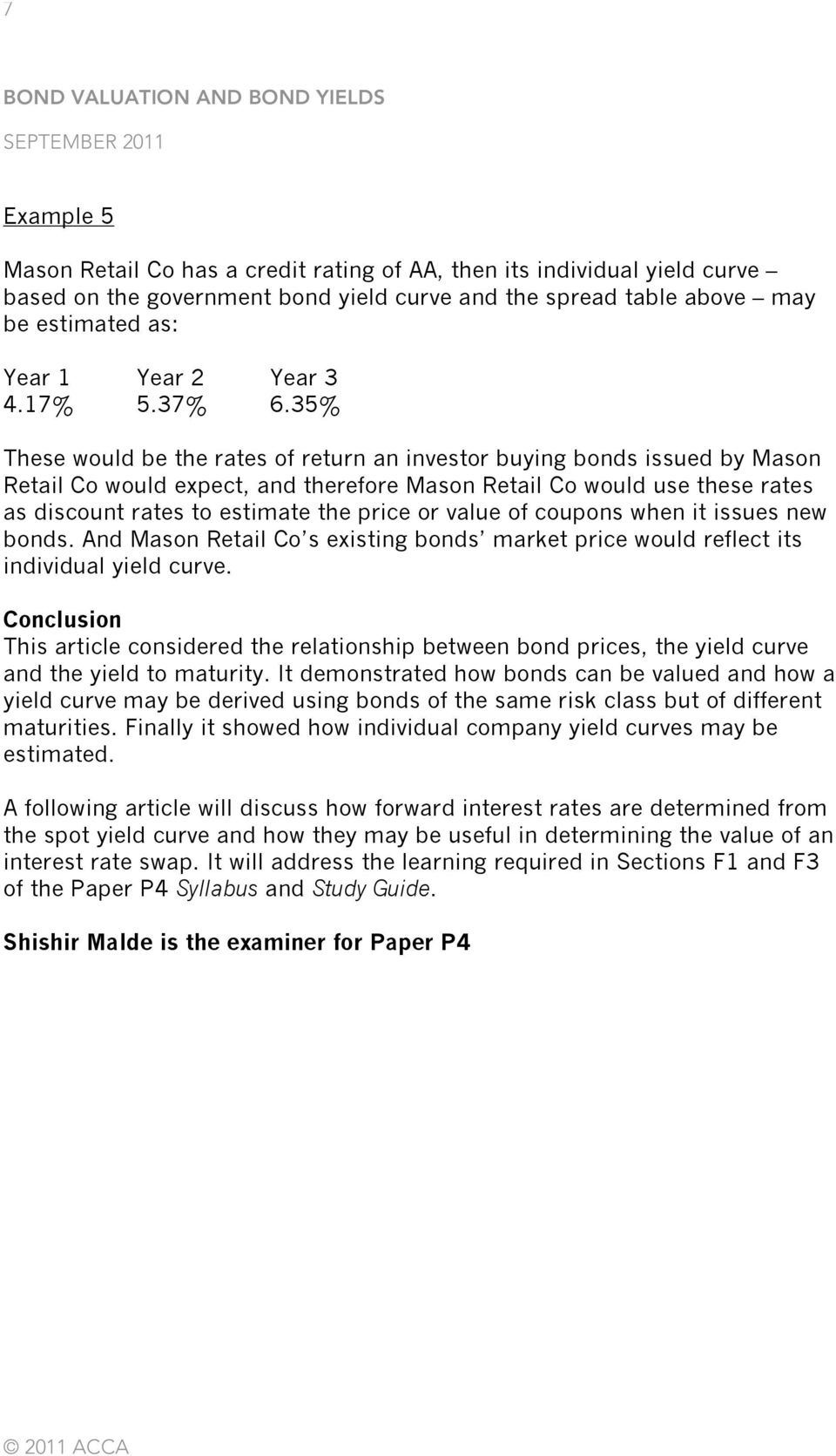
7 7 Example 5 Mason Retail Co has a credit rating of AA, then its individual yield curve based on the government bond yield curve and the spread table above may be estimated as: Year 1 Year 2 Year % 5.37% 6.35% These would be the rates of return an investor buying bonds issued by Mason Retail Co would expect, and therefore Mason Retail Co would use these rates as discount rates to estimate the price or value of coupons when it issues new bonds. And Mason Retail Co s existing bonds market price would reflect its individual yield curve. Conclusion This article considered the relationship between bond prices, the yield curve and the yield to maturity. It demonstrated how bonds can be valued and how a yield curve may be derived using bonds of the same risk class but of different maturities. Finally it showed how individual company yield curves may be estimated. A following article will discuss how forward interest rates are determined from the spot yield curve and how they may be useful in determining the value of an interest rate swap. It will address the learning required in Sections F1 and F3 of the Paper P4 Syllabus and Study Guide. Shishir Malde is the examiner for Paper P4
CHAPTER 15: THE TERM STRUCTURE OF INTEREST RATES
 CHAPTER : THE TERM STRUCTURE OF INTEREST RATES CHAPTER : THE TERM STRUCTURE OF INTEREST RATES PROBLEM SETS.. In general, the forward rate can be viewed as the sum of the market s expectation of the future
CHAPTER 15: THE TERM STRUCTURE OF INTEREST RATES
 CHAPTER 15: THE TERM STRUCTURE OF INTEREST RATES 1. Expectations hypothesis. The yields on long-term bonds are geometric averages of present and expected future short rates. An upward sloping curve is
CHAPTER 15: THE TERM STRUCTURE OF INTEREST RATES
 Chapter - The Term Structure of Interest Rates CHAPTER : THE TERM STRUCTURE OF INTEREST RATES PROBLEM SETS.. In general, the forward rate can be viewed as the sum of the market s expectation of the future
YIELD CURVE GENERATION
 1 YIELD CURVE GENERATION Dr Philip Symes Agenda 2 I. INTRODUCTION II. YIELD CURVES III. TYPES OF YIELD CURVES IV. USES OF YIELD CURVES V. YIELD TO MATURITY VI. BOND PRICING & VALUATION Introduction 3 A
LOS 56.a: Explain steps in the bond valuation process.
 The following is a review of the Analysis of Fixed Income Investments principles designed to address the learning outcome statements set forth by CFA Institute. This topic is also covered in: Introduction
Bond valuation. Present value of a bond = present value of interest payments + present value of maturity value
 Bond valuation A reading prepared by Pamela Peterson Drake O U T L I N E 1. Valuation of long-term debt securities 2. Issues 3. Summary 1. Valuation of long-term debt securities Debt securities are obligations
Chapter 3 Fixed Income Securities
 Chapter 3 Fixed Income Securities Road Map Part A Introduction to finance. Part B Valuation of assets, given discount rates. Fixed-income securities. Stocks. Real assets (capital budgeting). Part C Determination
Understanding duration and convexity of fixed income securities. Vinod Kothari
 Understanding duration and convexity of fixed income securities Vinod Kothari Notation y : yield p: price of the bond T: total maturity of the bond t: any given time during T C t : D m : Cashflow from
ANALYSIS OF FIXED INCOME SECURITIES
 ANALYSIS OF FIXED INCOME SECURITIES Valuation of Fixed Income Securities Page 1 VALUATION Valuation is the process of determining the fair value of a financial asset. The fair value of an asset is its
3. If an individual investor buys or sells a currently owned stock through a broker, this is a primary market transaction.
 Spring 2012 Finance 3130 Sample Exam 1A Questions for Review 1. The form of organization for a business is an important issue, as this decision has very significant effect on the income and wealth of the
Chapter 8. Step 2: Find prices of the bonds today: n i PV FV PMT Result Coupon = 4% 29.5 5? 100 4 84.74 Zero coupon 29.5 5? 100 0 23.
 Chapter 8 Bond Valuation with a Flat Term Structure 1. Suppose you want to know the price of a 10-year 7% coupon Treasury bond that pays interest annually. a. You have been told that the yield to maturity
Bond Valuation. Capital Budgeting and Corporate Objectives
 Bond Valuation Capital Budgeting and Corporate Objectives Professor Ron Kaniel Simon School of Business University of Rochester 1 Bond Valuation An Overview Introduction to bonds and bond markets» What
Chapter 4 Valuing Bonds
 Chapter 4 Valuing Bonds MULTIPLE CHOICE 1. A 15 year, 8%, $1000 face value bond is currently trading at $958. The yield to maturity of this bond must be a. less than 8%. b. equal to 8%. c. greater than
C(t) (1 + y) 4. t=1. For the 4 year bond considered above, assume that the price today is 900$. The yield to maturity will then be the y that solves
 Economics 7344, Spring 2013 Bent E. Sørensen INTEREST RATE THEORY We will cover fixed income securities. The major categories of long-term fixed income securities are federal government bonds, corporate
Management Accounting Financial Strategy
 PAPER P9 Management Accounting Financial Strategy The Examiner provides a short study guide, for all candidates revising for this paper, to some first principles of finance and financial management Based
Duration and convexity
 Duration and convexity Prepared by Pamela Peterson Drake, Ph.D., CFA Contents 1. Overview... 1 A. Calculating the yield on a bond... 4 B. The yield curve... 6 C. Option-like features... 8 D. Bond ratings...
Bonds and Yield to Maturity
 Bonds and Yield to Maturity Bonds A bond is a debt instrument requiring the issuer to repay to the lender/investor the amount borrowed (par or face value) plus interest over a specified period of time.
Interest Rates and Bond Valuation
 Interest Rates and Bond Valuation Chapter 6 Key Concepts and Skills Know the important bond features and bond types Understand bond values and why they fluctuate Understand bond ratings and what they mean
Bond Valuation. FINANCE 350 Global Financial Management. Professor Alon Brav Fuqua School of Business Duke University. Bond Valuation: An Overview
 Bond Valuation FINANCE 350 Global Financial Management Professor Alon Brav Fuqua School of Business Duke University 1 Bond Valuation: An Overview Bond Markets What are they? How big? How important? Valuation
FNCE 301, Financial Management H Guy Williams, 2006
 REVIEW We ve used the DCF method to find present value. We also know shortcut methods to solve these problems such as perpetuity present value = C/r. These tools allow us to value any cash flow including
Mid-Term Exam Practice Set and Solutions.
 FIN-469 Investments Analysis Professor Michel A. Robe Mid-Term Exam Practice Set and Solutions. What to do with this practice set? To help students prepare for the mid-term exam, two practice sets with
Bond Market Overview and Bond Pricing
 Bond Market Overview and Bond Pricing. Overview of Bond Market 2. Basics of Bond Pricing 3. Complications 4. Pricing Floater and Inverse Floater 5. Pricing Quotes and Accrued Interest What is A Bond? Bond:
Understanding Fixed Income
 Understanding Fixed Income 2014 AMP Capital Investors Limited ABN 59 001 777 591 AFSL 232497 Understanding Fixed Income About fixed income at AMP Capital Our global presence helps us deliver outstanding
You just paid $350,000 for a policy that will pay you and your heirs $12,000 a year forever. What rate of return are you earning on this policy?
 1 You estimate that you will have $24,500 in student loans by the time you graduate. The interest rate is 6.5%. If you want to have this debt paid in full within five years, how much must you pay each
American Options and Callable Bonds
 American Options and Callable Bonds American Options Valuing an American Call on a Coupon Bond Valuing a Callable Bond Concepts and Buzzwords Interest Rate Sensitivity of a Callable Bond exercise policy
CHAPTER 10 BOND PRICES AND YIELDS
 CHAPTER 10 BOND PRICES AND YIELDS 1. a. Catastrophe bond. Typically issued by an insurance company. They are similar to an insurance policy in that the investor receives coupons and par value, but takes
NATIONAL STOCK EXCHANGE OF INDIA LIMITED
 NATIONAL STOCK EXCHANGE OF INDIA LIMITED Capital Market FAQ on Corporate Bond Date : September 29, 2011 1. What are securities? Securities are financial instruments that represent a creditor relationship
The Term Structure of Interest Rates CHAPTER 13
 The Term Structure of Interest Rates CHAPTER 13 Chapter Summary Objective: To explore the pattern of interest rates for different-term assets. The term structure under certainty Forward rates Theories
Alliance Consulting BOND YIELDS & DURATION ANALYSIS. Bond Yields & Duration Analysis Page 1
 BOND YIELDS & DURATION ANALYSIS Bond Yields & Duration Analysis Page 1 COMPUTING BOND YIELDS Sources of returns on bond investments The returns from investment in bonds come from the following: 1. Periodic
Untangling F9 terminology
 Untangling F9 terminology Welcome! This is not a textbook and we are certainly not trying to replace yours! However, we do know that some students find some of the terminology used in F9 difficult to understand.
6. Debt Valuation and the Cost of Capital
 6. Debt Valuation and the Cost of Capital Introduction Firms rarely finance capital projects by equity alone. They utilise long and short term funds from a variety of sources at a variety of costs. No
SOCIETY OF ACTUARIES FINANCIAL MATHEMATICS EXAM FM SAMPLE QUESTIONS
 SOCIETY OF ACTUARIES EXAM FM FINANCIAL MATHEMATICS EXAM FM SAMPLE QUESTIONS This page indicates changes made to Study Note FM-09-05. April 28, 2014: Question and solutions 61 were added. January 14, 2014:
MULTIPLE CHOICE. Choose the one alternative that best completes the statement or answers the question.
 ECON 4110: Sample Exam Name MULTIPLE CHOICE. Choose the one alternative that best completes the statement or answers the question. 1) Economists define risk as A) the difference between the return on common
Practice Set #2 and Solutions.
 FIN-672 Securities Analysis & Portfolio Management Professor Michel A. Robe Practice Set #2 and Solutions. What to do with this practice set? To help MBA students prepare for the assignment and the exams,
STATUTORY BOARD SB-FRS 32 FINANCIAL REPORTING STANDARD. Financial Instruments: Presentation Illustrative Examples
 STATUTORY BOARD SB-FRS 32 FINANCIAL REPORTING STANDARD Financial Instruments: Presentation Illustrative Examples CONTENTS Paragraphs ACCOUNTING FOR CONTRACTS ON EQUITY INSTRUMENTS OF AN ENTITY Example
STATUTORY BOARD FINANCIAL REPORTING STANDARD SB-FRS 32. Financial Instruments: Presentation Illustrative Examples
 STATUTORY BOARD FINANCIAL REPORTING STANDARD SB-FRS 32 Financial Instruments: Presentation Illustrative Examples CONTENTS Paragraphs ACCOUNTING FOR CONTRACTS ON EQUITY INSTRUMENTS OF AN ENTITY Example
2015 Exam 2 Syllabus Financial Mathematics Exam
 2015 Exam 2 Syllabus Financial Mathematics Exam The syllabus for this exam is defined in the form of learning objectives that set forth, usually in broad terms, what the candidate should be able to do
MBA Finance Part-Time Present Value
 MBA Finance Part-Time Present Value Professor Hugues Pirotte Spéder Solvay Business School Université Libre de Bruxelles Fall 2002 1 1 Present Value Objectives for this session : 1. Introduce present value
Fin 3312 Sample Exam 1 Questions
 Fin 3312 Sample Exam 1 Questions Here are some representative type questions. This review is intended to give you an idea of the types of questions that may appear on the exam, and how the questions might
Chapter 11. Bond Pricing - 1. Bond Valuation: Part I. Several Assumptions: To simplify the analysis, we make the following assumptions.
 Bond Pricing - 1 Chapter 11 Several Assumptions: To simplify the analysis, we make the following assumptions. 1. The coupon payments are made every six months. 2. The next coupon payment for the bond is
Chapter 9 Bonds and Their Valuation ANSWERS TO SELECTED END-OF-CHAPTER QUESTIONS
 Chapter 9 Bonds and Their Valuation ANSWERS TO SELECTED END-OF-CHAPTER QUESTIONS 9-1 a. A bond is a promissory note issued by a business or a governmental unit. Treasury bonds, sometimes referred to as
How To Invest In Stocks And Bonds
 Review for Exam 1 Instructions: Please read carefully The exam will have 21 multiple choice questions and 5 work problems. Questions in the multiple choice section will be either concept or calculation
Global Financial Management
 Global Financial Management Bond Valuation Copyright 999 by Alon Brav, Campbell R. Harvey, Stephen Gray and Ernst Maug. All rights reserved. No part of this lecture may be reproduced without the permission
Chapter 5: Valuing Bonds
 FIN 302 Class Notes Chapter 5: Valuing Bonds What is a bond? A long-term debt instrument A contract where a borrower agrees to make interest and principal payments on specific dates Corporate Bond Quotations
Asset Valuation Debt Investments: Analysis and Valuation
 Asset Valuation Debt Investments: Analysis and Valuation Joel M. Shulman, Ph.D, CFA Study Session # 15 Level I CFA CANDIDATE READINGS: Fixed Income Analysis for the Chartered Financial Analyst Program:
Relative value analysis: calculating bond spreads Moorad Choudhry January 2006
 Relative value analysis: calculating bond spreads Moorad Choudhry January 2006 Relative value analysis: bond spreads Moorad Choudhry Investors measure the perceived market value, or relative value, of
1. Present Value. 2. Bonds. 3. Stocks
 Stocks and Bonds 1. Present Value 2. Bonds 3. Stocks 1 Present Value = today s value of income at a future date Income at one future date value today of X dollars in one year V t = X t+1 (1 + i t ) where
Manual for SOA Exam FM/CAS Exam 2.
 Manual for SOA Exam FM/CAS Exam 2. Chapter 6. Variable interest rates and portfolio insurance. c 2009. Miguel A. Arcones. All rights reserved. Extract from: Arcones Manual for the SOA Exam FM/CAS Exam
SOCIETY OF ACTUARIES FINANCIAL MATHEMATICS. EXAM FM SAMPLE QUESTIONS Interest Theory
 SOCIETY OF ACTUARIES EXAM FM FINANCIAL MATHEMATICS EXAM FM SAMPLE QUESTIONS Interest Theory This page indicates changes made to Study Note FM-09-05. January 14, 2014: Questions and solutions 58 60 were
Zero-Coupon Bonds (Pure Discount Bonds)
 Zero-Coupon Bonds (Pure Discount Bonds) The price of a zero-coupon bond that pays F dollars in n periods is F/(1 + r) n, where r is the interest rate per period. Can meet future obligations without reinvestment
CHAPTER 14: BOND PRICES AND YIELDS
 CHAPTER 14: BOND PRICES AND YIELDS PROBLEM SETS 1. The bond callable at 105 should sell at a lower price because the call provision is more valuable to the firm. Therefore, its yield to maturity should
Current liabilities and payroll
 Chapter 12 Current liabilities and payroll Current liabilities are obligations that the business has to discharge within 12 months or its operating cycle if longer than one year. Obligations that are due
10. Fixed-Income Securities. Basic Concepts
 0. Fixed-Income Securities Fixed-income securities (FIS) are bonds that have no default risk and their payments are fully determined in advance. Sometimes corporate bonds that do not necessarily have certain
INSTITUTE AND FACULTY OF ACTUARIES EXAMINATION
 1 2 3 4 5 6 7 8 9 10 11 12 13 14 15 16 17 18 19 20 21 22 23 24 25 26 27 28 29 30 31 32 33 34 35 INSTITUTE AND FACULTY OF ACTUARIES EXAMINATION 12 April 2016 (am) Subject CT1 Financial Mathematics Core
2. Determine the appropriate discount rate based on the risk of the security
 Fixed Income Instruments III Intro to the Valuation of Debt Securities LOS 64.a Explain the steps in the bond valuation process 1. Estimate the cash flows coupons and return of principal 2. Determine the
Solutions 2. 1. For the benchmark maturity sectors in the United States Treasury bill markets,
 FIN 472 Professor Robert Hauswald Fixed-Income Securities Kogod School of Business, AU Solutions 2 1. For the benchmark maturity sectors in the United States Treasury bill markets, Bloomberg reported the
CHAPTER 7: FIXED-INCOME SECURITIES: PRICING AND TRADING
 CHAPTER 7: FIXED-INCOME SECURITIES: PRICING AND TRADING Topic One: Bond Pricing Principles 1. Present Value. A. The present-value calculation is used to estimate how much an investor should pay for a bond;
Term Structure of Interest Rates
 Appendix 8B Term Structure of Interest Rates To explain the process of estimating the impact of an unexpected shock in short-term interest rates on the entire term structure of interest rates, FIs use
Learning Curve September 2005. Understanding the Z-Spread Moorad Choudhry*
 Learning Curve September 2005 Understanding the Z-Spread Moorad Choudhry* A key measure of relative value of a corporate bond is its swap spread. This is the basis point spread over the interest-rate swap
Bond Valuation. What is a bond?
 Lecture: III 1 What is a bond? Bond Valuation When a corporation wishes to borrow money from the public on a long-term basis, it usually does so by issuing or selling debt securities called bonds. A bond
Financial Mathematics Exam
 2014 Exam 2 Syllabus Financial Mathematics Exam The purpose of the syllabus for this examination is to develop knowledge of the fundamental concepts of financial mathematics and how those concepts are
Chapter Nine Selected Solutions
 Chapter Nine Selected Solutions 1. What is the difference between book value accounting and market value accounting? How do interest rate changes affect the value of bank assets and liabilities under the
Bonds are IOUs. Just like shares you can buy bonds on the world s stock exchanges.
 Investing in bonds Despite their names, ShareScope and SharePad are not just all about shares. They can help you with other investments as well. In this article I m going to tell you how you can use the
Financial-Institutions Management. Solutions 1. 6. A financial institution has the following market value balance sheet structure:
 FIN 683 Professor Robert Hauswald Financial-Institutions Management Kogod School of Business, AU Solutions 1 Chapter 7: Bank Risks - Interest Rate Risks 6. A financial institution has the following market
Fixed Income Portfolio Management. Interest rate sensitivity, duration, and convexity
 Fixed Income ortfolio Management Interest rate sensitivity, duration, and convexity assive bond portfolio management Active bond portfolio management Interest rate swaps 1 Interest rate sensitivity, duration,
Answers to Review Questions
 Answers to Review Questions 1. The real rate of interest is the rate that creates an equilibrium between the supply of savings and demand for investment funds. The nominal rate of interest is the actual
Bond Valuation. Chapter 7. Example (coupon rate = r d ) Bonds, Bond Valuation, and Interest Rates. Valuing the cash flows
 Bond Valuation Chapter 7 Bonds, Bond Valuation, and Interest Rates Valuing the cash flows (1) coupon payment (interest payment) = (coupon rate * principal) usually paid every 6 months (2) maturity value
CHAPTER 16: MANAGING BOND PORTFOLIOS
 CHAPTER 16: MANAGING BOND PORTFOLIOS PROBLEM SETS 1. While it is true that short-term rates are more volatile than long-term rates, the longer duration of the longer-term bonds makes their prices and their
How To Value Bonds
 Chapter 6 Interest Rates And Bond Valuation Learning Goals 1. Describe interest rate fundamentals, the term structure of interest rates, and risk premiums. 2. Review the legal aspects of bond financing
Econ 330 Exam 1 Name ID Section Number
 Econ 330 Exam 1 Name ID Section Number MULTIPLE CHOICE. Choose the one alternative that best completes the statement or answers the question. 1) If during the past decade the average rate of monetary growth
Lecture 2 Bond pricing. Hedging the interest rate risk
 Lecture 2 Bond pricing. Hedging the interest rate risk IMQF, Spring Semester 2011/2012 Module: Derivatives and Fixed Income Securities Course: Fixed Income Securities Lecturer: Miloš Bo ović Lecture outline
Hot Topics in Financial Markets Lecture 1: The Libor Scandal
 Hot Topics in Financial Markets Lecture 1: The Libor Scandal Spot and Forward Interest Rates Libor Libor-Dependent Financial Instruments The Scandal 2 Spot Interest Rates Bond Market The yield on a bond
Chapter 11. Stocks and Bonds. How does this distribution work? An example. What form do the distributions to common shareholders take?
 Chapter 11. Stocks and Bonds Chapter Objectives To identify basic shareholder rights and the means by which corporations make distributions to shareholders To recognize the investment opportunities in
Answer Key to Midterm
 Econ 121 Money and Banking Instructor: Chao Wei Answer Key to Midterm Provide a brief and concise answer to each question. Clearly label each answer. There are 50 points on the exam. 1. (10 points, 3 points
Analysis of Deterministic Cash Flows and the Term Structure of Interest Rates
 Analysis of Deterministic Cash Flows and the Term Structure of Interest Rates Cash Flow Financial transactions and investment opportunities are described by cash flows they generate. Cash flow: payment
Topics in Chapter. Key features of bonds Bond valuation Measuring yield Assessing risk
 Bond Valuation 1 Topics in Chapter Key features of bonds Bond valuation Measuring yield Assessing risk 2 Determinants of Intrinsic Value: The Cost of Debt Net operating profit after taxes Free cash flow
Equity-index-linked swaps
 Equity-index-linked swaps Equivalent to portfolios of forward contracts calling for the exchange of cash flows based on two different investment rates: a variable debt rate (e.g. 3-month LIBOR) and the
Long-Term Debt. Objectives: simple present value calculations. Understand the terminology of long-term debt Par value Discount vs.
 Objectives: Long-Term Debt! Extend our understanding of valuation methods beyond simple present value calculations. Understand the terminology of long-term debt Par value Discount vs. Premium Mortgages!
Chapter 16. Debentures: An Introduction. Non-current Liabilities. Horngren, Best, Fraser, Willett: Accounting 6e 2010 Pearson Australia.
 PowerPoint to accompany Non-current Liabilities Chapter 16 Learning Objectives 1. Account for debentures payable transactions 2. Measure interest expense by the straight line interest method 3. Account
Bonds and the Term Structure of Interest Rates: Pricing, Yields, and (No) Arbitrage
 Prof. Alex Shapiro Lecture Notes 12 Bonds and the Term Structure of Interest Rates: Pricing, Yields, and (No) Arbitrage I. Readings and Suggested Practice Problems II. Bonds Prices and Yields (Revisited)
I. Readings and Suggested Practice Problems. II. Risks Associated with Default-Free Bonds
 Prof. Alex Shapiro Lecture Notes 13 Bond Portfolio Management I. Readings and Suggested Practice Problems II. Risks Associated with Default-Free Bonds III. Duration: Details and Examples IV. Immunization
The Time Value of Money
 The Time Value of Money This handout is an overview of the basic tools and concepts needed for this corporate nance course. Proofs and explanations are given in order to facilitate your understanding and
CALCULATOR TUTORIAL. Because most students that use Understanding Healthcare Financial Management will be conducting time
 CALCULATOR TUTORIAL INTRODUCTION Because most students that use Understanding Healthcare Financial Management will be conducting time value analyses on spreadsheets, most of the text discussion focuses
UNITED KINGDOM DEBT MANAGEMENT OFFICE. The DMO's Yield Curve Model
 United Kingdom Debt Management Office Cheapside House 138 Cheapside London EC2V 6BB UNITED KINGDOM DEBT MANAGEMENT OFFICE The DMO's Yield Curve Model July 2000 The DMO s yield curve model Introduction
Click Here to Buy the Tutorial
 FIN 534 Week 4 Quiz 3 (Str) Click Here to Buy the Tutorial http://www.tutorialoutlet.com/fin-534/fin-534-week-4-quiz-3- str/ For more course tutorials visit www.tutorialoutlet.com Which of the following
A) 1.8% B) 1.9% C) 2.0% D) 2.1% E) 2.2%
 1 Exam FM Questions Practice Exam 1 1. Consider the following yield curve: Year Spot Rate 1 5.5% 2 5.0% 3 5.0% 4 4.5% 5 4.0% Find the four year forward rate. A) 1.8% B) 1.9% C) 2.0% D) 2.1% E) 2.2% 2.
Fixed Income: Practice Problems with Solutions
 Fixed Income: Practice Problems with Solutions Directions: Unless otherwise stated, assume semi-annual payment on bonds.. A 6.0 percent bond matures in exactly 8 years and has a par value of 000 dollars.
Financial Strategy. >studynotes PAPER F3
 CORBIS Financial Strategy Students tend to find discussing debt finance far easier than doing the calculations. Andrew Howarth explains how to deal with yield on debt. An investor who purchases a corporate
Practice Set #1 and Solutions.
 Bo Sjö 14-05-03 Practice Set #1 and Solutions. What to do with this practice set? Practice sets are handed out to help students master the material of the course and prepare for the final exam. These sets
Exam 1 Morning Session
 91. A high yield bond fund states that through active management, the fund s return has outperformed an index of Treasury securities by 4% on average over the past five years. As a performance benchmark
Accounting for Bonds and Long-Term Notes
 Accounting for Bonds and Long-Term Notes Bond Premiums and Discounts Effective interest method Bond issuance Interest expense Types of Debt Instruments Zero-Coupon Bonds Convertible Bonds Detachable Warrants
CIS September 2013 Exam Diet Examination Paper 2.2: Corporate Finance Equity Valuation and Analysis Fixed Income Valuation and Analysis Level 2
 CIS September 2013 Exam Diet Examination Paper 2.2: Corporate Finance Equity Valuation and Analysis Fixed Income Valuation and Analysis Level 2 SECTION A: MULTIPLE CHOICE QUESTIONS Corporate Finance (1
Lecture 12/13 Bond Pricing and the Term Structure of Interest Rates
 1 Lecture 1/13 Bond Pricing and the Term Structure of Interest Rates Alexander K. Koch Department of Economics, Royal Holloway, University of London January 14 and 1, 008 In addition to learning the material
Investment insight. Fixed income the what, when, where, why and how TABLE 1: DIFFERENT TYPES OF FIXED INCOME SECURITIES. What is fixed income?
 Fixed income investments make up a large proportion of the investment universe and can form a significant part of a diversified portfolio but investors are often much less familiar with how fixed income
Review for Exam 1. Instructions: Please read carefully
 Review for Exam 1 Instructions: Please read carefully The exam will have 25 multiple choice questions and 5 work problems covering chapter 1, 2, 3, 4, 14, 16. Questions in the multiple choice section will
Time Value of Money. Work book Section I True, False type questions. State whether the following statements are true (T) or False (F)
 Time Value of Money Work book Section I True, False type questions State whether the following statements are true (T) or False (F) 1.1 Money has time value because you forgo something certain today for
Investments Analysis
 Investments Analysis Last 2 Lectures: Fixed Income Securities Bond Prices and Yields Term Structure of Interest Rates This Lecture (#7): Fixed Income Securities Term Structure of Interest Rates Interest
Math of Finance. Texas Association of Counties January 2014
 Math of Finance Texas Association of Counties January 2014 Money Market Securities Sample Treasury Bill Quote*: N Bid Ask Ask Yld 126 4.86 4.85 5.00 *(Yields do not reflect current market conditions) Bank
Bonds. Accounting for Long-Term Debt. Agenda Long-Term Debt. 15.501/516 Accounting Spring 2004
 Accounting for Long-Term Debt 15.501/516 Accounting Spring 2004 Professor S. Roychowdhury Sloan School of Management Massachusetts Institute of Technology April 5, 2004 1 Agenda Long-Term Debt Extend our
The Time Value of Money (contd.)
 The Time Value of Money (contd.) February 11, 2004 Time Value Equivalence Factors (Discrete compounding, discrete payments) Factor Name Factor Notation Formula Cash Flow Diagram Future worth factor (compound