
Name period Unit 3 worksheet
|
|
|
- Corey Dalton
- 9 years ago
- Views:
Transcription
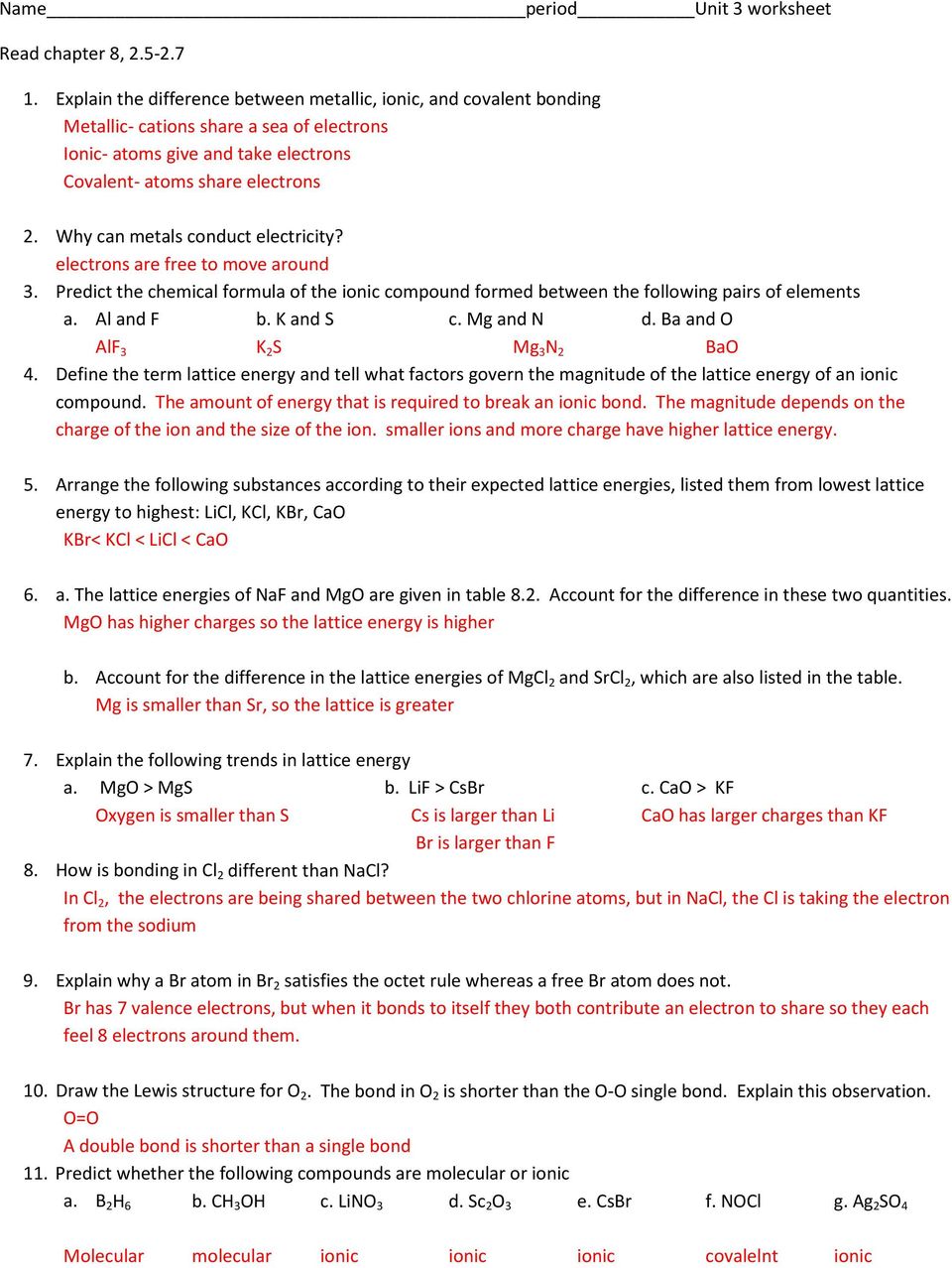
1 Name period Unit 3 worksheet Read chapter 8, Explain the difference between metallic, ionic, and covalent bonding Metallic cations share a sea of electrons Ionic atoms give and take electrons Covalent atoms share electrons 2. Why can metals conduct electricity? electrons are free to move around 3. Predict the chemical formula of the ionic formed between the following pairs of elements a. Al and F b. K and S c. Mg and N d. Ba and O AlF 3 K 2 S Mg 3 N 2 BaO 4. Define the term lattice energy and tell what factors govern the magnitude of the lattice energy of an ionic. The amount of energy that is required to break an ionic bond. The magnitude depends on the charge of the ion and the size of the ion. smaller ions and more charge have higher lattice energy. 5. Arrange the following substances according to their expected lattice energies, listed them from lowest lattice energy to highest: LiCl, KCl, KBr, CaO KBr< KCl < LiCl < CaO 6. a. The lattice energies of NaF and MgO are given in table 8.2. Account for the difference in these two quantities. MgO has higher charges so the lattice energy is higher b. Account for the difference in the lattice energies of MgCl 2 and SrCl 2, which are also listed in the table. Mg is smaller than Sr, so the lattice is greater 7. Explain the following trends in lattice energy a. MgO > MgS b. LiF > CsBr c. CaO > KF Oxygen is smaller than S Cs is larger than Li CaO has larger charges than KF Br is larger than F 8. How is bonding in Cl 2 different than NaCl? In Cl 2, the electrons are being shared between the two chlorine atoms, but in NaCl, the Cl is taking the electron from the sodium 9. Explain why a Br atom in Br 2 satisfies the octet rule whereas a free Br atom does not. Br has 7 valence electrons, but when it bonds to itself they both contribute an electron to share so they each feel 8 electrons around them. 10. Draw the Lewis structure for O 2. The bond in O 2 is shorter than the OO single bond. Explain this observation. O=O A double bond is shorter than a single bond 11. Predict whether the following s are molecular or ionic a. B 2 H 6 b. CH 3 OH c. LiNO 3 d. Sc 2 O 3 e. CsBr f. NOCl g. Ag 2 SO 4 Molecular molecular ionic ionic ionic covalelnt ionic
2 12. Which of the following bonds are polar? a. PO b. SF c. BrBr 13. Arrange the bonds in order of increasing polarity a. CF, OF, BeF b. NBr, PBr, OBr OF, CF, BeF PBr, NBr, OBr 14. Label each as ionic, polar covalent, or nonpolar covalent a. CO b. MgO c. Cl 2 d. AlF 3 Polar covalent ionic nonpolar covalent ionic 15. Draw the Lewis structure for the following see in class a. CO b. N 2 c. SF 2 d. ClO 2 e. PCl 3 e. H 2 CO (both H bonded to C) 16. A.Draw the Lewis electrondot structures for CO 3 2, CO 2 and CO, including resonance structures where appropriate. See in class b. Which of the three species has the shortest CO bond length? Explain the reason for your answer. CO carbon monoxide forms triple bonds which are shorter than double in CO 2 and the 1 1/3 bond in CO 3 c. Account for the fact that the carbonoxygen bond length in CO 3 2 is greater than the carbonoxygen bond length in CO /3 bond is longer than a double bond 17. How can the concept of resonance be used to explain that all six CC bonds in benzene are equal in length. The 3 double bonds are being shared between all 6 atoms so the bond order for each CC bond is Use simple structure and bonding models to account for each of the following: (a) The bond length between the two carbon atoms is shorter in C 2 H 4 than in C 2 H 6. C 2 H 4 forms double bonds and C2H6 forms single bonds. Double bonds are shorter than single (b) All the bond lengths in SO 3 are identical and are shorter than a sulfuroxygen single bond. SO 3 forms resonance so the bonds are each 1 1/3 which is shorter than a single 19. Draw the Lewis structure for each of the following molecules see in class 2 a. CO 3 b. BH 3 c. I 3 d. XeF 4 e. AsF In the Lewis structure for CH 2 Cl 2, the number of unshared electron pairs a. 2 b. 8 c. 10 d. 6 e In which of the following s does the bond between the central atom and chlorine have the greatest ionic character? a. BCl 3 b. HCl c. FeCl 2 d. CCl 4 e. CaCl Nitrogen is the central atom in each of the species given above. Draw the Lewis electrondot structure for each of the three species. See in class 23. Which one of the following molecules contains a triple bond? a. PF 3 b. NF 3 c. C 2 H 2 d. H 2 CO e. HOF

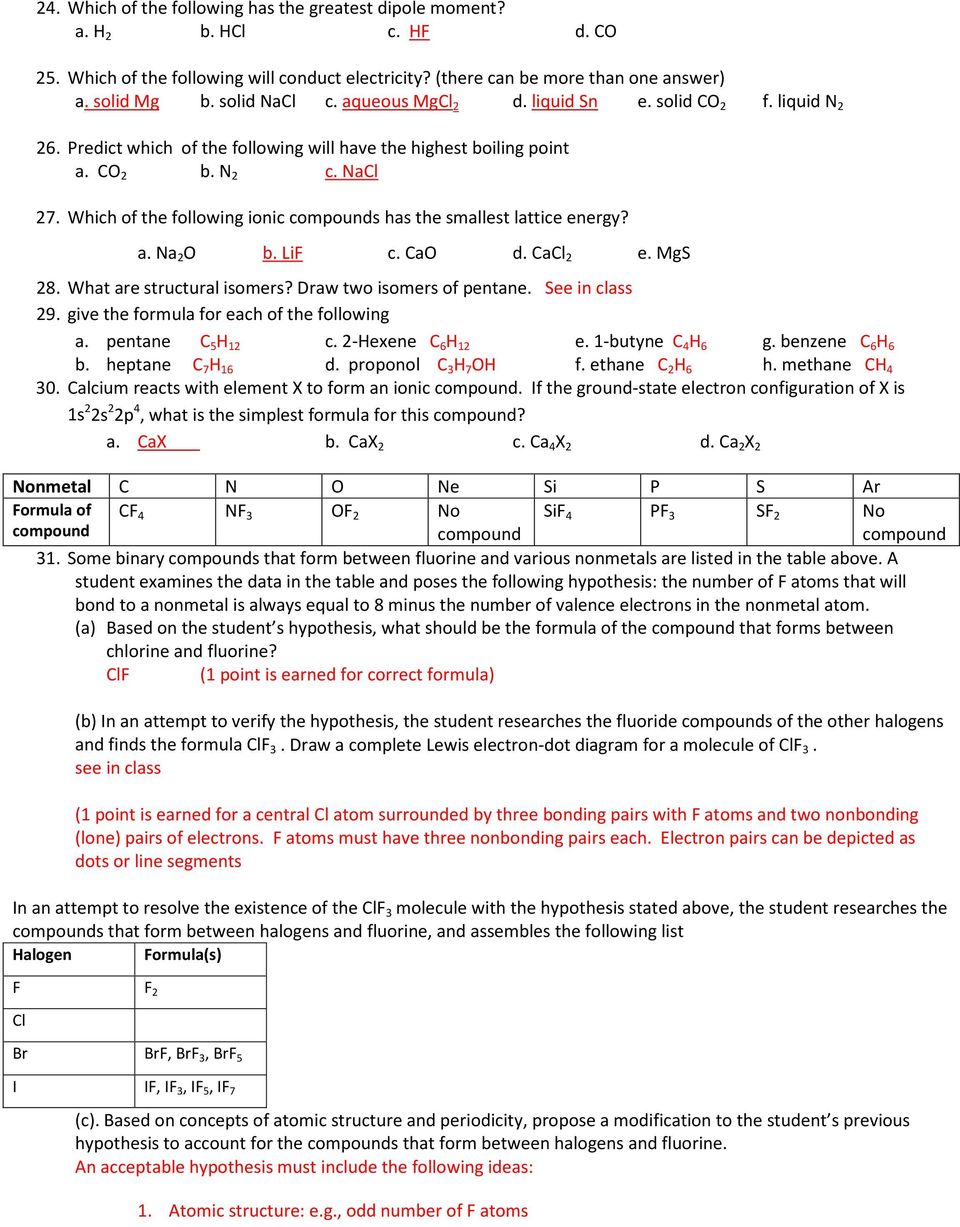
3 24. Which of the following has the greatest dipole moment? a. H 2 b. HCl c. HF d. CO 25. Which of the following will conduct electricity? (there can be more than one answer) a. solid Mg b. solid NaCl c. aqueous MgCl 2 d. liquid Sn e. solid CO 2 f. liquid N Predict which of the following will have the highest boiling point a. CO 2 b. N 2 c. NaCl 27. Which of the following ionic s has the smallest lattice energy? a. Na 2 O b. LiF c. CaO d. CaCl 2 e. MgS 28. What are structural isomers? Draw two isomers of pentane. See in class 29. give the formula for each of the following a. pentane C 5 H 12 c. 2Hexene C 6 H 12 e. 1butyne C 4 H 6 g. benzene C 6 H 6 b. heptane C 7 H 16 d. proponol C 3 H 7 OH f. ethane C 2 H 6 h. methane CH Calcium reacts with element X to form an ionic. If the groundstate electron configuration of X is 1s 2 2s 2 2p 4, what is the simplest formula for this? a. CaX b. CaX 2 c. Ca 4 X 2 d. Ca 2 X 2 Nonmetal C N O Ne Si P S Ar Formula of CF 4 NF 3 OF 2 No SiF 4 PF 3 SF 2 No 31. Some binary s that form between fluorine and various nonmetals are listed in the table above. A student examines the data in the table and poses the following hypothesis: the number of F atoms that will bond to a nonmetal is always equal to 8 minus the number of valence electrons in the nonmetal atom. (a) Based on the student s hypothesis, what should be the formula of the that forms between chlorine and fluorine? ClF (1 point is earned for correct formula) (b) In an attempt to verify the hypothesis, the student researches the fluoride s of the other halogens and finds the formula ClF 3. Draw a complete Lewis electrondot diagram for a molecule of ClF 3. see in class (1 point is earned for a central Cl atom surrounded by three bonding pairs with F atoms and two nonbonding (lone) pairs of electrons. F atoms must have three nonbonding pairs each. Electron pairs can be depicted as dots or line segments In an attempt to resolve the existence of the ClF 3 molecule with the hypothesis stated above, the student researches the s that form between halogens and fluorine, and assembles the following list Halogen Formula(s) F F 2 Cl Br BrF, BrF 3, BrF 5 I IF, IF 3, IF 5, IF 7 (c). Based on concepts of atomic structure and periodicity, propose a modification to the student s previous hypothesis to account for the s that form between halogens and fluorine. An acceptable hypothesis must include the following ideas: 1. Atomic structure: e.g., odd number of F atoms
4 2. Periodicity: e.g., as the atomic number of the central halogen atom increases, the number of F atoms increases (1 point is earned for an acceptably modified hypothesis that addresses both atomic structure and periodicity) 32. Bronze (Cu and Sn); Steel (Fe and C). Which of the following correctly describes the malleability of both alloys compared to their primary metal? b. Bronze s malleability would be comparable to that of copper, but steel s malleability would be significantly lower than that of iron. c. Bronze s malleability would be significantly higher than that of copper, but steel s malleability would be comparable to that of iron. d. Both bronze and steel would have malleability values similar to those of their primary metals e. Both bronze and steel would have malleability values greater than those of their primary metal. Review 33. Calcium reacts with element X to form an ionic. If the groundstate electron configuration of X is 1s 2 2s 2 2p 4, what is the simplest formula for this? a. CaX b. CaX 2 c. Ca 4 X 2 d. Ca 2 X A. What are valence electrons? Electrons in the highest energy level a. How many valence electrons does nitrogen have? 5 c. An atom has the electron configuration 1s 2 2s 2 2p 6 3s 2 3p 2. How many valence electrons does this atom have? If an atom has the electron configuration 1s 2 2s 2 2p 5, how many electrons must it gain to achieve an octet? Fill in the gaps Symbol 52 Cr I 107 Ag Sn As 3 Protons Neutrons Electrons Net charge What is the nuclear charge for the following atoms a. Na b. F c. Sn d. P e. Ar Why doesn t a valence electron feel the full nuclear charge of an atom? The nucleus is shielded by other electrons 39. Which atom will have the largest radius in each pair. a. K, Na b. Na, Na+ c. Br, Br d. K, Br 40. Which property generally increases down a group but decreases from left to right b. Melting point b. electronegativity c. ionization energy d. atomic radius 41. A.What is the name of group 1? Alkali metals b. What is the name of group 17? halogens

5 42. Which pair of elements has the most similar properties? c. Na, S b. N, P c. P, Cl d. N, Cl 43. Convert d g of magnesium chloride to moles mol e. 5.3 x molecules of nitrogen dioxide to grams 41 g f moles of ammonia to milligrams mg 44. Write the electron configuration for each of the following ions c. Sr 2+ b. Ni 2+ c. Br d. Mn 3+ [Kr] [Ar]3d 8 [Ar]4s 2 3d 10 4p 6 [Ar]3d Write a balanced net ionic reaction a. manganese (II) nitrate solution is mixed with sodium hydroxide solution. Mn OH Mn(OH) 2 b. hydrosulfuric acid is added to a solution of barium hydroxide and a precipitate forms. 2H 2 S + Ba OH BaS + 2H 2 O c. fluorine is added to a magnesium chloride solution. Halogens are soluble except with silver, mercury, and lead F 2 + 2Cl Cl 2 +2 F d. potassium is added to water K + H 2 O K + + OH + H Which is a list of elements listed in order of increasing ionization energy? A) Na, K, Rb B) Ne, Ar, Kr C) Al, Mg, Na D) Br, Cl, F E) O, S, Se Name or give the formula for each of the following 46. silver sulfide Ag 2 S 64. MnO manganese (II) oxide 47. sodium sulfite Na 2 SO P 5 O 4 pentaphosphorus tetroxide 48. magnesium sulfate MgSO Fe(OH) 2 iron(ii) hydroxide 49. iron (III) sulfide Fe 2 S NiCr 2 O 7 nickel(ii) dichromate 50. zinc phosphate Zn 3 (PO 4 ) Cu 2 S copper (I) sulfide 51. hydrosulfuric acid H 2 S 69. HCl hydrochloric acid 52. barium acetate Ba(C 2 H 3 O 2 ) CO carbon monoxide 53. copper (I) permanganate CuMnO H 2 SO 3 sulfurous acid 54. carbonic acid H 2 CO Cs 2 CO 3 cesium carbonate 55. strontium cyanide Sr(CN) NH 4 ClO 4 ammonium perchlorate 56. dinitrogen trioxide N 2 O Ba(CH 3 COO) 2 barium acetate 57. silver nitride Ag 3 N 75. FePO 4 iron (III) phosphate 58. hydrobromic acid HBr 76. CaF 2 calcium fluoride 59. calcium hydroxide Ca(OH) H 3 PO 4 phosphoric acid 60. nitric acid HNO MgBr 2 magnesium bromide 61. acetic acid HC 2 H 3 O NaHCO 3 sodium bicarbonate 62. ammonia NH H 2 O 2 hydrogen peroxide
![Mn 3+ [Kr] [Ar]3d 8 [Ar]4s 2 3d 10 4p 6 [Ar]3d 4 45. Write a balanced net ionic reaction a. manganese (II) nitrate solution is mixed with sodium hydroxide solution. Mn 2+ + 2OH Mn(OH) 2 b.](/docs-images/47/20906431/images/page_5.jpg "hydrosulfuric acid is added to a solution of barium hydroxide and a precipitate forms. 2H 2 S + Ba 2+ + 2OH BaS + 2H 2 O c. fluorine is added to a magnesium chloride solution.")
Bonding Practice Problems
 NAME 1. When compared to H 2 S, H 2 O has a higher 8. Given the Lewis electron-dot diagram: boiling point because H 2 O contains stronger metallic bonds covalent bonds ionic bonds hydrogen bonds 2. Which
Name: Block: Date: Test Review: Chapter 8 Ionic Bonding
 Name: Block: Date: Test Review: Chapter 8 Ionic Bonding Part 1: Fill-in-the-blank. Choose the word from the word bank below. Each word may be used only 1 time. electron dot structure metallic electronegativity
Decomposition. Composition
 Decomposition 1. Solid ammonium carbonate is heated. 2. Solid calcium carbonate is heated. 3. Solid calcium sulfite is heated in a vacuum. Composition 1. Barium oxide is added to distilled water. 2. Phosphorus
Questions on Chapter 8 Basic Concepts of Chemical Bonding
 Questions on Chapter 8 Basic Concepts of Chemical Bonding Circle the Correct Answer: 1) Which ion below has a noble gas electron configuration? A) Li 2+ B) Be 2+ C) B2+ D) C2+ E) N 2-2) Of the ions below,
Nomenclature of Ionic Compounds
 Nomenclature of Ionic Compounds Ionic compounds are composed of ions. An ion is an atom or molecule with an electrical charge. Monatomic ions are formed from single atoms that have gained or lost electrons.
CHAPTER 5: MOLECULES AND COMPOUNDS
 CHAPTER 5: MOLECULES AND COMPOUNDS Problems: 1-6, 9-13, 16, 20, 31-40, 43-64, 65 (a,b,c,e), 66(a-d,f), 69(a-d,f), 70(a-e), 71-78, 81-82, 87-96 A compound will display the same properties (e.g. melting
Chapter 4 Compounds and Their Bonds
 Chapter 4 Compounds and Their Bonds 4.1 Octet Rule and Ions Octet Rule An octet is 8 valence electrons. is associated with the stability of the noble gases. He is stable with 2 valence electrons (duet).
B) atomic number C) both the solid and the liquid phase D) Au C) Sn, Si, C A) metal C) O, S, Se C) In D) tin D) methane D) bismuth B) Group 2 metal
 1. The elements on the Periodic Table are arranged in order of increasing A) atomic mass B) atomic number C) molar mass D) oxidation number 2. Which list of elements consists of a metal, a metalloid, and
Monatomic Ions. A. Monatomic Ions In order to determine the charge of monatomic ions, you can use the periodic table as a guide:
 Monatomic Ions Ions are atoms that have either lost or gained electrons. While atoms are neutral, ions are charged particles. A loss of electrons results in a positive ion or cation (pronounced cat-eye-on
Which substance contains positive ions immersed in a sea of mobile electrons? A) O2(s) B) Cu(s) C) CuO(s) D) SiO2(s)
 BONDING MIDTERM REVIEW 7546-1 - Page 1 1) Which substance contains positive ions immersed in a sea of mobile electrons? A) O2(s) B) Cu(s) C) CuO(s) D) SiO2(s) 2) The bond between hydrogen and oxygen in
Nomenclature and Formulas of Ionic Compounds. Section I: Writing the Name from the Formula
 Purpose: Theory: Nomenclature and Formulas of Ionic Compounds 1. To become familiar with the rules of chemical nomenclature, based on the classification of compounds. 2. To write the proper name of the
NAMING QUIZ 3 - Part A Name: 1. Zinc (II) Nitrate. 5. Silver (I) carbonate. 6. Aluminum acetate. 8. Iron (III) hydroxide
 NAMING QUIZ 3 - Part A Name: Write the formulas for the following compounds: 1. Zinc (II) Nitrate 2. Manganese (IV) sulfide 3. Barium permanganate 4. Sulfuric acid 5. Silver (I) carbonate 6. Aluminum acetate
Sample Exercise 8.1 Magnitudes of Lattice Energies
 Sample Exercise 8.1 Magnitudes of Lattice Energies Without consulting Table 8.2, arrange the ionic compounds NaF, CsI, and CaO in order of increasing lattice energy. Analyze From the formulas for three
WRITING CHEMICAL FORMULA
 WRITING CHEMICAL FORMULA For ionic compounds, the chemical formula must be worked out. You will no longer have the list of ions in the exam (like at GCSE). Instead you must learn some and work out others.
Naming Compounds Handout Key
 Naming Compounds Handout Key p. 2 Name each of the following monatomic cations: Li + = lithium ion Ag + = silver ion Cd +2 = cadmium ion Cu +2 = copper (II) ion Al +3 = aluminum ion Mg +2 = magnesium ion
In the box below, draw the Lewis electron-dot structure for the compound formed from magnesium and oxygen. [Include any charges or partial charges.
 Name: 1) Which molecule is nonpolar and has a symmetrical shape? A) NH3 B) H2O C) HCl D) CH4 7222-1 - Page 1 2) When ammonium chloride crystals are dissolved in water, the temperature of the water decreases.
Balancing Chemical Equations Worksheet
 Balancing Chemical Equations Worksheet Student Instructions 1. Identify the reactants and products and write a word equation. 2. Write the correct chemical formula for each of the reactants and the products.
7) How many electrons are in the second energy level for an atom of N? A) 5 B) 6 C) 4 D) 8
 HOMEWORK CHEM 107 Chapter 3 Compounds Putting Particles Together 3.1 Multiple-Choice 1) How many electrons are in the highest energy level of sulfur? A) 2 B) 4 C) 6 D) 8 2) An atom of phosphorous has how
Periodic Table Questions
 Periodic Table Questions 1. The elements characterized as nonmetals are located in the periodic table at the (1) far left; (2) bottom; (3) center; (4) top right. 2. An element that is a liquid at STP is
Moles, Molecules, and Grams Worksheet Answer Key
 Moles, Molecules, and Grams Worksheet Answer Key 1) How many are there in 24 grams of FeF 3? 1.28 x 10 23 2) How many are there in 450 grams of Na 2 SO 4? 1.91 x 10 24 3) How many grams are there in 2.3
Sample Exercise 8.1 Magnitudes of Lattice Energies
 Sample Exercise 8.1 Magnitudes of Lattice Energies Without consulting Table 8.2, arrange the following ionic compounds in order of increasing lattice energy: NaF, CsI, and CaO. Analyze: From the formulas
Sample Exercise 2.1 Illustrating the Size of an Atom
 Sample Exercise 2.1 Illustrating the Size of an Atom The diameter of a US penny is 19 mm. The diameter of a silver atom, by comparison, is only 2.88 Å. How many silver atoms could be arranged side by side
Stoichiometry Review
 Stoichiometry Review There are 20 problems in this review set. Answers, including problem set-up, can be found in the second half of this document. 1. N 2 (g) + 3H 2 (g) --------> 2NH 3 (g) a. nitrogen
neutrons are present?
 AP Chem Summer Assignment Worksheet #1 Atomic Structure 1. a) For the ion 39 K +, state how many electrons, how many protons, and how many 19 neutrons are present? b) Which of these particles has the smallest
Name period AP chemistry Unit 2 worksheet Practice problems
 Name period AP chemistry Unit 2 worksheet Practice problems 1. What are the SI units for a. Wavelength of light b. frequency of light c. speed of light Meter hertz (s -1 ) m s -1 (m/s) 2. T/F (correct
CHEMICAL NAMES AND FORMULAS
 9 CHEMICAL NAMES AND FORMULAS SECTION 9.1 NAMING IONS (pages 253 258) This section explains the use of the periodic table to determine the charge of an ion. It also defines polyatomic ion and gives the
PART I: MULTIPLE CHOICE (30 multiple choice questions. Each multiple choice question is worth 2 points)
 CHEMISTRY 123-07 Midterm #1 Answer key October 14, 2010 Statistics: Average: 74 p (74%); Highest: 97 p (95%); Lowest: 33 p (33%) Number of students performing at or above average: 67 (57%) Number of students
= 11.0 g (assuming 100 washers is exact).
 CHAPTER 8 1. 100 washers 0.110 g 1 washer 100. g 1 washer 0.110 g = 11.0 g (assuming 100 washers is exact). = 909 washers 2. The empirical formula is CFH from the structure given. The empirical formula
Topic 4 National Chemistry Summary Notes. Formulae, Equations, Balancing Equations and The Mole
 Topic 4 National Chemistry Summary Notes Formulae, Equations, Balancing Equations and The Mole LI 1 The chemical formula of a covalent molecular compound tells us the number of atoms of each element present
Exercise 3.5 - Naming Binary Covalent Compounds:
 Chapter Exercise Key 1 Chapter Exercise Key Exercise.1 Classifying Compounds: Classify each of the following substances as either a molecular compound or an ionic compound. a. formaldehyde, CH 2 O (used
HOMEWORK 4A. Definitions. Oxidation-Reduction Reactions. Questions
 HOMEWORK 4A Oxidation-Reduction Reactions 1. Indicate whether a reaction will occur or not in each of following. Wtiring a balcnced equation is not necessary. (a) Magnesium metal is added to hydrochloric
pre -TEST Big Idea 2 Chapters 8, 9, 10
 Name: AP Chemistry Period: Date: R.F. Mandes, PhD, NBCT Complete each table with the appropriate information. Compound IMF Compound IMF 1 NiCl 3 7 ClCH 2 (CH 2 ) 3 CH 3 2 Fe 8 H 2 CF 2 3 Ar 9 H 2 NCH 2
Nomenclature Packet. 1. Name the following ionic compounds: a. Al 2 O 3 Aluminum oxide. b. Cs 2 O Cesium oxide. c. Rb 3 N Rubidium nitride
 Nomenclature Packet Worksheet I: Binary Ionic Compounds (representative metals) metals from groups 1A, 2A, and 3A (1, 2, and 13) have constant charges as ions and do NOT get Roman Numerals in their names
W1 WORKSHOP ON STOICHIOMETRY
 INTRODUCTION W1 WORKSHOP ON STOICHIOMETRY These notes and exercises are designed to introduce you to the basic concepts required to understand a chemical formula or equation. Relative atomic masses of
CHAPTER 12: CHEMICAL BONDING
 CHAPTER 12: CHEMICAL BONDING Active Learning Questions: 3-9, 11-19, 21-22 End-of-Chapter Problems: 1-36, 41-59, 60(a,b), 61(b,d), 62(a,b), 64-77, 79-89, 92-101, 106-109, 112, 115-119 An American chemist
SOME TOUGH COLLEGE PROBLEMS! .. : 4. How many electrons should be shown in the Lewis dot structure for carbon monoxide? N O O
 SME TUGH CLLEGE PRBLEMS! LEWIS DT STRUCTURES 1. An acceptable Lewis dot structure for 2 is (A) (B) (C) 2. Which molecule contains one unshared pair of valence electrons? (A) H 2 (B) H 3 (C) CH 4 acl 3.
CHEMISTRY BONDING REVIEW
 Answer the following questions. CHEMISTRY BONDING REVIEW 1. What are the three kinds of bonds which can form between atoms? The three types of Bonds are Covalent, Ionic and Metallic. Name Date Block 2.
Chapter 6 Assessment. Name: Class: Date: ID: A. Multiple Choice Identify the choice that best completes the statement or answers the question.
 Name: Class: Date: ID: A Chapter 6 Assessment Multiple Choice Identify the choice that best completes the statement or answers the question. 1. When an atom loses an electron, it forms a(n) a. anion. c.
Naming Compounds. There are three steps involved in naming ionic compounds- naming the cation, naming the anion, and naming the entire compound.
 Naming Compounds Naming compounds is an important part of chemistry. Most compounds fall in to one of three categories ionic compounds, molecular compounds, or acids. Part One: Naming Ionic Compounds Identifying
SCH 4C1 Unit 2 Problem Set Questions taken from Frank Mustoe et all, "Chemistry 11", McGraw-Hill Ryerson, 2001
 SCH 4C1 Unit 2 Problem Set Questions taken from Frank Mustoe et all, "Chemistry 11", McGraw-Hill Ryerson, 2001 1. A small pin contains 0.0178 mol of iron. How many atoms of iron are in the pin? 2. A sample
(b) Formation of calcium chloride:
 Chapter 2: Chemical Compounds and Bonding Section 2.1: Ionic Compounds, pages 22 23 1. An ionic compound combines a metal and a non-metal joined together by an ionic bond. 2. An electrostatic force holds
ATOMS. Multiple Choice Questions
 Chapter 3 ATOMS AND MOLECULES Multiple Choice Questions 1. Which of the following correctly represents 360 g of water? (i) 2 moles of H 2 0 (ii) 20 moles of water (iii) 6.022 10 23 molecules of water (iv)
Exam 2 Chemistry 65 Summer 2015. Score:
 Name: Exam 2 Chemistry 65 Summer 2015 Score: Instructions: Clearly circle the one best answer 1. Valence electrons are electrons located A) in the outermost energy level of an atom. B) in the nucleus of
Name: Class: Date: 2 4 (aq)
 Name: Class: Date: Unit 4 Practice Test Multiple Choice Identify the choice that best completes the statement or answers the question. 1) The balanced molecular equation for complete neutralization of
Chapter 1 The Atomic Nature of Matter
 Chapter 1 The Atomic Nature of Matter 6. Substances that cannot be decomposed into two or more simpler substances by chemical means are called a. pure substances. b. compounds. c. molecules. d. elements.
Unit 10A Stoichiometry Notes
 Unit 10A Stoichiometry Notes Stoichiometry is a big word for a process that chemist s use to calculate amounts in reactions. It makes use of the coefficient ratio set up by balanced reaction equations
Chapter 8: Chemical Equations and Reactions
 Chapter 8: Chemical Equations and Reactions I. Describing Chemical Reactions A. A chemical reaction is the process by which one or more substances are changed into one or more different substances. A chemical
Chapter 3 Mass Relationships in Chemical Reactions
 Chapter 3 Mass Relationships in Chemical Reactions Student: 1. An atom of bromine has a mass about four times greater than that of an atom of neon. Which choice makes the correct comparison of the relative
Periodic Table, Valency and Formula
 Periodic Table, Valency and Formula Origins of the Periodic Table Mendelѐѐv in 1869 proposed that a relationship existed between the chemical properties of elements and their atomic masses. He noticed
ch9 and 10 practice test
 1. Which of the following covalent bonds is the most polar (highest percent ionic character)? A. Al I B. Si I C. Al Cl D. Si Cl E. Si P 2. What is the hybridization of the central atom in ClO 3? A. sp
Study Guide For Chapter 7
 Name: Class: Date: ID: A Study Guide For Chapter 7 Multiple Choice Identify the choice that best completes the statement or answers the question. 1. The number of atoms in a mole of any pure substance
100% ionic compounds do not exist but predominantly ionic compounds are formed when metals combine with non-metals.
 2.21 Ionic Bonding 100% ionic compounds do not exist but predominantly ionic compounds are formed when metals combine with non-metals. Forming ions Metal atoms lose electrons to form +ve ions. Non-metal
TOPIC 7. CHEMICAL CALCULATIONS I - atomic and formula weights.
 TOPIC 7. CHEMICAL CALCULATIONS I - atomic and formula weights. Atomic structure revisited. In Topic 2, atoms were described as ranging from the simplest atom, H, containing a single proton and usually
Molecules, Compounds, and Chemical Equations (Chapter 3)
 Molecules, Compounds, and Chemical Equations (Chapter 3) Chemical Compounds 1. Classification of Elements and Compounds Types of Pure Substances (Figure 3.4) Elements -- made up of only one type of atom
Find a pair of elements in the periodic table with atomic numbers less than 20 that are an exception to the original periodic law.
 Example Exercise 6.1 Periodic Law Find the two elements in the fifth row of the periodic table that violate the original periodic law proposed by Mendeleev. Mendeleev proposed that elements be arranged
Molar Mass Worksheet Answer Key
 Molar Mass Worksheet Answer Key Calculate the molar masses of the following chemicals: 1) Cl 2 71 g/mol 2) KOH 56.1 g/mol 3) BeCl 2 80 g/mol 4) FeCl 3 162.3 g/mol 5) BF 3 67.8 g/mol 6) CCl 2 F 2 121 g/mol
Multiple Choice Identify the letter of the choice that best completes the statement or answers the question.
 Introduction to Chemistry Exam 2 Practice Problems 1 Multiple Choice Identify the letter of the choice that best completes the statement or answers the question. 1.Atoms consist principally of what three
3. What would you predict for the intensity and binding energy for the 3p orbital for that of sulfur?
 PSI AP Chemistry Periodic Trends MC Review Name Periodic Law and the Quantum Model Use the PES spectrum of Phosphorus below to answer questions 1-3. 1. Which peak corresponds to the 1s orbital? (A) 1.06
19.2 Chemical Formulas
 In the previous section, you learned how and why atoms form chemical bonds with one another. You also know that atoms combine in certain ratios with other atoms. These ratios determine the chemical formula
PERIODIC TABLE OF THE ELEMENTS
 PERIODIC TABLE OF THE ELEMENTS Periodic Table: an arrangement of elements in horizontal rows (Periods) and vertical columns (Groups) exhibits periodic repetition of properties First Periodic Table: discovered
Polyatomic ions can form ionic compounds just as monatomic ions.
 1 POLYATOMIC IONS We have seen that atoms can lose or gain electrons to become ions. Groups of atoms can also become ions. These groups of atoms are called polyatomic ions. Examples: O hydroxide ion NO
Aqueous Solutions. Water is the dissolving medium, or solvent. Some Properties of Water. A Solute. Types of Chemical Reactions.
 Aqueous Solutions and Solution Stoichiometry Water is the dissolving medium, or solvent. Some Properties of Water Water is bent or V-shaped. The O-H bonds are covalent. Water is a polar molecule. Hydration
Oxidation States of Nitrogen
 Oxidation States of Nitrogen HNO 3 NH 3 HNO 2 NO N 2 O N 2 HN 3 N 2 H 5 + +3 +2 +1 0-1/3-2 Oxidation +5-3 Reduction Oxidation States of Chlorine HClO 4 HClO 3 ClO 2 HClO 2 HClO Cl 2 HCl +5 +4 +3 +1 0 Oxidation
Chemistry 151 Final Exam
 Chemistry 151 Final Exam Name: SSN: Exam Rules & Guidelines Show your work. No credit will be given for an answer unless your work is shown. Indicate your answer with a box or a circle. All paperwork must
Chapter 17. How are acids different from bases? Acid Physical properties. Base. Explaining the difference in properties of acids and bases
 Chapter 17 Acids and Bases How are acids different from bases? Acid Physical properties Base Physical properties Tastes sour Tastes bitter Feels slippery or slimy Chemical properties Chemical properties
b. N 2 H 4 c. aluminum oxalate d. acetic acid e. arsenic PART 2: MOLAR MASS 2. Determine the molar mass for each of the following. a. ZnI 2 b.
 CHEMISTRY DISCOVER UNIT 5 LOTS OF PRACTICE ON USING THE MOLE!!! PART 1: ATOMIC MASS, FORMULA MASS, OR MOLECULAR MASS 1. Determine the atomic mass, formula mass, or molecular mass for each of the following
Ionic and Metallic Bonding
 Ionic and Metallic Bonding BNDING AND INTERACTINS 71 Ions For students using the Foundation edition, assign problems 1, 3 5, 7 12, 14, 15, 18 20 Essential Understanding Ions form when atoms gain or lose
CHAPTER 6 Chemical Bonding
 CHAPTER 6 Chemical Bonding SECTION 1 Introduction to Chemical Bonding OBJECTIVES 1. Define Chemical bond. 2. Explain why most atoms form chemical bonds. 3. Describe ionic and covalent bonding.. 4. Explain
Chapter 8 Basic Concepts of the Chemical Bonding
 Chapter 8 Basic Concepts of the Chemical Bonding 1. There are paired and unpaired electrons in the Lewis symbol for a phosphorus atom. (a). 4, 2 (b). 2, 4 (c). 4, 3 (d). 2, 3 Explanation: Read the question
CHEM 1301 SECOND TEST REVIEW. Covalent bonds are sharing of electrons (ALWAYS valence electrons). Use Lewis structures to show this sharing.
 CEM 1301 SECOND TEST REVIEW Lewis Structures Covalent bonds are sharing of electrons (ALWAYS valence electrons). Use Lewis structures to show this sharing. Rules OCTET RULE an atom would like to have 8
Chapter 4 Chemical Reactions
 Chapter 4 Chemical Reactions I) Ions in Aqueous Solution many reactions take place in water form ions in solution aq solution = solute + solvent solute: substance being dissolved and present in lesser
Candidate Style Answer
 Candidate Style Answer Chemistry A Unit F321 Atoms, Bonds and Groups High banded response This Support Material booklet is designed to accompany the OCR GCE Chemistry A Specimen Paper F321 for teaching
Ionic and Covalent Bonds
 Ionic and Covalent Bonds Ionic Bonds Transfer of Electrons When metals bond with nonmetals, electrons are from the metal to the nonmetal The becomes a cation and the becomes an anion. The between the cation
2. Which one of the ions below possesses a noble gas configuration? A) Fe 3+ B) Sn 2+ C) Ni 2+ D) Ti 4+ E) Cr 3+
 Chapter 9 Tro 1. Bromine tends to form simple ions which have the electronic configuration of a noble gas. What is the electronic configuration of the noble gas which the bromide ion mimics? A) 1s 2 2s
Chemical Equations. Chemical Equations. Chemical reactions describe processes involving chemical change
 Chemical Reactions Chemical Equations Chemical reactions describe processes involving chemical change The chemical change involves rearranging matter Converting one or more pure substances into new pure
Chemistry Diagnostic Questions
 Chemistry Diagnostic Questions Answer these 40 multiple choice questions and then check your answers, located at the end of this document. If you correctly answered less than 25 questions, you need to
Chem 1100 Chapter Three Study Guide Answers Outline I. Molar Mass and Moles A. Calculations of Molar Masses
 Chem 1100 Chapter Three Study Guide Answers Outline I. Molar Mass and Moles A. Calculations of Molar Masses B. Calculations of moles C. Calculations of number of atoms from moles/molar masses 1. Avagadro
Chemistry Themed. Types of Reactions
 Chemistry Themed Types of Reactions 1 2 Chemistry in the Community-2015-2016 Types of Reactions Date In-Class Assignment Homework T 10/20 TEST on Reactivity of Metals and Redox None W 10/21 Late Start
Writing and Balancing Chemical Equations
 Name Writing and Balancing Chemical Equations Period When a substance undergoes a chemical reaction, chemical bonds are broken and new bonds are formed. This results in one or more new substances, often
A mutual electrical attraction between the nuclei and valence electrons of different atoms that binds the atoms together is called a(n)
 Chemistry I ATOMIC BONDING PRACTICE QUIZ Mr. Scott Select the best answer. 1) A mutual electrical attraction between the nuclei and valence electrons of different atoms that binds the atoms together is
Chapter 2 Atoms, Molecules, and Ions
 Chapter 2 Atoms, Molecules, and Ions 1. Methane and ethane are both made up of carbon and hydrogen. In methane, there are 12.0 g of carbon for every 4.00 g of hydrogen, a ration of 3:1 by mass. In ethane,
Chemistry Post-Enrolment Worksheet
 Name: Chemistry Post-Enrolment Worksheet The purpose of this worksheet is to get you to recap some of the fundamental concepts that you studied at GCSE and introduce some of the concepts that will be part
Unit 2 Periodic Behavior and Ionic Bonding
 Unit 2 Periodic Behavior and Ionic Bonding 6.1 Organizing the Elements I. The Periodic Law A. The physical and chemical properties of the elements are periodic functions of their atomic numbers B. Elements
NOTE: This practice exam contains more than questions than the real final.
 NOTE: This practice exam contains more than questions than the real final 1 The wavelength of light emitted from a green laser pointer is 532 10 2 nm What is the wavelength in meters? 532 10-7 m 2 What
Chapter 7 Periodic Properties of the Elements
 Chapter 7 Periodic Properties of the Elements 1. Elements in the modern version of the periodic table are arranged in order of increasing. (a). oxidation number (b). atomic mass (c). average atomic mass
Naming and Writing Formulas for Ionic Compounds Using IUPAC Rules
 Naming and Writing Formulas for Ionic Compounds Using IUPAC Rules There are three categories of ionic compounds that we will deal with. 1.Binary ionic o simple ions (only single charges) o multivalent
Chapter 12: Oxidation and Reduction.
 207 Oxidation- reduction (redox) reactions Chapter 12: Oxidation and Reduction. At different times, oxidation and reduction (redox) have had different, but complimentary, definitions. Compare the following
Chapter 4: Structure and Properties of Ionic and Covalent Compounds
 Chapter 4: Structure and Properties of Ionic and Covalent Compounds 4.1 Chemical Bonding o Chemical Bond - the force of attraction between any two atoms in a compound. o Interactions involving valence
CHAPTER 9. 9.1 Naming Ions. Chemical Names and Formulas. Naming Transition Metals. Ions of Transition Metals. Ions of Transition Metals
 CHAPTER 9 Chemical Names and Formulas 9.1 Naming Ions Monatomic Ions: a single atom with a positive or negative charge Cation (rules): listed first Anion (rules): ide ending Transition Metals have a varying
Unit 9 Stoichiometry Notes (The Mole Continues)
 Unit 9 Stoichiometry Notes (The Mole Continues) is a big word for a process that chemist s use to calculate amounts in reactions. It makes use of the coefficient ratio set up by balanced reaction equations
Formulae, stoichiometry and the mole concept
 3 Formulae, stoichiometry and the mole concept Content 3.1 Symbols, Formulae and Chemical equations 3.2 Concept of Relative Mass 3.3 Mole Concept and Stoichiometry Learning Outcomes Candidates should be
AP Chemistry A. Allan Chapter 8 Notes - Bonding: General Concepts
 AP Chemistry A. Allan Chapter 8 Notes - Bonding: General Concepts 8.1 Types of Chemical Bonds A. Ionic Bonding 1. Electrons are transferred 2. Metals react with nonmetals 3. Ions paired have lower energy
Theme 3: Bonding and Molecular Structure. (Chapter 8)
 Theme 3: Bonding and Molecular Structure. (Chapter 8) End of Chapter questions: 5, 7, 9, 12, 15, 18, 23, 27, 28, 32, 33, 39, 43, 46, 67, 77 Chemical reaction valence electrons of atoms rearranged (lost,
Chapter 1: Moles and equations. Learning outcomes. you should be able to:
 Chapter 1: Moles and equations 1 Learning outcomes you should be able to: define and use the terms: relative atomic mass, isotopic mass and formula mass based on the 12 C scale perform calculations, including
Chemistry Final Study Guide
 Name: Class: Date: Chemistry Final Study Guide Multiple Choice Identify the choice that best completes the statement or answers the question. 1. The electrons involved in the formation of a covalent bond
Chapter 8 Concepts of Chemical Bonding
 Chapter 8 Concepts of Chemical Bonding Chemical Bonds Three types: Ionic Electrostatic attraction between ions Covalent Sharing of electrons Metallic Metal atoms bonded to several other atoms Ionic Bonding
1. When the following equation is balanced, the coefficient of Al is. Al (s) + H 2 O (l)? Al(OH) 3 (s) + H 2 (g)
 1. When the following equation is balanced, the coefficient of Al is. Al (s) + H 2 O (l)? Al(OH) (s) + H 2 (g) A) 1 B) 2 C) 4 D) 5 E) Al (s) + H 2 O (l)? Al(OH) (s) + H 2 (g) Al (s) + H 2 O (l)? Al(OH)
Molarity of Ions in Solution
 APPENDIX A Molarity of Ions in Solution ften it is necessary to calculate not only the concentration (in molarity) of a compound in aqueous solution but also the concentration of each ion in aqueous solution.
Aqueous Ions and Reactions
 Aqueous Ions and Reactions (ions, acids, and bases) Demo NaCl(aq) + AgNO 3 (aq) AgCl (s) Two clear and colorless solutions turn to a cloudy white when mixed Demo Special Light bulb in water can test for
Chapter 11. Electrochemistry Oxidation and Reduction Reactions. Oxidation-Reduction Reactions. Oxidation-Reduction Reactions
 Oxidation-Reduction Reactions Chapter 11 Electrochemistry Oxidation and Reduction Reactions An oxidation and reduction reaction occurs in both aqueous solutions and in reactions where substances are burned